Colorado Statesman
Saturday, September 19, 1914
Denver, Colorado
Page text (machine-generated)
PATRONIZE MERCHANTS WHO ADV. IN THE PEOPLE'S PAPER
THE COLORADO STATESMAN
THE JOURNAL OF THE WEST.
LABOR SHALL BE FREE
RAGE COUNTRY PARTY
RACE
LOYALTY
Every race has its own characteristics and peculiarities. They are mental as well as physical. The most casual observer readily reveals to us that races differ in complexion, texture of hair, in size, and sect. One race white, one race brown, one yellow and one dark. The hair of some is straight, soft and flowing, another, stiff and course, and another short and crisp. If we observe more closely, and come into closer contact, we note they differ in habits, manners and customs and modes of thinking. Why is this, and for what purpose? The answer must be because God, the Almighty Creator, made and ordained them so, and hence for the best. They serve His great purpose. Holy Writ tells us that He created each after His kind.
It is plain, then, that this is a universal law stamped upon the very face of our being and is designed by the creator for the accomplishment of some great end. Since this is true, each race can contribute most to the world by developing its peculiar characteristics to their fullest extent. In doing this they are serving the purpose of their creation, and can contribute the greatest possible good to the world's civilization.
A race should study its own peculiar qualities and instincts and set about with the utmost care to cultivate them and bring them up to their highest possible efficiency. In doing this it has not only its own aid, but the aid of its Maker, who created and ordained it thus. To do otherwise is disastrous and deleterious, and must inevitably end in degeneracy and degradation.
Many Negroes have tried to ignore and eliminate their own racial qualities, both mental and physical, and ape the white man. Some tried to get away from their own race and get in the other. Some used all kinds of cosmetics to bleach the skin, and all kinds of "straightiness" to straighten the hair. We have in mind a so called race leader, who is the most striking illustration of the point at issue; he makes it a point to rise early in the morning to give himself ample time to go through this unnatural and foolish process. All kinds of cold creams, face powders, and hair oils are used, morning, noon and night to bring about the desired end. And we have noted as a result, he is less brilliant, less healthy and less independent in thought and action. He has become a veritable imitator. It is second nature with him now; he would no more stop it than he
---
VOL. XX1.
```markdown
```
could stop breathing.
We have in mind numbers of our women, who are even more guilty of doing these very things mentioned. Do not these things show they are trying to get away from the race, and get into the other? Why not be content with what God has given them? Why can they not see that the best within them is neglected?
They are not only guilty of the things just mentioned, but they try to walk and talk like them. We are sometimes struck when we see some of our people who have been around the whites in their homes, come out trying to talk just as they talk, instead of talking in their own natural way. We do not mean that they should not imitate them in that which is good and uplifting, for that would be beneficial and helpful. For all races, to some extent, imitate one another and cull that which is best from the other.
For instance, the Japs studied the American way and took what was best in their civilization, and engrafted it upon their own. They studied the American navy, and improved theirs in their own Japanese way. And what was the consequence? We find them admired and respected and honored throughout the civilized world. Why? Because, while they picked what was best in other races, they stood true to Japan. Even Indians are admired, because they will be Indians and are proud of themselves. They are true to their racial characteristics. And the whites respect them today more than they do a Negro.
LIBERIA'S NEEDS
Liberia has appealed to this country for financial aid, on account of the war in Europe, the interruption of all commercial relations with Germany to which country the greater part of its products were sent, has left this country in a sad condition. Liberia looks to this country from the fact that a majority of its people who have made it their home were born and natives of this country. Many efforts have been made recently on the part of the leading men of the race to open commercial relations with it, at one time it came near success. Its products are valuable, some of which cannot be duplicated in value with that of any other country. The great trouble has been and still exists is to improve its shipping facilities so as to lessen the time of
DENVER COLORADO SATURDAY. SEPTEMBER 19 1914
State Hist & Nat Hist Society
State House
ANTS WHO
ADC
E JOURNAL
DENVER COLORADO S
going and coming from there on account of the great distance, the expense incurred was greater than the profit received, so great was this so and owing to the limited capital employed, the project was a failure.
The Liberian government appeals to establish a line of vessels so that its valuable products may find a market in this country instead of Germany as a market for her goods.
What action this government will take is not stated, nor what answer has been returned to Liberia's request is not known.—Philadelphia Tribune.
VIOLATIONS OF LAW IN HANDLING A. M. E. MONEY
Atlanta, Ga., Sept. 8.—That not more 25 per cent, of the money raised in the conferences of the A. M. E. Church for missionaries, superannuates, widows and orphans reaches its proper destination is the charge made by the Rev. C. M. Tanner, pastor of Big Bethel A. M. E. Church, this city; and he states further that if only 15 per cent. of the dollar money, conference missionary money and Easter money were received by the beneficiaries they would be receiving not less than twice the amount now paid them.
This condition is brought about affirms Dr. Tanner, by the fact that the funds for the conference beneficiaries remain in the conferences and thus is convenient for misappropriation and mishandling by the ones who handle it. At the general conference of the A. M. E. Church held in Kansas City in 1912 a bill was offered to create a new department into which would be paid the money for missionaries, superanuates, widows and orphans. The bill provided for a quarterly disbursement of the funds. The proposed measure was passed, but an amendment was made which provided that the funds for conference beneficiaries should be placed in the hands of a treasure elected by the annual conference who would disburse the same.
Dr Tanner declares that this was a mistake, as twenty years' experience on conference finance committees had convinced him that there was no way to get the money for conference beneficiaries into their hands as long as it was kept in the conference. He declares that two years of trial under the law has brought no change. It is openly violated. The beneficiaries are really getting less than 25 per cent. of the money raised for them.
Reason In All Things
Reason in All Things. Shallow men believe in luck, believe in circumstances. Strong men believe in cause and effect.—Emerson.
A VICTORY
(New York Age)
For a number of years Dr. Washington, Mr. Lester A. Walton and our colored editors throughout the country have been making an earnest effort to persuade the white press to capitalize the word "Negro," in the same way that the words Indian, Italian, Scandinavian and what not are capitalized. A few months ago The Outlook Magazine decided to use a capital "N" when using the word Negro. A few months later the Century Magazine followed the lead of The Outlook. Still more recently all the Curtis publications have agreed to use the capital "N." But the greatest victory of all is seen in the fact that a few days ago the Associated Press instructed its correspondents that hereafter when speaking of the Negro to use a capital "N."
Our gratitude is certainly due the Associated Press for this great reform, and we predict it will only be a matter of a few months or years when every publication in the country will capitalize the word Negro just the same as Italian, Indian or Japanese is capitalized. We have long tried to persuade the New York Evening Post and The Independent to use a capital "N," but thus far have been unsuccessful. We hope, however, that the action of the Associated Press will be far-reaching in causing all important publications to capitalize the word Negro in the future.
TWO NEGRO GIRLS
Misses Blanche and Theresa Munn own four oil wells near Sapulpa, Okla., whose output is valued at $400 per month. They also own three-story brick buildings and other properties in Muskogee. Their wealth is estimated at more than $100,000.
Clacksville, Tenn — Lee Warner, 17, white, was shot and killed by a mob of Afro-Americans after it was alleged he assaulted a colored girl. A coroner's jury returned a verdict of "justifiable homicide."
Merely Woman's Prerogative.
Merely Woman's Preerogative.
A mere man objects to paying his wife's millinery bill of $375 for five hats—all purchased in one week. He claims they are not necessities. The idea! Just give any woman a chance! Five hats! Why, they're absolutely nothing! But any woman willing to go through the ordeal of selecting five hats and getting them to suit her should be allowed to have as many as she wants! It's hard work!
No Lamp.
A three-year-old lad was out walking with his grandfather when he noticed the moon. Seeing that it did not look as it does at night, he remarked, very solemnly, "Well, there's the moon, but it ain't got any lamp in it now."
RACE NEWS
GATHERED FROM VARIOUS SOURCES
Chicago, Ill., Sept. 9.—In the primaries yesterday Messrs R. R. Jackson and A. H. Roberts were nominated for the Legislature on the Republican ticket. This is the second time that Major Jackson has been so honored.
Waco, Texas, Sept. 9.—Nolan Townsell, the Negro boy who saved little Emma Seale (white) from being killed by an auto truck, at Fourth and Washington streets, Feb. 1st, 1912, was awarded $2,000 by the Carnegie Hero Commission, and will leave for Tuskegee to enter school in a few days.
plantation, about five miles west of Aberdeen. On August 5 a special term of court was held to try him. He was found guilty and sentenced to hang Saturday, September 5.
Chicago, Ill., Sept. 8.—Through the suggestion of Dr. George C. Hall the colored Y. M. C. A. has recently had a meeting of the colored Pullman car porters whose headquarters are in this city. In the city of Chicago there are between seven and eight thousand Pullman car porters, and a large proportion of them have beer
Norfolk, Va., Sept. 8.—Rev. E. C. Carr, representative of "Chief" Sam, the African immigration agent and the Akim Trading Company is in the city and is stopping at 615 Bank street. He hopes to work up an African club in Norfolk by the time Chief Sam's ship returns from the Gold Coast, where it sailed from Galveston, last month
Knoxville, Tenn., Sept. 9.—Sheriff elect John Blankenship has announced the list of deputies that are to serve under him. Among the number appointed is Rebs Bradson, a prominent colored citizen, Mr. Bradson has for a number of years been conducting a grocery store and is favorably known and respected throughout the country. His friends predict for him a successful career.
(From Portland Advocate)
Whether you be a big colored man, or just a medium sized colored man, agitate and demand, your civil and political rights which are being taken away from you without a protest except from a few individuals. We are being discriminated against, segregated and in other words treated worse than any alien race that ever came to this continent. The only way to bring about a change of this deplorable condition of affairs is by concentration and organization.
Aberdeen, Miss., Sept. 5.—Ezell Heard was hanged here today before a crowd of $2,000 people. The Negro was unconscious and has been for three days, and it was necessary for five strong men to carry him to the gallows and hold him up while the black cap was placed over his head and the rope around his neck. On June 6, Heard shot and killed W. O. Cox, a white man living on the Goree
NO 4
plantation, about five miles west of Aberdeen. On August 5 a special term of court was held to try him He was found guilty and sentenced to hang Saturday, September 5.
Chicago, Ill., Sept. 8.—Through the suggestion of Dr. George C. Hall the colored Y. M. C. A. has recently had a meeting of the colored Pullman car porters whose headquarters are in this city. In the city of Chicago there are between seven and eight thousand Pullman car porters, and a large proportion of them have been reached through the Y. M. C. A. Plans are on foot by which the major portion of these Pullman car porters will be gotten into the Y. M. C. A. and have some direct and practical connection with it. This is a move in the right direction, and one that our people here approve of. A working relationship between the Y. M. C. A. and the Pullman car officials has been brought about through Dr. Hall and other Y. M. C. A. officials.
London, England.—The Anti-Slavery and Aborgines Protection Society of London announces the intention of Dr. Booker T. Washington, of Tuskegee Institute, Alabama, to visit Europe early next year with the object of lecturing upon the progress of the Negro people. Dr. Washington will speak at a demonstration during the Free Church Congress to be held in Leicester in March, and will then pay a visit to several cities in the Kingdom before going to Brussels, Berlin and Paris. He will probably return to England for further engagements in April and May. Requests for the services of Dr. Washington may be sent direct to him, or through the Anti Slavery and Aborgines Protection Society, Denison House, Vauxhall Bridge Road, S. W. Mr. Andrew Carnegie is taking considerable interest in the tour and has written as followe: "Dear Mr. Harris: I am greatly pleased to hear that Dr. Booker T. Washington is coming to Europe next Spring to lay before public opinion some facts concerning the progress of the Negro race. I know of no one better or as able to do this as Dr. Washington, who, as I wrote you on a former occasion, is a Joshua and Moses combined. If I can be of any further assistance to you in making this tour a success, kindly let me know. Very truly yours, (Signed) Andrew Carnegie."
(Advertisement.)
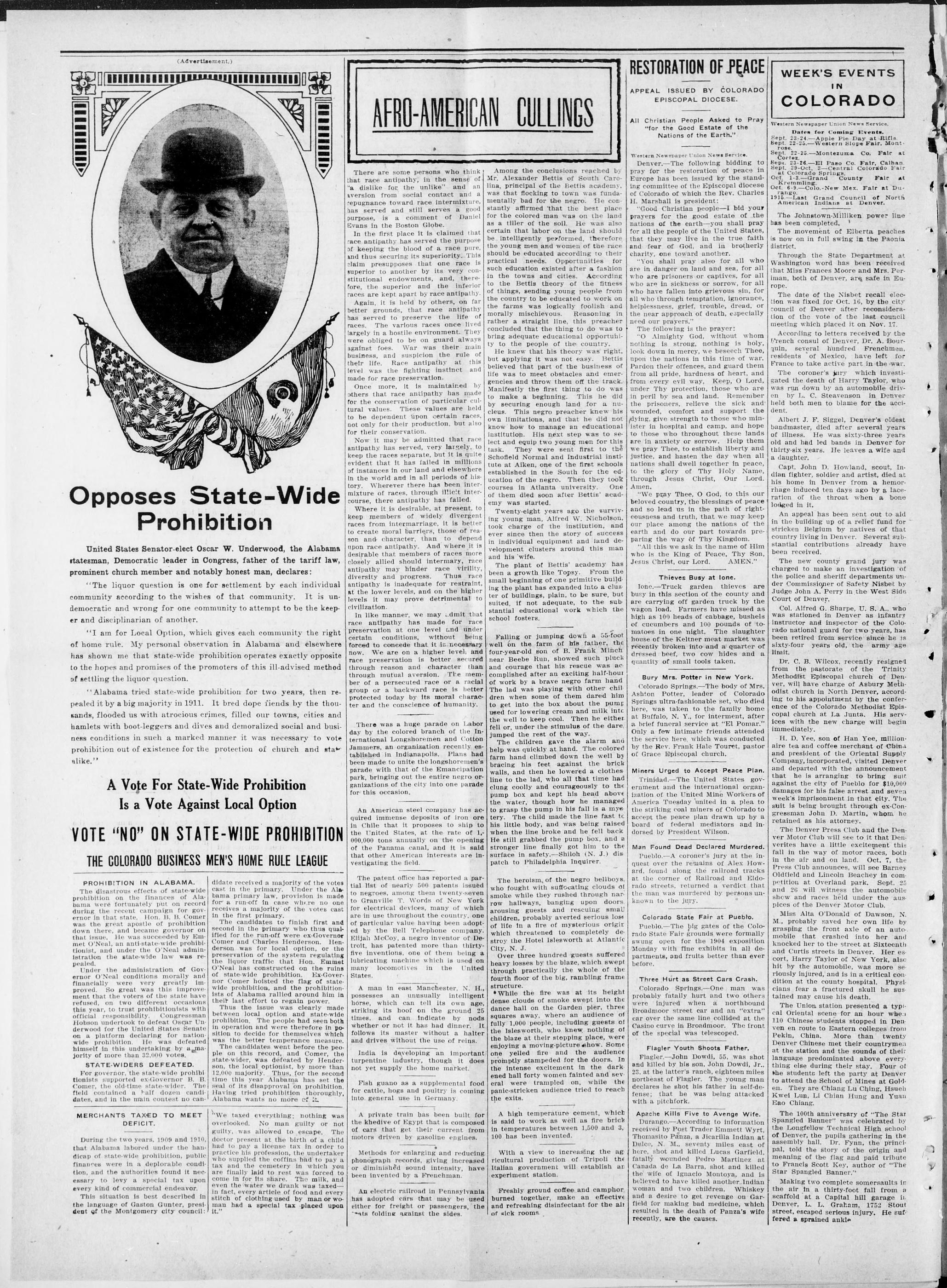
Opposes State-Wide Prohibition
United States Senator-elect Oscar W. Underwood, the Alabama statesman, Democratic leader in Congress, father of the tariff law, prominent church member and notably honest man, declares:
"The liquor question is one for settlement by each individual community according to the wishes of that community. It is undemocratic and wrong for one community to attempt to be the keeper and disciplinarian of another.
"I am for Local Option, which gives each community the right of home rule. My personal observation in Alabama and elsewhere has shown me that state-wide prohibition operates exactly opposite to the hopes and promises of the promoters of this ill-advised method of settling the liquor question.
"Alabama tried state-wide prohibition for two years, then repealed it by a big majority in 1911. It bred dope fiends by the thousands, flooded us with atrocious crimes, filled our towns, cities and hamlets with boot-leggers and dives and demoralized social and business conditions in such a marked manner it was necessary to vote prohibition out of existence for the protection of church and state alike."
A Vote For State-Wide Prohibition Is a Vote Against Local Option
PROHIBITION IN ALABAMA.
PROHIBITION IN ALABAMA.
The disastrous effects of state-wide prohibition on the finances of Alabama were fortunately put on record during the recent campaign for governor in that state. Hon. B. B. Comer was the great apostle of prohibition down there, and became governor on that issue. He was succeeded by Emmet O'Neal, an anti-state-wide prohibitionist, and under the O'Neal administration the state-wide law was repealed.
Under the administration of Governor O'Neal conditions morally and financially were very greatly improved. So great was this improvement that the voters of the state have refused, on two different occasions this year, to trust prohibitionists with official responsibility. Congressman Hobson undertook to defeat Oscar Underwood for the United States Senate on a platform declaring for nationwide prohibition. He was defeated himself in this undertaking by a majority of more than 32,000 votes.
STATE-WIDERS DEFEATED.
For governor, the state-wide prohibitionists supported ex-Governor B. B. Comer, the old-time state-wider. The field contained a half dozen candidates, and in the main contest no can-
MERCHANTS TAXED TO MEET DEFICIT.
During the two years, 1909 and 1910, that Alabama labored under the handicap of state-wide prohibition, public finances were in a deplorable condition, and the authorities found it necessary to levy a special tax upon every kind of commercial endeavor. This situation is best described in the language of Gaston Gunter, president of the Montgomery city council:
didate received a majority of the votes cast in the primary. Under the Alabama primary law, provision is made for a run-off in case where no one receives a majority of the votes cast in the first primary. The candidates to finish first and second in the primary who thus qualified for the run-off were ex-Governor Comer and Charles Henderson. Henderson was for local option, or the preservation of the system regulating the liquor traffic that Hon. Emmet O'Neal has constructed on the ruins of state-wide prohibition. Ex-Governor Comer hoisted the flag of state-wide prohibition, and the prohibitionists of Alabama rallied around him in their last effort to regain power. Thus the issue was clearly made between local option and state-wide prohibition. The people had seen both in operation and were therefore in position to decide for themselves which was the better temperance measure.
The candidates went before the people on this record, and Comer, the state-wider, was defeated by Henderson, the local optionist, by more than 12,000 majority. Thus, for the second time this year Alabama has set the seal of its disapproval on prohibition. Having tried prohibition thoroughly, Alabama wants no more of it.
We taxed everything; nothing was overlooked. No man guilty or not guilty, was allowed to escape. The doctor present at the birth of a child had to pay a license tax in order to practice his profession, the undertaker who supplied the coffins had to pay a tax and the cemetery in which you are finally laid to rest was forced to come in for its share. The milk, and even the water we drank was taxed—in fact, every article of food and every stitch of clothing used by man or woman had a special tax placed upon it."
AFRO-AMERICAN CULLINGS
There are some persons who think that race antipathy, in the sense of "a dislike for the unlike" and an aversion from social contact and a repugnance toward race intermixture, has served and still serves a good purpose, is a comment of Daniel Evans in the Boston Globe.
In the first place it is claimed that race antipathy has served the purpose of keeping the blood of a race pure, and thus securing its superiority. This claim presupposes that one race is superior to another by its very constitutional endowments, and, therefore, the superior and the inferior races are kept apart by race antipathy. Again, it is held by others, on far better grounds, that race antipathy has served to preserve the life of races. The various races once lived largely in a hostile environment. They were obliged to be on guard always against foes. War was their main business, and suspicion the rule of their life. Race antipathy at this level was the fighting instinct and made for race preservation.
Once more, it is maintained by others that race antipathy has made for the conservation of particular cultural values. These values are held to be dependent upon certain races, not only for their production, but also for their conservation. Now it may be admitted that race antipathy has served, very largely, to keep the races separate, but it is quite evident that it has failed in millions of instances in our land and elsewhere in the world and in all periods of history. Wherever there has been intermixture of races, through illicit intercourse, there antipathy has failed.
Where it is desirable, at present, to keep members of widely divergent races from intermarriage, it is better to create moral barriers, those of reason and character, than to depend upon race antipathy. And where it is desirable that members of races more closely allied should intermary, race antipathy may hinder race virility, diversity and progress. Thus race antipathy is inadequate for restraint at the lower levels, and on the higher levels it may prove detrimental to civilization.
In like manner, we may admit that race antipathy has made for race preservation at one level and under certain conditions, without being forced to concede that it is necessary now. We are on a higher level and race preservation is better secured through reason and character than through mutual aversion. The member of a persecuted race or a racial group or a backward race is better protected today by its moral character and the conscience of humanity.
There was a huge parade on Labor day by the colored branch of the International Longshoremen and Cotton Jammers, an organization recently established in Indianapolis. Plans had been made to unite the longshoremen's parade with that of the Emancipation park, bringing out the entire negro organizations of the city into one parade for this occasion.
An American steel company has acquired immense deposits of iron ore in Chile that it proposes to ship to the United States, at the rate of 1,000,000 tons annually on the opening of the Panama canal, and it is said that other American interests are investigating the field.
The patent office has reported a partial list of nearly 500 patents issued to negroes, among them twenty-seven to Granville T. Words of New York for electrical devices, many of which are in use throughout the country, one of particular value having been adopted by the Bell Telephone company. Elijah McCoy, a negro inventor of Detroit, has patented more than thirty-five inventions, one of them being a lubricating machine which is used on many locomotives in the United States.
A man in east Manchester, N. H., possesses an unusually intelligent horse, which can tell its own age, striking its hoof on the ground 25 times, and can indicate by nods whether or not it has had dinner. It follows its master without a halter and drives without the use of reins.
India is developing an important turpentine industry, though it does not yet supply the home market.
Fish guano as a supplemental food for cattle, hogs and poultry is coming into general use in Germany.
A private train has been built for the khedive of Egypt that is composed of cars that get their current from motors driven by gasoline engines.
Methods for enlarging and reducing phonograph records, giving increased or diminished sound intensity, have been invented by a Frenchman.
An electric railroad in Pennsylvania has adopted cars that may be used either for freight or passengers, the cars folding against the sides.
Among the conclusions reached by Mr. Alexander Bettis of South Carolina, principal of the Bettis academy, was that flocking to town was fundamentally bad for the negro. He constantly affirmed that the best place for the colored man was on the land as a tiller of the soil. He was also certain that labor on the land should be intelligently performed, therefore the young men and women of the race should be educated according to their practical needs. Opportunities for such education existed after a fashion in the towns and cities. According to the Bettis theory of the fitness of things, sending young people from the country to be educated to work on the farms was logically foolish and morally mischievous. Reasoning in rather a straight line, this preacher concluded that the thing to do was to bring adequate educational opportunity to the people of the country.
He knew that his theory was right, but applying it was not easy. Bettis believed that part of the business of life was to meet obstacles and emergencies and throw them off the track.Manifestly the first thing to do was to make a beginning. This he did by securing enough land for a nucleus. This negro preacher knew his own limitations, and that he did not know how to manage an educational institution. His next step was to select and equip two young men for this task. They were sent first to the Schofield Normal and Industrial institute at Aiken, one of the first schools established in the South for the education of the negro. Then they took courses in Atlanta university. One of them died soon after Bettis' academy was started.
Twenty-eight years ago the surviving young man, Alfred W. Nicholson, took charge of the institution, and ever since then the story of success in individual equipment and land development clusters around this man and his wife.
The plant of Bettis' academy has been a growth like Topsy. From the small beginning of one primitive building the plant has expanded into a cluster of buildings, plain, to be sure, but suited, if not adequate, to the substantial educational work which the school fosters.
Falling or jumping down a 55-foot well on the farm of his father, the four-year-old son of B. Frank Minch near Beebe Run, showed such pluck and courage that his rescue was accomplished after an exciting half-hour of work by a brave negro farm hand. The lad was playing with other children when some of them dared him to get into the box about the pump used for lowering cream and milk into the well to keep cool. Then he either fell or, under the stimulus of the dared, jumped the rest of the way.
The children gave the alarm and help was quickly at hand. The colored farm hand climbed down the well by bracing his feet against the brick walls, and then he lowered a clothesline to the lad, who all that time had clung coolly and courageously to the pump box and kept his head above the water, though how he managed to grasp the pump in his fall is a mystery. The child made the line fast to his little body, and was being raised when the line broke and he fell back. He still grabbed the pump box, and a stronger line finally got him to the surface in safety.—Shiloh (N. J.) dispatch to Philadelphia Inquirer.
The heroism of the negro bellboys, who fought with suffocating clouds of smoke while they rushed through narrow hallways, banging upon doors, arousing guests and rescuing small children, probably averted serious loss of life in a fire of mysterious origin which threatened to completely destroy the Hotel Islesworth at Atlantic City, N. J. Over three hundred guests suffered heavy losses by the blaze, which swept through practically the whole of the fourth floor of the big, rambling frame structure.
While the fire was at its height dense clouds of smoke swept into the dance hall on the Garden pier, three squares away, where an audience of fully 1,000 people, including guests of the Islesworth, who knew nothing of the blaze at their stepping place, were enjoying a moving-picture show. Some one yelled fire and the audience promptly stamped for the doors. In the intense excitement in the darkened hall forty women fainted and several were trampled on, while the panic-stricken audience tried to reach the exits.
A high temperature cement, which is said to work as well as fire brick in temperatures between 1,500 and 3,100 has been invented.
With a view to increasing the agr
icultural production of Tripoli the
Italian government will establish an
experiment station.
Freshly ground coffee and camphor
burned together, make an effective
and refreshing disinfectant for the air
of sick rooms.
RESTORATION OF PEACE
APPEAL ISSUED BY COLORADO
EPISCOPAL DIOCESE.
All Christian People Asked to Pray
"for the Good Estate of the
Nations of the Earth."
Western Newspaper Union News Service.
Denver.—The following bidding to pray for the restoration of peace in Europe has been issued by the standing committee of the Episcopal diocese of Colorado of which the Rev. Charles H. Marshall is president:
"Good Christian people—I bid your prayers for the good estate of the nations of the earth—you shall pray for all the people of the United States, that they may live in the true faith and fear of God, and in brotherly charity, one toward another.
"You shall pray also for all who are in danger on land and sea, for all who are prisoners or captives, for all who are in sickness or sorrow, for all who have fallen into grievous sin, for all who through temptation, ignorance, helplessness, grief, trouble, dread, or the near approach of death, especially need our prayers."
The following is the prayer:
The following is the prayer:
"O Almighty God, without whom nothing is strong, nothing is holy, look down in mercy, we besech Thee, upon the nations in this time of war. Pardon their offences, and guard them from all pride, hardness of heart, and from every evil way, Keep, O Lord, under Thy protection, those who are in peril by sea and land. Remember the prisoners, relieve the sick and wounded, comfort and support the dying, give strength to those who minister in hospital and camp, and hope to those who throughout these lands are in anxiety or sorrow. Help them we pray Thee, to establish liberty and justice, and hasten the day when all nations shall dwell together in peace, to the glory of Thy Holy Name, through Jesus Christ, Our Lord. Amen."
"We pray Thee, O God, to this our beloved country, the blessings of peace and so lead us in the path of righteousness and truth, that we may keep our place among the nations of the earth and do our part towards preparing the way of Thy Kingdom.
"All this we ask in the name of Him who is the King of Peace, Thy Son, Jesus Christ, our Lord. AMEN."
Thieves Busy at Jone.
Ione.—Truck garden thieves are busy in this section of the county and are carrying off garden truck by the wagon load. Farmers have missed as high as 100 heads of cabbage, bushels of cucumbers and 100 pounds of tomatoes in one night. The slaughter house of the Keltner meat market was recently broken into and a quarter of dressed beef, two cow hides and a quantity of small tools taken.
Bury Mrs. Potter in New York.
Colorado Springs.—The body of Mrs. Ashton Potter, leader of Colorado Springs ultra-fashionable set, who died here, was taken to the family home at Buffalo, N. Y., for interment, after a brief funeral service at "El Pomar." Only a few intimate friends attended the service here, which was conducted by the Rev. Frank Hale Touret, pastor of Grace Episcopal church.
Miners Urged to Accept Peace Plan.
Trinidad.—The United States government and the international organization of the United Mine Workers of America Tuesday united in a plea to the striking coal miners of Colorado to accept the peace plan drawn up by a board of federal mediators and indorsed by President Wilson.
Man Found Dead Declared Murdered.
Pueblo.—A coroner's jury at the inquest over the remains of Alex Howard, found along the railroad tracks at the corner of Railroad and Eldorado streets, returned a verdict that the man was murdered by persons unknown to the jury.
Colorado State Fair at Pueblo.
Pueblo.—The big gates of the Colorado State Fair grounds were formally swung open for the 1904 exposition Monday with fine exhibits in all departments, and fruits better than ever before.
Three Hurt as Street Cars Crash.
Colorado Springs.—One man was probably fatally hurt and two others were injured when a northbound Broadmoor street car and an "extra" car over the same line collided at the Casino curve in Broadmoor. The front of the special was telescoped.
Flagler Youth Shoots Father.
Flagler.—John Dowdi, 55, was shot and killed by his son, John Dowdi, Jr., 23, at the latter's ranch, eighteen miles northeast of Flagler. The young man declares he shot his father in self-defense; that he was being attacked with a pitchfork.
Apache Kills Five to Avenge Wife.
Western Newspaper Union News Service.
Dates for Coming Events.
Sept. 23-24—Apple Pie Day at Rifles.
Sept. 22-25—Western Slope Fair, Montrose.
Sept. 22-25—Montezuma Co. Fair at Cortez.
Sept. 23-26—El Paso Co. Fair, Calharn.
Sept. 23-26—Central Colorado Fair at Colorado Springs.
Oct. 1-3—Grand County Fair at Kremmling.
Oct. 1-3—New Mexico Fair at Dewey.
Oct. 6-9 - Colo.-New Mex. Fair at Durango.
1915. Last Grand Council of North American Indians at Denver.
The Johnstown-Milliken power line has been completed.
The movement of Elberta peaches is now on in full swing in the Paonia district.
Through the State Department at Washington word has been received that Miss Frances Moore and Mrs. Periman, both of Denver, are safe in Europe.
The date of the Nisbet recall election was fixed for Oct. 16, by the city council of Denver after reconsideration of the vote of the last council meeting which placed it on Nov. 17.
According to letters received by the French consul of Denver, Dr. A. Bourquin, several hundred Frenchmen, residents of Mexico, have left for France to take active part in the war.
The coroner's jury which investigated the death of Harry Taylor, who was run down by an automobile driven by L. C. Steavenson in Denver held both men to blame for the accident.
Albert J. F. Siggel, Denver's oldest bandmaster, died after several years of illness. He was sixty-three years old and had led bands in Denver for thirty-six years. He leaves a wife and a daughter.
Capt. John D. Howland, scout, Indian fighter, soldier and artist, died at his home in Denver from a hemorrhage induced ten days ago by a laceration of the throat when a bone lodged in it.
An appeal has been sent out to aid in the building up of a relief fund for stricken Belgium by natives of that country living in Denver. Several substantial contributions already have been received.
The new county grand jury was charged to make an investigation of the police and sheriff departments under Commissioner of Safety Nisbet by Judge John A. Perry in the West Side Court of Denver.
Col. Alfred G. Sharpe, U. S. A., who was stationed in Denver as infant instructor and inspector of the Colorado national guard for two years, has been retired from service since he is sixty-four years old, the army age limit.
Dr. C. B. Wilcox, recently resigned from the pastorate of the Trinity Methodist Episcopal church of Denver, will have charge of Asbury Methodist church in North Denver, according to his appointment by the conference of the Colorado Methodist Episcopal church at La Junta. His services with the new charge will begin immediately.
H. D. Yee, son of Han Yee, millionaire tea and coffee merchant of China, and president of the Oriental Supply Company, incorporated, visited Denver and departed with the announcement that he is arranging to bring suit against the city of Pueblo for $10,000 damages for his false arrest and seven week's imprisonment in that city. The suit is being brought through ex-Congressman John D. Martin, whom he retained as his attorney.
The Denver Press Club and the Denver Motor Club will see to it that Denverites have a little excitement this fall in the way of motor races, both in the air and on land. Oct, 7, the Press Club announces, will see Barney Oldfield and Lincoln Beachey in competition at Overland park. Sept. 25 and 26 will witness the automobile show and races held under the auspices of the Denver Motor Club.
Miss Alta O'Donald of Dawson, N. M., probably saved her own life by grasping the front axle of an automobile that crashed into her and knocked her to the street at Sixteenth and Curtis streets in Denver. Her escort, Harry Taylor of New York, also hit by the automobile, was more seriously injured, and is in a critical condition at the county hospital. Physicians fear a fractured skull he sustained may cause his death.
The Union station presented a typical Oriental scene for an hour when 110 Chinese students stopped in Denver en route to Eastern colleges from Pekin, China. More than twenty Denver Chinese met their countrymen at the station and the sounds of their language predominated above everything else during their stay. Four of the students left the party at Denver to attend the School of Mines at Golden. They are Chiang Lu Ching, Hsueh Kwei Lun, Li Chian Hung and Yuan Eao Chiang.
The 100th anniversary of "The Star Spangled Banner" was celebrated by the Longfellow Technical High school of Denver, the pupils gathering in the assembly hall. Dr. Fynn, the principal, told the story of the origin and meaning of the flag and paid tribute to Francis Scott Key, author of "The Star Spangled Banner."
Making two complete somersaults in the air in a thirty-foot fall from a scaffold at a Capital hill garage in Denver, L. L. Graham, 1752 Stout street, escaped serious injury. He suffered a sprained ankle
GERMANS STILL RETREATING
They Have Been Driven Back Nearly 100 Miles From Paris By Superior Allied Army; Continual Fighting With Appalling Losses—Belgians Strike at Invaders.
Copyright
Underwood & Underwood
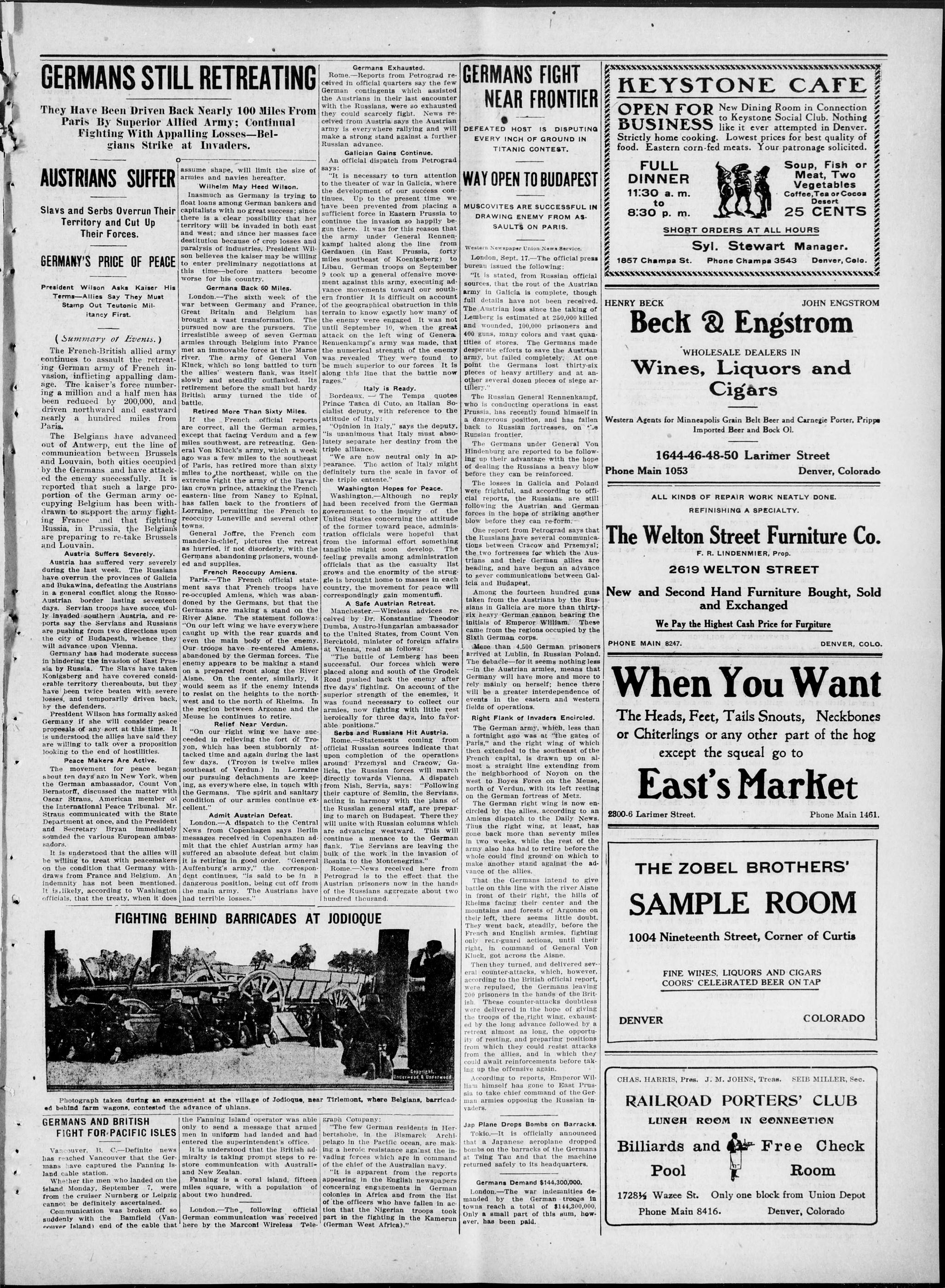
Photograph taken during an engagement at the village of Jodioque, near Tirlemont, where Belgians, barricaded behind farm wagons, contested the advance of uhlans.
Photograph taken during an engagement at the village of Jodioque, near Tirlemont, where Belgians, barricaded behind farm wagons, contested the advance of uhlans.
Slavs and Serbs Overrun Their Territory and Cut Up Their Forces.
GERMANY'S PRICE OF PEACE
President Wilson Asks Kaiser His Terms—Allies Say They Must Stamp Out Teutonic Mil-
(Summary of Events.) The French-British allied army continues to assault the retreating German army of French invasion, inflicting appalling damage. The kaiser's force numbering a million and a half men has been reduced by 200,000, and driven northward and eastward nearly a hundred miles from Paris.
The Belgians have advanced out of Antwerp, cut the line of communication between Brussels and Louvain, both cities occupied by the Germans and have attacked the enemy successfully. It is reported that such a large proportion of the German army occupying Belgium has been withdrawn to support the army fighting France and that fighting Russia, in Prussia, the Belgians are preparing to re-take Brussels and Louvain.
Austria Suffers Severely.
Austria has suffered very severely during the last week. The Russians have overrun the provinces of Galicia and Bukawina, defeating the Austrians in a general conflict along the Russo-Austrian border lasting seventeen days. Servian troops have succely invaded southern Austria, and reports say the Servians and Russians are pushing from two directions upon the city of Budapest, whence they will advance upon Vienna. Germany has had moderate success in hindering the invasion of East Prussia by Russia. The Slavs have taken Konigsberg and have covered considerable territory thereabouts, but they have been twice beaten with severe losses, and temporarily driven back, by the defenders.
President Wilson has formally asked Germany if she will consider peace proposals of any sort at this time. It is understood the allies have said they are willing to talk over a proposition looking to the end of hostilities.
Peace Makers Are Active.
The movement for peace began about ten days ago in New York, when the German ambassador, Count Von Bernstorff, discussed the matter with Oscar Straus, American member of the International Peace Tribunal. Mr. Straus communicated with the State Department at once, and the President and Secretary Bryan immediately sounded the various European ambassadors.
It is understood that the allies will be willing to treat with peacemakers on the condition that Germany withdraws from France and Belgium. An indemnity has not been mentioned. It is likely, according to Washington officials, that the treaty, when it does
FIGHTING
Photograph taken during an engraved behind farm wagons, contested the
GERMANS AND BRITISH FIGHT FOR PACIFIC ISLES
Vancouver, B. C.—Definite news has reached Vancouver that the Germans have captured the Fanning Island cable station.
Whether the men who landed on the island Monday, September 7, were from the cruiser Nurnberg or Leipzig cannot be definitely ascertained.
Communication was broken off so suddenly with the Bamfield (Vancouver Island) end of the cable that
assume shape, will limit the size of armies and navies hereafter.
Wilhelm May Heed Wilson.
Inasmuch as Germany is trying to float loans among German bankers and capitalists with no great success; since there is a clear possibility that her territory will be invaded in both east and west; and since her masses face destitution because of crop losses and paralysis of industries, President Wilson believes the kaiser may be willing to enter preliminary negotiations at this time—before matters become worse for his country.
London.—The sixth week of the war between Germany and France, Great Britain and Belgium has brought a vast transformation. The pursued now are the pursuers. The irresistible sweep of seven German armies through Belgium into France met an immovable force at the Marne river. The army of General Von Kluck, which so long battled to turn the allies' western flank, was itself slowly and steadily outflanked. Its retirement before the small but hardy British army turned the tide of battle.
Retired More Than Sixty Miles.
If the French official reports are correct, all the German armies, except that facing Verdum and a few miles southwest, are retreating. General Von Kluck's army, which a week ago was a few miles to the southeast of Paris, has retired more than sixty miles to the northeast, while on the extreme right the army of the Bavarian crown prince, attacking the French eastern line from Nancy to Epinal, has fallen back to the frontiers of Lorraine, permitting the French to reoccupy Luneville and several other towns.
General Joffre, the French commander-in-chief, pictures the retreat as hurried, if not disorderly, with the Germans abandoning prisoners, wounded and supplies.
French Reoccupy Amiens.
French Reoccupy Amiens. Paris.—The French official statement says that French troops have re-occupied Amiens, which was abandoned by the Germans, but that the Germans are making a stand on the River Aisne. The statement follows: "On our left wing we have everywhere caught up with the rear guards and even the main body of the enemy. Our troops have re-entered Amiens, abandoned by the German forces. The enemy appears to be making a stand on a prepared front along the River Aisne. On the center, similarly, it would seem as if the enemy intends to resist on the heights to the north-west and to the north of Rheims. In the region between Argonne and the Meuse he continues to retire.
Belief Near Verdun.
"On our right wing we have succeeded in relieving the fort of Troyon, which has been stubbornly attacked time and again during the last few days. (Troyon is twelve miles southeast of Verdun.) In Lorraine our pursuing detachments are keeping, as everywhere else, in touch with the Germans. The spirit and sanitary condition of our armies continue excellent."
Admit Austrian Defeat.
London.—A dispatch to the Central News from Copenhagen says Berlin messages received in Copenhagen admit that the chief Austrian army has suffered an absolute defeat but claim it is retiring in good order. "General Auffenburg's army," the correspondent continues, "is said to be in a dangerous position, being cut off from the main army. The Austrians have had terrible losses."
BEHIND BARRICADES AT
agement at the village of Jodloque, near the advance of uhlans.
the Fanning Island operator was able only to send a message that armed men in uniform had landed and had entered the superintendent's office.
It is understood that the British admiralty is taking prompt steps to restore communication with Australia and New Zealan.
Fanning is a coral island, fifteen miles square, with a population of about two hundred.
London.—The following official German communication was received here by the Marconi Wireless Tele-
Germans Exhausted.
Rome.—Reports from Petrograd received in official quarters say the few German contingents which assisted the Austrians in their last encounter with the Russians, were so exhausted they could scarcely fight. News received from Austria says the Austrian army is everywhere rallying and will make a strong stand against a further Russian advance.
Galician Gains Continue.
An official dispatch from Petrograd says:
"It is necessary to turn attention to the theater of war in Galicia, where the development of our success continues. Up to the present time we have been prevented from placing a sufficient force in Eastern Prussia to continue the invasion so happily begin there. It was for this reason that the army under General Rennenkamp hailed along the line from Gerdauen (in East Prussia, forty miles southeast of Koenigsberg) to Libau. German troops on September 9 took up a general offensive movement against this army, executing advance movements toward our southern frontier. It is difficult on account of the geographical obstruction in this terrain to know exactly how many of the enemy were engaged. It was not until September 10, when the great attack on the left wing of General Rennenkamp's army was made, that the numerical strength of the enemy was revealed. They were found to be much superior to our forces. It is along this line that the battle now rages."
Bordeaux. — The Temps quotes Prince Tasca di Cuto, an Italian Socialist deputy, with reference to the attitude of Italy:
"Opinion in Italy," says the deputy, "is unanimous that Italy must absolutely separate her destiny from the triple alliance.
"We are now neutral only in appearance. The action of Italy might definitely turn the scale in favor of the triple entente."
Washington Hopes for Peace.
Washington.—Although no reply had been received from the German government to the inquiry of the United States concerning the attitude of the former toward peace, administration officials were hopeful that from the informal effort something tangible might soon develop. The feeling prevails among administration officials that as the casualty list grows and the enormity of the struggle is brought home to masses in each country, the movement for peace will correspondingly gain momentum.
A Safe Austrian Retreat.
Manchester.—Wireless advices received by Dr. Konstantine Theodor Dumba, Austro-Hungarian ambassador to the United States, from Count Von Berchtold, minister of foreign affairs at Vienna, read as follows:
"The battle of Lemberg has been successful. Our forces which were placed along and south of the Grodek Road pushed back the enemy after five days' fighting. On account of the superior strength of the enemies, it was found necessary to collect our armies, now fighting with little rest heroically for three days, into favorable positions."
Serbs and Russians Hit Austria. Rome.—Statements coming from official Russian sources indicate that upon completion of the operations around Przemysl and Cracow, Galicia, the Russian forces will march directly towards Vienna. A dispatch from Nish, Servia, says: "Following their capture of Semlin, the Servians, acting in harmony with the plans of the Russian general staff, are preparing to march on Budapest. There they will unite with Russian columns which are advancing westward. This will continue a menace to the German flank. The Servians are leaving the bulk of the work in the invasion of Bosnia to the Montenegrins." Rome.—News received here from Petrograd is to the effect that the Austrian prisoners now in the hands of the Russians aggregate about two hundred thousand.
JODIOQUE
Copyright.
Unterweed & Uncerwood
r Tirlemont, where Belgians, barricad-
graph Company:
"The few German residents in Herbertshohe, in the Bismarck Archipelago in the Pacific ocean, are making a heroic resistance against the invading forces which are in command of the chief of the Australian navy.
"It is apparent from the reports appearing in the English newspapers concerning engagements in German colonies in Africa and from the list of the officers who have fallen in action that the Nigerian troops took part in the fighting in the Kamerun (German West Africa)."
GERMANS FIGHT NEAR FRONTIER
DEFEATED HOST IS DISPUTING EVERY INCH OF GROUND IN TITANIC CONTEST.
WAY OPEN TO BUDAPEST
MUSCOVITES ARE SUCCESSFUL IN
DRAWING ENEMY FROM AS-
SAULTS ON PARIS.
London, Sept. 17.—The official press bureau issued the following:
"It is stated, from Russian official sources, that the rout of the Austrian army in Galicia is complete, though full details have not been received. The Austrian loss since the taking of Lemberg is estimated at 250,000 killed and wounded, 100,000 prisoners and 400 guns, many colors and vast quantities of stores. The Germans made desperate efforts to save the Austrian army, but failed completely. At one point the Germans lost thirty-six pieces of heavy artillery and at another several dozen pieces of siege artillery."
The Russian General Rennenkampf, who is conducting operations in east Prussia, has recently found himself in a dangerous position, and has fallen back to Russian fortresses, on the Russian frontier.
The Germans under General Von Hindenburg are reported to be following up their advantage with the hope of dealing the Russians a heavy blow before they can be reinforced.
The losses in Galicia and Poland were frightful, and according to official reports, the Russians are still following the Austrian and German forces in the hope of striking another blow before they can re-form.
One report from Petrograd says that the Russians have several communications between Cracow and Przemysl; the two fortresses for which the Austrians and their German allies are heading, and have begun an advance to sever communications between Galicia and Budapest.
Among the fourteen hundred guns taken from the Austrians by the Russians in Galicia are more than thirty-six heavy German cannon bearing the initials of Emperor William. These came from the regions occupied by the Sixth German corps.
More than 4,500 German prisoners arrived at Lublin, in Russian Poland. The debacle—for it seems nothing less—in the Austrian armies, means that Germany will have more and more to rely mainly on herself; hence there will be a greater interdependence of events in the eastern and western fields of operations.
Right Flank of Invaders Encircled.
The German army, which, less than a fortnight ago was at "the gates of Paris," and the right wing of which then extended to the southeast of the French capital, is drawn up on almost a straight line extending from the neighborhood of Noyon on the west to Boyes Fores on the Meuse, north of Verdun, with its left resting on the German fortress of Metz. The German right wing is now encircled by the allies, according to an Amiens dispatch to the Daily News. Thus the right wing, at least, has gone back more than seventy miles in two weeks, while the rest of the army also has had to retire before the whole could find ground on which to make another stand against the advance of the allies.
That the Germans intend to give battle on this line with the river Aisne in front of their right, the hills of Rheims facing their center and the mountains and forests of Argonne on their left, there seems little doubt. They went back, steadily, before the French and English armies, fighting only rec-guard actions, until their right, in command of General Von Kluck, got across the Aisne.
Then they turned, and delivered several counter-attacks, which, however, according to the British official report, were repulsed, the Germans leaving 200 prisoners in the hands of the British. These counter-attacks doubtless were delivered in the hope of giving the troops of the right wing, exhausted by the long advance followed by a retreat almost as long, the opportunity of resting, and preparing positions from which they could resist attacks from the allies, and in which they could await reinforcements before taking up the offensive again.
According to reports, Emperor William himself has gone to East Prussia to take chief command of the German armies opposing the Russian invaders.
Jap Plane Drops Bombs on Barracks.
Germans Demand $144,300,000.
London—The war indemnities demanded by the German troops in towns reach a total of $144,300,000. Only a small part of this sum, however, has been paid.
OPEN FOR BUSINESS New Dining Room in Connection to Keystone Social Club. Nothing like it ever attempted in Denver. Strictly home cooking. Lowest prices for best quality of food. Eastern corn-fed meats. Your patronage solicited.
FULL DINNER
11:30 a. m.
to
8:30 p. m.
Soup, Fish or Meat, Two Vegetables
Coffee, Tea or Cocoa Desert
25 CENTS
SHORT ORDERS AT ALL HOURS
1857 Champa St.
HENRY BECK
Beck
WH
Wines
Western Agents for Minne
I
1644-41
Phone Main 1053
ALL KINDS
The Welton
2619
New and Second
We Pay th
Syl. Stewart Manage
Empa St. Phone Champa 3543 De
K JOHN
Cock & Engstro
WHOLESALE DEALERS IN
Wines, Liquors and
Cigars
for Minneapolis Grain Belt Beer and Carnegie
Imported Beer and Bock Ol.
1644-46-48-50 Larimer Street
1053 Denw
ALL KINDS OF REPAIR WORK NEATLY DO
REFINISHING A SPECIALTY.
Velton Street Furniture
F. R. LINDENMIER, Prop.
2619 WELTON STREET
Second Hand Furniture Bo
and Exchanged
We Pay the Highest Cash Price for Furniture
1 8247.
When You W
heads, Feet, Tails Snouts, N
terlings or any other part o
except the squeal go to
Cast's Mark
er Street. Ph
E ZOBEL BROTHE
AMPLE ROO
Nineteenth Street, Corner of
Syl. Stewart Manager.
1857 Champa St. Phone Champa 3543 Denver, Colo.
WHOLESALE DEALERS IN Wines, Liquors and Cigars Western Agents for Minneapolis Grain Belt Beer and Carnegie Porter, Prippa Imported Beer and Bock Ol.
1644-46-48-50 Larimer Street
Phone Main 1053 Denver, Colorado
ALL KINDS OF REPAIR WORK NEATLY DONE.
REFINISHING A SPECIALTY.
New and Second Hand Furniture Bought, Sold and Exchanged We Pay the Highest Cash Price for Furniture
When The Heads, or Chiterlings except Eas
When You Want
The Heads, Feet, Tails Snouts, Neckbones or Chiterlings or any other part of the hog except the squeal go to
THE ZO
SAM
1004 Ninete
1004 Nineteenth Street, Corner of Curtis
FINE WINES, LIQUORS AND CIGARS,
COORS' CELEBRATED BEER ON TAP
R COD
ERRIS, Pres. J. M. JOHNS, Treas. SEIB M.
ROAD PORTERS' C
CHAS. HARRIS, Pres
RAILROA
LUNCH
Billiards
CHAS. HARRIS, Pres. J. M. JOHNS, Treas. SEIB MILLER, Sec. RAILROAD PORTERS' CLUB LUNCH ROOM IN CONNECTION
1728% Wazee St. Only one block from Union Depot Phone Main 8416. Denver, Colorado
PHONE MAIN 8247.
DENVER
Soup, Fish or Meat, Two Vegetables Coffee, Tea or Cocoa Desert 25 CENTS
Manager.
543 Denver, Colo.
strom
SIN
ers and
and Carnegie Porter, Pripps
Ol.
er Street
Denver, Colorado
MEATLY DONE.
ALTY.
Furniture Co.
op.
STREET
Furniture Bought, Sold
d
for Furniture
Want outs, Neckbones part of the hog to rKet
OTHERS'
ROOM
ner of Curtis
SEIB MILLER, Sec.
RS' CLUB
INECTION
ree Check
T
JOHN ENGSTROM
DENVER, COLO.
Phone Main 1461.
COLORADO
THE COLORADO STATESMAN
JOS. D. D. RIVERS.....Proprietor
1824 Curtis Street, Room 25.
Phone Main 7417.
SUBSCRIPTION RATES:
One Year.....$2.00
Six Months.....1.00
Three Months.....60
PAYABLE IN ADVANCE.
Entered as second-class matter at the postoffice in the city of Denver, Colorado.
All communications of a personating nature that are not complimentary will be withheld from the columns of this paper.
Display advertising, 50 cents per inch. An inch contains twelve agate lines.
Reading notices, ten lines or less, 10 cents per line. Each additional line over ten lines, 5 cents per line.
No discounts allowed on less than three months' contract. Cash must accompany all orders from parties unknown to us. Further particulars on application.
Remittances should be made by Express Money Order, Postoffice Money Order, Registered Letter or Bank Draft. Postage stamps will be received the same as cash for the fractional part of a dollar. Only 1-cent and 2-cent stamps taken.
Communications to receive attention must be newsy, upon important subjects, plainly written only upon one side of the paper; must reach us Tuesdays, if possible, anyway, not later than Wednesdays, and bear the signature of the author. No manuscript returned, unless stamps are sent for postage.
It occasionally happens that papers sent to subscribers are lost or stolen. In case you do not receive any number when due, inform us by postal card and we will cheerfully forward a duplicate of the missing number.
THE UNCALLED.
s" who are unable to "deliver
of the trust of some employer,
the servile capacity, does not
pred voters are looking for, j
iable citizens through the stat
as continue to lump the color
of the different parties"?
The colored "leaders" who are unable to "deliver the goods," and whose leadership arises out of the trust of some employer with whom they have come in contact in some servile capacity, does not appear to be just the thing that Colorado colored voters are looking for, judging from the expressions of many of our reliable citizens through the state, and especially in Denver. Will the politicians continue to lump the colored population under the head of the "servants of the different parties"?
THE GROUCHES
ever satisfied. First there was it was difficult to determine. Now comes state-wide prohazardous the question when divided way of taking things is two troublesome matters—wat they always have been here
Some people are never satisfied. First there was a great kick-up over the water question, and it was difficult to determine whether we should have any water or not. Now comes state-wide prohibition sweeping through the state and making hazardous the question whether we shall have any whisky or not. This divided way of taking things is demoralizing, to say the least.
Why can't these two troublesome matters—water and whisky—be put down together, just as they always have been heretofore in this and other communities.
SENTIMENT IN POLITICS.
are not always the sole basis of have been decided purely upon in the past, at least, but the politics is largely a thing of moment may continue to play and all parties are relying more and more in their appeals to the people because he is a cripple; an apparently better candidate has suffered; and sometimes indicate for office defeats a man, as these conditions seem to be superhaps nothing has demonstrained arising out of the Civil war, an old soldier made a strictly but without a war record. Less, perhaps, on account of the termed a humane sentiment rights of the Negroes have never been elected to office and it have been opened and established giving the Negro a man's character into politics as an issue of the colored people as a victim worn-out expedients, and the chance that has been given him in all parties have contributed who appeal to colored voters insincere. Take up to this new condition, have upon his welfare, under parties, must be studied deeply and wisdom than he has ever
Legitimate issues are not always the sole basis or results in political contests. Many elections have been decided purely upon the sentiment involved. This has been the case in the past, at least, but there are growing indications that sentiment in politics is largely a thing of the past. In the local elections personal sentiment may continue to play an important part, but in general elections political parties are relying more and more on cold, scientific principles of government in their appeals to the people. Locally, we may see a cripple elected to office because he is a cripple; or we may see one man elected to office over an apparently better candidate, because of some misfortune which the former has suffered; and sometimes, where equal suffrage prevails, a woman candidate for office defeats a man because she is a woman. But even in local affairs these conditions seem to be passing away.
In national affairs perhaps nothing has demonstrated the force of sentiment so much as the conditions arising out of the Civil War. For a long time after the close of the war, an old soldier made a stronger candidate than another man of equal ability but without a war record. The Negro has profited more than any other class, perhaps, on account of the presence in post-bellum politics of what might be termed a humane sentiment. While permanent and incontestable political rights of the Negroes have never been fully established, many white men have been elected to office and many favorable opportunities and conditions have been opened and established because of the public sentiment which favored giving the Negro a man's chance in the battle of life. This sentiment, long injected into politics as an issue, and still clung to and relied upon by most all the colored people as a vital political requisite, is going the way of other worn-out expedients, and the Negro is being left to make the most of the chance that has been given him, by reliance upon his own powers.
Political leaders in all parties have contributed to this change, and hereafter, spellbinders who appeal to colored voters on this score may be considered confessedly insincere.
The Negro must wake up to this new condition. The bearing which immediate conditions will have upon his welfare, under one or the other of opposing candidates or parties, must be studied deeply, and he must learn to vote with greater care and wisdom than he has ever heretofore been called upon to exercise.
UNDESIRABLE
enthusiasm and earnestness in songs pertaining to political issues other people so emphatic. Stripped of all deceit and reeve in political campaigns seeing through a great sensation, median always comes in for numerous striving for impossibility has long been led to believ
The extraordinary enthusiasm and earnestness which the colored American exhibits in all things pertaining to political and governmental affairs does not seem to impress other people so emphatically as it impresses the colored man himself. Stripped of all deceit and red-fire illusion, the noise which colored men make in political campaigns seems to be really taken as the comedy part running through a great sensational drama, in which the character of the low comedian always comes in for rebuffs and disappointments after the most strenuous striving for impossible results.
The colored citizen has long been led to believe that he was playing a real, vital part in this drama, and that upon his efforts depended in a large measure the rightful outcome of the whole struggle, and especially his own good; hence his enthusiasm. But in the light of actual development, it is becoming apparent that, in the opinions of the star actors, these comedy parts can be quite done away with. In both speech and action leading politicians have recently declared that the part which the Negro plays in politics is not important, and, in fact, should not be allowed to become important. As a meek, humble and thoughtful voter, whose political course is certain and changeless, he can be tolerated; but as an issue-making element he is quite universally undesirable. His interests are not real party issues; his continued well-being is not a matter over which other elements should fight. So the colored American is being driven into a position of political helplessness. Some local party leaders have learned to follow this wider national spirit, and in spite of the colored man's numerical voting strength, he is never conceded a place in party councils or given adequate consideration in party honors, especially in Colorado. Protesting seems to be a lonesome and useless business, and the outlook is gloomy unless, some day, the army of undesirables shall grow large, strong and wise enough to end the sway of class separationists and political dictators.
made at the recent meeting of the N. E. A. that our educators are underpaid. The idea seems to be that the hours school is in session constitute the teacher's working day and that the school months are the teacher's entire working year. As a matter of fact, in the schools of villages, small towns and the country—my knowledge does not extend to city schools—what with studying and outlining for the superintendent's inspection the lessons of each day, with doing blackboard work, preparing materials for seat work, grading papers, making reports, studying lessons, writing papers for teachers' meetings, giving outside help to pupils who are a little below grade, and trying to keep informed upon current educational topics, to say nothing of preparing for examinations which the average teacher must take with considerable frequency, the teacher's working day is seldom less than nine hours, and often more.
Furthermore, a teacher is expected to dress reasonably well, to go at least every three years to a term at summer normal at a cost of not less than $100, to buy many and expensive books, to subscribe for not less than two professional magazines, to contribute, liberally enough to show a real interest, to all educational and some religious objects, and, in a word, to maintain the standing and keep up the standard of living of the professions, while receiving less than the laboring man's pay.
These are some of the reasons why worth-while men are not entering the teaching profession to any great extent, and when they do become teachers make that profession merely a stepping-stone to something that will pay better, and women who have anyone besides themselves to support are forced to do the same thing.
tionship. Some young men will tell beautiful stories to young women, flatter them, promise the best things in the world, conceal their true selves, hide the truth and take them out to nice places—all this for the "one woman," before they are married. But after marriage they generally show their true colors. Men will stop profane arguments or bloody fights, enact heroic deeds, neglect their duties, scorn danger, for the sake of a woman. But the divorce and domestic relations courts show these same men in a different light.
Some men worship women. At the same time they will not permit these same women to be their equals, or even the equals of dirty crooks or drunken tramps at the ballot box.
The fault of women in this respect that some of them expect, and some even demand unequal treatment. "Ladies first" or "I am a lady" stands with them far above "I am an equal with man." If these women meet a man who treats them as equals, who acts natural and true, he has a good chance to land in some insane asylum. Is this kind of relationship natural?
If we accept the theory of Darwin that all living beings come from a common source we must admit that nature acts upon all living beings in the same degree. But when we study the animal kingdom we cannot find any unequal relations between the sexes.
Perhaps mankind has not yet evolved far enough to recognize equality of the sexes.
Sam. In the old days, before this new spirit permeated the government machinery, things were pretty lax at the national capital, and few took their jobs seriously—at least not half as seriously as they do in these latter days. The horse races at Benning used to depopulate the departments, and when ponies were running getting a quorum of the lawmakers was a difficult matter.
Some congressmen, particularly those from nearby states, occupied their seats not more than fifty per cent of the time, and a full attendance could be counted on only when pay day arrived. I remember well the case of a genial representative from New York who appeared once to be sworn in, and then was seen no more until the last day of the session. Such a stranger was he that none of the doorkeepers knew him, and when he attempted to get by the guardians of the hall of representatives he was stopped with little ceremony. In vain he pleaded that he was a member of congress.
"We have heard that old gag before," said a square-jawed representative of the sergeant-at-arms, "and that sort of stuff doesn't go here."
At last he persuaded the man to call out one of his colleagues, and not until he had been identified was he permitted to enter the chamber. This happened in the late eighties, but if any statesman were so negligent of his duties nowadays he would not be given a second term by the voters of his district.
accustomed to great assemblies; we have habituated ourselves to thinking and dealing with large numbers. Conventions are common; great mass meetings are every-day affairs.
Because of these tendencies the young man exaggerates in his mind the importance of the mob, and likewise depreciates the importance of the individual. It is the individual, falling into individual sin, that makes up the vice of Chicago. Similarly it is the individual, conquering individual temptation that makes up the purity and virtue of Chicago society.
This cannot be overemphasized. The need of our day is for men who will serve. It is not for one thousand men, or even one hundred men, viewed as we are accustomed to viewing them, but it is you and you and you and you; as a separate being, as a young man who is strong, as a father who is responsible. We need the realization of the strength of one human being, for "my strength is as the strength of ten, because my heart is pure."
Why School Teaching Is Ignored by the Men
By M. ADAIR, Roann, Ind.
made at the recent meeting of the N. E. A. paid. The idea seems to be that the hours of the teacher's working day and that the scientific working year. As a matter of fact, in towns and the country—my knowledge does what with studying and outlining for the school lessons of each day, with doing blackboard seat work, grading papers, making reports, stu for teachers' meetings, giving outside help to grade, and trying to keep informed upon any nothing of preparing for examinations we take with considerable frequency, the teacher than nine hours, and often more.
Furthermore, a teacher is expected to o least every three years to a term at summer than $100, to buy many and expensive books than two professional magazines, to contrib a real interest, to all educational and some word, to maintain the standing and keep up professions, while receiving less than the lab.
These are some of the reasons why work the teaching profession to any great extent teachers make that profession merely a step will pay better, and women who have anyone are forced to do the same thing.
After Marriage Men Show True Colors By J. KERNES, Chicago
tionship. Some young men will tell beautiful them, promise the best things in the world hide the truth and take them out to nice a woman," before they are married. But a show their true colors. Men will stop profan enact heroic deeds, neglect their duties, scow woman. But the divorce and domestic relations in a different light.
Some men worship women. At the same these same women to be their equals, or even drunken tramps at the ballot box.
The fault of women in this respect is the some even demand unequal treatment. "I stands with them far above "I am an equal meet a man who treats them as equals, who a good chance to land in some insane asylum natural?
If we accept the theory of Darwin that common source we must admit that nature acts same degree. But when we study the animal unequal relations between the sexes.
Perhaps mankind has not yet evolved far of the sexes.
Real Slogan of Day Is Efficiency By Former Representative THOMAS of Pennsylvania
Sam. In the old days, before this new spinning machinery, things were pretty lax at the nation jobs seriously—at least not half as seriously as The horse races at Benning used to depopulate ponies were running getting a quorum of the matter.
Some congressmen, particularly those their seats not more than fifty per cent of the could be counted on only when pay day and case of a genial representative from New York sworn in, and then was seen no more until the a stranger was he that none of the doorkeep attempted to get by the guardians of the house stopped with little ceremony. In vain he pleaded of congress.
"We have heard that old gag before," said a member of the sergeant-at-arms, "and that sort of At last he persuaded the man to call out until he had been identified was he permitted happened in the late eighties, but if any stray his duties nowadays he would not be given of his district.
Individual Is Found of Most Importance By Rev. HERBERT W. PRINCE. Rector of Church of the Epiphany, Chicago
accustomed to great assemblies; we have hals and dealing with large numbers. Conventi meetings are every-day affairs.
Because of these tendencies the young ma importance of the mob, and likewise depreciat vidual. It is the individual, falling into indi vice of Chicago. Similarly it is the individual tation that makes up the purity and virtue of This cannot be overemphasized. The ne will serve. It is not for one thousand men viewed as we are accustomed to viewing the you and you; as a separate being, as a you father who is responsible. We need the real human being, for "my strength is as the
It has been interesting to me to see how slight an amount of information concerning the obligations of a school teacher is possessed by those who have written their views of the statement
that our educators are under-school is in session constitute school months are the teacher's of the schools of villages, small not extend to city schools—superintendent's inspection the work, preparing materials for studying lessons, writing papers pupils who are a little below current educational topics, to which the average teacher must's working day is seldom less press reasonably well, to go at normal at a cost of not less books, to subscribe for not less late, liberally enough to show the religious objects, and, in a the standard of living of the bring man's pay. while men are not entering, and when they do becomeoping-stone to something that besides themselves to support
Are the relations between men and women normal or sane? In all stages of life some men will treat the same women like angels or beasts, depending only on the closeness of their rela-
foul stories to young women, world, conceal their true selves, places—all this for the "one after marriage they generally use arguments or bloody fights, on danger, for the sake of actions courts show these same
one time they will not permit on the equals of dirty crooks
that some of them expect, andodies first" or "I am a lady" with man." If these women acts natural and true, he has
Is this kind of relationship
all living beings come from a is upon all living beings in the kingdom we cannot find any
enough to recognize equality
The real slogan of the day is efficiency, and it applies to all departments of the public service and to members of congress as much as it does to the subordinate employees of Uncle
it permeated the government
final capital, and few took their
us they do in these latter days.
we the departments, and when
the lawmakers was a difficult
from nearby states, occupied
the time, and a full attendance
arrived. I remember well the
work who appeared once to be
last day of the session. Such
ers knew him, and when he
all of representatives he was
headed that he was a member
did a square-jawed representa-
tif stuff doesn't go here."
one of his colleagues, and not
to enter the chamber. This
tesman were so negligent of
a second term by the voters
In our life in a big, modern city one of the greatest temptations a young man has to overcome is the belief that his one life does not count for much. We are accustomed to crowds: we are
n exaggerates in his mind the importance of the individual sin, that makes up the conquering individual temp-
Chicago society.
ed of our day is for men who
or even one hundred men,
in, but it is you and you and
ing man who is strong, as a
ization of the strength of one
strength of ten, because my
AN IMMENSE TRADE
Commerce of the United States With Pan-America.
Figures Show Imports and Exports Largest in North American Countries—In South America Brazil Is Best Customer.
Washington,—Trade of the United States with other American countries in the fiscal year ended June 30, 1914, aggregated 1,303 million dollars, and constituted 30 per cent of the entire commerce handled by domestic ports. Of this large New-World commerce, 956 million was with North America and 347 million with South America.
Our imports from North American countries, valued at 427 million dollars in the fiscal year, were chiefly from Canada, Cuba, Mexico, the Central American States, and the British West Indies. Our exports to North American countries, 529 million dollars in value, were chiefly to Canada, 345 million; Cuba, 69 million; and Central America and Mexico, each about 39 million. The United States supplies a larger proportion of the leading countries of North America than any other nation, and in the case of Canada, Central America, and Cuba, more than all other parts of the world combined.
Of our 223 million dollars' worth of imports from South America, nearly one-half were from Brazil, about 20 per cent from Argentina, and the remainder chiefly from Chile, Colombia, Venezuela, and Peru. Nearly one-fourth of our total exports of 125 million dollars' value to South America went to Brazil and over one-third to Argentina. In sharp contrast with the high position of the United States in the North American markets is its low rank among the nations selling goods in South America where, in the case of such important countries as Argentina, Brazil, and Chile, only about 15 per cent of the imports were from this country. South America as a whole imported in 1912 over 965 million dollars' worth of foreign goods, our share being about 14 per cent.
The relatively small contributions of American manufacturers and exporters to the requirements of the South American markets draws attention to a recent publication of the Bureau of Foreign and Domestic Commerce, Department of Commerce, entitled "South America as an Export Field," Special Agents Series No. 81, and sold by the Public Printer at the nominal price of 25 cents. In that publication Commercial Agent Otto Wilson outlines the conditions necessary for the successful sale of goods, the lines of manufactures required in South America, and the standing of the leading nations as contributors to those requirements. It is pointed out, for example, that Argentina imports large quantities of manufactures of the class produced in the United States, but that the United Kingdom and Germany supply more of them as a whole, than this country; while France sells there five times as many automobiles, Germany 20 times as many iron beams, three times as many cotton goods, and England 25 times as much coal and twice as much machinery in that market as the United States. This disparity in favor of European countries extends to many other articles and practically all countries of South America, each of which is interestingly discussed in the monograph named.
A mere enumeration of a few of the principal articles imported by Brazil will serve to illustrate the opportunities which await American exporters in that and other South American fields: Arms and ammunition, cars, automobiles, cotton goods, pharmaceutical preparations, electrical apparatus, cutlery, machinery, leather, printing paper, perfumeries, tin plate, soap, and wearing apparel, all of which are bought in large quantities, and in practically every case are obtained more largely from England, Germany, and France than from the United States. The Government's "Daily Consular and Trade Reports" are also presenting cable dispatches from South America which indicate the special needs of these markets owing to the supplies from Europe being cut off.
Eight South American countries from which statistics are available bought $62,295,000 worth of coal in one year. Of this amount the United States sold only $4,223,118 worth, while the sales of Great Britain, including Australia, amounted to $53,226,502. While all of the South American countries buy more or less coal, Argentina, Brazil and Chile are by far the greatest consumers.
It is a foregone conclusion that even if the great European war does not entirely cut off the usual sources of coal supply for South America, the trade of the countries engaged in the war will be very seriously handicapped. In the interest of the United States dealers the following statistics are given:
Taking the year 1913 as a fair average the statistics show that Argentina's coal imports were valued at $25,955,632, of which $24,500,000 came from the United Kingdom, $811,307 from the United States, $305,150 from Germany; $118,307 from Austria-Hungary; $33,313 from Belgium, and the rest from the Netherlands and other countries.
During the same year Brazil's import of coal amounted to $20,679,052, of which $17,589,384 worth came from
the United Kingdom; $2,788,601 worth from the United States and $56,702 from Belgium. Chile's importation was valued at $11,163,583, of which the United Kingdom furnished $7,146,839 worth; Australia, $2,981,394; United States, $502,787; Germany, $278,356; France, $97,937; Belgium, $70,065; the Netherlands, Norway and other countries, the remainder. Among the South American countries having less demand for coal may be mentioned, Uruguay, whose imports amounted to $2,647,179, no accurate statistics as to source being available. Peru imported $1,098,509 worth, $786,214 of which came from the United Kingdom; $159,081 from Germany, $88,690 from Australia, and $55,058 from the United States.
Resources of American Mines
a greater extent the value of its mineral resources," says Franklin K. Lane, secretary of the interior. "Of an importance second only to that of the food supply," says Mr. Lane, "is the supply of mineral products necessary to meet the requirements of twentieth-century civilization. One of the first effects of the war has been to make us realize the interdependence of nations in the matter of food supply. Most of the countries now at war are dependent upon importation of foodstuffs, and we have cause for self-congratulation in the United States that we are able to feed ourselves.
"What we have possibly not so fully realized is that we are nearly as independent in the possession of essential mineral resource, and that the interference with manufacturing caused by interruption of the flow of importations of many necessary raw materials may be overcome almost wholly by development of neglected resources in our own country.
"The main difficulties to be overcome are in the rearrangement of the distribution system necessary to establish this independence. Business is established along certain well-marked channels, and usually follows the line of least resistance. It has been easier, and perhaps cheaper, 'o import mineral products and materials from other countries than to go to the trouble and expense developing our own resources of the same nature. Forced to the latter course by the suspension of commerce with other countries, I believe that American enterprise and energy will almost at once turn to the development of the native resources, rather than permit production to lag and supply to be diminished in any Industry."
Receipts from internal revenue, including the income and corporation taxes, were larger U. S. Tax Brings in the fiscal year in Big Income. 1914 than ever before in its history, according to a preliminary report by the commissioner of internal revenue. From all sources, other than income and corporation tax, the collectors brought in $308,627,619—less by $790,335 than collections from similar sources the previous fiscal year. From the corporation and the income tax, however, they collected $71,381,275, surpassing the revenue from the corporation tax in 1913 by more than $36,000,000.
The total internal revenues amounted to $380,008,894 to June 30, 1914, or about $35,500,000 more than the previous fiscal year. The principal item of decrease was in the tax on distilled spirits, which fell off by $4,781,165.
From the corporation excise tax the government received about $10,671,077; from the corporation income tax about $32,456,663, and from the individual income tax about $28,253,535.
New York state paid about $62,000,000 in internal revenue taxes and Illinois about $61,000,000. Kentucky was third with about $35,000,000, and Pennsylvania fourth with $33,000,000.
War Officers Passing Away.
the number of those now living is less than one-third of the number supposed to be beneficiaries, should congress act.
April 1, 1910, the pension office officially reported 21,995 officers on the pension roll. The pension report for June 30, 1913, shows that 13,159 officers died between June 30, 1910, and June 30, 1913.
By deducting 13,159 from the number reported April 1, 1910, the number is reduced to 8,836. Many have died since June 30, 1913, by which this number will be reduced. This is further confirmed by a recent test in the pension bureau. An average set of the files were taken, and 3,275 cards drawn. Of these it was found that 61 had been officers. This would make about one officer to 54 men. There are now about 425,000 pensioners on the roll. Dividing this number by 54 makes 7,870, which is in all probability very near the exact number of living officers.
The official investigation made by congress, by the Loyal Legion and other soldier organizations confirms these last figures—7,870. Only a few years remain to this remnant of the great army of which they were a part. The average age of these officers is 81.27. The actuaries give $4 \frac{1}{2}$ years as the possible period for these old men.
Five Points Creamery
Mrs. F. A. NEWMAN, Proprietor ICE CREAM A SPECIAL Phone MAIN 4395 617-819 TWENTY-SIXTH AVE., DENVER
CREAM A SPECIAL
Phone MAIN 4395
WENTY-SIXTH AVE., DENVER
ICE CREAM A SPECIALTY
817-819 TWENTY-SIXTH AVE., DENVER, COLO.
JOHN K. RETTIGER
Fancy and Staple Gro
1864 CUETIS STREET
The Corbett
Ice Cream Co.
1115 WELTON STREET
THE ICE CREAM
That Is Just a Little Better Than the
Kind You Thought Was Best
LEY, Pres.
J. C. HAMPSON
PAUL J. SHIRLEY, Sec. and Treas.
THE ATLAS DRUG CO.
Fecous Treatmet. Right
Leaders in Prescription
1. ST.
Store
26TH ANT
875
Main 4
Use
Meadow Go
Butter
RINK
JOHN K. Meats, Fancy and 1864 CURTI
Meats, Fancy and Staple Groceries 1864 CURTIS STREET
The Con
Ice Cream
1115 WELT
THE ICE
That Is Just a Lil
Kind You Tho
G. H. SHIRLEY, Pres.
PAUL J. SHIRL
THE ATLAS
Courteous Treat
Leaders in
That Is Just a Little Better Than the Kind You Thought Was Best
G. H. SHIRLEY, Pres. J. C. HAMPSON, Vice Pres PAUL J. SHIRLEY, Sec. and Treas.
THE ATLAS DRUG CO.
Courteous Treatmet. Right Prices Leaders in Prescription
Meadow Bu
DRINK
Tivoli
Finest Beer Ever Brewed
Made In Colorado; Sold
In Colorado; Drank in
Colorado
ORDER A CASE
PHONE MAIN 1350.
J. H. BIGGINS
Furniture Repairing and Upholstering. All work Cash.
PHONE YORK 7837
1417 East 24th Ave Denver
1417 East 24th Ave Denver
Before You Buy Property, Let Lawyer
W. B. TOWNSEND
EXAMINE THE TITLE AND MAKE
YOUR CONTRACT. LAWYER TOWNSEND SEND A SPECIALTY OF COLLECTING FROM INSURANCE COMPANIES, ALSO ENDOWMENT MONIES.
OFFICE 313 KITTREDGE BUILDING
WARD AU
COMPAN
Sales Daily at 2 p.m.
niture a Spe
PRIVATE SALES AT
HAVE MOVED TO
1723-39 GLENA
PHONE
---
---
PHONE MAIN 3028
Corner Nineteenth.
Store No. 1.
2701 WELTON ST.
Main 885 875
SPECIALTY
N 4395
VE., DENVER, COLO.
RES. PHONE GALLUP 942
RETTIG
Staple Groceries
STREET
bett
m Co.
N STREET
CREAM
Better Than the
ht Was Best
J. C. HAMPSON, Vice Pres
Sec. and Treas.
DRUG CO.
het. Right Prices
description
Store No. 2
26TH AND WELTON
Main 4955-4956
Gold
Miss M. Cowden Hair Dressing Parlor
Shampoo, cutting and curling. Scalp treatment, hair tonics, hair straightening, manicuring. Stage wigs for rent; theatrical use and masquerades. Goods delivered out of the city. All shades of hair matched by sending sample of hair; also combings made up.
Cheapest Switches 50 Cents
1219 21st St. Denver, Colo.
The
WARD AUCTION
COMPANY
Sales Daily at 2 p.m. Office Furniture a Specialty.
HAVE MOVED TO—
1723-39 GLENARM ST.
PHONE MAIN 1675.
Denver, Cola
NEWS TO DATE IN PARAGRAPHS
CAUGHT FROM THE NETWORK OF WIRES ROUND ABOUT THE WORLD.
DURING THE PAST WEEK
RECORD OF IMPORTANT EVENTS
CONDENSED FOR BUSY
Western Newspaper Union News Service.
WESTERN.
The bank of Duncan, Ariz., was robbed after two masked men had locked the cashier in the bank vault.
Henry Bratnober, a well known mining engineer, and the representative of the English Rothschilds interests in the West, died at Livermore, Cal., aged sixty. He was a veteran of the Civil war.
Woman's suffrage and workmen's compensation law were indorsed at Helena, Mont., by the Republicans of the state in the first convention held under the provisions of the new primary law.
G. F. Swift, Jr., of Swift & Co., meat packers, authorized each of the company's branch managers in the South to buy a bale of cotton to assist the movement of cotton through sales at home.
The Soo line raised its capital stock from $12,000,000 to $63,000,000 at its annual meeting in Minneapolis, Minn. O. C. Wyman of Minneapolis was elected to the board of directors to succeed the late C. H. Pettit.
Charles N. Felton, former United States senator from California, died at San Francisco. He was eighty-three years old. From 1891 to 1893 he filled the senatorial vacancy caused by the death of Senator George Hearst.
Differences between the United Mine Workers of America and mine owners in Arkansas, Oklahoma and Texas, which, it was feared, might result in a strike, were settled at a conference at Fort Smith. The trouble arose over the collection of union dues.
The lower House of the Texas Legislature has adopted a conference report on the emergency cotton warehouse bill, already adopted by the Senate. The measure would provide state supervision of cotton warehouses, and the state would issue and guarantee negotiable warehouse receipts.
The Shafter silver mine, near Harfa, Tex., has been in operation for thirty years, and during that time it has turned out $15,000,000 worth of ore. It is the only mine in the country that has never shut down on account of financial flurries. It employs 150 men and is running night and day.
Victor C. Berger of Milwaukee, one of the signers of a cablegram sent to ten European Socialist leaders urging them to work for the early acceptance of President Wilson's offer of mediation, declared in Chicago that he had hopes for the success of the international Socialist movement for peace.
WASHINGTON
In the presence of the cabinet, Secretary Bryan signed peace treaties with the diplomatic representatives of Great Britain, France, Spain and China. The effect of the war on American cotton was disclosed in the census cotton consumption report, showing that during August only 21,210 bales were exported. In August last year 257,172 bales went abroad. Relief of Americans stranded in Constantinople has been practically completed and taere has been general improvement in refugee conditions throughout the Ottoman empire according to advices received by the state department from Ambassador Morganthau.
Evacuation of Vera Cruz was ordered by President Wilson. The American soldiers and marines under General Funston, who have held Mexico's principal seaport since it was seized by the fleet April 21, last, will embark for home as soon as transports can go after them, and shortly afterward all of the war fleet except a few light-draft vessels will be withdrawn.
Abandoning the proposed tax on freight transportation, the Democrats of the House caucus agreed to a war revenue measure which will include the Spanish War stamp tax on commercial and legal papers, the Spanish War tax on bankers, brokers, theaters and other amusement places, a tax of 2c a gallon on gasoline, a special tax on tobacco manufacturers and dealers, domestic wines and beer.
Contending that they face unprecedented conditions, aggravated by the European war, the eastern railroads have informally notified the Interstate Commerce Commission of their intention to ask for a general increase of 5 per cent in freight rates. Although no reply had been received from the German government to the inquiry of the United States concerning the attitude of the former toward peace in Europe, administration officials were hopeful that from the informal effort something tangible might soon develop.
On an office window in Glasgow is pasted the following note: "Business as usual during alteration of the map."
The steamer Antilles left Genoa for New York with 242 Americans aboard, including Patrick H. Lannon of Salt Lake.
Lord Kitchener has stated that no presents of wines or spirits can be accepted for troops at the front and none will be forwarded.
Field Marshal Sir John French, in reporting to the war office, explained that he had not been using the British aviation corps as a general organization.
A dispatch from Paris gives the Figaro as authority for the statement that the Russian government has decided to cancel all German patents within the empire.
Vice Admiral Koichi Fujii, who was accused of bribery in connection with the naval corruption case of last year, has been sentenced to imprisonment for a term of four years and six months.
A Lima, Peru, message says the earthquakes in the department of Arequipa continue. Monday thirty-five shocks, some very violent, were recorded at Caraveli, which was destroyed last week.
A Paris dispatch says traffic is being resumed on the different lines of the Eastern railroads and many persons are returning to their homes in the localities evacuated by the Germans. The Northern railroad is also preparing for a partial resumption of traffic.
On account of the scarcity of wheat in Holland the Association of Dutch Bakers has sanctioned the use of a so-called "tulip bread," in which one-third of the flour used is made from ground tulip bulbs. The bread is said to be nourishing and the war ministry has recommended its use in the army. A special to the London Daily News from Rotterdam says that the German minister of agriculture has issued a circular declaring that the cereal crop is not so good as expected, ordering the manufacture of alcohol cut down 40 per cent and recommending that farmers conserve the food supply by drying potatoes on a large scale.
SPORT.
Standing of Western League Clubs. Clubs. Won. Lost. Pct.
Sioux City ..... 94 54 835
Denver ..... 87 64 576
St. Joseph ..... 82 63 584
Des Moines ..... 77 72 517
Omaha ..... 69 80 462
Lincoln ..... 70 82 458
Topeka ..... 62 87 416
Wichita ..... 55 94 369
Thirty football candidates were out for practice at Golden, Colo. Coach Hanley had them spend the afternoon
punting, working the forward pass and falling on the ball. He is pleased
with the outlook.
Omaha and Lincoln played eighteen innings in the first game at Lincoln,
on Monday, setting a record for the Western league. In spite of its length
the game consumed only two hours and fifty-two minutes. Lincoln won
the contest in the eighteenth with two men down. The second was called at
the end of the fifth and went to Lincoln.
Prince Gaskell, one of the two leading pitchers of the Western league, and Denver's star right-hander, has been made an offer by the Federal league. A $3,000 bonus and a three-year contract at a substantial figure are the tempting inducements held out to him. Prince declined to enter into any negotiations at this time.
GENERAL.
Colonel Roosevelt will devote two weeks to his coming campaign in the Middle West.
The Grand Opera season opened in New York with Gounod's "Romeo and Juliet," sung in English by the Century Opera Company.
The Colorado and Southern and Burlington railroads have officially announced that through train service between Denver and Billings, Mont., will be inaugurated over the new cutoff in Wyoming on Oct. 15.
Andrew Carnegie, in an effort to spread the idea of world-wide peace, is to provide the money to produce a symbolic spectacle to be called "The Prince of Peace," according to an announcement in New York.
Delegates representing the southern Wyoming miners in attendance at the re-convened convention of District No. 22 of the United Mine Workers of America at Cheyenne ratified the new two-year agreement made between the operators and executive officials from the union.
People who are stocking up heavily on flour at the present high prices in the belief that still further advances are coming next winter are likely to find that they have made a mistake, if the judgment of a flour expert in one of the largest wholesale and retail concerns in Boston is worth considering.
Bank clearings in the United States for the week ending September 10, as reported to Bradstreet's Journal, New York, aggregate $1,864,763,000, against $2,257,329,000 the previous week and $3,031,662,000 in the same week last year. Canadian clearings aggregate $123,905,000, as against $129,817,000 the previous week and $165,245,000 in the same week last year.
Members of the Belgian commission appointed by King Albert to describe President Wilson atrocities by the German army are in New York.
ERNEST HOWARD,
Carpenter, Job and Repair Work.
Coal, Wood
Coal, Wood and Express
street. Phone
lied the Rest Our Price
the Best Satisfaction
Coal, Wood and Express.
You Have Tried the Rest
Now Try the Best
THE
Giant
FOR QUALITY.
CLEANING, PRESSIN
ING, RELINING AN
WORK CALLED FOR
2549 Washington Avenue
ING, PRESSING, DYEING, P
RELINING AND REMODEL
WORK CALLED FOR AND DELIVERE
Boston Avenue Den
AND FOR AND REPAIRING
VERED YOU
TELEPHONE MAIN 7377
THE CAPITAL CITY SHOP
REPAIRING CO.
RED HALF SOLES 60 cts. and 75
HENRY WARNECKE, President
CLEANING, PRESSING, DYEING, REPAIRING, RELINING AND REMODELING.
WORK CALLED FOR AND DELIVERED
2549 Washington Avenue Denver, Colorado
WORK CALLED FOR AND
DELIVERED
TELEPHONE IN
THE CAPITAL
REPAIRI
SEWED HALF SOLES
HENRY WARNEC
THE CAPITAL CITY SHOE REPAIRING CO.
SEWED HALF SOLES 60 cts. and 75 cts.
HENRY WARNECKE, President
1511 CHAMPA STREET DENVER, CO
HINKLE & REASONER
Pool Hall & Barber Sho
HINKLE & REASONER Hall & Barber
HINKLE & REASONER
Pool Hall & Barber Shop
CIGARS
SHOES SHINED BY EXPERTS
PHONE MAIN 6159
upa Street Denver
2051 Champa Street
'Phone Champa 1156
Paper Do
STEVE TODOROFF and RA
Fine Wines, Liqu
1038 NINETEEN
Corner Nineteenth and Arapahoe S
Jones'
I Am Headed That
Cleanest, Best and Most
Gives You that Round, Corn
Don't Forge
2236 LARIMER STREET
per Dollar B
E TODOROFF and RAY BRONSON, Proprietor
Wines, Liquors and C
1038 NINETEENTH STREET
Nineteenth and Arapahoe Streets, DENVER, C
Jones' Restaurant
I Am Headed That Way, Where I
est, Best and Most Wholesome Food,
You that Round, Comfortable, Contented
Don't Forget the Place
LARIMER STREET, DENVER,
C. E. Smith
9, 190
Res. Phone
Market Comp
and Retail Staple and Fancy Grocceries
ers. Hotels and Restaurants Our Special
Cured
Eastern Corn Fed Meats
Paper Dollar Bar
STEVE TODOROFF and RAY BRONSON, Proprietors Fine Wines, Liquors and Cigars 1038 NINETEENTH STREET Corner Nineteenth and Arapahoe Streets, DENVER, COLORADO
Jones' Restaurant
I Am Headed That Way, Where I Get the Cleanest, Best and Most Wholesome Food, Which Gives You that Round, Comfortable, Contented Feeling
2236 LARIMER STREET, DENVER, COLO.
The Market
Wholesale and Retail Staple and
Oysters. Hotels and Res
Fresh and Cured
Eastern Corn
The Market Company
Wholesale and Retail Staple and Fancy Groceries, Fish and Oysters. Hotels and Restaurants Our Specialty.
Eastern Corn Fed Meats
Fruits, Vegetables, Poultry and Game. 1638-89 Arapahoe Street Denver
Capahoe Street Denver
1021 21st Street.
```markdown
```
Phones Main
169, 181, 189, 190
and Express.
Our Prices Reasonable
Satisfaction Guaranteed
CLEANERS
AND
TAILORS
McCAIN & RICHARDS, Prors
Phone Main 7376
ING, DYEING, REPAIR-
AND REMODELING.
OR AND DELIVERED
Denver, Colorado
REPAIRING DONE WHILE
YOU WAIT
THE MAIN 7377
REAL CITY SHOE
RING CO.
S 60 cts. and 75 cts.
NECKE, President
REASONER Barber Shop
Furnished Rooms in Connectio
Dollar Bar
RAY BRONSON, Proprietors
Liquors and Cigars
ENTH STREET
Poe Streets, DENVER, COLORADO
Restaurant
at Way, Where I Get the
best Wholesome Food, Which
comfortable, Coutented Feeling
get the Placo
STEET, DENVER, COLO.
C. E. Smith, Manager
Res. Phone South 1606
et Company
and Fancy Groceries, Fish and
Restaurants Our Specialty.
rn Fed Meats
```markdown
```
Glazing Done
Phone Champa 752.
DENVER. COLO.
Denver, Colorado
Denver. Colorado
If it is a Nice Clean Room; If it is a Shave or a Bath; If it is a Good Meal
A nice cool dining room, home cooking. Strangers are made welcome. Everything neat and clean. All kinds cold drinks and ice cream served Sundays Phone Main 897. 121 Grand Avenue PUEBLO COLORADO
Boost Colorado Products
ZANG'S NOW ON THE
GUARANTEED AE
Delivered Daily to
The Ph. Zang
NOW ON THE MARKET GUARANTEED ABSOLUTELY PURE Delivered Daily to All Parts of the City
The Ph. Zang Brewing Co.
Telephone Gallup 2151
We Boost for Colorado
The Champion
Twentieth and
Is the place
DRUGS, CHEMICALS AND
WE SERVE
Prescriptions
Phone us and we will deliver the
JAMES E. TH
PHONE M
The Central Bottling
Agents for
CAPITOL BEER
Try a case, 2 doz. pints for $1.10,
Family Liquors, W
Genuine Goods
A glass of good wine will improve y
2727 Welton Street
DID YOU
Neef Bro
It’s made right,
None better ma
This is a Strictly
BE SURE
Supply Your P
Celebrated
BOTTLE
THE EMPIRE
Phone G
Colorado You Shore
Champa Pharaoh
Twentieth and Champa,
Is the place to get your
CHEMICALS AND PATENT
WE SERVE DRINKS
Scriptions Our Speed
we will deliver the goods to all par-
ties E. THRALL, H.
PHONE MAIN 2425.
Central Bottling & Distrib
Agents for the famous
TOL BEER---IT'S CAP
z. pints for $1.10, delivered promptly; en
Family Liquors, Wines, and Cord
genuine Goods at Popular Price
wine will improve your Sunday dinner,
Welton Street. Phone Main
DO YOU EVER T
F Bros.' B
made right, and tastes
better made anywhere
a Strictly Colorado P
BE SURE AN TRY IT.
By Your Home wi
Celebrated Tivoli Be
BOTTLED BY
EMPIRE BOTTLIN
Phone Gallup 245
We Boost for Colorado You Should Boost for Us
The Champa Pharmacy
Twentieth and Champa,
Is the place to get your
DRUGS, CHEMICALS AND PATENT MEDICINES
WE SERVE DRINKS.
Prescriptions Our Specialty.
Phone us and we will deliver the goods to all parts of the city.
JAMES E. THRALL, PROPR.
PHONE MAIN 2425.
The Central Bottling & Distributing Co.
Agents for the famous
CAPITOL BEER---IT'S CAPITAL
Try a case, 2 doz. pints for $1.10, delivered promptly; empties called for.
Family Liquors, Wines, and Cordials Genuine Goods at Popular Prices A glass of good wine will improve your Sunday dinner, and aid digestion. 2727 Welton Street. Phone Main 6363.
DID YOU EVER TRY Neef Bros.' Beer?
It's made right, and tastes right. None better made anywhere and This is a Strictly Colorado Production
Supply Your Home with the Celebrated Tivoli Beer BOTTLED BY THE EMPIRE BOTTLING CO. Phone Gallup 245
Everybody who reads magazines buys newspapers, but everybody who reads newspapers doesn't buy magazines.
Catch the Drift?
Here's the medium to reach the people of this community.
---
Patronize Home Industry
NEW BEERS
E MARKET
SOLUTELY PURE
Parts of the City
Brewing Co.
Pharmacy
Champa,
got your
PATENT MEDICINES
DRINKS.
Our Specialty.
foods to all parts of the city.
RALL, PROPR.
2425.
& Distributing Co.
famous
IT'S CAPITAL
red promptly; empties called for.
es, and Cordials
Popular Prices
Sunday dinner, and ald digestion.
Phone Main 6363.
VER TRY
s.' Beer?
and tastes right.
anywhere and
Colorado Production
TRY IT.
home with the
Vivoli Beer
BY
OTTLING CO.
up 245
THE BEST ICE CREAM AND
CANDIES AT
O.P. BAUR & CO.
CATERERS AND
CONFECTIONERS
Phone: 168.
1512 Curtis Street, Denver, Colo.
STATE SCHOOL FUNDS AIRMAN COOKE KILLED
GIVEN BIG BOOST BY SALE OF STATE LANDS.
Register Hoggatt Will Soon Have $5,
000,000 Out at 6 Per Cent Interest
for Educational Purposes.
Denver.—At Limon, 30,400 acres of state lands were sold at auction by Volney T. Hoggatt, register of the State Land Board. The average price will be $6 an acre, or an addition of $10,800 to the state school fund. The sale again demonstrated that the land board is on the right track and that these sales are going to bring thousands of thrifty settlers to Colorado inside of a year.
The cattlemen came to the sale from all parts of the West and bought with the others. The real cattle man saw that the sales must eventually help him. The sales and their manner of holding is rapidly silencing the opposition.
The lowest price for a tract was $5 per acre and the highest $26. It made an average of $6 per acre, or $180,000 for the day's sale. At 6 per cent interest this money nets $10,800 for the school fund. This same land leased to the cattlemen yielded a revenue of 5 cents per acre, or a total of $1,500, instead of the $10,800. The land also becomes taxable.
The school fund is now $250,000 richer by the Limon and Colorado Springs sales, and the work has just started. Register Hoggatt was so enthused over the success of the day at Limon that he predicted that when a year was up the school fund would have $5,000,000 out at 6 per cent instead of $3,000,000, his first prediction.
Main Hunting Season is Open.
Denver.—The main hunting season of the year in the state has opened. It started Sept. 1 with the opening of the season for ducks, geese, water fowls, cranes and other shore and marsh birds, which will remain open until April 20. The open season for prairie chickens, mountain and willow grouse will end Oct. 10, yellow legged snipe and curlews must continue to elude the lawful right of the hunter to shoot until April 20. The open season for doves and sage chickens ended Sept. 1. There is no open season on mountain sheep, antelope, wild turkeys, quall, pheasants. Not until 1918 will there be any open season on deer, and mountain sheep, elk, bob white, quall, pheasants and grouse may not be hunted until 1924.
To Inquire Into Parking Accounts.
Denver.—"I am going to exercise the authority conferred on me by law and call for an open hearing into the road-making work of Commissioner Thum in connection with the highways to the mountain parks," said State Auditor Kenehan. "The law gives me power to inquire into the accounting methods of any municipality, or any department of any municipality."
U. D. of C. Plan Banquet of States.
Denver.—The Robert E. Lee chapter of the United Daughters of the Confederacy, Mrs. J. S. Temple president, will give a dollar banquet of states, Oct. 13. There will be a separate table and toastmaster for guests from each state. The money realized will be devoted to relief work among needy confederate veterans.
Woman, 52, to Be Adopted.
Denver.—A petition was filed* recently in the District Court, whereby Mrs. Kate E. Brown, widow of Isaac H. Brown, a Denver pioneer, seeks to adopt Mrs. Ella Knight Brown Schlosser, 52 years old. Mrs. Brown wants to adopt Mrs. Schlosser in order that the latter may legally inherit the Brown estate.
Late Tax Returns Given.
Denver.—Returns of the valuations, placed by the county assessors of Logan and Gilpin counties, were received by the State Tax Commission. The valuation placed on Logan county totaled $12,138,785 and that on Gilpin was $2,524,745.
Irrigation Delegates Named.
Denver. Governor Ammons appointed Attorney General Farrar and State Engineer Field to represent the state government at the irrigation conference of western states, which will be held in Helena, Mont., from Oct. 1 to 3.
Kenehan Holds Up Claims for Horses.
Denver.—Military claims amounting to $10,000 for the use of horses by the Colorado national guard during the state of insurrection in the southern Colorado coal fields will be held up indefinitely by State Auditor Roady Kenehan.
New Commerce Body Formed.
Denver.—A new organization, the Colorado State Chamber of Commerce, was organized in Denver by representatives of many of the commercial bodies throughout the state. The officers of the new state chamber follow: Thomas B. Stearns, Denver, president; S. E. Winterburn, Grand Junction, first vice president; Dr. J. E. Pears, Pueblo, second vice president; Judge F. J. Secor, Longmont, third vice president, and A. W. Henderson, Colorado Springs, secretary and treasurer.
Do You Know That—
FALLS TO DEATH AT PUEBLO BEFORE 10,000 PEOPLE.
Plunges 3,000 Feet When Plane Strikes Air Pocket and Crushed Beyond Recognition.
Western Newspaper Union News Service.
Pueblo—Aviator Weldon B. Cooke,
25, of Sandusky, Ohio, who flew from Colorado Springs to Pueblo in the first long-distance flight ever executed in Colorado, was killed instantly at the State Fair grounds when his Wright biplane plunged from an altitude of 3,000 feet to the ground. Ten thousand people, inside the fair grounds enclosure, including Governor Ammons and staff of Denver, witnessed the spectacle.
The cause of the accident never will be known, but is believed by Cooke's mechanicians to have been due to an air pocket.
IS PREPARED TO DO ALL KINDS OF
The fault did not lie in the motor of the car, as it was humming with perfect regularity, even until it struck the earth. Those who were watching the flight with field glasses say that the support suddenly appeared to drop "rom beneath the car, which for twenty minutes had been soaring over Pueblo at an altitude of from 2,500 to 5,000 feet. The biplane pointed its nose downward and dropped like a plummet. Cooke, who was a graduated student of Lincoln Beachey and licensed as a pilot by the Aero Club of America, retained his composure when he first realized that the machine was beyond control. He struggled with the steering apparatus, but the rush of air, as the machine plunged downward at a 240-mile clip, struck him full in the face, sapping his breath, and he undoubtedly was unconscious, and perhaps dead, when the flying machine struck the earth.
Commercial, Fraternal, Church, Book and Stationery Jobs A SPECIALTY
Horror-stricken crowds rushed to the point immediately beyond the southeast corner of the fair grounds, where the crash occurred, and found him buried completely in the wreckage. Cooke was dead when the first person reached his side. Cooke made several flights in Hayden recently, and was scheduled to have flown every day during the State Fair.
Ball and Concert Programs, Bill and Letter Heads, Calling Cards, Wedding Cards, Envelopes and Everything in the Printing Line Turned Out in the Neatest and Best Style Promptly on Short Notice.
Cooke's body was crushed beyond recognition by the weight of the engine, which fell directly upon his head and chest. Nothing is known of his family by the officials of the fair association. He was under contract with Lincoln Beachey of Chicago, under whose direction the flights were being staged.
King Albert's Protest Against German Army Received by President. Washington.-The Belgian commission which came to the United States to protest against alleged atrocities committed by the Germans in Belgium was received in the east room of the White House by President Wilson. Companied by the Belgian minister and Secretary Bryan, members of the commission went to the White House, where they formally presented to the President a statement detailing the object of their visit. Then Mr. Carton de Wairt handed to Mr. Wilson the results of the labors of the inquiry commission that investigated the alleged atrocities at the command of the Belgian King.
We Have Supplied Our Office with New Job Press & Type of Up-to-Date Style and Our Work Will Be on a Par with the Very Best.
The President read a prepared reply, in which he gave notice to the world that the United States at this time cannot pass judgment or take part in controversies over alleged violations of the rules of civilized warfare. He made the same declaration to a reply to the message recently received from Emperor William protesting against the alleged use of dum-dum bullets by the allies.
U. S. PROTESTS TO TURKEY.
President Replies to Germany's Note Over Alleged Atrocities.
Washington.—The President cabled to the Kaiser a reply to his message protesting against alleged atrocities of war practice by the enemies of Germany. The President stated that the United States cannot take definite action in response to the protest and expressed the feeling that "the Kaiser does not expect me to say more."
Prices as Reasonable as Those of Any Job Office in Denver
Secretary of State Bryan announced that a note had been dispatched to the Turkish government protesting against the abrogation of the treaties guaranteeing extraterritorial rights of Americans.
Canvassing Board Checking Returns. Denver, Sept. 17.—The State Canvassing Board is not losing any time in the work of checking the primary election returns certified by the various county clerks. At that, progress necessarily is slow, the votes given to each candidate having to be tabulated separately.
Strikers Agree to Three-Year Truce. Trinidad.—Colorado union coal miners in convention voted to accept the peace plan recommended by President Wilson. The vote, which came after two days of vigorous debate, was 83 to 8.
Plague Reported in Sicily.
Plague Reported in Sicily. London.-Private advices received here say plague has broken out in the ancient city of Catania, Sicily. The Italian government, it is stated, has taken extreme precautions to prevent its spread.
The Curtis Park Floral Company
FLORAL DESIGNS PUT UP WHILE YOU WAIT
CHOICE PLANTS AND CUT FLOWERS CONSTANTLY ON HAND
GREENHOUSES: Thirty-Fourth and Curtis Streets
TELEPHONE, MAIN 1511
DENVER, COLO
Kentucky Hand Laundry
J. B. Catlett, Proprietor
Phone Champa 2879 2224 Glenarm Pl.
A man sewing a garment on a machine.
SHOE REPAIRING
A. E. H.
J. B. Catlett,
Phone Champa 2879
SHOE REI
1023 EIGHTE
We Have the Best Equipped Outfit in
Sewed Soles .....60c 75c, $1.00 | R
Nailed Soles .....50c 65c, 75c
Heels .....25c, 35c, 50c
Rubber Heels .....50c
Turn Rips .....15c to 25c
Patches .....15c to 25c
We Use the Best Oak Lether. REPAIRING WHI WALTER CAM
Phone Main 4896 BEER 1848 Arapahoe
乐泽轩
---
The Only Colored Laundry in the City
ALL WORK
GUARANTEED
PROPRIETOR
2224 Glenarm Pl.
PAIRING
EIGHTH ST.
In the West to Produce the Good
Resoling from heel to heel, entire
new bottom
and heel ... $1.50
SHOES MADE TO ORDER.
Tailor Made ... $10
WE CAN FIT ANY KIND OF
DEFORMED FOOT.
WILE YOU WAIT
MBERS
1023
Eighteenth St
Chain Ferry.
Among the queer things to be found in England is a chain ferry, which is to be found on the river Tamar, in Devonshire. The Tamar, a tidal river, has a terrifically strong current—so strong that the ferryboat is compelled to ford it on chains. The chains are laid parallel to one another and caught firmly in the banks of the stream. By means of a steam engine and a system of cogwheels that pick up the chains the boat is hauled across.
Cultivate Inflection.
Every one has the power of speaking with sweet inflection. Every one can attain a reposeful utterance and clear enunciation by training the ear and voice to work together in avoiding harsh tones, and cultivating the middle and more mellow register in every voice. Excitement sends it up to a screaming pitch, but self-control will lower it again, and its playground should be through the varying harmonies or cadences of five notes.
If you are looking for something in a style of hair dressing consider this revival of one of the fascinating achievements of the time of the Empire. After due consideration one is constrained to ponder as to whether we have ever had anything better since then. A century and more has faded into the past since this coiffure played its part, along with other super-excellent modes, which helped the beauties of Napoleon's time to immortalize their charms.
This pretty arrangement of the hair in waves and short curls is not intended to be worn with workaday clothes in the prosaic business of everyday living. It is an affair of evening dress, when satins and laces and jewels and flowers bespeak joyous apparelling. Mlle. Montague is shown in the picture wearing it with a satin and lace evening dress with flowers at her belt and pearls about her neck. Her long
Vestees and Colla
Vestees and Collars in Fall Styles
```markdown
```
To make sure of a bit of white next tho face is to be sure of added becomingness in coat or gown. Vestees and collars in one, or collars alone, are the dominating features in fall neckwear, and they are shown in many fabrics and a still greater number of designs. Nearly all of these smart accessories are made of washable fabrics, although fragile chiffons and silk muslins and the finest of silk crepes are utilized to make the short-lived glory of some of them. But crisp freshness and immaculate cleanliness belong to the vestee and collar; are the essential reasons for their existence, in fact, so that all the finest and sheerest of wash fabrics are employed in their making. These include organdle, swiss, thin lawas, swiss embroidery, batiste, mulls, nets, volles and laces. The choice is wide enough.
Collars and vestees made the firmer weaves in wash fabrics are finished with hemstitching and often decorated with tucks. Insertions and narrow edgings of fine lace or the finest embroideries are used on them.
The daintiest of these neck pieces are prettily ornamented with sprays of
coat is of brocaded satin in rose color, bordered with a ruche of plaited maline. She wears a moire girdle of rose color, also. Her garments are the most tasteful of up-to-date modes. The hair is waved and parted a little to one side in a very short part. This waved portion is brought to the back of the head and arranged in loose, flat coils pinned flat below the crown. The hair over the ears is separated into strands and curled in three rather tight curls. A strand of pearls, finished with three settings at the front, is clasped round the head. Below it across the forehead there is a slightly curled fringe of hair.
Almost any fairly youthful face will find all its good points enhanced by a style of hair dressing so remarkably good that it challenges the classic models of the Greeks and divides honors with them.
ars in Fall Styles
embroidery. Nartrow plaited frills make possible a great variety in decoration. Hemstitching, embroidered dots, and small pearl or covered buttons are additional factors that go to make up the endless variety one finds in neckwear.
Roll-over collars are leaders in popularity, combined either with long vestees or short dickies. Severe designs, like that shown in the picture given here, of sheer organdie, are charmingly delicate. A plain roll-over collar to which net ties are attached is decorated with tiny black pearl buttons and makes a stunning finish for a tailored gown.
Vestees and roll-over collars of plique are compelling attention. Recently dress sets showing collar and cuffs to match, or collar, vestee and cuffs, proclaim the revival of an old but fine style, well worthy of a new vogue.
There is literally no end to the number of designs in neckwear. With so many fabrics available and a free field for the play of fancy in a world of inexpensive materials we are likely to find new things every day.
JULIA BOTTOMLEY.
PHONE MAIN 6123—Day or Night
THE
DOUGLASS UNDERTAKING
COMPANY
INCORPORATED AND BONDED
J. R. CONTEE
Pres. and Mgr.
RESIDENCE PHONE VORK 7992.
Lady Assistant
Polite Service
to All
Parlors, 1830 Arapahoe Street Denver, Colorado
Drink Capitol Beer DENVER'S PRIDE
The CAPITOL BREWING COMPANY
The Purity of Capitol Beer Is Demonstrated by Its Superior Flavor and Strength-Giving Qualities.
ITS CAPITAL
HAVE A CASE SENT HOME
The Capitol Brewing Co.
Phone Champa 356 Delivered Anywhere
Rocky Mountain Athletic Club
THE CLASSROOM
A high class Pool and Billiard room. A supberb Gymnasium and infact everytning that goes To make up a FISRT CLASS RESORT.
WE SAVE YOU $10.00
We Deliver the Best $20 to $25 Tailor Made Suit in Denver. Best Goods. Best Workmanship. Tailoring in all its Branches for LADIES AND GENTLEMEN. N Ferry, 1905 CURTIS STREET
Kingman L. S.
THE PROFIT IS YOURS