Colorado Statesman
Saturday, January 8, 1916
Denver, Colorado
Page text (machine-generated)
PATRONIZE MERCHANTS WHO ADV. IN THE PEOPLE'S PAPER
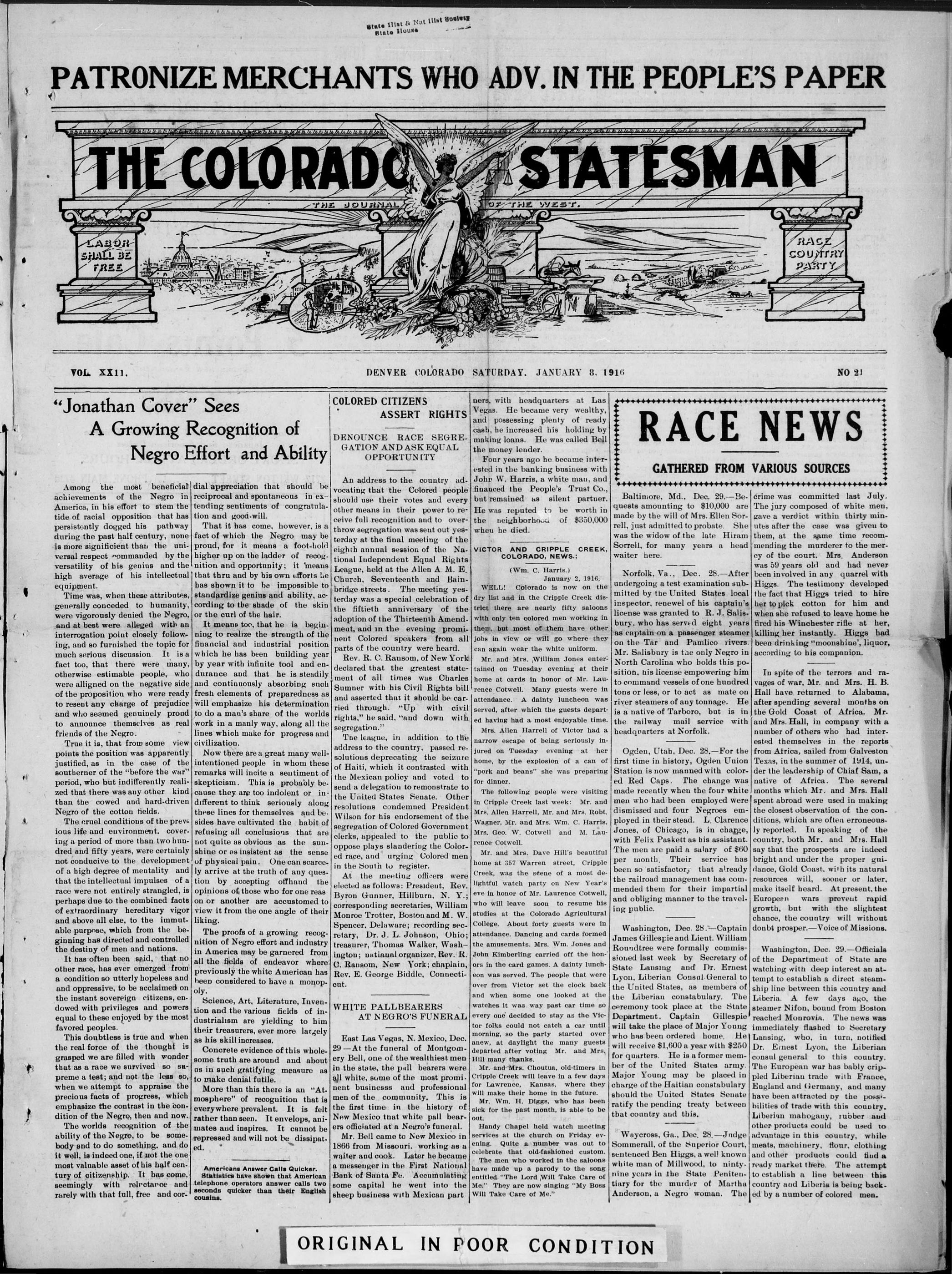
THE COLORADO STATESMAN
THE JOURNAL OF THE WEST.
LABOR SHALL BE FREE
RACE COUNTRY PARTY
"Jonathan Cover" Sees A Growing Recognition of Negro Effort and Ability
VOL XX11.
Among the most beneficial achievements of the Negro in America, in his effort to stem the tide of racial opposition that has persistently dogged his pathway during the past half century, none is more significant than the universal respect commanded by the versatility of his genius and the high average of his intellectual equipment.
Time was, when these attributes, generally conceded to humanity, were vigorously denied the Negro, and at best were alleged with an interrogation point closely following, and so furnished the topic for much serious discussion. It is a fact too, that there were many, otherwise estimable people, who were alligned on the negative side of the proposition who were ready to resent any charge of prejudice and who seemed genuinely proud to announce themselves as real friends of the Negro.
True it is, that from some view points the position was apparently justified, as in the case of the southerner of the "before the war" period, who but indifferently realized that there was any other kind than the cowed and hard-driven Negro of the cotton fields.
The cruel conditions of the previous life and environment, covering a period of more than two hundred and fifty years, were certainly not conducive to the development of a high degree of mentality and that the intellectual impulses of a race were not entirely strangled, is perhaps due to the combined facts of extraordinary hereditary vigor and above all else, to the immutable purpose, which from the beginning has directed and controlled the destiny of men and nations.
It has often been said, that no other race, has ever emerged from a condition so utterly hopeless and oppressive, to be acclaimed on the instant sovereign citizens, endowed with privileges and powers equal to these enjoyed by the most favored peoples.
This doubtless is true and when the real force of the thought is grasped we are filled with wonder that as a race we survived so supreme a test; and not the less so, when we attempt to appraise the precious facts of progress, which emphasize the contrast in the condition of the Negro, then and now.
The worlds recognition of the ability of the Negro, to be somebody and to do something, and do it well, is indeed one, if not the one most valuable asset of his half century of citizenship. It has come, seemingly with reluctance and rarely with that full, free and cor-
ORIGINAL IN POOR CONDITION
dial appreciation that should be reciprocal and spontaneous in extending sentiments of congratulation and good-will.
That it has come, however, is a fact of which the Negro may be proud, for it means a foot-hold higher up on the ladder of recognition and opportunity; it 'means that thru and by his own efforts he has shown it to be impossible to standardize genius and ability, according to the shade of the skin or the curl of the hair.
It means too, that he is beginning to realize the strength of the financial and industrial position which he has been building year by year with infinite tool and endurance and that he is steadily and continuously absorbing such fresh elements of preparedness as will emphasize his determination to do a man's share of the worlds work in a manly way, along all the lines which make for progress and civilization.
Now there are a great many well-intentioned people in whom these remarks will incite a sentiment of skepticism. This is probably because they are too indolent or indifferent to think seriously along these lines for themselves and besides have cultivated the habit of refusing all conclusions that are not quite as obvious as the sunshine or as insistent as the sense of physical pain. One can scarcely arrive at the truth of any question by accepting offhand the opinions of those who for one reason or another are accustomed to view it from the one angle of their liking.
The proofs of a growing recognition of Negro effort and industry in America may be garnered from all the fields of endeavor where previously the white American has been considered to have a monopoly.
Science, Art, Literature, Invention and the various fields of industrialism are yielding to him their treasurers, ever more largely as his skill increases.
Concrete evidence of this wholesome truth are around and about us in such gratifying measure as to make denial futile.
More than this there is an "Atmosphere" of recognition that is everywhere prevalent. It is felt rather than seen. It envelops, animates and inspires. It cannot be repressed and will not be dissipated.
Americans Answer Calls Quicker. Statistics have shown that American telephone operators answer calls two seconds quicker than their English cousins.
DENVER COLORADO SATURDAY. JANUARY 8. 1916
State Hist & Nat Hist Sociology
State House
ANTS WHO
ADC
E JOURNAL
DENVER COLORADO
COLORED CITIZENS
ASSERT RIGHTS
DENOUNCE RACE SEGRE GATION AND ASKEQUAL OPPORTUNITY
An address to the country advocating that the Colored people should use their votes and every other means in their power to receive full recognition and to overthrow segregation was sent out yesterday at the final meeting of the eighth annual session of the National Independent Equal Rights League, held at the Allen A. M. E. Church, Seventeenth and Bainbridge streets. The meeting yesterday was a special celebration of the fiftieth anniversary of the adoption of the Thirteenth Amendment, and in the evening prominent Colored speakers from all parts of the country were heard.
Rev. R. C. Ransom, of New York declared that the greatest statement of all times was Charles Sumner with his Civil Rights bill and asserted that it should be carried through. "Up with civil rights," he said, "and down with segregation."
The league, in addition to the address to the country, passed resolutions deprecating the seizure of Haiti, which it contrasted with the Mexican policy and voted to send a delegation to remonstrate to the United States Senate. Other resolutions condemned President Wilson for his endorsement of the segregation of Colored Government clerks, appealed to the public to oppose plays slandering the Colored race, and urging Colored men in the South to register.
At the meeting officers were elected as follows: President, Rev. Byron Gunner, Hillburn, N. Y.; corresponding secretaries, William Monroe Trotter, Boston and M. W. Spencer, Delaware; recording secretary, Dr. J. L. Johnson, Ohio; treasurer, Thomas Walker, Washington; national organizer, Rev. R. C. Ransom, New York; chaplain, Rev. E. George Biddle, Connecticut.
WHITE PALLBEARERS AT NEGRO'S FUNERAL
East Las Vegas, N. Mexico, Dec. 29—At the funeral of Montgomery Bell, one of the wealthiest men in the state, the pall bearers were all white, some of the most prominent businesss and professional men of the community. This is the first time in the history of New Mexico that white pall bearers officiated at a Negro's funeral.
Mr. Bell came to New Mexico in 1866 from Missouri, working as a waiter and cook. Later he became a messenger in the First National Bank of Santa Fe. Accumulating some capital he went into the sheep business with Mexican part
ners, with headquarters at Las Vegas. He became very wealthy, and possessing plenty of ready cash, he increased his holding by making loans. He was called Bell the money lender.
Four years ago he became interested in the banking business with John W. Harris, a white man, and financed the People's Trust Co., but remained as silent partner. He was reputed to be worth in the neighborhood of $350,000 when he died.
VICTOR AND CRIPPLE CREEK,
COLORADO, NEWS.;
January 2, 1916.
WELL! Colorado is now on the dry list and in the Cripple Creek district there are nearly fifty saloons with only ten colored men working in them, but most of them have other jobs in view or will go where they can again wear the white uniform.
Mr. and Mrs. William Jones entertained on Tuesday evening at their home at cards in honor of Mr. Laurence Cotwell. Many guests were in attendance. A dainty luncheon was served, after which the guests departed having had a most enjoyable time.
Mrs. Allen Harrell of Victor had a narrow escape of being seriously injured on Tuesday evening at her home, by the explosion of a can of "pork and beans" she was preparing for dinner.
The following people were visiting in Cripple Creek last week: Mr. and Mrs. Allen Harrell, Mr. and Mrs. Robt. Wagner, Mr. and Mrs. Wm. C. Harris, Mrs. Geo. W. Cotwell and M. Laurence Cotwell.
Mr. and Mrs. Dave Hill's beautiful home at 357 Warren street, Cripple Creek, was the scene of a most delightful watch party on New Year's eve in honor of Mr. Laurence Cotwell, who will leave soon to resume his studies at the Colorado Agricultural College. About forty guests were in attendance. Dancing and cards formed the amusements. Mrs. Wm. Jones and John Kimberling carried off the honors in the card games. A dainty luncheon was served. The people that were over from Victor set the clock back and when some one looked at the watches it was way past car time so every one decided to stay as the Victor folks could not catch a car until morning, so the party started over anew, at daylight the many guests departed after voting Mr. and Mrs. Hill many thanks.
Mr. and Mrs. Choutua, old-timers in Cripple Creek will leave in a few days for Lawrence, Kansas, where they will make their home in the future.
Mr. Wm. H. Diggs, who has been sick for the past month, is able to be out.
Handy Chapel held watch meeting services at the church on Friday evening. Quite a number was out to celebrate that old-fashioned custom.
The men who worked in the saloons have made up a parody to the song entitled "The Lord Will Take Care of Me." They are now singing "My Boss Will Take Care of Me."
RACE NEWS
GATHERED FROM VARIOUS SOURCES
Baltimore, Md., Dec. 29.—Bequests amounting to $10,000 are made by the will of Mrs. Ellen Sorrell, just admitted to probate. She was the widow of the late Hiram Sorrell, for many years a head waiter here.
Norfolk, Va., Dec. 28.—After undergoing a test examination submitted by the United States local inspector, renewal of his captain's license was granted to R. J. Salisbury, who has served eight years as captain on a passenger steamer on the Tar and Pamlico rivers. Mr. Salisbury is the only Negro in North Carolina who holds this position, his license empowering him to command vessels of one hundred tons or less, or to act as mate on river steamers of any tonnage. He is a native of Tarboro, but is in the railway mail service with headquarters at Norfolk.
Ogden, Utah, Dec. 28.—For the first time in history, Ogden Union Station is now manned with colored Red Caps. The change was made recently when the four white men who had been employed were dismissed and four Negroes employed in their stead. L. Clarence Jones, of Chicago, is in charge, with Felix Paskett as bis assistant. The men are paid a salary of $60 per month. Their service has been so satisfactory that already the railroad management has commended them for their impartial and obliging manner to the traveling public.
Washington, Dec. 28.—Captain James Gillespie and Lieut. William Roundtree were formally commissioned last week by Secretary of State Lansing and Dr. Ernest Lyon, Liberian Consul General to the United States, as members of the Liberian constabulary. The ceremony took place at the State Department. Captain Gillespie will take the place of Major Young who has been ordered home. He will receive $1,600 a year with $250 for quarters. He is a former member of the United States army. Major Young may be placed in charge of the Haitian constabulary should the United States Senate ratify the pending treaty between that country and this.
Waycross, Ga., Dec. 28. —Judge Sommerall, of the Superior Court, sentenced Ben Higgs, a well known white man of Millwood, to ninety-nine years in the State Penitentiary for the murder of Martha Anderson, a Negro woman. The
NO 21
crime was committed last July. The jury composed of white men, gave a verdict within thirty minutes after the case was given to them, at the same time recommending the murderer to the mercy of the court. Mrs. Anderson was 59 years old and had never been involved in any quarrel with Higgs. The testimony developed the fact that Higgs tried to hire her to pick cotton for him and when she refused to leave home he fired his Winchester rifle at her killing her instantly. Higgs had been drinking "moonshine", liquor according to his companion.
In spite of the terrors and ravages of war, Mr. and Mrs. H. B. Hall have returned to Alabama, after spending several months on the Gold Coast of Africa. Mr. and Mrs. Hall, in company with a number of others who had interested themselves in the reports from Africa, sailed from Galveston Texas, in the summer of 1914, under the leadership of Chiaf Sam, a native of Africa. The several months which Mr. and Mrs. Hall spent abroad were used in making the closest observation of the conditions, which are often erroneously reported. In speaking of the country, both Mr. and Mrs. Hall say that the prospects are indeed bright and under the proper guidance, Gold Coast, with its natural resources will, sooner or later, make itself heard. At present, the European wars prevent rapid growth, but with the slightest chance, the country will without doubt prosper.—Voice of Missions.
Washington, Dec. 29.—Officials of the Department of State are watching with deep interest an attempt to establish a direct steamship line between this country and Liberia. A few days ago, the steamer Nifon, bound from Boston reached Monrovia. The news was immediately flashed to Secretary Lansing, who, in turn, notified Dr. Ernest Lyon, the Liberian consul general to this country. The European war has bably crippled Liberian trade with France, England and Germany, and many have been attracted by the possibilities of trade with this country. Liberian mahogany, rubber and other products could be used to advantage in this country, while meats, machinery, flour, clothing and other products could find a ready market there. The attempt to establish a line between this country and Liberia is being backed by a number of colored men.
CONDENSATION OF FRESH NEWS
THE LATEST IMPORTANT DIS
PATCHES PUT INTO SHORT,
CRISP PARAGRAPHS.
STORY OF THE WEEK
STORY OF THE WEEK
SHOWING THE PROGRESS OF EVENTS IN OUR OWN AND FOREIGN LANDS.
Western Newspaper Union News Service.
ABOUT THE WAR
Montenegro in desperate straits for food.
Italians are reported as having captured Durazzo, the most important seaport of Albania.
President Wilson is awaiting full details of the sinking of the Persia before taking action.
The Russians have driven the Austrians from Czernowitz, an important strategic point in Bukowina near the Galician frontier.
The London Times declares that the Peninsular and Oriental liner Geelong, 5,030 tons, has been sunk near the Mediterranean.
Secretary Lansing is preparing to notify all the nations engaged in war on the side of Germany of the American stand on undersea raids.
Austria's official representative has informed Secretary Lansing his government is ready to offer reparation if an Austrian boat sank the Persia.
Lord Derby's recruiting figures for the period between Oct. 23 and Dec. 15 show 1,150,000 unmarried men and 1,679,263 married men presented themselves for service.
The great offensive by the Russians in Bessarabia and Galicia continues with some gains claimed by the Russians. Military critics call the new battle the most important move of the war since the invasion of Serbia. It is designed strategically to take from the Kalser the advantage he has long enjoyed of choosing his own ground for the big battle. Some critics declare it also is intended to squeeze the Teutons out of the Balkans. The central powers have been compelled to gather 1,500,000 men on the 300-mile front chosen by the czar for his drive and apparently are unable to make any big move at any other front. Thus Austria and Germany, long on the offensive, are now on the defensive. The Russians are abundantly supplied with guns and shells and are using them freely.
WESTERN
Two sharp earthquake shocks were felt at Newport, Ore.
The year 1915 was by far the greatest ever known in the Minneapolis grain and milling trades.
Two men entered the offices of St. Luke's hospital at Chicago, pointed revolvers at Miss Mary Tobin, the cashier, and escaped with a tin box containing $3,000.
Despite the explosions in munitions plants throughout the country the loss by fire in 1915 was less than that of 1914 by $48,768,250, according to the Insurance Press.
Senator John F. Shafroth has introduced in Congress one of the first of the good roads bills, calling for the co-operation of individuals, counties, states and the United States in the building and improvement of public roads in rural districts.
The Midwest Oil Company paid off the last $50,000 of an issue of $600,000 in notes issued nearly three years ago for the purpose of building a refinery at Casper, Wyo. The notes still have about two years to run, and the fact that the entire indebtedness has been cleared off so far in advance shows that the company has prospered.
WASHINGTON
Navy officials hope soon to begin withdrawing the marines on duty in Haiti.
Secretary McAdoo asked a rush appropriation of $100,000 for rural sanitation and fighting typhoid and pellagra.
There is a noticeable determination on the part of members of Congress to hold some nation to strict account for the killing of Americans in undersea raids.
Representative Edwards of Georgia introduced a resolution asking Congress to extend thanks to Henry Ford for his "generous contributions and noble purpose in trying to bring about peace in Europe."
A peace resolution by Representative Campbell of Kansas provides for the establishment of an "international confederation of the world," to enforce international law with an international army and navy.
Improvements of the Los Angeles and Long Beach, Cal., harbors, to cost about $1,400,000, were recommended in a report of General Kingman, chief of army engineers, submitted to Congress by Secretary Garrison.
Food prices in the United States during 1914 were higher than at any time during the last thirty-seven years, with the exception of the years 1882, when they were four per cent higher than 1914 prices; 1883, when they were on the same level, and in 1912, when they were one per cent higher.
FOREIGN
Tommaso Salvini, the eminent Italian tragedian, died at Florence, Italy.
American correspondence both to and from Great Britain will be censored hereafter, it was officially announced in London.
The Bulgarian government has arrested the French vice consul at Sofia in retaliation for the arrest of the Bulgarian consul at Saloniki.
The Paris Matin affirms, notwithstanding denials, that the German emperor is suffering from cancer of the throat and is no longer able to speak.
"It is reported from Stockholm that orders have been given to all Jewish refugees at Petrograd to depart immediately," says the Overseas News agency.
Announcement is made by the Jiji Shimbo at Tokio that a squadron of Japanese warships will sail for the Suez canal, presumably to protect Japanese shipping.
Unofficial dispatches from Cairo state that the British steamship Persia, sunk in the Mediterranean, was torpeded without warning and sank in five minutes.
Exports from the consular district of Berlin to the United States in the fourth quarter of 1915 amounted to $628,587, compared with $3,600,235 in the corresponding period of 1914.
At the close of 1915 the war had cost more than $26,000,000,000, exceeding by $5,000,000 the total national debts of the six principal belligerent powers when the conflict began.
The London Chronicle announces definitely that Sir John A. Simon, secretary of state for home affairs, retires from the Cabinet, "thus breaking his brilliant ministerial career for conscience sake."
Robert Mitchell, who served several terms in the Chamber of Deputies and was a brilliant journalistic advocate of the Bonapartists in the early years of the third republic, died in Paris, aged seventy-six years.
The London Daily Mail says: "The cowardly sinking of the Persia will steel the hearts of all Britons and prompt them not to a mere denunciation, but to action and will convince the waverers by thousands that the hour has come to enlist."
Yuan Shi Kai, president of China, who has accepted the proffer of an emperor's crown, on "request" of various elements in the nation, entered the palace in the imperial yellow chair, sat on the throne and was announced as "His Imperial Majesty" at the New Year day reception given for Chinese officials.
SPORTING NEWS
Ted Lewis, the English welterweight, and Willie Brenan boxed ten fast rounds to a draw at Buffalo, N. Y. Benny Chavez, Colorado featherweight, won a ten-round decision at Kansas City over Tommy Buck of Philadelphia.
Stanley Yoakum of Denver took five rounds and the popular verdict in his ten-round-bout with Bobby Waugh at Fort Worth, Tex.
W. A. Lovejoy, famous billiard expert, and originator of the anchor stroke, died in London, according to word received in New York.
At Panama William Spencer, the American charge d'affaires, won the 15th man tennis championship from Alexander Fechtig, the former champion.
Johnny Kilbane of Cleveland and Ritchie Mitchell of Milwaukee fought ten fast rounds at Cincinnati, popular decision giving Mitchell the better of the bout.
Johnny Dundee, the only lightweight of any prominence now in the fighting game, who has never lost a decision, will appear in Denver at the Stockyards arena the night of Jan. 22.
GENERAL
Transatlantic cable communication was crippled or delayed by severe storms which swept over Ireland, England and the continent.
The will of Thomas L. Shevlin, filed for probate at Minneapolis, bequeaths an estate valued at $3,500,000 to Mrs. Shevlin and her two children.
During the last year 1,500,000 pounds of foodstuffs were shipped to Palestine for the relief of the destitute Jews, according to the report of Nathan D. Kaplan, president of the Knights of Secon, made at Chicago to the nineteenth annual convention of the society.
Hundreds of popular periodicals were withdrawn at Spokane, Wash., from newsstand sale because of the state-wide prohibition law for bidding the advertising of liquors. In cases where magazines were not withdrawn the pages containing liquor advertising were cut out.
George Lee Thorne, who says he was formerly a general in Villa's army in Mexico, confessed at Portland, Ore., according to the police, that by fraudulent promotion schemes, and forgeries he had netted in the last ten years in various cities in this country nearly $50,000.
Young Ahearn of Brooklyn had the better of Al McCoy, Brooklyn middle-weight, in almost every round of a ten-round bout at New York.
Between 250 and 300 families were forced to move when the Wabash overflowed its banks and inundated the portion of the city known as South Peru, Ind.
The federal grand jury was called to meet again in San Francisco to resume its investigation into the alleged German plots to blow up ships and munition plants
Western Newspaper Union News Service.
DATES FOR COMING EVENTS.
Jan. 17-19.—Meeting Colorado Retail
& Butchers' Association
61 Fuglebo.
Jan. 16-22 -Western Live Stock Show at Denver.
Feb. 12-12 -Annual convention Colorado Metal Mining Association, at Denver.
Feb. 12—Meeting Republican State
Central Committee in Denver.
Feb. 18-19 Imports Carnival at Steam-
boat Springs.
March 20-April 2—Colorado Retail
Merchants' Association's Food and
Industrial Exposition at Denver.
Weld county pays license on 1,829
buz wagons.
About $300,000 was paid in Denver
as interest on savings accounts.
Building permits taken out in Denver
during 1915 aggregate $2,670,135.
It is said Colorado produces eighty per cent of the tungsten in the United States.
The case of Mrs. Mae Oles, charged with forgery, will be called at Boulder Jan. 17.
Boulder was selected for the next show of the Northern Colorado Poultry Association.
Ouray city officials indulged in a salary slashing which will save the taxpayers around $850 a year.
Mr. and Mrs. John Q. Naylor, pioneer residents of Denver, celebrated their golden wedding anniversary.
Four generations were present at the Christmas dinner given by Mr. and Mrs. A. W. McQuown at Eaton.
With the end of the year the city of Denver loses an annual revenue, based upon the liquor business at is, was of $260,000.
Las Animas county has eighty-one public school districts, employing 202 teachers. There is an average daily attendance of 12,954 pupils.
The Second Church of Christ Scientist, in Denver, which is being built at a cost of approximately $100,000 will be completed about March 1.
John Hanson, 49, laborer, of no where in particular, has annexed the somewhat questionable distinction of being the first "drunk" arrested in prohibition Denver.
How would you like to own a herd of cows like one in Montrose county which gave birth to five calves in a year—triplets last January and twins in December?
With the largest crowd that has ever done business in the Denver postoffice, the holidays forming no exception, the new postoffice building was opened Monday.
Mrs. Ella Monk Mayo, a resident of Denver since 1861 and an acknowledged belle of the early days, died at her home, 1553 Clarkson street, following a lingering illness.
More than $500,000 will be received in the Denver United States internal revenue office before March 1 in corporation and emergency war taxes which will be collected after Jan. 1.
Dispatches from London indicated that Edward Rose, former Denver youth who took passage on the Persia, which was torpedoed near the Island of Crete, may have perished when the liner went down.
Arthur J. Hamilton, arrested recently at Indianapolis, Ind., for the robbery of the Bank of Manitou on Dec. 7, pleaded guilty to the crime before Judge J. W. Sheafer in the District Court at Colorado Springs.
Mrs. Catherine Eastman, 88 years old, a pioneer resident of Denver, died at her daughter's home in Denver. Nineteen relatives, one a sister 85 years old, two sons, two daughters eight grand children and six great grandchildren, survive her.
Echoes of the European war are reverberating in Loveland, where the alleged pro-German utterances of the Rev. Philip Schmidt, pastor of a German Lutheran church, have led to a demand for the revoking of Schmidt's recently-secured naturalization papers.
Mrs. Anna B. Stahl, a stenographer, who sued her former employer. Edward R. Cooper, wealthy Denver and Los Angeles hotel man, demanding $75,000 damages for the abrogation of a contract by which, she alleged, she became his "heaven-made" wife, in the Denver District Court dismissed her action.
Business men of the San Juan district in southwestern Colorado have appealed to Congress to come to their assistance in providing them with better railroad facilities by authorizing a loan of $4,500,000 from the federal government with which to construct a government line to the south which will give it an outlet to the Pacific coast.
A unique way of bringing an exhibit to the National Western Stock show, which will be held in Denver the week beginning Jan. 17, will be the transferring by aeroplane of the smallest calf to be exhibited from its home in the Arkansas valley to the Denver Union stockyards. A box is to be built back of the seat on the aeroplane and the calf will be placed in the box.
W. S. Tarbell, mining man of Denver, received a telegram reporting a gold strike in the Big Jim property near Oatman, Ariz.
SNOW IMPERILS TOWN
FIERCE GALE RAGES AT COLO-
RADO SPRINGS.
Seventy - Five - Mile - an - Hour Wind
Sweeps Wide Area----Fires Dam-
age Several Homes.
Grand Junction, Jan. 5.—Gateway, a mining town with a population of 160, fifty-five miles southeast of here, is snowbound; cut off from all outside communication, and without food and coal supplies.
The inhabitants are reported to be in desperate plight. In the last three weeks the Western Slope has been visited with continual snows, which have made records for snowfall in some sections. All attempts of cattlemen and others to break trails through the snow to care for live stock have been vain. Efforts of citizens to open roads in order to bring in provisions have failed.
Colorado Springs.—A terrific wind which swept over Colorado Springs Tuesday afternoon blew in the windows of the Columbine school, injuring many pupils and causing several fires, which destroyed homes in different parts of the city. At Monument, eighteen miles north, the wind was even stronger than in the Springs and great damage was done to telephone and telegraph poles and small buildings. No lives are believed to have been lost at Monument.
The wires east and south of here were down most of the day because of the gale, Eastonville, thirty miles east, reporting a seventy-five mile wind and great destruction to farm property. The gale swept a wide territory, centering just north of Colorado Springs and including all of the Pike's Peak region. Glass in the Columbine school was shattered, the flying bits cutting the pupils.
Three families lost their homes and all their possessions by the fires, as the flames were fanned to fierceness and did their work before the Fire Department could get to the scene. A number of serious fires were reported from West Colorado Springs.
Convicted of Robbing La Jara Bank.
Convicted of Robbing La Jara Bank. Denver.—Court proceedings probably were concluded in one of the most startling bank robbery cases which has taken place in the state this year when Frank Pasco, a Mexican, and George Howard were found guilty of the $6,300 robbery of the state bank of La Jara, Colo. The trial was held in the County Court of Conejos county. Pasco and Howard have ten days in which to file an appeal for a new trial. The penalty for their offense is from twenty-five years to life in the penitentiary. The La Jara bank robbery took place on Oct. 11.
Colorado Mine Yields $20,000,000.
Colorado Mine Yields $20,000,000.
Ouray—The famous Camp Bird mine near Ouray, which is capitalized at $5,000,000 and controlled in London, paid $706,272 in dividends in 1915, bringing the total dividends since 1901—when the London Company took control—up to $10,062,366. Including the years under Thomas F. Walsh it is safe to place the total production of the Camp Bird-group at $20,000,000, and the net profits at $12,500,000, or over 60 per cent of the gross value of the ore.
Bootlegging Case at Pueblo.
Pueblo.—The first bootlegging case in Pueblo since the prohibition amendment went into effect came to the attention of the police when they arrested Ira A. Silvers, 43 years old. The police say Silvers had a dumbwaiter in his room connecting with the cellar, where he had fifty-one bottles of beer and fifty-four gallons of whisky.
Denver. - Elias Perry of Devitt, Mo., who was in Denver when the first consignment of liquor arrived, nearly fifty years ago, came back in time to see the city as "dry" as when it was a frontier town. Mr. Perry, who is now past 80, first came to Denver in an ox cart. He and his wife are visiting their nephew.
Ernest Lloyd Commits Suicide:
Colorado Springs.—With a bullet hole through his head and his hand still clutching a 38-caliber revolver, the body of Ernest Lloyd, 45, was discovered in North Park. No reason for the suicide can be attributed by his friends.
Dickens Freed on Bail.
Boulder.—Rienzi C. Dickens, accused of the assassination of his father, W. H. Dickens, pioneer banker of Longmont, was released on bond for $37,500, furnished by members of the Dickens family at Longmont.
Fowls Have Belligerent's Names.
Denver.—With the exception of the Teutonic allies and Russia all the belligerent nations of Europe were represented at the poultry show that opened in the Auditorium. There are English Orpingtons and Cornish games, from the British Isles; there are French Houdans, Italian Leghorns, white-faced Black Spanish, Crested Polands and Belgian hares. And to preserve order there is a large delegation of patriotic Plymouth Rocks.
Denver's Only Exclusive Fish and Oyster House Fresh Fish, Oysters, Salt, Smoked, Dried and Canned Fish Poultry and Game of All Kinds
C. H. SHIRLEY, Pres. J. C. HAMPSON, Vice Prec PAUL J. SHIRLEY, Sec. and Treas.
Courteous Treatmet. Right Prices
Leaders in Prescription
Store No. 1.
2701 WELTON ST.
Main 895 875
Store No. 2.
26TH AND WELTON
Main 4955 4956
5 Points Cafe
5 Points Cafe
UNDER NEW MANAGEMENT.
Chop Suey, Noodle
Japanese and
SHORT ORDER
2712 WELTON STREET
W. C. CAMPTON, Pres. J. M.
RAILROAD
LUNCH ROO
合
UP Suey, Noodles and All Kinds of Ch
Japanese and American Dishes
PORT ORDERS AT ALL HOUSE
TON STREET PHONE M
MPTON, Pres. J. M. JOHNS, Treas. U. P. JACK
ILROAD PORTERS' CL
LUNCH ROOM IN CONNECTION
Chop Suey, Noodles and All Kinds of Chinese Japanese and American Dishes SHORT ORDERS AT ALL HOURS
W. C. CAMPTON, Pres. J. M. JOHNS, Treas. U. P. JACKSON, Sec. RAILROAD PORTERS' CLUB LUNCH ROOM IN CONNECTION
BILLIARDS AND
POOL
1728½ Wazee St. C
J. B. I
PHONE MAIN 8416.
728½ Wazee St. Only one block from Union Dep
J. B. MINTER. Barber.
ONE MAIN 8416. DENVER, COLORA
1728 $ _{1/2} $ Wazee St. Only one block from Union Depot.
J. B. MINTER. Barber.
PHONE MAIN 8416. DENVER, COLORADO.
JOHN K. RETTIG
Fancy and Staple Grocery
1864 CURTIS STREET
eighteenth. D
C. E. Smith
9, 190 Res. Phone
Market Comp
and Retail Staple and Fancy Groceries
ers. Hotels and Restaurants Our Speci
Cured
eastern Corn Fed Meats
Meats, Fancy 1864
The Mark
Wholesale and Retail St
Oysters. Hotels and
The Market Company
Wholesale and Retail Staple and Fancy Groceries, Fish and Oysters. Hotels and Restaurants Our Specialty.
Fresh and Cured
Eastern Corn Fed Meats
Eastern Corn Fed Meats
Fruits, Vegetables, Poultry and Game. 1688-89 Arapahoe Street Denver
HAVE YOUR CLOTHES CLEANED, PRESSED, ALTERED AND DYED AT THE
Mutual Tailors and Cleaners
OUR CLOTHES CLEANED, PRESSED, BE ALTERED AND DYED AT THE Mutual Tailors and Cleaners
HAVE YOUR CLOTHES CLEANED, PRESSED, REPAIRED, ALTERED AND DYED AT THE
Mutual Tailors and Cleaners
LADIES' AND GENTLEMEN'S SUITS MADE TO ORDER.
Our Work Will Please
Gentlemen's Suits O
Overcoats.....
Gloves.....
Neckties....
Work Will Please You—Our Prices are Reasonable
gentlemen's Suits Cleaned and Pressed.....7
overcoats.....7
gloves.....0
reeckties.....0
ON ST. CALL
Gentlemen's Suits Cleaned and Pressed
Overcoats
Gloves
Neckties
---
PHONE MAIN 3028
Corner Nineteenth
Phones Main
169, 181, 189, 190
Fresh and Cured
2204 WELTON ST.
Store No. 2.
26TH AND WELTON
Main 4955 4956
All Kinds of Chinese
American Dishes
AT ALL HOURS
PHONE MAIN 4730
Treas. U. P. JACKSON, Sec.
TERS' CLUB
ONNECTION
FREE CHECK
ROOM
ock from Union Depot.
carber.
DENVER, COLORADO.
RES. PHONE GALLUP 943
ETTIG
taple Groceries
STREET
O. E. Smith, Manager
Res. Phone South 1608
Company
Fancy Groceries, Fish and
prants Our Specialty.
Fed Meats
D, PRESSED, REPAIRED,
ED AT THE
Tailors
aners
Prices are Reasonable.
1 Pressed .75
.75
.05
.05
CALL MAIN 8519
A woman in a dress
Denver, Ocala
Denver, Colorado
CALL MAIN 8519
AFRO-AMERICAN CULLINGS
Persons interested in the education of the colored youth in Washington recently had an opportunity to see a quadruplex exhibit showing what is being done in the way of training colored boys and girls. The fourfold exhibit was at the Miner Normal school, Georgia avenue and Euclid street, northwest. The greater portion of it was work done on the playgrounds during the summer; added to this were models showing dairy, water supply, housekeeping and other methods, sanitary and insanitary. The remaining two phases were in one sense not an exhibit of a formal nature, being only the regular arrangement of material for study by students at the normal school and included the courses in domestic and other sciences, such as botany, zoology and psychology. Interested persons were made welcome at the school and shown the exhibits and school equipment.
No group of the exhibit was more interesting, probably, than the display of playground work. This represented all of the industrial activities of the five colored school grounds under Miss Anita J. Turner. "Service" is the motto for all work turned out—that is, it must be of a character and structure that allows its use.
For instance, on display were all sorts of baskets, well made and attractively colored. pocketbooks, crocheted sacks and bootees, aprons, little dresses, collars, dollies, hats, napkin rings and hammocks. Several girls attending the play centers brought their dolls and dressed them. Play aprons for children were made by the youngsters and decorated with subjects dear to the hearts of little ones—the three bears, the cow that jumped over the moon, rabbits, birds, camels, elephants and Mother Goose.
One especially attractive display was for table use. It included a centerpiece adapted for the joint use of flowers and fruit; dollies, reed napkin rings and coasters.
Because of the lack of money for material, work of this sort is limited. It is hoped that congress will appropriate a sum for carrying it on, so that the maintenance money no longer will have to be raised through entertainments and other similar means.
Mrs. Susan Gillies, a Negro woman, who, according to the claim of her relatives, was born a slave, on a plantation in Virginia 115 years ago, died at her home, 571 Classon avenue, Brooklyn. The aged Negress lived with her daughter, Mrs. Julia Thomas, eighty-four years of age, and her great-granddaughter, Mrs. Ella Abbott. Five generations of Mrs. Gillies' family attended her funeral.
Mrs. Thomas was very positive as to the age of her mother. She declared that she was born in the year 1800, at Peterborough, Va., on the Peterson plantation, and lived in servitude with the Peterson family until 1863. Mrs. Thomas declared that her mother often told her of visits paid to the plantation by James Monroe before and after his terms as president of the United States. Mrs. Thomas was born on the same plantation and she also lived in slavery until 1863.
There are about 12,000 cremations each year in the United States. The first crematory was established in 1876 and during the eight succeeding years only 28 human bodies were cremated.
In a communication to the New York World A. J. Casserly of Jersey City, N. J., writes as follows:
I read with considerable interest your editorial "Some Native Sons." In these days of criticism of hyphenated citizens your reference to a class of citizens which is content to be plain, pure, simple Americans, furnishes some food for serious thought.
You have rightly said that "one of the strongest of their racial characteristics is devotion to country and home." This virtue has been manifest long prior to and since the days of Jethro of the land of Midian. History reports the view that the black man has always proven true to home and country.
God forbid that the great mass of American Negroes should boast unseemly of our forefathers' devotion and worth, or of their own. Pre-eminently on the pages of history is emblazoned the fact that in no crisis has the black man been found wanting in devotion to right or in seeking out and supporting the truth as it was given to him to know it.
Apropos of this discussion, it may
Liverpool has the world's largest dry dock, 1,020 feet long and 155 wide at the water line, the only one in the world large enough to receive 50,000 ton liners.
American manufacturers of lead pencils now have the business of the far East practically to themselves.
An electrically operated tremolo attachment for stringed instruments has been invented which produces the desired effects when buttons are pressed.
If he (Booker Washington) seemed to underemphasize the difficulties growing out of external political and social restriction, it was rather due to his unceasing cry that the kingdom of power and wealth and dignity can rest finally only on spiritual achievement, self-control, foresight, thrift, the practice of the common virtues. No breaking out of the outer bonds can alone free the spiritual slave. No one could hear him with an open mind, however, and fail to realize that his message was equally applicable to the white race. No one could fail to realize that he saw the weakness of his white neighbors and felt the bitterness of the political and social restrictions enforced by the whites.
Booker T. Washington was, however, always more than a Negro—nobly human within his race—and because of this, the simple people of his own race, the honest-hearted of both races, heard and followed. He had many great human qualities of leadership, of organizing capacity, of oratorical power, and of imagination. But his contribution is richer because of gifts peculiar to his people. That rare humor, the exquisite sense of another's feeling that is the basis of social power, rich vocabulary, high emotional appeal! American life would be so enormously enriched if we thought in terms of what colored people can do instead of what they must be prevented from trying to do!
And so his contribution to the thinking of the white South has not always been clear. Though the least thoughtful realized that he was not a "common Nigger" to be called "Booker," they did not always arrive at the point of recognizing the dignity of the man by calling him "mister;" but they could find a middle path by calling him "professor." For thousands of white persons that short step is the first advance in the direction of freeing their own spirits. For, of course, the race or caste feeling is a band tight about the spirits of the white South, to many of whom Booker T. Washington gave the first glimmering sense of their own bondage.
For these, his service is incalculable, one never to be measured, and to be recognized only gradually and by relatively few. And yet, as the nation could not live half bond and half free in the days of political slavery, so in the days to come the spiritual bonds of prejudice are to be broken from the white South, as those to which he called attention are to be stricken from the black South. Only when both are removed will either be wholly free.—Sophonisba P. Breckinridge in the Survey.
There are about 427 Negro schools in the United States, other than elementary public schools and public high schools, or those in any sense under government and state control. Of these, 57 are put down as colleges and universities. All but three of the fifty-seven are avowedly denominational. Of the 16 institutions for Negro women only all but three are accredited to some denomination. Of the 354 normal, industrial and private schools all but 80 are reported as denominational.
The first president born in the United States of America after the signing of the Declaration of Independence and the establishment of national unity was Martin Van Buren, who was born in the state of New York in 1782.
not be amiss to refer to the agitation of a few years ago, begun by loyal American Negroes, for participation in the National Guard service of the country. I submit that no just reason may be advanced why there should not be in every state of this Union colored regiments or battalions connected with the National Guard system. To such a program the rank and file of American Negroes would, ignoring past rebuffs, unconditionally subscribe.
Finishing of the new Canadian government grain elevator at Calgary marks the completion of the chain of government elevators between the Great Lakes and the Rocky mountains, those at Saskatoon and Moose-jaw being in operation now.
A specially designed reflector enables a new projecting lantern to produce about 500,000 candlepower by using a 1,000-watt, nitrogen-filled incandescent lamp.
Villa "dollars" bring one cent each in New York.
The bark of a cactus growing wild in western Mexico has been found to contain enough resin after the death of the plant to make its utilization practicable.
The flag pole on top of a tower on a New York hotel has been so mounted that it can be lowered into a tubular casing for painting or repairing.
Italy exports from $3,000,000 to $4,000,000 worth of human hair annually.
WELBORN GIVES COMMISSION DETAILS OF SCHEME.
Members Will Study Conditions in Southern Fields and Again Hold Meetings at State House.
Western Newspaper Union News Service.
Denver.—The President's Colorado coal commission, composed of Seth Low, Charles W. Mills and Patrick Gilday, discussed conditions in the state coal camps with local coal operators. The commission asked questions concerning working conditions in the mines, accidents, anticipated increases in business and other phases of the industry affecting labor.
It is reported the commission will make an extensive study of conditions in the southern Colorado coal fields; hold informal meetings in the state house and then go to Routt county to visit coal camps, and then hold further hearings at the state house.
The commission met in the governor's office to hear J. F. Welborn of the Colorado Fuel and Iron Company explain the company's industrial representation plan, submitted recently to its employés. Mr. Welborn explained the company expended in the last year $57,205 in removing objectable buildings and erecting model structures; $15,295 in fencing employés' homes, and $22,971 in constructing club and bath houses. In addition, $24,000 is to be spent in completing club houses.
He announced also the company had commenced the construction of emergency hospitals in its coal camps. Two of these, one at Primero, Colo., and another at Sunrise, Wyo., are being built.
Mr. Welborn's statement contained in detail a summary of the industrial representation plan, and he declared the system in effect in the coal camps included features suggested by the Colorado coal commission, as well as a substantial acceptance of findings by the anthracite strike commission, suggested by President Wilson.
He said the Colorado Fuel and Iron Company desired to co-operate with the commission, and invited the commissioners to visit each camp, iron mine, lime quarry and steel plants. The company, he said, willingly would furnish data on employment, living and working conditions of employees.
7,291 Corporations Operate in State.
There were 7,291 corporations in business in Colorado in 1915 as shown by records of license taxes paid in the office of Secretary of State Ramer. That is an increase of 1,044 corporations more than those paying license taxes in 1914. The revenue in the flat tax department from the license fees in 1915 was $44,567.95 and in 1914 it was $39,897.69. Two reasons account for the increase—improvement in general business conditions and a change made by the secretary of state in handling flat taxes. Mr. Ramer's position is that persons and corporations doing business with his office should be treated as thoughtfully and carefully as if his office was purely a business one. Thus, he has instituted a system of notifying corporations that their taxes are due, giving amounts and sending blank annual reports required. Under the law, the secretary of state is not required to notify the corporations and no notice has been given them heretofore. The result was many companies overlooked the requirements. Through the new system all corporations at slight expense are reminded of the requirements and many, which otherwise would forget, quickly forward their reports and fees.
Want Depot at Hot Springs.
The State Public Utilities Commission had a hearing on the application of citizens of Saguache to compel the Denver & Rio Grande Railroad Company to establish a station and maintain an agent at Hot Springs, a point on the Denver & Rio Grande, fourteen and a half miles from Saguache which is an inland town and the county seat of Saguache county. The nearest railroad point to Saguache now is Moffat.
New Course on Citizenship.
Mrs. Mary C. C. Bradford, state superintendent of public instruction, announced that a plan for special courses of instruction in citizenship for children of foreign birth is to be put into effect in connection with the work of Paul Lee Ellerbe, chief naturalization examiner of the United States government for this district.
Denver Fire Losses Cut.
Fire losses in Denver in 1915 were approximately half those in 1914. The losses in 1915 amounted to $150,000, as against $296,297 in 1914. There were 1,050 alarms in 1915, and 1,202 in 1914.
Gov. Carlson's New Year Reception. Church services, receptions and open house were held all day Jan. 1 in Denver in observance of the new year. At the Capitol building, Gov. George A. Carlson, members of the Supreme Court, state officials and officers of the Colorado National guard received visitors. The reception took rank with the elaborate ones of the day, and was one of the most successful held at the State house in years. More than 500 citizens called to wish the governor a successful new year.
ENGLAND FACES REVOLT OF IRISH
IRELAND IS EXEMPT UNDER BILL FOR FORCED SERVICE AND ULSTER PROTESTS.
CONSCRIPTION CAUSE
CARSON'S DELEGATES WOULD DRIVE IRISH INTO RANKS DESPITE PROTEST.
Western Newspaper Union News Service.
London, Jan. 6.—England faces the greatest crisis since the opening of the war.
The introduction of the compulsory service bill has brought a storm about the heads of the Cabinet members. Added to the complications in England comes the danger of a revival of the troubles in Ireland. Ireland has been exempted from compulsory service under the bill, and John Redmond, Irish nationalist leader, has declared he will not support any measure that savors of conscription.
On the other hand, the Ulster delegates in Parliament have demanded that Ireland be included in the measure. Nationalist leaders point out that the sections of Ireland outside of Ulster influence have sent five men to war where Ulster has sent one.
They regard the action of the Ulster delegates as a deliberate challenge to the rest of the Irish people.
The Ulster members have adopted a resolution, framed by Sir Edward Carson, denouncing the proposal to omit Ireland as "an insult and humiliation to the loyal and patriotic population and the abandonment of the people of equality of sacrifice in time of war on the part of His Majesty's subjects in the United Kingdom.
Speaking on the measure, John Redmond said:
"It is with the greatest regret that I have to announce that my party cannot support the bill. Ireland regards this as her war, and she will stop at no sacrifice to bring it to a speedy and successful issue. Nobody, however, has shown that this bill is necessary for this purpose, Premier Asquith himself having declared it was needed to fulfill a certain pledge which he had given. I believe we have, today, more soldiers than we can train, equip and provide with officers."
Sir John Simon, whose resignation as home secretary was announced, made a speech in the House of Commons, in which, after expressing regret that he had found it necessary to sever his relations with Premier Asquith, he pleaded for rejection of the compulsory service bill.
Premier Asquith explained that the bill provided that unmarried men or widowers without dependent children who were between the ages of 18 and 41 and had no ground for exemption in enlisting under the bill, were liable for service, and should be deemed to have done their duty to state just as though they had attested under the Derby plan. They would be deemed as having enlisted for the period of the war.
May Appoint Taft Supreme Judge. Washington, — Former President Taft was frequently mentioned by both Republicans and Democrats as a possible selection of President Wilson for the Supreme Court to fill the vacancy caused by the death of Justice Lamar.
BRITISH SEIZE PAPEN PAPERS.
Officials Strip Attache of Documents as He Stops at Falmouth. London.—Capt. Franz von Papen, the recalled German military attache at Washington, telegraphed from Falmouth, where he arrived on the Noordam, to the American embassy here, asking it to communicate with the German ambassador in Washington to protest to the State Department because the British authorities, he declared, opened his private papers at Falmouth. Capt. von Papen in his message claimed that personal letters and bank books of his were opened and that some of these were retained by the authorities. The British authorities who seized Capt. von Papen's correspondence at Falmouth are not worried by possible protests, as his safe conduct embraced only the person of the German military attache.
Capt, von Papen did not carry any papers or correspondence from the German embassy at Washington, but he had a large number of letters from individuals for delivery in Germany.
To Make Test of Liquor Law.
To Make Test of Liquor Law.
Colorado Springs.—That the arrest of F. W. Korsmeyer, on the charge of violating the new prohibition law, is to be made an example was indicated when District Attorney M. W. Purcell started injunction proceedings against Korsmeyer and the owner of the building to restrain the sale of liquor and for the purpose of settling beyond peradventure any legal points that may be involved. While the district attorney was busy in court the police were hauling away liquors from the drug store.
The Curtis Park Floral Company
FLORAL DESIGNS PUT UP WHILE YOU WAIT
CHOICE PLANTS AND CUT FLOWERS CONSTANTLY ON HAND
GREENHOUSES: Thirty-Fourth and Curtis Streets
TELEPHONE, MAIN 1511 DENVER, COLO
The Champa Pharmacy
When You Want
The Heads, Feet, Tails, Snouts, Neckbones or Chiterlings, or any other part of the hog except the squeal, go to
East's Market
The
WARD AUCTION
COMPANY
Sales Daily at 2 p.m. Office Furniture a Specialty.
PRIVATE SALES AT ALL TIMES
HAVE MOVED TO—
1723-39 GLENARM ST.
PHONE MAIN 1875.
THE BEST ICE CREAM AND
CANDIES AT
O.P. BAUR & CO.
CATERERS AND
CONFECTIONERS
Phone: 168.
1512 Curtis Street, Denver, Colo.
JOSEPH CARTER
Express, Moving,
and Storage
COAL AND WOOD
PROMPT DELIVERY.
Phone Main 6544.
2415 WASHINGTON STREET.
TELEPHONE YORK 6668.
GENERAL FURNITURE REPAIRING
AND UPHOLSTERING.
WORK GUARANTEED.
1417 East 24th Avenue, Denver, Colo.
2300-6 Larimer Street Phone Main 1461
ORIENTAL RESTAURANT
Chop Suey, Noodles and Short Orders
Phone Main 4896
1848 Arapahoe
乐泽轩
Miss M. Cowden Hair Dressing Parlor
Shampoo, cutting and curling. Scalp treatment, hair tonics, hair straightening, manicuring. Stage wigs for rent; theatrical use and masquerades. Goods delivered out of the city. All shades of hair matched by sending sample of hair; also combings made up.
Cheapest Switches 50 Cents
1219 21st St. Denver, Colo.
DO IT NOW Subscribe
for THIS
PAPER
THE COLORADO STATESMAN
LABOR SHALL BE FREE
MANY COURTS PARTY
JOS. D. D RIVERS.....Proprietor
1824 Curtis Street, Room 25.
Phone Main 7417.
Entered as second-class matter at the postoffice in the city of Denver, Colorado.
The average Negro in this state is a much better citizen this year, so far, than he was last. This is due in a great measure to the influence exerted by The Colorado Statesman. In nearly every home one sees one or more Negro papers and other periodicals of high-class order, which is evidence of a material advancement along proper lines. Even the big Negro is now being hammered into line. The next decade will bring about such a reform and appreciation of Negro enterprises as will hardly fall short of universality. While there is yet much to be achieved along this line, favorable comment is due the already business strokes in the direction thus taken.
A WARNING TO LAWYERS.
One of the judges of the District Court in the trial of a divorce suit recently, remarked that information had reached him that some of the men of the legal profession were inducing members of families to institute divorce proceedings in order that they may obtain fees, and this being opposed to the ethics of the profession, if any such case be brought before him he would deal with it to the full extent of the law.
This is something new on the boards for 1916. We have heard of lawyers taking cases on behalf of clients who are unable to pay and work on the results for their fees, but to be instrumental in the cause of the trouble is surely horrifying. The public ought to be on the look out for this kind of wage-earners.
DENVER'S NEW POST OFFICE.
Rising majestically like one of the buildings of ancient Greece the Federal building covers the block from Eighteenth street to Nineteenth street between Stout and Champa streets, and so attractive in its mantle of white that one cannot help stopping and admiring the beautiful structure. After five years of erection, the people of Denver, who have been more fortunate than other cities in having their building completed in so short a time, can congratulate themselves on being so highly favored by the federal authorities in their presentation to our city of one of the most magnificent and up-to-date buildings in the country. All business carried on at the old building is transferred to the new, which opened this week, and Postmaster Stapleton and his efficient corps of workers are doing their best to facilitate the public in the delivery and dispatch of mails.
There is no doubt that Denver has shown remarkable progress and made rapid strides in this and other features.
HON. SETH LOW ADDRESSES COLORED AUDIENCE.
Before a large audience at Shorter church last Sunday afternoon Hon. Seth Low, ex-Mayor of New York, former president of Columbia University and now chairman of the Board of Trustees of the Tuskegee Institute, delivered a most interesting address on the late Booker T. Washington and his work at Tuskegee. He was listened to with rapt attention as he convinced his hearers of the great work accomplished by our dead leader, and earnestly requested that every one take special interest in the Endowment Fund that is being started in memory of Dr. Washington and the perpetuation of the Institute.
Our impressions of the Hon. Seth Low make us realize that the Negro has a friend whose delight is in doing all he can to help to raise the race to self-respecting position in this country and help to win the recognition which we justly deserve. We are thankful to have such Americans who have not forgotten the fact of "the Fatherhood of God and the brotherhood of man." May the All-Seeing Providence provide us with more characters as Mr. Low in our great Republic, as it will be a helping hand in staying the wicked and cruel results of prejudice and oppression which have been ours for a number of years.
PROHIBITION AND ITS EFFECT.
Denver looked a bit strange Monday last when the majority of the saloon premises were being deprived of their fixtures, etc., in accordance with the prohibition law, but another feature presented itself also. Fixtures were going out and fixtures coming in—the various places being transformed into cafes, restaurants, pool rooms and other places of business. The former wine merchants and saloonkeepers express themselves willing to obey the law and to see that it is carried out to its full extent, and setting this example while they are the victims of loss of trade, an inspiration is given every citizen to help the authorities to enforce the law. The effect of the prohibition law is beginning to be seen, as those persons who were immoderate in the liquid habit and who many a time would interfere with the peace and order of our community, being detrimental to our progress, will of necessity leave for other parts of the country where their appetites can be satiated. Our drug stores and physicians, also our churches, and our home consumption have a margin to play in. Let us hope that they will not abuse this privilege.
ORGANIZATIONS AND ORGANIZERS
No one who experiences the good results from organizations that have for their purport the promotion of the welfare of a race, people or nation would do otherwise than lend their best efforts for the maintenance of such organizations and offer the usual welcome to others about to start whose interests are identical. But inasmuch as we are charitable in our entertainment of them, we cannot overlook certain facts which cause many to be short-lived and sometimes become stumbling-blocks in the way of others, thereby impeding their intention and work and eventually increasing the expenditure of time and labor in the achievement of success. We know organizations among our own people that can be classified in the "mushroom" order, as they come into existence for sinister purposes, and if not successful in their endeavors, the attack first launched is generally repulsed as they quickly cool down, their ardor having ceased. This is particularly noticeable
In Politics.
More organizations are born when this issue called "politics" comes around in the form of election campaigns and elections than one would really dream of, and if you would hesitate to believe, you only have to consult the various candidates for election or the different political parties who are continually approached by these convenient agencies for carrying out selfish motives, and get the proof.
How can such organizations expect to have much duration of existence when their leaders are really not representative? To represent others one should insure that confidence of the public that garrisons him or her to withstand the challenge that necessarily attack leadership, and if this is lacking, the inevitable is sure to follow. In reviewing our position in
The Business World
We face the same conditions. People enter business as they do in politics, without the qualifications for business, and when success seems to be a long way off they complain, throwing the burden of failure on either their racial misfortune or their natural appearance. Every business man or woman who has undergone the necessary training prepares for the storm before the calm, the rocky ledge, the boulders that obstruct the path that leads to success; and with that preparation endures the pain, makes the sacrifice, acquires the wisdom, clings tenaciously to the thought that sooner or later the goal of success will be reached—it being obvious that their training compels perseverance in the line they follow.
The Caution.
We should then be careful in our estimate of those who are coming forward as organizers and leaders in our City of Denver, especially those who have a penchant for organizing and leading for the purpose of successfully accomplishing their own ends, unmindful of their fellow-men; and those of us who have been thru the mill and been ground by some of these would be organizers and leaders, knowing the kind of reception to offer them, advise not to take them seriously. "Beware of the false prophets, lest ye, etc."
College Training of Army Officers By Dr. James Avery, St. Louis, Mo.
It is an old adage that "no one can properly control others who cannot first control himself." This is one of the verities that cannot be too often driven into the minds of young men, particularly the young man at college. This is brought forcibly to mind now, when the whole country is deeply interested in the question of national defense. I have always been strong for preparedness, and this movement now should have the support of every patriotic American, and I assume that all Americans are patriotic.
The great problem is where to begin in making provision for instructing the young men, who in the event of war would be called upon to officer our soldiers. It is my judgment that the colleges—not only the state colleges known as land-grant colleges, but the great institutions of the East and West—offer the solution. It is at the college where military instruction is a part of the regular course that discipline becomes a part of every young man's teaching. Every young man in college looks forward to controlling others, but he cannot do so unless he himself has been and can be controlled.
The young officer, to have power to control others, must himself first learn to obey. The military organization in a large college offers an ideal method of giving just exactly that education. A young man who cannot develop leadership in a military organization is one whose success in life is uncertain. Every company captain must study his men, and it is in this study that character is developed. A soldier is taught a very simple but a very severe code of behavior. He must tell the truth and hate a lie. He must enforce respect for his own rights and must show equal respect for the rights of others. As he wears the uniform of his organization, he must be a gentleman, first, last and all the time, or he will disgrace his friends as well as himself. He must love his country and serve it with a single mind, even to death. That certainly is not a hard platform for a young college man to learn.
Use of Tobacco Among Children By G. W. WHITTEN, Washington, D. C. That the use of tobacco among children, some of them of very tender ages, is more extensive than is generally known has been developed by a survey recently made by the United States public health service. The study was of school children in a city the name of which the service is not willing, for obvious reasons, to disclose. But the medical experts who gathered the data feel that they are none the less valuable because the geographical location is not advertised.
Answers as to the use of tobacco were obtained in all from 2,215 pupils between the ages of four and three-quarters and nineteen and three-quarters years. Of these nearly one hundred, or 4.2 per cent, admitted the use of tobacco in some form. Of the 1,043 boys, 87 admitted the use of tobacco, while of the 1,172 girls only six admitted such use. It is believed by the investigators, however, that the admitted child users of tobacco do not complete the list, and that there were probably numerous secret users. In practically all cases the answers of the children were known to the parents, so that the list secured represents the number of children making use of the weed with parental consent.
Most of the boys admitting the use of tobacco were smokers, while all of the girls confessing its use were "dippers" of snuff.
A six-year-old boy was found who smoked, while the youngest chewer was eight and the youngest dipper nine. It developed, however, that one boy began to smoke and two girls began to dip at three years of age. Something of the magnitude of the problem of combating the use of tobacco among children was brought out when the investigators found that one of the little girls was led by her parents to begin dipping snuff when three years old on the advice of the family physician, who declared that the habit would preserve her health.
Suitable Rewards for Our Soldiers
By W. M. Kinniburgh, Forest Park, Ill.
It would be a good idea if the government would give each soldier and sailor a piece of land after he has served a term in the army or navy. Then he could say he was defending his
country or land. There is an abundance of land. The government is giving it away to homesteaders; why not to men who have served their country for it? And I think it would be an inducement to get many of the best and ablest men in the country to enlist.
I know a few men who served in the navy during the Spanish war. When their time expired they were out of a job and soon were down and out. If they had had a piece of land to work it would have kept them profitably employed.
The homesteader makes a small deposit on a claim and he gets it and works on it a few years and improves on it, gets his deed, and nothing more is required from his. The recruit who has served a term for his country and risked his life has no deed on land, but a lot of experience which he does not care to go through again for the same price.
Man May Live Life Magnificent
By DR. JOHN GARDNER, Chicago
There is a soberness of life found in circumstance. This sorberness very often amounts to cruelty. We all must recognize that, think as we will about life, it is like a great desert whereon the sandstorms of circumstance rush in upon us, binding and choking.
Who always has come to the aid of humanity in great crises, national or individual? Good men! Great men—in whom others have always found strength in their desert or shelter in their watery valleys.
Christ bore the sorrows of the world—"man of sorrows and acquainted with grief"—yet he was a man of smiles.
Worry, like all other depressing emotions, is a poison. It is a short circuit that burns out the mental batteries and destroys the power for useful activity.
It is not merely a habit; it is a real disease; it is not merely the surrender of the will to morbid fancies or imaginary causes of anxiety—it is an actual disease, a real physical state, as real as is indigestion, rheumatism or any other bodily disease.
In other words, worry is not mere mind or soul malady, as commonly conceived, but a bodily disease.
College Training of Army Officers By Dr. James Avery, St. Louis, Mo.
Use of Tobacco Among Children By G. W. WHITTEN, Washington, D. C.
Suitable Rewards for Our Soldiers By W. M. Kinniburgh, Forest Park, Ill.
Man May Live Life Magnificent
By DR. JOHN GARDNER, Chicago
He was the greatest of great men.
He was the Man Magnificent.
Each of us may live the Life Magnificent.
Worry Kills Power for Useful Activity By Dr. J. H. Kellogg, Battle Creek, Mich.
Do You Know That—
The COLORADO STATESMAN IS PREPARED TO DO ALL KINDS OF
JOB PRINTING
Commercial, Fraternal, Church, Book and Stationery Jobs A SPECIALTY
Ball and Concert Programs, Bill and Letter Heads, Calling Cards, Wedding Cards, Envelopes and Everything in the Printing Line Turned Out in the Neatest and Best Style Promptly on Short Notice.
We Have Supplied Our Office with New Job Press & Type of Up-to-Date Style and Our Work Will Be on a Par with the Very Best.
Give Us a Trial and and We Will Give You Satisfaction
Prices as Reasonable as Those of Any Job Office in Denver
The Colorado Statesman
1824 CURTIS STREET
Room 25 Phone Main 7417
---
THE COLORADO STATESMAN
Mrs. A. G. Campbell of 2930 Welton street, who has been sick with la grippe, is improving.
Ira Turner, who is at present living in Kansas City, Kans., made a trip to this city last Sunday, being in the railroad service.
make application to Mrs. Isabel S art, secretary of the league.
Members are therefore reque to keep up their splendid attend this year as last, and endeav make this event on Lincoln's Da red letter one in the annals of Colored Citizens' League.
Mrs. Justin Mackey and little son have returned from Phoenix, Ariz. where they have been several months.
Stewart Hall, student of Western University, spent the holidays with his parents, Mr. and Mrs. W. F. Hall, 701 Emerson street.
Mr. and Mrs. Green Eubanks, who own a tract of land in Englewood, will raise chickens and eggs on an extensive scale this year for the local market.
Mrs. Virginia Miller has gone to Lincoln, Neb., to join her husband who went there several months ago for the benefit of his health.
Mrs. Edna Buford left the city last Wednesday for Des Moines, Ia., to spend the holidays with relatives and her many friends.
Mrs. Esther H. Morris arrived home last Thursday from Victorville and Sacramento, Cal., where she has been visiting her sister, Mrs. E. E. Gordon for the past two months. She reports a delightful visit.
Mrs. Isabel Stewart of 2351 Lafayette street, secretary of the Colored Citizens' League. met with a painful accident this week by falling down stairs and severely injuring herself. She is in the St. Joseph's hospital, where she is slowly improving. We wish her a speedy recovery.
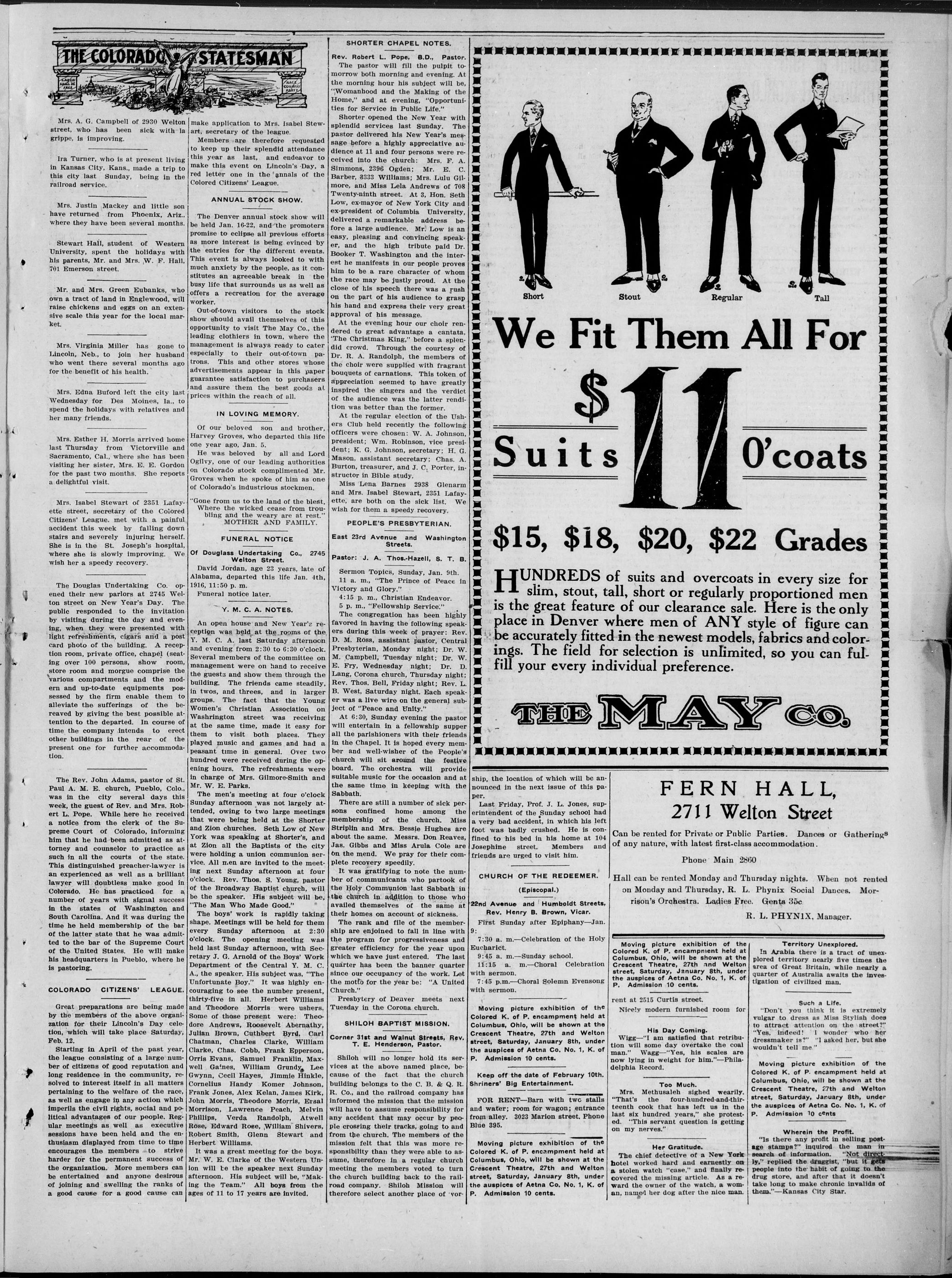
The Douglas Undertaking Co. opened their new parlors at 2745 Welton street on New Year's Day. The public responded to the invitation by visiting during the day and evening, when they were presented with light refreshments, cigars and a post card photo of the building. A reception room, private office, chapel (seating over 100 persons, show room, store room and morgue comprise the various compartments and the modern and up-to-date equipments possessed by the firm enable them to alleviate the sufferings of the bereaved by giving the best possible attention to the departed. In course of time the company intends to erect other buildings in the rear of the present one for further accommodation.
The Rev. John Adams, pastor of St. Paul A. M. E. church, Pueblo, Colo., was in the city several days this week, the guest of Rev. and Mrs. Robert L. Pope. While here he received a notice from the clerk of the Supreme Court of Colorado, informing him that he had been admitted as attorney and counselor to practice as such in all the courts of the state. This distinguished preacher-lawyer is an experienced as well as a brilliant lawyer will doubtless make good in Colorado. He has practiced for a number of years with signal success in the states of Washington and South Carolina. And it was during the time he held membership of the bar of the latter state that he was admitted to the bar of the Supreme Court of the United States. He will make his headquarters in Pueblo, where he is pastoring.
COLORADO CITIZENS' LEAGUE
Great preparations are being made by the members of the above organization for their Lincoln's Day celetion, which will take place Saturday, Feb. 12.
Starting in April of the past year, the league consisting of a large number of citizens of good reputation and long residence in the community, resolved to interest itself in all matters pertaining to the welfare of the race, as well as engage in any action which imperils the civil rights, social and political advantages of our people. Regular meetings as well as executive sessions have been held and the enthusiasm displayed from time to time encourages the members to strive harder for the permanent success of the organization. More members can be entertained and anyone desirous of joining and swelling the ranks of a good cause for a good cause can
make application to Mrs. Isabel Stewart, secretary of the league. Members are therefore requested to keep up their splendid attendance this year as last, and endeavor to make this event on Lincoln's Day, a red letter one in the 'annals of the Colored Citizens' League.
ANNUAL STOCK SHOW.
The Denver annual stock show will be held Jan. 16-22, and the promoters promise to eclipse all previous efforts as more interest is being evinced by the entries for the different events. This event is always looked to with much anxiety by the people, as it constitutes an agreeable break in the busy life that surrounds us as well as offers a recreation for the average worker.
Out-of-town visitors to the stock show should avail themselves of this opportunity to visit The May Co., the leading clothiers in town, where the management is always ready to cater especially to their out-of-town patrons. This and other stores whose advertisements appear in this paper guarantee satisfaction to purchasers and assure them the best goods at prices within the reach of all.
IN LOVING MEMORY.
Of our beloved son and brother, Harvey Groves, who departed this life one year ago, Jan. 5.
He was beloved by all and Lord Ogilvy, one of our leading authorities on Colorado stock complimented Mr. Groves when he spoke of him as one of Colorado's industrious stockmen.
"Gone from us to the land of the blest,
Where the wicked cease from troubling and the weary are at rest."
MOTHER AND FAMILY.
FUNERAL NOTICE
Of Douglass Undertaking Co., 2745 Welton Street.
David Jordan, age 23 years, late of Alabama, departed this life Jan. 4th, 1916, 11:50 p. m.
Funeral notice later.
Y. M. C. A. NOTES.
An open house and New Year's reception was held at the rooms of the Y. M. C. A. last Saturday afternoon and evening from 2:30 to 6:30 o'clock. Several members of the committee on management were on hand to receive the guests and show them through the building. The friends came steadily, in twos, and threes, and in larger groups. The fact that the Young Women's Christian Association on Washington street was receiving at the same time, made it easy for them to visit both places. They played music and games and had a peasant time in general. Over two hundred were received during the opening hours. The refreshments were in charge of Mrs. Gilmore-Smith and Mr. W. E. Parks.
The men's meeting at four o'clock Sunday afternoon was not largely attended, owing to two large meetings that were being held at the Shorter and Zion churches. Seth Low of New York was speaking at Shorter's, and at Zion all the Baptists of the city were holding a union communion service. All men are invited to the meeting next Sunday afternoon at four o'clock. Rev. Thos. S. Young, pastor of the Broadway Baptist church, will be the speaker. His subject will be, "The Man Who Made Good."
The boys' work is rapidly taking shape. Meetings will be held for them every Sunday afternoon at 2:30 o'clock. The opening meeting was held last Sunday afternoon, with Secretary J. G. Arnold of the Boys' Work Department of the Central Y. M. C. A., the speaker. His subject was, "The Unfortunate Boy." It was highly encouraging to see the number present, thirty-five in all. Herbert Williams and Theodore Morris were ushers. Some of those present were: Theodore Andrews, Roosevelt Abernathy, Julian Brown, Cuthbert Byrd, Carl Chatman, Charles Clarke, William Clarke, Chas, Cobb, Frank Epperson, Orris Evans, Samuel Franklin, Maxwell Gaines, William Grundy, Lee Gwynn, Cecil Hayes, Jimmie Hinkle, Cornellius Handy Komer Johnson, Frank Jones, Alex Kelan, James Kirk, John Morris, Theodore Morris, Ersal Morrison, Lawrence Peach, Melvin Phillips, Verda Randolph, Atwell Rose, Edward Rose, William Shivers, Robert Smith, Glenn Stewart and Herbert Williams.
It was a great meeting for the boys. Mr. W. E. Clarke of the Western Union will be the speaker next Sunday afternoon. His subject will be, "Making the Team." All boys from the ages of 11 to 17 years are invited.
SHORTER CHAPEL NOTES.
Rev. Robert L. Pope, B.D., Pastor.
The pastor will fill the pulpit tomorrow both morning and evening. At the morning hour his subject will be, "Womanhood and the Making of the Home," and at evening, "Opportunities for Service in Public Life."
Shorter opened the New Year with splendid services last Sunday. The pastor delivered his New Year's message before a highly appreciative audience at 11 and four persons were received into the church: Mrs. F. A. Simmons, 2396 Ogden; Mr. E. C. Barber, 3333 Williams; Mrs. Lulu Gilmore, and Miss Lela Andrews of 708 Twenty-ninth street. At 3, Hon. Seth Low, ex-mayor of New York City and ex-president of Columbia University, delivered a remarkable address before a large audience. Mr. Low is an easy, pleasing and convincing speaker, and the high tribute paid Dr. Booker T. Washington and the interest he manifests in our people proves him to be a rare character of whom the race may be justly proud. At the close of his speech there was a rush on the part of his audience to grasp his hand and express their very great approval of his message.
At the evening hour our choir rendered to great advantage a cantata, "The Christmas King," before a splendid crowd. Through the courtesy of Dr. R. A. Randolph, the members of the choir were supplied with fragrant bouquets of carnations. This token of appreciation seemed to have greatly inspired the singers and the verdict of the audience was the latter rendition was better than the former.
At the regular election of the Ushers Club held recently the following officers were chosen: W. A. Johnson, president; Wm. Robinson, vice president; K. G. Johnson, secretary; H. G. Mason, assistant secretary; Chas. A. Burton, treasurer, and J. C. Porter, instructor in Bible study.
Miss Lena Barnes 2938 Glenarm and Mrs. Isabel Stewart, 2351 Lafayette, are both on the sick list. We wish for them a speedy recovery.
PEOPLE'S PRESBYTERIAN
East 23rd Avenue and Washington Streets.
Pastor: J. A. Thos.-Hazell, S. T. B.
Sermon Topics, Sunday, Jan. 9th.
11 a. m., "The Prince of Peace in Victory and Glory."
4:15 p. m., Christian Endeavor.
5 p. m., "Fellowship Service."
The congregation has been highly favored in having the following speakers during this week of prayer: Rev. D. M. Ross, assistant pastor, Central Presbyterian, Monday night; Dr. W. M. Campbell, Tuesday night; Dr. W. E. Fry, Wednesday night; Dr. D. Lang, Corona church, Thursday night; Rev. Thos. Bell, Friday night; Rev. L. B. West, Saturday night. Each speaker was a live wire on the general subject of "Peace and Unity."
At 6:30, Sunday evening the pastor will entertain in a fellowship supper all the parishioners with their friends in the Chapel. It is hoped every member and well-wisher of the People's church will sit around the festive board. The orchestra will provide suitable music for the occasion and at the same time in keeping with the Sabbath.
There are still a number of sick persons confined home among the membership of the church. Miss Striplin and Mrs. Bessie Hughes are about the same. Messrs. Don Reaves, Jas. Gibbs and Miss Arula Cole are on the mend. We pray for their complete recovery speedily.
It was gratifying to note the number of communicants who partook of the Holy Communion last Sabbath in the church in addition to those who availed themselves of the same at their homes on account of sickness. The rank and file of the membership are enjoined to fall in line with the program for progressiveness and greater efficiency for the year upon which we have just entered. The last quarter has been the banner quarter since our occupancy of the work. Let the motto for the year be: "A United Church."
Presbytery of Denver meets next Tuesday in the Corona church.
SHILOH BAPTIST MISSION.
Corner 31st and Walnut Streets, Rev.
T. E. Henderson, Pastor.
Shiloh will no longer hold its services at the above named place, because of the fact that the church building belongs to the C. B. & Q. R. R. Co., and the railroad company has informed the mission that the mission will have to assume responsibility for any accident that may occur by people crossing their tracks, going to and from the church. The members of the mission felt that this was more responsibility than they were able to assume, therefore in a regular church meeting the members voted to turn the church building back to the railroad company. Shiloh Mission will therefore select another place of vor-
Short Stout Regular Tall
We Fit Them All For
$ Suits 11 0'coats
HUNDREDS of suits and overcoats in every size for slim, stout, tall, short or regularly proportioned men is the great feature of our clearance sale. Here is the only place in Denver where men of ANY style of figure can be accurately fitted in the newest models, fabrics and colorings. The field for selection is unlimited, so you can fulfill your every individual preference.
THE MAY CO.
ship, the location of which will be announced in the next issue of this paper. Last Friday, Prof. J. L. Jones, superintendent of the Sunday school had a very bad accident, in which his left foot was badly crushed. He is confined to his bed in his home at 104 Josephine street. Members and friends are urged to visit him.
CHURCH OF THE REDEEMER.
(Episcopal.)
22nd Avenue and Humboldt Streets,
Rev. Henry B. Brown, Vicar.
First Sunday after Epiphany—Jan.
9:
7:30 a. m.-Celebration of the Holy
Eucharist.
9:45 a. m.-Sunday school.
11:15 a. m.-Choral Celebration
with sermon.
7:45 p.m.-Choral Solemn Evensong
with sermon.
Moving picture exhibition of the
Colored K. of P. encampment held at
Columbus, Ohio, will be shown at the
Crescent Theatre, 27th and Welton
street, Saturday, January 8th, under
the auspices of Aetna Co. No. 1, K. of
P. Admission 10 cents.
Keep off the date of February 10th. Shriners' Big Entertainment.
FOR RENT—Barn with two stalls and water; room for wagon; entrance from alley. 3023 Marion street. Phone Blue 395.
Moving picture exhibition of the Colored K. of P. encampment held at Columbus, Ohio, will be shown at the Crescent Theatre, 27th and Welton street, Saturday, January 8th, under the auspices of Aetna Co. No. 1, K. of P. Admission 10 cents.
---
FERN HALL 2711 Welton Street
Can be rented for Private or Public Parties. Dances or Gathering of any nature, with latest first-class accommodation.
Hall can be rented Monday and Thursday nights. When not rented on Monday and Thursday, R. L. Phynix Social Dances. Morrison's Orchestra. Ladies Free. Gents 35c
Hall can be rented Monday and Thursday on Monday and Thursday, R. L. Prison's Orchestra. Ladies Free.
Moving picture exhibition of the Colored K. of P. encampment held at Columbus, Ohio, will be shown at the Crescent Theatre, 27th and Welton street, Saturday, January 8th, under the auspices of Aetna Co. No. 1, K. of P. Admission 10 cents.
rent at 2515 Curtis street.
Nice! modern furnished room for
His Day Coming.
Wigg-"I am satisfied that retribution will some day overtake the coal man." Wagg-"Yes, his scales are now lying in weight for him."—Philadelphia Record.
Too Much.
Mrs. Methusaleh sighed wearily. "That's the four-hundred-and-thirteenth cook that has left us in the last six hundred years," she protested. "This servant question is getting on my nerves."
Her Gratitude.
The chief detective of a New York hotel worked hard and earnestly on a stolen watch "case," and finally recovered the missing article. As a reward the owner of the watch, a woman, named her dog after the nice man.
R. L. PHYN1X. Manager.
Territory Unexplored.
In Arabia there is a tract of unexplored territory nearly five times the area of Great Britain, while nearly a quarter of Australia awaits the investigation of civilized man.
Such a Life.
"Don't you think it is extremely vulgar to dress as Miss Stylish does to attract attention on the street?" "Yes, indeed! I wonder who her dressmaker is?" "I asked her, but she wouldn't tell me."
Moving picture exhibition of the Colored K. of P. encampment held at Columbus, Ohio, will be shown at the Crescent Theatre, 27th and Welton street, Saturday, January 8th, under the auspices of Aetna Co. No. 1, K. of P. Admission 10 cents
Wherein the Profit.
"Is there any profit in selling postage stamps?" inquired the man in search of information. "Not directly," replied the draggist, "but it gets people into the habit of going to the drug store, and after that it doesn't take long to make chronic invalids of them."—Kansas City Star.
RECORD OF 1915 THROUGHOUT WORLD
Chronology of the Year, Giving the Most Important Events in All Countries.
PROGRESS OF THE GREAT WAR
Sinking of Lusitania and the Teutonic Drives Through Poland and Serbia, the Outstanding Features
—Prominent Persons Who Passed Away.
COMPILED BY E. W. PICKARD.
EUROPEAN WAR
Jan. 1.-British battleship Formidable
sunk by German submarine in the English
channel, with 579 of crew.
Jan. 5.-Russians annihilated Ninth
Turkish army corps and routed First and
Tenth corps in the Caucasus.
Russians forced Uzok pass in the Carpathians.
Jan. 10.-Lille evacuated by Germans and occupied by British.
Jan. 17.-Russians stormed southern Carpathian pass and entered Transylvania.
Jan. 19.-Six German Zeppelins raided the Norfolk coast, dropping bombs in Tarmouth, Sandringham, King's Lynn, Comer, Sherringham and Beeston, causing heavy damage and some loss of life. The German armored cruiser Blue Hunter sank at Usti nad Mara, plowed by Vice Admiral Beatty's squadron in running flight in North sea.
Feb. 1.—French torpedo bout sunk off Nieuport.
Feb. 2.—Anglo-French fleet destroyed four forts in the Dardanelles.
Feb. 4.—Germany declared waters around British isles a war zone.
Feb. 8.—Russians crossed River Rawka, penetrating German front west of Warsaw.
Feb. 9.—Germans violently bombarded Solosons, setting it afire.
Feb. 10.—Russians repulsed Austro-Germans in Carpathians but were driven back in Bukowina.
British held cargo of food ship Wilhelmina.
Feb. 11.—United States warned Germany against destroying American vessels or Rives of American citizens in attacking the dugger, and warned Great Britain of the danger American Interests in the use of American flag by British vessels.
Germans evacuated Lodz, but drove the Russians out of East Prussia.
Germany began blockade of England by sinking two vessels.
Feb. 23.-German blockaders sank American steamer Carb, Norwegian ship Regin, damaged British collier and three British merchant steamers. Refms bombarded by Germans, 20 civilians killed.
March 2.-Great Britain laid embargo against shipment of all commodities into Germany.
Hamburg-American officials indicted in New York by federal grand jury for conspiracy to defraud the United States.
March 5.-Austrians evacuated Czerno-
witz, Bukowina.
March 8—Zeppellin atrship L-8 destroyed near Tirlemont and 17 of crew killed.
March 10—American ship William P. Prinz bunk by German captain Prinz Eitel Friedrich. Prinz Eitel at Newport News with captain and crew of Frye.
Germans abanboned Augustowo, Poland.
German cruiser Dresden sunk off Falkland islands by British warships Glasgow and Kent and Japanese converted cruiser Orama.
March 18.—American sanitary commission organized for work in Serbia. British warships Intrepid and Ocean and French battleship Bouvet sunk by mines in the Dardanelles.
March 22.—Austrian fortress of Przemyzl surrendered to Russians. Turks massacred thousands of Christians at Urumiah, Persia.
March 23.—Germans in Ghent executed 77 Belgians as spies. Germans drove Russians out of East Prussia. Allies landed force on Gallipoll peninsula.
March 27.—Russians forced way through Carpathians into Hungary.
March 28.—Twenty-day battle in Champagne country won by French, Germans losing 50,000.
German submarine sank British steamers Agular and Falaba, about 140 lives being lost.
April 4.—Russians cleared Beskid range of Austrians.
Turkish cruiser Mejdjeld sunk by Russian mine.
April 8.-Germany agreed to pay for sinking American ship Willem P. Frye.
April 10.-Steamer Harpalyce, first relied ship of New York to Belgium, sunk in New York torpedo.
April 21.-United States replied to German government's criticism of its foreign policies, denying allegations and rejecting suggestions that exportation of arms be prohibited.
April 28.-French cruiser Leon Gambetta sunk by Austrian torpedo, 552 lives lost.
April 29.-German air raiders dropped secondary bombs on five English east coast towns.
Russians occupied Loubila, northeast of Uzsok pass.
May 1.-British torpedo boat destroyer and two German torpedo boats sunk in fight in North sea.
American tank steamer Gulflight torpedoed by Germans off Scilly islands, captain and two seamen lost.
May 6.-Austro-German forces occupied Tarnow.
May 7.-Cunard liner Lusitania torpedoed and sunk by Germans off coast of Ireland with loss of 1,256 lives, including 115 Americans; among the latter A. G. Vanderbilt, Elbert Hubbard, Chas. Frohman, Chas. Klein and Charles Plamondon.
May 8.-British destroyer Maori sunk by noise. Russian naval base of Libau captured by Germans.
May 11.-Cabinet decided U. S. should demand Germany make reparation for deaths of Americans resulting from submarine attacks and give guarantees and repetition of offense.
May 12.-Dutch battle led Gollath torpedoed in Dardanelles, 500 lost.
May 13.-President Wilson's note to Germany cabled.
May 17. Zeppelin attacked English
cars driven off and crippled
by airplanes.
May 22.-Russian battleship Pantelei
munk sunk in Black sea with 1,400 men.
May 23.-Italy declared war against
Austria-Hungary.
May 26.-American steamer Nebraskan,
from Liverpool) without cargo, struck and
crippled by torpedo off Irish coast.
Italy drowned the Trawler.
British auxiliary steamship Princess
Irene blown up in Sheerness harbor, 430
lives lost.
May 20.—German reply to Wilson note
received at Washington and declared
evasive.
May 31.—German Zeppelins made raid
on London.
June 3.—Przemysl recaptured by Germans
and Austrians.
June 11.-Italians took Gradisca and other important towns.
Zeppelin raided English northeast coast, killing 16 persons.
June 18.—Russians driven over Galician border.
Germany called 400,000 young trained men to the colors.
June 23.—Lemberg captured by Austro-Germans.
Germans. French took German work called the Layherian west of Lens. June 28 - 28 broke diplomatic relations with Turkey.
U. S. navy department seized German wireless plant at Sayville, L. L., for breaches of neutrality. July 8. -Germany's reply to American note on submarine warfare unyielding in most important particulars.
British liner Orduna, bringing Americans home from Europe, attacked by German submarine with torpedo and shells.
July 18.—Itallian cruiser Gluseppe Garlaldi sunk by Austrian submarine.
July 25. -American steamer Leelanaw sunk by German submarine; crew saved.
July 27. -Austrians made air raid on Verona.
July 20. -Austrians occupied Lublin.
July 21. -Leyland liner Iberian sunk by German torpedo boat; seven of crew killed.
Aug. 2. -Mitau, capital of Courland, taken by Germans.
Aug. 3. -Great Britain flatly rejected American contentions against blockade.
Aug. 5. -Warsaw occupied by the Germans.
Aug. 6. -Ivangorod taken by Austro-Germans.
Aug. 9. -British cruiser India and destroyer Lynx sunk.
Turkish battleship Kheyr-Ed-Dln Barbarossa sunk by submarine in Dardanelles.
Germans occupied Praga.
Zeppellins raided English east coast,
killing 15; one Zeppelin destroyed.
Aug. 10.-U. S. rejected Austro-Hungarian views on shipment of war supplies.
Aug. 11.-British submarines entered Black sea and torpedoed the Breslau and Goeben.
Aug. 14.-British troopship Royal Edward sunk by submarine in Aegean sea; 900 lost.
Aug. 17.-Germans took fortress of Kovno!
Zeppelins raided British east coast killing ten civilians.
Aug. 20 -German fleet engaged Russian fleet in Gulf of Riga, each side losing seven Germans took Russian fortress of Novo-georgievsk
British seaplane sank loaded Turkish troopship in Sea of Marmora.
Aug. 25.—Germans took Bialystok and Brest-Litovsk.
Aug. 26.—Germans captured Russian fortress of Olita.
Germany declared the sinking of the Arabic, if done by German submarine, which violently condemned by the German government and full repatriation would be made.
Sept. 2.—Germany offered to submit Lusitania and Arabic compensation claims to the Hague tribunal.
Russians evacuated Grodno.
Papers from Bamberg and Bernstoff taken by British from J. F. J. Archibald.
Sept. 4.—Allan liner Hesperian torpedoed off Fastnet: 26 lost.
Sept. 9.—President Wilson demanded recall of Austrian Ambassador Dumba.
Germany declared it would pay no indemnity for Arabic deaths.
Zeppelin raided London, killing 20 and injuring 86.
Anglo-French financial commission arrived in America to arrange for loan of $300,000,000 to allies.
Sept. 15. —Russians checked Von Hindenburg's drive toward Riga and drove Austrians further back in Galicia.
Sept. 22.—French aviators dropped 100 bombs on royal palace at Stuttgart and elsewhere in Wurtemberg. Germans captured Ostrow, but bulk of Russian army in Vilna salient escaped. Sept. 23.—Germany promised American ships carrying conditional contraband would not be bunk by submarines, and made other concessions. Sept. 25.—Allies on western front began tremeidous general attack on Germans. Sept. 28.—American loan to allies, half a billion dollars at 5 per cent, announced. Italian battleship Benedetto Brin destroyed by interior explosion; 46 lost. Austria-Hungary recalled Ambassador Dumba.
Sept 29.-Great battle in west without definite result.
Oct. 5.-Venizelos, Greek premier, resigned because the king opposed his program of alding the allies.
Germany, through Ambassador von Bernstorf, disavowed the act of the submarine commander in sinking the Arabic and offered indemnity for two American lives lost; President Wilson accepted offer.
Oct. 7.-Four hundred thousand Austro-Germans began invasion of Serbia, crossing the Drina, Danube and Save rivers at many points
New Greek cabinet headed by Alexander Zaimis appointed.
Oct. 8.-Serbia declared war on Bulgaria.
Greek cabinet decided on policy of "benevolent neutrality" toward allies.
Oct. 9.-Flerce battle between Serbians and Austro-Germians along Drina river.
Belgrain captured by the Germans.
Oct. 10.-Six German naval officers interned at Nortfolk, Va., disappeared.
Oct. 12.-Bulgaria began invasion of Serbia.
Fortress of Semendria taken by the Germans.
Germans executed Edith Cavell, British nurse, in Brussels, Oct. 13.—Zeppellins bombarded London, killing persons. Bulgaria declared war on Serbia. Oct. 15.—Great Britian declared war on Bulgaria.
Oct. 22.-German drive on Riga was halted.
Germans defeated in bloody fight on
Tahure hill, France.
transport Carmen in Sea of Mars
prove back Russians north-
west of Palmyra
Oct. 28—French cabinet resigned and Briand became premier.
Nov. 4—Zaimils cabinet defeated in Greek chamber of deputies and resigned.
Nov. 5—Bulgarians defeated French near Prillip but were beaten at Babuna pass.
German cruiser Undine sunk by British submarine.
Nov. 6—Bulgarians captured Nish, owing through rail route for Teutons to Turkey.
King of Greece called M. Skouloudis to form new neutrality cabinet.
Nov. 9—Italian liner Ancona sunk by Austrian submarine in Mediterranean; 200 lost, including some Americans.
ish cabinet to join the army in France.
Nov. 13.-Bulgarians and Germans drove Serbians out of Morava valley.
Nov. 14.-Austrian aeroplanes raided Verona, killing thirty.
Nov. 16.-U. S. called on Austria-Hungary to explain sinking of the Ancona.
Nov. 17.-Bulgarians outflanked Serbians in Babuna pass and French along Cerna river.
Goritz, under terrific bombardment, in flames in many places. Nov 20 - Germans occupied Novibazar. Nov 21 - Russian forces by Russian destroyers near Libau: 180 lost.
British advance on Bagdad repulsed by Turks. Nov. 27.-Serbian government and the diplomatic corps arrived at Scutari. Canadian armies occupied all high grade wheat in elevators from Fort William to Atlantic coast.
Managing Director Buenz and three other officials of Hamburg-American line in New York convicted of conspiracy to deceive an defraud U. S. Dec. 4. Captain Anton asked Germany to recall Captain Boy-Ed, naval attack, and Captain von Papen, military attack of German embassy at Washington.
Foreign Minister Sonnino declared Italy would fight the war to the finish.
Dec. 4.—Unnamed American ship in Mediterranean sent wireless call saying it was attacked by submarine.
Roumania commandered all foreign shipping in its harbors.
Henry Ford's peace crusaders sailed from New York.
Buenz, Koetter and Hoethmeister, Hamburg-American line officials, sentenced to 18 months' imprisonment; Poppinghause to one year.
Dec. 6.—Pope Benedict issued appeal for just and lasting peace.
Roumania submarine sank Turkish destroyer and five other Vessels in Sea of Marmora.
Roumania closed Danube to navigation.
Dec. 8.—U. S. asked Austria to disavow an in the Ancona, punish the submarine commander and pay for deaths of Americans.
Dec. 9.-Allies driven from Serbia into Greece.
Dec. 10.-Kaiser recalled Boy-Ed and Von Papen.
Dec. 14.-U. S. demanded France release six Germans taken from American vowels.
Dec. 16.-Gen. Sir Douglas Haig succeeded Field Marshal French as British commander in France and Flanders.
Austria unsatisfactory reply to note. Ancona.
Dec. 17.-Four Germans arrested in New York and Jersey City on charge of plotting to tow up cellard canal.
Dec. 18.-U. S. reply to Austrian note delivered at Vienna.
Dec. 22.-Artillery duel on western front.
Dec. 24.-Indecisive action in Gallipoli.
Dec. 27.-Avid aviators raided German posts in France.
DOMESTIC
Jan. 1—San Diego exposition opened.
Jan. 14—Alabama legislature passed bill making the state dry after June 30.
Jan. 25—President Wilson inaugurated first transcontinental telephone system by speaking directly to President Moore of the Panama-Pacific exposition in San Francisco.
Feb. 20—Panama-Pacific fair opened at San Francisco.
March 5—North Dakota legislature passed measure abolishing capital punishment.
March 11—Rear Admirals Fletcher, Howard and Cowles appointed admirals under new law.
March 12—Harry K. Thaw found not guilty of conspiracy.
U. S. Supreme court refused final appeal of M. S. Mayer's murder of Mary Phagan at Atlanta, Ga.
May 22.-Roosevelt given verdict in Barnes libel suit.
June 21.-Governor Slaton of Georgia commuted Leo Frank's sentence to life imprisonment and martial law was proclaimed around governor's home to protect him.
July 2.-Bomb explosion wrecked reception room on east side of capitol in Washington.
July 3.—J. P. Morgan shot twice oy Frank Holt, who placed bomb in capitol at Washington.
July 6.—Twenty-nine killed and 1,110 injured in independence day celebrations.
July 7.—J. P. Morgan, committed suicide in cell.
World's Christian Endeavow convention opened in Chicago.
July 10.—Robbers held up L. &. N. train in Albama and got nearly $500,000.
July 12.—Thomas A. Edison made head of order of civilian inventors to advise navy department.
July 14.—Harry K. Thaw declared sane by jury.
Aug. 7. - Joe Cooper and Morris Keller killed in auto race at Des Moines.
Slide in Culebra cut blocked Panama canal.
Aug. 10. - Business men training camp at Dettlesburg, N. F., opened.
Aug. 16. - Ike Hampton from Georgia prison farm by mob and hanged.
Aug. 29. - Powder mills in Delaware and Massachusetts mysteriously blown up.
Sept. 20. - Citizens' training camp at Fort Sheridan, Illinis, opened.
Sept. 27. - G. A. R. national encampment opened in Washington.
Sept. 20. - Wired one message sent from Washington to Hawaii.
Oct. 1. - Six midshipmen dismissed and others punished at Annapolis for hazing.
Capt. E. R. Monfort, Cincinnati, elected commander in chief of G. A. R.
Oct. 4. - Mayor Thompson of Chicago ordered Sunday liquor selling stopped.
Oct. 6. - President Wilson announced his engagement to Mrs. Norman Galt of Washington.
Dec. 4. - Panama-Pacific exposition closed.
Dec. 28.-American Civic association met in Washington. Convention of American Association for Labor Legislation opened in Washington.
FOREIGN
Jan. 1.-Revolutionists in Paraguay seized President Sherer.
Feb. 11.-Father Wladimir Ledochowski a Russian Pole, was elected general of the Society of Jesus.
Feb. 12.-President Davillmar of Haiti fled the country.
Danish diet granted suffrage to women.
May 8.—China yielded to Japan's demands.
May 27.—Manuel de Arriaga, president of Portugal, resigned.
June 1.—The parliament adopted new constitution giving franchise to woman.
July 27.—Revolutionists in Haiti killed President Gulliaume, and proclaimed Dr. Rossalvo Bobro president.
July 28.—United States marines and blue-jackets landed at Port Au Prince, Haiti, and took charge.
Aug. 12.—Vesuvius, Etna and Stromboli in Gen Dartinguane elected president of Haiti by national assembly.
Sept. 17.—Word received from Vilhjalmar Stefansson, arctic explorer, who had been missing for year and a half.
Nov. 10. — Emperor Yoshihito formally mounted the throne of Japan.
Dec. 3. — Epidemle of typhus in Mexico City reported.
Dec. 6. — Chinese rebels seized cruiser Chao-Ho at Shanghai and fought two other warships.
Dec 6.—Pope held consistory and appointed the bishop. Revolt at Shanghai suppressed. Dec 11.—Yan Shi-Kai accepted the thirteenth Belgian munitions plant at Havew blew up; thousand killed and hurt. Copt elected president of Syks republic.
DISASTERS
Jan. 13.—Thirty-eight thousand persons killed, 50,000 injured and many towns destroyed by earthquake in central Italy. Feb. 10.—Manua islands in American Samoa devastated by hurricane. March 2. Explosion of gas, followed by fire, in Laland mines of New River & Pocahontas Coal Co. of Hinton, W. Va., entombed about 170 men.
April 13.—Coal mine accident in Japan fatal to 236.
June 22.-Earthquakes in Imperial Valley, California, killed a number of persons and seriously damaged many towns.
July 24.-Steamer Eastland upset in Chicago river, 812 persons losing their lives.
July 29.-Typhoon at Shanghai killed 500 and loss was $5,000,000.
Aug. 3.-Erie, Pa., inundated by cloudburst, 27 lives lost and vast property damage.
Aug. 16.-Hurricane swept lower part of Texas, 260 dend and $18,000,000 property loss.
Sept. 27.-Explosion of car of gasoline wrecked Ardmore, Okla., killing 50.
Sept. 29.-Destructive gulf storm hit New Orleans and vicinity; 300 or more lives lost.
Nov. 2.-Steamer Santa Clara lost near Astoria, Ore.; fifteen lost.
Nov. 10.-Gun plant of Bethlehem Steel company burned; loss $3,000,000.
Nov. 11.-Million dollar fire in war material plant of Roebling Sons company at Trenton.
Nov. 29.-Fire destroyed much of Avalon, Catalina island.
Explosion at Du Pont Powder company plant at Wilmington, Del., killed $1.
Dec. 9.-Hopewell, Va., Du Pont powder town, burned.
POLITICAL
Jan. 2.—Senate passed immigration bill with literacy test.
Jan. 6.—President Wilson declined for sixth time to support federal constitutional amendment for woman suffrage.
Jan. 12.—House of representatives by vote of 204 to 174 rejected Mondell resolution proposing enfranchisement of women.
Eighty Terre Haute men pleaded guilty to indictments charging conspiracy to corrupt the election of November 3, 1914.
Jan. 28.—President Wilson vetoed the immigration bill because of the literacy test clause.
Feb. 5.—House passed naval appropriation bill with provision for two battleships.
Feb. 22.—President Wilson nominated as members of interstate trade commission Joseph E. Dacies of Wisconsin, V. N. Hurley of Illinois, William J. Harris of Georgia, William H. Parry of Washington, and George Rubilee of New Hampshire.
Feb. 23.—Senate passed army appropriation bill of $103,000,000 and house appropriated $6,000,000 for fortifications.
March 3.—Senate passed general deficiency appropriation bill carrying $3,092,-
S72, and confirmed trade commission appointees except George Rublee.
Robert W. Woolley nominated as director of mint.
March 4.-Sixty-third congress adjourned.
March 15.-Samuel L. Rogers of North Carolina succeeded William J. Harris as chairman.
Mayor Roberts of Terre Haute, Ind. and 26 others found guilty of conspiracy in election.
June 8.-Secretary of State Bryan, disqualified, has no note to Germany, resigned.
June 21.-Supreme court annuled "grandfather clause" aimed at negro suffrage.
June 22.-One hundred twenty-eight Indianapolis city officials and politicians, including Thomas Taggart, indicted for election and conspiracy.
June 23.-Robert Lansing made secretary of state.
Oct. 19.-Woman suffrage defeated in New Jersey.
Nov. 2.-Suffrage defeated in New York, Massachusetts and Pennsylvania; Republicans carried Massachusetts, electing S. W. McCall governor; new constitution rejected by New York; prohibition defeated in Ohio; A. O. Stanley, Dem., elected governor of Kentucky, and E. C. Harrington, Dem., of Maryland.
Dec. 6.-Sixty-fourth congress assembled; Clark re-elected speaker of house.
7.-Democratic national committee selected Louis for convention of June 14. 1916.
Dec. 17.-Henry P. Fletcher nominated ambassador to Mexico.
FINANCIAL
Jan. 16.—President Wilson ordered federal inquiry into high price of wheat.
March 9.—Goulds lost control of Missouri Pacific-Iron Mountain system.
March 13.—Dayton Cash Register case. Lower court reversed and remanded for new appeal by U. S. circuit court of appeals at Cincinnati.
March 16.—Trade commission organized at Washington, Joseph R. Davies, Wisconsin, chairman.
March 16.—Charles C. McChord elected chairman interstate commerce commission vice James S. Harlan. Chairman company put in receiver's hands.
April 9.—J. B. Greenhut company, New York department store, failed for $120,000,000.
April 21.—Recruited appointed for Rock Island railroad company.
May 15.—Interstate commerce commission railroads owning and operating steamship lines on great lakes must give them up.
May 24.—Pan American financial conference opened in Washington.
Aug. 12. Interstate commerce commission ordered big reductions in freight rates on anthracite coal.
Aug. 17. Interstate commerce commission ordered Red Pieds production a city of plundering Rock Island road and throwing it into a receivership for its own purpose.
Aug. 24. Eastman Kodak company declared a monopoly in restraint of trade by federal court at Buffalo, N. Y.
NECROLOGY
Jan. 2.—Karl Goldmark, famous composer, in Vienna.
Feb. 5. -Edward Tilden, Chicago packer.
Feb. 12. -James Creelman, war correspondent, in Berlin.
Ferry Crosby, famous blind hymn writer, in Bridgeport. Conn.
Feb. 16. -Emil Charles Waldeufel, French composer, at Paris.
Feb. 18. -Frank James, once notorious bandit, at Excelsior Springs, Mo.
March 21. -Mrs. John D. Rockefeller, Sr. at Pocantico Hills, N. Y.
Count Sergius Julovich Witte, in Petrograd.
March 14. -Aviator Lincoln Beachey dropped 3,000 feet to death at San Francisco.
March 15. -Walter Crane, artist, lecturer, writer, in London, aged seventy.
Capt. Henry King, editor St. Louis Globe-Democrat.
March 31.-Baron Nathan Mayer Rothschild, in London.
April 6.-Lyman B. Glover, theatrical manager, at Chicago.
Curtis Guild, Jr., former governor of Massachusetts, at Boston.
April 7.-F. Hopkinson Smith, engineer, artist and author, in New York.
April 13.-William R. Nelson, editor Kansas City Star, at Kansas City.
April 16.-Former United States Senator Nelson W. Aldrich of Rhode Island.
April 18.-Baron Herbert de Reuter, managing director of Reuter's Telegram company, committed suicide in England.
May 2.-Ex-Congressman Charles E. Lit-
July 2—Gen. Porfirio Diaz, former president of Mexico, in Paris.
July 10—Archbishop James E. Quigley of Chicago, at Buffalo.
July 12—Col. A. J. Blethen, publisher Seattle Times.
July 17. -Sarah Cowell Le Moyne, noted actress.
Aug. 4.-Maarten Maartens, novelist, in Zeist, Holland.
Aug. 6.-Gen. B. F. Tracy, former secretary of navy, at New York.
Aug. 9.-George Fitch, editor and humorist. at Berkeley, Cal.
Aug. 17.—Brig. Gen. John C. Black, Civil war veteran, former congressman at large from Illinois and former president of U. S. civil service commission, at Chicago.
Aug. 19.—Cardinal Serafino Vannutell, dean of the sacred college, at Rome.
Aug. 20.—John E. Franklin, discoverer of salvarsan, at Bad Homburg
Dr. C. J. Finlay, who discovered yellow fever was transmitted by mosquitoes, at Havana, Cuba.
Aug. 28.—John D. Long, former secretary of the navy, at Hingham, Mass.
Sept. 9.—Albert G. Spalding in San Diego, Cal.
Sept. 11.—Sir William C. Van Horne, former president Canadian Pacific railroad.
Sept. 26.-J. Keir Hardie, British labor leader, at Glasgow.
Oct. 16.-Sir Lionel Carden, British diplo-
cat in London.
Oct. 25.—Paul Hervieu, French dramatic author.
Oct. 30.—Sir Charles Tupper, Canadian statesman, at Bexley Heath, England.
Oct. 31.—Blanche Walsh, actress, at Cleveland.
Nov. 4.—E. W. Pertorius, publisher of St. Louis Times, committed suicide.
Herman Ridder, publisher New York Staats Zeitung, at New York.
Lewis Waller, noted actor, in London.
Nov. 6.—P. A. B. Widener, Philadelphia financier.
Nov. 9.—E. S. Willard, noted actor, in London.
Nov. 14.—Booker T. Washington, noted educator, at Tuskegee, Ala.
Nov. 16.—Former Senator Julius C. Burrows at Kalamazoo, Mich.
Dec. 4.—August Pitou, actor and playwright, at Hobesound, Fla.
Dec. 5.—Gen. Jesus Rabi, hero of Cuban war, Santiago.
Edward Smith, president American shipbuilding company, at Buffalo.
Dec. 9.—Stephen Phillips, English poet.
Dec. 10.—Col. C. S. Bromwell, head of army engineer corps in Hawaii, committed suicide.
Abraham Gruber, prominent New York politician.
Dec. 12.—Former U. S. Senator F. M. Cockrell at Washington.
Earl of Glassgow at Fairline, Scotland,
former lord, chief justice, of Great Britain.
March 8.—Chicago building contractors locked out 900 union lathers. April 15.—Great building strike declared in Chicago.
April 30.-Federal board of arbitration awarded slight wage increase to enginemen of 98 western railroads.
Bridge and structural iron workers of Chicago struck.
June 13.-Great street car strike in Chicago.
June 16.-Chicago street car strike ended by arbitration agreement.
July 10.—Chicago's building trade strike and lockout settled.
July 16.—Employees of Chicago surface lines won big victory in arbitration award.
July 20.—Strike and violating at Bayonne plant of Standard Oil Co.
July 27.—Standard Oil strike at Bayonne, N. J., ended.
Sept. 27.—Twenty-five thousand Chicago garment makers called out on strike.
Dec. 3.—Fifty-four Chicago labor leaders indicted for conspiracy, extortion and malicious mischief.
MEXICO
Jan. 6.—Carranza forces under Obregon stormed and captured Puebla, and took Gen. Angeles prisoner.
Jan. 27.—Provisional President Garza and his government fled from Mexico City to Cuernavaca.
Jan. 28.—Carranza forces under General Obregon occupied Mexico City.
John Guantanamo 10 Vera Clitz.
March 12.-Carranza evacuated Mexico
city, and Apatina entered. John B. McManus, American, killed by Zapatistas while, American flag floated over his house.
April 12.-Villa forces defeated near Jarita, losing 500 killed.
Victoriano Huerta landed at New York.
June 6.-Carranza armles led by Obregon defeated Villa and took Leon after battle lasting five days.
June 27.-Victoriano Huerta arrested in New Mexico on charge of inciting another Mexican revolution.
Aug. 8. -Six Mexican bandits killed and three Americans wounded in battle at Norlans ranch, north of Brownsville, Tex.
Aug. 9. -Armed Mexicans crossed Rio Grande into Mexican Tex., and attacked outpost of American cavalrymen, killing Corporal Wilman.
Aug. 19. -Villa accepted Pan-America proposition for peace conference.
Sept. 17. -Eleighteen Mexicans shot in two fights between U. S. regulars and Carranza soldiers.
Oct. 9. -Recognition of Carranza recommended by Secretary Lansing and Latin-American diplomats.
Carranza formally recognized as president of Mexico by United States, and six Latin-American governments.
Nov. 3.—Villa's army withdrew from siege of Agua Prieta.
Dec. 18.—Villa gave up fight against Carranza.
SPORTING
Jan. 5.—Federal league filed suit against National and American leagues, charging violation of Sherman antitrust act.
Jan. 28.—American association was made a major baseball league.
May 31. -Ralph De Palma won 500-mile auto race at Indianapolis, breaking all records.
July 5. -Wisconsin university won conference athletic meet.
June 19. -Jerome Travers won national amateur golf championship.
June 29. -Yale beat Harvard in regatta at New London.
June 26. -Dario Resta, driving Peugeot car, won 500-mile race at Chicago, averaging 97.5 miles an hour.
June 28. -Cornell won intercollegiate regatta at Poughkeepsie.
July 17. -Olympic cup won by Chicago golf team at Cleveland.
July 24. -Charles Evans, Jr., of Chicago won western amateur golf championship.
Aug. 19. -Tom McNamara, Boston, won western open golf championship at Chicago.
Aug. 20. -Louis B. Clarke won Grand American trapshooting handicap at Chicago.
4. Robert Gardner of Chicago won American amateur golf championship.
Sept. 7.—W. M. Johnston of California won national tennis championship.
Sept. 11.—Packy McFarland defeated Mike Gibbons in an round bout at New York.
Mrs. C. H. Vanderbeck of Philadelphia won women's national amateur golf championship at Chicago.
Oct. 9.—Gil Anderson in a Stutz won Astor cup race at Sheepshead Bay speedway, averaging 102.5 miles an hour for 350 miles.
Oct. 13.—Boston American league team won world championship from Philadelphia National league team.
Dec. 13.—Baseball war ended, Federal league quitting.
THE GARDEN
Ferns Make Attractive Winter Decorations.
BEST WAY TO WINTER GERANIUMS
The question is asked, "How can geraniums be wintered in the cellar?" in two ways: First, in pots. Second, by hanging them up by the heels, so to speak.
Neither way is absolutely sure to bring them through in good condition. But either way may prove successful, therefore it is advisable to try both if one has fine varieties he would like to save for next summer. If one fails the other may prove successful.
To winter them in pots the plants should be crowded into as small pots as will contain them, and then the tops should be cut away so that all that remains of the summer's growth is a few stubs at the base of the plant.
Do not try to encourage any growth after potting. Set them away in a cool but frost-proof place and keep them there as long as it is safe to do so. Then put them in a cool cellar.
The soil in the pots should be quite dry when they go into cold storage, and it should be kept in that condition, as nearly as possible, all through the winter. Not really dry, of course, but with only a hint of moisture in it—so little, indeed, that it would seem dry when compared with ordinary soils.
The aim is to keep the plants as nearly dormant as possible, and this cannot be done if they are moist at the roots. Heat also encourages growth, and the absence of it has a tendency to keep the plants at a standstill.
Treated as advised above, it is possible to bring geraniums through the winter in such a condition that they begin to grow as soon as brought to the light and warmth of the sitting-room after being watered.
The necessary conditions, you will observe, are dryness of soil and a low temperature.
It is less work to make the plants free from the soil they have grown in during the summer and simply hang up the mass of roots in the cellar. This should not be done immediately after lifting the plants, however.
This method makes it necessary for us to leave them in the ground as long as possible, well up to cold weather, in fact, for if they were to go into the cellar while the temperature was high, growth would be almost sure to begin.
Therefore the plants must be left in the ground and protected from frost until about the first of November, if possible. Then lift them on a warm frost from penetrating the soil, where the bulbs are, but it will prevent the sun from thawing it out. In other words, the soil once frozen will remain in that condition.
It is the alternation of freezing and thawing which does the damage, not the freezing, as many persons think. Alternations of these conditions rupture the tissues of the plants.
Let the ground become frozen, and stay so, and the bulbs will not be in jured by heaving of the soil. If they freeze and thaw and freeze and thaw again, and this process is kept up, as it is likely to be in an unprotected bed, they are torn loose from their tender roots and great harm is done. Leaves, if you can get enough of them, make an excellent covering for the bulbs.
SOME HARDY EVERGREENS
In winter evergreen trees and shrubs give warmth, and color, to the garden, which cannot be obtained in any other way. Some criticize the growing of laurels, but they grow rapidly, and soon
n Winter Evergreens Give Warmth to the Home Grounds.
day and spread the roots out in the sunshine, after first cutting away all the top.
Cover well at night and expose them next day if the weather is favorable. Do not put them in the cellar until all the soil adhering to the roots has become so dry it can easily be shaken off.
Then tie a string to each plant and suspend it about midway between floor and ceiling. Do not place them on the floor, for there it is likely to be too damp, nor close to the ceiling, for there it is likely to be too dry.
While the geranium does not have a tuberous root, like the dahlia, it has a fleshy root which enables it to store up enough moisture to supply its needs for a long period.
If one has a room in the house where plants can be kept safely I would advise taking cuttings from each choice variety early in the fall. Root these in sand and put them into small pots as soon as the cuttings begin to grow.
This gives you a third method of keeping desirable plants over winter and will generally prove successful when the other two fail.
Those who live in the vicinity of a greenhouse can get their plants stored there at little expense and I would advise this whenever possible.
But, lacking this facility, don't fall to try the methods recommended above if you have choice varieties that you do not feel sure of being able to duplicate next season. When one gets a fine variety it's worth while to hang on to it.
PROTECTING BULBS
The bulb bed ought to be covered with six or eight inches of coarse manure or hay. This will not keep the frost from penetrating the soil, where the bulbs are, but it will prevent the sun from thawing it out. In other words, the soil once frozen will remain in that condition.
It is the alternation of freezing and thawing which does the damage, not the freezing, as many persons think. Alternations of these conditions rupture the tissues of the plants.
Let the ground become frozen, and stay so, and the bulbs will not be injured by heaving of the soil. If they freeze and thaw and freeze and thaw again, and this process is kept up, as it is likely to be in an unprotected bed, they are torn loose from their tender roots and great harm is done. Leaves, if you can get enough of them, make an excellent covering for the bulbs.
create shelter and warmth, and the dark-green foliage tends to make a place cheerful.
The best laurels are Rotundifolius (round leaved) and Latifolia.
These are hardier than the common laurel, which suffers in very extreme climates.
GETTING A START
By
NATHANIEL C. FOWLER, Jr.
The mountain top is small. There is hardly room enough there for the few who reach its height; and, unless those who do keep a firm foothold, they may be pushed off and dashed to pieces.
The way to the mountain top is steep and rugged, the rocks are slippery, and the path is full of landslides.
The valley is broad and fertile, and there is room enough there for planting and for harvesting.
The ordinary man can earn his living in the valley; the extraordinary man may be able to attach himself to the mountain top.
I am not asking you, young man, not to travel, upward, nor am I suggesting that you forever remain on the plains; but I am attempting to picture the dangers of steep climbing, and the liability of not being able to find a foothold at the top.
Better, far better, be a good tiller of the soil down in the green valley than starve among the mountain's rocks. In these days of strenuous business, of liberal education, and of opportunity, the old adage that "there is always room at the top" is not as true as it used to be, for, even though there may be room at the very top, one must take fearful changes in climbing, and he will meet strenuous men en route, ready and anxious to win, not only by advancing themselves, but by pushing others down. The tendency to go beyond one's ability, to occupy positions unnatural and difficult to hold, is responsible for many a failure, and has ruined many men who would have been successful had they been contented and industrious, with good prospect of prosperity.
Ambition should be made of sterner stuff than that which drives a man out of himself into unknown regions, or into places too high for him to gain a foothold, a footing which, even if he does gain it, he may be unable to keep.
It is your duty to do your best, to make the most of yourself, to encourage rather than to cramp ambition, to use common sense in the making of yourself, that brand of good sense which does not allow you to stay below your level and which will prevent you from striving to go beyond it.
Thousands of men move from where they are, dissatisfied and disgruntled, and enter new and unknown fields, when, if they had remained at home, making the best of their opportunities, they would have been worth more to themselves and to the world.
Where you are, unless it is below the surface, may be the best place in which for you to work and to stay. Certainly, you should not allow yourself to leave your base of operations until you are sure that where you are is not the place for you to be in, and until you know of a location within the probable scope of your capacity. Beware of the top, unless there is a safe road leading to it.
Fighters Who Never See a Battle.
During a sea fight the engine-room men tend the great engines of a battle ship with all the care that they would bestow upon the same delicate yet mighty mechanism in time of peace, roaming listlessly, yet with a definite purpose, around the engine room with oil cans in hand, bestowing drops of lubricant here and there as required. Theirs and the stokers' is almost—not quite—the hardest part of the whole grim drama of a naval battle, for they are absolutely cut off from the fight, and are only cognizant of it by the quivering of their ship as the great turrets over their heads fire, or as the enemy's shells thud against the armor, or when some stray shot finds its way through the stell wall and the bunkers to the boilers. Such an event blends a whole stakehold in one frenzied orgy of death—death by exploding shell and scattering fragments of steel; death by awful wounds from flying, burning coals, or death by scalding, hissing, blinding steam as the water tubes burst all around them.
Boy Critics.
For many years the boys of Trinity college, Dublin, made and unmade the reputation of operatic stars. They always sat in the highest gallery, and were recognized as the real critics of an opera. "I remember," says Barton McGuckin, the well-known English tenor, "there was a fellow. Thomasi or some such name, whose career was blasted by a witty gallery boy, Thomasi was anything but graceful. He had but one gesture, which consisted in bringing first one, then the other hand to his heart and letting it fly back straight before him. It was very much like the sort of motion a man would make in deep water. He sang an italic love song, working his arms as described. When he finished a voice from the gallery broke the silence: "Ah, Misther Toomasi, you ain't nooch of a singer, but I'll wager ye'd make a foine swimmer." The audience screamed with delight. Thomasi had to leave the stage.
Do You Know That-
SOCIETY.
"I am not in society this winter," says a young society woman. "I am too busy to go into society," remarks a young man.
What is "society" anyway, the society about which the foregoing was spoken? Really, I don't know, and the three big dictionaryes refuse to enlighten me. At a guess, I should say that probably the young people quoted refer to the collection of persons they meet when they go out, when they are away from home, at balls, parties, and other invitation functions, and not necessarily to the individuals whom they visit. Perhaps they are unfortunate enough to belong to some alleged exclusive form or society, or to some clique or collection of conceived people, who, because they don't know where they stand, assume to stand for something about which they know nothing.
IS PREPARED TO DO ALL KINDS OF
Thousands, yes, hundreds of thousands, of young people have injured their presents and discounted their futures by going into what they call "society." Yes, many men and women have sacrificed their souls upon the altar of "society."
Young people should have friends, they should not be bookworms or room hermits. They should intermingle, they should exchange experiences, play games of conversation, and other games; but all this does not mean "going into society," for "society" is commonly understood as simply another word for excess, with or without the wincup.
It is a significant fact that our great merchant princes, our men of prodigious intellect, our famous discoverers and scientists, our men of mark in every walk of life, care more for sociability than for society, and not one in a hundred of them is in "society." They live natural lives, make friends among their kind, and enjoy social intercourse. They don't "care a fig" whether Mrs. Tone invites them to her most exclusive ball, or whether Mr. Highbrow includes them in his list of dinner guests.
Ball and Concert Programs, Bill and Letter Heads, Calling Cards, Wedding Cards, Envelopes and Everything in the Printing Line Turned Out in the Neatest and Best Style Promptly on Short Notice.
Many men of wealth, and more men who haven't any, sacrifice the vitality of life to get into "society," and when they get in they spend half of their time keeping in. When they become old enough to know better, they go out into Nature's out-of-doors, breathe the fresh air, and mentally, and sometimes physically, kick themselves for the folly of their silly ambition.
Don't worry about finding your "society" level. Your level will come to you, and any level you try to reach, which is either above or below your proper sphere, is disastrous.
We Have Supplied Our Office with New Job Press & Type of Up-to-Date Style and Our Work Will Be on a Par with the Very Best.
Bear in mind, young man and young woman, that mere money, the ability to dance the tango, and the capacity for small talk, are not keys which will unlock the door of good society.
"Society," as it runs, starts from nowhere and ends in the Land of Nothing.
Good Manager.
A bare-headed woman with a faded and ragged dress solicited alms the other evening of a gentleman who was crossing the City park. He came to a halt and asked:
"Is it for drink?"
"No, sir; it's for food."
"But I don't know how you live. I have to practice economy in order to have money in my pocket. You may be extravagant, for all I know. How much money have you spent today?" "Well, sir, I've spent seven cents—that will run five of us on cold potatoes so far; and if I can get three more we'll top off with bread and water before going to bed. Might leave out the bread if I can find a bit of tar to thicken the water and deceive the children. Can you draw it any finer than that, sir?"
Prices as Reasonable as Those of Any Job Office in Denver
The man held out a dime as he passed.
Hannah Shell, "Female Soldier."
Hannah Snell was born at Worcester, England, on April 23, 1727, the daughter of a hosier. In order to seek her husband who had abandoned her, in 1745 she donned man's attire and enlisted as a soldier in Guise's regiment of foot, but soon deserted, and shipped on board the sloop Swallow, under her brother-in-law's name of James Gray. She was wounded in the siege of Pondicherry, but succeeded in extracting the bullet without calling in a surgeon. When recovered she served before the mast on the Tartar and Eltham, but when paid off she resumed woman's costume. Her adventures were published under the title of "The Female Soldier," in 1750, and she afterwards gave exhibitions in military uniform in London. She died insane in Bethlehem hospital London, on February 8, 1792.
My friend, did you ever stop to honestly consider if you are getting your money's worth when you buy SHOES? not whether the shoes are standard quality, but if you are getting every thing that is coming to you, you can get it at
Henning's. $2.50 Shoe Store
Look at our New Christmas Slippers, all the new things that have come out in the last two months, and YOU SAVE A DOLLAR.
IOE STORE, 820 & 822 15th St.
HENNING'S $2.50 SHOE STO
PHONE CHAMPA 2077
HENNING'S $2.50 SHOE STORE. 820 & 822 15th St.
E. V. Cammel, PRES. @ MGR. PRE
You Will Be Delighted With Our
Little Things That Count. LADY A
CURTIS M. HARRIS
Assistant Manager and Funeral Director
OFFICE AND PARLORS 2807
E. V. Cammel, PRES. @ MGR. PREHENED.
You Will Be Delighted With Our Service As We Look After The
Little Things That Count. LADY ATTENDANT.
CURTIS M. HARRIS Auto for Hire
Assistant Manager and Funeral Director
OFFICE AND PARLORS 2807 WELTON ST. DENVER
RAL Director
2807 WELTON ST. DENVER
NAST The Great Baby Photographer
XMASSLIPPERS
Newest Styles in Bronzes, Satin,
Patent, Beaded Effects, Etc.
SAY, ARE
crime." FASHION BOOT SHOP
---
---
A
JOHN H. HARRIS
ATLAS DRUG CO., 26TH AND WELT
TON AND 2701 WELTON ST.
The Atlas Drug Co. now handles a full line of Madame C. J. Walker's toilet requisites.
R. L. Phynix, the manager of Fern hall, wishes to announce that the hall can be rented Monday and Thursday evenings. When not rented by other parties, social dances will be given by the manager. Ladies will be admitted free; gentlemen 35 cents. Morrison's orchestra.
FOR RENT—Modern house, 1750 Humboldt street; furnished or unfurnished. Phone Blue 1260.
FOR RENT—Sunny rooms in modern house; reasonable; two car lines. 229 W. 11th ave.
M. B.
ONLY CATERS TO FIRST-CLASS TRADE OUR PICTURES SPEAK FOR THEM-SELVES.
ORDER YOUR HOLIDAY PICTURES EARLY.
Cor 16th and Curtis Sts. Post Bld
Possibly the Reason.
Brown—"Stout people, they say, are rarely guilty of meanness or crime."
Jones—"Well, you see, it's so difficult for them to stoop to anything low."—Stray Stories.
Maybe He Will Go With it.
A journal devoted to economics records the passing of the dish towel. The dish towel violates too many sanitary ethics. And now what's to become of the henpecked husband who has always wiped the dishes?—Cleve and Plain Dealer.
Ready for the Day.
Little Elsie entered the parlor one morning and her quick eye discovered that 'the slip coverings had been removed from the furniture. "Look, mamma!" she exclaimed. "Someone has taken the nighties off the chairs."
H
DAY OR NIGHT
CAMMEL AND CO. The Progressive Funeral Directors
WE TAKE GREAT PRIDE IN THE FACT THAT WE ARE "THE LEADING FUNERAL DIRECTORS." WE CAN FURNISH ELEGANT ROLLING STOCK. AUTOS IF PREFERRED.
Auto for Hire
LOOK!
Blanket Robes for Ladies and Gents.....$1.75 to $3.00
Ladies Cardigan Jackets, Blue and Gray, all wool, for.....$1.00
Ladies Fleeced Wrappers, Gray and Black.....$1.25
1443 37 STOUT STREET
EXTRA
8 INCH TOP
SHOES
PATENT and DULL. One of the newest styles just received. They cost you $4.00 elsewhere. Our price is $250
933 16th Street Up Stairs 20 Steps. Direction Opposite Joslin's
NEGRO YEAR BOOK.
Should be in the home of every Negro. It contains the achievements, the industries and activities of the race. Every phase of the economic life of the Negro is discussed. It is a compendium of useful knowledge, a ready reference book of 450 pages. Order one today. Copies for sale at the Statesman office, 1824 Curtis street, Room 25.
J. H. DONIPHAN,
General Agent.
1721 Marion St.
1
When Thoughts Turn to Ribbons
Now is the demi-season of our discontent—as the Poet did not say—when there is nothing new in blouses for winter wear and nothing certain about those for spring. But she who finds herself compelled to add to her supply may be quite certain of one thing, and that is that her new blouses are still to be of sheer materials.
With the incoming of each season for at least three, blouses have been growing more and more diaphanous. It is difficult now to see how they can become more airy, but impossible to believe that they will become less so. Georgette crepe, chiffon, and other sheer fabrics, not forgetting to count in laces, are to be relied upon for the present, and uncertainty will soon be a thing of the past.
Among models now displayed color is an element to be recokoned with. Blouses of wash silks, including crepe and chiffon, are shown in light colors.
When Thoughts
Only Christmastime reveals just how many fascinating feminine belongings are brought to the light of day, and the delight of everybody, when thoughts turn to ribbons. It seems that women love to work with them and are inspired to fashion for themselves and for their homes and their friends all sorts of alluringly pretty things.
Only three of the innumerable novelties made of ribbon for the holiday season are pictured here. Ribbon bags, as usual, held first place and ranged from the tiny flowerlike sachet to the capacious and splendid opera bag. A pretty "vanity" bag is shown here, made of a light blue printed ribbon with a small rose and foliage design scattered over its surface. It is lined with plain satin in pink and is made of four lengths of ribbons. These lengths are rounded at one end and only the straight edges are sewed together. The bottom of the bag is made of a little oblong mirror, incased in the pink satin, with the mirror side out. Within the bag are a little powder box and puff and any other of the complexion aids which are required.
The bag is closed by drawstrings of narrow satin ribbon finished with small bows at each side. When the opening is drawn up the rounded ends of ribbon have the appearance of flower petals and the top becomes a blossom.
A small circular pincushion is shown below the bag, made by shirring plain satin ribbon over fine wires to cover a small circular foundation. It is suspended by a narrow ribbon hanger and finished with little ro-
with pink, flesh, maize, and gray leading, and rose color well liked. Two-color combinations are popular, especially where gray is one of them. The employment of two fabrics in the body of one blouse makes opportunity for color contrast, and there are many blouses of chiffon joined to taffeta or crepe or other material by hemstitching.
For traveling or general wear blouses of chiffon in the darker colors show overlays of ribbon or taffeta silk in the same color. Chiffon in plaids, like those in heavier silks, is very effectively combined with plain silk for utility blouses, and hems-stitching is an ever-present means of decorative sewing, when they are joined.
A blouse of flesh-colored crepe is shown in the picture, having small figures embroidered at each side of the front.
Turn to Ribbons
settes. Black pins with round heads add to its decoration, and three small chiffon roses are grouped at the center. They may be scented.
A pretty boudouf cap of plain wide satin ribbon and a fine net lace is shaped to the head by shirrings over cord. It is trimmed with a crushed band of the ribbon with bows at the front and buckles covered with little ribbon roses in several colors. At the back loops and ends of narrow satin ribbon match the cap in shade.
Julia Bottomley
Old Styles in Vogue.
Just at this moment we are reveling in styles of days gone by, and happily there seems to be no attempt to revive the bizarre attire once affected by the leaders of fashion.
The predominance of old-time styles is most obvious where dress accessories are concerned. Neckwear, gloves, veils, handkerchiefs, lingerie and footwear all possess the alluring charm of the days of romance.
"From collars to pantalettes," fashion clothes us in the dainty garments of an age gone by.
Good Idea for Housewives.
Turn the cold water into the sink while draining odorous vegetables or drain into a pan of cold water. This condenses the steam which otherwise would rise and fill the room (and in many cases the house) with the strong odor. It also lessens the danger of being burned.—Woman's Home Companion.
---
RESIDENCE PHONE YORK 7992
FRANK S. REED,
License Embalmer & Director
Lady Assistant
Polite Service
to All
Mountain Athletic Club
and Billiard room. A supberb Gymnastics that goes To make up a FISR.
RICHARD FRAZIER, Manager
Denver, Colorado
S: MAIN 2274 & 2275
HALL
COAL MAN
(ANY HALL AND EDWARDS)
Food and Express
SACK, OR 6 SACKS FOR.....$1.00
CLING, 10c PER SACK,
AL $3.95
R TON AND UP
BRIY TO ANY PART OF THE CITY
Main 8559
STEET, Between Glenarm and Welton, DENVE
Rocky Mountain
A high class Pool and Billi-
ium and infact everything ther-
CLASS RESORT.
2014 Champa Street.
PHONES: MAIN
C. F. I
THE COA
(FORMERLY HALL
Coal, Wood and
COAL, 20c PER SACK, OR
KINDLING, 10
COAL
PER TON
PROMPT DELIVERY TO A
Phone Ma
21 TWENTY-EIGHTH STREET, Betw
TOM LEWIS, Prop.
THE CLASSROOM
Rocky Mountain Athletic Club
A high class Pool and Billiard room. A supberb Gymnasium and in fact everytning that goes To make up a FISRT CLASS RESORT. RICHARD FRAZIER, Manager 2014 Champa Street. Denver, Colorado PHONES: MAIN 2274 & 2275
C. F. HALL THE COAL MAN
Coal, Wood and Express
COAL, 20c PER SACK, OR 6 SACKS FOR.....$1.00
KINDLING, 10c PER SACK.
521 TWENTY-EIGHTH STREET, Between Glenarm and Welton, DENVER.
The Marian Hotel The Only Colored Hotel in Denver
1835-37-39 ARAPAHOE STREET.
The Right Kind
Reading Matt
The home news; the
town; the gossip of
the first kind of read
more important
Kind of matter
ws; the doings of the people in th
ssip of our own community, that
The Right Kind of Reading Matter
The home news; the doings of the people in this town; the gossip of our own community, that's the first kind of reading matter you want. It is more important, more interesting to you than that given by the paper or magazine from the outside world. It is the first reading matter you should buy. Each issue of this paper gives to you just what you will consider
The Right Kind of Reading Matter
A. B.
Parlors, 2745 Welton Street
PRIVATE DINING ROOMS
F
DENVER, COLORADO.
Annex Cafe Short Orders at All Hours Chinese Dishes of All Kinds
PHONE MAIN 7413