Colorado Statesman
Saturday, July 22, 1916
Denver, Colorado
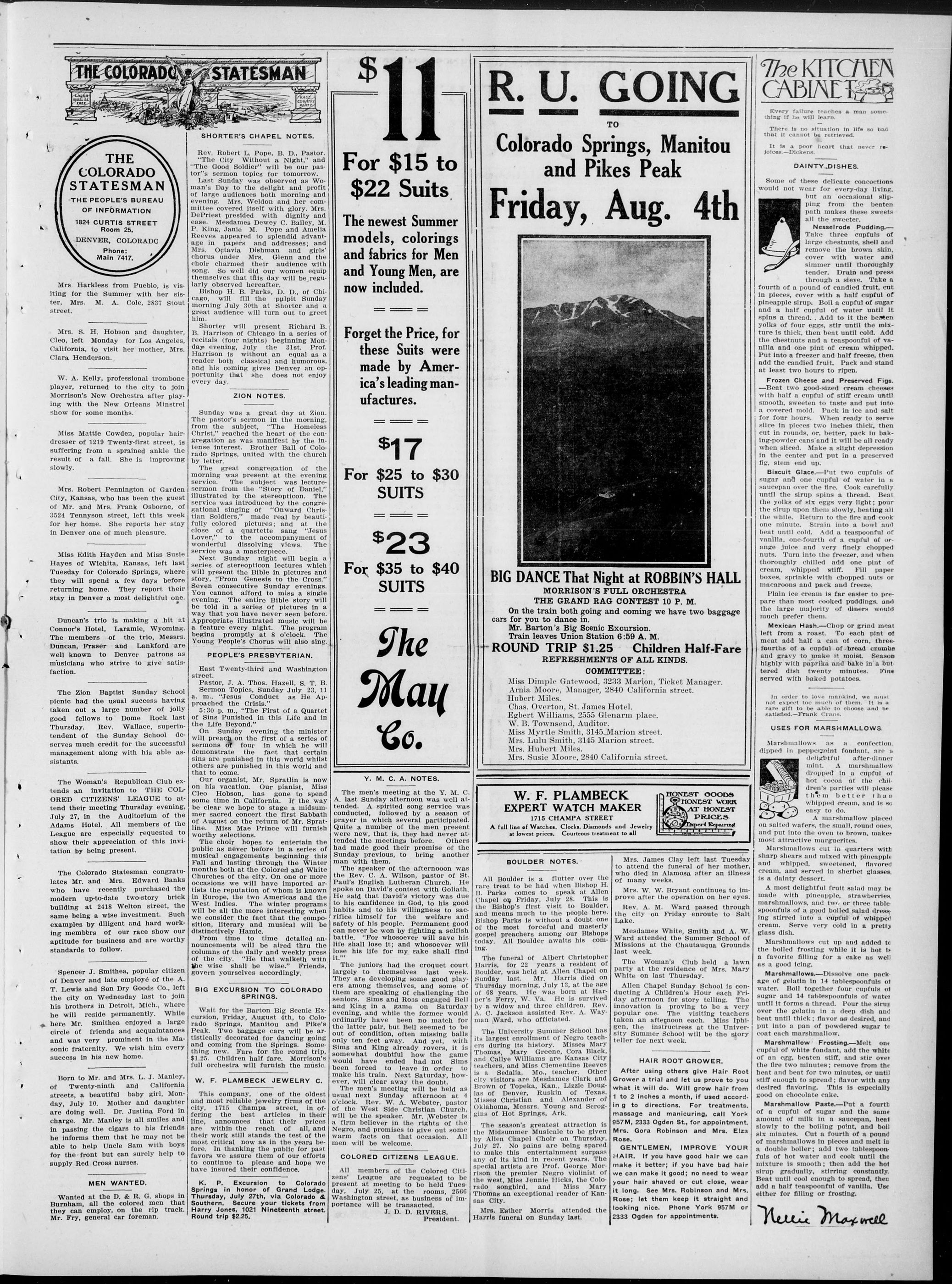
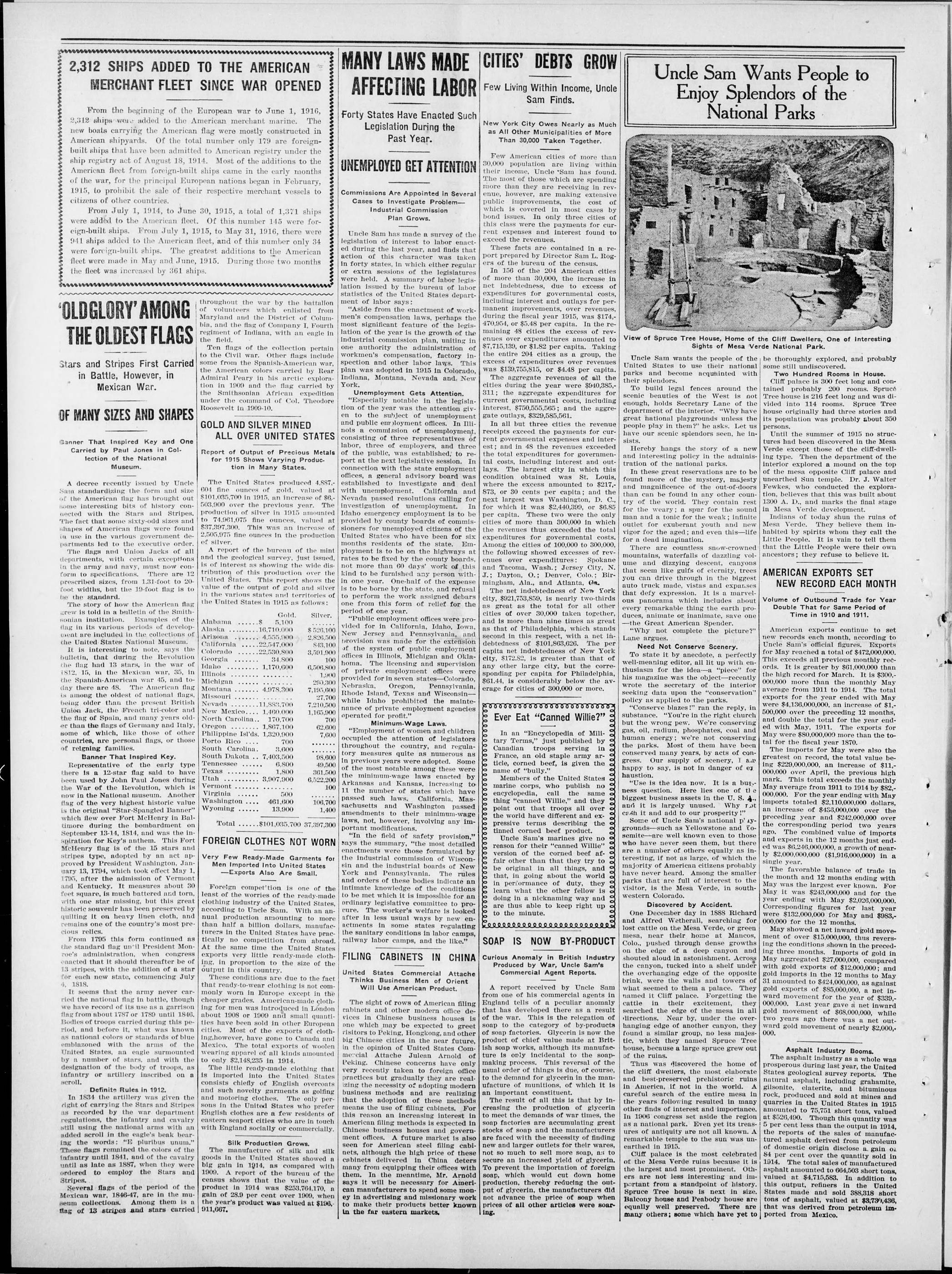
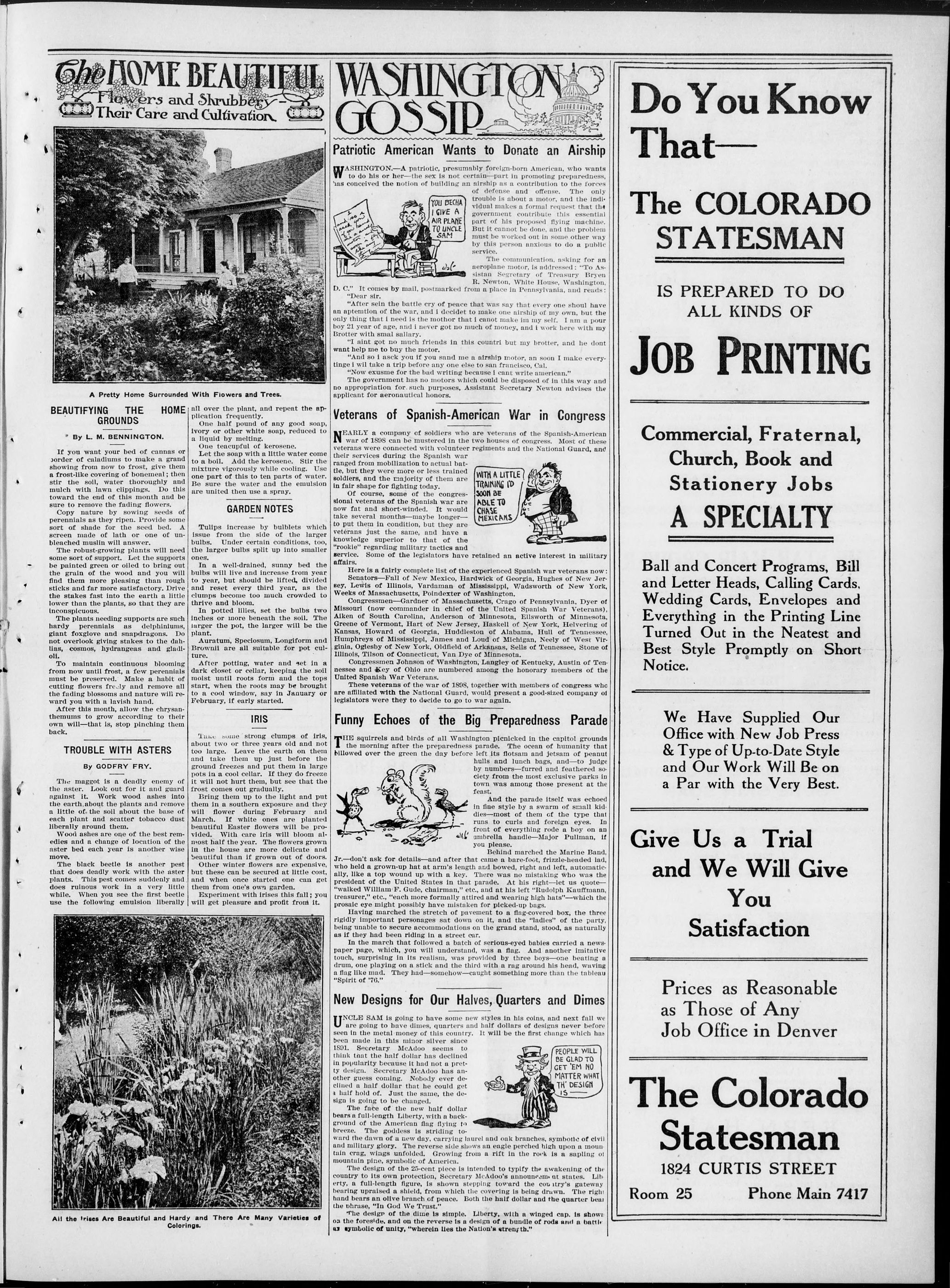
Page text (machine-generated)
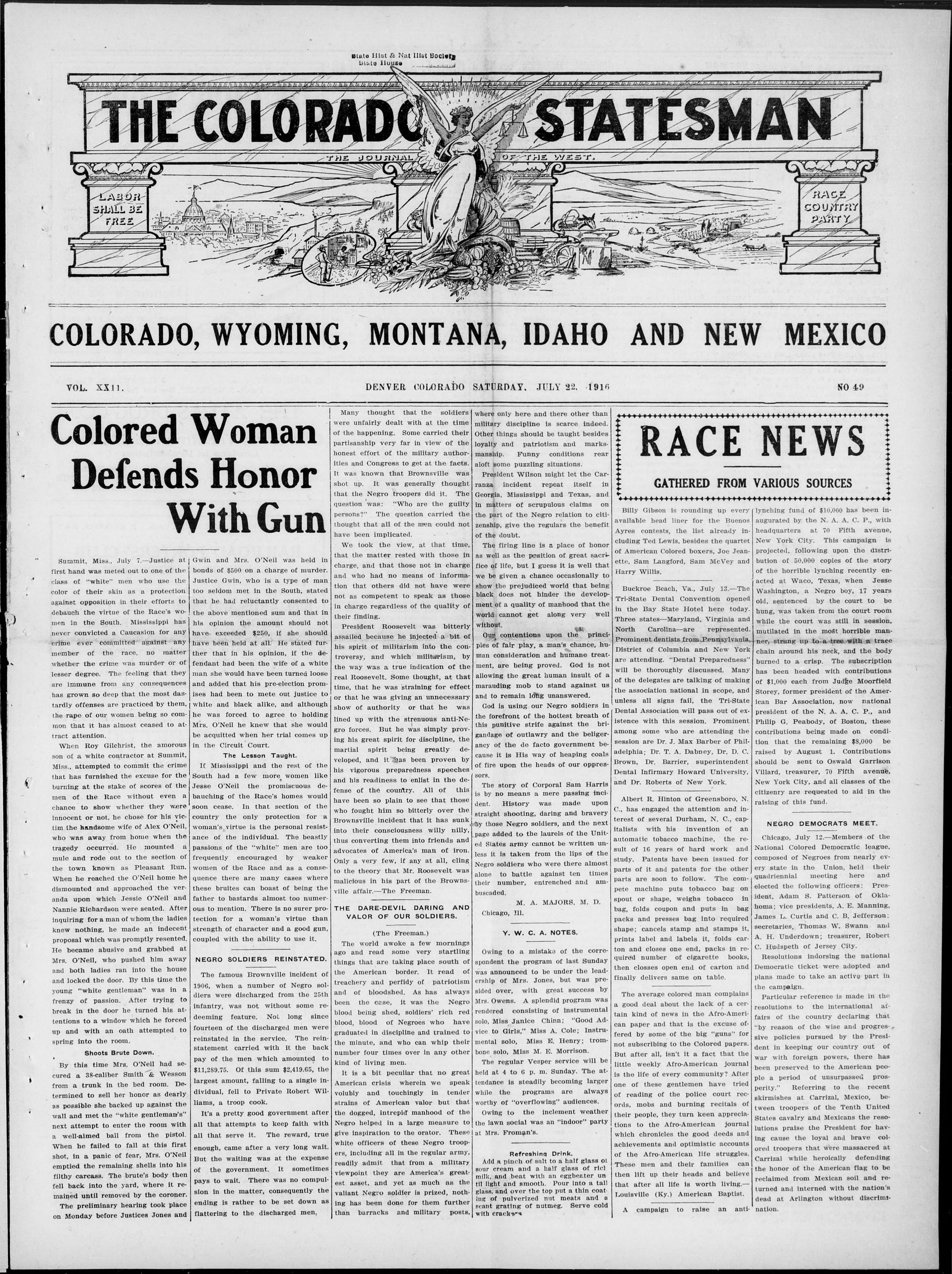
THE COLORADO STATESMAN
THE JOURNAL OF THE WEST.
LABOR SHALL BE FREE
RACE COUNTRY PARTY
COLORADO, WYOMING, MONTANA, IDAHO AND NEW MEXICO
Colored Woman Defends Honor With Gun
Colored Defends
Summit, Miss., July 7.—Justice at first hand was meted out to one of the class of "white" men who use the color of their skin as a protection against opposition in their efforts to debauch the virtue of the Race's women in the South. Mississippi has never convicted a Caucasian for any crime ever committed against any member of the race, no matter whether the crime was murder or of lesser degree. The feeling that they are immune from any consequences has grown so deep that the most dastardly offenses are practiced by them, the rape of our women being so common that it has almost ceased to attract attention.
When Roy Gilchrist, the amorous son of a white contractor at Summit, Miss., attempted to commit the crime that has furnished the excuse for the burning at the stake of scores of the men of the Race without even a chance to show whether they were innocent or not, he chose for his victim the handsome wife of Alex O'Neil, who was away from home when the tragedy occurred. He mounted a mule and rode out to the section of the town known as Pleasant Run. When he reached the O'Neil home he dismounted and approached the veranda upon which Jessie O'Neil and Nannie Richardson were seated. After inquiring for a man of whom the ladies knew nothing, he made an indecent proposal which was promptly resented. He became abusive and grabbed at Mrs. O'Neil, who pushed him away and both ladies ran into the house and locked the door. By this time the young "white gentleman" was in a frenzy of passion. After trying to break in the door he turned his attentions to a window which he forced up and with an oath attempted to spring into the room.
Shoots Brute Down.
By this time Mrs. O'Neil had secured a 38-caliber Smith & Wesson from a trunk in the bed room. Determined to sell her honor as dearly as possible she backed up against the wall and met the "white gentleman's" next attempt to enter the room with a well-aimed ball from the pistol. When he failed to fall at this first shot, in a panic of fear, Mrs. O'Neil emptied the remaining shells into his filthy carcass. The brute's body then fell back into the yard, where it remained until removed by the coroner. The preliminary hearing took place on Monday before Justices Jones and
Gwin and Mrs. O'Neil was held in bonds of $500 on a charge of murder. Justice Gwin, who is a type of man too seldom met in the South, stated that he had reluctantly consented to the above mentioned sum and that in his opinion the amount should not have exceeded $250, if she should have been held at all. He stated further that in his opinion, if the defendant had been the wife of a white man she would have been turned loose and added that his pre-election promises had been to mete out justice to white and black alike, and although he was forced to agree to holding Mrs. O'Neil he knew that she would be acquitted when her trial comes up in the Circuit Court.
The Lesson Taught.
If Mississippi and the rest of the South had a few more women like Jesse O'Neil the promiscuous debauching of the Race's homes would soon cease. In that section of the country the only protection for a woman's virtue is the personal resistance of the individual. The beastly passions of the "white" men are too frequently encouraged by weaker women of the Race and as a consequence there are many cases where these bruites can boast of being the father to bastards almost too numerous to mention. There is no surer protection for a woman's virtue than strength of character and a good gun, coupled with the ability to use it.
NEGRO SOLDIERS REINSTATED.
The famous Brownville incident of 1906, when a number of Negro soldiers were discharged from the 25th infantry, was not without some redeeming feature. Not long since fourteen of the discharged men were reinstated in the service. The reinstatement carried with it the back pay of the men which amounted to $11,289.75. Of this sum $2,419.65, the largest amount, falling to a single individual, fell to Private Robert Williams, a troop cook.
It's a pretty good government after all that attempts to keep faith with all that serve it. The reward, true enough, came after a very long wait. But the waiting was at the expense of the government. It sometimes pays to wait. There was no compulsion in the matter, consequently the ending is rather to be set down as flattering to the discharged men,
DENVER COLORADO SATURDAY. JULY 22. 1916
State Hist & Nat Hist Society
State House
RADC
THE JOURNAL
G, MONTA
DENVER COLORADO
Many thought that the soldiers were unfairly dealt with at the time of the happening. Some carried their partisanship very far in view of the honest effort of the military authorities and Congress to get at the facts. It was known that Brownsville was shot up. It was generally thought that the Negro troopers did it. The question was: "Who are the guilty persons?" The question carried the thought that all of the men could not have been implicated.
We took the view, at that time, that the matter rested with those in charge, and that those not in charge and who had no means of information that others did not have were not as competent to speak as those in charge regardless of the quality of their finding.
President Roosevelt was bitterly assailed because he injected a bit of his spirit of militarism into the controversy, and which militarism, by the way was a true indication of the real Roosevelt. Some thought, at that time, that he was straining for effect or that he was giving an unnecessary show of authority or that he was lined up with the strenuous anti-Negro forces. But he was simply proving his great spirit for discipline, the martial spirit being greatly developed, and it has been proven by his vigorous preparedness speeches and his readiness to enlist in the defense of the country. All of this have been so plain to see that those who fought him so bitterly over the Brownsville incident that it has sunk into their consciousness willy nilly, thus converting them into friends and advocates of America's man of iron. Only a very few, if any at all, cling to the theory that Mr. Roosevelt was malicious in his part of the Brownsville affair.—The Freeman.
THE DARE-DEVIL DARING AND VALOR OF OUR SOLDIERS.
(The Freeman.)
The world awoke a few mornings ago and read some very startling things that are taking place south of the American border. It read of treachery and perfidy of patriotism and of bloodshed. As has always been the case, it was the Negro blood being shed, soldiers' rich red blood, blood of Negroes who have graduated in discipline and trained to the minute, and who can whip their number four times over in any other kind of living men.
It is a bit peculiar that no great American crisis wherein we speak volubly and touchingly in tender strains of American valor but that the dogged, intrepid manhood of the Negro helped in a large measure to give inspiration to the orator. These white officers of these Negro troopers, including all in the regular army, readily admit that from a military viewpoint they are America's greatest asset, and yet as much as the valiant Negro soldier is prized, nothing has been done for them further than barracks and military posts,
where only here and there other than military discipline is scarce indeed. Other things should be taught besides loyalty and patriotism and marksmanship. Funny conditions rear aloft some puzzling situations. President Wilson might let the Carranza incident repeat itself in Georgia, Mississippi and Texas, and in matters of scrupulous claims on the part of the Negro relation to citizenship, give the regulars the benefit of the doubt. The firing line is a place of honor as well as the position of great sacrifice of life, but I guess it is well that we be given a chance occasionally to show the prejudiced world that being black does not hinder the development of a quality of manhood that the world cannot get along very well without.
Our contentions upon the principles of fair play, a man's chance, human consideration and humane treatment, are being proved. God is not allowing the great human insult of a marauding mob to stand against us and to remain long unanswered.
God is using our Negro soldiers in the forefront of the hottest breath of this punitive strife against the brigandage of outlawry and the beligerance of the de facto government because it is His way of heaping coals of fire upon the heads of our oppressors.
The story of Corporal Sam Harris is by no means a mere passing incident. History was made upon straight shooting, daring and bravery by those Negro soldiers, and the next page added to the laurels of the United States army cannot be written unless it is taken from the lips of the Negro soldiers who were there almost alone to battle against ten times their number, entrenched and ambuscaded.
M. A. MAJORS, M. D.
Chicago, III.
Y. W. C. A. NOTES.
Owing to a mistake of the correspondent the program of last Sunday was announced to be under the leadership of Mrs. Jones, but was presided over, with great success by Mrs. Owens. A splendid program was rendered consisting of instrumental solo, Miss Janice Chinn; "Good Advice to Girls," Miss A. Cole; Instrumental solo, Miss E. Henry; trombone solo, Miss M. E. Morrison.
The regular Vesper service will be held at 4 to 6 p. m. Sunday. The attendance is steadily becoming larger while the programs are always worthy of "overflowing" audiences.
Owing to the inclement weather the lawn social was an "indoor" party at Mrs. Froman's.
Refreshing Drink.
Add a pinch of salt to a half glass of sour cream and a half glass of rich milk, and beat with an eggbeater until light and smooth. Pour into a tall glass, and over the top put a thin coating of pulverized nut meats and a scant grating of nutmeg. Serve cold with crackers.
RACE NEWS
GATHERED FROM VARIOUS SOURCES
Billy Gibson is rounding up every available head liner for the Buenos Ayres contests, the list already including Ted Lewis, besides the quartet of American Colored boxers, Joe Jeanette, Sam Langford, Sam McVey and Harry Willis.
Buckroe Beach, Va., July 13.—The Tri-State Dental Convention opened in the Bay State Hotel here today. Three states—Maryland, Virginia and North Carolina—are represented. Prominent dentists from Pennsylvania, District of Columbia and New York are attending. "Dental Preparedness" will be thoroughly discussed. Many of the delegates are talking of making the association national in scope, and unless all signs fail, the Tri-State Dental Association will pass out of existence with this session. Prominent among some who are attending the session are Dr. J. Max Barber of Philadelphia; Dr. T. A. Dabney, Dr. D. C. Brown, Dr. Barrier, superintendent Dental Infirmary Howard University, and Dr. Roberts of New York.
Albert R. Hinton of Greensboro, N. C., has engaged the attention and interest of several Durham, N. C., capitalists with his invention of an automatic tobacco machine, the result of 16 years of hard work and study. Patents have been issued for parts of it and patents for the other parts are soon to follow. The compete machine puts tobacco bag on spout or shape, weighs tobacco in bag, folds coupon and puts in bag packs and presses bag into required shape; cancels stamp and stamps it, prints label and labels it, folds carton and closes one end, packs in required number of cigarette books, then closes open end of carton and finally delivers same on table.
The average colored man complains a good deal about the lack of a certain kind of news in the Afro-American paper and that is the excuse offered by some of the big "guns" for not subscribing to the Colored papers. But after all, isn't it a fact that the little weekly Afro-American journal is the life of every community? After one of these gentlemen have tried of reading of the police court records, mobs and burning recitals of their people, they turn keen appreciations to the Afro-American journal which chronicles the good deeds and achievements and optimistic accounts of the Afro-American life struggles. These men and their families can then lift up their heads and believe that after all life is worth living. Louisville (Ky.) American Baptist.
A campaign to raise an anti-
NO 49
lynching fund of $10,000 has been inaugurated by the N. A. A. C. P., with headquarters at 70 Fifth avenue, New York City. This campaign is projected, following upon the distribution of 50,000 copies of the story of the horrible lynching recently enacted at Waco, Texas, when Jesse Washington, a Negro boy, 17 years old, sentenced by the court to be hung, was taken from the court room while the court was still in session, mutilated in the most horrible manner, strung up to a tree with a trace chain around his neck, and the body burned to a crisp. The subscription has been headed with contributions of $1,000 each from Judge Moorfield Storey, former president of the American Bar Association, now national president of the N. A. A. C. P., and Philip G. Peabody, of Boston, these contributions being made on condition that the remaining $8,000 be raised by August 1. Contributions should be sent to Oswald Garrison Villard, treasurer, 70 Fifth avenue, New York City, and all classes of the citizenry are requested to aid in the raising of this fund.
NEGRO DEMOCRATS MEET.
Chicago, July 12.—Members of the National Colored Democratic league, composed of Negroes from nearly every state in the Union, held their quadriennial meeting here and elected the following officers: President, Adam S. Patterson of Oklahoma; vice presidents, A. E. Manning, James L. Curtis and C. B. Jefferson; secretaries, Thomas W. Swann and A. H. Underdown; treasurer, Robert C. Hudspeth of Jersey City. Resolutions indorsing the national Democratic ticket were adopted and plans made to take an active part in the campaign.
Particular reference is made in the resolutions to the international affairs of the country declaring that "by reason of the wise and progressive policies pursued by the President in keeping our country out of war with foreign powers, there has been preserved to the American people a period of unsurpassed prosperity." Referring to the recent skirmishes at Carrizal, Mexico, between troopers of the Tenth United States cavalry and Mexicans the resolutions praise the President for having cause the loyal and brave colored troopers that were massacred at Carrizal while heroically defending the honor of the American flag to be reclaimed from Mexican soil and returned and interned with the nation's dead at Arlington without discrimination.
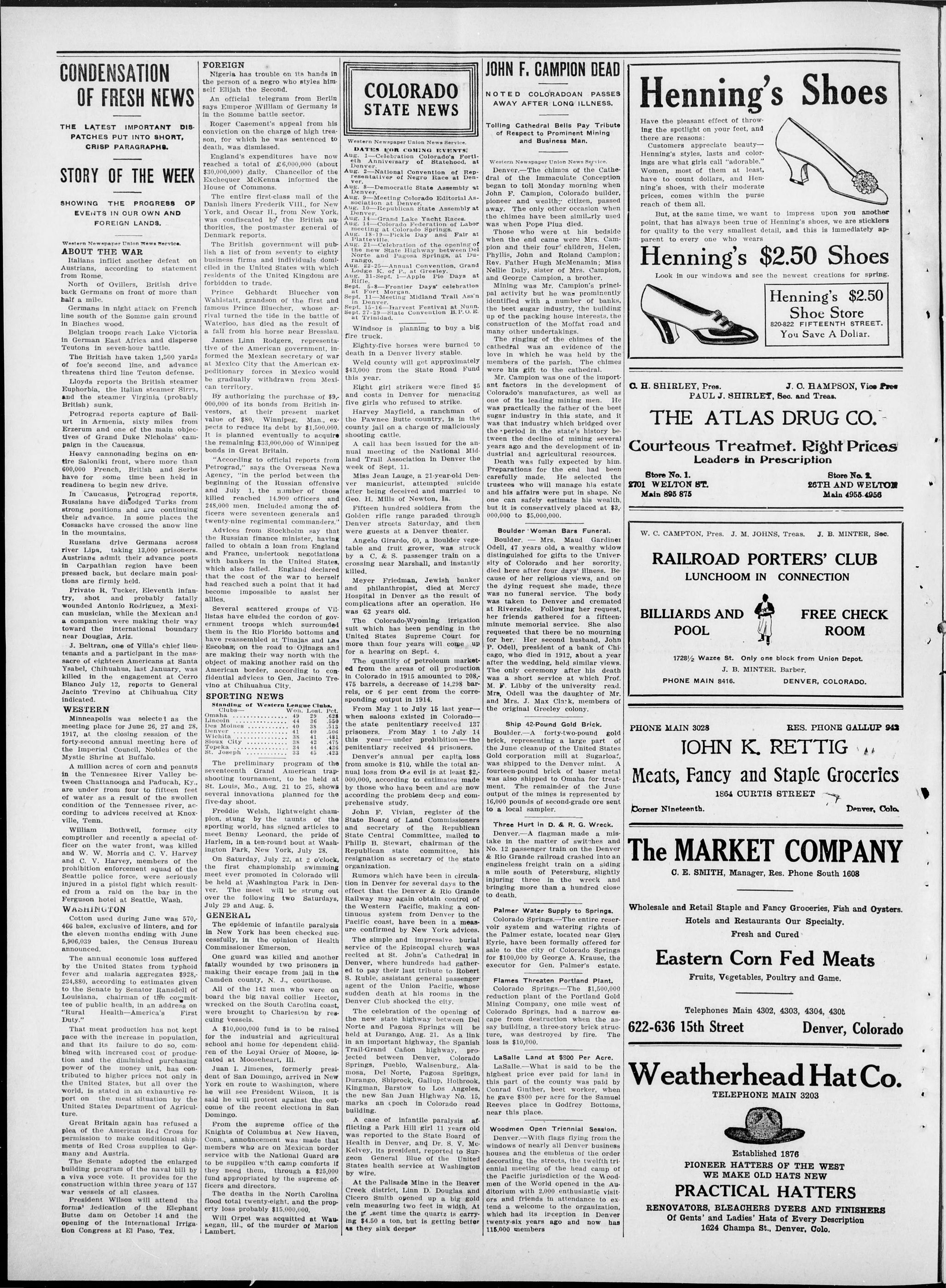
CONDENSATION OF FRESH NEWS
THE LATEST IMPORTANT DISP
PATCHES PUT INTO SHORT,
CRISP PARAGRAPH8.
STORY OF THE WEEK
SHOWING THE PROGRESS OF EVENTS IN OUR OWN AND FOREIGN LANDS.
Western Newspaper Union News Service.
ABOUT THE WAR
Italians inflict another defeat on Austrians, according to statement from Rome.
North of Ovillers, British drive back Germans on front of more than half a mile.
Germans in night attack on French line south of the Somme gain ground in Biaches wood.
Belgian troops reach Lake Victoria in German East Africa and disperse Teutons in seven-hour battle.
The British have taken 1,500 yards of foe's second line, and advance threatens third line Teuton defense.
Lloyds reports the British steamer Euphorbia, the Italian steamer Sirra, and the steamer Virginia (probably British) sunk.
Petrograd reports capture of Baillurt in Armenia, sixty miles from Erzerum and one of the main objectives of Grand Duke Nicholas' campaign in the Caucasus.
Heavy cannonading begins on entire Saloniki front, where more than 600,000 French, British and Serbs have for some time been held in readiness to begin new drive.
In Caucasus, Petrograd reports, Russians have dislodged Turks from strong positions and are continuing their advance. In some places the Cossacks have crossed the snow line in the mountains.
Russians drive Germans across river Lipa, taking 13,000 prisoners. Austrians admit their advance posts in Carpathian region have been pressed back, but declare main positions are firmly held.
Private R. Tucker, Eleventh infantry, shot and probably fatally wounded Antonio Rodriguez, a Mexican musician, while the Mexican and a companion were making their way toward the international boundary near Douglas, Ariz.
J. Beltran, one of Villa's chief lieutenants and a participant in the massacre of eighteen Americans at Santa Ysabel, Chihuahua, last January, was killed in the engagement at Cerro Blanco July 12, reports to General Jacinto Trevino at Chihuahua City indicated.
WESTERN
Minneapolis was selected as the meeting place for June 26, 27 and 28, 1917, at the closing session of the forty-second annual meeting here of the Imperial Council, Nobles of the Mystic Shrine at Buffalo.
A million acres of corn and peanuts in the Tennessee River Valley between Chattanooga and Paducah, Ky., are under from four to fifteen feet of water as a result of the swollen condition of the Tennessee river, according to advices received at Knoxville, Tenn.
William Bothwell, former city comptroller and recently a special officer on the water front, was killed and W. W. Morris and C. V. Harvey and C. V. Harvey, members of the prohibition enforcement squad of the Seattle police force, were seriously injured in a pistol fight which resulted from a raid on the bar in the Ferguson hotel at Seattle, Wash.
WASHINGTON
Cotton used during June was 570,466 bales, exclusive of linters, and for the eleven months ending with June 5,906,039 bales, the Census Bureau announced.
The annual economic loss suffered by the United States from typhoid fever and malaria aggregates $928,234,880, according to estimates given to the Senate by Senator Ransdell of Louisiana, chairman of the committee of public health, in an address on "Rural Health—America's First Duty."
That meat production has not kept pace with the increase in population, and that its failure to do so, combined with increased cost of production and the diminished purchasing power of the money unit, has contributed to higher prices not only in the United States, but all over the world, is stated in an exhaustive report on the meat situation by the United States Department of Agriculture.
Great Britain again has refused a plea of the American Red Cross for permission to make conditional shipments of Red Cross supplies to Germany and Austria.
The Senate adopted the enlarged building program of the naval bill by a viva voce vote. It provides for the construction within three years of 157 war vessels of all classes.
President Wilson will attend the forma' dedication of the Elephant Butte dam on October 14 and the opening of the International Irrigation Congress at El Paso, Tex.
FOREIGN
Nigeria has trouble on its hands in the person of a negro who styles himself Elijah the Second.
An official telegram from Berlin says Emperor William of Germany is in the Somme battle sector.
Roger Casement's appeal from his conviction on the charge of high treason, for which he was sentenced to death, was dismissed.
England's expenditures have now reached a total of £6,000,000 (about $30,000,000) daily. Chancellor of the Exchequer McKenna informed the House of Commons.
The entire first-class mail of the Danish liners Frederik VIII., for New York, and Oscar II., from New York, was confiscated by the British authorities, the postmaster general of Denmark reports.
The British government will publish a list of from seventy to eighty business firms and individuals domiciled in the United States with which residents of the United Kingdom are forbidden to trade.
Prince Gebhardt Bluecher von Wahlstatt, grandson of the first and famous Prince Bluecher, whose arrival turned the tide in the battle of Waterloo, has died as the result of a fall from his horse near Bresslau.
James Linn Rodgers, representative of the American government, informed the Mexican secretary of war at Mexico City that the American expeditionary forces in Mexico would be gradually withdrawn from Mexican territory.
By authorizing the purchase of $2,000,000 of its bonds from British investors, at their present market value of $80, Winnipeg, Man., expects to reduce its debt by $1,500,000. It is planned eventually to acquire the remaining $33,000,000 of Winnipeg bonds in Great Britain.
"According to official reports from Petrograd," says the Overseas News Agency, "in the period between the beginning of the Russian offensive and July 1, the number of those killed reached 14,900 officers and 248,000 men. Included among the officers were seventeen generals and twenty-nine regimental commanders."
Advices from Stockholm say that the Russian finance minister, having failed to obtain a loan from England and France, undertook negotiations with bankers in the United States, which also failed. England declared that the cost of the war to herself had reached such a point that it had become impossible to assist her allies.
Several scattered groups of Villistas have eluded the cordon of government troops which surrounded them in the Rio Florido bottoms and have reassembled at Tinajas and Las Escobas, on the road to Ojinaga and are making their way north with the object of making another raid on the American border, according to confidential advices to Gen. Jacinto Trevino at Chihuahua City.
SPORTING NEWS
Standing of Western League Clubs.
Clubs— Won. Lost. Pct.
Omaha 49 29 .628
Lincoln 44 35 .550
Des Moines 40 38 .513
Denver 41 40 .506
Wichita 38 41 .481
Sloux City 38 42 .475
Topeka 34 44 .436
St. Joseph 33 45 .423
The preliminary program of the seventeenth Grand American trap-shooting tournament, to be held at St. Louis, Mo., Aug. 21 to 25, shows several innovations planned for the five-day shoot.
Freddie Welsh, lightweight champion, stung by the taunts of the sporting world, has signed articles to meet Benny Leonard, the pride of Harlem, in a ten-round bout at Washington Park, New York, July 28.
On Saturday, July 22, at 2 o'clock, the first championship swimming meet ever promoted in Colorado will be held at Washington Park in Denver. The meet will be strung out over the following two Saturdays, July 29 and Aug. 5.
GENERAL
The epidemic of infantile paralysis in New York has been checked successfully, in the opinion of Health Commissioner Emerson.
One guard was killed and another fatally wounded by two prisoners in making their escape from jail in the Camden county, N. J., courthouse.
All of the 142 men who were on board the big naval collier Hector, wrecked on the South Carolina coast, were brought to Charleston by rescuing vessels.
A $10,000,000 fund is to be raised for the industrial and agricultural school and home for dependent children of the Loyal Order of Moose, located at Mooseheart, Ill.
Juan I. Jimenes, formerly president of San Domingo, arrived in New York en route to Washington, where he will see President Wilson. It is said he will protest against the outcome of the recent elections in San Domingo.
From the supreme office of the Knights of Columbus at New Haven, Conn., announcement was made that members who are on Mexican border service with the National Guard are to be supplied with camp comforts if they need them, through a $25,000 fund appropriated by the supreme officers and directors.
The deaths in the North Carolina flood total twenty-eight, and the property loss probably $15,000,000.
Will Orpret was acquitted at Waukee, Ill., of the murder of Marion Lambert.
COLORADO STATE NEWS
Western Newspaper Union News Service.
DATES FOR COMING EVENTS.
Aug. 1—Celebration Colorado's Fortieth Anniversary of Statehood, at Denver.
Aug. 2—National Convention of Representatives of Negro Race at Denver.
Aug. 8—Democratic State Assembly at Denver.
Aug. 9—Meeting Colorado Editorial Association at Denver.
Aug. 10—Republican State Assembly at Denver.
Aug. 14—Grand Lake Yacht Races.
Aug. 14—Colorado Federation of Labor meeting at Colorado Springs.
Aug. 18—Pickle Day and Fair at Platteville.
Aug. 21—Celebration of the opening of the new State Highway between Del Norte and Pagosa Springs, at Durango.
Aug. 22-25—Annual Convention, Grand
Lodge K. of P. at Greeley.
Aug. 31-Sept. 1—Apple Pie Days at
Kifle.
Sept. 5-8—Frontier Days' celebration
at Fort Morgan.
Sept. 11—Meeting Midland Trail Ass'n
in Denver.
Sept. 15-16—Irharvest Festival at Nunn.
Sept. 27-29—State Convention B.P.O.E.
at Trimidad.
Windsor is planning to buy a big
fire truck.
Eighty-five horses were burned to
death in a Denver livery stable.
Weld county will get approximately
$43,000 from the State Road Fund
this year.
Eight girl strikers were fined $5
and costs in Denver for menacing
five girls who refused to strike.
Harvey Mayfield, a ranchman of
the Pawnee Butte country, is in the
county jail on a charge of maliciously
shooting cattle.
A call has been issued for the annual meeting of the National Midland Trail Association in Denver the week of Sept. 11.
Miss Jean Lauge, a 21-year-old Denver manicurist, attempted suicide after being deceived and married to Geo. H. Mills of Newton, Ia.
Fifteen hundred soldiers from the Golden rifle range paraded through Denver streets Saturday, and then were guests at a Denver theater.
Angelo Girardo, 60, a Boulder vegetable and fruit grower, was struck by a C. & S. passenger train on a crossing near Marshall, and instantly killed.
Meyer Friedman, Jewish banker and philanthropist, died at Mercy Hospital in Denver as the result of complications after an operation. He was 62 years old.
The Colorado,Wyoming irrigation suit which has been pending in the United States Supreme Court for more than four years will come up for a hearing on Sept. 4.
The quantity of petroleum marketed from the areas of oil production in Colorado in 1915 amounted to 208,475 barrels, a decrease of 14,298 barrels, or 6 per cent from the corresponding output in 1914.
From May 1 to July 15 last year—when saloons existed in Colorado—the state penitentiary received 137 prisoners. From May 1 to July 14 this year—under prohibition—the penitentiary received 44 prisoners.
Denver's annual per capita loss from smoke is $10, while the total annual loss from the evil is at least $2,000,000, according to estimates made by those who have been and are now according the problem deep and comprehensive study.
John F. Vivian, register of the State Board of Land Commissioners and secretary of the Republican State Central Committee, mailed to Philip B. Stewart, chairman of the Republican state committee, his resignation as secretary of the state organization.
Rumors which have been in circulation in Denver for several days to the effect that the Denver & Rio Grande Railway may again obtain control of the Western Pacific, making a continuous system from Denver to the Pacific coast, have been in a measure confirmed by New York advices.
The simple and impressive burial service of the Episcopal church was recited at St. John's Cathedral in Denver, where hundreds had gathered to pay their last tribute to Robert S. Ruble, assistant general passenger agent of the Union Pacific, whose sudden death at his rooms in the Denver Club shocked the city.
The celebration of the opening of the new state highway between Del Norte and Pagosa Springs will be held at Durango, Aug. 21. As a link in an important highway, the Spanish Trail-Grand Cañon highway, projected between Denver, Colorado Springs, Pueblo, Walsenburg, Alamos, Del Norte, Pagosa Springs, Durango, Shiprock, Gallup, Holbrook, Kingman, Barstow to Los Angeles, the new San Juan Highway No. 15, marks an epoch in Colorado road building.
A case of infantile paralysis afflicting a Park Hill girl 11 years old was reported to the State Board of Health in Denver, and Dr. S. V. McKelvey, its president, reported to Surgeon General Blue of the United States health service at Washington by wire.
At the Pallisade Mine in the Beaver Creek district, Linn D. Douglas and Cicero Smith opened up a big gold vein measuring two feet in width. At the present time the quartz is carrying $4.50 a ton, but is getting better as they sink deeper
JOHN F. CAMPION DEAD
NOTED COLORADOAN PASSES AWAY AFTER LONG ILLNESS.
Tolling Cathedral Bells Pay Tribute of Respect to Prominent Mining and Business Man.
Western Newspaper Union News Service.
Denver.—The chimes of the Cathedral of the Immaculate Conception began to toll Monday morning when John F. Campion, Colorado builder, pioneer and wealthy citizen, passed away. The only other occasion when the chimes have been similarly used was when Pope Pius died.
Those who were at his bedside when the end came were Mrs. Campion and their four children, Helen, Phyllis, John and Roland Campion; Rev. Father Hugh McMenamin; Miss Nellie Daly, sister of Mrs. Campion, and George Campion, a brother.
Mining was Mr. Campion's principal activity but he was prominently identified with a number of banks, the beet sugar industry, the building up of the packing house interests, the construction of the Moffat road and many other undertakings.
The ringing of the chimes of the cathedral was an evidence of the love in which he was held by the members of the parish. The chimes were his gift to the cathedral.
Mr. Campion was one of the important factors in the development of Colorado's manufactures, as well as one of its leading mining men. He was practically the father of the beet sugar industry in this state, and it was that industry which bridged over the period in the state's history between the decline of mining several years ago and the development of industrial and agricultural resources. Death was fully expected by him. Preparations for the end had been carefully made. He selected the trustees who will manage his estate and his affairs were put in shape. No one can safely estimate his wealth, but it is conservatively placed at $3,000,000 to $5,000,000.
Boulder : Woman Bars Funeral.
Boulder. — Mrs. Maud Gardiner Odell, 47 years old, a wealthy widow distinguished for gifts to the University of Colorado and her sorority, died here after four days' illness. Because of her religious views, and on the dying request she made, there was no funeral service. The body was taken to Denver and cremated at Riverside. Following her request, her friends gathered for a fifteen-minute memorial service. She also requested that there be no mourning for her. Her second husband, John P. Odell, president of a bank of Chicago, who died in 1912, about a year after the wedding, held similar views. The only ceremony after his death was a short service at which Prof. M. F. Libby of the university read. Mrs. Odell was the daughter of Mr. and Mrs. J. Max Clark, members of the original Greeley colony.
Ship 42-Pound Gold Brick
Boulder.—A forty-two-pound gold brick, representing a large part of the June cleanup of the United States Gold corporation mill at Sugarloaf, was shipped to the Denver mint. A fourteen-pound brick of baser metal was also shipped to Omaha for treatment. The remainder of the June output of the mines is represented by 16,000 pounds of second-grade ore sent to a local sampler.
Three Hurt in D. & R. G. Wreck.
Denver.—A flagman made a mistake in the matter of switches and No. 12 passenger train on the Denver & Rio Grande railroad crashed into an engineless freight train on a siding a mile south of Petersburg, slightly injuring three in the wreck and bringing more than a hundred close to death.
Palmer Water Supply to Springs.
Colorado Springs.—The entire reservoir system and watering rights of the Palmer estate, located near Glen Eyrie, have been formally offered for sale to the city of Colorado Springs for $100,000 by George A. Krause, the executor for Gen. Palmer's estate.
Flames Threaten Portland Plant.
Colorado Springs.—The $1,500,000 reduction plant of the Portland Gold Mining Company, one mile west of Colorado Springs, had a narrow escape from destruction when the assay building, a three-story brick structure, was destroyed by fire. The loss is $10,000.
LaSalle Land at $800 Per Acre.
LaSalle.—What is said to be the highest price ever paid for land in this part of the county was paid by Conrad Ginther, beet worker, when he gave $800 per acre for the Samuel Reeves place in Godfrey Bottoms, near this place.
Woodmen Open Triennial Session.
Denver.—With flags flying from the windows of nearly all Denver business houses and the emblems of the order decorating the streets, the twelfth triennial meeting of the head camp of the Pacific jurisdiction of the Woodmen of the World opened in the Auditorium with 2,000 enthusiastic visitors and friends in attendance to extend a welcome to the organization, which had its inception in Denver twenty-six years ago and now has 115,000 members
Henning's Shoes
Have the pleasant effect of throwing the spotlight on your feet, and there are reasons:
Customers appreciate beauty—Henning's styles, lasts and colorings are what girls call "adorable." Women, most of them at least, have to count dollars, and Henning's shoes, with their moderate prices, comes within the purse reach of them all.
But, at the same time, we wan point, that has always been true o for quality to the very smallest d parent to every one who wears Henning's S
Look in our windows and see
the same time, we want to impress upon you has always been true of Henning's shoes, we are to the very smallest detail, and this is immens every one who wears Henning's $2.50 SH in our windows and see the newest creations
But, at the same time, we want to impress upon you another point, that has always been true of Henning's shoes, we are sticklers for quality to the very smallest detail, and this is immediately apparent to every one who wears
Henning's $2.50 Shoes
Look in our windows and see the newest creations for spring.
Henning's $2.50
Shoe Store
820-822 FIFTEENTH STREET.
You Save A Dollar.
C. H. SHIRLEY, Pres.
PAUL J. SHIRLE
THE ATLAS
Courteous Treaty
Leaders in P
LEY, Pres. J. C. HAMPSON
PAUL J. SHIRLEY, Sec. and Treas.
THE ATLAS DRUG
Cous Treatmet. Right
Leaders in Prescription
1. Store
TON ST.
26TH AN
875
Main
PTON, Pres. J. M. JOHNS, Treas. J. B. M.
LROAD PORTERS' C
LUNCHOOM IN CONNECTION
C. H. SHIRLEY, Pres. J. C. HAMPSON, Vice Pres PAUL J. SHIRLEY, Sec. and Treas.
Courteous Treatmet. Right Prices Leaders in Prescription
W. C. CAMPTON, Pres. J. M. JOE
RAILROAD PO
LUNCHOOM IN
W. C. CAMPTON, Pres. J. M. JOHNS, Treas. J. B. MINTER, Sec. RAILROAD PORTERS' CLUB LUNCHOOM IN CONNECTION
BILLIARDS AND
POOL
1728½ Wazee St. Only o
J. B. MINT
PHONE MAIN 8416.
28½ Wazee St. Only one block from Union D
J. B. MINTER. Barber.
NE MAIN 8416. DENVER, COLOR
1728 $ \frac{1}{2} $ Wazee St. Only one block from Union Depot.
J. B. MINTER. Barber.
PHONE MAIN 8416. DENVER, COLORADO.
JOHN K.
Meats, Fancy and
1864 CURT
Corner Nineteenth.
The MARKET
C. E. SMITH, Manager
Wholesale and Retail Staple and I
Hotels and Restaur
Fresh and
Eastern Corn
JOHN K. RETTIGER
Fancy and Staple Gro
1864 CURTIS STREET
eenth.
MARKET COMP
E. SMITH, Manager, Res. Phone South 1
d Retail Staple and Fancy Groceries, Fish
Hotels and Restaurants Our Specialty.
Fresh and Cured
Eastern Corn Fed Me
Meats, Fancy and Staple Groceries 1864 CURTIS STREET Corner Nineteenth. Denver, Colo
The MARKET COMPANY
C. E. SMITH, Manager, Res. Phone South 1608
Wholesale and Retail Staple and Fancy Groceries, Fish and Oysters. Hotels and Restaurants Our Specialty. Fresh and Cured
Eastern Corn Fed Meats
Fruits, Vegetables, Poultry and Game.
Telephones Main 4302, 4303, 4304, 430
622-636 15th Street Denver
Weatherhead Ha
TELEPHONE MAIN 3203
Telephones Main 4302, 4303, 4304, 4305
15th Street Denver,
atherhead Ha
TELEPHONE MAIN 3203
Telephones Main 4302, 4303, 4304, 4305 622-636 15th Street Denver, Colorado
Weatherhead Hat Co.
Established 1876
PIONEER HATTERS OF THE WEST
WE MAKE OLD HATS NEW
PRACTICAL HATTERS
RENOVATORS, BLEACHERS DYERS AND FIRE
Of Gents' and Ladies' Hats of Every Descrip
1624 Champa St., Denver, Colo.
PRACTICAL HATTER
ATORS, BLEACHERS DYERS AND FIRE
Gents' and Ladies' Hats of Every Descrip
1624 Champa St., Denver, Colo.
RENOVATORS, BLEACHERS DYERS AND FINISHERS
Of Gents' and Ladies' Hats of Every Description
1624 Champa St., Denver, Colo.
Store No. 1.
2701 WELTON ST.
Main 895 875
PHONE MAIN 3028
to impress upon you another
Henning's shoes, we are sticklers
tail, and this is immediately ap-
$2.50 Shoes
the newest creations for spring.
Henning's $2.50
Shoe Store
820-822 FIFTEENTH STREET.
You Save A Dollar.
J. C. HAMPSON, Vice Pres
Y, Sec. and Treas.
S DRUG CO.
net. Right Prices
Prescription
Store No. 2
26TH AND WELTON
Main 4955.4956
NS, Treas. J. B. MINTER, Sec.
ORTERS' CLUB
CONNECTION
FREE CHECK
ROOM
one block from Union Depot.
ER. Barber.
DENVER, COLORADO.
RES. PHONE GALLUP 942
RETTIG
Staple Groceries
S STREET
Denver, Colo.
T COMPANY
Res. Phone South 1608
Fancy Groceries, Fish and Oysters
Ants Our Specialty.
Cured
Fed Meats
02, 4303, 4304, 4305
Denver, Colorado
ead Hat Co.
MAIN 3203
HATTERS
DYERS AND FINISHERS
Cats of Every Description
Denver, Colo.
#
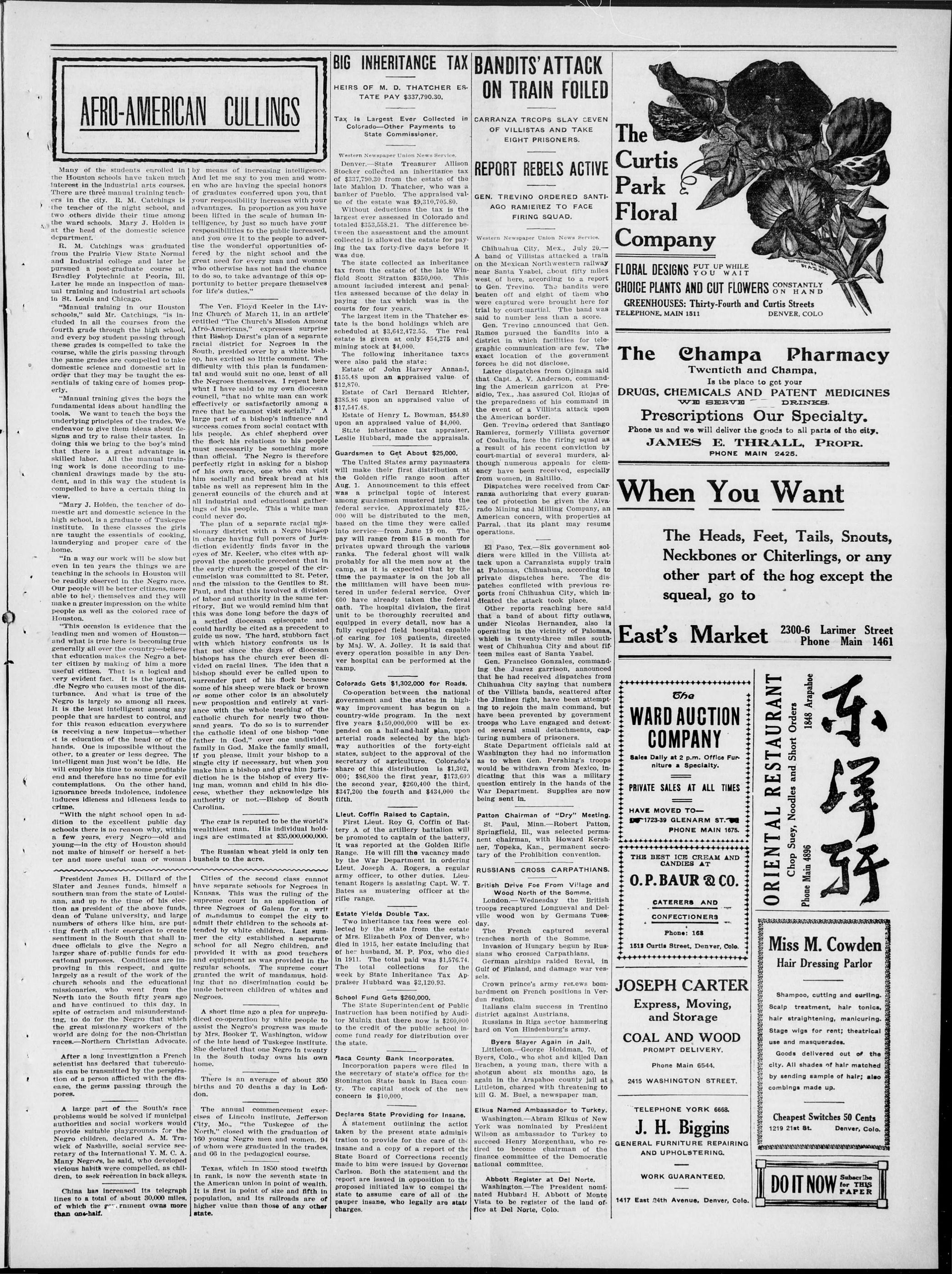
AFRO-AMERICAN CULLINGS
Many of the students enrolled in the Houston schools have taken much interest in the industrial arts courses. There are three manual training teachers in the city. R. M. Catchings is the teacher of the night school, and two others divide their time among the ward schools. Mary J. Holden is at the head of the domestic science department. R. M. Catchings was graduated from the Prairie View State Normal and Industrial college and later he pursued a post-graduate course at Bradley Polytechnic at Peoria, Ill. Later he made an inspection of manual training and industrial art schools in St. Louis and Chicago.
"Manual training in our Houston schools," said Mr. Catchings, "is included in all the courses from the fourth grade through the high school, and every boy student passing through these grades is compelled to take the course, while the girls passing through the same grades are compelled to take domestic science and domestic art in order that they may be taught the essentials of taking care of homes properly.
"Manual training gives the boys the fundamental ideas about handling the tools. We want to teach the boys the underlying principles of the trades. We endeavor to give them ideas about designs and try to raise their tastes. In doing this we bring to the boy's mind that there is a great advantage in skilled labor. All the manual training work is done according to mechanical drawings made by the student, and in this way the student is compelled to have a certain thing in view.
"Mary J. Holden, the teacher of domestic art and domestic science in the high school, is a graduate of Tuskegee institute. In these classes the girls are taught the essentials of cooking, launderying and proper care of the home.
"In a way our work will be slow but even in ten years the things we are teaching in the schools in Houston will be readily observed in the Negro race. Our people will be better citizens, more able to help, themselves and they will make a greater impression on the white people as well as the colored race of Houston.
"This occasion is evidence that the leading men and women of Houston—and what is true here is becoming true generally all over the country—believe that education makes the Negro a better citizen by making of him a more useful citizen. That is a logical and very evident fact. It is the ignorant, die Negro who causes most of the disturbance. And what is true of the Negro is largely so among all races. It is the least intelligent among any people that are hardest to control, and for this reason education everywhere is receiving a new impetus—whether it is education of the head or of the hands. One is impossible without the other, to a greater or less degree. The intelligent man just won't be idle. He will employ his time to some profitable end and therefore has no time for evil contemplations. On the other hand, ignorance breeds indolence, indolence induces idleness and idleness leads to crime.
"With the night school open in addition to the excellent public day schools there is no reason why, within a few years, every Negro-old and young—in the city of Houston should not make of himself or herself a better and more useful man or woman
President James H. Dillard of the Slater and Jennes funds, himself a southern man from the state of Louisiana, and up to the time of his election as president of the above funds, dean of Tulane university, and large numbers of others like him, are putting forth all their energies to create sentiment in the South that shall induce officials to give the Negro a larger share of public funds for educational purposes. Conditions are improving in this respect, and quite largely as a result of the work of the church schools and the educational missionaries, who went from the North into the South fifty years ago and have continued to this day, in spite of ostracism and misunderstanding, to do for the Negro that which the great missionary workers of the world are doing for the non-Christian races.—Northern Christian Advocate.
After a long investigation a French scientist has declared that tuberculosis can be transmitted by the perspiration of a person afflicted with the disease, the germs passing through the pores.
A large part of the South's race problems would be solved if municipal authorities and social workers would provide suitable playgrounds for the Negro children, declared A. M. Trawick of Nashville, social service secretary of the International Y. M. C. A. Many Negroes, he said, who developed victorious habits were compelled, as children, to seek recreation in back alleys.
China has increased its telegraph lines to a total of about 30,000 miles, of which the government owns more than one-half.
by means of increasing intelligence. And let me say to you men and women who are having the special honors of graduates conferred upon you, that your responsibility increases with your advantages. In proportion as you have been lifted in the scale of human intelligence, by just so much have your responsibilities to the public increased, and you owe it to the people to advertise the wonderful opportunities offered by the night school and the great need for every man and woman who otherwise has not had the chance to do so, to take advantage of this opportunity to better prepare themselves for life's duties."
The Ven. Floyd Keeler in the Living Church of March 11, in an article entitled "The Church's Mission Among Afro-Americans," expresses surprise that Bishop Darst's plan of a separate racial district for Negroes in the South, presided over by a white bishop, has excited so little comment. The difficulty with this plan is fundamental and would suit no one, least of all the Negroes themselves. I repeat here what I have said to my own diocesan council, "that no white man can work effectively or satisfactorily among a race that he cannot visit socially." A large part of a bishop's influence and success comes from social contact with people. As chief shepherd over the flock his relations to his people must necessarily be something more than official. The Negro is therefore perfectly right in asking for a bishop of his own race, one who can visit him socially and break bread at his table as well as represent him in the general councils of the church and at all industrial and educational gatherings of his people. This a white man could never do.
The plan of a separate racial missionary district with a Negro bishop in charge having full powers of jurisdiction evidently finds favor in the eyes of Mr. Keeler, who cites with approval the apostolic precedent that in the early church the gospel of the circumcision was committed to St. Peter, and the mission to the Gentiles to St. Paul, and that this involved a division of labor and authority in the same territory. But we would remind him that this was done long before the days of a settled diocesan episcopate and could hardly be cited as a precedent to guide us now. The hard, stubborn fact with which history confronts us is that not since the days of diocesan bishops has the church ever been divided on racial lines. The idea that a bishop should ever be called upon to surrender part of his flock because some of his sheep were black or brown or some other color is an absolutely new proposition and entirely at variance with the whole teaching of the catholic church for nearly two thousand years. To do so is to surrender the catholic ideal of one bishop "one father in God," over one undivided family in God. Make the family small, if you please, limit your bishop to a single city if necessary, but when you make him a bishop and give him jurisdiction he is the bishop of every living man, woman and child in his diocese, whether they acknowledge his authority or not.—Bishop of South Carolina.
The czar is reputed to be the world's wealthiest man. His individual holdings are estimated at $35,000,000,000.
The Russian wheat yield is only ten bushels to the acre.
Cities of the second class cannot have separate schools for Negroes in Kansas. This was the ruling of the supreme court in an application of three Negroes of Galena for a writ of mandamus to compel the city to admit their children to the schools attended by white children. Last summer the city established a separate school for all Negro children, and provided it with as good teachers and equipment as was provided in the regular schools. The supreme court granted the writ of mandamus, holding that no discrimination could be made between children of whites and Negroes.
A short time ago a plea for unprejudiced co-operation by white people to assist the Negro's progress was made by Mrs. Booker T. Washington, widow of the late head of Tuskegee institute. She declared that one Negro in twenty in the South today owns his own home.
There is an average of about 350 births and 70 deaths a day in London.
The annual commencement exercises of Lincoln institute, Jefferson City, Mo., "the Tuskegee of the North," closed with the graduation of 160 young Negro men and women, 94 of whom were graduated in the trades, and 66 in the pedagogical course.
Texas, which in 1850 stood twelfth in rank, is now the seventh state in the American union in point of wealth. It is first in point of size and fifth in population, and its railroads are of higher value than those of any other state.
HEIRS OF M. D. THATCHER ESTATE PAY $337,790.30.
Tax is Largest Ever Collected in Colorado—Other Payments to State Commissioner.
Western Newspaper Union News Service.
Denver.—State Treasurer Allison Stocker collected an inheritance tax of $337,790.30 from the estate of the late Mahlon D. Thatcher, who was a banker of Pueblo. The appraised value of the estate was $9,310,705.80.
Without deductions the tax is the largest ever assessed in Colorado and totaled $353,558.21. The difference between the assessment and the amount collected is allowed the estate for paying the tax forty-five days before it was due.
The state collected as inheritance tax from the estate of the late Winfield Scott Stratton $350,000. This amount included interest and penalties assessed because of the delay in paying the tax which was in the courts for four years.
The largest item in the Thatcher estate is the bond holdings which are scheduled at $3,642,472.55. The real estate is given at only $54,275 and mining stock at $4,000.
The following inheritance taxes were also paid the state:
Estate of John Harvey Annand, $155.48 upon an appraised value of $12,870.
Estate of Carl Bernard Richter, $385.86 upon an appraised value of $17,547.48.
Estate of Henry L. Bowman, $54.80 upon an appraised value of $4,000.
Sttle inheritance tax appraiser, Leslie Hubbard, made the appraisals.
Guardsmen to Get About $25,000.
The United States army paymasters will make their first distribution at the Golden rifle range soon after Aug. 1. Announcement to this effect was a principal topic of interest among guardsmen mustered into the federal service. Approximately $25,000 will be distributed to the men, based on the time they were called into service—from June 19 on. The pay will range from $15 a month for privates upward through the various ranks. The federal ghost will walk probably for all the men now at the camp, as it is expected that by the time the paymaster is on the job all the militiamen will have been mustered in under federal service. Over 600 have already taken the federal oath. The hospital division, the first unit to be thoroughly recruited and equipped in every detail, now has a fully equipped field hospital capable of caring for 108 patients, directed by Maj. W. A. Jolley. It is said that every operation possible in any Denver hospital can be performed at the camp.
Colorado Gets $1,302,000 for Roads.
Co-operation between the national government and the states in highway improvement has begun on a country-wide program. In the next five years $150,000,000 will be expended on a half-and-half plan, upon arterial roads selected by the highway authorities of the forty-eight states, subject to the approval of the secretary of agriculture. Colorado's share of this distribution is $1,302,000; $86,800 the first year, $173,600 the second year, $260,400 the third, $347,200 the fourth and $434,000 the fifth.
Lleut. Coffin Raised to Captain.
First Lieut. Roy G. Coffin of Battery A of the artillery battalion will be promoted to captain of the battery, it was reported at the Golden Rifle Range. He will fill the vacancy made by the War Department in ordering Lieut. Joseph A. Rogers, a regular army officer, to other duties. Lieutenant Rogers is assisting Capt. W. T. Bates as mustering officer at the rifle range.
Estate Yields Double Tax
Two inheritance tax fees were collected by the state from the estate of Mrs. Elizabeth Fox of Denver, who died in 1915, her estate including that of her husband, M. P. Fox, who died in 1911. The total paid was $1,576.74. The total collections for the week by State Inheritance Tax Appraiser Hubbard was $2,120.93.
School Fund Gets $260,000.
The State Superintendent of Public Instruction has been notified by Auditor Mulnix that there now is $260,000 to the credit of the public school income fund ready for distribution over the state.
Incorporation papers were filed in the secretary of state's office for the Stonington State bank in Baca county. The capital stock of the new concern is $10,000.
Declares State Providing for Insane.
A statement outlining the action taken by the present state administration to provide for the care of the insane and a copy of a report of the State Board of Corrections recently made to him were issued by Governor Carlson. Both the statement and the report are issued in opposition to the proposed initiated law to compel the state to assume care of all of the pauper insane, who legally are state charges.
BANDITS'ATTACK ON TRAIN FOILED
CARRANZA TRCOPS SLAY SEVEN OF VILLISTAS AND TAKE EIGHT PRISONERS.
REPORT REBELS ACTIVE
GEN. TREVINO ORDERED SANTIAGO RAMIEREZ TO FACE FIRING SQUAD.
Western Newspaper Union News Service.
Chihuahua City, Mex., July 20.—A band of Villistas attacked a train on the Mexican Northwestern railway near Santa Ysabel, about fifty miles west of here, according to a report to Gen. Trevino. The bandits were beaten off and eight of them who were captured were brought here for trial by court-martial. The band was said to number less than a score.
Gen. Trevino announced that Gen. Ramos pursued the bandits into a district in which facilities for telegraphic communication are few. The exact location of the government forces he did not disclose.
Later dispatches from Ojinaga said that Capt. A. V. Anderson, commanding the American garrison at Presidio, Tex., has assured Col. Rijos of the preparedness of his command in the event of a Villista attack upon the American border.
Gen. Trevino ordered that Santiago Ramírez, formerly Villista governor of Coahuila, face the firing squad as a result of his recent conviction by court-martial of several murders, although numerous appeals for clemency have been received, especially from women, in Saltillo.
Dispatches were received from Carranza authorizing that every guarantee of protection be given the Alvarado Mining and Milling Company, an American concern, with properties at Parral, that its plant may resume operations.
El Paso, Tex.-Six government soldiers were killed in the Villista attack upon a Carranzista supply train at Palomas, Chihuahua, according to private dispatches here. The dispatches conflicted with previous reports from Chihuahua City, which indicated the attack took place. Other reports reaching here said that a band of about fifty outaws, under Nicolas Hernandez, also is operating in the vicinity of Palomas, which is twenty-three miles southwest of Chihuahua City and about fifteen miles east of Santa Ysel.
Gen. Francisco Gonzales, commanding the Juarez garrison, announced that he had received dispatches from Chihuahua City saying that numbers of the Villista bands, scattered after the Jiminez fight, have been attempting to rejoin the main command, but have been prevented by government troops who have engaged and deterred several small detachments, capturing numbers of prisoners.
State Department officials said at Washington they had no information as to when Gen. Pershing's troops would be withdrawn from Mexico, indicating that this was a military question entirely in the hands of the War Department. Supplies are now being sent in.
Patton Chairman of "Dry" Meeting. St. Paul, Minn.—Robert Patton, Springfield, Ill., was selected permanent chairman, with Howard Kershner, Topeka, Kan., permanent secretary of the Prohibition convention.
RUSSIANS CROSS CARPATHIANS.
British Drive Foe From Village and Wood North of the Somms
London.—Wednesday the British troops recaptured Longueval and Delville wood won by Germans Tuesday.
The French captured several trenches north of the Somme.
Invasion of Hungary begun by Russians who crossed Carpathians.
German airships raided Reval, in Gulf of Finland, and damage war vessels.
Crown prince's army renews bombardment on French positions in Verdun region.
Italians claim success in Trentino district against Austrians.
Russians in Riga sector hammering hard on Von Hindenburg's army.
Byers Slayer Again in Jail.
Byers Slayer Again in Jail. Littleton.-George Holdman, 70, of Byers, Colo., who shot and killed Dan Brachen, a young man, there with a shotgun about six months ago, is again in the Arapahoe county jail at Littleton, charged with threatening to kill G. M. Buel, a newspaper man.
Elkus Named Ambassador to Turkey.
Abbott Register at Del Norte. Washington—The President nominated Hubbard H. Abbott of Monte Vista to be register of the land office at Del Norte, Colo.
The
Curtis
Park
Floral
Company
FLORAL DESIGNS PUT UP WHILE
YOU WAIT
CHOICE PLANTS AND CUT FLOWERS CONSTANTLY
ON HAND
GREENHOUSES: Thirty-Fourth and Curtis Streets
TELEPHONE, MAIN 1511
DENVER, COLO
Twentieth and Champa,
Is the place to get your
DRUGS, CHEMICALS AND PATENT MEDICINES
WE SERVE DRINKS.
Prescriptions Our Specialty.
Phone us and we will deliver the goods to all parts of the city.
JAMES E. THRALL, PROPR.
PHONE MAIN 2425.
When You Want
The Heads, Feet, Tails, Snouts, Neckbones or Chiterlings, or any other part of the hog except the squeal, go to
East's Market
The
WARD AUCTION
COMPANY
Sales Daily at 2 p.m. Office Furniture a Specialty.
PRIVATE SALES AT ALL TIMES
HAVE MOVED TO—
1723-39 GLENARM ST.
PHONE MAIN 1675.
THE BEST ICE CREAM AND
CANDIES AT
O.P. BAUR & CO.
CATERERS AND
CONFECTIONERS
Phone: 168
1512 Curtis Street, Denver, Colo.
JOSEPH CARTER
Express, Moving,
and Storage
COAL AND WOOD
PROMPT DELIVERY.
Phone Main 6544.
2415 WASHINGTON STREET.
TELEPHONE YORK 6668.
GENERAL FURNITURE REPAIRING
AND UPHOLSTERING.
WORK GUARANTEED.
1417 East 24th Avenue, Denver, Colo.
2300-6 Larimer Street
Phone Main 1461
1848 Arapahoe
Phone Main 4896
Miss M. Cowden Hair Dressing Parlor
Shampoo, cutting and curling. Scalp treatment, hair tonics, hair straightening, manicuring. Stage wigs for rent; theatrical use and masquerades. Goods delivered out of the city. All shades of hair matched by sending sample of hair; also combings made up.
Cheapest Switches 50 Cents
1219 21st 8t. Denver, Colo
DO IT NOW Subscribe for THIS PAPER
THE COLORADO STATESMAN
LAUGH
COLUMBIA
FREE
BACK
COUNTRY
SARTY
One Year ..... $ 2.03
Six Months ..... 1.00
Three Months ..... 60
DABLE IN ADVANCE
PAYABLE IN ADVANCE.
Entered as second-class matter at the postoffice in the City of Denver, Colo.
Reading notices, ten lines or less, 10 cents per line. Each additional line over ten lines, 5 cents per line. Display advertising 50 cents per inch.
No discounts allowed on less than three months' contract. Cash must accompany all orders from parties unknown to us. Further particulars on application.
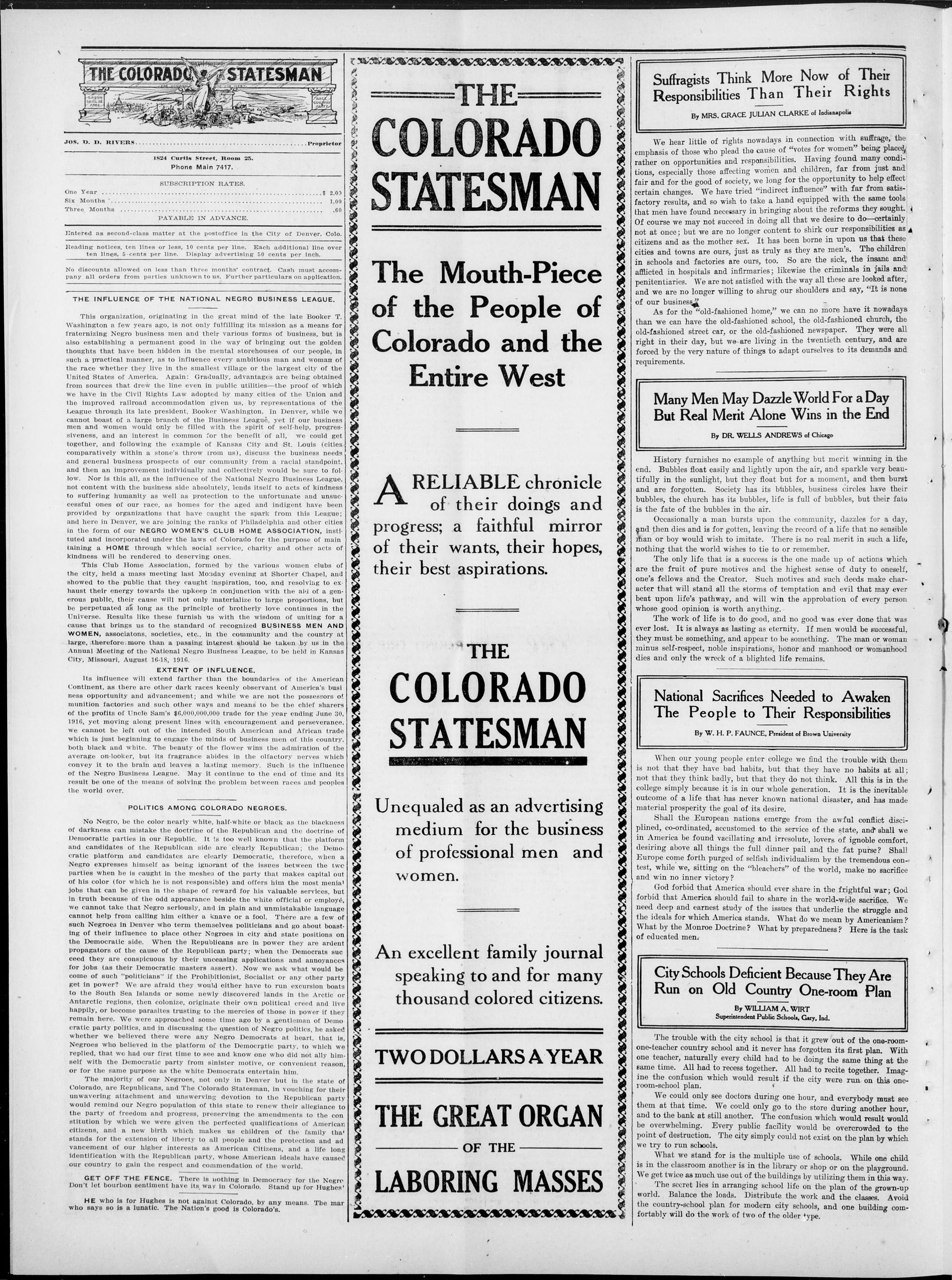
THE INFLUENCE OF THE NATIONAL NEGRO BUSINESS LEAGUE.
This organization, originating in the great mind of the late Booker T. Washington a few years ago, is not only fulfilling its mission as a means for fraternizing Negro business men and their various forms of business, but is also establishing a permanent good in the way of bringing out the golden thoughts that have been hidden in the mental storehouses of our people, in such a practical manner, as to influence every ambitious man and woman of the race whether they live in the smallest village or the largest city of the United States of America. Again: Gradually, advantages are being obtained from sources that drew the line even in public utilities—the proof of which we have in the Civil Rights Law adopted by many cities of the Union and the improved railroad accommodation given us, by representations of the League through its late president, Booker Washington. In Denver, while we cannot boast of a large branch of the Business Leagüe, yet if our business men and women would only be filled with the spirit of self-help, progressiveness, and an interest in common for the benefit of all, we could get together, and following the example of Kansas City and St. Louis (cities comparatively within a stone's throw from us), discuss the business needs and general business prospects of our community from a racial standpoint, and then an improvement individually and collectively would be sure to follow. Nor is this all, as the influence of the National Negro Business League, not content with the business side absolutely, lends itself to acts of kindness to suffering humanity as well as protection to the unfortunate and unsuccessful ones of our race, as homes for the aged and indigent have been provided by organizations that have caught the spark from this League; and here in Denver, we are joining the ranks of Philadelphia and other cities in the form of our NEGRO WOMEN'S CLUB HOME ASSOCIATION, instituted and incorporated under the laws of Colorado for the purpose of maintaining a HOME through which social service, charity and other acts of kindness will be rendered to deserving ones.
This Club Home Association, formed by the various women clubs of the city, held a mass meeting last Monday evening at Shorter Chapel, and showed to the public that they caught inspiration, too, and resolving to exhaust their energy towards the upkeep in conjunction with the aid of a generous public, their cause will not only materialize to large proportions, but be perpetuated as long as the principle of brotherly love continues in the Universe. Results like these furnish us with the wisdom of uniting for a cause that brings us to the standard of recognized BUSINESS MEN AND WOMEN, associates, societies, etc., in the community and the country at large, therefore more than a passing interest should be taken by us in the Annual Meeting of the National Negro Business League, to be held in Kansas City, Missouri, August 16-18, 1916.
EXTENT OF INFLUENCE.
Its influence will extend farther than the boundaries of the American Continent, as there are other dark races keenly observant of America's business opportunity and advancement; and while we are not the possessors of munition factories and such other ways and means to be the chief sharers of the profits of Uncle Sam's $6,000,000,000 trade for the year ending June 30, 1916, yet moving along present lines with encouragement and perseverance, we cannot be left out of the intended South American and African trade which is just beginning to engage the minds of business men of this country, both black and white. The beauty of the flower wins the admiration of the average on-looker, but its fragrance abides in the olfactory nerves which convey it to the brain and leaves a lasting memory. Such is the influence of the Negro Business League. May it continue to the end of time and its result be one of the means of solving the problem between races and peoples the world over.
POLITICS AMONG COLORADO NEGROES.
No Negro, be the color nearly white, half-white or black as the blackness of darkness can mistake the doctrine of the Republican and the doctrine of Democratic parties in our Republic. It is too well known that the platform and candidates of the Republican side are clearly Republican; the Democratic platform and candidates are clearly Democratic, therefore, when a Negro expresses himself as being ignorant of the issues between the two parties when he is caught in the meshes of the party that makes capital out of his color (for which he is not responsible) and offers him the most menial jobs that can be given in the shape of reward for his valuable services, but in truth because of the odd appearance beside the white official or employé, we cannot take that Negro seriously, and in plain and unmistakable language cannot help from calling him either a knave or a fool. There are a few of such Negroes in Denver who term themselves politicians and go about boasting of their influence to place other Negroes in city and state positions on the Democratic side. When the Republicans are in power they are ardent propagators of the cause of the Republican party; when the Democrats succeed they are conspicuous by their unceasing applications and annoyances for jobs (as their Democratic masters assert). Now we ask what would be come of such "politicians" if the Prohibitionist, Socialist or any other party get in power? We are afraid they would either have to run excursion boats to the South Sea Islands or some newly discovered lands in the Arctic or Antarctic regions, then colonize, originate their own political creed and live happily, or become parasites trusting to the mercies of those in power if they remain here. We were approached some time ago by a gentleman of Democratic party politics, and in discussing the question of Negro politics, he asked whether we believed there were any Negro Democrats at heart, that is, Negroes who believed in the platform of the Democratic party, to which we replied, that we had our first time to see and know one who did not ally himself with the Democratic party from sinister motive, or convenient reason, or for the same purpose as the white Democrats entertain him.
The majority of our Negroes, not only in Denver but in the state of Colorado, are Republicans, and The Colorado Statesman, in vouching for their unwavering attachment and unswerving devotion to the Republican party would remind our Negro population of this state to renew their allegiance to the party of freedom and progress, preserving the amendments to the constitution by which we were given the perfected qualifications of American citizens, and a new birth which makes us children of the family that stands for the extension of liberty to all people and the protection and ad vancement of our higher interests as American Citizens, and a life long identification with the Republican party, whose American ideals have caused our country to gain the respect and commendation of the world.
GET OFF THE FENCE. There is nothing in Democracy for the Negro Don't let bourbon sentiment have its way in Colorado. Stand up for Hughes'
HE who is for Hughes is not against Colorado, by any means. The mar who says so is a lunatic. The Nation's good is Colorado's.
COLORADO STATESMAN
---
The Mouth-Piece of the People of Colorado and the Entire West
---
A RELIABLE chronicle of their doings and progress; a faithful mirror of their wants, their hopes, their best aspirations.
THE COLORADO STATESMAN
Unequaled as an advertising medium for the business of professional men and women.
An excellent family journal speaking to and for many thousand colored citizens. TWO DOLLARS A YEAR
THE GREAT ORGAN OF THE LABORING MASSES
By MRS. GRACE JULIAN CLARKE of Indianapolis
We hear little of rights nowadays in connection with suffrage, the emphasis of those who plead the cause of "votes for women" being placed rather on opportunities and responsibilities. Having found many conditions, especially those affecting women and children, far from just and fair and for the good of society, we long for the opportunity to help effect certain changes. We have tried "indirect influence" with far from satisfactory results, and so wish to take a hand equipped with the same tools that men have found necessary in bringing about the reforms they sought. Of course we may not succeed in doing all that we desire to do—certainly not at once; but we are no longer content to shirk our responsibilities as citizens and as the mother sex. It has been borne in upon us that these cities and towns are ours, just as truly as they are men's. The children in schools and factories are ours, too. So are the sick, the insane and afflicted in hospitals and infirmaries; likewise the criminals in jails and penitentiaries. We are not satisfied with the way all these are looked after, and we are no longer willing to shrug our shoulders and say, "It is none of our business."
As for the "old-fashioned home," we can no more have it nowadays than we can have the old-fashioned school, the old-fashioned church, the old-fashioned street car, or the old-fashioned newspaper. They were all right in their day, but we are living in the twentieth century, and are forced by the very nature of things to adapt ourselves to its demands and requirements.
Many Men May Dazzle World For a Day But Real Merit Alone Wins in the End
By DR. WELLS ANDREWS of Chicago
History furnishes no example of anything but merit winning in the end. Bubbles float easily and lightly upon the air, and sparkle very beautifully in the sunlight, but they float but for a moment, and then burst and are forgotten. Society has its bubbles, business circles have their bubbles, the church has its bubbles, life is full of bubbles, but their fate is the fate of the bubbles in the air.
Occasionally a man bursts upon the community, dazzles for a day, and then dies and is for gotten, leaving the record of a life that no sensible man or boy would wish to imitate. There is no real merit in such a life, nothing that the world wishes to tie to or remember.
The only life that is a success is the one made up of actions which are the fruit of pure motives and the highest sense of duty to oneself, one's fellows and the Creator. Such motives and such deeds make character that will stand all the storms of temptation and evil that may ever beat upon life's pathway, and will win the approbation of every person whose good opinion is worth anything.
The work of life is to do good, and no good was ever done that was ever lost. It is always as lasting as eternity. If men would be successful, they must be something, and appear to be something. The man or woman minus self-respect, noble inspirations, honor and manhood or womanhood dies and only the wreck of a blighted life remains.
National Sacrifices Needed to Awaken The People to Their Responsibilities
By W. H. P. FAUNCE, President of Brown University
When our young people enter college we find the trouble with them is not that they have bad habits, but that they have no habits at all; not that they think badly, but that they do not think. All this is in the college simply because it is in our whole generation. It is the inevitable outcome of a life that has never known national disaster, and has made material prosperity the goal of its desire.
Shall the European nations emerge from the awful conflict disciplined, co-ordinated, accustomed to the service of the state, and shall we in America be found vacillating and irresolute, lovers of ignoble comfort, desiring above all things the full dinner pail and the fat purse? Shall Europe come forth purged of selfish individualism by the tremendous contest, while we, sitting on the "bleachers" of the world, make no sacrifice and win no inner victory?
God forbid that America should ever share in the frightful war; God forbid that America should fail to share in the world-wide sacrifice. We need deep and earnest study of the issues that underlie the struggle and the ideals for which America stands. What do we mean by Americanism? What by the Monroe Doctrine? What by preparedness? Here is the task of educated men.
City Schools Deficient Because They Are Run on Old Country One-room Plan
The trouble with the city school is that it grew out of the one-room-one-teacher country school and it never has forgotten its first plan. With one teacher, naturally every child had to be doing the same thing at the same time. All had to recess together. All had to recite together. Imagine the confusion which would result if the city were run on this one-room-school plan.
We could only see doctors during one hour, and everybody must see them at that time. We could only go to the store during another hour, and to the bank at still another. The confusion which would result would be overwhelming. Every public facility would be overcrowded to the point of destruction. The city simply could not exist on the plan by which we try to run schools.
What we stand for is the multiple use of schools. While one child is in the classroom another is in the library or shop or on the playground. We get twice as much use out of the buildings by utilizing them in this way.
The secret lies in arranging school life on the plan of the grown-up world. Balance the loads. Distribute the work and the classes. Avoid the country-school plan for modern city schools, and one building comfortably will do the work of two of the older type.
THE COLORADO STATESMAN
THE EQUINOX
THE STATE
LAUGH
WILL BE
FREE
AMY
COUNTRY
PARTY
THE
COLORADO
STATESMAN
THE PEOPLE'S BUREAU
OF INFORMATION
1824 CURTIS STREET
Room 25.
DENVER, COLORADC
Phone:
Main 7417.
Mrs. Harkless from Pueblo, is visitiing for the Summer with her sister, Mrs. M. A. Cole, 2837 Stout street.
Mrs. S. H. Hobson and daughter, Cleo, left Monday for Los Angeles, California, to visit her mother, Mrs. Clara Henderson.
W. A. Kelly, professional trombone player, returned to the city to join Morrison's New Orchestra after playing with the New Orleans Minstrel show for some months.
Miss Mattie Cowden, popular hairdresser of 1219 Twenty-first street, is suffering from a sprained ankle the result of a fall. She is improving slowly.
Mrs. Robert Pennington of Garden City, Kansas, who has been the guest of Mr. and Mrs. Frank Osborne, of 3524 Tennyson street, left this week for her home. She reports her stay in Denver one of much pleasure.
Miss Edith Hayden and Miss Susie Hayes of Wichita, Kansas, left last Tuesday for Colorado Springs, where they will spend a few days before returning home. They report their stay in Denver a most delightful one.
Duncan's trio is making a hit at Connor's Hotel, Laramie, Wyoming. The members of the trio, Messrs. Duncan, Fraser and Lankford are well known to Denver patrons as musicians who strive to give satisfaction.
The Zion Baptist Sunday School picnic had the usual success having taken out a large number of jolly good fellows to Dome Rock last Thursday. Rev. Wallace, superintendent of the Sunday School deserves much credit for the successful management along with his able assistants.
The Woman's Republican Club extends an invitation to THE COLORED CITIZENS' LEAGUE to attend their meeting Thursday evening, July 27, in the Auditorium of the Adams Hotel. All members of the League are especially requested to show their appreciation of this invitation by being present.
The Colorado Statesman congratulates Mr. and Mrs. Edward Banks who have recently purchased the modern up-to-date two-story brick building at 2418 Welton street, the same being a wise investment. Such examples by diligent and hard working members of our race show our aptitude for business and are worthy standards to follow.
Spencer J. Smithea, popular citizen of Denver and late employe of the A.T. Lewis and Son Dry Goods Co., left the city on Wednesday last to join his brothers in Detroit, Mich., where he will reside permanently. While here Mr. Smithea enjoyed a large circle of friends and acquaintances and was very prominent in the Masonic fraternity. We wish him every success in his new home.
Born to Mr. and Mrs. L. J. Manley, of Twenty-ninth and California streets, a beautiful baby girl, Monday, July 10. Mother and daughter are doing well. Dr. Justina Ford in charge. Mr. Manley is all smiles and in passing the cigars to his friends he informs them that he may not be able to help Uncle Sam with boys for the front but can surely help to supply Red Cross nurses.
MEN WANTED.
Wanted at the D. & R. G. shops in Burnham, all the colored men that they can employ, on the rip track. Mr. Fry, general car foreman.
SHORTER'S CHAPEL NOTES.
Rev. Robert L. Pope, B. D., Pastor. "The City Without a Night," and "The Good Soldier" will be our pastor's sermon topics for tomorrow. Last Sunday was observed as Woman's Day to the delight and profit of large audiences both morning and evening. Mrs. Weldon and her committee covered itself with glory. Mrs. DePriest presided with dignity and ease. Mesdames Dewey C. Balley, M. P. King, Janie M. Pope and Amelia Reeves appeared to splendid advantage in papers and addresses; and Mrs. Octavia Dishman and girl's chorus under Mrs. Glenn and the choir charmed their audience with song. So well did our women equip themselves that this day will be regularly observed hereafter.
Bishop H. B. Parks, D. D., of Chicago, will fill the pulpit Sunday morning July 30th at Shorter and a great audience will turn out to greet him. Shorter will present Richard B. B. Harrison of Chicago in a series of recitals (four nights) beginning Monday evening, July the 31st. Prof. Harrison is without an equal as a reader both classical and humorous, and his coming gives Denver an opportunity that she does not enjoy every day.
ZION NOTES.
Sunday was a great day at Zion. The pastor's sermon in the morning, from the subject, "The Homeless Christ," reached the heart of the congregation as was manifest by the intense interest. Brother Ball of Colorado Springs, united with the church by letter.
The great congregation of the morning was present at the evening service. The subject was lecture-sermon from the "Story of Daniel," illustrated by the stereoicon. The service was introduced by the congregational singing of "Onward Christian Soldiers," made real by beautifully colored pictures; and at the close of a quartette sang "Jesus Lover," to the accompaniment of wonderful dissolving views. The service was a masterpiece.
Next Sunday night will begin a series of stereopticon lectures which will present the Bible in pictures and story, "From Genesis to the Cross." Seven consecutive Sunday evenings, You cannot afford to miss a single evening. The entire Bible story will be told in a series of pictures in a way that you have never seen before. Appropriate illustrated music will be a feature every night. The program begins promptly at 8 o'clock. The Young People's Chorus will also sing
PEOPLE'S PRESBYTERIAN.
East Twenty-third and Washington street.
Pastor, J. A. Thos. Hazell, S. T. B. Sermon Topics, Sunday July 23, 11 a. m., "Jesus Conduct as He Approached the Crisis."
5:30 p. m., "The First of a Quartet of Sins Punished in this Life and in the Life Beyond."
On Sunday evening the minister will preach on the first of a series of sermons of four in which he will demonstrate the fact that certain sins are punished in this world whilst others are punished in this world and that to come.
Our organist, Mr. Spratlin is now on his vacation. Our pianist, Miss Cleo Hobson, has gone to spend some time in California. If the way be clear we hope to stage a midsummer sacred concert the first Sabbath of August on the return of Mr. Spratline. Miss Mae Prince will furnish worthy selections.
The choir hopes to entertain the public as never before in a series of musical engagements beginning this Fall and lasting through the Winter months both at the Colored and White Churches of the city. On one or more occasions we will have imported artists the reputation of whom is known in Europe, the two Americas and the West Indies. The winter programs will be all the more interesting when we consider the fact that the composition, literary and musical will be distinctively Hamic. From time to time detailed announcements will be alred thru the columns of the daily and weekly press of the city. "He that walketh with the wise shall be wise." Friends, govern yourselves accordingly.
BIG EXCURSION TO COLORADO
SPRINGS.
Wait for the Barton Big Scenic Excursion, Friday, August 4th, to Colorado Springs, Manitou and Pike's Peak. Two baggage cars will be artistically decorated for dancing going and coming from the Springs. Something new. Fare for the round trip, $1.25. Children half fare. Morrison's full orchestra will furnish the music.
W. F. PLAMBECK JEWELRY C.
This company, one of the oldest and most reliable jewelry firms of the city, 1715 Champa street, in offering the best articles in their line, announces that their prices are within the reach of all, and their work still stands the test of the most critical now as in the years before. In thankking the public for past favors we assure them of our efforts to continue to please and hope we have insured their confidence.
K. P. Excursion to Colorado Springs in honor of Grand Lodge. Thursday, July 27th, via Colorado & Southern. Secure your tickets from Harry Jones, 1021 Nineteenth street. Round trip $2.25.
For $15 to $22 Suits
The newest Summer models, colorings and fabrics for Men and Young Men, are now included.
Forget the Price, for these Suits were made by America's leading manufactures.
$17
For $25 to $30
SUITS
= = =
$23
For $35 to $40
SUITS
= = =
The
May
Co.
Y. M. C. A. NOTES.
The men's meeting at the Y. M. C. A. last Sunday afternoon was well attended. A spirited song service was conducted, followed by a season of prayer in which several participated. Quite a number of the men present were new, that is, they had never attended the meetings before. Others had made good their promise of the Sunday previous, to bring another man with them.
The speaker of the afternoonoo was the Rev. C. A. Wilson, pastor of St. Paul's English Lutheran Church. He spoke on David's contest with Goliath. He said that David's victory was due to his confidence in God, to his good habits and to his willingness to sacrifice himself for the welfare and safety of his people. Permanent good can never be won by fighting a selfish battle. "For whosoever will save his life shall lose it; and whosoever will lose his life for my sake shall find it."
The juniors had the croquet court largely to themselves last week. They are developing some good players among themselves, and some of them are speaking of challenging the seniors. Sims and Ross engaged Bell and King in a game on Saturday evening, and while the former would ordinarily have been no match for the latter pair, but Bell seemed to be out of condition, often missing balls only ten feet away. And yet, with Sims and King already rovers, it is somewhat doubtful how the game would have ended had not Sims been forced to leave in order to make his train. Next Saturday, however, will clear away the doubt.
The men's meeting will be held as usual next Sunday afternoon at 4 o'clock. Rev. W. A. Webster, pastor of the West Side Christian Church, will be the speaker. Mr. Webster is a firm believer in the rights of the Negro, and promises to give out some warm facts on that occasion. All men will be welcome.
COLORED CITIZENS LEAGUE.
All members of the Colored Citizens' League are requested to be present at meeting to be held Tuesday, July 25, at the rooms, 2560 Washington street, as business of importance will be transacted. J. D. D. RIVERS, President.
R. U. GOING
Colorado Springs, Manitou and Pikes Peak Friday, Aug. 4th
THE MOUNTAIN
A full line of Watches, Clocks, Diamonds and Jewelry at lowest prices. Courteous treatment to all
Mrs. James Clay left last Tuesday to attend the funeral of her mother, who died in Alamosa after an illness of many weeks.
Mrs. W. W. Bryant continues to improve after the operation on her eyes.
Rev. A. M. Ward passed through the city on Friday enroute to Salt Lake.
Mesdames White, Smith and A. W. Ward attended the Summer School of Missions at the Chautauqua Grounds last week.
The Woman's Club held a lawn party at the residence of Mrs. Mary White on last Thursday.
Allen Chapel Sunday School is conducting A Children's Hour each Friday afternoon for story telling. The innovation is proving to be a very popular one. The visiting teachers taken an afternoon each. Miss Iphigen, the instructress at the University Summer School will be the story teller for next week.
After using others give Hair Root Grower a trial and let us prove to you what it will do. Will grow hair from 1 to 2 inches a month, if used according to directions. For treatments, massage and manicuring, call York 957M, 2333 Ogden St., for appointments. Mrs. Gora Robinson and Mrs. Elza Rose.
GENTLEMEN, IMPROVE YOUR HAIR. If you have good hair we can make it better; if you have bad hair we can make it good; no need to wear your hair shaved or cut close, wear it long. See Mrs. Robinson and Mrs. Rose; let them keep it straight and looking nice. Phone York 957M or 2333 Ogden for appointments.
W. F. PLAMBECK
EXPERT WATCH MAKER
BOULDER NOTES.
All Boulder is a flutter over the rare treat to be had when Bishop H. B. Parks comes to speak at Allen Chapel on Friday, July 28. This is the Bishop's first visit to Boulder, and means much to the people here. Bishop Parks is without a doubt one of the most forceful and masterly gospel preachers among our Bishops today. All Boulder awaits his coming.
The funeral of Albert Christopher Harris, for 22 years a resident of Boulder, was held at Allen Chapel on Sunday last. Mr. Harris died on Thursday morning, July 13, at the age of 68 years. He was born at Harper's Ferry, W. Va. He is survived by a widow and three children. Rev. A. C. Jackson assisted Rev. A. Wayman Ward, who officiated.
The University Summer School has its largest enrollment of Negro teachers during its history. Misses Mary Thomas, Mary Greene, Cora Black, and Callye Williams are Kansas City teachers, and Miss Clementine Reeves is a Sedalia, Mo., teacher. Other city visitors are Mesdames Clark and Brown of Topeka, Kan., Lizzie Douglas of Denver, Ruskin of Texas, Misses Christian and Alexander of Oklahoma, Messrs. Young and Scroggins of Hot Springs, Ark.
The season's greatest attraction is the Midsummer Musicale to be given by Allen Chapel Choir on Thursday, July 27. No pains are being spared to make this entertainment surpass any of its kind in recent years. The special artists are Prof. George Morrison the premier Negro violinist of the west, Miss Jennie Hicks, the Colorado songbird, and Miss Mary Thomas an exceptional reader of Kansas City.
Mrs. Esther Morris attended the Harris funeral on Sunday last.
There is no situation in life so bad that it cannot be retrieved.
It is a poor heart that never rejoices. - Dickens.
Some of these delicate concoctions would not wear for every-day living, but an occasional slipping from the beaten path makes these sweets all the sweeter. Nesselrode Pudding. Take three cupfuls of large chestnuts, shell and remove the brown skin, cover with water and simmer until thoroughly tender. Drain and press
fourth of a pound of candied fruit, cut in pieces, cover with a half cupful of pineapple sirup. Boll a cupful of sugar and a half cupful of water until it spins a thread. Add to it the beaten yolks of four eggs, stir until the mixture is thick, then beat until cold. Add the chestnuts and a teaspoonful of vanilla and one pint of cream whipped. Put into a freezer and half freeze, then add the candied fruit. Pack and stand at least two hours to ripen.
Frozen Cheese and Preserved Figs.
—Beat two good-sized cream cheeses with half a cupful of stiff cream until smooth, sweeten to taste and put into a covered mold. Pack in ice and salt for four hours. When ready to serve slice in pieces two inches thick, then cut in rounds, or, better, pack in baking-powder cans and it will be all ready when sliced. Make a slight depression in the center and put in a preserved fig, stem end up.
Biscuit Glace.—Put two cupfuls of sugar and one cupful of water in a saucepan over the fire. Cook carefully until the sirup spins a thread. Beat the yolks of six eggs very light; pour the sirup upon them slowly, beating all the while. Return to the fire and cook one minute. Strain into a bowl and beat until cold. Add a teaspoonful of vanilla, one-fourth of a cupful of orange juice and very finely chopped nuts. Turn into the freezer, and when thoroughly chilled add one pint of cream, whipped stiff. Fill paper boxes, sprinkle with chopped nuts or macaroons and pack and freeze.
Plain ice cream is far easier to prepare than most cooked puddings, and the large majority of diners would much prefer them.
Mexican Hash.—Chop or grind meat left from a roast. To each pint of meat add half a can of corn, three-fourths of a cupful of bread crumbs and gravy to make it moist. Season highly with paprika and bake in a buttered dish twenty minutes. Fine served with baked potatoes.
In order to love mankind, we must not expect too much of them. It is a great gift to choose and be satisfied—Frank Crane
Marshmallows as a confection dipped in pepperpoint fondant, are a delightful after-dinner mint. A marshmallow dropped in a cupful of hot cocoa at the children's parties will please them better than whipped cream, and is so easy to do. A marshmallow placed
A marshmallow placed on salted wafers, the small, round ones, and put into the oven to brown, makes most attractive marguerites.
Marshmallows cut in quarters with sharp shears and mixed with pineapple and whipped, sweetened, flavored cream, and served in shebet glasses, is a dainty dessert.
A most delightful fruit salad may be made with pineapple, strawberries, marshmallows, and two, or three tablespoonfuls of a good boiled salad dressing stirred into a cupful of whipped cream. Serve very cold in a pretty glass dish.
Marshmallows cut up and added to the boiled frosting while it is hot is a favorite filling for a cake as well as a good ice.
Marshmallows.—Dissolve one package of gelatin in 14 tablespoonfuls of water. Boll together four cupfuls of sugar and 14 tablespoonfuls of water until it forms a thread. Pour the sirup over the gelatin in a deep dish and beat until thick; flavor as desired, and put into a pan of powdered sugar to coat each marshmallow.
Marshmallow Frosting.—Melt one cupful of white fondant, add the white of an egg, beaten stiff, and stir over the fire two minutes; remove from the heat and beat for two minutes, or until stiff enough to spread; flavor with any desired flavoring. This is especially good on chocolate cake.
Marshmallow Paste.—Put a fourth of a cupful of sugar and the same amount of milk in a saucepan, heat slowly to the boiling point, and boil six minutes. Cut a fourth of a pound of marshmallows in pieces and melt in a double boiler; add two tablespoonfuls of hot water and cook until the mixture is smooth; then add the hot sirup gradually, stirring constantly. Beat until cool enough to spread, then add a half teaspoonful of vanilla. Use either for filling or frosting.
Nellie Maxwell
HONEST GOODS
HONEST WORK
AT HONEST
PRICES
Imperf Repairing
HAIR ROOT GROWER
Every failure teaches a man some thing if he will learn.
DAINTY,DISHES
but an occasional slipping from the beaten path makes these sweets all the sweeter.
Nesselrode Pudding.—Take three cupfuls of large chestnuts, shell and remove the brown skin, cover with water and simmer until thoroughly tender. Drain and press through a sieve. Take a
USES FOR MARSHMALLOWS
delightful after-dinner mint. A marshmallow dropped in a cupful of hot cocoa at the children's parties will please them better than whipped cream, and is so easy to do.
2,312 SHIPS ADDED TO THE AMERICAN
MERCHANT FLEET SINCE WAR OPENED
From the beginning of the European war to June 1, 1916,
2,d12 ships weie added to the American merchant marine. The
new boas carrying the American flag were mostly constructed in
American shipyards. Of the total number only 179 are foreign-
built ships that have been admitted to American registry under the
ship registry act of August 18, 1914. Most of the additions to the
American fleet from foreign-built ships came in the early months
of the war, for the principal European nations began in February,
1915, lo prohibit the sale of their respective merchant vessels to
citizens of other countries.
From July 1, 1914, to June 30, 1915, a total of 1,371 ships
were addéd to the American fleet. Of this number 145 were for-
cign-built ships. Vrom July 1, 1915, to May 31, 1916, there were
941 ships added to the American fleet, and of this number only 34
were forcign-built ships. The greatest additions to the American
fleet were made in May and June, 1915. During those two months
the flect was increased by 361 ships.
‘OLDGLORY’ AMONG
THE OLDEST FLAGS
Stars and Stripes First Carried
in Battle, However, in
Mexican War.
OF MANY SIZES AND SHAPES
Banner That Inspired hat and One
Carried by Paul Jones in Col-
fection of the National
Museum.
A decree recently Issued by Uncle
Sua standardizing the form and size
sf the American flag has brought out
some Interesting bits of history con-
fected with the Stars and Stripes.
The fact that some sixty-odd sizes and
shapes of American tls were found
in use in the vartous government de-
partments Jed to the executive order.
The flags and Union Jacks of all
departments, with certain exceptions
in the army and navy, must now con-
form to specifications, ‘There are 12
prescribed sizes, from 1.i81-foot to 20-
foot widths, but the 19-foot flag is to
fe the standard.
‘The story of how the American flag
scew Is told in a bulletin of the Smith-
sonian institution. Examples of the
flag in its various periods of develop-
cent are ingluded In the collections of
(he United: States National Museum.
It is interesting to note, says tne
bulletin, that during the Revolution
the flug had 1% stars, in the war of
ast2, 15, in the Mexican war, 85, in
the Spanish-American war 45, and to-
day there are 48. ‘The American flag
is among the oldest of national fags,
belug older than the present British
Union Juck, the Wrench tri-color and
the flag of Spain, and many years old-
er than the flags of Germany and Italy,
some of which, like those of other
countries, are personal flags, or those
of reigning families.
Banner That Inspired Key.
Representative of the early type
there 1s a 12-star flag sald to have
been used by John Paul Jones during
the War of the Revolution, which is
now in the National museum. Another
flag of the very highest historic value
is the original “Star-Spangled Banner”
which flew over Wort McHenry in Bal-
timore during the bombardment on
September 13-14, 1814, and was the in-
spiration for Key's anthem. ‘This Fort
McHenry flug is of the 15 stars and
stripes type, adopted by an act ap-
proved by President Washington, Jan-
uary 1, 1794, which took effect May 1,
1795, after the admission of Vermont
and Kentucky, It measures about 30
feet square, is much battered and torn,
with one star missing, but this great
historic souvenir has been preserved by
quilting It on heavy linen cloth, and
cemains one of the country’s most pre-
cious relies.
From 1795 this form continued as
the standard flag un‘il President Mon-
coe’s administration, when congress
enacted that It should thereafter be of
18 stripes, with the addition of a star
for euch new state, commencing July
4, 1818.
Tt seems that the army never car-
ried the national flag in battle, though
we have record of its use us a garrison
flag from about 1787 or 1789 until 1846,
Bodies of troops enrried during this pe-
riod, and before it, what was known
4 national colors or standards of blue
emblazoned with the arms of the
United States, an eagle surmounted
by a number of stars, and with the
designation of the body of troops, as
infantry or artillery inseribed on a
seroll.
Definite Rules in 1912.
In 1834 the artillery was given the
eight of carrying the Stars and Stripes
as recorded by the war department
regulations, the infantry and cavalry
still using the national arms with an
added scroll in the eagle’s beak bear-
ing the words: “2 pluribus unum,”
‘These flags remained the colors of the
infantry until 1841, und of the cavalry
until as late as 1887, when they were
ordered to employ the Stars and
Stripes.
Several flags of the period of the
Mexican war, 1846-47, are in the mu-
seum collections. Among them is a
flag of 13 stripes and stars carried
throughout the war by the battalion
of volunteers which enlisted from
Maryland and the District of Colum-
bia, and the flag of Company I, Fourth
regiment of Indiana, with an eagle In
the field.
Ten flags of the collection pertain
to the Civil war. Other flags include
some from the Spanish-American war,
the American colors curried by Rear
Admiral Peary in his aretic explora-
tion in 1909 and the flag carried by
the Smithsonian African expedition
under the command of Col. Theodore
Roosevelt in 1909-10.
GOLD AND SILVER MINED
ALL OVER UNITED STATES
Report of Output of Precious Metals
for 1915 Shows Varying Produc-
tion in Many States.
The United States produced 4,887,-
604 fine ounces of gold, valued at
$101,085,700 in 1915, an Increase of $6,-
508,900 over the previous year. The
production of silver in 1915 amounted
to 74,961,075 fine ounces, valued at
$37,397,300. ‘This was an increase of
2,505,975 fine ounces In the production
of silver.
A report of the bureau of the mint
and the geological survey, just Issued,
Is of interest as showing the wide dis-
tribution of this production over the
United States. This report shows the
value of the output of gold and silver
in the varions states and territories of
the United States in 1915 as follows:
Gold. Silver,
Alabama ......8 5,100 Pee
Alaska .....6.--16,710.000 $526,100
Ariiona yee... 4,955,000 5 2,826,500
California .....22,547,000 $43,100
Colorado ......22,580,800 3,501,900
Georgin ....... 84,800 100
Tdaho ......... 1,170,600 6,506,800
MUInOlsintetesse cave ete 1,00
Michigan -.222 sei5toe 280,300
Montana ....... 4,978,200 7,195,600
MMISSOUTl case oa 27,700
Nevada ........11,88,700 7,210,500
New Mexico... 1.460.000 1,165,900
North Carolina. 170,700 700
Oregon ........ 1,867,100 62,600
Philippine Ist'ds. 1,320,900 7,600
Porto Rico .... POU sec. sea
South Carolina. 8,600 ol...
South Dakota .. 7,403,500 98,600
Tennessee ...... 6,800 49,500
TEXAS ..e05006. 1,800 361.500
Utah ......4... 8,907,900 6,522,200
pVermontie scoot ccc ste 100
Virginin ...... 500 apie
Washington .... 461,600 106,700
Wyoming ...... 13.900 1,400
‘Total ......$101,035,700 87,397,300
FOREIGN CLOTHES NOT WORN
Very Few Ready-Made Garments for
Men Imported Into United States
—Exports Also Are Small.
Foreign compet'tion is one of the
least of the worries of the ready-made
clothing industry of the United States,
according to Uncle Sam. With an an-
nual production amounting to more
than half billion dollars, manufae-
tnrezs in the United States have prac-
tieally no competition from abroad.
At the same time the United States
exports very little ready-made cloth-
ing, In proportion to the size of the
Output in this country,
‘These conditions are due to the fact
that ready-to-wear clothing is not com-
monly worn in Europe except in the
cheaper grades, American-made cloth-
ing for men was introduced in London
about 1908 or 1909 and small quanti-
ties have been sold in other European
cites. Most of the exports of cloth-
Ing,however, have gone to Canada and
Mexico, ‘The total exports of woolen
weuring apparel of all kinds amounted
to only $2,148,235 in 1914.
‘The little ready-made clothing that
is imported into the United States
consists chiefly of English overcoats
and such novelty garments as golfing
and motoring clothes. ‘The only per-
sons in the United States who prefer
English clothes are a few residents of
eastern Seaport cities who are in touch
with England socially or commercially.
Blile Bradiakian dirckoa:
he manufacture of silk and silk
goods in the United States showed a
big gain in 1914, as compared with
1909. A report of the bureau of the
census shows that the value of the
product in 1914 was $253,764,170,
gain of 28.9 per cent over 1909, when
the year's product was valued at $196,-
911,667.
MANY LAWS MADE
AFFECTING LABOR
Forty States Have Enacted Such
Legislation During the
Past Year.
UNEMPLOYED GET ATTENTION
Commissions Are Appointed in Several
Cases to Investigate Problem—
Industrial Commission
Plan Grows.
Uncle Sam has made a survey of the
legislation of interest to labor enact-
ed during the last year, and finds that
action of this character was taken
in forty states, In which either regular
or extra sessions of the legislatures
were held, A summary of labor legis-
lation Issued by the bureau of labor
statistics of the United States depart-
ment of labor says:
“Aside from the enactment of work-
men’s compensation laws, perhaps the
most significant feature of the legis-
lation of the year is the growth of the
industrial commission plan, uniting in
one authority the administration of
workmen's compensation, factory in-
spection and other labor laws. ‘This
plan was adopted in 1915 in Colorado,
Indiana, Montana, Nevada and, New
York.
Unemployment Gets Attention.
“Especially notable in the legista-
tion of the year was the attention giv-
en to the subject of unemployment
and public enrloyment offices. In Mli-
nols a commission of unemployment,
| consisting, of three representatives of
| labor, three of employers, and three
of the public, was established, to re-
port at the next legislative session, In
connection with the state employment
offices, a general advisory board was
established to investigate and deal
with unemployment. Californla and
| Nevada passed resolutions calling for
investigation of unemployment. In
| Idaho emergency employment Is to be
provided by county boards of commis-
sioners for unemployed citizens of the
United States who have been for six
| months residents of the state. Em-
ployment is to be on the highways at
rates to be fixed by the county boards,
not more than 60 days’ work of this
kind to be furnished any person with-
In one year. One-half of the expense
is to be borne by the state, and refusal
to perform the work assigned deburs
one from this form of relief for the
period of one year.
“Public employment offices were pro-
vided for in California, Idaho, Iowa,
New Jersey and Pennsylvania, and
provision was msde for the extetision
vf the system of public employment
offices in Iinols, Michigan and Okla-
homa. ‘The licensing and supervision
of private employment offices were
provided for in seven states—Colorado,
Nebraska, Oregon, Pennsylvania,
Rhode Island, Texas and Wiseonsin—
while Idaho prohibited the mainte-
nance of private employment agencies
operated for profit.”
Minimum-Wage Laws.
“Employment of women and children
occupied the attention of legislators
throughout the country, and regula-
tory measures quite as numerous as
In previous years were adopted. Some
of the most notable among these were
the minimum-wage Inws enacted by
Arkansas and Kansas, Increasing to
11 the number of states which have
passed such laws. California, Mas-
sachusetts and Washington passed
amendments to their minimum-wage
laws, not, however, involving any im-
portant modifications.
“In the field of safety provision,”
says the summary, “the most detatled
enactments were those formulated by
the Industrial commission of Wiscon-
sin and the industrial boards of New
York and Pennsylvania, ‘The rules
and orders of these bodies indicate an
Intimate knowledge of the conditions
to be met which it is impossible for an.
ordinary legislative committee to pro-
cure. The worker's welfare is looked
after In less usual ways by new en-
actments in some states regulating
the sanitary conditions in labor camps,
Rue cers eet eec ent aern a Rees: Sie Or Cee
FILING CABINETS IN CHINA
United States Commercial Attache
Thinks Business Men of Orient.
Will Use American Product.
‘The sight of rows of American filing
cabinets and other modern office de-
vices In Chinese business houses is
one which may be expected to greet
visitors to Peking, Hongkong, and other
big Chinese cities in the near future,
in the opinion of United States Com-
mercial Attache Julean Arnold of
Peking. Chinese concerns haye only
very recently taken to foreign office
practices but gradually they are real-
\zing the necessity of adopting modern
business methods and are realizing
that the adoption of these methods
means the use of filing cabinets, For
this reason an increasing interest in
American filing methods is expected In
Chinese business houses and govern-
ment offices. A future market 1s also
seen for American steel filing cabl-
nets, although the high price of these
cabinets delivered in China deters
many from equipping their offices with
them. In the meantime, Mr. Arnold
says it will be necessary for Aimer!-
can manufacturers to spend some mon-
ey in advertising and missionary work
to make their products better known
In the far eastern markets,
CITIES’ DEBTS GROW
Few Living Within Income, Uncle
Sam Finds.
New York City Owes Nearly as Much
as All Other Municipalities of More
Than 30,000 Taken Together.
Few American cities of more than
30,000 population are living within
their income, Uncle *Sam has found.
‘The most of those which are spending
more than they are receiving in rev-
enue, however, are making extensive
public improvements, the cost of
which is covered in most cases by
bond issues. In only three cities of
this class were the payments for cur-
rent expenses and interest found to
exceed the revenues.
These facts are contained in a re-
port prepared by Director Sam L. Rog-
ers of the bureau of the census.
In 156 of the 204 American cities
of more than 30,000, the increase in
net Indebtedness, due to excess of
expenditures for governmental costs,
including interest and outlays for per-
manent improvements, over revenues,
during the fiscal year 1915, was $174,
470,954, or $5.48 per capita. In the re-
maining 48 cities the excess of rev-
enues over expenditures amounted to
$7,715,199, or $1.82 per capita. ‘Taking
the entire 204 cities as a group, the
excess of expenditures over revenues
was $139,755,815, or $4.48 per capita,
‘The aggregate revenues of all the
cities during the year were $040,385,
S11; the aggregate expenditures for
current governmental costs, including
interest, $750,555,565; and the aggre-
gate outlays, $829,585,561.
In all but three cities the revenue
receipts exceed the payments for cur-
rent governmental expenses and inter-
est; and in 48 the revenues exceeded
the total expenditures for governmen-
tal costs, Including interest and out-
lays. ‘The largest clty in which this
condition obtained was St. Louls,
where the excess amounted to $217,
873, or 80 cents per capita; and the
next largest was Washington, D. ©.
for which it was $2,440,399, or $6.85
per capita. ‘These two were the only
cities of more than 300,000 In which
the revenues thus exceeded the total
expenditures for governmental costs.
Among the cities of 100,000 to 300,000,
the following showed excesses of rev-
enues over expenditures: Spokane
and Tacoma, Wash.; Jersey City, N.
J.; Dayton, 0.; Denver, Colo.; Bir-
mingham, Ala., and Atlanta, @a,
‘The net indebtedness of New York
elty, $921,753,859, is nearly two-thirds
as great as the total for all other
cities of over 30,000 taken together,
and is more than nine times as great
as that of Philadelphia, which stands
second in this respect, with a net in-
debtedness of $101,863,626, ‘The per
capita net Indebtedness of New York
city, $172.82, is greater than that of
any other large city, but the corre-
sponding per capita for Philadelphia,
$61.14, is considerably below the av-
erage for cities of 800,000 or more.
S Ever Eat “Canned Willie?” $
S In an “Eneyelopedia of Mill- §
© tary Terms,” just published by
& Canadian troops serving in
© France, an old staple army ar- ©
ticle, corned beef, is given the
name of “bully.” e
Members of the United States $
marine corps, who publish no &
o encyclopedia, call the same o
© thing “canned Willie,” and they &
© point out that troops all over ©
© the world have different and ex- &
jo pressive terms describing the ©
© tinned corned beef product.
je Uncle Sam's marines give no ©
E reason for their “canned Willie” §
© version of the corned beef af- ©
© falr other than that they try to &
© Le original in all things, and ©
B that, in going about the world &
© in performance of duty, they
learn what the other fellow is
© doing in a nicknaming way and 2
lo are thus able to keep right up o
© to the minute. S
SOAP IS NOW BY-PRODUCT
Curious Anomaly in British Industry
Produced by War, Uncle Sam's
Commercial Agent Reports.
A report received by Uncle Sam
from one of his commercial agents in
England tells of a peculiar anomaly
that has developed there as a result
of the war. This is the relegation of
soap to the category of by-products
of soup factories, Glycerin is now the
product of chief value made at Brit-
ish soap works, although its manufae-
ture ts oply incidental to the soap-
making process. ‘This reversal of the
usual order of things is due, of course,
to the demand for glycerin in the man-
ufacture of munitions, of which it Is
an important constituent.
‘The result of all this is that by in-
creasing the production of glycerin
to meet the demands of war times, the
sonp factories are accumulating great
stocks of soap and the manufacturers
are faced with the necessity of finding
new and larger outlets for thelr wares,
not so much to sell more soap, as to
secure an increased yleld of glycerin.
To prevent the importation of foreign
‘soap, which would cut down home
production, thereby reducing the out-
put of glycerin, the manufacturers did
hot advance the price of soap when
prices of all other articles were soar
ing.
Uncle Sam Wants People to
Enjoy Splendors of the
National Parks
| Smo ewig Ns aR eae oe ee)
Se es ae ee
Sa ae ee
; Oe oe om ae Se
og Al LM Woe ‘eal seals
View of Spruce Tree House, Home of the Cliff Dwellers, One of Interesting
Sights of Mesa Verde National Park.
United States to use their national
parks and become acquninted with
their splendors.
To build legal fences around the
scenic beauties of the West is not
enough, holds Secretary Lane of the
department of the interior. “Why have
great hational playgrounds unless the
people play in them?” he asks. Let us
have our scenic splendors seen, he in-
sists.
Hereby hangs the story of a new
and interesting policy in the adminis-
tration of the national parks.
In these great reservations are to be
‘found more of the mystery, majesty
and magnificence of the out-of-doors
than can be found in any other coun-
try of the world. They contain rest
for the weary; a spur for the sound
man and a tonie for the weak; infinite
outlet for exuberant youth and new
vigor for the aged; and even this—life
for a dead imagination.
There are countless snow-crowned
mountains, waterfalls of dazzling vol-
ume and dizzying descent, canyons
that seem like gulfs of eternity, trees
you can drive through in the biggest
auto truck made, vistas and expanses
that defy expression. It is a marvel-
ous panorama which includes about
every remarkable thing the earth pro-
duces, animate or inanimate, save one
—the Great American Spender.
“Why not complete the picture?”
Lane argues.
Need Not Conserve Scenery.
To state it by anecdote, a perfectly
well-meaning editor, all lit up with en-
thusiasm for the idea—a “piece” for
his magazine was the object—recently
wrote the secretary of the interior
seeking data upon the “conservation”
policy as applied to the parks.
“Conserve blazes!” ran the reply, in
substance. “You're in the right chureh
but the wrong pew. We're conserving
gas, oil, radium, phosphates, coal and
human energy; we're not conserving
the parks. Most of them have been
conserved many years, by aets of con-
gress. Our supply of scenery, I aw
happy to say, is not in danger of ey
haustion.
“Use is the idea now. It is a bus.
ness question. Here lies one of the
biggest business assets in the U. 8. 4.
and it is largely unused. Why rot
evAh it and add to our prosperity!”
Some of Uncle Sam's national p' ay-
gronnds—such as Yellowstone and Yo-
semite—are well known even to those
who haye never seen them, but there
are a number of others equally as in-
teresting, if not as large, of which the
majority of American citizens probably
have never heard, Among the smaller
parks that are full of interest to the
visitor, is the Mesa Verde, in south-
western Colorado,
Discovered by Accident.
One December day in 1888 Richard
and Alfred Wetherall, searching for
lost cattle on the Mesa Verde, or green
/mesa, near thelr home at Mancos,
Colo., pushed through dense growths
on the edge of a deep canyon and
shouted aloud in astonishment. Across
the canyon, tucked into a shelf under
the overhanging edge of the opposite
brink, were the walls and towers of
what seemed to them a palace. They
named it Cliff palace. Forgetting the
cattle in their excitement, they
searched the edge of the mesa in all
Airections. Near by, under the over-
hanging edge of another canyon, they
found a similar group, no less majes-
tie, which they named Spruce Tree
house, because a large spruce grew out
of the ruins,
‘Thus was discovered the home of
the cliff dwetlers, the most elaborate
and best-preserved prehistoric ruins
in America, if not in the world. A
careful search of the entire mesa in
the years following resulted in many
other finds of interest and importance.
In 1906 congress set aside the region
as a national park, Even yet its treas-
ures of antiquity ure not all known, A
remarkable temple to the sun was un-
eurthed in 1915.
Cliff palace is the most celebrated
of the Mesa Verde ruins because It is
the largest and most prominent. Oth-
ers are not less interesting and im-
portant from a standpoint of history.
Spruce ‘Tree house is next in size.
Balcony house and Peabody house are
equally well preserved. ‘There are
many others; some which have yet to
be thoroughly explored, and probably
some still undiscovered.
Two Hundred Rooms in House.
Clift palace is 300 feet long and con-
tained probably 200 rooms. Sprucé
‘Tree house is 216 feet long and was di-
vided into 114 rooms. Spruce Tree
house originally had three stories and
its population was probably sbout 350
persons.
Until the summer of 1915 no strue-
tures had been discovered in the Mesa
Verde except those of the cliff-dwell-
ing type. Then the department of the
interior explored a mound on the top
of the mesa opposite Cliff palace and
unearthed Sun temple. Dr. J. Walter
Fewkes, who conducted the explora-
tion, believes that this was built about
1300 A. D., and marks the final stage
in Mesa Verde development.
Indians of today shun the ruins of
Mesa Verde. ‘They believe them in-
habited by spirits whom they call the
Little People. It is vain to tell them
that the Little People were their own
ancestors; they refuse to believe it.
AMERICAN EXPORTS SET
NEW RECORD EACH MONTH
Volume of Outbound Trade for Year
Double That for Same Period of
Time in 1910 and 1911.
American exports continue to set
new records each month, according to
Uncle Sam's official figures, Exports
for May reached a total of $472,000,000.
‘This exceeds all previous monthly ree-
ords. It is greater by $61,000,000 than
the high record for March. It is $300,-
000,000 more than the monthly May
average from 1911 to 1914. ‘The total
exports for the year ended with May
were $4,136,000,000, an increase of $1,-
500,000 over the preceding 12 months,
‘and double the total for the year end-
ed with May, 1911. ‘The exports for
May were $80,000,009 more than the to-
tal for the fiscal year 1870.
‘The imports for May were also the
greatest on record, the total value be-
ing $229,000,000, an Increase of $11,-
000,000 over April, the previous high
mark. This total exceeds the monthly
May average from 1911 to 1914 by $82,-
000,000. For the year ending with May
imports totaled $2,110,000,000 dollars,
an increase of $433,000,000 over the
preceding year and $242,000,000 over
the corresponding period two years
ago. The combined value of imports
and exports in the 12 months just end-
ed was $6,246,000,000, a growth of near-
1y_$2,000,000,000 ($1,916,000,000) in a
single year,
The favorable balance of trade in
the month and 12 months ending with
May was the largest ever known, For
May it was $243,000,000 and for the
yeur ending with May $2,026,000,000.
Corresponding figures for lust year
were $132,000,000 for May and $983,-
000,000 for the 12 months,
May showed a net inward old moye-
ment of over $15,000,000, thus revers-
ing the conditions shown in the preced-
ing three months. Imports of gold in
May aggregated $27,000,000, compared
with gold exports of $12,000,000; and
gold imports in the 12 months to May
31 amounted to $424,000,000, as against
gold exports of $85,000,000, a net in-
ward movement for the year of $339,-
000,000. Last year gave a net inward
gold movement of $68,000,000, while
two years ago there was a net out-
ward gold moyement of nearly $2,000,-
000.
Asphalt Industry Booms.
The asphalt industry as a whole was
prosperous during last year, the United
States geological survey reports. ‘The
natural asphalt, including grahamite,
gilsonite, elaterite, and bituminous
rock, produced and sold at mines and
quarries in the United States in 1915
amounted to 75,751 short tons, valued
at $526,490. ‘Though this quantity was
5 per cent less than the output in 1914,
the reports of the sales of manufac:
tured asphalt derived from petroleum
of domestic origin disclose a. gain 01
S84 per cent over the quantity sold in
1914. The total sales of manufactured
asphalt amounted to 664,503 short tons,
valued at $4,715,583. In addition to
this output, refiners in the United
States made and sold 388,318 short
tons of asphalt, valued at $3,731,436,
that was derived from petroleum im-
ported from Mexico.
The HOME BEAUTIFUL Flowers and Shrubbery Their Care and Cultivation
THE HOME OF THE HERITAGE GROUP
A Pretty Home Surrounded With Flowers and Trees.
THE WILLOW
All the Irises Are Beautiful and Hardy and There Are Many Varieties of Colorings.
BEAUTIFYING THE HOME GROUNDS
* By L. M. BENNINGTON.
If you want your bed of cannas or border of caladiums to make a grand showing from now to frost, give them a frost-like covering of bonemal; then stir the soil, water thoroughly and mulch with lawn clippings. Do this toward the end of this month and be sure to remove the fading flowers.
Copy nature by sowing seeds of perennials as they ripen. Provide some sort of shade for the seed bed. A screen made of lath or one of unbleached muslin will answer.
The robust-growing plants will need some sort of support. Let the supports be painted green or oiled to bring out the grain of the wood and you will find them more pleasing than rough sticks and far more satisfactory. Drive the stakes fast into the earth a little lower than the plants, so that they are inconspicuous.
The plants needing supports are such hardy perennials as delphiniums, giant foxglove and snapdragons. Do not overlook giving stakes to the dahlias, cosmos, hydrangeas and gladioli.
To maintain continuous blooming from now until frost, a few perennials must be preserved. Make a habit of cutting flowers freely and remove all the fading blossoms and nature will reward you with a lavish hand.
After this month, allow the chrysanthemums to grow according to their own will—that is, stop pinching them back.
TROUBLE WITH ASTERS
By GODFRY FRY.
The maggot is a deadly enemy of the aster. Look out for it and guard against it. Work wood ashes into the earth, about the plants and remove a little of the soil about the base of each plant and scatter tobacco dust liberally around them.
Wood ashes are one of the best remedies and a change of location of the aster bed each year is another wise move.
The black beetle is another pest that does deadly work with the aster plants. This pest comes suddenly and does ruinous work in a very little while. When you see the first beetle use the following emulsion liberally
all over the plant, and repeat the application frequently.
One half pound of any good soap, ivory or other white soap, reduced to a liquid by melting.
One teacupful of kerosene.
Let the soap with a little water come to a boil. Add the kerosene. Stir the mixture vigorously while cooling. Use one part of this to ten parts of water. Be sure the water and the emulsion are united then use a spray.
GARDEN NOTES
Tulips increase by bulblets which issue from the side of the larger bulbs. Under certain conditions, too, the larger bulbs split up into smaller ones. In a well-drained, sunny bed the bulbs will live and increase from year to year, but should be lifted, divided and reset every third year, as the clumps become too much crowded to thrive and bloom. In potted lilies, set the bulbs two inches or more beneath the soil. The larger the pot, the larger will be the plant. Auratum, Speciosum, Longiform and Brownii are all suitable for pot culture.
After potting, water and set in a dark closet or cellar, keeping the soil moist until roots form and the tops start, when the roots may be brought to a cool window, say in January or February, if early started.
IRIS
Take some strong clumps of iris, about two or three years old and not too large. Leave the earth on them and take them up just before the ground freezes and put them in large pots in a cool cellar. If they do freeze it will not hurt them, but see that the frost comes out gradually.
Bring them up to the light and put them in a southern exposure and they will flower during February and March. If white ones are planted beautiful Easter flowers will be provided. With care iris will bloom almost half the year. The flowers grown in the house are more delicate and beautiful than if grown out of doors.
Other winter flowers are expensive, but these can be secured at little cost, and when once started one can get them from one's own garden.
Experiment with irises this fall; you will get pleasure and profit from it.
WASHINGTON GOSSIP
WASHINGTON.—A patriotic, presumably foreign-born American, who wants to do his or her—the sex is not certain—part in promoting preparedness, has conceived the notion of building an airship as a contribution to the forces
D. C." It comes by mail, postmarked from a place in Pennsylvania, and reads:
"Dear sir.
"After sein the battle cry of peace that was say that every one shoul have an aptention of the war, and i decidet to make one airship of my own, but the only thing that i need is the mothor that i cannot make im my self. I am a pour boy 21 year of age, and i never got no much of money, and i work here with my Brotter with smal sallary.
"I aint got no much friends in this countrl but my brotter, and he dont want help me to buy the motor.
"And so i asck you if you sand me a airship motor, an soon I make everytinge i wil take a trip before any one else to san francisco, Cal.
"Now exusme for the bad writing because I cant write american."
The government has no motors which could be disposed of in this way and no appropriation for such purposes, Assistant Secretary Newton advises the applicant for aeronautical honors.
Veterans of Spanish-American War in Congress
NEARLY a company of soldiers who are veterans of the Spanish-American war of 1898 can be mustered In the two houses of congress. Most of these veterans were connected with volunteer regiments and the National Guard, and
service. Some of the legislators have retained an active interest in military affairs.
Here is a fairly complete list of the experienced Spanish war veterans now:
Senators—Fall of New Mexico, Hardwick of Georgia, Hughes of New Jersey, Lewis of Illinois, Vardaman of Mississippi, Wadsworth of New York, Weeks of Massachusetts, Polindexter of Washington.
Congressmen—Gardner of Massachusetts, Crago of Pennsylvania, Dyer of Missouri (now commander in chief of the United Spanish War Veterans), Alken of South Carolina, Anderson of Minnesota, Ellsworth of Minnesota, Greene of Vermont, Hart of New Jersey, Haskell of New York, Helvering of Kansas, Howard of Georgia, Huddleston of Alabama, Hull of Tennessee, Humphreys of Mississippi, James and Loud of Michigan, Neely of West Virginia, Oglesby of New York, Oldfield of Arkansas, Sells of Tennessee, Stone of Illinois, Tilson of Connecticut, Van Dye of Minnesota.
Congressmen Johnson of Washington, Langley of Kentucky, Austin of Tennessee and Key of Ohio are numbered among the honorary members of the United Spanish War Veterans.
These veterans of the war of 1808, together with members of congress who are affiliated with the National Guard, would present a good-sized company of legislators were they to decide to go to war again.
Funny Echoes of the Big Preparedness Parade
THE squirrels and birds of all Washington pinchied in the capitol grounds the morning after the preparedness parade. The ocean of humanity that billowed over the green the day before left its flotsam and tetsam of peanut
Jr.—don't ask for details—and after that came a bare-foot, frizzle-headed lad, who held a grown-up hat at arm's length and bowed, right and left, automatically, like a top wound up with a key. There was no mistaking who was the president of the United States in that parade. At his right—let us quote—"walked William F. Gude, chairman," etc., and at his left "Rudolph Kauffmann, treasurer," etc., "each more formally attired and wearing high hats"—which the prossic eye might possibly have mistaken for picked-up bags.
Having marched the stretch of pavement to a flag-covered box, the three rigidly important personages sat down on it, and the "ladies" of the party, being unable to secure accommodations on the grand stand, stood, as naturally as if they had been riding in a street car.
In the march that followed a batch of serious-eyed babies carried a newspaper page, which, you will understand, was a flag. And another imitative touch, surprising in its realism, was provided by three boys—one beating a drum, one playing on a stick and the third with a rag around his head, waving a flag like mad. They had—somehow—caught something more than the tableau "Spirit of 76."
New Designs for Our Halves, Quarters and Dimes
New Designs for Our Halves, Quarters and Dimes
UNCLE SAM is going to have some new styles in his coins, and next fall we are going to have dimes, quarters and half dollars of designs never before seen in the metal money of this country. It will be the first change which has
ward the dawn of a new day, carrying laurel and oak branches, symbolic of civil and military glory. The reverse side shows an eagle perched high upon a mountain crag, wings unfolded. Growing from a rift in the rock is a sapling of mountain pine, symbolic of America.
The design of the 25-cent piece is intended to typify the awakening of the country to its own protection, Secretary McAdoo's announcement states. Liberty, a full-length figure, is shown stepping toward the country's gateway bearing upraised a shield, from which the covering is being drawn. The right hand bears an olive branch of peace. Both the half dollar and the quarter bear the phrase, "In God We Trust."
The design of the dime is simple. Liberty, with a winged cap, is shown on the foreside, and on the reverse is a design of a bundle of rods and a battle ax symbolic of unity, "wherein lies the Nation's strength."
YOU BECHA
I GIVE A
AIR PLANE
TO UNCLE
SAM
D. C." It comes by mail, postmarked for
"Dear sir,
"After sein the battle cry of peace
an aptention of the war, and i decide it
only thing that i need is the mother tha
boy 21 year of age, and i never got no m
Brotter with small salary.
"I aint got no much friends in the
want help me to buy the motor.
"And so i asck you if you sand me
tinge i wil take a trip before any one el
"Now exusse for the bad writing b
The government has no motors whi
no appropriation for such purposes, A
applicant for aeronautical honors.
Veterans of Spanish-Am
NEARLY a company of soldiers who
war of 1898 can be mustered in the
veterans were connected with volunteer
their services during the Spanish war
ranged from mobilization to actual battle,
but they were more or less trained,
soldiers, and the majority of them are
in fair shape for fighting today.
Of course, some of the congressional veterans of the Spanish war are now fat and short-winded. It would take several months—maybe longer—to put them in condition, but they are veterans just the same, and have a knowledge superior to that of the "rookie" regarding military tactics and service. Some of the legislators have
Here is a fairly complete list of the Senators—Fall of New Mexico, Hays, Lewis of Illinois, Vardaman of Weeks of Massachusetts, Poindexter of Congressmen—Gardner of Massachusetts (now commander in chief of Aiken of South Carolina, Anderson Greene of Vermont, Hart of New Jersик Kansas, Howard of Georgia, Huddle Humphreys of Mississippi, James and ginia, Oglesby of New York, Oldfield of Illinois, Tilson of Connecticut, Van Dyne Congressmen Johnson of Washington nessee and Key of Ohio are numbered United Spanish War Veterans.
These veterans of the war of 1898, are affiliated with the National Guard, legislators were they to decide to go to
Funny Echoes of the B
THE squirrels and birds of all Wash. the morning after the preparedness billowed over the green the day before
A SQUIRREL EATING A BEEF
Jr.—don't ask for details—and after the who held a grown-up hat at arm's length, like a top wound up with a key, president of the United States in that "walked William F. Gude, chairman," e treasurer," etc., "each more formally at prosaic eye might possibly have missthe Having marched the stretch of par rigidly important personages sat down being unable to secure accommodations as if they had been riding in a street In the march that followed a batch paper page, which, you will understauth touch, surprising in its realism, was a drum, one playing on a stick and the t flag like mad. They had—somehow—"Spirit of '76."
New Designs for Our Hai
UNCLE SAM is going to have some n are going to have dimes, quarters a seen in the metal money of this country
been made in this minor silver since 1851. Secretary McAdoo seems to think that the half dollar has declined in popularity because it had not a pretty design. Secretary McAdoo has another guess coming. Nobody ever declined a half dollar that he could get a half hold of. Just the same, the design is going to be changed.
The face of the new half dollar bears a full-length Liberty, with a background of the American flag flying to breeze. The goddess is striding to-
ward the dawn of a new day, carrying lion and military glory. The reverse side shi tain crag, wings unfolded. Growing f mountain pine, symbolic of America. The design of the 25-cent piece is a country to its own protection, Secretur erty, a full-length figure, is shown s bearing upraised a shield, from which h hand bears an olive branch of peace. B the uhrase, "In God We Trust." The design of the dime is simple, on the foreside, and on the reverse is a ax symbolic of unity, "wherein lies the
of defense and offense. The only trouble is about a motor, and the individual makes a formal request that the government contribute this essential part of his proposed flying machine. But it cannot be done, and the problem must be worked out in some other way by this person anxious to do a public service.
The communication, asking for an aeroplane motor, is addressed: "To Assistan Secretary of Treasury Bryen R. Newton, White House, Washington.
from a place in Pennsylvania, and reads:
that was say that every one shoul have
to make one airship of my own, but the
that I cannot make im my self. I am a pour
ouch of money, and I work here with my
is countrl but my brotter, and he dont
a airship motor, an soon I make every-
se to san francisco, Cal.
because I cant write american."
which could be disposed of in this way and
assistant Secretary Newton advises the
American War in Congress
are veterans of the Spanish-American
two houses of congress. Most of these
regiments and the National Guard, and
WITH A LITTLE TRAINING ID SOON BE ABLE TO CHASE MEXICANS
retained an active interest in military
experienced Spanish war veterans now:
Hardwick of Georgia, Hughes of New Jer-
Mississippi, Wadsworth of New York,
Washington.
Manchester, Crago of Pennsylvania, Dyer of
of the United Spanish War Veterans),
Minnesota, Ellsworth of Minnesota,
Sey, Haskell of New York, Helvering of
of Alabama, Hull of Tennessee,
Loud of Michigan, Neely of West Vir-
Arkansas, Sells of Tennessee, Stone of
of Minnesota.
Lyon, Langley of Kentucky, Austin of Tenn
and among the honorary members of the
together with members of congress who
would present a good-sized company of
to war again.
Big Preparedness Parade
Wellington picnicked in the capitol grounds
as parade. The ocean of humanity that
left its flotsam and jetsam of peanut
hulls and lunch bags, and—to judge by numbers—furred and feathered society from the most exclusive parks in town was among those present at the feast.
And the parade itself was echoed in fine style by a swarm of small kiddies—most of them of the type that runs to curls and foreign eyes. In front of everything rode a boy on an umbrella handle—Major Pullman, if you please.
Behind marched the Marine Band.
that came a bare-foot, frizzle-headed lad, with and bowed, right and left, automatic. There was no mistaking who was the best parade. At his right—let us quote—note, and at his left "Rudolph Kauffmann, tired and wearing high hats"—which the men for picked-up bags. movement to a flag-covered box, the three on it, and the "ladies" of the party, on the grand stand, stood, as naturally car. of serious-eyed babies carried a newsad, was a flag. And another imitative provided by three boys—one beating a bird with a rag around his head, waving caught something more than the tableau
Malves, Quarters and Dimes
new styles in his coins, and next fall we and half dollars of designs never before. It will be the first change which has
PEOPLE WILL BE GLAD TO GET 'EM NO MATTER WHAT TH' DESIGN IS
aurel and oak branches, symbolic of civil
ows an eagle perched high upon a mount
from a rift in the rock is a sapling of
intended to typify the awakening of the
by McAdoo's announcement states. Liber
tepping toward the country's gateway
the covering is being drawn. The right
both the half dollar and the quarter bear
Liberty, with a winged cap, is shown
design of a bundle of rods and a battle
Nation's strength."
Do You Know That-
The COLORADO STATESMAN
IS PREPARED TO DO ALL KINDS OF
OB PRINTING
Commercial, Fraternal Church, Book and Stationery Jobs
A SPECIALTY
Call and Concert Programs, B
and Letter Heads, Calling Card
Wedding Cards, Envelopes and
everything in the Printing Li
turned Out in the Neatest and
best Style Promptly on Sho
Notice.
JOB PRINTING
Commercial, Fraternal, Church, Book and Stationery Jobs A SPECIALTY
Ball and Concert Programs, Bill and Letter Heads, Calling Cards, Wedding Cards, Envelopes and Everything in the Printing Line Turned Out in the Neatest and Best Style Promptly on Short Notice.
We Have Supplied Our Office with New Job Press & Type of Up-to-Date Style and Our Work Will Be on a Par with the Very Best.
ive Us a Trial and We Will Give You Satisfaction
Give Us a Trial and We Will Give You Satisfaction
Prices as Reasonable as Those of Any Job Office in Denver
Room 25 Phone Main 7417
Shorter Chapel's Annual Outing
THE BRIDGE
Round Trip
$1.00
Children Under
Twelve 50c
Through picturesque Platte Cañon, Colorado's famous ground for trout fishing, to the retreat of pleasure-seekers—Dome Rock.
A variety of sports and games with rewards for the winners will be an interesting feature. Remember, the grown-ups as well as the youths enjoy Shorter's picnics; it will be an outing for the whole family.
Train will leave Union Station at 8:00 A.M.
GEORGE C. KING, Superintendent.
ROBERT L. POPE, Pastor.
THE STAR HAIR GROWER
Through picturesque Platte Cañon, Colorado's famous ground for trout fishing, to the retreat of pleasure-seekers—Dome Rock.
A variety of sports and games with rewards for the winners will be an interesting feature. Remember, the grown-ups as well as the youths enjoy Shorter's picnics; it will be an outing for the whole family.
THE STAR HAIR GROWER
A
BUY GOODS MADE IN COLORADO SURE SKIN SOAP
BUY GOODS MADE IN COLORADO SURE SKIN SOAP
A Cream Soap for Toilet, Bath and Shampoo. Cleans Everything it Touches. Keeps the Skin Soft and Smooth.
C. J. TOLLIVER, Agent.
A Cream Soap for Toilet, Bath and Shampoo. Cleans Everything it Touches. Keeps the Skin Soft and Smooth. C. J. TOLLIVER, Agent.
PHONE CHAMPA 2077
DAY OR NIGHT
A. H.
WE TAKE GREAT PRIDE IN THE FACT THAT WE ARE "THE LEADING FUNERAL DIRECTORS." WE CAN FURNISH ELEGANT ROLLING STOCK. AUTOS IF
E. V. Cammel, PRES. @ MGR PREFERRED.
You Will Be Delighted With Our Service As We Look After The
Little Things That Count LADY ATTENDANT.
CURTIS M. HARRIS Auto for Hire
Assistant Manager and Funeral Director
OFFICE AND PARLORS 2807 WELTON ST. DENVER
FERN HALL
2711 Welton Street
Can be rented for Private or Public Parties. Dances or Gatherings
of any nature, with latest first-class accommodation.
E. V. Cammel, PRES. @ MGR PREFERRED.
You Will Be Delighted With Our Service As We Look After The
Little Things That Count LADY ATTENDANT.
CURTIS M. HARRIS Auto for Hire
Assistant Manager and Funeral Director
OFFICE AND PARLORS 2807 WELTON ST. DENVER
Can be rented for Private or Public Parties. Dances or Gatherings of any nature, with latest first-class accommodation.
Phone Main 2860
R. L. PHYN1X, Manager.
SEE THAT BRILLIANT FREE SPECTACLE SHOW
The Eruption of Mount Pelee
LAKESIDE
STARTING ABOUT 9:30 P. M.
Saturday and Sunday
July 22 and 23
added attraction which would cost you 50 cents to
many Eastern parks, but yours to enjoy at Lake
without charge except the regular 10-cent gate
Van Dyke
Photo Studio
IN THE NASSAU BUILDING.
229 SIXTEENTH STREET
The finest, largest and best photo studio in Denver.
ption room is 40 feet by 50 feet alone. Our style
usive. Picturesque posings and exquisite lightings.
An added attraction which would cost you 50 cents to $1 EXTRA in many Eastern parks, but yours to enjoy at Lakeside absolutely without charge except the regular 10-cent gate admission.
1229 SIXTEENTH STREET
The finest, largest and best photo studio in Denver. Our reception room is 40 feet by 50 feet alone. Our styles are exclusive. Picturesque posings and exquisite lightings.
Will H. Nast, Operator.
Y. M.C. A.
Must Have
00 IN CASH and SUBSC
ION by AUGUST 19, 19
Subscribe To The Fund Now
FRANTZ, Chairman. S. A. BONDURANT
ne Main 5639 2800 Glenarm
$1000 IN CASH and SUBSCRIP TION by AUGUST 19,1916 Subscribe To The Fund Now
C. D.DeFRANTZ, Chairman. S. A. BONDURANT, Treas. Phone Main 5639 2800 Glenarm Place
Phone Champa 2211
The Chesapeake
Fish & Oyster Co.
Denver's Only Exclusive Fish and Oyster House
Fish Fish, Oysters, Salt, Smoked, Dried and Canned
Poultry and Game of All Kinds
3 Fifteenth Street Denver, C
C. F. HALI
Denver's Only Exclusive Fish and Oyster House Fresh Fish, Oysters, Salt, Smoked, Dried and Canned Fish Poultry and Game of All Kinds 828 Fifteenth Street Denver, Colo.
THE COAL MAN
Coal, Wood and Express
COAL $4.25 per ton and u
PROMPT DELIVERY TO ANY PART OF THE CITY
Phone Main 8559
NTY-EIGHTH STREET, Between Glenarm and Welton,
[Image of a man with white hair and a mustache, wearing a dark suit and a bow tie. The background is a plain, light color.]
J. R. CONTEE
Pres. and Mgr.
RESIDENCE PHONE YORK 7992
FRANK S. REED,
License Embalmer & Director
Lady Assistant
Polite Service
to All
Parlors, 2745 Welton Street
Phone Main 6319
Elegant Auto Service at the
THE DENVER
MRS. J. H. STEELE, Mgr.
Special Auto Service Accommodation
some Carriage
For Horse Carriage
Bonded to
BOLDEN B
and LUNG
Main 6319 Day or Night
Elegant Auto Service at the Popular Price for Carriages.
THE DENVER MORTUARY
H. STEELE, Mgr. 2 445 Larimer Street, Denver, Colo.
Auto Service Accommodating 10 People Including Hand-
some Casket $50.
For Horse Carriages We Charge $3.50.
Bonded to the City.
OLDEN BROS. CAFE
and LUNCH ROOM
Phone Main 6319 Day or Night
Elegant Auto Service at the Popular Price for Carriages.
THE DENVER MORTUARY
MRS. J. H. STEELE, Mgr. 2445 Larimer Street, Denver, Colo.
Special Auto Service Accommodating 10 People Including Handsome Casket $50.
For Horse Carriages We Charge $3.50.
Bonded to the City.
924 19th Street, Denver, Colorado
NNER
30 to 2 p.m.
Short Or
at All H
DINNER
11:30 to 2 p.m.
All Kinds of Sandwiches
Bolden Bros.
Baths, Elect
FIRST CLASS
R. A. BOLDEN, Mg
THE PEARL B
1021 19t
First-Class Tonsorial Artists in a
Tobacco. We solicit your patronage.
HARRY JONES, Prop.
Golden Bros. Barber Shop
Baths, Electric Massage
FIRST CLASS SERVICE
A. BOLDEN, Mgr. 926 19th St. Denver
THE PEARL BARBER SHOP
1021 19th Street
T-Class Tonsorial Artists in attendance. Best line of Cigars and
We solicit your patronage. First-Class work guaranteed.
MONES, Prop. DENVER, COLO.
R. A. BOLDEN, Mgr. 926 19th St. Denver
THE BARBER'S CAFE
First-Class Tonsorial Artists in attendance. Best line of Cigars and Tobacco. We solicit your patronage. First-Class work guaranteed. HARRY JONES, Prop. DENVER, COLO.
Established in 1890
EAGLE BOTTLE
Manufacturing Soda, Sel
Mineral Water
GLE BOTTLING WORKS
cturing Soda, Seltzer, Ginger Ale,
Mineral Water, Root and Birch Beers
EAGLE BOTTLING WORKS
Manufacturing Soda, Seltzer, Ginger Ale, Mineral Water, Root and Birch Beers
A. D. SIMMONS, Prop.
2836 Welton Street,
SHILOH BAPTIST MISSION.
Corner 29th and Larimer streets.
Rev. T. E. Henderson, pastor.
Preaching every Sunday night at 8 o'clock. Regular = prayer meeting
Thursday at 7:30 p. m.
---
INCORPORATED AND BONDED
NOTARY PUBLIC
7992.
director.
street Denver, Colorado
Short Orders at All Hours
Telephone 3673
Denver, Colorado For Rent-Furnished rooms at the Reo Club, 2710 Welton street, E. R. Page, proprietor. Permanent or transient.