Colorado Statesman
Saturday, August 19, 1916
Denver, Colorado
Page text (machine-generated)
THE COLORADO STATESMAN
THE JOURNAL OF THE WEST.
LABOR SHALL BE FREE
RAGE COUNTRY PARTY
COLORADO, WYOMING, MONTANA, IDAHO AND NEW MEXICO
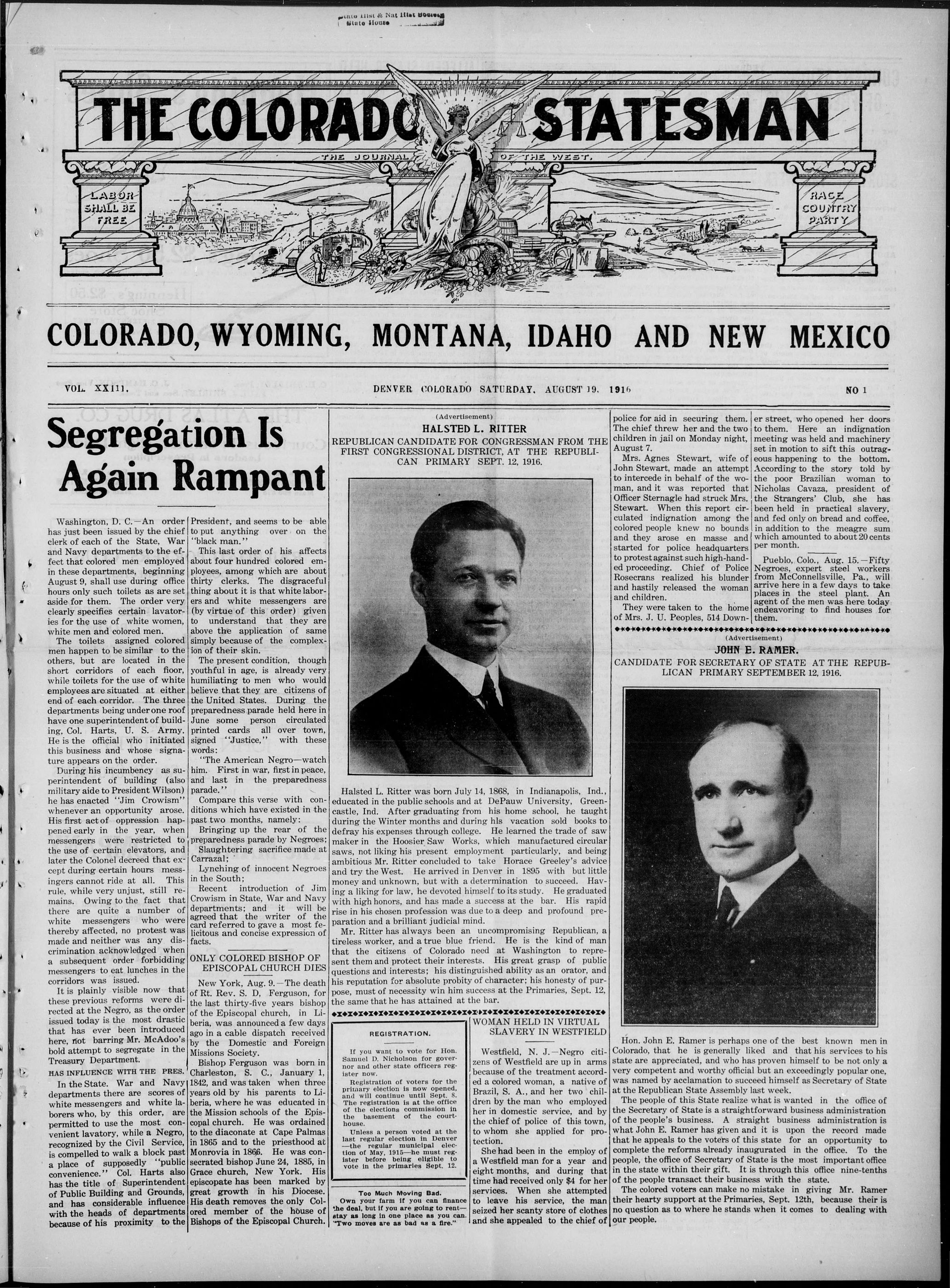
Segregation Is Again Rampant
VOL. XX111.
Segregaat
Again R
Washington, D. C.—An order has just been issued by the chief clerk of each of the State, War and Navy departments to the effect that colored men employed in these departments, beginning August 9, shall use during office hours only such toilets as are set aside for them. The order very clearly specifies certain lavatories for the use of white women, white men and colored men.
The toilets assigned colored men happen to be similar to the others, but are located in the short corridors of each floor, while toilets for the use of white employees are situated at either end of each corridor. The three departments being under one roof have one superintendent of building, Col. Harts, U. S. Army. He is the official who initiated this business and whose signature appears on the order.
During his incumbency as superintendent of building (also military aide to President Wilson) he has enacted "Jim Crowism" whenever an opportunity arose. His first act of oppression happened early in the year, when messengers were restricted to the use of certain elevators, and later the Colonel decreed that except during certain hours messengers cannot ride at all. This rule, while very unjust, still remains. Owing to the fact that there are quite a number of white messengers who were thereby affected, no protest was made and neither was any discrimination acknowledged when a subsequent order forbidding messengers to eat lunches in the corridors was issued.
It is plainly visible now that these previous reforms were directed at the Negro, as the order issued today is the most drastic that has ever been introduced here, not barring Mr. McAdoo's bold attempt to segregate in the Treasury Department. HAS INFLUENCE WITH THE PRES. In the State. War and Navy departments there are scores of white messengers and white laborers who, by this order, are permitted to use the most convenient lavatory, while a Negro, recognized by the Civil Service, is compelled to walk a block past a place of supposedly "public convenience." Col. Harts also has the title of Superintendent of Public Building and Grounds, and has considerable influence with the heads of departments because of his proximity to the
---
President, and seems to be able to put anything over on the "black man." This last order of his affects about four hundred colored employees, among which are about thirty clerks. The disgraceful thing about it is that white laborers and white messengers are (by virtue of this order) given to understand that they are above the application of same simply because of the complexion of their skin. The present condition, though youthful in age, is already very humiliating to men who would believe that they are citizens of the United States. During the preparedness parade held here in June some person circulated printed cards all over town, signed "Justice," with these words:
"The American Negro—watch him. First in war, first in peace, and last in the preparedness parade."
Compare this verse with conditions which have existed in the past two months, namely:
Bringing up the rear of the preparedness parade by Negroes;
Slaughtering sacrifice made at Carrazal;
Lynching of innocent Negroes in the South;
Recent introduction of Jim Crowism in State, War and Navy departments; and it will be agreed that the writer of the card referred to gave a most felicitous and concise expression of facts.
ONLY COLORED BISHOP OF EPISCOPAL CHURCH DIES
New York, Aug. 9. — The death of Rt. Rev. S. D, Ferguson, for the last thirty-five years bishop of the Episcopal church, in Liberia, was announced a few days ago in a cable dispatch received by the Domestic and Foreign Missions Society.
Bishop Ferguson was born in Charleston, S. C., January 1, 1842, and was taken when three years old by his parents to Liberia, where he was educated in the Mission schools of the Episcopal church. He was ordained to the diaconate at Cape Palmas in 1865 and to the priesthood at Monrovia in 1866. He was consecrated bishop June 24, 1885, in Grace church, New York. His episcopate has been marked by great growth in his Diocese. His death removes the only Colored member of the house of Bishops of the Episcopal Church.
DENVER COLORADO SATURDAY. AUGUST 19. 1916
REPUBLICAN CANDIDATE FOR CONGRESSMAN FROM THE FIRST CONGRESSIONAL DISTRICT, AT THE REPUBLI-CAN PRIMARY SEPT. 12, 1916.
W. H.
Halsted L. Ritter was born July 14, 1868, in Indianapolis, Ind., educated in the public schools and at DePauw University, Greencastle, Ind. After graduating from his home school, he taught during the Winter months and during his vacation sold books to defray his expenses through college. He learned the trade of saw maker in the Hoosier Saw Works, which manufactured circular saws, not liking his present employment particularly, and being ambitious Mr. Ritter concluded to take Horace Greeley's advice and try the West. He arrived in Denver in 1895 with but little money and unknown, but with a determination to succeed. Having a liking for law, he devoted himself to its study. He graduated with high honors, and has made a success at the bar. His rapid rise in his chosen profession was due to a deep and profound preparation and a brilliant judicial mind.
Mr. Ritter has always been an uncompromising Republican, a tireless worker, and a true blue friend. He is the kind of man that the citizens of Colorado need at Washington to represent them and protect their interests. His great grasp of public questions and interests; his distinguished ability as an orator, and his reputation for absolute probity of character; his honesty of purpose, must of necessity win him success at the Primaries, Sept. 12, the same that he has attained at the bar.
Historic & Nat Hist House
State House
Halsted L. Ritter was born July educated in the public schools and castle, Ind. After graduating from during the Winter months and defray his expenses through college maker in the Hoosier Saw Works, not liking his present ambitious Mr. Ritter concluded to and try the West. He arrived in money and unknown, but with a liking for law, he devoted his with high honors, and has made rise in his chosen profession was paration and a brilliant judicial Mr. Ritter has always been a tireless worker, and a true blue that the citizens of Colorado sent them and protect their inter questions and interests; his distin his reputation for absolute probit pose, must of necessity win him the same that he has attained at
REGISTRATION
If you want to vote for Hon. Samuel D. Nicholson for governor and other state officers register now.
Registration of voters for the primary election is now opened, and will continue until Sept. 8.
The registration is at the office of the elections commission in the basement of the courthouse.
Unless a person voted at the last regular election in Denver—the regular municipal election of May, 1915—he must register before being eligible to vote in the primaries Sept. 12.
Too Much Moving Bad.
Own your farm if you can finance the deal, but if you are going to rent—stay as long in one place as you can.
"Two moves are as bad as a fire."
WOMAN HELD IN VIRTUAL SLAVERY IN WESTFIELD
Westfield, N. J.—Negro citizens of Westfield are up in arms because of the treatment accorded a colored woman, a native of Brazil, S. A., and her two children by the man who employed her in domestic service, and by the chief of police of this town, to whom she applied for protection.
She had been in the employ of a Westfield man for a year and eight months, and during that time had received only $4 for her services. When she attempted to leave his service, the man seized her scanty store of clothes and she appealed to the chief of
police for aid in securing them. The chief threw her and the two children in jail on Monday night, August 7.
Mrs. Agnes Stewart, wife of John Stewart, made an attempt to intercede in behalf of the woman, and it was reported that Officer Sternagle had struck Mrs. Stewart. When this report circulated indignation among the colored people knew no bounds and they arose en masse and started for police headquarters to protest against such high-handed proceeding. Chief of Police Rosecrans realized his blunder and hastily released the woman and children.
They were taken to the home of Mrs. J. U. Peoples, 514 Down-
er street, who opened her doors to them. Here an indignation meeting was held and machinery set in motion to sift this outrageous happening to the bottom. According to the story told by the poor Brazilian woman to Nicholas Cavaza, president of the Strangers' Club, she has been held in practical slavery, and fed only on bread and coffee, in addition to the meagre sum which amounted to about 20 cents per month.
Pueblo, Colo., Aug. 15.—Fifty Negroes, expert steel workers from McConnellsville, Pa., will arrive here in a few days to take places in the steel plant. An agent of the men was here today endeavoring to find houses for them.
JOHN E. RAMER.
CANDIDATE FOR SECRETARY OF STATE AT THE REPUBLICAN PRIMARY SEPTEMBER 12.1916.
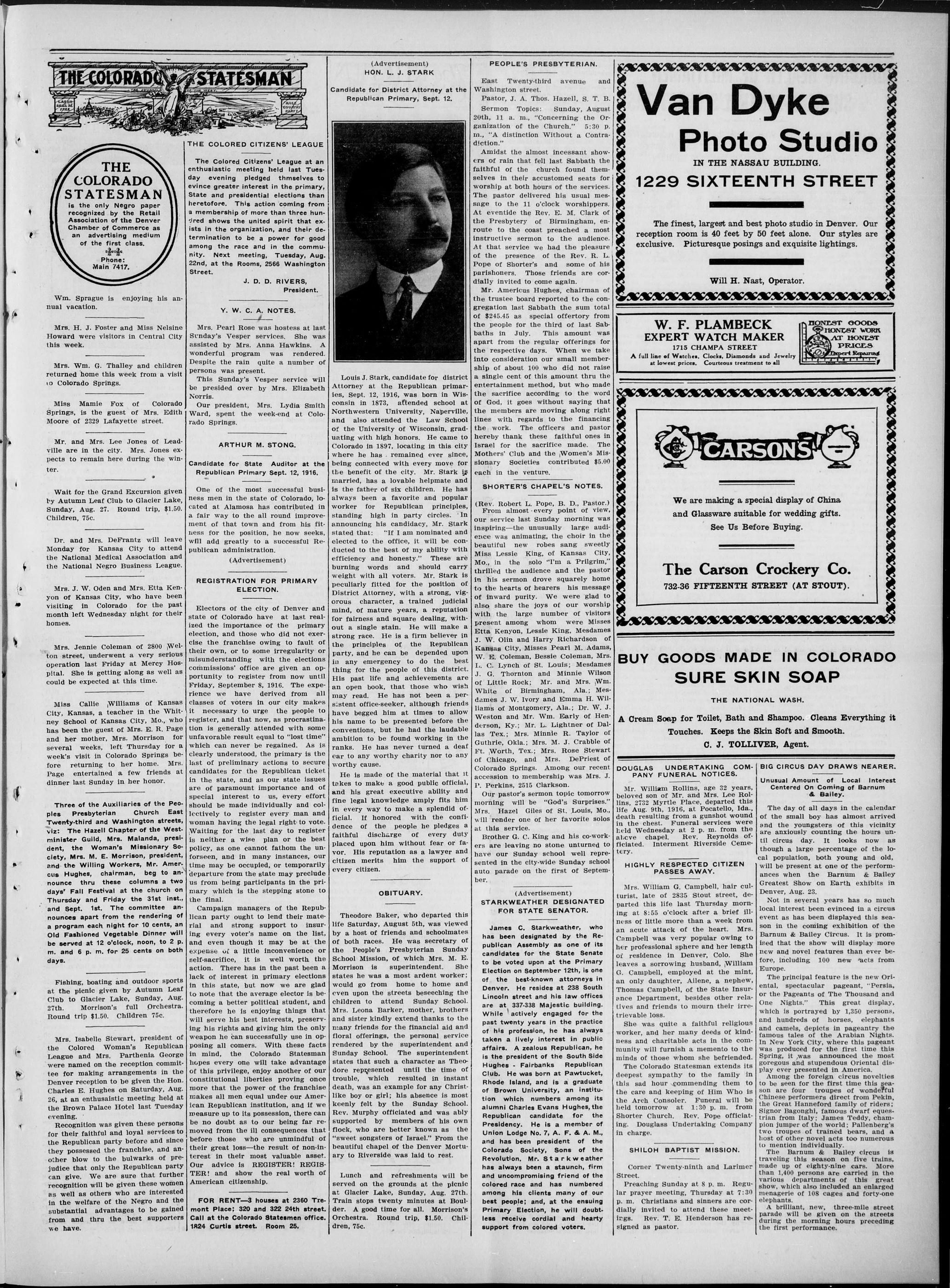
[Portrait of a man in a suit and tie].
Hon. John E. Ramer is perhaps one of the best known men in Colorado, that he is generally liked and that his services to his state are appreciated, and who has proven himself to be not only a very competent and worthy official but an exceedingly popular one, was named by acclamation to succeed himself as Secretary of State at the Republican State Assembly last week.
The people of this State realize what is wanted in the office of the Secretary of State is a straightforward business administration of the people's business. A straight business administration is what John E. Ramer has given and it is upon the record made that he appeals to the voters of this state for an opportunity to complete the reforms already inaugurated in the office. To the people, the office of Secretary of State is the most important office in the state within their gift. It is through this office nine-tenths of the people transact their business with the state.
The colored voters can make no mistake in giving Mr. Ramer their hearty support at the Primaries, Sept. 12th, because their is no question as to where he stands when it comes to dealing with our people.
er street, who opened her doors to them. Here an indignation meeting was held and machinery set in motion to sift this outrageous happening to the bottom. According to the story told by the poor Brazilian woman to Nicholas Cavaza, president of the Strangers' Club, she has been held in practical slavery, and fed only on bread and coffee, in addition to the meagre sum which amounted to about 20 cents per month.
Pueblo, Colo., Aug. 15.—Fifty Negroes, expert steel workers from McConnellsville, Pa., will arrive here in a few days to take places in the steel plant. An agent of the men was here today endeavoring to find houses for them.
NO 1
CONDENSATION OF FRESH NEWS
THE LATEST IMPORTANT DISP
PATCHES PUT INTO SHORT,
CRISP PARAGRAPHS.
STORY OF THE WEEK
SHOWING THE PROGRESS OF EVENTS IN OUR OWN AND FOREIGN LANDS.
Western Newspaper Union News Service.
ABOUT THE WAR
Gen. Letchitsky is continuing his advance toward Lemberg.
British torpedo-boat destroyer Lassoo sunk by German submarine.
French report taking of Maurepas, with capture of 1,000 Germans.
Jablonitza, one of the principal gateways from Galicia into Hungarian territory, has fallen into the hands of the Russians.
Fierce fighting reported along the entire Austro-German line south of Brody, with the Russians apparently uniformly victorious.
Turks repulse Slav troops in Persia. In Turkish Armenia, however, the Russians have forced back the Ottoman troops near Lake Van. Italians, pressing offensive on Carso plateau, reported within thirteen miles of Trieste. Austrian fleet has left the harbor for an unlearned destination. Italian army under Gen. Cadorna, following up its decisive victory over the Austrians at Goritzia, have advanced farther and now are in possession of Boschini. Gen. Matias Ramos reported to Gen. Trevino from Escalon, Chihuahua, that he had given battle three times to Villa's personal band, during the two days previous, inflicting sharp defeats each time.
Austrian official statement says the Italians have been repulsed in the Vipacco valley about eighteen miles west of Gorizia. Tolmino is being evacuated by the Austrians, most of the town already being in Italian hands.
Important gains for the allies are reported from both Paris and Petrograd. The French stormed German third line positions in the region of the Somme, extending their line from Hardecourt to the village of Buscourt on the Somme.
"We have evacuated Stanislau without fighting," says the official statement from Vienna. The statement also admits the withdrawal of Austrian troops to new positions in the Stanislau and Monasterzyska regions owing to the Russian pressure.
WESTERN
Two men robbed the bank of Crowder at Crowder, Okla., of about $1,000 and escaped.
The Ohio Oil Company made another 5-cent reduction on six grades of oil and 20 cents on Plymouth oil.
A severe earthquake shook Winnebucca, Nev. The temblor was one of the hardest this state has felt in years.
One man has been detained by the Detroit police, as the result of a charge made by Don M. Kelly of Lafayette, Ind., that he lost $15,000 in a race horse swindle.
A substantial increase in wages was granted the miners of southern Wyoming in an agreement signed by representatives of the United Mine Workers of District 22, and coal operators.
Telegraphers of the Northern Pacific railroad are taking a strike vote, it was learned at St. Paul, Minn., relative to their demands for increased wages and changes in working rules.
WASHINGTON
Formal notification to. President Wilson of his nomination will take place Sept. 2.
Three more letters commending the handling of national guard camps on the border were made public by the War Department.
The House approved by a vote of 283 to 51, the Senate building program, including provision for eight capital ships next year.
An explanatory statement of how Great Britain's examination of mails is being conducted was presented to Secretary Lansing by the British embassy.
Payment of indemnity for articles sent registered, insured or C. O. D. through the mails and partially damaged during transit will be made in the future, according to orders recently issued by Postmaster General Burleson.
After a conference between President Wilson and the members of the Democratic campaign committee, Vance McCormick, chairman of the national committee, announced that President Wilson would make no speaking tour but probably would accept invitations to speak at different places. President Samuel Gompers of the American Federation of Labor was characterized as a "public nuisance" by Senator Sherman of Illinois in a digression from a Senate speech on the shipping bill.
FOREIGN
The Uruguayan ministry has resigned.
According to a telegram from Bucharest, the number of persons killed in the explosion in the powder factory at Dudesti was 115.
Premier Asquith introduced in the House of Commons a bill to extend the life of the present parliament for eight months, or until the end of next May.
The American steamer Marguerite, held in port at Naples since the middle of July by the Italian authorities on the ground that it had contraband aboard has been released.
Rocco Ferrante, who decapitated his partner, Dick Foracce, and dropped the head down a deep well in an effort to cover his crime was hanged at Vancouver, B. C.
The Italian dreadnaught Leonardo da Vinci caught fire, blew up in the harbor of Taranto, Italy, and 300 of her crew were drowned, says a Turin dispatch to the Paris Petit Journal.
"A letter from the Schwaben Verein of Los Angeles, mailed May 10, has now arrived at Stuttgart, having been opened by the British censor," says the Overseas News agency. "An enclosure of $235 was missing."
The church of Santa Maria Formosa was destroyed in the Austrian aeroplane raid on Venice the night of August 10. Nearly all the works of art in the church had been removed months ago.
Threats of more destructive Zeppelin raids against England in reprisal for "crimes committed by British seamen," are contained in a White Book regarding the Baralong case, transmitted by the government to the reichstag at Berlin.
Lloyds reports the sinking of the 2,500-ton Italian steamship Teti in the Mediterranean. Part of the crew was landed at Genoa. The Italian steamer San Giovanni Battista of 1,057 tons gross and the Italian sailing vessels Rosario have been sunk.
The war bill of France at the end of July was 39,000,000,000 francs (about $7,527,000,000). The miscellaneous expenses of the government were 10,000,000,000 francs. The average cost of the war, the figures show, is now 1,987,000,000 francs monthly.
SPORTING NEWS
Standing of Western League Clubs. Clubs—
Won. Lost. Pct.
Omaha ..... 68 38 .642
Lincoln ..... 63 44 .589
Des Moines ..... 54 53 .527
Denver ..... 51 56 .477
Sioux City ..... 51 57 .472
Topeka ..... 50 58 .463
Wichita ..... 49 59 .454
St. Joseph ..... 42 63 .400
Freddie Welsh and Charlie White are in Denver preparing for their battle on Labor Day.
Dennis Dowd, an American aviator with the French army, was killed at the Buc aerodrome in Paris by falling with his machine.
Italian Johnny Dundee of New York outclassed Johnny O'Leary of Seattle, Canadian lightweight champion, in the Armory A. A. at Boston, knocking out the less clever John in the ninth round.
At Grand Lake, Colo., the second race for the Lipton cup was won by the yacht Dorothy, owned and sailed by Routt Bryant. Starting time, 10:42; finish, 12:15. The Highball, owned and sailed by Thomas P. Campbell, was second. Her time was, starting, 10:42; finish, 12:23:50.
The controversy concerning the right of Colorado sportsmen to shoot doves was dispelled on receipt of a telegram from the Department of Agriculture at Washington stating that doves may be taken under the state law and that there is no closed season prescribed by the federal law.
GENERAL
The epidemic of infantile paralysis in New York has taken a turn for the worse despite the continuation of unusually cool weather.
Greenville, S. C., and many smaller towns were threatened with serious damage by the 600 acres of water released when the great Lake Toxaway dam, thirty-eight miles south of Asheville, gave way.
Five persons were killed and seventeen injured, four fatally, when a tornado swept over eastern Arkansas, blowing down twelve buildings at Edmondson, Ark., about seventeen miles west of Memphis.
Because President Wilson is to make an address at Hopkinsville, Ky., birthplace of Abraham Lincoln, on Sept. 4, Labor Day, the itinerary of Charles E. Hughes, who was to have made an address at Lexington on that date, has been changed, and he will speak at Nashville, Tenn., Sept. 4.
According to reports received at Livingston, Mont., a strike vote is being taken by the telegraphers of the Northern Pacific railway system. Themen, it is said, recently demanded and were refused an eight-hour day, two weeks vacation annually on pay and an increase of 10 per cent in wages.
A protest against the use of the American flag on posters bearing the names and photographs of the Republican candidates for President and Vice President was sent to Chas. E. Hughes by Capt. E. R. Lewis, past president of the American Flag Day Association.
Funeral services for the late Dr. John B. Murphy, Chicago's noted surgeon, were held in St. James Catholic church. It was stated that Dr. Murphy left no will disposing of his estate estimated at more than $1,000,000.
COLORADO
STATE NEWS
DATES FOR COMING EVENTS.
Aug. 18-19—Pickle Day and Fair at
Platteville.
Aug. 21—Celebration of the opening of the new State Highway between Del Norte and Pagosa Springs, at Durango.
Aug. 22-25—Annual Convention, Grand Lodge K. of P., at Greeley.
Aug. 21-Sept. 1—Apple Pie Days at Rifle.
Sept. 5-8—Boulder County Fair at Longmont.
Sept. 5-8—Frontier Days' celebration at Fort Morgan.
Sept. 11—Meeting Midland Trail Ass'n in Denver.
Sept. 15-16—Harvest Festival at Nunna.
Sept. 18-23—State Fair at Pueblo.
Sept. 27-29—State Convention B.P.O.E.
Sept. 28-30—Third Annual Pine River Valley and Southern Ute Indian Fair at Ignacillo.
Jan. 20-27—Annual Western Stock Show at Denver.
Cantaloupe shipments have started from Rocky Ford.
Miss Elsie Green of Denver will go to China as a missionary.
Gasoline dropped one cent per gallon in Denver on Monday.
Improvements in the U. S. mill at Sugarloaf are being installed.
John Harriman, 41, a railway conductor, was killed in an auto accident at Pueblo.
The order dispatching the Colorado National guard to the Mexican border has been temporarily revoked.
Dr. Cyrus W. Poley saved two children when he stopped a runaway team traveling at breakneck speed in Boulder.
Jewelry to the value of $240 was stolen by burglaries who entered the home of Mrs. Ella Ackridge in Denver.
Many unique attractions have been arranged for the silver anniversary Arkansas valley fair at Rock Ford, Sept. 17-24.
The Colorado Federation of Labor opened its annual convention at Colorado Springs, with about 200 delegates present.
The Sharon Springs band, said to be the best cowboy aggregation of musicians in the country, has been engaged for Morgan Frontier Days.
Gladys Welborne, 17, of Denver, committed suicide because her mother refused permission for her to marry Lieut. John Street, of the National Guard.
Acting upon orders issued by Harry B. Tedrow, United States attorney, A. S. Daggett, federal pure food inspector, seized 39,600 eggs at commission houses in Denver.
"Why Colorado Wants You" is the title of a thirty-two-page booklet issued by J. H. Jenkins, Colorado commissioner of Immigration, for use in bringing settlers to this state.
The semi-annual report of the board of county commissioners shows that Larimer county has approximately $148,387 in resources over its liabilities.
The Pike's Peak region is to be made famous in a series of poetic jings from the pen of Walt Mason, the famous "Uncle Walt" of Emporia, Kans.
According to the current issue of the American Contractor, a Chicago publication, Denver last month made a gain of 97 per cent in value of building permits over July of last year. Clerks, accountants and men in the offices in the crowded districts of Chicago are turning their eyes toward Colorado as a land of promise to them under the new federal farm loan law. George Randall, representative in Colorado of the American Railway Association for handling troops for the government, said that the railroads have ample equipment to move the troops at the rifle range.
Learning that a large sum of money was being held at the Santa Fé railroad station at Husted, twelve miles north of Colorado Springs, a gang of eight men attempted to hold up the agent.
A wide range of labor topics are dealt with in the annual report of John McLennan, president of the Colorado State Federation of Labor, submitted to the convention of the federation at Colorado Springs.
Work started on the first link of the concrete highway between Denver and Golden. This section extends from Sheridan boulevard on West Colfax for four and eight-tenths miles. It will be eighteen feet wide and will cost $65,000.
Approximately 1,700,000 more bushels of onions will be harvested this year than in 1915. The increase in production, according to the Bureau of Crop Estimates of the Department of Agriculture, is spread over an acreage in thirteen states, of which Colorado is one.
Whether one political party may hold two separate and distinct assemblies for the same specific purpose, is a question which will have to be settled before Secretary of State Ramer determines whether there will be a Progressive as well as Republican and Democratic tickets in the primary election Sept. 12.
Roy Engle and C. C. McDonald, accused of a daring robbery of Frank Nortenson at Pueblo, were arrested at Pueblo with tickets to Denver in theirockets, as they were about to take a train.
ALLEGED SLAYER HELD
HARRY RANDOLPH FINALLY
TRAPPED AT BOULDER.
Wanted in Nebraska for Auto Stealing and in Montana on Charge of Murdering Sheriff.
Western Newspaper Union News Service.
Boulder.—Harry J. Randolph, 27, of a prominent York, Neb., family was arrested in Boulder by Deputy Sheriff B. O. Smith and admitted that he was wanted in Nebraska for auto stealing and in Montana for murder. He was standing beside a stolen car when arrested and admitted taking it from a York garage.
When Randolph disappeared last spring sheeriffs everywhere were notified to arrest him. In Montana, where he fled, he was met by chance by Sheriff Afferbach, a former resident of York, and recognized. Afferbach arrested him and started to town with him. Afferbach and Randolph disappeared completely. The arrest took place in May. A few days ago, Afferbach's body was found in the Missouri river in Montana, 200 miles below the point where he was last seen. The body was so decomposed that it could not be learned how he was killed. Randolph came here in July, under the name of Miller, and had been living here since, doing service work with his car, until he was recognized and arrested. A reward of $100 was offered for him by York county, Neb.
Rea Lentz Wins Pike's Peak Race.
Rea Lentz Wins Pike's Peak Race.
Colorado Springs.—Ralph Mulford, world's twenty-four-hour champion, went down to defeat on the Pike's peak automobile highway Saturday. A boy from Seattle turned the trick. But Mulford holds the record for the Twelve-mile climb up the highway by his remarkable record of Friday, when he drove his car up the mountain in 18:24. Rea Lentz of Seattle is the big winner and gains a leg on the Penrose trophy. His time was 20:55.6. Mulford beat this mark by more than two minutes. Mulford took second place and made the climb to the summit in 21:40.5. He wins $1,000 by his performance.
Lone Bandit Robs Englewood Bank
Denver.—A man, unmasked, identified from a rogue's gallery picture as Norval King, a convicted forger released from the county jail, entered the First National Bank at Englewood, held up Harley Patton, assistant cashier, obtained probably $500 and escaped in an automobile. A woman patron of the bank ran from the building, frightening the robber to flight and saving the bank the loss of several hundred dollars more in silver and gold in the cashier's cage.
Girl, 19. Shot by Trinidad Miner.
Girl, 19, Shot by Trinidad Miner.
Trinidad.—Callie Berry, 19, is near death at the hospital here as the result of a bullet wound through her breast inflicted by Jesus Barragas, 23, a Mexican coal miner. The shooting took place at a boarding house at Agullar, where the young woman was employed as a waitress. Refusal of the girl to agree to run away with the Mexican is stated to be the cause of the shooting. Barragas made his escape.
Denver Congressional Candidates.
Denver.—Following are the Republican congressional candidates chosen at the assembly for Denver congressional district: William N. Valle, 53; William H. Dickson, 33; A. H. Pickens, 26; James H. Brown, 22; Halsted L. Ritter, 16. The Democrats designated H. B. Teller by 337 votes and Ben C. Hilliard by 335.
High Price for Colorado Pears.
Grand Junction.—Grand valley fruit growers are greatly pleased over the first returns on Bartlett pears sold in the east. A car, which left here Aug. 3, netted $2.35 a box to the grower. This is the best price paid for pears in nine years.
Police Trap Englewood Bank Robber.
Denver.—Norval S. King, fugitive trusty from the county jail, who held up the First National Bank of Englewood and escaped with $300, was captured in a rooming house here. He at first denied his identity but later confessed.
Pueblo.—John McCrary, 22, a printer from Erie, Kan., was found murdered, his body lying beneath a tree in the Fountain river bottoms. The fore part of his head had been beaten in by a blunt instrument.
War Department Recalls Guard Order.
Denver.—The order dispatching the Colorado National Guard to the Mexican border has been temporarily revoked.
Autoists to Attend Trail Opening.
Autolists to Attend Trail Opening.
Pueblo.—About twenty-five automobiles loaded with Puebloans will leave here Sunday, Aug. 20, for Wolfe Creek pass to attend the celebration Monday of the completion of the Spanish trail to Sunset, an auto highway connecting Pueblo with the Mesa Verde National park, and which eventually will link this city with Los Angeles.
A barbecue will feature the celebration. The governors of Colorado Utah, New Mexico and Arizona have been invited to attend the ceremonies
Henning's Shoes
Have the pleasant effect of throwing the spotlight on your feet, and there are reasons:
Customers appreciate beauty—Henning's styles, lasts and colorings are what girls call "adorable." Women, most of them at least, have to count dollars, and Henning's shoes, with their moderate prices, comes within the purse reach of them all.
But, at the same time, we wan point, that has always been true o for quality to the very smallest d parent to every one who wears Henning's S
Look in our windows and see
At the same time, we want to impress upon it has always been true of Henning's shoes, we try to the very smallest detail, and this is im- every one who wears Henning's $2.50 S in our windows and see the newest creation
But, at the same time, we want to impress upon you another point, that has always been true of Henning's shoes, we are sticklers for quality to the very smallest detail, and this is immediately apparent to every one who wears
Look in our windows and see the newest creations for spring.
Henning's $2.50
Shoe Store
820-822 FIFTEENTH STREET.
You Save A Dollar.
C. H. SHIRLEY, Pres.
PAUL J. SHIRLEY
THE ATLAS
Courteous Treatm
Leaders in P
BLEY, Pres. J. C. HAMPS
PAUL J. SHIRLEY, Sec. and Treas.
THE ATLAS DRUG
Fewous Treatmet. Right
Leaders in Prescription
No. 1.
TON ST.
875
Stor
26TH AN
Main
MPTON, Pres. J. M. JOHNS, Treas. J. B. M.
ILROAD PORTERS' C
LUNCHOOM IN CONNECTION
C. H. SHIRLEY, Pres. J. C. RAMPSON, Vice Pres PAUL J. SHIRLEY, Sec. and Treas.
Courteous Treatmet. Right Prices Leaders in Prescription
W. C. CAMPTON, Pres. J. M. JOHN
RAILROAD PO
LUNCHOOM IN
W. C. CAMPTON, Pres. J. M. JOHNS, Treas. J. B. MINTER, Sec. RAILROAD PORTERS' CLUB LUNCHOOM IN CONNECTION
BILLIARDS AND
POOL
1728½ Wazee St. Only on
J. B. MINTE
PHONE MAIN 8416.
728½ Wazee St. Only one block from Union B
J. B. MINTER. Barber.
ONE MAIN 8416. DENVER, COLO
1728½ Wazee St. Only one block from Union Depot.
J. B. MINTER. Barber.
PHONE MAIN 8416. DENVER, COLORADO.
JOHN K.
Meats, Fancy and
1864 CURTIS
Corner Nineteenth.
The MARKET
C. E. SMITH, Manager,
Wholesale and Retail Staple and F
Hotels and Restaurants
Fresh and
Eastern Corn
Fruits, Vegetables,
Telephones Main 430
622-636 15th Street
Weatherhe
TELEPHONE
JOHN K. RETTIG
Fancy and Staple Grocery
1864 CURTIS STREET
seventh.
MARKET COMM
E. SMITH, Manager, Res. Phone South B
and Retail Staple and Fancy Groceries, Fish
Hotels and Restaurants Our Specialty.
Fresh and Cured
Eastern Corn Fed Me
Fruits, Vegetables, Poultry and Game.
Telephones Main 4302, 4303, 4304, 4305
15th Street Denver,
atherhead Ha
TELEPHONE MAIN 3203
JOHN K. RETTIG Meats, Fancy and Staple Groceries 1864 CURTIS STREET Corner Nineteenth. Denver, Colo.
The MARKET COMPANY
The MARKET COMPANY
C. E. SMITH, Manager, Res. Phone South 1608
Wholesale and Retail Staple and Fancy Groceries, Fish and Oysters. Hotels and Restaurants Our Specialty. Fresh and Cured Eastern Corn Fed Meats Fruits, Vegetables, Poultry and Game.
Telephones Main 4302, 4303, 4304, 430b
622-636 15th Street Denver, Colorado
Established 1876
PIONEER HATTERS OF THE WEST
WE MAKE OLD HATS NEW
PRACTICAL HATTERS
RENOVATORS, BLEACHERS DYERS AND FILM
Of Gents' and Ladies' Hats of Every Descrip
1624 Champa St., Denver, Colo.
PRACTICAL HATTER
ATORS, BLEACHERS DYERS AND FIRE
Gents' and Ladies' Hats of Every Descrip
1624 Champa St., Denver, Colo.
RENOVATORS, BLEACHERS DYERS AND FINISHERS Of Gents' and Ladies' Hats of Every Description 1624 Champa St., Denver, Colo.
Store No. 1.
2701 WELTON ST.
Main 808 875
PHONE MAIN 3028
to impress upon you another
Henning's shoes, we are sticklers
tail, and this is immediately ap-
$2.50 Shoes
the newest creations for spring.
Henning's $2.50
Shoe Store
820-822 FIFTEENTH STREET.
You Save A Dollar.
J. C. HAMPSON, Vice Pres
Y, Sec. and Treas.
S DRUG CO.
net. Right Prices
prescription
Store No. 2
26TH AND WELTON
Main 4955-4956
NS, Treas. J. B. MINTER, Sec.
ORTERS' CLUB
CONNECTION
FREE CHECK
ROOM
the block from Union Depot.
R. Barber.
DENVER, COLORADO.
RES. PHONE GALLUP 942
RETTIG
Staple Groceries
38 STREET
Denver, Colo.
T COMPANY
Res. Phone South 1608
ancy Groceries, Fish and Oysters.
nts Our Specialty.
l Cured
Fed Meats
Poultry and Game.
2, 4303, 4304, 430b
Denver, Colorado
ad Hat Co.
MAIN 3203
HATTERS
DYERS AND FINISHERS
s of Every Description
Denver, Colo.
MILITARY
:
AFRO-AMERICAN CULLINGS
Is it not time, many ask, that the Negro care for himself, provide for his own intellectual and religious needs? For 50 years, now, he has been the recipient of aid from the philanthropic people of the white race. He has made marvelous progress toward self-support, has acquired large properties and self-direction, why should he not now become independent? Why should others continue to assist him? Why should money and men from the North be devoted to his upbuilding? This is a fair question and should be answered honestly.
Let it be said then, first, that a half century is a very short time in the evolution of a race. To educate an individual is a matter of a generation, to lift a race from barbarism is a matter of many generations. The tremendous influences of heredity and environment must be overcome and changed from degrading into elevating factors in its development.
Second, this question is not raised concerning any other of the great mission fields of the church. No one proposes to withdraw from China, India, or even highly civilized and normally Christian Europe. And we have been at work in these places much longer than we have been in the South. If these people still have need of us, much more does the Negro.
The main reason why we are still in the South is that the Negro still needs us. While he has made great advancement it is true that he is yet far from the goal. Poverty, ignorance and sin still prevail. Unless the Christian people of the land continue to help there is danger that what has been done will be undone. Moral and intellectual inertia will prove too great for him, unaided, to overcome. He must still depend upon the stronger race. He needs their stimulus and help in his religious life.—Northern Christian Advocate.
The large number of colored pupils who were graduated from the grade and high schools should be regarded with much interest by the colored citizens especially. Many parents and aged grandparents witnessed these events, who never dreamed that the opportunity for a well rounded education would come in their own time.
Twenty-four colored pupils were graduated from Manual Training and Shortridge high schools, one-third less than the number last year, while the total high school enrollment of colored pupils for the year was 314, as compared with 258 last year. The enrollment was: Shortridge 174; Manual, 118, and Technical, 22.
From No. 17 there were 59 graduates, 31 from school No. 26 and nine from the Douglass school, No. 19, while in addition to this number were several who graduated from white schools. The total number of graduates from the grammar grades the entire year was 176.
The present 8b grades in many of the schools are decidedly larger than ever before, the class at No. 17 numbering more than 100. As only a small number of children quit school for any reason after reaching this grade, large graduating classes can be safely predicted for the coming school year.
Considering that the colored people constitute about one-tenth of the city's population, the number to complete, both public and high school, would seem small, but compared with the size of the graduating classes ten years ago, the increase is appreciable.
Those who have had experience with him under arms testify that the American Negro takes most readily and efficiently to soldiering. And this is testimony which it is interesting to consider now that it is likely that the first Negro regiment is about to be organized into the National Guard of the state of New York.
Happiness and the light heart are among the general characteristics of the black soldier. He goes about his business singing. It is related that during the Spanish war the colored cavalrymen had hardly dug their trenches at Santiago before their smuggled musical instruments were out and the camp was a medley place of tunefulness. And there was a white colonel of the Twenty-fifth who was wont to boast of the chorus singing which he had made almost a part of the regimental drill.
The same childish simplicity which impels to this bursting into song leads to an overwhelming respect for the men in command. Discipline once instituted comes to stay in a Negro regiment. Moreover, the rank and file carries so far its trust in its officers that
Speaking of gun-shy dogs, it is not well to judge them too hastily. Sometimes it is the wonder of the gunner's uniform that makes the kloodle yelpfully beat it.
Two Texan inventors have patented a set of vest buttons containing electric lights that are supplied with current by a pocket dry battery.
The tensile strength of a paper flywheel is far greater than one made of iron.
Several reasons have been given for the increased attendance, which is considerably out of proportion to the annual growth of the colored population, among them being gradual improvement in the economic conditions of the colored homes, the more effective compulsory education laws of the state and the growing demand for more service in the industrial as well as the educational field.
Not a little influence has been exerted by the National Association for the Advancement of Colored People in the last few years. The organization, with headquarters in New York and local organizations in many of the large cities, has kept up a steady agitation along well directed lines to the end that the colored people throughout the country may awake to their educational need. Dr. W. E. B. Dubois, one of the leading educators in the colored race, is at the head of this movement.—Indianapolis News.
Oscar De Priest, the Negro alderman, has introduced an ordinance in the city council seemingly designed to protect Negroes in their civil rights. They are already protected by law which everyone knows is not strictly enforced or enforceable and will not be in this generation.
Nothing is expected to come of the De Priest ordinance, which would compel the mayor to revoke license wherever proof was offered of an attempt to deny the civil rights of a Negro. Nothing will come of it, but it indicates that politics is trying to do harm.
What politics is doing is to organize and keep agitated an issue which can find its solution only by not being organized and agitated.
That is why, if white and black in this city have prejudices aroused, the responsibility will be on politics. If by arousing prejudices difficulties arising out of prejudice could be removed then there would be no objection to the method, but we do not feed a thing of that sort to kill it.
In fact, the modus operandi in Chicago is as nearly perfect as human nature will permit it to be. It is a fiction that a Negro has full civil, meaning full social, rights in any American community. If the law protected Negroes completely and if they insisted upon exercising all privileges theoretically accorded them a general suspension of many lines of business would result. There would not be a hotel in the city. There probably would not be a restaurant or a theater and there might not be nearly so many churches.
The facts candidly faced seem ugly, but custom and habit, undisturbed by agitators, make them harmless. They have been harmless and it is only disturbance that can make them ugly. Thoughtful Negroes know this. Self-respect has the same force with whites and blacks.
The social relations in which the white and black parts of our population stand with regard to each other never will be determined by enactment of law or ordinance. They will be established by custom as it gradually is affected by time. Nothing can or will affect them except as they are affected by natural adjustment. The question even now is not one of civil rights but of social habit, and that has to be left to habit.—Chicago Herald.
the captain of a company is quite apt to be the banker for his men, saving them from losses in camp gambling games.
Passions and excitement move the disky soldier easily, it is true. To devotion to his officers, nevertheless, he adds pride in the service, ready excellence in the drill and a perfect willingness to follow where he is led. To ridicule, as a reproof, he is most sensitive. To the power of example he is keenly susceptible. To none of his white comrades is the appeal so effective as to him to perform for the honor of his race.—New York World.
Government scientists in the Philippines are investigating the soap-making possibilities of a new oil-bearing nut that has been discovered.
What has become of the old-fashioned woman who used to open a can of peaches when she had company at tea?
It takes a cute girl to get so close to a man that it's impossible for her to get away if he should try to kiss her.
An opening extends through a new rubber hot water bottle into which a glass bottle can be inserted to keep the contents of the latter warm.
Clothesline holders in which the rope is gripped by eccentrically mounted wheels have been invented to do away with the necessity for props.
A fuel economy exceeding 12 per cent is claimed for a French device that heats water before it reaches locomotive boilers with exhaust steam.
ALL MILITIA TO FRONT
BORDER TRIP ASSURED FOR ALL
BUT STUDENTS.
Order From Washington Confirms Belief That Colorado Troops Will See Active Service.
Western Newspaper Union News Service.
Denver.—Realization came on the 12th to the 1,641 militiamen encamped at the Golden rifle range that their days of waiting are over, and that the next few days will be passed in preparation for departure for the Mexican border, where all the Colorado guardsmen, with the possible exception of college men ordered mustered out by Sept. 1, are to see actual service. For several days the signs had been increasing that at last the boys were to be sent to the "front." These signs were confirmed with the news of issuance by the War Department at Washington of the statement that all militia referred to in the call of June 18, which included the Coloradoans, would be sent to the border "as soon as they are equipped and transportation can be obtained."
Many of the militiamen had been led to anticipate this order when it was reported that after Gen. Barry's inspection of the camp a telegram was received from the Rock Island arsenal stating in regard to equipment requisitioned, that only that which was absolutely necessary would be forwarded to the camp, the rest going "to the border destination of the troops."
Aug. 14 was the first payday of the Colorado troops. The federal government will distribute $48,000, the amount due to the troops from June 19 when they were called out, to Aug. 1. It is understood Uncle Sam will consider the militiamen as having been in federal employ from the day of mobilization.
The one unit that may not entrain is Troop D of the cavalry, in which there is a large number of college students. It is believed that army officials are considering the advisability of mustering this troop out of the service.
Examines School Board Accounts.
State Auditor Harry Mulnix has started the first audit ever attempted by the state of the financial accounts of School District No. 1, the Denver district. The action was taken at the request of members of the school board, and the investigation, including a minute accounting of the books of the entire district, will probably require three weeks to complete. During Mulnix's term as auditor many school districts of Colorado have been investigated by men from his office, and accounts of every kind readjusted and tabulated. Up to the present time, however, the state never has examined the Denver district.
McKelvey to Attend Health Meeting
Attorney General Farrar has ruled that Dr. S. R. McKelvey, secretary of the State Board of Health, was entitled to draw traveling expenses from the state to go to Washington for the conference of state health officials in regard to infantile paralysis. The law makes no specific provision for such a case, but since it is an emergency and since all the citizens of the state are interested in such steps as, may be necessary to check the spread of the disease, Farrar held McKelvey should draw the expense money.
Admirers of good horse flesh would be more than gratified to see the artillery horses selected by Capt. Blanchard for Battery B of the national guard. Even the most exacting judges would be pleased at the fine showing made by the animals picked to draw the three-inch guns of "Colorado's own," as Capt. Blanchard made a special effort to have all matched horses in every section of the battery. All of the horses are matched as nearly as possible as to color, size and weight.
Can Increase Charges for Gas.
Permission to increase its charges for gas from $1.10, gross, and $1.00, net, to $1.15, gross, and $1.10, net, for the first five thousand cubic feet consumed each month, was granted the Colorado Springs Light, Heat & Power Company, in an order issued by the State Public Utilities Commission.
Denver Liquor Shipments Increase.
Shipments of liquor into Denver during July increased by 725 packages over the month of June, figures compiled in the county recorder's office indicate. The quantity in the packages was larger, too. During the month 8,105 packages arrived. The county collected $2,076.25 tax.
Strike Cases Dismissed by State.
Of the eighty-odd indictments pending in Las Animas and Huferfano counties growing out of labor troubles, forty-three cases were dismissed by Attorney General Farrar, and as a result ninety-seven defendants are now free from the charges made through the attorney general's office.
Commission Has La Veta Pass Maps.
Maps of the La Veta Pass road have been filed with the State Highway Commission.
WILSON'S PLAN TO END STRIKE
WILSON'S PLAN TO END STRIKE
PRESIDENT PROPOSES EIGHT
HOUR DAY WITH REGULAR
SCALE FOR OVERTIME.
640 AT CONFERENCE
THE RAILROADS AND MFN MUST GET TOGETHER ON COMMISSION'S FINDINGS.
Western Newspaper Union News Service.
Washington, Aug. 17.—President Wilson has completed a definite plan for settlement of the threatened railroad strike, which he will submit today to the general committee of 640 representatives of the employés and to the managers' committee.
As outlined this morning the President's plan of settling the dispute follows:
1. The railroads must concede without qualification the eight-hour day at the present pay for ten hours.
2. The men must agree not to insist upon their demand for pay and one-half for overtime until a commission with plenary powers has had an opportunity to investigate the report on the cost of the demands to the carriers.
3. The railroads must waive their counter-proposals altogether.
4.—Both the railroads and the men must agree to get together on the findings of the commission with respect to the cost of the overtime scheme. If those findings develop the fact that the cost would be excessive to the carriers the men must consent to pro rata pay instead of pay and a half. If the findings disclose the men should receive more than the pro rata for overtime the railroads must consent to put into effect the recommendations.
The President regards the plan he has prepared, after a conference with both sides, as a fair one, which can be accepted. He has fortified himself with figures regarding the cost of an eight-hour day to the railroads in order to enter fully into a discussion with both sides.
Should either side reject the proposal it is understood the President will turn to public opinion to force a settlement. It was stated that in case the President's efforts fall, action of some kind may be taken in Congress.
ALLIES SMASH TEUTON LINES.
French and British Advance to Position That Threatens Combies
Paris.-The French and British, striking with terrific force in three directions on the Somme front, have stormed nearly three miles of German trenches, driving forward at points to a depth of 300 to 500 yards. the most important gains were made by the British and French troops, striking north from the point where the allied lines meet. Maurepas and Clery, two of the most important points held by the Germans in this sector, have been flanked on both sides, according to the official statement issued by Paris. The road also has been reached between Maurepas and Guillemont, the latter town being the immediate objective of the British. This advance if maintained, brings the allies directly in front of the large railroad town of Combles.
Berlin said to have offered Rumania territorial concessions if it will remain neutral.
South of the Somme the French stormed German trenches over a length of about three-quarters of a mile, driving forward in a southerly direction from Belloy-en-Santerre. Paris reports that a considerable number of prisoners were taken in these operations.
Between June 4th, when the Russian offensive was inaugurated, and August 12th, Gen. Brussilloff's forces captured more than 358,000 men, the war office at Petrograd announced.
The German troops are reported to be preparing to undertake defense of Austrian port of Trieste.
Try Hundred Mexicans as Tritors.
Chihuahua City, Mex.—Preparations are under way here for the greatest series of court-martials ever held in the nation, in an effort to stamp out disloyalty in northern Mexico. One hundred prominent figures in Mexican politics are held awaiting trial here in connection with the discovery of recent revolutionary plots, and hundreds of witnesses have been summoned from over the republic. In the first of the court-martials, J. Arrolla, a priest, was found not guilty.
"Lynch Law" Bill Beaten in Georgia.
"Lynch Law" Bill Beaten in Georgia.
Atlanta, Ga.—A bill providing that the sheriff of any Georgia county in which a lynching occurs be removed by the governor was tabled, 113 to 29, by the Georgia House a few minutes before the close of the legislative session, after it had passed the Senate.
The outstanding accomplishment of the session was the passage of the compulsory education law. A woman suffrage amendment was disposed of by setting its consideration for one day after adjournment.
The Curtis Park Floral Company
FLORAL DESIGNS PUT UP WHILE YOU WAIT
CHOICE PLANTS AND CUT FLOWERS CONSTANTLY ON HAND
GREENHOUSES: Thirty-Fourth and Curtis Streets
TELEPHONE, MAIN 1511 DENVER, COLO
The Champa Pharmacy
Twentieth and Champa,
Is the place to get your
DRUGS, CHEMICALS AND PATENT MEDICINES
WE SERVE DRINKS.
Prescriptions Our Specialty.
Phone us and we will deliver the goods to all parts of the city.
JAMES E. THRALL, PROPR.
PHONE MAIN 2426.
When You Want
The Heads, Feet, Tails, Snouts, Neckbones or Chiterlings, or any other part of the hog except the squeal, go to
JOSEPH CARTER
Express, Moving,
and Storage
COAL AND WOOD
PROMPT DELIVERY.
Phone Main 6544.
2415 WASHINGTON STREET.
TELEPHONE YORK 6668.
GENERAL FURNITURE REPAIRING
AND UPHOLSTERING.
WORK GUARANTEED.
1417 East 24th Avenue, Denver, Colo.
2300-6 Larimer Street
Phone Main 1461
Phone Main 4896 1848 Arapahoe
乐绎轩
Miss M. Cowden
Hair Dressing Parlor
Shampoo, cutting and curling. Scalp treatment, hair tonics, hair straightening, manicuring. Stage wigs for rent; theatrical use and masquerades. Goods delivered out of the city. All shades of hair matched by sending sample of hair; also combings made up.
Cheapest Switches 50 Cents
1219 21st St. Denver, Colo.
DO IT NOW Subscribe
for THIS
PAPER
THE COLORADO STATESMAN
THE JOURNAL OF THE VIRGINIA
LABOR
SHOULD BE
FREE
RACE
COUNTRY
PARTY
1824 Curtis Street, Room 25.
Phone Main 7417.
One Year ..... $ 2.00
Six Months ..... 1.00
Three Months ..... .60
PAYABLE IN ADVANCE.
Entered as second-class matter at the postoffice in the City of Denver, Colo.
Reading notices, ten lines or less, 10 cents per line. Each additional line over ten lines, 5 cents per line. Display advertising 50 cents per inch.
Remittances should be made by Express Money Order, Postoffice Money Order, Registered Letter or Bank Draft. Postage stamps will be received the same as cash for the fractional part of a dollar. Only 1c and 2c stamps taken.
No discounts allowed on less than three months' contract. Cash must accompany all orders from parties unknown to us. Further particulars on application.
RECOGNIZED BY THE RETAIL ASSOCIATION OF THE DENVER
CHAMBER OF COMMERCE AS AN ADVERTISING
MEDIUM OF THE FIRST CLASS.
A SOUND CHARACTER.
"A sound body is a first-class thing, a sound mind is even a better thing, but the thing that counts for most, in the individual, as in the nation, is character—the sum of those qualities which make a man a good man and a woman a good woman."
BETWEEN YOU AND ME
The Colorado Statesman is setting a pace with its weekly assortment of general and local news and its live, pungent comment on the general affairs of City, State and County, which makes it the one great exponent and representative of the Colored people of this great Western country. Our merchants have long appreciated this fact, our home folks endorse it, and our visitors are quick to realize that a copy of The Colorado Statesman sent East or South tells volumes to the folks back home, while a year's subscription presents to them a picture of new life not to be gathered from any other source.
LET US BE MEN AND WOMEN
Early registration is the first duty of an interested voter. Every voter should attend to this by going to the Court House yourself and not being escorted there by some political worker. This is the first step in asserting your political duty and independence. After you are properly registered, then go to the primaries September 12th and vote for the man or set of men who will study your best welfare and interest the year around. In this way we win respect for the race and ourselves. Don't be led to the political altar with the same old halter that has been put over our necks in the past. Pick out the men on your ticket that will best serve the people. The time to make up your mind and prepare for sensible action is a long time before the political pot begins to brew.
WHAT OUTLOOK DOES THE FUTURE HOLD FOR THE NEGRO?
WHAT OUTLOOK does the future hold for the social and industrial development of the Negro, in view of the increasing friction between the races, as the world's greatest fields of natural enterprise become absorbed?
Of course, there is vast room yet for world development, but nearly all possible undeveloped resources are practically under Caucasian control or being competed for by scarcely less stronger races. If these controlling races showed less disposition to count other peoples out of the benefits of the general scheme for the progress of humanity, we might feel justified in nursing a hope and a faith in a natural rule of relative development, by which the Negro and other laggard races might eventually improve upon the conditions which come in contact with the ruling nations fortunately imposed upon them, but one must blind himself entirely to the ever-increasing menace of race repulsion to rest complacently under such a hope.
Here in the United States, in spite of the fact that we are making certain necessary strides in the way of personal or small community improvement, we are in fact but trailing along in the aftercurrent of the white man's independent progress, and, to a great extent, and more and more, are begrudged the fodder to which our services as beasts of burden entitle us.
For us, industrial competition, which is the main source of social development, takes on a phase of limitation and restriction which does not promise to lead us to the heights of human progress, but rather threatens to make and keep us a race of serfs. By social development we do not refer to the mere improvement of personal relations between individuals, but to the development of that capacity for community growth which reflects a people's standard of civilization, regardless of their intercourse with other peoples. Restricted industrial activity dwarfs a people's social development, and that is just the condition against which the Negro is struggling.
He may not be struggling in the right direction, however, to overcome these conditions. Perhaps it is time that we had learned that under immediate industrial contact this conflict is inevitable and never-ending. Perhaps it is time that we were beginning to learn that the rush of our people from the country to the cities is the first direct cause of increased friction.
In the dazzle and glamor of the white man's progress, we rush straight into the flame of his wrath. We must soon learn even that the cry of "injustice!" is unavailing.
We must learn that the true source of all development is the country and the land itself. Independent self-development is the only kind that has ever availed any people, and it starts at the grass roots.
So, while the white man leads, the world over, and greedily lays claim to the earth, he cannot absorb it nor restrict the development of other peoples who apply themselves to the problems of life in the manner which Nature intended.
---
Study of Constitution in the Schools Waste of Time Needed for Other Things
By DR. THOMAS M. BALLIET Dean of School of Pedagogy, New York University I consider the study of the Constitution a sheer waste of time for the pupils of the schools, especially of the high schools.
Who understands the Constitution?
It has been the custom to have in the high schools, textbooks on the Constitution and to teach from them as though through them the instructors were actually imparting the science of government. In the first place, the Constitution is a legal document beyond the comprehension of the pupils of our elementary and high schools. It is true that there are parts of the Constitution which are simple enough. The student may learn from it how old a man must be before he can be a member of congress or of the senate and such details, but the principles enunciated in the instrument are beyond his depth.
As a matter of fact, a decision of the Supreme court is required on any one clause when an application is made to concrete cases. This is so true that the working Constitution is made up of decisions of the Supreme court rather than of the text of the Constitution itself.
I would not give the impression that I do not regard the Constitution of the United States as worthy of study; but I do mean that it is a study not for immature boys and girls, but for college students and for citizens of mature judgment. Thousands of citizens know nothing about it at all and seem none the worse for it. The constitution of Great Britain is not even a written one, and yet the empire survives.
The essential facts relating to our government which are referred to in the Constitution can be taught orally or from some small textbook. The discussion of the principles included in the document, on which so much time is now spent in the high schools, might well be left until the student has the right to vote. There is no reason why their study should be inflicted upon children of sixteen, especially when there are so many more important subjects which should have attention.
Balance of Power Held by Women Who Have Vote in Twelve Suffrage States By FLORENCE M. BREWER of Pittsburgh
There are, excluding aliens, minors and everyone to whom the antis could find an objection, 4,034,594 women qualified to vote in the coming elections.
The 12 suffrage states control one-fifth of the electoral college and one-third of the votes necessary to elect a president. In the last 20 years it would have required a change of only one-ninth of the total vote cast to throw the election in any of the suffrage states to the other party.
In the last five presidential elections no one of the suffrage states has gone steadily for any one party. As for congressional elections, much the same situation exists. Women vote for members of both houses in 11 states; in Illinois the women vote only at a municipal election.
Since 1896 not one of the districts in these states has been carried steadily by the Democratic party, and only five have been held in the Republican column. In two-thirds of the elections of this period less than 10 per cent of the total vote cast would have served to change the elections.
Women cannot always agree, cannot always stand as a united political force. The important thing is that they should keep their direct, clear vision of what politics is; should be able always to forget the local and the personal as they are now forgetting them, to see the nation as a whole, to keep what one of their leaders calls "the great throb of faith that has been renewed in their blood by this movement among free women to help the unfree."
Phthisis Most Common of Diseases But Many Conquer Germ Without Knowing It
By DR. THOMAS WILLETT
It is commonly believed that tuberculosis is a disease of adults. This is a mistake. Tuberculosis is almost entirely a childhood disease. That is to say, the primary invasion takes place in childhood and the germs lie in a quiescent stage until under certain conditions of exposure, overfatigue or self-indulgence they break forth and become active. Eighty-five per cent of all persons have had the disease in their bodies by the time they are fifteen years of age. It is the commonest of all diseases, and in spite of the fact that it kills more people annually than all the other diseases combined, if pneumonia is excepted, death is not the common termination of the disease. Many people conquer the germ without ever knowing of its presence.
Ninety-nine per cent of the babies who are infected with tuberculosis in the first month of their life die. Ninety per cent of those who contract the disease in the first year die. With the increasing resistance of the body this percentage is lowered, and only 35 per cent of the babies who contract the disease in their second year die.
Government Pensions for Its Employes Unnecessary if Fair Salaries Are Paid By ERNEST DEBERTHAUSER
One can hardly reflect on the proposition to pension schoolteachers and government employees without feeling that there is something wrong with a situation that would even suggest it.
The salary they receive is either fair or it is not fair. If it is fair, then let them save and look out for themselves. If it is not fair, it is incumbent on the nation and the states to set about equalizing things by paring down the pay of high-salaried officials and adding it to that of those who are underpaid. In doing the fair thing, let the national government begin with the village post office. Detach it from side lines, put it on a salary basis and pay the postmaster a salary sufficiently decent to enable him to live comfortably and lay up a modest competency for old age. Let the states do likewise with the schoolmaster and the schoolma'am. Then let all talk of pensioning them cease. Let them save, as we all must save, if they want a prop to lean on when their working days are over.
---
COLORADO STATESMAN
---
The Mouth-Piece of the People of Colorado and the Entire West
---
A RELIABLE chronicle of their doings and progress; a faithful mirror of their wants, their hopes, their best aspirations.
THE COLORADO STATESMAN
Unequaled as an advertising medium for the business of professional men and women.
An excellent family journal speaking to and for many thousand colored citizens.
TWODOLLARSAYEAR
THE GREAT ORGAN OF THE LABORING MASSES
THE COLORADO STATESMAN
THE NATIONAL STATE
LAUGH SHALL BE FREE
FIVE COUNTRIES PARTY
THE
COLORADO
STATESMAN
is the only Negro paper
recognized by the Retail
Association of the Denver
Chamber of Commerce as
an advertising medium
of the first class.
Phone:
Main 7417.
Wm. Sprague is enjoying his an-
nual vacation.
Mrs. H. J. Foster and Miss Nelsine Howard were visitors in Central City this week.
Mrs. Wm. G. Thalley and children returned home this week from a visit to Colorado Springs.
Miss Mamie Fox of Colorado Springs, is the guest of Mrs. Edith Moore of 2329 Lafayette street.
Mr. and Mrs. Lee Jones of Leadville are in the city. Mrs. Jones expects to remain here during the winter.
Wait for the Grand Excursion given by Autumn Leaf Club to Glacier Lake, Sunday, Aug. 27. Round trip, $1.50. Children, 75c.
Dr. and Mrs. DeFrantz will leave Monday for Kansas City to attend the National Medical Association and the National Negro Business League.
Mrs. J. W. Oden and Mrs. Etta Kenyon of Kansas City, who have been visiting in Colorado for the past month left Wednesday night for their homes.
Mrs. Jennie Coleman of 2800 Welton street, underwent a very serious operation last Friday at Mercy Hospital. She is getting along as well as could be expected at this time.
Miss Callie Williams of Kansas City, Kansas, a teacher in the Whitney School of Kansas City, Mo., who has been the guest of Mrs. E. R. Page and her mother, Mrs. Morrison for several weeks, left Thursday for a week's visit in Colorado Springs before returning to her home. Mrs. Page entertained a few friends at dinner last Sunday in her honor.
Three of the Auxiliaries of the People's Presbyterian Church East Twenty-third and Washington streets, viz: The Hazell Chapter of the West-minister Guild, Mrs. Malanda, president, the Woman's Missionary Society, Mrs. M. E. Morrison, president, and the Willing Workers, Mr. Amercus Hughes, chairman, beg to announce thru these columns a two days' Fall Festival at the church on Thursday and Friday the 31st inst., and Sept. 1st. The committee announces apart from the rendering of a program each night for 10 cents, an Old Fashioned Vegetable Dinner will be served at 12 o'clock, noon, to 2 p. m. and 6 p. m. for 25 cents on both days.
Fishing, boating and outdoor sports at the picnic given by Autumn Leaf Club to Glacier Lake, Sunday, Aug. 27th. Morrison's full Orchestra. Round trip $1.50. Children 75c.
Mrs. Isabelle Stewart, president of the Colored Woman's Republican League and Mrs. Parthenia George were named on the reception committee for making arrangements in the Denver reception to be given the Hon. Charles E. Hughes on Saturday, Aug. 26, at an enthusiastic meeting held at the Brown Palace Hotel last Tuesday evening.
Recognition was given these persons for their faithful and loyal services to the Republican party before and since they possessed the franchise, and another blow to the bulwarks of prejudice that only the Republican party can give. We are sure that further recognition will be given these women as well as others who are interested in the welfare of the Negro and the substantial advantages to be gained from and thru the best supporters we have.
THE COLORED CITIZENS' LEAGUE
The Colored Citizens' League at an enthusiastic meeting held last Tuesday evening pledged themselves to evince greater interest in the primary, State and presidential elections than heretofore. This action coming from a membership of more than three hundred shows the united spirit that exists in the organization, and their determination to be a power for good among the race and in the community. Next meeting, Tuesday, Aug. 22nd, at the Rooms, 2566 Washington Street.
J. D. D. RIVERS, President.
Y. W. C. A. NOTES
Mrs. Pearl Rose was hostess at last Sunday's Vesper services. She was assisted by Mrs. Anna Hawkins. A wonderful program was rendered. Despite the rain quite a number of persons was present. This Sunday's Vesper service will be presided over by Mrs. Elizabeth Norris. Our president, Mrs. Lydia Smith Ward, spent the week-end at Colorado Springs.
ARTHUR M. STONG.
Candidate for State Auditor at the Republican Primary Sept. 12, 1916.
One of the most successful business men in the state of Colorado, located at Alamosa has contributed in a fair way to the all round improvement of that town and from his fitness for the position, he now seeks, will add greatly to a successful Republican administration.
(Advertisement)
REGISTRATION FOR PRIMARY ELECTION.
Electors of the city of Denver and state of Colorado have at last realized the importance of the primary election, and those who did not exercise the franchise owing to fault of their own, or to some irregularity or misunderstanding with the elections commissions' office are given an opportunity to register from now until Friday, September 8, 1916. The experience we have derived from all classes of voters in our city makes it necessary to urge the people to register, and that now, as procrastination is generally attended with some unfavorable result equal to "lost time" which can never be regained. As is clearly understood, the primary is the last of preliminary actions to secure candidates for the Republican ticket in the state, and as our state issues are of paramount importance and of special interest to us, every effort should be made individually and collectively to register every man and woman having the legal right to vote. Waiting for the last day to register is neither a wise plan or the best policy, as one cannot fathom the unforseen, and in many instances, our time may be occupied, or temporarily departure from the state may preclude us from being participants in the primary which is the stepping stone to the final.
Campaign managers of the Republican party ought to lend their material and strong support to insuring every voter's name on the list, and even though it may be at the expense of a little inconvenience or self-sacrifice, it is well worth the action. There has in the past been a lack of interest in primary elections in this state, but now we are glad to note that the average elector is becoming a better political student, and therefore he is enjoying things that will serve his best interests, preserving his rights and giving him the only weapon he can successfully use in opposing all comers. With these facts in mind, the Colorado Statesman hopes every one will take advantage of this privilege, enjoy another of our constitutional liberties proving once more that the power of the franchise makes all men equal under our American Republican institution, and if we measure up to its possession, there can be no doubt as to our being far removed from the ill consequences that before those who are unmindful of their great loss—the result of non-interest in their most valuable asset. Our advice is REGISTER! REGISTER! and show the real worth of American citizenship.
FOR RENT—3 houses at 2360 Tremont Place; 320 and 322 24th street. Call at the Colorado Statesmen office. 1824 Curtis street. Room 25.
(Advertisement)
HON. L. J. STARK
Candidate for District Attorney at the
Republican Primary, Sept. 12.
M. H.
Louis J. Stark, candidate for district Attorney at the Republican primaries, Sept. 12, 1916, was born in Wisconsin in 1873, attended school at Northwestern University, Naperville, and also attended the Law School of the University of Wisconsin, graduating with high honors. He came to Colorado in 1897, locating in this city where he has remained ever since, being connected with every move for the benefit of the city. Mr. Stark is married, has a lovable helpmate and is the father of six children. He has always been a favorite and popular worker for Republican principles, standing high in party circles. In announcing his candidacy, Mr. Stark stated that: "If I am nominated and elected to the office, it will be conducted to the best of my ability with efficiency and honesty." These are burning words and should carry weight with all voters. Mr. Stark is peculiarly fitted for the position District Attorney, with a strong, vigorous character, a trained judicial mind, of mature years, a reputation for fairness and square dealing, without a single stain. He will make a strong race. He is a firm believer in the principles of the Republican party, and he can be depended upon in any emergency to do the best thing for the people of this district. His past life and achievements are an open book, that those who wish may read. He has not been a persistent office-seeker, although friends have begged him at times to allow his name to be presented before the conventions, but he had the laudable ambition to be found working in the ranks. He has never turned a deaf ear to any worthy charity nor to any worthy cause.
He is made of the material that it takes to make a good public official, and his great executive ability and fine legal knowledge amply fits him in every way to make a splendid official. If honored with the confidence of the people he pledges a faithful discharge of every duty placed upon him without fear or favor. His reputation as a lawyer and citizen merits him the support of every citizen.
OBITUARY.
Theodore Baker, who departed this life Saturday, August 5th, was viewed by a host of friends and schoolmates of both races. He was secretary of the People's Presbyterian Sunday School Mission, of which Mrs. M. E. Morrison is superintendent. She states he was a most ardent worker; would go from home to home and even upon the streets beseeching the children to attend Sunday School. Mrs. Leona Barker, mother, brothers and sister kindly extend thanks to the many friends for the financial aid and floral offerings, the personal service rendered by the superintendent and Sunday School. The superintendent states that such a character as Theodore represented until the time of trouble, which resulted in instant death, was an example for any Christlike boy or girl; his absence is most keenly felt by the Sunday School. Rev. Murphy officiated and was ably supported by members of his own flock, who are better known as the "sweet songsters of Israel." From the beautiful chapel of the Denver Mortuary to Riverside was laid to rest.
Lunch and refreshments will be served on the grounds at the picnic at Glacier Lake, Sunday, Aug. 27th. Train stops twenty minutes at Boulder. A good time for all. Morrison's Orchestra. Round trip, $1.50. Children, 75c.
PEOPLE'S PRESBYTERIAN.
East Twenty-third avenue and Washington street.
Pastor, J. A. Thos. Hazell, S. T. B.
Sermon Topics: Sunday, August 20th, 11 a. m., "Concerning the Organization of the Church." 5:30 p. m., "A distinction Without a Contradiction."
Amidst the almost incessant showers of rain that fell last Sabbath the faithful of the church found themselves in their accustomed seats for worship at both hours of the services. The pastor delivered his usual message to the 11 o'clock worshippers. At eventide the Rev. E. M. Clark of the Presbytery of Birmingham, enroute to the coast preached a most instructive sermon to the audience. At that service we had the pleasure of the presence of the Rev. R. L. Pope of Shorter's and some of his parishoners. Those friends are cordially invited to come again.
Mr. Americus Hughes, chairman of the trustee board reported to the congregation last Sabbath the sum total of $245.45 as special offertory from the people for the third of last Sabbaths in July. This amount was apart from the regular offerings for the respective days. When we take into consideration our small membership of about 100 who did not raise a single cent of this amount thru the entertainment method, but who made the sacrifice according to the word of God, it goes without saying that the members are moving along right lines with regards to the financing the work. The officers and pastor hereby thank these faithful ones in Israel for the sacrifice made. The Mothers' Club and the Women's Missionary Societies contributed $5.00 each in the venture.
SHORTER'S CHAPEL'S NOTES.
(Rev. Robert L. Pope, B. D., Pastor.) From almost every point of view, our service last Sunday morning was inspiring—the unusually large audience was animating, the choir in the beautiful new robes sang sweetly Miss Lessie King, of Kansas City, Mo., in the solo "I'm a Prilgrim," thrilled the audience and the pastor in his sermon drove squarely home to the hearts of hearers his message of inward purity. We were glad to also share the joys of our worship with the large number of visitors present among whom were Misses Etta Kenyon, Lessie King, Mesdames J. W. Olin and Harry Richardson of Kansas City, Misses Pearl M. Adams, W. E. Coleman, Bessie Coleman, Mrs L. C. Lynch of St. Louis; Mesdames J. G. Thornton and Minnie Wilson of Little Rock; Mr. and Mrs. Wm. White of Birmingham, Ala.; Mesdames J. W. Ivory and Emma H. Williams of Montgomery, Ala.; Dr. W. J. Weston and Mr. Wm. Early of Henderson, Ky.; Mr. L. Lightner of Dallas Tex.; Mrs. Minnie R. Taylor of Guthrie, Okla.; Mrs. M. J. Crabble of Ft. Worth, Tex.; Mrs. Rose Stewart of Chicago, and Mrs. DePriest of Colorado Springs. Among our recent accession to membership was Mrs. J. P. Perkins, 2515 Clarkson.
Our pastor's sermon topic tomorrow morning will be "God's Surprises." Mrs. Hazel Giles of St. Louis, Mo. will render one of her favorite solos at this service. Brother G. C. King and his co-workers are leaving no stone unturned to have our Sunday school well represented in the city-wide Sunday school auto parade on the first of September.
(Advertisement)
STARKWEATHER DESIGNATED
FOR STATE SENATOR.
James C. Starkweather, who has been designated by the Republican Assembly as one of its candidates for the State Senate to be voted upon at the Primary Election on September 12th, is one of the best-known attorneys in Denver. He resides at 238 South Lincoln street and his law offices are at 337-338 Majestic building. While actively engaged for the past twenty years in the practice of his profession, he has always taken a lively interest in public affairs. A zealous Republican, he is the president of the South Side Hughes - Fairbanks Republican Club. He was born at Pawtucket, Rhode Island, and is a graduate of Brown University, an institution which numbers among its alumni Charles Evans Hughes, the Republican candidate for the Presidency. He is a member of Union Lodge No. 7, A. F. & A. M., and has been president of the Colorado Society, Sons of the Revolution. Mr. Starkweather has always been a staunch, firm and uncompromising friend of the colored race and has numbered among his clients many of our best people; and, at the ensuing Primary Election, he will doubtless receive cordial and hearty support from colored voters.
Van Dyke Photo Studio IN THE NASSAU BUILDING. 1229 SIXTEENTH STREET
The finest, largest and best photo studio in Denver. Our reception room is 40 feet by 50 feet alone. Our styles are exclusive. Picturesque posings and exquisite lightings.
Will H. Nast. Operator.
CK
MAKER
and Jewelry
nt to all
HONEST GOODS
HONEST WORK
AT HONEST
PRICES
Expert Equipping
SONS
special display of China
table for wedding gifts.
more Buying.
Crockery Co.
STREET (AT STOUT).
DE IN COLORADO
KIN SOAP
```markdown
```
W. F. PLAMBECK
EXPERT WATCH MAKER
1715 CHAMPA STREET
A full line of Watches, Clocks, Diamonds and Jewelry
at lowest prices. Courteous treatment to all
CARSON
We are making a special display
and Glassware suitable for we
See Us Before Buyin
The Carson Crock
732-36 FIFTEENTH STREET
BUY GOODS MADE IN
SURE SKIN S
CARSONS
We are making a special display of China
and Glassware suitable for wedding gifts.
See Us Before Buying.
The Carson Crockery Co.
732-36 FIFTEENTH STREET (AT STOUT).
BUY GOODS MADE IN COLORADO SURE SKIN SOAP
THE NATIONAL WASH.
A Cream Soap for Toilet, Bath and Shampoo.
Touches. Keeps the Skin Soft an
and Shampoo. Cleans Everything it Skin Soft and Smooth.
A Cream Soap for Toilet, Bath and Shampoo. Cleans Everything it Touches. Keeps the Skin Soft and Smooth. C. J. TOLLIVER. Agent.
DOUGLAS UNDERTAKING COMPANY FUNERAL NOTICES.
Mr. William Rollins, age 32 years, beloved son of Mr. and Mrs. Lee Rollins, 2732 Myrtle Place, departed this life Aug. 9th, 1916, at Pocatello, Ida., death resulting from a gunshot wound in the chest. Funeral services were held Wednesday at 2 p. m. from the above chapel. Rev. Reynolds officiated. Interment Riverside Cemetery.
The day of all days in the calendar of the small boy has almost arrived and the youngsters of this vicinity are anxiously counting the hours until circus day. It looks now as though a large percentage of the local population, both young and old, will be present at one of the performances when the Barnum & Bailey Greatest Show on Earth exhibits in Denver, Aug. 23.
HIGHLY RESPECTED CITIZEN
PASSES AWAY.
Mrs. William G. Campbell, hair culturist, late of 2835 Stout street, departed this life last Thursday morning at 8:55 o'clock after a brief illness of little more than a week from an acute attack of the heart. Mrs. Campbell was very popular owing to her professional sphere and her length of residence in Denver, Colo. She leaves a sorrowing husband, William G. Campbell, employed at the mint, an only daughter, Allene, a nephew, Thomas Campbell, of the State Insurance Department, besides other relatives and friends to mourn their irretrievable loss.
Not in several years has so much local interest been evinced in a circus event as has been displayed this season in the coming exhibition of the Barnum & Bailey Circus. It is promised that the show will display more new and novel features than ever before, including 100 new acts from Europe.
The principal feature is the new Oriental, spectacular pageant, "Persia, or the Pageants of The Thousand and One Nights." This great display, which is portrayed by 1,350 persons, and hundreds of horses, elephants and camels, depicts in pageantry the famous tales of the Arabian Nights. In New York City, where this pageant was produced for the first time this Spring, it was announced the most goreous and stupendous Oriental display ever presented in America.
She was quite a faithful religious worker, and her many deeds of kindness and charitable acts in the community will furnish a memento to the minds of those whom she befriended. The Colorado Statesman extends its deepest sympathy to the family in this sad hour commending them to the care and keeping of Him Who is the Arch Consoler. Funeral will be held tomorrow at 1:30 p. m. from Shorter Church. Rev. Pope officiating. Douglass Undertaking Company in charge.
Among the foreign circus novelties to be seen for the first time this season are four troupes of wonderful Chinese performers direct from Pekin, the Great Hanneford family of riders; Signor Bagonghi, famous dwarf equestrian from Italy; James Teddy, champion jumper of the world; Pallenberg's two troupes of trained bears, and a host of other novel acts too numerous to mention individually.
SHILOH BAPTIST MISSION.
The Barnum & Bailey circus is traveling this season on five trains, made up of eighty-nine cars. More than 1,400 persons are carried in the various departments of this great show, which also included an enlarged menagerie of 108 cages and forty-one elephants.
Corner Twenty-ninth and Larimer Street.
Preaching Sunday at 8 p. m. Regular prayer meeting, Thursday at 7:30 p. m. Christians and sinners are cordially invited to attend these meetings. Rev. T. E. Henderson has resigned as pastor.
A brilliant, new, three-mile street parade will be given on the streets during the morning hours preceding the first performance.
---
---
BIG CIRCUS DAY DRAWS NEARER. Unusual Amount of Local Interest Centered On Coming of Barnum & Bailey.
GUARDING HEALTH OF MILITIAMEN SURGEON-GENERAL'S GREAT TASK
Col. Henry P. Birmingham, Who Made the Health Record With 20,000 Men of the Maneuver Division at San Antonio Tells How It is Done—First Obligation of Sanitary Corps Is to Keep Men Fit for Duty.
New York.—The surgeon general of the United States army and his medical officers have suddenly had placed upon them the additional responsibility for the health and physical welfare of approximately 100,000 men, nearly all green and unseasoned, comprising the members of the National Guard mobilized on account of the Mexican situation. How they are performing this new task is a matter of deep concern to the relatives and friends of the Guardsmen.
the fighting line as they may be needed.
"In the regular army these sanitary units have been brought to a high degree of efficiency, and in the National Guard the doctors and surgeons are of high ability, but neither they nor their enlisted men have had the special instruction or intensified training which those of the regular army receive and in consequence, with all professional skill and good intention on their part the same degree
The acting surgeon general is Col. Henry P. Birmingham, who kept the camp of the maneuver division of 20,000 men at San Antonio in 1914 and later the military expedition at Vera Cruz free from contagion and the men in better general health than is usual in well-managed municipalities. To a representative of the New York Sun he made the following statement:
"The first obligation upon the sanitary corps of the army is to keep the men in such physical condition that they will be at all times fit for duty, and since in the natural course of things some may be expected to be ill and in case of war some will be wounded, provision must be made for the care of the sick and the wounded; but prevention of disease and the maintenance of health are of the first military importance.
"No such loss from contagions as that which developed during the Spanish war can be repeated in any concentration of troops on our southern borders or in state camps, although the problem of caring for the National Guard troops, who know very little about taking care of themselves, is not easy of solution. These men number more than twice the whole mobile army of regulars, and have had but little experience in campaign life. Few of them had camp service this year before they were called to the federal army; and most of them lacked seasoning and, in its extended sense, discipline.
"For five years we have been engaged in looking after troops along the southern borders; we know the diseases we must expect, and we are prepared to meet them. If an epidemic breaks out, or many men be taken seriously ill, it will be because green men under inexperienced officers, with sanitary companies containing many recruits have neglected or failed to comply with the orders and instructions of the federal sanitary officers.
Made Up of Experts.
"The regular army medical corps is made up of highly specialized physicians, surgeons and sanitarians. Men from all parts of the country, graduates of the best medical schools, receive tentative appointments only after winning them in competitive examinations which test their professional, physical and moral fitness and are open to all the profession who are below thirty years of age. They must then take a special course in the Army Medical school in administration, military sanitation, bacteriology and other subjects before they receive their commissions as United States medical officers. They have to serve with the forces in the field and by actual work with responsibility learn their profession.
"Attached to each organization, regiment, brigade and division is a medical officer and staff responsible for the health of the men of that command. In addition are the ambulance companies, whose duty it is to gather in the wounded and remove them to the field hospital, to evacuate it by removing the wounded as soon as possible to a base hospital; and the field hospitals, whose work is to care for the sick or wounded and keep as close to
C HARRIS & LYND
Secretary Franklin K. Lane on the rifle range at Winthrop, Md. He is wearing blue overalls supplied by army officers on the range to distinguished guests.
the fighting line as they may be needed.
"In the regular army these sanitary units have been brought to a high degree of efficiency, and in the National Guard the doctors and surgeons are of high ability, but neither they nor their enlisted men have had the special instruction or intensified training which those of the regular army receive and in consequence, with all professional skill and good intention on their part, the same degree of excellence cannot be expected from them.
"No matter how efficient may be the sanitary companies of the National Guard, they can accomplish very little if they are not provided with medical and surgical supplies enough to meet any probable emergency. With a view to any emergency, as far as our means will permit, we have been creating a reserve of medicines, bandages, disinfectants, surgical appliances, water filters and similar things.
"This reserve has been created by forethought and economy in past years; and it is very fortunate, for, as is well known, the prices of all drugs have advanced and some have gone about out of sight."
Reserve of Surgeons.
"But a reserve of even more importance has been steadily growing, which today is one of the comforts to this office, as it should be to all who have friends in the National Guard. None ever called in vain on the medical profession when help was needed; and the army medical officers, six years ago foreseeing that a time would come when the co-operation of the medical fraternity would be needed, began to prepare by calling upon their brethren to enter a medical reserve.
"Nor did they call in vain, for, led by some of the foremost men in the profession, doctors have submitted their records and have been graded until over 2,000 carefully selected have been enrolled. Their work has been assigned to them, and they await only the order of the surgeon general to take up their duties as surgeons wherever needed, presumably in the base hospitals. These men, if called into the service, would be engaged in the humanitarian work of treating the sick and the wounded rather than in that of prevention and sanitation.
"Prevention work is twofold. By means of serums and vaccines the individuals are made immune, even when exposed to certain very fatal contagions, and by camp sanitation and personal hygiene certain diseases may be kept from making their appearance altogether.
"The success of the first will depend upon the skill of the specialized members of the medical staff, particularly the bacteriologists; the latter, upon the sanitary companies in the field, the intelligence and efficiency of the line officers and the discipline and obedience of the troops.
"The oldest inoculation practiced against contagion is vaccination to prevent smallpox. This is now in so general use that its importance is hardly realized.
"The inoculation most talked of just now is the prophylaxis against typhoid, which in war has caused more deaths many times over than any human enemy can inflict. Anti-typhoid prophylaxis has eliminated the disease.
Principle of Prevention.
"The principle of the preventive is simple enough. All contagious diseases are caused by some organism, mostly of the lower forms of vegetable life, which finds its way into the system, develops at a prodigious rate and attacks various organs of the body. These organisms, however, by some benign provision of nature not yet understood produce an antitoxin or antibodies which destroy their own germs. "This may or may not be the product of the death of some of the organisms; but a practical way has been found of taking the living organism, developing colonies of many trillions of them, killing and sterilizing them, and making from them a prophylactic which has the power to produce the antitoxin, without the virulent properties of the living germ. If this be properly made a person inoculated with it is practically immune from typhoid for at least three years.
"In 1911 the use of this prophylactic was made compulsory in the regular army; and typhoid in the army, like the little boy's apple core, 'ain't going to be any core."
"Malaria and yellow fever, the latter a dreadful disease appearing in epidemic form, are both carried by mosquitoes. The mosquito sucks blood from a patient of either of the diseases, and then on thrusting his proboscis into the veins of some sound man inoculates him with the disease as easily and effectively as a few weeks before a sanitary officer may have used his hypodermic syringe to administer the protecting typhoid prophylactic.
"The only defense known against this attack is to kill the mosquitoes, or prevent them from getting at the man by the use of mosquito bars. In a great undertaking, such as the Pan-
uma canal, it is possible to destroy the mosquitoes by raiding their breeding places, draining morasses, filling pools, removing underbrush, and leaving no stagnant water where they may deposit their eggs and where the wigglers may uninterruptedly wiggle.
"In permanent camps this can be done, at least to a great extent, but in localities where yellow fever and malaria abound until mosquitoes are annihilated the men must be made to sleep and if possible eat under mosquito netting. It is a serious offense to sleep on post; no good soldier would do it. It is better to shoot a man for disobedience of health orders than to have an outbreak of yellow fever in a camp, and if men and officers alike will realize such things there will be no fear of yellow jack. Fortunately there is no yellow fever anywhere near the army camps on the southern border.
Danger in Flies.
"The greatest danger in camp is from those diseases which are carried by flies. The preventive remedy of course is to have no flies or to kill any that come.
"Like mosquitoes, flies must have a place to breed and their favorite place is horse refuse. This should be removed daily to a place well beyond the camp precincts and burned. Since it takes eight days for the larvae to mature from the egg and they are found where the ground is moist to a depth of eight or ten inches, the safe treatment is once a week to cover the place where the horses stand—first removing the horses—with hay moistened with crude oil and to set fire to it. The heat will destroy the larvae about to break forth into a wicked generation of pestilence carriers.
"Fire is the great purifier and should be applied to all other places in the camp where any impurities exist as often as the conditions call for it.
"Camp stoves should be set up over pits lined with stones, the pits extending well beyond the stove at the one end. The fire should never go out during the day. Small scraps, remnants, garbage and the like may be incinerated there and the cooks may get rid of dirty water by pouring it slowly over the hot stones, where it will be evaporated; but if in their haste they slop it around or pour it on so quickly that it runs over the side, soaking into the ground so that the heat does not quickly dry up the moisture, they have created a nuisance spot, a breeding place for files.
"One of the most dangerous diseases, especially in the tropics, is typhus. This too is carried by insects—lice this time—just as yellow fever is transferred by mosquitoes. Cleanliness of person, keeping the clothes and body free from dirt and vermin, is the preventive of this contagion, and if the troops do their part there will be no danger from this source.
"It is unnecessary here to speak of the importance of an abundant supply of pure water. When in permanent camp this is not so difficult of attainment, but when on the march the utmost palms must be taken to avoid the use of water for any purpose, especially for drinking, until its sources have been examined and it is determined to be safe. Formerly only water which had been boiled was considered safe; but now the men on march get their drinking water with slight delay and without heating it. They have a canvas bag which will hold about 320 pounds of water with five spring faucets with necks which will enter caneens.
Sterilized Water.
"Into a bag filled from well, spring or pool is thrown a chemical (hypochloride of calcium) which sterilizes the water in from five minutes to half an hour. This is a protection against typhoid, dysenteries and other troubles and is one of the best preventives of sickness and contagions that can be employed. Discipline, which limits the soldier to the use of only water that has been sterilized, is indispensable to the protection of the men.
"The general direction of sanitary measures for the army at the South will be under medical officers of experience, not only in military sanitation in general, but especially familiar with conditions on the border.
"The secret of success in making a camp healthy is 'follow up.' No perfunctory inspection will be permitted, and every officer will be held responsible for the enforcement of these orders, which mean health for the camp.
"No amount of sanitation, supervision or discipline can ward off sickness, collapse or breakdown and consequent exposure to contagion from men who are physically unfit for military duty. Intelligence and temperament help, but these qualities alone are not enough. A man must be constitutionally sound to stand the strain of military life, and that is why physical requirements are set so high for the good of the individual and the good of the service. Rejections do not indicate that a man is a physical failure.
"Those men as citizens have a right to the best protection the military authorities can give; their families have a personal interest in them; and the whole nation has a selfish interest in maintaining this, its last organized land military force, in such condition that those who stay at home may have the best service from the few who have gone to the front or to the concentration camps."
Angry Rooster Attacks Baby
Joliet, Ill.—Mrs. Mary Palace, has asked the police to "arrest" a large rooster belonging to John Francis, a neighbor, because it recently attacked her two-year-old son Leo and beat him into unconsciousness.
The KITCHEN CABINET
Power to think for oneself, power to understand those one does not agree with—these two things are absolutely essential to peace, harmony, and cooperation in a self-educating and self-governing community.
REFRFSHING DRINKS.
There are so many delicious things put up in bottles to lure us during the hot weather that when one may prepare something quite good at home at much less expense, we gladly welcome the suggestion.
C
Root Beer.—Dissolve three pounds of sugar in five gallons of water and add a bottle of root beer extract Then add a cake of compressed yeast, dissolved in warm water and mix the whole well together. Put in bottles and expose to moderate heat in sum or behind stove for six hours, then put in a cool place. After three days it will be ready to serve.
Orange or lemon beer may be made using the juice of a dozen lemons or oranges; less sugar will be needed with the oranges. Prepare as for root beer.
Mint Julip.—Take six sprigs of mint, one cupful of sugar, one gill of strawberry juice, four lemons, two cupfuls of cold water, one cupful of boiling water, one gill of raspberry juice and ice. Boil together the cold water and sugar for 20 minutes. Crush the mint and pour over it the boiling water. Allow it to stand for ten minutes, strain and pour into the sirup, add the fruit juices and serve.
Buttermilk Kumiss.—Mix one pint of buttermilk with two quarts of sweet milk and five lumps of sugar. Stir until the sugar is well dissolved, or better, pour from one pitcher into another for ten minutes. Cover with muslin and let stand in a warm place for 12 hours. Pour into pint bottles, tie down the corks and lay the bottles on their sides in a cool place. The drink will be ready in four days.
Cream Nectar.—Take two ounces of tartaric acid and one and a half pounds of lump sugar, dissolved in one and a quarter pints of boiling water. Dissolve over a slow fire. When cold beat in the white of an egg and two tablespoonfuls of lemon extract; bottle. When serving add a half wineglass of nectar, a saltspoonful of soda, and fill the tumbler three-fourths full of ice water.
1
Nobody has any right to find life uninteresting or unrewarding who sees within the sphere of 'is own activity a wrong he can help to remedy or within himself an evil he can hope to overcome.-Chas. Ellot.
HOT WEATHER DISHES
At this season of the year when the earth's harvest of berries and fruit is
season of the year when the
vest of berries and fruit is
ripe, the question of
what to eat is easy to
answer.
MILK
Raspberry Muffins. To two cupfuls of sifted flour, half a cupful of sugar and a pinch of salt add gradually three-fourths of a cupful of sweet milk and two tablespoonfuls of melted butter. Add the yolks of two eggs and beat the mixture thoroughly. Then add two teaspoonfuls of baking powder and the well-beaten whites of the eggs. Wash and dry one cupful of firm, ripe raspberries, sprinkle lightly with flour and add to the muffin batter.
Peach Roly Poly.—Make a pastry moderately rich, roll very thin, and place on it two cupfuls or more of sliced peaches and a few raisins. Roll up and place in a deep baking dish. Add a cupful of brown sugar, two tablespoonfuls of butter and a cupful of boiling water; place in a moderate oven and bake until the crust is brown. Less sugar will be needed if the peaches are very sweet. Serve with cream.
Luncheon Dish.—Take two tablespoonfuls each of finely diced, cooked chicken and ham, one tablespoonful of cooked sweetbreads and a tablespoonful of cooked mushrooms with salt, red pepper and a little chopped parsley. To a cupful of whipped cream add the above ingredients and put into ramekins, sprinkle with parsley finely minced, and chill in the ice chest before serving.
Cream Whip.—Take a pint of thick cream, add sugar to make quite sweet and a wineglass of orange juice and a teaspoonful of lemon juice. Mix and stand on ice 15 minutes, then fold into it the stiffly beaten whites of three eggs and serve at once, heaped in short glasses.
Frozen Nut Custard.—Prepare a plain boiled custard, using a quart of milk, one cupful of sugar and four eggs, with a pinch of salt. When cold, flavor the custard with a teaspoonful each of almond and rose extract; then add a cupful of finely chopped nut meats and freeze in the usual way.
Nellie Maxwell
How He Fell.
Visitor—What brought you here?
Prisoner—I owe me downfall to a woman.
Visitor—How was that, my poor man?
Prisoner—She yelled for the police.
—Philadelphia Ledger.
Capital of
the Canal Zone
THE NEW ADMINISTRATION BUILDING
HAVING acquired a narrow strip of land through foreign territory and built therein the great Panama canal, Uncle Sam quite naturally felt that, as the work neared completion, there also should be a capital city from which the strip could be governed and the canal managed. Therefore he built Balboa. Balboa is the permanent town at the southern end of the canal, is the seat of government, the residence of the governor and the headquarters of canal construction and management. In short, it is to the Canal Zone what Washington is to the United States. Balboa was named in honor of Vasco Nunez de Balboa, who, "silent, upon a peak in Darlen," first saw the distant waters of the Pacific ocean and thus became known to history as its discoverer, writes H. H. Updegraff, in the St. Louis Republic.
The town of Balboa is not the first village that Uncle Sam has built along the route of the canal. It probably will be the last, however. But, unlike these others, which were no more than wooden construction camps, Balboa is permanent in character. It is to last as long as the canal, which, indeed, is as long as time itself. There is another difference between this new town, this capital of the Canal Zone, and the other canal villages, and that is that much more money has been and is being spent to make it the most attractive place of residence on the entire isthmus. In fact, it is Uncle Sam's model town.
An American Community
Notwithstanding its wholly unamerican name, Balboa is a thoroughly American community. Its inhabitants are all American, for it was built with the intention of giving the American canal workers and operatives an ideal spot in which to have their homes, in which to rear their children under proper American surroundings, and where it would be possible to have a wholesome American atmosphere. The only foreigners who are part of the life in Balboa are the West Indian negro servants, most of whom, however, live elsewhere. While Balboa is wholly American, it is yet quite unlike any American city or town of its size "back home" in the states. It has absolutely no political atmosphere. It is difficult to conceive an American town, no matter how small, that has no mayor, no city council, no political boss and hence no politics. Balboa has none of these.
The Canal Zone is prohibiton territory and, therefore, Balboa has not a single saloon within its limits. In this respect it also is different from a majority of the cities and towns "back home." The "poor man's club" is wholly unknown, not only because there are no poor men on the Canal Zone, but also because they are prohibited. The occasional tippler must either maintain his own private little bar in his own home or journey to the neighboring city of Panama, where the "cantinas" are both numerous and well stocked and where everything is wide open and the bars never close.
In place of the "poor man's club" of the cities "back home" there is the spacious building of the Young Men's Christian association which fills all the needs of club for the men, meeting place for the women's societies and playhouse for the children. A separate, as well as general, room or rooms is reserved for each. Not far away is the 25-acre athletic field which is now under construction with a lavishness and detail such as no politically self-governed city in the United States can boast of. It was all done without expense to the population for there are no taxes to be paid in this model town of Uncle Sam's.
Site Was Once a Swamp.
The site of Balboa, between Ancon and Sosa hills, originally was a swamp which was filled in. It was chosen because of its proximity to the huge machine shops and other canal activities at the southern end of the waterway. It also was chosen because it would be near the capital city, Panama, of the Republic of Panama and would, therefore, place the two capitals into quick communication. This was necessary because of the varied interrelationship between the two countries due to the building and operation of the Panama canal. Only a small portion, however, is
built on the former swamp and this is made up of what might be termed the civic center. On Ancon hill, behind the handsome new administration building, is really the best and prettiest section. Here are the official residences clustered about the governor's house around which the social life of the community in time to come will revolve. Across the former swamp toward the west in Sosa hill on which many of the new concrete two and four-family houses have been built. At the foot of Sosa hill and facing the administration building are the huge Y. M. C. A. $ ^{a} $ the new commissary and its companion refrigerating plant.
When the town was planned it was the intention to so construct the buildings that all would harmonize in architecture. This has been carried out with so rigid a resolve that perhaps the uniformity in a measure spoils the effect of the whole. There is nothing along the Prado, for instance, to relieve the eye of the sameness of the eight concrete houses that face the central parkway. They are all alike, in design, in size and interior furnishing. They were cast in the same concrete mold. There is a stilted formality about them that jars, but which undoubtedly prevents the jealousy which would be aroused were there a possibility of choice.
Balboa Heights Attractive.
Balboa Heights Attractive. The town of Balboa is virtually divided into four sections. East of the new administration building, which naturally dominates the business life of the town, on the sloping side of Ancon hill, is the official residence quarter. This section is frequently referred to as Balboa Heights. It is here that the real beauty of the village is to be seen. In time, no doubt when nature has completed its work, the other sections will equal and, perhaps, surpass it in attractiveness. Its present advantages are due to having been planned and constructed first and its natural advantages regarding location.
South of Balcon Heights is another flat hilltop which has in recent months become known as Quarry Heights, or sometimes Military Heights. The latter is used because it is the site of the large and handsome home of the commanding general of the United States troops and his staff officers. Farther south still is the permanent camp of the provost guard or military police.
At the foot of the hill on which the new administration building stands, and also near the bottom of the hill on which is the governor's house, which overlooks the tract, there is a large flat bottom land that, too, formerly was a huge swamp. It comprises about 1,000 acres and was filled in by the spoil from the dredges excavating the inner harbor of Balboa. The salt water has killed all the vegetation, which, however, was neither plentiful nor valuable. A top dressing of rich soil will eventually be given this tract and then it will grow anything. When money is available it is planned to transform this bottom land into a large, handsome park.
Between Ancon hill and Sosa hill is Baloa Flats, so called from the fact that it was built on the only level part of the new town. A part of the flats, however, is on the slope of Sosa hill and overlooks the Prado and flats proper from the west. The central feature of the flats is the Prado, which forms a wide double roadway down the center. On it are the commissary, the Y. M. C. A., the dispensary, fire and police stations and the high school. Also there are eight four-family houses. A large part of the flats is to be utilized for the magnificent new athletic field now under construction.
Why Orchestras Tune Up
"Why," asked a visitor to the theater the other day, "do members of the orchestra always worry people possessing nerves, like myself, by tuning up their instruments?" It is all a matter of thermometer, according to a musician. The temperature in different parts of the building is different and the instruments have to be tuned in which they are played. As a rule, the air in a theater becomes warmer as the performance progresses and so the instruments have to be tuned several times.
```markdown
```
THE STAR HAIR GROWER
A
A Wonderful Hair Dressing and Grower.
One Thousand Agents Wanted. Good Money Made. We want Agents in every city and village to sell THE STAR HAIR GROWER. This is a wonderful preparation. Can be used with or without straightening irons. It will prove its value. Any person that will use a 25-cent box will be convinced. No matter what has failed to grow your hair, just give THE STAR HAIR GROWER a trial and be convinced. Send 25 cents for a full size box to the STAR HAIR GROWER and we will send you a full supply that you can begin work at once; also agent's terms.
Send all money by Money Order to
THE STAR HAIR. GROWER, Mfr.
Northern Branch: Southern Branch:
1113 Clark St., P. O. Box 812,
EVANSTON, IL., GREENSBORO, N.C.
We provide living, living, living conditions that can get their goods three days earlier if they will order from THE STAR HAIR GROWER
MFR., P. O. BOX 812, GREENSBORO, N.C.
Y. M. C
Must I
$1000 IN CASH a
TION by AUGU
Subscribe To Th
C. D. DeFRANTZ, Chairman.
Phone Main 5639 2
Y. M. C A.
Must Have
IN CASH and SUBS
ON by AUGUST 19,
Subscribe To The Fund Now
RANTZ, Chairman. S. A. BONDURA
Main 5639 2800 Glenarr
M. C A.
Must Have
ASHand SUBSCRIP-
AUGUST 19, 1916
To The Fund Now
rman. S. A. BONDURANT, Treas.
39 2800 Glenarm Place
$1000 IN CASH and SUBSCRIP TION by AUGUST 19, 1916 Subscribe To The Fund Now
C. D.DeFRANTZ, Chairman. S. A. BONDURANT, Treas. Phone Main 5639 2800 Glenarm Place
Phone Champa 2211
The Chesapeake
Fish & Oyster
Denver's Only Exclusive Fish and
Fresh Fish, Oysters, Salt, Smoked, Dried
Poultry and Game of All
the Chesapea
Fish & Oyster Co.
Denver's Only Exclusive Fish and Oyster He
Fish, Oysters, Salt, Smoked, Dried and Can
Poultry and Game of All Kinds
Chesapeake & Oyster Co.
Exclusive Fish and Oyster House
Salt, Smoked, Dried and Canned Fish
y and Game of All Kinds
Denver's Only Exclusive Fish and Oyster House
Fresh Fish, Oysters, Salt, Smoked, Dried and Canned Fish
Poultry and Game of All Kinds
828 Fifteenth Street Denver, Colo
C. F. HALL
C. F. HAL
F. HALL
C. F. HALL
THE COAL MAN
Coal, Wood and Exp
COAL $4.25 per ton a
PROMPT DELIVERY TO ANY PART OF T
Phone Main 8559
521 TWENTY-EIGHTH STREET, Between Glenarm and
al, Wood and Expres
DAL $4.25 per ton and
PROMPT DELIVERY TO ANY PART OF THE C
Phone Main 8559
Y-EIGHTH STREET, Between Glenarm and We
ood and Express
.25 per ton and up
ERY TO ANY PART OF THE CITY
ne Main 8559
SEET, Between Glenarm and Welton, DENVER
Coal, Wood and Express COAL $4.25 per ton and up
521 TWENTY-EIGHTH STREET, Between Glenarm and Welton, DENVER
PHONE CHAMPA 2077
E. V. Cammel, PRES. @ MGR PRE
You Will Be Delighted With Our
Little Things That Count. LADY A
CURTIS M. HARRIS
Assistant Manager and Funeral Director
OFFICE AND PARLORS 2418
Camel, PRES. @ MGR PREFERRED. Will Be Delighted With Our Service As We Lookongs That Count. LADY ATTENDANT. TIS M. HARRIS Auto for Manager and Funeral Director AND PARLORS 2418 WELTON ST.
MGR PREFERRED.
With Our Service As We Look After The
LADY ATTENDANT.
RIS Auto for Hire
General Director
S 2418 WELTON ST. DENVER
FERN HALL 2711 Welton Street
Can be rented for Private or Public Use of any nature, with latest first-class ad
Phone Main
R.
used for Private or Public Parties. Dances or
fare, with latest first-class accommodation.
Phone Main 2860
or Public Parties. Dances or Gatherings first-class accommodation. Phone Main 2860
Can be rented for Private or Public Parties. Dances or Gatherings of any nature, with latest first-class accommodation.
---
---
Denver, Colo.
CAMMEL ND CO.
The Progressive
Funeral Directors
WE TAKE GREAT PRIDE IN THE FACT THAT WE ARE "THE LEADING FUNERAL DIRECTORS." WE CAN FURNISH ELEGANT ROLLING STOCK. AUTOS IF
R. L. PHYN1X, Manager.
DAY OR NIGHT
By Julia Bottomley
2
THE NEW YORKER
The sweater coat which is a sports coat ranges through all degrees of the substantial and the unsubstantial this summer, for it has been developed in many fabrics. Beginning with knitted wool it progresses through knitted silk and silk fiber to woven silks. Having played a dainty and colorful part in these supple stuffs it ascends to the exquisite refinement of sheer white in conts of crepe georgette. It is seen in white and colored cotton corduroys and in ratine in white and many modish tints.
The immense success of sports style in clothes has brought about $p$ new order of things. They are expressive of the up-to-date woman and are not a passing fad, hence the ever-increasing varieties in sweater conts and in sports hats, skirts and shoes.
A sweater coat in white fiber silk, cross-barred with narrow stripes in greenish gold, is a fine choice for the young girl. It has a collar of white, bordered with a narrow gold striped, and cuffs to match. The tops of the pockets are finished with white and the wide belt of it is unstriped. It slips through straps at each side of the front and back. The covered buttons are crossed with stripes of gold. This same design is shown in several
```markdown
```
```markdown
```
It is the creed of the blouse to achieve daintiness along with durability and therefore those blouses made of voile outnumber other kinds. This soft and delicate-looking fabric, not quite so limp and thin but just as beautiful as crepe, has an amazing durability and it is worth elaborating with good laces. It is not changed by laundering, and continues to look like as often as it is well done up.
Two of the newest blouses are shown in the illustration. They are of white voile and employ transparent organdie, embroidery and lingerie laces along with hemstitching in their construction. They are about as elaborate as a costume blouse and will serve the tourist for almost any occasion.
In the blouse at the left, panels of embroidered organdie are set in at each side of the front. A rather wide valace edging of the simplest sort of pattern borders these panels at the sides. It forms a narrow vest at the front and edges the small sailor collar. The back is plain and extended into a short yoke at the front, where is joined to the fronts with hemstitching. The sleeves are plain and set in with hemstitching. There are narrow turnback cuffs. But the ap-
CAMEO
Sweater Coats in Many Fabrics
Two New
Voile Blouses
2
color combinations and among them blue and gold is a pretty favorite. This is the prototype of far less practical coats, but altogether charming ones made to keep cool in. For the hottest days there are coats of georgette crepe, with short yokes of white serge. They are bordered and belted with serge and worn over white serge skirts. The crepe is plaited or shirred to the heavier yoke, and the long coat sleeves are finished with cuffs of the serge, which also does duty for pockets and collar.
Fur-Trimmed Wraps.
For midsummer evenings are wraps of lace trimmed with fur. Alry trifles these, of a surety, but things of fascination for all that. They do not give a great deal of warmth, to be sure, but who desires warmth on an August evening? What they do add to a thin summer frock is a matchless suggestion of elegance and formality—the frock showing through at every point so that none of its prettiness is lost. One of these wraps is of black imitation chantilly, in loose coat effect with bell sleeves edged like the foot of the wrap with a tiny band of skunk fur. A featherbone hoop runs under the fur all around the foot of the wrap so that its fur and lace edge swings out gracefully at every step. The collar is of fur and may be worn open or closed. A similar model in white lace has beaver fur trimming.
```markdown
```
pearance of deep cuffs is given by inserts of the val edging which are hemstitched in about six inches above the wrist.
The blouse at the right is designated on the same lines but uses a narrower val insertion to border the embroidered panels. It is much enriched by narrow Venetian lace finished with a val edging that forms the little vest at the front and the border of the collar. The sleeve decoration is managed with a small turned-back cuff edged with lace and an insert of lace above it, as in the first waist.
Make your piece bags of mosquito netting. You can find the location of any piece without dumping out the whole bag.
Keep your crochet needles in old fountain pen cases.
Two pasteboard tubes around which waxed paper is wrapped may be gummed together to form the foundation of a centerpiece roll.
A centerpiece which is stamped too close to the edge should have a bit of muslin basted to the edge so that it may be caught in the embroidery hoops.
Patching and darning can be done in a much more artistic and neater manner when embroidery hoops are used.
---
A
Tips for Sewers.
PHONE
DOUG
INCO
J. R. CONTEE
Pres. and Mgr.
RESIDENCE PHONE YORK 7992
FRANK S. REED,
License Embalmer & Director
Lady Assistant
Polite Service
to All
Parlors, 2745 Welton Street
Phone Main 6319
Elegant Auto Service at the
THE DENVER
MRS. J. H. STEELE, Mgr.
Special Auto Service Accommodation
some Cas
For Horse Carriages
Bonded to
BOLDEN B
and LUNC
924 19th Street,
IN 6319 Day
Ant Auto Service at the Popular Price for Carri-
AGE STEELE, Mgr. 2 445 Larimer Street, D
Auto Service Accommodating 10 People Including
some Casket $50.
For Horse Carriages We Charge $3.50.
Bonded to the City.
OLDEN BROS. CAFE
and LUNCH ROOM
1924 19th Street, Denver, Colorado
Phone Main 6319 Day or Night
Elegant Auto Service at the Popular Price for Carriages.
THE DENVER MORTUARY
MRS. J. H. STEELE. Mgr. 2445 Larimer Street, Denver, Colo.
Special Auto Service Accommodating 10 People Including Handsome Casket $50.
For Horse Carriages We Charge $3.50.
Bonded to the City.
924 19th Street, Denver, Colorado
NNER
30 to 2 p.m.
Short Or
at All He
DINNER
11:30 to 2 p.m.
All Kinds of Sandwiches
Bolden Bros.
Baths, Elect
FIRST CLASS
R. B. BOLDEN, Mgr
THE PEARL B
1021 19th
First-Class Tonsorial Artists in a
Tobacco. We solicit your patronage.
HARRY JONES, Prop.
Golden Bros. Barber Shop
Baths, Electric Massage
FIRST CLASS SERVICE
A. BOLDEN, Mgr. 926 19th St. D.
THE PEARL BARBER SHOP
1021 19th Street
Class Tonsorial Artists in attendance. Best line of C
We solicit your patronage. First-Class work guar
NES, Prop. DENV
in 1890 Telep
LE BOTTLING WORK
Featuring Soda, Seltzer, Ginger Ale
Mineral Water, Root and Bire
A. D. SIMMONS, Prop.
Boston Street, Denver
Bolden Bros. Barber Shop
Baths, Electric Massage
FIRST CLASS SERVICE
R. B. BOLDEN, Mgr. 926 19th St. Denver
THE BARBER'S CAFE
THE PEARL BARBER SHOP
1021 19th Street
First-Class Tonsorial Artists in attendance. Best line of Cigars and
Tobacco. We solicit your patronage. First-Class work guaranteed.
HARRY JONES, Prop. DENVER, COLO.
Established in 1890
EAGLE BOTTLE
Manufacturing Soda, Sel
Mineral Water
A. D. SIMM
EAGLE BOTTLING WORKS
Manufacturing Soda, Seltzer, Ginger Ale, Mineral Water, Root and Birch Beers
A. D. SIMMONS, Prop.
2836 Welton Street.
Only Dispeller.
When an old bachelor begins to think that a wife is essential to his happiness, marriage is the only thing that will dispel the delusion.
---
INCORPORATED AND BONDED
NOTARY PUBLIC
7992
vector.
street Denver, Colorado
Day or Night
the Popular Price for Carriages.
ER MORTUARY
2 445 Larimer Street, Denver, Colo.
Modulating 10 People Including Hand-
e Casket $50.
Marriages We Charge $3.50.
ed to the City.
BROS. CAFE
NCH ROOM
et, Denver, Colorado
Short Orders at All Hours
os. Barber Shop
Electric Massage
CLASS SERVICE
Mgr. 926 19th St. Denver
L BARBER SHOP
19th Street
is in attendance. Best line of Cigars and
menage. First-Class work guaranteed.
DENVER, COLO.
TTLING WORKS
Seltzer, Ginger Ale,
Water, Root and Birch Beers
MMONS, Prop.
Denver, Colorado
to his hing For Rent-Furnished rooms at the Reo Club, 2710 Welton street, E. R. Page, proprietor. Permanent or transient,
Telephone 3673