Colorado Statesman
Saturday, November 25, 1916
Denver, Colorado
Page text (machine-generated)
COLORADO, WYOMING, MONTANA, IDAHO AND NEW MEXICO
THE COLORADO STATESMAN
THE JOURNAL OF THE WEST.
LABOR SHALL BE FREE
RACE COUNTRY PARTY
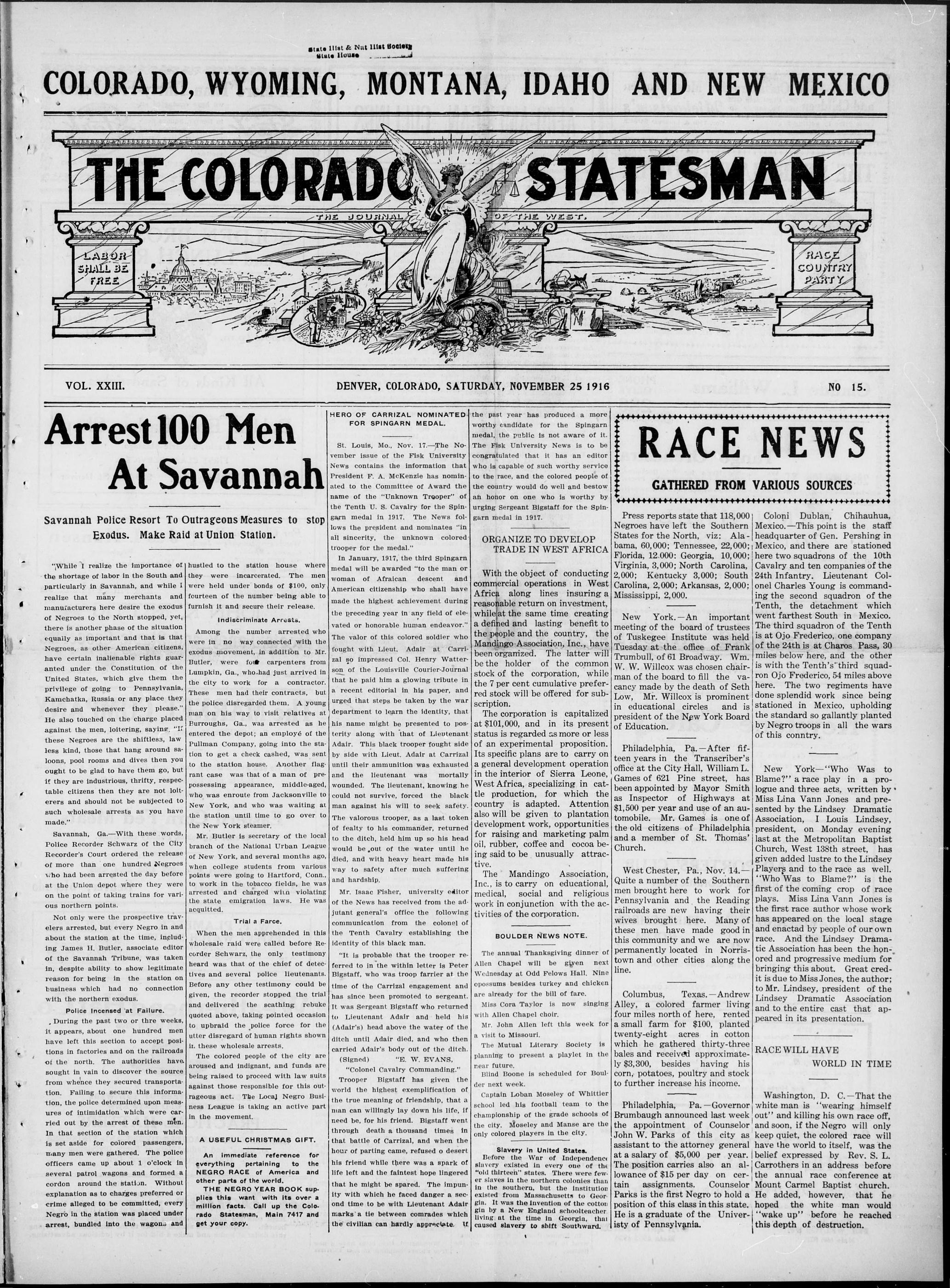
Arrest100 Men At Savannah
Savannah Police Resort To Outrageons Measures to stop Exodus. Make Raid at Union Station.
VOL. XXIII.
Arrest10
At S
Savannah Police Resort To
Exodus. Make Ra
"While I realize the importance of the shortage of labor in the South and particularly in Savannah, and while I realize that many merchants and manufacturers here desire the exodus of Negroes to the North stopped, yet, there is another phase of the situation equally as important and that is that Negroes, as other American citizens, have certain inalienable rights guaranteed under the Constitution of the United States, which give them the privilege of going to Pennsylvania, Kamchatka, Russia or any place they desire and whenever they please." He also touched on the charge placed against the men, loitering, saying, "If these Negroes are the shiftless, law less kind, those that hang around saloons, pool rooms and dives then you ought to be glad to have them go, but if they are industrious, thrifty, respectable citizens then they are not loiterers and should not be subjected to such wholesale arrests as you have made."
Savannah, Ga.—With these words, Police Recorder Schwarz of the City Recorder's Court ordered the release of more than one hundred Negroes who had been arrested the day before at the Union depot where they were on the point of taking trains for various northern points.
Not only were the prospective travelers arrested, but every Negro in and about the station at the time, including James H. Butler, associate editor of the Savannah Tribune, was taken in, despite ability to show legitimate reason for being in the station on business which had no connection with the northern exodus.
Police Incensed at Failure.
During the past two or three weeks, it appears, about one hundred men have left this section to accept positions in factories and on the railroads of the north. The authorities have sought in vain to discover the source from whence they secured transportation. Failing to secure this information, the police determined upon measures of intimidation which were carried out by the arrest of these men. In that section of the station which is set aside for colored passengers, many men were gathered. The police officers came up about 1 o'clock in several patrol wagons and formed a cordon around the station. Without explanation as to charges preferred or crime alleged to be committed, every Negro in the station was placed under arrest, bundled into the wagons and
hustled to the station house where they were incarcerated. The men were held under bonds of $100, only fourteen of the number being able to furnish it and secure their release.
Indiscriminate Arrests.
Among the number arrested who were in no way connected with the exodus movement, in addition to Mr. Butler, were four carpenters from Lumpkin, Ga., who had just arrived in the city to work for a contractor. These men had their contracts, but the police disregarded them. A young man on his way to visit relatives at Purroughs, Ga., was arrested as he entered the depot; an employé of the Pullman Company, going into the station to get a check cashed, was sent to the station house. Another flagrant case was that of a man of prepossessing appearance, middle-aged, who was enroute from Jacksonville to New York, and who was waiting at the station until time to go over to the New York steamer.
Mr. Butler is secretary of the local branch of the National Urban League of New York, and several months ago, when college students from various points were going to Hartford, Conn. to work in the tobacco fields, he was arrested and charged with violating the state emigration laws. He was acquitted.
Trial a Farce.
When the men apprehended in this wholesale raid were called before Recorder Schwarz, the only testimony heard was that of the chief of detectives and several police lieutenants. Before any other testimony could be given, the recorder stopped the trial and delivered the scathing rebuke quoted above, taking pointed occasion to upbraid the police force for the utter disregard of human rights shown in these wholesale arrests.
The colored people of the city are aroused and indignant, and funds are being raised to proceed with law suits against those responsible for this outrageous act. The Local Negro Business League is taking an active part in the movement.
A USEFUL CHRISTMAS GIFT.
An immediate reference for everything pertaining to the NEGRO RACE of America and other parts of the world. THE NEGRO YEAR BOOK supplies this want with its over a million facts. Call up the Colorado Statesman, Main 7417 and get your copy.
State Hist & Nat Hist Society
State House
NG, MONTA
RADO
THE JOURNAL
DENVER, COLORADO, SAT
HERO OF CARRIZAL NOMINATED FOR SPINGARN MEDAL.
St. Louis, Mo., Nov. 17.—The November issue of the Fisk University News contains the information that President F. A. McKenzie has nominated to the Committee of Award the name of the "Unknown Trooper" of the Tenth U. S. Cavalry for the Spingarn medal in 1917. The News follows the president and nominates "in all sincerity, the unknown colored trooper for the medal."
In January, 1917, the third Spingarn medal will be awarded "to the man or woman of Afraican descent and American citizenship who shall have made the highest achievement during the preceding year in any field of elevated or honorable human endeavor." The valor of this colored soldier who fought with Lieut. Adair at Carrizal so impressed Col. Henry Watterson of the Louisville Courier-Journal that he paid him a glowing tribute in a recent editorial in his paper, and urged that steps be taken by the war department to learn the identity, that his name might be presented to posterity along with that of Lieutenant Adair. This black trooper fought side by side with Lieut. Adair at Carrizal until their ammunition was exhausted and the lieutenant was mortally wounded. The lieutenant, knowing he could not survive, forced the black man against his will to seek safety. The valorous trooper, as a last token of fealty to his commander, returned to the ditch, held him up so his head would be out of the water until he died, and with heavy heart made his way to safety after much suffering and hardship.
Mr. Isaac Fisher, university editor of the News has received from the adjutant general's office the following communication from the colonel of the Tenth Cavalry establishing the identity of this black man.
"It is probable that the trooper referred to in the within letter is Peter Bigstaff, who was troop farrier at the time of the Carrizal engagement and has since been promoted to sergeant. It was Sergeant Bigstaff who returned to Lieutenant Adair and held his (Adair's) head above the water of the ditch until Adair died, and who then carried Adair's body out of the ditch. (Signed) "E. W. EVANS."
"Colonel Cavalry Commanding."
Trooper Bigstaff has given the world the highest exemplification of the true meaning of friendship, that a man can willingly lay down his life, if need be, for his friend. Bigstaff went through death a thousand times in that battle of Carrizal, and when the hour of parting came, refused o desert his friend while there was a spark of life left and the faintest hope lingered that he might be spared. The impunity with which he faced danger a second time to be with Lieutenant Adair marks a tie between comrades which the civilian can hardly appreciate.
the past year has produced a more worthy candidate for the Spingarn medal, the public is not aware of it. The Fisk University News is to be congratulated that it has an editor who is capable of such worthy service to the race, and the colored people of the country would do well and bestow an honor on one who is worthy by urging Sergeant Bigstaff for the Spingarn medal in 1917.
ORGANIZE TO DEVELOP TRADE IN WEST AFRICA
With the object of conducting commercial operations in West Africa along lines insuring a reasonable return on investment, while at the same time creating a defined and lasting benefit to the people and the country, the Mandingo Association, Inc., have been organized. The latter will be the holder of the common stock of the corporation, while the 7 per cent cumulative preferred stock will be offered for subscription.
The corporation is capitalized at $101,000, and in its present status is regarded as more or less of an experimental proposition. Its specific plans are to carry on a general development operation in the interior of Sierra Leone, West Africa, specializing in cattle production, for which the country is adapted. Attention also will be given to plantation development work, opportunities for raising and marketing palm oil, rubber, coffee and cocoa being said to be unusually attractive. The Mandingo Association, Inc., is to carry on educational, medical, social and religious work in conjunction with the activities of the corporation.
BOULDER NEWS NOTE.
The annual Thanksgiving dinner of Allen Chapel will be given next Wednesday at Odd Felows Hall. Nine opossums besides turkey and chicken are already for the bill of fare.
Miss Cora Taylor is now singing with Allen Chapel choir.
Mr. John Allen left this week for a visit to Missouri.
The Mutual Literary Society is planning to present a playlet in the near future.
Blind Boone is scheduled for Boulder next week.
Captain Loban Moseley of Whittier school led his football team to the championship of the grade schools of the city. Moseley and Manse are the only colored players in the city.
Slavery in United States.
Before the War of Independence slavery existed in every one of the "old thirteen" states. There were fewer slaves in the northern colonies than in the southern, but the institution existed from Massachusetts to Georgia. It was the invention of the cotton gin by a New England schoolteacher living at the time in Georgia, that caused slavery to shift Southward.
RACE NEWS
GATHERED FROM VARIOUS SOURCES
Press reports state that 118,000 Negroes have left the Southern States for the North, viz: Alabama, 60,000; Tennessee, 22,000; Florida, 12.000; Georgia, 10,000; Virginia, 3,000; North Carolina, 2,000; Kentucky 3,000; South Carolina, 2,000; Arkansas, 2,000; Mississippi, 2,000.
New York.—An important meeting of the board of trustees of Tuskegee Institute was held Tuesday at the office of Frank Trumbull, of 61 Broadway. Wm. W. W. Willcox was chosen chairman of the board to fill the vacancy made by the death of Seth Low, Mr. Willcox is prominent in educational circles and is president of the New York Board of Education.
Coloni Dublan, Chihauhua, Mexico.—This point is the staff headquarter of Gen. Pershing in Mexico, and there are stationed here two squadrons of the 10th Cavalry and ten companies of the 24th Infantry. Lieutenant Colonel Charles Young is commanding the second squadron of the Tenth, the detachment which went farthest South in Mexico. The third squadron of the Tenth is at Ojo Frederico, one company of the 24th is at Charos Pass, 30 miles below here, and the other is with the Tenth's third squadron Ojo Frederico, 54 miles above here. The two regiments have done splendid work since being stationed in Mexico, upholding the standard so gallantly planted by Negro troops in all the wars
Philadelphia, Pa.—After fifteen years in the Transcriber's office at the City Hall, William L. Games of 621 Pine street, has been appointed by Mayor Smith as Inspector of Highways at $1,500 per year and use of an automobile. Mr. Games is one of the old citizens of Philadelphia and a member of St. Thomas' Church.
West Chester, Pa., Nov. 14.—Quite a number of the Southern men brought here to work for Pennsylvania and the Reading railroads are new having their wives brought here. Many of these men have made good in this community and we are now permanently located in Norristown and other cities along the line.
Columbus, Texas.—Andrew Alley, a colored farmer living four miles north of here, rented a small farm for $100, planted twenty-eight acres in cotton which he gathered thirty-three bales and received approximately $3,300, besides having his corn, potatoes, poultry and stock to further increase his income.
Philadelphia, Pa.—Governor Brumbaugh announced last week the appointment of Counselor John W. Parks of this city as assistant to the attorney general at a salary of $5,000 per year. The position carries also an allowance of $15 per day on certain assignments. Counselor Parks is the first Negro to hold a position of this class in this state. He is a graduate of the University of Pennsylvania.
NO 15.
Coloni Dublan, Chihauhua, Mexico.—This point is the staff headquarter of Gen. Pershing in Mexico, and there are stationed here two squadrons of the 10th Cavalry and ten companies of the 24th Infantry. Lieutenant Colonel Charles Young is commanding the second squadron of the Tenth, the detachment which went farthest South in Mexico. The third squadron of the Tenth is at Ojo Frederico, one company of the 24th is at Charos Pass, 30 miles below here, and the other is with the Tenth's third squadron Ojo Frederico, 54 miles above here. The two regiments have done splendid work since being stationed in Mexico, upholding the standard so gallantly planted by Negro troops in all the wars of this country.
New York—"Who Was to Blame?" a race play in a prologue and three acts, written by Miss Lina Vann Jones and presented by the Lindsey Dramatic Association, I Louis Lindsey, president, on Monday evening last at the Metropolitan Baptist Church, West 138th street, has given added lustre to the Lindsey Players and to the race as well. "Who Was to Blame?" is the first of the coming crop of race plays. Miss Lina Vann Jones is the first race author whose work has appeared on the local stage and enacted by people of our own race. And the Lindsey Dramatic Association has been the honored and progressive medium for bringing this about. Great credit is due to Miss Jones, the author; to Mr. Lindsey, president of the Lindsey Dramatic Association and to the entire cast that appeared in its presentation.
RACE WILL HAVE
WORLD IN TIME
Washington, D. C.—That the white man is "wearing himself out" and killing his own race off, and soon, if the Negro will only keep quiet, the colored race will have the world to itself, was the belief expressed by Rev. S. L. Carrothers in an address before the annual race conference at Mount Carmel Baptist church. He added, however, that he hoped the white man would "wake up" before he reached this depth of destruction.
THE STAR HAIR GROWER
A Wonderful Hair Dressing and Grower
A Wonderful Hair Dressing and Grower.
One Thousand Agents Wanted. Good Money Made. We want Agents in every city and country. We want GROWER. This is a wonderful preparation. Can be used with or without straightening irons. Sells for 25 cents per box—One 25-cent box will prove its value. Any person that will want to grow your hair must what has failed to grow your hair, just give THE STAR HAIR GROWER a trial and be convinced. Send 25 cents for a full size box. If you wish to be an agent, send $1 to the company. If you wish to begin work at once; also agent's terms.
Send all money by Money Order to
EVANSTON, ILL. GREENSBORO, N.C.
NOTE—Persons living in the South can get
will order from THE STAR HAIR GROWER
MFR., P. O. BOX 812, GREENSBORO, N.C.
Claude L. Willis
OF KANSAS CITY, MIS
With His
Tang
2852 WELTON ST Will furnish
Dances a S
FERN H.
2711 Welton
Can be rented for Private or Public
of any nature, with latest first-class ad
Phone Main
R.
Appel=Zizk
Established 1871 Phone Main 2
Keystone
Up stairs over 2051 Champa st
Lunch every day from 11:30 a.
20e. Short orders at all hours.
Phone Champa 3498.
Williams
CITY, MISSOURI
PHONE
OLIVE
286
With His
Tango Orchestra
Will furnish Music for All Occasions.
Dances a Specialty. Reasonable Prices.
N HALL
Welton Street
or Public Parties. Dances or Gathering
first-class accommodation.
Phone Main 2860
2852 WELTON ST Will furnish Music for All Occasions. Dances a Specialty. Reasonable Prices.
Can be rented for Private or Public Parties. Dances or Gathering of any nature, with latest first-class accommodation.
Phone Main 2860
R. L. PHYN1Y Manager
Chome Main 2994 417 Sixteenth Street
One Cafe
Champa street. Merchants'
m 11:30 a. m. to 3:30 p. m.
all hours. Give us a trial.
Up stairs over 2051 Champa street. Merchants' Lunch every day from 11:30 a. m. to 3:30 p. m. 20c. Short orders at all hours. Give us a trial. Phone Champa 3498.
W. M. Brewster, Treas. J. W. Minter, Sec.
D PORTERS' CLUB
ROOM IN CONNECTION
W. C. Campton, Pres. W. M. Brewst
RAILROAD POR
LUNCH ROOM IN
W. C. Campton, Pres. W. M. Brewster, Treas. J. W. Minter, Sec.
1728½ Wazee St. Only one
J. B. MINTER.
C. Only one block from Union Depot.
B. MINTER, Barber.
1728 $ \frac{1}{2} $ Wazee St. Only one block from Union Depot. J. B. MINTER, Barber.
Phone Main 6319
Elegant Auto Service at the Port
THE DENVER
MRS. J. H. STEELE, Mgr.
Special Auto Service Accommodating
some Casket
For Horse Carriages W
Bonded to th
Q. H. SHIRLEY, Pres.
PAUL J. SHIRLEY,
THE ATLAS
Courteous Treatment
Leaders in Pr
Day or Night
Price at the Popular Price for Carriages.
INVER MORTUARY
2445 Larimer Street, Denver, Colo.
Accommodating 10 People Including Hand-
some Casket $50.
Carriages We Charge $3.50.
Bonded to the City.
J. C. HAMPSON, Vice Pres
SHIRLEY, Sec. and Treas.
ATLAS DRUG CO.
Greatmet. Right Prices
ers in Prescription
Phone Main 6319 Day or Night
Elegant Auto Service at the Popular Price for Carriages.
THE DENVER MORTUARY
MRS. J. H. STEELE, Mgr. 2445 Larimer Street, Denver, Colo.
Special Auto Service Accommodating 10 People Including Hand-
some Casket $50.
For Horse Carriages We Charge $3.50.
Bonded to the City.
C. H. SHIRLEY, Pres. J. C. HAMPSON, Vice Pres PAUL J. SHIRLEY, Sec. and Treas.
Courteous Treatmet. Right Prices Leaders in Prescription
---
---
A
BOB CARRUTH, Proprietor.
BILLIARDS AND POOL
PHONE MAIN 8416.
Store No. 1.
2001 WELTON ST.
Main 895 875
R. L. PHYN1X, Manager.
Denver's Best and Largest TAILORS
Orders taken over phone.
```markdown
```
FREE CHECK ROOM
DENVER, COLORADO.
Store No. 2
26TH AND WELTON
Main 4955.4956
AFRO-AMERICAN CULLINGS
At the recent meeting of the Afro-American congress at Washington a proposition was offered by President Harris relative to having literature of the colored race placed in libraries throughout the country to be used as supplementary literature to our already large storehouse of Negro books. Those taking part in the discussion were Professor Jayson, Professor Craves of Missouri and Editor J. Finley Wilson. Mrs. Julia M. Layton spoke on the National Memorial association: its work and scope. Professor Vance of Missouri moved that a committee be appointed to compile the very best books, to be kept and used as supplementary literature. The motion carried. The committee consisted of Professor Vance, Doctor Dudley of North Carolina and Professor Jayson of Delaware.
All officers of the congress were reelected, including J. Silas Harris of Missouri as president and Mrs. Julia Embry as recording secretary and Samuel Z. C. Westfield, reporter. The president was given the power to fill all vacancies. Prof. H. B. Wallace of Carthage, Mo., spoke on the subject, "The Progress of the Negro Checked by Shortsightedness." Invocation was delivered by Rev. B. F. Watson, secretary of church extension A. M. E. church. Music was rendered by the junior choir of Metropolitan A. M. E. church. A declamation was given by Henrietta Victor Davis. Prof. John W. Cromwell addressed the congress. Other speakers were: Prof. F. E. Lawrence of Chester, Pa.; Dr. S. B. Dudley of North Carolina and Rev. William Cabot DeBerry of North Carolina.
Miss Nannie Burroughs, president of the National Training school said: "Just give a man a chance, then no matter where the man is or to what race he belongs, he will be a man looking onward and upward." Judge Robert H. Terrell of this city was introduced. He said: "I am very glad this congress met here, because this is federal territory, belonging to the thousands of people making up this cosmopolitan government. This is your city; this is the capital of the federal government; this is your capital—the black man's capital as well as the white man's capital. The federal flag floats over our republic, and it is your flag as well as the white man's flag. Of course, there is suffering by this people of ours, but all races that have made their way to the front have suffered. Victory does not come on flowery beds of ease, but through toll and suffering."
Mnj. R. R. Moton, president of Tuskegee institute, in an address at Montgomery, Ala., said the Negro should remain in the South and study his own shortcomings with a desire and aim to overcome them. He said the race needs to get rid of the lazy, shiftless Negro if it hopes to cope with the white man, and added the race has much to be thankful for in the South. Major Moton urged the Negroes to stay in the South, saying: "In New York, I understand from a letter just received from a physician, the Negroes are finding it very difficult even now to find places to stay; they are huddled together in quarters like pigs, and many of them cannot find any place, and that there is bound to be suffering this winter.
"They will take colds and develop pneumonia and consumption, as well as other diseases, and either will die there or be brought home in a dying condition."
Consul W. H. Hunt of St. Etienne, France, reports that there is a possible market in his district for American-made fire extinguishers. Primitive methods are now used for fighting fires.
For women's umbrellas an inventor has devised a strap to hang them from one arm and in the strap has inserted a purse for small change.
A distillery will be established in Honduras for the production of alcohol from bananas in bunches too small to be exported profitably.
A new baby carriage which includes receptacles for clothing can be folded to resemble a suitcase when not used for its principal purpose.
According to English scientists electricity passed through timber when freshly cut makes it more resistant against decay and fungous growth.
Two inventors living in Portland, Ore., have patented an egg-shipping crate so arranged that, should an egg be broken, it will not soil the others.
Adverse conditions in Sicily will cause the 1916-17 lemon crop to drop to about half the average output.
There is a possible market for American machinery on the sugar plantations of Natal, South Africa.
Of spring metal and wire is a new device to encircle a person's foot and prevent the loss of an overshoe.
In France there is a prize amount-went to the courthouse alone for the license.
Announcement that the National Negro Business league has started a nation-wide campaign to advertise Negro business enterprises, with a view to their better support by colored people, comes at a time when they are awaking to a consciousness of increasing economic importance. Since the days of emancipation, the bulk of the race has remained In the South under economic and social conditions which have changed but slowly. The accepted basis of society has kept in the hands of the white man storekeeping and the professions, confining the Negro to tenant farming and unskilled labor. Gradually, such schools as Tuskegee, Calhoun, and a host of others have built up an ever-increasing body of men and women skilled in trades and trained to the use of initiative and independent thinking. Fully 20 years ago this force began breaking through the caste system in isolated cases, the process being stimulated by the late Booker T. Washington some fifteen years ago. The policy has been twofold, encouraging the individual pioneers by organization and educating the race out of the tradition that only the white man was qualified to engage in trade.
Now that the labor shortage has forced the large employers of the country to look more to the South for unskilled and semi-skilled workers, the Negro is becoming more conscious of his importance industrially. One indirect effect should be to make the league's campaign more fruitful than if it had been launched at a less opportune time. And the movement seems to be actuated by the right point of view. "These campaigns are not organized in any spirit of antagonisms to merchants of other races," says the announcement, "but for the sole purpose of advertising the existence of the Negro merchants."
"In Spite of the Handicap" is the title which James D. Corrothers, the colored poet, gives to his autobiography. Corrothers was born in southern Michigan and he confronted the problems which are the rather heavy inheritance of the Negro in the North. That they differ from those of the Negro in the South makes them no lighter. Ray Stannard Baker, another Michigan man—says in his preface: "The book throws much light on conditions with which few writers on the race question have dealt: I mean the problems which confront the abler and more intelligent Negroes, the leaders of their race, in their contact with their own people. Mr. Corrothers recognizes that the color line is only part, however important, of the great human situation which the Negro must face. And finally it is a book singularly without rancor—the book of a man who in spite of difficulties has maintained a cheerful and helpful outlook toward life."
Mr. Corrothers certainly is entitled to this tribute, writes Elia W. Peattle in the Chicago Tribune. Bitter poverty, race prejudice, the handicap of insufficient education, the jealousy and littleness of his own people, the loss of his wife, the enmity of his bishop—for he became a clergyman—combine to make a story that would be tragic were it not for the many compensations that came to him. Men and women of distinction were good to him, the best magazines printed his poetry, and life itself wore an alluring face because of his appreciation of every opportunity that offered and the essential courage that made him push on to new adventures.
One comparatively small strip of the coalfields that have been discovered in the Antarctic continent is estimated to contain as much fuel as all the unworked fields of Great Britain.
In a new vacuum cleaner for cleansing clothing in public places a circular brush surrounds the nozzle to loosen the dust.
Ten years of experimenting were necessary to perfect the new glass utensils in which food can be both cooked and served.
German child labor laws define children as boys and girls less than thirteen years old and those older who still attend school.
Encircling and pivoted to a new comb is a loop of wire which, when drawn over the teeth, removes all hair that they may hold.
Hungary prohibits the importation of adulterated or artificially colored beer or the use of coloring extracts in that brewed at home.
Backed by the insular government, a determined effort is being made to develop sisal production in the Philippines.
A small but useful electric railway is contained within a Paris sewer.
To judge horse races a Frenchman has invented a camera that is operated by a winning horse's breaking a thread.
Wilmington, Del., is to have a new free library building to cost $500,000.
we have conducted an exclusive Jewelry Store in Denver. Square dealing, conservatism and yet progressive merchandizing is our motto.
ESTABLISHED
1879
Stark
JEWELERS
709 AND 711 SIXTEENTH STREET,
BOLDEN BROS
and LUNCH R
924 19th Street, Denver
711 SIXTEENTH STREET, DENVER, C
OLDEN BROS. CA
nd LUNCH ROOM
24 19th Street, Denver, Colorado
924 19th Street, Denver, Colorado
NNER
30 to 2 p.m.
Short Or
at All H
DINNER
11:30 to 2 p.m.
All Kinds of San Bolden Bros. Bar
All Kinds of Sandwiche den Bros. Barber S
All Kinds of Sandwiches
Baths, Electric Massage
FIRST CLASS SERVICE
R. B. BOLDEN, Mgr. 926 19
For Christmas Presents Jes I.
Watches—Diamonds—Jewelry
Repairing a Specialty
428 16TH STREET
DENVER, COLO.
Phone Main 3012.
Watchmaker
BOLDEN, Mgr. 926 19th St.
istmas Presents
Diamonds — Jewelry
specialty
TREET
VER. COLO.
3012.
Jes I. Ha
Manufacturing
Watchmaker and
R. B. BOLDEN, Mgr. 926 19th St. Denver
For Christmas Presents
Watches—Diamonds—Jewelry
Repairing a Specialty
428 16TH STREET
DENVER, COLO.
Phone Maln 3012.
Jes I. Hansen
Manufacturing
Watchmaker and Jeweler
JOHN K. RET
Meats, Fancy and Staple
1864 CURTIS STREET
Corner Nineteenth.
The MARKET CO
C. E. SMITH, Manager, Res. Pho
Wholesale and Retail Staple and Fancy Gro
Hotels and Restaurants Our
Fresh and Cured
Eastern Corn Fe
JOHN K. RETTIGER
Fancy and Staple Grocery
1864 CURTIS STREET
seventh.
MARKET COMPANY
E. SMITH, Manager, Res. Phone South 1
d Retail Staple and Fancy Groceries, Fish
Hotels and Restaurants Our Specialty.
Fresh and Cured
Eastern Corn Fed Me
The MARKET COMPANY
C. E. SMITH, Manager, Res. Phone South 1608
Wholesale and Retail Staple and Fancy Groceries, Fish and Oysters Hotels and Restaurants Our Specialty. Fresh and Cured
Eastern Corn Fed Meats
Fruits, Vegetables, Poultry and Game.
Telephones Main 4302,4303,4304,4305 622-636 15th Street Denver.
W. F. PLAMBECK
EXPERT WATCH MAKER
1715 CHAMPA STREET
A full line of Watches, Clocks, Diamonds and Jewelry
at lowest prices. Courteous treatment to all
Weatherhead
TELEPHONE MAIN 3
atherhead Ha TELEPHONE MAIN 3203
Weatherhead Hat Co. TELEPHONE MAIN 3203
Established 1876
PIONEER HATTERS OF THE WEST
WE MAKE OLD HATS NEW
PRACTICAL HATTER
RENOVATORS, BLEACHERS DYERS AND FIL
Of Gents' and Ladies' Hats of Every Descrip
1624 Champa St., Denver, Colo.
PRACTICAL HATTERS
ATORS, BLEACHERS DYERS AND FIL
Gents' and Ladies' Hats of Every Descrip
1624 Champa St., Denver, Colo.
RENOVATORS, BLEACHERS DYERS AND FINISHERS
Of Gents' and Ladies' Hats of Every Description
1624 Champa St., Denver, Colo.
A Dollar spent at with un Sent out Kept with the home merchants it is a benefit. Business men should awake to this dollar at home and make a bid for it
h the home merchants it is a messenger Business men should awake to the importa or at home and make a bid for it by judicious
Kept with the home merchants it is a messenger of continuous benefit. Business men should awake to the importance of keeping this dollar at home and make a bid for it by judicious advertising.
PHONE MAIN 3028
ESTABLISHED
1879
Stark
JEWELERS
DENVER, COLORADO
OS. CAFE
I ROOM
ver, Colorado
Short Orders
at All Hours
Sandwiches
Barber Shop
Massage
SERVICE
926 19th St. Denver
S I. Hansen
Manufacturing
Bitchmaker and Jeweler
RES. PHONE GALLUP 942
ETTIG
taple Groceries
STREET
Denver, Cola.
COMPANY
Phone South 1608
Groceries, Fish and Oysters.
Our Specialty.
ured
Fed Meats
Denver, olorado
HONEST GOODS
HONEST WORK
AT HONEST PRICES
Expert Repairing
d Hat Co.
AIN 3203
HATTERS
SERVERS AND FINISHERS
of Every Description
Denver, Colo.
CONDENSATION OF FRESH NEWS
THE LATEST IMPORTANT DISP
PATCHES PUT INTO SHORT,
CRISP PARAGRAPHS.
STORY OF THE WEEK
SHOWING THE PROGRESS OF EVENTS IN OUR OWN AND FOREIGN LANDS.
Western Newspaper Union News Service.
ABOUT THE WAR
Italian statement admits further gains by Austrians in the Carso, where Italian trenches have been captured.
Vice Admiral Fournet, acting for entente, demands surrender of all Greek arms and ammunition except 50,000 rifles.
London issues statement concerning battle fought on Afghan border, in which 6,000 tribesmen were defeated by the British.
Italian forces have repulsed a counter attack to the west of Monastir. French troops have occupied the village of Kroni, west of Monastir on Lake Presba.
The important railway town of Craiova, in western Wallachia, was occupied by German troops invading Rumania, it was semi-officially announced at Berlin. Berlin claims the complete failure of the Anglo-French offensive on the Somme after 136 days of fighting, in which the entente's casualties were more than 600,000. Allied troops have been completely victorious on the Macedonian front from the river Cerna to Lake Presba, according to announcement made by the French war office. Germans and Bulgars evacuate Monastir under pressure of the French and Serbians. Berlin denies capture of city is of military importance, but Paris declares victory one of the most important of the war.
According to the central identification office at Kiev, Russia, says the Overseas News Agency, the number of Russian casualties since June 1, 1916, has reached 100,621 officers and 2,027,853 men. Among the officers are one general of brigade, four colonels and four lieutenant colonels in command of regiments.
Continuing their pursuit of the defeated German and Bulgarian troops on the Macedonian front, the Serbians captured the villages of Makovo, Orahovo, Vranovtsi, Ribartsi, Bilyanik, Novak and Suhdol, all west and northwest of Monastir. In addition to many prisoners the Serbians are said to have taken field guns, a considerable number of machine guns and a great quantity of other war materials.
WESTERN
The Republican state central committee at San Francisco estimated that President Wilson's plurality in California will be in excess of 3,400. Chester A. Congdon of Duluth, Republican national committeeman from Minnesota, died at a St. Paul hotel, after an illness of two weeks, of pleurisy. Chicagoans through the medium of Christmas savings clubs, featured by many local banks this year and last, have accumulated $1,000,000 with which to celebrate the Yuletide this year.
Pursued by offers of marriage, advertising agencies wanting her picture, cranks and beggars, Miss Jeanette Rankin, Montana's new congresswoman, took refuge behind locked doors and stationed her brother, a former Havard University football player, at the front gate to meet visitors.
Andrew Howell, 83, is an applicant for a position in the Chicago water department, basing his application upon the plea that "worry, not work, is the rust on the blade." Howell retired several weeks ago after sixty-three years' service in the department and says he has done nothing but worry about his idleness since.
WASHINGTON
Early Christmas shopping and mailing was commended by the National Association of Assistant Postmasters meeting at Washington. Despite much agitation in its favor, President Wilson is not expected to urge an embargo on food exports in his address to Congress. The National Grange, in session at Washington, named a committee to prepare a brief freeing the farmer of blame for the high cost of living. In opening the first session of the joint congressional committee to investigate railroad problems, Senator Francis G. Newlands of Nevada, the chairman, explained that the inquiry would cover a wide field.
President Wilson's first step toward entering the controversy that has broken out anew between railroads and employees over the eight-hour day was taken when he agreed to meet the leaders of the four railroad brotherhoods.
That the price of preparedness comes high was shown in the hearings of the naval committee on the 1917 bill when it was brought out that it will cost $69,000,000 more for the upkeep alone of the navy in the coming year than it did last year.
FOREIGN
A. Reuter dispatch from Wellington, N. Z., says that the export of wool has been prohibited.
Shipping suffered severely in the heavy gales off the British coast Saturday and Sunday, and it is believed at least seventeen lives were lost.
Viscount Ichiro Motono, former Japanese ambassador to Russia, took up the portfolio of foreign minister in the cabinet of Premier Terauchi at Tokio.
The Italian government has joined the other entente powers in protesting against the action of Germany in proclaiming Russian Poland an independent state.
On Nov. 1 the 1,000th German shell struck the Cathedral of Rheims. Four of the flying buttresses supporting the roof of the nave have been demolished and several others hit.
A proposal has been made to the Canadian banks to finance purchases of grain in the Dominion for the imperial government to the extent of $30,000,000, it was learned at Montreal.
Plans to take 5,000 English women, widowed by the war, to Canada have been completed by officers of the Salvation Army working in conjunction with the officials of the Dominion and provincial government in Canada.
Rigid economy thrughout the world in the consumption of food, in view of the deficient crops and the extraordinary requirements of the European armies, is urged by the International Institute of Agriculture at Rome.
The new Philippine congress, convened under the Philippine bill which was signed by President Wilson Aug. 29, met at Manila, and for the first time in the history of the government of the islands a full-blooded Moro took his seat in the upper house. The Moro senator is Hadjl Butu, for many years prime minister of the sultan of Sult.
the death of Francis Joseph, emperor of Austria, is a remarkable climax to the long list of tragedies in the Hapsburg family—a list unparalleled in any other reigning house in Europe. He dies in the midst of the world's greatest war, which he himself largely brought about by his determination to avenge the act of assassination of his heir, the Archduke Francis Ferdinand, as the result of an alleged Serbian conspiracy, while on a state visit to Bosnia on June 28, 1914.
SPORTING NEWS
Yale triumphed over Princeton in the annual football game at Princeton, N. J., by a score of 10 to 0.
Hamline University defeated McAlester college for the first time in six years in their annual gridiron contest at St. Paul, Minn., 6 to 0.
Goading each other into cyclonic speed, the members of the School of Mines eleven at Denver defeated the University of Colorado, 27 to 10.
Sporting, excise and swinging-door circles were agog when it was reported that the price of beer is to be raised to 6 cents a glass in Philadelphia.
The seventh annual international grand prize automobile road race was won by Johnny Aitken, driving as relief for Howard Wilcox, at Santa Monica, Cal.
Dario Resta, automobile racing driver, became the sole claimant of the American Automobile Association's title of "champion driver of America," when Johnny Altken, his rival, announced that he would not race at Ascot speedway on Thanksgiving day.
GENERAL
The U. S. Steel Company has increased the pay of its employés.
The annual production of clothing in New York city amounts to approximately $532,000,000.
Papers in three libels, totaling $150,000, were filed against the German submarine Deutschland at New London, Conn.
Bishop Alpheus W. Wilson of the Methodist Episcopal Church, South, died at his home in Baltimore after a protracted illness. He was 82 years of age.
Prospects of his having trouble with the blond Eskimos of the extreme Arctic regions are intimated in a letter received in New York from Vilhjalmar Stefansson.
The Cotton Manufacturers' Association of New Bedford, Mass., voted to grant a 10 per cent increase in pay to their 33,000 operatives, to be effective for a period of six months beginning Dec. 4. Twenty unexploded bombs were found in the sugar cargo of the American steamship Sarnia upon her arrival at Cherbourg, France, after a voyage starting from New York on Sept. 2. Nineteen deaths since Sept. 1 have been reported in the Michigan "big game district," eighteen of them due directly to hunting accidents and one to heart disease, while hunting. In addition, there have been five serious injuries.
Mrs. Fannie Smith Trude, celebrated as the inventor of the "trial divorce," is a bride again at Chicago. Announcement is made that she has been married to Harry Riley, a circus performer. Mrs. Trude's adventures in matrimony number three. The American commissioners placed before the Mexicans at Atlantic City a plan involving the withdrawal of the American troops now operating in Chihuahua under Gen. Pershing and the future protection of life and property along the international frontier.
INCREASE OF $13,000,000 IN YEAR
FOR COLORADO PRODUCTS.
Unusual Finishing Weather Makes
First Estimates of Production 10
to 15 Per cent Too Low.
Western Newspaper Union News Service.
Denver.—Government and state experts are adding 10 and 15 per cent to the crop production of Colorado over the estimate previously made by agricultural experts. Their figures give the yield of the state a total value of over $82,000,000, or an increase of approximately $13,000,000 over the 1915 production and $14,000,000 over the value of the crop produced in 1914.
The unusually good finishing weather with late frost is the basis for the increased production and valuation over the estimate made last month.
From an acreage of 3,000 less than the 53,000 planted last year potato growers will realize approximately 6,000,000 bushels, this crop being particularly favored by the favorable maturing conditions. This is against a production of 7,155,000 bushels in 1915. But the farmers will receive for this year's crop over $8,400,000, against $4,722,300 realized for the 1915 crop. The production of wheat this year will aggregate 2,500,000 bushels less than in 1915, but its value is approximately $14,000,000, $3,000,000 more than last year. The acreage planted was 727,000 acres, nearly 160,000 more than planted last year. For three years there has been a steady increase in acreage devoted to crops. In 1914 the acreage was 2,605,400, in 1915, 2,754,800, and this year, 2,961,000, an increase in 1916 of 206,500 acres over 1915.
The 1916 potato crop will be worth $3,972,110 more than in 1915. The acreage of wheat increased 167,000 and the value, $2,480,000.
Other crops increasing in value include rye, barley, oats, pears, kaffir corn and cantaloupes. Hay, corn and peaches showed a decrease in value.
Pears yielded 92,000 bushels, as against 99,000 in 1915, but the price of $2.50 a bushel was $1 more than in 1915, giving a total value of $430,000, the largest in the history of the state.
Peaches dropped in production from 1913 of 145,000 bushels, which, even with a lower price, made the total value nearly $350,000 less than in 1915.
Other fruits and vegetables brought a total of $1,684,600, an advance of $1,200,000 over 1915.
Estimates on other crops place the value of the cantaloupe yield at $512,000; cherries, $75,000; strawberries, $105,000; tomatoes, $90,000; onions, $90,000; celery, $87,500; field peas, $200,000; canning peas, $80,000, and cucumbers, $175,000.
The livestock industry has also expanded beyond all estimates. In August, J. A. Shoemaker, manager of the Denver Union Stockyards Company, predicted that the total receipts at the yards for the year 1916 would be 500,000 cattle, 500,000 hogs and 1,000,000 sheep. This record was reached and passed last month and the total promises to be in excess of 25 per cent more than Mr. Shoemaker's estimate.
Denver. — Beet sugar growers in northern Colorado already have received $5,792,000 for their crop from the Great Western Sugar Company alone. The final payment on the 1916 yield was made by the nine factories operated by the company a few days ago.
The following is the total paid out by the nine factories of the company in northern Colorado: Longmont, $1,125,000; Fort Collins, $1,000,000; Loveand, $1,200,000; Greeley, $420,000; Windsor, $329,000; Eaton, $250,000; Fort Morgan, $740,000; Sterling, $738,000.
Coal Miners Get More Wages. Boulder. — The Rocky Mountain Fuel Company announced a voluntary increase in the wages of its employees which will add about $10,000 to its monthly payroll and affect about 700 men. The increase will constitute a 5 per cent raise over the present wage. The National Fuel Company, a concern employing about 300 men, has announced that an increase will be made Dec. 1, and the Centennial and Matchless mines and several smaller mines of this locality have announced their intention of a raise in the near future.
Cranks Engine With Power On; Hurt.
Pueblo.-Cacia Villaini, a chauffeur,
"killed" his engine while driving in a
funeral procession here. He ran to
the front to crank his engine, but did
not shut off the power. When the
engine started it shot the car over him,
breaking four ribs, dislocating one hip
and bruising a shoulder. Men in the
car sprang to the lever and stopped
the auto, preventing collisions with
other cars in the funeral. Villaini will
recover.
Woman and Babe Killed in Wreck. Boulder.—Mrs. Anna Hoyle, 28 years old, and her 3-year-old daughter, Hazel, were killed, Edward L. Hoyle, her husband, was slightly stratched and Abner W. McKinley, motorman, suffered a broken leg and other injuries when a street car was wrecked by a coal train on the Colorado & Southern. Elmer, 5-year-old son of Mr. and Mrs. Hoyle, was slightly injured. Mrs. Bessie Banks, 25, was in the car and was not hurt.
Do You Know That-
Jan. 1-6—Poultry Show at Denver.
Jan. 13-13—Poultry Show at Cannon
City.
Frederick Goodrich was granted a parole at the recent meeting of the board of parcle. A series of mysterious thefts has baffled the officials of the East Denver high school. Work has been started in Denver on a $200,000 machinery manufacturing plant for a compressor company.
IS PREPARED TO DO ALL KINDS OF
Denver national banks have completed their subscriptions to the capital stock of the federal reserve bank for the Tenth district.
William A. Reed, worshipful master of the Pikes Peak Lodge No. 96, A. F. and A. M., and prominent mining man, died suddenly at his home at Cripple Creek.
For the privilege of "talking freight rates," George J. Kindel, independent aspirant for Congress in the Denver district, spent $490.20 during the last campaign.
Lloyd A. Duncan, son of Robert Duncan, Denver mining man, was found not guilty of the theft of an automobile by a jury in the District Court at Boulder.
The United States Civil Service Commission has announced an examination for Adams county, to be held in Denver Dec. 9, for the position of motor rural mail carried at Aurora.
An announcement from Washington confirms the plan of making Denver a district headquarters for the administration of federal grain standards, which is to go in operation Dec. 1.
George Riley, a bookkeeper at St. Joseph's hospital in Denver, is in a serious condition as a result of an attack by a negro whom he discovered lurking in the rear of the nurses' quarters at the hospital.
Ball and Concert Programs, Bill and Letter Heads, Calling Cards, Wedding Cards, Envelopes and Everything in the Printing Line Turned Out in the Neatest and Best Style Promptly on Short Notice.
Nearly $500,000 will be spent in Denver within the next few months in the erection of buildings to care for the business of Armour & Co., packers. Of this amount $400,000 will be expended in the construction of a new storage plant.
Despite the fact that reports from over the country indicate that there has been considerable damage to crops in other sections, Colorado farmers are reporting that recent cold snaps and snows have left little damage in their wake.
Twenty-five men and women, guests at a fashionable Denver hotel at 1441 Logan street, put on an impromptu nightgown parade when a fire which started in the boiler room sent clouds of smoke billowing through the threestory structure.
We Have Supplied Our Office with New Job Press & Type of Up-to-Date Style and Our Work Will Be on a Par with the Very Best.
Plans for the food and industrial show of the Denver Manufacturers' Association have matured and already the members of the organization are busy preparing for their exhibits. The show will be held during the second week of January. A bill opening in some manner the Mount Evans region as a scenic attraction for the benefit of Denver can easily be passed in the United States Senate, in the opinion of G. M. Hitchcock, United States senator from Nebraska, who visited in Denver.
Give Us a Trial and We Will Give You Satisfaction
Judge Robert Strong of the District Court announced at Boulder that he would grant the petition for a new trial in the case of William Knowles, Louisville miner, who was found guilty on an assault to kill charge in connection with the 1915 strike troubles at the Hecla mines.
Worry over the tragic death of his favorite daughter, Ruth, and the events of the subsequent trials at which Dr. Floyd W. Noble and Dr. Robert J. Mason, the latter, the daughter's fliancee, were tried for murder, are said to have caused the death of Sherman H. Merriweather, Denver business man.
Holding that patents involving 1,120 acres of coal lands near Boulder were secured illegally, Judge R. W. Lewis at Denver, in the federal court, reversed the decision of Master in Chancery Musser and restored to the United States the lands for which he decided patents had been secured in an irregular manner.
Prices as Reasonable as Those of Any Job Office in Denver
Bitter rivalry between the University of Colorado and the Colorado School of Mines, which began four years ago over the possession of a goat—the mascot of the University of Colorado football eleven—broke out afresh when fifty students from Boulder motored to Golden and painted the School of Mines buildings with red and black paint.
The people of Denver bought 30,000 articles made in Colorado during the ten days' home products campaign recently conducted by the manufacturers' bureau of the Civic Association, as indicated by the cards so far returned to the headquarters of the association.
Stops were made in the bean country by the Rock Island cash crop special. Seven points where lectures were given will ship this season over $200,000 worth of pinto beans. These stations are Falcon, Peyton, Calhan, Ramah, Simla, Matheson and Limon.
Room 25. Phone Main 7417
THE COLORADO STATESMAN
THE NEW YORK TIMES
CAGUN
MIDDLE
FALL
MACE
COUNTRY
PARTY
JOS. D. D. RIVERS.....Proprietor
1824 Curtis Street, Room 25.
Phone Main 7417.
SUBSCRIPTION RATES.
One Year ..... $ 2.00
Six Months ..... 1.00
Three Months ..... 60
PAYABLE IN ADVANCE.
Entered as second-class matter at the postoffice in the City of Denver, Colo.
Reading notices, ten lines or less, 10 cents per line. Each additional line over ten lines, 5 cents per line. Display advertising 50 cents per inch.
Remittances should be made by Express Money Order, Postoffice Money Order, Registered Letter or Bank Draft. Postage stamps will be received the same as cash for the fractional part of a dollar. Only 1c and 2c stamps taken.
No discounts allowed on less than three months' contract. Cash must accompany all orders from parties unknown to us. Further particulars on application
RECOGNIZED BY THE RETAIL ASSOCIATION OF THE DENVER CHAMBER OF COMMERCE AS AN ADVERTISING MEDIUM OF THE FIRST CLASS.
BE NOT DISCOURAGED
The Colorado Statesman has very little patience with the all-too-prevalent inclination on the part of colored men to knock and condemn one another without limit, just because we all do not and cannot see and do things alike, or view with the same degree of importance the special hobbies on which individuals set their hearts. We do not aim to boost men promiscuously, without the requirement of a reasonable show of merit, but we do not believe in condemning men generally, and particularly men of standing and merit, who are striving to the best of their ability to meet the conditions imposed upon them by their callings, just because they do not do as much as we would like to see done. No good is accomplished by a wholesale, imitative campaign against conditions which are not wantonly bad, but which are due to faults arising out of natural conditions. We are in hearty sympathy with all legitimate race enterprises and give them sincere and emphatic endorsement in our columns, but we have no cranky scolding to do if the people fail to appreciate opportunities presented or to follow our advice in their support. Colored people do not accomplish things just as promptly and completely as other people accomplish them because we have not had the reliable experience or do not possess the inherent capacity that centuries of independent effort have developed in those other people. We must expect to face conditions as they are and treat them with toleration and patience, however we may regret the tardiness of their reform.
The development of business instinct among us is necessarily a slow process, which depends far more upon enticement and good-natured encouragement than upon public condemnation.
The impossibilities of public co-operation, either in a business or social way, need not so disgust us that we need give up individual effort nor sacrifice our racial relations or ambitions by turning over to others that which we would rather see our race enjoy.
Colored men of superior intelligence and genius, who are fired with desires to institute and carry on progressive movements for the improvement of race conditions, ought to be prepared to meet failures and disappointments and to endure sacrifices.
The obligation imposed upon them by reason of their superior intelligence and genius, is one of ceaseless effort, infinite patience and unfaltering faith in the final triumph of their ideas. We have seen a great many race efforts fail. We have seen a great many of our own well intended and strenuously agitated plans come to naught, when their realization would have been wholly to the people's credit. We have sacrificed many a hard-earned dollar in our fight for the race and have seen many unselfish and legitimate efforts go unappreciated and often opposed by those who would have benefitted by their accomplishment. But we are neither cynical nor grouchy over the experience, and we are not discouraged. Ours is yet an infant race, in spite of the size of the baubles we play with. We have years of nursing before us before we can grapple confidently with all the big problems of life.
SPOILS AND PRINCIPLES
The anxious moments having passed, the election of nearly all Democrats to the state and county positions being conceded, supporters and workers of the Democratic party anong the Negroes in Denver and the State of Colorado are making their applications as well as offering their petitions for the usual subordinate jobs that fall to them. Excitement is at boiling point, and Negroes now on the payroll are beginning to resort to the hope of the good book's suggestion, "praying without ceasing," as that may possibly lend a help in the retention of their jobs, but what about THE VICTOR'S SPOILS! That this is common to humanity goes without saying, that those who supported the Democratic party are naturally expecting tangible recognition for their services, and we have every reason to believe that this element will receive just and prompt attention in the distribution of jobs. Character, merit and work for the party ought to be the true tests, but above all only true and tried Negro Democrats, who, with the spirit of devotion to the party as a whole, had put aside RACE PRIDE and RACE LOYALTY, and broken down the ramparts of self-protection and American liberty that we have been helping to construct these many years. While we admit our knowledge of a few Negroes in this city and state who have always cast their lot with the Democratic party, yet we heard and saw them dividing this time, as while they preached and promulgated their doctrine for the state ticket, they expressed themselves as terribly opposed to President Wilson, and having the choice of splitting their ticket, it seems to follow that they will also have the choice to split the few things that will be handed them. It is rumored that there are some Negroes who are beseeching the various heads of departments to come in January, that the axe-man should spare their heads, as they did not oppose them in public, and, further, they have gone to the extent of even detailing their domestic affairs so as to get sympathy.
We can hardly believe any self-respecting members of our race would do this, but if any individual so desires then let him come right out, declare his allegiance to the Democrats and stick to the job. Of course, there are exceptions in cases, where from merit and length of service the change of administration does not and should not affect the employe, but with half-way Democratic Negroes and Republicans resolving on turning a new leaf, Negro jobs will offer quite a problem to the newly-elected party.
NOTHING DOWN AND 17 CTS. A DAY
BUYS A PIANO. SALE NOW ON.
THE PIANO EXCHANGE
H. A. TRIGGS, Manager
211 Charles Block. Cor. 15th and Curtis Streets. Phone Champa 3742.
Greenland Ultimately Must Belong to United States for Use as Naval Base
By REAR ADMIRAL ROBERT E. PEARY, U. S. N.
Would some of the objections voiced in regard to the present treaty for the purchase of the Danish West Indies be met if the treaty provisions as to Greenland were reversed, and the bargain took the form of Denmark transferring to us her rights in Greenland, and giving us the Danish West Indies and Greenland for $25,000,000?
Will turning Greenland over to Denmark now mean our purchase of it later, or will obtaining it now mean closing the incident and placing Greenland where it must ultimately belong?
A North Pacific naval base for the United States in the Aleutian archipelago is a recognized possibility. Why not a similar base in the North Atlantic? Cape Farewell in Greenland is but little north of Sitka. It is in the same latitude as Petrograd, Christiania, Great Britain's naval base in the Orkneys, and the northern entrance to the North sea, which Great Britain has patrolled with her warships incessantly now, summer and winter, for two years.
There are fjords in southern Greenland which would hold the entire navy, with narrow, deep water—impregnable entrances.
Thirty hours' steaming due south from Cape Farewell by 35-knot war craft would put them in the transatlantic routes midway between New York and the British channel. With the rapid shrinking of distances in this age of speed and invention, Greenland may be of crucial importance to use in the future.
Greenland is the largest island in the world. Its total length from Cape Farewell, its southern extremity in 60 degrees north latitude, to Cape Morris K. Jesup, its northern extremity in $83\frac{1}{2}$ degrees north latitude, is in round numbers 1,500 miles, almost exactly the same as the length of the United States on the 97th meridian, from the mouth of the Rio Grande to where our northern boundary crosses the Red river of the north. The greatest width of Greenland is about the same as the distance from New York to St. Louis.
Records of the state department show that when the proposal to purchase the Danish West Indies came up in 1868 the suggestion was made that not only Greenland but Iceland, another Danish north Atlantic island, be included.
Business Men of Today Have Abandoned the Old Idea That Might Makes Right
Business Men of Today Have Abandoned the Old Idea That Might Makes Right
By ELBERT H. GARY
Chairman Board of Directors, United States Steel Corporation
There is a principle in the subject of co-operation, private, public, national and international, which has become necessary to the highest success. The general sentiment throughout the world is opposed to the old notion that might makes right; that the stronger power is justified in crushing the weaker out of existence; that an individual or a collection of individuals, as long as the rules of law are observed, may ignore the rights of others. It is because of this fact that modern laws have been enacted to protect the weak.
The old, hard business lines which were altogether selfish and arbitrary, are giving way to the later methods which are considerate and fair.
As a matter of course we all realize the necessity of being practical. The ethics of business do not require us to neglect our customers or ourselves. We must get our fair share of the trade; but we are not required to misrepresent, to deceive our competitors, to go outside of our proper and natural spheres of operations, to suddenly and unreasonably change our prices in special places and on particular occasions, or to resort to any of the old tricks of the trade which were intended to harass, demoralize and bankrupt our rivals. We can be practical and successful and at the same time fair, frank and gentlemanly toward our competitor.
It is probable the federal trade commission may be of much benefit to business men, depending upon the disposition of its members. So far as we have had opportunity to observe, this commission is favorable to business success. I would like to have its authority enlarged so as to permit it to advise in advance if inquiry should be made as to a contemplated action; but even under present conditions the commission should be of real service. I do not believe in governmental paternalism or management; but I do approve of governmental supervision, and I favor patriotic, intelligent, generous operations by private individuals—in cooperation between officials and private interests.
Every Court Should Have Alienist to Aid in Detecting Mental Defectives
When an epileptic, insane or feeble-minded person is committed to our penal institutions such person is not benefited, and his presence is a great drawback, and interferes with discipline and industrial efficiency of the institution.
It is not an easy task always to make a correct differential diagnosis in these cases even by those scientifically trained, and the need for proper treatment is so emphatic that it seems but the simplest justice and humanity that the judges, charged as they are with the grave responsibility of committing these social misfits to some institution, and depriving them of their liberties, should avail themselves of every possible means to avoid so grievous an error as committing one of these unfortunates to a penal institution instead of a hospital, as is too frequently the case.
Judges and prosecutors would think it presumptuous for a layman, or even a physician, to undertake to interpret the law, and so it would be. Is this not equally true of the judge or prosecutor who assumes to correctly interpret the obscure symptoms of epilepsy, insanity and feeble-mindedness? Persons suffering from epilepsy, insanity or feeble-mindedness in some one of their various forms may be both dangerous and wholly irresponsible, and may take on all the activities of a violent, willful criminal. These are the cases incapable of sustaining themselves in the field of industrial competition.
Two conclusions very naturally suggest themselves. First, court should be provided with official alienists on sufficient salary that they would not need nor be allowed to do private practice and would devote their entire time in aiding the courts in recognizing such cases.
Second, special institutions for the proper, permanent care of the feeble-minded, regardless of age; additional facilities for the care of the criminal insane and all epileptics should be provided.
Y. M. C. A. NOTES.
An enormous crowd was present last Sunday afternoon to listen to the address delivered by the Rev. Dr. Ford of Jacksonville, Fla., who spoke on the significance of the Young Mens Christian Association to the individual life of the community. Dr. Ford, who is attending the Golden Jubilee of Zion Church, and who had preached at Zion in he morning, has thousands of friends in the city, and scores of them came out to hear him.
Dr. Ford told his audience that the Y. M. C. A. stood for everything that was best in the life of the individual. There is no place like it, he said, for the young man who wants to make the most of himself, who wants to rise above the common level of the life around him. A mother worries very little about her absent boy if she knows that he is a frequenter of the Y. M. C. A. It is also a great thing for a traveling man. He never worries about his stopping place if he can find a room in the Association. He said the Y. M. C. A. is the colored man's hotel—the best he has.
Everybody is getting ready for the football game which it to be played between our team and the I. A. C. (white) at Broadway park, Thanksgiving afternoon at 2 o'clock, and for the concert and pipe organ recital which will come off at Shorter Church on Dec. 7. A great time is expected at each event.
A great time is anticipated at the union meeting of the Y. M. C. A. and Y. W. C. A. next Sunday afternoon at 3:30 o'clock at the Zion Baptist Church. Judge James A. Killian of the State Supreme Court will be the speaker. It is also expected that the Rev. E. W. Moore, who comes this week to deliver the Jubilee sermon of Zion, will also speak. Dr. Moore is a man of unusual ability, and all should hear him. The boys will also meet with them.
ZION'S GOLDEN JUBILEE.
Were the psalmist existing in these days he surely would add to his graphic description of the House of the Lord when he said—"How Amitable are Thy Tabernacles, O Lord God of Hosts," in beholding the interior of Zion Baptist church, Twenty-fourth avenue and Ogden street last week in the celebration of Fifty Years of Service in the upbuilding of the cause of Christianity and the dissemination of the gospel of the MAN of men. Who in His teachings to his followers urged the practical application of Christianity to every race, every clime and every tongue. The display of the wonderful treasures hidden in the depths of Negro heart and soul and mind were witnessed in the artistry that adorned the walls of the numerous compartments assigned the exhibitors. The painter's brush, the chemist's laboratory, the dentist's painless instruments, the medical modern surgical apparatus, relieved by the result of the needle-woman in the most fashionable articles produced from cloth with wonderful artistic designs—all these and others combined to prove without doubt the wonders of the Creator in giving man to the world and a confirmation to the highest compliment given Him when David said, "Man is fearfully and wonderfully made."
The jubilee closes tomorrow, the 26th inst., with Rev. E. W. Moore of Columbus, Ohio, former pastor of Zion, officiating.
Rev. Dr. John E. Ford of Jacksonville, Fla., who has labored for a number of years at this church opened the exercises last Sunday. Every item of the event has been an overwhelming success says Rev. D. E. Over, who with his faithful flock is making a RED LETTER EVENT in the annals of Zion Baptist church, Denver, Colorado.
Congratulations from THE COLORADO STATESMAN.
DEATH OF JOHN T. BRADY.
News was received in this city last Monday of the death of John T. Brady, aged 39, at Colorado Springs. He was the son of Henry Brady, of 2118 Race street, Denver, Colo., and although he was in poor health for a few weeks, yet his death was quite a shock to the community. During Mr. Brady's lifetime he served faithfully in the employment of the Denver Gas and Electric Company and like his father made a great number of friends not only in Denver but also in the state. The Colorado Statesman offers its deepest sympathy to the parents and other relatives of the deceased, having been associated with his father for many years in the business and political life of Colorado, and can truly affirm Mr. Brady's assistance and recognition of the members of the Negro race.
THE KEYSTONE CAFE.
Thanksgiving Dinner Menu November
30, 1916.
Soup.
Cream of Tomato.
Celery Olives
Baked Turkey, Oyster Dressing
Roast Young Pig, Baked Apples
Candied Yams Colorado Peas
Lettuce and Tomato Salad,
French Dressing
Pumpkin Pie Hot Mince Pie
Coffee Tea Milk
Served from 2:00 P. M. to 10:00
o'Clock at Night.
Keystone Cafe Dinner 35 Cents.
2049-51 Champa Street, Upstairs.
If ever there was occasion for one to find comfort in God, the immediate present is/surely such an occasion. We hear the psalmist crying in one of the "broken-hearted psalms," "I will love thee, O Lord, my strength. The Lord is my rock, and my fortress, and my deliverer; my God, my strong rock, in him will I trust; my shield, and the horn of my salvation, my high tower." And again, "God is our hope and strength, a very present help in trouble." If the psalmist's experience of God is a possible experience in our time, foolish is the man or woman who leaves any step untaken, any stone unturned, that might result in such an experience. Happy are they who can now say out of the abundance of their own experience, "This God is our God for ever and ever; he shall be our guide unto death." Happy are they who know in the depths of their hearts that Peter knew whereof he spoke when he set down the words of our text: "Casting all your care upon him; for he care for you." Happy and very desirable citizens of this world are they who know by personal experience the Eternal Caretaker, and believe mightily in his eternal goodness.
Living as the Fool Lives.
I feel it increasingly that we Christians who are old enough to know better are careful in a wrong sense and troubled about far too many things; that we are overcharged with the cares of this life; that we are "doped" with these cares; that much of the best that is in us, which, if it lived till it came to the birth, would mean blessedness here and blessedness forever, is choked to death by the cares of this world; and that hundreds and thousands of those who profess and call themselves Christians are living and dying as the fool lives and dies—the fool who said to his soul, "Soul, thou hast much goods laid up for many years; take thine ease, eat, drink, and be merry," but to whom God said, "Thou fool, this night thy soul shall be required of thee"—I feel it increasingly that many of us who are old enough to know better, and to set a better example to those who are coming after us, are making an awful and altogether unnecessary, and it may be incorrigible, mistake.
Always in Our Father's Care.
Always in Our Father's Care.
God is our Eternal Caretaker. In our Father's house are many mansions. This world is one of those many mansions. God is our Caretaker while we are in this mansion. But that is not enough—certainly not enough for the human spirit that has a passion for immortality—not enough for the ascending spirit of man that is never so much its great self as when it stands with one foot on this earth and one foot on the sea of eternity. Our God is, and it is his dear delight to be, our Eternal Caretaker. Not only in this mansion in which we find ourselves today, but in that equally real mansion in which we may find ourselves tomorrow, and in each and every one of the innumerable mansions into and through which it is to be a part of our great experience to venture, our God is to be our Omnipotent Caretaker. And this being so, we ought—ought we not?—to be ashamed to let our hearts be overmuch troubled by the cares and anxieties of this world. "He careth for us." That is enough to know. Knowing that, one can sing with Whittier in his hymn on the Eternal Goodness:
And so beside the Silent Sea
I wait the muffled oar;
No harm from him can come to me
On ocean or on shore.
I know not where his islands lift
from the sea; the war;
I only know I cannot drift.
Beyond his love and care.
—Rev. Mercer G. Johnston.
LOVE THAT CONQUERS ALL
Christian Duty Becomes a True Pleasure When He Feels the Divine Charity.
It is not difficult for any of us to love those toward whom we feel drawn. There is nothing of the Divine charity in this. The Divine charity bids us love those whom we find to be naturally unlovable. Probably most people know some one whom they find it hard to love, someone who has injured them, who has made himself disagreeable, who is a successful rival, who has an unpleasant manner. Do you know any such? Have you an unkind feeling towards them? Should you be secretly pleased to hear that something ill has befallen them? If so, reflect that God has given them to you in order that you may have an opportunity of cultivating this Divine gift of charity. Seek opportunities of doing acts of kindness to such persons. Speak kindly about them when their acts or characters are discussed. If it is in your power to promote their interests, do so. If no such opportunities are afforded you, learn to pray for them. You cannot long dislike a person whose name is daily in your prayers. If you persevere in such a course, you will find that your mind is undergoing a change, even a renewal. Nothing is so likely to make us love others as the endeavor to do them a kindness.
Persons extremely reserved are like old enameled watches, which had painted covers that hindered your seeing what o'clock it was.—Walpole.
THE COLORADO STATESMAN
L. C. Connell of 729 Elati street is numbered among the sick this week.
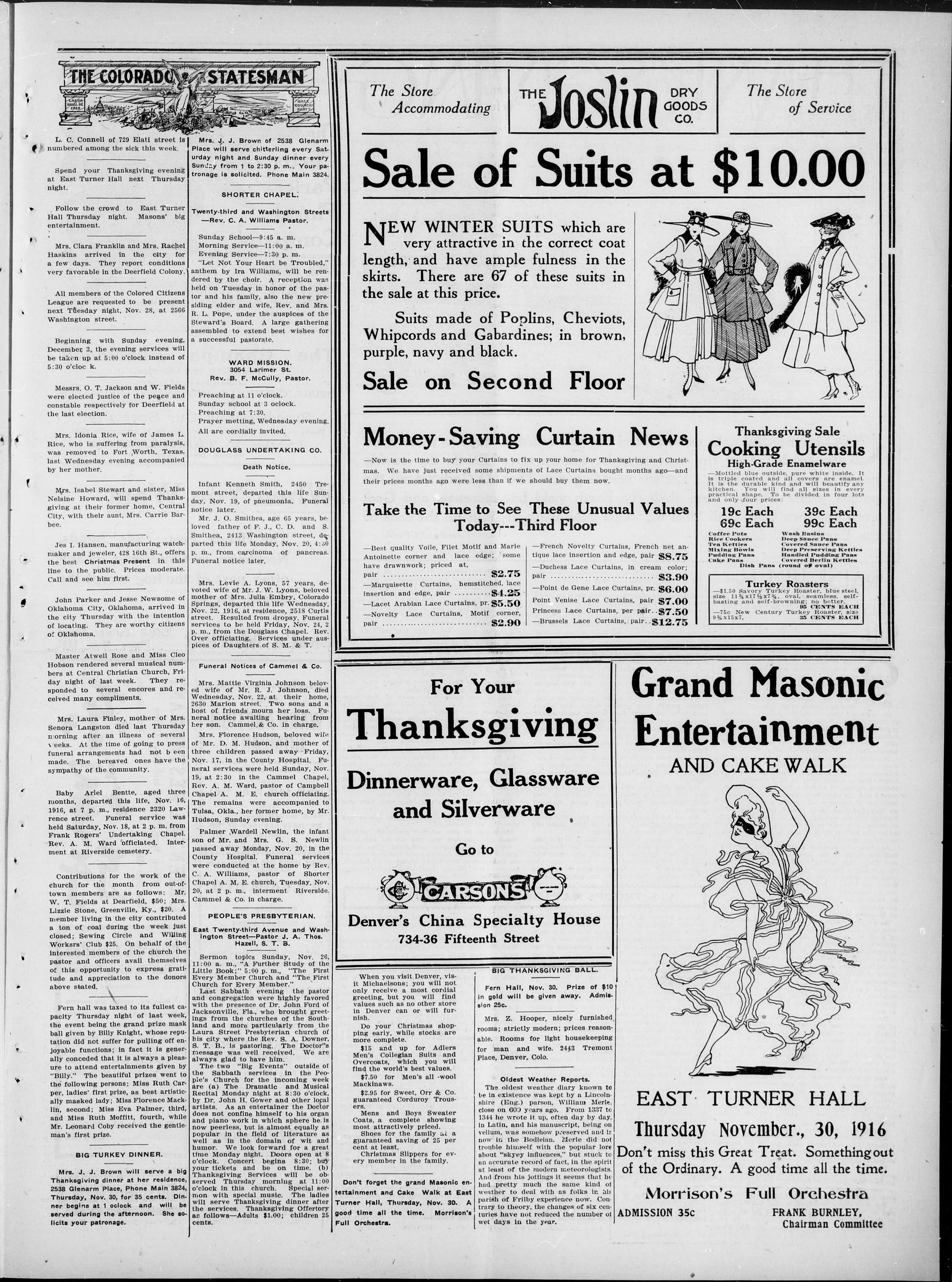
Spend your Thanksgiving evening at East Turner Hall next Thursday night.
Follow the crowd to East Turner Hall Thursday night. Masons' big entertainment.
Mrs. J. J. Brown of 2538 Glenan Place will serve chitterling every Saturday night and Sunday dinner every Sunday from 1 to 2:30 p. m.. Your patronage is solicited. Phone Main 382
SHORTER CHAPEL.
Twenty-third and Washington Street —Rev. C. A. Williams Pastor.
Mrs. Clara Franklin and Mrs. Rachel Haskins arrived in the city for a few days. They report conditions very favorable in the Deerfield Colony.
All members of the Colored Citizens League are requested to be present next Tuesday night, Nov. 28, at 2566 Washington street.
Beginning with Sunday evening, December 3, the evening services will be taken up at 5:00 o'clock instead of 5:30 o'clock k.
Messrs. O. T. Jackson and W. Fields were elected justice of the peace and constable respectively for Deerfield at the last election.
Mrs. Idonia Rice, wife of James L. Rice, who is suffering from paralysis, was removed to Fort Worth, Texas, last Wednesday evening accompanied by her mother.
Mrs. Isabel Stewart and sister, Miss Nelsine Howard, will spend Thanksgiving at their former home, Central City, with their aunt, Mrs. Carrie Barbee.
Jes I. Hansen, manufacturing watchmaker and jeweler, 428 16th St., offers the best Christmas Present in this line to the public. Prices moderate. Call and see him first.
John Parker and Jesse Newsome of Oklahoma City, Oklahoma, arrived in the city Thursday with the intention of locating. They are worthy citizens of Oklahoma.
Master Atwell Rose and Miss Cleo Hobson rendered several musical numbers at Central Christian Church, Friday night of last week. They responded to several encores and received many compliments.
Mrs. Laura Finley, mother of Mrs. Senora Langston died last Thursday morning after an illness of several weeks. At the time of going to press funeral arrangements had not b een made. The bereaved ones have the sympathy of the community.
Baby Ariel Bentte, aged three months, departed this life, Nov. 16, 1916, at 7 p. m., residence 2320 Lawrence street. Funeral service was held Saturday, Nov. 18, at 2 p. m. from Frank Rogers' Undertaking Chapel. Rev. A. M. Ward officiated. Interment at Riverside cemetery.
Contributions for the work of the church for the month from out-of-town members are as follows: Mr. W. T. Fields at Dearfield, $50; Mrs. Lizzie Stone, Greenville, Ky., $20. A member living in the city contributed a ton of coal during the week just closed; Sewing Circle and Willing Worksrs' Club $25. On behalf of the interested members of the church the pastor and officers avail themselves of this opportunity to express gratitude and appreciation to the donors above stated.
Fern hall was taxed to its fullest capacity Thursday night of last week, the event being the grand prize mask ball given by Billy Knight, whose reputation did not suffer for pulling off enjoyable functions; in fact it is generally conceded that it is always a pleasure to attend entertainments given by "Billy." The beautiful prizes went to the following persons: Miss Ruth Carper, ladies' first prize, as best artistically masked lady; Miss Florence Macklin, second; Miss Eva Palmer, third, and Miss Ruth Moffitt, fourth, while Mr. Leonard Coby received the gentleman's first prize.
BIG TURKEY DINNER.
Mrs. J. J. Brown will serve a big Thanksgiving dinner at her residence, 2538 Glenarm Place, Phone Main 3824, Thursday, Nov. 30, for 35 cents. Dinner begins at 1 oclock and will be served during the afternoon. She solicits your patronage.
Mrs. J. J. Brown of 2538 Glenarm
Place will serve chitterling every Sat-
saturday night and Sunday dinner every
Sunday from 1 to 2:30 p. m.. Your patron
is solicited. Phone Main 3824.
SHORTER CHAPEL.
Twenty-third and Washington Streets
—Rev. C. A. Williams Pastor.
Sunday School—9:45 a. m.
Morning Service—11:00 a. m.
Evening Service—7:30 p. m.
"Let Not Your Heart be Troubled," anthem by Ira Williams, will be rendered by the choir. A reception was held on Tuesday in honor of the pastor and his family, also the new presiding elder and wife, Rev. and Mrs. R. L. Pope, under the auspices of the Steward's Board. A large gathering assembled to extend best wishes for a successful pastorate.
WARD MISSION.
2054 Larimer St.
Preaching at 11 o'clock.
Sunday school at 3 oclock.
Preaching at 7:30.
Prayer metting, Wednesday evening
All are cordially invited.
DOUGLASS UNDERTAKING CO.
Death Notice.
Infant Kenneth Smith, 2450 Tremont street, departed this life Sunday, Nov. 19, of pneumonia. Funeral notice later.
Mr. J. O. Smithea, age 65 years, beloved father of F. J. C. D. and S. Smithea, 2413 Washington street, departed this life Monday, Nov. 20, 4:30 p. m., from carcinoma of pancreas. Funeral notice later.
Mrs. Levie A. Lyons, 57 years, devoted wife of Mr. J. W. Lyons, beloved mother of Mrs. Julia Embry, Colorado Springs, departed this life Wednesday, Nov. 22, 1916, at residence, 2518 Curtis street. Resulted from dropsy. Funeral services to be held Friday, Nov. 24, 2 p. m., from the Douglass Chapel. Over officiating. Services under auspices of Daughters of S. M. & T.
Funeral Notices of Cammel & Co.
Mrs. Mattie Virginia Johnson beloved wife of Mr. R. J. Johnson, died Wednesday, Nov. 22, at their home, 2630 Marion street. Two sons and a host of friends mourn her loss. Funeral notice awaiting hearing from her son. Cammel & Co. in charge.
Mrs. Florence Hudson, beloved wife of Mr. D. M. Hudson, and mother of three children passed away Friday, Nov. 17, in the County Hospital. Funeral services were held Sunday, Nov. 19, at 2:30 in the Cammel Chapel, Rev. A. M. Ward, pastor of Campbell Chapel A. M. E. church officiating. The remains were accompanied to Tulsa, Okla., her former home, by Mr. Hudson, Sunday evening.
Palmer Wardell Newlin, the infant son of Mr. and Mrs. G. S. Newlin passed away Monday, Nov. 20, in the County Hospital. Funeral services were conducted at the home by Rev. C. A. Williams, pastor of Shorter Chapel A. M. E. church, Tuesday, Nov. 20, at 2 p. m., interment Riverside. Cammel & Co. in charge.
PEOPLE'S PRESBYTERIAN
East Twenty-third Avenue and Washington Street—Pastor J. A. Thos. Hazell, S. T. B.
Sermon topics Sunday, Nov. 26, 11:00 a. m., "A Further Study of the Little Book"; 5:00 p. m., "The First Every Member Church and "The First Church for Every Member."
Last Sabbath evening the pastor and congregation were highly favored with the presence of Dr. John Ford of Jacksonville, Fla., who brought greetings from the churches of the Southland and more particularly from the Laura Street Presbyterian church of his city where the Rev. S. A. Downer, S. T. B., is pastoring. The Doctor's message was well received. We are always glad to have him.
The two "Big Events" outside of the Sabbath services in the People's Church for the incoming week are (a) The Dramatic and Musical Recital Monday night at 8:30 o'clock, by Dr. John H. Gower and other local artists. As an entertainer the Doctor does not confine himself to his organ and piano work in which sphere he is now peerless, but is almost equally as popular in the field of literature as well as in the domain of wit and humor. We look forward for a great time Monday night. Doors open at 8 o'clock. Concert begins at 8:30; buy your tickets and be on time. (b) Thanksgiving Services will be observed Thursday morning at 11:00 o'clock in this church. Special sermon with special music. The ladies will serve Thanksgiving dinner after the services. Thanksgiving Offertory as follows—Adults $1.00; children 25 cents.
Sale of
NEW WINTER SUIT
very attractive in
length, and have ample
skirts. There are 67 o
the sale at this price.
Suits made of Pop
Whipcords and Gabardine
purple, navy and black.
Sale on Seco
Money-Saving
—Now is the time to buy your Curtains to
mas. We have just received some shipme
their prices months ago were less than if w
Take the Time to See
Today---T
Sale of Suits at $10.00
NEW WINTER SUITS which are very attractive in the correct coat length, and have ample fulness in the skirts. There are 67 of these suits in the sale at this price. Suits made of Poplins, Cheviots, Whipcords and Gabardines; in brown, purple, navy and black.
Sale on Second Floor
Money-Saving Curtain News
—Now is the time to buy your Curtains to fix up your home for Thanksgiving and Christmas. We have just received some shipments of Lace Curtains bought months ago—and their prices months ago were less than if we should buy them now.
Take the Time to See These Unusual Values Today---Third Floor
—Best quality Voile, Filet Motif and Marie Antoinette corner and lace edge; some have drawnwork; priced at, pair $2.75
—Marquisette Curtains, hemstitched, lace insertion and edge, pair $4.25
—Lacet Arabian Lace Curtains, pr. $5.50
—Novelty Lace Curtains, Motif corner, pair $2.90
Your
sgiving
, Glassware
verware
to
SONS
Specialty House
enth Street
For Your
Thanksgiving
Dinnerware, Glass
and Silverw
Go to
CARSONS
Denver's China Special
734-36 Fifteenth Str
Thanksgiving
Dinnerware, Glassware and Silverware
CARSONS Denver's China Specialty House 734-36 Fifteenth Street
Fern Hall, Nov. 30. Prize of $10 in gold will be given away. Admission 25c.
Mrs. Z. Hooper, nicely furnished rooms; strictly modern; prices reasonable. Rooms for light housekeeping for man and wife. 2443 Tremont Place, Denver, Colo.
The oldest weather diary known to be in existence was kept by a Lincolnshire (Eng.) parson, William Merle, close on 609 years ago. From 1337 to 1344 he wrote it up, often day by day, in Latin, and his manuscript, being on vellum, was somehow preserved and is now in the Bodleian. Merle did not trouble himself with the popular lore about "skyey influences," but stuck to an accurate record of fact, in the spirit at least of the modern meteorologists. And from his jottings it seems that he had pretty much the same kind of weather to deal with as folks in his parish of Frilby experience now. Contrary to theory, the changes of six centuries have not reduced the number of wet days in the year.
✓
---
The Store Accommodating
Go to
When you visit Denver, visit Michaelson;s; you will not only receive a most cordial greeting, but you will find values such as no other store in Denver can or will furnish.
Do your Christmas shopping early, while stocks are more complete.
$15 and up for Adlers Men's Collegian Suits and Overcoats, which you will find the world's best values.
$7.50 for Men's all -wool Mackinaws.
$2.95 for Sweet, Orr & Co. guaranteed Corduroy Trousers.
Mens and Boys Sweater Coats, a complete showing most attractively priced.
Shoes for the family at a guaranteed saving of 25 per cent at least.
Christmas Slippers for every member in the family.
Don't forget the grand Masonic entertainment and Cake Walk at East Turner Hall, Thursday, Nov. 30. A good time all the time. Morrison's Full Orchestra.
—French Novelty Curtains, French net antique lace insertion and edge, pair $8.75
—Duchess Lace Curtains, in cream color; pair ..... $3.90
—Point de Gene Lace Curtains, pr. $6.00
Point Venise Lace Curtains, pair $7.00
Princess Lace Curtains, per pair $7.50
—Brussels Lace Curtains, pair...$12.75
iving
ssware
are
City House
et
BIG THANKSGIVING BALL.
Oldest Weather Reports.
✓
THE COAT
Grand Masonic Entertainment AND CAKE WALK
THE MASKED DANCER
Don't miss this Great Treat. Something out of the Ordinary. A good time all the time.
Morrison's Full Orchestra
ADMISSION 35c FRANK BURNLEY,
Chairman Committee
The Store of Service
$10.00
Thanksgiving Sale Cooking Utensils
—Mottled blue outside, pure white inside. It is triple coated and all covers are enamel. It is the durable kind and will beautify any kitchen. You will find all sizes in every practical shape. To be divided in four lots and only four prices:
19c Each 39c Each
69c Each 99c Each
19c Each
69c Each
Coffee Pots
Rice Cookers
Tea Ketties
Mixing Bowls
Pudding Pans
Cake Pans
Wash Basins
Deep Sneeze Pans
Covered Sauce Pans
Deep Preserving Kettles
Covered Berlin Kettles
Covered Berlin Kettles
round o/ oval
Turkey Roasters
—$1.50 Savory Turkey Roaster, blue steel,
size 11% x17% x7%, oval, seamless, self-
basting and self-browning; no better.
95 CENTS EACH
—75c New Century Turkey Roaster, size
9% x15x7,
35 CENTS EACH
THANKSGIVING
GOD be merciful unto us, and bless us; and cause his face to shine upon us; Selah. That thy way may be known upon Earth, thy saving health among all nations. Let the people praise Thee, O God; let all the people praise Thee. Then shall the Earth yield her increase; and God, even our own God, shall bless us. God shall bless us; and all the ends of the Earth shall fear him. From the 67th Psalm.
PRAISE HIM for This Most Precious Gift
Q
N AN evening of this week it occurred to a man, sitting alone in an upper room, that Thanksgiving day was right at hand. So he bestirred his mind to consider those things for which an American might sensibly offer up gratitude to God.
He reflected that across the Atlantic millions of human beings were at that very moment engaged in the dreadful task of killing other human beings with every invention which ingenuity and skill could bring forth from the laboratories of science and the workshops of industry.
In other lands at that very moment tens of thousands upon tens of thousands of helpless folk—feeble, aged men and women, mothers with babes clinging convulsively to their breasts, little children sobbing in terror, a vast army of the innocent and the anguished—were enduring the extremities of exposure, of hunger, and of despair as they fled from their wasted farmsteads and burning villages, escaping from the pitilless cruelty of savage men only to lie down to suffer and die under the pitilless skies of God in the winter and the bitter storms.
At that very moment most dreadful war hid half the world fit the blackness of its darkness and from that horrid cloud rained destruction upon unhappy Europe—upon her ancient capitals, upon her pleasant cities, upon her villages, her fields, her temples, her treasures of art, upon all the accumulations of a thousand years of genius, of learning, of industry, of skill and of patient advancement of the happiness and the civilization of the race of man.
So he that considered all this wickedness that was being done under the sun, this drunken dance of death and hell above the fetid corpses and the multitudinous graves, this awful nightmare of indescribable woe and wrath, said in the bitterness of his heart that no God ruled over such a maniac world and there was no thanksgiving due to the Giver of Gifts that were not good, but everyone altogether evil.
And when the man had made an end of his thinking, he went and stood in a window and looked out upon the evening, because it was fair to see.
He saw in vision at that instant the vastness of the republic and the multitude of the good and happy folk who live under the shelter of its strength. He reflected how brief a time had thus magnified the works of our pioneer fathers and our pioneer mothers, those brave and simple men and women whose names should never be mentioned with anything but profound gratitude.
And to this American, glad with a great pride in the deeds of his people and the story of his country, and grateful to the Goodness which has guilded and sheltered his fathers and his folk, lifted up his eyes to the night, to the quiet stars, to the brooding immensity above, and said in his heart:
"Thank God that I am an American!"
And, citizens, that is the one outstanding, splendid fact for which each one of us should soberly and most gratefully thank God on Thanksgiving day this year.
The finest thing you possess or ever can possess is just your American citizenship. It is neither necessary nor becoming, on this day or on any other day, to cheapen this birthright of ours by brag or spreadeagle declamation.
But it is highly becoming on this Thanksgiving day to feel a deep gratitude and a manly pride in this heritage.
U. S. TROOPS MAY USE CACTUS FOR WATER
And so we firmly believe you do feel.
We all hear it repeated that patriotism is a thing of the past; that our people have become commercialized; that the masses have no deep-rooted loyalty to the country; that our rich men put dollars above the obligations of their citizenship; that our poor folk care little for the ideals of free government; that we Americans are decadent in the virtues and valor which marked our fathers.
That is not true.
If there be any power in the world which plots war against us Americans and promises itself victory over us on the assumption of our decadence in loyalty, that power will find how terrible was its mistake when our country calls her sons to battle in her defense.
We have, it is true, in our capacity as a collective people, left undone things that should have been done and done things which should have been left undone; and there is more truth than there should be in much that is jeeringly sald by those who hate us.
We acknowledge that much of our politics offends common decency.
We see, here and there, painful evidence of corruption among lawmakers and even among the judges, who should know only justice and integrity.
We see rich men who do betray their country and foul their hands and soll their souls with most infamous dealings and most shameful profits.
We see Americans who do put the dollar above every consideration of right and duty, above the claims of our common humanity. But while these things are true, it is true also that the heart and conscience of the American people, take them as a nation, are sound and sane and wholesome. The blood of our fathers still runs in the veins of their sons. The spirit of the nation may in-
In the pursuit of Villa and his bandits through the arid regions of northern Mexico the United States troops traversed a region whose only vegetation is the barbed and forbidding cactus. To any but a cowboy or a trained plainsman of the Southwest, inhabitants themselves of the "cactus belt," this plant seemingly has no more value than the veriest weed, but it may well be that it may prove of great value to the troops in the absence of water, fodder, or even food for human beings. In the punitive expedition there are many cow punchers of the "cactus belt" serving as scouts, and in the cowboy and the Indian of the Southwest the lowly cactus has its greatest admirer, for they know what a game struggle for life this plant has to make against an unlaved desert soil. Even their ponies and cattle and the poor beasts of the desert know of these uses of the cactus for water and fodder, says the New York Herald.
There are some thousand varieties of this monstrous vegetable family, not counting the 300 varieties of the agave, or century plant—incorrectly included by many—in northern Mexico. The varieties of the yucca palm and all other forms of vegetation known to the arid region have the same faculty of sucking up from the soil every drop of the all too little moisture in it and storing it up in their tough and leathery leaves and roots.
Of the many varieties perhaps the most remarkable is that member of the family known to those schooled in desert craft as the "water barrel." This plant is shaped somewhat like a beer keg and is about the same size. Through all the years of its growth it has been sopping up what moisture the famished earth contained and retaining it. It is the sole reliance of desert dwellers in time of drought, and the troops, far from water holes and with water scarce, may yet be obliged to drink from it.
The "water barrel" is tapped by slicing off the top with a sword or machete and pounding the pulp until the water contained in it wells up into
deed seem to slumber in the soft bed of long-enjoyed peace and security. But let war come against the land and no man need doubt that that spirit will spring up instantly awake.
We can rightfully be grateful that it has fallen to our happy lot to live in this most wonderful of all ages and to be citizens of this most wonderful of all the nations.
Let your hearts swell with just pride as you contemplate your country, so august, so splendid, so renowned in the earth.
Look upon your flag as it streams its bright folds yonder above your heads with proud and happy eyes. Remember how honorable is its story, and forget not how many thousands of brave and good men died that it might wave yonder, the ensign of a free people.
Tell to your children the story of their forebears, of those men and women who, amid the wilderness and forests that stood where now stand mighty cities and stretch cultivated farms, erected, with hardships and endurance and most heroic faith and valor, the noble edifice of our republican liberties.
Speak to them of Bunker Hill and Valley Forge and Saratoga and Yorktown, and of the great Declaration—that most famous Charter of Human Freedom.
Tell them to thank God for their fathers' and mothers' hardihood and courage, for the wars they fought, for the victories they won.
Tell them to salute their flag with high and proud hearts.
Tell them to thank God this Thanksgiving day that they are Americans.
And then do you soberly, gratefully, proudly thank God yourself that you are an American,
Oh, dear and mighty motherland, what better gift or more to be desired could God give than to be born and to die, strong Daughter of Liberty, between thy shining feet!—From the Chicago American.
the saucer thus formed. The pulp itself is pure and the water stored in it is likewise pure and refreshing.
Not all the water-bearing cacti are as gracious to tamishing man, however, as the "water barrel," for most of them have protected themselves against the maraudings of those who would drink and live by imparting a bitter taste to the water they contain. The "peyote" especially, which abounds in the plains and deserts of Arizona, has a trick of discouraging depredations upon it, for its plump and juicy pulp secretes a bitter and poisonous juice.
In the last cozen years scientists have interested themselves in the study of the cactus for its possibilities as food, fodder and economic by-products. Dr. Leon E. Landone, foremost in the study of this desert plant, several years ago conducted extensive experiments in Los Angeles to ascertain the value of the thornless cactus as an article of food for human beings. In an effort to prove his contention that it contains food properties sufficient to enable a man to work 18 hours a day, he and his two secretaries for two weeks lived on a daily diet of the leaves and fruit of the cactus, the former being served green or fried and the latter either raw or cooked. While the "cactus squad" survived the experience and professor to have enjoyed their novel diet, it is a fact that the cactus never has attained the popularity of a file mignon
In the whole vegetable kingdom probably there is not another plant family having so many differentiation of form as the cacti. For it is possible to find among them species that crawl and creep like vines, other than stand erect in a single unbending stalk, like a green living monument of the desert; still others that are rooted to the spot, with their highest growth close to the ground and bearing almost no resemblance to usual forms of vegetation, and others, again, that branch out in thick unblooming branches.
The Curtis Park Floral Company
FLORAL DESIGNS PUT UP WHILE YOU WAIT
CHOICE PLANTS AND CUT FLOWERS CONSTANTLY ON HAND
GREENHOUSES: Thirty-Fourth and Curtis Streets
TELEPHONE, MAIN 1511 DENVER, COLO
The Champa Pharmacy
Twentieth and Champa,
Is the place to get your
DRUGS, CHEMICALS AND PATENT MEDICINES
WE SERVE DRINKS.
Prescriptions Our Specialty.
Phone us and we will deliver the goods to all parts of the city.
JAMES E. THRALL, PROPR.
PHONE MAIN 2425.
When You Want
The Heads, Feet, Tails, S Neckbones or Chiterlings, other part of the hog excs squeal, go to
eet, Tails, Snouts, Chiterlings, or any the hog except the
The Heads, Feet, Tails, Snouts, Neckbones or Chiterlings, or any other part of the hog except the squeal, go to
2300-6 Larimer Street Phone Main 1461
The WARD AUCTION COMPANY
Sales Daily at 2 p.m. Office Furniture a Specialty.
PRIVATE SALES AT ALL TIMES
HAVE MOVED TO—
1723-39 GLENARM ST.
PHONE MAIN 1675.
THE BEST ICE CREAM AND CANDIES AT
O.P. BAUR & CO.
ORIENTAL RESTAURANT
Chop Suey, Noodles and Short Orders
Phone Main 4896
1848 Arapahoe
乐泽轩
Miss M. Cowden Hair Dressing Parlor
Shampoo, cutting and curling. Scalp treatment, hair tonics, hair straightening, manlouring. Stage wigs for rent; theatrical use and masquerades. Goods delivered out of the city. All shades of hair matched by sending sample of hair; also combings made up.
Cheapest Switches 50 Cents
1219 21st St. Denver, Colo.
DO IT NOW Subscribe for THIS PAPER
---
East's Market
CATERERS AND
CONFECTIONERS
2415 WASHINGTON STREET.
J. H. Biggins GENERAL FURNITURE REPAIRING AND UPHOLSTERING.
WORK QUARANTEED.
1417 East 24th Avenue, Denver, Colo.
The HOME BEAUTIFUL Flowers and Shrubbery Their Care and Cultivation
THE HYDRAEUM
Hardy Roses, Which Need a Little Protection Just Before the Ground Freezes.
THE GARDEN
Rhododendrons Are Often Winter-Killed Because They Get Too Much Attention.
THE GARDEN'S OVERCOAT
By L. M. BENNINGTON
What lover of the garden is there who has not every year faced with more or less trepidation the question of putting the garden in its overcoat, or, to be more in line with the bromidic expression of the years, into winter quarters?
Getting around in the spring to find cherished plants dead and withered is like coming back to the home town to get tidings that old friends have died. There is more or less emptiness in the proceeding.
These troubles may be avoided with a little thought. In November and December when the ground has been slightly frozen, the garden may be safely put into winter quarters.
Many plants do not require much attention or protection, and others which need some protection will be killed with too much coddling.
There is something appealingly human about flowers that makes them follow individual types and preferences.
Almost all rosebushes will go through winter nicely if earth is thrown up around them to the depth of nearly a foot just before the ground freezes. A few inches of leaves or manure, must be added to the ground after the freezing weather sets in.
Tea roses in the North will not stand much cold, and it is best to place them in pots and set them in a cool cellar. Many of the tea roses will bloom all winter if kept in a moderately warm room. The rambler roses will generally go through the winter without protection. In the instances of the newer climbers, which may be hurt, it is a good plan to lay them flat on the earth and cover with a foot of earth as a matter of insurance.
New Buddleias, or summer illiacs, can be treated just like the roses. They will be killed back, to be sure, but if they have been well protected with earth they will make a quick start in the coming spring and by the end of July will be in bloom again. Many a time people have dug up the roots,
thinking them dead, when all in the world they wanted was to be let alone. Rhododendrons are often winter-killed. In many cases they die because they get too much attention. Mound up leaves around them, the higher the better, first wetting the ground thoroughly. Sun-scald, which causes much damage, can be avoided by setting up boards to the south of the valuable specimens. Straw mats, or mats made from burlap bags will protect English ivy. Euonymous vegeta, the handsome new climber which is being largely substituted for English ivy, does not seem to need any protection in any section.
The perennial beds would not require any protection if snow would only fall at the beginning of the season and stay until spring.
The alternate freezing and thawing does the mischief. Peonies, German iris, phlox and poppies of the Oriental type really need no covering. Their roots are strong. A light overcoat of leaves, straw or pine boughs, however, is good for many of the perennials. A heavy blanket will not permit ventilation.
Some of the finest perennials, like Japanese anemones and tritoma, are sensitive to cold and are safest in a cold cellar. If covered with straw and protected from standing water, pansies, English daisies and forget-me-nots will generally stand the winter nicely.
SOME WINTER HINTS
There is no necessity for being idle in the cold months.
Rake the leaves and add them to the manure pile.
Take out rocks by blasting.
Pick the stones from the fields.
Haul and spread manure.
In the early spring don't forget that a good application of lime is required for the field.
Farmers' Bulletin No. 745, issued by the department of agriculture, deals with the use that may be made of waste lands—A subject about which there is never too much information.
HOMEMADE COOKER
CLEVER WOMAN UTILIZES HAT-
BOX FOR PURPOSE.
Under Proper Conditions It Does the Work as Well as the Most Expensive One That Can Be Purchased.
Every one has now heard of fireless cookers and of the many delightful things they make possible, and there have been directions given as to the making of one's own cooker at home. However, it remained for Mrs. Glusepina Bianchi glisser of Turin, Italy, to discover the way to turn a cardboard hatbox into a fireless cooker. This is how it is done, according to a report in the New York Sun:
Take your strongest cardboard hatbox, and make sure it is neither broken nor cracked. See that the cover shuts tight. These two conditions are absolutely essential. Fill your box with either cotton wool, sawdust or hay, well packed in and perfectly dry. Make in the middle of this mass a hollow big enough to hold your casserole, covering it up with the cotton wool, sawdust or hay—cotton wool is really the best. Put whatever you want to cook into your casserole. Boil it on the fire for from ten to thirty minutes, according to the nature of your food, then put it in your hatbox, where it will cook as in the most expensive fireless cooker. Mrs. Geisser says that you can leave it four hours without hurting the meat or stew. All the flavor is retained, for being hermetically sealed the juices are preserved. Boil the vegetables ten to fifteen minutes over the gas cooker or fire before putting into the hat box and keep them there for two hours. Potatoes should be ten minutes on fire and one hour in hat box, she thinks, and dried chestnuts twenty minutes on fire and two and one-half hours in hat box. Mrs. Geisser calculated that even with the hardest foodstuffs her system saves you from 30 to 50 percent of firing. Food keeps hat for ten hours in the box. The idea has so taken with Turin housewives that hundreds of families are now using it.
All fireless cookers on the market cost a lot of money. This one can be made by any practical woman for a few cents.
Apple Batter Pudding
Slice six or eight apples, not too thin, in deep earthern dish. Barely cover with water. Cover and bake half an hour. Then add this batter: One egg and yolk of another, butter size of an egg, salt, half cupful of milk, two teaspoonful, level baking powder, or scant half teaspoonful soda, one teaspoonful cream tartar, one cupful flour. Use your judgment about flour. Four over apples and bake quickly. No sugar in the pudding. Sauce: One cupful sugar, one tablespoonful flour, butter size of walnut, a little salt, one and one-half cupfuls boiling water. Cook; then add sherry or vanilla and beaten white of one egg.
Creamed Ham on Toast
Make six slices of nice brown toast and butter them on both sides. Melt four tablespoonfuls of butter, and three tablespoonfuls of flour and stir until well blended, then pour on gradually and stir in constantly two cupfuls of scalded milk. Bring to a boiling point and season with salt and plenty of pepper. Dip the slices of toast separately in the sauce and put on a hot platter. Then add a cupful of finely chopped ham to the remainder of the sauce and pour over the toast. Garnish with parsley or cress and circles of hard-boiled eggs.
Cheese Ball Salad
Mash one cream_cheese, add two teaspoonfuls melted butter, one teaspoonful cream, a little paprika and five English walnut meats chopped. Mold into balls. Place on lettuce leaves. Mix two tablespoonfuls cooked salad dressing with two tablespoonfuls whipped cream. Drop in teaspoonfuls over cheese balls and dot with bar-leduc or with plain currant jelly.
Wire Basket.
A wire basket known as a salad shaker or drainer, should be used to dry greens after they have been thoroughly washed. Leaves of lettuce often hold water after they have been thoroughly shaken. If they are not fully dry they will not hold dressing well.
Steamed Barley.
Wash a tencupful of pot barley in plenty of cold water and boil it slowly for a few minutes; turn it now into a jar or a pudding basin, and let it steam for six or eight hours; when it is quite tender and creamy it is ready to serve.
Savory Ducks
One pound liver, one-half pound sausage, one large onion, one-half teaspoonful sage; grind all together, salt and pepper to taste; make into balls cover with cold water, bake 20 minutes in hot oven; serve hot or cold.
Removing Stains From Marble
Apply with a brush a paste composed of equal parts of soft soap, quicklime and caustic potash and leave for several days. Then wash the paste off and dry and polish the marble with soft cloths.
Clove in the Tea.
In serving tea, a clove placed in the tea ball will give a piquant flavor that will not be recognized, but that will be most enjoyable.
ADAMSON LAW CALLED INVALID
JUDGE HOOK HOLDS EIGHT-HOUR LAW UNCONSTITUTIONAL IN TEST CASE AT KANSAS CITY.
UP TO SUPREME COURT
GULF ROAD TO AID IN SPEEDING CASE TO HIGH TRIBUNAL FOR FINAL DECISION.
Western Newspaper Union News Service.
Kansas City, Mo.—The Adamson eight-hour law was held unconstitutional here by Judge William C. Hook in United States District Court.
Judge Hook directed the receivers of the Missouri, Oklahoma & Gulf railroad, who brought the original action in this case to enjoin the law from going into effect, to assist the government in expediting the case to the Supreme Court of the United States for final decision and instructed them through their attorneys to invite the representatives of every railroad in this country to participate in the hearings before the highest court in the land. This was requested in the governments motion to dismiss the injunction petition of the railroad, the government desiring to avoid "prolonged, unnecessary and scattered litigation through the hearing of countless similar suits filed by every rail system in every federal district in the United States through which their lines run."
It is expected that the ultimate decision as to whether the law will go into effect Jan. 1 will be handed down before that time. A transcript of the present case will be filed at the Supreme Court before it reconvenes Dec. 4.
BRITANNIC BLOWN UP
Fifty Reported Killed, Twenty-eight Injured and 1,100 Rescued When Biggest English Hospital
London.—The British hospital ship Britannic, probably the former White Star liner of the same name, and one of the biggest ships afloat, was sunk in the Zea channel of the Aegean sea by a mine or torpedo. The admiralty announced that of those aboard about fifty were lost, twenty-eight were injured and 1,100 saved. The White Star liner Britannic was a steel, triple-screw vessel of 48,158 tons—the biggest British ship now afloat, 3,000 tons larger than the Titanic. She was built for the White Star line's passenger service, being finished only last year, but was immediately requisitioned by the British government as a hospital transport.
The Zea channel, where the admiralty states the great ship was lost is a bit of water between the main land of Greece and the island of Zea. From this it is safe to assume that the Britannic was bringing back wounded from Salonikl, the channel being one of the direct routes to the allies' depot in this section.
Will Consider Peace Plea.
London.—Discussing peace with a group of American newspaper correspondents, Lord Derby declared that any proposal from Germany at this time would be met with the consideration of its worth. He added that "any proposal giving up what we are fighting for will not be considered for an instant."
CALIFORNIA GOES FOR WILSON
Secretary of Republican State Central Committee Concedes Majority of 3,807.
San Francisco, Cal.—President Wilson's plurality in California is 3,807, according to a tabulation of complete official returns from every county in California finished by the Republican state central committee on the 22d. There will be no split ticket from the state. The Republican committee has figures on every elector in each of the fifty-eight counties and these show that Heney, the high Democratic elector, polled 466,197 and Carlson, the high Republican elector, 462,390. The total vote for Mrs. Tyler, the low Democratic elector, was shown to be 463,632, which eliminates the possibility of a split delegation from California. Her plurality over Carlson, the highest Republican elector, is shown by the Republican tabulation to be 1,242.
Sylvester J. McAtee, secretary of the state Republican central committee, has officially conceded California to Wilson and so telegraphed to National Chairman Willcox.
Rumanians Facing Annihilation.
London.—Austro-German forces under Von Falkenhayn keeping up their pressure against the Russo-Rumanians in western Wallachia and Germany is celebrating a complete victory won at Turgujlujij Germans in possession of the railroad to Bucharest. More towns captured by the entente troops in the Macedonian drive. Belligerent forces in contact between lakes Preseba and Ochrida. Petrograd reports repulse of strong Turkish attack against Sultanabad in Persia.
WASHINGTON GOSSIP
High Cost of Flags Now Hits the United States
High Cost of Flags Now Hits the United States
WASHINGTON.—Now comes the high cost of flag-raising. The rapacious maw of Mars, in consuming every conceivable resource, has not passed by even the standards for which men die at his altar.
70 per cent and the end is not yet. Asked whether the tremendous increase in export of cotton, coupled with the existing shortage, would stop the manufacture of flags, Arthur Copeland, president of the M. G. Copeland company, declared the people of the country would always insist on having flags, and cited historical instances of the use of rags as standards when nothing else was available as evidence of the lengths to which patriots will go. Mr. Copeland added that while the present situation is serious, it did not seem to threaten a suspension of flag production.
"The cost of dyes is a factor which makes for expensive flags," said Mr. Copeland.
First-Aid Girl Pupils Were Too Much for Jimmie
First-Aid Girl Pupils Were Too Much for Jimmie
THE first-aid class, now being held under the joint auspices of the American National Red Cross and the Navy league in Washington, doesn't even know his name. So we'll call him "Jimmie."
ing a man of ingenuity, called a well-known telephone number and summoned Jimmie. Jimmie, it seems, was prime favorite with the "doc" and his class.
Jimmie whistled on his way as he answered the call. Maybe he didn't know what was ahead. Maybe he's more than a near-hero. Anyway, he whistled the popular melody which assured those in his immediate vicinity that "This is the life."
The doctor ushered him into the classroom, cap in hand. He was given a chair and remembers vaguely sitting down. Forty pairs of casual eyes of gray and brown and blue—"goils, fellers, an' only the doe and me!"—were raised and swept him appraisingly. He only remembers the rest vaguely.
As through a mist he became suddenly conscious that it was awfully hot. His feet insisted upon spreading all over the place and his hands kept growing larger and larger. Why did they all keep looking at him? Was there anything the matter?
And then he heard the concluding sentence of the doctor's lecture. He says it was something like this:
"‘An now, ladies,’ he sez, 'we shall practice bandagin' a wounded head, a badly wounded head. This young gentleman has agreed to act as de patient,' he sez. Dat's me, fellers. Den he toins to me. 'We shall need lots of bandages,' he sez. 'Will you step out in de hall an' ask the nurse for a handful?'
Jimmie stepped, nay, more, he stepped with alacrity. Oh, yes, he stepped, nor did he cease the process till he had reached his bicycle. Nor even then.
That was the end of the incident. They may have obtained a substitute up at the first-aid class. But this is the story of Jimmie.
How the District's Doughnut Cabinet Originated
How the District's Doughnut Cabinet Originated
WHEN Louis Brownlow and Oliver Newman were newspaper men they would occasionally go to the grillroom of a big downtown hotel for luncheon, and there they would cast long glances at the round table, where
a doughnut mentally. Each of them says today that they had never at that early date eaten one in reality in that hotel because they feared the price would be something like 40 cents apiece, and they didn't care to squander that much on a single-tube doughnut, without antiskid appliances. But they would glance over at the table where sat the gourmandizing bank directors and railway magnates, and it seemed to be bending in the middle with doughnuts. They wondered when they, too, could sit down and order all the necessities of life, and add a plate of doughnuts just for good measure.
In fact, doughnuts in a hotel grew to be the mark of extreme luxury for these two young men. Then one day they found they were commissioners of the District of Columbia, and the center of a group of administrative officials who wanted to get together every day at luncheon to talk things over.
So they went to the big hotel and arranged for a round table daily.
The first day they all sat down the head waiter placed on the table about one bushel of those George H. Harries doughnuts.
"We didn't order these," said Louis—I mean Commissioner Brownlow—weakly.
"I know," returned the waiter with a smile. "They are like bread and butter. We make no charge for them."
And then Louis looked at Ollie and Ollie looked at Louis, and together they tried to figure out how many doughnuts the hotel owed them for past luncheons.
And that is why that big round table at a certain hotel near the District building is reserved for what they call "the doughnut cabinet."
Stolen Articles Sent Back to Washington Hotels
Stolen Articles Sent Back to Washington Hotels
WASHINGTON hotel managers are much amazed over the fact that the American public seems to be getting conscience-stricken and slowly but steadily returning, without explanation, numerous articles missed immediately
articles such a curling irons, electric fans, and boudou necessities." This same hotel manager declares that within two weeks he has received more than 50 separate packages, from the United States and Canada, containing articles supposed to have been taken away from the hotel by guests. These packages contain nearly 200 pieces of hotel property, but not a single package carried a line of explanation or a clue that would disclose the identity of the sender.
OOST
EVEN FLAGS
ARE COIN' UP
70 per cent and the end is not yet. A in export of cotton, coupled with the cufacture of flags, Arthur Copeland, pre declared the people of the country woe cited historical instances of the use of was available as evidence of the length land added that while the present si threaten a suspension of flag productie "The cost of dyes is a factor whi Copeland.
First-Aid Girl Pupils We
THE first-aid class, now being held un National Red Cross and the Navy know his name. So we'll call him "Ji
Jimmie is a messenger boy and a near-hero. He has freckles, has been known to call successfully to the alusive Phoebe Five in a secluded areaway, and a pal of his has vouchsafed the information that "he's a bold wid his mitts." Be that as it may he has one sterling accomplishment. He knows when to quit.
The first-aid class wanted a patient upon whom to practice lately acquired skill in the art of scientific bandaging. The doctor in charge, being a map of ingenuity, called a well-k
Jimmie. Jimmie, it seems, was primer. Jimmie whistled on his way as he know what was ahead. Maybe he's whistled the popular melody which as that "This is the life."
The doctor ushered him into the a chair and remembers vaguely sitting gray and brown and blue—"goils, fell raised and swept him appraisingly. He
As through a mist he became so hot. His feet insisted upon spreading growing larger and larger. Why did there anything the matter?
And then he heard the concluding says it was something like this:
"'An now, ladies,' he sez, 'we shall badly wounded head. This young gent he sez. Dat's me, fellers. Den he tol ages,' he sez. 'Will you step out in de' Jimmie stepped, nay, more, he step nor did he cease the process till he he.
That was the end of the incident. up at the first-aid class. But this is t
How the District's Doug
WHEN Louis Brownlow and Oliver would occasionally go to the gra luncheon, and there they would cast lo
A man is eating a bowl of donuts with two other men.
a doughnut mentally. Each of them she early date eaten one in reality in that would be something like 40 cents api that much on a single-tube doughnut, would glance over at the table where and railway magnates, and it seemed t nuts. They wondered when they, to necessities of life, and add a plate of
In fact, doughnuts in a hotel grew these two young men. Then one day the District of Columbia, and the cents who wanted to get together every day so they went to the big hotel and The first day they all sat down the one bushel of those George H. Harrie "We didn't order these," said Lou weakly.
"I know," returned the waiter wi butter. We make no charge for them. And then Louis looked at Ollie a they tried to figure out how many do luncheons.
And that is why that big round ta building is reserved for what they call
Stolen Articles Sent Back
WASHINGTON hotel managers are American public seems to be get steadily returning without explanation
steadily returning, without capitation after their departure from the better class of the hotels. It is said that this is true of all the hotels throughout the country, and the cause of it all has not yet been discovered.
One Washington manager says: "If everything that has been taken from this hotel was to be returned I would have to turn the lobby and a large part of the hotel to storage rooms. Our loss each year of the last 20 years has been approximately $10,-000 in table silver, linen and room
articles such a curling irons, electric same hotel manager declares that we than 50 separate packages, from the articles supposed to have been taken packages contain nearly 200 pieces of a carried a line of explanation or a clue sender
Local flag dealers report that the wool-bunting flag, which is the best and formerly was the most used material, now has almost fallen into disuse on account of the increasing cost of the goods. The cotton-bunting flag has nearly supplanted its worthier competitor. At that the cost of cotton and dyes has so increased that it costs almost as much to produce a cotton flag as it did in antebellum times to manufacture a woolen one. The cost of a woolen flag has increased about
asked whether the tremendous increase
existing shortage, would stop the mans-
ident of the M. G. Copeland company,
would always insist on having flags, and
of rags as standards when nothing else
as to which patriots will go. Mr. Cope-
tuation is serious, it did not seem to
makes for expensive flags," said Mr.
Are Too Much for Jimmie
under the joint auspices of the America-
ty league in Washington, doesn't even
immie."
A man running away from a crowd of people.
own telephone number and summoned a favorite with the "doc" and his class. He answered the call. Maybe he didn't more than a near-hero. Anyway, he assured those in his immediate vicinity in classroom, cap in hand. He was given down. Forty pairs of casual eyes of officers, an' only the doc and me!"—were he only remembers the rest vaguely. Suddenly conscious that it was awfully all over the place and his hands kept them all keep looking at him? Was a sentence of the doctor's lecture. He all practice bandagin' a wounded head, a heman has agreed to act as de patient,' ans to me. 'We shall need lots of band-hall an' ask the nurse for a handful?'?" capped with alacrym. Oh, yes, he stepped, and reached his bicycle. Nor even then. They may have obtained a substitute the story of Jimmie.
Highnut Cabinet Originated
Newman were newspaper men they fillroom of a big downtown hotel foraging glances at the round table, where
such plenipotentiaries as Gen. George H. Harries would be gourmandizing in fine style. The thing which attracted the attention and appetite of Messrs. Brownlow and Newman in those days was the large supply of doughnuts on the big table. They were twisted doughnuts, not the old-fashioned doughnuts shaped like a life preserver, which gives the small-minded jester the opportunity to say a word or two about wishing he had a job making the holes. Louis and Ollie ate many
always today that they had never at that hotel because they feared the price piece, and they didn't care to squander without antiskid appliances. But they sat the gourmandizing bank directors to be bending in the middle with doughnuts, could sit down and order all the doughnuts just for good measure. You to be the mark of extreme luxury for they found they were commissioners of a group of administrative officials at luncheon to talk things over. arranged for a round table daily. the head waiter placed on the table about doughnuts.
Ursus—I mean Commissioner Brownlow—with a smile. "They are like bread and." and Ollie looked at Louis, and together doughnuts the hotel owed them for past table at a certain hotel near the District "the doughnut cabinet."
Back to Washington Hotels
I much amazed over the fact that the eating conscience-stricken and slowly but numerous articles missed immediately
HOTEL
RULES
?
fans, and boudoir necessities." This within two weeks he has received more United States and Canada, containing away from the hotel by guests. These hotel property, but not a single package that would disclose the identity of the
Overcoats Must Go
A man in a long coat stands on a bench, holding a cane. A woman in a dark dress and hat sits on the bench, holding a handkerchief. A man in a long coat salutes while a woman in a long coat holds a handkerchief.
THIS certainly is Overcoat weather. You now have every reason to come here and take advantage of these startling price concessions. We never in our history had so many sterling Overcoats as we have this season, offering the widest possible field for your selection. Come here early.
$20.00 $22.50
Fancy Overcoats
$14.50
$25.00 $28.00
Fancy Overcoats
$19.50
THE MAY CO.
PHONE
DOUG
INCO
J. R. CONTEE
Press. and Mgr.
RESIDENCE PHONE YORK 7992
FRANK S. REED,
License Embalmer & Director
Lady Assistant
Polite Service
to All
Parlors, 2745 Welton Street
INCORPORATED AND BONDED
NOTARY PUBLIC
7992
vector
street Denver, Colorado
Approved Modes in Girls' Party Frocks
When Father Time comes along with a birthday to celebrate, or a dancing-school party, or other great occasions in the life of a little girl, it means a pretty frock for her. Even in party dresses there is a difference of opinion as to whether they should be simply or elaborately made, but as the little girl is sure to look pretty in either sort, fashion smiles approval on both.
White, pink, blue, pale green and light yellow are oftenest selected for the little girl's party frock, with white a favorite choice. Volle, batiste, organdle, and taffeta are the materials used for making them. Some of the prettiest light volles are made up with no other decoration than tucks headed with hemstitching, and smacking about the waist and yoke. This is done in heavy white silk. Taffeta is managed with about the same simplicity, but organdle and batiste seem to be made for fine swiss embroideries and val. lace.
An elaborate dress of white batiste, for the girl of eleven, or more, is shown in the picture. The waist shows rows of insertion placed between groups of fine tucks. It is attached to the skirt and has elbow sleeves. The skirt is divided into panels by wide
Three Hats From Paris
Three Hats From Paris
THE FASHION WEEKLY
They say that designing for Americans occupies the time—so fur as it is occupied—of the world-famous modifiers of Paris. Judging from the number of imports, and that the Americans who look to Paris are those of two hemispheres, the designers seem to be fairly busy. In spite of the tension of war there seems to be no lack of inspiration in the products of the peculiar genius of the French.
Three hats from Lewis shown here are beautiful and rational styles for midwinter wear. Already the eyes of those who create styles are turned toward spring and they are busy with the things that must be ready for display just after the holidays, so the hats pictured may be accepted as the last word from a great authority.
The wide brimmed hat of satin, faced with velvet, is partly turned off the face at the front, in a mode already approved. Its lines suggest outspread wings, and perhaps this is the reason why a small pair, embroidered in silk in several colors, is posed at the front. There is no other trimming.
The second hat is a turban in a shape that is particularly becoming to women of middle age. A puff of velvet is set about the coronet, higher at the back than at the front. A band of pallettes and bugles, finished at the side with two balls, adds a touch of brilliance to this all-black creation.
vertical insertions, and each panel is cut into a scallop at the bottom. Two rows of narrow insertion follow the line of the scallops about the skirt, and each panel is laid in a boxplatt at the waistline.
The slipover is not needed to complete this dress, which may be worn without it; but the slipover is a feature of present-day fashions. Besides, a dress of this kind is equal to long service and it may be varied by the addition of the little jacket. Embroidered batiste is used for making it, with insertions of lace and swiss embroidery, and it boasts a peplum at each side. The girdle worn over it is soft satin ribbon with a rosette at one side.
Oriental Motifs
Embroidery is the most favored decorative trim for one-piece frocks, and it is executed in fine braids, in metallic threads, chenille and bends, either round beads or those of tabular form. Oriental and Egyptian motifs are preferred and they ornament the corsage, the ceinture and the pocket flaps. Occasionally the design extends from the bodice down over the front breadth of the skirt, giving the effect of a Louis XV waistcoat.
A
The remaining hat is for the woman who can carry off odd and dashing headwear, and it continues to be both unusual and plain. The very tall crown is draped with velvet, which is slashed. Ribbon with metallic edge is threaded through the slashes.
Julia Bottomley
Scarfs of cretonne are neat and especially attractive for a girl's room. The pincushion and nap pillow should be covered to match. A scarf made to fit the top of the dresser should be scalloped all around, but one that hangs at the sides need have only the end-scalloped, the sides being hemmed. Rather heavy embroidery floss should be used for working the scallops. The heavy floss not only facilitates the work but is more in harmony with the material than a fine cotton would be.
Bright Waistcoats With Velvet Suits. Some of the dark velvet suits sent out by Jeanne Lanvin in her last collection have waistcoats of bright-colored silks, geranium or royal blue, and to match these are hats of the same silk.
Yarns, Woolen Underwear, and All Woolen Goods at Reduced Prices
THE PEARL BARB
1021 19th Street
First-Class Tonsorial Artists in attendance
Tobacco. We solicit your patronage. First
HARRY JONES, Prop.
THE PEARL BARBER SHOP
1021 19th Street
Class Tonsorial Artists in attendance. Best line of
We solicit your patronage. First-Class work guar-
NES, Prop. DEN
L BARBER SHOP
19th Street
ests in attendance. Best line of Cigars and
bronage. First-class work guaranteed.
DENVER, COLO.
THE BARBER'S CAFE
THE PEARL BARBER SHOP
1021 19th Street
First-Class Tonsorial Artists in attendance. Best line of Cigars and Tobacco. We solicit your patronage. First-Class work guaranteed.
HARRY JONES, Prop. DENVER, COLO.
MICHELSON'S
Corner 15th & La
CHELSON'S
Corner 15th & Larimer Sts
KAMPA 2077 DAY
N'S
& Larimer Sts.
Corner 15th & Larimer Sts.
PHONE CHAMPA 2077
CAMMEL AND CO.
The Progressive
Funeral Directors
JOHN H. HARRIS
WE TAKE GREAT PRIDE IN THE FACT THAT WE ARE "THE LEADING FUNERAL DIRECTORS." WE CAN FURNISH ELEGANT ROLLING STOCK. AUTOS. IF
E. V. Cammel, PRES. & MGR PREFER
You Will Be Delighted With Our Servi
Little Things That Count LADY ATTE
CURTIS M. HARRIS
Assistant Manager and Funeral Director
OFFICEAND PARLORS 2418 WE
amel, PRES. 2 MGR PREFERRED.
Be Delighted With Our Service As We Look
Us That Count LADY ATTENDANT.
S M. HARRIS Auto for
Manager and Funeral Director
D PARLORS 2418 WELTON ST.
PREFERRED.
With Our Service As We Look After The
LADY ATTENDANT.
Auto for Hire
Director
2418 WELTON ST. DENVER
E. V. Cammel, PRES. @ AGR PREFERRED.
You Will Be Delighted With Our Service As We Look After The Little Things That Count LADY ATTENDANT.
CURTIS M. HARRIS Auto for Hire
Assistant Manager and Funeral Director
OFFICEAND PARLORS 2418 WELTON ST. DENVER
WITH EVERY MAN'S SUIT OR OVERCOAT AT $15 OR MORE
Any Time Before Thanksgiving Eve.
DAY OR NIGHT