Colorado Statesman
Saturday, March 24, 1917
Denver, Colorado
Page text (machine-generated)
THE COLORADO STATESMAN
THE JOURNAL OF THE WEST.
LABOR SHALL BE FREE
RACE COUNTRY PARTY
RACE NEWS
VOL. XXIII.
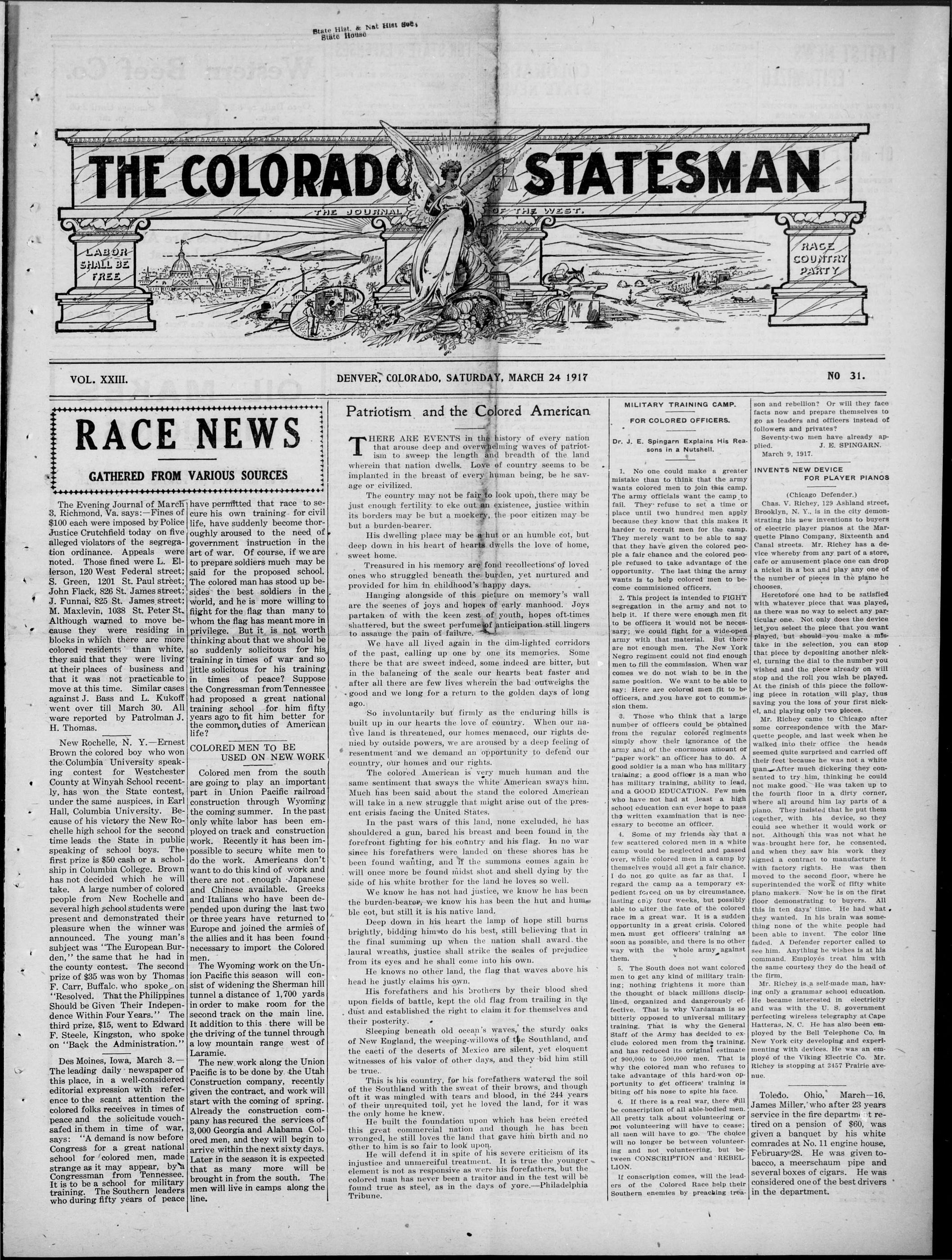
The Evening Journal of March 3, Richmond, Va. says: Fines of $100 each were imposed by Police Justice Crutchfield today on five alleged violators of the segregation ordinance. Appeals were noted. Those fined were L. Ellerson, 120 West Federal street; S. Green, 1201 St. Paul street; John Flack, 826 St. James street; J. Funnai, 825 St. James street; M. Maxlevin, 1038 St. Peter St. Although warned to move because they were residing in blocks in which there are more colored residents than white, they said that they were living at their places of business and that it was not practicable to move at this time. Similar cases against J. Bass and L. Kukoff went over till March 30. All were reported by Patrolman J. H. Thomas.
New Rochelle, N. Y.—Ernest Brown the colored boy who won the Columbia University speaking contest for Westchester County at Winyah School recently, has won the State contest, under the same auspices, in Earl Hall, Columbia University. Because of his victory the New Rochelle high school for the second time leads the State in public speaking of school boys. The first prize is $50 cash or a scholarship in Columbia College. Brown has not decided which he will take. A large number of colored people from New Rochelle and several high school students were present and demonstrated their pleasure when the winner was announced. The young man's subject was "The European Burden," the same that he had in the county contest. The second prize of $35 was won by Thomas F. Carr, Buffalc, who spoke on "Resolved. That the Philippines Should be Given Their Independence Within Four Years." The third prize, $15, went to Edward F. Steele, Kingston, who spoke on "Back the Administration."
Des Moines, Iowa, March 3. The leading daily newspaper of this place, in a well-considered editorial expression with reference to the scant attention the colored folks receives in times of peace and the solicitude vouchsafed in them in time of war, says: "A demand is now before Congress for a great national school for colored men, made strange as it may appear, by a Congressman from Tennessee. It is to be a school for military training. The Southern leaders who during fifty years of peace
have permitted that race to secure his own training for civil life, have suddenly become thoroughly aroused to the need of government instruction in the art of war. Of course, if we are to prepare soldiers much may be said for the proposed school. The colored man has stood up besides the best soldiers in the world, and he is more willing to flight for the flag than many to whom the flag has meant more in privilege. But it is not worth thinking about that we should be so suddenly solicitous for his training in times of war and so little solicitous for his training in times of peace? Suppose the Congressman from Tennessee had proposed a great national training school for him fifty years ago to fit him better for the common duties of American life?
COLORED MEN TO BE
Colored men from the south are going to play an important part in Union Pacific railroad construction through Wyoming the coming summer. In the past only white labor has been employed on track and construction work. Recently it has been impossible to secure white men to do the work. Americans don't want to do this kind of work and there are not enough Japanese and Chinese available. Greeks and Italians who have been depended upon during the last two or three years have returned to Europe and joined the armies of the allies and it has been found necessary to import the Colored men.
The Wyoming work on the Union Pacific this season will consist of widening the Sherman hill tunnel a distance of 1,700 yards in order to make room for the second track on the main line. It addition to this there will be the driving of the tunnel through a low mountain range west of Laramie. The new work along the Union Pacific is to be done by the Utah Construction company, recently given the contract, and work will start with the coming of spring. Already the construction company has recured the services of 3,000 Georgia and Alabama Colored men, and they will begin to arrive within the next sixty days. Later in the season it is expected that as many more will be brought in from the south. The men will live in camps along the line.
THERE ARE EVENTS in the history of every nation that arouse deep and overwhelming waves of patriotism to sweep the length and breadth of the land wherein that nation dwells. Love of country seems to be implanted in the breast of every human being, be he savage or civilized.
Dr. J. E. Spingarn Explains His Reasons in a Nutshell.
1. No one could make a greater mistake than to think that the army wants colored men to join this camp. The army officials want the camp to fail. They refuse to set a time or place until two hundred men apply because they know that this makes it harder to recruit men for the camp. They merely want to be able to say that they have given the colored people a fair chance and the colored people refused to take advantage of the opportunity. The last thing the army wants is to help colored men to become commissioned officers.
The country may not be fair to look upon, there may be just enough fertility to eke out an existence, justice within its borders may be but a mockery, the poor citizen may be but a burden-bearer.
His dwelling place may be a hut or an humble cot, but deep down in his heart of hearts dwells the love of home, sweet home.
Treasured in his memory are fond recollections of loved ones who struggled beneath the burden, yet nurtured and provided for him in childhood's happy days.
Hanging alongside of this picture on memory's wall are the scenes of joys and hopes of early manhood. Joys partaken of with the keen zest of youth, hopes oft-times shattered, but the sweet perfume of anticipation still lingers to assuage the pain of failure.
2. This project is intended to FIGHT segregation in the army and not to help it. If there were enough men fit to be officers it would not be necessary; we could fight for a wide-open army with that material. But there are not enough men. The New York Negro regiment could not find enough men to fill the commission. When war comes we do not wish to be in the same position. We want to be able to say: Here are colored men fit to be officers, and you have got to commission them.
We have all lived again in the dim-lighted corridors of the past, calling up one by one its memories. Some there be that are sweet indeed, some indeed are bitter, but in the balancing of the scale our hearts beat faster and after all there are few lives wherein the bad outweighs the good and we long for a return to the golden days of long ago.
So involuntarily but firmly as the enduring hills is built up in our hearts the love of country. When our native land is threatened, our homes menaced, our rights denied by outside powers, we are aroused by a deep feeling of resentment and we demand an opportunity to defend our country, our homes and our rights.
3. Those who think that a large number of officers could be obtained from the regular colored regiments simply show their ignorance of the army and of the enormous amount or "paper work" an officer has to do. A good soldier is a man who has military training; a good officer is a man who has military training, ability to lead, and a GOOD EDUCATION. Few men who have not had at least a high school education can ever hope to pass the written examination that is necessary to become an officer.
The colored American is very much human and the same sentiment that sways the white American sways him. Much has been said about the stand the colored American will take in a new struggle that might arise out of the present crisis facing the United States.
In the past wars of this land, none excluded, he has shouldered a gun, bared his breast and been found in the forefront fighting for his country and his flag. In no war since his forefathers were landed on these shores has he been found wanting, and if the summons comes again he will once more be found midst shot and shell dying by the side of his white brother for the land he loves so well.
4. Some of my friends say that a few scattered colored men in a white camp would be neglected and passed over, while colored men in a camp by themselves would all get a fair chance. I do not go quite as far as that. I regard the camp as a temporary expedient forced on us by circumstance, lasting only four weeks, but possibly able to alter the fate of the colored race in a great war. It is a sudden opportunity in a great crisis. Colored men must get officers' training as soon as possible, and there is no other way with the whole army against them.
We know he has not had justice, we know he has been the burden-bearer, we know his has been the hut and humble cot, but still it is his native land.
Deep down in his heart the lamp of hope still burns brightly, bidding him to do his best, still believing that in the final summing up when the nation shall award the laural wreaths, justice shall strike the scales of prejudice from its eyes and he shall come into his own.
5. The South does not want colored men to get any kind of military training; nothing frightens it more than the thought of black millions disciplined, organized and dangerously effective. That is why Vardaman is so bitterly opposed to universal military training. That is why the General Staff of the Army has decided to exclude colored men from the training, and has reduced its original estimate of 900,000 to 500,000 men. That is why the colored man who refuses to take advantage of this hard-won opportunity to get officers' training is biting off his nose to spite his face.
6. If there is a real war, there will be conscription of all able-bodied men. All pretty talk about volunteering or not volunteering will have to cease; all men will have to go. The choice will no longer be between volunteering and not volunteering, but between CONSCRIPTION and REBELLION.
He knows no other land, the flag that waves above his head he justly claims his own.
His forefathers and his brothers by their blood shed upon fields of battle, kept the old flag from trailing in the dust and established the right to claim it for themselves and their posterity.
Sleeping beneath old ocean's waves, the sturdy oaks of New England, the weeping-willows of the Southland, and the cacti of the deserts of Mexico are silent, yet eloquent witnesses of his valor of other days, and they bid him still be true.
This is his country, for his forefathers watered the soil of the Southland with the sweat of their brows, and though oft it was mingled with tears and blood, in the 244 years of their unrequited toil, yet he loved the land, for it was the only home he knew.
He built the foundation upon which has been erected this great commercial nation and though he has been wronged, he still loves the land that gave him birth and no other to him is so fair to look upon.
He will defend it in spite of his severe criticism of its injustice and unmerciful treatment. It is true the younger element is not as responsive as were his forefathers, but the colored man has never been a traitor and in the test will be found true as steel, as in the days of yore.—Philadelphia Tribune.
If conscription comes, will the leaders of the Colored Race help their Southern enemies by preaching trea-
son and rebellion? Or will they face facts now and prepare themselves to go as leaders and officers instead of followers and privates?
Seventy-two men have already applied.
J. E. SPINGARN.
March 9, 1917
INVENTS NEW DEVICE
FOR PLAYER PIANOS
Chas. V. Richey, 129 Ashland street, Brooklyn, N. Y., is in the city demonstrating his new inventions to buyers of electric player pianos at the Marquette Piano Company, Sixteenth and Canal streets. Mr. Richey has a device whereby from any part of a store, cafe or amusement place one can drop a nickel in a box and play any one of the number of pieces in the piano he chooses.
Heretofore one had to be satisfied with whatever piece that was played, as there was no way to select any particular one. Not only does the device let you select the piece that you want played, but should you make a mistake in the selection, you can stop that piece by depositing another nickel, turning the dial to the number you wished and the piece already on will stop and the roll you wish be played. At the finish of this piece the following piece in rotation will play, thus saving you the loss of your first nickel, and playing only two pieces.
Mr. Richey came to Chicago after some correspondence with the Marquette people, and last week when he walked into their office the heads seemed quite surprised and carried off their feet because he was not a white man. After much dickering they consented to try him, thinking he could not make good. He was taken up to the fourth floor in a dirty corner, where all around him lay parts of a piano. They insisted that he put them together, with his device, so they could see whether it would work or not. Although this was not what he was brought here for, he consented, and when they saw his work they signed a contract to manufacture it with factory rights. He was then moved to the second floor, where he superintended the work of fifty white piano makers. Now he is on the first floor demonstrating to buyers. All this in ten days' time. He had what they wanted. In his brain was something none of the white people had been able to invent. The color line faded. A Defender reporter called to see him. Anything he wishes is at his command. Employés treat him with the same courtesy they do the head of the firm.
Mr. Richey is a self-made man, having only a grammar school education. He became interested in electricity and was with the U. S. government perfecting wireless telegraphy at Cape Hatteras, N. C. He has also been employed by the Bell Telephone Co. in New York city developing and experimenting with devices. He was an employé of the Viking Electric Co. Mr. Richey is stopping at 3457 Prairie avenue.
Toledo. Ohio. March—16. James Miller, who after 23 years service in the fire department retired on a pension of $60, was given a banquet by his white comrades at No. 11 engine house, February 28. He was given tobacco, a meerschaum pipe and several boxes of cigars. He was considered one of the best drivers in the department.
LATEST NEWS EPITOMIZED
FROM TELEGRAPHIC REPORT
THAT COVER THE WEEK'S
EVENTS.
OF MOST INTEREST
OF MOST INTEREST
KEEPING THE READER POSTED ON MOST IMPORTANT CURRENT TOPICS.
Western Newspaper Union News Service.
ABOUT THE WAR
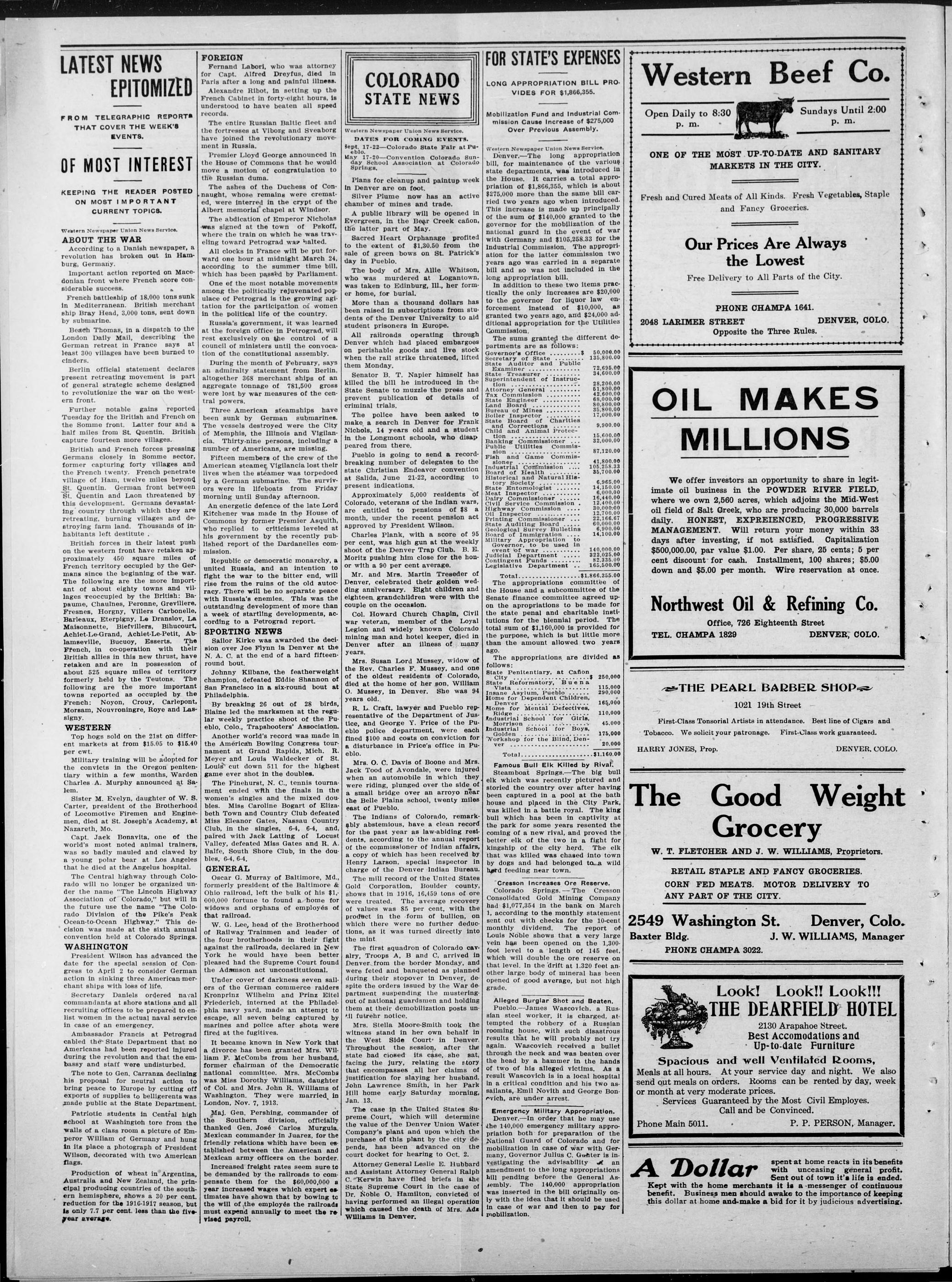
According to a Danish newspaper, a revolution has broken out in Hamburg, Germany.
Important action reported on Macedonian front where French score considerable success.
French battleship of 18,000 tons sunk in Mediterranean. British merchant ship Bray Head, 3,000 tons, sent down by submarine.
Beach Thomas, in a dispatch to the London Daily Mail, describing the German retreat in France says at least 300 villages have been burned to cinders.
Berlin official statement declares present retreating movement is part of general strategic scheme designed to revolutionize the war on the western front.
Further notable gains reported Tuesday for the British and French on the Somme front. Latter four and a half miles from St. Quentin. British capture fourteen more villages.
British and French forces pressing Germans closely in Somme sector, former capturing forty villages and the French twenty. French penetrate village of Ham, twelve miles beyond St. Quentin. German front between St. Quentin and Laon threatened by this development. Germans devastating country through which they are retreating, burning villages and destroying farm land. Thousands of inhabitants left destitute.
British forces in their latest push on the western front have retaken approximately 450 square miles of French territory occupied by the Germans since the beginning of the war. The following are the more important of about eighty towns and villages reoccupied by the British: Bapaume, Chaulnes, Peronne, Grevilliere, Fresnes, Horgny, Villers Carbonelle, Barleaux, Eterpligny, Le Dranslov, La Maisonnette, Biefvilliers, Bihucourt, Achiet-Le-Grand, Achiet-Le-Petit, Ablamseville, Bucuoy, Esserts, The French, in co-operation with their British allies in this new thrust, have retaken and are in possession of about 525 square miles of territory formerly held by the Teutons. The following are the more important towns reported as occupied by the French: Noyon, Crouy, Carlepont, Morsam, Nouvroningre, Roye and Lassigny.
WESTERN
Top hogs sold on the 21st on different markets at from $15.05 to $15.40 per cwt.
Military training will be adopted for the convicts in the Oregon penitentiary within a few months, Warden Charles A. Murphy announced at Salem.
Sister M. Evelyn, daughter of W. S. Carter, president of the Brotherhood of Locomotive Firemen and Enginemen, died at St. Joseph's Academy, at Nazareth, Mo.
Capt. Jaek Bonavita, one of the world's most noted animal trainers, was so badly mauled and clawed by a young polar bear at Los Angeles that he died at the Angelus hospital.
The Central highway through Colorado will no longer be organized under the name "The Lincoln Highway Association of Colorado," but will in the future use the name "The Colorado Division of the Pike's Peak Ocean-to-Ocean Highway." This decision was made at the sixth annual convention held at Colorado Springs.
WASHINGTON
President Wilson has advanced the date for the special session of Congress to April 2 to consider German action in sinking three American merchant ships with loss of life.
Secretary Daniels ordered naval commandants at shore stations and all recruiting offices to be prepared to enlist women in the actual naval service in case of an emergency.
Ambassador Francis at Petrograd cabled the State Department that no Americans had been reported injured during the revolution and that the embassy and staff were undisturbed.
The note to Gen. Carranza declining his proposal for neutral action to bring peace to Europe by cutting off exports of supplies to belligerents was made public at the State Department.
Patriotic students in Central high school at Washington tore from the walls of a class room a picture of Emperor William of Germany and hung in its place a photograph of President Wilson, decorated with two American flags.
Production of wheat in Argentina, Australia and New Zealand, the principal producing countries of the southern hemisphere, shows a 30 per cent reduction for the 1916-1917 season, but is only 7.7 per cent. less than the five-year average.
FOREIGN
Fernand Labori, who was attorney for Capt. Alfred Dreyfus, died in Paris after a long and painful illness. Alexandre Ribot, in setting up the French Cabinet in forty-eight hours, is understood to have beaten all speed records.
The entire Russian Baltic fleet and the fortresses at Viborg and Sveaborg have joined the revolutionary movement in Russia.
Premier Lloyd George announced in the House of Commons that he would move a motion of congratulation to the Russian duma.
The ashes of the Duchess of Connaught, whose remains were cremated, were interred in the crypt of the Albert memorial chapel at Windsor.
The abdication of Emperor Nicholas was signed at the town of Pskoff, where the train on which he was traveling toward Petrograd was halted.
All clocks in France will be put forward one hour at midnight March 24, according to the summer time bill, which has been passed by Parliament. One of the most notable movements among the politically rejuvenated populace of Petrograd is the growing agitation for the participation of women in the political life of the country. Russia's government, it was learned at the foreign office in Petrograd, will rest exclusively on the control of a council of ministers until the convocation of the constitutional assembly. During the month of February, says an admiralty statement from Berlin, altogether 368 merchant ships of an aggregate tonnage of 781,500 gross were lost by war measures of the central powers.
Three American steamships have been sunk by German submarines. The vessels destroyed were the City of Memphis, the Illinois and Vigilancia. Thirty-nine persons, including a number of Americans, are missing.
Fifteen members of the crew of the American steamer Vigilancia lost their lives when the steamer was torpedoed by a German submarine. The survivors were in lifeboats from Friday morning until Sunday afternoon.
An energetic defence of the late Lord Kitchener was made in the House of Commons by former Premier Asquith, who replied to criticisms leveled at his government by the recently published report of the Dardanelles commission.
Republic or democratic monarchy, a united Russia, and an intention to fight the war to the bitter end, will rise from the ruins of the old autocracy. There will be no separate peace with Russia's enemies. This was the outstanding development of more than a week of startling developments, according to a Petrograd report.
SPORTING NEWS
Sallor Kirke was awarded the decision over Joe Flynn in Denver at the N. A. C. at the end of a hard fifteen-round bout.
Johnny Kilbane, the featherweight champion, defeated Eddie Shannon of San Francisco in a six-round bout at Philadelphia.
By breaking 26 out of 28 birds, Blaine led the marksmen at the regular weekly practice shoot of the Pueblo, Colo., Trapshooters' Association.
Another world's record was made in the American Bowling Congress tournament at Grand Rapids, Mich. R. Meyer and Louis Waldecker of St. Louis cut down 511 for the highest game ever shot in the doubles.
The Pinehurst, N. C., tennis tournament ended with the finals in the women's singles and the mixed doubles. Miss Caroline Bogart of Elizabeth Town and Country Club defeated Miss Eleanor Gates, Nassau Country Club, in the singles, 6-4, 6-4, and, paired with Jack Latting of Locust Valley, defeated Miss Gates and R. A. Balfe, South Shore Club, in the doubles, 6-4, 6-4.
GENERAL
Oscar G. Murray of Baltimore, Md., formerly president of the Baltimore & Ohio railroad, left the bulk of his $1,000,000 fortune to found a home for widows and orphans of employés of that railroad.
W. G. Lee, head of the Brotherhood of Railway Trainmen and leader of the four brotherhoods in their fight against the railroads, declared in New York he would have been better pleased had the Supreme Court found the Adamson act unconstitutional.
Under cover of darkness seven sailors of the German commerce raiders Kronprinz Wilhelm and Prinz Eitel Friederich, intermed at the Philadelphia navy yard, made an attempt to escape, all seven being captured by marines and police after shots were fired at the fugitives.
It became known in New York that a divorce has been granted Mrs. William F. McCombs from her husband, former chairman of the Democratic national committee. Mrs. McCombs was Miss Dorothy Williams, daughter of Col. and Mrs. John R. Williams of Washington. They were married in London, Nov. 7, 1913.
Maj. Gen. Pershing, commander of the Southern division, officially thanked Gen. José Carlos Murgua, Mexican commander in Juarez, for the friendly relations which have been established between the American and Mexican army officers on the border.
Increased freight rates seem sure to be demanded by the railroads to compensate them for the $60,000,000 a year increased wages which expert estimates have shown that by bowing to the will of the employes the railroads must expend annually to meet the revised payroll.
Western Newspaper Union News Service.
DATES FOR COMING EVENTS.
sept. 17-22—Colorado State Fair at Pueblo.
May 17-20—Convention Colorado Sunday School Association at Colorado Springs.
Plans for cleanup and paintup week in Denver are on foot.
Silver Plume now has an active chamber of mines and trade.
A public library will be opened in Evergreen, in the Beqr Creek canon, the latter part of May.
Sacred Heart Orphanage profited to the extent of $1,30.50 from the sale of green bows on St. Patrick's day in Pueblo.
The body of Mrs. Allie Whitson, who was murdered at Logantown, was taken to Edinburg, Ill., her former home, for burial.
More than a thousand dollars has been raised in subscriptions from students of the Denver University to aid student prisoners in Europe.
All railroads operating through Denver which had placed embargoes on perishable goods and live stock when the rail strike threatened, lifted them Monday.
Senator B. T. Napier himself has killed the bill he introduced in the State Senate to muzzle the press and prevent publication of details of criminal trials.
The police have been asked to make a search in Denver for Frank Nichols, 14 years old and a student in the Longmont schools, who disappeared from there.
Pueblo is going to send a record-breaking number of delegates to the state Christian Endeavor convention at Salida, June 21-22, according to present indications.
Approximately 5,000 residents of Colorado, veterans of the Indian wars, are entitled to pensions of $8 a month, under the recent pension act approved by President Wilson.
Charles Plank, with a score of 95 per cent, was high gun at the weekly shoot of the Denver Trap Club. B. E. Moritz pushing him close for the honor with a 90 per cent average.
Mr. and Mrs. Martin Treseder of Denver, celebrated their golden wedding anniversary. Eight children and eighteen grandchildren were with the couple on the occasion.
Col. Howard Church Chapin, Civil war veteran, member of the Loyal Legion and widely known Colorado mining man and hotel keeper, died in Denver after an illness of many years.
Mrs. Susan Lord Mussey, widow of the Rev. Charles F. Mussey, and one of the oldest residents of Colorado, died at the home of her son, William O. Mussey, in Denver. She was 94 years old.
R. L. Craft, lawyer and Pueblo representative of the Department of Justice, and George Y. Price of the Pueblo police department, were each fined $100 and costs on conviction for a disturbance in Price's office in Pueblo.
Mrs. O. C. Davis of Boone and Mrs. Jack Tood of Avondale, were injured when an automobile in which they were riding, plunged over the side of a small bridge over an arroyo near the Belle Plains school, twenty miles east of Pueblo.
The Indians of Colorado, remarkably abstentious, have a clean record for the past year as law-abiding residents, according to the annual report of the commissioner of Indian affairs, a copy of which has been received by Henry Larson, special inspector in charge of the Denver Indian Bureau. The mill record of the United States Gold Corporation, Boulder county, shows that in 1916, 16,459 tons of ore were treated. The average recovery of values was 85 per cent, with the product in the form of bullion, on which there were no further deductions, as it was turned directly into the mint.
The first squadron of Colorado cavalry, Troops A, B and C, arrived in Denver from the border Monday, and were feted and banqueted as planned during their stopover in Denver, despite the orders issued by the War department suspending the mustering-out of national guardsmen and holding them at their demobilization posts until futrehr notice.
Mrs. Stella Moore-Smith took the witness stand in her own behalf in the West Side Court* in Denver. Throughout the session, after the state had closed its case, she sat, facing the jury, relating the story that encompasses all her claims of justification for slaying her husband, John Lawrence Smith, in her Park Hill home early Saturday morning, Jan. 13.
The case in the United States Supreme Court, which will determine the value of the Denver Union Water Company's plant and upon which the purchase of this plant by the city depends, has been advanced on the court docket for hearing to Oct. 2.
Attorney General Leslie E. Hubbard and Assistant Attorney General Ralph C. Kerwin have filed briefs in the State Supreme Court in the case of Dr. Noble O. Hamilton, convicted of having performed an illegal operation which caused the death of Mrs. Ada Williams in Denver.
FOR STATE'S EXPENSES
LONG APPROPRIATION BILL PROVIDES FOR $1,866,355.
Mobilization Fund and Industrial Commission Cause Increase of $275,000
Over Previous Assembly.
Western Newspaper Union News Service.
Denver.—The long appropriation bill, for maintenance of the various state departments, was introduced in the House. It carries a total appropriation of $1,866,355, which is about $275,000 more than the same bill carried two years ago when introduced. This increase is made up principally of the sum of $140,000 granted to the governor for the mobilization of the national guard in the event of war with Germany and $105,258.33 for the Industrial Commission. The appropriation for the latter commission two years ago was carried in a separate bill and so was not included in the long appropriation bill.
In addition to these two items practically the only increases are $20,000 to the governor for liquor law enforcement instead of $10,000, as granted two years ago, and $24,000 additional appropriation for the Utilities Commission.
The sums granted the different departments are as follows:
Governor's Office ..... $ 50,000.00
Secretary of State ..... 135,800.00
State Attorney and Public Examiner ..... 72,695.00
State Treasurer ..... 34,600.00
Superintendent of Instruc-
tion ..... 28,200.00
Attorney General ..... 51,800.00
Tribal Commission ..... 42,600.00
State Engineer ..... 68,000.00
Land Board ..... 80,800.00
Bureau of Mines ..... 35,800.00
Boiler Inspector ..... 17,000.00
State Board of Charities
and Correctional ..... 9,900.00
Child and Animal Protection ..... 15,600.00
Banking Commissioner ..... 32,000.00
Public Utilities Commission ..... 87,120.00
Film and Game Commissioner ..... 41,800.00
Industrial Commission ..... 105,258.33
Board of Health ..... 35,700.00
Historical and Natural His-
torial
tory Society
State Law
Civil Surveys
Meat Inspector
Dairy Commissioner
Civil Service Commission
Highway Commission
Highway Inspector
Printing Commissioner
State Auditing Board
Geological Survey Bulletins
Board of Immigration
Military Appropriation to
Total.....$1,866,355.00
The appropriations committee of the House and a subcommittee of the Senate finance committee agreed upon the appropriations to be made for the state penal and charitable institutions for the biennial period. The total sum of $1,160,000 is provided for the purpose, which is but little more than the amount allowed two years ago.
The appropriations are divided as follows:
follows:
State Penitentiary, at Cafion
Guy $ 250,000
State Reformatory, Buena
Vista $ 115,000
Insane Asylum, Pueblo $ 290,000
Home for Dependent Children,
Denver $ 165,000
Home for Mental Defectives,
Ridge $ 110,000
Industrial School for Girls,
Morrison $ 45,000
Industrial School for Boys,
Golden $ 175,000
Workshop for the Blind,Denver $ 20,000
Famous Bull Elk Killed by Rival. Steamboat Springs.—The big bull elk which was recently pictured and storied the country over after having been captured in a pool at the bath house and placed in the City Park, was killed in a battle royal. The king bull which has been in captivity at the park for some years resented the coming of a new rival, and proved the better elk of the two in a fight for kingship of the city herd. The elk that was killed was chased into town by dogs and had belonged to a wild hard feeding near town.
Cresson Increases Ore Reserve.
Colorado Springs.—The Cresson Consolidated Gold Mining Company had $1,077,354 in the bank on March 1, according to the monthly statement sent out with checks for the 10-cent monthly dividend. The report of Louis Noble shows that a very large vein has been opened on the 1,300-foot level to a length of 145 feet, which will double the ore reserve on that level. In the drift at 1,320 feet another large body of mineral has been opened of good average, but not high grade.
Alleged Burglar Shot and Beaten.
Pueblo.—James Wascovich, a Russian steel worker, it is charged, attempted the robbery of a Russian rooming house, with such disastrous results that he will probably not try again. Wascovich received a bullet through the neck and was beaten over the head by a hammer in the hands of two of his alleged victims. As a result Wascovich is in a local hospital in a critical condition and his two assailants, Emil Novith and George Bonevich, are under arrest.
Emergency Military Appropriation. Denver.—In order that he may use the 140,000 emergency military appropriation both for preparation of the National Guard of Colorado and for mobilization in case of war with Germany, Governor Julius C. Genter is investigating the advisability of an amendment to the long appropriations bill pending before the General Assembly. The 140,000 appropriation was inserted in the bill originally only with the idea that it should be used in case of war and then to pay for mobilization.
Open Daily to 8:30 p. m.
OF THE MOST UP-TO-DATE AND SANITARY MARKETS IN THE CITY.
Cured Meats of All Kinds. Fresh Vegetables, Staple and Fancy Groceries.
ONE OF THE MOST
MARK
Fresh and Cured Meats
and
ONE OF THE MOST UP-TO-DATE AND SANITARY MARKETS IN THE CITY.
Fresh and Cured Meats of All Kinds. Fresh Vegetables, Staple and Fancy Groceries.
Our Prices Are Always the Lowest Free Delivery to All Parts of the City.
OIL MILK
We offer invest in imate oil business where we own 2,560 oil field of Salt Creek daily. HONEST, MANAGEMENT. Days after investing $500,000.00, par value discount for down and $5.00 per day.
Northwest Office
TEL. CHAMPA 182
THE PEACE
First-Class Tonsorial Tobacco. We solicit your HARRY JONES, Prop.
W. T. FLETCHER
RETAIL STAR
CORN FED ME
ANY PART OF
2549 Washington
Baxter Bldg.
PHONE CHAMPA
PHONE CHAMPA 1641.
HUMER STREET DENVER, COLO.
Opposite the Three Rules.
OIL MAKES MILLIONS
Offer investors an opportunity to share in legitimate business in the POWDER RIVER FIELD, have own 2,560 acres, which adjoins the Mid-West of Salt Creek, who are producing 30,000 barrels of HONEST, EXPRIENCED, PROGRESSIVE AGEMENT. Will return your money within 33 percent investing, if not satisfied. Capitalization 0.00, par value $1.00. Per share, 25 cents; 5 per account for cash. Installment, 100 shares; $5.00 and $5.00 per month. Wire reservation at once.
Northwest Oil & Refining Co.
Office, 726 Eighteenth Street
CHAMPA 1829 DENVER, COLO.
THE PEARL BARBER SHOP
1021 19th Street
Class Tonsorial Artists in attendance. Best line of Cigars and We solicit your patronage. First-Class work guaranteed.
NES, Prop. DENVER, COLO.
Good Weight Grocery
CLETCHER AND J. W. WILLIAMS, Proprietors.
DETAIL STAPLE AND FANCY GROCERIES.
IN FED MEATS. MOTOR DELIVERY TO PART OF THE CITY.
Washington St. Denver, Colo.
g. J. W. WILLIAMS, Manager
ONE CHAMPA 3022.
Look! Look!! Look!!!
THE DEARFIELD HOTEL
OIL MAKES MILLIONS
We offer investors an opportunity to share in legitimate oil business in the POWDER RIVER FIELD, where we own 2,560 acres, which adjoins the Mid-West oil field of Salt Greek, who are producing 30,000 barrels daily. HONEST, EXPREIENCED, PROGRESSIVE MANAGEMENT. Will return your money within 33 days after investing, if not satisfied. Capitalization $500,000.00, par value $1.00. Per share, 25 cents; 5 per cent discount for cash. Installment, 100 shares; $5.00 down and $5.00 per month. Wire reservation at once.
Northwest Oil & Refining Co.
Office, 726 Eighteenth Street
TEL. CHAMPA 1829 DENVER, COLO.
THE PEARL BARBER SHOP
First-Class Tonsorial Artists in attendance. Best line of Cigars and Tobacco. We solicit your patronage. First-Class work guaranteed.
HARRY JONES, Prop. DENVER, COLO.
The Good Weight Grocery
W. T. FLETCHER AND J. W. WILLIAMS, Proprietors.
RETAIL STAPLE AND FANCY GROCERIES.
CORN FED MEATS. MOTOR DELIVERY TO
ANY PART OF THE CITY.
2549 Washington St. Denver, Colo.
Baxter Bldg. J. W. WILLIAMS, Manager
PHONE CHAMPA 3022.
Spacious and
Meals at all hours. At
send out meals on order
or month at very modern
Services Guarantee
Cal
Phone Main 5011.
A Dolle
Kept with the home
cious and well Ventilated Rooms,
hours. At your service day and night. We also
reels on orders. Rooms can be rented by day, week
at very moderate prices.
Services Guaranteed by the Most Civil Employes.
Call and be Convinced.
5011. P. P. PERSON, Manager.
Spacious and well Ventilated Rooms, Meals at all hours. At your service day and night. We also send out meals on orders. Rooms can be rented by day, week or month at very moderate prices.
with the home merchants it is a messenger of continuous Business men should awake to the importance of keeping at home and make a bid for it by judicious advertising.
Kept with the home merchants it is a messenger of continuous benefit. Business men should awake to the importance of keeping this dollar at home and make a bid for it by judicious advertising.
Fruit Bowl
```markdown
```
Sundays Until 2:00 p. m.
2130 Arapahoe Street. Best Accomodations and Up-to-date Furniture
spent at home reacts in its benefits with unceasing general profit. Sent out of town it's life is ended.
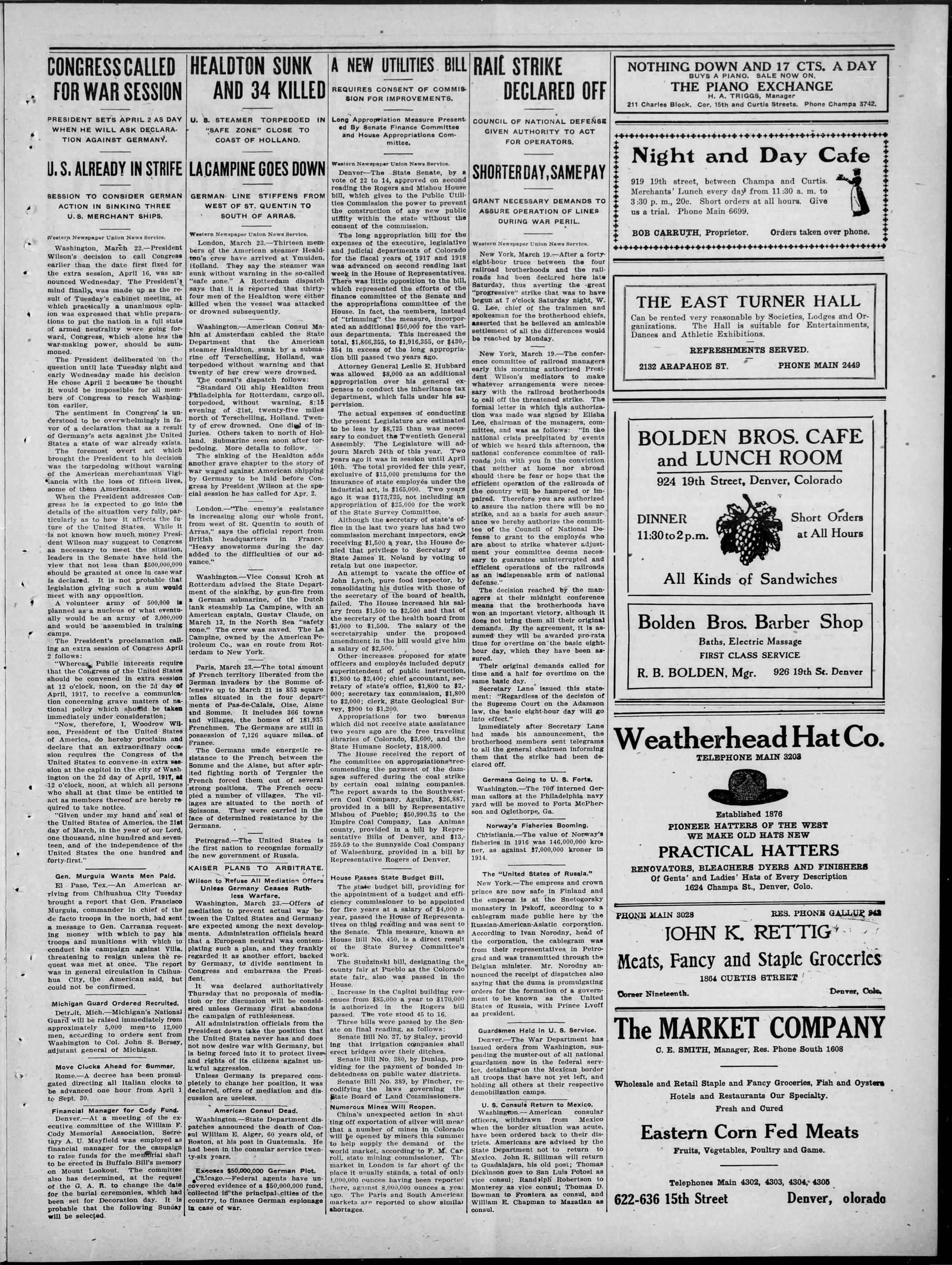
CONGRESS CALLED FOR WAR SESSION
PRESIDENT SETS APRIL 2 AS DAY WHEN HE WILL ASK DECLARATION AGAINST GERMANY.
U. S. ALREADY IN STRIFE
SESSION TO CONSIDER GERMAN ACTION IN SINKING THREE U.S. MERCHANT SHIPS.
Western Newspaper Union News Service.
Washington, March 22.—President Wilson's decision to call Congress earlier than the date first fixed for the extra session, April 16, was announced Wednesday. The President's mind finally, was made up as the result of Tuesday's cabinet meeting, at which practically a unanimous opinion was expressed that while preparations to put the nation in a full state of armed neutrality were going forward, Congress, which alone has the war-making power, should be summoned.
The President deliberated on the question until late Tuesday night and early Wednesday made his decision. He chose April 2 because he thought it would be impossible for all members of Congress to reach Washington earlier.
The sentiment in Congress is understood to be overwhelmingly in favor of a declaration that as a result of Germany's acts against the United States a state of war already exists.
The foremost overt act which brought the President to his decision was the torpedoing without warning of the American merchantman Vigliancia with the loss of fifteen lives, some of them Americans.
When the President addresses Congress he is expected to go into the details of the situation very fully, particularly as to how it affects the future of the United States. While it is not known how much money President Wilson may suggest to Congress as necessary to meet the situation, leaders in the Senate have held the view that not less than $500,000,000 should be granted at once in case war is declared. It is not probable that legislation giving such a sum would meet with any opposition.
A volunteer army of 500,000 is planned as a nucleus of what eventually would be an army of 3,000,000 and would be assembled in training camps.
The President's proclamation calling an extra session of Congress April 2 follows:
"Whereas, Public interests require that the Congress of the United States should be convened in extra session at 12 o'clock, noon, on the 2d day of April, 1917, to receive a communication concerning grave matters of national policy which should be taken immediately under consideration;
"Now, therefore, I, Woodrow Wilson, President of the United States of America, do hereby proclaim and declare that an extraordinary occasion requires the Congress of the United States to convene in extra session at the capitol in the city of Washington on the 2d day of April, 1917, at 12 o'clock, noon, at which all persons who shall at that time be entitled to act as members thereof are hereby required to take notice.
"Given under my hand and seal of the United States of America, the 21st day of March, in the year of our Lord, one thousand, nine hundred and seventeen, and of the independence of the United States the one hundred and forty-first."
Gen. Murguia Wants Men Pald.
El Paso, Tex.—An American arriving from Chihuahua City Tuesday brought a report that Gen. Francisco Murguia, commander in chief of the de facto troops in the north, had sent a message to Gen. Carranza requesting money with which to pay his troops and munitions with which to conduct his campaign against Villa, threatening to resign unless the request was met at once. The report was in general circulation in Chihuahua City, the American said, but could not be confirmed.
Michigan Guard Ordered Recruited.
Detroit, Mich.—Michigan's National Guard will be raised immediately from approximately 5,000 men* to 12,000 men, according to orders sent from Washington to Col. John S. Bersey, adjutant general of Michigan.
Move Clucks Ahead for Summer.
Rome.—A decree has been promulgated directing all Italian clocks to be advanced one hour from April 1 to Sept. 30.
Financial Manager for Cody Fund. Denver.—At a meeting of the executive committee of the William F. Cody Memorial Association, Secretary A. U. Mayfield was employed as financial manager for the campaign to raise funds for the memorial shaft to be erected in Buffalo Bill's memory on Mount Lookout. The committee also has determined, at the request of the G. A. R. to change the date for the burial ceremonies, which had been set for Decoration day. It is probable that the following Sunday will be selected.
U. 8. STEAMER TORPEDOED IN "SAFE ZONE" CLOSE TO COAST OF HOLLAND.
LACAMPINE GOES DOWN
GERMAN LINE STIFFENS FROM WEST OF ST. QUENTIN TO SOUTH OF ARRAS.
Western Newspaper Union News Service.
London, March 23.—Thirteen members of the American steamer Healdton's crew have arrived at Ymuiden, Holland. They say the steamer was sunk without warning in the so-called "safe zone." A Rotterdam dispatch says that it is reported that thirty-four men of the Healdton were either killed when the vessel was attacked or drowned subsequently.
Washington.—American Consul Mahin at Amsterdam cabled the State Department that the American steamer Healdton, sunk by a submarine off Terschelling, Holland, was torpedoed without warning and that twenty of her crew were drowned.
The consul's dispatch follows:
"Standard Oil ship Healdton from Philadelphia for Rotterdam, cargo oil, torpedoed, without warning, 8:15 evening of 21st, twenty-five miles north of Terschelling, Holland. Twenty of crew drowned. One died of injuries. Others taken to north of Holland. Submarine seen soon after torpedoing. More details to follow.
The sinking of the Healdton adds another grave chapter to the story of war waged against American shipping by Germany to be laid before Congress by President Wilson at the special session he has called for Apr. 2.
London.—"The enemy's resistance is increasing along our whole front, from west of St. Quentin to south of Arras," says the official report from British headquarters in France. "Heavy snowstorms during the day added to the difficulties of our advance."
Washington.—Vice Consul Kroh at Rotterdam advised the State Department of the sinking, by gun-fire from a German submarine, of the Dutch tank steamship La Campine, with an American captain, Gustav Claude, on March 13, in the North Sea "safety zone." The crew was saved. The La Campine, owned by the American Petroleum Co., was en route from Rotterdam to New York.
Paris, March 23.—The total amount of French territory liberated from the German invaders by the Somme offensive up to March 21 is 853 square miles situated in the four departments of Pas-de-Calais, Oise, Aisne and Somme. It includes 366 towns and villages, the homes of 181,935 Frenchmen. The Germans are still in possession of 7,126 square miles of France.
The Germans made energetic resistance to the French between the Somme and the Aisne, but after spirited fighting north of Terngier the French forced them out of several strong positions. The French occupied a number of villages. The villages are situated to the north of Solissons. They were carried in the face of determined resistance by the Germans.
Petrograd.—The United States is the first nation to recognize formally the new government of Russia.
KAISER PLANS TO ARBITRATE.
Washington, March 23.—Offers of mediation to prevent actual war between the United States and Germany are expected among the next developments. Administration officials heard that a European neutral was contemplating such a plan, and they frankly regarded it as another effort, backed by Germany, to divide sentiment in Congress and embarrass the President.
It was declared authoritatively Thursday that no proposals of mediation or for discussion will be considered unless Germany first abandons the campaign of ruthlessness.
All administration officials from the President down take the position that the United States never has and does not now desire war with Germany, but is being forced into it to protect lives and rights of its citizens against unlawful aggression.
Unless Germany is prepared completely to change her position, it was declared, offers of mediation and discussion are useless.
American Consul Dead.
Washington.—State Department dispatches announced the death of Consul William E. Alger, 60 years old, of Boston, at his post in Guatemala. He had been in the consular service twenty-six years.
Exposes $50,000,000 German Plot.
Chicago.—Federal agents have uncovered evidence of a $50,000,000 fund, collected in the principal cities of the country, to finance German espionage in case of war.
REQUIRES CONSENT OF COMMISSION FOR IMPROVEMENTS.
Long Appropriation Measure Presented By Senate Finance Committee and House Appropriations Committee.
Denver—The State Senate, by a vote of 22 to 14, approved on second reading the Rogers and Mishou House bill, which gives to the Public Utilities Commission the power to prevent the construction of any new public utility within the state without the consent of the commission.
The long appropriation bill for the expenses of the executive, legislative and judicial departments of Colorado for the fiscal years of 1917 and 1918 was advanced on second reading last week in the House of Representatives. There was little opposition to the bill, which represented the efforts of the finance committee of the Senate and the appropriations committee of the House. In fact, the members, instead of "trimming" the measure, incorporated an additional $50,000 for the various departments. This increased the total, $1,866,355, to $1,916,355, or $430,354 in excess of the long appropriation bill passed two years ago.
Attorney General Leslie E. Hubbard was allowed $8,000 as an additional appropriation over his general expenses to conduct the inheritance tax department, which falls under his supervision.
The actual expenses of conducting the present Legislature are estimated to be less by $8,725 than was necessary to conduct the Twentieth General Assembly. The Legislature will adjourn March 24th of this year. Two years ago it was in session until April 10th. The total provided for this year, exclusive of $15,000 premiums for the insurance of state employés under the industrial act, is $165,000. Two years ago it was $173,725, not including an appropriation of $25,000 for the work of the State Survey Committee. Although the secretary of state's office in the last two years has had two commission merchant inspectors, each receiving $1,500 a year, the House denied that privilege to Secretary of State James R. Noland by voting to retain but one inspector.
An attempt to vacate the office of John Lynch, pure food inspector, by consolidating his duties with those of the secretary of the board of health, failed. The House increased his salary from $1,500 to $2,500 and that of the secretary of the health board from $1,000 to $1,500. The salary of the secretaryship under the proposed amendment in the bill would give him a salary of $2,500.
Other increases proposed for state officers and employés included deputy superintendent of public instruction, $1,800 to $2,400; chief accountant, secretary of state's office, $1,800 to $2,000; secretary tax commission, $1,800 to $2,000; clerk, State Geological Survey, $900 to $1,200.
Appropriations for two bureaus which did not receive state assistance two years ago are the free traveling libraries of Colorado, $3,600, and the State Humane Society, $18,000. The House received the report of the committee on appropriations recommending the payment of the damages suffered during the coal strike by certain coal mining companies. The report awards to the Southwestern Coal Company, Aguilar, $26,887, provided in a bill by Representative Mishou of Pueblo; $50,990.35 to the Empire Coal Company, Las Animas county, provided in a bill by Representative Bills of Denver, and $13,359.59 to the Sunnyside Coal Company of Walsenburg, provided in a bill by Representative Rogers of Denver.
House Passes State Budget Bill.
The state budget bill, providing for the appointment of a budget and efficiency commissioner to be appointed for five years at a salary of $4,000 a year, passed the House of Representatives on third reading and was sent to the Senate. This measure, known as House Bill No. 450, is a direct result of the State Survey Committee's work.
The Studzinski bill, designating the county fair at Pueblo as the Colorado state fair, also was passed in the House.
Increase in the Capitol building revenues from $85,000 a year to $170,000 is authorized in the Rogers bill passed. The vote stood 45 to 16.
Three bills were passed by the Senate on final reading, as follows:
Senate Bill No. 37, by Staley, providing that irrigation companies shall erect bridges over their ditches. Senate Bill No. 380, by Dunlap, providing for the payment of bonded indebtedness on public water districts. Senate Bill No. 389, by Fincher, recodifying the laws governing the State Board of Land Commissioners. Numerous Mines Will Reopen. China's unexpected action in shutting off exportation of silver will mean that a number of mines in Colorado will be opened by miners this summer to help supply the demand of the world market, according to F. M. Carroll, state mining commissioner. The market in London is far short of the place it usually stands, a total of only 4,000,000 ounces having been reported there, against 8,000,000 ounces a year ago. The Paris and South American markets are reported to show similar shortages.
COUNCIL OF NATIONAL DEFENSE
GIVEN AUTHORITY TO ACT
FOR OPERATORS.
SHORTERDAY,SAMEPAY
GRANT NECESSARY DEMANDS TO ASSURE OPERATION OF LINES DURING WAR PERIL.
Western Newspaper Union News Service.
New York, March 19.—After a forty-eight-hour truce between the four railroad brotherhoods and the railroads had been declared here late Saturday, thus averting the great "progressive" strike that was to have begun at 7 o'clock Saturday night, W. G. Lee, chief of the trainmen and spokesman for the brotherhood chiefs, asserted that he believed an amicable settlement of all the differences would be reached by Monday.
New York, March 19.—The conference committee of railroad managers early this morning authorized President Wilson's mediators to make whatever arrangements were necessary with the railroad brotherhoods to call off the threatened strike. The formal letter in which this authorization was made was signed by Elisha Lee, chairman of the managers, committee, and was as follows: "In the national crisis precipitated by events of which we heard this afternoon, the national conference committee of railroads join with you in the conviction that neither at home nor abroad should there be fear or hope that the efficient operation of the railroads of the country will be hampered or impaired. Therefore you are authorized to assure the nation there will be no strike, and as a basis for such assurance we hereby authorize the committee of the Council of National Defense to grant to the employes who are about to strike whatever adjustment your committee deems necessary to guarantee uninterrupted and efficient operations of the railroads as an indispensable arm of national defense."
The decision reached by the managers at their midnight conference means that the brotherhoods have won an important victory, although it does not bring them all their original demands. By the agreement, it is assumed they will be awarded pro-rata time for overtime on the basic eight-hour day, which they have been assured.
Their original demands called for time and a half for overtime on the same basic day.
Secretary Lane issued this statement: "Regardless of the decision of the Supreme Court on the Adamson law, the basic eight-hour day will go into effect."
Immediately after Secretary Lane had made his announcement, the brotherhood members sent telegrams to all the general chairmen informing them that the strike had been declared off.
Germans Going to U. S. Forts.
Washington.—The 700 intermed German sailors at the Philadelphia navy yard will be moved to Forts McPherson and Oglethorpe, Ga.
Norway's Fisheries Booming.
Christiania.—The value of Norway's fisheries in 1916 was 146,000,000 kroner, as against $7,000,000 kroner in 1914.
The "United States of Russia." New York.—The empress and crown prince are now safe in Finland and the emperor is at the Snetogorsky monastery in Pskoff, according to a cablegram made public here by the Russian-American-Asiatic corporation. According to Ivan Norodny, head of the corporation, the cablegram was from their representatives in Petrograd and was transmitted through the Belgian minister. Mr. Norodny announced the receipt of dispatches also saying that the duma is promulgating orders for the formation of a government to be known as the United States of Russia, with Prince Lvoff as president.
Guardsmen Held in U. S. Service.
Denver.—The War Department has issued orders from Washington, suspending the muster-out of all national guardsmen now in the federal service, detaining on the Mexican border all troops that have not yet left, and holding all others at their respective demobilization camps.
U. S. Consuls Return to Mexico. Washington.—American consular officers, withdrawn from Mexico when the border situation was acute, have been ordered back to their districts. Americans are advised by the State Department not to return to Mexico. John R. Silliman will return to Guadalajara, his old post; Thomas Dickinson goes to San Luis Potosi as vice consul; Randolph Robertson to Monterey as vice consul; Thomas D. Bowman to Froatera as consul, and William E. Chapman to Mazatlan as consul.
NOTHING DOWN AND 17 CTS. A DAY BUYS A PIANO. SALE NOW ON. THE PIANO EXCHANGE H. A. TRIGGS, Manager 211 Charles Block. Cor. 15th and Curtis Streets. Phone Champa 3742.
Night and Day Cafe
919 19th street, between Champa and Curtis. Merchants' Lunch every day from 11:30 a. m. to 3:30 p. m., 20c. Short orders at all hours. Give us a trial. Phone Main 6699.
Can be rented very reasonable by Societies, Lodges and Organizations. The Hall is suitable for Entertainments, Dances and Athletic Exhibitions.
DINNER
11:30 to 2 p.m.
All Ki
Bolden
Ba
FI
R. B. BOLDE
Weather
PIONEER
WE I
PRACT
RENOVATORS, BLD
Of Gents' and
1624
All Kinds of Sandwich
Heden Bros. Barber S
Baths, Electric Massage
FIRST CLASS SERVICE
BOLDEN, Mgr. 926 19th S
atherhead Ha
TELEPHONE MAIN 3203
All Kinds of Sandwiches
Bolden Bros. Barber Shop
Baths, Electric Massage
FIRST CLASS SERVICE
R. B. BOLDEN, Mgr. 926 19th St. Denver
Weatherhead Hat Co. TELEPHONE MAIN 3203
Established 1876
PIONEER HATTERS OF THE WEST
WE MAKE OLD HATS NEW
PRACTICAL HATTERS
VETORS, BLEACHERS DYERS AND FIX
ENTS' and Ladies' Hats of Every Descr
1624 Champa St., Denver, Colo.
N 3028 RES. PHONE
JOHN K. RETTIG
Fancy and Staple Gro
1864 CURTIS STREET
enth.
MARKET COMM
E. SMITH, Manager, Res. Phone South
Retail Staple and Fancy Groceries, Fi
Hotels and Restaurants Our Specialty
Fresh and Cured
Eastern Corn Fed Me
Established 1876
PIONEER HATTERS OF THE WEST
WE MAKE OLD HATS NEW
PRACTICAL HATTERS
RENOVATORS, BLEACHERS DYERS AND FINISHERS
Of Gents' and Ladies' Hats of Every Description
1624 Champa St., Denver, Colo.
Meats, Fanci 18
Meats, Fancy and Staple Groceries 1864 CURTIS STREET
The MAR
C. E. SMITH
Wholesale and Retail St
Hotels an
Eastern
The MARKET COMPANY
C. E. SMITH, Manager; Res. Phone South 1608
Wholesale and Retail Staple and Fancy Groceries, Fish and Oysters Hotels and Restaurants Our Specialty. Fresh and Cured
Eastern Corn Fed Meats
Fruits, Vegetables, Poultry and Game.
Telephone
622-636 15th St
Telephones Main 4302, 4303, 4304, 4305 5th Street Denver
Telephones Main 4302, 4303, 4304, 4305
622-636 15th Street Denver, olorado
PHONE MAIN 3028
Corner Nineteenth.
ER HALL
tities, Lodges and Or-
for Entertainments,
VED.
ONE MAIN 2449
S. CAFE
ROOM
Colorado
Short Orders at All Hours
Hdwiches
Ober Shop
age
CE
19th St. Denver
Hat Co.
203
THE WEST
NEW
TTERS
AND FINISHERS
Bury Description
Colo.
PHONE GALLUR 943
TTIG
le Groceries
COMPANY
the South 1608
eries, Fish and Oysters
Specialty.
d Meats
4304, 4305
Denver, olorado
VINE
```markdown
```
A
Denver, Cole.
THE COLORADO STATESMAN
CARSON SHALL BE FREE
RACE COUNTRY PARTY
Reading notices, ten lines or less, 10 cents per line. Each additional line over ten lines, 5 cents per line. Display advertising 50 cents per inch.
Communications to receive attention must be newsy, upon important subjects, plainly written only upon one side of the paper, must reach us Tuesdays, if possible, anyway not later than Wednesdays, and bear the signature of the author. No manuscript returned, unless stamps are sent for postage.
All communications of a personating nature that are not complimentary will be withheld from the columns of this paper.
Remittances should be made by Express Money Order, Postoffice Money Order, Registered Letter or Bank Draft. Postage stamps will be received the same as cash for the fractional part of a dollar. Only 1c and 2c stamps taken.
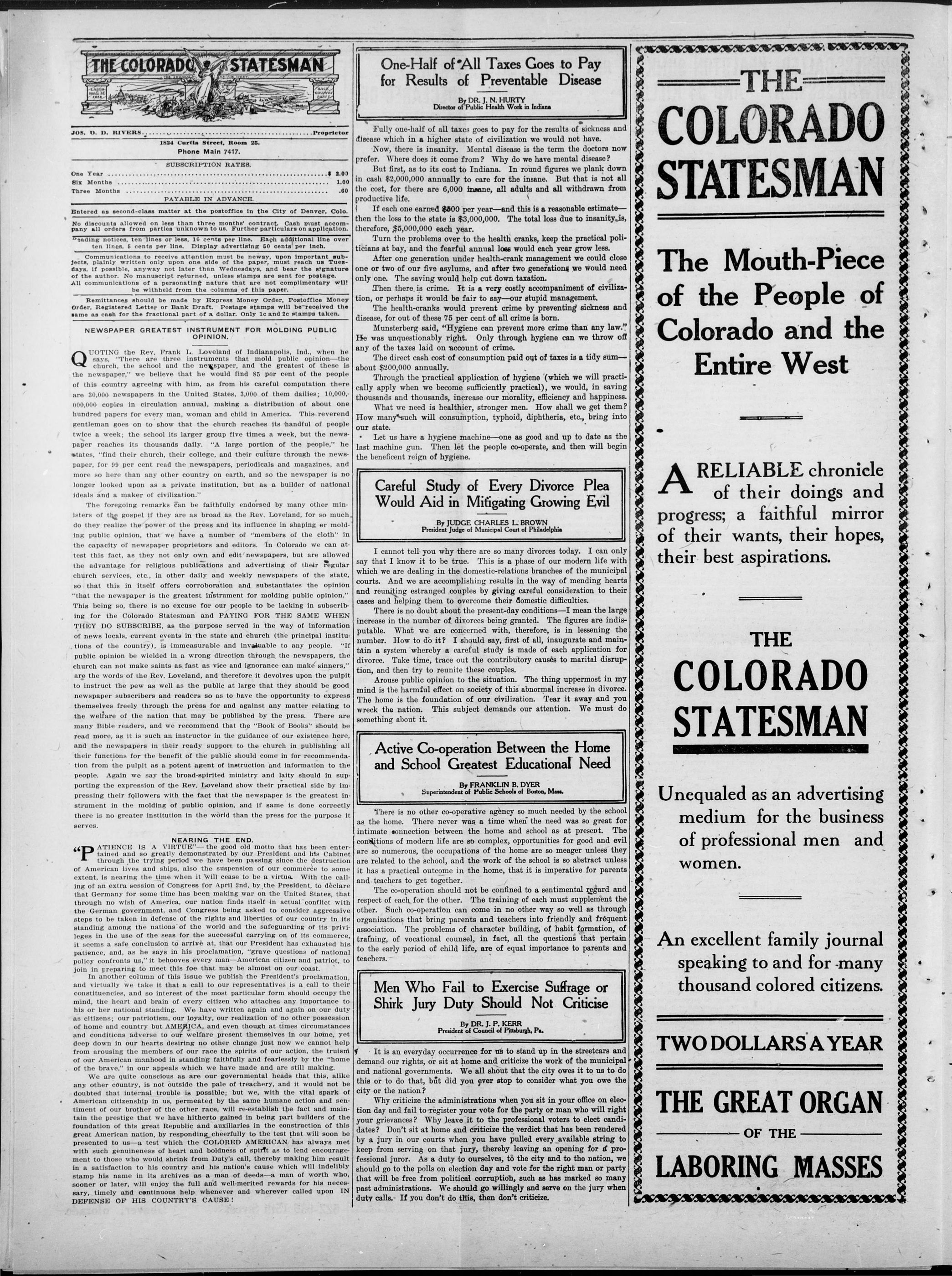
NEWSPAPER GREATEST INSTRUMENT FOR MOLDING PUBLIC OPINION.
QUOTING the Rev. Frank L. Loveland of Indianapolis, Ind., when he says, "There are three instruments that mold public opinion—the church, the school and the newspaper, and the greatest of these is the newspaper," we believe that he would find 85 per cent of the people of this country agreeing with him, as from his careful computation there are 30,000 newspapers in the United States, 3,000 of them dailies; 10,000,000,000 copies in circulation annual, making a distribution of about one hundred papers for every man, woman and child in America. This reverend gentleman goes on to show that the church reaches its handful of people twice a week; the school its larger group five times a week, but the newspaper reaches its thousands daily. "A large portion of the people," he states, "find their church, their college, and their culture through the newspaper, for 99 per cent read the newspapers, periodicals and magazines, and more so here than any other country on earth, and so the newspaper is no longer looked upon as a private institution, but as a builder of national ideals and a maker of civilization."
The foregoing remarks can be faithfully endorsed by many other ministers of the gospel if they are as broad as the Rev. Loveland, for so much do they realize the power of the press and its influence in shaping or molding public opinion, that we have a number of "members of the cloth" in the capacity of newspaper proprietors and editors. In Colorado we can attest this fact, as they not only own and edit newspapers, but are allowed the advantage for religious publications and advertising of their regular church services, etc., in other daily and weekly newspapers of the state, so that this in itself offers corroboration and substantiates the opinion "that the newspaper is the greatest instrument for molding public opinion." This being so, there is no excuse for our people to be lacking in subscribing for the Colorado Statesman and PAYING FOR THE SAME WHEN THEY DO SUBSCRIBE, as the purpose served in the way of information of news locals, current events in the state and church (the principal institutions of the country), is immeasurable and invaluable to any people. "If public opinion be wielded in a wrong direction through the newspapers, the church can not make saints as fast as vice and ignorance can make sinners," are the words of the Rev. Loveland, and therefore it devolves upon the pulpit to instruct the pew as well as the public at large that they should be good newspaper subscribers and readers so as to have the opportunity to express themselves freely through the press for and against any matter relating to the welfare of the nation that may be published by the press. There are many Bible readers, and we recommend that the "Book of Books" should be read more, as it is such an instructor in the guidance of our existence here, and the newspapers in their ready support to the church in publishing all their functions for the benefit of the public should come in for recommendation from the pulpit as a potent agent of instruction and information to the people. Again we say the broad-spirited ministry and laity should in supporting the expression of the Rev. Loveland show their practical side by impressing their followers with the fact that the newspaper is the greatest instrument in the molding of public opinion, and if same is done correctly there is no greater institution in the world than the press for the purpose it serves.
NEARING THE END
"PATIENCE IS A VIRTUE"—the good old motto that has been entertained and so greatly demonstrated by our President and his Cabinet through the trying period we have been passing since the destruction of American lives and ships, also the suspension of our commerce to some extent, is nearing the time when it will cease to be a virtue. With the calling of an extra session of Congress for April 2nd, by the President, to declare that Germany for some time has been making war on the United States, that through no wish of America, our nation finds itself in actual conflict with the German government, and Congress being asked to consider aggressive steps to be taken in defense of the rights and liberties of our country in its standing among the nations of the world and the safeguarding of its privileges in the use of the seas for the successful carrying on of its commerce, it seems a safe conclusion to arrive at, that our President has exhausted his patience, and, as he says in his proclamation, "grave questions of national policy confronts us," it behooves every man—American citizen and patriot, to join in preparing to meet this foe that may be almost on our coast.
In another column of this issue we publish the President's proclamation, and virtually we take it that a call to our representatives is a call to their constituencies, and so interest of the most particular form should occupy the mind, the heart and brain of every citizen who attaches any importance to his or her national standing. We have written again and again on our duty as citizens; our patriotism, our loyalty, our realization of no other possession of home and country but AMERICA, and even though at times circumstances and conditions adverse to our welfare present themselves in our home, yet deep down in our hearts desiring no other change just now we cannot help from arousing the members of our race the spirits of our action, the truism of our American manhood in standing faithfully and fearlessly by the "home of the brave," in our appeals which we have made and are still making.
We are quite conscious as are our governmental heads that this, alike any other country, is not outside the pale of treachery, and it would not be doubted that internal trouble is possible; but we, with the vital spark of American citizenship in us, permeated by the same humane action and sentiment of our brother of the other race, will re-establish the fact and maintain the prestige that we have hitherto gained in being part builders of the foundation of this great Republic and auxiliaries in the construction of this great American nation, by responding cheerfully to the test that will soon be presented to us—a test which the COLORED AMERICAN has always met with such genuineness of heart and boldness of spirit as to lend encouragement to those who would shrink from Duty's call, thereby making him result in a satisfaction to his country and his nation's cause which will indelibly stamp his name in its archives as a man of deeds—a man of worth who, sooner or later, will enjoy the full and well-merited rewards for his necessary, timely and continuous help whenever and wherever called upon IN DEFENSE OF HIS COUNTRY'S CAUSE!
Fully one-half of all taxes goes to pay for the results of sickness and disease which in a higher state of civilization we would not have.
Now, there is insanity. Mental disease is the term the doctors now prefer. Where does it come from? Why do we have mental disease?
But first, as to its cost to Indiana. In round figures we plank down in cash $2,000,000 annually to care for the insane. But that is not all the cost, for there are 6,000 insane, all adults and all withdrawn from productive life.
If each one earned $500 per year—and this is a reasonable estimate—then the loss to the state is $3,000,000. The total loss due to insanity is, therefore, $5,000,000 each year.
Turn the problems over to the health cranks, keep the practical politicians at bay, and the fearful annual loss would each year grow less.
After one generation under health-crank management we could close one or two of our five asylums, and after two generations we would need only one. The saving would help cut down taxation.
Then there is crime. It is a very costly accompaniment of civilization, or perhaps it would be fair to say—our stupid management.
The health-cranks would prevent crime by preventing sickness and disease, for out of these 75 per cent of all crime is born.
Munsterberg said, "Hygiene can prevent more crime than any law." He was unquestionably right. Only through hygiene can we throw off any of the taxes laid on account of crime.
The direct cash cost of consumption paid out of taxes is a tidy sum—about $200,000 annually.
Through the practical application of hygiene (which we will practically apply when we become sufficiently practical), we would, in saving thousands and thousands, increase our morality, efficiency and happiness.
What we need is healthier, stronger men. How shall we get them? How many such will consumption, typhoid, diphtheria, etc., bring into our state.
- Let us have a hygiene machine—one as good and up to date as the last machine gun. Then let the people co-operate, and then will begin the beneficent reign of hygiene.
Careful Study of Every Divorce Plea Would Aid in Mitigating Growing Evil
By JUDGE CHARLES L. BROWN
President Judge of Municipal Court of Philadelphia
I cannot tell you why there are so many divorces today. I can only say that I know it to be true. This is a phase of our modern life with which we are dealing in the domestic-relations branches of the municipal courts. And we are accomplishing results in the way of mending hearts and reuniting estranged couples by giving careful consideration to their cases and helping them to overcome their domestic difficulties.
There is no doubt about the present-day conditions—I mean the large increase in the number of divorces being granted. The figures are indisputable. What we are concerned with, therefore, is in lessening the number. How to do it? I should say, first of all, inaugurate and maintain a system whereby a careful study is made of each application for divorce. Take time, trace out the contributory causes to marital disruption, and then try to reunite these couples.
Arouse public opinion to the situation. The thing uppermost in my mind is the harmful effect on society of this abnormal increase in divorce. The home is the foundation of our civilization. Tear it away and you wreck the nation. This subject demands our attention. We must do something about it.
Active Co-operation Between the Home and School Greatest Educational Need
There is no other co-operative agency so much needed by the school as the home. There never was a time when the need was so great for intimate connection between the home and school as at present. The conditions of modern life are so complex, opportunities for good and evil are so numerous, the occupations of the home are so meager unless they are related to the school, and the work of the school is so abstract unless it has a practical outcome in the home, that it is imperative for parents and teachers to get together.
The co-operation should not be confined to a sentimental regard and respect of each for the other. The training of each must supplement the other. Such co-operation can come in no other way so well as through organizations that bring parents and teachers into friendly and frequent association. The problems of character building, of habit formation, of training, of vocational counsel, in fact, all the questions that pertain to the early period of child life, are of equal importance to parents and teachers.
Men Who Fail to Exercise Suffrage or Shirk Jury Duty Should Not Criticise
By DR. J. P. KERR President of Council of Pittsburgh, Pa. It is an everyday occurrence for us to stand up in the streetcars and demand our rights, or sit at home and criticize the work of the municipal and national governments. We all shout that the city owes it to us to do this or to do that, but did you ever stop to consider what you owe the city or the nation?
Why criticize the administrations when you sit in your office on election day and fail to register your vote for the party or man who will right your grievances? Why leave it to the professional voters to elect candidates? Don't sit at home and criticize the verdict that has been rendered by a jury in our courts when you have pulled every available string to keep from serving on that jury, thereby leaving an opening for a professional juror. As a duty to ourselves, to the city and to the nation, we should go to the polls on election day and vote for the right man or party that will be free from political corruption, such as has marked so many past administrations. We should go willingly and serve on the jury when duty calls. If you don't do this, then don't criticize.
---
THE COLORADO STATESMAN
---
The Mouth-Piece of the People of Colorado and the Entire West
---
A RELIABLE chronicle of their doings and progress; a faithful mirror of their wants, their hopes, their best aspirations.
THE COLORADO STATESMAN
Unequaled as an advertising medium for the business of professional men and women.
An excellent family journal speaking to and for many thousand colored citizens. TWO DOLLARS A YEAR
THE GREAT ORGAN OF THE LABORING MASSES
THE COLORADO STATESMAN
Mrs. S. E. Bell was in the city this week from Deadfield, Colo., on business.
Miss Cleo Hofson and Master Atwell Rose are on the program for musical numbers at the vaudeville entertainment to be given by the Woman's Club (white) this afternoon.
DOUGLASS UNDERTAKING O PANY'S FUNERAL NOTICES
Mr. George Daniel Hall, 49 yr. Beloved father of Miss Grace, J phine and Geo. William Hall, Acoma street, departed this life urday, March 17th, 3 p. m. Fun services to be held Sunday, M
Mitchell McCarroll of Chicago was among the interesting callers at this office Monday. Mr. McCarroll says that the influx of Negroes from the South is rapidly increasing the Negro population of the Windy City and that all are finding employment.
Nolan-Garner Co. is the new Ford agents at 3001 Welton, succeeding White-Walker Co. If in need of a new or good second hand car call and see them. You will receive courteous treatment whether you buy or not. Mr. Nolan is a pioneer of the city, and well known to the writer and our people.
BOB CARRUTH, the proprietor of the popular Night and Day Cafe, 919 19th Street, is again to the front with his culinary specialties, and his numerous patrons are still heralding his fame as a specialist in catering to the appetites of the most critical. His "Merchants' Lunch," in spite of the high cost of living, continues at the same price, and the quality short orders create an attraction that can only be found at this café. The public is cordially invited to visit and enjoy the good meals and best services in waiting to be had in the city.
WESTERN BEEF CO.
The Western Beef Company, 2048 Larimer Street, now under new management, offers the best bargains to the public in choice corn fed meats and guarantees every satisfaction to the mistress of the house. Old patrons will see a continuance of reliability and our new customers will have no cause to regret trading with us, as their experience will insure us their permanent patronage. Our weights stand the inspection of the law at any time and the public can feel secured in receiving full value for the deposits they make with us. Give us a trial and be convinced.
KNIGHTS OF PYTHIAS ANNUAL
SERVICE.
The annual Thanksgiving service of the above fraternal order will take place tomorrow at Shorter A. M. E. Church, at 2:30 p. m., in accordance with the custom throughout the Pythian world.
Quite an interesting program will be presented to the public, in which members of Damon No. 5, Pythias No. 11, and Smith's Lodge No. 15, the Uniform Rank and Sisters of the Court of Calanthe will participate.
All members of the order in good standing are requested to report at Fern Hall, 27th and Welton Streets, Sunday, 25th inst., at 1 p. m.
POPULAR CITIZEN PASSES AWAY
George D. Hall, known as the faithful and reliable permanent secretary of the Arapaho Lodge, Grand United Order of Odd Fellows in lodge circles, and expressman for a number of years in this city, answered the death summons last Saturday at his former residence, 4265 Acoma street.
He was very prominent in the upbuilding and stability of Arapahoe Lodge, one of the leading and strongest factors of Odd fellowship in the West, devoting the most of his time and energy to its growth and success. Untiring in his devotion to duty, exhibiting the true quality of patience, his ever smiling face seemed a beacon which guided others to serve with faithfulness and reliability the various offices they held in the order. His popularity as a citizen that will be missed was also established in his capacity as an expressman, serving all members of the community, as well as the leading firms and stores of Denver. He departs this life to join his wife in the Great Beyond, she having died about two years ago, and now leaves to mourn his loss a son, daughter, sisters, other relatives and an innumerable host of friends. Funeral services will be held tomorrow from the Central Baptist Church, 24th and California Streets, at 1 p. m., under the auspices of the Odd Fellows and other fraternal societies he was connected with.
Fern Hall, 2711 Welton, R. L. Phynix, Manager. Phone Main 2860.
John W. Masury & Sons Coach Colors, Paints and Varnishes. Wall Paper, Paints, Oils and Glass, Interior and Exterior Decorators
1454 Welton St. Phone Main S71. DENVER, COLO.
DOUGLASS UNDERTAKING COMPANY'S FUNERAL NOTICES.
Mr. George Daniel Hall, 49 years. Beloved father of Miss Grace, Josephine and Geo, William Hall, 4625 Acoma street, departed this life Saturday, March 17th, 3 p. m. Funeral services to be held Sunday, March 25th, 1:30 p. m., from Central Baptist church, Rev. Price officiating. Brothers of Arapahoe Lodge No. 2936, G. U. O. of O. F., and the U. B. F.'s take due notice and govern yourself accordingly. Interment Fairmount cemetery.
Mrs. Anna Houston, 50 years, devoted wife of Mr. Frank Houston, 2948 Welton, late of Leavenworth, Kan., member of the International Order of 12's, departed this life Monday, March 19th, 1 p.m. Funeral services were held Thursday, March 23rd, 2 p. mr., from Douglass Chapel. Rev. Price officiated. Interment Fairmount cemetery.
F. S. Reed, manager Douglass, is suffering with tonsillitis.
BOULDER NOTES.
Presiding Elder Pope will be in charge of the third quarterly meeting services of Allen Chapel on Sunday. Communion will be had at 3 p. m. Buckhalter's Jubilee singers were the big noise at Literary on Tuesday evening. Good results obtained from the special revival at Allen Chapel. Special preparations are being made by the two churches for Easter.
We are compelled to notify subscribers who are in arrears for a year and more, that unless some payment of their indebtedness is made between now and April 1, 1917, they will be struck off our mailing list after this issue. You need the news. We need the money to give you the news. Let the action be mutual by your paying up.
DENVER'S DEPARTMENT STORES.
The stores have donned their attire of Spring in a manner that eclipses every effort of former years, and so attractive is the display of Easter Goods that milady is almost puzzled where to begin.
Chief among, the department stores are The May Clothing Company, The Joslin Dry Goods Company, The Denver Dry Goods Company, A. T. Lewis & Son, and The Daniels & Fisher Stores Company, all establishing a reputation that will not be easily effaced from the memory of the average customer and purchaser, as their increasing efforts to please the public by having the latest in the world of fashion, backed up by the civility of their employés and their special publicity agencies, they merit the patronage of the general as well as the most critical. The public is advised to shop early for Easter trade as there's quite a demand for these special offerings that are made both in goods and moderate prices.
PROCLAMATION
Washington, March 21.—President Wilson's proclamation calling an extra session of congress follows:
"Whereas, Public interests require that the congress of the United States should be convened in extra session at 12 o'clock noon on the 2nd day of April, 1917, to receive a communication concerning grave questions of national policy, which should be taken immediately under consideration.
"Now, therefore, I, Woodrow Wilson, president of the United States of America, do hereby proclaim and declare that an extraordinary occasion requires the congress of the United States to convene in extra session at the capitol in the city of Washington on the 2nd day of April, 1917, at 12 o'clock noon, of which all persons who shall at that time be entitled to act as members thereof are hereby required to take notice."
PEOPLE'S PRESBYBTERIAN.
East Twenty-third and Washington Streets, J. A. Thos. Hazell, T.
T. B., Pastor.
Sermon topics Sunday, March 25,
1917:
11 a. m.—"The Cross of Christ; the Sin of Man."
5 p. m.—"Celebration of the Holy Communion."
The following persons were confirmed and received into the church last Sabbath at the 5 o'clock services: Mesdames Lula Jane Brown, Bulah Bell Brown, J. Thomas, Birdie Brooks, Evelyn Cowan, Miss Captola Fry; Messrs. George Brooks, Hampton Cowan, J. Ford and John Edward Sloan.
Tomorrow is the last Sabbath in the Presbyterian year, 1916-1917. The communion of the Lord's Supper will be observed at 5 o'clock. All the members are enjoined to observe this Sacrament of the Church. The new members are especially requested to take their first communion in this church at that service.
The Woman's Presbyterial held their annual session with the Corona church last Tuesday. The People's church was represented by Mrs. M. E. Morrison, president of the Woman's Missionary Society. Miss Mabel Cole, a member of the Hazell Chapter of the Westminster Guild, and Mr. V. Spratlin, organist of the church. Apart from participating in the business of the day these representatives sang accompanied by the organist.
The annual meeting of the Presbytery of Denver convenes Tuesday, April 17th, at the South Broadway Presbyterian church (Mexico and South Grant). Rev. J. A. Thos. Hazell, with an elder, will represent the People's church. The Rev. O. J. McLeod, with an elder, will represent the Union church at Dearfield.
At the session meeting last Monday night, the following persons were recommended to the congregation for election to the following offices of the church: Messrs. Evans and Gibbs for re-election to the Eldership for a term of three years, the class to expire March 31, 1920; Mesdames Janette Thomas and Laura Hill, superintendent and assistant superintendent respectively for the Sunday school for a term of one year, the class to expire March 31, 1918; Miss Isabel Chapman, re-elected president of the Christian Endeavor for one year; Messrs. J. Sloan and H. Cowan to the diaconate board for a term of two years, class to expire March 31, 1919; Mesdames Bessie Hughes and Lula J. Brown to the board of deaconess for a term of two years, class expires March 31, 1919.
Ordination and installation of the above named officers elect will take place on Palm Sunday at the 11 o'clock services. The public is invited to worship with us at this hour.
Oxdansen and Folk Dance given by Pride of Denver Tabernacle 521 at Old Colony Hall, Thursday, March 29. Willie Knight, manager. Morrison's orchestra. Admission, 25 cents.
Oxdansen and Folk Dance given by Pride of Denver Tabernacle 521 at Old Colony Hall, Thursday, March 29. Willie Knight, manager. Morrison's orchestra. Admission, 25 cents.
Influence on Character.
In the molding of character nothing matters so much as influence. It is the heart of all education, the inner secret of home and of school. More than any wit or genius is the value there of simple goodness, "moral thoughtfulness." Surround a life with its rays and dormant goodness will not fall to come to birth.
More Metamorphosis.
Man used to have a hobby. Now if
he has a hobby, it is a bug.
All-Star Negro recital; People's
Presbyterian; Thursday night, March
22. Admission 25 cents.
DIRECTORY.
Pride of Denver Tabernacle 521—Meets 2nd and 4th Tuesday of each month at 2540 Washington St.
Oliver Royal House of S. M. T. Meets 2nd Monday of each month at 2540 Washington St.
FOR RENT.
FOR RENT—A 5-room frame house,
320 24th St. Apply at 1824 Curtis St. Room 25.
FOR RENT—5-room modern brick,
close in; also 3 partly furnished front rooms. Apply at this office, 1824 Curtis St. Room 25. Key 1837 Ogden St. Anderson, Agent.
FOR RENT—Nicely furnished rooms,
strictly modern; prices reasonable. Rooms for light housekeeping for man and wife. 2443 Tremont Place, Denver.
Keep off the date of EASTER Monday, April 9th. Masonic entertainment at East Turner Hall.
PYORRHEA SPECIALIST.
Sundays and Nights by Appointment.
Office Hrs. 9 a.m. to 12 m., 2 to 6 p. m.
DENVER, COLO.
Less and Less
for
Your Dollar
vastly
expanded
service
More and More
for
Your Dollar
An Economic Problem
While the cost of nearly every necessity of life has been steadily increasing, the rates for telephone service have remained practically the same.
The buyer of foodstuffs, although paying much more, receives but sixteen ounces to the pound. On the other hand, the telephone user is constantly receiving more and better service and paying the same or even a less rate than he did a few years ago.
Gradually the value of telephone service has been increased by a constant increase in the number of telephones added to the system and by improvements and refinements in the telephone art.
Steadily, too, the cost of every piece of equipment and of all supplies, copper wire, iron wire, poles, hardware, etc., used in the business of furnishing service, has increased enormously.
In other words, our revenues have not increased in proportion to increased value of the service or in proportion to increased cost of furnishing the service.
This presents a serious problem in which the public and the Company are mutually interested.
The Mountain States Telephone and Telegraph Co.
THE DENVER Is Especially Featuring
STETSON HATS FOR THE NEW SEASON
THE SPRING SHOWING OF STETSONS IS IN READINESS FOR YOUR INSPECTION
THE COMFORT DERBY—In your size will fit you perfectly—no "breaking-in." Come in today and try on a number of the new hats—it is not necessary that you purchase.
THE DENVER DRY GOODS CO.
THE FASHION OF THE TIME
O
The suits we are showing at this very moderate figure will appeal to you.
A noteworthy showing of the new models for Spring, 1917, in ready-to-put-on suits. They are so correct in style, so carefully tailored, and the fabrics are so thoroughly dependable that any man or young man could not be other than pleased with them after a careful inspection.
Our stock is very large, embracing all desirable models. Among the soft Stetsons you will probably take the most interest in the "Town Topic"—the Stetson Feature Heat. It has a rather flat set brim, slightly curled; narrow binding; handsome silk band with novelty edge; bow at the back. Embodying the style note of the day as only a Stetson can. This new hat is decidedly to most men.
UNCLE SAM HAS FIRST LINOTYPE
Places It on Exhibition in the Smithsonian Institution at Washington.
EARLYMACHINESWERECRUDE
Model Now on Display of Much Interest as Showing Great Progress Made in Type-Setting Equipment.
Uncle Sam now has on exhibition the first linotype machine that was made. The machine has been installed in the Smithsonian building at Washington. The exhibit is of particular interest as showing how crude was the first attempt to produce a type-setting machine which now has reached such a high state of perfection.
This particular idea, the invention of Mergenthaler, revolutionized printing. It was the first machine to cast a complete line of type ready to print from
There are three machines exhibited in the Smithsonian halls which are closely related to the development of this contribution to the art of printing.
```markdown
```
The First Linotype.
Two of them are early models which indented strips of papier mache (matrices) from which stereotype casts were made. Some of these earlier machines consisted of a cylinder which held the type faces and the mechanism to bring it into position to indent the paper—all of which was controlled by the pressing of a key. This style, called a rotary impression machine, was built mainly by the late Ottmar Mergenthaler in 1877-78 under the auspices of J. O. Clephane, who later organized the National Typographic company. The second, called a stereotyper, worked well, but the casting of the slugs was found to be unsatisfactory, and Mr. Mergenthaler undertook the invention of one machine to do all the work.
He started work with L. G. Hine early in 1883, making a small experimental machine, which printed but 12 letters at a time, but demonstrated the fact that a full-sized machine built on this principle would be an enormous step in advance. This was accomplished when the large machine was built—the third of the series exhibited in the Smithsonian building—which was the first machine from which linetype bars, or slugs, were cast. On the printing face the characters formed a complete and solid line of type, similar to a line of individual type soldered together, and they were ready for use; a number of lines making up a column or page—just like the individual lines of this article.
How Machine Operated.
The matrices or dies for the different letters used in this first machine were on long tapered bars, arranged side by side vertically, each containing a complete alphabet, other characters and spaces. The operation of the keys in the keyboard set a number of stops, one for each letter depressed, and when the whole line was set, the entire line of matrix bars was lowered until the different bars came into contact with their respective stops, which were at various heights, so that at a certain point the characters on the matrix bars formed a line of reading matter. There was no automatic justification, or spacing, to make the line the exact length required, but it was left to the operator, who struck the space key and filled in with thick or thin spaces on the tapering matrix bars. The line of matrix bars was then clamped together, a mold was interposed between the matrices and a pot of molten metal, which moved up the slot in the mold, and the linotype bar was cast. The line was then unclamped, the matrices automatically raised to their normal positions and similar operations for casting the next line were performed.
TOY INDUSTRY GROWS
TOY INDUSTRY GROWS
Huge Increase in Number of Factories in Country.
Capital Employed in Business Has Increased 11,950 Per Cent Since 1859, Uncle Sam Reports.
The American toy industry has advanced by leaps and bounds during the past 50 years and has gained additional prestige as a result of the European war, according to announcement made by Uncle Sam through the department of commerce.
Since 1850, while the growth in population has been only 219 per cent, the number of establishments in the United States where toys are made has increased 2,317 per cent; the number of wage-earners employed in the concerns has jumped 4,381 per cent, and the capital invested in toy manufacture has increased 11,950 per cent.
In 1859 the United States imported nearly twice as many toys as it produced. Twenty years later conditions were reversed and the country was producing more than twice as many toys as it purchased abroad. In 1914 the value of the output of American-made toys was 1.6 times the value of the year's toy imports.
In the fiscal year 1912 the United States imported from Germany $1.384,372 worth of dolls and $7,596,757 worth of other toys. For the fiscal year 1916 the doll imports dropped to $617,333 and the other toy imports from Germany to $1,758,683.
In the past the United Kingdom and Canada have been the best customers for American-made toys.
"GET THE MAP HABIT" IS TRADE EXPERT'S ADVICE
Uncle Sam's Commercial Attache in Orient Finds Ignorance of Geography Here.
"Get the map habit" is the gist of the advice given by Julean Arnold, American commercial attache to China and Japan, to those of his fellow-countrymen who are desirous of doing business in the far East. In the course of an interesting and valuable report to the department of commerce at Washington, he says:
"In touring the United States to assist American manufacturers and merchants to a better understanding of their trade opportunities in the orient, I found a most deplorable dearth of maps in chambers of commerce, manufacturing plants and business offices. Even where commercial organizations were equipped with foreign-trade departments, I seldom found a map of a foreign country in evidence in such departments. Sometimes when an inquirer asked about the location of a city in the orient, I found the commercial organization through which I was working unable to furnish even an atlas to which I might refer my inquirer.
"The American people must get the map habit if they are to take up seriously the question of foreign-trade extension. When the maps are on the walls they will be used, and when the maps are not on the walls, in nine cases out of ten, atlas or other reference books will not be used. When the maps are on the walls, interest in foreign countries will be increased." Mr. Arnold insists that a knowledge of the geography of the country where Americans wish to trade is absolutely necessary if business relations are to be satisfactorily developed in the future. Throughout the United States, according to him, he found instances of deplorable ignorance of geography.
"For some unaccountable reason," he writes, "most people seem to look upon China as a country entirely in the tropics. When I mentioned Peking as being in the same latitude as Philadelphia, there was much genuine astonishment displayed."
HIGH COSTS HIT UNCLE SAM
Expense of Feeding Each Man in Army
More Than Doubled in the
Past Twelve Years.
Uncle Sam, the largest individual
housekeeper in the United States, is
the hardest hit of all by the high cost
of living. He spends between $9,000,
000 and $10,000,000 a year to feed his
soldiers and sailors alone.
In the last 12 years his food costs
have more than doubled. The army
ration today is approximately 31
cents; in 1898 it was less than 16
cents.
It costs Uncle Sam more money to
feed the boys at Fort Hamilton, N.
Y., than it costs to feed the soldiers
in Manila.
The reason for this is meat.
Chinese beef is now bought at 10 and 11 cents a pound at Hong-Kong and other points. New Zealand and Australian mutton runs cheaper than the American product. In addition to this, rice, prunes, peaches and other commodities, including beet sugars of the Pacific coast travel to the Philippines in army transports and the freight charge, which figures in the prune and peach eaten in the East, is eliminated.
Onion Seed Imports Grow.
There were 74,987 pounds of onion seed valued at $83,132 invoiced at the American consulate at Teneriffe, Canary Islands, for the United States during 1916 compared with 39,634 pounds valued at $40,828 for 1915, Uncle Sam reports.
ILLITERACY IS ON DECREASE IN U. S.
ILLITERACY IS ON DECREASE IN U. S.
Lowered in Twenty Years From 13.3 to 7.7 Per Cent of Population.
RISES AMONG FOREIGN-BORN
Big Improvement Is Shown Among Native Whites and Negroes—District of Columbia Leads in Ten-Year Period.
Decrease in illiteracy was greater in the District of Columbia during the period from 1890 to 1910 than in any state in the Union, according to statistics just published by Uncle Sam's bureau of education.
Illiteracy in the district decreased 62 per cent during this time, while the nearest competitor to the district was Kansas, with a decrease of 60 per cent. Maryland showed a decrease of 54 per cent and Virginia 50. New York remained stationary, while Oklahoma showed an increase of 3 per cent and Connecticut an increase of 13 per cent.
Percentages of illiteracy in the District of Columbia in 1910 was 49 per cent, this ratio being higher than the percentage of illiterates in the population of Iowa, Nebraska, Oregon, Washington, Idaho, Kansas, Utah, South Dakota, Minnesota, Indiana, North Dakota, Michigan, Ohio, Wisconsin, Wyoming, California, Colorado, Illinois, Vermont, Maine, Missouri, New Hampshire and Montana. The percentage of illiteracy in the District of Columbia was less than in Massachusetts, New York, New Jersey, Oklahoma, Pennsylvania, Connecticut, Nevada, Maryland, Rhode Island, Delaware, West Virginia, Texas, Kentucky, Arkansas, Tennessee, Florida, Virginia, North Carolina, New Mexico, Georgia, Arizona, Mississippi, Alabama, South Carolina and Louisiana.
The percentage of illiteracy in the United States has been lowered during 20 years from 13.3 per cent in 1890 to 10.7 per cent in 1900 and 7.7 per cent in 1910; but the number of illiterates has decreased less than 15 per cent and the number of foreign-born illiterates has increased 43 per cent.
Foreign-Born Illiterates.
Since 1880 the percentage of native whites to total population has increased and the percentage of illiteracy among them has diminished. The percentage of foreign-born to total population has increased as well as their percentage of illiteracy. The per cent of negroes to total population has decreased, and the decrease in percentage of illiteracy among them is marked.
Every class of illiterates has decreased except the foreign-born illiterates; their increase has outbalanced the whole decrease of all other classes combined—native whites, negroes, Indians, Chinese, Japanese—during the last 35 years.
Sun Now Never Sets On The United States Flag.
Great Britain is no longer the only nation that can say that the sun never sets on its territory. Since the United States acquired the Danish West Indies it can make the same boast, says Youth's Companion.
Hitherto the little island of Culebra, which is virtually a part of Porto Rico, has been our most easterly point of land, and the island of Balabac in the Philippines our most westerly point. The distance between them is just a little less than 180 degrees, or half the circumference of the earth. St. Croix, in the Danish West Indies, is 38 miles farther east than Culebra—enough to bridge the gap. Just as the sun is rising on St. Croix it is setting on Balabac.
UNCLE SAM AIDS HOUSEWIVES
Plans to Assist In Solving Servant Problem by Raising to New Dignity Work of Domestics.
Uncle Sam plans to enlist the cooperation of housewives to solve the servant problem and raise to a new dignity the work of domestics.
Immigration Commissioner Caminetti, who has charge of the employment service, said:
"By developing the consideration of this work throughout the country, by endeavoring to standardize the various kinds of work in households, by truly dignifying household work, a field will be opened to thousands of women and girls who hitherto have stayed away from it."
Kangaroo Skin Imports
The latest government statistics show that there were 1,072,494 pounds of kangaroo skins imported during the 11 months ending May 31, 1916, as compared with 672,339 pounds in 1915 and 1,225,679 pounds in 1914 for the same period. The imports last year were valued at $633,301, or an average of about 59 cents a pound. There are less of these skins received than of any other variety used in making shoe leather, but genuine kangaroo skins make excellent leather and large quantities would be tanned if the skins were available.
TORPEDO IS COSTLY
TORPEDO IS COSTLY
Every One Fired Costs Uncle Sam $7,000.
On Land, Machine Gun Is Most Expensive, Eating Up $12 Every Minute It Is in Action.
A few years ago theatergoers were much interested in a production in which the hero had to get rid of a million dollars in a year or lose a larger estate.
Figures just compiled by Uncle Sam's ordnance officers show that if the hero had declared a little war and it had lasted a few weeks he would have experienced no difficulty in ridding himself of his wealth.
The figures show that each time Uncle Sam fires a torpedo it costs $7,000.
Ordnance expenses in time of war range from a maximum of $7,000 for each torpedo to 2 cents for each bullet fired from a revolver.
If the dreadnaught Arizona gets into action and fires a broadside from its 12 14-inch guns and auxiliary cannon it will cost just $15,000 for each of these performances.
On land the machine gun has about the most expensive appetite of any of Uncle Sam's weapons. The machine gun guns between 500 and 600 bullets of .30 caliber a minute, which makes it cost $12 for each 60 seconds of activity.
Every bullet fired from a rifle by an infantryman or cavalryman costs 5 cents, while the pistol shots fired by cavalrymen, officers and non-commissioned officers cost 2 cents apiece. The shells and shrapnel used by field artillery cost about $20 each, while a projectile for a 14-inch land gun costs $600.
The torpedo, however, is not only the most expensive means of destruction used in American warfare, but it is the most delicately constructed weapon at Uncle Sam's command. It is virtually a launch, being equipped with two screw propellers moving in opposite directions and being 18 or 20 feet long. It will continue to plow the sea until its motors run down or it hits the mark.
Nitroglycerine and copper contribute most heavily to the expense of torpedoes. Expert workmanship ranks next as an item of cost, for the delicate parts of a torpedo must be accurate in their construction to one-five-thousandths of an inch. A thickness or thinness of more or less than one-five thousandth of an inch in any part of the mechanism would prevent it from working properly.
TRADE TRAINING IS LACKING
Uncle Sam's Chief Foreign Commerce Booster Says Facilities Are Not Sufficient. Dr. Edward Ewing Pratt, chief of Uncle Sam's bureau of foreign and domestic commerce, declares that the United States lacks facilities for preparing men for a career in foreign trade.
"The great demonstration for foreign trade in this country," he says, "began literally before the echoes of the first guns in Europe died away. It was really ten months later, however, before we began to get our bearings and before the business men of our country actually get down to brass tacks in this foreign-trade business—some of them have not got there yet. But in spite of all this noise, backed up as it has been recently by a considerable amount of real solid activity, the universities and colleges have not yet awakened either to the need in the every-day business world or the opportunity for practical service that lies before them.
"It is not sufficient for the professors to point to a few language courses, many of which do not really teach the languages; and to a general course of commercial geography; nor to a course on the history of South America; nor even to a general course on foreign trade. Foreign trade has a technique of its own. No doubt many of the courses in the ordinary school are excellent as leading to foreign trade. But the mere assembling of a few paper courses under a denomination which will attract students interested in the subject is not sufficient.
STARTS NEW MARKET SERVICE
Uncle Sam Believes System Will Aid in Stabilizing Live Stock and Meat Prices.
Uncle Sam has established a new market news service on meats, supplying telegraph reports of conditions in three representative eastern meat-consuming centers. These reports are now available daily to the trade and to consumers in New York, Boston, Philadelphia, Chicago, Kansas City and Omaha. They are intended to place at the disposal of the meat producer and of the wholesale and retail trade useful information in regard to supplies on hand, the demand for the various kinds and grades of meat, and other factors influencing the trade.
New York, Boston and Philadelphia, where the conditions are representative of those in other large consuming centers, government agents obtain early each morning all available information and send it by wire to Washington and to the eastern and western local offices of the office of markets and rural organization. There it is placed early in the business day at the disposal of all interested persons.
The Curtis Park Floral Company
FLORAL DESIGNS PUT UP WHILE YOU WAIT
CHOICE PLANTS AND CUT FLOWERS CONSTANTLY ON HAND
GREENHOUSES: Thirty-Fourth and Curtis Streets
TELEPHONE, MAIN 1511 DENVER, COLO
The Champa Pharmacy
Twentieth and Champa,
Is the place to get your
DRUGS, CHEMICALS AND PATENT MEDICINES
WE SERVE DRINKS.
Prescriptions Our Specialty.
Phone us and we will deliver the goods to all parts of the city.
JAMES E. THRALL, PROPR.
PHONE MAIN 2425.
When You Want
· The Heads, Feet, Tails, Snouts, Neckbones or Chiterlings, or any other part of the hog except the squeal, go to
The
WARD AUCTION
COMPANY
Sales Daily at 2 p.m. Office Fur-
niture a Specialty.
PRIVATE SALES AT ALL TIMES
HAVE MOVED TO—
1723-39 GLENARM ST.
PHONE MAIN 1675.
THE BEST ICE CREAM AND
CANDIES AT
O.P. BAUR & CO.
CATERERS AND
CONFECTIONERS
Phone: 168.
1512 Curtis Street, Denver, Colo.
JOSEPH CARTER
Express, Moving,
and Storage
COAL AND WOOD
PROMPT DELIVERY.
2415 WASHINGTON STREET.
TELEPHONE YORK 6668
J. H. Biggins
GENERAL FURNITURE REPAIRING
AND UPHOLSTERING.
WORK GUARANTEED.
1417 East 24th Avenue, Denver, Colo.
2300-6 Larimer Street Phone Main 1461
ORIENTAL RESTAURANT
Chop Suey, Noodles and Short Orders
Phone Main 4896
1848 Arapahoe
乐泽轩
Miss M. Cowden Hair Dressing Parlor
Shampoo, cutting and curling. Scalp treatment, hair tonics, hair straightening, manlouring. Stage wigs for rent; theatrical use and masquerades. Goods delivered out of the city. All shades of hair matched by sending sample of hair; also combings made up.
Cheapest Switches 50 Cents
1219 21st St. Denver, Colo.
DO IT NOW Subscribe for THIS PAPER
Ten Minute Classics Famous Tales and Legends Told in Brief Form
Copyright by J. W. Muller
Playwrights, authors and poets find a deep fount of inspiration and story in the troubadour literature of the middle ages. Most famous of these tales are the French tales of the thirteenth century, and from one of them is taken the story presented today. It deals with that part of the Champagne from Soissons to Reims, where today a long line is held desperately by French and Germans, who are face to face, and in some parts almost within touch of each other.
Messie William was a loyal knight of Champagne who was honored by all men who prized truth and mobility. His fortune, however, did not equal his merit. He possessed a castle, it is true; but the only income that he had was obtained painfully in tournaments, out of the ransoms of his overthrown adversaries.
He owned only one thing that was valuable. It was his horse. Gray it was, flower-bright of coat. Never had men seen another such steed, so proud, so impetuous and yet so dainty of foot. Men near and far coveted it and offered him wealth for it, but he would not listen. Between these two, knight and horse, there was a great love as between brothers.
Poor as he was, Messire William set his heart on the daughter of the richest lord in all the Champagne. She was as good as she was beautiful, which is no scanty praise, since the minstrels all sang that she was in truth part and parcel of the lovelliness of their land.
She gave her heart to the tall, splendid knight, but never could they meet. Her father kept her close, never permitting her to pass from the battlements and walled gardens. Still the knight rode to her castle every day, and every day they saw each other and talked love, though they could do it only through a gap in the masonry of a great wall.
Although he well knew the futility of it. Messire William ventured at last to ask her father for her hand. "Think you I am so besotted as to give my child to a knight who lives by play?" roared the old man. "She shall marry no beggar! I have not yet found the man, from Solssons to Reims, and from Reims to Chalons, or from the Lorraine to Germany, who is rich enough to match me! This fruit is too high for your seeking!"
"Cursed be your father's wealth!" said the knight when he saw his sweet-heart again.
"I would go with you gladly, and be a beggar!" said she. "But my father is old, and prayers will not move him, for age and youth cannot understand each other." Yet I would counsel you. Have you not an uncle, fully as rich as my father? And do these two not greatly honor each other? Why do you not ride to him and ask for his intercession?
The knight took courage and rode to his aged relative, who not only agreed to help him, but started at once, telling the knight to return to his own castle and wait for word from him.
It was an evil word that reached him after a week of anxious waiting. A friend brought him the news that his uncle had wooed indeed, but not for his nephew. He had wooed and won for himself, and the girl, locked safely within the castle, could do nothing but wring her hands.
Scarcely had the news reached the poor knight before one of the nobleman's varlets arrived to ask him for his steed. "My Lord prays you," was the message, "to lead your beautiful horse to carry his daughter in honor and state to the church on her wedding morn."
"May heaven bless my wicked uncle never for this foul, treasonable deed!" lamented the knight. "He has killed me! Cain wrought no redder wrong! Yet I will send my horse gladly to her who gave me her dear love. It is the last service I can do her. Never shall I hear her sweet voice again or see her come to meet me, dainty-fair! Saddle the horse with my best gear and lead it to the most tender of maidens!"
That night the wedding company in the rich man's castle feasted and made so merry that when the warders sounded their trumpets at dawn to awaken all for the wedding journey to the church, city guests and guards were alike sleepy and before they had ridden far they were nodding in their saddles.
Even those who were detailed to guard the bride rode with closed eyes. Soon there was none to guide the bride's horse, for she rode weeping with thoughts far away, and the reins lay idle on the animal's neck.
When the procession entered a devious forest trail, the horse, being left to itself, turned off on his own account and entered a hidden woodland path that led to Messire William's home.
The weeping bride became aware at last that she was alone; but as the horse ambled on with great gentleness, and she did not know which way to go, she permitted it to take her whither it would. Soon it stopped before a castle.
A warder ran to the knight, who was wan and broken from long hours of unavailing grief. "Oh, sir!" cried the man. "There is before the draw-bridge a most wondrous lovely woman, clad richly in scarlet and gold. Never have we seen any so slim, so dainty, so sweet! And, lord, she rides on your horse!"
The knight bounded down the stairs and through the portal. He lifted down the bride, kissing her a hundred times and more. Then he sent for a chaplain and led her to the chapel of his house where they were married forthwith.
In the meantime, there was wild trouble among the wedding party. The old lord and the old bridegroom tore their beards and laid lustily with whip and boot on the guards, who made mad clamor, blaming each other. To them at last spurred a rider sent by Messire William with this message:
"Sir, my master sends you assurance of his great friendship. He also charges me to say to his uncle, who betrayed him so shamefully, that he pardons him the more easily for the reason that your daughter has given herself to him as a gift this day."
The old lord listened with wonder and anger. But he took thought to himself, and concluded that since she was married, nothing he could do would undo it. Therefore, presently, all the company rode peacefully to the knight's castle, where the old noble embraced his undesired son-in-law with all courtesy, while the graybeard of a bridegroom who was not a bridegroom tried in vain to discover a few crumbs of comfort that might console him.
Falling in this, he went home and died, which was a favor to Messire William, since all his wealth went to the knight. And there is no troubadour in Champagne who ever has told or sung this story who was not forced to add, in accordance with the truth, that there never was a horse in all the world that was so honored and beloved as the horse that stole the bride and brought her to her bridegroom.
The famous stories of the middle ages were preserved by three agencies—the trouveres, who lived usually among noblemen, and often were poets and originators; the troubadours, who were wandering minstrels and generally recited other men's tales and verses; and the learned monks, who set the more important legends down in writing. One of the latter was a monk of Soissons, Gautier de Coinci, who did a great service by setting down tales in French instead of Latin. Shakespeare, Montaigne, Browning, Anatole France and many others have used these tales to make versions of their own.
SUNSET ON LAKE SUPERIOR
Writer Enthuses Over Beautiful Picture Painted by Old Sol at the Close of the Day.
A sunset on Lake Superior! Match it, in its resplendent beauty on a late November day, if you can. The clouds that had darkened the sun as the Transcontinental Limited sped along the precipitous shores, melted away, leaving narrow streaks, like ribbons of gray floating above the water's rim. Dappled gray clouds in masses clung to the zenith. The slowly setting sun began to paint its own heroic picture. The ribbons of clouds changed from gray to pearl, from pearl to amethyst and then to richest gold. The convoluted masses overhead vividly reflected these changes. The quiet waters of the lake shone like a mirror of polished bronze. The sun was sinking fast. While the passengers were voicing their delight, the last ray of the sun disappeared, and lake and rocky shore sank into the shadows of night. As the trin climbed above the lake its waters were left out of the range of vision, but, strangely enough, the lake seemed to appear again in the distance, with low-hilled islands outlined in a faint glow of red. We discovered that what seemed to be islands were floating clouds, and what seemed to be the water in which they rested was an illusion. It was caused by the clear atmosphere lit by the gray light of fast-falling eventide. It was beautiful and impressive, but an illusion that quickly disclosed itself and melted away as the train sped on.—John A. Sleicher in Leslie's.
The Husband—You're not economical.
The Wife—Well, if you don't call a woman economical who saves her wedding dress for a possible second marriage, I'd like to know what you think economy is.
Similar but Different.
"Did you get out and stretch your legs when the train stopped?" asked the passenger with the long beard.
"Same thing," rejoined the passenger with the polished pate. "I had them pulled at the lunch counter."
That Settled Him.
Similar but Different.
UNCLE SAM LOANS BOOKS TO PEOPLE
Makes If Possible for Anyone to Make Use of Great Congressional Library.
PURPOSE TO AID RESEARCH
Object Is to Make Unusual Volumes Which Cannot Be Obtained Elsewhere Available to Students Everywhere.
Comparatively few persons know that they can take advantage of the great congressional library maintained by Uncle Sam at Washington without going to the national capital.
There are thousands of people all over the country who constantly make use of the library of congress and yet have never been within gunshot of the District of Columbia. The important and yet little-known branch of the activities of the library of congress which makes this possible was explained by Herbert Putnam, the librarian of congress.
"The library of the British Museum," he said, "is purely a reference library. It is a magnificent collection, but it is of use only to those who can go to London to consult it. The library of congress is, of course, used as a reference library by thousands of people every year. But it is also a lending library, and therefore it renders to the American citizen a service which the British Museum library does not render to the British citizen.
"This is a work in which the library of congress is following the lead of some of the great libraries of Europe, especially of those of Germany.
"Of-course, there is much to be said for the purely reference library. Some of our material—such as the valuable documents placed by their owners for safe keeping—is used only for reference purposes. Sometimes transcripts of it are sent out.
Sent to Local Libraries.
"The system on which books are sent out to borrowers is as follows: If a man engaged in serious research needs a book which his own local library lacks, which it cannot naturally be expected to have, he may ask his local library to get it for him from the library of congress. This will be done, and his only expense will be the cost of the transportation of the volume.
'The loan rests on the theory of a special service to scholarship which it is not within the power or the duty of the local library to render. Its purpose is to aid research calculated to advance the boundaries of knowledge, by the loan of unusual books not readily accessible elsewhere.
"Therefore, books that should be in a local library or that can be borrowed from a library having a particular duty to the community from which the application comes (a state library, for example), are not lent by the library of congress. Neither are books that are inexpensive and can easily be procured, nor textbooks, nor books for the general reader, nor to be used for recreation or self-culture. But unusual books to satisfy unusual needs—these the library of congress is glad to lend.
"And we find that people all over the country are eager to take advantage of this service. We are constantly sending out books to borrowers sometimes as far distant as San Francisco and Cuba. During the year ended June 30, 1914, we sent out 2,030 volumes. During the year ended June 30, 1915, we sent out 2,258 volumes, and during the year ended June 30, 1916, we sent out as interlibrary loans 3,460 volumes to 303 different libraries in 48 states and in Canada.
Music Also Loaned.
"We lend music on the same condition as books. We do not, however, allow musical scores so lent to be used for public performances.
"We exclude from material that may be loaned that which is in constant use at Washington, the absence of which from shelves of the library of congress would be an inconvenience to congress, or to the executive departments of the government, or to reference readers. These conditions exclude from the loan system, as a rule, genealogies, local histories, newspapers and periodicals. Only in exceptional cases do we send out material which, because of its size or its character, requires expensive packing or high insurance."
Doctor Putnam seems to be more interested in the library as an institution serviceable to the whole country than in the library as a literary treasure house. He showed the reporter files of letters from all parts of the country, requests for the loan of books sent by scholars through their local libraries. And he explained in detail the service rendered by the library of congress in sending out lists of authorities and answering questions through the mail.
"This has developed," he said, "into a very significant part of the library's work. The library issues numerous lists which, if they are not contributions to science, in the sense that they advance knowledge of the subject matter, are something more than mere accumulations of titles. They are lists of books, documents, and magazine articles having to do with subjects of current interest. They are distributed widely to libraries throughout the country."
GREAT SAVINGS SHOWN
Patents Issued in Year Remarkable in Number and Character.
Among Inventions Reported Are Several Greatly Decreasing Coal Consumption in Power Plants.
Invention in this country reached high-tide during the calendar year 1916. Forty-two thousand separate patents were issued to inventors by Uncle Sam. It is not the number of patents issued, however, that is worthy of note, but the character of the inventions. The patent office deals with all the efforts of the world in every field of industry to advance the useful arts. Great interests are involved, not merely of private, but of public concern, in the discoveries that are listed with the patent office.
As an illustration of what the discoveries of the 12 months mean, reference may be made to the fact that one concern in Chicago reports that it has effected a reduction in coal consumption from nearly seven pounds a kilowatt hour to 2.7 pounds a kilowatt hour, as a result of a new invention. A New York rapid transit company introduced improvements in the year which, according to the patent office, have caused a drop in coal consumption from $2\frac{1}{2}$ pounds a kilowatt hour to $1\frac{1}{2}$ pounds a kilowatt hour. An electric plant, through some new invention, it has shown, is now able to generate electricity from coal more cheaply than can be done from the waters of Niagara falls. These great economies are due in large measure to new inventions relating to automatic stokers and regulators attached to furnace construction, to forced draft and to coal-handling machinery.
The year brought new and valuable inventions that had to do with wireless telegraphy, telephony, the control of torpedoes, searchlights and gun pointing, vacuum cleaning, X-ray apparatus, liquefaction of air to produce oxygen and nitrogen for commercial use, flying machines, the moving picture and mercury vapor lamps. For a period of some five years an industrial fellowship maintained by trained scientists have devoted their time to the study of methods of breadmaking, with the object of producing better bread. In the last calendar year, certain of the processes developed through this study were patented and put into operation.
Better nourishment of the yeast has reduced the amount required in raising the bread and maturing the dough with the consequent lessening of the amount of flour and sugar used up by the yeast and converted into carbon dioxide and alcohol. The savings of these and other economies to those employing the novel processes patented during the year are estimated to amount to more than $1,000,000 a year. This estimate is based on the present high scale of prices, but on any scale of prices would, it is asserted, be enormous. The patents in the electrical field during the year were numerous. In the field of farming implements there came the improved tractor engines better apparatus for digging, irrigation and drainage canals, improved beet harvesters, etc.
BIG GAIN IN POTASH OUTPUT
Production During the Calendar Year 1916 Reached Value Ten Times as Great as in 1915.
A remarkable expansion in the American potash industry has resulted from efforts to make the United States independent of foreign sources for the potash used in munitions and for other purposes, and although the boom did not get under way until late in 1916, production during the calendar year reached a value ten times as great as that of 1915.
The 1916 production is estimated, in a preliminary report published by Uncle Sam at 10,000 tons, worth $3,500,000.
"The largest output," the report says, "has come from the Nebraska alkallakes, but the natural saline deposits elsewhere are now just beginning to make important contributions. A great deal of publicity has attended the efforts to obtain potash from kelp, but a similar organic source of high-grade potash has been quietly developed, which has proved more productive."
Becomes U. S. Citizen Again to Aid Uncle Sam.
The solution of the paradox, "When is an American not an American," has just been discovered by Benno Wieler, born in Nebraska, and more recently engaged as a farmer in Canada. Wieler went to Canada some years ago and, in order to obtain a patent on a farm there, became a naturalized citizen of Great Britain. A few weeks ago he returned to this country and tried to enlist in the United States Marine corps but was rejected as an alien. The secretary of labor was appealed to and decided that Wieler would be required to go through the same procedure as a foreigner in order to again become a citizen of the United States, which he did and then was enlisted.
Wieler said he would not change nationalities for a farm.
THE GARDEN
A Panorama of a Recent Flower Show in New York. Every Year the Florists Are Making More Attractive Exhibitions.
PLAN YOUR GARDEN NOW
By E. VAN BENTHUYSEN.
A hardy garden is the garden for the busy woman. It will last for years and be a delight to you and to your neighbors with a very little care.
Take a careful survey of your resources and make a study of your own individual problem. "Book-taught" gardeners may be all right up to a certain limit but one season's experiment along your own lines will give you an insight into plant life that aside from being a most fascinating study will teach you more than years of reading.
Those who wish to plant roses and not bother with them more than to prune and fertilize annually and keep the ground mellow about the plants should plant hybrid perpetual roses. The hybrid perpetuals are the hardiest of roses and will stand more cold weather than any other species.
The following are desirable specimens; Anne de Diesbach, bright carmine; Baroness Rothschild, an exquisite pink; La France, blooms all summer; Frau Karl Druschki, snow white, has splendid buds, immense flowers, 4 to 5 inches across and is delightfully fragrant; General Jacquemin, a popular rose of brilliant red; Paul Neyron, lovely dark pink; Gruss an Teplitz, a strong, vigorous grower, of richest crimson; Killarney, both pink and white, are hardy, and Mrs. John Laing, a rose of delicious fragrance and of a rich satiny pink color.
This list could be extended indefinitely but these are all tried-and-true varieties that will give you a world of bloom and be a picture worth looking at.
A hardy border that is a triumph of beauty and has been enjoyed for years contains, hollyhocks, phlox, larkspur, fox glove, Iris, Columbines, pinks and sunflowers.
Hardy roses require good garden soil enriched with well-rotted manure. They must have an open sunny position clear of the roots of all trees and shrubs. It is well to prepare the bed a few days before planting to allow for settling. Ever-blooming roses should be planted 18 inches apart and the hybrid perpetuals two feet apart. Roses should be planted with the roots diverging and at least nine inches below the surface of the ground. The soil should be made firm about them and liberally watered. Best results will be obtained from ever-blooming roses by severe pruning. The stronger roots should be cut back to about 12 inches in height and the hybrids to about 18 inches, while all weak, thin wood should be removed entirely. Hollyhocks succeed best in rich, well-drained soil, and should be lightly protected during the winter months with coarse straw or spruce boughs.
Larkspur seed can be sown in the open ground before the close of April. It will produce flowering plants by the beginning of July, if given this early start, and will give a continuous succession of bloom from them until frost. It is excellent for cutting and very ornamental. It produces in a great variety of forms and colors some of the most beautiful flowers in cultivation. All varieties are easily cultivated and adaptable to most conditions, but in a soil deeply dug and well
The Beauty of Pergolas on the Home Ground.
---
enriched with fine old manure, their blooms are the finest. Set from one to one-half to two feet each way. Iris (fleur-de-lis), the national flower of France, is another perfectly hardy plant. They grow in any ordinary garden soil luxuriously and bloom in June. Perhaps the most showy and gorgeous of the Iris family is the Japanese Iris. The flowers are often ten inches in diameter and bloom in July. There are many beautiful colors among both Iris. White faintly tinged with lavender, light bronze, yellow and bright blue, royal purple, grayish white and a pure white are among the colors shown.
Phlox, another plant on our list, cannot be surpassed for brilliant coloring and continuous bloom. Sow phlox, out of doors, in May in a situation well open to the sun. They will flower in July and continue until late in the autumn. If earlier flowers are wanted sow the seeds in a hotbed in March and flowers can be had in June. The old-fashioned clove pink like its more elegant relation the carnation flowers so easily as an annual that it has attained a most popular position among garden plants. The beautiful flowers make an attractive display with their world of color and are greatly to be desired as a table decoration and also as a border plant. Pinks grow easily from seed and come true to color. Sow out of doors when danger from frost is over. If the seed is sown early enough the perennials will bloom the first year.
Few hardy perennials are so easily grown from seed, as columbines (agilegia). They make a most desirable border plant, bloom early, long and abundantly. Sow the seed in the open ground in the spring, if possible, where the plants are to grow, and thin to about a foot apart. They thrive well under ordinary garden culture. Sow in the fall for flowering the following season.
Sunflower, remarkable for its brilliancy of color, and its stately growth, makes a very good effect among shrubbery. It is also excellent for screens. They are said to be good for absorbing the miasma of low grounds. Plant the seed in the open garden in spring and thin the plants to stand two or three feet apart. The poultry love the seed of sunflower and it is well to dry it for the birds.
Foxglove (digitalis) is particularly handsome when grown among the shrubbery. If they are used for a background for other plants they give a fine effect. Though hardy perennials they are most satisfactory when treated as biennials, sowing the seed every year in rich, deep soil and partial shade. When the center spike begins to fade it should be cut out and the side shoots will grow more vigorously and keep up a profusion of flowers for a long time. Seed may be sown out of doors in the spring, and the seedlings transplanted where they are to go, or if possible, to a cold frame, where they make extra strong plants that will flower in magnificent spikes the next season.
There are a great many other plants that are hardy and desirable—this is but a mere beginning. Choose the flowers you are fond of and the work will be more successful and more pleasant. But have a garden, no matter how small.
THE HOTEL
---
J. R. CONTEE, Pres. and Mgr. Phone Main 6123—Day or Night.
Residence Phone York 7992
DENVER, COLORADO. HAIR GROWER A Wonderful Hair Dressing and Grower
THE STAR HAIR GROWER
A Wonderful Hair Dressing and Grower.
One Thousand Agents Wanted. Good Money
and village to sell THE STAR HAIR GROW-
ER. This is a wonderful preparation. Can
sell for $25 per box. Sells for 25 cents per box—One 25-cent box will prove its value. Any person that will use a 25-cent box will be convinced. No matter what has failed to grow your hair, just give THE STAR HAIR GROWER a trial and be convinced. Send 25 cents for a full size box. Wish to be an agent, then we will see you and supply that you can begin work at once; also agent's terms.
Send all money by Money Order to
EVANSTON, ILL. GREENBORO, N.C.
NOTE—Persons living in the South can
get their goods three days early.
EAST STREET, GREENBORO GROWER
METR. in O. BOX 812, GREENBORO, N.C.
ENLIST
CAMPAIGN!
GET A
HOOVER
SUCTION
SWEEPER
HEADQUARTERS:
Gas & Electric Light Co.
er order.
General Housework
-GARNER CO.
WOMEN ENLIST
for the SPRING CAMPAIGN!
JOIN THE
HOOVER
ARMY OF
HAPPY
HOUSECLEANERS
GET A
HOOVER
SUCTION
SWEEPER
HEADQUARTERS:
The Denver Gas & Electric Light Co.
per order. General Housework.
Ford
THE UNIVERSAL CAR
AGENTS
ACCESSORIES TIRES
Unexcelled Service
demonstrating Ford car a pleasure.
you under no obligation to buy.
TOURING, $360
F. O. B. Detroit
Firing Line!
Showing and demonstrating Ford car a pleasure.
Try us; puts you under no obligation to buy.
On the Firing Line!
deal, and will place them on sale Mon- regular price— 2.50
We finally landed the deal, and will place them on sale Monday morning at our regular price—
---
Lady Assistant. Polite Service to all.
Parlors, 2745 Welton Street.
A
WOMEN
for the SPRING
JOIN THE
HOOVER
ARMY OF
HAPPY
HOUSECLEANERS
HEAD
The Denver Gas
per order
NOLAN-GA
3001 Welton
AUTHORIZED
THE UNI
PARTS ACCE
Unexcell
Showing and demonstrat
Try us; puts you und
RUNABOUT, $345
E. O. B. Detroit
On the Fi
We have been in line for
3,000 pairs of Women's fine
$4.00 and $5.00
Shoes for Thirty Days
We finally landed the deal, a
day morning at our regular
$2
1
---
THE HORSE CARRIAGE
Phone Champa 223
1
Don't miss this opportunity to get you a pair of the latest styles and best values we have ever offered.
AND YOU SAVE A DOLLAR
Henning's
$2.50 Shoe Store
820 and 822 15th St., Denver
THE MUSEUM OF THE ART DECORATION
Taffeta dresses and coats reappear each season, sure of a good following. This season, countenanced by Paris—if that makes any difference—it promises to be more used for afternoon and evening dresses and for separate skirts than any other silk. It leads for the last mentioned by a long way. These separate silk skirts are in plaids, checks and occasional stripes, and in combinations of many colors, some of them rather startling. It is a fancy to wear long coats of plain silk over them, made in the fashion of a suit coat or a long coat of black taffeta will serve this purpose and many others.
The coat of black taffeta shown in the picture is touched up with white braid and buttons and a white collar. Contrasting collars of chiffon broadcloth are a feature of these coats as well as of blouses and suits. There is a wide, soft girdle with hanging ends tied loosely about the waist. Pockets are conspicuous by their absence on this coat, but they are suggested and the inevitable widened hip effect attained by plaited panels let in at the sides. They are set in in box plaits, stitched down with a braided
Blouse of Silk Jersey
THE
MARIE
Somewhere between a sweater coat and a dressy blouse stands this novel model made of bright green jerseyilk trimmed with white satin. It is fashloned with a rather long peplum,provided with a belt made of the jersey and has the easy adjustment to the figure of a sweater. But its wide collar, turned back cuffs and fancy sleeves place it in the class of dressy blouses. This compromise between two purposes makes it a useful garment for the woman who likes to spend the day in a garment that will not be out of place, whatever its environment.
Novel management of the body of the blouse and of the sleeves, in cutting, makes this an interesting garment and it looks as if it would be a good selection for the woman with a stout figure. At each side pockets are simulated by narrow bands of satin set onto the front. The small buttons are black and white, making a very sparkling combination with the vivid green of the material.
Silk in various weaves from the thinnest crepe georgette to rather heavy jersey, like that in the blouse pictured, appears to have displaced cotton and linen materials to a considerable extent. But nothing can
strap that leaves a standing plaiting over two inches wide.
One of the best of the new taffeta coats is made with a plain, tight-fitting body, decorated with pin tucks running in parallel rows from the center of the back to the underarm seams. The front is similarly trimmed. The sleeves are plain and flare at the wrists, revealing their lining of soft, white satin.
The skirt of the coat is very full and slopes from the front to the middle of the back, where it is pointed. It is lined with satin also. It is heavier by the weight of its lining than coats of the sort shown in the picture.
To keep crepe de chine articles white, be careful to use luke warm water, not hot; use white soap, rinse at least three times, then wrap in a towel for two or three days (keeping damp if inclined to dry out), and then iron on the wrong side with a warm (not hot) iron. If these directions are followed carefully your things will keep like new. It is the standing wrapped in the damp towel that is the most important part.
THE NEW YORKER
ever be more elegant than these same sheer cottons and linens that emerge from the laundry as good as new. Midsummer brings back our wandering allegiance always to the refinement and beauty of white in washable blouses. It is just as well to get them ready now; they are to be our main dependence in hot weather.
Since the short outside blouse was put up as a rival to the wash waist tucked into the skirt there has been strong rivalry in the way of new designs. Colors have been accepted without question, and, so far, women have gone in heavily for blue and dull burgundy red; but now there is a new blouse of old gold satin, which is lined with crepe and has a belt of Japanese embroidery. This is offered for any kind of skirt and can be worn in the home or under a top coat.
The blouse that is worn with the tail under the skirt is no longer smart. The splum blouse is the fashion.
Keeps White.
Julia Bottomley
Where Style and Elegance in Millinery Reigns Supreme
We are now retailing at wholesale prices in our large wholesale house. 12,000 square feet of floor space filled with everything beautiful in millinery...
New York Model Hats Sport Hats Auto Hats
Everything in Materials for the Home Milliner. Untrimmed Hats, Flowers, Fancy Beaded naments in Japanese, Chinese and Indian signs.
Untrimmed Hats, Flowers, Fancy Beaded Ornaments in Japanese, Chinese and Indian Designs.
THINK
Bach-Benz Cleaners and Tailors
Lankford and McCain, Proprietors
STRICTLY FIRST-CLASS WORK
cleaning, Pressing, Dyeing and Remodelling
OUR MONTHLY PRESSING CLUB—$1.50
Seventh Street
Phone Main
E. T. D. PERKIN
Scientific SCALP SPECIALIST
630 W. 35th Avenue, Denver, Colo.
E. D. Perkins, of Denver, Colo., who has spent many years scalp, is now interesting women all over the globe in the scalp. No matter how dark your skin is, Madam Perkins preparations and scientific method of treatment for drying and growing the hair will grow your hair if they want to prevent. Her treatments have been successful, but failed. Have you written her? If not, and you want to write her to-day. Be sure to enclose a 4-cent stamp and address very plain if you expect a reply. Don't panic business.
THIS TELLS THE STORY
COPYRIGHTED-1910.
N, STOP, WAIT, LISTEN, REA
Woman have long hair, it is a Glory to Her: 1 Cor., 11-15
Wry Woman Can Have that Glory If She Wishes It.
Giant Bach-Benz Cleaners and Tailors
Lankford and McCain, Proprietors
STRICTLY FIRST-CLASS WORK
Cleaning, Pressing, Dyeing and Remodelling
JOIN OUR MONTHLY PRESSING CLUB-$1.50
506 Eighteenth Street Phone Main 7376
4630 W. 35th Avenue, Denver, Colo.
Madam T. D. Perkins, of Denver, Colo., who has spent many years in study of the scap, is now interesting women all over the globe in the care of the hair and scalp. No matter how dark your skin is, Madam Perkins' matchless scalp preparations and scientific method of treatment for cultivating, beautifying and growing the hair will grow your hair if there is no physical ailment to prevent. Her treatments have been successful where all others have failed. Have you written her? If not, and you want hair like her own, write her to-day. Be sure to enclose a 4-cent stamp and write your name and address very plain if you expect a reply. Don't write unless you mean business.
THIS TELLS THE STORY
COPYRIGHTED-1910.
If a Woman have long hair, it is a Glory to Her: 1 Cor. 11-15. Every Woman Can Have that Glory If She Wishes it.
break Madam Perkins Before Treatment. ing off, cures dandruff and scalp scurf, causes the hair to grow to length; soft, no matter how harsh; thick, no matter how the bulbs, no matter how kinky. First treatment will overcome. Do not wait if you are interested in your all over the United States by mail. Write me as concerning the care of the hair, and testimonials of treatments when a 4-cent stamp is enclosed. I do not a personal history of your hair and scalp and your pl promptly answered when a 4-cent stamp is enclosed. an of the race growing hair to-day who can show the my hair was when I first began treating it. Send for an business. You can secure these preparations only if them made in the world. The T. D. P. Scientific adam Perkins: sole agent.
ends, removes dandruff and scalp scurf, causes the hair to grow long, no matter how short; soft, no matter how harsh; thick, no matter how thin; straight from the bulbs, no matter how kinky. First treatment will show wonderful improvement. Do not wait if you are interested in your hair. I give treatments all over the United States by mail. Write me at once. I send booklet concerning the care of the hair, and testimonials of those taking my treatments when a 4-cent stamp is enclosed. I do not have agents. I need a personal history of your hair and scalp and your physical condition.
All mall promptly answered when a 4-cent stamp is enclosed. I am the only woman of the race growing hair to-day who can show the public the real length my hair was when I first began treating it. Send for booklet if you mean business. You can secure these preparations only from me. None like them made in the world. The T. D. P. Scientific Scalp Preparation, Madam Perkins; sole agent.
THE NEW WAY SHOE REPAIRING
C. C. DENNIS, Prop.
Satisfaction Guaranteed,
Phone Main 3737.
1855 Champa St. Denver, Colorado
Untrimmed Ornamental Designs.
Giant H
Lar
ST
Cleaning
JOIN OUR
506 Eighteenth S
Mme. SCIENT
4630 W
Madam T. D. Pe's study of the scalp, is of the hair and scalp matchless scalp preparing, beautifying and physical ailment to put all others have failed like her own, write your name and unless you mean business
WOMEN, S
If a Woman has Every Woman
This is for you, but soft, long, beau not be put on the Do you want this write for particulars kins, the Scientific Denver, Colo., who world with her won hair.
My own hair is ment. With these grew 17 inches in mained one length years. What I did doing for hundreds do for you with my Scalp Preparations.
failing hair or break ends, removes dandr matter how short; so straight from the bulwonderful improvement I give treatments all I send booklet conce taking my treatment agents. I need a per condition All mail prompt the only woman of th the real length my ha let if you mean bushe me. None like them Preparation, Madam I
ed Hats, Flowers, Fancy Beaded in Japanese, Chinese and Indian man's Just Around the Corner From the Tower on Arapahoe St.
Cleaners
Factors
WORK
modelling
CLUB—$1.50
Phone Main 7376
PARKINS
SPECIALIST
Colo.
I spent many years in the globe in the care of treatment for cultivour hair if there is no seen successful where not, and you want hair on a 4-cent stamp and a reply. Don't write
OPEN, READ!
: 1 Cor., 11-15.
Wishes it.
No more ironed hair,
tifful hair that need
dresser on retiring,
kind of hair? If so,
to Madam T. D. Per
Scalp Specialist of
is astonishing the
derful art of growing
my best adver-
tise treatments my hair
two years. It had re-
(four inches) for 15
for my hair I am
of others, and will
Matchless Scientific
My treatment stops
ing off, cures split
hair to grow long, no
no matter how thin; treatment will show
restored in your hair.
Write me at once.
testimonials of those
posed. I do not have
salp and your physical
up is enclosed. I am
can show the public
it. Send for book-
separations only from
D. P. Scientific Scalp
THEATRE