Colorado Statesman
Saturday, November 3, 1917
Denver, Colorado
Page text (machine-generated)
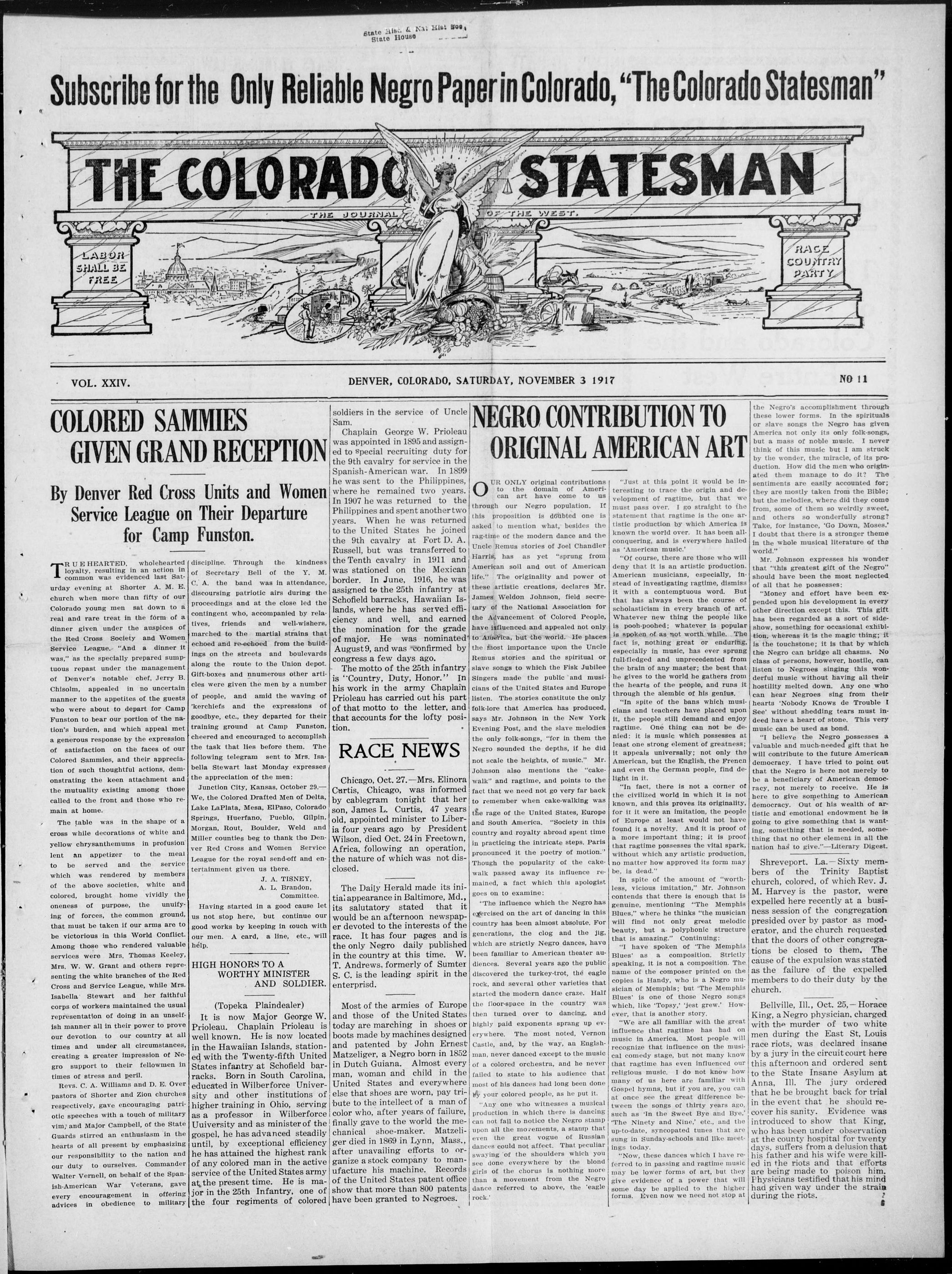
Subscribe for the Only Reliable Negro Paper in Colorado, "The Colorado Statesman"
THE COLORADO STATESMAN
THE JOURNAL OF THE WEST.
LABOR SHALL BE FREE
RAGE COUNTRY PARTY
COLORED SAMMIES GIVEN GRAND RECEPTION
By Denver Red Cross Units and Women Service League on Their Departure for Camp Funston.
VOL. XXIV.
COLORED SAN
GIVEN GRAN
By Denver Red Cross
Service League or
for Camp
TRU E HEARTED, wholehearted loyalty, resulting in an action in common was evidenced last Saturday evening at Shorter A. M. E. church when more than fifty of our Colorado young men sat down to a real and rare treat in the form of a dinner given under the auspices of the Red Cross Society and Women Service League. "And a dinner it was," as the specially prepared sumptuous repast under the management of Denver's notable chef, Jerry B. Chisolm, appealed in no uncertain manner to the appetites of the guests who were about to depart for Camp Funston to bear our portion of the nation's burden, and which appeal met a generous response by the expression of satisfaction on the faces of our Colored Sammies, and their appreciation of such thoughtful actions, demonstrating the keen attachment and the mutuality existing among those called to the front and those who remain at home.
The table was in the shape of a cross while decorations of white and yellow chrysanthemums in profusion lent an appetizer to the meal to be served and the service which was rendered by members of the above societies, white and colored, brought home vividly the oneness of purpose, the unuifying of forces, the common ground, that must be taken if our arms are to be victorious in this World Conflict. Among those who rendered valuable services were Mrs. Thomas Keeley, Mrs. W. W. Grant and others representing the white branches of the Red Cross and Service League, while Mrs. Isabella Stewart and her faithful corps of workers maintained the usual representation of doing in an unselfish manner all in their power to prove our devotion to our country at all times and under all circumstances, creating a greater impression of Negro support to their fellowmen in times of stress and peril.
Revs. C. A. Williams and D. E. Over pastors of Shorter and Zion churches respectively, gave encouraging patriotic speeches with a touch of military vim, and Major Campbell, of the State Guards stirred an enthusiasm in the hearts of all present by emphasizing our responsibility to the nation and our duty to ourselves. Commander Walter Vernell, on behalf of the Spanish-American War Veterans, gave every encouragement in offering advices in obedience to military
discipline. Through the kindness of Secretary Bell of the Y. Mr. C. A. the band was in attendance, discoursing patriotic airs during the proceedings and at the close led the contingent who, accompanied by relatives, friends and well-wishers, marched to the martial strains that echoed and re-echoed from the buildings on the streets and boulevards along the route to the Union depot. Gift-boxes and numerous other articles were given the men by a number of people, and amid the waving of 'kerchiefs and the expressions of goodbye, etc., they departed for their training ground at Camp Funston, cheered and encouraged to accomplish the task that lies before them. The following telegram sent to Mrs. Isabella Stewart last Monday expresses the appreciation of the men:
Junction City, Kansas, October 29.—We, the Colored Drafted Men of Delta, Lake LaPlata, Mesa, ElPaso, Colorado Springs, Huerfano, Pueblo, Gilpin, Morgan, Rout, Boulder, Weld and Miller counties beg to thank the Denver Red Cross and Women Service League for the royal send-off and entertainment given us there.
J. A. TISNEY,
A. L. Brandon,
Committee.
Having started in a good cause let us not stop here, but continue our good works by keeping in touch with our men. A card, a line, etc., will help.
HIGH HONORS TO A
WORTHY MINISTER
AND SOLDIER.
(Topeka Plaindealer)
It is now Major George W. Prioleau. Chaplain Prioleau is well known. He is now located in the Hawaiian Islands, stationed with the Twenty-fifth United States infantry at Schofield barracks. Born in South Carolina, educated in Wilberforce University and other institutions of higher training in Ohio, serving as a professor in Wilberforce University and as minister of the gospel, he has advanced steadily until, by exceptional efficiency he has attained the highest rank of any colored man in the active service of the United States army at the present time. He is major in the 25th Infantry, one of the four regiments of colored
DENVER, COLORADO, SATURDAY, NOVEMBER 3 1917
State Hick. & Nat Hist Boo
State House
table Negro Pap
ADO
E JOURNAL
DENVER, COLORADO, SA
soldiers in the service of Uncle Sam. Chaplain George W. Prioleau was appointed in 1895 and assigned to special recruiting duty for the 9th cavalry for service in the Spanish-American war. In 1899 he was sent to the Philippines, where he remained two years. In 1907 he was returned to the Philippines and spent another two years. When he was returned to the United States he joined the 9th cavalry at Fort D. A. Russell, but was transferred to the Tenth cavalry in 1911 and was stationed on the Mexican border. In June, 1916, he was assigned to the 25th infantry at Schofield barracks, Hawaiian Islands, where he has served efficiency and well, and earned the nomination for the grade of major. He was nominated August 9, and was confirmed by congress a few days ago.
The motto of the 25th infantry is "Country, Duty, Honor." In his work in the army Chaplain Prioleau has carried out his part of that motto to the letter, and that accounts for the lofty position.
RACE NEWS
Chicago, Oct. 27.—Mrs. Elinora Curtis, Chicago, was informed by cablegram tonight that her son, James L. Curtis, 47 years old, appointed minister to Liberia four years ago by President Wilson, died Oct. 24 in Freetown, Africa, following an operation, the nature of which was not disclosed.
The Daily Herald made its initial appearance in Baltimore, Md., its salutatory stated that it would be an afternoon newspaper devoted to the interests of the race. It has four pages and is the only Negro daily published in the country at this time. W. T. Andrews, formerly of Sumter S. C. is the leading spirit in the enterprisd.
Most of the armies of Europe and those of the United States today are marching in shoes or boots made by machines designed and patented by John Ernest Matzeliger, a Negro born in 1852 in Dutch Guiana. Almost every man, woman and child in the United States and everywhere else that shoes are worn, pay tribute to the intellect of a man of color who, after years of failure, finally gave to the world the mechanical shoe-maker. Matzeliger died in 1869 in Lynn, Mass., after unavailing efforts to organize a stock company to manufacture his machine. Records of the United States patent office show that more than 800 patents have been granted to Negroes.
NEGRO CONTRIBUTION TO ORIGINAL AMERICAN ART
OUR ONLY original contributions to the domain of American art have come to us through our Negro population. If this proposition is doubted one is asked to mention what, besides the rag-time of the modern dance and the Uncle Remus stories of Joel Chandler Harris, has as yet "sprung from American soil and out of American life." The originality and power of these artistic creations, declares Mr. James Weldon Johnson, field secretary of the National Association for the Advancement of Colored People, have influenced and appealed not only to America, but the world. He places the most importance upon the Uncle Remus stories and the spiritual or slave songs to which the Fisk Jubilee Singers made the public and musicians of the United States and Europe listen. The stories constitute the only folk-lore that America has produced, says Mr. Johnson in the New York Evening Post, and the slave melodies the only folk-songs, "for in them the Negro sounded the depths, if he did not scale the heights, of music." Mr. Johnson also mentions the "cake-walk" and ragtime, and points to the fact that we need not go very far back to remember when cake-walking was the rage of the United States, Europe and South America. "Society in this country and royalty abroad spent time in practicing the intricate steps, Paris pronounced it the poetry of motion." Though the popularity of the cake-walk passed away its influence remained, a fact which this apologist goes on to examine:
"The influence which the Negro has exercised on the art of dancing in this country has been almost absolute. For generations, the clog and the jig, which are strictly Negro dances, have been familiar to American theater audiences. Several years ago the public discovered the turkey-trot, the eagle rock, and several other varieties that started the modern dance craze. Half the floor-space in the country was then turned over to dancing, and highly paid exponents sprang up everywhere. The most noted, Vernon Castle, and, by the way, an Englshman, never danced except to the music of a colored orchestra, and he never failed to state to his audience that most of his dances had long been done by your colored people, as he put it.
"Any one who witnesses a musical production in which there is dancing can not fail to notice the Negro stamp upon all the movements, a stamp that even the great vogue of Russian dances could not affect. That peculiar swaying of the shoulders which you see done everywhere by the blond girls of the chorus is nothing more than a movement from the Negro dance referred to above, the 'eagle rock.'
"Just at this point it would be interesting to trace the origin and development of ragtime, but that we must pass over. I go straight to the statement that ragtime is the one artistic production by which America is known the world over. It has been all-conquering, and is everywhere hailed as 'American music.'
"Of course, there are those who will deny that it is an artistic production. American musicians, especially, instead of investigating ragtime, dismiss it with a contemptuous word. But that has always been the course of scholasticism in every branch of art. Whatever new thing the people like is pooh-poohed; whatever is popular is spoken of as not worth while. The fact is, nothing great or enduring, especially in music, has ever sprung full-fledged and unprecedented from the brain of any master; the best that he gives to the world he gathers from the hearts of the people, and runs it through the alembic of his genius.
"In spite of the bans which musicians and teachers have placed upon it, the people still demand and enjoy ragtime. One thing can not be denied: it is music which possesses at least one strong element of greatness; it appeals universally; not only the American, but the English, the French and even the German people, find delight in it.
"In fact, there is not a corner of the civilized world in which it is not known, and this proves its originality, for it it were an imitation, the people of Europe at least would not have found it a novelty. And it is proof of a more important thing; it is proof that ragtime possesses the vital spark, without which any artistic production, no matter how approved its form may be, is dead."
In spite of the amount of "worthless, vicious imitation," Mr. Johnson contends that there is enough that is genuine, mentioning "The Memphis Blues," where he thinks "the musician will find not only great melodic beauty, but a polyphonic structure that is amazing." Continuing;
"I have spoken of 'The Memphis Blues' as a composition. Strictly speaking, it is not a composition. The name of the composer printed on the copies is Handy, who is a Negro musician of Memphis; but 'The Memphis Blues' is one of those Negro songs which, like 'Topsy,' 'jest grew.' However, that is another story.
"We are all familiar with the great influence that ragtime has had on music in America. Most people will recognize that influence on the musical comedy stage, but not many know that ragtime has even influenced our religious music. I do not know how many of us here are familiar with Gospel hymns, but if you are, you can at once see the great difference between the songs of thirty years ago, such as 'In the Sweet Bye and Bye,' 'The Ninety and Nine,' etc, and the up-to-date, syncopated tunes that are sung in Sunday-schools and like meetings today.
"Now, these dances which I have referred to in passing and ragtime music may be lower forms of art, but they give evidence of a power that will some day be applied to the higher forms. Even now we need not stop at
NO 11
the Negro's accomplishment through these lower forms. In the spirituals or slave songs the Negro has given America not only its only folk-songs, but a mass of noble music. I never think of this music but I am struck by the wonder, the miracle, of its production. How did the men who originated them manage to do it? The sentiments are easily accounted for; they are mostly taken from the Bible; but the melodies, where did they come from, some of them so weirdly sweet, and others so wonderfully strong? Take, for instance, 'Go Down, Moses.' I doubt that there is a stronger theme in the whole musical literature of the world."
Mr. Johnson expresses his wonder that "this greatest gift of the Negro" should have been the most neglected of all that he possesses:
"Money and effort have been expended upon his development in every other direction except this. This gift has been regarded as a sort of side-show, something for occasional exhibition, whereas it is the magic thing; it is the touchstone; it is that by which the Negro can bridge all chasms. No class of persons, however, hostile, can listen to Negroes singing this wonderful music without having all their hostility melted down. Any one who can hear Negroes sing from their hearts 'Nobody Knows de Trouble I See' without shedding tears must indeed have a heart of stone. This very music can be used as bond.
"I believe the Negro possesses a valuable and much-needed gift that he will contribute to the future American democracy. I have tried to point out that the Negro is here not merely to be a beneficiary of American democracy, not merely to receive. He is here to give something to American democracy. Out of his wealth of artistic and emotional endowment he is going to give something that is wanting, something that is needed, something that no other element in all the nation has to give."—Literary Digest.
Shreveport. La.-Sixty members of the Trinity Baptist church, colored, of which Rev. J. M. Harvey is the pastor, were expelled here recently at a business session of the congregation presided over by pastor as moderator, and the church requested that the doors of other congregations be closed to them. The cause of the expulsion was stated as the failure of the expelled members to do their duty by the church.
Bellville, Ill., Oct. 25, - Horace King, a Negro physician, charged with the murder of two white men during the East St. Louis race riots, was declared insane by a jury in the circuit court here this afternoon and ordered sent to the State Insane Asylum at Anna, Ill. The jury ordered that he be brought back for trial in the event that he should recover his sanity. Evidence was introduced to show that King, who has been under observation at the county hospital for twenty days, suffers from a delusion that his father and his wife were killed in the riots and that efforts are being made to poison him. Physicians testified that his mind had given way under the strain during the riots.
FOREIGN
Brazil declares war on Germany.
Resignation of Italian cabinet reported.
Charles I. Keary, the novelist and writer, died in London.
The new Italian premier has been sworn in and announced his cabinet.
Steps already have been taken in London for rendering the fullest possible assistance to the Italians.
Hawaii's total subscriptions to the second Liberty loan were placed at $8,500,000 by the committee in charge.
The world's wheat crop is 1 per cent less than it was last year for the countries that thus far have reported to the International Institute of Agriculture at Rome.
In the House of Commons Chancellor Bonar Law said that in the period from July 22d to September 22d the daily average expenditure of the British government was $32,070,000.
Count George von Hertling, the Bavarian prime minister, has been appointed German imperial chancellor. Former Chancellor Michaelis has been named prime minister of Prussia.
Foreign Minister Terestchenko, in addressing the preliminary parliament at Petrograd, said a separate peace was impossible and that defense of Russian territory was one of the fundamental needs.
The first American wounded in the trenches in France arrived at a base hospital. He is a lieutenant of the signal corps. He was hit in the leg by a shell splinter while working in a communication trench near the first line. The wound is slight.
Count von Bernstorff, the former German ambassador to the United States, has been made a "Wircklicher Geheimrat," or privy counsellor, by the German emperor, with the title of excellency. The count is now ambassador at Constantinople.
Thirteen million men have crossed and recrossed the seas during the three years of the war, and only 3,500 of these have been lost, Premier Lloyd George told the House of Commons in lauding the work of the navy. "The navy has also safeguarded the transportation of 25,000,000 tons of explosives and 51,000,000 tons of coal," the premier declared.
The big majority of the German army—the privates—are weary of war and yearn for peace. The officers, 'getting good salaries and able to keep out of the first line trenches, do not care how long the war lasts. These statements were made by the expeditionary forces' first German prisoner just before he died from the wound he received when he failed to halt at an American patrol's command.
SPORTING NEWS
Pal Moore of New Orleans stopped Jimmy Murphy of Philadelphia in the third round of a scheduled fifteen-round fight at New Orleans, La.
Mayor William Hale Thompson of Chicago refused to issue a license for a fifteen-day race meeting scheduled to open at a half-mile course in Austin.
Oral betting on horse races in Louisiana is not a violation of the state anti-gambling laws, the State Supreme Court ruled in reversing a decision of the lower court.
Mrs. Joseph F. Gardner of Flossmoor Country Club, Chicago, was reelected president of the Woman's Western Golf Association at its annual meeting in Chicago. Mrs. F. C. Letts Jr., Indian Hill, was chosen secretary, and Mrs. Edward J. Cudahy of Lake Forest, treasurer.
GENERAL
A British steamer sunk in flames in a fire at Boston, causing $5,000,000 loss.
Lieut. Sir Ernest Shackelton, the Antarctic explorer, arrived at an American port aboard a British steamship.
Two mess halls used by Companies L and M of the 142d infantry at Camp Bowie at Fort Worth, Tex., burned. The loss will be about $5,000. The fire is said to have been accidental.
Bar silver took a sudden jump of 5% cents to 90% cents an ounce in the market in New York October 30th. This rise developed after a similar advance in London, where silver is the current unit of exchange.
The bonds of the second Liberty loan were listed October 29th on the stock exchange in New York. The first transaction, $1,500 worth, took place with the price at par. The second lot, amounting to $8,000, sold at 100.02.
Solicitor Hayden Clement presented to the Cabarrus county grand jury at Concord, N. H., a bill of indictment charging Gaston B. Means with the murder of Mrs. Maud A. King of New York and Chicago, who was shot August 29th.
Secretary of Labor William B. Wilson announced that Verner Z. Reed of Denver, federal mediator representing the Department of Labor, left Clifton, Ariz., for San Francisco to act in the threatened strike of telephone employés on the Pacific coast.
Gen. Charles H. Grosvenor, former representative from the Eleventh Ohio district, died at his home in Athens, Ohio, aged 84.
Official announcement was made October 29th that every packing plant in the country is under control of the government, and that after November 1st the control will be absolute.
Shattering all records in Denver since the establishment of the local weather bureau in 1872, the mercury Monday, October 29th, dropped to the new October low level of 2 degrees below zero.
---
THE COLORADO STATESMAN
CAUGHT FROM THE NETWORK OF WIRES ROUND ABOUT THE WORLD.
DURING THE PAST WEEK
RECORD OF IMPORTANT EVENTS
CONDENSED FOR BUSY
Western Newspaper Union News Service.
ABOUT THE WAR
The third Liberty loan will probably be floated in February.
The Mouth-Piece of the People of Colorado and the Entire West
United States army of 5,000,000 men will be reply to Teuton drive.
The Germans have lost 6,000,000 men during three years of war.
The Germans have withdrawn from the Werder penisula near Riga.
Artillery fighting continues in the Aisne and Meuse sectors in France.
British casualties reported during the week ended October 30th totaled 24,091.
The United States has made a loan to Italy and will work out other plans to aid the Italians.
Paris received the news of the entry of the American troops into the trenches with great enthusiasm.
The Americans in the first line trenches went into No Man's Land and brought back their first prisoner. He was wounded and died in the American hospital. Shelling at regular intervals continues.
The Canadians won a brilliant victory over the Germans around Ypres and captured the last remaining stronghold before Passchendaele. General Haig reports the Germans have been thrown back 1,000 yards.
ARELIABLE chronicle of their doings and progress; a faithful mirror of their wants, their hopes, their best aspirations.
Important developments are impending in the great war, Secretary Baker indicates in his official review of last week's operations on all fronts, which concludes with the brief statement that certain units of the American forces in France have taken their places on the battle front to complete their training. This is the War Department's first mention of the fact that General Pershing's men are on the firing line.
The entire Isonzo line has been abandoned by the Italians following the destruction of all the bridges. The greatest menace to the Italian army now lies in a flanking movement begun by the invaders, aimed at turning the upper Tagliamento line before Cadora can establish himself. War experts say the advance in this section threatens complete disaster to the Italians should the enemy be able to cross the river ahead of the defenders and turn their flank.
THE COLORADO STATESMAN
WESTERN
Roy Snyder, Melvin Sutton and George H. Cutler perished in the Wyoming storm of October 28th.
Tom Green county voted to retain saloons and Falls county voted dry in Texas local option elections.
The kaiser was burned in effigy at the annual Hallowe'en celebration of Gary, Ind., children at Jackson park.
Charles Martin, Democrat, serving his first term in Congress for the Fourth Illinois (Chicago) district, died after a prolonged illness.
Unequaled as an advertising medium for the business of professional men and women.
A copy of the manifesto issued by Gen. Felix Diaz, leader of the new revolutionary movement in Mexico, has been received at El Paso, Tex. It is dated Camp Buena Vista, State of Vera Cruz, September 3, 1917, and is signed by the nephew of Mexico's former president. The manifesto calls upon all who are in sympathy with his new movement, especially the members of the old federal army, to join a reorganized national army. The purpose of the movement is the overthrow of the so-called "Carranzista party," and the restoration of the constitution of 1857, it states.
WASHINGTON
Washington was "dry" November 1st.
An excellent family journal speaking to and for many thousand colored citizens.
Ten million dollars more was advanced to France by the government, bringing credits to the allies to the total of $2,866,400,000.
Options have been taken by the food administration upon all the sugar belonging to neutral countries held in this country awaiting export.
Strikes in Illinois were held responsible for a loss of 900,000 tons of soft coal last week in a report by the United States Geological Survey.
As Germany does not provide sufficient food to keep her prisoners of war in good health, nor sufficient clothing, the United States is preparing, in conjunction with the American Red Cross, to feed all American soldiers and sailors who may be taken prisoners.
TWODOLLARSAYEAR
All persons who use the mails for the transmission of Christmas gifts and messages should bear in mind the postal slogan, "Mail early, pack securely, address properly."
Herbert C. Hoover, food administrator, has found the remedy for high food prices. All dealers who charge excessive prices will find their supplies cut off until the end of the war.
Another advance of $25,000,000 was made by the government to Great Britain, bringing the total loaned that country thus far up to $1,400,000,000, and the total to all allies $2,851,400,000.
SLAYS FATHER-IN-LAW
POSSE HUNTING B. W. BACKUS OF ELBERT COUNTY.
Shot A. M. Humphrey, With Whom He Lived, Using Double-Barreled Shotgun, Firing Two Shots.
Western Newspaper Union News Service.
Kiowa, Colo.—B. W. Backus, 35, a rancher, living ten miles southeast of Simla and thirty-five miles east of Kiowa, shot and instantly killed A. M. Humphrey, 55, his father-in-law. Backus used a double-barreled shotgun and discharged both shells. Following the killing of Humphrey, Backus filled his pockets with ammunition and disappeared with the shotgun. Mrs. Backus and their two children witnessed the killing of Humphrey.
Humphrey owned a ranch adjoining that of his son-in-law, but had leased the place and only returned recently, making his home with Backus. The two men, so far as known, were on friendly terms, and no one in Kiowa or Simla is able to explain the tragedy. The general consensus is that Backus suddenly became insane. Deputy Sheriff George Farlion and two citizens, hastily sworn in, left Kiowa in an automobile immediately upon receipt of news of the killing and took up the trail of Backus.
Mrs. Williams Will Join Picketers.
Colorado Springs.—Undaunted by the fact that three Colorado Springs women who have joined the force of White House pickets at Washington have met with misfortune, in that they have been arrested and jailed, Mrs. Genevieve Heistand Williams of Manitou has announced her intention of leaving here November 4th to take her place in the picket line. Mrs. Williams is the wife of J. H. Williams, now with the engineers' train at Camp Kearny, Cal. She will be the fourth woman from the Pikes Peak region to picket the White House. The other three are Natalie Gray, Ida Ostrum and Dr. Caroline Spencer.
Annul Marriage—Clairvoyant Blamed.
Pueblo.—Mrs. Henri Mershon, chum and companion of Mrs. Allan Barth, in the County Court obtained the annulment of her marriage to Henri Mershon, X-ray expert at the Minnequa hospital. The decree is the ending of a romance which began last February when Mrs. Mershon, then Miss Sarah Meechin of Salida, came to Pueblo to attend a fashionable ball. She met Mershon and the two were married here June 7th last. Mershon, it is claimed, blames a clairvoyant for the ending of his married life.
Man Killed as Auto Hurtler.
Idaho Springs—Rolla V. Peecher, 34, city clerk of Idaho Springs, was instantly kill ed. A. Eaves, 50, of Idaho Springs, was perhaps fatally injured, and the Rev. Leonard Myton, pastor of the Idaho Springs Presbyterian church, was slightly injured, when the light automobile in which they were returning to Idaho Springs from Denver went over on the Floyd hill road, one mile above Floyd Hill station.
Phil Friederich Settles Fine.
Denver.—Contrary to the advice of his attorney, who assured him he could "beat the cas" in the Supreme Court, Phillip Friederich, fined $100 by Judge Dunn of the County Court of Arapahoe county, has paid his fine and costs, amounting to about $200 additional. Friederich was convicted of contributing to the delinquency of Marie Rasmussen, a girl 16 years old.
Tender Grounds for Hospital
Denver—Formal tender of the buildings and grounds of the Teller Indian School at Grand Junction was telegraphed the surgeon general of the army by Governor Gunter on behalf of the State Board of Agriculture. Inquiries looking to the utilization of the school as a recuperation hospital by the government had been made.
Killed in Auto Accident.
Idaho Springs.—R. V. Peecher, city clerk of Idaho Springs, was killed and E. A. Eaves and the Rev. L. B. Mytton of this place were injured seriously when an automobile in which they were driving home from a Red Cross meeting in Denver plunged over an embankment.
Thieves Loot Lafayette Store.
Lafayette.—Thieves stole $200 worth of watches, safety razors, kodaks and several other articles. The postoffice and pool hall were also raided by the robbers, but no loot was obtained. The thieves were unable to open the safe in the drug store.
Boy Accidentally Shot While Hunting.
Denver.—Frank Sumner, 15 years old, died from a wound received while hunting with Roland Ryan, 12 years old. A rifle in young Ryan's hands was discharged accidentally.
Three Killed When Auto Plunges.
Colorado Springs.—Three men were killed two miles south of Colorado Springs while returning from a hunting trip when a roadster in which they were riding plunged from a bridge into a creek fifteen feet below. The men were pinned under the car, two of them being instantly killed. The third died before help arrived. The dead are G. F. Horn, manager of a Colorado Springs tire company; J. W. Murray, a coal miner of Pikeview; J. A. Johnson, blacksmith, Colorado Springs.
Western Newspaper Union News Service.
COMING EVENTS.
Nov. 1-3 — Educational Association meeting at Denver.
Nov. 6-8 — Live Stock Show at Grand Junction.
Nov. 12-18 — Automobile Show at Denver.
Nov. 22-24 — Rural School Conference in Denver.
The teachers' convention at Pueblo was largely attended.
Former Governor James H. Peabody is seriously ill in Denver.
About 1,100 carloads of potatoes have been sent out from Monte Vista.
About seventy-five carloads of apples have been shipped from Cañon City.
The total output of precious metals in Aspen since 1890 has been $150,000,000.
Forty-four automobiles were burned in a blaze in a Denver garage, causing $30,000 loss.
Twenty-eight national army recruits, certified from Pueblo, entrained for Camp Funston, Kan.
Coldest October weather on the record thus far was 12 degrees below at Leadville on the 17th.
There is not exactly a boom at Creede, but reports from that silver camp are satisfactory.
Vice President Marshall visited Denver on Monday on his way to Ault, where he delivered an address.
Denver people generally had a meatless Tuesday and a wheatless Wednesday to aid in food conservation.
Dr. Samuel A. Orentreich, widely known in Denver, committed suicide in Detroit, Mich., by swallowing poison.
There are now about a hundred buffaloes on the Trinchera estate southwest of Veta Pass, and they seem to be doing well.
It is estimated at Kiowa that about 40 per cent of the potato crop of Elbert county has been lost. It was 14 below zero Oct. 29.
George Goodman of Durango has received the contract for erecting fifty cottages for the Sunnyside and Eureka mines at Silverton.
Loss to potato growers of Weld county as a result of the storm Saturday night and Sunday, Oct. 28 and 29, is known to have been considerable.
J. E. Johnson, a rancher living near Eldow, a station on the Colorado Midland railroad, is under arrest at Colorado Springs, charged with killing three buck elk.
Livestock in Colorado, not including hogs, is worth $190,161,000, according to a report made by the Livestock Survey Committee of the Council for Defense to the governor.
A correspondent at Stonington, Baca county, says L. D. Gregory and Carl Voke sold their broomcorn for $245 per ton. Mr. Gregory will have near an $8,000 or $9,000 crop.
Denver bank clearings for the week ended Oct. 25 were $24,242,000, an increase of 39.6 per cent over the corresponding week of last year, and compares with $23,237,000 for the week ended Oct. 18.
The Rev. Frank T. Bayley, "grand old man" of the Congregational church and active pastor of Plymouth Congregational church in Denver, died at the home of his lifelong friends, Mr. and Mrs. Thomas H. Hood.
An estate valued at $185,000 was left by the late Laura R. McCaulley, who died in Boston September 27th. Her husband made application to County Judge Rotherger in Denver for letters of administration, his wife having died intestate.
Tons of food products valued at hundreds of thousands of dollars were destroyed in all sections of Colorado by the freeze of Sunday night, October 28th, according to reports reaching W. H. Kerr, chief of the federal office of markets in Denver.
Daniel L. McCarthy, for fifteen years superintendent of the Granite Mining Company at Cripple Creek and one of the oldest and best-known mine operators of the district, died at a Colorado Springs hospital after an operation for ulcer of the stomach.
A ceded to $300,000 worth of Denver property, including the Lunt block, executed by the late Jennie Ware and filed for record at the court house last December, before the body of its maker had grown cold in death, was set aside in the District Court in Denver.
Hebrew people of Trinidad are not only a prosperous, but a generous, fraternity. A check for $2,000 which they had contributed was forwarded by Rabbi Harry R. Richmond to ex-Ambassador to Turkey Hon. Henry Morgenthau, treasurer of the Jewish war relief fund.
Three young women of Denver, responding to the needs of their country during the war, have enlisted for service and left for Washington, D. C. They are the Misses Florence Scott, Jessie T. Craven and Ellinor Hensley, all graduates from the Denver Public Library Training School.
An important discovery of potash in large quantities has been made in Mesa county on the Western slope. Great fields of potash have been found in what formerly was grazing land and a large acreage of it already has been taken up.
EVERYONE PAYING TO CRUSH ENEMY
New War Tax Squeezes Purse of Wage Earner, but All Must Help.
KAISER TO BLAME FOR COST
Mad Prussia Must Be Broken Before Conflict Can End—Good Patriots Steel Selves for Sacrifice and Then Victory.
Postage.—Three cents an ounce or fraction thereof on letters for other than local delivery; two cents on all postal cards.
Admissions—Ten per cent tax on tickets to theaters, cabarets, and other amusement places.
Dues—Ten per cent tax on dues of clubs exceeding $12 a year.
Tobacco—Graduated taxes on cigars, tobacco, cigarettes, cigarette papers and snuff.
Express—Five per cent tax on amounts paid for express transportation.
Passengers—Eight per cent of the cost of railroad tickets, except local.
Berths—Ten per cent of the cost of berths, staterooms, and parlor car seats.
Oil—Five per cent tax on amounts paid for transportation of oil by pipe lines.
Messages—Five cents tax on each telegraph, telephone, or radio message costing 15 cents or more.
Insurance—Eight cents tax on each $100 or fractional part thereof of each life insurance policy; one per cent of the premium on fire, marine, inland, and casualty insurance policies.
Washington.—Uncle Sam is rather pleasantly surprised at the way the nation is standing the war tax gaff. The grouching, such as there is, has been growled in a minor key, and most of it comes from the trouble-makers, the whining pacifists, those of a sickly cast of loyalty.
Nobody really enjoys paying excess taxes, such as three cents postage for letters, extra charge for freight, express and passenger transportation, telephone and telegraph messages and amusements. But all true Americans who realize that the kaiser is to blame for the trouble, stand ready and willing to pay their share of the cost of exterminating the world's greatest menace.
By the way, do you know that if you are single and earn more than $1,000 yearly, you must pay two per cent tax on what you make over $1,000. And if you are married, you must pay two per cent on what you make over $2,000. The tax for all of 1917 must be paid by June 1, 1918.
All of the new taxes fall upon the average man. They have nothing to do with the "conscription of wealth." They are a part of the program of taxation to make each man, woman and child in the United States feel a direct personal part in the war. They apply to freight, passenger and express transportation, pipe lines, Pullman seats and berths, telegraph and telephone messages, insurance policies, admissions to theaters and "movies" and to club dues. The effect of most of them is felt, therefore, in a slight rise in the high cost of living.
The taxes are expected to net the federal government the following revenues:
Freight transportation.....$77,500,000
Express transportation..... 10,000,000
Passenger transportation.. 60,000,000
Pipe lines..... 4,500,000
Seats and berths..... 4,000,000
Telegraph and telephone
The war tax on facilities furnished by public utilities is now levied as follows:
Three per cent of the amount paid for transportation by rail or water or by any form of mechanical motor power in competition with carriers by rail or water, on freight consigned from one point in the United States to another.
One cent for each twenty cents or fraction charged by express companies for transportation from one point in the United States to another.
Eight per cent of the amount paid for the transportation of persons by rail or water or by any form of mechanical motor power on a regular established line in competition with common carriers, from one point in the United States to any point in the United States, Canada or Mexico where the ticket is issued in the United States. No tax is imposed on com-
Greatest Thing in the World.
Greatest Thing in the World.
Love has been called the greatest thing in the world, but the greatest thing in the world is not a thing at all; the greatest thing is a person. Personality is the greatest thing in the world. The greatest thing in personality is not strength of body nor strength of mind. It is strength of heart. "Clever people are as common as blackberries, the rare things to find a good one." It is not Daniel Webster's brain, but Lincoln's heart, that wins a nation's love—Exchange.
mutation or sensor tickets for trips less than 30 miles, or in cases where the fare does not exceed 35 cents. Ten per cent of the amount paid for seats, berths or staterooms. If a mileage book used for transportation or accommodation was purchased prior to November 1, 1917, or if cash fare is paid, the conductor or agent collecting the fare is required to collect the tax. Five per cent on the amount paid for the transportation of oil by pipe line. Five cents for each telegraph, telephone or radio dispatch originating in the United States where the charge is 15 cents or more.
The foregoing taxes are paid by the persons paying for the services or facilities rendered. A carrier making no charge for transporting a commodity because of its ownership thereof, or for any other reason, is required to pay a tax equivalent to the amount which would be imposed if it received payment, except in the case of commodities which are necessary for its use in the conduct of its business or the business of another line constituting a part of the same railroad system. Service rendered to the federal and state governments is exempt from taxation. Persons collecting these taxes are required to make monthly returns and monthly payments to the federal government.
The new levies upon insurance take effect in the following manner:
On life insurance, eight cents on each $100 or fraction of the amount of the policy, except industrial insurance policies not in excess of $500 issued on the weekly payment plan, in which case the tax is 40 per cent of the first weekly premium. Policies of re-insurance are exempt.
On marine, inland and fire insurance, one cent on each dollar or fraction of the premium charged under each policy including renewals, but not including policies of re-insurance.
Casualty insurance, one cent on each dollar or fraction of the premium charged under each policy (except indemnity and surety bonds, which are taxable under another title of the bill) including renewals, but not including re-insurance policies.
Policies issued by any corporation exempt from the income tax are exempt from this tax.
The person, partnership or association issuing such policies of insurance is required to make monthly returns and monthly payments to the government.
For every ten cents or fraction thereof you spend on the movies you must turn over to the government one cent. Of course, the movie proprietors may save you the inconvenience of handling pennies by raising his admission price a nickel, as many other persons selling goods affected by the war tax have already done.
Here is the way admission tax and the club dues levies will fall upon the public:
One cent on each ten cents or fraction of the amount paid for admission to any place including admission by season ticket or subscription, to be paid by the person paying for such admission, except in the case of children under twelve, where the tax in every case is one cent. Persons admitted free pay the tax on the basis of the charge made to other persons of the same class, except employees, municipal officers on official business and children under twelve. Where the charge for admission to a cabaret or similar entertainment is wholly or in part included in the price paid for refreshment, service or merchandise, the amount paid is to be computed under regulations to be prescribed by the treasury department.
In the case of persons having the permanent use of boxes or seats, or a lease thereon, the tax is equivalent to 10 per cent of the amount for which a similar box or seat is sold for the performance or exhibition at which the box or seat is used or reserved by or for the lessee or holder.
These taxes are not to be imposed in the case of a place where the maximum charge for admission is five cents or for shows, rides or other amusements in outdoor general amusement parks where the admission is ten cents or in the case of shows, rides or other amusements (the maximum charge for admission to which is ten cents) within outdoor general amusement parks, or in the case of admissions to such parks. Where the proceeds inure exclusively to the benefit of religious, educational or charitable societies or organizations, and in the case of admissions to agricultural fairs, no tax shall be levied, provided none of the proceeds are distributed to stockholders or members of the association.
A tax of 10 per cent is imposed on the amount paid as dues or membership fees, including initiation fees, to any social, athletic or sporting club where such dues or fees are in excess of $12 per year, such tax to be paid by the person paying the dues or fees. Dues or fees paid to fraternal or beneficiary societies; orders or associations operated on the lodge system are exempt.
Those collecting admission dues or fees are required to collect the tax and make monthly returns and payments to the government.
Gained Pame White Dying.
Antoine Watteau, one of France's foremost artists, painted his celebrated decorative panels while dying of the white man's scourge. He sprang from humble and poverty-stricken surroundings, and was forced to work on the brink of starvation for the greater part of his thirty-seven years. Just as his fame rose to national proportions his tubercular condition became worse and he worked desperately during his last few years to complete as much work as possible before he died.
HALF OF U-BOATS SUNK BY ALLIES
SIR ERIC GEDDES BARES LOSSES
OF ENEMY SHIPS SINCE BE-
GINNING OF THE WAR.
30,000 TEUTONS SLAIN
ROME ARMY LOSES 60,000 MORE MEN AND 500 ADDITIONAL GUNS. ALLIES ON ITALIAN FRONT.
Western Newspaper Union News Service.
London, Nov. 2.—Sir Eric Geddes, who recently succeeded Sir Edward Carson as first lord of the admiralty, made his first address in Parliament and gave some interesting and anxiously-awaited figures on the work of the navy and shipping in general. His declaration that between forty and fifty per cent of the German submarines operating in the North Sea, the Atlantic and the Arctic oceans had been sunk was not the least interesting of his announcements and there was an indication of the unceasing war the British and American patrols are making on the submarine in his statement that during the last quarter the enemy had lost as many submarines as during the whole of 1916.
The first lord, speaking of his department, said that, in addition to an increase in the personnel, the services of younger officers had been requisitioned to add strength to the experience of the older officers on the naval staff.
---
London, Nov. 2.—Advices from Italian field headquarters last night; which report the killing of 30,000 Austro-Germans in a battle on the Bainsizza plateau, add that French and British troops have arrived on the Italian front to reinforce the Cadorna army. The Teuton dead in Thursday's battle includes two generals of division and many other officers. The dispatches say Gen. Cadorna is pushing reserves forward rapidly and with every prospect of checking the enemy's advance. Now that reinforcements have arrived much gratification is expressed in official circles over the conditions at the front.
The Rome official statement reads: "Thwarting the plan of the enemy by the rapidity of movements and by the resistance of the covering units which have detained his advance our troops have effected the withdrawal on the Tagliamento in spite of the extremely difficult strategic conditions."
At the cost of 60,000 more men and 500 more guns, captured by the Austro-Germans after being surrounded, the Italian armies effected their retirement behind the Tagliamento.
All the crossings of the stream are now held by Von Mackensen's troops, who, at nearly every point stand on the eastern bank of the river, facing the strongest defensive system on the northern Italian front.
Another day or two doubtless will tell whether Cadorna's troops, with the aid of French and British infantry and artillery, will be able to hold to their new line and stave off what for eight days looked like a great disaster. So far, while their losses have been immense, aggregating 180,000 in prisoners alone and 1,500 in guns, they have escaped complete defeat and retain sufficient strength to give the enemy a hard and long battle. The third army particularly, according to the Italian war office, reached its new line with its strength unbroken, a feature which Rome hails as "a beautiful example of strength and unity."
HERTLING MADE CHANCELLOR.
Secretary of Interior and President of German Food Board Quit.
Amsterdam. — According to dispatches received here from Berlin the Cologne Gazette says Emperor William received Count von Hertling and that von Hertling accepted the imperial chancellorship and the office of premier of Prussia. Dr. Karl Helfferich, secretary of the interior and vice chancellor, and Herr von Waldow, president of the German food regulation board, have resigned. Friedrich von Payer, Progressive member of the Reichstag, says the dispatch, is to be appointed vice chancellor, and Herr Friedberg, leader of the National Liberal party, will be given the post of vice president of the Prussian ministry.
Eight Killed in London Air Raid
London.—The most picturesque and noisy raid London and its environs have yet seen and heard took a toll of eight lives and injured twenty-one, according to official announcement.
Colorado Coal Prices Up 45 Cents.
Denver. — Coal operators notified gas, light and power and other companies and individuals who buy direct from the producer of a 45-cent-a-ton increase to cover wage increases to miners. The increase is in accordance with the permission given by President Wilson Oct. 27 that all organized mine producers may readjust their prices upward to absorb the wage increases in the Ohio, Indiana, Illinois and Pennsylvania fields, and which applies also to Colorado operators.
"LOAD CARS TO LIMIT"
HOOVER'S ORDER IN MOVING
CROPS OF COLORADO.
Shippers Must Utilize Full Space to
Get Entire Output of Fruit and
Vegetables to Market.
Western Newspaper Union News Service.
Denver.—Drastic efforts to bring relief to Colorado communities which are facing heavy crop losses through congested car movements were undertaken in Washington by Herbert Hoover, national food administrator. He directed railroads to have all cars loaded to the limit of safety, and sent warning at the same time to farmers and growers that unless they comply with this provision the railroads will be authorized to place a shipping embargo on their crops. In some of the southern and western communities of Colorado only half of the perishable fruits have been packed for shipment, and these, together with the northern districts that have big consignments of potatoes, are directly affected by the order, received at the office of Thomas B. Stearns, food administrator for Colorado.
This action follows efforts of the Colorado Council of Defense, the Public Utilities Commission and the Colorado food administration to urge upon shippers the necessity for heavy loading at this season. It more directly follows the appeal made by railroad freight officials to the national commission on car service, in Washington, to prevail upon the Interstate Commerce Commission to issue emergency orders that would compel shippers to load apples and potatoes to carrying capacity of cars.
The railroads of Colorado took the position that while they were straining every effort to meet the tremendous crop production in the Arkansas, North Fork and San Luis valleys, as well as other centers, it was quite evident that growers, in their anxiety to get the fruit to the market, were working individually instead of collectively.
One of the latest shipments out of the San Luis valley received the following comment from an inspector: "Eighteen cars of potatoes were shipped. The minimum loading is 30,000 pounds, but these eighteen cars averaged 42,000 pounds each. In other words, these shippers were doing their patriotic duty by making five cars do the work of seven."
Growers in the San Luis valley are working nights digging temporary storage places. They have put into execution suggestions coming from the transportation and food committees of the Colorado Defense Council and the Public Utilities Commission.
Report on Live Stock Conditions.
A. B. Smeby of the U. S. bureau of markets has established headquarters at Rocky Ford, where he will make reports on the live stock market and feeder conditions and assist the farmers of the Arkansas valley under the direction of W. H. Kerr of the Denver office of the federal bureau of markets.
Coloradoans Make Fine Showing.
According to information received by Provost Marshal John Evans, Colorado made a most excellent showing with her quota of 85 per cent of the national army sent to Camp Funston. The records show that out of 1,325 of those examined only twelve were rejected for physical or any other reasons.
Onions and Potatoes Wanted.
Bids on potatoes and onions for the army are being sought by the quartermaster's office at Kansas City, according to word received by W. H. Kerr, chairman of the committee on markets of the Colorado Council of Defense and chief of the Colorado of fice of the U. S. bureau of markets.
Mining Men Against Stock Fakers.
Prominent Denver men are enlisting in the drive that is to be made on dishonest promoters by the Colorado Metal Mining Association, and at the annual meeting of the organization in Denver in January plans will be made to legislate them out of the state.
Denver Schools to Spend $1,439,000.
The Denver school budget for 1918 will be raised $500,000 by increasing the tax levy $1½ mills, this being the order of the Colorado Tax Commission to the board of education. The increase will bring the budget up to $1,439,092.
Can Store Many Carloads of Supplies.
Storage facilities for several hundred carloads of canned goods ordered by the army and navy have been found in Denver, Pueblo and Colorado Springs by the Colorado Council of Defense.
To Standardize Loaf in Denver.
Colorado Food Administrator Stearns wired National Food Administrator Hoover that Mayor Robert Speer would soon take action to compel bakeries to standardize bread in Denver.
Heavy Pack of Kraut and Tomatoes. Colorado's pack of kraut and tomatoes has been unusually heavy this year, the committee on markets of the State Council of Defense has found.
AND ENTERTAINERS
GEO. MORRISON, MANAGER
Music Furnished f
Phone Main 2707. Res. 2947 St
THIN
Giant Bach-Bo
and T
Lankford and McC
STRICTLY FIRST
Cleaning, Pressing, Dye
JOIN OUR MONTHLY PR
506 Eighteenth Street
THE PEARL BA
1021 19th
Electric Furnished for all Occasions
2707. Res. 2947 Stout St. DENV
THINK
Bach-Benz Clean
and Tailors
Lankford and McCain, Proprietors
STRICTLY FIRST-CLASS WORK
Cleaning, Pressing, Dyeing and Remodelling
OUR MONTHLY PRESSING CLUB—
Fourth Street Phone
ME PEARL BARBER SHOP
1021 19th Street
Music Furnished for all Occasions
Phone Main 2707. Res. 2947 Stout St. DENVER, COLO.
THINK
Giant Bach-Benz Cleaners and Tailors
Lankford and McCain, Proprietors
STRICTLY FIRST-CLASS WORK
Cleaning, Pressing, Dyeing and Remodelling
JOIN OUR MONTHLY PRESSING CLUB—$1.50
506 Eighteenth Street Phone Main 7376
First-Class Tonsorial Artists in attendance.
solicit your patronage. First-Class work gu
Prop.
We solicit your patronage. First-Class work guaranteed.
FRANK R. T Announces that he law offices to 621 Building.
FRANK R. TAGGART
Announces that he has removed his law offices to 621 and 622 Cooper Building. Telephone Main 8036
When You
The Heads, Feet
Neckbones or
any other part of
the squeal, go to
East's Mar
2300-6 Lari
When You Wish
Heads, Feet Tails, Sn
bones or Chitlerings
other part of the hog ex
queal, go to
It's Market Ph
2300-6 Larimer Street
The Heads, Feet Tails, Snouts Neckbones or Chitlerings, or any other part of the hog except the squeal, go to East's Market Phone Main 1461 2300-6 Larimer Street
```markdown
```
The McElhinney T
PHONE MAIN 5599
Night and Day
806 15th St., Two Doors From Store
Free Delivery—Shipping
Notice: Open evenings until
In order to get acquainted again
friends, we are going to give away
FF
with this ad. a valuable premium
Let this INFORMATION, for the b
the owner of the
NIGHT AND DAY
I am printing this. I am the man
Company seven years ago at 2038
couple of doors up to a larger st
four years. Now I have been run
CANTILE CO. for three years, an
co-operation of your trade, which
Now I am going to go after your
fore by giving you the admi-
ment and grocery buying. We bu
middleman's profit. We can save
order. SO GIVE US A TRIAL.
MEATS
McElhinney Tile & Marble
MAIN 5599 427 SEVENTEENT
t and Day Mercant
, Two Doors From Stout St. Phones Cl
Free Delivery—Shipping Orders a Special
Fee: Open evenings until 12 o'clock. All day
The McElhinney Tile & Marble Co. PHONE MAIN 5599 427 SEVENTEENTH ST.
Night and Day Mercantile Co.
806 15th St. Two Doors From Stout St. Phones Champa 3018-3073. Free Delivery—Shipping Orders a Specialty. Notice: Open evenings until 12 o'clock. All day Sundays.
NOTICE
In order to get acquainted again with our old customers and their friends, we are going to give away
FREE
with this ad, a valuable premium worth dollars to you.
Let this INFORMATION, for the benefit of the people who don't know the owner of the
NIGHT AND DAY MERCANTILE CO.
I am printing this. I am the man who opened up the Western Market Company seven years ago at 2038 Larimer Street. I then moved a couple of doors up to a larger store, at 2048 Larimer, and ran it for four years. Now I have been manning the NIGHT AND DAY MERCANTILE CO. for three years, and my whole success was through the co-operation of your trade, which we wish to thank you one and all. Now I am going to go after your business stronger than I ever did before by giving you the advantage of my many years of experience of meat and grocery buying. We buy direct in cardboard lots and save the middleman's profit. We can save you from 20 to 30 per cent on your order. SO GIVE US A TRIAL.
MEATS. GROCERIES.
In order to get acquainted again with our old customers and their friends, we are going to give away
NIGHT AND DAY MERCANTILE CO.
I am printing this. I am the man who opened up the Western Market Company seven years ago at 2038 Larimer Street. I then moved a couple of doors up to a larger store, at 2048 Larimer, and ran it for four years. Now I have been running the NIGHT AND DAY MEETS. CANTILE CO., for three years, and my whole success was through the co-operation of your trade, which we wish to thank you one and all. Now I am going to go after your business stronger than I ever did before by giving you an advantage of your name of experience. I was in process of buying. We buy direct in carload lots and save the middleman's profit. We can save you from 20 to 30 per cent on your order. SO GIVE US A TRIAL.
MEATS.
Small Eastern Hams.....26½e
Dixie Brand Bacon, lb.....37½e
Fresh Neck Bones, lb.....9e
Hog Chitterlings, lb.....53e
We handle Fresh Pig Tails. Pig's Feet, Spare Ribs, Miltz, Kidneys, Snouts, Ears, Brains and all other offal.
Water White Soap, 6 bars for 25c
Fresh Eggs, doz.....406
Swift's Laundry Soap, 3 bars.....406
Dressed Rabbits, Chickens, Turkeys and Ducks.
Best Creamery Butter, lb....45c
Fresh Oysters, pt....30c
We carry a full line of Fresh Veg
Your co-operation of purchasing g
sell you right along from 20 to 2
a full line of Fresh Vegetables and Fruits of
operation of purchasing goods from us will en-
light along from 20 to 25 per cent less than
We carry a full line of Fresh Vegetables and Fruits of all kinds, and we sell along from 20 to 25, per cent less than any other store.
HARRY JONES, Prop.
MEATS.
for all Occasions
out St. DENVER, COLO.
INK
Benz Cleaners
Mailors
Main, Proprietors
CLASS WORK
Baking and Remodelling
PRESSING CLUB—$1.50
Phone Main 7376
BARBER SHOP
Street
TAGGART has removed his and 622 Cooper
ou Want
at Tails, Snouts
Chitlerings, or
the hog except
rket Phone Main
1461
mer Street
A FIREPLACE
Makes the home feel comfortable these cool days. Beautifies the home and cuts your fuel bill. A large display of Grates, Androns, Fire Sets and Fire Screens awaits your inspection here.
Mercantile Co.
427 SEVENTEENTH ST.
Out St. Phones Champa 301S-3673.
Buy Orders a Specialty.
12 o'clock. All day Sundays.
ATTICE
main with our old customers and their
y
REE
worth dollars to you.
benefit of the people who don't know
MERCANTILE CO.
who opened up the Western Market
Larimer Street. I then moved a
ore, at 2048 Larimer, and ran it for
nining the NIGHT AND DAY MER-
d my whole success was through the
we wish to thank you one and all.
business stronger than I ever did be-
of my many years of experience of
my direct in carload lots and save the
you from 20 to 30 per cent on your
NOTICE
SUGAR, 13 lbs. for.....$1.00
With every $3.00 purchase.
Macaroni and Spaghetti, pkg....5c
Reg. 5c sacks Salt; 3 for.....10c
Large cans Milk, each.....11c
Water White Soap, 6 bars for 25c
Fresh Eggs, doz.....40c
Swift's Laundry Soap, 3 bars.....10c
15c cans Milk for, each.....11c
Small cans Milk for, each.....6c
10c grade Toilet Paper, roll.....5c
etables and Fruits of all kinds.
Foods from us will enable us to under-
5 per cent less than any other store.
FREE
DENVER, COLO
GROCERIES.
THE COLORADO STATESMAN
LARGE TABLES IN FIELD
FOUR COUNTRY PARTY
SUBSCRIPTION RATES.
One Year ..... $2.00
Six Months ..... 1.00
Three Months ..... 60
Reading notices, ten lines or less, 10 cents per line. Each additional line over ten lines, 5 cents per line. Display advertising, 50 cents per inch.
Remittances should be made by Express Money Order, Postoffice Money Order, Registered Letter or Bank Draft. Postage stamps will be received the same as cash for the fractional part of a dollar. Only 1c and 20 stamps taken.
No discounts allowed on less than three months' contract. Cash must accompany all orders from parties unknown to us. Further particulars on application.
Communications to receive attention must be newsy, upon important subjects, plainly written only upon one side of the paper, must reach us Tuesday, if possible, anyway not later than Wednesdays, and bear the signature of the author. No manuscript returned, unless stamps are sent for postage. All communications of a personating nature that are not complimentary will be withheld from the columns of this paper.
THE NEGRO AND AMERICAN ORIGINALITIES.
WETHER they are small or great, few or plentiful, the facts stare us in the face that the Negro is not a dependent in the absolute as some assert, but as we know, and the further proofs that the Literary Digest magazine gives in the article on our front page, we are originators to some extent and of some value. It is not necessary to go over the ground as the article fills the role of a reminder, for a careful perusal of the Negro Year Book and other works on the Negro and his American inventions, etc., removes all doubts as to his being only a CONSUMER and never attempting to enter the rank and file of the PRODUCER. But we have to take notice of comments in periodicals, as the Digest, from its large circulation and its almost universal scope, as many ideas are shaped from its unbiased form of stating what comes to it as facts, never venturing an opinion in the face of plain, unadulterated truth. Unlike its contemporary, Leslie's Illustrated Weekly, preaching the gospel of equal rights for the Negro as an American citizen and giving him every phase of what democracy stands for (but emphasizing the exclusion of inter-marriage and social equality) the Literary Digest allows its readers to make deductions or arrive at conclusions from facts presented, and then "a spade is called a spade" without any beautiful qualifications or something to designate it a "qualified spade."
We hold, too, as is stated by the writer to the Digest, that there are possibilities still undiscovered in the Negro, which will make for his contribution to the democracy of this country. To the words "I believe the Negro possesses a valuable and much needed gift" that he will contribute to the future American Democracy. I have tried to point out that the Negro is here not merely to be a beneficiary of American democracy, not merely to receive. HE IS HERE TO GIVE SOMETHING TO AMERICAN DEMOCRACY. Out of his wealth of artistic and emotional endowment he is going to give something that is wanting, something that is needed, something that no other element in all the nation has to give," we say, may the time hasten. Amen!
SERVICE, HOWEVER SMALL, COUNTS MUCH.
WHEN we note the service of the Red Cross, Women's Service League and other societies amongst us that are offering their contributions for the care and comfort of our soldiers, we cannot but be greatly impressed with the almost immeasurable help to be afforded the men at the front if every one gets interested and does his or her "little bit."
We have overscribed our quota to the Liberty Bond, but is it not made clear enough to us that the demand on our factories for proper warm clothing for our men cannot be met right away, and women in every walk of life are getting down to engage the most of their time to knitting some woollen garment for the benefit of our men in training ere they make their trans-Atlantic trip?
Now besides these institutions that have been already organized and doing good work, THE COLORADO STATESMAN thinks that the women of our race in Denver, in Colorado, can do something in this way, however small, to help relieve this situation. We are quite aware of the struggle the majority of our women have, but when we think of the number of Church Sewing Circles, Women's Clubs, Dorcas Societies, etc., surely something can be done to help our men and the appreciation individually and collectively will more than amply repay you for the sacrifice of time and money you make.
Remember, "small mercies are thankfully received," and in the aggregate they bring innumerable blessings. Fall is here, Winter is fast approaching, think of a home without fuel, and a soldier training for trench warfare without warm clothing, and you have clearly before you how your little help, your service will count for much. Start in right away and make garments, bandages, anything necessary and if you don't know how to send them, call us up and we will be pleased to give you the information.
SERVICE NOW COUNTS.
THE CITY COUNCIL AND THE OIL INDUSTRY.
LLL oil companies, organizations, etc., that are sure of the genuineness of their stock as represented to the public will have the kind of advertisement necessary to their growth and success if the bill presented to the Mayor's Cabinet and in turn to the Council next Monday night becomes law.
Men who are doing business on the square tell us they would welcome a city ordinance to regulate oil exchanges and the sale of oil stock in Denver; as it would offer the public substantial proof as to the quality and stability of the stock they are putting on the market and a guarantee of bona fide stock. It is the intention of the ordinance that each oil exchange shall pay a license fee; that a permit be issued by the manager of safety to any company or individual upon his being convinced that it is a legitimate business for oil development; information regarding officers and board of directors; amount of capital stock, number of shares, location of properties, etc., so as to list the stock.
The City Attorney assures the business men that this is not being done to handicap them, but as a safeguard against the faker and wildcatter in extracting money from the unwary. We can only repeat what we srated some time ago, that there are people who never stop to investigate any concern when a boom is on, as their anxiety in many instances deprives them of that discretion at the moment and, therefore, an ordinance of the nature of the foregoing will be helpful to many a stockholder, as the penalty attached may have a deterrent effect upon would-be fakers and illegitimate businessmen. The business man of integrity has nothing to fear as other cities have similar ordinances where the oil industry is flourishing.
He who fears the law should avoid trouble.
Persistent Insults of Germany Drove United States Into War
By W. G. McADOO, Secretary of the Treasury
It has been stated repeatedly that America entered this war to make liberty and democracy secure throughout the world.
J.C. SAMS & LEVIN
While that is true, it must always be remembered she entered this war primarily because of the persistent insults and aggressions of Germany, the wanton disregard of American rights, the contemptuous violation of international law and the ruthless destruction of property.
Before this war began every civilized nation accepted and honored the rule that in time of war a merchant vessel, neutral or belligerent, should not be sunk by an enemy war vessel unless the lives of the passengers and crew were first made safe. Under this law an American citizen had the right to travel upon a British or a French merchant ship with the full knowledge that ship would not be sunk by a German war vessel until the passengers and crew were taken from the ship and their safety assured. Civilized warfare always has respected the lives of noncombatants.
If a German regiment should capture a French town or city, and while marching through the streets should fire upon a crowd of unarmed and helpless men, women and children, killing a great number, crippling and wounding others, the whole world would gasp with horror; yet this would be far less inhuman than to sink a ship at sea containing noncombatant men, women and children. On land those wounded may be rescued, while many not hit by bullets may actually escape. If you sink an unarmed ship without giving the noncombatants a chance to escape, all must perish.
What, therefore, would be a crime of the first order in the killing of noncombatants on land is a crime of colossal and inexcusable proportions when it is committed upon the high seas.
Yet Germany has done just this.
Nation Cannot Risk Its Future on the Hope of a Permanent Peace
Nation Cannot Risk Its Future on the Hope of a Permanent Peace
The world is sick of war. Every right-minded person will rejoice when peace comes. The monstrousness of soaking a world with human blood and tears to further the ambition of a war-mad kaiser is stupefying—it is appalling beyond expression. Words fail utterly to voice the horror of it all. May God hasten the dawn of peace.
We must not be deluded, however, with the hope of a permanent peace. There are not sufficient grounds for it upon which we may have a reasonable hope. For a thousand years those who have suffered by war and realized the awfulness of it said wars must cease. In enthusiasm they phophesied enduring peace. After a few years or a generation later, history shows that war again raged. Central Europe has been drenched with blood time and time again, and now, in this twentieth century, when civilization was supposed to be at high-water mark, comes the most awful war of all—a war unapproached in horror, in cruelty, in brutality and suffering.
So long as human nature remains selfish; so long as there are nations that are ambitious and whose purpose is a "place in the sun;" so long as population presses and there is need for more room; so long wars will be. Trade expansion brings intense commercial rivalry, and with it come controversies, some of which will lead to war.
Let us hope that a league to enforce peace will be established. Let us hope it will work and let us hope that it will endure, but do not let us risk the future of our great country for anything so uncertain, so problematical and so visionary. Being ourselves honest and peace-loving did not keep us out of this war, nor will it the next one. War does not depend upon the purpose or the attitude of the pacific, but upon that of the bellicose. If as a nation we are strong and ready, with our incomparable resources no nation would be so foolish as to force war upon us. If weak, we invite attack because of our wealth and helplessness.
In a world where there are nations that classify as pirates, whose moral code is that "might is right," where treaties are scraps of paper, nations that, like necessity, know no law, there is but one safe and sane plan to intrust with our peace and tranquility, and that plan is to be at all times prepared and ready to defend ourselves. There is but one way to do this and that is the adoption as our permanent policy, universal military training and service. Then we can call, if need be, millions of men to the colors, men who have been trained in the fundamentals of warfare and able to meet upon even terms any foe that may attack us.
City Dwellers Must Change Habits of Life if Race Is to Retain Its Vigor
More than one-half of the male population of the United States between the ages of eighteen and forty-five years are unable to meet the health requirements of military service.
Although the largest and strongest of our country folk are continually pouring into our great cities, like fuel into a fiery furnace, to feed what is termed our civilization, they deteriorate so rapidly that barely one of their descendants born in the city ever attains to the third generation.
The reasons are that city life, with its crowded streets, smoky atmosphere, absence of sunlight and crowded quarters in stores, offices, shops, schools, dwellings and amusement halls, leads to inevitable crowd poisoning and rapid deterioration and decay.
The division of labor adds further to this rapid physical impairment by requiring some to work intensely with their brains, others with their muscles and still others with scarcely any brains or muscles at all.
It is possible for a man to gain a livelihood by the glance of the eye, the nod of the head or the movements of one or two fingers. But the men who are successful in cities are living on the inherited physical vigor of country ancestors who developed their muscles. The descendants of city dwellers of today will not be able to hold their own in the fight for existence unless the present and next generation change their habits in cities.
HERE IT IS!
The Big Company for Which All Denver Has Been Waiting
THE WYOMING
PEERLESS
OIL COMPANY
Hundreds of people have written and telephoned to us during the past three weeks, asking for information about THE WYOMING PEERLESS OIL COMPANY. We gave them all the same answer—WAIT, and when we are ready to announce that THE WYOMING PEERLESS OIL COMPANY IS DRILLING and NOT GOING TO DRILL, or asking for money to get ready to drill, we will announce where the company is drilling and the holdings of the company to the public in the newspapers, so that everybody will have the same opportunity to become stockholders on the same basis, without playing any favorites with anyone.
The Wyoming Peerless Oil Company
Is drilling NOW in Section 4-33-77 in the Big Muddy Oil Field. The property was selected after careful investigation to determine the possibility of getting oil. The entire cost of securing the property, purchasing the complete standard drilling outfit, and putting the company on a good working basis—drilling for oil—was provided for before we asked the public to invest a single dollar. The men who are going to handle the operations of THE WYOMING PEERLESS OIL COMPANY have proven their faith in the future of the holdings, and now offer the public an interest in a company with holdings that are usually confined to THE CLOSE CORPORATION, without giving the general public an opportunity to share in the profits.
HAS BEEN SPENT TO INSTALL A STANDARD RIG BEFORE A SINGLE SHARE OF STOCK WAS SOLD
ARE THE TALK OF GLENROCK AND CASPER Experienced oil men—those who have been on the ground and know the possibilities of every part of The Big Muddy Field—have stated to us that our holdings in Section 4-33-77 are unquestionably one of the best possible locations that we could secure in The Big Muddy Field. These men have verified our careful investigation.
BOOKS NOW OPEN
All arrangements have been made to facilitate the handling of orders so that those who make application first will get attention in the order that applications are received. We reserve the right to return all over-subscriptions after first allotment is sold.
HERE IS TRULY A "PEERLESS" OPPORTUNITY TO WIN BIG PROFITS
If you want to take advantage of it, you must act quick. Mail in the attached coupon with check, cash or money order for as large a block of this stock as you can conveniently handle.
Today's Price 3 Cents Per Share
Lease No. 1—120 acres in Section 4, Township 33 North, Range 77 West, Big Muddy Oil Field, Wyoming.
Lease No. 2—640 acres, 36-37-75, East Salt Creek Field, Wyoming.
Lease No. 3—80 acres, 3-24-88, Lost Sold Field, Wyoming.
Call, Telephone or Wire Your Reservations to the
S23 SEVENTEENTH STREET
Phone Champa 761
IDEAL BUILDING
MAIL THIS COUPON TODAY
The Wyoming Peerless Oil Company,
Quincy Building, Denver, Colorado.
at the Attucks School, Prof. W. H. Harrison, principal. Her parents quite and plain honest people, who were fortunate in owning various tracts of land in Oklahoma, that have the greatest oil producing wells in the country. The income of the family is something like $400 per day, while the income from the tract owned by Miss Sarah Rector averges a little more than $275 per day.
THE CALL! THE CRY!! THE
RESPONSE!!
Awake to your sense of duty and foster race pride, race development, race success by remembering the paper that gives you all the news year in and year out.
The Cry:
We need every dollar you owe us, and the sending of bills do not add to your expense, but increases our burden. Will you come to our rescue by paying some portion if you cannot pay the whole at once?
The Response:
Mail to us, Box 116, Denver postoffice, or call at our office, 1824 Curtis Street, Room 25, between 8 a. m. and 5 p. m., or kindly receive our collector and do the needful for which accept our thanks.
Washington, D. C.—Miss Florence M. Hunt was appointed to a clerkship in the surgeon-general's office of the War Department, after passing competitive examination as a type-writer and accountant with an average of 100 per cent. It is stated that Miss Hunt was treated with the greatest consideration by the chief and other employees when she entered upon her duties.
Kansas City, Mo.—Many may not know but nevertheless it is true that Sarah Rector, 14 years of age reputed to be the wealthiest Negro girl in America lives in this city and is now a student
THE COLORADO STATESMAN
Truman Russ, popular among the young Denverites, is suffering from an attack of pneumonia. All wish him a speedy recovery.
Harry Goodrich, employee of Daniels and Fisher Store company, is improving nicely from an accident to his right hand. The same happened a few days ago.
NEGRO WOMEN—ATTENTION
Our soldiers have never let the flag fall. Will you? Your cousins you, your men need you, National League for Woman's Service needs you. Come to the Thrift Ho 204 W. Colfax, next Thursday a noon at 2 o'clock and join the National League for Women's Service.
THE PRESIDENT of the DOUBLE STANDARD OIL AND GAS CO. leaves today to examine 20 producing wells in Oklahoma.
Mrs. Jennie DeShattio arrived home last Monday from an enjoyable visit throughout the East and Canada. She reports business activitiées in a thriving condition and that Colored people are very prosperous as the result.
Send a paper to the Colored Sammy. It only costs five cents, or one dollar for six months. Call up "Colorado Statesman," Main 7417. Just send us the name and we will address and pay mailing to any part of the world.
M. McKeether, son-in-law of Mrs. Rachel Haskins, made a flying trip to the city this week from the ranch at Chapelton. He reports improvements and favorable conditions for our people in the Dearfield Colony.
Davis & Sample is the firm name of a Secondhand Store just opened at 1834 Arapahoe street, by Geo. W. Davis and G. C. Sample. Slightly worm clothing and shoes bought and sold. Give them a call and save money by buying goods at prices to suit your pocketbook.
The one and only Xmas Eve Dance and large Xmas Tree with valuable presents for all at the Columbine Dancing Academy Fern Hall. Get your tickets early as the prize number takes a nice fat turkey home. Morgan Jackson's Full Orchestra. Admission 25 cents.
Lieut. E. L. Booker, one of the graduates of the officers' training school, Fort DesMoines, passed through the city last Tuesday en poute to Fort Dodge, Iowa, from a visit to his mother in Seattle, Washington. While here he was the guest of Mrs. Clarence Holmes.
J. W. Jackson returned to the city looking a picture of good health, after visiting in Ault, Colorado, where, as he expresses it, "the wealth of Colorado is to be seen." The potato crop has yielded abundantly and the cry for more help is heard on every hand. Wages are at highwater mark.
Joshua Doniphan, the veteran litterateur of our city, left for Montana last Wednesday for an indefinite stay with his brother. Mr. Doniphan attained quite a popularity in literary and church circles during his residence here, and he will be remembered as the ardent advocate for the installing of books of Negro authors in the homes of our people. We wish him a pleasant stay with an abundance of success attending his efforts during his sojourn in Montana.
"BILLY KNIGHT leads the vanguard of local entertainment promoters"—the expression heard on every hand when, as president of THE SMART SET CLUB his Hallowe'en Masked Ball eclipsed anything he ever promoted, both numerically and financially. Nearly four hundred frenzled, ghostly-garbed, pumpkin-faced representatives in a variety of costumes skittered in the moonlight hoot owl dance while Mongan Jackson's celebrated orchestra played until the maskers were unmasked. Prizes were given for the best costume, etc. Refreshments galore were given away to the midnight owls and with reluctance they departed in response to the bugle horn from the villagers sounding "Home, Sweet Home!" Billy Knight and Tom Gross, managers of the evening, were acclaimed Denver's arch-promoters in the entertainment field, and the success they attain is meritorious of the systematic, business-like and accommodating actions towards their patrons. It can be well said they cater to the people, and the people demonstrate in turn their appreciation by turning out en masse to Billy's fetes.
4 and 5-room brick cottage for rent. Apply W. P. Gibson Realty Agency, 2603 Welton street. 5813.
NEGRO WOMEN—ATTENTION.
Our soldiers have never let the old flag fall. Will you? Your country needs you, your men need you, the National League for Woman's Service needs you. Come to the Thrift House, 204 W. Colfax, next Thursday afternoon at 2 o'clock and join the National League for Women's Service. We want 50 women just like you to knit or do work in surgical dressing. Don't be a slacker. We need you. Free lessons. No fees.
PEERLESS OIL COMPANY.
"Ready to stand the test as to the stability of our company and give any guarantee the public may reasonably demand through their city representatives," are the words of C. F. Kennedy and his associate officers and directors of the Peerless Oil Company whose activity in the state of Wyoming is known to all stockholders as they are actually drilling—not intending to drill. Having insured the confidence of the public the company still offers its stock at 3 cents per share for the purpose of giving an opportunity to small investors to share in the large profits which must result from the strict business principles engaged by the promoters.
DEATH AND FUNERAL NOTICES
OF CAMMEL & CO
CLARK—Mrs. Elizabeth Clark died Oct. 30th, at a local hospital, aged 50 years. Funeral services were held from the Cammel & Co. funeral parlors Nov. 1st, 1917. MASON—Mrs. H. G. Mason died Oct. 30th, 1917, aged 32. Funeral services at Shorter Chapel Nov. 4th at at 1:30, under the auspices of the Daughters of the Tabernacle.
DOUGLASS UNDERTAKING CO.
Funeral Notices.
Joseph Craig, aged 30, beloved son of Mrs. Hattie Craig, Connersville, Ind, departed this life Sunday, Oct. 21st.; cause, pulmonary hemorrhage. Body was shipped Friday, Oct. 26th, to Mother Craig, Connersville, Ind. Miss Julia Mansfield Watkins, age 16, beloved daughter of Mrs. Mary P. Pryles, sister of Arthur Watkins, 729 29th St., and Mrs. Kenneth Anthony, 3039 Welton St., departed this life Saturday, Dec. 27th, at 7:50 a. m., at Wilberforce University, Xenia, Ohio. Funeral services to be held Sunday, Nov. 4, 1 p. m. from Campbell A. M. E. church, Rev. A. M. Ward officiating. Interment, Fairmount cemetery.
EATON COLORADO NEWS.
Rev. J. T. Muse of Cheyenne, Wyo., spent the past week here trying to establish the church work here which had run down on account of not having a leader, in which he succeeded in getting the work started, besides having two conversions.
Rev. Muse was called to the pastorate of this church which is known as the Bethel Baptist Mission. He organized a Sunday school Sunday afternoon. The officers are Mrs. Wm. Dabney, Supt.; Miss Edith Penn, secy. Mrs. Annie Reed, treasurer; Deacon W. M. Dabney, teacher of the advance class. Others will be appointed by the superintendent. Collection 90 cents.
Rev. Muse preached two wonderful sermons both morning and evening. Subject for the morning services, "Pray"; for the evening services "The Signs of the Second Coming of the Lord."
Mrs. J. T. Muse joined her husband here Sunday. She is one of Cheyenne's sweet singers.
Deacon W. M. Dabney and family have moved in from their ranch to spend the winter. Mr. Dabney has two horses. He is engaged in hauling sugar beets.
Mr. and Mrs. Fred Harper and daughter, Miss Edith, spent Saturday in Denver shopping, returning home Sunday morning.
Rev. and Mrs. J. T. Muse were the dinner guests of Mr. and Mrs. Fred Jones Sunday. Mr. Jones recently purchased two fine mares, five and six years old, weighing 1470 pounds each. Mr. and Mrs. Wm. Buckney are the proud parents of a twelve-pound baby girl.
PEOPLE'S PRESBYTERIAN
Presbyter:—J. A. Thos-Hazell, S. T. B.
Sermon Topics Sunday Nov. 4th.
11 a. m. "Hard to Kick Against
Goads."
5 p. m. "The First Query of a New
Convert."
Everybody welcome.
1
REDUCTION OF THE HIGH COST OF LIVING
REDUCTION OF THE HIGH COST OF LIVING
Slightly worn Clothes and Shoes bought and sold.
See us first and you are sure to be satisfied. Latest in Suits from $5,00 up.
Shoes at prices to meet the smallest pocketbook.
G. W. DAVIS and G. C. SAMPLE
Second-Hand Dealers
1834 ARAPAHOE STREET.
Phone Champa 2571.
EY DINNER
TUKREY DI
TUKREY DINNER
TURKEY
Taxicab Rates.
Depot, 1 or 2 pass...50c
Depot, each additional pass...25c
One mile radius...50c
Each addition'l mile. 50c
Bean Auto
TAXICAB LANDULET AND 7-PASSE
Auto Livery
T AND 7-PASSENGER 1917 CARS
TAXICAB LANDULET AND 7-PASSENGER 1917 CARS
STAND: NIGHT AND DAY CAFE
919 Nineteenth St.
Arini Bros. Co.
NIXTEENTH STREET
the Cold Season Specials at the
Smart Things for Women
wear That Denver Women Want
Arini special union suits and separate gar-
ol, wool and silk and all silka, full range
ly made—the assortment is now at its
n $1 to $6.
The Perini B
1025 SIXTEENTH ST
The Beginning of the Cold Season
Store of Smart Things for
The Kind of Underwear That Den
Keyser, Richelieu and Perini special unions in cotton, part wool, wool and sill of all styles and beautifully made—the a best—specially priced from $1 to $6.
Gloves
The Perini Bros. Co.
The Beginning of the Cold Season Specials at the Store of Smart Things for Women
The Kind of Underwear That Denver Women Want
Keyser, Richelieu and Perini special union suits and separate garments in cotton, part wool, wool and silk and all silka, full range of all styles and beautifully made—the assortment is now at its best—specially priced from $1 to $6.
Gloves
New importations of French kid gloves in smart new modes in black, white and suit maching colors—all perfectly fitted.
Shoes
You can not only save money but secure perfect service in the fitting of the new fall boots—every model for women and children.
Oliver Royal House will meet November 14, the second Wednesday in every month, at Old Colony hall, by request. All members must be present, important business.
MRS. L. OLIVER, Queen,
MRS. R. MOORE, Secy.
Furnished room with bath; gentleman only. 1869 Marion.
For Rent—A modern large front room, all modern conveniences for one or two gentlemen. Apply 1320 Fox St.
Oliver Royal House of S. M. T.—Meets 2nd Monday of each month at 2540 Washington St.
Pride of Denver Tabernacle 521—Meets 2nd and 4th Tuesday of each month at 2540 Washington St.
Taxicab Chinese Invention.
China, the land which antedater nearly every one of our modern inventions, also claims the invention of the taxicab some 600 years ago. The Chinese used a carriage with an attachment that dropped a pebble into a receptacle for every mile it traveled. In this case, however, the Chinese claim cannot be admitted, for in the year 132 a Roman emperor had a carriage which not only measured the distance traveled but also the hours spent on the journey.
Welcome Punishment.
Ruth was very fond of going to her grandmother's. One day after she had been playing with her little baby sister a little roughly and her mother had reproved her for it, she said: "Why don't you send me to grandma's, so I won't hurt her?"
Process invented by an Italian chemist for extracting essential oils from citrous fruits is said not to affect the chemical properties of the oils in any way, and it is predicted that if eventually will revolutionize the industry.
Little Esther stood gazing at the sky, and turning to her mother, said: "Mamma, how do you 'spose God ever got that great big sky up there without breaking it?"
---
NOTICE
DIRECTORY
From Lemons.
A Big Job.
Every Sunday from 12 to 6 p.m. at the Night & Day Cafe 919--19th St.
Motto: "Not slow but
sure." Cash only.
Rates Per Hour.
$1.50 to $2.50.
Denver, Colorado
Shoes You can not only save money but secure perfect service in the fitting of the new fall boots —every model for women and children.
"Go to the ant, thou sluggard," said the Wise Man. "Consider her ways, and be wise!" Once there was a sluggard, and when he read these ringing words he determined to take the Ecclesiast's advice. So he went to the ant and started in to consider her ways, says the Cleveland Plain Dealer. But, unfortunately, he picked a day in which the anteater was also getting busy. And as the sluggard considered, the anteater ate ants, as was his nature. In fact, he didn't cease eating until the supply was exhausted. Then the sluggard went back home and resumed his ancient occupation of slugging. Having considered the ways of the ant, he was wise.
Seaweed Beds of White Sea
Seaweed Beds of White Sea. Scientists never have been able to estimate the extent of the seaweed beds in the White sea. Why scientists should wish to make this estimate is something for which we cannot answer, but these gentlemen have devoted many precious hours, even days in the attempt. As the weed is cast up by the storms, it is expected that the industry will be a stable and permanent one. Deep seaweed is the most rich in iodine. Iodine also may be made from Chile saltpeter as a base but seaweed is the cheapest thing from which it can be manufactured.
"Yankee Doodle" Old English Air.
"Yankee Doodle," which has now become virtually a national air for Americans, was originally sung in derision by the British troops at the time of the Revolution. It was an old English air, and its correct title was "Uankee Doodle," which the troops altered to "Yankee Doodle." It was not long however, before the Americans declared that they had made the Britishers "dance to 'Yankee Doodle,'" and from that time on the troops under George Washington considered the song theirs
Europe's First Artesian Well.
The first artesian well to be bored in Europe of which data are available is the tube well at Grenelle in France, which was sunk by the French government between 1834 and 1841 in the hope of obtaining a sufficient supply of water for Paris. The depth is 1,798 feet, at which level a prolific supply of water was reached, giving an overflow at the surface of 600 gallons per minute.
Went to the Ant.
Small Army of Men and Giant Steel Vaults Bar Way to Uncle Sam's Cash
Photo From
Western Newspaper Union
Closing the Fifty-Ton Door Leading to the Vaults of the Federal Reserve Bank in New York City.
Government funds in the vaults of the Federal Reserve bank of New York city are protected not only by the strongest of steel vaults but by the most elaborate police system that can be devised for such a purpose. The great vaults, in which are the mountains of yellow gold and bills, are guarded in such a way that it would be almost impossible for anyone to get to the money.
The staff of guards consists of about 500 men, who are drilled two or three times a week and know exactly what to do in case of any emergency. With the ringing of an alarm bell, which can be touched off from any one of a great number of places throughout the bank every door in the building, including the great vault door downstairs, is immediately closed. Entrance and exit is barred to everybody. Clerks spring to the racks of high powered guns which are found in unexpected places while other employees rush the records to places of safekeeping in the great steel vaults.
The federal reserve bank of New York is only one of twelve institutions of the same kind in various cities throughout the country and similar precautions are taken in each of these institutions to protect the government funds.
PLAN AIR MAIL LINES
Uncle Sam's Postal Authorities to Use Airplanes.
Machines No Longer Useful for Military Purposes Will Be Utilized by Postoffice Department.
Airplanes and motor trucks for army use which become no longer useful for military purposes, but which are not disabled, will be utilized by Uncle Sam in another way. It is planned now to deliver mail with the cast-off army machines.
This will not mean, postoffice department officials point out, that aerial postmen will have to use unsafe machines or anything of the sort. The demands for military flying are so strict that airplanes of enormous size and speed are now superseding all others for work in war, and it is the discarded and slower types the postal service desires to acquire.
If the plan is followed, instead of the double tap on the door while you are at breakfast, the whir of whirling propeller blades and the rapid exhaust of an engine far overhead will mean that the postman is at the door—or at the skylight.
Of course, it is not intended, certainly at this time, to attempt house-to-house deliveries in any such manner, except possibly in the thinly settled frontier settlements, such as in parts of Alaska, or at points in the West where neighbors live 15 or 20 miles apart. Mail deliveries from city to city will be the main use of the flying postman.
Rural delivery is expected to be improved very greatly by the working out of the experiment. Motor trucks used by the army are of speedy type, comparatively, and can carry a great deal of weight. More frequent deliveries to farmers, ranchers and dwellers in the country would be assured by the adoption of the plan.
The cost of operating the proposed postal airplane fleet and the additional motor trucks would be paid for from the usual yearly appropriations for "inland transportation by star routes." "Star routes," under the new plan, may come to have an entirely new meaning.
INVENT NEW GUN CARRIAGE
Two Officers of Uncle Sam's Marines Make a Contribution to Modern War Equipment.
A new type of machine gun carriage, invented by two marine corps officers, is used daily in the drills of the sea soldiers at the training camp at Quantica, Va. It is light enough to be easily drawn over all obstacles by two men, and is said to be the most practicable of its kind in use. The marines are proud of this invention, their first contribution to modern war equipment.
Duplicates of all the latest apparatus used behind the lines in France is also a part of the marine equipment at the training camp. They have every variety of trench, dugout, wire entanglement and gun emplacement. Even the celebrated "camouflage" is here. Observers say that the territory thereabouts is almost identical with that of Flanders.
number of places throughout the bank, every door in the building, including the great vault door downstairs, is immediately closed. Entrance and exit is barred to everybody. Clerks spring to the racks of high powered guns which are found in unexpected places while other employees rush the records to places of safekeeping in the great steel vaults. The federal reserve bank of New York is only one of twelve institutions of the same kind in various cities throughout the country and similar precautions are taken in each of these institutions to protect the government funds.
Mail Will Be Delayed and May Be Returned to Writer Unless Certain Forms Are Followed.
Correct forms for addressing mail to soldiers of the National army, the National Guard and the regular army as indicated by the post office department follow:
For the Regular Army:
Private John Smith,
Company A, 64th Infantry,
Camp Lee, Virginia
For the National Guard:
Private John Smith,
Co. B, 151st Inf. (69th N. Y.)
Camp Lee, Virginia
For the National Army:
Private John Smith,
Co. C, 310th Inf. (N. J.)
Camp Lee, Virginia
Unless addressed to company and regiment, mail will be delayed and probably returned to writer as undeliverable. The designations in parentheses following the regimental number are used in the case of National Guard and National army men to indicate the state from which the organization (or the bulk of it) was drawn. Each letter and parcel should bear also the name and address of the sender.
It is highly important, the department points out, that these forms be strictly followed. The co-operation of the public in this regard will not only aid the post office department to carry through an extra big task efficiently, but it will facilitate the prompt receipt of mail by the soldiers.
WHITE LEAD OUTPUT LOWER
Consumption Checked by High Cost of Everything Entering Into the Cost of Painting.
Uncle Sam's geological survey has completed the statistics of white lead production in 1916. The output of dry white lead was 32,938 short tons worth $4,714,343, as compared to 33,907 tons worth $3,513,856 in 1915. The production of white lead, which was ground in oil, was 96,041 tons worth $16,560,-137, as against 122,194 tons, worth $15,879,835 in the previous year. The total output of white lead thus showed a loss of 27,122 tons or over 17 per cent in quality, but a gain of $1,880,-789, or nearly 10 per cent in value. The annual report of one of the largest lead producers says:
"The tonnage of white lead sold was the lowest in many years, due in part perhaps to the activity of competitors but chiefly to the checking of consumption by the high prices not only of white lead, but of linseed oil and everything entering into the cost of painting, including wages."
Uncle Sam Issues Service Book.
Uncle Sam Issues Service Book.
A "national service handbook." designed to point the way to opportunities for serving the nation during the war, was issued by the committee on public information. The volume contains about 250 pages and includes an exhaustive compilation of data about the government, the army and navy, and the many semi-official and independent committees and organizations which are helping to fight the war. Persons of every occupation and trade are advised where they can best apply their abilities and energies for the public welfare.
Training in All Countries Found to Be Only Preliminary in Character.
FOUNDED UPON PATRIOTISM
Uncle Sam's Investigators Find That It Is Not Regarded as a Substitute for Physical Training, but as Solely Preparatory.
Although each European nation possesses its own system of military training of school youths, adopted to the specific conditions and purposes of the movement in each particular instance, a certain similarity of origin and organization of these movements may be observed, according to experts of Uncle Sam's bureau of education, who have recently looked very carefully into this matter as being of special interest to educators of the United States at this time.
In most cases it was found that the source of the movement could be traced to the department of education and patriotic organizations of citizens. Where military instruction is not an obligatory part of the public school curricula, it is promoted in the form of student organizations under the leadership of patriotic clubs and aided by government grants and by the lease of government property. In those countries where the governments are not directly active in this work it often arises spontaneously, it was found, under the guise of semi-military clubs.
Training Only Preliminary.
As a result of the study made by the experts it was found that military instruction, of the exact nature and to the same extent as that given to soldiers is not found in the schools of any country of Europe except the special military schools. Such training is confined everywhere to the period of active service, and no attempt has ever been made to impose upon the school the task of producing fully trained soldiers. In many countries having universal military service the public schools provide for training boys in such elements of military science as may be conveniently combined with their physical training and at the same time prepare them for the active service awaiting every young man.
The attitude of foreign educators, it was found, is well defined on this matter. They do not, as a rule, regard the military instruction as a successful substitute for the well established systems of physical training and character building. They generally view it as an anomaly in the school system, justified only by the exigencies of national defense. The enthusiastic support they lend to this work comes more from patriotic rather than from pedagogic motives, according to those experts who have just completed this study. Occasionally, however, the beneficial effects of military training upon the moral and physical sides of boys' education are emphasized. Very marked results of this nature have been observed in Australia.
Not Physical Training.
In France, where military training is a component part of the prescribed program of public primary schools, it is not approved by leading educators as a method of physical training, but it is recognized and commended as preparatory training for military service, intended to raise the efficiency of the French army. The programs of public schools in France include gymnastics and moral instruction, the former as a means of building up the physique of the boys and the latter of developing their character. It is generally recognized that these two objects of education cannot be perfectly attained by any system of military training.
It is a significant feature of all militaristic movements affecting the schools that they appear wherever and whenever special need is felt for raising the standard of the military preparedness of the nation. In France the movement was started after the disastrous war of 1870 and revived after the reduction of the term of active service in 1905. In Austria intensive military work in the schools was launched after a similar reduction of the term of service. In Switzerland and Australia it accompanied the introduction of an abbreviated system of universal military service. During the period from 1908 to 1914, when apprehension of the oncoming European conflict was keen among the nations of the continent, the training of school youths in warlike exercises was greatly extended.
Employees Buy Ambulance.
An ambulance purchased by employees of the United States senate was accepted by Red Cross officials just in advance of a war department order against further acceptance of ambulances purchased by private subscription.
Every employee of the senate contributed a day's pay to buy and equip the ambulance.
43,000 Miles of Film Exported.
Ten million dollars' worth of movie film, 43,000 miles, or 1,000,000,000 feet, was exported from the United States during the last year, Uncle Sam's figures show. About $1,000,000 worth was imported.
WORK IS QUADRUPLED
Internal Revenue Collector Now Has Big Job.
Under New War Revenue Act, Bureau Will Be Called Upon to Handle $3,400,000,000 Annually.
The work of the internal revenue bureau, treasury department, has always been of great importance to Uncle Sam, but under the new war revenue act its importance will be greatly augmented, because it is estimated that it will be called upon to collect approximately $3,400,000,000 annually.
This amount is more than four times as much revenue as was collected last fiscal year. It is estimated that 7,000,000 returns from individuals, corporations, etc., will have to be handled by the bureau under the new bill, 6,000,000 of which will probably be from the new income and excess-profits taxpayers. The bureau receives at the present time under the old laws approximately 800,000 returns. This means that the bureau will have approximately nine times the number of returns it is handling under existing laws. In addition to these returns and the administrative and organization problems arising therewith, the new bill imposes new special stamp and manufacturers' taxes.
More and more during recent years the administration of the bureau has affected the business world generally and it has been necessary for the administrative officers to match their wits against the most brilliant legal and business minds of the country. Upon the passage of the new bill this condition was enormously magnified. There is no business of importance in the country that is not affected, and a very large proportion of the time of all administrative officers will be spent in defending the government's interests against private interests represented by the best legal and executive ability obtainable, and seeking to decrease their own burden of taxation or to settle controverted questions.
A careful study has been made by officials of the bureau of the additional work that the new revenue law will necessitate on the part of the bureau field force. Many new items of taxation are incorporated in the new revenue bill, which will require an active canvass on the part of the field force to see that the revenues due the government are collected.
Approximately 40,000 monthly returns will be received by collectors reporting taxes on theaters, railroads, perfumery, cosmetics and proprietary articles, sporting goods, cameras, slups, etc., telephones and telegrams, not including annual returns of special taxes from approximately 4,000,000 owners of automobiles and 200,000 owners of pleasure boats. In addition to these returns inventories will be received from dealers in liquors and tobacco, and such returns will approximate several hundred thousand.
The present organization of the bureau consists of one commissioner, three deputy commissioners, one attorney, 13 heads of divisions and 715 clerks, messengers and laborers. On the executive force of the bureau the success or failure of the administration of the internal revenue laws largely depends. These administrative officers will have the training of hundreds of entirely inexperienced persons who will be required to carry on the bureau's increased work.
Phonograph Records-May Bring Voices From Front
That mothers and relatives may hear the voices of beloved ones, who are serving with the United States marines in France, a Massachusetts woman has suggested that blank phonograph records be forwarded to the boys in the trenches.
"Such records would prove dear to every household from which a son is serving; it means that even though he be killed in battle, his voice can still be heard by those he held most dear," writes the woman to Marine corps officials, who have taken the matter under consideration.
ARMY MEDICAL CORPS GROWS
Has More Than 69,000 Enlisted Men, as Compared With 6,600 Just Before Beginning of War.
The medical department of the army now has an enlisted personnel of over 69,000 men, compared with 6,600 just before the outbreak of the war.
In organizing for war work the surgeon general's office has added sections on internal medicine; medical officers' training camps; medical military instruction; psychology; neurology and psychiatry; surgery; infectious diseases and laboratories; head, ear, eye, mouth and brain; military orthopedics; special hospitals and physical reconstruction; gas defense; food; office development and filing system.
The surgeon general's office now has over 500 clerks and messengers and more than 100 officers, compared with 140 clerks and messengers and 10 officers which made up its personnel in March, 1917.
Institutions for Training of Children Are Needed.
Uncle Sam's Experts Say This Will Help Lessen'the Burden of Dependency and Delinquency.
"Protect the defective children, provide for their training and proper care, and you will lessen the burden of dependency and delinquency." This is the gist of the advice contained in a report on mental defectives issued by the children's bureau of Uncle Sam's department of labor, and appearing with special timeliness now that war conditions may tend to make more serious the problem of delinquent and dependent children.
The report is based on a study of the social conditions of 212 mental defectives in New Castle county, Delaware. A total of 175, or more than four-fifths of these, were in need of public supervision or institutional care because of bad home conditions, physical helplessness, or pronounced antisocial tendencies, and only 12 of them were provided for in an institution adapted to their care. Twenty-six of the defective children were in industrial schools for delinquent children, and of these the report says:
"Institutions for the care of delinquent children are greatly handicapped by the presence of defectives, since they require special attention and exert a bad influence over the normal children. After a short period of residence these defectives are returned to the community without sufficient supervision."
Other defective children with delinquency records were at large in the community; in all, 98 of the 212 defectives studied were delinquent or immoral or difficult to control.
The report suggests that, while any program for the care of mental defectives must have as its central feature suitable institutional provision offering training or custodial care according to the needs of the individual, other activities are equally essential. It is pointed out, for example, that institutional care is not necessary for all mentally defective children, for, contrary to the popular impression, it is found that there are certain types who safely can remain at home provided they have the attention and study which they deserve. However, special provision should be made for their safety, care and education, and out-patient work of an institution for the feeble-minded, in co-operation with schools, social agencies and families, is referred to as a new and important method of providing in the most humane possible way for such children.
The possibilities of industrial training by which certain types of defectives may gradually become in part self-supporting and the importance of providing facilities for mental examination and diagnosis of doubtful cases are also brought out in the report.
Diners Enjoy Fish Course; Find It Creamed Shark
An agent of Uncle Sam's bureau of fisheries, engaged in the work of inducing the people of the South Atlantic states to make proper use of neglected fishery resources, recently gave an interesting demonstration in Raleigh, N. C., on the occasion of a dinner given by the chamber of commerce in honor of a distinguished visitor. At the conclusion of the banquet the bureau's representative, C. Arthur Orr, made some remarks about his work and asked for an expression of opinion regarding the fish course. There was nothing but praise for the dish that had been served, and it was not until Mr. Orr made his announcement that anyone at the dinner was aware of the fact that the dish was creamed shark.
```markdown
```
OLD INDUSTRY IS REVIVED
War-Time Demand for Dyestuffs Has Put New Life Into Raising of Indigo in Central America.
The war-time demand for dyestuffs has revived the ancient indigo industry of Central America, reports Uncle Sam's consul at Tegucigalpa. Honduras had never wholly abandoned the cultivation of indigo, for although it ceased to yield a profit as an export product, in competition with the synthetic output of commercial laboratories, it is still found in general domestic use among the people. The processes are crude, however, but if the industry could be assured of a satisfactory future, improvement would be feasible.
The center of the indigo industry in Honduras is around Camasca, which is in the southern portion of the republic, close to the border of Salvador.
A correspondent of the Nuevo Tiempo of Teucigalpa, in a recent issue of that newspaper, showed that the acreage in indigo around Camasca had increased from 1.367 manzanas in 1916 to 3.585 manzanas in 1917 (manzana equals 1.72 acres). The production, even with the primitive methods of cultivation and extraction in use, is about 30 pounds of indigo per manzana, so that the output of this small district should approximate 100,000 pounds this year.
Owner Can Convert Waste Into Cash and Aid Uncle Sam at the Same Time
OLD MACHINERY IS VALUABLE
Vast Amount of Iron and Steel, Needed for War Purposes, Is Tied Up in Worn-Out Agricultural Implements.
The shortage of the supply of the iron and steel, which this country must have in increasing amounts if the war is to be won, has developed a new source of income for the farmer, and not merely a few farmers, but most farmers.
Uncle Sam's geological survey calls the attention of farmers to the fact that even at the recently fixed prices of iron and steel it should be possible for most farmers to reap an overlooked profit through the sale of old iron and steel scattered about their premises; that the saving of such old scrap metal will help to meet the present serious deficiency in the supply of iron and steel; that the use of the old metal will accomplish savings in coke which is now to be had only at unprecedented prices; that the delivery of the old iron and steel at foundries far from iron mines and big steel centers will correspondingly relieve the excessive strain on the mines, some of the furnaces, and the railway and boat traffic in the coke and iron producing districts. The farmer who turns in his junk while the present prices prevail is likely not only to make a clear profit over the cost of hauling and freight, but, through increasing the iron and steel supply, he is contributing to the successful prosecution of the war.
Iron and steel are needed and must be had for innumerable things—for guns, shells, ships' bridges, buildings, docks, automobiles, airplanes, rails, cars, engines, pipe, oil-well casings, etc., and for export to the allies, Italy in particular being badly in need of steel for all purposes. This is the main fact.
Much Old Metal Thrown Away.
In the Northeastern states scrap metals have long been more or less fully taken care of, mainly by the ubiquitous junk man, and along the railways and about most industrial plants they are now salvaged systematically. However, in the greater part of the United States little attention is given to saving the old metal scattered about the industrial plants of the farmers, where abandoned blinders, plows, mowers, rakes, etc., decorate the fence corners and roadside, and discarded stoves, pumps, pipes, and small utensils rust about the barn and sheds. A considerable part of this junk is already on wheels, with tongue and whiffletree attached, ready, in fact, to be "walked on its own legs" to the freight station.
According to the census returns there were in 1910 about $1,265,000,000 worth of agricultural implements and machinery on the 6,361,502 American farms. Farm implements, not including stoves, chains, tools, etc. valued at about $165,000,000 are sold annually. A considerable part of the cost of manufacturing this farm machinery lies in the metals used, and the metals include not only iron and steel of various grades and values, but occasional small parts of brass or copper. Most binders and mowers have one or more bearings lined with babbit metal containing tin now worth about 60 cents, and lead worth ten cents per pound. On the whole, excluding metals used in railroad construction and transportation, or in city engineering and building, by far the greater part of all the iron and steel produced in this country in normal years is shipped out to the farm. It has been roughly estimated that three-fourths of this metal stays on the farm. As to this question, the farmer can judge for himself.
Co-operative Action Proposed.
Many farmers will take advantage of the opportunity to recover a profitable revenue from this overlooked and waste product; others, according to distance from the markets, may sell at little or no profit, except the satisfying sense of patriotic duty performed. Still others remote from the consuming foundries and furnaces cannot afford a high cost of delivery which may far exceed the price received for the junk. Information should be secured in advance on this subject, it is urged. The geological survey suggests that farmers take up the question through the Grange, the Alliance, the farmers' unions, institutes, and other similar organizations, with a view to ascertaining the location of the best market, probably the nearest foundry or junk dealer; the cost of transportation; the best prices obtainable for the different classes of junk or implements, and the quantities of junk that can be used at the foundry or handled by the dealer. The same agencies might well arrange for co-operative local action on the part of the farmers in different communities, fixing dates when cars would be in readiness for loading the old metals, informing the farmers as to possible grading of their junk and attending railway transportation, delivery, and possible settlements at the point of consumption.
Western Beef Co.
Open Daily to 8:30 p. m.
ONE OF THE MOST
MARKET
Fresh Oysters, Chitterl
Neck Bones, Sp
Fresh and Cured Meats
and
Our Pr
t
Free Deliver
PHO
2048 LARIMER STREET
Oppo
Bolden Bros.
924 NINETEENTH
DINNER
11:30 to 2 p.m.
ALL KIN
BOLDEN BRO
Baths
FIRS
R. B. BOLDEN, Manage
The Chant
Twenty
Is the
DRUGS, CHEMICAL
WE SEE
Prescription
Phone us and we will d
JAMES E
PH
Weather
TEL
OF THE MOST UP-TO-DATE AND SALV
MARKETS IN THE CITY.
Haters, Chitterlings, Pig Tails, Snouts, Ears,
Rock Bones, Spare Ribs, Received Fresh Dairy
Cured Meats of All Kinds. Fresh Vegetable
and Fancy Groceries.
Our Prices Are Always
the Lowest
Free Delivery to All Parts of the City.
PHONE CHAMPA 1641.
IMER STREET DENVER
Opposite the Three Rules.
In Bros. Cafe & Lunch
INTEEENTH STREET, DENVER, COLUMBIA
R
o 2 p.m.
Short C
at al
ALL KINDS OF SANDWICHES
DEN BROS. BARBER
Baths, Electric Massage
FIRST-CLASS SERVICE
DEN, Manager 926 19th S
Champa Phar-
Twentieth and Champa,
Is the place to get your
CHEMICALS AND PATENT M
WE SERVE DRINKS.
Descriptions Our Special
and we will deliver the goods to all parts of
MES E. THRALL, PR
PHONE MAIN 2425.
atherhead Ha
TELEPHONE MAIN 3203
ONE OF THE MOST UP-TO-DATE AND SANITARY MARKETS IN THE CITY.
Fresh Oysters, Chitterlings, Pig Tails, Snouts, Ears, Pigs Feet, Neck Bones, Spare Ribs, Received Fresh Daily. Fresh and Cured Meats of All Kinds. Fresh Vegetables, Staple and Fancy Groceries.
PHONE CHAMPA 1641.
2048 LARIMER STREET DENVER, COLO.
Opposite the Three Rules.
BOLDEN BROS. BARBER SHOP
Baths, Electric Massage
FIRST-CLASS SERVICE
R. B. BOLDEN, Manager 926 19th St., Denver
The Champa Pharmacy
Is the place to get your DRUGS, CHEMICALS AND PATENT MEDICINES WE SERVE DRINKS. Prescriptions Our Specialty. Phone us and we will deliver the goods to all parts of the city. JAMES E. THRALL, PROPR. PHONE MAIN 2425.
Weatherhead Hat Co. TELEPHONE MAIN 3203
Established 1876
PIONEER HATTERS OF THE WEST
WE MAKE OLD HATS NEW
PRACTICE
RENOVATORS, BLE
Of Gents' and L
1624 Ch
PRACTICAL HATTERS
ATORS, BLEACHERS DYERS AND FINE
Gents' and Ladies' Hats of Every Descrip
1624 Champa St., Denver, Colo.
RENOVATORS, BLEACHERS DYERS AND FINISHERS Of Gents' and Ladies' Hats of Every Description 1624 Champa St., Denver, Colo.
JOHN K. RETTIG
Fancy and Staple Gr
1864 CURTIS STREET
seventh.
JOHN Meats, Fancy 1864
Meats, Fancy and Staple Groceries 1864 CURTIS STREET
The MARK
C. E. SMITH,
Wholesale and Retail Stap
Hotels and
The MARKET COMPANY
C. E. SMITH, Manager, Res. Phone South 1608
Wholesale and Retail Staple and Fancy Groceries, Fish and Oystera Hotels and Restaurants Our Specialty. Fresh and Cured
Eastern Corn Fed Meats
Telephones Main 4302, 4303, 4304, 4305 622-636 15th Street Denver, Colorado
PHONE MAIN 3028
Corner Nineteenth.
Sundays Until 2:00 p. m.
DATE AND SANITARY
THE CITY.
Fats, Snouts, Ears, Pigs Feet,
Received Fresh Daily.
Fresh Vegetables, Staple
Juices.
Always
Best
Parts of the City.
A 1641.
DENVER, COLO.
Rules.
& Lunch Room
DENVER, COLORADO
Short Orders
at all Hours
SANDWICHES
BARBER SHOP
Massage
SERVICE
926 19th St., Denver
Pharmacy
Champa,
get your
PATENT MEDICINES
DRINKS.
Our Specialty.
goods to all parts of the city.
ALL, PROPR.
2425.
Bad Hat Co.
MAIN 3203
HATTERS
DEVICES AND FINISHERS
of Every Description
Conver, Colo.
RES. PHONE GALLUP 942
ETTIG
Staple Groceries
STREET !
COMPANY
Phone South 1608
Groceries, Fish and Oysters
Our Specialty.
```markdown
```
```markdown
```
Denver, Cola
COLONEL HOUSE, WILSON'S FRIEND NOT A MYSTERY
Noofficial Counsellor of the President Is a Modest But Well Posted Man.
STUDENT OF WORLD AFFAIRS
Now Gathering Data on Economic and Other Problems Which Must Be Solved at the Peace Table—Has Qualifications That Go to Make a Sound Diplomat.
AUTHOR'S NOTE—Men have made a mystery of the life and the doings of Col. Edward M. House, the friend and adviser of Woodrow Wilson. If there has been mystery, it is none of the Colonel's making. I venture the hope that whatever may have seemed to be hidden is disclosed in this article, the material for which was obtained in the only way in which such material can be obtained, by direct personal contact, inquiry and study.
By EDWARD B. CLARK.
(Copyright, 1917, Western Newspaper Union.)
Washington.—Who is Col. Edward Mandell House who is to gather war data for the United States government for service on a future day of peace? This is a question that is being asked by a very large proportion of the people of the United States and in fact of all the allied nations.
Colonel House does not wear the record of his deeds on his sleeve. It is probable that if this unofficial counsellor to the president of the United States were to be elected to congress the autobiography which he would prepare for the congressional directory would read like this:
Edward Mandell House, Democrat of Austin, Texas; born 188$; elected to the _____ congress, November _____
In this brief, ultra-modest, if you will, way would this Texan be prompted to write an autobiography, justified doubtless from the viewpoint of other men in being extended into many chapters. Who is Col. Edward Mandell House, who, until the day when the final order "Cease Firing" comes, is to study in behalf of the government of the United States the economic, the geographic, the democratic and the humanitarian problems which the American counselors at the peace table must seek to solve after a manner which the people of a great democracy can approve?
Consulted by President.
In the Washington dispatches something like this is read several times a year: "Colonel House has been in the city for twenty-four hours as the guest of the president. He will leave for New York tomorrow morning."
Beyond this the reader gets nothing from the dispatches except the word that the president and his visitor discussed Mexican matters, or European matters, or it may be, but in this latter case rarely, political matters.
The public has known little more about Colonel House than that he is a man frequently consulted by Woodrow Wilson and a man in whose judgment on political, economic and legislative matters the president puts confidence. There is a sort of a glamour about men and things which are mysterious. It would seem that because of the attraction which mystery has for the people, as shown if you will in their gluttonous reading of detective stories and the like, that writers of the news of the day in part have chosen to treat the goings and comings of the colonel and his conferences with men of affairs as if they were a deliberate attempt to hedge them in and hide them from public knowledge.
It is just as possible to get at the truth in the case of Colonel House as it is in the case of any other man whose doings are of public interest. It is modesty not mystery which has been the basic difficulty.
Colonel House will not tell you that he is a modest man, as I know from personal contact with him. To claim modesty for one's self is to be immodest. He does go from his present abode in New York city to Washington occasionally or frequently as the requests may come, to give what he can of "the counsel of his views" to the president of the United States. Why should he any more than any other man send a trumpeting herald ahead or a band of cymbal clashers?
He goes to the White House, stays his while and leaves, and because no great noises fill the streets at approach or departure, exclusiveness, seclusiveness and secrecy have been the order of the day's words concerning each visit.
Gives No Word of Work.
It perhaps is not too much to say that if the full record of the results of the conferences which House of Texas has had with Wilson of the United States is to be read it must be sought in some of the accomplished deeds of the present administration. That Woodrow Wilson has been moved to certain courses or strengthened in his purpose to pursue them, by the counsel of Edward M. House is not to be doubted. The impossible task would be to get from the latter a definite word concerning the public work in which his counsel has played a part. Those who have built up a wall of mystery about the man who is stedying matters against the day of peace apparently have not wished to pull down their handiwork. The wall can be demolished by anyone who tries to get at the foundation of the fiction.
Edward M. House lives as open a life as that of any American whose profession or business does not call
him daily into the places where men throng. If one wants to know about him through motives other than those of the idleness of curiosity he can see him and talk with him, and the chances are that he will be told everything concerning the subject of his inquiring curiosity that any man of modest mien and inclination naturally would be willing to tell. Colcnel House is a genial man who seemingly never has sought to define for personal use the meaning of either of the words, coldness or austerity. He has a sense of humor well developed, and a temperamental warmth.
In Houston, Texas, in the year 1858, Edward M. House was born. He was educated at the Hopkins grammar school, New Haven, Conn., and at Cornell university. He has been active all his adult life in Democratic politics, but never has been a candidate for office.
Add to these admittedly meager details one fact and unquestionably you will have the secret of this man's power to attract other men to him for the purpose of consultation on really high public matters. From the day that he was old enough to undertake serious study, Edward M. House has been deep in the books of politics, economics and legislation. He has marshaled in his mind all the greater events which have happened in these three words. Moreover, he has the men, the things and the motives connected with each case constantly in procession before him. He is quick to trace a cause to an effect, or to go the reverse route. He has been a student of human nature as it has shown itself in many of the great problems of human life. This means that he has in him, or at any rate man believe, that he has in him, the qualifications which go to make up a sound diplomat.
Through successive administrations in Texas the governors of the state, one after another, consulted Colonel
H.H.P.
NEW
H. H. PIERCE
NEW YORK
Col. Edward M. House.
House on public matters. How deep an impression he has made on Texas legislative history never may be known definitely, but there is enough salient to make Texans know that they are right in attributing to him many of their public welfare acts. Though not accounted wealthy in these days of huge fortunes, Colonel House is quite well fixed financially and is not engaged in business of any kind.
I have talked to Colonel House and have learned things which make me feel that I shall not go wrong when I try to put an interpretation upon some of his methods of doing things. He is free enough to say that he has studied hard at economic, political and legislative subjects. He probably even would be willing to admit that he thinks the results of these studies continued and their results retained, have enabled him to be of some service when men were seeking information concerning events in the past which have relation to events in the present or events expected in the future.
Therefore, there is here a man who has held what he has studied, who has collated and correlated the happenings of history, who has drawn lessons from them, who takes an interest as deep in the living present as he does in the dead past, and who men believe is able to make his knowledge serviceable, for old as it is let us say it, history repeats itself.
Woodrow Wilson did not meet his friend Colonel House until the days when he was holding office as governor of New Jersey. It is said by friends of Mr. Wilson that almost instantly he came to understand why the Texan had been of service along constructive lines to some of the governors of the state in which he has lived most of his life. For six or seven years Mr. House has been the confident and the counsellor of the president of the United States, and seem-
---
Secret of His Power.
Has Studied Hard.
ingty time enough has gone by and things enough have been proved or disproved to give certainty to the word that Woodrow Wilson has found Edward M. House an advisory asset. There hardly can be much of real mystery about a man who twice since this great war began has been sent abroad as a special commissioner for the president of the United States Colonel House has been twice in Berlin, five times in Paris, and frequently in other of the great European capitals. Some day it may be that Woodrow Wilson will write what may be called an autobiographical review of his administration. If he does it is entirely likely that the part taken by Colonel House in the shaping of some of the policies of the president may be given the page place which many men believe that it deserves.
While living in New York Colonel House resides in an apartment not very far uptown. It is a homelike place where good books are found and where good friends may come. It is a genial place and no curtain of mystery hangs over the door of any one of its rooms. Men go there and are welcome. They go and they talk. Man learns as much from man as he learns from books and more perhaps if we believe the ancient saying about the proper study of mankind.
I asked Colonel House what his recreations are. He said, "Friends, reading and walking." His library shelves show the kind of books that he has read, still is reading and will continue to read, for those in the book cases are made the companions day by day of the others as they come from the hands of writers worth while.
No man probably can read politics, legislation, economics and history constantly without getting some of Dr. Dry-as-Dust's characteristics. So it is that Colonel House does not read the four formidables constantly. He turns to fiction and here one finds something of possibly more than passing human interest. George Frisbie Hoar of Massachusetts was one of the scholars in politics. It was said of him that he had read everything from Aristophanes "Frogs"
ERC
YORK
to Locke's "Human Understanding" and from this latter book of "dismalaties" to the lighter minded reader, down to everything heavy and semheavy which was published to the week of his death. Senator Hoar kept his mental condition balanced by turning not merely from the heavy to the light on occasion, but to the actual featherweights of fiction. He read "Nick Carter."
Woodrow Wilson, it is said, turns away from the studies of states, past and present and in prospective to the reading of what the English call penny dreadfuls, and what the Americans in the old days called yellow backs. It is said that the spenker of the house of representatives, Champ Clark, stops frequently his mental digging into all kinds of history to take up for relief purposes books of the kind which make a boy happy.
In the library of Colonel House there is plenty of good fiction. He does not turn to Nick Carter, nor to "The Hidden Hand" of Mrs. E. D. E. N. Southworth, nor yet to "Owl Face, The Pawnee" of Beadle dime novel fame, but he manages to keep the mental balance even by an evening lamp hour or two with the writers of fiction who can lay claim to what the book reviewers call literary merit. Today Colonel House is entering upon the work of preparing material which one day, perhaps far in the future, will be serviceable to the American commissioners at the great peace conference. Another has written this concerning the choice by the president of Colonel House for this work: "He is peculiarly qualified for it by his diplomatic experience of recent years, by his study of political problems which the war has raised and by his integrity of mind and character."
"Sherlock, will you take on the House Mystery Case?"
"Mystery? my dear Watson. there isn't any."
No Mystery There.
Reads Good Fiction.
THE KITCHEN CABINET Let us keep the mind clear and bright, fill it with wholesome thoughts of life, and be kindly in our feelings towards others.-C. B. Patterson.
SEASONABLE DISHES.
For a nice occasion when daltry salad is desired make a cherry salad as follows:
Cherry Salad.—The nice large canned cherries are preferable, fill each with a filbert and arrange eight or ten on a head lettuce leaf for each person. Pour
Cherry Salad.—The nice large canned cherries are preferable, fill each with a filbert and arrange eight or ten on a head lettuce leaf for each person. Pour over a little dressing made from the cherry juice, olive oil and seasoning.
Maple Parfait—Beat three eggs, yolks and whites separately, until light. Scald a cupful of maple sirup and pour it boiling hot over the yolks of the eggs, fold in the whites and set aside to cool. Add a pinch of salt, two cupfuls of whipped cream, a teaspoonful of lemon juice and freeze. Serve after ripening for several hours. Sprinkle each, serving with chopped walnuts or pecans.
Potato Croquettes.—Put two cupfuls of mashed potato through a ricer, add a tablespoonful of butter, two tablespoonfuls of chopped parsley, a teaspoonful of onion juice, and a well-beaten egg, salt, pepper and celery salt to season. Form into croquettes and fry in deep fat, after dipping them in egg and crumbs.
Royal Sandwiches.—Cut fresh brown bread a quarter of an inch thick and cover it with the following mixture: Put three hard-cooked eggs into a dish, add four tablespoonfuls of butter, a dash of red pepper, two tablespoonfuls of cooked ham, chopped, mix and rub through a sieve, then add two tablespoonfuls of whipped cream, spread this on the bread and sprinkle over it finely chopped celery, that has been chilled in ice water, add a tea-spoonful of olive oil, a little vinegar and salt, place another slice of bread on top of this and butter the top, sprinkled with hard-cooked yolk of egg put through a sieve, and lightly with chopped parsley. Cut the bread in strips and serve.
Pineapple Salad with Honey Dressing.—Arrange slices of fresh pineapple on lettuce and pour over the following. Beat together three tablespoonfuls of olive oil, two tablespoonfuls of honey, a tablespoonful of lemon juice and a dash of salt. Use at once.
When whipping cream, add a tablespoonful of condensed milk to a bowl of whipped cream, and beat it well just before serving. It will add much to its deliciousness and increase the quantity of the cream.
A half-cupful of good-flavored cheese grated, then added to a dish of creamed toast, makes a highly nutritious dish.
It is a fine thing to have a great thought, but it is a much finer thing to pass a great thought on to others.
God has given us tongues that we
may something pleasant to our
follow-men.
HONEY DISHES.
A most delicious plum butter was that made by our grandmothers using honey instead of sugar; just try it with your plums and see if it isn't worth remembering.
11
Rice Pudding.—Take a half cupful of rice, two quarts of good milk, a pinch of salt and honey to sweeten, bake for three hours, stirring often the first half of the cooking. Raisins may be added and a little butter if the milk is not rich.
Honey Spice Cake.—Stir together until creamy one and a half cupfuls of honey, one scant cupful of shortening, add gradually two well-beaten eggs, one-half cupful of milk and three cupfuls of flour in which two tablespoonfuls of baking powder have been sifted, a tablespoonful of allspice and a cupful of each of raisins and currants. When well-mixed turn into a deep greased pan and bake in a moderate oven until brown.
Baked Apples.—Core and peel five even-sized apples. Mix one cupful of fine bread crumbs, three tablespoonfuls of honey, one-half teaspoonful each of cinnamon and lemon extract. Fill the centers of the apples with the mixture and bake in a buttered dish.
East Indian Pudding.—Soak three cupfuls of bread crumbs in two cupfuls of cold water for five minutes, then press out the water, mix well with a tablespoonful of melted butter, add a quarter of a teaspoonful of salt, one-half teaspoonful of cinnamon, one-half cupful of raisins, five yolks of eggs, flavored with one-half a teaspoonful of grated lemon peel. Bake in an earthen dish twenty-five minutes.
Honey Ginger Snaps—Into a double boiler put three-quarters of a cupful of shortening, one cupful of honey and two teaspoonfuls of ginger, cook three minutes after reaching the boiling point, then set aside to cool. When cold stir in enough flour to make a stiff mixture, roll out thin and cut, bake in a quick oven.
Honey added to lemon juice makes a most delicious fruit sirup to serve on a fruit cocktail.
Nellie Maxwell
The Good Weight Grocery
W. T. FLETCHER AND J. W. WILLIAMS, Proprietors.
RETAIL STAPLE AND FANCY GROCERIES.
CORN FED MEATS. MOTOR DELIVERY TO
ANY PART OF THE CITY.
2549 Washington St. Denver, Colo.
Baxter Bldg. J. W. WILLIAMS, Manager
PHONE CHAMPA 3022.
FLORAL DESIGNS PUT UP WHILE YOU WAIT
CHOICE PLANTS AND CUT FLOW
GREENHOUSES: Thirty-Fou.
TELEPHONE, MAIN 1511
The
WARD AUCTION
COMPANY
Sales Daily at 2 p.m. Office Furniture a Specialty.
PRIVATE SALES AT ALL TIMES
HAVE MOVED TO—
1723-39 GLENARM ST.
PHONE MAIN 1675.
THE BEST ICE CREAM AND
CANDIES AT
O.P. BAUR & CO.
CATERERS AND
CONFECTIONERS
Phone: 168.
1512 Curtis Street, Denver, Cole.
JOSEPH CARTER
Express, Moving,
and Storage
COAL AND WOOD
PROMPT DELIVERY.
Phone Main 6544.
2415 WASHINGTON STREET.
DON'T FORGET
When you need anything in the line of neat and attractive Printing.
The Good
Gro
W. T. FLETCHER AND J.
RETAIL STAPLE AND
CORN FED MEATS. I
ANY PART OF THE CL
2549 Washington S
Baxter Bldg.
PHONE CHAMPA 3022.
NIGHT
AND CO
B. CARRUT
A Full
Short Orders
919 NINETEENTH STREET
乐泽轩
1848 Arapahoe
Phone Champa 113
ORIENTAL RESTAURANT Chop Suey, Noodles and Short Orders Phone Champa 113 1848 Arapahoe
Miss M. Cowden Hair Dressing Parlor
Shampoo, cutting and curling. Scalp treatment, hair tonics, hair straightening, manicuring. Stage wigs for rent; theatrical use and masquerades. Goods delivered out of the city. All shades of hair matched by sending sample of hair; also combings made up.
DO IT NOW Subscribe for THIS PAPER
OIL
COMPANY
The Owl Oil Company
has paid its flat tax in Colorado, has its certified copy of articles of incorporation for filing in Oklahoma, has its leases paid, and has certificate of full paid and non-assessable stock. Its holdings are in the well-known and proven Chelsea, Oklahoma, district. The proceeds from all stock from this day on will be used to develop the property and to purchase other property.
The president of the company has contracted for the purchase of thirty acres which has a complete power plant with two steel tanks, and when contracted for had an 18-bbl. per day production and in the contract the granter agreed to drill a well. This well was shot and brought in on October 31st and is now running 25 bbls. per day. The directors of the company are examining into this property with a view of adding it to the company's holdings, and if sufficient
of treasury stock are subscribed in the next
party will be added to its holdings, giving it
43 bbls. per day.
have ordered the sale of one million shares
a short time only will be offered at 3¢
plat showing holdings, or orders for stock.
E. W. LOVAN,
Agent and General Sales Agent,
BUILDING, DENVER, COLORADO.
Telephone Main 1682.
HAR HAIR GROWER
A Wonderful Hair Dressing and Grower
funds from the sale of treasury stock are s ten days this property will be added to it a net production of 43 bbls. per day.
The directors have ordered the sale o f stock, which for a short time only wi per share.
For prospectus, plat showing holdings write or see
O. W. LOVA
President and General Sales
504 COLORADO BUILDING, DENVE
Telephone Main 1682.
funds from the sale of treasury stock are subscribed in the next ten days this property will be added to its holdings, giving it a net production of 43 bbls. per day.
The directors have ordered the sale of one million shares of stock, which for a short time only will be offered at 30 per share.
For prospectus, plat showing holdings, or orders for stock, write or see
O. W. LOVAN,
President and General Sales Agent,
504 COLORADO BUILDING, DENVER, COLORADO.
Telephone Main 1682.
THE STAR HAIR GROWER
A
A Wonderful Hair Dressing and Grower.
One Thousand Agents-Wanted. Good Money Made. We want Agents in every city and village to sell THE STAR HAIR GROWER. This is a wonderful preparation. Can be used with or without straightening trons to grow your hair. This will prove its value. Any person that will use a 25-cent box will be convinced. No matter what has failed to grow your hair, just give THE STAR HAIR GROWER a trial and be convinced. Send 25 cents for a full size box. If you wish to be an agent you can we will see you only that you can begin work at once; also agent's terms. Send all money by Money Order to
EVANSTON, ILL. GREENSBORO, N.C.
NOTE.—Persons living in the South can get their goods three days earlier if they will order from THE STAR HAIR GROWER MFR., P. O. BOX 812, GREENSBORO, N.C.
THE NEW WAY SHOE REPAIRI
C. C. DENNIS, Prop.
anteed.
737.
enver, Colo.
Satisfaction Guaranteed.
Phone Main 3737.
1855 Champa St. Denver, Colo.
The Right Kind of Reading Matter
The home news; the doings of town; the gossip of our own the first kind of reading matter more important, more interest that given by the paper or outside world. It is the first you should buy. Each issue to you just what you will o
in news; the doings of the people in this gossip of our own community, that's mind of reading matter you want. It is important, more interesting to you than in by the paper or magazine from the world. It is the first reading matter and buy. Each issue of this paper gives just what you will consider
The home news; the doings of the people in this town; the gossip of our own community, that's the first kind of reading matter you want. It is more important, more interesting to you than that given by the paper or magazine from the outside world. It is the first reading matter you should buy. Each issue of this paper gives to you just what you will consider
The Right Kind of Reading Matter
At the Bifleton School Treat. Government Food Official (sternly to curate)—This egg-and-spoon race must be stopped in the interest of the country. It might result in the loss of an egg.—Passing Show.
Original "Green Room." The original "green room" is said to have been painted green in order to relieve the eyes of actors dazzled by the glare of the footlights.
On a Roller.
For one man who sincerely pities our misfortunes, there are thousands who sincerely hate our success.—Colton.
A list of telephone numbers that can be fastened to an instrument and which is manipulated like a shade on a spring roller has been patented.
For one our misforty who sincere ton.
---
THE LADY OF THE ROOM
Latest Boudoir Caps
Everywhere in the big stores, the art of China and Japan greets the eye, in furnishings and in apparel. Its an ill wind that blows no one good and the war has made the looms of the Orient prosperous, turning out fabrics to make up for the shortage in Europe. France, in the face of all her difficulties, manages to manufacture many splendid stuffs, but not enough to meet the demand. Our almond-eyed neighbors have speeded up their producers and made a tremendous increase in their exports to us and already American products reflect their art in the adoption of design and colorings. Our taste is being cultivated—without our knowing it.
In the evening wrap shown here a gorgeous ribbon spreads a panorama of rich color across a background of black satin. Whether it was woven on American looms or not we know it is an inspiration from China; interesting and vivid. The cloak is unusual in itself, because of its design, but it is the ribbon that seizes the eye
Latest Bo
Who would think that a coole hat from China could ever inspire a boudir hat for our American girls? But that is just what has happened. No quarter of the globe is "far" any more, but it does seem a far cry from the simplest and humblest of headwear, made for the least considered of heads, to this ribbon creation for the proudest and most pampered. Here it is, and it is a triumph for which we delight to honor its designer.
This cap is made of wide pink ribbon and requires a few very fine silk-covered wires to support the shape. The ribbon is shirred in rows to form the top, the first row about two inches in from the edge, makes a scant ruffle. Along this shirring a ruffle of lace is tacked to the under side and a circle of wire supports it. The lace is wide enough to form part of the crown. Its straight edge is sewed to a band of ribbon about four inches wide, with a casing sewed on its under side. A flat elastic run through the casing holds the hat to the head.
Spring Suits Dark and Simple. Predictions as to style and color tendencies in the dress and suit trade generally favor the darker colors and designs whose keynote is simplicity. Said one manufacturer in the trade on this subject: "When I get around to making up my spring sample lines, I am going to steer clear of any freak fashions or novelty features. I think simple suits along straight lines, made up in broadcloths or serges, will be the best sellers. And in colors, I am going to stick pretty close to the darker shades of blue and brown with a fair scattering of black."
and fires the imagination and lends splendor to the garment.
The body of this wrap is gathered to a band of ribbon that is long enough to extend partly over the arms, at the back and front. Full sleeves of black crepe georgette are attached to it and tied about the wrists with a wide band of ribbon finished with a hanging bow. The collar is a wide cape with one side extending with a scarf end, to be thrown over the shoulder. It is lined with crepe georgette, like the cloak, in the shade of blue that makes a lovely background for the gleaming figures in the ribbon. Altogether this wrap will delight an artist; it is a great achievement from every viewpoint.
This is only one of many instances, where wide ribbons have been made the dominant feature in splendid garments this season. In dinner gowns, and for weddings they are used in the construction and not merely as accessories of dresses. Plain or moire ribbons make the drapery on net dance frocks in many pretty ways.
udoir Caps
At the center of the top the wide ribbon is shirred to form a standing peak with a small bow and two long ends sewed at its base, made of narrow satin ribbon. This is about the newest and most unique of headaddresses for home wear. They are becoming interesting as the holidays draw nearer. The coolie hat is not the only humble piece of headwear to inspire the extravagant designer. The old-fashioned sunbonnet is the origin of a pert little affair in lace and ribbons that is easy to make. Then there is the Russian cap, if one is looking for the unusual in caps. But bands made of wide ribbons, edged with narrow lace and trimmed with little hand-made silk or chiffon flowers, are new and popular, and the easiest of all to make. They are laid in plats at the ends where they fasten together with snap fasteners.
Julia Bottomley
Black has again invaded the undergarment field, lightened, however, by little gilt flowers and frivolous ribbon arrangements, so that there is not the slightest suggestion of mournfulness in its use.
A gown and chemise is developed in silk marquisette, printed in an all-over design of gold flowers. Black satin ribbon, in tube twists, is tacked to form the yoke decoration, and the double shoulder straps on both gown and chemise, and black bows occur at intervals. A fold of black georgette finishes the bottom.
FRANK S. REED,
Licensed Embalmer and Director
Capital Stock $100,000. Full Paid Non-assessable.
All Common Stock.
YOUR BEST BUY
are being examined and when closed, stock will advance and dividends can be paid in a reasonable time. $100 INVESTED IN OIL HAS PAID $40,000. Your money invested here may do the same. Fortune waits. Get yours now. $10 invested in proved oil fields is worth $10,000 in wild cat ground. Our holdings are in proved ground in Oklahoma, Kansas, Wyoming, Kentueky, Texas, where 85 per cent of wells drilled are producers. This means 85 chances out of 100 for you to win. 50 per cent net profits in dividends for stockholders.
50 per cent net profits in dividends for stockholders.
Wire or mail orders now, or you may be too late. Time
payments if desired.
The DOUBLE STANDARD OIL & GAS CO.
W. F. Reynolds, Sec. Main Office, 501 Boston Bldg.
OPEN UNTIL 8 P. M. DENVER, COLO.
Ladies' and Misses' Ready to Wear Coats, Dresses, Suits and Children's Coats and Dresses And this is a guarantee to save you money—because you know this store is run under much smaller expenses and is satisfied with much smaller profit.
Right IN THE Middle OF THE OIL FIELDS OF NOWATA, OKLA,
This company owns 350 acres, with 139 producing wells adjoining our lines. The Standard Oil Company have the largest pumping plant in Oklahoma within thirty feet of our line. This 350 acres is in several tracts, thus giving us more opportunities for striking oil. The land is in a shallow district and we should have the first well brought in very soon. In the FISH CREEK DOME District, Wyoming, just south of the BIG MUDDY FIELD, we have sixteen 40-acre tracts. This company is determined to be a winner. Stock subscriptions now received at the low price of 2c per share.
JAS. F. HADLEY.....President
W. E. WAMSLEY.....Vice President
JOHN W. HOBACK.....Treasurer
C. H. BOWLDS.....Secretary
J. O. A. CARPER.....212 Boston Building
J. F. HADLEY.....425 Century Building
T. A. BEIN.....215 Colorado Building
HENRY SCHOEN
Smoke Submarine, Ford, Judge Good, Kaiserhoff or El Omica Cigars
CHARLES LAMB PHONE SOUTH 4405 W.
308 KITTREDGE BUILDING DENVER, COLORADO
A