Colorado Statesman
Saturday, August 17, 1918
Denver, Colorado
Page text (machine-generated)
Subscribe for the Only Republican Negro Paper in Colorado, 'The Colorado Statesman'
THE COLORADO STATESMAN
THE JOURNAL OF THE WEST.
LABOR SHALL BE FREE
RACE COUNTRY PARTY
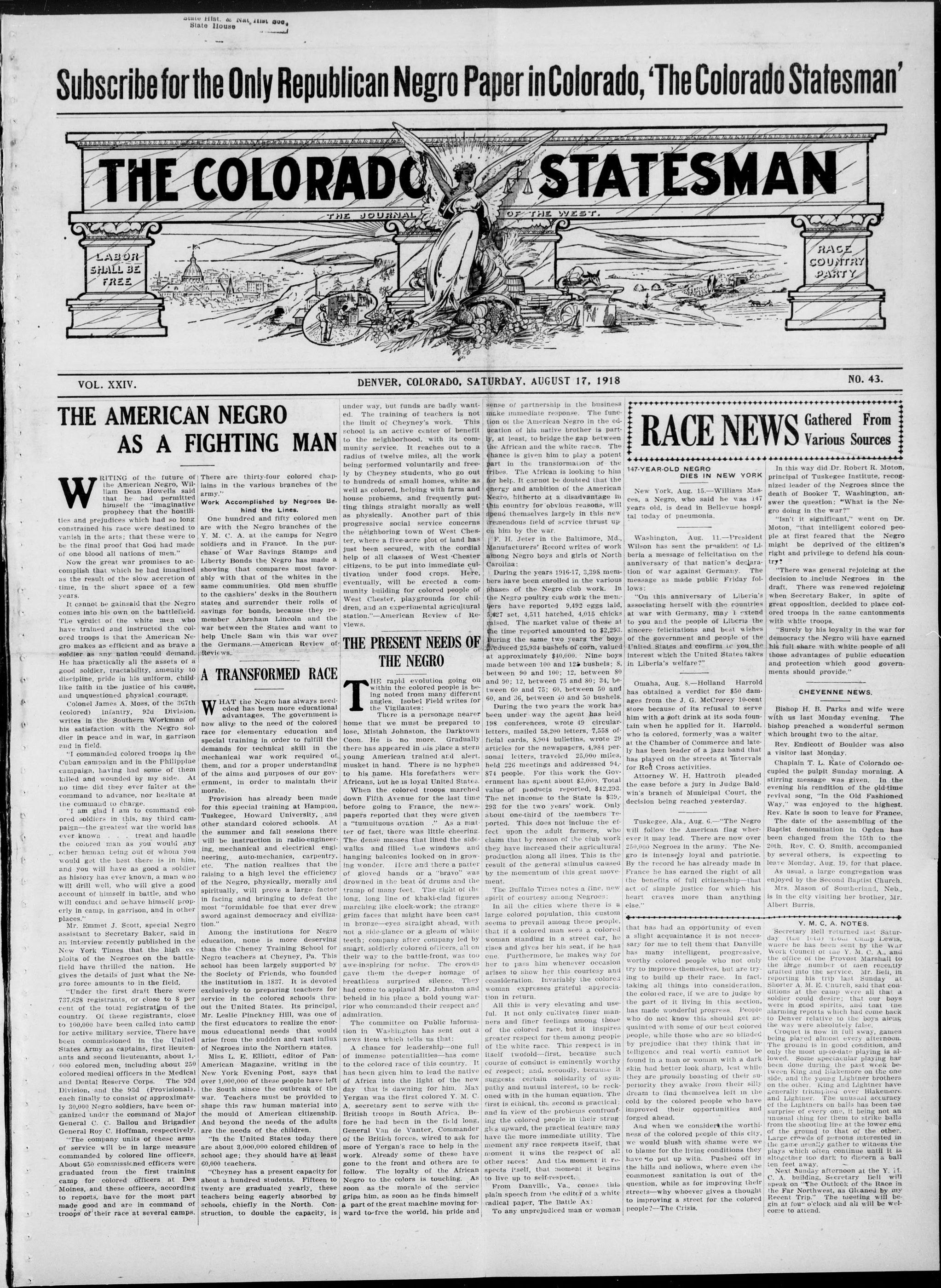
THE AMERICAN NEGRO AS A FIGHTING MAN
VOL. XXIV.
WRITING of the future of the American Negro, William Dean Howells said that he had permitted himself the "imaginative prophecy that the hostilities and prejudices which had so long constrained his race were destined to vanish in the arts; that these were to be the final proof that God had made of one blood all nations of men."
Now the great war promises to accomplish that which he had imagined as the result of the slow accretion of time, in the short space of a few years.
It cannot be gainsaid that the Negro comes into his own on the battlefield. The verdict of the white men who have trained and instructed the colored troops is that the American Negro makes as efficient and as brave a soldier as any nation could demand. He has practically all the assets of a good soldier, tractability, amenity to discipline, pride in his uniform, childlike faith in the justice of his cause, and unquestioned physical courage.
Colonel James A. Moss, of the 367th (colored) Infantry, 92d Division, writes in the Southern Workman of his satisfaction with the Negro soldier in peace and in war, in garrison and in field.
"I commanded colored troops in the Cuban campaign and in the Philippine campaign, having had some of them killed and wounded by my side. At no time did they ever falter at the command to advance, nor hesitate at the command to charge.
"I am glad I am to command colored soldiers in this, my third campaign—the greatest war the world has ever known . . . treat and handle the colored man as you would any other human being out of whom you would get the best there is in him, and you will have as good a soldier as history has ever known, a man who will drill well, who will give a good account of himself in battle, and who will conduct and behave himself properly in camp, in garrison, and in other places."
Mr. Emmet J. Scott, special Negro assistant to Secretary Baker, said in an interview recently published in the New York Times that the high exploits of the Negroes on the battlefield have thrilled the nation. He gives the details of just what the Negro force amounts to in the field.
"Under the first draft there were 737,628 registrants, or close to 8 percent of the total registration of the country. Of these registrants, close to 100,000 have been called into camp for active military service. There have been commissioned in the United States Army as captains, first lieutenants and second lieutenants, about 1,000 colored men, including about 250 colored medical officers in the Medical and Dental Reserve Corps. The 92d Division, and the 93d (Provisional), each finally to consist of approximately 30,000 Negro soldiers, have been organized under the command of Major General C. C. Ballou and Brigadier General Roy C. Hoffman, respectively.
"The company units of these arms of service will be in large measure commanded by colored line officers. About 650 commissioned officers were graduated from the first training camp for colored officers at Des Moines, and these officers, according to reports, have for the most part made good and are in command of troops of their race at several camps.
State Hist. & Nat Hist goe
State House
for the Only Republ
COLORA
AN NEGRO
FIGHTING MAN
There are thirty-four colored chapains in the various branches of the army."
Work Accomplished by Negroes Behind the Lines.
One hundred and fifty colored men are with the Negro branches of the Y. M. C. A. at the camps for Negro soldiers and in France. In the purchase of War Savings Stamps and Liberty Bonds the Negro has made a showing that compares most favorably with that of the whites in the same communities. Old men shuffle to the cashiers' desks in the Southern states and surrender their rolls of savings for bonds, because they remember Abraham Lincoln and the war between the States and want to help Uncle Sam win this war over the Germans.—American Review of Reviews.
A TRANSFORMED RACE
WHAT the Negro has always needed has been more educational advantages. The government is now alive to the need of the colored race for elementary education and special training in order to fulfill the demands for technical skill in the mechanical war work required of them, and for a proper understanding of the aims and purposes of our government, in order to maintain their morale. Provision has already been made for this special training at Hampion, Tuskegee, Howard University, and other standard colored schools. At the summer and fall sessions there will be instruction in radio-engineering, mechanical and electrical engineering, auto-mechanics, carpentry, etc. The nation realizes that the raising to a high level the efficiency of the Negro, physically, morally and spiritually, will prove a large factor in facing and bringing to defeat the most "formidable foe that ever drew sword against democracy and civilization."
Among the institutions for Negro education, none is more deserving than the Cheney Training School for Negro teachers at Cheyney, Pa. This school has been largely supported by the Society of Friends, who founded the institution in 1837. It is devoted exclusively to preparing teachers for service in the colored schools throut the United States. Its principal, Mr. Leslie Pinckney Hill, was one of the first educators to realize the enormous educational needs that would arise from the sudden and vast influx of Negroes into the Northern states. Miss L. E. Elliott, editor of Pan-American Magazine, writing in the New York Evening Post, says that over 1,000,000 of these people have left the South since the outbreak of the war. Teachers must be provided to shape this raw human material into the mould of American citizenship. And beyond the needs of the adults are the needs of the children.
"In the United States today there are about 3,000,000 colored children of school age; they should have at least 60,000 teachers.
"Cheyney has a present capacity for about a hundred students. Fifteen to twenty are graduated yearly, these teachers being eagerly absorbed by schools, chiefly in the North. Construction, to double the capacity, is
DENVER, COLORADO, SATURDAY, AUGUST 17, 1918
under way, but funds are badly wanted. The training of teachers is not the limit of Cheyney's work. This school is an active center of benefit to the neighborhood, with its community service. It reaches out to a radius of twelve miles, all the work being performed voluntarily and freely by Cheyney students, who go out to hundreds of small homes, white as well as colored, helping with farm and house problems, and frequently putting things straight morally as well as physically. Another part of this progressive social service concerns the neighboring town of West Chester, where a five-acre plot of land has just been secured, with the cordial help of all classes of West Chester citizens, to be put into immediate cultivation under food crops. Here, eventually, will be erected a community building for colored people of West Chester, playgrounds for children, and an experimental agricultural station."—American Review of Reviews.
THE PRESENT NEEDS OF THE NEGRO
HE rapid evolution going on within the colored people is being noted from many different angles. Isobei Field writes for the Vigilantes: There is a personage nearer home that we must be prepared to lose, Mistah Johnston, the Darktown Coon. He is no more. Gradually there has appeared in his place a stern young American trained and alert, musket in hand. There is no hyphen to his name. His forefathers were Africans, but he is loyal United States.
When the colored troops marched down Fifth Avenue for the last time before going to France, the newspapers reported that they were given a "tumultuous ovation." As a matter of fact, there was little cheering. The dense masses that lined the sidewalks and filled the windows and hanging balconies looked on in growing wonder. Here and there a pattern of gloved hands or a "bravo" was drowned in the beat of drums and the tramp of many feet. The sight of the long, long line of khaki-clad figures marching like clock-work; the strange grim faces that might have been cast in bronze—eyes straight ahead, with not a side-glance or a gleam of white teeth; company after company led by smart, soldierly colored officers, all on their way to the battle-front, was too awe-inspiring for noise. The crowds gave them the deeper homage of breathless surprised silence. They had come to applaud Mr. Johnston and beheld in his place a bold young warrior who commanded their respect and admiration.
The committee on Public Information in Washington has sent out a news item which tells us that:
A chance for leadership—one full of immense potentialities—has come to the colored race of this country. It has been given him to lead the native of Africa into the light of the new day that is dawning for him. Max Yergan was the first colored Y. M. C. A. secretary sent to serve with the British troops in South Africa. Before he had been in the field long, General Van de Vanter, Commander of the British forces, wired to ask for more of Yergan's race to help in the work. Already some of these have gone to the front and others are to follow. The loyalty of the African Negro to the colors is touching. As soon as the morale of the service grips him, as soon as he finds himself a part of the great machine moving forward to free the world, his pride and
sense of partnership in the business make immediate response. The function of the American Negro in the education of his native brother is partly, at least, to bridge the gap between the African and the white races. The chance is given him to play a potent part in the transformation of the tribes. The African is looking to him for help. It cannot be doubted that the energy and ambition of the American Negro, hitherto at a disadvantage in this country for obvious reasons, will spend themselves largely in this new tremendous field of service thrust upon him by the war. F. H. Jeter in the Baltimore, Md., Manufacturers' Record writes of work among Negro boys and girls of North Carolina:
During the years 1916-17, 3,398 members have been enrolled in the various phases of the Negro club work. In the Negro poultry club work the members have reported 9,492 eggs laid, 5,427 set, 4,511 hatched, 4,015 chicks raised. The market value of these at the time reported amounted to $2,293. During the same two years the boys produced 25,934 bushels of corn, valued at approximately $40,000. Nine boys made between 100 and 12$ bushels; 8, between 90 and 100; 12, between 80 and 90; 12, between 75 and 80; 34, between 60 and 75; 60, between 50 and 60, and 36, between 40 and 50 bushels.
During the two years the work has been under way the agent has held 198 conferences, wrote 49 circular letters, mailed 58,200 letters, 7,558 of official cards, 8,904 bulletins, wrote 28 articles for the newspapers, 4,984 personal letters, traveled 25,000 miles, held 226 meetings and addressed 94,874 people. For this work the Government has spent about $3,000. Total value of products reported, $42,293. The net income to the State is $39,293 for the two years' work. Only about one-third of the members reported. This does not include the effect upon the adult farmers, who claim that by reason of the club work they have increased their agricultural production along all lines. This is the result of the general stimulus caused by the momentum of this great movement.
The Buffalo Times notes a fine, new spirit of courtesy among Negroes:
In all the cities where there is a large colored population, this custom seems to prevail among these people, that if a colored man sees a colored woman standing in a street car, he rises and gives her his seat, if he has one. Furthermore, he makes way for her to pass him whenever occasion arises to show her this courtesy and consideration. Invariably the colored woman expresses grateful appreciation in return.
All this is very elevating and useful. It not only cultivates finer manners and finer feelings among those of the colored race, but it inspires greater respect for them among people of the white race. This respect is in itself twofold—first, because such course of conduct is eminently worthy of respect; and, secondly, because it suggests certain solidarity of sympathy and mutual interest, to be reckoned with in the human equation. The first is ethical, the second is practical; and in view of the problems confronting the colored people in their struggles upward, the practical feature may have the more immediate utility. The moment any race respects itself, that moment it wins the respect of all other races! And the moment it respects itself, that moment it begins to live up to self-respect.
From Danville, Va., comes this plain speech from the editor of a white radical paper, The Battle Ax:
To any unprejudiced man or woman
RACE NEWS Gathered From Various Sources
147-YEAR-OLD NEGRO DIES IN NEW YORK
New York, Aug. 15.—William Masces, a Negro, who said he was 147 years old, is dead in Bellevue hospital today of pneumonia.
Washington, Aug. 11.—President Wilson has sent the president of Liberia a message of felicitation on the anniversary of that nation's declaration of war against Germany. The message as made public Friday follows:
"On this anniversary of Liberia's associating herself with the countries at war with Germany, may I extend to you and the people of Liberia the sincere felicitation and best wishes of the government and people of the United States and confirm to you the interest which the United States takes in Liberia's welfare?"
Omaha, Aug. 8.—Holland Harrold has obtained a verdict for $50 damages from the J. G. McCrorey 10-cent store because of its refusal to serve him with a soft drink at its soda fountain when he applied for it. Harrold, who is colored, formerly was a waiter at the Chamber of Commerce and lately has been leader of a jazz band that has played on the streets at Intervals for Red Cross activities.
Attorney W. H. Hattroth pleaded the case before a jury in Judge Baldwin's branch of Municipal Court, the decision being reached yesterday.
____
Tuskegee, Ala., Aug. 6.—"The Negro will follow the American flag wherever it may lead. There are now over 250,000 Negroes in the army. The Negro is intensely loyal and patriotic. By the record he has already made in France he has earned the right of all the benefits of full citizenship—that act of simple justice for which his heart craves more than anything else."
that has had an opportunity of even a slight acquaintance it is not necessary for me to tell them that Danville has many intelligent, progressive, worthy colored people who not only try to improve themselves, but are trying to build up their race. In fact, taking all things into consideration, the colored race, if we are to judge by the part of it living in this section, has made wonderful progress. People who do not know this should get acquainted with some of our best colored people, while those who are so blinded by prejudice that they think that intelligence and real worth cannot be found in a man or woman with a dark skin had better look sharp, lest while they are proudly boasting of their superiority they awake from their silly dream to find themselves left in the cold by the colored people who have improved their opportunities and forged ahead.
And when we consider the worthiness of the colored people of this city, we would blush with shame were we to blame for the living conditions they have to put up with. Pushed off in the hills and nollows, where even the commonest sanitation is out of the question, while as for improving their streets—why whoever gives a thought to improving a street for the colored people?—The Crisis.
NO. 43.
In this way did Dr. Robert R. Moton, principal of Tuskegee Institute, recognized leader of the Negroes since the death of Booker T. Washington, answer the question: "What is the Negro doing in the war?" "Isn't it significant," went on Dr. Moton, "that intelligent colored people at first feared that the Negro might be deprived of the citizen's right and privilege to defend his country? "There was general rejoicing at the decision to include Negroes in the draft. There was renewed rejoicing when Secretary Baker, in spite of great opposition, decided to place colored troops in the same cantonments with white troops. "Surely by his loyalty in the war for democracy the Negro will have earned his full share with white people of all those advantages of public education and protection which good governments should provide."
CHEYENNE NEWS
Bishop H. B. Parks and wife were with us last Monday evening. The bishop preached a wonderful sermon which brought two to the altar. Rev. Endicott of Boulder was also a visitor last Monday.
Chaplain T. L. Kate of Colorado occupied the pulpit Sunday morning. A stirring message was given. In the evening his rendition of the old-time revival song, "In the Old Fashioned Way," was enjoyed to the highest. Rev. Kate is soon to leave for France. The date of the assembling of the Baptist denomination in Ogden has been changed from the 15th to the 20th. Rev. C. O. Smith, accompanied by several others, is expecting to leave Monday, Aug. 19, for that place. As usual, a large congregation was enjoyed by the Second Baptist Church. Mrs. Mason of Southerland, Neb., is in the city visiting her brother, Mr. Albert Burris.
Y. M. C. A. NOTES.
Secretary Bell returned last Saturday (the 16th) from Camp Lewis, where he has been sent by the War Work Council of the Y. M. C. A., and the office of the Provost Marshall to the large number of men recently drafted into the service. Mr. Bell, in reporting his trip last Sunday at Shorter A. M. E. Church, said that conditions at the camp were all that a soldier could desire; that our boys were in good spirits, and that the alarming reports which had come back to Denver relative to the boys along the way were absolutely false. Croquet is now in full sway, games being played almost every afternoon. The ground is in good condition, and only the most up-to-date playing is allowed. Some spectacular playing has been done during the past week between King and Blakemore on the one side, and the young Lightner brothers on the other. King and Lightner have generally triumphed over Blakemore and Lightner. The unusual accuracy of the Lightners on balls has been tae surprise of every one, it being not an unusual thing for them to strike balls from the shooting line at the lower end of the ground to that of the other. Large crowds of persons interested in the game usually gather to witness the plays which often continue until it is altogether too dark to discern a ball ten feet away.
Next Sunday afternoon at the Y. i. f. C. A. building, Secretary Bell will speak on "The Outlook of the Race in the Far Northwest, as Gleaned by my Recent Trip." The meeting will begin at four o'clock and all will be welcome to attend.
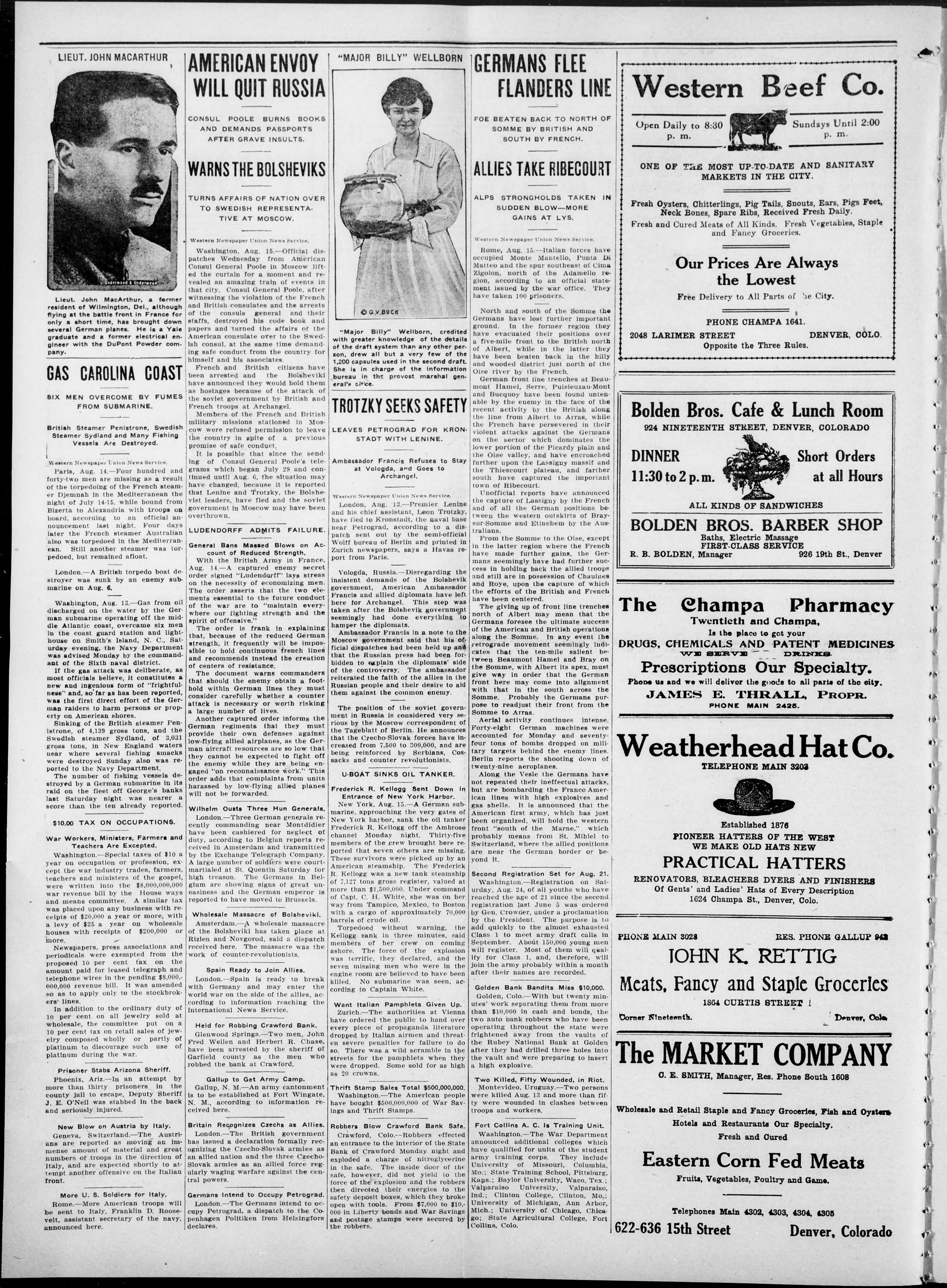
LIEUT. JOHN MACARTHUR
Underwood & Underwood
Lieut. John MacArthur, a former resident of Wilmington, Del., although flying at the battle front in France for only a short time, has brought down several German planes. He is a Yale graduate and a former electrical engineer with the DuPont Powder company.
GAS CAROLINA COAST
GAS CAROLINA COAST
SIX MEN OVERCOME BY FUMES FROM SUBMARINE.
British Steamer Penistrone, Swedish Steamer Sydland and Many Fishing Vessels are Destroyed.
Western Newspaper Union News Service.
Paris, Aug. 14.—Four hundred and forty-two men are missing as a result of the torpedoing of the French steamer Djemnah in the Mediterranean the night of July 14-15, while bound from Bizerta to Alexandria with troops on board, according to an official announcement last night. Four days later the French steamer Australian also was torpedoed in the Mediterranean. Still another steamer was torpedoed, but remained afloat.
London.—A British torpedo boat destroyer was sunk by an enemy submarine on Aug. 6.
Washington, Aug. 13.—Gas from oil discharged on the water by the German submarine operating off the middle Atlantic coast, overcame six men in the coast guard station and light house on Smith's Island, N. C., Saturday evening, the Navy Department was advised Monday by the commandant of the Sixth naval district.
If the gas attack was deliberate, as most officials believe, it constitutes a new and ingenious form of "frightfulness" and, so far as has been reported, was the first direct effort of the German raiders to harm persons or property on American shores.
Sinking of the British steamer Penistone, of 4,139 gross tons, and the Swedish steamer Sydland, of 3,031 gross tons, in New England waters near where several fishing smacks were destroyed Sunday also was reported to the Navy Department. The number of fishing vessels destroyed by a German submarine in its raid on the fleet off George's banks last Saturday night was nearer a score than the ten already reported.
$10.00 TAX ON OCCUPATIONS.
War Workers, Ministers, Farmers and Teachers Are Excepted.
Washington.—Special taxes of $10 a year on occupation or profession, except the war industry trades, farmers, teachers and ministers of the gospel, were written into the $8,000,000,000 war revenue bill by the House ways and means committee. A similar tax was placed upon any business with receipts of $20,000 a year or more, with a levy of $25 a year on wholesale houses with receipts of $200,000 or more.
Newspapers, press associations and periodicals were exempted from the proposed 10 per cent tax on the amount paid for leased telegraph and telephone wires in the pending $8,000,-000,000 revenue bill. It was amended so as to apply only to the stockbrokers' lines.
In addition to the ordinary duty of 10 per cent on all jewelry sold at wholesale, the committee put on a 10 per cent tax on retail sales of jewelry composed wholly or partly of platinum to discourage such use of platinum during the war.
Prisoner Stabs Arizona Sheriff.
Phoenix, Ariz.—In an attempt by more than thirty prisoners in the county jail to escape, Deputy Sheriff J. E. O'Neil was stabbed in the back and seriously injured.
New Blow on Austria by Italy.
Geneva, Switzerland.—The Austrians are reported as moving an immense amount of material and great numbers of troops in the direction of Italy, and are expected shortly to attempt another offensive on the Italian front.
Rome.—More American troops will be sent to Italy, Franklin D. Roosevelt, assistant secretary of the navy, announced here.
AMERICAN ENVOY WILL QUIT RUSSIA
CONSUL POOLE BURNS BOOKS AND DEMANDS PASSPORTS AFTER GRAVE INSULTS.
WARNSTHE BOLSHEVIKS
TURNS AFFAIRS OF NATION OVER TO SWEDISH REPRESENTATIVE AT MOSCOW.
Western Newspaper Union News Service.
Washington, Aug. 15.—Official dispatches Wednesday from American Consul General Poole in Moscow lifted the curtain for a moment and revealed an amazing train of events in that city. Consul General Poole, after witnessing the violation of the French and British consulates and the arrests of the consuls general and their staffs, destroyed his code book and papers and turned the affairs of the American consulate over to the Swedish consul, at the same time demanding safe conduct from the country for himself and his associates.
French and British citizens have been arrested and the Bolshevik have announced they would hold them as hostages because of the attack of the soviet government by British and French troops at Archangel.
Members of the French and British military missions stationed in Moscow were refused permission to leave the country in spite of a previous promise of safe conduct. It is possible that since the sending of Consul General Poole's telegrams which began July 29 and continued until Aug. 6, the situation may have changed, because it is reported that Lenine and Trotzky, the Bolshevist leaders, have fled and the Soviet government in Moscow may have been overthrown.
LUDENDORFF ADMITS FAILURE
General Bans Massed Blows on Ac count of Reduced Strength.
With the British Army in France, Aug. 14.—A captured enemy secret order signed "Ludendorff" lays stress on the necessity of economizing men. The order asserts that the two elements essential to the future conduct of the war are to "maintain everywhere our fighting strength and the spirit of offensive." The order is frank in explaining that, because of the reduced German strength, it frequently will be impossible to hold continuous french lines and recommends instead the creation of centers of resistance. The document warns commanders that should the enemy obtain a foothold within German lines they must consider carefully whether a counter attack is necessary or worth risking a large number of lives.
Another captured order informs the German regiments that they must provide their own defenses against low-flying allied airplanes, as the German aircraft resources are so low that they cannot be expected to fight off the enemy while they are being engaged "on reconnaissance work." This order adds that complaints from units harassed by low-flying allied planes will not be forwarded.
London.—Three German generals recently commanding near Montdidier have been cashiered for neglect of duty, according to Belgian reports received in Amsterdam and transmitted by the Exchange Telegraph Company. A large number of soldiers were court-martialled at St. Quentin Saturday for high treason. The Germans in Belgium are showing signs of great uneasiness and the German emperor is reported to have moved to Brussels.
Wholesale Massacre of Bolsheviki.
Amsterdam.—A wholesale massacre of the Bolsheviki has taken place at Rizlen and Norogod, said a dispatch received here. The massacre was the work of counter-revolutionists.
Spain Ready to Join Allies
London.—Spain is ready to break with Germany and may enter the world war on the side of the allies, according to information reaching the International News Service.
Held for Robbing Crawford Bank
Glenwood Springs.—Two men, John Fred Wellen and Herbert R. Chase, have been arrested by the sheriff of Garfield county as the men who robbed the bank at Crawford.
Gallup to Get Army Camp.
Gallup, N. M.—An army cantonment is to be established at Fort Wingate, N. M., according to information received here.
Britain Recognizes Czechs as Allies.
London.—The British government has issued a declaration formally recognizing the Czecho-Slovak armies as an allied nation and the three Czecho-Slovak armies as an allied force regularly waging warfare against the central powers.
Germans Intend to Occupy Petrograd. London.—The Germans intend to occupy Petrograd, a dispatch to the Copenhagen Politiken from Helsingfors declares.
"MAJOR BILLY" WELLBORN
© G.V.BUCK
"Major Billy" Wellborn, credited with greater knowledge of the details of the draft system than any other person, drew all but a very few of the 1,200 capsules used in the second draft. She is in charge of the information bureau in the provost marshal general's office.
TROTZKY SEEKS SAFETY
LEAVES PETROGRAD FOR KRON
STADT WITH LENINE.
Ambassador Francis Refuses to Stay at Vologda, and Goes to Archangel
Western Newspaper Union News Service. London, Aug. 13.—Premier Lenine and his chief assistant, Leon Trotzky, have fled to Kronstadt, the naval base near Petrograd, according to a dispatch sent out by the semi-official Wolff bureau of Berlin and printed in Zurich newspapers, says a Havas report from Paris.
Vologda, Russia.—Disregarding the insistent demands of the Bolshevik government, American Ambassador Francis and allied diplomats have left here for Archangel. This step was taken after the Bolshevik government seemingly had done everything to hamper the diplomats.
Ambassador Francis in a note to the Moscow government said that his official dispatches had been held up and that the Russian press had been forbidden to explain the diplomats' side of the controversy. The ambassador reiterated the faith of the allies in the Russian people and their desire to aid them against the common enemy.
The position of the soviet government in Russia is considered very serious by the Moscow correspondent of the Tageblatt of Berlin. He announces that the Czecho-Slovak forces have increased from 7,500 to 300,000, and are being reinforced by Serbians, Cossacks and counter revolutionists.
U-BOAT SINKS OIL TANKER
Frederick R. Kellogg Sent Down in Entrance of New York Harbor.
New York, Aug. 15.—A German submarine, approaching the very gates of New York harbor, sank the oil tanker Frederick R. Kellogg off the Ambrose channel Monday night. Thirty-five members of the crew brought here reported that seven others are missing.
These survivors were picked up by an American steamship. The Frederick R. Kellogg was a new tank steamship of 7,127 tons gross register, valued at more than $1,500,000. Under command of Capt. C. H. White, she was on her way from Tampico, Mexico, to Boston with a cargo of approximately 70,000 barrels of crude oil.
Torpedoed without warning, the Kellogg sank in three minutes, said members of her crew on coming ashore. The force of the explosion was terrific, they declared, and the seven missing men who were in the engine room are believed to have been killed. No submarine was seen, according to Captain White.
Want Italian Pamphlets Given Up. Zurich—The authorities at Vienna have ordered the public to hand over every piece of propaganda literature dropped by Italian airmen and threaten severe penalties for failure to do so. There was a wild scramble in the streets for the pamphlets when they were dropped. Some sold for as high as 20 crowns.
Thrift Stamp Sales Total $500,000,000,
Washington.—The American people
have bought $500,000,000 of War Savings
and Thrift Stamps.
Robbers Blow Crawford Bank Safe.
Crawford, Colo.—Robbers effected an entrance to the interior of the State Bank of Crawford Monday night and exploded a charge of nitroglycerine in the safe. The inside door of the safe, however, did not yield to the force of the explosion and the robbers then directed their energies to the safety deposit boxes, which they broke open with tools. From $7,000 to $10,000 in Liberty bonds and War Savings and postage stamps were secured by the robbers.
GERMANS FLEE FLANDERS LINE
FOE BEATEN BACK TO NORTH OF
SOMME BY BRITISH AND
SOUTH BY FRENCH.
ALLIES TAKE RIBECOURT
ALPS STRONGHOLDS TAKEN IN
SUDDEN BLOW—MORE
GAINS AT LYS.
Western Newspaper Union News Service.
Rome, Aug. 15.—Italian forces have
occupied Monte Mantello, Punta Di
Matteo and the spur southeast of Clima
Zigolon, north of the Adamello
region, according to an official statement
issued by the war office. They
have taken 100 prisoners.
North and south of the Somme the
Germans have lost further important
ground. In the former region they
have evacuated their positions over
a five-mile front to the British north
of Albert, while in the latter they
have been beaten back in the hilly
and wooded district just north of the
Oise river by the French.
German front line trenches at Beaumont Hamel, Serre, Puisieuxau-Mont and Bucquoy have been found untenable by the enemy in the face of the recent activity by the British along the line from Albert to Arras, while the French have persevered in their violent attacks against the Germans on the sector which dominates the lower portion of the Picardy plain and the Oise valley, and have encroached further upon the Lassigny massif and the Thiescourt plateau, and farther south have captured the important town of Ribecourt.
Unofficial reports have announced the capture of Lassigny by the French and of all the German positions between the western outskirts of Braysur-Somme and Etinehem by the Australians.
From the Somme to the Oise, except in the latter region where the French have made further gains, the Germans seemingly have had further success in holding back the allied troops and still are in possession of Chaulnes and Roye, upon the capture of which the efforts of the British and French have been centered.
The giving up of front line trenches north of Albert may mean that the Germans foresee the ultimate success of the American and British operations along the Somme. In any event the retrograde movement seemingly indicates that the ten-mile salient between Beaumont Hamel and Bray on the Somme, with Albert its apex, must give way in order that the German front here may come into alignment with that in the south across the Somme. Probably the Germans purpose to readjust their front from the Somme to Arras.
Aerial activity continues intense. Forty-eight German machines were accounted for Monday and seventy-four tons of bombs dropped on military targets behind the enemy lines. Berlin reports the shooting down of twenty-nine aeroplanes. Along the Vesle the Germans have not repeated their ineffectual attacks, but are bombarding the Franco American lines with high explosives and gas shells. It is announced that the American first army, which has just been organized, will hold the western front "south of the Marne," which probably means from St. Mihiel to Switzerland, where the allied positions are near the German border or beyond it.
Second Registration Set for Aug. 21.
Washington.—Registration on Saturday, Aug. 24, of all youths who have reached the age of 21 since the second registration last June 5 was ordered by Gen. Crowder, under a proclamation by the President. The purpose is to add quickly to the almost exhausted Class 1 to meet army draft calls in September. About 150,000 young men will register. Most of them will qualify for Class 1, and, therefore, will join the army probably within a month after their names are recorded.
Golden Bank Bandits Miss $10,000.
Golden, Colo.—With but twenty minutes' work separating them from more than $10,000 in cash and bonds, the two auto bank robbers who have been operating throughout the state were frightened away from the vaults of the Rubey National Bank at Golden after they had drilled three holes into the vault and were preparing to insert a high explosive.
Two Killed, Fifty Wounded, in Riot.
Montevideo, Uruguay.—Two persons were killed Aug. 13 and more than fifty were wounded in clashes between troops and workers.
Fort Collins A. C. Is Training Unit.
Washington.—The War Department announced additional colleges which have qualified for units of the student army training corps. They include University of Missouri, Columbia, Mo.; State Training School, Pittsburg, Kaps.; Baylor University, Waco, Tex.; Valparaiso University, Valparaiso, Ind.; Clinton College, Clinton, Mo.; University of Michigan, Ann Arbor, Mich.; University of Chicago, Chicago; State Agricultural College, Fort Collins, Colo.
Western Beef Co.
Open Daily to 8:30 p.m.
ONE OF THE MOST
MARK
Fresh Oysters, Chitterb
Neck Bones, Sp
Fresh and Cured Meats
and
OF THE MOST UP-TO-DATE AND SALE MARKETS IN THE CITY.
ters, Chitterlings, Pig Tails, Snouts, Ears, Rock Bones, Spare Ribs, Received Fresh Dairy Cured Meats of All Kinds. Fresh Vegetable and Fancy Groceries.
ONE OF THE MOST UP-TO-DATE AND SANITARY MARKETS IN THE CITY.
Fresh Oysters, Chitterlings, Pig Tails, Snouts, Ears, Pigs Feet, Neck Bones, Spare Ribs, Received Fresh Daily. Fresh and Cured Meats of All Kinds. Fresh Vegetables, Staple and Fancy Groceries.
Our Prices Are Always the Lowest Free Delivery to All Parts of the City.
PHC
2048 LARIMER STREET
Oppo
Bolden Bros.
924 NINETEENTH
PHONE CHAMPA 1641.
IMER STREET DENVER
Opposite the Three Rules.
In Bros. Cafe & Lunch
INNETEENTH STREET, DENVER, COLO
PHONE CHAMPA 1641.
2048 LARIMER STREET DENVER, COLO.
Opposite the Three Rules.
DINNER
11:30 to 2 p.m.
ALL KIN
BOLDEN BR
Baths,
FIRST
R. B. BOLDEN, Manage
The Char
Twenty
Is the
DRUGS, CHEMICALS
WE SERVE
Prescription
Phone us and we will do
JAMES E.
PHC
Weather
TELE
PIONEER H
WE MAKE
PRACTICE
RENOVATORS, BLEA
Of Gents' and Lads
1624 Cha
ALL KINDS OF SANDWICHES
DEN BROS. BARBER
Baths, Electric Massage
FIRST-CLASS SERVICE
DEN, Manager 926 19th S
Champa Phar-
Twentieth and Champa,
Is the place to get your
CHEMICALS AND PATENT M
WE SERVE DRINKS.
Descriptions Our Special
and we will deliver the goods to all parts o
MES E. THRALL, PR
PHONE MAIN 2426.
fatherhead Hall
TELEPHONE MAIN 3203
BOLDEN BROS. BARBER SHOP Baths, Electric Massage FIRST-CLASS SERVICE R. B. BOLDEN, Manager 926 19th St., Denver
The Champa Pharmacy
Twentieth and Champa,
Is the place to get your
DRUGS, CHEMICALS AND PATENT MEDICINES
WE SERVE DRINKS.
Prescriptions Our Specialty.
Phone us and we will deliver the goods to all parts of the city.
JAMES E. THRALL, PROPR.
PHONE MAIN 2425.
Weatherhead Hat Co. TELEPHONE MAIN 3203
Established 1876
PIONEER HATTERS OF THE WEST
WE MAKE OLD HATS NEW
PRACTICAL HATTERS
MOTORS, BLEACHERS DYERS AND FIN
Gents' and Ladies' Hats of Every Descrip
1624 Champa St., Denver, Colo.
Established 1876
PIONEER HATTERS OF THE WEST
WE MAKE OLD HATS NEW
PRACTICAL HATTERS
RENOVATORS, BLEACHERS DYERS AND FINISHERS
Of Gents' and Ladies' Hats of Every Description
1624 Champa St., Denver, Colo.
JOHN Meats, Fancy 1864
JOHN K. RETTIGER
Fancy and Staple Gro
1864 CURTIS STREET !
enth.
Meats, Fancy and Staple Groceries
1864 CURTIS STREET !
Corner Nineteenth. Denver, Cola
The MARKET COMPANY
C. E. SMITH, Manager, Res. Phone South 1608
Wholesale and Retail Staple and Fancy Groceries, Fish and Oysters
Hotels and Restaurants Our Specialty.
Fresh and Cured
The MARKET COMPANY
C. E. SMITH, Manager, Res. Phone South 1608
Wholesale and Retail Staple and Fancy Groceries, Fish and Oysters Hotels and Restaurants Our Specialty. Fresh and Cured Eastern Corn Fed Meats Fruits, Vegetables, Poultry and Game.
Telephones Main 4302, 4303, 4304, 4305
622-636 15th Street Denver, Colorado
PHONE MAIN 3028
Corner Nineteenth.
Sundays Until 2:00 p. m.
DATE AND SANITARY
THE CITY.
Fails, Snouts, Ears, Pigs Feet,
Received Fresh Daily.
Fresh Vegetables, Staple
Ococeries.
PA 1641.
DENVER, COLO.
ee Rules.
& Lunch Room
DENVER, COLORADO
Short Orders
at all Hours
BARBER SHOP
Massage
SERVICE
926 19th St., Denver
Pharmacy
Champa,
got your
PATENT MEDICINES
DRINKS
our Specialty.
goods to all parts of the city.
ALL, PROPR.
2425.
Bad Hat Co.
MAIN 3203
1876
OF THE WEST
HATS NEW
HATTERS
VERS AND FINISHERS
of Every Description
Denver, Colo.
RES. PHONE GALLUP 942
ETTIG
taple Grocerles
STREET !
Denver, Cola
COMPANY
```markdown
```
Fruit Bowl
```markdown
```
---
NEWS and GOSSIP of WASHINGTON
WASHINGTON.—It is right early in the season for goldenrod, but there are always ploneers. One blossom, anyhow, must have started in to bloom ahead of official fall weddings, for a motorman had it stuck in his cap as he breezed his car toward the capi-tol the other afternoon.
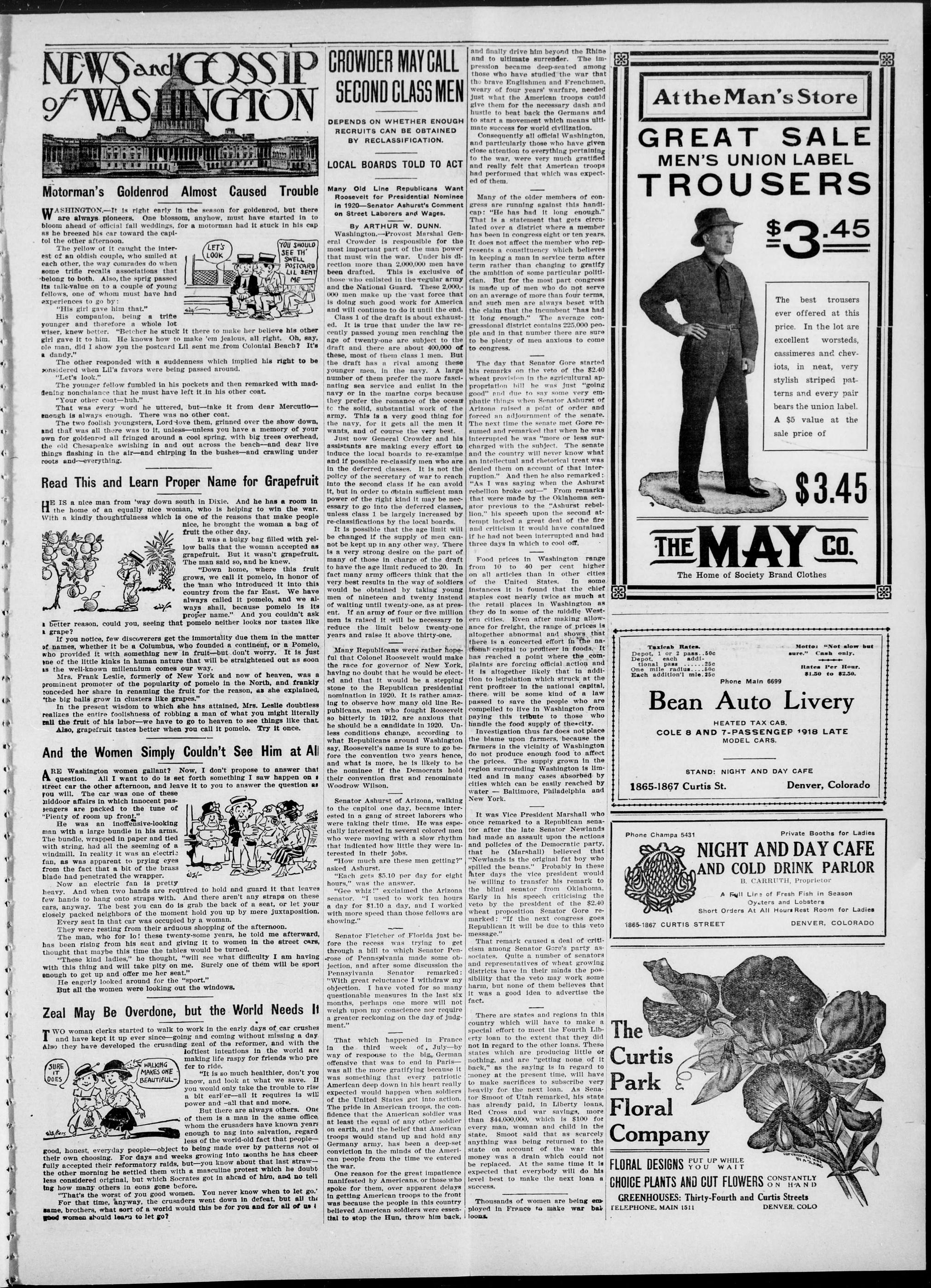
LET'S LOOK
YOU SHOULD SEE TH' SWELL POSTCARD LIL SENT ME
it there to make her believe his other
make 'em jealous, all right. Oh, say,
Lil sent me from Colonial Beach? It's
penness which implied his right to be
g passed around.
pockets and then remarked with mad-
left it in his other coat.
but—take it from dear Mercutio—
no other coat.
love them, grinned over the show down,
unless you have a memory of your
a cool spring, with big trees overhead,
out across the beach—and dear live-
ing in the bushes—and crawling under
Upper Name for Grapefruit
south in Dixie. And he has a room in
ian, who is helping to win the war.
one of the reasons that make people
wiser, knew better. "Betcher he stuck it there to make her believe his other girl gave it to him. He knows how to make 'em jealous, all right. Oh, say, ole man, did I show you the postcard Lil sent me from Colonial Beach? It's a dandy."
wiser, knew better. "Betcher he stuck it there to make girl gave it to him. He knows how to make 'em jealous ole man, did I show you the postcard Lil sent me from a dandy."
The other responded with a suddenness which I considered when Lil's favors were being passed around. "Let's look."
The younger fellow fumbled in his pockets and the dening nonchalance that he must have left it in his ot "Your other coat—huh."
That was every word he uttered, but—take it enough is always enough. There was no other coat.
The two foolish youngsters, Lord love them, grinne and that was all there was to it, unless—unless you kn own for goldenrod all fringed around a cool spring, w the old Chesapeake swishing in and out across the things flashing in the air—and chirping in the bushe roots and—everything.
Read This and Learn Proper Name
HE IS a nice man from 'way down south in Dixie, the home of an equally nice woman, who is he. With a kindly thoughtfulness which is one of the re nice, he brought
The other responded with a suddenness which implied his right to be considered when Lil's favors were being passed around.
"Let's look."
The younger fellow fumbled in his pockets and then remarked with mad-fencing nonchalance that he must have left it in his other coat.
"Your other coat—huh."
That was every word he uttered, but—take it from dear Mercutio—enough is always enough. There was no other cont.
The two foolish youngsters, Lord love them, grinned over the show down, and that was all there was to it, unless—unless you have a memory of your own for goldenrod all fringed around a cool spring, with big trees overhead, the old Chesapeake swishing in and out across the beach—and dear live things flashing in the air—and chirping in the bushes—and crawling under roots and—everything.
Read This and Learn Proper Name for Grapefruit
HE IS a nice man from 'way down south in Dixie. And he has a room in the home of an equally nice woman, who is helping to win the war. With a kindly thoughtfulness which is one of the reasons that make people nice, he brought the woman a bag of fruit the other day.
It was a bulgy bag filled with yellow balls that the woman accepted as grapefruit. But it wasn't grapefruit. The man said so, and he knew.
"Down home, where this fruit grows, we call it pomelo, in honor of the man who introduced it into this country from the far East. We have always called it pomelo, and we always shall, because pomelo is its proper name." And you couldn't ask
better reason, could you, seeing that pomelo neither grape?
If you notice, few discoverers get the immortality of names, whether it be a Columbus, who founded a who provided it with something new in fruit—but one of the little kinks in human nature that will be seen is the well-known millennium comes our way.
Mrs. Frank Leslie, formerly of New York and prominent promoter of the popularity of pomelo in conceded her share in renaming the fruit for the real 'the big balls grow in clusters like grapes."
In the present wisdom to which she has attained realizes the entire foolishness of robbing a man of wail the fruit of his labor—we have to go to heaven.
Also, grapefruit tastes better when you call it por
And the Women Simply Couldn't
ARE Washington women gallant? Now, I don't question. All I want to do is set forth something street car the other afternoon, and leave it to you to
it pomelo neither looks nor tastes like
the immortality due them in the matter
who founded a continent, or a Pomelo,
in fruit—but don't worry. It is just
that will be straightened out as soon
our way.
New York and now of heaven, was a
of pomelo in the North, and frankly
fruit for the reason, as she explained,
apes."
She has attained, Mrs. Leslie doubtless
ing a man of what you might literally
go to heaven to see things like that,
a you call it pomelo. Try it once.
Couldn't See Him at All
Now, I don't propose to answer that
at forth something I saw happen on
ave it to you to answer the question as
- better reason, could you, seeing that pomelo neither looks nor tastes like
- grape?
If you notice, few discoverers get the immortality due them in the matter of names, whether it be a Columbus, who founded a continent, or a Pomelo, who provided it with something new in fruit—but don't worry. It is just one of the little kinks in human nature that will be straightened out as soon as the well-known millennium comes our way.
Mrs. Frank Leslie, formerly of New York and now of heaven, was a prominent promoter of the popularity of pomelo in the North, and frankly conceded her share in renaming the fruit for the reason, as she explained, "the big balls grow in clusters like grapes."
In the present wisdom to which she has attained, Mrs. Leslie doubtless realizes the entire foolishness of robbing a man of what you might literally call the fruit of his labor—we have to go to heaven to see things like that. Also, grape fruit tests better when you call it pomelo. Try it once.
Also, grapefruit tastes better when you call it pomelo. Try it once.
And the Women Simply Couldn't See Him at All
And the Women Simply Couldn't See Him at All
ARE Washington women gallant? Now, I don't propose to answer that question. All I want to do is set forth something I saw happen on a street car the other afternoon, and leave it to you to answer the question as you will. The car was one of these middoor affairs in which innocent passengers are packed to the tune of "Plenty of room up front."
He was an inoffensive-looking man with a large bundle in his arms. The bundle, wrapped in paper and tied with string, had all the seeming of a windmill. In reality it was an electric fan, as was apparent in prying eyes from the fact that a bit of the brass blade had penetrated the wrapper.
fured to hold and guard it that leaves
And there aren't any straps on these
is grab the back of a seat, or let your
nt hold you up by mere juxtaposition.
d by a woman.
ous shopping of the afternoon.
nty-some years, he told me afterward,
living it to women in the street cars,
es would be turned.
“will see what difficulty I am having
me. Surely one of them will be sport.
it.”
“sport.”
Now an electric fan is pretty heavy. And when two hands are required to hold and guard it that leaves few hands to hang onto straps with. And there aren't any straps on these cars, anyway. The best you can do is grab the back of a seat, or let your closely packed neighbors of the moment hold you up by mere juxtaposition.
heavy. And when two hands are required to hold a few hands to hang onto straps with. And there are cars, anyway. The best you can do is grab the back closely packed neighbors of the moment you up you Every seat in that car was occupied by a woman. They were resting from their arduous shopping of The man, who for lo! these twenty-some years, has been rising from his seat and giving it to wo thought that maybe this time the tables would be tur "These kind ladles," he thought, "will see what with this thing and will take pity on me. Surely on enough to get up and offer me her seat."
Every seat in that car was occupied by a woman. They were resting from their arduous shopping of the afternoon. The man, who for lo! these twenty-some years, he told me afterward, has been rising from his seat and giving it to women in the street cars, thought that maybe this time the tables would be turned. "These kind ladies," he thought, "will see what difficulty I am having with this thing and will take pity on me. Surely one of them will be sport enough to get up and offer me her seat." He eagerly looked around for the "sport." But all the women were looking out the windows.
Zeal May Be Overdone, but the World Needs It
Two woman clerks started to walk to work in the early days of car crushes and have kept it up ever since—going and coming without missing a day. Also they have developed the crusading zeal of the reformer, and with the loftiest intentions in the world are
but the World Needs It to work in the early days of car crushes ing and coming without missing a day. ing zeal of the reformer, and with the
Zeal May Be Overdone, but the World Needs It
Zeal May Be Overdone, but the World Needs It
TWO woman clerks started to walk to work in the early days of car crushes and have kept it up ever since—going and coming without missing a day. Also they have developed the crusading zeal of the reformer, and with the
loftiest intentions in the world are making life raspy for friends who prefer to ride.
"It is so much healthier, don't you know, and look at what we save. If you would only take the trouble to rise a bit earlier—all it requires is will power and—all that and more.
But there are always others. One of them is a man in the same office, whom the crusaders have known years enough to nag into salvation, regard less of the world-old fact that people—
good, honest, everyday people—object to being made their own choosing. For days and weeks growing intully accepted their reformatory raids, but—you know the other morning he settled them with a masculine less considered original, but which Socrates got in shing how many others in eons gone before.
"That's the worst of you good women. You never For that time, anyway, the crusaders went down same, brothers, what sort of a world would this be for good women should learn to let go?
it to being made over by patterns not of weeks growing into months he has cheered but—you know about that last straw—with a masculine protest which he doubtrates got in ahead of him, and no tell before.
men. You never know when to let go.orders went down in defeat, but all the would this be for you and for all of us
good, honest, everyday people—object to being made over by patterns abc of their own choosing. For days and weeks growing into months he has cheerfully accepted their reformatory raids, but—you know about that last straw—the other morning he settled them with a masculine protest which he doubtless considered original, but which Socrates got in ahead of him, and no tell how many others in eons gone before.
"That's the worst of you good women. You never know when to let go." For that time, anyway, the crusaders went down in defeat, but all the same, brothers, what sort of a world would this be for you and for all of us if good women should learn to let go?
The yellow of it caught the interest of an oldish couple, who smiled at each other, the way comrades do when some trifle recalls associations that belong to both. Also, the sprig passed its talk-value on to a couple of young fellows, one of whom must have had experiences to go by: "His girl gave him that." His companion, being a trifle younger and therefore a whole lot
W. H.
you will. The car was one of these middoor affairs in which innocent passengers are packed to the tune of "Plenty of room up front."
He was an inoffensive-looking man with a large bundle in his arms. The bundle, wrapped in paper and tied with string, had all the seeming of a windmill. In reality it was an electric fan, as was apparent to prying eyes from the fact that a bit of the brass blade had penetrated the wrapper.
Now an electric fan is pretty
SURE IT DOES
WALKING MAKES ONE BEAUTIFUL
CROWDER MAY CALL SECOND CLASS MEN
DEPENDS ON WHETHER ENOUGH RECRUITS CAN BE OBTAINED BY RECLASSIFICATION.
LOCAL BOARDS TOLD TO ACT
Many Old Line Republicans Want Roosevelt for Presidential Nominee in 1920—Senator Ashurst's Comment on Street Laborers and Wages.
By ARTHUR W. DUNN.
Washington.—Provost Marshal General Crowder is responsible for the most important part of the man power that must win the war. Under his direction more than 2,000,000 men have been drafted. This is exclusive of those who enlisted in the regular army and the National Guard. These 2,000,000 men make up the vast force that is doing such good work for America and will continue to do it until the end.
Class 1 of the draft is about exhausted. It is true that under the law recently passed young men reaching the age of twenty-one are subject to the draft and there are about 400,000 of these, most of them class 1 men. But the draft has a rival among these younger men, in the navy. A large number of them prefer the more fascinating sea service and enlist in the navy or in the marine corps because they prefer the romance of the ocean to the solid, substantial work of the army. This is a very good thing for the navy, for it gets all the men it wants, and of course the very best.
Just now General Crowder and his assistants are making every effort to induce the local boards to re-examine and if possible re-classify men who are in the deferred classes. It is not the policy of the secretary of war to reach into the second class if he can avoid it, but in order to obtain sufficient man power of the right kind it may be necessary to go into the deferred classes, unless class 1 be largely increased by re-classifications by the local boards.
It is possible that the age limit will be changed if the supply of men cannot be kept up in any other way. There is a very strong desire on the part of many of those in charge of the draft to have the age limit reduced to 20. In fact many army officers think that the very best results in the way of soldiers would be obtained by taking young men of nineteen and twenty instead of waiting until twenty-one, as at present. If an army of four or five million men is raised it will be necessary to reduce the limit below twenty-one years and raise it above thirty-one.
Many Republicans were rather hopeful that Colonel Roosevelt would make the race for governor of New York, having no doubt that he would be elected and that it would be a stepping stone to the Republican presidential nomination in 1920. It is rather amazing to observe how many old line Republicans, men who fought Roosevelt so bitterly in 1912, are anxious that he should be a candidate in 1920. Unless conditions change, according to what Republicans around Washington say, Roosevelt's name is sure to go before the convention two years hence, and what is more, he is likely to be the nominee if the Democrats hold their convention first and renominate Woodrow Wilson.
Senator Ashurst of Arizona, walking to the capitol one day, became interested in a gang of street laborers who were taking their time. He was especially interested in several colored men who were moving with a slow rhythm that indicated how little they were interested in their jobs.
"How much are these men getting?" asked Ashurst.
"Each gets $5.10 per day for eight hours," was the answer.
"Gee whiz!" exclaimed the Arizona senator. "I used to work ten hours a day for $1.10 a day, and I worked with more speed than those fellows are showing."
Senator Fletcher of Florida just before the recess was trying to get through a bill to which Senator Penrose of Pennsylvania made some objection, and after some discussion the Pennsylvania Senator remarked: "With great reluctance I withdraw my objection. I have voted for so many questionable measures in the last six months, perhaps one more will not weigh upon my conscience nor require a greater reckoning on the day of judgment."
That which happened in France in the third week of, July—by way of response to the big German offensive that was to end in Paris—was all the more gratifying because it was something that every patriotic American deep down in his heart really expected would happen when soldiers of the United States got into action. The pride in American troops, the confidence that the American soldier was at least the equal of any other soldier on earth, and the belief that American troops would stand up and hold any Germany army, has been a deep-set conviction in the minds of the American people from the time we entered the war.
One reason for the great impatience manifested by Americans, or those who spoke for them, over apparent delays in getting American troops to the front was because the people in this country believed American soldiers were essential to stop the Hun, throw him back,
and finally drive him beyond the Rhine and to ultimate surrender. The impression became deep-seated among those who have studied the war that the brave Englishmen and Frenchmen, weary of four years' warfare, needed just what the American troops could give them for the necessary dash and hustle to beat back the Germans and to start a movement which means ultimate success for world civilization. Consequently all official Washington, and particularly those who have given close attention to everything pertaining to the war, were very much gratified and really felt that American troops had performed that which was expected of them.
Many of the older members of congress are running against this handicap: "He has had it long enough." That is a statement that gets circulated over a district where a member has been in congress eight or ten years. It does not affect the member who represents a constituency which believes in keeping a man in service term after term rather than changing to gratify the ambition of some particular politician. But for the most part congress is made up of men who do not serve on an average of more than four terms, and such men are always beset with the claim that the incumbent "has had it long enough." The average congressional district contains 225,000 people and in that number there are sure to be plenty of men anxious to come to congress.
The day that Senator Gore started his remarks on the veto of the $2.40 wheat provision in the agricultural appropriation bill he was just "going good" and due to say some very emphatic things when Senator Ashurst of Arizona raised a point of order and forced an adjournment of the senate. The next time the senate met Gore resumed and remarked that when he was interrupted he was "more or less surcharged with the subject. The senate and the country will never know what an intellectual and rhetorical treat was denied them on account of that interruption." And then he also remarked: "As I was saying when the Ashurst rebellion broke out—" From remarks that were made by the Oklahoma senator previous to the "Ashurst rebellion," his speech upon the second attempt lacked a great deal of the fire and criticism it would have contained if he had not been interrupted and had three days in which to cool off.
Food prices in Washington range from 10 to 40 per cent higher on all articles than in other cities of the United States. In some instances it is found that the chief staples cost nearly twice as much at the retail places in Washington as they do in some of the middle Western cities. Even after making allowance for freight, the range of prices is altogether abnormal and shows that there is a concerted effort in the national capital to profiteer in foods. It has reached a point where the complaints are forcing official action and it is altogether likely that in addition to legislation which struck at the rent profiteer in the national capital, there will be some kind of a law passed to save the people who are compelled to live in Washington from paying this tribute to those who handle the food supply of the city.
Investigation thus far does not place the blame upon farmers, because the farmers in the vicinity of Washington do not produce enough food to affect the prices. The supply grown in the region surrounding Washington is limited and in many cases absorbed by cities which can be easily reached by water — Baltimore, Philadelphia and New York.
It was Vice President Marshall who once remarked to a Republican senator after the late Senator Newlands had made an assault upon the actions and policies of the Democratic party, that he (Marshall) believed that "Newlands is the original fat boy who spilled the beans." Probably in these later days the vice president would be willing to transfer his remark to the blind senator from Oklahoma. Early in his speech criticising the veto by the president of the $2.40 wheat proposition Senator Gore remarked: "If the next congress goes Republican it will be due to this veto message."
That remark caused a deal of criticism among Senator Gore's party associates. Quite a number of senators and representatives of wheat growing districts have in their minds the possibility that the veto may work some harm, but none of them believe that it was a good idea to advertise the fact.
There are states and regions in this country which will have to make a special effort to meet the Fourth Liberty loan to the extent that they did not in regard to the other loans. These states which are producing little or nothing, and are "getting none of it back," as the saying is in regard to money at the present time, will have to make sacrifices to subscribe very heavily for the next loan. As Senator Smoot of Utah remarked, his state has already paid, in Liberty loans, Red Cross and war savings, more than $44,000,000, which is $100 for every man, woman and child in the state. Smoot said that as scarcely anything was being returned to the state on account of the war this money was a drain which could not be replaced. At the same time it is expected that everybody will do his level best to make the next loan a success.
Thousands of women are being employed in France to make war balloons.
At the Man's Store
GREAT SALE
MEN'S UNION LABEL
TROUSERS
$3.45
The best trousers ever offered at this price. In the lot are excellent worsteds, cassimeres and cheviots, in neat, very stylish striped patterns and every pair bears the union label. A $5 value at the sale price of
$3.45
THE MAY CO.
The Home of Society Brand Clothes
Taxicab Rates.
Depot, 1 or 2 pass...50c
Depot, each addi-
tional pass.....25c
One mile radius...50c
Each addition'l mile.25c
Motto: "Not allow but
sure." Cash only.
Rates Per Hour.
$1.50 to $2.50.
Phone Main 6699
Bean Auto Livery
HEATED TAX CAB.
COLE 8 AND 7-PASSENGER 1918 LATE
MODEL CARS.
STAND: NIGHT AND DAY CAFE
1865-1867 Curtis St. Denver, Colorado
```markdown
```
The
Curtis
Park
Floral
Company
FLORAL DESIGNS PUT UP WHILE
YOU WAIT
CHOICE PLANTS AND CUT FLOWERS CONSTANTLY
ON HAND
GREENHOUSES: Thirty-Fourth and Curtis Streets
TELEPHONE, MAIN 1511
DENVER, COLO
THE COLORADO STATESMAN
KABON SHALL BE FREE
HOUSE COVARIO PARTY
One Year $2.00
Six Months 1.00
Three Months .60
PAYABLE IN ADVANCE.
Communications to receive attention must be neway, upon important subjects, plainly written only upon one side of the paper, must reach us Tuesday of the author. No manuscript returned, unless stamps are sent for postage, days, if possible, anyway not later than Wednesdays, and bear the signature. All communications of a personating nature that are not complimentary will be withheld from the columns of this paper.
No discounts allowed on less than three months' contract. Cash must accompany all orders from parties unknown to us. Further particulars on application.
ten lines, 5 cents per line. Display advertising, 50 cents per inch.
Reading notices, ten lines or less, 10 cents per line. Each additional line over Remittances should be made by Express Money Order, Postoffice Money Order, Registered Letter or Bank Draft. Postage stamps will be received the same as cash for the fractional part of a dollar. Only 1c and 2c stamps taken.
DENVER'S NEGROES ARE PREPARING.
READ and read again!" This is the slogan that is being adopted by our people, and we are glad to state that the benefits being derived are almost incalculable, as from our experience we note the readiness to converse on the important issues of the day, the exhibition of deep thinking, the eagerness to interchange ideas engaged in by the masses. No longer are they content with pulpit oratory on the mysteries and marvelousness of the GREAT BEYOND, as the pew is demanding a return to the practical teachings of the Man of Men—Christ. Rarely is heard the customary question, "What's the news?" as the signs of the times compel individual interest. The increase in our list of subscribers, the larger patronage of the Denver libraries—these are evidences of preparation to meet the arduous task that will devolve on us after this great world's conflict. The summer session at the Opportunity School, soon to close, has been taken advantage of, and it is pleasing to hear the commendation of the teachers on the number of pupils attending as well as the progress made as a whole.
Playing our part with all earnestness as any other citizens in prosecuting the war to a successful result has caused the Chief Executive of our state and other officials to offer many enconiums, and guided by true devotion to our country, the one thought in possession of our people is to stand firmly with our government until a righteous peace ensues. This preparation, then, must not be short-lived, and the youth who is tempted by the "greed of gain" must find some time for study, as our places must be taken by them, and that very soon, the demand now being made for men of such qualifications that will render much service to the nation. If this is one of the products of the war, then it is well worth fighting for, and the sooner we realize the many and great blessings in store for us, the better the opportunity, the greater the achievement. We can only add our pleasure to the timely action and offer the reminder to others—READING MAKETH A READY MAN, SO READ! READ! READ!
THE REPUBLICAN PARTY—ITS MISSION TODAY
NO MEMBER of the Republican Party—the political party with which we are identified for very many years—can help from starting out with new hope, renewed vigor and the taking of fresh courage, after carefully reading the article, "The Republican Position," contributed to the August number of the Forum by Will H. Hays, Chairman of the Republican National Committee. Mr. Hays writes as a man who, studying every phase of the American situation prior to our entry in the war and our present conditions, has a thorough understanding of the part Republicans are taking, and, therefore, in his urgent requests and appeals, emphasizes absolute support to the government in the carrying out of war measures, etc. But in spite of this, Mr. Hays forcibly brings to mind that the usefulness of the Republican Party will depend on our future fulfilment, having a record of fifty years of achievement which forms the best guarantee to the country of our future action.
In outlining the plan of campaign for 1918, the Republican National Chairman argues that our essential policies must not be shifted to meet events, but events must be molded by a dominant Republicanism to meet the needs of the nation in 1918 as thoroughly as in 1898 or 1861. On showing his program to be broad and simple, Mr. Hays offers certain suggestions on which our party firmly stands. First, "to use every possible means to win the war now"; second, "to secure peace only with victory," and, third, "to begin immediately a sane preparation for the solution of great problems that will come after the war."
Referring to the pledges of the Republican party our chairman wrote as follows: "Let me emphasize what our first purpose signifies. It means primarily that at this moment, the greatest of all the crises in our history, when the Republican party finds the control of the government in other hands, it still sinks deeper into the soul of the nation in becoming the dominant war party, pledging ourselves to give the last of our blood and our treasure, if necessary, to win the war and win it now. We pledge ourselves forever against an inconclusive peace. And at every moment of faltering on the part of those in power, we instantly pick up the guerdon of battle and cry, "Carry on!""
Our party being united for war and reconstruction, William Hays emphatically states that we must not forget the power of the franchise; that even though war is on, it is no time to forget proper political differences, and it being our duty and privilege to have this right we should govern ourselves accordingly by registering this power at the ballot box.
In demanding fair political contests, our chairman hopes there may be no allegations from either one side or the other concerning disloyalty in the coming campaign, as a false impression of conditions in this country would be given the enemy, and therefore the man, committee or party who should engage such practices would be guilty of the worst kind of disloyalty. A REPUBLICAN VICTORY is the slogan of our campaign, and with a Republican Congress conducting a vigorous prosecution of the war, our government, our people, our nation will be placed in a better position to combat with the enemy and to permanently put an end to this conflict unprecedented in history.
FOOD OF SOLDIERS GIVEN GREAT CARE
NUTRITION OFFICERS WHO ARE EXPERTS BEING STATIONED IN THE ARMY CAMPS.
EDIBLE WASTE IS REDUCED
Navy Department Sends Uniformed Desk Men to Active Service—Ancient Armor Supplies Models for Modern American War Equipment.
Nutrition officers are to be stationed in every National army cantonment and in every National Guard camp, as well as in every camp where 10,000 or more soldiers are in training, the war department announces. These men are food specialists. Before they joined the army as members of the division of food and nutrition of the medical department they were connected with colleges and public bodies as physiologists, chemists, economists, food inspectors and experts in other specialized work relating to food.
Since last October these officers have gone from camp to camp, studied the food served, how it was inspected, stored and prepared, and made recommendations resulting in many advantageous changes. They gave instructions in the principles of nutrition, the proper selection of foods and the construction of dietaries to mess officers, medical officers and others interested. They told how to avoid waste, gave methods for judging and storing food, and emphasized the importance of keeping kitchens and mess halls clean and orderly.
At one camp seven companies were selected from various organizations totaling 1,135 men with which to try out an anti-waste plan. The average edible waste was found to be 1.12 pounds per man per day. The nutrition officer gave the mess sergeants and cooks instructions in food and mess economy with the result the average edible waste was reduced to 0.43 pounds per man per day, a saving of 0.69 pounds. This saving amounted to $61.75 per day for the seven messes, or $22.542 per year.
Sixty new officers are to be commissioned in the division of food and nutrition to handle the additional work. All will be food specialists similar to those already in the service. They will advise about the composition and nutritive values of all dietaries, make inspections for adulterations, spoilage and deterioration and co-operate with the mess officials.
Armor for the American soldiers, helmets, shields and breastplates, is being modeled in the workshops of the Metropolitan Museum of Art, New York, the war department announces. The best of the types used by the soldiers of former days is being wrought into shapes for present warfare, some pieces on ancient anvils and by hammers that were actually used centuries ago.
In direct charge of the workshop where the work is being done is a French artisan whose skill has been known to armor collectors the world over, and whose forbears for generations back have kept alive the dying trade of the armorer.
This war in Europe has brought back into use many discarded weapons and practices of medieval warfare. There has been the adoption of steel helmets by all the warring powers, breastplates, armored waistcoats and trench shields. This necessitated an overhauling and new study of ancient armor, with the result that experts declare that scarcely a technical idea has been brought forward which was not worked out in elaborate detail by the old-time armor makers.
The Metropolitan museum collection is among the seven great collections of ancient armor. It is an incident to this collection that there was established at the museum an armorer's workshop. So far as known it is unique. In it were cleaned, repaired and restored pieces that were defective. Daniel Tachaux, a French artist, was in charge. He is working now under the direction of Major Bashford Dean of the ordinance department.
Armor models are being turned out there in accordance with the suggestions of General Pershing and the ordnance department. Twenty-five different types of armor defenses have been made in various factories in experimental lots, several in many thousands of pieces, which have won favor at army headquarters. The efficacy of armor protection for the soldiers is indicated by reports that more than 40 per cent of the hospital casualties suffered were leg wounds and about 33 per cent arm wounds, the legs and arms of the fighters being free from armor cover.
While Y. M. C. A. workers in a battle-torn region of France were carrying delicacies to American soldiers in the front line trenches they left their storehouse deserted. French soldiers entered the storehouse to guard the supplies. They found chewing gum, thought it food, stuffed whole packages into their mouths, masticated it for a time and then tried to swallow it. Some succeeded in getting it down. There were no casualties, but the French soldiers were inspired with a high regard for American digestive aparuses.
---
The navy department has released from office and shore duty the regulars of the navy and the reservists and has assigned them to active duty with the fleet. Their places as clerks will be taken by women wherever possible. Rear Admiral McGowan, paymaster general of the navy, issued the order in connection with this change in policy.
THE COLORADO STATESMAN
"Every man released from shore duty, whatever his rank or rating, adds just one more to the fighting force," says this order. "Every man of every rank and rating desires, of course, to get to the firing line as soon as his services ashore can be spared.
"No man in the navy is willing in war time to do anything that a woman can do as well; whereas no officer can be expected to be content in any part of the shore establishment unless engaged upon supervisory work so important in its nature that it cannot properly be delegated to any person of lesser rating.
"Wherefore it is requested and directed that the officer in charge of each division of the bureau of supplies and accounts make a careful and critical survey of his personnel, both commissioned and enlisted, to the end that the paymaster general may know how many and which men can be spared without seriously interfering with the work. These reports will include not alone reservists but regulars as well, and it is to be distinctly understood in this connection that applications from individuals for sea or overseas service will not be necessary—the one and only object being to carry on the work here and at the same time release the maximum number of men for duty at the treat."
The Mouth-Piece of the People of Colorado and the Entire West
* The Liberty motor, developed by the department of military aeronautics, is to have a special engine oil which is to be known as the "Liberty aero oil." It was developed by the lubrication branch while the latter was still a part of the signal corps. It is a mineral oil and will be used not only on the Liberty motor but on all stationary cylinder aircraft engines of the army and navy.
A RELIABLE chronicle of their doings and progress; a faithful mirror of their wants, their hopes, their best aspirations.
Its development is due to the energy and skill of a staff of men who worked exclusively on the problem for a year. Capt. O. J. May, who deserves greatest credit for its production, so exhausted himself by his labors that he could not recuperate from an illness and dled.
When the aircraft program was announced in 1917 no one in authority had a definite idea as to the proper kind of lubrication required. There was no uniformity. For every engine there was a specific oil. Some engineers insisted on castor oil, others mineral oil, still others castor and mineral oils mixed. It was estimated that 5,000,000 gallons of castor oil, costing $3 per gallon, would be required and that quantity was not available.
Captain May and assistants set out to develop a suitable lubricant for the Liberty motor at an average cost of 75 cents a gallon, and also a system for reclaiming oil already used. In 25 days Captain May supervised the running of 37 engine tests in a laboratory where five engine tests a week would be a complete program. These engines were run with different kinds of oils and each oil was analyzed and measured before and after tests. The work required ceaseless vigil. Altitude tests were made in an airtight building capable of having the air within it partly exhausted.
From these tests the Liberty aero oil developed. It will cost about one-fourth the price of castor oil, saving the government perhaps $11,000,000 a year. A system of reclaiming used oil was developed and at least 50 per cent can be made fit to use again.
Unequaled as an advertising medium for the business of professional men and women.
The national war labor board has decided against establishment at this time of a minimum wage to be applied generally throughout industry. It adopts an attitude firmly opposed both to unjust profits on the part of capital and unreasonable demands on the part of labor, stating that capital should have only such reasonable returns as will assure its use for the world's and the nation's cause, and that the physical wellbeing of labor and its physical and mental effectiveness, in a comfort reasonable in view of the exigencies of the war, likewise should be assured.
The board declares the war to be an interregnum in which the wheels of industry should turn only in the common cause and for common ends, and neither for unjust profits on the part of capital or unfairly inflated wages for labor, stressing maximum production as the paramount necessity and unselfish co-operation as the preliminary essentials to this accomplishment.
An excellent family journal speaking to and for many thousand colored citizens.
There is a reaffirmation by the board of the principle that the worker is entitled to a wage sufficient to sustain himself and his family in health and comfort, and a restatement by the board to apply this principle in each of the cases to come before it for decision.
TWODOLLARSAYEAR
American dietitians have made bread by substituting as high as 25 per cent of rice for wheat flot and have obtained a white yeast bread of excellent flavor.
THE GREAT ORGAN OF THE
The mid-West states are turning to a larger use of motortrucks in the delivery of hogs to the important interior markets. This relieves railroad transportation conditions to a considerable extent.
The motortruck business is becoming so important that commercial organizations of Omaha are taking active measures to utilize the trucks on return trips to country points for hauling various kinds of freights. Experience has shown that motortruck marketing is as feasible in winter as in other seasons.
THE COLORADO STATESMAN
CABON
RULES
DE
FREE
FRANCE
COUNTRY
PARTY
---
Mrs. Julia Larkins of Kansas City, Mo., who has been visiting in the city for the past month, left yesterday for her home.
Born to Mr. and Mrs. M. S. Hale, 1639 East Thirtieth avenue, a bouncing baby girl, last Sunday morning, August 11. Mother and daughter are doing very well.
The many friends of Miss Cleo Hobson, who left recently for Los Angeles, Cal., in the interest of her health, will be glad to learn that she is much improved.
Mrs. T. W. Yeiser of Cañon City, Colo., passed thru the city Wednesday, en route to Wheeling, W. Va., to be at the bedside of her mother, who is quite ill.
We are glad to hear from our friend Cornelius Rice, now of Camp Lewis, Washington, and formerly of the firm of Rice & Rice, one of the largest ice cream manufacturers and confectioners of the West. Mr. Rice says everything is bully and he is becoming every inch a soldier.
Mr. and Mrs. S. Polk of 335 Adams street have purchased a beautiful fivepassenger Ford car. They are quite satisfied with their bargain, and argue that while their little car may not have the ornamentations of others, yet this machine can take them safely from the plains to Pike's Peak and return without any accident or injury.
MAJOR G. W. PRIOLEAU, chaplain Twenty-fifth infantry, who has been sojourning in Kansas for the past four weeks, will leave for the Pacific coast, where Mrs. Prioleau and children will reside after October 14, 1918, at their residence, 1311 West Thirty-fifth place. The Major will then be sent to the war zone somewhere in France.
Mrs. E. W. Jarrett of 2351- Ogden street left this week for Los Angeles, Cal., accompanied by her bright and interesting little daughter. A resident of Denver for many years, Mrs. Jarrett belongs to a well known and highly respected family, and her many friends hope her stay in California will be a continuous round of pleasure.
H. B. Brown and Mrs. Thomas Riley, widow of the late Thomas Riley, Colorado pioneer who died about three years ago, were quietly united in marriage last week in the presence of a few intimate friends and relatives. Both parties are well known in the community and the Colorado Statesman joins their many friends in wishing them a smooth sailing on the matrimonial sea of life.
La Fayette Fugett, a quiet, unassuming character of several years residence in this city, believing in the motto "making hay while the sun shines," has acquired the property of the late Father Bruce, 2231 Glenarm, for a cash consideration running into thousands of dollars. Mr. Fugett, along with his energetic partner, Mrs. Fugett, are taking "time by the forelock" and making some wise investments, having acquired lots in other parts of the city and also in Dearfield, Colo. The Colorado Statesman congratulates these worthy citizens on their successful efforts, wishing them more of prosperity.
DOUGLASS UNDERTAKING CO.
Funeral Notice.
John Stephens Smith, 42 years, beloved husband of Mrs. Grace Smith, residence Leadville, Colo., departed this life August 9th. Remains were received Aug. 13th. Cremation at Riverside.
WM. N. VAILE GIVES INFORMA TION AS CANDIDATE FOR CONGRESS.
Mr. Joseph D. D. Rivers, 225 West Eleventh Avenue, City:
Dear Mr. Rivers—Having been again designated as a Republican candidate for the nomination for congressman from this district, I take this opportunity to thank you for your support in my campaign against Ben C. Hilliard two years ago and to solicit your vote in the coming primaries in September.
The first plank in my platform will be NO PEACE WITHOUT VICTORY. If elected I shall support all measures tending to hasten such an end of this war. Desiring that our posterity should be spared a repetition of this world tragedy I shall oppose to the utmost any peace not based upon the decisive and complete defeat of Germany by force of arms.
I favor the unceasing support of our soldiers and sailors with munitions, food, clothing and medical and surgical attention. In the long run the war must be won by the people at home. They will make any sacrifice that is necessary. Any other kind of a sacrifice saps
their strength and diminishes the support they can give to our men in the trenches. The wage-carner, the professional man, the clerk, shopkeeper and housewife must therefore be protected from profiteering in any form, including those forms which are fostered by inequalities in our food and fuel regulations. Upon Congress is the responsibility of seeing that an abolition of meatless days is not followed by an inordinate advance in the price of meat; that the compulsory purchase of substitutes for wheat flour shall not be made the means of extortionate profits to the producer of rice flour, and that public utilities should be sufficiently controlled to prevent arbitrary raising of the price of their services—as for example the services of tramway and telephone companies.
I believe in national woman's suffrage and national prohibition NOW.
If elected I shall dispose of all other business and devote my whole time and attention to the duties of a congressman from this district.
Yours for victory,
WILLIAM N. VAILE.
MASONS MEET IN GRAND LODGE
SESSION AT PUEBLO.
The Grand
Lodge Session
of Masons of the
Colorado Jurisdiction convened
at Pueblo this
week, and a very
successful meeting was the re-
The Grand Lodge Session of Masons of the Colorado Jurisdiction convened at Pueblo this week, and a very successful meeting was the re-
sult, according to information received by us. This organization, which merits more than passing comment, is always resolving on good work, and in their usual unostentatious and unpretentious manner they engage in that which contributes to the larger and broader benefits to humanity. Not the least active have they been in their support to the government in the present needs of the nation, and besides individual subscription to Liberty Bonds, etc., they have agreed to purchase $1,000 worth of bonds from the treasury in the next governmental request. Long may such institutions continue among us, as being so productive of good they will attain to such results as to cause posterity to bless their memory. The following are the officers elected for the term 1918-19: William Sprague, Rocky Mountain Lodge No. 1, Grand Master; Sam. N. Nelson, Rising Sun Lodge No. 3, Deputy Grand Master; Dr. P. E. Spratlin, Centennial Lodge No. 4, Grand Secretary; James Lee Williams, Rising Sun Lodge No. 3, Grand Treasurer; Samuel D. Duncan, Morning Star Lodge, Senior Grand Warden; George W. Carse, Ashley Lodge No. 2, Junior Grand Warden; J. R. Contee, Rocky Mountain Lodge No. 1, Chairman Grand Trustee Board; John L. Little, Centennial Lodge No. 4, Grand Trustee. A very successful session was brought to a close with a pledge to stand behind the government in this "hour of need," and adjournment taken to convene at Trinidad, Colo., August, 1919.
REGISTRATION ON
EACH WEEK DAY
TO SEPTEMBER 7
Office in Basement of the Court
House Open From 8:30 A. M.
TO 5. P. M.
At the office of the election commission, in the basement of the court house, will be open every day from 8:30 o'clock in the morning until 5 o'clock in the evening for the registration of voters. Registration will be open until the evening of Sept. 7.
Unless a voter is registered he will not be permitted to vote at the primary Sept. 10th. In order to cast a primary ballet, a voter must comply with the same requirements that hold good for a general election.
It is therefore the duty of every man and woman who plans to support good government to register.
The election commission will have an ample force of clerks on hand to register all prospective registrants without loss of time.
There will not be any registration in the precincts for the coming primary. All persons who failed to vote at the municipal election in May, 1917, must go to the court house and register. Citizens who voted at the 1917 election, but have since moved into another precinct must also go to the court house and effect a change of address upon the registers of election.
FOR SALE—5-room brick cottage part modern, near car and school 2829 Stout. Terms.
Guessing At Candidates For Primary Election Is Unwise
Guessing At Candidates For Primary Election Is Unwise
ELECTORS SEEK INFORMATION.
WHAT CAN WE SAY?
TUESDAY. September 10th, is not
far off, and yet the public as a
whole is not fully informed as to the various candidates, their platforms and purposes for election at the PRIMARY. Of the sixty candidates of the Republican party for political honors but a small percentage consider it necessary, apparently, to inform fellow Republicans or the people in general of their resolutions to be of the best service to this nation and country. Are they satisfied that the people are disgusted with the general management of state affairs, and it will be an easy walkover, or is it the laxity of 1916 that is overcoming them again which, as we know, results otherwise than anticipated? What are candidates attempting to do—holding off expressing themselves through the press or otherwise, and waiting on results of the PRIMARY, leaving electors to guess at their intentions, etc.? If they can see into the wisdom of the chairman of the Republican National Committee, they would get out of this quiescent role, this "taking for granted" position, stir themselves, and be as active about the preliminary event as they would the final.
Chairman Hays reminds the public as follows: "All we ask is that in politics as on the battle field the American voter shall fight fair. Give us a free and open battlefield, when there will be no underhand methods employed, and a contest on the direct issues, with policies openly and well expressed by the opposing sides." Candidates can clearly discover that voters need every bit of information that can be given so as to guide them intelligently, and as the time is swiftly passing by, there should be no hesitation in submitting their platforms or planks in their platforms so as to get full consideration of qualified electors. If there is to be what we would gladly welcome—a Republican victory—then we must hear from the aspirants for political honors so as to inform the people. Our columns are always open, and there are three more issues before the primary. Govern yourselves with good judgment.
ZION'S PASTOR GOES ON VACA TION.
Rev. David E. Over, pastor of the Zion Baptist Church, will be absent from his pulpit for a few weeks on his vacation, during which time he will visit many of the cantonments where our soldier boys are, arriving at Camp Lewis, where he will specially address the men from Deaver and other parts of the country. This religious leader in our community has been and is very active in the war program from its early stage, and is a source of inspiration to the youth in his mission "over there" as well as a great means of consolation to parents and relatives here. We wish him an enjoyable time, while we anxiously await his return to bring us some real news from our "brothers in arms."
EATON, COLO., NEWS
A farewell dinner given in honor of the drafted boys. On Friday, Aug. 2, the citizens of Eaton gave a delicious farewell dinner in honor of the drafted boys at the residence of Mr. and Mrs. Fred Jones.
The boys said that the dinner that they had the pleasure of eating on the day of Aug. 2 would be long remembered.
Mrs. Jones is one among the very best cooks in our community.
Mrs. James Smith departed Monday for Alliance. Neb., where she expects to make her future home.
Mrs. Finley, who has been on the sick list for some time, has been removed to Greeley hospital.
Mrs. Sarah Harper has been quite sick for the past week, but glad to report that she is much improved at this writing.
Mrs. Fred Jones has purchased the James Smith property. Mr. Smith is one of the draftees.
Rev, and Mrs. J. T. Muse were here Sunday at their post of duty.
The Baptist Mission Sunday School had a large attendance Sunday and a very interesting lesson in which all took an active part.
Two new teachers were elected to the school. Mrs Willerd Buckner and Mrs.Wm. Dabney. Supt. Dabney is getting things lined up in good shape in the school for work.
Pastor Muse preached a very instructive sermon from the subject "Scarlet Thread in the Window." He dwelt along the line of war and obedience to God.
The Rev, and Mrs. Muse were entertained at dinner Sunday by Mr. and Mrs. Fred Jones; and 5 o'clock lunch by Mrs. Sallie Clinton.
Mrs. A. Chandler of Denver, Colo., is the honored guest of Deacon and Mrs. Wm. Dabney this week. Mrs. Dabney, with her guest, motored thirty miles out to her ranch Monday and returned.
WILLIAM R. OWENS. LEADING
BROTHERS W. BENNER
DIES ALMOST SUDDENLY
WILLIAM R. OWEN, vice president and general manager of the Denver Dry Goods Company, died at 8:30 o'clock Thursday night at his home, 1640 East Third avenue, of kidney trouble. Apparently in the best of health, he complained only a week ago of not feeling well, and shortly after suffered a relapse when indications of betterment were noticed, finally succumbing Thursday evening last. As a philanthropist, a city builder and an ardent state booster the deceased was popular, and his demise will be greatly felt in the community as he engaged in everything possible for the progress of Denver and its people. THE COLORADO STATESMAN loses one of its staunch supporters, and at this time offers its deepest sympathy to the relatives of the deceased, commending them to the consolation of Him Who gives and Him Who takes as well as comforts the broken-hearted. May his soul rest in peace.
SPIRIT OF FRANCE GLOWS IN SACRIFICE OF LITTLE CHILDREN--
SPIRIT OF FRANCE GLOWS IN SACRIFICE OF LITTLE CHILDREN--
Much has been told of the spirit of France since the war began. Many heroic things — victories, sacrifices, courage beyond belief, uncomplaining resistance to the s'ow agony of hunger, cold and personal loss, have developed from this marvellous, idealistic devotion to their own land.
But listen to this tale, ye who feel abused because your morning is not as sweet as of yore:
Last winter sugar was scarce in France, even as it is now, so scarce that it was and is an almost unknown luxury to many.
Officials of the Red Cross decided to invite the school children of Paris to a luncheon. So all the small folks of the city were gathered together and feasted on the great cups of chocolate which is their delight, with an ample supply of bread. Then because candy is no longer made in France, because the land of French pastry knows pastry no more, because there must be a surprise, a final treat, a "bonne bouche," each little guest, out of the stores of the Red Cross, was given to eat a lump of sugar, one of the half dominoes of loaf sugar.
There were smiles of thanks, grateful words of delighted appreciation from these children of Paris, starved for sweets through so many weary months.
But then—a pause.
A few of the scores of children ate their sugar joyously; others looked at it longingly; but most of it was at once whisked, out of sight, clasped closely in little hands, slipped into tiny pockets.
Then came surprised questionings from those giving and serving the luncheon—and whispered, half-shy explanations in response.
"Yes, yes, every one loved sugar, but—" and then it was discovered that each small person had the same thought, born of the wonderful spirit of France, quite without other prompting.
If the sugar were taken home, saved quite carefully, it might be put into a tiny box and sent to a soldier, fighting at the front for France.
We in America now are asked to eat not more than two pounds of sugar a month—which is far more than the French are getting—in order that we may send a part of our usual amount to our own soldiers in France and that we may share with these little French patriots.
50-50 RULINGS STILL IN FORCE SAYS FOOD GHIEF
A misunderstanding which threatens to be serious has arisen in connection with a recent order of the Food Administration, releasing housewives of Colorado who voluntarily placed their homes on an absolutely wheatless basis until harvest from their pledge. This release from the absolutely-wheatless-pledge was in no way intended to carry the impression that the 50-50 rulings have been abolished or that the wheat saving program should be cast aside.
"In spite of the great harvest that has been granted to America, wheat saving must go on," declared Thomas B. Stearns, Federal Food Administrator for Colorado. "It would be the height of short-sightedness for the United States, with bitter war ahead of her and possible years of short crops, to eat up her wheat now instead of creating a vast national storehouse from which she and her Allies can draw as long as war lasts."
Unkind Thrust.
Miss Passay—"Children nowadays do not pay the proper respect to age." Miss Pert—"And I suppose that annoys you a great deal."—Boston Transcript.
VICTIMS OF HUN BRUTALITY
How Allied Soldiers Suffered When They First Experienced the Horrors of Kaiser's Poison Gas.
Suddenly a great cry rang out:
"The gas!"
It was true. Over there from the enemy's lines, came great greenish balls, rolling close to the earth, rolling deliberately yet swiftly, rolling straight toward us, Emmanuel Bourcier writes in Scribner's. Gas! That horrible thing, still almost unknown, which had been used for the first time only recently on the Yser. It was coming with deadly surety amidst a tornado of artillery. Orders were shouted back and forth:
"The gas! Put on the masks!" Each man spread over his face the protecting cloth. The shelters were closed. The telephone, whose wires ran the length of the communication trenches, gave the warning: "Look out! The gas!"
We did not yet know what manner of horror it was. None of us had experienced an attack of the sort. We ran to and fro like ants whose hill has been molested. Some fired their guns at random, others awaited orders. The frightful, vivid thing came on, expanded to a cloud, crept upon us, glided into the trenches. The air was quickly obscure. We were swimming in an atmosphere stained a venomous color, uncanny, indescribable. The sky appeared greenish, the earth disappeared. The men staggered about and rolled on the ground, stifed. There were some knots of soldiers who had been asleep in their beds when overtaken by the gas. They writhed in convulsions, with vitals burning, with froth on the lips, calling for their mothers or cursing the Germans. We gathered them up as best we could; we took them to the doctors, who thus confronted by an unknown condition, found themselves powerless. They tried the application of oxygen and ether in an effort to save the lives of the victims, only to see them die, already decomposed, in their hands.
The masks had not yet been perfected and were a poor protection. Some ran about like madmen, shrieking in terror, the throat choked with saliva, and fell in heaps, in contortions of agony. Some filled the mouth with handfuls of grass and struggled against asphyxiation.
Saved Ship From Destruction.
Capturing a runaway bomb on the deck of a ship during a terrific gale, a United States navy man heroically held on to several hundred pounds of high explosive until it was got to safety. This man of iron nerve is John Mackenzie of the naval reserve, who is serving as a chief boatswain's mate on the U. S. S. Remlits, a converted yacht now on patrol service in European waters. For this extraordinary heroism Mackenzie has been awarded a medal of honor and given a gratuity of $100. In the midst of a storm a depth charge, such as have proved so disastrous to German submarines, broke loose and went rolling about the decks. Realizing the danger, Mackenzie shouted out, "I'll get her!" and flung himself upon the charging cylinder. Three times he was thrown from the bomb. The fourth time he got it and, heaving the charge upright, sat on it and held it down. Here he remained until lines were placed around the bomb. Had the charge exploded it would have blown the ship to pieces. Mackenzie is a native of Massachusetts and his mother, Mrs. Mackenzie, resides at South Hadley Falls, Mass. After serving four years in the regular navy he returned to service in the fleet naval reserve.
Burglary Among Nonessentials.
Among the nonessential industries which are almost in a state of collapse is the ancient and sinister one of burglary. According to data furnished by a burglary insurance company there has been a decided and favorable change in the attitude of chronic recalcitrants since the executive proclamation of a few weeks ago, directing all ablebodied men between eighteen and fifty years old to turn their hands to industrial pursuits. The draft, high wages and federal and state surveillance promises to reduce crime almost to the vanishing point. Many sociologists and criminologists of the modern school will point to this as proof of their theories that poverty is the principal cause of crime. It will no doubt be a potential argument in favor of a revision of criminal laws after the war.
Had Her Hands Full.
An amateur mission worker fluttered into one of the West side offices of the Associated Charities.
"Oh," she exclaimed, "I have the saddest case for you. Really, it is quite pathetic. A woman, who has been deserted by her husband, has five little children to support. She is too frail to work, and I'm sure there isn't enough in the house for their next meal."
"But what is to prevent you from taking charge of this case yourself?" asked the official.
"Oh," said the visitor, drawing herself up haughtily, "I couldn't think of it, you know. Why, I'm doing the Lord's work!"—Chicago American.
He Is Really Peaceful.
"They call me a hard guy," whanged the would-be tough individual.
"They do, do they?" hissed the sheriff of Lone Wolf county, shaking him by the coat collar.
"Y-yes, they just call me a hard guy back home," was the reply, "but really I got a soft disposition."
THE KITCHEN CABINET He only will please long, who by tempering the acidity of Satire with the length of Civility, and allaying the heat of Wit with the frigidity of Humble Chat, can make the true Punch of Conversation.—Johnson.
CHEESE A MEAT SAVER.
Cheese is best uncooked, but when served in dishes that are to be cooked the heat should never be very high, as intense heat toughens the protein and makes it stringy and difficult of digestion. Since it is such a highly concentrat-
the heat should never be very high, as intense heat toughens the protein and makes it stringy and difficult of digestion. Since it is such a highly concentrated food it should be served with foods that supply roughage or bulk. Cheese as the finish to a dinner is always served with crackers because the hard cracker must be well masticated and thus the cheese is finely divided and made more digestible.
Cheese Pudding.—Take one cupful of stale bread crumbs, one cupful of grated cheese, two cupfuls of milk, two eggs well beaten, two tablespoonfuls of melted fat, one-fourth of a teaspoonful of mustard, salt and paprika to taste. Mix the ingredients as for custard, turn the mixture into a greased baking dish and set in a pan of hot water to bake in a slow oven. Bake until firm.
Scalloped Cabbage With Cheese.—Cook the cabbage with leaves separated, uncovered in as little salted water as possible. As soon as the cabbage is tender, drain and add cheese sauce; bake 25 minutes in a moderate oven.
Cheese Sauce.—Make a white sauce using one cupful of milk, two tablespoonfuls of flour, a tablespoonful of butter or fat, a half teaspoonful of salt, a few dashes of paprika and four tablespoonfuls to a cupful of grated cheese.
Cottage Cheese Loaf.—Take a cupful each of cooked kidney beans, cottage cheese, ground peanuts, bread crumbs and boiled rice, one tablespoonful of chopped onion, one tablespoonful of fat, a cupful of tomato juice. Mix all the ingredients and form the mixture into a roll. Brush it with melted fat and bake in a moderate oven 25 minutes. Serve with a thick white sauce in which two tablespoonfuls of chopped red peppers have been added.
A cupful of cottage cheese added to a potato salad makes a much more nourishing and savory salad.
Let us be content to work
To do the thing we can, and not presume
To fret because it's little.
— E. B. Browning.
SOMETHING DIFFERENT.
A new dish is always welcome, and she who originates a new and appetiz
ing dish is deserving of much credit in these days of substitutions and economies.
```markdown
```
Curry of Rabbit.
—Select a fat
young rabbit
which, if fresh,
will have no up
pleasant odor. Skin and clean it and split down the back. Disjoint and cut into convenient-sized pieces for serving; wipe each with a damp cloth and parboll it in a little vinegar water if the game taste is at all objectionable. Season with salt and pepper, roll in barley or corn flour and brown in a little salt pork fat. In the fat left in the pan put one sliced onion and cook until slightly colored. Mix two teaspoonfuls of curry powder with one teaspoonful of sugar, two tablespoonfuls of flour, and brown this mixture in the fat. Add slowly one pint of water and a cupful of strained tomato, six chopped raisins, one cupful of chopped sour apple, a few dashes of cayenne and salt to taste. Turn this sauce over the rabbit and let it simmer until the flesh is tender. When ready to serve, add a cupful of hot milk and a quarter of a cupful of chopped olives. Have ready a cupful of cooked rice, turn the rabbit into a platter and pile the rice around the edge.
Malabar Rice.—Cook together one tablespoonful of finely chopped onion and two tablespoonfuls of sweet fat; when well cooked, add one cupful of well-washed and drained rice. Stir it often until a light brown. Mix a quart of strong beef stock and one pint of strained tomato. Season highly with salt and cayenne. Add these to the rice and let it cook very slowly on the back part of the stove or in the fireless cooker. Just before serving, add more seasoning, if needed, and pour over it two tablespoonfuls of melted butter; add two large cardamom seeds split, and turn into a hot dish.
A cupful of grated cheese stirred into hot mush makes a nourishing and wholesome dish.
Nellie Maxwell
New Pleurisy Treatment
Doctor Auld tells in the British Medical Journal of a chill and fever resembling malaria which he brought on by administering a platinum compound, and which upon subsiding left the patient in a markedly improved condition. He tried the treatment in cases of pleurisy with good result. It is especially adapted to sluggish cases of localized infection with low fever.
CAVALRY PLAYS A BIG PART NOW
MUSTARD GAS WORST
General Foch Used French Horsemen to Advantage in Big Drive.
PROVE GOOD FIGHTERS AFOOT
Rides 80 Miles in Day and Relieves Hard-Pressed British in Flanders —Makes New Place for Self in Warfare.
Washington.—Skillful use of French cavalry has marked General Foch's tactics ever since he took over control of the allied armies as supreme commander, according to information reaching military circles here. The horsemen have played an important role in the whole battle of 1918, as the struggle which began March 21 with the first German drive has come to be known.
The employment of swift-moving columns in the present counter-stroke from the Alsne-Marne line has been noted in the dispatches. Again General Foch took advantage of the great mobility of the mounted arm to throw it in wherever his advancing infantry units threatened to lose touch with each other in the heat and confusion of the contest. No gaps have been left where the enemy might strike back, for always the horsemen came up to fill the hole until the infantry line could be rectified and connected in a solid front.
The same tactics marked the first use of French cavalry in the battle of Picardy, when the French took over 55 miles of front from the British to permit the latter to mass reserves at seriously threatened points of the line farther north.
Cavalry Fights Afoot.
A French cavalry corps complete with light artillery, armored cars and cyclists arrived first on the scene in Picardy and relieved the British. They fought it out afloat until the heavy French infantry arrived and took over the task.
Three days later the horsemen were on the move again, this time hurrying to the front, where the enemy was hitting hard at the Lys line. The cavalry rode hard as the advance guard of the French infantry columns marched toward St. Omar. In the first 24 hours, despite the long strain of fighting in Picardy, they covered 80 miles without losing a man or a horse on the way. In 66 hours they had transferred their whole corps over 125 miles and arrived east of Mont Cassel.
"It was a wonderful sight," writes the chief of staff of a division. "The horses were in fine condition; the men were cheerful and went singing, In spite of the sufferings and privations they had to endure.
"In truth, our boys looked a little tired, but they were all very proud that such an effort had been asked of them and all were bearing it cheerfully."
The cavalry corps stood in support of the British for ten days in April after the enemy had forced the line held by the Portuguese division. It maintained communication between two British armies and organized the ground from Mont Cassel to Mont Kemmel, while the French army moved up behind it. As the French infantry came into line the cavalry was drawn off to the left in the Mont Kemmel region, and for five days the horsemen, fighting afoot with two infantry divisions, withstood the terrific assaults of the Germans who sought to hammer a way through behind Ypres at any cost. They stood steady bombardment for days, and when the infantry was hemed in on top of Mont Kemmel, the cavalry drove forward in counterattack and held off the shock divisions of the enemy while the French gunners got their pieces away.
Later, at the battle of Locre, the cavalry also shared fully with the infantry, blocking gaps in the line, and the final definite occupation of the town for the allies was accomplished by a cavalry battalion. A sergeant and a handful of dragoons drove 40 Germans out of the town, and at another point a cavalry officer and 20
Most Horrible Invention Huns Use in War.
It Brings Tears and Causes Painful Skin Diseases Among Soldiers.
Washington.—The most dangerous kind of poison gas used by the Germans is "mustard gas," or dichlorodiethysulphide.
Mustard gas has a distinctive but not altogether unpleasant smell, more like garlic than mustard. It is heavy and olly as a liquid. It bolls at 217 degrees centigrade, and thus has properties whereby it can be distributed in the form of a spray on the impact of a shell.
Mustard gas is a powerful producer of tears. After several hours the eyes begin to swell and blister, causing inpose pain. The nose discharges freely.
---
DEFECTS SPELL DEATH INFLYING
FRENCH 155 FIRING FROM A COURTYARD
FRENCH OFFICIAL PHOTO
Photo by
Western Newspaper Union
This French 155 gun is shown firing from its place of concealment in the courtyard of a country house.
men backed up the infantry at a critical moment, the officer waving a pistol in one hand and a shovel in the other as he led the dash which restored the situation.
Defend Compeigne.
A few days later the same cavalry, after another long ride, met the enemy advance against Villers-Cotterets woods in the Alsne sector, where the fighting today is waging fiercely, and where the horsemen again are engaged. When the Germans drove forward in their effort to get around the forest to Compelgne, the horsemen blocked the road between the wooded region and the River Ourcq.
In view of this record for swift and dashing attack afoot, the cavalry appears to have established a new place for itself in modern warfare. They
DEFECTS DEATHI
New York.—Considerable concern has been expressed at the large number of fatal accidents reported from our American military and naval aviation training camps. Considering the risks the novice necessarily takes and the very special physiological and psychological factors that enter into the science of flying, these fatal accidents are few in proportion to the number of men undergoing training, and they are not more numerous than those on the training fields of Great Britain, France and Italy.
A perfect knowledge of all the rules of the game of flying will not save a man who lacks confidence in himself and is inclined to hesitate. A half-second of indecision may be fatal. Initiative, the sporting instinct and a certain irresponsibility, qualities inherent in American youth, have been found of far greater value in the air than the logical, scientific, severely disciplined character of the Germans, and account for the superiority of the allied aviators in general. The most eminent of British scientists have devoted special study to the psychological and physiological aspects of flying.
One authority says that good eyesight, normal hearing, good "muscle sense" and equilibration are indispensable qualifications. But most important of all is the right temperament—not an easy thing for a medical board to examine. Of the types—the imaginative and the unimaginative—the imaginative youth is said to make the better pilot if he can keep his imagination under control.
Surgical Operations No Bar.
In the British air service previous history of wounds and disease is thoroughly investigated. Persistent headaches, vertigo and easily induced fatigue are serious defects. But sometimes even a serious surgical operation is not regarded as important. Thus a doctor recently passed as fit for flying a man who had quite a large piece missing from the frontal region
FRENCH 155 FIRING
FRENCH OFFICIAL PHOTO
This French 155 gun is shown firing courtyard of a country house.
GAS WORST
and severe coughing and vomiting ensue.
Direct contact with the spray causes blistering of the skin, and the vapor penetrates through the clothing. Gas masks, of course, do not protect against this. The symptoms are similar to pneumonia — high fever, heavy breathing and often stupor.
The damage done by mustard gas is a slow and insidious development. The breaking down of the affected tissues is slow, the height being reached from five to ten days after the burn is received. The painlessness is also a marked characteristic. Healing is slow.
Mustard gas besides being used in direct attack, is also used for "neutralization." For instance, where supplies and ammunition are being brought up, a few mustard gas shells will result in dangerous confusion and delay. A part of the infantry is "neutralized" by having food and ammunition cut
FIDO'S BATH AND
3 MEALS ASSURED
Spokane, Wash.—One thousand dollars to provide three meals a day, a bath and a bed for her pet dog is a provision of the will of Mrs. Quincy Burgess, recently admitted to probate. When the dog dies the will provides that it shall be buried beside its late owner. A "nice casket" is to be used and the dog's grave is to be properly cared for.
---
are the light reserves; the men who are always hurled first into the point of danger to hold until the slow-moving infantry arrives. They have learned trench warfare completely, and General Foch is making use of them in any move that insures them a glorious chance when the day comes for the allies to drive back all along the line.
SPELL N FLYING
of the skull. It is much more important that a man should have both arms intact than both legs. A clever pilot who was killed on the western front was Lord Lucas, who had an artificial leg.
Considerable importance is attached to the respiratory system. In addition to good, healthy lungs and vital capacity, the would-be pilot must pass a breath-holding test. This gives an indication of his capacity to stand the strain of flying at high altitudes, where the air is rarefied and breathing is difficult. No man with a weak heart can hope to pass the tests.
Self-balancing is another test. The candidate has to stand on one leg with his eyes shut and his hands on his hips. There is also the old test for sobriety—walking a straight line heel to toe with eyes open and then turning round and walking back without losing balance. The importance of this test can be understood, seeing that an aviator flying in a dark cloud or in a fog becomes unconscious of his position and sometimes the machine is actually upside down. It is essential that he should not lose a second in recovering his balance.
The throat, nose and ear are carefully examined, for any defects might seriously handicap a man during the great strain that all flying imposes. With regard to the eyes, it is considered that pilots should have perfect color vision, in order to pick out the color or marking of hostile machines, and in recognizing signal lights and in judging the nature of landing grounds.
Air Sickness Rare.
A candidate who suffers from seasickness or train sickness would not be rejected on those grounds alone. Air sickness, caused by the rolling and pitching of the airplane, is a very rare complaint, and sickness usually occurs immediately after landing.
An unstable nervous system suggested by fidgety movements of the hands, feet or face, or biting the nails is a poor recommendation.
FROM A COURTYARD
Photo by
Western Newspaper Union
down. If the shell hurts as well as neutralizes, so much the better.
The American mask to fight mustard gas is of the box respirator type. The hood is of rubber. Breathing is through the mouth, pincers shutting off the nostrils. The gas-charged air enters through the bottom of the canisters, where by means of neutralizing chemicals, it is purified. From the top of the canister the air is drawn into the lungs.
There is a one-way shutter valve in the hood-through which the air comes out. This mask is designed to last ten hours. For artillerymen the war department has made an oil suit which encloses the soldier bodily.
Rob Sewing Machine Bank.
Sharon, Pa.—Mrs. James Rascel waited two weeks to report that someone had stolen $1,300 from her sewing machine drawer bank.
Mine fatalities in British Columbia for the first quarter of the present year totaled five, compared with seven in the corresponding three months in 1917.
2
1
Photo by
Western Newspaper Union
3
1—American, English, Canadian, New Zealand and South American areas examining a map prior to a flight over the German lines in France. 2—Hun prisoners being made useful in carrying wounded British soldiers aboard a hospital ship. 3—Steamer Quisconck, first vessel built at Hog Island yard, being launched, the president being present and Mrs. Wilson christening the ship.
1—American, English, Canadian, New Zealand and South American areas examining a map prior to a flight over the German lines in France. 2—Hun prisoners being made useful in carrying wounded British soldiers aboard a hospital ship. 3—Steamer Quisconck, first vessel built at Hog Island yard, being launched, the president being present and Mrs. Wilson christening the ship.
NEWS REVIEW OF THE GREAT WAR
Prince Rupprecht's Armies Are Driven From Amiens Salient With Heavy Losses.
FOCH'S SECOND GREAT BLOW
Allies Force Crossing of the Vesle River er in Face of Strong Resistance— Plans for Siberian Expedition —March States American Army Program.
Bv EDWARD W. PICKARD.
Having thoroughly whipped the armies of the German crown prince and driven them back beyond the Vestle river, Foch, now a marshal of France, turned his attention in the middle of the week to the forces under the Bavarian crown prince, Rupprecht. At dawn on Thursday the British Fourth army and the French First army, under command of Field Marshal Haig, began an offensive on a wide front in the region east and southeast of Amiens. The front under attack was about twenty-eight miles in length, from Albert south to the vicinity of Montdidier.
Within 24 hours the allied forces had penetrated the enemy lines to points from six to seven miles beyond the start, had taken more than 10,000 prisoners and great quantities of material and many guns, and had occupied numerous towns. Their own losses were remarkably light. Tanks led the infantry in the attack and did wonderfully good work.
On Friday Halg's forces drove rapidly forward south of the Somme beyond Chaulnes and its very important railway junction. North of the river the Germans put up their stoutest resistance the British, with whom an American division was operating, had a bitter fight. However, they finally smashed through the enemy and took the whole of the Chipilpy spur, driving the Huns toward Bray. In this struggle the Yankees acted with the gallantry that has characterized them in every fight they have had. They had to make a forced march to go over the top at the appointed time, and went into the battle on the run. The day's operations brought the number of prisoners to more than 17,000.
By this time the two German armies in the salient were in grave danger of capture or annihilation, and General von Hutier was making every effort to extricate them from the trap. Then, Friday night and Saturday morning, Marshal Foch delivered another great blow. The French First army launched a tremendous attack south of Montdidier and that town, which had been a German base of supplies, was soon enveloped and captured, together with many prisoners and great quantities of material. The First army did not stop there, but, in conjunction with another French army on its right and the British Fourth army on its left, followed closely after the retreating Huns. By Saturday night the Amiens salient had been reversed so that its point was directed toward the Somme south of Peronne, Roye was imperiled if not actually taken, and the armies of Crown Prince Rupprecht were in full flight. Also the fighting had spread northward from Albert almost to Arras, with decided gains there for the allies. In the three days the allies had taken some 35,000 prisoners and quantities of material so vast they had not been estimated, together with more than 400 cannon, and had recovered a large territory and many towns. Perhaps most important of all, they had regained possession of vital lines of communication and had relieved from menace and the Paris-Amiens-Calais railway.
An outstanding feature of the offensive was the great use made of tanks and airplanes. Instead of a long bombardment which would give warning of an attack the light, swift tanks in hitherto unequaled numbers led the way, clearing the ground for the ad-
vance of the infantry. Thus the invaluable element of suprise was obtained, and the terrain was not torn up by shells in a way to make the progress of the troops difficult. In fact, the allies were able to carry their artillery right along with them, despite the rapidity of their movements. The airmen went into the fight in great numbers and more daringly than ever before. Big squadrons flying low over the retreating Boches continually harassed them with bombs and machine gun fire, throwing them into utter disorder and smashing their transport trains. The aviators also directed the movements of the tanks and often brought them ammunition. The service rendered by them, however, was costly, for in the first three days more than fifty British planes were reported missing, most of them being shot down from the ground.
If one may have confidence in the opinion of trained observers, there is every reason to be exultant over the results of the two offensives directed by Marshal Foch. He is following out his policy of hitting continuously and hard and shows no intention of permitting the Huns to have any rest, now that he has them on the defensive. The war isn't over by any means, but the advantage has gone over to the allies and they propose to keep it. To do this requires that our efforts be sustainer and greater than ever. There must be no relaxation at home, as there will be none in the war zone. Shouting over the victories won will not help to win those that are necessary in the future.
一 一
The defeated but not disorganized Huns between Soissons and Relms, as was predicted, gathered their strength for a pause in their retreat between the Vesle and the Aisne. Their guns were brought into play from the plateau in that region which commands the Vesle valley. The Germans, indeed, made strenuous attempts to prevent the French and Americans from crossing the Vesle, especially in the vicinity of Fismes, but numerous relatively small units forced the crossings and held onto their new positions despite furious counter-attacks. These operations were mostly between Braisue and Fismes. Up to the close of the week Marshal Foch had not tried to send any very large forces across the river, probably waiting until his artillery could drive the Huns from the nearer hills to the north. The Germans were using only medium caliber guns, which was taken to mean that their heavier artillery was being placed north of the Aisne to defend that line; for there seemed little doubt that they would be forced that far north before very long. Their position south of the Aisne was said to be really untenable though seemingly strong. At the west end of the line the French and Americans were steadily pushing east along the Aisne, and at the east end immediately north of Relms the French made considerable advance between the railways running to Laon and Rethel.
The city of Fismes, which was so gallantly taken by the Americans, was as gallantly held against all attacks, though the Germans deluged it with explosive and gas shells. The machine gun and rifle fire of the Yankees was so accurate as to arouse the admiration of their allies.
一 一
Authorities admit that the kalser's strength is still prodigious and that he has large reserves, but all unite in asserting that he has passed beyond the high point of power and efficiency and can never regain numerical supremacy, nor can he ever again have the opportunity to achieve a victory that was his two months ago. Those of his people who know the truth now admit that his ultimate defeat is a certainty. The more fearless papers of Germany and Austria do not hesitate to say this plainly. The military and pan-German leaders are held responsible, and as their only hope lies in administering to the allies the crushing blow so long promised by them, it is reasonable to expect another great Hun offensive before long. That is, if Marshal Foch gives them a chance, which doesn't seem to be a part of his present plans.
一
Arrangements for the American-Japanese expedition to Siberia have been going forward rapidly and the Czecho-Slovak forces over there will soon have the active support of a small but
competent body of allied troops. It is announced that two regiments now in the Philippines will form part of the American contingent, and that it will be commanded by Maj. Gen. William S. Graves until recently assistant chief of staff of the army. Later it will be determined whether he will command the entire expedition. At Vladivostok the Americans will be joined by an equal number of Japanese and probably they will first drive from the Amur branch of the trans-Siberian railway the bolshevik and the Teuton war prisoners who were armed to aid them.
---
Conditions in northern Russia are very encouraging. The allies have been driving the bolshevik south from Archangel, and a new government has been established in that city embracing half a dozen districts. Volunteer detachments of White guards are assisting the allies. M. I. Terestchenke, minister of foreign affairs in Kerensky's cabinet, has been assassinated in Poltava.
---
The submarine pirates continued their depredations in the western Atlantic, torpedoing a number of merchant ships and fishing boats and sinking the Diamond Shoals lightship off Cape Hatteras. This last mentioned exploit may be part of a set plan of destroying important navigation signals in order to hamper shipping. The dolings of the U-boats, however, no longer cause the allies extreme anxiety, for it is evident they are on the decline. Addressing the house of commons, Premier Lloyd George said 150 submarines had been sunk by the British navy, and the British admiralty announces the output of merchant ships by the allies and neutral nations for the three months ending June 30 exceeded the losses from all causes by 296,696 gross tons. The American yards are now turning out vessels with extraordinary rapidity. The launching of the first one from the great government yard at Hog island was attended by President and Mrs. Wilson.
---
Our war department's army program was partly revealed to the senate committee on military affairs by General March, chief of staff, when he appeared before it to urge all possible haste in passing the bill extending the draft age limits to eighteen and forty-five years. Concisely stated, the program is as follows:
Ninety-eight divisions — 3,920,000 men—to make up troops obtained under existing law.
Eighty divisions—3,200,000 men—to be sent to France.
Eighteen divisions—720,000 men—to be held in reserve in the United States while additional recruits are being trained.
An army when completed of 5,000,000 men, minimum strength.
Troop movement to France at the rate of 250,000 men a month until cold weather sets in, meaning over 1,000,000 more men abroad before the first of the year. An expeditionary force of almost 2,500,000 men in France by January 1.
General March told the committee the United States can end the war by getting 4,000,000 trained troops, fully equipped, into France, and he intimated that Marshal Foch is only awaiting the arrival of the Americans in full strength to hurl the entire united military strength of the allies at the Huns on the western front. This tremendous blow, he intimated, was due to fall next spring. The chief of staff said he did not believe it would be necessary to send the eighteen-year-old class to the firing line, but that the government wants these young men trained and in readiness. He said it would be satisfactory if the bill were passed immediately after congress resumes the transaction of business on August 26.
---
The federal trade commission has recommended that the government take control of all the principal stockyards, cold-storage plants and warehouses and of refrigerator and cattle cars, in order to destroy the monopoly which it declares is exercised by Swift & Co., Armour & Co., Morris & Co., Wilson & Co., Inc., and the Cudahy Packing company. The commission accuses these concerns of illegally and oppressively controlling and manipulating the meat and other food supplies of the nation, and of profiteering.
The Housewife and the War
One Kind of Bread That Should Not Be Made and Three Kinds That Should.
WHEATLESS LOAF SHOULD BE MADE
Satisfaotory Yeast Breads With Cereals Other Than Wheat Are Being Baked.
SOME OF RESULTS OBTAINED
Problem Solved Both for Housekeeper and Professional Baker by Experimental Kitchen of Agrilcultural Department.
Housekeepers as well as professional bakers have been working on the problem of how to make satisfactory yeast breads with other cereals than wheat. Not all have solved the problem satisfactorily. The office of home economics of the United States department of agriculture has successfully worked out ways of combining the various substitutes in making a 50-per-cent-substitution bread, a 75-per-cent-substitution bread, and an entirely wheatless bread.
The first loaf pictured above has gone out of style in America; it is the all-wheat loaf that we were accustomed to using before the war. The other loaves are the kind that all Americans should use now. In the last three loaves a mixture of barley and rice flour has been used in place of wheat flour; the second loaf has only 50 per cent wheat flour; the third goes a step further and uses only 25 per cent wheat, while the last boasts of being entirely wheatless. These breeds were worked out in the experimental kitchen of the department of agriculture, office of home economics and the United States food administration, home conservation section.
Increase Volume of Substitutes.
Increase volume of substitutes.
The food administration requires that all bread sold must contain 20 per cent wheat substitutes. But, if we can make satisfactory bread using a higher percentage of wheat substitutes so much the better. Here is the recipe for a 50-50 bread that is very good.
50-50 Bread.
1½ cupfuls liquid. 1 tablespoonful corn
½ cupful mashed po- slurp.
$ \frac{3}{4} $ cake yeast. $ \frac{1}{2} $ cupfuls rice flour. Make a sponge of all the ingredients except the rice and barley flour. The potatoes should be freshly mashed with no fat or milk added. The water in which they cooked can be used for the liquid. Let the sponge stand in a warm place until very light. If dry yeast is used, set the sponge the night before. Add the rice and barley flour when the sponge is light. Knead and let rise until doubled in bulk. Knead again, form into loaves, place in a loaf pan, and allow to rise until bulk is again doubled. Brush over top of loaf with melted fat before putting it to rise. Bake for one hour and a quarter in a hot oven. Other satisfactory 50-50 breads make use of rolled oats ( $ \frac{1}{3} $ cupfuls), combined with rice flour ( $ \frac{1}{3} $ cupfuls), or corn flour ( $ \frac{1}{3} $ cupfuls), or tapioca flour ( $ \frac{1}{3} $ cupfuls), in place of the rice and barley flour in the recipe.
Loaves Are Less Elastic.
LOAVES ARE LESS Elastic.
None of the loaves using a high percentage of substitutes equal the all-wheat loaf in lightness, wheat having a special substance known as gluten, which gives it elastic properties that make it specially valuable for bread-making. None of the other flours, except rye, contain this substance in any appreciable amount so that when we substitute for the wheat flour large quantities of flours that do not contain gluten, we cannot expect the same elasticity. The loaves are more compact and less porous. In the 75-percent and 100-per-cent-substitute loaves an egg is used as binding material and as an additional leavener.
A 75-Per-Cent-Substitute Loaf. 14 cupfuls liquid. 1 egg.
1½ cupfuls liquid. 1 egg.
½ cupful mashed 2½ cupfuls barley
potatoes. or
1½ cupfuls wheat 2½ cupfuls of rolled
flour. oats
¼ cake yeast. and
1 tablespoonful corn 1½ cupfuls rice flour
sirup.
2 teaspoonfuls salt. 1½ cupfuls corn flour.
Make a sponge of the first six ingredients and a third of the mixture of rice and barley flour. Let stand in a warm place until light, at least two hours. When the sponge is light, work in the rest of the substitute flours and the egg slightly beaten. Shape the
dough at once and place in loaf pan. Brush top of loaf with melted fat. Let rise to double the bulk and bake in hot oven for 1¼ hours.
Housekeepers have been serving wheatless bread for months in the form of quick breads. Many housewives as well as many hotel-keepers pledged themselves to serve no wheat until next harvest. The need for a wheatless bread that could be kept in hand and be used for toast or for sandwiches was felt by all who took the pledge.
This 100-per-cent bread will help meet this need:
100-Per-Cent Bread.
1¼ cupfuls liquid. 2¼ cupfuls ground
1 tablespoonful corn rolled oats
srup. and
1¼ cupyeast. 2¼ cupfuls rice flour
2 teaspoonfuls salt. or
1 egg. 2¼ cupfuls corn flour.
Make a sponge of first four ingredients and one-half of mixture of substitutes. Follow the directions for the 75-per-cent loaf. These breads are real victory breads. Use them for the cause of liberty.
It was long thought by most people that bread could not be made light with yeast unless a large proportion of wheat flour was used in it.
That has been found to be, in large measure, erroneous.
Breads made of cereal materials other than wheat flour can be made light with yeast.
The discovery is one of the necessary war-time achievements of science.
It is available to the house-keeper and to the professional baker.
No one who has to do with bread making can perform his full patriotic duty without applying it to as great an extent as possible.
Food Waste From Rats.
In all parts of the country there is a serious economic drain in the destruction by rats and mice of merchandise held for sale by dealers. Not only foodstuffs and forage, but textiles, clothing and leather goods are often ruined. This loss is due mainly to the faulty buildings in which the stores are kept. Often it would be a measure of economy to tear down the old structures and replace them by new ones. However, even the old buildings may often be repaired so as to make them practically rat-proof; and foodstuffs, as flour, seeds, and meats, may always be protected in wire cages at slight expense. The public should be protected from insanitary stores by a system of rigid inspection.
Similar care should be exercised in the home to protect household supplies from mice and rats. Little progress in ridding the premises of these animals can be made so long as they have access to supplies of food. Cellars, kitchens and pantries often furnish subsistence not only to rats that inhabit the dwelling, but to many that come from outside. Food supplies may always be kept from rats and mice if placed in inexpensive rat-proof containers covered with wire netting. Sometimes all that is needed to prevent serious waste is the application of concrete to holes in the basement wall or the slight repair of a defective part of the building.
The necessity of co-operation and organization in the work of rat destruction is of the utmost importance. To destroy all the animals on the premises of a single farmer in a community has little permanent value, since they are soon replaced from nearby farms. If, however, the farmers of an entire township or county unite in efforts to get rid of rats, much more lasting results may be attained. If continued from year to year, such organized efforts are very effective.
Ink spots may be removed by saturating the spot with lemon juice and rubbing plentifully with table salt. Apply before washing, and in ordinary cases no trace of the spot will remain after the wash.
If you sprinkle a little salt on your coffee before pouring on the boiling water it will be wonderfully improved. Always warm the coffee pot before making coffee.
To prevent cheese from molding wrap in a cloth that has been dipped in vinegar and wrung dry. Keep in a cool place.
U.S.TO WIN WAR ON WEST FRONT
NEW DRAFT MEN, 18 TO 45, TO BE IN FRANCE IN EIGHTY DIVISIONS BY NEXT JUNE.
U.S.ARMYOF4,000,000
EIGHTEEN DIVISONS TO BE LEFT AT HOME AND TRAINED, SAYS GENERAL MARCH.
Western Newspaper Union News Service.
Washington.—In reporting the administration man-power bill extending draft ages Aug. 15, Chairman Chamberlain disclosed to the Senate that Gen. March had told the military committee it was up to the United States to put enough men in France to win the war on the west front, and had expressed the belief that 4,000,000 Americans under one commander could go through the German lines whenever they pleased.
The report also revealed that the new American war program calls for eighty divisions, or something over three million men in France by June 30 next year, with eighteen more divisions in training at home.
All of the men called for active service under the proposed new draft ages—18 to 45—Gen. March told the committee, would be in France by next June.
Secretary Baker informed the committee, the report said, that the President's policy called for concentration of American forces on the western front, including Italy, and that "the theory of the fighting in the future is that we must force the issue and win on the western front."
Immediate extension of the draft ages was declared by the army representatives to be imperative in order that the United States might throw its full strength in the struggle and win.
If the draft ages are fixed at from 18 to 45, Gen. March said, the system of volunteer enlistment in the United States army automatically disappears,
Gen. March told the committee that he was unqualified in favor of having the army composed of as many young men as possible. Young men between 18 and 20, he said, not only do not have many incumbrances, but they are better fit physically.
BOLSHEVISTS RETREAT
BOLSHEVISTS RETREAT
British Reach Caspian Sea, and Disbanded Soldiers Flock to Allied Standards.
Washington, Aug. 16.—The march of events in Russia from news received Thursday seems to be rapidly assuming the proportions of a rout of the Bolshevik and of a nature to bring dismay to Germany. With allied troops rapidly moving south from Archangel, forces of British, French, Japanese and American troops at Vladivostok and operating to the westward, and a British force at Baku, Czecho-Slovaks have taken new heart in their heroic fight against the Germans and Austrians.
Late dispatches recorded the advance of the allied troops from Archangel to Pabereshskaia, 100 miles south on the road to Vologda.
The Bolsheviks are retreating and were reported committing every known atrocity upon the civilian population which openly has espoused the cause of the allies.
ALLIES GAIN IN TWO SECTORS.
British Advance Near Proyart and French Gain From Oise to Matz.
London, Aug. 16.—The British and French again have been able to gain ground on two important sectors—the British a short distance northwest of Roye, where the Canadians took the village of Damery and Parvillers and the French on the southern wing of the battle front, where they have captured two farms in the process of clearing the hilly and wooded district around Lassigny of the enemy. North of the Somme between Albert and Arras the Germans are continuing to fall back and the British are keeping in close contact with them. Thus far the Germans have definitely given up the towns of Beaumont-Hamel, Serre, Bucquoy and Puisieux-au-Mont, and at several points have crossed the Ancre river, with the British following closely on their trail.
American Schooner Sunk by U-Boat Washington. The American schooner Dorothy Barrett was sunk by shell fire from a German submarine near Cape May, N. J.
U. S. and Britain Protest Oil Decree.
Washington.—The United States and Great Britain has joined in diplomatic representations to the Mexican government against the oil land decrees of President Carranza, which it is contended amount practically to confiscation.
Washington.—French was given a loan of $200,000,000 by the treasury, bringing the total credits to France to $2,065,000,000.
Pithy News Notes From All Parts of Colorado
Western Newspaper Union News Service
COMING EVENTS.
Aug. 22-24 Colorado State Firemen's Convention at Georgetown.
Sept. 1—Mining Engineers' meeting in Denver.
Sept. 1—Fifty-sixth annual conference of Colorado M. E. Church at Denver.
Sept. 4-5—Shoe Dealers' Association
peeting in Denver.
Sept. 3-6 Arkansas Valley Fair at Rocky Ford.
Sept. 19—Beaver Park fair at Penrose.
Sept. 23-28—Colorado State Fair at
Pueblo.
Sept. 26-28—Lincoln County Fair at
Hugo.
Denvers' public debt is $1.50 per
capita.
August 19, Arvada will be host to
250 Fort Logan soldiers.
F. B. Schorr, a Denver carpenter,
was shot by a holdup on Stout street.
was shot by a holdup on Stout street. Water rates at Boulder have been advanced 25 per cent. by the City Council. Holly's new Methodist Episcopal church will be dedicated Sunday, August 18. Colorado will get $19,273 of the federal fund of $2,307,460 for vocational education 1918-19. Dr. Nelson Drew Wells of Fort Morgan was commissioned a captain in the medical corps. Mrs. Katheryne Waters, deputy district clerk, died at Fort Morgan following an operation for appendicitis. There will be a convention of the National Insurance Underwriters Commission in Denver from September 10 to 13.
Adjutant General McCain conferred upon seven Denver men and one Central City resident officers' commissions.
Charles E. Smith, known as Booster Smith thruout northern Colorado, and 61 years old, died of heart disease at Longmont.
Bruce Rutherford, 17 years old, son of R. C. Rutherford, survived a shock of 6,600 volts from a live wire at Cripple Creek.
Members of the International Union of Mine, Mill and Smeltermen in session in Denver decided to hold all of their conventions in the future in Denver.
A Japanese funeral service was conducted in true Oriental fashion at the Buddhist church, in Denver. The services were conducted for Mrs. Suoe Jitaiima, wife of a Sedgwick farmer.
Albert A. Oakley, 22, son of J. H. Oakley, a farmer living two miles west of Rye, died in France July 29, from wounds received in action, according to a telegram from Washington.
The Salvation Army has been given the hearty approval of the State Council of Defense in its plans for raising $50,000 in Colorado for the Salvation war work among the soldiers in France.
Camp Lewis, Washington, will receive eighty-six Denver men, who leave Denver August 26 in the last draft that will be made from class A-1 prior to some new draft order from Congress.
The Vernon property, Ironton district, on the equipment and development of which $250,000 was expended during 1916-1917, is now idle as a result of war conditions and financial contraction.
A. E. Bauer, manager of the Walsh-Hidden Treasure group, Imogene basin, sent out a twenty-two-ton shipment of ore that shows an absence of the zinc content that characterized the early-day shipments.
Kern H. Copeland of Grand Junction was awarded a commission as a second lieutenant in the sanitary corps.
A double funeral for Mrs. George Tush of Denver, who committed suicide, and for her husband, who died following an attack of appendicitis at La Junta, while en route from Dawson, N. M., was held at the Globeville ball.
Mrs. E. J. Randall sustained a fracture at the base of her skull and a shattered left arm as the result of an automobile accident on the Rye road, twenty-eight miles from Pueblo. A woman, who was driving the car, suffered a broken collar bone. The driver was trying to turn around in the road and backed off a 40-foot embankment. All properly qualified youths of Colorado are urged by Governor Gunter and the State Council of Defense to go to college this fall and enlist in the Students' Army Training Corps, organized by the War Department. Then they will be called upon to serve the government in the capacities in which they are the most valuable whenever wanted by the government. While going to college they will be soldiers, drilling daily.
With four of her sons already in the service of their country, Mrs. Clara Eagan of Boulder only smiled when her remaining son, John W. Eagan, told her he believed he ought to enlist. She told him to go, and when he took the examination at the University armory for admission to the officers' training corps at Camp Pike, Ark., he passed as 100 per cent perfect, and was accepted. He expects to leave for training in a few days. In addition to having given five big boys to the cause, Mrs. Eagan is active in Red Cross work.
CENTENNIAL STATE ITEMS.
Two more Colorado men have given up their lives while "carrying on" with the marines in France. The casualty list of the marines includes the names of Mearl C. Rockwell, son of Mr. and Mrs. William Rockwell of Holly, and Leo I. Hill of Steamboat Springs, as killed in action. Dewey E. Nulph, who is reported as being wounded, is a resident of Cameron. He is 20 years of age, and the son of Mr. and Mrs. Frank Nulph. Nulph joined the army May 5, 1917, and has been in France several months. Earl C. Decher of Apache is among the marine severely wounded in action.
Reports from the War Saving Stamp selling agencies show that in most instances those who pledged to purchase stamps in July purchased more than the amount pledged. This is a healthy indication, so far as finances in the state are concerned. People of the state will be glad to know that Colorado stands first in the number of pledges according to population. Of our 1,000,000 people, 397,000 pledged, or about 100 out of every 290 people pledged to purchase stamps. The next nearest state is Missouri which had one out of every four.
The production of winter wheat in Colorado this year, according to estimates made on Aug. 1, will be only 7,095,000 bushels, as against an estimate of 7,728,000 bushels on July 1. The loss of 633,000 bushels, however, has been practically balanced by an increase in the estimated production of spring wheat of 600,000 bushels. The above figures are compiled from the government crop report covering Colorado, issued by the field agent at Denver.
A presidential warrant was issued for the rearrest at Pueblo of twenty-four Austrians who have served a year's sentence in the county jail, imposed by Judge Lewis for their refusal to register in the selective draft. The warrant commits the prisoners to a designated internment camp for the duration of the war. All of the twenty-four were arrested in June, 1917, at Leadville and had just completed their sentence when again taken in.
The largest number of automobile chattel mortgages, representing automobile deliveries for the day or so preceding, is eighty-six, as recorded in the county clerk's office. This strongly refutes the rumor that automobile purchases would be curtailed by the advance in price of all supplies and the more stringent government regulations.
A letter received from R. K. Fell, who has been in the front line trenches in France, was received by his uncle, John C. Ferril, county assessor at Cripple Creek. Fell states that he has seen Belgian children crippled for life by the German soldiers. He adds that the noise of the guns is constant at the front, indicating one of the greatest movements of the war.
With a "win the war first" slogan the twenty-third annual convention of the State Federation of Labor convened in the Elks' hall at Salida, with 100 delegates present, representing 191 unions in the state and nearly 12,000 laboring people, to discuss and propose state labor laws and amendments to be put before the next legislature.
In order to make possible the continued monthly production of about 3,500 tons of coal, and to open certain sections in Pitkin county that were isolated when the Midland railroad ceased operations, the Rio Grande railroad agreed to operate the Millnee, Newman tunnel and La Salle Mining Company's spurs out of Aspen. When the Colorado Legislature convenes next winter it will be asked by representatives of the War Department and the National Council of Defense to pass legislation for the establishment of a state quarantine headquarters to care for those who are victims of social diseases.
Robert B. Reed, whose name appears in Gen. Pershing's casualty list as being among the missing, is the son of Mrs. B. W. Christner of Willard. Young Reed never lived in Colorado. He enlisted in the infantry from Pennsylvania, his native state.
O. H. Shoup of Colorado Springs, candidate for the Republican nomination for Governor, has received word of the appointment of his son, Oliver H. Shoup, Jr., to a first lieutenancy in an ambulance corps on the American front in France.
Enos A. Mills, naturalist and author, and Miss Esther A. Burnell, the first mountain guide to receive a license from the United States government, were married at the Mills cabin in Estes Park.
Colorado manufacturers of soft drinks will not be permitted to substitute saccharine for sugar, according to announcement made by Secretary Kennedy of the State Board of Health.
Included in the casualty lists announced Aug. 10 are; Max H. Beyer, Denver; wounded, degree undetermined; and Corp. Charles A. Ross, Denver; missing in action.
A patriotic poster soon to be distributed will bear the following wording: "Every Loyal American Should Use the American Language. It is the language of your country. If you don't know it, let us help you to learn it.—Americanization Committee, State Council of Defense."
Denver's first board of water commissioners held their first meeting in the office of Mayor W. F. R. Mills and organized. Finlay L. MacFarland was elected president; Charles H. Reynolds, vice president, and Benjamin A. Sweet, secretary.
Sales Daily at 2 p.m. Office Furniture a Specialty.
PRIVATE SALES AT ALL TIMES
HAVE MOVED TO
1723-39 GLENARM ST.
PHONE MAIN 1675.
THE BEST ICE CREAM AND CANDIES AT
O.P. BAUR & CO.
CATERERS AND
CONFECTIONERS
Phone: 168
1512 Curtis Street, Denver, Colo.
JOSEPH CARTER
Express, Moving,
and Storage
COAL AND WOOD
PROMPT DELIVERY.
Phone Main 6544.
2415 WASHINGTON STREET.
1848 Arapahoe
Phone Champa 113
乐泽轩
Miss M. Cowden Hair Dressing Parlor
Shampoo, cutting and curling. Scalp treatment, hair tonics, hair straightening, manicuring. Stage wigs for rent; theatrical use and masquerades. Goods delivered out of the city. All shades of hair matched by sending sample of hair; also combings made up.
Cheapest Switches 50 Cents
1223 21st St. Denver, Colo
Phone Champa 3977
Don't Take It For Granted
that just because you are in business, everybody is aware of the fact. Your goods may be the finest in the market but they will remain on your shelves unless the people are told about them.
ADVERTISE
If you want to move your merchandise. Reach the buyers in their homes through the columns of THIS PAPER and on every dollar expended you'll reap a handsome dividend.
THE Merchants who advertise in this paper will give you best values for your money.
BARNES HOTEL
Fruit Bowl
Welton Street
A Most Desirable Place to En:
BREAKFAST, 6:30 to 10:30 A. M.
Short Orders.
DINNER, 12 M. TO 2 P. M.—30 CENTS.
SUPPER, 6 TO 8 P. M.—30 CENTS.
SUNDAY
BREAKFAST, 7:30 TO 1:30
Short Orders.
DINNER, 1 TO 4 P. M.—
TURKEY AND CHICKEN DINNERS 1
Sandwiches and Ice Cream Will Be Seen on Sundays.
A Cordial Invitation Is Extended
Poro Hair Dressing
SCIENTIFIC AND SANITARY SCALP A
MASSAGING, MANICURING, TO
SUNDAY
BREAKFAST, 7:30 TO 11:30 A. M.
Short Orders.
DINNER, 1 TO 4 P. M.—40 CENTS.
AND CHICKEN DINNERS EVERY SUNDAY
es and Ice Cream Will Be Served Until 10
on Sundays.
A Cordial Invitation Is Extended the Public
Hair Dressing Pa
AND SANITARY SCALP AND HAIR T
MESSAGING, MANICURING, TOILET ARTIC
Poro Hair Dressing Parlors
SCIENTIFIC AND SANITARY SCALP AND HAIR TREATMENT
MASSAGING, MANICURING, TOILET ARTICLES
Motto—"Efficiency"
Mme. Lexie A. Brooks
2220 OGDEN STREET PHONE YORK 5997W
2220 OGDEN STREET
INSTRIAL REALTY
SALES, RENTALS
and INVESTMENTS
Avenue DENVER,
SON'S FAMOUS JAZZ ORCHE
AND ENTERTAINERS
INDUSTRIAL REALTY
SALES, RENTALS
and INVESTMENTS
716 East 26 Avenue
DENVER
MORRISON'S FAMOUS JAZZ OR
AND ENTERTAINERS
GEO. MORRISON, MANAGER
Music Furnished for all Occasions Phone Main 2707. Res. 2947 Stout St. DENVER, C
NIGHT AND MERCANT
806 15th St. Two Doors from Stout St.
Free Delivery—Shipping O
Notice: Open evenings until 12 o'c
Meats--Gr
I have been running the NIGHT CO. for three years, and my whole operation of your trade, which we wish Now I am going to go after your business before by giving you the advantage of a of meat and grocery buying. We buy d the middleman's profit. We can save on your order. SO GIVE US A TRIAL
We carry a full line of Fresh Veget
Your co-operation of purchasing go to undersell you right along from 20 other store.
NIGHT AND MERCANTILE
St. . Two Doors from Stout St. Phones On
Free Delivery—Shipping Orders a Special
price: Open evenings until 12 o'clock. All day
Meats--Groceries
We have been running the NIGHT AND DAY
three years, and my whole success was the
of your trade, which we wish to thank you
going to go after your business stronger,
giving you the advantage of my many year
and grocery buying. We buy direct in carlo
heman's profit. We can save you from 20
order. SO GIVE US A TRIAL.
carry a full line of Fresh Vegetables and Fruits
co-operation of purchasing goods from us
sell you right along from 20 to 25 per cent.
NIGHT AND DAY MERCANTILECO.
806 15th St., Two Doors from Stout St. Phone Champa 3018-3673
Free Delivery—Shipping Orders a Specialty.
Notice: Open evenings until 12 o'clock. All day Sundays.
I have been running the NIGHT AND DAY MERCANTILE CO. for three years, and my whole success was through the cooperation of your trade, which we wish to thank you one and all. Now I am going to go after your business stronger than I ever did before by giving you the advantage of my many years of experience of meat and grocery buying. We buy direct in carload lots and save the middleman's profit. We can save you from 20 to 30 per cent on your order. SO GIVE US A TRIAL.
We carry a full line of Fresh Vegetables and Fruits of all kinds. Your co-operation of purchasing goods from us will enable us to undersell you right along from 20 to 25 per cent less than any other store.
Day and Night Phone: Main 2701
DR. C. E. TERRY
Physician and Surgeon
Office Hours: 12 to 2 p. m., 6 to 8
p. m., and Appointment.
1621 Twenty-first Street, Denver
The Right Kind of Reading Matter
The home news; the doing town; the gossip of our over the first kind of reading more important, more in that given by the paper
ight Kind of
ing Matter
the home news; the doings of the pe
wn; the gossip of our own commu
first kind of reading matter you
are important, more interesting
t given by the paper or magazine
The home news; the doings of the people in this town; the gossip of our own community, that's the first kind of reading matter you want. It is more important, more interesting to you than that given by the paper or magazine from the outside world. It is the first reading matter you should buy. Each issue of this paper gives to you just what you will consider
The Right Kind of Reading Matter
Telephone York 4561
716 East 26 Avenue
Phone Champa
2833
Three Regular Meals a Day
NDAY
30 TO 11:30 A. M.
Orders.
P. M.—40 CENTS.
NINERS EVERY SUNDAY—40c.
Will Be Served Until 10:30 P. M.
undays.
Is Extended the Public.
Pressing Parlors
CALP AND HAIR TREATMENT
ING, TOILET ARTICLES
Efficiency"
e A. Brooks
PHONE YORK 5997W
W. H. PRITCHETTE Mgr.
REALTY CO.
RENTALS
INSTMENTS
DENVER, COLORADO
US JAZZ ORCHESTRA
CERTAINERS
AND DAY
ENTILECO.
About St. Phones Champa 3018-3673
Shipping Orders a Specialty.
Until 12 o'clock. All day Sundays.
-Groceries
The NIGHT AND DAY MERCANTILE
whole success was through the coo
n we wish to thank you one and all
our business stronger than I ever di
lage of my many years of experience.
We buy direct in carload lots and save
can save you from 20 to 30 per cent
A TRIAL.
Fresh Vegetables and Fruits of all kinds
purchasing goods from us will enable us
from 20 to 25 per cent less than any
The Japanese have many curious superstitions about animals, the chief among which is their belief in the supernatural power of foxes.
and of
ter
the doings of the people in this
our own community, that's
leading matter you want. It is
more interesting to you than
DENVER, COLO
International Film Service
Now that women feel it a duty to make afternoon gowns do service for evening wear, the ingenuity of costumers is put to the test. From one of the great Paris designers comes the lovely gown pictured above and it is a triumph of French discernment and good taste; for it is quiet enough for daytime wear and distinguished enough for evening. It is of black satin with embroidery in silver thread. This combination appears also in French millinery from the most authoritative sources, but in hats black frame velvet is used instead of satin.
We may accept this gown as a criterion in hues and general make up of styles for the coming season. It has a narrow, plain underskirt of moderate length and a straight hanging over-garment vaguely confined to the figure by an easy girdle terminating in sash ends. The girdle is made of satin and that portion that encircles the waist is embroidered while the sash ends are plain. The skirt portion of
Among the BL
Among the Blouses for Fall
THE FASHION WEEK
There is really an endless assortment of blouses all ready for women who look to the blouse more than ever to provide them variety in their apparel. Since we may not have so many frocks, what with the scarcity of wool and labor and everything, we must turn to the blouses made of cottons or those of silk to add the spice of variety to skirts and suits that are serving overtime.
Blouses are of two characters—those that are moderate in price—anywhere from about three dollars to eight or ten—and those that employ lavish or difficult handwork that brings their value up to two or three times the outside price of those in the other class. It seems inconsistent to talk of war-time economy in the same breath with these extravagantly priced affairs, but it is not always so; some of them are remarkably durable. The blouses that most women will buy, however, are the moderately priced models that are new and smart in design. French volle, fine batiste and georgette crepe are the materials to select—no matter what the price—for it is not in the materials but in the laces and other decorative features that take much time to make, that the high value lies. Women who know how to do exquisite needlework have the advantage because they can do this exacting handwork for themselves. Fine organdie is another material that helps solve the problem of dainty blouses at moderate prices.
Georgette remains a great favorite and the two new models shown in the picture for fam are of this delicate and beautiful material. They are among the considerable number that
the overdress is as long as the underskirt at the back and considerably shorter in front. This is a new development of the tunic skirt which is destined to reappear in winter gowns. The embroidered band on the back portion is not so wide as it is on the front.
The sleeves and collar are especially interesting because they are both new departures. Both are as plain as possible but each is original. The sleeves are cut full length and flaring but are trimmed away at the wrist until the upper portion extends only a few inches below the elbow. The upstanding collar is of black crepe georgette and is supported by a few very small, unnoticeable wires.
Satin in black and in dark colors, promises to be of all fabrics the most used for afternoon gowns. New draped skirts and new tunic skirts appear and silver tinsel in embroidered bands is sure to be followed by silver lace in conjunction with them.
ouses for Fall
either slip on over the head or fasten along one shoulder. In the blouse at the left two colors are used—a panel at the front in color joined to the white of the blouse by beadwork. Hemstitching is used in volle or other cottons and in silks to introduce a becoming touch of color by joining it to white blouses. This blouse has the round neck finished with a frill and the bands of ribbon laid over the cuffs, which are among new style features. The blouse at the right is of georgette in a pale color, braided with soutache in the same shade. It fastens on the shoulder under a collar that is ornamented with two small silk covered balls.
Julia Bottomley
When You Put Lace On.
We are not doing much in the way of fancy work nowadays. Knitting takes up all our spare time, and to it we devote our energy. But perhaps you will have occasion to sew some lace on a curving edge—like that of a centerpiece—and if you do, writes a correspondent, here is a little trick divulged by a woman who is experienced in such things. Roll the lace in a little roll and tie it with a thread so that it will not unroll. Then dip the straight edge in hot water. Just the edge, and about half the width of the lace. Wring the water out and dry the lace, still in the little roll. When it is dry the inside will be slightly shrunk so that it will measure less than the outside, and so you will have less difficulty in fitting it to the curved edge of the centerpieces.
---
J. R. CONTEE, Pres. and Mgr. Phone Main 6123—Day or Night. Residence Phone York 7992
THE ATLAS DRU
COURTEOUS TREATME
Leaders in Pr
Full Line of Plough's Black
2701 WELTON STREET
AS DRUG COMPANY
TREATMENT—RIGHT PRICES
Readers in Prescription
High's Black and White Toilet Articles
EET Main 875
THE ATLAS DRUG COMPANY
COURTEOUS TREATMENT—RIGHT PRICES
Leaders in Prescription
Full Line of Plough's Black and White Toilet Articles
2701 WELTON STREET Main 875
MADAM C. J. WALKER.
President of the Madam C. J. Walker Manufacturing Co., and the Lelia College, 640 North West Street, Indianapolis, Ind.
HORT, BREAKING OFF, THIN OR FALLING OUT?
Azema? Does your Scalp Itch? Have you more Dandruff?
AM C. J. WALKER'S WONDERFUL HAIR
cures all Scalp Diseases. Stops the Hair from
at once to growing. These remedies are manu-
J. WALKER M'F'G CO.
IS YOUR HAIR SHORT, BREAK
FALLING
Have you Tetter or Eczema? Does
than a normal amount of Dandruff?
If so, write for MADAM C. J. WA
GROWER, which positively cures all So
Falling Out and starts it at once to gr
factured only by
THE MME. C. J. WA
IS YOUR HAIR SHORT, BREAKING OFF, THIN OR
FALLING OUT?
Have you Tetter or Eczema? Does your Scalp Itch? Have you more
than a normal amount of Dandruff?
If so, write for MADAM C. J. WALKER'S WONDERFUL HAIR CROWER, which positively cures all Scalp Diseases. Stops the Hair from Falling Out and starts it at once to growing. These remedies are manufactured only by
THE MME. C. J. WALKER M'F'G CO.
640 North West Street, Indianapolis, Ind.
A SIX WEEKS TRIAL TREATMENT
Sent to any address by mail for $1.50. Make all Money Ord
MME, C. J. WALKER. Send stamp for reply. AGENT
Write for terms.
The V. V. Hair Goods
Millinery Store
all for $1.50. Make all Money Orders payable to Send stamp for reply. AGENTS WANTED. . Hair Goods and linery Store
Sent to any address by mail for $1.50. Make all Money Orders payable to
AGENTS WANTED. Send stamp for reply. AGENTS WANTED.
Write for terms.
The V. V. Hair Goods and Millinery Store
Hats Made, Trimmed or Remodeled to Order
Mrs. G. W. Anderson, Prop.
Phone 8698 Toilet Articles
2727 WELTON DENVER, COLO.
Straightening and Drying Comb,
Price $1.50.
HAIR GROWER
THE STAR HAIR GROWER
A Wonderful Hair Dressing and Grower
A Wonderful Hair Dressing and Grower.
One Thousand Agents Wanted. Good Money Made. We want Agents in every city and village to sell THE STAR HAIR GROWER. This is a wonderful preparation. Can be used with or without straightening irons sells for 25 cents per box—One 25-cent box will prove its value. Any person that will use a 25-cent box will be convinced. No matter what has failed to grow your hair, just give THE STAR HAIR GROWER a trial and be convinced. Send 25 cents for a full size box. If you wish to be an agent, send $1 and we will send you a full supply that you can begin work at once; also agent's terms.
Send all money by Money Order to
2
THE STAR HAIR GROWER, Mfr.
GREENSBORO, N. C. BOX 812
SHOE REPAIRING
IS, Prop.
eed.
ver, Colo.
THE NEW WAY SHOE RE
C. C. DENNIS, Pro
Satisfaction Guaranteed.
Phone Main 3737.
1855 Champa St. Denver, Colo.
THE NEW WAY SHOE REPAIRING
C. C. DENNIS, Prop.
Satisfaction Guaranteed.
Phone Main 3737.
1855 Champa St. Denver, Colo.
Dr. S. A. Huff, Office Phone is York 2313. If not reached at office or Home, York 8374J. Call Atlas Drug Co., Main 875.
Phone Main 8036
Res. Phone York 5774W
FRANK D. TAGGART
Attorney at Law—Notary Public
205-206 Cooper Building
Denver, Colorado
---
FRANK S. REED,
Licensed Embalmer and Director
Lady Assistant. Polite Service
to all.
Parlors, 2745 Welton Street.
DENVER, COLORADO.
THE WONDERFUL ART OF HAIR GROWING
A Complete Course by Mail or Personal Instruction.
The Peerless Walker System, Ready MONEY and the Doorway to Prosperity.
A Diploma From Lelia College of Hair Culture is the Magic Key.
r
FOR RENT — Nicely furnished
rooms, all modern. 2447 Tremont
Place. Phone Champa 1856. Mrs.
John Perkins.
22-k. Gold Crowns, $5—Bridge Work
DR. W. K. DAMERON
ALBANY DENTAL PARLORS
17TH AND ARAPAHOE
Telephone Champa 2518
Modern Painless Dental Work at
Reasonable Prices