Colorado Statesman
Saturday, January 18, 1919
Denver, Colorado
Page text (machine-generated)
Subscribe forthe Only Reliable Negro Paper in Colorado, "The Colorado Statesman"
THE COLORADO STATESMAN
THE JOURNAL OF THE WEST.
LABOR SHALL BE FREE
RAGE COUNTRY PARTY
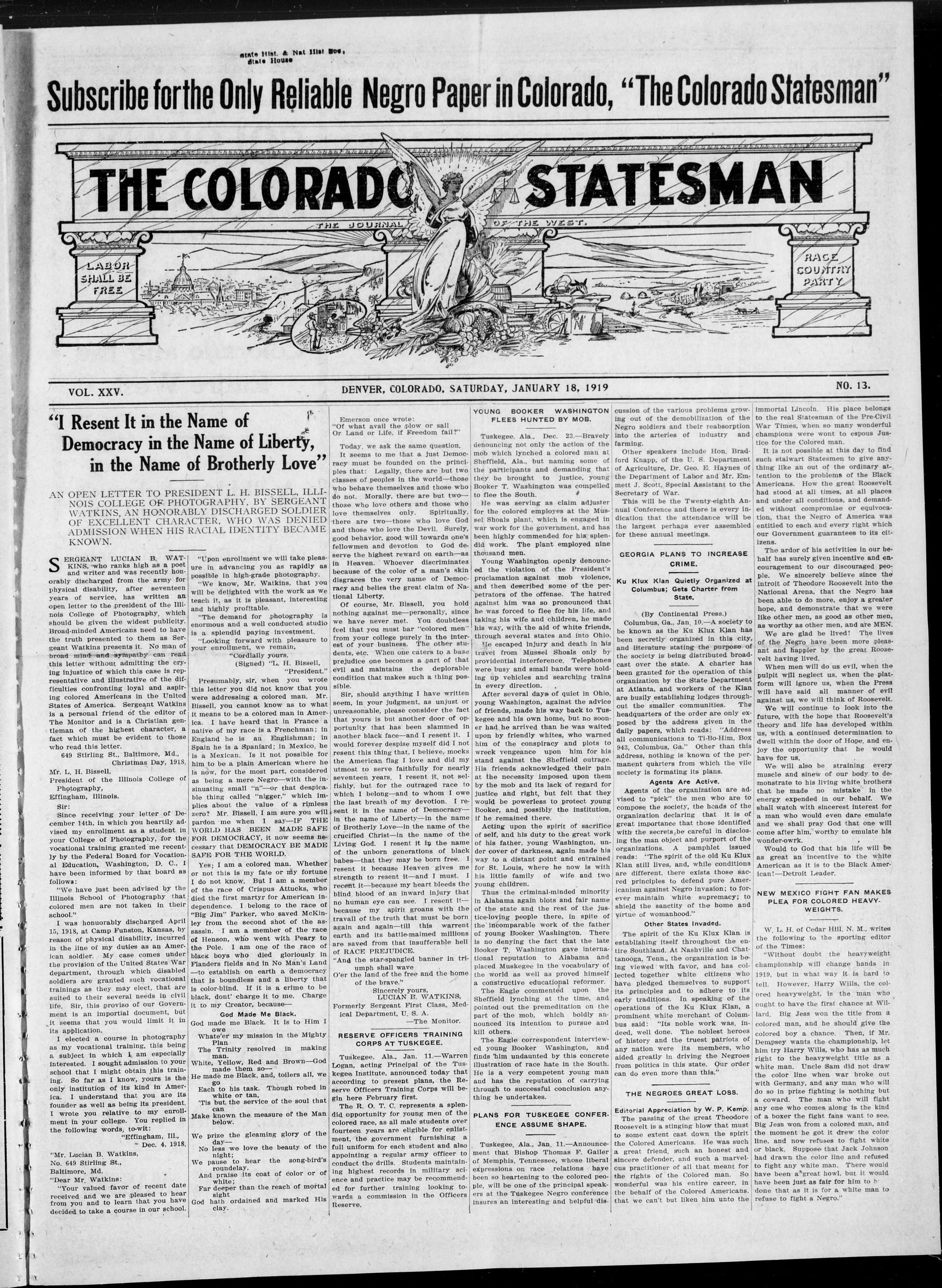
"I Resent It in the Name of Democracy in the Name of Liberty, in the Name of Brotherly Love"
AN OPEN LETTER TO PRESIDENT L. H. BISSELL, ILLINOIS COLLEGE OF PHOTOGRAPHY, BY SERGEANT WATKINS, AN HONORABLY DISCHARGED SOLDIER OF EXCELLENT CHARACTER, WHO WAS DENIED ADMISSION WHEN HIS RACIAL IDENTITY BECAME KNOWN.
VOL. XXV.
"I Resent It in the Democracy in the in the Name
AN OPEN LETTER TO PRES
NOIS COLLEGE OF PH
WATKINS, AN HONOR
OF EXCELLENT CHAR
ADMISSION WHEN HIS
KNOWN.
SERGEANT LUCIAN B. WATKINS, who ranks high as a poet and writer and was recently honorably discharged from the army for physical disability, after seventeen years of service, has written an open letter to the president of the Illinois College of Photography, which should be given the widest publicity. Broad-minded Americans need to have the truth presented to them as Sergeant Watkins presents it. No man of broad mind and sympathy can read this letter without admitting the crying injustice of which this case is representative and illustrative of the difficulties confronting loyal and aspiring colored Americans in the United States of America. Sergeant Watkins is a personal friend of the editor of The Monitor and is a Christian gentleman of the highest character, a fact which must be evident to those who read this letter.
649 Stirling St., Baltimore, Md., Christmas Day, 1918.
Mr. L. H. Bissell,
President of the Illinois College of Photography.
Since receiving your letter of December 14th, in which you heartily advised my enrollment as a student in your College of Photography, for the vocational training granted me recently by the Federal Board for Vocational Education, Washington, D. C., I have been informed by that board as follows:
"We have just been advised by the Illinois School of Photography that colored men are not taken in their school."
I was honouorably discharged April 15, 1918, at Camp Funston, Kansas, by reason of physical disability, incurred in the line of my duties as an American soldier. My case comes under the provision of the United States War department, through which disabled soldiers are granted such vocational trainings as they may elect, that are suited to their several needs in civil life. Sir, this proviso of our Government is an importial document, but it seems that you would limit it in its application.
I elected a course in photography as my vocational training, this being a subject in which I am especially interested. I sought admission to your school that I might obtain this training. So far as I know, yours is the only institution of its kind in America. I understand that you are its founder as well as being its president. I wrote you relative to my enrollment in your college. You replied in the following words, to-wit:
"Mr. Lucian B. Watkins,
No. 649 Stirling St.,
Baltimore, Md.
"Dear Mr. Watkins:
"Your valued favor of recent date
received and we are pleased to hear
from you and to learn that you have
decided to take a course in our school.
state Hist. & Nat Hist Bos.
state House
the Only Reliable
COLORA
Name of
the Name of Liberty,
of Brotherly Love"
PRESIDENT L. H. BISSELL, ILLI-
TOGRAPHY, BY SERGEANT
BILLY DISCHARGED SOLDIER
ACTER, WHO WAS DENIED
RACIAL IDENTITY BECAME
"Upon enrollment we will take pleasure in advancing you as rapidly as possible in high-grade photography.
"We know, Mr. Watkins, that you will be delighted with the work as we teach it, as it is pleasant, interesting and highly profitable.
"The demand for photography is enormous and a well conducted studio is a splendid paying investment.
"Looking forward with pleasure to your enrollment, we remain,
"Cordially yours,
(Signed) "L. H. Bissell,
"President."
Presumably, sir, when you wrote this letter you did not know that you were addressing a colored man. Mr. Bissell, you cannot know as to what it means to be a colored man in America. I have heard that in France a native of my race is a Frenchman; in England he is an Englishman; in Spain he is a Spaniard; in Mexico, he is a Mexican. Is it not possible for him to be a plain American where he is now, for the most part, considered as being a mere Negro—with the ininuating small "n"—or that despicable thing called "nigger," which implies about the value of a rimless zero? Mr. Bissell, I am sure you will pardon me when I say—IF THE WORLD HAS BEEN MAD SAFE FOR DEMOCRACY, it now seems necessary that DEMOCRACY BE MAD SAFE FOR THE WORLD.
Yes; I am a colored man. Whether or not this is my fate or my fortune I do not know. But I am a member of the race of Crispus Attucks, who died the first martyr for American independence. I belong to the race of "Big Jim" Parker, who saved McKinley from the second shot of the assassin. I am a member of the race of Henson, who went with Peary to the Pole. I am one of the race of black boys who died gloriously in Flanders fields and in No Man's Land—to establish on earth a democracy that is boundless and a liberty that is color-blind. If it is a crime to be black, don't charge it to me. Charge it to my Creator, because—
God Made Me Black.
God made me Black. It is to Him I owe
Whate'er my mission in the Mighty Plan
The Trinity resolved in making man.
White, Yellow, Red and Brown—God made them so—
He made me Black, and, toilers all, we go
Each to his task. Though robed in white or tan,
'Tis but the service of the soul that can
Make known the measure of the Man below.
We prize the gleaming glory of the day—
No less we love the beauty of the night;
We pause to hear the song-bird's roundelay.
And praise its coat of color or of white;
Far deeper than the reach of mortal sight
God hath ordained and marked His clay.
DENVER, COLORADO, SATURDAY, JANUARY 18, 1919
Emerson once wrote: "Of what avail the plow or sail Or Land or Life, if Freedom fail?" Today, we ask the same question. It seems to me that a just Democracy must be founded on the principles that: Legally, there are but two classes of peoples in the world—those who behave themselves and those who do not. Morally, there are but two—those who love others and those who love themselves only. Spiritually, there are two—those who love God and those who love the Devil. Surely, good behavior, good will towards one's fellowmen and devotion to God deserve the highest reward on earth—as in Heaven. Whoever discriminates because of the color of a man's skin disgraces the very name of Democracy and belies the great claim of National Liberty. Of course, Mr. Bissell, you hold nothing against me—personally, since we have never met. You doubtless feel that you must bar "colored men" from your college purely in the interest of your business. The other students, etc. When one caters to a base prejudice one becomes a part of that evil and maintains the deplorable condition that makes such a thing possible.
Sir, should anything I have written seem, in your judgment, as unjust or unreasonable, please consider the fact that yours is but another door of opportunity that has been slammed in another black face—and I resent it. I would forever despise myself did I not resent this thing that, I believe, mocks the American flag I love and did my utmost to serve faithfully for nearly seventeen years. I resent it, not selfishly, but for the outraged race to which I belong—and to whom I owe the last breath of my devotion. I resent it in the name of Democracy—in the name of Liberty—in the name of Brotherly Love—in the name of the crucified Christ—in the name of the Living God. I resent it in the name of the unborn generations of black babes—that they may be born free. I resent it because Heaven gives me strength to resent it—and I must. I recent it—because my heart bleeds the blind blood of an inward injury that no human eye can see. I resent it—because my spirit groans with the travail of the truth that must be born again and again—till this warrant earth and its battle-maimed millions are saved from that insufferable hell of RACE PREJUDICE.
"And the star-spangled banner in tri-
nch shell maze
umph shall wave
O'er the land of the free and the home
of the brave."
Sincerely yours,
LUCIAN B. WATKINS,
Formerly Sergeant First Class, Medical Department, U. S. A.
—The Monitor.
RESERVE OFFICERS TRAINING CORPS AT TUSKEGEE.
Tuskegee. Ala., Jan. 11.—Warren Logan, acting Principal of the Tuskegee Institute, announced today that according to present plans, the Reserve Officers Training Corps will begin here February first. The R. O. T. C. represents a splendid opportunity for young men of the colored race, as all male students over fourteen years are eligible for enlistment, the government furnishing a full uniform for each student and also appointing a regular army officer to conduct the drills. Students maintaining highest records in military science and practice may be recommended for further training looking towards a commission in the Officers Reserve.
YOUNG BOOKER WASHINGTON
FLEES HUNTED BY MOB.
Tuskegee, Ala., Dec. 23.—Bravely denouncing not only the action of the mob which lynched a colored man at Sheffield, Ala., but naming some of the participants and demanding that they be brought to justice, young Booker T. Washington was compelled to flee the South.
He was serving as claim adjuster for the colored employees at the Mussel Shoals plant, which is engaged in war work for the government, and has been highly commended for his splendid work. The plant employed nine thousand men.
Young Washington openly denounced the violation of the President's proclamation against mob violence, and then described some of the perpetrators of the offense. The hatred against him was so pronounced that he was forced to flee for his life, and taking his wife and children, he made his way, with the aid of white friends, through several states and into Ohio. He escaped injury and death in his travel from Mussel Shoals only by providential interference. Telephones were busy and small bands were holding up vehicles and searching trains in every direction.
After several days of quiet in Ohio, young Washington, against the advice of friends, made his way back to Tuskegee and his own home, but no sooner had he arrived than he was waited upon by friendly whites, who warned him of the conspiracy and plots to wreck vengeance upon him for his stand against the Sheffield outrage. His friends acknowledged their pain at the necessity imposed upon them by the mob and its lack of regard for justice and right, but felt that they would be powerless to protect young Booker, and possibly the institution, if he remained there.
Acting upon the spirit of sacrifice of self, and his duty to the great work of his father, young Washington, under cover of darkness, again made his way to a distant point and entrained for St. Louis, where he now is with his little family of wife and two young children.
Thus the criminal-minded minority in Alabama again blots and fair name of the state and the rest of the justice-loving people there, in spite of the incomparable work of the father of young Booker Washington. There is no denying the fact that the late Booker T. Washington gave international reputation to Alabama and placed Muskegee in the vocabulary of the world as well as proved himself a constructive educational reformer. The Eagle commented upon the Sheffield lynching at the time, and pointed out the premeditation on the part of the mob, which boldly announced its intention to pursue and kill others. The Eagle correspondent interviewed young Booker Washington, and finds him undaunted by this concrete illustration of race hate in the South. He is a very competent young man and has the reputation of carrying through to successful conclusion anything he undertakes.
PLANS FOR TUSKEEGE CONFERENCE ASSUME SHAPE.
Tuskegee, Ala., Jan, 11.—Announcement that Bishop Thomas F. Gailer of Memphis, Tennessee, whose liberal expressions on race relations have been so heartening to the colored people, will be one of the principal speakers at the Tuskegee Negro conference insures an interesting and helpful dis
cussion of the various problems growing out of the demobilization of the Negro soldiers and their reabsorption into the arteries of industry and farming.
Other speakers include Hon. Bradford Knapp, of the U. S. Department of Agriculture, Dr. Geo. E. Haynes of the Department of Labor and Mr. Emmett J. Scott, Special Assistant to the Secretary of War.
This will be the Twenty-eighth Annual Conference and there is every indication that the attendance will be the largest perhaps ever assembled for these annual meetings.
GEORGIA PLANS TO INCREASE CRIME.
Ku Klux Klan Quietly Organized at Columbus; Gets Charter from State.
(By Continental Press.)
(By Continental Press.)
Columbus, Ga., Jan. 10.—A society to be known as the Ku Klux Klan has been secretly organized in this city, and literature stating the purpose of the society is being distributed broadcast over the state. A charter has been granted for the operation of this organization by the State Department at Atlanta, and workers of the Klan are busily establishing lodges throughout the smaller communities. The headquarters of the order are only exposed by the address given in the daily papers, which reads: "Address all communications to Tl-Bo-Him, Box 943, Columbus, Ga." Other than this address, nothing is known of the permanent quarters from which the vile society is formating its plans.
Agents Are Active.
Agents of the organization are advised to "pick" the men who are to compose the society, the heads of the organization declaring that it is of great importance that those identified with the secrets be careful in disclosing the man object and purport of the organizations. A pamphlet issued reads: "The spirit of the old Ku Klux Klan still lives, and, while conditions are different, there exists those sacred principles to defend pure Americanism against Negro invasion; to forever maintain white supremacy; to shield the sanctity of the home and virtue of womanhood."
Other States Invaded.
The spirit of the Ku Klux Klan is establishing itself throughout the entire Southland. At Nashville and Chattanooga, Tenn., the organization is being viewed with favor, and has collected together white citizens who have pledged themselves to support its principles and to adhere to its early traditions. In speaking of the operations of the Ku Klux Klan, a prominent white merchant of Columbus said: "Its noble work was, indeed, well done. The noblest heroes of history and the truest patriots of any nation were its members, who aided greatly in driving the Negroes from politics in this state. Our order can do even more than this."
THE NEGROES GREAT LOSS.
Editorial Appreciation by W. P. Kemp.
The passing of the great Theodore Roosevelt is a stinging blow that must to some extent cast down the spirit the Colored Americans. He was such a great friend, such an honest and sincere defender, and such a marvelous practitioner of all that meant for the rights of the Colored man. So wonderful was his entire career, in the behalf of the Colored Americans, that we can't but liken him unto the
immortal Lincoln. His place belongs to the real Statesman of the Pre-Civil War Times, when so many wonderful champions were wont to espous Justice for the Colored man.
It is not possible at this day to find such stalwart Statesmen to give anything like an out of the ordinary attention to the problems of the Black Americans. How the great Roosevelt had stood at all times, at all places and under all conditions, and demanded without compromise or equivocation, that the Negro of America was entitled to each and every right which our Government guarantees to its citizens.
The ardor of his activities in our behalf has surely given incentive and encouragement to our discouraged people. We sincerely believe since the introit of Theodore Roosevelt into the National Arena, that the Negro has been able to do more, enjoy a greater hope, and demonstrate that we were like other men, as good as other men, as worthy as other men, and are MEN.
We are glad he lived! The lives of the Negro have been more pleasant and happier by the great Roosevelt having lived.
When men will do us evil, when the pulpit will neglect us, when the platform will ignore us, when the Press will have said all manner of evil against us, we will think of Roosevelt.
We will continue to look into the future, with the hope that Roosevelt's theory and life has developed within us, with a continued determination to dwell within the door of Hope, and enjoy the opportunity that he would have for us.
We will also be straining every muscle and sinew of our body to demonstrate to his living white brothers that he made no mistake in the energy expended in our behalf. We shall watch with sincerest interest for a man who would even dare emulate and we shall pray God that one will come after him, worthy to emulate his wonder-owrk.
Would to God that his life will be as great an incentive to the white American as it is to the Black American!—Detroit Leader.
NEW MEXICO FIGHT FAN MAKES PLEA FOR COLORED HEAVY- WEIGHTS.
W. L. H. of Cedar Hill, N. M., writes the following to the sporting editor of the Times:
"Without doubt the heavyweight championship will change hands in 1919, but in what way it is hard to tell. However, Harry Wills, the colored heavyweight, is the man who ought to have the first chance at Willard. Big Jess won the title from a colored man, and he should give the colored boy a chance. Then, if Mr. Dempsey wants the championship, let him try Harry Wills, who has as much right to the heavyweight title as a white man. Uncle Sam did not draw the color line when war broke out with Germany, and any man who will do so in prize fighting is nothing but a coward. The man who will fight any one who comes along is the kind of a boxer the fight fans want to see. Big Jess won from a colored man, and the moment he got it drew the color line, and now refuses to fight white or black. Suppose that Jack Johnson had drawn the color line and refused to fight any white man. There would have been a great howl, but it would have been just as fair for him to be done that as it is for a white man to refuse to fight a Negro."
FOREIGN
The Hungarian cabinet has resigned, according to dispatches received from Budapest.
Montenegrins have revolted and expelled the Jugo-Slava, it was announced by the Montenegrin consul at Rome.
All of America's fighting men now in Europe will be back in the United States within the next eight months, according to reports.
Field Marshal von Mackensen of the German army has been interned at Temesvar, Hungary, according to Budapest dispatches.
Resumption of mail service to Serbia, which was suspended at the outbreak of the war, was announced by the postoffice authorities. Deliveries will be effected thru Italy, but mailable matter is restricted to letters and postcards.
Representatives of Norwegian capitalists are arranging for the establishment in Mexico City of a Norwegian bank, which will have branches in various parts of the republic, particularly the states of Tamaulipas and Jalisco.
The interests of the Russian prisoners of war still in Germany to the number of 1,000,000 will be looked after by Major Carl Taylor of the American Red Cross, who will proceed into Germany with the Red Cross expedition.
Immediate withdrawal from Montenegro of all Italian troops is demanded by the Montenegrin National Assembly. The assembly alludes to the presence of Italian troops in Montenegro "now a part of the new state of Serbs, Croats and Slovenes," as "not dictated by any military necessity, as stable peace reigns in the country."
American and British representatives will hold a conference with German admiralty authorities at Treves for the purpose of acquiring possession of German and Austrian passenger ships for the transportation of troops. The United States will be represented by E. N. Hurley, chairman of the Shipping Board, and Admiral W. S. Benson.
SPORT
Indiana University defeated the University of Iowa at basketball, 23 to 14, in Iowa City.
Phil Bloom of Brooklyn decisively outpointed Joe Welling of Chicago in the twelve-round bout at Providence.
Jeff Clarke of Joplin was given a popular decision over Hugh Walker of Kansas City in a twelve-round bout.
Billy Miske of St. Paul defeated Tom Cowler of Australia in Philadelphia in a bout that went the scheduled six rounds. It was Miske's fight from start to finish.
Welker Cochran of New, York defeated Jake Schaefer of San Francisco, 4,200 to 3,855, in the fourteenth block, 18.2 balkline billiard match, which were concluded in Detroit.
Johnny Kilbane, the featherweight champion, is a first lieutenant in the United States Army Reserve Corps. The commission was offered him as a reward for his work as boxing instructor at Camp Sherman.
George Hallas, former University of Illinois athletic star, and one of the mainstays of the Great Lakes naval training station football and basketball teams, will get a tryout for the outfield with the New York American league club next spring.
GENERAL
A city labor party has been organized in Chicago and John Fitzpatrick has been nominated for mayor. The transports Rochambeau, Lappland and Cretic have sailed from France for New York with 150 officers and 4,200 men. James M. Cox, 47, a Democratic newspaper publisher of Dayton, Ohio, Monday was inaugurated governor of Ohio for a third term. A remarkable hen that laid 308 eggs in a year is a feature of the National Poultry Show which is on at Chicago at the Stock Yards. The hen is the property of John W. Welch of Omaha, Neb. Despite the great prosperity in this country during the period of the war, with thousands of coal miners and others earning from $5 to $25 a day, the poorhouse shows a large increase in the number of inmates.
Charles F. Banning, wealthy Pittsburgh manufacturer, interned at Fort Oglethorpe as an enemy alien, was ordered released by Federal Judge Newman, who granted a writ of habeas corpus brought by Banning, a native of Germany.
A movement to change the name of Yellowstone Park, America's greatest public pleasure ground and game reserve, to Roosevelt Park, as a national memorial to Theodore Roosevelt, was started by Mayor Harry Davis and leading citizens of Cleveland.
It will be possible to maintain the present rations of bread and meat in Vienna and the remainder of German Austria until the middle of February, the food ministry announced. The ministry will be able to keep up the rations, the announcement states, because of its having been supplied by the entente food commission with a quantity of grain.
All limitations on the kind or fuel of coal, food and other ship supplies which vessels outward bound from American ports may carry were removed in orders issued by the war trade board. Licenses for bunker coal will be issued in the same manner as heretofore, however, and thru this the board will continue to control the destination of the ships.
Charles Chapin, former city editor of the New York Evening World, who on September 16 last shot and killed his wife while she was asleep, this week pleaded guilty to murder in the second degree and was sentenced to state's prison for a term of from twenty years to life imprisonment.
An attempt of radicals, including Socialists and I. W. W., to capture the labor meeting in behalf of T. J. Mooney of California, resulted in much disorder, but no real violence. After much noise and confusion credentials were refused to those who came as Socialists or members of the I. W. W.
THE WORLD IN PARAGRAPHS
A BRIEF RECORD OF PASSING EVENTS IN THIS AND FOR-EIGN COUNTRIES.
IN LATE DISPATCHES
DOINGS AND HAPPENINGS THAT
MARK THE PROGRESS
OF THE AGÉ
Western Newspaper Union News Service.
ABOUT THE WAR
The naval academy course, which was reduced to three years during the war, was restored to the normal period of four years Monday by order of Secretary of the Navy Daniels.
A message was received in Washington at the office of the commission for the Czecho-Slovak republic from Dr. Benes, Czecho-Slovak foreign minister, saying there was no truth in the report that he has resigned.
Thousands of Itallian and Austrian war prisoners are planning to come to America as soon as possible, John B. Densmore, director of the Federal Employment Service, told the House Immigration Committee at the beginning of hearings on bills to prohibit immigration.
A semi-official report says that the Japanese military authorities in Siberia have established for the purpose of rendering medical assistance to the Russian patients, charity hospitals independent of military hospitals proper, at mine centers of population in Siberia, including Vladivostok.
Influenza took a toll of the lives of more than 500 soldiers bound overseas aboard American transports during the month of October, according to a report issued at the port of embarkation. The deaths on the Leviathan during the one trip she made across in that month totaled 127 and the President Grant reported 92. Bolshevist agitation in the United States shows no promise of reaching a stage of open disorder, according to Department of Justice officials, who have been observing the movement. So far the movement, evidently mainly in New York, is economic, rather than political in nature, they declare, and organizers have kept well within the law.
WESTERN
Demobilization of returning soldiers from other camps is now on in Camp Kearny in full swing.
Two aviators of Carruthers field were killed at Fort Worth when their plane dropped into a tail spin and fell 5,000 feet. They are Lieutenant John E. M. Garbut of Sheridan, Wyo., and Mechanic R. L. Quinn of Pittsburg, Pa.
Charges of assault and disorderly conduct were placed against eight of the alleged Industrial Workers of the World who were arrested in Seattle when police interference with a "red flag" meeting and parade here resulted in a riot.
Definite steps toward the organization of the state for the purpose of providing employment for returned soldiers, sailors and war workers has been taken by the joint commission appointed by L. H. Farnsworth, chairman of the Utah State Council of Defense.
A fire believed to be of incendiary origin which started in the plant of the Jennings Automobile Company and spread to the buildings of the Hudson Bay Company and the McClary Manufacturing Company, caused damage estimated at $1,000,-000 at Montreal.
Dynamite was placed on the tracks in front of one street car in Kansas City, a dynamite cap was found in front of another car and bullets were fired through the windows of four other cars. No one was hurt. The disorders were in connection with the strike of car men of the Kansas City Railways Company which began a month ago.
WASHINGTON
Attorney General Thomas W. Gregory has tendered his resignation, to take effect March 4.
A resolution to record the Senate as favoring withdrawal of American soldiers from Russia "as soon as practicable" was introduced by Senator Johnson of California.
The $27,000,000 rivers and harbors appropriations bill was passed by the House by a vote of 228 to 91. The bill now goes to the Senate in virtually the same form as it was reported by the House rivers and harbors committee.
Congress was asked by Secretary Daniels to appropriate $270,400,000 to meet a deficit in the navy's expenses for the current fiscal year. The request included $137,400,000 for pay for sailors; $22,808,000 for provisions; $14,390,000 for freight, and $18,000,000 for repair of vessels.
A bill proposed by the War Department modifying military court martial procedure was introduced by Chairman Chamberlain of the Senate military committee. Sentences by courts martial of death, dismissal or dishonorable discharge would, under the bill, be suspended pending revision.
A. P. Thom, general counsel of the Association of Railway Executives, supplementing before the Senate Interstate Commerce Committee the statement presented on behalf of the railroads last week advocating legislation for return of the roads to their owners, emphasizes dangers to the rights of the owners through continued government control.
A pension of $5,000 a year and free use of the mails would be granted to Mrs. Edith Roosevelt, widow of former President Roosevelt, under a bill introduced in the Senate by Senator Smoot of Utah.
Pithy News Notes
From All Parts of
Colorado
Western Newspaper Union News Service.
COMING EVENTS.
Jan. 20-21—Mid-winter meeting of Colorado Editorial Association at Denver.
Jan. 21—Meeting Colorado County Commissioners at Denver.
Jan. 22—Colorado Stock Growers' Association meeting at Denver.
Jan. 22—Meeting Farmers' Educational Cooperative Union at Denver.
Jan. 21-23—Mountain States Lumber Dealers' Association meeting in Denver.
Jan. 23-24—Hardware and Implement Dealers' meeting at Denver.
Jan. 23-24—Meeting Oldtime Cowboys' Association at Denver.
Jan. 23-24—Meeting Oldtime Cowboys' Association at Denver.
Association at Denver
Jan 21-26 - Western Stock
Show at Denver
Jan. 21-23 Meeting American National Live Stock Association at Denver.
A big memorial service for Theodore Roosevelt was held at the Congregational Church in Grand Junction.
The resignation of Colonel Frank Adams as superintendent of the State Department of Safety was accepted by Governor Gunter Monday morning. Certificates of honorable service will be given men leaving the naval service before the expiration of their terms of enlistment.
O. M. James, D. B. Wright and F. M. Stout have shipped a carload of alfalfa seed worth nearly $10,000 from Whitewater.
About 400 Colorado wool growers and stockmen attended the three days' session of the Wyoming Wool Growers' Association held at Lander.
"General" Charles W. Gordon, 97, the oldest resident in Colorado Springs, is dead. Gordon was a veteran of four wars—Punjab, Sepoy, Crimean and Civil.
Under the direction of the City Federation of Women's Clubs a vigorous campaign will soon be started for the establishment of a modern hospital in Sterling.
Telluride is battling a new wave of influenza and a number of new cases have been reported lately. The city authorities have requested discontinuance of public funerals.
Neglect is charged to the Portland Gold Mining Company in a coroner's verdict returned on the death of Emil Palmquist at the Victor crusher mill of the company November 19.
The new issue of War Savings Stamps, costing $4.12 this month, are on sale at the postoffices and other agencies. The stamps are redeemable January 1, 1924. Colorado's quota is $20,000,000.
After seven years of successful operation Longmont today owns, free from debt, its municipal electric light plant, the last $10,000 bonds having been paid by the city during the year 1918.
The state auditor has notified Mary C. C. Bradford, state superintendent of public instruction, that there is available for apportionment among the school districts of the state out of the public school income fund the sum of $323,928.92.
The first train on the Denver & Salt Lake railroad since the recent tie-up in traffic has gotten through. This tie-up was the result of a large cave-in at tunnel No. 16. Sufficient repairs have now been made on this tunnel to allow traffic to proceed.
The appointment of Mrs. Frankie W. Eagan of Denver as policewoman of Colorado Springs was announced by Mayor Charles E. Thomas, acting commissioner of public safety. Mrs. Eagan comes to the police department with a record of several years of competent service in welfare work.
Charles Yetter, bigamist, will not take unto himself any more wives for more than a year. Judge John H. Denison in the West Side Court Wednesday sentenced Yetter to from eighteen months to two years in the penitentiary, after Yetter had pleaded guilty. Although only 27 years old, Yetter has been married at least five times.
Colorado will be able to use 1,250 unskilled soldiers and sailors on road construction and repair work during 1919, according to reports received by the department of agriculture from the highway department.
To aid farmers in increasing the production and improving the quality of butter fat, the Colorado Creamery Manufacturers' Association has established a permanent office in conjunction with the agricultural and live stock bureau of the Denver Civic and Commercial Association.
Denver.—Western stockmen have contributed 3,000 head of calves to be auctioned during the Denver live stock show, worth on an average of $50 apiece. The stock now is being assembled to be shipped in carload lots to Denver Union Stock Yards, where it is to be housed in the great sheep barn and pens, having a capacity of 50,000 head. The auction sale is to be held on Wednesday the 20th in the arena of the stock show. Because of recent storms some of the calves contributed will never reach the show grounds, but will be auctioned locally in the region where raised and the money sent in by the local chapters of the American Red Cross. It now is believed that $150,000 will be secured by the sale.
The war price of $10 a ton flat for sugar beets will be paid to Colorado farmers this year, according to an announcement made Friday morning by the Great Western Sugar Company. This price is the same as in 1918, and is $2.73 more a ton than paid the growers in 1917.
Resolutions have been adopted by the Denver branches of the National Association of Letter Carriers, the Railway Mail Association and the National Federation of Postal Employés, indorsing the Madden reclassification bill and asking for a 25 per cent increase in salary.
```markdown
```
CENTENNIAL STATE ITEMS
Another administration was ushered into affairs of state Tuesday noon, official recognition of which was marked by the inauguration of Oliver H. Shoup as governor. The ceremonies were held in the chamber of the representatives and bring to an end the Gunter regime. Republicans succeed Democrats in office, with one or two exceptions. The inauguration of the state executives and justices of the Supreme Court was in the presence of the legislators of the Twenty-second General Assembly and some 1,200 persons who were admitted to the galleries. The incoming and outgoing officials filed into the House chamber at 12 o'clock, where Governor Julius C. Gunter formally relinquished the reins of government. Chief Justice William A. Hill of the Supreme Court administered the oath of office to the incoming governor. One of the largest outside delegations to attend consisted of 200 men and women of Colorado Springs, the home town of the new executive.
THE COLORADO STATESMAN
A proposal to advertise the resources of Colorado is made in a bill to be introduced in the Legislature which has been prepared by the Colorado Association of Commercial Executives. They say it is necessary for the state to take action, as the railways, since coming under government control, no longer issue folders and pamphlets advertising Colorado's scenery and opportunities as formerly. An appropriation of $99,000, to be expended under the direction of the bureau of immigration, is provided for in the bill. Agricultural exhibits are to be sent to fairs, shows and large gatherings outside the state. Booklets are to be prepared at a cost of $25,000, each one of which will advertise some particular industry of the state, such as mining, dry farming, beet raising, dairying, fruit raising, etc. Plans are being made to attach these measures to the long appropriation bill.
The Mouth-Piece of the People of Colorado and the Entire West
The midwinter session of the Colorado Editorial Association will be held this year on January 20 and 21 at the Albany hotel. A series of several luncheons has been planned and a banquet to the State Legislature at the Albany hotel. After the banquet there will be an old-fashioned dance. During the business sessions W. A. Patterson, managing editor of the Western Newspaper Union, will speak on "The Responsibility of the Press in the Reconstruction Period." J. L. Cross, head of the Federal Reserve Bank in Kansas City, will speak on the government's methods in raising the four Liberty Loan quotas and the plans for the Fifth Liberty Loan drive.
ARELIABLE chronicle of their doings and progress; a faithful mirror of their wants, their hopes, their best aspirations.
The youngest postoffice robber ever handled by the postoffice inspectors of the local jurisdiction is under arrest at Glenwood Springs. He is only 12 years old. He slipped into the Glenwood Springs postoffice through a parcel post drop Tuesday night, gathered up a quantity of loot and was preparing to depart when an employee of the office, returning to attend to some unfinished business, discovered and captured him.
Twelve states—California, Colorado, Idaho, Illinois, Indiana, Iowa, Missouri, Montana, Nebraska, North Dakota, Oregon and Utah—reported a surplus of common labor to the department of labor this week, as compared with seven the week previous. In the South there is a general shortage of labor in all trades, while the belt from Connecticut to Minneapolis shows surpluses in special branches.
THE COLORADO STATESMAN
Governor Shoup's address was one of the shortest ever delivered for a Colorado Legislature and was as follows: "I have just been getting acquainted with a lot of new friends, and am ready to become acquainted with a lot of new responsibilities and duties, which I shall endeavor, with your cooperation, to shape into success for Colorado."
City Commissioner Andrew W. Frandsen was the first Montrose man to be fined for violation of the new quarantine regulations. His children came down town and the commissioner was at once handed a request to appear before Justice W. H. Franklin. He was fined $6.75. A daughter of Mr. Frandsen is ill with influenza.
Unequaled as an advertising medium for the business of professional men and women.
Senator-elect Lawrence C. Phipps sustained a sprained ankle while skiing on Genesee mountain.
The twenty-second annual convention of the American National livestock Association will be held at the Broadway theater Jan. 21, 22 and 23. The program of speakers includes many prominent government officials and livestock man. The convention will be devoted to a discussion of topics of vital importance to the grazing industry. Among the subjects for consideration which are of local interest is the proposed advance in grazing fees on national forests. The advances were ordered by the secretary of agriculture early in December of 1918, and became effective Jan. 1.
An excellent family journal speaking to and for many thousand colored citizens.
Colorado's early days and her growth since 1862 will be recalled to Denver people if a bill being prepared by Representative Boon Best and Speaker Allyn Cole of the House becomes law. For they propose to bring to Denver and set up on the capitol grounds the little cabin used by Colorado legislators as the first capitol in territorial days.
TWODOLLARSAYEAR
Dr. Bennett Graff, a Denver physician convicted of performing a criminal operation two years ago, was given a new trial by a decision handed down b by the State Supreme Court this week.
Six hundred miners of the Steamboat Springs district, mostly members of the United Mine Workers, have telegraphed an ultimatum to the director general of railroads in Washington, declaring that unless relief from the Moffatt road tieup is forthcoming they will commandeer a train themselves, dig a passage through the snowslide which is blocking traffic, and open the road so that food and supplies may be brought in to the Steamboat and Oak Creek region. Two thousand miners are said to be idle as a result or the tieup.
$P_2$
Articles Issued by the Department of the Interior, Bureau of Education and the National Kindergarten Association
AMERICAN MOTHERS
By DR. JENNY B. MERRILL.
The phenomenal success of American boys at the front after an unusually short military training was not only a great cause of thankfulness, but indicated that American mothers' methods of discipline had not been so indulgent nor lax in the past as some good critics have feared. There has been a blessing in disguise in the free action and self-assertion that are allowed American children.
Fifty years ago a little book entitled "Children's Rights" appeared in this country. Perhaps it went too far, but children have suffered long from too great severity. Herbert Spencer in England wrote of children's rights as well as of women's. The words of progressive thinkers on both subjects were needed. Later from Sweden, Ellen Key sent out "The Century of the Child." Later yet came from Italy Doctor Montessori's outcry against suppression of the child by arbitrary discipline, and her advocacy of discipline "based on liberty."
Probably all of these leaders directly or indirectly gained much of their inspiration and guidance from Froebel, who dared to write even in Germany. *Follow the Child.*
Never Flourished in Germany.
Froebel, the founder of the kindergarten, was German but not Prussian. Prussia soon recognized that "democracy" would be the outcome of his method and promptly suppressed it. Many do not know that the kindergarten never has flourished in Germany.
Froebel was in a sense a martyr and died disappointed with his own nation's rejection of the kindergarten, but with his "eye of faith" he turned hopefully towards America in which country, he prophesied, his ideas would flourish under democratic protection and guidance.
Mothers of America, many of them, as well, as teachers, have studied kindergarten principles for 50 years and have again and again testified to their value.
"What are these principles?" Read Miss Emilie Poulsson's "Love and Law in Child Training." This may be found in almost any library or can be bought from the publishers, Milton Bradley Co., Springfield, Mass., for $1. Its very title suggests the kindergarten's principles—love and law, but not license.
Kindergarten discipline is loving, steady and strong, not sentimentally weak. Kindergarten discipline prefers positive rather than negative methods. The life of the child is not fitted with "don'ts," for there are so many good things found to do, there is little time for mischief.
For Mother and Child Alike.
Childish mistakes and mishaps are met with patience. Mother gives the little one time to recover himself. Self-control is her alm. Request is preferred to force. Politeness is the rule for mother and child alike. Both use frequently "the two little golden keys, I thank you' and 'If you please.'"
"A soft answer turneth away wrath." "Grievous words" are avoided because centuries ago it was discovered that they "stir up anger." There are no load, shrill tones, but rather quiet, decided emphasis, if need be.
"Vain repetitions" having proved
Attach to the medicine closet, with a string and pencil, a small alphabetically arranged notebook.
Under the letter P, for example, write the antidote for the different polsons, for, although one may know them, when the baby swallows the wrong tablet knowledge is apt to desert one, and by the time the doctor arrives upon the scene it may be too late.
Under F write "Fainting Spells" and what to do. "Cuts and Bruises" list under their proper letter, and "Sunstroke," "Burns," and so on, through the list of accidents and sudden illnesses. All this may be taken from a regular first-aid book, but added to this may be remedies for sickness to which one's special family is subject.
From year to year one forgets what it was that proved so effective in that case of quinsy, but can easily refer to it in this manner.
Being arranged alphabetically, it is the work of but a moment to find the destined information.
Short Sighted Serpents.
Serpents have a reputation for alertness but nevertheless they are short-sighted. Some of them cannot see more than a yard or two in front of them. Other reptiles are similarly deficient in sense of vision, and the authority asserts that a crocodile cannot see a man at a greater distance than six times its own length. In respect of hearing, many reptiles are even more deficient than in sight. Some serpents are deaf, the boa, it is said, being unable to hear any sound. The term "deaf adder" consequently expresses a fact. In one respect some reptiles show singular acuteness. They have an unremarking instinct for water
PUBLIQUE
Yank in Repose the Finest Piece of Camouflage
Yank in Repose the Finest Piece of Camouflage
WASHINGTON.—The American fighting man is a puzzle to the French and German peoples. He seems to them to be a dual personality. In repose he is the finest example of the art of camouflage that the great war has produced. In action he is exactly what Sherman said war is.
The French grew sick at heart waiting for the Yanks. And when the Yanks came the French were disappointed. The Yanks were big and husky. But they were very young and they were all smiles and laughter. They bought everything in sight and never asked the price. The French had hoped to see grim, world-wise, veteran fighting men. Could these
When these same Yankee boys n umphant advance on Paris, but also and kept them on the run, it is no w ecstasy. They saw in Chateau Thierry Paris was saved. They knew the war. The German officers believed—and would not come; would not be equipped from the firing line reveal the German got into action; "We can kill them, be we fire on them, they charge." "Tell the hell!" "They keep on coming at a mac our morale." "Too reckless; in too mu In short, the Hun is echoing the Spake us with their bare hands." And now the German people in th that this same "Devil dog" is the decem
Lieutenant and Clerk W
A SECOND LIEUTENANT stepped in and asked a clerk for a certain an and listened while the lieutenant gave
When these same Yankee boys not only stopped the Hun in his triumphant advance on Paris, but also drove back his selected shock troops and kept them on the run, it is no wonder that France went delirious with ecstasy. They saw in Chateau Thierry the turn of the balance. They knew Paris was saved. They knew the war was won.
The German officers believed—and told their men—that the Yankees would not come; would not be equipped; could not fight. Official expressions from the firing line reveal the German emotions when the Yankees finally got into action: "We can kill them, but we can't stop them." "Every time we fire on them, they charge." "Tell them to surrender and they say 'Go to hell!'" "They keep on coming at a machine gun till they get it; this weakens our morale." "Too reckless; in too much of a hurry." "Devil dogs."
In short, the Hun is echoling the Spaniard of 20 years ago: "They tried to take us with their bare hands."
And now the German people in the occupied territories are finding out that this same 'Devil dog' is the decentest fellow in the world.
Lieutenant and Clerk Who Got Another Chance
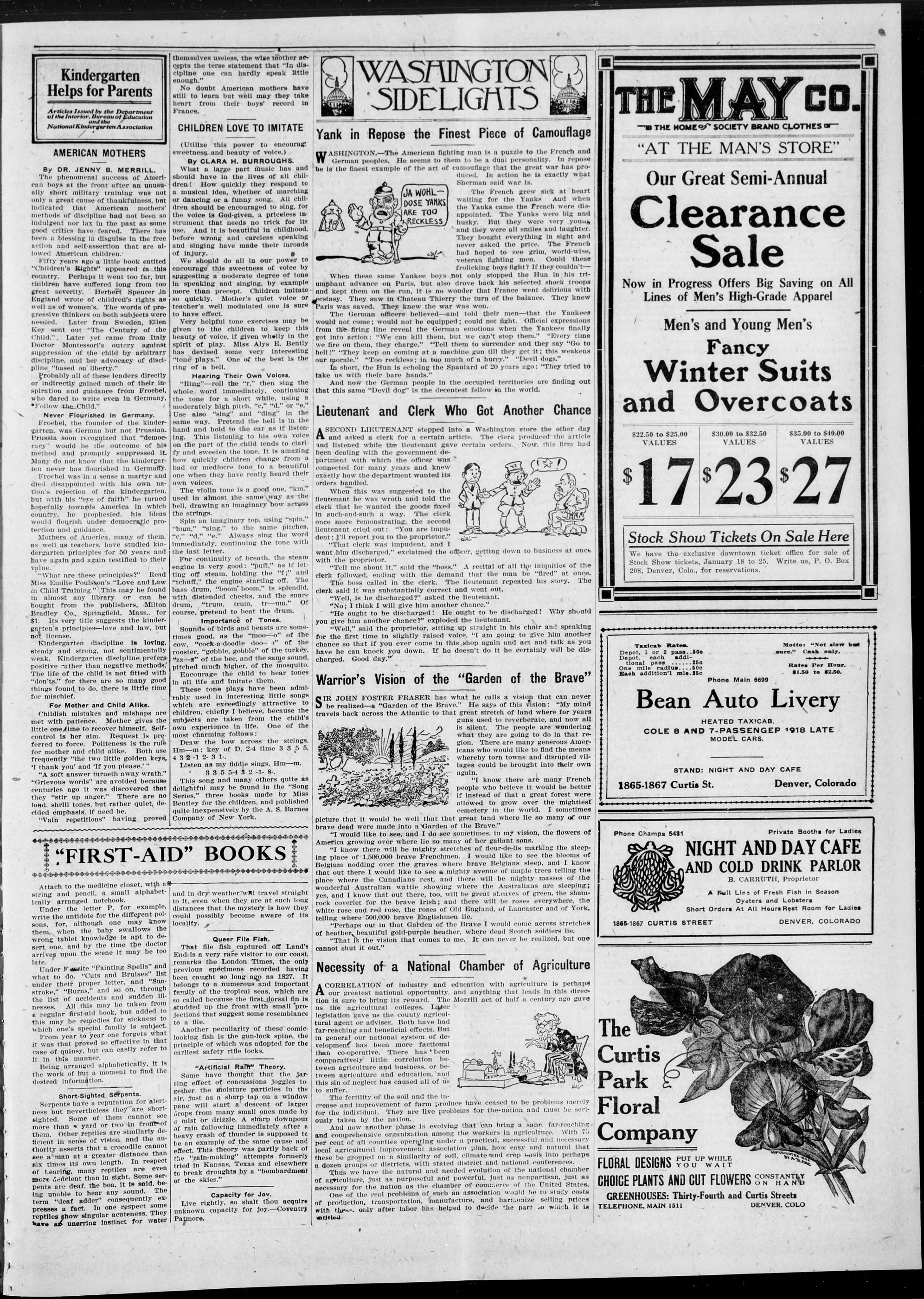
A SECOND LIEUTENANT stepped into a Washington store the other day and asked a clerk for a certain article. The clerk produced the article and listened while the lieutenant gave certain orders. Now, this firm had been dealing with the conventant do.
been dealing with the government department with which the officer was connected for many years and knew exactly how the department wanted its orders handled.
When this was suggested to the lieutenant he was wroth and told the clerk that he wanted the goods fixed in such-and-such a way. The clerk once more remonstrating, the second lieutenant cried out: "You are impudent; I'll report you to the proprietor."
"That clerk was impudent, and I want him discharged," exclaimed the officer with the proprietor. "Tell me about it," said the "boss," clerk followed, ending with the deman. The boss called in the clerk. The clerk said it was substantially correct "Well, is he discharged?" asked the "No; I think I will give him another "He ought to be discharged! He you give him another chance?" exploded "Well," said the proprietor, sitting for the first time in slightly raised ve chance so that if you ever come in this have he can knock you down. If he charged. Good day."
Warrior's Vision of the
SIR JOHN FOSTER FRASER has we be realized—a "Garden of the Brave travels back across the Atlantic to that
That clerk was impudent, and I want him discharged," exclaimed the officer, getting down to business at once with the proprietor.
"Tell me about it," said the "boss." A recital of all the inquiries of the clerk followed, ending with the demand that the man be "fired" at once. The boss called in the clerk. The lieutenant repeated his story. The
clerk said it was substantially correct and went out.
"Well, is he discharged?" asked the lieutenant.
"No; I think I will give him another chance."
"He ought to be discharged! He ought to be discharged! Why should you give him another chance?" exploded the lieutenant.
"Well," said the proprietor, sitting up straight in his chair and speaking for the first time in slightly raised voice, "I am going to give him another chance so that if you ever come in this shop again and act and talk as you have he can knock you down. If he doesn't do it he certainly will be discharged. Good day."
Warrior's Vision of the "Garden of the Brave"
SIR JOHN FOSTER FRASER has what he calls a vision that can never be realized—a "Garden of the Brave." He says of this vision: "My mind travels back across the Atlantic to that great stretch of land where for years guns used to reverberate, and now all is silent. The people are wondering what they are going to do in that region. There are many generous Americans who would like to find the means whereby torn towns and disrupted villages could be brought into their own again.
"I know there are many French people who believe it would be better if instead of that a great forest were allowed to grow over the mightiest
picture that it would be well that that brave dead were made into a Garden of Owl "I would like to see, and I do see a America growing over where lie so man "I know there will be mighty street ing place of 1,500,000 brave Frenchmen Belgium nodding over the graves where that out there I would like to see a mi place where the Canadians rest, and a wonderful Australian wattle showing yes, and I know that out there, too, will rock coverlet for the brave Irish; and white rose and red rose, the roses of O telling where 500,000 brave Englishmen "Perhaps out in that Garden of the of heather, beautiful gold-purple heather "That is the vision that comes to it cannot shut it out."
Necessity of a National
picture that it would be well that great land where lie so many of our brave dead were made into a Garden of the Brave."
"I would like to see, and I do see sometimes, in my vision, the flowers of America growing over where lie so many of her gallant sons.
"I know there will be mighty stretches of fleur-de-lis marking the sleeping place of 1,500,000 brave Frenchmen. I would like to see the blooms of Belgium nodding over the graves where brave Belgians sleep, and I know that out there I would like to see a mighty avenue of maple trees telling the place where the Canadians rest, and there will be mighty masses of the wonderful Australian wattle showing where the Australians are sleeping; yes, and I know that out there, too, will be great sheaves of green, the shamrock coverlet for the brave Irish; and there will be roses everywhere, the white rose and red rose, the roses of Old England, of Lancaster and of York, telling where 500,000 brave Englishmen lie.
"Perhaps out in that Garden of the Brave I would come across stretches of heather, beautiful gold-purple heather, where dead Scotch soldiers lie.
"That is the vision that comes to me. It can never be realized, but one cannot shut it out."
Necessity of a National Chamber of Agriculture
Necessity of a National Chamber of Agriculture
A CORRELATION of industry and education with agriculture is perhaps our greatest national opportunity, and anything that leads in this direction is sure to bring its reward. The Morrill act of half a century ago gave
A CORRELATION of industry and our greatest national opportunity, tion is sure to bring its reward. The us the agricultural colleges. Later legislation gave us the county agricultural agent or adviser. Both have had far-reaching and beneficial effects. But in general our national system of development has been more factional than co-operative. There has been comparatively little correlation between agriculture and business, or between agriculture and education, and this sin of neglect has caused all of us to suffer. The fertility of the soil and the in-
The fertility of the soil and the increase and improvement of farm produce have ceased to be problems merely for the individual. They are live problems for the nation and must be seriously taken by the nation.
The fertility of the soil increases and improvement of farm produce for the individual. They are live probably taken by the nation.
And now another phase is evolving and comprehensive organization among per cent of all counties operating under local agricultural improvement association these be grouped on a similarity of soft a dozen groups or districts, with stated.
Thus we have the natural and need of agriculture, just as purposeful and necessary for the nation as the chambre.
One of the real problems of such a of production, transportation, manufa with these only after labor has helped
And now another phase is evolving that can bring a sane, far-reaching and comprehensive organization among the workers in agriculture. With 75 per cent of all counties operating under a practical, successful and necessary local agricultural improvement association plan, how easy and natural that these be grouped on a similarity of soil, climate and crop basis into perhaps a dozen groups or districts, with stated district and national conferences.
Thus we have the natural and needed evolution of the national chamber of agriculture, just as purposeful and powerful, just as nonpartisan, just as necessary for the nation as the chamber of commerce of the United States.
One of the real problems of such an association would be to study costs of production, transportation, manufacture, and harmonize selling prices with these only after labor has helped to decide the part to which it is entitled.
themselves useless, the wise mother accepts the terse statement that "In discipline one can hardly speak little enough."
No doubt American mothers have still to learn but well may they take heart from their boys' record in France.
CHILDREN LOVE TO IMITATE
(Utilize this power to encourage sweetness and beauty of voice.)
By CLARA H. BURROUGHS.
What a large part music has and should have in the lives of all children! How quickly they respond to a musical idea, whether of marching or dancing or a funny song. All children should be encouraged to sing, for the voice is God-given, a priceless instrument that needs no trick for its use. And it is beautiful in childhood, before wrong and careless speaking and singing have made their inroads of injury.
We should do all in our power to encourage this sweetness of voice by suggesting a moderate degree of tone in speaking and singing, by example more than precept. Children imitate so quickly. Mother's quiet voice or teacher's well modulated one is sure to have effect.
Very helpful tone exercises may be given to the children to keep this beauty of voice, if given wholly in the spirit of play. Miss Alys E. Bently has devised some very interesting "tone plays." One of the best is the ring of a bell.
Hearing Their Own Voices.
"Ring"—roll the "r," then sing the whole word immediately, continuing the tone for a short while, using a moderately high pitch, "c," "d," or "e." Use also "sing" and "ding" in the same way. Pretend the bell is in the hand and hold to the ear as if listening. This listening to his own voice on the part of the child tends to charly and sweeten the tone. It is amazing how quickly children change from a bad or mediocre tone to a beautiful one when they have really heard their own voices.
The violin tone is a good one, "km," used in almost the same way as the bell, drawing an imaginary bow across the strings.
Spin an imaginary top, using "spin," "hum," "sing," to the same pitches, "c," "d," "e." Always sing the word immediately, continuing the tone with the last letter.
For continuity of breath, the steam engine is very good: "puff," as if letting off steam, holding the "f;" and "tchuff," the engine starting off. The bass drum, "boom" boom," is splendid, with distended cheeks, and the snare drum, "trum, trum, tr—um." Of course, pretend to beat the drum.
Importance of Tones.
Sounds of birds and beasts are sometimes good, as the "moo—o" of the cow, "cock-a-doodle doo—o" of the rooster, "gobble, gobble" of the turkey, "zz—z" of the bee, and the same sound, pitched much higher, of the mosquito.
Encourage the child to hear tones in all life and imitate them.
These tone plays have been admirably used in interesting little songs which are exceedingly attractive to children, chiefly I believe, because the subjects are taken from the child's own experience in life. One of the most charming follows:
Draw the bow across the strings.
Hm—m; key of D. 2-4 time 3 3 5 5.
4 3 2 -1 2 3 1.
Listen as my fiddle sings, Hm—m.
3 3 5 5-4 3 2 -1 8.
This song and many others quite as
delightful may be found in the "Song
Series," three books made by Miss
Bentley for the children, and published
quite inexpensively by the A. S. Barnes
Company of New York.
and in dry weather will travel straight to ft, even when they are at such long distances that the mystery is how they could possibly become aware of its locality.
Queer File Fish.
That file fish captured off Land's End is a very rare visitor to our coast, remarks the London Times, the only previous specimens recorded having been caught so long ago as 1827. It belongs to a numerous and important family of the tropical seas, which are so called because the first dorsal fin is studded up the front with small projections that suggest some resemblance to a file.
Another peculiarity of these comelooking fish is the gun-lock spine, the principle of which was adopted for the earliest safety rifle locks.
"Artificial Rain" Theory.
Some have thought that the jarring effect of concussions joggies together the moisture particles in the air, just as a sharp tap on a window pane will start a descent of larger drops from many small ones made by a mist or drizzle. A sharp downpour of rain following immediately after a heavy crash of thunder is supposed to be an example of the same cause and effect. This theory was partly back of the "rain-making" attempts formerly tried in Kansas, Texas and elsewhere to break droughts by a "bombardment of the skies."
Capacity for Joy.
Live rightly, so shalt thou acquire unknown capacity for joy.—Coventry Paymore.
WASHINGTON SIDELIGHTS
in action he is exactly when Sherman said war is.
The French grew sick at heart waiting for the Yanks. And when the Yanks came the French were disappointed. The Yanks were big and husky. But they were very young and they were all smiles and laughter. They bought everything in sight and never asked the price. The French had hoped to see grim, world-wise, veteran fighting men. Could these frolicking boys fight? If they couldn't—
not only stopped the Hun in his tri-
drove back his selected shock troops
wonder that France went delirious with
the turn of the balance. They knew
was won.
and told their men—that the Yankees
did; could not fight. Official expressions
an emotions when the Yankees finally
out we can't stop them." "Every time
them to surrender and they say "Go to
chine gun till they get it; this weakens
such of a hurry." "Devil dogs."
baniard of 20 years ago: "They tried to
the occupied territories are finding out
latest fellow in the world.
Who Got Another Chance
into a Washington store the other day
article. The clerk produced the article
the certain orders. Now, this firm had
!!
officer, getting down to business at once.
"A recital of all the iniquities of the land that the man be "fired" at once, the lieutenant repeated his story. The man and went out. The lieutenant. Her chance."
"I ought to be discharged! Why should I be the lieutenant. I up straight in his chair and speaking voice, "I am going to give him another his shop again and act and talk as you doesn't do it he certainly will be dis-
"Garden of the Brave"
what he calls a vision that can never be." He says of this vision: "My mind great stretch of land where for years
guns used to reverberate, and now all is silent. The people are wondering what they are going to do in that region. There are many generous Americans who would like to find the means whereby torn towns and disrupted villages could be brought into their own again.
"I know there are many French people who believe it would be better if instead of that a great forest were allowed to grow over the mightiest cemetery in the world. I sometimes
it great land where lie so many of our of the Brave."
sometimes, in my vision, the flowers of any of her gallant sons.
matches of fleur-de-lis marking the sleepen. I would like to see the blooms of there brave Belgians sleep, and I know eighty avenue of maple trees telling the there will be mighty masses of the where the Australians are sleeping; will be great sheaves of green, the shamd there will be roses everywhere, the Old England, of Lancaster and of York, on lie.
The Brave I would come across stretches ever, where dead Scotch soldiers lie.
me. It can never be realized, but one
Chamber of Agriculture
education with agriculture is perhaps and anything that leads in this direc- Morrill act of half a century ago gave
WILLIAM
rice have ceased to be problems merely problems for the-nation and must be seri-ing that can bring a sane, far-reaching for the workers in agriculture. With 75 for a practical, successful and necessary mission plan, how easy and natural that, climate and crop basis into perhaps district and national conferences. Indeed evolution of the national chamber powerful, just as nonpartisan, just as owner of commerce of the United States, an association would be to study costs structure, and harmonize selling prices needed to decide the part so which it is
THE HOME OF SOCIETY BRAND CLOTHES "AT THE MAN'S STORE Our Great Semi-Annual
Clearance Sale
Now in Progress Offers Big Saving on All Lines of Men's High-Grade Apparel
Men's and Young Men's
Fancy
Winter Suits
and Overcoats
Show Tickets On Sale Here
the exclusive downtown ticket office for sale of
show tickets, January 18 to 25. Write us, P. O. Box
over, Colo., for reservations.
Rates.
2 pass...50c
h addi-
us.....25c
radius...50c
on'l mile.25c
Motto: "Not slow but
sure." Cash only.
Rates Per Hour.
$1.50 to $2.50.
Phone Main 6699
Clean Auto Livery
HEATED TAX!CAB.
LE 8 AND 7-PASSENGE 1918 LATE
MODEL CARS.
STAND: NIGHT AND DAY CAFE
7 Curtis St. Denver, Colorado
a 5431 Private Booths for Ladies
$17 $23 $27
Stock Show Tickets On Sale Here We have the exclusive downtown ticket office for sale of Stock Show tickets, January 18 to 25. Write us, P. O. Box 208, Denver, Colo., for reservations.
Taxicab Rates.
Depot, 1 or 2 pass...50c
Depot, each addi-
tional pass...25c
One mile radius...50c
Each addition'l mile.25c
Motto: "Not slow but sure." Cash only.
Rates Per Hour.
$1.50 to $2.50.
Phone Main 6699
Bean Auto Livery
HEATED TAXICAB.
COLE 8 AND 7-PASSENGER 1918 LATE
MODEL CARS.
STAND: NIGHT AND DAY CAFE
1865-1867 Curtis St. Denver, Colorado
THE STREET
The Curtis Park Floral Company
FLORAL DESIGNS PUT UP WHILE YOU WAIT
CHOICE PLANTS AND CUT FLOWERS CONSTANTLY ON HAND
GREENHOUSES: Thirty-Fourth and Curtis Streets
TELEPHONE, MAIN 1511 DENVER, COLO
Wi and
$22.50 to $25.00
VALUES
$17
Stock Sho
We have the ex
Stock Show ticke
208, Denver, Col
Taxicab Rates.
Depot, 1 or 2 pass.
Depot, each addi
tional pass .....
One mile radius....
Each addition'1 mile
Bean
COLE 8 A
STA
1865-1867 Cur
Phone Champa 5431
1865-1867 CURTIS ST
ruits
coats
$35.00 to $40.00
VALUES
$27
In Sale Here
It office for sale of
Write us, P. O. Box
Motto: "Not slow but
secure." Cash only.
Rates Per Hour.
$1.50 to $2.50.
Livery
P 1918 LATE
CAFE
Denver, Colorado
Private Booths for Ladies
NIGHT AND DAY CAFE AND COLD DRINK PARLOR
A Full Line of Fresh Fish in Season
Oysters and Lobsters
Short Orders At All Hours Rest Room for Ladies
STREET DENVER, COLORADO
$30.00 to $32.50
VALUES
prosecuting an action to a successful issue, and so completing the job as to merit the commendation of even his greatest opponent at home, men of the experience of Cobb cannot help from complimenting him and praying fo. fair play and equal civil liberty after witnessing his performance in "the jaws of death." In the height of his humorism his "nigger story" as some of our cultured daily journals express it, he paid a great compliment to the soldier of color when he related some of the most startling events through which the Negro passed, and showed that his courage was marvellous and his deliverance miraculous. He gave information of Negro soldiers who reported "fit for duty," the the same time saluting their officers, yet wounded, but realizing what it meant to win would rather die fighting than be carried to the real lines, and then like a thunderbolt out of a clear sky after he told many stories of wonderful achievements of the dark-skinned warriors, he exclaimed, "From what I have seen, in the future, n-i-g-g-e-r will spell TRUE AMERICAN. Of course there was silence for a few seconds, as if to recover from the truthful shock and then the measured applause. Not being in the majority we could not make the applause continuous, but we did what we could. Our people should keep in touch with such events as to prepare themselves for the great and rapid strides which will be presented ere another decade passes over us. Irvin Cobb ruffled the minds of many heathers of his side of the fence. We grasped the opportunity. LET US HOLD FAST TO THAT WHICH WE HAVE.
❖
THE COLORADO STATESMAN
THE TOWARD THE YEAR
CABUN
BULLS BE
FREE
HACK
COUNTRY
PRINT
One Year ..... $2.00
Six Months ..... 1.24
Three Months ..... -
Entered as second-class matter at the postoffice in the City of Denver, Colo.
Remittances should be made by Express Money Order, Postoffice Money Order, Registered Letter or Bank Draft. Postage stamps will be received the same as cash for the fractional part of a dollar. Only 1c and 2c stamps taken.
Reading notices, ten lines or less, 15 cents per line. Each additional line over ten lines, 10 cents per line. Display advertising 50c per inch.
No discounts allowed on less than three months' contract. Cash must accompany all orders from parties unknown to us. Further particulars on application.
Communications to receive attention must be newsy, upon important subjects, plainly written only upon one side of the paper, must reach us Tuesdays, if possible, anyway not later than Wednesdays, and bear the signature of the author. No manuscript returned, unless stamps are sent for postage. All communications of a personating nature that are not complimentary will be withheld from the columns of this paper.
DENVER DISTRICT JUDGES
Who made the selection of the District Judges of the city and county of Denver? THE PEOPLE. And a wiser and better choice could not have been made when the following professional men have been entrusted to adjudicate legal matters for the public: Henry J. Hersey, new presiding judge, Charles C. Butler, Julian H. Moore, C. J. Morley and Greely W. Whitford. It is unnecessary to go into the lives and legal ability of these judges as their popularity gotten by their decisions in some of the most important cases, as well as verdicts in their favor in their capacities as Attorneys give us the proof that the people of Denver will have none other but the right men for the right places. With such a personal as is our good fortune to have at this time and a clerk of the district court in the person of William A. Dollison whose motto—"the people first," endears him to all, there is bound to be harmonious working among the Distrist Judges and their entire staff of assistants and a happy co-relationship between our Judicial element and the people.
THE DOG-IN-THE-MANGER POLICY—NEGRO THIS TIME.
WHO can remember the little story of "the dog in the manger"—how he could not enjoy the hay, and growled and barked and exhibited his canine ferocity to such an extent that he debarred anyone or anything from touching it, to say nothing of munching a little bit? A case is at hand this week where a competent and generally recognized valuable citizen of our community was assailed and his American citizenship challenged, as his success for a position of FILING CLERK in the auditor's department of the state of Colorado seemed assured. This Denver resident of ten years and more than twenty-five in the country, acting in good faith as an American citizen, as through and by his father's naturalization, he automatically, under the federal law, becomes a citizen, having been brought to this country a minor, is challenged and a rider to the challenge is that he produce documentary evidence, even though he has been voting for the time of his residence in Colorado and other parts of the country, taking the oath of the election commission and regularly entered on the roster of QUALIFIED ELECTORS. But we are made to understand that the purpose underlying this challenge from A NEGRO DELEGATION was not so much the qualification of citizenship, but because this ambitious young man, preferring PROMOTION to DEMOTION—did not follow the usual order of the delegate's aspiration—a request for a janitor's job or something akin to it, but as they were heard to remark, "The gall he had to ask for something we would not dare attempt." Not the white man this time, but our black brethren, who talk about "down-trodden race, etc." The white man is out for his race, irrespective of his PLACE OF BIRTH or anything else, as he resolves on being the dominant power of the world. The black man in Denver stands (exception versus rule, we hope) for the sectional or branch of his race. Can we learn any lesson from the "Japanese at the peace table," where he is emphasizing out of the bosom of his unselfishness, out of the depths of his soul and his love for such races the question of JUS TICE TO THE DARK RACES OF THE EARTH FROM THE WHITE RACE "Drink deep nor taste not," brother Denver Negro, and keep this little ad vice in the recesses of your cranium—DON'T KNOCK! THE OTHER FEL LOW'S HAMMER MAY BE BIGGER THAN YOURS!
GOVERNOR SHOUP URGES UNITED EFFORT FOR COLORADO'S ADVANCEMENT.
The COLORADO STATESMAN hopes a very successful term of office for our officials in whom we have every confidence in the dispensation of Justice irrespective of race, creed or color.
GOVERNOR SHOUP in his taking over the reins of the government makes a stirring plea for united effort for the ADVANCEMENT OF COLORADO'S INTERESTS. "United effort counts wonderfully, but it's mighty hard to get," said the governor. Who would call this anything otherwise than a good beginning, a fair start, and a pronouncement that will revitalize every lifeless brain cell, repair every broken nerve tissue and arouse the dormant Coloradoan to a sense of individual, then collective activity for the great beneficial results that must come from "united efforts." There can be no misrepresentation, no misconstruction, no guessing at the plain and unmistakable meaning of the word, "united," as we are all aware of what accompanies obedience or disobedience to its adoption for the government of a people. The progressiveness of our state demands it; the support necessary to the stability of the chief executive and other officials to clear the way of all obstructions compels it, and the unswerving devotion to the cause of justice meted out to the governed in accordance with the constitution of state and nation must bring about a successful administration to which partisanship will reverently bow to the good of the whole and to the cause of all. THE COLORADO STATESMAN proud of its contribution to the election of a man who has climbed step by step the ladder of business experience, has no fear over the co-operation and co-ordination. Governor Shoup will receive from the people of Colorado, and in our prediction of a very successful administration from the harmonious workings of his legislative bodies, and the particular interest that will be evinced by the body of COLORADO INTERESTS lovers surrounding him, we can see a true-hearted chief of state, a loyal citizen, a devotee to the ideals of our American Institution and a righteous upholder of THE TRUE PRINCIPLES OF DEMOCRACY. The way at times may be obstructed with knotty problems, but they will never become insurmountable, as by the strict adherence to the appeal sounded from our governor's initial speech, by his immediate officialdom, his appointees, and the general citizenry of Colorado, we or our posterity will praise the advent of the present administration from the great and good things that result from UNITED EFFORTS. Success to our governor and all assisting officials in the administration of our state affairs is the best wish of the Colorado Statesman.
NATIONAL WESTERN HORSE SHOW
Beginning Monday January 20 and continuing to Saturday Jan. 25, another annual exhibition of horses, horned stock and other animals will delight the thousands of Denver people and visitors who enjoy this periodical event. The management is sparing no efforts to eclipse all previous events and according to all appearances the show of 1919 will be bigger and better than ever. Exhibits from our people will be at this show proving that we have resolved to take our stand in all things working for good in the community. Make an effort to attend and take the children.
MORRISONS FAMOUS
JAZZ ORCHESTRA SCORES
GREAT SUCCESS
George Morrison and his famous orchestra made another hit last Monday evening at the Denver Manufacturers Banquet held at the Chamber of Commerce Building in which Denver business representatives from Governor Shoup to the stock broker to the real estate man and others were fully represented. George caught the Chairman Frank I. Carruthers of the Denver Post and the Great Divide with his Jazzy-Jazz and completely captured him head, feet, tongue and all. We must give it to this orchestra as being superior to any in the West as well as a favorable competitor with the country's leading, more of success in our wish.
IRVIN S. COBB AND TRUE STORIES AT CITY AUDITORIUM.
HETHER it is termed humorism, anecdote, relating of tragic events, droll yarns of the Negro, or anything else, we can say that Irvin Cobb, a world-famous writer, and one whose writings on the war were eagerly sought and read, gave an account of the war as an eye witness, which was not only thrilling but had its effect in arousing Americans to the DUTY OF PREPAREDNESS. While there were parts of the lecture that formed a test for the greatest thinker to entertain a conception, as the lack of preparation seemed unbelievable, yet Mr. Cobb's emphatic declarations on the wonderful bravery and devotion of our soldiers, and his relation of many touching incidents of heroism, went home to the hearts of the large audience that packed the Auditorium and made them feel more than proud of America. There is no doubt about the matter that the entrance of the black man of this country in the war has given rise to considerable argument for and against him; but with the proofs he has given to the world as having the ability to rise to any occasion
CHEYENNE, WYO., NEWS.
About three months under the ban of the Spanish influenza, the church doors were closed, but on the 5th of January the ban was lifted and church doors were opened once more.
Last Sunday was quarterly conference at the A. M. E. church. Presiding Elder was present and there a high time in Zion all day Sunday.
the Young Peoples' Improvement Club of the A. M. E. church will give a musical program Sunday evening, Jan. 19th, at the church.
The Civic League will meet next Thursday evening, Jan. 24th, at the Second Baptist church.
Rev. C. O. Smith, pastor of the Second Baptist church, is visiting his family in Hutchinson, Kan. Rev. J. R. Muse occupied his pulpit Sunday night and preached a soul-stirring sermon, subject: "These Are They That Come Up' Out of Great Tubulations." Those present enjoyed a great spiritual treat.
Mrs. Wm. Christian left last week for Fort Scott, Kan., on account of the serious illness of her mother, Mrs. Anderson, who has been living in Kansas for the past two months.
Mrs. L. Norman is on the sick list this week.
A very pretty wedding occurred at the home of Mr. and Mrs. Wm. Stanley on West Lincoln Highway, Jan. 12th, at 5 p. m., their daughter, Miss Hazel, and Mr. Jackson Lewis, Jr., were united in marriage. The bride was becoming attired in a gown of white and carried a beautiful bouquet of lillies of the valley. The bridesmaid, Miss Lena Bell Bolden, looked very charming in her gown of blue, and carried pink carnations. The groom's best man was Mr. James McCommmet. After the impressive ceremony by the Rev. J. T. Muse, a sumptuous wedding lunch was served. Both the bride and grooms parents are highly respected citizens of Chevenne.
Miss Julia Shirley and Mr. Wm. Jones were married Tuesday, Jan. 14th. It is rumored that three or four other weddings will be announced in the near future.
DEARFIELD ACTIVITIES FOR THE NEW YEAR 1919.
Walter H. Pritchett, 720 East 26th avenue. Denver, Colo., has made the following sales: The Hazell Ranch to Walter H. Pritchett.
The Clay Ranch to E. G. Brown, Cameo, Colo.
Ten acres to G. McCartney, Cameo, Colo,
T. H. Richardson Grocery stock to Wm. Lee.
Two lots to Mrs. Lexie Brooks.
Two lots to Mrs. Ada Pritchette.
We have under contemplation a number of new houses to be built as soon as the weather will permit.
There is $40,000 a day labor for good farm hands and mechanics in and around the vicinity of Dearfield.
Wanted for the town, a good contractor and carpenter; also a man to open a cement block factory.
There will be spent $10,000 for new buildings in the town this year and an equal amount in the farming district. A good location for the right man.
There is also a good opening for a barber, clothes cleaner and order man, one who can carry a small stock of men's clothes.
Now is the time to get in on the ground floor. See Walter H. Pritchette, 716 East Twenty-sixth avenue.
PEOPLE'S PRESBYTERIAN.
E. Twenty-third Avenue and Washing ton Street, J. A. Thos. Hazell, S. T. B.. Presbyter.
Sermon topics Sunday, Jan. 19th: 11 a. m. "God's Speaking; Hear Ye Him." 5 p. m. "Bread or Stone, Which?" Members of the People's Presbyterian Church! As comrades of the New Era Movement, you are hereby called upon to attend both diets of the services tomorrow. Very important disclosures are to be made relative to our privilege and responsibility in this move.
All the men of the church are requested to meet the Presbyterian Sunday afternoon at the church at 4 o'clock. Please give this announcement your serious consideration.
Mr. S. Wellington Berry, who has been residing in Denver since that summer was very much gratified at the arrival of his family last week. The family is among the product of the South's choicest stock. Mr. Berry was contributor to the Journal of Saskellia Church. All the colored news of interest. As elder in the St. James Presbyterian Church of that city he filled the office with much efficiency as has been manifested by his interest in people Church since his interest in Denver. The Church welcomes this distinguished family.
For Rent—Nicely furnished rooms;
permanent or transient, at 1822 Arapahoe
St. Apply at 1834 Arapahoe.
DENVERITE HAS ENTRY IN STOCK SHOW.
George Parsons, popular townsman and employee of the Telephone Company, has made entry of three Flemish Giants, a special specie of rabbits, in the National Western Stock Show, to be held in Denver Jan. 20-25, 1919. Mr. Parsons is credited with raising these animals on his premises, 2643 Marion, and from all appearances his exhibit stands a chance of a prize winner of this stock show that promises to be the best ever held in the West.
Dispensation call for 3 months, Elliott Temple No. 15, S. M. T. . Do you need a sister? Do you want a friend? Join us. Meeting every 2nd and 4th Thursday in each month, at Elks Hall, 2540 Washington St.
MRS. FLORENCE CARTER, W. P.
MRS. L. H. LANDERS, W. Sec.
Elliott Temple No. 15 meets every 2nd and 4th Thursday nights in each month. Elks Hall, 2540 Washington Street.
Beginning of Pittsburgh.
November 25 is the anniversary of the raising of the English flag over the ruins of Fort Duquesne in 1754. The place was then named Pittsburgh, in honor of Britain's famous prime minister. It owes its great growth to its proximity to coalf and iron fields of vast magnitude.
Artificial Pearls
Essence d'Orient, from which artificial pearls are made, is produced from the brilliant scales of the aletb, or blay, a small fish with a green back and a white belly. About four thousand are required to produce a pound of scales, which gives a quarter of a pound of the essence.
Passed Away.
Notice in a country store—"We regret to inform our honored customers that our good and generous friend, Mr. Credit, expired today. He was a noble soul, always willing and helpful, but has been failing for some time. May he rest in peace. Pay cash."—Boston Transcript.
Only American Flag.
There are flags made of red, white and blue stripes, but the American flag has not only the stripes made in certain proportions, and number, but the stars as well arranged upon a blue field in certain proportions in a certain order. No one should mistake such builting for the American flag.
Paint on Window Glass
To remove paint or varnish from window glass. Keep the spots moistened till soft, with turpentine and ammonia; then rub with coarse cloth dipped in coarse salt. Or moisten spots with baking soda dissolved in hot water. Then scrape off. The edge of a coin is sometimes used.—Housewife.
On Loving.
"What I can't understand is that if people want to be loved—and everybody does—why in the name of goodness don't they do a little loving on their own account? You needn't expect to get what you don't give."—"Kitty Carny," by Kate L. Bosher.
Removing Irk Stains.
To remove black ink stains, the article should be washed immediately in several waters and then in milk, letting it soak in the milk for several hours; the stain will disappear. Washing the article immediately in vinegar and water, then in soap and water, will remove all ordinary ink stains.
The Hornpine
The "hornpipe" is an old English dance peculiar to England. In fact, one might almost say it was the chief dance of the British sailor, and is still Modern "hornpipes" are in common time and of a more lively character than the ancient form. It is supposed to have received its name from the instrument which was played during its performance.
Dr. S. A. Huff, Office Phone is York 2313. If not reached at office on Home, York 8374J. Call Atlas Drug Co., Main 875.
Day and Night Phone Main 2701.
DR. C. E. TERRY,
PHYSICIAN AND SURGEON
Office Hours: 12 to 2 p. m., 6 to 8 p. m.,
and appointment.
LEAVE CALLS AT ELITE DRUG STORE.
Our War for Human Rights, being an intensely human and brilliant account of the world war, and why and for what purpose America and the Allies fought.
J. N. Allen of 2642 California street, agent, Phone Main 5037. As a premium a picture of Kelly Miller, size 11x14 inches, or "Where the Color Line Fades," 11x14 inches, or "Colored Man No Slacker," size 16x20 inches, is given free to each purchaser of the book.
Phone Main 8036
Res. Phone York 5774W
FRANK D. TAGGART
Attorney at Law—Notary Public
205-206 Cooper Building
Denver, Colorado
---
WIPED FROM EARTH
Only Dust Remains of Proud
City of Babylon.
Belshazzar's Glorious Capital Now
Visited Only by the Archeologist
in Search of Mementoes of
a Long-Past Age.
The city of Babylon of today is represented by nothing more than mounds of debris, in which archeologists dig for burnt-clay books and other treasures. There is no stone whatever in that region, where the land is a mere alluvial deposit, and all the great structures of Babylon, erected by the labor of myriads of slaves taken in war, were of sun-dried brick faced with burned brick.
Babylon, a long time ago was captured by the army of Cyrus. The town was "wet" and the population used to stage some high old times. It was provisioned for 20 years, and was by far the most formidably fortified city of antiquity, being surrounded by a wall 55 miles long, 350 feet high and 87 feet thick. Half a dozen four-horse chariots could be driven abreast along the top of the wall for the entire circuit of the metropolis, whose inhabitants numbered 2,000,000.
On a certain memorable night the whole city went on a spree. The guards deserted their posts and in the great palace of King Belshazzar a drunken orgy reigned.
The banks of the Euphrates where it ran directly through the city were defended by walls corresponding in height and thickness to that which encircled Babylon. They were pierced at suitable intervals (where streets ran parallel across the town) for ferry gates, which were massive affairs of bronze. The river bottom, within the city limits, was paved with brick. For if desired, as had happened when huge quays were built, the Euphrates could be turned out of its course, its waters being diverted into an artificial reservoir 160 miles in circumference outside the walls. This engineering expedient, in fact, had made it practicable to nave the bottom.
On the night of the most famous jamboree in history, Cyrus, being helped by spies, within the walls, turned the Euphrates out of its course and marched his army over the dry river bed into the city, entering through one or more river gates which had been left open. The royal palace, a vast structure on the west bank, was captured; Belshazzar, sword in hand, was slain, and the city belonged to Cyrus.
He did not destroy it, but, ceasing to be a center of dominion, it shrank. A large part of the population migrated, deserting Babylon, whose huge walls and gigantic buildings (including the tower of Babel and the famous hanging gardens, built by Nebuchadrezzar for the enjoyment of his wife Amytis) soon fell to pieces.
Sometimes an abundance of time
spoils a man for the best work.
It has been noted that most men do their best under pressure. Too often men are spoiled by not being kept busy during office hours. It may be there are some who can stand to be busy by spurts. But the average man begins to loaf when occasion offers and can't "get the gait" when the rush comes. Besides, there is danger of developing habits of procrastination when the job is indifferent as to time. As a matter of fact most men allow a job to lie until they have just time enough to produce it any way. So the wise man will keep himself busy. He will see to it that he develops the habit of getting down to business as soon as he reaches his office. He can then afford to leave his business at the office where it belongs and enjoy himself at home and get ready for the next day.
The Lady of the Lamp
The memory of Florence Nightingale, the world's first woman war nurse, is honored in the design of the insignia of the American Army Nurses' School, just established this year. Florence Nightingale, in the Crimean war, was known as "the Lady of the Lamp," and the new insignia has a lamp superimposed on the caduceus of the medical corps. This, the first military school for nurses ever established, has 1,000 students already enrolled, and 5,000 others have been accepted for the three-year course. Each student will wear the uniform and insignia of the school.
What difference, if any, the signing of the armistice and the end of the war may have upon the hospital training plans has not been announced. It is supposed that the work will continue.
Not a Square Deal.
Jack—I've a bill for a frock that you bought some months ago. Which one was that?
Doris—That was the one I wore the night you proposed.
Jack—H'm! Pretty strong when a man has to pay for the bait and hook that helped to catch him—London Tilt-Bits.
Their Limit.
Advance Agent (in Hickville)—Do you think the people of this burg would flock to a $2 show?
Manager (of the Grand opry house)
—They might if you make the price 50 cents for the best seats. Anything over that makes them merely straggle.
—Buffalo Express.
SHOUP'S MESSAGE
DELIVERS SHORT COMPREHEN
SIVE ADDRESS TO ASSEMBLY.
Favors Many Public Improvements; Wants Provisions Made for Soldiers.
Western Newspaper Union News Service.
To the Members of the General Assembly of the State of Colorado—Greeting:
In presenting the initial message of the incoming administration, it is my purpose briefly to direct your attention to the great importance to our State and to our varied interests and industries.
It is neither the duty nor the pre-operative of the Executive to invade or dictate to the Legislative branch of the State, nor to present have to do, as I believe, with assuring questions incident to a return to normal conditions after our participation in the World's War, while others bear specially upon efficiency in the administration of State affairs. All are presented, however, as only recommendations, in the hope that they may aid you in the discharge of your legislative duties, and give you assurance of my desire to co-operate with you in all matters tending to the general welfare of our State.
Approximately 25,000 of Colorado's brave sons responded to the stern demands of war, of whom a majority reached the Western Battle Front in time to experience all of its horrors. We are proud of our country and the part it played in this great war. We are especially proud of our Colorado boys. They discharged their every duty and taught us only American soldiers know how to fight. This General Assembly is afforded the opportunity which carries with it the responsibility to show how subversive appreciation by the State for the services rendered and sacrifices made by our soldiers. Your success in properly, adequately and patriotically solving the perplexing problems as to how best to meet greet and provide for your soldiers will stand as a proud page in the State's history.
We must not forget those who can never return. As this thought has been first in my mind, I am proud to make a statement: "The Executive of Colorado, that provision be made for an appropriate monument to the memory of our brave soldiers who gave their lives for the freedom of their country, how the supreme sacrifice was made. It is recommended that you provide for the early completion of the State Roster, showing the time of enlistment and period of service of each Colorado soldier. It is recommended that you make suitable provision to the end that all Colorado State Institutions of Learning receive the training returning Colorado soldiers, and that you co-operate with the Federal Government in its plans for the education, recuperation and rehabilitation of the returning Colorado soldiers, and that you co-operate with the Federal Government in its plans for the education, recuperation and rehabilitation of the returning Colorado soldiers, and that you provide means whereby any Colorado soldier who may have been wounded, crippled or invalided in service shall have the privilege of free medical treatment at the hospital.
It is also recommended that the returning Colorado soldier be given a preference right, for a limited period of time, to the state land; that the time of the initial payments for such lands be extended to three years from the date of purchase; that no interest charge be made during the first three years; and that no interest charge be made during the first three years; and that no interest charge be made during the first three years. Our regulations for constructing the necessary improvements upon such lands.
STATE SURVEY
The Twentieth General Assembly passed an act creating a Survey Committee of State Affairs. In conformity with the provisions of that act, a number of agencies have a most thorough and comprehensive survey of the several Departments and State Institutions. They brought to their aid practical experts of National reputation. In response of this commission was to make a survey of the various branches of the State government, with a view of promoting greater efficiency in public service, to coordinate departments and to eliminate unnecessary expense. It is a well-known fact that many offices and departments have been created which could be abolished or consolidated with other offices for the good of the public.
The Survey Committee discovered that many unbusinesslike methods had grown in the office by reason of the State government, both in its executive and legislative branches. The commission and its experts worked to, a number of those departments which seemed to be most in need of radical changes. Its report was submitted to the Twenty-first Senate Assembly with the intention that work be continued in order that all departments might be covered. This recommendation was not adopted, and I now submit it as deriving your favorable consideration from them.
The recommendations set forth in the committee's report regarding a State Budget, the establishment of a Central Purchasing Agency, and the consolidation of the kind of consolidated State finances are submitted for your favorable consideration. I also recommend that the full report of the committee, or that part now completed, be printed, so that its recommendations are used for future reevaluation and that the full report be printed when prepared.
**STATE BUDGET**
The compiling of a State Budget for the guidance of the Legislature should be made mandatory and such administrative machinery should be provided effective.
The plan of the Survey Committee provides for a budget, and an efficiency commissioner, to be made by the Governor, shall be expert in finance and administration. It is made his duty, acting for the Governor, to examine into the needs of the various State offices and report thereupon. With this report it is the Governor to present the Eiennial Appropriation Bill items in which may be reduced but not increased by the General Assembly. The theory of the Budget system is the subject of the study of the needs of the various State departments can be made which will produce far better results for the taxpayer than can reasonably be expected. The study of the preparation of conservation during the stress and limited time of a legislative session.
Few, if any states, except our own, which have established an Industrial and Compensation Department, permit the State to issue a Factor Inspector, Boiler Inspector and Labor Commissioner, to operate separate and apart from the Industrial and Compensation Department. This department is further divided into kindred departments in our State, doubles the expense to the taxpayer. It is recommended that you carefully investigate the many State boards and agencies abolish all found to be unnecessary; and that you consolidate under one head related and kindred departments, thereby eliminating much expense and insuring that authority and fixing responsibility.
OVER APPROPRIATION
The total property value of the State as a tax burden has already been fixed by the State Board of Equalization. The mill
levy for the coming year has likewise been fixed. The total State revenue from the mill levy for the ensuing year, therefore, can be accurately computed by subtracting the second year of this biennial period can be fairly and reasonably estimated. Over appropriation creates a condition of financial chaos in the several institutions and State Departments. The State Department's work and contract the larger part of their expenditures far in advance. When the proposed appropriations are materially reduced in the middle of the biennial period, waste and financial institutions must fall over. Over appropriation is wrong in principle and pernicious in practice.
GOOD ROADS
It is imperative that the subject of good road building be given immediate and careful conseneration by this General Assembly. The quasi-proposition, good roads mean the rapid and comprehensive development of our State. The building of good roads does not mean sending money out of the State, for Colorado produces all materials required for the construction. The labor will return through commercial channels to the advantage of all. A Federal Bureau, under the Department of Agriculture, is arguing the passage by the preset Congress to the Federal Road Act, whereby $800,000,000 would be appropriated by the United States Government for permanent road construction during the next seven years. Colorado would be approximately $9,000,000. This proposed amendment requires that each state expend dollar for dollar with the Federal Government. The Federal Roadways Association proposes the nationalizing of the principal highways of the United States and the immediate construction of a system of hard surfaced highways traversing the entire country. The Federal Government of this system would be $4,000,000,000.
Under the plan of the National Highways Commission no State funds would be expended in building the chain of highways in building and maintaining a secondary system of highways connecting therewith. The National Highway plan would occasion a total expenditure in Colorado by the United States Government surface area of 3,500 miles of main highways. It is recommended that you carefully investigate the merits of these two plans. If you should deem it advisable to support the plan of the National Highways Association, a resource center would be forwarded to Washington without delay. If you are convinced from your investigation that the plan of the Federal Bureau is likely to be adopted, you should make suitable provision, in order that Colorado may meet its re-
TAXATION
The Mill Levy in certain towns and cities has reached the twenty mill limit. The State levy is less than one-seventh of this total. The other six-tenth is of school, county and town or city taxes. Evidently, with such a high mill rate, the tax on the residence property of many who have small incomes is a significant consideration to the strenuous demands for increased appropriations for highly useful and beneficial purposes, do not forget the taxpayer with a limited every dollar now being wasted in useless over-head expense and in the maintenance of duplicating boards which you cannot save for your own incomes and will be especially appreciated by those of modest homes and moderate means. It is recommended that you investigate carefully and very carefully the method of order to determine whether the tax burden can be more justly and equitably distributed.
A Liberal appropriation should be made available to the Immigration Board. At this particular time it is advisable that complete and accurate developed mineral and agricultural resources, in order that the Federal Government may have the benefit thereof in providing homes and occupations for returning soldiers. Only vast stretches of undeveloped land, has untold wealth in undeveloped minerals and is very rich in other resources. It is one State where big opportunities are still available to acquaint the Federal Government and the people of the whole country with this fact. It is recommended that a Board be created to be composed of the Immigration Commissioner, the State Land Board, the State Engineer and the State Geologist and that it be charged with the duty of promptly making a full and complete survey of the land available in printed reports for use by Congress and for general circulation.
PROHIBITION
The Twenty-second General Assembly has hail the privilege of ratifying the
Through defects in the language of the Act creating and defining the jurisprudence, the verbal authority has not been conferred upon this Court to deal with adult offenders guilty of delinquency or recklessness. I recommend that jurisdiction be extended so as to restore the jurisdiction within the real purpose of the original
STATE INSTITUTIONS
It would be presumptuous for me to attempt to speak with authority regarding the needs of our State institutions and to require the requisite to the comprehensive discussion of any subject and while I have made a study of our State institutions and have arrived at some conclusions to make concrete recommendations based on my present knowledge of their requirements. Some matters, however, are patent, even to the casual observer. Educational: Ample provision must be made to meet the needs of our Educational Institutions. The perpetuity of our educational government largely rests on education. Colorado must discharge its full obligation in this class in every other matter of State and National concern. We cannot escape the grave responsibility of properly caring for the unfortunate who find lodgment in these institutions. The accomplishments in these institutions with added farm lands and competent supervision, the institutions themselves may be made self-sustaining and the inmates restored in a large part, at least, to
Charitable: Thes institutions strongly appeal to our sympathy, but we_can not thus dismiss or discharge our opinion at Ridge for training mental defectives is wholly inadequate and merits your generous and favorable consideration for Girls at Morrison needs a new dormitory and additional land. The State Hospital at Pueblo must have a building for nurses and a private clinic to educate who find asylum within its doors may be properly cared for. Soldiers' and Sailors' homes: Careful consideration should be given to the appeals irresistible to the patriotism of our people. The Charitable Hospital. Colorado has no institution for the treatment of the acutely insane, many of whom, under proper treatment, can be restored to health, but who cannot in the case of ill-health. Finally illustrating all considerations of humanity, which must be controlling, and considering the matter solely from the standpoint of cost, must be saved in the care of incarcerates which would result from such an institution, would warrant its establishment and maintenance in the care of your careful investigation and favorable consideration.
COLORADO STATE COUNCIL OF DEFENSE
This organization came into existence for the purpose of supplementing various Federal agencies as well as for the purpose of providing the most potent war work in the state. It has most successfully engaged in many specialized activities.
It can materially assist in wisely solving the many plexiplex problems of the future, attendant on reconstructive surgery, warfare, welfare, caring for orphans whose numbers have so materially increased, due to the ravages of Spanish influenza, bettering the working woman's condition and many other phases of warfare. I, therefore, recommend the continuation of this organization for the ensuing two years, and that an appropriation be made for carrying on its work.
WATER DEFENSE FUND
Adequate appropriation should be made for the litigation in defense of Colorado's water rights, which should be expended, as heretofore, under the joint direction of the Attorney General and the Governor.
WORKMAN'S COMPENSATION ACT
The Act provides for the compensation of the Workman's Compensation Act was to secure to the injured worker or his dependents, adequate compensation without the delay and expense of court procedure.
The payment of compensation claims, however, is often long delayed. This is in part due to the volume of business placed upon the Industrial Commission and in part due to the promptness of many technical hearings, rehearings, appeals and delays.
The law should be amended, simplifying the procedure and making the prompt payment of just claims. It is further recommended that the present statutory waiting period be reduced and that the maximum weekly compensation be reasonably in-
INDUSTRIES
It is the duty alike of the Executive and Legislative branches of our State government to foster, protect and support the industries of Colorado. To the faithful discharge of this duty, I pledge you my co-operation. Time will not permit special attention to any of the essential to the development and prosperity of our State. I shall mention only three: the Stockraising; No industries in the State are more important or more deserving of our fostering care. Good roads, equitable freight rates and efficient elimination of unfair profits to middle-class fair inspection and grading of products, are some of the things which will stimulate these industries to the mu
Mining: Colorado as perhaps richer in minerals than any other state in the Union. In common with all other western states, our Mining industries are more industriously than ever before. This is true as to all metals, but more particularly the non-precious. The big payrolls are from the mines producing the non-precious, and the competes in the market with ores from abroad, which are mined and smelted at much less cost. The present outlook is far from encouraging, and the real reason is the Federal Government, the State, it seems to me, also has its duty to perform. My suggestion is that the survey of resources which I have recommended, be made to realize our necessities, may only as to mining but as to all of our varied interests and industries. When commodities compete in a world's market, it necessarily means that every industry must compete, including labor, must also compete. It is my opinion that the people of Colorado are not now ready, willing or able to meet this kind of competitor's products of either mine, field or factory.
Manufacturing: The manufacturing industries of Colorado have become of importance to the prosperity of our state, and we have a slow, due largely to a restricted market for their output. Fair treatment in the matter of freight rates on raw materials, as well as on finished products, is essential to our success. We recognize the many natural advantages offered by our State for large manufacturing enterprises. Factories give employment to labor, provide a home for workers, provide resources and add to the material worth and prosperity of our people. It is our duty to foster, safeguard and protect those we now have and to encourage others to assist in the establishment of others.
CLAIMS AGAINST STATE
I understand that there are many unliquidated claims against the State, some of long standing. It is not consonant with good business methods that insist that the plaintiff should be permitted to continue, neither should it air to those who may have just claims. Permit me to recommend and urge that you take appropriate action to the end that all such claims be promptly definitively and finally rejected and the meritorious ones recognized and provision made for their payment.
CHILD WELFARE
Perhaps the most sacred subject with which our legislators have to deal is that of China Welfare. A measure to address the large number of gent women of the state, asking for substantial legislation along this line, will be presented to you for consideration, and I recommend that you give matter the attention that it deserves.
GENERAL RECOMMENDATIONS
I respectfully suggest for your favorable consideration the enactment of a law enabling soldiers and sailors, when absent in the service to vote at general elections. The enactment of a law enabling a Civil Service Commission and enforcing the provisions of the Constitutional Amendment concerning Civil Service Commission will be enacted of a Blue-Sky Law which will afford protection against the sale of worthless stocks, but which will not cripple the development of labor and industry. The enactment of a law providing for the conflation and publication of the statutes of the State, carrying with it proper appropriation for the purpose.
The enactment of a law providing for the classification of fire insurance risks under the control of the State insurance Commissioner, and giving property owners as well as property owners against unfair treatment in the matter of fire insurance premiums and adjustment of losses.
The enactment of a law establishing a Central Purchasing Agency for all state institutions and departments.
CONCLUSION
Recently in this Chamber, we listened with interest and profit to the views of Mr. Gunter, who learned predecessor in office, Governor Gunter. In many of his suggestions I most heartily concur, but as to all I earnestly request your unbiased consideration, for they were inspired by the views of Mr. Gunter and his sincere design that the best interests of our State may be conserved.
The people expressed their confidence in the judgment and integrity of those in the State affairs for the ensuing biennial period. They expect and demand wise, conservative and economic, but not parsimonious destination, and they expect and demand the right efficiency and wise economy in the executive department. We are entering upon a new era of National and State affairs, and we don that which experience has proven to be good nor stubbornly refuse to accept that which is new, simply because all things, give to the people of Colorado, whose servants we are, the best that is in us, unswayed by any consideration other than the public welfare. To do more is beyond us, to do less is beneath us.
Respectfully submitted.
OLIVER H. SHOUP
Denver Colorado, January 1, 1819.
GREAT LEADER GONE
COLONEL ROOSEVELT'S COUN
TRYMEN PAY TRIBUTE TO HIS
LIFE AND DEEDS.
NATION CAN ILL SPARE HIM
His Indomitable Courage, Robust Americanism and Vast Influence for Good Praised by People Who Mourn His Death.
That the country has sustained a tremendous loss in the death of Theodore Roosevelt is the expressed belief of his countrymen, hundreds of whom, in public and private life, have hastened to pay tribute to the great character and works of the former president. Following are a few of these tributes:
SECRETARY OF STATE LANSING—The death of Col. Roosevelt removes from our national life a great American. His vigor of mind and ceaseless energy made him a conspicuous figure in public affairs. Friends and enemies alike recognized the force of his personality and the great influence he had in molding public thought and purpose. His patriotism and devotion to his country will long be remembered by all his fellow citibens, while his sturdy Americanism will be an inspiration to future generations.
ACTING SECRETARY OF STATE FRANK L. POLK—He was one of the most striking figures in the history of country and fact, of his time. It is impossible to measure today what he did to arouse the political conscience of the American people.
NEWTON D. BAKER, Secretary of War—His relations to the navy and to the army are, of course, a part of the history of those two services, and during his terms as president he brought his powerful personality and energy to bear upon economic problems of the greatest moment. I do not know of any career which combines so many diversified and intensively pursued activities—frontiersman, explorer, naturalist, seaman, soldier, executive and publicist. In each of these relations he was conspicuous and left his mark. JOSEPHUS DANIELS, Secretary of the Navy—He has blazed new paths and refused to be fettered by conventions that other distinguished men recognized. Original, forceful, courageous, he was the monitor of miners, and his leadership will miss his inspiring leadership. Believing in himself and the cause he espoused, he threw himself into every conflict with every power of mind and body.
FRANKLIN K. LANE. Secretary of the Interior—Colonel Roosevelt was a great man, a very great man—great in his soul, great in his personality, great in his conception of America's place in the world. He will sit at one of the high tables.
CARTER GLASS. Secretary of the Treasury—Colonel Roosevelt was an extraordinary figure and leaves a legacy of patriotic endeavor and useful achievement of which those who most respected and honored him will always be proud.
DIRECTOR GENERAL M'ADOO—Colonel Roosevelt's prodigious activities made him one of the most conspicuous public life. We are too near the event to place a just estimate on his life and career, but he will always be distinguished for one great achievement—the construction of the Panama canal.
FORMER PRESIDENT TAFT—The country can ill afford in this critical period of history to lose one who has done and could in the next decade have done so much for it and humanity. We have lost a great patriotic American, a great world figure, the most commanding personality in our public life since Lincoln. I mourn his going as a personal loss.
SEEN THE PORT OF Wisconsin—I regard Colonel Roosevelt's death as a very great calamity for the nation. His usefulness is familiar to all, but I believe that his greatest usefulness might have been in the future.
SENATOR LEWIS of Illinois—The death of Colonel Roosevelt is the loss of a great man, of a great force, and the loss of a great benefit to America. Whatever differences men may have with Colonel Roosevelt on party lines or political principles, all must certify that his fight for cleanliness and integrity in public life did much to rid the nation of corruption in public affairs. All must adhere to the principle of privacy, economically to yield to private welfare and personal rights starfed this country upon the course of justice.
SENATOR HARDING of Ohio—He was one of the foremost citizens of the world, in a most extraordinary era, and he was the most vigorous and courageous American of his time. There is no direct legatee to his vast political estate. SENATOR BENYON of Iowa—His virile American utterances were helping to bring order out of diplomatic chaos. In my judgment he was the greatest American since Abraham Lincoln.
SENATOR NEW of Indiana—Intellectually he was in the first rank among those who have figured in our public life, and for versatility and appraisal he was a true patriot, a thorough American at all times and in all respects.
SENATOR MARTIN of Virginia—He met all the responsibilities of citizenship in the most courageous manner. A characteristic of his life was his unqualified courage. He never had a conviction in his life that he did not have the courage to overcome. He was a man of unlimited courage, of limitless resources, and of unbounded patriotism.
SENATOR LODGE of Massachusetts—He was a great patriot, a great American, a great man. He was devoted throughout his life to his country. He tried always to be a servant of humanity.
SENATOR KELLOGG of Minnesota—He was a great commoner, who in his heart inherited the causes of the masses, man of the most intense patriotism who placed the advancement of humanity and the cause of his country above all other considerations.
SENATOR JOHNSON of California-
The greatest American of our generation
THE RAZOR IN CIVILATION.
Busts of the Caesars show them to have been clean-shaven. Men in the eighteenth century relied still further on the barber's art, for they shaved their heads as well. Hogarth has painted a beau of this period who by some chance had his wig removed, which gives him the look of an elderly baby. The uncouth appearance of the barbarians, which shocked the Romans, was due a good deal to the neglect of these wild men to dress their hair.
has passed away. He had a truer vision, a higher coprage, a wiser statesmanship than any man of our time. I cannot speak of him in ordinary terms. To me he had no parallel—none approached him in virility or force or profound knowledge of varied subjects.
SENATOR KNOX of Pennsylvania—His life was so abundant, so open, and so familiar that observations at this time upon his career as a statesman would be superfluous if not displaced. He was America's greatest living human asset.
SENATOR CHAMBERLAIN of Oregon —A truer, more loyal American never abused.
REPRESENTATIVE MEDILL M'CORMICK—He was the greatest American of our time. We are his debtors for his tremendous labors in the regeneration of our public life, for the quickening of our national spirit, for the reanimation of our patriotism.
REPRESENTATIVE JAMES R. MANN
"I think Roosevelt was the most wonderful individual character in the world. He was a student of mankind and so prodigiously active that his influence was tremendous and his loss will be deeply felt here and in other countries." LESS, chairman of the Republican congressional committee—His death at this moment is a national calamity. Never were his talents so much needed as now.
FORMER SPEAKER CANNON—Colonel Roosevelt's place in history will be as one of the great presidents of the republic. He kept in closer touch with the legislative department than any other position. REPRESENTATIVE GILLETT of Massachusetts—Colonel Roosevelt was the most remarkable man America has produced since the Civil war. His general knowledge was unbounded, his personal magnetism extraordinary.
REPRESENTATIVE SHALLENBERGER of Nebraska—It is inexpressibly sorrowful that he should be taken away at his trial, the affairs of government and mankind.
REPRESENTATIVE SHERLEY, chairman of the house appropriations committee—Mr. Roosevelt was one of the really great men of his age and above all else was wholly an American.
CHARLES EVANS HUGHES -- The death of Colonel Roosevelt is an irreparable loss to the nation. His vitility and courage were a constant inspiration. He personified the Americanism of which he was the most insightful champion. He demanded recognition and performance of our national obligation in the war. Back of all that was done in the war was the pressure of his relentless insistence. In response to his patriotic call to the safety of civilization and in this hour of complete victory the whole world is his debtor.
SAMUEL GOMPERS, president of the American Federation of Labor—I regard the death of Colonel Roosevelt a very great loss. He rendered service of a very suitable benefit to the world. I knew him for thirty-five years, all his public activities, worked with him and every one even those who differed with him, conceded his sincerity of purpose, his high motives and his anxiety to serve the people.
WILLIAM JENNINGS BRYAN—The rare qualities which won for Colonel Roosevelt a multitude of devoted followers naturally arrayed against him a host of opponents, but his death puts an end to controversy and he will be mourned by foe as well as by friend. He was a great American and profound impresion of the thought of his generation. His picturesque career will form a fascinating chapter in our nation's history.
CHIEF JUSTICE WHITE—Mr. Roosevelt's death brings to me a sense of deep sorrow, of personal loss. While he was president his kindly consideration never failed and many opportunities were afforded me for observing the highness of his innate ideals and his courage of which combined to make him the distinguished, not to say phenomenal, man he was.
ASSOCIATE JUSTICE WILLIAM R DAY—Every one appreciates that we have lost one of the greatest Americans, one of the first citizens of the world, at a time when we can ill afford to lose him.
ASSOCIATE JUSTICE JOSPH McKENNA—The country has suffered great loss in the death of Colonel Roosevelt. He was a man of very great quality.
MAJ. GEN. LEONARD WOOD—The death of my friend, Theodore Roosevelt, brings to me great personal loss and sorrow, but keen and deep as these are, they are but the sorrow and loss of an individual. The national loss is irreparable, for his death comes at a time when his services to this nation can will be spared. Never was America more in need of his frankness and courage, of his pristine, his wisdom than at prison. Unselfish loyalty, honest and fearless criticism always characterized the life and work of Theodore Roosevelt and he lived and worked always for his country's best interest. While we shall not have the living voice and presence, we shall always have the example of his life.
PRESIDENT POINCARE of France—Friend of liberty, friend of France Roosevelt has given, we may humbling sons and daughters, energy that liberty may are grateful to him. We wish to express to Mrs. Roosevelt our most sincere condolence.
J. J. JUSSERAND, French ambassador to the United States—The unexpected death of one who has upheld all his life the principles of virile manhood, straight-hearted honesty and fearlessness will be mourned all over the world, no matter where he lives. In France, whose cause he upheld in her worst crisis in a way that shall never be forgotten.
HENRY WHITE, one of the American peace commissioners—I have heard of Mr. Roosevelt's death with deep sorrow because of the loss to the nation of a great public servant and to myself of a lifelong friend.
HUBERT C. HOOVER — America is poorer for the loss of a great citizen, the world for the loss of a great man. His virility and Americanism has been one of our national treasures.
COL. E. M. HOUSE—The entire world will share the grief which will be felt in the United States over the death of Theodore Roosevelt. He was the one virile man and most tender of his generation and will live in history as one of our greatest presidents.
GOVERNOR LOWDEN of Illinois—The nation has suffered a loss it cannot well afford at this time. Theodore Roosevelt has been a dominant force in American life for thirty years. During all his life he has sought and striven for a better, juster society. His robust and fearless Americanism was like a nightmare to countrymen who never danger threatened from within or without. Whether in office or private life, he was a leader of thought and an inspirer of action.
As a well-known Scottish divine was entering a car he noticed that some of the passengers were trying to eject a drunken man. The minister promptly interposed in his behalf and soothed him into respectability for the rest of his journey. Before leaving, however, the disturber again muttered angry words to the other passengers; then, seizing the reverend doctor's hands, he exclaimed: "Good day my fren"; I see you ken what it is to be drunk!"
THE KITCHEN CABINET
The good woman "looketh well to the ways of her household, and eateth not the bread of idleness."
WHOLESOME DISHES.
A nice breakfast dish for those who are fond of tomatoes and put up a
good quantity for winter use is the following: Take a pint or less of tomatoes, the amount depending upon the size and appetite of the family, add boiling water to
winter use is the following: Take a pint or less of tomatoes, the amount depending upon the size and appetite of the family, add boiling water to thin the tomato, two-thirds of a cupful or more (if the tomato is well packed in the can) to a pint of tomato, season with pepper, salt, and as much butter as one can consciously use. Prepare bread by slicing, then moisten and heat in a dry oven until very hot, but not dry. Butter each piece and serve covered with the hot seasoned tomato. For those who like sugar, that may be sprinkled on the tomato to suit the taste.
Cottage Cheese Molded With Olives.
—Cut slices from four olives, lengthwise, discarding the stones; Line a small charlotte mold with two strips of waxed paper, letting the ends hang out on the four sides; these will make the mold easy to remove. With aarding or knitting needle arrange the olives in some fancy design in the bottom of the mold, then press cottage cheese well seasoned with salt, paprika, cream or melted butter, sprinkle with sliced olives and fill the mold with cheese.
Toast With Cottage Cheese Sauce.—Prepare slices of toast, well buttered, and pour over the following: Take two tablespoonfuls of butter, and when bubbling hot add two tablespoonfuls of flour, a half-teaspoonful of salt, a few dashes of paprika and a cupful of rich milk. Cook all together until thick and smooth, then stir in one half cupful of cottage cheese pressed through a rice. Dip the edges of the toast into hot water before putting on the butter, cover with the hot sauce and serve.
Hot Meat Sandwiches.—Make a good baking powder biscuit dough, using one cupful each of oat flour and wheat flour, roll out in a thin sheet and sprinkle with well-chopped, cooked and seasoned meat. Roll up and cut into six pieces, stand on end, dot with a bit of chicken or other sweet fat and bake in a hot oven. Serve hot with a good cream sauce or brown gravy.
Home in one form or another is the great object of life. It stands at the end of every day's labor and beckons us to its bosom.-J. G, Holland.
In spite of the fact that wheat is given us freely, the thinking housewife will try to conserve it as much as possible, as well as saving fats, meats and sugar. With the thousands of starving people abroad there is nothing else of such importance with us, for they must be fed, and largely by America.
BONSAYE
Cottage Cheese and Peanut Loaf—Mix together thoroughly one cupful of cooked cereal, one cupful of fine bread crumbs, two tablespoonfuls of peanut butter, half a cupful of chopped nuts, one tablespoonful of vegetable oil or cream, one-half teaspoonful of salt, half a teaspoonful of paprika, one fourth of a teaspoonful of soda, half a teaspoonful of thyme, one-half teaspoonful of onion juice, one tablespoonful of powdered celery leaves and a teaspoonful of Worcestershire sauce. Mix into a compact loaf and bake in a pan of boiling water set into the oven. Bake a half hour, or until brown. Serve hot with tomato sauce.
Oat Flour and Wheat Biscuit.—Sift together one cupful each of oat flour and wheat flour, half a teaspoonful of salt and four teaspoonfuls of baking powder; add the oat flour that does not pass the sieve to the sifted material; put in two tablespoonfuls of shortening and mix to a soft dough with skin milk. Two-thirds of a cupful will be needed. Turn with a knife on a floured board; pat and roll into a sheet with a rolling pin; cut in rounds and bake.
Cauliflower With Cheese Sauce.—Boll cauliflower in boiling salted water until tender. Drain and separate into flowerets. Set these in individual dishes. To serve four, prepare a cup of cream sauce, using two tablespoonfuls each of butter substitute and flour, salt and paprika to taste, and a cup of rich milk. Stir in one-fourth of a cup of grated cheese over the sauce and serve at once.
Cottage Cheese Dressing.—Mix together two teaspoonfuls of flour, one teaspoonful each of salt, mustard and paprika; add three tablespoonfuls of milk and mix to a smooth paste; pour on five tablespoonfuls of hot milk, stir until smooth then cook over boiling water until it thickens; cover and let cook ten minutes. Beat one egg, add a tablespoonful of honey, and mix well; stir into the hot mixture. When the egg is cooked, gradually beat in four tablespoonfuls of mild vinegar; remove from the heat and add two tablespoonfuls of butter or other fat. When cold and ready to use, beat in one cup of cottage cheese and one cupful of beaten cream.
Nellie Maxwell
The Housewife and Her Work
(Special Information Service, United States Department of Agriculture.) PROTEIN FOODS WHICH ARE WITHIN YOUR PURSE.
A
Food Portions Supplying Equal Amounts of Protein: 1 Egg; 1 Glass of Milk; $1 \frac{1}{4}$ Ounces of Edible Portion of Meat; 1 Ounce of Cheese; $1 \frac{1}{4}$ Ounces of Cottage Cheese.
PROTEIN FOODS ARE NECESSARY
Housewife Should Be Sure That Diet Contains Some Kind of Meat or a Substitute.
MILK IMPORTANT FOR CHILD
List Given Suggests Total Amount of Complete-Protein Food Desirable for Family Served in Form of Central Dish.
In planning meals and when buying supplies, it is well to think of the following foods as in a class by themselves: Milk, eggs, cheese of all kinds, meats (excepting salt pork and bacon), poultry, fish and sea food. These foods are grouped together because they provide what is now called adequate or complete protein or protein combinations. The term "adequate" or "complete" is used in connection with these proteins because of their important relation to the proteins of the body.
Protein is an essential part of all the tissues of the body, including the muscles, the blood, and the organs. The material out of which body protein is made is constantly changing. It is sometimes said that the muscles and other tissues of the body "wear out" and are in constant need of "repair." This is not an apt description of what really takes place, for it suggests periods of disorder in the body followed by periods of strength and well-being. As a matter of fact, the process by which body proteins take in new material to replace the old is a perfectly normal and healthy one which involves no "wearing out." The process does, however, create a never-ending demand for protein materials in the food.
Two Kinds of Proteins.
The proteins of the diet are found chiefly in two classes of materials. To the first class belong milk, eggs, cheese, and flesh foods, all of which are relatively expensive under most conditions of living, and to the second belong the cereals (wheat, oats, corn, barley, rice and rye), and also beans, peas, and cowpeas, all of which are relatively cheap. There is an important difference between the proteins of these two classes of foods. The first are complete and the second incomplete. This means that of the "building stones," or, as chemists say, the amino acids, necessary for making body protein, the first supply all, while the second, with a few possible exceptions, are lacking in one or two.
To use bread or cereals in other forms to the exclusion of milk, eggs, cheese and similar foods is unsafe from the standpoint of health, but to use the latter foods in greater amount than is needed usually adds to the cost of the diet. It becomes an important matter, therefore, to know how much of the perfect protein food one should use. It is generally agreed that a child under six should have either one quart of milk a day, or, better still, three-fourths of a quart and one egg. A child over six should have a minimum of a pint of milk a day and a small amount of the other foods in the group.
A family consisting of four adults—two men and two women—all doing moderately active muscular work, should have a quart of milk a day and at least one and a half pounds of other complete protein foods or their equivalent in milk. For supplying protein a quart of milk may be considered the equivalent of eight ounces of the other complete protein foods.
Depending on Cereals.
If the housekeeper decides to depend chiefly on the relatively inexpensive cereals, beans and peas, for most of the protein needed by her family, and to use the more expensive protein foods only in amounts sufficient for body needs, she has on her hands the problem of determining how far the small
supply will go and what kind of dishes she can prepare from them. To begin with, she should remember that the usefulness of these foods is not dependent on the form in which they are served, providing, of course, they are prepared in wholesome ways. For example, an egg used in the preparation of muffins, corn bread, custard or ice cream goes as far toward making body protein as when it is boiled or poached.
Most housekeepers serve a central dish of meat of meat substitute for dinner and for luncheon or supper and some serve such a dish for breakfast. This habit has the advantage of assuring a regular supply of the complete protein foods, but it may lead to the use of unnecessarily large amounts of them. A meal may be quite unusual in form and yet perfectly nutritious. It may consist of an unstrained meat soup containing the meat itself, with bread, or of cottage cheese with bread, butter, fruit, and vegetables. Or, it may seem to consist of dessert only, as when strawberry shortcake with milk as a beverage constitutes a supper or luncheon.
The total amount of complete-protein food decided on by the housekeeper as desirable for her family may be served chiefly in the form of a central meat dish, or in the form of soups, vegetable dishes, and desserts as the following list suggests: Dishes Supplying Complete Protein. Soups.
Meat soups with the meat left in.
Purees of dried beans or peas if made with milk or served, as they often are, with slices of hard-boiled egg.
Milk soups, particularly if thickened with egg yolks.
Cheese soup.
Sauces.
Cheese sauces.
Milk sauces, particularly if enriched with egg yolks.
Breads.
Ordinary bread made with milk.
Popovers, muffins, or other quick breads made with milk and eggs.
Vegetables.
Sweet corn baked with milk and eggs.
Fritters made with vegetables or fruit cooked in batter.
Tomatoes, peppers or onions stuffed with chopped meat or cheese.
Bean or pea loaves made with cheese.
Salads.
Meat and fish salads.
Cottage cheese salad.
Egg salad.
Desserts.
Custards.
Sponge cake.
Milk puddings.
Ice cream containing milk or milk and eggs.
MEAT SUBSTITUTES
No matter how much bread a person eats, or how much corneal or oatmeal, he falls short by just a little of obtaining everything needed for body protein unless he eats some of the complete protein foods. Eggs, cheese, fish, and poultry resemble meat in containing complete protein, and they are sometimes called meat substitutes. Cereals, beans, and peas, on the other hand, are called not meat substitutes, but meat savers.
Use Apples Freely.
The only fresh fruit many families in the North have during the cold months is the apple. Different ways of utilizing this kitchen standby are sure of a welcome from the cook.
The department of agriculture suggests the following ways of serving the apple:
Fresh apples may be stuffed with sausage and then baked; sliced and fried in fat to serve with meats, or served raw in salads.
Canned, dried or stewed apples may be varied greatly by changing the flavors used.
Canned apples make a delicious addition to custards or sonffles, adding a piquant flavor.
Canned, dried or fresh, they form an acceptable basis for Brown Betty made with crumbs.
Fresh or canned, the fruit may be utilized in short cakes, and in apple sauce.
SHOT WHILE TRYING TO ES CAPE WHEN BEING TAKEN TO PRISON.
WAR AGAINST SERBS
MONTENEGRO REVOLT AGAINST OCCUPATION BY SERBIAN TROOPS.
Western Newspaper Union News Service.
Basel.—Dr. Karl Liebknecht has been shot and killed while trying to escape as he was being taken to prison. It is also reported that Rosa Luxembourg, Mr. Liebknecht's chief lieutenant, was also shot dead after being beaten into unconsciousness by a crowd at Berlin.
Washington.—Occupation of Montenegro by Serbian troops has resulted in a revolt by the Montenegrins, according to an official statement issued here at the Montenegrin legation. Insurgents numbering 20,000 have succeeded in occupying several towns, from which the Serbian forces were driven. The insurgents, the announcement said, have sent a delegation to King Nicholas at Paris asking that American troops be sent to Montenegro to preserve order.
Archangel.—"It will probably take half a million allied soldiers six months to crush the present Moscow government and set up a stable authority in Russia," President Tchaikovsky of the provisional government said in an interview here.
"Only by the allies' strong force can Russia be saved from almost complete destruction. Left to our own weakened resources it would take us years to restore peace and in the meantime the Bolsheviki would have destroyed the personal and state property and, more tragic, the finest brains and men in Russia."
Will Be Restricted News.
Paris.-The supreme council of the Peace Congress has decided that hereafter all information concerning the proceedings will be restricted to an official communique prepared jointly by the secretaries of the delegations of the five great powers. The delegates will not comment on or give any information except that contained in the official statement. The inauguration of the Peace Congress was carried out with ceremonies befitting such an occasion. The plenipotentiaries will sit around a horseshoe table, the middle part of this table being reserved for officers. The delegations will be grouped by states in alphabetical order as they appear in the Almanach de Gotha. American delegates will be at one end, then those of the British empire, France, Italy and Japan in the order named. After them will come representatives of other states, also seated alphabetically.
War Time Expenditures.
Washington.—In response to a resolution, the Food Administration reported to the Senate that its actual wartime expenditures, according to incomplete estimates, totaled $6,785,253, of which $2,942,936 was taken from the President's special funds. In addition contract obligations of $1,482,542 are outstanding.
Arrests German Girls.
Coblenz.—Twenty German girls at Andernach, near here, have been arrested charged with a violation of General Pershing's order forbidding them to talk with American soldiers. These arrests have served to emphasize the determination of the American command not to permit fraternization in occupied regions. Approximately the same number have been proved guilty of violating the order and have been deported to points within the German lines. The provost guard or military police are certain to interfere should an officer or soldier attempt to talk to a woman on the street or in a cafe.
Industrial Workers Convicted.
Sauramento, Cal.-All the forty-six defendants in the Industrial Workers of the World conspiracy case were found guilty by a jury in the United States District Court at Sacramento. The verdict, "guilty as charged," was returned after 1 hour and 25 minutes. Sentence was imposed by United States Judge Frank H. Rudkin of Spokane.
Ex-Kaiser Cuts Wood.
Amerongen.—The immediate cause of William Hohenzollern's repeated chills is, according to authoritative information, overheating while performing his favorite exercise of sawing and chopping wood. The former emperor was accustomed to this work before the war, and when he was informed that his walks in the neighboring woods called for the services of too many guards in order to prevent his being pestered by various spectators, and perhaps also molestation of a more serious nature, William decided to resume his old pastime within the castle precincts.
IMPROVEMENTS ASKED
GOVERNOR SHOUP-SETS FORTH
HIS RECOMMENDATIONS.
Many Bills Up for Consideration— Both Houses Are Busy.
Following are some of the legislative recommendations contained in Governor Oliver H. Shoup's inaugural address:
The erection of a monument to the memory of Colorado soldiers who died in France.
The consolidation of many boards and bureaus, such as the offices of factory inspector, boiler inspector, labor commissioner, state employment bureau, thereby eliminating expense and increasing efficiency.
The building of good roads throughout Colorado.
The extension of jurisdiction to the juvenile court of Denver so that the court may have authority to deal with adult offenders who contribute toward juvenile delinquency.
Ample provision to meet the needs of the state's educational institutions. Legislative assistance to all-state institutions, penal and charitable. The continuation of the Colorado State Council of Defense as a body to assist in settling the many problems of reconstruction following the war. Adequate appropriation to continue pending litigation in defense of Colorado's water rights. Amendments to the Workmen's Compensation law, simplifying procedure and making mandatory the prompt payment of just claims. The stimulation of the industrial interests of Colorado, through the medium of good roads, equitable freight rates, home markets, the elimination of excessive profits to middlemen and the fair inspection and grading of products.
The fostering and protecting of Colorado manufacturing interests, and encouragement and aid in the establishment of new interests of this nature.
The enactment of a law enabling soldiers and sailors, when absent in the service, to vote at general elections.
The enactment of a law establishing a civil service commission, and enforcing the provisions of the constitutional amendment concerning civil service.
The enactment of a blue sky law to afford the public protection against the sale of worthless stocks.
Inaugural ceremonies that in the dignity of their very simplicity became as impressive as any ever held in Colorado, marked the inception of Governor-elect Shoup and the other officials elected at the November elections into office. A gallery packed with spectators, and the floor filled with legislators who will aid the elected officials to enact the laws for the benefit of the people of the state for the next two years, heard the new governor's message asking for the legislation he believes will add to Colorado's progress.
The absolute right of the city to regulate public utility rates within the city under the home rule provision of the state constitution was confirmed in every particular by the Supreme Court. This interpretation of Article 20 of the state constitution is predicated on the case of the city of Denver against the public utilities commission and the Mountain States Telephone Company, but bears with equal directness on regulation of rates of the Denver Tramway and the Denver Gas and Electric Light Company.
Since Colorado entered the war Colorado people have put approximately $140,000,000 into Liberty bonds, war savings stamps and the various war service organizations. At the close of 1916 deposits in all banks in the state was $228,154,528.14. At the close of 1918 deposits in all banks in the state were approximately $257,-500,000. In other words, Colorado people in the past two years have invested in war securities and subscribed to war service organizations $140,000,000, yet at the close of 1918 they have in their banks nearly $30,-000,000 more than they had two years ago.
Aside from the adoption of the nation-wide prohibition resolution and the introduction of a few more bills, very little has been done so far this week. Upon the recommendation of the judiciary committee the three blue sky law bills that were introduced Monday and Tuesday morning were ordered printed. They will be among the first bills to be considered.
It is known that the justices of the Supreme Court, as well as the bench and bar of the entire state are deeply concerned over the customary tinkering with the constitution and extreme facility with which initiated and referred measures of legislation are written into the statute books. Halsey Rhoades, member of the House from Denver, has introduced a bill for the submission of a constitutional amendment which is calculated to do away with the whims of every person, or set of persons, to write wild-eyed reforms into the constitution and laws of Colorado. This measure has the sanction of the highest court of the state, as it was drawn up by an attacke of that court in language very definite.
Denver.—Among the bills introduced this week in the Legislature are the following:
S. B. No. 27 by Senators Dunkle, Booth and Starkweather—A bill for an act to amend an act entitled "An act establishing a juvenile court in each county," to specifically include jurisdiction over adults in certain criminal offenses towards persons under the age of twenty-one years. S. B. No. 40 by Senator DeBusk—A bill for an act to provide for recovery of damages caused by mobs. S. B. No. 18 by Senators Hetherington and Starkweather—A bill for an act concerning probation of persons proceeded against for crime and providing for the appointment of probation officers.
HUN HATE PLAINLY SHOWN
Press Utterances During the Spanish War Were Worthy of the German at His Best.
How the Germans regarded us in the period of the war with Spain is set forth by Andrew D. White, ex-ambassador to Germany, in his autobiography published by the Century company.
"On my settling down to the business of the embassy (1897-1903)," he writes, "it appeared that the changes in public sentiment since my former stay as minister, 18 years before, were great indeed. At that time German feeling was decidedly friendly to the United States. But all this was now changed. . . . During the Spanish war it was especially virulent, their newspapers being full of statements and arguments to show that corruption was the main characteristic of our government, cowardice of our army and navy, and hypocrisy of our people. . . . Various newspapers in Germany charged our government with a wonderful assortment of high crimes and misdemeanors; but, happily, in their eagerness to cover us with obboquy, they frequently refuted each other.
"Thus they one day charged us with having prepared long beforehand to crush Spain and to rob her of her West Indian possessions, and the next day they charged us with plunging into war suddenly, recklessly, utterly careless of consequences. One moment they insisted that American sailors belonged to a deteriorated race of mongrels and could never stand against pure-blooded Spanish sailors; and the next moment, that we were crushing the noble navy of Spain by brute force. Various presses indulged in malignant prophecies; the Americans would find Spain a very hard nut to crack; Spanish soldiers would drive the American mongrels into the sea; when Cervera got out his fleet the American fleet would slink away; American ships, built under a regime of corruption, would be found furnished with sham plating, sham guns and sham supplies of every sort. Against President McKinley every sort of iniquity was charged. One day he was an idiot; another day the most cunning of intriggers; at one moment an overbearing tyrant anxious to rush into war; at another a coward fearing war."
Pencilmaking in Madras.
The government of Madras has decided that the experiments which have been made by the department of industries for the last three years in the manufacture of pencils have reached a stage at which the industry should be made over to a private enterprise, says an exchange. Arrangements for the sale of the pencils produced by the factory were completed in August, 1917, and the profit and loss statement prepared by the auditors for the period from September 1, 1917, to March 3, 1918., shows that in these seven months the factory made a profit of $1,994, which represents a return of a little over 20 per cent on an assumed capital of $16,220. During the same period the factory produced 7,599 gross of pencils and sold 8,269 gross. The factory has deliberately been run on as small a scale as was consistent with the purpose in view—namely, the demonstration on commercial lines of the prospect of the industry. The factory produces black lead pencils lacquered in various colors, copying pencils, carpenters' pencils and diary pencils. Experiments with red and blue pencils are under way.
Must Always Have Horses.
A limousine is all very well for fleeing kaiser. But for a triumphal entry, a journey over strewn roses, through acclaiming throngs, the monarch selects a horse. King Albert and his queen returned to their people in the ancient knightly manner. Many statesmen are less becoming to a horse, and it is perhaps fortunate that the president's limousine escaped damage on the Orduna, but it is certain that a highbred steed rises to an occasion of magnificence better than a motorcar. "A drift of crimson petals covered the mudguards, lilies became tangled in the nonskid chains, and the exultant crack of a blowout mingled with the people's cheers." This will never do. Come what may, we must always keep a few horses to head parades.
Collecting War Library.
The university at Bologna, Italy, has well under way a war library for the collection of which it has gone far afield. It has sought original documents from all the belligerent nations, has collected an immense number of documents from war correspondents and from accredited correspondents in all the countries affected by the war. Its latest gift from Great Britain is an anti-British book printed by German agents in San Francisco in the Hindustani language and intended for circulation in India, where German propaganda was rife during the period. The University of Bologna is attempting to make such a collection of books and documents as will furnish an historian material for an impartial record on which to base judgment of the war motives and events.
India Cans by Uncle Sam's Methods.
Even on "India's coral strand" they are canning, and doing it by the directions put out by the United States department of agriculture. The missionaries there have been the instigators of the movement. Hundreds of men and women have visited the exhibits of the products canned.
Sales Daily at 2 p.m. Office Furniture a Specialty.
PRIVATE SALES AT ALL TIMES
HAVE MOVED TO—
1723-39 GLENARM ST.
PHONE MAIN 1675.
THE BEST ICE CREAM AND
CANDIES AT
O.P. BAUR & CO.
CATERERS AND
CONFECTIONERS
Phone: 168
1512 Curtis Street, Denver, Colo.
JOSEPH CARTER
Express, Moving,
and Storage
COAL AND WOOD
PROMPT DELIVERY.
Phone Main 6544.
2415 WASHINGTON STREET.
ORIENTAL RESTAURANT
Chop Suey, Noodles and Short Orders
Phone Champa 113
1848 Arapahoe
乐洋轩
Miss M. Cowden Hair Dressing Parlor
Shampoo, cutting and curling. Scalp treatment, hair tonics, hair straightening, manicuring. Stage wigs for rent; theatrical use and masquerades. Goods delivered out of the city. All shades of hair matched by sending sample of hair; also combings made up.
Cheapest Switches 50 Cents
1223 21st St. Denver, Cole.
Phone Champa 3977
Don't Take It For Granted
that just because you are in business, everybody is aware of the fact. Your goods may be the finest in the market but they will remain on your shelves unless the people are told about them.
ADVERTISE
If you want to move your merchandise. Reach the buyers in their homes through the columns of THIS PAPER every four-tall hands you'll snap a handsome dividend.
THE Merchants who advertise in this paper will give you best values for your money.
NIGHT AND DAY MERCANTILE CO.
S06 15th St. 2 doors from Stout St.
PRICES TALK
Bacon Squares, lb. 29½e
Pork Roasts, lb. 27½e
Short Cut Steaks, each. 15e
Calf Brains, dish. 10e
Liver, sliced, lb. 10e
Mackerel, reg. 20e val, each. 10e
Troco Butter Substitute, lb. 35e
Fancy Swiss Cheese, lb. 50e
Salt Pork, lb. 25e
Mince Meat, pkg. 10e
SPECIAL FOR MONDAY AND
Sugar Corn, Peas, Stringig Beans,
Llama Beans, regular 20e value,
16 cans, per
case. $3.83
York 4561 R. INDUSTRIAL REALTY RENTALS, INVESTMENTS AND EMPLOY
E. Trotter
Telephone York 4561
INDUSTRIAL REALTY
SALES, RENTALS, INVESTMENTS AND EMPL
Hermione L. Jones
Notary Public
716 East 26 Avenue
DENVER, C
WESTERN BEEF
716 East 26 Avenue
WESTERN
WESTERN BEEF CO.
```markdown
```
Open Daily to 830 p. m.
Sundays Until 2:00 p. m.
Fresh Oysters, Chitterlings, Pig Tails, Sea
Bones, Spare Ribs Receiver
Fresh and Cured Meats of All Kinds.. B
Fancy Grocerie
Our Prices Are Always
Free Delivery to All Parts
Phone Champa
2048 LARIMER STREET
Opposite the Three
Bolden Barb
Rers, Chitterlings, Pig Tails, Snouts, Ears, Pigs
Bones, Spare Ribs Received Fresh Daily.
Cured Meats of All Kinds., Fresh Vegetables,
Fancy Groceries.
Our Prices Are Always the Lowest
Free Delivery to All Parts of the City.
Phone Champa 1641.
AMER STREET DEN
Opposite the Three Rules.
Fresh and Cured Meats of All Kinds.. Fresh Vegetables, Staple and Fancy Groceries.
Our Prices Are Always the Lowest
Baths, Electric Massages FIRST-CLASS SERVICE
R. B. BOLDEN, Proprietor
I. GIBSON
Art Dealer
I. GIBSON SMITH Art Dealer
I. GIBSON SMITH
and Manufacturer of Artistic Screens, Dressing Tables, Mirrors and Novelties
1638 Tremont Street.
DENVER, C
MAIN 4843
When You Wash
Hair, Feet, Tails, Snouts, Neckbones or Chitin
other part of the hog except the squeal,
EAST'S MARKET
Primer Street Phone
Hair Dressing Pad
C AND SANITARY SCALP AND HAIR T
ASSAGING, MANICURING, TOILET ARTICL
PHONE MAIN 4843
When You
The Heads, Feet, Tails, Snouts, Neck
any other part of the hog exce
EAST'S M
When You Want
The Heads, Feet, Tails, Snouts, Neckbones or Chiterlings, or any other part of the hog except the squeal, go to
2300-6 Larimer Street
Poro Hair Dress
SCIENTIFIC AND SANITARY SCALP
MASSAGING, MANICURING, T
Poro Hair Dressing Parlors
SCIENTIFIC AND SANITARY SCALP AND HAIR TREATMENT
MASSAGING, MANICURING, TOILET ARTICLES
Motto—"Efficiency"
Mme. Lexie A. Brooks
2220 OGDEN STREET PHONE YORK 5997W
THE NEW WAY SHOE REPAIRING
N STREET PHONE YO W WAY SHOE REPAIRING
THE NEW WAY SHOE REPAIRING
C. C. DENNIS, Prop.
Satisfaction Guaranteed.
Phone Main 3737.
1855 Champa St. Denver, Colo.
---
Campbell's Soups, can.....10c
Laundry Soaps, 7 bars for .....25c
Onions, best grade, 10 lbs.....25c
Prunes, reg. 15c grade, lb.....10c
Large cans milk, reg. 20c can, can at.....135c
Karo Syrup, gallon cans, can.....83c
Jello, reg. 15c pkg., at.....11c
Panenke Flour, 2 pkgs. for.....25c
Naphtha Soup bar.....5c
Halsins, new stock, pkg.....11c
Macronol, reg. 8c pkg., pkg.....5c
AND FOLLOWING WEEK
Crystal White and Water White
Sop, 10c size, bar.....5c
Pumpkin and Tomatoes, can.....10c
Log Cabin Syrup, can.....29c
REALTY CO.
ENTS AND EMPLOYMENT
Jones
Public
DENVER, COLORADO
BEEF CO.
One of the Most Up-to-
Date and Sanitary Mark-
kets in the City.
Snouts, Ears, Pigs Feet, Neck
lived Fresh Daily.
Fresh Vegetables, Staple and
series.
ways the Lowest
Parts of the City.
a 1641.
DENVER, COLO.
free Rules.
926 19th St., Denver
SMITH
hler
Street. DENVER, COLORADO. You Want Neckbones or Chiterlings, or except the squeal, go to MARKET
missing Parlors
HELP AND HAIR TREATMENT
TOILET ARTICLES
ency"
PHONE YORK 5997W
REPAIRING
p.
Phone C. 3018-3673.
R. L. Norman
DENVER, COLO.
Phone Main 1461
© Western Newspaper Union
PartyFrocks for Little Miss
A
The black satin and jet dinner or evening gown presents itself with a calm assurance of success. Women may be beset by misgivings and uncertainties when they consider the merits of other gowns of like character, but a handsome black achievement of the modiste goes unchallenged. It can hold its own anywhere, and here in the picture is a brilliant example of it. The most wobbly minded of women will recognize its beauty and distinction at a glance—it will command her unswerving loyalty.
How the designer managed to make a superb dress by the most direct and simple means is told by the picture. The distracted fashion writer can only point out that the skirt is plain,
Party Frocks
When everyone else was thinking of party frocks and indulging in gay, new clothes for holiday celebrations, little missy had also to be considered. She is always among those present in happy family gatherings and other Christmas-time festivities, besides having a few affairs of this character of her own to attend to during the Christmas vacation. No one gets more unalloyed joy out of pretty finery than the small girl, while her youthful brother finds being dressed up something of a 'core.
Among other familiar and beloved materials that go to make party frocks for little missy, white and cream-colored net came in for much attention when new things were turned out just before the holidays. They were worn usually over white slips, but not altogether. Very light pink, pale maize, light green and blue made a lovely variety in color, and these tones were shown along with deeper ones, v fine organdle, in georgette crepe
the bodice simply draped, the sleeves three-quarter length and the girdle merely a piece of satin crushed about the waist. Even the bands of brilliant jet are put on in the most obvious way possible-straight up and down the top of the sleeves. Furthermore, the bands of glossy black fur run directly around the bottom of the skirt and the top of the cuffs. It is evident the artist who fashioned this gown purposely scorned any devious and intricate way of doing things and showed that he could make a triumph without them. The soft, black velvet hat, worn with the gown, matches it in distinction. It has an odd and very irregular brim and a handsome, upstanding ostrich plume that challenges attention by its daring pose.
for Little Miss
and in silks. All of these serve for the silips to be worn under net frocks, with crepe-de-chine a favorite. The little frock pictured is of white net over a white slip. It is scalloped about the bottom and edged with a frill of net. Its bodice is mostly a wide girdle of net, also finished with a frill, and having a square neck. Set in the frills on the skirt and in several places on the bodice are clusters of tiny chiffon roses in light colors. These little blossoms have made a place for themselves and are established among us to stay. They may be bought ready made, either of crepe, georgette, chiffon or narrow ribbons, and are sold, set on narrow silk tape, by the yard. Three or more colors are used for forming the little clusters that are used on frocks, negligees, lingerie caps and many accessories of dress.
Julia Bottomley
The V. V. Hai Millinery
The V. V. Hair Goods and Millinery Store
Hats Made, Trimmed or Remodeled to Order
Mrs. G. W. Anderson, Prop.
Out of Town Orders Received.
244 N. CENTRAL, CASPER, WYO.
Straightening and Drying Comb,
Price $1.50.
PHONE MAIN 3023
John K. Rettig
MEATS, FANCY AND STAPLE GROCERIES
1864 CURTIS STREET
Corner Nineteenth Denver
GEORGE BELL, Pres.
A. L. SHELLEY, V.-Pres.
H. H. ADDENBROOKE,
M. P. Bell, Sec'y.
The George B
(Incorporated
LAPIDARIES AND M
437 Seventeenth Street
THE STAR HAL
Edge Bell Company
(Incorporated)
RIES AND MFG. JEWELERS
Denver, Colorado
HAIR GROWER
A Wonderful Hair Dressing and Grower
---
THE STAR HAIR GROWER
THE STAR HAIR GROWER
A
A Wonderful Hair Dressing and Grower.
One Thousand Agents Wanted. Good Money
Made. We want Agents in every city
and village to sell THE STAR HAIR GROWER.
This is a wonderful preparation. Can
be used with or without straightening irons
Sells for 25 cents per box—One 25-cent box
will prove its value. Any person that will
use a 25-cent box will be convinced. No matter
what has failed to grow your hair, just
give TKE STAR HAIR GROWER a trial and
be convinced. Send 25 cents for a full size
box. If you wish to be an agent, send $1
and we will send you a full supply that
you can begin work at once; also agent's terms.
Send all money by Money Order to
THE STAR HAIR GROWER, Mfr.
GREENSBORO, N. C. BOX 812
AS DRUG COMPANY
TREATMENT—RIGHT PRICES
Leaders in Prescription
John's Black and White Toilet Articles
ET Main 875
THE ATLAS DRU
COURTEOUS TREATMENT
Leaders in Pre
Full Line of Plough's Black and
2701 WELTON STREET
Full Line of Plough's Black and White Toilet Articles
2701 WELTON STREET Main 875
MADAM C. J. WALKER.
President of the Madam C. J. Walker Manufacturing Co. and the Lella College, 640 North West Street, Indianapolis, Ind.
ORT, BREAKING OFF, THIN OR FALLING OUT?
zema? Does your Scalp Itch? Have you more sandruff?
AM C. J. WALKER'S WONDERFUL HAIR
cures all Scalp Diseases, Stops the Hair from
t once to growing. These remedies are manu-
J. WALKER M'F'G CO.
IS YOUR HAIR SHORT, BRE
FALLING?
Have you Tetter or Eczema? Does
than a normal amount of Dandruff?
If so, write for MADAM C. J. WA
BROWER, which positively cures all Sc
falling Out and starts it at once to gry
actured only by
THE MME. C. J. WA
IS YOUR HAIR SHORT, BREAKING OFF, THIN OR FALLING OUT?
Have you Tetter or Eczema? Does your Scalp Itch? Have you more than a normal amount of Dandruff?
Are you a patient for MADAM C. WALKER'S WONDERFUL HAIR GROWER, which positively tures all Scalp Diseases. Stops the Hair from Falling Out and starts it at once to growing. These remedies are manufactured only by
THE MME. C. J. WALKER M'F'G CO.
640 North West Street, Indianapolis, Ind.
A SIX WEEKS TRIAL TREATMENT
Sent to any address by mail for $1.50. Make all Money Orde
MME, C. J. WALKER. Send stamp for reply. AGENT
Write for terms.
l for $1.50. Make all Money Orders payable to. Send stamp for reply. AGENTS WANTED.
Sent to any address by mail for $1.50. Make all Money Orders payable to MICHAEL KLER. Send stamp for reply. AGENTS WANTED. Write for terms.
Corner Nineteenth
C
RES. PHONE GALLUP 942
H. H. ADDENBROOKE. Treas.
M. P. Bell, Sec'y.
THE WONDERFUL ART OF HAIR GROWING
A. Complete Course by Mail or Personal Instruction.
The Peerless Walker System, Ready MONEY and the Doorway to Prosperity.
A Diploma From Lelia College of Hair Culture is the Magic Key.
Denver, Colo.