Colorado Statesman
Saturday, March 15, 1919
Denver, Colorado
Page text (machine-generated)
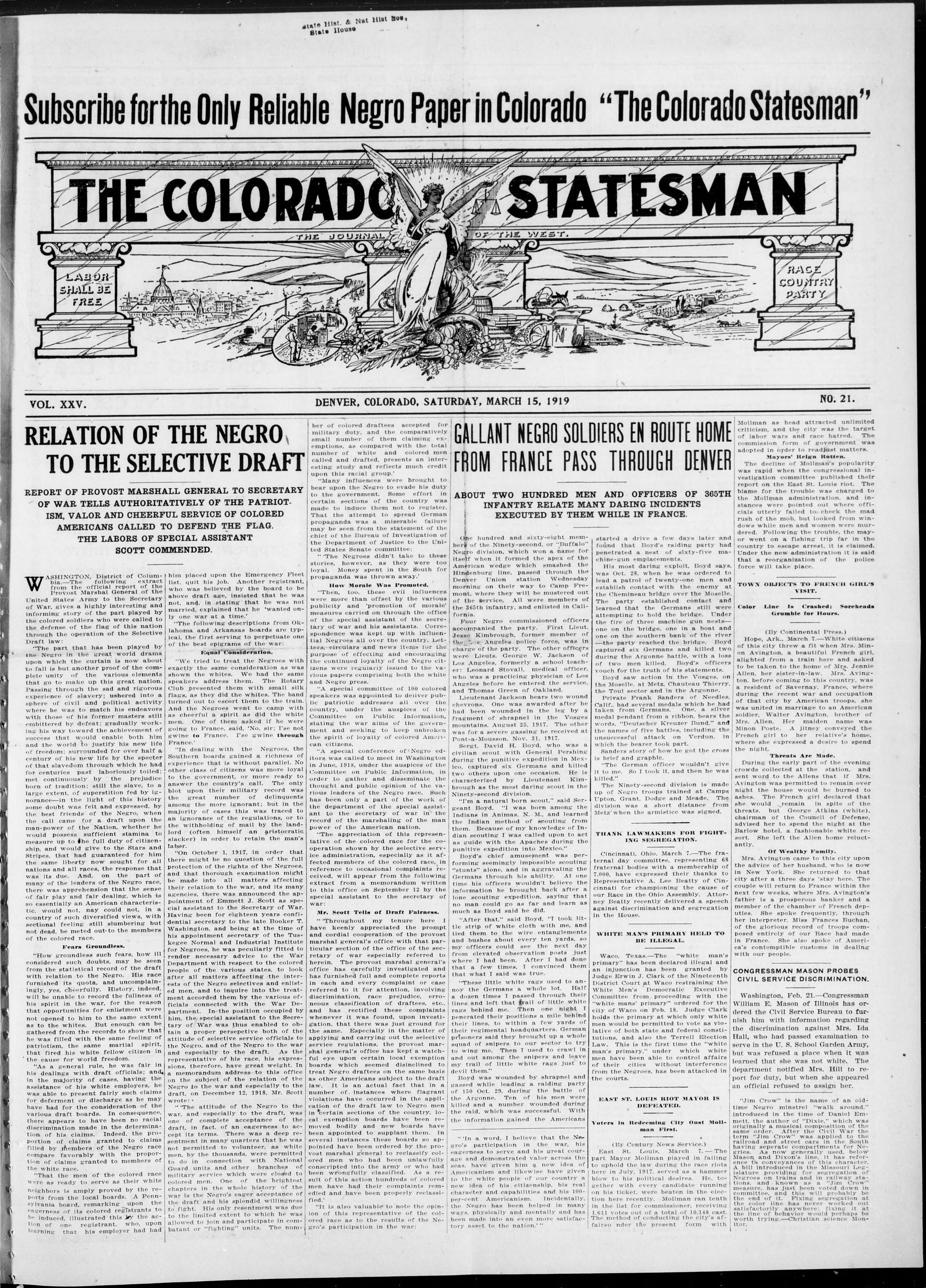
Subscribe forthe Only Reliable Negro Paper in Colorado "The Colorado Statesman"
THE COLORADO STATESMAN
THE JOURNAL OF THE WEST.
LABOR SHALL BE FREE
RAGE COUNTRY PARTY
RELATION OF THE NEGRO TO THE SELECTIVE DRAFT
REPORT OF PROVOST MARSHALL GENERAL TO SECRETARY OF WAR TELLS AUTHORITATIVELY OF THE PATRIOTISM, VALOR AND CHEERFUL SERVICE OF COLORED AMERICANS CALLED TO DEFEND THE FLAG. THE LABORS OF SPECIAL ASSISTANT SCOTT COMMENDED.
VOL. XXV.
RELATION OF WAR
TO THE SELF
REPORT OF PROVOST MARSHAL
OF WAR TELLS AUTHORITY
ISM, VALOR AND CHEERER
AMERICANS CALLED TO
THE LABORS OF S
SCOTT CO.
WASHINGTON, District of Columbia.—The following extract from the official report of the Provost Marshal General of the United States Army to the Secretary of War, gives a highly interesting and informing story of the part played by the colored soldiers who were called to the defense of the flag of this nation through the operation of the Selective Draft law:
"The part that has been played by the Negro in the great world drama upon which the curtain is now about to fall is but another proof of the complete unity of the various elements that go to make up this great nation. Passing through the sad and rigorous experience of slavery; ushered into a sphere of civil and political activity where he was to match his endeavors with those of his former masters still embittered by defeat: gradually working his way toward the achievement of success that would enable both him and the world to justify his new life of freedom; surrounded for over half a century of his new life by the specter of that slavedom through which he had for centuries past laboriously toiled; met continuously by the prejudice born of tradition; still the slave, to a large extent, of superstition fed by ignorance—in the light of this history some doubt was felt and expressed, by the best friends of the Negro, when the call came for a draft upon the man-power of the Nation, whether he would possess sufficient stamina to measure up to the full duty of citizenship, and would give to the Stars and Stripes, that had guaranteed for him the same liberty now sought for all nations and all races, the response that was its due. And, on the part of many of the leaders of the Negro race, there was apprehension that the sense of fair play and fair dealing, which is so essentially an American characteristic, would not, nay could not, in a country of such diversified views, with sectional feeling still slumbering but not dead, be meted out-to the members of the colored race.
Fears Groundless.
"How groundless such fears, how ill considered such doubts, may be seen from the statistical record of the draft with relation to the Negro. His race furnished its quota, and uncomplainingly, yes, cheerfully. History, indeed, will be unable to record the fullness of his spirit in the war, for the reason that opportunities for enlistment were not opened to him to the same extent as to the whites. But enough can be gathered from the records to show that he was filled with the same feeling of patriotism, the same martial spirit, that fired his white fellow citizen in the cause for world freedom.
"As a general rule, he was fair in his dealings with draft officials; and in the majority of cases, having the assistance of his white employers, he was able to present fairly such claims for deferment or discharge as he may have had for the consideration of the various draft boards. In consequence, there appears to have been no racial discrimination made in the determination of his claims. Indeed, the proportion of claims granted to claims filled by members of the Negro race compare favorably with the proportion of claims granted to members of the white race.
"That the men of the colored race were as ready to serve as their white neighbors is amply proved by the reports from the local boards. A Pennsylvania board, remarking upon the eagerness of its colored registrants to be induced, illustrated this by the action of one registrant, who, upon learning that his employer had had
him placed upon the Emergency Fleet list, quit his job. Another registrant, who was believed by the board to be above draft age, insisted that he was not, and, in stating that he was not married, explained that he 'wanted only one war at a time.' "The following descriptions from Oklahoma and Arkansas boards are typical, the first serving to perpetuate one of the best epigrams of the war:
Equal Consideration.
"We tried to treat the Negroes with exactly the same consideration as was shown the whites. We had the same speakers address them. The Rotary Club presented them with small silk flags, as they did the whites. The band turned out to escort them to the train. And the Negroes went to camp with as cheerful a spirit as did the white men. One of them asked if he were going to France, said, 'No, sir; Ise not gwine to France. Ise gwine through France.'
"In dealing with the Negroes, the Southern boards gained a richness of experience that is without parallel. No other class of citizens was more loyal to the government, or more ready to answer the country's call. The only blot upon their military record was the great number of delinquents among the more ignorant; but in the majority of cases this was traced to an ignorance of the regulations, or to the withholding of mail by the landlord (often himself an gristocratic slacker) in order to retain the man's labor.
"On October 1, 1917, in order that there might be no question of the full protection of the rights of the Negroes, and that thorough examination might be made into all matters affecting their relation to the war, and its many agencies, there was announced the appointment of Emmett J. Scott as special assistant to the Secretary of War Having been for eighteen years confidential secretary to the late Booker T. Washington, and being at the time of his appointment secretary of the Tuskegee Normal and Industrial Institute for Negroes, he was peculiarly fitted to render necessary advice to the War Department with respect to the colored people of the various states, to look after all matters affecting the interests of the Negro selectives and enlisted men, and to inquire into the treatment accorded them by the various officials connected with the War Department. In the position occupied by him, the special assistant to the Secretary of War was thus enabled to obtain a proper perceptive both of the attitude of selective service officials to the Negro, and of the Negro to the war and especially to the draft. As the representative of his race, his expressions, therefore, have great weight. In a memorandum address to this office on the subject of the relation of the Negro to the war and especially to the draft, on December 12, 1918, Mr. Scott wrote:
"The attitude of the Negro to the war, and especially to the draft, was one of complete acceptance of the draft, in fact, of an eagerness to accept its terms. There was a deep resentment in many quarters that he was not permitted to volunteer, as white men, by the thousands, were permitted to do in connection with National Guard units and other branches of military service which were closed to colored men. One of the brightest chapters in the whole history of the war is the Negro's eager acceptance of the draft and his splendid willingness to fight. His only resentment was due to the limited extent to which he was allowed to join and participate in combat or "fighting" units. The num-
State Hist. & Nat Hist Soc.
State House
ble Negro Pap
ADC
THE JOURNAL
DENVER, COLORADO, SATU
ber of colored draftees accepted for military duty, and the comparatively small number of them claiming exemptions, as compared with the total number of white and colored men called and drafted, presents an interesting study and reflects much credit upon this racial group.
"Many influences were brought to bear upon the Negro to evade his duty to the government. Some effort in certain sections of the country was made to induce them not to register. That the attempt to spread German propaganda was a miserable failure may be seen from the statement of the chief of the Bureau of Investigation of the Department of Justice to the United States Senate committee:
"The Negroes didn't take to these stories, however, as they were too loyal. Money spent in the South for propaganda was thrown away."
How Morale Was Promoted.
How Morale Was Promoted.
"Then, too, these evil influences were more than offset by the various publicity and 'promotion of morale' measures carried on through the office of the special assistant of the secretary of war and his assistants. Correspondence was kept up with influential Negroes all over the country. Letters, circulars and news items for the purpose of effecting and encouraging the continued loyalty of the Negro citizens were regularly issued to the various papers comprising both the white and Negro press.
"A special committee of 100 colored speakers was appointed to deliver public patriotic addresses all over the country, under the auspices of the Committee on Public Information, stating the war aims of the government and seeking to keep unbroken the spirit of loyalty of colored American citizens.
"A special conference of Negro editors was called to meet in Washington in June, 1918, under the auspices of the Committee on Public Information, in order to gather and disseminate the thought and public opinion of the various leaders of the Negro race. Such has been only a part of the work of the department of the special assistant to the secretary of war in the record of the marshaling of the man power of the American nation.
"The appreciation of this representative of the colored race for the cooperation shown by the selective service administration, especially as it affected members of the colored race, in reference to occasional complaints received, will appear from the following extract from a memorandum written to this office on September 12 by the special assistant to the secretary of war:
Mr. Scott Tells of Draft Fairness.
"Throughout my tenure here I have keenly appreciated the prompt and cordial cooperation of the provost marshal general's office with that particular section of the office of the secretary of war especially referred to herein. The provost marshal general's office has carefully investigated and has furnished full and complete reports in each and every complaint or case referred to it for attention, involving discrimination, race prejudice, erroneous classification of draftees, etc. and has rectified these complaints whenever it was found, upon investigation, that there was just ground for the same. Especially in the matter of applying and carrying out the selective service regulations, the provost marshal general's office has kept a watchful eye upon certain local exemption boards which seemed disinclined to treat Negro draftees on the same basis as other Americans subject to the draft law. It is an actual fact that in a number of instances where flagrant violations have occurred in the application of the draft law to Negro men in certain sections of the country, local exemption boards have been removed bodily and new boards have been appointed to supplant them. In several instances these boards so appointed have been ordered by the provost marshal general to reclassify colored men who had been unlawfully conscripted into the army or who had been wrongly classified. As a result of this action hundreds of colored men have had their complaints remedied and have properly reclassified."
"It is also valuable to note the opinion of this representative of the colored race as to the results of the Negro's participation in the war:
GALLANT NEGRO SOLDIERS EN ROUTE HOME FROM FRANCE PASS THROUGH DENVER
ABOUT TWO HUNDRED MEN AND OFFICERS OF 365TH INFANTRY RELATE MANY DARING INCIDENTS EXECUTED BY THEM WHILE IN FRANCE.
One hundred and sixty-eight members of the Ninety-second, or "Buffalo" Negro division, which won a name for itself when it formed the apex of the American wedge which smashed the Hindenburg line, passed through the Denver Union station Wednesday morning on their way to Camp Fremont, where they will be mustered out of the service. All were members of the 365th infantry, and enlisted in California. Four Negro commissioned officers accompanied the party. First Lieut. Jesse Kimbrough, former member of the Los Angeles police force, was in charge of the party. The other officers were Lieuts. George W. Jackson of Los Angeles, formerly a school teacher; Leonard Stovall, medical officer, who was a practicing physician of Los Angeles before he entered the service, and Thomas Green of Oakland. Lieutenant Jackson bears two wound chevroons. One was awarded after he had been wounded in the leg by a fragment of shrapnel in the Vosges mountains. August 25, 1917. The other was for a severe gassing he received at Pont-a-Mousson, Nov. 31, 1917. Sergt. David H. Boyd, who was a civilian scout with General Pershing during the punitive expedition in Mexico, captured six Germans and killed two others upon one occasion. He is characterized by Lieutenant Kimbrough as the most daring scout in the Ninety-second division.
"I'm a natural born scout," said Sergeant Boyd. "I was born among the Indians in Animas, N. M., and learned the Indian method of scouting from them. Because of my knowledge of Indian scouting I was called upon to act as guide with the Apaches during the punitive expedition into Mexico."
Boyd's chief amusement was performing seemingly impossible scouting "stunts" alone, and in aggravating the Germans through his ability. At one time his officers wouldn't believe the information he brought back after a lone scouting expedition, saying that no man could go as far and learn as much as Boyd said he did.
"After that," said Boyd, "I took little strip of white cloth with me, and tied them to the wire entanglements and bushes about every ten yards, so my officers could see the next day from elevated observation posts just where I had been. After I had done that a few times, I convinced them that what I said was true.
"These little white rags used to annoy the Germans a whole lot. Half a dozen times I passed through their lines and left that trail of little white rags behind me. Then one night I penetrated their positions a mile behind their lines, to within a few yards of their regimental headquarters, German prisoners said they brought up a whole squad of snipers to our sector to try to wing me. Then I used to crawl in and out among the snipers and leave my trail of little white rags just to devil them."
Boyd was wounded by shrapnel and gassed while leading a raiding party of 150 Oct. 29, during the battle of the Argonne. Ten of his men were killed and a number wounded during the raid, which was successful. With the information gained the Americans
"In a word, I believe that the Negro's participation in the war, his eagerness to serve and his great courage and demonstrated valor across the seas, have given him a new idea of Americanism and likewise have given to the white people of our country a new idea of his citizenship, his real character and capabilities and his 100-per-cent Americanism. Incidentally, the Negro has been helped in many ways, physically and mentally and has been made into an even more satisfactory asset to the nation."
started a drive a few days later and found that Boyd's raiding party had penetrated a nest of sixty-five machine-gun emplacements. His most daring exploit, Boyd says, was Oct. 28, when he was ordered to lead a patrol of twenty-one men and establish contact with the enemy at the Chemeineau bridge over the Moselle. The party established contact and learned that the Germans still were attempting to hold the bridge. Under the fire of three machine gun nests—one on the bridge, one in a boat and one on the southern bank of the river—the party reached the bridge. Boyd captured six Germans and killed two during the Argonne battle, with a loss of two men killed. Boyd's officers vouch for the truth of his statements.
Boyd saw action in the Vosges, on the Moseelle, at Metz, Chauteau Thierry, the Toul sector and in the Argonne.
Private Frank Sanders of Needles, Calif., had several medals which he had taken from Germans. One, a silver medal pendant on a ribbon, bears the words, "Deutscher Kreuzer Bund," and the names of five battles, including the unsuccessful attack on Verdun, in which the bearer took part.
Sanders story of how he got the cross is brief and graphle.
"The German officer wouldn't give it to me. So I took it, and then he was killed."
The Ninety-second division is made up of Negro troops trained at Camps Upton, Grant, Dodge and Meade. The division was a short distance from Metz when the armistice was signed.
THANK LAWMAKERS FOR FIGHTING SEGREGATION.
Cincinnati, Ohio. March 7.—The fraternal day committee, representing 68 fraternal bodies with a membership of 7,000, have expressed their thanks to Representative A. Lee Beatty of Cincinnati for championing the cause of our Race in the Ohio Assembly. Attorney Beatty recently delivered a speech against discrimination and segregation in the House.
WHITE MAN'S PRIMARY HELD TO BE ILLEGAL.
Waco, Texas.—The "white man's primary" has been declared illegal and an injunction has been granted by Judge Erwin J. Clark of the Nineteenth District Court at Waco restraining the White Men's Democratic Executive Committee from proceeding with the "white man's primary" ordered for the city of Waco on Feb. 18. Judge Clark holds the primary at which only white men would be permitted to vote as violate of both state and federal constitutions, and also the Terrell Election Law. This is the first time the "white man's primary," under which white men have been able to control affairs of their cities without interference from the Negroes, has been attacked in the courts.
EAST ST. LOUIS RIOT MAYOR IS DEFEATED.
Voters in Redeeming City Oust Mollman First.
(By Century News Service.)
East St. Louis, March 7. — The part Mayor Mollman played in failing to uphold the law during the race riots here in July, 1917, served as a hammer blow to his political desires. He, together with every candidate running on his ticket, were beaten in the election here recently. Mollman ran tenth in the list for commissioner, receiving 1.611 votes out of a total of 10.148 cast. The method of conducting the city's affairs under the present form with
NO.21.
Mollman as head attracted unlimited criticism, and the city was the target of labor wars and race hatred. The commission form of government was adopted in order to readjust matters. Mayors' Reign Rotten. The decline of Mollman's popularity was rapid when the congressional investigation committee published their report on the East St. Louis riot. The blame for the trouble was charged to the Mollman administration, and instances were pointed out where officials utterly failed to check the mad rush of the mob, but looked from windows while men and women were murdered. Following the trouble, the mayor went on a fishing trip far in the country to escape arrest, it is claimed. Under the new administration it is said that a reorganization of the police force will take place.
TOWN OBJECTS TO FRENCH GIRL'S VISIT.
Color Line Is Crashed; Soreheads Grumble for Hours.
(By Continental Press.)
(By Continental Press.)
Hope, March. 7—White citizens of this city threw a fit when Mrs. Minion Avington, a beautiful French girl, alighted from a train here and asked to be taken to the home of Mrs. Jennie Allen, her sister-in-law, Mrs. Avington, before coming to this country, was a resident of Savernay, France, where during the recent war and occupation of that city by American troops, she was united in marriage to an American soldier, Walter Avington, brother of Mrs. Allen. Her maiden name was Minion Poste. A jitney conveyed the French girl to her relative's home, where she expressed a desire to spend the night.
Threats Are Made.
During the early part of the evening crowds collected at the station, and sent word to the Allens that if Mrs. Avington was permitted to remain over night the house would be burned to ashes. The French girl declared that she would remain in spite of the threats, but George Atkins (white), chairman of the Council of Defense, advised her to spend the night at the Barlow hotel, a fashionable white resort. She left the Allen home reluctantly.
Of Wealthy Family.
Mrs. Avington came to this city upon the advice of her husband, who is now in New York. She returned to that city after a three days 'stay here. The couple will return to France within the next few weeks, where Mrs. Avington's father is a prosperous banker and a member of the chamber of French deputies. She spoke frequently, through her interpreter, Miss Frances Buchan, of the glorious record of troops composed entirely of our Race had made in France. She also spoke of America's contemptible customs in dealing with our people.
CONGRESSMAN MASON PROBES
CIVIL SERVICE DISCRIMINATION
Washington, Feb. 21.—Congressman William E. Mason of Illinois has ordered the Civil Service Bureau to furnish him with information regarding the discrimination against Mrs. Ida Hall, who had passed examination to serve in the U. S. School Garden Army, but was refused a place when it was learned that she was not white. The department notified Mrs. Hill to report for duty, but when she appeared an official refused to assign her.
"Jim Crow" is the name of an old-time Negro minstrel "walk around." introduced in the time of Daniel Emmett, the author of "Dixie," which was originally a musical composition of the same order. After the Civil War the term "Jim Crow" was applied to railroad and street cars in the South having separate compartments for Negries. As now generally used, below Mason and Dixon's line, it has referred to any unarmed car in the South. A bill introduced in the Missouri Legislature providing for segregation of Negroes on trains and in railway stations, and known as a Jim Crow station, has just been voted down in committee, and this will probably be the end of it. Fixing segregation at the color line has never worked out, and the question of the line of behavior would perhaps be worth trying.—Christian science Monitor.
FOREIGN
More than 1,000 persons have been killed and 2,000 inured in the fighting in Berlin, according to advices reaching this country.
It has become known that Pope Benedict has addressed an appeal to the powers emphasizing the urgency of the speedy conclusion of peace with Germany.
An aeroplane containing two Americans fell in front of a moving train near Chaumont, France, one aviator being killed, according to information received in Paris.
A republic has been officially proclaimed in Luxemburg. Princess Charlotte, who succeeded her sister, Marie Adelalde, on the throne, has fled and is probably in Switzerland.
The British government has decided to release all Irish political prisoners. In order to prevent a great public demonstration the prisoners will return to Ireland in small batches. Major von Klucker, former German military attache in Paris, is the victim of the latest Spartacan atrocity. The reds captured him at Halle, cut off both hands, flung him into the river and then riddled his body with bullets. Differences of opinion as to whether the seamen should appeal to the peace conference for a settlement of international wage and working conditions, resulted in a split of international seafarers' conference in London.
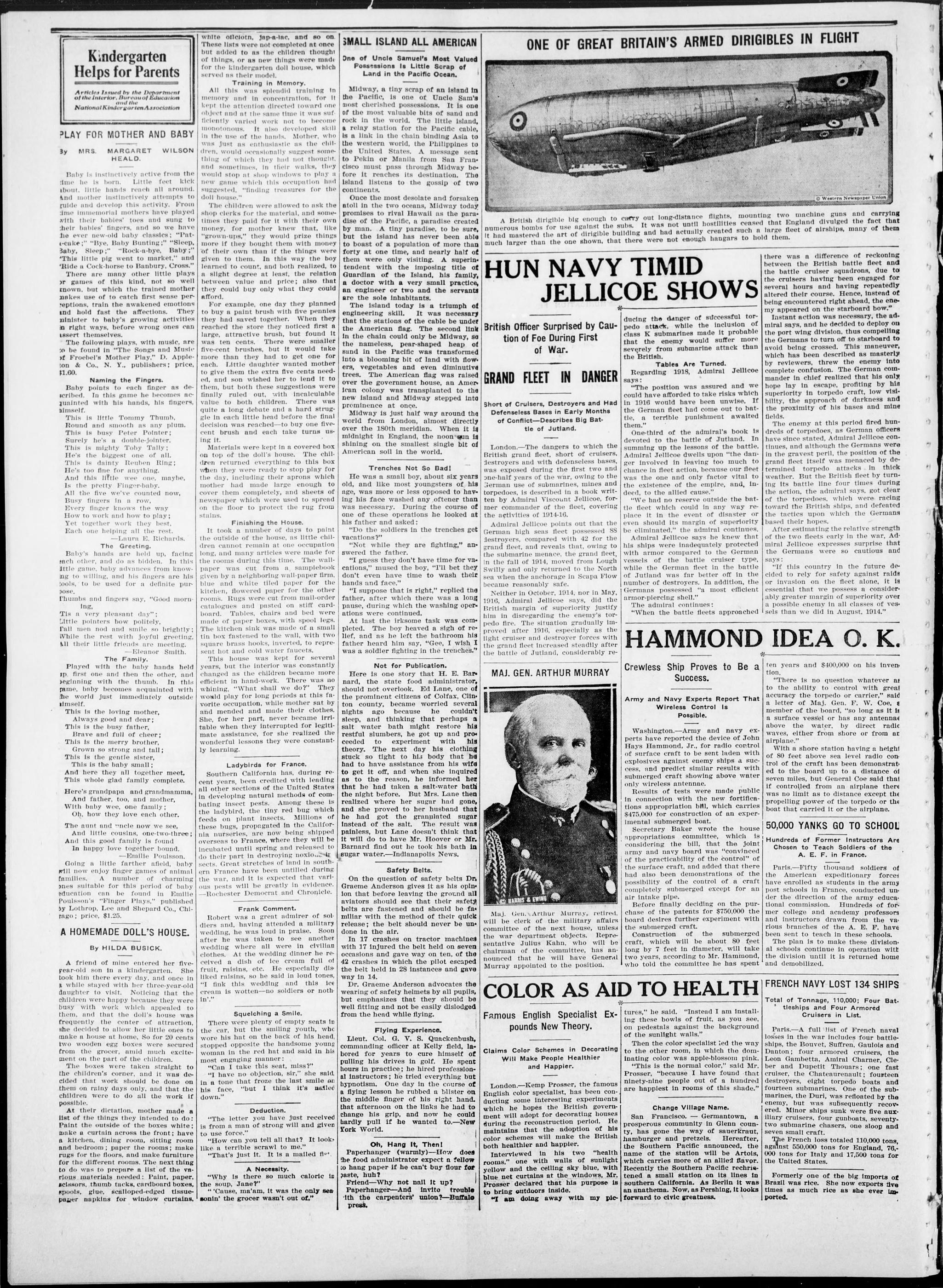
Great Britain's largest airship, the R-33, made a trial flight and covered thirty miles in half an hour, landing successfully in spite of unfavorable weather. The airship is 670 feet long, and during her flight preserved a perfectly even keel.
Deputy Minaudy of the Belgian chamber has sent a petition to Brend Whitlock, the American minister, for transmission to President Wilson, appealing to American generosity for the towns of Herve and Battice, in the Liege region, which gave the first victims of German atrooties in 1914. These two towns are declared to have been the greatest sufferers in Belgium.
It will be the fate of former Emperor William to be branded for all time as an arch criminal by the solemn declaration of all the nations assembled at the peace conference, to which even his own country may be called upon to subscribe in the peace terms, according to the present plans of what is believed to be a majority of the commission on responsibility for the war.
**SPORT**
Willie Ritchie, former lightweight champion, and Miss Ethel Pierce were married in San Francisco last week.
The New York American league club announced that it has engaged Thomas Miller, outfielder, who, as a member of the Richmond club, led the Virginia league in batting last season.
Arthur Reinhart, a left-handed pitcher of the University of Iowa, will be given a trial with the St. Louis Nationals this season. He is only 19 years old, is more than six feet in height and weighs 175 pounds. He pitched four no-hit games last season. The management of the Los Angeles club of the Pacific Coast league made announcement that Samuel Beer, pitcher, and W. Kenworthy, second baseman, had been signed. Beer pitched for Oakland part of last season. Kenworthy played second base for the Angels two years ago.
GENERAL
A partial survey of the "sleeping sickness" epidemic in Chicago revenels twenty-seven cases and eighteen deaths, according to reports.
The Standard Oil Company of New Jersey has been sued for $500,000 damages by the Central Oil Company of Baltimore. The plaintiff alleges that buying its oil in the open market, it had built up an extensive and profitable trade.
An important extension of the exemption of the income tax law is contained in a ruling by Commissioner Roper, made public in Chicago. It is that the exemption for wife or children covers the whole year 1918 even if the wife were wed, or the child born, on the last day of the year.
A Reuter's dispatch from Paris says that additional evidence will be laid before the commission of reparation of the peace conference by the presentation of documents discovered by the Belgian police and containing detailed instructions to German troops for the carrying out of their work of destruction in Belgium. With the arrest and reported confession of Roy Lee Gafner, an automobile mechanic, secret service operatives and postal authorities say they are confident they have discovered a clever and perfect war stamp counterfeiting scheme. He was released on $1,500 bond. It was announced that Gafner had registered approximately $300 worth of stamps at the local post-office. The system of manufacturing the stamps was so accurate and so simple, officers said, that they declined to give a description of the device.
Twenty-one Americans, who were taken prisoner by the sensational German raider Moewe and who saw from the inside the rise and fall of Teutonic arrogance, walked down the gangplank with 2,292 homecoming soldiers from the White Star liner Vedic at Boston.
At the instance of Mayor Hylan and Police Commissioner Enright of New York, who declared that the projected performances might provoke disorder, the management of the Lexington theater cancelled arrangements for a season of German operas.
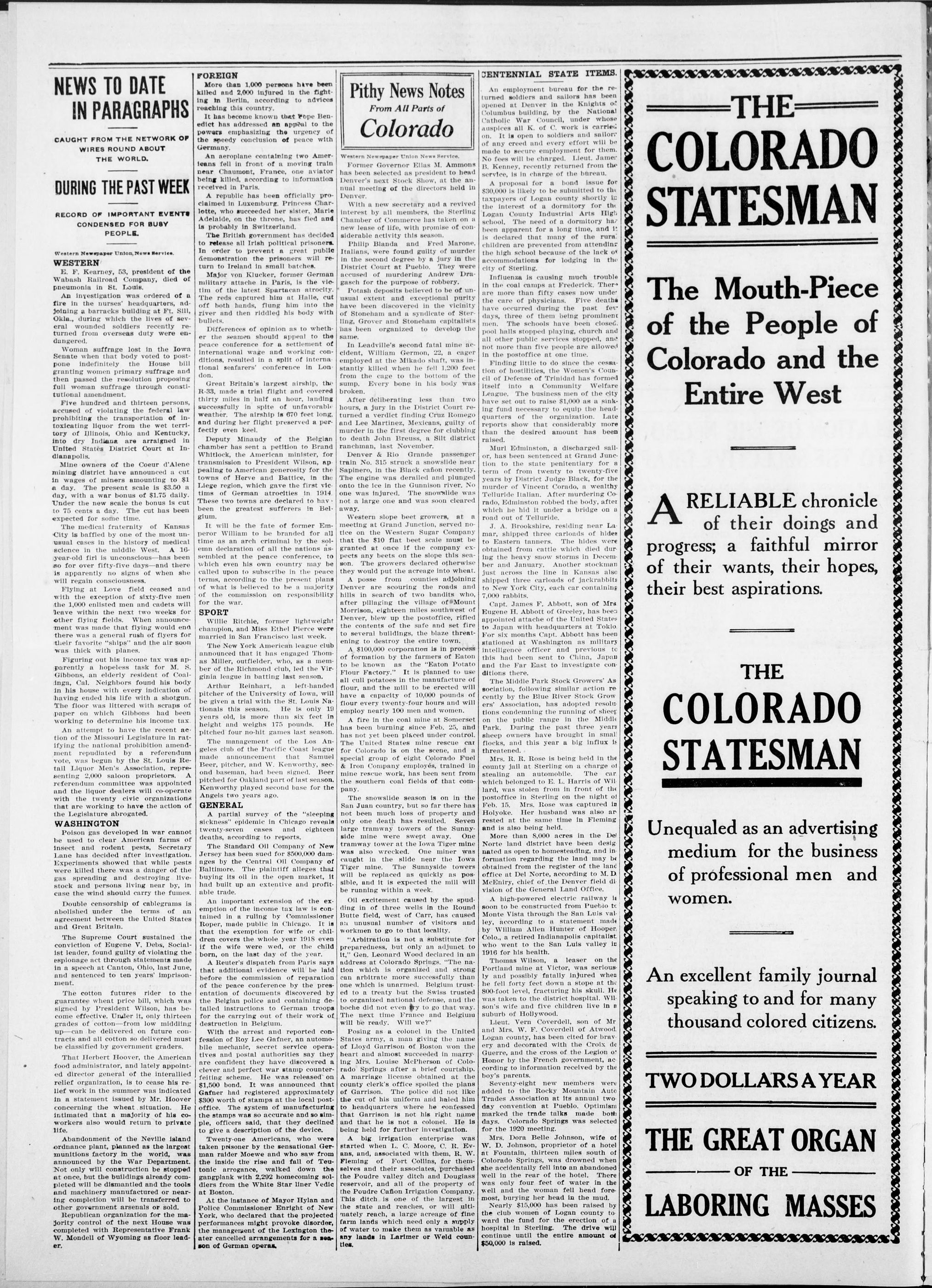
NEWS TO DATE IN PARAGRAPHS
CAUGHT FROM THE NETWORK OF WIRES ROUND ABOUT THE WORLD.
DURING THE PAST WEEK
RECORD OF IMPORTANT EVENTS
CONDENSED FOR BUSY
PEOPLE.
Western Newspaper Union, News Service.
WESTERN
E. F. Kearney, 53, president of the
Wabash Railroad Company, died of
pneumonia in St. Louis.
An investigation was ordered of a
fire in the nurses' headquarters,
adjoining a barracks building at Ft. Sill,
Okla., during which the lives of
several wounded soldiers recently
returned from overseas duty were
endangered.
Woman suffrage lost in the Iowa Senate when that body voted to postpone indefinitely the House bill granting women primary suffrage and then passed the resolution proposing full woman suffrage through constitutional amendment.
Five hundred and thirteen persons, accused of violating the federal law prohibiting the transportation of intoxicating liquor from the wet territory of Illinois, Ohio and Kentucky, into dry Indiana are arraigned in United States District Court at Indianapolis.
Mine owners of the Coeur d'Alene mining district have announced a cut in wages of miners amounting to $1 a day. The present scale is $3.50 a day, with a war bonus of $1.75 daily. Under the new scale the bonus is cut to 75 cents a day. The cut has been expected for some time.
The medical fraternity of Kansas City is baffled by one of the most unusual cases in the history of medical science in the middle West. A 16-year-old girl is unconscious—has been so for over fifty-five days—and there is apparently no signs of when she will regain consciousness.
Flying at Love field ceased and with the exception of sixty-five men the 1,000 enlisted men and cadets will leave within the next two weeks for other flying fields. When announcement was made that flying would end there was a general rush of flyers for their favorite "ships" and the air soon was thick with planes.
Figuring out his income tax was apparently a hopeless task for M. S. Gibbons, an elderly resident of Coalinga, Cal. Neighbors found his body in his house with every indication of having ended his life with a shotgun. The floor was littered with scraps of paper on which Gibbons had been working to determine his income tax. An attempt to have the recent action of the Missouri Legislature in ratifying the national prohibition amendment repudiated by a referendum vote, was begun by the St. Louis Retail Liquor Men's Association, representing 2,000 saloon proprietors. A referendum committee was appointed and the liquor dealers will co-operate with the twenty civic organizations that are working to have the action of the Legislature abrogated.
WASHINGTON
Poison gas developed in war cannot be used to clear American farms of insect and rodent pests, Secretary Lane has decided after investigation. Experiments showed that while pests were killed there was a danger of the gas spreading and destroying livestock and persons living near by, in case the wind should carry the fumes. Double censorship of cablegrams is abolished under the terms of an agreement between the United States and Great Britain.
The Supreme Court sustained the conviction of Eugene V. Debs, Socialist leader, found guilty of violating the espionage act through statements made in a speech at Canton, Ohio, last June, and sentenced to ten years' imprisonment.
The cotton futures rider to the guarantee wheat price bill, which was signed by President Wilson, has become effective. Under it, only thirteen grades of cotton—from low middling up—can be delivered on future contracts and all cotton so delivered must be classified by government graders.
That Herbert Hoover, the American food administrator, and lately appointed director general of the interallied relief organization, is to cease his relief work in the summer was indicated in a statement issued by Mr. Hoover concerning the wheat situation. He intimated that a majority of his coworkers also would return to private life.
Abandonment of the Neville island ordnance plant, planned as the largest munitions factory in the world, was announced by the War Department. Not only will construction be stopped at once, but the buildings already completed will be dismantled and the tools and machinery manufactured or nearing completion will be transferred to other government arsenals or sold. Republican organization for the majority control of the next House was completed with Representative Frank W. Mondell of Wyoming as floor leader.
SPORT
Pithy News Notes From All Parts of Colorado
Pithy News Notes From All Parts of Colorado
Western Newspaper Union News Service.
Former Governor Ellias M. Ammons has been selected as president to head Denver's next Stock Show, at the annual meeting of the directors held in Denver.
With a new secretary and a revived interest by all members, the Sterling Chamber of Commerce has taken on a new lease of life, with promise of considerable activity this season.
Philip Blanda and Fred Marone, Italians, were found guilty of murder in the second degree by a jury in the District Court at Pueblo. They were accused of murdering Andrew Dragsch for the purpose of robbery.
Potash deposits believed to be of unusual extent and exceptional purity have been discovered in the vicinity of Stoneham and a syndicate of Sterling, Grover and Stoneham capitalists has been organized to develop the same.
In Leadville's second fatal mine accident, William Germon, 22, a cager employed at the Mikado shaft, was instantly killed when he fell 1,200 feet from the cage to the bottom of the sump. Every bone in his body was broken.
After deliberating less than two hours, a jury in the District Court returned a verdict finding Cruz Romega and Lee Martinez, Mexicans, guilty of murder in the first degree for clubbing to death John Breuss, a Silt district ranchman, last November.
Denver & Rio Grande passenger train No. 315 struck a snowslide near Sapinero, in the Black cafon recently. The engine was derailed and plunged onto the ice in the Gunnison river. No one was injured. The snowslide was not a large one and was soon cleared away. Western slope beet growers, at a meeting at Grand Junction, served notice on the Western Sugar Company that the $10 flat beet scale must be granted at once if the company expects any beets on the slope this season. The growers declared otherwise they would put the acreage into wheat.
A posse from counties adjoining Denver are scouring the roads and hills in search of two bandits who, after pillaging the village of Mount Morrison, eighteen miles southwest of Denver, blew up the postoffice, riffed the contents of the safe and set fire to several buildings, the blaze threatening to destroy the entire town.
A $100,000 corporation is in process of formation by the farmers of Eaton to be known as the "Eaton Potato Flour Factory." It is planned to use all cull potatoes in the manufacture of flour, and the mill to be erected will have a capacity of 10,000 pounds of flour every twenty-four hours and will employ nearly 100 men and women.
A fire in the coal mine at Somerset has been burning since Feb. 25, and has not yet been placed under control. The United States mine rescue car for Colorado is on the scene, and a special group of eight Colorado Fuel & Iron Company employés, trained in mine rescue work, has been sent from the southern coal fields of that company.
The snowslide season is on in the San Juan country, but so far there has not been much loss of property and only one death has resulted. Seven large tramway towers of the Sunnyside mine were swept away. One tramway tower at the Iowa Tiger mine was also wrecked. One miner was caught in the slide near the Iowa Tiger mine. The Sunnyside towers will be replaced as quickly as possible, and it is expected the mill will be running within a week.
Oil excitement caused by the spudding in of three wells in the Round Butte field, west of Carr, has caused an unusual number of visitors and workmen to go to that locality.
"Arbitration is not a substitute for preparedness, but only an adjunct to it." Gen. Leonard Wood declared in an address at Colorado Springs. "The nation which is organized and strong can arbitrate more successfully than one which is unarmed. Belgium trusted to a treaty but the Swiss trusted to organized national defense, and the boche did not even try to go that way. The next time France and Belgium will be ready. Will we?"
Posing as a colonel in the United States army, a man giving the name of Lloyd Garrison of Boston won the heart and almost succeeded in marrying Mrs. Louise McPherson of Colorado Springs after a brief courtship. A marriage license obtained at the county clerk's office spoiled the plans of Garrison. The police did not like the cut of his uniform and hailed him to headquarters where he confessed that Garrison is not his right name and that he is not a colonel. He is being held for further investigation.
A big irrigation enterprise was started when L. C. Moore, C. R. Evans, and, associated with them, R. W. Fleming of Fort Collins, for themselves and their associates, purchased the Poudre valley ditch and Douglass reservoir, and all of the property of the Poudre Cañon Irrigation Company. This ditch is one of the largest in the state and reaches, or will ultimately reach, a large acreage of fine farm lands which need only a supply of water to make them as variable as any lands in Larimer or Weld counties.
---
An employment bureau for the returned soldiers and sailors has been opened at Denver in the Knights of Columbus building, by the National Catholic War Council, under whose auspices all K. of C. work is carried on. It is open to soldiers and sailors of any creed and every effort will be made to secure employment for them. No fees will be charged. Lieut. Jamer B. Kenney, recently returned from the service, is in charge of the bureau.
COLORADO STATESMAN
A proposal for a bond issue for $30,000 is likely to be submitted to the taxpayers of Logan county shortly in the interest of a dormitory for the Logan County Industrial Arts High school. The need of a dormitory has been apparent for a long time, and it is declared that many of the rural children are prevented from attending the high school because of the lack of accommodations for lodging in the city of Sterling.
The Mouth-Piece of the People of Colorado and the Entire West
Influenza is causing much trouble in the coal camps at Frederick. There are more than fifty cases now under the care of physicians. Five deaths have occurred during the past few days, three of them being prominent men. The schools have been closed, pool halls stopped playing, church and all other public services stopped, and not more than five people are allowed in the postoffice at one time.
Finding little to do since the cessation of hostilities, the Women's Council of Defense of Trinidad has formed itself into a Community Welfare League. The business men of the city have set out to raise $1,000 as a sinking fund necessary to equip the headquarters of the organization. Late reports show that considerably more than the desired amount has been raised.
Murl Edminston, a discharged sailor, has been sentate at Grand Junction to the state penitentiary for a term of from twenty to twenty-five years by District Judge Black, for the murder of Vincent Corado, a wealthy Telluride Italian. After murdering Corado, Edminston robbed the body, after which he hid it under a bridge on a road out of Telluride.
ARELIABLE chronicle of their doings and progress; a faithful mirror of their wants, their hopes, their best aspirations.
J. A. Brookshire, residing near Lamar, shipped three carloads of hides to Eastern tanners. The hides were obtained from cattle which died during the heavy snow storms in December and January. Another stockman just across the line in Kansas also shipped three carloads of jackrabbits to New York City, each car containing 7,000 rabbits.
Capt. James F. Abbott, son of Mrs. Eugene H. Abbott of Greeley, has been appointed attache of the United States to Japan with headquarters at Tokio. For six months Capt. Abbott has been stationed at Washington as military intelligence officer and previous to this had been sent to China, Japan and the Far East to investigate conditions there.
THE COLORADO STATESMAN
The Middle Park Stock Growers' Association, following similar action recently by the Blue River Stock Growers' Association, has adopted resolutions condemning the running of sheep on the public range in the Middle Park. During the past three years sheep owners have brought in small flocks, and this year a big influx is threatened.
Mrs. R. R. Rose is being held in the county jail at Sterling on a charge of stealing an automobile. The car which belonged to E. L. Harris of Willard, was stolen from in front of the postoffice in Sterling on the night of Feb. 15. Mrs. Rose was captured in Holyoke. Her husband was also arrested at the same time in Fleming and is also being held.
Unequaled as an advertising medium for the business of professional men and women.
More than 8,000 acres in the Del Norte land district have been designated as open to homesteading, and information regarding the land may be obtained from the register of the land office at Del Norte, according to M.D. McEniry, chief of the Denver field division of the General Land Office.
A high-powered electric railway is soon to be constructed from Pueblo to Monte Vista through the San Luis valley, according to a statement made by William Allen Hunter of Hooper Colo., a retired Indianapolis capitalist who went to the San Luis valley in 1916 for his health.
Thomas Wilson, a leaser on the Portland mine at Victor, was seriously and possibly fatally injured when he fell forty feet down a stope at the 800-foot level, fracturing his skull. He was taken to the district hospital. Wilson's wife and five children live in a suburb of Hollywood.
An excellent family journal speaking to and for many thousand colored citizens.
Lieut. Vern Coverdell, son of Mr and Mrs. W. F. Coverdell of Atwood, Logan county, has been cited for bravery and decorated with the Croix de Guerre, and the cross of the Legion of Honor by the French government, according to information received by the boy's parents.
TWODOLLARSAYEAR
Seventy-eight new members were added to the Rocky Mountain Auto Trades Association at its annual two-day convention at Pueblo. Optimism marked the trade talks made both days. Colorado Springs was selected for the 1920 meeting.
Mrs. Dora Belle Johnson, wife of W. D. Johnson, proprietor of a hotel at Fountain, thirteen miles south of Colorado Springs, was drowned when she accidentally fell into an abandoned well in the rear of the hotel. There was only four feet of water in the well and the woman fell head foremost, burying her head in the mud.
Nearly $15,000 has been raised by the club women of Logan county toward the fund for the erection of a hospital in Sterling. The drive will continue until the entire amount of $50,000 is raised.
FIVE POINTS
WHY YOU SHOULD
DANCE AT FERN HALL
POINT ONE—Morrison's Full Orchestra furnishes the music.
POINT TWO—Thursday is in the middle of the week.
POINT THREE—We don't tolerate anything but decent actions at our dance.
POINT FOUR—Dancing is healthy. Science has proven it.
POINT FIVE—You can meet the prettiest girls in the whole world at
Fern Hall Every Thursday Night
FIVE POINTS DANCING CLUB.
MORRISON'S FAMOUS JAZZ ORCHESTRA
AND ENTERTAINERS
GEO. MORRISON, MANAGER
Music Furnished for all Occasions
Phone Main 2707. Res. 2947 Stout St. DENVER, COLO.
Leaders in Prescription
Full Line of Plough's Black and White Toilet Articles
2701 WELTON STREET MAIN 875
Taxicab Rates.
Depot, 1 or 2 pass...50c
Depot, each addi-
tional pass.....25c
One mile radius...50c
Each addition'1 mile.25c
Motto: "Not slow but
sure." Cash only.
Rates Per Hour.
$1.50 to $2.50.
Phone Main 6699
Bean Auto Livery
HEATED TAXICAB.
COLE 8 AND 7-PASSENGE 1918 LATE
MODEL CARS.
STAND: NIGHT AND DAY CAFE
1865-1867 Curtis St. Denver, Colorado
The
Curtis
Park
Floral
Company
FLORAL DESIGNS PUT UP WHILE
YOU WAIT
CHOICE PLANTS AND CUT FLOWERS CONSTANTLY
ON HAND
GREENHOUSES: Thirty-Fourth and Curtis Streets
TELEPHONE, MAIN 1511
DENVER, COLO
NIG
AND
Short C
1865-1867 CURT18 STREET
QUICK SERVICE
and Cleaners
Migr.
S TO ORDER
and Repairing
where
DENVER, COLO.
BZZ ORCHESTRA
MINERS
MANAGER
All Occasions
DENVER, COLO.
COMPANY
RIGHT PRICES
ation
White Toilet Articles
MAIN 875
Motto: "Not slow but sure." Cash only.
Rates Per Hour.
$1.50 to $2.50.
Livery
B.
EP 1918 LATE
WAY CAFE
Denver, Colorado
Private Booths for Ladies
D DAY CAFE
DRINK PARLOR
TH, Proprietor
Fresh Fish in Season
and Lobsters
Hours Rest Room for Ladies
DENVER, COLORADO
---
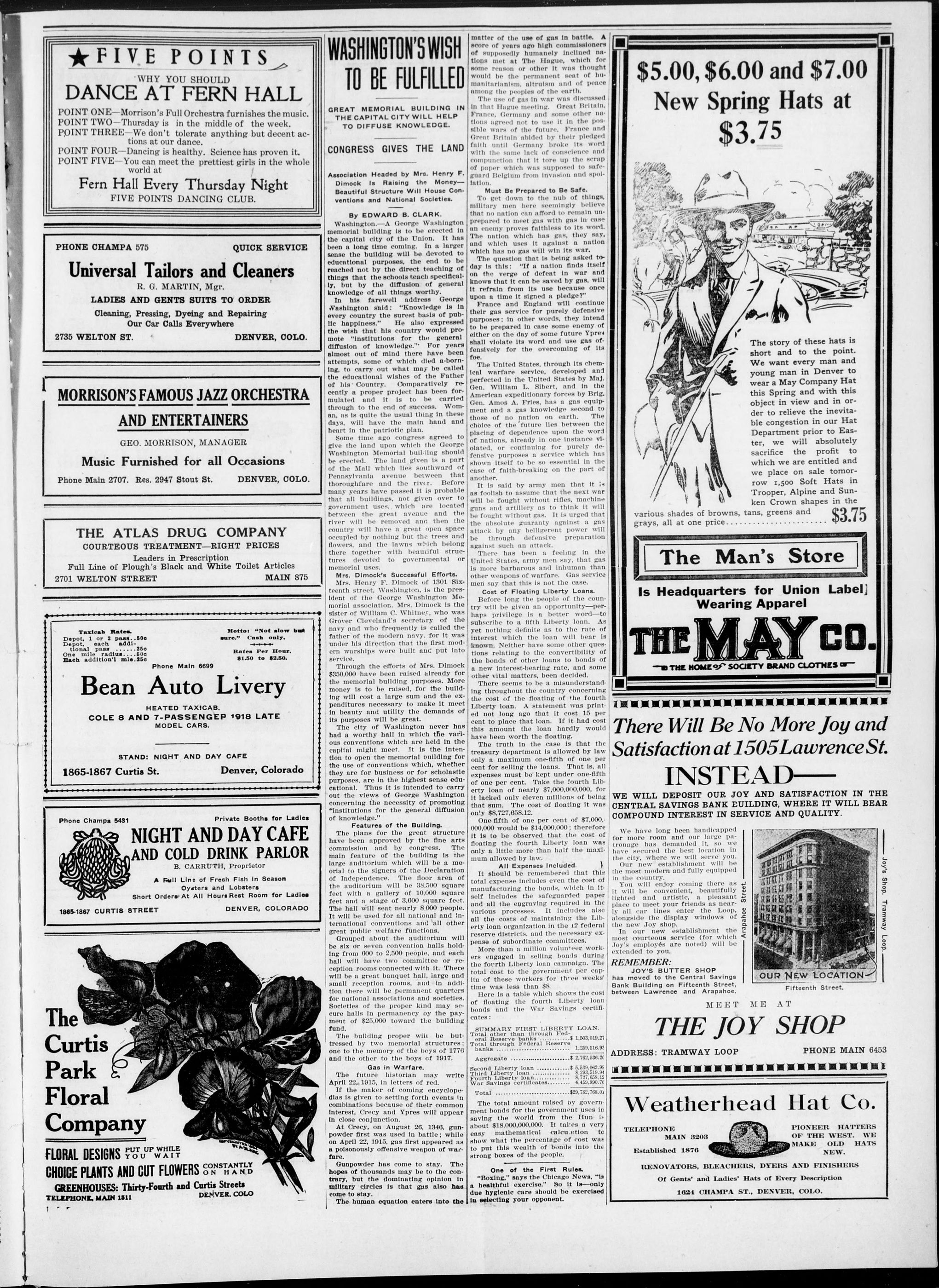
WASHINGTON'S WISH TO BE FULFILLED
GREAT MEMORIAL BUILDING IN THE CAPITAL CITY WILL HELP TO DIFFUSE KNOWLEDGE.
CONGRESS GIVES THE LAND
Association Headed by Mrs. Henry F. Dimock Is Raising the Money— Beautiful Structure Will House Conventions and National Societies.
Bv EDWARD B. CLARK.
Washington.—A George Washington memorial building is to be erected in the capital city of the Union. It has been a long time coming. In a larger sense the building will be devoted to educational purposes, the end to be reached not by the direct teaching of things that the schools teach specifically, but by the diffusion of general knowledge of all things worthy.
In his farewell address George Washington said: "Knowledge is in every country the surest basis of public happiness." He also expressed the wish that his country would promote "institutions for the general diffusion of knowledge." For years almost out of mind there have been attempts, some of which died a-borning, to carry out what may be called the educational wishes of the Father of his Country. Comparatively recently a proper project has been formulated and it is to be carried through to the end of success. Woman, as is quite the usual thing in these days, will have the main hand and heart in the patriotic plan.
Some time ago congress agreed to give the land upon which the George Washington Memorial building should be erected. The land given is a part of the Mall which lies southward of Pennsylvania avenue between that thoroughfare and the river. Before many years have passed it is probable that all buildings, not given over to government uses, which are located between the great avenue and the river will be removed and then the country will have a great open space occupied by nothing but the trees and flowers, and the lawns which belong there together with beautiful structures devoted to governmental or memorial uses.
Mrs. Dimock's Successful Efforts.
Mrs. Henry F. Dimock of 1301 Sixteenth street, Washington, is the president of the George Washington Memorial association. Mrs. Dimock is the sister of William C. Whitney, who was Grover Cleveland's secretary of the navy and who frequently is called the father of the modern navy, for it was under his direction that the first modern warships were built and put into service.
Through the efforts of Mrs. Dimock $350,000 have been raised already for the memorial building purposes. More money is to be raised, for the building will cost a large sum and the expenditures necessary to make it meet in beauty and utility the demands of its purposes will be great.
The city of Washington never has had a worthy hall in which the various conventions which are held in the capital might meet. It is the intention to open the memorial building for the use of conventions which, whether they are for business or for scholastic purposes, are in the highest sense educational. Thus it is intended to carry out the views of George Washington concerning the necessity of promoting "institutions for the general diffusion of knowledge."
Features of the Building.
The plans for the great structure have been approved by the fine arts commission and by congress. The main feature of the building is the large auditorium which will be a memorial to the signers of the Declaration of Independence. The floor area of the auditorium will be 38,500 square feet with a gallery of 10,000 square feet and a stage of 3,600 square feet. The hall will seat nearly 8,000 people. It will be used for all national and international conventions and 'all other great public welfare functions.
Grouped about the auditorium will be six or seven convention halls holding from 600 to 2,500 people, and each hall will have two committee or reception rooms connected with it. There will be a great banquet hall, large and small reception rooms, and in addition there will be permanent quarters for national associations and societies. Societies of the proper kind may secure halls in permanency by the payment of $25,000 toward the building fund. The building proper will be buttressed by two memorial structures; one to the memory of the boys of 1776 and the other to the boys of 1917.
Gas in Warfare.
The future historian may write April 22, 1915, in letters of red.
If the maker of coming encyclopedias is given to setting forth events in combinations because of their common interest, Crecy and Ypres will appear in close conjunction.
At Crecy, on August 26, 1346, gunpowder first was used in battle; while on April 22, 1915, gas first appeared as a poisonously offensive weapon of warfare.
Gunpowder has come to stay. The hopes of thousands may be to the contrary, but the dominating opinion in military circles is that gas also has come to stay.
The human equation enters into the
matter of the use of gas in battle. A score of years ago high commissioners of supposedly humanely inclined nations met at The Hague, which for some reason or other it was thought would be the permanent seat of humanitarianism, altruism and of peace among the peoples of the earth. The use of gas in war was discussed in that Hague meeting. Great Britain, France, Germany and some other nations agreed not to use it in the possible wars of the future. France and Great Britain abided by their pledged faith until Germany broke its word with the same lack of conscience and compunction that it tore up the scrap of paper which was supposed to safeguard Belgium from invasion and spoliation.
Must Be Prepared to Be Sare.
To get down to the nub of things, military men here seemingly believe that no nation can afford to remain unprepared to meet gas with gas in case an enemy proves faithless to its word. The nation which has gas, they say, and which uses it against a nation which has no gas will win its war.
The question that is being asked today is this: "If a nation finds itself on the verge of defeat in war and knows that it can be saved by gas, will it refrain from its use because once upon a time it signed a pledge?"
France and England will continue their gas service for purely defensive purposes; in other words, they intend to be prepared in case some enemy of either on the day of some future Ypres shall violate its word and use gas intensively for the overcoming of its foe.
The United States, through its chemical warfare service, developed and perfected in the United States by Maj. Gen. William L. Sibert, and in the American expeditionary forces by Brig. Gen. Amos A. Fries, has a gas equipment and a gas knowledge second to those of no nation on earth. The choice of the future lies between the placing of dependence upon the word of nations, already in one instance violated, or continuing for purely defensive purposes a service which has shown itself to be so essential in the case of faith-breaking on the part of another.
It is said by army men that it is as foolish to assume that the next war will be fought without rifles, machine guns and artillery as to think it will be fought without gas. It is urged that the absolute guaranty against a gas attack by any belligerent power will be through defensive preparation against such an attack.
There has been a feeling in the United States, army men say, that gas is more barbarous and inhuman than other weapons of warfare. Gas service men say that this is not the case.
Cost of Floating Liberty Loans.
Before long the people of the country will be given an opportunity—perhaps privilege is a better word—to subscribe to a fifth Liberty loan. As yet nothing definite as to the rate of interest which the loan will bear is known. Neither have some other questions relating to the convertibility of the bonds of other loans to bonds of a new interest-bearing rate, and some other vital matters, been decided.
There seems to be a misunderstanding throughout the country concerning the cost of the floating of the fourth Liberty loan. A statement was printed not long ago that it cost 15 per cent to place that loan. If it had cost this amount the loan hardly would have been worth the floating.
The truth in the case is that the treasury department is allowed by law only a maximum one-fifth of one per cent for selling the loans. That is, all expenses must be kept under one-fifth of one per cent. Take the fourth Liberty loan of nearly $7,000,000,000, for it lacked only eleven millions of being that sum. The cost of floating it was only $8,727,658.12.
One-fifth of one per cent of $7,000,000,000 would be $14,000,000; therefore it is to be observed that the cost of floating the fourth Liberty loan was only a little more than half the maximum allowed by law.
It should be remembered that this total expense includes even the cost of manufacturing the bonds, which in itself includes the safeguarded paper and all the engraving required in the various processes. It includes also all the costs of maintaining the Liberty loan organization in the 12 federal reserve districts, and the necessary expense of subordinate committees.
More than a million volunteer workers engaged in selling bonds during the fourth Liberty loan campaign. The total cost to the government per capita of these workers for three weeks' time was less than $8.
Here is a table which shows the cost of floating the fourth Liberty loan bonds and the War Savings certificates:
SUMMARY FIRST LIBERTY LOAN.
Total other than through Federal Reserve banks. $ 1,503,019.27
Total through Federal Reserve banks. $ 1,259,516.97
Aggregate. $ 2,762,536.26
Second Liberty loan. $ 5,539,662.96
Third Liberty loan. $ 8,233,519.94
Fourth Liberty loan. $ 8,727,658.12
War Savings certificates. $ 4,459,900.78
Total. $ 29,782,768.01
The total amount raised by government bonds for the government uses in saving the world from the Hun is about $18,000,000,000. It takes a very easy mathematical calculation to show what the percentage of cost was to put this wealth of bonds into the strong boxes of the people.
One of the First Rules.
"Boxing," says the Chicago News, "is a healthful exercise." So it is—only due hygienic care should be exercised in selecting your opponent.
$5.00,$6.00 and $7.00 New Spring Hats at $3.75
There Will Be No More Joy and Satisfaction at 1505 Lawrence St. INSTEAD—
WE WILL DEPOSIT OUR JOY AND SATISFACTION IN THE CENTRAL SAVINGS BANK BUILDING, WHERE IT WILL BEAR COMPOUND INTEREST IN SERVICE AND QUALITY.
We have long been handicapped for more room and our large patronage has demanded it, so we have secured the best location in the city, where we will serve you.
Our new establishment will be the most modern and fully equipped in the country.
You will enjoy coming there as it will be convenient, beautifully lighted and artistic, a pleasant place to meet your friends as nearly all car lines enter the Loop, alongside the display windows of the new Joy shop.
In our new establishment the most courteous service (for which Joy's employés are noted) will be extended to you.
REMEMBER:
JOY'S BUTTER SHOP has moved to the Central Savings Bank Building on Fifteenth Street, between Lawrence and Arapahoe.
MEET
THE JO
ADDRESS: TRAMWAY LOOP
OUR NEW LOCATION
Fifteenth Street.
ME AT
Y SHOP
PHONE MAIN 6453
ead Hat Co.
PIONEER HATTERS
OF THE WEST. WE
MAKE OLD HATS
NEW.
ERS, DYERS AND FINISHERS
Hats of Every Description
T., DENVER, COLO.
THE COLORADO STATESMAN
THE AUGUSTAN
CARSON
SHOULD BE
FREE
HASKELL
COUNTY
PARTY
P. O. Box 116
MUST BE PAID IN ADVANCE
this class matter at the postoffice in the City should be made by Express Money Order, Letter or Bank Draft. Postage stamps with the fractional part of a dollar. Only 1c are on lines or less, 15 cents per line. Each are 10 cents per line. Display advertising used on less than three months' contract. From parties unknown to us. Further particulars to receive attention must be newsy, unless only upon one side of the paper, must not later than Wednesdays, and bear the script returned, unless stamps are sent a personating nature that are not common columns of this paper.
Entered as second-class matter at the postoffice in the City of Denver, Colo.
Remittances should be made by Express Money Order, Postoffice Money Order, Registered Letter or Bank Draft. Postage stamps will be received the same as cash for the fractional part of a dolllar. Only 1c and 2c stamps taken.
Reading notices, ten lines or less, 15 cents per line. Each addditional line over ten lines, 10 cents per line. Display advertising 50c per inch.
No discounts allowed on less than three months' contract. Cash must accompany all orders from parties unknown to us. Further particulars on application.
Communications to receive attention must be newsy, upon important subjects, plainly written only upon one side of the paper, must reach us Tuesdays, if possible, anyway not later than Wednesdays, and bear the signature of the author. No manuscript returned, unless stamps are sent for postage. All communications of a personating nature that are not complimentary will be withheld from the columns of this paper.
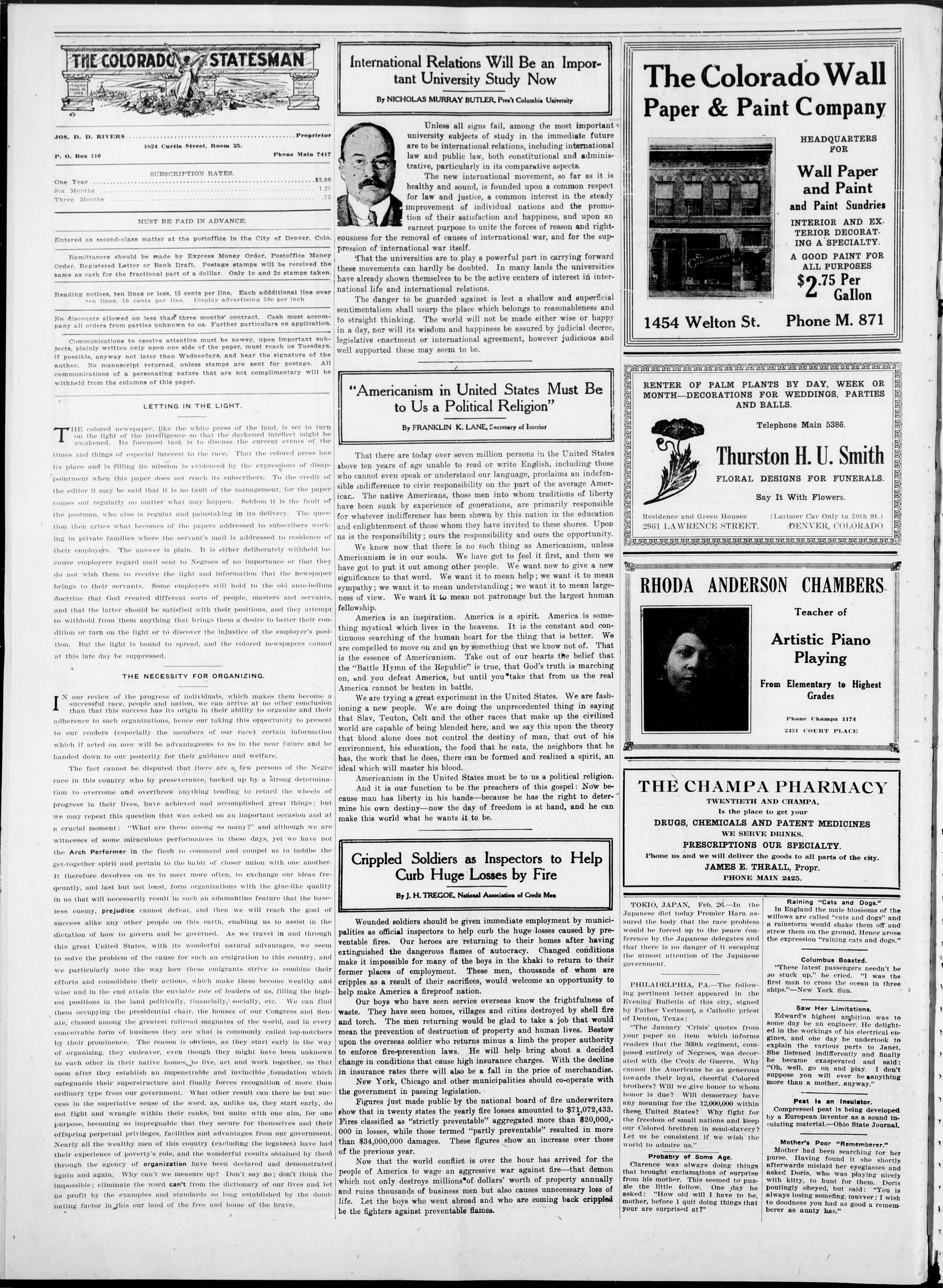
LETTING IN THE LIGHT.
newspaper, like the white press of the London of the intelligence so that the darkened its foremost task is to discuss the curse of especial interest to the race. That the calling its mission is evidenced by the exertion this paper does not reach its subscribers, he said that it is no fault of the manager, why no matter what may happen. Seldom also is regular and painstaking in its de that becomes of the papers addressed to miles where the servant's mail is addressed. The answer is plain. It is either deliberate mail sent to Negroes of no importance to receive the light and information to servants. Some employers still hold to the created different sorts of people, many should be satisfied with their positions, them anything that brings them a desire, the light or to discover the injustice of the that is bound to spread, and the colored to be suppressed.
THE colored newspaper, like the white press of the land, is set to turn on the light of the intelligence so that the darkened intellect might be awakened. Its foremost task is to discuss the current events of the times and things of especial interest to the race. That the colored press has its place and is filling its mission is evidenced by the expressions of disappointment when this paper does not reach its subscribers. To the credit of the editor it may be said that it is no fault of the management, for the paper comes out regularly no matter what may happen. Seldom it is the fault of the postman, who also is regular and painstaking in its delivery. The question then arises what becomes of the papers addressed to subscribers working in private families where the servant's mail is addressed to residence of their employers. The answer is plain. It is either deliberately withheld because employers regard mail sent to Negroes of no importance or that they do not wish them to receive the light and information that the newspaper brings to their servants. Some employers still hold to the old ante-bellum doctrine that God created different sorts of people, masters and servants, and that the latter should be satisfied with their positions, and they attempt to withhold from them anything that brings them a desire to better their condition or turn on the light or to discover the injustice of the employer's position. But the light is bound to spread, and the colored newspapers cannot at this late day be suppressed.
THE NECESSITY FOR ORGANIZING.
the progress of individuals, which make people and nation, we can arrive at success has its origin in their ability to organizations, hence our taking this oppo especially the members of our race) or now will be advantageous to us in the
IN our review of the progress of individuals, which makes them become a successful race, people and nation, we can arrive at no other conclusion than that this success has its origin in their ability to organize and their adherence to such organizations, hence our taking this opportunity to present to our readers (especially the members of our race) certain information which if acted on now will be advantageous to us in the near future and be handed down to our posterity for their guidance and welfare.
The fact cannot be disputed that there are a few persons of the Negro race in this country who by preseverance, backed up by a strong determination to overcome and overthrow anything tending to retard the wheels of progress in their lives, have achieved and accomplished great things; but we may repeat this question that was asked on an important occasion and at a crucial moment: "What are these among so many?" and although we are witnesses of some miraculous performances in these days, yet we have not the Arch Performer in the flesh to command and compel us to imbibe the get-together spirit and pertain to the habit of closer union with one another. It therefore devolves on us to meet more often, to exchange our ideas frequently, and last but not least, form organizations with the glue-like quality in us that will necessarily result in such an adamantine feature that the baseless enemy, prejudice cannot defeat, and then we will reach the goal of success alike any other people on this earth, enabling us to assist in the dictation of how to govern and be governed. As we travel in and through this great United States, with its wonderful natural advantages, we seem to solve the problem of the cause for such an emigration to this country, and we particularly note the way how these emigrants strive to combine their efforts and consolidate their actions, which make them become wealthy and wise and in the end attain the enviable role of leaders of us, filling the highest positions in the land politically, financially, socially, etc. We can find them occupying the presidential chair, the houses of our Congress and Senate, classed among the greatest railroad magnates of the world, and in every conceivable form of business they are what is commonly called top-notchers by their prominence. The reason is obvious, as they start early in the way of organizing, they endeavor, even though they might have been unknown to each other in their native homes, to live, act and work together, so that soon after they establish an impenetrable and invincible foundation which safeguards their superstructure and finally forces recognition of more than ordinary type from our government. What other result can there be but success in the superlative sense of the word, as, unlike us, they start early, do not fight and wrangle within their ranks, but unite with one aim, for one purpose, becoming so impregnable that they secure for themselves and their offspring perpetual privileges, facilities and advantages from our government. Nearly all the wealthy men of this country (excluding the legatees) have had their experience of poverty's role, and the wonderful results obtained by them through the agency of organization have been declared and demonstrated again and again. Why can't we measure up? Don't say no; don't think the impossible; eliminate the word can't from the dictionary of our lives and let us profit by the examples and standards so long established by the dominating factor in this our land of the free and home of the brave.
International Relations Will Be an Important University Study Now
International Relations Will Be an Important University Study Now
By NICHOLAS MURRAY BUTLER, Pres't Columbia University
Unless all signs fail, among the most university subjects of study in the immediate are to be international relations, including international law and public law, both constitutional and comparative, particularly in its comparative aspect.
The new international movement, so far healthy and sound, is founded upon a common for law and justice, a common interest in the improvement of individual nations and the tion of their satisfaction and happiness, and earnest purpose to unite the forces of reason for the removal of causes of international war, and for international war itself.
If the universities are to play a powerful part in carrying elements can hardly be doubted. In many lands the university shown themselves to be the active centers of interest, life and international relations.
Danger to be guarded against is lest a shallow and realism shall usurp the place which belongs to reasonabler thinking. The world will not be made either wise nor will its wisdom and happiness be assured by judicial enactment or international agreement, however judged these may seem to be.
Americanism in United States Musical to Us a Political Religion"
eousness for the removal of causes of international war, and for the suppression of international war itself.
That the universities are to play a powerful part in carrying forward these movements can hardly be doubted. In many lands the universities have already shown themselves to be the active centers of interest in international life and international relations.
The danger to be guarded against is lest a shallow and superficial sentimentalism shall usurp the place which belongs to reasonableness and to straight thinking. The world will not be made either wise or happy in a day, nor will its wisdom and happiness be assured by judicial decree, legislative enactment or international agreement, however judicious and well supported these may seem to be.
"Americanism in United States Must Be to Us a Political Religion"
"Americanism in United States Must Be to Us a Political Religion"
there are today over seven million persons in the United States years of age unable to read or write English, including not even speak or understand our language, proclaims a difference to civic responsibility on the part of the average native Americans, those men into whom traditions are sunk by experience of generations, are primarily over indifference has been shown by this nation in the attainment of those whom they have invited to these shows of responsibility; ours the responsibility and ours the opportunity now that there is no such thing as Americanism is in our souls. We have got to feel it first, and we put it out among other people. We want now to give it to that word. We want it to mean help; we want it to help; we want it to mean understanding; we want it to help. We want it to mean not patronage but the larger America is an inspiration. America is a spirit. American historical which lives in the heavens. It is the constant searching of the human heart for the thing that is being moved on and on by something that we know now of Americanism. Take out of our hearts the little Hymn of the Republic" is true, that God's truth is you defeat America, but until you take that from us cannot be beaten in battle.
We are trying a great experiment in the United States. We are new people. We are doing the unprecedented thing, Teuton, Celt and the other races that make up the capable of being blended here, and we say this upon itself does not control the destiny of man, that is, his education, the food that he eats, the neighborhood work that he does, there can be formed and realized and such will master his blood.
Americanism in the United States must be to us a political fit is our function to be the preachers of this gospel. He has liberty in his hands—because he has the right to own destiny—now the day of freedom is at hand, and in a world what he wants it to be.
Appled Soldiers as Inspectors to Curb Huge Losses by Fire
That there are today over seven million persons in the United States above ten years of age unable to read or write English, including those who cannot even speak or understand our language, proclaims an indefensible indifference to civic responsibility on the part of the average American. The native Americans, those men into whom traditions of liberty have been sunk by experience of generations, are primarily responsible for whatever indifference has been shown by this nation in the education and enlightenment of those whom they have invited to these shores. Upon us is the responsibility; ours the responsibility and ours the opportunity.
We know now that there is no such thing as Americanism, unless Americanism is in our souls. We have got to feel it first, and then we have got to put it out among other people. We want now to give a new significance to that word. We want it to mean help; we want it to mean sympathy; we want it to mean understanding; we want it to mean largeness of view. We want it to mean not patronage but the largest human fellowship.
America is an inspiration. America is a spirit. America is something mystical which lives in the heavens. It is the constant and continuous searching of the human heart for the thing that is better. We are compelled to move on and on by something that we know not of. That is the essence of Americanism. Take out of our hearts the belief that the "Battle Hymn of the Republic" is true, that God's truth is marching on, and you defeat America, but until you take that from us the real America cannot be beaten in battle.
We are trying a great experiment in the United States. We are fashioning a new people. We are doing the unprecedented thing in saying that Slav, Teuton, Celt and the other races that make up the civilized world are capable of being blended here, and we say this upon the theory that blood alone does not control the destiny of man, that out of his environment, his education, the food that he eats, the neighbors that he has, the work that he does, there can be formed and realized a spirit, an ideal which will master his blood.
Americanism in the United States must be to us a political religion.
And it is our function to be the preachers of this gospel: Now because man has liberty in his hands—because he has the right to determine his own destiny—now the day of freedom is at hand, and he can make this world what he wants it to be.
ended soldiers should be given immediate employment as official inspectors to help curb the huge losses caused fires. Our heroes are returning to their homes afflicted the dangerous flames of autocracy. Changed impossible for many of the boys in the khaki to return places of employment. These men, thousands of men, as a result of their sacrifices, would welcome an oppose America a fireproof nation. boys who have seen service overseas know the fright they have seen homes, villages and cities destroyed by
Wounded soldiers should be given immediate employment by municipalities as official inspectors to help curb the huge losses caused by preventable fires. Our heroes are returning to their homes after having extinguished the dangerous flames of autocracy. Changed conditions make it impossible for many of the boys in the khaki to return to their former places of employment. These men, thousands of whom are cripples as a result of their sacrifices, would welcome an opportunity to help make America a fireproof nation.
Our boys who have seen service overseas know the frightfulness of waste. They have seen homes, villages and cities destroyed by shell fire and torch. The men returning would be glad to take a job that would mean the prevention of destruction of property and human lives. Bestow upon the overseas soldier who returns minus a limb the proper authority to enforce fire-prevention laws. He will help bring about a decided change in conditions that cause high insurance charges. With the decline in insurance rates there will also be a fall in the price of merchandise.
New York, Chicago and other municipalities should co-operate with the government in passing legislation.
Figures just made public by the national board of fire underwriters show that in twenty states the yearly fire losses amounted to $71,072,433. Fires classified as "strictly preventable" aggregated more than $20,000,000 in losses, while those termed "partly preventable" resulted in more than $34,000,000 damages. These figures show an increase over those of the previous year.
Now that the world conflict is over the hour has arrived for the people of America to wage an aggressive war against fire—that demon which not only destroys millions of dollars' worth of property annually and ruins thousands of business men but also causes unnecessary loss of life. Let the boys who went abroad and who are coming back crippled be the fighters against preventable flames.
PETER H. BURGESS
Unless all signs fail, among the most important university subjects of study in the immediate future are to be international relations, including international law and public law, both constitutional and administrative, particularly in its comparative aspects. The new international movement, so far as it is healthy and sound, is founded upon a common respect for law and justice, a common interest in the steady improvement of individual nations and the promotion of their satisfaction and happiness, and upon an earnest purpose to unite the forces of reason and right-
By FRANKLIN K. LANE, Secretary of Interior
By J. H. TREGOE, National Association of Credit Men
The Colorado Wall Paper & Paint Company
DR. COLORADO
BAR & BREWERY
1454 Welton St.
RENTER OF PALM PLANTS
MONTH—DECORATIONS FOR
AND BAY
LM PLANTS BY DAY, WEEK OR TIONS FOR WEDDINGS, PARTIES AND BALLS.
RENTER OF PALM PLANTS BY DAY, WEEK OR MONTH—DECORATIONS FOR WEDDINGS, PARTIES AND BALLS.
Thurston H. U. Smith LORAL DESIGNS FOR FUNERALS.
Residence and Green Houses
2961 LAWRENCE STREET
NDERSON CHAMBERS
RHODA ANDERSO
RHODA ANDERSON CHAMBERS
AMPA PHARMACY
ENTIETH AND CHAMPA,
is the place to get your
MEDICALS AND PATENT MEDICINES
WE SERVE DRINKS.
OPTIONS OUR SPECIALTY.
I will deliver the goods to all parts of the city.
MES E. THRALL, Propr.
THE CHAMPA
TWENTIETH AND
Is the place to
DRUGS, CHEMICALS AND
WE SERVE D
PRESCRIPTIONS OUT
Phone us and we will deliver the g
JAMES E. THRA
THE CHAMPA PHARMACY
PHONE MAIN 2425.
TOKIO, JAPAN, Feb. 26.—In the Japanese diet today Premier Hara assured the body that the race problem would be forced up to the peace conference by the Japanese delegates and that there is no danger of it escaping the utmost attention of the Japanese government.
PHILADELPHIA, PA.—The following pertinent letter appeared in the Evening Bulletin of this city, signed by Father Verimont, a Catholic priest of Denton, Texas:
"The January 'Crisis' quotes from your paper an item which informs readers that the 369th regiment, composed entirely of Negroes, was decorated with the Croix de Guerre. Why cannot the Americans be as generous towards their loyal, cheerful Colored brothers? Will we give honor to whom honor is due? Will democracy have any meaning for the 12,000,000 within these United States? Why fight for the freedom of small nations and keep our Colored brethren in semi-slavery? Let us be consistent if we wish the world to admire us."
---
---
Poppy
A. E.
Probably of Some Age
Clarence was always doing things that brought exclamations of surprise from his mother. This seemed to puzzle the little fellow. One day he asked: "How old will I have to be, mother, before I quit doing things that your are surprised at?"
HEADQUARTERS FOR
Wall Paper and Paint
and Paint Sundries
INTERIOR AND EXTERIOR DECORATING A SPECIALTY.
A GOOD PAINT FOR ALL PURPOSES
$2.75 Per Gallon
Phone M. 871
Telephone Main 5386.
Say It With Flowers.
(Larimer Car Only to 30th St.)
T. DENVER, COLORADO
Teacher of
Artistic Piano Playing From Elementary to Highest Grades
Phone Champa 1174
2431 COURT PLACE
Raining "Cats and Dogs."
In England the male blossoms of the willows are called "cats and dogs" and a rainstorm would shake them off and strew them on the ground. Hence arose the expression "raining cats and dogs."
Columbus Boasted.
"These latest passengers needn't be so stuck up," he cried. "I was the first man to cross the ocean in three ships."—New York Sun.
Saw Her Limitations
Edward's highest ambition was to some day be an engineer. He delighted in the workings of his electrical engines, and one day he undertook to explain the various parts to Janet. She listened indifferently and finally he became exasperated and said: "Oh, well, go on and play. I don't suppose you will ever be anything more than a mother, anyway."
Peat Is an Insulator
Compressed peat is being developed by a European inventor as a sound insulating material.—Ohio State Journal.
Mother had been searching for her purse. Having found it she shortly afterwards mislaid her eyeglasses and asked Doris, who was playing nicely with kitty, to hunt for them. Doris puttingly obeyed, but said: "You is always losing somefing, muver; I wish to doodness you had as good a rememberer as sunny has."
THE COLORADO STATESMAN
THE ADVERTISING BUREAU FOR THE STATE
CAMOUFLAGE DE FREEDOM
FRANCE COUNTRY PARTY
=
U. G. Brown, our popular townsman, made a flying trip this week to Wyoming on business.
Mrs. Charlie Brown left last Monday for Arkansas to be with her mother, who is ill.
George S. Contee is enjoying a few days' vacation from his duties at the Denver National Bank.
Mrs. Alice Kimbrough, who fell and sprained her ankle last Saturday evening, is confined to her bed at the home of her mother, Mrs. Don Reeves, 2521 Clarkson street.
Mr. B. E. Bashears, vice president of the Cosmopolitan Oil & Gas Co., of Muskogee, Okla., has arrived in Denver to attend our annual directors meeting and is accompanied by Mr. John A. Severns of Bixby, Okla., and are at the residence of Mr. J. P. Shelbun, president of the company, 2420 Welton street.
Mrs. Maggie Waters of 2352 Glenarm place was robbed Friday night of last week of valuables amounting to about $150. Some unknown parties gained entrance to the house while she was away and broke open her trunk and helped themselves to its contents.
George W. White, employed at the Metropolitan building, who received severe injuries by falling from a ladder while painting and decorating the interior of the building, is improving. We hope Mr. White, who is very useful in church and musical circles, will soon be himself again.
We are again appealing to all the members of the church to enter into the spirit of sacrifice with the Master, particularly during these day of Lent. To the end that we give ourselves most seriously to prayer, the study of the Word, and to the work of Evangelism. May we not further urge that all do their level best to attend both the services of the Lord's day as well as the Mid-week lectures?
NEXT Monday and Tuesday will be Liberty Loan days in Denver. The Colorado Woman's Liberty Loan committee will hold a general state meeting in the Savoy hotel Monday and the Colorado Men's Liberty Loan committee will hold a general state meeting at the Brown hotel Tuesday. W. R. Rowe of Kansas City, director of war loan and savings organization of the Tenth Federal Reserve district, will be present and address both meetings.
The meeting is for the purpose of getting ready for the Victory Liberty Loan, which drive will begin April 21. Samuel D. Nicholson, chairman of the Colorado Liberty Loan committee, will be in charge of the men's meeting, while Mrs. W. D. Partridge of Holly, state vice chairman of the Colorado Woman's committee, will be in charge of the woman's meeting. The two meetings will be attended by the district and county chairmen from over the state. It is expected that something like 125 persons will be in attendance at each meeting. So far the details of the next Liberty Loan have not been received from Washington, but it is hoped they will be here by that time. If they are not, the meeting can go ahead and prepare for the loan just the same.
Y. M. C. A. NOTES
It was a pleasant crowd of boys that gathered at the "Y" building on Thursday evening, when the Employed Boys' Club was organized. Notices had been sent out to thirty-five, and thirty of them were present. Two of the secretaries from the Central Association were present to help give it a "send-off" and to assist in the organization—also to lead in the games. After a brief talk by one of the visiting secretaries, refreshments were served. The remainder of the evening was spent in games of different kinds. The club when completed will have a membership of about fifty. A committee appointed at the time has drawn up a tentative program for the club for the next ten weeks. A "Hi-Y" Club also has been organized, and these two new bodies mean to make things "lively" from now until summer time.
A large crowd gathered last Sunday afternoon to listen to the program. The returned soldiers who were to have spoken failed to be present, some of them having been
called to work just two hours beforehand. The audience was more than rewarded, however, by the very splendid, able and interesting address made by Mr. Carmichael, a former army Y educational work secretary and later on connected with the medical corps. He was warmly greeted by all present at the close of the meeting.
The Glee Club has begun work again after a separation of three months. Their voices have grown somewhat husky, but they will get into form before very long.
Three of the "Y" members have died within the past three months—T. O. Mason, Robert Carruth and Fred Brown. A memorial service will be held for them tomorrow (Sunday) afternoon at 4 o'clock. All the friends and others are invited to attend the service.
DOUGLASS UNDERTAKING CO.
Funeral Notices.
Smith, Ella May, infant daughter of Mr. and Mrs. Aaron Smith, 3433 Humboldt street, departed this life March 9th. Funeral services were held at 2 p. m. Wednesday, March 12th, from residence, Rev. D. E. Over officiating. Interment Riverside cemetery. Williams, Percilla F., 1946 Pearl street, 61 years, departed this life Wednesday, March 12th. Notice of funeral later.
CARD OF THANKS
From the depths of our hearts we are grateful to the many friends who expressed their practical sympathy for our husband and father, Charles O. West, during his illness and death; also our appreciation of the beautiful floral offerings and other kindnesses.
MRS. GEORGIE WEST AND SONS.
RESOLUTION OF CON DOLENCE.
Whereas, It has pleased our Almighty God to take from our midst Joseph S. Stewart, the father of our beloved brother and associate, William B. Stewart, member of Pythias No. 11 and father-in-law of our most efficient Grand Secretary of the Endowment Department of the Grand Lodge of the Knights of Pythias;
Whereas, The bereavement of Joseph S. Stewart was a distinct loss to our community, to our spiritual welfare, and to our race and lodges in general;
Therfore, Be it Resolved that Pythias N. 11 in meeting assembled hereby express their deep appreciation for such an exemplary and ardent Christian character and tenders their sincerest regrets and conveys their keenest sympathy and sorrow for such a distinct loss to our brothers in the craft and their families and that we further commend them to our Loving Father who doeth all things well. Pythias Lodge No. 1, by S. B. F. Lowe, George W. Davis, Secretary; A. R. Butler, chairman.
PEOPLE'S PRESBYTERIAN.
East Twenty-third Avenue and Washington Street.
Presbyter: J. A. Thos.-Hazell, S.T.B.
Sermon topics, Sunday, March 16th:
11 a. m., "Every Christian a Preacher,"
5 p. m., "The Gospel in a Nut-Shell."
Candidates for membership are hereby reminded that the Sunday classes meet every Wednesday night at 7:15 immediately prior to the midweek services. All are urged to receive the lectures.
A Fellowship Supper under the auspices of the New Era Movement was held last Monday night at the First Avenue Presbyterian Church. Mr. George Brooks and the minister represented the People's Church. The next supper will be next Tuesday night at the Mount View Boulevard Presbyterian Church, Park Hill. The men of the church are cordially invited.
THE ZION BAPTIST CHURCH.
The members of the Zion Baptist Church are laying elaborate plans to celebrate the tenth anniversary of the pastorate of Rev. Over, with appropriate services on Sunday, March 23rd and a public reception on the following evening, Monday, the 24th. This event will be unique in the history of Zion, as among all its pastors, covering a period of more than fifty years, Rev. Over is the only minister whose service has reached the tenth mile-stone. Taking formal charge of the work on the 21st of March, 1909, the fourth Sunday in this month will be the first in the eleventh year of a pastorate, attended with a uniformity of success,
which stands unequalled by any other in the state. Rev. Over has earned the further distinction of being the oldest pastor in point of continuous service among the colored churches in Colorado. He began his work at the Eighth Street Baptist Church, Pueblo, in the summer of 1906, and has continued to the present time, a period of almost thirteen years. During these years constructive leadership has marked all his activities throughout and has determined him a man of that personality and force of character who will make himself known and respected as a leader in any community.
Realizing his worth and the quality of his service Zion Church intends to express its appreciation in these activities in which it asks the public to join. The Tenth Anniversary sermon will be delivered by the Rev. George W. Henry, Pueblo, on the fourth Sunday morning and the next evening a programme of appropriate addresses and choice music will be followed by a public reception in which the service will be characteristic of Zion Church. It is the hope of the congregation that the whole community will make itself free to participate in all these functions. Complete programs will be published next week.
COMMUNICATION FROM AN EX SLAVE.
(Special to the Colored People of Colorado).
Will the Negroes ever be a full-fledged citizen of the United States? The Democrat platform says: "White supremacy." He intends for you to do just what ever he says to do, and you must not object. Now they have disfranchised the Negro in some parts of the South. What does it take to constitute a disfranchise? You have to commit treason against the government before you can be disfranchised. Jeff Davis committed treason when he ceased from the Union. He was taken before the U. S. Supreme court, found guilty and was disfranchised. Now they can't disfranchise a man because he is black, according to law.
It is now time for the young Negro to get busy. The Democratic party not long ago tried to take the fourteenth and fifteenth amendments out of the constitution. They had to put them in the constitution before they could make the slave a free man; now if they were taken out of the constitution, they would be slaves. He had no protection; the government can't protect him because he is no citizen. We must thank the Republican party for our freedom. John Brown said at Harper's Ferry, Virginia, that after I am hanged there will rise one John Brown for every strand of hair in my head, for every slave who is just as free as you are. He called an old slave mother from the crowd and ask her to pray for him, for whom he was going to die.
John Brown's Prayer.
John Brown of Osawatamie
Joseph
Spoke on his dying day,
I will not have to strive my soul,
A priest in slavery pay;
But let some poor slave mother,
Whom I have strive to free,
With her children from the gallows
stare,
Put up a prayer for me.
And his old harsh face grew mild
As he stopped between the jerring
ranks
And kissed the Negroes child.
I will say to the colored people of
America that they commit as much
sin to work against the Republican
party as it is to sin against Christ.
God is opposed to slavery. He sent
Moses down into Egypt to lead the
slaves out of bondage, and Lincoln
sent Grant into the Souht to free the
slaves. When Grant arrived in the
South he wired Lincoln to free the
slaves, and let them fight to free
themselves.
Now how can a colored man be a Democrat? Some of the colored ministers will get up in their pulpits and tell their people to vote the Democratic ticket just for a few cents. The ministers will strain at a gnat and swallow a camel, when they will take a Negro in some parts of the government and tie him to a stake, cut off his ears, his fingers and gouge his eyes out of his head, that is no harm, but if you are caught in the city, with a bottle of whisky, they will go to the courts and say, "There is a man in our district seen with a bottle of whisky; he must be arrested," but it is no harm to burn his eyes out of his head and burn him to the stake; that is all right. Just leave the case with God. God revenges all wrongs and says, "Vengence is mine."
WM. McMILLAN.
Ex-Slave.
CHEYENNE. WYO., NEWS
Rev. C. O. Smith, pastor of the Second Baptist Church, was called home to Hutchinson, Kan., last week on account of the illness of his wife. Mr. J. D. Bowen of Lincoln, Neb., is here calling on Miss Virgil Gaskin this week. Miss Gaskin was on the sick list for two weeks, but is able to be out again. Deacon Frank McCombs went to Denver Sunday to attend the funeral of his brother-in-law, Mr. William Franklin, returning Sunday night. The Masons are planning for a big goat riding in a few weeks. A number of applications have gone in for membership to the lodge. Mr. Walter Lofton has returned after a week's visit in Denver. Raymond Hall, who was arrested in Chicago, Ill., a couple of weeks ago and was brought back here charged with the murder of Ernest Lawrence while attending a dance in this city, October 11, 1911, pleads not guilty.
Mr. and Mrs. Charles Rhone, of 2519. Reed street, has purchased a five-seated auto.
A woman washing clothes in a basin.
Don't Stay Tied To The Tub
Don't Be A Slave To Suds
Don't Use Unnecessary Time
Don't Wear Yourself Out Every Monday
Electric Washing Machine
IT WASHES, RINSES AND WRINGS
Electricity Does The Work
The Denver Gas & Electric Light Co.
Wishes to welcome all to good home cooking and dainties of the seasons, any time from 6 a. m. to 11:30 p. m. Accurate service at all hours; so when down town stop, give us a trial and we will guarantee you will leave with a smile.
MRS. M. J. FRANKLIN & S. BOWERS, Props. 924 19th St.
Wishes to welcome al
and dainties of the se
a. m. to 11:30 p. m.
hours; so when down t
and we will guarantee
smile.
MRS. M. J. FRANKLIN & S.
ESTATE OF CORA FISHER, DE-
CEASED.
Notice is hereby given that on the 14th of April, 1919, I will present to the County Court, City Court, County Depository, Colorado, my accounts for final settlement of administration of said estate, when and where all persons in interest may appear and object to them, if they so desire.
JEFFERSON FISHER,
First publication, March 15, 1919.
Last publication, April 5, 1919.
STOCKHOLDERS' MEETING.
Notice is hereby given that the annual meeting of the stockholders of The Colored American Mercantile Co. will be held at its office, 720 East Twenty-sixth Avenue, Denver, Colorado, on the 26th day of March, 1919, at 3 o'clock p.m. the day for the election direction for the consumer and for the transaction of such other business as may properly come before said meeting.
Denver, Colo. February 13, 1919.
WALTER H. H. PRITCHER
Secretary.
Elliott Temple No. 15 meets every 2nd and 4th Thursday nights in each month. Elks Hall, 2540 Washington Street.
Dr. S. A. Huff, physician and surgeon, 2538 Washington street; office hours 11 to 12 a. m., 3 to 5 p. m. Phone York 2313. Out of office, Main 875. Residence Phone York 4101.
GET AN
Electric Wash
Machine
WASHES, RINSES
WRINGS
Electricity Does The W
ee a Demonstrat
er Gas & Electric
Strangers of Denver
Attention!
Sun Beam
Cafe
to good home cooking
seasons, any time from 6
Accurate service at all
own stop, give us a trial
you will leave with a
BOWERS, Props. 924 19th St.
See a Demonstration
Phone Main 8026
Res. Phone York 5774W
FRANK D. TAGGART
Attorney at Law—Notary Public
205-206 Cooper Building
Denver, Colorado
E. P. BLAKEMORE, Attorney and
Counsellor at Law. Office, Rooms 39
and 40 Arapahoe Bldg., 1622 Arapahoe
Street. Phone Champa 5450.
For employment see the Industrial
Realty Co. Employment Agency, 716
East Twenty-sixth Ave. York 4561.
Nicely furnished rooms for rent,
all modern. 2346 Curtis street.
Phone Champa 5665.
Day and Night Phone Main 2701.
DR. C. E. TERRY,
PHYSICIAN AND SURGEON
Office Hours: 12 to 2 p. m., 6 to 8 p. m.,
and appointment.
LEAVE CALLS AT ELITE DRUG STORE.
1027 21st St., Denver, Colo.
For Rent—Nicely furnished rooms; permanent or transient, at 1822 Arapahoe St. Apply at 1834 Arapahoe.
Keep off the date of March 26th. Dance by the Jolly Farmers' Club.
15TH & LARIMER STS.
About Men's
Clothing
Will you, kind reader, bear in
mind that we sell
Alder Collegian
Suits
Which for elegance of cloth, perfection of fit — and general worth, are not surpassed by any clothing made or sold anywhere. And these fine suits are so moderately priced here, because this store can, and does undersell.
Grand concert, Central Baptist Church, California and Twenty-fourth streets, Thursday, March 20, under the auspices Woman's Home Missionary Society. Best city talent.
Oldtime Fire Alarms.
Fire alarms came into use in medieval times. It was the custom in many of the towns to have a watchman stationed on a high building whose duty it was to look for fires. As soon as he saw one he gave warning by blowing a horn, firing a gun or ringing a bell.
Like Papa.
The family was at breakfast, and among other things they had hard-bolled eggs. The bald-headed papa turned to his two-year-old child and said: "Elizabeth, how do you wish your egg this morning?" She looked at the egg and then at her father and said: "I des I'll take it bald-headed, papa."
Kindergarten Helps for Parents
Articles Issued by the Department of the Interior, Bureau of Education and the National Kindergarten Association
PLAY FOR MOTHER AND BABY
By MRS. MARGARET WILSON HEALD.
Baby is instinctively active from the time he is born. Little feet kick about, little hands reach all around, and mother instinctively attempts to guide and develop this activity. From time immemorial mothers have played with their babies' toes and sung to their babies' fingers, and so we have he ever new-old baby classics; "Pate-cake;" "Bye, Baby Bunting;" "Sleep, Baby, Sleep;" "Rock-a-bye, Baby;" "This little pig went to market," and "Ride a Cock-horse to Banbury, Cross."
There are many other little plays or games of this kind, not so well known, but which the trained mother makes use of to catch first sense perceptions, train the awakened emotions and hold fast the affections. They minister to baby's growing activities in right ways, before wrong ones can assert themselves.
The following plays, with music, are to be found in "The Songs and Music of Froebel's Mother Play," D. Appleton & Co., N. Y., publishers; price, $1.60.
Naming the Fingers.
Baby points to each finger as described. In this game he becomes acquainted with his hands, his fingers, himself.
This is little Tommy Thumb.
Round and smooth as any plum.
This is busy Peter Pointer;
Surely he's a double-jointer.
This is mighty Toby Tally;
He's the biggest one of all.
This is dainty Reuben Ring;
He's too fine for anything.
And this little wee one, maybe,
Is the pretty Finger-baby.
All the five we've counted now,
Busy fingers in a row,
Every finger knows the way
How to work and how to play;
Yet together work they best.
Each one helping all the rest.
—Laura E. Richards.
The Greeting.
Baby's hands are held up, facing each other, and do as bidden. In this little game, baby advances from knowing to willing, and his fingers are his tools, to be used for a definite purpose. Thumbs and fingers say, "Good morning, Tis a very pleasant day";
Little pointers bow politely.
Fall men nod and smile so brightly.
While the rest with joyful greeting
All their little friends are meeting.
The Family.
Played with the baby hands held up, first one and then the other, and beginning with the thumb. In this game, baby becomes acquainted with the world just immediately outside himself.
This is the baby small;
And here they all together meet.
This whole glad family complete.
Here's grandpapa and grandmamma;
And father, too, and mother.
With baby wee, one family;
Oh, how they love each other.
The aunt and uncle now we see,
And little cousins, one-two-three;
And this good family is found
In happy love together bound.
—Emillie Poulsson.
Going a little farther afield, baby
will now enjoy finger games of animal
families. A number of charming
ones suitable for this period of baby
education can be found in Emillie
Poulsson's "Finger Plays," published
by Lothrop, Lee and Shepard Co., Chi-
icago; price, $1.25.
A HOMEMADE DOLL'S HOUSE.
By HILDA BUSICK.
A friend of mine entered her five-year-old son in a kindergarten. She took him there every day, and once in a while stayed with her three-year-old daughter to visit. Noticing that the children were happy because they were busy with work which appealed to them, and that the doll's house was frequently the center of attraction, she decided to allow her little ones to make a house at home. So for 20 cents two wooden egg boxes were secured from the grocer, amid much excitement on the part of the children.
The boxes were taken straight to the children's corner, and it was decided that work should be done on them on rainy days only, and that the children were to do all the work if possible.
At their dictation, mother made a list of the things they intended to do: Paint the outside of the boxes white; make a curtain across the front; have a kitchen, dining room, sitting room and bedroom; paper the rooms; make rugs for the floors, and make furniture for the different rooms. The next thing to do was to prepare a list of the various materials needed: Paint, paper, glassors, thumb tacks, cardboard boxes, spools, glue, scalloped-edged tissue-paper napkins for window curtains.
white oilicotn, jap-n-lac, and so on. These lists were not completed at once, but added to as the children thought of things, or as new things were made for the kindergarten doll house, which served as their model.
Training in Memory.
All this was splendid training in memory and in concentration, for it kept the attention directed toward one object and at the same time it was sufficiently varied work not to become monotonous. It also developed skill in the use of the hands. Mother, who was just as enthusiastic as the children, would occasionally suggest something of which they had not thought, and sometimes, in their walks, they would stop at shop windows to play a new game which this occupation had suggested, "finding treasures for the doll house."
The children were allowed to ask the shop clerks for the material, and sometimes they paid for it with their own money, for mother knew that, like "grown-ups," they would prize things more if they bought them with money of their own than if the things were given to them. In this way the boy learned to count, and both realized, to a slight degree at least, the relation between value and price; also that they could buy only what they could afford.
For example, one day they planned to buy a paint brush with five pennies they had saved together. When they reached the store they noticed first a large, attractive brush, but found it was ten cents. There were smaller five-cent brushes, but it would take more than they had to get one for each. Little daughter wanted mother to give them the extra five cents needed, and son wished her to lend it to them, but both these suggestions were finally ruled out, with incalculable value to both children. There was quite a long debate and a hard struggle in each little head before the final decision was reached—to buy one five-cent brush and each take turns using it.
Materials were kept in a covered box on top of the doll's house. The children returned everything to this box when they were ready to stop play for the day, including their aprons which mother had made large enough to cover them completely, and sheets of newspaper which were used to spread on the floor to protect the rug from stains.
Finishing the House.
It took a number of days to paint the outside of the house, as little children cannot remain at one occupation long, and many articles were made for the rooms during this time. The wall-paper was cut from a samplebook given by a neighboring wall-paper firm, blue and white tiled paper for the kitchen, flowered paper for the other rooms. Rugs were cut from mail-order catalogues and pasted on stiff cardboards. Tables, chairs and bed were made of paper boxes, with spool legs. The kitchen sink was made of a small tin box fastened to the wall, with two square brass hooks, inverted, to represent hot and cold water faucets.
This house was kept for several years, but the interior was constantly changed as the children became more efficient in hand-work. There was no whining, "What shall we do?" They would play for long periods at this favorite occupation, while mother sat by and mended and made their clothes. She, for her part, never became irritable when they interrupted for legitimate assistance, for she realized the wonderful lessons they were constantly learning.
Ladybirds for France.
Southern California has, during recent years, been credited with leading all other sections of the United States in developing natural methods of combating insect pests. Among these is the ladybird, the tiny red bug which feeds on plant insects. Millions of these bugs, propagated in the California nurseries, are now being shipped overseas to France, where they will be incubated until spring and released to do their part in destroying noxious insects. Great stretches of land in southern France have been untilled during the war, and it is expected that various pests will be greatly in evidence.—Rochester Democrat and Chronicle.
Frank Comment.
Robert was a great admirer of soldiers and, having attended a military wedding, he was loud in praise. Soon after he was taken to see another wedding where all were in civilian clothes. At the wedding dinner he received a dish of ice cream full of fruit, raisins, etc. He especially disliked raisins, so he said in loud tones "Iink this wedding and this ice cream is wotten—no soldiers or noth in!"
Squelching a Smile.
There were plenty of empty seats in the car, but the smiling youth, who wore his hat on the back of his head, stopped opposite the handsome young woman in the red hat and said in his most engaging manner:
"Can I take this seat, miss?"
"I have no objection, sir," she said, in a tone that froze the last smile on his face, "but I think it's notled down."
Deduction.
"The letter you have just received is from a man of strong will and giver to use force."
"How can you tell all that? It looks like a terrible scrawl to me."
"That's just it. It is a malled fly."
A Necessity.
"Why is there so much caloric in the soup, Jane?"
'Cause, ma'm, it was the only sea
sonin' the grocer wasn't out of."
SMALL ISLAND ALL AMERICAN
One of Uncle Samuel's Most Valued Possessions is Little Scrap of Land in the Pacific Ocean.
Midway, a tiny scrap of an island in the Pacific, is one of Uncle Sam's most cherished possessions. It is one of the most valuable bits of sand and rock in the world. The little island, a relay station for the Pacific cable, is a link in the chain binding Asia to the western world, the Philippines to the United States. A message sent to Pekin or Manila from San Francisco must pass through Midway before it reaches its destination. The island listens to the gossip of two continents.
Once the most desolate and forsaken atoll in the two oceans, Midway today promises to rival Hawaii as the paradise of the Pacific, a paradise created by man. A tiny paradise, to be sure, but the island has never been able to boast of a population of more than forty at one time, and nearly half of them were only visiting. A superintendent with the imposing title of Guardian of the Island, his family, a doctor with a very small practice, an engineer or two and the servants are the sole inhabitants.
The island today is a triumph of engineering skill. It was necessary that the stations of the cable be under the American flag. The second link in the chain could only be Midway, so the nameless, pear-shaped heap of sand in the Pacific was transformed into a blooming bit of land with flowers, vegetables and even diminutive trees. The American flag was raised over the government house, an American colony was transplanted to the new island and Midway stepped into prominence at once. Midway is just half way around the world from London, almost directly over the 180th meridian. When it is midnight in England, the noon sun is shining on the smallest single bit of American soil in the world.
Trenches Not So Bad!
He was a small boy, about six years old, and like most youngsters of his age, was more or less opposed to having his face washed any offener than was necessary. During the course of one of these operations he looked at his father and asked:
"Do the soldiers in the trenches get vacations?"
"Not while they are fighting," answered the father.
"I guess they don't have time for vacations," mused the boy, "I'll bet they don't even have time to wash their hands and face."
"I suppose that is right," replied the father, after which there was a long pause, during which the washing operations were continued.
At last the irksome task was completed. The boy heaved a sigh of relief, and as he left the bathroom his father heard him say, "Gee, I wish I was a soldier fighting in the trenches."
Not for Publication.
Here is one story that H. E. Barnard, the state food administrator, should not overlook. Ed Lane, one of the prominent citizens of Colfax, Clinton county, became worried several nights ago because he couldn't sleep, and thinking that perhaps a salt water bath might restore his restful slumbers, he got up and proceeded to experiment with his theory. The next day his clothing stuck so tight to his body that he had to have assistance from his wife to get it off, and when she inquired as to the reason, he informed her that he had taken a salt-water bath the night before. But Mrs. Lane then realized where her sugar had gone, and she proved to her husband that he had got the granulated sugar instead of the salt. The result was painless, but Lane doesn't think that it will do to have Mr. Hoover or Mr. Barnard find out he took his bath in sugar water—Indianaapolis News.
Safety Belts.
On the question of safety belts Dr. Graeme Anderson gives it as his opinion that before leaving the ground all aviators should see that their safety belts are fastened and should be familiar with the method of their quick release; the belt should never be undone in the air.
In 17 crashes on tractor machines with 17 injured the belt held on seven occasions and gave way on ten, of the 42 crashes in which the pilot escaped the belt held in 28 instances and gave way in 14.
Dr. Graeme Anderson advocates the wearing of safety helmets by all pupils, but emphasizes that they should be well fitting and not be easily dislodged from the head while flying.
Flying Experience.
Lleut. Col. G. V. S. Quackenbush, commanding officer at Kelly field, labored for years to cure himself of pulling his drives in golf. He spent hours in practice; he hired professional instructors; he tried everything but hypnotism. One day in the course of a flying lesson he rubbed a bilister on the middle finger of his right hand, that afternoon on the links he had to change his grip, and now he could hardly pull if he wanted to.—New York World.
Oh. Hang It. Then!
Paperhanger (warmly)—How does the food administrator expect a fellow to hang paper if he can't buy flour for paste, huh?
Friend—Why not null it up?
Paperhanger—And invite trouble with the carpenters' union?—Buffalo press.
© Western Newspaper Union
A British dirigible big enough to carry out long-distance flights, mounting two machine guns and carrying numerous bombs for use against the subs. It was not until hostilities ceased that England divulged the fact that it had mastered the art of dirigible building and had actually created such a large fleet of airships, many of them much larger than the one shown, that there were not enough hangars to hold them.
HUN NAVY TIMID JELLICOE SHOWS
COLOR AS AID TO HEALTH
British Officer Surprised by Caution of Foe During First of War.
GRAND FLEET IN DANGER
Short of Cruisers, Destroyers and Had Defenseless Bases in Early Months of Conflict—Describes Big Battle of Jutland.
London.—The dangers to which the British grand fleet, short of cruisers, destroyers and with defenseless bases, was exposed during the first two and one-half years of the war, owing to the German use of submarines, mines and torpedoes, is described in a book written by Admiral Viscount Jellicoe, former commander of the fleet, covering the activities of 1914-16.
Admiral Jellicoe points out that the German high seas fleet possessed 88 destroyers, compared with 42 for the grand fleet, and reveals that, owing to the submarine mence, the grand fleet, in the fall of 1914, moved from Lough Swilly and only returned to the North sea when the anchorage in Scapa Flow became reasonably safe.
Neither in October, 1914, nor in May, 1916, Admiral Jellicoe says, did the British margin of superiority justify him in disregarding the enemy's torpedo fire. The situation gradually improved after 1916, especially as the light cruiser and destroyer forces with the grand fleet increased steadily after the battle of Jutland, considerably re-
MAJ. GEN. ARTHUR MURRAY
HARRIS & EWING
Maj. Gen. Arthur Murray, retired, will be clerk of the military affairs committee of the next house, unless the war department objects. Representative Julius Kahn, who will be chairman of the committee, has announced that he will have General Murray appointed to the position.
COLOR AS AIR
Famous English Specialist Expounds New Theory.
Claims Color Schemes in Decorating Will Make People Healthier and Happier.
London.—Kemp Prosser, the famous English color specialist, has been conducting some interesting experiments which he hopes the British government will adopt for decorating houses during the reconstruction period. He maintains that the adoption of his color schemes will make the British both healthier and happier.
Interviewed in his two "health rooms," one with walls of sunlight yellow and the ceiling sky blue, with blue net curtains at the windows, Mr. Prosser declared that his purpose is to bring outdoors inside.
"I am doing away with my pic-
---
HAMMOND IDEA O. K.
ducing the danger of successful torpedo attack, while the inclusion of class K submarines made it probable that the enemy would suffer more severely from submarine attack than the British.
Tables Are Turned.
Regarding 1918, Admiral Jellicoe says:
"The position was assured and we could have afforded to take risks which in 1916 would have been unwise. If the German fleet had come out to battle, a terrible punishment awaited them."
One-third of the admiral's book is devoted to the battle of Jutland. In summing up the lessons of the battle, Admiral Jellicoe dwells upon "the danger involved in leaving too much to chance in fleet action, because our fleet was the one and only factor vital to the existence of the empire, and, indeed, to the allied cause."
"We had no reserve outside the battle fleet which could in any way replace it in the event of disaster or even should its margin of superiority be eliminated," the admiral continues.
Admiral Jellicoe says he knew that his ships were inadequately protected with armor compared to the German vessels of the battle cruiser type, while the German fleet in the battle of Jutland was far better off in the number of destroyers. In addition, the Germans possessed "a most efficient armor-piercing shell."
The admiral continues:
"When the battle fleets approached
HAMMOND
Crewless Ship Proves to Be a Success.
Army and Navy Experts Report That Wireless Control Is Possible.
Washington.—Army and navy experts have reported the device of John Hays Hammond, Jr., for radio control of surface craft to be sent laden with explosives against enemy ships a success, and predict similar results with submerged craft showing above water only wireless antennae.
Results of tests were made public in connection with the new fortifications appropriation bill, which carries $475,000 for construction of an experimental submerged boat.
Secretary Baker wrote the house appropriations committee, which is considering the bill, that the joint army and navy board was "convinced of the practicability of the control" of the surface craft, and added that there had also been demonstrations of the possibility of the control of a craft completely submerged except for an air intake pipe.
Before finally deciding on the purchase of the patents for $750,000 the board desires further experiment with the submerged craft.
Construction of the submerged craft, which will be about 80 feet long by 7 feet in diameter, will take two years, according to Mr. Hammond, who told the committee he has spent
D TO HEALTH
tures," he said. "Instead I am installing these bowls of fruit, as you see, on pedestals against the background of the sunlight walls."
Then the color specialist led the way to the other room, in which the dominating color was apple-blossom pink. "This is the normal color," said Mr. Prosser, "because I have found that ninety-nine people out of a hundred are happiest in rooms of this shade."
Change Village Name
San Francisco. — Germantown, a prosperous community in Glenn county, has gone the way of sauerkraut, hamburger and pretzels. Hereafter, the Southern Pacific announced, the name of the station will be Artois, which carries more of an allied flavor. Recently the Southern Pacific rechristened a small station on its lines in southern California. As Berlin it was an anathema. Now, as Pershing, it looks forward to civic greatness.
there was a difference of reckoning between the British battle fleet and the battle cruiser squadrons, due to the cruisers having been engaged for several hours and having repeatedly altered their course. Hence, instead of being encountered right ahead, the enemy appeared on the starboard bow." Instant action was necessary, the admiral says, and he decided to deploy on the port wing division, thus compelling the Germans to turn off to starboard to avoid being crossed. This maneuver, which has been described as masterly by reviewers, threw the enemy into complete confusion. The German commander in chief realized that his only hope lay in escape, profiting by his superiority in torpedo craft, low visibility, the approach of darkness and the proximity of his bases and mine fields.
The enemy at this period fired hundreds of torpedoes, as German officers have since stated, Admiral Jellicoe continues, and although the Germans were in the gravest peril, the position of the grand fleet itself was menaced by determined torpedo attacks in thick weather. But the British fleet by turning its battle line four times during the action, the admiral says, got clear of the torpedoes, which were racing toward the British ships, and defeated the tactics upon which the Germans based their hopes.
After estimating the relative strength of the two fleets early in the war, Admiral Jellicoe expresses surprise that the Germans were so cautious and says:
"If this country in the future decided to rely for safety against raids or invasion on the fleet alone, it is essential that we possess a considerably greater margin of superiority over a possible enemy in all classes of vessels than we did in August, 1914."
ten years and $400,000 on his invention.
"There is no question whatever as to the ability to control with great accuracy the torpedo or carrier," said a letter of Maj. Gen. F. W. Coe, a member of the board, "so long as it is a surface vessel or has any antennae above the water, by direct radio waves, either from shore or from an airplane."
With a shore station having a height of 80 feet above sea level radio control of the craft has been demonstrated to the board up to a distance of seven miles, but General Coe said that if controlled from an airplane there was no limit as to distance except the propelling power of the torpedo or the boat that carried it or the airplane.
50,000 YANKS GO TO SCHOOL
Hundreds of Former Instructors Are Chosen to Teach Soldiers of the A. E. F. in France.
Paris.—Fifty thousand soldiers of the American expeditionary forces have enrolled as students in the army post schools in France, conducted under the direction of the army educational commission. Hundreds of former college and academy professors and instructors drawn from the various branches of the A. E. F. have been sent to teach in these schools. The plan is to make these divisional schools continue in operation with the division until it is returned home and demobilized.
FRENCH NAVY LOST 134 SHIPS
Total of Tonnage, 110,000; Four Battleships and Four Armored Cruisers in List.
Paris.—A full list of French naval losses in the war includes four battleships, the Bouvet, Suffren, Gaulois and Danton; four armored cruisers, the Leon Gambetta, Amiral Charner, Cleber and Dupeitt Thouars; one fast cruiser, the Chateaurenault; fourteen destroyers, eight torpedo boats and fourteen submarines. One of the submarines, the Duri, was refonted by the enemy, but was subsequently recovered. Minor ships sunk were five auxiliary cruisers, four gunboats, seventy-two submarine chasers, one sloop and seven small craft.
The French loss totaled 110,000 tons, against 550,000 tons for England, 76,000 tons for Italy and 17,500 tons for the United States.
Formerly one of the big imports of Brazil was rice. She now exports five times as much rice as she ever imported.
AR
ss
TTA: {|i
Nt he 9 BL Dee / he BY SN
Big Building for Ten Million Questionnaires
Vee —Doubtless a good many of the ten million Americans who
gave Uncle Sam their names and addresses when the called for fighting
men have often wondered and still are wondering what became or is to become
put things in the documents which they would not like to have printed on
the first page of the home-town newspaper. There is a lot of difference be-
tween talking to Uncle Sam in confidence and talking for publication. So
naturally they have wondered what Uncle Sam was going to do with those
questionnaires.
It has now been practically decided that these questionnaires shall be
preserved in a building of their own at Washington barracks. It will require a
building with 270,000 square feet to house them so that they will be accessible,
They must be properly arranged so that each questionnaire can be found and
examined In case the necessity arises.
Of course they will not be available to the merely curious. In fact very
tew government officials will have the authority to examine them.
Rank of General of Army Is Held in High Honcr
ee CHAMBERLAIN of Oregon recently introduced by request a bill
in the senate which confers upon the president blanket authority to appoint
to the regular army certain generals and Meutenant generals, not named, who
conspicuous gallantry in actual warfare. To Washington, to Grant, to shere
man, and finally to Sheridan, and to no others, was this supreme distinction
conferred. In the case of Washington, the rank was fixed by direct vote of the
Continental congress, in 1775, at the beginning of the Revolution. After his
retirement from the presidency, when war with France threatened, in 1798
and 1799, he was placed at the head of the army, but was given the rank of
Meutenant general.
“By special act of congress in 1866 the grades of general and Meutenant
general were recreated for the sole benefit of Grant and Sherman. By reason
of Grant's elevation to the presidency, the office of general was vacated, and he
nominated Sherman as his successor in 1869,
“Congress in 1888 created the dormant rank anew If order that Sheridan,
then lieutenant general, might be given the higher honor while he still lived,
for he was then upon his deathbed. Congress has never held the honor
cheaply, and has always preserved the right to confer it by special act. It
will be observed that, except in the case of Washington, this high honor was
not conferred during hostilities nor immediately following the close thereof.
As a rule, congress has acted only after a sufficient lapse of time to permit
the exercise of a calm and deliberate judgment, preceded by adequate inquiry
and uninfluenced by public clamor.”
Bravery in 1868 Is Now Rewarded by Uncle Sam
L EANDER HERRON of St. Paul, Neb., has Just won a congressional gold
medal for bravery in 1868. The Indians along the Santa Fe trail were
on the warpath, several thousand from a dozen different tribes having decided
prise from behind*the two troopers cut their way through to the train, the
train proved to have only four soldiers with it; the horses had been killed, and
the soldiers were all wounded.
Before Herron and Boyle had been five minutes at the wagons the Indians
made another charge, which was repulsed with difficulty. ‘Trooper Boyle volun-
teered to break through the line under cover of darkness.
Another band of what the soldiers thought to be Indians, dressed in white,
came up as dawn broke. The rest of the story Is told in Herron’s own words:
“Before we could fire, we heard a call in English: ‘Don't fire!’ To our
delight we recognized Paddy Boyle. The savages had now broken and were
fleeing across the prairie.
‘What kind of a uniform do you call this?’ I asked Paddy.
“ ‘Well, the boys were asleep when I reached the fort,’ he answered. “They
didn’t take time to dress. They haven't got anything on but their under-
clothes.’"”
Princes’ Islands Prisons of Historic Personages
Te National Geographic society, from {ts Washington headquarters, has
issued a bulletin concerning the Princes’ islands, in the sea of Marmora,
where the warring factions of Russin have been asked to send delegates for a
Fae a ae Me Ce NST ele Rs a Eb SO RR
Into disfavor at the near-by court. Proti was the prison of the deposed
emperor, Romanus IV, called Diogenes. He was a distinguished young soldier
descended from a Cappadocian family. Having been implicated in @ con-
splracy to depose his soverelgn, Constantine IX, he was condemned to be
‘executed for treason. While being led to his death, according to one account,
he caught the eye of the empress regent, Eudocia Macrembolitissa, who
instantly fell in love with him, granted him a pardon and shortly thereafter
married him. After his coronation as emperor he led three successful exped!-
tions againet the Seljuk Turks, but his fourth campaign, against Alp Arslan,
was a disastrous failure. Compelled to pay a large ransom for his release,
Romanus returned home to be defeated at the hands of a pretender to the
throne. Blinded, he spent his few remaining days of abject misery imprisoned
in a monastery on the highest point of Proti.
“Tn Prinkipo, Empress Irene I was imprisoned for a time. A poor but
beautiful orphan of Athens, Irene married Emperor Leo IV and soon became
the true ruler of the Byzantine empire. Upon the death of her husband she
assumed the reins of government for her ten-year-old son, Constantine VI.
WONDE! ie. [QUESTIONAIRE
TE iA KEPT HERE:
jREERIN' EM | Paap. (Coors
<a > yh peere
ney Or Teeee
mye \r ree p
Zap -
—— aay
a
tx
put things in the documents which th
the first page of the home-town newsy
tween talking to Uncle Sam in confic
naturally they have wondered what U
questionnaires.
It has now been practically deci
preserved in a building of their own at
building with 270,000 square feet to hot
They must be properly arranged so thi
examined In case the necessity arises
Of course they will not be availab
tew government officials will have the
Rank of General of Arm
ee CHAMBERLAIN of Orego
in the senate which confers upon th
to the regular army certain generals ai
save neld sucn rank Curing me e
war. Senator Frelinghuysen of New
fersey, of the military affairs commit-
tee, speaking against the bill, sald
some interesting things about the office
of general. He said, among other
things:
“First, Mr. President, I wish to
point out to the senate the fact that in
‘he entire history of our country the
Aigh rank of general has been only
four times conferred, and in each in-
ttance for distinvuished services and
CTAwWS farm
WI OSV Ley ines)
BREA GS Gout
CEN 10
) gee
2 "4 +
o qi! »
7 ONS
Sin Ze
prise from behind*the two troopers «
train proved to have only four soldiers
the soldiers were all wounded.
Before Herron and Boyle had beet
made another charge, which was repul:
teered to break through the line under
Another band of what the soldiers
came up as dawn broke. The rest of t
“Before we could fire, we heard +
delight we recognized Paddy Boyle. ;
fleeing across the prairie.
“*What kind of a uniform do you
“ ‘Well, the boys were asleep when
didn’t take time to dress. They hay
clothes.’"”
Bay tes a
Princes’ Islands Prisons
THe National Geographic soclety,
issued a bulletin concerning the I
where the warring factions of Russia
ftonterence at which it is noped the a
ternal dissensions in the vast Slav
fominfons can be composed. ‘The bul-
letin says, among other things:
“The nine islands Ne from 10 to 15
niles southeast of Constantinople,
near the Asiatic shore. Few islands
have a history more poignant with
tragedy. Their very name is sig-
aificant of their past, for in the days
of the Byzantine empire they were the
retreats, either forced or voluntary, of
princes and princesses who had fallen
Into disfavor at the near-by court.
emperor, Romanus IV, called Diogenes
descended from a Cappadocian fami)
spiracy to depose his sovereign, Con
executed for treason. While being led
he caught the eye of the empress
instantly fell in love with him, grante
married him. After his coronation as
tions against the Seljuk Turks, but h
was a disastrous failure. Compelled
Romanus returned home to be defeat
throne. Blinded, he spent his few rem
in a monastery on the highest point of
“In Prinkipo, Empress Irene I w:
beautiful orphan of Athens, Irene mar
the true ruler of the Byzantine empir
aasumed the reins of government for h
Set Sie pen. ave tne her
a whole lot In those documents in ad-
dition to mere statements of name,
address and age. Of course, some of
the younger fellows didn't have any
Intimate family and financial secrets
to reveal. About all they had to say
was that the name was John Doe and
that the address was so-and-so and
that they walved exemption and that
their next of kin was mother, at oe
same address.
But lots of the older men had to
ey would not like to have printed on
aper. There is a lot of difference be-
lence and talking for publication. So
ncle Sam was going to do with those
ted that these questionnaires shall be
Washington barracks. It will require a
ise them so that they will be accessible,
it each questionnaire can be found and
le to the merely curious. In fact very
authority to examine them.
y Is Held in High Honcr
n recently introduced by request a bill
» president blanket authority to appoint
nd Neutenant generals, not named. who
Sas
oe
mae \ ss
‘They had put the stage lines out of
business and pony express riding had
to be done at night. Herron, now sev-
enty years old, was a corporal of Com-
pany A, Third United States infantry,
On the night of September 2, 1868,
Herron and Trooper Paddy Boyle were
carrying government dispatches from
Fort Dodge to Fort Larned, 75 miles
to the east. They came upon a United
States wagon train. being attacked by
Indians. Taking the Indians by sur
it their way through to the train. The
with it; the horses had been killed, and
1 five minutes at the wagons the Indians
sed with difficulty. Trooper Boyle yolun-
‘ cover of darkness.
thought to be Indians, dressed in white,
he story Is told in Herron’s own words:
1 call in English: ‘Don't fire!’ To our
The savages had now broken and were
call this?’ I asked Paddy.
I reached the fort,’ he answered. ‘They
en’t got anything on but their under-
; of Historic Personages
rom its Washington headquarters, has
rinces’ islands, in the sea of Marmora,
have been asked to send delegates for a
S aE.
INCE: S
raranes (LG IZ
AO ee —
Ie BeeReeE
ES | Aree
oe jp ae e
ek Gee =
soe ee
BES 4QB
Proti was the prison of the deposed
. He was a distinguished young soldier
ly. Having been implicated in @ con-
stantine IX, he was condemned to be
| to his death, according to one account,
regent, Eudocia Macrembolitissa, who
d him a pardon and shortly thereafter
emperor he led three successful expedi-
is fourth campaign, against Alp Arslan,
to pay a large ransom for his release,
ed at the hands of a pretender to the
aining days of abject misery imprisoned
| Proti.
as imprisoned for a time. A poor but
ried Emperor Leo IV and soon became
e. Upon the death of her husband she
eee ae oid gop Coane VE
GOOD MEASURES NOW COMING
UP FOR FINAL ACTION.
Vote on Measure in Senate Was 22 to
8 Shuwing No Party
Lines,
Weatern Newspaper Union News Service.
Sabah Sle ae tl eR HS FO er PE
egisintion recommended both by
Jullus C, Gunter, Democratic outgoing
governor, and Oliver H. Shoup, incom
ng Republican governor, has been
passed by the Senate. There was no
drawing of party lines, the bill receiv-
ing a mixed vote of 22 to 8, As adopt-
ed by the upper house the bill repre-
sented the pruning efforts of joint con-
ference committees who had the job
‘thrust upon them of presenting a
‘measure containing the best features
of all the bills Introduced. It provides
‘for the appointment by the governor
of a securities commissioner, who shall
draw a salary of $3,600 a year, and
serve with the secretary of state and
state attorney general, It calls for
careful scrutiny by this commission of
all security sales, or proposed sales,
At the expense of the firm, corpora-
tion or individual applying for the
right to sell stock In the state, It also
provides for the payment of a fee of
$5 for each agent enguged in the sale
of securities, and a registration fee of
$25.. There are a few exemptions, In-
cluding government and certain irriga-
tion securities. One of the features
of the measure, obtained by amend-
ment by Senator Henry 0. Andrew of
Boulder, provides that all contracts
and advertising must show the propor-
tion of stock that will be used for pro-
moting the interests of the company,
and that which will be used for devel-
opment work.
The Senate, following the adoption
of the League of Nations resolution,
also adopted a memorial calling on the
peace conference to permit Ireland the
right of self determination. This
measure like that of the League of
Nations was adopted by a striag party
vote.
An appropriation of $25,0v0 for the
Americanization of aliens of Colorado
during the biennial period of 1919 and
1920 is provided in the Steele House
bill which passed second reading in
the lower house of the Legislature aft-
er a brief tlit over the amount the ap-
propriation should carry, The gover-
nor is given the power to apportion
the money to carry out the work, and
is given authority to select a commit-
tee of citizens to supervise the work
and who in turn may employ teachers.
Members of the committee would re-
ceive no compensation.
Proof that the words of Prof. R. D.
George, state geologist, carried the
required weight when he spoke for a
larger appropriation for the work of
the geological survey before the
House members was evidenced when
House bill No. 154, carrying $40,000
for the survey, passed on second read-
ing. #
The State Senate adopted on final
reading the Bashor-Rockwell House
bill, barring unnaturalized foreign-
born residents of the state from hunt-
ing wild game in Colorado, and forbid-
ding the possession of firearms by
aliens. ‘Che measure now goes to the
governor.
‘The short money bill for the pay of
state employés for the four months
ending March 81 will probably be over-
taken in its course of legislative ac-
tion by the long money bill. The short
bill, calling for $425,000 in salaries, re-
garded as an emergency measure, was
presented early in the session of the
Legislature to provide the appropria-
tions until the general bill can be
enacted.
A field experimental station for the
study and investigation of problems of
mining, milling and the reduction of
ores, may be created at Silverton in
San Juan county. The lower house of
the Colorado Legislature adopted the
Slattery Senate concurrent resolution,
memorializing the United States bu-
reau of mines to that effect, The sta
tion, If established, would be conduct-
ed by officials in charge of the experi
mental station at Golden, in co-opera-
tion with the State Bureau of Mines,
By a vote of 14 to 13, with nine sen-
ators absent, the Starkweather-Bootlh
Dill, proposing to give Juvenile courts
co-ordinate jurisdiction with District
and County courts in adult criminal
cases involving Juveniles, was defeat
vd on final reading, Advocates of the
Ieasure announced that they would
Atrempt to secure a reconsideration
The Colgate House bill, providing
for creation of a special department
in the State Board of Health for the
restriction and prevention of social
diseases, was approved on final read-
ing. The names of Senators Riddle
and King, who bad sponsored a similar
measure in the Senate, were added to
the bill.
The Senate passed the companion
dill to the blue-sky measure, which
makes obtaining money or property
through fraudulent sales of stock. or
attempted fraudulent sales a felony.
eee ere ES eee ee re
ey: THE -
L-SQKITCHEN
. E
ci CABINET ies
TASTY TIT-BITS.
A most delicious and economical ac-
Cakes.—To three-
AW ce canned cor ada
one-half cupful of
milk, one-half table
and two eggs well
beaten. Mix and
NN
«ift seven-eighths of a cupful of flovr,
ore teaspoonful of salt, one tablespoon:
ful of buking powder. Combine mix-
tures and drop by spoonfuls tn but-
tered muffin rings; set in a buttered
dripping pan; bake in moderated oven,
Cadillac Chicken—Wipe a chicken
dressed as for broiling; sprinkle with
salt and pepper; place in a well-
greased broiler and broil over a clear
fire for eight minutes. Remove to a
pan and rub over with the following
mixture: Cream four tablespoonfuts
of butter, add one teaspoonful of mus-
tard, one-half teaspoonful of salt, one
teaspoonful of vinegar and one-half
teaspoonful of paprika. Sprinkle with
three-fourths of a cupful of buttered
crumbs and bake until the chicken is
tender.
Swedish Halibut—Wipe a slice of
halibut weighing one pound. Pince ina
shallow earthen baking dish; sprin-
kle with salt, pepper and brush with
melted butter. Drain canned tomatoes
and add three-fourths of a cupful of
pulp; add a teaspvonful of powdered
sugar and spread over the fish. Cover
with one-half sliced onion. Bake 20
minutes; pour over one-third of a cup-
ful of heavy cream, and bake ten min-
utes. Remove the onfon and garnish
with parsley.
Jellied Prunes.—Pick over, wash and
‘soak one-third of a pound of prunes in
two cupfuls of cold water; cook in the
same water until soft. To the prune
water add enough water to make two
cupfuls. Soak two and one-half table-
spoonfuls of gelatin in half a cupful
of cold water; dissolve in the hot
Hquid and add one cupful of sugar
one-fourth of a cupful of lemon Juice;
add prunes and chill, Stir twice while
cooling to keep the prunes from set-
tling.
Why this longing, this forever sighing,
For the far off, unattained and dim?
While the beautiful, all around thee
lying,
Offers its low, perpetual hymn.
“Harriet Winslow.
SEASONABLE DISHES.
We may still indulge in the favorite
ehell fish. Try this recipe:
Norfolk Oysters—
PS Cover the bottom of a
vé baking dish with three-
a fourths of a cupful of
_ hot bolled rice; cover the
= rice with one-half a pint
4M of oysters; pour over
FPss $2) one-half cupful of white
aetce. dot. with. buttec
and sprinkle with salt and pepper; re
peat, using the same amount of ingre-
dients. Cover with buttered crumbs
and bake in a hot oven 30 minutes.
Barbecued Ham.—Soak two thin
slices of ham in lukewarm water 25
minutes. Drain, wipe, cook in a hot
frying pan until delicately browned,
and remove to a hot platter. To the
fat in the pan add two tablespoonfuls
of vinegar, one teaspoonful of mus-
tard, one-eighth of a teaspoonful of
paprika and one-half teaspoonful of
sugar, When thoroughly heated pour
over ham and serve at once.
Cracker Plum Pudding.—Pour foar
cupfuls of scalded milk over one and
one-fourth cupfuls of rolled cracker
crumbs and let stand until cool; add
one cupful of sugar, four beaten eggs,
onehalf a grated nutmeg, one tea-
spoonful of salt and one-third of a cup-
ful of melted butter. Parboil one and
one-half cupfuls of raisins In boiling
water, cover, add to the mixture. Turn
into n buttered baking dish and bake
slowly two and one-half hours, stir-
ring the first half hour. Serve with
any preferred sauce.
Fruit Cream—Soak a tablespoon-
ful of granulated gelatin In one-fourth
of a cupful of cold water, dissolve in
one-fourth of n cupful of scalded mil:
and add one-half a cupful of sugar
ind one teaspoonful of lemon julce.
Strain into dish and set Into tee wa-
ter, stirring constantly, and when the
mixture begins to thicken add the
whites of two eggs beaten stiff! and one
cup of heavy cream beaten stiff, one-
third of a cupful of stewed prunes cut
In bits, three figs chopped and two ta-
blespoonfuls of blanched and chopped
‘almonds. Mold and-chill.
Concerning Mirrors.
In the early part of the sixteenth
century mirrors first became articles
of household furniture and decoration.
Previous to that tme—from the
twelfth to the end of the fifteenth cen-
tury—pocket mirrors or smull hand
mirrors, carried at the girdle, were ad-
functs to ladies’ toilets, The pocket
mirrors consisted of small circular
plaques of polished metal fixed in a
shallow circular box covered wtih a
Va.
U.S. TO SEIZE
HARBOR GRAFT
TO OPERATE UNDER SCALE
AGREED UPON BY RAILROAD
ADMINISTRATION.
Western Newspaper Union News Service.
New York, March 14.—Comman-
deering by the government of a fleet
of harbor craft sufficient to restore
traffic in New York's. strike-bound
harbor to normal conditions, has been
decided by officials of the army, navy
and United States Shipping Board, ac-
cording to apparently authentic re-
ports.
When the boats are taken over by
government agencies they will be
manned by union crews operating
under a basie eight-hour day on the
wage scale recently agreed upon with
the Railroad Administration.
Officials of the New York Boat
Owners’ Association, whose refusal to
grant boat workers’ demands after
the workers had refused to abide by
a National War Labor Board award,
precipitated the strike, asserted that
the B. McLain Transportation Com-
pany already had been informed by
government officials that its boats
would be commandeered unless they
were immediately chartered to the
government,
Thomas L. Delahunty, president of
the Marine Workers’ affiliation, after
attending a meeting of the army, navy
and Shipping Board officials, declared
there was “no doubt but what the
government will commandeer the boats
of the private owners if they refuse
to charter them.”
James L.. Hughes, federal concilia-
tor, who has been working for a set-
tlement of the strike for several days,
issued the following statement:
“The army, navy and Shipping
Board have arranged to put the Rall-
road Administration wage scale and
working conditions into effect, and
negotiations are progressing favorably
toward complete and satisfactory set-
tlement which will restore normal
conditions and serve the interest of
the general public.”
The difficulty in obtaining coal for
army and navy Ships was soived when
representatives of both branches of
the service chartered twelve boats
from a private firm to carry coal to
these vessels.
Union men agreed to operate the
boats on condition that they were used
solely for government work, Secre-
tury of the Navy Daniels directed
Rear Admiral Usher, commandant of
the Third Naval District, not to allow
the use of navy tugs to tow barges
for private firms.
Rhode Island May Start Suit.
Washington.—If the Rhode Island
Legislature passes the resolution in-
troduced in that body by Representa-
tive Eaton, instructing the attorney
general to begin action in the name of
the state to test the constitutionality
of the prohibition amendment to the
constitution, the action will preeipt-
tate an unprecedented legal step, If
the intent of the resolution is correct-
ly estimated here it will result In a
suit being brought by the state of
Rhode Island against every state in
the Union that has ratified the prohi-
bition amendment, as well as against
the government that is called upon to
enforce It.
Will Take Over 723 Steamers.
Berlin.—The mercantile fleet’ In
German harbors, disposition of which
will be decided at an early date at the
food and shipping conference at Brus-
sels, consists, according to German fig-
ures, of 723 steamers of 1,986,700
gross tons, and 136 sailing vessels of
52,600 tons. The sailing eraft and
some of the small steamers will, how-
ever, be left by the entente to Ger-
many for coastal traffic. ‘The steam
er figures include steamers finished
during the war, but not the unfinished
steamers, which the Germans continue
to insist cannot be demanded under
the armistice. The total tonnage that
may be surrendered to the entente Is
approximately 2,500,000 gross tons,
$1,000,000,000 A Year.
Paris—On President Wilson’s ar.
rival a series of conferences begon
which will last over the week-end, An
important question awaiting Presi-
dent Wilson's attention is the length
of time to be given Germany to pay
her huge war debt to the allies. ‘This
is tentatively fixed at thirty years,
with the payment of about $1,000,000,-
000 annually during that period.
Would Form Government.
Vienna.—The inhabitants of — the
German language Islet of Gottschee,
in Carniola, consisting of one fair-
sized town and 171 villages, has pre-
sented the American commission un-
der Prof. Coolidge, who is studying
Austro-Hungarian problems, 2 memo-
randum for transmission to Paris and
Washington, asking permission for the
formation of a neutral republic under
the protectorate of the American peo-
ple, ‘The Gottschee district is in Jugo-
Wine FAmatiee,
: She
COMPANY
:
;
- Bales Dally at 2 p.m. Office Fur
niture a Specialty.
PRIVATE SALES AT ALL TIMES
; HAVE MOVED TO—
, g- 1723-39 GLENARM 87T.-@@
: PHONE MAIN 1678.
Ltttt+t tte ees ess ssses soos
THE BEST ICH CREAM AND
CANDIES AT
: 0.P.BAUR @ CO.
CATERER® AND
CONFECTIONERS
Phone: 168
$ 1512 Curtis Street, Denver, Cole.
eb oteoe+-
JOSEPH CARTER
Express, Moving,
and Storage
COAL AND WOOD
PROMPT DELIVERY.
Phone Main 6544,
2415 WASHINGTON STREET.
| al 3
=z i¢
ee
= 32
6=
—<=is 7 *
ma
Maw
tal 3
pe 3
77
238
<=
Ee >
228
= ions
z= Ss
o 2
EM AAAR AAA AAA AA AAA AAA AA
: Miss M. Cowden
: Hair Dressing Parlor
B © Shampoo, cutting and eurling.
% Scalp treatment, hair tonlos,
: halr straightening, maniouring.
B Stage wigs for rent; theatrical
Buse and masquerades.
q Goods delivered out of the
B city. All shades of halr matched
% by sending sample of hair; aleo
@ combings made up.
® Cheapest Switches 50 Cents
1223 21st St. Denver, Cole.
Phone Ghampa 3977
LPKDKOKOKOKO KO KOKOKO KO KOKO
’ -
Don’t Take It
For Granted
that just because you are in
business, everybody is aware
of the fact. Your goods may
be the finest in the market
but they will remain on your
shelves unless the people are
told about them.
if you want to move your
merchandise. Reach the
buyers in their homes through
the columns of THIS PAPER:
and on every 4ollar expended
you'll reap a handsome
dividend.
Sa are
HE Merchants
who advertise in
this paper will give
you best values for
your money.
OUR LEADER
Lump Coal 2.90 Lump Coal 4.95
Per Half Ton Fer Ton
Sack Coal, 30c, 4 for.....$1.00
Sack Wood, 20c, 5 for.....$1.00
Blocks, Per Face Cord.....$3.50
Ideal Coal, 5 Sacks.....$1.00
Nice Clean Nut Coal, Per Sack.....25c
Star Fuel, Feed & Express Co.
LEWIS & SCOTT
Phone, Main 8407 619 Twenty-seventh St
WESTERN BEEF CO.
Piers, Chitterlings, Pig Tails, Snouts, Ears, Pigs
Bones, Spare Ribs Received Fresh Daily.
Cured Meats of All Kinds.. Fresh Vegetables.
Fancy Groceries.
Our Prices Are Always the Lowest
Free Delivery to All Parts of the City.
Phone Champa 1641.
MER STREET DENVER
Opposite the Three Rules.
ORK 4561
INDUSTRIALREALTY
RENTALS, INVESTMENTS AND EMPLOY
Fresh Oysters, Chitterlings, Pig Tails, Snouts, Ears, Pigs Feet, Neck Bones, Spare Ribs Received Fresh Daily.
Fresh and Cured Meats of All Kinds.. Fresh Vegetables, Staple and Fancy Groceries.
E. Trotter
Telephone York 4561
INDUSTRIAL
SALES, RENTALS, INVEN
Hermic
Nota
INDUSTRIALREALTYCO.
Hermione L. Jones
Notary Public
Avenue DENVER, C
I. GIBSON SMITH
I. GIBSC Art
I. GIBSON SMITH
and Manufacturer of Artistic Screens, Dressing Tables, Mirrors and Novelties 1638 Tremont Street.
PHONE MAIN 4843
AIN 4843 DENVER, C
Bolden B
Bolden Barber Shop
Baths, Electric Massages FIRST-CLASS SERVICE
R. B. BOLDEN, Proprietor
When Y
The Heads, Feet, Tails, Snow
any other part of the
EAST'S
When You Wash
Feet, Tails, Snouts, Neckbones or Chite
other part of the hog except the squeal, g
EAST'S MARKET
Timber Street Phone
Hair Dressing Pa
ICE AND SANITARY SCALP AND HAIR TR
MESSAGING, MANICURING, TOILET ARTICLE
When You Want
The Heads, Feet, Tails, Snouts, Neckbones or Chiterlings, or any other part of the hog except the squeal, go to
2300-6 Larimer Street
Poro Hair D
SCIENTIFIC AND SANITARY
MASSAGING, MANICU
Motto—
Mme. Lex
Poro Hair Dressing Parlors
SCIENTIFIC AND SANITARY SCALP AND HAIR TREATMENT
MASSAGING, MANICURING, TOILET ARTICLES
Motto—"Efficiency"
Mme. Lexie A. Brooks
2220 OGDEN STREET PHONE YORK 5997W
THE NEW WAY SHOE REPAIRING
C C. DENNIS, Prop.
2220 OGDEN STREET
THE NEW WAY SHOP
C C. DENNIS,
Satisfaction Guaranteed.
Phone Main 3737.
THE NEW WAY SHOE REPAIRING
C C. DENNIS, Prop.
Satisfaction Guaranteed.
Phone Main 3737.
1855 Champa St. Denver, Colo.
716 East 26 Avenue
One of the Most Up-to-Date and Sanitary Markets in the City.
Nuts, Ears, Pigs Feet, Neck Fresh Daily.
Fresh Vegetables, Staple and
is the Lowest
of the City.
441.
ALTY CO.
S AND EMPLOYMENT
DENVER, COLORADO
SMITH
DENVER, COLORADO. er Shop
926 19th St., Denver
Want
ones or Chiterlings, or
the squeal, go to
RKET
Phone Main 1461
ing Parlors
AND HAIR TREATMENT
LET ARTICLES
Brooks
PHONE YORK 5997W
RING
```markdown
```
Art Dealer
DENVER, COLO.
R. L. Norman
Dignified Wraps for Spring
A
To Take the Place of Petticoats
FRO
We are constrained to give many of the dignified wraps for spring the indefinite title of "outer garment." They are toga-like affairs which manage to combine the convenience and warmth of coats with the grace and style of capes; part coat and part cape. Designers have employed a world of ingenuity in making them, sometimes joining a regulation cape to a short coat and sometimes merging two garments into one, but always contriving to keep the suggestion of the cape very much in evidence.
In the wrap shown it is the sleeve that turns the trick of converting a long coat into the semblance of a tape. This is the smartest of models, made of velours in marine blue, with an ample dolman sleeve. A soft printed silk in the same color with white figures lines the whole garment and makes an overlay on the wide shawl collar. It is glimpsed in the sleeves
To Take the Pla
From top to toe, everything in apparel is more or less influenced by the new and narrow skirt. Many of them are draped and some of them are cut so that they hang in; that is, they narrow about the ankles. Often they are folded over, or slashed, at the bottom so that they allow a free stride but maintain their narrowness. Since their adoption even hats have been modified to harmonize with the long lines of the new silhouette.
Under the new skirts there is no abundance of room for frilly silk petticoats, so pantalettes of satin have appeared to take their place. They are long and soft, with plaited frills at the bottom that almost reach the instep. Where the frill is joined to the pantalette a casing is stitched, with an elastic cord run in it, that holds the pantalette snugly to the leg. They are a better protection against dust than petticoats and the most sensible of garments for walking. What fullness is necessary is gathered at the waistline over an elastic cord. The pantalettes are made in wash satins and in silk, and they are not always in light colors. Probably before summer arrives they may be bought in almost as great a variety of colors as petticoats.
The demand for bloomers is increasing since the advent of narrow skirts, and these are made in wash silks and satins and in batiste and sateen, in
and makes this a very spring-song of a wrap. The long, narrow sash is made of the material and folds over at the front.
Cherries on Spring Hats
Cherries trim quite a number of the new spring models of hats, according to the bulletin of the Retail Millinery Association of America. These are used in the same shade as the hat, in natural shades or in a combination of different shades. One very smart little Milan hat in cherry red has a cluster of grapes dangling over the side brim. The facing and draped band of this model are of fallle taffeta.
Bone Sweater Belt Fastenings.
One of the new sweater coats of silk is made with a bone ring on one end of the belt, and a bone pin on the other—that is, a dumb-bell-shaped piece of bone. This slides through the ring, and when twisted around in position keeps the belt end from slipping.
ace of Petticoats
white and pink. Elastic bands hold them to the leg below the knees where they are finished with a narrow frill. As in other undermuslins the materials used for them are light in weight, but durable. Very dainty petticoats of batiste, with lace rather sparingly used for trimming them, are presented for wear with thin summer dresses, and the silk underslip is an essential item in the summer wardrobe.
Julia Bottomley
Those in America who choose the seasonal colors for the dyers and dressmakers, have united upon a rich, deep blue and a bright cherry as the victory colors for 1919. It is not the red that we associate with conquerors, observes a correspondent, it is too light and thin in its tones; but it will undoubtedly prove a success, as it is an excellent contrast to the victory blue. The choice of these colors is confined to America. We do not know that France will launch victory colors, but it is to be supposed that if she does, she will use the horizon blue of the French uniform or the blue of the French flag. She is not much given to this kind of work. It may be that she will not celebrate victory through fabrics.
---
J. R. CONTEE, Pres. and Mgr. Phone Main 6123—Day or Night Residence Phone York 7992
THE OLD RELIABLE
DOUGLASS UNDERTAKIN
INCORPORATED AND BONDED
NOTARY PUBLIC
GLASS UNDERTAKIN
INCORPORATED AND BONDED
NOTARY PUBLIC
UNDERTAKING CO.
CORPORATED AND BONDED
TARY PUBLIC
FRANK S. REED,
Licensed Embalmer and Director
Lady Assistant. Polite Service
to all.
The V. V. Hai Millinery
V. V. Hair Goods Millinery Store
. Hair Goods and linery Store
The V. V. Hair Goods and Millinery Store
Hats Made, Trimmed or Remodeled to Order
Mrs. G. W. Anderson, Prop.
Out of Town Orders Received.
244 N. CENTRAL, CASPER, WYO.
Straightening and Drying Comb,
Price $1.50.
John K. MEATS, FANCY AND
John K. Rettig EATS, FANCY AND STAPLE GROCER
n K. Rettig
CITY AND STAPLE GROCERIES
MEATS, FANCY AND STAPLE GROCERIES
1864 CURTIS STREET
Nineteenth Denver
E STAR HAIR GROWER
THE STAR HAL
HAIR GROWER A Wonderful Hair Dressing and Grower
THE STAR HAIR GROWER
A
A Wonderful Hair Dressing and Grower.
One Thousand Agents Wanted. Good Money Made. We want Agents in every city and village to sell THE STAR HAIR GROWER. This is a wonderful preparation. Can be used with or without straightening irons Sells for 25 cents per box—One 25-cent box will prove its value. Any person that will use a 25-cent box will be convinced. No matter what has failed to grow your hair, just give THE STAR HAIR GROWER a trial and be convinced. Send 25 cents for a full size box. If you wish to be an agent, send $1 and we will send you a full supply that you can begin work at once; also agent's terms. Send all money by Money Order to
THE STAR HAIR GROWER, Mfr.
GREENSBORO, N. C. BOX 812
Manager, Res. Phone South 1608
Market Company
Apple and Fancy Groceries, Fish and Oysters.
Plants Our Specialty. Fresh and Cured
Corn Fed Meats
Vegetables, Poultry and Game.
Main 4302, 4303, 4304, 4305
DENVER, COLORADO
C. E. SMITH, Manager, Re
The Market
Wholesale and Retail Staple and Farm
Hotels and Restaurants Our Sp
Eastern Corn
Fruits, Vegetables, Po
Telephones Main 4302,
622-636 15TH STREET
C. E. SMITH, Manager, Res. Phone South 16
The Market Comp
and Retail Staple and Fancy Groceries, Fish
s and Restaurants Our Specialty. Fresh an
Eastern Corn Fed Meat
Fruits, Vegetables, Poultry and Game.
Telephones Main 4302, 4303, 4304, 4305
9TH STREET DENVER,
Wholesale and Retail Staple and Fancy Groceries, Fish and Oysters
Hotels and Restaurants Our Specialty. Fresh and Cured
Eastern Corn Fed Meats
Fruits, Vegetables, Poultry and Game.
Telephones Main 4302, 4303, 4304, 4305
622-636 15TH STREET DENVER, COLORADO
MADAM, C. J. WALKER.
President of the Madam, V. J.
Walker Manufacturing Co., and
the Lelia College, 640 North
West Street, Indianapolis, Ind.
ORT, BREAKING OFF, THIN OR
STALLING OUT?
Ema? Does your Scalp Itch? Have you more
andruff?
AM C. J. WALKER'S WONDERFUL HAIR
causes all Scalp Diseases, Stops the Hair from
once to growing. These remedies are manu-
J. WALKER M'F'G CO.
IS YOUR HAIR SHORT, BREAK
FALLING O
Have you Tetter or Eczema? Does
than a normal amount of Dandruff?
If so, write for MADAM C. J. WA-
BOWER, which positively cures all Sc
falling Out and starts it at once to gree
actured only by
THE MME. C. J. WA
OUR HAIR SHORT, BREAKING OFF, THE
FALLING OUT?
Tetter or Eczema? Does your Scalp Itch? Has
a real amount of Dandruff?
write for MADAM C. J. WALKER'S WONDER
which positively cures all Scalp Diseases, Stops
and starts it at once to growing. These remedy
by
ME. C. J. WALKER M'F
IS YOUR HAIR SHORT, BREAKING OFF, THIN OR FALLING OUT?
Have you Tetter or Eczema? Does your Scalp Itch? Have you more than a normal amount of Dandruff?
If so, write for MADAM C. J. WALKER'S WONDERFUL HAIR GROWTH which positively cures all Scalp Diseases, Stops the Hair from Falling Out and starts it at once to growing. These remedies are manufactured only by
THE MME.C. J. WALKER M'F'G CO.
THE MME.C. J. WALKER M'F'G CO.
A SIX WEEKS TRIAL TREATMENT
Sent to any address by mail for $1.50. Make all Money Orde
MME. C. J. WALKER. Send stamp for reply. AGENT
Write for terms.
address by mail for $1.50. Make all Money Orde J. WALKER. Send stamp for reply. AGENT terms.
for $1.50. Make all Money Orders payable to Send stamp for reply. AGENTS WANTED.
Sent to any address by mail for $1.50. Make all Money Orders payable to THE CENTER. Send stamp for reply. AGENTS WANTED. Write for terms.
PHONE MAIN 3023
Corner Nineteenth
Parlors, 2745 Welton Street.
DENVER, COLORADO.
```markdown
```
RES. PHONE GALLUP 942
Denver, Colo.
THE WONDERFUL ART OF HAIR GROWING
A. Complete Course by Mail or Personal Instruction.
The Peerless Walker System, Ready MONEY and the Doorway to Prosperity.
A Diploma From Lelia College of Hair Culture is the Magic Key.