Colorado Statesman
Saturday, February 5, 1921
Denver, Colorado
Page text (machine-generated)
SUBSCRIBE FOR THE ONLY RELIABLE PEOPLE'S PAPER IN COLORADO "THE COLORADO STATESMAN"
THE COLORADO STATESMAN
THE JOURNAL OF THE WEST.
LABOR SHALL BE FREE
RAGE COUNTRY PARTY
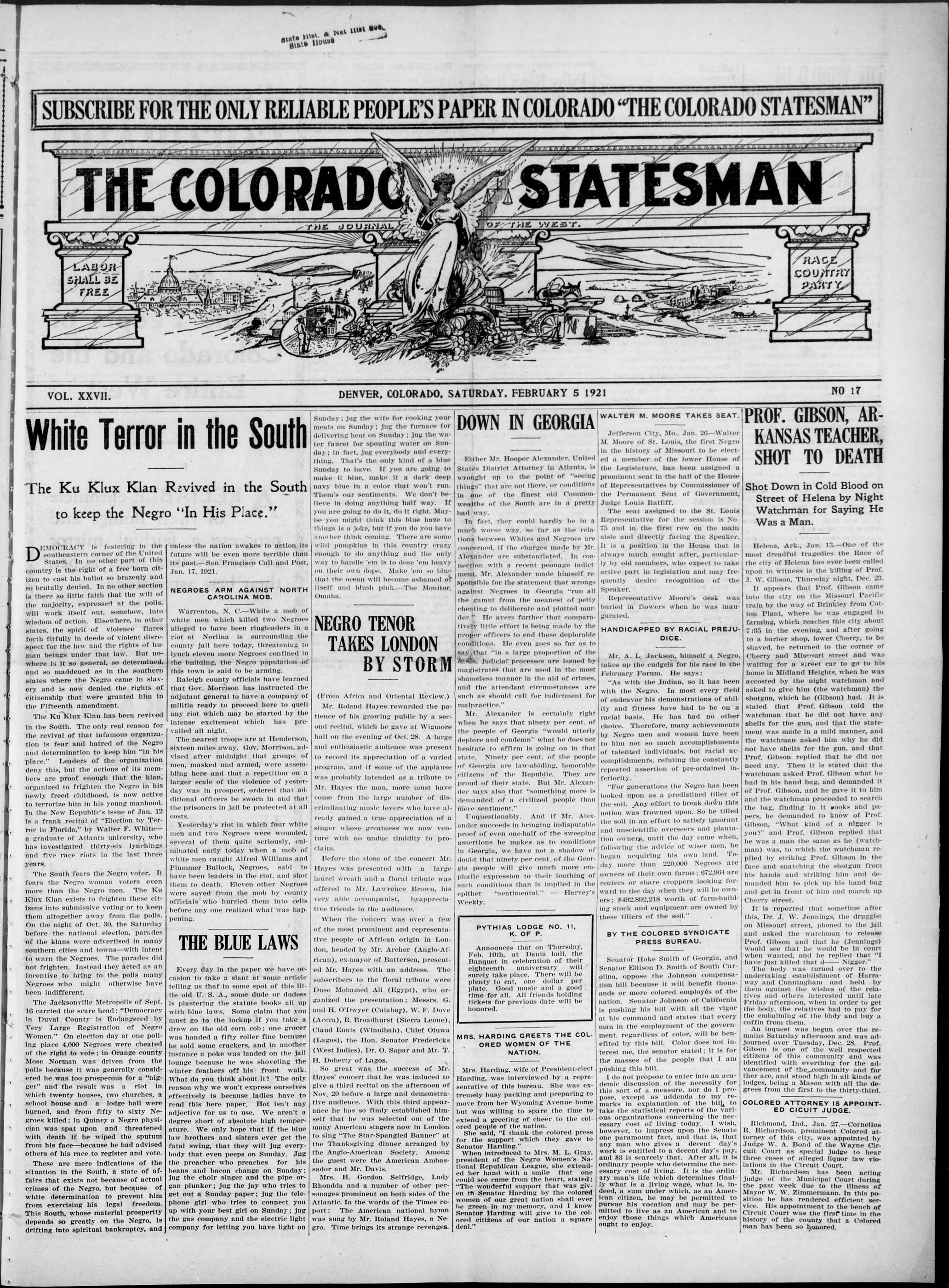
White Terror in the South
VOL. XXVII.
White Terror
The Ku Klux Klan to keep the Negr
DEMOCRACY is festering in the southeastern corner of the United States. In no other part of this country is the right of a free born citizen to cast his ballot so brazenly and so brutally denied. In no other section is there so little faith that the will of the majority, expressed at the polls, will work itself out, somehow, into wisdom of action. Elsewhere, in other states, the spirit of violence flares forth fitfully in deeds of violent disrespect for the law and the rights of human beings under that law. But nowhere is it so general, so determined, and so maddened as in the southern states where the Negro came in slavery and is now denied the rights of citizenship that were granted him in the Fifteenth amendment.
The Ku Klux Klan has been revived in the South. The only real reason for the revival of that infamous organization is fear and hatred of the Negro and determination to keep him "in his place." Leaders of the organization deny this, but the actions of its members are proof enough that the klan, organized to frighten the Negro in his newly freed childhood, is now active to terrorize him in his young manhood. In the New Republic's issue of Jan. 12 is a frank recital of "Election by Terror in Florida," by Walter F. White—a graduate of Atlanta university, who has investigated thirty-six lynchings and five race riots in the last three years.
The South fears the Negro voter. It fears the Negro woman voters even more than the Negro men. The Ku Klux Klan exists to frighten these citizens into submissive voting or to keep them altogether away from the polls. On the night of Oct. 30, the Saturday before the national election, parades of the klans were advertised in many southern cities and towns—with intent to warn the Negroes. The parades did not frighten. Instead they acted as an incentive to bring to the polls many Negroes who might otherwise have been indifferent.
The Jacksonville Metronolis of Sept. 16 carried the scare head: "Democracy in Duval County is Endangered by Very Large Registration of Negro Women." On election day at one polling place 4,000 Negroes were cheated of the right to vote; in Orange county Mose Norman was driven from the polls because it was generally considered he was too prosperous for a "nigger" and the result was a riot in which twenty houses, two churches, a school house and a lodge hall were burned, and from fifty to sixty Negroes killed; in Quincy a Negro physician was spat upon and threatened with death if he wiped the sputum from his face—because he had advised others of his race to register and vote.
These are mere indications of the situation in the South, a state of affairs that exists not because of actual crimes of the Negro, but because of white determination to prevent him from exercising his legal freedom. This South, whose material prosperity depends so greatly on the Negro, is drifting into spiritual bankruptcy, and
---
State Hist. & Nat Hist Soc.
State House
RELIABLE PEOPLE
RADC
THE JOURNAL
DENVER,
unless the nation awakes to action its future will be even more terrible than its past.—San Francisco Call and Post Jan. 17, 1921.
NEGROES ARM AGAINST NORTH
CAROLINA MOB.
Warrenton, N. C.—While a mob of white men which killed two Negroes alleged to have been ringleaders in a riot at Norlina is surrounding the county jail here today, threatening to lynch eleven more Negroes confined in the building, the Negro population of this town is said to be arming.
Raleigh county officials have learned that Gov. Morrison has instructed the adjutant general to have a company of militia ready to proceed here to quell any riot which may be started by the intense excitement which has prevailed all night.
The nearest troops are at Henderson, sixteen miles away. Gov. Morrison, advised after midnight that groups of men, masked and armed, were assembling here and that a repetition on a larger scale of the violence of yesterday was in prospect, ordered that additional officers be sworn in and that the prisoners in jail be protected at all costs.
Yesterday's riot in which four white men and two Negroes were wounded, several of them quite seriously, culminated early today when a mob of white men caught Alfred Williams and Plummer Bullock, Negroes, said to have been leaders in the riot, and shot them to death. Eleven other Negroes were saved from the mob by county officials who hurried them into cells before any one realized what was happening.
Every day in the paper we have occasion to take a slant at some article telling us that in some spot of this little old U. S. A., some dude or dudess is plastering the statute books all up with blue laws. Some claim that you must go to the lockup if you take a draw on the old corn cob; one grocer was handed a fifty roller fine because he sold some crackers, and in another instance a poke was landed on the jail lounge because he was shoveling the winter feathers off his front walk. What do you think about it? The only reason why we won't express ourselves effectively is because ladies have to read this here paper. Hot isn't any adjective for us to use. We aren't a degree short of absolute high temperature. We only hope that if the blue law brothers and sisters ever get the fatal swing, that they will jug everybody that even peeps on Sunday. Jug the preacher who preaches for his beans and bacon change on Sunday; jug the choir singer and the pipe organ plunker; jug the jay who tries to get out a Sunday paper; jug the telephone girl who tries to connect you up with your best girl on Sunday; jug the gas company and the electric light company for letting you have light on
---
THE BLUE LAWS
ABLE PEOPLE'S P
ADC
THE JOURNAL
DENVER, COLORADO,
DENVER, COLORADO, SATURDAY, FEBRUARY 5 1921
Sunday; jug the wife for cooking your meals on Sunday; jug the furnace for delivering heat on Sunday; jug the water faucet for spouting water on Sunday; in fact, jug everybody and everything. That's the only kind of a blue Sunday to have. If you are going to make it blue, make it a dark deep navy blue in a color that won't run. Them's our sentiments. We don't believe in doing anything half way. If you are going to do it, do it right. Maybe you might think this blue haze to things is a joke, but if you do you have another think coming. There are some wild pumpkins in this country crazy enough to do anything and the only way to handle 'em is to dose 'em heavy on their own dope. Make 'em so blue that the ocean will become ashamed of itself and blush pink.—The Monitor, Omaha.
NEGRO TENOR TAKES LONDON BY STORM
(From Africa and Oriental Review.) Mr. Roland Hayes rewarded the patience of his growing public by a second recital, which he gave at Wigmore hall on the evening of Oct. 28. A large and enthusiastic audience was present to record its appreciation of a varied program, and if some of the applause was probably intended as a tribute to Mr. Hayes the man, more must have come from the large number of discriminating music lovers who have already gained a true appreciation of a singer whose greatness we now venture with no undue timidity to proclaim.
Before the close of the concert Mr. Hayes was presented with a large laurel wreath and a floral tribute was offered to Mr. Lawrence Brown, his very able accompanist, byappreciative friends in the audience.
When the concert was over a few of the most prominent and representative people of African origin in London, headed by Mr. Archer (Anglo-African), ex-mayor of Battersea, presented Mr. Hayes with an address. The subscribers to the floral tribute were Duse Mohamed Ali (Egypt), who organized the presentation; Messrs, G. and H. O'Dwyer (Calabar), W. F. Dove (Accra), R. Broadhurst (Sierra Leone), Claud Ennis (Winnibah), Chief Oluwa (Lagos), the Hon. Senator Fredericks (West Indies), Dr. O. Sapar and Mr. T. H. Doherty of Lagos.
So great was the success of Mr. Hayes' concert that he was induced to give a third recital on the afternoon of Nov. 20 before a large and demonstrative audience. With this third appearance he has so firmly established himself that he was selected out of the many American singers now in London to sing "The Star-Spangled Banner" at the Thanksgiving dinner arranged by the Anglo-American Society. Among the guest were the American Ambassador and Mr. Davis.
Mrs. H. Gordon Selfridge, Lady Rhondda and a number of other personages prominent on both sides of the Atlantic. In the words of the Times report: The American national hymn was sung by Mr. Roland Hayes, a Negro. Time brings its strange revenges.
DOWN IN GEORGIA
Either Mr. Hooper Alexander, United States District Attorney in Atlanta, is wrought up to the point of "seeing things" that are not there, or conditions in one of the finest old Commonwealths of the South are in a pretty bad way.
In fact, they could hardly be in a much worse way, so far as the relations between Whites and Negroes are concerned, if the charges made by Mr. Alexander are substantiated. In connection with a recent peonage indictment, Mr. Alexander made himself responsible for the statement that wrongs against Negroes in Georgia "run all the gamut from the meanest of petty cheating to deliberate and plotted murder." He avers further that comparatively little effort is being made by the proper officers to end these deplorable conditions. He even goes so far as to say that "in a large proportion of the judicial processes are issued by magistrates that are used in the most shameless manner in the aid of crimes, and the attendant circumstances are such as should call for indictment for malpractice."
Mr. Alexander is certainly right when he says that ninety per cent. of the people of Georgia "would utterly deplore and condemn" what he does not hesitate to affirm is going on in that state. Ninety per cent. of the people of Georgia are law-abiding, honorable citizens of the Republic. They are proud of their state. But Mr. Alexander says also that "something more is demanded of a civilized people than mere sentiment."
Unquestionably. And if Mr. Alexander succeeds in bringing indisputable proof of even one-half of the sweeping assertions he makes as to conditions in Georgia, we have not a shadow of doubt that ninety per cent. of the Georgia people will give much more emphatic expression to their loathing of such conditions than is implied in the epithet "sentimental." — Harvey's Weekly.
PYTHIAS LODGE NO. 11,
K. OF P.
Announces that on Thursday, Feb. 10th, at Dania hall, the Banquet in celebration of their eighteenth anniversary will surely take place. There will be plenty to eat, one dollar per plate. Good music and a good time for all. All friends holding tickets for previous date will be honored.
MRS. HARDING GREETS THE COL ORED WOMEN OF THE NATION.
Mrs. Harding, wife of President-elect Harding, was interviewed by a representative of this bureau. She was extremely busy packing and preparing to move from her Wyoming Avenue home but was willing to spare the time to extend a greeting of cheer to the colored people of the nation.
She said, "I thank the colored press for the support which they gave to Senator Harding."
When introduced to Mrs. M. L. Gray, president of the Negro Women's National Republican League, she extended her hand with a smile that one could see came from the heart, stated: "The wonderful support that was given to Senator Harding by the colored women of our great nation shall ever be green in my memory, and I know Senator Harding will give to the colored citizens of our nation a square deal."
WALTER M. MOORE TAKES SEAT
Jefferson City, Mo., Jan. 26—Walter M. Moore of St. Louis, the first Negro in the history of Missouri to be elected a member of the lower House of the Legislature, has been assigned a prominent seat in the hall of the House of Representatives by Commissioner of the Permanent Seat of Government, Judge Louis Ratliff.
The seat assigned to the St. Louis Representative for the session is No. 75 and in the first row on the main aisle and directly facing the Speaker. It is a position in the House that is always much sought after, particularly by old members, who expect to take active part in legislation and may frequently desire recognition of the Speaker.
Representative Moore's desk was buried in flowers when he was inaugurated.
HANDICAPPED BY RACIAL PREJU DICE.
Mr. A. L. Jackson, himself a Negro, takes up the cudgels for his race in the February Forum. He says:
"As with the Indian, so it has been with the Negro. In most every field of endeavor his demonstrations of ability and fitness have had to be on a racial basis. He has had no other choice. Therefore, many achievements by Negro men and women have been to him not so much accomplishments of talented individuals, but racial accomplishments, refuting the constantly repeated assertion of pre-ordained inferiority.
"For generations the Negro has been looked upon as a predistined tiller of the soil. Any effort to break down this notion was frowned upon. So he tilled the soil in an effort to satisfy ignorant and unscientific overseers and plantation owners, until the day came when, following the advice of wiser men, he began acquiring his own land. Today more than 220,000 Negroes are owners of their own farms; 672,964 are renters or share croppers looking forward to the day when they will be owners; $492,892,218 worth of farm-building stock and equipment are owned by these tilters of the soil."
BY THE COLORED SYNDICATE PRESS BUREAU.
Senator Hoke Smith of Georgia, and Senator Ellison D. Smith of South Carolina, oppose the Johnson compensation bill because it will benefit thousands or more colored employés of the nation. Senator Johnson of California is pushing his bill with all the vigor at his command and states that every man in the employment of the government, regardless of color, will be benefited by this bill. Color does not interest me, the senator stated; it is for the masses of the people that I am pushing this bill.
I do not propose to enter into an academic discussion of the necessity for this sort of a measure, nor do I propose, except as addenda to my remarks in explanation of the bill, to take the statistical reports of the various organizations concerning the necessary cost of living today. I wish, however, to impress upon the Senate one paramount fact, and that, is that any man who gives a decent day's work is entitled to a decent day's pay, and $3 is scarcely that. After all, it is ordinary people who determine the necessary cost of living. It is the ordinary man's life which determines finally what is a living wage, what is, indeed, a sum under which, as an American citizen, he may be permitted to pursue his vocation and may be permitted to live as an American and to enjoy those things which Americans ought to enjoy.
NO 17
PROF. GIBSON, ARKANSAS TEACHER SHOT TO DEATH
Shot Down in Cold Blood on Street of Helena by Night Watchman for Saying He Was a Man.
Helena, Ark., Jan. 13.—One of the most dreadful tragedies the Race of the city of Helena has ever been called upon to witness is the killing of Prof. J. W. Gibson, Thursday night, Dec. 23.
It appears that Prof. Gibson came into the city on the Missouri Pacific train by the way of Brinkley from Cotton Plant, where he was engaged in farming, which reaches this city about 7:35 in the evening, and after going to a barber shop, lower Cherry, to be shaved, he returned to the corner of Cherry and Missouri street and was waiting for a street car to go to his home in Midland Heights, when he was accosted by the night watchman and asked to give him (the watchman) the shotgun, which he (Gibson) had. It is stated that Prof. Gibson told the watchman that he did not have any shells for the gun, and that the statement was made in a mild manner, and the watchman asked him why he did not have shells for the gun, and that Prof. Gibson replied that he did not need any. Then it is stated that the watchman asked Prof. Gibson what he had in his hand bag, and demanded it of Prof. Gibson, and he gave it to him and the watchman proceeded to search the bag, finding in it books and papers, he demanded to know of Prof. Gibson, "What kind of a nigger is you?" and Prof. Gibson replied that he was a man the same as he (watchman) was, to which the watchman replied by striking Prof. Gibson in the face and snatching the shotgun from his hands and striking him and demanded him to pick up his hand bag and get in front of him and march up Cherry street.
It is reported that sometime after this, Dr. J. W. Jennings, the druggist on Missouri street, phoned to the jail and asked the watchman to release Prof. Gibson and that he (Jennings) would see that he would be in court when wanted, and he replied that "I have just killed that d——Nigger." The body was turned over to the undertaking establishment of Harraway and Cunningham and held by them against the wishes of the relatives and others interested until late Friday afternoon, when in order to get the body, the relatives had to pay for the embalming of the body and buy a coffin from them.
An inquest was begun over the remains Saturday afternoon and was adjourned over Tuesday, Dec. 28. Prof. Gibson is one of the well respected citizens of this community and was identified with everything for the advancement of the community and for her ace, and stood high in all kinds of lodges, being a Mason with all the degrees from the first to the thirty-third.
COLORED ATTORNEY IS APPOINTED
CICUIT JUDGE.
Richmond, Ind., Jan. 27.—Cornellus R. Richardson, prominent Colored attorney of this city, was appointed by Judge W. A. Bond of the Wayne Circuit Court as special judge to hear three cases of alleged liquor law violations in the Circuit Court.
Mr. Richardson has been acting judge of the Municipal Court during the past week due to the illness of Mayor W. W. Zimmermann. In this position he has rendered efficient service. His appointment to the bench of Circuit Court was the first time in the history of the county that a Colored man has been so honored.
FOREIGN
Foreigners who suffered damage during Mexican revolutions have been given an additional year to file their claims under an order issued by the government.
Fifty-two persons were killed and twenty-six injured in a mine explosion near Frienssschacht-Delanitz, in Saxony, according to an Exchange Telegraph dispatch from Carlsbad.
Fifty-five cases of sleeping sickness have been reported during the past four weeks in London. This is a large increase, only twenty-three being reported in the previous period of four weeks.
Simple ceremonies marked the permanent entombment of "a soldier of France," representing the French unidentified war hero, under the Arc de Triomphe in Paris. A plain stone slab marks the resting spot of this unknown pollu.
Orders for suspension of work on recently claimed oil lands and prohibition of new filings on oil territory affect only the federal zone, but do not apply to private properties, says an industry and commerce statement from Mexico City.
The Frankfort Gazette, relative to the attempt to kldnap Grover C. Bergdoll and Isaac Stecher, in Eberbach, Baden, says that the "wild west" methods as practiced by sheriffs in the border districts of Kansas and Colorado are hardly adaptable to Germany.
Gen. Ambrose Arrieta, one of the eleven Arrieta brothers reported to have been leading an insurrection in Durango, has called at the headquarters of General Lopez, government commander there, and denied that either he or any of his brothers ever thought of starting a revolution.
Thirty thousand refugees from Crimea in the Caucasus, among whom are twenty generals, seventy colonels and a nephew of the novelist, Tolstoy, face starvation unless aid is sent by the allied governments, it is learned. Typhus and other diseases are rampant and scores of deaths are being reported daily.
GENERAL
Henry Martell and five children were burned to death and two others were burned seriously when fire destroyed their home at Rochester, N. Y. C. W. Foster, who probably was the oldest fireman in active service in the country, is dead at Lawrence, Mass., aged 87. He had missed only six alarms since he joined the city fire department in 1850. Brick making companies with headquarters at Ogden, Utah, announced a cut of from 15 to 25 per cent in the cost of brick, which they said brings the price virtually to pre-war levels. Common brick was quoted at $12.50 a thousand at the yards. The Nashville Railway and Light Company was fined $2,000 in a case in which it was alleged to have violated the statute providing for the separation of the races on street cars. The case will be appealed to the Supreme Courtf or a test of the law.
Zemmes Walmsley, chairman of the National Memorials Commission of the American Legion, announced his committee has decided to recommend acceptance of the $5,000,000 offered the American Legion by the Knights of Columbus for use in the erection of a memorial to those who died in France. Suicides in the United States in 1920 numbered 6,171, including 707 children, members of the Save-a-Life League were told by Dr. H. M. Warren, president. This exceeded the figures of 1919 by more than 1,000, he said. During the year 2,604 women, a large increase died through self-destruction
crease, used through self-destruction.
The American Bonding and Casualty Company with headquarters at Sloux City, Iowa, capitalized at $500,000 and with $100,000,000 worth of policies on its books was declared insolvent at Chicago. Albert Sabath, an attorney, was appointed receiver. Liabilities were said to be $3,000,000 and assets "considerably less."
What is said to be the first title insurance company in the United States to be organized and conducted by women, is now in process of formation in Philadelphia. It will be known as the Women's Trust Company.
"Florence Harding lavender" is the latest color entrant into the category of fashion, named after the wife of the President-elect, who herself selected the shade which will be turned out in large quantities by a well-known silk mill. The color is in orchid tone. Mrs. Harding's second choice was a blue, between an electric and a sapphire. This will be known as "Marion blue" and used for a house dress.
The praecipe in a $5,000,000 damage suit against Henry Ford and his paper, the Dearborn Independent, has been filed in Circuit Court by Morris Gest, theatrical producer, who alleged an artice in the Independent on Jan. 22 contained "libelous, slanderous and false statements" concerning Mr. Gest and certain stage productions he has handled. The article mentioned in the suit was said to have attacked "Aphrodite" and "Mecca" in particular, terming them the most "salacious spectacles ever shown in America."
The navy yards on the Atlantic coast should be sold and the money used for the building of one big base on Narragansett bay, in the opinion of Rear Admiral William S. Sims, president of the naval war college. Speaking at Newport, R. I., he said he believed Narragansett bay should be developed by the erection of repair plants capable of caring for a whole fleet. In the event of the navy requiring repairs after an engagement with an enemy force, he said the fleet would be forced to scatter to several yards for the necessary work.
A BRIEF RECORD OF PASSING EVENTS IN THIS AND FOR-EIGN COUNTRIES.
IN LATE DISPATCHES
DOINGS AND HAPPENINGS THAT
MARK THE PROGRESS
OF THE AGE.
(Western Newspaper Union News Service.)
WESTERN
Governor Charles R. Mabey presented a budget to the State Legislature of Utah calling for appropriations totaling $3,524,764.20 for operation of the state government from April 1, 1921, to March 31, 1923.
A bomb placed at the back door of Patrolman Michael J. Flinnegan's residence in St. Louis exploded and injured three members of the family and wrecked the back part of the house. Police blame liquor raid victims.
John Simon, who would have celebrated his one hundred and first birthday within a week, died at his home in Los Angeles. He was born in France and came to the United States when 18 years old. He had lived in Los Angeles fifty-five years.
Suit to escheat to the state forty-one acres of land comprising a farm formerly owned by J. J. Gledhill and latter sold to the U. N. Farms Company, alleged to be a Japanese concern, has been filed at Yuba, Calif., in the name of the state.
Sale of thrift stamps and other treasury securities was greater per capita in Alaska during 1920 than in any state, the Treasury Department has announced. The average investment in Alaska by every man, woman and child was $2.20. Ohio led the states with a per capita of $1.50.
A bill to make highway robbery punishable with a life sentence in the penitentiary has been introduced in the Montana Legislature. Senator Slattery, sponsor of the measure, said the act was designed "to keep out of the state undesirables who are creating crime waves elsewhere."
Whipping posts for habitual criminals was advocated by William A. Pinkerton, dean of American sleuths and head of the Pinkerton Detective agency, in Los Angeles, on a tour of inspection of his western offices. "The probation laws in California and all through the country are rotten," he declared. "That is the only word that aptly describes them. Abolish them without delay and go one step farther and establish whipping posts for highwaymen and prowlers. It is the one sure thing that will break criminals of the dangerous class."
WASHINGTON
The Senate has confirmed the nominations of 5,000 junior officers of the army. The confirmations were the first of the present session and were made in open session by unanimous consent.
Benefits of vocational training for the rehabilitation of disabled soldiers would be extended to Americans who served in the allied armies, and to the widows and children of deceased soldiers, under a bill passed by the Senate.
President Wilson is having collected and arranged for reference all papers and documents in his possession relating to the Paris peace conference, with a view to the preparation of a book. It is understood that the President intends to begin real work on the book shortly after his retirement.
Reduction of the navy's enlisted personnel to a maximum of 100,000 men, as compared with a present possible maximum of 143,000, is provided for in the naval appropriation bill, reported to the House.
Walter W. Warick of Ohio, now comptroller of the treasury, and Evaris A. Hayes, a former Republican member of the House of Representatives from California, were nominated by President Wilson to fill the vacancies existing in the directorate of the War Finance Corporation.
Plans for dedication of the Lincoln memorial, erected at a cost of $3,000,000 to the memory of the martyred President, have been postponed indefinitely. In announcing the delay the commission said the foundations of the terrace and approaches were settling and would have to be underpinned.
Half a billion dollars in revenues from back taxes probably will be paid into the treasury this year, officials said. This unexpected revenue source made possible by new audits of the returns for preceding years, is expected to partly offset the loss expected in the slump in excess profits taxes.
Authorization to conduct an exhaustive examination and prepare plans and estimates of cost to dig a channel through the San Francisco bar has been received by Colonel Herbert Deakyne, United States district engineer at San Francisco. The cut would be as deep and wide as the entrance to New York harbor.
Acting Treasurer Allen has announced that a total of $13,883,819,826.36 twothirds in cash and securities was found in the treasury as a result of the count necessitated by the resignation of John Burke as treasurer.
Pithy News Notes
From All Parts of
Colorado
(Western Newspaper Union News Service.)
William Musselman, 10-year-old son of a Fruita rancher, was almost instantly killed when he fell from a pony he was riding. The lad was riding the pony and driving home his father's cows when the accident occurred.
Work at Longmont has started in wrecking the city hall to make way for a new $50,000 municipal building. The new hall will contain council chambers, rest rooms, a gymnasium and office rooms for city officials.
Among the chief needs which will be discussed at the annual meeting of the Grand Junction Chamber of Commerce in February, the need of advertising western Colorado's wonderland to the world will receive great attention. A plan will be discussed for an advertising campaign which will virtually introduce to new fields the possibilities of that part of Colorado.
Mrs. Bertha M. Dickey, who entered a desert claim on land six miles from Climarron a year ago and whom the government has tried to dispossess upon the claim that the land was too rough for cultivation and therefore should be re-designated as grazing land, won in a contest case heard in the Montrose land office after she had proved by several witnesses that the land was actually in cultivation, having been plowed with a tractor last fall.
Uncle Sam paid the Colorado State Highway Department approximately $552,122.78 as the government share of the constructed federal aid road work in the state during 1920, according to District Engineer J. S. Bright of the United States Bureau of Public Routes. "This money represents the federal payments on forty-seven projects under construction or completed through the state," Bright said. "Twenty-two separate projects were completed during the year at a total estimated cost of $1,036,835.44, of which the federal government was requested to pay $410,967.86."
Charles T. Stockton, furniture dealer of Bristol for a number of years, is dead, and four other persons are in the hospital suffering serious injuries as the result of an accident which occurred six miles between Bristol and Holly. The injured are Joseph Zellars, who is suffering from a broken leg; G. R. Hite, badly bruised, and Henry Thompson and Ernest Burke severely bruised about the face and body. Stockton, Zellars, Thompson and Burke, all of Bristol, were en route home from Holly when the machine in which they were riding collided with a horse and buggy being driven by G. R. Hite, who is a well-known Prowers county farmer. It is said a blinding snow storm was the cause of the accident.
No state with the exception of Montana has shown so rapid an increase in the acreage of land under cultivation in the past decade as Colorado, and few states have shown a larger percentage of increase in the number of farms. Within the past ten years approximately 10,000,000 acres of government land has been homesteaded, while large areas of privately-owned land have been broken and placed under cultivation. Records of the State Immigration Department show that this movement has been much stronger in the past five years than in the preceding five years, and that there was an actual decrease in the population of the state during the first two years after the 1910 census was compiled. The increase in subsequent years has been due primarily to agricultural development, which has been much more marked in the non-irrigated than in the irrigated districts.
Thleaves who have been getting such good hauls of late at Grand Junction met with a different reception at the S. B. Parker home in that city. The intruders were greeted by a volley of shots from the Parker family arsenal and the neighbors took up the fusilade, sending the would-be robbers away at a record clip.
Decision to withhold financial support from the Colorado School of Mines magazine and refuse to furnish headquarters in the school buildings for the editor of the publication, was voted by the board of trustees of the school at a recent meeting, at which publication of an article derogatory to the institution was considered.
Jose Ramon of Cordova, Colo., will receive $1,035 for injuries received in an old Apache Indian uprising, in which he fought as a federal soldier, if the United States Senate passes a bill making the appropriation which was reported on favorably by the committee on claims. The lower house already has passed this bill, and also one of a similar kind to aid Mrs. Joseph C. Akins, the widow of an officer killed in the uprising. The latter bill has not been reported out, however.
Noncoloradoans attending the University of Colorado next and subsequent quarters will be charged just twice the present rate, according to an order made public by the Board of Regents. The tuition fee in the college of liberal arts, engineering school and school of pharmacy is to be $20 a quarter, the tuition for the law school will be $25 a quarter. The new fees will materially increase the revenues of the university, and will probably have little effect upon the present attendance. The registration is now past the 2,000 mark.
---
While the farm population in the country as a whole has increased much less rapidly in the past decade than the population of the cities, in Colorado the population of the farming districts has grown more rapidly than that of the cities. Figures announced by the federal census bureau and compiled in the office of the State Immigration Department show that the rural population of Colorado is now 51.76 per cent of the total population, compared with 49.3 per cent in 1910. In the United States the rural population is now 48.7 per cent of the total, compared with 53.7 per cent in 1910. The rural population in Colorado in 1920 is 486,370, compared with 394,184 in 1910, the increase being over 23 per cent. The urban population in 1920 was 453,259, compared with 404,840 in 1910, the increase being slightly less than 12 per cent. In the United States as a whole the increase in urban population in the past decade was 28.6 per cent, while the increase in rural population was only 3.1 per cent. These figures show clearly that, while there was a strong movement from the farms to the cities in the country as a whole, the movement in the Rocky Mountain states was from the cities to the farms, and that this movement was especially strong in Colorado and Montana.
COLORADO STATESMAN
The Mouth-Piece of the People of Colorado and the Entire West
The total school population of Colorado is 250,813, and on this basis Miss Katherine L. Craig, state superintendent of public instruction, apportioned a total of $361,148.18 to the sixty-three counties of the state. Of this sum, Denver receives $72,959.85, the largest single amount apportioned. This was the semi-annual apportionment of the state school fund. The amount distributed represents a total of $1.39 for each pupil, as compared with $1.73 given out last July. Miss Craig announced the sum of $1,733.73 withheld from the State Teachers' college by mistake last July was allotted this time. El Paso and Weld counties were the second and third largest beneficlaries from the fund, receiving $15,760.48 and $23,996.18, respectively.
A RELIABLE chronicle of their doings and progress; a faithful mirror of their wants, their hopes, their best aspirations.
Howard G. Wade, chairman of the Denver branch of the Military Training Association, has been advised, by telegraphic communication from New York that the Congressional committee on military affairs has assured the appropriation of adequate funds to provide for the establishment of eighteen summer training camps during 1921. A joint committee of the Training Camps Association and the American Legion appeared before the Congressional body and outlined the needs, which include the establishment of two camps in the Ninth corps area, in which Denver is included. An effort is being made to establish one of the camps near Denver, Fort Logan having been suggested as a suitable location.
Upward of 1,500 shopmen and trackmen living in Denver and nearly 200 others on the Colorado division of the Union Pacific are affected by a reduction in working hours which has been announced. The shopmen are to have a five-day week instead of a five- and one-half day week, while trackmen will work five days instead of six. This method is taken in preference to cutting the force.
Two thousand carloads of choice Greeley potatoes will be ruined in the dugouts unless unexpected relief is obtained for the farmers. Potatoes are now selling at less than 50 per cent of the cost of the crop and apparently available markets will take only a very small percentage of the 3,000 carloads of sound potatoes in the hands of dealers and farmers.
Unequaled as an advertising medium for the business of professional men and women.
R. B. McDermott, one of the best known country newspaper men in the state, has bought a half interest in the Fort Lupton Booster from the present publisher, F. M. Walling, and the firm name will be Walling & McDermott. Mr. McDermott will be the editor of the paper.
Two hundred thousand rainbow trout eggs have been received from Oregon at the Fort Collins fish hatchery, to be hatched and put into the streams of the county. The hatchery already has on hand 400,000 fry about thirty days old. R. G. Haviland, superintendent of the hatchery, announces that within thirty days he will begin the construction of a fish nursery pond in front of the hatchery 200 by 50 feet, and that the fish from the hatchery will be grown in this pond until they are finger length before they will be released in the streams.
An excellent family journal speaking to and for many thousand colored citizens.
Hunters and fishermen of Boulder county are to meet in Boulder to organize a fish and game club and to discuss protective legislation now before the State Legislature. All of the local clubs in the county are to be affiliated in this organization, though they will retain their identity.
TWODOLLARSAYEAR
Notices of reductions in wages effective March 1 have been filed by fifteen Colorado concerns with the State Industrial Commission. Included in the number are the famous Carlton group of mines in the Cripple Creek district, which announced a cut of 50 cents per day.
THE GREAT ORGAN OF THE
Following the recovery of travelers checks negotiable for an amount in excess of $2,000, stolen from the mails near Sedgwick, Colo., on Christmas day, federal authorities arrested W. E. Gifford, 41 year old, employed as a section hand near that point, after he asked the station agent, it is alleged, if he would be paid a reward for the recovery of the money. Immediately after the theft of the mail pouches containing the checks federal agents and Union Pacific inspectors were dispatched to the scene, and two Mexicans were placed under arrest.
LABORING MASSES
LAST NIGHT'S DREAMS
SCHOOL DAYS
The night the picture card broke
DID YOU DREAM OF MONEY?
WHEN it comes to a matter of money the oracles seem to dispute over "filthy lucre" just as ordinary mortals are apt to do. Some of them say that to dream of finding money is a bad sign, indicating losses; and dreaming of losing money is a good sign, indicating gain; probably working on the "dreams go by contraries" hypothesis. But the best and most eminent authorities do not agree to this. Some of them admit that to dream of finding money signifies worries, but declare that out of these temporary worries great good will come; while others content themselves with the statement that to dream of finding money is lucky. All agree that to dream of losing money is a sign of good business, though one authority darkly hints that you may have a spat with your wife—if you have one—after
SCHOO
THE GIRL ON THE JOB
How to Succeed—How to Get Ahead—How to Make Good
By JESSIE ROBERTS
WELFARE WORK
IT IS certain that welfare work in the big industrial and commercial enterprises is going to see a great expansion. It has been proved that it pays. And once that proof is recognized, no plant that has a forward looking policy is going to be without its welfare department, and its trained welfare expert. This work is especially suited to women, and it is up to a woman who wishes to enter the field to get her necessary training and then go out after the job. She will land it, for the supply of good welfare workers is far below the growing demand.
It is becoming generally known to even the most reactionary of employers that a contented body of workers is their safest and soundest asset. The woman who is able to reconcile differences between the employees and the employer, who can explain the one to the other, is often able to avoid a disastrous strike. Of course, such a woman must understand the proper installation of rest-rooms, the managing of luncheons at cost, the proper airing and warming of the workrooms. But even more necessary is it that she should have the power to win the confidence and respect of those for whom she works. She must be known to be fair and just, and she must join sympathy and humor in her makeup if she is to succeed in making both sides believe in her.
"You've got to be human clear to the marrow of your bones," one woman who has the welfare of a thousand employees in her charge said to me. "There isn't a job in the world I would change for this one, but make no mistake, it's full of pitfalls and it's hard work! The girls here come to me when they won't go to their own mothers with their troubles, because they know there isn't a thing I wouldn't do for them if it's right to do it. And I feel every day that I'm doing something worth while."
Any woman would feel the same. And women who have the type of personality that will tell in welfare work should train for it—it is really a great opportunity.
(Copyright.)
Not New.
"I suppose aviation will bring in the making of rules in the air."
"The theatrical managers have already done that. They have long been laying out star routes."
such a dream. As to dreaming of saving money, there are two schools—the optimists and the pessimists. The optimists declare that to dream that you are saving up money means that you will have comfort and plenty, while the pessimists think it portends losses. The weight of opinion seems to be on the side of the optimists. If you dream that you are swallowing money look out for yourself; for if you don't you will become so penurious and money-grabbing that you will almost, if not quite, commit fraud to get it. So if you get this warning loosen up the purse-strings. If you dream of counting money you are liable to have a dispute over a bill. In effect it seems lucky to dream about money, but you are warned not to be too much of a millionaire in your dreams, for if you are too disgracefully rich in Dreamland your fortune will be only moderate in real life.
(Copyright.)
(Copyright.)
L DAYS
The night the picture card broke
Mothers Cook Book
And this for comfort thou must know,
Times that are ill won't still be 60;
Clouds will not ever pour down rain;
A sullen day will clear again.
—Herrick.
SALADS AND SALAD DRESSINGS.
A SALAD which may be made in almost any season and one of which the ingredients may be found in any home supply is the following:
Ralsin Salad.
Cut one-half cupful of raisins with the shears into fine pieces, cut up one cupful of celery and one cupful of apples in small bits, combine with one-fourth cupful of mayonnaise dressing one-half hour before serving; add one-half cupful of broken walnut ments and serve on lettuce leaves.
Almond Salad.
Take one-half cupful of mild vinegar, if strong, dilute it with water, using the half cupful of diluted vinegar, add three-fourths of a cup of sugar and cook until it spins a thread. Soak two tablespoonfuls of gelatin in one cupful of pineapple juice and dissolve in the hot shrimp, grind one-half cupful of sweet cucumber pickles through a meat grinder, add with two-thirds of a cup of diced pineapple and one-half cupful of blanched, shredded almonds. Mix well and mold. Serve cold with mayonnaise dressing.
A most economical dressing may be made using corn oil in place of the olive oil; the dressing is fully as good to look at and better to the taste for those who do not enjoy the delicious flavor of olive oil.
Sour Cream Drop Cookies.
Sour Cream Drop Cookies.
Take one cupful of sugar, one-half cupful of shortening, one-half cupful of sour milk, one beaten egg, two and one-half cupfuls of flour, one-half teaspoonful of soda. Mix in the order given, first beating the shortening to a cream. Drop from a spoon upon a buttered sheet. Bake in a moderate oven.
Fruit Salad.
Combine the pulp of two oranges and one grape fruit, three slices of pineapple, all finely divided. Dilute one-third of a cupful of honey with the juices from the orange and grape fruit and serve two tablespoonfuls over each portion. Wash, stone and cut into strips six dates. Arrange them in the form of a daisy on the top of each. For the centers, soak coconut in pineapple juice and color with yellow fruit coloring. Serve cold.
Nessie Maxwell
(© 1921, Western Newspaper Union.)
THE ROMANCE OF WORDS
ONE of the most general of superstitions, the world over is that a child born with a "caul" or membrane over the head is not only a soothsayer but an extremely fortunate person. In Scotland, as well as in France, the caul itself is regarded as bringing good fortune to anyone who possesses it, and high prices have been paid for these unusual appendages.
The French word for a child born in this manner is "masque," meaning "masked," a word which is analogous to the Latin "masca," for sorcerer—which possibly explains the connection between the caul and power attributed to those born with it. It was from the French masque, with a slight change of final syllable, that the English "mascot"—meaning a lucky-piece was derived. After being used for years by gamblers and others of a superstitious nature, the word was finally introduced into literature by Audran, in his opera "La Mascotte," in which the term designates the messengers of the power of God, sent to counteract the influence of the power of evil.
(Copyright.)
THE WOODS
BY DOUGLAS MALLOCH
JIM.
If you go to the lake
An' you follow the road
As it turns to the west
Of the mill,
Till you come to a stake
A surveyor has thrown
Like a knife in the breast
Of the hill.
An' you follow the track
Till you come to a blaze
By the side of the same
In a limb,
You will light on a shack,
In the timber a ways,
Of a party whose name
It is Jim.
JIM.
In a day that is flown,
'Mid the great an' the grand,
In a time when his hair
Wet it by
He was commonly known
By a fancier brand
In a city back there,
So they say.
But it's Jim, only Jim
Is the name that he gives,
When you happen to bring
Up the same;
It is play for him
In the woods where he lives,
Fer the man is the thing,
Not the name.
By the gleam of his eye,
Thet is steady an' clear,
By the way he will look
At you square,
You would make it appear
Who would make it appear
He was maybe a crook
Over there.
In the church I have stood—
Heard of preachin' a lot
Thet I never could much
Understand.
An' you were the good
From a sermon I got
Thet I got from a clutch
Of his hand.
I have half an idea
Thet, if back you could turn
To the start of the trail
For a spell.
Thet a woman you'd see,
Thet a lot you would learn-
Thet the regaler tale
It would tell
Of a fallah too fond,
Of a woman too weak,
Of another who came
To her doctor.
Then the endless beyond,
Lips that never must speak,
An' a man but a name
Evermore.
If you go to the town
An' you follow the street,
To a mansion of brown
By the glitter an' glow
Of the .ght.
Where the music is sweet
An' the lute whispers low
To the night.
In the dark of a room
At the end of a hall,
Where the visions of old
Flutter in.
There she sits in the gloom,
She, the Cause of it all,
In the midst of her gold
An' her sin.
If you go to the lake
An' you follow the road
As it turns to the west
Of the mill,
Till you come to a stake
A surveyor has thrown
Lily knit in the breast
Of the hill,
An' you follow the track
Till you come to a blaze
By the side of the same
In a limb,
You will light on the shack,
In the timber a ways,
Of a party whose name
It is Jim.
(Copyright.)
~ MILITANT·MARY ~
I'd·like·to·hug
each·soldier·and
each·sailor·that
I·MEET
But·I·fear·it
might·upset·them
IF·I·DID·IT
ON·THE
STREET!
E·PitzHugh
LEGISLATIVE ACTIVITIES
(Western Newspaper Union News Service.)
The State Senate, on one ballot, confirmed without a disapproving vote, twenty-five recess appointments submitted by Governor Shoup. The list of appointments confirmed follows:
T. J. O'Donnell, member Uniform Laws Commission.
Frank Lannon, member State Public
Utilities Commission,
member State commissioner
Roland G. Parvin, state game and fish commissioner.
H. M. Minor, trustee State Soldiers' and Sailors' Home.
Dr. George K. Olmstead, member State Board of Health. Board of Con
trol, Industrial School for Girls. Mrs. Jarvis Richards, Board of Con-
trol. Industrial School for Girls.
Edwin S. Kassler, Board of Control,
Industrial School for Girls.
John B. Karner, Board of Trustees,
Industrial Workshop for the Blind.
Rodney J. Bardwell, trustee, School of Mines.
B. T. Chase, irrigation division engineer, District No. 6.
James Rahn, trustee, Home for Mental Defectives.
Bills passed on second reading by the House were:
Bill No. 159, by Representative Rotruck, to allow an extra juror in cases for which the judge deems such juror necessary. The extra juror would take no part in giving a decision unless a member of the jury was absent because of sickness, injury or death.
Bill No. 19, by Representative George A. Pughe of Moffat county, to give towns and cities more power in the matter of contracting bonded indebtedness.
Bill No. 26, by Representative Claude Rees of Rifle, to empower brand inspectors to collect a fee of not more than 5 cents a head on all cattle, horses and mules shipped and exempting stock being shipped for temporary grazing purposes.
That Colorado is losing yearly more than $100,000 in corporation taxes and that all restrictions, liabilities and penalties are avoided by a large number of companies operating on a plan which gives them all the benefits of incorporation with none of the limitations, is the charge that was made by R. C. Mulnix to Judge Butler of the District Court in a suit against the Automobile Owners' Protective Association. Judge Butler declared the suit raised entirely new legal questions, and admitted that he was puzzled as to the statute of the so-called common-law trust, under which general title the new form of organization operates. The Senate has passed on third hearing the following:
Senate Bill 31, by Senator Dickinson, to fix District Court terms in the Fourth judicial district.
Senate Bill 15, by Senator Dodge, to fix the fees for sheriffs.
Senate Bill 76, by Senator Callen, to amend the stock inspection law.
Senate Bill 123, by Senator Young, to require an oath of allegiance from the teachers in Colorado schools.
Senate Bill 5, by Senator Knauss, to define fraternal benefit societies, and Senate Bill 22, by Senator Colwell, were put over.
The Senate put over indefinitely Senators Peterson and Knauss' "blue sky" bill, laid over from the previous day.
The committee on criminal jurisprudence of the House has made a favorable recommendation on the bill by Representative W. B. Gordon of Prowers county, to make it an offense punishable by six months' imprisonment and a fine of $200, to fail to disperse at a mob or riotous gathering.
The House of Representatives game and fish committee voted to have printed the bill introduced by Representative Iver H. Dailey of La Veta, president of the Colorado Game and Fish Protective Association, by which state fish and game laws would be cleared of present provisions inconsistent with federal laws.
Senate Bill No. 4, by Senators Golding Fairfield and Francis J. Knauss of Denver, was re-referred to the judiciary committee when it came up for consideration in the House. This law empowers the relatives or representatives of dead persons to bring suits to quiet title in estate matters. Stating that it makes a complete change in the laws, Representative Paul B. Godsman of Burlington made a motion that it be referred to the judiciary committee. The motion was adopted.
Mary L. Pospahola, private secretary to Secretary of State Carl S. Milliken, a position which she also occupied under the administration of James R. Noland, was granted a sick leave of six months. She will go to California. Her position will be filled by Mrs. Mattie J. Hobson during her absence.
Because of the increase of crime in Colorado, the General Assembly, in session at present is asked to appropriate a total of $477,590 for the maintenance of the state penitentiary for the next two years.
```markdown
```
Fairy
Hotel
Cafe
(Formerly
SASS
SERVED
BKING
2716 Welton
FIRST CLASS
MEALS SERVED
HOME COOKING
Phone Main 4843
J. GIBS
BESON SM
Art Dealer
St St.
DENVER, CHAMPA 2077;
DAY OR NIGHT.
The Cammel
Undertaking Comp
HOME FUNERAL PARLO
Denver. 945 Rout
e, efficiency and modern
We can save you time
rows are treated as though
CAMBALMERS, FUNERAL
LADY ATTENDANTS.
PRESIDENT AND GENE
DENVER AND PUEBLO.
TERN BE
1638 Tremont St.
PHONES: DENVER
DAY
Not as Old Undertake
HOME F
2418 Welton St., Denver.
Motto: Service, efficient
out. Consult us. We care
Your cares and sorrows are
LICENSED EMBALMER
LADY
E. V. CAMMEL, PRESIDENT
DENVER
WESTER
PHONES: DENVER, CHAMPA 2077; PUEBLO, 864.
DAY OR NIGHT.
WESTERN BEEF CO.
Open Daily to 830 p. m.
Sundays Until 2:00 p. m.
Fresh Oysters, Chitterlings,
Bones, Spare
Fresh and Cured Meats of A
F
Our Prices Are
Free Delivery
Phone
2048 LARIMER STREET
Opposite
THE CHAMBER
TWENTIETH
Is the
DRUGS, CHEMICAL
WE
PRESCRIPTION
Phone us and we will deli
JAMES
PHO
Waterlings, Pig Tails, Snouts,
Spare Ribs Received Free
Seats of All Kinds.. Fresh
Fancy Groceries.
Are Always the
Delivery to All Parts of the
Phone Champa 1641.
GREET
Opposite the Three Rules
AMPA PHAR
TWENTIETH AND CHAMPA
Is the place to get your
CHEMICALS AND PATENTS
WE SERVE DRINKS.
SCRIPTIONS OUR SPECIAL
will deliver the goods to a
JAMES E. THRALL, Pro-
PHONE MAIN 2425.
Fresh Oysters, Chitterlings, Pig Tails, Snouts, Ears, Pigs Feet, Neck Bones, Spare Ribs Received Fresh Daily.
Fresh and Cured Meats of All Kinds.. Fresh Vegetables, Staple and Fancy Groceries.
THE CHAMPA PHARMACY
TWENTIETH AND CHAMPA,
Is the place to get your
DRUGS, CHEMICALS AND PATENT MEDICINES
WE SERVE DRINKS.
PRESCRIPTIONS OUR SPECIALTY.
Phone us and we will deliver the goods to all parts of the city.
JAMES E. THRALL, Propr.
PHONE MAIN 2425.
P. H.
PRACTICAL PLUMBER
Jobbing Promptly Attended
tion and Sewerer
2018 CURTIS STREET.
A FU
Black and
Ane a Full Line of MME
BUT WE KN
Jones West
Atla
P. H. BALFE
PLUMBER.—LICENSED D
attended to—Special Attent
Sewerage—All Work Gua
ET.
PRACTICAL PLUMBER.—LICENSED DRAIN LAYER.
Jobbing Promptly Attended to—Special Attention Given to Ventilation and Sewerage—All Work Guaranteed.
2018 CURTIS STREET. DENVER, COLO.
and White R
of MME. C. J. WALKER
WE KNOW YOU WILL
West Hair Poma
Atlas Drug
RRY TAXI
Black and White Remedies Ane a Full Line of MME. C. J. WALKER'S Toilet Articles. BUT WE KNOW YOU WILL LIKE Jones West Hair Pomade Best.
GRANBERRY Office 2
GRANBERRY TAXI COMPANY
Office 2741 Welton Street.
Quick and rrompt Services D on Our
C. V. FAIRBANKS
Telephone Main 207
2701 Welton St
OFFICE
PHONE
CHAMPA
87
Fairbanks Hotel and Cafe
(Formerly Barnes Hotel)
6 Welton St., Denver, Colo.
SMITH
aler
A 2077; PUEBLO, 864.
RIGHT.
PARLORS.
1945 Routt Ave., Pueblo, Colo.
modern conditions through-
you time, worry and money.
as though they were our own.
GENERAL DIRECTORS AND
DANTS.
AND GENERAL MANAGER,
PUEBLO.
BEEF CO.
S, Snouts, Ears, Pigs Feet, Neck Received Fresh Dally. . Fresh Vegetables, Staple and Spices.ways the Lowest Parts of the City. oa 1641.
PHARMACY
AND CHAMPA,
get your
PATENT MEDICINES
DRINKS.
OUR SPECIALTY.
goods to all parts of the city.
STALL, Propr.
N 2425.
Residence Phone Champa 328.
WALFE
DENSED DRAIN LAYER.
Final Attention Given to Ventila-
Work Guaranteed.
DENVER, COLO.
ONE OF
e Remedies
WALKER'S Toilet Articles.
YOU WILL LIKE
Pomade Best.
A FULL LINE OF
XI COMPANY
Lton Street.
ight. Call Us for Special Rates in Trips.
—Props.—
```markdown
```
N. FAIRBANKS
Denver
Though Just as Reliable
One of the Most Up-to-Date and Sanitary Markets in the City.
DENVER, COLO.
Phone Main 875
OFFICE
PHONE
CHAMPA
5060
There are some famous things in the East that are a part of history, such as the Plymouth rock. We are content to allow those things to remain there in the East, where they belong. We do protest against allowing people to come from the East and take from our Southwest the things which belong to us.
We should have the most colossal museum in this country. The great museums of the East are filled with nature specimens and relics which have been brought from our own and neighboring states. Are we going to sleep on, and let the rest of the country take advantage of our lethargy in this respect?
The purely thinking mind is fundamentally alike in both sexes. There is no foundation for the traditional inferiority of the feminine intellect. The great handicap is apparently first, the craving of the little girl for parental approbation, then of the maiden for the approbation of her suitors, and then the mature woman for the approbation of her husband or her employers.
It is in the business world that this tendency is the greatest handicap to women. Shrewd employers of women know that well timed approbation and praise often will be an entirely satisfactory substitute for a raise in salary or the payment of a just wage.
Whether this sensitiveness to criticism will cause women to raise the standard of political morality remains to be seen. There is good reason to hope it will.
THE COLORADO STATESMAN
Entered as second-class matter at the postoffice in the City of Denver, Colo.
JOSEPH D. D. RIVERS.....Proprietor
P. O. Box 116 1824 Curtis Street, Room 25 Phone Main 7417
One year ..... $2.00
Six months ..... 1.50
Three months ..... 75
MUST BE PAID IN ADVANCE.
Communications to receive attention must be newly, upon important subjects, plainly written only upon one side of the paper, must reach us Tuesdays, if possible, anyway not later than Wednesdays, and bear the signature of the author. No manuscript returned, unless stamps are sent for postage. All communications of a personating nature that are not complimentary will be withheld from the columns of this paper.
Remittances should be made by express money order, postoffice money order, registered letter or bank draft. Postage stamps will be received the same as cash for the fractional part of a dollar. Only 1c and 2c stamps taken.
No discounts allowed on less than three months' contract. Cash must accompany all orders from parties unknown to us. Further particulars on application.
Reading notices, ten lines or less, 15 cents per line. Each additional line over ten lines, 12 cents per line. Display advertising, 75 cents per inch for first insertion and 50 cents per inch for each additional insertion.
THE CO-OPERATIVE UNION SHOP, VS. THE OPEN SHOP.
WITH the announcement on last Monday morning of a reduction in wages of the iron molders from one dollar per hour to seventy-five cents per hour by the Queen City Foundry of Denver, followed by a declaration by the same company that henceforth the foundry will be operated upon the open shop basis, brings to a focus the fight between the union shop and the open shop here in Denver. The Queen City Foundry managers claim to be able to operate with a full and efficient crew under the new scale of wages and upon the principle of the open shop.
The union molders are reported to be planning a counter strategic move by immediately organizing a co-operative iron foundry to be owned and operated by union men and for union men, as against the open shop. This is the first instance in Denver of an open shop declaration and a reduction of wages by any large industry employing from 150 to 200 men, since the open shop sentiment began to sweep over the country. During the last four or five years, especially after the United States entered the world war, labor reached its climax in the matter of high wages. Never in the history of the country were laboring men, both skilled and un-skilled, paid such extortionate high wages. During the war, naturally, men were scarce, and especially young men, and labor was necessarily in greater demand and wages went up accordingly. Labor was not satisfied, but kept up a continual demand for higher wages and shorter hours, and for the time, being in the saddle, so to speak, they pressed their demands and backed them up with a threatened strike. Capital was up against the real thing and was forced to comply or go to the wall. Labor was king and was riding the wave of prosperity. Mr. Gompers was in Washington directly in touch with the White House and the wants of labor were faithfully attended to by the President at the slightest suggestion of Mr. Gompers. Labor was sitting upon the throne, but apparently for some unknown reason labor today is fast climbing down from the throne. The pendulum is swinging the other way and wages and prices in all lines are falling back to pre-war basis.
Labor was better organized and had a stronger treasury than in all of its organized existence. Now the test comes. Can labor successfully resist the open shop wave now sweeping the country? Will the co-operative union shop counter move stop the onslaught of the open shop drive?
Frankly, after viewing the situation from an impartial standpoint, we fail to see wherein the co-operative union shop will stop the open shop move now on. When we had the recent street car strike in this city the union men attempted a union jitney buss line to fight the tramway, but they did not last long. By the time the first frost fell the jitney line was gone.
The union perhaps, can build an iron foundry and furnish quite a force of men for awhile. But how will that fact enable them to pay their men $1 per hour and compete with a foundry that is paying 75 cents per hour, especially when they must buy iron ore at the same price paid by the open shop foundry and sell their output at the same price?
With hundreds of thousands of men now out of work in all lines of industry we fear that the co-operative union shop movement will fall.
WORLD DISARMAMENT.
THE GREATEST question today which seems to be attracting the attention of the statesmen of the world is that of "disarmament." Senator Borah has proposed a resolution in the United States Senate calling upon England, Japan and the United States to hold a conference for the purpose of coming to some kind of an amicable agreement upon the matter of disarmament. From the import of this resolution it is to be inferred that these three great naval powers hold the peace of the world in their hands, and once they can agree upon a plan of disarmament the rest of the world powers will gladly follow their example. It is intimated that England would gladly accede to the proposition if only the United States would come in, and also that Japan would welcome the movement, but each nation is afraid of the other and hence the great naval building program of each nation goes on without ceasing. Senator Borah's resolution was a great step forward toward world peace, and England and Japan could now, with much propriety, endorse Senator Borah's resolution by informing this country that they stand ready to appoint a naval commission to meet with a like commission from the United States to consider the question of disarmament. In the mean time there should be a compact between the three nations to halt their naval program until a report from the conference has been presented for the consideration of the three nations.
It is suggested that Japan and England would welcome such a program because of their great national debts, and if such is the case no better time than the present is best to begin. France, of course, is not taken into consideration at this time because she is not disturbed about Japan, England or the United States.
France has but one aim from a military point of view, and that is to be prepared to ward off any future attacks from Germany. She is stoutly demanding the total disarmament of Germany and in the light of the past she cannot be blamed greatly for her blind devotion to military preparedness. But England seems to be the key to the situation, and it is believed that Japan will follow the lead of England. These can be no question but that disarmament would bring about world peace more surely than any thing else. It would be the greatest boon to civilization that has yet been proposed and would, in the end, bring about exactly what was intended by the league of nations—the end of wars. It would be the greatest saving to all nations financially that could be imagined and a saving in taxes to the people of all nations of countless billions.
Disarmament would be the surest guaranty of the life and integrity and sovereignty of the smaller nations of the world. It would bring about the creation of an international court of justice where all international disputes could be settled and the resort to arms and the destruction of life and property would forever be ended. The world has seen enough bloodshed and destruction. Let the light of civilization and the spirit of Christianity prevail upon all nations to disarm.
Mother Nature Meant Man to Earn His Bread by the Sweat of His Brow.
Mother Nature Meant Man to Earn His Bread by the Sweat of His Brow.
By REPRESENTATIVE JOHN Q. TILSON, of Connecticut.
Nature meant us to earn our bread by the sweat of the brow, and if a man does that nature generally gets him in good physical condition. But if he forgets all this, rides instead of walking, confines his energies to a swivel chair, stays within the four walls of a room, persists in the belief that he is the exception to every other animal that nature made, she soon begins to exact her penalties of him. He finds his resistive power lower. He finds he has more weight and less muscular strength to carry it. He dislikes exercise, because it tires him, and the less he exercises the
Nature meant us to earn our bread by the sweat of the brow, and if a man does that nature generally gets him in good physical condition. But if he forgets all this, rides instead of walking, confines his energies to a swivel chair, stays within the four walls of a room, persists in the belief that he is the exception to every other animal that nature made, she soon begins to exact her penalties of him. He finds his resistive power lower. He finds he has more weight and less muscular strength to carry it. He dislikes exercise, because it tires him, and the less he exercises the more the deterioration goes on. Soon every organ partakes of this slackness. With his work comes worry and with that worry an irritable condition of the nerves. Suddenly he is brought up with a round stop and learns from his doctor that something is wrong with him.
Then begins the pursuit of health, and vacations, which formerly were a pleasure to him, are full of the foreboding and wondering whether he will be all right in a month or six months. And all this can be prevented not by orgies of exercise, not by doing things to such an excess as to still further load the vitality and the resistive force, but by constant small doses daily of a moderate exercise, which takes nothing out of a man but exhilarates him and is after nature's own methods, which consists in gradual rather than violent changes. With the improvement that comes from this moderate exercise his will power strengthens and his appetite becomes more normal, so that he can more readily control it and eat in moderation and enjoy that food. And in proportion as he practices temperance, just so much does his mental and nervous tone improve. And he soon finds that there is double the enjoyment in the kind of eating he does when vigorous and under self-control than that which he practiced before. Every part helps a part, and when the circle is a vicious circle it leads around to greater deterioration, and when it is a beneficial circle it leads around to better and better improvement in all respects.
The average man knows enough to take care of inanimate machines, to see that they have oil, to see that they are not run badly or in an imperfect condition. The average man will see that his horse or his motor car is properly taken care of. He will insist that his boys at school have proper exercise and sports. When it comes to himself he feels that he can take any liberty or license, forget all the dictates of health, and yet expect to go on with his work just the same.
Will the Big Lone Star State Ever Split Itself Into Five States?
Will the Big Lone Star State Ever Split Itself Into Five States?
Texas has thousands upon thousands of fertile acres of land that are yet untouched by the plow, and the state could easily support a population of 50,000,000 people, and yet the census figures just announced show that it has only 4,661,027 people. One-third of the population of Texas lives in 17 counties, yet the state has 253 counties. The population runs all the way from 37 in the county of Crane, away out in west Texas, to 210,000 in Dallas county. Ten Texas counties showed a gain of more than 100 per cent in the last decade.
It must be remembered that Texas, when it came into the Union, had in its annexation treaty a clause providing that any time it so desired it might divide itself into five states and send ten United States senators to Washington without any action on the part of congress being necessary.
It will be many years before Texas divides, but eventually such action will be taken, though I do not believe it will divide into more than two states. Even now the interests of west Texas and east Texas are entirely dissimilar.
America's Southwest Should Keep Its Natural and Historical Relics.
By PROFESSOR A. J. FYNN, Colorado Archaeologist. The American Southwest offers unlimited opportunities for archeological and geological investigations and research, and local educational institutions are not making the most of the natural advantages of the Rocky Mountain region. Eight institutions of the East invaded the Southwest during the last year and carried away prize specimens of the localities visited.
Will Sensitiveness to Criticism Make Woman Raise Political Morality?
By EDWARD H. REEDE, Psychologist.
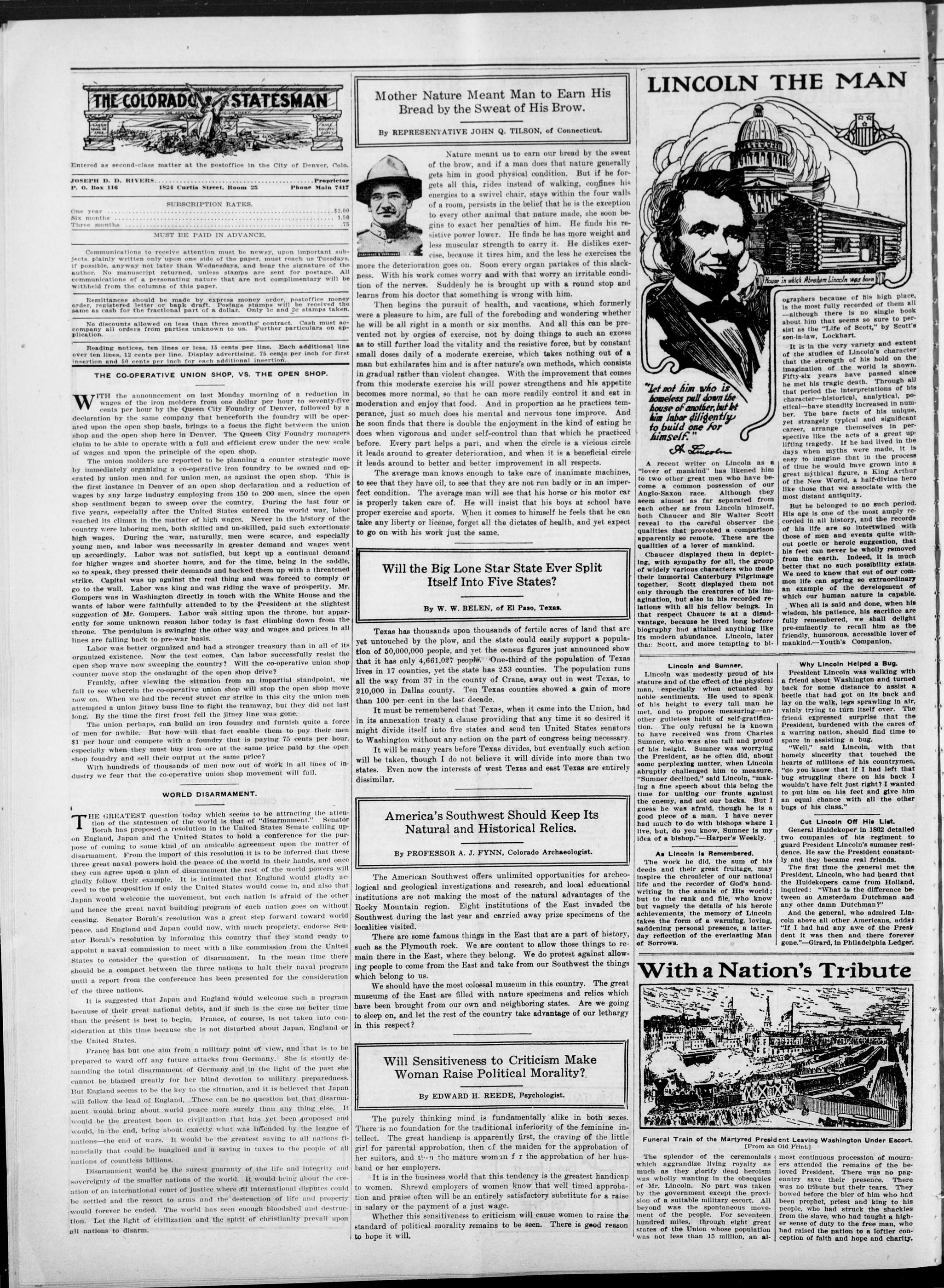
LINCOLN THE MAN
House in which Abraham Lincoln was born
ographers because of his high place, is the most fully recorded of them all—although there is no single book about him that seems so sure to persist as the "Life of Scott," by Scott's son-in-law, Lockhart.
It is in the very variety and extent of the studies of Lincoln's character that the strength of his hold on the imagination of the world is shown. Fifty-six years have passed since he met his tragic death. Through all that period the interpretations of his character—historical, analytical, poetical—have steadily increased in number. The bare facts of his unique, yet strangely typical and significant career, arrange themselves in per-spective like the acts of a great uplifting tragedy. If he had lived in the days when myths were made, it is easy to imagine that in the process of time he would have grown into a great mythical figure, a King Arthur of the New World, a half-divine hero like those that we associate with the most distant antiquity.
A recent writer on Lincoln as a "lover of mankind" has likened him to two other great men who have become a common possession of our Anglo-Saxon race. Although they seem almost as far separated from each other as from Lincoln himself, both Chaucer and Sir Walter Scott reveal to the careful observer the qualities that provoked a comparison apparently so remote. These are the qualities of a lover of mankind.
But he belonged to no such period. His age is one of the most amply recorded in all history, and the records of his life are so intertwined with those of men and events quite without poetic or heroic suggestion, that his feet can never be wholly removed from the earth. Indeed, it is much better that no such possibility exists. We need to know that out of our common life can spring so extraordinary an example of the development of which our human nature is capable.
Chaucer displayed them in depicting, with sympathy for all, the group of widely various characters who made their immortal Canterbury Pilgrimage together. Scott displayed them not only through the creatures of his imagination, but also in his recorded relations with all his fellow beings. In that respect Chaucer is at a disadvantage, because he lived long before biography had attained anything like its modern abundance. Lincoln, later than: Scott, and more tempting to bi-
When all is said and done, when his wisdom, his patience, his sacrifice are fully remembered, we shall delight pre-eminently to recall him as the friendly, humorous, accessible lover of mankind.—Youth's Companion.
Why Lincoln Helped a Bug.
Lincoln and Sumner.
President Lincoln was walking with a friend about Washington and turned back for some distance to assist a beetle that had got on its back and lay on the walk, legs sprawling in air, vainly trying to turn itself over. The friend expressed surprise that the President, burdened with the cares of a warring nation, should find time to spare in assisting a bug.
Lincoln was modestly proud of his stature and of the effect of the physical man, especially when actuated by noble sentiments. He used to speak of his height to every tall man he met, and to propose measuring—another gulleless habit of self-gratification. The only refusal he is known to have received was from Charles Sumner, who was also tall and proud of his height. Sumner was worrying the President, as he often did, about some perplexing matter, when Lincoln abruptly challenged him to measure. "Sumner declined," said Lincoln, "making a fine speech about this being the time for uniting our fronts against the enemy, and not our backs. But I guess he was afraid, though he is a good piece of a man. I have never had much to do with bishops where I live, but, do you know, Sumner is my idea of a bishop."—Harper's Weekly.
"Well," said Lincoln, with that homely sincerity that touched the hearts of millions of his countrymen, "do you know that if I had left that bug struggling there on his back I wouldn't have felt just right? I wanted to put him on his feet and give him an equal chance with all the other bugs of his class."
Cut Lincoln Off His List.
General Huldekoper in 1862 detailed two companies of his regiment to guard President Lincoln's summer residence. He saw the President constantly and they became real friends.
As Lincoln Is Remembered.
The work he did, the sum of his deeds and their great fruitage, may inspire the chronicler of our national life and the recorder of God's handwriting in the annals of His world; but to the rank and file, who know but vaguely the details of his heroic achievements, the memory of Lincoln takes the form of a warming, loving, saddening personal presence, a latter-day reflection of the everlasting Man of Sorrows.
The first time the general met the President, Lincoln, who had heard that the Huldekopers came from Holland, inquired: "What is the difference between an Amsterdam Dutchman and any other damn Dutchman?" And the general, who admired Lincoln above all other Americans, adds: "If I had had any awe of the President it was then and there forever gone."—Girard, in Philadelphia Ledger.
With a Nation's Tribute
Funeral Train of the Martyred President Leaving Washington Under Escort. [From an Old Print.]
The splendor of the ceremonials which aggrandize living royalty as much as they glorify dead heroism was wholly wanting in the obsequies of Mr. Lincoln. No part was taken by the government except the provision of a suitable military escort. All beyond was the spontaneous movement of the people. For seventeen hundred miles, through eight great states of the Union whose population was not less than 15 million, an al-
most continuous procession of mourners attended the remains of the beloved President. There was no pageantry save their presence. There was no tribute but their tears. They bowed before the bier of him who had been prophet, priest and king to his people, who had struck the shackles from the slave, who had taught a higher sense of duty to the free man, who raised the nation to a loftier conception of faith and hope and charity.
-COLORADCNS AA STATES!
NE COLURADN 4) oe
ase Re tt eX
Ea et ———— Tose]
ni eiareg a oe Dey in ae gp a
ey OTL, ThE AP Raabe 2 eos
a ee Paes
Mr, and Mrs. R. K, DePriest, who] The Colorado Literary and Soe
have been suffering with severe colds, | Union will hold its regular month
are able to be out. meeting at the Y, W. C, A. Twen
——- fourth and Welton streets, Frid
Mrs, Isabel Stewart and gister, Mrs, | evening, Feb. 11, at whieh time t
yoater-were numbered among the sick | Lincoln and Dougiass celebration: ¥
lust week, be held, DR, C.F. HOLMES, Pres
MRS, E, J, WOODS, See.
We are pleased to note the Improve- Site
ment of little Nathan Brown, after an Hail the Bon Viviant! For ely
attack of pneumonia, may ‘come and clubs may go, DM.
ae glorious old Bons go on forever. A
i they shone forth in full radiance t
Reker has purchased a new | yfonday night on the oceasion of th
five-passenger sedan with whieh be fiwentieth anniversary dinner, xiven
intends to enter the tax! service, the residence of Mr, and Mrs, Geo.
ae Gross, 1627 East 22nd Ave. Eve
Mr. Martin Payne is slightly im- member was present and entered it
proved from an operation for appendi- | the spirit of the occasion with a vi
citis, which was performed about two | Club songs and witty toasts predo1
weeks ago. nated the evening's program, Ches
A good time with good music and
a fine program will be served for $1
per plate at the Banquet of Pythias
Lodge No. 11, K. of P., on Thursday
evening, Feb. 10, at Dania hall. Ail
persons holding tickets for the pre-
vious date will be honored.
Mr. and Mrs, Emmett Williams will
he pleased to receive their friends at
their new home at 3321 Williams
street.
Mrs. Marguerite Alsop, who has been
visiting for four months In California
and Utah, returned home last Tuesday.
Mr. James Cantey, member of firm
operating Elite Drug Stores, Is quite
il at his residence, 2250 Washington,
with pneumonia.
Mr, and Mrs. Clifford Jackson, for-
merly of 2537 Curtis street, are now at
home to their friends at 3829 Wil-
liams street.
‘The infant son of Mr. and Mrs. W.
E. Mayo of 3725 Williams street, is
slightly Imporved after a serious at-
tack of pneumonia.
Frank Hall, our esteemed townsman,
who is making good on his ranch near
Boulder, dropped in on business last
week and stayed for three days. Come
again, Brother Hall, as we are always
glad to see you.
Miss Naomi Brown, one of our tal-
ented young ladies, who has taken up
a position at Colorado Springs, spent
the week end with relatives and
friends, returning last Monday morn-
ing. Miss Brown in her usual manner
speaks very commendably of “Little
London.”
George W. Brooks, a first-grade fire-
man of Hose Co. No. 3, was appointed
lieutenant, Monday, by Manager of
Safety and Excise Downer on recom
mendation’ of the Civil Service Com-
mission, The appointment takes effect
immediately.
“What the Negro Wants,” “What he
has," and “what he is endeavoring to
get,” will be clearly told the people of
Denver by Hon. James D. Brooks of
the Universal Negro Improvement As-
sociation. Let all Negroes welcome
this eminent scholar who will tell us
about the Black Star Line Fleet of
Ships and Negro Factories owned by
Negroes. Feb, 27 to March 9, inc.
Mr, R. B, Bolden, the popular ton-
sorial artist and proprietor left
Denver ‘Thursday for a twa
months’ vacation. He will visit Los
Angeles and other cities on the coast
while out west.
Mr, Preston Tinsley, one of Oakley,
Kansas, most prosperous farmers and
financiers, is the guest of his sisters,
Mrs, Jean McWilliams, and Mrs, Na-
than Brown, on Williams street. Mr.
Tinsley plans to return to his home
about March 1st, after an indefinite
visit with his niece, Mrs. Stella Brown
Cloman, formerly of this city, now liv:
ing in Chicago.
The Banquet of Pythias Lodge No.
11, K. of P., which was postponed ow-
ing to the death of Grand Chancellor
C. 8, Muse, is positively announced for
Thursday evening, Feb. 10, at Dania
hall, Good music, interesting program
and plenty to eat, all for $1 per plate.
Mountain Lodge No. 39, 1. B. P. 0.
, of W. had an jnitiation ceremony
last week Wednesday evening. Quite
a large attendance and an elaborate
luncheon served by the Bliss’ caterer,
Prof, Jackson, offer positive indica-
tions that this fraternal society is
making much progress in our commun-
ity, Who will be the next Elk?
The Colorado Literary and Social
Union will hold its regular monthly
meeting at the Y, W. C, A. Twenty:
fourth and Welton streets, — Pridity
evening, Feb, 11, at whieh time the
Lincoln and Douglass celebration will
be held, DR. C, F, HOLMES, Pres.
MRS. KE. J. WOODS, See.
Hail the Bon Viviant! Fer clubs
may come and clubs may go, but, the
glorious old Bons go on forever. And
they shone forth in fall radiance last
Monday night on the occasion of their
twentieth anniversary dinner, given at
the residence of Mr. and Mrs, Geo. W.
Gross, 1627 East 22nd Ave. Every
member was present and entered into
the spirit of the occasion with a vin,
Club songs and witty toasts predomi-
nated the evening's program, Chester
Stell served as master of ceremonies in
elegant style and a forceful address
of welcome was delivered by Dr. 'T. E.
McClain.
The Knights of Pythias Banquet of
Pythias Lodge No. 11, promises to be
the hit of the season when all the
members and their friends assemble
at Dania hall next Thursday, Feb. 10.
All branches of the Order are invited
and it is hoped Pythians will on this
oceasion, as in the past, prove them-
selves worthy of their name and worth.
The Self Improvement and Social
Service Club scored a great triumph in
the dancing party given at Fern hall
last Wednesday night. For years the
Self Improvement Club has stood in
the fore rank as ap organization of
distinct merit and class. Generous in
its charities and benefactions, ever
alert and eager to do some good turn
it has won a name for itself that all
Colorado loves to honor. The dancing
party of Wednesday night brought out
a host of loyal friends, beautifully
gowned ladies and well groomed gen-
tlemen. ‘The hall was daintily and
prettily decorated in a rare mixture of
baby blue and white and the soft glow
of the shaded lights lent a weird, fan-
tastie charm that suggested a fairy
land. The club members held a re-
ceiving line for one hour, headed by
the president, “Mrs. J. H: P. West-
brook. The whole affair was delight:
ful and will live long in the memories
of every one present.
LINCOLN-DOUGLASS BANQUET BY
THE DENVER COLORED CIVIC
ASSOCIATION.
The greatest event of the season
will be the annual banquet of THE
DENVER COLORED CIVIC ASSOCT-
ATION on the evening of Feb. 12, at
SHORTER A. M. B. CHURCH, in
‘memory of Lincoln and Douglass. The
program will be rendered by Denver's
best talent of young men who are the
most eloquent orators in the West.
‘The program will be published in
the next issue of the Colorado States-
man, The quartet of the association
is preparing to entertain their guests
with the most stirring an inspiring
musie of the day.
All who expect to attend the ban-
‘quet will please notify the secretary,
‘Mr, R. W. Chapman, 2140 Humboldt
street, Tickets are $1.50 per plate and
‘te sale of same will be closed at 6
p.m, Feb. 9, 1921.
‘The banquet committee, Messrs.
Thos. L. Williams and Wm. R. Russ,
propose to set the pace for Denver for
Whi agence
| NEGRO CO-OPERATION.
Hear the Hon, James D. Brooks of
New York on the development of the
Universal Negro Improvement Associ-
ation and the success of the Black Star
Line Steamship Co., owned and oper-
ated by Negroes, The speaker will be
here from Feh. 27 to March 9, inc.
SCOUT NOTES.
Scoutmaster Spriggs __ registered
‘Troop No. 54 of Campbell A. M. E
Church. Mr. Spriggs is a faithful
‘Scout worker. The committee apprecl-
ates: his effort.
Boys of Mount Pleasant Baptist
Chureh are planning a troop organza:
‘tion. Speed up, boys, and get in the
ranks.
‘Phe drum corps meets every ‘Tues
day evening at Y. M. C. A, 7:80.
‘Troop 58 display for Scout week will
‘be at Welton Public Market all the
week.
| ‘Troop 50 display at Atlas Drug Store
and Granberry Taxi Company all the
week.
| Scout prizes at Colored American
| Realty Company.
CAMPBELL A. M, E. CHURCH.
Corner Twenty-third and Lawrence
Streets, Rev, I. S. Wilson, Pastor.
Res, 2331 Arapahoe St. Ph, Main 1314,
10:00,.m,—Sunday School.
1100.8, m.—General class,
6:20 p.m.—Christian Endeavor.
7:80 p. m.—Preaching,
Mid-Week Meetings.
Monday, 8 p. m., Trustee Board.
Wednesday, 8 p.m, Prayer and
| Class.
| ‘Thursday, 8 p.m. Willing Workers.
| Last Sunday morning, Dr. Lowe, a
missionary minister of the Baptist
| Chureh, preached a noble sermon to a
large congregation, taking his text
from Ephesians 6 :11-14,
‘The new parsonage at 2331 Arapa-
hoe is now all fixed up, and Rev. and
| Mrs. Wilson are rendy to receive vis-
itors,
Beginning with the third week of
this month a two weeks’ revival will be
had at Campbell.
More details next week.
NOTICE TO STOCKHOLDERS OF
THE ROCKY MOUNTAIN LODGE
MASONIC TEMPLE ASSOCIA-
TION:
A special meeting will be held Wed-
nesday, March 2, 1921, at 8 o'clock p.
m., 2745 Welton street, for the purpose
of legal dissolution of the old corpora:
tion, and calling in all outstanding
stock, which will be transferable to the
new corporation or paid for in cash as
the stockholders mad desire.
JAMES C. COOPER,
WM. SPRAGUE, President.
Secretary
The Annual Banquet of Pythias
Lodge No. 11, K. of P., Feb. 10, at
Dania hall, is among the social fea-
tures on the calender that is looked
forward to by the public. A good treat
is in store for those who attend. One
dollar per plate. All persons holding
tickets for previous date will be hon-
ored.
REPORT OF ANNUAL MEETING.
‘The Cammel Undertaking Company,
Inc., met at its headquarters 2418 Wel-
ton’Street, Denver, Colo., on the 17th
day of January, 1921, being the ad-
journed date for regular meeting, and
90 per cent of the stock of said com-
pany was represented at said meeting.
‘The report of President and Man-
ager for the year ending Dee. 31, 1920,
was read and showed cash business
amounting to $15,559.81, with a sub:
‘stantial balance on hand. A dividend
‘of 6 per cent upon all stock fully paid
Dec. 81, 1920, was declared payable
Mareh 1, 1921.
In addition to the dividend of 6 per
cent the company has been able to es:
tablish a first-class plant at Pueblo
which is operating and doing a satis-
factory business.
Tt was voted to place on the market
850 shares of stock for a period of 60
days at $15 per share, the proceeds to
be used in the purchase of a new up:
to-date hearse and other equipment
that will add to the efficiency of both
plants,
‘This corporation has demonstrated
in one year that our group ean operate
successfully a corporation. Remember
that in the purchase of stock of the
Camme! Undertaking Company you are
not only helping the race but making
an investment that will insure the in-
vestor a substantial income.
E. V. CAMMEL,
S. B. CARY, President.
‘Manager.
OBITUARY.
Mrs. Ella Lovett Butler-DeNeal, old-
est daughter of the late Aliff and Car-
oline Butler, also widow of the late
Churchill Thomas DeNeal, was born
in Fredericksburg, Va., July 6, 1860,
and departed this life, Thursday morn-
ing at 12:45 a, m,, January 27, 1921.
She was wedded to Churchill Thomas
DeNeal Mareh 19, 1885, and came to
Denver, Colorado, April 2 of the same
year, and has resided in this city prac-
tically ever since.
‘To this union five children were
born, three of whom survive, They are
Mrs. Katherine C. Johnson of Los An-
-geles, Calif.; Mrs. Dorothy A, Hooper
and Mrs. Eleanor V. Mayo, both of this
city. Mrs, DeNeal was a home loving
wife and a true Christian mother.
She leaves to mourn her loss three
daughters, three grandchildren, a bro-
ther in Washington, D. C., two cousins
and a host of friends and acquaint-
ances,
“May she rest in peace.”
CARD OF THANKS.
We desire to thank our many friends
for their acts of kindness during the
‘illness and death of our sainted moth-
ia also for the beautiful floral offer-
ings.
(Sfznea)
| MRS. KATHERINE ©, JOHNSON,
MRS. DOROTHY A. HOOPER,
| MRS. ELEANOR V, MAYO.
One of our greatest orators, Hon.
James D, Brooks, will delight the. peo-
ple of Denver with addresses on the
program of the New Negro for his
place in the sun. Feb. 27 to March 9,
inc.
FUNERAL NOTICES OF DOUGLESS
UNDERTAKING CO.
Ennels—Malinda, 52. years: beloved
mother of Horace’ Bnuels, 2702 Cali-
fornia Street, departed this life Jan.
27. Funeral’ services were held 1:30
p. m, Wednesday, Beb, 2, from Doug-
lass Chapel, Interment, Riverside.
The Biggest Vault Door
°
Tn in the est
1 ‘
=
pipet? The new SAPE DEPOSIT VAULT of The First
ZZ ifn / National Bank is now ready for the installation of
Afi URST the largest rectangular safe deposit vault door in |
BT) NATION the entire West. In fact, there is only one other
ties! ( door of similar type as large as this in the United
| rem ’
rt ll @ The door, in conneetion with the massively-built
walls of the vault itself, confers upon The First
Wits 2 eal National SAFE DEPOSIT BOX DEPARTMENT a
HA 3) degree of protection hitherto undreamed of in this
44 Nesermninrtisc section of the country. For that matter, there is
a nothing in New York or Chicago to excel it; pos-
JERSE sibly none to equal it.
=
© One has to revise ordinary ideas of size in consider-
z, ing the magnitude of this great portal. It weighs
The new safe deposit approximately 60,000 pounds ; thirty tons of chrome
vault door is the lat- steel, easily capable of withstanding the utmost
est product of The excess of fire or fraud, burglary or banditry, riot
Mosler Safe Co. of or revolution,
Hamilton, Ohio, and ete ar ‘ ieee 7 Naik
: . is one of the most costly pieces of mechanism
es ne of Bee y ever brought to Denver, but the record of this bank
as well as strength. for over half a century shows that cost is of no
It will face the broad consequence here when considering SAFETY and
staircase which de- SERVICE for our patrons
scends directly to the
vaults from the main @ Make your reservations now for boxes in this new
lobby department, which will be opened for use MARCH
; FIFTEENTH. Boxes of all sizes at reasonable
rentals. The safety is absolute
a SieYyy |
gist) irst National B
The First National Bank
Ty of Denver, Colorado
Seventeenth Street at Stout
DEATHS AND FUNERALS; THE
CAMMEL UNDERTAKING CO.
Hartnett—Master A. J. Hartnett,
the beloved 15-year-old son of Mr. and
Mrs, A. Jo Hartnett of 2911 Welton
streag departed this life Saturday, Jan.
29, at the residence of the parents.
The funeral services were held from
Central Baptist. Church, Wednesday,
Feb, 2, at 2 p.m, Rey. P. J. Price of-
ficiated. Interment, Fairmount.
‘Thomas—Master “John L. ‘Thomas,
the beloved son of Mr. and. Mrs. J. 1.
‘Thomas, formerly of French Lick, Ind.
departed this life Tuesday, Feb. 1, at
their late residence, 909 Bast 25th Ave.
‘The remains were forwarded to French
Lick, Ind., Wednesday, the 2nd, accom:
panied by the parents.
Shaw—Mr. Ben Shaw, the beloved
hushimd of Mrs, Marie Shaw, departed
this life at his late residence, 2256
Washington setreet, Wednesday, Feb.
2, ‘The funeral services will be held
from Mt, Pleasant Baptist Chureh,
Sunday, Feb. 6.
Buford—Baby Ethel Buford, the in-
fant daughter of Mr. and Mrs. Bu-
ford of 508 24th street, departed this
life at a local hospital Wednesday,
Web. 2. Funeral services were held
Friday, Feb, 4, Interment, Riverside.
CHEYENNE, WYO.
NEWS
Quiet and more peaceful is our city
than it has been for many moons. The
natives are attending church services
on Simday and reading the Bible dur-
ing leisure hours. Tn vain has the re-
porter tried to find somewhere a sen-
sation could be raised. For once dur-
ing many moons Cheyenne don't
amount to much, Everybody who we
have reported ill are improving. Those
who are well are going to try to stay
well, ‘Those who have not behaved
well are behaving like they should.
Society matrons are not entertaining
at cards or pink tea. Several men are
idle, but still have their liberty and
Victory bonds, besides « hank account,
so they stand on the corners and watch
the “mud hens.”
IN MEMORIAM.
In loving memory of my dear son
and our brother, ©. W. Pearson, who
departed one year ago, Jun. 28th,
Gone but not forgotten, But, oh, how
we iiss you from our home. We are
sitting all alone since you have de:
parted, and in our hearts there comes a
longing for you, wishing we could see
you once more, if you only could
come home, héw our hearts would re-
joice. But our loss was heaven's guin.
Mrs. Susannah, Pearson, Mother.
Mr. John H. Pearson and Mr. George
AM. Pearson, brothers.
Miss Ella and Emma Pearson, sts-
ters.
| For Rent—Two nicely furnished
rooms in strictly modern house, at
2218 Clarkson street.
For Rent—Three-room frame house,
close in; reliable colored people;
cheap. 1183 Lincoln St. (Rear.)
ATTEND THE
FATHERS’ MOTHERS’ AND SONS
Shorter Church, Monday
Night, Feb. 7th, at 7:30
Under the auspices of the Boy Scouts and Boys
of the Y. M. C. A. Department.
TICKETS 75 CENTS PER PLATE.
DN
Y. M,C. A. NOTES. EE
The debate last week was very in-
teresting. Counsellor Cary and) Mr
‘Townsend upheld the affirmative, and
Messrs. Leroy Perkins and Jenkins
defended the negative, No decision
was rendered.
‘A strong meeting will be held to-
morrow (Sunday) afternoon at the
“y" building. ‘The program will be
unique and interesting and informing
Counsellors Blakemore and Cary, and
Messrs. Gross, ‘Thomas Campbelt, Dr
Westbrook will speak on the danger
ous bill now before the State Legisla
ture to limit the Negro’s rights and
privileges under the state constitution
‘The program will begin promptly at 4
o'clock. Good inusie will feature the
program. ‘The entire public is urged
fo come out and hear how their full
rights are being threatened.
: pe
a
e =
hs
. le
of Bee
a
aye eet ana
a a
See wa 2
HARVEY G. WEBSTER
PATRIOTIC
SHOE SHINING PARLOR
1526 Welton St Phone Main 2196
Veta
EF
SE course IN
HAIR“BEAUTY
CULTURE
MAILED FREE UPON RECEIPT
of YOUR NAME 4% ADDRESS
"SEND NO MONEY"
THE OZONIZED OX MARROW CO.
46 W. KINZIE ST. CHICAGO,ILL.
IS BACK IN DENVER AGAIN
Madame Hinger, English-
Egyptian Palmist and Clair-
voyant, is now permanently
located at
1834 CURTIS STREET
Special readings all _ this
week. If in trouble don’t
fail to consult her.
YoU COULD WELL AFFORD TO BUY
AN OVERCOAT
in midsummer, and yeu would nd it a good invest-
ment at this price—
$24 for values up to $60
100 ef them sent to as by Adler, Milwashes, maker
at cattegian: Clothes for men, who. billed ts. these
Overceats. at consideraly "iss “than Ont-bait the
Season's pres.
Wichaalsews.
45th and Larimer Streets
——$$—————————————
NOTICE.
The Universal Negro improvement
Association and African Communities
League meets every first and third
Tuesdays in the month at 609 Twenty-
seventh street, 8:15 p.m. sharp. Visi
tors welcome.
EDWARD ©, DAVIS, Secretary.
X
OUSE Resolution 621, introduced by Representative James Gideon Monahan of Wisconsin, authorizes the painting of a full-length portrait of Abraham Lincoln and the placing of it in the hall of the house of represen-
HOUSE Resolution 621, introduced by Representative James Gideon Monahan of Wisconsin, authorizes the painting of a full-length portrait of Abraham Lincoln and the placing of it in the hall of the house of representatives. If Mr. Monahan's resolution goes through, the portrait painter selected to make the portrait may well feel proud over his selection. But few real artists will be envious of him.
For Abraham Lincoln was so many kinds of man that his physical body produced widely differing impressions, even upon those accustomed to his presence and familiar with the many-sidedness of his character. Moreover, the whole civilized world has now come to revere and love the name of Lincoln and will be satisfied with nothing less than a great achievement by the painter of this portrait.
This is the moral of the recent controversy over the statue of Lincoln erected in London. It will be remembered that the British government set apart a site related to the house of parliament and Westminster Abbey for this statue. A controversy arose over the choice between two statues. The plain truth is that there was a feeling that one of these statues fell far short of doing Lincoln justice. The British government asked the United States department of state to settle the controversy. The department of state referred the question to the commission of fine arts. The commission reported to the British government that the "man and site call for a statue representative of the highest achievement of the American sculptor" and advised Great Britain that "such is the statue of Abraham Lincoln executed by Augustus Saint-Gaudens and erected in Lincoln park, Chicago." The British government accepted the report of the commission.
The world does not want a handsome Lincoln, but it does insist upon an impressive Lincoln and will tolerate no suggestion of the grotesque or the inefficient.
Lincoln well knew the wide variation of impressions his appearance and actions produced. No doubt he grieved over it. But his philosophy rose superior and his course was set according to his declaration:
"If I were to try to read, much less answer, all the attacks made on me, this shop might as well be closed to all other business. I do the very best I know how—the very best I can; and I mean to keep on doing so until the end. If the end brings me out all right, what is said against me won't amount to anything. If the end brings me out wrong, ten angels swearing I was right would make no difference."
This variance of impression produced by Lincoln upon even the same beholder is well illustrated by what Col. Richard J. Bright, long an official of the United States senate, once said:
"No sculptor has told the story and no artist has recorded the drama-comedy-tragedy revealed in the features of that meteor of humanity and spirituality which flashed its brightest iridescence on the field of Gettysburg.
"I saw Abraham Lincoln when I believed him to be the homelost creature in human form ever permitted to cumber this earth by walking and talking with the statesmen of our republic.
"I saw Abraham Lincoln on the platform engaged in earnest discussion of then current topics and I believed him to be the most forceful character ever
Had Business Further On
Had Business Further On
Truck Driver Evidently Couldn't Wait to Learn Just What Mammy Intended to Do.
She was a buxom mammy. She was crossing Broadway at Reade street, moving slowly. She waited for a surface car to pass. Engrossed in her thoughts, she started on again to cross the rest of Broadway and stepped directly in the path of a motortruck.
LINCOLN Many Kinds of Man
Abe Lincoln
known in the American political arena.
"I saw Abraham Lincoln keyed up to righteous wrath on the subject of human slavery and I regarded him as a singularly lofty demon of immense proportions, stirring strife between the sections of our sacred union of confederated states.
"I saw Abraham Lincoln administering justice in military and naval affairs, when he seemed to be a composite incarnation of Julius Caesar and the hero of Trafalgar.
"I saw Abraham Lincoln in the White House tenderly offering to a mother mercy for her condemned son, sentenced to death by court martial; saw him revoking the doctrine of 'an eye for an eye and a tooth for a tooth,' substituting for it the new commandment 'that ye love one another,' and I believed his face to be the most awelinspiringly beautiful cameo ever cut by Almighty God to demonstrate that Omnipotence had 'created man in His own image,' and then sent His Son to say concerning mortal man:—Father, forgive them, for they know not what they do."
"Future generations cannot see Abraham Lincoln in marble, in bronze, nor on canvas, for no human being can portray him with chisel nor with brush."
If the time, place and occasion of this proposed portrait of Lincoln were left to a vote of the American people, what would it choose? There certainly is a wealth of suggestive occasions.
Take, for instance, the debates of 1858 between Lincoln and Douglas, on which in reality the fate of the nation largely hung. Vice President Marshall, when a boy of four, heard the Freeport debate and was on the platform. He says:
"While Mr. Lincoln was talking I sat on the knees of Senator Douglas, and he never said one word to me; just held me. When it came his turn to talk I sat on the knees of Lincoln. He asked my name, my age, where I lived, whether I knew my A, B, C's, whether I had a puppy dog or not, and all sorts of questions of a kind to interest a little boy."
At the Charleston debate Douglas made the mistake of indirectly accusing Lincoln of disloyalty by referring to the old story that he had voted against appropriations for the soldiers in the war with Mexico. Sitting on the platform as chairman of the Douglas committee was Colonel Orlando B. Flicklin. As soon as it came his turn to speak Mr. Lincoln grabbed him by the shoulders, dragged him to the front of the platform and shouted to the audience:
"I am not going to hurt Flicklin, but I am going to make him tell the truth to this audience about that ten-year-old lie which Judge Douglas has brought up again. Flicklin was a member of congress when I was, he knows the truth, and he must tell it."
Take the occasions of Lincoln's farewell to his Springfield neighbors when he left for Washington to assume the presidency.
Take the occasion of Lincoln's second inaugural, when he uttered the words: "With malice toward none, with charity for all, with firmness for
The truck driver emitted a startled yelp of warning and threw on his brakes hard.
Mammy had resources of speed. With amazing agility she leaped toward the curb, just clearing the front wheels of the truck.
The truck driver leaned over with a bawling: "Hey, you—"
Mammy whirled on him. "Yo' low-down no 'count trash. Whafoo yo' mean tryin' to hit me, yo' wuuffless white man? Ah'll—"
What she would do nobody knows.
O
the right, as God gives us to see the right."
But in all probability Lincoln at Gettysburg touched his highest with the written and spoken word. it was a great assemblage of the wisest and best of the nation. Edward Everett, statesman, patriot and orator, was the speaker of the day. He delivered a long, eloquent and notable address. Then President Lincoln arose and said just 257 words.
Those 257 words were not appreciated at the time. They were drowned by Everett's flood of eloquence. Today Everett's oration is known only to students. Today Lincoln's 257 words have been committed to memory by the world.
Do not think for one minute that Lincoln's Gettysburg address was a happy incident. His letters, his debates, his speeches—all his papers—proclaim his mastery of the written and spoken word.
Nevertheless, Lincoln's Gettysburg address is in a sense the sublimation of all that he wrote and said. It is the utterance of a great soul aroused to expression by a great occasion. It touches the heart. It satisfies the brain. It is Abraham Lincoln himself.
Lloyd George, in his tribute to Lincoln at the unveiling of the Lincoln statue last August near Westminster Abbey, used these words:
"I am not sure that you in America realize the extent to which he is also our possession and our pride. . . . In his life he was a great American. He is an American no longer. He is one of those giant figures, of whom there are very few in history, who lose their nationality in death. They are no longer Greek or Hebrew or English or American—they belong to mankind. I wonder whether I will be forgiven for saying that George Washington was a great American, but Abraham Lincoln belongs to the common people of every land." True, but wordy! The same thing was said better long ago.
There was a great lawyer who despised Lincoln, who had reviled and insulted him. But Lincoln knew his ability and his patriotism and took him into his cabinet as his war secretary. The man entered the cabinet, expecting and intending to run the government. Truly had Lincoln said, "with a task before me greater than that which rested upon Washington." That task was to prevent the Union from splitting in twain, to bring back the seceding states by force of arms, and to reunite a divided country half slave and half free.
How Lincoln accomplished a part of that task we all know. In 1865 Lee surrendered at Appomattox and the armed resistance of the Confederacy was at an end. And during those four momentous years this war secretary, who had despised and reviled and insulted Lincoln, had quickly come to appreciate and love Lincoln and to obey him.
Six days after Lee's surrender at Appomattox Lincoln's further accomplishment of his task was cut short by the assassin's bullet. And as Abraham Lincoln's eyelids closed in death his great war secretary, Edwin M. Stanton, stepped forward and spoke the proved judgment of humanity: "Now he belongs to the ages."
Nobody will know. She started, but the truck driver started first. Mammy's big jump showed him. He shot the truck up Broadway, leaving mammy glaring like an ebony Nemesis.—New York Evening Sun.
Allikeness In Unlike Things.
Watches and rivers seldom run long without winding.
Genius Blazed In Age.
Goethe was more than eighty when he wrote the second part of "Faust."
WASHINGTON SIDELIGHTS
Temporary Bar Against Foreign Goods
Congress May Reduce Naval Estimate
Congress May Reduce Naval Estimate
Gen. Crowder's Difficult Errand in Cuba
UNIFY THE WAR RISK INSURANCE, VOCATIONAL EDUCATION THE PUBLIC HEALTH SERVICE
WASHINGTON.—The present system of rehabilitating disabled war veterans is denounced by the American Legion as a "failure" which should be remedied by consolidating under a single head the three government agencies now engaged in that work.
The Legion memorial asserts that the function of the three agencies—the bureau of war risk insurance, the federal board for vocational education and the United States public health service—"must be co-ordinated, their machinery decentralized, and all three placed under the common control." "To do this," the memorial says, "there must be a new law which shall place the unified organization under
TO PREVENT the United States from becoming a dumping ground for foreign goods before a new tariff bill can be perfected, a move is developing in congress for re-enactment of the Payne-Aldrich tariff law as soon as possible after March 4.
The plan is to use the Payne-Aldrich law as a temporary dike against the flood of foreign goods that Europe is preparing to rush into American markets now unprotected. Those who foster the movement propose that the old law should be re-enacted only as an emergency barrier, to remain effective until the Fordney-Penrose tariff can be made law, probably late in the summer.
Representative Watson of Pennsylvania is one of the supporters of this plan, and he has been gaining converts to the idea rapidly.
Consideration of the new tariff thus far finds Republican members of the house ways and means committee in complete accord in favoring ample protection for chemical industries which gained a foothold in the United States during the war. In the recent hearings Schedule A of the tariff law, relating to chemicals, oils and paints, was discussed. In the hearings on the chemical
TO CONGRESS REDUCE THE NAVAL ESTIMATE WORK-REDUCTION SHOULD BE MADE FROM THE BOTTOM
REPRESENTATIVE Kelley of Michigan, chairman of the house naval subcommittee on appropriations, after a conference with President-elect Harding, will propose to the committee a 40 per cent cut in the naval estimate for ship construction.
Representative Kelley said he was giving his own views and made no attempt to reflect the opinions of the President-elect, but declared he thought the policy should be to gradually complete the naval building program of 1916, but with a view to proportionate disarmament of the nations. "The coming year in my opinion," he said, "should be a normal, healthy, naval building year. The navy is asking for $184,000,00 for new ships
HOW to accomplish deflation without precipitating a financial crash, a possible revolution, or American intervention, is the Cuban problem confronting Gen. Enoch Crowder, who was sent there by the United States to straighten out Cuba's tangled political and economic affairs. The Cubans have great confidence in General Crowder. The Menocal administration professes deep distrust of the schemes for Cuban financial reform. These schemes are alleged to favor absorption of the toterting Havana banks by Wall street financial interests and the consequent profits of millions by them from Cuba's distress.
Cuba owes her present financial troubles largely to speculation in sugar when the world shortage was accentuated through the hoarding by profiteers, which sent the price of sugar to 18 cents per pound on New York docks. Cuban planters and mill owners reaped fortunes overnight, but this only whetted their appetites, and they formed a combine which was pledged to withhold 1,000,000 bags of sugar from the market until the price should go to 28 cents or more. In the meantime the speculation bubble burst and the Cubans woke up
control of a single administrative head." For this new organization the Legion asks an appropriation sufficient to buy, build, equip and enlarge hospitals sufficient to provide facilities for all the men now under hospital treatment. Bills providing for this have been introduced in both houses of congress at the behest of the legion. The memorial says the United States has been more liberal than any other nation in its provisions for the disabled soldiers, but that it had failed in a large measure to make these provisions available. This is attributed to "an astonishing state of divided responsibility and wasted effort among the government agencies.
"In the rehabilitation of a disabled man there are three needs—medical treatment, vocational training and financial support," the memorial proceeds. "The government has recognized the three needs, but overlooks the fact that they are the simultaneous needs of a man, not of three different men or of one man at three different times. It makes three problems out of what really is one three-part problem."
PAYNE ALDRICH LAW FOREIGN GOODS
schedule a change in the basis of valuation in calculating ad valorem rates of duty was urged. Henry Howard, chairman of the executive committee of the Manufacturing Chemists' Association of the United States; Nathan M. Clark, representing the Pyroxolin Manufacturers' association, and also a number of others, proposed that the domestic value rather than the foreign value be taken as the basis of any rates that are in any way regulated by the value of the imported article.
Representative Fordney, chairman of the committee, and other Republicans on the committee showed a decided sympathy with this reversal of the policy which has been in effect for more than a century.
alone—something more than thirty, including six battle cruisers, ten battle-ships and ten scout cruisers. As this work goes forward now the navy is spending about $7,000,000 or $8,000,000 a month. This rate, I believe, is rapid enough to carry on the necessary construction, and about $100,000,000 ought to be enough to carry out the building program.
"I told Senator Harding that in any discussion of the reduction of armament I could not see how we could avoid building these ships, for it would cost as much now to discontinue building as it would to finish the job."
Representative Kelley said proportionate armament reduction "should be made off the bottom."
"We should abandon the old ships and old guns," he said, "in any disarmament scheme. Every nation will keep its new weapons."
Disarruement is scheduled for lengthy Discussion in both branches of congress In the senate the foreign relations committee will resume consideration of the Borah and Walsh resolutions for naval disarmament.
to find that their sugar spree was over. The sugar and related industries which had ordered large amounts of machinery and supplies from America C. O. D., now were unable to pay for the goods and the docks and wharves soon were plied high with goods, while the harbor was filling with more ships whose cargoes neither could be discharged nor paid for.
While the harbor congestion brought commerce and industry to a standstill, a survey of the situation disclosed the collapse of the sugar boom had left three large banks insolvent. They were full of 18-cent sugar paper. To save the insolvent banks from immediate confession of bankruptcy and to avert runs on the solvent institutions, the government declared a moratorium.
---
DR. CLARK MELISSA, SHR. B.S., D.D.S.
Invites the public of Denver to
inspect his modern, electrically
equipped dental suite, 2602 Wet-
ton St. Hours 9 a.m. to 12 noon;
1 to 6 p.m.; evenings and Sund-
days by appointment. Office
phone Champa 2807. Residence
phone Champa 1556.
DR. WENTBROOK, Physician and Surgeon, office 25 Good Block, 16th and Larimer St. Phone Main 5355. Hours 10 to 11 a.m. 8 to 4 and 7 to 8 p.m. Residence 2555 Glenarm place. Phone Champa 6148. Hours at residence by appointment. Call Physicians and Surgeons Telephone Exchange; Main 1624. night or day. R-ray examination and treatments a specialty.
C. E. TERRY, M.D.
1027 Twenty-first St. Denver Office Phone Main 2701. Hours 12 to 2 and 6 to 8 p.m. or by appointment. Res. 2337 Glenarm Place. Phone Champa 3303.
E. P. BLAKEMORE,
* Attorney and Counsellor at Law
* Office, Room 39 and 40 Arapahoe
* Bldg., 1622 Arapahoe St.
* Phone Champa 5450.
DR. HUFF'S office phone is Champa 6001. And his residence Phone York 4101. When not reached at office or home, Office Atlas Drug Co. Office 875, Call 5, 6 and 7, 2701 Welton St., over Atlas Drug Store. Office hours, 11 to 12 a. m., and 3 to 5 p. m.
Office 600 27th St. Ph. Champa 1142
S. E. CARY
ATTORNEY-AT-LAW
Six Years City and County Attorney
at Russell Springs, Logan
County, Kansas
Office Hours
9:00 A.M. to 12:00 M.
2:00 P. M. to 4:00 P. M.
DENVER, COLO.
The
WARD AUCTION
COMPANY
Sales Daily at 2 p.m. Office Furniture & Specialty.
PRIVATE SALES AT ALL TIMES
HAVE MOVED TO—
1723-39 GLENARM ST.
PHONE MAIN 1678.
Phone Main 8086
Res. Phone York 5174W
FRANK D. TAGGART
Attorney at Law—Notary Public
205-206 Cooper Building
Denver, Colorado
JOSEPH CARTER
Express, Moving, and Storage COAL AND WOOD PROMPT DELIVERY.
2415 WASHINGTON STREET.
ORIENTAL RESTAURANT
Chop Suey, Noodles and Short Orders
Phone Champa 113
1948 Arapahoe
Do You Use Good Paper When You Write? We Can Print Anything and Do It Right.
RISKS HIS NECK JUMPING FROM
___RACING AUTOMOBILE TO PLANE
som La\
4 + ed u2 i! 5 ea is ans !
St
; |e or. ’
| eee Boe
(Gy == @:
Bate ea
“Dare-devil Bill” Strother thinks no more of hopping from aj, racing au-
tomoblle to a rope Indder swinging from an airplane, than does the average
cltizen of swinging aboard a moving street car. When both the plane and
auto are hitting a 75-mile gait, the plane swoops low so that Strother can
grab the bottom rung of the rope ladder and swing himself up. The photo-
graph shows Strother standing on the back of his racing car about to start
around the track to do his daily stunt.
M PRS Kink Is Well Worth Knowing in
; : im be
Few Hours Spent in Going Over Time of Trouble,
Motors wilt Keep Them a Two Pieces of Cord Wood Chained to
Good Condition. Wheels Will Help in Pulling Car
Out of Hole or Rut When En-
gine Is Started,
BOLTS NEED TIGHTENING UP ‘The illustration does not look like
On| Pe much of anything, but when you're
Good Point to Thoroughly Clean the | really “down in the mud,” it ts one of
Cooling System Before Warm the best little life preservers that's
Weather—Eliminate Squeaks going, but don't be too quick about
‘and Look After Springs. using It unless you are reully “down
Keeping a motorcar in excellent
working order is a simple matter when
‘a regular schedule of lubrication and
adjustments {1s followed. Most drivers
are quite consclentious In attending to
the minor details during warm and
fair weather because they realize that
all of the little things go to rounding
out more perfect operation.
All-year driving has become the cus-
tom rather than the exception, Dur-
ing the winter there seems to be a
tendency on the part of some to neg-
lect the usual routine and to let slip
such matters as attending to grease
cups, spring clips, drip pan, ete.
Should Tighten Bolts.
Should squeaks of any kind develop
in the body they may be eliminated
by simply tightening the body bolts
with a good-sized wrench, which will
draw the body down firmly in position
again,
It 1s advisable, whether or not
squeaks are apparent, to Inspect the
bolts after winter driving to see that
they are drawn up good and snug
against the lock washers.
Another simple matter 1s the proper
care of springs. Springs do an ex-
traordinary amount of work and when
the ground is frozen the shocks they
meet are greatly multiplied. The
slight effort involved in caring for
them will be repaid many times by the
added comfort derived and the added
protection afforded all working parts
of the car.
It 1s essential that the spring clips
be kept tight at all times in order that
the spring leaves will be held firmiy
together. As spring leaves generally
break on the rebound, It Is necessary
that the leaves hold together In order
to divide up the shock.
At this time of the year It 1s also
advisable to jack up the car, loosen
the spring clips and spread the leaves
apart, and with a thin, flat instrument
Uberally smear the surfaces of the
spring leaves with a mixture of flake
graphite and motor of], This lubri-
cant will permit the leaves to slip over
each other with very little friction,
thus giving the same smoothness of
action as when the car was new.
Clean Cooling System.
It is also a good point, after driving
the car all winter, to thoroughly clean
the cooling system before warm
weather comes on, No matter what
kind of antifreeze mixture is used a
certain amount of sediment is bound
to settle In parts of the system or ad-
here to the cylinder and radiator
walls.
A simple method of cleaning the
system 1s to drain off the water and
then turn a hose in the filler cap of
the radiator to admit a moderate
stream of water. Let the motor run
at a low speed, leaving open the pet
cock at the bottom of the radiator.
‘Another good point Is to check up
the brakes to see that they are proper-
ly adjusted.
If the car has been in use all dur-
ing the winter a thorough washing
and cleaning Is also advisable. It ts
especially important to clean the
chassis where dirt and ice accumu-
lated in driving over slushy and wet
roads.
A few hours spent In a “spring
housecleaning” will put the car in
good shape and insure greater com-
fort and satisfaction on invigorating
spring drives.
Kink Is Well Worth Knowing in
Time of Trouble.
Two Pieces of Cord Wood Chained to
Wheels Will Help in Pulling Car
Out of Hole or Rut When En-
gine Is Started,
The illustration does not look like
much of anything, but when you're
really “down In the mud,” it ts one of
the best Ittle life preservers that's
going, but don't be too quick about
using It unless you are really “down
In it.” The best idea is to have side
lugs not very far away If you expect
small mud-hole troubles and use them
before your small troubles become big
‘ones, but occasionally you will really
NS |
PE NEN PEN
meen Fae PR, A A etter
aay eiene coe posta
Rei og Si ead
ear ae a> x y/) INSSS
ie i eet Sh
baa ee a NS
yf REE Be WS
iio ance SS RA
cnr ceeR Ea eae te
A Help in the Mud.
get down and then this particular kink
is worth having, says a writer in Pow-
er Farming.
Get two pieces of four-foot cord
wood, and lean them against the front
of the wheels and chain them near the
top. Then throw in your clutch, the
stake will be pulled into the ground
and broken off, but before it breaks
the engine will have made six to ten
feet and there are very few holes that
take more than two applications of
this kind of medicine to get the en-
gine out, But be very careful not to
let your chains catch on any other
part of the engine.
ALITOMOBILE
« GOSSIF. 2
Fifteen electric railways in England
fare operating a motorbus service.
eee
Only one person In every 5,00 in
Russia owns an automobile,
Ninety-five per cent of the automo-
bile tires on the market are non-
skid.
eee
‘The American public has an Invest-
ment of approximately $3,000,000,000
in motor vehicles.
eee
‘There are 23 states in the Union
with a registration of more than 100,-
000 motor vehicles. iy
eee
‘The number of motor vehicles In-
creased 979 per cent in the period from
1911 to January 1, 1920.
ese
‘Three hundred and fifty thousand
people are employed in Detroit and
near-by towns in the automobile in-
dustry.
: eee
An average of four men were em-
ployed to construct each of the 1,650,-
000 passenger automobiles produced
last year.
eee
‘The Indiana reformatory at Jef-
fersonville is filled with automobile
thieves, many of them less than
eighteen years old.
A movement fs on foot in the auto-
mobile industry to eliminate the 23,
24 and 25-inch wheel now in use, and
to use as a substitute the single 24-
Inch wheel.
? The Kitchen:
g e Kitchen =
? Cabi ame
: Cabinet i
FUULUUDUOEUOUEUOLETOEAEOEEOEDUEL EDUCATE EES
gu inet reeLe
id
SEASONABLE GOOD THINGS.
days 1s prepared a follows: Toast
several pleces of
bread cut In tri-
angles and spread
Cam EY sauce tartare. On
weoenach plece of
(} toast set. one or
<9 two heart leaves
of lettuce, each
(cae
<A y
with a bit of sauce; above these place
two to four fried oysters, above the
oysters a lettuce leaf holding the
dressing, and above that two slices
of broiled bacon and the second piece
of tonst. On the plate with the sand-
wiches place a lettuce leaf holding
more of the dressing.
Oranges in Jelly.—Soften one-fourth
of a package of gelatin in one-fourth
of © cupful of cold water; add one-
half cupful of bolling water and one-
third of a cupful of honey, one cup-
ful of orange Juice, and the Juice of
half a lemon. Set a mold In ice water,
pour in one-half Inch of the liquid, and
when firm arrange a layer of orange
sections freed from all membrane and
seeds; cover with another layer of the
Uquid’ and repeat the layers of frult
until all the gelatin mixture has been
used. Serve when molded with sugar
and cream,
Cabbage and Beet Salad—Use one
or two quarters of a firm cabbage
head; cut the hard center and shave
fas fine as possible; cut small, cooked
beets In slices, or larger beets in cubes.
Make a French dressing, using a tea-
spoonful of onion pulp with three ta-
blespoonfuls of of] and two of vinegar,
mustard, salt, cayenne and paprika
to taste. This quantity of dressing
will season a pint of material. Set
the beets In the center of a ring of
cabbage. Season the vegetables sep-
erately.
Scalloped Chicken With Macaron!—
“Allow a pint of cooked macaront, one
‘pint of cream and a pint of chicken,
or that proportion. Arrange in Iay-
‘ers, using but two layers of the chicken
‘and three of the macaron!. Season
‘well with celery salt, or a cupful of
cooked celery may be added to plece
out the chicken, which will improve
the dish. A cupful of vegetable oys
ters will be another good addition.
Cheese Souttie—Take two cupfuls
of medium thick white sauce, one enp-
ful of stale bread crumbs, one-half cup-
‘ful of grated cheese, two ergs, salt,
‘paprika and onion juice. Fold in the
‘stiffly beaten whites of the eggs. Pour
‘the souflle into a greased baking dish,
‘set in a pan of hot water and bake
‘in a slow oven until it 1s puffed and
‘firm,
Wherever a true woman comes,
home {s always around her. ‘The
stars may be over her head, the glow
worms in the night-cold grass may be
the fire at her foot; but home 1s where
she 1s,—Ruskin,
WHAT TO HAVE FOR DINNER.
“With a healthy body, a mind at
ease,” a simple dinner will always
please, When we lose
interest In our meals It
4 is time to consult a phy-
siclan,
aS Hungarian Goulash.—
< Put three tablespoonfuls
6 S of fat, fried from salt
pork, in a frying pan
7 with a peeled sliced
a 5. a ee ee
Remove the onion, and put In a pound
of lean yeal cut in small pleces. Stir
and cook until the meat Is seared
‘and lightly browned, then place in a
casserole, Add a pint of broth, a tea-
spoonful of paprika, put on the cover
and bake. Brown In a little hot fat
a dozen small potato balls, and the
same number of onions, As soon as
the onions are well browned, add the
vegetables to the casserole after the
meat has cooked an hour. Season
with salt and add two tablespoonfuls
of flour mixed with cold water. Let
cook about two hours In all.
‘Onions Stuffed With Ham.—Peel
eight good-sized onions, cover with
boiling water and cook until nearly
tender; drain, rinse In cold water and
drain again. Cut out the center of
each onion to leave a thin-walled cup.
Sprinkle the inside with salt. Mix
together one cupful of chopped cooked
ham, one cupful of soft bread crumbs,
one-fourth of a cupful of melted but-
ter, half a teaspoonful of paprika,
‘one tablespoonful of finely chopped
parsley, one-fourth of a tenspoonful of
salt, and the onion that was taken
from the centers, chopped not too fine,
Fill the onions with this mixture,
rounding It up well. Pour a cupful
‘of thin cream or rich milk around the
onions and cook in the oven one-half
hour, basting three times with the
Hquid in the pan, Mix three table-
spoonfuls of melted butter with three:
fourths of a cupful of cracker crumbs
and spread the mixture over the on-
fons. Return to the oven to brown
the crumbs, Serve from the baking dish.
‘Any good snappy cheese whlch has
become dry, if grated and stirred Into
hot cream, seasoned with paprika and
red pepper, tikes a fine cream cheese
which may be used for sandwiches.
=, a
Nerrcke May weed
wa THE §
Cece
CABINET Ld
REALE CSR NRE es ta
A. HASER, Prop. Phone Main 6758
| ARCHIE MARKET
Wholesale and Retail Staple and Faney Groceries
Fish and Oysters
Hotels and Restaurants Our Specialty
Fresh and Cured Eastern Corn-Fed Meats
Fruits, Vegetables, Poultry and Game
FREE DELIVERY
1950 Larimer Street Denver, Colo.
meaner st ene Se RSTRNT MRL MCT MT MAS
ON
“For what availa auccesses won
If there be none to cure?
I's swoet to know there's even one
With whom our Joy to share.
And when despair comes swift and
‘mure
And darks our world awhile,
What is i¢ brings the sun once moret
‘A handshake and a smile.”
COMAINATIONS.
‘The following combinations may not
appeal to everybody, but there will
surely be one
> which will be
worth while,
Chinese Chews.
\ —Take one cup:
ful each of dates,
\\ (ON nnd walnuts
chopped, one cup-
ful of suger,
oa Ge ames
The Sa aks AC ee
Curtis are tS
Park © rt Y MeO \ ed 7
Floral Ne
Company @igER/,
FLORAL DESIENS SS"? NN
GHOIGE PLANTS AND GUT FLOWERS Svrsr‘zws. “QR
GREENHOUSES: Thirty-Fourth and Curtis soe \
three-fourths of a cupful of flour (pas-
try), one teaspoonful of baking pow:
der, two eggs, and one-fourth of a tea-
spoonful of salt, Mix all the dry in-
gredients together; add the dates and
buts; stir in the eggs beaten well, and
bake in as thin a sheet as can be
spread. When done, cut in simall
squares and roll into balls. Roll tn
granulated sugar before serving.
Cheese Bundies.—Take neat strips
of cheese cut half an inch thick, and
roll each carefully in a thin slice of
dried beef; lay on slices of well-but-
tered whole-wheat bread and bake In
a hot oven six to eight minutes, or un-
til the cheese melts and the bread
browns. Garnish with parsley and
sweet pickles and serve with hot choc-
olate for Sunday night lunch or sup-
per.
Mashed Potatoes With Peanut But-
ter—Boll and mash a half-dozen me-
dium-sized potatoes; add two table-
spoonfuls of butter, one-half cupful of
hot milk, one and one-half tablespoon-
fuls of peanut butter, one teaspoonful
of salt and a few dashes of white
pepper. Blend a tablespoonful each of
butter and peanut butter and spread
over the top. ‘The butter as season-
Ing may be divided and used as a top
garnish. Brown In the oven.
Lemon Dumplings.—Mix the grated
rind and juice of a lemon with one
cupful of molasses, one-half cupful of
sugar, one tablespoonful of butter and
‘one cupful of hot water, then add to
this boiling mixture simple dumplings,
using one egg, two teaspoonfuls of
baking powder, one cupful of flour,
one-half teaspoonful of salt and milk
to make a drop batter. Cover closely
and boil 20 minutes, using care that
the mixture does not burn.
Orange and Onlon Salad.—Peel and
slice two oranges; slice one-half of a
large Spanish onion and and arrange
theorange and onion slices on lettuce
Serve with French dressing. Thi
amount serves four, generously.
7, «
Weatherhead Hat Co.
TELEPHONE Aas PIONEER HATTERS
MAIN 8203 (ee pe] OF THE WEST. WB
hese os [>MAKE OLD HATS
Established 1876 go NEW.
RENOVATORS, BLEACHERS, DYERS AND FINISHERS
Of Gents’ and Ladies’ Hats of Every Description
1624 CHAMPA ST., DENVER, COLO.
EE n nee eee eae eee anne eee
; : :
- Pero Hair Dressing Parlors
SOULENTIFIC AND SANITARY SCALP AND HAIR TREATMEN’
MASSAGING, MANICURING, TOILET ARTICLPS
i
: Motto—"Efficiency” :
| Mme. Lexie A. Brooks
: 2220 OGDEN STREET PHONE YORK 5997W
Ya erm erm er mmm mm RRR RS BRUNA RAMA ANG "|
“We rise by the things that are under
our feet,
By what we have mastered of good
‘and of gain,
By the pride deposed and the pas-
sion slain,
‘And the vanquished {lla that we hourly
meet.”
GOOD THINGS FOR THE FAMILY.
A candy that the children may be
given in moderation may be made at
home with little
ae expense; flavors,
= fruits and color
17: "4 may be added to
NES EAR ihe variety
a EP oth Fondant. — This
Wa tN toundationts
SU Cy» made by boiling,
and tate ts wine to
ae i
ee
| pen a Cc. C. DENNIS R. F. LONG
ene The New Way Shoe
[ieee Repairing Co.
(Mees AND
cea 2 aes
| tj ea American Shoe Repairing
< 7 Rae h\ FIRST-CLASS WORK
} | Na. B Best Leather Used—Reasonable Prices
v A ae 1855 Champa St. Phone Main 8737.
~~) DENVER, COLO.
have a clear, bright day for making
cendy, and !f inexperienced use but a
pound of sugar at a time. To one pound
of sugar add three-quarters of a cupful
of bolling water and one-half tea-
spoonful of cream of tartar. Stir the
sugar and water until well dissolvea,
then when beginning to boll do not stir
or jar, to avoid granulation. Test by
using ice water for dipping; this ts the
Important moment in fondant making.
When a drop falls in the iced water,
making a soft ball which can be picked
up In the fingers, remove the sirup at
‘once from the fire and set the sauce-
pan where {t will cool without being
jarred. When cool enough to bear the
finger, begin to stir with a wooden
spoon until creamy and smooth or It
may be poured while hot over a but-
tered marble slab and worked when
cool. In elther method it should be
kneaded Into a smooth, doughy mass
and set aside, well covered, to ripen.
This foundation may be used In all
sorts of bon bons, creams, nougat and
fancy candies.
Spanish Biscult.—Separate the yolks
and whites of four eggs, beat the
yolks 20 minutes, add four tablespoon-
fuls of sifted sugar, then four table-
spoonfuls of flour, after adding the
stiffly beaten whites and a fourth of
a teaspoonful of salt. Flavor with
the grated peel of one lemon. Drop by
spoonfuls on buttered paper and bake
in a quick oven.
Oat and Cornmeal Muffins.—Melt
two tablespoonfuls of shortening in
one cupful of hot cooked oatmeal;
add one teaspoonful of salt and one
egg beaten light, with three-fourths
of a cupful of milk. Mix all together
thoroughly. Mix and sift together two
enpfuls of cornmeal, four teaspoonfuls
vf baking powder, one-fourth of a cup-
ful of sugar, and stir into the first mix-
ture; bake in a hot oven in a well-
greased muffin pan about twenty-five
Sinton
Vata. Mex weil,
©. E. SMITH, Manager, Res. Phone South 1608
The Market Company
Wholesale and Retail Staple and Fancy Groceries, Fish and Oysters.
Hotels and Restaurants Our Specialty. Fresh and Cured
Eastern Corn Fed Meats E
Fruits, Vegetables, Poultry and Game.
‘Telephones Main 4302, 4803, 4304, 4305
622-636 15TH STREET DENVER, COLORADO
HONE MAIN 3023 RES. PHONE GALLUP 942
:
John K. Rettig
MEATS, FANCY AND STAPLE GROCERIES
1864 CURTIS STREET
Corner Ninsteenth Denver, Cole.
Aiding Nature in Her Work
TO repair the damage done by destructive forces is a process of no short time. But to prevent these bad effects is but the routine of a few precious moments.
In either case, Madam C. J. Walker's Superfine Toilettes stand ready to aid you in the task at hand.
FOR PREMATURELY OLD COMPLEXIONS—
Madam C. J. Walker's Vanishing Cream
Superfine Face Powder
(white, rose-flesh, brown)
Compact Rouge
TO PREVENT THE ON-RUSH OF OLD AGE—
Madam C. J. Walker's Cleansing Cream
Witch Hazel Jelly
Floral Cluster Talc
640 North West Street Indianapolis, Ind.
superfine preper-
hair and skin
ANTI
the fifteen thousand hom-
Denver, a copy of
Official History
American Negro and
World War
OFFICIAL HISTORY
AMERICAN NEGRO
IN THE WORLD WAR
METT J. SCOTT
ASSISTANT TO SECRETARY
Authentic narration of the
the Negro race in the g
d with official and pers
d in number, this work
ages for the youth, the
home will add dignity a
being provided with a
very desirable gift in a
offered at the very re
$3.00
Makers of 18 superfine preparations for the hair and skin
WANTED
to place in each of the fifteen thousand homes of our people in Denver, a copy of Scott's Official History of the American Negro and the World War
SCOTT'S OFFICIAL HISTORY
OF THE
AMERICAN NEGRO
IN
THE WORLD WAR
EMMETT J. SCOTT
SPECIAL ASSISTANT TO SECRETARY OF WAR
A complete and authentic narration of the participation of American soldiers of the Negro race in the great fight for democracy. Illustrated with official and personal photographs of over two hundred in number, this work offers delightful reading of its 600 pages for the youth, the middle-aged and the old, and each home will add dignity and loyalty to our race and country by being provided with a copy of this commendable work. A very desirable gift in and out of season. This book is being offered at the very reasonable price of
at the office of
ORADO STA
Room 25,
also be made over phone
WT: No library is complete.
American Negro in the World War
to posterity than this grea
Arrangements can also be made over phone. Call Main 7417
PRESS COMMENT: No library is complete without Scott's History of "The American Negro in the World War," and no better legacy could be left to posterity than this great work of Negro heroism and patriotism.
Is giving a United Certificate for each 25 cents spent with him for cleaning, pressing, repairing or tailoring.
These Certificates are good for Community Silverware, or may be exchanged for cash at the Globe National Bank of Denver.
Get your share of them by calling Champa 1019.
1025 21ST STREET.
I
L
NEW models in suits for spring reveal much ingenuity in designing as well as some departures from style features that have proved popular during the past winter. Embroideries are retained and braids are featured. Skirts vary in width from medium to wide—that is, wide by comparison with those that have been popular with very young women, and in the displays so far extremely short skirts are conspicuous by their absence. There are many straight coats, varying greatly in length. Some of them barely cover the waist line and others are finger-tip length, with many gradations between. As a rule, skirts are plain. Belts are made of the materials and are narrow and inconspicuous.
If one's ambition is to acquire a suit that is unlike anything that has been owned before, the suit at the left of the two shown above, will prove interesting. The body of the ingent-
An Excursion
NOW that the new blouses for spring have arrived in force, a little excursion among them is a sight-seeing event of much pleasure. The charm of novelty in design is added to that of unusually beautiful color and color combinations. Changeable tuffetas present a new field for the designers and they are exploiting it with great success. Georgette crepe in two-color blouses, still proves irresistible to those who are responsible for the styles and georgette maintains its place at the head of the little procession of lovely fabrics used for spring and summer blouses.
In spite of early indications to the contrary, the last arrivals have elbow sleeves, although there are many with longer sleeves, it is likely that the short sleeved models will at least hold their own through the summer.
The most noticeable style point made by the new models is the lack of any definition of the waistline—in the front of the blouses at least. The body of
ously cut cont appears to be merely a slashed cape, the slashes forming rounded panels, below the waist line, that overlap. They are trimmed with narrow braid. The collar promises to be the most popular type in spring suits and the skirt carries out the panel arrangement suggested by the cont. Soutache and other braids command admiration by the exquisite exactness in workmanship with which they are applied.
The suit at the right is typical of the box-coat model, straight in front, with a slight flare at the back, where it is a little longer than in front. The skirt is an extreme in length and width—more ample than the average. Silk embroidery in two colors and soft shades finishes this handsome model. In the matter of decoration, it remains to be proven which will be best liked, but embroiderles have the lead just now.
Among Blouses
the garment is cut to extend nine inches below the waist and often extended at the sides to form a soft girdle at the back. Much ingenuity in cutting is the result of this idea.
The pretty blouse of soft satin, shown in the picture, ignores the waistline entirely—back and front. It honors the mode for iridescent beads in an effective embroidery and shows its allegiance to longer sleeves and tab trimming about the bottom, both innovations for the new season. The changeable taffetas are often trimmed with bands or straps of the silk, frayed into narrow fringe along each edge, this fringe revealing one of the two colors used in weaving the silk. With the addition of a little needlework this makes a beautiful ornamentation.
Julia Bottomley
COPYRIGHT OF WESTERN NEWSPAPER LINES
MOTOR MACHINE
Bolden Baths, Electri
ilden Barber Shop
Baths, Electric Massages
THE BARBER'S CAFE
FIRST CLASS SERVICE
R. B. BOLDEN, Proprietor 926 19th
POLK'S CAFE
POLK'S CAFE
Our Motto: Courtesy, Celerity, Cleanliness.
Sunday Dinners a Specialty.
eonette Soda Fountain
Open from 6:30 a. m. to 11:00 p. m.
2721 WELTON ST.
THE STAR HAIR GRO
STAR HAIR GROWER
THE STAR HAIR GROWER
A Wonderful Hair Dressing and Grower
A Wonderful Hair Dressing and Grower.
One Thousand Agents Wanted. Good Money Made. We want Agents in every city and village to sell THE STAR HAIR GROWER. This is a wonderful preparation. Can be used with or without straightening irons. Sells for 25 cents per box—One 25-cent box will prove its value. Any person that will use a 25-cent box will be convinced. No matter what has failed to grow your hair, just give TKE STAR HAIR GROWER a trial and be convinced. Send 25 cents for a full size box. If you wish to be an agent, send $1 and we will send you a full supply that you can begin work at once; also agent's terms.
Send all money by Money Order to
A
THE STAR HAIR GROWER, Mfr.
GREENSBORO, N. C. BOX 812
SERVICE TAX
COMP
Is offering the best creations in th
at Five Points
SERVICE TAILORING COMPANY ing the best creations in their fall and winter opening at Five Points District.
SERVICE TAILORING COMPANY
Is offering the best creations in their fall and winter opening
WM. WILSON, Prop.
LADIES' AND GENTS' TAILORING
Cleaning, Pressing and Repairing
Work Called for and Delivered
H. ANDERSON, Tailor and Man
DENVER, COLO.
ANDERSON, Tailor and Manager
DENVER, COLO.
H. ANDERSON, Tailor and Manager DENVER, COLO.
MISS NETTIE PENIX HERNDON,
Teacher of Piano.
Results Guaranteed.
Studio, 2542 Gaylord. Tel. York 4708J.
---
Luncheonette
Phone York 3786
FRANK 8. REED,
Licensed Embalmer and Director
Lady Assistant. Polite Service
to all.
926 19th St., Denver
Soda Fountain
720 East Twenty-sixth Avenue
Nicely furnished room for rent at 2231 Glenarm. All modern. For gentleman only.
FOR RENT - Five unfurnished rooms at 1923 Clarkson street.