Colorado Statesman
Saturday, February 19, 1921
Denver, Colorado
Page text (machine-generated)
SUBSCRIBE FOR THE ONLY RELIABLE PEOPLE'S PAPER IN COLORADO "THE COLORADO STATESMAN"
THE COLORADO STATESMAN
THE JOURNAL OF THE WEST.
LABOR SHALL BE FREE
RACE COUNTRY PARTY
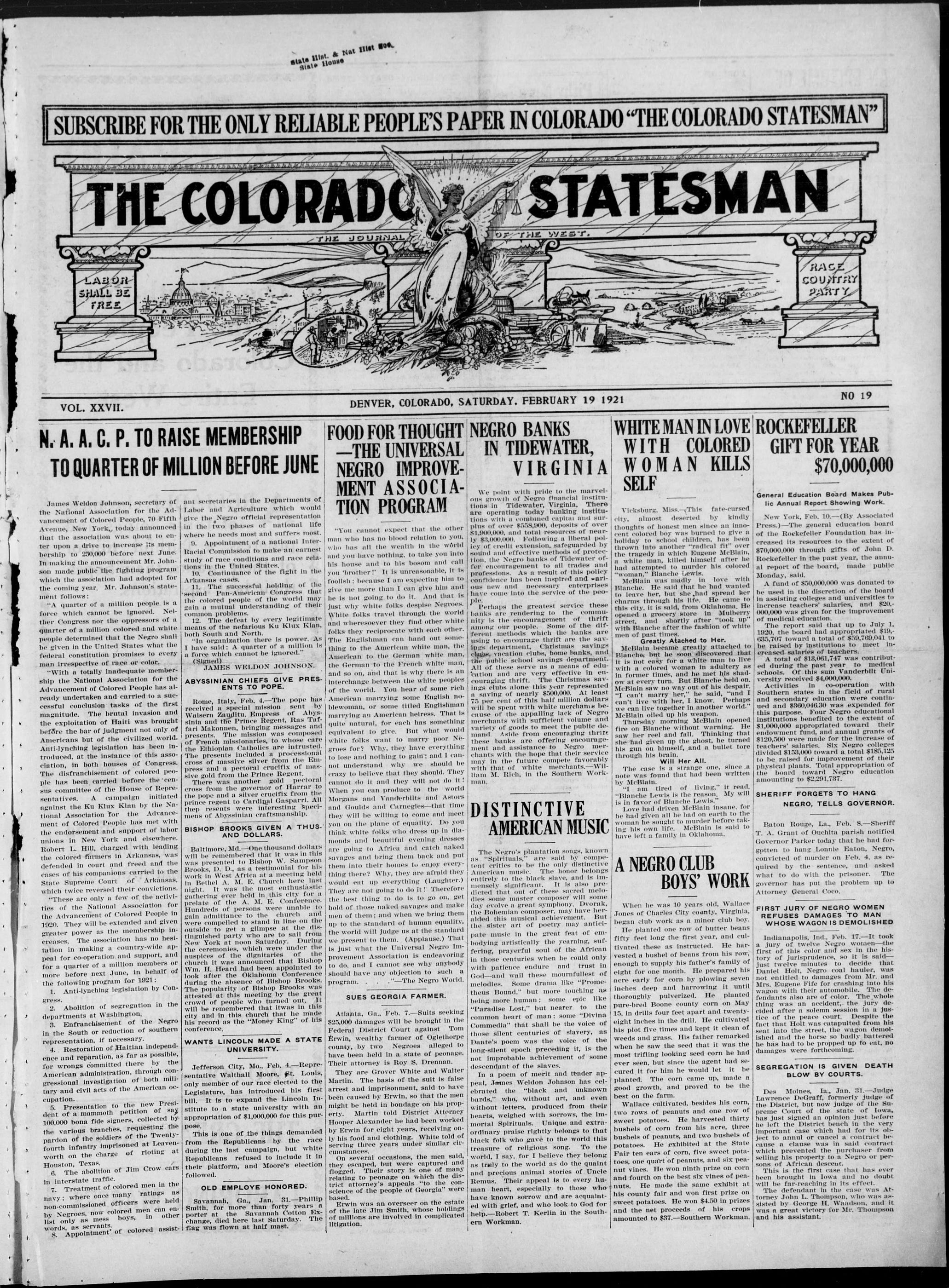
N. A. A. C. P. TO RAISE MEMBERSHIP TO QUARTER OF MILLION BEFORE JUNE
VOL. XXVII.
James Weldon Johnson, secretary of the National Association for the Advancement of Colored People, 70 Fifth Avenue, New York, today announced that the association was about to enter upon a drive to increase its membership to 250,000 before next June. In making the announcement Mr. Johnson made public the fighting program which the association had adopted for the coming year. Mr. Johnson's statement follows:
"A quarter of a million people is a force which cannot be ignored. Neither Congress nor the oppressors of a quarter of a million colored and white people determined that the Negro shall be given in the United States what the federal constitution promises to every man irrespective of race or color.
"With a totally inadequate membership the National Association for the Advancement of Colored People has already undertaken and carried to a successful conclusion tasks of the first magnitude. The brutal invasion and the exploitation of Haiti was brought before the bar of judgment not only of Americans but of the civilized world. Anti-lynching legislation has been introduced, at the instance of this association, in both houses of Congress. The disfranchisement of colored people has been carried before the census committee of the House of Representatives. A campaign initiated against the Ku Klux Klan by the National Association for the Advancement of Colored People has met with the endorsement and support of labor unions in New York and elsewhere. Robert L. Hill, charged with leading the colored farmers in Arkansas, was defended in court and freed and the cases of his companions carried to the State Supreme Court of Arkansas, which twice reversed their convictions.
"These are only a few of the activities of the National Association for the Advancement of Colored People in 1920. They will be extended and given greater power as the membership increases. The association has no hesitation in making a country-wide appeal for co-operation and support, and for a quarter of a million members or more before next June, in behalf of the following program for 1921:
1. Anti-lynching legislation by Congress.
2. Abolition of segregation in the departments at Washington.
3. Enfranchisement of the Negro in the South or reduction of southern representation, if necessary.
4. Restoration of Haitian independence and reparation, as far as possible, for wrongs committed there by the American administration, through congressional investigation of both military and civil acts of the American occupation.
5. Presentation to the new President of a mammoth petition of say 100,000 bona fide signers, collected by the various branches, requesting the pardon of the soldiers of the Twenty-fourth infantry imprisoned at Leavenworth on the charge of rioting at Houston Texas.
6. The abolition of Jim Crow cars in interstate traffic.
7. Treatment of colored men in the navy; where once many ratings as non-commissioned officers were held by Negroes, now colored men can enlist only as mess boys, in other servants.
words, as servants
8. Appointment of colored assist-
state Hist. & Nat Hist Woo
State House
ant secretaries in the Departments of Labor and Agriculture which would give the Negro official representation in the two phases of national life where he needs most and suffers most. 9. Appointment of a national Inter-Racial Commission to make an earnest study of race conditions and race relations in the United States.
10. Continuance of the fight in the Arkansas cases.
11. The successful holding of the second Pan-American Congress that the colored people of the world may gain a mutual understanding of their common problems.
12. The defeat by every legitimate means of the nefarious Ku Klux Klan, both South and North.
"In organization there is power. As I have said: A quarter of a million is a force which cannot be ignored."
(Signed)
JAMES WELDON JOHNSON.
ABYSSINIAN CHIEFS GIVE PRESENTS TO POPE.
Rome, Italy, Feb. 4.—The pope has received a special mission sent by Waisern Zaudultu, Empress of Abyssinia and the Prince Regent, Ras Tafari Makonnen, bringing messages and presents. The mission was composed of French missionaries, to whose care the Ethiopian Catholics are intrusted. The presents included a processional cross of massive silver from the Empress and a pectoral crucifix of massive gold from the Prince Regent. There was another gold pectoral cross from the governor of Harrar to the pope and a silver crucifix from the prince regent to Cardinal Gasparri. All the resents were interesting specimens of Abyssinian craftsmanship.
BISHOP BROOKS GIVEN A THUS AND DOLLARS.
Baltimore, Md.—One thousand dollars will be remembered that it was in this was presented to Bishop W. Sampson Brooks, D. D., as a testimonial for his work in West Africa at a meeting held in Bethel A. M. E. Church here last night. It was the most enthusiastic gathering ever held in this city for a prelate of the A. M. E. Conference. Hundreds of persons were unable to gain admittance to the church and were compelled to stand in line on outside to get a glimpse at the distinguished party who are to sail from New York at noon Saturday. During the ceremonies, which were under the auspices of the dignitaries of the church it was announced that Bishop Wm. H. Heard had been appointed to look after the Oklahoma Conference during the absence of Bishop Brooks. The popularity of Bishop Brooks was attested at this meeting by the great crowd of people who turned out. It will be remembered that it was in this city and in this church that he made his record as the "Money King" of his conference.
WANTS LINCOLN MADE A STATE
UNIVERSITY.
Jefferson City, Mo., Feb. 4.—Representative Walthall Moore, $t. Louis, only member of our race elected to the Legislature, has introduced his first bill. It is to expand the Lincoln Institute to a state university with an appropriation of $1,000,000 for this purpose. This is one of the things demanded from the Republicans by the race during the last campaign, but white Republicans refused to include it in their platform, and Moore's election followed.
Savannah, Ga., Jan. 31.—Phillip Smith, for more than forty years a porter at the Savannah Cotton Exchange, died here last Saturday. The flag was flown at half mast.
OLD EMPLOYE HONORED.
ABLE PEOPLE'S PA
ADC
THE JOURNAL
DENVER, COLORADO, S
DENVER, COLORADO, SATURDAY, FEBRUARY 19 1921
FOOD FOR THOUGHT THE UNIVERSAL NEGRO IMPROVEMENT ASSOCIATION PROGRAM
"You cannot expect that the other man who has no blood relation to you, who has all the wealth in the world, and you have nothing, to take you into his house and to his bosom and call you 'brother!' It is unreasonable, it is foolish; because I am expecting him to give me more than I can give him and he is not going to do it. And that is just why white folks despise Negroes. White folks travel through the world and wheresoever they find other white folks they reciprocate with each other. The Englishman can hand out something to the American white man, the American to the German white man, the German to the French white man, and so on, and that is why there is an interchange between the white peoples of the world. You hear of some rich American marrying some English noblewoman, or some titled Englishman marrying an American heiress. That is quite natural, for each has something equivalent to give. But what would white folks want to marry poor Negroes for? Why, they have everything to lose and nothing to gain; and I cannot understand why we should be crazy to believe that they should. They cannot do it and they will not do it! When you can produce to the world Morgans and Vanderbilts and Astors and Goulds and Carnegies—that time they will be willing to come and meet you on the plane of equality. Do you think white folks who dress up in diamonds and beautiful evening dresses are going to Africa and catch naked savages and bring them back and put them into their homes to enjoy everything there? Why, they are afraid they would eat up everything (Laughter.) They are not going to do it! Therefore the best thing to do is to go on, get hold of those naked savages and make men of them; and when we bring them up to the standard of human equality, the world will judge us at the standard we present to them. (Applause.) That is just what the Universal Negro Improvement Association is endeavoring to do, and I cannot see why anybody should have any objection to such a program. . . . "—The Negro World.
SUES GEORGIA FARMER.
Atlanta, Ga., Feb. 7.—Suits seeking $25,000 damages will be brought in the Federal District Court against Tom Erwin, wealthy farmer of Oglethorpe county, by two Negroes alleged to have been held in a state of peonage. Their attorney is Roy S. Drennan.
They are Grover White and Walter Martin. The basis of the suit is false arrest and imprisonment, said to have been caused by Erwin, so that the men might be held in bondage on his property. Martin told District Attorney Hooper Alexander he had been worked by Erwin for eight years, receiving only his food and clothing. White told of serving three years under similar circumstances.
On several occasions, the men said, they escaped, but were captured and flogged. Their story is one of many relating to peonage on which the district attorney's appeals "to the conscience of the people of Georgia" were based.
Erwin was an overseer on the estate of the late Jim Smith, whose holdings of millions are involved in complicated litigation.
NEGRO BANKS IN TIDEWATER. VIRGINIA
NEGRO BANKS IN TIDEWATER. VIRGINIA
We point with pride to the marvelous growth of Negro financial institutions in Tidewater, Virginia. There are operating today banking institutions with a combined capital and surplus of over $558,900, deposits of over $1,900,000, and total resources of nearly $3,000,000. Following a liberal policy of credit extension, safeguarded by sound and effective methods of protection, the Negro banks of Tidewater offer encouragement to all trades and professions. As a result of this policy confidence has been inspired and arid new and necessary enterprises have come into the service of the people.
Perhaps the greatest service these banks are rendering to the community is the encouragement of thrift among our people. Some of the different methods which the banks are using to encourage thrift are the savings department, Christmas savings clubs, vacation clubs, home banks, and the public school savings department. All of these serve as a means of education and are very effective in encouraging thrift. The Christmas savings clubs alone this year represented a saving of nearly $500,000. At least 75 per cent of this half million dollars will be spent with white merchants because of the appalling lack of Negro merchants with sufficient volume and variety of goods to meet the public demand. Aside from encouraging thrift these banks are offering encouragement and assistance to Negro merchants with the hope that their service may in the future compete favorably with that of white merchants.—William M. Rich, in the Southern Workman.
DISTINCTIVE AMERICAN MUSIC
The Negro's plantation songs, known as "Spirituals," are said by competent critics to be the only distinctive American music. The honor belongs entirely to the black slave, and is immensely significant. It is also predicted that out of these sacred melodies some master composer will some day evolve a great symphony. Dvorak, the Bohemian composer, may have heralded this musical achievement. But the sister art of poetry may anticipate music in the great feat of embodying artistically the yearning, suffering, prayerful soul of the African in those centuries when he could only with patience endure and trust in God—and wall these mournfullest of melodies. Some drama like "Prometheus Bound," but more touching as being more human; some epic like "Paradise Lost," but nearer to the common heart of man: some "Divina Commedia" that shall be the voice of those silent centuries of slavery, as Dante's poem was the voice of the long-silent epoch preceding it, is the not improbable achievement of some descendant of the slaves.
In a poem of merit and tender appeal, James Weldon Johnson has celebrated the "black and unknown burds," who, without art, and even without letters, produced from their hearts, weighed with sorrows, the immortal Spirituals. Unique and extraordinary praise rightly belongs to that black folk who gave to the world this treasure of religious song. To the world, I say, for I believe they belong as truly to the world as do the quaint and precious animal stories of Uncle Remus. Their appeal is to every human heart, especially to those who have known sorrow and are acquainted with grief, and who look to God for help.—Robert T. Kerlin in the Southern Workman.
WHITEMAN IN LOVE WITH COLORED WOMAN KILLS SELF
WHITEMAN IN LOVE WITH COLORED WOMAN KILLS SELF
Vicksburg, Miss.—This fate-cursed city, almost deserted by kindly thoughts of honest men since an innocent colored boy was burned to give a holiday to school children, has been thrown into another "radical fit" over the tragedy in which Eugene McBlain, a white man, killed himself after he had attempted to murder his colored "woman." Blanche Lewis.
McBlain was madly in love with Blanche. He said that he had wanted to leave her, but she had spread her charms through his life. He came to this city, it is said, from Oklahoma. He opened a grocery store in Mulberry street, and shortly after "took up" with Blanche after the fashion of white men of past times.
Greatly Atached to Her.
Greatly Attached.
McBlain became greatly attached to Blanche, but he soon discovered that it is not easy for a white man to live with a colored woman in adultery as in former times, and he met his shadow at every turn. But Blanche held on, McBlain saw no way out of his despair. "I can't marry her," he said, "and I can't live with her, I know. Perhaps we can live together in another world." McBlain oiled up his weapon.
Thursday morning McBlain opened fire on Blanche without warning. He saw her reel and fall. Thinking that she had given up the ghost, he turned his gun on himself, and a bullet tore through his brain.
Will Her All.
The case is a strange one, since a note was found that had been written by McBlain.
"I am tired of living," it read, "Blanche Lewis is the reason. My will is in favor of Blanche Lewis."
Love had driven McBlain insane, for he had given all he had on earth to the woman he sought to murder before taking his own life. McBlain is said to have left a family in Oklahoma.
A NEGRO CLUB BOYS' WORK
When he was 10 years old, Wallace Jones of Charles City county, Virginia, began club work as a minor club boy. He planted one row of butter beans fifty feet long the first year, and cultivated these as instructed. He harvested a bushel of beans from his row, enough to supply his father's family of eight for one month. He prepared his acre early for corn by plowing seven inches deep and harrowing it until thoroughly pulverized. He planted pure-bred Boone county corn on May 15, in drills four feet apart and twenty-eight inches in the drill. He cultivated his plot five times and kept it clean of weeds and grass. His father remarked when he saw the seed that it was the most trifling looking seed corn he had ever seen, but since the agent had secured it for him he would let it be planted. The corn came up, made a good growth, and proved to be the best on the farm.
Wallace cultivated, besides his corn, two rows of peanuts and one row of sweet potatoes. He harvested thirty bushels of corn from his acre, three bushels of peanuts, and two bushels of potatoes. He exhibited at the State Fair ten ears of corn, five sweet potatoes, one quart of peanuts, and six peanut vines. He won ninth prize on corn and fourth on the best six vines of peanuts. He made the same exhibit at his county fair and won first prize on sweet potatoes. He won $4.50 in prizes and the net proceeds of his crops amounted to $37.—Southern Workman.
NO 19
ROCKEFELLER GIFT FOR YEAR $70,000,000
General Education Board Makes Public Annual Report Showing Work.
New York, Feb. 10.—(By Associated Press.)—The general education board of the Rockefeller Foundation has increased its resources to the extent of $70,000,000 through gifts of John D. Rockefeller in the past year, the annual report of the board, made public Monday, said.
A fund of $50,000,000 was donated to be used in the discretion of the board in assisting colleges and universities to increase teachers' salaries, and $20,-000,000 was given for the improvement of medical education.
The report said that up to July 1, 1920, the board had appropriated $19,-655,707 toward a total of $59,769,041 to be raised by institutions to meet increased salaries of teachers.
A total of $13,061,747 was contributed during the past year to medical schools. Of this sum Vanderbilt University received $4,000,000.
Activities in co-operation with Southern states in the field of rural and secondary education were continued and $360,046.30 was expended for this purpose. Four Negro educational institutions benefited to the extent of $1,000,000 appropriated toward their endowment fund, and annual grants of $120,500 were made for the increase of teachers' salaries. Six Negro colleges divided $153,000 toward a total $185,125 to be raised for improvement of their physical plants. Total appropriation of the board toward Negro education amounting to $2,291,737.
SHERIEE FORGETS TO HANG
Baton Rouge, La., Feb. 8.—Sheriff T. A. Grant of Ouchita parish notified Governor Parker today that he had forgotten to hang Lonnie Eaton, Negro, convicted of murder on Feb. 4, as required by the sentence, and asked what to do with the prisoner. The governor has put the problem up to Attorney General Coco.
FIRST JURY OF NEGRO WOMEN
REFUSES DAMAGES TO MAN
WHOSE WAGON IS DEMOLISHED
Indianapolis, Ind., Feb. 17.—It took a jury of twelve Negro women—the first of this color and sex in the history of jurisprudence, so it is said—just twelve minutes to decide that Daniel Holt, Negro coal hauler, was not entitled to damages from Mr. and Mrs. Eugene Fife for crashing into his wagon with their automobile. The defendants also are of color. The whole thing was an accident, the jury decided after a solemn session in a justice of the peace court. Despite the fact that Holt was catapulted from his seat into the street, the wagon demolished and the horse so badly battered he has had to be propped up to eat, no damages were forthcoming.
SEGREGATION IS GIVEN DEATH
BLOW BY COURTS.
Des Moines, Ia., Jan. 31.—Judge Lawrence DeGraff, formerly judge of the District, but now judge of the Supreme Court of the state of Iowa, has just signed an opinion just before he left the District bench in the very important case which had for its object to annul or cancel a contract because a clause was in said contract which prevented the purchaser from selling his property to a Negro or persons of African descent. This is the first case that has ever been brought in Iowa and no doubt will be far-reaching in its effect. The defendant in the case was Attorney John L. Thompson, who was assisted by George H. Waadson, and it was a great victory for Mr. Thompson and his assistant.
FOREIGN
Seven persons have been convicted of selling cocaine to the American troops at Coblenz. They have been sentenced to one year imprisonment each by the American military courts.
The campaign against Spanish emigration is emphasized by some newspapers at Madrid, El Debate urges the government to act to prevent the country being robbed of many of its best workers.
Twenty-three farmer boys from Texas and Kansas, who came to Germany recently with a consignment of 742 milch cows presented to Germany by American farmers, were given a reception by the Bremen Senate.
The overthrow of the "Bourgeois" governments of Spain, Italy and France is outlined in documents seized in Paris after a search following the discovery of a widespread Communist plot. The date fixed was May 1.
American sailors who were fired on at Vladivostok were attacked by a party of Russians probably for the purpose of holding them up, according to advices received by Admiral Strauss, commanding the Asiatic fleet.
Cancellation of the debts of allied nations by the United States is urged by the Tribuna in Rome in an editorial on the economic and financial situation in Europe. The newspaper says the United States may find her very strength a peril in future.
The cabinet crisis, which resulted in the resignation of the ministry at Lisbon, was caused by protests over the shortage of oil, due to government restrictions on its transport. Many sardine canneries and preserve factories have closed, throwing 6,000 persons out of work.
The plant of the Socialist newspaper Voratore, which was zeized by Communists of Trieste and has since been occupied by a Communist working force, was burned by a party of Fascisti, or extreme Nationalists, as a sequel to the assassination of a carabiner by Communists.
Nearly 8,000 of the 10,800 members of the Diamond Workers' Union at Amsterdam are idle and the bottom seems to have fallen out of the world's diamond market. Experts in precious stones in this city and in Antwerp say an era of financial stringency has supplanted the epoch of free spending.
Three checks written originally for small amounts, then certified and raised to a total value of $17,000, were cashed in banks in Montreal by a man for whom police were searching. Made with invisible ink, the original figures, an examination disclosed, faded after certifications were made, enabling the forger to write in his own figures.
GENERAL
A decrease of about 20 per cent in the wage scale of the building trades in Minnesota was announced there by Morris Schumaker, president of the Minnesota Building Employers' Association.
More than 150 guests at the Miller hotel at Minneapolis were rescued from fire starting on the first floor. Forty of the guests, including fifteen women, were overcome by smoke and carried down ladders by firemen.
Sleeping sickness has caused forty-seven deaths in New York City since Jan. 1, Health Commissioner Copeland announced. Eleven new cases and one death were reported there, bringing the total since New Year to 179.
Federal highway inspectors found in a culvert some miles from Guide Rock, Neb., eleven safety deposit boxes stolen from the Guide Rock state bank. Liberty bonds and other securities to the value of nearly $30,000 were found in the boxes.
Low tide in Baltimore's labor situation has been passed. Of the 16,000 workers in the city without employment, one-half will be given work within forty days, according to a survey just completed by the industrial bureau of the board of trade.
Police Judge L. L. Kent of Atlanta, Ga., found himself guilty of violating traffic law on evidence submitted by the policeman who docketed the case, and imposed their sued fine. He paid.
Abandoning his houseboat cruise to begin a final period of consultation on the personnel and policies of the administration, President-elect Harding returned here by automobile to spend most of the time until inauguration day. The president-elect left his houseboat Victoria late in the afternoon at Daytona, seventy-five miles south, after changes in plans based on the uncertain progress of the vessel up the Indian river.
The "murder mystery" which has grown up around the death of Richard S. Lawrence, former Denver man, supposed to have been killed by a train March 21, 1918, was exploded in Madison, Wis., with the announcement of results of an official examination made of the body. Investigation by Dr. C. H. Bunting, University of Wisconsin, pathologist, and Dr. W. F. Lorenz of the Mendota Psychiatric institute, proved, according to their statements, that Lawrence came to his death by being struck by a train.
Federal Judge K. M. Landis startled those in his court room when he released on his own recognizance Francis J. Carey, 20, after the youth had pleaded guilty to the charge of taking $95,000 from the National City bank of Ottowa, Ill., Nov. 10, 1920. "This young bank teller was notoriously underpaid. The elevator men in the federal building here receive as much as he was paid." Judge Landis said to J. P. Catkin, president of the bank. "This robbery should be laid at the door of the directors". Catkin told the court Carey was paid $90 a month.
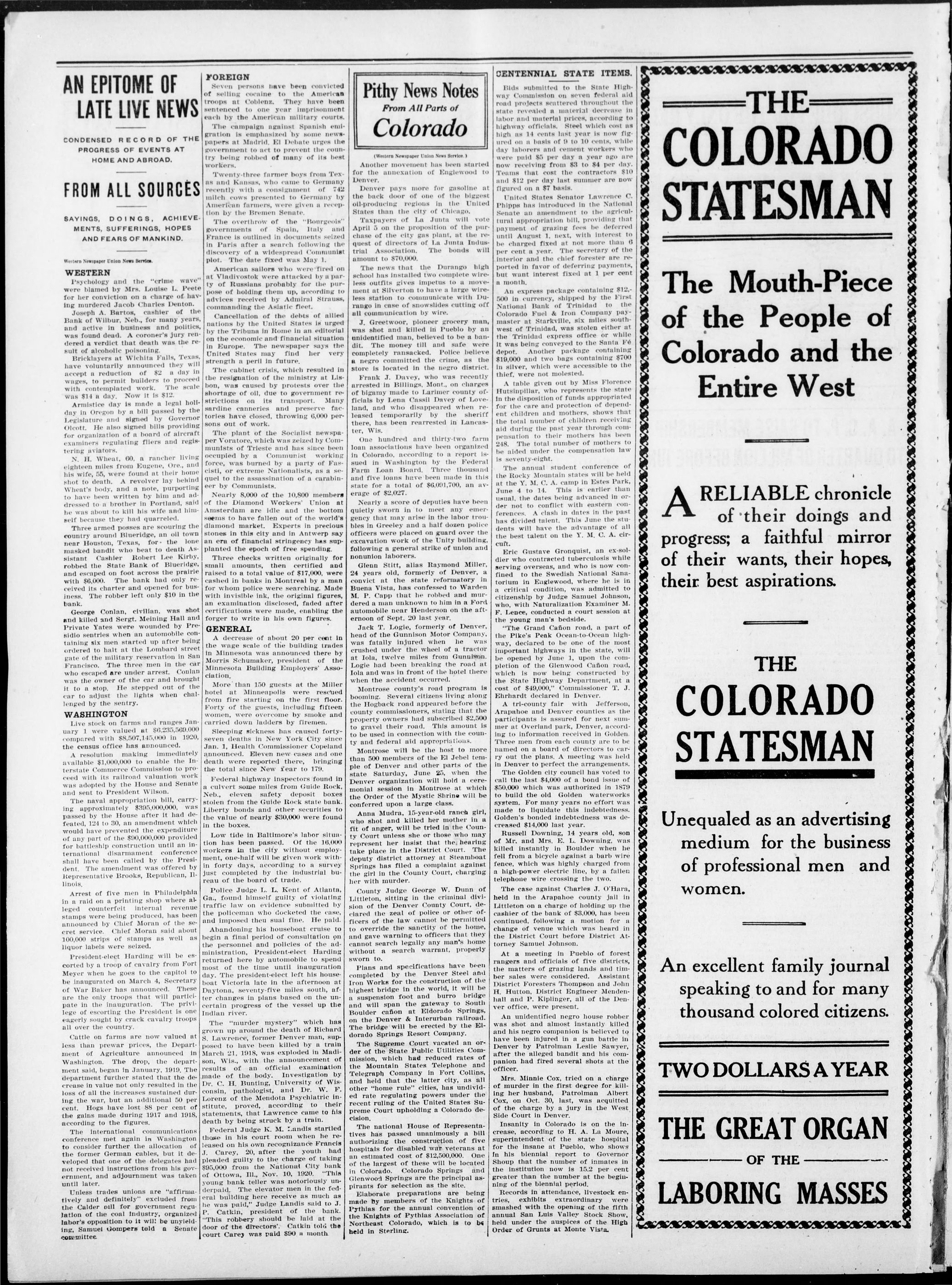
AN EPITOME OF LATE LIVE NEWS
CONDENSED RECORD OF THE PROGRESS OF EVENTS AT HOME AND ABROAD.
FROM ALL SOURCES
SAYINGS, DOINGS, ACHIEVE MENTS, SUFFERINGS, HOPES AND FEARS OF MANKIND.
Western Newspaper Union News Service.
WESTERN
Psychology and the "crime wave" were blamed by Mrs. Louise L. Peete for her conviction on a charge of having murdered Jacob Charles Denton. Joseph A. Bartos, cashier of the Bank of Wilbur, Neb., for many years, and active in business and politics, was found dead. A coroner's jury rendered a verdict that death was the result of alcoholic poisoning. Bricklayers at Wichita Falls, Texas, have voluntarily announced they will accept a reduction of $2 a day in wages, to permit builders to proceed with contemplated work. The scale was $14 a day. Now it is $12. Armistice day is made a legal holiday in Oregon by a bill passed by the Legislature and signed by Governor Olcott. He also signed bills providing for organization of a board of aircraft examiners regulating filers and registering aviators.
N. H. Wheat, 60, a rancher living eighteen miles from Eugene, Ore., and his wife, 55, were found at their home shot to death. A revolver lay behind Wheat's body, and a note, purporting to have been written by him and addressed to a brother in Portland, said he was about to kill his wife and himself because they had quarreled. Three armed posses are scouring the country around Blueridge, an oil town near Houston, Texas, for the lone masked bandit who beat to death Assistant Cashier Robert Lee Kirby, robbed the State Bank of Blueridge, and escaped on foot across the prairie with $6,000. The bank had only received its charter and opened for business. The robber left only $10 in the bank.
George Conlan, civilian, was shot and killed and Sergt. Meining Hall and Private Yates were wounded by Presidio sentries when an automobile containing six men started up after being ordered to halt at the Lombard street gate of the military reservation in San Francisco. The three men in the car who escaped are under arrest. Conlan was the owner of the car and brought it to a stop. He stepped out of the car to adjust the lights when challenged by the sentry.
WASHINGTON
Live stock on farms and ranges January 1 were valued at $6,235,560,000 compared with $8,507,145,000 in 1920, the census office has announced. A resolution making immediately available $1,000,000 to enable the Interstate Commerce Commission to proceed with its railroad valuation work was adopted by the House and Senate and sent to President Wilson. The naval appropriation bill, carrying approximately $395,000,000, was passed by the House after it had defeated, 124 to 30, an amendment which would have prevented the expenditure of any part of the $90,000,000 provided for battleship construction until an international disarmament conference shall have been called by the President. The amendment was offered by Representative Brooks, Republican, Illinois.
Arrest of five men in Philadelphia in a raid on a printing shop where alleged counterfeit internal revenue stamps were being produced, has been announced by Chief Moran of the secret service. Chief Moran said about 100,000 strips of stamps as well as liquor labels were seized. President-elect Harding will be escorted by a troop of cavalry from Fort Meyer when he goes to the capitol to be inaugurated on March 4, Secretary of War Baker has announced. These are the only troops that will participate in the inauguration. The privilege of escorting the President is one eagerly sought by crack cavalry troops all over the country.
Cattle on farms are now valued at less than prewar prices, the Department of Agriculture announced in Washington. The drop, the department said, began in January, 1919. The department further stated that the decrease in value not only resulted in the loss of all the increases sustained during the war, but an additional 50 per cent. Hogs have lost 88 per cent of the gains made during 1917 and 1918, according to the figures.
The international communications conference met again in Washington to consider further the allocation of the former German cables, but it developed that one of the delegates had not received instructions from his government, and adjournment was taken until later.
Unless trades unions are "affirmatively and definitely" excluded from the Calder oil for government regulation of the coal industry, organized labor's opposition to it will be unyielding. Samuel Gompers told a Senate committee.
Pithy News Notes From All Parts of Colorado
(Western Newspaper Union News Service.)
Another movement has been started for the annexation of Englewood to Denver.
Denver pays more for gasoline at the back door of one of the biggest oil-producing regions in the United States than the city of Chicago.
Taxpayers of La Junta will vote April 5 on the proposition of the purchase of the city gas plant, at the request of directors of La Junta Industrial Association. The bonds will amount to $70,000.
The news that the Durango high school has installed two complete wireless outfits gives impetus to a movement at Silverton to have a large wireless station to communicate with Durango in case of snowslides cutting off all communication by wire.
J. Greetwoor, pioneer grocery man, was shot and killed in Pueblo by an unidentified man, believed to be a bandit. The money till and safe were completely ransacked. Police believe a negro committed the crime, as the store is located in the negro district. Frank J. Davey, who was recently arrested in Billings, Mont., on charges of bigamy made to Larimer county officials by Lena Cassil Davey of Loveland, and who disappeared when released temporarily by the sheriff there, has been rearrested in Lancaster, Wis.
One hundred and thirty-two farm loan associations have been organized in Colorado, according to a report issued in Washington by the Federal Farm Loan Board. Three thousand and five loans have been made in this state for a total of $6,001,700, an average of $2,027.
Nearly a score of deputies have been quietly sworn in to meet any emergency that may arise in the labor troubles in Greeley and a half dozen police officers were placed on guard over the excavation work of the Unity building, following a general strike of union and nonunion laborers.
Glenn Stitt, alias Raymond Miller, 24 years old, formerly of Denver, a convict at the state reformatory in Buena Vista, has confessed to Warden M. P. Capp that he robbed and murdered a man unknown to him in a Ford automobile near Henderson on the afternoon of Sept. 20 last year.
Jack T. Logie, formerly of Denver, head of the Gunnison Motor Company, was fatally injured when he was crushed under the wheel of a tractor at Iola, twelve miles from Gunnison. Logie had been breaking the road at Iola and was in front of the hotel there when the accident occurred.
Montrose county's road program is booming. Several citizens living along the Hogback road appeared before the county commissioners, stating that the property owners had subscribed $2,500 to gravel their road. This amount is to be used in connection with the county and federal aid appropriations.
Montrose will be the host to more than 500 members of the El Jebel temple of Denver and other parts of the state Saturday, June 25, when the Denver organization will hold a ceremonial session in Montrose at which the Order of the Mystic Shrine will be conferred upon a large class. Anna Mudra, 15-year-old ranch girl, who shot and killed her mother in a fit of anger, will be tried in the County Court unless she or those who may represent her insist that the hearing take place in the District Court. The deputy district attorney at Steamboat Springs has filed a complaint against the girl in the County Court, charging her with murder.
County Judge George W. Dunn of Littleton, sitting in the criminal division of the Denver County Court, declared the zeal of police or other officers of the law cannot be permitted to override the sanctity of the home, and gave warning to officers that they cannot search legally any man's home without a search warrant, properly sworn to.
Plans and specifications have been completed by the Denver Steel and Iron Works for the construction of the highest bridge in the world, it will be a suspension foot and burro bridge and will span the gateway to South Boulder cafion at Eldorado Springs, on the Denver & Interurban railroad. The bridge will be erected by the Eldorado Springs Resort Company.
The Supreme Court vacated an order of the State Public Utilities Commission, which had reduced rates of the Mountain States Telephone and Telegraph Company in Fort Collins, and held that the latter city, as all other "home rule" cities, has undivided rate regulating powers under the recent ruling of the United States Supreme Court upholding a Colorado decision.
The national House of Representatives has passed unanimously a bill authorizing the construction of five hospitals for disabled war veterans at an estimated cost of $12,500,000. One of the largest of these will be located in Colorado. Colorado Springs and Glenwood Springs are the principal aspirants for selection as the site.
Elaborate preparations are being made by members of the Knights of Pythias for the annual convention of the Knights of Pythias Association of Northeast Colorado, which is to be held in Sterling.
Bids submitted to the State Highway Commission on seven federal aid road projects scattered throughout the state revealed a material decrease in labor and material prices, according to highway officials. Steel which cost as high as 14 cents last year is now figured on a basis of 9 to 10 cents, while day laborers and cement workers who were paid $5 per day a year ago are now receiving from $3 to $4 per day. Teams that cost the contractors $10 and $12 per day last summer are now figured on a $7 basis.
THE COLORADO STATESMAN
United States Senator Lawrence C. Phipps has introduced in the National Senate an amendment to the agricultural appropriation bill, providing that payment of grazing fees be deferred until August 1, next, with interest to be charged fixed at not more than 6 per cent a year. The secretary of the interior and the chief forester are reported in favor of deferring payments, but wont interest fixed at 1 per cent a month.
The Mouth-Piece of the People of Colorado and the Entire West
An express package containing $12,500 in currency, shipped by the First National Bank of Trinidad to the Colorado Fuel & Iron Company paymaster at Starkville, six miles southwest of Trinidad, was stolen either at the Trinidad express office or while it was being conveyed to the Santa Fe depot. Another package containing $19,000 and two bags containing $700 in silver, which were accessible to the thief, were not molested.
A table given out by Miss Florence Hutsinpillar, who represents the state in the disposition of funds appropriated for the care and protection of dependent children and mothers, shows that the total number of children receiving aid during the past year through compensation to their mothers has been 248. The total number of mothers to be aided under the compensation law is seventy-eight.
The annual student conference of the Rocky Mountain states will be held at the Y. M. C. A. camp in Estes Park, June 4 to 14. This is earlier than usual, the dates being advanced in order not to conflict with eastern conferences. A clash in dates in the past has divided talent. This June the students will have the advantage of all the best talent on the Y. M. C. A. circuit.
RELIABLE chronicle of their doings and progress; a faithful mirror of their wants, their hopes, their best aspirations.
Eric Gustave Gronquist, an ex-soldier who contracted tuberculosis while serving overseas, and who is now confined to the Swedish National Sanatorium in Englewood, where he is in a critical condition, was admitted to citizenship by Judge Samuel Johnson, who, with Naturalization Examiner M. F. Lence, conducted a court session at the young man's bedside.
"The Grand Cañon road, a part of the Pike's Peak Ocean-to-Ocean highway, declared to be one of the most important highways in the state, will be opened by June 1, upon the completion of the Glenwood Cañon road, which is now being constructed by the State Highway Department, at a cost of $49,000," Commissioner T. J. Ehrhardt declared in Denver.
THE COLORADO STATESMAN
A tri-county fair with Jefferson, Arapahoe and Denver counties as the participants is assured for next summer at Overland park, Denver, according to information received in Golden. Three men from each county are to be named on a board of directors to carry out the plans. A meeting was held in Denver to perfect the arrangements. The Golden city council has voted to call the last $4,000 of a bond issue of $50,000 which was authorized in 1879 to build the old Golden waterworks system. For many years no effort was made to liquidate this indebtedness, Golden's bonded indebtedness was decreased $14,000 last year.
Unequaled as an advertising medium for the business of professional men and women.
Russell Downing, 14 years old, son of Mr. and Mrs. E. L. Downing, was killed instantly in Boulder when he fell from a bicycle against a barb wire fence, which was highly charged from a high-power electric line, by a fallen telephone wire crossing the two.
The case against Charles J. O'Hara, held in the Arapahoe county jail in Littleton on a charge of holding up the cashier of the bank of $3,000, has been continued, following a motion for a change of venue which was heard in the District Court before District Attorney Samuel Johnson.
At a meeting in Pueblo of forest rangers and officials of five districts, the matters of grazing lands and timber sales were considered. Assistant District Foresters Thompson and John H. Hutton, District Engineer Mendenhall and P. Kiplinger, all of the Denver office, were present.
An excellent family journal speaking to and for many thousand colored citizens.
An unidentified negro house robber was shot and almost instantly killed and his negro companion is believed to have been injured in a gun battle in Denver by Patrolman Leslie Sawyer, after the alleged bandit and his companion had fired several shots at the officer.
TWODOLLARSAYEAR
Mrs. Minnie Cox, tried on a charge of murder in the first degree for killing her husband, Patrolman Albert Cox, on Oct. 30, last, was acquitted of the charge by a jury in the West Side Court in Denver.
THE GREAT ORGAN OF THE
Insanity in Colorado is on the increase, according to H. A. La Moure, superintendent of the state hospital for the insane at Pueblo, who shows in his biennial report to Governor Shoup that the number of inmates in the institution now is 15.2 per cent greater than the number at the beginning of the biennial period.
LABORING MASSES
Records in attendance, livestock entries, exhibits extraordinary were smashed with the opening of the fifth annual San Luis Valley Stock Show, held under the auspices of the High Order of Grunts at Monte Vista.
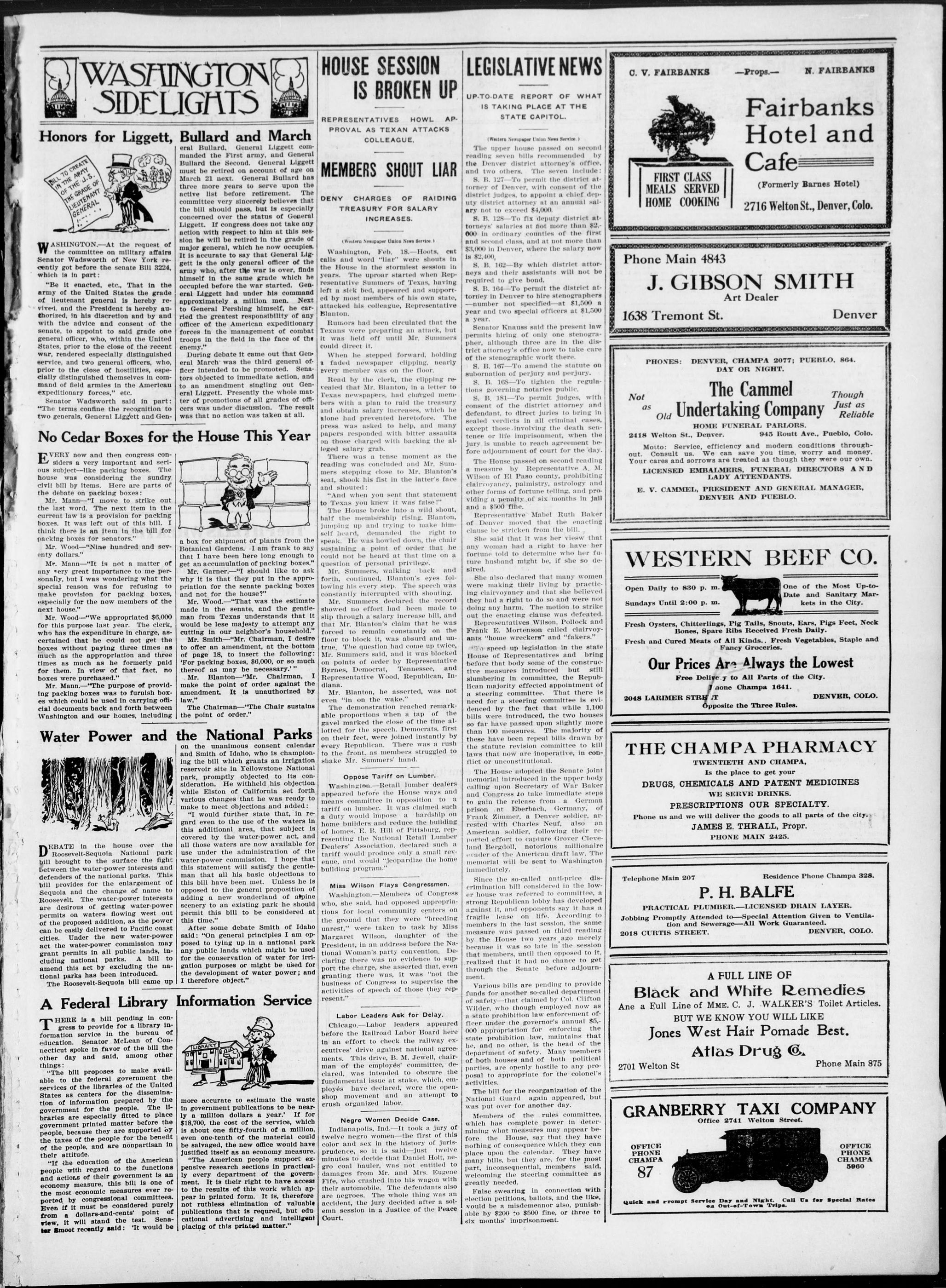
WASHINGTON SIDELIGHTS
No Cedar Boxes for the House This Year
Water Power and the National Parks
A Federal Library Information Service
PUBLIQUE
Honors for Liggett,
BILL TO CREATE IN THE ARMY OF THE J. S. THE GRADE OF MILITEMANNT GENERAL
WASHINGTON.—At the request of the committee on military affairs Senator Wadsworth of New York recently got before the senate Bill 3224, which is in part:
"Be it enacted, etc., That in the army of the United States the grade of lieutenant general is hereby revived, and the President is hereby authorized, in his discretion and by and with the advice and consent of the senate, to appoint to said grade one general officer, who, within the United States, prior to the close of the recent war, rendered especially distinguished service, and two general officers, who, prior to the close of hostilities, especially distinguished themselves in command of field armies in the American expeditionary forces," etc.
Senator Wadsworth said in part: "The terms confine the recognition to two generals, General Liggett and Gen-
EVERY now and then congress considers a very important and serious subject—like packing boxes. The house was considering the sundry civil bill by items. Here are parts of the debate on packing boxes:
Mr. Mann—"I move to strike out the last word. The next item in the current law is a provision for packing boxes. It was left out of this bill. I think there is an item in the bill for packing boxes for senators."
Mr. Wood—"Nine hundred and seventy dollars."
Mr. Mann—"It is not a matter of any very great importance to me personally, but I was wondering what the special reason was for refusing to make provision for packing boxes, especially for the new members of the next house."
Mr. Wood—"We appropriated $6,000 for this purpose last year. The clerk, who has the expenditure in charge, ascertained that he could not get the boxes without paying three times as much as the appropriation and three times as much as he formerly paid for them. In view of that fact, no boxes were purchased."
Mr. Mann—"The purpose of providing packing boxes was to furnish boxes which could be used in carrying official documents back and forth between Washington and our homes, including
```markdown
```
DEBATE in the house over the Roosevelt-Sequoia National park bill brought to the surface the fight between the water-power interests and defenders of the national parks. This bill provides for the enlargement of Sequoia and the change of name to Roosevelt. The water-power interests are desirous of getting water-power permits on waters flowing west out of the proposed addition, as the power can be easily delivered to Pacific coast cities. Under the new water-power act the water-power commission may grant permits in all public lands, including national parks. A bill to amend this act by excluding the national parks has been introduced. Roosevelt Sequoia bill came up
THERE is a bill pending in congress to provide for a library information service in the bureau of education. Senator McLean of Connecticut spoke in favor of the bill the other day and said, among other things:
"The bill proposes to make available to the federal government the services of the libraries of the United States as centers for the dissemination of information prepared by the government for the people. The libraries are especially fitted to place government printed matter before the people, because they are supported by the taxes of the people for the benefit of the people, and are nonpartisan in their attitude.
"If the education of the American people with regard to the functions and actions of their government is an economy measure, this bill is one of the most economic measures ever reported by congressional committees. Even if it must be considered purely from a dollars-and-cents' point of view, it will stand the test. Senator Emot recently said: 'It would be
U.S. CAPITAL
Bullard and March
eral Bullard. General Liggett commanded the First army, and General Bullard the Second. General Liggett must be retired on account of age on March 21 next. General Bullard has three more years to serve upon the active list before retirement. The committee very sincerely believes that the bill should pass, but is especially concerned over the status of General Liggett. If congress does not take any action with respect to him at this session he will be retired in the grade of major general, which he now occupies. It is accurate to say that General Liggett is the only general officer of the army who, after the war is over, finds himself in the same grade which he occupied before the war started. General Liggett had under his command approximately a million men. Next to General Pershing himself, he carried the greatest responsibility of any officer of the American expeditionary forces in the management of combat troops in the field in the face of the enemy."
During debate it came out that General March was the third general officer intended to be promoted. Senators objected to immediate action, and to an amendment singling out General Liggett. Presently the whole matter of promotions of all grades of officers was under discussion. The result was that no action was taken at all.
a box for shipment of plants from the Botanical Gardens. I am frank to say that I have been here long enough to get an accumulation of packing boxes." Mr. Garner.—"I should like to ask why it is that they put in the appropriation for the senate packing boxes and not for the house?" Mr. Wood.—"That was the estimate made in the senate, and the gentleman from Texas understands that it would be lese majesty to attempt any cutting in our neighbor's household."
Mr. Smith—"Mr. Chairman, I desire to offer an amendment, at the bottom of page 18, to insert the following: 'For packing boxes, $6,000, or so much thereof as may be necessary.'" Mr. Blanton—"Mr. Chairman, I make the point of order against the amendment. It is unauthorized by law." The Chairman—"The Chair sustains the point of order."
on the unanimous consent calendar and Smith of Idaho, who is championing the bill which grants an irrigation reservoir site in Yellowstone National park, promptly objected to its consideration. He withheld his objection while Elston of California set forth various changes that he was ready to make to meet objections and added: "I would further state that, in regard even to the use of the waters in this additional area, that subject is covered by the water-power act, and all those waters are now available for use under the administration of the water-power commission. I hope that this statement will satisfy the gentleman that all his basic objections to this bill have been met. Unless he is opposed to the general proposition of adding a new wonderland of alpine scenery to an existing park he should permit this bill to be considered at this time."
After some debate Smith of Idaho said: "On general principles I am opposed to tying up in a national park any public lands which might be used for the conservation of water for irrigation purposes or might be used for the development of water power; and I therefore object."
more accurate to estimate the waste in government publications to be nearly a million dollars a year.' If for $18,700, the cost of the service, which is about one fifty-fourth of a million, even one-tenth of the material could be salvaged, the new office would have justified itself as an economy measure.
"The American people support expensive research sections in practically every department of the government. It is their right to have access to the results of this work which appear in printed form. It is, therefore not ruthless elimination of valuable publications that is required, but educational advertising and intelligent placing of this printed matter."
HOUSE SESSION IS BROKEN UP
REPRESENTATIVES HOWL AP
PROVAL AS TEXAN ATTACKS
COLLEAGUE.
MEMBERS SHOUT LIAR
DENY CHARGES OF RAIDING TREASURY FOR SALARY INCREASES.
Washington, Feb. 18.—Hoots, cat calls and word "liar" were shouts in the House in the stormiest session in years. The uproar started when Representative Summers of Texas, having left a sick bed, appeared and supported by most members of his own state, attacked his colleague, Representative Blanton.
Rumors had been circulated that the Texans were preparing an attack, but it was held off until Mr. Summers could direct it.
When he stepped forward, holding a faded newspaper clipping, nearly every member was on the floor.
Read by the clerk, the clipping revealed that Mr. Blanton, in a letter to Texas newspapers, had charged members with a plan to raid the treasury and obtain salary increases, which he alone had prevented heretofore. The press was asked to help, and many papers responded with bitter assaults on those charged with backing the alleged salary grab.
There was a tense moment as the reading was concluded and Mr. Summers stepping close to Mr. Blanton's seat, shook his fist in the latter's face and shouted:
"And when you sent that statement to Texas you knew it was false!"
The House broke into a wild shout, half the membership rising. Blanton, jumping up and trying to make himself heard, demanded the right to speak. He was howled down, the chair sustaining a point of order that he could not be heard at that time on a question of personal privilege.
Mr. Summers, walking back and forth, continued. Blanton's eyes following his every step. The speech was constantly interrupted with shouting.
Mr. Summers declared the record showed no effort had been made to slip through a salary increase bill, and that Mr. Blanton's claim that he was forced to remain constantly on the floor to block it, was absurd and untrue. The question had come up twice, Mr. Summers said, and it was blocked on points of order by Representative Byrnes, Democrat, Tennessee, and Representative Wood, Republican, Indiana.
Mr. Blanton, he asserted, was not even "in on the wake." The demonstration reached remarkable proportions when a tap of the gavel marked the close of the time allotted for the speech. Democrats, first on their feet, were joined instantly by every Republican. There was a rush to the front, as members struggled to shake Mr. Summers' hand.
Oppose Tariff on Lumber.
Washington.—Retail lumber dealers appeared before the House ways and means committee in opposition to a tariff on lumber. It was claimed such a duty would impose a hardship on home builders and reduce the building of homes. E. B. Hill of Pittsburg, representing the National Retail Lumber Dealers' Association, declared such a tariff would produce only a small revenue, and would "jeopardize the home building program."
Miss Wilson Flays Congressmen.
Washington.—Members of Congress who, she said, had opposed appropriations for local community centers on the ground that they were "breeding unrest," were taken to task by Miss Margaret Wilson, daughter of the President, in an address before the National Woman's party convention. Declaring there was no evidence to support the charge, she asserted that, even granting there was, it was "not the business of Congress to supervise the activities of speech of those they represent."
Labor Leaders Ask for Delay.
Chicago.—Labor leaders appeared before the Railroad Labor Board here in an effort to check the railway executives' drive against national agreements. This drive, B. M. Jewell, chairman of the employés' committee, declared, was intended to obscure the fundamental issue at stake, which, employés have declared, were the open-shop movement and an attempt to erush organized labor.
Negro Women Decide Case.
Indianapolis, Ind.—It took a jury of twelve negro women—the first of this color and sex in the history of jurisprudence, so it is said—just twelve minutes to decide that Daniel Holt, negro coal hauler, was not entitled to damages from Mr. and Mrs. Eugene Fife, who crashed into his wagon with their automobile. The defendants also are negroes. The whole thing was an accident, the jury decided after a solemn session in a Justice of the Peace Court.
LEGISLATIVE NEWS
LEGISLATIVE NEWS
UP.TO.DATE REPORT OF WHAT IS TAKING PLACE AT THE STATE CAPITOL.
The upper house passed on second reading seven bills recommended by the Denver district attorney's office, and two others. The seven include: S. B. 127—To permit the district attorney of Denver, with consent of the district judges, to appoint a chief deputy district attorney at an annual salary not to exceed $4,000. S. B. 128—To fix deputy district attorneys' salaries at not more than $2,000 in ordinary counties of the first and second class, and at not more than $3,000 in Denver, where the salary now is $2,400. S. B. 162—By which district attorneys and their assistants will not be required to give bond. S. B. 164—To permit the district attorney in Denver to hire stenographers—number not specified—at $1,500 a year and two special officers at $1,500 a year.
Senator Knauss said the present law permits hiring of only one stenographer, although three are in the district attorney's office now to take care of the stenographic work there.
S. B. 167—To amend the statute on subnation of perjury and perjury.
S. B. 168—To tighten the regulations governing notaries public.
S. B. 181—To permit judges, with consent of the district attorney and defendant, to direct juries to bring in sealed verdicts in all criminal cases, except those involving the death sentence or life imprisonment, when the jury is unable to reach agreement before adjournment of court for the day.
The House passed on second reading a measure by Representative A. M. Wilson of El Paso county, prohibiting clairvoyancy, palmistry, astrology and other forms of fortune telling, and providing a penalty, of six months in jail and a $500 fine.
Representative Mabel Ruth Baker of Denver moved that the enacting clause be stricken from the bill.
She said that it was her view that any woman had a right to have her fortune told to determine who her future husband might be, if she so desired.
She also declared that many women were making their living by practicing clairvoyancy and that she believed they had a right to do so and were not doing any harm. The motion to strike out the enacting clause was defeated.
Representatives Wilson, Pollock and Frank E. Mortenson called clairvoyants "home wreckers" and "fakers."
speed up legislation in the state House of Representatives and bring before that body some of the constructive measures introduced but still slumbering in committee, the Republican majority effected appointment of a steering committee. That there is need for a steering committee is evidenced by the fact that while 1,100 bills were introduced, the two houses so far have passed upon slightly more than 100 measures. The majority of these have been repeal bills drawn by the statute revision committee to kill laws that now are inoperative, in conflict or unconstitutional.
The House adopted the Senate joint memorial introduced in the upper body calling upon Secretary of War Baker and Congress to take immediate steps to gain the release from a German prison at Eberbach, Germany, of Frank Zimmer, a Denver soldier, arrested with Charles Neuf, also an American soldier, following their reported effort to capture Grover Cleveland Bergdoll, notorious millionaire ender of the American draft law. The memorial will be sent to Washington immediately.
Since the so-called anti-price discrimination bill considered in the lower house was referred to committee, a strong Republican lobby has developed against it, and opponents say it has a fragile lease on life. According to members in the last session, the same measure was passed on third reading by the House two years ago merely because it was so late in the session that members, until then opposed to it, realized that it had no chance to get through the Senate before adjournment.
Various bills are pending to provide funds for another so-called department of safety—that claimed by Col. Clifton Wilder, who though employed now as a state prohibition law enforcement officer under the governor's annual $5,000 appropriation for enforcing the state prohibition law, maintains that he, and no other, is the head of the department of safety. Many members of both houses and of both political parties, are openly hostile to any proposal to appropriate for the colonel's activities.
The bill for the reorganization of the National Guard again appeared, but was put over for another day.
Members of the rules committee, which has complete power in determining what measures may appear before the House, say that they have nothing of consequence which they can place upon the calendar. They have many bills, but they are, for the most part, inconsequential, members said, welcoming the steering committee as greatly needed. False swearing in connection with election petitions, ballots, and the like, would be a misdemeanor also, punishable by $200 to $500 fine, or three to six months' imprisonment.
PHONES: DENVER, CHAMPA 2077; PUEBLO, 864.
DAY OR NIGHT.
Motto: Service, efficiency and modern conditions throughout. Consult us. We can save you time, worry and money. Your cares and sorrows are treated as though they were our own.
LICENSED EMBALMERS, FUNERAL DIRECTORS AND LADY ATTENDANTS.
E. V. CAMMEL, PRESIDENT AND GENERAL MANAGER, DENVER AND PUEBLO.
WESTERN BEEF CO.
Fresh Oysters, Chitterlings, Pig Tails, Snouts, Ears, Pigs Feet, Neck Bones, Spare Ribs Received Fresh Daily.
Fresh and Cured Meats of All Kinds.. Fresh Vegetables, Staple and Fancy Groceries.
THE CHAMPA PHARMACY
TWENTIETH AND CHAMPA,
Is the place to get your
DRUGS, CHEMICALS AND PATENT MEDICINES
WE SERVE DRINKS.
PRESCRIPTIONS OUR SPECIALTY.
Phone us and we will deliver the goods to all parts of the city.
JAMES E. THRALL, Propr.
PHONE MAIN 2425.
PRACTICAL PLUMBER.—LICENSED DRAIN LAYER. Jobbing Promptly Attended to—Special Attention Given to Ventilation and Sewerage—All Work Guaranteed. 2018 CURTIS STREET. DENVER, COLO.
A FULL LINE OF
Black and White Remedies
Ane a Full Line of MME. C. J. WALKER'S Toilet Articles.
BUT WE KNOW YOU WILL LIKE
Jones West Hair Pomade Best.
Atlas Drug C.
2701 Welton St Phone Main 875
OFFICE
PHONE
CHAMPA
87
OFFICE
PHONE
CHAMPA
5960
C. V. FAIRBANKS
FIRST CLASS
MEALS SERVED
HOME COOKING
Phone Main 4843
J. GIBS
1638 Tremont St.
PHONES: DENVER, DAY
Not as Old Undertake
HOME F
2418 Welton St., Denver.
Motto: Service, efficient out. Consult us. We care Your cares and sorrows are
LICENSED EMBALMER
LADY
E. V. CAMMEL, PRESIDENT
DENVER
WESTER
Open Daily to 830 p. m.
Sundays Until 2:00 p. m.
Fresh Oysters, Chitterlings,
Bones, Spare
Fresh and Cured Meats of A
Our Prices Are
Free Delivery
Jonor
2048 LARIMER STREET
Opposi
THE CHAMBER
TWENTIETH
Is the
DRUGS, CHEMICALS
WE NEED
PRESCRIPTION
Phone us and we will deli
JAMES S.
PHONE
Telephone Main 207
P. H
PRACTICAL PLUMBER
Jobbing Promptly Attended
tion and Sewera
2018 CURTIS STREET.
A FU
Black and
—Props.—
Fairbanks Hotel and Cafe
Fairbanks Hotel and Cafe
(Formerly Barnes Hotel)
2716 Welton St., Denver, Colo.
3
SON S
Art Dealer
R, CHAMPA 20
WAY OR NIGHT
The Camma
making Con
FUNERAL PARC.
R. 945 R
encency and mode
can save you th
are treated as the
MERS, FUNER
DY ATTENDANT
SIDENT AND G
ER AND PUEE
RN B
N SMITH
Dealer
HAMPA 2077; PUEBLO, 864.
FOR NIGHT.
Cammel
ing Company
Though
Just as
Reliable
GENERAL PARLORS.
945 Routt Ave., Pueblo, Colo.
and modern conditions through-
ave you time, worry and money.
Grated as though they were our own.
FUNERAL DIRECTORS AND
ATTENDANTS.
INT AND GENERAL MANAGER,
AND PUEBLO.
N BEEF CO.
```markdown
```
Tails, Snouts, Ears, Pigs Feet, Neck Received Fresh Daily.
Kinds.. Fresh Vegetables, Staple and Groceries.
Always the Lowest
All Parts of the City.
Champa 1641.
DENVER, COLO.
The Three Rules.
A PHARMACY
AND CHAMPA,
ce to get your
AND PATENT MEDICINES
IVE DRINKS.
IS OUR SPECIALTY.
the goods to all parts of the city.
THRALL, Propr.
MAIN 2425.
S, Pig Tails, Snow
Ribs Received
All Kinds.. Fancy Groceries.
Are Always
Ready to All Parts
one Champa 164
site the Three Rows
MPA PRI
STIETH AND CHIE
the place to get y
ALS AND PAT
SERVE DRINK
IONS OUR SE
deliver the goods
B. E. THRALL,
ONE MAIN 242
Residence Phone Champa 328.
H. BALRF
DER.—LICENSED
t to—Special Att
age—All Work
FULL LINE O
White
BALFE
-LICENSED DRAIN LAYER.
Special Attention Given to Ventila-
All Work Guaranteed.
DENVER, COLO.
LINE OF
White Remedies
N. FAIRBANKS
Denver
One of the Most Up-toDate and Sanitary Markets in the City.
INTERED as second-class matter at the postoffice in the City of Denver, Colo.
JOSEPH D. D. RIVERS.....Proprietor
O. Box 116 1824 Curtis Street. Room 25 Phone Main 7417
SUBSCRIPTION RATES.
One year ..... $2.00
Five months ..... 1.50
Three months ..... 7.5
MUST BE PAID IN ADVANCE.
Communications to receive attention must be newsy, upon important subjects, plainly written only upon one side of the paper, must reach us Tuesdays, possible, anyway not later than Wednesdays, and bear the signature of the author. No manuscript returned, unless stamps are sent for postage. All communications of a personating nature that are not complimentary will be withheld from the columns of this paper.
Remittances should be made by express money order, postoffice money order, registered letter or bank draft. Postage stamps will be received the same as cash for the fractional part of a dollar. Only 1c and 2c stamps taken.
No discounts allowed on less than three months' contract. Cash must accompany all orders from parties unknown to us. Further particulars on application.
Reading notices, ten lines or less, 15 cents per line. Each additional line over ten lines, 12 cents per line. Display advertising, 75 cents per inch for first insertion and 50 cents per inch for each additional insertion.
But in the light of the recent war a crude Marxism wilts into absurdity. The universal proletariat were not rational enough to be economic men in either the Benthamite or the Marxian sense. Purely psychological forces, the drive of instinct to rally with the herd, the spur of sentiment, the regulation of habit, caused the proletariat to jeopardize their class interests for the sake of plans against which they had long been in obstinate intellectual opposition. Individual ambition, too, swept away the economic alignments and played its fatal part in the march of events. The war magnified the brute forces of personality. The most economic man, the proletarian, was first of all a man!
TODAY the State Legislature will have been in session forty-five days, one-half the allotted time fixed by the state statutes for the regular session. It is to be ommended for the very splendid harmony that has prevailed so far, and the excellent progress being made in the matter of passing upon the important legislative measures presented for their consideration.
There were one thousand or more bills presented in the lower house one for consideration. While it is doubtless true that there were a great many of these bills that were frivolous and unnecessary, yet they had to be assigned to the different committees for a legislative diagnosis, so to speak, and there decided as to whether or not there is any merit in the bill, and if
Teachers feel that greater security in their positions is essential to their most effective work. We do not, however, seek to protect incompetent teachers—rather, we desire to rid the school system of incompetents. It is the competent teacher that we want to protect, and we feel that the public at large is heartily in sympathy with fair treatment to this teacher. Under existing conditions, competent teachers are humiliated by arbitrary and autocratic school authorities, who dismiss at their own pleasure and far too often without justification.
Teachers demand that their cases be tried before impartial boards, that they be permitted to have counsel and that they be granted the right to appeal from the trial boards to the civil courts.
The teacher is one of the strongest stabilizing influences we have, but we cannot utilize this influence if the competent teacher is not kept in the profession. Insecurity of tenure is driving many teachers out of the profession.
The 100 per cent American is a man who has respect for his own rights and the rights of others, and will so order his life as to possess not only the courage but the strength to redress wrongs, and in whom self-consciousness is sufficiently powerful to preserve these qualities, which are dependent upon clean, strong bodies and capable minds.
He believes in and upholds the dignity of labor, and with it the education which makes democracy worth while and protective of the interests of all.
THE COLORADO STATESMAN
Entered as second-class matter at the postoffice in the City of Denver, Colo.
JOSEPH D. D. RIVERS ..... Proprietor
P. O. Box 116 ..... Phone Main 7417
SUBSCRIPTION RATES.
One year ..... $2.00
Six months ..... $1.50
Three months ..... $75
Communications to receive attention must be newsy, upon important subjects, plainly written only upon one side of the paper, must reach us Tuesdays, if possible, anyway not later than Wednesdays, and bear the signature of the author. No manuscript returned, unless stamps are sent for postage. All communications of a personating nature that are not complimentary will be withheld from the columns of this paper.
Remittances should be made by express money order, postoffice money order, registered letter or bank draft. Postage stamps will be received the same as cash for the fractional part of a dollar. Only 1c and 2c stamps taken.
No discounts allowed on less than three months' contract. Cash must accompany all orders from parties unknown to us. Further particulars on application.
Reading notices, ten lines or less, 15 cents per line. Each additional line over ten lines, 12 cents per line. Display advertising, 75 cents per inch for first insertion and 50 cents per inch for each additional insertion.
A LIFE INSURANCE POLICY.
THERE is nothing that gives a true man, or his family, greater comfort and satisfaction than the knowledge that they are protected by a gilt-edge life insurance policy. The time has not long since passed when many of our people looked upon a life insurance policy with fear and trembling, and that to think of such a thing as a life insurance policy was getting too close to death's door. Hence many of our suspicious folk put off taking out a life insurance policy, and when they passed away they had nothing to leave to their family, and consequently their grief was the more bitter and painful because they had nothing to fall back upon until they could get accustomed to their loss and make a livelihood for themselves.
But fortunately our people are now beginning to take hold of life insurance policies as readily as most people, and we find that many of our people carry $10,000 policies, and a few go as high as $25,000.
We are convinced that a life insurance policy is a protection for the home, and in many instances better than a bank account. Many of our young people make the greatest mistake of their lives by neglecting to take out a life insurance policy in some good, strong, reliable company while they are young.
If they could only take out a life insurance policy when they became 21 years of age, by the time they have reached the age of 40 years they would be in position to be proud and ready to start into some kind of profitable business. A life insurance policy marks a man as being broad and unselfish. The man who insures his life for the benefit of his family takes the right view of life, and he becomes thereby a more desirable and stable citizen. Many times an insurance policy is better than having a bank account. We recall the day when our parents, instead of taking out a life insurance policy, joined as many benefit lodges as they could possibly do. Such a system of financing for the future is fast playing out, because it is more expensive and burdensome in the end. There was a time when we were prohibited by most life insurance companies, but in recent years they have become more liberal and actually solicit our business. We were blacklisted by many of the old line life insurance companies because the death rate among us was considered too high. But now that we are beginning to learn to live and prolong our lives and lessen the death rate among us, it is easier to obtain a policy in these standard companies.
It must also be remembered that we have several Negro life insurance companies that are doing a large and successful business. We hope that our young men may, in some way, be impressed more with the importance of taking out a life insurance policy while they are young and the rates are within their means.
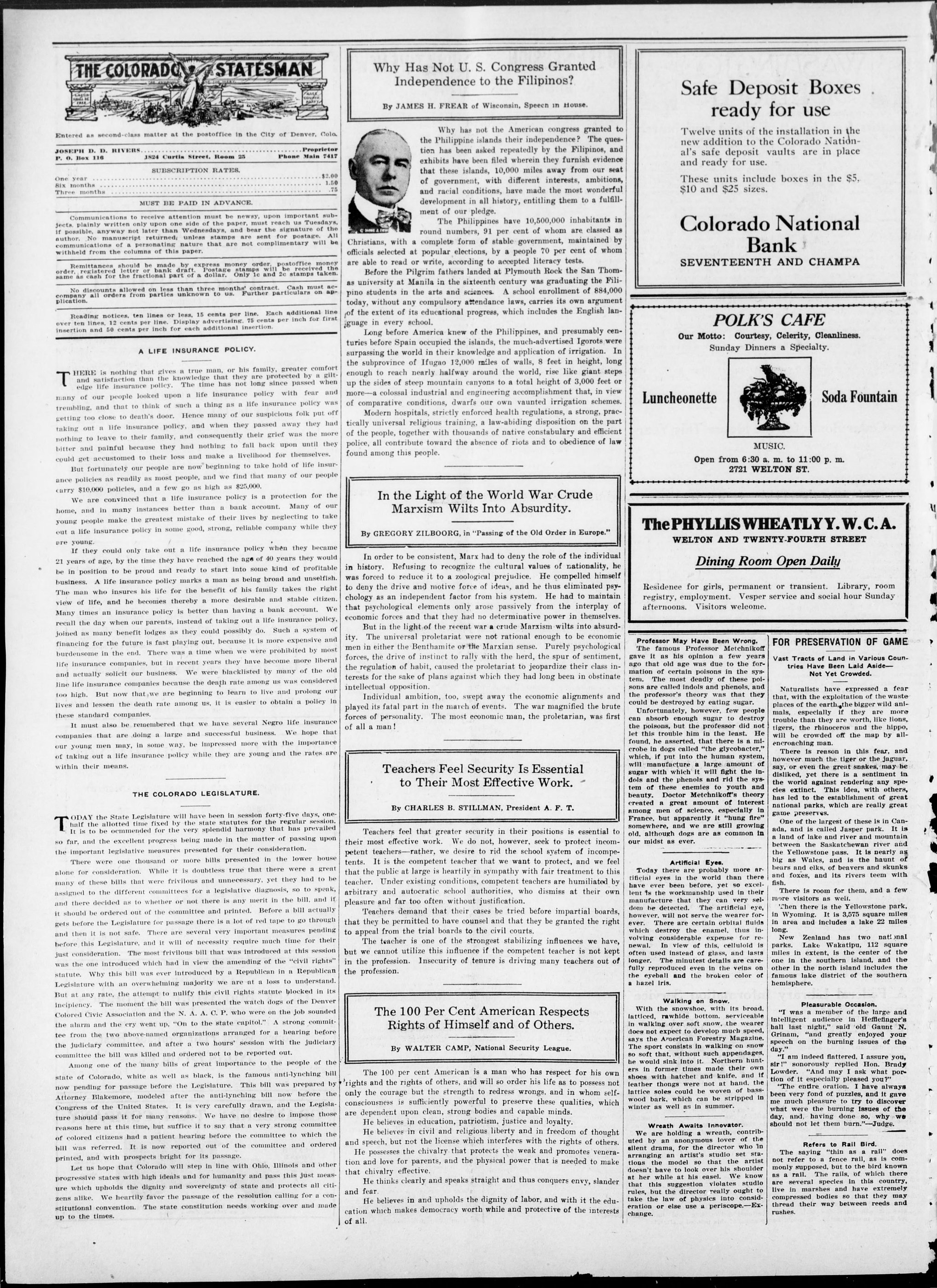
THE COLORADO LEGISLATURE.
TODAY the State Legislature will have been in session forty-five days, one half the allotted time fixed by the state statutes for the regular session. It is to be ommended for the very splendid harmony that has prevailed so far, and the excellent progress being made in the matter of passing upon the important legislative measures presented for their consideration.
There were one thousand or more bills presented in the lower house alone for consideration. While it is doubtless true that there were a great many of these bills that were frivilous and unnecessary, yet they had to be assigned to the different committees for a legislative diagnosis, so to speak, and there decided as to whether or not there is any merit in the bill, and if it should be ordered out of the committee and printed. Before a bill actually gets before the Legislature for passage there is a lot of red tape to go through and then it is not safe. There are several very important measures pending before this Legislature, and it will of necessity require much time for their just consideration. The most frivilous bill that was introduced at this session was the one introduced which had in view the amending of the "civil rights" statute. Why this bill was ever introduced by a Republican in a Republican Legislature with an overwhelming majority we are at a loss to understand. But at any rate, the attempt to nullify this civil rights statute blocked in its incipiency. The moment the bill was presented the watch dogs of the Denver Colored Civic Association and the N. A. A. C. P. who were on the job sounded the alarm and the cry went up, "On to the state capitol." A strong committee from the two above-named organizations arranged for a hearing before the judiciary committee, and after a two hours' session with the judiciary committee the bill was killed and ordered not to be reported out.
Among one of the many bills of great importance to the people of the state of Colorado, white as well as black, is the famous anti-lynching bill now pending for passage before the Legislature. This bill was prepared by Attorney Blakemore, modeled after the anti-lynching bill now before the Congress of the United States. It is very carefully drawn, and the Legislature should pass it for many reasons. We have no desire to impose those reasons here at this time, but suffice it to say that a very strong committee of colored citizens had a patient hearing before the committee to which the bill was referred. It is now reported out of the committee and ordered printed, and with prospects bright for its passage.
Let us hope that Colorado will step in line with Ohio, Illinois and other progressive states with high ideals and for humanity and pass this just measure which upholds the dignity and sovereignty of state and protects all citizens alike. We heartily favor the passage of the resolution calling for a constitutional convention. The state constitution needs working over and made up to the times.
Why Has Not U. S. Congress Granted Independence to the Filipinos?
By JAMES H. FREAR of Wisconsin, Speech in House.
Why has not the American congress granted to the Philippine islands their independence? The question has been asked repeatedly by the Filipinos, and exhibits have been filed wherein they furnish evidence that these islands, 10,000 miles away from our seat of government, with different interests, ambitions, and racial conditions, have made the most wonderful development in all history, entitling them to a fulfillment of our pledge.
C. BANE & FROC
The Philippines have 10,500,000 inhabitants in round numbers. 91 per cent of whom are classed as
Christians, with a complete form of stable government, maintained by specials selected at popular elections, by a people 70 per cent of whom are able to read or write, according to accepted literacy tests.
Before the Pilgrim fathers landed at Plymouth Rock the San Thomuniversity at Manila in the sixteenth century was graduating the Filipino students in the arts and sciences. A school enrollment of 884,000 day, without any compulsory attendance laws, carries its own argument the extent of its educational progress, which includes the English language in every school.
Long before America knew of the Philippines, and presumably cencies before Spain occupied the islands, the much-advertised Igorots were passing the world in their knowledge and application of irrigation. In subprovince of Ifugao 12,000 miles of walls, 8 feet in height, long enough to reach nearly halfway around the world, rise like giant steps in the sides of steep mountain canyons to a total height of 3,000 feet or more—a colossal industrial and engineering accomplishment that, in view of comparative conditions, dwarfs our own vaunted irrigation schemes.
Modern hospitals, strictly enforced health regulations, a strong, practically universal religious training, a law-abiding disposition on the part of the people, together with thousands of native constabulary and efficientice, all contribute toward the absence of riots and to obedience of law and among this people.
Christians, with a complete form of stable government, maintained by officials selected at popular elections, by a people 70 per cent of whom are able to read or write, according to accepted literacy tests.
Before the Pilgrim fathers landed at Plymouth Rock the San Thomas university at Manila in the sixteenth century was graduating the Filipino students in the arts and sciences. A school enrollment of 884,000 today, without any compulsory attendance laws, carries its own argument of the extent of its educational progress, which includes the English language in every school.
Long before America knew of the Philippines, and presumably centuries before Spain occupied the islands, the much-advertised Igorots were surpassing the world in their knowledge and application of irrigation. In the subprovince of Ifugao 12,000 miles of walls, 8 feet in height, long enough to reach nearly halfway around the world, rise like giant steps up the sides of steep mountain canyons to a total height of 3,000 feet or more—a colossal industrial and engineering accomplishment that, in view of comparative conditions, dwarfs our own vaunted irrigation schemes.
Modern hospitals, strictly enforced health regulations, a strong, practically universal religious training, a law-abiding disposition on the part of the people, together with thousands of native constabulary and efficient police, all contribute toward the absence of riots and to obedience of law found among this people.
In the Light of the World War Crude Marxism Wilts Into Absurdity.
By GREGORY ZILBOORG, in "Passing of the Old Order in Europe."
In order to be consistent, Marx had to deny the role of the individual history. Refusing to recognize the cultural values of nationality, he is forced to reduce it to a zoological prejudice. He compelled himself deny the drive and motive force of ideas, and he thus eliminated psychology as an independent factor from his system. He had to maintain that psychological elements only arose passively from the interplay of economic forces and that they had no determinative power in themselves.
But in the light of the recent war a crude Marxism wilts into absurdity. The universal proletariat were not rational enough to be economic in either the Benthamite or the Marxian sense. Purely psychological forces, the drive of instinct to rally with the herd, the spur of sentiment, regulation of habit, caused the proletariat to jeopardize their class inests for the sake of plans against which they had long been in obstinate intellectual opposition.
Individual ambition, too, swept away the economic alignments and layed its fatal part in the march of events. The war magnified the brute faces of personality. The most economic man, the proletarian, was first all a man!
In order to be consistent, Marx had to deny the role of the individual in history. Refusing to recognize the cultural values of nationality, he was forced to reduce it to a zoological prejudice. He compelled himself to deny the drive and motive force of ideas, and he thus eliminated psychology as an independent factor from his system. He had to maintain that psychological elements only arose passively from the interplay of economic forces and that they had no determinative power in themselves.
Teachers Feel Security Is Essential to Their Most Effective Work.
By CHARLES B. STILLMAN, President A. F. T.
Teachers feel that greater security in their positions is essential to their most effective work. We do not, however, seek to protect incompleteness teachers—rather, we desire to rid the school system of incompetence. It is the competent teacher that we want to protect, and we feel that the public at large is heartily in sympathy with fair treatment to this teacher. Under existing conditions, competent teachers are humiliated by arbitrary and autocratic school authorities, who dismiss at their own measure and far too often without justification.
Teachers demand that their cases be tried before impartial boards, but they be permitted to have counsel and that they be granted the right appeal from the trial boards to the civil courts.
The teacher is one of the strongest stabilizing influences we have, we cannot utilize this influence if the competent teacher is not kept the profession. Insecurity of tenure is driving many teachers out of the profession.
The 100 Per Cent American Respects Rights of Himself and of Others.
The 100 per cent American is a man who has respect for his own rights and the rights of others, and will so order his life as to possess not by the courage but the strength to redress wrongs, and in whom self-consciousness is sufficiently powerful to preserve these qualities, which dependent upon clean, strong bodies and capable minds. He believes in education, patriotism, justice and loyalty.
He believes in civil and religious liberty and in freedom of thought and speech, but not the license which interferes with the rights of others. He possesses the chivalry that protects the weak and promotes veneration and love for parents, and the physical power that is needed to make it chivalry effective.
He thinks clearly and speaks straight and thus conquers envy, slander and fear.
He believes in and upholds the dignity of labor, and with it the education which makes democracy worth while and protective of the interests all.
He believes in civil and religious liberty and in freedom of thought and speech, but not the license which interferes with the rights of others. He possesses the chivalry that protects the weak and promotes veneration and love for parents, and the physical power that is needed to make that chivalry effective. He thinks clearly and speaks straight and thus conquers envy, slander and fear.
Twelve units of the installation in the new addition to the Colorado National's safe deposit vaults are in place and ready for use.
These units include boxes in the $5, $10 and $25 sizes.
Colorado National Bank
SEVENTEENTH AND CHAMPA
POLK'S CAFE
Our Motto: Courtesy, Celerity, Cleanliness.
Sunday Dinners a Specialty.
```markdown
```
Luncheonette Soda Fountain
MUSIC.
Open from 6:30 a. m. to 11:00 p. m.
2721 WELTON ST.
The PHYLLIS WHEATLY Y. W.C.A.
WELTON AND TWENTY-FOURTH STREET
Dining Room Open Daily
Residence for girls, permanent or transient. Library, room registry, employment. Vesper service and social hour Sunday afternoons. Visitors welcome.
Professor May Have Been Wrong. The famous Professor Metchnikoff gave it as his opinion a few years ago that old age was due to the formation of certain poisons in the system. The most deadly of these poisons are called indols and phenols, and the professor's theory was that they could be destroyed by eating sugar.
Unfortunately, however, few people can absorb enough sugar to destroy the poisons, but the professor did not let this trouble him in the least. He found, he asserted, that there is a microbe in dogs called "the glycobacter," which, if put into the human system, will manufacture a large amount of sugar with which it will fight the indols and the phenols and rid the system of these enemies to youth and beauty. Doctor Metchnikoff's theory created a great amount of interest among men of science, especially in France, but apparently it "hung fire" somewhere, and we are still growing old, although dogs are as common in our midst as ever.
Artificial Eyes.
Today there are probably more artificial eyes in the world than there have ever been before, yet so excellent is the workmanship used in their manufacture that they can very seldom be detected. The artificial eye, however, will not serve the wearer forever. There are certain orbital fluids which destroy the enamel, thus involving considerable expense for renewal. In view of this, celluloid is often used instead of glass, and lasts longer. The minutest details are carefully reproduced even in the veins on the eyeball and the broken color of a hazel iris.
Walking on Snow
With the snowshoe, with its broad, latticed, rawhide bottom, serviceable in walking over soft snow, the wearer does not expect to develop much speed, says the American Forestry Magazine. The sport consists in walking on snow so soft that, without such appendages, he would sink into it. Northern hunters in former times made their own shoes with hatchet and knife, and if leather thongs were not at hand, the lattice soles could be woven of basswood bark, which can be stripped in winter as well as in summer.
Wreath Awaits Innovator.
We are holding a wreath, contributed by an anonymous lover of the silent drama, for the director who in arranging an artist's studio set stations the model so that the artist doesn't have to look over his shoulder at her while at his easel. We know that this suggestion violates studio rules, but the director really ought to take the law of physics into consideration or else use a periscope.—Exchange.
National
ank
H AND CHAMPA
Soda Fountain
---
FOR PRESERVATION OF GAME
Vast Tracts of Land in Various Countries Have Been Laid Aside—Not Yet Crowded.
Naturalists have expressed a fear that, with the exploitation of the waste places of the earth, the bigger wild animals, especially if they are more trouble than they are worth, like lions, tigers, the rhinoceros and the hippo, will be crowded off the map by all-enroaching man.
There is reason in this fear, and however much the tiger or the jaguar, say, or even the great snakes, may be disliked, yet there is a sentiment in the world against rendering any species extinct. This idea, with others, has led to the establishment of great national parks, which are really great game preserves.
One of the largest of these is in Canada, and is called Jasper park. It is a land of lake and river and mountain between the Saskatchewan river and the Yellowstone pass. It is nearly as big as Wales, and is the haunt of bears and elks, of beavers and skunks and foxes, and its rivers teem with fish.
There is room for them, and a few more visitors as well.
Then there is the Yellowstone park, in Wyoming. It is 3,575 square miles in area and includes a lake 22 miles long.
New Zealand has two national parks. Lake Wakatipu, 112 square miles in extent, is the center of the one in the southern island, and the other in the north island includes the famous lake district of the southern hemisphere.
Pleasurable Occasion.
"I was a member of the large and intelligent audience in Hefflinger's hall last night," said old Gaunt N. Grinam, "and greatly enjoyed your speech on the burning issues of the day."
"I am indeed flattered, I assure you, sir!" sonorously replied Hon. Brady Lowder. "And may I ask what portion of it especially pleased you?"
"The entire oration. I have always been very fond of puzzles, and it gave me much pleasure to try to discover what were the burning issues of the day, and, having done so, why we should not let them burn."—Judge.
Refers to Rail Bird
The saying "thin as a rail" does not refer to a fence rail, as is commonly supposed, but to the bird known as a rail. The rails, of which there are several species in this country, live in marshes and have extremely compressed bodies so that they may thread their way between reeds and rushes.
Washington in Washington
©U.S. M.A. SERVICE
from Underwood & Underwood
WHITE HOUSE
EORGE WASHINGTON'S connection with the capital city of the nation began when, as President of the United States, he appointed a commission to locate the capital on the Potomac river, "a few miles above Alexandria and adjacent to Georgetown." The congress sitting in Philadelphia directed that the commissioners be appointed and instructed them as to where they should locate the permanent capital. Those commissioners named the city for the man who had led the victorious armies of the colonies in the Revolution and who was then serving as President. Many fairy stories have been written about how Washington personally selected the site for the capital, "even driving some of the surveyor's stakes," etc. The unvarnished truth is that he merely carried out the will of congress by appointing a commission which was instructed by congress to do a certain thing.
From the day that staked out Washington city and its enviro clearer as the year persons, Americans new inspiration ev upon the material when Washington v flesh with the pres eligners benefit in t any pause in the str or in the throng top of the Washin summer, through sup paying to the "Fat Every recurring ann increases the inter anniversaries floral piled high in the to branch of congress farewell address s
From the day the tract ten miles square was atked out Washington's impress has been in the city and its environs. That impress stands out clearer as the years pass. More than a million persons, Americans by birth or adoption, gain new inspiration every year merely by looking upon the material things that connect the days when Washington was moving about there in the flesh with the present time. Thousands of foreigners benefit in the same way. There is never any pause in the stream of pilgrims to Mt. Vernon or in the throng that is always on the way to the top of the Washington monument. Winter and summer, through sunshine and storm, the homage paying to the "Father of his Country" goes on. Every recurring anniversary of his birth seemingly increases the interest in his memory. On these anniversaries floral decorations are invariably piled high in the tomb at Mt. Vernon, and neither branch of congress ever fails to provide that his farewell address shall be read.
Probably because the point has never been emphasized many persons have the iden, it seems, that Washington lived for a short time in the city that bears his name. There is also a popular belief that the Washingtons at one time occupied the White House. Washington was never a resident of the permanent capital. The seat of government was in Philadelphia when congress voted to locate the capital where it is, and Washington had a temporary home in that city. On returning from Philadelphia at the close of his second term as President he gave considerable personal attention to the early developments of the new capital. He frequently rode up from Mt. Vernon on his favorite black horse to see how things were coming on.
Who would undertake to say that he did not visualize the national capital in some such form as it stands today? If he did, he saw in his imagination the Capitol building on Capitol hill, the Library of Congress with its golden dome in the rear of the Capitol, the magnificent office buildings for senate and house of representatives, the expansive Mall extending from the Capitol to the Potomac, with the monument to his own memory, the most conspicuous thing on it; and he also saw the splendid memorial to Abraham Lincoln, which has just been completed, as well as the memorial to U. S. Grant, which is almost ready to be turned over to the government. And who again would say that he did not have a vision of the resident section of the city extending far beyond the White House to the northwest?
Washington never saw the White House occupied. To some extent it represents his ideas of what a combined home and business office for the President should be—the original idea was that the President should make the house his residence and also his workshop. Washington as a Mason assisted in laying the cornerstone of the White House. That formality was conducted by a Masonic lodge in Alexandria of which Washington was a member.
It is certain that he was deeply interested in the work of construction. At the time of his death the house was practically ready for occupancy. The furnishings were being placed in position. Only a few days before his death he and Mrs. Washington went through the entire building and, according to the chroniclers of the time, were keenly interested in every detail of the place which was to be the home of future Presidents.
Today, as it has ever been, it is not so much the things with the Washington stamp on them, as those in the nearby districts that interest the
---
EORGE WASHINGTON'S connection with the capital city of the nation began when, as President of the United States, he appointed a commission to locate the capital on the Potomac river, "a few miles above Alexandria and adjacent to Georgetown." The congress sitting in Philadelphia directed that the commissioners be ap-
tourists, Mt. Vernon, of course, is the Washington shrine and it will continue to be that so long as the republic endures. It was the Virginia home on the Potomac to which Washington took his bride; there he made plans for his life work, plans that were rudely shattered by the events of later years. It was from that refuge that he went forth to command the armies of the Revolution, and it was from the seclusion of that attractive place that he answered the call to be President. He returned to the old home on retiring from office, and there he died, and there his bones lie.
When the national capital city was laid out, and for many decades afterward, Mt. Vernon was looked upon as a a "long ways off" from the capital. It is only seventeen miles away. Today there are three ways of reaching Mt. Vernon—by boat, by electricity, by automobile. It is an easy hour's travel from the business center of Washington. With these facilities the number of visitors has greatly increased. It is believed the time is not far distant when a million and a half of tourists will annually visit Mt. Vernon.
If you should happen to be in Mt. Vernon on the 22d of February you would, in imagination, see Washington as he went about his country place on his birthday. "The very atmosphere speaks to you of him," said a distinguished Frenchman. Visitors marvel at the faithfulness with which the buildings and their contents and the grounds have been preserved. There have been, of necessity, some replacements, but speaking in a broad way, things are as they were when Washington last looked upon them. One can almost see the house cat coming out of the hole under the door that led to the room occupied by Mrs. Washington. And what a sense of comfort one gets as he sits in an easy chair on the veranda and looks out over the Potomac and across the river to the hills of Maryland, just as Washington did! "No wonder Washington did not wish to leave the place even to be President of his country," one says to himself.
The Mount Vernon Ladies' Aid society continues to care for the Mt. Vernon home and lands. The country owes a debt of gratitude to this society for preserving the property. Years ago when it was about to fall into the hands of private speculators this society was formed and it has done its work well. Many persons believe, however, that congress should buy the estate in the name of the government and throw it open to the public. Always under the management of the Aid society a nominal charge for admittance has been made.
Many of the visitors linger in the country about the old Washington home. Of course no one who knew the Washington family is now living, but there are plenty of descendants of the old families in the neighborhood who delight to talk of the old days. The countryside has not changed much in 120 years. Many houses built while Washington was alive still stand. Three miles south of Mt. Vernon the old Pohick (Episcopal) church in which Washington frequently worshiped is still occupied by the Episcopal congregation. Within the last five years the interior of the old building has been restored and today visitors may look on the decorations precisely as they were when Washington attended.
Passing time has not served to take away any of the Washington atmosphere about the old city of Alexandria, seven miles south of the national capital and on the road to Mt. Vernon. The first thing the writer is told is that Washington "did a lot for us." "He established our public school system," says the local guide, "and he gave us our first fire department. He was always doing something for us." Foremost of the Washington showplaces in Alexandria is old Christ church, of which Washington was a member for some 40 years. The church building of brick has been preserved unchanged. The pew that Washington occupied is reserved every Sunday for strangers who may happen along at the service hour. The old sexton will be certain to relate numerous stories of the first President. He will, first of all, tell you how Washington always came up from Mt. Vernon on horseback, followed by his faithful black bodyguard in a bright red uniform; how after services Washington was likely to linger in the church-yard to talk with his country neighbors, and how it was frequently necessary for
the servant to remind him that it was time to go by leading up the horse and handing the bridle relins to him. The members of Washington's family, the local historian relates, always came up in a large coach drawn by four horses if the roads were heavy. Not infrequently neighbors were guests in the coach.
Another favorite rendezvous in Alexandria for sightseers is the room occupied by the Masonic lodge named for Washington. This lodge still flourishes. There one may look upon the chair in which Washington sat when he presided over the lodge of which he was master, also the Masonic apron he wore, his wedding gloves, a pair of spurs he wore, a pruning knife he used on the Mount Vernon plantation, and a penknife which his mother gave him when he was a boy. And there is to be seen in the old lodge room the last authentic painting of him, a pastel from life made by William Williams of Philadelphia.
Another old Washington landmark in Alexandria is the Carlyle house. This structure was there when Washington was a young man. In colonial days it was one of the best-known hotels in Virginia. The fine folks of the Old Dominion gathered there for balls and dinners and for good times generally, and Washington, the local historians say, was present at any unusual event. General Braddock had his headquarters in the old hotel when he was proceeding against the French and Indians. Making one's way back to the capital city over the Alexandria-Arlington road numerous landmarks may be seen. This highway leads by Arlington, the resting place of the nation's heroes, and to Georgetown.
As this old highway brings the traveler around the brow of a hill four miles southwest of the national capital the Washington monument looms up across the low land and the Potomac river. From no point in the environs of the national capital does the monument appear to greater advantage—a magnificent reminder of the good works of one typical American. This monument is a fitting companion piece for the great memorial to Abraham Lincoln soon to be dedicated. It speaks of the founder of the Republic; the other of the saviour of the Republic.
Many projects were discussed before the Washington monument was conceived and work on it begun. At the close of the Revolution the Continental congress recommended the erection of an equestrian statue to Washington. Immediately after his death the congress, sitting in Philadelphia, voted to erect a monument under which he should be buried. Another project was to make the Capitol building a memorial to him. Travelers may to this day have a peep at a vaulted chamber directly under the rotunda of the Capitol which was designed as a resting place for the body of Washington.
The Washington monument is the most conspicuous work of man at the national capital. The dome of the Capitol and dome of the Congressional library and the new Lincoln memorial stand out with boldness, but the monument overtops them. On a clear day the monument may be seen from the crest of the Blue Ridge mountains, 45 miles away. The memorial had its inception in the minds of patriotic people who formed the Washington Memorial association. It was proposed to charge a membership fee of $1 and the money thus contributed was to be used in the erection of a suitable monument to the hero of the Revolution. The money came in slowly and it looked at times as if this project too would have to be abandoned.
Finally in 1848 congress voted a site. The spot chosen had been marked by Washington himself as a monument to the Revolution which he hoped would sometime be built. The work of erecting the monument proceeded slowly. It had reached a height of 178 feet when the Civil war came on. It was roofed over and stood untouched until 1876 when congress again took hold and under the spur of congressional action it was completed in 1885.
The height of the monument is 555 feet and 5 inches. From the lookout on the top the view of the national capital and its environs fascinates a million persons a year.
Other unpretentious memorials of Washington are to be seen in the national capital.
STOCK VALUATIONS
COLORADO'S LIVE STOCK SHOWS
BIG DECREASES IN NUMBERS
AND VALUATIONS FOR 1920.
Denver, Colo.—There was a decrease during the past year in the numbers of all classes of live stock for the United States and Colorado, except dairy cows for the state, according to the live stock report of the United States Bureau of Crop Estimates and the Colorado Co-operative Crop Reporting Service, and all live stock show marked declines in average price and total values during the same period. The declines in numbers were especially marked in cattle, sheep and hogs, due largely to unsatisfactory prices and stringent money conditions.
The number of horses on the farms of Colorado on Jan. 1, 1921, totaled 408,000, being 13,000, or 3.1 per cent, less than the number on the same date last year. The average price of all horses was $62 per head, $17, or 21.6 per cent, less than the year before. The total value of all horses was $25,296,000, compared with the value of the preceding year of $33,259,000. The actual depreciation in the valuation of the 408,000 horses in the state during the year amounts to $6,936,000. The mules in the state January 1, 1921, numbered 30,000, compared with 31,000 a year ago, or a reduction of 3.3 per cent. The total value this year is $2,670,000, compared with $3,131,000 last year. The actual depreciation for the number on the farms at the present time is $12 per head, amounting to $360,000.
Milk Cows.
The milk cows in the state barely held to the same number—272,000 head—but the valuation was reduced $4,624,000, the present worth being estimated at $19,040,000. The reports indicate that the average daily yield per cow during the period when milked last year was 8.6 quarts. Good prices were largely responsible for the lack of decrease in the number of dairy cows.
Other cattle on the farms and ranges of the state numbered 1,220,000 head, compared with 1,355,000 last year—a reduction of 10 per cent. Their average value per head this year is $34.80—a reduction of $13.30, or 27.7 per cent per head. This reduction results in a total depreciation in the value of 1,220,000 head amounting to $16,226,000. The total valuation of the cattle in the state this year is $42,456,000 compared with $65,176,000 on the total number of cattle in the state a year ago.
Sheep.
The number of sheep on the Colorado farms and ranges Jan. 1, 1921, was 1,973,000 head, compared with 2,121,000 head last year. This number is a reduction of 7 per cent. The average value is $5.60 per head—a reduction of $4.20, or 42.8 per cent, per head. This reduction results in a depreciation in the valuation on the 1,973,000 sheep of $8,286,000. The present total value of the sheep in Colorado is $11,048,000 compared with $20,786,000, the value of the 2,121,000 head last year. Reports indicate a heavy reduction in range sheep during the year, but considerable increase in the number of sheep in the feed lots—the estimated number on feed in transit January 1, 1921, being 1,250,000 head, compared with the estimated number of 950,000 the same date last year, 930,000 in 1919 and 1,135,000 in 1918.
There were fewer swine of all ages on Colorado farms on Jan. 1 by 57,000 head than a year ago, or a reduction of 15 per cent. The number on the farms this year is 325,000 compared with 382,000 last year at this time. There was a decline of $5.70, or 31.7 per cent from the average price of last year. This reduction in the average price on the 325,000 swine in the state results in a depreciation in values to the farmer on this class of stock of $1,953,000. The total valuation of the swine in the state is $3,907,000, compared with a valuation on 382,000 head last year of $6,876,000. Special reports indicate that about 19 per cent of the number of swine on hand in Colorado on January 1, 1921, were brood sows and 38 to 40 per cent were pigs under six months old. The remainder is assumed to be hogs on hand for fattening. Similar reports for January 1, 1920, showed 15 to 20 per cent of the number of swine on hand were brood sows and 45 to 60 per cent were pigs under six months old.
The total value on January 1, 1921, of all animals enumerated above was $6,235,560,000 as compared with $8,507,145,000 on January 1, 1920, a decrease of $2,271,576,000, or 26.7 per cent. The total aggregate depreciation in the valuation of all animals enumerated above on the farms of the United States at the present time account of decrease in average values during the year is $1,984,060,000, or a depreciation of 24.14 per cent.
Ogden, Utah.—A school boy love affair was found to be back of a blackmail scare at Riverdale, near here, according to Sheriff Richard Pincock, who questioned Tom Zito. The boy is said to have confessed that he wrote three threatening letters demanding $5,000 from L. B. Bingham, whose young daughter had looked coldly on Tom's attentions. Attention was directed to Zito because one letter casually set forth that "Tom Zito is the best fighter in Riverdale, but nobody knows it."
DR. CLARENCE F. HOLMES, JR.
BROOKLYN, N.Y.
Invites the public of Denver to
inspect his modern, electrically
equipped dental suite, 2602 Wet-
ton St. Hours 9 a.m. to 12 noon;
1 to 6 p. m.; evenings and Sunda-
days by appointment. Office
phone Champa 2807. Residence
phone Champa 1538.
DR. WESTBROOK, Physician and Surgeon, office 25 Good Block, 16th and Larimer St. Phone Main 5595. Hours 10 to 11 a.m. 2 to 4 and 7 to 8 p.m. Residence 2555 Glenarm place. Phone Champa 6148. Hours at residence by appointment. Call Physicians and Surgeon! Telephone Exchange; Main 1624. night or day. R-ray examination and treatments a specialty.
C. E. TERRY, M.D.
1027 Twenty-first St., Denver Office Phone Main 2701. Hours 12 to 2 and 6 to 8 p.m., or by appointment. Res. 2337 Glenarm Place. Phone Champa 3303.
E. P. BLAKEMORE.
Attorney and Counselor at Law
Office Rooms 39 and 40 Arapahoe Bldg. 1622 Arapahoe St.
Phone Champa 5450.
DR. HUFF'S office phone is
Champa 6001. And his residence
Phone York 4101. When not
reached at office or home, call
Atlas Drug Co., Main 875, Atlas
Suite 5, 6 and 7, 2701 Wetton St.,
over Atlas Drug Store. Office
hours, 11 to 12 a. m., and 3 to 5
p. m.
Office 609 27th St. Ph. Champa 1142
S. E. CARY
ATTORNEY-AT-LAW
Six Years City and County Attorney
at Russell Springs, Logan
County, Kansas
Office Home
9:00 A.M. to 12:00 M.
2:00 P.M. to 4:00 P.M.
DENVER, COLO.
The
WARD AUCTION
COMPANY
Sales Daily at 2 p.m. Office Purs-
niture a Specialty.
PRIVATE SALES AT ALL TIMES
HAVE MOVED TO
1723-39 GLENARM ST.
PHONE MAIN 1875.
Phone Main 8036
Res. Phone York 5774W
FRANK D. TAGGART
Attorney at Law—Notary Public
206-206 Cooper Building
Denver, Colorado
JOSEPH CARTER
Express, Moving,
and Storage
COAL AND WOOD
PROMPT DELIVERY.
Phone Main 6544.
2415 WASHINGTON STREET.
ORIENTAL RESTAURANT
Chop Suey, Noodles and Short Orders
Phone Champa 113
1848 Arapahoe
Do You
Use Good Paper When You Write?
We Can Print Anything and Do It Right.
CHEFES
The Larger Girls Take Turns in Preparing Soup or Cocoa for the School.
(Prepared by the United States Department of Agriculture.)
In the small rural school with only one teacher, it is still the common custom for the pupils to bring their lunches. The parents of the children oftentimes are wide-awake to how valuable the hot lunch has been found to be in the city schools, but they cannot see, under the existing circumstances in their school, how such an innovation can be managed.
Experience has proved that the child who has even one hot dish at noon does much better, mentally and physically, than the one who has only cold food, especially in winter weather. The country child has quite as much right to the benefits of the practice as has the city child. Usually when there is a concerted will to provide something of the sort, a way is found.
The recipes for the dishes cooked for lunch may be given to the older girls in school, discussed in class, and tried at home. The special dish for the day, which in winter is usually hot and in summer more often cold, can be prepared and served at noon by the girls in turn, working in groups. It will often be necessary to serve the food to the children at their seats—a practice which is not especially objectionable if the schoolhouse is clean and well ventilated, the desks carefully cleaned before meals, and the building thoroughly screened to keep out files, which are always dangerous around food, since they can convey to it the bacteria which cause intestinal and other diseases.
Clean Hands Essential.
Clean hands should always be in-
The situation, however, will require a teacher of ingenuity and of enthusiasm for her work. The simplest equipment includes a large kettle suitable to be used on the stove which heats the schoolhouse, measuring cup and spoons, paring knife, mixing spoon, dish pans, and towels. It will usually be possible for the boys to make a set of shelves for the dishes, using box lumber if no other is available, and for the girls to make curtains or other coverings for protection from dust. The pupils will, as a rule, be found willing to bring plates, cups, bowls, and spoons from home, if this is necessary, in order to keep down expenses. A fireless cooker can easily be made by the pupils as a class exercise. In this a hot dish for lunch can be prepared before school. The fireless cooker is convenient for meat stews, meat and bean soups, cereal mushes, and many other dishes that require long cooking.
BEANS VERY POPULAR AS ECONOMICAL FOOD
They Are One of Cheapest Sources of Protein.
Used Chiefly as a Meat Substitute and a Cupful Equals in Food Value a Quarter of a Pound of Juicy
Sirloin Steak.
Beans, though higher in price than they were several years ago, are still among the cheaper foods that can be bought today. They are one of the cheapest sources of protein and may be used to help supply this valuable food constituent in the diet, according to United States Department of Agriculture specialists. They are known chiefly as a meat substitute dish. A cup of baked beans, in which a third of a cup of dried beans are used, furnishes as much protein as a quarter of a pound of sirloin steak. Obviously the third of a cup of dried beans is much the cheaper to purchase. A pound of beef as purchased usually has some refuse in the form of skin, bone and gristle, while a pound of beans has practically no refuse. From this standpoint, therefore, as well as the difference in price, the housewife who finds her wood allowance growing low will do well to use beans often in place of meat.
The cheaper legumes, beans, peas, etc., should not be depended upon as the sole source of protein for a great length of time. Milk, cheese, eggs, or meat should furnish some of the protein in a week's dietary. There is little difference in food value among the many common varieties of beans, with the exception of the soy bean, which is richer in protein and in fat than the ordinary beans. All legumes should be thoroughly cooked. Long cooking at moderate heat is best.
A favorite and standard recipe for baking beans is the following: Soak the beans over night, then rinse and boil them until the skins crack when blown upon, but the beans are not quite soft. Use one-half pound of salt pork to one quart of beans. Cut the pork nearly through the rind and add before boiling the beans. After boiling, pour into the bean pot, insert the pork, the cut rind being level with the top of the beans. Add a pint of water used for boiling, having first mixed with the water a teaspoonful of salt and two tablespoons of molasses. The water should come about to the surface of the contents. Bake six to eight hours, adding more water when needed to prevent the top drying or burning. Beans, when done, should
The recipes for the dishes cooked for lunch may be given to the older girls in school, discussed in class, and tried at home. The special dish for the day, which in winter is usually hot and in summer more often cold, can be prepared and served at noon by the girls in turn, working in groups. It will often be necessary to serve the food to the children at their seats—a practice which is not especially objectionable if the schoolhouse is clean and well ventilated, the desks carefully cleaned before meals, and the building thoroughly screened to keep out files, which are always dangerous around food, since they can convey to it the bacteria which cause intestinal and other diseases.
Clean Hands Essential.
Clean hands should always be insisted upon, as well as clean spoons, dishes, etc., and individual drinking cups. Furthermore, children should be taught not to drink out of each other's cups or glasses or to use one another's spoons or forks.
It is seldom desirable to prepare more than one dish a day in a small school, and this should, for the sake of variety, differ from day to day. The others can be brought from home. The choice of the dish to be cooked should be determined partly by what it is possible to do in the way of cooking at the school, partly by what purchased or home-grown food is available, and what the school garden or neighboring fields or woods afford, and partly by what the teacher has learned from experience is needed to go with the foods brought from home. The noonday meal as a whole will then be appetizing and will provide the needed nutrients as they are now understood.
be thoroughly softened, but not mushy, and should retain their shape.
Baked-Bean Croquettes.
1 cupful baked ½ teaspoonful salt.
bean pulp. ½ teaspoonful pepper.
1 teaspoonful onion juice. 2 tablespoonful flour.
½ cupful milk. 1 tablespoonful fat.
Melt the fat, stir in the flour, salt, and pepper and mix with the cold milk. Cook until thick and smooth, stirring constantly. Combine this with the beans to which the onion juice has been added. Let stand for two or three hours; then shape as for croquettes. Roll in bread crumbs, then in beaten egg, then in bread crumbs again. Place them in deep fat and cook until nicely browned. Tomato sauce may be served with these croquettes. A recipe for it follows:
Tomato Sauce.
1 cupful tomato 1 slice onion.
juice. 1 tablespoonful fat.
2 tablespoonfuls $\frac{1}{4}$ teaspoonful pep-
flour. per.
1 teaspoonful salt.
Melt the fat and stir in the flour
and seasonings. Add the tomato juice
and cook until thickened, stirring
constantly.
Bean Loaf.
1 pint cold cooked 1 tablespoonful fine beans.
1 egg. 2 tablespoonfuls to cupful bread mato catspur.
crumbs. Salt and pepper.
Combine the ingredients and shape into a loaf. Place strips of bacon on top of loaf. Bake 25 minutes. Tomato sauce may be served with this loaf.
This loaf should be used in place of meat in the menu and may be served with scalloped tomatoes, or onions, or creamed cauliflower.
Kidney-Bean Stew.
Soak beans overnight. Add one quart of water and cook until half done. Add the other ingredients and cook slowly until all ingredients are tender. Add more water if necessary.
This dish may be served in place of meat and other cooked vegetables in a meal. A fruit salad or a salad made of green vegetables, such as cucumbers or radishes, may be used in such a menu.
HOUSEHOLD FACTS
Cakes containing no shortening may be baked in ungreased pans.
If you wish your bread to have a soft crust wrap in a clean cloth as soon as it comes from the oven.
The KITCHEN CABINET
(©, 1921, Western Newspaper Union.)
The main difference between pleasant and unpleasant people is mainly that the latter demand consideration and the former are quick to give it.
WHAT TO EAT.
A good nourishing soup is always a welcome dish, especially during the winter months. Veal Soup. Cook a two-pound knuckle of veal slowly in water till the meat falls from the bones, then remove the bones. There
Veal Soup. — Cook a two-pound knuckle of veal slowly in water till the meat falls from the bones, then remove the bones. There should be live or six cupfuls of stock. Add two cupfuls of diced potatoes and cook until soft; add the meat, one and one-half tablespoonfuls of catup, one-half teaspoonful of flour and one-eighth of a teaspoonful of pepper. Thicken slightly with one tablespoonful each of flour and fat cooked together. Pour over one hard-cooked egg and serve with thin slices of lemon on top of each dish.
Onion Soup.—Slice six medium-sized onions and cook in two tablespoonfuls of butter, stirring frequently, until light brown. Add two small cans of consomme and two cupfuls of hot water; cook gently for 15 minutes. Add three tablespoonfuls of parmesan cheese, one tablespoonful of kitchen bouquet, one-half teaspoonful of salt, a few grains of pepper, celery salt and paprika. Pour into a casserole and bake 15 minutes. Beef stock or broth may be used in place of the consomme.
Stuffed Turnips.—Pare half-pound turnips, cut slices from the top and scoop out the inside, leaving a half-inch rim. Cook both the shells and cover until half done (15 minutes) in salted water, then arrange them in a buttered baking pan, filling with chopped seasoned meat, crumbs or rice. Cover with the tops and fasten each with a toothpick. Pour around them the water in which the turnips were cooked and bake until the turnips are well done. Pour off the liquid and brown the turnips. Serve with the hot sauce poured around them just before taking to the table. The portion scooped out may be used in various ways as soup or cooked and mashed as a vegetable.
Italian Eggs and Onions.—Cook two cupfuls of small onions until tender; drain, season with salt and butter. Put into a shallow baking dish, allow big space to break, and dispose four eggs between the onions. Cover with six tablespoonfuls of cheese and place in a moderate oven until the eggs are set and the cheese melted.
Peas, carrots and onions cooked together and served with bits of diced salt pork browned in a hot frying pan make a good vegetable dish. Add a little milk and serve in individual dishes, seasoning well.
If you intend to be happy don't be foolish enough to wait for a just cause.
There's life alone in duty done,
And rest alone in striving.—Whittier.
WHAT TO HAVE FOR DINNER.
A tomato soup without meat is one
of the good, hearty and easy soups to
prepare. In a good-sized saucepan place one sweet pepper, one onion, one carrot and one turnip, all medium sized and finely minced. Add a sprig of
Two pots
parsley, one stalk of celery, one piece of bay leaf, one leaf of cabbage and two cloves. Add two quarts of tomatoes and one quart of water. If fresh tomatoes are used, do not peel them. Cover and simmer one hour, or until the vegetables are tender. Season with a tablespoonful of salt, one-quarter of a teaspoonful of pepper and two tablespoonfuls of sugar; more may be added according to taste. Strain all through a colander. Return the soup to the kettle and thicken with one tablespoonful of flour and one tablespoonful of sweet fat. One may can this soup and have it ready for reheating for an emergency soup.
Rice With Chicken.—Take a young chicken, cut up for frying. Take one tablespoonful each of lard and butter; melt in an iron kettle. When hot, add the chicken, two teaspoonfuls of salt; one-eighth of a teaspoonful of pepper; stir and cook until the chicken is brown (this will take about fifteen minutes). Then add two cloves of garlic, one small onion, chopped, and two green peppers, sliced. When these are cooked add one cupful of rice and two cupfuls of boiling water. When the rice is nearly done add one cupful of cooked peas and six chopped olives. Serve with strips of canned red pepper laid over the top for a garnish.
Apple Cake.—Line a deep pie plate with pastry, then mix together one-half pastry each of raisins, rolled walnuts, three-fourths of a cupful of sugar and one teaspoonful of sugar (sprinkle this over the crust). On top of this arrange slices of apple, using three greenings. Pour over them one egg and one cupful of milk mixed; add one-half teaspoonful of cinnamon and dot with two teaspoonfuls of butter. Place in a moderate oven until the custard is set, then reduce heat, baking about forty-five minutes.
The Kitchen Cabinet
(© 1921, Western Newspaper Union.)
It is not work that kills men, it is worry. Work is healthful; you can hardly put on a man more than he can bear. Worry is the rust on the blade. It is not the revolution that destroys the machinery, but the friction.—H. W. Beecher.
SEASONABLE GOOD THINGS.
While cranberries are in the market those who are fond of them may put
them up in various ways to use when they are out of season. The following will be worth trying:
```markdown
```
Spiced Cranberries. — Take
two quarts of cranberries, two-thirds of a pint of vinegar, two-thirds of a cupful of water, two tablespoonfuls of cinnamon, one tablespoonful of cloves, both ground; also one tablespoonful of allspice and six cupfuls of sugar. Cook together for 45 minutes and put up in glasses as for jelly. Cocoa Doughnuts.—Beat two eggs until light, add two-thirds of a cupful of sugar and beat again. Then add two tablespoonfuls of melted butter and one cupful of milk. Sift together three cupfuls of flour, three teaspoonfuls of baking powder and two tablespoonfuls of cocoa, one-fourth of a teaspoonful of salt and one teaspoonful of cinnamon. Mix all together, adding flour to roll. Cut in strips and twist slightly. Fry in hot fat, drain and when cold roll in powdered sugar.
Potato Cakes.—Add one beaten egg to two cupfuls of mashed potatoes, two tablespoonfuls of milk, salt and white pepper to taste. Mix well and form into ten balls, using flour to handle them. Pin around each a thin strip of bacon, using a toothpick to hold the bacon in place. Set in a hot oven or under a gas flame and cook the bacon until crisp. Serve at once. LeFTover Lamb With Savory Sauce.—Put six tablespoonfuls of currant jelly, four tablespoonfuls of butter, one-half tablespoonful of lemon juice, with salt and tabasco sauce to taste into a saucepan or shallow dish. Lay in the slices of lamb and heat until well heated through. Serve with the sauce poured around the lamb.
Potato and Celery Croquettes.—Take four cupfuls of mashed potatoes, season to taste; add two well-beaten eggs, then stir in two-thirds of a cupful of finely cut celery, three table-spoonfuls of minced onion; mix well, dip in egg, roll in crumbs and fry in deep, hot fat. This amount will make about fifteen croquettes.
Apple Pudding.—Slice apples to partly fill a deep plate; cover with a rich biscuit dough which may be either rolled out or dropped from the spoon. Bake until well done, turn, butter well, add sugar and nutmeg, and serve hot.
The sweetest music is not in oratorios but in the human voice when it speaks from its instant life tones of tenderness, truth and courage.—Emerson.
When we need nourishment, bulk, mineral salts and a "corrective alkalinity" we have only to serve a common Irish potato.
Bean Pot Hash. —Grind the remnants of the soup meat or roast rather course. Cut
Bean Pot Hash.
—Grind the remnants of the soup meat or roast rather course. Cut potatoes, in small
three medium-sized potatoes in small cubes, scald three onions and chop fine. Add the vegetables to the bean pot, salt, pepper, gravy and the meat. Add one pint of hot stock or boiling water; cover and bake one and one half hours. If bouillon cubes are used to prepare a broth, lessen the salt, as usually one small cube will salt a pint of liquid.
Vegetable and Broth Soup.—Take the broth from a well-cooked tongue; add to the broth one sliced onion, two sliced potatoes, one each of sliced carrot and turnip. Season with salt, pepper, kitchen bouquet and a few spoonfuls of strained tomato. Cook slowly for an hour, add a teaspoonful of walnut catup and serve piping hot. Strain if desired, but serving the soup with the vegetables is far more economical.
Apple Salad.—Chop firm apples, using three or four, depending on the number to be served. Add a small bunch of celery and a tablespoonful of onion scraped from the cut side of a mild onion, a handful of dates finely minced and mix with a good boiled dressing thinned with cream. Serve in the curled leaf of head lettuce.
Eggless Nugget Cake.—Cream one-half cupful of shortening with two cupfuls of light brown sugar. Sift together two cupfuls of pastry flour, one-half teaspoonful each of soda and salt, one teaspoonful of baking powder; add one cupful of raisins, the same of nuts; mix all together and add at the last two squares of chocolate melted over hot water. Bake for 35 minutes.
Maple Sauce for Pudding, Cakes or Waffles.—Cook three-fourths of a cupful of maple sirup and one teaspoonful of butter till it spins a thread; pour on two egg whites well beaten. When cool add half a cupful of cream whipped until stiff.
Neeleie Maxwell
ARCHIE MARKET
Wholesale and R
Hotels and
Fresh and Cuc
Fruits, Veg
wholesale and Retail Staple and Fancy Grocery
Fish and Oysters
Hotels and Restaurants Our Specialty
Fresh and Cured Eastern Corn-Fed Meats
Fruits, Vegetables, Poultry and Game
FREE DELIVERY
Arimer Street
Denver
IS
al
pany
DESIGNS PUT UP WHILE
YOU WAIT
FITTS AND CUT FLOWERS CONSTANTLY
ON HAND
USES: Thirty-Fourth and Curtis Streets
MAIN 1511
DENVER, COLO
atherhead Hat
Wholesale and Retail Staple and Fancy Groceries
Fish and Oysters
Hotels and Restaurants Our Specialty
Fresh and Cured Eastern Corn-Fed Meats
Fruits, Vegetables, Poultry and Game
FREE DELIVERY
1950 Larimer Street Denver, Co
The Curtis Park Floral Company
FLORAL DESIGNS PUT UP YOU
CHOICE PLANTS AND CUT
GREENHOUSES: Thirty-F
TELEPHONE, MAIN 1511
Weather
TELEPHONE
MAIN 3203
Established 1876
RENOVATORS, BLE
Of Gents' and I
1624 CHA
Poro Hair
SCIENTIFIC AND SANIT
MASSAGING, M
Mme.
The
Curtis
Park
Floral
Company
FLORAL DESIGNS PUT UP WHILE
YOU WAIT
CHOICE PLANTS AND CUT FLOWERS CONSTANTLY
ON HAND
GREENHOUSES: Thirty-Fourth and Curtis Streets
TELEPHONE, MAIN 1511
DEMVER, COLO
ENVATORS, BLEACHERS, DYERS AND FINISHERS of Gents' and Ladies' Hats of Every Description
1624 CHAMPA ST., DENVER, COLO.
No Hair Dressing Pad
MIC AND SANITARY SCALP AND HAIR TREATMENT
MASSAGING, MANICURING, TOILET ARTICLES
RENOVATORS, BLEACHERS, DYERS AND FINISHERS Of Gents' and Ladies' Hats of Every Description 1624 CHAMPA ST., DENVER, COLO.
SCIENTIFIC AND SANITARY SCALP AND HAIR TREATMENT MASSAGING, MANICURING, TOILET ARTICLES
Mme. Lexie A. Brooks
EN STREET PHONE YO
2220 OGDEN STREET
1
C. E. SMITH, M.
The Marri
Wholesale and Retail Stores
Hotels and Restaurants
Eastern
Fruits, Vegetables
Telephones
622-636 15TH STREET
C. E. SMITH, Manager, Res. Phone South 1608
The Market Company
and Retail Staple and Fancy Groceries, Fish and
and Restaurants Our Specialty. Fresh and
Eastern Corn Fed Meats
Fruits, Vegetables, Poultry and Game.
Telephones Main 4302, 4303, 4304, 4305
TH STREET DENVER, CO
C. E. SMITH, Manager, Res. Phone South 1608
Wholesale and Retail Staple and Fancy Groceries, Fish and Oysters.
Hotels and Restaurants Our Specialty. Fresh and Cured
Fruits, Vegetables, Poultry and Game.
Telephones Main 4302, 4303, 4304, 4305
622-636 15TH STREET DENVER, COLORADO
John
MEATS, FANCY
186
John K. Rettig ATS, FANCY AND STAPLE GROCERI
MEATS, FANCY AND STAPLE GROCERIES
Feteenth Dex
---
PHONE MAIN 3023
Corner Nineteenth
Phone Main 6758
Tail Staple and Fancy Groceries
Fish and Oysters
Restaurants Our Specialty
Fed Eastern Corn-Fed Meats
Tables, Poultry and Game
FEE DELIVERY
WHILE WAIT
FLOWERS CONSTANTLY ON HAND
North and Curtis Streets
DENVER, COLO
head Hat Co.
```markdown
```
PIONEER HATTERS OF THE WEST. WE MAKE OLD HATS NEW.
LEACHERS, DYERS AND FINISHERS
Ladies' Hats of Every Description
AMPA ST., DENVER, COLO.
For Dressing Parlors
NITIARY SCALP AND HAIR TREATMENT
MANICURING, TOILET ARTICLES
Motto—"Efficiency"
PHONE YORK 5997W
C. C. DENNIS R. F. LONG
The New Way Shoe Repairing Co.
AND
American Shoe Repairing
FIRST-CLASS WORK
Best Leather Used—Reasonable Prices
1855 Champa St. Phone Main 3737.
Manager, Res. Phone South 1608
Basket Company
e and Fancy Groceries, Fish and Oysters.
Us Our Specialty. Fresh and Cured
Corn Fed Meats
Tables, Poultry and Game.
Main 4302, 4803, 4804, 4305
DENVER, COLORADO
RES. PHONE GALLUP 942
Ann K. Rettig
FANCY AND STAPLE GROCERIES
1864 CURTIS STREET
Denver, Colo.
Denver, Colo.
DENVER, COLO