Colorado Statesman
Saturday, March 12, 1921
Denver, Colorado
Page text (machine-generated)
THE COLORADO STATESMAN
THE JOURNAL OF THE WEST.
LABOR SHALL BE FREE
RACE COUNTRY PARTY
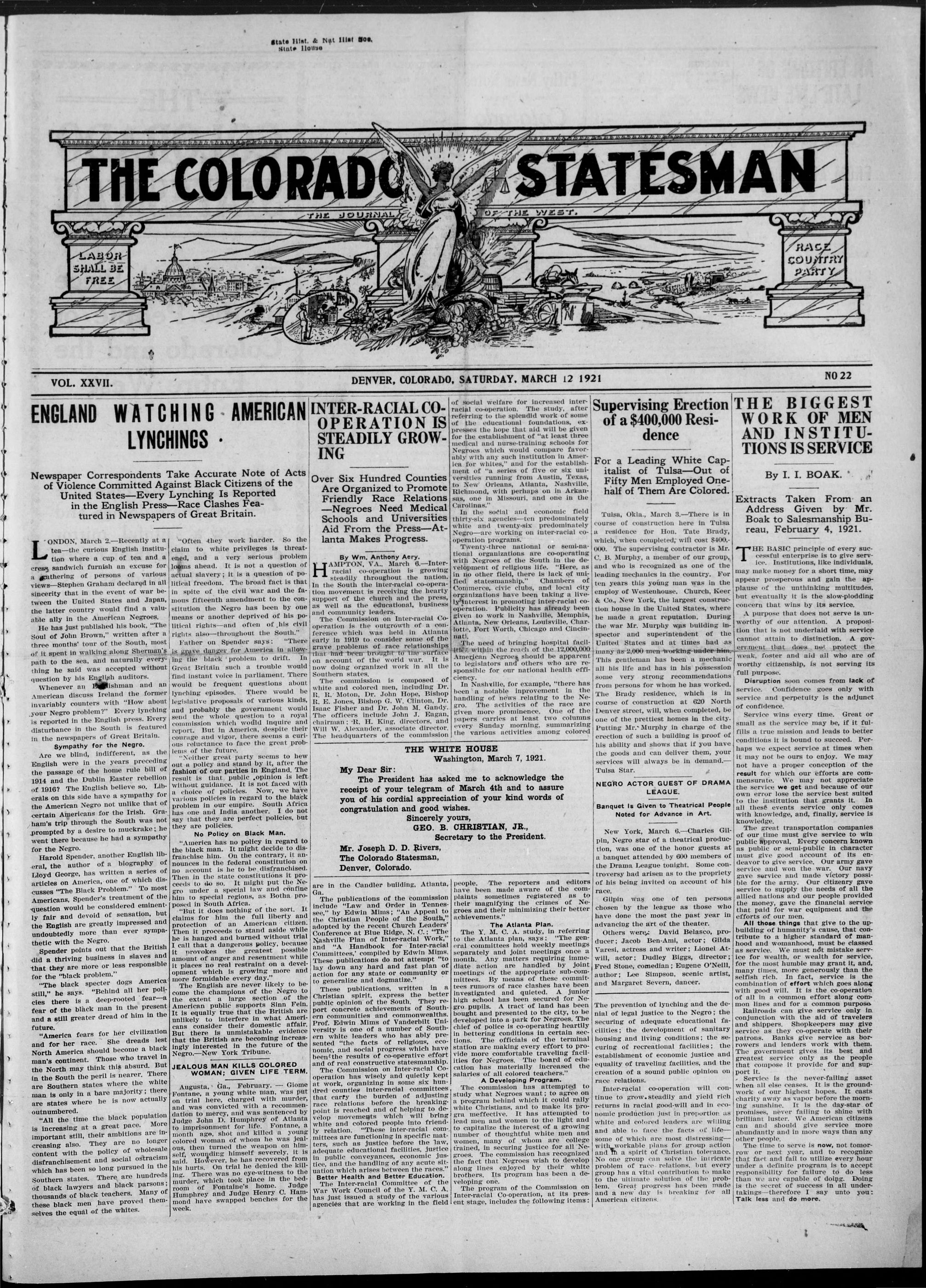
ENGLAND WATCHING AMERICAN LYNCHINGS
Newspaper Correspondents Take Accurate Note of Acts of Violence Committed Against Black Citizens of the United States—Every Lynching Is Reported in the English Press—Race Clashes Featured in Newspapers of Great Britain.
VOL. XXVII.
ENGLAND WATCH
LYNCH
Newspaper Correspondents of Violence Committed Against United States—Every in the English Press tured in Newspaper
LONDON, March 2.—Recently at a tea—the curious English institution where a cup of tea and a cress sandwich furnish an excuse for a gathering of persons of various views—Stephen Graham declared in all sincerity that in the event of war between the United States and Japan, the latter country would find a valuable ally in the American Negroes.
He has just published his book, "The Soul of John Brown," written after a three months' tour of the South, most of it spent in walking along Sherman's path to the sea, and naturally everything he said was accepted without question by his English auditors. Whenever an Englishman and an American discuss Ireland the former invariably counters with "How about your Negro problem?" Every lynching is reported in the English press. Every disturbance in the South is featured in the newspapers of Great Britain.
Sympathy for the Negro.
Are we blind, indifferent, as the English were in the years preceding the passage of the home rule bill of 1914 and the Dublin Easter rebellion of 1916? The English believe so. Liberals on this side have a sympathy for the American Negro not unlike that of certain Americans for the Irish. Graham's trip through the South was not prompted by a desire to muckrake; he went there because he had a sympathy for the Negro.
Harold Spender, another English liberal, the author of a biography of Lloyd George, has written a series of articles on America, one of which discusses "The Black Problem." To most Americans, Spender's treatment of the question would be considered eminently fair and devoid of sensation, but the English are greatly impressed and undoubtedly more than ever sympathetic with the Negro.
Spender points out that the British did a thriving business in slaves and that they are more or less responsible for the "black problem."
"The black specter dogs America still," he says. "Behind all her policies there is a deep-rooted fear—a fear of the black man in the present and a still greater dread of him in the future.
"America fears for her civilization and for her race. She dreads lest North America should become a black man's continent. Those who travel in the North may think this absurd. But in the South the peril is nearer. There are Southern states where the white man is only in a bare majority; there are states where he is now actually outnumbered.
"All the time the black population is increasing at a great pace. More important still, their ambitions are increasing also. They are no longer content with the policy of wholesale disfranchisement and social ostracism which has been so long pursued in the Southern states. There are hundreds of black lawyers and black parsons; thousands of black teachers. Many of these black men have proved themselves the equal of the whites.
"Often they work harder. So the claim to white privileges is threatened, and a very serious problem looms ahead. It is not a question of actual slavery; it is a question of political freedom. The broad fact is that in spite of the civil war and the famous fifteenth amendment to the constitution the Negro has been by one means or another deprived of his political rights—and often of his civil rights also—throughout the South." Father on Spender says: "There is grave danger for America in allowing the black problem to drift. In Great Britain such a trouble would find instant voice in parliament. There would be frequent questions about lynching episodes. There would be legislative proposals of various kinds, and probably the government would send the whole question to a royal commission which woulf inquire and report. But in America, despite their courage and vigor, there seems a curious reluctance to face the great problems of the future.
"Neither great party seems to hew out a policy and stand by it, after the fashion of our parties in England. The result is that public, opinion is left without guidance. It is not faced with a choice of policies. Now, we have various policies in regard to the black problem in our empire. South Africa has one and India another. I do not say that they are perfect policies, but they are policies.
No Policy on Black Man.
"America has no policy in regard to the black man. It might decide to disfranchise him. On the contrary, it announces in the federal constitution on no account is he to be disfranchised. Then in the state constitutions it proceeds to do so. It might put the Negro under a special law and confine him to special regions, as Botha proposed in South Africa.
"But it does nothing of the sort. It claims for him the full liberty and protection of an American citizen. Then it proceeds to stand aside while he is hanged and burned without trial I call that a dangerous policy, because it provokes the greatest possible amount of anger and resentment while it places no real restraint on a development which is growing more and more formidable every day."
The English are never likely to become the champions of the Negro to the extent a large section of the American public supports Sinn Fein. It is equally true that the British are unlikely to interfere in what Americans consider their domestic affair. But there is unmistakable evidence that the British are becoming increasingly interested in the future of the Negro.—New York Tribune.
JEALOUS MAN KILLS COLORED
WOMAN; GIVEN LIFE TERM
Augusta, Ga., February. — Giome Fontane, a young white man, was put on trial here, charged with murder, and was convicted with a recommendation to mercy, and was sentenced by Judge John D. Humphrey of Atlanta to imprisonment for life. Fontane, a month age, shot and killed a young colored woman of whom he was heilous, then turned the weapon on himself, wounding himself severely, it is said. However, he has recovered from his hurts. On trial he denied the killing. There was no eye-witness to the murder, which took place in the bedroom of Fontaine's home. Judge Humphrey and Judge Henry C. Hammond have swapped benches for the week.
DENVER, COLORADO, SATURDAY, MARCH 12 1921
The President has asked me to acknowledge the receipt of your telegram of March 4th and to assure you of his cordial appreciation of your kind words of congratulation and good wishes. Sincerely yours.
INTER-RACIAL CO OPERATION IS STEADILY GROWING
Over Six Hundred Counties Are Organized to Promote Friendly Race Relations Negroes Need Medical Schools and Universities Aid From the Press-Atlanta Makes Progress.
HAMPTON, VA., March 6. Interracial co-operation is growing steadily throughout the nation. In the South the interracial co-operation movement is receiving the hearty support of the church and the press, as well as the educational, business and community leaders. The Commission on Interracial Cooperation is the outgrowth of a conference which was held in Atlanta early in 1919 to consider some of the grave problems of race relationships that had been brought to the surface on account of the world war. It is now doing organized work in all the Southern states. The commission is composed of white and colored men, including Dr. R. R. Moton, Dr. John Hope, Bishop R. E. Jones, Bishop G. W. Clinton, Dr. Isaac Fisher and Dr. John W. Gandy. The officers include John J. Eagan, chairman: R. H. King, directors, and Will W. Alexander, associate director. The headquarters of the commission
THE WHITE
Was
My Dear Sir:
The President has ask
receipt of your telegram of
you of his cordial appreciation
congratulation and good w
Sincerely y
GEO. B.
Sec.
Mr. Joseph D. D. Rivers,
The Colorado Statesman,
Denver, Colorado.
are in the Candler building, Atlanta,
Ga.
The publications of the commission
include "Law and Order in Tennessee," by Edwin Mims; "An Appeal to the Christian People of the South," adopted by the recent Church Leaders' Conference at Blue Ridge, N. C.; "The Nashville Plan of Inter-racial Work," and "A Handbook for Inter-racial Committees,' compiled by Edwin Mims. These publications do not attempt "to lay down any hard and fast plan of action for any state or community or to generalize and dogmatize."
These publications, written in a Christian spirit, express the better public opinion of the South. They report concrete achievements of Southern communities and commonwealths. Prof. Edwin Mims of Vanderbilt University is one of a number of Southern white leaders who has ably presented "the facts of religious, economic, and social progress which have been the results of co-operative effort and of real constructive statesmanship. The Commission on Inter-racial Cooperation has wisely and quietly kept at work, organizing in some six hundred counties inter-racial committees that carry the burden of adjusting race relations before the breaking-point is reached and of helping to develop movements which will bring white and colored people into friendly relation. "These inter-racial committees are functioning in specific matters, such as justice before the law, adequate educational facilities, justice in public conveyances, economic justice, and the handling of any acute situation which arises between the races." Better Health and Better Education.
The Inter-racial Committee of the War Work Council of the Y. M. C. A. has just issued a study of the various agencies that are working in the field
of social welfare for increased interracial co-operation. The study, after referring to the splendid work of some of the educational foundations, expresses the hope that aid will be given for the establishment of "at least three medical and nurse-training schools for Negroes which would compare favorably with any such institution in America for whites," and for the establishment of "a series of five or six universities running from Austin, Texas, to New Orleans, Atlanta, Nashville, Richmond, with perhaps on in Arkansas, one in Missouri, and one in the Carolinas."
In the social and economic field thirty-six agencies—ten predominately white and twenty-six predominately Negro—are working on inter-racial cooperation programs.
Twenty-three national or semi-national organizations are co-operating with Negroes of the South in the development of religious life. "Here, as in no other field, there is lack of unified statesmanship." Chambers of Commerce, civic clubs, and local city organizations have been taking a lively interest in promoting inter-racial cooperation. Publicity has already been given to work in Nashville, Memphis, Atlanta, New Orleans, Louisville, Charlotte, Fort Worth, Chicago and Cincinnati.
The need of bringing hospital facility within the reach of the 12,000,000 American Negroes should be apparent to legislators and others who are responsible for our national health efficiency.
In Nashville, for example, "there has been a notable improvement in the handling of news relating to the Negro. The activities of the race are given more prominence. One of the papers carries at least two columns every Sunday morning, summarizing the various activities among colored
TE HOUSE
Washington, March 7, 1921.
ked me to acknowledge the of March 4th and to assure nation of your kind words of wishes.
yours,
CHRISTIAN, JR.,
secretary to the President.
people. The reporters and editors have been made aware of the complaints sometimes registered as to their magnifying the crimes of Negroes and their minimizing their better achievements."
The Atlanta Plan.
The Y, M, C. A. study, in referring to the Atlanta plan, says: "The general committees hold weekly meetings separately and joint meetings once a month. Any matters requiring immediate action are handled by joint meetings of the appropriate sub-committees. By means of these committees rumors of race clashes have been investigated and quieted. A junior high school has been secured for Negro pupils. A tract of land has been bought and presented to the city, to be developed into a park for Negroes. The chief of police is co-operating heartily in bettering conditions in certain sections. The officials of the terminal station are making every effort to provide more comfortable travelling facilities for Negroes. The board of education has materially increased the salaries of all colored teachers."
The commission has attempted to study what Negroes want; to agree on a program behind which it could rally white Christians, and to make its progra meffective. It has attempted to lead men and women to the light and to capitalize the interest of a growing number of thoughtful white men and women, many of whom are college trained, in securing justice for all Negroes. The commission has recognized the fact that Negroes wish to develop along lines enjoyed by their white brothers. Its program has been a developing one.
The program of the Commission on Inter-racial Co-operation, at its present stage, includes the following items:
Supervising Erection of a $400,000 Residence
For a Leading White Capitalist of Tulsa—Out of Fifty Men Employed Onehalf of Them Are Colored.
Tulsa, Okla., March 3.—There is in course of construction here in Tulsa a residence for Hon. Tate Brady, which, when completed, will cost $400,000. The supervising contractor is Mr. C. B. Murphy, a member of our group, and who is recognized as one of the leading mechanics in the country. For ten years this young man was in the employ of Westenhouse. Church, Keer & Co., New York, the largest construction house in the United States, where he made a great reputation. During the war Mr. Murphy was building inspector and superintendent of the United States and at times had as many as 2,000 men working under him. This gentleman has been a mechanic all his life and has in his possession some very strong recommendations from persons for whom he has worked. The Brady residence, which is in course of construction at 620 North Denver street, will, when completed, be one of the prettiest homes in the city. Putting Mr. Murphy in charge of the erection of such a building is proof of his ability and shows that if you have the goods and can deliver them, your services will always be in demand.—Tulsa Star.
NEGRO ACTOR GUEST OF DRAMA LEAGUE.
Banquet Is Given to Theatrical People Noted for Advance in Art.
New York, March 6.—Charles Gilpin, Negro star of a theatrical production, was one of the honor guests at a banquet attended by 600 members of the Drama League tonight. Some controversy had arisen as to the propriety of his being invited on account of his race.
Gilpin was one of ten persons chosen by the league as those who have done the most the past year in advancing the art of the theater.
Others were; David Belasco, producer; Jacob Ben-Ami, actor; Gilda Varesi, actress and writer; Lionel Atwell, actor; Dudley Biggs, director; Fred Stone, comedian; Eugene O'Nell, author; Lee Simpson, scenic artist, and Margaret Severn, dancer.
The prevention of lynching and the denial of legal justice to the Negro; the securing of adequate educational facilities; the development of sanitary housing and living conditions; the securing of recreational facilities; the establishment of economic justice and equality of traveling facilities, and the creation of a sound public opinion on race relations.
Inter-racial co-operation will continue to grow steadily and yield rich returns in racial good-will and in economic production just in proportion as white and colored leaders are willing and able to face the facts of life—some of which are most distressing—with workable plans for group action and in a spirit of Christian tolerance. No one group can solve the intricate problem of race relations, but every group has a vital contribution to make to the ultimate solution of the problem. Great progress has been made and a new day is breaking for all American citizens.
NO22
THE BIGGEST WORK OF MEN AND INSTITUTIONS IS SERVICE
Extracts Taken From an Address Given by Mr. Boak to Salesmanship Bureau, February 4, 1921.
THE BASIC principle of every successful enterprise is to give service. Institutions, like individuals, may make money for a short time, may appear prosperous and gain the applause of the unthinking multitudes, but eventually it is the slow-plodding concern that wins by its service.
A purpose that does not serve is unworthy of our attention. A proposition that is not underlaid with service cannot attain to distinction. A government that does not protect the weak, foster and aid all who are of worthy citizenship, is not serving its full purpose.
Disruption soon comes from lack of service. Confidence goes only with service and perpetuity is the adjunct of confidence.
Service wins every time. Great or small as the service may be, if it fulfills a true mission and leads to better conditions it is bound to succeed. Perhaps we expect service at times when it may not be ours to enjoy. We may not have a proper conception of the result for which our efforts are commensurate. We may not appreciate the service we get and because of our own error lose the service best suited to the institution that grants it. In all these events service only comes with knowledge, and, finally, service is knowledge.
The great transportation companies of our time must give service to win public approval. Every concern known as public or semi-public in character must give good account of its endeavor to give service. Our army gave service and won the war. Our navy gave service and made victory possible for the army. Our citizenry gave service to supply the needs of all the allied nations and our people provided the money, gave the financial service that paid for war equipment and the efforts of our men.
All those things that give to the upbuilding of humanity's cause, that contribute to a higher standard of manhood and womanhood, must be classed as service. We must not mistake service for wealth, or wealth for service, for the most humble may grant it, and, many times, more generously than the selfish rich. In fact, service is the combination of effort which goes along with good will. It is the co-operation of all in a common effort along common lines and for a common purpose. Railroads can give service only in conjunction with the aid of travelers and shippers. Shopkeepers may give service as they co-operate with their patrons. Banks give service as borrowers and lenders work with them. The government gives its best and greatest service only as the people that compose it provide for and support it.
Service is the never-failing asset when all else ceases. It is the groundwork of our highest hopes. It casts charity away as vapor before the morning sunshine. It is the day-star of promises, never failing to shine with brilliant luster. We American citizens can and should give service more abundantly and in more ways than any other people.
The time to serve is now, not tomorrow or next year, and to recognize that fact and fail to utilize every hour under a definite program is to accept responsibility for failure to do less than we are capable of doimg. Doing is the secret of success in all undertakings—therefore I say unto you: Talk less and do more.
AN EPITOME OF LATE LIVE NEWS
CONDENSED RECORD OF THE
PROGRESS OF EVENTS AT
HOME AND ABROAD
FROM ALL SOURCES
SAYINGS, DOINGS, ACHIEVE
MENTS, SUFFERINGS, HOPES
AND FEARS OF MANKIND.
WESTERN
The anti-cigarette bill failed of passage in the Kansas Legislature. It prohibited smoking or possessing cigarettes as well as selling or giving them away.
While attempting to side slip to a landing field from an altitude of 2,000 feet, Walter C. Reams, a flying cadet at Kelly field, was killed at San Antonio, Texas.
Ferdinand Michelena, once famed as a grand opera tenor, is dead following an attack of apoplexy in San Francisco. His daughter, Beatrice Michelena, is famous as a movie star, and another daughter, Vera Michelena, is noted in vaudeville and comic opera.
Mrs. Kenneth Thornock of Brigham City, Utah, wrapped her baby son in a quilt and put him on the oven door of the kitchen stove while she went across the street to call upon a neighbor. When she returned thirty minutes later she found the baby burned to death.
Claiming possession under a patent land grant to Moses Butler, hero of the battle of San Jacinto, which gave Texas its freedom from Mexico, relatives in the United States District Court at Wichita Falls, Texas, filed suit in trespass to quiet title to property in the oil field district of Young county, said to be worth $1,000,000.
While taking an ocean scene at Clifton-by-the-Sea, near Redondo Beach, Calif., six actors employed by a motion picture company were thrown into the sea by the overturning of a lifeboat. The men were dragged unconscious from the surf by other members of the company while hundreds of persons, including Sir Gilbert Parker, famous novelist and now writer for the films, looked on.
The word of Epigmenio Ybarra, Jr., governor-elect of the northern district of Lower California, "will be absolute law" in the district, according to a statement at Calexico, Calif., by Senior Ybarra's private secretary, Captain Jose M. Davila, quoting President Obregon. The federal government's only demand, the officer declared, was that the governor prohibit all gambling in the district.
Superintendent A. R. Dunphy of the Omaha Salt Lake division of the Airmail announced that beginning May 1 night flying by airmail pilots will be instituted between Cheyenne and Chicago. He said that the decision to make night flying a regular feature of the airmail service at least during the summer months, was the result of the recent achievement of Pilot Jack Knight in flying from North Platte, Neb., to Chicago through a storm at night.
WASHINGTON
The gross public debt increased $58,449,845 during the month of February, the Treasury Department announced. The gross public debt on Jan. 1 was $23,903,234,882 and on Feb. 28 it was $24,051,684,728. The increase was largely due to the flotation of treasury certificates.
Authority of former Postmaster General Burleson, to withdraw second-class mail privileges from any publication which violated the espionage act through printing articles "tending to create insubordination or disloyalty" in the military or naval forces, was upheld by the Supreme Court.
Deductions from income taxes of persons whose businesses were ended with the enactment of federal prohibition legislation will be approximately $1,000,000, the bureau of internal revenue announced. The estimate was made public as a result of a statement in the Senate which placed such losses at $1,000,000,000 to $4,000,000,000.
Suit for $500,000 damages has been filed in the District of Columbia Supreme Court by the New York Call against Albert Sidney Burleson, who retired as postmaster general March 4. S. John Block and Horace S. Whitman, Call attorneys, alleged that Burleson, as postmaster general, by canceling the second-class mailing privileges of the Call, "misused and abused" his powers and "unlawfully, willfully, negligently, maliciously violated the rights and privileges of the publishers of the Call."
"The United States can prepare for a 6,000,000-bale cotton crop next year with whatever price that crop crop may demand," says Ellis M. Whittaker of Memphis. "The South is determined that the cotton acreage for 1921 shall be not more than half of what it was last year, which will produce a crop of about 6,000,000 bales."
One member of the House, Representative Ricketts, Republican, Ohio, answered all of the 592 roll calls of the Sixty-sixth Congress, equalling his own record in the Sixty-fourth Congress, never before achieved.
FOREIGN
Private dispatches reported twenty persons killed at La Paz, Bolivia, in street fighting between Liberal and Republican factions. Business was reported suspended.
A bill prohibiting the importation of rice and fixing a maximum selling price of 3 cents per pound wholesale, has been signed by Gov. Gen. Francis Burton Harrison at Manila, P. I.
Four members of a snowplow crew on the Canadian National railway were smothered to death by an avalanche in the Canadian Rockies. The accident became known when the bodies arrived for inquest at Edmonton, Alb. The accident occurred forty-six miles west of Jasper, near Mount Resplendent.
The introduction of German labor to help rebuild the war-devastated districts of northern France, one of the suggestions made by the Berlin government during the reparations discussions, will be violently opposed by French workers. The annual congress of French building workers voted overwhelmingly against the admission of German laborers, though no objection was made to the use of German material.
Preparations are in progress for the erection of a chain of military block-houses to indicate the new boundaries of the Ulster area in Ireland under the new home rule act, says a Belfast dispatch. Government surveys have commenced in North Monaghan county near the Fernanagh border, the dispatch adds. Sites are being selected for new stations for thirty thousand troops in the six-county area. The stations will be two miles apart.
French, British and Belgian troops occupy three German cities, Dusseldorf, Duisburg and Ruhrort. Less than 25,000 troops used to effect occupation. No opposition offered by Germans, Populace orderly. German officials of occupied cities left in power. Customs frontier established 182 miles east of Rhine. German ambassadors summoned home from London, Paris and Brussels. American troops remain at old positions in Coblenz. Harding announces they will not be withdrawn at present.
GENERAL
Frantic with pain from an attack of appendicitis, Earl Wilson, an 8-year-old boy, shot and killed himself at Bonner Springs, Kan.
The New York Central locomotive repair shops at Elkhart, Ind., employing about 700 men, and those at Collinwood, both of which were closed a week ago, will resume operations at once.
Falling off a 1,000-foot bluff, Jack Stewart, foreman at the New Kenka Hill silver mine in the Mayo district, Alaska, landed on a snow-covered shelf 200 feet below and escaped with three broken ribs.
Fire destroyed the interior of the Cathedral of Sts. Peter and Paul, causing damage estimated at $100,000. It is one of the oldest and best known Episcopalian edifices in Chicago, dating back to Civil wartimes.
Plots which involved the planned assassination of Cleveland citizens connected with the Loyal American League, the destruction by dynamite of downtown buildings and an intensive campaign of anarchistic propaganda throughout the city, are believed now to have been nipped by the arrest in Cleveland of eight men, said to be members of an anarchistic group.
Union printers went on strike at Binghamton, N. Y., to enforce demands for increased wages and reduced hours. As a result of the strike, evening newspapers and the Morning Sun have suspended publication and the plants of the Vail-Ballou Company, book manufacturers, and the Johnson City Publishing Company, job printers, are crippled. The men rejected an offer to submit the matter to arbitration.
Lieutenant J. T. Lawson, 24, of Hartford, Conn., and Private Joseph Read, 21, of Norwood, N. J., were dashed to death at Camp Knox when an army aeroplane which failed to right itself during a tail spin, fell nearly 3,000 feet.
The Senate of the Washington Legislature passed the anti-alien land bill by a vote of 36 to 2. The bill prohibits alienls ineligible to citizenship from owning or leasing land in the state. It was passed by the House and now goes to the governor.
Macon, Ga., city council has refused to permit Donal O'Callaghan, lord mayor of Cork, to speak in the city auditorium. The city council also passed an anti-flirting ordinance, making it unlawful for a man to converse with or make signs at school or college girls.
New York city taxpayers this year face the highest tax rate in history, despite an enormous increase in the assessed valuation of real estate. Based on the 1921 budget of $345,530,039, the rates indicate increases over 1920 ranging from 29 to 31 cents per $100. Total valuation of real estate is computed at $9,972,585,104 and personal property $213,222,175.
C. D. B. King, president of the republic of Liberia, in West Africa, arrived at New York en route to Washington to discuss a loan of $5,000,000 to his republic. The loan has been "hanging fire" nearly a year, it was stated, and it is needed to further industrial development in Liberia.
Six new cases of typhus were discovered among immigrants held at Swinburne island for observation, it was announced. Two men and three women arrived more than a month ago from Trieste. The sixth, a native of Hungary, arrived recently
Pithy News Notes
From All Parts of
Colorado
(Western Newspaper Union News Service.)
Albert Estrada, 23, a laborer, was shot at Pueblo and died in a hospital there. The killing is said to have been the outcome of an argument started in a pool game. No arrests have been made.
The postoffice at Springfield, fifty miles south of Lamar and county seat of Baca county, was looted by robbers, who escaped in an automobile. It is estimated that the robbers got $500 in cash and approximately $100 worth of stamps.
Another rich strike is reported at the Vindicator mine at Victor. At the twentieth level and at a depth close to 2,000 feet the company is reported to have found an extension of the old Lily vein, which in former years has produced extraordinary rich bonanza values.
The mutilated body of a man, skull crushed, a rope around his neck, throat cut and many slashes on his body, was found in a cabin three miles from Graneros, Colo., and thirty-two miles south of Pueblo. The only means of identification may lie in a ring on a finger, with the letters "C S A '15."
Howard Rigsby, the 13-year old son of Mr. and Mrs. Vechel Rigsby, lost the thumb of his left hand as the result of the explosion of a dynamite cap with which he was playing at Sterling. Young Rigsby was trying to reduce the size of the cap to use it in a pistol when it exploded.
State inheritance tax collections during the first quarter of the current fiscal year amounted to $56,830.04, according to the semi-monthly report of Attorney General Keyes. Of this sum $12,094.13 was collected during the last half of February. Twenty-three estates paid inheritance tax during the last two weeks.
Homesteaders purchased at public auction 5,600 acres of state school lands, according to John F. Vivian, register of the land board. This was the first auction held by the board since Jan. 12. Total receipts from the sale was $88,570, an average of $15.81 per acre, which records of the land office show to be higher than the general average price of previous sales.
Following a conference with several citizens, Governor Shoup announced he would ask the Senate finance and House appropriations committee to include in the long appropriation bill $25,000 with which to buy a silver service for the new superdreadnaught Colorado, which Mrs. Max Melville, the daughter of United States Senator Samuel D. Nicholsen, will christen at the shipyards at Camden, N. J., March 22.
Following numerous complaints of moonshine stills operating night and day and a general "open territory" supplying hundreds with illicit wet goods in southwestern Colorado and northwest New Mexico, nearly a dozen United States federal internal revenue officers, assisted by Sheriff George Rowe and his deputies, of La Plata county, seized eight separate and elaborate stills in operation and arrested ten men.
"A competent staff of instructors is maintained at the University of Colorado to see that students who graduate are not only mentally trained, but also physically developed," said Dr. C. E. Kennedy in an address before the Boulder Commercial Association. "Physical education does not only mean competitive sports for the students, it means, in addition, a corrective system of overcoming physical defects," he continued. Dr. Kennedy is at the head of the physical education department of the university.
John M. Richardson of Denver through his attorneys, has filed suit in the Fremont county District Court in Cañon City, for $58,307 damages against G. V. Hodgin, J. Victor McCandless and James Belknap in their unofficial and individual capacities for alleged negligence while serving as county commissioners of Fremont county in 1920. The alleged negligence, the plaintiff claims, resulted in the death of his wife and serious injury to himself in an automobile accident on April 30, 1920.
Plans, specifications and estimates on Colorado highway projects, to be carried out at an approximate cost of $205,939, were submitted to J. S. Bright, supervisor of the United States bureau of public roads in Denver by the State Highway Commission. Federal aid to the amount of 50 per cent on the work, which includes 4.4 miles of concrete road on the Denver-Brighton highway, is requested. Other construction work contemplated, embraces two bridges in Montrose county, one of seventy feet over the Uncompahgre river, and one of twenty-eight feet over Spring creek.
For the third time within a month, a Loveland young girl has been attacked and badly injured on the streets at night. Agnes Larson, 15, was struck with a hammer or other heavy instrument while walking home. The man was riding a bicycle and rode to the walk, jumped off his wheel and struck her a heavy blow on the back of the head, cutting a long gash in her skull. No attempt was made to rob. The description of the fellow is the same as that given of the man who made similar attacks upon two telephone girls on two previous occasions.
CENTENNIAL STATE ITEMS.
A new sensation was added to the dispute over the $150,000 estate of William A. Purvis, 51 years old, Johnstown dairyman, who dropped dead suddenly in Greeley, when a pretty, dark haired girl, 19 years old, announced on the witness stand at the inquest that she is Mrs. Violet Purvis, common law wife of the late dairyman, and that she had been going to school at Loretto Heights academy, near Denver, at his request and expense, preparatory to being publicly married to him. She anounced that she will claim the estate for herself and unborn child. She said also that before becoming Purvis' wife two years ago she was Violet Mickle an orphan, and had been housekeeper for Purvis' mother before the latter's death in December, 1919.
THE COLORADO STATESMAN
Twenty-five undesirable aliens, all of whom have been convicted of various crimes in Denver and in the northern part of the state, were deported from Denver by Chief W. R. Mansfield of the United States immigration service, and are now on their way to San Francisco. These deportees, all of them Mexicans, were placed in a special car which was attached to a through train for the Pacific coast. They will be placed on a steamer at San Francisco and taken to Mazutlan, Mexico. Chief Mansfield was accompanied by four heavily armed guards and Deputy United States Marshal Harry McIntyre.
The Mouth-Piece of the People of Colorado and the Entire West
Denver municipal water has returned a deficit of $284,899.07 for the year 1920, according to the annual report issued by City Auditor Stackhouse. The net income for the year was $410,744.89, according to Mr. Stackhouse, and the total expenditures, including both construction expenses and future contracts entered though not completed, amounted to $695,632.96. City officials predict that less construction and repairs will be needed in the plant this year, and that the deficit will be thus overcome.
ARELIABLE chronicle of their doings and progress; a faithful mirror of their wants, their hopes, their best aspirations.
All the residents of Seibert turned fire fighters and saved Seibert from ruins. The Packer dwelling and rooming house and adjoining buildings were destroyed with losses estimated at $14,000. Quick work by a volunteer water brigade, which was composed of many women and many men in night clothes, checked the flames, which were fanned by a high wind. There are no water works or fire apparatus there and the work of the volunteers was greatly handicapped.
The Citizens' State and Savings Bank at Boone, Pueblo county, was robbed of $4,000 in cash and bonds by experienced yeggmen who took everything in the way of money or securities in the vault and safe. The robbers escaped in an automobile, taking the so-called north road out of Boone. Not the slightest trace of them has yet been secured by Sheriff Samuel Thomas, who with a number of deputies, is working on the case.
THE COLORADO STATESMAN
W. S. Parkison, a pioneer druggist of Glenwood Springs, chairman for six years of the Garfield county Republican central committee and widely known politically throughout the state, dropped dead of apoplexy while sitting in his home with his wife, reading. He had not been ill, and the first intimation she had of the unexpected attack was the sudden falling of the newspaper from his hands. He was dead before she could reach him.
The number of persons subscribing the total of $143,928.48 raised in the drive for funds for the Denver Federation of Charity and Philanthropy was more than double the number that subscribed last year. The total number of subscribers in 1919 was 7,000 and 16,611 persons subscribed in the 1921 drive. Since the close of the drive $25,000 has been subscribed. Leaders in the organization are hopeful that the $50,000 still needed to finance the seventy-five charities adequately will be raised.
Unequaled as an advertising medium for the business of professional men and women.
During twenty-six of the twenty-eight days in February there was sunshine at least a part of the time, totaling 179 hours of sunshine, with only two completely cloudy days for the entire month in Denver, according to the monthly meteorological summary just compiled by Weather Forecaster J. M. Sherier. The total for January amounted to 168 hours, the report shows.
An excellent family journal speaking to and for many thousand colored citizens.
A special week, to be known as "orange week," is to be featured in Denver March 21 to 28. Dealers throughout the city will decorate their stores with placards and banners, while windows will contain attractive displays of the fruit. "Orange weeks" are being held in many cities throughout the United States for the purpose of reminding the public of the value and healthfulness of the golden fruit. The planting of 800,000 trees will be resumed this year in the Plke forest area by E. S. Keithly, government forester. Should heavy snows come this month the work will necessarily be postponed, it being impossible to form the camp until the snow is entirely gone. Six hundred thousand trees were planted last year.
TWODOLLARSAYEAR
THE GREAT ORGAN OF THE LABORING MASSES
The Colorado chapter of the Daughters of the American Revolution, of which Mrs. Thomas Keely is regent, has donated to the State Historical and Natural History Society a complete collection of the various types of uniforms worn by local members of the D. A. R. in the Red Cross service during the war. Slipping on a loose rock at the side of the track, J. C. Brooks, 40, a Denver & Rio Grande fireman, running between Pueblo and Salida, lost his left hand beneath the engine wheels at Semple, Colo.
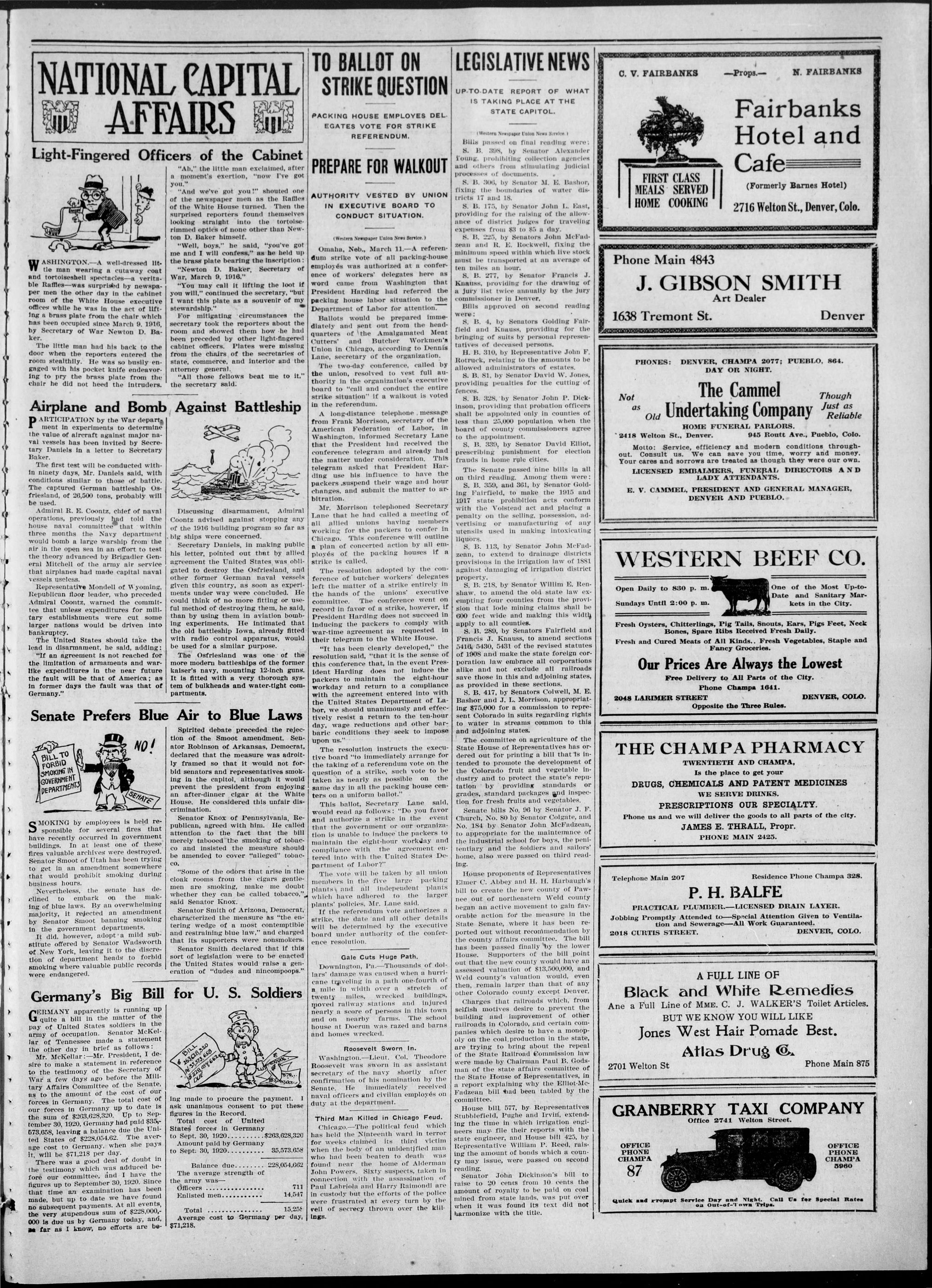
NATIONAL CAPITAL AFFAIRS
Light-Fingered Officers of the Cabinet
Airplane and Bomb Against Battleship
Senate Prefers Blue Air to Blue Laws
Germany's Big Bill for U. S. Soldiers
WASHINGTON.—A well-dressed little man wearing a cutaway coat and tortoiseshell spectacles—a veritable Raffles—was surprised by newspaper men the other day in the cabinet room of the White House executive offices while he was in the act of lifting a brass plate from the chair which has been occupied since March 9. 1916, by Secretary of War Newton D. Baker.
The little man had his back to the door when the reporters entered the room stealthily. He was so busily engaged with his pocket knife endeavoring to pry the brass plate from the chair he did not heed the intruders.
PARTICIPATION by the War department in experiments to determine the value of aircraft against major naval vessels has been invited by Secretary Daniels in a letter to Secretary Baker. The first test will be conducted within ninety days, Mr. Daniels said, with conditions similar to those of battle. The captured German battleship Osfriesland, of 26,500 tons, probably will be used. Admiral R. E. Coontz, chief of naval operations, previously had told the house naval committee that within three months the Navy department would bomb a large warship from the air in the open sea in an effort to test the theory advanced by Brigadier General Mitchell of the army air service that airplanes had made capital naval vessels useless.
Representative Mondell of Wyoming, Republican floor leader, who preceded Admiral Coontz, warned the committee that unless expenditures for military establishments were cut some larger nations would be driven into bankruptcy.
The United States should take the lead in disarmament, he said, adding: "If an agreement is not reached for the limitation of armaments and warlike expenditures in the near future the fault will be that of America; as in former days the fault was that of Germany."
BILL TO FORBID SMOKING IN GOVERNMENT DEPARTMENTS
SENATE
SMOKING by employees is held responsible for several fires that have recently occurred in government buildings. In at least one of these fires valuable archives were destroyed. Senator Smoot of Utah has been trying to get in an amendment somewhere that would prohibit smoking during business hours.
Nevertheless, the senate has declined to embark on the making of blue laws. By an overwhelming majority, it rejected an amendment by Senator Smoot banning smoking in the government departments. It did, however, adopt a mild substitute offered by Senator Wadsworth of New York, leaving it to the discretion of department heads to forbid smoking where valuable public records were endangered.
GERMANY apparently is running up quite a bill in the matter of the pay of United States soldiers in the army of occupation. Senator McKellar of Tennessee made a statement the other day in brief as follows:
Mr. McKellar:—Mr. President, I desire to make a statement in reference to the testimony of the Secretary of War a few days ago before the Military Affairs Committee of the Senate, as to the amount of the cost of our forces in Germany. The total cost of our forces in Germany up to date is the sum of $233,628,320. Up to September 30, 1920, Germany had paid $35,573,658, leaving a balance due the United States of $228,054,62. The average cost to Germany, when she pays it will be $71,218 per day.
There was a good deal of doubt in the testimony which was adduced before our committee, and I have the figures up to September 30, 1920. Since that time an examination has been made, but up to date we have found no subsequent payments. At all events, the very stupendous sum of $228,000,000 is due us by Germany today, and, far as I know, no efforts are be-
"Ah," the little man exclaimed, after a moment's exertion, "now I've got you."
"And we've got you!" shouted one of the newspaper men as the Raffles of the White House turned. Then the surprised reporters found themselves looking straight into the tortoise-rimmed optics of none other than Newton D. Baker himself.
"Well, boys," he said, "you've got me and I will confess," as he held up the brass plate bearing the inscription:
"Newton D. Baker, Secretary of War, March 9, 1916."
"You may call it lifting the loot if you will," continued the secretary, "but I want this plate as a souvenir of my stewardship."
For mitigating circumstances the secretary took the reporters about the room and showed them how he had been preceded by other light-fingered cabinet officers. Plates were missing from the chairs of the secretaries of state, commerce, and interior and the attorney general.
"All those fellows beat me to it," the secretary said.
Discussing disarmament, Admiral Coontz advised against stopping any of the 1916 building program so far as big ships were concerned.
Secretary Daniels, in making public his letter, pointed out that by allied agreement the United States was obligated to destroy the Osfriesland, and other former German naval vessels given this country, as soon as experiments under way were concluded. He could think of no more fitting or useful method of destroying them, he said, than by using them in aviation bombing experiments. He intimated that the old battleship Iowa, already fitted with radio control apparatus, would be used for a similar purpose.
The Osfriesland was one of the more modern battleships of the former kaiser's navy, mounting 12-inch guns. It is fitted with a very thorough system of bulkheads and water-tight compartments.
Spirited debate preceded the rejection of the Smoot amendment. Senator Robinson of Arkansas, Democrat, declared that the measure was adrolyt framed so that it would not forbid senators and representatives smoking in the capitol, although it would prevent the president from enjoying an after-dinner cigar at the White House. He considered this unfair discrimination.
Senator Knox of Pennsylvania, Republican, agreed with him. He called attention to the fact that the bill merely tabooed the smoking of tobacco and insisted the measure should be amended to cover "alleged" tobacco.
"Some of the odors that arise in the cloak rooms from the cigars gentlemen are smoking, make me doubt whether they can be called tobacco," said Senator Knox.
Senator Smith of Arizona, Democrat, characterized the measure as "the entering wedge of a most contemptible and restraining blue law," and charged that its supporters were nonsmokers. Senator Smith declared that if this sort of legislation were to be enacted the United States would raise a generation of "dudes and nincompoops."
BILL
$ 263,608,540
R 5,273,658
$ 228,034,642
DUE
ing made to procure the payment. I ask unanimous consent to put these figures in the Record.
Total cost of United States forces in Germany
to Sept. 30, 1920.....$263,628,320
TO BALLOT ON STRIKE QUESTION
PACKING HOUSE EMPLOYES DEL
EGATES VOTE FOR STRIKE
REFERENDUM.
PREPARE FOR WALKOUT
AUTHORITY VESTED BY UNION IN EXECUTIVE BOARD TO CONDUCT SITUATION.
(Owestern Newspaper Union News Service.)
Omaha, Neb., March 11.—A referendum strike vote of all packing-house employees was authorized at a conference of workers' delegates here as word came from Washington that President Harding had referred the packing house labor situation to the Department of Labor for attention.
Ballots would be prepared immediately and sent out from the headquarters of the Amalgamated Meat Cutters' and Butcher Workmen's Union in Chicago, according to Dennis Lane, secretary of the organization.
The two-day conference, called by the union, resolved to vest full authority in the organization's executive board to "call and conduct the entire strike situation" if a walkout is voted in the referendum.
A long-distance telephone message from Frank Morrison, secretary of the American Federation of Labor, in Washington, informed Secretary Lane that the President had received the conference telegram and already had the matter under consideration. This telegram asked that President Harding use his influence to have the packers suspend their wage and hour changes, and submit the matter to arbitration.
Mr. Morrison telephoned Secretary Lane that he had called a meeting of all allied unions having members working for the packers to confer in Chicago. This conference will outline a plan of concerted action by all employés of the packing houses if a strike is called.
The resolution adopted by the conference of butcher workers' delegates left the matter of a strike entirely in the hands of the unions' executive committee. The conference went on record in favor of a strike, however, if President Harding does not succeed in inducing the packers to comply with war-time agreement as requested in their telegram to the White House.
"It has been clearly developed," the resolution said, "that it is the sense of this conference that, in the event President Harding does not induce the packers to maintain the eight-hour workday and return to a compliance with the agreement entered into with the United States Department of Labor, we should unanimously and effectively resist a return to the ten-hour day, wage reductions and other barbaric conditions they seek to impose upon us."
The resolution instructs the executive board "to immediately arrange for the taking of a referendum vote on the question of a strike, such vote to be taken as nearly as possible on the same day in all the packing house centers on a uniform ballot." This ballot, Secretary Lane said, would read as follows: "Do you favor and authorize a strike in the event that the government or our organization is unable to induce the packers to maintain the eight-hour workday and compliance with the agreement entered into with the United States Department of Labor?" The vote will be taken by all union members in the five large packing plants and all independent plants which have adhered to the larger plants' policies, Mr. Lane said.
If the referendum vote authorizes a strike, the date and all other details will be determined by the executive board under authority of the conference resolution.
Gale Cuts Huge Path.
Downington, Pa.—Thousands of dollars' damage was caused when a hurricane traveling in a path one-fourth of a mile in width over a stretch of twenty miles, wrecked buildings, moved railway stations and injured nearly a score of persons in this town and on nearby farms. The school house at Doerum was razed and barns and homes wrecked.
Roosevelt Sworn In.
Washington.—Lieut. Col. Theodore Roosevelt was sworn in as assistant secretary of the navy shortly after confirmation of his nomination by the Senate. He immediately received naval officers and civilian employés on duty at the department.
Third Man Killed in Chicago Feud.
Chicago.—The political feud which has held the Nineteenth ward in terror for weeks claimed its third victim when the body of an unidentified man who had been beaten to death was found near the home of Alderman John Powers. Sixty suspects, taken in connection with the assassination of Paul Labriola and Harry Raimondi are in custody but the efforts of the police were frustrated at every turn by the veil of secrecy thrown over the killings.
LEGISLATIVE NEWS
LEGISLATIVE NEWS
UP-TO-DATE REPORT OF WHAT
IS TAKING PLACE AT THE
STATE CAPITOL.
Bills passed on final reading were: S. B. 398, by Senator Alexander Young, prohibiting collection agencies and others from stimulating judicial processes of documents. S. B. 306, by Senator M. E. Bashor, fixing the boundaries of water districts 17 and 18. S. B. 175, by Senator John L. East, providing for the raising of the allowance of district judges for traveling expenses from $3 to $5 a day. S. B. 225, by Senators John McFadzean and R. E. Rockwell, fixing the minimum speed within which live stock must be transported at an average of ten miles an hour. S. B. 277, by Senator Francis J. Knauss, providing for the drawing of a jury list twice annually by the jury commissioner in Denver. Bills approved on second reading were:
S. B. 4, by Senators Golding Fairfield and Knaus, providing for the bringing of suits by personal representatives of deceased persons.
H. B. 310, by Representative John F. Rotruck, relating to the amounts to be allowed administrators of estates.
S. B. 81, by Senator David W. Jones, providing penalties for the cutting of fences.
S. B. 328, by Senator John P. Dickinson, providing that probation officers shall be appointed only in counties of less than 25,000 population when the board of county commissioners agree to the appointment.
S. B. 339, by Senator David Elliot, prescribing punishment for election frauds in home rule cities.
The Senate passed nine bills in all on third reading. Among them were: S. B. 359, and 361, by Senator Golding Fairfield, to make the 1915 and 1917 state prohibition acts conform with the Volstead act and placing a penalty on the selling, possession, advertising or manufacturing of any utensils used in making intoxicating liquors. S. B. 113, by Senator John McFadzean, to extend to drainage districts provisions in the irrigation law of 1881 against damaging of irrigation district property. S. B. 218, by Senator Willim E. Renshaw, to amend the old state law exempting four counties from the provision that lode mining claims shall be 600 feet wide and making this width apply to all counties.
S. B. 289, by Senators Fairfield and Francis J. Knauss, to amend sections 5416, 5430, 5431 of the revised statutes of 1908 and make the state foreign corporation law embrace all corporations alike and not exclude all railroads save those in this and adjoining states, as provided in these sections. S. B. 417, by Senators Colwell, M. E. Bashor and J. L. Morrison, appropriating $75,000 for a commission to represent Colorado in suits regarding rights to water in streams common to this and adjoining states. The committee on agriculture of the State House of Representatives has ordered out for printing a bill that is intended to promote the development of the Colorado fruit and vegetable industry and to protect the state's reputation by providing standards or grades, standard packages and inspection for fresh fruits and vegetables.
Senate bills No. 96 by Senator J. F. Church, No. 80 by Senator Colgate, and No. 184 by Senator John McFadzean, to appropriate for the maintenance of the industrial school for boys, the penitentiary and the soldiers and sailors' home, also were passed on third reading.
House proponents of Representatives Elmer C. Abbey and H. H. Harbaugh's bill to create the new county of Pawnee out of northwestern Weld county began an active movement to gain favorable action for the measure in the State Senate, where it has been reported out without recommendation by the county affairs committee. The bill has been passed finally by the lower House. Supporters of the bill point out that the new county would have an assessed valuation of $13,500,000, and Weld county's valuation would, even then, remain larger than that of any other Colorado county except Denver.
Charges that railroads which, from selfish motives desire to prevent the building and improvement of other railroads in Colorado, and certain companies which desire to have a monopoly on the coal production in the state, are trying to bring about the repeal of the State Railroad Commission law were made by Chairman Paul B. Godsman of the state affairs committee of the State House of Representatives, in a report explaining why the Elliot-McFadzean bill had been tabled by the committee.
House bill 577, by Representatives Stubblefield, Pughe and Irviv, extending the time in which irrigation engineers may file their reports with the state engineer, and House bill 425, by Representative William P. Reed, raising the amount of bonds which a county may issue, were passed on second reading
Senator John Dickinson's bill to raise to 20 cents from 10 cents the amount of royalty to be paid on coal mined from state lands, was put over when it was found its text did not harmonize with the title.
PHONES: DENVER, CHAMPA 2077; PUEBLO, 864.
DAY OR NIGHT.
Motto: Service, efficiency and modern conditions throughout. Consult us. We can save you time, worry and money. Your cares and sorrows are treated as though they were our own.
LICENSED EMBALMERS, FUNERAL DIRECTORS AND LADY ATTENDANTS.
E. V. CAMMEL, PRESIDENT AND GENERAL MANAGER, DENVER AND PUEBLO.
WESTERN BEEF CO.
Fresh Oysters, Chitterlings, Pig Tails, Snouts, Ears, Pigs Feet, Neck Bones, Spare Ribs Received Fresh Daily.
Fresh and Cured Meats of All Kinds.. Fresh Vegetables, Staple and Fancy Groceries.
THE CHAMPA PHARMACY
TWENTIETH AND CHAMPA,
Is the place to get your
DRUGS, CHEMICALS AND PATENT MEDICINES
WE SERVE DRINKS.
PRESCRIPTIONS OUR SPECIALTY.
Phone us and we will deliver the goods to all parts of the city.
JAMES E. THRALL, Propr.
PHONE MAIN 2425.
PRACTICAL PLUMBER.—LICENSED DRAIN LAYER.
Jobbing Promptly Attended to—Special Attention Given to Ventilation and Sewerage—All Work Guaranteed.
2018 CURTIS STREET. DENVER, COLO.
A FULL LINE OF Black and White Remedies Ane a Full Line of MME. C. J. WALKER'S Toilet Articles. BUT WE KNOW YOU WILL LIKE Jones West Hair Pomade Best. Atlas Drug C. 2701 Welton St Phone Main 875
GRANBERRY TAXI COMPANY
Office 2741 Welton Street.
OFFICE PHONE CHAMPA 87
OFFICE PHONE CHAMPA 5960
Quick and prompt Service Day and Night. Call Us for Special Rates on Out-of-Town Trips.
FIRST CLASS MEALS SERVED HOME COOKING
Phone Main 4843
J. GIBS
1638 Tremont St.
PHONES: DENVER
DAY
Not as Old Undertake
HOME F
2418 Welton St., Denver.
Motto: Service, efficient
out. Consult us. We care
Your cares and sorrows are
LICENSED EMBALM
LADY
E. V. CAMMEL, PRESIDENT
DENVER
WESTER
Open Daily to 830 p. m.
Sundays Until 2:00 p. m.
Fresh Oysters, Chitterlings,
Bones, Spare
Fresh and Cured Meats of
Fresh
Our Prices Are
Free Delivery
Phone
2048 LARIMER STREET
Opposite
THE CHAMBER
TWENTIETH
Is the
DRUGS, CHEMICAL
WE NEED
PRESCRIPTION
Phone us and we will deli
JAMES
PHONE
Telephone Main 207
P. H.
PRACTICAL PLUMBE
Jobbing Promptly Attended
tion and Sewera
2018 CURTIS STREET.
(Formerly Barnes Hotel) 2716 Welton St., Denver, Colo.
SON S
Art Dealer
R, CHAMPA 20
WAY OR NIGHT
The Camma
Making Co
FUNERAL PARK
945 R
ficiency and mode
can save you th
are treated as the
MERS, FUNERAL
DY ATTENDANT
PRESIDENT AND G
ER AND PUER
RN B
N SMITH
Dealer
HAMPA 2077; PUEBLO, 864.
FOR NIGHT.
Cammel
ing Company
Though
Just as
Reliable
ERAL PARLORS.
945 Routt Ave., Pueblo, Colo.
and modern conditions through-
have you time, worry and money,
gated as though they were our own.
FUNERAL DIRECTORS AND
ATTENDANTS.
NT AND GENERAL MANAGER,
AND PUEBLO.
N BEEF CO.
```markdown
```
Tails, Snouts, Ears, Pigs Feet, Neck
Received Fresh Daily.
Kinds.. Fresh Vegetables, Staple and
Groceries.
Always the Lowest
All Parts of the City.
Champa 1641.
DENVER, COLO.
The Three Rules.
P A PHARMACY
AND CHAMPA,
face to get your
AND PATENT MEDICINES
DRINKS.
IS OUR SPECIALTY.
of the goods to all parts of the city.
THRALL, Propr.
MAIN 2425.
S, Pig Tails, Snow
Ribs Received
All Kinds.. Free
Fancy Groceries.
Are Always
Ready to All Parts
One Champa 16-
site the Three R
MPA PLE
NIETH AND CH
the place to get y
AILS AND PAT
S SERVE DRINK
MIONS OUR SE
deliver the goods
E. THRALL,
ONE MAIN 242
Residence Phone Champa 328.
H. BALFORD
ER.—LICENSED
to—Special Att
age—All Work
FULL LINE C
BALFE
-LICENSED DRAIN LAYER.
-Special Attention Given to Ventila-
-All Work Guaranteed.
DENVER, COLO.
LINE OF
Denver
One of the Most Up-to-Date and Sanitary Markets in the City.
THE COLORADO STATESMAN
Entered as second-class matter at the postoffice in the City of Denver, Colo.
JOSEPH D. D. RIVERS.....Proprietor
P. O. Box 116 1824 Curtis Street, Room 25 Phone Mnln 7417
SUBSCRIPTION RATES.
One year.....$2.50
Six months.....1.50
Three months.....75
Reading notices, ten lines or less, 15 cents per line. Each additional line over ten lines, 12 cents per line. Display advertising, 75 cents per inch for first insertion and 50 cents per inch for each additional insertion.
Remittances should be made by express money order, postoffice money order, registered letter or bank draft. Postage stamps will be received the same as cash for the fractional part of a dollar. Only 1c and 2c stamps taken.
No discounts allowed on less than three months' contract. Cash must accompany all orders from parties unknown to us. Further particulars on application.
Communications to receive attention must be newsy, upon important subjects, plainly written only upon one side of the paper, must reach us Tuesdays, if possible, anyway not later than Wednesdays, and bear the signature of the author. No manuscript returned, unless stamps are sent for postage. All communications of a personating nature that are not complimentary will be withheld from the columns of this paper.
SERVICE.
this issue we give
the Hon. I. I. H.
Association, deliver
an article especially
and that our busi-
siness Too many of our
under the false impi-
sion should patronize
the public. That o
me and we are wary
in coming in these days
motto, "SERVICI-
ers many things be-
y and everything
who does not give
hand and exact se-
cure with the present
business to the grea-
the clerks and even
that is the big rea-
ses of today we
as to the inexperi-
nents of systems of
the same may be
histories of today
his writing rooms
service to their p-
eaters and especial
all business, we
demand for services
the benefit of the
the branch of the
people than any other
the big business tha-
some of the large
business world wi-
sing humanity are
establishing social
convenient, please
giving service to
stress on service,
to succeed. We
wey that will bring
out confined to busi-
nient element in a
ON ANOTHER page of this issue we give the extracts of a remarkable and timely address by the Hon. I. I. Boak, president of the Denver Civic and Commercial Association, delivered recently to the salesmanship bureau.
We call attention to this article especially in the hope that it may be read by our people generally and that our business and professional men may profit by the wisdom it gives. Too many of our business and professional men in years past have labored under the false impression that because they were colored, the colored citizens should patronize them regardless of the kind of service they rendered the public. That old theory among our business men is fast becoming absolte and we are waking up to the knowledge that service is efficiency.
It is not an uncommon thing in these days of keen competition to see a business firm having for its motto, "SERVICE."
The word SERVICE covers many things in business. It means promptness, attention and reliability and everything that means success in business. The man or woman who does not give service will not get very far.
The patrons of today demand and exact service. The old slip-shod methods of yesterday are forgotten with the present day business enthusiasm for service. Service is the high aim of everything wherein the public is concerned. From the smallest business to the greatest corporation you see service stamped in the faces of the clerks and everywhere you turn you are accommodated with service. What is the big result in the end? Success.
In the great business houses of today we find efficiency teachers whose duties are to give instructions to the inexperienced salesman upon service. Compare our transportation systems of today for complete service and comfort with that of yesterday. The same may be said of our great steamship lines. The large department stores of today have rest rooms, reading rooms, nurseries, emergency hospitals, writing rooms and many other convenences for the sole purpose of giving service to their patrons. The same may be said of most modern churches, theaters and especially hotels. So it is—we find that the secret of success in all business, whether individual or corporate, is service. So great is the demand for service that the government has been compelled to yield to it for the benefit of the public. Take the postal service for example, because that branch of the government, perhaps, renders more direct service to the people than any other branch of the government.
In order to accommodate big business the government has established aeroplane mail routes between some of the larger cities in order to give better and quicker service.
Taking a lesson from the business world we find that those who are interested in the work of uplifting humanity are giving better service by building community houses and establishing social centers where those whom they desire to reach will have a convenient, pleasant and comfortable place to spend a leisure hour. This is giving service to humanity and making a better womanhood and manhood.
We cannot put too much stress on service. It enters into every phase of life and is necessary if we are to succeed. We can do some kind of valuable service to some one each day that will bring sunshine and happiness to us as individuals. Service is not confined to business alone. It touches every phase of life and is an important element in all the affairs of men.
NEVER AGAIN.
Woodrow Wilson of one man, but c worshipped Mr. democratic party re entrer President to a fault in giving our country has th
WITH THE passing of Woodrow Wilson on March 4th last, it looked like the passing, not only of one man, but of the entire Democratic party. The Democratic party worshipped Mr. Wilson, not for what he was, but what he did for the Democratic party regardless of the cost of consequences. There never was a truer President to his party than was Woodrow Wilson. He was generous to a fault in giving his party all the political pie that he could possibly cut.
Never in the history of our country has the government been so saddled with an army of extravagant, hungry, incompetent pie-counter artists than during the eight long years of the Wilson administration.
There has been more wilful waste and inexcusable extravagance and inefficiency during the Wilson administration than was ever known in all the history of our government.
When Mr. Wilson took up the reigns of the government he told the people that the millennium had come, he spoke of a newer freedom and a more Democratic national policy which would inure to the benefit of the people. The people were hypnotized by his great promises, which were couched in the most elegant diction and that was all. His promises to the people were like soap-bubbles. He instituted more presidential precedents than all the Presidents we ever had. He gloried in his power and imagined many things, soon becoming beyond the approach of ordinary men. Cold, austere, narrow and prejudiced he did not tolerate any disagreement with his plans or will. The Democratic party made Woodrow Wilson President and he in turn unmade the Democratic party. The people turned out last November and voted to turn the Democrats out.
Never again, said the people, will we so far forget our Americanism as to put the Democrats in power to mismanager our affairs.
The investigations of the conduct of the war and the wasteful expenditure of the people's money by those in charge and responsible is an everlasting shame and has practically demoralized the government. The Democrats, under Wilson, have run riot in burning up the people's money and creating thousands of jobs for this colonel and that major. The people have been reading of all this political buccaneering and they called a halt last November by overthrowing the revelers.
President Wilson saliled forth to take a whirl at world diplomacy after the Armistice was declared. He soon discovered that there was a vast difference between the old world statesman and a truculent Democratic Congress. That he misrepresented his country in Paris was evidently shown to the world by the elections following his first trip abroad, notwithstanding his distressed appeal to the country to return a Democratic Congress to power. The people were through with Wilson's high-sounding phrases and said to him and to themselves, never again.
We are not criticising Mr. Wilson with any feeling of hatred, but rather of sympathy. He is gone from power, disabled and discredited, never again to wield the power that was once his. May he rest in peace and his last days be his happiest.
To Change and Improve United States Diplomatic and Consular Service.
By REPRESENTATIVE JULIUS KAHN of California.
parties have been more or less culpable in this respect. American diplomacy for many years was sneeringly referred to in the capitals of the world as "shirt-sleeve diplomacy."
But, to my mind, the time has come when the diplomatic service, as well as the consular service, should offer a career for those Americans who desire to enter those services.
I believe one of the best things we could do at this time would be to purchase suitable embassy or legation buildings in practically all of the capitals of the world. All too frequently in recent years the buildings rented by some of our diplomats were so excessively costly in rent that a man with a modest income felt he could not well afford to follow his immediate predecessor. The entire system is vicious and ought to be discontinued at the earliest possible moment.
The Three Primary Illusions of the Story, Moving Picture and Novel.
If I were to analyze the old craving: "Tell me a story," as exemplified in the magazine story, on the moving-picture screen, in the novel—and in the folk story, for that matter—I should divide it into three primary illusions. First, there is the illusion of the glorious, bright, beautiful world—the roseate world that one may see only with rose-colored spectacles. It is an escape from the world in which plans do not work out smoothly, situations are not pat, ambitions are frustrated.
Second, there is the illusion of the world of adventure, in which things are happening thick and fast, in which men and women are lifted out of their ruts into bright new paths of stimulation and achievement. And, as this illusion works out in a story, the commonplace reader sees himself in the brawny and handsome hero, and, of course, gallops gloriously through all the adventures.
The third type of illusion is the illusion of humor. It represents the philosophy of the man with a good deal of digested experience, who, finding that things will not go as he pleases, deliberately builds up for his intellectual life a world of cheerful cynicism—a world of laughter and merry doings, in which the blows of real life are softened by a refusal to take them seriously. And the kind of illusion that any persons seeks in fiction depends, as I see it, upon the kind of treatment he has had from life.
Importance of the Kindergarten as an Americanizing Influence.
There is one phase of kindergarten education that is particularly important at the present time when the world is filled with unrest, and that is the kindergarten as an Americanizing influence. The kindergarten is obviously the ideal means of Americanizing the family through the child. The child, through singing patriotic songs and playing games with other children and receiving moral and ethical instruction, not only learns our language, but also adopts our point of view and becomes a patriotic citizen. Through mothers' meetings and home visits the family is assisted by the kindergarten teacher in the difficult task of adapting itself to the economic and social conditions that it finds in this country.
Experience has shown that a standard kindergarten law which provides that upon a petition of the parents or guardians of not less than 25 children between the ages of 4 and 6, residing within the school district, a kindergarten shall be added to the school, most successfully stimulates kindergarten extension. Our association has been instrumental in securing the passage of such laws in four states, and the introduction of similar bills in 16 other states this winter.
When we read, day after day, in the press of crime waves, discontent and anarchy, we should realize that the real question is not whether we can afford to have kindergartens, but whether we can afford not to have them.
Women's Jury Service Would Benefit Our Whole System of Justice.
Women should be permitted to serve on juries because their service would benefit our whole system of justice. It is well to emphasize that women in maternity hold a paramount prerogative, but we must face the verities of life. What about the women—and they are many—who cannot hope to exercise the duties of motherhood? Are they to be barred from serving the state in other ways?
I do not believe that women should be compelled to do jury duty by legislation. I do not believe a mandatory law could be enforced, but I do favor a permissive bill, which would make women eligible for jury service on the same basis as men, but which would give any woman the right to be excused on request, the right to decline because of sex.
Women will not be better jurors than men, but they will be quite as good. Neither sex has a monopoly of intelligence. By permitting women to serve as jurors the material from which juries are formed will be largely increased, and the broader the field of selection the better the product
C. KENNETH A. TWOLF
World war has changed entirely our relationship with the rest of the world. Our practically complete isolation of the period from 1865 to 1898 is gone forever. Whether we like it or not, we are now thrown into the very vortex of world politics. Therefore the first thing to do, in my opinion, is to change and improve our diplomatic and consular services. All too frequently in the past appointments to diplomatic posts have been made to reward the large contributors to the campaign fund of the successful candidate for the presidency. Both political
By W. L. GEORGE, British Novelist.
.
A Matter of Ranges
By WILL T. AMES
(© 1921, by McClure Newspaper Syndicate.)
For eleven months of each year Herbert Calhoun built bridges, dams, piers and additions to his reputation as an engineer. Each August he steadfastly refused to do any work at all, but reserved the month to the utter relaxation of fishing for tautaug at a very precise point ranged by the steeple of Cave Harbor church and a certain blasted oak across the cove one way and the direction line of the Halliday family's private pier the other way. The ranges established to a foot, the location, away down at the bottom of the cove, of the cluster of rocks where all the tautaug of Sanderson may seemed to foregather for lunch.
For the same eleven months of each year Bernice Halliday, to the intense disgust of her mother, devoted herself to incurring the wrath of recalcitrant employers of women and children and to the leading of a strenuous and militant life generally in her official capacity of state inspector of employment conditions for women and children.
The whole of the eighth month she swam, canoeed, danced and had, on the whole, probably the best all around good time of any of the girls of the rather exclusive Cave Harbor summer colony.
Of course, of all things in the world the most natural and befitting would be that these two doers of things, the thirty-six-year-old engineer and the twenty-eight-year-old sociologist, both spend a month's vacation at the harbor every year, should be at least interested acquaintances. Herbert Calhoun, on his reputation alone, was a man not to be ignored anywhere. Bernice Halliday, whose name was identified with half the factory welfare legislation in her home state in the last three years, was a bit of a celebrity as well as a most uncommonly fine-looking young woman.
Yet as Bernice sat on the end of the Hallidays' pier in her bathing suit, swinging her trim and besocked legs over the water, and as Calhoun brought his stubby skiff to an anchorage a hundred feet off the end of the pier, there was no sign of anything like enthusiastic sympathy between them. The least that might have been expected of the masculine neighbor would be a friendly wave of the hand. And the least that might have been looked for from the feminine one would be a cheery "Going to try them again?" or some equally amiable inanity. As a matter of fact, Herbert Calhoun merely acknowledged the existence of Miss Halliday by a stiffly perfunctory bow, and Miss Halliday's return of that meager courtesy was so very casual that an onlooker would have been hard put to it to make affidavit that she had reproocated at all.
For thirty long minutes the man in the boat fished assiduously. He baited with a whole rock crab. He took the crab off the hook, cut it in two with a heavy jackknife and tried one of the halves. He took off the half and put on a very much smaller crab. He removed that and substituted a fiddler. He banished the fiddler and baited with the luscious inner mechanism of a clam. He swore, earnestly and expertly. But he did not get a bite.
For thirty long minutes Bernice Halliday continued to sit on the end of the pler, swinging her legs. By no sign did she give evidence that she even remembered the existence of the man in the boat. But she did.
"Conceited old prig!" Bernice was saying to herself, the while she appeared to be lost in lazy contemplation of the distant catbate regatta down the bay. "If he were just an ordinary smarty, I'd tell him. But he isn't; he's a most extraordinary one. The idea of his trying to lecture me—me!—on the proper sphere of a woman! And sulking when I let him know that I considered my work just as important as his and didn't propose to give it up, ever, to be nothing but just some man's wife! And saying there were some things, like factory management, and his old engineering, that were 'actually as far outside the feminine understanding as fishing'—if you please—and, of course, the woman hadn't been born who could give her mind to cause and effect in the catching of fish! And now look at him—sitting out there by the hour every day—and he hasn't hooked a blackfish this season!"
"If that girl comes and sits on that pler tomorrow," inwardly foamed Calhoun, "and silently revels in my rotten luck, by thunder, I'm going to pack up and get out of here! Jeering at me, she is, because I said there were masculine stunts and feminine stunts—and that bridges and factories and fishing were masculine and in my line, and writing verse and being mentally and spiritually as well as physically beautiful—and being my wife—were feminine and in her line!"
Still not a fish bit and still the girl on the pier sat swinging her legs. But into her heart was creeping a shadow of contrition. "Poor old boy!" she said to herself; "it's a shame, after all. He does so love to catch 'em. And if he should decide that it's hopeless and give up and go away altogether!" Something very like panic came with the thought. Then, quite suddenly, Bernice put the flat of both her hands upon the stringer on which she had been sitting, straightened her
under body and dropped like a plummet into the water. She swam directly toward the boat.
"Are you sure you're on your exact ground, Herbert?" she inquired in the most friendly of tones as she floated easily on her side close to the skiff.
"Certainly—Bernice. I have the ranges to a hair."
"That's what you meant," said Bernice, paddling slowly up to the boat and reaching for the gunwale, "when you said fishing was a masculine activity—something demanding study of cause and effect—wasn't it?"
"Yes," Calhoun replied, uncompromisingly, but with an uneasy sense of danger somewhere about. "If a woman were coming after tautaugs she'd fish anywhere. A man knows that if you're ten feet from the right spot you might as well stay home. He finds out exactly where the right spot is and he fixes it by ranges so he can't miss it afterward. No woman in the world would do that." "Perhaps not. One of your ranges is a straight line out from our pier, isn't it?" "Yes. A continuation of its center line."
"Well, old Mr. Methodical Calculation," said Bernice, as she launched herself backward from the other side of the boat, "here's a mere bit of what you probably call feminine intuition. Our pier was torn up by the ice last winter. When they rebuilt it they located it more than fifty feet farther east along the beach. For ten days you've been fishing a way off your ground. I'd have told you before but you picked a quarrel with me the first time we met this season. Here, help me into that tub of yours and I'll show you where you ought to anchor."
Between them, taking turns with Calhoun's sturdy deep water rod, they caught half a dozen of the rugged, hard-fighting, hard-dying tautauga, while Herbert Calhoun's stiff-necked pride fought a losing fight with the fascination of the beautiful, competent but utterly feminine creature beside him. Then, with the preliminary of a long-drawn breath he said: "Bernice, I guess there are some prejudices that are about as hard to locate and about as tough and hard to kill as these cat-lived fish. I've been an ass, with my cockside theories about sex-wise division of qualities. If you'll just take me, you can go on fighting manufacturers and making reports as long as you can get yourself reappointed—if it's forever. I've been figuring all my ranges, I fancy, from the wrong landmarks."
"Not quite all, Herbert. One of them was right. But I couldn't let you bully me—and not let you know you were doing it."
Bernice gazed far off down the bay. Then presently she turned and said, in a tremulous little voice that no law evading factory boss would ever have recognized as that of the militant inspector, "I—I sent in my resignation last night, dear."
FAR FROM THE MILLENNIUM
Charity Organizations Have Not Yet Solved Problem Which Is Old as the Human Race.
Lawson Purdy, the secretary of the Charity Organization society, said at a dinner in New York:
"The millennium hasn't come yet by any means. A policeman one cold December night of rain and sleet was walking his beat on the East side when he came upon a shivering, ill-clad urchin trying to sleep on the steps of a warehouse. The policeman roused him up and told him to go home.
"I ain't got no home,' said the boy.
"Where's your father?"
"Java—he's a sailor."
"Well, where's your mother, then?"
"She's in jail."
"The policeman took his little, cold hand."
"Anyhow, you can't sleep out here," he said. "You'd be frozen to death. Suppose you come along with me."
"The boy went along with the policeman willingly, even eagerly."
liceman willingly, even eagerly.
"You're goin' to put me in jail, ain't you, sir?" he said.
"Oh, no; don't think about jail," the policeman answered.
"The they said you'd put me in jail," said the little boy, "if you caught me sleeping in the street."
"The policeman made no reply. They walked on for a while in silence. Finally they came to a builder's red lantern.
"If I stole that there red lantern," said the little boy, "would you put me in jail then, sir?"
"Yes, probably," said the policeman, "but don't you go talking about stealing lanterns at your age. Jail! I'm going to take you to a place where there's a nice warm fire and some hot soot."
"But if I steal the lantern, then you'll put me in jail, won't you?" And the urchin reached out his tiny, cold fist and actually lifted the lantern from is hook.
"Put that back,' growled the policeman. 'Jail, indeed! What do you want to go to jail for?'
"Here the little fellow began to sob as if his heart would break.
"Oh, dear!' he wailed. 'Oh, dear! I want to see my mother so!"
Women's Rights Protected.
Under the laws of Connecticut real estate conveyed to a married woman for services or acquired with funds earned by her services may be held by her for her own use, the husband being merely a trustee for the wife's estate after her death, and at his death all of it passing to her heirs or to those named in her will."
THE COLORADO STATESMAN
THE following quartette was organized last week; Mrs. Gilbert E. Zackery, soprano; Miss Mabel Cole, contralto; Mr. Frank Galnes, tenor; Mr. Cornell, White, basso.
A. H. Plummer, formerly of this city, died of heart disease in Los Angeles, Calif., last Monday. His remains will arrive here this morning, accompanied by Rev. A. Milton Ward.
METHODISTS PUSH NEGRO EDUCATION DESPIITE FINANCIAL LOSSES.
ENLARGEMENT and extension of the facilities in the eight schools and colleges for Negro maintained in the South by the Metdist Episcopal Church, together with the receipts of $305,000 out of the tenary fund of that denomination, reported in the current issue of Christian Advocate, the Method Weekly, by Dr. P. J. Maveety, corn
Hon. Jas. D. Brooks, who arrived here last week Thursday in the interests of the Universal Negro Improvement Association and African Communities League, left here last Wednesday evening for several points in Texas. He spoke very commendably of Denver and advanced the idea of more business among our people.
See the Modern Girls of 76 in "December's May," March 30th, at Fern hall.
Denver was favored on Sunday and Monday last with a visit from Hon. Louis B. Anderson, prominent Illinois politician and member of the Chicago board of alderman. Mr. Anderson was the only race representative among thirty-six officials of Chicago, who are touring the country surveying traffic and transportation problems. They were highly entertained by Mayor Bailey and the Denver city council at the Brown hotel Sunday, and at the mountain home of the Denver Motor Club Monday.
Mrs. Nellie Hamlet of 2549 Gilpin street entertained a few small guests Friday afternoon, March 4th, in honor of the sixth birthday of her little daughter, Unetta. The house was beautifully decorated in pink and white and each little guest received a pink and white basket filled with candy. Those present were: Darine Douglas, Josephine Galnes, Harriet Montgomery, Nellie Montgomery, Devonia Spratlin, Madge Benoit, Katherine Carey, Ramona Ross, Hubert Jones, Francis Herndon, Claude Des Priest, John Carey and Billy Greenwood.
HON. JAMES D. BROOKS, SECGENERAL OF THE UNIVERSAL NEGRO IMPROVEMENT ASSOCIATION SETS DENVER NEGROES THINKING DEEPLY.
James D. Brooks, secretary-general of the U. N. I. A., convinced and converted many of our people to the GARVEY MOVEMENT and the redeemment of Africa after a week of lectures from March 3-9. He spoke to large audiences in those churches that were broad enough to open their doors to him, and in the public halls which were crowded to the door. His message was well received and created profound impressions on his hearers. The local branch, Denver Division No. 118, with Hewetson Watson as president, and Edward C. Davis, secretary, reports an increase of over 100 per cent in membership and a subscription of nearly two-thirds their quota in the Black Star Line Steamship Company and Liberian Construction Loan. A full account of the meetings will appear in our next issue.
Mr. Brooks was well received by Denver citizens and a very favorable impression was made, as well as an awakening of our duty towards ourselves and our race. Persons desirous of obtaining information relative to membership in the association or the steamship company, etc., can apply to Hewetson Watson, 2405 Humboldt St., or Edward C. Davis, 1009 E. 26th Ave.
CAMPBELL A. M. E. CHURCH
Twenty-third and Lawrence Streets
Rev. I. S. Wilson, Pastor; Resi-
dence 2331 Arapahoe Street;
Phone Main 1312.
9:45 a. m.-Sunday school.
11:00 a. m.-Preaching.
6:30 p. m.-Christian Endeavor.
7:30 p. m.-Preaching.
Mid-Week Meetings.
Wednesday, 8:00 p. m.-Prayer-
class.
Thursday, 8:00 p. m.-Willing Work-
ers.
Friday, 8:00 p. m.-Trustee Helpers.
Last Sunday morning at the regular
general class services, six were united
with Campbell in the persons of Mrs.
Watson, Paola, Kan.; Miss Lillian
Rice, Kansas City, Mo.; Mrs. Hall,
Shreveport, La.; Miss Stephens, Kansas
City, Mo.; Mrs. Ada Coloman and
Mr. Goo, Talbert.
Dr. H. H. Jamison, national grand master of U. B. F. and S. M. T.'s, and formerly presiding elder of the Peoria, Il. district, the A. M. E. Church, preached a noble sermon last Sunday evening at Campbell; his text was, "Tune Up the Spirit." Three were united to the church after hearing this sermon. The three were; Mrs. La Moth, St. Paul, Minn.; Mrs. Ruth Gray and Mr. James B. Robinson.
METHODISTS PUSH NEGRO EDU
CATION DESPIE FINANCIAL
LOSSES.
ENLARGEMENT and extension of the facilities in the eighteen schools and colleges for Negroes maintained in the South by the Methodist Episcopal Church, together with the receipts of $305,000 out of the centenary fund of that denomination, is reported in the current issue of the Christian Advocate, the Methodist Weekly, by Dr. P. J. Maveye, corresponding secretary of the Methodist Board of Education for Negroes, successor to the Freedman's Aid Society. This statement shows that of the $1,075,000 pledged for Negro education by the Methodist Centenary for a period of five years, at the end of the first year $230,000, over one-fourth the entire sum has been paid, in spite of the fact that the financial depression has cut down the Centenary collections to 72 per cent of the sum expected.
The support given to the cause of Negro education by the leaders of the Methodist Episcopal Church thus exceeds that given to any other of the many pressing demands upon their funds which were apportioned on the basis of complete collection. This loyalty in time of depression and shrinkage has been much appreciated by the 350,000 Negro Methodists, whose devotion to their church has been an outstanding feature of their group and was recognized in many speeches on the floor of the quadrennial general conference at Des Molines, May 1st, where two Negro ministers were elected bishops with full rank and powers.
The Methodist Board of Education for Negroes supervises such institutions as Clark University, Atlanta, Ga.; George R. Smith College, Sedalia, Mo.; Wiley College, Marshall, Texas; Samuel Huston College, Austin, Texas; Rust College, Holly Springs, Miss.; Flint-Goodridge Hospital and Nurse's Training School and New Orleans College, New Orleans, and Bennett College, Greensboro, N. C. At practically all of these institutions new buildings or extensions and repairs are either in process or in contemplation, according to Secretary Maveyet.
INVITE SUGGESTIONS FOR NEGRO MEDAL LIST.
The committee of award of the Spingarn medal, which every year is awarded to the man or woman of African descent and of American citizenship who shall have made the highest achievement during the preceding year in any field of elevated or honorable human endeavor, announces through its chairman, Bishop John Hurst of Baltimore, that it invites recommendations for the award of the Spingarn medal for 1920. The recommendations, the committee requests, should contain a statement as to the qualifications of the person nominated for the medal with a specific account of the achievement or achievements which, in the opinion of the person who nominates him, would entitle the nominees to the award.
The medal is the gift of Mr. J. E. Spingarn, now treasurer of the National Association for the Advancement of Colored People, and the committee of award is as follows: Bishop John Hurst, chairman; Hon. William Howard Taft, Mr. John Hope, Dr. James H, Dillard and Mr. Oswald Garrison Villard.
Recommendations are to be sent by April 1st to Bishop John Hurst, chairman of the committee of award of the Spingarn medal, room 261, 70 Fifth avenue, New York.
ALABAMA MEN SEEK LAWS TO CURB LYNCHERS.
Junior Chamber of Commerce of Birmingham Is Back of It.
Birmingham, Ala., March 5.—The junior Chamber of Commerce of Birmingham has instituted a state-wide campaign to back its request that the governor include in his call for the special session of the State Legislature consideration of a bill that would provide automatically for the impeachment of sheriffs who permit prisoners to be taken from them by mobs. The mere fact that a prisoner has been taken from a sheriff will be considered prima facie evidence of neglect of duty on the part of the officer, who would be removed from office, under the bill, unless he could prove that he had resisted the mob to the fullest extent of his ability. The officer also would be required to show that he had taken all possible precautions in protecting his prisoner.
"The history of lynchings in Alabama," says a resolution adopted by the chamber, "shows that in few cases have sheriffs taken extraordinary precautions to safeguard their prisoners, even where the excited state of the public mind indicated they were needed. In the great majority of cases this can be construed only as cowardice, incompetence or willful neglect of duty."
A delegation from the chamber, composed of young business men of Birmingham, will go to Montgomery to press their demands for anti-lynching legislation. The unusual agitation over mob violence is caused by the lynching of a miner, William Baird, which has thrown the entire mine district into confusion. Members of the Alabama national guard are accused of the crime.
NOTICE
The Universal Negro Improvement Association and African Communities League meets every first and third Tuesdays in the month at 609 Twenty-seventh street, 8:15 p. m. sharp. Visitors welcome.
EDWARD C. DAVIS, Secretary.
CHEYENNE, WYO. NEWS
A MASS meeting to commemorate the event on Boston Commons, in which Crispus Attucks and others gave their lives for liberty, was held at the A. M. E. Church on Sunday afternoon. Rev. J. M. Endicott was elected president and B. B. Cowan, secretary. Interesting speeches were made by Clarence J. Toliver, on "Civil Rights;" Rev. J. M. Endicott on "The Blessings of Liberty," and Mr. B. B. Cowan on "Crispus Attucks." The few who attended the ceremony were pleased to pay this honor to our martyr. Congratulations were sent to President Harding and request to abolish segregation in civil offices at Washington, D. C.
A letter from Rev. C. O. Smith states he will soon return to our city. The reverand gentleman has been away since December. He has regained his bodily vigor and spiritually he is still strong and stalwart in the faith. During Rev. Smith's life work he has preached the word in season and out of season. He has stood first and foremost in all our uplift movements during his life in Cheyenne. An active, useful life is ever commendable.
The Sunshine Band, composed of children attending the Baptist Sunday school, is progressing under the direction of Mrs. Otis West.
Mr. H. J. Reed and friends donated $9 to the Baptist mission.
Mr. and Mrs. Will Redd, Mr. and Mrs. Hugh Hopkins and Mr. and Mrs. Walter Davis were the guests at luncheon on Sunday at the Baker Banquet hall. The event, which caused these interesting persons to assemble, was the birthday of Mr. William M. Ashford, who was the honored host. Mr. Ashford told remarkable incident of his life, which was enjoyed by the young folk present. The young people delight to share his bountiful hospitality. Lucky, indeed, were they who were his guests on Sunday. Mr. H. J. Reed will address the Civic League on Thursday evening, March 17th, "An Answer to Mr. Baldwin of Boston." Mr. James Gaskins is confined to his home on account of illness. Mrs. James Settlers is confined with rheumatism.
Mrs. Mattie Crawley is improved after brief illness. Mr. Adolphus Bryant of Colorado Springs passed through, en route to Casper.
WOODLAND, CALIFORNIA, NEWS
The entertainment known as Church Congress, at the Second Baptist Church, closed Friday night, February 25th, with a big program, presented by the Young People's Progressive Club, with a closing address by Mr. W. F. Mixon, editor of the Mail of Woodland. The young people's club stand at the head of the financial list in this entertainment.
Monday night, February 21st, the church proper opened the week of entertainment with a splendid program, containing about twelve numbers. The history of the church was read by Mrs. O. H. Earl, who mentioned all of the pastors aft and their work from the beginning of the organization up to the present time. This was indeed interesting. Mrs. Sophia Ramus, the only charter member that is now living, was introduced by the pastor. Mrs. Ramus had a lovely paper prepared for this occasion, which she read with almost tears in her eyes, program closing with a hymn worded by Rev. Muse, "I Love Thy Kingdom, Lord." Tuesday the Missionary Society furnished a fine program, with about ten numbers. The president of the mission had a lovely paper on mission work. All participants on the program rendered their parts well. Wednesday night the Sunday school and B. Y. P. U furnished one of the most amusing programs of the week.
Thursday night the choir furnished a swell musical program, which was indeed a musical treat to all lovers of music. The eyes of the large congregation were upon Mrs. Fred Scott, as she rendered a beautiful instrumental solo and was enced.
The program committees deserve great credit for the way they arranged their programs. Chairman of the program committee for church, Mrs. O. H. Earl; for the Missionary Society, Mrs. J. T. Muse; Sunday school and B. Y. P. U., Mrs. J. Simmons; choir, Mrs. J. H. Wilkinson; Young People's Progressive Club, Mrs. J. T. Muse.
The financial part was good. Mr. A. Bardin had charge of the refreshments for Monday night. For the other four remaining nights, Miss J. M. Gayles had charge of refreshments.
Mr. J. C. Corbett was in Sacramento last week on business.
Miss Watkins of Oakland, the daughter of Mr. Watkins, editor of the Western Appeal, was the pleasant visitor of Mr. and Mrs. C. C. Mansfield a few days last week.
Rev, and Mrs. J. T. Muse, Mr. and Mrs. M. Hayes, Mr. and Mrs. Manning of Sacramento, Mrs. Fred Hayes, Mr. A. Bardain were entertained at dinner Sunday by Mr. and Mrs. O. H. Earl, at their home, 536 Fifth street.
The flu is now spreading again in Woodland. Several cases among our race.
March 30th, what? "December's May!" Where? Fern hall, by the Modern Girls of '76. Morrison's Orchestra (Himself.)
Dear. Dear!
"Why don't you strike Easycoin for a loan?" suggested Slopay. "I did," sighed Hardup. "But he told me that I had struck him centsless."—Cincinnati Enquirer.
No Time for "Common" Lunch.
Buddy was eating as hearty a lunch as usual, when sister said: "Buddy, why are you eating so much common lunch? Don't you know we're going to a party this afternoon?"
(@. 1921, Western Newspaper Union.)
Today is ours, what do we fear?
Today is ours; we have it here;
Let's eat it, kindly, that it may,
Wish at least, with us to stay.
Let's banish business, banish sorrow;
To the gods belongs tomorrow.
-Anacreon.
HINTS FOR THE HOUSEKEEPER.
When roasting pork slit it at intervals and insert slices of tart apple.
The apple gives the gravy a delicious flavor.
A woman reading a book.
When salting almonds use olive oil instead of butter. It gives a better flavor. Candy animals may be made from the celluloid animals bought at the ten-cent store. Separate each animal along the seam with a sharp knife and fill the mold, after giving it a coating of butter, with fondant. In a few minutes remove and set aside to dry. The children will be delighted with these candy animals.
A good foundation for any cream soup is one tablespoonful each of butter and flour, the butter bubbling hot when the flour is added. Cook until smooth, then add one pint of milk, seasoning, and one cupful of any vegetable which has been mashed or put through a sieve. For tomato soup a pint is the usual quantity with a pinch of soda and a teaspoonful of sugar. Use a discarded safety razor blade to scrape paint from windows as well as to rip with. Sprinkle corn with warm water before putting it into the popper. It pops much more evenly. Keep cress, mint, parsley well washed in a glass jar screwed tight. It will keep fresh and crisp for a week or more. Keep in a cool place. Make a mat of discarded fruit jar rubbers to use under the dishpan in the sink. It will save scratches and stains.
Cream of tartar, a soft brush and a little water will clean filigree jewelry. When making layer cake, to keep the slices from sliding, stick toothpicks through the layers to hold them in place until the icing or filling is set. A pair of day pillows may be kept for the bed during the day, or fresh pretty slips may be put on and removed at night, thus keeping the bed looking fresh. If a cream soup scorches slightly, add a teaspoonful of peanut butter, after it is set into a dish of cold water and stirred well. The peanut butter will effectually disguise any bitter taste. Dried orange peel put through the meat grinder may be used for many things. A pinch added to the tea when making a cup will add to its flavor. The stirup left from spiced peaches may be used in the mince meat, adding a delicious flavor to the mince ples.
To smile at trials which fret and fag.
And not to murmur-nor to lag
The test of greatness
One meets the world Everyday.
-Edmund Vance Cooke.
FOODS FOR OCCASIONS.
The following dishes are like "leisure. a pleasant garment, but not
fit for constant wear." These dishes are nice occasionally but can never take the place of the old standbys:
C
Round of Beef With Raisins. Put into a casserole one-fourth of a cupful of sweet fat or butter, and when melted add one cupful of the following mixture: Equal parts of celery, carrots, onions, and ham chopped together. Cook until the vegetables are brown, then lay over them a round of beef, from the tougher end, about four pounds. Cover with a second cupful of the mixture and cook in a hot oven for three-quarters of an hour. Remove the meat from the casserole, strain off the vegetables, add a cupful of stock to the strained liquid and return the meat to the casserole. Over the meat spread one cupful of seeded raisins. Cover and cook for one hour and a quarter longer. Serve from the casserole.
Green Cheese.—Take two ounces of fresh parsley, one ounce of watercress, one ounce of celery. Dry the parsley in the oven until crisp, but not until it has lost its bright green. Chop the cress and celery, add to the crumbled parsley and mix with four ounces of fresh cream cheese. Season with one-fourth of a teaspoonful of salt and a small speck of cayenne; pass the whole through a colander and form into small cheeses to pass with the salad.
Stuffed Baked Potatoes.—Bake potatoes of uniform size. When done cut a slice from one side and remove the potato pulp, to leave the skin for a case. Press the potato through a ricer, add one-half cupul or more of chopped cold boiled ham, season with salt, pepper, a little mustard and butter and milk or cream; beat until light and fluffy. Fill the cases with the mixture, rounding above the edges. Brush over with melted butter and return to the oven to reheat the potato and brown. Serve with a green salad.
POLK'S CAFE
Our Motto: Courtesy, Celerity, Cleanliness.
Sunday Dinners a Specialty.
eonette Soda Fo
MUSIC.
Open from 6:30 a. m. to 11:00 p. m.
2721 WELTON ST.
MORRISON'S FAM
MORRISON'S FAMOUS ORCHESTRA
George Morrison, Manager
MUSIC furnished for all OCCAS
IC furnished for all OCCAS
MUSIC furnished for all OCCASIONS
PHONE MAIN 2707
2947 STOUT ST. DENVER
W. K. HU
STOUT ST. DENVER, C
W. K. HUNT
2947 STOUT ST. DENVER, COLO.
Phone Champa 3522
LOOK AT THE
Ranch Eggs, doz.....
Del Monte Blackberry
Toilet Paper, 6 rolls for
Fresh Tomatoes, lb.....
Onion Sets, quart.....
All 10c Package Seeds
Polishing Outfit and 1
WE HANDLE DR
ME
BOOK AT THESE SPECIALS
Eggs, doz.
White Blackberries, can.
Paper, 6 rolls for.
Tomatoes, lb.
Meets, quart.
Package Seeds.
Bag Outfit and 1 Can Polish.
HANDLE DRESSED CHIX
MEATS
LOOK AT THESE SPECIALS
Ranch Eggs, doz. 35c
Del Monte Blackberries, can. 25c
Toilet Paper, 6 rolls for. 25c
Fresh Tomatoes, lb. 20c
Onion Sets, quart. 10c
All 10c Package Seeds. 9c
Polishing Outfit and 1 Can Polish. 50c
WE HANDLE DRESSED CHIX AND MEATS
"Rare" Ben's Epitaph.
Not only is Ben Jonson's epitaph in the Abbey, "O rare Ben Jonson," one of the simplest ever composed, but it is said to have cost no more than eighteenpence. The stone over his resting-place was originally quite bare, and an admirer of the dramatist, as a personal tribute, paid a mason 1s. 6d. (36 cents) to cut the four words on the stone. The author of this simple epitaph was probably Sir William Davenant, who succeeded Jonson as Poet Laureate, and was also buried in Poet's Corner, with a similar inscription on his tombstone. "O rare Sir William Davenant."
Embarrassing Moment.
The car was crowded and as we neared our destination my cousin and I decided to make our way toward the door. I suddenly missed my purse, so we started back through the car to look for it. A number of people helped us in the hunt, and then a woman said: "Why, your purse is hanging on your umbrella." I should have liked to have made an exit through the nearest window.—Chicago Tribune.
Prof. W. M. Mackey
FIRST CLASS TONSORIAL WORK
Hair Cutting a Specialty
Satisfaction Guaranteed
2244 LARIMER ST., DENVER
FREE
COURSE IN
HAIR AND BEAUTY
CULTURE
MAILED FREE UPON RECEIPT
OF YOUR NAME AND ADDRESS
"SEND NO MONEY"
THE OZONIZED OX MARROW 9.
46 W. KINZIE ST. CHICAGO, ILL.
15th and Larkin
Luncheonette
---
DUS ORCHESTRA
on, Manager
r all OCCASIONS
DENVER, COLO.
HUNT
2962 Welton Street
SE SPECIALS
35c
can. 25c
25c
20c
10c
9c
Can Polish. 50c
PRESSED CHIX AND
ATS
A. E.
HARVEY G. WEBSTER
PATRIOTIC
SHOE SHINING PARLOR
1526 Welton St Phone Main 2196
OPEN SHOP
SQUARE DEAL
FOR ALL
AMERICANISM
YOU COULD WELL AFFORD TO BUY
AN OVERCOAT
in midsummer, and you would and if a good invest-
ment at this price—
$24 for values up to $60
100 of them sent to us by Adler, Milwaukee, maker
of Collegian Clothes for men, who billed us these
Overcoats at considerably less than one-half th
season's prices.
Michaelson's
15th and Larimer Streets
Soda Fountain
Today's Geography
Little Journeys to Places
Figuring in World
Events
Prepared by The National Geographic
Society, Washington, D.C., for Department
of Interior, Bureau of Education.
RAPALLO: QUIET HAVEN OF STORMY FIUME'S
Fighting and bloodshed at Flume, held for many months by the poet-adventurer, Gabriele d'Annunzio, has been in striking contrast to the quiet and peace of Rapallo, in the neighborhood of which was signed the Rapallo agreement, so frequently mentioned in the newspapers.
It was to enforce this agreement, which provided for the formation of a free state of Flume, that the Italian regulars stormed Flume.
The quint little town of Rapallo lies close to the mid-point of the narrow mountain-rimmed shore of the northwest coast of Italy, just south of France, which constitutes the world-famed Italian Riviera. The semi-circle of the Riviera lies open to the sunny south. To the east, north and west rise the sheltering heights of the Apennines and the Ligurian Alps. So wonderful are the climate and the scenery of these rough, sun-bathed mountain slopes and bits of beach protected from northern winds and washed by the warm waters of the Mediterranean, that they have come to be looked upon as forming the most pleasant winter resort in Europe.
The western arm of the Italian Riviera's semi-circle—"the Riviera of the setting sun"—adjoins France and is best known and most frequently visited. The eastern arm—"the Riviera of the rising sun"—has bolder and more picturesque scenery; the quaintness of its towns and villages is less affected by modern buildings. In this latter section of Italy's wonderland lies Rapallo, "pearl of the Eastern Riviera."
Rapallo lies on the Bay of Rapallo, formed by the greatest of the multitude of headlands that jut into the Mediterranean along this serrated coast. The Monte di Portofina, which forms the summit of the headland, rises abruptly from the sea to a height of 2,000 feet and affords probably the best vantage point in the Riviera for a comprehensive view of this magic region of mountains and water.
A mile to the south of Rapallo on the shore of the same bay is Santa Margherita, like Rapallo, a town retaining much of the quaintness of the old Riviera, unspoiled by modern influences. The road skirting the bay for several miles from Santa Margherita to the point of the Portofno headland is said to afford one of the most beautiful and charming walks in Europe. On one side are dark rocks washed by the glittering, blue sea; on the other rise pine-covered slopes on which are situated many beautiful villas.
The entire region about Rapallo and Santa Margherita is noted for the large number of these show places. In one of them, the stately Villa Spinola, the agreement between Italy and Jugo-Slavia was signed. Though this villa is nearer Santa Margherita, it is just over the line of the Commune of Rapallo. Because of this detail of communal boundaries the important agreement which fixed the status of Flume and the Dalmatian coast, and seems to have solved one of the most stubborn of the after-the-war territorial problems, will go down in history, not bearing the name of the nearby Santa Margherita, but bearing that of the more distant Rapallo.
BUDAPEST: CAPITAL OF THE MAGYARS
Budapest, once famed for its gayety and now suffering the pangs of famine, once more commands attention as the capital where effort is being made to restore a monarchical form of government in Hungary.
C. Townley-Fullam, in a communication to the National Geographic society, vividly describes this city of the Magyars in the care-free days before the war. He writes:
"It is 10 o'clock in Budapest, Theaters and opera, music halls and cafes, restaurants, and casinos are packed, for the serious business of the day has begun. To find an empty place one must go into the brilliantly lighted streets or go home. From now until long after the dawn has broken over Buda fortress, on the other side, the easy-goling, improvident Magyar of the city is immersed in affairs which will not wait.
"The true Magyar would scorn to bear false witness against his neighbor; he does not steal; he cannot curse; nor does he work on the seventh day, nor indeed on any other. The other commandments take their chance.
"These things may not be quite convincing. But when we approach the question of tribute, the rendering unto Caesar of things which are not Caesar's, the pure oriental emerges on his purely occidental Western environment and is again in the tents Shem.
Take a typical, concrete, every-instance. Go into a cafe and order uss or milk, the nominal value of may be 15 kreuzers. Perhaps
the waiter will bring it, perhaps he will forget.
"For the sake of the argument he brings it. The waiter, also the boy who loads your table with yesterday's papers, also the man who scoops up on your hat, also the Gipsy who pours out his soul in alleged music for his own satisfaction—and he is easily satisfied—also the disguised marquis who happens to wander in your direction, all must be appeased. Under 60 kreuzers you cannot well escape.
"This, then, is the happy-go-lucky Magyar of the City Beautiful, the mercurial citizen who lives by chance, who will stake his all and much of yours on the turn of a card or the speed of a horse, to whom life is a masquerade of the gods and suicide no crime, whose business is pleasure,
SANTA CLAUS
Vendor of Bread in Budapest. who will one day infallibly be rich by the turn of a lottery wheel. This is the strange anomaly who would fight for a woman in this world or for heaven in the next, but who would work for neither in any world or any circumstances whatever."
GUAM: WHERE FISH ARE CAUGHT IN STRANGE FASHION
Should the United States acquire the much discussed Island of Yap, the Island of Guam will be robbed of its distinction of being our smallest possession. Guam lies east of the Philippines and northeast of Yap.
A writer to the National Geographic society describes the customs and natural resources of Guam as follows:
"The fruit of a common tree (Barringtonia speciosa) the natives use to stupefy fish."
"The fruit is pounded into a paste, inelosed in a bag, and kept over night. The time of an especially low tide is selected, and bags of the pounded fruit are taken out on the reef next morning and sunk in certain deep holes in the reef. The fish soon appear on the surface, some of them lifeless, others attempting to swim, or faintly struggling with their ventral side uppermost. The natives scoop them in their hands, sometimes even diving for them.
"In the mangrove swamps when the tide is low hundreds of little fishes with protruding eyes may be seen hopping about in the mud and climbing among the roots of the Rhizophora and Bruguera. These belong to a group of fishes interesting from the fact that their air bladder has assumed in a measure the function of lungs, enabling the animal to breathe atmospheric air.
"Men, women and children of Guam are expert swimmers, and are as much at ease in the water as on land. As they throw themselves into the sea and come bounding from wave to wave they remind one of dolphins.
"According to the testimony of early writers, their houses were high and neatly made and better constructed than those of any aboriginal race hitherto discovered in the Indies.
"The natives of Guam are, as a rule, of good physique and pleasing appearance. Owing to their mixed blood, their complexion varies from the white of a Caucasian to the brown of a Malay. Most of them have glossy black hair, which is either straight or slightly curled. It is worn short by the men and long by the women, either braided, coiled or dressed after the styles prevailing in Manila.
"The people are essentially agricultural. There are few masters and few servants on the island. As a rule the farms are not too extensive to be cultivated by the family. All the members, even the little children, lend a hand."
THE GEOGRAPHY OF THE PRESIDENTIAL ELECTION
To elect the president whose inauguration took place March 4 the heaviest "battle of ballots" ever known was waged. The steady drop, drop, drop of the pieces of paper by which the American citizen registers his voice in the conduct of the government began on November 2, in Eastport, Me., eastern-most community in the United States, and continued until some sixteen hours later when election judges closed their booths in Ozette, Wash., the presidential suffrage community farthest west.
The battle was not made greater than those of 1912 and 1916 by any increase in the area over which it was fought, for Arizona and New Mexico, casting their ballots for President for the first time in 1912, completed the roster of the States in the United States proper and signaled the extension of the presidential suffrage to every political unit between the two oceans and the Canadian, and Mexican borders except the District of Colum-
bin. The battle was increased in magnitude, however, by the extension of suffrage to women in the many states which did not permit them to vote in previous elections.
This greatest of election struggles took place in an area of approximately 3,000,000 square miles, under conditions varying from the frosty weather of the Canadian boundary and possible snow storms of the higher communities of the Rockies, to the burning sunshine of Key West and some of the cities and villages of the southwestern border.
Ballot boxes—enblems of American sovereignty—were set up in the hearts of great cities, in villages, in wayside school houses; on isolated islands, in pockets of the great woods; far up among rough peaks, and below the level of the sea; in many cases in communities which lie behind great natural barriers that cut them off physically from other settlements. And yet, because of the telephone and telegraph wires that extend into nearly every community, and wireless communication that supplements them, most American citizens learned the results from the far-flung battle line at their breakfast tables next morning. Indeed, impatient followers of the returns knew the results before midnight, reading reports flashed on screens before newspaper offices in countless cities and towns.
It was far different, paradoxical as it may seem at first sight, during the early presidential elections in which popular voting figured, in spite of the fact that practically all voters were east of the Mississippi river and most of them in the States along the Atlantic seaboard. Lacking electrical means of communication and railroads, and having but poor highways and vehicles, the country was often in ignorance of the candidates elected for weeks after the election.
The contrast cannot be carried back to elections when the United States was confined to its original thirteen members along the narrow strip of coast country, for in those days the voter and the campaign manager had not come into their own. The choosing of a president was a partyless, campaignless and—so far as most of the "men in the street" were concerned—a voteless affair. Legislatures saved voters from the bother of casting ballots by appointing electors and the latter chose a president.
CUBA'S UP AND DOWNS OF PROSPERITY
To understand the present economic conditions in Cuba, complicated by the recent presidential election, one must take into account the prosperity wave of a year ago.
William Joseph Showalter, who visited the island at that time, wrote the National Geographic society as follows:
"Almost every person who visits Cuba on pleasure bent lands in Havana, and comparatively few get more than twenty miles away from that city's central park.
"If New York, Chicago, Philadelphia, Boston and Washington were consolidated, the resulting metropolis would bear about the same relation to the United States that Havana bears to Cuba. The capital city is the home of more people than are embraced in the combined populations of all the other cities and towns of the Republic that have more than 4,000 inhabitants. Its closest rival is Santiago, but that city has only one-tenth as many people.
"As half the country's urban population is centered in Havana, so also is half of its shipping. The city normally handles a greater foreign tonnage than any other port in the Western Hemisphere except New York."
"Most of Cuba's wealthy families have Havana homes. During the past four years the net profits of the sugar business have probably exceeded the gross returns of any other four-year period in the history of the island.
"The result is that perhaps no other city in the whole world has proportionately as large a wealthy population as Havana.
"Out of these conditions grew a situation where dollars were even cheaper than they were in the United States. Tens of thousands of acres of land were laid out in residence sites, and the Vedado district, the Riverside Drive and the Sheridan Road of Havana, were extended until it reached farther from the Prado than Riverside Drive from New York's City Hall Square or Sheridan Road from Chicago's loop.
"There are no advertising signs on these lots. But as one motors along one sees nestling close to the ground inconspicuous little boards, about a foot long and half a foot wide, bearing the legend in Spanish 'Sold to Mr. So and So', and Mr. So and So is usually some Cuban who made a fortune out of sugar down in the provinces and came up to the capital for the social season. If not that, he is probably an American who likes to be reasonably near the country clubs, and prefers to live where the cocktail has not lost its legal status. The price of the lots was from one to three dollars a square foot, or from $43,000 to $130,000 per acre."
Vicious Circle.
"I suppose we'll be getting some of these nice fresh eggs for breakfast," said the country boarder.
"Yep, these very eggs, but not till ye come down here next year." returned the farmer. "Ye see. I've got to sell them to the local commission man, and he sells them to the jobber, who in turn sells them back here to the fellow who runs the country grocery, and I buy them from him."
DOCTORS OF NAVY DISAGREE IN THIS
SOME SAY BUILD BATTLESHIPS
WHILE OTHERS WANT GREAT
VESSELS SCRAPPED.
MEN OF ARMY TAKE A HAND
They, Like Admiral Sims, Believe Country Needs Big Air Fleet Rather Than More Dreadnaughts—Bombing Tests Will Be Inaugurated.
By EDWARD B. CLARK.
Washington.—Doctors of medicine are not the only ones who disagree on occasion. Just now the doctors of the navy in Washington are as far apart as Byzantium from Spain on a proper future navy policy. One set of doctors says "build big battleships," while another says "scrap big battleships."
Frequently the army and navy differ widely in their views as to what should be done along lines of military policy. Today the army is with a part of the navy, while another part of the navy, and perhaps the greater part, stands alone in its contention for battleship building.
Brig. Gen. William Mitchell, U. S. A., is the chief of the training and operation divisions of the land air forces. He insists that what the country needs is a greater air fleet, and not a greater navy as represented by big battle-ships.
Rear Admiral William S. Sims, who during the war was commander of the American naval forces in European waters and who has been considered an authority on sea matters for many years, stands with General Mitchell in his contentions that the greater-need of the country is a big air fleet and not a greater fleet of dreadnaughts.
Succinctly, General Mitchell has said our aircraft strength must be superior, or "we will be shot out of the water." Most of the senators do not agree with Admiral Sims and General Mitchell. The program for a great navy unquestionably eventually is to be put through. Unless war shall come, no one perhaps ever may know which of the two contending factions was right in its position on this seafleet and air-fleet matter, but it is possible that even in peace time the dreadnaughts of sea and land may be able to demonstrate that they can hit the mark every time with their bombs.
Can't Stop Until Japan Dies. If Japan, the one great nation besides the United States which is engaged in such work, were not going ahead with its big battleship plans, it is possible that the United States immediately would cancel the provisions of the battleship program. Of course, no one says that this is the reason that the United States is going ahead with the work, but there is a feeling that so long as one nation with whom hostilities are a possibility, even though a remote possibility, is building, the United States must be prepared "to meet possibilities."
The other night at the Army and Navy club the writer had a few minutes' talk with General Mitchell. The differences of opinion on the battleship and air-fleet subjects were not discussed, but General Mitchell said that today the men in the air could drop bombs so as to hit a small mark, and could do it time after time, so to speak, hand-running. Those of the navy who believe in big battleships belittle the claim of the air fleet men that the great craft can be put out of business in short order, and they also reject the opinions of their own chief naval officer on this subject. Rear Admiral Sims.
The navy men who do not think that aircraft can "do their big ships up" certainly have the courage of their sailor convictions. It has been suggested that some, obsolete or near obsolete battleship be towed to sea and that a test be made of the ability of the airplane men to hit them with their bombs. Of course the ships would be maneuvered as they would be in a battle against airplanes. Officers Defy the Air Bombers. Touching the matter of the courage of the convictions of the naval officers who believe that the day of the big ships is not ended, it may be said that they have agreed to man a big battleship and to let the air fleet try to "get them" with actual high explosive bombs. It is not likely that this offer will be accepted, but it shows the confidence of the navy men that their air brethren cannot do what they say they can do.
It is probable that before long some battleships whose usefulness is gone will be towed to sea, there to become a target for real bombs from on high. The object of these tests will be definitely to determine what airplane bombs can do to a big shtp, hitting it as they will on its upper decks and upper works. Some navy men declare that bombs striking a vessel in this way cannot do it great damage, and that armor and other defenses can protect the guns.
Nine Months to Build Tariff Bill.
Joseph W. Fordney, chairman of the ways and means committee of the house, has declared in a public statement that it requires nine months of careful consideration and debate to enact proper tariff legislation. This means, if the Michigan representative is right, that it will be some time next October or November before the Fordney-Penrose tariff bill.
as it will be called, will be signed by the president.
It is probable that in fixing nine months as the required time for proper consideration of tariff legislation, Mr. Fordney is taking into consideration the various views of what constitutes a proper tariff that are held by men in his own party, which in the next congress will have a huge majority in both houses. Except for the time taken in opposite debate, Mr. Fordney probably gives but little consideration to the forthcoming anfagism of the Democrats in congress to such a tariff bill as his committee will present, but the chairman is obliged to take sharp notice of the opposition of some of the men within his own party ranks.
When the chairman says that nine months are required to enact tariff legislation which from his viewpoint would be adequate, he includes in the allotted time the days and weeks that are given over to hearings prior to the framing of the bill in committee.
Longer Time May Be Required.
Longer Time May Be Required. Mr. Fordney has some reason for his statement that nine months are required for tariff legislation. Tariff bills in the past have consumed that length of time before they finally found their way to enactment. Some members of congress, Democrats as well as Republicans, are declaring today that, considering the fact that it took nine months to put some of the tariff bills of the past through, it probably will take at least eleven months and perhaps a year to put the bills of the present through.
The whole world is upset economically today. The members of congress, however wise they may be in other matters, do not know any better than men outside of congress just what the labor conditions in Europe are to be in six months from now. Neither do they know what is to happen to Germany in the industrial field, nor do they know whether England and France will be heavy bidders for trade in our markets.
It, of course, must go without saying that the coming tariff legislation will be highly protective in its provisions. Chairman Fordney of the ways and means committee is known in the house as "the highest protectionist of them all." His own views will necessarily be modified by the views of his colleagues, but in a general way it can be said under the very nature of things, party and political, that the coming tariff legislation will keep the protection mark high.
Landis Case Arouses Interest. What action will be taken by congress in the matter of Judge Kenesaw Mountain Landis' impeachment by Representative Benjamin F. Welty of Ohio is unknown at this writing, but in general it seems to be the belief in Washington that impeachment proceedings will not be carried through.
This Landis case has aroused a great deal of interest in the country and especially marked interest in congressional circles. The writer of this asked the chairman of the senate committee on judiciary some time ago whether any protest had been filed against the middle western federal jurist's action in taking on the job of baseball arbiter in connection with his labor as a federal judge. The answer was that no protest had been filed and that so far as the case itself was concerned, the belief was that it was wholly one of "good taste or bad taste."
Inquiry also was made by the writer at the department of justice, where it was said for reasons of personal interest the law in the matter had been looked up, and it was found that there was no legal obstacle to prevent Judge Landis from acting, in the two capacities if he so chose. This seems to be the situation so far as the legal end of it is concerned.
The department of justice has nothing to do with this case. When a federal judge does anything which seemingly makes him liable to impeachment, the matter is one for congress to take up. It was for this reason that the study made of the case by the department of justice was prompted by personal interest and curiosity.
Effective impeachment proceedings against an official of the government must originate in the house of representatives. To put the thing in a general way, the case is prepared in the house, a "committee of impeachment" is appointed and the case is taken to the senate of the United States, which sits as a jury with a member of the Supreme court presiding. Impeachment proceedings have been entered against two federal judges within the last few years. One of these judges was removed from office and the other was acquitted.
Filipinos Crowd Schools
School attendance is growing at so rapid a rate in the Philippines that there is a constant demand for more American teachers. The United States civil service commission is aiding the bureau of insular affairs of the War department to meet this demand. Teachers are sent over under two-year contracts at salaries ranging from $1,200 to $2,000, plus a 15 per cent bonus, outward journey paid. The principal demand just now is for fully qualified high school teachers.
Mother Is Wondering.
"Mamma, I've got a sweetheart," exclaimed Carl, a lad of seven, one evening on his return from school, "and she is pretty, too."
After several moments of thoughtful consideration of the subject, he asked: "Mother, when we grow up do the boys marry the girls because they are pretty, or just because they are good like you when papa married you?"
And mother is wondering
B.S. . D.D.S.
Invites the public of Denver to
inspect his modern, electrically
equipped dental suite, 2000 West
ton St. 12 noon;
6 p.m. evenings and Sundays
by appointment. Office
phone Champa 2807. Residence
phone Champa 1536.
DR. WESTROOK, Physician and Surgeon, office 25 Good Block, 16th and Larimer Sts. Phone Main 559.5, 11 a.m. to 7 p.m. Residence 2555 Glennar place. Phone Champa 6148. Hours at residence by appointment. Physician Telephone Exchange: Main - 1624. night or day. R-ray examination and treatments a specialty.
C. E. TERRY, M.D.
1027 Twenty-first St., Denver
Office Phone Main 2701. /Hours
12 to 4 and 6 to 8 p.m. or by
appointment. Res. 2337 Glen-
arm Place. Phone Champa 3303.
E. P. BLAKEMORE.
Attorney and Counselor of Law
Office, Rooms 39 and 40 Arapahoe
Bldg.. 1622 Arapahoe St.
Phone Champa 5450.
DR. HUFF'S office phone is Champa 6001. And his residence Phone York 4101. When not reached at office or home, call Office or Home 875. Suite 5, 6 and 7, 2701 Welton St. over Atlas Drug Store. Office hours, 11 to 12 a. m., and 3 to 5 p. m.
Office 600 27th St. Ph. Champa 1142
S. E. CARY
ATTORNEY-AT-LAW
Six Years City and County Attorney
at Russell Springs, Logan
County, Kansas
Office Room
9:00 A.M. to 12:00 M.
2:00 P.M. to 4:00 P.M.
DENVER, COLO.
The
WARD AUCTION
COMPANY
Sales Daily at 2 p.m. Office P
niture a Specialty.
PRIVATE SALES AT ALL TIMES
HAVE MOVED TO
1728-39 GLENARM ST.
PHONE MAIN 1678.
Phone Main 8026
Res. Phone York 5774W
FRANK D. TAGGART
Attorney at Law—Netary Public
205-206 Cooper Building
Denver, Colorado
JOSEPH CARTER
Express, Moving,
and Storage
COAL AND WOOD
PROMPT DELIVERY.
Phone Main 6544.
2415 WASHINGTON STREET.
ORIENTAL RESTAURANT
Chop Suey, Noodles and Short Orders
Phone Champa 113
1848 Arapahoe
Do You
```markdown
```
Use Good Paper When You Write?
We Can Print Anything and Do It Right.
SIMPLE RECIPES FOR CORN MEAL
Among Most Economical of Food Materials in Different Sections of Country.
AFFORDS PALATABLE DISHES
North and South Differ Considerably In Preference for Grain—Particular Attention Should Be Given to Storage.
(Propered by the United States Department of Agriculture.)
At ordinary prices corn meal is among the more economical food materials. Many palatable dishes may be made simply of corn meal, salt and water, or the meal may be combined with various other materials.
Recipes for the use of corn meal that will be useful everywhere are not easy to make,' for the meal used in various parts of the country differs considerably. In general the granular, which is used more commonly in the North, requires more water and longer cooking than the water ground, which is used more generally in the South. This extra cooking is needed to soften the meal and remove the granular quality from which it gets its name, and must often be given to the meal before it is used in making bread and some other dishes.
Two Kinds of Meal.
There are two general kinds of corn meal, the granular, or "new process," and the so-called "water ground," or "old process." The granular is more used in the North, the water ground in the South, though the latter is also well known in many parts of the North. The granular meal is milled from kiln-dried degermed corn between rollers which may become quite hot during the process, and is bolted. It feels dry when rubbed between the fingers. It is convenient for use, for it keeps well and is suitable for making corn breads which contain baking
THE PARKS
The Most Toothsome of the Meal Should Be Taken From the Mill in Small Quantities.
powder or eggs, or in which the corn meal is combined with wheat. For some sorts of cooking it requires softening by scalding. The water-ground meal is prepared very generally from white dent corn which has been neither kiln-dried nor degermed. It is milled between stones which are not allowed to reach a high temperature, and may or may not be bolted. It is not so dry as the granulated meal and feels softer or more flourlike to the touch. While it can be used in cooking all sorts of corn bread, it is particularly suitable for the simpler forms of bread which consist chiefly of meal, shortening and water or milk. When used in such breads, however, it should not be ground too finely.
Since corn meal spoils rather easily, special attention should be given to the way in which it is stored. It should be kept in a cool, dry place, and should be closely covered to exclude insects. This applies to the mill and the shop as well as the home. The "water-ground" meal spoils more easily than the granular meal. When convenient, therefore, it should be milled only in small quantities as needed.
In a general way, corn-meal breads, though of very great variety and known by many different names, fall into three classes: Those raised by air beaten into them; those raised by baking powder or soda, and those raised by yeast. The meal is particularly adapted to the making of the first kind, for, as we have seen, there is nothing corresponding with the gluten of wheat to hold the particles together and to prevent them from being driven apart by the expansion of the air. Such breads are best made from the coarser meals and are usually very simple in character, often containing nothing more than meal, salt, and either water or milk. Sugar is sometimes added in some localities, though in others this is not considered desirable. A small amount of fat is also added sometimes. Recent carefully conducted experiments have
shown that these simple breads, which are tender and light, though solid in appearance, can be satisfactorily made out of finely ground meal, if a little baking powder is added. In the cornmeal breads of the second class, which are made light by the carbon dioxid given off by baking powder, or through the action of sour milk on soda, the gluten deficiency of the corn is made up for by the use of eggs, which hold the air bubbles which make it light. In breads of the third class, those raised by the carbon dioxid given off by the yeast, the gluten deficiency in the corn is supplied by the addition of some other flour, usually wheat or rye. Yeast-raised corn breads do not dry out nearly so quickly as the other types, and they are palatable either warm or cold. For these reasons they are convenient for the housekeeper who does not wish to make bread fresh for each meal.
Provides Other Dishea.
Corn meal may be used in preparing many excellent dishes other than breads. A very substantial dish is corn-meal fish balls. It is made of two cupfuls of cold white corn-meal mush, one cupful of shredded codfish, one egg and one tablespoonful of butter.
Pick over the codfish and soak it to remove salt, if necessary. Combine the ingredients and drop by spoonfuls into hot fat. Drain on porous paper. These codfish balls compare very favorably in taste with those made with potato and are prepared more easily and quickly. The mush must be as dry as possible.
FEATURES OF GOOD KITCHEN
Good Light and Ample Supply of Fresh Air Are Among Essentials for Best Results.
A conveniently arranged and equipped kitchen means lighter work and shorter hours for the housekeeper and her helpers, say household specialists of the United States Department of Agriculture, who give the following hints in Farmers' Bulletin 607, The Farm Kitchen as a Workshop:
Plenty of light and good air are essential to good results in the kitchen and to the comfort of those working there.
Running water and a drain for carrying off waste save the housekeeper many steps and many hours.
Pantry, dining room, and storerooms should be convenient to the kitchen and so far as possible on the same floor level.
Floors, walls, ceiling and woodwork should be made as easy to clean as possible by oiling, painting, or covering with suitable washable material. Unfinished wood floors, moldings and table tops are poor economy; they are hard to clean and soon show stains and signs of wear. Durable, convenient equipment is most economical and should be so placed that there is the least possible strain on the worker's muscles as she performs her tasks. Many of the tired backs are the result of improperly placed kitchen equipment.
GOOD DESSERT FOR COLD DAY
Brown Betty Is Sure to Make Hit With Family if They Possess Hearty Appetites.
Some day this winter, after a light meal, try serving a Brown Betty with cheese for dessert. It is sure to make a hit with the family if they have hearty appetites. The following recipe for it has been tried out in the home economics kitchen of the United States Department of Agriculture.
Brown Betty With Cheese.—Arrange alternate layers of bread crumbs and thinly sliced apples in a deep earthenware baking dish. Season with cinnamon, also a little clove, if desired, and brown sugar. Scatter some finely shaven mild full-cream cheese over each layer of apple. When the dish is full, scatter bread crumbs over the top and bake 30 to 45 minutes, placing the dish in a pan of water so that the pudding will not burn.
If preferred, this may be sweetened with molasses mixed with an equal amount of hot water and poured over the top, a half cupful of molasses being sufficient for a quart dish of pudding.
EXCELLENT USE FOR MUTTON
Cold Meat Baked With Tomatoes In Alternate Layers Makes a Most Appetizing Dish.
An excellent way to use cold mutton is to bake it with tomatoes, using alternate layers of tomatoes and meat. The home economics experts of the United States Department of Agriculture recommend this. A tomato sauce may be used, or the following method may be employed: Place in a baking dish a layer of fresh tomatoes or of cooked tomatoes which have been either drained or reduced in volume by boiling. Add a layer of meat, dredge with flour, salt and pepper, and add small bits of butter until the materials are used, arranging to have a layer of tomatoes on top. Cover this with a layer of buttered bread crumbs or cracker crumbs and bake until the crumbs are brown. In following this method use tomato, butter and flour in the proportions for tomato sauce, i. e., two level tablespoonfuls each of butter and flour for each cupful of tomatoes.
Attention to Wringer
Attention to Wringer.
To keep a wringer in good condition it should be oiled with good machine oil and the pressure screws loosened when it is not in use.
The Kitchen Cabinet
(@. 1921, Western Newspaper Union.)
Build thee more stately mansions
O. my soul
As swift seasons roll!
Leave thy low vaulted past!
Let each new temple nobler than the
last
Shut thee from heaven with a dome
more vast.
Till thou at length art free,
Leaving thine outgrown shell by
life's unresting sea.
—Oliver Wendell Holmes.
EVERYDAY GOOD THINGS.
A good meat dish and one which will appeal because of its economy is: Hot Pot.—Take one pound of beef—a cheap cut—cover with water and cook slowly until tender. Cool and cut into small pieces. Place the meat in a baking dish with two cupfuls of diced uncooked potatoes, one cupful of carrots cut in cubes and one cupful of onion. Add salt and pep-
pound of beef—a cheap cut—cover with water and cook slowly until tender. Cool and cut into small pieces. Place the meat in a baking dish with two cupfuls of diced uncooked potatoes, one cupful of carrots cut in cubes and one cupful of onion. Add salt and pepper and cover with gravy. Bake slowly one hour or in a fireless cooker two hours.
Philippine Salad.—Take one-half cupful of diced celery, two pimentos chopped fine, one cupful of walnuts, one-half of a green pepper chopped. Mix the ingredients well. Add mayonnaise and serve on shredded lettuce nests. This amount will serve six.
Apple Crisp.—Butter a fireproof dish and fill with sliced apples, using eight; add one teaspoonful cinnamon and one-half cupful of water. Work together one cupful of sugar, three-fourths cupful of flour and seven tablespoonfuls of fat until crumbly. Spread over the apple mixture and bake uncovered. Serve with whipped cream, top milk or maple sirup.
Cream Pie.—Take two cupfuls of top milk, two eggs, separating and beating yolks. Mix the yolks with three-fourths of a cupful of brown sugar and one-half cupful of flour. When well blended add the scalded milk, a teaspoonful of vanilla and a tablespoonful of fat after the mixture has cooked until smooth. Cool and fill a baked crust. Cover with meringue made from the two whites and two tablespoonfuls of powdered sugar. Bake until the meringue is brown.
Egg in Nest.—Prepare a piece of toast, cut round. Heap on the white of an egg beaten stiff and drop the yolk in the center. Put in the oven to set the egg. Serve with dots of butter and a dash of salt and paprika.
A kindly deed
Is a little seed,
That groweth all unseen;
And lo, when none
Do look thereon,
Anew it springeth green.
MEALS FOR THE FAMILY.
A slice of ham will often be found a most appetizing dish for those whose appetite has begun to nag. Virginia Ham. Have a slice of boiled ham cut one and ne-half inches thick. Sprinkle with
Virginia Ham. Have a slice of boiled ham cut one and one-half inches thick. Sprinkle with brown sugar after placing it in a shallow pan, then pour over enough cream, one cupful or more, and bake slowly three-quarters of an hour. Serve from the baking dish.
French Pastry.—Line a deep pie plate with a good rich biscuit dough rolled out rather thin. Add one-half pound of fresh pork that has been browned in a hot frying pan and one pound of diced lean veal, uncooked. Sprinkle with a generous layer of minced onion and cover with a thick layer of thinly sliced uncooked potatoes. Season well with salt and pepper and put on the top crust with a good opening for the steam to escape. Bake until the potatoes are very tender. Remove from the oven, wrap in a towel and let steam for ten minutes to soften the crust. Then serve.
Waldorf Ham.—Make a rich, highly seasoned white sauce, using cream and making it rather thick. Add minced ham. Heap this in the center of a hot platter. Butter small custard cups and sprinkle the lower half thick with parsley. Break an egg in each and bake until the eggs are set. Dot with bits of butter after turning out around the white sauce. One may prepare one-half the cups with parsley and the other half without, alternating them around the center.
Egg and Ham Scallop.—Take six hard-cooked eggs, slice and mix in one pint of thick, highly seasoned white sauce. Butter a shallow baking dish. Put in a layer of crumbs, then a layer of egg and sauce and a thin layer of minced ham. Proceed until the dish is full. Finish with crumbs well buttered. Serve after heating in a hot oven.
Pumpkin Pone.—Put one pint of stewed pumpkin through a sieve and mix with one pint of cornmeal, one teaspoonful of salt and one-third of a cupful of sugar, being careful to blend well. Make in pones or cakes the shape of the hand and one-half inch thick. Place in a well-greased pan and bake in a quick oven until brown—about thirty minutes. Serve very hot with plenty of butter. Canned pumpkin may be used.
Stay, stay at home my heart and rest
Home-keeping hearts are happiest
For those that wander they know not
where
Are full of trouble, full of care
To stay at home is best.
To stimulate the appetite and furnish minerals and acids which the system
when the system craves at this season fresh and canned fruits are most valuable.
VINEGAR
Banana Dessert. Heat one pint of milk in a double boiler until scalding hot. Add two teaspoonfuls of cornstarch which has been mixed with one-fourth of a teaspoonful of salt and one-third of a cupful of sugar, then one-fourth of a cupful of cream. Cook thirty minutes, stirring occasionally. Add the well-beaten yolks of two eggs, return to the boiler and stir constantly until smooth and thick, using care not to overcook the egg and curdle it. Add one teaspoonful of orange extract and put in a cool place.
Cut sponge or plain cake in slices and arrange in a glass dish in layers with sliced bananas, having the bottom layer of cake and the top one bananas. Pour over the custard and cover with a meringue, using the whites of the eggs and two tablespoonfuls of powdered sugar. Flavor with lemon extract and heap in spoonfuls over the top of the custard. The servings may be arranged individually and are thus more attractive.
Pineapple Rice.—Cook one-half cupful of rice in two quarts of boiling salted water until tender but unbroken. Drain, blanch with cold water to keep the grains from sticking together. Cut two cupfuls of sliced pineapple in small pieces. Beat one cupful of heavy cream until stiff. Fold the cream and pineapple into the rice, being careful not to break the kernels. Serve in sherbet cups with bits of candied cherries or preserved, sugared or fresh sugared strawberries on top.
Cherry Sherbet.—Take one cupful of stoned cherries, two and one-half cupfuls of water, one-half cupful of sugar and one tablespoonful of softened gelatin. Heat the cherries, water and sugar, add the gelatin, cool and add the juice of one orange. Freeze to a mush and pack in salt and ice. Serve in sherbet glasses.
Let every dawn of morning be to you as the beginning of life and every setting sun be to you as its close; then let every one of these short lives leave its sure record of some kindly thing done for others, some goodly strength or knowledge gained for yourselves.—John Ruskin.
WHAT TO EAT.
A nice emergency dish which takes little time to prepare and cook is: Salmon Scallop. —Take one large-sized can of salmon, remove all bones and skin and place in a buttered baking dish in layers with corn flakes and white sauce. Make the white
—Take one large-sized can of salmon, remove all bones and skin and place in a buttered baking dish in layers with corn flakes and white sauce. Make the white sauce by using two tablespoonfuls each of flour and butter and one and one-half cupfuls of milk with seasonings to taste. Cook until smooth. Bake the dish thirty minutes in a moderate oven.
Carrot Cakes.—Select old carrots and boil in salted water until tender. Drain and mash, season with butter, salt and pepper. Make into flat cakes and fry in a little butter. Serve hot.
Stuffed Onions.—Remove the centers from six onions with an apple corer. Stuff with the following: Take one-half cupful of bread crumbs, one tablespoonful of grated cheese, the yolks of two hard-cooked eggs, one teaspoonful of chopped parsley. Dip the prepared onions, after parboiling them for ten minutes, in a mixture of beaten egg and flour, then roll in crumbs. Stuff and place in a baking dish, adding well-seasoned stock to partly cover. Bake until the onions are tender.
Onion Soup.—Take two chopped onions browned in a tablespoonful of butter. Add a quart of well-seasoned chicken stock—veal is nearly as good, or a mixture of the two. Simmer fifteen minutes and at serving time lay a small piece of browned buttered toast in each plate and pour the soup over it. Pass cheese with it.
Parsnip Chowder.—Fry two tablespoonfuls of onion, two tablespoonfuls of diced salt pork until crisp and brown; add one pint of water, two cupfuls of diced parsnips and one cupful of potato. Cook until soft. When the vegetables are cooked add a white sance, using two tablespoonfuls of flour and two of butter. When well olended add a cupful of milk and seasoning. Simmer all together five minutes and serve piping hot.
Graham Bread.—Take two cupfuls of graham flour, one-half cupful of white flour, one egg, one-fourth cupful of sugar, two tablespoonfuls of molasses, one cupful of sour milk, one tablespoonful of fat and three-fourths of a teaspoonful of soda. Mix and bake in a well-greased pan forty minutes.
A. HASER, Prop.
ARCHIE MARKET
Wholesale and R
Hotels and
Fresh and C
Fruits, Veg
wholesale and Retail Staple and Fancy Grocery
Fish and Oysters
Hotels and Restaurants Our Specialty
Fresh and Cured Eastern Corn-Fed Meats
Fruits, Vegetables, Poultry and Game
FREE DELIVERY
Primer Street Denver
S
l
bany
SIGNS PUT UP WHILE
YOU WAIT
FETTS AND CUT FLOWERS CONSTANTLY
ON HAND
SES: Thirty-Fourth and Curtis Streets
MAIN 1511 DENVER, COLO
atherhead Hat
Wholesale and Retail Staple and Fancy Groceries Fish and Oysters
Hotels and Restaurants Our Specialty
Fresh and Cured Eastern Corn-Fed Meats
Fruits, Vegetables, Poultry and Game
FREE DELIVERY
1950 Larimer Street Denver, Co
The Curtis Park Floral Company
FLORAL DESIGNS PUT UP YOU
CHOICE PLANTS AND CUTS
GREENHOUSES: Thirty-F
TELEPHONE, MAIN 1811
Weather
TELEPHONE
MAIN 3203
Established 1876
RENOVATORS, BLE
Of Gents' and I
1624 CHAT
Poro Hair
SCIENTIFIC AND SANIT
MASSAGING, M
Mme.
2220 OGDEN STREET
The
Curtis
Park
Floral
Company
FLORAL DESIGNS PUT UP WHILE
YOU WAIT
CHOICE PLANTS AND CUT FLOWERS CONSTANTLY
ON HAND
GREENHOUSES: Thirty-Fourth and Curtis Streets
TELEPHONE. MAIN 1511
DENVER. COLO
NATORS, BLEACHERS, DYERS AND FINISH
Gents' and Ladies' Hats of Every Description
1624 CHAMPA ST., DENVER, COLO.
Ho Hair Dressing Pad
IC AND SANITARY SCALP AND HAIR TR
ASSAGING, MANICURING, TOILET ARTIC
GENOVATORS, BLEACHERS, DYERS AND FINISHERS Of Gents' and Ladies' Hats of Every Description 1624 CHAMPA ST., DENVER, COLO.
Poro Hair Dressing Parlors
SCIENTIFIC AND SANITARY SCALP AND HAIR TREATMENT MASSAGING, MANICURING, TOILET ARTICLES
Mme. Lexie A. Brooks
EN STREET PHONE YO
1
C. E. SMITH, M.
The Mar
Wholesale and Retail Stores
Hotels and Restaurants
Eastern
Fruits, Vegetables
Telephones
622-636 15TH STREET
C. E. SMITH, Manager, Res. Phone South 1608
e Market Compa
and Retail Staple and Fancy Groceries, Fish an
and Restaurants Our Specialty. Fresh and
Eastern Corn Fed Meats
Fruits, Vegetables, Poultry and Game.
Telephones Main 4302, 4303, 4304, 4305
TH STREET DENVER, C
Wholesale and Retail Staple and Fancy Groceries, Fish and Oysters.
Hotels and Restaurants Our Specialty. Fresh and Cured
Fruits, Vegetables, Poultry and Game.
Telephones Main 4302, 4303, 4304, 4305
622-636 15TH STREET DENVER, COLORADO
John K. Rettig
ATS, FANCY AND STAPLE GROCERIES
1864 CURTIS STREET
eighteenth Den
John
MEATS, FANCY
186
MEATS, FANCY AND STAPLE GROCERIES
---
PHONE MAIN 3023
Corner Nineteenth
Phone Main 6753
Tail Staple and Fancy Groceries
fish and Oysters
Restaurants Our Specialty
Fed Eastern Corn-Fed Meats
tables, Poultry and Game
EE DELIVERY
WHILE WAIT
FLOWERS CONSTANTLY ON HAND
urth and Curtis Streets
DENVER, COLO
```markdown
```
PIONEER HATTERS OF THE WEST. WE MAKE OLD HATS NEW.
LEACHERS, DYERS AND FINISHERS
Ladies' Hats of Every Description
AMPA ST., DENVER, COLO.
For Dressing Parlors
NUTRARY SCALP AND HAIR TREATMENT
MANICURING, TOILET ARTICLES
Motto—"Efficiency"
PHONE YORK 5997W
C. C. DENNIS R. F. LONG
The New Way Shoe Repairing Co.
AND
American Shoe Repairing
FIRST-CLASS WORK
Best Leather Used—Reasonable Prices
1855 Champa St. Phone Main 3737.
Manager, Res. Phone South 1608
Basket Company
e and Fancy Groceries, Fish and Oysters.
tions Our Specialty. Fresh and Cured
Corn Fed Meats
Potatoes, Poultry and Game.
rain 4302, 4303, 4304, 4305
DENVER, COLORADO
RES. PHONE GALLUP 942
K. Rettig
AND STAPLE GROCERIES
CURTIS STREET
Denver, Colo.
Denver, Colo.
DENVER, COLO.
Aiding Nature in Her Work
TO repair the damage done by destructive forces is a process of no short time. But to prevent these bad effects is but the routine of a few precious moments.
In either case, Madam C. J. Walker's Superfine Toilettes stand ready to aid you in the task at hand.
FOR PREMATURELY OLD COMPLEXIONS—
Madam C. J. Walker's Vanishing Cream
Superfine Face Powder
(white, rose-flesh, brown)
Compact Rouge
TO PREVENT THE ON-RUSH OF OLD AGE—.
Madam C. J. Walker's Cleansing Cream
Witch Hazel Jelly
Floral Cluster Talc
640 North West Street Indianapolis, Ind. Makers of 18 superfine preperations for the hair and skin
WANTED
to place in each of the fifteen thousand homes of our people in Denver, a copy of Scott's Official History of the American Negro and the World War
SCOTTS OFFICIAL HISTORY
of the
AMERICAN NEGRO
IN
THE WORLD WAR
EMMETT J. SCOTT
SPECIAL ASSISTANT TO SECRETARY OF WAR
A complete and authentic narration of the participation of American soldiers of the Negro race in the great fight for democracy. Illustrated with official and personal photographs of over two hundred in number, this work offers delightful reading of its 600 pages for the youth, the middle-aged and the old, and each home will add dignity and loyalty to our race and country by being provided with a copy of this commendable work. A very desirable gift in and out of season. This book is being offered at the very reasonable price of
$3.00
at the office of
THE COLORADO STATESMAN
P. O. Box 116 Room 25, 1824 Curtis St.
at the office of
Arrangements can also be made over phone. Call Main 7417
PRESS COMMENT: No library is complete without Scott's History of "The American Negro in the World War," and no better legacy could be left to posterity than this great work of Negro heroism and patriotism.
SOMETHING NEW
GARDNER THE TAILOR
Is giving a United Certificate for each 25 cents spent with him for cleaning, pressing, repairing or tailoring.
These Certificates are good for Community Silverware, or may be exchanged for cash at the Globe National Bank of Denver.
Get your share of them by calling Champa 1019.
1025 21ST STREET.
VARIED STYLES FOR EVENING WEAR
UNDERWOOD
& UNDERWOOD
and full skirt of the satin serve as a foundation for an over bodice and full skirt of net.
IN THE gay world of evening gowns it is hard to choose only two for illustration. There are so many different kinds of them with charms so varied and captivating, that the distracted fashion reporter would gladly display them all. They differ in character more than other gowns, because there is little restraint put upon the fancy of their creators—they furnish a playground for it. The two chosen for illustration here include a net gown at the left—a modest, unpretentious but elegant affair—and a brilliant and glittering creation made for high occasions beside it.
Brown and gold tissue make a narrow binding at the bottom of the skirt that widens at the left side and is extended on an overlapping seam to the waist line. Brown and gold are combined in the wide girdle of brocaded ribbon and brown footwear will complete an evening toilette. Satin and sequins in the handsome gown at the right are destined to spend a glittering career under artificial light. The apron and bodice drapery of sequins are posed over an artfully draped dress of plain satin with a very generous and handsome sash at the left side. Sequin covered fabrics are made to match many colors in satins and one can imagine with pleasure this gown in lovely blues and greens that call to mind the glorious plumage of the peacock.
The quieter of these two models is equal to many demands and, with a little helping out of the bodice, may take on the responsibility of serving for afternoon wear. It is made of brown dotted net, in a warm shade, over brown satin, and could hardly be more simply designed. A plain bodice
Hats Take on Companions
J
georgethe when an added degree of daintiness is required.
IN THE spring the milliner's fancy lightly turns to thoughts of companion pieces for hats, or so it appears, and we have hats with bags or parasols or scarfs to match that easily invigle many extra dollars out of the seekers after spring headwear. Hats with bags to match are almost irresistible, the same fabrics going to make each of them. Among these, turbans of georgette crepe with bead trimmings, have made the way of the modiste easy, for bags of georgette flounces, applied to silk foundations and fringed with beads, present no difficulties in the making, and are wonderfully alluring.
In the set shown here the designer chose crepe-de-chine in light gray and gray yarn as mediums for working out a lovely little spring wrap and a quiet hat. They have been completely developed by means of corded shirrings in the crepe together with yarn tassels and stitchery. The wrap is merely a wide scarf fastened to the waistline at the front and at the back where one of its long tassels finds a place of importance.
Julia Bottomley
COPYRIGHT BY WESTERN NEWSPAPER UNION
Ribbons lend themselves to hats and bags with equal success and millinery fabrics, including them, find themselves in demand for scarfs and parasols to match headwear. How effectively crepe-de-chine may be used appears in the hat and scarf set shown in the illustration. It has a rival in
New Fancy Bags.
Fancy bags made of frayed flounces of changeable taffeta are new accessories seen in London.
J. R. CONTEE, Pres. and Mgr. Phone Main 6123—Day or Night. Residence Phone York 7992
THE OLD RELIABLE
DOUGLASS UNDERTAKING CO.
INCORPORATED AND BONDED
NOTARY PUBLIC
FRANK S. REED,
Licensed Embalmer and Director
Lady Assistant. Polite Service to all.
Parlors, 2745 Welton Street.
DENVER, COLORADO.
THE BARBER'S CAFE
Bolden Barber Shop
Baths, Electric Massages
FIRST CLASS SERVICE
R. B. BOLDEN, Proprietor 926 19th St., Denver
R. B. BOLDEN, Proprietor 926 19th St., Denver
STAR HAIR GROWER A Wonderful Hair Dressing and Grower. 1,000 AGENTS WANTED.
THE WORLD'S FINEST HAIRDRESSER
send $1.00 and we will send you a full supply that you can begin work with at once; also agent's terme.
Send all money by money order to
THE STAR HAIR GROWER MF'R.,
P. O. Box 812,
Greensboro, N. C.
720 East Twenty-sixth Avenue
Phone York 3786
SERVICE TAILORING COMPANY
Is offering best creations in their spring and summer opening
at Five Points District.
WM. WILSON, Prop.
LADIES' AND GENTS' TAILORING
Cleaning, Pressing and Repairing
Work Called for and Delivered
H. ANDERSON, Tailor and Manager
DENVER, COLO.