Colorado Statesman
Saturday, May 17, 1924
Denver, Colorado
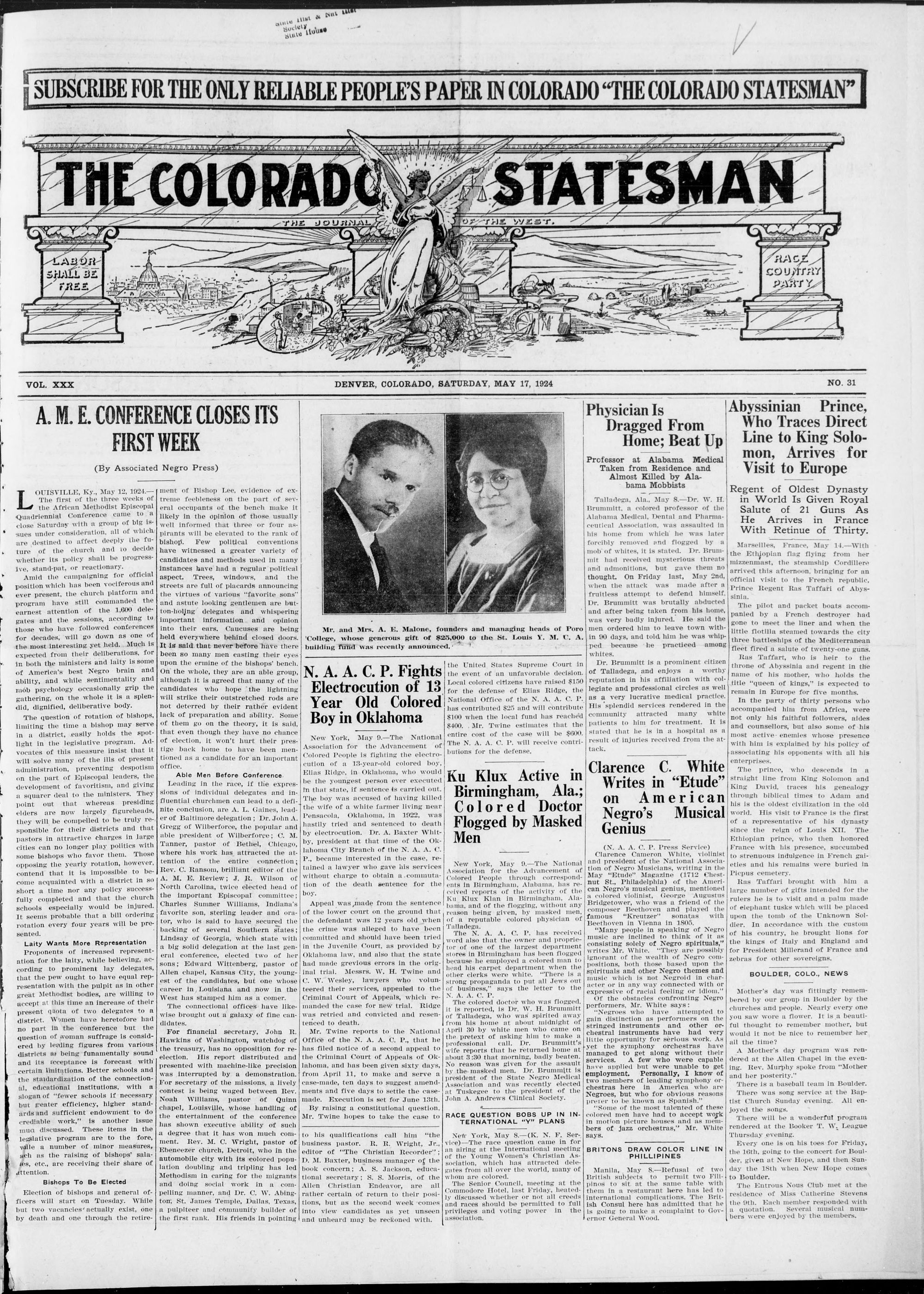
Page text (machine-generated)
SUBSCRIBE FOR THE ONLY RELIABLE PEOPLE'S PAPER IN COLORADO "THE COLORADO STATESMAN"
THE COLORADO STATESMAN
THE JOURNAL OF THE WEST.
LABOR SHALL BE FREE
RACE COUNTRY PARTY
A. M. E. CONFERENCE CLOSES ITS FIRST WEEK
(By Associated Negro Press)
LOUISVILLE, Ky., May 12, 1924. The first of the three weeks of the African Methodist Episcopal Quadriennial Conference came to a close Saturday with a group of big issues under consideration, all of which are destined to affect deeply the future of the church and to decide whether its policy shall be progressive, stand-pat, or reactionary. Amid the campaigning for official position which has been vociferous and ever present, the church platform and program have still commanded the earnest attention of the 1,600 delegates and the sessions, according to those who have followed conferences for decades, will go down as one of the most interesting yet held. Much is expected from their deliberations, for in both the ministers and laity is some of America's best Negro brain and ability, and while sentimentality and mob psychology occasionally grip the gathering, on the whole it is a splendid, dignified, deliberative body.
The question of rotation of bishops, limiting the time a bishop may serve in a district, easily holds the spotlight in the legislative program. Advocates of this measure insist that it will solve many of the ills of present administration, preventing despotism on the part of Episcopal leaders, the development of favoritism, and giving a squarer deal to the ministers. They point out that whereas presiding elders are now largely figureheads, they will be compelled to be truly responsible for their districts and that pastors in attractive charges in large cities can no longer play politics with some bishops who favor them. Those opposing the yearly rotation, however, contend that it is impossible to become acquainted with a district in so short a time nor any policy successfully completed and that the church schools especially would be injured. It seems probable that a bill ordering rotation every four years will be presented.
Laity Wants More Representation Proponents of increased representation for the laity, while believing, according to prominent lay delegates, that the pew ought to have equal representation with the pulpit as in other great Methodist bodies, are willing to accept at this time an increase of their present quota of two delegates to a district. Women have heretofore had no part in the conference but the question of woman suffrage is considered by leading figures from various districts as being funamentally sound and its acceptance is forecast with certain limitations. Better schools and the standardization of the connectional, educational institutions, with a slogan of "fewer schools if necessary but greater efficiency, higher standards and sufficient endowment to do credible work," is another issue mua discussed. These items in the legislative program are to the fore, while a number of minor measures, such as the raising of bishops' salaries, etc., are receiving their share of attention.
Bishops To Be Elected
Election of bishops and general officers will start on Tuesday. While but two vacancies actually exist, one by death and one through the retire-
VOL. XXX
ment of Bishop Lee, evidence of extreme feebleness on the part of several occupants of the bench make it likely in the opinion of those usually well informed that three or four aspirants will be elevated to the rank of bishop. Few political conventions have witnessed a greater variety of candidates and methods used in many instances have had a regular political aspect. Trees, windows, and the streets are full of placards announcing the virtues of various "favorite sons" and astute looking gentlemen are button-holing delegates and whispering important information and opinion into their ears. Caucuses are being held everywhere behind closed doors. It is said that never before have there been so many men casting their eyes upon the ermine of the bishops' bench. On the whole, they are an able group, although it is agreed that many of the candidates who hope the lightning will strike their outstretched rods are not deterred by their rather evident lack of preparation and ability. Some of them go on the theory, it is said, that even though they have no chance of election, it won't hurt their prestige back home to have been mentioned as a candidate for an important office.
Leading in the race, if the expressions of individual delegates and influential churchmen can lead to a definite conclusion, are A. L. Gaines, leader of Baltimore delegation; Dr. John A. Gregg of Wilberforce, the popular and able president of Wilberforce; C. M. Tanner, pastor of Bethel, Chicago, where his work has attracted the attention of the entire connection; Rev. C. Ransom, brilliant editor of the A. M. E. Review; J. R. Wilson of North Carolina, twice elected head of the important Episcopal committee; Charles Sumner Williams, Indiana's favorite son, sterling leader and orator, who is said to have secured the backing of several Southern states; Lindsay of Georgia, which state with a big solid delegation at the last general conference, elected two of her sons; Edward Wittenberg, pastor of Allen chapel, Kansas City, the youngest of the candidates, but one whose career in Louisiana and now in the West has stamped him as a comer.
The connectional offices have likewise brought out a galaxy of fine candidates.
For financial secretary, John R. Hawkins of Washington, watchdog of the treasury, has no opposition for reelection. His report distributed and presented with machine-like precision was interrupted by a demonstration. For secretary of the missions, a lively contest is being waged between Rev. Noah Williams, pastor of Quinn chapel, Louisville, whose handling of the entertainment of the conference has shown executive ability of such a degree that it has won much comment. Rev. M. C. Wright, pastor of Ebeneezer church, Detroit, who in the automobile city with its colored population doubling and tripling has led Methodism in caring for the migrants and doing social work in a compelling manner, and Dr. C. W. Abington, St. James Temple, Dallas, Texas, a pulpiteer and community builder of the first rank. His friends in pointing
DENVER, COLORADO, SATURDAY, MAY 17, 1924
Mr. and Mrs. A. E. Malone, founders and managing heads of Poro 'College, whose generous gift of $25,000 to the St. Louis Y. M. C. A. building fund was recently announced.
Mr. and Mrs. A. E. Malone, founders and managing heads of Poro College, whose generous gift of $25,000 to the St. Louis Y. M. C. A. building fund was recently announced.
N. A. A. C. P. Fights Electrocution of 13 Year Old Colored Boy in Oklahoma
N. A. A. C. P. Fights Electrocution of 13 Year Old Colored Boy in Oklahoma
New York, May 9.—The National Association for the Advancement of Colored People is fighting the electrocution of a 13-year-old colored boy, Elias Ridge, in Oklahoma, who would be the youngest person ever executed in that state, if sentence is carried out. The boy was accused of having killed the wife of a white farmer living near Pensacola, Oklahoma, in 1922, was hastily tried and sentenced to death by electrocution. Dr. A. Baxter Whitby, president at that time of the Oklahoma City Branch of the N. A. A. C. P., became interested in the case, retained a lawyer who gave his services without charge to obtain a commutation of the death sentence for the boy.
Appeal was made from the sentence of the lower court on the ground that the defendant was 12 years old when the crime was alleged to have been committed and should have been tried in the Juvenile Court, as provided by Oklahoma law, and also that the state had made previous errors in the original trial. Messrs. W. H. Twine and C. W. Wesley, lawyers who volunteered their services, appealed to the Criminal Court of Appeals, which remanded the case for new trial. Ridge was retried and convicted and resentenced to death.
Mr. Twine reports to the National Office of the N. A. A. C. P., that he has filed notice of a second appeal to the Criminal Court of Appeals of Oklahoma, and has been given sixty days, from April 11, to make and serve a case-made, ten days to suggest amendments and five days to settle the case-made. Execution is set for June 13th.
By raising a constitutional question, Mr. Twine hopes to take the case to
to his qualifications call him "the business pastor. R. R. Wright, Jr., editor of "The Christian Recorder"; D. M. Baxter, business manager of the book concern; A. S. Jackson, educational secretary; S. S. Morris, of the Allen Christian Endeavor, are all rather certain of return to their positions, but as the second week comes into view candidates as yet unseen and unheard may be reckoned with.
the United States Supreme Court in the event of an unfavorable decision. Local colored citizens have raised $150 for the defense of Elias Ridge, the National Office of the N. A. A. C. P. has contributed $25 and will contribute $100 when the local fund has reached $400. Mr. Twine estimates that the entire cost of the case will be $600. The N. A. A. C. P. will receive contributions for the defense.
Ku Klux Active in Birmingham, Ala.; Colored Doctor Flogged by Masked Men
Ku Klux Active in Birmingham, Ala.; Colored Doctor Flogged by Masked Men
New York, May 9.—The National Association for the Advancement of Colored People through correspondents in Birmingham, Alabama, has received reports of the activity of the Ku Klux Klan in Birmingham, Alabama, and of the flogging, without any reason being given, by masked men, of a reputable colored physician of Talladega.
The N. A. A. C. P. has received word also that the owner and proprietor of one of the largest department stores in Birmingham has been flogged because he employed a colored man to head his carpet department when the other clerks were white. "There is a strong propaganda to put all Jews out of business," says the letter to the N. A. A. C. P.
The colored doctor who was flogged, it is reported, is Dr. W. H. Brummitt of Talladega, who was spirited away from his home at about midnight of April 30 by white men who came on the pretext of asking him to make a professional call. Dr. Brummitt's wife reports that he returned home at about 3:30 that morning, badly beaten. No reason was given for the assault by the masked men. Dr. Brummitt is president of the State Negro Medical Association and was recently elected at Tuskegee to the president of the John A. Andrews Clinical Society.
RACE QUESTION BOBS UP IN IN-
TERNATIONAL "Y" PLANS
New York, May S.—(K. N. F. Service)—The race question came in for an airing at the International meeting of the Young Women's Christian Association, which has attracted delegates from all over the world, many of whom are colored. The Senior Council, meeting at the Commodore Hotel, last Friday, heatedly discussed whether or not all creeds and races should be permitted to full privileges and voting power in the association.
Physician Is Dragged From Home; Beat Up
Professor at Alabama Medical Taken from Residence and Almost Killed by Alabama Mobbists
Talladega, Ala., May 8.—Dr. W. H. Brummitt, a colored professor of the Alabama Medical, Dental and Pharmaceutical Association, was assaulted in his home from which he was later forcibly removed and flogged by a mob of whites, it is stated. Dr. Brummitt had received mysterious threats and admonitions, but gave them no thought. On Friday last, May 2nd, when the attack was made after a fruitless attempt to defend himself Dr. Brummitt was brutally abducted and after being taken from his home, was very badly injured. He said the men ordered him to leave town within 90 days, and told him he was whipped because he practiced among whites.
Dr. Brummitt is a prominent citizen of Talladega, and enjoys a worthy reputation in his affiliation with collegiate and professional circles as well as a very lucrative medical practice. His splendid services rendered in the community attracted many white patients to him for treatment. It is stated that he is in a hospital as a result of injuries received from the attack.
Clarence C. White Writes in "Etude" on American Negro's Musical Genius
(N.A.A.C.P. Press Service)
(N. A. A. C. P. Press Service) Clarence A. Cramer White, violinist and president of the National Association of Negro Musicians, writing in the May "Etude" Magazine (1712 Chestnut St., Philadelphia) of the American Negro's musical genius, mentioned a colored violinist, George Augustus Bridgetower, who was a friend of the composer Beethoven and played the famous "Kreutzer" sonatas with Beethoven in Vienna in 1805.
"Many people in speaking of Negro music are inclined to think of it as consisting solely of Negro spirituals," writes Mr. White. "They are possibly ignorant of the wealth of Negro compositions, both those based upon the spirituals and other Negro themes and music which is not Negroid in character or in any way connected with or expressive of racial feeling or idiom." Of the obstacles confronting Negro performers, Mr. White says:
"Negroes who have attempted to gain distinction as performers on the stringed instruments and other orchestral instruments have had very little opportunity for serious work. As yet the symphony orchestras have managed to get along without their services. A few who were capable have applied but were unable to get employment. Personally, I know of two members of leading symphony orchestras here in America who are Negroes, but who for obvious reasons preter to be known as Spanish."
"Some of the most talented of these colored men have had to accept work in motion picture houses and as members of jazz orchestras," Mr. White says.
BRITONS DRAW COLOR LINE IN PHILLIPINES
Manila, May 8.—Refusal of two British subjects to permit two Filipinos to sit at the same table with them in a restaurant here has led to international complications. The British Consul here has admitted that he is going to make a complaint to Governor General Wood.
NO.31
Abyssinian Prince, Who Traces Direct Line to King Solomon, Arrives for Visit to Europe
Regent of Oldest Dynasty in World Is Given Royal Salute of 21 Guns As He Arrives in France With Retinue of Thirty.
Marseilles, France, May 14.—With the Ethiopian flag flying from her mizzenmast, the steamship Cordillere arrived this afternoon, bringing for an official visit to the French republic, Prince Regent Ras Taffari of Abyssinia.
The pilot and packet boats accompanied by a French destroyer had gone to meet the liner and when the little flotilla steamed towards the city three battleships of the Mediterranean fleet fired a salute of twenty-one guns.
Ras Taffart, who is heir to the throne of Abyssinia and regent in the name of his mother, who holds the title "queen of kings," is expected to remain in Europe for five months.
In the party of thirty persons who accompanied him from Africa, were not only his faithful followers, aides and counsellors, but also some of his most active enemies whose presence with him is explained by his policy of associating his opponents with all his enterprises.
The prince, who descends in a straight line from King Solomon and King David, traces his genealogy through biblical times to Adam and his is the oldest civilization in the old world. His visit to France is the first of a representative of his dynasty since the reign of Louis XII. The Ethiopian prince, who then honored France with his presence, succumbed to strenuous indulgence in French gaieties and his remains were buried in Picpus cemetery.
Ras Taffari brought with him a large number of gifts intended for the rulers he is to visit and a palm made of elephant tusks which will be placed upon the tomb of the Unknown Soldier. In accordance with the custom of his country, he brought lions for the kings of Italy and England and for President Millerand of France and zebras for other sovereigns.
BOULDER, COLO., NEWS
Mother's day was fittingly remembered by our group in Boulder by the churches and people. Nearly every one you saw wore a flower. It is a beautiful thought to remember mother, but would it not be nice to remember her all the time?
A Mother's day program was rendered at the Allen Chapel in the evening. Rev. Murphy spoke from "Mother and her posterity."
There is a baseball team in Boulder. There was song service at the Baptist Church Sunday evening. All enjoyed the songs.
There will be a wonderful program rendered at the Booker T. W. League Thursday evening.
Every one is on his toes for Friday, the 16th, going to the concert for Boulder, given at New Hope, and then Sunday the 18th when New Hope comes to Boulder.
The Entrous Nous Club met at the residence of Miss Catherine Stevens the 9th. Each member responded with a quotation. Several musical numbers were enjoyed by the members.
FOREIGN
The Canadian Pacific railway declared a dividend of $2\frac{1}{2}$ per cent on common stock for the quarter ending March 31, 1924. It is payable June 30, 1924.
The soviet government has forbidden the printing of advertisements in privately owned publications. Hereafter only publications controlled by the government shall have the right to print advertising matter.
The first woman physician in Japan to be registered for practice and given a degree corresponding to M.D. is Mme. Chikaka Kuroda, a teacher in the Tokio higher normal school. She has been granted a degree by the Imperial University of Tokio for a thesis on violet rays.
Announcement of the route to be taken by the Japanese naval training squadron in a voyage around the world makes it certain that Prince Takamatsu, the third son of the emperor of Japan, will visit American ports this year. Prince Takamatsu will travel incognito, ranking merely as one of the 300 midshipmen making the cruise. Fifty-five thousand radio "bootleggers" broadcasting spongers and eavesdroppers, found to have been evading the German government tax, have been brought to time by drastic measures taken by the authorities and compelled to pay the statutory license fee of 50 cents each per month, which will be added to the reparation payment funds.
"Finders keepers," says Grover Bergdoll, American draft dodger, with reference to the gold he buried in 1917 when his game of hide and seek with the United States authorities began. All told, he says, there was exactly $270,000 in nice, shiny $10 gold pieces. He declares the gold is buried in the United States, but that is about all he will say about it.
Although the voice of the electorate has spoken its disapproval of the Japanese government, the fate of the Kiyoura ministry will not be definitely known for approximately a month. The question of resigning was debated at length by the cabinet and an agreement was reached to reserve decision until after the state celebration early in June of Prince Regent Hirohito's wedding.
The resignation of Premier Poincare's cabinet, announced for June 1, effective June 4, passes the application of the experts' repuration plan, so far as France is concerned, to the succeeding government, along with all other problems involving questions of policy. The carefully prepared economies which the premier was authorized to make by decree of the preceding chamber will be held in abeyance because the opposition won the elections on the promise to the electors to repeal the law.
GENERAL
John Dietz, 63 years old, famous in Wisconsin as the "defender of Cameroon dam," died in a Milwaukee hospital after a long illness.
Peter Posapney, 21 years old, of Two Rivers, Wis., a student at the University of Wisconsin, was shot and killed by Patrick P. Powers, a Madison policeman.
Frank T. Johns, 35 years old, a carpenter of Portland, Ore., was nominated for President of the United States at the national convention of the Socialist-Labor party.
Safe blowers blasted the outer and two inner doors of the vault in the Alton (III.) postoffice, took packages of postage stamps estimated as amounting to $35,000 or $38,000 and escaped without being observed.
Dallas, Texas, was awarded the 1925 national convention of the National Congress of Parents and Teachers at a meeting of the board of managers of the organization at St. Paul. Denver, Colo., was chosen for the national meeting of the board Sept. 29 to Oct. 4.
Judge A. M. J. Gochran in Federal Court at Covington, Ky., sentenced Congressman John W. Langley, Kentucky, convicted of conspiracy in connection with a whisky transaction in 1921, to two years in federal prison at Atlanta, Ga.
Arrangements for the establishment of a $10,000,000 Boy Scout endowment fund, the income of which is to be used for the promotion of all phases of the Boy Scout program in every section of the United States will be made at once scout executives of the Boy Scouts of America announced.
All traces of the run on the Union National Bank of Springfield, Mo., disappeared after money to meet withdrawal demands had poured into town by armored car, special train and airplane. Huge bags of cash gathered in St. Louis, Kansas City and other towns were rushed into Springfield. Motion pictures of whatever sort were held to be theatrical performances by the Ohio State Supreme Court and therefore are barred from being exhibited on Sundays. The decision, sweeping in its scope, is believed to include the exhibition of motion pictures in churches on Sunday.
Governor Flynn of Rhode Island directed High Sheriff Jonathan Andrews of Providence county to order every available deputy sheriff to the Senate chamber at the state house at Providence, where Democrats and Republicans are threatening each other in the bitterest political fight in the history of the state. The governor told Sheriff Andrews that failure to comply with his orders would result in dismissal of the sheriff's force and the calling of the National Guard to take its place.
AN EPITOME OF LATE LIVE NEWS
CONDENSED RECORD OF THE
PROGRESS OF EVENTS AT
HOME AND ABROAD
FROM ALL SOURCES
SAYINGS, DOINGS, ACHIEVE
MENTS, SUFFERINGS, HOPES
AND FEARS OF MANKIND
WESTERN
Allen R. Morford, former mayor of St. Joseph, Mich., who was arrested in San Diego charged with holding up the cashier of a local bank and getting about $3,000, was arraigned in Justice Court and held in $10,000 bail.
Mrs. Margaret Willis, held for the "trunk murder" of Dr. Benjamin Baldwin in Los Angeles several weeks ago, was confronted with Bert Webster, forest ranger, and denied that she had made a statement accusing him of the killing.
The Chicago, Burlington & Quincy and Deadwood Central railroads applied to the Interstate Commerce Commission recently for permission to abandon four miles of electric line from Deadwood to Lead, S. D., operating at a loss.
William Schrey is being held by San Francisco police on suspicion that he was one of the seven bandits who on Dec. 18, 1922, held up and robbed a bank automobile of $200,000 in front of the United States mint in Denver, killed a guard and escaped in a hall of bullets fired by mint employees.
F. M. Anderson of Denver, Colo., was fatally injured and two women companions hurt, one of them seriously, when the automobile in which they were riding and a Southern Pacific train collided at a crossing six miles west of Reno. Anderson was the Nevada representative of the United States Finance Corporation of Denver.
Two menacing forest fires, one spreading over 150 acres on Pilgrim creek, in the Cabinet forest in Montana, and the other covering more than 300 acres in the vicinity of Perkins lake, in the Pend D'Orelle forest, are the most serious blazes in district No. 1 of the forest service, according to reports received at district headquarters in Missoula.
WASHINGTON
Presiden Coolidge's veto of the Bursum pension bill was sustained by the Senate. The vote to override was 53 to 28, one vote less than the two-thirds required. Purchase by the government of the Cape Cod canal for $11,500,000 would be authorized under a bill passed by the House, 149 to 132. The measure now goes to the Senate.
A decision which may cost the federal government $70,000,000 in claims arising from the commandeering of ships during the war was handed down by the United States Supreme Court a few days ago. The court reversed the decision of lower courts and sent back to the Court of Claims for settlement the case of the Brooks-Scunlon Corporation which sued the government for damages and compensation for the commandeering of a contract for construction of the M. J. Scunlon and the ship itself, at the yards of the New York Shipbuilding Corporation at Camden, N. J. Counsel for the government in arguing the case, said if the court decided the contract had a value it would open the way to approximately $70,000,000 worth of similar suits.
A man who said he was A. R. Morford, former mayor of St. Joseph, Mich., was arrested on a San Diego & Arizona railway train at Seeley in the Imperial valley, and held in connection with the robbery of more than $3,000 from a branch of the First National bank at San Diego. He had about $3,000 in a satchel, also an ammonia gun such as was used on the teller by the bank bandit and a revolver. He admitted the robbery, the police report.
Announcement of the location of vast tracts of land in the Philippines with soil well adapted for rubber plantations was made recently by Secretary Wallace. Experts of the Department of Agriculture, with those of the Department of Commerce, working under a $500,000 appropriation by Congress, have been searching for the last year in the Philippines and in South and Central America for means of developing new sources of crude rubber to make the United States independent of British colonial and other foreign producers, who now provide about 90 per cent of the world's supply.
A bill to quiet title to land on the Pueblo Indian reservation in New Mexico has been passed by the Senate. Senator Bursum, Republican, New Mexico, in charge of the measure, assured the Senate that the bill was acceptable to all interests, which have been participating in the controversy waged over the confusion of title to some of the lands. Secretary of the Interior Hubert Work's associates of the President's cabinet served as honorary pallbearers at the funeral of Mrs. Work, held in the East room of the White House.
COOLIDGE STOPS SHAKING HANDS
SEVERAL SENATORS THEREUPON DELIVER SPEECHES FULL OF ABSOLUTE BUNK.
By EDWARD B. CLARK
Washington.—Something of a row has been raised in the senate—which having become accustomed to rows, takes them today rather as a matter of course—over the stoppage temporarily of the President's, custom of shaking hands with every visitor who crosses the threshold of the White House.
One or two senators have risen in their places to ask in effect: "What are we coming to? Is this a democracy or an autocracy? Why should the President refuse to touch the hand of the humble citizen of the country?"
Of course there is a lot of bunk in all this. President Coolidge stopped shaking hands with visitors because his hand was lame from over-shaking. He didn't want to quit, but the understanding is that his secretary, Mr. Slemp, made him quit. It is perfectly true that all other presidents have continued the handshaking process whether their hands were sore or not, and some of them paid the penalty of blisters. Anything which a president does or declines to do which is not in exact accordance with precedent is seized upon as something strange and undemocratic and contrary to the rights of the masses.
Just at this season of the year Washington is packed with visitors. In some of the hotels school boys are sleeping six and eight in a room. They have been brought here by their teachers to view the sights and to get the atmosphere of the capital. Adults, as well as children, are here by the thousands, and it is the multitude of them, each one desiring to shake the President's hand, which brought about the non-shake order in the executive mansion.
Even Their Wives Suffer.
Once on a time the writer of this article asked the wife of a president of the United States how she managed to stand the fatigue of handshaking, for on occasions presidents' wives are compelled to undergo the ordeal to which their husbands are subjected virtually every day.
The "First Lady" of whom I asked the question had been shaking hands the day before with 4,000 persons who had attended a May day party given on the lawn of the White House. In answer to my question she raised her hand and showed me a bilister which extended from the tip of the little finger of the right hand well down to the middle of the side of the palm.
Nobody any longer criticizes a president of the United States for going to congress to deliver his message by word of mouth instead of sending it over in written form, as was the custom in the days between the time of the first Adams and the time of Woodrow Wilson. When the late President Wilson went to congress to deliver his message personally there was instant criticism from here, there and everywhere else. It was declared to be a kingly practice, and that it ought not to be tolerated. In truth Wilson was simply going back to the days of Washington and Adams.
Messages in Person.
Thomas Jefferson it was who began the practice of sending a written message to congress at the opening of the session instead of appearing in person to deliver it. When Woodrow Wilson declared his intention to speak his message to congress Washington folks said: "If Theodore Roosevelt had made the suggestion it instantly would have been charged that he intended to make himself a king, and the country would have been looking out for Caesarism.
There was a cartoon widely circulated at the time President Wilson made his first address in person to the congress of the United States. The cartoon showed Theodore Roosevelt, who at that time was alive, with a fiercely disappointed face dancing in anger and exclaiming to himself: "Why didn't I think of that?"
It was only nine months ago that Warren G. Harding died. His death was attributed in part to overwork, and at the same time many of the newspapers of the country said that the daily receptions to visitors should be given over by presidents of the United States because they were nerve-racking and body-racking affairs. Today, only nine months after the death of an overworked president, there is criticism of his successor in office for trying to save his hand and his health by declining, pleasantly enough, to shake the hand of every one of the hundreds who pass him in daily review.
Some of the visitors to Washington are queer. The lower floors of the White House proper are thrown open to them between the hours of 10 and 12 each day. They can inspect everything from the basement to the state dining room, and yet it is not an unusual thing for visitors to request permission to go upstairs to peer into the bedrooms and the sitting rooms of the President and his wife. Some of the visitors show resentment and even temper when they are told that the living rooms of the President's family pre "off limits."
Looking for Second-Place Man
Republican leaders here are still casting about for a vice presidential candidate. The vice presidency ought to be pretty good bait for the hook on a casting line. Fish in no waters
east of those of the Middle West will be given the anglers' consideration.
Within a day or two suggestion has been made by some of the Republicans that Gen. John J. Pershing would make an ideal candidate for second place.
Pershing, of course, heard of this and at once put a stop to the movement to nominate him, if movement it could be called. He gave to the press this flat statement:
"Any statement that has been made that I would be a candidate for vice president has been made without my authority. I am not a candidate, and if by any chance the nomination should be offered to me I should decline to accept it."
In the National Republican, the organ of the Republican national committee, the name of Senator George Norris is mentioned as one of those advanced thinkers whose actions are not agreeable to the leadership of Republicanism as some party men think it should be maintained. There has been a feeling in Washington that if Norris of Nebraska were to be nominated for second place on the ticket, there would be no third party to appear in the field, but, of course, this is only speculation, as it seems Senator Norris is well out of it.
Beveridge Is Suggested.
The name of Albert J. Beveridge of Indiana is being discussed as that of a man who might hold certain elements of the Republican party to their allegiance, elements today which seem to be undecided as to their future course, whether it shall take them third partyward or Democraticward. There seems to be some doubt in Washington whether former Senator Beveridge would accept the office of the vice presidential nomination. His great and good friend, Theodore Roosevelt, once was drafted for the vice presidency. At that time and for the only time in his life Roosevelt was a conscientious objector. He didn't want the place, but he got it and later he became president.
A great many of the Republicans here seem to think that William S. Kenyon, former United States senator from Iowa and now United States Circuit court judge, would be the ideal candidate for second place on the ticket. Judge Kenyon is rather an advanced progressive without being entirely radical. Unlike Senator Cummins of Iowa, who also is looked upon as a progressive, he is in the good graces of those extremists in the Republican party who are thinking of putting a third ticket in the field.
Some Want Dawes.
It seems as if some of the Republican leaders in Washington would rather nominate Charles G. Dawes for second place on the ticket than any other man that has been named. Dawes is known as a conservative, and the feeling has been that whether they want to or no, the leaders must center their influence on the securing of a progressive or even a near-radical for the second honor position. Apparently it is held by some Republicans here that the nomination of an extremely advanced thinker on the ticket is not as likely now as it seemed to be three months ago; in fact, there are a good many Republicans who think the party can "get away with it" if it shall give the conservative Coolidge a conservative companion on the ticket.
The reason for this belief is the remarkable showing which the President has made in the primaries and the generally accepted evidences of his hold on the people. The argument is that if the masses of Republicans are willing that the conservative Coolidge should be nominated, why should they be unwilling that a man of his same general thought type should bear him company on the ticket?
Tragi-Comedy
The crimson glare of the setting sun cast a strange and sinister light into the silent room, lingering, like an accusing finger, on the dark red pool in the center of the floor—red as the western sky itself.
Slowly the scarlet stain widened. Her hand clutched convulsively to her heart, a woman watched it, the utter extremity of fear showing in her horror-dilated eyes. Anxiety was written in every line of her face.
A jaunty step sounded without, the door swung open and a man entered.
The tune he had been whistling died on his lips, the color ebbed from his face. His eyes, wide as the woman's, were riveted on the same dread spectacle. Then, suddenly a sharp voice broke the deathly stillness.
"Don't stand there like a moon-struck calf, Henry!" exclaimed the woman. "Come here and help me to clear away this strawberry jam."
Qualifications
"If I marry," said the exacting girl
"the man must be entertaining, popular
and have a large income."
"Too bad," rejoined Miss Cayenne
"Very few of our motion picture come
dians are still single."
Possible Explanation
"A fair exchange is no robbery," quoted the wise guy. "I suppose that's the reason so many women are willing to swap an uncertain husband for sure-thing alimony," suggested the simple mug.
Uncomfortable Publicity
"This story says they went into the ark two by two, doesn't it, auntie?" "Yes, dear."
"Well, who went in with you?"—Boston Post.
A "taxicab" charlot, used in Rome before the time of Julius Caesar, computed the fare by pebbles dropped into a bowl.
PETER H.
T. G. Granberry,
President
Lady Assistant
and Soloist With
All Funerals
W. T. Co.
Licensed En-
SERVICE DAY
Phone Cha
THE PEOPLE
Funeral Directors and
Parlors, 2718 3
Denver, C
Berry, W. T. Collins Curtis
Att Licensed' Embalmer M
Instant SERVICE DAY AND NIGHT D
With Phone Champa 88 F
icals
PEOPLES' MORTU
Directors and Licensed Emb
Parlors, 2713 Welton Street
Denver, Colorado
THE PEOPLES' MORTUARY Funeral Directors and Licensed Embalmers Parlors, 2713 Welton Street Denver, Colorado
Consideration for the dead.
Comfort for the bereaved.
Admittedly, the largest race
establishment of its kind in the
West.
Expenses moderate.
The public the public.
Ever ready to assist the worthy.
For Ladies' and Ge
H. AND
MERCHAN
Cleaning, Pressing and
Guara
517 28th
PHONE MAIN 6751
Call in and see my Fall and W
Hunt's Groc
Ladies' and Gents' Tailoring,
H. ANDERSON
MERCHANT TAILOR
ing, Pressing and Repairing. All
Guaranteed
517 28th Street
ONE MAIN 6751 Prices reason
d see my Fall and Winter Samples now on
it's Grocery-Ma
PHONE MAIN 6751 Prices reasonable.
Call in and see my Fall and Winter Samples now on display.
Hunt's Grocery-Market
CORNER 30TH AND WELTON ST.
Phone Champa 3522
WE HAVE A FULL SUPP
FLOWER
Red Pitted Cherries, can .....
Try Hunt's brand of Butter,
Brer Rabbit Syrup, large, per
Per can .....
Macaroni, Spaghetti, Noodles,
Salt Mackerel, each .....
Fresh Roasted Peanuts, 20¢
Pop Corn, the kind that pops,
Corn Meal, 10, 20
6-lb. sack Flour .....
10-lb. sack Flour .....
Apple Butter, jar .....
Don't forget we have handled
and
HAVE A FULL SUPPLY OF GARDEN
FLOWER SEEDS.
And Cherries, can .....
It's brand of Butter, always 2c less than
it Syrup, large, per can .....
Spaghetti, Noodles, 2 pkgs. for.
Herel, each .....
Stored Peanuts, 20¢ lb.; 2 for.
The kind that pops, 3 lbs. for.
Corn Meal, 10, 20 and 30 lb. sacks.
Flour .....
Flour .....
Water, jar ..... 25¢
Get we have handled Whip Cream, Cottage
and 400.
WE HAVE A FULL SUPPLY OF GARDEN AND FLOWER SEEDS.
Red Pitted Cherries, can .....25¢
Try Hunt's brand of Butter, always 2c less than market.
Brer Rabbit Syrup, large, per can .....60¢
Per can .....35¢
Macaroni, Spaghetti, Noodles, 2 pkgs. for .....15¢
Salt Mackerel, each .....15¢
Fresh Roasted Peanuts, 20¢ lb.; 2 for .....35¢
Pop Corn, the kind that pops, 3 lbs. for .....25¢
6-lb. sack Flour ..... **30¢**
10-lb. sack Flour ..... **45¢**
Apple Butter, jar ..... **25¢ and 35¢**
Don't forget we have handled Whip Cream, Cottage Cheese
and 400.
TENTH ST. MAIN 1514
TELEPHONE MAIN 1511
CHARLOTTE
CAP SHAPE
Single Mesh .....
Double Mesh, 15c; two for....
TAN OFF—MADAM WAIT
THE ATLAS
The Five Points
PHONE MAIN 875.
HARLOTTE HAIR NET CAP SHAPE AND FRINGES
The Five Points Postal Station.
MAIN 875.
2701
2620
"WE SELL THE EARTH."
DRUFF INVESTMENT
CHARLOTTE HAIR NETS
CAP SHAPE AND FRINGE
Single Mesh .....10c
Double Mesh, 15c; two for.....25c
TAN OFF—MADAM WALKER'S SKIN BLEACH AT
THE ATLAS DRUG CO.
The Five Points Postal Station.
PHONE MAIN 875. 2701 WELTON
"WE SELL THE EARTH."
WOODRUFF INVESTMENT
Try Us on Rentals, Insurance and Loans
J. M. Williamson, Jr., Notary Public
J. G. Woodruff, President and Manager
---
Main 1274
A. E.
S' MORTUARY
Licensed Embalmers
Belton Street
Morado
Satisfaction guaranteed.
Always at your service, day or
night.
Square treatment to all.
Employs courteous.
Economy our watchword.
Service incomparable.
ents' Tailoring, See
ERSON
TAILOR
Repairing. All Work
steed
Street
Prices reasonable.
Enter Samples now on display.
PLY OF GARDEN AND
SEEDS.
25¢
Always 2c less than market.
60¢
an
35¢
pkgs. for
15¢
; 2 for
35¢
lbs. for
25¢
and 30 lb. sacks.
30¢
45¢
25¢ and 35¢
Whip Cream, Cottage Cheese
00.
The Curtis Park
Floral Company
Floral Designs Put Up
While You Wait
Choice Plants and Cut Flowers
Constantly on Hand
Greenhouses: Thirty-fourth and
Curtis Streets
Denver, Colo.
HAIR NETS
AND FRINGE
100¢
25¢
ER'S SKIN BLEACH AT
DRUG CO.
Postal Station.
2701 WELTON
2620 Welton St.
THE EARTH."
INVESTMENT CO.
---
Curtis M. Harris,
Manager
and
Director
Funeral
Something to Think About
By F. A. WALKER
Mother's Cook Book
THE HUMAN SPIDER
ALONG the devious highways where the lights are blazing, in the byways where mystic shadows are, and the witchery of semi-darkness exerts its seductive spell, in the salons of precious woods and gildings, in the dingy-hovels, the human spider is ever watching and waiting for victims.
His sole purpose in life is to gorge himself and fatten upon the unsuspecting or adventurous who by their own folly become entangled in his web, an exquisite, airy abode of silvered threads when viewed from the outside, but a carnal house filled with horrors to those imprisoned within.
Before the dupe has penetrated very deeply into the web, a nauseous sense of fear oppresses him, but he laughs it away and ventures forth gay-hearted, confident of his craftiness to break the bonds and go free whenever he may be so inclined.
But his quest of riches and pleasures must be continued. The spider has assured himself that his fondest desires shall be realized. Even now the sticky web is clinging to the victim's feet, shutting out the light from his eyes and smothering his breath.
When at last he comprehends he is imprisoned, it is not without dismay that he finds himself in a hopeless condition, terrified to the core of his
MEN YOU MAY MARRY
By E. R. PEYSER
Has a man like this proposed to you?
Symptoms: Short, trig, full of pep, good dresser. Sensitive, charming, never wants to sit home, always wants to "go somewhere" else. Leaves a play if he doesn't like first act, leaves a restaurant if he doesn't like his waiter, raises a row anywhere—always has some fuss wherever he goes. You sit in fear and trembling lest the steak is too rare or the egg is too soft.
IN FACT
He, being short, has a horror of being thought soft.
Prescription for the bride-to-be:
Wear low heels—low hats.
ABSORB THIS:
Give him an inch and he'll take it well.
(@ by McClure Newspaper Syndicate.)
Booka! 'Tis a dull and endless strife;
Come, hear the woodland linnet.
How sweet his music! on my life.
There's more of wisdom in it.
And hark! How blithe the throast sings!
He, too, is no mean preacher.
Come forth into the light of things,
Let nature be your teacher.
One impulse from a vernal wood
May teach you more of man,
Of moral evil and of good.
Than all the sages can."
—Wordsworth.
HERE ARE SOME SOUPS
CUT up six white onions and fry in a tablespoonful of butter until light brown. Add a quart of water and a pint of milk, season with one teaspoonful of salt and a dash of pepper, a teaspoonful of sugar and a pinch of mace. Cook slowly for an hour and strain; beat four eggs until light, add a cupful of cream and a tablespoonful of cornstarch mixed with a little cold water; cook until the starch is well done before adding the eggs and cream. Just heat but do not boll or the eggs will be cured.
THE THINGS OF EVERY DAY
THE little things of every day
Make up the sum of living;
The father's toll, the children's play,
The loving and the giving.
fluttering heart as he tugs and pulls with desperation to break the silken threads being spun around him and slowly strangling him to death.
At the spider's behest the fool has played fast and loose in the sunniest days of his existence. Having been so bound up with the one master-thought that he could falsify and pilfer without being suspected, gamble with money that was not his own, delude his trustful wife and his employer, he awakens with a start to find himself in a house of many winding stairways from which he cannot possibly escape.
The changelings who would have you believe they are men of rare cunning, fall with frequency under the spell of the spider, though even the wise now and then are fooled and humbled.
Nothing but evil is to be had from the scheming spider who invites you to "walk in" in Simple Simon fashion and "make yourself at home." Every day the spider is planning mischief.
© by McClure Newspaper Syndicate.
SCHOO
Copyright
Cook Book
DWIC
Copyright
THE THUNDERBOLT
Take a can of pea soup and a can-of condensed milk—that which is less sweet is more desirable. Mix well, heat hot and serve with crackers.
Cream of Barley Soup.
Melt two tablespoonfuls of butter in a saucepan, add two tablespoonfuls of flour, and cook three minutes, stirring steadily. Then add one cupful of pearl barley and cook two minutes. Add slowly one pint of boiling water and one of milk, stirring until well-blended and simmer gently for one hour. Rub through a sieve, return to the heat and add three pints of chicken stock, one tablespoonful of cornstarch mixed with a little cold water. Boll until the starch is well cooked and serve hot.
Condensed milk added to a canned pea soup, heated hot and served with fingers of toast makes fine cup of soup for a chilly night.
A cupful of mashed potatoes blended well with a little cream, added to a quart of hot milk, seasoned with butter, pepper and salt is another quick, nourishing and tasty soup to serve as a supper dish.
Neville Maxwell
(©) 1924, Western Newspaper Union.
Reflections of a Bachelor Girl
Bu HELEN ROWLAND
JUDGING from the infant mortality amongst them, the gods must love these early-blooming spring romances.
There appear to be two kinds of preachers: those who teach you how to live so that you will not fear death—and those who want you to live so that you will cheerfully welcome death.
Get the habit of trading at Michaelson's, the out-of-the-high-rent store, where quality merchandise is always sold for less money.
The first kiss always brings a lump in a man's throat—but it's the last kiss that leaves a lump in a woman's throat.
No matter for what unconscious or unconscionable reason a woman may
Quick Soup.
The Romance of Words
ONE of the most interesting and best-phrased explanations of this title occurs in a book written, strange as it may seem, in 1655-Vorstegan's "Restitution of Decayed Intelligence." "This honorable name of office," says the author, "in the chief and most famous city in our realm is written in divers' wales. Some writ it 'major', some 'mayor' and some 'Maire'. And because major in Latin signifleth greater or bigger, some, not looking any further, will needs from thence make it major. But, seeing the names of sheffiff and alderman cannot be drawn from the Latin, why should it be thought that mayor cometh from major? Certain it is that as the other names of office are not derived from the Latin, no more is this. For the etymology thereof we are to note that in our own English to 'may' is as much as to say a 'haver' or possessor of might—one that hath and may use authority."
© by Wheeler Syndicate, Inc.
L DAYS
THE THUNDERBOLT
The Young Lady
Across the Way
The young lady across the way says moving pictures of the Old Testament stories now are being shown, but she supposes they're rather crude, having been taken so long ago.
Bachelor Girl
glance at a man, he always interprets her look as a glance of admiration.
Somehow, the smaller a man's heart, the more trivial and foolish little love affairs he seems to be able to pack into it.
There are three kinds of men in the world: the kind a girl dreams of marrying; the kind her mother expects her to marry; and the kind that she finally succeeds in marrying.
A man's idea of "diplomacy" is to do as he pleases, and then stay away, until, in her anxiety to know whether he is dead or alive, a woman has completely forgotten her indignation.
The hardest words for a man to utter and the easiest for a woman to believe are—"I love you!"
(Copyright by Helen Rowland.)
EFFORTS MADE TO REPASS MEASURE
EFFORTS MADE TO REPASS MEASURE
"COUNTRY CAN'T AFFORD IT."
SAYS PRESIDENT COOLIDGE,
REFUSING SIGNATURE
BONUS BILL IS VETOED
BACKERS OF BONUS MEASURE
IN HOUSE SEEK TO OVER-
RIDE VETO
Washington.—The soldier bonus bill was vetoed by President Coolidge on the grounds that it was economically unsound and morally unjust.
Returned unsigned to the House, where the legislation originated, the measure was immediately taken up by its friends in an effort to override the executive action, and only the counsel of leaders of both parties obtained a postponement of a vote.
The President, in his veto message, a document of more than 2,000 words, declared he could see no justification for enactment of the bill into law, and added:
"Our country cannot afford it. The veterans as a whole do not want it. All our American principles are opposed to it. There is no moral justification for it."
Proceeding in his discussion of the bill, Mr. Coolidge declared no bonus was owed able bodied veterans of the World War.
"The gratitude of the nation to these veterans cannot be expressed in dollars and cents," he added. "The respect and honor of their country will rightfully be theirs for evermore. But patriotism can neither be bought nor sold. It is not hire and salary. It is not material but spiritual. It is one of the finest and highest of human virtues. To attempt to pay money for it is to offer it an unworthy indignity which cheapens, debases and destroys it. . . . We must either abandon our theory of patriotism or abandon this bill."
The economic and financial grounds for a veto were stressed particularly by the President with an inference that should the bill become law, hope for tax reduction must be abandoned. The government, he said, had reached a financial condition which permitted a reduction in taxation, but "if this bill becomes law we wipe out at once almost all the progress five hard years have achieved in reducing the national debt."
The bill, he argued, would commit the country for a period of twenty years to an additional average annual appropriation of $114,000,000 and at the end of that time it would be necessary to sell to the public $2,500,000,000 in bonds—a major operation in finance—which he said might be disastrous at that time.
The executive asserted the disabled veterans were being given treatment and that insurance had already been provided for all veterans.
"Our first concern must be the nation as a whole. This outweighs in its importance the consideration of a class and the latter must yield to the former.
This is the second time a bonus bill has been vetoed. Two years ago President Harding turned down the first measure passed by Congress. His veto was overridden by the House but sustained in the Senate. On passage of this bill the House voted 355 to 54 and the Senate 67 to 16.
Senator Wheeler Exonerated
Senator Wheeler By a vote of 4 to 1, the Senate investigating committee held that the charges in the indictment returned against Senator Wheeler, Democrat, Montana, by a federal grand jury in his own state were unsupported by the facts. Senator Sterling, Republican, South Dakota, declined to sign the majority report, which bears the signature of Chairman Borah and Senator McNary, Oregon, Republicans, and Senators Swanson, Virginia, and Caraway, Arkansas, Democrats.
Railroads to Spend $766,000,000
Railroads represent 96 per cent of the mileage of the country up to April 1 had authorized expenditures for permanent improvements and new equipment to be made in 1924 aggregating $766,000,000. it was announced at the close of a joint meeting here of the American Railway Association and the Association of Railway Executives attended by presidents of most of the railroads of the country. The amount actually expended for these purposes to April 1 was $185,500,000.
Edith Gould Loses Property Suit
Paris.—Edith Kelly Gould lost the suit she brought in the French courts to obtain half the property in France owned by Frank Jay Gould, her former husband. The court ruled that she had no right to a share in this property, because the judicial domicile of the Goulds was in the United States, where the rule of separate property of husband and wife prevails. This decision was reached, although the original divorce was granted in France.
THE COLORADO STATESMAN
```markdown
```
RELIABLE chronicle of their doingsgress; a faithful mi their wants, their hoir best aspiration.
THE COLORADO STATESMAN
equaled as an adverti medium for the busi of professional men women.
excellent family jour peaking to and for m thousand colored citizen
The Mouth-Piece of the People of Colorado and the Entire West
ARELIABLE chronicle of their doings and progress; a faithful mirror of their wants, their hopes, their best aspiration.
THE COLORADO STATESMAN
Unequaled as an advertising medium for the business of professional men and women.
An excellent family journal speaking to and for many thousand colored citizens.
$2.00 A YEAR
$1.25 SIX MONTH
$.75 THREE MONTH
THE GREAT ORGAN
OF THE
BORING MASS
THE GREAT ORGAN OF THE LABORING MASSES
THE COLORADO STATESMAN
JOS. D. D. RIVERS.....Proprietor
1824 Curtis Street, Room 25
PHONE MAIN 7417
Entered as second-class matter at the postoffice in the city of Denver, Colorado.
Recognized by the Retail Merchants' Bureau of the Denver Civic and Com-
mercial Association as an advertising medium.
SUBSCRIPTION DATES:
One Year ..... $2.00
Six Months ..... 1.25
Three Months ..... 75
Payable in Advance
Reading notices, ten lines or less, 15 cents per line. Each additional line over ten lines, 12 cents per line.
Display advertising, 75 cents per square. A square contains ten agate lines.
All communications of a personating nature that are not complimentary will be withheld from the columns of this paper.
No discounts allowed on less than three months' contract. Cash must accompany all orders from parties unknown to us. Further particulars on ap-
MAKING THE MOST OF LIFE
A VERY interesting and instructive lecture on this subject was given in one of our large churches a few years ago by a learned and able rabbi of this city. His pointed remarks and well rounded conclusions seemed directly aimed at each of the persons composing the large audience. It was such a lecture as to apply with striking force to every one, for after all our chief concern and single aim should be to make the most of life. In a few weeks we will have with us the graduation period. Schools and colleges alike will be handing out diplomas to those who have applied themselves to study for some given profession, trade or art, persons who must soon assume the duties of citizenship with definite responsibilities. It is not presumed, of course, that one's education is complete with the conferring of degrees at commencement time. For one to harbor such a feeling is but to invite wreckage upon the shoals of human disappointment and failure. It is often a mystifying query whether or not we leave the school room with a proper appreciation of the immense requirements of a full educational program. To make the very most of life one must be thoroughly imbued with the spirit to make the most of one's educational advantages, always, however, with a deep love of the right as a shield and buckler. From this arises contentment, for it is only possible to lead or direct others along the paths of right through a personal, self-enjoyment of its every principle. Manifestly, it is a vagary of vagaries for one to teach Christianity with any degree of success while himself indulging the unchristian life. So is it with the highly educated. Every reflex must evidence a sincerity of purpose and a proper conception of personal duty as well as that to others. Education should suggest industry, that is to say, the going to the very bottom of things, not merely as a simple matter of research, but to make things much better than we found them. Civilization is built and advances upon this principle alone. The scientific uses of electricity did not end with the discoveres of Benjamin Franklin, else the world would never have heard of Edison, or Marconi, or Tesla, or Bell of telephone fame. Was it not their love of industry over and above their personal energies that have made each and all of them world benefactors?
The realms of learning are as broad as the universe itself and a life time is all too short to grasp more than a mere handful of its possibilities. But one who loves knowledge for knowledge's sake will explore many caverns and hidden places, forever closed to the one who looks upon learning as a personal possession. Knowledge is a growth and each day should contribute something to an inborn tendency to grow in power and beneficial relation to the human race. No other purpose is worthy and no less determination can bring happiness. We often hear sermons about the pure and better objects of life. There is not enough of them, however, in actual practice throughout the world.
Here we seemingly stumble upon the most aggravating form in our educational program. The student goes out in the world too thinly armored in this one particular. Making every allowance for human frailties, for the natural weakness of man, not to use a harsher designation, it is only fair to conclude that world purity will long remain an iridescent dream until from the educated mind and soul we may grasp purity as surely as we vision it. "Blessed are the pure in heart," should enable us to see and walk with the God of knowledge and temples of man's highest aspirations as well as with the God of Heaven and His righteousness. To be just, to be kind, to be thoughtful of others, to aid in the uplift of humanity, to make two blades of grass grow where only one grew before in the great scheme of things, to give without thought of reward, to sacrifice without complaint—these and these only are agencies sufficient unto mankind in the final endeavor to make the most of life.
CLEAN-UP WEEK
DENVER citizens have entered the spirit of the thirteenth annual Clean-Up Week in a manner that means business and thoroughness. In a measure it would appear almost superfluous for a great metropolis to designate a certain period wherein its citizens should take on the duties of cleanliness and health.
And yet it is the very thing to do, for by such designation there is a concentration of effort that brings immediate results. It is our opinion that it is easy for one to feel a certain pride in Denver, and pride means better homes, better streets, clean yards and alleys. And in this one thought is not so much for coming summer tourists as for our own comfort, sanitation and delight. To our group, the approach of clean-up week presents many opportunities and we should be alive to them in every sense. The whole scheme is to make and keep your property presentable at all times and every home-loving man, woman and child should willingly do their share in this great and worthy movement.
We can do much towards rendering ineffective the old-time notion that one could tell the racial identity of the occupants of a piece of property by outside appearances. A well kept lawn, artistically arranged flower beds, a liberal supply of paint on porches, fences, wood work, screen and porch furniture will readily dispel such notions. Then let us have clean windows, hang out the washing in the back yard and keep the coffee not off the front porch.
For many years strangers coming to our city have openly marveled at the elegance of our home life. Negro citizens of Denver truly own some valuable and beautiful property. The great majority of these need no command to "Clean-Up and Paint-Up." Their homes are models of neatness, surpassing in most instances the homes of white neighbors in the same block. But we have many, many exceptions to this rule and it is by these exceptions that our standard of citizenship is guaged, unfair though it be. If Denver is to maintain her reputation as one of the cleanest of American cities every class of inhabitants must do their share. Locality should have no bearing on our civic pride. There are people living in the lower sections of Denver who never think of planting a shrub or trying to have a lawn, and yet who can tell of the great plans they have in store when able to buy a home in the more favored residential sections. That is merely begging the question. Beautify the spot where you are, and by this means make all parts of the city desirable and clean. THE COLORADO STATESMAN heartily endorses the 'Clean-Up and Paint-Up' campaign for we not only have a natural pride in this, our home city, but we believe the idea, if carefully nursed, will place Denver in a class second to none in the country for attractiveness, beauty and cleanliness. Do your part.
"There Is in the People Themselves the Power to Put Forth Great Men"
By CALVIN COOLIDGE, in "The Price of Freedom."
INNOCENCE is not enough in government administration. There must be added that character and ability that come only from grappling with the great problems of life, most usually gained by Americans in great business and administrative activities. There is no force so democratic as the force of an ideal.
The great test of an institution is its ability to perpetuate itself.
No government can be successful which outlaws any good influence, wherever its source, whatever its calling. Education is undertaken to give a larger comprehension of life.
There is in the people themselves the power to put forth great men. There is in the soul of the nation a reserve for responding to the call to high ideas, to nobility of action, which has never yet been put forth. There is no problem so great but that somewhere a man is being raised to meet it.
A Tornado Is a Revolving, Devastating Cloud; It Is Not a Cyclone
By GAYLE PICKWELL, in Nature Magazine.
A tornado is a cloud; an upright, revolving, roaring, devastating cloud. But it is not a typhoon, a monsoon, or a hurricane. Above all it is not a "cyclone." Typhoons and monsoons are storms covering large areas, hundreds of miles in diameter, and they give rise to straight winds only. The winds of a tornado have a violent rotary motion. The word "cyclone" refers, correctly, to the great storm areas which pass, week by week, across the United States.
The weather man reports a storm; that storm is the result of the approach of a cyclone covering, mayhap, the entire Mississippi valley or the Pacific coast or the Atlantic. A tornado at its largest will be less than 1,000 feet wide at the base.
Whenever the barometer falls a cyclone is approaching. A tornado may accompany it, provided the cyclone is of tornado character; provided the locality is tornado territory; above all, provided it is tornado season.
Tornadoes, like roasting ears, come in season. That season, contrary to the general notion, is not July and August! It is not even June, the sultry month of summer, but is limited, strangely and fortunately, to March, April and May. April is the month of bumper tornado crops. The hot days of summer are not producers of the funnel clouds.
The tornado comes usually in the late afternoon or the early evening. They seldom occur outside the United States, and the Mississippi valley reserves them mainly for itself. Texas, Oklahoma, Kansas and Missouri run neck and neck for funnel-cloud honors. Nebraska easily takes second place. And, closely in order, come Mississippi, Alabama, Iowa, Illinois, the Dakotas and Minnesota. Outside this region the whirling cloud seldom strikes.
"Some Women in Every Age Drank Liquor, a Few Even Enjoyed a Smoke—"
By DR. CHARLES J. SMITH, President Roanoke College.
Some women in every age drank liquor, a few even enjoyed a smoke, many of them threw away their honor, but the world has never known the turning loose of such an army of hard-drinking, cigarette-puffing, licentious Amazons as walk our streets and invade our campuses today.
There are three things in college social life that bother us most—drinking, dancing and social impurity. We are prone to take them too seriously, especially if our college is a church institution. They exist in the world everywhere, and I have personally known them to exist in our own theological seminaries.
What can we do when the daughters of the so-called "best people" come out attired scantily in clothing, but abundantly in paint; with a bottle of liquor, not on the hip, but in the handbag; dance as voluptuously as possible in order to be attractive enough to be spoken about every other step, so as to appear popular, call for frequent intermissions to give them opportunity to quench their thirst from the bottle, and with the man of their choice engage in violent petting parties in the luxurious retreat of a big limousine?
Two Popular Symbols of America: the Statue of Liberty and Uncle Sam
By RALPH BARTON PERRY, in Century Magazine.
There are two popular symbols of America. One is Columbia enthroned, or the Statue of Liberty enlightening the world. America, so symbolized, is a modern replica of Juno, whose chief concern it was to look after other people's morals. Juno was the Olympian prude, a model matron and self-appointed censor.
It is to our credit, however, that we have felt the need of another symbol. While the Statue of Liberty embodies our conscious rectitude and inspires our laudatory and exemplary nationalism, Uncle Sam, thank God, is not a statue. He is so constituted that he could not by any stretch of the imagination occupy a pedestal. He could not hold the pose without feeling ridiculous. He is hearty and fraternal, impulsive and generous, and, above all, unselfconscious. He has a kind of instinctive wisdom by which he anticipates and disarms the laughter of the world by laughing promptly at himself.
It is Uncle Sam who feeds the hungry tramp at the back door, while the Statue of Liberty reads him a lecture from the porch. It was Uncle Sam who went to France in 1917 and to Russia in 1919, while the Statue of Liberty remained at home—on its pedestal.
WANTED
to place in each of the fifteen thousand homes of our people in Denver a copy of Scott's Official History of the American Negro and the World War
SCOTT'S OFFICIAL HISTORY
OF THE
AMERICAN NEGRO
IN
THE WORLD WAR
EMMETT J. SCOTT
SPECIAL ASSISTANT TO SECRETARY OF WAR
A complete and authentic narration of the participation of American soldiers of the Negro race in the great fight for democracy. Illustrated with official and personal photographs of over two hundred in number, this work offers delightful reading of its 600 pages for the youth, the middle-aged and the old, and each home will add dignity and loyalty to our race and country by being provided with a copy of this commendable work. A very desirable gift in and out of season. This book is being offered at the very reasonable price of
PRESS COMMENT: No library is complete without Scott's History of "The American Negro in the World War." and no better legacy could be left to posterity than this great work of Negro heroism and patriotism.
BUY YOUR HOME NOW
We will secure you the best for the lowest prices and on the best terms.
J. R. DRESSOR
President
L. A. KEIGLEY
Foreman
First Grade Guaranteed Paint $3.25 per Gallon
The Colorado Wall Paper and
WALL PAPER
PAINTS, OILS
AND GLASS
Paint Co.
TELEPHONE
MAIN
871
INTERIOR AND EXTERIOR DECORATORS
221 Fifteenth St., Denver, Colo.
NOTICE OF STOCKHOLDERS' MEETING
Estate of George G. Anderson,
Deceased.
MISSING
To the Stockholders of the Denver
You may contact the stockholders
You are hereby notified that the annual
meeting of the stockholders of
'The Denver Colored Civic Building Asso-
ciation' on June 2, 1924, at the hour of 8:00 o'clock
p. m. of said day, at No. 1727 Stout
street, Denver, Colorado, rooms 204
and 205, directors for the eusuing year and
for the transaction of any and all other
business which may properly come be-
All persons having claims against
all estate are hereby notified to pres-
sure an adult restraint in the County
Court of the City and County of Den-
ver, Colorado, on the 17th day of June,
1924.
FREDERICK P. CRANSTON,
Administrator with the will annexed
of the estate of George G. Anderson,
Deceased.
WOODRUFF INV
NOTICE OF FINAL SETTLEMENT
Estate of the Beverly Hall, De ceased. No. 33,927
Try Us on Rentals, Insu
The average amount of light
obtained for 1 cent from incandescent
electric lamps at first was about five
candlepower hours, but it is now pos-
sible to obtain with the ordinary 40-
watt lamp 170. candlepower hours
for 1 cent.
All persons having claims against
san estate are hereby notified to
present their claims to the County
Court of the City and County of Dan-
ver, Colorado, on the 3rd day of June,
1924.
ALICE W. HALL,
Administratrix.
E. P. Blakemore, Attorney for Estate.
First publication, May 4, 1924.
Last publication, May 81, 1924.
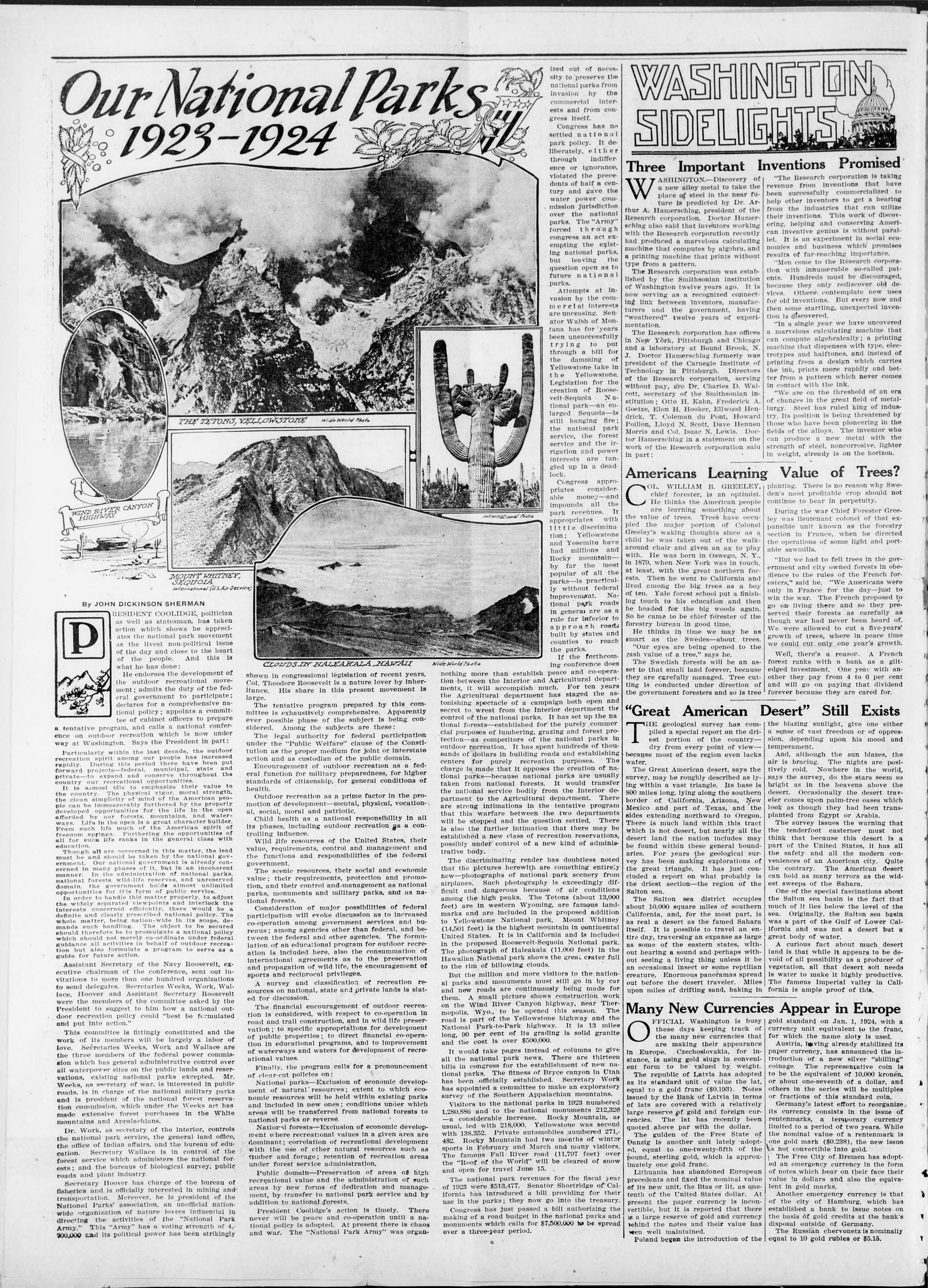
Our National Parks
1923-1924
THE TETONS, YELLOWSTONE
Wild World Photo
WIND RIVER CANYON
HIGHWAY
MOUNT WHITNEY,
SEQUOIA
International (U.S. Air Service)
By JOHN DICKINSON SHERMAN
RESIDENT COOLIDGE, politician
as well as statesman, has taken
action which shows he appreciates the national park movement
as the livest non-political issue
of the day and close to the heart
RESIDENT COOLIDGE, politician as well as statesman, has taken action which shows he appreciates the national park movement as the livest non-political issue of the day and close to the heart of the people. And this is what he has done:
He endorses the development of the outdoor recreational movement; admits the duty of the federal government to participate; declares for a comprehensive national policy; appoints a committee of cabinet officers to prepare a tentative program, and calls a national conference on outdoor recreation which is now under way at Washington. Says the President in part:
Particularly within the last decade, the outdoor recreation spirit among our people has increased rapidly. During this period there have been put forward projects—expanded national state and private—to expand and conserve throughout the country our recreational opportunities.
Particularly within the last decade, the outdoor recreation spirit among our people has increased rapidly. During this period there have been put forward projects—federal, municipal, state and private—to expand and conserve throughout the country our recreational opportunities. It is almost the same value to the country. The physical vigor, moral strength, the clean simplicity of mind of the American people can be immeasurably furthered by the properly developed opportunities for the life in the open afforded by our forests, mountains, and waterways. Life in the open is a great character builder. From such life much of the American spirit of freedom springs. Furthering the opportunities of an American life ranks in the general class with education. Though all are concerned in this matter, the lead must be and should be taken by the national government. Our national government is already concerned in many phases of it, but in an incoherent manner. In the administration of national parks, national forest reserves, and protected areas the government holds almost unlimited opportunities for this form of public service.
In order to be
the widely sepa
interests conce
definite and clea
mands such as
mands such as
should therefore
In order to handle this matter properly, to adjust the widely separated viewpoints and interlock the interests concerned efficiently, there would be a definite and clearly prescribed national policy. The whole matter, being nation-wide in its scope, should therefore be to promulgate a national policy which should not merely co-ordinate under federal guidance all activities in behalf of outdoor recreation but also formulate a program to serve as a guide for future action.
Assistant Secretary of the Navy Roosevelt, executive chairman of the conference, sent out invitations to more than one hundred organizations to send delegates. Secretaries Weeks, Work, Wallace, Hoover and Assistant Secretary Roosevelt were the members of the committee asked by the President to suggest to him how a national outdoor recreation policy could "best be formulated and put into action."
This committee is fittingly constituted and the work of its members will be largely a labor of love. Secretaries Weeks, Work and Wallace are the three members of the federal power commission which has general administrative control over all waterpower sites on the public lands and reservations, existing national parks excepted. Mr. Weeks, as secretary of war, is interested in public roads, is in charge of the national military parks and is president of the national forest reservation commission, which under the Weeks act has made extensive forest purchases in the White mountains and Appalachians.
Dr. Work, as secretary of the interior, controls the national park service, the general land office, the office of Indian affairs, and the bureau of education. Secretary Wallace is in control of the forest service which administers the national forests; and the bureau of biological survey, public roads and plant industry.
Secretary Hoover has charge of the bureau of fisheries and is officially interested in mining and transportation. Moreover, he is president of the National Parks' association, an unofficial nationwide organization of nature lovers influential directing the activities of the "National Park Army." This "Army" has a voting strength of 4, 900,000 and its political power has been strikingly
He endorses the development of the outdoor recreational movement; admits the duty of the federal government to participate; declares for a comprehensive national policy; appoints a committee of cabinet officers to prepare
shown in congressional legislation of recent years. Col. Theodore Roosevelt is a nature lover by inheritance. His share in this present movement is large.
The tentative program prepared by this committee is exhaustively comprehensive. Apparently ever possible phase of the subject is being considered. Among the subjects are these:
The legal authority for federal participation under the "Public Welfare" clause of the Constitution as the proper medium for joint or interstate action and as custodian of the public domain.
Encouragement of outdoor recreation as a federal function for military preparedness, for higher standards of citizenship, for general conditions of health.
Outdoor recreation as a prime factor in the promotion of development—mental, physical, vocational, social, moral and patriotic.
Child health as a national responsibility in all its phases, including outdoor recreation as a controlling influence.
Wild life resources of the United States, their value, requirements, control and management and the functions and responsibilities of the federal government. The scenic resources, their social and economic value; their requirements, protection and promotion, and their control and management as national parks, monuments and military parks, and as national forests. Consideration of major possibilities of federal participation will evoke discussion as to increased co-operation among government services and bureau; among agencies other than federal, and between the federal and other agencies. The formulation of an educational program for outdoor recreation is included here, also the consummation of international agreements as to the preservation and propagation of wild life, the encouragement of sports and reciprocal privileges. A survey and classification of recreation resources on national, state and private lands is slated for discussion.
The financial encouragement of outdoor recreation is considered, with respect to co-operation in road and trail construction, and in wild life preservation; to specific appropriations for development of public properties; to direct financial co-operation in educational programs, and to improvement of waterways and waters for development of recreational values.
Finally, the program calls for a pronouncement of clear-cut policies on:
National parks—Exclusion of economic development of natural resources; extent to which economic resources will be held within existing parks and included in new ones; conditions under which areas will be transferred from national forests to national parks or reverse.
National forests—Exclusion of economic development where recreational values in a given area are dominant; correlation of recreational development with the use of other natural resources such as timber and forage; retention of recreation areas under forest service administration.
Public domain—Preservation of areas of high recreational value and the administration of such areas by new forms of dedication and management, by transfer to national park service and by addition to national forests. President Coolidge's action is timely. There never will be peace and co-operation until a national policy is adopted. At present there is chaos and war. The "National Park Army" was organ-
ized out of necessity to preserve the national parks from invasion by the commercial interests and from congress itself.
Congress has no settled national park policy. It deliberately, either through indifference or ignorance, violated the precedents of half a century and gave the water power commission jurisdiction over the national parks. The "Army" forced through congress an act exempting the existing national parks, but leaving the question open as to future national parks.
Attempts at invasion by the commercial interests are unceasing. Senator Walsh of Montana has for years been unsuccessfully trying to put through a bill for the damming of Yellowstone lake in the Yellowstone. Legislation for the creation of Roosevelt-Sequoia National park—an enlarged Sequoia—is still hanging fire; the national park service, the forest service and the irrigation and power interests are tangled up in a deadlock.
Congress appropriates considerable money—and impounds all the park revenues. It appropriates with little discrimination; Yellowstone and Yosemite have had millions and Rocky mountain—by far the most popular of all the parks—is practically without federal improvement. National park roads in general are as a rule far inferior to approach roads built by states and counties to reach the parks.
If the forthcoming conference does
CLOUDS IN HALEAKALA HAWAII Wide World Photo
nothing more than establish peace and co-operation between the Interior and Agricultural departments, it will accomplish much. For ten years the Agricultural department has staged the astonishing spectacle of a campaign both open and secret to wrest from the Interior department the control of the national parks. It has set up the national forests—established for the purely commercial purposes of lumbering, grazing and forest protection—as competitors of the national parks in outdoor recreation. It has spent hundreds of thousands of dollars in building roads and establishing centers for purely recreation purposes. The charge is made that it opposes the creation of national parks—because national parks are usually taken from national forests. It would transfer the national service bodily from the Interior department to the Agricultural department. There are strong intimations in the tentative program that this warfare between the two departments will be stopped and the question settled. There is also the further intimation that there may be established a new class of recreation reservations, possibly under control of a new kind of administrative body.
The discriminating render has doubtless noted that the pictures herewith are something entirely new—photographs of national park scenery from airplanes. Such photography is exceedingly difficult and dangerous because of air conditions among the high peaks. The Tetons (about 13,000 feet) are in western Wyoming, are famous landmarks and are included in the proposed addition to Yellowstone National park. Mount Whitney (14,501 feet) is the highest mountain in continental United States. It is in California and is included in the proposed Roosevelt-Sequola National park. The photograph of Haleakala (11,000 feet) in the Hawaiian National park shows the great, crater full to the rim of billowing clouds.
But the million and more visitors to the national parks and monuments must still go in by car and new roads are continuously being made for them. A small picture shows construction work on the Wind River Canyon highway, near Thermopolis, Wyo., to be opened this season. The road is part of the Yellowstone highway and the National Park-to-Park highway. It is 13 miles long, 90 per cent of its grading is solid granite and the cost is over $500,000.
It would take pages instead of columns to give all the national park news. There are thirteen bills in congress for the establishment of new national parks. The fitness of Bryce canyon in Utah has been officially established. Secretary Work has appointed a committee to make an exploratory survey of the Southern Appalachian mountains.
Visitors to the national parks in 1923 numbered 1,280,886 and to the national monuments 212,326—a considerable increase. Rocky Mountain, as usual, led with 218,000. Yellowstone was second with 188,352. Private automobiles numbered 271,482. Rocky Mountain had two months of winter sports in February and March and many visitors. The famous Fall River road (11,797 feet) over the "Roof of the World" will be cleared of snow and open for travel June 15.
The national park revenues for the fiscal year of 1923 were $513,477. Senator Shortridge of California has introduced a bill providing for their use in the parks; they now go into the treasury.
Congress has just passed a bill authorizing the making of a road budget in the national parks and monuments which calls for $7,500,000 be spread over a three-year period.
WASHINGTON SIDELIGHTS
Americans Learning Value of Trees?
Americans Learning Value of Trees?
"Great American Desert" Still Exists
Many New Currencies Appear in Europe
Many New Currencies Appear in Europe
een well maintained. The Russian chervonetz is nominally Poland began the introduction of the equal to 10 gold rubles or $5.15.
WASHINGTON.—Discovery of a new alloy metal to take the place of steel in the near future is predicted by Dr. Arthur A. Hamerschlag, president of the Research corporation. Doctor Hamerschlag also said that inventors working with the Research corporation recently had produced a marvelous calculating machine that computes by algebra, and a printing machine that prints without type from a pattern. The Research corporation was established by the Smithsonian institution of Washington twelve years ago. It is now serving as a recognized connecting link between inventors, manufacturers and the government, having "weathered" twelve years of experimentation.
The Research corporation has offices in New York, Pittsburgh and Chicago and a laboratory at Bound Brook, N. J. Doctor Hamerschlag formerly was president of the Carnegie Institute of Technology in Pittsburgh. Directors of the Research corporation, serving without pay, are Dr. Charles D. Walcott, secretary of the Smithsonian institution; Otto H. Kahn, Frederick A. Goetze, Elon H. Hooker, Ellwood Hendrick, T. Coleman du Pont, Howard Poillon, Lloyd N. Scott, Dave Hennen Morris and Col. Isaac N. Lewis. Doctor Hamerschlag in a statement on the work of the Research corporation said in part:
COL. WILLIAM B. GREELEY, chief forester, is an optimist. He thinks the American people
are learning something about the value of trees. Trees have occupied the major portion of Colonel Greeley's waking thoughts since as a child he was taken out of the walk-around chair and given an ax to play with. He was born in Oswego, N. Y., in 1879, when New York was in touch, at least, with the great northern forests. Then he went to California and lived among the big trees as a boy of ten. Yale forest school put a finishing touch to his education and then he headed for the big woods again. So he came to be chief forester of the forestry bureau in good time.
He thinks in time we may be as smart as the Swedes—about trees. "Our eyes are being opened to the cash value of a tree," says he.
The Swedish forests will be an asset to that small land forever, because they are carefully managed. Tree cutting is conducted under direction of the government foresters and so is tree
THE geological survey has compiled a special report on the driest portion of the country—dry from every point of view—because most of the region even lacks water.
The Great American desert, says the survey, may be roughly described as lying within a vast triangle. Its base is 800 miles long, lying along the southern border of California, Arizona, New Mexico and part of Texas, and the sides extending northward to Oregon. There is much land within this tract which is not desert, but nearly all the desert land the nation includes may be found within these general boundaries. For years the geological survey has been making explorations of the great triangle. It has just concluded a report on what probably is the driest section—the region of the Salton sea.
The Salton sea district occupies about 10,000 square miles of southern California, and, for the most part, is as real a desert as the famed Sahara itself. It is possible to travel an entire day, traversing an expanse as large as some of the eastern states, without hearing a sound and perhaps without seeing a living thing unless it be an occasional insect or some reptilian creature. Enormous panoramas spread out before the desert traveler. Miles upon miles of drifting sand, baking in
OFFICIAL Washington is busy these days keeping track of the many new currencies that are making their appearance in Europe. Czechoslovakia, for instance, is using gold slugs in convenient form to be valued by weight. The republic of Latvia has adopted as its standard unit of value the lat, equal to a gold franc ($0.193). Notes issued by the Bank of Latvia in terms of lats are covered with a relatively large reserve of gold and foreign currencies. The lat has recently been quoted above par with the dollar. The gulden of the Free State of Danzig is another unit lately adopted, equal to one-twenty-fifth of the pound, sterling gold, which is approximately one gold franc.
Lithuania has abandoned European precedents and fixed the nominal value of its new unit, the litus or lit, as one-tenth of the United States dollar. At present the paper currency is inconvertible, but it is reported that there is a large reserve of gold and currency behind the notes and their value has seen well maintained.
"The Research corporation is taking revenue from inventions that have been successfully commercialized to help other inventors to get a hearing from the industries that can utilize their inventions. This work of discovering, helping and conserving American inventive genius is without parallel. It is an experiment in social economics and business which promises results of far-reaching importance. "Men come to the Research corporation with innumerable so-called patients. Hundreds must be discouraged, because they only rediscover old devices. Others contemplate new uses for old inventions. But every now and then some startling, unexpected invention is discovered.
"In a single year we have uncovered a marvelous calculating machine that can compute algebraically; a printing machine that dispenses with type, electrotypes and hailstones, and instead of printing from a design which carries the ink, prints more rapidly and better from a pattern which never comes in contact with the ink.
"We are on the threshold of an era of changes in the great field of metallurgy. Steel has ruled king of industry. Its position is being threatened by those who have been pioneering in the fields of the alloys. The inventor who can produce a new metal with the strength of steel, noncorrosive, lighter in weight, already is on the horizon.
planting. There is no reason why Sweden's most profitable crop should not continue to bear in perpetuity.
During the war Chief Forester Greeley was lieutenant colonel of that expansible unit known as the forestry section in France, when he directed the operations of some light and portable sawmills.
"But we had to fell trees in the government and city owned forests in obedience to the rules of the French foresters," said he. "We Americans were only in France for the day—just to win the war. The French proposed to go on living there and so they preserved their forests as carefully as though war had never been heard of. We were allowed to cut a five-years' growth of trees, where in peace time we could cut only one year's growth.
Well, there's a reason. A French forest ranks with a bank as a gilt-edged investment. One year with another they pay from 4 to 6 per cent and will go on paying that dividend forever because they are cared for.
the blazing sunlight, give one either a sense of vast freedom or of oppression, depending upon his mood and temperament.
And, although the sun blazes, the air is bracing. The nights are positively cold. Nowhere in the world, says the survey, do the stars seem so bright as in the heavens above the desert. Occasionally the desert traveler comes upon palm-tree oases which look as though they had been transplanted from Egypt or Arabia.
The survey issues the warning that the tenderfoot easterner must not think that because this desert is a part of the United States, it has all the safety and all the modern conveniences of an American city. Quite the contrary. The American desert can hold as many terrors as the widest sweeps of the Sahara.
One of the special fascinations about the Salton sea basin is the fact that much of it lies below the level of the sea. Originally, the Salton sea basin was a part of the Gulf of Lower California and was not a desert but a great body of water.
A curious fact about much desert land is that while it appears to be devoid of all possibility as a producer of vegetation, all that desert soil needs is water to make it highly productive. The famous Imperial valley in California is ample proof of this.
gold standard on Jan. 1, 1924, with a currency unit equivalent to the franc, for which the name zloty is used.
Austria, having already stabilized its paper currency, has announced the introduction of a new silver "shilling" coinage. The representative coin is to be the equivalent of 10,000 kronen, or about one-seventh of a dollar, and others in the series will be multiples or fractions of this standard coin.
Germany's latest effort to reorganize its currency consists in the issue of rentenmarks, a temporary currency limited to a period of two years. While the nominal value of a rentenmark is one gold mark ($0.238), the new issue is not convertible into gold.
The Free City of Bremen has adopted an emergency currency in the form of notes which bear on their face their value in dollars and also the equivalent in gold marks.
Another emergency currency is that of the city of Hamburg, which has established a bank to issue notes on the basis of gold credits at the bank's disposal outside of Germany.
Rolled Oats
Rats Are the Most Destructive Animals in the World.
(Prepared by the United States Department of Agriculture.)
Insects, rats and mice and other household pests not only destroy and pollute foods in obvious ways, but they may also infect them with micro-organisms - dangerous to health. The rat has been called the most destructive animal in the world, partly because it spreads bubonic plague, and the common house fly fully deserves the epithet "typhoid-fever" fly, and is also a known carrier of the bacteria of cholera, dysentery and tuberculosis. Even the so-called "fly specks" often deposited on food and dishes may be infected with disease germs and the eggs of dangerous parasites.
Methods of Control.
Methods of exterminating or controlling rats and mice, files, ants and other household insects that damage foods are given in various bulletins issued by the United States Department of Agriculture. Food more than
PROPER HEIGHT FOR SINKS IN KITCHEN
Various Tasks Can Be Comfortably Done.
(Prepared by the United States Department of Agriculture.) The various kitchen tasks can be done most comfortably at different heights. Sinks especially are often set too low; 30 to 31 inches from the bottom of the sink to the floor is considered a good average height, says the United States Department of Agriculture. The housewife should ex-
A woman washing a pot of water.
periment until she finds the best height for her sink, and also for the table, ironing board, washtub and stove. The woman who stoops over a table to wash dishes as this farmer's wife in Frederick county, Maryland, is doing, is sure to have a tired feeling and possibly a backache, when her work is done. Another farm woman, living in Middletown Md., has been
1857
persuaded by the extension agent to install her sink sufficiently high, as is shown in the other picture. The table and stove can be raised on blocks hollowed out to fit the legs, and with a little ingenuity the ironing board and tubs can be adjusted. A stool or a high chair on which to sit while preparing vegetables at the sink, washing dishes, or ironing saves energy and helps to prevent fatigue.
anything else draws these pests to a house, and their visits are at least discouraged by keeping supplies covered or in closed containers and by disposing of garbage promptly. In a new Farmers' Bulletin 1374, "Care of Food in the Home," attention is called to the need for storing food in such a way that insects, rodents and pet animals cannot reach it.
Fly Most Dreaded.
Sometimes, in spite of all the house-keeper's precautions, weevils or worms develop quickly in apparently sound cereal products, dried vegetables and fruits or nuts. In reality, these pests come from minute eggs deposited by insects either in or upon grains or other seeds or in the flour or other material itself or in the crevices of the box or container used in storage. Such infested food materials should be destroyed promptly and the containers thoroughly washed and scalded before a new supply is stored.
VARIOUS ACTIVITIES OF WOMAN'S ROUTINE
Facts on How Housewife Spends Her Time.
(Prepared by the United States Department of Agriculture.)
To obtain first-hand facts on how the housewife spends her time from the hour she arises until the last light is out, the bureau of home economics of the United States Department of Agriculture devised some time ago a chart in the form of a clocklike diagram on which the various activities of a woman's day could be readily recorded. These charts were issued to a great many women who agreed to fill them out properly for a week or more and thus furnish records as to how many minutes were usually spent in such activities as dishwashing, dressing children, laundry work, sewing or any other home tasks.
To supplement the information obtained by these charts, two additional blanks have been prepared for the housekeeper to fill out. One blank will show how much help the mother received in doing each kind of work, and whether the help was paid or unpaid. Space is arranged for showing how much assistance the husband and children contribute, even indicating whether the help was given by boys or girls. This record will provide conclusive evidence as to who pumps the water, tends the fires, disposes of the ashes, fills the lamps, or cares for the children, as well as who attends to preparation of food and clearing it away, to bed-making, cleaning, laundry work, and mending. Undoubtedly some interesting sidelights will be thrown on the part played by the masculine members of the household in all these tasks.
The board, lodging, and laundry of the hired farmhands often constitute an inescapable part of the farm women's work. The blanks used in the time studies will show when this is a part of her ordinary duty, as well as whether or not she has other hired help who take part of the burden of housework from her shoulders.
When the time chart has been kept for the agreed period and the blank showing help received has been filled out, the co-operating housewife is asked to answer a brief questionnaire which gives the investigator a clear idea as to the special conditions in that particular family.
These charts and blanks are to be distributed to housewives in the districts selected for study, but they will also be supplied on request to any housekeeper, rural or urban, who would like to make a personal analysis of the work she does and who will at the same time co-operate with the bureau of home economics by sending the blanks in to Washington when they are filled out. The bureau will return them after the information is summarized and will give the housewife a copy of the summary.
OF INTEREST TO
THE HOUSEWIFE
Wash the zinc tray in your gase stove,
then cover with vinegar, let stand a
few minutes, rinse well and dry. All
spots will disappear after a few such
treatments.
Save all the paper bags in which
bread and dry groceries are delivered
and use them as gloves to slip on if
you have to poke the fire or put on
more coal when making cakes or
pastry.
He drew a circle that shut me out—
Heretic, rebel, a thing to flout.
But love and I had the wit to win;
We drew a circle that took him in.
—Edwin Markham.
SOME ECONOMICAL DESSERTS
No frugal housewife cares to prepare food that is not eaten. When those to be served are but four one does not wish for recipes large enough to serve six. The following are smaller recipes, though they will make plenty for four:
those to be served are but four one does not wish for recipes large enough to serve six. The following are smaller recipes, though they will make plenty for four: Date Pudding.—Stone and chop one half pound of dates, put them on the back part of the stove with three cupfuls of water. Cook slowly until thick, set away to become cold. Serve with whipped cream lightly sweetened.
Cracker Pudding—Take four soda crackers rolled fine, add two cupfuls of milk, a quarter of a cupful of sugar, a pinch of salt, two eggs beaten lightly. Mix well and add a handful of raisins or two or three prunes. Bake until the custard is firm. Cover with the white of an egg beaten stiff and mixed with a tablespoonful of sugar. Flavor with a little grated lemon rind. Brown the meringue.
Cocont: Pudding—Place a teaspoonful of coconut in the bottom of sherbet glasses. Prepare a custard, using one and one-half cupfuls of milk, three teaspoonfuls of sugar, two egg yolks beaten lightly, and a teaspoonful of cornstarch. Cook until the custard coats the spoon and pour it when cool over the coconut. Make a meringue of the egg whites, beaten stiff and cooked over hot water. Serve a portion on each glass.
Spiced Bread Crumb Pudding.—Take one cupful each of bread crumbs, sour milk and brown sugar, one-quarter cupful of shortening, one-half cupful of flour, one-half teaspoonful of clnamon, one-quarter teaspoonful of cloves, two tablespoonfuls of molasses, one teaspoonful of soda and three-quarters of a cupful of raisins. Soak the bread crumbs in the sour milk one-half hour, cream the shortening and sugar and add the molasses, soda and spices. Add the raisins, then the bread and milk. Pour into a buttered baking dish and bake in a slow oven for forty-five minutes. Serve hot or cold. This recipe will serve eight.
There is pleasure in the pathless woods,
There is rapture on the lonely shore,
There is society where none intrudes.
By deep sea, and music in its roar;
I love not man the less, but nature more.
From these our interviews, in which I steal
From all I may be or have been before.
To single with the universe and feel
What I can ne'er express, yet cannot all conceal. —Byron.
HOMEMADE SWEETS
There is no season of the year her candy is not welcomed by the children
of the family, and few of the older members will refuse a wholesome piece of nicely made candy.
#
The foundation for the soft French candies, called "fondant," is made by boiling together two cupfuls of sugar, one-half cupful of water with a pinch of cream of tartar or a tablespoonful of corn sirup to insure it against graining, until a soft ball of a drop of the sirup is made, when tried in cold water. Set away to cool, then stir until creamy. Pack in a buttered bowl, cover with waxed paper and allow to ripen for a few days.
A small portion of the fondant may be put into a small saucepan, melted or softened over hot water and colored; this may be used for dipping nuts, dates or small balls of figs, nuts and dates chopped and well mixed. There is no end to the variety, flavor or combination one may use.
Golden Orange Cake.—Take one half cupful of butter, one cupful of New Orleans molasses, one tablespoonful of sugar, one egg, the juice and rind of an orange, one teaspoonful of soda dissolved in one-half cupful of cold water, two cupfuls of pastry flour sifted with a teaspoonful of baking powder and a pinch of salt. Bake in a sheet and butter while warm and sprinkle with powdered sugar.
Buttercups.—Boll together to make a firm ball the following ingredients: Two cupfuls of molasses, one cupful of sugar, one-half cupful of boiling water, two tablespoonfuls of butter, one-half teaspoonful of cream of tartar. Do not stir until the last few minutes of cooking. Pour on a buttered platter and, when cool enough to pull, pull until cream-colored. Shape on a floured board, having a strip wide enough to enfold a roll of fondant one inch in diameter. Place the fondant on the candy, bring the edges together and press firmly over the fondant. With both hands pull the candy into a long strip. Cut into small pieces; each piece will consist of a center of fondant with a circle of the buttercup mixture on the outside. Be certain that the candy is not cooked too long or it will be brittle.
Nellie Maxwell
The KITCHEN CABINET
( © 1924, Western Newspaper Union.)
I must go down to the seas again,
to the lonely sea and sky,
And all I ask in ship and a
sur to steer her by;
And the wheel's kick and the
wind's song and the white sail's
shaking.
And a gray mist on the sea's face
and a gray dawn breaking.
—John Masefield.
THE FOUNDATION SAUCE
The foundation sauce for all creamed
soups, sauces for escalloped dishes,
souffles and croquettes may be kept in mind so that there will be a right proportion of thickening for each dish to be served.
souffles and croquettes may be kept in mind so that there will be a right proportion of thickening for each dish to be served. When preparing soups or thin sauces, the one-to-one proportion is used—one cupful of liquid, milk, stock or vegetable liquor, and one tablespoonful each of flour and butter. This proportion is used for all soups, escalloped dishes, as well as most meat sauces. These sauces are varied by different flavors and seasonings and may be used for pudding sauces as well as for vegetables, where a thin sauce is liked.
A tablespoonful always means full and leveled with a knife; a cupful is always one-half pint. When buying measuring utensils see that you get the standard sizes of spoons and cups. A measuring cup may look all right and still lack two tablespoonfuls of being a standard cup.
The one-to-two sauce is the same proportion of liquid to two tablespoonfuls each of flour and butter. Flour is always sifted before measuring for any food. This is the most used of all sauces; it is thicker than the sauce number one and is better liked for all creamed vegetables.
When preparing escalloped dishes use the same quantity of sauce as food, adding in alternate layers. Cover with crumbs stirred with melted butter and brown in a moderate oven.
The one-to-three sauce is prepared in the same way, using three tablespoonfuls each of butter and flour. Melt the butter and when bubbling hot add the flour, then when well mixed ad. the liquid and cook until smooth. This sauce is used for souffles, the yolks are added, then the whites folded in at the last. The yolks are cooked in the sauce just at the last, then cooled before adding the whites.
I cone from haunts of coot and hern,
I make a sudden sally,
And sparkle out among the fern,
To bicker down a valley.
Tennyson.
If you are fond of liver you will find the following recipe worthy of a trial:
Liver Dumplings. — Chop one-half pound of calf's liver that has been first sliced and par-bolled. Add one chopped onion, one tablespoonful
plings. — Chop one-half pound of calf's liver that has been first sliced and parboiled. Add one chopped onion, one tablespoonful of chopped parsley, salt, pepper and a dash of nutmeg. Mix with two well-baked eggs and one tablespoonful of butter. Add enough fine bread crumbs to form into balls and boil in soup stock. Serve in the soup.
Apricot and Banana Dessert.—Wash and cook one-quarter of a pound of dried apricots. While still hot, sweeten to taste, adding the slurp, Mash and rub through a sieve. When cold add three thinly-sliced ripe bananas. Stir together lightly and serve ice cold with cream. Cookies or cake may accompany this dessert.
Virginia Baked Ham.—Select a ham weighing seven or eight pounds. Wash the ham thoroughly, sprinkle with soda, rubbing it all over the surface; then rinse in cold water. Place the ham in a deep kettle with ten peppercorns, six cloves, one-half teaspoonful of celery seed, one-half teaspoonful of ground cinnamon and a quart of sweet cider. Cover with boiling water and simmer for five hours. (Slimmering does not mean boiling, as that will toughen the ham). Take from the kettle and remove the skin, sprinkle the surface with sugar, using two tablespoonfuls; brush with beaten egg and cover with fine bread crumbs. Stick cloves at even intervals and brown in a very hot oven. Trim the meat from the bone end and decorate with curled celery and leaves. Serve with currant sauce
Corn Flake Macaroons.—Take one cupful each of sugar, cornflakes, ground nuts or coconut, two tablespoonfuls of flour, a little salt and a few drops of vanilla. Beat two egg whites until stiff, add the sugar gradually, then the cornflakes, nuts and flour. Drop by teaspoonfuls on buttered baking sheet and bake in a moderate oven until a delicate brown.
Raisin Macaroons.—Take two cupfuls of toasted cornflakes, one cupful of sugar, two egg whites, one cupful of seedless raisins and one teaspoonful of vanilla. Beat the egg whites until stiff, add the sugar gradually and then fold in the cornflakes and raisins. Add flavoring and drop by spoonfuls on a buttered baking sheet. This makes about two dozen macaroons.
Nellie Maxwell
THE CHURCH OF THE NATIONAL SCHOOL OF CHRISTIANITY
The St. Rose Branch of the Holy Name Society, Springfield, Kentucky the oldest Colored Holy Name Society in the United States. Many of the members of this society will take part in the National Holy Name Rally to be held in Washington, September 21st, next. More than 200,000 Catholic Men will take part in this great demonstration which will be the largest in the history of America. The Colored Catholic Men will play an important part in this great demonstration which will commemorate the 650 th anniversary of that organization.
HOWARD & HOWARD
GROCERIES AND MEATS
Fresh Vegetables and Fruits Daily
Free Delivery to any part of the city.
PHONE MAIN 6338 718 E. TWENTY-SIXTH AVE.
Is the place to get your DRUGS, CHEMICALS AND PATENT MEDICINES WE SERVE DRINKS. PRESCRIPTIONS OUR SPECIALTY. Phone us and we will deliver the goods to all parts of the city. JAMES E. THRALL, Propr.
WEATHERHEAD
HAT FACTORY
ESTABLISHED 1876
HIGHEST QUALITY RENOVATING AND REMODELING OF
MEN'S AND WOMEN'S HATS
1722 STOUT STREET
ALBANY HOTEL BLDG.
If you have a room for rent or want a room call us
TAXI RATES: $3.00 per hour. DAY and NIGHT SERVICE
T. G. GRANBERRY, Mgr. DENVER, COLORADO
Special Attention Given to VENTILATION AND SEWERAGE. All Work Guaranteed Phone Main 207 1907 Arapahoe St. Denver, CoI
Special Attention Giver
SEWERAGE.
Phone Main 207 1907
DON'T FORGET US When you need anything in the line of neat and attractive Printing.
PHONE 8444
C. B. Weatherhead
NE MAIN 3203
ERHEAD
FACTORY
ESTABLISHED 1876
REVATING AND REMODELING OF
WOMEN'S HATS
ALBANY HOTEL BLDG.
xi & Baggage Co.
3 WELTON STREET
We Move
and
Store
Furniture
or rent or want a room call us
our.
DAY and NIGHT SERVICE
DENVER, COLORADO
JOBBING
PROMPTLY ATTENDED TO
PRACTICAL
PLUMBER
LICENSED DRAIN LAYER
en to VENTILATION AND
All Work Guaranteed
Arapahoe St. Denver, Col.
We Are
Always Ready
to serve you with good
printing. No matter what
the nature of the job may
be we are ready to do it
at a price that will be
Satisfactory
UR ADVERTISERS