Colorado Statesman
Saturday, August 16, 1924
Denver, Colorado
Page text (machine-generated)
SUBSCRIBE FOR THE ONLY RELIABLE PEOPLE'S PAPER IN COLORADO "THE COLORADO STATESMAN"
THE COLORADO STATESMAN
THE JOURNAL OF THE WEST.
LABOR SHALL BE FREE
RACE COUNTRY PARTY
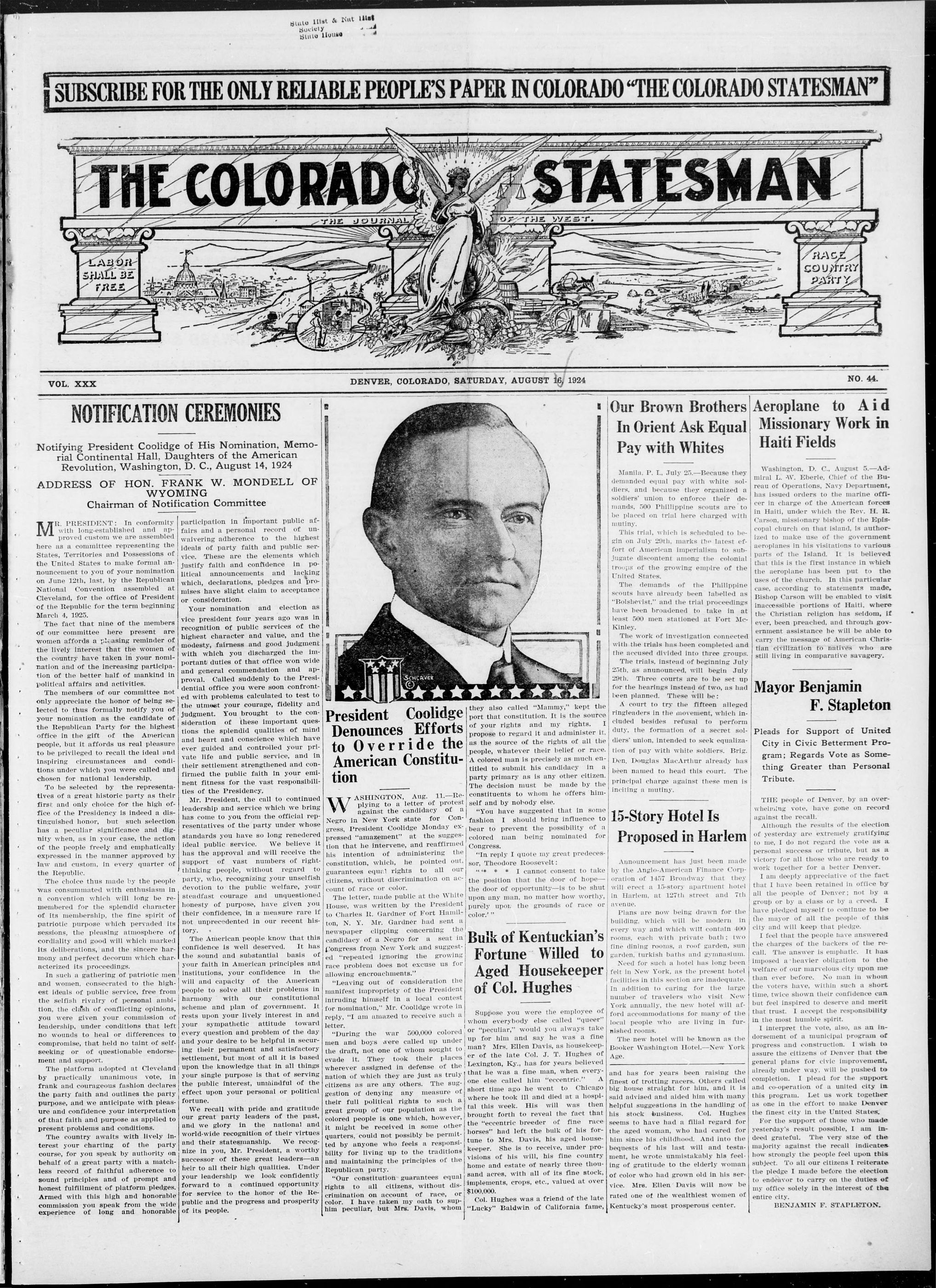
NOTIFICATION CEREMONIES
Notifying President Coolidge of His Nomination, Memorial Continental Hall, Daughters of the American Revolution, Washington, D. C., August 14, 1924 ADDRESS OF HON. FRANK W. MONDELL OF WYOMING Chairman of Notification Committee
VOL. XXX
NOTIFICATION C
Notifying President Coolidge of the
rial Continental Hall, Daught
Revolution, Washington, D.
ADDRESS OF HON. FRANK
WYOMIN
Chairman of Notificati
---
MR. PRESIDENT: In conformity with long-established and approved custom we are assembled here as a committee representing the States, Territories and Possessions of the United States to make formal announcement to you of your nomination on June 12th, last, by the Republican National Convention assembled at Cleveland, for the office of President of the Republic for the term beginning March 4, 1925.
The fact that nine of the members of our committee here present are women affords a pleasing reminder of the lively interest that the women of the country have taken in your nomination and of the increasing participation of the better half of mankind in political affairs and activities.
The members of our committee not only appreciate the honor of being selected to thus formally notify you of your nomination as the candidate of the Republican Party for the highest office in the gift of the American people, but it affords us real pleasure to be privileged to recall the ideal and inspiring circumstances and conditions under which you were called and chosen for national leadership.
To be selected by the representatives of a great historic party as their first and only choice for the high office of the Presidency is indeed a distinguished honor, but such selection has a peculiar significance and dignity when, as in your case, the action of the people freely and emphatically expressed in the manner approved by law and custom, in every quarter of the Republic.
The choice thus made by the people was consummated with enthusiasm in a convention which will long be remembered for the splendid character of its membership, the fine spirit of patriotic purpose which pervaded its sessions, the pleasing atmosphere of cordiality and good will which marked its deliberations, and the sincere harmony and perfect decorum which characterized its proceedings.
In such a gathering of patriotic men and women, consecrated to the highest ideals of public service, free from the selfish rivalry of personal ambition, the clash of conflicting opinions, you were given your commission of leadership, under conditions that left no wounds to heal or differences to compromise, that held no taint of self-seeking or of questionable endorsement and support.
The platform adopted at Cleveland by practically unanimous vote, in frank and courageous fashion declares the party faith and outlines the party purpose, and we anticipate with pleasure and confidence your interpretation of that faith and purpose as applied to present problems and conditions.
The country awaits with lively interest your charting of the party course, for you speak by authority on behalf of a great party with a matchless record of faithful adherence to sound principles and of prompt and honest fulfillment of platform pledges.
Armed with this high and honorable commission you speak from the wide experience of long and honorable
---
State Hist & Nut 1116
Society
State House
participation in important public affairs and a personal record of unwaivering adherence to the highest ideals of party faith and public service. These are the elements which justify faith and confidence in political announcements and lacking which, declarations, pledges and promises have slight claim to acceptance or consideration.
Your nomination and election as vice president four years ago was in recognition of public services of the highest character and value, and the modesty, fairness and good judgment with which you discharged the important duties of that office won wide and general commendation and approval. Called suddenly to the Presidential office you were soon confronted with problems calculated to test to the utmost your courage, fidelity and judgment. You brought to the consideration of these important questions the splendid qualities of mind and heart and conscience which have ever guided and controlled your private life and public service, and in their settlement strengthened and confirmed the public faith in your eminent fitness for the vast responsibilities of the Presidency.
Mr. President, the call to continued leadership and service which we bring has come to you from the official representatives of the party under whose standards you have so long renedered ideal public service. We believe it has the approval and will receive the support of vast numbers of right-thinking people, without regard to party, who, recognizing your unselfish devotion to the public welfare, your steadfast courage and unquestioned honesty of purpose, have given you their confidence, in a measure rare if not unprecedented in our recent history.
The American people know that this confidence is well deserved. It has the sound and substantial basis of your faith in American principles and institutions, your confidence in the will and capacity of the American people to solve all their problems in harmony with our constitutional scheme and plan of government. It rests upon your lively interest in and your sympathetic attitude toward every question and problem of the day and your desire to be helpful in securing their permanent and satisfactory settlement, but most of all it is based upon the knowledge that in all things your single purpose is that of serving the public interest, unmindful of the effect upon your personal or political fortune.
We recall with pride and gratitude our great party leaders of the past, and we glory in the national and world-wide recognition of their virtues and their statesmanship. We recognize in you, Mr. President, a worthy successor of these great leaders—an heir to all their high qualities. Under your leadership we look confidently forward to a continued opportunity for service to the honor of the Republic and the progress and prosperity of its people.
ABLE PEOPLE'S P
RADC
THE JOURNAL
DENVER, COLORADO, SA
SCHERVET
DENVER, COLORADO, SATURDAY, AUGUST 16, 1924
SCHERVE
President Coolidge Denounces Efforts to Override the American Constitution
WASHINGTON, Aug. 11.—Replying to a letter of protest against the candidacy of a Negro in New York state for Congress, President Coolidge Monday expressed "amazement" at the suggestion that he intervene, and reaffirmed his intention of administering the constitution, which, he pointed out, guarantees equal rights to all our citizens, without discrimination on account of race or color.
The letter, made public at the White House, was written by the President to Charles R. Gardner of Fort Hamilton, N. Y. Mr. Gardner had sent a newspaper clipping concerning the candidacy of a Negro for a seat in Congress from New York and suggested "repeated ignoring the growing race problem does not excuse us for allowing encroachments."
"Leaving out of consideration the manifest impropriety of the President intruding himself in a local contest for nomination," Mr. Coolidge wrote in reply, "I am amazed to receive such a letter
"During the war 500,000 colored men and boys were called up under the draft, not one of whom sought to evade it. They took their places wherever assigned in defense of the nation of which they are just as truly citizens as are any others. The suggestion of denying any measure of their full political rights to such a great group of our population as the colored people is one which, however, it might be received in some other quarters, could not possibly be permitted by anyone who feels a responsibility for living up to the traditions and maintaining the principles of the Republican party.
"Our constitution guarantees equal rights to all citizens, without discrimination on account of race, or color. I have taken my oath to suphim peculiar, but Mrs. Davis, whom
they also called "Mammy," kept the port that constitution. It is the source of your rights and my rights. I propose to regard it and administer it, as the source of the rights of all the people, whatever their belief or race. A colored man is precisely as much entitled to submit his candidacy in a party primary as is any other citizen. The decision must be made by the constituents to whom he offers himself and by nobody else.
"You have suggested that in some fashion I should bring influence to bear to prevent the possibility of a colored man being nominated for Congress.
"In reply I quote my great predecessor, Theodore Roosevelt:
"* * * I cannot consent to take the position that the door of hope—the door of opportunity—is to be shut upon any man, no matter how worthy, purely upon the grounds of race or color."
Bulk of Kentuckian's Fortune Willed to Aged Housekeeper of Col. Hughes
Bulk of Kentuckian's Fortune Willed to Aged Housekeeper of Col. Hughes
Suppose you were the employee of whom everybody else called "queer" or "peculiar," would you always take up for him and say he was a fine man? Mrs. Ellen Davis, as housekeeper of the late Col. J. T. Hughes of Lexington, Ky., has for years believed that he was a fine man, when everyone else called him "eccentric." A short time ago he went to Chicago where he took ill and died at a hospital this week. His will was then brought forth to reveal the fact that the "eccentric breeder of fine race horses" had left the bulk of his fortune to Mrs. Davis, his aged housekeeper. She is to receive, under provisions of his will, his fine country home and estate of nearly three thousand acres, with all of its fine stock, implements, crops, etc., valued at over $100,000.
Col. Hughes was a friend of the late "Lucky" Baldwin of California fame,
Our Brown Brothers In Orient Ask Equal Pay with Whites
Manila, P. I., July 25.—Because they demanded equal pay with white soldiers, and because they organized a soldiers' union to enforce their demands, 500 Phillippine scouts are to be placed on trial here charged with mutiny.
This trial, which is scheduled to begin on July 29th, marks the latest effort of American imperialism to subjugate discontent among the colonial troops of the growing empire of the United States.
The demands of the Philippine scouts have already been labelled as "Bolshevist," and the trial proceedings have been broadened to take in at least 500 men stationed at Fort McKinley.
The work of investigation connected with the trials has been completed and the accused divided into three groups.
The trials, instead of beginning July 25th, as announced, will begin July 29th. Three courts are to be set up for the hearings instead of two, as had been planned. These will be:
A court to try the fifteen alleged ringleaders in the movement, which included besides refusal to perform duty, the formation of a secret soldiers' union, intended to seek equalization of pay with white soldiers. Brig. Den, Douglas MacArthur already has been named to head this court. The principal charge against these men is inciting a mutiny.
15-Story Hotel Is Proposed in Harlem
15-Story Hotel Is Proposed in Harlem
Announcement has just been made by the Anglo-American Finance Corporation of 1457 Broadway that they will erect a 15-story apartment hotel in Harlem, at 127th street and 7th avenue. Plans are now being drawn for the building, which will be modern in every way and which will contain 400 rooms, each with private bath; two fine dining rooms, a roof garden, sun garden, turkish baths and gymnasium. Need for such a hotel has long been felt in New York, as the present hotel facilities in this section are inadequate. In addition to caring for the large number of travelers who visit New York annually, the new hotel will afford accommodations for many of the local people who are living in furnished rooms. The new hotel will be known as the Booker Washington Hotel.—New York Age.
and has for years been raising the finest of trotting racers. Others called big house straight for him, and it is said advised and aided him with many helpful suggestions in the handling of his stock business. Col. Hughes seems to have had a filial regard for the aged woman, who had cared for him since his childhood. And into the bequests of his last will and testament, he wrote unmistakably his feeling of gratitude to the elderly woman of color who had grown old in his service. Mrs. Ellen Davis will now be rated one of the wealthiest women of Kentucky's most prosperous center.
NO. 44.
Aeroplane to Aid Missionary Work in Haiti Fields
Aeroplane to Aid Missionary Work in Haiti Fields
Washington, D. C., August 5.—Admiral L. W. Eberle, Chief of the Bureau of Operations, Navy Department, has issued orders to the marine officer in charge of the American forces in Haiti, under which the Rev. H. R. Carson, missionary bishop of the Episcopal church on that island, is authorized to make use of the government aeroplanes in his visitations to various parts of the Island. It is believed that this is the first instance in which the aeroplane has been put to the uses of the church. In this particular case, according to statements made, Bishop Carson will be enabled to visit inaccessible portions of Haiti, where the Christian religion has setdom, if ever, been preached, and through government assistance he will be able to carry the message of American Christian civilization to natives who are still living in comparative savagery.
Mayor Benjamin F. Stapleton
Pleads for Support of United City in Civic Betterment Program; Regards Vote as Something Greater than Personal Tribute.
THE people of Denver, by an overwhelming vote, have gone on record against the recall.
Although the results of the election of yesterday are extremely gratifying to me, I do not regard the vote as a personal success or tribute, but as a victory for all those who are ready to work together for a better Denver.
I am deeply appreciative of the fact that I have been retained in office by all the people of Denver; not by a group or by a class or by a creed. I have pledged myself to continue to be the mayor of all the people of this city and will keep that pledge.
I feel that the people have answered the charges of the backers of the recall. The answer is emphatic. It has imposed a heavier obligation to the welfare of our marvelous city upon me than ever before. No man in whom the voters have, within such a short time, twice shown their confidence can but feel inspired to deserve and merit that trust. I accept the responsibility in the most humble spirit.
I interpret the vote, also, as an endorsement of a municipal program of progress and construction. I wish to assure the citizens of Denver that the general plans for civic improvement, already under way, will be pushed to completion. I plead for the support and co-operation of a united city in this program. Let us work together as one in the effort to make Denver the finest city in the United States.
For the support of those who made yesterday's result possible, I am indeed grateful. The very size of the majority against the recall indicates how strongly the people feel upon this subject. To all our citizens I reiterate the pledge I made before the election to endeavor to carry on the duties of my office solely in the interest of the entire city.
BENJAMIN F. STAPLETON.
FOREIGN
The French air pilot Burrl, at Bonnieres established a world record for a seaplane. Burrl covered 500 kilometers at the speed of 123 kilometers, 946 meters an hour. The previous record was held by Lieut. M. A. Schur. The London Evening Standard says that Tommy Gibbons, the American victor over Jack Bloomfield in a recent prize fight has started legal proceedings to attach £7,000 to be due him for the encounter. Gibbons has already received £3,000.
The claim of some economists that France is the "iron-master of the world" is disputed by recently published figures. These show the production of iron to be 590,000 tons a month and of steel 554,000 tons. These figures are 15 per cent less than the 1913 output.
It is reported that Bulgaria has ordered all Greeks to leave the country within twenty days or face expulsion. The Macedonian nationalist committee has established headquarters at Vienna to foment a movement for a separate Macedonian state in the Balkans, according to reports. Ten Egyptian soldiers were killed and nine wounded in a collision with British troops at Atbarn, following disturbances in which Egyptian troops attacked the British with bricks at their barracks, says a dispatch from Cairo. The British government has sent a battalion of troops to reinforce the garrison in the Sudan as the result of the clash.
The French government has raised Paul Wayland Bartlett, the American sculptor, to the dignity of a commander of the Legion of Honor. Mr. Bartlett was decorated as an officer of the Legion of Honor in 1908. Among others decorated with the cross of a knight of the Legion of Honor are Anna Klumpke, an American artist. An old submarine chaser—No. 1—sold by the United States government recently to private interests, is said to have carried to China a quantity of arms and ammunition stolen from the government storehouse at Manila. Shanghai advises say an attempt was made to land the munitions for delivery to Chinese revolutionists. Authorities at Manila decline to state the amount of munitions stolen. The arms were concealed in a tank aboard the submarine chaser, which was said to contain fuel oil.
An interesting fraud based on clandestine emigration to North and South American countries has just been discovered by the police at Naples. It is alleged that Guglielmo Jacchio and Ferdinando Spalice organized what they called an artistic tour to North and South America, mapping out a program with a list of artists, including a Roman boxing champion and a number of dancers, and succeeded in rounding out the "company" with many would-be emigrants who paid large sums of money for what they supposed would be an opportunity to enter the countries across the sea.
GENERAL
One of four bandits who held up the Schuyler State Bank at Pana, Ill., was fatally shot by a railroad fireman, and the entire loot of $20,000 was recovered.
Fifty miners were trapped in the Irlyama coal mine, Fukushima province, Japan, when a gas explosion occurred. It is feared that all are dead. Nine bodies have been recovered.
C. L. Hall of Ommah saved his sister, Mrs. Maude A. Smith, from death when she jumped from an "L" station before an oncoming train in Chicago. The two were waiting to go to Mrs. Smith's home. Presumably temporarily deranged by the excessive heart the woman jumped. Her brother caught her arm and dragged her from the rails. Her foot caught, however, and was severed. She suffered internal injuries. She made one previous attempt to leap before another train.
William Wrigley, Jr., chairman of the board of directors of the Chicago National League Baseball Club, has purchased the Cubs' park for a cash price given as $295,000. The Chicago Cubs have eighty-eight years of a leasehold on the park yet to run.
Uncle Joe Cannon, veteran of many a political struggle, announced his acceptance of the Republican national committee's invitation to be a special guest at the ceremonies August 19, when Brig. Gen. Charles G. Dawes is notified of his nomination as Republican vice presidential candidate Uncle Joe is in his eighty-seventh year.
A potato crop 13,000,000 bushels smaller than that in 1923 is forecast for 1924 by the United States Department of Agriculture, basing estimates upon the condition of the crop on August 1, according to an announcement by statisticians at the crop reporting service station. Basing estimates on a condition of 85.4 per cent. of normal, the crop will be 399,000,000 bushels, compared with 412,000,000 bushels harvested in 1923, and the five-year average of 391,000,000 bushels
Held by three men on the Bloomington highway between Rankin and Taxton, Ill., while a fourth member of the party, a woman, branded him with letters "K. K. K." Ralph Aaron, son of Mr. and Mrs. Frank Aaron of Rankin, made no report of the attack for several days, until he was compelled to visit a physician when infection set in. Frank O'Clair, aged 30, shot and killed Frank Smith, aged 60, and then killed himself at Terrill, Iowa, when the latter, accompanied by the sheriff, had been called to quiet a family quarrel at the O'Clair home.
AN EPITOME OF LATE LIVE NEWS
CONDENSED RECORD OF THE
PROGRESS OF EVENTS AT
HOME AND ABROAD
FROM ALL SOURCES
FROM ALL SOURCES
SAYINGS, DOINGS, ACHIEVE
MENTS, SUFFERINGS, HOPES
AND FEARS OF MANKIND
WESTERN
Five robbers held up a bank at Eagle, Idaho, near Boise, and escaped with $2,700.
Dave Lewis, 1417 Baltimore street, Baltimore, Md., fell from a freight train east of Harper, Wyo., and lost both arms.
Caves in the mountains seventy miles southwest of Ely, in which scientists of the University of Nevada have found ancient writings, were closed to the public by Governor James G. Scrugham.
Two men were killed when the airplane in which they were flying near San Luis Obispo, Calif., fell 1,000 feet into the ocean off San Simeon point. The victims were Roy Stiles, 30, pilot, and Murray Lannni, his passenger.
S. H. Millsap was a policeman by day and a bandit by night, according to robbery charges on which he was scheduled for arraignment in Justice Court in Los Angeles. He specialized in the robbery of poker parties, it is alleged.
Plans for the construction of twenty-eight new motion picture theaters in Los Angeles and other southern California cities at an aggregate cost of $5,000,000 were approved by the board of directors of the West Coast Theaters, Inc., at Los Angeles.
Fighting with bare hands, William Masseng, a Long Beach (Calif.), animal trainer, choked a 325-pound wild black panther into insensibility, and after a terrific encounter escaped with his life. Masseng was rushed to a hospital in Long Beach, where he will be confined for weeks, physicians said. As the trainer entered the panther's cage the beast leaped at Masseng and clawed him fiercely before he was choked and dropped from Masseng's chest almost lifeless.
WASHINGTON
Exports from the United States to Canada during the last fiscal year, valued at $601,500,000, showed a decline of 9 per cent from the previous year, an analysis by the department of commerce showed.
Inquiries are pouring in to the Mexican embassy at Washington respecting the divorce laws of Yucatan, where the bonds of matrimony may be severed after a sojourn of only one month. These inquiries, which come from all parts of the United States, usually are for a copy of the Yucatan law, or to ascertain whether a divorce granted in the Mexican state would be valid in the United States. Divorce may be secured at the request of both parties or only one. In view of the comparative lenency of this law, officials in Washington assert, there is a likelihood that Yucatan soon will outrival Reno, Nev., as a refuge for those seeking freedom. Divorce, it is stated, may be granted on almost any ground usually recognized under the divorce laws of any state, and upon some not recognized elsewhere. Incompatability of temper is ground for divorce. Legal experts are of the opinion that such a divorce is valid
Decision of twenty-seven patriotic and veterans' organizations to indorse the army defense test plans for September 12 places the project "above politics and prevents its exploitation for political purposes." Secretary Weeks wrote Mrs. Anthony Wayne Cook, president of the Daughters of the American Revolution.
Secretary Weeks announced that on retirement of General Pershing, Sept. 13 next, Maj. Gen. John L. Hines, now deputy chief o' staff, would be appointed chief of staff by the President. General Hines will be succeeded as deputy chief by Brig. Gen. Dennis E. Nolan, now assistant chief of staff in charge of the supply section of the general staff.
Details of the purpose of a $7,000,000 suit to be filed this month by the government against the Skinner & Eddy corporation, a war-time shipbuilding firm at Seattle, for adjustment of claims and counter claims involving $200,000,000 of shipbuilding transactions were given out by Oliver B. M. Brown, special assistant appointed by United States Attorney General Harlan F. Stone. The slayers of Mrs. Rosalie Evans, a British subject, living in Mexico, have been identified as "common highwaymen," according to an announcement by the Mexican embassy, which confirmed reports from Mexico City that they had been captured and placed in jail.
The International Great Northern Railroad Company received authority from the interstate commerce commission to issue $2,400,000 of 6 per cent secured gold notes and to pledge $2,750,000 of first mortgage gold bonds as collateral security.
LATE NEWS
From All Over
COLORADO
COLORADO COUNTY FAIR DATES
United States Championship Cowboy
Rider, Knots of Columbus, Denver
—Aug. 16-22
Arkansas Valley Fair, Otero Co.
Rocky Ford, J. L. Miller, sec.—Sept. 2
to
Bayfield Fair, Bayfield, A. F. Hopper, Pres.—Sept. 18-20.
Boulder County Fair, Longmont, C.
El Paso County Fair, El Paso, C.
Colorado State Fair, Fueblo, D. A.
A Jay, Manager, Sec.—Sept. 22 to 27.
Conejos County Fair, Manassa
Crowley County Fair, Mrs. Z. B.
Richards County Fair, A. M.
Delta County Fair, Hotchkiss, A. M.
Minton, Sec.-Sept. 9 to 12.
Douglas County Fair, Castle Rock,
E. A. Reeves, Sec.-Oct. 2 to 4.
Ellen Reeves, Sec.-Oct. 8.
El Paso County Fair, Calham, D. E.
Nance, Sec.-Sept. 29-30-Oct.
Kiowa County Fair, Eads, J. C. Miller, Sec.-Sept. 11-12-13.
10F. Sec.—Sept. 11-12-13.
Lincoln County Fair. Loveland, W.
L. W. Lincoln Sec.—Aug. 26-27-28-39.
Lincoln County Fair. Hugo, G. W.
Hicks. Sec.—
Logan County Fair, Sterling, J. H
Kipling Seed, Fair, Grand Junction,
Mesa County Fair, Grand Junction,
J. F. Schultz, Sec.
Moffat County Fair, Craig—Sept. 12-13.
Northern New Mexico Fair, Raton,
E. D. Reynolds, Sec.-Sept. 9 to 12.
B. County Fair, Hollyoke, F. E.
Brolliar, Sec.
Pueblo County Fair, Goodpasture, H.
P. Bornascheim, Sec.-Sept. 18-19.
H. County Fair, S. A.
Stoddard, Sec. 9-10-11.
Saguache County Fair, Harry B.
Sherman, Sec. Sept. 11, 12, 13.
Trinidad-Las Animas County Fair,
Trinidad, Chas. Bailey, Sec.-Sept. 16 to 19.
Washington County Fair, Akron
Robert W. Vance, Sec.-Sept. 17 to 20.
Weld County Fair, Geesley, C. W.
Henry County Fair, 9 to 12.
Western Slope Fair, Montrose, J. J.
Tobin, Sec.-Sept. 16 to 19.
Central Colorado Fair, Colorado
Springs, R. W. Lewis, Sec.-Sept. 17-
18-19.
Western Slope Fair, Montrose, J. J.
Tobin, Sec.-Sept. 16-19.
Montrose—Work has been started
on the erection of a science hall at
the Montrose County High School in
Montrose.
Leadville—John Sullivan, 65, a
Leadville pioneer, was found lying
dead near the kitchen stove in his
lonely cabin near the Etna mine on
Carbonate hill.
Idaho Springs.—The Newhouse tunnel
and mill has been leased by a syndicate
of St. Louis capitalists and plans are under way to start operations in the near future.
Boulder.—Speeders in counter wagons are attracting the attention of the entire Boulder police force and orders have gone out that coasting on the hills of the city must cease.
Colorado Springs.—Clarence James, 17-year-old Calhan youth, it is charged stole $1,500 in $20 bills from the Calhan State bank, where he was employed as assistant bookkeeper.
Colorado Springs.—A crowd estimated at not less than 8,000 men, women and children, trod the mazes of the dance, at the annual Shan Klive held at the municipal auditorium.
Fort Collins.—David E. Watrous was appointed clerk of the Larimer County Court by Judge Jay H. Bouton. He will take up his duties soon, succeeding Clerk L. Bouton, who resigned.
Yuma.—Dennis W. Rising, 76, a retired farmer of Yuma, died on a Burlington passenger train when he was within a few miles of Denver, where he was coming to undergo an operation. Brighton.—Thrown from a wagon and dragged for a quarter of a mile when the team he was driving ran away, John Field, 60 years old, a rancher, is in the Brighton hospital suffering from serious injuries. Denver.—Josiah M. Ward, veteran newspaper man and maker of other newspaper writers who are to be found in every substantial city of the country, died at Mercy hospital, where he was taken after suffering a stroke of apoplexy. Monte Vista.—Construction work on the Colorado-Wyoming Canning Company plant to be erected in Monte Vista will begin within a short time.
Colorado Springs.—Suffering from various ailments five entrants in the Colorado endurance ride dropped out of the grind and were eliminated from the contest. Those forced out of the ride were announced as follows: Amherst, cavalry school thoroughbred and standard; Coolidge, Penrose entry, thoroughbred; Denny Meeker, Shafer entry, thoroughbred; Goldie, Spear entry, thoroughbred, and Tad H., a remount thoroughbred.
Pueblo.—Interest in the oil boom around Pueblo took a jump when oil and gas leases for considerable city property were filed with County Clerk William Barber. The filling marked the first local activity among oil men toward leasing city property, the land being located in Uplands Park in the southwestern portion of the city near Lake Minnequa. In addition leases for approximately 6,000 acres of Pueblo county land were filed. City leases to the Union Oil Company of Colorado cover approximately 200 acres.
Durango.—The biggest strike of gold and silver ore reported in southwestern Colorado in many years was made at Durango recently when an old vein of the May Day mine, which has in its time produced $3,500,000 in ore, was recovered and opened up after two years of development work, according to mine officials. The vein was recovered in a lower level breast tunnel $0,100 feet from the portal. The mine has been shipping low grade ore for several months under the management of C. O. Keiser, Canton, Texas.
Port Collins.-The Whitaker well of the Union Oil Company of California came in last Thursday night with a flow of oil which may run between 3,000 and 5,000 barrels of oil a day, according to Charles S. Sherman, general manager of the company. Precautions to bring the well in under control proved their value when the well was shut down immediately by the closing of the control heads. It was impossible to estimate the production the well wilt be capable of making, but Mr. Sherman said that the reports he had received from the field indicated a big gusher. Oil has been standing 1,500 feet deep in the casing in the well for several days and when it became known that the drills were resting on the caprock of the Dakota sands, orders were issued that every possible precaution be taken to prevent a repetition of the bringing in of the discovery gas well which roared uncontrolled for weeks, and the Mitchell gasser which is now on fire.
Loveland. — Conservative estimates place the value of wheat to be marketed this fall in the Loveland grain elevators at more than $1,000,000. Wheat in the vicinity of Loveland is averaging fifty bushels to the acre on non-irrigated sections and will yield higher on the irrigated sections which have not yet been harvested. Five hundred acres of wheat on the C. A. Jeffers farm, three miles from Loveland, averaged more than sixty bushels to the acre. Alfalfa, sugar beets, fruit and various other crops are reported in excellent condition and are expected to yield heavily.
Boulder.—The Colorado State Library Association will hold its annual meeting in Boulder Sept. 11, 12 and 13. The delegates are to be given quarters at the Delta Gamma sorority house where they will also have their meals. Between forty and fifty are expected. The officers of the association are: Miss Mary M. Weaver, Rocky Ford, president; Mrs. P. J. McHugh, Fort Collins, vice president; Miss Patience Pegan, North Side High School, Denver; Mrs. Annie P. Hyder of the State library, Denver, and Miss Helen F. Ingersoll, Denver Public library.
Fort Collins.—All nominations at the Democratic judicial convention were by acclamation. M. M. Rinn of Boulder presided, with A. Roscoe Bales of Fort Collins as secretary. Nominations made were: For district judges, Nell F. Graham of Fort Collins, Harry Churchill, of Greeley. For District attorney, Worth Allen of Greeley. Resolutions were passed of sympathy and hope for the recovery of Frank J. Annis, prominent Fort Collins attorney, and of regret for the death of the late Russell W. Fleming.
La Junta.—Miss Patsy Salmon, star singer in the John Robinson circus and recently a sensation with the Zlegfeld Follies, was overcome by the heat during her act at the circus at La Junta. She was seated on an elephant and suddenly collapsed and was caught by an attendant before she fell to the ground. The incident caused great commotion in the large audience. Julia Roger, another lady performer was overcome by the heat while in the ring.
Denver.—Notification was received by the state public utilities commission that the Colorado, Columbus and Mexican railroad has applied for permission to the interstate commerce commission to establish a railroad from Farmington, N. M., to Grand Junction, Colo., a distance of 200 miles.
Longmont—The Elks of Longmont are making preparations to start a new club home early in September. The lot that they recently purchased has been cleared of its building and plans for the home are in the hands of an architect.
Colorado Springs.—Both of the remaining entries in the Colorado endurance ride had to drop out after having covered half of the day's sixty-mile grind. Aline and Wine Glass were top tired and were walked home to the stables without riders or saddles. No prize money will be paid to any riders. Local officials claim that the failure of the army horses to be prepared was due to action of Washington authorities.
Loveland.—Two hundred cases of sore mouth amongst horses and cattle in and near Loveland were reported by Dr. John F. Erdley, government veterinarian. The mysterious allion first made its appearance several days ago, according to Dr. Erdley. No cause of the disease is known. It is described as running sores on the mouth and tongue. Greeley.—E. A. Thompson, 48 years old, manager of the Fort Lupton Light and Power Company, was electrocuted while working on an electric transformer near Milliken, seventeen miles southwest of Greeley. The accident occurred when a heavy wind blew a bare wire against Thompson's neck.
Rocky Ford.—Special train service at low round trip excursion rates will be put on by the Santa Fe railroad to Rocky Ford during the thirty-third annual fair and Watermelon day there from Sept. 2 to 5, according to J. P. Hall, division passenger agent of the road in Denver.
Fort Collins, J. C. Acklin, 82 years old, was killed instantly when he was struck by an automobile driven by L. O. Jensen, a farmer. Acklin stepped from the curb directly into the path of the oncoming auto, which was at tempting to pass a street car.
T. G. Granberry
Manager
THE PEOPLE
Call us day or night, we
phone, ever read
Caskets on Display in
Show Room
HARRY
Licensed Embalmer
LILLIAN E. GRAN
Motto: "Serve
Telephone
2713 WELTON ST.
Call us day or night, we are as near you as your phone, ever ready to render service.
Caskets on Display in Prices
Show Room Reasonable
HARRY N. CARPER
Licensed Embalmer and Funeral Director
LILLIAN E. GRANBERRY, Lady Assistant
Motto: "Service Our Success."
Telephone Champa 88
2713 WELTON ST. DENVER, COLO.
HOWARD & HOWARD
GROCERIES AND MEATS Fresh Vegetables and Fruits Daily Free Delivery to any part of the city.
E CHAMPA PHARMA
2101 CHAMPA
Is the place to get your
GES, CHEMICALS AND PATENT MEDIC
WE SERVE DRINKS.
PRESCRIPTIONS OUR SPECIALTY.
us and we will deliver the goods to all parts of
JAMES E. THRALL, Propr.
MAIN 2425
atherhead
C. B. V
PHONE MAIN 3203
WEATHERHEAD
HAT FACTORY
ESTABLISHED 1876
BEST QUALITY RENOVATING AND REMODEL
MEN'S AND WOMEN'S HATS
OUT STREET
ALBANY HOT
berry Taxi & Baggage
OFFICE; 2713 WELTON STREET
PHONE MAIN 6338
THE CHAMBER
2101
Is the pl
DRUGS, CHEMICALS
WE SEE
PRESCRIPTION
Phone us and we will deliver
JAMES E.
PHONE MAIN 2425
C. E. Weatherhead
PHONE
WEATHER
HAT
HIGHEST QUALITY RENO
MEN'S AND
1722 STOUT STREET
Granberry Tax
OFFICE; 2713
Is the place to get your DRUGS, CHEMICALS AND PATENT MEDICINES WE SERVE DRINKS. PRESCRIPTIONS OUR SPECIALTY. Phone us and we will deliver the goods to all parts of the city. JAMES E. THRALL, Propr.
WEATHERHEAD
HAT FACTORY
ESTABLISHED 1876
you have a room for rent or want a room ex
TES: $3.00 per hour. DAY and NIGHT
ANBERRY, Mgr. DENVER, CO
If you have a room for
TAXI RATES: $3.00 per hour
T. G. GRANBERRY, Mgr.
If you have a room for rent or want a room call us TAXI RATES: $3.00 per hour. DAY and NIGHT SERVICE T. G. GRANBERRY, Mgr. DENVER, COLORADO
Woodman
Special Attention Giv
SEWERAGE.
Phone Main 207 1907
DREAD MASON
Social Attention Given to VENTILATION A SEWERAGE. All Work Guaranteed the Main 207 1907 Arapahoe St. Denver,
Special Attention Given to VENTILATION AND SEWERAGE. All Work Guaranteed Phone Main 207 1907 Arapahoe St. Denver, Col-
Making and Repairing Musical
Instruments
Violins Our Specialty
2218 Larimer St., Denver
---
Phones:
CHAMPA
86
87
88
James T. Sims
Sec'y. & Asst. Mgr.
ES' MORTUARY
we are as near you as your
body to render service.
Prices
Reasonable
N. CARPER
Director and Funeral Director
NBERRY, Lady Assistant
Service Our Success."
The Champa 88
DENVER, COLO.
PA PHARMACY
1 CHAMPA
place to get your
AND PATENT MEDICINES
DRIVE DRINKS.
NS OUR SPECIALTY.
er the goods to all parts of the city.
THRALL, Propr.
PHONE 8444
VERHEAD
FACTORY
BILISMEDICAL
ADVATING AND REMODELING OF
WOMEN'S HATS
ALBANY HOTEL BLDG.
r rent or want a room call us
ur. DAY and NIGHT SERVICE
DENVER, COLORADO
JOBBING
PROMPTLY ATTENDED TO
PRACTICAL PLUMBER
LICENSED DRAIN LAYER
en to VENTILATION AND
All Work Guaranteed
Arapahoe St. Denver, Col-
JOSEPH CARTER
Express, Moving and Storage
Coal and Wood
2415 WASHINGTON STREET
PROMPT DELIVERY
Phone Champa 9335-W
I
C. B. Weatherhead
We Move and Store Furniture
IT WAS EPISODE THREE
By H. LOUIS RAYBOLD
(©) 1924, McClure Newspaper Syndicate.
When Angus Patterson, bereft of his wife, left for South America to look up a mining proposition, he did not know that he would never see his little daughter Jean again. In fact, so sure was he that he would return within the year that he placed her in a private school and paid her board and tuition in advance for exactly twelve months from date.
"Teach her manners," he bluntly told the head of the school, Cynthia Krailing. "Some day she'll manage a big establishment." At the time he supposed it would be his own.
Kissing the weeping Jean he comforted her with assurances that he would soon be home again, and in the meanwhile exhorted her to study hard, be a good girl, and write regularly to Aunt Julie, her dead mother's sister whose husband captained a string of barges operating between Buffalo and New York.
Then Angus took his departure to invest what little fortune he had in a losing venture, and shortly after to die of jungle fever far in the interior of Brazil.
Money or no money, Cynthla Kralling would gladly have kept Jean on at school, but there came a day when she abandoned teaching to marry, and the problem of disposing of Jean had to be faced. Opportunely there arrived one morning a pleasant-faced woman who announced herself as Jeann's Aunt Julie and begged for a visit from her sister's child.
So, wifh a little pang as she looked into the girl's starry eyes, she said good-by and, like Jean's father, bade her be "a good girl." She promised not to forget her and, if the time ever came when she needed her, to prove Jean's friend.
So ended the first phase of Jean Patterson's life.
When Helen Cabot bought a mahogany speed boat for her son Dick and turned him loose in it for the summer she did not foresee the consequences.
"The poor boy is worn out with studying," she told her husband, "and before going into your office in the fall needs a good rest out of doors. He has set his heart on a certain boat. Let him have it."
So the speed devil was purchased, and with a couple of friends Dick set off up the Hudson for a destination that was vague but distant—Georgian bay at the very nearest.
A day later they locked into the Erle with several barges, among them one which stood out above the others because of its well-kept condition, freshly laundered curtains at every cabin window, pots of brilliant geraniums at the door, and a sleek cat blinking lazily in the sunshine.
Whatever details Dick absorbed at first glance, however, were immediately eclipsed by the young girl who sat sewing in a low chair, her slender ankles gracefully crossed.
The swish of the incoming water, accustomed although she was to it, for an instant startled her, and she looked up—straight into Dick's eyes as he stood on the old towpath manipulating ropes for the smoother passage of the Speed Devil.
"I am going to marry that girl," he declared to his scandalized companions. "Watch me. Meanwhile we hang about here with the barges until I can make an opportunity to meet her."
Dick met her aunt and uncle, and little by little he won their confidence and Jeann's affections. On the day that she promised to marry him within the year he wrote to his parents. "She is the most beautiful girl in the world!" he ended his letter.
Helen went to pieces over the communication. "Imagine!" she said, "our Dick losing his head over a pretty barge girl!" Then she gathered her wits together to combat the situation. "I know the thing to do," she declared, "I'll invite her here and give a dinner for her. It cannot fall to show him how utterly unfit she is to fit into the environment to which he would bring her as his wife."
so hopefully she sat down at her splinet desk and wrote two cleverly worded notes—one to her beloved son and one to the dreadful girl who had ensnared him.
A week later Jean Patterson, with a very fluttering heart stood in the doorway of the Cabot drawing room. Well she knew that she was on trial and that her future was at stake, and bitterly she dreaded the ordeal.
Unfortunately, Dick's mother pursued her reflections, little things would give the girl's breeding away, those indefinable trifles so minute, yet so essential.
As for Jean herself, she seemed suddenly to have returned to the atmosphere of the old private school of her girlhood, of which she had made no mention to the Cabots, and unconsciously little tricks of gesture and speech learned at that time returned to help her over the difficult moment of introductions. Still, she could not
but feel an outcast here where every one knew everyone else.
Suddenly a woman who had entered but a moment before—a tall dignified woman with distinguished white hair and friendly eyes—came quickly forward. "Helen," she said, "who is this girl?" Then, turning to Jeann, "Is it possible—can it be that you are little Jean Patterson, star pupil at my school? Dick, you lucky boy! Dick," she explained to the bewildered Jeann, "is my husband's nephew. What a lovely surprise!" Then she turned to her sister-in-law. "It's a small world, after all, isn't it?" she said.
And Dick, who knew that his cause was won, whispered tenderly to Jeann. "If you had told me, darling, you knew Aunt Cynthia!"
"I didn't know—" began Jean. Then she felt Helen's arm propelling her gently forward to more newcomers. "Dear Jean, I want you to meet—" And Jean went happily. After all, whether Dick's mother loved her for herself alone or because she had been, so to speak, vouched for by her old school mistress, what difference did it make?
Ingenious Thief Had Crow as Accomplice
An ingenious trick was that practiced by a youth named Boschat early in 1911. He went into a grocer's shop in Paris and asked for some sugar; and when the grocer returned from getting it he almost jumped out of his skin to see a black crow sitting on one of the shelves eyeing him!
The bird fluttered about the shop, defying all efforts of the grocer to capture him. While the tradesman's attention was disturbed Boschat quietly riffled the till and then gave a little whistle. At the signal the crow flew out of the shop, with its owner after it, apparently doing his best to capture his pet.
It was only when the clever thief and his black accomplice had disappeared out of sight that the grocer discovered how he had been robbed.
Swiss National Flower
The edelweiss, the national floral emblem of Switzerland, is a white, star-shaped perennial flower. It plays an important part in the legend and poetry of that nation and, due to its rarity, laws protect it there. Appearing in exposed places, high in the Alps of Switzerland, Tyrol, Garinthla, Austria and Serbia, its fame is due chiefly to the difficulty in obtaining it. Thrilling tales are told of the lure of the rare edelweiss. That it can be easily cultivated, however, has been proved by its frequent appearance in American and European gardens. The plant grows about six inches high. Its compound flowers are surrounded by small, woolly flower-leaves (bracts) and sage-green foliage leaves. Almost any soil, not too rich and fully exposed to the sun, will produce edelweiss plants, for the woolly covering enables them to hold moisture and endure exposure.
The word is from the German, and means "noble white."
Japanese Hand Tools
Hand tools used in Japan differ considerably from those used in occidental countries and consequently there is not a large market for picks, shovels, rakes, etc. In place of shovels a kind of hoe with the blade at an acute angle to the handle is used, the implement being pulled toward the operator in picking up material instead of being pushed into the material as is done with a shovel, says the Detroit News. A kind of heavy one-bladed mattock is used to dig up the soil in gardens and on farms in place of spades and hoes. Bamboo rakes are the only variety in common use in Japan. Some picks and shovels made after western patterns have been coming into use for heavy excavation work in the cities, as they have been found to be more efficient than the native implements.
No Mail in the Beyond
The Irishman was walking along the bank of the river. He was fuming with rage, for that day he had a dispute with a neighbor over the ownership of a pig, and things had not gone well with him. Suddenly a cry for help rent the air and turning around, he saw a man struggling in the water.
Seeing Mike on the bank, the man in the water waved his hand and shouted:
"Hey, mate, drop me a line!"
In a flash the man on the bank recognized his adversary in the pig dispute. Thrusting his hands in his pockets, he made to resume his walk, remarking over his shoulder:
"Sure, but there ain't no post office where ye're goin' to!"
Languages Much Alike
A number of the letters of our alphabet are altered and modified forms of the primitive pictures or ideographs used thousands of years ago by the Babylonians and Egyptians, though this relationship is not now readily discoverable. As a matter of fact similar evidence of pictorial origin is to be found in the characters of all written languages, persisting, like primitive ancestral and racial traits, in spite of the universal tendency to simplify and conventionalize them—Exchange.
What's the Use?
The most futtle thing in the world is to hunt over the house for a lead pencil. Even if you find it, which is doubtful, it will not have a point on it—Kansas City Star.
POINTS ON KEEPING WELL
Dr. Frederick R. Green, Editor of "Health."
THE DANGERS OF FACE POWDER
SOME kind of face powder is today almost universally used by women and girls.
The change in this habit in recent years is in striking contrast to former customs.
In our grandmothers' days, the use of powder was regarded as almost immoral. A woman who "powdered and painted" her face was hardly considered respectable. Today, no woman thinks of appearing in public without a coating of powder on her face. There is not the slightest concealment about it. Our women and girls powder their noses on the street cars and on the street corners.
A fine coating of powder on the skin is not only not injurious, but is beneficial. It protects the skin from the wind and the sun.
The early forms of face powder contained lead or other injurious ingredients. Face powders, today, are, in the main, harmless. Yet there are a few precautions to be observed in their use.
Some preparations cause inflammation of the eyes. Naturally, this is found almost exclusively in women, although it sometimes occurs in men, following the use of talcum powder after shaving. The vision is blurred, the lids burn and itch, especially after prolonged use of the eyes. Many toilet powders, especially those known as "rice powders," contain ingredients which irritate the lining membrane of the eyelids. Only those powders should be used which are known to be pure and free from harmful substances.
In former years, powder was generally applied to the face by means of a powder-puff, and often the powder was driven upward and lodged on the moist eyeballs, causing infection.
The powder-puff is little used today, except on the home dressing-table, and there the powder is generally applied with absorbent cotton, which is thrown away after a few applications. Most women carry in their handbags, pocketbooks or vanity cases "compacts" containing a cake of solid powder and a pad for applying it. The solid powder is free from many of the objections which apply to loose powder, but the pad is often used for a long time until it has become soiled.
Fine, pure talcum powder or rice powder, applied with a clean cotton pad or piece of absorbent cotton and used in moderation, will do no harm. But care should be taken to apply it with a clean cloth, to avoid irritating the eyes, and to see that the skin is thoroughly cleansed, morning and evening, with soft water, pure soap, and a clean washcloth, followed by large quantities of cold water.
SANITATION OF THE AUTOMOBILE CAMP
EVERY human advance brings with it new problems.
The increasing tourist automobile traffic has brought about the establishment in most cities of automobile tourist camps.
Improved roads, constantly kept in repair, have made this method of travel increasingly popular.
Two summers ago, while riding over the great Columbian highway, on the south bank of the Columbia river in Oregon, checking up the automobiles for a part of a day, it was found that every third automobile on that magnificent road carried some kind of camping outfit.
Camp sites were found all along the way, particularly where supplies of wood and water were present.
Almost every city now has some kind of a tourist camp place. Many of the larger cities have well-equipped grounds, provided with running water, tent platforms, electric lights, provision stores, and even, in some cases, bathhouses, and shower baths.
The growing tourist traffic with its increasing use of these automobile camps makes necessary rigid provision for their cleanliness and sanitation. A public health report, issued by the United States public health service, calls attention to regulations issued last year by the Minnesota state board of health.
These regulations require adequate water supply, toilet facilities, arrangement for refuse disposal, etc.
The water supply must be from a source approved by the state board of health. If it is obtained from any source except a municipal water system, it must be from a well, spring or other source located, constructed and operated in accordance with the requirements of the board.
Galvanized iron garbage cans with covers must be provided, the contents of which must be removed daily. The camp site must be well situated and properly drained.
The steady increase in automobile touring as a means of spending some or all of the summer months and the danger of spreading typhoid fever, dysentery and other diseases by means of insanitary camp sites makes it advisable for all cities to enforce such regulations as will insure healthful and comfortable camping sites for tourists.
MILLIONS AFFECTED BY DISAS
TER THROUGHOUT EAST- I
ERN EMPIRE
CHINA SUFFERS FAMINE
HUNAN PROVINCE IS NEARLY WIPED OUT BY THE TOR- RENTIAL FLOODS
Peking—From 13,000 to 14,000 dead and nearly 14,000,000 affected by famine is the latest estimate of the relief commission of the victims of the floods which have been almost general throughout China. Of the dead, 3,000 perished in Kalgan, Chihill province, and the majority of the remainder in Human province, which suffered more than other parts of the country in the torrential floods.
The metropolitan area, which includes twelve counties from Peking southward in Chihil province, with a population of 4,000,000, has 800,000 persons who need relief, according to the commission. In other provinces the number who will have to be cared for is even greater. In Hunan it is estimated there are 4,760,000 so situated; in the whole of Chihil, 5,100,000; Kiangsi, 240,000; Kwangtung, 2,500,000; Fukein, 130,000; Shantung, 310,000; Honan and Hupen, 54,000 each. Chekiang province is also reported to have suffered but no detailed reports have been received from there.
The relief commission, basing its computation of the famine of 1921, when 19,000,000 sufferers required $37,000,000 (Mex.) for relief, estimates that the present emergency requires $20,000,000 (Mex.). Af this, the members of the commission estimate that $15,000,000 will be forthcoming from customs and other surtaxes and other missionary sources.
Thus far the famine sufferers have only been aided at Kalgan, where, with Chinese assistanec, the needs of the people have been met.
Many of the areas from which the flood waters have already been drained will produce winter crops.
There have been no refugees except a few hundreds who have arrived in Peking. In the affected districts, the people are mostly camping on the dykes and higher ground.
Former Canon City Convict Shot.
Former Canon City Conflict Shot.
Taylorville.—The bank bandit shot down a few days ago at Taylorville, Ill., as he attempted to escape with $18,500 currency in a traveling bag, has been identified as James Dinwoodie, alias James McDonald, by John George, chief of police at Springfield. Dinwoodie is a former convict, according to Chief George, who said that he had served a long term in the Colorado penitentiary on a murder charge.
Three Idaho Banks Closed.
Boise.—Three southern Idaho banks, all small institutions and located at Montpellier, Rierie and Rexburg, have closed their doors, according to advises received by state banking officials at Boise. Frozen assers were declared to be the cause of all three closings.
Posse Kills Desperado.
Seattle.—Sheriff Matt Starwich and six deputies shot and killed J. Brown when Brown and two others attempted to rob the Snoqualmie Valley bank at Tolt, Washington.
Three Killed in Crash
East Lansing—Professor Frank A. Spragg of the farm crops department of the Michigan Agricultural College, his wife and 10-year-old son were instantly killed at Okemos when their automobile was crushed by a Pere Marquette railroad train.
Mother Hangs Children
Lindsay.—Bernice and Louis Fanning, aged 7 and 8 years, were strangled to death on an improvised gallows by their mother, Mrs. George Fanning, 28, who cut her throat in an attempt to end her life on a farm nine miles south of Lindsay, Okla.
$1,000,000 Fire Near Detroit.
Detroit.—Fire wiped out the plant of the Dwight Lumber Company at River Rouge, a suburb, and did damage estimated at more than $1,000,000. For a time the flames threatened the entire residence district for the suburb and the local authorities called on the Detroit fire department for aid in fighting the flames.
Guy Bolton Accused of Plagiarism.
Guy Bolton Accused of Plagiarism.
New York.-Guy Bolton, author of the play "Polly Preferred," now on a London stage, was accused of plagiarism by Ossip Dymow in a suit against Bolton, S. Ray Comstock and Morris Gest, producers for $100,000 to $500,000 for alleged infringement of copyrights. Dymow charged that Bolton read the manuscript of his play "Personality," while pretending to assist in its translation from the Russian, and got from it ideas for "Polly Preferred."
---
THE COLORADO STATESMAN
[Emblem with a shield and crown]
RELIABLE chronicle of their doings andgress; a faithful mirror their wants, their hopes,ir best aspiration.
THE COLORADO STATESMAN
equaled as an advertising medium for the business of professional men and women.
excellent family journal speaking to and for many thousand colored citizens.
The Mouth-Piece of the People of Colorado and the Entire West
A RELIABLE chronicle of their doings and progress; a faithful mirror of their wants, their hopes, their best aspiration.
THE COLORADO STATESMAN
Unequaled as an advertising medium for the business of professional men and women.
An excellent family journal speaking to and for many thousand colored citizens.
$2.00 A YEAR
$1.25 SIX MONTH
$.75 THREE MONTH
E GREAT ORGAN
OF THE
BORING MASSES
THE GREAT ORGAN OF THE LABORING MASSES
THE COLORADO STATESMAN
LARGE HOME OF FULL
LARGE COUNTRY PARTY
1824 Curtis Street, Room 25
PHONE MAIN 7417
second-class matter at the postoffice in the city.
The Retail Merchants' Bureau of the Denver Commercial Association as an advertising medium.
SUBSCRIPTION RATES:
Acces, ten lines or less, 15 cents per line. Each cents per line.
Payable in Advance
long, 75 cents per square. A square contains, they happen that papers sent to subscribers are not receive any number when due, inform us by way forward a duplicate of the missing number.
ocations of a personating nature that are not from the columns of this paper.
onions to receive attention must be newsy, upon eaten only upon one side of the paper; must reheat, not later than Wednesdays.
should be made by Express Money Order, Letter or Bank Draft. Postage stamps will be the fractional part of a dollar. Only 1-cent and 10-cent.
PRESIDENT COOLIDGE—MAN OF COURAGE
It is the character of Calvin Coolidge is unfeel apparent why he is today the recognized leader and of the American government, words nor of long drawn-out phrases; not as soaring platitudes, but a man of undaunt whenever the occasion calls for an exhilaration as Governor of Massachusetts did not quip policemen's strike in Boston; Calvin Coolidge States did not compromise, nor halt, nor face to face with the tax-burdening, soldiery, veterans' pension and other bills purposes, and for a reduction in governmental expense, bravely and with in the intrepidity necessary last his courage was submitted to a student arose to the occasion with a manifest all convince American citizens for all time White House. It was courage that carried off of the old "Bay State" to Washington and that will retain him these four years longer. But let us get to the story. A citizen assuming himself to be, no doubt, "some publican party, took umbrage over the taxation had become a candidate for a seat in the brazen brazeny to write President a Negro aspiring for a representative office intervene to keep the Negro off the America has produced and is rapidly producing colorophobists, and one need not be surprised. But it is admittedly beyond us to intrude into himself so much authority as did this other than to put the president in a hole, identily it was, then he has failed so ignorably the monumental buffoon of the 1924 president to the candidacy of a Negro as an ennemy to the great president to whom he so braved every American citizen who loks upon States as something more than a mere term "encroachments," we would like it upon whom and upon what? Who in the priority to say what persons of any race must recognition?
At the President answer in his own words: institution guarantees equal rights to all citizen account of race, or color. I have taken in institution. It is the source of your rights, regard it and administer it, as the source of whatever their belief or race. A colored man to submit his candidacy in a party prize. The decision must be made by the constitution and by nobody else.
suggested that in some fashion I shouldent the possibility of a colored man being quoted my great predecessor, Theodore Roosevelt. I cannot consent to take the position that of opportunity—is to be shut upon any merely upon the grounds of race or color."
Entered as second-class matter at the postoffice in the city of Denver, Colorado.
Recognized by the Retail Merchants' Bureau of the Denver Civic and Commercial Association as an advertising medium.
Reading notices, ten lines or less, 15 cents per line. Each additional line over ten lines, 12 cents per line.
Display advertising, 75 cents per square. A square contains ten agate lines.
It occasionally happens that papers sent to subscribers are lost or stolen. In case you do not receive any number when due, inform us by postal card and we will cheerfully forward a duplicate of the missing number.
All communications of a personating nature that are not complimentary will be withheld from the columns of this paper.
Communications to receive attention must be newsy, upon important subjects, plainly written only upon one side of the paper; must reach us Tuesdays, if possible, anyway, not later than Wednesdays.
Remittances should be made by Express Money Order, Postoffice Money Order, Registered Letter or Bank Draft. Postage stamps will be received the same as cash for the fractional part of a dollar. Only 1-cent and 2-cent stamps
PRESIDENT COOLIDGE----MAN OF COURAGE
THE more the character of Calvin Coolidge is unfolded the more it becomes apparent why he is today the recognized leader of a great political party and of the American government. Not a man of honeyed words nor of long drawn-out phrases; not a man of gilded promises nor of soaring platitudes, but a man of undaunted courage at every test and whenever the occasion calls for an exhibit of courage. Calvin Coolidge as Governor of Massachusetts did not quail or falter at the much-heralded policemen's strike in Boston; Calvin Coolidge as President of the United States did not compromise, nor halt, nor "shilly-shally" when brought face to face with the tax-burdening, soldier bonus bill, the increase in the veterans' pension and other bills purposely submitted to him as a demand for a reduction in governmental expenditures. These and more he met bravely and with in the intrepidity necessary to a great leader. On Monday last his courage was submitted to a new test and again the President arose to the occasion with a manifestation of fearlessness that will convince American citizens for all time that the right man is in the White House. It was courage that carried Calvin Coolidge from the capitol of the old "Bay State" to Washington and it will be this same element that will retain him these four years longer in guidance of our national destiny. But let us get to the story. A citizen of Fort Hamilton, N. Y., presuming himself to be, no doubt, "some pumpkins" in the ranks of the Republican party, took umbrage over the fact that a Negro in New York state had become a candidate for a seat in Congress. This man, Gardner, had the brazen effrontery to write President Coolidge in protest against a Negro aspiring for a representative office and suggested that the President intervene to keep the Negro off the ticket. We are aware that America has produced and is rapidly producing all kinds and characters of colorophobists, and one need not be surprised in any new angle that may arise. But it is admittedly beyond us to imagine any sane being taken unto himself so much authority as did this man Gardner, for no purpose other than to put the president in a hole. If that be his object, and evidently it was, then he has failed so ignominiously as to stamp him as the monumental buffoon of the 1924 presidential campaign. His reference to the candidacy of a Negro as an encroachment is an insult, not alone to the great president to whom he so brazenly addressed his letter, but to every American citizen who loks upon the constitution of the United States as something more than a mere scrap of paper. But to use the term "encroachments," we would like to know as to an encroachment upon whom and upon what? Who in this country has delegated authority to say what persons of any race may or may not aspire to official recognition?
We will let the President answer in his own words:
"Our constitution guarantees equal rights to all citizens, without discrimination on account of race, or color. I have taken my oath to support that constitution. It is the source of your rights and my rights. I propose to regard it and administer it, as the source of the rights of all the people, whatever their belief or race. A colored man is precisely as much entitled to submit his candidacy in a party primary as is any other citizen. The decision must be made by the constituents to whom he offers himself and by nobody else.
"You have suggested that in some fashion I should bring influence to bear to prevent the possibility of a colored man being nominated for Congress.
"In reply I quote my great predecessor, Theodore Roosevelt:
If reply my great predecessor, Theodore Roosevelt.
"'* * * I cannot consent to take the position that the door of hope—the door of opportunity—is to be shut upon any man, no matter how worthy, purely upon the grounds of race or color.'"
SCHOOL DAYS
at a short period since the closing of school, brilliant commencement exercises and for addresses, and yet the vacation season is a kind within the classroom will be resumed, it is becoming evident that the thirst for and more a normal state of humanity as they grow upon us. Thus, instead of the strin arduous task, it is now being accepted, if one is to succeed in the race of life, preyed prepared person for given tasks in this light and given preferment in every avenue ans. The advanced position of a nation is them, its permanent growth and power come merely than from any other source.
IT SEEMS but a short period since the closing of schoolhouse and college, with brilliant commencement exercises and forensic oratory in graduation addresses, and yet the vacation season is about over. Soon the daily grind within the classroom will be resumed, not with regret we opine, for it is becoming evident that the thirst for knowledge is becoming more and more a normal state of humanity as the complex exactions of society grow upon us. Thus, instead of the struggle for education becoming an arduous task, it is now being accepted as a duty absolutely imperative if one is to succeed in the race of life. The eminently fit, the especially prepared person for given tasks in this world are the ones being sought and given preferment in every avenue of business and in the professions. The advanced position of a nation is measured by its educational system, its permanent growth and power comes from its intelligence more surely than from any other source.
EDUCATION IS FOR ALL
it was sagely decreed that the nation could free, and it is just as certain that a national literacy may be found among half of its pts republic were far-visioned in many third educational program.
fortunately that we are slow at arriving the masses and to our shame there are aces in the way of some of its citizens. goes on and today all people are seeking real facilities and opportunity. They will which is so necessary in the competitive fi
Years ago it was sagely decreed that the nation could not exist half slave and half free, and it is just as certain that a nation cannot long endure where illiteracy may be found among half of its population. The founders of this republic were far-visioned in many things but in none more than its educational program.
It is unfortunately true that we are slow at arriving at the best means of educating the masses and to our shame there are sections that place huge obstacles in the way of some of its citizens. But the thirst for knowledge goes on and today all people are seeking and demanding better educational facilities and opportunity. They will not be longer denied that which is so necessary in the competitive field of industry and art.
MILLIONS TO ENTER SCHOOL DOORS
Future American citizens by the millions are preparing to enter the school doors early next month in earnest solemn quest of the priceless gift of an education. The pilgrimage is strangely objective. It is a matter of business, born of a desire to best fit one for any requirements of life. The world calling for the finished product both as to man and materials. A diamond in the rough is not sufficient and so our school system, from kindergarten to college, carries an importance in the life of every boy and girl, of every man and woman that cannot be passed on lightly. We do not like the thought of a compulsory educational system being the set policy of any country and still it has been found absolutely essential in some countries. But there is an incentive in American life that is luring on the increased millions who will turn toward the classroom next month, and this element is far more helpful than any compulsory provisions of education.
American citizens by the millions are preparing early next month in earnest solemn quest for education. The pilgrimage is strangely objective, born of a desire to best fit one for any and calling for the finished product both diamond in the rough is not sufficient and kindergarten to college, carries an import and girl, of every man and woman that cannot not like the thought of a compulsory education of any country and still it has been in the countries. But there is an incentive in the increased millions who will turn to school, and this element is far more helpful than of education. There is one school said to contribute to children of all nations. It is a beautiful story primitive melting pot. Here no doubt strongly and it would be an interesting study unfolds the more rapidly, that of Cauca of Negro. Fortunately a remarkable woman is principal, large of heart, sympathetic and learning the very first outcroppings of genius, and what is of more importance she will
In Denver there is one school said to contribute to the mental enlightenment of children of all nations. It is a beautiful situation to contemplate, a truly primitive melting pot. Here no doubt the competitive spirit springs strongly and it would be an interesting study to note which youthful mind unfolds the more rapidly, that of Caucasian, Japanese, of Chinese or of Negro. Fortunately a remarkable woman is at the head of this school as principal, large of heart, sympathetic and generous, fully capable of discerning the very first outcropings of genius and ability in the youthful, and what is of more importance she will give to all a square deal.
SCHOOL ROOM COSMOPOLITAN
The American school room is the most cosmopolitan institution in the world. Nothing to compare to it has a counterpart in any other country. From it there must come our future citizens, our statesmen, artists, professional men and tradesmen. They will come from every race and kind, and in this regard more than in any other will the supreme test be given to the doctrine of the survival of the fittest.
ean school room is the most cosmopolita
ning to compare to it has a counterpart in
there must come our future citizens, our st
n and tradesmen. They will come from
us regard more than in any other will the
trine of the survival of the fittest.
Administration of Justice in United States in a Period of Decline
By HARLAN F. STONE, United States Attorney General.
NOTWITHSTANDING the improvement, actual and potential, in our static law, the actual administration of justice in the United States is not improving, and there are multiplying evidences that it is in a period of decline, which began before the World war and was greatly accelerated by the war.
That decline is not due either to the form or substance of our legal structure, which has been steadily improving for a generation, but is to be attributed rather to our failure to develop that facility in translating legal rules into actual control of action, which is essential to an adequate legal system.
For a generation we have progressively lowered the tone and standards of the bar through the increasing numbers of those entering the legal profession, who are without the adequate technical training and experience, and without the background of liberal education, experience, and associations which make for moral responsibility.
The most important step for the improvement of the law on its administrative side is by improvement in the training, character, and morale of those to whom its administration is primarily committed, by convincing ourselves and the public that our profession ought to be, and must be, in a real sense a learned profession.
Fundamentally there is no reason why the office of the public prosecutor should be a political office, and yet indefinite harm is done to the cause of law enforcement and good government in this country in consequence of the fact that that office is either frankly and avowedly political, or, in any event, is peculiarly subject to untoward political influences. This fact is probably more responsible for the lax administration of law than all other causes combined.
Deeply Concerned as to How Far Girls Should Go in Competitive Games
By DR. J. F. ROGERS, U. S. Bureau of Education.
Since girls have taken to the athletic field with increasing interest and have indulged in those sports which have been looked upon for centuries as belonging to the province of the male only, "adults of both sexes have felt grave concern lest harm should follow this breaking away from old traditions and customs. We are deeply concerned as to how far girls should go in competitive games.
The attitude of the American boy toward the outcome of athletic contests is not always characterized by the sanity that could be wished for and which is shown by participants in games in some other countries.
Partly, no doubt, from imitation of this attitude and partly because competitive athletics are for them a new and especially exciting form of adventure, women have entered into these sports with an intensity which has added to the fear for their welfare under such circumstances. The entry of women into athletics has not been peculiar to this country, and the same concern for them has been felt abroad.
A Father's Strictness Among the Girls' Reasons for Running Away
By MARY E. HAMILTON, in "The Policewoman."
Too many times a father's strictness figures prominently among the girls' reasons for running away. A typical tragic case is one in which the father takes every cent his daughter earns, allowing her no spending money except ten cents for carfare each day and perhaps fifteen cents for lunch. When she returns home from work, she is relegated to the kitchen; a moving-picture show would completely disrupt her morals and lower her standard of working efficiency. Young people, especially young men, are entirely out of the question.
Finally rebelling against such treatment, the girl deserts the parental roof, much to the grief and consternation of her parents. If she has sense, and luck favors her, she may become self-supporting. Most runaway girls, making a sincere and honest effort to support themselves, succeed in doing so.
Others ignorantly brave, with little or no money and no idea of what to do, once they are free from the severe parental restrictions, soon become discouraged, fall in with bad companions and gradually drift into bad ways or an easy mode of life.
"Why I Summon Lawyers of America to Standard of Conservatism"
By FEDERAL JUDGE JAMES H. WILKERSON, Chicago.
Never in the history of the world has it been so important that, proving all things, we hold fast to those that are true. That is why I say that the great work of conservation of basic principles rests primarily upon those who understand the growth of law and know the meaning of government. That is why in these times of uncertainty and distrust, of reactionary innovation put forward in the name of reform, I summon the lawyers of America to the standard of conservatism.
Our plan of government, provided in the Constitution, has never been equaled. Today, in the name of progress, this central principle of our government is assailed. The performance by the judicial department is denounced as tyranny of judges and usurpation by the courts. There is a concrete proposal—that, if a law which has been held unconstitutional is re-enacted the courts thereafter may not hold it invalid.
This means nothing less than a change in the method of amending the Constitution. It is the first step in industrial revolution, which involves the destruction of property and the subjection of industry to the dictatorship of a centralized government.
Intravenous Therapy May Revolutionize the Practice of Medicine
By DR. W. FORREST DUTTON, Pennsylvania Polyclinic Hospital.
Intravenous therapy has made great progress. In view of its development, I believe, it will revolutionize the practice of medicine from a therapeutic standpoint.
It is now known to be safe, efficient, accurate and speedy in obtaining results. Formerly the treatment was used in only two or three diseases and limited to four or five drugs. Now it may be applied in approximately 130 diseases. About 140 drugs are used. When injection is made in the vein with the needle the medicine reaches every portion of the body in less than sixty seconds.
The stomach is a veritable chemical laboratory. When you put a substance there you don't know what action the gastric or intestinal juices will have. By injecting the medicine into the veins you change conditions from the unknown to the known.
GERMANS ACCEPT RUHR PLAN
FRANCO-BELGIAN EVACUATION
PROGRAM APPROVED AS CON-
FERENCE COLLAPSE LOOMS
SEC'Y HUGHES RETURNS
EBERT HOLDS SPECIAL CABINET
MFETING ON DANGERS OF
FAILURE
London.—After a day of intensive conferences, during which the allied reparations conference seemed on the verge of collapse, the German delegation announced its intention of accepting the French proposals for evacuation of the Ruhr.
"We are disappointedly going to accept the French proposals," the German announcement said.
The French proposals give France and Belgium a year to withdraw their troops from the Ruhr, although they may be withdrawn sooner if Paris and Brussels deem it expedient.
London—Prime Minister MacDonald of Great Britain saw M. Herriot and urged upon him that he accept a compromise on the time limit for the evacuation of the Ruhr. After the morning conference M. Herriot said:
"The allies are with us and we are in complete control of the situation." Chancellor Marx visited M. Herriot at the latter's hotel. It was intimated that that the German chief delegate might have brought with him the German answer on the all-important Ruhr question. At the conclusion of the conference between Premier Herriot and the German chancellor, which lasted nearly an hour, it was announced that there was nothing that could be made public. Chancellor Marx, on leaving the hotel, said: "I am dumb and M. Herriot is dumb, too.
New York.—Secretary of State Hughes, returning recently on the President Harding after a month's visit in Europe, expressed the belief that the Dawes reparations report would be accepted by all the powers concerned and would "be put into effect very soon."
Mr. Hughes said that in his opinion acceptance of the Dawes plan did not hinge upon the date of the evacuation of the Ruhr, which was reported as having caused a split between the German and French representatives at the London conference.
"Acceptance of the report," he said, "will not hinge upon any such hypothesis. Unquestionably the report will be accepted."
Referring to dispatches stating that newspapers of soviet Russia had charged that his visit to Europe was solely for the purpose of preventing European countries from entering into relations with the Russian government. Mr. Hughes said: "I did not discuss Russian affairs over there." Mr. Hughes said there was no truth in reports that Myron T. Herrick American ambassador to France, would soon resign.
Train Burns Following Wreck
Cumberland.—Five tank cars, filled with gasoline and oil, and thirteen carloads of merchandise, together with the Opequon bridge on the main line of the Baltimore & Ohio railroad, near Martinsburg, W. Va., were destroyed by fire, following the wreck of a freight train.
Fabulous Profits Made in Bonds
New York.—Stories of fabulous profits from small investments were being circulated recently when the buyers of last year, who paid $5 for 1,000,000 marks of German war bonds, cashed it at the prevailing quotations of $1,750, a rise of $150 in the past week. Prussian war loans worth $400 per $1,000,000 marks three months ago brought ten times the original sum and other German securities rose in proportion. The rise in general was ascribed to the recent favorable report on the Dawes plan for rehabilitating Germany.
Bankruptcy Suit Filed
Boulder—Four creditors of the Colorado Alfalfa Milling Company, of which Harry Casaday, state budget and efficiency commissioner, is vice president, and Gov. William E. Sweet, a director, have filed a petition in the United States District Court asking the corporation to be declared bankrupt. The creditors are the Boulder National Bank, Goss & Hutchinson, Boulder attorneys; John A. Mast and George O. Corley, both of Denver.
Honolulu Mayor Fined for Assault
Honolulu—John H. Wilson, mayor of the city and county of Honolulu, pleaded guilty in court to a charge of assault and battery brought against him by Supervisor Ben Hollinger, and was fined $20 and costs. Mayor Wilson who is a Democrat, was charged with striking Hollinger in the face and knocking him down in a meeting of the board of supervisors August 5 after Hollinger, a Republican, had declared Honolulu was "full of graff."
FOR
GOOD HAIR
MME. C J WALKERS
NONE
GENUINE
Mme. C J Walker
WITHOUT THIS
SIGNATURE
HAIR PREPARATIONS
MONEY BUYS NO BETTER
HAVE BETTER HAIR
EVERYBODY LIKES TO LOOK THEIR BEST
HAIR ADDS A GREAT
TREAT TO PERSONAL
APPEARANCE. BY
USING OLD HAIR
POMADEANFORD'S
HAIR STRAIGHTENING
AND SHAMPOO
COMBS, STUBBORN,
HARSH, SENILLY
UNRULY HAIR BE-
COMES SOFTER.
STRAIGHTER MORE,
PLEASE BE READIER TO DRESS AND
PUT UP IN ANY STYLE THE LENGTH
WILL PERMIT EXCELLENT FOR
ALLAYING DANDRUFF AND LOCAL
SCALP TROUBLES.
For Sale By Druggists & Dealers In Toilet Articles.
Be sure you get the genuine Ford's Manufactured only by
THE OXFORD OX MARROW CO.
WARSAW - ILLINOIS
Send for a book telling how to take care of the hair
and complexion, it is free.
Office House - 9 a. m. to 12 m.
P.O. Box 1000.
Office Phone, M. 5034
Residence Phone, F501-W
S. E. CARY
ATTORNEY-AT-LAW
Six years City and County Attorney at Russell Springs, Logan County, Kansas.
2640 Welton Denver, Colorado
SCHOOL DAYS
Be sure to get your Boy's Clothing at the Big Store, the popular store, the store of values and satisfaction.
Michaelson's
CORNER 15TH AND LARIMER
STREETS
Family Watch
A man in St. Louis has a watch on which the numerals of the face have been replaced with tiny photographs of the members of his family. He himself is 1 o'clock, his wife is 2 o'clock, his oldest child is 3 o'clock, and the other figures are covered by the pictures of the remainder of his ten children, 12 o'clock being the baby of the family.
Paper Currency
It has been computed that the cost to the United States of making a $1 bill is about as great as to make a $20 or a $10,000 bill. The expense is 13 cents each. The length of service varies in direct ratio to the value of the note. The $1 bill lasts little more than a year, it is estimated, a $10 bill lasts about four years, while a $10,000 bill obviously, seldom wears out.
Red Cross Protected
It is unlawful for any one to use the Red Cross emblem for the purpose of trade or as an advertisement, except those persons, corporations or associations which were actually using or whose assignor was actually using the said emblem, sign, insignia or words for a lawful purpose prior to January 5, 1905.
Just What Is Beauty?
Beauty cannot be described, since what seems beautiful to one may be plain to another. Ben Jonson's "most beautiful face" had to possess simplicity crowned by flowing hair and a sweet neglect; Spenser would have eyes like sapphires, teeth like pearls, and a forehead like ivory; Rogers insisted on archness and mirth. Every lover thinks his girl is beautiful.
Good Talk Neutralized
"It don't make no difference how good a talker a man is," said Uncle Eben, "if what he says still leaves you guessin' 'bout what he's gineter do."
Today's Simile
Our simile for the day: As faithfully as a maid servant goes through her mistress' belongings when the latter is not at home.—Ohio State Journal.
THE COLORADO STATESMAN
LABOR AND FIRE
CABACE CONFIDENTIAL PARTY
Atty. Fred Ware of Topeka, Kansas,
passed through the city this week en
route to Los Angeles, Calif.
Mrs. E. A. Gillmer of Guthrie, Okla.,
spent the week end with Mrs. Adam
Lytton of 2048 So. Cherokee.
Mrs. Lena Sage of Tacoma, Washington is in the city visiting her cousin, Miss Mable Lewis of 2026 Washington St. Mrs. Sage is enroute home from a visit in the east.
Mrs. Mayme Dorsey of Bisbee, Ariz.,
and Miss P. L. Tyler of Dallas, Tex.,
were here to attend the funeral of
their sister and cousin Mrs. Lulu M.
Hickman.
Mr. and Mrs. D, J. Marsh of Canon City were in the city last week visiting friends. They were the guests of Mrs. Beatrice Jones of 2635 Lafayette St.
Mrs. Leonora Hicks and daughter of Topeka, Kan., left for their home last Saturday after a few weeks' visit with Mrs. Harris of 2318 Clarkson.
Mrs. Mae Brooks and Mrs. Mattie Mitchell, two of Denver's popular matrons will leave on Tuesday next for an indefinite visit in Southern California.
Miss Thelma Dixon, teacher of Hannibal, Mo., is enjoying her visit with Mrs. Curtis Harris and her mother, 2452 Lafayette.
Mrs. J. E. Brown of Boise, Idaho, arrived in the city two weeks ago to attend the funeral of her nephew, Evermont K. Williams. She is stopping at the residence of Mrs. L. Fountain, 1217 Gaylord St.
Mrs. H. F. Wilkerson and daughter Marguerite of Memphis, Tenn., are in Denver for a visit of two or three weeks after an extended stay in Colorado Springs enjoying the scenic beauties of the Pikes Peak region.*
Miss Priscilla L. Tyler left Saturday morning for Colorado Springs where she will visit before returning to her home at Dallas, Tex., where she will resume her position as teacher in the Colored High School.
MESDAMES A. M. GILES and BURNICE BRIGHAM of St. Louis, Mo., arrived last Monday to spend two or three weeks. They are in residence at Mrs. F. P. Harris', 2318 Clarkson.
Miss V. H. Barnett of St. Louis, Mo. is having a delightful visit with her uncle and aunt, Mr. and Mrs. McCain, 2501 Clarkson. She is a senior in the Summer high school and also a member of the Nurses' Training School.
Mrs. J. G. Thornton, Little Rock, Ark., with her daughters Frances Elizabeth and Florence Marjorie, spent a very enjoyable week end, as the guest of Mr. and Mrs. Harry L. McClain, 2933 Welton St. Miss Frances Elizabeth is attending school at Boulder. Mrs. Thornton will visit in the state until the middle of October.
Mrs. Mae Brooks, 2530 Franklin street and Mrs. Laura Gaines, 2518 Humboldt, were hostesses to a beautiful card and dancing party at the Brooks home Tuesday evening, complimentary to Dr. and Mrs. Miller, Prof. and Mrs. Lee, Mr. and Mrs. Ficklin and Mrs. McFadden of Kansas City, Mo., Mr. and Mrs. Brent of Chicago and Mr. and Mrs. Hayes of Nashville, Tenn. There were forty guests present and indulged in a most enjoyable evening.
REV. R. P. TYLER, presiding elder of the C. M. E. church is in the city and will hold the quarterly meeting tomorrow at the Presbyterian church, 23rd avenue and Washington street. The Reverend is always a welcome visitor to Denver and it is hoped his presence will lend inspiration to his flock for much success in their work. Bishop N. C. Cleaves of St. Louis, Mo. will preach on Sunday, Aug. 24, when he hopes to meet all the members as the contract for the erection of the church building will be let.
Modern furnished rooms for rent at 2248 Clarkson St., phone Champa 1205J. Dinners served daily at 5 p. m. Sunday dinners at 2 p. m.
MRS. M. MARTIN. Prop.
---
COLORED COAST TO COAST
HIKER REACHES DENVER
Robert W. Lanier, member of Troop 23, Boy Scouts of America, reached Denver early Tuesday on a coast to coast hike, with a four year scholarship at Columbia university as the objective. He came into Denver a week ahead of his schedule and was the guest of William E. Parks while in the city.
REV. A. WAYMAN WARD AS SAULTED
Prominent Pastor Victim of Thug on Election Night.
Seated in his automobile at the corner of 16th and Champa street, with the Rt. Rev. Bishop Carey at his side, Rev. A. Wayman Ward, pastor of Shorter A. M. E. church and one of the leading Race men of the west was the victim of a brutal and uncalled for assault Tuesday night just as the election returns began to come In. Perhaps the nature of the returns were such as to give heart to the thug who sought no doubt to emphasize his affiliation by a cowardly attack upon a worthy citizen. Rev. Ward while painfully injured views the matter as the truly Christian gentleman that he is, but none the less our people are rightfully indignant over it.
TO REGISTER EARLY
Offices to Be Open Until August 30 For Those Who Want to Cast Primary Ballots
THE offices of the election commission in the basement of the court house will be open each day, except Sundays, to and including August 30, to allow Denver voters who have not registered, and who wish to participate in the primaries Sept. 9, to have their names placed on the books. Changes of address also may be recorded. The offices of the commission will be open each day from 8:30 o'clock in the morning until 5 o'clock in the afternoon. Those who did not vote in the last state or city elections and did not register for the recall election Tuesday should register now to be eligible to vote in the primaries.
A FORMER DENVER GIRL
HONORED
Miss Edna Mae Over, daughter of Dr. and Mrs. David E. Over, long time residents of Denver, is spending a few days in the city the guest of Miss Louise Mayze.
Miss Over, an honor graduate of the Denver high school, finished the college course at the Kansas university last June with a class numbering nearly one thousand, and has been chosen to represent her Alma Mater at the Rocky Mountain Student Conference, Estes Park, Colo., August 19-29.
Miss Over will again matriculate at K. U. the coming fall for a post-graduate course, specializing in pipe organ and the voice, and to begin work on her Master's degree. She will leave the city for Estes Park, Tuesday morning, the 19th.
ADVENTIST REVIVAL SAVING SOULS
26th & Ogden St.
The best week of the great meetings at the S. D. Adventist church was last week. Sinners are being converted and additions to the church are taking place Sabbath by Sabbath. Glorious testimonies are given and the spirit of God is present in a marked manner. The West Indian evangelist is still going strong and he hopes to be able to remain so for some time. The subjects for Sunday, Aug. 17th., "The Fall of Babylon the Great," Revelation 18, 1-4. Dear friends of Denver, don't fail to hear this servant of God this week. He has a special message for Denver.
Bring your unconverted friends and hear what God has to say to you and them. Attend your churches and pay your dues Sunday morning and meet with us Sunday night and each night during the week for the grand series we have in store is truly wonderful.
J. H. LAWRENCE,
Pastor.
Nicely modern transient furnished rooms for rent. Apply Mrs. Josephine Graves, 2250 Cleveland Place. Phone Champa 2037W.
Nicely modern furnished rooms for rent. Mrs. M. Mackey, 2230 Ogden St. Phone Franklin 2771-J.
HOTEL
HE NEW telephone building at Fourteenth and Stout streets in Denver is nearly completed and will soon be ready for occupancy. The ground floor will be occupied by the Denver Commercial Department, and general headquarters offices will fill the other seven floors. The Main and Champa exchanges will remain in the telephone building at 1421 Champa street which will practically be given over to traffic purposes.
When the first telephone exchange was opened in Denver on February 24, 1879, the company occupied three rooms over a shoe store on the south side of Larimer street between Fifteenth and Sixteenth streets. The location of the new building about to be opened was strictly a residence district at that time, and there were many vacant lots in the vicinity.
In 1879 the company started with a guarantee of 125 subscribers. On the opening day there were about 200 subscribers. At the present time Denver has more than 67,000 stations.
The company has kept pace with the growth of the city, continually extending lines so that people living in new sections might have telephones. Not only that, The Mountain States Telephone and Telegraph Company, developed from the infant company of 1879, serves the people of the seven mountain states by means of more than 352,000 stations and 36,000 connecting stations.
ST
Denver Colored Civic Association Captures Golden in Season's Most Delightful Outing
CAPTIVATED by the allurements of a perfect moonlight night and with the cool breezes offering added inducements, a very large crowd joined the Denver Colored Civic Association in its first annual outing and dancing party at Golden, Colorado, Thursday night. Every feature of the affair was a success, from the gayly decorated Armory hall to the splendid Galens orchestra that never appeared to a better advantage. Never was there a more orderly, good natured party given any place. Tourists and visitors from all parts of the country were guests of the association, while our own home people responded in large numbers. The general committee, consisting of Campbell, Cooper, Chapman, Britton, Herndon, Gross and Levell, carefully looked out for the comfort of all, and when the "Home" waltz was sounded all started on the return trip to Denver delighted over the pleasant evening spent in the mountain resort.
DOUGLAS UNDERTAKING COM-
Funeral Notices.
Callahan Lewis of Deer Trail, Colo. passed away at Mercy hospital Sunday, August 10, 1924. Remains were laid to rest in Deer Trail cemetery, August 13th. He leaves to mourn his demise a brother, Samuel of Oklahoma and many other relatives and friends. Jackson Richard, baby, aged 15 months, answered the final call Tuesday, Aug. 12th at the General hospital. Arrangements not completed. "OUR MOTTO:
FOR THE SAKE OF HUMANITY National Identification Bureau "ASK US"
CARD OF THANKS
Please accept our grateful acknowledgments for your kindness during the illness and death of our sister. Mrs. Lulu M. Hickman; also for the many beautiful floral offerings. May Heaven's kindest benedictions be your portion in life. MRS. M. DORSEY.
MRS. M. DORSEY,
MRS. ROBT. MAXWELL,
GEORGE WILLIAMS,
COMMODORE WILLIAMS.
CARD OF THANKS
We wish to thank our friends for their sympathy and beautiful flowers at the death of our father, Charles Stewart.
Mr. and Mrs. G. A. Smith and children.
6006 BLOOD TABLETS are safer than 606. Money back guarantee. Price $2. Particulars free. Welch Medicine Co., Atlanta, Ga.
STATE MEETING OF COLORED
REPUBLICANS LARGELY
ATTENDED
Geo. W. Gross of Denver Elected President.
The Coolidge and Dawes ratification meeting and barbecue given at Colorado Springs last Monday by the El Paso County Colored Republican club was attended by a large number of party leaders from all over the state. Pueblo was especially well represented, its forces being strongly augmented by the attendance of the entire ministerial alliance. In fact the large number of prominent ministers taking part in the proceedings would suggest a new line of political action on the part of Colorado's Negro citizens. The free barbecue served at noon was well arranged and proved ample for all. Following the dinner a program was rendered in the large pavilion at 3 o'clock with William Bell presiding.
A state organization was formed with George W. Gross of Denver selected as president. Other officers were: Mrs. Lillie Burton, Denver, vice president; Rev. M. M. Perding of Pueblo, secretary; L. L. Duncan, Colorado Springs, treasurer. The president was empowered to appoint an executive committee consisting of two persons, a man and woman from each county where there is a colored vote. The women voters of the state of whom a large number attended this meeting, were organized into a Republican federation at the instance of Mrs. John Leeming of Denver, who was one of the speakers. Mrs. Lillie Burton of Denver, was elected president.
ST. KATHERINE GUILD TO HAVE FIRST AFFAIR IN THE NEW PARISH HOUSE
Social Denver is looking forward with keen and unusual expectancy to see the new parish house of the Church of the Redeemer next Thursday night, when St. Katherine Guild will welcome about 300 guests to share their hospitality. The beautiful structure that will be thrown open is now receiving the finishing touches, and everything will be in readiness for the social event. The Parish house will prove a great boon to Denver and to the church.
Tuberculosis, cancerous growths, chronic rheumatism. Treatment by appointment. Save health and money by calling Dr. Drenkel, Main 6477.
Estate of Louis W. Wilson, Decensed N. W. 4901
All persons having claims against said estate are hereby notified to present them for adjustment in the County Court of the City and County of Denver Colorado, on the 2nd day of September 1924
Thos. Campbell, Attorney. 1924.
Last publication August 16, 1924.
HEAR! HEAR!! HEAR!!!
"THE LAST MESSAGE OF MERCY
TO A DOOMED WORLD"
AT THE SEVENTH DAY ADVENTIST
CHURCH
26th and Ogden, Each Night at 8 O'clock, by the
West Indian Evangelist
See the Wonderful Pictures which are used to illus-
trate each sermon.
"THE SPIRIT AND BRIDE SAY COME!!"
PEOPLE'S PRESBYTERIAN
CHURCH
23rd Ave. and Washington St.
Rev. Coyden H. Uggams, D. D.
The services of last Sunday were above normal in attendance, business and deep enthusiasm. The Sunday School was very prominent in these features and in the glad welcome of several visitors.
Our pastor preached two excellent sermons on "Our Duty in Every Crisis" and "The Universal Reign of Christianity." Before each sermon he briefly remarked upon the approaching mayoral election and impartially advised the people concerning their duties to exercise the ballot, to be free from the government of any racial preduplication and to exercise their suffrage for civic righteousness according to their own honest convictions.
The friends are still reporting their financial contributions to the rally of Aug. 3, for which we are exceedingly thankful. Such a beautiful co-operative spirit should always characterize our dispositions for we, all, are brethern in Christ.
We are glad to see Mrs. Bessie Hughes sufficiently recovered to be able to direct the affairs of our "Mid-Summer Bazaar."
The church is happy to know that Mrs. M. Dawson, one of its most loyal members is steadily convalescing. Mrs. Dawson, who spends each summer on her ranch at Keeline, Wyo., in company with her daughter, was thrown from a buggy in a runaway accident and suffered a broken arm and fact.
1027 Twenty-first St., Denver
Office Phone Champa 7914. Res.
2337 Glenarm Place. Phone
Champa 3303.
Leading Race Musicians Want High Class School
Cleveland, Ohio, Aug. 7.—Expressing a strong resistance to the translation of Negro spirituals into ragtime and encouraging the use of Negro folk themes as a basis for a modern school of Negro composition, were some of the important things discussed by the delegates at the convention of the National Association of Negro Musicians. These features are said to be the two aims of the men and women who compose them membership of the association. Clarence Cameron White, president of the Association, is a former teacher of violin at the Washington, D. C. Conservatory of Music and in the public schools there. He was educated in Oberlin and spent several years in Europe studying the violin under European masters.
SHORTER CHAPEL NOTES
The highest outstanding honor belonging to our race is that of the Bishopric. That we have achieved this place through undisputed merit and hold it with credit before the races and religions of the world is not to be gainsaid. The visit of a Negro Bishop into any community is always an opportunity to feel the inspiration of a God given leader. Denver is to have this opportunity this week. Bishop Archibald James Carey, D. D., the newly assigned Bishop over this Fifth District of the African Methodist church is our guest. He is making his first official visit to this section. He preaches at Shorter Chapel at 10:45 Sunday morning and at Campbell Chapel on Sunday evening. These services will give all an opportunity to hear the soul stirring message which comes from his soul to his own people. Bishop Carey is undoubtedly the strongest influence which the church has today in the matters of general interest to our race in this country. He has just returned from both national Republican and Democratic conventions where he headed a race commission under auspices of the African Methodist church laying the pleas and desires of fifteen million Negro Americans before these two great parties. It is really a privilege to know Bishop Carey, as it is a privilege to know Theodore Roosevelt, W. E. Sweet, O. H. Shoup, L. C. Phipps, and Calvin Coofidge. Bishop Carey will be in the state for ten days visiting the various churches and communities.
Bishop Carey is accompanied by his youngest son, Archibald James, Jr., who has brought rare distinction to himself and race by winning the interstate oratorical prize of $1,000.00 offered by the combined states of Illinois, Indiana, Wisconsin, and Iowa. This contest was limited to high school seniors only, and there were more than 18,000 contestants. Young Carey was the only Negro who waded through the various contests and succeeded in getting into the finals, where he stood undisputed master of the situation. As a special tribute to him, the combined Illinois State Bar Associations banquetted him before a specially called session at Terre Haute, Ind., and this despite the fact that Terre Haute is the hot-bed of the K. K. K.
A reception will be given at Shorter Chapel on Monday evening to Bishop Carey and son by the Shorter and Campbell chapels. The public is cordially invited. Both the Bishop and Mr. Carey will speak.
Pine Tree Money
The silver money coined in Massachusetts in the second half of the Seventeenth century was called "pine tree" money from the device which it bore, a pine tree. It was also known as "Boston" or "Bay" money.
7
Uncle Sam's Mail
NEW MAIL TERMINAL BUILDING, CHICAGO
Problems of the Postoffice De- partment are Many
By JOHN DICKINSON SHERMAN
AVE you seen one of Uncle Sam's railway mail clerks in his nice new gas mask? Well, he isn't pretty, but he has to wear it nowadays to keep up with the times. You see, in that big train robbery not long ago near Chicago the robbers not only had an airplane and four automobiles, nitro-glycerine, dynamite, sawed-off shot-
H
rums and automatic pistols but also gas masks and gas bombs. So ten or a dozen robbers had an easy time in holding up the 50 mail clerks on a sold mail and express train on the St. Paul and getting away with registered mail containing two millions or so. It was the gas bombs and gas masks that did the business.
To be sure, Uncle Sam has caught most of the robbers and got back most of the money, but such things make lots of trouble. And Uncle Sam has plenty of troubles as it is.
Just look at the size of his mail business. He's not something like 60,000 post offices—and more being established every day of the year, except Sundays and legal holidays. There are nearly 50,000 workers in the Post Office department and they handle $3,000,000 every year. And Uncle Sam, not being in the business to make money, has all kinds of trouble in making both ends meet. In the fiscal year of 1923, for example, it cost him over $550,000,000 and he took in only about $532,-000,000.
And think of the things he has to attend to—stamps and envelopes; newspaper wrappers and postal cards; money orders, foreign and domestic; postal savings banks; first, second and third-class matter and parcel post; airplane, railway, carrier and rural route service and so on. Why, Postmaster General New has just been receiving bids for 11,000,000,000 stamped envelopes and newspaper wrappers. The postal savings banks have about $150,000,000 to the credit of depositors. There are 45,000 rural routes and more than 10,000 or mail routes, the latter involving an aggregate annual travel by automobile and wagon of 85,000,000 miles. Little things like these give a hint of one of Uncle Sam's mail troubles.
A thing that keeps Uncle Sam on the jump every minute in his mail business is our increase in population. That was from about 92,000,000 to 106,000,000 in the ten years, 1910-20. And an estimate by the census bureau puts our population on July 1, 1924, at 112,078,611, an increase of about 000,000 in the last four years. And that with restricted immigration! This means more towns, more post office, more letters—more everything.
This new estimate of the population also shows that there are now 79 cities having a population of 100,000 or more, as compared with 68 last year. This means that Uncle Sam is hard put to it to keep up with the procession in the large cities. His post office facilities have a way of becoming inadequate over night. Here's an illustration. Years ago he built the great federal building in Chicago, occupying a whole block in the loop. It was to be the last word in post offices—and the massive pile was out of date before it was completed. In other words, Chicago's mail business grew faster than Uncle Sam built. Congressman Britten of Illinois will introduce a bill at the next session of congress to sell the building and site for approximately $22,000,000 and use the money for two modern post offices, one on the South side and one on the West side.
Another thing that keeps Uncle Sam awake nights is the incessant, ever-increasing demand for speed and more speed. Time is money, says the adage; it comes pretty near being literally true in the mails. The experts have calculated that the new transcontinental air mail serviceaves anywhere from $5,000 to $20,000 a day, representing interest on money transported across the country. Congressman M. Clyde Kelly of Pennsylvania goes so far as to hold that the service, by saving three days, increases our available cash reserve by $150,000,000 each day. He is there, sponsoring a bill in congress greatly increasing its scope. In the meantime requests for air mail service are pouring in on Second Assistant Postmaster General Henderson for air service. Even Alaska wants it.
It is no wonder that the Chicago post office was out of date before finished. As the railroads supplanted the stage and pony express in the transportation of the mails, Chicago—because it soon came to be the railroad center of the country—name to be the mail center. Through it now moves the mightiest mass of mail matter that is centralized anywhere on earth.
Mail operations quickly outgrew facilities. The situation got so bad in 1919 that a committee of the railway mail service made a thorough study of the operations at Chicago. As a result of this study, the necessary facilities were figured out and a comprehensive scheme of terminal operation was adopted. The plan called for a site conveniently located for both railway mail cars and auto trucks; a building of adequate dimensions and design in which to handle the mail economically; and an extensive application of mechanical apparatus.
guns and automatic pistols but also gas masks and gas bombs. So ten or a dozen robbers had an easy time in holding up the 50 mail clerks on a gold mail and express train on the St. Paul and getting away with registered mail containing two millions or so. It was the gas bombs and gas masks that did the business.
To be sure, Uncle Sam has caught most of the robbers and got back most of the money, but such things make lots of trouble. And Uncle Sam has plenty of mail troubles as it is.
Just look at the size of his mail business. He's got something like 60,000 post offices—and more being established every day of the year, except Sundays and legal holidays. There are nearly $50,000 workers in the Post Office department and they handle $3,000,000,000 every year. And Uncle Sam, not being in the business to make money, has all kinds of trouble in making both ends meet. In the fiscal year of 1923, for example, it cost him over $550,000,000 and he took in only about $532,000,000.
And think of the things he has to attend to—stamps and envelopes; newspaper wrappers and postal cards; money orders, foreign and domestic; postal savings banks; first, second and third-class matter and parcel post; airplane, railway, carrier and rural route service and so on. Why, Postmaster General New has just been receiving bids for 11,000,000,000 stamped envelopes and newspaper wrappers. The postal savings banks have about $150,000,000 to the credit of depositors. There are 45,000 rural routes and more than 10,000 star mail routes, the latter involving an aggregate annual travel by automobile and wagon of 85,000,000 miles. Little things like these give a hint of some of Uncle Sam's mail troubles.
A thing that keeps Uncle Sam on the jump every minute in his mail business is our increase in population. That was from about 92,000,000 to 106,000,000 in the ten years, 1910-20. And an estimate by the census bureau puts our population on July 1, 1924, at 112,078,611, an increase of about 1,000,000 in the last four years. And that with restricted immigration! This means more towns, more post offices, more letters—more everything.
This new estimate of the population also shows that there are now 79 cities having a population of 100,000 or more, as compared with 68 last year. This means that Uncle Sam is hard put to it to keep up with the procession in the large cities. His post office facilities have a way of becoming inadequate over night. Here's an illustration. Years ago he built the great federal building in Chicago, occupying a whole block in the loop. It was to be the last word in post offices—and the massive pile was out of date before it was completed. In other words, Chicago's mail business grew faster than Uncle Sam built. Congressman Britten of Illinois will introduce a bill at the next session of congress to sell the building and site for approximately $22,000,000 and use the money for two modern post offices, one on the South side and one on the West side.
Another thing that keeps Uncle Sam awake nights is the incessant, ever-increasing demand for speed and more speed. Time is money, says the adage; it comes pretty near being literally true in the mails. The experts have calculated that the new transcontinental air mail service saves anywhere from $5,000 to $20,000 a day, representing interest on money transported across the country. Congressman M. Clyde Kelly of Pennsylvania goes so far as to hold that the service, by saving three days, increases our available cash reserve by $150,000,000 each day. He is therefore sponsoring a bill in congress greatly increasing its scope. In the meantime requests for air mail service are pouring in on Second Assistant Postmaster General Henderson for air service. Even Alaska wants it.
It is no wonder that the Chicago post office was out of date before finished. As the railroads supplanted the stage and pony express in the transportation of the mails, Chicago—because it soon came to be the railroad center of the country—came to be the mail center. Through it now moves the mightiest mass of mail matter that is centralized anywhere on earth. Mail operations quickly outgrew facilities. The situation got so bad in 1919 that a committee of the railway mail service made a thorough study of the operations at Chicago. As a result of this study, the necessary facilities were figured out and a comprehensive scheme of terminal operation was adopted. The plan called for a site conveniently located for both railway mail cars and auto trucks; a building of adequate dimensions and design in which to handle the mail economically; and an extensive application of mechanical apparatus. The result of all this is that there has just been
---
NEW MAIL TERMINAL BUILDING, CHICAGO
THE FURNITURE WAREHOUSE
completed, as a part of the new Chicago Union station project, a railway mail terminal building which is unique among such structures. It is not only the largest existing building of its sort, being 800 feet long by 75 feet in width, with a height of 6 stories above basement, track level and subbasement, but contains mechanical conveyors and transportation equipment without an equal in the world. This equipment is capable of handling 3,000 tons of mail each 24 hours. A further idea of the magnitude of the operations carried on in this terminal will be gained from the fact that more than 1,000 clerks and porters are employed in the railway mail terminal department alone.
Robert H. Moulton, a Chicago writer, thus describes the workings of the new plant, which was visited by mail men from all over the world who are in search of efficiency and speed:
The mall terminal building extends from Van Buren to Harrison street, between Canal street on the west and the Chicago river on the east, with a private driveway along the full length on the east side. The building is of the latest fireproof design of steel and concrete, and is furnished throughout with factory-type steel sash to provide the maximum light and ventilation. Its floor capacity is 500,000 square feet. It is of the two-level type and is served by platform tracks on the lower level and a teamway on the street level, the private driveway referred to affording 580 feet of clear tailboard space, or enough for 60 street vehicles at one time. The track level has platform lengths adequate to serve 61 cars, while the basement affords communication, by means of tunnels, with cars at Union station platforms remote from the mall terminal.
Perhaps the most notable feature of this terminal is the system of belt conveyors employed in the building. According to the resident engineer who has been in charge of the installation of the mail handling equipment, this system is the largest installation of its kind in the world. It consists of 71 belt conveyors, requiring the use of approximately eight miles of belting; 400 tilting trucks of a special design; 1,200 balanced type trucks of a standard type; and a sufficient number of tractors to handle the trucks effectively throughout the building. In addition to these facilities there are 15 freight elevators, approximately 8 by 18 feet each.
The terminal has a variety of functions. One of the most important is the handling of mail received from and delivered to trains at the Union station. This consists primarily of the transfer of mail sacks from street vehicles to mail cars and vice versa. A great part of the operations of the terminal, however, consists in the receipt, classification and dispatch of all papers, catalogues and parcel post mail originating in Chicago, as well as mail of these three classes passing through the city. While the bulk of the material is received in the terminal already weighed and with the postage canceled, a portion of it has not undergone these operations, and to take care of the latter a post office has been provided in the building.
Unclassified mail reaching the terminal from the street is received along the middle portion of the private driveway space; that from trains, on the basement or track level. From these two points of receipt it is delivered to the upper floors of the building for the necessary work of classification.
Formerly parcel post mail originating in Chicago was sacked and loaded into trucks at business houses and transported to the mail station. From 25 to 30 minutes were required to load a truck and a similar length of time needed to unload it. Under the new system the same work is done in from three to five minutes at each end of the line, thus effecting a saving of close to an hour on each motor truck load.
The first step in the system begins at the large business houses or mail order concerns. The mail is loaded into six or eight of the small tilting trucks and the latter are conveyed by a large motor truck to the mail terminal building. Arrived there the tilting trucks are pulled out of the motor truck, coupled together in trains and attached to an electric tractor, which hauls them to a trough or plit, 50 feet long and 45 inches wide, in the floor. A bumper at one side of the plit marks the route for the train of tilting trucks and prevents it from slipping into the plit. As the train passes along, employees tilt each truck and the contents slide to the feed belt there being three feet of space each for 40 men.
below. The belt is traveling in the opposite direction from that of the train, and thus it clears each truckload in time to receive the next load. The conveyors are from 50 to 100 feet in length. They travel 40 feet a minute and carry all the precanceled mail going through the building. The width of the belt is 42 inches and it has a carrying capacity of 15 pounds per square foot. This would amount to approximately 25,000 pounds, or $12\frac{1}{2}$ tons per hour. Two main conveyors deliver to inclined conveyors which in turn deliver to two primary separation units on the second and third floors.
The separation unit on the third floor, which is 130 feet long, takes care of the mail for the states of Iowa, Indiana, Michigan, Wisconsin, Illinois and Ohio. The sorting clerks stand on a platform from extending between the two tiers of belt conveyors,
```markdown
```
UP TO DATE MAIL Clerk
@ Henry Miller
the feed belt the packages intendent states, and throw them onto specified for those states. Cansides of the belts prevent pack onto the floor, at the same times to belts and breaking their on unit on the fourth floor takes assigned to the states of Miss, Kentucky, etc. The primary
They pick from the feed belt the packages intended for the different states, and throw them onto the various belts specified for those states. Canvas flares at the sides of the belts prevent packages from going onto the floor, at the same time deflecting packages to belts and breaking their fall. A separation unit on the fourth floor takes care of the belts assigned to the states of Missouri, New York, Kentucky, etc. The primary separation system on this floor has the same number of belts as the system on the third floor, the only difference being that the fourth floor system is 60 feet long whereas the third floor system is 130 feet in length.
The final separation and classification of all mall handled by the terminal forces is made at tables on the second, third, fourth and fifth floors, where the mail is placed in sacks and properly marked ready for delivery to the Union station forces on the track floor or the basement, or to the street vehicles on the street floor for delivery to various parts of the city or to other railway stations. Such mail, in sacks, is handled by means of tractor trains which take the sacks direct to mail cars.
The movement of the sacked mail from the floors mentioned to the track or street floors is accomplished by carrying the sacks, on balanced type trucks, to holes in the floor leading to longitudinal ceiling conveyors, five to a floor, which extend practically the entire length of the building. The mail is dropped onto the ceiling conveyors through openings, or clutes, in the floors. There are 60 of these clutes, 24 to 30 inches in size, to a floor and they are uniformly spaced. Since it is not desirable to have the mail sacks drop the full vertical distance of 7 feet from the floor level to the ceiling conveyors, the clutes are each given a quarter turn, an arrangement which permits the sacks to slide within three feet of the belts. Each of the 20 ceiling conveyor belts is also connected with one of 5 double spiral clutes placed in different parts of the building.
The belting forming the conveyors is made of four thicknesses of canvas, weighing two pounds to the square yard. In splicing the belts flexible metal-lacing is used. The ends of the belts are pulled together by means of clamps and the teeth meshed together with a strip of metal inserted to keep them from pulling apart. The belts travel on rollers of cold-drawn seamless steel tubes which range from $3\frac{1}{2}$ to 5 inches in diameter. This tubing is spot-welded to pressed steel heads that support turned steel shafts $3\frac{1}{4}$ inch in diameter. The shafts are fitted with renewable steel races and there are two roller bearings to each roller. This method of installation has been estimated to save some $15,000 a year
Operation of the belts is by means of motordriver double-drive pulleys, the main pulley being 30 inches in diameter and provided with an automatic gravity takeup. The 71 separate conveyor belts are driven by an equal number of motors. Every motor has a control, there being six control boards in all, or 2 to each of three floors. There are lock buttons at every motor, and every 100 feet there are start and stop push buttons. The latter feature is provided in order to prevent the piling up of mail should a section of the train of conveying equipment in advance be shut off. The cost of this system of belt-conveyor transportation alone was half a million dollars.
It is the belief of postal authorities that aircraft will soon occupy as important a place in the transmission of mail as railroads and motor trucks. With this idea in mind, provision has been made by which the roof of the new terminal building can be converted into a landing and starting place for airplanes and possibly even dirigibles. A number of foreign governments interested in the possibilities of nerial mail have already requested from the United States full information on this feature of the new station, while others are studying the station as a whole with the idea of installing similar parcel post facilities in their countries.
NATIONAL CAPITAL AFFAIRS
Predict South's Control if Davis Wins
Predict South's Control if Davis Wins
Plan Airplane Service to South America
Electric Lamp for Miners Gains Favor
Electric Lamp for Miners Gains Favor
Maps Eliminated With New Air Compass
Maps Eliminated With New Air Compass
WASHINGTON. — The South will control congress if the Democrats win in November, according to political prophets who are unusually busy these days in the capital.
Although two of the South's favorite sons were given back seats by the Democratic convention, Democratic members of congress from below the Mason and Dixon line are confident of cornering the desirable committee chairmanships if their party comes into power.
It is said by some that the control of the South in congress will be even more secure than during the Wilson administration, when the Southern states held most of the positions of influence in the senate and the house.
Northern Democrats lost out, it is asserted, when the Harding landslide of 1920, by putting them out of office, deprived the ones who came back in 1922 of their original rank in the seniority list. Representative Rainey of Illinois, for example, would have been in line for the chairmanship of the powerful ways and means committee if he had not been defeated in 1920. Although re-elected in 1922, he is listed eighth among the Democrats
PLANS are in the making for an airplane service linking New York with Central and South America, according to Abraham Martinez, director of the Colombian government information bureau. Service at first will be devoted to carrying mail, but it is expected the passenger service eventually will be added, the director says. According to the present plans there will be two lines—one between New York and Buenos Aires, Argentine republic, and the other between New York and Barranquilla in Colombia.
The New York-Barranquilla service will connect with the present air line between Barranquilla and the capital of Colombia, Bogota. The latter line has been in existence several years and carries passengers and mall, and is called one of the best in the world. Service between New York and Bogota therefore will be made possible by this connection. The route between New York and Barranquilla will take in New Orleans and go through Mexico, Guatemala, Honduras, Nicaragua, Costa Rica, Panama and thence to Barranquilla, which
THE old-fashioned flame safety lamp used for illuminating the miner's working place is fast go-
ing into the discard, according to the United States bureau of mines, which estimates that about 100,000 electric, cap lamps are now in use. In 1911 approximately 45,000 flame lamps and no electric lamps were being used in the Pennsylvania bituminous mines, which were then producing 35 per cent of all the soft coal mined in this country; by 1918 the flame lamps had decreased to 17,000 whereas electric lamps totaled nearly 48,000. In Great Britain during the same years the total of 723,934 flame lamps decreased to 590,185 and the electric lamps gained rapidly from 4,298 to 156,521. No later reliable figures are at hand.
"Though coal was known to the ancients, the earliest mention being credited to Theophratus, a Greek writer, about 371 B. C., the first known record of coal mining was made in England about 1180 A. D.," the bureau of mines points out. "It was at least 600 years later before the safety flame lamp was introduced. At first coal was undoubtedly obtained from outcrops, and mining was done by day-
AVIATORS at last have devised a compass which not only is perfectly adapted to air work, but in addition is so advanced in its operation that charts and maps are unnecessary even on long flights. Two army flyers recently sealed up their maps in a tin can, tossed them into their plane at Dayton, Ohio, and started the 575-mile trip to Mitchell field without a thought as to whether there was land, water or cloud beneath them. And they landed at Mitchell field as surely and directly as if they had traveled on rails. The wax seals on the map container were unbroken.
The earth inductor compass, as it is called, is the product of the government experimental station at McCook field. One of its originators, Bradley Jones, made the first mapless flight with Lieut. H. C. Downey. On landing he explained the instrument.
"Adaptation of the mariner's compass to the airplane has never been a complete success," Mr. Jones said. The steel in the motor would give it an error of as much as twenty degrees. The needle sometimes spins around rutilely. We needed something more dependable and we've got it.
The earth inductor compass is placed in the tail, away from the mo
on the ticket, and Representative Garner of Texas now is ranking minority member of this committee and will become chairman if the Democrats win. Representative Sabath of Illinois, and who is at the top of the minority list on the immigration committee, is one of the few Northern Democrats who, under seniority rule, will be in line for chairman of an important committee.
The present minority leaders of the senate and house, both of whom are from the South, will become majority leaders in the event of Democratic success. Senator Robinson of Arkansas will step into the place of Senator Lodge of Massachusetts, present majority leader of the senate, while Representative Garrett of Tennessee similarly will take over the majority leadership now exercised by Representative Longworth of Ohio, in the house.
The appropriations committee in both houses, as important and powerful as any, will be headed by Southerners. Representative Byrns of Tennessee in is line for the chairmanship in the house, while Senator Overman of North Carolina will have the place in the senate.
is on the north coast of South America. The New York-Buenos Aires route will go along the coast and over Florida to Key West, whence it will cross to the West Indies, by way of Cuba, Porto Rico, Haiti and other islands. It will touch South America first at Ciudad Bolívar in Venezuela. Then the following countries of South America will be traversed: Colombia, Brazil, Peru, Paraguay, Uruguay and Argentina.
In connection with the New York-Buenos Aires route the organizers of the service point out that natural conditions favor its success. Hydroplanes will be used. When the machines leave Key West they sweep around an arc in the Caribbean sea formed by the West Indies. The largest distance between any of these islands is 75 miles, an easy distance.
In South America, even though the route lies through its center, there will always be facilities for easy landing in hydroplanes, since the route follows the course of the largest rivers of the continent, the Orinoco, the Amazon and the Parana.
light. As the outcrops were worked out, the miners advanced gradually further and further into the coal bed, until the openings became quite extensive and somewhat resembled the small mines of today.
"Even the approximate date when lamps or tallow candles were first used in mines is unknown, but some source of artificial light was probably used in metal mines long before coal mining began. Agricola, in a treatise on metal mining published in 1556, gives sketches that show conditions prevailing in his time.
"One of these sketches shows a miner carrying a lamp which apparently consisted of a wick dipped in grease or oil of some kind.
"Dr. William Reid Clanny was undoubtedly the first to design a closed-flame lamp and the first to build a lamp and to have it actually tested underground in a gaseous atmosphere. His first model was about 1811. George Stephenson made lamps of three distinct models and tested them underground in 1815. The first flame safety lamps devised by Sir Humphry Davy were put in service January, 1816; by the end of that year they were in fairly general use.
tor's influence. It is actuated by the earth's magnetic field of force like any other compass, but the difference lies in its use of the known and charted isogenic lines, which are imaginary lines joining places on the earth's surface where the magnetic force of the true north is the same." Mr. Jones pointed to a wall map in the Mitchel field operations office, showing charted lines running south in irregular waves from the magnetic North pole.
"We know where these isogonic lines are. They don't change position," he said. "The new compass has two coils on either side of a rotor. Before making a trip the navigator plots out his course by the isogonic lines and then sets his instrument in the relative position to these lines that he wants to travel. Then on the drift indicator he makes his allowance for wind and they set off. Whenever the pilot gets off the set course—that is, gets out of line with the navigator's isogonic route—the field of force in the instrument's coils is cut and current is set up.
"This is recorded on a dial in front of the pilot. An index needle that should point straight upward falls to one side and all the pilot has to do is maneuver his plane to right the needle again. Simple as the A B Cs."
The KITCHEN CABINET
(© 1924 Western Newspaper Union.)
If solid happiness we prize,
Within our breast the jewel iles,
And they are fools who roam;
This world has nothing to bestow.
From our own selves our bliss must
flow,
And that dear hut—our home.
—Nathaniel Cotton.
A simple dessert which will be good for the children of the family, is:
Jelly Pudding.
—Boll together two cupfuls of water and one glass of jelly until well dissolved, add three-fourths of a cupful of sago which has
Jelly Pudding.
Boll together two cupfuls of water and one glass of jelly until well dissolved, add three-fourths of a cupful of sago which has soaked for an hour to soften, then cook twenty minutes, or until the sago is clear. Sweeten to taste, pour into molds and serve with cream when cold.
Velvet Sherbet.—Take the juice of three lemons, add two cupfuls of sugar and one quart of rich milk. Stir until the sugar is dissolved; it will curdle but will freeze smooth as velvet. Freeze as usual.
Banana Fluff.-Peel three large ripe bananas, cover them with two tablespoonfuls of lemon juice and one tablespoonful of grape juice; place on ice to stand for an hour. Mash them and beat well, adding one-half cupful of powdered sugar and the unbeaten whites of three eggs, one at a time. When light add a teaspoonful of vanilla and serve in glasses with fruit juice and milced pistachio nuts.
Wisconsin Cherry Duff.-Take two tablespoonfuls of sugar, one-fourth of a cupful of butter (four tablespoonfuls), one-half cupful of sweet milk, one egg, one-half cupful of flour, one and one-half teaspoonfuls of baking powder, one teaspoonful of salt and one cupful of sweet canned cherries. Bake in gem pans and serve with:
Cherry Sauce.—Take one cupful of cherry juice, thicken with one teaspoonful of cornstarch, add one-third of a cupful of sugar, a pinch of salt and a teaspoonful of butter added just before serving, with a few drops of almond flavoring.
Browned Carrots.—Scrape and cut in half medium-sized carrots, parbull for fifteen minutes, then lay around a roast of mutton and baste often with the fat from the pan. Serve around the roast on the platter.
When the fresh new cucumbers are crisp and green it is the time to put up pickles for winter.
The best aristocracy of which any man can boast is a long line of healthy, honest, industrious ancestors.
He who prides himself upon his ancestry is like potatoes—all that is good of him is under ground.
DISHES YOU WILL ENJOY
Take freshly popped, tender corn well seasoned with salt and butter and put through an old coffee mill kept for such purposes. Serve with cream as a dessert or a Sunday night lunch.
COFFEE
```markdown
```
Popcorn Puddin.—Take two cupfuls of popped corn, ground; three cupfuls of milk, three eggs slightly beaten, one-half cupful of brown sugar, one tablspoonful of butter and three-fourths of a teaspoonful of salt. Seal the milk and pour it over the corn and let stand one hour. Add the remaining ingredients, turn into a buttered dish and bake in a slow oven until firm. Serve with cream or maple slrup.
Sillabubs.—Take a quart of heavy cream, sweeten and flavor to taste, whip until stiff, skimming off the top so that every bit of the thin cream drains through a sleeve. When all is whipped, pile high in steamed sherbet cups and serve with sponge cake.
Lemon Cheese Cakes.—Line patty pans with puff paste or rich pastry and fill with the following: Take one pint of well-drained cheese, add three eggs, one tablespoonful of flour, one tablespoonful of butter; mix and mash the cheese very fine, add one and one-half cupfuls of cream and sugar to taste and the grated rind of a lemon. Fill the shells and dust the tops with grated nutmeg and sprinkle with sugar. Bake in a hot oven.
Olives Stuffed With Anchovies.—Peel large olives from the stone, leaving the peeling in spiral form. Wipe the oil from the anchovy fillets and press one into each olive. Set them on a glass dish on a bed of water cress; serve with bread sticks before or with the soup.
Celery With Cheese.—Cut the coarser stalks of celery and cook until tender in boiling salted water. Place a layer of the cooked celery in a baking dish, cover with a layer of rich, white sauce, sprinkle generously with grated cheese and repeat with another layer. Finish the top with buttered crumbs and bake until the crumbs are brown.
Meat and Nut Balls.—Take one cupful of chopped cooked well-seasoned veal, add one dozen chopped almonds, one egg, one-half teaspoonful of salt and pepper to taste. Mix and roll into balls, place in a baking pan and pour one cupful of rich, highly-seasoned tomato sauce. Serve on a platter garnished with watercress.
Nellie Maxwell
meal, which
irred into hot
food for cook-
h the usual
o the boiling
our minutes,
s cooker and
apple.
3 cupfuls boiling
water.
1 cupful freshly
made, strong tea.
Juice of 6 lemons.
Juice of 10 oranges.
½ teaspoonful salt.
1 quart grape,
currant, logan-
ry or strawber-
ry juice.
2 pint bottles
apollinaris or
ginger ale.
2 pounds sugar
boiled with 1
quart water for
5 minutes.
Ice to cool.
AND MUTTON ARE EXCELLENT
United States Department of Agriculture.
Mutton, thinly sliced, are excellent, but the family remains of the roast served that way, or the pieces. In either event, these suggestions for utilizing this breed by the United States Department of Agriculture, the one who prepares the family meals.
Minced Lamb.
Cold roast lamb fine. A pint of chopped meat will mix. Rub 1 tablespoonful each of butter and flour to-milk, stir until boiling; add tablespoonful of finely booferful salt, and a dash of cayenne. Add the meat Serve in a border of rice.
A
Cold roast lamb and mutton, thinly sliced, are excellent, but the family may be tired of having the remains of the roast served that way, or the pieces may be too small to slice. In either event, these suggestions for utilizing this kind of left-over meat, offered by the United States Department of Agriculture, may be appreciated by the one who prepares the family meals.
Minced Lamb.
Chop pieces of lean, cold roast lamb fine. A pint of chopped meat will serve a family of five or six. Rub 1 tablespoonful each of butter and flour together; add $ \frac{1}{2} $ pint of milk, stir until boiling; add tablespoonful of finely chopped parsley, $ \frac{1}{2} $ teaspoonful salt, and a dash of cayenne. Add the meat and stand over hot water. Serve in a border of rice.
Cutlets of Cold Mutton. From a leg of mutton, cooked rare, cut pieces about the size of an ordinary loin chop. These may be fried in a little fat, or dipped in egg and bread crumbs and fried in deep fat, or they may be brushed over with fat, and broiled. The result is more like meat cooked for the first time than the ordinary warmed-over meat. Cutlets so prepared may be served with any of the ganges served with chops.
cooked rare, cut pieces about the size of an ordinary
be fried in a little fat, or dipped in egg and bread
to fat, or they may be brushed over with fat, and
are like meat cooked for the first time than the ordi-
Cutlets so prepared may be served with any of the
COOKED CEREALS ARE GOOD FOR CHILDREN
Encourage Use of Milk by Serving Each Day.
(Prepared by the United States Department of Agriculture.)
Thoroughly cooked cereals served to children once a day for the first course and once a day for dessert encourage the use of milk.
It is hard to give general rules for cooking cereals, for there are so many kinds, but it is safe to say that there is no danger of overcooking and much danger of undercooking them. Some grains need longer cooking than others—cornmeal, for example, needs at least three hours, and rice hardly more than half an hour. In general, whole grains, like whole wheat, or grains more or less finely broken, like cracked wheat, require longer cooking (three hours at least) than more finely ground grains, which should be cooked one hour at least. Breakfast foods made from grains with the outer coverings left on require more cooking than those with the outer covering removed—whole barley, for example, more than pearl barley. Many cereal foods, particularly the rolled and flaked types, have been partially cooked at the factory. These require less cooking in the home than those which have
A girl with a big bow on her head is sitting at a table with a bowl of fruit and a pitcher of milk.
Likes Her Cereal for Breakfast. had no such treatment; but if they are to be served to children such cereals should be cooked at home for at least an hour. There are also cereal breakfast foods which have been still more thoroughly cooked at the factory, either by parching in addition to flaking or by some other special method. These are improved by putting them into the oven to crisp them.
Oatmeal, corn meal and many other granular cereals can be put directly into cold water and cooked satisfactorily in a double boiler without stirring, the method being particularly good in the case of corn meal, which is likely to be lumpy if stirred into hot water. A convenient method for cooking cereals is to mix with the usual quantity of water, bring to the boiling point, boil for three or four minutes, and then put into a fireless cooker and leave for ten or twelve hours.
The quantity of water required differs with the cereal. A cupful of rolled oats requires at least two cupfuls of water; oatmeal or corn meal, four cupfuls, and rice, three cupfuls.
A level teaspoonful of salt to a cupful of cereal will usually be right, but it is well to experiment a little with an unfamiliar cereal, since failure to salt mushes properly very often leads children to dislike them.
Any cereal may be cooked in milk, besides being served with it. Skim milk, which might otherwise be thrown away, may be used for the purpose. Rice, cooked in an uncovered double boiler, or in a pan in a very "slow" oven, can be made to absorb about six times its volume of skim milk. To cook a cupful of rice in this way instead of in water may be considered equivalent, so far as tissue-forming materials are concerned, to serving it with half a pound of lean beef.
ROAST LAMB AND MU
(prepared by the United States)
Cold roast lamb and mutton, thin may be tired of having the remains of it may be too small to slice. In either e kind of left-over meat, offered by the U may be appreciated by the one who p Mincee
Chop pieces of lean, cold roast lamb serve a family of five or six. Rub 1 ta gether; add ½ pint of milk, stir un chopped parsley, ½ teaspoonful salt, and stand over hot water. Serve in a
From a leg of mutton, cooked rare, loin chop. These may be fried in a crumbs and fried in deep fat, or the broiled. The result is more like meat nary warmed-over meat. Cutlets so p ounces served with chops.
Lincoln Stew.—Place a quart of milk in a double boiler, season with paprika, celery salt, and salt. Grate a small onion, allowing the juice to drip into the milk, add a dozen oyster crackers well crumbled and two table-spoonsfuls of butter. When boiling hot add a quart of good-sized oysters with the liquor. When the edges are curled, remove the oysters, add a beaten egg and return the oysters to the stew. Serve at once.
Marshmallows, fresh fruit such as pineapple, bananas and oranges served with whipped cream in sherbet glasses make a light, dainty and delicious dessert. Toasted before the fire or on the shore before a good bonfire the young folks enjoy them the best.
ACID FRUIT JUICES FOR SUMMER DRINKS
Special Recipe Not Necessary to Make Fruitade.
(Prepared by the United States Department of Agriculture.)
Almost any slightly acid fruit juices can be used as the basis for a good summer drink. If desired a small amount of lemon may be added to intensify other fruit flavors. It is a practical plan to keep one or two bottles of water cooling in the ice box to dilute fruit juices readily. Ginger ale or a charged water, such as apollinaris, helps to convert a simple "fruitade" into a "punch" for occasions when a festive drink is appropriate, but the fruit juices, diluted with water only and well chilled, are very refreshing.
A special recipe is not necessary to make a fruitade. Any single predominant flavor may give it is name—raspberry, grape, pineapple, or orange; often four or five fruits are blended in approximately equal quantities. The flavor of peaches combines well with pear juice, pineapple, orange, and lemon; the juice of blackberries, raspberries, currants, blackcaps, grapefruit, limes, and plums can be used in any selected combinations. Lemon is necessary (unless limes are used for the purpose) to make the drink sufficiently acid to quench the thirst on a hot day.
The amount of water added depends somewhat on the kinds of fruit used, and also on the preference of the "taster." A preponderance of very acid juices—lemon or lime—will stand more dilution than the milder flavors. In general one part of water to one of mixed fruit juice can be tried at first, and more water added if it seems desirable. Tea may be substituted for about one-third of the water if the punch is made for adults; if children are to have any, it is better to omit the tea. The individual taste must be the guide in sweetening.
Sugar should be added to fruit drinks in the form of sirup, to get the best effect, as well as to use it in the most economical way. Two parts of sugar to one of water should be simmered for five minutes and then cooled before adding to the other ingredients. Sugar sirup can be prepared for several days at a time, and kept bottled in the refrigerator; left-over fruit juices may also be boiled with sugar and kept in a cold place for short periods until one has enough on hand to make up a good fruitade.
A thin slice or two of orange and lemon, some chopped bits of pineapple and banana, a few colorful berries, invite attention to the bowl or pitcher of punch, and a sprig of mint both flavors and completes it. Professional caterers often include a slice of cucumber. When a fruit punch must be prepared for a large gathering of people—a dance, a sociable, or a picnic—it is helpful to have exact ingredients specified. About 40 persons can be served by the following recipe, which is recommended by the United States Department of Agriculture.
Fruit Punch.
1 can grated pine- berry, raspberry- apple.
2 can boiling juice
1 can grated pine-
apple.
3 cupfuls boiling
water.
2 pint bottles apollinaris or ginger ale.
1 cupful freshly
made, strong tea
Juice of 6 lemons.
Juice of 10 oranges.
1¼ teaspoonful salt
1 quart coconut oil;
koran.
Juice of 6 lemons. 2 pounds sugar
Juice of 10 oranges. boiled with 1
¼ teaspoon salt. quart water for
1 quart grape, 5 minutes.
currant, logan- Ice to cool.
Cook the pineapple for 20 minutes
in the boiling water and strain. Cool,
add the remaining fruit juices, the tea,
and the cooled sirup. It is better to
make the punch a few hours ahead
and let it stand closely covered on
ice to chill and ripen. At serving
time, add the apollinaris, ginger ale,
or water to dilute to the strength
desired. Garnish with thin slices of
fruit and mint leaves.
Buttermilk Corn Meal Mush
White corn meal cooked in butter-milk makes a dish which resembles cottage cheese in flavor. It may be eaten hot, but is especially palatable when served very cold with cream. For this purpose It is sometimes molded in cups. In making it, allow 1 part of corn meal to 6 parts of butter-milk and 1 teaspoonful of salt to each cup of meal, according to the United States Department of Agriculture.
The KITCHEN CABINET
A grindstone that had not grit in it, how long would it take to sharpen an ax? And affairs that had not grit in them, how long would they take to make a man? —H. W.
FISH A SUMMER FOOD
As fish is easier to digest than most meats and the variety is legion, there are no limitations to the kinds we may enjoy if we are near fresh or salt water, or able to get them from shippers.
鱼
Some fish are best boiled, others baked or fried. For a hot-weather dish the following will be enjoyed:
Jellied Fish.—Take two pounds of any large, good-flavored fish, two cupfuls of strained tomatoes, one teaspoonful of onion juice, a teaspoonful of salt, one-half teaspoonful of worcestershire sauce, six stuffed olives, one hard-cooked egg, three tablespoonfuls of granulated gelatin and six thin slices of lemon. Cook the fish in three cupfuls of boiling water for twenty minutes. Remove the fish and return the stock to the fire; reduce to one pint by boiling. Strain, add the tomato, onion and seasonings. Cover the gelatin with cold water, then add when softened to the boiling stock. Remove the skin and bones from the cooked fish, break it into flakes and put into a mold or bowl rinsed with cold water. Cut the olives, egg, and add to the lemon; arrange around the mold and pour in the mixture carefully. Set in a cold place until firm. Turn out on a chop plate lined with lettuce. Garnish with lemon slices and olives and serve with tartar sauce.
Deviled Fish.—Cover three or four pounds of fish with boiling water, add one small onion and one tablespoonful of salt. Cook slowly until the fish is tender—about one-half hour. Take from the water and when cool remove bones and skin and flake the fish. Mix with bread crumbs, place in ramekins and pour over the following sauce: Cook in a saucepan three tablespoonfuls of flour with two of butter; when smooth add one and one-half cupfuls of milk, two tablespoonfuls of chopped parsley, a tablespoonful of onion juice, salt, mustard and cayenne to taste. Cook all together for five minutes. Set the ramekins into hot water and bake just long enough to become thoroughly hot. Serve hot.
The grandest of heroic deeds are those which are performed within four walls and in domestic privacy.
DAINTY GOOD THINGS
For those who enjoy a rich dessert, the following will be appreciated: Cream Torte. — Beat six egg yolks, add one cupful of sugar, three tablespoonfuls of bread crumbs which have been well mixed with a teaspoonful of baking powder. Add one-half pound of dates cut fine, a half pound of walnuts and
six egg yolks, add one cupful of sugar, three tablespoonfuls of bread crumbs which have been well mixed with a tea-spoonful of baking powder. Add one-half pound of dates cut fine, a half pound of walnuts and fold in the stiffly bent whites of the eggs. Add salt and such flavoring as one likes. Bake in layers and put together with whipped cream sweetened and flavored. Pineapple Fluff.—Beat the whites of three eggs until stiff, add three tablespoonfuls of pineapple—the grated kind. Beat together and put into slightly buttered cups. Set the cups in hot water and bake until a light brown. Turn out of the cups and serve with whipped cream. Garnish with a little preserved pineapple.
Maple Parfait.—Beat four egg yolks lightly and pour over them one cupful of hot maple sirup, cook until smooth and thick, stirring constantly; add a pinch of salt. Cool and add a pint of whipped cream and the stiffly-beaten whites of the eggs. Let stand in a mold packed in ice and salt for three hours.
Peanut Butter Cookies.—Take six tablespoonfuls of fat, one-fourth of a cupful of peanut butter, one cupful of molasses, one-fourth of a cupful of sour milk, one-half teaspoonful of soda, one teaspoonful of baking powder and flour enough to make a mixture to roll. Cut and bake in a moderate oven.
Tuna Fish Salad.—This is such a fine-flavored fish that it may be used by those not fond of such food. Mix a can of tuna with three tablespoonfuls of chopped green olives and enough mayonnaise to season. Serve on crisp white lettuce.
Nessie Maxwell
THE FORD
We also have or can get it, practically any make of used car from $100 up. Very attractive terms. Best bargains. Come and see Hunter, Phone Champa 9583-J.
For Ladies' and Gents' Tailoring The Inauguration Novelties Now on Display. Come in and See Them
Cleaning, Pressing and Repairing. All Work Guaranteed Prices Reasonable
Wm. K. HUNT'S GROCERY-MARKET
Fresh Strawberries and Fruit in Season.
Try our bulk Hunt's Special
Coffee, 2 lbs. for ...
WE HAVE PLENTY OF SPRINGS AND HENS
FRIDAY AND SATURDAY
bulk Hunt's Special
lbs. for ......
VE PLENTY OF SPRINGS AND HENS
FRIDAY AND SATURDAY
WE HAVE PLENTY OF SPRINGS AND HENS EVERY FRIDAY AND SATURDAY
DRIESH
CAPRICHT
TELEPHONE MAIN 1511
BUY YOUR
We will secure
the lowest prices
terms.
The May
Phone Main 7517
YOUR HOME N
We will secure you the best for
the lowest prices and on the best
arms.
The May Realty
Main 7517 725 E. 26th
BUY YOUR HOME NOW
We will secure you the best for the lowest prices and on the best terms.
The May Realty Co.
Phone Main 7517 725 E. 26th Ave.
THE Merchants who advertise in this paper will give you best values for your money.
---
85c
PRINGS AND HENS EVERY
D SATURDAY
The Curtis Park Floral Company Floral Designs Put Up While You Wait
Choice Plants and Cut Flowers
Constantly on Hand
Greenhouses: Thirty-fourth and
Curtis Streets
Denver, Colo.
HOME NOW
you the best for
s and on the best
Realty Co.
725 E. 26th Ave.
Do You
Use Good Paper When You Write?
We Can Print Anything and Do It Right
```markdown
```
The EAST INDIA HAIR GROWER
jar of EAST INDIA HAIR GROWER. The remedy contains medical proprieties that go to the roots of the Hair, stimulates the skin, helping nature do its work. Leaves the hair soft and silky. Perfumed with a balm of a thousand flowers. The best known remedy for
Heavy and Beautiful Black Hair to its Natural Color. Straightening. Price Sent by Mail. 5
avy and Beautiful Black Eye-Brows, also restores Gray air to its Natural Color. Can be used with Hot Iron for tightening. Price Sent by Mail. 50c; 10c Extra for Postage
Henvy and Beautiful Black Eye-Brows, also restores Gray Hair to its Natural Color. Can be used with Hot Iron for Straightening. Price Sent by Mail. 50c; 10c Extra for Postage
---
---
WANTED
SCOTT'S OFFICIAL
AMERICA
IN
THE WORLD
EMMETT J.
SPECIAL ASSISTANT
A complete and authentic narration of
soldiers of the Negro race in the great
with official and personal photographs
this work offers delightful reading of
middle-aged and the old, and each home
our race and country by being provided
work. A very desirable gift in and out
A of the fifteen thousand homes of our people in Denver, a copy of
Public History of the American Negro and the
World War
STATES OFFICIAL HISTORY
of the
AMERICAN NEGRO
IN
THE WORLD WAR
EMMETT J. SCOTT
SPECIAL ASSISTANT TO SECRETARY OF WAR
and authentic narration of the participation of American
Negro race in the great fight for democracy. Illustrated
and personal photographs of over two hundred in number,
its delightful reading of its 600 pages for the youth, the
old, and each home will add dignity and loynity to
country by being provided with a copy of this commendable
desirable gift in and out of season. This book is being
to place in each of the fifteen thousand homes of our people in Denver, a copy of Scott's Official History of the American Negro and the World War
SCOTTS OFFICIAL HISTORY
of the
AMERICAN NEGRO
IN
THE WORLD WAR
EMMETT J. SCOTT
SPECIAL ASSISTANT TO SECRETARY OF WAR
A complete and authentic narration of the participation of American soldiers of the Negro race in the great fight for democracy. Illustrated with official and personal photographs of over two hundred in number, this work offers delightful reading of its 600 pages for the youth, the middle-aged and the old, and each home will add dignity and loyalty to our race and country by being provided with a copy of this commendable work. A very desirable gift in and out of season. This book is being offered at the very reasonable price of $3.00
at the office
THE COLORADO
P. O. Box 116
Arrangements can also be made
PRESS COMMENT: No library
History of "The American Negro in
legacy could be left to posterity th
heroism and patriotism.
CHARLOTTE H
CAP SHAPE AN
Single Mesh .....
Double Mesh, 15c; two for.....
TAN OFF—MADAM WALKER
THE ATLAS
The Five Points P
PHONE MAIN 875.
Main 1274
at the office of
COLORADO STATESMAN
P. O. Box 116 Room 25, 1824 Curtis
ents can also be made over phone. Call Main 7417
COMMENT: No library is complete without Scott's
The American Negro in the World War." and no better
be left to posterity than this great work of Negro
patriotism.
CARLOTTE HAIR NETS
CAP SHAPE AND FRINGE
10c
15c; two for. 25c
—MADAM WALKER'S SKIN BLEACH AT
ATLAS DRUG CO.
The Five Points Postal Station.
PRESS COMMENT: No library is complete without Scott's History of "The American Negro in the World War," and no better legacy could be left to posterity than this great work of Negro heroism and patriotism.
CHARLOTTE HAIR NETS
Single Mesh .....10c
Double Mesh, 15c; two for.....25c
TAN OFF—MADAM WALKER'S SKIN BLEACH AT
WE SELL THE EARTH' Woodruff Investmen TRY US ON RENTALS, INSURANCE AND
ruff Investment Co. ON RENTALS, INSURANCE AND LOANS
Woodruff Investment Co.
TRY US ON RENTALS, INSURANCE AND LOANS
J. M. WILLIAMSON, Jr.,
Notary Public
J. G. WOODRUFF,
President and Manager
Edward Wander of London was given a small fine recently for telling a girl customer in his shop that she was nice. Wander protested that he was not flirting, but called all girls "nice" as a general business policy.
---
AGENTS OUTFIT
1 Hair Grower, 1 Temple Oil,
1 Shampoo, 1 Press-
directions for Selling
Oil, 1 Face Cream
Postage.
Main 1274
Will Promote a Full Growth of Hair, Will also Restore the Strength, Vitality and the Beauty of the Hair. If your Hair is Dry and Wiry Try
East India Hair Grower
If you are bothered with Falling Hair, Dandruff, Itching Scalp, or any Hair Trouble, we want you to try a
S. D. LYONS
316 N .Central Dept. B.
Oklahoma City, Okla.
2701 WELTON
2620 Welton St
J. G. WOODRUFF President and Manager
Survivors or Captivity
In 536 B. C., when Cyrus the Great,
after capturing Babylon, granted the
Jewish exiles who had been deported
after the fall of Jerusalem in 586 B.
C. permission to return, 42,300 persons
went back to Judea.
SCARF AND FROCK ENSEMBLE; COLORFUL CHECKS AND STRIPES
SCARF AND FROCK ENSEMBLE; COLORFUL CHECKS AND STRIPES
THE scarf and frock ensemble is "all the style." To the mode and its clientele this idea of making the scarf of the same material as the dress, is proving of genuine appeal. It is a vogue of fascinating possibilities which appeals alike to professional stylist and home dressmaker as well. The "scarf to match" fashion is charmingly presented in the costume ensemble in the picture. The frock is of printed crepe, rust, navy and white comprising the coloring. The
THE CITY OF MADRID
THE FASHION OF THE TWENTIES
THE FASHION OF THE TWENTIETH CENTURY
Presents the "Scarf to Match" Style scarf ingeniously combines these three shades in the triple border of plain crepe. The insets of narrow and wide lace insertion add to the effectiveness.
In many instances the scarf is made to serve in place of sleeves. That is, a scarf matched to the frock is artfully worn so as to "reveal yet conceal" the arm, and thus is the sleeveless gown given new interpretation.
The match-scarf frock is exquisitely developed in georgette, this season. Sometimes the entire width of the
style details are justable collar. I toned up close of Novelty abound a degree which a previous records checked, plaided are the handsome usual effects are designs which co of the woolen y ground.
Bouclette yarn, marked by
THE
1920
THE FASHION OF THE TWENTIETH CENTURY
One of the Newer Models.
crepe or chiffon is employed, developing almost into shawl-like proportions. However, the fabric is so sheer one does not find such a scarf cumbersome in the least.
As we all know, it is not the idea of the scarf which is new, but the fact that it is made of the yard goods of which the dress is fashioned, presents the aspect of novelty.
The luxury of a knitted silk frock! Who, having glimpsed the handsome checked and plaided ones, which have so recently appeared upon the scenes of fashion, can resist the tempation? Most of these newer models
---
emphasize the straightline silhouette, expressing individuality in an all-over patterning of gay colored checks.
patterning or gay colored checks. Powder blue is an outstanding color throughout all fashiondom this season. Particularly does this apply to knitted outerwear, in that this delectable shade is proving the favorite for sweaters, frocks and scarves. An all-over pattern of checks in powder blue and white makes the straightline knitted silk frock shown in the picture of more than usual interest. Special
THE FASHION OF THE TWENTIETH CENTURY
style details are indicated in the adjustable collar. It may be worn buttoned up close or thrown open. Novelty abounds in knitted design to a degree which goes far ahead of all previous records. In addition to checked, plaid and striped effects are the handsome tapestry motifs. Unusual effects are attained in blocked designs which combine raised squares of the woolen yarn on a fiber background. Bouctlette yarns are extensively used, marked by their novel colorings
I
Ombre shadings are presented in shades of copper and heather combinations are also favored.
Knitted frocks with an exclusive appeal exploit' unique embroidery done in multi-colored yarns. These all-over embroidered effects are offset by an accompaniment of plaint knit borders and bindings. A happy adaptation of embroidery in the field of knitted design is achieved especially in the "compose" frocks which show the skirt portion perfectly plain with the upper portion elaborately patterned.
JULIA BOTTOMLEY.
(©, 1924. Western Newspaper Union.)
DOUGLASS UNDERTAKING CO. INCORPORATED AND BONDED NOTARY PUBLIC
T
MEN IMPROVE YOUR
Have wonderful, soft, straight, beautiful. Why use hot towels and irons, why order to dress it in the position that Satin Top will straighten the worst knit if nature did the work itself. Satin Top is harmless. It will not turn the hair red or leave it. It will not smart or burn the scalp. It will thicken your hair and make it will cleanse the scalp and remove Satin Top straightens your hair to suit Men it is a wonderful product and equal it. Call for your jar today, used to ship parcel post paid.
LARGE SIZE
Nature intended that every man should make bad hair good and good hair to Mary Bolden.
19th St.
Lever.
Please send me a jar of your Satin hair.
me
press
MAKE YOUR APPOINTMENTS AT
ELSIE L.
ANDERSON'S
BEAUTY PARLOR
IMPROVE YOUR APPEARANCE
fabulous, soft, straight, beautiful hair in two
twelve and irons, why worry pressing and
it in the position that you desire
straighten the worst kind of hair and give
the work itself.
in the hair red or leave it colorless.
start or burn the scalp.
in your hair and make it soft and beau-
the scalp and remove dandruff.
lightens your hair to stay straight.
wonderful product and there is nothing
for your jar today, or mail the coup-
cel post paid.
LARGE SIZE JAR $1.25
and that every man should have straight
good and good hair better.
be a jar of your Satin Top. I have incl
MEN IMPROVE YOUR APPEARANCE
THE HAIR CENTER
Have wonderful, soft, straight, beautiful hair in twenty minutes. Why use hot towels and irons, why worry pressing and combing your hair in towels? You'll find it easier. Satin Top will straighten the worst kind of hair and give it the appearance as if nature did the work itself.
Men it is a wonderful product and there is nothing on the market that can equal it. Call for your jar today, or mail the coupon and we will be pleased to ship parcel post paid.
LARGE SIZE JAR $1.25
Nature intended that every man should have straight hair. Satin Top will make bad hair good and good hair better.
Mrs. Mary Bolden.....Phone Champa 9051W
926 19th St.
Denver.
Please send me a jar of your Satin Top. I have inclosed $1.25 to cover same.
Name
Address
SCIENTIFIC SCALP AND
FACIAL MASSAGE
Treatment for Dandruff, Falling
MARCEL WAVING, HAIRDRE
ALL HAIR GOODS M
Hytone Hair Grower, Tetter S
Combs for Sale.
EVERYTHING STRICT
All Work G
Phone York 7714 J.
For Dandruff, Falling Hair and Baldness
LEAVING, HAIRDRESSING AND M
ALL HAIR GOODS MADE TO ORDER
Hair Grower, Tetter Salve, Pressing C
Combs for Sale. Agents Wanted.
VERYTHING STRICTLY SANITAI
All Work Guaranteed
7714 J. 1521 East
Treatment for Dandruff, Falling Hair and Baldness a Specialty MARCEL WAVING, HAIRDRESSING AND MANICURING ALL HAIR GOODS MADE TO ORDER
In the Underprice Basement
Great Half-Price
for Women, Missou
This important sale at "The Denver
is confronted with the problem of a
come. Here she may buy two gar
to pay for one earlier in the season
Smart Coats One-Half
Price
Half-Price Sale of
Women, Misses and
it sale at "The Denver" is a boon to
with the problem of dressing shortly o
the may buy two garments for what s
earlier in the season.
Hats One-Half Dresses O
Price Price
This important sale at "The Denver" is a boon to the woman who is confronted with the problem of dressing shortly on a limited income. Here she may buy two garments for what she would have to pay for one earlier in the season.
Models for women and misses.
Of plaid polaire, twills and
plain polairg. Original prices
$19.50 to $35. Now half price,
$9.75 to $17.50.
THE DENVER D
Midwest
UNDER NEW M
ENVER DRY GOO
Midwest Caf
UNDER NEW MANAGEMENT
THE DENVER DRY GOODS CO.
Polk & Polk, Proprietors
Fruit Basket
Short Orders at All Times
Home Cooked Food.
Best of Service.
---
```markdown
```
Hair and Baldness a Specialty
PRESSING AND MANICURING
MADE TO ORDER
Salve, Pressing Qil for Sale
Agents Wanted.
ICTLY SANITARY
Guaranteed
1521 East 22nd Avenue
Sale of Apparel
uses and Children
er" is a boon to the woman who
dressing shortly on a limited in-
ments for what she would have
on.
Dresses One-Half
Price
Women's and Misses' Dresses
in smart styles for midsummer
and early fall wear; of silk or
cloth fabrics. Original prices
$15 to $35. Now half price,
$7.50 to $17.50.
RY GOODS CO. st Cafe MANAGEMENT
Meals Served from
6 A. M. to 8 P. M.
924 19th St.
Denver, Colo.