The Freeman
Saturday, October 8, 1904
Indianapolis, Indiana
Page text (machine-generated)
THE FREEMAN
A NATIONAL
AND ETHIOPIA
SHALL STRETCH
FORTH HER
HAND
FUNDS 11 JULY 1844
ILLUSTRATED COLORED NEWSPAPER
VOLUMR XVII.
NUMBER 38.
THOMPSON'S WEEKLY REVIEW
Side-Lights Upon the Noble Work of Dr. W. P. Thirkield-Ambassador of Public Opinion - Illuminating Figures-Justice to Mrs. Henderson.
(Staff Correspondence.)
An eminent gentleman of the other race who is doing yeoman service for the uplift of the Negro and who is not receiving the credit that he deserves at the hands of our people or our newspapers is Dr. Wilbur P. Thirkield, corresponding secretary of the Freedman's Aid and Southern Education Society of the Methodist Episcopal Church. Our own Dr. M. C. B. Mason is engaged in a similar work and doing it well and with its beneficent results we are quite familiar as he goes in and out among us day by day. Dr. Thiskield's field of operation, however, is primarily among the whites and few of us hear his stirring appeals in behalf of education and Christian training for the poor whites and poor blacks of the southland. He lays especial stress upon the needs of the Negroes for they are more numerous and have more meager opportunities for maintaining themselves in the struggle for existence. He presents our case to all the conferences of the great church of Wesley and among his hearers are thousands of the purest, wealthiest and most influential men and women of the southland. He does not "bite his tongue" in discussing the momentous task, with an eloquence that is touching and a sincerity that is sublime he places the responsibility of our being here upon the white man's greed, and points out with direct and convincing logic that after enjoying the fruits of our unrequited labor for more than two and a half centuries they owe it to us to pay the debt in the form of a mental emancipation and a Christian regeneration. He analyzes the tendencies of the Negro race toward a constant and rapid increase in numbers and shows the direful consequences that will fall upon the land if the rate of literacy is not reduced. The blacks are here to stay and many are making phenomenal progress, but, as he says, the only hope of the masses is through Christian teachers and helpers supplied by those best able to develop and support them. The Negro will not be segregated or exported or exterminated and Dr. Thirkield agrees with Booker Washington that if prompt and systematic steps are not taken to enlighten and elevate these people the question for the whites will eventually be not "what shall we do with the Negro?" but "what will the Negro do with us?" The Negro must be lifted up or he will drag the white man down.
It is indeed inspiring to us to hear Dr. Thirkield talk. His plea for equality of opportunity" for the industrious, thrifty and ambitious Negro cannot be exceeded in force or carnessness by any black man in the country and no defense of the race's right to an equal claim in all that pertains to American citizenship has ever been more strongly fortified by facts and figures than as this brilliant Methodist leader presents it to the vast bodies of his churchman in all the states of the Union. He is fighting a battle that we have no available means of fighting for ourselves. He reaches a Caesar that is inaccessible to but a "corporal's guard" of our soldiery. Dr. Thirkield is indeed a "friend at court," and as our attorney in fact is carrying our case on appeal to the tribunal of last resort. He is an exponent of practical Christianity and a refreshing departure from the preacher of perfunctory pulpit platitudes that sound hollow to the ear and sicken the heart by their very emptiness.
To give an idea of the magnitude of the field in which Dr. Thirkield is laboring let us indulge in a few figures. The Freedman's Aid and Southern education Society maintains twenty-five institutions for the education of colored people alone, in which are found 7,374 students, in charge of 414 teachers. The property is valued at $1,498,000. The most valuable single property is Clark University, Atlanta, Ga., estimated to be worth $350,000. Walden University, Nashville, Tenn., including the famous Meharry Medical College is estimated at $125,000 and Rush University, Holly Springs, Miss., is estimated to be worth a like amount. Gamma Theological Seminary, Atlanta, Ga., where the talented Dr. J. W.E. Bowen holds forth is placed at $100,000. These schools are located amid a Negro population of nearly 8,000,000 souls. The society rightly contends that it is easier
WELL, JUST ANOTHER:—I received better advertising results from The Freeman than I have from all the other papers combined, aside from one or two of the larger white journals.—E. C. Brown, Newport News, Virginia.
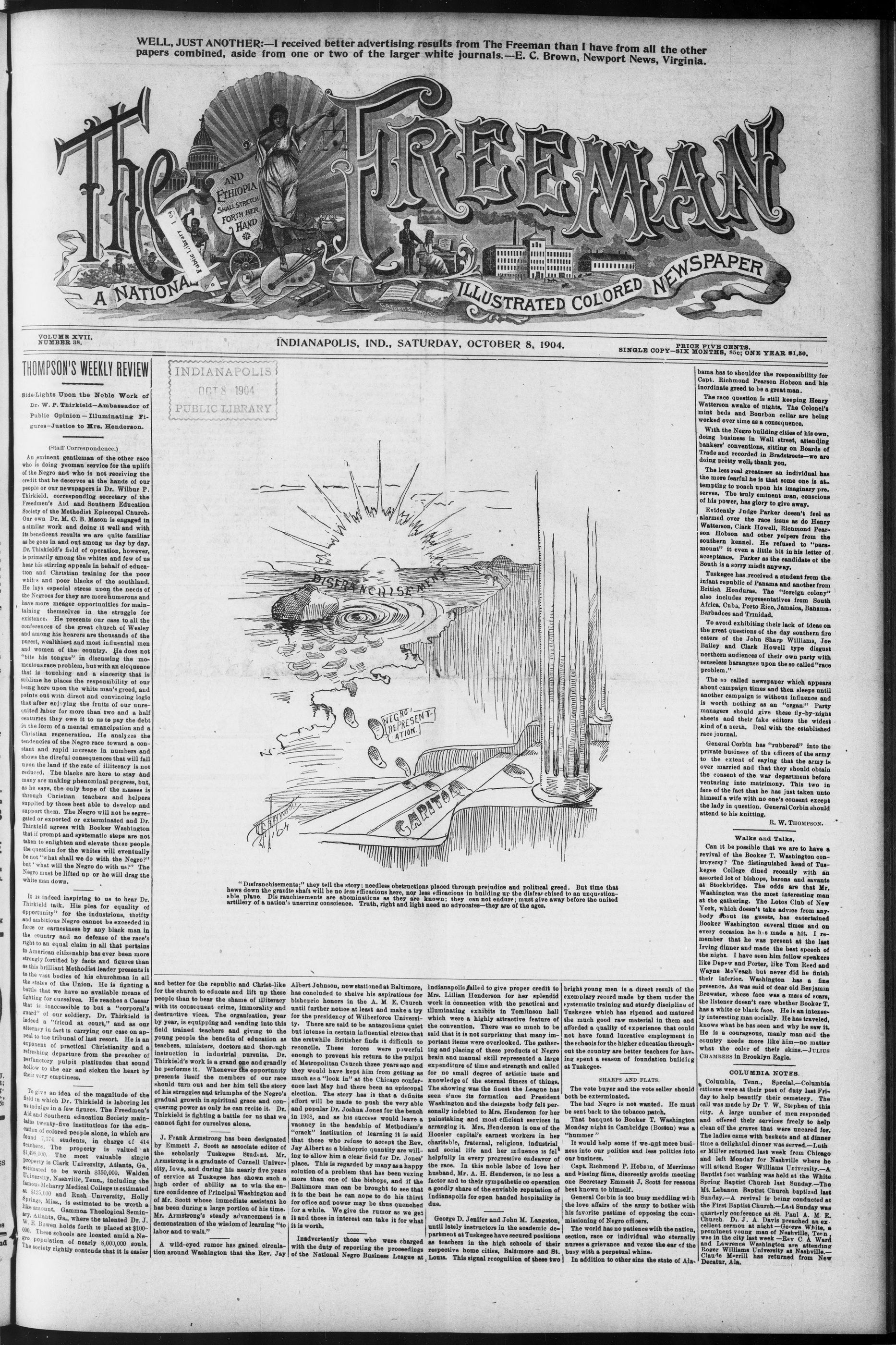
DISFRANCHISEMENT
NEGRO REPRESENTATION.
GARITON
"Disfranchisements," they tell the story; needless obstructions placed through prejudice and political greed. But time that hews down the granite shaft will be no less effasions here, not less effasions in building up the disfear chased to an unquestionable place. Dis ranchisements are abominations as they are known; they can not endure; must give away before the united artillery of a nation's unerring conscience. Truth, right and light need no advocates—they are of the ages.
"Disfranchisements," they tell the story; needless obstructions placed through prejudice and political greed. But time that hews down the granite shaft will be no less effasions here, not less effasions in building up the disfear chased to an unquestionable place. Dis ranchisements are abominations as they are known; they can not endure; must give away before the united artillery of a nation's unerring conscience. Truth, right and light need no advocates—they are of the ages.
INDIANAPOLIS
OCT 8 1904
PUBLIC LIBRARY
"Disfranchise me
hews down the gran
able plane. Disra
artillery of a nation
and better for the republic and Christ-like for the church to educate and lift up these people than to bear the shame of illiteracy with its consequent orime, immorality and destructive vices. The organization, year by year, is equipping and sending into this field trained teachers and giving to the young people the benefits of education as teachers, ministers, doctors and thorough instruction in industrial pursuits. Dr. Thirkield's work is a grand one and grandly he performs it. Whenever the opportunity presents itself the members of our race should turn out and her him tell the story of his struggles and triumphs of the Negro's gradual growth in spiritual grace and conquering power as only he can recite it. Dr. Thirkield is fighting a battle for us that we cannot fight for ourselves alone.
J. Frank Armstrong has been designated by Emmett J. Scott as associate editor of the scholarly Tuskegee Student. Mr. Armstrong is a graduate of Cornell University, Iowa, and during his nearly five years of service at Tuskegee has shown such a high order of ability as to win the entire confidence of Principal Washington and of Mr. Scott whose immediate assistant he has been during a large portion of his time. Mr. Armstrong's steady advancement is a demonstration of the wisdom of learning "to labor and to wait."
A wild-eyed rumor has gained circulation around Washington that the Rev. Jay
---
INDIANAPOLIS, IND., SATURDAY, OCTOBER 8, 1904.
Albert Johnson, now stationed at Baltimore, has concluded to shelve his aspirations for bishopric honors in the A. M. E. Church until further notice at least and make a try for the presidency of Wilberforce University. There are said to be antagonisms quiet but intense in certain influential circles that the erstwhile Britisher finds it difficult to reconcilie. These forces were powerful enough to prevent his return to the pulpit of Metropolitan Church three years ago and they would have kept him from getting as much as a "look in" at the Chicago conference last May had been an episcopal election. The story has it that a definite effort will be made to push the very able and popular Dr. Joshua Jones for the bench in 1908, and as his success would leave a vacancy in the headship of Methodism's "crack" institution of learning it is said that those who refuse to accept the Rev. Jay Albert as a bishopric quantity are willing to allow him a clear field for Dr. Jones' place. This is regarded by many as a happy solution of a problem that has been vexing more than one of the bishops, and if the Baltimore man can be brought to see that it is the best he can nope to do his thirst for office and power may be thus quenched for a while. We give the rumor as we get it and those in interest can take it for what it is worth.
Inadvertently those who were charged with the duty of reporting the proceedings of the National Negro Business League at
Indianapolis failed to give proper credit to Mrs. Lillian Henderson for her splendid work in connection with the practical and illuminating exhibits in Tomlinson hall which were a highly attractive feature of the convention. There was so much to be said that it is not surprising that many important items were overlooked. The gathering and placing of these products of Negro brain and manual skill represented a large expenditure of time and strength and called for no small degree of artistic taste and knowledge of the eternal fitness of things. The showing was the finest the League has seen since its formation and President Washington and the delegate body felt personally indebted to Mrs. Henderson for her painstaking and most efficient services in arranging it. Mrs. Henderson is one of the Hoosier capital's earnest workers in her charitable, fraternal, religious, industrial and social life and her influence is felt helpfully in every progressive endeavor of the race. In this noble labor of love her husband, Mr. A. H. Henderson, is no less a factor and to their sympathetic co operation a goodly share of the enviable reputation of Indianapolis for open handed hospitality is due.
George D. Jenifer and John M. Langston, until lately instructors in the academic department at Tuskegee have secured positions as teachers in the high schools of their respective home cities, Baltimore and St. Louis. This signal recognition of these two
bright young men is a direct result of the exemplary record made by them under the systematic training and sturdy discipline of Tuskegee which has ripened and matured the much good raw material in them and afforded a quality of experience that could not have found lucrative employment in the schools for the higher education throughout the country are better teachers for having spent a season of foundation building at Tuskegee.
SHARPS AND FLATS:
The vote buyer and the vote seller should both be exterminated.
The bad Negro is not wanted. He must be sent back to the tobacco patch. That banquet to Booker T. Washington Monday night in Cambridge (Boston) was a "hummer"
It would help some if we put more business into our politics and less politics into our business.
Capt. Richmond P. Hobson, of Merrimac and missing fame, discreetly avoids meeting one Secretary Emmett J. Scott for reasons best known to himself.
General Cobbin is too busy meddling with the love affairs of the army to bother with his favorite pastime of opposing the commissioning of Negro officers.
The world has no patience with the nation, section, race or individual who eternally nurses a grievance and vexes the ear of the busy with a perpetual whine.
bama has to shoulder the responsibility for Capt. Richmond Pearson Hobson and his inordinate greed to be a great man.
The race question is still keeping Henry Watterson awake of nights. The Colonel's mint beds and Bourbon cellar are being worked over time as a consequence.
With the Negro building cities of his own, doing business in Wall street, attending bankers' conventions, sitting on Boards of Trade and recorded in Bradstreet—we are doing pretty well, thank you.
The less real greatness an individual has the more fearful he is that some one is attempting to poach upon his imaginary pres. The truly eminent man, conscious of his power, has glory to give away.
Evidently Judge Parker doesn't feel as alarmed over the race issue as do Henry Watterson, Clark Howell, Richard Pearson Hobson and other yelpers from the southern kennel. He refused to "paramount" is even a little bit in his letter of acceptance. Parker as the candidate of the South is a sorry misfit anyway.
Tuskegee has received a student from the infant republic of Panama and another from British Honduras. The "foreign colony" also includes representatives from South Africa, Cuba, Porto Rico, Jamaica, Bahama, Barbados and Trinidad.
To avoid exhibiting their lack of ideas on the great questions of the day southern fire eaters of the John Sharp Williams, Joe Bailey and Clark Howell type disgust northern audiences of their own party with senseless harangues upon the so called "race problem."
The so called newspaper which appears about campaign times and then sleeps until another campaign is without influence and is worth nothing as an "organ." Party managers should give these fly-by-night sheets and their fake editors the widest kind of a berth. Deal with the established race journal.
General Corbin has "rubbered" into the private business of the officers of the army to the extent of saying that the army is over married and that they should obtain the consent of the war department before venturing into matrimony. This two in face of the fact that he has just taken unto himself a wife with no one's consent except the lady in question. General Corbin should attend to his knitting.
R. W. THOMPSON.
Walks and Talks.
Can it be possible that we are to have a revival of the Booker T. Washington controversy? The distinguished head of Tuskegee College dined recently with an assorted lot of bishops, barons and savants at Stockbridge. The odds are that Mr. Washington was the most interesting man at the gathering. The Lots Club of New York, which doesn't take advice from anybody about its guests, has entertained Booker Washington several times and on every occasion he has made a hit. I remember that he was present at the last Irving dinner and made the best speech of the night. I have seen him follow speakers like Dewep and Porter, like Tom Reed and Wayne McVeasah but never did he finish their interior. Washington has a fine presence. As was said of dear old Benjamin Brewater, whose face was a mass of scars, the listener doesn't care whether Booker T. has a white or black face. He is an intensely interesting man socially. He has traveled, knows what he has seen and why he saw it. He is a courageous, manly man and the country needs more like him—no matter what the color of their skins.—JULUS CHAMBERS in Brooklyn Eagle.
COLUMBIA NOTES.
Columbia, Tenn., Special.—Columbia citizens were at their post of duty last Friday to help beautify their cemetery. The call was made by Dr T W. Stephen of this city. A large number of men responded and offered their services freely to help clean off the graves that were uncared for. The ladies came with baskets and at dinner time a delightful dinner was served.—Luther Miller returned last week from Chicago and left Monday for Nashville where he will attend Roger Williams University.—A Baptist foot washing was held at the White Spring Baptist Church last Sunday.—The Mt. Lebanon Baptist Church baptized last Sunday.—A revival is being conducted at the First Baptist Church.—Last Sunday was quart-ly conference at St. Paul A. M E. Church. Dr J. A. Davis preached an excellent sermon at night—George White, a prominent young man of Nashville, Tenn. was in the city last week—Rev C A Ward, a prominent Washington are attending Roger Williams University at Nashville.—Claude Merrill has returned from New Decatur, Ala.
The STAGE
The S
QUEEEN OF THE JUNGLES.
"Queen of the Jungles" a new aggregation which has just taken the road under the management of Jos. L. Weber and H D. Collins, billed as a musical comedy and serving to introduce Mme. Mamie Flower, the "Bronze Meiba," as a star, appeared at the Newberg, N. Y. Opera house, Saturday evening, August 13. The comedy is said to have been written by Bob A. Kelly, principal comedian of the company and J. Ed Green of the Smart Set company, and to these two men must fall a very important amount of criticism, of potent value to all.
Whether Negro comedy performers take any stock in The Freeman critics estimation of their productions or not, is of no concern to the writer who is teaching the young actors of the next generation what all the present actors, by this time, should know.
"Queen of the Jungles" is a good company very badly and incorrectly put together. In its present shape it is neither one thing or the other. It is not a combination company like the Black Patti Troubadours. The first act is a correct musical comedy presentation and starts off well until Bob Kelley, in response to an encore, gives a monologue instead of a song and renders the show illegitimate. The second act introduces Black Carl in a slight of hand performance, such as he gave in Williams and Walker's company years ago before their plays were given legitimately. Mr. Carl also plays a straight comedy part and is a valuable member of the cast. His slight of hand act, which belongs only to vaudeville and combination shows, should be cut out of the play entirely and only serves to consume time which Kelly and Green have failed to supply with dialogue and comedy situations. Mr. Carl would also be able to play the part entirely in citizens clothes without a full dress suit. After this disqualified act is over, the second dose of illegitimate features, the comedy is reduced to the rank of a vaudeville farce and the way is tediously made clear for the appearance of Mme. Flower. Her entrance is not the kind that should be made by a comedy star, it is rather an operatic entrance. Her entrance in an opera cloak, with attendants at the door, to an empty stage; her entrance should be made alone exclusively and without her opera cloak, which she correctly wears later in the play. If her entrance was made to a full stage reception chorus, then it would be well enough for her to come in with her opera cloak on and to be waited in by attendants. So much for the generation made wiser by ignorant stage producers.
The singing of James Towel from a box is another feature of the variety stage that should be cut out, if Mrs. Flower understands the difference between Isham's Octoroons of the past and an all legitimate comedy production and the standard necessary to maintain the latter. Mr. Towel should sing from the wings, and especially in an operatic scene in comedy.
Mme. Flower is not heavily billed in the first degree but is a featured star such as Ernest Hogan was in the Smart Set.
She was lavishly attired in a white satin cut dialect, with train, and wore diamond ear rings and a diamond brooch in her hair. A large blue ribbon was also fastened to her right shoulder with a bunch of violets attached to the end which was brought into play in one part of her singing. As a violinist, she occupies a very unique position among the few greatest singers of her race known to fame.
She is a woman of great physical proportion and her voice, a true gift of Nature, is more powerful than any of the other great singers' voices but her vocal train-
Get the shaving habit and use Williams' Shaving Soap. It pays.
Sold everywhere. Free trial sample for z-cent stamp to pay postage. Write for booklet "How to Shave." The I. B. Williams Co., Glastonbury, Ct.
THE FREEMAN, AN ILLUSTRATED COLORED NEWSPAPER
ing is sadly deficient. Her first number which was very difficult, shows that she has acquired a greater knowledge of vocal art than formerly, and her singing on this occasion was the best I have ever heard her do. For an encore she rendered Good Night Beloved, Good Night, with great vigor, but her vocal art failed to display the same arististic perfection as Black Patti did in this particular song, and her top notes failed in vibration beyond the limit of falsetto to greater proportions so perfectly mastered by Sissieretta Jones. Mma. Flower hit bid good-bye to the mezzo-soprano o unfortunately, and in singing in the y of a high soprano, forces her notes o a degree that could not be sus-
W. F. D.
WILHEL
MAR. 31
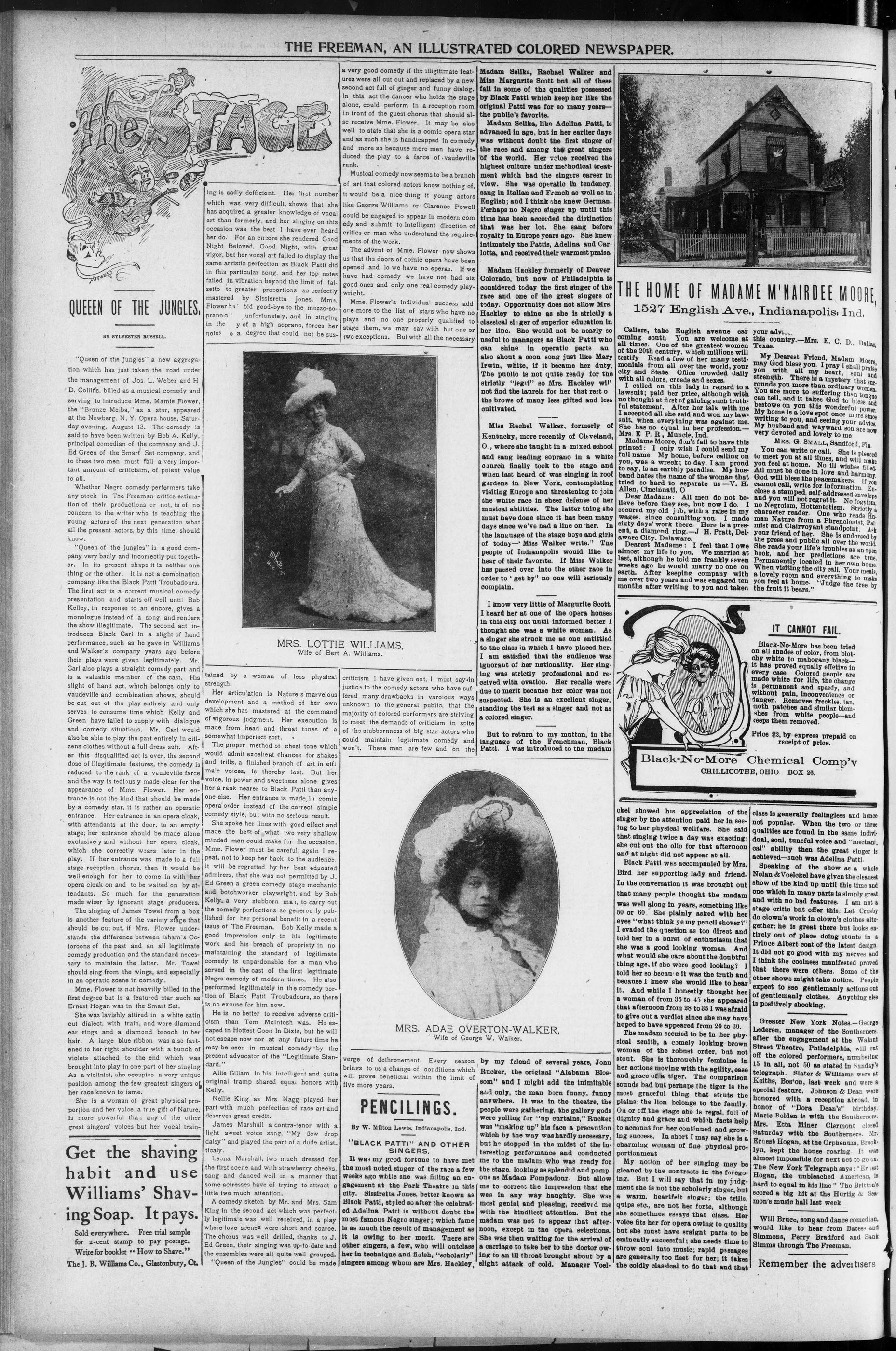
MRS. LOTTIE WILLIAMS.
Wife of Bert A. Williams.
tained by a woman of less physical strength.
Her articulation is Nature's marvelous development and a method of her own which she has mastered at the command of vigorous judgment. Her execution is made from head and throat tones of a somewhat imperfect sort.
The proper method of chest tone which would admit excellent chances for shakes and trills, a finished branch of art in effl male voices, is thereby lost. But her voice, in power and sweetness alone gives her a rank nearer to Black Patti than anyone else. Her entrance is made, in comic opera order instead of the correct simple comedy style, but with no serious result.
She spoke her lines with good effect and made the best of what two very shallow minded men could make for the occasion. Mme. Flower must be careful; again I repeat, not to keep her back to the audience. it will be regretted by her best educated admirers, that she was not permitted by J. Ed Green a green comedy stage mechanic and botchworker playwright, and by Bob Kelly, a very stubborn man, to carry out the comedy perfections so generously published for her personal benefit in a recent issue of The Freeman. Bob Kelly made a good impression only in his legitimate work and his breach of propriety in no maintaining the standard of legitimate comedy is unpardonable for a man who served in the cast of the first legitimate Negro comedy of modern times. He also performed legitimately in the comedy portion of Black Pati Troubadours, so there is no excuse for him now.
He is no better to receive adverse criticism than Tom McIntosh was. He escaped in Hottest Coon In Dixie, but he will not escape now nor at any future time he may be seen in musical comedy by the present advocate of the "Legitimate Standard."
Allie Gillam in his intelligent and quite original tramp shared equal honors with Kelly.
Nellie King as Mrs Nagg played her part with much perfection of race art and deserves great credit.
James Marshall a contra-tenor with a light sweet voice sang, "My dew drop daisy" and played the part of a dude artistically.
Leona Marshall, two much dressed for the first scene and with strawberry cheeks, sang and danced well in a manner that some actresses have of trying to attract a little two much attention.
A comedy sketch by Mr. and Mrs. Sam King in the second act which was perfectly legitimate was well received, in a play where love scenes were short and scarce. The chorus was well drilled, thanks to J. Ed Green, their singing was up-to-date and the ensembles were all quite well grouped. 'Queen of the Jungles' could be made
a very good comedy if the illigitimate features were all cut out and replaced by a new second act full of ginger and funny dialog. In this act the dancer who holds the stage alone, could perform in a reception room in front of the guest chorus that should alsc receive Mme. Flower. It may be also well to state that she is a comic opera star and as such she is handicapped in comedy and more so because mere men have reduced the play to a farce of .vaudeville rank.
Musical comedy now seems to be a branch of art that colored actors know nothing of, it would be a nice thing if young actors like George Williams or Clarence Powell could be engaged to appear in modern comedy and submit to intelligent direction of critics or men who understand the requirements of the work.
The advent of Mme. Flower now shows us that the doors of comic opera have been opened and lo we have no operas. If we have had comedy we have not had six good ones and only one real comedy playwright.
Mme. Flower's individual success add one more to the list of stars who have no plays and no one properly qualified to stage them, we may say with but one or two exceptions. But with all the necessary
6
criticism I have given out, I must say in justice to the comedy actors who have suffered many drawbacks in various ways unknown to the general public, that the majority of colored performers are striving to meet the demands of criticism in spite of the stubbornness of big star actors who could maintain legitimate comedy and won't. These men are few and on the
verge of dehonement. Every season brings to us a change of conditions which will prove beneficial within the limit of five more years.
By W. Milton Lewis, Indianapolis, Ind.
"BLACK PATTI" AND OTHER SINGERS.
It was my good fortune to have met the most noted singer of the race a few weeks ago while she was filling an engagement at the Park Theatre in this city. Sissiretta Jones, better known as Black Patti, styled so after the celebrated Adellina Patti is without doubt the most famous Negro singer; which fame is as much the result of management as it is owing to her merit. There are other singers, a few, who will ontolass her in technique and finish, "scholarly" singers among whom are Mrs. Hackley.
---
A.
MRS. ADAE OVERTON-WALKER,
Wife of George W. Walker
Madam Selika, Rachael Walker and Miss Margurite Scott but all of these fall in some of the qualities possessed by Black Patti which keep her like the original Patti was for so many years—the public's favorite.
Madam Selika, like Adelina Patti, is advanced in age, but in her earlier days was without doubt the first singer of the race and among the great singers of the world. Her voice received the highest culture under methodical treatment which had the singers career in view. She was operatic in tendency, sang in Italian and French as well as in English; and I think she knew German. Perhaps no Negro singer up until this time has been accorded the distinction that was her hered. She sang before royalty in Europe years ago. She knew intimately the Pattis, Adelina and Carlotta, and received their warmest praise.
Madam Hackley formerly of Denver Colorado, but now of Philadelphia is considered today the first singer of the race and one of the great singers of today. Opportunity does not allow Mrs. Hackley to shine as she is strictly a classical singer of superior education in her line. She would not be nearly so useful to managers as Black Pattl who can shine in operatic parts and also shout a coon song just like Mary Irwin, white, if it became her duty. The public is not quite ready for the stricty "legit" so Mrs. Hackley wil' not find the laurels for her that rest on the brows of many less gifted and less cultivated.
Miss Bachel Walker, formerly of Kentucky, more recently of Cleveland, O., where she taught in a mixed school and sang leading soprano in a white courthouse finally took to the stage and when last heard of was singing in roof gardens in New York, contemplating visiting Europe and threatening to join the white race in sheer defense of her musical abilities. The latter thing she must have done since it has been many days since we've had a line on her. In the language of the stage boys and girls of today—Miss Walker write." The people of Indianapolis would like to hear of their favorite. If Miss Walker has passed over into the other race in order to 'get by' no one will seriously complain.
I know very little of Margurite Scott. I heard her at one of the opera houses in this city but until informed better I thought she was a white woman. As a singer she struck me as one entitled to the class in which I have placed her. I am satisfied that the audience was ignorant of her nationality. Her singing was strictly professional and received with ovation. Her recalls were due to merit because her color was not suspected. She is an excellent singer, standing the test as a singer and not as a colored singer.
But to return to my mutton, in the language of the Frenchman, Black Patti. I was introduced to the madam
by my friend of several years, John Rucker, the original "Alabama Blossom" and I might add the inimitable and only, the man born funny, funny anywhere. It was in the theatre, the people were gathering, the gallery gods were welling for "up curtains," Rucker was "making up" his face a precaution which by the way was hardly necessary, but he stopped in the midst of the interesting performance and conducted me to the madam who was ready for the stage, looking as splendid and pompous as Madam Pompadour. But allow me to correct the impression that she was in any way haughty. She was most genial and pleasing, received me with the kindliest attention. But the madam was not to appear that afternoon, except in the opera selections. She was then waiting for the arrival of a carriage to take her to the doctor owing to an ill threat brought about by a slight attack of cold. Manager Voel-
H
THE HOME OF MADAME M'NAIRDEE MOORE 1527 English Ave., Indianapolis, Ind.
Black-No-More Chemical Comp'v CHILLICOTHE, OHIO BOX 26.
Callers, take English avenue car coming south. You are welcome at all times. One of the greatest women of the 20th century, which millions will testify. Read a few of her many testimonials from all over the world, your city and State. Office crowded, daily with all colors, creeds and sexes. I called on this lady in regard to a lawsuit; paid her price, although with no thought at first of gaining such truthful statement. After her talk with me I accepted all she said and won my lawsuits, when everything was against me. She has no equal in her profession. — Mrs. E. P. R., Muncie, Ind. Madame Moore, don't fail to have this printed: I only wish I could send my full name My home, before calling on you, was a wreck; to day. I am proud to say, is an earthly paradise. My husband hates the name of the woman that tried so hard to separate us —V. H. Allen, Cincinnati, O.
Dear Madame: All men do not believe before they see, but now I do. I secured my old job, with a raise in my wages, since consulting you. I made sixty days' work there. Here is a present, a diamond ring.—J H. Pratt, Delaware City, Delaware.
Dearest Madame: I feel that I owe almost my life to you. We married at last, although he told me frankly seven weeks ago he would marry no one on earth. After keeping company with me over two years and was engaged ten months after writing to you and taken
O
ckel showed his appreciation of the singer by the attention paid her in seeing to her physical welfare. She said that singing twice a day was exacting; she cut out the olo for that afternoon and at night did not appear at all.
Black Patti was accompanied by Mrs. Bird her supporting lady and friend. In the conversation it was brought out that many people thought the madam was well along in years, something like 50 or 60. She plainly asked with her eyes "what think ye my pencil shover?" I evaded the question as too direct and told her in a burst of enthusiasm that she was a good looking woman. And what would she care about the doubtful thing age, if she were good looking? I told her so because it was the truth and because I knew she would like to hear it. And while I honestly thought her a woman of from 35 to 45 she appeared that afternoon from 28 to 35 I was afraid to give out a verdict since she may have given out to have appeared from 20 to 30.
The madam seemed to be in her physical zenith, a comely looking brown woman of the robust order, but not stout. She is thoroughly feminine in her actions moving with the agility, ease and grace of a tiger. The comparison sounds bad but perhaps the tiger is the most graceful thing that struts the plains; the lion belongs to the family. On or off the stage she is regal, full of dignity and grace and which facts help to account for her continued and growing success. In short I may say she is a charming woman of fine physical proportion
My notion of her singing may be gleaned by the contrasts in the foregoing. But I will say that in my judgment she is not the scholarly singer, but a warm, heartfelt singer; the trills, quips etc, are not her forte, although she sometimes essays that class. Her voice fits her for opera owing to quality but she must have sraight parts to be eminently successful; she needs time to throw soul into music; rapid passages are generally too fleet for her; it takes the coldly classical to do that.
your advice...
this country.—Mrs. E. C. D., Dallas,
Texas.
My Dearest Friend, Madam Moors,
may God bless you. I pray I shall praise
you with all my heart, soul and
strength. There is a mystery that surrounds
you more than ordinary women.
You are more to suffering then tongue
can tell, and it takes God to bless and
bestow on you this wonderful power.
My home is a love spot once more since
writing to you, and seeing your advice.
My husband and wayward son are now
very devoted and lovely to me.
You can write or call. She is pleased to meet you at all times, and will make you feel at home. No ill wishes filled. All must be done in love and harmony. God will bless the peacemakers. If you cannot call, write for information. Enclose a stamped, self addressed envelope and you will not regret it. No foggy, no Negroism, Hottentotism. Strictly a character reader. One who reads Human Nature from a Phrenologist, Palmist and Clairvoyant standpoint. Ask your friend of her. She is endorsed by the press and public all over the world. She reads your life's troubles as an open book, and her predictions are true. Permanently located in her own home. When visiting the city call. Your meals a lovely room and everything to make you feel at home. "Judge the tree by the fruit it bears."
IT CANNOT FAIL.
Black-No-More has been tried on all shades of color, from blotchy white to mahogany black—it has proved equally effective in every case. Colored people are made white for life, the change is permanent and speedy, and without pain, inconvenience or danger. Removes freckles, tan, moth patches and similar blemishes from white people—and keeps them removed.
Price $2, by express prepaid on receipt of price.
class is generally feelingless and hence not popular. When the two or three qualities are found in the same individual, soul, tuneful voice and "mechanical" ability then the great singer is achieved—such was Adelina Cattel.
Speaking of the show as a whole Nolan & Voelckel have given the cleanest show of the kind up until this time and one which in many parts is simply great and with no bad features. I am not a stage critic but offer this: Let Crosby do clown's work in clown's clothes altogether; he is great there but looks entirely out of place doing stunts in a Prince Albert coat of the latest design. It did not go good with my nerves and I think the coolness manifested proved that there were others. Some of the other shows might take notice. People expect to see gentlemanly actions out of gentlemanly clothes. Anything else is positively shocking.
Greater New York Notes—George Lederen, manager of the Southerners, after the engagement at the Walnut Street Theatre, Philadelphia, will cut off the colored performers, numbering 15 in all, not 50 as stated in Sunday's telegraph. Slater & Williams were at Keiths, Boston, last week and were a special feature. Johnson & Dean were honored with a reception abroad, in honor of "Dora Dean's" birthday, Marie Bolden is with the Southerners. Mrs. Etta Miner Clermont closed Saturday with the Southerners. Mr. Ernest Hogan, at the Orphanum, Brooklyn, kept the house roaring. It was almost impossible for next set to go on. The New York Telegraph says: 'Ernest Hogan, the unbleached American, is hard to equal in his line' The Britton's scored a big hit at the Hurtig & Scamon's music hall last week.
Will Bruce, song and dance comedian,
would like to hear from Batese and
Simmons, Perry Bradford and Sank
Simms through The Freeman.
Remember the advertisers
The Geo. Wiedeman Brewing Co. FINE BEERS
[E. H. RENTSCH, Manager,
920 East Washington Street,
Indi
Phones: 2580, msin-Old; 4394-New.
Where You Will be Welcomed when Vist
Washington Street, Indianapolis, Ild.
Phones: 2580, main—Old; 4394—New.
Will be Welcomed when Visiting the Fair.
MIXERS—DAVE YOUNG, JOHN H. CLARK and TOM HALE
Headquarters for Colored Professionals and Sports
920 East Washington Street, Indianapolis, Ind Phones: 2580, main-Old; 4594-New. Where You Will be Welcomed when Visiting the Fair. MIXERS-DAVE YOUNG, JOHN H. CLARK and TOM HALE Headquarters for Colored Professionals and Sports
THE ROSEBUD BAR
TOM TURPIN Prop (Rastime King)
Distributor of Applegate's Old Rosebush Whisky.
Pool Room in Connecticut. First-class Care Meals Served
at all Hours.
2220 2222 MARKET STREET, ST. LOUIS, MO.
KINLOCH 8E PHN55 D. Furnished Apartments for Gentlemen
TOM TURPIN Prop (Baptime King)
Distributor of Applegate's Old Rosebud Whisky.
Pool Room in Connecticut . First-class Cate Meals Served
at all Hours.
2220 2222 MARKET STREET, ST. LOUIS, MO.
KINLOCH 8E PHN55 D. Furnished Apartments for Gentlemen
AVIS BUFFET
213 E. Broadway Street, E. ST LOUIS, ILL.
L. Liquors and Cigars. Furnished Rooms for ladies and gentlemen at
C. WHITFIELD a. Bar. Barbershop in connection.
Visit DAVISE
213 E. Broadway Street, I
Choice Wines, Liquors and Cigars. Furni
moderate cost. S. C. WHITFIELD a. Bar. Barb
Visit DAVISBUFFET
213 E. Broadway Street, E. ST LOUIS, ILL.
Choice Wines, Liquors and Cigars. Furnished Rooms for ladies and gentlemen at moderate cost. S. C. WHITFIELD a. Bar. Barbershop in connection.
CHEEK & ISABELLE
Open all Night. Electrically lighted throughout. First-class Tool Rooms Roof and Palm Gardens. Steam-heated Apartments.
2135 Market St., ST. LOUIS, MO.
orters' Tailoring Co.
Practical Tailors to the Trade.
Cutters and Fitters for World's Fair Trade.
Call and see us.
CHAS. Q. CLARK, Prop.
2122 Market Street, St. Louis, Mo.
KEYSTONE HOTEL
orters' Tailoring Co.
Practical Tailors to the Trade.
Cutters and Fitters for World's Fair Trade.
Call and see us.
CHAS. Q. CLARK, Prop.
2122 Market Street, ST. LOUIS, Mo.
KEYSTONE HOTEL
KEYSTONE HOTEL
2305 Chestnut Boulevard
First-class Furnished Rooms with Electric Light and Hot and Cold Baths,
by the day or week. Terms reasonable.
Mrs. M. Roberson, St. Louis, Mo.
James Carter.
Expressing
And all kinds
of
HAULING.
Wood, Coal and Ice.
310 N. 19th Street, St. Louis, Mo.
Mall orders promptly attended to.
NEATLY FURNISHED ROOMS
BY
Mrs. Anna E. Wright
for World's Fair Visitors. All other Trans-
lents accommodated. Cars to the fair pass
the door. Rooms at moderate cost.
1225 Chestnut St., ST. LOUIS, MO.
Convenient to Three Car Lines
MISS HANNAH R. HALL
Formerly of Memphis, Tenn.
1318 Chestnut Bldg, ST. LOUIS, MO.
Nearly Furnished Rooms.
Accommodations for World's Fair Visitors
and Translents.
NOTICE.
Persons desiring The Freeman in and
about Chicago, Ill., can be accommo-
dated by calling at Jones' News Stand
4838 South State street. Live news of
general interest for this paper is solicit-
ed at the above named news stand.
SANTAL-MIDY
Standard remedy for Gleet,
Gonorrhea and Runnings
IM 48 HOURS. Cures Kid-
ney and Bladder Troubles.
MIDY
Drink Pure Jersey RYE
DISTILLED AND BOTTLED
BY
ARTHUR LEHMAN & CO., Peoria, Ill.
Samples Free. Special Inducements
TO
THE TRADE
Write For Terms. Mention this Paper
HOOSIER POET
10 Room Laundras
10c Cigar
Goods direct to consumer and pay all express charges.
GIVE US A TRYAL ORDER
Cigar Co., Indianapolis, Ind.
CHAS.MA
In Four Sizes
ED. ANSCHUETZ, M
HOOSIER
Club Room
10c C
We deliver Goods direct to consumer
—GIVE US A TRY
John Rauch Cigar Co.,
CH
ED. AN
Our Friend.
---
PETER B.
O
P
1
CABERNET SAUVIGNON
BORDEAUX
CABERNET SAUVIGNON
BORDEAUX
THE FREEMAN, AN ILLUSTRATED COLORED NEWSPAPER
A. B. B.
NEATLY FURNISHED ROOMS
BY
Mrs. Anna E. Wright
for World's Fair Visitors. All other Trans-
lents accommodated. Cars to the fair pass
the door. Rooms at moderate cost.
1225 Chestnut St., ST. LOUIS, MO.
NOTICE.
Persons desiring The Freeman in and about Chicago, Ill., can be accommodated by calling at Jones' News Stand, 4888 South State street. Live news of general interest for this paper is solicited at the above named news stand.
THE LAKE ERIE & WESTERN
RAILROAD
for Toledo, Detroit, Ft. Wayne, Bloomin
ton, Peoria and points east and West.
A. E. Browning, P. Passenger Agent.
2 S. Illinois 8. Indiana, Ind
H. J. HEN, General Passenger Agent.
THE WAITER.
WAITERS' MANUAL
WAITERS' MANUAL
HOW TO SERVE A BANQUET.
(Copyrighted 1888 by W. Forrest Cozart.)
Every headwaiter should know how to serve a banquet. To obtain all the knowledge needed in this line requires much study and practical experience. A banquet, of course, is served according to the bill-of-fare. As a general thing the course is arranged on the bill in rotation—everything in its proper place—consequently the bill may be used as a guide. The most important point to be considered in serving a banquet is to have each course served promptly and correctly.
It is absolutely necessary that the waiters be thoroughly trained so that each one will know just what to do and how to do it.
The mind, eyes, ears, hands and feet must be well trained for this special work. The headwaiter must begin drilling his men two or three days previous to the banquet; the bill must be read to them, and each told just how he will be expected to serve the courses. There should be a signal on such occasions that is understood between the head and sidewaters so as not to cause a hitch—either the ringing of a small bell or simply a wave of the hand. I would recommend the latter as the bell sometimes annoys the guest. If the waiters are trained to serve by the wave of the hand the guests will not be disturbed and everything will move along like clock work, and the maneuvering of the waiters will be admired by the guests.
In giving the waiters their stations particular care should be exercised in placing a well drilled and trusted waiter at the head of each line of march. Should there be more than one at the signal each leader should start and should know where to join the main line, this to be continued until all the lines have consolidated, forming one grand line of march, when they pass immediately to the kitchen, get the next course and, when the word is given, return to the dining room. At a certain alsele leader and his followers will fall out of the main line of march and go to their respective stations. They may or may not be in
INDIVIDUAL HOTEL DIRECTOR
[One address line $2.00 per year; including subscription to The Freeman, in advance.]
HEADWITTERS.
F. P. Thompson, Hotel Champlain, Clinton county, N. Y.
T. H. Frame, Knutsford, Salt Lake City, Utah.
G. L. Lang, Colonial Hotel Cleveland, O.
W. A. Locke, Hotel Gayoos, Memphis, Tennessee.
F. C. Long, Windermere, Chicago, Ill.
T. G. Gilbert, Hotel Anderson, Pittsburg, Pa.
R. S. Kittrell, Windsor Hotel, Denver Colorado.
John Page, headwaiter, Central Hotel, Uniontown, Pa.
C. W. Dwyer, headwaiter Commercial Club Minneapolis, Minn.
8 105
DRINK
A.B.C.
BEER
Best because Purest.
Brewed from choicest
Malt and Hops
American Brewing Co. Telephones 935
MAJOR
, MAKER
SUPPORT IT.
---
structed to set their trays down without a signal, but under no circumstances should they be allowed to begin serving before every waiter has reached his station and is ready to serve at which time the general signal should be given and every waiter begin serving his guest or guests at the same time
In marching in and out of the dining room each walter should keep time with the others. After serving the guest see that every condiment that is necessary is on the table and then stand back at your station. No conversation or unnecessary signs are to be carried on between the waiters. When the guest has nearly finished the course each walter must keep his eye on the headwaiter. At the proper time the signal is given to clear away the dishes, in which as little noise as possible is to be made. As each walter finishes his attention is immediately turned to the headwalter to await his signal to take the trays and pass into the kitchen for the next course. The above will be done after each course.
The headwaiter should pay special attention and see that the wines are served properly and at the right time. The waiters serving the wine should be closely watched to see that they do not appropriate any of it as it is very embarrassing as well as damaging to have the proprietor or the bauquet committee claim that the waiters appropriated some of the wine. The menu cards may be prettily arranged by setting upon one end in a straight row or they may be laid flat on the table. It depends entirely upon the bill as to how the barquet should be served. Oysters, soup and fish are served before the layer plates are removed.
After all meats and salad courses have been served everything should be cleared from the table except the fruit, cake, sugar and the necessary silver to serve the next course.
Remove all bread, butter, olives, celery, almonds, etc., before serving dessert or pastry.
After serving coffee pass around the elgars, lower the windows from the top and then have waiters go immediately from the dining room, leaving two waiters, however, to look after the comfort of the guests, with careful instructions to move around quietly so as not to interrupt the speakers.
THE
STAGE
LAST TIDINGS OF BESSIE LEE
BY SYLVESTER RUSSELL.
Miss Bessie Lee, prima donna, soprano of Philadelphia, Pa., who is reported to have died in Europe, last June, from the effects of an operation, made her first professional reputation as a soloist in Nat Salisbury's production of "Black America," a company of three hundred colored performers, which enjoyed a prosperous run in New York and Philadelphia. After the company had disbanded she was engaged as a feature with John W. Isham's octoon company No. 2. Mr. and Mrs. Tom McIntosh, Henry Jackson Norris, Sam Lucas and Billy Jackson were also members of the company. Miss Lee was not an educated singer. Her method of articulation was self acquired. Her voice was one of much purity and sweetness. But her rendition of classical music, such as "Robert, Idol of My Heart," her masterpiece, was not up to the capability of a trained artist. Her execution was slow and draggy and she never attempted the impossible efforts of trilling.
When the octoonor company ceased to exist Miss Lee went abroad to try her fortune. According to a statement from one of her friends she married a white man, and during her last tour she received a salary of one hundred dollars per week. Prior to her stellar triumph Miss Lee was a Philadelphia church choir singer.
Her first professional work was done under the care and direction of W. I. Powell, a popular humorist and barbone singer. As the "Powell Quartette" they toured for several seasons, supporting Miss Flora Batson in the famous "Bergen" concerts.
Recent years of prosperity and other luxuries which follow, causing Miss
Lee to grow quite stout, was more than her constitution could stand in her last illness after years of arduous labor upon the stage. She had returned to America to visit her home not so very long before her death
Notes From P G Lowery's Musical Enterprise with the Fourpaugh & Sells Brothers' chrons —The company has received a severe shock by the sudden call of Mesers. Thomas and William May, they received a telegram Sunday that their mother was dying and left on the first train for Wichita, Kan. They have the deepest sympathy of the entire company; otherwise everything is moving along smoothly. All are well and send regards to all frends in and out of the profession. We had several pleasant callers while in Louisville, among the number were Dr. Morris and Prof. Tobe Brown also Mrs John W. Carson of Indianapolis was the guest of her husband, John Carson, our drummer. S. Jones was entertained royally by friends and relatives in Frankfort, Ky. G. W McDade called on his sons, George and Henrv. Henry McDade send regards to A. R Huchens, Samuel Johnson and J. H. McCammon The entire trio is still making a hit singing the latest songs, including "Blue Bells" Mrs Emma Thompson send regards to Mme Pattie and Company.
Clemo & Cassell the contortionist and prima donna report success on one week's stay in Wheeling, W. Va. Miss Cassell is singing "Ava Maria" from Calverla Rusticana. They go to Harrisburg, Pa., after leaving Wheeling. Regards to A. G Allen's minstrels
Mr E. J. Elliott has closed with the Southern Minstrels and is now located at 808 Ramfort street, New Orleans, La.
WORKS LIKE MAGIC.
A little Ozonized Ox Marrow applied to kinky hair makes it straight, smooth and beautiful, just like magic. It is wonderful how quickly and easily it does the work. It gives the hair life and stops it from breaking off or falling out. Cures dandruff and feeds the roots of the hair making it grow long and silky. Read what Mr. Joseph J. Wheeler, 14 Simpson St, Dayton, Ohio, says about it in a letter January 13, 1904.
"I am using your Original Ozonized Ox Marrow and find it is a superior pomade. It started a new growth of hair on a bald spot and I am sure it will do all you claim."
Send us fifty cents and we will mail you a bottle post pald Address Ozonized Ox Marrow Co., 76 Wabash Ave., Chicago, ill.
MAY NOT END WITH KNOX.
MAY NOT END WITH KNOX.
Republican Candidates Fear Effect of Ticket Scratching.
Republican county candidates fear that the candidacy of George L Knox, colored, on an independent Republican ticket, will result in losses to them. Candidates for county office are on the same ticket as candidates for Congress, the latter being at the head. The Republicans fear that if scratching is done carelessness of the voter will in many cases invalidate the entire ticket. Knox says he is out for principle and cannot afford to get off, whatever the arguments offered. Knox's candidacy has stirred the colored population of Indianapolis. Colored voters, of which there are between 6,000 and 7,000, are taking sides, and the feeling is growing intense. —The Indianapolis News.
A New Opening For Colored People.
At the recent meeting of the Business Men's League one lesson was brought out that colored people should heed. That lesson is that industrial pursuits and not politics offers the best and surest means of advancement. Many persons would like to be in business but they lack the necessary capital.
One of the best paying businesses and one that requires very little capital to begin with is the business of canvasser or agent. We know of one article that is bringing rich rewards to agents. We refer to Biacq No-More, the celebrated preparation for changing the skin of the Negro.
There is a gold mine right within the reach of any enterprising man or woman who is so fortunate as to secure the agenoy for Black No More in his or her locality. Colored people of refinement now find this preparation a necessity and it is only a question of time when all who so desire will possess a white complexion.
Patronize Our Advertisers Read them.
A.
Summer School Closed.
Burleson, Tenn, Special.—Our school under the watchful eye of Prof. J. O. Murphy closed its summer session on the 27th, which was one of the best terms that has ever been taught in our neighborhood. Mr. Murphy is a fine young man and a gentleman. He returns to Jackson, Tenn., where he will graduate this winter from the Lane University, after which he will come and teach a spring and summer school for us.—W D Aiston is erecting a fine residence at Tri mount on his farm—Prof J. R and Hinton Alston have fine residences at the same place. W. W. Alston is the builder
Pharmacist Wanted.
Pensacola Drug Company wants an experienced pharmacist, apply at once to Dr. H. G. Williams, Pensacola, Fla.
BUSINESS MEDIUM
**MRS. MARTH, the world renowned a dailyly celebrated business and test *MEDIUM* everything. To impotence. To be consulted everything. To marriage. To marriage and Marriage a specialty. Every mystery revealed, also of absent, deceased, and living memories. Removes an Mobbies and estrangements. Removes an Mobbies and estrangements in her startling revelation of the past present and future event in one's life. Remember, she will not for any price flatter you; yet conscience. She will not for any price flatter you; yet conscience. She can be consulted on all of a fiasco of Life, Love, Courtship, Marriage, Friends, etc., with description of future compaion. She will not for any price flatter you; yet conscience, etc. Her advice upon sickness, change in business, journeys, lawsuits contested wills, divorce and speculation is valuable or bad; she withholds nothing.
MRS. MARTH tells your entire life—past, present and future—in a D AD TRANCE. has the power of any two med uns you ever have before marriage, the name of all your family their ages and description, the name and business of your future husband, the name of your next, if you are to have one, the name of the father of your future husband, the name of your year of your marriage—how many children you have or will have—whether you are married or single; whether your present sweetheart you are, or whether you are; if you have no sweetheart, she will tell you you will have, and his name butness and date of acquaintance. ALL YOUR FUTURE will be told in an honest, clear, plain manner. Do not keep company, marry or go into business the success of their husbands and children young ladies should know everything about their sweethearts or intended husbands. Do not keep company, marry or go into business the success of their husbands and children. scruples prevent your consulting. Madame is the only one in the world who can tell you the FULL NAME of your future husband, with age and date of marriage, who whether the one you ove is true or false.
There are some persons who believe that there is no truth to be gained from consulting the truth, but from this there are contrary to the truth, but from this there are contrary to the truth that such a conclusion can be reached. It is not everyone who placards himself or herself as a Medium that can stand a t of what they believe in, but from this there is mind may ask the reason why. It is simply that these advisers do not take the trouble to study human nature. They do not spend time acquiring the art of terminology and kindred that will have a tendency to make the pathway to the road of the business clear and devoid of obstacles. Unavoidable fact that persons will come to advice in full knowledge of what they want to know, and yet as soon as they confront a Medium they try their utmost endeavor to dispel their minds what they want to know from the Medium. To get the secret out of a person by "pumping," in no few cases, is the art used by many unprincipled Medians, but to take the truth from their minds what they want to know, is a matter of impossibility to most of them And yet this can be done, and by consulting MRS MARTH this seeming mystery. This subject has received no little attention by eminent men and even college professors. It so proves conclusively that although their interests intersect with "oily tongues" perhaps, in no way have not been closed to the entire profession.
It takes a great deal of study to become a
accomplished, Medium, and by a continuous
and uniting effort the level of ap-
parently unfathomable mysteries that be-
procured by MRS. MARTH for the beni-
fice of humanity. By letter advice $1.00
hours from 1 a.m. to 9 p.m. All letters must
contain stamps for answers.
MRS. M. B. MARTH
Removed CHUKASHA, Indian
Territory, Box 953.
Bar-Keeper's Friend
Metal Polish
AN INFALLIBLE
UP-TC-DATE
ARTICLE
USED BY
MOREN
PEOPLE
TIAN ALL OTHER
METAL POLISIES
COMBINED
JIM TAYLOR'S
GARDEN
EXCHANGE
1119 W. Walnut St.,
LOUISVILLE, KY.
The Best That An Exacting PATRONAGE could demand is My Standard.
Only place of its kind conducted by a colored man in the city.
A NATIONAL ILLUSTRATED
COLORED NEWSPAPER.
PUBLISHED EVERY SATURDAY
At 309 Indiana Avenue,
INDIANAPOLIS, INDIANA
INDIANAPOLIS, INDIANA.
SUBSCRIPTION RATES :
Any part of the United States and Canada, one year, postage paid ..... $1.50
Six Months ..... $85
Three Months ..... $60
Foreign Countries..... $1.00 extra
Send money by express, money order, post-office order or registered letter.
Agents wanted in every town and city not now occupied, and liberal inducements will be given to the same. Send for our extraordinary inducements.
ADVERTISING RATES:
Five cents per line. Fase of measure—solid
agate, 14 lines to an inch, 276 lines in a column.
Special position 25 per cent additional.
No advertisement inserted on first page. Special
rates on standing professional and business
cards. Reasonable discount for long time and
space. Reading notices 10c per line. Special
rates on WR.TE UPS.
Entered at the postoffice at Indianapolis
Indiana, as second class matter.
All matter should be addressed to
THE FREEMAN,
INDIANAPOLIS, IND.
GEORGE L. KNOX, Publisher.
SATURDAY, OCTOBER 8, 1904.
WHY SHOULD MR. KNOX NOT
RUN FOR CONGRESS?
Is there any law in Indiana that excludes particular races or classes from political honors or emoluments? Is there any statute, any custom, any common law that says a Negro may not offer himself as a candidate for the suffrage of the people? If he chooses to make his own canvass, pay his own expenses, get up his own petition for a place on the ballot, is there any offense in this, anything wrong, any injustice done to anybody? We think not. Yet from the hullaballoo raised in certain quarters, the "protesting" and "regretting" the resolutting and sourcing about mixed with hard words and bad language, one would suppose Mr. Knox had committed the unpardonable sin, the sin against light and knowledge the very offense against the Holy Ghost It seems that he has shattered the whole ten (political) commandments by announcing his intention to contest for the seat in congress from this district against the candidates of all other parties. He is not running against any one man in particular. He is just as much against Harlan as Overstreet. He is for himself against the field. It is no unusual thing to have independent candidates for congress in other places. All through the South and some parts of the West it is a common thing, and often the independent is elected over all the regular party candidates. Independent candidates are good things occasionally. They teach the people freedom from partyism, practice them in the noble art of balloting, encourage the spirit of freedom and unprejudiced investigation, and altogether have a tendency to clarify the political atmosphere.
In the case of Mr. Knox's candidacy there are especial reasons. He desires to encourage his race to more independent action in politics on general principles. They have shown a tendency to herd too much together, to act subservently to one set, to vote entirely too straight and too regular until they have lost influence over the men whom they elected to office. Mr. Overstreet has been elected four times to represent this district in congress. It is safe to say that but for the Negro vote he would have defeated every time. Yet, no sooner does he get elected, than he forgets the bridge that carried him over. What has he done during his eight years in congress for the thousands of Negroes in this district whose fidelity made his election possible? We are not asking any special favors or privileges or recognition from him. Only fair and just treatment in proportion to our numbers and influence among his constituents. What measures of especial interest to our race has he championed in congress? He turned a deaf ear and the cold shoulder toward the Crump packer bill, the most vital measure for the interest of the race introduced in congress since the civil war.
Mr. Overstreet has not only proposed no legislation himself, but has not seemed inclined to support measures brought forward by others. So far as the Negro population of Marion county is concerned it could have fared no worse if the district had been represented by a Populist, Prohibitionist, Socialist or Democrat. Mr. Overstreet has been a negative quantity. He only comes to his district once in a while, stays but a short time and then hies himself off to distant points. He recently made a fly-by-night trip and dropped off between trains to preside over the Beaveridge meeting. But he cau_ht the first limited out of town and got back to New York as soon as possible. He announced his intention to return October 35th and devote the last two weeks of the campaign to getting acquainted with the people of his district. Really is it not time for a change and for giving this overworked gentleman a rest?
INDEPENDENCE IN POLITICS.
It has always been thrown up to the Negro as a reproach by white men that he was not loyal to his own race. Let a Negro rise above the dead level of
THE FREEMAN, AN ILLUSTRATED COLORED NEWSPAPER
mediocrity and immediately he is set upon by the envous, hampered in his ambitions, obstructed in his efforts and otherwise discouraged from attempting notable achievement of any kind. This is especially true in politics. The Negro who honorably aspires to elective office finds his chief discouragement among the men and women of his own race. Even in communities where they hold the balance of power and furnish a large part of the electorate essential to success it seems never to occur to the masses of the race that they are entitled to some recognition in politics, aside from the privilege of casting the deciding vote. The political parties bid high for all the other races. Irshman, Germans, Italians, Scandinavians and others have no trouble getting recognition on the tickets in communities where they are strong. In fact the parties are eager to get representatives of these nationalities and vie with each other in giving them recognition. Now, why should the Negro be the only exception to this general rule? Simply because he does not assert himself. As long as he is content to silently vote while others take all the honors depend upon it the politicians will not seek him out to thrust honors upon him.
Another reproach cast upon the Negro is that he has no political independence. He votes all the time as a blind partisan; regards politics as a fetish rather than a civic duty; allows himself to be herded and corralled in mass in support of one party all the time and altogether furnishes a continuous example of partisanism run to seed. This works well enough for the party that holds the mortgage, but how does it work for the Negro himself? Manifestly, if this continues indefinitely the race can expect no political advancement, it will sink lower and lower in the political scale and in time become an object of general contempt. Nothing so commands a race or class to politicians as the knowledge that they are self-respecting, cool-headed and disposed to have good reasons before deciding how they shall exercise their suffrage. Take the Germans for example. You will constantly hear the political managers saying: "These Germans are very independent people, they are well educated, well informed and not to be influenced by the usual campaign tricks. They listen, read closely and make up their minds for themselves. If we get their votes it must be by appealing to their reason, by convincing them that our side is right and by furnishing satisfactory arguments to prove our claim."
It is the ambition of the Freeman to have all the managing politicians talking in this way about the Negroes They will do so when the Negro learns the importance of a self respecting in dependence in politics; when he insists on being approached as an influential factor in the community, as one who is to be influenced by persuasion and arguments rather than by the buldozing tactics of the whipper-in or the red fire of the ward heeler.
STRENGTH OF THE INDEPENDENT VOTER.
After all, it is not the thick-and-thin partisan but the independent vote who decides things in this country. He is not numerically large but very potential], as he holds the balance of power. The blind partisan may imagine that he is the "whole thing" but as a matter of fact it is not he or his kind that is disturbing the managers. What is all this spellbinding in Indiana intended for. It is not to the vote-her-straight, but the twenty thousand fearless independents, that all the speeches are adressed, all the literature directed, all the appeals made through the newspapers. The only attention paid to the fellows who boast that they never "scratch a ticket" is to poll them, ginger them a little with taffy and "soap", and round them up for election day. He has been marked and turned loose like a Texas steer, or tarred on the side like a mountain sheep and needs no more looking after until the day for corralling. Far different the case of the independent. He is no man's man. He belongs to himself and carries his sovereignty under his hat. He is not to be influenced by the ordinary claptrap devices, by the outworn party cries, by the stale appeals to prejudice. His reason must be reached and convinced by honest and manly argument, by proof of the better cause. by evidence that the party addressing him presents the best opportunity for good government, National progress, business prosperity and all that makes for the general welfare. Whichever party gets this independent vote will win the election in every close state. They will settle the matter in New York and Indiana. The election funds, however large, won't reach them. The marching and parading, the beating of drums and noise of bands affects them only to annoyance. They can not be stamped or bullied but must be convinced. If convinced that the Republicans are right, the Republicans will get their votes and win. If convinced that the Democrats have the best cause they will give them the victory by throwing them the balance of power which they hold.
Fellow citizens of the Negro race
isn't this the noblest of all attitudes to occupy in politics. Suppose every one of the seven thousand Negro voters in Marion county was absolutely independent in politics, standing ready all the time to vote for the best man and best party on principle. See what a hold and waht an honorable holds, it would give us. We could make and unmake candidates; we could make and unmake parties. Neither would dare to make a move or a nomination without consulting us. The ablest men in their ranks would be seeking us out to reason with us. The most eloquent of their orators would be sent to give us the benefit of their arguments. And all this power may be obtained without the sacrifice of any principle or the betraying of any trust, simply by being self-respectingly independent.
AN OLD FABLE WITH A POLITICAL MORAL
Oldtimers who go back to the days of Webster's spelling book will remember the story of the bad boy and the farmer's apples. There was a picture representing the boy astride a limb, helping him self freely to the fruit. The farmer politely asked him to come down but the boy paid no attention while he coolly plucked and devoured the choicest fruit. Then, as a persuader, the farmer began throwing moss at the boy; this had no effect either, the boy continuing to munch apples unconcernedly, not even deligning to look at his despoiled victim. Finally, losing all patience, the farmer picked up a handful of stones and, aiming carefully, threw them at the bad boy in the tree. The boy was unable to stand this effective bombardment, but hastily slid down and begged the farmer for mercy.
Sometimes party officials, elected to high office by the people grow callous as they feed off of the good things set before them. They are deaf to reproof and pay no attention to the scoldings thrown at them in the gentle form of moss. They are in possession, don't see how they are to be dispossessed and coolly continue to pick the golden fruit. Only when their constitutionry resort to sterner measures—dornicks and exploding fireworks, do these subborn people show signs of taking notice. Sometimes results may be obtained by throwing missiles inside of the house but if that falls it is necessary to get on the outside and throw rocks with unerring aim. This, in party parlance, is called bolting but a wholesome bolt has often been found the only means of reaching abuses and getting rid of barnacles.
Political honors have come easy for Jesse Overstreet. In 1894, when everything was hopelessly against the Democrats and they made little or no fight for anything, the congressional nominations in several districts, before hopelessly Democratic, were bestowed on young men with no idea that they would be elected. Mr. Overstreet was one of the lucky ones, and much to his surprise found himself in congress. Later he was legislated into the Indianapolis district, where the peculiar political conditions prevailing during the last eight years gave him the elections by overwhelming majorities. In fact things have come so easy for Mr. Overstreet that he has become careless, and in such cases the remedy is to send another man. He should be a Republican but not Mr. Overstreet.
The officers of the Tuskegee Normal and Industrial Institute of Tuskegee, Ala., have gradually matured a plan which should very deeply interest the young men and women of the race who are seeking an education. This plan enables young men and women to attend school at night and work at an industry or trade during the day, or in the case of those who are able to pay a small monthly sum, to attend school during the day and at the same time, learn a trade or work at some industry. This improved plan gives superior opportunity for literary and academic training and at the same time gives equal opportunity for the learning of a trade. Last year thirty-six States were represented by students at Tuskegee, and nine foreign countries. The attendance during the coming year promises to be very large and the class of students promises to be of a high grade.
If a man does not respect himself he cannot expect anybody else to respect him. Same with a race. If a man does not stand up for his own rights others will not care whether he gets them or not. Same with a race. If a man does not insist on justice and an equal show in the distribution of political and business favors, who can be looked to to do this for him? Same with a race. Allow a party, a man or set of men, a clique of any kind-to think they own you, and you may whistle for anything more than the few crumbs they choose to toss you across the table. Self-respect invites respect and independence invites favors
Arkansas with its recent gain of 35,000 seeks to get in the doubtful class; it sent up several colored men to the National Republican League convention held in this city on the 5th and 6th.
Senator Beveridge the ubiquitous; he is everywhere doing yeoman service for the party.
BISHOP TURNER SAYS AFRICA.
Bishop H. M. Turner in his lecture in this city, last week, did not forget to harp on his favorite injunction, "Negroes, go to Africa," insisting that the hardships are such in this country that they would be justified in so doing. He speaks of the great disfranchising scheme of the South which puts the Negro out of political action and at the same time maintains scores of representatives at Washington based on the very political non-entity. He says, that such a flagrant outrage and perversion of rights ought not to be tolerated, and since the matter cannot be helped, that the Negroes, a million of them, should leave the country and set up for themselves and prove men in the disapproval of the condition and those that brought it about. He is equally severe on mob rule and the general maltreatment of Negroes in the United States. His assertions cannot be denied by friends or foes, yet it strikes us that he hopes fairly an impossible thing when he asks that the Negroes go to Africa to mend their civil, political or material fortunes. Not that Africa is objectionable as Africa, but because it promises no great things for the colored people in event they went.
While Bishop Turner may be considered a harmless old man, yet he stands a force in the Negro affairs of to-day. His stand for the greatest freedom is but the yearnings of mankind since the world began. But he thinks the thing freedom unassociated with conditions, and that other form of race prejudice that comes through history and tradition, and which is taught and fostered, and belongs to no one race. Some form of prejudice exists with every race as against some other, and the Negroes are not exempt. But they will do the proper thing if they work with the object of reducing it to that point were friction will be at a minimum.
"To Africa" is the bishop's cry, and a rather lonesome wall it is; no where is the refrain caught up by black men or by white men. White men of prominence are expressing themselves as desirous of peace and a better understanding. They declare that they want the colored man and they show it by employing him and educating him although we are too apt to feel that they have but very little thought for him. There are white men who make it a study how to best assist the colored race. Bishop Turner should study the other side. It does not mean that he could not be alone right; but is he right in his advocacy? Is it based on reason, or simply mad desire out of a heart gangrened by disappointment or hate purely, with the element of consideration purposely avoided, relying on actual conditions to give color and strength to his position? As to a plain statement of fact, he is right. In avoiding the mention of conditions up to this right, he is wrong.
"To Africa," says he, when he must know that the slogan is a back-actioned affair as it refers either to Africa or America. He knows that the Negro in America except the ne'er do wells, do not look forward to that country as obsessed with the possibilities of mending their civil, political or material fortunes. If it were some new land, situated under favorable sun, easy of access, then at the best it would still be a problem. But we know our fatherland, and as much as we may not like it, as much as we may regret it, it does not appeal to us as a rendezvous, an asylum or a retreat in the sense that Virgin America was pictured to the religiously crushed and the civily crushed Europeans at the morning of the republic.
Africa is not an unknown, nor an untried country. We know about the land grabbers there; the Transvaal? the Boers and Oom Paul? Rear an empire indeed or a republic, that it may be gulped down in the capacious maw of some big bellied giant. We know about Cape Colony and its suffrage restrictions, its policy of reducing the natives. Of course this does not destroy the contention that the Negroes may yet set up some where without fear or molestation. But have we not a demonstrator in Liberia? What has it demonstrated? It has demonstrated that it can exist only by oxygenization as it were. Then we have some other doubtful States more or less of the time in political turpitude, our south sea neighbors of the western hemisphere, who are as belligerent as prize fighters, and without much more provocation. No; it is not to the point. But it raises a point. Why does not Liberia incorporate the 100,000,000 native blacks and build an empire that would cause old Rome to look like thirty cents? Why not? The question is not without answer. Then why not?
Admitting some civil irregularities through which Negroes in this country suffer the United States is the most favorable spot in all the world for their development along all lines. Their fate is actually in their own hands. What they have not done, they can do. The responsibility is on them; they are not hindered from amassing millions or buying districts where they can live alone if they see it that way. They have the twentieth facilities to create a twentieth century civilization. In the language of Senator Beveridge, "All is well with the Republic."
The mob is sometimes rampant, but it can be positively prohibited if the Negroes will cut out every form of evil, not seeking to be bad because white men are bad. It is not incumbent on them to be better, but it won't hurt them, and be the means of avoiding much trouble.
Here is the greater point of difference
will go from $3.00 to $5.00 per share. The company has eleven properties under one management. The company is out of debt. Its officers are men of ability and integrity, and the kind of men that do things.
Send us your orders for stock before a further advance in the price of the same.
REMEMBER YOU CAN BUY 10 SHARES FOR $20.00
NOW 25 SHARES FOR $50.00; 100 SHARES FOR $200.00.
BUT LATER THIS WILL COST YOU MANY DOLLARS MORE.
KRIES & COMPANY, Fiscal Agents,
63-70 Baldwin Blk., Indianapolis, Ind.
LITERATURE FREE
CLOTHESOLOGY
By the ENGLISH WOOLEN CO., 131 West Washington St.
we manufacture our own woolers,
lng the middleman's profit; because
designers of Men's Clothes, whose
are Sartorial Art. When you wear a
fort, the ease that comes from know-
in style, perfect in workmanship
in clothes talk are the clothes that we
all the different shades of the newest
ties and mixtures. You are invited to
self of how we save you from 50 to 190
le by us.
boats $15
25 50 and up.
100 and up.
LEN COMPANY
Washington Street,
Importers of Woolens.
repair and pressed free of charge
WHY WE SAVE Because we manufacture our own woolers, thus saving the middleman's profit; because we are designers of Men's Clothes, whose garments are called Creations of the Sartorial Art. When you wear a Suit made by us you can feel the comfort, the ease that comes from knowing your clothes are up to the minute in style, perfect in workmanship and material. The best argument in clothes talk are the clothes that we make. Our fall stock is complete, in all the different shades of the newest materials—browns, grays, blacks, blues and mixtures. You are invited to inspect our stock and convince yourself of how we save you from 50 to 100 per cent. by having your clothes made by us.
Suits and Overcoats $15
Made to order
Made to Fit
Made to Satisfy
Other values for $17 50 $20.00, $22 50 and up.
Cravenette Raincoats, $17 50 up.
Trousers made to your order, $3.00 and up.
ENGLISH WOOLEN COMPANY
131 West Washington Street.
Tailors of Fashion and Importers of Woolens. All garments made by as kept in repair and pressed free of charge for one year.
Madam Cozart's Spanish Hair Grower and Straightener
Makes the Hair Grow Soft and Silky
Cures Dandruff and prevents the hair
from falling out.
Regular 50c Cans sent for trial by
mail for 25c. Address
Madam Cozart
17 N. Kentucky Ave.
ATLANTA CITY, N. J.
Soft Straight Hair
Is what you want.
CROWN OF GLORY
HAIR POMADE
Will produce it for you
Makes the Hair Easy to Do Up
and Lay Straight.
Large Bottles 50 Cents.
Trial Treatments 10 Cents.
Quite Different to Any Other.
THE OSBORNE CO.,
Box 21,
Cleveland, O.
LEARN TO WRITE SHORT-HAND
No shaded characters, no ruled lines, no
dots, few word signs, requires only a few
hourly office or six weeks. We secure
positions. Instruction by mail.
Send stamp for circular.
LEIGHTON-MAURICE INSTITUTE,
Madison, Wisconsin.
JAMES N. SELTON LUCAS B. WILLIS
Old 299 1 Red-Phones-New 3068
SHELTON & Willis
(Licensed Embalmers)
FUNERAL DIRECTORS & EMBALMEES
Best Service - Lady Attendant
Fair Prices. 417 Indiana Ave. Open all Night
R. H. HUDSON,
ADVERTISING AGENT
315 W. 12th St., Indianapolis, Ind.
YOUR FORTUNE TOLD by ASTROLOGY
Send two 2-cent stamps, your name and date
of birth for FREE trial horoscope. Address
Indianapolis Scientist, room 1, 417 E. 81st
street, Wilmington, Del.
Every Lady Read This.
Years ago when I was a sufferer, an old nurse told me of a wonderful cure for Leucorrhea, Displacement, Paintul Periods, Uterine and Ovarian troubles. It cured me in one month. It is a simple harmless lotion that can be prepared by any one having the recipe. I will send it Free to every suffering sister who writes to me. I have nothing to sell. This is a case of woman helping woman, I send it Free. Address Mrs. A, B, Hudnut, South Bend, Ind.
between the races in America, the one which promises no early settlement. When Negroes do violence or commit atrocious crimes, they should be treated as white men that commit similar deeds. And to be fair, sometimes they are, but far too often the courts are displaced by the mobs and Negroes are proceeded against as if they were flying outlaws. Here is the American political and civil unsoundness which ever tend to put the Negroes below par. It is that thing among others that gives Bishop Turner's plea some excuse. He says disfranchisement, but the aspirit that begot that condition was brought about by lessening the respect—the mob's result.
But after all is not the race in the process of making, and can it escape the seeming eternal law, that the price must be paid? It is wrong to assume that the Negroes fell from some lofty estate down to this fell condition. What fell condition, pray you, when we speak glowingly of the 'millions accumulated, education and achievement? Do we not boast that "no nation within so short a period has done so much?" In spite of the much talked of restraint it appears that we had some show, and in fact much more than we used up. Barring the irregularities mentioned in a civil way, our, may it be hoped, temporary embarrassment, the country in which we live has nothing like an equal in the way of opportunities. Nor need we feel that we are dealing Africa a back-handed blow. America is full of peoples who left their homes to find a hapier existence in America. These, doubtless, love their old homes, but they confess that America, their new home, is a much better one by staying here.
Mr. Overstreet occasionally stops off to visit his constituency. As he only remains a few hours, however, he only has time to see a few politicians around headquarters at the English Hotel, besides a hurried call on his manager, Mr. Archibald Young, and away he goes again for another prolonged absence. He promises us another short visit just before election to see if the machine is working all right.
Independent candidacies are good things for these old parties. They stir them up and put them on their good behavior. They teach them to respect the rights of the people by cautioning them not to regard their election as certainties.
The unceremonious services held over the remains of Senator George F. Hoar, of Massachusetts were in keeping with his simple life. A great, good, useful man is gone but he leaves a legacy by the way of an exemplary political and private life, making good the earthly loss, of the individual. Can there be a loss even on earth, spiritual or material?
In the lexicon of the bright youths of Japan the words defeat and retreat are not found.
Mr. Bryan will make a few speeches; just fifty-two in eight days.
THE STAGE.
By "WOODBINE."
Lew Payton sends regards to all friends, down south. Helo, John Dennis, Buddie Glenn and Rohar.
Marsh Craig sends regards to Harry Fiddler and wife, Ruby Shelon and family. All write as per route in Freeman.
boys were plenty fittin. Cigars were serve and all left rejoicing, and a puffin' and a blowin'. To gaze on the table 'twas a beautiful as a diamond pin and to eat the delicious food thereon; for explanation, see John Rucker. Our gratitude and best wishes are extended.
Billy McClain, who is now in London, Eng., will introduce a new version of "Bill Bailey" at the Royal Holborn, entitled "Bill Bailey in Japan."
C. W. Be Bee with Ton-Ka-Wah Medicine Co. writes from Cherokee, Kans., sending regards to all friends. He would like to hear from Sam Cook.
E. J. Burton, leader of the Alabama Quastetie sends regards to the Nighten-Gale Quartette and says he would like to hear from them through the Freeman.
Performers in and out of the Profession are requested to correspond with the Diamond Theatre, a first class Vaudeville house, Beaumont, Tex., if not engaged.
Al Anderson and Billy Briggs Kings of Colored Comedy, are being featured for the second season with the Jere McAuliffe show, in their latest success, the "Black Gallery God," and are booked solid until August 1905.
Mike Wells, the genial proprietor of the Buffalo Sample room in Indianapolis and manager and owner of Well's Ebony Bells Co., was in Chicago last week making arrangements to put this well known company on the road again.
Notes from Millican & Company:—We are now in the State of old South Carolina and business is good. Billy Arnte will make a flying trip Sunday to Winston, N.C. to see some of his old friends. He sends best regards to Sam Johnson and Wm. Gront of the New Orleans Minstrel. The show is getting along nicely. Best regards to all friends in and out of the profession.
Geo. L. Moxley, the veteran Minstrel had the pleasure of entertaining Al Holman and Billy Banks of Pawnee Bill's Wild West Show, last week. The meeting was exceedingly pleasant as Mr. Moxley had not seen Mr. Banks since they sang together with Sam. T. Jack's Creole Co., the first season of that show. Mr. Moxley sends regards to Billy Young, Billy Kersand, Sam Lucas and Harry Fidler.
The McCarvers, Billie and Sadie were big hits at the Grystal Theatre, Seattle, Wash. last week. We are now on Goldsmith's for 15 weeks and then we go on the 3 L circuit for 20 weeks, through California, Victoria, B. C. Le Pettet Theatre week of the 26". Vancouver B. C., Le Pettet Theatre week of the 2". Regards to all friends and especially to my former partner, Harry Reed and glad to know he has such and easy thing. Ditto, for Billy and I are getting the money.
Mr. John Rucker, Al Watts, James Wories, Harry Kraton, Harry Reed, Chauncey Ver Vallin, of the "Black Patti Co." and Al Turner the "Fre-o-g" were the guests of Mr. Fred Simpson and wife to a seven dinner, at their beautiful home in W. 12th street, Wednesday evening the 21st. After the seventh round all of the
THE FREEMAM POST OFFICE.
LADIES LIST.
Bacon, Robirda 2
Cottrell, Miss Pauline
Jones, MRS B D
Johnson, Mrs E H
Jones, Mrs Ivy A
Mercury, Mrs Ger
GENTLEMEN'S LIST.
Armstrong, T L
Bebe, C W
Barnum, Stuart
Castro, Frank
Cissel and Mines 2
Cissel and Howell 2
Dudley, E B
Cooper, J W
Gerber, E Z
Gidson, L E 2
Hunt, W H
Hughes, Ed
Howard, E L
Johnson, Chas P
Jones, Lewis
Jordan, W J
Jackson, Bob(due 10c)
Lass, Sam
Mittchell, Maudie 2
Mottman, Cark
Taylor, Miss Carrie
Wills, Mrs Bessie
Watts, Mrs Al (du 10c)
Lucas, L H
Langford, Kid
Langford, W
Martin, Sr., A A
McCannon, J H
McCannon, J L
Mason, E L
Pittman, James
Parker, Chas R
Regs, Fred
Smith, Fred H
Saulters, Fred H
Shaw and Clifton 2
Tibbs, Soi
The Fosters 2
Jones, Lewis
Williams, H L
Waetherly, Joe 2
Websters, The
ROUTE
A Rabbit Foot Co. - Summit, Miss., Oct. 10;
B brookhaven, 11; Jackson, 12; Nateche, 13;
Port Gibson, 14; Vicksburg, 15.
P. G. Lowery 4 'Fails and Sels' Bros. Cleus,
Brenou Rouge, La., Oct. 10; New Orleans,
St. Louis, Louis, Miss, 15; Mobile, Ala.
K. Hensley, Fl. 15.
Georgia Minstrels - Thurber, Tex., Oct. 10;
Abinea, I. Cisco, 12; Dub in, 13; Stephens
ville, 14; Brownwood, 15.
Mahair's Birminales Co. - Slayton, Minn.,
I. the Windom, 11; Springfield, 12; Marshal,
13; Muncota, 15.
Anderson and Briggs - Lawrence, Mass., Oct.
10 to 15.
Wood Dookie Comedy 4, en route with
Bob Manchester's Cracker Jack Co. - Louisville,
Ky. week of Oct. 9.
Benix Bros. Carolinians - DesMoines, Ia.,
10 to 17.
hary Brown, Singing Cartoonist - Orpheum
circuit, week of Oct. 3.
ALEHOLMAN's Students en route.—Rushville,
Ind., Oct. 10; Connersville, 11; Dayton, O.,
12; Springfield, 13; Wilmington, 14; Circle-
ville, 15; Home Sweet Home.
McCarver, Garay and Bamboo.—Edison The-
ater, Logan, Utah, Oct. 10 to 15.
THE FREEMAN, AN ILLUSTRATED COLORED NEWSPAPER
boys were plenty fitttin. Cigars were served and all left rejoicing, and a puffin' and a blowin'. To gaze on the table 'twas as beautiful as a diamond pin and to eat the delicious food thereon; for explanation, see John Rucker. Our gratitude and best wishes are extended to our comrade and wife.
Ollie Shelton writes from Terry's U. T. C. Co. Just as I said before the Old Hawk Ness will soon be broken up and he will fly to Omaha for two weeks. Our manager, J. D. Chum, is busy getting things ready for the coming season although we have until the 22, of Oct. Everybody is well except Mrs. Tillie Shelton who has a very bad cold. Mr. and Mrs. Al Edwards sends regards to all friends, also Miss Emma Russell and Joe Galway. The Sheltons send regards to Marsh Craig, Al and Mamie Holman, Strander and Davis, Wm, Wilkins and all K. of P. friends. Emma Russell sends regards to Pearl Moppin, and says "write Pearl as I have lost your route."
Baynard & Whitneys famous Troubadours: We have just closed the most successful season since our organization, 1898. Everybody finished the season of 18 weeks in good health and spirits. The artistic success of the show this season far surpassed any we have yet produced. Every show was a decided hit, which naturally insured the financial success of the show. We finished the season without any sickness or death in the company and no accidents, excepting three "blow downs," which caused very little damage, and no injury to performers or audience. We send best regards to P. G. Lowery & Co., Harris & Cassells, the Brinkleys and Chas. Bougia.
Mr. Ed. C. Price writes:—My wife and I are well and are having good success here in the South with our little company. All of the company are well and C. E. Hawk is having the best success in carrying the Hawk and Price Concert Company through the South. Our advance agent, O. B. Ross, is doing fine for it to be his first season in front. Mrs. Ludell Price sends regards to Uncle Pet. G. Hampton in England, and all friends. We are on our way to Florida and are more than making good. Ed. C. Price with his comedy is leaving them screaming every night, but, not for their money back. We were highly entertained while in Elberton, S. C. by Mr. and Mrs. E. J. Hill, one of the wealthiest colored men in the South and we were sorry that we had to leave such good company. The company sends regards to all friends. Helo Prof. Geo. Jones, how is Dainty? I say write.
Napoleon Johnson writes from the Georgia Minstrels: "One good time seems to be an introduction to another: so close they follow with George Rhone home in Galveston, Tuesday. Happy Beaugard home in Houston, Wednesday and then with all our friends and Beaumont to follow made the past week one of the most sociable of the season. To those acquainted with the drawing power of the Georgias it is needless to say we made and are getting the money but to those who are not on the inside, allow me to say we are getting ours, and the man in white never never fails to preamubulate ever Sunday morning at 10 o'clock. Our company is composed of people with the goods who know how to deliver them, under the able direction of Clarence Powell we never fail to please the people. Although this is Powell's first season as stage manager, yet as he deals with the detaile adding the right thing in the right place adds greatly to his already well earned a reputation and as he has perfect control over the boys, all work in harmony, one with another showing that he can manage as well as perform.
Jno. W. Cooper, commonly called the "Wizard" is still a feature of the Olio, as he has a pair of new figures, new talk and other things adds to his act, making it this season the crowning point, as his turn appeals to all classes, hence there is not a dull moment from his entrance to his exit, from stage. In a number of cases he is forced to take curtain calls. Then gives imitations most noted among which is his famous imitation of drawing and drinking a glass of soda-water and one of the Edison's Phonograph talking and reproducing a record.
Frank Weaver, tenor songster who joined us in Ft. Work, is rehearsing of "Kilarney" which he will put on in a few days.
The company joins me in extending best wishes to Mr. and Mrs. Kersands and Company. We wish you much success and do hope it would be our lot to meet some place this season, long enough to exchange greetings, for traveling as we are to meet a similar organization adds peace to the troubled mind, as the sight of a ship or land would to minds of ship-wrecked sailors drifting out in mid ocean.
Notes from Billy Kersands famous Mtnstrel Co.:—Everything is lovely and running as smoothly as if by natures own law. Our show still continues to please, easily, thus enabling us to play to the capacity of the houses. Our parade is haughty, gaudy
and gorgeous and seems to be just what the people want. One of the strong features of our parade, outside of the great band, which is not necessary to mention, is the great Robert Conners, better known as "Rastus" in his own original act for the street, a wheel act. It is startling and wonderful, a big hit for the street. And then comes our noted and well known drum major, Dave. D. Smith, in his exciting and eccentric feats of drum majoring, making two big hits for our grand street parade. As for the show, we are adding to it daily, and it has always been claimed to be stronger than last season. Campbell Bros. have a first class act on this season, and is simply the marvelous Marsh Craig in his act alone. Mr. Craig's act simply is a convinicid proof to the entire world, that every day learns us something. On our next week's programme the Housesy Bros. will appear in their superb musical act which adds a little more show. As the old saying, we know a carpenter by his chips. Hence we give a brief outline of some of the timber connected with the great Kersands Show. We have not mentioned the Kersands at all, who certainly adds mirth and laughter to all parts of our show. They want to know if Dick Thomas reads the Freeman. Regards to all.
P.B. Ross Hendrix's Chicago Notes.
Chas, Mars, R. A. Johnson and Mose
Lerry are in the city. They are all looking
and doing well. They wish to be
remembered to all their friends.
William Windom, the wide world known
contra tenor singer, composer and minstrel
man, entertained the patrons of the Chicago
last week, and was highly applauded.
Sends regards to all friends.
Wise, Milton & Picks in their rattling
Southern song and dance act, who entertained the patrons of the Chicago last week
are this week at the Haymarket. Wise & Milton are known from coast to coast, and
are always favorites, when you once see
them, you will want to see them again.
Their sketches are above the average. Regards to all their friends in and out of the profession.
Johnson & Weiks, singers, dancers and comedians, filled a successful engagement at the Haymarket, last week.
Hodges & Launchmere are the leading attraction at the Cleveland Theatre this week. They are recieving from five to six encores at every performance. They are a very clever team.
H. C. Buckner, manager of the Dixie Concert Co., who with the company in a few days, leave for a six months engagement, spoke very ably at the young men's Sunday club, of St. Mark's M. E. church, taking for his subject, "Sunshine." Altho-gh not to be classed as a public speaker, he did himself credit, and his subject was well defined, and a great moral lesson was to be learned from it. He is well known as a bass singer of the highest degree, and we are proud to see him hold his own as an orator.
Mr. Louis (Baby) Love returned to the city last week, and left for a short engagement with forty-five people. His company of performers are making a hit wherever they appear. He handles the goods. Therefore, he can give it to the public, with credit to himself. Regards to his many friends and also enemies.
Mrs. James L. Love desires the profession to know that she holds you all in remembrance, and hopes that one and all will have a successful season. As she is the proprietor of the professional headquarters, she wants you all to know that you are as welcome as the flowers in May, and together with her assistants, Messrs. Joe Catlin, Jake Wonders, and Chas. Williams, will try to make you feel at home, at 2702 State St.
Prof. Felix Weir, who about two years ago, out a class of 100 students from the Chicago musical college, at the graduating exercises, recieved a beautiful diamond emblem pin, as an acknowledgement of the judges, that he was above the Ofays, in his executions upon the violon has sailed for Berlin, Germany, and other points across the water, to complete his course. We extend to him our hearty desires that he be successful.
A Melodrama which fairly leaps from one sensational incident to another. "Queen of the White Slaves," comes to the Park next Monday. Its opening scene is in New York, it whisks to San Francisco, thence across the Pacific to Hong Kong and back again to Frisco. Nineteen elaborated scenes are shown before the play runs its course. Its story is that of an American beauty who is, through the aid of the Highbinders spirited away to a mandarin palace. Its action abounds in detective work. The lone interest is strong and the company members, nearly forty people. The vale of the White Slave is taken by Ailleen May. The bill for the second half of the week is "Hearts Adrift," well received at the Park in a former engagement. Its heroine is a banker's daughter, in love with her father's cashier, who, however, loves another. The wealth of the bankers daughter does not excite the sentiment of the cashier and the disappointed girl gives way to the evil of her nature and seeks revenge, and has him brought to the bar of justice an a false charge of murder. One of the scenic features is an air-ship. The company is headed by E. L. Snoder.
The Clover-Leaf Quartette, (Reese Baker, and Frazier,) while playing with "On the Suwanee River Co." week of Sept. 19th at Louisville, Ky., were entertained by Tom Logan and Will Able.
The Freeman can be found each week at John Cameron's barber shop, Minden, Louisiana.
Within the last few days the Kansas University Bible chair has been malling its announcement of the course in Bible to be pursued from October to November. Many of our students, doubtless, have paid very little attention to the
Kansas
University.
Kansas
pamphlet other than a slight perusal. The new students, and old ones as well, should take advantage of the courses of instruction offered in this line of work. The instructor, Prof. W. C. Payne, is a very congenial gentleman and makes all welcome who enter his class. Furthermore, he is an interesting lecturer, and the work is a pleasure rather than a task. It is a deplorable fact that every year very few of our students are interested in the work. At the present time there are only two young ladies enrolled—a sophomore in the mission study class and a senior in the normal course for teachers. With so many of our students enrolled at least three-fourths ought to arrange to take this very helpful work.
:o: Doubtless, the first thing you will ask in reading this item is what do those initials stand for, and where is that institution situated. The Colored C. A. and N. Agricultural and Normal University is at University. Langston, Oklahoma, and was founded in
1897. The departments are Collegiate, College Preparatory, Normal and Elementary. The president, Inman E. Page, A.M., was formerly instructor at Lincoln Institute, Jefferson City, Mo. He has a strong faculty to aid him, and the work is thorough and satisfactory. The library consists of over nine hundred carefully selected volumes of reference books, representing the various departments of literature. In addition to these works the library and reading room are kept supplied with many newspapers and magazines. The departments of mathematics, domestic economy and agriculture have a limited supply of apparatus, while the department of mechanic arts has an equipment of more than $8,000 worth of machinery and tools. The school is growing and promises to be one of the best in the Southwest.
---:o---
Miss Gertrude Mason, a former student at Lawrence High School, is contemplating the idea of becoming a trained nurse. Miss Mason will enter Provident Hospital in Chicago and pursue the High School. regular four years' course. This profession is a very lucrative one and we are all very glad to see so many of our young ladies aspiring to be proficient in that line. Miss Nona Johnson and Miss Frankie McWilliams are at Douglass Hospital in Kansas City, Kas., and they like the work very much.
---
Those who attended the K. U.-Emporia foot ball game noticed that one of the men on the opposing line-up was of our own race. The Kansas City Journal had only words of praise for him, saying in substance that, although Emporia did not score, the best playing was given by Kirk. Although Mr. Kirk was on the opposing line-up we are proud of him.
---
Miss Mable Gleed will visit in Kansas City this week.
Miss Lena Smith is taking the new course in domestic science.
Miss Wright of Baldwin, Kas., visited the high school on Friday, Oct. 2.
CHICAGO NEWS.
Chicago, Ill., Special—A reception was given by Mrs. Dolly Savage and brothers Richard and William Berry at their beautiful residence at 144 West Forty-fifth Place in honor of Mrs. Josie, Miss Georgia and Mr. Aaron Bradford and Mrs. Minnie Fort, of Fargo, N.D., who were en route to the World's Fair thence to Nashville, Tenn., their former home, on last Friday evening, September 31st. The evening was spent pleasantly in dancing, whist and solos by several professional singers. Mr. Otto C. Mays' rendition of the "Holy City" was above the average. Mr. Frank Harrison sang "I Have a Feeling for You." Everyone enjoyed themselves and hope that Mrs. Savage and brothers will have their out of city friends to call often so they can return again for an enjoyable evening. Mrs. Bradford and family are going to remain in Nashville and Mrs. Fort will return to Fargo in five of six weeks.—Rev. Jesse E. Woods, who was returned to St. Mary's Church, is an able divine, a man of Christian character and liked by his congregation. He anticipates upon enlarging the present edifice, making it a monument to the A. M. E. connection worthy of distinction. He has been more successful than any of his predecessors and deserves the encouragement of his members and friends.—Ross Hendrix has accepted the foremanship of the shipping dock of Nelson Morris & Company's new plant at the stock yards.—Rev. A. J. Carey was greeted by two large audiences last Sunday at Bethel Church to which he was recently appointed having filled the pulpit of Quinn Chapel for six years. Bishop Turner filled his pulpit in the evening—Mr. and Mrs. E. H. Jackson, of Grand Boulevard entertained Mrs. Bradford and family and Mrs. Minnie Ford at luncheon last week.
```markdown
```
Sylvester Russell
Including handsome Photograph of the author.
PRICE 20 CENTS
Send Money Order only. Stamps will not be recognized.
Ten copies to clubs or theatrical companies for $1 00. Remember money orders (only) accepted. Address all mail and money orders
SYLVESTER RUSSELL, Orange, N. J.
N. B —All orders will be promptly filled by the secretary.
D W. Hartfield, Prop.
ALABAMA BAR Fine Wines, Liquors and Cigars. Everything strictly first-class Pool and Billiard Rooms in connection. 1929-1929] Market Street, ST. LOUIS, MO.
THE FREEMAN'S WOGGLE BUG IS ASKING
LEARN DRESSMAKING.
Why drudge your life out in kitchen or over wash-tub when you can learn a paying profession by mail in eight to twelve weeks. Particulars for stamp.
LEIGHTON-MAURICE INSTITUTE,
Madison, Wisconsin.
AGENTS.—Be your own boss. Send 10c silver for great book of secrets and other particiulars to Kiowa Manufacturing and Supply Co., 415 E. Sixth St., Wilmington, Deaware.
THE FREEMAN'S WO
Have you placed your boy or girl in school?
Does J. Milton Turner want his old job back again?
Have you begun to buy a home or to start a bank account?
What can be done to increase the crop of marriageable men?
Did you ever know of a strike that paid dividends in the long run?
Has Rev. J. M. Henderson become reconciled to the Methodist situation?
Are the managers arranging to make a "Garrison" finish of the campaign?
Why are the Southern white preachers afraid to speak up against lynching?
Will the election of Roosevelt mean a
new deal in the big federal offices?
How often does Prof. Isaac Fisher of
Arkansas have to lick his opponents?
Wouldn't Dr. James E. Shepard fit snugly into a good paying foreign consulship?
Are you preparing to attend the Tuskegee Negro Farmers' Conference in February?
Is the National Socialological Society next on the list of notable Negro gatherings?
Why some of us are so prone to forget that there is a positive eloquence in silence?
Will the National Negro Business League give St. Louis or Philadelphia a whirl in 1906?
Will Allen C. Simms do his best to make recent rumors a reality to satisfy the gossipers?
How may the white people of the land be reached by the Negro journals and magazines?
Is the Boston Guardian preparing to charge Booker T. Washington with changing the season?
If there isn't a fruitful field everywhere for local branches of the "Mind-Your-Own-Business League"?
Why doesn't Henry Watterson consult a specialist on Negrophobia before the disease turns in on him?
What is the head of the Negro bureau of the Republican National campaign doing to justify his selection?
Why is it that people who live in glass houses habitually indulge in the dangerous stone-throwing industry?
Why did the Christian Recorder wish a favorable write-up on racial conditions at the unfair St. Louis fair?
How many Negroes from Indiana did Congressman Overstreet get into that big pick-up, the census office?
Are the Eastern Democrats actually "doing things" to our great and good Indiana friend, Tom Taggart?
Are the anti-theater going churches enforcing the law they refused to repeal at the recent general conference?
When will that veteran wheel-horse of
LOOK! LOOK!!
Colorad performers when playing Fall River, Mass., please call and see
MRS. A. NEAL
819 Spring Street.
First-class board and room.
WANTED: 25 Musicians, Singers, Dancers and Comedians. Address "Comedy," 601 N. Gregory Ave., Roanoke, Va.
GGLE BUG IS ASKING
Negro Democracy, Lawyer J. T. V. Hill, get ready to rally his cohorts?
When will the labor unions realize that it will be to their interest to make common cause with the Negro workingmen?
Isn't W. Calvin Chase supporting Roosevelt with about the same fervor that Wm. Jennings Bryan is booming Parker?
Wasn't Senator Fahbanks mainly responsible for the appointment of Dr. H. W. Furniss as Consul to Bahia, Brazil?
Have S. W. Starks, J. McHenry Jones, J. C. Glimer and Phil Waters got West Virginia securely sewed up in a sack?
Why doesn't Henry Arnett offer his flag to William Monroe Trotter as a suitable emblem for a man without a country?
Doesn't that monster banquet in Boston settle the whole question of Booker T. Washington's standing and popularity?
Why are Negroes themselves the most vehement in denouncing those of the race who open wide the door of opportunity?
Has Edward H. Morris been relegated to obscurity because of his atrocious attempt to lecture on "Shams, by one of them?"
Why was not Banker Isaac H. Smith along with Banker John Mitchell at the New York convention of master financiers?
Why is it more reprehensible for the Negroes to discipline a crecreant representative than it is for the Irish or Dutch to do so?
Is the Rev. Jay Albert Johnson trying to trade off his noble little Bishopric boom for the presidency of Wilberforce University?
Will the Episcopal General Convention at Boston encourage the colored adherents of the church by providing for a bishop of the race?
Why cannot Negro banks be instituted and maintained at Louisville, Atlanta, New Orleans, Washington, Memphis and Jacksonville?
Will W. H. Fielding take ministerial orders in the Episcopal church with a view of becoming rector of St. Philips at Indianapolis?
Will Capt. D. J. Gilmer "do the honor" for General Gorbin when that august personage lands upon the hospitable shores of the Philapines?
Why hasn't James A. Ross, the New York State Negro Democratic leader, found a few spare moments to run in on Judge Parker at Esopus?
Has the colored leadership in New Jersey been definitely settled? Are headquarters at Jersey City, Red Bank, Newark, Plainfield or Whitesbore?
Will there be enough room in pent-up Brooklyn for such eminent authorities on the higher education as Dr. O. M. Waller and Rev. G. Frazier Miller?
Hasn't Dr. H. T. Johnson a firm grip on the first call for the A. M. E. Bishopric, with Rev. W. H. Chambers claiming similar honors in the A. M. E. Zion church?
To Freeman Subscribers.
Always give former address in cases of removal where paper is to be changed from one place to another.
The Gentleman From Indiana
By BOOTH TARKINGTON
Copyright, 1899, by Doubleday @ McClure Co.
Copyright, 1902, by McClure, Phillips @ Co.
opening it, let in a tornado of wind and flood of water that beat him back. Sheets of rain blew in horizontally in spite of the porch beyond.
Every moment Mr. Willetts became more restless. He assured the ladies he had no anxiety regarding Mr. Harkless. It was only his own dereliction of duty that he regretted. The boys would have the laugh on him, he said. But he visibly chafed more and more under the judge's stories and constantly rose to peer out of the window into the wrack and turmoil, and once or twice he struck his hands together with muttered ejaculations. At last there was a lull in the fury without, and as soon as it was perceptible he announced his intention of making his way into town. He "had ought to have went before," he declared apprehensively, and then, with immediate amendment, of course he would find the editor at work in the Herald office. There wasn't the slightest doubt of that, he agreed with the judge, but he better see about it. He would return early in the morning and bid Miss Sherwood goodby. Hoped she'd come back some day; hoped it wasn't her last visit to Plattville. They gave him an umbrella, and he plunged into the night, and as they stood for a moment at the door, the old man calling after him cheery good nights and laughing messages to Harkless, they could see him fight with his umbrella when he got out into the road.
Helen's room was over the porch, the windows facing north, looking up upon the pike and across the fields. "Please don't light the lamp, Minnie," she said when they had gone upstairs. "I don't need it." Miss Briscoe was flitting about the room hunting for matches. In the darkness she came to her friend and laid a kind, large hand on Helen's eyes, and the hand became wet. She drew Helen's head down on her shoulder and sat beside her on the bed.
"Sweetheart, you mustn't fret," she soothed in motherly fashion. "Don't you worry, dear. He's all right. It isn't your fault, dear. They wouldn't come on a night like this."
But Helen drew away and went to the window, flattening her arm against the pane, her forehead pressed against her arm. She had let him go; she had let him go alone. She had forgotten the danger that always beset him. She had been so crazy; she had seen nothing, thought of nothing. She had let him go into that and into the storm alone. Who knew better than she how cruel they were. She had seen the fire leap from the white blossom and heard the ball whistle, the ball they had meant for his heart—that good, great heart. She had run to him the night before. Why had she let him go into the unknown and the storm tonight? But how could she have stopped him? How could she have kept him after what he had said? He had put it out of her power to speak the word "Stay!" She peered into the night through distorting tears.
The wind had gone down a little, but only a little, and the electrical flashes danced all round the horizon in magnificent display, sometimes far away.
Briscoe followed him. "Don't be a fool, Lige." he said. "You hardly expect to go out in that." Lige shook his head. It needed them both to get the door closed. The young man leaned his back against it and passed his sleeve across his wet brow. "I hadn't ought to have left him."
"Don't scare the girls," whispered the other; then in a louder tone: "All I'm afraid of is that he'll get blown to pieces or catch his death of cold. That's all there is to worry about. They wouldn't try it again so soon after last night. I'm not bothering about that; not at all. That needn't worry anybody."
"But this morning"—
"Pshaw! He's likely home and dry by this time. All foolishness. Don't be an old woman."
The two men re-entered the room and found Helen clinging to Minnie's hand on the sofa. She looked up at them quickly.
"Do you think—do you—what do you"—
Her voice shook so that she could not go on.
The judge pinched her cheek and patred it. "I think he's home and dry, but I think he got wet first. That's what I think. Never you fear. He's a good hand at taking care of himself. Sit down, Lige. You can't go for awhile." Nor could he. It was a long, long while before he could venture out. The storm raged and roared without abatement. It was Carlow's worst since 51, the old gentleman said. They heard the great limbs crack and break outside, while the thunder pealed and boomed, and the wind ripped at the eaves till it seemed as if the roof must go. Meanwhile the judge, after some apology, lit his pipe and told long stories of the storms of early days and of odd freaks of the wind. He talked on calmly, the picture of repose, and blew rings above his head, but Helen saw that one of his big slippers beat an unceasing little tattoo on the carpet. She sat with fixed eyes, in silence, holding Minnie's hand tightly, and her face was colorless, growing whiter as the slow hours dragged by.
THE FREEMAN, AN ILLUSTRATED COLORED NEWSPAPER
sometimes dazingly near, the darkness doubly deep between the intervals when the long sweep of flat lands lay in dazzling clearness, clean cut in the washed air to the finest detail of stricken field and heaving woodland.
A staggering flame clove earth and sky, and sheets of light echoed it, and a frightful uproar shook the house and rattled the casements, but over the crash of thunder Minnie heard her friend's loud scream and saw her spring back from the window with both hands, palms outward, pressed to her face. She leaped to her and threw her arms about her.
"What is it?"
"Look!" Helen dragged her to the window. "At the next flash! The fence beyond the meadow."
"What was it? What was it like?"
The lightning flashed incessantly.
Helen tried to point. Her hand only jerked from side to side.
"Look!" she cried.
"I see nothing but the lightning," Minnie answered breathlessly.
"Oh, the fence! The fence! And in the field!"
"Helen! What was it like?"
"Ah, ah!" she panted. "A long line of white looking things — horrible white"—
"What like?" Minnie turned from the window and caught the other's wrist in a strong clasp.
"Minnie, Minnie! Like long white gowns and cowls crossing the fence!" Helen released her wrist from her companion's grasp and put both hands on Minnie's cheeks, forcing her around to face the flickering pane. "You must look! You must look!" she cried.
"They wouldn't do it! They wouldn't — it isn't!" Minnie shuddered. "They couldn't come in the storm. They wouldn't do it in the pouring rain."
"Yes! Such things would mind the rain!" She burst into hysterical laughter, and Minnie seized her round the waist, almost as unnerved as Helen, yet trying to soothe her. "They would mind the rain," Helen whispered. "They would fear a storm. Yes, yes! And I let him go; I let him go!" Pressing close together, clasping each other's waist, the two girls peered out at the landscape.
"Look!"
Up from the distant fence that bordered the northern side of Jones' field a pale, pelted, flapping thing reared itself, poised and seemed, just as the blackness came again, to drop to the ground.
"Did you see?"
But Minnie had thrown herself into a deep chair with a laugh of wild relief. "My darling girl!" she cried. "Not a line of white things—just one—Mr Jones' scarecrow! And we saw it blown down!"
"No, no, no! I saw the others. They were in the field beyond. I saw them. When I looked the first time they were nearly all on the fence. This time we saw the last man crossing. Ah, I let him go alone!" Minnie sprang up and infolded her. "No; you dear, imagining child, you're upset and nervous, that's all the matter in the world. Don't worry; don't, child; it's all right. Mr. Harkless is home and safe in bed long ago. I know that old scarecrow on the fence like a book, and you're so unstrung you fancied the rest. He's all right. Don't you bother, dear."
The big, motherly girl took her companion in her arms and rocked her back and forth soothingly and petted and reassured her and then cried a little with her, as a good hearted girl always will with a friend. Then she left her for the night, with many a cheering word and tender caress. "Get to sleep, my dear," she called through the door when she had closed it behind her. "You must if you have to go in the morning. It just breaks my heart. I don't know how we'll bear it without you. Father will miss you almost as much as I will. Good night. Don't bother about that old white scarecrow, that's all it was. Good night, dear; good night."
"Good night, dear," answered a plaintive little voice. Helen's cheek pressed the pillow and tossed from side to side. By and by she turned the pillow over; it had grown wet. The wind blew about the eaves and blew itself out. Sleep would not come. She got up and laved her burning eyes; then she sat by the window. The storm's strength was spent at last. The rain grew lighter and lighter until there was but the sound of running water and the drip, drip on the tin roof of the porch. Only the thunder rumbling in the distance marked the storm's course, the charlots of the gods rolling farther and farther away till they finally ceased to be heard altogether. The clouds parted majestically, and then, between great curtains of mist, the day star was seen shining in the east.
The night was hushed, and the peace that falls before dawn was upon the wet, flat lands. Somewhere in the sodden grass a swamped cricket chirped; from an outlying flange of the village a dog's howl rose mournfully; it was answered by another far away and by another and another. The sonorous chorus rose above the village, died away, and oulet fell again.
Helen sat by the window, no comfort touching her heart. Tears coursed her cheeks no longer, but her eyes were wide and staring, and her lips parted breathlessly, for the hush was broken by the far clamor of the courthouse bell ringing in the night. It rang and rang and rang and rang. She could
A woman in a long dress points out a window as a man in a robe reaches out to her.
"Look!" she cried.
breathe. She threw open the window. The bell stopped. All was quiet once more. The east was gray.
Suddenly out of the stillness there came the sound of a horse galloping over a wet road. He was coming like mad. Some one for a doctor? No; the hoof beats grew louder, coming out from the town, coming faster and faster, coming here. There was a plashing and trampling in front of the house and a sharp "Whoa!" In the dim light of first dawn she made out a man on a foam flecked horse. He drew up at the gate.
A window to the right of hers went screeching up. She heard the judge clear his throat before he smoke.
"What is it? That's you, isn't it, Wiley? What is it?" He took a good deal of time and coughed between the sentences. His voice was more than ordinarily quiet, and it sounded husky. "What is it, Wiley?" "Judge, what time did Mr. Harkless leave here last night, and which way did he go?" There was a silence. The judge turned away from the window. Minnie was standing just outside his door. "It must have been about half past 9, wasn't it, father?" she called in a choked voice. "And—you know—Helen thought he went west." "Wiley!" The old man leaned from the sill again. "Yes," answered the man on horseback. "Wiley, he left about half past 9—just before the storm. They think he went west." "Much obliged, Willetts is so upset he isn't sure of anything."
"Wiley!" The old man's voice shook
Minnie began to cry aloud. The horse-
man wheeled about and turned his animal's head toward town. "Wiley!"
"Yes."
"Wiley, they haven't—you don't think they've got him?"
Said the man on horseback, "Judge I'm afraid they have."
CHAPTER VIII.
THE courthouse bell ringing in the night! No hesitating stroke of Schofields' Henry, no uncertain touch, was on the rope. A loud, wild, hurried clamor pealing out to wake the countryside, a rapid clang! clang! clang! that struck clear in to the spine. The courthouse bell had tolled for the death of Morton, of Garfield, of Hendricks; had rung joy peals of peace after the war and after political campaigns, but it had rung as it was ringing now only three times—once when Hibbard's mill burned, once when Webb Landis killed Sep Bardlock and intrenched himself in the lumber yard and would not be taken until he was shot through and through, and once when the Rauen accommodation, crowded with children and women and men, was wrecked within twenty yards of the station.
Why was the bell ringing now? Men and women, startled into wide wakefulness, groped to windows. No red mist hung over town or country. What was it? The bell rang on. Its loud alarm beat increasingly into men's hearts and quickened their throbbing to the rapid measure of its own. Vague forms loomed in the gloaming. A horse, madly ridden, splashed through the town. There were shouts; voices called hoarsely; lamps began to gleam in the windows; half clad people emerged from their houses, men slapping their braces on their shoulders as they ran out of doors: questions were shouted into the dimness.
Then the news went over the town. It was cried from yard to yard, from group to group, from gate to gate, and reached the furthermost confines. Runners shouted it as they sped by, and boys panted it, breathless; women with loosened hair stumbled into darkling chambers and faltered it out to new waked sleepers, and pale girls, clutching wraps at their throats, whispered it across fences. The sick, tossing on their hard beds, heard it. The bell clamored it far and near; it spread over the countryside, and it flew over the wires to distant cities. The White Caps had got Mr. Harkless!
Lige Willetts had lost track of him out near Briscoe's, it was said, and had come into town at midnight seeking him. He had found Parker, the Herald foreman, and Ross Schofield, the typesetter, and Bud Tipworthy, the devil, at work in the printing office, but no sign of Harkless there or in the cottage. Together these had sought for him and had roused others who had in-
LISTEN: FRIENDS A $45 WATCH FOR $5.45 LADIES' OR GENTS' SIZE
Each and every watch we send out is timed, tested and regulated before leaving the factory and guaranteed accurate timekeepers.
It was our good luck to find a manufacturer of watches who was badly in need of money. He had a large stock on hand. He had the money he needed to buy watches at our price and gave him our money. We were very happy with our money for our money as we could get today, and we are going to give shrewd people the benefit of the low price which we took them. It was our intention to sell these watches to us and give every person who bought one at this price
READ OUR PROPOSITION
It is not necessary to send any money in your office. Send the money to your NAME. POICE OF OFFICE and NEAREST EXPRESS OFFICE if you desire LADIES' OR GENTS' SIZE WATCH if you send it to your express office at once we will send it to your LEAGUE OF EXAMINATION and we want you to call the office and carefully examine the watch before
ONE WATCH FREE
But, on flurring out the the exact cost of these watches we find we can do even better than what we know you cannot buy this price from any other firm for the more than twice the price we ask. Our price for this watch is $8.45 and express copies. This watch is the favorite with railroad men and you know that they cannot carry anything but the bunch of timekeepers. It appearance it equals a whiff of timekeepers.
USUALLY SOLD FOR $45.00
The movement in this watch is im. 21 ruby jeyed movement in the finest movement movement manufactured under contract to be equal in manufacture timekeeping to an Eigin, B. W. Raymond, Waltham or Appleton, Tracey movement. It has specially designed movement movement, the finest watch lever escapement jeweled, pallets, patent regulator, sunk second dial. Arabic figures, enamel dial, patent pinion, double jeweled compensation expansion movement, the finest watch made, time tested and regulated. An enameled anteced for 25 years. The case is a genuine gold laid case, handsomely engraved, in an assortment of finishes, made fullyGUARANTEED for 25 YEARS.
NATIONAL CONSOLIDATED WATCH CO.,
This concern is thoroughly reliable.—PUBLISHER
H. Ward
HOURS:
m., 6 to 8 p. m.
RESIDENCE
INDIANAPOLIS
1974.
DISBLACK.
ED 1901
"BrandHabit"
Pants, and
colored Shirts
seap as any
owners
TEED BY
ALLOWAY
OLOR
CHICAGO, ILL.
Prices, Reliable
anted.
TTT MEMORIAL
ing School, The
List of Officers.
N.
Notice to all the col-
lomnati who are
valuable and inter-
story of the Peter
hospital and Train-
ses ask that you
facts concerning
colored physicians
for a hospital of
organized the hospital,
and at the sug-
W. Johnson, the
MAGIC HAIR ST
PATENTED
Shampoo Drier. This necessary toilet one operation. It will straighten and dri-
factorily. Its use will give the hair its n
only device on the market that will chase price will be refunded if it does n
urning it to our office.
Stop and think how the public is b
tisements of various pomades and many y
upon the market, which are injurious to
use leaves such an unsightly appearance.
We will forfeit $100 for any so can
make the hair straight and soft by apply
greasy, pasty appearance, thereby retar-
ening the hair follicles, causing it to colli
cause of so many bald heads; and the pr
you to name us a hair straightener, of an
duce these effects. Now in comparison
Shampoo Drier, which is a straighten-
inum comb attached, six inches long, with
head of hair after a shampoo and straight.
Its mode of operation is easy upon the
method, which almost pulls the hair out
strands leaving a beautiful and natural a
be straightened in less than thirty minu-
ing instructions will straighten the hair w
will save the loss of hair that excessive
that it is the only device that will accom-
and skillfully examined by the chief exa-
countries and has been granted a patent
pliance of its kind on the market to day
article of the toilet by all who take pride
the endorsements of physicians.
Address MAGIC HAIR ST
Agents Wanted. 405 Cent
NEGRO BUSINESS MEN
Dr.Joseph H. Ward
OFFICE HOURS:
8 to 10 a.m., 1 to 8 p.m., 6 to 8 p.m.
OFFICE AND RESIDENCE
4851 Indiana Ave., INDIANAPOLIS
TELEPHONER: New, 1974.
Old 651Black.
AND SHHMPOO DRIER. LOOK
The above cut represents the Magic Hair Straightener and Shampoo Drier. This necessary toilet article will accomplish two results in one operation. It will straighten and dry the hair quickly, effectively and satisfactorily. Its use will give the hair its natural appearance. It is positively the only device upon the market that will accomplish such results. The purchase price will be refunded if it does not accomplish all we claim for it, by returning it to our office.
"Get the Calloway-Brand Habit"
Suits, Overcoats, Pants and
Ladies' Man-Tallied Shirts
as good and cheap as any
on Earth or Easewere
Stop and think how the public is being deceived by extravagant advertisements of various pomades and many impractical straighteners that are foiled upon the market, which are injurious to the growth of the hair, and after their use leaves such an unsightly appearance.
We will forfeit $100 for any so called hair tonic or preparation that will make the hair straight and soft by applying it without leaving the hair with a greasy, pasty appearance, thereby retarding the growth of the hair and softening the hair follicles, causing it to collect dandruff and dust which is a great cause of so many bald heads; and the promoter of the wig industry. We ask you to name us a hair straightener, of any drug composition, that does not produce these effects. Now in comparison, The Magic Hair Straightener and Shampoo Drier, which is a straightener consisting of a steel bar and an aluminum comb attached, six inches long, with an ordinary amount of heat, dries a head of hair after a shampoo and straightens it as fast as it is combed.
144 Fifth Avenue, CHICAGO, IL.
Write for Samples and Prices. Reliable
Agents Wanted.
THE PETER FOSSETT MEMORIAL
Its mode of operation is easy upon the hair, thereby eliminating the pincher method, which almost pulls the hair out from the roots. The comb separates the strands leaving a beautiful and natural appearance. A heavy head of hair can be straightened in less than thirty minutes. Its use a few minutes daily following instructions will straighten the hair where hours of combing will not. It will save the loss of hair that excessive combing produces, and we guarantee that it is the only device that will accomplish such results. It has been carefully and skillfully examined by the chief examiner of the United States and other countries and has been granted a patent as the latest and most practical appliance of its kind on the market to-day. It will be found an indispensable article of the toilet by all who take pride in their personal appearance. It has the endorsements of physicians.
Hospital and Training School, The First of its kind, List of Officers. EDITOR THE FREEMAN. As a matter of justice to all the colored physicians of Cincinnati who are subscribers to your valuable and interesting paper I as secretary of the Peter Fossett Memorial Hospital and Training School for Nurses ask that you publish the following facts concerning the institution.
Address MAGIC HAIR STRAIGHTENER MFG. CO.,
Agents Wanted. 405 Century Bldg., Minneapolis, Minn.
In April 1903 the colored physicians seeing the necessity for a hospital of our own met and organized the hospital and training school, and at the suggestion of Dr. Frank W. Johnson, the pioneer of colored physicians here, it was called the Peter Fossett Hospital and Training School. The first officers of the institution elected for a term of six months were Dr. E. D. Colley, president; L. A. Cornish, M. D., secretary; J. C. Erwin, M. D., treasurer; F. W. Jonson, M. D., clerk; and W. A. B-Herr, M. D., superintendent. The first surgeon-in-chief was Dr. E. Duvall Colley, who was succeeded by Dr. James C. Erwin who now holds that office. Since April all kind of operations, including several abdominal section have been performed, and during the session of the Kentucky Medical Association held in Covington May past Drs. Hunter and Robinson of Lexington held clinics and successfully removed several large fibroed tumors.
What in the world should we expect of the worthless, street corner and pillow supporting Negro when those who represent the leaders and more thrifty of the race are caught stealing from themselves. A sad fact to those who have spent years trying to teach—honesty is the best policy. Of the 3,000 engaged in business 2,999 of them are daily robbing themselves of the quickest and surest way of success. Our up-to
POLITICAL ANNOUNCEMENTS
VOICE FOR
John E. McGaughey
Republican nominee for Commissioner Marion county. Election Nov. 8.
H. D. Tutewiler
Republican nominee for Coroner. Election November 8.
VOICE FOR
LOUIS A. CORNISH. M. D.
The Big Four Route will sell low rate Colonist tickets to Arkansas, Louisiana, New Mexico, Oklahoma, Indian Territory, Kansas and Texas. One way second class Colonist tickets at very low rates on sale Tuesday, Sept. 20th, Oct. 4th and 18th, 1904. For full information and particulars as to rates, tickets, limits, etc., call on agents of "Big Four Route" or address Warren J. Lynch, Genl' Pass and Ticket A'g', Cincinnati, Ohio, or H. M Bronson, A. G. P. A., Indianapolis Ind
Michael L. Jefferson
Republican nominee for Assessor. Election November 8
VOTE FOR
John McGregor
Republican nominee for County Commissioner. Election Nov. 8.
VOTE FOR
Ed G. Sourbier
Republican nominee for Sheriff. Election November 8.
B. Williams 486+ State st
S B Ash, Cornell Ave. & 56th, st.
E. H. Faulkner. 3104 State st.
A. F. Tervalon 2826 State st
Calvin B. Brazand. 5506 Jeff Ave.
J S Love 2702 State st.
isadore Jacobson 2970 State st.
Republican nominee for Judge of the Juvenile Court Election November 8
Home Seekers' Excursion at Very Low Rates.
Republican nominee for Trustees, Center Township Election November 8.
The Big Four Route will put on sale Home Seekers' excursion tickets at very low rates Tuesdays. Sept. 20 Oct. 4 and 18, Nov. 1. 15 and 29, 1994, limit returning 15 days, to Michigan, Au Sable, Beaverton. Branch, Brethren, Cadillac, Kaleva, Manistee and Merritt. For full information and partitions as to rates, tickets, limits, stop-over privileges, etc. on call on agents of "Big Four Route" or address Warren J. Lynch, Genl. Pass and Ticket Ag't., Cincinnati, Ohio. on H M. Bronson, A G. P. A., Indianapolis, Ind.
Michigan, Au Sable, Brothron, Cadillac, Merritt. For full honors as to rates, over privileges, etc., by Four Route" or Lynch, Gen'l Pass. Indiana, Ohio, or R. P. A., Indiana-
Grand Rapids, Mich., Special.—Ell H. Paul and wife, formerly Miss Mamie Adams, arrived in the city September 28th to reside permanently. They are at home with Mrs. H. J. Bennett, 701 W. Thirteenth street.
Patronize our advertisers.
THE WATCH
1820
170
Low Colonist Rates
The Freeman in Chicago.
75 DEARBORN STREET, CHICAGO, ILL.
table.—PUBLISHER
AIR STRAIGHTENER
AND
SHHMPOO DRIER.
necessary toilet article will accomplish two results in brighten and dry the hair quickly, effectively and satisfy the hair its natural appearance. It is positively the market that will accomplish such results. The purified if it does not accomplish all we claim for it, by retaining the public is being deceived by extravagant advertisers and many impractical straighteners that are foisted on the injurious to the growth of the hair, and after their appearance, for any so called hair tonic or preparation that will soft by applying it without leaving the hair with a thereby retarding the growth of the hair and softening it to collect dandruff and dust which is a great aid; and the promoter of the wig industry. We ask tightener, of any drug composition, that does not protein comparison, The Magic Hair Straightener and a straightener consisting of a steel bar and an alumches long, with an ordinary amount of heat, dries aoo and straightens it as fast as it is combed. As easy upon the hair, thereby eliminating the pincher at the hair out from the roots. The comb separates the hair and natural appearance. A heavy head of hair can be thirty minutes. Its use a few minutes daily followtten the hair where hours of combing will not. It at excessive combing produces, and we guarantee that will accomplish such results. It has been carefully the chief examiner of the United States and otherated a patent as the latest and most practical apparmarket to-day. It will be found an indispensable who take pride in their personal appearance. It has ans.
Price $1.
C HAIR STRAIGHTENER MFG. CO.,
405 Century Bldg., Minneapolis, Minn.
S MEN ROBBED OF THOUSANDS.
NEGRO BUSINESS MEN ROBBED OF THOUSANDS.
---
READ OUR PROPOSITION
It is not necessary to send any money in your letter. Send us this "AD" with your NAME, POST OFFICE and NEAREST EXPRESS OFFICE and share OFFICE and LADIES' OR GENTS' SIZE WATCH and we will send them to you. We can see for yourself the bargain that you are getting. We send the watch with THE PRIVILEGE OF EXAMINATION and we want you to call at the express office and carefully examine the watch before paying office and carefully can see for yourself the bargain that you are getting. We send the watch with THE $4.53 EXPRESS CHARGES and the watch is yours. The $4.53 is sent by registered mail we will send the watch by return registered mail, we paying the postage. We will POINT BUNTING CARE WATCH which we guarantee for all ordinary care it will last a lifetime. Don't think this paper aside and say, "Well, I'll send for that week." It will pay you to write at once. Today we GAIN AND CHARM WITH EACH WATCH. We have a number of watch chains and charms that we are going to sell at $4.49 each, and in order to get some of them out into the hands of our customers, they will help them their friends and tell them how they can buy them. We give them ABSOLUTELY FREE to the first 1,000 people who own one of these watches, a Gent's chain and charm of one of these watches, a gentle chain fitted with a stone slide. This is our first present to those who order one of these watches.
$5.45
We send a LADIES OR GENTS at WELED
railroad movement, fitted in gold, with the hun-
ting case or open face if you desire and will
watch a Ladies' or Gents' watch chain and charm.
CUR BINDING WRITTEN GUJRANTEE ACCOM-
MISSIONS AND IS AND IS PUT IN. IN THE
FRONT CASE OF SAME. This capability
we refer you to the First National Bank of
Chicago or Chicago Agent of any Express Company.
The above cut represents the Magic Hair Straightener and
date system of catchy and intelligent ad-writing is the only guide to success.
Quit taking money out of your own drawer. Write for our system of advertising and we will show you how our white neighbor earns millions quickly. We will guarantee to make business pick up. Write today.
GARDNER BROTHERS,
315 Bridge street, Brooklyn, N. Y.
Ad-Writers, Advertising Specialists.
LOOK WHAT FEAUTIFUL
Wigs, from $3.75 Up, at
```markdown
```
U. D. DAVIDSON & COMPANY,
TEMPLE OF FASHION HAIRSTORE
We do a wholesale business. Ladies in half
business write for wholesale price list
Mail Orders Promptly Filled.
308 E. 12th St., Fort Worth,
371 Jackson St.,
Dallas, Texas.
HOWARD'S
LIGHTNING
SHOE POLISHES
NEW YORK A.C. HOWARD, CHICAGO
On sale in Indianapolis, at Geo. J.
Marott 26-28 E W Washington street;
Nutz & Grosskoph, 24-26 W. Washington
street; Hide, Leather & Belting Co.
227 S. Meridian street; H. P. Wasson &
O.; New York Shoe Store.
```markdown
```
This wonderful hair pomade is the only safe preparation in the world that makes kinky or curly hair look soft and smooth. It sheds the scalp, prevents the hair from falling out or breaking off, cures dandruff and makes hair shiny and soft. It protects years and used by thousands. Warranted for all hair types. Sold for straightening kinky hair. Beware of imitations. Remember that the Original Dry cut size. Do not be misled by substitutions that claim to be just as good—but always better. Do not keep the hair straight, soft and beautiful. Keep the hair straight, soft and beautiful. Keep the hair straight, soft and beautiful. Contain deserts. A toilet paper. Contain children. Elegantly beautiful is the best and most economical if it is not possible for anybody to produce a copy of your pomade. Only 60 cents. Sold by drug stalls and dealers, or send us 50 cents for one express paid. We pay all postage and express payment. We pay all postage and express payment. Name of this copy where written. Write your name and address plainly to OZONIZED OX MARROW CO., 76 Wabash Ave., Chicago, Illinois. Agents wanted everywhere.
MONEY FOR EVERYBODY-- We will tel you how to make it. We tell you also where and how to get big bargains for little money. Send lie in silver and a 2-cent stamp for our book of Premium Secrets, Catalogue and big batch of Itmere. Address Klowa Manufacturing and Supply Co., 41B E. Sixth St., Wilmington, Delaware.
Great Reduction Sale on all Furnishings.
Rawitsch e Co.
MEANS FURNISHERS
CLAYPOOL HOTEL
INDIANAPOLIS.
16 North Illinois Street.
Colored Man's Paradise
Caddo County, Okla.
For climate, good water, variety of good crops. Caddo Coun-
tents raised: Wheat, oats, corn, cotton, Kahr corn, broom corn,
sweet potato, water melons, musk moons, canola peanuts, all
dance. Price of and $7.00 to $15.00 per acre. For information wi-
d O. H GEAGAN & CO. ANADARKO, C
For climate, good water, variety of good crops. Caddo County excels all others. Prod. uts raised: Wheat, oats, corn, cotton, Kadron, corn brown, corn sugar, cane, Irish potatoe-sweet potatoes, water melons, musk melons, cantaloupe and all kinds of vegetables in a bundance. Price of land $7.00 to $15.00 per acre. For information write to
KNOXVILLE COLLEGE.
Knoxville College offers the following courses:--Classical, Scientific, Normal, Theological, Music, Common School, Mechanical, Agricultural, and various industrial departments. Faculty, foremen and officers number fifty. Enrollment of students for the last year, 47, coming from 22 states and Central America. The location is one of the most desirable in the South,--healthful, e-venient of access and beautiful. Buildings are steam heated and electric lighted. Self help offered through industrial departments. Fall term opens Sept. 27, 1944. Expenses for Board, mei, light, furnished room only $6.85 a month. For further information, catalogue, etc., write the president, R. W. McGranahan, l. D. Knoxville, Tenn.
Knoxville College offers the following course Music, Common School, Mechanical, Agric Faculty, foremen and officers number thirty, 7 leading from Ectectes and Capital Airport in the South, healthful, convenient of access, and electric lighted. Self help offered through Sept. 27, 1994. Expenses for Board, fuel, light ther information, catalogue, etc., write theville, Teen.
Morristown Normal
MORRISTO
Morristown Normal Industrial College MORRISTOWN, TENN:
Beautiful for situation, climate unequalled, but hard to find. Every modern convenience, in able and experienced faculty. Through and effi cient work done in good positions guaranteed to those taking good positions.
Good positions guaranteed to those taking
the can se in Domestic economy.
Board, $6 00 per month.
Fall Term opens Sept, 15, 1904
For further
Address the Fresh
LINCOLN INS
LINCOLN INSTITUTE, JEFFERSON CITY, MO.
THE HOSPITAL
Missouri State School for Colored Youth. Benjamin Franklin Allen, A. M., LL. D., President.
DEPARTMENTS—College. Normal. Preparatory, Industrial, Domestic
COURSES—Classical. College Preparatory, Normal, Sub-Normal, Model Training School, Music (instrumental,
vocal). Drawing (fine arts and mechanical). Carpentry. Woodworking. Blacksmithing, Machinery, Shoemaking,
Farming and Gardening. Printing, Typewriting, Sewing, Cooking, Laudering
EDUCATIONAL NOTES
EDUCATIONAL NOTES
Lincoln Institute Farmers' Convention. Progress of the Institution.
No one of the many innovations introduced by Dr. B F. Allen in the management of Lincoln Institute can become of more practical value to the Negroes of the stateland section than the Farmers' Convention, provided that the thinking men and women of their respective communities will take hold of the matter in the proper spirit, and by their presence and experience, added to words of deeds and encouragement. will aid a movement that in the present status of the Negro, financially and otherwise, can be of so much material use to him in a section which commands the rich agricultural lands of the great middle West, of the Southwest and Northwest.
The public lands are rapidly opening the number of acres of available land proportionally is decreasing, and if the Negro fails to be land-wise in his day and generation, he will eventually awake to find himself not only disfranchised, but also minus that other strong right, arm of liberty the ownership of land.
Possessed of land," and knowledge of improved methods of cultivation, irrigation, rotation of crops, poultry raising, dairying, etc, he may be able to hold his own in a country where high handed competition is the order of the day, otherwise (unless he develops much more satisfactorily along other industrial or professional lines) he must be content to be pushed closer and closer to the wall.
The third annual Farmers' convention held in connection with Lincoln Institute will convene on the first Friday in November and all interested in the progress of the race from agricultural and other important points of view are invited to be present and take active part in the discussions, etc
rops, Caddo County excels all others. Prod. corn, broom corn, sugar cane, Irish potables, a nataloupe and all kinds of vegetables in abun- for information write to NADARKO, CADDO COUNTY OKLA.
Classes-Classical, Scientific, Normal, Theological, cultural, and various industrial departments.
Enrollment of students for the last year was once the beautiful, buildings are steam heated and industrial departments. Fall term opens with furnished room only $6.85 a month. For further president, R. W, McGranshan, D. D, Knox.
Industrial College DOWN, TENN:
College Preparatory, Normal, English, Communical, Music, Industrial, Carpentry, Iron and Wood Working, Moulding, Blacksmithing, Groom-making, Leather Work, Dressmaking, Millinery, Cooking, Stenography.
TUITION, $ 5 00 per term.
Winter Term opens Jan. 2, 1905.
information
ident. JUDSON S. HILL, D. D.
TITUTE, JEFFER
THE FREEMAN, AN ILLUSTRATED COLORED NEWSPAPER.
NAL NOTES
Farmers' Convene of the Insti- on.
By innovations intro- Allen in the man- Institute can be beal value to the Ne- d section than the, provided that the women of their res will take hold of
The thirty-ninth annual session of Lincoln Institute has opened most auspiciously with more students than ever before in the history of the school. In the student body are representatives from many Missouri counties and from various states of the Union. The new courses of study and the unit system of credits are receiving a very satisfactory test. Mrs. Koontz of Denver; Miss Lizz'e Bell, of St. Joseph; Prof. Wise, of Kansas City; Rev. C. T Reed, of Buceton; and Mr. Edward Johnson, of Great Bend, Kan., were recent visitors.
President Allen's dinner, complimentary to Mrs. Jones of Memphis, was a grand affair.
We Risk It
Druggists Who Sell Dr. Miles' Nervine Agree, If It Fails, To Refund Cost.
Of course we reimburse the druggist. You know him, and trust him. Dr. Miles' Nervine is medicine for your nerves.
It cures diseases of the internal organs, by giving tone to the nerves which make these organs work.
It is a novel theory—not of anatomy, but of treatment; first discovered by Dr. Miles, and since made use of by many wide-awake people.
POLITICS
The Hon. J. E. B. ment of the Election.
In view of the has been said in about Presidency in the South a statement of tion held last cast in 1902, and tore represent
The members of the conference of the A.M.E Zion Church, recently in session in Jefferson City, visited the school in a body and expressed themselves as exceedingly well pleased with all they saw. In response to invitaton in President Allen and several members of the faculty addressed the conference. The foot ball season is on and the boys are getting in shape.
The Education of the World.
It is possible in the great building devoted to education at St. Louis to form a pretty fair idea of the intelligence of the country by examining the various exhibits. We find those Southern States which have least understood that education must be the foundation of all advance, both material and otherwise, have no exhibits at all. In others the exhibit is very meager, the legislature having appropriated so little that, in some cases, it was necessary for private individuals, actuated by State pride, to furnish the necessary material. It is when you come to the great States of Massachusetts and New York that you can recognize both how much is being done for education and what effect that education is having on the people.
I was fortunate enough to be accompanied by Dr. Howard J. Rogers, under whose care this great exhibit has been worked out. By chance we sat down in front of a tabulated statement in the New York exhibit. It showed that in 1850 the appropriation for common schools in New York State was $1,607,684. In 1904 it is over $41,000,000. This would seem to be a satisfactory ratio, when you reach the last line of the table the mind is appalled before the insignifi ant total for the whole United States, which is only $235 000 000 against an army expenditure of more than $400,000 000 at the present time
Another table is almost equally interesting. It is the per capita expenditure for common school s. In Alabama they spend fifty-eight cents for each person. In Arkansas they spend $11 18 In Colorado, to which State the Australian Commissioners who went through the schools of the United States some years ago awarded the palm for having the finest schools in the world, the per capita expenditure is $7 60
This is the maximum for any State. It is the maximum because Colorado is composed of an enterprising people of a high order of intelligence, who brought to the organization of the commonwealth the best thought of nearly every State of the Union, and the people recognize that, above all things, education is the most essential aid to its prosperity.
New York comes second with $5 70 Again the eye rests on some of the Southern States. Louisiana, horribly only 89 cents; Tennessee, 91 cents; North Carolina, 68 cents; Georgia, 98 cents, and Kentucky-only $1 33. If the visitors from these States wonder why their lands are not valuable, their industries developing slowly and immigration not seeking their beautiful valleys, they may find the answer in these statistics. Let them bring up their annual expenditure to that of Coiorado, and every financial problem will be solved. Let them continue to expend fifty-
We Risk It
Druggists Who Sell Dr. Miles' Nervine Agree, If It Fails, To Refund Cost.
Of course we reimburse the druggist. You know him, and trust him. Dr. Miles' Nervine is medicine for your nerves.
It cures diseases of the internal organs, by giving tone to the nerves which make these organs work.
It is a novel theory—not of anatomy, but of treatment; first discovered by Dr. Miles, and since made use of by many wide-awake physicians, who appreciate its value in treating the sick. If you are sick, we offer you a way to be made well—Dr. Miles' Nervine. This medicine is a scientific cure for nerve disorders, such as Neuralgia, Headache, Loss of Memory, Sleeplessness, Spasms, Backache, St. Vitus' Dance, Epilepsy or Fits, Nervous Prostration, etc.
By toning up the nerves, Dr. Miles' Restorative Nervine will also cure those diseases of the internal organs due to a disordered nervous system.
Some of these are: Indigestion, Billous Headache, Kidney Trouble, Chronic Constipation, Dropsy, Catarrh, Rheumatism, etc.
"My brother had nervous prostration, and was not expected to live. I presen-
tated him to my Miles Restorative Nervine, and now he fully recovered. You remember I wrote
you how it saved my life a few years ago when he had nervous trouble. I presen-
tated me as a mentor. M.YES. M.D. M.YES. M.D. MYERS. Correctionville, Iowa.
FREE Write us and we will mail you a Free Trial Package of
P. Miles Anti-Pain Pills, the New, Scientific Revision of Tom Blank for our Specialist to diagnose
your case and tell you what is wrong
Address: DR MILES absolutely Free
Address: DR MILES absolutely Free
LABORATORS. ELKHART. IND.
eight to eighty-nine cents per capita, and the Negro problem will become so violent that there will not be wisdom enough in this country to solve it
PHELP'S HALL BIBLE
TRAINING SCHOOL
Connected with the Tuskegee Institute, Tuskegee, Ala., offers exceptional opportunities to young men wishing to prepare for the Christian ministry. The chief aims of the Bible Training School are to give young colored men and women a comprehensive knowledge of the entire English Bible, and to implant in their hearts the noble ambition to dedicate their lives to the elevation and Christianization of their people. The students are required to do missionary work in the various churches and Sunday-schools near the institution, and in this way have been very helpful to the neighboring communities. The teaching of the Bible School is wholly undeminational, the intention being not to oppose or antagonize any theological work now being done, but rather to assist all denominations Phelp's Hall, the building in which the school is taught, was given by a generous New York friend. It is a frame structure three stories high, containing a chapel, library, reading room, and the office of the Dean, with three recitation rooms, besides forty rooms for dormitory purposes. Rev. Edgar J. Penney is the Dean. He is assisted by Rev. E. F. Johnson and Rev. J. H. Gadsen. Rt Rev. George W. Clinton of Charlotte N. C., and Dr. H. T. Johnson of Philadelphia, Pa., deliver a regular course of lectures during the term. Rev. Moses Jackson of the Presbyterian church, Chicago, delivered a special course of lectures during the past term. The teaching is free. The cost of board, including furnished room, light, fuel washing, etc., is $50 per month. Students will be given an opportunity to work out from $1.50 to $6.00 of this amount, thus leaving only $5.50 to $7.00 to be paid in cash. In some cases arrangements may be made so that students may work out the whole amount. Lack of means need debar none. For further information address Booker T. Washington, Principal, Tuskegee Institute, Tuskegee, Ala.
OPPORTUNITY FOR YOUNG MEN.
The demands in all parts of this country, and in several foreign countries for well trained men of our race in the direction of scientific and practical agriculture are so great that this institution is willing to offer exceptional advantages to young men who wish to come here and take either a regular or post graduate course in agriculture. We cannot begin to supply the demands that come to us for trained men in the direction of agriculture. The positions for which these trained men are wanted are those in most every case which pay high salaries. We wish to get hold of men who have received, as far as possible, a good education before coming here, and are ready to enter upon a thorough course of agricultural training. For further information address Booker T. Washington, Principal Tuskegee Institute, Tuskegee, Ala.
The Freeman will beon sale at Jim Jewel's Pool room and Cigar store, 105 S. 14th, street, Omaha, Neb.
POLITICS IN ARKANSAS.
POLITICS IN ARKANSAS.
The Hon J. E. Bush Furnishes State ment of the Vote Cast at the Election Last Month.
In view of the fact that a great deal has been said in the Democratic press about President Roosevelt's unpopularity in the South. I enclose you herewith a statement of the vote cast at the election held last month, and of the votes cast in 1902, and a list of qualified electors represented by races. All these figures are taken from the official records. The only registration in this State is the list of poll tax payers, as no one is entitled to vote unless he has paid his poll tax, and a list of them is furnished to the election judges, as the registration list of qualified voters. The law requires that these lists show the race of the voter, so that at a glance it is known whether the voter is white or black, and the number of voters of each race in every county.
That the administration of President Roeveit has met the approval of the majority of the white voters of the State of Arkansas will be seen at a glance on the enclosed lists, as the Republican candidate msde/all his heavy gains in the counties where there are practically no Negroes, or but very few, while the heaviest Democratic majorities came from the large Negro counties, where the Republicans were denied all representation among the judges and clerks of election. Among the Republican gains you will notice the following:
County. Negro vote gain in the county.
Baxter . 255 1
Benton . 1520 12
Bone . 535 3
Carroll . 379 2
Clay . 372 2
Cleburne . 147 none
Franklin . 492 70
Independence . 801 167
Izard . 252 45
Lawrence . 408 197
Mad son . 418 12
Marlon . 116 2
Montgomery . 185 53
Newton . 255 1
Polk . 252 14
Randolph . 934 61
Searoy . 223 2
Sharp . 294 20
Stone . 24 14
Van Buren . 147 38
Washington . 863 63
On the other hand the heavy Democ
cratic majorities were all returned from
the Negro counties, which are made to
appear as having voted almost unan-
lomaly for Governor Davis.
Counties. Davis Majority.
Jefferson 1380
Lee 899
Lincoln 600
Lenoke 1364
Phillips 1415
St Francis 688
Woodruff 1134
Monroe 797
Chicot 655
POLL TAX PAID.
Counties. White. Black.
Jefferson 2554 5397
Lee 1395 2267
Lincoln 939 1430
Lenoke 2057 1780
Phillips 1369 3135
St. Francis 1372 1717
Woodruff 1086 1808
Monroe 1475 1351
Chicot 520 1950
J E BUSH.
Palmstreet county returns a majority of nearly 1000 for Davis, but shows that there were 92 more votes cast than there were names on the registration list; 1462 persons had paid their poll tax in that county, and the returns gave Davis 1361 votes and Myers (Republican) 293; total 1554 votes returned.
There can be no doubt but for the fraudulent returns, which indicate that almost the entire Negro vote was counted for Davis, the Republicans would have carried the State, and unless the same tactics are repeated, which no doubt they will be, President Roosevelt will carry Arkansas in November.
This state of things clearly shows the necessity for the enactment of either State or National laws that will guarantee not only an honest vote, but an honest count as well. The cry of Negro domination, social equality, etc, has long been used by politicians to keep the Democratic voters in line; but, thank God, at this ection it was of little avail. Like all other humbugs, it is on the wane. We also have other troubles in the party ranks—men high up in the councils of the party, some at its very head, some that were elected as delegates to the National Convention
that nominated President Roosevelt; some of those men had scarcely arrived home from the convention before they were out in interviews repudiating the suffrage plank of the very convention to which they were delegates, and had not only assisted in making the nomination of Roosevelt and Fairbanks, but had also assisted in making and framing the very platform they repudiated. This was done, of course, because of business relations, and as they think in a hopeless minority. But, to say the least, this is not the kind of men that will build up a party, either North or South. President Roosevelt is a great favorite with the rank and file of the Republicans and a great many Democrats of Arkansas, and with a free ballot and a fair count we would in November astonish the oldest natives.
Individuality the Lever-All Under Obligations.
There are a score of distinct forces which are active in the uplift of the race and yet fall to recognize each other. How many politicians have stopped to think of the many friends which have been made for the race by Taylor, the cyclist; by the successful base ball clubs or pugilists; how many teachers have given any thought to the number of families that are able to live well and send their children to school because such men as Miles, of Milwaukee, and scores of others hold fast the openings for colored waiters, etc?
The view taken of the question of race progress is usually altogether too special and too narrow. The church has a tendency to guage everything by the evidences of moral and religious advancement, others look almost exclusively at the material acquisitions and achievements, others lay sole stress upon "honorable mentions" and "honors conferred." But the great fact is that the progress of the race is to be measured by the very broadest standard. The great end sought as the solution of the race problem is that the people now set apart by prejudice on the one hand and clan-like preferences on the other shall become differentiated as a mass and be resolved into individuals who will be blended with the citizens of the country as one of them in every sense of the word. When an individual citizen who happens to be of Negro descent finds that accident no hindrance to the enjoyment of his life, liberty or pursuit of happiness and when the nation at large finds in such conditions no serious evil what will there be left of any race problem?
There are already hundreds of thousands of colored citizens who are just the same as the average of white citizens in thought, ideas, tastes, feelings, motives and habits of life, and who are as much unlike the mass of the colored people as are the average white people, but unlike the white people these progressive colored people find that the prejudice which exists against the Negro as a race includes them in many important particulars and places many barriers and restrictions in the way of their full enjoyment of all that is their right as citizens.
There never yet has been a single individual who could be classed as of Negro descent who has become great enough, noble enough, rich enough, or who has received public honors enough to bring it about that he could escape just about the same treatment as is accorded other colored persons whenever he was not exempted because of the knowledge of his individuality. This shows that the most refined and progressive of the race are under obligation to take part in the uplift of the entire race and in the obliteration of race prejudice. This is a comforting fact to all who sincerely regard the best interests of the entire race but it may be disagreeable to such progressive colored people as would be willing if they could to cut entirely loose from the race and disappear among the white people. Conditions force the best to help uplift the rest. Time is not far distant when the very best persons of the race will be earnest workers with us all for the uplift of the mass.
J. M. HENDERSON, M. D. Boston, Mass.
Introduced at Tuskegee Institute.
An advance Normal course for teachers of the common branches and teachers of Manual Training, the Trades and Agriculture will be established at the Tuskegee Institute, September 13, 1904, the opening of the next school term. The course includes a review of all the elementary studies; the elements of psychology, the history of education, general and special methods of teaching and school management; observation of model teaching and practice teaching in an admirably equipped school are required. Graduates of Tuskegee and persons of equivalent education are admitted without examination. Persons of some experience in teaching are accorded special advantages. In writing for further details, be sure to specify whether you wish training as a teacher (1) of a specific industry, like blacksmithing or agriculture, (2) of manual training, or (3) of academic branches. Address all correspondence to Principal Bookz T. T. Washington, Tuskegee, Alabama.
Copies of The Freeman can be found at 1230 Wylie Ave., Pittsburgh, Pa.
SECRET
When you need money you'll be pleased with our way of dealing with you. Prompt, Safe and Reasonable always.
We make loans on FURNITURE, ORGANS AND PERSONAL PROPERTY of all kinds without removal. Our rates are positively the lowest in city and payments within reach of all. $25 00 loan, payments are only 600 per week. This pays in full in fifty weeks. Other amounts in same proportion. Payments can be made monthly if desired. We also loan on WATCHES and DIAMONDS. All business strictly private, courteous treatment to all. Is cost nothing to investigate.
Second Floor, Room 203 State Life Building, Old Phone Main 3183
Formerly Stevenson Bldg.)
Front Room. ( 15 E. Washington Street) New Phone.... 4270
AS an assortment it is Indiana's greatest—greatest in quantity, greatest in the number of rare antiques, greatest in the matter of value giving Oriental Rugs are sold here as dry goods merchandise, at dry goods profits—a modest advance over import cost. To be sure, some of the rarer Persian Carpets are expensive, one or two exceeding a thousand dollars in price, but the great majority are easily within the reach of an ordinary pocket-book. Read of a few familiar kinds their average sizes and the very modest prices quoted in this rug section.
At $2.50, Anatolian Mats, averaging 1½ by 2¾ feet in size.
At $8.50, Anatolian Mats, averaging 10¾ by 12¾ feet in size.
At $9.00, Anatolian Mats, averaging 3 by 4¾ feet in size.
At $11.00, Antique Belchostians, averaging 14¾ by 10¾ feet in size.
At $14.00, Turk sh Rugs, averaging 2½ by 5 feet in size.
L. S. Ayres
& Co. Indiana's Greatest Distributors of Dry Goods
CITY AND SOCIETY BRIEFS.
Miss Beaulah Willis is ill at her home in California street.
All society uses Woodbine Perfume, Blodau's drug store.
Miss E. M. McGhee entertained the East End Club last week.
Charles Cottrell, of Toledo, O., was among the visitors this week.
Mrs. Katie Bartlett, of Chicago is visiting relatives in the city.
Miss Verna Parks is slowly improving at her home in Twelfth street.
Miss Patsy Fermon has gone to Terre Haute to attend the State Normal.
Mrs. Kate Bazel has returned home after a lengthy sojourn in Chicago.
Mr. Frank Finney left Sunday for St. Louis, Mo., for an indefinite stay. Mr. Oscar Wilson and Miss Mattie Evans were quietly married last week. Mrs. Eliza Turner has returned home after a visit of three weeks in Madison, Ind. Mr. Allen T. Kerr, of Denver, Col., is the guest of Miss Jessie Williams this week. J, D. Howard was in Terre Haute, Ind., this week in the interest of The Freeman. Mr. Charles Webb is mending slowly from the accident which he met with a few weeks ago. Geo. W. Chivls was in the city Wednesday, enroute to Peoria, Ill., to deliver a political address.
Mr. Chaplin Carter has returned to the city, after quite a lengthy stay in Michigan and other points.
Miss Mayme Roberts returned home last week, after spending a few weeks with her sister in Chicago.
Mrs. E. M. McGhee has moved from North Indianapolis to 908 E Washington street in the Oakland Flat.
Hon. Chris J. Perry, Editor of the Philadelphia, Pa., Tribune and wife were among the visitors this week.
Mrs. Mamle Adams Paul and husband of Grand Rapids, Mich., have come to Indianapolis for permanent residence.
Don't make any engagements for the 25th of October for invitations will be issued for the Arcadian Club dance.
Rev A. J. Chambers the eyewestl, accompanied by his wife were in the
WATCHES
JEWELRY
At Prices Beyond Compare
J.P. MULLALLY Diamond Importer and Jewelry
28 Monument Place
"A
CENTRAL
Second Floor, Room 208 State Life
(Formerly Stevenson
Front Room. (15 E. Washingt
THE FREEMAN, AN ILLUSTRATED COLORED NEWSPAPER
city last week enroute to Kansas City,
Mo.
Miss Tina Weatherby with Nashville
Students passed through the city enroute to Chicago, for a two weeks rehearsal.
E. B. Hampton, general manager of
the Indianapolis Mutual Benefit
Association was in Centralla, Ill., this
week on business.
Miss Lula Goins, of Seymore, Ind.,
who spent a few weeks with her cousin,
Mrs. Bennett in North street, is visiting
friends in Shelbyville, Ind.
Rev. Williams will preach Sunday
morning at 11 a. m., at Ninth Presbyterian Church; Sunday School at 2:30;
Christian Edeavor at 8 p. m.
Mr. Sydney Kirkpatrick passed through the city Monday, enroute to Chicago, where he will join the Nashville students, for the winter season.
Jeff Dixon for twenty-five years an employee of the Big Four Railroad Co died Tuesday, after a lingering illness. He was a member of the Odd Fellows Mrs. Nellie J. Hunter, after a pleasant stay of several weeks, the guest of her parents, Mr. and Mrs. Etias Spaulding, Frankfort, Ky., returned home last Friday.
Miss Margaret Price, in Ellsworth street has been quite ill, but is better. As soon as she is able she will resume her studies at the State Normal in Terre Haute.
The marriage of Mr. Joseph Jesup, of Joliet, Ill., to Mrs. M. J. Muse, of Bloomington, Neb., is announced to take place at the home of prospective bride October 11th.
A meeting in the interest of Geo. L. Knox's candidacy for congress will be held Monday night at 8 o'clock, at Chas. Parkers Tailoring establishment, 150 N. Illinois street.
The Arcadian Club requests the presence of their friends to attend a social given at the residence of Mrs. Robert Parker, 527 Indiana avenue, Monday evening, December 10.
R. G. Samuels, of Washington, Ark,
Henry Harding, of Lake Village, Ark.
and K. C. Lacey, of Biscoone, Ark., were delegates to National Republican Leagues meeting this week.
On last Wednesday evening the King's Messengers of Bethel Church entertained for Mr. and Mrs. J. M. Townsend at their home in Vermont street. Mr. and Mrs. Townsend received many beautiful presents.
A farewell reception was tendered Rev. J. M. Townsend, the beloved pastor of Bethel A. M. E. church, Wednesday evening. Rev. Townsend has now gone to Chicago to pastor the Institutional church. He preached his farewell sermon Thursday evening.
Silas Wolfok, porter at John D. Brosnans Exclusive Cloak and Suit House has been promoted to Stock and Salesman. He would like to have the patronage of his many friends. He is the only colored salesman in the city connected with an exclusive cloak and suit house.
Rvv. N. W. Wame, of Peora, Ill., C. L. Wilson, of Kansas City, Mo., S. P. Soreeggs, of Wynne, Ark., H. M. Clay, of St. Louis, Mo., E. E. Ellott, of Hope, Ark., H. R. Edwards, of Kansas City, Mo., and Edward Preston, of Summit, Miss., passed through the city Monday, enroute to the B. M. C. 12th annual meeting which met in Columbus Ohio. This week.
Mrs. Lottie E Wilson of Washington D. C., has opened her art studio at 713 Fayette street, for the winter. Mrs. Wilson is an artist of established reputation all over the country, and we trust the art-loving people will take advantage of her stay in our city. While her specialty is portrait and figure painting, she also possess rare ability as a teacher of pastel, oil, china, painting, free hand drawing and flower and landscape painting. What enables her to prepare students for a regular academic course She is also a fine miniature painter working on both ivory and porcelain Those wishing lessons or work on any line of art, would do well to call on her. The general public is invited.
Mr J. E. Moorland, International Secretary of the Y. M. C. A., came to the city last Friday, to arrange with the board of directors of the local association for the appointment of a new General Secretary. A well attended mass meeting for men at the Nineth Presbyterian church Sunday afternoon was addressed by Mr. Moorland. There were many expressions of determination to keep up the standing of the work which is in a more prosperous condition than ever. Mr. Moorland delivered an
excellent discourse Sunday morning at Bethel A. M. E. church. He left the city Tuesday afternoon, and in the near future a new secretary will be appointed. Meanwhile the work will continue as before. The meeting to-morrow will be at the association parlors 316 Indiana Ave. A good speaker will address the men.
BUSINESS INTERESTS.
Uneeda good Photo, go to Bennett's 36, E. Washington.
All society uses Woodbine Perfume. Bliodan's drug store. Parker will find you a job. Employment Agency, 315 Indiana avenue.
Parker's Hand Laundry. Office 315
Indiana avenue. 5 cents per pound.
Household goods bought, sold and exchanged. Naumann, 883 Indiana Ave.
changed. Naumann, 388 Indiana Ave.
If it is in season you can get it at the
Parker House, 317 321 W. Michigan st.
Phones: New 4972; old red 6512.
John D Morris removed from 413 to
407 Indiana avenue with J. D. H. Whits.
Satisfaction guaranteed. Will be
pleased to see old patrons.
The very latest is the beautiful Folder
Photo. Have you seen them? There
is a special run being made on them for
a few days at just half the regular
price. See them at Bennett's, 36 East
Washington street.
SEWING SCHOOL
We teach the latest improved tailoring system for dress-cutting and making meth ds. Draughting taught in the most thorough manner. Ladies should learn the art in sewing, to be able to make their own dresses by the most practical method now in use. Reasonable terms. An evening class. MR3. MATTIE GREEN, 1211 Lewis Street.
A THEATRE PARTY.
Miss Louise Hunter gave a theatre party Wednesday evening, Sept. 28th in honor of Miss Mary Hill, a charming young lady of Chicago. After luncheon at the Parker House Cafe the party enjoyed themselves at the residence of Miss Rebecca Rankins, 801 N. West street.
VISITORS ENTERTAINED.
Mr. and Mrs. Osoar Williams, of 727 Torbet street, entertained a number of young people last Friday evening in honor of Mrs. C. C. Rushing, of Beechwood, Ill. Miss Sadie Boyd, of Michigan, and Miss Lulu Goens, of Seymour, Ind. Whist was indulged in until a late hour, afterwhich refreshments were served. Misses Florence Howard Louise Ellington assisted Mrs. Williams in receiving the guests.
KNOX CLUB ORGANIZED
The Knox Club was organized Tuesday night, with a membership of sixty. Capt. Patterson was elected president Chas. Stern, vice-president and Frank Whitney, Secretary. The meeting was held at 428 Missouri street. Addresses were made by Geo. L. Knox and other clubs are being organized in different parts of the city.
JOLIET BRIEFS.
Joliet, Ill., Special.—Miss Etta Moore and Alex. Moxley were married recently.—In the presence of a large number of friends and relatives the marriage of Miss Amelia Gregory and James Junius was solemnized last week at the home of the bride's parents, 413 North Eastern avenue. Mendelssohn's wedding march was played by James Gregory, a brother of the bride, and the bridal procession was led by little flower girls, Baby Chambers and Vera Dorothy. Both wore white silk and carried American Beauty roses. The bride wore white silk, trimmed in white lace and pearls and with her veil she wore a wreath of orange blossoms and ferns. She carried white roses. Miss Evelyn Smith was the bridesmaid. She was dressed in white silk and carried lilies of the vally. The groom was attended by Nathaniel Gregory, a brother of the bride. The ceremony was performed at 8 o'clock by Rev. Johnson of the Second Baptist Church. After the cermony Mrs. and Mrs. Junius left for Streator where they will make their home.—Mrs. E. C. Dishman accompanied Mrs. A. Coles to her home in Morris.—Rev. J. H. Fisher was removed to Alton and Rev. Thompson has taken his place.—Miss Minnie Stevenson has gone to Buffalo, N. Y.—J. Carter and Mrs. Mitchell were married last Thursday.—Mrs. Ragland and grand daughter arrived home last Tuesday after a visit to Mrs. Ragland's daughter in Pennsylvania.
EDITORIAL SHORT TALKS.
Both Russia and Japan have too much at stake to prosecute the war to a final settlement by arms. Japan is fighting for her integral existence, and it is reasonable that she will fight to the last man. Russia has her reputation at stake which is too much to give up at the behest of the Islanders, and which is also reasonable to think she will not do. Thus looking at the matter from geographical and historical standpoints the war will go on to the utter humiliation of one or the other. It is a good time to intercede for the cessation, Russia holds Port Arthur the struggle for which is unparalleled in history. The Japs otherwise have beaten the Russians in the field, scattered her fleets, dismantled her forts and without doubt have inflicted the greater material injury. But the Japs have paid the cost in lives. So it appears that honors are even. But they will not long continue so. Its a good time to "ring off."
C. O. DODSON
Staple and Fancy
GROCERIES
REQUESTS YOUR PATRONAGE
Good corn per can.....100
Union label tomato s. 3 cans.....250
Best pie peaches per can.....100
Best pie apples per can.....50
Pure food succatash per can. 100
Columbia best flour 12 lb sack 400
Columbia best flour 25 lb sack. 750
Best granulated sugar 19 lbs. $1.00
Pure leaf lard per lb.....100
Good country bacon @.....1240
Best breakfast bacon @.....180
Best Elgin creamery butter @.250
545 Indiana Avenue
NEW PHONE 2471
PRICES TALK
PRICES TALK
Peruns.....50c
Swamp Root.....27c and 54c
Pinkham's Compound.....59c
Pierce's Favorite Prescription.....54c
Pierce's G M D.....55c
Lax. Bromo Qainine.....8c
Palmer's Skin Success Remedies.....16c
Hays Hair Health.....38c
Capillaris.....39c
Syrup Figs (genuine).....35c
Fine line of Perfumes at bottom prices. Remember the place,
J. D. GAULD Druggist
601 Indiana Avenue
Vonnegut
Hardware Co.
Household Goods on 2nd Floor, Stoves, Ranges, Refrigerators, Etc. Builders' and Cabinet Hardware, Meat Market Outfits, Machinery and Mill Supplies, Shafting, Pullies, Hangers, Belting.
Tools for all Trades.
Both Phones 589.
Wanted--Colored Women
To learn hair-dressing, manicuring,
chirropody and dermatology. We se-
cure positions for you, or start you in
business. We teach by mail. Send
stamp for information.
LEIGHTON-MAURICE INSTITUTE,
Madison, Wisconsin.
H H. Hammer & Co.
DEALERS IN
Fancy Groceries and Meats
Flour and Feed
Hardware, Granite, Tinware, China
and Glassware.
1901 and 1908 Yandes, cor. 19th Street.
Phone, Main 8287.
Use Hammarine for the Hair
Hazel Tailoring Co. 327 Indiana Ave
See our new English effects in brown with 500 other patterns. You pay $5.00 more down town for the same. Why should you pay their high rent? Perfect fit guaranteed. Ask others about our work.
Col. Harry New of the National Republican committee at Chicago was seen on the hustling this week. He was down to Indianapolis to help along the National Republican League convention and incidentally to inquire of the 'boys' how about it?
Always give former address in cas
of removal where paper is to be changed
from one place to another.
PENNSYLVANIA LINES.
Leave Indianapolis 7:15 a.m. Returning leave Main-street Station at 7 p.m.
W. W. RICHARDSON, A. G, P. A,
THE CAPITAL NATIONAL BANK With Capital, Surplus and Profits of $460,000, and total resources of $5,000,000, respect fully solicits the business of banks, bankers, firms, corporations, manufacturers and individuals, to whom every accommodation consistent with correct banking will be extended.
Frand Powell, president: OFFICEES — Hiram W. Moore, cashier; Wm. F. Churchman, vice-president; Gwynn F. Patterson, ass't cashier. REGULAR GOVERNMENT DEPOSITORY. Direct banking connections in every county in the State of Indiana.
Coal
AND
Coke
WHITE RIVER
FUEL CO.
S. West St. and Vandalia R. R.,
INDIANAPOLIS, IND.
New Phone 1700. Old Phone 1700 Main
Substantial friend of The Freeman.
Fall Sport
Guns, Revolvers, A
Foot-ball, Basket-ba
Ice Skates; Sweaters,
Goods. Cutlery, Etc.
SEND FOR 184 PAGE IL
FEDERAL
116 N. Penn. St.
Sporting Go
Revolvers, Ammunition, B
ball, Basket-ball, Polo, Rol
tes; Sweaters, Jerseys and
Cutlery, Etc.
R 184 PAGE ILLUSTRATED CAT
FEDERAL ARMS CO.
Ann. St. Indianap
Fall Sporting Goods
Fall Sporting Goods
Guns, Revolvers, Ammunition, Bicycles; Foot-ball, Basket-ball, Polo, Roller and Ice Skates; Sweaters, Jerseys and Athletic Goods. Cutlery, Etc.
FEDERAL ARMS CO.
116 N. Penn. St. Indianapolis, Ind.
CUT RATE PRICES
Choice boiling beef.....50
Choice roast beef.....80
Chuck steak, 3 for.....250
Round steak.....12½
Loin steak.....12½
Porter house steak.....150
Best kettle rendered lard.....90
Good lard.....80
California hams.....110
Bacon, 12½ pound.....150
Ham.....140
Pork chops.....130
Fresh pork sausage.....100
Lamb chops.....100
Veal chops 100 and.....120
A. R. HATNES, 230 Indiana Ave.; Cut Rate Most Market
Choice boiling beef. 50
Choice roast beef. 80
Chuck steak, 3 for. 250
Round steak. 1240
Loin steak. 1240
Porter house steak. 150
Best kettle rendered lard. 90
Good lard. 80
A. R. HAINES, 230 Indiana
Don't Be Bluffed
PINK, 'the Cutter,' is not a puppet of His Prices are not made temporarily but are PERMANENT. PINK is the O' goods are Fresh and Up to date. No Old Don't be bluffed by some special arran protect yourselves and fight the trust by
PINK'S Cut Rack
550 Indiana Ave.
ALWAYS R
KUHN
Wholesale &
Fine Cutsof Bee
Telephones NEW 860
OLD 3803
STUCKY'S HEAD
for immediate relief of headache
Fine California Wines
STUCKY'S D
COR. ILLINOIS
Bef. 50 California hams.
I. 80 Bacon, 12½ pound.
or. 250 Ham.
1240 Pork chops.
1240 Fresh pork sausage.
150 Lamb chops.
150 Veal chops 100 and.
INES, 200 Indiana Ave. Cut Rate Me
'T Be Bluffed by a Bub
butter,' is not a puppet of the Drug Trust.
It not made temporarily by special arrangement of
MENT. PINK is the Original Cutter in this ne-
and Up to date. No Old Shoddy Goods on his s
ed by some special arrangement price that is oal
is and fight the trust by patronizing
K'S Cut Rate PHARMA
Ave. S. E. corn
ALWAYS RELIABLE
HN BRO
Wholesale & Retail Me
Fine Cutsof Beef a specialty.
866 8803 407 W.
KY'S HEADACHE CAR
The relief of headache 100 a
lala Wines 253 a
KY'S DRUG ST
COR. ILLINOIS & OHIO STREET
Don't Be Bluffed by a Bubble!
PINK, "the Cutter," is not a puppet of the Drug Trust. His Priests are not made temporarily by special arrangement of the drug trust, but are PERMANENT. PINK is the Original Cutter in this neighborhood. His goods are Fresh and Up to date. No Old Shoddy Goods on his shelves. Don't be bluffed by some special arrangement price that is only temporary, but protect yourselves and fight the trust by patronizing
550 Indiana Ave. S. E. corner West St. ALWAYS RELIABLE
Telephones NEW 800
OLD 3803
407 W. Michigan St.
STUCKY'S HEADACHE CAPSULES
for immediate relief of headache 100 and 253 a box Fine California Wines 253 a quart bottle STUCKY'S DRUG STORE COR. ILLINOIS & OHIO STREET
Taggarts Bakery
234 W. Vermont Street.
233, 235, 237 Massachusetts Avenue.
18, 20, 24 N. New Jersey Street.
1538 N. Illinois St. 1532 College Ave.
Tomlinson Hall Market
HAVALUNCH
Household Goods
New and Second-Hand
Strictly First-class
Highest price paid for Second-Hand
Goods.
Repairing Of All Kinds
J L. BEATTEY
N. E. cor. Senate and Indiana Avenues
PAINTS, OIL AND VARNISHES.
TIN AND GALVANIZED IRON WORK
FRANK H. PRUNK
Hardware, Pumps, Pipes, etc.
522 INDIANA AVENUE,
Telephone 1188. INDIANAPOLIS, INDIANA
---
```markdown
```
Inspect our unredeemed pledges, where everything in Jewelry can be found. We can save you money.
Money, Advanced on Diamonds,
Watches, Jewelry or any
Article of Value
ERTEL'S
LOAN OFFICE
209 Massachusetts Ave.
Private Entrance:
108 East Ohio Street. Indianapolis, Ind
Cash for Your Real Estate or Business
no matter where it is located.
Send me description of your
property. state its price and
I will tell you what I can do for
you. if you want to buy prop-
erty or a business of any kind,
tell me what you want. I can
suit you.
E,C, BROWN, 2123 Madison Ave.,
Newport-News, Va.
ing Goods
mmunition, Bicycles:
all, Polo, Roller and
Jerseys and Athletic
ILLUSTRATED CATALOGUE
ARMS CO.
Indianapolis, Ind.
California hams.....110
Bacon, 12¼ pound.....150
Ham.....140
Pork chops.....120
Fresh pork sausage.....100
Lamb chops.....100
Veal chops 100 and.....120
Ave.; Cut Rate Meat Market.
Id by a Bubble!
Of the Drug Trust.
By special arrangement of the drug trust,
original Cutter in this neighborhood His
Shoddy Goods on his shelves.
Agreement prices that is only temporary, but
patronizing.
te PHARMACY
S. E, corner West St.
RELIABLE
BROS.
Retail Meats
of a specialty.
407 W. Michigan St.
ACHE CAPSULES
100 and 250 a box
250 a quart bottle
RUG STORE
& OHIO STREET
C.C.&L.Co.
the best place for your
COAL
YARDS:
Cor. Ray Street and Madison Avenue.
Cor. 14th Street and Senate Avenue.
MAIN OFFICE
13 Virginia Avenue
BOTH PHONES 273
New Phone 2666 Res. 507 Hiawatha St.
Nathan T. Ward
BONDS AND COLLECTIONS
Office room 1. Wilson Building
12½ N. Delaware Street