The Freeman
Saturday, January 6, 1906
Indianapolis, Indiana
Page text (machine-generated)
THE FREEMAN
AND ETHIOPIA SHALL STRETCH FORTH HER HAND
Public Library 1 o5
A NATIONAL
ILLUSTRATED COLORED NEWSPAPER
GREAT PLAGUE AND EFFORTS TO STOP ITS SPREAD
DR. HALL AND TUBERCULOSIS
Mr. Pellman Makes Patent Device—Dr. Gordon at Last Quits Head of Howard University—More About the General Conference.
(STAFF CORRESPONDENCE.)
The scourge of the Negro race today is tuberculosis. Lynching disfranchisement, jim crow cars and discrimination in civil privileges vex us almost to the breaking point, but not less destructive to our social life is this dread disease that is decimating our ranks and deteriorating the physical well-being of thousands, to whom death would be preferable to the suffering entailed by its ravages. In the great cities especially, where Negroes are compelled to live under the most favorable conditions, the death rate among young and old is something appalling, and the bulk of the victims owe their end to tuberculosis in one for more another. So serious has the situation become that the best physicians, white and colored are addressing themselves to the subject, to see if a plan can be devised whereby the root of the evil will be removed and improved conditions brought about. Taking into account the entire population in the great centers, it is estimated that one death in every eighn can be traced to tuberculosis, and to this one-eighth the colored people contribute far more than their proportionate share. In many quarters, organizations are being formed toquire into the causes that are making tuberculosis such menace to the public health, and a relentless warfare has been inaugurated, to stamp it out by drastic measures when the source has been duly located. The one thousand Negro physicians are especially interested in this fight. Whether the black race is more susceptible to its inferences than other people, under the same conditions, is not discernible from statistics at hand, but the potent fact remains, too many of our people are dying with it to successfully explain away the charge that we are predisposed that way, and it is the duty of our medical legis to take remedial steps at once, to save those already afflicted and to prevent others from contracting the disease. Neither bais nor expense should be spared to work a practical reform.
It is gratifying to note that the eminent Chicopee physician and surgeon, Dr. George C. Hall, is moving aggressively in this matter. Besides being identified with several other bodies looking to the general uplift of his people, Dr. Hall is president of a local Medical Society, which is devoting a large share of its time to the investigation of tuberculosis among the colored people, trying best it can to render the race some lasting good by calling attention to the simple rules of health, and to spread as far as possible the latest results in the treatment of this insidious foe. Dr. Hall's study of the subject him a short time ago to the text colony at Ottawa, Ill., where tuberculosis is treated on a scientific basis. He inspected the work done and being done, and made a number of very useful discoveries, which he is placing before the people of Chicago and the world. Of primary consequence is his conclusion that tuberculosis is a germ disease, and is not hereditary, as many persons imagine. It does not matter that parents, grand parents and cousins or aunts have died of it—you are the architect of your own physical fortune. Tuberculosis is simply the tubercular germ "getting busy," and cannot be inherited. Consumption—the usual term employed—cannot be placed in the same category with traits of character, color of hair, skin or physical form. These latter qualities are transmissible because they are essential to the organism. The transmission of parasites would be a different matter. One may have tuberculosis of the brain, bone, or any part of the body. Again, says Dr. Hall, a person may have tube ulcers for years and not know it, because the symptoms are at no time marked or prominent enough to have an examination to discover it. In other words, a germ may be latent in system, lurking like an enemy in ambush, awaiting a chance to catch its victim off guard. Alas, for the human race, the allies of this all-prevalent and all-pervading enemy to mankind are legion, and are at all times ready to combine
PUBLIC LIBRARY
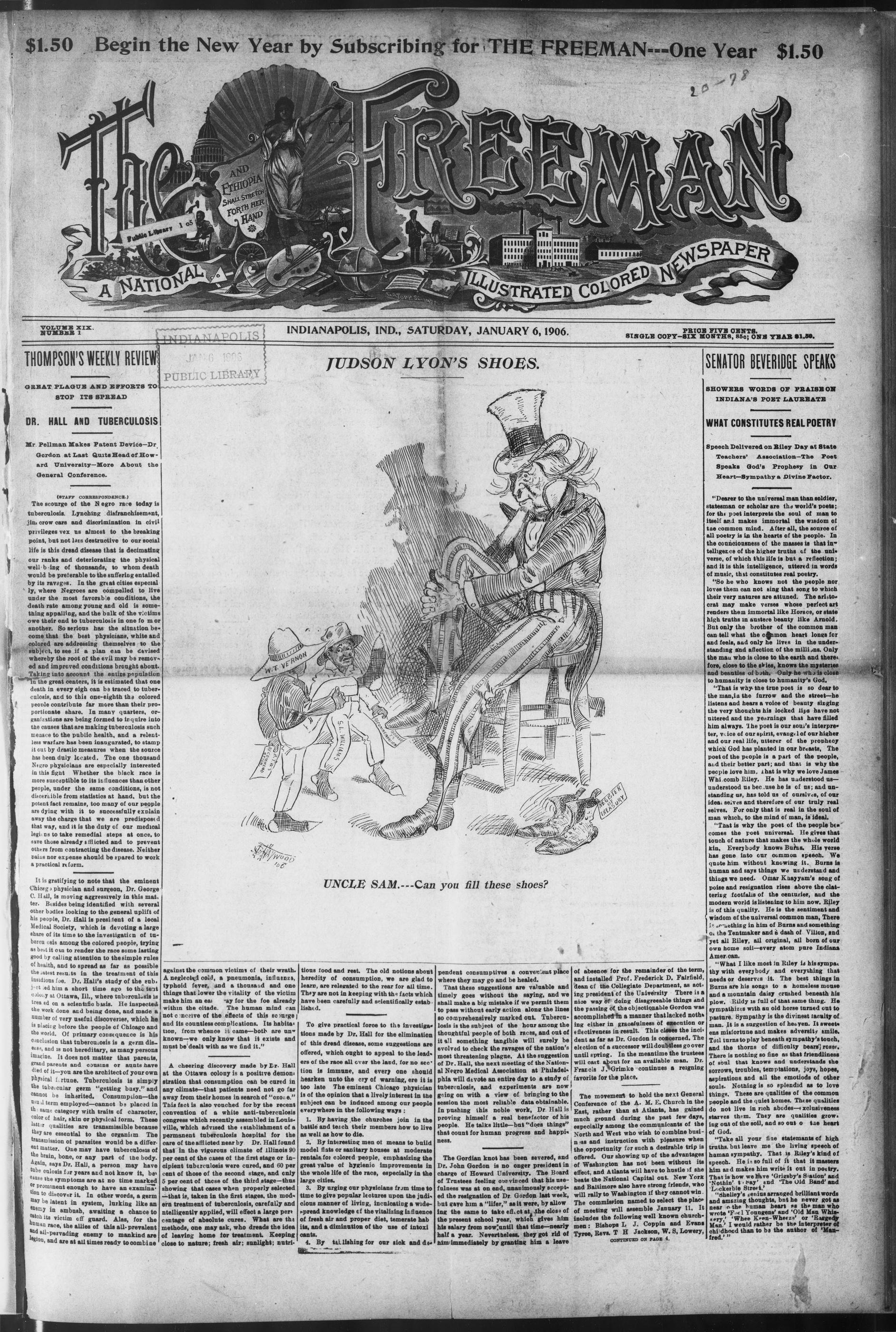
W.T. VERNON
S.L. WILLIAMS
REGISTER
OF
UNREASURY
G. WOOD
186
against the common victims of their wrath. A neglected cold, a pneumonia, influenza, typhoid fever, and a thousand and one things that lower the vitality of the victim make him an easy way for the foe already within the citade. The human mind can not receive of the effects of this source and its countless complications. Its habitat, from whence it came—both are unknown—we only know that it exists and must be dealt with as we find it."
A cheering discovery made by Dr. Hall at the Ottawa colony is a positive demonstration that consumption can be cured in any climate—that patients need not go far away from their homes in search of "ozoe." This fact is also vouched for by the recent convention of a white anti-tuberculosis congress which recently assembled in Louisville, which advised the establishment of a permanent tuberculosis hospital for the care of the afflicted near by Dr. Hall found that in the vigorous climate of Illinois 80 per cent of the cases of the first stage or incipient tuberculosis were cured, and 60 per cent of those of the second stage, and only 5 per cent of those of the third stage—thus showing that cases when properly selected—that is, taken in the first stages, the modern treatment of tuberculosis, carefully and intelligently applied, will effect a large percentage of absolute cures. What are the methods, one may ask, who dreads the idea of leaving home for treatment. Keeping close to nature: fresh air; sunlight; nutri-
JUDSON LYON'S SHOES.
UNCLE SAM.----Can you fill these shoes?
tions food and rest. The old notions about heredity of consumption, we are glad to learn, are relegated to the rear for all time. They are not in keeping with the facts which have been carefully and scientifically established.
To give practical force to the investigations made by Dr. Hall for the elimination of this dread disease, some suggestions are offered, which ought to appeal to the leaders of the race all over the land, for no section is immune, and every one should hearken unto the cry of warning, ere it is too late. The eminent Chicago physician is of the opinion that a lively interest in the subject can be induced among our people everywhere in the following ways:
1. By having the churches join in the battle and teach their members how to live as well as how to die.
2. By interesting men of means to build model flats or sanitary houses at moderate rentals for colored people, emphasizing the great value of hygienic improvements in the whole life of the race, especially in the large cities.
3. By urging our physicians from time to time to give popular lectures upon the judicious manner of living, inculcating a widespread knowledge of the vitalizing influence of fresh air and proper diet, tamerate habits, and a diminution of the use of intoxicants.
4. By tail lishing for our sick and de
pendent consumptives a convenient place where they may go and be healed.
That these suggestions are valuable and timely goes without the saying, and we shall make a big mistake if we permit them to pass without early action along the lines so comprehensively marked out. Tuberculosis is the subject of the hour among the thoughtful people of both races, and out of it all something tangible will surely be evolved to check the ravages of the nation's most threatening plague. At the suggestion of Dr. Hall, the next meeting of the National Negro Medical Association at Philadelphia will devote an entire day to a study of tuberculosis, and experiments are now going on with a view of bringing to the session the most reliable data obtainable. In pushing this noble work, Dr. Hall is proving himself a real benefactor of his people. He talks little—but "does things" that count for human progress and happiness.
The Gordian knot has been severed, and Dr. John Gordon is no longer president in charge of Howard University. The Board of Trustees feeling convinced that his usefulness was at on end, unanimously accepted the resignation of Dr. Gordon last week, but gave him a "lifer," as it were, by allowing the same to take effect at the close of the present school year, which gives him his salary from now until that time—nearly half a year. Nevertheless, they got rid of him immediately by granting him a leave
PRICE FIVE CENTS.
SINGLE-SIX MONTHS, 85c; ONE YEAR $1.50.
of absence for the remainder of the term, and installed Prof. Frederick D. Fairfield, dean of the Collegiate Department, as acting president of the University. There is a nice way of doing disagreeable things and the passing of the objectionable Gordon was accomplished in a manner that lacked nothing either in gracefulness of execution or effectiveness in result. This closes the incident as far as Dr. Gordon is concerned. The election of a successor will doublest go over until spring. In the meantime the trustees will cast about for an available man. Dr. Francis J. Grimke continues a reigning favorite for the place.
The movement to hold the next General Conference of the A. M. E. Church in the East, rather than at Atlanta, has gained much ground during the past few days, especially among the communicants of the North and West who wish to combine business and instruction with pleasure when the opportunity for such a desirable trip is offered. Our showing up of the advantages of Washington has not been without its effect, and Atlanta will have to hustle if she beats the National Capital out. New York and Baltimore also have strong friends, who will rally to Washington if they cannot win. The commission named to select the place of meeting will assemble January 11. It includes the following well known churches: Bishops L. J. Coppin and Evans Tyree, Reva T H Jackson, W. S. Lowery,
SENATOR BEVERIDGE SPEAKS
SHOWERS WORDS OF PRAISE ON INDIANA'S POET LAUREATE
WHAT CONSTITUTES REAL POETRY
Speech Delivered on Biley Day at State Teachers' Association—The Poet Speaks God's Prophey in Our Heart—Sympathy a Divine Factor.
"Dearer to the universal man than soldier, statesman or scholar are the world's poets; for the poet interprets the soul of man to itself and makes immortal the wisdom of the common mind. After all, the source of all poetry is in the hearts of the people. In the consciousness of the masses is that intelligence of the higher truths of the universe, of which this life is but a reflection; and it is this intelligence, uttered in words of music, that constitutes real poetry.
"So he who knows not the people nor loves them can not sing that song to which their very natures are attuned. The aristocrat may make verses whose perfect art renders them immortal like Horace, or state high truths in austere beauty like Arnold. But only the brother of the common man can tell what the common heart longs for and feels, and only he lives in the understanding and affection of the milliens. Only the man who is close to the earth and there fore, close to the skies, knows the mysteries and beauties of both. Only he who is close to humanity is close to humanity's God.
"That is why the true poet is so dear to the man, in the furrow and the street—he listens and hears a voice of beauty singing the very thoughts his locked lips have not uttered and the yearnings that have filled him always. The poet is our soul's interpreter, voice of our spirit, evangel of our higher and our real life, utterer of the prophecy which God has planted in our breasts. The poet of the people is a part of the people, and their better part; and that is why the people love him. That is why we love James Whi comb Riley. He has understood us—understood us because he is of us; and unstanding us, has told us of ourselves, of our idea, selves and therefore of our truly real selves. For only that is real in the soul of man which, to the mind of man, is ideal.
"That is why the poet of the people becomes the poet universal. He gives that touch of nature that makes the whole world kin. Everybody knows Burns. His verse has gone into our common speech. We quote him without knowing it. Burns is human and says things we understand and things we need. Omar Kaayyam's song of poise and resignation rises above the clattering footfalls of the centuries, and the modern world is listening to him now. Riley is of this quality. He is the sentiment and wisdom of the universal common man. There is something in him of Burns and something on the Tentmaker and is dash of Vilson, and yet all Riley, all original, all born of our own home soil—every atom pure Indiana Amer can.
"What I like most in Riley is his sympathy with everybody and everything that needs or deserves it. The best things in Burns are his songs to a homeless mouse and a mountain daisy crushed beneath his plow. Rildy is full of that same thing. He sympathizes with an old horse turned out to pasture. Sympathy is the divinest faculty of man. It is a suggestion of heaven. It sweetens misfortune and makes adversity amile. Toil turns to play beneath sympathy's touch, and the thorns of difficulty bears' rose. There is nothing so fine as that friendiness of soul that knows and understands the sorrows, troubles, temptations, joys, hopes, aspirations and all the emotions of other souls. Nothing is so splendid as to love things. These are qualities of the common people and the quiet homes. These qualities do not live in rich abodes—exclusiveness starves them. They are qualities growing out of the soil, and so out o the heart of God.
"Take all your fine statements of high truths, but leave me the living speech of human sympathy. That is Riley's kind of speech. He is so full of it that it masters him and makes him write it out in poetry. That is how we have 'Grisby's Station' and 'Nothin's stay' and 'The Old Band' and 'Lockerbie Street.' "Shelley's genius arranged brilliant words and amazing thoughts, but he never got as near to the human heart as the man who wrote 'When Koeen-Whiezes' or 'Raggedy Man.' I would be rather the interpreter of childhood than to be the author of 'Man-fred.'"
BY "DOROTHY."
This column is devoted to the interests of women. Address all communications to the Woman's Department, The Freeman, Indianapolis, Ind.
Alfred Fowler, B. A., of Chicago, has written a new book called "Curiosities of Kissing." Mr. Fowler has eight divisions of kisses.
The kiss of passion.
The parental and filial kiss.
The kiss of affection (always between women.)
The devotional kiss.
The fraternal kiss.
The kiss of curiosity.
The kiss of treachery.
The fleshly, evil kiss.
All of which; he is free to maintain.
The author is modestly personified.
In his forward he declares:
"The Song of Kissing is the song of love, love immortal and young and in the endless succession of lovers. Its music is the melody of the heart and the poetry of the soul. Its rapture is the charm of youth, the joy of manhood and the beautitude of old ago.
"It is especially for all such, who have heartfelt longings for 'some individual solace-dear' that this little book is sent forth on its mission of helpfulness and suggestion in divine art of kissing, to the attaining of the much-sought goal—matrimony. For, truly, to marry aright is to solve the riddle of life"
Mr. Fowler does not rely altogether upon his own judgment of kisses. He quotes the definitions of a score of authors. The best of these are:
"Kisses are the messengers of love — Optiz.
"Kisses! They are the blossoms of
love.-Ninon de L'Enolos.
"Kisses are love's great gallery.—
Grashaw.
"A kiss is not the feast; it is an invi-
tation to the feast.-Randolph.
"A kiss is the door that opens the ot-
tadel of the heart.-De Levis.
"What is a kiss? A receipt given by
the lady on your paying your address.
-Wit and Humor.
"A kiss is at once the token of bold-
FORD'S
HAIR POMADE
Formerly known as
"OZONIZED OX MARROW"
so
STRAIGHTENS
the Ozonized Ox Marrow Co.
(None genuine without my signature)
Charlie Ford Press
Wabash Ave, Chicago, Ill.
ats wanted everywhere.
HAIR SWITCHES
Bangs and Wigs of Every Description.
this Country for Colored People.
50 buc a single braided made of Black
Kinky Hair 16 inches long.
75 buc a single braided made of Black
Kinky Hair 16 inches long.
$1.00 buys a Creole Switch, 16 inches
long, Brown or Black.
$1.25 buys a Creole Switch, 20 inches
long, Brown or Black.
$1.75 buys a Creole Switch, 22 inches
long, Black or Brown.
$3.50 buys a Creole Switch, Wavy, Hand-
made, Switch like cut.
Send sample of hair when ordering
Creole Switches.
Send sample of hair with order and get
your goods by return mail. Send
stamp for catalogue.
THE FREEMAN. AN ILLUSTRATED COLORED NEWSPAPER.
ness, confidence and affection,—Nephus.
"A kiss is an alms which enriches him who receives without impoverishing her who gives—Ninon de L'Eacios."
"When two hearts are charged with love's electricity, a kiss is the burning contact, the wild, leaping flame of love's enthusiasm,—G. D. Prentice."
From the folk-lors of all the world Mr. Fowler has gathered these gems:
"If a dark-complexioned man who is in love with you, kisses you, expect a proposal.
"There are no less than eight signs of kissing: Salutation, valediction, reconciliation, subjection, approbation, adoration, treachery and love.
"A kiss on the forehead signifies respect and admiration for intellect."
"A kiss on the cheek signifies admiration for beauty.
"A kiss on the nose shows awkwardness.
"A kiss on the chin shows an appreciation of something.
"A kiss on the hand shows timidity and homage.
"A kiss on the lips signifies love.
"A short kiss, carelessness.
"A long kiss, passionate devotion."
In the chapter devoted to the ethnology of kissing, Mr. Fowler's research discloses that the kiss was unknown among the aboriginal tribes of America and Africa. He says:
"The Mongolian kiss, however, is not the same as that which prevails with us. In it the lips do not touch the surface the person kissed. The nose is brought into light contact with the cheek, fore head or hand, the breath is drawn slowly through the nostrils, and the act ends with a slight smack of the lips."
The Woman's O. D. T. Club of South Bend, Ind., was the first to send in membership to the Colored Woman's State Federation of Indiana with a membership of nineteen.
---
Mrs. Frances J. Granderson of Richmond, Va., is one of the three colored women in that State that holds the position of notary public. For a number of years she was a clerk and stenographer in the True Reformers Bank. Mrs. Granderson is well patronized by both races.
+
May Irwin thinks the blues a disease.
She says it must be checked before it
becomes chronic. Worry, she believes,
is as dangerous to the mind as poison to
the stomach.
Here are a few of her after dinner re-
flections on the subject:]
"Whose troubles do we worry about? Our own, every time. Twenty women have the blues to one man. That is because they think about themselves more than men do. Their world is smaller and every time they have the blues it shrinks a little more. By and by, if they don't look out, it will treat them as the contracting room did the prisoner. Its walls moved in upon him closer and closer, until at last they crushed him to death. Every person is repeating that legend who dwells constantly upon 'me' and 'mine' and 'myself'. The woman who has the glorious faculty of getting out of herself, of casting away her personality as she throws off her cloak for a time has never more than a bowing acquaintance of the blues.
"It is as easy for a person to get the idea that everything is against her and that her affairs are going to the toy spaniels as it is for a stone to fall to the ground, but she ought to fight it as desperately as she fights the janitor of her flithouse and on the same principle of self-preservation."
+
The women employees of the City Hospital of Cincinnati are compelled to wear coats or lose their jobs. Women in corrsets are mopping the floors, serving the meals and doing all sorts of work that requires free use of the body. Even the women in the laundry must not go without them.
The fact that some one else does it is society's excuse.
TUCSON, ARIZONA.
We send this communication from far away Arizona as the Negro Business Men's Organization, and the representatives of several hundred colored citizens and voters of this Territory.
Our reasons for sending you this, we are now on the verge of statehood and would be pleased to have our Eastern and Southern friends to know no place or spot in America is more ideal for a home, for the advancement in the agricultural, commercial and financial lines than is offered by Arizona.
Our climate surpasses that of any other place in our borders, from January to January under the bright sun and balmy air in these fertile valleys where thousands of acres of land
belonging to the United States Government can be homesteaded by any American citizen. One hundred-and sixty acres for $16 or less, proportioned if desired, for less money. Said lands only require water for irrigation purposes to produce vegetation and the government has appropriated three million and a half dollars to build the Roosevelt dam for irrigation purposes which will irrigate three quarters of a million acres of land. The water is given to the gardener or farmer at a minimum price.
We see no reason why the American Negro should not take advantage of such opportunities. Our school system can not be surpassed, as to the education of our children both in cities and counties, all fare alike. Mining interests are all O K. This is the greatest copper-producing country in the world, also gold, silver and coal. Our forest is very dense in the northern part of the territory. The copper smelters at Bisbse, Douglas and Caranea need no comment as to what business they will bring to any state or territory. We are anxious to let our people know that this is the most interesting field forenterprising business men and farmers in this country, and will be glad to have them come this way before the foreigners settle here and gobble up these golden opportunities.
CON A. RIDEOUT.
J. W. RAVEN.
V. M. COLES.
J. C. CLEMMONS.
Committee
LETTER OF ENCOURAGEMENT
THE FREEMAN AND ITS STAFF
HIGHLY PRAISED
ONLY GOOD MATERIAL MUST LEAD
The Unity of the Race the Foundation of Its Success-Knowledge and Power Necessary Factors-Prayer for the New Year.
Editor The Freeman;
Having recently become a subscriber of your excellent paper I have only purused a few issues, yet I find myself very much lifted up in view of the progress and advanced condition of our race in literary attainments in the past few years of our opportunities. It is evident that we have not been looking back or reflecting on the hindrances and obstacles not usually barring our way. God has helped our weak endeavor and our motto has been onward and upward. The Freeman is a paper to be proud of and I feel that every Afro-American should respond in unison to help this medium so laudably supported by the intelligent portion of our race. Its several departments are worthy of interest and investigation and when we have a publication conducted and completed by our own race then we feel to acknowledge that notwithstanding all the stumbling blocks in our way that we are a progressive race and our perseverance will surely win for us the equality which comes to those who are not afraid to labor, wait, watch and pray.
We feel that God is for us and still is near. Although we have been a much desplied and neglected race, subjected to outrages and oppressed on every side; we are very much debarred and our way impeded by the race prejudice existing in our free America today, yet our heads are above the waves and we can thank God who ever stands on the side of the oppressed in the right. If we will only be a united people and trust in His promise, our race will steadily grow stronger and wiser until we can rise by our own effort to a nation of power, and the world will be compelled to respect our position, obtained by our own united influence as a prosperous and elevated race with the ability not only to say but to do. So men and women get interested in your race and get united, for on this only depends our success. We find less union among our people than any other race on earth which condition of affairs continually gives our enemy power to overcome the good we might do.
Let us get out of this rut and be honest with ourselves; stop naming and trying to undermine the best interest of your own race. Let us be a race of our own, building and uniting, organizing for ourselves, getting all the knowledge we can; putting confidence in each other and working for our own advancement. We have those who would destroy every principle of good emanating from their own race and yet they aspire to lead and their highest ambition is to wear gay clothes and gossip of their conquests, glorying in their own imaginations, and on investigation of their status we find them enemies to themselves and everything good. We have no need for those who are not the kind of material with which to build. We must have good reliable material to assist in elevating our race; We need knowledge and power to fit us to stand side by side with other action and command recognition
The Freeman
For the next Twelfemonth.
are told that we have a better publication for clean, concise and complete news or the race than any other newspaper in the country; better serious articles than any all-serious publication, and better timely articles than any other newspaper. We have the brightest and newest publication now extant, devoted to the best interests of all the Negro race. It contains the most important happenings concerning our people, Church Affairs, Woman's World, Race Gleanings, The Stage, The Field of Sport and Social and Society Happenings from everywhere. The Editorial Page has been made the equal of any of the Metropolitan papers of the country, if not better.
The liveliest topics of the day will be put before our readers by that very admirable correspondent, Mr. Richard W. Thompson, who is considered to be one of the leading journalists of the day. Mr. Thompson is a staff writer of this paper, who writes on difficult subjects with such singular fairness that every one almost believes that his word "is law."
Dr. M. A. Majors, whose "Major Melange" has scored a world of success in the many past years that it has appeared in this paper, will continue to brighten these columns with his very interesting lines.
Some of our columns will also be devoted to the best interests of the Head, Second and Side Waiters. These columns will be purely an education to the up-to-date waiter of the day.
The Woman's World, which has been so well recieved by our readers, will be a splendid feature in 1906. "Dorothy's" power as a writer of the womankind has become the equal of Mrs. Lila Wheeler Wilcox in mark of beauty. A woman who read an article in the proofs for the Woman's World, said: "Until now I never had any but a confused idea of what our women are doing and of what they could do to better their condition."
The World of Sports will be well taken care of by Mr. John L. Footslug, who has been right in the midst of it for years. Every kind of sport known will appear in these columns.
The Stage will come in for a great share of praise in the next twelve months. It will be prettily illustrated. Newsy letters of the stage from New York, Chicago and other cities will appear each week. The Freeman's Gallery, a newly added feature, will also appear. Brief reviews will be published from the pen of Messrs. Carle B. Cooke, Sylvester Russell and others.
The Art Department will be well cared for by our able cartoonist, Mr. Garfield T. Haywood, who is at its head. Perhaps there are few young men who have gained more prominence than Mr. Haywood, through his remarkable talent as a cartoonist. This office has been deluged with letters praising his work. It is the intention of the management to steadily improve in the next twelve months, in our department of art.
The "Top o' the Week" column, conducted by Mr. Charles Marshall, will continue to sparkle more than ever with bubbling wit and humor. He will constantly contribute for the benefit of the wise and the unwise
Agents wanted everywhere. Men and women, boys and girls in every walk of life who want to earn good incomes by securing subscriptions for The Freeman—the paper for wide-awake race lovers—now at $1.50 per year. The work is dignified. The Freeman at any price would be value received. It requires no capital or previous experience.
Address all communications to
account of our intelligence and financial position. This can be obtained only by our universal sentiment in one grand effort of uniting the race.
And now while the year is new, let the heart of every Afro-American feel a new interest in our race, unite far and near in striving for our success and ask for protection and prosperity, that we may become a more united race, a help to each other in church and state. May God bless The Freeman and its staff and the worthy agents, Mr. and Mrs. George H. Jones, who did such a landable work here in our city in securing subscribers and encouraging the good work of advancement at Keokuk. It is a pleasure to meet them, so interested in the race problem and from whom we receive so much encouragement. The Freeman is fortunate in securing such business workers. Much success and many hundred subscribers I hope for this worthy publication, and may the many readers of this grand medium of race news earnestly breathe this prayer: "Lord, help us to see that united we and must and form one family the wide world o'er; to clasp a brother's hand in one united band from shore to shore."
MRS. M. DAVIS.
Keokuk, Ia.
GALVESTON, TEXAS
The Mutual Aid Board of the United Brothers of Friendship of Texas met in this city at the U. B. F. Hall. The following members were present: President, W. F. Biedsee, Marshall; Secretary, F. W. Gross, Victoria; Treasurer, Joseph Nichols. Houston. The Secretary made the following report of receipts for three months:
States Bonds..... 100 00
For Home and Business Fund... 17.75
For National Grand Lodge
Total receipts for 3 months. . . $6925.08
The Board apportioned $4338.00 to pay death claims for the first quarter and endorsed the payment of the balance due on all standing claims, a total of $11,601.00 paid out since September 1st, 1905. The whole amount paid widows and orphans was $133,000.00.
Subscribe for The Freeman.
DALLAS, TEX.
All the churches held Christmas exercises, which were highly appreciated.—Mrs. Will Ransom and Mrs. Maggle Waift of St Louis spent the holidays here visiting relatives and friends.—Mrs. Andrew Hamley visited M. Arlington—Mrs. M. E. Payne gave in honor of her husband and daughter an "open door" reception from 10 a.m. to 9 p.m. Many useful and valuable presents were received.—Mrs. Josie Hardy served many callers on Christmas day.—Mr. and Mrs. Marshall Jackson served many of their friends Christmas day.—St. Johns day was credibly observed by the Masons of the city. Many grand papers were read on the history of the order since that ancient time.—Mr. and Mrs. Williams have moved into their new home on Cochran street.—Mr. Harrison Long visited his family during the holidays from St. Louis.—R. H. Claypool of the Territory was here hand shaking the past week; also Hon. Hiram Spears, the founder of Boley, I. T., and visiting relatives.—The Lymhurst Club entertained at Odd Fellows' Hall on the 27th.
ALEXANDRIA, LA.
On December 18th live Oak Lodge No. 25 K, of P., elected the following officers for the term beginning Jan. 1st and ending June 80th, 1906. T. T. Hudson, C. C., M. E Jase, V. C., Wm. Houston, Prelate, J. B Labargle, M. of W., H. C. Hudson, K. of R. & S. W. D. Pratter, M. of F., I. Davis, M. of E. Joel Tarver, M. at A., S. H. Thomas, Rep. to Grand Lodge, P. B. Bontemps, Alternate, Dr. J. P. Jones, Medical Examiner. The lodge is in a prosperous condition and is making preparation to entertain the Grand Lodge, which will convene in its Castle Hall the third Monday in April.—It has been raining here for two weeks almost incessantly together with the long quarantine that we had to undergo last summer makes business extremely dull.—The marriage of Miss Mary Williams to Mr. Willie Newton was solemnized at the home of the bride on Thursday, Dec. 14th. Rev. Davis of the First Union Baptist Church officiated.
The Freeman at Kansas City, Mo.
The Freeman is on sale each week in
Kansas City, Mo., at 108 East 138th
street. J. Turner Wall, grocery and
Meat Market, Confectionery, Fruits,
Cigars and Tobaccos. All friends are
welcome.
PHENOLOGIST, PALMIST AND CLAIRVOYANT
MADAM:McNAIRDEE-MOORE
Permanently Located at 1527
English Ave., Indianapolis.
Can be consulted on all affairs of life.
Her predictions are true and can be
relied upon.
THE MUSICAL THEATRE OF NEW YORK
Enclose one dollar and stamp and know your future, and what you are best adapted for to make success in life
Minkner & Haught
DEALERS IN
FISH, POULTRY AND GAME
FRESH OYSTERS DAILY
PHONES:
Old 4091 main. New 5104 Indiana Ave
The Freeman is on sale every Saturday in Memphis, Tenn., at G. J. Gary's news stand, 237 Beale street.
The Freeman's Headquarters
Persons in Macon, Ga., should see our representative, C. J. Crenshaw, corner Cherry street and Cotton avenue, and secure a copy of the Freeman for sale by him each week. Mr. Crenshaw is quite a hustling agent and deserves the support of all Macon citizens.
12
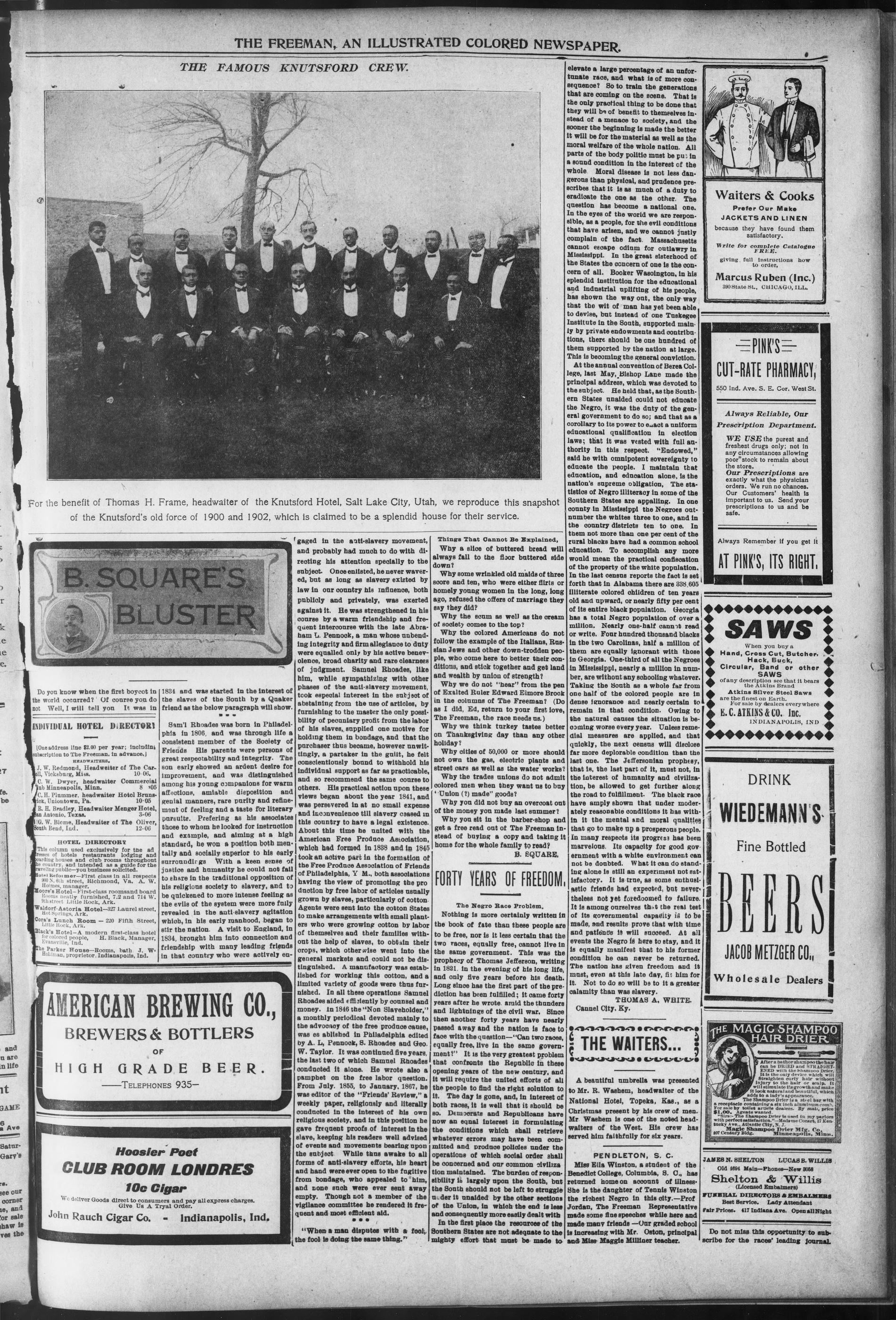
For the benefit of Thomas H. Frame, headwaiter of the Knutsford Hotel, Salt Lake City, Utah, we reproduce this snapshot of the Knutsford's old force of 1900 and 1902, which is claimed to be a splendid house for their service.
B. SQUARE'S
BLUSTER
AMERICAN BREWING CO.,
BREWERS & BOTTLERS
OF
HIGH GRADE BEER.
—TELEPHONES 935—
Hoosier Poet
CLUB ROOM LONDRES
10c Cigar
We deliver Goods direct to consumers and pay all express charges.
Give Us A Tryal Order.
John Rauch Cigar Co. - Indianapolis, Ind.
Do you know when the first boycot in the world occurred? Of course you do not Well, I will tell you It was in
INDIVIDUAL HOTEL DIRECTORY
[One address line $2.00 per year; including
subscription to The Freeman, in advance.]
HEADWAIRES.
J. W. Redmond, Headwater of The Car-
oll, Vicksburg, Miss. 10-06.
C. W. Dwyer, headwater Commercial
Sub Minneapolis, Minn. 8-05
C. H. Plummer, headwater Hotel Bruns-
wick, Uniontown, Pa. 10-05
R. H. Bradley, Headwater Menger Hotel,
San Antonio, Texas. 3-06
G. W. Blome, Headwater of The Oliver,
South Bend, Ind. 12-06
HOTEL DIRECTORY
This column used exclusively for the ad-
resses of hotels restaurants lodging and
boarding houses and club rooms throughout
the country, and intended as a guide for the
working public business solicited by the
Hotel Refomer—First class in all respects
900 N. 6th street, Richmond, Va. A. W.
Holmes, manager.
Moore's Hotel—First-class rooms and board
Rooms neatly furnished, 7.2 and 714 W.
Waldorf Astoria, Park, Arkansas.
Waldorf Astoria, Park, Arkansas.
Waldorf-Astoria Hotel—327 Laurel street,
Hot Springs, Ark.
Cora's Lunch Room — 220 Fifth Street,
Little Rock, Ark.
Black's Hotel-A modern first-class hotel
for colored people.
Knoxville, Ind.
The Parker House-Rooms, bath J. W.
Holiman, proprietor, Indianapolis, Ind.
THE FREEMAN, AN ILLUSTRATED COLORED NEWSPAPER
1834 and was started in the interest of the slaves of the South by a Quaker friend as the below paragraph will show.
Sam'l Rhoades was born in Philadelphia in 1806, and was through life a consistent member of the Society of Friends. His parents were persons of great respectability and integrity. The son early showed an ardent desire for improvement, and was distinguished among his young companions for warm affections, amiable disposition and genial manners, rare purity and refinement of feeling and a taste for literary pursuits. Prefering as his associates those to whom he looked for instruction and example, and aiming at a high standard, he won a position both mentally and socially superior to his early surroundings. With a keen sense of justice and humanity he could not fall to share in the traditional opposition of his religious society to slavery, and to be quickened to more intense feeling as the evils of the system were more fully revealed in the anti-slavery agitation which, in his early manhood, began to stir the nation. A visit to England, in 1834, brought him into connection and friendship with many leading friends in that country who were actively en-
gaged in the anti-slavery movement, and probably had much to do with directing his attention specially to the subject. Once enlisted, he never wavered, but as long as slavery existed by law in our country his influence, both publicly and privately, was exerted against it. He was strengthened in his course by a warm friendship and frequent intercourse with the late Abraham L. Pennock, a man whose unbending integrity and firm allegiance to duty were equalled only by his active benevolence, broad charity and rare clearness of judgment. Samuel Rhoades, like him, while sympathizing with other phases of the anti-slavery movement, took especial interest in the subject of abstaining from the use of articles, by furnishing to the master the only possibility of pecuniary profit from the labor of his slaves, supplied one motive for holding them in bondage, and that the purchaser thus became, however unwittingly, a partaker in the guilt, he felt conscientiously bound to withhold his individual support as far as practicable, and so recommend the same course to others. His practical action upon these views began about the year 1841, and was persevered in at no small expense and inconvenience till slavery ceased in this country to have a legal existence. About this time he united with the American Free Produce Association, which had formed in 1838 and in 1845 took an active part in the formation of the Free Produce Association of Friends of Philadelphia, Y. M., both associations having the view of promoting the production by free labor of articles usually grown by slaves, particularly of cotton. Agents were sent into the cotton States to make arrangements with small planters who were growing cotton by labor of themselves and their families without the help of slaves, to obtain their crops, which otherwise went into the general markets and could not be distinguished. A manufactory was established for working this cotton, and a limited variety of goods were thus furnished. In all these operations Samuel Rhoades aided efficiently by counsel and money. in 1846 the "Non Slaveholder," a monthly periodical devoted mainly to the advocacy of the free produce cause, was escribed in Philadelphia edited by A. L. Pennock, S. Rhoades and Geo. W. Taylor. It was continued five years, the last two of which Samuel Rhoades conducted it alone. He wrote also a pamphlet on the free labor question. From July, 1855, to January, 1867, he was editor of the "Friends' Review," a weekly paper, religiously and literally conducted in the interest of his own religious society, and in this position he gave frequent proofs of interest in the slave, keeping his readers well advised of events and movements bearing upon the subject. While thus awake to all forms of anti-slavery efforts, his heart and hand were ever open to the fugitive from bondage, who appealed to him, and none such were ever sent away empty. Though not a member of the vigilance committee he rendered it frequent and most efficient aid.
"When a man disputes with a fool, the fool is doing the same thing."
Things That Cannot Be Explained,
Why a slice of buttered bread will always fall to the floor buttered side down?
Why some wrinkled old maids of three score and ten, who were either flirts or homely young women in the long, long ago, refused the offers of marriage they say they did?
Why the scum as well as the cream of society comes to the top?
Why the colored Americans do not follow the example of the Italians, Russian Jews and other down-trodden people, who come here to better their conditions, and stick together and get land and wealth by union of strength?
Why we do not "hear" from the pen of Exalted Ruler Edward Elmore Brook in the columns of The Freeman? (Do as I did, Ed, return to your first love, The Freeman, the race needs us.)
Why we think turkey tastes better on Thanksgiving day than any other holiday?
Why ottes of 50,000 or more should not own the gas, electric plants and street cars as well as the water works?
Why the trades unions do not admit colored men when they want us to buy 'Union (?) made' goods?
Why you did not buy an overcoat out of the money you made last summer?
Why you sit in the barber-shop and get a free read out of The Freeman instead of buying a copy and taking it home for the whole family to read?
FORTY YEARS OF FREEDOM.
The Negro Race Problem.
Nothing is more certainly written in the book of fate than these people are to be free, nor is it less certain that the two races, equally free, cannot live in the same government. This was the prophecy of Thomas Jefferson, writing in 1821. in the evening of his long life, and only five years before his death. Long since has the first part of the prediction has been fulfilled; it came forty years after he wrote, amid the thunders and lightnings of the civil war. Since then another forty years have nearly passed away and the nation is face to face with the question—"Can two races, equally free, live in the same government?" It is the very greatest problem that confronts the Republic in these opening years of the new century, and it will require the united efforts of all the people to find the right solution to it. The day is gone, and, in interest of both races, it is well that it should be so. Democrats and Republicans have now an equal interest in formulating the conditions which shall retrieve whatever errors may have been committed and produce policies under the operations of which social order shall be concerned and our common civilization maintained. The burden of responsibility is largely upon the South, but the South should not be left to struggle under it unsaid by the other sections of the Union, in which the end is less and consequently more easily dealt with. In the first place the resources of the Southern States are not adequate to the mighty effort that must be made to
elevate a large percentage of an unfortunate race, and what is of more consequence? So to train the generations that are coming on the scene. That is the only practical thing to be done that they will be of benefit to themselves instead of a menace to society, and the sooner the beginning is made the better it will be for the material as well as the moral welfare of the whole nation. All parts of the body politic must be put in a sound condition in the interest of the whole. Moral disease is not less dangerous than physical, and prudence prescribes that it is as much of a duty to eradicate the one as the other. The question has become a national one. In the eyes of the world we are responsible, as a people, for the evil conditions that have arisen, and we cannot justly complain of the fact. Massachusetts cannot escape odium for lawlawy in Mississippi. In the great sisterhood of the States the concern of one is the concern of all. Booker Wasolington, in his splendid institution for the educational and industrial uplifting of his people, has shown the way out, the only way that the wit of man has yet been able to devise, but instead of one Tuskegee Institute in the South, supported mainly by private endowments and contributions, there should be one hundred of them supported by the nation at large. This is becoming the general conviction.
At the annual convention of Berea College, last May, Bishop Lane made the principal address, which was devoted to the subject. He held that, as the Southern States unaided could not educate the Negro, it was the duty of the general government to do so; and that as a corollary to its power to enact a uniform educational qualification in election laws; that it was vested with full authority in this respect. "Endowed," said he with omnipotent sovereignty to educate the people. I maintain that education, and education alone, is the nation's supreme obligation. The statistics of Negro illiteracy in some of the Southern States are appalling. In one county in Mississippi the Negroes outnumber the whites three to one, and in the country districts ten to one. In them not more than one per cent of the rural blacks have had a common school education. To accomplish any more would mean the practical confiscation of the property of the white population. In the last census reports the fact is set forth that in Alabama there are 338,605 illiterate colored children of ten years old and upward, or nearly fifty per cent of its entire black population. Georgia has a total Negro population of over a million. Nearly one-half cannot read or write. Four hundred thousand blacks in the two Carolinas, half a million of them are equally ignorant with those in Georgia. One-third of all the Negroes in Mississippi, nearly a million in number, are without any schooling whatever. Taking the South as a whole far from one half of the colored people are in dense ignorance and nearly certain to remain in that condition. Owing to the natural causes the situation is becoming worse every year. Unless remedial measures are applied, and that quickly, the next census will disclose far more deplorable condition than the last one. The Jeffersonian prophecy, that is, the last part of it, must not, in the interest of humanity and civilization, be allowed to get further along the road to fulfillment. The black race have amply shown that under moderately reasonable conditions it has with in it the mental and moral qualities that go to make up a prosperous people. In many respects its progress has been marvelous. Its capacity for good government with a white environment can not be doubted. What it can do standing alone is still an experiment not sat isfactory. It is true, as some enthusiastic friends had expected, but never theless not yet foredoomed to failure. It is among ourselves that the real test of its governmental capacity is to be made, and results prove that with time and patience it will succeed. At all events the Negro is here to stay, and it is equally manifest that to his former condition he can never be returned. The nation has given freedom and it must, even at this late day, fit him for it. Not to do so will be to it a greater calamity than was slavery.
THOMAS A, WHITE.
Cannel City, Ky.
THE WAITERS...
A beautiful umbrella was presented to Mr. R. Washem, headwaiter of the National Hotel, Topeka, Kas., as a Christmas present by his crew of men. Mr Washem is one of the noted headwaiters of the West. His crew has served him faithfully for six years.
PENDLETON, S. C.
Miss Ella Winston, a student of the Benedict College, Columbia, S. O., has returned home on account of illness. She is the daughter of Tennis Winston the richest Negro in this city—Prof Jordan, The Freeman Representative made some fine speeches while here and made many friends—Our graded school is increasing with Mr. Oston, principal and Miss Margie Milliner teacher.
COOKS
Waiters & Cooks
Prefer Our Make
JACKETS AND LINEN
because they have found them
satisfactory.
Write for complete Catalogue
FREE.
giving full instructions how
to order,
Marcus Ruben (Inc.)
390 State St., CHICAGO, ILL.
PINK'S
CUT-RATE PHARMACY,
550 Ind. Ave. S. E. Cor. West St.
Always Reliable, Our Prescription Department.
WE USE the purest and freshest drugs only; not in any circumstances allowing poor stock to remain about the store.
Our Prescriptions are exactly what the physician orders. We run no chances. Our Customers' health is important to us. Send your prescriptions to us and be safe.
Always Remember if you get it
AT PINK'S, ITS RIGHT.
SAWS
When you buy a
Hand, Cross Cut, Butcher,
Hack, Buck,
Circular, Band or other
SAWS
of any description see that it bears
the Atkins Brand
Atkins Silver Steel Saws
are the finest on Earth.
For sale by dealers everywhere
E. C. ATKINS & CO. Inc.
INDIANAPOLIS, IND
DRINK
WIEDEMANN'S
Fine Bottled
BEERS
JACOB METZGER CO.,
Wholesale Dealers
THE MAGIC SHAMPOO HAIR DRIER
After a bath shampoo the hair can be DRIED and STRAIGHT. It is by the shampoo that it is the only shampoo which will straighten curly hair without impurity. To make hair so it will stimulate its growth and make it look natural and beautiful, which adds to its elegance. The Shampoo Drier is a steel bar with a receptacle containing a six inch aluminum combo. For sale by tolls, varied dealers. By mail, price $1.00. Agents wanted. Shampoo Drier is used in my parlor with perfect satisfaction. Madane Cozart, 17 Kentucky Ave., Atlantic City, N. J.
Magic Shampoo Drier Mfg. Co.
407 Century Blvd.
Minneapolis, Minn.
JAMES N. SHELTON
LUCAS B. WILLIS
Old 4604 Main-Phones-New 3068
Shelton & Willis
(Licensed Embalmers)
FUNERAL DIRECTORS & EMBALMERS
Best Service. Lady Attendant
Fair Prices. 417 Indiana Ave. Open all Night
Do not miss this opportunity to subscribe for the races' leading journal.
———
A NATIONAL ILLUSTRATED |
COLORED NEWSPAPER.
PUBLISHED EVERY SATURDAY
a At 309 Indians Avenue,
INDIANAPOLIS, INDIANA,
SUBSCRIPTION RATES :
“Any part of the United States and Can
Sng ong. postage Pals ae
WatePrncusy by sxpccia, money otder, pout
office order or registered letter. d
‘Agents wanted every town and city not
me ee ‘and liberal inducements will be
igen is thease, Bend for our extraordinary
ADVERTISING RATES:
Fivecents per line. Faso of measure—solid
Beetlatpoulton2operceat adcitousl: Ew"No
SR rei faksrict'on Aratbane: Special
alos om, standing profesioral aad anineag
ards. "Reasonable discount for long thoand
es sm nae Oo ee Hom Roel
tered at the postofficn at Indiana
sunteet es Secaed cass water wouanaPotis
All matter should be addressed to
The Freeman Publishing
Company,
INDIANAPOLIS, - - INDIANA.
—
SALUKDAY, TAN, 6, 1900.
eT ee ee er ane eee wnt
The ministers of this city all preached
sermons on Sunday last on the subject of
‘Sabbath desecration. Wewish it had been
possible to have :aken phonographic records
of all of them, for we confess that we should
have enjoyed hearing all of them. Asit
‘was we only heard one of them, There is
no doubt that many of them weyp excellent,
‘and were pitched on a high moral and
sthical plain. Most of them were quite
certain to take the ground that the Sabbath
day should be kept holy because the Bible
said so. It has appeared to us for a long
time that this was not a good reason for
doing anything. We realize that we tread
dangerous ground when we say so, not-
withstanding the fact that most of those
who object to our saying what we do fail
to obey some of its plainest teachings.
We believe that the value of a saying or a
‘commandment is the truth that lies back
of it—the good that comes from its accept-
ance, The result justifies the doing. It
Is for this reason that precepts and princi-
ples and commandments are given, Hence
we are of the opinion that a minister can
be more successful in leading his hearers
to keep commandments by showing the
reasons back of them, and the good that
follows their obedience. Nor canwe quite
understand how a minister who argues that
the Sabbath should be kept because the
day, ltself, is holy, can also argue that we
should rest on that day because we need
rest, This could not apply to a people who
do not need rest. People are not s0 likely
to overwork themselves as they are to over
rest themselves and a commard to rest on
the Sabbath day should also be understood
to imply the command to work on the
other six days. Hubbard's commandment
—Remember the week day to keep it
holy," is certainly a good one. ‘This may
be done in the midst of our work. We
question whether the idle can keep any day
holy, for, if there are sins, voluntary idle-
ness must be one of them, It is not at all
Improbable that the idea of “‘xeeping a day
holy"’ came at a time when religious con-
duct meant sacrifices, and offerings and
performances of one kind or another. The
people could not attend to these things and
work. ‘The man who worked at such times
‘was supposed to be indifferent to religion,
and hence came the idea of sin by doing
work on the Sabbath. This conjecture of
fone who does not claim to know much
about theology is ag good a one, at least,
as the idea that work, in itself, can be
wrong when done at any time; or that a
day, or any space of time could, in itself,
be holy.
We believe that Sunday or some other
day should have been set apart as a day
for rest and worship. Our only difference
with some of the clergy is on the reasons]
for it, and this difference makes a great
difference. We also believe that the end
soug +t Is desirable and that Itcan be reach-
ed soonest by pointing to things that ae
positively evil, and by denouncing them
because they are evil. There is much
need for valiant service in combatting the
hosts of sin, but we shall be well on toward
the mfilineum before the sin of buying a
loaf of bread on Sunday morning deserves
i a am ii?
STATEHOOD AND CONGRESS
There seems to be something radically
wrong in the statehood measures that are
to come up before Congress. There is a
slight suspicion that the forces back of the
‘attempt to admit Arizona and New Mexico
as one State are the lumber and mining
Interests in these territories, It is even
asserted that these interests do not want
statehood in any form; that they favor the
present bill because they know that the
THE FREEMAN, AN ILLUSTRATED COLORED NEWSPAPER,
people residing there do not want it, and
thelr opposition that Is sure to be brought
against joint statehood wi be the cause of
them remaining territories. It is further
alleged that the supporters of this bill are
trying to befog the issue by claiming that
the lumber and mining Interests are op-
posed to the present bill, whereas they are
opposed to any bill. The men back of
these interests know that it Is easier to
plunder a countryjunder a territorial form
of government than to plunder one under
a State government. These interests, by
escaping State regulation and State taxes,
can operate much mcre to- their profit.
Hence thelr opposition to statehood for
Arizona and New Mexico.
‘There are so many tricks and deceptions
in measures to which some apparently
honorable men lend their influence that it
will pay to look§well into these measures
Proposed ostensibly for the benefit of the
people. We confess that we should like to
see Oklahoma and Indian Territory remain
‘as at present because we do not believe
that a State government will bring any
‘benefit to the freedmen and Indians, Our
observation has not led us to believe that
these people will receive much considera-
tion from the white population residing
there. We hope, however, that we may
be agreeably disappointed.
JAMES WHITCOMB RILEY.
The biblical saying that ‘‘a prophet is no!
without honor, save in his own country,"
does not fit the poet-prophet, if we judge
by the honor paid to James Whitcomt
Riley by the State Teachers Association
on December 28th in this city. It was an
honor of which any man might feel proud
because it was more spontaneous and gen-
uine than that which goes out to any other
citizen of Indiana.
The poets of the world have always been
mankind's truest prophets, in that they have
always stood heart to heart with mankind ;
have shared thelr crusts of sorrow and
drunk from the cup of thelr misery. And
in thelr darkest days the poet has sung
their longings, and hopes, and ambitions,
and rejoiced with them at the fulfiliment.
What ought to be willbe. Righteous hopes
and longings ought to be realized So,
when the poet sings our heart longings he
Js but a prophet foretelling joys that are to
come.
Poetry is the musical expression of some
form of love It was the poets love for
‘humanity that made him share its joys and
sorrows, This human sympathy is the
dominant chord in Riley's poetry. He
wastes no time in dealing with things at a
distance, or in following the tortuous wind-
ings of some dry intellectual apprehensions.
He stays right on the ground with the peo-
ple, living heart to heart with them, and he
weaves their feelings and emotions into
song. He sings what they feel, but can
not express. Asa Poet Laureate he would
be a failure because his harp is not attuned
for singing to the nobility. His home is
among the common people and his heart
fs with them. This is what bas won for
him the place he now holds in the esteem
and affections of the people in and out of
this State. It will go unquestioned that
when measured by the hold he has on the
People James Whitcomb Riley is the big-
gest man Indiana has produced.
Covernor Herrick of Ohio has spoken
out squarely against all forms of graft and
boodle. But his conversion comes a little
late. When we aredriven to moral ground
we get little credit for taking it, A stand
against these things a year ago and Gov.
Herrick would have been his own successor
on January 6h instead of a defeated can-
didate. Ohio will have a rather mixed
condition of things with a Democratic Gov-
ernor, a Republican Lieut-Governor and
the Senate standing 18 Republicans, 18
Democrats and one Independent; and the
House with 62 Republicans and 59 Dem-
ccrats. Let us hope that this mixture was
the result of the people choosing the best
of each.
‘The Appeal to Reason, a socialist publica-
tlon sent out from Girard, Kansas, sent out
‘a “trust edition’” on December 9th of three
million copies, every one of which was
paid for when mailed. This beats the
record of any publication in the history of
the world, ‘That paper Is opposed to pres-
ent conditions, and hence is in disfavor with
the press of the country, but had this great
thing been done by some of our plutocratic
publications it would have been told the
world over. As It is one must walt for
such news to travel by freight.
If many of oor D. D.'s were M, D.'s and
practiced ‘medicine like they do theology,
they would be arrested for malpractice be-
fore Monday morning.
In Louis Ludlow's Washington corres-
pondence to the Indianapolis Star he states
that the marriage of Dr. Harry Furniss to
aGerman woman is confirmed. He also
states that “‘there is uo disposition at the
State Department to criticize Furniss for
marrying awhite woman. “If they desired
to get married, that was their business,"
said Sydney Y. Smith, chief of the Diplo-
metic Bureau. “ts a matter with which
the State Department is not concerned.
At least that is my opinion.”
‘Well, we do not see that any other view
could be taken. If any care to make fools
of themselves about this matter it should
be some one not representing the govern-
ment.
‘The-play of Sapho by Miss Olga Nether-
sole is not to be allowed in New Haven,
Conn., unles some of the objectionable
parts are omitted or changed. This an-
nouncement, through the daily press, Is
quite likely to be a good advertisement to
the play and add to its popularity.
‘The thing that we must learn 1s co-op-
peration, There are very few among us
who are able to take advantage of large
industrial opportunities alone. Twenty-
five or a hundred or five hundred acting
in concert can accomplish great things.
In an address before the Y. M. C. A. on
last Sunday Rev. Geo. P. Brabham used
these words: “‘In the development of the
present civilization if you do not do your
part of the work no one else will, If you
do not do it that part will he left undone."”
Governor Hanly has a great opportunity
to show that he stands for something more
than being a politician, and so far he has
done well, The people are with him and
the politicians will have to bs with him or
else step down and out for good.
‘There is nothing which the reading pub-
lic tires of any sooner than the brazen
boasting of some writer who mistakes him-
self for a genius and imagines that the
world is waiting to be guided by his utter-
Neil.
‘We feel sorry for all those who were not
in Indiana on New Year's day. It wasa
regular Souther: California day. It is
barely possible that it lapped over the
edges of the State and touchedothers. We
hope so.
‘Thare is very little hope for breaking uP
the undignified parade method of taking:
church collections as long as some parents
think It cute to give their little children’
lessons in this performance at every church
service.
The colered man who shot his mother-
in-law in this city amid the jollification
that ushered in the New ‘Year will have a
hard time convincing people that it was
accidental.
How many New Year resolves have
already been broken? Just stand It a little
longer—there are only 359 more days in
this year.
We had fully intended to make some of
our correspondents a Christmss present of
a bottle of ink—black Ink, too—but It is
too late now,
‘The best place to practice your religion
is right on the ground among the people.
The best time to do it is now.
W. E. B. DUBOIS’ CREED
I believe in God who made of one blood
all races that dwell on earth.
1 believe that all mon, black and brown
and white, are brothers, varying, through
Time and Opportunity, in form and gift
and feature, but differing in no essential
particular, and allke in soul and in the posi-
bility of infinite development.
Especially do I believe in the Negro race;
in the beauty of its genius, the sweetness
of its soul, and its strength in that meek-
ness which shal yet inherit this turbulent
earth.
1 believe in pride of race and lineage and
self; in pride of self so deep as to scorn
injustice to other selves; In pride of line-
age so great as to despise no man's father;
in pride of race so chivalrous af neither to
offer bastardy to the weak nor beg wedlock
of the strong, knowing that men may be
brothers in Christ, even though they be not
brothers-In-law.
I believe in Service—humble, reverent
service, from the blackening of boots to
the whitening of souls : for Work is Heaven,
Idleness Hell, and Wage is the ‘Well
Done!” of the Master who summoned all
them that labor and are heavy laden, mak-
Ing no distinction between the biack sweat-
Ing cotton-hands of Georgia and the Firs
Families of Virginia, since all disjinction
not based on deed is devilish and not
divine.
I belleve in the devil and his angels, who
wantonly work to narrow the apportunity
of struggling human beings, espectaliy if
they be black; who spit in the faces of the
fallen, strike them that cannot strike again,
believe the worst and work to prove it,
hating the image which thelr Maker stamp-
ed on a brother's soul.
I believe in the Prince of Peace. I be-
Meve that War is Murder. I believe that
‘armies and navies are at bottom the tinsel
and braggadoclo of oppression and wrong ;
and I belleve that the wicked conquest of
weaker and darker nations whiter and
stronger but foreshadows the death of that
‘strength.
I believe in liberty for all men; the space
tostrotch their arms and their souls; the
right to breathe and the right to vote; the
freedom to choose their friends, enjoy the
sunshine and ride on the railroads, uncursed
by color; thinking, dreaming, working as
‘they will in a kingdom of God and love.
I believe in the training ef children,
black even as white; the leading out of
little souls into the green pastures and be-
side the still waters, not for pelf or peace,
but for Life lit by some large vision of
beauty and goodness and truth; lest we
forget and the sons of the fathers, like
Esau, for mere meat barter their birthright
in a mighty nation.
Finally, I believe in Patience—patience
with the weakness of the Weak and the
strength of the Strong, the prejudice of the
Ignorant and the ignorance of the Blind;
patience with the tardy triumph of Joy and
the mad chastening of Sorrow—patience
with God.
SHORT FLIGHTS,
Nothing worth having comes easy.
Back to business, friends, and keep
busy!
Did you manage to swing onto the
tail-gate of the water wagon?
Maybe the new resolutions will last
a week or two longer this year.
‘The wise Negro is coming to know
what progress in its definite stage
means.
Alphonse and Gwendolin can now
afford to kiss and make up. Christmas
is past.
If she has carried your present to a
dealer to see what it is worth, her love
is open to suspicion.
Industrial education forms the sup-
ply stations at which the higher learn-
ing must stop to feed.
Did you take the price tag off your
Christmas gift to keep her from know-
ing that it cost $50 or more?
Collectors have been enjoying a va-
cation. There was “nothing doing” in
their trade during the holidays.
Like the proverbial bantam rooster,
what the Alexandria Home News lacks
in size it makes up in vociferousness.
The man who keeps his eye fixed
steadily upon a given goal, uses cir-
cumstances as so many stepping-stones.
We are looking for a new volume
by Prof. W. A. Sinclair, entitled “The
Aftermath of the Gordon Decapita-
tion.”
‘There are many race leaders who
have never held office, and few who
have held office without militating
against the effectiveness of their lead-
ership.
People care very little for the states-
man who was big twenty years ago.
They want leaders who live in the
present and who look forward, not
backward.
The students of Howard University
can give the French some valuable
pointers on how to “pull off” a revo-
lution without bloodshed.
When “Prof.” is discarded by the
piano players, peripatetic fakirs, “dees-
trick skule teachers” and the like,
learned men may take it up again,
Hon. Judson W. Lyons is showing
a profound regard for the fitness of
things by maintaining a discreet sil-
ence, and allowing the other fellows
to do the “stewing.”
Don't insist upon beng the “whole
works.” ‘The glory your neighbor gets
robs you of nothing you have earned.
Get out of the prison in which narrow
selfishness confines you,
Philadelphia Jack O’Brien mars the
glory of his triumph over Fitz by
drawing the color line. We had hoped
to find this new star above the Marvin
Hart class of cheap pugs.
If the humble seribbler of these lines
drops out of the limelight, it won't be
the fault of the esteemed Cleveland
Journal. Editor Brascher believes
“there is glory enough for all.”
The Negro poet, male and female, is
in evidence at every cross-roads, turn-
piek and county-seat. The muses are
scattering the divine afflatus with a
prodigal hand—and it is well.
‘The United States Supreme Court.
exercises a modesty amounting almost
to downright bashfulness when it is
asked to assume jurisdiction over
cases involving the race problem.
Dr. Tennis S. Hamlin, chairman of
the Board of Trustees of Howard Uni-
versity, has discovered that the intelli-
gent Negro can remember a real griev-
ance for longer than a month or two.
Joe Gans is entitled to a chance.
He has been made to answer for
enough of the sins of one Al Hereford,
and ought td be taken back into the
fistic fold without further punishment.
‘The anti-Washington organs Will
hardly accuse the enthusiastic hosts
who welcomed the Tuskegee wizard
throughout Arkansas, Oklahoma and
the Iadian Territory of being “subsi-
dized.”,
Washington City is the logical place!
of meeting for the next General Con-
ference of the A. M. E. Church, with
New York, Baltimore and Philadelphia
as alternative propositions, in the or-
der named.
Atlanta can be trusted to give the
National Negro Business League a
an jt tj eel
royal welcome for three days. But en-
tertaining a socio-religious body for
three long weeks—that’s a horse of
another color.
Congressman Nicholas Longworth
will at Teast be saved the annoyance
of studying out what he is to wear on
the momentous occasion. A man has
a few advantages in this world of
trouble and female domination.
When a Negro, skilled in mechanics,
can draw down $4.00 per day the year
round—ofttimes with thirty days’
leave with pay—in an increasing num-
ber throughout the country, industrial
education needs neither explanation
nor defense,
Emancipation Day is a highly appro-
priate occasion for racial invoicing.
Some old lines of goods must be “cut
out” as unsalable, and much new
stock, for which a demand has sprung
up, must be taken on. How does your
ledger stand?
We are getting after the peonage
hell-hounds in Mississippi with a big
stick, as the release of George Wilson
from the chain gang near Jackson will
attest. Beadle and Howard, two skill-
ful colored lawyers, did some fine
work in connection with the case.
We imagined the Baltimore Afro-
American Ledger thought too much of
the Rev. Jay Albert Johnson to play
horse with his dignity by mentioning
him in connection with the presidency
of Howard University—as if such a
serious matter should be made the sub-
ject of a joke.
«It doesn't pay even so important a
personage as a preacher to “cuss out”
‘a resourceful newspaper man. While
‘the pusilanimous pulpiteer is doing
‘his little roasting stunt to five hun-
dred people, at most, the newspaper
man is making him sizzle in the pres-
ence of at least ten thousand.
‘Those who complain the loudest that
the acceptance of an invitation to
counsel with a President of the United
States is “dabbling in politics,” and
an “assumption of bossism,” would
break their necks getting to the White
House if they imagined the President
would so much as ask them the time
of day.
The magnetic success of the Garri-
son centenary has led to the inaugu-
ration of plans in many quarters to
fittingly observe the birthdays of Fred-
erick Douglass, Abraham Lincoln and
Charles Sumner, besides stimulating
the waning interest in the usual eman-
cipation day. Verily, nothing succeeds
like success.
The Alexandria Home News objects
to the marriage of the National Afro-
American Council and the Niagara
Movement on the score that the latter
is entirely too young to consider such
a union at this time. Nevertheless
the coy young thing keeps “DuBois”
at her beck and call, with the knowl
edge and consent of her “Guardian.’,
‘The decision that a theater is a pri-
vate business, and that a ticket of ad-
mission is a license, subject to such
conditions as the manager may lay
down, throws the door wide open for
wholesale discriminations on account
of color, and dissolves the application
of civil’ rights laws to such causes.
The Negro theater may yet have to
come in self-defense.
What a glorious thing is righteous
might! Military prowess invoked in
aid of a superior civilization has nulli-
fied the aversion to the color of the
Jap, and the faculty for material ac-
quisition, conferring power to sustain
the credit of nations in the hour of
financial peril, has made the religion
and race of the once-despised Jew tol-
erable in most countries.
The splendid indorsement given Mr.
J.B, Bush by the State Central Com-
mittee of Arkansas, which assures his
reappointment as receiver of the Land
Office at Little Rock, will not bring
joy to the heart of the Boston Guar-
dian. For some unexplained reason
Editor Trotter seems to have “had it
in” for Mr. Bush for a long time, but
the energetic Bush invariably wins
out.
Let the South have due credit when
it deserves praise. Governor Terrell,
of Georgia, has offered a reward for
the arrest’ and conviction of Roscoe
Bennett, white, who brutally assaulted
a colored girl, and Governor Heyward,
of South Carolina, is vigorously pros-
ecuting officers of the law who permit-
ted a Negro prisoner to be lynched,
without making proper resistance.
These may be straws, but they show
that the wind is beginning to blow in
the right direction.
R, W. THOMPSON.
THE WAY TO LOOK NEAT
And comfortable is to have your hair nice-
ly combed and put up in the latest style.
If your hair is kinky and harsh it looks un-
tidy and hurts when you try to comb it.
You can easlly change all that and make
your hair pliable, soft and easy to comb by.
using Ford's Halr Pomade, formerly known
as “‘Ozonized Ox Marrow.” It also pre-
vents dandruff and makes the hair grow.
For over forty years ladies of refinement
have been using it with great success.
Warranted harmless. Only S0c a bottle
Sold by druggists, or send us 50c for a bot-
tie. We pay the postage. Address Ozon.
ized Ox Marrow Co., Charles Ford, Pres't,
76 Wabash avenue, Chicago, Illinois.
NEW ALBANY. IND.
Miss Lena R. David, a charming
young schoolmarm of Barly Times,
Ky., en route to her home in Cincin:
nati, and mr. Harry Jackson and Mr.
W. H. Fielding, of Indianapolis, were
holiday guests of Mr. and Mrs. R. W.
Thompson, who gave a whist and
eucher party in their honor. ..Miss
Arletta Vaughn, another charming
schoolmarm of Russellville, Ky., spent
a portion of Christmas week with her
foster-mother, Mrs. Mary E. Washing-
ton. Mr. Charles Haggard, of Coving-
ton, Ky., came over to “assist” in the
festivities...Professors R. A. Roberts
and J. A. Hodge attended the State
Teachers’ Association meeting in Indi-
anapolis...Miss Blanche Rickman, of
AS20G% Watch for $5.45
ft
N fie h =
» | i
\ We,
\ aE
NeW e/
\iiioy
NRW
Wa
ses seat clots nce
“Reema preter antteraans e
ee Si tereson eae oe
Sectrenh ot pe gaage weiek Aimar
Seer ceemateen tal oma Gt
ioe pierre creme ahora ee
Boaleeetatt ted reent mirne areata
Pete o Rito eg raren rete aees
teimtcte: de tasers cacae Bie
shibaauWasenireomnenets tania:
Byiieeen echo mate fnaneenaat
Tt lias specially selected Jewels, dust band, patent regulator,
Nera as sapeee et eanieea
BS och, fits fete vetiea n ervlated, before
ears noes aon comers ae
Ce RES ett ak al toa ode ih
cape eerie ental toate ns
Sopris eae errata oe
atch to your express ofice at once. if it aatlafles you, after
Son cecer ae ees
oe eee
ABE Pca ETN us nat neh
cabesfencOtaranine albert te teatcndt
stremeierinna tis a eee
nee een eae res se Warton:
f> Pipe Tone
5 Folding
A Organ.
a
fe hae ac
WB 3
it aes
Back View.
In presenting to the public the new
A. ke White Valise Org in illustra
tea tad described above, wedoso with
the fallestconviction,that this modern
Invention marks a decided step in ad
Vance In the Att of Portable Organ
Construction,combining as it does, ¥ol-
ume and pulity of tone, the Interior
construction of Mighest ‘class, strong
Bellows and substantial in every wage
The case ts made of ply wirewood
And covered with a Neal’ Grain. Leathr
eretie,and when the instruments fold-
eh, resembles. a handsome. suit case,
Tie instrument is destened for Evan:
gelists, Sunday Schools, Public Schools,
Gndertakers, The Home and Plenis
Parties, Send your orders direct to the
factory, and we will send to you at
manufiewurers price,
= Closed,
Address =
A.L.WHITE ORGAN CO.
318, 315, 317, 819 Englewood Avenue,
CHICAGO, ILL.
Every Lady Read This.
Yoarsago when I was a sufferer, an old
nuroo ld me ata wondertal care far’ Laat:
Phen, Displacement. Paint ido, Uterine
Sad" Ovarian’ troubles “it cured ms in one
month. It is a simple harmless lotion that
can be prepared by any one having the recipe.
Twill sbnd‘e reo to every suftering sister who
writes to me. I have notting tovell, This ie
Neuseof "woman helping woman. T send ie
Free “Address Mire, a. 3” Hudnut, South
Bend, Ind.
MACASSOR CREAM whiteos to skin:
Temoves plmplrsund blotches. Sent for
freo sample of S0centa per box. REED & CO.
Lincoim, ti
DE. M. A. MAJORS Spectalatio yourv ex:
perlenee; piaetoe limited to obesity asthana,
ropsy, gout rheumatism, diabebs, Loss of
nature’ and loss of manhood, eatirrhy all
bloodand skin diserset. Dispepsia, diseases
oftheliver, heartand lungs coughs, colds,
giuriy consamption; orice las State’ Street,
Suits orhoarsn ta top my call OF Writs,
Cheng,
00 ‘A trayeling man
: Dut me on'toan
$75 Per Week Sriginal pian
Chat cnables me
to.carn not leas than $25.00 andl ns high as
Hib! ber week. Only. n sinall amount of
capltal required: stan or wornan can, work
ip, all ormation, for Be. Money back
ifnotsaisted.” 'T.W. MCAMPBELL,
4G" Street, Elgin, I;
the Evansville schools, spent the holi-
days at home with the family. ..Dr.
W. O. Vance has been seriously indis-
posed...Rev. B. G. Shaw is making a
splendid record as pastor of Jones
Chapel, A. M. E. Zion Church...A
new $20,000 building of seven or eight
rooms ts to be erected for the pupils
of Scribner High School at the close
of the present term...Prof. J. S. Cot-
ter, Louisville's poet-educator, spoke
interestingly to Seribner High School
the Friday before Christmas.
SPRINGFIELD, ILL.
TheCulture (Inb rendered sn excell-
ent program, December $1: Amors
the numbers was a splendid paper by
Mrs, Rufner—The Leland Hotel and
Cafe are doing well undhr the man ge
ment of Messrs. Walker and Saith'#
headwaiters,—Mre, E 8. Smith vi it d
her parents at Qaincy, Ill., last week
The Metropolitan Club bas secured
beautifal quartereat 121; South Fourth
street - James Crowe {5 convalesolsf:
The Capital “ity Lotge No, 12 K cf
P. 4s the lesdi 1g lodge fn the olty
THOMPSON'S WEEKLY REVIEW
(CONTINUED FROM FIRST PAGE.) _ |
J.L, Mitchell, George Butler, G. D. Ji
meron, James Dean, James W 2sokit
Hon, I. T, Mootgomery and Dr. H. 8. Bit
ler. Tne decision is being awaited sit
breathless anxiety by the entire chart
body on two continents and the islands
the sea, B, W. THOMPSON:
Do not miss this opportunity to su
scribe tor we races’ leading journsl-
The St
Notes from A Rabbit's Foot Company.
Paul Carter, the bright star, singing and
dancing comedian joined us recently at
Hot Springs, Ark. Mr. Carter visited
his parents at Galveston, Tex., at which
place his partner, Allen Moore joined him.
He is taking three to four encounters night
y with his song, "I've Seen Everybody, But
the President." Charles Santana, our
bass drummer has gone to his home at
Jacksonville, Fla. Johnnie Anderson, the
boy from Yazoo, Miss., is our band and
orchestra leader.
SYLVESTER RUSSELL NOTES
SYLVESTER RUSSELL NOTES
Happy New Year to all.
Mr. and Mrs. Gillam were recently pictured in a magazine as Mr. and Mrs. Frank Clermont. The editor got twisted.
Mrs. Ella Wheeler Wilcox has given me permission to publish certain poems in the "Review." She has gone for a tour of the West Indies.
Madam Marlon Adams Harris is to step above comedy to sing in grand opera. She is to assume the role of "Carmen." Pleas an thought, isn't it?
---
The Freeman critic bids a long, sad farewell to Aunt Louisa Eldridge in behalf of the white profession whom she had served as a mother and a goddess of charity.
---
Ernest Hogan and his company in "Rufus Rastus" will come to New York very soon. They will be reviewed in The Freeman and commented upon in the "Review."
---
Horace Copeland, the invalid actor informs me, by my request that he has not received any aid from actors since I wrote him several months ago, but still continues to receive a copy of the Freeman free.
---
Sam McCorker, once manager of Cole & Johnson, still lingers in the haunts of the big gay city where all showmen retire. Good-natured Sam and all that remains of his time-worn togs and vanished valise of spots,
---
Philadelphia is to have another grand musical treat February 26. The occasion will be the first appearance of R. Augustus Lawson, pianist under the management of G. Grant Williams. Miss Susan Beile Anderson, soprano and others will appear.
Unless Mayor McCellan Interferes, Tom Dixon's bitter play "The Clansman" will open in New York at Liberty Theatre,
THE FREEMAN POSTOFFICE
LADIES' LIST.
Allen, Miss Maud
Cooken, Miss Susie
Fernandez, Miss M
Gibson, Mrs Laura
Johnson, Mrs M E
Marshall, Mrs Lena
Ogden, Miss Heen
GENTLEMEN'S LIST.
Arant, Kid
Armstrong, Roy
Armstrong, Thos
Devine, Mrs
English Hoop, Hoy
Glott, Foy
Glott, Robert
Geogold, John
Harris, JH
Hamp Gold Mining
Company
Harris, AJ
Harris, JW
Johnson, Sam
Jant, Simon
Rue, Mrs Bessie
Robinson, Miss Lydia
Robeson, Miss Ada
Steele, Mrs Alberta
Teltein, Mrs Bard
Yeres, Mrs O O
La She, Herbert
Looney, E J
Mctam-er, J
Mills, Tom
Moody and names
Moody, Prof JC
Prince, Arthur L
Porter, Peter
Payton, Harry
Barker, Ohs R
Smith and balley
Wise, Jim
White, Capt B Y
Watts, O F
Wallridge, Arthur
ROUTE.
Original "Arkansaw" Minstrels:
Openshouses, La, Jan, 8 to 13.
Frank.
Mahara's Minstrels: *Streator*, Il., Jan. 8; Dana 9; Rutind, 10; Chillothee, 11; Galesburg, 12; Kewanee, 13. The Original Wand-Doodle Comedy 4. James Webb.
Jalitus Glenn, Erb Roberson, Harve Goodbody En route with Vanity Fair Co. Chicago, Ill., Jan. 7 to E.
Harry A. Brown: K'eth's Theatre, Providence, R.I., week of Jan. 8.
Mallory Brus, and Brooks, assisted by Miss Grace Hailwood at the Theatre, Brooklyn, New York, week of Jan. 8.
Backed & Parquette: Hammond Theatre
Buck & Farquette: Haymarket Theater,
bicago, week of Jan. 8
THE FREEMAN, AN ILLUSTRATED COLORED NEWSPAPER
"Colored Performers on
the American Stage," by Mr. George W. Walker, will appear in our issue of January 13th. Read it and see [that your friends do likewise. Your news dealer will supply you with The Freeman. Get the habit.
Monday evening January 8. The mayor has been petitioned by the leading ministers and the most influential business men of the colored race in New York and suburbs, to stop the play in behalf of humanity and justice. This play which comes to New York under the direction of Klaw & Erlanger is no surprise to those who know Mr. Erlanger to be a Southerner. The Liberty Theater by name is but a pathetic reflection upon presentation of a Klu Klux play in a Nothern city that has been stained by the tatology of race riots ever since slavery. If this play is allowed to be produced it will be time for the colored people of the nation to pray to God and man for the removal of the play and its author from the field of harm and action.
THE WIZARD AND THE CRITIC
THE WIZARD AND THE CRITIC
BY SYLVESTER RUSSELL.
Let us cherish the hope that the wizard and the critic will not clash e'er long on the subject of New Jersey. The critic is not afraid to boldly defend the people of his race in the State where he was born. The critic once heard the wizard say in a public speech that he who stirs up strife is quickest to run and leave it. But the wizard must be taught by the critic not to stir up strife himself deceitfully and then deny it, on the presumable grounds that it had developed six years later. The wizard may have succeeded in pulling the wool over the eyes of the ignorant from the start, in the cunning little State of bonny blue laws but the wise men and the critic have removed the wool and opened their eyes again. The wizard knew well enough that T. McCant Steward, father of the "Stewart Standard," had set a precedent in the North that neither the wizard nor all the strength of Baltimore will ever be able to change.
The retired editor at Red Bank, who helped in the Stewart fight, just across Jersey, is now reticent. His wings are clipped by the wizard's shears but the good work of New Jersey's whitest thoroughbreds, James N. Vandervall, the critic and all the soldiers in Red Bank and other that surround him, will go vigorously on. The industrial system of the South and the political system of the North are two different things. The wizard is not supposed to be in politics and the colored voters of the North will no longer tolerate his sly dictation. He is no longer a race leader. His tactics have failed. But the white people, sometimes help ess creatures feel there must be some one to look to; some one to consult on Negro race matters, so on account of the wizard's fame and name, they come to him, and the wizard will have to reckon hereafter with the people of his own race on these matters.
The critic has always openly objected to the almost unwarranted radical imperilment continuous criticism of the wizard's bitterest foe in Boston. While that is a fact, the critic does not object to the siege of New Jersey from its very authenticity. One more case like that and the wizard's popularity in the North may be jeopardized forever. The greatest men in the c untry of both races from the President down do not approve of the wizard's course when he blindly seeks to place the people of his race in the North, in the same embarrassing position as they are in the South, knowing that the people of the North are established against slavery and infringement upon the equal rights of all American citizens. The standard which the best class of white men uphold, and have just raised their voices to maintain, must be followed by the wizard. Any other course would brand him as an enemy to the North and a traitor to his race.
The wizard belongs indeed to a race of people who want to love him and who glory in his achievements of race distinction, which come to him from the head of the nation, as an example for the common people, because of the condition of a race that must be given justice. This good will which was followed by the festivities given in his honor by millionaires who cuddled the wizard for the sake of notority may have had a tendency to sordid affections, the kind that makes men think they are gods of the earth and rulers of the people who must bow and sit at their command or bidding. This may all be true of the wizard but not in New Jersey. The critic who runs away will stay to watch the bat-
```markdown
```
tle and see that the undertaker and the Y. M. C. A. secretary of the wizard's delegation from the South, do not misdirect the fighters in their efforts to defend their
1906 WOULD BE A HAPPIER YEAR
If "The Clansman" could be suppressed as a public nuisance.
If Collectors H. A. Rucker and J. H. Deveaux be retained.
If Williams & Walker finally succeed in putting on 'Abyssinia."
If the fifteenth amendment of the federal constitution be rigidly enforced.
If T. Thomas Fortune's great Afro-American Trust Company materializes.
If every Negro would make up his mind to subscribe and pay for at least one race paper,
If the next new year finds Recorder Danny industriously holding forth at the old stand.
If parents are careful to instill in their daughters a greater love for character than for jewels.
If we would determine to develop business enterprises of our own and strengthen the race within.
If another worthy colored man is appointed consul to Puerto Cabello to succeed Jerome B. Peterson.
If the race could multiply the production of active and effective leaders of the type of Charles W. Anderson.
If due consideration were given Kentucky's favorite son, Albert S. While by the federal administration.
If men in similar callings would no feel it necessary to their own success to speak ill of another's ability.
If the A. M. E. church selects Washington, Baitimore or New York as the seat of its next General Conference.
If all Negro dives were driven out of business, and incorrigible boys sent to the Reform Schools to learn trades.
.....SPECIAL.....
We are pleased to tell that Mr. George W. W. Williams & Walker Team, The Freeman with a special Performers on the American Pear in our issue of Jan dealer does not handle The to order it for you.
We are pleased to announce to our readers that Mr. George W. Walker of the famous Williams & Walker Team, has consented to favor The Freeman with a special article on the "Colored Performers on the American Stage," which will appear in our issue of January 13th. If your news dealer does not handle The Freeman, request him to order it for you.
If Rev Jay Albert Johnson would reduce his attitudinous ambition to some office that he stands a show to get.
Is the professional "naggers" of the District of Columbia would give Justice R. H. Terrell a much-needed rest.
If the wicked Alexandria Home News could be induced to spend the entire month of January at the mourner's bench.
If a broad-minded Negro educator were called to the presidency of Howard University at the earliest possible moment.
If all of our lodges would stop paying big rentals to white men for inferior halls and build lodge homes for themselves.
If the original Ananianas could be reincarnated and placed on the staff of the Boston Guardian as editorial assistant.
If out of the material on hand, the Caucasian people could give us other Garrisons, Tourgees, Sumners, Phillipses and Lincoln.
If branches of the National Negro Business League should be organized wherever there are half a dozen colored business men.
If Afro-Americans from the Southern plantations be put to work an the Panama Canal, with a guarantee of fair treatment in every way.
If the church, the college and the industrial institute, would each in its place, contribute its full share to the uplift of the whole people.
If Dr. George C. Hall and his kind can find a method by which the awful ravages of tuberculosis can be reduced among the Negro people.
If the officers of our lyceums and
children's public rights which they are so justly entitled to, in the 'and of the free and the place of their birth.
forums see to it that "smart Alecks" and individuals with axes to grind are kept off their platforms.
If the President would respond to the united voice of Florida's real leaders and name Editor M. M. Lewey as Collector of Internal Revenue.
If the Negro race could take on some of the acquisitive spirit and the practical instinct of monetary protection so clearly shown by the Jews.
If the competitive system should more equitably apportion the salaried and the copyist places between the races in the Recorder's at Washington.
If the new governor of the Philippines should prove to be as truly American as William H. Taft in dealing with our future citizens on the islands.
If the young Negro would exert himself to be all he seems to be, and refuse to be satisfied with barely "getting by" in the effort to be what h is not.
If all the bureau directors of the Afro-American Council would imitate Dr. L. G. Jordan in the amount of ginger they put into the work assigned them.
If such titles as "D. D.," "LL. D." and "Ph. D." were conferred only as a recognition of intellectual efficiency rather than to cover up mental deficiency.
If something could be done to provide better teachers for the colored children of the black belt, with longer school terms and an adequate course of study.
If race leaders of real ability would cease frittering away precious energy in trying to "down" one another instead of uniting to down the common enemy.
If the heads of the various national protective and commercial organizations of the race could be made to see the advisability of a Supreme Federation.
announce to our readers
Walker of the famous
has consented to favor
special article on the "Colored
man Stage," which will ap-
uary 13th. If your news
the Freeman, request him
If the Northern and Cunberland Presbyterians will try to be happier and purer Christians after having thrown their Jonah the Negro membership—overboard.
If our public entertainments could be commenced earlier and dismissed at a more seasonable hour, and Sunday funerals discouraged, except in extreme cases.
If five thousand "doubting Thomases" if so many there be, would visit Tuskegee Institute during its silver anniversary in April, and honestly report their findings.
If Register Lyons could be suitably provided for elsewhere, should he be relieved from further service in the position he has filled with such dignity and competency.
If we think more of the fact that Garrison Day was a monumental success, and pass over the small question of who first suggested that the day be observed by the racs.
If the Negro would study the issues that are up for settlement at each election, and vote his sentiments in the independent fashion advised by Roosevelt, Taft and Root.
If same of the love-lorn couples who have been making everybody sick for several years with their sentimental gnsh—before people—would try matrimony as an antidote.
If certain college professors would quit "barnstorming" in search personal notoriety, and devote their time and talents to the classes they are paid fancy salaries to instruct.
If Vardaman and other Southern governors would take a few lessons in backbone from Governor Heyward, of South Carolina, when it comes to reaching after lynchers.
If the people would rally around J.
---
---
---
---
---
---
ment for the right paroles. You can do in first letter and lowest send photos. Can also place an illhegraher bill posters and 11 ball players. The Funny Folks March 12 at Jacksonville, Fla. A Rabbit's Foot Comedy opens about April 22 PAT CHAPPELLE, owner 1054 W. Church Street, Jacksonville, Fla.
WANTED TO ENLARGE--
FRANK MAHARA'S MIN
Minstrel Talent of all kinds, Singers, Dancers, also musicians for band and orchestra. in money and stays out summer and winter.
as per
ment for the right parties. State all that you can do in first letter and lowest salary. Ladies send photos. Can also place advance agents, lithegraher bill posers and first class base ball players. The Funny Folks Comedy opens March 12 at Jacksonville, Fla.
Lies. State all that you
and lowest salary. Ladies
place advance agents,
and first class base
by Folks Comedy opens
e, Fla.
About April 2 Address all letters to
owner both shows
e, Fla.
E--
A'S MINSTRELS
ers, Dancers, Comedians, Producer-
chestra. This show pays salaries
and winter. Address
A. Comedy opens about April 2 address all letters to PAT CHI owner both shows 1054 W. Church Street, Jacksonville, FL
WANTED TO ENLARGE-- FRANK MAHARA'S MINSTRELS
Minstrel Talent of all kinds, Singers, Dancers, Comedians, Producers, also musicians for band and orchestra. This show pays salaries in money and stays out summer and winter. Address
THE
"HOLTON"
BAND INSTRUMENTS
[Name]
```markdown
```
2610 F, W. Polk Street, CHICAGO, ILL.
We want colored young men for all kinds of hotel, store, wholesale, railroad and general work. If you want a nice job write us
Tiffany-Sanborn
25½ N. Illinois St., Indianapolis, Ind.
The Indianapolis Freeman can be found on sale in New York City at the National News Bureau, 323 West Thirty-seventh street, the T. K Robertson, 120 W. 437 Seventh avenue
63rd street.
T. K Robertson, 120 W. 437 Seventh avenue
T. K Robertson, 120 W. 437 Seventh avenue
W. C. Wall, 249 East W. 274th street.
W. C. Wall, 249 East W. 274th street.
R. T Murray, 111 W. 28. B. Howell, 62 East 31st street.
5th street. F. M. Sanford, 60 W. 40th street. Wm. Vaughn, 261 W. B. Wineglass, 333 Newark avenue, Jersey W. 59th street. City.
J. Johnson, 250 Joe pH Ray, 10 Green W. 74th street. Newark, N. James Johnson, 109 G. E. Somers, 64% N. 31st street. Broadway, Yonkers, Richard Brown, 366 N. Y. Richard Brown, 366 N. Y. Richard Brown, 366 N. Y.
B. Miller, 272 New street. Main street, Yonkers. M. Dotson, 342 West N. Y.
Prof. C. E. Hawk, one of the traveling representatives for The Freeman, is now in Tennessee in the interest of the work.
---
---
A. B.
Douglas Wetmore and the National Afro-American Council in their efforts to wipe out jim crow street cars in leading Southern cities.
---
If our national organizations can arrange to have fewer and more harmonious meetings this year than ever before, saving time, expense and increasing the effectl verness of each body by the elimination of friction.
---
If the square-toed test case, involving the federal jurisdiction in violation of the fifteenth amendment, could be brought in proper form before the Supreme Court of the United States.
---
If we would oftener call attention to the herolo deeds and masterly achievements of representative Negroes like Douglass, Bruce, Langston, Elliott, Cuney, Turner, Garnett and Banneker.
---
If Congress would evince the same degree of anxiety in protecting the native Negro citizen that it shows in looking after the welfare of the foreigner who may happen to get lynched within our gates.
If the ministers of the several denominations would set elevating examples to sinners in the matter of paying debts, promoting peace in families and in churches, in dignified conduct and political honesty.
---
If the press would sit down promptly upan the foolish discussion of the color of a wife that Minister H. W. Furniss or any other man should have, since all the persons immediately concerned are satisfied.
If dissatisfied Southern Negroes would take up their abode in the fertile agricultural regions of Oklahoma and Indian Territories, instead of congregating in the worst localities of the great cities of the North to eke out a miserable existence.
---
If our bishops would close the pulpits against ministerial thieves, confidence sharks and adulterers instead of winking at their devilment by the reprehensible practice of foisting them upon communities where their records are not known.
The Howards and Porters have closed a successful season with Capt. W. D. Ament's Old Plantation at Sanford, Fla. They have placed their own act with the Riddell Carnival Company and will sail for Havana, Cuba, January 8, for an eight weeks engagement.
CHURCH'S PARK AND
AUDITORIUM.
A new star has arose and demands universal consideration of the many theatrical managers and proprietors, in the position of a Park and Auditorium general Amusement House for the theatricals and conventions. In attending Black Patti Tronbadours engagement, you could get "S. R. O.," and its situation is such that from a moment's notice a large audience can be collected Its seating capacity is 2200, beautifully lighted by electricity; cars stop at the door; centrally located; large and spacious dressing rooms Stage 25x75 feet; height to rigging 46.6; drops 20x32.
Reference. — Vorel & Nolan, Rusco & Holland, C. Jay Smith, Billy Kersands.
To Freeman Subscribers.
Always give former address in case of removal where paper is to be changed from one place to another.
All persons in Latta, S. C., should call on P. E. Evans and secure a copy of the Freeman, for sale by him each week.
Do not miss this opportunity to sub-
mit proof of secrecy on eqn eqn
100 Performers and Musicians 100
WANTED
Both ladies and gentlemen for my2 shows under canvas A Rabbit's Foot Comedy & Funny FolksComedy40 weeks' enage-
FRANK MAHARA,
as per route in The Freeman
Are Used by the Best Colored Musicians in Preference to any other.
Mr. P. G. Lowery is considered one of most colored cornet soloists in world. He is a master of many bandmasters, being connected with the Wallace show, the past season. He himself used the "New Proportion" cornet and has his band almost entirely by guitar with "dulcorn" instruments. His opinion of our instruments is worth reading.
Dear Friend: ... Ariel thoroughly testing the qualities of your "New Pro" business, and I have a cornet for all lines of business. I have played all the standard makes, but for both business work and solo I have a cornet. The cornet THE CORNET. I cheerfully recommend to anyone who wants the best. MY CORNET Cornet Solist and Bandmaster.
"Holton" instruments are sold for cash or on instalments. We allow a week's trial before the deal is closed so there is absolutely no risk in purchasing them. The "Holton" is the instrument that is coming to be universally available. We find out about them. Our catalog, us and other literature free on request.
FRANK HOLTON CO.
117 E. Madison St.
Chicago, Ill.
FOR 10 CENTS
I will send this elegant and up-to-date set of collar pins, your own gold finish, and my latest list of Christmas suggestions, jewelry and silverware novelties. CHAS. HARTMANN.
WANTED--MEN
Where The Freeman can be Found in New York City.
The Freeman in Chicago
S. S. Ash, Cornell Ave. & 56th st.
E. H. Faulkner, 3104 State st.
A. F. Tervalon 3226 State st.
Calvin B. Brazaud, 5506 Jeff Ave.
J. S. Love 2702 State st.
Isadore Jacobson 2970 State st.
STAGE.
Band & Frye opened the Mission Theatre January 1, with their new Indian act.
The Brewers, John and Maud are at Sydney, Australia, N. S. W. Suva Fiji Islands, January 9, 1906.
Billy Arnte writes from Milloan's Old Plantation and Minstrel Company: Everything is moving along nicely, Prof. E. B. Dudley has charge of band and orchestra.
Notes from Big Sensational Georgia Plantation, with Smith Greater Amusement Company.—We are playing to success in spite of rainy weather. We have the b st show on the road under canvas, carrying half a car load of scenery, a complete opera house
Notes from Frank H. Eberhart's Minstrels.—We are still in Mississippi and playing to a good business Our advance agent, John D. Wickliffe was in a wreck but escaped injury. Mrs. Bianche Beechum has joined us and is singing, "What You Going To Do When the Rent Comes 'Round.'" Our show is as follows: Mr. and Mrs. Sydney Grover with their sketch; H. Campbell, our great tenor singer; Edgar McGarter and Susie Gray from Louisville. Our stage manager Charles Beechum has strengthened the show considerably and is still holding the extreme end.
GREATER NEW YORK LETTER
GREATER NEW YORK LETTER
BY CARLE BROWNE COOKE.
During the holidays, the sympathy aroused in the hearts of the many rich men in New York City and vicinity worked wonders and blessings for the unfortunate, destitute and homeless. Many feasts, free baths, warm beds and general provisions for their comfort were furnished. Great work was done by various noble editors of our local journals, the Volunteers of America and the Salvation Army, in bringing peace, happiness and good will to many despondent hearts in the great metropolis.
And what a grand work charity is, a practical expression of brotherhood, live and let live. As the fleeting days speed by we are constantly reminded of the brotherhood of man and the fatherhood of God, and in the beginning of the new year, we should study ourselves and strive to make our lives one of peace and happiness, enduring many little humiliations and seemingly unreasonable abuses, and try and live our lives like the melody of an ideal and beautiful poem. Live in sweet accord with thy neighbors, let reason and harmony, clean thought, good will and deeds be the general and incidental attributes of our quality in manhood, and our director in labor or pleasure, in illness or health. Then our lives will surely not be spent in vain.
THEATRICAL AND PERSONAL NOTES
George Walker has just finished his article on "Colored Performers on the American Stage" which I have prevailed upon him to forward to Eiwood C. Knox for publication in The Free man first, as this journal does more and concedes more real good to colored performers and musicians than any other publications. And as The Freemau has an international circulation as well as a grand reputation, I earnestly be seech all readers and well-wishers who desire to co-operate with us for the elevation of colored performers and the permanent establishment of a respect able club and home headquarters for those of our race who are engaged in the artistic work of entertaining. Our famous comedian has decided conclusively to aid all he can in making the project an ultimate success.
We are desirous of receiving communications from the profession and those genuinely interested in the colored performers, at their earliest convenience. If you have any ideas, plans or good intentions that will assist in forming our permanent organization and facilitating our work toward securing a desirable location we will be glad to hear from you. Later we can found a home for our infirm performers, and start a fund for the use of assisting our sick and stranded performers. We now have a sort of temporary organization of which Dr. Jackson, of Phila
THE FREEMAN. AN ILLUSTRATED COLORED NEWSPAPER.
IN THE WORLD OF SPORTS.... By JOHN L. FOOTSLUG.
delphia, is president. All members of the profession will please write and let us know of your interest. White actors have similar organizations all over the world, and it is time that we should awake from our stupor of unconcern and do something. We should do the one thing that is needed.
Al. Brown, the popular society entertainer and comedian is bivouaced at the Hotel Marshall in West Fifty-third street. Mr. Brown toured the entire coast before returning to New York, and was eng ged in business in Chicago for awhile. He is a song writer of repute and an all around desirable gentleman.
Miss Effie Jones, a handsome belle of Louisville, Ky., is visiting her sister, Mrs. Joseph Eleby, of Manhattan and is much pleased with The Freeman. She is especially interested in the Woman's Column, the Stage and Society.
IN THE OF SPO
By JOHN L.
JACKETY'S INJURIES FAILURE
Buddy Whitaker, age 13 a promising jockey and son of Alderman Haffrey Whitaker, a local horseman, died at Hammond, Ind., Dec. 29, of inflammatory rheumatism, caused by a fall from a horse he rode in the circuit races at Crown Point last fall. His leg was amputated to save his life, but in vain.
WRESTLING MATCH A DRAW.
A wrestling match at the Empire Theater, Cleveland, O, Dec. 29, between Tom K Jenkins and Dan McLeod, with a time limit of half an hour, was declared a draw, neither man getting a fall. Jenkins, however, won $100 because he remained fifteen minutes without being thrown. A second condition of the contest was that Jenkins was to receive $200 if he threw McLeod within the time named. Two thousand spectators saw the exhibition.
Frank Gorch defeated Dellvuk, the Australian wrestler, last Friday night
James L. Marshall is proprietor and headwaiter of his popular Hotel Marshall. He is aby assisted by his brother, George Marshall. It is the mecca of high class musicians and artists of note.
Persons desiring their mail forwarded will kindly enclose postage as it is often very awkward to add another address when the entire space is taken up. Address 42 West Twenty-eight street, New York City, care of Williams & Walker.
THE CLANSMAN DENOUNCED
A MEETING HELD TO PREVENT
ITS PRODUCTION
BITTER PROTESTS AGAINST PLAY
Ciergyman Calls Author a Brutal Man Rev. T. W. Henderson Scores Him from Pulpit-Mayor May Send Police Commissioner to Witness Play.
New York City, Special.—The Rev. Thomas Dixon's two novels, "The Clansman" and "The Leopard's Spots," which many have declared to be a true epic of the Southland, continue, however, to arouse a storm of protest from the Negroes of New York City, and from many pulpists in churches of the colored race attacks on the books were made recently and the members of the congregations urged to attend the mass meeting to sign a petition, which will call upon Mayor McClellan to stop the production of the play, "The Clansman," which is scheduled to open in this city at the Liberty Theatre on January 9.
The prospects for having the play stopped are not deemed to be practicable. Th play is sensational, but that it is of an incendiary and immoral nature it may be very hard to prove However, if the Negro massmeeting has its' way, Mayor McClellan will send
Police Commissioner McAdoo to see the play, just as was done in the case of "Mrs. Warren's Profession."
Among the Negro clergymen who preached against the play Sunday, denying the assertions of "The Clansman" that the Negro is unfit to hold an equal place in American political and social life, were the Rev. T Wellington Henderson, pastor of the Bethel A. M. E. Church in West Twenty-fifth street; Rev. Charles F. Morriss, of the Abyssinia Baptist Church, West Fortieth street; Rev. C. Le Roy Butler, St. James Church in West Fifty-second street; Rev. Mr. Finn, of the Union Baptist Church in West Sixty-third street, and also the pastor of the Mt. Olivet Baptist Church.
The most bitter attack was made by the Rev. T. Wellington Henderson. "It is said that early in the month of January," said the preacher, "that the Rev. Thomas Dixon, Jr., is going to present to the people of this city, if he is allowed to do so, that play of his which was written under the inspiration of Satan himself, known as "The Clansman." Some of you have read his two books—the most vile books ever published in America—"The Leopards' [Spots] and 'The Clansman.' These two books have done more to harm the American people than any two ever presented by a citizen of our country.
No more brutal man lives today than this man Dixon. He is trying to make the world believe that the colored race
WORLD
ORTS....
FOOTSLUG.
JOE GANS IN SPLENDID SHAPE
Much talk is being made about the coming fight between Joe Gans and Mike (Twin) Sullivan which will take place at Los Angeles, Cal., January 12.
Gans is now doing some very effective training and is said to be in finer condition than ever. Joe seems to be the favorite so far with the local sports all over the West and very much in the East. I think that Sullivan will have a pretty good time winning this contest. and it is most likely that he will come out loser as Gans will put a hard fight.
CORBETT AND HERRERA MEET
Young Corbett and Aurele Herrera will meet January 12 before the Pacific Athletic Club of Los Angeles, Cal.
The date was originally set for Dec. 10.
in this country are all brutes. He is trying to prove that neither religion or education, or both combined, can make men of that part of the human family which God made black instead of white
"This man who claims that God called him to preach the gospel, the gospel of love and peace, is now doing everything in his power—just for the sake of the money which he may secure—to inflame the passions of the white race to murder the black people.
"If Dixon had his just reward he would be behind prison bars, to be kept there for the remainder of his life, because he is a dangerous character.
"At least let the white man show us an example worthy of following. It is both a shame and a disgrace that just now when the white and colored people are about coming to an understanding that Dixon should live to rouse up the blood of both races." The preacher remarked that should any attempt be made to carry out the plans as proposed by Dixon's late novel, the colored people undoubtedly would shed their blood in defense of their rights.
"Yes," concluded the Rev. Mr. Henderson, "we will attend the massmeeting which the colored people will soon hold, and we will join in the petition which is to be sent to the Mayor of this city in view of preventing 'The Clansman' from being presented in this city, Should the play go on in this city we shall be fully convinced that the son of the great Union General, George B. McClellan, is no longer a believer in the fatherhood of God and the brotherhood of man."
Notes from the Harrison Brothers Big Spectacular Minstrels.—Everybody is well and business good. The Company spent Christmas at Eastman, Ga Profs. Perkins, Kimble, DeVerges and Frank are preparing quite a number of new and up-to-date numbers for their band and orchestra. Henderson, Lewis Washington, Helton, Pellebow, Landry Papan and the Strodders, promise a new and novel program for the new year.
Hearts By... ERMINIE RIVES Courageous
ergain. darts best place. 'Speek Mars' John be down dar 'treckly.'
* For a fortnight Burwell's heard the grind and rush of the armies so near. At length this lulled. Cornwallis had withdrawn sullenly into Yorktown.
Then in early September a momentous message flew from lip to lip. Washington was coming! The wary commander in chief, pretending plans against New York, had led Sir Henry Clinton to recall part of his force from the Chesapeake and then, turning front, had marched with speed for Virginia, where Cornwallis lay with all his army in the elbow of the bay, leisurely fortifying.
proved not so bad. I am on my now out of the precious rat trader. I have small liking for the cular delays. Suppose you me a pass through the lines.
"Sergeant," said Armand, "ta man to the trench and give him minutes to go back to his doubts.
A swarthy red came to Jarrar: "I would speak with you alone ment. I have a communicator make.
At Armand's nod the others feel "What is your communication asked sternly.
"You have covered your pass well, but I know you. Do you
Back of this swift march of 400 miles lay vital tidings. A new French fleet lay on its way to the Chesapeake, Lafayette drew his troops between the British and a retreat into the Carolinas. The patriot army was hastening down upon them from the north. Would Clinton scent danger and send ships to snatch Cornwallis from the closing jaws, or would the French fleet come in time to block the sea way out? But Virginia knew nothing of this at first. She only knew that Washington was coming.
One night Anne was awakened to an unusual sight. Out on the jasper colored river came a succession of huge barges, and from them, above the plash of oars and creak of cordage, rose the hum of a multitude. She leaned far from the window to listen. How like phantom shadows the bristling floats swept past! "What can if be?" she cried.
“Tis the French, come in the fleet of De Grasse,” said Mr. Burwell. “It must now be at anchor in Hampton Roads. Thank God! Thank God!” There was a thrill of rejoicing in his tone, but Anne’s heart beat painfully. Hope and help were come to her land—to Virginia the beautiful, the tragic, the tender. The first promise of this help had come to it when strong arm called to counsel and counsel to strong arm and both feared to answer. And he who bore that message? Denied by her lips that called to him, dishonored by her hand that ached for a touch of him, what thought now had his heart for her?
The dark shapes passed on to the notch of Jamestown island that night and disgorged an army. Silently they filed up Archer's Hope Creek and drew, with Lafayette’s troops, the fatal cordon about Yorktown.
The fleet that brought them lay in the river mouth below, and when the British ships which Cornwallis had been promised hove to that same day, with fourteen hundred guns, De Grasse's watchful frigates battered them away.
The would be rescuers sailed back, and Cornwallis woke to find himself entrapped.
On the day Washington's allied armies marched into Williamsburg, Anne stood with Colonel Tillotson on the steps of the capitol to see them pass. The Continentals were ragged, worn with painful marches in heat and rain, with stained rags covering old wounds, but with the unquenchable resolve in their faces. Rochambeau's French were uniformed in white, with rose colored facings, eager, debonair, carrying gold wrought standards that caught the sun.
Anne watched through smarting eyes. Somewhere, waiting these, among those other troops lying panting against the hills nearer Yorktown, was the one face which meant the whole war—the whole world—to her.
Steadily, under the enemy's fire, batteries rose along the parallels. From one to another of these rode Knox, placing his gunners, his round, Jovial face creased in smiles, in his element at last. And these gunners for five days, from sunrise to sunset, hurled iron and flame upon the defenses.
The inner parallels crept toward the river bank, tightening the line. Here their advance was stayed by a redoubt on the high bank, thirty feet above the river. It had resisted all the force of the gunners.
"If we take that redoubt," said Washington to Knox on the afternoon of the fifth day of the bombardment, "Cornwallis must surrender."
Colonel Armand, with a handful of his troopers, reconnoitered that afternoon on the right, came near the river and in advance of the foremost American battery. From the redoubts far to the left came a scattering whistle of grape and now and then the grinding belch of a carronade. The air was full of the heavy, pungent smell of burned powder and the reeking smell of fresh turned earth.
His gaze had bought the wide river for a moment and turned up the stream with a look that was fixed and far away.
"A prisoner, coming from the town, captured under the river bank, sir."
The voice recalled him. "Bring him here."
The man brought before him looked with a start, then smiled with a gleam of mockery on his ruddy lips. Armand's face was immovable.
"Still the same, colonel," the newcomer faunted, with a glance at the other's uniform. "Still Captain Jarrat. My Philadelphia wound, as you see,
proved not so bad. I am on my way now out of the precious rat trap yonder. I have small liking for these peculiar delays. Suppose you scribble me a pass through the lines."
"Sergeant," said Armand, "take this man to the trench and give him ten minutes to go back to his own red-budds."
A swarthy red came to Jarrat's face. "I would speak with you alone a moment. I have a communication to make."
At Armand's nod the others fell back. "What is your communication?" he asked sternly.
"You have covered your past very well, but I know you. Do you remember that day at the congress? Well, I am not dumb. Now, will you let me go?"
For answer Armand recalled his sorgeant, "Give this man ten lashes," he commanded, "before you start him from the trench."
Jarrat leaped back, snarling like a fox at bay. "You would dare?"
"Aye," said Armand slowly. "One for each stroke you gave the bondwoman at Gladden Hall."
The prisoner multiplied imprecations as they prepared his punishment, but took the blows in stony silence. Then he walked to the trench, tied a kerchief about his arm and, shaking his fist with a last livid curse at his captor, fled toward the fortifications.
That evening General Moses Hazen sat in his tent, the headquarters nearest the firing line on the right rear of the investing trenches, reading a closely written note. The handwriting, though unfamiliar to him, was that of Captain Jarrat. As he read and reread it, lines of perplexity came into his strong Canadian face.
"How was this brought?" he asked his orderly.
"With a dispatch flag from the eastern redoubt, sir," was the answer.
He was still perusing it when the orderly entered the tent to announce Colonel Armand. The general swore softly, crumpled the letter in his hand, hesitated, then nodded assent. His eyes were sharp gray, inset, and they fixed themselves intently on the officer as he entered.
"I am informed, General Hazen," said Armand, saluting, "that you have in charge the makeup of a column which will storm the enemy's tent redoubt tonight."
"Yes."
"I wish to volunteer."
The general's keen eyes looked into Armand's steady ones. Then he rumped his wig in thought.
"I accept your services," he said at length. "Colonel Alexander Hamilton will be in command. You will report to him at the right of the first parallel at dusk."
As the other passed out the general smoothed open the letter again. "And yet," he said slowly to himself, "Benedict Arnold was also a brave man."
* * * * * * * * * * * * * * *
At dusk in the muck-black trenches lay 400 men, compact, wide eyed, waiting the signal for storming. The earth silence was profound, and through it its breathing swelled like a ghostly tide. The hanging sky formed a whitish arch under which all movements seemed at a distance vague and formless. A spattering rain was dropping, and fitful jags of lightning knifed the low clouds. From the rear an occasional mortar was groaning, and from time to time a fiery rocket trail passed with a raucous shrieking overhead—a shot from the British batteries.
Nearest the open lay a little group of twenty. It was the forlorn hope, volunteers all, who were to lead the column. One of these was Colonel Armand.
At the signal the twenty rose as one man and hurled forward on a run. A hundred paces and a challenge rang out; then the parapets opened in spurring gusts of death.
The handful stayed for no sappers, but scaled the abatis, leaped the ditch and rushed upon the works with their spontoons. Above them, as they climbed, were hammering oaths, stabbing steel and leaning, thrusting forms.
The first point blank discharge had gone to waste, and Armand, dragging a grenadier headlong down by the shoulders, leaped the wall and cleared a space between two guns with his saber, a space filled a moment after by the inrush of the supporting battalion. The fight became a pandemonium of cries, grapples and yellow flashes. The bleeding shadows swelled instantly full of a vast, red smoke, of yells, of curses, of men trampled, struggling, grunting, underfoot.
Armand, lunging, turned suddenly upon a snaky form creeping in the shadow of the gun. When seen, the man pressed back into the human surge, Armand trailing him panther-like. To the latter's saber he opposed a sword and used it well, but gave way steadily before the fury of Armand's attack, retreating across the space between the rear of the redoubt and the river bank, scarce ten yards in width—an acre now a melee of hand to hand encounters with sword, clubbed musket and bayonet.
"Surrender!" cried Armand.
For answer the other avoided a thrust
You can now obtain the large, full size dollar package of *Man Medicine*, sent free to your address for the asking. *Man Medicine* gives you once more the full sense of man touch, the pulse and thrush of physical life-being; it makes men right, regular and responsive.
Man Medicine does what you want it to do. Man Medicine cures early decay, discouraged manhood, nervous debility, functional failure, vital weakness, loss of power, brain fag, backache prostatitis, kidney trouble and nervousness.
You can cure yourself at home.
We ask no payment of any kind—no receipts—no promises. All that we want to be that you are not sending for Man Medicine out of idle curiosity. We want you to give the Medicine a fair trial and be your natural self again.
This free Dollar Package is the proof of what Man Medicine will do for man. We send it to you in a plain wrapper, sealed, prepaid, delivered. Your manner and address brings it. Interstate Remedy Co. 319 Lack Bidg., Detroit, Mich.
THE MOST STARTLING SENSATIONAL WORK OF THE PERIOD
OLGA LOUISE CADIJAH'S TURN ON THE LIGHT
Predicts that America will ultimately be a Black Peopled Country, that the American Negro will hold the numerosity and that Ethiopia will stretch forth her hand.
No stronger defense of and plan for the American Negro was ever written by a white woman.
A WORK GF TREMENDOUS IMPORTE,
and should be read by every colored man and woman.
The Freeman, with its character-
arranged to furnish a copy of this startling work to all who desire it, but cut the following coupon and mail, with 25c in coin, to The Freeman, and copy will be sent you.
COUPON.
Editor Freeman, Indiana, poll, Ind., Enclosed find 25 cents for copy of Olga Louise Cadijah's Turn On The Light.
Name.....
Address.....
Order At Once.
Agents Wanted for the
Angeline Hair Pomade
will make the Hair
Soft, Luxuriant, Glossy
Prepared by the
ANGELINE TOILET COMPANY
3246 State St.,
CHICAGO, ILLINOIS
3 PER CENT. INTEREST
Paid on saving accounts can be drawn
anytime with interest.
No account too small.
THE RICHCREEK BANK
106 N. Delaware St.
Where The Freeman can be Found in New York City.
The Indianapolis Freeman can be found on sale in New York City at the National News bureau, 323 West Thirty-seventh street, the street where the news stands in the following first class places:
J. W. White, 150 W. G. W. Washington, 353rd street.
T. K. Robertson, 12 E. H. Mitchell, 176th avenue.
W. C. Wall, 249 East W. 27th street.
W. C. Wall, 249 East W. 27th street.
J. B. Howell, 62 East 31st street.
5th street. F. M. Sanford, 60 W. Rebenson, 240 138th street.
W. 40th Street. N. Engh, 218th street.
W. B. Wineglass, 309 Newark, Jersey City.
W. Johnson, 250 Joseph Ray, 10 Green W. 47th Street. S. N. New York.
James Johnson, 109 E. S. Somers, 55% N. W. 31st street.
Richard Brown, 366 N. Y.
Hudson ave. Brooklyn R. W. Willis, 340 W. 327th street. New York.
Mau street. Yonkers, M. Dotson, 342 West N. Y. 31st street.
The Freeman in Hot Springs, Ark,
can always be found on sale at the
Afro-American News Co., on Gulpa
and Elm streets, James Shirley's Shi-
ning Parlor, the only first-class place in
town.
The Freeman in Chicago.
P. Williams 4864 State st.
S. S. Ash, Cornell Ave. & 56th, st.
E. H. Faulkner, 3104 State st.
A. F. Tervalon 2836 State st.
Calvin B. Brazand, 5506 Jeff Ave.
J. S. Love 2702 State st.
Isadore Jacobson 2970 State st.
Prof. C. E. Hawk, one of the traveling
representatives for The Freeman, is
now in Tennessee in the interest of the
work.
```markdown
```
Tired Nervous
When you feel languid, tired, nervous and irritable, your vitality is low—your supply of nerve energy exhausted, and your system running down for lack of power,
The organs of the body are working poorly, or not at all, and you are not getting the nourishment needed. This soon impoverishes the blood and instead of throwing off the impurities, distributes it all through the body. This brings disease and misery.
Feed the nerves with Dr. Miles' Nervine, a nerve food, a nerve medicine, that nourishes and strengthens the nerves, and see how quickly you will get strong and vigorous.
"My wife suffered with nervousness previous to a recent attack of typhoid fever, she was much worse, and could hardly control herself being exceedingly nervous when the least excited. She had a bad night's rest. She had a good night's rest. She also suffered much from nervous headache. Dr. Miles' Nervine was recomposed three doses she had a good night's rest, and at the end of the first week's treatment she was wonderfully improved. Dr. Miles' Nervine has completed her entire cure."
"OTTO KOLB,
1021 Cherry St., Evansville, Ind.
Dr. Miles' Nervine is sold by your local pharmacy. Janet wants that the first bottle will benefit. If it fails, he will refund your money.
Miles Medical Co., Elkhart, Ind
Always give former address in case of removal where paper is to be changed from one place to another.
SANTAL-MIDY
Standard remedy for Gleet,
Gonorrhoea and Runnings
IN 48 HOURS. Cures Kid-
ney and Bladder Troubles.
MIDY
BUSINESS MEDIUM
MRS. MARTH, the world renowned and highly celebrated business and test MEDIUM employee, has been consulted on all affairs of Life, Business, Love and Marriage a specia v. Every mystery revealed, also of absent, deceased* and living persons, and many challenges any Medium who can exceed her in her startling revelation of the past present and future event in one's life. Remembrance of her life will be assured you will gain facts without nonsense. She can be consulted on all affairs of Life, Love, Courtship, Marriage, Friends and family, compassion, compassion she is very accustomed to in friends, enemies, etc. Her advice upon sickness, change in business, journeys, lawsuits, force and speculation is valuable and reliable. She can define her destiny or bad; she withholds nothing.
MRS. MARTH will entire your life—past present and future—in a DEAD TRANCE. The power of any two medias you ever see before marriage, the name of all your family their ages and description, the name and business of your future husband, the name of your next, if you are to have one, the name of the next, if you are to have another, the name of your future husband, and the day, mouta and past of your marriage—how many children you have or will have—whether you are married weds; whether your present sweetheart you have no sweetheart, she will tell you when you will have, and his name bu-ness and date of acquaintance. ALL YOUR FUTURE acquaintance, your manner in a dead race. Mother's should know the success of their husbands and children, young ladies should know everything about their sweetheart or intended husbands. Do you know many, marry or go into business still you know? Religious religious prevents your consulting. Adame is the only one in the world who will tell you the FULL NAME of your husband, with age and date of marriage, also if you whether the one you love is true or false.
There are some persons who believe that there is no truth to be gained from consulting a person's self beliefs are contrary to the truth. It is not true that such a conclusion can be reached. It is not everyone who placards himself or her nature that can stand a tacit of what he or she can do or should do. The mind may ask the reason why. It is simply that these advisers do not take the trouble to understand nature. They do not spend their time on acquiring the art of phrenology and kindness that will have a tendency to make the pathway to the road of the business clear and devoid. It is an unavailble fact that persons will come advice—in full knowledge of what they want to know, and yet as soon as they can determine they try their untimely endeavor to do what they know so as to hear if it will be answered. To get the secret out of a person's "dumping" in no few cases, is the art used to know what they try their untimely endeavor to do, and to take care of the hand of the master, who is really a matter of impossibility to most seriously, is a matter of HOW this seeming mystery becomes a realization.
This subject has received no little attention men and even college professors. They conclude that although they are infrequent in their daily tongues perhaps, the gates of wisdom have not been opened to the entire profession.
Great deal of study to become a
compleat plumber, and by a continuous,
uninterrupted effort you will be able
prentely unfathomable mysteries have been
answered. MRS. M. B. MARTH for the benefit
of humanity. MRS. M. B. MARTH for the benefit
of humanity. All letters must con-
stain stamps for answers.
MRS. M. B. MARTH
Removal HICKASHA, Indian
Territory, Box 958.1
The Freeman will be on sale at Jim
lake's pool room and Cigar store, 105
14th Street, Omaha, Neb.
ng is the
The Freeman can be secured each week from Mr. M. D. Ferguson at the Capital Pharmacy, 929 Kansas avenue, Corka, Kas.
THE FREEMAN, AN ILLUSTRATED CGLORED NEWSPAPER
and twisted to one side, and Armand,
with the rush, feeling loose ground
crumble under his feet, realized sud-
denly that he was on the very marge
of the high bank.
At the instant a new uproar arose.
Through and over the space plunged
the third detachment sent to attack
the redoubt in reverse.
The impact sent a soldier tumbling
at Armand's feet as he sprang to rega-
n his footing, and, taking advantage
of the instant, his assailant hurled
himself upon him.
As they topped in the clinch Armand
recognized his foe.
"Now, curse you!" shrieked Jarrat.
Then they fell.
The rush had carried the position, and
within two hours tireless Continental
spades had inclosed it within the second parallel, a result which carried consternation to Yorktown, where later in the evening, in Cornwallis' headquarters—now Governor Nelson's mansion, since the American gunners had tumbled his first selection about his ears—a group of aids were assembled discussing the situation. With them sat Colonel Lord Chetwynde, lately arrived with messages from Sir Henry Clinton at New York. The conversation was interrupted by the entrance of Jarrat, followed by two Hessians bearing a stretcher. He addressed himself to Lord Chetwynde. "Will your lordship pardon me if I ask a view of this man?" He pointed to the unconscious form upon the sagging canvas. "I am no surgeon," said his lordship languidly.
"He needs no treatment," Jarrat answered. "Tis but a chance tumble on the head. He is a prisoner taken tonight."
"What the deuce Yorktown wants of prisoners I can't see" drawled the other. "Colonel Dundas is in charge of the barrack, I believe. Why bring him to me?"
"For your identification. Colonel Dundas wishes certain verification. This man escaped, while under your sentence, from the Duchess of Gordon in 76."
The other bent his eyes upon the white face on the stretcher, then looked at Jarrat.
"Your lordship recognizes him!"
"Yes," said Lord Chetwynd slowly. Next morning a dispatch started from Cornwallis to Clinton:
Last evening the enemy carried my advanced redoubt on the left. The situation of the place is, therefore, so precarious that I cannot recommend that the fleet and army should run any great risk in endeavoring to save us.
And so at 10 o'clock on the morning of Oct. 17, in the thunder of the guns, a red coated drummer appeared on the left parapet of the invested town. He stood silhouetted against the dun smoke clouds, beating a message that was lost in the roar.
But with the sight the cannonading fell silent. The smoke lifted, the muskety barked no more. And then the sound came clear, as sweet as cool rain in a fery desert. He was beating the long "parley."
When the distant grounnings died away in the air Williamsburg came out of doors to listen and wonder and rejoice. There in the afternoon Anne met Henry riding into Duke of Gloucester street with a deeper pain than she had ever seen in his dark face.
"What is it? What is it?" she cried.
"Ah, he was only reported missing—missing! You are not going to tell me he is dead?"
Then he told her as gently as he could. One of Cornwall's messengers had brought out the report that one Louis Armand, captured two days before, was under condemnation in Yorktown to die that night at sunset.
She heard him with wide, terror struck eyes.
"To die!" she cried. "He was captured then. Let them believe what they may, he is a Continental officer—a prisoner of war! They cannot kill him. Why, they are negotiating now for surrender! I shall go to General Washington. He will not let them!"
He shocked his head very gravelly.
"Anne," he said, "my poor, dear child! The general officers of the American line know. They would not interfere. Jarrat's devilty has won at last. He sent a letter out of Yorktown three days ago to General Hazen, denouncing Colonel Armand."
CHAPTER XIX.
IN little time Anne was mounted and on her way to the field of Yorktown, where the allied armies lay awaiting the outcome of that flag of truce.
Joy rested over all the wide camps, but there was none in her heart. She was conscious only of a dreadful, numbing ache and a desperate necessity to see him once more—to tell him. She had no further plan. The note she carried from Henry brought her without delay to the officer of the day, and the personal request it contained was not to be denied.
The sun was low when she passed the inner works and entered Yorktown between battered walls and gouged earth mounds which testified to the fierceness of the fire rained upon the British by Ferguson's and Machin's batteries. All about her were honey-combed streets cluttered with rich furniture, empty knapsacks, books, frag-
ments of shells, iron caltrops, carcasses of men and horses, and horrors beyond description.
But she scarcely saw them. He was to die this night—this night—and the time was so pitifully short. The years he had fought must count for naught—all vanished before the weight of that one long-passed Philadelphia afternoon. What should have been his hour of triumph had become his hour of shame. And it was by her act!
The thought made her shudder as if
with an ague. It seemed to her that God must have been blotted from the heavens—that there was no hope, no good, nothing but a colossal fate wheel which was rolling to crush Armand and her.
Where were the prisoners kept? She asked some one, who directed her to a barrack at the northern end of the town. Thither she pushed her way over foul refuse heaps and fetid ditches, through crowds of soldiers shouting loathsome doggerel, who jeered and caught at her, and past gold braided officers who cursed them savagely and made place. She noted none of these.
At the barracks entrance she met her first rebuff when a sentry barred her way.
"You have a prisoner," she explained, her breath fluttering. "His name is Armand. I would see him."
He answered only with an uncomprehending stare. As he turned she tried to pass through, but he thrust his musket across the door, with an angry Hessian grunt. A knot of soldiers tosseed some German phrases to him from behind her, and he smiled at them stolidly over her head.
Then she became aware of a more kindly military face in the opening behind him. A hand touched the Hessian's shoulder; he faced about, saluted and moved off, and the knot of stragglers melted away.
"I am Colonel Dundas," stated the officer in the doorway. "Have you permission to see the prisoner?"
"No." she replied pathetically.
"This is a special order. None save the commander in chief can give such leave."
She sat down on the stone step, her eyes half closed, shaken by a dry sob. Not even to see him! It was ghastly!
Colonel Dundas was struck with her pallor. He was a gentleman and humane. "The prisoner who dies tonight is not under a recent condemnation, mistress," he said not unkindly. "And
THE FIGHT
'tis said he now holds the rank of colonel in the American army. Mayhap the Continentals will yet make protest."
She looked up with wide, miserable eyes. How could she explain it all to him? "There is no time—no time," she said with heavy lips.
He had turned away, but her voice recalled him. "Where is Cornwallis' headquarters? Tell me, quick."
"In the Nelson mansion," he answered. "Hope not on that, though. Surrender is deliberated, and the earl is under great strain."
"But he will at least see me."
He shook his head doubtfully. "You have still an hour."
Still an hour! How horrible to measure a life by minutes! Colonel Dundas watched her go with a frown of pity. War seemed more than stern to him at that moment.
Then he entered the door and sent for a chaplain to hold himself in readiness.
A sickness had climbed into Anne's throat before she reached the house. For a time she got no farther than the outer door. At length an officer, doubtless by reason of her evident distress, gave her a chair in what had been the drawing room. Scores of times she had sat in that selfsame room as gay as any guest. That she should be now on such an errand seemed some hideous mockery of truth.
The British commander had before him General Washington's ultimatum as to terms of surrender—could see no one. So they told her, but she would not be satisfied. Her errand was a matter of life and death—concerned an execution within an hour. Twice the officer who had given her the chair went into the inner room. The second time he returned with a flush of mortification on his face.
"I dare not ask again," he told her. She came out into the street at last when the sun was gathering crimson to its fall, her whole mind numbed, her body wrenching with nervous agony and with bruised shadows beneath her burning eyes. Instinctively she started in the direction of the barrack, and as she walked with uncertain footsteps her fingers went twisting a slip of paper they found in the pocket of her gown. Some soldiers were boiling a pot over a street fire of split boards, and as she passed them with the look of a sleepwalker she drew the paper out and looked at it.
Instantly a great thrill went through her to the tips of her fingers, and her cheeks rushed into flame. It was the hasty scrawl given her at Gladden Hall by Lord Cornwallis the day she had gone to him for John the Baptist.
This is what she read:
My Dear Dundas—I suppose we must let the lady have her prisoner. Just give them passes out. CORNWALLIS.
She stood still a moment, afraid of the beating of her heart, cherishing a thought that was like a white coal in her brain. If she could! The soldiers were looking at her curiously, for women were rare in the town. If she could!
Then, clasping the paper to her breast, she ran with winged feet toward the barrack. As she neared the river bank the sun was a half disk of deep orange red.
The Hessian sentry was still on guard. But he had seen his colonel's previous greeting, and as she hastened up the steps he threw the door wide, and she ran through the corridor straight into Dundas' presence. He was sitting at his table, and a sub-
altern had just entered for instructions.
"I have it! I have it!" she cried and laughed—laughed joyfully with her heart quaking and fainting.
"You have it? I am glad." Dundas reached for the paper and read it, smiling. "General Cornwallis is surely occupied. He has e'en forgot to date it. However"— He struck a bell. "Sergeant, tell Major Needham his file will not be required tonight, and bring the prisoner Armand, fully clothed, to me."
She scarce heard what followed save to realize in a vague way that he was marveling at her miracle. But everything else vanished as Armand entered the room.
"Prisoner," Colonel Dundas announced, "I am ordered to set you at liberty. You owe so much clemency to this lady, who has interceded with Lord Cornwallis."
Armand had been pale when he entered. Having seen her, his face had grown quite colorless. He stood wordless, his shoulders lifting in a long, deep drawn breath. "Here is a double pass," continued Dundas. "That. I believe, ends my hos-
THE FEDERAL CONFERENCE
pitality." He rose and bowed, while the sergeant opened the door, and the two passed out into the noisome, brawling street.
The sun had set—the sky's golden ivory still moist for the first stroke of night's soft brush to paint in the stars. A thin new moon tilted over the musty purple of the river. Reaction was come. She shivered again and put out a hand toward him.
"Speak to me," she whispered.
"Rather," he said, "tell me at what house I can safely leave you."
"Leave me?"
"Aye. You have made me take my life at your hand. Spare me further humiliation if you can."
She had not thought of this emergency. Delay would spoil all. And even if he reached the American lines—ah, none knew better than she why he should not go there!
"I am in danger," she invented breathlessly; "in great danger—I cannot explain now—here in Yorktown. I have not a friend within the walls, no spot where I can be safe. I ask you to take me away."
"Let us go, then, toward the bastons," he said, turning.
"No, no!" She caught at his arm.
"I cannot go into the American camp. Bethink you, 'tis night. I must get to Gladden Hall. See—here is the river. 'Tis but a few miles. Could you row me so far, think you, against the current?"
He did not reply, but led the way to a path which zigzagged down the bluff to the river. It was the spot where they had first met. Then the long stretch had bristled with shipping; now the wharfs had been pulled up to build rat rotted lean-tos, the bank was hollowed with dugout shelters from the shells, wherein wounded soldiers played at cards by new lit candles, and the water's edge was a jumble of ownerless barges and perlaugers and a tohubuhn of shouts and wranglings. Along the line of craft, where the tide scum shuddered in with sprangles of seaweed and chunks of wreckage, sentries patrolled ceaselessly with keen outlook for river deserters.
Armand chose a narrow skiff, found two oars for it and placed her in the stern as a leutenant examined their pass. Then, with a strong shove, he sent the boat darting out on to the broad, smooth, unrippling current.
It had scarce drawn well away when a figure blundered down the bank. "Call that boat in," he cried, "or have the sentries fire on it! That man's name is Armand. He is an escaping prisoner." "Oh, no, Captain Jarrat" returned the lieutenant composedly. "You have
THE AMERICAN REALTY
COMPANY OF INDIANA
(INCORPORATED)
Capital Stock '$25,000----2500
Shares----$10.00 Each
SHARES SOLD
TO NEGROES ONLY
percent investment. Shares non-assessable and guaranteeing at least a 6 per cent investment. Investors companies represented, Mortgage Loans, Fentons collated.
ments, better protection and better earnings than any Bank or Trust Company. The officers are all under Heavy Bond with the National Surety Company of New York. If there is any thing at all that is not plain to you, write us at once; we will make it plain.
A 5 per cent. Dividend has been paid the share-holders for the first six months of year, ending July 1, 1905. What better investment than this are you looking for to earn money? NOW IS THE TIME TO SUB-CRIBE. Officers—C, M, C, Willis, Understaff, President; Charles H. Stewart, Secretary-Manager; DeLoss Seaton, Treasurer.
Directors—M, W. Turner, Chairman; J. Walter Hodge, Henry Seaton, W. Norman Worth, Deborahsbury and J. W. Watkins, Call or write our manner of obeying.
INDIANA
ELECTROTYPE CO.
ENGRAVERS
23 W. PEARL ST., INDIANAPOLIS, IND.
HALF-TONES.
ZINC ETCHUNGS.
WOOD & METAL
ENGRAVINGS.
ELECTROTYPING
the name all right, but he had a pass
signed by Lieutenant Colonel Dundas.
I know the signature well enough.
This siege routine is playing the devil
with your nerves, captain."
"A pass!" shouted Jarrat frantically.
"By the ghost!" and went up the bank
on a run.
HARRIS HAIR STRAIGHTENE
TAKES OUT THE C
Colonel Dundas was gone from the barrack, and Jarrat could no more get speech with Cornwallis than could Anne a half hour before. But the conference at headquarters ended while Jarrat waited, and the earl came out in no pretty humor. As luck would have it, Colonel Dundas was with him. There followed an interesting scene, which left Lord Cornwallis in nastier mood than ever.
"She fooled Tarleton once," he swore. "Now 'tis you, Dundas. From under your very nose, too!" And Dundas, perspiring, wholly astonished, hastened to order a longboat in pursuit of the skiff on the bare chance of overhauling the fugitives before they reached the American front. Jarrat, however, made a different calculation.
His cobra hate, inflamed by the sight of Anne in the boat, leaped to a rapid conclusion. She had discovered that Armand had been exposed; they had taken the river way—the only way to avoid the Americans. So he argued. And whither did they fly? Where else than to Gladden Hall, now deserted, where she thought to conceal him till the hue and cry passed—where she may have hidden horses. The long-boat would probably be halted by the shore pickets—the skiff might slip through.
Two hours after this ratiocination Jarrat was caught and held on the right skirt of the besieging army as a deserter from the town, and forthwith he demanded to be taken to General Hazen's headquarters.
There the general, seated in his tent, had just penned the last page of a letter:
On the 14th, they had another Drobing. To-day, 17th, L'd Cornwallis sent a flag requesting a cessn of arms & 2 Commiss'n'srns to form a Capitation for the Army & the surrender of the shiping & posts of York & Gloster. Thus has the Earl been brot to anchor in the height of his career. My next shall be more particular, in the meantime be assurd of the Sincerity of yr real friend and Objut Humble Servt.
He was shaking the sand box over the still wet signature when the captive was brought in.
"Three days ago," Jarrat began, "I had the honor to send to you a letter from the town in regard to a certain Continental officer."
The general sent the others out of hearing and bent his gray-black brows. "I have today heard of his condemnation," he said. "He is dead then. He has atoned. So far as I am concerned, his past shall be buried with him."
"But if," Jarrat continued—"if I should tell you that he is not dead; that the report of his condemnation was a trick; that he was not captured in the first place, but used the night attack to penetrate within Yorktown without exciting suspicion and so carry to Cornwallis full plans of the American works"—"Your proof of this?" asked Hazen, his teeth set like a vise. "The proof is that this very night he has been snuggled out beyond the Continental lines and lies at this moment in hiding in a house a half dozen miles from here waiting escape." "Where is the house?" thundered the other. Jarrat's lean lips smiled. "Pardon me if I make terms. In return for my freedom I will guide a detachment to his burrow."
"An this be true," said Hazen. He hesitated, but only for a moment. Then he called a sharp direction to his orderly.
"I must see General Lafayette," he said to Jarrat. "The cavalry legion is no part of my brigade. Colonel Armand was under division orders only." But the marquis was making a tour
C. M. C. WILLIS,
Undertaker, President
sable and guarantees at least a 6 per
Real Estate, Fire Insurance, oldest
storage Loans, Rents collected.
en people. We offer you better induce
banking than any bank or Trust Com-
mand with the National Insurance Company of
is not plain to you, write us at once; we
are share-holders for the first six months of
that better investment, than this are you
W IS THE TIME TO SUB-SGRIE
President; Charles H. Stewart, Secretary-
erman; J. Walter Hodge, Henry Seaton,
and J. W. Watkins.
LTV COMPANY OF INDIANA
536 Indiana Avenue,
S, INDIANA
HALF-TONES.
ZINC ETCHINGS.
WOOD & METAL
ENGRAVINGS
ELECTROTYPING
PE CO.
VERS
DOLIS. IND.
HARRIS HAIR STRAIGHTENER
IT TAKES OUT THE CURL
This is the renowned Harris Hair Straightener which does such effective work and is I demand from all parts of the country. Trone—its a good thing.
This instrument surpasses everything offsits of intent or purpose now before the public. Your hair needs to be styled for months after using this most valuable need for the beautifying of your appearance.
606 N. California St., Indianapolis, Ind.
AGEDTS WANTED.
Bar-Keeper's Friend
Metal Polish
AN INFALLIBLE
UP-TO-DATE
ARTICLE
USED BY
MOREN
PEOPLE
THAN ALL OTHER
METAL POLISHES,
COMBINED
One-pound Box 26 cts. at Druggists and Dealers.
PAINTS, OIL AND VARNISHES.
TIN AND GALVANIZED IRON WORK
FRANK H. PRUNK
Hardware, Pumps, Pipes, Etc.
522 INDIANA AVENUE.
Telephone 1188. INDIANAPOLIS, INDIANA
CHRISTMAS IGOODS
Diamonds, Watches, Clocks, Jewelry
Repairing of watches and Jewelry
a specially.
STRENG & LUX
ALEXANDRIA. IND.
Mr. and Mrs. Henry Brown entertained Monday, Dec 29th in honor of their 6th anniversary with open doors from 4 p. m., until 12 p. m. Mr. and Mrs. Brown were the recipients of many valuable presents. They were assisted in entertaining by their son and daughter Mr. and Mrs. Chas. W. Bowles, of the Bowles Trio, who are home spending the holidays.
Persons in Birmingham, Ala. can secure copies of the Freeman each week from Mr. Jno. W. Coar at the Alabama Penny Savings Bank. Bldg. Call and secure a copy of the paper each week from him.
Do not miss this opportunity to subscribe for me races' leading journal.
---
CHAS. H, STEWART,
Secretary-Manager.
CHAS. H, STEWART,
Secretary-Manager.
SECRET
When you need money you'll be pleased with our way of dealing with you. Prompt, Safe and Reasona-ways.
We make loans on FURNITURE, ORGANS AND PERSONAL PROPERTY of all kinds without remova- Our rates are positively the lowest in the city and payments are only 600 per week. This pays in full in fifty weeks. Other amounts in same proportion. Payments can be made monthly if desired. We also loan on WATCHES and DIAMONDS. All business strictly private, courteous treatment to all. It is cost nothing to investigate.
CENTRAL LOAN CO.
Second Floor, Room 208 S. State Life Bulling, Old^Phone Main 8192
(Formerly stevenson Bldg)
Front Room 15 E Washington Street) New Phons 4270
THE manager of the hoslery section has just
succeeded in purchasing all but two lots of Lord & Taylor's complete sample line of men's and women's imported hosiery, three thousand pairs in all, at a price so very low, that it enables us to offer them to you at half price and less. Today it will be impossible to call for a style or color of hosiery not available, so large is the variety. But the sooner you come, the broader your choice, as there are few duplicates. We'll expect you this morning.
In Lot 2
75c and 85c Hosiery--
3 pairs $1.00
Women's stockings, both plain and novelty styles, colored and black, embroidered and lace patterns, of lisle, silk lisle and cotton--stockings which you buy three pairs for $1.00, that would cost you regularly 50c, 75c or 85c a pair
L.S.Ayres&Co.
Indiana's Greatest Distributors of Dry Goods
QITY AND SOCIETY BRIEFS
Mrs. E. C. Paris has returned from Charleston.
Woodbine Perfume has magic powers. On sale at Blodau's Drug Store.
Miss Kate A Mann was the guest of Prof. and Mrs. A. E Meyzek, last week at Louisville.
Frederick D. Robinson, compositor on The Freeman, is ill at his home in College avenue.
George L Knox and Gurley Brewer spoke at the emancipation celebration at Crawfordsville.
Miss Madline Thompson, special correspondent of The Freeman at Danville Ill., visited in the city last week.
Joseph Baldock, of Louisville was in the city last week, the guest of his sister, Mrs. Lottle Vance in Harlem street.
W. H. Fielding spent the holidays in Louisville and New Albany. In Louisville he divided his time between J. F. Chipley and a host of friends and was the guest of Mr. and Mrs. R. W. Thompson at New Albany.
A. Y. King, principal of the Mt. Vernon, Ill., schools spent the holidays with his parents at Muncie, Ind. He also attended the State Teachers Association in this city.
Mr. and Mrs. Ross. in Martindale avenue gave a birthday surprise party in honor of their daughter, Alberta. The decorations were of hilly and Christmas bells were given as souvenirs. Miss Ross left Thursday for a visit at Detroit, Mich.
BUSINESS INTERESTS
Hayes, sole agents for Ozonized Ox Marrow.
Hayes White Line and Menthol will fix your cough.
For first-class furnished rooms and board, call on Mrs. H Robinson, 420 North Senate Ave Kentucky oysters served every Monday night.
Seaton, the Hatter 29 North Pennsylvania street, sells the Stetson hats.
Household goods bought, sold and exchanged. W. H. Baron, 888 Indiana Avenue.
Wilson's Sample Shoe Store. Shoes for the most fastidious. Fit guaranteed; prompt and courteous attention. Chas. E Wilson, 236 Mass. Ave
If slock you cannot afford to run any risk as to the quality of the drugs used
Remember that Diamonds Win Hearts
They are also the emblem of prosperity Their bright and vivid rays of liquid fire are an everlasting delight. We have made a specialty of diamonds for ten years. Every sale is just as represented.
J. P. MULLALLY Diamond Importer and Jamaica
28 Monument Place. A
CENTRAL
Second Floor, Room 208 State Lif
(Formerly Stevens)
Front Room 15 E Washiagt
THE FREEMAN. AN ILLUSTRATED COLORED NEWSPAPER.
or as to care exercised in compounding.
Bring your prescription to Gauld, the
Druggist, 601 Indiana avenue and be
assured you have the best.
Stop at Hayes' Drug Store 502
Indiana Ave.
FOR RENT—Nics, large front room
with bath and illuminating gas, also
board if desired. 412 Muskingum street,
Mrs. Mary Scott.
SONG SERVICE
The following program will be rendered at Bethel A. M. E. church at Sunday's evening service.
Organ Prelude.....Selected
Miss Kate Stewart.
Invocation.....Pastor
"Seek Ye the Lord".....Parks
Choir.
Solo....."O. God Be Merckful"
Mr. Frank Johnson.
Duet....."Go1 That Madest Me"
Mrs. Maud Beatty and W. D. Collins
Piano Solo.....Selected
Miss Beulah Beck.
"Behold! Behold!".....Choir.
Solo....."O. Eyes That Are Weary"
Mrs. Maud Beatty.
Tosti's "Good Bye," special registration
Miss Kate Stewart.
Offertory
Benediction.
W. E. B. DU BOIS WILL LECTURE'
W. E. B. DU BOIS WILLECTURE
No announcement made recently has awakened such an interest among the general public as that of the address to be delivered by W. E. B. DuBois, the noted author, educator and lecturer in this city next Thursday evening, Jan 11, at Bethel A. M. E. church. Mr. DuBois, who is professor of economics and history at Atlanta University, is a graduate of Harvard University and studied several years at the University of Berlin. Since his return to America he has received several honorary degrees from Harvard. He accepted the position of assistant professor of sociology of the University of Pennsylvania during which time he conducted a special investigation of the social conditions of the Negro population of Philadelphia upon which he wrote a book entitled, "The Philadelphia Negro."
He has also written a number of other books among which are "The Souls of Black Folks," "Historical studies," published under the direction of the department of history of Harvard, "The African Slave Trade" and many others By reason of his thorough investigation of the social conditions of the American Negro, he is recognized by the government and the public at lage as authority on these conditions and his writings are much sought for by the leading magazines of the country. As a talker, he is as interesting as he is a writer. None should fall to hear him.
QUINCY. ILL.
Madam Susan Golden is Quinny's most enterprising colored caterer. She makes a specialty of weddings, banquets, dinners, etc.; furnishes help makes estimates and contracts for everything in her line. Her patrons are the wealthiest people of the city. Madam Golden owns two residences valued at over $3000—John R Beck has recently embarked in the coal business. He reports a good trade notwithstanding his great opposition. He is the only colored dealer in the city and is located at 826 Chestnut street.—William H. Turner has served as porter for four years at the C. B. & Q depot Joseph Walker served as coachman for the late Lorenzo Bull, of this city for twenty-four years. For the faithful performance of his duty he was rewarded with a gift of $1000. James W. Harris, an employee of fourteen years was rewarded with $750. Lorenzo Bull was one of Quinny's oldest pioneer citizens an abolitionist, a strong and honored members of the Underground Railway System and a firm friend of the race. One son and four daughters survive him.
FORT MADISON, IA.
The executive board of the local mission circles held an interesting three days' session last month. Rev D. A Holmes, of Davenport preached the annual sermon; Mrs Reid made the welcome address and Mrs. Dixon of Keokuk gave the response. Mrs. Stewart who recently visited the Holy Land made an interesting talk on her trip Impromptu addresses were made by leading citizens Rev. and Mrs. John
son, of Burlington, Mesdames gaunders of Davenport and L. Lucas, of Des Moines were among the attendants Reunions of the following families were held last week: The McClellands, Henrys, Thomases, Calns, and Sanders.-Mr and Mrs Harvey Smith. Mrs. Blade and H, Weaver of Denmark visited friends in the city last week.-Miss Lula Williams has gone to Kansas City, Mo.-Alfred McDowell and Mrs E Martin, of Burlington; were the guests of their relative, Mrs Lucile Holmes recently.
COLUMBIA, TENN
The banquet given by the Coral Reef Club last month at the K. of P. Hall was a very elaborate affair. A number of guests from surrounding towns were present—A drama, "Aunt Susan Ann Jones" was given at the Mt. Lebanon Baptist church last week, by members of Pearl High School of Nashville Miss Leila Merrill, of Nashville visited her parents last week—James Terry, of Galveston Tex., is in the city for an indefinite stay—John Williams, of Chicago is in the city—Misses Mattle Morton, Rosa Sherrod, Florence Staten and Bessie Ponder, of Walden University visited in the city last week—Miss Hallie Dickerson entertained in honor of John H. Kelly, Jr., and Frank Dair Friday of last week—Mr. and Mrs. George White, Robert Nicholson and John H. Kelly of Nashville attended the Coral Reef banquet.
DANVILLE,ILL.
Misses Mary Gipson and Maggie Moore visited at Rockville, Ind., last week.—John Hunter, in East Harrison street and Quincy Benson, at the home of his father, 1003 Harmon avenue, are ill.—Mrs Walter Brown is improving.—The marriage of Miss Guessie Walker and Matt Webster took place recently.—Harvey Earl visited in the city last week.—C. Wickliffe Smith visited in Crawfordsville, Ind., last week.—Mr. Kemp, of Hoopstown, ill., was in the city on business last week Mrs. James Williams and mother Mrs. Clara Watkins have returned from Evansville, Ind., where they attended the funeral of George Snadon, brother of Mrs. Williams.
The Freeman is on sale at 211 Lahr street, every week, Master Bertram Williams agent.
PALESTINE. TEX.
The fair at South Union church was quite a success.—E A. Swanson has closed his store on Avenue M.—Joe a section foreman at Connor visited his family here last week.—Palestine will have a street car line.—The Wiley University played to a crowded house, and Miss Eliza J. Champ made a great hit with her imitation of a bird singing Miss Willie E. Perry, a teacher in the Waco schools visited her sister last week.
LOST RELATIVE
I would like to find my sister, Phebe She was born at Fredericktown, Mo.; sold at New Madrid, Mo.; to a Shap Phillips. Jack Henderson took her from there to Richmond, Va., as a nurse Her father and mother were Green and Howard Smith; her sisters, Jane, Sophia, Lizzie and Louis; brothers, Bart and Silas, Anyone knowing anything of her will do a great favor by writing to me.
LOUISA ANTHONY.
Farmington, St. Francois Co., Mo.
Hopes Christmas cheer and extends
New Year's greeting to its many pa-
trons. It will continue, as heretofo-
give the best of service. Everything
in season.
Good sleeping rooms, bath, etc.
J. W. Holliman, Prop,
317 321 W·Michigan street.
Phones New 4972: Old 651.
THE EVENTS OF A WEEK
TOM RICHARDSON WRITES FROM
LOUISVILLE, KENTUCKY.
The U. B. F. and S. M. T. have accepted plans for a $40,000 building to be erected upon their lot at the corner of Ninth and Magazine streets. It will be three stories in height, pressed brick and stone, and will be ample to accommodate all of the lodges in the jurisdiction...The Masons have arranged to purchase the Colgan property, at the corner of Tenth and Walnut streets, and will remodel the building to suit the purposes of the order. The valuation is $16,000, and the lower floor, given over to business establishments, yields an annual rental of $1,600...Bishop Charles E. Woodcock delivered a fine sermon, Sunday evening, at the Church of Our Merciful Savior. He takes a deep interest in the welfare of this promising mission, and has unlimited confidence in the judgment and capacity of Rector D. LeRoy Ferguson. At this special service Miss Sophia E. Johnson, Louisville's most accomplished contralto, rendered a solo, which added largely to her already enviable reputation as a vocalist...Holiday visitors came from all points and all had a fine time. There was "something doing" every minute...The Kentucky Stand got out a magnificent illustrated Christmas edition, which showed up our business and professional lights in great shape. Editor W. D. Johnson is a
newspaper man of genius, and can "deliver the goods" when the people stand by him as they should...Miss Ella B. Graham celebrated her birthday in elaborate style on Thursday evening, at her handsome home on Eighth street. Forty guests, many from out of town, enjoyed the occasion with her, and the numerous and beautiful tokens bestowed upon her attested the universal esteem in which Miss Graham is held. She is a prominent and useful factor in the work of Jacob Street Tabernacle...Mrs. Lizzie B. Evans, the popular soprano, made a pronounced hit upon her recent visit to Danville, accompanying Miss Nannie H. Burroughs on a brief lecture tour. Miss Mayme B. Ashford, a rising star, went to Shelbyville with Miss Burroughs, and captivated a large audience by her charming voice. Miss Burroughs is one of the best platform speakers in the country, and never fails to give the people something to think about...The Herald printed Prof. J. S. Cotter's superb poem on William Lloyd Garrison...Dr. E. C. Morris, president of the National Baptist Convention, was here a few hours last week, and spoke at Fifth Street Baptist Church...An Emancipation Day celebration, under the auspices of Dr. L. G. Jordan and the National Afro-American Council, was held at Fifth Street Baptist Church, Monday evening, January 1...The souvenir which Mr. Thomas Cole is presenting to his host of friends is the most beautiful he has yet gotten up. It is a wall bracket of exquisite coloring and artistic design...W. W. Fielding, of Indianapolis, has been visiting Mr. J. F. Chipley. Miss Katharine A. Mann and Mrs. A. H. Henderson, of the same place, were the guess of Prof. and Mrs. Meyzeek and Mrs. Watson, respectively.
William Watson, Louisville's leading undertaker, died last Saturday, after a prolonged illness. He was a substantial, progressive and public-spirited citizen and a supporter of all that tended to the uplift of the race. He was an ardent member of the National Negro Business League, and the only colored member of the Association of Funeral Directors of the State of Kentucky, besides belonging to a number of fraternal organizations. He leaves a wife to mourn his untimely demise—a most estimable woman, a faithful helpmate in every sense of the word. The death of William Watson is a loss to the entire community. The funeral took place Tuesday. The newly organized Citizens' Lyceum held its initial public meeting Thursday evening, at Calvary Baptist Church. The officers of the Lyceum are: President, Albert S. White; first, second and third vice-presidents, Mrs. C. H Parrish, Rector D. LeRoy Ferguson, R. W. Thompson; corresponding secretary, Miss Nannie H. Burroughs; recording secretary, Mrs. J. E. Givens; treasurer, Miss Georgia G. Moore; reporter, Carey B. Lewis...Mrs. Lena Mason, the noted evangelist, is drawing large crowds nightly at Quinn Chapel...Seelbach's Hotel has taken on a crew of colored waiters...Rev. E. W. D. Isaac, the scholarly editor of the National Baptist Union, has been the guest of Rev. L. G. Jordan. He preached at Fifth Street Baptist Church Sunday morning.
TOM RICHARDSON.
TOP O' THE WEEK.
A few mornings ago an aged man was seen about the streets of this city going from house to house asking for a morsel to eat. He was on his way back to his home in the South, where all his "kit and kin" lived, because he had grown tired of Northern life. On knocking at the front door of a Meridian street, wealthy residence the following dialogue was gone through by a young Afro-American and this old man: "Gwan er way fum dis here front do!' Do you know better den ter ring dis belf!' Get off of dese steps dis minute, befo' I tek somepun' an' brek yo' haid! Ef yo' wants ter git a bite ter eat you just tek yo' self roun' back an' ah'll feed you twell yo' cain't stan'.
As the old man reached the side door he raised his hands to heaven, and with tears of rejoicing running down his cheeks, said, "Thanks be ter Gawd! 'Ise back again among my own folks."
Most any day in the year you may see upon the streets of many of our leading cities a slew of Salvation Army women and men with little baskets, tamborines and a paper selling at five cents called the "War Cry." These people very often approach you and ask you to give them money to help the poor. They beg and receive thousands of dollars yearly from the Afro-American and spend it on the poor whites altogether. They have never been known to help the Afro-American in any form or fashion, but they have been known to take their donations gladly. My belief is that there is too much prejudice existing in this organization against the Negro to allow him to ever give a penny toward its support. This Salvation Army has a western headquarters at Cleveland, Ohio, and also several cheap lodging houses. These lodging houses no black man can enter, be he ever so much in want. When we have money to give to a charity organization it is my idea that we should leave out the Salvation Army.
Recently a New York paper printed the following:
"St. Louis is going to have a 'dead-beat' directory. It will contain fifteen thousand names of persons who have failed to pay doctor bills. The book also will contain the names of 70,000 persons who are 'good' in the senses they have property and are responsible."
What a valuable little book this promises
Buy Your Shoes and Slippers at Indiana's greatest
Shoe Store
You get the Largest and Lowest prices.
2 and 28 E. Washington
"It's the Unexpect
You will feel more comfort come are protected by carryin
CONTINENTAL
Accident and Health Insurance
Prompt and liberal in
GREGORY & APPEL,
RESILENT AGENTS
131 E. Marl
The R. H. Smith
1012 Bismar
Coal and Wood. Prompt delivery.
Ice Cream in large and small quen
Phone 5136-3 Ring
Sylvester Russ
(MONTHLY
OUT JANU
Subscription, Year
Single Copy
Enclose 10 cents or stamps for first issu
Address all mail and money orders
SYLVESTER RUSSELL PUBLIS
the Largest Assortment
best prices.
Geo. J. Marott,
E. Washington Street.
"Unexpected that Happens"
feel more comfortable if your life and in-
sected by carrying a policy with the
CONTINENTAL CASUALTY CO.
Health Insurance on small monthly payments.
empt and liberal in payment of claims.
K. APPEL,
AGENTS
131 E. Market Street.
W. B. ALLEN,
SPECIAL AGENT
H. Smith Coal Comp'y
1012 Bismark Avenue
Prompt delivery. Candles, Oligars and Tobacco.
Large and small quantities.
Ring
Indianapolis, Ind
Master Russell's REVIEW
(MONTHLY MAGAZINE)
OUT JANUARY 1, 190S
$1.00
10c
or stamps for first issue at once avoid the rush.
and money orders
RUSSELL PUBLISHING COMPANY, ORANGE, N. J.
You get the Largest Assortment and Lowest prices.
"It's the Unexpected that Happens"
You will feel more comfortable if your life and income are protected by carrying a policy with the
Accident and Health Insurance on small monthly payments.
Prompt and liberal in payment of claims.
GREGORY & APPEL,
RESILENT AGENTS
W. B. ALLEN,
SPECIAL AGENT
131 E. Market Street.
The R. H. Smith Coal Comp'y
1012 Bismark Avenue Coal and Wood. Prompt delivery. Candles, Cigars and Tobacco. Ice Cream in large and small quantities. Phone 5136-3 Ring Indianapolis, Ind
SYLVESTER RUSSELL PUBLISHING COMPANY, ORANGE, N. J.
P. S.—Newspaper Agencies Please Write.
Andrew Streng Frank Lux
Indiana Loan Office
STRENG & LUX
217 Indiana Avenue Indianapolis Ind.
Money advanced on Diamonds, Watches Jewelry, Guns, Revolvers and all articles of value at owest rate of interest. Fine Watch and Jewelry Repairing a specialty. Big Bargains in unredeemed pledges.
to be. Now, the people who see both sides of this life should immediately put forth a volume giving the names of those persons who found themselves dead-beats after paying their bills.
CHARLES MARSHALL.
SECOND BAPTIST CHURCH NOTES
Rev. C. H. Johnson, pastor; preaching, 11 a. m., and 8 p. m.; prayer meeting Tuesday evening; Sunday School 9:30 a. m.
SHILOH BAPTIST CHURCH.
Corner West and Walnut streets Hours of service: Sunday 9:30 a.m. Sabbath School; preaching 10:45 a.m. and 7:30 p.m. Prayer meeting Tuesday night; preaching Thursday night. Rev. J. C. Fatton, pastor; residence 2225 Greenbriar avenue.
METROPOLITAN BAPTIST NOTES
422 North Senate avenue, Rev. N. B. Plus, pastor; Sunday School 10 a.m. Bible class 7 to 8 p.m.; preaching 11 a.m. and 8 p.m.; prayer meeting Thursday evening 7:30 to 6 p.m.
BETHEL A. M. E. CHURCH NOTES.
Vermont street, between Missouri and Toledo streets, Rev. George Shafer, pastor. Services 11 a.m. and 8 p.m. Sunday school 2:30 p.m.
MT. ZION BAPTIST CHURCH
Corner Eleventh and Lafayette sta. Hours of service: Sunday 9:30 a.m. Sabbath School; preaching 10:45 a.m. and 7:30 p.m. Prayer meeting Tuesday night: preaching Thursday night. Rev. 13 P. Farrel, pastor; residence 1103 North West street.
```markdown
```
5555
A man seated on a table, working with a large clock in his hands. There are scissors and a needle nearby.
A Stitch in Time
Just what the saving will be if you order your garments now and of us, we can't say. But certainly, you'll save worry and your reputation as a stylish dresser.
We are especially strong on OVER-COATINGS, of which we show novelty eviots in abundance and the real mixtures in gr at variety at all prices.
We can finish your orders in time for
Suits and Overcoats
$18.00 to $50.00
(Incorporated)
41 South Illinois St.
NDIANIAS - INDIANA
CHAS. W. MOSBY
Attorney and Counselor-at-Law
Notary Public, managing Estates, Collection
and drawing Legal Papers especially.
Business in all the Courts promptly
attended to
The Freeman can be secured each week in Macon, Mo., by calling on John W. Houston, 8 Vine street.