The Freeman
Saturday, August 4, 1906
Indianapolis, Indiana
Page text (machine-generated)
THE FREEMAN
AND ETHIOPIA SHALL STRETCH FORTH HER HAND
Public Library 1-06
A NATIONAL PUBLIC LIBRARY
ILLUSTRATED COLORED NEWSPAPER
AUG 6 1906
VOLUME XIX.
NUMBER 31
INDIANAPOLIS, IND., SATURDAY, AUGUST 4, 1906.
PRICE FIVE CENTS.
SLEGLE COPY—FIX MONTHS. SECOND YEAR.
BRIGHT PROSPECTS FOR THE
AFRO-AMERICAN COUNCIL
Compliment to Negro Journals Given by Capt. George J. Austin Undercurrent of Dissatisfaction in Zion Church Discussed.
(Staff Correspondence.)
Corresponding Secretary L. G. Jordan, of the National Agro-American Council, with headquarters at Louisville, is enthusiastic over the prospective meeting in October in the city of New York. In his opinion, no better location could have been selected. It is the legal, financial, commercial, journalistic center of the nation, and if we can get the ear of such tremendous force, our cause will have made a great gain, says he. The program will be a strictly representative one, and the speakers will include the best thinkers of all the religious denominations, the leading editors, college presidents, heads of fraternal bodies, business men, autors and correspondents. Both races will have a part in the proceedings, and from the interchange of thought, it is felt that some remedial action will be evolved, looking to a solution of the problem of "citizenship" or the status of a "subject" for the American Negro. The Council purposes to raise a defense fund of $100,000, to carry a test case before the Supreme Court of the United States, and the disfranchising constitutions of the Southern States will be given a chance to show whether or not they "square" with the 15th amendment. In view of the revolutionary utterance of the Washington Post, a battle royal is imminent, and the next few months will see some stirring times in this land. The One-Cent Savings Bank, at Nashville, Tenn., of which the Hon. J. C. Napier is the controlling genius, will be the repository of the Council's gigantic defense fund, and a receipt will be given to every contributor to the scheme. The institution is as sound as a gold dollar, and Mr. Napier is a national character in every sense of the term. In our next letter, we will give a most encouraging interview with Dr. Jordan, touching the animus behind the drastic utterances of the Washington Post, some further plans of the Afro-American Council and the race question in general.
---
As a compliment to the Negro journalists of the country, for whom he has the most profound respect, Capt. George J. Austin, Commandant of the Cadet Camp School near Stony Hollow, New York, has granted the privilege to each of twelve prominent editors and writers to name and appoint a student to attend the Camp, with full rights and privileges, free of charge, except board. The tuition, lodging and training have been provided for by a special fund, and it has been arranged that board will cost but $5.00 per week for the remainder of the term, which closes September 15. This offer is open to boys not over 19 years of age, and whose character can be vouched for by the editors who nominate them. Those accepting Capt. Austin's liberal proposition should write him at once at Mt. Marion, N. Y., a post-office seven miles from Stony Hollow. The Camp is in high feather with the neighbors, and Capt. Austin says he could have easily filled up his entire quota from the white boys of the im-
mediate vicinity had the school not been planned exclusively for the Negro race. As it is, the whites visit the camp in large numbers and are greatly pleased with the methods in vogue there.
We have no disposition to indulge in the always provoking "I-told-you-so," but it is within the bounds of propriety to take note of facts which the inexorable dictum of Time often brings forward to vindicate prophets and press agents. The esteemed Star of Zion will recall that some weeks ago we took occasion, as a mere chronicler of events—a watchman on the wall, as it were—to report, among other things, that there was a decided undercurrent of dissatisfaction in the ranks of Zion and other Methodist churches, with reference to the amount of traveling that certain general officers seemed to find it necessary to do, alleging that the junkets were designed more to advance the chances of the said general officers for promotion than for the good if the church, and intimating rather broadly, also, that the expense of such trips either came out of the general fund, or were saddled upon the none-too-willing shoulders of the people at the points visited. We gave it out, as a matter of news—reserving comment—that the subject would probably be brought to the attention of the next General Conferences of the respective connections, for investigation and discussion, to see whether the practice of visiting the various annual conferences should be encouraged as a producer of revenue and spiritual results, or condemned, both as a waste of precious funds and of valuable time. Because we reported these whispers, although as an unbiased observer, our great and good friend, Dr. George C. Clement, the capable editor of the Star of Zion, took rather violent eceptions to that particular phase of our weekly review, and utilized the highly favorable opportunity to justify and extol innumerable benefits growing out of the contact of the general officers and the rank and file of the church, besides gently hinting that we ought to give the source of our information, or apologize for misstating the situation. As no names were called, and as the gossip was not pinned to any specific church, we did not see that any explanation, apology or substantiation was due from us to the Star, the Zion connection, or anybody else. We said our little piece, and relapsed into a more or less dignified silence, to await the developments that we know would eventually come.
That subsequent developments have borne out the fact that there is, and has been for a long time, deep dissatisfaction with the traveling habit of the general officers, on the part of a section of the Zion church, will doubtless be admitted by the Star, since the organization by Dr. Sutton and his followers, of a ministerial nonoffice holding cabal, the purpose of which is to tie the general officers down to a desk and neutralize the advantage they now have of going from conference to conference, presumably in quest of delegates who will not vote them into the Bishopric or a better berth than they now occupy. It will be further admitted by the Star that he Freeman correspondent was on the right track, and that he knew what he was talking about, whether he sympathized with the whisperers or not. We may remark, in passing, that a newsgather's business is to report facts, rumors, general gossip, or anything likely to interest a great variety of readers, and he is never expected to reveal the source of his information without the consent of the person or persons who contribute the said information. We justify the publication of rumors and whispers, as well as facts, on the ground that such
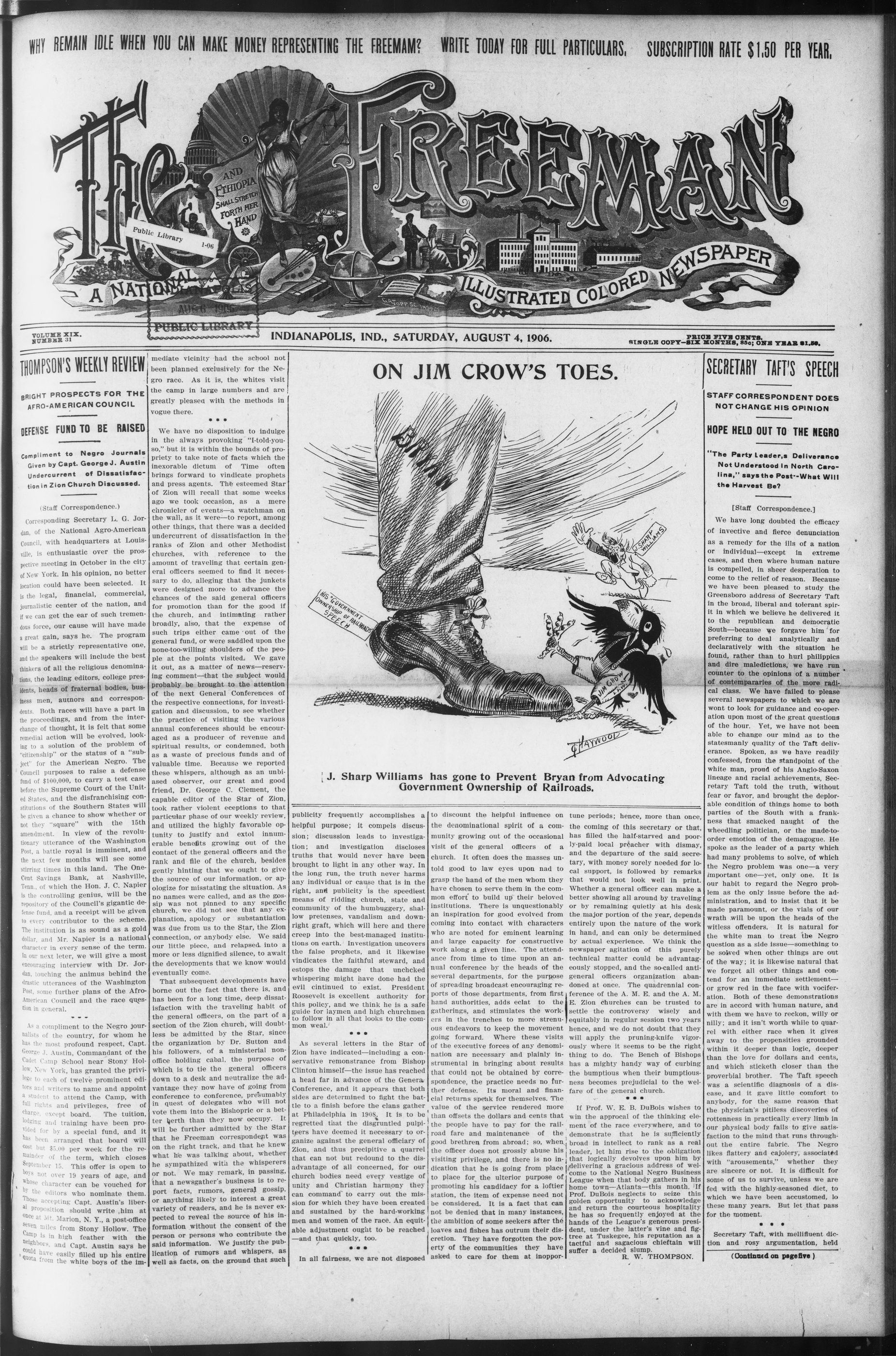
ON JIM CROW'S TOES.
U.S. SHARP WILLIAMS
HIS GOVERNMENT
OWNERSHIP OF RAILWAYS
SPEECH
JIM CROW
LION
CHAYWOOD
publicity frequently accomplishes a helpful purpose; it compels discussion; discussion leads to investigation; and investigation discloses truths that would never have been brought to light in any other way. In the long run, the truth never harms any individual or cause that is in the right, and publicity is the speediest means of ridding church, state and community of the humbuggery, shallow pretenses, vandalism and downright graft, which will here and there creep into the best-managed institutions on earth. Investigation uncovers the false prophets, and it likewise vindicates the faithful steward, and estops the damage that unchucked whispering might have done had the evil continued to exist. President Roosevelt is excellent authority for this policy, and we think he is a safe guide for laymen and high churchmen to follow in all that looks to the common weal.
---
As several letters in the Star of Zion have indicated—including a conservative remonstrance from Bishop Clinton himself—the issue has reached a head far in advance of the General Conference, and it appears that both sides are determined to fight the battle to a finish before the clans gather at Philadelphia in 1908. It is to be regretted that the disgruntled pulpiters have deemed it necessary to organize against the general officiary of Zion, and thus precipitive a quarrel that can not but redound to the disadvantage of all concerned, for our church bodies need every vestige of unity and Christian harmony they can command to carry out the mission for which they have been created and sustained by the hard-working men and women of the race. An equitable adjustment ought to be reached—and that quickly, too.
In all fairness, we are not disposed
to discount the helpful influence on the denominational spirit of a community growing out of the occasional visit of the general officers of a church. It often does the masses untold good to law eyes upon nad to grasp the hand of the men whom they have chosen to serve them in the common effort to build up their beloved institutions. There is unquestionably an inspiration for good evolved from coming into contact with characters who are noted for eminent learning and large capacity for constructive work along a given line. The attendance from time to time upon an annual conference by the heads of the several departments, for the purpose of spreading broadcast encouraging reports of those departments, from first hand authorities, adds eclat to the gatherings, and stimulates the workers in the trenches to more strenuous endeavors to keep the movement going forward. Where these visits of the executive forces of any denomination are necessary and plainly instrumental in bringing about results that could not be obtained by correspondence, the practice needs no further defense. Its moral and financial returns speak for themselves. The value of the service rendered more than offsets the dollars and cents that the people have to pay for the railroad fare and maintenance of the good brethren from abroad; so, when the officer does not grossly abuse his visiting privilege, and there is no indication that he is going from place to place for the ulterior purpose of promoting his candidacy for a loftier station, the item of expense need not be considered. It is a fact that can not be denied that in many instances, the ambition of some seekers after the loaves and fishes has outrum their discretion. They have forgotten the poverty of the communities they have asked to care for them at inoppor-
PRICE FIVE CENTS.
SINGLE COPY-SIX MONTHS, 850; ONE YEAR $1,50.
tune periods; hence, more than once, the coming of this secretary or that, has filled the half-starved and poorly-paid local preacher with dismay, and the departure of the said secretary, with money sorely needed for local support, is followed by remarks that would not look well in print. Whether a general officer can make a better showing all around by traveling or by remaining quietly at his desk the major portion of the year, depends entirely upon the nature of the work in hand, and can only be determined by actual experience. We think the newspaper agitation of this purely technical matter could be advantageously stopped, and the so-called antigeneral officers organization abandoned at once. The quadrilateral conference of the A. M. E. and the A. M. E. Zion churches can be trusted to settle the controversy wisely and equitably in regular session two years hence, and we do not doubt that they will apply the pruning-knife vigorously where it seems to be the right thing to do. The Bench of Bishops has a mighty handy way of curbing the bumptious when their bumptiousness becomes prejudicial to the welfare of the general church.
If Prof. W. E. B. DuBois wishes to win the approval of the thinking element of the race everywhere, and to demonstrate that he is sufficiently broad in intellect to rank as a real leader, let him rise to the obligation that logically devolves upon him by delivering a gracious address of welcome to the National Negro Business League when that body gathers in his home town—Atlanta—this month. If Prof. DuBois neglects to seize this golden opportunity to acknowledge and return the courteous hospitality he has so frequently enjoyed at the hands of the League's generous president, under the latter's vine and figtree at Tuskegee, his reputation as a tactful and sagacious chieftain will suffer a decided slump.
R. W. THOMPSON.
SECRETARY TAFT'S SPEECH
STAFF CORRESPONDENT DOES NOT CHANGE HIS OPINION
"The Party Leader,s Deliverance Not Understood in North Carolina," says the Post--What Will the Harvest Be?
[Staff Correspondence.]
We have long doubted the efficacy of invective and fierce denunciation as a remedy for the ills of a nation or individual—except in extreme cases, and then where human nature is compelled, in sheer desperation to come to the relief of reason. Because we have been pleased to study the Greensboro address of Secretary Taft in the broad, liberal and tolerant spirit in which we believe he delivered it to the republican and democratic South—because we forgive him for preferring to deal analytically and declaratively with the situation he found, rather than to hurl philippics and dire maledictions, we have run counter to the opinions of a number of contemporaries of the more radical class. We have failed to please several newspapers to which we are wont to look for guidance and co-operation upon most of the great questions of the hour. Yet, we have not been able to change our mind as to the statesmanly quality of the Taft deliverance. Spoken, as we have readily confessed, from the standpoint of the white man, proud of his Anglo-Saxon lineage and racial achievements, Secretary Taft told the truth, without fear or favor, and brought the deplorable condition of things home to both parties of the South with a frankness that smacked naught of the wheedling politician, or the made-to-order emotion of the demagogue. He spoke as the leader of a party which had many problems to solve, of which the Negro problem was one—a very important one—yet, only one. It is our habit to regard the Negro problem as the only issue before the administration, and to insist that it be made paramount, or the vials of our wrath will be upon the heads of the witless offenders. It is natural for the white man to treat the Negro question as a side issue—something to be solved when other things are out of the way; it is likewise natural that we forget all other things and contend for an immediate settlement—or grow red in the face with vociferation. Both of these demonstrations are in accord with human nature, and with them we have to reckon, willy or nilly; and it isn't worth while to quarrel with either race when it gives away to the propensities grounded within it deeper than logic, deeper than the love for dollars and cents, and which sticketh closer than the proverbial brother. The Taft speech was a scientific diagnosis of a disease, and it gave little comfort to anybody, for the same reason that the physician's pitiless discoveries of rottenness in practically every limb in our physical body fails to give satisfaction to the mind that runs throughout the entire fabric. The Negro likes flattery and cajolery, associated with "arousements," whether they are sincere or not. It is difficult for some of us to survive, unless we are fed with the highly-seasoned diet, to which we have been accustomed, to these many years. But let that pass for the moment.
Secretary Taft, with mellifluent diction and rosy argumentation, held
(Continued on pgs5five)
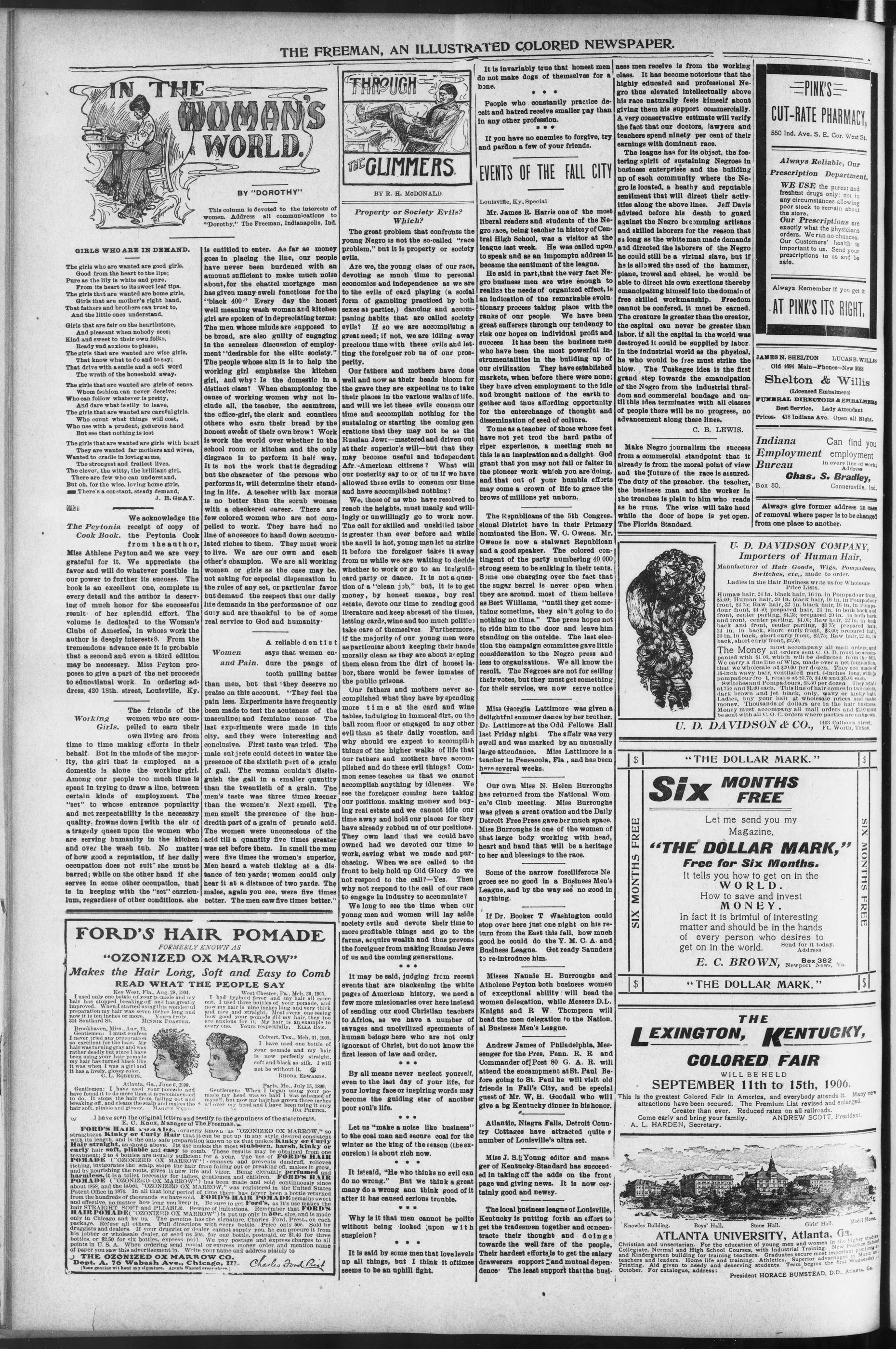
IN THE WOMAN'S WORLD.
BY "DOROTHY"
This column is devoted to the interests of women. Address all communications to "Dorothy," The Freeman, Indianapolis, Ind.
FORD'S HAIR POMADE FORMERLY KNOWN AS
I have seen the original letters and testify to the genuiness of the statements.
E. C. Knox, Manager of The Freeman.
FORD'S HAIR SUADE, formerly known as "OZONIZED OX MARROW," so straightens Kimberly Fair is a hair that it can be put up in any style, desired consistent with strength, and is the only safe product known to us. It has been known to Early or Early Hair straight, as shown above. It uses makes of stubborn, hard�y, hard�s, and the early hair soft, pliable and easy to comb. These results may be obtained from one treatment: 2 to 4 bottles are usually sufficient for a year. The use of FORD'S HAIR is a very simple form of the genuiness of the stannates and by pourishing it to a new and unbreaking off, breaking it, flowed and to the other. It is a toilet necessary for ladies, gentlemen and children. FORD'S HAIR POMADE ("OZONIZED OX MARROW") has been made and sold continuously since about 1850 and has been produced in the United States and the United States. In all that time, the use of the FORD'S HAIR is a bottle returned from the hundreds of thousands we have sold. FORD'S HAIR POMADE is a very well-made and effective, no matter how long you keep it. Be sure to get Ford's, as it is the hair STRAIGHT SOFT and PLIABLE. Peware of imitations. Remember that FORD'S HAIR POMADE ("OZONIZED OX MARROW") is put up only in 50c. size, and is made of the green and blue. It has the genuine has the signature. Charles Ford, Prest, on each package. Refers to all others. For clients of the line.
Dr. John drugists and dealers, or send us 50c. for one bottle, postpaid, or $1.40 for three bottles, or $2.50 for six bottles, express pail. We pay postage and express charges to all points in U.S. A. When ordering send postal or express money order and mention name of prior issues, you will be disمىement in. We the your name and address plainly to
Dept. A, 76 Wabash Ave. Chicago, IL.
(None genius with wilt or a signature. Awards Wanted overtime.)
GIRLS WHO ARE IN DEMAND.
We acknowledge the The Peytonia receipt of copy of Cook Book. the Peytonia Cook from the author, Miss Athlene Peyton and we are very grateful for it. We appreciate the favor and will do whatever possible in our power to further its success. The book is an excellent one, complete in every detail and the author is deserving of much honor for the successful result of her splendid effort. The volume is dedicated to the Women's Clubs of America, in whose work the author is deeply interested. From the tremendous advance sale it is probable that a second and even a third edition may be necessary. Miss Peyton proposes to give a part of the net proceeds to educational work. In ordering address, 420 18th. street, Louisville, Ky.
The friends of the
working women who are com-
Girls. pelled to earn their
own living are from
time to time making efforts in their behalf. But in the minds of the majority, the girl that is employed as a domestic is alone the working girl. Among our people too much time is spent in trying to draw a line, between certain kinds of employment. The "set" to whose entrance popularity and not respectability is the necessary quality, frowns down with the air of a tragedy queen upon the women who are serving humanity in the kitchen and over the wash tub. No matter of how good a reputation, if her daily occupation does not suit" she must be barred; while on the other hand if she serves in some other occupation, that is in keeping with the "set" curriculum, regardless of other conditions, she
Key West, Fla., Aug. 28, 1904.
I used only one coat my hair pomade and my hair has stopped breaking and has been improved. When I started using this wonderful preparation my hair was seven inches long and now it is ten inches or more. Yours truly, MINNEY FOASTER.
314 Seward St.
Downtown, Fla., Aug. 12
Gentlemen: I must confess I never tried any preparation so excellent for the hair. My hair was great and I rather decadently but I have been using your hair pomade my hair has turned black like it was when I was a girl and it has a liveliness. C. L. ROBERTS.
Brookhaven, Miss., Aug. 13.
Gentlemen, I have confess
never tried any confess
so excellent for the hair. My
hair was turning gray and was
gripped that hair. I have
been using your hair pomade
my hair has turned black like
it. I have a hair pomade and
it has a lively, glossy color.
C. L. ROBERTS.
Atlanta, Ga., June 6, 1900.
Gentlemen: I have
have found it to do more than it is recommended
to do. It stops the hair from falling out and
brushes, and cleans the scalp and makes the
hair soft, pliable.
THE FREEMAN, AN ILLUSTRATED COLORED NEWSPAPER
is entitled to enter. As far as money goes in placing the line, our people have never been burdened with an amount sufficient to make much noise about, for the chattel mortgage man has given many swell functions for the "black 400." Every day the honest well meaning wash woman and kitchen girl are spoken of in depreciating terms; The men whose minds are supposed to be broad, are also guilty of engaging in the senseless discussion of employment "desirable for the elite society." The people whose aim it is to help the working girl emphasize the kitchen girl, and why? Is the domestic in a distinct class? When championing the cause of working women why not include all, the teacher, the seamstress, the office-girl, the clerk and countless others who earn their bread by the honest sweat of their own brow? Work is work the world over whether in the school room or kitchen and the only disgrace is to perform it half way. It is not the work that is degrading but the character of the persons who perform it, will determine their standing in life. A teacher with lax morals is no better than the scrub woman with a checkered career. There are few colored women who are not compelled to work. They have had no line of accessors to hand down accumulated riches to them. They must work to live. We are our own and each other's champion. We are all working women or girls as the case may be, not asking for especial dispensation in the rules of any set, or particular favor but demand the respect that our daily life demands in the performance of our duty and are thankful to be of some real service to God and humanity.
Women and Pain. A reliable den t is t says that wemen en dure the pangs of tooth unilling better
than men, but that they deserve no praise on this account. 'They feel the pain less. Experiments have frequently been made to test the auteness of the masculine; and feminine senses. The last experiments were made in this city, and they were interesting and conclusive. First taste was tried. The male subjects could detect in water the presence of the sixteenth part of a grain of gall. The woman couldn't distinguish the gall in a smaller quantity than the twentieth of a grain. The men's taste was three times keener than the women's. Next smell. The men smelt the presence of the hundredth part of a grain of prussic acid. The women were unconscious of the acid till a quantity five times greater was set before them. In smell the men were five times the women's superior. Men heard a watch ticking at a distance of ten yards; women could hear it at a distance of two yards. The males, again you see, were five times better. The men saw five times better."
West Chester, Pa., Mech. 30, 1905.
I had typhoid fever, my hair all came out. I used three bottles of my pomade now my hair is nine inches long and very thick and nice and straight. Most every one seeing how good your pomade did my hair, they too praised for it. My hair is to every one. Yours respectfully, ELDA BYE.
Colvert, Tex., Mech. 31, 1905.
I have used one bottle of your pomade and my hair is now perfectly straight, soft and black as silk. I will not be without it.
RHODA EDWARDS.
Colvert, Tex., Mch. 31, 1905.
I have used one bottle of your pomade and my hair is now perfectly straight.
soft and black as silk. I will not be without it.
RHODA EDWARDS.
Paris, Mo., July 15, 1890.
Gentlemen: When I began using your pomade my head was so bald I was as ashamed of myself, but now my hair has grown three inches all over my head and I have been using it only
THROUGH
THE GLIMMERS.
BY R. H. McDONALD.
Property or Society Evils?
Which?
The great problem that confronts the young Negro is not the so-called "race problem," but it is property or society evils.
Are we, the young class of our race, devoting as much time to personal economics and independence as we are to the evils of card playing (a social form of gambling practiced by both sexes at parties,) dancing and accompanying habits that are called society evils? If so we are accomplishing a great need; if not, we are idling away precious time with these evils and letting the foreigner rob us of our prosperity.
Our fathers and mothers have done well and now as their heads bloom for the grave they are expecting us to take their places in the various walks of life, and will we let these evils consume our time and accomplish nothing for the sustaining or starting the coming generations that they may not be as the Russian Jewe—mastered and driven out at their superior's will—but that they may become useful and independent Afr.-American citizens? What will our posterity say to or of us if we have allowed these evils to consume our time and have accomplished nothing?
We, those of us who have resolved to reach the heights, must manly and willingly or unwillingly go to work now. The call for skilled and unskilled labor is greater than ever before and while the anvil is hot, young men let us strike it before the foreigner takes it away from us while we are waiting to decide whether to work or go to an insignifici card party or dance. It is not a question of a "clean job," but, it is to get money, by honest means, buy real estate, devote our time to reading good literature and keep abreast of the times, letting cards, wine and too much politics take care of themselves. Furthermore, if the majority of our young men were as particular about keeping their hands morally clean as they are about keeping them clean from the dirt of honest labor, there would be fewer inmates of the public prisons.
Our fathers and mothers never accomplished what they have by spending more time at the card and wine tables, indulging in immoral dirt, on the ball room floor or engaged in any other evil than at their daily vocation, and why should we expect to accomplish things of the higher walks of life that our rathers and mothers have accomplished and do these evil things? Common sense teaches us that we cannot accomplish anything by idleness. We see the foreigner coming here taking our positions, making money and buying real estate and we cannot idle our time away and hold our places for they have already robbed us of our positions. They own land that we could have owned had we devoted our time to work, saving what we made and purchasing. When we are called to the front to help hold up Old Glory do we not respond to the call?—Yes. Then why not respond to the call of our race to engage in industry to accumulate?
We long to see the time when our young men and women will lay aside society evils and devote their time to more profitable things and go to the farms, acquire wealth and thus prevent the foreigner from making Russian Jews of us and the coming generations.
***
It may be said, judging from recent events that are blackening the white pages of American history, we need a few more missionaries over here instead of sending our good Christian teachers to Africa, as we have a number of savages and uncivilized specimens of human beings here who are not only ignorant of Christ, but do not know the first lesson of law and order.
---
By all means never neglect yourself, even to the last day of your life, for your loving face or inspiring words may become the guiding star of another poor soul's life.
Let us "make a noise like business" to the coal man and secure coal for the winter as the king of the season (the excursion) is about rich now.
It is said, "He who thinks no evil can do no wrong." But we think a great many do a wrong and think good of it after it has caused serious trouble.
Why is it that men cannot be polite without being looked upon with suspicion?
It is said by some men that love levels up all things, but I think it oftimes seems to be an uphill fight.
It is invariably true that honest men do not make dogs of themselves for a bone.
* * *
People who constantly practice deceit and hatred receive smaller pay than in any other profession.
* * *
If you have no enemies to forgive, try and pardon a few of your friends.
EVENTS OF THE FALL CITY
EVENTS OF THE FALL CITY
Louisville, Ky, Special
Mr. James R. Harris one of the most liberal readers and students of the Negro race, being teacher in history of Central High School, was a visitor at the league last week. He was called upon to speak and as an impomptu address it became the sentiment of the league.
He said in part, that the very fact Negro business men are wise enough to realize the needs of organized effect, is an indication of the remarkable evolutionary process taking place with the ranks of our people. We have been great sufferers through our tendency to risk our hopes on individual profit and success. It has been the business men who have been the most powerful instrumentalities in the building up of our civilization. They have established markets, when before there were none; they have given employment to the idle and brought nations of the earth to together and thus affording opportunity for the enterchange of thought and dissemination of seed of culture.
To me as a teacher of those whose feet have not yet trod the hard paths of riper experience, a meeting such as this is an inspiration and a delight. God grant that you may not fall or falter in the pioneer work which you are doing, and that out of your humble efforts may come a crown of life to grace the brows of millions yet unborn.
The Republicans of the 5th Congressional District have in their Primary nominated the Hon. W. C. Owens. Mr. Owens is now a stalwart Republican and a good speaker. The colored contingent of the party numbering 40,000 strong seem to be sulking in their tents. Some one charging over the fact that the sugar barrel is never open when they are around, most of them believe as Bert Williams, "until they get something sometime, they ain't going to do nothing no time." The press hopes not to ride him to the door and leave him standing on the outside. The last election the campaign committee gave little consideration to the Negro press and less to organizations. We all know the result. The Negroes are not for selling their votes, but they must get something for their service, we now serve notice
Miss Georgia Lattimore was given a delightful summer dance by her brother, Dr. Lattimore at the Old Fellows Hall last Friday night. The affair was very swell and was marked by an unusually large attendance. Miss Lattimore is a teacher in Penssoola, Fla., and has been here several weeks.
Our own Miss N. Helen Burroughs has returned from the National Women's Club meeting. Miss Burroughs was given a great ovation and the Daily Detroit Free Press gave her much space. Miss Burroughs is one of the women of that large body working with head, heart and hand that will be a heritage to her and blessings to the race.
Some of the narrow fosciliferous Ne groes see no good in a Business Men's League, and by the way see no good in anything.
If Dr. Booker T Washington could stop over here just one night on his return from the East this fall, how much good he could do the Y. M. C. A. and Business League. Get ready Saunders to re-introduce him.
Misses Nannie H. Burroughs and Atholene Peyton both business women of exceptional ability will head the women delegation, while Messers D.L. Knight and R W. Thompson will head the men delegation to the National Business Men's League.
Andrew James of Philadelphia, Messenger for the Pres. Penn. R. R. and Commander of Post 80 G. A. R. will attend the encampment at St. Paul Before going to St. Paul he will visit old friends in Fall's City, and be special guest of Mr. W. H. Goodall who will give a bg Kentucky dinner in his honor.
Atlantic, Nisagra Falls, Detroit Country Cottages have attracted quite a number of Louisville's ultra set.
Miss J. S. Young editor and manager of Kentucky-Standard has succeeded in taking off the adds on the front page and giving news. It is now certainly good and newsy.
The local business league of Louisville, Kentucky is putting forth an effort to get the tradesmen together and concentrate their thought and doing s towards the well fare of the people. Their hardest efforts is to get the salary drawers support "and mutual dependence. The least support that the busi-
ness men receive is from the working class. It has become notorious that the highly educated and professional Negro thus elevated intellectually above his race naturally feels himself about giving them his support commercially. A very conservative estimate will verify the fact that our doctors, lawyers and teachers spend ninety per cent of their earnings with dominant race.
The league has for its object, the fostering spirit of sustaining Negroes in business enterprises and the building up of each community where the Negro is located, a healthy and reputable sentiment that will direct their activities along the above lines. Jeff Davis advised before his death to guard against the Negro becoming artisans and skilled laborers for the reason that so long as the white man made demands and directed the laborers of the Negro he could still be a virtual slave, but if he is allowed the used of the hammer, plane, trowel and chisel, he would be able to direct his own exertions thereby emancipating himself into the domain of free skilled workmanship. Freedom cannot be conferred, it must be earned. The creature is greater than the creator, the capital can never be greater than labor, if all the capital in the world was destroyed it could be supplied by labor. In the industrial world as the physical, he who would be free must strike the blow. The Tuskegee idea is the first grand step towards the emancipation of the Negro from the industrial thraldom and commercial bondage and until this idea terminates with all classes of people there will be no progress, no advancement along these lines.
WE USE the purest and freshest drugs only; not in any circumstances allowing poor stock to remain about the store.
Our Prescriptions are exactly what the physicians orders. We run no chances. Our Customers' health is important to us. Send your prescriptions to us and be safe.
Always Remember if you get it AT PINK'S ITS RIGHT.
JAMES N. SHELTON LUCAS B. WILLIS
Old 1694 Main-Phones-New 968
Shelton & Willis
(Licensed Embalmers)
FUNERAL DIRECTORS & EMBALMERS
Best Service. Lady Attendant
Prices. 418 Indiana Ave. Open all Night.
Indiana Can find you
Employment employment
Bureau
In every line of work
Address
Chas. S. Bradley,
Box 80,
Connersville, Ind.
Make Negro journalism the success from a commercial standpoint that it already is from the moral point of view and the future of the race is assured. The duty of the preacher, the teacher, the business man and the worker in the trenches is plain to him who reads as he runs. The wise will take heed while the door of hope is yet open. The Florida Standard.
Always give former address in case of removal where paper is to be changed from one place to another.
U. D. DAVIDSON COMPANY, Importers of Human Hair.
Manufacturer of Hair Goods, Wigs, Pampadons, Switches, etc., made to order.
Ladies in the Hair Business write us for Wholesale Price Lists.
Human hair, 24 in. black hair, 16 in. in Pampadour front, $5.00; Human hair, 24 in. black hair, 16 in. in Pampadour front, $7.50; Human hair, 24 in. black hair, 16 in. in Pampadour front, $4.50; prepared hair, 24 in. in both back front, center parting, $4.25; prepared 20 in. in both back and front, center parting, $4.00; Raw hair, 22 in. in back back, center parting, $7.50; Raw hair, 24 in. in back, short curly front, $3.00; prepared hair, 20 in. in back, short curly front, $2.75; Raw hair, 22 in. in back, short curly front, $2.50.
The Money company all mail orders, and all orders sent C. O. D. must be accompanied with $1.00, which will be deducted from the bill. We carry a fine line of Wigs, made over a net foundation, and we make over two dozen of 10-inch wavy hair, ventilated front, 10-inch pampadour front, t. retails at $3.75, $4.00 and $5.00 each.
Switches and Pampadours, $8.50 per dozen. We retail 47.50 and $1.00 each. We retail two colors of 47.50 and $1.00 each. We retail two colors of 47.50 and $1.00 each. We buy your hair at wholesale prices and make money. Thousands of dollars are in the hair business. Money must accompany all mail orders and $1.00 must be sent with all C. O. C. orders where parties wish to buy your hair.
U. D. DAVIDSON & CO., 1469 Calhoun Street, Ft. Worth, Texas.
"THE DOLLAR MARK."
SIX MONTHS FREE
Six MONTHS FREE
Let me send you my Magazine,
"THE DOLLAR MAR
Free for Six Months.
It tells you how to get on in the
WORLD.
How to save and invest
MONEY.
In fact it is brimful of interesting
matter and should be in the hands
of every person who desires to
get on in the world.
E. C. BROWN, Box 3
Newport N.
MONTHS FREE
let me send you my
Magazine,
DOLLAR MARK,"
for Six Months.
how you how to get on in the
WORLD.
how to save and invest
MONEY.
it is brimful of interesting
and should be in the hands
any person who desires to
in the world.
Send for it today.
Address
C. BROWN,
Newport News, Va.
THE DOLLAR MARK. THE LEXINGTON, KENTU COLORED FAIR
THE
TON, KENTUCKY,
LORED FAIR
LEXINGTON, KENTUCKY,
WILL BE HELD
SEPTEMBER 11th to 15th,
This is the greatest Colored Fair in America, and everybody at
attractions have been secured. The Premium List revised.
Greater than ever. Reduced rates on all railroads.
Come early and bring your family. ANDREW SCO
A. L. HARDEN, Secretary.
Knowles Building. Boys' Hall. Stone Hall. Girls'
ATLANTA UNIVERSITY, Atlanta
Christian and unsectarian. For the education of young men and women.
Collegiate, Normal and High School Courses, with Industrial Training and Kindergarten building for training teachers. Graduates secure more teachers and leaders. Home life and training. Athletics. Superior a Printing. All given to needy and deserving students. Term begins.
BER 11th to 15th, 1906.
Fair in America, and everybody attends it. Many new
accured. The Premium List revised and enlarged.
Never. Reduced rates on all railroads.
Our family.
ANDREW SCOTT, President.
Hall. Stone Hall. Girls' Hall. Model Home.
UNIVERSITY, Atlanta, Ga.
the education of young men and women in the higher studies
school Courses, with Industrial Training. New Practice School
training teachers. Graduates secure most important positions
and training. Athletics. Superior advantages in Maundy
and deserving students. Term begins the first Wednesday.
This is the greatest Colored Fair in America, and everybody attends it. Many new attractions have been secured. The Premium List revised and enlarged. Greater than ever. Reduced rates on all railroads.
Come early and bring your family. ANDREW SCOTT, President.
A. L. HARDEN, Secretary.
Knowles Building. Boys' Hall. Stone Hall. Girls' Hall. Model Home.
ATLANTA UNIVERSITY, Atlanta, Ga.
Christian and unsectarian. For the education of young men and women in the higher studies Collegiate, Normal and High School. Courses, with Industrial Training. New Practical School and Kindergarten building for training teachers. Graduates secure most important courses teachers and leaders. Home life and training. Athletics. Superior advantages in Music and Printing. Aid given to needy and deserving students. Term begins the first Wednesday.
October. For catalogue, address: President HORACE BUMSTEAD, D.D., Atlanta, Ga.
---
C. B. LEWIS
```markdown
```
FOR THE IMPROVEMENT AND ADVANCEMENT OF THE NATIONAL BENEFIT ASSOCIATION OF
HEAD, SECOND AND SIDE WAITERS
"For the man who works with brain or hand."
W. Forrest Cozart,
Editor.
Have you subscribed for The Freeman?
When you read The Fraeman you get all the news.
The Fraeman is the official organ of the head and sidewalters
E. Payne has been appointed second waiter at the Rudolf Hotel, Atlantic City, N.J.
Nathaniel Burrell, formerly head-waiter at the Normandee, Philadelphia, is this season, in charge of the Plerpont Hotel Atlantic City, N. J.
John Sparks, for several years head-waiter at the Hoddon Hall, Atlantic City, is, this year, in charge of the Hotel Strand in that city.
If you want to see miserable service and unentemplemly deportment go into a dining room where the colored waiter is allowed to do as he pleases.
A. J. Carter (Mihe), who is in charge at the Shoreham, Washington, D. C., is for the third season in charge of the American Garden at Atlantic City.
The Hotel Men's Laundry owned and operated by the colored waiters of Atlantic City have raised its capital stock from $10,000, as incorporated, to $40 000 and will also conduct a storage warehouse. The officers of the company are S. Jolly, president; Harvey C. Green, vice-president; George H. Emory, treasurer; Charles A. Holland, secretary; W. Forrest Cozart, general manager.
The colored waiters at the Marlborough hotel, Atlantic City lined up fifty strong out of a crew of eighty strong and demanded thirty dollars per month and no full dress suits. The proprietors readily acceded to the de-
INDIVIDUAL HOTEL DIRECTORY
(On address line $4.00 per year; including
subscription to The Freeman, in advance.)
HEADWATTERS.
J. W. Redmond, Headwaiter of The Carr
ell, Vicksburg, Miss.
C. W. Dwyer, headwaiter Commercial
Club Minneapolis, Minn.
C. H. Plummer, headwaiter Hotel Bruns
wick, Uniontown, Pa.
B. H. Bradley, Headwaiter Menger Hotel,
San Antonio, Texas.
G. W. Bland, Headwaiter of The Oliver,
South Bend, Ind.
This column used exclusively for the ad. hotels, restaurants, and boarding houses throughout the country, and intended as a guide for the traveling public--you business solicited.
Hotel Dwyer (European) C, W. Dwyer,
week or month, with heat, electric light
and bath. 224 Washington Avenue, South,
Munispaul, Minn.
Hotel Reformer—First class in all respects
90, N. 51th—Kirkhond, M. A. W. 10, N. 61th
Moore's Hotel - First-class room and board
Rooms neatly furnished, 712 and 714 W. Baird
Hook, Ark. Apt. 11
Waldorf-Astoria Hotel - S37 Laurel street,
Hot Springs, Ark.
Black's Hotel - A modern first-class hotel for colored people. H. Black, Manager,
The Parker House-Booms, bath. J. W.
Hollman, proprietor, Indiana, Indiana. Ind.
VICTOR
TALKING
MACHINES.
The Victor is so perfect it is often mistaken for the human voice. It is proving a never failing source of DELIGHT o Thousands.
COME IN AND LET US
TELL YOU all ABOUT it.
SOLD ON EASY
PAYMENTS
Phones Main 852
New 9093
KOEHRING BROS.
878, 880, 882 VIRGINIA AVENUE.
Hoosier Poet
CLUB ROOM LONDRES
10c Cigar
We deliver Goods direct to consumers and pay all express charges.
Give Us A Tryal Order.
John Rauch Cigar Co. - Indianapolis, Ind.
HEADQUARTERS
Indiana Ave.
Indianapolis, Ind
HOTEL DIRECTORY
mand. The only klok coming is that the thirty who refused to line up are still there to enjoy the raise. The strike was brought on by the white waiters receiving thirty-five dollars and the colored in the same house only receive twenty-five dollars per month.
As it is pointed out by several hotel proprietors, if the colored waiter is losing ground, he alone is responsible for it. A well-known headwaiter said recently that if colored waiters was put in the Waldorf-Astoria and allowed their way they would soon put the house on the burn. One thing, sure, he said, you have to make them give good service and watch them all the time and see that they go clean. They can give good service and go clean, but you have to make them do so.
..SPECIAL NOTICE..
SPECIAL NOTICE.
The Seventh Annual Session
of the
GRAND LODGE
of the
IMPROVED BENEVOLENT
and
PROTECTIVE ORDER
of
ELKS OF THE WORLD
will convene at
BROOKLYN, NEW YORK,
Tuesday. Wednesday
and Thursday,
August 28, 29 and 30, 1906
OPENING SESSION
August 28
Welcome addresses and speeches
by distinguished orators.
EVENING
Steamboat trip to Coney Island
Manhattan Lodge.
DAY SESSION
August 29,
Evening plionic Brooklyn Lodge.
MORNING SESSION,
August 30
AFTERNOON
Parade at 1:30 p.m.
Evening plionic, Proper Lodge,
Jersey City, N. J.
Lodges desirous of attending will
communicate with G. E. Bates.
No. 26 Exchange Place, Jersey City,
or David W. Parker, No. 197 West
34th Street, New York City.
IMPORTANT NOTICE.
The executive committee of the local management of the Negro Young People's Christian and Educational Congress, which will convene at Washing ton July 81 to August 5 has made arrangements to accommodate all delegates and visitors during the Congress at $1.00 per day for board and lodging. All who expect to attend the Congress will notify Rev. Dr. I. Toliver, 1145 Twenty-first Street, N. W. Chairman of Committee on Homes that will be be notified of their stopping places before leaving home.
The Freeman in Chicago.
The Freeman is on sale at Cincoluna
at Wallner's Drug Store. 108 Walnut
street. Will Owens, agent.
THE FREEMAN, AN ILLUSTRATED COLORED NEWSPAPER
EASTERN BRANCH
17 N. Kentucky Ave,
Atlantic City, N.J.
THE NATURALS
2.15
Jack Kennedy was a newspaper reporter. That's all. A fellow of brilliant attainments, but of peculiar moods and fancies. He might have succeeded to the position of managing editor of his paper, about the limit of a newspaper man of these days, but he was not ambitious to become a managing editor. He never desired to be known by any other title than just plain reporter. He had written many fine feature articles for newspapers and magazines, had written a couple of books of much merit, entitling him to subscribe himself an "author," but he preferred the appellation of "reporter" instead.
Kennedy had received a liberal education—an Oxford man, had traveled extensively, and was a fellow that could shine in the drawing-room of the aristocrats. The women would have lionized this newspaper scribe, if he would but permit it. Although by education and family connection he was entitled to enter the exclusive social circles, Jack was somewhat of a Bohemian. A jolly, big-hearted, whole-souled, handsome fellow. One thing his companions could not understand in him was that every now and then he would drop out of sight for a day or two, and mingle with the denizens of the gilded sphere. I have seen him sitting, with nonchalant ease, in a low resort surrounded by a bevy of frail creatures who were once upon a time pretty virgins—now forced to resort to paint and powder to hide the awful tale of dissination.
I have seen hi mat a card table in a cheap bar-room in the White Chapel district, playing cards with the cast-offs of society, laughing, joking, seemingly as much at ease as if he were in a drawing-room surrounded by the cream of the aristocrats.
Yet Jack Kennedy neither drang nor gambled, never was heard to use a profane word, and apparently was apparently without a vice, save smoking.
One day, after the paper had gone to press, and all the news-writers had taken their departure from the local
LATE NEW YORK CONFERENCE
LATE NEW YORK CONFERENCE
MANY COMPLICATIONS ARISE
CONCERNING MINISTERS
BISHOPS MUST BE BLAMELESS
No Record of Last Year's Disbursements.--Widows and Preachers Fail to Get (Money.--Financial Committee Elected.
It is unlikely that any conference in the connection, large or small, ever had such knotty questions to settle, and any bishop, other than the one under whom these questions originated would be made to feel disgusted at the least. The ruling and practice of most of our bishops in that they cannot go behind their own administration is working untold harm, and when the several conferences awake to their full function there will be ecclesiastical trouble, say nothing of the reason and logic in the case. It is unfavorable reflection on those bishops—to continue an evil or wrong because one finds that another created it or allowed it to exist, or to fail to correct and check the same because it existed, is very dark light from bishops who "must be blameless." Through Rev. S. T. Tloe, D D. Bishop Arnett received and continued to appoint Rev. W. E. C. Gumbs, who was left from the New England Conference in the hands of a committee for investigation and trial; Rev. S. H. V Gumbs, who was not transferred nor ever admitted into the New York Conference; Rev. Samuel Nance, an expelled member of the Baltimore Conference; Rev. Thomas Chase, never admitted nor transferred into the New York Conference; Rev. Harris, who had to leave Delaware in haste, and Mr. John Cuff whose wife was divorced from him on the grounds of his adultery on Bishop Smith ruled that as their names were on the roll they were members of the conference, except in the case of Mr. Samuel Nance, who Bishop Arnett or his son Henry had given a transfer to one of the Carolinas just one week before the New York Conference met; the bishop ruled that as he was not a member of this conference he could not be transferred, and the giving of a transfer within one week of the conference showed Bishop Arnett's unfitness to manage the work. Mr. Cuff, of whom the judge told the clerk of the court to write and tell the bishop the kind of preachers he had, confessed that he was never admitted into the conference.
Dr. W. H. Lacey fought to cut off these names, and succeeded as follows: Rev W. E. C. Gumbs was given sixty days in which to repay some church money; Rev S. H. V. Gumbs was allowed to be transferred to Georgia, as Bishop Turner made that request, and Mr. John Cuff was sent before the committee on admission, who reported that they deemed it wise not to recommend him, and still he and all, save Rev S.
(By Ralph W. Tyler.
rooms, save Jack and I, we sat for an hour or more talking.
The conversation had a wide range. We talked "shop," and we discussed laws pending in Parliament, for there is rarely a subject, whether in political economy, legal lore, medicine, science, or literature, upon which Jack Kennedy was somewhat of an authority.
Finally the conversation became personal, and, for the first time, I said to Jack—he and I were quite intimate friends—"Jack, tell me, if no offense in asking, what pleasure you find in every once in a while associating, no terms of equality, with the habitues of the lower world."?
Jack took two or three draws in succession from his pipe, leaned back in his chair, put his feet up on his desk, and after emitting the smoke lelsurely, said:
"Winston, do you know that is the real world?"
I was startled and mystified. He observed it.
"Winston," he said, slowly and deliberately, "it is a constant struggle with every man and woman to be good, to be respectable. We are all bad by nature, by instinct. These people of the lower world are guided and propelled by their own true natures. You and I, and all those who lay claim to respectability, live a lie. I like to meet these people of the lower world. I feel that I am with real people, people who live lives that are natural. It is refreshing to me. It's an inspiration. The good man is in a constant struggle with his passions. These people have no struggles. It's come day, go day with them. No ideals, and yet they are true to each other. There is less deceit among them, less hypocryphy than in the church. They stand closer to each other than do members of fraternities, and charity—why, they teach you what real charity is.
"Here is a drunkard, poor, irresponsible fellow he simply permits his appetite to control him. The appetite is natural. He did not create it. It
H. V. Gumbs, were given appointments at the hands of the bishop. Rev. Gumbs has since been given work in East New York.
The election of the Financial Committee, as per law, was a well won battle led by Dr. Lacy. Prof. H. Y. Arnett had sent out some of his committees before the session convened, and this election was a blow to that work. There had been no record of the disbursements from the last year; and, though some of the widows and preachers failed to get their money, Bishop Arnett got two hundred dollars for electrical work in his home, said to have cost only seventy dollars, besides the other money he got. All this evil seems to have been covered by not printing the minutes, though upwards of a hundred dollars was given Dr. Tice for printing, and the bishop said he would have it done. Just think of the venerable New York Conference having no minutes since 1903, Bishop Derrick's last conference.
PROF H. Y. ARNETT, THE PREACHER
Is this a case of Eil and his sons?
Dr. Franklin of New York says that Rev. B. W. Arnett, Jr., said that his father ordained him within three months after Dr. Franklin had given him a local presacher's license, and as one presacher wrote another that Bishop Arnett had requested that his son, H. Y., be made a minister, the policy persuaded brings up both cases. Prof. Arnett had failed to get into the Pittsburgh Conference last year—October, and after not being allowed to get license in Buffalo he and P. E Steward went to Lockport and they licensed him there and recommended him to the annual conference without ever calling a church conference to recommend him to the quarterly conference for license. Drs. W. H. H. Butler, H. T. Johnson and John Collett—only the former a member of the conference—were the committee on admission, refused to show his license to members of the conference who requested to see them. As Bishop Turner requested his ordination Dr. T. W. Henderson moved that he be ordained under the (ever flexible) missionary rule.
Bishop Turner asked that Bishop Arnett be given one hundred dollars and Bishop Smith be allowed traveling expense, which were granted, in addition.
Dr. T. W. Henderson put in a bill of ten dollars for Bishop Smith's incidentals in traveling, thus making seventy dollars for the bishop's traveling expenses, which was to go in the minutes as incidentals by request or suggestion from the chair. Prof. Arnett wanted seventy-six dollars for his father's office expenses, twenty dollars for telegrams and Heury's railroad traveling fifteen dollars included, and twenty-five dollars for himself as Bishop Turner's private secretary, which was granted him, and fifty dollars for his father instead of seventy-six. Bishop Arnett had received special collections in many of the churches in Philadelphia and New Jersey and assessments from ministers levied in New York, and while this idea of $175 for him did not meet
01010101
was given him at his birth—before his birth.
"Here is a faded beauty scorched by her own passions. She may have tried, doubtless, at one time did try to curb her passions that burned away the barrier of prudence. But she finally yielded to the stronger, and she now lives a natural life. Her passion was not cultivated. It was created with her. By whom? Ah, who can answer? And so it goes.
"In the commercial world I see naught but deceit, craftiness that they call business sagacity—the hand of Cain restrained. In the church, hypocrisy.
"I do not say that impurity is best—far from it. I only claim that the impurity of man's mind and body is natural, and the pry enforced. Why, I find more pleasure, more relief in spending an hour with these naturals in the lower world, than in spending a month with feigned respectability. I would not live among them, yet would not despise to die among them.
"Every man, every woman Winston, to a less or greater degree is a Dr. Jekyll and a Mr. Hyde. Be sure on that point. You and I have been in the newspaper world long enough to have seen what a thin veneer respectability is. Did we write all we knew, what a commotion would be caused in the upper world.
"Yes, Winston, when you drop among the scorched humanity of the lower world, you are then among the natural men and women—the rest is unnatural. God created the natural and the unnatural. Who are the sinners, and who are the sinned against?" Two years later brilliant, peculiar Jack Kennedy died. Instead of passing away at a home of luxury, surrounded by those that should be most dear to him, his life passed quietly, of population, is a deserved recogniz and quickly out while he was sitting in a chair in a tenderloin bar-room, among the "naturals."
He was but a creature of his Maker, who make up humanity like woolen mills make up cloth—in variegated patterns.
with favor by all the financial committee, they were relieved when the conference voted the hundred at the bishop's request. In that Dr. Tice was responsible for some of the complications, was made the scape goat, and as Bishop Turner, who received him, had charges against Dr. Tice. Resolutions for Bishop Turner to refer him back were offered and a committee of five appointed to try him on charges. "LUX."
Eastern sport writers are out with grave tales about the recent Walottt-Dougherty mix-up. One writer of a large New York daily has found of the reason why Dougherty came out of the ring so badly bruised and out, and says further that Walottt will be, here after, known as much greater tricker than ever the foxy Kid McCoy ever dared to be. "Joe Walottt," he says, "You will remember, shattered his right hand a couple of years ago by sending a pistol bullet through it. That caused his retirement from the ring. When he came back to fight again he explained to the managers that a strong bandage would have to be used to hold his hand together. The bandage was put on in his dressing room. It consisted of wet rawhide wound around and around his injured his hand. It was a nice soft bandage while it was wet, but when the rawhide dried it was as hard as iron. Soft bandages were wound outside to make it look right.
Walcott might as well have used his ancestral knob kernal as this deadly weapon. Dougherty says that if he fights the Black Demon again the "iron hand" will be barred."
Now anybody knows had that been the case Joe Walcott would have put this man Dougherty out of business in a couple of jobs. From start to finish that writer story is undoubtedly two weak for the reason that there is not a ring manager anywhere that would allow such an advantage to be taken over a white fighter by a colored one. The many tales that these Eastern pen pushers grind out are seldom ever given attention to as their stuff is ever too "chin."
Since that Joe Walcott has again entered the ring it might be possible that Joe Gans would take him on again as Gans received the decision over Walcott in their last fight at Frisco in 1904 Now this ought to make a pretty fair drawing card and as both men need the money they should not hesitate to fight
J. P. Harrison, formerly head waiter at the Grenada Hotel, Grenada, Miss., and other hotels is now and has been for the past three years, captain at the Briggs House, Chicago. The Briggs is one of the few European Hotels in Chicago employing colored waiters, Mr. Harris is one of the original members of the Headwaiter's Association.
COOKS
Waiters & Cooks
Prefer Our Make
JACKETS AND LINEN
because they have found them
satisfactory.
Write for complete Catalogue
FREE.
giving full instructions how
to order,
Marcus Ruben (Inc.)
390 State St., CHICAGO IL.
TO THE
PUBLIC
N or about September 1, 1906, we will open a business, the purpose of which is to supply in full the dining room, baker shop and office with UNIFORMS made by the most skillful tailors, and the workmanship of which stands on its merits. We will be able to furnish all sizes and fill orders in all quantities, however large. In connection with our business we will operate an EMPLOYMENT BUREAU for hotel men. This is a new feature and original. It is bids fair to meet the approval of the hotel world as well as benefiting it. We will aim to place good men in good places. Particular attention will be given to the heads of the various departments. We are hotel men by many years experience; we are acquainted personally with a vast throng of hotel men both among the employed and employers. Already a large number of Managers and Proprietors have given us encouragement by pledging us their hearty good will and support. Watters, Bell Boys and Cooks will do well to register with us. Your interest is our interest; our success will assure your success, thus giving all parties concerned the benefit of each other's cooperation. Our employment bureau is free of charge. We request only one favor, namely, that after your position is secured you will kindly appreciate our services by allowing us to furnish your crews with our uniforms, guaranteed to be as good as money can buy. Heads of departments will be allowed a liberal discount on all orders, provided application is made at our office. Consider kindly our proposition and give it due regard. Hoping to win you to our side, and to find you among our supporters, we are.
Feitenburg-Daniels.
P. S.-Look for later announcement. Address all communications till August 1st to 215 State street, Texarkana, Texas.
WANTED AGENTS in each country to sell
Good profits, steady work. Address Campbell& Co., 85 A Street, Elgin, III.
Lady Agents—Easily make $3 a day mak ing and selling "Japanese Cleaner," instantly and cheaply. Remove grime and stains. Put all kinds of clothingcissure 3 bottle to make, readily for 25c. Formula, labels and everything furnished. Write to-day. Thos. Campbell, 55 A St., Elgin III.
THE MAGIC SHAMPOO HAIR DRIER
After a bath shampoo the hair can be DIREED and STRAIGHT. It is the only device which will straighten curly hair well. Straighten curly hair well. Will stimulate the growth and make look natural and beautiful, white and adds a touch of beauty.
The Shampoo Drier is a six inch aluminum comb. For a neat package, a six inch article dresser. By mail, price $1.00. Agents wanted. Single Shampoo Drier is used in my pariway with perfect shampoo. - Modane Conark, 17 Kate tucky Ave., Atlantic City, N.J. A Shampoo Drier Mfg. Co. 407 Century Blvd. Minneapolis, Minn.
HAIR SWITCHES
Bangs and Wigs of Every Description
Most Complete Line of Hair Goods in this country for Colored People.
50c buys a single braid made of Black Kinky Hair 16 inches long.
75c buys a double braid made of Black Kinky Hair 16 inches long.
$1.00 buys a Creole Switch, 16 inches long. Brown or Black.
$1.25 buys a Creole Switch, 20 inches long. Brown or Black.
$1.75 buys a Creole Switch, 22 inches long. Black or Brown.
$3.50 buys a Natural, Wavy, Hand-made like cut.
Send sample of hair when ordering Creole Switches.
Send money with order and get your goods by return mail. Send stamp for catalogue.
T. W. TAYLOR,
Howell, Mich.
When writing please mention this paper.
SANTAL-MIDY
Standard remedy for Glee:
Gonorrhoea and Runnings:
IN 48 HOURS. Cures Kid-
ney and Bladder Troubles.
THE FREEMAN
NATIONAL ILLUSTRATED
COLORED NEWSPAPER.
PUBLISHED EVERY SATURDAY
At 309 Indiana Avenue,
INDIANAPOLIS, INDIANA.
SUBSCRIPTION RATES
Any part of the United States and Canada
one year, postage paid . . . $1.80
Mother's Day . . . $1.80
Three Months . . . 80
Foreign Countries . . . $1.00 extra
Sending money to overseas, money order, post-
money order or registered letter.
Agents wanted 1 every tow; and city not
now occupied, and liberal inducements will be
inducements. Send for our extraordinary
ADVERTISING RATES:
Five cans per line. Fase of measure—solid
agate, 14 lines to an inc.} 272 lines in a
line. No advertisement inserted on first page. Special
rates on standing professional and business
cards. Reasonable discount for long time and
special rates on 100 per line. Special
rates on WRITE UPS.
Entered at the postoffice at Indianapolis,
Indiana, as second class matter.
INDIANAPOLIS, - INDIANA
SATURDAY, AUGUST 4, 1906.
A Law Journal Denounces
The following editorial from 'Case and Comment,' a legal monthly, published at Rochester, N. Y., ought to be republished in every newspaper in the United States. Our comment upon it, in the nature of a corollary, is that no punishment is ever meted out to the murderous lynchers, and that appeals by letter for the protection of the colored race, made to Congress, have so far been smothered in the rooms of the Judiciary Committees of the Senate and House. Our race is a timid, patient, long suffering race, submitting meekly to the deprivation of the rights guaranteed to its members by the Federal and State Constitutions. How long shall we remain helpless, listless and stupidly dependent? Will the day never come when we shall exercise that invincible voting power which the race possesses when united in a common purpose for the common good? The politicians, who promise to help us in our affliction, but who never keep their word, will shortly realize that the voting strength of the colored man is not to be surprised. Though slow to anger, the patient, hopeful, forgiving Negro, will rise one day, like a giant from a long sleep, and somebody will be made to feel his wrath for having so grossly betrayed his confidence. Read the editorial from 'Case and Comment,' which outspoken and timely expression we here append in full:
"SAVAGERY TRIUMPHANT."
"Press reports announce that a grand-jury investigation of the mob of April 14, at Springfield, Missouri, which hanged and burned some Negroes, has found that the alleged assault by the Negroes on the woman who complained of them was not committed, that the Negroes charged with crime could not possibly have been at the place of the alleged assault at the time, and that the sheriff and police department were negligent in the performance of their duty. Lapses into the savagery of mob lynchings, with their burning of human victims, have pilloried this nation, bearing its brand of indelible disgrace, before all the civilized nations of the earth. A lessening of these unspeakable horrors is shown by recent statistics, but one in Ohio and another in Missouri have again illustrated the latent savagery that exists in the worst stratum of every populous community, though ordinarily restrained by the forces of the law and order. Well-intentioned defenders of lynchings are beginning to learn that savagery and brutality cannot be extinguished by turning the whole community into brutes and savages, and that a respect for law and order is not created by turning the whole community into a lawless mob.
"Hanging and burning men on general principles, without trial, and on mere suspicion do not tend to inspire respect for justice, or to build up a law-abiding community. If the press reports are correct, the mob at Springfield burned innocent men. In every such case the legal presumption of the innocence of the victim is offset only by the presumption of fairness and justice on the part of the frenzled mob. Fortunately there are indications that the best men of every community are beginning to set themselves firmly against these exhibitions of savagery, which disgrace not only the mob, but the community and the nation itself."
- The press is an irresistible force for the making of public sentiment, and it is an encouraging sign to observe journals of broad influence and undoubted standing as "Case and Comment" taking such a strong stand in favor of law and order, and insist so vigorously and unanswerably upon the operation of the machinery of the courts on a fair and impartial basis. The white press of the land can save the good name of this lence and brutality under the ban, and it is bounded duty to do so, if we would have the world believe in our pretentions toward Christianity and civilization. In
THE FREEMAN, AN ILLUSTRATED COLORED NEWSPAPER
these lynchings the nation at large, in th final analysis, suffers far more than the nation; it can do much to place mob viohelpless victim upon whose head the savage spirit is given its full and violent bent.
Lesson of a Life.
The News had a strongly eulogistic editorial on the late Charles A. Webb and draws from it some self-obvious truts. He came here in 1866, after a life of slavery, and began work without friends or influence in his 25th year. After various miscellaneous jobs, he gravitated towards the business of house-moving, for which he developed an especial talent. By studying the business, he became proficient. By strict application and the hardest kind of hard work, he beame successful. Material prosperity followed industry and good judgment, as it always does, and Charles Webb died one of the most successful men of Indianapolis. Though he had an abundance of everything, he lived temperately. Though he was able to indulge any taste, he avoided dissipation and extravagance. The truth is that one of the chief values of steady occupation and industry is that it allows neither time nor inclination for vice. It is the lazy and idle who become vicious. It is the ne'er-do-well who gets into trouble.
It is not necessary to sermonize over the life of Charles A. Webb. It carries its morals on the surface. Do well what your hands find to do. If you are a watter, aim to be the best waiter in the hotel or restaurant. If you are a barber have an ambition to be considered the best in the shop—to reach the first chair. Efficiency is the key to success as well as the "open sesame" to fame and to fortune. That's what made Roosevelt great; that's what brought Grant and Sherman and Sheridan to the front; that's the distinguishing trait of all the captains of industry and all the leaders of men. Charles A. Webb belongs in this list. He confined his ambition to being a house-mover; on this he concentrated all his energies and he became the most sought-after man In his line in the State.
We do not suppose Mr. Webb put in much time studying what are called "problems." He was a settler rather than a student of problem. By his worthy and blameless life he gave objective proof of the primal truth that each man is the architect of his own fortunes; that all things come to him who works and walts; that industry brings success, brings respect and these in turn insure ample friendships. He who has difficult work to do is not apt to inspect color, religion or race of him who is able to do it well. Make yourself an expect in your business and, depend upon it you will have plenty to do. A first-class workman is never out of a job long. Moreover, as we learn from this ex-slave, it is not necessary to labor only in what are regarded as the showy callings. A good house-mover is to be preferred to a poor lawyer. An expert barber, waiter, or mechanic of any kind is infinitely to be preferred to the indifferent preacher. Charles A. Webb showed us how to settle the most vexatious of the problems and when all men are actuated by the same impulses these so-called problems will disappear. What Booker T. Washington is constantly preaching the Indianapolis house-mover was practicing. One teaches by precept and the other taught by example. Each is great in his sphere. While not so famous or well advertised, the humble house-mover was as great in his way as the celebrated genius of Tuskegee. None will be more ready to admit this than Mr. Washington himself and we venture to say that he will regard the life-work of Charles A. Webb as a full vindication of the philosophy he has labored so long and earnestly to impress upon all the men and women of our devoted race.
Backing Water.
It is a very plain proposition that the Republican Party has decided to let the franchise question in the South settle itself. The last National platform contained a plank demanding legislation to enforce the 14th Amendment to the Federal Constitution, but that is as far as the party went on the subject. The President did not notice it in his message and congress took no action on the question during its late long session. A few faint moves were made by individuals, notably Congressman Crumpacker of this state, but their bills did not get out of committee and no encouragement was lent to those who seem disposed to agitate the matter. Plainly it was regarded unfavorably by the administration which evidently has decided to let the Southern Negroes shift for themselves. Then came Secretary Taft with his speech to the North
Carolina Republicans with no mention of this vital issue. He made an appeal to Southern Democrats to vote the Republican ticket on account of protection, prosperity and the general record of the administration, but made no demand for enforcement of the constitutional rights of our race in the South.
A little later, the Republican State Convention threw over the whole question, retraced the party steps and set back the cause of progress by demanding the extension of the odious "grandfather clause" in the State Constitution until 1920. In other words, they go the North Carolina Democrats one better, as the latter were willing to let the clause expire at the end of its constitutional limit, which is two years, and made no demand for its renewal. These facts are so plain and the intentions of the administration are so apparent that it is not necessary to add anything by way of argument. Our race in the South might as well understand that they can expect no further help from the Republican party on the vital question of the franchise. There is no Lincoln in the White House or Summer in the Senate to plead their cause and the emancipation obtained after centuries of travail has become a hollow mockery. The black man, who has made so many sacrifices for the Republican party and stood by it in the face of death, has been betrayed in the house of his professed friends.
BISHOP GALLOWAY, of the M. E. Church South, and a resident of Mississippi, electrified the audience at Winona Lake by a scholarly and statesman-like address on the Negro question. He declared that the problem was one for all of us to solve, because t the Negro is not an intruder, he has become a native. "He was so desired that he was sent for," said the Bishop, "and I hope he will stay. If he goes, so will I." He ridiculed the idea that the white race is imperiled by the dominance of the blacks. The latter are teachable and are Christians. This is not a question for narrow party, for non-resident theorists, or academic philosophy. It is a question for practical liking. Bishop Galloway scouted the idea of reformation by the hatchet or mob violence and earnestly asserted that the problem must find its solution in the education and uplifting of this people.
Seer etary Taft dwelt earnestly on the beauties of "protection" during his recent address to the North Carolina Republicans. What he meant, however, was protection to pig-iron and tin-plate, and not to human beings in their fundamental rights. Would it not be well to enlarge the protection dogma, so that it would take in something besides inanimate things. Our race in the South needs protection from "Grandfather Clauses," "Jim Crow" cars and lynching mobs, but the party in power refuses to extend it. Manifestly there is something wrong with the schedules These on wool and iron are too high these on human rights are too low.
THE Baptist Missionary Convention, held at Danville, Ky., July 18 to 22, was a highly enjoyable and profitable occasion. A large number of delegates from various sections of the state were present, and the reports from the several societies were very encouraging. Mrs. James E. Givens, of this city, presided. Excellent addresses were delivered by Mrs. A. H. Payne, Dr. C. H. Parrish and other visiting pastors. A delightful feature of the occasion was the superb singing of Miss, Sophia E. Johnson, the Fall City's favorite contralto, who rendered appropriate selections at each of the public sessions, and captivated every one fortunate enough to come under the spell of her admirably cultured and sympa thetic voice. The convention was held in the magnificent First Baptist Church, which was built not long ago by the energetic Rev. John E. Wood, at a cost of over $35,000. Dr. Wood, who is also editor of the Torch-Light at Danville, and recently elected Right Worthy Grand Chief of the Good Samaritans of the State, proved himself to be a royal host, and all went away singing the praises of Danville and her hospitable people. The next place of meeting will be announced later.
Let's All, Pray for Cooperl—Come to think about it, it does seem a little odd to think of our old friend Cooper going around gathering religious statistics. However, we congratulate him and wish him success. His new work may be the means of his becoming a Christian. Let us hope and pray for the same.—East St. Louis, (III.) Sentinel.
Indiana Knights extend fraternal greetings to all Knights in the Supreme Jurisdiction and invite them to be their guests during the meeting.
Wednesday, Reception to Visitors and the bestowal of the splendid new degree of D. O. of K. K.
Thursday, At STATE FAIR GROUNDS, $400 in Cash Prizes to be given the best drilled companies, divided as follows: $200 First Prize; $125 second prize; $75 third prize. No Indiana Company eligible to compete.
Friday, PYTHIAN TEMPLE COMMISSION to select a location for a $50,000 Temple, to be erected by the Order, will convene.
Conclave will conclude at night with a Big Military Ball and Banquet at Tomlinson Hall. REDUCED RATES on all Railroads, one and one-third fare for round trip.
Committee—E. G. Tidrington, G. C., Cam Upthegrove, G. K. of R. & S.
JOHN BUCKNER, Brig.-General Uniform Rank. JAMES M. SHELTON, Sec'y.
GEORGE P. STEWART, Chairman, 414 Indiana Avenue.
SECRETARY TAFT'S SPEECH
(Continued from First Page.)
out the hope to the Afro-American voter that with gradual diffusion of education and the acquisition of wealth, the ballot and corresponding political power would come, and that our difficulties would fade away as the pall of ignorance, poverty and moral unfitness faded away under the rays of culture and enlightenment. Comes now the Washington Post with a reckless pronunciamento that takes considerable of the "run" out of us, and places Secretary Taft more nearly on the defensive than any criticism of omission that we have seen voiced by the colored press. The Post is not usually excitable in its utterances—it is cold-blooded to the core. It states its case with a directness that makes one shiver, and rarely minces words when dealing with the Negro problem. It hasn't done so in this case. It just literally slices up into slivers the optimistic platitudes set out by the clever Secretary of War, relative to the future glory of the black man in the South, and makes mince-meat of the few conclusions that shed a light over our pathway. We are not a littlel confused thereby, and inclined to wonder just where we, as a race, are "at." But, the query forces itself upon us—does the Post actually speak for the South—the so-called "New South?" Or is it "rattled" over the encouragement Mr. Taft has given to the opponents of the "grandfather clause" embodied in the southern constitutions, and deems it expedient to read the riot act early in the game, to head off a crash? Is its noise merely the whistling of the small boy to keep up its course in the face of suspected danger? Let us hear the Post for its cause. What it has to say makes "juicy" reading, if nothing more or less.
"The brethren down in North Carolina do not seem to have understood Secretary Taft," the editorial starts off. "The Secretary told them that the 15th amendment to the Federal Constitution is thoroughly legal, and that only thoroughly legal processes should be invoked to nullify it, or words to that import; but no sooner was Mr. Taft's eloquence expired than his preachments were contended. When the "weepins" were put away and the old crowd given control, the convention immediately proceeded to lengthen the life of the "grandfather clause" twelve years."
"Secretary Taft," continues the Post, "thinks that the Negro will come into political power if he will first get learning and acquire property. It is an iridiscent dream! The Saxon is more avaracious of power than of anything else, and he will neither surrender it not share it. Thirty years ago the 15th amendment at the South was nullified. It went all to flinders when the sword no longer sustained it, and neither political party at the South intends that it shall be re-established. As for the 'grandfather clause,' it is all the North Carolina republicans have to live on. It enfranchises the white republicans of the mountains, who know all about a rifle and little about a spelling book."
Isn't that plain enough for the way-faring man, though a fool, to comprehend? Isn't the "defi" direct enough to startle the layman who has only academic theories and appeals to reason in his repertoire?
But watch this impudent confession, and keep it in mind when the Supreme Court gets hold of these follows "in
Oh! Say, Wouldn't That Be A Dream? (With Apologies to Ernest Hogan.)
Under auspices of Jubilee Committee.
the sweet-bye-and-bye." Hold your nose while you try to swallow this dose of treason:
"The grandfather clause' is very illegal, very unconstitutional, virile," the Post shamelessly acknowledges. The white man of the South, learned or illiterate, will find a way to vote and exercise an influence in the government, and the white men of the South do not intend to go into partnership with black men in the governmental business." (This does not emanate, mind you, from the New Orleans Picayune or the Atlanta Constitution, but from the Washington Post, published within a stone's throw of the White House, and on distinctively Federal soil.) "That is a plain statement of fact," the Post goes on. "Mr. Roosevelt may 'open the door of hope', Mr. Taft may interpret the Constitution, but politically the South is 'illywhite', and it is a condition, not a theory, that counts in government.
In its conclusion, the Post "puts it up" to the republicans in embarrassing fashion, and unless a Garrison, a Summer or a Phillips can be reincarnated to order at the next session of Congress, there is a fear that the bold challenge will go unanswered. The Post hands it out like this: "The only way to enforce the 15th amendment is by a Federal election
If ministerial conferences would abandon the use of the whitewash brush.
If jackleg preachers could be made to go to work.
If Louisville keeps her lid on straight for six months.
If Elwood C Knox should develop into a first class theatrical manager.
If men enjoyed themselves as much in church as in the saloon.
If the dear ladies could hold a harmonious national convention.
If T. Thomas Fortune should be designated as Minister to San Domingo.
If a penny savings bank could be launched in Louisville by colored capitalists and business men.
If Sylvester Russell and Williams & Walker should organize a mutual admiration society.
If Dr. George C. Hall should be elected coroner of Cook county (Chicago), Illinois.
If Ernest Hogan should take a notion to manipulate his own airship and beat Walter Wellman to the North Pole.
If our Methodist churches could elect their bishops and general officers without resorting to the tactics of the ward primary.
If every colored merchant could be made to understand the necessity of advertising his wares in the columns of his local race journal
"Praise From Sir Rupert."—Of the four men most prominently mentioned for the Republican presidential candidacy in 1908, Fairbanks, Taft, Cannon and Shaw, we prefer Fairbanks.—Boston Guardian.
The Freeman can be secured each week in Macon, Mo., by calling on John W. Houston, 8 Vine street.
law, a Lodge bill, a force bill. It will require the army to do that, and government in the cotton states would be what it was during the era of reconstruction—a military despotism. It is the only way, and the North has come to know it. "Hence, the republican party is content to let things drift, handling the problem over to posterity to deal with; and perhaps that is the best way to manage it."
This is brutally frank, and we fear it does represent the typical sentiment if the Bourbon South—the South that Tillman, Vardaman, Money Bailey, Morgan, et al., control. What will Secretary Taft say in rebuttal to such a defiant attitude on the part of the people whom he essayed to convert—and the republicans do not seem to be a whit better than the democrats in the "show-down." What will the republican majority in Congress say—if we can ever get the matter before that body of artful dodgers—what will republican spell-binders in the fall congressional campaign say? We are not discouraged—for we have heard this kind of talk before. But the situation is one that makes the most optimistic among us ponder, and ask ourselves, "What will the harvest be?"
R. W. THOMPSON
If the large surplus of Negro teachers in the North could be induced to carry the torch of enlightenment into the many dark places of the Southland.
If tariff revision could be so adjusted as to benefit the black workman who is barred out of the majority of the protected industries.
If one of Mayor Barth's Negro supporters should be given a job under the Democratic administration in Louisville they helped so materially to create.
If the learned and eloquent John B Green should decline for just one time to make a speech of any length, at any time or place, and upon any subject under the sun.
If the vast sums of money now wasted in buying useless secret society paraphernalia and paying rent for lodge rooms could be invested in a number of live business enterprises.
If Rev. Byron Gunner would offer to explain why he resigned the pastorate of the church at Newport, R I, telling the truth, the whole truth and nothing but the truth.
---
If Theodore Drury would undertake a full season on the road with his opera company, playing Mme Cloungh, Mme Terrell Mme, Marlon Adams Harris, Guillaume Bell, and a few other luminaries in stellar roles.
If Daniel Murray should collate the bibliography of "Mulatto America" and round up the multitude of Lafcadio Hearns and other mixed bloods, who have now and in other days adorned so-called Caucasian society and literature.
Every Lady Read This.
Years ago when I was a sufferer, an old nurse told me of a wonderful cure for my broken arm. Uterine and Ovarian troubles it cured me in one month. It is a simple harmless lotion that I will use to treat my wounds. I will send it to every suffering sister who writes to me. I have nothing to sell, a case of woman helping woman. I have a Mrs. Mrs. A. B. Hudnut, South Bend, Ind.
The St
It is learned that Marlon Henry Smar is not to leave the stage at this time, having been offered a handsome advance in salary for the coming season.
The Petitts have signed with W. A. Mahara's Show for the season of 1906 07 and will put on their new magic act, featuring the "Hindoo Trunk Mystery."
John W. Dennis, comedian and tuba with the A. G. Allen's Minstrels would like to hear from F. B. Wood and Mose McCullity of Mahara's Minstrels. Address The Freeman.
Bert A. Williams the quaint comedian was given the title of "Captain" by the Governor of Illinois during the sojourn of the former at the camp of the Eighth Regiment of the Illinois militia.
Billy Arnte, and his accomplished wife, Mrs. Gracie Arnte, are heading the stock company for a limited season at the Blue Ribbon Theatre Louisville, Ky. They are pleasing large audiences nightly.
Madame Elizabeth Williams of the Oriental Empire Stock Company has signed with Cole & Johnson, and will be seen in their new musical comedy, "The Shoo-Fly Regiment." Alexander Talbot, former leading man of Madame Williams' company has also signed with them.
B. DeGarion's Old Plantation continues successfully. Mrs. T. Brown and husband are making good with, "I Ain't Goin' to Let You Make a Fool Out of Me." Miss Kate Porter is making a success with her song, "I Want Somebody to Love Me." while Lee Knox is cleaning up with his buck and wing dancing. Watson & Anderson, 'the musicians are making it alright for everybody. The stage manager, P. Porter is putting up shows to suit the people. Regards to friends.
The Englishes, J. A. and Queen Dora, are meeting with great success in the Eastern States. Mr. English has just received from London, Eng., a wonderful novelty in the hoop line, which he will feature this coming season, Queen Dora will also introduce a new electrical novelty this season, using five spot lamps and one dissolving stereocopton with effects made special for her, which will be operated by Mr. English who is a first class electrician. They send regards to friends.
On August 27, at Cumberland, Md., Cole & Johnson will launch their new musical comedy, "The Shoo-Fly Regiment." The cast will comprise some of the best Afro-American talent before the public, and will also be one of the all-star
THE
MARSHAL
O'MALLEY
BY J. W. WOOD
proprietor of the Lowey Musical Enterprise en route with the Wallace Shows.
I'm sorry that you're mentioned
As the greatest in the world.
Because such words might flatter
You and set you in a whirl,
And make you stop your practice,
Though entitled you may be.—
Think not that spite or jealousy.
But friendship prompteth me.
THE FREEMAN, AN ILLUSTRATED COLORED NEWSPAPER
TO THE PROFESSION -- Actors and
actresses send me your latest photo
today! Address Eiwood C, Knox,
Man'gr The Freeman, Indianapolis
variety. Among those supporting Cole & Johnson will be Tom Brown, Sam Lucas, Bob A Kelly, Theo Pankey, Inez Clough, Siren Navarro and Anna Cook, while the orchestra and chorus will be under the direction of James R. Europe. "The Shoo-Fly Regiment" is backed by Melville B Raymond, who has also been behind Williams & Walker. The production will be seen in New York after it is "licked into shape" in the provinces, and will ultimately make a tour of the principal cities.
P. G. Lowery's Grand Musical Enterprise now en route with Wallace's Great Shows had for their guest at their Mart nsville engagement, Eiwood C. Knox, manager of The Freeman. The company is one of the very best on the road this season and is a drawing card feature Prof. Lowery has an enviable reputation as a musician and manager and is surrounded with a capable bunch of artists who know their business as first-class entertainers. Every performance is greeted with large appreciative audiences.
About all the members of Williams & Walker's "Abyssinia" Company have returned to New York after a successful road trip ending in a six weeks' run at the Great Nothern Theatre in Chicago. The glee club composed of members of the company is now making a tour of the vaudeville circuit. "Abyssinia" will open at the Grand Opera House at New York for a two weeks' stay early in September. The coming season will find many innovation introduced in the show, with new songs, new music and dances. Rodgers and Shipp are preparing to excel their previous efforts in making "Abyssinia" the most unique entertainment of its kind, and o quote Everybody's Magazine, "the best musical show that has come to Broadway in years, not excepting the Dutchess of Dantzig or Veroniqua." In spite of rumors to the contrary, Mrs. Ada Overton Walker will return to the cast of "Abyssinia" during the coming season.
Everbody with the trick
H. Q CLARK'S is well and happy not-
BAND. withstanding the fact
that we have long runs
hot weather and dust to cope with. All
the boys have been vaccinated due to the
small-pox scare. We are now in the historic part of the country and everybody is ramsacking the souvenir stores for mementos of their visit out West;
We are still playing to
A. G. ALLEN'S good business. Mrs.
NEW ORLEAN'S Vaughn of the team of
MINSTRELS. Vaughn & Moore is making a decided hit
singing "Let Me See You Smile." C. Adams Larase, the fema e Impersonator joined us at Hartford, Ark., and is making a hit singing "Longing for You." D. H. Mitchell is making a hit nightly with "Let Him without Sin Cast the First Stone." John Steward is making good with "Somewhere." "If My Baby Could See Me Now" is going well sung by J. H. Williams J. B. Norton is still here "Nnff Sed." Charles McKenzie, the boneless wonder has returned to the show and is making good. Thad Adams joined us at Hartshorn, I. T., and is doing well. Regards to all friends.
We are now in our fifth week and have twenty-five people, J. E. Comerford, manager, George W. Lyn-
nier, the basso late of Rufus Rastus Company is with us for the summer. He sends regards to friends. William Carrington, of Black Patti Troubadours is also with us and keeps them laughing all through the first part. Juniper & Hayes are going big this season with their act. Homer Johnson also takes well. Irvin Richardson, the silver-toned tenor is also going big. Frank Inman, Juniper and Bailey put on a new act last week and "knocked them a twister." Ray & Taylor are cleaning up everything with their musical act. The following is our rostrum: Joseph Lazzo, Gertrude Holden, Eva Moore, Hattie May, Edith Drake, Warren Smith, Bird Haliday, and Curtis Jordan, musical director; Sam Keeling stage manager.
We are now in Indiana CLARK's CONCERT and are making good COMPANY. In the side show and concert. Joe Clark, of Louisville joined us at Montpellier. Eugence Clark with his old man speciality is the feature of the concert and Lena Clark is making good singing "I'll Be Back in a Minute, But I Got to Go Now." Prof. Lacey has increased the band and Miles Harris, our snare drummer is playing the callope in the parade and is making good. Robert Clark is cleaning up with his buck and wing dancing. Son Bell is doing well playing E flat cornet and William Huett, our trombone player, made a
Visit to his mother in Canada. Will Bell is also making good with the trombone. The company extends their sympathy to our alto player Dud Griffen who lost his mother at Kansas City, Mo., July 20. We are glad to say that the little show is up-to-date and the ghost walks every Sunday morning. The company sends regards to all friends.
Black Patti Interviewed
"Why, Mr. Russell, how do you do?" "Are you never going to get old?" This was the merry greeting I received from Madam Sissiteretta Jones, the world's famous Black Patti, as I entered her dressing room on the evening of the opening night of her tenth anniversary engagement in New York at the American Theatre last May. I smiled blushingly as we shook hands. I was thinking to myself must critics grow old and tiresome while actresses grow fresher and younger according to emergencies?
I had called by a special invitation from Mr. Voelckel, her manager, which means that the Madam had consented to see me. But I was no stranger I knew Madam Jones in her early concert days and sung in her big jubilee at Madison Square Garden on the evening she made her New York-American reputation, when the critics hailed her as the greatest singer her race had produced. I was a little shy on entering at the stage door of the American Theatre on the anniversary evening Luckilly I met Harry Prampin, the musical artist who at once recognized me and ushered me into Al Watts' dressing room while he made haste to present my card to the Madam. As I told you she was glad to see me. She wore a loose blue gown with designs of shady color. Her stage clothes had all been packed away by her maid who with her was waiting to depart. I made haste to interview her.
I told her that she sung superbly In the opera (the newspapers said so next morning a|so.) She thanked me. She spoke of the nervous strain of singing before so exacting a critic. I smiled approvingly and nodded yes. I admired the dress she wore in "Scenes in Southland" and asked her to give me a description of it. She said it was a "rainalnassaros ballaberg hand-made green silk." I didn't just catch the rest but that will be just enough to let people know the dress was right and beautiful. When I asked about a diamond brooch she wore in the introductory scene she said she would show it to me. "What a pudding this would be if I were a rob
BLACK PATTI.
ber" thought I, as I examined it. It was a solid gold throat necklace [studded with appendix diamonds, clustered in a star that fits close to the throat. It was a gift she said. In paying for a "cut" that appeared in my Monthly Review, she complimented me on the pictures that have appeared in my magazine during last winter. She did not fancy her own she said but I assured her that people admired it very much.
When the Madam flashed her roll of "twenties" I almost wished I was a burglar. It's nice to be a critter when one is rich but think of a poor critic, gasping night after night, prone to keep busy dodging banquets and interviews and resisting 'emptations, splendid chances to steal real money to pay for one's lodging in jail. "Not I," said I. So I smiled and ignored it. Lady callers who were sending in their cards had to be put off for an evening. The Madam was sorry but had to see the critie. Black Patti was born in Portsmouth, Va. She told me her age but I do not believe in professionals giving their ages, it is refreshing enough to atate that she is still young and retains her voice. What a blessing!
This falt daughter of Virginia actually grows handsome every year. Is it the art of doing good or being cheerful and happy? May I ask the public what is the great secret of feminine preservation? Before the hour grew too late I estimated I must be going. I knew her carriage driver was tired of waiting and destinations in New York are "you travel over." But there was one little touchable incident the Madam wanted to convey: she is very thoughtful and intelligent; so she waited her chance. When the chance came she looked appealing at me and said: "Mr. Russell don't be too hard on the actors in your criticisms, will you?" It was one soft side of a good woman's
nature that can reach the stony heart of any mean old stage critic living. So I promised her that hereafter I would not be quite so hard on the diminishing faults of Thespians. This of course means a great deal to actors in her class who have boldly walked right into the sharpest edge of the critic's sword. So this sweet woman whom Ernest Hogan speaks of as a Christian, has broken the soil that will bury much sharp criticism, with all its roots and branches. But if actors continue to act like children, who never had a father to chide them, what can we do? We must soild them a little of course. As we parted and signalled goodnight the Madam told me to be sure and visit her again,
Al. W. Martin's Uncle Tom's Cabin will be seen at the Park Theatre Thursday, Friday and Saturday of next week.
Kid Stocks Old Plantation Show has joined the Great Mundy Show. The following people are with the company: Mrs. Stocks, treasurer: Roy Reeves, stage manager, Nath Boyd, musical director; Bill Bailey, stage carpenter, Mr. and Mrs. Palmer S. Monrow, W. Baker, and William Moore, alias Torpedo, the undisputed Ballaboo King.
Terry's U. T. C. Company is still in Illinois, playing to good business. The manager, Mr. Dickey says that the show will open the winter with new scenery and costumes. The company carries thirty-seven people, ten of whom are colored and are as follows: R. Will-Wilson, C. W. Bebee, J. W. Beecher, Joe Perkins, Charles Beeohum, Mrs. Hattie Garland, Mrs. Tille Shelton, Mrs. Alice Edwards and Mrs. Nettie Barnett. All send regards to professional friends.
The Arkansaw Minstrels continue in Iowa. The Mitchells joined them at Nashua. Everybody is well and doing well. Mrs. Annie Willis sends regards to the Beechums. Charlie Willis is leaving the audiences spell-bound every night with his acrobatic song and dance. George Boulte, Fulton Mitchell and wife are making the usual hit. Bruce & Henderson are singing, "It's Up to You to Move" in their act. Mrs. Bruce is singing "Henry Brown," Regals to the profession.
The Indiana Vaudeville Theatre at Havana, Cuba is undergoing extensive alterations for the coming fall and winter season. The management will be ready to book first-class artists after September 1, in every capacity. Miss Tena Mizell, recently of Key West, who is scouting nightly singing, "I'm Jealous of You" and "I'll Be Back in a minute But I Go to Go Now" and Fred Douglass Sulis, the efficient pianist are among the present attractions. They send regards to all friends.
The company at the Budwelser Theatre at Tampa, Fla., has been much strengthened and the result is a first class show in every respect. The orchestra has been supplemented by Frank Hopkins and Amos Gilliard. W. Goff Kennedy is stage director, W. A. Dorsey, musical director; R. J. Anderson, bandmaster. All send regards to all friends. The proprietor, Robert S. Donaldson wishes to correspond with colored managers relative to the formation of circuit of colored|theaters. Address all communications to Budwelser Theatre, Tampa, Fla.
The Great Paul Quaker Medicine Company is still doing business extraordinary at Brockton, Mass. A. A. Copeland, the stage manager and principal comedian is a favorite in the East and is making an excellent reputation for himself as a refined singing comedian. H. M. Prince joined the company at this place and is a very clever comedian and all around performer. The band under the direction of George Bryant is the talk of the town. Earl Burton the baritone is receiving great praise for his good work. His illustrated songs are a great hit everywhere. The company sends regards to all friends.
Napoleon Johnson
writes: After a week's
lay off at Montreal,
we open our regular
season of 52 weeks
at Temple Theatre, Detroit. From there everything is booked solid. As the Coliseum at Cleveland opens as a vaudeville house, the first and opening bill is a very strong one and shows our popularity as we are the headliners over such well-known acts as the Keatons, Zarrow Trio and others and judging from the papers say and from the applause, we more than made good, upholding our already famous name and as the press says the house manager should be complimented for securing such a great act. As the act has been out since May 7, and all members are getting a far larger salary than the average musicians. Our deportment is above the average and everybody gets along so well that our acting manager Henderson is more than proud every Sunday night to hand us our well filled envelopes. Fines and dissatisfaction is something unknown to us and that speaks well for four an people.
9
Wanted
FOR THE
Dandy Dixie
Minstrels
TRAP - Drummer
Solo Tenor
AND
Bass Singer.
Wire VOELCKEL & NOLAN.
Would like to hear from Robert Logan,
Bass Singer.
JOHN J. NOLAN, Regent Hotel.
Washington, D. C.
THE OFFICIAL ROUTE.
The C. H. & D. and the Q. & C. Railroads have been selected as the route by which the Indiana delegation will go to the National Negro Business League meeting in Atlanta, Ga., August 29, 30 and 31, 1906. A special Pullman car will leave Indianapolis August 27, at 4 50 p. m.: Cinolanati, 8 p. m.; Lexington, 10.25 p. m., and Chattanooga at 6:30 p. m., reaching Atlanta at noon August 28. Parties desiring to go from Indianapolis or join the party en route can have reservations made, and can secures full information by addressing the undersigned. Rates will be a fare and a third, plus twenty-five cents, for the round trip on the certificate plan. Arrangements have been consummated to have special car both going and returning. The only additional expense for the special car will be the Pullman fare from the point at which car is taken. DR. S. A. FURNISS,
132 W. New York street,
Indianapolis, Ind.
CHURCH'S PARK AND AUDITORIUM.
To the Theatrical World:
A new star has arose and demands universal consideration of the many theatrical managers and proprietors, in the position of a Park and Auditorium general Amusement House for theatricals and conventions. In attending Black Patti Troubadours engagement, you could get "S. R. O.," and its situation is such that from a moment's notice a large audience can be collected its seating capacity is 2300, beautifully lighted by electricity; cars stop at the door; centrally located; large and spacious dressing rooms. Stage 25x75 feet; height to rigging 46.6; drops 20x92
Can use good acts at all times.
Reference.—Voelckel & Nolan, Rusco
Holland C. Jay Smith. Billy Kersanda
If your news dealer does not have Th Freeman on sale have him order it for you.
THE FREEMAN POSTOFFICE.
Bostwick Mrs. Marie
Brown, Miss Maggie
Brown, Mrs B
Gentry, Miss Milele
Hanson, Miss Ella M
Hanson, Miss Daisy
Moore, Miss Fortes
# GENTLEMEN'S LIST.
Armstrong, Roy
Armstrong, Thos
Bostwick, G W
Rugeguy, Happy
Bundy, Gee
Blumer, Robt
Benbow, Wm
Bryant, Musical
Family
Castry, Frank
Collins, Edward
Crosby, Frank
Crosby, Musical
Collins, G C
Douglass, Montrose
Dewey, Jess
Dickson, W Thomas
Edwards, Chas
Foster, S, B
Hoe, Beverly-2
Hoe, Ge F
Hillard, Walter
Helms, Helms
Robeson, Miss Ada
Roberson, Miss Ann
Robinson, Miss Lydia
Wilson, Mrs Margret
Williams, Miss E O
GENTLEMEN'S SLIST.
Henderson, Lee
Hunt, Hi Henry
Hill, Wesley
Isler, Arthur
Jones, George
Johnson, J L
Knuner, J D
Lewis, T
Maxwell, Arthur
Paxton, Harry
Furter, Peter
Rowland, G W
Reed, Edward
Smith, Jeff
Simms, Sank-2
The Mitchells
The Reeves
Hampson, A B
Tolley, White
White, R C
Wise, Jim
1906. ROUTE. 1907.
The Fourteen Black Hussars, Detroit, Mich., week of Aug. 6.
The Great Paul Quaker Medicine Co.: Broccon, Mass., indefinite.
Jones and Raymond, Crystal Theatre, Detroit, Mich., week of Aug. 6.
Harry Brown and Delores, Singer and Cartoonist, Annaward Theater, Coney Island, N. West of Aug. 6.
New Orleans Minstrels: Mull Hall, Okla.; Aug. 6; Ponce City, 7; Blackwell, 8; Wellington, Kans., 9; Caldwell, 10; Pond Creek Okla., 11.
H. Q. Clark & Co. with Forepaugh-Sells' Circus: Bolse, Idaho, Aug. 6; Baker City, Ore.; La Grange, 8; Walla Walla, Wash., 9; Ritzville, 10; Spokane 11.
Mr. P. G. Lowery is co-sridered one of best colored cornet solosists in world. He is also one of the most efficient bandmasters, being connected, with the Wallace show, the past season. He himself used the "New Proportion" cornet and has his band almost entirely fitted out with "Holton" instruments. His opinion of our instruments is worth reading.
Frank Holton, Chicago, Ill.: "Fear Friend — After thoroughly testing the "New Proportion" cornet you sent me, I found it a cornet for all lines of business. I have played it in the standard makes, but I have also found the "New Proportion" cornet the cornet. I cheerfully recommend it to anyone who wants to play it. P. G. LOWERY, Cornet Solost and Bandmaster. "Holton" instruments are sold for case or on installments. We allow a there is absolutely no risk in purchasing them. The "Holton" is the instrument usedandalludatemusicians should find out about them. Our catalogue and other literature free on request.
FRANK HOLTON CO.
117 E. Madison St.
Chicago, Ill.
The Budweiser Theater
TAMPA FLA.
One of the finest theaters in the U. S. devoted exclusively to colored performers.
WANTED at all times performers in all branches, Chorus girls with good voices and good appearance, also musicians who double B. and O. Explain all first letter. Tickets advanced.
R. S. Donaldson, prop.
Budweiser Theater - Tampa Fla.
Coming Soon to Your City
The greatest Negro enterprise traveling. My two shows, "A Rabbit's Foot Co. & Funny Folk Co., watch for the two big funny shows touring the country in their own private cars, can always place good per formers and musicians. Address Pat Chappelle as per route or home office 1054 W. Church St, Jacksonville, Fla.
HALFTONE PICTURES in the reading pages of THE FREEMAN will be inserted at these prices:
Single Column - $3.00
Double Column - $5.00
MANAGERS AND ACTORS'
DIRECTORY
Your name and address at ten cents a line or 3 lines for 25 cents for each insertion.
The Hendersons—Bob and Lagretta- permanent address 1855 E Street, Fresno, Ca George Boutte, Singing and Dancing Comedian. Permanent address The Freeman.
The Freeman is on sale at the East End Music Store. St. Louis, Mo.
---
An American Widow BY LOURENE RICHARDS
It was at Lausanne, Lake Geneva, and at one of the small and quiet hotels, that Judge Fordham, U. S. A. was told by the landlord:
"You will be glad to learn that I have a compatriot of yours here. She has been here a week. She is a widow. I believe she comes from Chicago, Canada."
"Sure it isn't Philadelphia, Montana?" asked the judge.
"I will at once find out all particulars, your excellency."
"Never mind just now. I'd like a few hours' rest before meeting the widow, American or otherwise. If you will be so kind, you needn't mention to her that I am here. I came away from my home in Boston, California, to escape a widow, and, you see, I don't want to bump up against another too soon. We Americans always want to walk around awhile before getting acquainted."
"It is so, your excellency, and your wishes shall be respected," said the obsequious host.
"How does the widow happen to be here alone?" inquired the judge without much show of interest.
"Her brother is at Lyons, France. He is a buyer of silks for Americans. He will soon be here."
"Is she good looking and rich?" asked the judge.
"Had I known, your excellency, that Chicago, Canada, had such handsome women I should have gone there for my second wife. As for riches, she has my best rooms and orders what she wants. My bill against her will be very much."
"Think she's on the marry?"
"When I saw you, sir, and knew that you were an American I said to myself:
"He comes from the same country. He looks like a widower. He appears to be rich. Why should not the widower marry the widow and thus make each other happy?" "Thanks for your interest in the case, old man, but go slow. An American widower and an American widow will always find each other in good time if you leave them alone. Just leave it to us." They met at the table, but were not introduced. A sharp eyed person would have noticed that they were sizing each other up. Two days later, as the widow sat on the veranda with a book in her hand, the landlord and the judge approached, and the former indulged in a dozen bows and scrapes as he said: "I have the utmost felicitation in presenting Judge Fordham to Mrs. Chatham."
The judge found the widow to be a woman not much over thirty. She was bright and keen and self possessed. She found the judge to be a man of about forty-eight, hale and hearty and inclined to be frank spoken. Of course they became interested at once, and after a few minutes the landlord reentered the office to say to his wife: "Today, Marie, I have done a noble thing. The widower will marry the widow, and when they return to America they will probably live in New York, Arizona, and be happy all their days. Did I not tell you when we were married that as a landlord I should be a magnificent success?"
Neither the Widow Chatham nor Judge Fordham had a story to tell. It came out casually in conversation that she was the widow of a Chicago wholesale grocer and had taken the trip abroad at the instance of her brother Tom, who was a silk buyer for a New York house and who would soon be with them. It came out the same way that the judge had retired from the bench in New York and was now taking it easy abroad while his bonds went right on piling up interest. They found themselves agreeing on almost all subjects, especially on the greatness of Chicago and the purity of American politics, and now and then the landlord looked out to smile and turn to his wife with: "Marie, compliment me on my magnificence. The widower and the widow are becoming more and more interested in each other."
The judge rather took charge of Mrs. Chatham after the first day. They rode out together, they boated together, they climbed the hills together. The subject of love wasn't even hinted at, but there were other persons than the landlord who smiled in a knowing way.
There was just a bit of mystery about the brother. He was to arrive at such a time and such a time, but he didn't arrive. It was all the fault of the silk men, he wrote. They were taking things easy and refused to be hustled. He would be along in good time, however, and in one of his letters he wrote that it would be a pleasure for him to meet the judge. The judge smiled grimly when this extract was read to him. He seemed to doubt it.
After their acquaintance had lasted two weeks and one day just after a telegram had been received by the widow the judge strolled into the railroad depot and found her about to take a train—that is, he thought she was. She had no baggage and appeared to avoid observation.
When she saw that she was discovered she made some excuse and left the depot in his company. She was a bit glum for awhile, but soon rallied and was very gay that evening. Two days later a telegram announced that Brother Tommy was ill at home. The widow said that she would run over there for a day or two, and the judge said he would accompany her. He had a curi-
THE FREEMAN, AN ILLUSTRATED COLORED NEWSPAPER.
osily about the silk mills, and this would be a good time to gratify it. The widow suddenly decided that Tommy might get over his illness without any of her help. She had her fair share of sisterly affection, but Tommy was one of these fellows that always played baby even with a cold in the head. Two mornings later the judge took an early morning walk. It was an hour before breakfast. He walked down to the depot to see the 6:20 train go out. He was on time, and he saw the Widow Chatham there. She dodged him and returned to the hotel instead of taking the train. When they met at breakfast neither one said anything about their walk, but the landlord rubbed his hands and smiled and said to his wife:
"Marie, my magnificence grows. The widower and the widow were out for a sunrise walk this morning. That means love and matrimony. I was the one to introduce them and bring two happy hearts together. Of course it will go into both bills as an extra."
There is a pretty fair mountain at Lausanne. It is high enough to have precipices and rugged enough to put a man out of wind to climb it. When you have followed "Lovers' walk" far enough you strike into "Heart's highway," and a quarter of a mile farther you debouch upon a platform called "Maiden's rest." The judge and the widow had been up there twice. On the afternoon of the early morning walk they took the path again. When they had reached the plateau and found seats and had a few words to say about the view the widow looked the judge fair in the eyes and said:
"Mr. Fordham, in about three minutes, unless you promise to leave Lausanne by the evening train, I shall begin to scream."
"Yes," he calmly replied.
"I shall run down the path shouting for help."
"Yes."
"I shall meet people and declare that you threatened me. I think you will understand what that will mean to you."
"Certainly, but there are loopholes in your plan. For instance, I have no less than three witnesses concealed behind the rocks up here. Then I have a telegram to the effect that your Brother Tommy is in custody at Lyons. I also have a second stating that his extradition papers, for which I have been waiting these many days, are ready for me."
"Where do I come in?" she asked after awhile.
"You don't come in. Tommy did the embezzling, and you simply ran away with him. So far as my instructions go, you are to be left behind here in Europe to enjoy yourself as best you may. No doubt you have some of the stolen money to pay your bills with, but I was not instructed to arrest you. I was simply keeping tab on you until the papers were ready for Tommy. Is there anything more to say?" "Sir, I do not know you!" answered the widow as she arose and started down the path by her lonesome.
"And so you go away to Lyons?" repeated the landlord after the judge had announced his intentions.
"Yes; have to go."
"And the widow from Chicago, Canada?"
"I must leave her in your keeping. We have had a misunderstanding. You know how cantankerous American widows are."
"Maria," said the landlord to his wife that evening, "I may be magnificent and I may not. The widower and the widow have quarreled and he has started for Lyons, and it may be that he will never come back to plead for a reconciliation. The main point, however, is that I charged him two extras for falling in love with another guest of my house and falling out again, and maybe I am magnificent after all."
Virtues of "Sold" Sign.
"Get this parlor suit out at once, John," said the manager.
"Oh, let's just put a 'Sold' tag on it till tomorrow," grumbled Salesman John. "The men are fearful busy."
"John," said the manager, "you know very little about human nature if you're willing to leave a suit of furniture marked 'Sold' in sight of the public. If we left the suit here everybody that came in would be attracted by the 'Sold' sign on it and would want to buy it or its duplicate. The suit can't be duplicated, as you know, and so the people would be dissatisfied. This suit, because they couldn't have it, would seem to them the only desirable one in our stock. They would take no other. We should probably lose half a dozen sales.
"Why, John, there are some dishonest dealers who put 'Sold' signs on goods that are a drug, so as to dispose of those goods quickly, and it is a fact not creditable to human nature that fake 'Solds' will move a slow stock more quickly even than fake reductions." - New Orleans Times-Democrat.
Wit of a Scetch Lunatic.
This lunatic asylum story comes from Glasgow: Two councilors of that city were taken over a large asylum the other day by one of the patients, a safe man. He had led them to a room to display a view from a window, when some one shut the door, with its self acting lock, and the three men were prisoners. The patient alone preserved his composure. While the councilors clamored to be released be remarked:
"If I were you I would be quiet."
No help coming, the councilors grew desperate. Beads of perspiration stood on their brows, and they fairly yelled.
"If I were you," repeated the patient soothingly, "I would keep quiet."
"But we're no daft," pleaded one of the visitors.
"Hoots mon, that's what I said masel' when I was brocht in!"
Her Masterpiece
By MATIE K. NAWN
Coming through the hall Fred Dickson stopped to examine the long envelope lying on the hall rack. In one corner was printed "Barber's Publishing Company." He smiled in brotherly decision.
"Oh, Marge!" he called. "I guess this is your manuscript. Back from Barber's," he added maliciously.
Marge went to the door of her room and called down irritably:
"Well, you needn't publish it!"
"No; it would be better if they did," flung back her brother.
"It's funny," he mused, "but the things you don't want published are always getting into print, and the things you want to see in print end up in the 'masterpiece' trunk." This in reference to an old box in which his sister was wont to deposit her effusions after they had gone the rounds.
Marge came downstairs, digging her heels viciously into the carpet at each step.
"Where is it?" she asked.
With an obvious desire to be as annoying as possible her brother replied, "Where's what?"
Marge treated him to an eloquent silence. Suddenly she spied the envelope and poured upon it. Then she flung into the sitting room and flopped angrily down on the rug before the fire.
For half an hour she sat there, reading and tossing aside the pages. The loud ticking of the clock on the mantelpiece sounded with increasing monotony through the long, conscientious perusal. Finally she sighed.
"It wasn't any good," she conided to herself. "It was too long and too prosy, and the idea was old. Still," she added in self justification. "I've seen just as bad stuff as that published."
Her mother entered the room. Marge looked up at her with grieved eyes.
"It came back," she said in explanation of the pile of paper at her side, "and they'll keep coming back as long as I stay here. I'm tired of the city. If I could get away into the country where I could be absolutely alone day in and day out I could collect my thoughts."
Her brother chuckled irreverently. "I could collect my thoughts," she repeated. "My brain is just seething with ideas, but the moment I begin to write somebody interrupts, and when I get back to my work the inspiration is gone. And," she added somewhat bitterly. "here I'm elbow to elbow with the everlasting economies we're forced to practice. It's always material things that receive the first consideration—it's the coal or the gas or something—all the time. If I could get out into the country for a couple of months, for a month even, where nobody knew me, where there was nothing to remind me of the interest and the water taxes, where I could feel for once in my life that writing was a recreation and not a grind, I could write a story that would be worth while. I know I could."
Mrs. Dickson stood silent during her daughter's tirade. The look of sympathetic understanding in her eyes gave place to a harmonious twinkle. "Marge is very young," she reflected, "and she certainly was never meant to be a writer."
Marge had been a stenographer to a successful author, but had lately resigned her position, electing to support herself and keep the family in luxury by writing. Mr. Bergen wrote little stories without beginning or end, for which he received fabulous checks. It was easy. She could do it too. She had "written," but her stories had all come back, and now she demanded to go away.
Mrs. Dickson sighed. "You were such a good stenographer," she said, but stopped abruptly at sight of her daughter's face. She took refuge under cover of the "previous question."
"I don't see how we can manage it, dear," she said gently. "There are so many bills to be met and soon the insurance money falls due. We might let that stand for a month or so," she said, avoiding her son's eyes.
"We can't do that," he said with asperity. "Marge can write here as well as in the country. She rattles on about the 'artistic temperament' and its requirements' and the 'proper environment' and all such, nonsense. I've heard her at it time and again. Now, I don't know anything about the 'artistic temperament' and I don't want to, but up to date I've furnished the 'requirements' and the 'environment', and that is where the 'artistic temperament' has got to sit up and take notice. As far as I can see, the 'artistic temperament' is a constitutional inability to turn brains into money. If Marge had had any sense she would have stuck to her typewriting and stenography. She was a good stenographer." The girl's eyes filled with tears.
"And," her brother went on, "it isn't too late yet. You can write your 'masterpieces' on the side," he added humorously. "Tell you what, Marge," he continued more gently, "why don't you go to work for a couple of months and save enough for this trip?" Mrs. Dickson brightened at the suggestion. "But I've lost my speed," said Marge disconsolately.
There was a moment's dead silence.
Then her brother strode out of the room and slammed the door.
“Don't mind him, dear,” said her mother. “Men are all like that.”
Shortly after lunch next day the bell rang and Mrs. Dickson opened the door. A small boy confronted her.
“They’s a telephone for Miss Dickson at the drug store. She’s to call her brother up,” he said and was gone.
“Marge, oh, Marge!” called Mrs. Dickson.
"Yes, mother?"
"You're to call Fred up at once. The boy just came with the message."
Marge came downstairs and took her hat from the rack.
"I wonder what he wants," she said and left the house.
Fifteen minutes later she returned, breathless, "Fred met Mr. Roberts at lunch, and he told Fred he was in an awful fix. His stenographer had been taken very ill and had gone home, and he asked Fred if he knew a good girl who could substitute until she was well. Fred told him I would help him out, and it's $18 a week," she finished excitedly.
Her mother sighed, but there was a contradictory twinkle in her eyes. "It's too bad you haven't kept up your speed. Of course you won't be able to take the position," said her mother. "Won't I? I guess I will! He wants me right away. It's the Mr. Roberts," said Marge lucidly.
Mrs. Dickson smiled. "And you can go to the country now, dearie," she suggested.
"Yes, if his stenographer only stays ill long enough—poor girl," she amended, feeling that her remark was more human than humane.
For a month Mr. Roberts' stenographer lay ill. When she came back, late in May, Marge packed her trunk and went into the country to "write her masterpiece."
Her letters home were frequent. In one she wrote:
"The country is glorious at this time of year. It grows lovelier each day. This morning as I sat beneath a fine old maple tree awaiting inspiration I was startled by a familiar voice, and who do you think it was? Mr. Roberts. He said he was city tired and wanted a whiff of pure country air. He doesn't know how long he'll stay. He says it all depends. I find him very congenial, although he laughs at the idea of women wanting a career. * * * I intended working this afternoon, but he has asked me to take a walk, so I shall have to postpone work until tomorrow."
Her letters glowed with accounts of pleasure trips taken with "Mr. Roberts," but only in the first was there any mention of work.
Mrs. Dickson remarked this to her son.
"Don't worry, mother," he said knowingly. "The kid'll come around all right. She's the writing bee in her bonnet, and she's stung some, too, but a sting isn't fatal, and the treatment she's taking now will effect a permanent cure."
His mother sighed.
"She was such a good stenographer," she said ruefully.
Two weeks later Marge came home, rosy and bright, with a new happy light in her eyes.
"The vacation has done you good, dear," said her mother. "I have never seen you looking better or happier," she added reflectively.
"Did you do any writing, dear?"
"Yes, read us what you've written, sis," said Fred.
"I—I—that is—well, it isn't—in shape yet to be read," replied Marge nervously.
Fred winked at his mother.
"But can't you give us some idea of it?" he persisted teasingly.
* * * * * * * * *
In the evening the "city tired Roberts" called. Marge met him at the door. His first words were, "Have you told them, dear?"
Marge hesitated.
"Oh, Billy, I couldn't!" she said at last. "I tried to, but Fred was horrid and teased me about my 'masterpiece', and mother thought I had been working all the time I was away, and I couldn't tell them then. You do it, Billy," she said imploringly.
Parentage of a Famous Joke.
Two attempts have been made by a contemporary to trace to its source a well known law courts joke. The first credited Sir Frank Lockwood with the jest; the second made the then Mr. Henry Hawkins its father. As a fact, the not seems to have originated with the first Lord Chelmsford, then Frederick Thesiger. Sir Cresswell Cresswell was trying a case in which the name of a vessel was frequently introduced. When mentioned by Sergeant Channell, who was deficient in store of aspirates, the vessel was the Ellen; when alluded to by Thesiger she was the Helen. "Stop!" cried Cresswell presently. "I have got on my notes the Ellen and the Helen. Which is it?" In his blandest tone Thesiger replied, "Oh, my lud, the vessel was christened the Helen, but she lost her h in the chops of the channel." The joke will be remembered against the victim long after other records of him are forgotten, which makes it worth while to note that the only education he ever received was at a poor private school, but that he raised himself to the bench by industry which would be the death of most men.-St. James' Gazette.
Past and Present
"I don't want to ketch none of my darters smokin' them punk cigarettes," declared the horny handed son of toil.
"Your sentiments do you credit, sir," sald the elderly boarder from the city. "No, sir. A pipe wuz good enough for their maw, an' a pipe has gotter be good enough fer them." — Louisville Courier-Journal.
Or all three of these valuable books, together in one order for $1.50. General Clarkson, Addressing the "Colored Republican Club" in New York, said: "You must develop a literary taste and write history of your great men, such as the white men have done —put it in the hands of your children so that they may know what their race has done."
Agents Wanted
Salary or Commission.
Address
E. A. JOHNSON,
No. 4 Odar St., New York, N. Y.
Cooled Atheletic Magazine Office
AN ANCIENT TELEGRAPH.
Used by Grecian Generals In the Time of Aristotle.
Telegraphy as a means of conveying information to a distance by means of signals, etc., was used by the Grecian generals in the time of Aristotle. This early mode of telegraphing consisted of two or more earthen vessels, exactly similar in shape and size and filled with water. These vessels were each provided with faucets of exactly the same caliber, so that an equal amount of water could be discharged from each in a given time.
In these vessels several uprights were fixed, each with disks attached, on which were certain letters and sentences. When all was in readiness the party desiring to communicate with another started a signal, which was continued until it was answered by another which signified "go ahead." When that signal was given both turned the faucets, and the water commenced to escape. The water continued to flow until the sender of the message relighted his torch, when the outlet to both was instantly stopped. The receiver then read the message on the disk which was standing level with the water, and if everything had been executed with exactness it corresponded with the message which the sender desired to convey, and which of course was the one also shown on the disk standing on a level with the water in his vessel.
A. Canstie Critic.
A local paper in Hungary published an account of the rendering of "King Lear" on the stage of a very small theater in the town where the paper appears. The Hungarian critic began his article in this way: "The historians of literature are still at daggers drawn as to who wrote Shakespeare's pieces—Shakespeare or Bacon. After tonight's performance of 'King Lear' there cannot be a doubt on the matter if any one will take the trouble to look into the tombs of those two famous men. The one who still lies on his back has not written 'King Lear,' at any rate, for the true author during tonight's performance must certainly have turned in his grave."
Studio.
"Studio" is one of the many foreign words that have acclimatized themselves in the English language. It is a recent import from Italy, unknown to Johnson's Dictionary and apparently not occurring before the nineteenth century, but it is supplied a want. "Study," which is the real English for "studio," suggests a room for reading and writing, and "workroom" lacks distinctiveness. The French get along with "atelier," which literally means a place in which small planks are prepared—in other words, a carpenter's workshop.
The Poppy.
The poppy throughout the east is an emblem of death. In many parts of India this flower is planted upon graves and in cemeteries. Whether or not the idea was suggested by the poisonous character of the juice is uncertain. It is believed that the poppy was known as a funeral plant to the ancient Egyptians, for upon the tombs opened by Belzoni there appeared representations of plants which were evidently intended for poppies.
Comforting.
"Say, Elsie, look around the street corner again and see if August isn't coming yet."
"No, I don't see him. But don't be worried; the people are looking more and more like him every minute!"—Fliegende Blatter.
Scarcity.
"One has very few friends in this life," said the misanthrope. "Yes," answered Miss Cayenne. "I suppose that is one reason why a friend is so likely to be overworked."—Washington Star
Mine.Turner's
GREAT FRENCH SYSTEM
used in our beauty
Pariors on hand
dried of people,
and we can
prove that
STRAIGHT,
SOFT, GLOSS
SY HAIR is
produced by
the use of
Cheveline.
W
We use no hot irons or pasting down with grease
will groom in this treatment, and the hair is not changed from dampness, but on the contrary is made more beautiful by washing, and the straightening appears as natural as if born with it. Send a piece of your hair and 10c, and I will return it as a sample of my work. Cheveline is undoubtedly the greatest of all hair preparations. Price $3.00 per outfit.
And we can prove beyond a doubt that Mme. Turner's Medicated Hair Grower will cure any scalp trouble and stimulate the growth of hair, no matter what its condition may be. Price $1.00. We give the kind of soap we want you to use.
We can also prove to your satisfaction that Mme. Turner's Mystic Face Bleach will cure every, any, and all kinds of spots, marks or blemishes in 8 or 10 days, giving you youthful, clear, sweet complexion, at least three shades fairer. Price $1.00 Soap free. Send all orders to our Beautifying Parlors.
Real Human Hair Braids, perfect fitting Wigs made to order. No goods C. O. D.
MME. M. C. TURNER.
1317 Canal St. New Orleans, La.
THE MOST REFRESHING DRINK IN THE WORLD
Coca-Cola
At all Saloons, Groceries, Cafes and Stands.
5c. a Bottle.
Your Past, Present, Future
Accurately Told.
Hidden Treasure,
Lost Money
Located.
Separated Friends
United.
Send name, age,
year, date of birth
and handwriting.
Readings $10,500
Have performed
Special Service
for
European Rulers.
Hidden Treasure,
Lost Money
Located.
Separated Friends
United.
Send name, age,
year, date of birth
and handwriting.
Readings $1 to 500.
Have performed
Special Service
for
European Rulers.
Prof.J. A. "PASHA, Orientator, Astrologist,
18-19 NaylorCox Building, 4th and Main 88,
Terre Haute, Ind.
COLUMBIAN
EXCHANGE,
27 N. Fourth Street
Lunch, Cigars, Wines.
PEOPLE'S PLACE
'1101 S. 130th St.
Everything New
but the Whisky.
Everybody Welcome.
When in Terre Haute call on us.
W. W. KAUFMAN,
Successor to P. J. Kaufman.
FANCY GROCER AND
COMMISSION MERCHANT.
Cor. Seventh and Wahash Ave. Telephone
Terre Haute, Ind. 167
If you wish to go somewhere CALL ON
CUT RATE TICKETS
673 Wabash Ave. Terre Haute, Ind.
TERRE HAUTE
LAUNDRY AND DYEING CO.
ED. E. LAWRENCE, Pre.
308 310 Cherry street, Terre Haute, Ind.
Both Phones 181
J. N. Hickman.
H. E. Hickman.
J. N. HICKMAN & SON,
Funeral Directors 1210-1212
Wabash Ave.
Both Phones
and Embalmers,
77
Livery 19-21
North Twelfth Street,
Terre Haute, Ind.
J. A. NISBET,
Undertaker,
BOTH PHONES
103 N 4th St., TERRE HAUTE, IND.
Shank Furniture & Storage Co.
339 E Washington St.
Best facilities for moving, packing, storing
and shipping Furniture; and
Household effects.
Phone 2023 Phone 2028
---
You Must Sleep.
If you cannot, it is due to an irritated or congested state of the brain, which will soon develop into nervous prostration. Nature demands sleep, and it is as important as food; it is a part of her building and sustaining process. This period of unconsciousness relaxes the mental and physical strain, and allows nature to restore exhausted vitality. Dr. Miles' Nervine brings refreshing sleep, because it soothes the irritation and removes the congestion.
It is also a nerve builder; it nourish is and strengthens every nerve in your body, and creates energy in all the organs. Nothing will give strength and vitality as surely and quickly as Dr. Miles' Nervine.
"During the past winter I had two attacks of La Gripe which left me very weak, and I could not breathe. I could not sleep. My went after triving different remedies, went for a doctor. The doctor was out, and a nightmare began. And she brought home a bottle. I had not slept for some time, and had terrible pains in my head. After taking a few doses, theerner the piller, will glaucoma. And I am now taking the second and am very much improved." HENRY M. SMITH, Underhill, Vt. Dr. Miles' Nervine is sold by your druggist, will glaucoma the bottle will benefit. if it fails, he will refund your money.
Miles Medical Co., Elkhart, Ind
IT TAKES OUT THE CURL:
PRICE $1.00
This is the renowned Harris Hair Straight
ease which does much effective work and is
demand from all parts of the country. Tr
ees—its a good thing.
This instrument surpasses everything of its
intent or purpose now before the public. Your
hair will remain straight for months after
this most valuable need for the beauti-
fier of your appearance.
The Hair Straightener Co.
N. California St., Indiaapolis, Ind.
AGEDTS WANTED.
Bar-Keeper's Friend
Metal Polish.
AN INFALLIBLE
UP-TO-DATE
ARTICLE
USED BY
MORE
PEOPLE
THAN ALL OTHER
METAL POLISHES,
COMBINED.
One-pound Box 20 cts. at Druggists and
Dealers.
Notice =:= THE
Danville Colored Fair Association
Will hold its
ANNUAL FAIR
AT
DANVILLE, KY.,
August 15, 16, 17, '06.
Best Colored Fair in the State.
Reduced Rates
On All Railroads.
For information write
W.M. M. DUNCAN, President.
R.B. HAMILTON, Secretary.
3 PER CENT. INTEREST
Paid on saving accounts can be drawn
anytime with interest.
No account too small.
THE RICHCREEK BANK
106 N. Delaware St.
PAINTS, OIL AND VARNISHES.
TIN AND GALVANIZED IRON WORK
FRANK H. PRUNE
Hardware Pumps, Pipes, Etc.
522 INDIANA AVENUE.
Telephone 1188. INDIANAPOLIS, INDIANA
25c-PHOTOS=25c
Colored People
=A Specialty=
New York Studio. 147,N. Illinois St.
THE FREEMAN, AN ILLUSTRATED COLORED NEWSPAPER
The wife of Fred. MINEOLA Mitchell died July TEX. 20.-Mineola has a first-class pickling and canning factory, employing colored labor. In a few years this town will be the leading one for all kinds of fruits.—The crops are better this year than for several years.—The wife of Frank Tuck died July 16.
H. T. Wilson, headwaiter at the Hotel LA, Caddo is recovering from a recent illness and expects to go to New Orleans.—Jes. Kendy has accepted the position of headwaiter at the Huckins House at Texarkana.—Mesdames E. Brown and Hattie William, of Monroe, La., are the guests of Mrs. J. D. McGraw.—Dr. F. T Jones is practicing in the city and Mrs. Jones is teaching at Gibbs, Andrew Greenway is now manager of the Hotel Caddo.—Lonnie McGraw is now railway clerk.—C. H. Smith has an up-to-date pharmacy.—A skating rink has been opened at the Alcove Park.
The Elk Benefit given by Prof. Jackson
TOPEKA
KANS. Twenty-third Regi-
ment Band, at Garfield Park recently was a grand success. The boys thirty-five in number rendered some excellent music. The band will furnish music on various dates at the Booker T. Washington Park during the summer season — Maj. or John M. Brown and William T. Vernon, Register of Treasury will be the speakers at the Seventh Reunion of the Twenty-third Kansas Volunteer Regiment, Sept 2-3 — C. C. Lytle is running an up-to-date tonsorial parlor near Fifth and Kansas avenue.
Mesdames Neal Davls and Maggie Smith
MORGANTOWN
W. VA. of Waynesbug, Pa., who have been visit-
ing in the city have returned home — Mrs. Thomas Grant died July 18, at her home. She was a faithful member of the Trinity Episcopal church. The rector Rev. J. T. Marley, assisted by Rev. Davis, conducted the services. The A. M. E. grand rally was held last Sunday.—Mrs. Rachel Moore returned home last week after a visit at Monesson and Belle Vernon.—Mrs. Jones and son of Alleghany are the guests of her daughter, Mrs. J. A. Patterson.—H. C. Blue gave a reception in honor of Mesdames Davis and Smith of Waynesburg, Friday evening of last week.—Rev. C. M. Tanner, pastor of Brown's Chapel is taking his vacation.
Prof. W. G. Harris,
COLUMBIA
the noted exhibitor
TENN.
gave twomovings picture exhibitions, on
Thursday evening of last week at the First Baptist church.—Mrs. Bettle McKay entertained Wednesday night of last week in honor of Mrs. Ed. Miller of Nashville.—The Columbia Bustlers were defeated by the Columbia Boosters on Thursday of last week by a score of 6 to 5.—Miss Louise Armstrong is teaching in Lawrence County.—Charles B. Nicholson has gone to Nashville for an indefinite stay.—Mr. Ed. Miller returned Thursday of last week to Nashville.—Mrs. Merrill of Franklin, Tenn., is visiting her son, Mr. H. G. Merrill.—Robert Nicholson of Nashville was in the city last Saturday visiting his mother.—Mrs. Bettle Rodgers has returned from Detroit, Michigan.—J. H. Kelley, Jr., captain of the N. B. P. H. team of Nashville was mingling among friends last Saturday.—Miss Mary D. Pillow has returned to St. Louis.—Rev S. J. Howard was in the city last week. Carl Merrill and brother have returned to Nashville.—Messrs Campbel Fergerson and Beecher Frerson spent Thursday of last week in Lewisburg.—The game between the Y. M. C.A. and the National Baptist Publishing House last Saturday promise to be exceedingly interesting had not the rain intervened at the 4th inning. The score was 2 to 0 in favor of the Y. M. C.A.
Negroes! Rather Starve Than Spend Gold.
Panama, Special.—Henceforth the Panama Canal Commission will pay all laborers in silver. It seems that simultaneously with the previous decision to pay the men in gold the mortality among the West Indian laborers increased considerably and rumor has it that in many instances the Negroes have preferred practically to starve than to spend the gold coin, little of which they have ever seen.
The "Jim Crow" Negro should be shown his place and made to keep it. On the other hand the white people should be given to understand that there are respectable colored citizens who do not approve of the actions of this kind of "cattle" and who do not care to associate with them.
Patronize our advertisers.
On the Turn of a Hair
By GRACE MACGOWAN COOKE
Copyright, 1906, by Ruby Douglas
"Suffering Moses! Hochaska, it's 'heads I win, tails you lose,' playin' poker with you these days. I rung in five jacks on you that hand an' you never turned a hair. What's up?"
The cowboy pushed back and regarded his silent companion quizzically.
The Indian glanced over his shoulder, laid a fine, slender upon the table and, leaning forward, whispered: "Burnt Bear runs his spotted pony in the races next week."
The cowboy nodded, stooping to tighten a spur leather.
"Keep your long green, pard," he said, with bent head. "I was just a-foolin' them last three games. Well? The old chief runs his spotted pony in the races—and the gal is up here turnin' Hochaska's heart to water—is that the how of it?"
Again the Indian looked over his shoulder before he nodded.
"He has her up at the agency," he burst up fiercely. "You know Mallock! It was Mallock before. What chance has a decent Indian girl as pretty as Ally with a father like she's got—and that beast around?"
"Hochaska," began the cowboy, "you're a fool—hold on! Don't you git gay, now! They whooped you off to the effete east and pumped good learnin' into you till you've got books whipped to a standstill and you can doctor a sick hawse to beat any man between the Pecos and the Mississippi—but common sense you're short on."
"The reason's plain 'nough, pardner. The old man's out after the coin. You've got to bid up. You're sure a good looker and you're a plumb gentleman. Hochaska—jest the sin-in-law I'd make a grab at if I was a Sioux chief with a pretty daughter to marry off."
"I have offered him all I have—and a mortgage on my future. Nothing will do."
"Somebody else is biddin' higher," reiterated the cowboy. "Or he thinks they will."
"Ally would come to me." said the Indian desperately. "It is not as it was before. Mallock's wife was living then. He may hold out hopes of a marriage to Burnt Bear."
The cowboy was up and ready to depart now. "If that there spotted pony should go lame, Chaska," he remarked, "they hain' a man but you that could doctor it—and the race comin' on next week. If such should happen I reckon you could name your price."
An eager fire leaped into the Indian's somber eyes. "I could," he answered. "But no such thing will happen. Burnt Bear sleeps with the pony's stake rope to his wrist." "Don't you be too sure," remonstrated the cowboy. "I've got money up on that cayuse, an' I'm mighty uneasy that he's about to get some sort o' complaint in his right hind foot. The old man knows I'm bettin' heavy on his hawseflesh an' him an' me is great pals—we're thicker'n thieves. So long, Chaska." He stepped to the front of the blacksmith shop, swung into the saddle and disappeared. All day long the young Indian served his customers and attended to his usual duties with an air of preoccupation. He guessed what simple trick his cow puncher friend had in mind. If the game went through successfully, would the father pay the price? Crowds were gathering for next week's races and business was brisk, for this scientific blacksmith and veterinarian of their own race who had learned his trade among the white men was a prime favorite.
The forge fire had died down to a smoldering red eye and the young blacksmith sat half asleep before his door when a stealthy sound from the steep slope behind his cabin roused him. It differed not at all from a hundred other small night sounds which had preceded it, yet he was suddenly broad awake and listening. It came again. He sprang to his feet. Once more—and he was walking rapidly toward the precipitous path which led up to his spring.
Within ten paces of the bushes which concealed it he halted. Out of those bushes soundlessly moved the shadowy form of a man leading a pony. "How do?" said the newcomer, and Hochaska recognized the voice of Burnt Beam.
In the tongue which was common to them both the old chief stated, with the frankness of despair, that the spotted pony had gone suddenly lame.
"I have watched him as though he were my child," he declared. "And now tonight I find his right hind foot is lame. Have you a quick cure? I care not if in the end it kills the pony, so that he be not lame when the race is run, for if he does not win this race I. Burnt Bear, must walk back to our people stripped and destitute."
The young smith drew up and folded his arms. He saw that something melodramatic was expected of him. He was to play the big medicine man. If Billy had only done his part and not overdone it and this lameness were not actual he could carry out the trick.
"I have," he said. "I have a bottle of medicine so strong and valuable that I have never used it upon the ponies of these common Indians nor even on the horses of the white men. Whatever lamed your spotted pony, this medicine will cure him. But I must have my price."
"Cure first, pay after," said the old Indian sententiously.
The lover gathered courage from the
hee and the price itself was not mentioned. He held out his hand for the bridle, and Burnt Bear permitted him to lead the pony down to the forge fire. It well suited the young blacksmith to halt in the darkness, run to the shop for a harmless bottle of volatile oils which would smell loud and look well. Then, stooping, he took the slim pastern in his hands. The foot was hot and throbbing. Those deft digits, warned where to seek, cleverly interrogated the hair about the smallest portion of the joint. Ah, it was there! He snapped it. The relieved pony put down a grateful nose toward his shoulder. Then with skilled movements Hochaska rubbed and kneaded the member to hasten the impeded circulation.
For an hour he worked thus; the dramatic values must be preserved. Occasionally he walked the pony about, and its owner could see the lameness decreasing. At the end of that time he straightened up and said:
"Burnt Bear, your horse is sound. Shall I name my price?"
The old man grunted, felt the foot, saw that the fever was all out of it, then, taking the bridle rein into his hand, led the pony back and forth till he was certain there was no limping in that gait. "It is magic indeed!" he declared, with proud generosity, then turned, peered over his shoulder into the darkness of the trail and lifted his hand sharply.
From where she had stood an hour or more, motionless as the stems of the young birch trees about her, there slipped silently forward and approached him a slim, light footed Indian girl. Impassively he motioned toward Hochaska, and she fled to her lover.
But following her, so that one might almost have thought it her shadow, the form of a man entered the circle of light.
"This is the way you keep your bargains, you old renegade, is it?" Mallock snarled, pointing to where the lovers stood hand in hand.
"I make a new bargain," returned Burnt Bear imperturbably. "I make any bargain when my pony go lame."
Mallock's loosely hanging hands clinched themselves into fists. Rage seemed to overpower caution. "Nine Spot lame? Who lamed him?" Looking about and receiving no answer, he went on in a louder, more confident tone: "Who lamed Nine Spot?" he inquired hotly. "I'm here to prove that Hochaska slipped in and lamed the beast to get even with you about Ally, and now you give him your daughter to cure it. Burnt Bear, you're nine sorts of a fool!"
It is not courteous or even safe to tell a Sioux chief that he is as much as one sort of plain, unqualified fool. Burnt Bear started for Mallock, and the Englishman began to explain how he had seen Hochaska tying a horsehair around Nine Spot's pastern to produce the lameness.
Burnt Bear halted uncertainly. It was apparent that he had been tricked by some one, and when he felt sure of the culprit there would be a reckoning.
Matters hung thus in the balance for a moment. Hochaska tightened his arm about the girl and decided to assume the responsibility of anything Billy had done, but to keep Altamaha now he had her.
"Hold on, hold on, my noble red man!" cried a cheerful voice, and a rider galloped up to the smithy.
"It's all right to eat Mallock, Burnt Bear," the cowboy explained as he leaped from saddle, "but you want to know just what you're eat'im' for."
The Englishman drew back. "Don't go," urged Billy, laying a constraining hand upon his arm. "We can't spare you."
He turned to the three Indians, who stood regarding the white man curiously.
"Burnt Bear," he began, "you know what I've bet on Nine Spot. I've been watchin' that cayne most as close as you have. Tonight, before you got around to him, I was up on the knob where he grazes. You thought it was light enough so you could see the hawse from where you was down at the camp—settin' by the door of your wicky-up. But there was a great big snake in the grass that you couldn't see, worming itself along to Nine Spot's heels, and I thinks to myself, 'Does the feller want to have his brains kicked out?' Then as I watches 'im he nooses up a long, stout hawse-hair, so fash, and slips it around the pony's hock."
"Let go of me," growled Mallock under his breath.
"An' that there snake in the grass warn't Hochaska," explained Billy genially. He suppressed the further information that there was a rubber band in his own pocket prepared to do a like service at the time he discovered Mallock playing the trick ahead of him.
"Here's your pony lamer, Burnt Bear—take him." And with a sudden unexpected jerk the cowboy flung Mallock almost into Burnt Bear's arms.
"Bless you, my children." he concluded, turning to Hochaska and the girl. "I'll slip down to Casey's and take some good bets on the pony. Mallock has done spread the news that Nine Spot's gone dead lame, and we stand to make good money if it don't get out too soon that Hochaska has cured him."
Jane's Caution.
"What has Jane done now?" "She thinks the postmaster invariably reads all her letters, so she puts 'Personal' and 'Private' on each one of them."-New Orleans Times-Democrat.
Conclusive Evidence.
"My husband says he is not afraid of horses," said the visitor. "How fortunate!" answered young Mrs. Torkins. "That shows that he doesn't play them."
Their Golden Webs Will Ensureare Birds and Lizards.
Fur up in the mountains of Ceylon there is a spider that spins a web like bright yellowish silk, the central net of which is five feet in diameter, while the supporting lines or guys, as they are called, measure sometimes ten or twelve feet. The spider seldom bites or stings, but should any one try to catch him bite he will, and, though not venomous, his jaws are as powerful as a bird's beak.
The bodies of these spiders are very handsomely decorated, being bright gold or scarlet underneath, while the upper part is covered with the most delicate slate colored fur.
So strong are the webs that birds the size of larks are frequently caught therein, and even the small but powerful scaly lizard falls a victim. A writer says that he has often sat and watched the yellow monster—measuring, when waiting for his prey, with his legs stretched out, fully six inches—striding across the middle of the net and noted the rapid manner in which he winds his stout threads round the unfortunate captive.
He usually throws the coils about the head until the wretched victim is first blinded and then choked. In many unfrequented dark nooks of the jungle you come across skeletons of small birds caught in these terrible snakes.
ENGRAVED PICTURES
Their Romantic Origin Dates Back to the Fifteenth Century.
The art of engraved pictures dates its romantic origin to the chamber of a Florentine goldsmith, Maso Finiguerra, in the fifteenth century, about the time that Gutenberg was struggling with his printing from movable types. Before that day pictures were drawn or painted by hand. Finiguerra was a celebrated worker in metals, and, being commissioned to make a pax of gold engraved with a coronation of the Virgin, he sought to test his design by filling in the lines with a preparation of oil and lampblack, which threw the picture into relief. By chance the face was bald face downward on a piece of damp linen, and when taken up it was discovered that the picture was printed. Sheet after sheet of damp paper was impressed by the same plate and the good news that the art of printing pictures was born spread like wildfire throughout Europe. The collection of old prints introduces Albrecht Durer, the "father of line engraving" (1471) in four brilliant impressions of "Adam and Eve," "Little Horse," "Melancholia" and "St. Gerome," "Melancholia" is a strange composition of extraordinary originality, and has been a mystery for over four centuries. This bit of yellowed paper, possibly pulled from the plate by Durer's own hands, has lost none of its fascination.-Chicago Post.
NO SENTIMENT IN SIGHS.
They Are Simply Caused by a Desire For More Breath.
The sigh, which from time immemorial and by all the poets who ever sung has been regarded as a matter of sentiment and connected with the emotions, is declared by physicians to be as purely a physical phenomenon as is the sneeze or cough. A well known Philadelphia doctor, speaking of this the other day, explained that the sigh is nature's method of making one take a deep breath. When the lungs have been getting insufficient air a sigh is the means by which they are replenished, or when the air has been impure the sigh one often takes in stepping out into the open air is from the same cause.
The doctor admitted that people sometimes sigh from sorrow or other mental ill, but maintained that this is partly because it has been accepted as the expression of grief through ages as long as kissing and handshaking have been accepted as signs of affection or friendship. Another reason why a sigh follows a sorrowful thought is that such thoughts are often concentrated and intense enough to cause insufficient breathing. When the lungs suffer for a certain time from this insufficiency the sigh follows. Sighs are often caused, too, says the same authority, by certain sorts of indigestion.
—Philadelphia Record.
An Ancient Recipe.
An ancient recipe for making a sweet perfume for the ladies runs as follows: Take storax, calamite and benjamin, of each half an ounce, landanum one ounce, musk two grains, and put them together in a fair brass mortar, which you must first warm so hot in the fire that with the heat thereof and beating with a little pestle it may work like wax, which, being thoroughly wrought, you may make it in little cakes or balls and so lay it up.-Home Notes.
A Marine Fire Alarm.
Many ships have a pipe running from the hold to the deck. It is a precaution against fire. If even a trifling fire occurs in the hold smoke will ascend the pipe and upon issuing from the top will be noticed by some of the crew. Checking it would then be comparatively easy. In the absence of a pipe, though, a fire might begin and remain unnoticed until it assumed such proportions that conquering it would be almost impossible.
Dodged.
Rivers (stopping to sharpen his penil)—How do you spell the plural of "dode?" With or without the "e?" Brooks (who isn't quite sure)—You don't have to spell it. There's no such blamed bird now. It's extinct.—Chicago Tribune.
Something better always makes its appearance when the old and wornout things fail.—Andersen.
Will begin OCT. 1, 1906, and continue Eight Months.
Students Matriculated for only instruction only.
FOUR YEARS' graded course in Medicine.
THREE YEARS' graded course in Dental Surgery.
THREE YEARS' graded course in Pharmacy.
Instruction is given by didactic lectures, quizzes, clinics and practicus in a batory demonstrations. Well equipped laboratories in all departments. Unexcels hospital facilities.
All students must register before October 12, 1906.
For catalogue or further information apply to
F. J. Shadd, M. D.,
Secretary, 901 R. Street.
DRINK
WIEDEMANN'S
Fine Bottled
BEERS
JACOB METZGER CO.,
Wholesale Dealers
Niagara Falls
Excursion N
VIA
C. H. & D. and Wabash
THROUGH CANADA.
THURSDAY, AUG. 9.
$7.00 ROUND TRIP $7.00
Cheap Side Trips to
Toronto, Thousand, Islands
and Montreal.
TICKETS GOOD TWELVE DAYS.
Between Detroit and Buffalo tickets will be
honored on Steamers without extra cost.
Stop Over at Detroit
ON RETURN.
Special train of through coaches and
sleepers will leave Indianapolis at 10:40
a.m., arriving at the Falls early next
morning.
SLEEPER RATE $1.50 Per
Berth.
See any agent or address
R. P. ALGEO, D. P. A,
Indianapolis, Ind.
A necessity for right shaving Williams' Shaving Soap.
Sold everywhere. Free trial sample for 2-cent stamp to pay postage. Write for booklet "How to Shave." The J. B. Williams Co., Glastonbury, Ct.
For wigs, Pompeamids
and all kinds of Hair
goods. What you desire
can be made from the
combination of your own
hair. I also have a scalp
food that prevents the
hair from falling off.
It produces a beautiful
growth. Mail orders socted.
T
215 Flora St,
Dallas, Texas.
Money must accompany all orders for
goods.
GOOD QUICK & ARTISTIC
ENGRAVING
INDIANA ELECTROTYPE CO.
23-25 W. PEARL ST. INDIANAPDL'S
The Johnson House. First-class rooms
and board; 322 N. Capitol Avenue.
On the SUIT FLOOR
Girls' Coats
Girls' cream serge box coats trimmed with blue velvet, worth regularly $13.75 each, choices... $10.00
Girls' cream serge coats, trimmed with red velvet and brass buttons, box platted, $6.75, value ... $5.00
Girls' cream serge coats, with platted backs and fronts, trimmed in light green cloth and braid, $5.00 coats at ... $4.00
Girls' cream serge box coats, lined with black velvet and with velvet collar and cuffs, each ... $4.00
Girls' "Peter Thompson" cream serge coats, lined throughout, trimmed with military buttons and emblems, each ... $3.35
—Third Floor, Northwest.
White Suits.
A white surge eton suit, with flare
skirt having plaited panel back and
front; the jacket is trimmed with
black velvet and white silk braid;
regular $34.50 value.....$25.00
A white voile eton suit, the jacket
silk lined and trimmed with fancy
braid and lace, regular $45.00 value
.....$29.50
L.S.Ayres&Co.
CITY AND SOCIETY.
The 50th, Anniversary of the Masonic Grand Lodge, F. A. & M. of the State of Indiana will be celebrated at the State Fair Grounds, Thursday August, 23.
Rev. Charles Johnson is convalescent.
Rev. J. S. Bailey spent last week at Louisville.
Miss Odie B. Majors will leave Monday to visit friends at Chicago.
Woodbine Perfume has magic powers. On sale at Biodau's Drug Stores.
William F. Anderson, past officer in several lodges in the State, was in the city Monday on official business.
A. Morris Williams, real estate dealer of Springfield, Ill., was in the city last week en route home from Ann Arbor, Michigan.
Mrs. John Cates entertained at four o'clock dinner last Sunday in honor of her brother, Lincoln Gowdy, of Dayton, Ohio.
Miss Ella Crawford, of Lincoln' Neb., was entertained Wednesday evening of last week by Miss Laura Ramey at the residence of Harry Easton.
Mr. and Mrs. Richard Gowdy, in Center street gave a reception Tuesday evening complimentary to his brother, Lincoln Gowdy, who has been his guest for the past two weeks.
There will be a social at the residence of Mrs. L. Hayden next Wednesday evening August 8. for the benefit of the Second Christian church.
Elmer Hill, a piano salesman for a large firm at New Castle, Ind., is in the city in their interest. Mr. Hill has been with the firm seven years and is among the very few colored men of Indiana so employed.
List Sunday night, while the remains of Charles A. Webb were yet at his late home, his barn caught fire. The building was a thoroughly modern one, containing twenty-four horses, three of which were burned to death. The loss is estimated to be over $1,000. The fourth and last quarterly meeting of Allen A. M. E. church this conference year. Preaching at 10:45 by Rev. M. Lewis, presiding elder and at 8 by the pastor. At 3 p. m. Rev. J. W. Wood, assisted by his able choir will conduct the communion services.
A reception was tendered the Rev. Charles Williams, pastor of South Calvary Church, Wednesday evening of last week, in honor of his birthday and his thirty-first anniversary as pastor. The affair was very creditably managed and speeches made by various prominent citizens showed the high esteem in which Rev. Williams is held
The Johnson House; first-class rooms
and board 32½ Capitol Avenue.
"A
When
our war
Reason
We m
PERSO
moving
the city
loan po
in full
portion
move.
MOND
treatm
THE FREEMAN. AN ILLUSTRATED COLORED NEWSPAPER.
DEATH OF CHARLES A. WEBB
Well Known as a Mover of Heavy Machinery and Buildings.
Charles A. Webb, one of the best known men in the State, died at his home Thursday of last week, after an illness of two months, of tuberculosis and heart trouble. Mr. Webb was born in Bncombe County, North Carolina in March 1841, and was a slave. He came to this city as soon as he was free and became a teamster. In the early seventies he went into the moving business for himself and a was success. Special attention was called to his work by the placing of the heavy machinery at the Indianapolis Water Company's immense pumping plant at Riverside and by the moving of the big brick structures at St. Mary's of the Woods, near Terre Haute. Mr. Webb was a member of the Knights of Pythias and the d1 Fellows, and was for eleven years president of the Fidelity Savings and Loan Association.
The funeral tock place at Corinthian Baptist church, where he had been a member for several years, and was the largest known among colored people of this city. Rev. Martin, the pastor conducted the services. The death of Mr. Webb is a sad loss to the community and friends as well as to his wife and daughter, Mrs. Ida Bryant, who survive him.
Y. M. C. A. Notes,
The Mission Band will be at New Bethel Baptist church on next Sunday at 8 p.m. Dr. O. W. Langston and the general secretary will be the speakers. Last Sunday the services at Simpson Chapel were quite interesting. The collection was $5 61.
Our membership is steadily increasing. Come and join us. A telephone has been added to our equipment; new 1661. A bible class taught by the general secretary meets on Sundays at 8 p.m. All men are invited to join.
General Corresspondence.
Mrs. Mary Norvell
CHAMPAIGN has returned home
ILL from a visit at Chicago.—Mr. and Mrs.
Walter Bailey have gone to Peoria to visit friends and relatives.—The funeral of Mrs. Joseph Lee was conducted Sunday at the Baptist church by Rev. Helm—Mesdames Woodward Thomas and Effie Lewis are ill.—Thomas String-fellow has returned from Michigan.—Mrs. and Miss Speed have gone to Madisonville, Ky., for an indefinite stay.
Mr. and Mrs. R. Wil-lder attended the Basket Meeting at Ken-ton Ohio. Sunday.—
Misses Elsie Anderson and Gracie McQuin of Tiffen, Ohio, spent Sunday with Myrtle Johnson.—Mrs. Addie Page of Flint, Michigan is the guest of Mrs. Jennie McDaniels.—Toney Snyder of Tiffen, Ohio was here Sunday.—Mrs. Dove Johnston is convalescing.—Evanglist Burton is meeting with much success arranging for the Union Basket Meeting Aug. 5 to the 12.—First Baptist Church gave their annual picnic at Meadow-brook Park Thursday, August 3rd.—Mrs. F. P. Carter and daughter, Mrs. E. L. Marshall and Roscoe Marshall left Wednesday for an extended visit in Circleville, Ohio.—Mr. Wm. Nelson has remodeled his home on Spruce St.
Willis Branson took WILLIAMSPORT, suddenly ill Sunday PA at his home.—In the absence of our pastor Rav. W. H. Lowery, pastor of Bethel A. M. E. Church, Mr. Steward the local minister filled the pulpit of the above church.—Miss Carrie Fisher is visiting friends and relatives in our city.—The Ebenezerar Baptist Sunday school gave their picnic at Niphils Park Thursday July 26th.—The A. M. E Zion Sunday School will hold their picnic at Tylien Dell Park, August 9—Miss Mary Jefferies of Chearfield who has been visiting Olive and Nancy Harris on Erle Ave., left for home Friday.—The Parlor Social that was given
SECRET
When you need money you'll be pleased with our way of dealing with you. Prompt, Sate and Reasonable always.
We make loans to FURNITURE ORGANS and WEDDING CERTIES of all kinds without moving. Our rates are positively the lowest in the city and payments within reach of all, £250.00 or more in full in fifty weeks. Other a mounts in same proportion. Payments can be made monthly if desired. We also loan on WATCHES and DIALOGUE. We can provide treatment to all. It cost nothing to investigate.
at Mr. Steward's residence on Vine St... last week for the benefit of his class was a grand success — The B. Y. P. U. which was held at the Ebenezer Baptist Church Monday evening was very interesting. — Prayer meeting which is held every Wednesday evening at Bethel A. M. E. Church was well attended. — Mr. and Mrs. Byrus Brooks of Philadelphia spent their vacation in this city stopping at Mrs. S. K. Stokes. — Miss Jessie Cato and Miss Hannah Kussell are visiting in Pensdale — Miss Pearl Hunter of First St., is visiting in Lockhaven, Pa. — Rev. A. W. Puller, D. D., L L D., of Pittsburg, Pa. was in our city visitig his mother Mrs. S. S. Puller. He preached two excellent sermons Sunday at Shiloh Baptist Church — Charles Stewart of the Associated Press will be in the city and lecture at Shiloh Baptist Church Aug 9 and 10. — Dr. R. C. Fox of Pittsburg will preach at Shiloh Sunday morning and evening. — Miss Frances Lewis and Mr. Torrence Grozo were married by Rev. J. H. Carter, D. D., at home Saturday evening July 29th.
The A. M. E. church
ROSEBUD has closed a success-
TEX. ful conference of the
Waco District, Rev.
Denmon, presiding.-Mrs. Wille Dun-
lay, of Houston, who has been the
guest of Cullin Taylor, has returned
home.-Mrs. Marian Locket, of Ft
Worth, is visiting her father, Ned
Williams.-Jesse and John Earley, of
Holland, Tex., are visiting their
M. E. Early.-The remains of Alex-
Moore were shipped to Ft. Worth for
burial. Mr. Moore leaves one child,
a wife, several sisters and a brother.
S. H. Henderson, has returned from
the Hot Springs at Murein. Tex., much
improved in health.-Mrs. Carrie
Fletcher, of Temple, Tex., is the guest
of friends.-Tom Moore, Florence Adams
and A. L. Moore, of Ft. Worth,
are in the city.
When you are sick would you sell your chances to get well for a few cents? Certainly not. A little difference in the quality of drugs used in filling your prescription, sometimes makes a big difference in the results expected by your doctor. Bring your prescription to Gauld's 601 Indiana ave and you need have no fear of results.
THE PARKER HOUSE
THE PARKER HOUSE
A thing of beauty is a joy forever. The Parker House, fresh from the hands of the painters and decorators, it is clean from cellar to garret. The house is in ship-shape style, recommending itself to the public of discriminating taste. Excellent table, good sleeping rooms, bath, etc. J. W. Holliman, Prop,
317 321 W. Michigan street.
Phones New 4972: Old 651.
The fashion of short sleeves displays more rusty elbows than dimple ones. Try some pumice stone for the "rust."
At Springfield, Ill., at the Keystone 121 South Fourth street and 806 East Washington street.
MRS. IDA YOUNG.
Restaurant and Rooming House Old Phone 657 Main Boarding by Day, Week or Meal Everything First-class.
PICTURE FRAMES
AT-
PICTURE
PLACE,
Indiana Avenue
(Snel Bloch)
Indianapolis, Ind.
R. L. WELLS, Proprietor.
Miss Edna A. Scott,
TEACHER OF
... MILLINERY ...
Hours from 1 to 5 p. m.
1110 N. Senate Avenue
Burley's Exchange
541 INDIANA AVENUE
SALOON and POOLROOM
Liquors, Cigars and Lunch
Give us a trial.
ANDREW L. BURLEY, Manager.
MRS. WHITTEN,
Millinery
SEE HER FOR
Up-To-Date Millinery
AND REASONABLE PRICES.
335-337 Indiana Avenue.
CHAS. W. MOSBY,
Attorney and Counselor at Law,
Notary Public,
UNITY BUILDING,
Room 209. | 142 E. Market St.,
Indianapolis, Ind.
Miss M. Deery,
Exclusive styles in MILLINERY,
NOTIONS & HAIR GOODS. Prices reasonable.
1214 North Senate Ave.
Free Catarrh Remedy
Gives Instant Relief
No More Bad Breath
"My Secret Remedy Quickly Cures Catarrrh."—C. E. Gauss.
Catarrrh is not only dangerous, but it causes bad breath, ulceration, death and decay of bones, loss of thinking and reasoning power, pain, nausea and vomiting, loss of appetite, indigestion, dyspepsia, raw throat and reaches to general debility, idiocy and insanity. It needs attention at once. Cure Catarrrh "Catarrrh Cures" is quite radical, poisonous and energy often causes low the system of the poison germs that cause Catarrh.
In order to prove to all who are suffering from this dangerous and loathsome disease that causes catarrh, Cure Catarrh is quite any case of catarrh quickly, no matter how long standing or how bad, I will send a trial package by mail free of all cost. Send us your name and address to-day and the treat-ment. It will positively cure so that you will be welcomed instead of shunned by your friends
FREE
This coupon is good for one trial package of Gauss' Combined Catarrh Curc mailed free in plain package. Simply fill in your name and address on doted lines below and mail to
C E GAUSS,
6774 Main St, Marshall, Mich.
ANNUAL.....
....PICNIC
OF THE
Alpha Home
WILL BE HELD
Thursday, Aug. 9th,
AT THE
HOME.
Take Brightwood Car, get off at
Winter Avenue.
Profit
Rubbing Out Profit
Pre-inventory Sale is now on in full forue.
Profit has been rubbed out—and you only pay us for the tailoring and a small percentage of the value of the cloth.
Prices are reduced—but our quality always remains the same.
If you're interested in making a substantial saving on your tailoring bill—here's the opportunity.
Suits ranging in price up to $25, now offered at—
$17.50
Deutsch Tailoring Co.
(Incorporated)
41 South Illinois St.
INDIANAPOLIS - INDIANA
You can get the Freeman, Tuesdays at 117 N. Vernon avenue, Pasedena, Cal.
INDIANAPOLIS
3 DAYS THURSDAY
3 MATINEES SATURDAY
AL. W. MA
WORLD'S GREAT
UNCLE TOM
The Biggest Pro
Given Of The
Everything New
50 PEOP
THURSDAY, FRIDAY
SATURDAY, AUG. 9
W. MARTIN
WORLD'S GREATEST
BLE TOM'S CA
Biggest Production
Given Of This Piece
Nothing New But The
50 PEOPLE 5
SCHURSDAY, FRIDAY AND
SATURDAY, AUG. 9-10-11.
MARTIN'S
O'S GREATEST
TOM'S CABIN.
At Production Ever
Of This Piece.
New But The Name.
PEOPLE 50
Jugers,
Bk and Wing Dancers.
Daily in Front of the Theatre
Concert Band of 20 Pieces.
bit at
Dayton, Ohio - Aug. 13-14-15.
Columbus, O., - Aug. 16-17-18.
Cleveland, O., - Week, Aug. 20.
3 DAYS { THURSDAY, FRIDAY AND
3 MATINEES { SATURDAY, AUG. 9-10-11
AL.W.MARTIN'S
The Biggest Production Ever Given Of This Piece. Everything New But The Name. 50 PEOPLE 50 20 Jubilee Singers,
10 Buck and
Band Concert Twice Daily i
By Our Celebrated Concer
10 Buck and Wing D
cert Twice Daily in Front of t
Celebrated Concert Band of 20
10 Buck and Wing Dancers.
Band Concert Twice Daily in Front of the Theatre By Our Celebrated Concert Band of 20 Pieces.
Will also exhibit at
National Theatre, Dayton, C High St., Theatre, Columbus Cleveland Theatre, Cleveland
Theatre, Dayton, Ohio - Aug
Theatre, Columbus, O., - Aug
Theatre, Cleveland, O., - Wee
National Theatre, Dayton, Ohio - Aug. 13-14-15.
High St., Theatre, Columbus, O., - Aug. 16-17-18.
Cleveland Theatre, Cleveland, O., - Week, Aug. 20.
```markdown
```
H. L. SANDERS
ESTABLISHED 1889.
Send Us Your Order.
WE ARE HEADQUARTERS FOR
Waiters' and Cooks' Outfits,
Barbers' Coats
— ALSO
Dentists' and Physicians'
Operating Coats and
Butchers' Jackets.
All Mail Orders receive prompt attention. Write for
our 1806 Catalogue and Price List.
Store 206 Indiana Ave, Factory 108, 110, 112 W. Ohio St
Phone 254l.
A CHILD OF 11
ON THE
"PERFECT" GAS
This shows the wisdom of teaching your young
and cooking with gas. They will have a
See that yours is up-to-date, equip
GAS RANGE, the comfort and
$3 DOWN
"Perfect" or
GAS RANGE
Connected
Free
INDIANAPOLIS
JUST A MINUTE!
Eureka Su
Fancy Groceries, Smoked and Fresh Meat
prices. Prompt delivery of all orders guar-
1202 N. West
Old Phone Main 5474
STUCKY'S DRU
FOR LOW PRICES ON DRUCK
Prescriptions given par
LINOIS and OHIO STREETS.
Gem La
CHILD OF 12 BAKES BREAD IN 12 MIN
ON THE
PERFECT" GAS RANGE
The wisdom of teaching your young daughters the easy-
king with gas. They will have a kitchen of their own as
that yours is up-to-date, equipped with a "PERFECT"
GAS RANGE, the comfort and economy of every ho-
wn "Perfect" or Vulcan $2
GAS RANGE
INDIANAPOLIS GAS COMP
MINUTE! Have You H
reka Supply
, Smoked and Fresh Meats, Butter, Eggs at
cept delivery of all orders guaranteed. Don't for-
1202 N. West Street,
Main 5474 INDIANAPOLI
BUCKY'S DRUG STORE
LOW PRICES ON DRUGS AND MEDIC
criptions given particular atten-
OHIO STREETS. PHONE 722
em Laundry
OF 12 BAKES BISCUITS IN 12 MINUTES.
ON THE
"T" GAS RANGE
ing your young daughters the easy art of baking
y will have a kitchen of their own some day.
-date, equipped with a "PER FEOT"
be comfort and economy of every home.
"T" or Vulcan $2 PER
GAS RANGE MONTH
INDIANAPOLIS GAS COMPANY.
Have You Heard of The
Supply Co.
Fresh Meats, Butter, Eggs at the bottom rock
orders guaranteed. Don't forget the number
. West Street,
INDIANAPOLIS, IND
DRUG STORE,
ON DRUGS AND MEDICINES.
Given particular attention.
ETS. PHONE 722, MAIN 1329
Laundry
A CHILD OF 12 BAKES BISCUITS IN 12 MINUTES.
ON THE
"PERFECT" GAS RANGE
This shows the wisdom of teaching your young daughters the easy art of baking and cooking with gas. They will have a kitchen of their own some day.
See that yours is up-to-date, equipped with a "PERFECT" GAS RANGE, the comfort and economy of every home.
$3 DOWN
"Perfect" or Vulcan
GAS RANGE
$2 PER MONTH
Connected Free
INDIANAPOLIS GAS COMPANY.
Fancy Groceries, Smoked and Fresh Meats, Butter, Eggs at the bottom rock prices. Prompt delivery of all orders guaranteed. Don't forget the number
1202 N. West Street,
Old Phone Main 5474 INDIANAPOLIS, IND
STUCKY'S DRUG STORE,
FOR LOW PRICES ON DRUGS AND MEDICINES.
Prescriptions given particular attention.
LINOIS and OHIO STREETS. PHONE 722, MAIN 1329
Rough Dry Family Washing 5c per pound.
LADIES' EXCHANGE== MORE THAN
THE FAVORITE PLACE FOR
REFRESHMENTS, ICE CREAM and
With Good Fruit Juices
THE CAFE DEPARTMENT pleases all. Best Meals and Lunch
15 and 20 Cents. SMITH & BATES, 534 Indiana
FAMILY Washing 5c per pound. PHOTO
IES' EXCHANGE== MORE THAN
THE FAVORITE PLACE FOR
FRESHMENTS, ICE CREAM and
With Good Fruit Juices
DEPARTMENT pleases all. Best Meals and Lunch
and 20 Cents. SMITH & BATES, 534 Indiana
ing 5c per pound. PHONES 1671
HANGE-- MORE POPULAR THAN EVER
FAVORITE PLACE FOR
S, ICE CREAM and SODA
with Good Fruit Juices
leases all. Best Meals and Lunches at all Hours.
SMITH & BATES, 534 Indiana Avenue.
THE CAFE DEPARTMENT pleases all. Best Meals and Lunches at all hours.
15 and 20 Cents. SMITH & BATES, 534 Indiana Avenue.