The Freeman
Saturday, March 21, 1908
Indianapolis, Indiana
Page text (machine-generated)
GENTS WANTED! WHY NOT LET US INTEREST YOU IN EARNING SOME MONEY DURING YOUR SPARE TIME? SEND YOUR NAME AND ADDRESS WITHOUT DELIY.
THE FREEMAN
A NATIONAL ILLUSTRATED COLORED NEWSPAPER
VOLUME XXI
NUMBER 12
THOMPSON'S REVIEW
PRESIDENT'S MESSAGE ON BROWNSVILLE AFFAIR
ALONG STRICT MILITARY REGULATIONS
Negroes Should Be Patient Until End of Chapter—Outlook is Still Favorable to Taft Nomination—Mrs. Terrell Goes South.
(Staff Correspondence.)
WASHINGTON, D. C., March 18.—The President has scored heavily on his special message to the Senate touching the Brownsville affair. He got his matter before that august body in advance of the debate on the report of the Committee on Military Affairs, and besides taking much of the sting out of what had promised to be an acrimonious wrangle; he surprised everybody by taking a position of moderation that offered an opportunity for every innocent man in the "Black Battalion" to secure justice. By refusing to go to either extreme suggested by the diverse factions on the committee, he escaped the possible suspicion that he was trying to "play politics," and to make capital for his administration by hastening to the adoption of a method of handling the matter that did not distress his notion of preserving the discipline and morals of the United States Army. Because he chose a course somewhat at variance with that of a number of excellent Republicans is not construed by the leaders, detract from its sincerity or feasibility. In asking legislation at the hands of Congress to enable him to reinstate such of the colored soldiers as may be able to satisfy him of their innocence in connection with the "shooting up" of Brownsville, President Roosevelt is proceeding along the strict limit of military regulation. Granting that the feelings of the race lead us all to prefer a less tortuous route to the end we seek, it will be well for us to remember, before "flying off the handle," that the wheels of justice move slowly and in a definite orbit, to the end that hasty judgments be avoided, and that the greatest good be wrought to the greatest number, in a system of averages that must necessarily include many units—thousands of them not less acute in their relation to other peoples than the Brownsville matter is to us. Since it is results that count in the final analysis, it is the part of wisdom for the Negroes throughout the land to possess their souls in patience and withhold passionate comment until the last chapter in this celebrated case is written.
Said a well-known colored lawyer to Te Scribe, in discussing the legal phase of the President's message and general attitude on the Brownsville episode:
"The President from the outset has been 'up against' a stiff proposition. He could not discredit in advance the report, made to him by Garlington. Not to be able to depend absolutely on the fidelity of his subordinates in the field, to whom must be entrusted the actual administration of the affairs of the army, would be to break up the order and discipline essential to its existence as a useful branch of the national establishment. That Garlington was moved by race prejudice in making the direct and positive accusations against the gallant men of the 25th, no one familiar with his antecedents, and character has the slightest doubt. It was possible for an officer in his responsible position to deceive the President and rid himself and the town of the presence of the hated colored soldiers, and history records the fact that he did mislead Mr. Roosevelt into an error which has near costing him the confidence and respect of the entire Negro, race. We are naturally an emotional people and in our first flush of apparently outraged manhood, we have said many hasty things, which we shall 'take back' when the sober second thought comes to us. Let us now, in the light of subsequent events, place the blame exactly where it has
actually where it belongs.
"When the discharge order was issued, but one side was heard. The indictment was so clearly made out by the Garlington crowd that the President had but one alternative, aside from the discharge without honor—a court-martial, which might
have resulted very disastrously to the men convicted. The President regarded a peremptory discharge as more merciful, under the circumstances, being satisfied to clear the army of what had been represented to him as a band of 'undesirable citizens' and worthless soldiers. After dismissing them, it was not possible for the order to be rescinded with good grace, until there ceased to be a convincing reason for so doing. The matter had to take its official course. The final report of the investigating committee gave the President his first proper chance to act, whatever his private impulse may have been to aid them in his unofficial capacity. Recognizing that a reasonable doubt has been established, he asks authority to re-enlist those guiltless of participation in the alleged crime. I do not think it will be difficult for the worthy men of the battalion to satisfy the President on this score, as he is known to be favorably disposed toward them, and all they will have to do, doubtless, will be to produce a reliable witness and establish an alibi. As has already been said, the effect of the President's order is to practically reinstate the soldiers as individuals, rather than as a battalion. The difference between his position and that of others is simply a matter of detail. Watch it."
It is the opinion of those most vitally interested in the success of the Republican party and the rehabilitation of the old-time spirit of co-operation between the Negro and the party, which has been the chief asset of the latter since the adoption of the Fifteenth Amendment, that the illuminating suffrage plank in the Ohio platform came at the "psychological moment." If there have been signs of waning confidence in the disposition of the party to stand by the time-honored principles of Lincoln, Grant, Sumner, Conkling and Morton, this clear, unequivocal and convincing declaration of Republican hostility to the Democratic policy of disfranchisement, usurpation of political power and defiance of organic law, has completely restored the erstwhile cord of amity and enthusiasm. The plank reads as follows:
"The civil and political rights of the American Negro in every State should be maintained. Believing as we do, that his marvelous progress in intelligence, industry and good citizenship have earned the respect and encouragement of the nation, and that those legislative enactments that have for their real aim his dischranchement for reason of color alone are unfair, un-American and repugnant to the supreme law of the land, we favor the reduction of representation in Congress and the electoral college in all the States of this Union where white and colored citizens are disfranchised, to the end that the Fourteenth Amendment to the Constitution of the United States may be enforced according to its letter and spirit."
***
The Ohio convention—in the State of Ben Wade, the hotbed of abolition and the headquarters of the "underground railroad"—is the first body of its kind in the country to express itself on this all-important question of the civil equality of the Negro, and it is highly significant that this strong declaration should come from the official mouthpiece of Secretary Taft's own State. Since it is well known that the paper was submitted to the broad-gauged War Secretary for his approval, prior to the assembling of the convention, and that every word was carefully examined by him before being presented to the committee on platform, it is safe to assume that he is in perfect accord with its sentiments and that he is willing to go before the American people as an exponent of its humane and basic principles, asking their suffrages as its champion and insisting that the three "war amendments" shall be accepted by the nation at their full value. The colored leaders who have been awaiting a tocsin with which to rally the cohorts have found in this Ohio platform a winning warry. The Negro masses have heard the mouthings of Heffin, Tillman, Vardaman, Hardwicke and their bourbon allies, and have reached the conclusion that the Republican party, with all its faults, is an angel of sweetness and light as compared with that body of death known as the Democracy, and they are now more united in its support than at any time within the past decade. If there have been misunderstandings in the past few months, this inspiring message from Ohio has cleared it all away, and the Negro will be found battling as of yore for the Republican
(Continued on page four.)
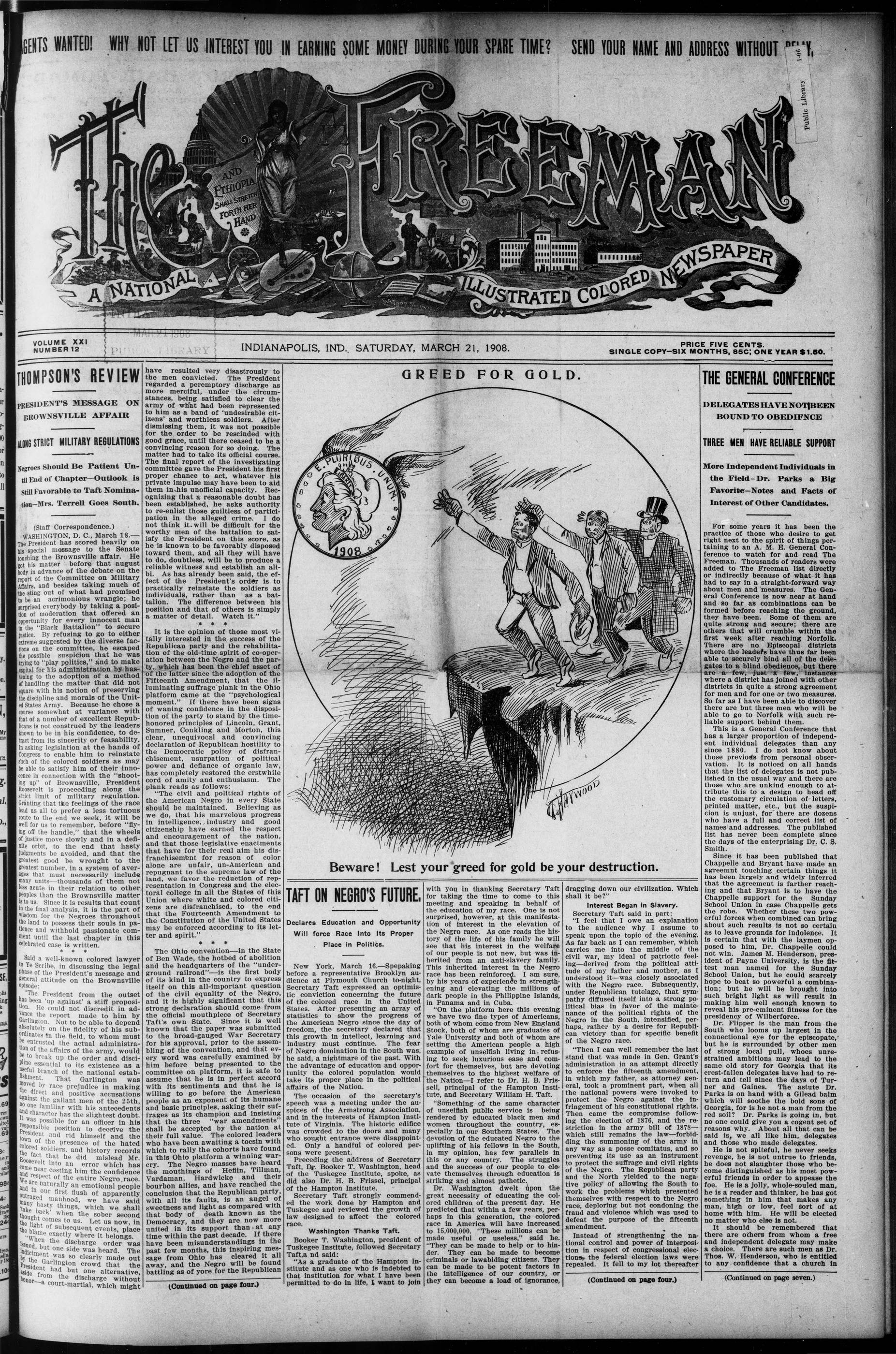
GREED FOR GOLD.
E. PLURIBUS UNUM.
1908
GRAYWOOD
Beware! Lest your greed for gold be your destruction.
TAFT ON NEGRO'S FUTURE.
TAFT ON NEGRO'S FUTURE.
Declares Education and Opportunity Will force Race Into Its Proper Place in Politics.
New York, March 16.—Spepaking before a representative Brooklyn audience at Plymouth Church to night, Secretary Taft expressed an optimistic conviction concerning the future of the colored race in the United States. After presenting an array of statistics to show the progress of the American Negro since the day of freedom, the secretary declared that this growth in intellect, learning and industry must continue. The fear of Negro domination in the South was, he said, a nightmare of the past. With the advantage of education and opportunity the colored population would take its proper place in the political affairs of the Nation.
The occasion of the secretary's speech was a meeting under the auspices of the Armstrong Association, and in the interests of Hampton Institute of Virginia. The historic edifice was crowded to the doors and many who sought entrance were disappointed. Only a handful of colored persons were present.
Preceding the address of Secretary Taft, Dr. Booker T. Washington, head of the Tuskegee Institute, spoke, as did also Dr. H. B. Frissel, principal of the Hampton Institute.
Secretary Taft strongly commended the work done by Hampton and Tuskegee and reviewed the growth of law designed to affect the colored race.
Washington Thanks Taft.
Booker T. Washington, president of Tuskegee Institute, followed Secretary Taft,a nd said:
"As a graduate of the Hampton Institute and as one who is indebted to that institution for what I have been permitted to do in life, I want to join
with you in thanking Secretary Taft for taking the time to come to this meeting and speaking in behalf of the education of my race. One is not surprised, however, at this manifestation of interest in the elevation of the Negro race. As one reads the history of the life of his family he will see that his interest in the welfare of our people is not new, but was inherited from an anti-slavery family. This inherited interest in the Negro race has been reinforced. I am sure, by his years of experience in strengthening and elevating the millions of dark people in the Philippine Islands, in Panama and in Cuba.
"On the platform here this evening we have two fine types of Americans, both of whom come from New England Stock, both of whom are graduates of Yale University and both of whom are setting the American people a high example of unselfish living in, refusing to seek luxurious ease and comfort for themselves, but are devoting themselves to the highest welfare of the Nation—I refer to Dr. H. B. Frisell, principal of the Hampton Institute, and Secretary William H. Taft.
"Something of the same character of unselfish public service is being rendered by educated black men and women throughout the country, especially in our Southern States. The devotion of the educated Negro to the uplifting of his fellows in the South, in my opinion, has few parallels in this or any country. The struggles and the success of our people to elevate themselves through education is striking and almost pathetic. Dr. Washington dwelt upon the great necessity of educating the colored children of the present day. He predicted that within a few years, perhaps in this generation, the colored race in America will have increased to 15,000,000. "These millions can be made useful or useless," said he. "They can be made to help or to hinder. They can be made to become criminals or lawabiding citizens. They can be made to be potent factors in the intelligence of our country, or they can become a load of ignorance.
PRICE FIVE CENTS.
SINGLE COPY-SIX MONTHS, 85C; ONE YEAR $1.60.
dragging down our civilization. Which shall it be?"
**Interest Began in Slavery.**
Secretary Taft said in part:
"I feel that I owe an explanation to the audience why I assume to speak upon the topic of the evening. As far back as I can remember, which carries me into the middle of the civil war, my ideal of patriotic feeling—derived from the political attitude of my father and mother, as I understood it—was closely associated with the Negro race. Subsequently, under Republican tutelage, that sympathy diffused itself into a strong political bias in favor of the maintenance of the political rights of the Negro in the South, intensified, perhaps, rather by a desire for Republican victory than for specific benefit of the Negro race.
"Then I can well remember the last stand that was made in Gen. Grant's administration in an attempt directly to enforce the fifteenth amendment, in which my father, as attorney general, took a prominent part, when all the national powers were invoked to protect the Negro against the infringement of his constitutional rights. Then came the compromise following the election of 1876, and the restriction in the army bill of 1878—which still remains the law—forbidding the summoning of the army in any way as a posse comitatus, and so preventing its use as an instrument to protect the suffrage and civil rights of the Negro. The Republican party and the North yielded to the negative policy of allowing the South to work the problems which presented themselves with respect to the Negro race, deploring but not condoning the fraud and violence which was used to defeat the purpose of the fifteenth amendment.
Instead of strengthening the national control and power of interposition in respect of congressional elections, the federal election laws were repealed. It fell to my lot thereafter
(Continued on page four.)
THE GENERAL CONFERENCE
DELEGATES HAVE NOT BEEN BOUND TO OBEDIFNCE
THREE MEN HAVE RELIABLE SUPPORT
More Independent Individuals in the Field-Dr. Parks a Big Favorite-Notes and Facts of Interest of Other Candidates.
For some years it has been the practice of those who desire to get right next to the spirit of things pertaining to an A. M. E. General Conference to watch for and read The Freeman. Thousands of readers were added to The Freeman list directly or indirectly because of what it has had to say in a straight-forward way about men and measures. The General Conference is now near at hand and so far as combinations can be formed before reaching the ground, they have been. Some of them are quite strong and secure; there are others that will crumble within the first week after reaching Norfolk. There are no Episcopal districts where the leaders have thus far been able to securely bind all of the delegates to a blind obedience, but there are a few, just a few, instances where a district has joined with other districts in quite a strong agreement for men and for one or two measures. So far as I have been able to discover there are but three men who will be able to go to Norfolk with such reliable support behind them.
This is a General Conference that has a larger proportion of independent individual delegates than any since 1880. I do not know about those previous from personal observation. It is noticed on all hands that the list of delegates is not published in the usual way and there are those who are unkind enough to attribute this to a design to head off the customary circulation of letters, printed matter, etc., but the suspicion is unjust, for there are dozens who have a full and correct list of names and addresses. The published list has never been complete since the days of the enterprising Dr. C. S. Smith.
Since it has been published that Chappelle and Bryant have made an agreement touching certain things it has been largely and widely inferred that the agreement is farther reaching and that Bryant is to have the Chappelle support for the Sunday School Union in case Chappelle gets the robe. Whether these two powerful forces when combined can bring about such results is not so certain as to leave grounds for indolence. It is certain that with the laymen opposed to him, Dr. Chappelle could not win. James M. Henderson, president of Payne University, is the fittest man named for the Sunday School Union, but he could scarcely hope to beat so powerful a combination; but he will be brought into such bright light as will result in making him well enough known to reveal his pre-eminent fitness for the presidency of Wilberforce.
Dr. Flipper is the man from the South who looms up largest in the connectional eye for the episcopate, but he is surrounded by other men of strong local pull, who unsrestrained ambitions may lead to the same old story for Georgia that its crest-fallen delegates have had to return and tell since the days of Turner and Gaines. The astute Dr. Parks is on hand with a Gilead balm which will soothe the bold sons of Georgia, for is he not a man from the red soil? Dr. Parks is going in, but no one could give you a cogent set of reasons why. About all that can be said is, we all like him, delegates and those who made delegates.
He is not spitful, he never seeks revenge, he is not untrue to friends, he does not slaughter those who become distinguished as his most powerful friends in order to appease the foe. He is a jolly, whole-souled man, he is a reader and thinker, he has got something in him that makes any man, high or low, feel sort of at home with him. He will be elected no matter who else is not.
It should be remembered that there are others from whom a free and independent delegate may make a choice. There are such men as Dr. Thos. W. Henderson, who is entitled to any confidence that a church in
(Continued on page seven.)
IN THE WOMAN'S WORLD.
BY "DOROTHY"
This column is devoted to the interests of all women and their organizations also. Address all communications to Dorothy. The Freeman Indianapolis, Ind.
2
SONG OF CHILDHOOD DAYS.
Oh! 'the song of childhood days,
the little tail that flies,
And I love to go and sing it back along
the pleasant ways,
When we the owl takes the waterers flow,
And the fairest flowers grow
Down the valleys and the meadows of the happy long age!
There the robin high a-tilt
Gave to me his joyous lilt,
And the breezes from the violets the crystal dewrops split;
Black-cyed crickets in the grass
Sand to the clover in the pass
When the mounted sun was glowing like a bowl of burnished brass!
Oh! the splendor of that noon,
When the diadem danced to swoon
In a dream of summer capture with the locusts all a-croon;
River-ripples, cool and sweet,
Kissed the little sun-burnt feet,
And the pathways glowed and gimmered in the dazzling waves of heat!
With the quiet shades of eve,
When the night began to weave
A coronal of splendor, and the lowing kine ways
Fields where they had fed all day,
Winding up the woodland way,
Came the repertoire of music of the whip-poor-will's far lay!
Still the forest-land retains
All the pleasing, sweet refrains,
And the flowered fields grow fragrant at the kiss of summer rains;
Still the sparkling brooklets call!
Mong lush grasses growing tall,
And the locust nicks the silence with its shadp staccato call!
Oh! the song of childhood days,
Tis the sweetest of all lays,
And I love to go and sing it back along the pleasant ways;
There the music of the wrens,
And the pipa;
Join the lay of sweet thanksgiving that from out my soul ascends!
Shelbyville, Ind. ALONZO RICE.
BOOM FOR TEACHING OF DRESS IN THE SCHOOLS.
In the matter of taste in dress and sense in shopping women in Chicago and its environs are to be aided and illuminated.
In Evanston yesterday plans were made to introduce into Northwestern University a department of "art appreciation"-a chair of "cultivation of good taste." This will aim especially to instill into the feminine student mind notions of appropriate dressing. The movement has back of it leading women of the suburb.
In Chicago the Woman's Club decided that high school courses in shopping, including laboratory training in the selection and purchase of materials, and more general instruction in the ethics of the department store—were reforms toward which womankind should look.
Teacher of Good Taste
The project for a teacher of "good taste" at Evanston took form in resolutions adopted by the University Guild and soon to be presented to President Harris of Northwestern. The women feel sure he will act favorably on the proposal.
The guild, which is composed of both university and townpeople, proposes to support, for a term of one year as an experiment, an instructor whose duty it shall be to teach, especially to women students, the decadent art of good and appropriate dressing. All branches of art appreciation, including home building and furnishing, will be given. President Harris and the executive committee of the university will consider the matter at their meeting Monday night.
Dresses Not Appropriate.
The plan is the fruit of much consideration by members of the guild, who long have felt a lack in this direction. The feelings of the guild that good taste was lacking in much of modern life and at the university in particular, were crystallized some weeks ago when its members were addressed by Miss Skinner, a teacher of Boston, who pointed out the lack of appropriate dress which prevails among women today.
Miss Skinner has given the problem of women's dress and the larger problem of the application of good taste in all matters much attention, and her criticisms aroused much comment, largely favorable, from the members who had individually felt as she does. Her name naturally suggests itself to the leaders in the movement for the new department at the university as the one best fitted to take charge of the work.
The university guild agrees to finance the department for one year, after which time the university will pay the instructor, providing that the experiment is a success.
Ethics of Shopping.
The Chicago Woman's Club spent the afternoon discussing shopping ethics. It found hope in the future woman, but saw little that would cheer in the present generation.
"Most of us are too old to learn," said a former president of the organization.
"We have our fads and our foibles, and have been led around all our lives by the fashion plate and the shopping mania. We may as well admit it. What we must do now is to incorporate in our educational system some recognition of the fact that the girls of today are going to be the greatest spenders of the nation, and give them some training that will equip them for this sort of a life."
Briefly the situation at the end of the session looked like this:
The fashion plate hypnotizes the woman who looks at it.
Art has no chance with Chicago women. Club members bewail the fact that they cannot "buy more pictures," but a glance at their costumes explains their lack of funds. The average woman's idea of dra-
matic criticism is an inquiry as to the number of gowns worn by the leading actress. The shopping mania is like the small boy's passion for cramming his pockets. No woman with "grown-up" ideas has it. The history of womankind is a series of caricatures. High School Course Proposed. The suggestion that courses in shopping be devised for the public schools came first in a brief address by Mrs. Alice Peloubet Norton of the University of Chicago. "I have been working for some time," said Mrs. Norton, "on a high school course in textiles and the various articles of dress for women. It includes, among other things, instruction in the amount of money that may be spent wisely for clothing, how to select materials and to buy them, the bad elements in the passion for shopping—more particularly the element of waste—and the general economic problem of dress.
"This, it seems to me, offers the one solution to the problem that we have had before us this afternoon. We cannot reform our women by appealing to the department stores. They supply the demand, and it is only by teaching our women to demand the right thing that we will get it. Whether such courses can be introduced or not in the near future I do not know, but if they can it will be a long step in the direction of what we are pleased to call the emancipation of women."
ARTIFICIAL LIMB FOR FLORENCE HARPER.
Subscriptions to Be Taken by The Freeman.
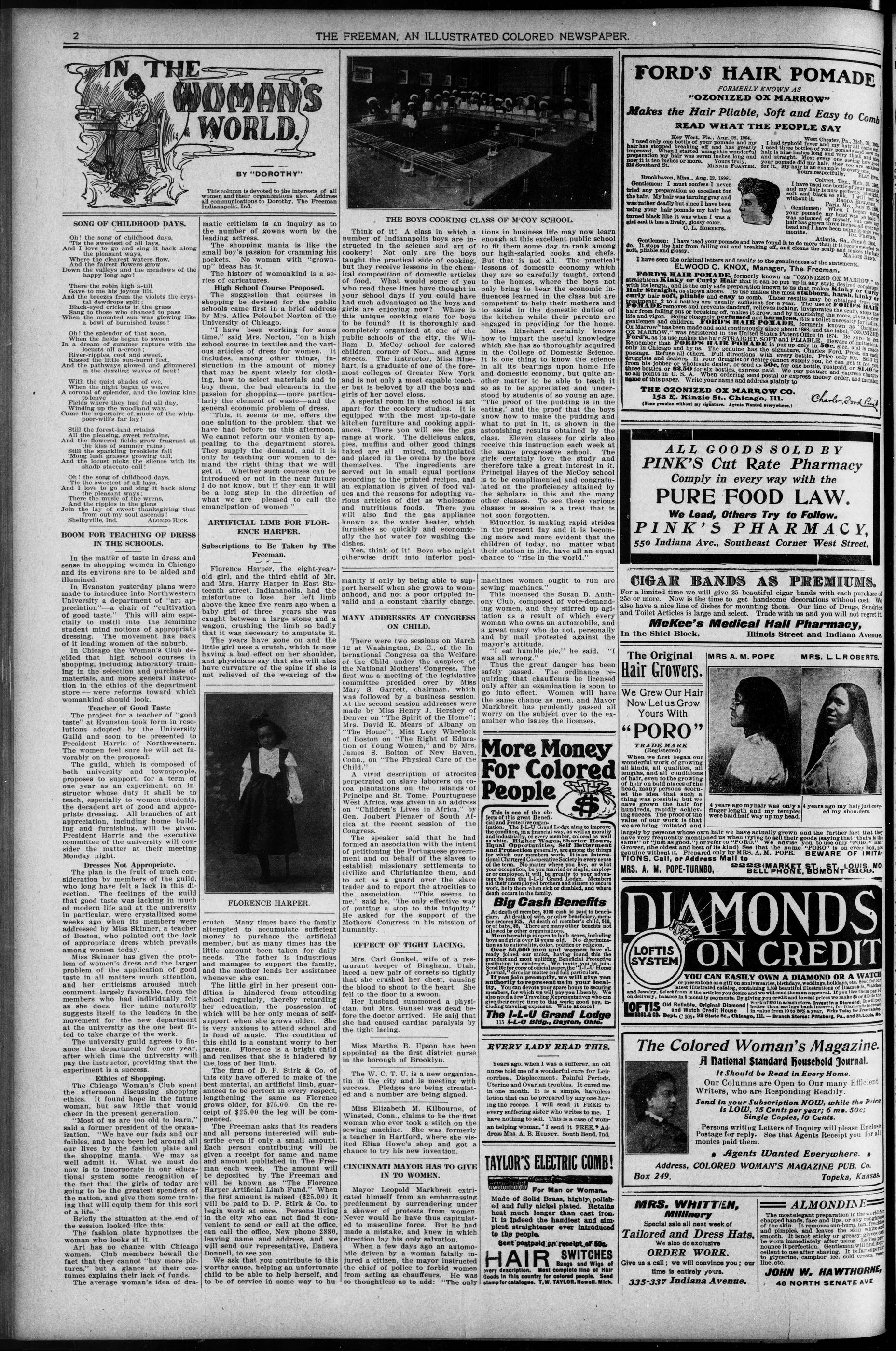
Florence Harper, the eight-year-old girl, and the third child of Mr. and Mrs. Harry Harper in East Sixteenth street, Indianapolis, had the misfortune to lose her left limb above the knee five years ago when a baby girl of three years she was caught between a large stone and a wagon, crushing the limb so badly that it was necessary to amputate it. The years have gone on and the little girl uses a crutch, which is now having a bad effect on her shoulder, and physicians say that she will also have curvature of the spine if she is not relieved of the wearing of the
A
FLOREENCE HARPER.
crutch. Many times have the family attempted to accumulate sufficient money to purchase the artificial member, but as many times has the little amount been taken for daily needs. The father is industrious and manages to support the family, and the mother lends her assistance whenever she can.
The little girl in her present condition is hindered from attending school regularly, thereby retarding her education, the possession of which will be her only means of self-support when she grows older. She is very anxious to attend school and is fond of music. The condition of this child is a constant worry to her parents. Florence is a bright child and realizes that she is hindered by the loss of her limb.
The firm of D. P. Stirk & Co. of this city have offered to make of the best material, an artificial limb, guaranteed to be perfect in every respect, lengthening the same as Florence grows older, for $75.00. On the receipt of $25.00 the leg will be commenced.
The Freeman asks that its readers and all persons interested will subscribe even if only a small amount. Each person contributing will be given a receipt for same and name and amount published in The Freeman each week. The amount will be deposited by The Freeman and will be known as "The Florence Harper Artificial Limb Fund." When the first amount is raised ($25.00) it will be paid to D. P. Stirk & Co. to begin work at once. Persons living in the city who can not find it convenient to send or call at the office, can call the office, New phone 2880, leaving name and address, and we will send our representative, Daneva Donnell, to see you.
We ask that you contribute to this worthy cause, helping an unfortunate child to be able to help herself, and to be of service in some way to hu-
THE FREEMAN, AN ILLUSTRATED COLORED NEWSPAPER
THE BOYS COOKING CLASS OF M'COY SCHOOL.
Think of it! A class in which a number of Indianapolis boys are instructed in the science and art of cookery! Not only are the boys taught the practical side of cooking, but they receive lessons in the chemical composition of domestic articles of food. What would some of you who read these lines have thought in your school days if you could have had such advantages as the boys and girls are enjoying now? Where is this unique cooking class for boys to be found? It is thoroughly and completely organized at one of the public schools of the city, the William D. McCoy school for colored children, corner of Norr. and Agnes streets. The instructor, Miss Rinehart, is a graduate of one of the foremost colleges of Greater New York and is not only a most capable teacher but is beloved by all the boys and girls of her novel class.
A special room in the school is set apart for the cookery studies. It is equipped with the most up-to-date kitchen furniture and cooking appliances. There you will see the gas range at work. The delicious cakes, pies, muffins and other good things baked are all mixed, manipulated and placed in the ovens by the boys themselves. The ingredients are served out in small equal portions according to the printed recipes, and an explanation is given of food values and the reasons for adopting various articles of diet as wholesome and nutritious foods. There you will also find the gas appliance known as the water heater, which furnishes so quickly and economically the hot water for washing the dishes. Yes, think of it! Boys who might otherwise drift into inferior posi-
manity if only by being able to support herself when she grows to womanhood, and not a poor crippled invalid and a constant charity charge
MANY ADDRESSES AT CONGRESS ON CHILD.
There were two sessions on March 12 at Washington, D. C., of the International Congress on the Welfare of the Child under the auspices of the National Mothers' Congress. The first was a meeting of the legislative committee presided over by Miss Mary S. Garrett, chairman, which was followed by a business session. At the second session addresses were made by Miss Henry J. Hershey of Denver on "The Spirit of the Home"; Mrs. David E. Mears of Albany on "The Home"; Miss Lucy Wheelock of Boston on "The Right of Education of Young Women," and by Mrs. James S. Bolton of New Haven, Conn., on "The Physical Care of the Child."
A vivid description of atrocities perpetrated on slave laborers on cocoa plantations on the islands of Principe and St. Tome, Poutuguese West Africa, was given in an address on "Children's Lives in Africa," by Gen. Joubert Pienaer of South Africa at the recent session of the Congress.
The speaker said that he had formed an association with the intent of petitioning the Portuguese government and on behalf of the slaves to establish missionary settlements to civilize and Christianize them, and to act as a guard over the slave trader and to report the atrocities to the association. "This seems to me," said he, "the only effective way of putting a stop to this iniquity." He asked for the support of the Mothers' Congress in his mission of humanity.
EFFECT OF TIGHT LACING.
Mrs. Carl Gunkel, wife of a restaurant keeper of Bingham, Utah, laced a new pair of corsets so tightly that she crushed her chest, causing the blood to shoot to the heart. She fell to the floor in a swoon.
Her husband summoned a physician, but Mrs. Gunkel was dead before the doctor arrived. He said that she had caused cardiac paralysis by the tight lacing.
Miss Martha B. Upson has been appointed as the first district nurse in the borough of Brooklyn.
The W. C. T. U. is a new organizatin in the city and is meeting with success. Pledges are being circulated and a number are being signed.
Miss Elizabeth M. Kilbourne, of Winsted, Conn., claims to be the first woman who ever took a stitch on the sewing machine. She was formerly a teacher in Hartford, where she visited Elias Howe's shop and got a chance to try his new invention.
CINCINNATI MAYOR HAS TO GIVE IN TO WOMEN.
Mayor Leopold Markbreit extricated himself from an embarrassing predicament by surrendering under a shower of protests from women. Never would he have thus capitulated to masculine force. But he had made a mistake, and knew in which direction lay his only salvation. When a few days ago an automobile driven by a woman fatally injured a citizen, the mayor instructed the chief of police to forbid women from acting as chauffeurs. He was so thoughtless as to add: "The only
tions in business life may now learn enough at this excellent public school to fit them some day to rank among our lggh-salaried cooks and chefs. But that is not all. The practical lessons of domestic economy which they are so carefully taught, extend to the homes, where the boys not only bring to bear the economic influences learned in the class but are competent to help their mothers and to assist in the domestic duties of the kitchen while their parents are engaged in providing for the home.
Miss Rinehart certainly knows how to impart the useful knowledge which she has so thoroughly acquired in the College of Domestic Science. It is one thing to know the science in all its bearings upon home life and domestic economy, but quite another matter to be able to teach it so as to be appreciated and understood by students of so young an age. "The proof of the pudding is in the eating," and the proof that the boys know how to make the pudding and what to put in it, is shown in the astonishing results obtained by the class. Eleven classes for girls also receive this instruction each week at the same progressive school. The girls certainly love the study and therefore take a great interest in it. Principal Hayes of the McCoy school is to be complimented and congratulated on the proficiency attained by the scholars in this and the many other classes. To see these various classes in session is a treat that is not soon forgotten.
Education is making rapid strides in the present day and it is becoming more and more evident that the children of today, no matter what their station in life, have all an equal chance to "rise in the world."
machines women ought to run are sewing machines." This incensed the Susan B. Anthony Club, composed of vote-demanding women, and they stirred up agitation as a result of which every woman who owns an automobile, and a great many who do not, personally and by mail protested against the mayor's attitude. "I eat humble pie," he said. "I was all wrong." Thus the great danger has been safely passed. The ordinance requiring that chauffeurs be licensed only after an examination is soon to go into effect. Women will have the same chance as men, and Mayor Markbreit has prudently passed all worry on the subject over to the examiner who issues the licenses.
More Money For Colored People
This is one of the objects of this great Benefit-
ship to the Colored community. The I-L-U Grand Lodge aims to improve
the condition, in a financial way, as well as morally
and industrially, of every member, colored as well
as white. His Majesty, Shorter House,
Equal Opportunities, Self Betterment
and Protection generally, are among the things
the Colored people will be greatly to our retum
and to maintain. The Chartered Co-operative Society in every sense
of the term. No matter where you live, or what
your occupation, be you married or single, employ-
er or employee, will be greatly to your retum
to join the I-L-U Grand Lodge. Members
aid their unemployed brothers and sisters to secure
work, help them when sick or disabled, and where
Big Cash Benefits
At death of member, $100 cash is paid to beneficiary.
At death of wife, or is other beneficiary, mem-
ber of the deceased brother's choice, $100 or of baby, $.$. There are many other benefits not
allowed by other organizations.
Membership is open to both sexes, including boys and girls over 15 years old. No discrimination. Over 50,000 men and women have already joined our ranks, having found this the best institution in existence. We invite you to join. Send ldc for copy of official paper, the "L-U Home Journal." If you join promptly, we will give you authority to represent us in your locality. You can devote your spare hours to securing your position. We also need a few Traveling Representatives who can give their entire time to this work; good pay, including traveling expenses. Write at once!
The I-L-U Grand Lodge
115 I-L-U Bldg, Dayton, Ohio
EVERY LADY READ THIS.
Years ago, when I was a sufferer, an old nurse told me of a wonderful cure for Leurcorrhhea. Displacement, Painful Periods, Uterine and Ovarian troubles. I cured me in one month. It is a simple, harmless lotion that can be prepared by any one having the recipe. I will send it FREE to every suffering sister who writes to me. I have nothing to sell. This is a case of woman helping her. I send it FREE. *Address Ms. A. B. HUDEN. South Bend, Ind.
TAYLOR'S ELECTRIC COMB!
TAYLOR'S ELECTRIC COMB!
For Man or Woman
Made of Solid Brass, highly polished and fully nickel plated. Retains heat much longer than cast iron. It is indeed the handiest and simplest straightener ever introduced to the people.
Sent postpaid on receipt of 50c.
HAIR SWITCHES
Bangs and Wigs of every description. Most complete lines of Hair Goods in this country for colored people. Send stamps for catalogue. T.W. TAYLOR, HOWELL, Mich.
FORD'S HAIR POMADE FORMERLY KNOWN AS "OZONIZED OX MARROW" Makes the Hair Pliable, Soft and Easy to Comb READ WHAT THE PEOPLE SAY
Amy set it fla. Aug. 28, 1994.
I used only one size of hair. My hair has stopped breaking off and has greatly improved. I prepare my hair was seven long and preparation my hair was seven inches longer and six inches or more. MINNESOTA MEN'S CLUB.
West Chester, Pa., Mch. 38, 26.
I had typhoid fever and my hair all came out.
I used three bottles of cold and very cold and now my hair is nine inches long and very thin and straight. Most every one sees you good your pomade on my hair, they too are for it, my hair is damp to every one.
Your reasons.
Brookhaven, Miss., Aug. 13, 1898.
Gentleman: I must confess I never tried any preparation so excellent for the hair. My hair was turning gray and was rather deadly but since I have been using your hair pomade my hair has turned black like it was when I was a girl and it has a liveliness. C. L. ROBERTS.
MEDICINE
Dovert. Tex. Meb. 31. 8
I have used it on your pants
and my hair is now on straight
soft and black as silk. I do not
without it. RODA BEM
Gentlemen: When it was being made to the top of the ground, it was found that it was a girl and it has a lively, glossy color.
C. L. ROBERTS,
Atlanta, Ga., June 1930.
Gentlemen: I have used your pomade, and have found it to do more than it is recommended. I do it, it stops the hair from falling out and breaking off, and cleans the scalp and makes the hair soft, pliable and glossy.
I have seen the original letters and testify to the genuineness of the statements.
ELWOOD C. KNOX, Manager, The Freeman.
FORD'S HAIR POMADE, formerly known as "OZONIZED OX MARROW," to the straightens Kinky or Curly Hair that is to the put up in any style desired consistently with its length, and is the only safe preparation known to make it makes Kinky or Curly hair straight, as shown above. Its use makes the most stubborn, fresh, kinky or curly hair soft, pliable and easy to comb. These results may be obtained from the two bottles of the products and that are very good for the production of the products. The use of FORD'S HAIR POMADE removal is usually sufficient for a year. The use of FORD'S HAIR POMADE and other products are not as good as it would be, though, in the case of the roots, stop the life and vigor. Being elegantly perfumed and harmless, it is a toilet-lessity for ladies. One of the best products is the FORD'S HAIR POMADE, formerly known as "OZONIZED OX MARROW," when made and sold continuously since about 1869, and the label, "OZONIZED OX MARROW" is not registered in the United States Patent Office in 1874. The sure to be found for it is the FORD'S HAIR POMADE, which is in 1901, in the FORD'S HAIR POMADE, and is made in the same way as the signature, Charles Ford, Prentice and each package. Because of others. Full directions with every bottle. Price only 500. Sold by drugists and dealers. Your suggest or dealer cannot supply you, he can get it for from his jobber or wholesale dealer, or send it 500. A code bottle, postpaid, or $1.40 for three bottles, or $2.50 for six bottles, express paid. We pay postage and express charges to all points in U. S. A. When ordering send postal or express money order, and mention name of this paper. Write your name and address plainly to
Gentlemen: I have 25d your pomade and have found it to do more than it is recommended to do. It stops the hair from falling out and breaking off, and cleans the scalp and makes the hair soft, pliable and glossy.
I have seen the original letters and testify to the genuineness of the statements.
ELWOOD C. KNOX, Manager, The Freeman.
FORD'S HAIR POMADE, formerly known as "OZONIZED OX MARROW, so straightens Kinky or Curly Hair that it can be put up in any style, desired consistent with its length, and is the only safe preparation known to us that the Kinky or Curly Hair is straight, as shown above. Its use makes the most stubborn, harsh and inky or curly hair, and is stable and easy to comb. These results may be obtained from a treatment: 2 to 4 bottles are usually sufficient for a year. The use of FORD'S HAIR POMADE removes and prevents dandruff, relieves itch, invigorates the scalp, and is the hair from falling out or breaking off, makes it grow, and by nourishing the roots, stops the life and vigor. Being elegantly perfumed and harmless, it is a toilet necessity for a dandruff, and is a good health for the hair.
OX MARROW has been made and sold commonly as a product, and the label is "OZONIZED OX MARROW," was registered in the United States Patent Office in 1874. Be sure to get "FORD's" as its use makes the hair STRAIGHT. SOFT and PLIABLE. Beware of limitations. Remember that FORD'S HAIR POMADE is put up only in 50c. size, and it is made only in Chicago. As the genuine has the signature, Charles Ford, pres. and package. Refuse all other "Full" to buy a bottle. Price only 50c. on each drugrids and dealers. It your druglist or dealers can supply the cost. It is the cost for the from his jobber or wholesale dealer, or send us 50c. for one bottle, and you get it for you through bottles, or $2.50 for six bottles, express paid. We pay postage and express charges to all points in U.S.A. When ordering send postal or express money order, and mention some of this paper. Write your name and address plainly to
THE OZONIZED OX MARROW CO.
153 E. Kinzlie St., Chicago, Ill.
(None genale without my signature, Agents Wanted greய்here.)
ALL GOODS SOLD BY
PINK'S Cut Rate Pharmacy
Comply in every way with the
PURE FOOD LAW.
We Lead, Others Try to Follow.
PINK'S PHARMACY,
550 Indiana Ave., Southeast Corner West Street.
CIGAR BANDS AS PREMIUMS.
For a limited time we will give 25 beautiful cigar bands with each purchase of 25c or more. Now is the time to get handsome decorations without cost. We also have a nice line of dishes for mounting them. Our line of Drugs, Sundries and Toilet Articles is large and select. Trade with us and you will not regret it.
McKee's Medical Hall Pharmacy,
In the Shiel Block.
Illinois Street and Indiana Avenue.
ALL GOODS SOLD BY PINK'S Cut Rate Pharmacy Comply in every way with the PURE FOOD LAW. We Lead, Others Try to Follow. PINK'S PHARMACY, 550 Indiana Ave., Southeast Corner West Street.
CIGAR BANDS AS PREMIUMS.
For a limited time we will give 25 beautiful cigar bands with each purchase of 25c or more. Now is the time to get handsome decorations without cost. We also have a nice list of dishes for mounting them. Our line of Drugs, Sundries and Toilet Articles is large and select. Trade with us and von will not remit it.
MRS A. M. POPE MRS. L. L. ROBERTS.
We Grew Our Hair
Now Let us Grow
Yours With
When we first began our wonderful work of growing our bodies in lengths, and all conditions of hair, even to the growing hair of our heads, many persons soorned the idea that such a thing was possible; but we never had hundreds, rapidly achieving success. The proof of the value of our work is that the body grows.
4 years ago my hair was only a finger length and my temples were bald half way up my head.
largely by persons whose own hair we have actually grown and the further fact that they have very frequently mentioned us when trying to sell their goods (saying that "thems is the same" or "just as good.") or refer to "PORO." We advise you to use only "PORO" Hair Grower, (the oldest and best of its kind) See that the name "PORO" is on every box, not genuine without it. Prepared only by MRS. A. M. POPE. BEWARE OF IMITA TIONS. Call, or Address Mall to
MRS. A. M. POPE-TURNBO,
2223 MARKET ST. ST. LOUIS MO.
BELL PHONE, BOMONT 8109.
DIAMONDS ON CREDIT
LOFTIS SYSTEM
YOU CAN EASILY OWN A DIAMOND OR A WATCH or present one as a gift on anniversaries, birthdays, weddings, holidays, etc. Send for your latest illustrated catalog, containing 1,500 beautiful illustrations of Diamonds. Watch on delivery, balance in 8 monthly payments. By giving you credit and lowest prices we make $60 or $100 do the work of $60 in a cash store. Invest in a Diamond. It will pay you more than a week, half a year. We Diamonds interest in value from 10 to 30% a year. Write Today for Free stamps.
LOFTIS Old Reliable, Original Diamond and Watch Credit House
BROS. & CO. Dept. C 305, 92 St. St., Chicago, Ill. — Branch Stores: Pittsburg, Pa., and St. Louis, Mo.
The Colored Woman's Magazine.
A National Standard Household Journal.
It Should be Read in Every Home.
Our Columns are Open to Our many Efficient Writers, who are Responding Readily.
Send in your Subscription NOW, while the Price is LOW, 75 Cents per year; 6 mo. 50c; Single Copies, 10 Cents.
Persons writing Letters of Inquiry will please Enclose Postage for reply. See that Agents Receipt you for all monies paid them.
Agents Wanted Everywhere.
Address, COLORED WOMAN'S MAGAZINE PUB. Co.
Box 249.
Topeka, Kansas.
largely by persons whose own hair we have actually grown and the further fact that they have very frequently mentioned us when trying to sell their goods (saying that "theirs is the same" or "just as good") or refer to "PORO". We advise you to use only "PORO" Hair Grower (the oldest and best oldie kind) Ree that the name "PORO" is on every box, and genuine without it. Prepared only by MRS. A. M. POPE. BEWARE OF IMITATIONS. Call, or Address Mail to
MRS. A. M. POPE-TURNBO, 2223 MARKET ST. ST. LOUIS MO. BELL PHONE, BOMONT 8109.
DIAMONDS ON CREDIT
LOFTIS SYSTEM
YOU CAN EASILY OWN A DIAMOND OR A WATCH or present one as a gift on anniversaries, birthdays, weddings, holidays, etc. Send for our latest illustrated catalog, containing 1,500 beautiful illustrations of Diamonds, Watches and Jewelry. Select from it the articles you desire and we will send them on approval. If you like them pay on delivery, balance in 8 monthly payments. By giving you credit and lowest prices we make 40% of the work of 600 in cash-stove, jewel in a Diamond. It will pay better than savings bank interest, for Diamonds interest in value from 10 to 80% a year. Write Today for a discount.
LOFTIS Old Reliable, Original Diamond in Water Credit House
The Colored Woman's Magazine. A National Standard Household Journal.
M.
It should be Read in Every Home.
Our Columns are Open to Our many Efficient
Writers, who are Responding Readily.
Send in your Subscription NOW, while the Price
is LOW, 75 Cents per year; 6 m.o. 50c;
Single Copies, 10 Cents.
Persons writing Letters of Inquiry will please Enclose
Postage for reply. See that Agents Receipt you for all
monies paid them.
Topeka, Kansas.
MRS. WHITTEN,
Millinery
Special sale all next week of
Tailored and Dress Hats.
We also do exclusive
ORDER WORK.
Give us a call; we will convince you; our
time is entirely yours.
335-337 Indiana Avenue.
Millinery
Special sale all next week of
Tailored and Dress Hats.
We also do exclusive
ORDER WORK.
Give us a call; we will convince you; our
time is entirely yours.
335-337 Indiana Avenue.
The most elegant preparation in the world is
chapped hands, face and lips, or any rouge-
g of the skin. It removes sun-burn, tan, feeble
and pimpled, and leaves the skin white and
smooth. It is not sticky or greasy; gloves can
be worn immediately after using. Ladies pre-
nounce it perfection. Gentlemen will find it
cellent to use after shaving. It is far superior
to glycerine, camphor ice, cold cream, twe-
line, etc.
JOHN W. HAWTHORNE,
48 NORTH SENATE AVE.
FUNERAL DIRECTORS.
A
G. W. Frierson & Co, from Nashville, Tenn., have opened a Furcal Bakery.
Funeral Parlor
632 Indiana Avenue, between California and West Streets.
Polite attention and prompt service. Calls answered day and night.
Lady Attendant, Are now at your service. Price below all competitors. Fifteen years in Nashville; two years in Louisville Ky. Phone 3227.
The Fighting Chance.
HE week passed swiftly, day after day echoing with the steady fusillade from marsh to shore.
sweetness, freshness, covert, from valley to ridge. Lord Alderdere, good enough on snipe and cock, was driven almost frantic by the ruffed grouse; Voncher did better for a day or two and then lost the knack; Marion Page attended to business in her cool and thorough style, and her average on the gunroom books was excellent and was also adorned with clever pen and ink sketches by Sisward.
Leroy Mortimer had given up shooting and established himself as a haunter of cushions in sunny corners. Tom O'Tara had gone back to Lenox; Mrs. Vendenning, to Hot Springs. Beverly Plank, master of Black Fells, began to pervade the house after a tentative appearance, and he and Major Belwether pottered about the coverts, usually after luncheon, the latter doing little damage with his fowling piece and nobody knew how much with his gossiping tongue. Quarrier appeared in the field methodically, shot with judgment, taking no chances for a brilliant performance which might endanger his respectable average. As for the Page boys, they kept the river ducks stirring whenever Elene Shannon and Rena Bonnesnel could be persuaded to share the canoes with them. Otherwise they haunted the vicinity of those bored maidens, suffering snubs sorrowfully, but persistently faithful. They were a great nuisance in the evening, especially as their sister did not permit them to lose more than $10 a day at cards.
Cards—that is, bridge and preference—ruled, as usual, and the latter game, being faster, suited Mortimer and Ferrall, but did not aid Slward toward recouping his bridge losses.
Two matters occupied him. Since cup day he had never had another opportunity to see Sylvia Landis alone; that was the first matter. He had touched neither wine nor spirits nor malt since the night Ferrall had found him poone, spenwailing in a stupor on his disordered bed—that was the second matter, and it occupied him, at times required all his attention, particularly when the physical desire for it set in steadily, mercilessly, mounting inexorably like a tide. But, like the tide, it ebbed at last, particularly when a sleepless night had exhausted him.
He had gone back to his shooting again after a cool review of the ethics involved. It even amused him to think that a girl who had cleverness enough to marry many millions, with Quarrier thrown in, could have so moved him to sentimentality. He had ceded the big cup of antique silver to Quarrier, too, a matter which troubled him little, however, as in the irritation of the reaction he had been shooting with the brilliancy of a demon, and the gunroom books were open to any doubting guests' inspection.
Time, therefore, was never heavy on his hands save when the tide threatened—when at night he stirred and awoke, conscious of its crawling advance, aware of its steady mounting menace; moments at table when the aroma of wine made him catch his breath; moments in the gunroom redolent of spicy spirits, a maddening volatile fragrance clinging to the card room too. Yes, the long days were filled with such moments for him.
But aided the desire faded, and even during the day indoors he shrugged desire aside. It was night that he dreaded—the long hours, lying there tense, stark eyed, sickened with desire.
As for Sylvia, she and Grace Ferrall had taken to motoring, driving away into the interior or taking long flights north and south along the coast. Sometimes when they took Quarrier; sometimes, when Mrs. Ferrall drove, they took in ballast in the shape of a superfluous Page boy and a girl for him. Once Grace Ferrall asked Slward to join them; but, no definite time being set, he was scarcely surprised to find them gone when he returned from a morning on the supe meadows. And Sylvia, leagues away by that time, curled up in the tonneau beside Grace Ferrall, watched the dark pines flying past, cheeks pink, eyes like stars, while the rushing wind drove health into her and care out of her, cleansing, purifying, overwhelming winds flowing through and through her till her very soul within her seemed shining, through
the beauty of her eyes. Besides, she had just confessed.
* * * * * * * * * * * * * * *
"He kissed you!" repeated Grace Ferrall incredulously.
"Yes; a number of times. He was silly enough to do it, and I let him."
"I don't know what he said. I was all nerves, confused, scared—a perfect stick, in fact. I don't believe he'd care to try again."
Then Mrs. Ferrall deliberately settled down in her furs to extract from the girl beside her every essential detail, and the girl, frank at first, grew shy and silent—reticent enough to worry her friend into a silence which lasted a long while for a cheerful little matron of her sort.
Presently they spoke of other matters—matters interesting to pretty women with much to do in the coming winter between New York, Hot Springs and Florida—surmises as to dinners, dances and the newcomers in the younger sets, and the marriages to be arranged or disarranged, and the scandals humanity is heir to, and the attitude of the bishop toward divorce.
Then at last as the big motor car swung in a circle at Wenniston Crossroads and poked its brass and lacquer muzzle toward Shotover the talk swung back to Siward once more, having traveled half the world over to find him.
"He is the sweetest fellow with his mother," sighed Grace, "and that counts heavily with me. But there's trouble ahead for her—sorrow and trouble enough for them both if he is a true Siward."
"Heredity again!" said Sylvia impatiently. "Isn't he man enough to win out? I'll bet you he settles down, marries and"— "Marries? Not he! How many girls do you suppose have believed that—were justified in believing he meant
anything by his attractive manner and nice ways of telling you how much he liked you? He had a desperate affair with Mrs. Mortimer—innocent enough. I fancy. He's had a dozen within three years, and in a week Rena Bonnesdel has come to making eyes at him, and Eileen gives him no end of
"Did he propose to
marry?"
chances which he doesn't see. As for Marlon Page, the girl has been on the edge of loving him for years. You laugh? But you are wrong. She is in love with him now as much as she ever can be with anybody. Did he propose to you?"
"Yes-I think so."
"Then it's the first time for him. He finds women only too willing to play with him, as a rule, and he doesn't have to be definite. I wonder what he meant by being so definite with you."
"I suppose he meant marriage," said Sylvia serenely, yet there was the slightest ring in her voice, and it amused Mrs. Ferrall to try her a little further.
"Oh, you think he really intended to commit himself."
"Why not?" retorted Sylvia, turning red. "Do you think he found me overwilling, as you say he finds others?"
"You were probably a new sensation for him," inferred Mrs. Ferrall musingly. "You mustn't take him seriously, child—a man with his record. Besides, he has the same facility with a girl that he has with everything else he tries; his pen—you know how infernally clever he is, and he can make good verse and write witty jingles, and he can carry home with him any opera and play it decently, too, with the proper harmonies. Anything he finds amusing he is clever with—dogs, horses, pen, brush, music, women." That was too malicious, for Sylvia had flushed up painfully, and Grace Ferrall dropped her gloved hand on the hand of the girl beside her. "Child, child," she said, "he is not that sort. No decent man ever is unless the girl is too." Sylvia, sitting up very straight in her furs, said, "He found me anything but difficult, if that's what you mean."
"I don't. Please don't be vexed, dear. I plague everybody when I see an opening. There's really only one thing that worries me about it all."
"What is that?" asked Sylvia, without interest.
"It's that you might be tempted to care a little for him, which, being useless, might be unwise."
"I am—tempted."
"Not seriously."
"I don't know." She turned in a sudden nervous impatience foreign to her. "Howard Quarrier is too perfectly imperfect for me. I'm glad I've said it. The things he knows about and doesn't know have been a revelation in this last week with him. There is too much surface, too much exterior admirably fashioned, and inside is all clockwork." The low whizzing hum of the motor filled a silence that produced considerable effect upon Grace Ferrall, and, after mastering her wits, she said in a subdued voice:
"Of course it's my meddling."
"Of course it isn't. I asked your opinion, but I knew what I was going to do. Only I did think him personally possible, which made the expediency, the mercenary view of it, easier to contemplate."
She was becoming as frankly brutal as she knew how to be, which made the revolt the more ominous.
"Sylvia dear I wish I hadn't meddled. I'm meddling some more, I suppose, when I say to you. Don't give Howard his conge for the present. It is a horrily common thing to dwell
THE FREEMAN. AN ILLUSTRATED COLORED NEWSPAPER
upon, but Howard is too materially important to be cut adrift on the impulse of the moment."
"I know it."
"You are too clever not to. Consider the matter wisely, dispassionately, intelligently, dear, then if by April you simply can't stand it, talk the thing over with me again," she ended rather vaguely and wistfully, for it had been her heart's desire to wed Sylvia's beauty and Quarrier's fortune.
"Do you believe I could induce him to wear his hair any way except pompadour?" said Sylvia. "And, dear, his beard is so dreadfully silky. Isn't there anything he could take for it?"
"Only a razor, I'm afraid. Those long, thick, soft eyelashes of his are ominous. Eyes of that sort ruin a man for my taste. He might just as reasonably wear my hat."
"But he can't follow the fashions in eyes," laughed Sylvia. "Oh, this is atrocious of us—it is simply horrible to sit here and say such things. I am cold blooded enough as it is, material enough, mean, covetous, contemptible." "Dear," said Grace Ferrall mildly, "you are not choosing a husband; you are choosing a career."
"Grace! Do you wish me to marry him?"
"What is the alternative, dear?"
"What is the alternative, dear?"
"Why, nothing—self respect, dowdiness and peace."
"Is that all?"
"All I can see."
"Not Stephen Siward?"
"To marry? No. To enjoy? Yes. Grace. I have had such a good time with him. You don't know! He is such a boy-sometimes, and I-I believe that I am rather good for him. Not that I'd ever again let him do that sort of thing. Besides, his curiosity is quenched. I am the sort he supposed. Now he's found out he will be nice. It's been days since I've had a talk with him. He tried to, but I wouldn't. Besides, the major has said nasty things about him when Howard was present—nothing definite, only hints, smiling silences, innuendoes on the verge of matters rather unfit, and I had nothing definite to refute. I could not even appear to understand or notice, it was all done in such a horridly vague way. But it only made me like him, and no doubt that actress he took to the Patroons is better company than he finds in nine places out of ten among his own sort."
"Oh," said Grace Ferrall slowly, "if that is the way you feel I don't see why you shouldn't play with Mr. Siward whenever you like."
"Nor I. I've been a perfect fool not to. Howard hates him."
"How do you know?"
"What a question! A woman knows such things. Then, you remember that caricature—so dreadfully like Howard. Howard has no sense of humor. He detests such things. It was the most dreadful thing that Mr. Siward could have done to him."
"Meddled again!" groahed Grace.
"Doesn't Howard know that I did that?"
"Yes, but nothing I can say alters his conviction that the likeness was intended. You know it was a likeness. And if Mr. Siward had not told me that it was not intended I should never have believed it to be an accident."
After a prolonged silence Sylvia said overcarelessly: "I don't quite understand Howard. With me anger lasts but a moment, and then I'm open to overtures for peace. I think Howard's anger lasts."
"It does," said Grace. "He was a muff as a boy—a prig with a prig's memory under all his shallow, showy surface. I'm frank with you. I never could take my cousin either respectfully or seriously, but I've known him to take his own anger so seriously that years after he has visited it upon those who had really wronged him. And he is equipped for retaliation if he chooses. That fortune of his reaches far. Not that I think him capable of using such a power to satisfy a mere personal dislike. Howard has principles, loads of them, but the weapon is there."
"Is it true that Mr. Siward is interested in building electric roads?" asked Sylvia curiously. "Mr. Mortimer said so."
"Then I suppose he is. I'll ask Kemp if you like. Why? Isn't it all right to build them?" "I suppose so. Howard is in it somehow. In fact, Howard's company is behind Mr. Siward's, I believe." Grace Ferrell turned and looked at the girl beside her, laughing outright. "Oh, Howard doesn't do mysterious financial things. Besides that, if Howard is in that thing no doubt Kemp and I are too. So your nice young man is in very safe company."
"You draw such silly inferences," said Sylvia coolly, but there was a good deal of color in her cheeks, and she knew it and pulled her big motor veil across her face, fastening it under her chin, of all which amused Grace Ferrall infinitely until the subtler significance of the girl's mental processes struck her, sobering her own thoughts. Sylvia, too, had grown serious in her preoccupation, and the partie-a-deux terminated a few minutes later in a duet of silence over the teacups in the gunroom.
A few moments later Sylvia, glancing over her shoulder, noticed that a fine misty drizzle had clouded the casements. That meant that her usual evening stroll on the cliffs with Quarrier before dressing for dinner was off. And she drew a little breath of unconscious relief as Marion Page walked in, her light woolen shooting jacket, her hat, shoes and the barrels of the fowling piece tucked under her left armpit, all glimmering frostily with powdered raindrops.
She said something to Grace Ferrall about the mist promising good point shooting in the morning, took the order book from a servant, jotted down her request to be called an hour before sunrise. filled in the gunroom records
with her score—the species and number bagged and the number of shells used—and, accepting the tea offered, drew out a tiny cigarette case of sweet bay wood heavily crusted with rose gold.
"With whom were you shooting?" asked Grace, as Marion dropped one well shaped leg over the other and wreathed her delicately tanned features in smoke.
"Stephen Siward and Blinky. They're at it yet, but I had some letters to write." She glanced leisurely at Sylvia and touched the ash tray with the whitening end of her cigarette. "That dog you let Mr. Siward have is a good one. I'm taking him to Jersey next week for the cock shooting."
Sylvia returned her calm gaze blankly.
An unreasonable and disagreeable shock had passed through her.
"My North Carolina pointers are useless for close work." observed Marion
S. Egley
indifferently, and she leaned back, watching the blue smoke curling upward from her cigarette. Sylvia, distrait, but with downcast eyes on fire under the fringed lids, was thinking of the check Slward had given her for Sagamore. The transaction for her had been a business one on the surface only. She had never meant to use the check. She had laid it away among a few letters, relics, pleasant scournirs of the summer. To her the affair had been softened by a delicate hint of intimacy—the delight he was to take in something that had once been hers had given her a faint taste of the pleasure of according pleasure to a man. And this is what he had done!
In ones and twos the guests reported as the dusk curtained fog closed in on Shotover. Quarrier came, dry as a chip under his rain coat, but his silky beard was wet with rain, and moisture powdered his long, soft eyelashes and white skin, and his flexible fingers as he drew off his gloves seemed startling in their whiteness through the gathering gloom.
"I suppose our evening walk is out of the question," he said, standing by Sylvia, who had nodded a greeting and then turned her head rather hastily to see who had entered the room. It was Siward, only a vague shape in the gloom, but perfectly recognizable to her. At the same moment Marion Page rose leisurely and strolled toward the billiard room.
"Our walk?" repeated Sylvia absently. "It's raining, you know." Yet only a day or two ago she had walked to church with Siward through the rain, the irritated major feeling obliged to go with them. Her eyes followed Siward's figure, suddenly dark against the door of the lighted billiard room, then brilliantly illuminated as he entered, nodded acceptance to Mortimer's invitation and picked up the cue just laid aside by Agatha Calthness, who had turned to speak to Marion.
His fancee's inattention was not agreeable to Quarrier. A dozen things had happened since his arrival which had not been agreeable to him—her failure to meet him at the Fells Crossing and the reason for her failure and her informal acquaintance with St.ward, whose presence at Shotover he had not looked for, and her sudden intimacy with the man he had never particularly liked and whom within six months he had come to detest and to avoid.
In a few years indifference to Siward had changed to passive disapproval, that again to an emotionless dislike, and when the scandal at the Patroons club occurred for the first time in his life he understood what it was to fear the man he disliked. For if Siward had committed the insane imprudence which had cost him his title to membership he had also done something, knowingly or otherwise, which awoke in Quarrier a cold, slow fear, and that fear was dormant, but present now, and it for the time being dictated his attitude and bearing toward the man who might or might not be capable of using viciously a knowledge which Quarrier believed that he must possess.
For that reason when it was not possible to avoid Siward his bearing toward him was carefully civil. Silence was always desirable to Quarrier. Silence concerning all matters was a trait inborn and congenially cultivated to a habit by him in every affair of life—in business, in leisure, in the methodical pursuits of such pleasures as a limited intellect permitted him, in personal and family matters, in public questions and financial problems.
He listened always, but never invited
confidences. He had no opinion to express when invited. And he became very, very rich.
And over it all spread a thin membrane of vanity, nervous, not intellectual, sensitiveness, for all sense of humor was absent in this man, whose smile when not a physical effort was automatically and methodically responsive to certain fixed cues.
A sudden rain squall, noisy against the casements, had darkened the room. Then the electric lights broke out with a mild candelike luster, and Quarrier, standing beside Syllia's chair, discovered it to be empty.
It was not until he had dressed for dinner that he saw her again, seated on the stairs with Marion Page, a new appearance of intimacy for both women, who heretofore had found nothing except a passing civility in common.
Marion explained that Siward was too busy to do any southern shooting, which was why he was glad to have her polish Sagamore on Jersey woodcock.
"I thought it was not good for a dog to be used by anybody except his master," said Sylvia carelessly.
"Only second raters suffer. Besides, I have shot enough now with Mr. Siward to use his dog as he does."
"He is an agreeable shooting companion," smiled Sylvia.
"He is perfect," answered Marion coolly. "The only test for a thoroughbred is the field. He rings true."
They exchanged carefully impersonal views on Siward's good qualities for a moment or two. Then Marion said bluntly, "Do you know anything in particular about that Patroons club affair?"
"No," said Sylvia, "nothing in particular."
"Neither do I, and I don't care to. I mean that I don't care what he did, and I wish that gossiping old major would stop trying to hint it to me." "My uncle!" "Oh, I forgot! Beg your pardon, you know, but the major hinted that the woman—the one who figured in it—rather exclusively Mr. Siward's 'property.'" (Continued next week.)
THE ST. LOUIS HOTELS.
The Moses Hotel, known as the Silver Moon Cafe, employs more waiters than any other hotel in this city. It has thirty-seven efficient waiters and are doing more business than the crew can handle, and are putting on new waiters nearly every day and most of the crew reads The Freeman. Joe Smith is the head waiter.
The first one to ask for a copy was Mr. Henry Washington, who has been in the service for years; next was Lewis Halman, who has been in the service at least ten years. Frank Reese, who has been with this hotel thirty years, laid his eyes upon The Freeman for the first time. W. J. Burton also took a copy. L. L. Warren, who in a few weeks will be a student at Tuskegee Institute, will read The Freeman also.
In the next stop was the large La Clede Hotel. Wilson Robinson is the head waiter. He says: "Bring me The Freeman every week, for I am a lover of it. and can read it every day. I have fifteen men in my service and I will ask every one to read The Freeman hereafter. The West End Hotel, with a small crew of eight men, are still holding their own. Business is brief.
SAVE THE DIFFERENCE
SAVE THE DIFFERENCE
Spring Suit at Wholesale
and save three profits, which means one-half less than you pay at home.
$10 to $20
Top Coats, Suits and Raincoats.
With 15 years' experience in making men's clothing, we fit our customers with the very newest, most stylish, best fitting and smartest man-made fit, infaction guaranteed.
Every garment is warranted to fit, look and wear well.
Write today for FREE sample, measure chart, tape and full instructions how to take your own measures.
National Clothing Co.
30 E. 7th St. Cincinnati.O.
and save three profits, which means one-half less than you pay at home.
With 15 years experience in making men's clothing, we fit our customers with our custom-made stylish, best fitting and smartest garments. *Satisfaction guaranteed.* Every garment is warranted to fit, look and wear well. Write today for free saxophone tape and full instructions how to take your own measures. National Clothing Co. 30 E. 7th St., Cincinnati, I.
THREE GREAT PAMPHLETS
In Defense of the Race.
BY PROF. KELLY MILLER,
Howard University. Washington. D. C.
1. "As to the Leopard's Spots," (open letter to Thomas Dixon.)
2. "An Appeal to Reason," (open letter to John Temple Graves.)
3. "Roosevelt" and the Negro, "(Discussion of the Brownsville issue.)
Price 10 cents each, the three for a quarter. Circulation over sixty thousand. Agents wanted. Commission 4c per copy. Address the author.
COOKS
Waiters and Cooks
Prefer our Make
Jackets and Linen
because they have found them satisfactory.
Write for Complete Catalogue FREE
giving full instructions to order.
Marcus Ruben, Inc.,
390 State St., CHICAGO, ILL.
A Merciful Man is merciful to his face. He keeps it smooth and free from irritation by using
Sold everywhere. Free trial sample for two-cent stamp. Write for "The Shavers Guide and How to Dress Correctly."
THE J. B. WILLIAMS COMPANY
GLASTONBURY, CONN.
BEFORE ORDERING YOUR
Spring Suit
Call and See our
NEWEST
and
LATEST
FADS.
We satisfy others, why not you? Ask your friends.
SUITS $20,00 AND UP.
Deutsch
Tailoring Company
41
S. ILLINOIS ST.
THE MAGIC SHAMPOO
HAIR DRIER
A Lady's Hair improves her
beauty in eight minutes.
a complete without a Sham-
poo. Hair Drier, that will
wash hair in eight minutes.
is a natural appearance. The
1907 LATEST IMPROVED Model
lightens in brightness. More
perfect in detail. Send for
it today. Repeat by mail. $1.00
Agents wanted.
MAGIC SHAMPOO DRIER CO. COMPANY
45 Century Bidg. Minneapolis, Minn.
Nicelle
OLIVE OIL
Has Been
Proven
MILK
WINE
Superior To all Other
BRAND
TESTED BY THE
United States CHEMISTRY
Bureau of
At Your GROCERS
OR WRITE
NICELLE OLIVE OIL CO
New York City.
Hadley Bros.,
DRUGGISTS.
755-757 Indiana Avenue.
Near St. Clair St. Indianapolis.
---
ADVERTISING RATES:
Five cents per line. Base of measure—solid
agate, 14 lines to an in. 276 lines in a column.
12 lines to an in. 12 lines to an in. 276 lines.
advertisement inserted on first page. Special
rates on standing professional and business
cards. Reasonable discount for long time and
space. Reading notices 10c per line. Special
rates on 'write ups.'
Entered at the postoffice at Indianapolis,
Ind., as second class matter.
All matter should be addressed to
GEORGE L. KNOX,
Publisher and Managing Editor.
ELWOOD C. KNOX,
Business Manager.
SATURDAY, MAR. 21, 1908.
Will you contribute to the "Florence
Harper Artificial Limb Fund?"
What the race needs now is honest
leaders, and let he who can lead best
let him lead and the rest follow.
Our government is in readiness to
send vessels to the scene of the Haitien trouble and doubtless will do so of the situation warrants it.
"The Wearing of the Green" was in evidence last Tuesday—a most glorious day. The Celtic sons and Hibernians moved in one accord to the strains, and mayhaps dreamed of another land and another day.
The Freeman is glad to see the Negroes of Marion County getting together politically and this is the only way the race can succeed. The race not only needs to get together in Indiana, but in the whole country in the interest of the race. This is no time for foolishness, but it is time for business.
Senator Tillman injects considerable vehemence in his discussions. If he were not known excepting through his corrective speeches in the Senate, the portfolio of censorship in general would be his by consensus of opinion. Citizen Tillman would be a fitting appellation in view of his "most complete perfection."
Let the Negro get down to "brass tacks" and every one do his duty as far as his race and citizenship is concerned. Let us individually and collectively see that every one, in his power, does something for the elevation of the race, religiously, socially and politically. And above all things let us throw away petty jealousies and let the race's interest come in.
Senator Tillman was on the ram-him, finding in him a friend of the race. By word and act, he has shown that he greatly regards the Negroes. His official integrity will recommend itself also to them, a guarantee of fairness when conducting the great of fice of President, should he be so fortunate as to be chosen. In speaking of him, we present him at his worth, not seeking to minimize the value of other men, whom chance, direction or, what not, can favor as well as they may favor Mr. Fairbanks.
"IN GOD WE TRUST" ON OUR COIN.
By a vote of 255 to 5 the national House of Representatives passed a resolution wherein the words "In God we trust" have been ordered back on the gold and silver coin. President Roosevelt ordered the words off, insisting that they were meaningless. To our notion the words do not convey any definite thought; they do, however, signify the religious zeal of the earlier days and in keeping with the founding of the country which was in most part the result of religion. Religious zeal verging on fanaticism gave us a Columbus, and who awaited in the camps of a most religiously zealous king and queen, Ferdinand and Isabella, of Castile and Arragon, while they prosecured a most religious war, at least, from their viewpoint, driving the Moors from Granda and its Alhambra. Then, again, with Mrs. Felicia Hemans: "What sought they thus afar?" Having in mind the Pilgrim Fathers. "Freedom to worship God." The whole colonial life was deeply tinctured with religious fervor. Penn came and Roger Williams, Marquette and Joliet later on. There were Cotton Mather and his tribe of zealots and the rest of speakers the beginning, and without which the present broad prosperity would not have been. In those days the Bible was as much law as the mandates of courts, legislative groups, King's charter or proprietary grants. The church was the Alpha and the Omega, and woe unto him that spoke unguardedly of it.
The religious fervor has lessened with time; but now and then are "relicts" of that stern age when profanity was a leading offense and when men and women were not permitted to sit on the same side of the house of worship. We perhaps are better for the lessened zeal, yet we are better for what has been. The words "In God we trust" seem to be in keeping with a desire to associate God in some manner with the very greatest national undertaking. The old-time piety lingered, and as if those having the ordering was fearful of the responsibility, called the diety into the business. The words suggest nothing; they testify simply to earnestness and Godliness, and perhaps
admonishing those tempted to steal to be fearful in tampering with that where the deity is a part of the transaction.
So as a matter of tradition, custom, reverence or what not, the House did no harm to any one, but did much good for those who felt that they saw sacrilege and description, when they ordered the words restored.
TROUBLE IN HAITI.
Serious trouble is threatened in Haiti, the Negro Republic, notwithstanding the incipient effort at revolution has been stamped out. It appears that the head of the revolutionary movement and many of his followers, sought refuge in the French Legation. The right to protect the refugees is asserted by the French Foreign office, complying with custom since known and practiced by that office. It is averred that President Nord Alexis, at one time, took advantage of the "sacred hearth" where there was immunity from further pursuit. There appears to be feeling, owing to the fact that the President seems unwilling to grant the same advantages to the present insurrectionists. A number of executions have already taken place, and which really is the cause of the anxiety. The President of Haiti seems determined to crush out the revolutionary spirit and in doing so, the lives of many are menaced, including those of foreigners, some of whom presumably are suspected of having been connected with the recent movement.
The disposition of Nord Alexis has had to do with the ordering of German, British and French vessels to the scene, the inference being that the lives of the subjects of those countries are in jeopardy. The situation is full of interest and fraught with considerable danger for the Republic. The outcome will be awaited with much anxiety.
THOMPSON'S WEEKLY REVIEW
(Continued from first page.)
platform, upon which Secretary Taft has so heartily placed his seal of approval. Other States are expected to follow the pace set by the Buckeye leaders.
***
The political situation as seen from Washington is rapidly crystallizing; and the outlook continues favorable to the nomination of Mr. Taft. The record sent out from here shows 120 uncontested delegates for the Secretary, and it is stated that he has so far fully five to one for any other candidate. The "favorite sons" are holding their own territory unmolested by the friends of Mr. Taft, but it is being daily made plain that he is the second choice of practically every State that has an aspirant within its borders. Indiana will remain loyal to Fairbanks as long as he is in the race; Illinois will stand by Cannon, and New York will present Hughes; but should the nomination of any of these gentlemen appear impossible, their friends will turn at once to Taft. This is the prediction of the political wise-acres hereabouts—and all must confess they understand the game. The bitterness that has been manifested against Taft, on the part of the Negroes, has disappeared, in the light of the facts put forward, showing his friendship for the race and exposing the true inwardness of the policy of detraction, of which he has been the innocent victim, and should he be the nominee, he will be supported by the colored voters to a man. Thre is no doubt that the War Secretary has grown stronger with the Negroes by reason of a better acquaintance with his high character, genial personality and lofty sense of justice toward all humanity.
It leaks out from an authoritative source that some good results are likely to flow out of the protest filed here a few days ago by the bishops of the Methodist churches against the infamous "Jim Crow" cars of the South. Following the representations made by the distinguished churchmen, it is said that the Interstate Commerce Commission immediately took steps to ascertain the truthfulness of the charges made against the railroads. It was found, upon reliable testimony, covering the actual experience of more than one trusted Negro, that the conditions were even worse than reported, and the members of the commission were astounded at the flagrant violations of the laws of common decency as well as abuses of the regulations set up by the commission. That something will be done, and quickly, too, is not without the range of probability. Some time must elapse before the facts can be placed before the public, as it is understood that the railroads will be given a definite period in which to reply to the allegations made to the commission. It is asserted by the railroads, informally, that to furnish equal accommodations for the colored people will entail up on them an expense not justified by the amount and character of the colored patronage over their lines, but this will not be permitted to weigh with the majority of the commission when the final decision is to be made up. The courageous leaders of the race seem to have the "Jim Crow" car on the run, so to speak.
Auditor Ralph W. Tyler has returned from an extended trip to the Middle West, meeting old friends and prominent citizens in Columbus, Cincinnati and Cleveland, Ohio, Chicago and Indianapolis. His successful work at Washington has given him an increased popularity with the people everywhere, and he was given a royal reception at every point in his itinerary. At Columbus, he attended the State convention and was the recipient of the "glad hand" from his "home folks" and admiring neighbors. At Chicago he engaged a suite of rooms for the accommodation of his party and friends during the convention period. He extends a cordial invitation to the colored delegates and visitors to make his rooms their headquarters while in attendance upon the great body in June.
The Hon. W. T. Vernon, Register of the United States Treasury, has just returned to the city, after an absence
THE FREEMAN, AN ILLUSTRATED COLORED NEWSPAPER
POLITICAL NEWS
Dr. Hodgins who, stands for coroner, excellent show for winning one of the has made a reputation for fairness as three places. police surgeon.
Dr. Hodgins who, stands for coroner, has made a reputation for fairness as police surgeon.
Dr. Petersdorf feels to have done his whole duty as coroner and expects endorsement at the forthcoming primaries.
Mr. Potts, who stands for the State Senate, will be especially remembered by the older citizens for his connection with the famous Greenly case.
Most of the candidates are in for an early promary. Between April 1 and July 1 is the law on the point. It is generally thought the latter part of April will be the time.
The Board of Commissioners for the forthcoming primary will be made up of two Republicans and one Democrat. The Republicans will have the power to select any date they choose.
excellent show for winning one of the three places.
The slogan implied and expressed that, "The best is none too good." But the field is full of good men, consequently a downright bad ticket would be difficult of selection from the names of those presented. Excellent men have been announced for prosecutor, coroner, assessor, township trustee, not to speak of the judiciary, with its array of good men.
The legislature is receiving special attention. Marion county has never before had a more representative set of men from which to make selection. The reference is particularly to the Senate. There is a notable tendency towards the upper chamber of the law-making body.
The presidential year has something to do with confidence in the continuation of the party in the State and coun-
Among those mentioned for alternate delegate-atlarge are Jas. N. Shelton, E. G. Tidrington and Gurley Brewer. Mr. Tidrington is of Vanderburg county. Mr. Joseph H. Broyles has been mentioned in connection with the delegation.
Captain English has many staunch friends among the colored people. From what is known of him, it gives him pleasure, positively, to help them when all down and out. It is the Thomas Taggart habl't-the Harry S. New habit. It does not appear of a method—just a habit.
Local politics is looming up. Scarcely a day passes but what some new aspirant shies his castor in the ring, or is brought out by admiring friends who insist that their light be not hid under a bushel. The quality of men seeking consideration is very much out of the ordinary, indicative of the very unusual interest, and the importance of the approaching election.
Thursday evening of last week the Summer League club rooms were the scene of unusual activity on part of the candidate. It was an opportunity to get before a body of men that has influence and exercise it in helping shape political affairs. The claims of the various candidates for consideration were set out by the candidates themselves or by their friends. The meeting was after the manner of a Republican love feast. Good feeling prevailed generally.
Mr. John W. Bowlus will have many colored friends, as well as white ones in his race for the Senate. He served in the last legislature as representative. He acquitted himself with distinction for ability and integrity; he feels that with the experience of two years ago that he is in a much better way to serve his constituents in the higher body. Mr. Bowlus is an effective campaigner and stands an
of several days in Kansas, where he was in attendance at the meeting of the Republican State Convention.
We are especially gratified to observe that Mr. Vernon was elected one of the alternates at large to Chicago. His associate alternates are gentlemen of high standing in the social and political life of the State—one being a State Senator, another the chairman of the Republican State Central Committee and the third a wealthy business man.
Wyandotte County, which is the largest county in the State, sent a delegation to the State Convention instructed to vote for the Register for alternate at large. This delegation consisted of three colored and twenty-five white men, and when the Register's name was proposed it was received with cheers from all parts of the great auditorium, and he was elected by acclamation.
***
Mr. W. W. Cook, of the office of the Supervising Architect of the Treasury, has been assigned to Hamilton, Ohio, where he is to superintend the construction of a federal building. His salary will be $1,600 per annum. In all probability, Miss Lillian B. Wright of Chicago, who has been giving such eminent satisfaction in the same office, will be transferred to the office of the Auditor for the War Department July 1, to become the private secretary of Mr. Tyler, who has requested the department to take such action. Miss Wright is making a host of friends at the capital, and is indeed an estimable young lady.
```markdown
```
Register W. T. Vernon has been doing some excellent work out in Kansas, and was elected alternate delegate at large to the Chicago convention, a richly merited honor. Dr. Vernon's persuasive eloquence did much to allay the former hostility to Secretary Taft among his colored friends, and all are now satisfied to stand by him should he be the choice of the party at Chicago.
***
Word reaches us that Lawyer T. McCants Stewart, a former leader of the race in Brooklyn, N. Y., who later cast his fortunes at Honolulu, in the Hawaiian Islands, and now a citizen of the Republic of Liberia, is an avowed candidate for President of that unique little country. G. W. Ellis is yet to be heard from.
* * *
W. B. Dulaney, for several years the personal messenger to the President of the United States, has been given a substantial promotion, being placed on the rolls of the Auditor for the Navy Department by executive
The slogan implied and expressed that, "The best is none too good." But the field is full of good men, consequently a downright bad ticket would be difficult of selection from the names of those presented. Excellent men have been announced for prosecutor, coroner, assessor, township trustee, not to speak of the judiciary, with its array of good men. The legislature is receiving special attention. Marion county has never before had a more representative set of men from which to make selection. The reference is particularly to the Senate. There is a notable tendency towards the upper chamber of the law-making body.
The presidential year has something to do with confidence in the continuation of the party in the State and county. Heretofore, the candidate felt that his best opportunity was when national politics was uppermost. They have every reason to believe that the general enthusiasm will be extended all along the line—thus the "plentitude" of candidates.
Apparently the Republicans are determined that, whatever the outcome of the charges against previous officers, they will offset it by selecting candidates for the respective offices, that will appeal to the voters, guaranteeing the best conduct of the officers. The confidence of the public is desired; the forthcoming primary, therefore, will be full of interest, being in a sense the expression of the Republican portion of the voters as to whom they think are the fitter men to represent them.
The Senate, of the two legislative bodies, is the great favorite. Some of the best citizens of Indianapolis, representing different phases of activity, have been urged by their friends to stand for the important "post." Mr. James F. Layman is a business man, and most favorably known. He has been prevalent on to stand for the upper house; he feels it his duty as a good citizen to answer the call. Captain Wm. E. English is one of the foremost citizens. He is of attainments and ability that have long been known, along legislative lines. The captain would be of value in the position as Senator, according to his numerous friends. No less distinguished than those above mentioned is Mr. Alfred F. Potts, who has long been a leading attorney at the bar. Mr. Potts is of the firm of Griffith and Potts, which is so well known to many of the colored people, owing to the services in their behalf some years ago. Mr. Potts is public spirited, being seen and heard where the cause of the citizens generally need advocacy. He is also mentioned for the Senate, his name at once formidable, says much in behalf of his candidacy.
order at a salary of $1,600 per annum. For the present, however, he remains at the White House, as his services are valued too highly by Mr. Roosevelt to have him leave. The arrangement is another evidence of the influence and race reality of the energetic Auditor Ralph W. Tyler.
***
Mrs. Mary Church Terrell, the platform queen, leaves this week for a long tour of the South, visiting several cities in South Carolina, Georgia, Alabama, Mississippi and Louisiana.
* * *
Bishop J. W. Smith, resident prelate of the A. M. E. Zion Church, has been placed in charge of this Episcopal district at the instance of Bishop G. W. Clinton, who is occupied with some special educational work in the West and South. The assignment of Bishop Smith lasts until the sitting of the General Conference in May.
* * *
Dr. Booker T. Washington and Mr. Emmett J. Scott are in the city this week, the former the guest of Mr. Henry Lassiter and of his daughter, Mrs. W. Sidney Pittman, and the latter the guest of Dr. and Mrs. A. M. Curtis. R. W. THOMPSON.
TAFT ON NEGRO'S FUTURE.
TAFT ON NEGRO'S FUTURE.
(Continued from first page.)
to exercise judicial jurisdiction in two States of the South and to come more or less intimately face to face with the social and political problems then presented and to learn more and to understand better than I ever did before the real attitude of both sides upon the race issue in the Southern States. This quickened my interest in the whole question and gave me new light upon it. Then I was called to the far distant field of the Philippines, and was there charged with responsibility, more or less personal, in meeting a situation differing, of course, in many respects from the race problem in this country, but which in its chief aspect has a close resemblance. The problem was and is the work of bringing an Aslatic race, originally tropical and affected by its tropical origin, from a state of dense ignorance—general and political—and of industrial dependence to one of general and political intelligence and industrial independence.
No lessons of experience and actual trial have been more valuable to us in working out our problem in the Philippines than those of General William Armstrong and Booker T. Washington
M. B.
One of the best known and highly esteemed citizens of Indianapolis is Alfred F. Potts, candidate for State Senator before the Republican primaries of this county. He rarely signs his full name, but his middle initial, "F." stands for Fremont. He happened to be born in the year that General John C. Fremont became the first presidential candidate of the "Republican party, or which Mr. Potts" father was a member. The Potts family lived at Richmond, Ind., and from there his father, who was a physician, enlisted as a surgeon in the Union Army. In this service he lost his life.
The family removed to Indianapolis in 1864, since which time Mr. Potts has been a resident of this city. His inlination led him to study law. His preceptor was the late Jonathan W. Gordon, the great criminal lawyer. This influence, no doubt, led Mr. Potts in his earlier professional work to specialize in the criminal practice. His partnership with Hon. John L. Griffiths, now United States consul at Liverpool, was formed in 1877 and continued to exist for more than twenty-five years. One of the earliest experiences of the firm was the defense of a colored man, Greenley, who was tried for murder and sentenced to be hung. Feeling that their client had been chosen as an "example" because he was a friendless Negro, Griffiths & Potts exerted themselves, without hope of reward, for many months in behalf of this unfortunate man, in an effort to secure a commutation of the sentence. Public feeling was at a high pitch of excitement, owing to the fact that many murders had recently been committed. In spite of the situation, Mr. Potts and his partner organized the colored people, held public meetings, making speeches in behalf of their poor client, circulated petitions, secured the support of leading citizens, and in the end saved the life of Greenley, and, what the colored people were most interested in, saved the colored race from the humiliation of having an execution among the erinumber. This service to which he and his partner had devoted months of incessant labor, won for Mr. Potts and his partner an enviable position in the affections of the colored people in Indianapolis and vicinity.
In the course of time Griffiths & Potts withdrew from the practice of criminal law and had a general practice, and later Mr. Potts became connected with the organization of many business enterprises, such as the erection of the Law Building, the Claypool Hotel, the new Board of Trade Building, the organization of the American National Bank, the Union National Bank, and other projects
in the uplifting of the Negro race in the United States. Hence it is that, when invited as I have been here tonight to take part in honoring Hampton Institute, gratitude and admiration compel me to add the small weight of my voice in emphatic praise of all that is represented by that great school for the industrial education of the Negro.
Became Epoch in Race's History.
The founding of Hampton Institute constituted in history an epoch in the development of the whole Negro race. Seldom can such a thing be truly said of the founding of any educational institution.
The fourteenth amendment secured the Negro against any State legislation or action which might deprive him of his right to life, liberty and property; that is of high right to pursue happiness. It gave him protection against any effort on the part of the States to deprive him of equality of opportunity in improving him condition by self help; and it is under this amendment, affecting his political rights, that one should properly consider the far-reaching influence of the education initiated by General Armstrong in the experiment of Hampton Institute.
In the Philippines we have been confronted in founding industrial schools by social prejudice cultivated in a previous regime, that manual labor is a mark of slavery. Many young men who have been invited to take the trades of the printer, of the machinist, of the carpenter, of the electrician, objected and have asked to be allowed to prepare themselves as clerks, although they are told that the compensation of the former is $50, $60 and $70 a month, and that of the clerk
adding to the material prosperity of the city.
During all these years Mr. Potts was a steadfast Republican, but he chose to devote most of his political energy to advancing the interests of his brilliant friend and partner, John L. Griffiths. However, Mr. Potts was the organizer of the Morton Club and served as one of its presidents.
Mr. Potts' chief public service has been in connection with his efforts to secure cheap gas for the people of Indianapolis. Working with John B. Connor, A. A. McKain and others, he organized the Consumers Gas Trust Company in 1887. His ideas resulted in giving natural gas at merely nominal rates to the people of Indianapolis during the entire period of the life of the natural gas supply, making a saving to the citizens of Indianapolis of one million dollars a year for fifteen years. When this failed, he turned his equal energy to the problem of artificial gas, aiding in the organization of the Citizens Gas Company, which proposes 60-cent gas.
Another important public service rendered by Mr. Potts consisted of his labors with Col. Eli Lilly, William Fortune and A. L. Mason in organizing the Commercial Club. He was one of its incorporators and most active supporters, and since has served with distinction as its president, and is still a director of the club.
Busy as he has been, Mr. Potts has still found time to cultivate the social side of life, has an abundant supply of good stories, and enjoys a reputation as an interesting after-dinner speaker. Although self-educated, he is fond of books and is a member of several literary clubs. He is a fine platform speaker, and is a favorite alike when speaking before assemblies of men or to the high school boys and girls. He has friends in all parties and will add strength to the county ticket.
His answer to the request of many business men that he become a candidate for the State Senate well expressed his own sense of public duty when he said: "This request from so many representative men is not so much a compliment to me as it is sign that the people will take an interest in politics now that they have a chance to vote directly for candidates, who are to be nominated at a primary election to be held between April and July. I certainly feel that it will be a pleasant duty to become a candidate under such circumstances. My highest ambition has always been to be a good citizen and to help to promote good government. If that ambition makes me a good candidate, I shall be very glad to offer myself."
but $20. They have said they have to be classed as gentlemen. This is now wearing off.
In a different way there was a similar feeling against manual labor among the enfranchised Negroes. They had somehow got it into their heads that freedom brought freedom from the necessity for labor and that work was an accomplishment of bondage.
Hampton and Tuskegee teach the dignity of labor, the values of skill the use of the mind and the application of the hand and the lesson that without taking pains, without self-strain, no progress can be made by either a man, a race or a nation. That the policy has been abundantly justified by the event, the statistics of the Negro, bear indisputable evidence.
justified by the event, the starters of the Negro bear indisputable evidence. I come now to the present phase of the Negro problem and to the fifteenth amendment to the Constitution. The immediate effect of the fifteenth amendment, with the exclusion of the franchise of those who had been engaged in the Confederacy, was to throw large political power into the hands of an electorate that had not the education properly to conduct a government. And this led to the abuses which have been held up to execration by the lurid pictures of the reconstruction days. How far these pictures have been colored beyond the truth by partisan and race prejudice it is not necessary for us to discuss, because one of the things which every lover of his country ought to refrain from doing is to say the things which are likely to stir up again the dying embers of race and sectional hated. It is unnecessary to do so. Even the truth under such circumstances is an offense.
THE STAGE
Have you contributed to the "Florence Harper Artificial Limb Fund?"
Abbie Mitchell Cook, the great prima donna, is very ill at her home in New York.
Katie Oliver and Kid Lloyd will present an all-colored minstrel show beginning June 15.
Claiborne White, the eccentric dancing comedian, will be seen with the Smith Greater Shows.
Prof. Lindsey Herndem will leave soon for the South to take charge of the Van Amberger Circus Band.
The Kratons, presenting their new "Hoopland," appeared at the 125th street house at New York last week.
All of Tobe Brown's friends at Louisville wish to be remembered and are glad to hear of him making good at the Pekin.
Bud Lively, the well-known ragtime singer, who has always been in demand, is expected to go South with his friend Eugene Clark.
Eugene Clark will start for the South in a few days to join the Van Amberger Circus at Saratoga, Ga. He sends regards to Elkins Bros. and all K. of P.'s.
John Bailey, who starred in "The Chicken Trust" this season, and a few seasons ago was "straight" man in the Smart Set Company, is dead at New York.
"The Mikado" will be staged in Louisville under the auspices of the Treville Cief Club. Mr. Frank B. Warring of Chicago will be stage manager and Cary B. Lewis, the advertising agent.
Horace George, the ideal singing comedian and actor musician, is still alive and "is on earth" at Macon, Miss. Regards to friends in and out of the profession. Mr. George wishes to hear from Fred Simpson.
Nettie Glenn, who was seen last season to an advantage with Cole & Johnson's Shoo-Fly Regiment, as the "Filipino Dancing Girl," is making a big hit this season with George Archer's Filipino Girls" in a musical and dancing sketch "In Luzon," at this time filling Eastern engagements.
The Bruces, Chas. H. and Bertina, the eccentric comedy singers and dancers, with swell wardrobe made a big hit at the Haymarket Theatre, Chicago, last week. The double buck dance goes "great" and they continue to be booked by the Western Vaudeville Association. Regards to all friends.
Downie's Uncle Tom's Cabin Company. The Merry Howards, that versatile sketch just closed at the Lincoln Theatre, Knoxville, Tenn., are back with us. Mr. Howard is looking after the musical numbers here again this season. Vernon Skinner, the prince of all colored Uncle Toms, is here again. The Nashes and Gus Goings and wife are with us.
Fiddler and Shelton, who are just the best ever, were the hit of the bill. They have excellent voices and their singing is a treat. Too much praise cannot be given their act, and it must be seen to be appreciated.—The Peoria Star, Pooria, III.
While in Peoria, Fiddler and Shelton were entertained at whist by Mr. and Mrs. Ivan E. Harper at their beautiful residence. Mr. Harper is the proprietor of a steam cleaning, pressing and repair shop.
Mr. and Mrs. Dave Keeesee of Terre Haute entertained Mr. and Mrs. Billy Kersands last week. Those present were Mr. and Mrs. George Garett and Mr. and Mrs. William McCarver. On Sunday afternoon they entertained in honor of Mr. and Mrs. William McCarver, who appeared at the Lyric Theatre last week. The other guests were Mr. and Mrs. George Garrett, Floy Russell, Lester Waters, Edward Gentry and Elisha Childers.
Douglass and Worthy will open the season at Macon, Ga., March 30 with their big show "The Florida Blossoms," carrying 36 people, including fourteen-piece band in their palace sleeping cars, which have been remodeled, painted and varnished. They are said to carry the finest and most complete outfit of the kind on the road. Everything is as bright as a dollar. They carry the largest lady chorus of any tented show extant. Everybody is working hard and waiting for the first bugle call.
THE DANDY DIXIE MINSTRELS
Business continues good, although we are having lots of rain through North and South Carolina. We played Danville, Va., to a crowded house. In Concord, S. C., we turned them away. Skip Farrell, trap drummer, closed in Gastonia, S. C., account of bad health. He has the sympathy of the entire company. Billy Ward joined us at Spartansburg, S. C. Prof. C. R. Vidal, chief instructor of the Baton Rouge Col
lege Band and Orchestra, Baton Rouge, La., has charge of our band and orchestra and is fast bringing them to the front again. F. J. Johnson, our porter, who for several seasons served in the same capacity with the Black Patti show, has been with us for several weeks. He wishes to be remembered to his many friends. His only fault is "flirting with the wheels." McQuitty can be heard every day making his famous shot, and Christman wanting to know if the boys want any money. Now everybody is well and hearty and luck has always been in our favor. Our manager, Mr. Collins, seems pleased with the bunch. C. H. Williams, stage manager and principal comedian, is hard at work writing a one-act rest for one of the big shows next season. The company sends regards to all.
DIXIE THEATRE, MEMPHIS,
TENNESSEE.
Rich Simmons, the manager, is much pleased with the company. Rastus Jones and wife have joined us, adding much to the program. Mr. Elbert, our ballad singer, is making good singing "Iola." Miss Adline Fuerson, the sweet soprano, is a pleasing entertainer. Frank Lawson has also joined us with his funny sayings. The popular sketch team known as Hamilton and Trice are leaving them screaming nightly with a fifteen-minute act, of which Mr. Hamilton is the writer. The act is "The Royal Governor from Kalamazoo." He expects to make it a success. Regards to all friends. Prof. James Osborn of Birmingham, Ala., is worthy of the position as our orchestra leader.
GAYOSO THEATRE, ATLANTA, GA
Everybody is well and happy and the ghost walks every Monday night. Lee Crawford, our comedian and monologist, is cleaning up with Tim Owsley's latest, "I Ain't as Foolish as I Lok to Be." Our soubrettes are as follows: Ida Sims, Mamie Burns and Leola Peters and twenty others. The famous Gold Dust Trio, our pick-inniny buck and wing dancers, are second to none and they challenge all buck dancers under 12 years of age. Eddie Butler, our stage manager and pianist, is the black Paderewski when it comes to fingering the ivories. Would like to hear from Gracie Arnte, Joe Locust and Prof. Johnnie Robinson.
RICHARD AND PRINGLE'S MINSTRELS
The personnel of Richard and Pringle's famous minstrels at present is as follows: Clarence Powell, Marsh Craig, Fred W. Simpson, John W. Cooper, Alonzo Moore, Sidney Kirkpatrick, Happy Beauragaud, Willie Sheepard, Slimer Clay, Frank Anderson, Robert Leach, Wm. Robinson, Grant Cooper, Pete Woods, Clarence Everett, Ben Johnson, Leonard Gaines, Edward English, Wm. Israel, Ed Straughter, Lugar Ross, Charley Scott, J. H. Harris, Alonzo Bosan, Joe Galloway, Charley Rose, Ed Rose, Charles Davis, Louis Elliott, Holland and Filkins, proprietors and managers.
Alonzo Bosan sends regards to the "Old Kentucky" bunch. Wm. Israel sends best regards to Tim Owsey and the "Mahara" bunch.
Lemuel Ross sends regards to Harry Gant and West Jenkins of "The Shoo-Fly Regiment." The old man song and dancer Bearagard, Bosan Scott and "Shepard are really a scream nightly.
THE DIXIE THEATRE.
We opened our big vaudeville bill with a big company chorus entitled "I Like You," with fourteen people, followed by Hamilton and Trice in a comedy sketch, "The Memphis Booking Agent." Next comes Miss Fannie Mays, who sang "Abraham Jefferson Washington Lee," which left the house screaming with many encores. Miss Lillian Brown pleased everybody by singing "The Moon Plays Peek a Boo With You."
Jones and Jones, our new arrivals from Texas, in their funny sketch "The Six O'Clock rain," then comes a big burlesque minstrel. First part, Miss Brown, Miss Frisan and Miss Foster, who kept the house in an uproar from start to finish. Then comes Elbert White, the Memphis favorite baritone, who sang "His Wedding Bells Will Ring Today." Then comes Miss Trice, who sang "He Never Said Goodbye." Simmons and Brown closed the bill with one of their own laughable sketches, entitled "Charley, the Barber," which leaves the house screaming nightly. Mr. Simmons and company send regards to all professional friends and wishes to hear from Sam Davis.
PEKIN NOTES.
Miss Pinkie Cooper has joined the Pekin forces and is appearing this week at the Pekin in "Peanutville."
C. D. Winfrey has joined the big stock company and is signed with the "Merry Widower" company this week.
Harrison Stewart is making them laugh on the North Side this week in Otis Colburn's new idea, "Two-Dollar Bill." Harrison is the "Two-Dollar Bill."
Arthur (Dooley) Wilson is featuring a novel number this week in "Two-Dollar Bill," called Never Let a Tramp Go Hungry." He is assist-
ed by Charles Mitchell, Will Wilkins, Clarence Bush, Chas. B. Foster, H. W. Bowen.
Matt Marshall has written two new songs for this week's show, "Peanut-ville," called "I'm the Pride of Dixieland" and "There Ain't No Such Thing as a Friend." The melodies are by Shelton Brooks.
Miss Nettie Lewis is singing "The Gait's That Up to Date" this week in "Peanutville" at the Pekin. She declares that those who don't believe that J. Ed will carry you a gait that's up to date should take a peep in at a rehearsal.
play there March 4, so the Call told us in Flint, Mich., March 3. Anyhow, we all went to Owosso the next day. We arrived all safe about 11 o'clock a. m. Quite naturally the first thing for the people to do is to light out and place their name on somebody's register. Well, some of the people were lucky enough to do that one thing, just get their name on a register. Now, you all know Owosso isn't as large as New York City or a few other cities I might mention; but even if Owosso is in Michigan, it will make you think it is located directly opposite Shreveport, La. Everybody knows that this is a very large company and the re-
Commencing 'Sunday matinee, March 15, a one-act traversity on the reigning sensation, "The Merry Widow," called "The Merry Widower." will be presented by Mr. Robert T. Mott's two theatres. This is the first acknowledged burlesque on "The Merry Widow" that has been staged, and it bids fair to be the talk of the town.
***
As both of the Pekin stock companies will appear in the new buretta, "The Merry Widower," at the Pekin and Columbia theatres, beginning Sunday, March 15. Mr. Green has been rehearsing both companies during the rehearsal, which is anything but play. ALBERTA CHRISTY.
COLE AND JOHNSON'S SHOO-FLY REGIMENT.
Frank DeLyons seems to be over-satisfied with life these days. What's the answer?
A few people seemed to run wild in Detroit. I even heard a certain party say, "I wish we were here in Detroit for a run." Well, before the week was out they got run.
Sam Lucas was quite at home in Detroit. Everybody knows Dad Lucas in the city of straights.
Mrs. Anna Cook Pankey, the little diva of colored musical comedy, is becoming so popular of late being invited to afternoon teas and evening parties that her appointments and engagements are so numerous that she requires a secretary to keep track of them.
Cole and Johnson captured another scalp. We all thought the show went some in the cities we have previously visited, but beho之 behold Detroit was just a cleaning up town and that S. R. O. sign bloomed forth nightly. That's pretty good for the first week in Lent.
Talk about being invited out to dinners, parties, etc. Well, I guess Cole and Johnson, Sam Lucas, Mr. and Mrs. Pankey, Mamie Butler, Mollie Dill, Ethel James, Oriana Howard, Bessie Sims, Edgar Connor, Arthur Talbot, didn't have some more places to partake of the sure enough eatings.
Miss Fannie Wise, J. Rosamond Johnson and Arthur Talbot are rehearsing a one-act dramatic sketch "You Know to Use Some Time Somewhere Some Day?"
While the company was playing Port Huron, Mich., Edgar Connor asked his father (J. Rosamond Johnson) could he go skating. How do you know, Edgar, that the ice is thick enough to skate on, asked Rosamond Johnson. "Cause," answered Edgar, "the man down to the river told me nobody has fell in for a whole week." So Rosamond told Edgar he wanted him to sing Susaman the rest of the season.
Daisy Brown asked Cole and Johnson if they were going to buy a new automobile this summer. So Bob Cole quickly told her "No, Daisy, we haven't finished paying for the one we bought last year yet."
Miss Mamie Butler is more than satisfied now, as she is going to the ball in Cleveland and look more like the white folks every way.
Everybody in the company has the spring bonnet fever now. You talk about your Merry Widow, Merry Bachelor and merry something hats. Well, they have got 'em here. Sam Lucas says "Go git 'em," and behold, they did that.
Henry Gant met some friends in Cleveland, too. I want you all to know. And another thing, Harry Williams wasn't the only fish in the pond, even if Cleveland is his home.
The topic of sensation is the ball Tuesday night in Cleveland. Well, the way the girls are getting ready it won't be a ten, twenty or thirty affair.
I will tell you about the ball next week, it has come yet, so I will, I can't, I can't.
I was a trifle late in getting on the train Sunday morning, leaving Detroit for Cleveland, O. and as I entered the car I walked down the aisle and observed every one in the company reading something. Now think it over. I really believe that Cole and Johnson company is one of the best read companies traveling. As I passed through there was Theodore Pankey reading "A Matinee Idol," Arthur Roy reading Shakespeare, Oriena Howard, "The Squaw Man," Daisy Brown, "A Chorus Girl's Luck"; Mrs. Elizabeth Williams, "East Lynn"; Mollie Dill, Harper's Weekly; Anna Cook, "Man of the Hour"; Wm. Phelps, "Strongheart"; Arthur Talbot, "Sitting Bike"; Geo. Middleton, "Ten Nights in a Barroom"; Mamie Butler, "He Is King"; Belle Morgan, "No Mother to Guide Her"; Will Francisco, "Man to Man"; Johnnie Livingston, "Not Yet But Soon"; Ethel James, "Lovers Once, But Strangers Now"; Sam Lucas, "When Shall We Meet Again"? C. W. Barnes, "On the 1rail"; Pearl Taylor, "Where Is My Wandering Boy Tonight?" Geo. Brown, "The Curse of Drink"; Bessie Sims, "My New Minister"; H. Williams, "A Professor's Love Story"; Fannie Wise, "Peter Pan"; Manager Phillip Robinson, "Three Weeks"; Leona Marshall "Why I Left Home"; Frank DeLyons, "Romeo and Juliet"; Henry Gant,"Spalding's "Baseball Guide"; Lewis Mitchell, "How to Pitch," by Three Fingered Brown; J. Rosamond Johnson, some French and Spanish book I couldn't spell; while Bob Cole had enough books on the seat that looked like a Carnegie library, and there was little Edgar Connor 'way back in the last seat raiding "Nick Carter."
Have you ever been in Owosso,
Mich.? Well, we were booked to
play there March 4, so the Call told us in Flint, Mich., March 3. Anyhow, we all went to Owosso the next day. We arrived all safe about 11 o'clock a. m. Quite naturally the first thing for the people to do is light out and place their name on somebody's register. Well, some of the people were lucky enough to do that one thing, just get their name on a register. Now, you all know Owosso isn't as large as New York City or a few other cities I might mention; but even if Owosso is in Michigan, it will make you think it is located directly opposite Shreveport, La. Everybody knows that is a very large company and the result was that all the people couldn't get located. So Cole and Johnson told Mr. Robson, the manager, if they couldn't locate their people there would be no show. Then Mr. Robson made the manager of the theatre get busy. Bob Cole had the mayor of the town phoning even to his own home. Everybody was looking hither and thither for rooms. All at once Bob Cole said "What is the next train to Grand Rapids?" Rosamond Johnson said, "Yes, that's it; we will make our departure." Mr. Robson said, "Three thirty p. m. Arive at Grand Rapids at 7:30." The manager of the theatre said, "What are you going to do about the show tonight?" Well, I can't tell you what Mr. Robson told the manager, as it wouldn't look well here. The result was we all caught the 3:03 train for Grand Rapids and left O-wosso and we-Was-So glad. Ring down the curtain; there will be no show tonight.
The whole bunch went to the show when we arrived in Grand Rapids. Everybody had nice hotels and I never even heard Belle Morgan say she never liked the show.
Talk about your Maud Adams, Lillian Russells, etc. We have girls here that always have their meals sent to their rooms when in hotels. You know it bores me so to have them stare at me.
I think Edgar Connor is sorry he left Detroit so soon. So is someone else.
CLARK'S THEATRE AT COLUMB BUS, OHIO.
Clark's Theatre, Thos. Howard, manager, opened Monday night, the 16th, with Billy Smith's Minstrels, with S. R. O. sign put out at 8:30 p. m. Every one pronounced the show first class. Miss Letta George won her way in a big way by singing in the afterpiece "Oklahoma Big Chief Battleax." The comedians were a scream, and the honors were evenly divided among Billy Smith, Mose Powell, John Summers and Floyd Mitchell.
Our new stage director, Robt. B. Joplin, was a great assistance to the boys on the stage. The ballad singing was received by two to three encores, which were rendered by John Mortimor, Blain Hughes, Oliver James and John Smeadly. The show as a whole was first class and remained Tuesday and Wednesday.
The buck and wing dance by Robt. Reed was the best ever seen in Columbus. The house was sold out for Tuesday and Wednesday nights. Arry Born's "Mayor of Coontown" company opened on Thursday with a Saturday matinee. We open with stock company on April 6 under Robt. B. Joplin, director and producer. Good business in Columbus is assured.
Miss Irene Gaines, ne of the members of the Black Patti Troubadours, who has been slightly indisposed, has fully recovered and her charming contralto voice can be heard and remembered in the several numbers in which she takes part. She was highly entertained by her cousin, Miss Nannie Kelly, while in St. Augustine, Fla., last Sunday.
SHAMEFUL CONDUCT OF SOME COLORED PATRONS OF THE PARK THEATRE.
Causes Respectable Colored Citizens to Blush.
The conduct of a certain element of colored patrons to the Park Theatre is causing no little comment among the better classes of the race as to what the final result is going to be. The management of this theatre has proven substantial friends of the race, even in the face of bitter objections to their conduct on the part of their white attendants. It is also true that this theatre is the only one in the city allowing the colored people equal privileges with the whites, notwithstanding that some very opposite precedents have already been established in some of the other houses.
A hint to the wise ought to be sufficient. Human endurance has its limits. Gross disregard for the customs of ordinary politeness will not be stood for by the white people very long at a time, especially if the offender be a Negro. It has reached us that colored men have not only gone so far as to cause unpleasant scenes by quarreling, etc., among themselves, but one actually struck a woman. Every self-respecting Negro should be a unit in seeing that this sort of thing does not occur again.
In conclusion we repeat that the warning has been sounded. Let offenders along the lines treated beware of the consequences in the future.
SPEAKS AT LOUISVILLE
BISHOP CLINTON AT MASS
MEETING FOR COLLEGE
The Afro-American Episcopal Zion Church, at Thirteenth and Broadway, was taxed to its capacity last Monday night when an educational mass meeting was held in the interest of Atkinson College and a public reception was given in honor of Bishop George W. Clinton of the Sixth Episcopal District of the A. M. E. Zion Church. Atkinson College is located near Madisonville, Ky., and has an industrial feature. This is the last year the bishop has to preside over the district, and a large number of
THEATRICAL ENGRAVING
QUALITY RIGHT
PRICES RIGHT
INDIANAPOLIS ENGRAVING & ELECT. CO.
P. O. Box 103.
MENTION THE
FREEMAN
INDIANAPOLIS IND.
friends and members of the six churches of his denomination were present. The subject of the bishop's address was "Education as a Factor in the Solution of the Race Problem." He said: "It is now generally conceded by all reasonable people that education will do much toward making the Negro a good and useful citizen. The main point of difference in the express views of those who discuss this question relates to the kind of education best suited for the Negro. That class of individuals who would limit the Negro to a certain kind of education overlook the fact that conditions almost in every part of the country make it necessary that the Negro have his own leaders in every line, and in every sphere where he would make any substantial progress in the higher walks of life, and become fitted for usefulness.
"The statement that the Negro belongs to an inferior race has not been and can not be proved by the argument made by such men as the Rev. Leonard Doolan. What the Negro needs to understand, and the earlier the better, not only for him, but for the entire country, is that there is no special path leading to success and achievement for him. If he could become a strong and useful factor in the community, a help to himself and a contributor to the well-being of the country, he must equip himself in every way that enables him to become such a factor. Nothing can fill the place of education. The cultivation of the mind to the extent that will enable the individual to understand the real power and capacity of the mind and how to use the same; the training of the hand along a line for which the individual has a taste and seems adapted; this is the kind of education that is needed by the Negro, and every man who has a child has come short of his duty if he fails to do his best to educate his child along these lines.
"It is our duty as a church to see that along with this head or mind culture and hand training there should be the leaven of Christianity, which is an indispensable element in the makeup of a well-rounded manhood, in the development of a splendid character. We need leaders, qualified leaders, who measure up to the highest and best standard as to character and culture."
After his address, the Rev. R. S. Rives, pastor of the church, delivered a short talk and was followed by Prof. J. W. Martin, principal of Atkinson College. Music was furnished by Mrs. Lizzie Evans and a number of others. A reception followed and Mrs. Mary E. Washington of New Albany, Ind., acted as toastmistress, and a number of distinguished men and women responded to toasts. Several presents were presented to the bishop for his faithful service during the eight years he has presided over the Sixth Episcopal District of the Zion connection.
There is a movement on foot by the graduates of the Central High School to ask for the revival of the custom of having an alumnus to speak at the annual commencement. The custom prevailed some years ago, but was revoked by one of the principals of the school. The graduates feel that the high-class work being done by the graduates of the school and the success they have made, would by their presence on the stage, be a source of inspiration and encouragement to those who are about to enter a larger sphere of service or preparation service. The graduates are much interested in the matter and some interesting discussions are expected to be reported hereafter.
The law department of the State University, of which Mr. Albert S. White is dean, will hold its exercises at Masonic Temple Theatre May 4, and Mr. Charles B. Preston, a clerk in the postoffice, will receive a certificate of graduation. The Central Law School is the leading law school of the South and many young men have been schooled at this institution and are now doing yeoman service in their profession.
The time-honored custom of sending colored delegates to the National Republican Convention has brought out a number of candidates. Among the well-known loyal Republicans that have announced themselves formally are Hon. Edward Lane, Maysville; Editor J. E. Wood, Danville; Editor McRidley, Cadiz; Editor N. W. Mogowan, Mt. Sterling; W. D. Johnson, Georgetown; Porter Jackson, Lexington, and T. S. Baxter, Shelbyville. All of the above men have given long and unselfish service to the party, yet we would be pleased to have a representative from Louisville, as she deserves it.
A very fine piano recital was given Monday night at the Queen Chapel A. M. E. Church by Mr. Otis Eads, aged 16 years and a student of the State Blind School for Colored. It was given for the benefit of the gymnasium of the Young Men's Christian Association. Mr. Eads is a wonder and is sometimes called the "Young Blind Tom" of his race. He played most skillfully and charmingly the following numbers: Part I.—La Baladine, op. 51, Lysberg; Spring Song, op. 62, No. 30, Mendelssohn; Minuet in G Major, op. 14, Paderewski; Duet, Tannhauser, Wagner. Part II.—Tarantelle, p. 13, Mills; Narcissusus, op. 13, No. 4, Nevin; Sartarelle, op. 266, Ketterer; Song of Triumph, op. 53, No. 22, Mendelssohn; Over the Cumberland, Otis
Eads; Alpine Storm (descriptive) op.
105, Kundel.
The Negro Citizens' Club met last
week and indorsed Dr. A. C. McIntyre to attend the poor among the Negroes of the city. While there is no such office at present, there is need for it and an endeavor will be made to have the Republican Council to create it.
The present and increasing efforts being put forth by the Sunshine Club are deserving of the highest commendation of the entire community. Mrs. Bessie Jones organized the Sunshine Girls Club some months ago and at no time has she been derelict in her duty in having some good speakers to come to the club and discuss that which is literary and elevating. A recent visitor was Prof. James R. Harris, who addressed the club on "Women in History." After the address the girls entered into an interesting discussion on the great women of both races who have contributed anything toward the betterment and salvation of the world. The program was unique and much good has been accomplished.
CARY B. LEWIS.
ROUTE.
SMART SET COMPANY—Trenton, N. J., March 23-25; Reading, Pa., 26; Harrisburg, 27, 28.
WM. MCABE'S GEORGIA TROUBA-DOURS—Burlington, Junction, March 22; Skidmore, 23, 24; Martland, 25, 26; Bigelow, 27, 28.
RICHARD'S AND PRINGLE'S MINTRELS—Memphis, Tennessee, March 23; Covington, 24; Dyersburg, 25; Union City, 26; Fulton, Ky., 27; Mayfield, 29.
DANDY DIXIE MINTRELS—Williamton, 24; Dyersburg, Pennsylvania, 24; Portsmouth, 25; Chillicothe, 26; Circleville, 27; Lancaster, 28.
BLACK PATTI TROUBA-DOURS—Athens, Ga., March 23; Macon, 24; Atlanta, 25; Aniston, Ala., 26; Birmingham, 27; Meridian 28.
COLE & JOHNSON — Elyria, O., March
22; Akron, 24, 25; Columbus, 26, 27, 28.
THE FREEMAN POSTOFFICE
Gentlemen's List
Brown, Robert. Johnson, Roy.
Burton, Earl. Johnson, William.
Chuck H. Malll. J. C. Pleasant.
Carral, Wm. P. Johnson, Wm.
Dunsmore, S. T. Jones, Simon.
Dunnmore, S. T. Jones, Gracie.
Douglas, Watts. Paulinell.
Hampton, Bob. Robert Brown.
Hampton, H. Santana, Charles.
Errand, Billy. Quinn, Andrew.
Hall, R. O. Widdkins, Alla.
Hall, Carrie.
Henderson, Lee.
WANTED
Performers, Musicians, both Ladies and Gentlemen for my Three Shows,
A Rabbit's Foot Co.,
Funny Folks Comedy,
AND
HARRISON BROS. MINSTREL.
All three shows under canvas, traveling in my own cars. Tickets advanced to right parties. Address
PAT CHAPPELLE,
Owner and General Manager of all three Shows, 1054 W. Church St., Jacksonville, Fla.
P. S. Minstrel Show under canvas for rent.
THE SMART SET PRESENTING S. H. DUDLEY
Black Politician.
Note the following exceptionally strong cast this season:
MISS JENNIE PEARL,
as Palora.
MADAM ROSA LEE TYLER,
as Flosste Conn.
MRS. ALBERTA O. DUDLEY,
as Mrs. Grindle.
JAMES BURRIS,
as Walker Ties, the Theatrica Promoter.
TOM LOGAN,
as Remus Boreland, an Unscrupulous Candidate for Mayor.
IRVIN ALLEN,
also a Candidate for the Mayorality.
WILL CARRINGTON
as Maj. Jackson, a War Relic.
INDIANA ELECTROTYPE CO.
DESIGNERS, ENGRAVERS
ELECTROTYPEPS
23
West Pearl
Street
INDIANA POLIS
Both
Phones
18PO
ENGRAVING
PRICES
RIGHT
RAVING & ELECT. CO.
ON THE
MAN)
INDIANAPOLIS IND.
SPORTING GOSSIP of the WEEK.
6
RUDOLPH UNHOLZ, THE SOUTH AFRICAN BOXER
An Aggressive Boxer Who May Become a Championship Possibility.
Rudolph Unholz is the name of the latest phenomenon to flash athwart the pugilistic sky. He is the young Boer fighter who practically bested Battleling Nelson in a ten-round fight at Los Angeles, Cal. Six months ago he was unheard of, but just at present sporting men all over the United States are anxious to learn something about his record. Unholz is a German. He went to South Africa with his parents twenty years ago, when a child in arms, and when the Boer War broke out he joined Oom Paul Kruger's army and took part in several bloody battles with the British. When the war was over Unholz was still full of fight, so he entered the prize ring and beat all comers in the Transvaal and afterward whipped several good men near Cape Town. Then he decided to come to America to seek his fortune. That was three years ago, and he landed in Boston, where he took part in several small fights in that city and also in several New England towns. Afterward he appeared in the ring in Philadelphia, but attracted only ordinary attention. His record in this country is as follows:
As in the fight with Nelson the Boer put it all over Memic, a clever Chicago pugilist who was boosted to the skies a year ago by Joe Gans, Unholz is a natural strong boy. He is a pocket edition of Tom Sharkey. He is quick, cool and can hit like a trip hammer. He is also game, is able to come back under heavy fire and likes to mix it. He has an awkward defense, which makes it a difficult matter for an opponent to land an effective blow, Nelson, for instance, missing probably 100 swings for the head in the recent mill.
Much traveling and experience has broadened out Unholz intellectually, for he speaks eleven languages and has been all over the world. He is above all what is known as a good fellow. He likes his beer, spends his money freely on others and wants everybody to be happy. It is said of him that when it becomes necessary to train for a fight he will go out and raise the dust on the road for five miles and then take a sweat in the gymnasium for three hours. After that he will tog himself out in swell clothes and start out to relax. Half an hour later he can be found in some wet goods establishment sipping his beer and entertaining his friends. He is a sort of Young Griffo in that respect.
If some first-class manager could get hold of this rising young pugilist and knock a few sensible ideas into his head, there is little doubt that Unhloz in due time would dispose of all of the best lightweights—Britt, Nelson, McFarland and others—and would then get a match with Champion Joe Gans; but unless he chances his present tactics he can never hope for such prominence in the ring. He is a natural born fighter and for that
MME. L. C. PARRISH HAIR CULTURIST 95 Camden Street, Boston
M. E. H.
The largest manufacturer of Hair preparations in Boston. Dealer in Pure Human Hair Goods. For growing hair on bald heads and bare temples, use Parrish's Never Fail Hair Food. Per jar. 50c. for decorating and beautifying the hair. Use Parrish's Orange Flower Skin Food. Per jar. 25c.
Parrish's Never Fail Hair Food is absolutely one of the best preparations on the market. It stops the hair from falling out or breaking off. It beautifies and enriches it, and makes it grow.
Send 10 cents for a sample jar.
Agents wanted. Write for terms.
MME. L. C. PARRISH,
95 Camden St. Boston, Mass.
reason, probably, he does not believe that the wonderful physique with which he has been endowed can be broken down under the strain of strenuous living.
ATTELL AND GANS IN
FIFTEEN-ROUND BOUT
Will Meet in San Francisco This Month—Attell's Action Puzzles.
San Francisco, March 14.—Abe Attell and Joe Gans, respective featherweight and lightweight champions, have been matched to meet in a fifteen-round bout in this city March 31. Gans wires that he weighs 132 pounds and is in good condition. The men will meet at the lightweight limit, 133 pounds. Attell has been out with a defi to meet Gans for several weeks. He has frequently met and held his own with the best lightweight, including battling Nelson. Inasmuch as Attell has refused to meet Owen Moran, the English champion, again unless the latter makes the featherweight limit, his action of signing with Gans is puzzling.
Joe Gans was not permitted by the authorities of Brooklyn, N. Y., to indulge in a boxing bout with his sparring partner in a Brooklyn theatre the other night. Whereupon there was a howl of protest from the crowd who had paid admission to see the fun. But as a matter of fact the police acted strictly in accordance with the requirements of the law, which makes boxing bouts in clubs, halls or theatres where an admission fee is charged, illegal. When the Horton law was repealed it was generally understood that its substitute, known as the Lewis law, prohibited sparring matches between friends in any public place of amusement, and for a long time such exhibitions were suppressed. But during the last two years boxing clubs have sprung up and have managed to pull off bouts in spite of much trouble with the authorities on the plea that no admission fee was charged. The police still maintain that these clubs are run in violation of the law, inasmuch as "members" pay monthly dues to see the contests. But in many cases the clubs have been sustained in the police courts. Boxing in theatres, however, is another proposition, and the police say that hereafter all such exhibitions will be stopped.
WITHDRAWS FROM THE LEAGUE
Sporting Editor The Freeman:
After waiting for a call meeting of our stockholders, I again drop you these lines to inform you that we have decided to withdraw from the league. We believe that the scope of territory covered by the league is too great and do not think it would be a paying investment. Of course no team would be willing to go in the league if it thought it would lose money, so that is our case.
Suppose we would play in Nashville today and had to make a jump to Danville or Cleveland; that would be equal to the National League, and you see a young league cannot do that and prosper. If your cities were more closely situated, then we would be glad to go in the league. I think an inter-state league would be better, if three or four cities in Ohio and Indiana would be glad to form such.
Yours respectfully,
B. H. ANDERSON,
Assistant Manager and Secretary
Elks Ball Club, Springfield, Ohio.
NATIONAL ASSOCIATION OF COL- ORED PROFESSIONAL BASE- BALL CLUBS MEET.
At the annual meeting and election of officers of the National Association of Colored Professional Clubs held recently in New York, it was decided to extend the trips of the various clubs to Chicago, according to the arrangements made with Mr. James Callahan by Nat. C. Strong the coming season. In reference to the letter from Mr. Andrew Foster of the Leland Giants to Nat. C. Strong, which was read at the meeting, it was decided not to play the Leland Giants the coming season.
The officers of 1907 were re-elected for the coming season as follows: H. Walter Schlichter, president; J. W. Connor, vice president; John M. Bright, treasurer, and Nat. C. Strong, general secretary. The initiation fee was raised to the sum of $150 and the opening of the championships will take place on the Polo Grounds, New York City, on May 30, when the Brooklyn Royal Giants and the famous Cuban Giants come together.
PHILADELPHIA CUBAN GIANTS
TO TOUR THE WEST.
A. A. Coleman, manager of the famous Philadelphia, Pa., Cuban Giants Ball Club, writes The Freeman that his team will tour the West and Middle West this season and is desirous of securing dates with teams in Pennsylvania, Ohio, Indiana, Michigan, Illinois, and cities in the Western States for games during May, June and July. The Giants have some of the greatest ball players in the country in its fold and are invincible at home. Teams desiring dates address A. A. Coleman, 522 South 12th street, Philadelphia, Pa.
GANS' WIFE ASKS DIVORCE.
Charges Popular Puglist with Vicious Conduct and Infidelity.
Baltimore, Md.-Joe Gans, the light-weight champion, is in the divorce courts of this city again. Gans was not present in person today, but his wife, Madge Gans, through Attorney George W. Cameron, filed a bill for partial divorce in Circuit Court No. 2. Judge Gorter signed an order giving the pugilist until March 19 to show why counsel fee of $200 and alimony of $50 a week should not be paid by Gans while trial is pending.
Gans sued his wife for a divorce
pulsed his older, suit today his wife
THE FREEMAN. AN ILLUSTRATED COLORED NEWSPAPER.
charges him with vicious conduct and infidelity. She says they were married in New York on April 8, 1900, coming to Baltimore and residing on Druid Hill avenue within the following year. She charges the fighter with traveling West with another woman, who was introduced by him as Mrs. Gans.
Gans' wife says that his hotel, known as the Goldfield Hotel, at Lexington and Chestnut streets, is worth $25,000 and that he owns an automobile worth $5,000, diamonds and other valuables. His income, according to her calculations, amounts to $25,000 a year. She recites further that it will be necessary for her to bring witnesses from San Francisco.
CORBETT IS NON-COMMITTAL.
Former Heavyweight Puzzled as to Merits of Burns and Johnson.
Duluth, Minn., March 14.—James J. Corbett says he is puzzled in trying to answer the question: "What do you think of the respective merits of Burns and Johnson and the probable winner of their prospective battle?" "I think," said Corbett, "that the outcome of the battle between Burns and Johnson would prove one of two things. It would prove either that both are dubs or that one is a greater fighter and the other a rank outsider. "As between the two men I find it difficult to pick the winner to my satisfaction. Neither man has really been tried out in good shape. I have never seen Burns in action and can not, therefore, properly pass judgment on his merits. I have seen Johnson and he looks good in a pugilistic way. He has it on Burns in height and reach and he is stronger. Johnson has a wicked punch and he is clever, there is no denying that."
Joe Thomas, the California middleweight, has become a manager of fighters, and has taken charge of Rudolph Unholz, the Boer lightweight.
Mississippi, the colored boxer, well known in New York, broke two bones in his hand in a match recently with Fred Dippies, and he will be laid up for several weeks.
At the close of his engagements on the road, Joe Gans will go to California with the idea of getting on a match with Packey McFarland or some of the other easy marks who are in the boxing business in that part of the country.
Packey McFarland has lost caste among the pugilistic critics by reason of his failure to knock out Freddie Welsh of England. It was not enough to beat Welsh, in their opinion, for he did not show himself to be the possessor of the punch that is so necessary in qualifying for championship honors. It is further demonstrated that as a hard hitter Packey does not compare with Joe Gans, whose laurels he hopes some day to acquire. Welsh was never regarded as anything more than a second rater, and while it is a fact that he suffered a severe beating, he managed to stay the limit because McFarland could not put the necessary power into his blows. When McFarland got the decision at the end of the tenth round he was comparatively fresh, while Welsh was on the verge of collapse. In fact if the fight had gone five rounds more, the Englishman would probably have been put to sleep. For that matter, he was an easy mark all the way through the contest, as McFarland outclad him in science and hit him when and where he pleased. Welsh did a lot of hugging and clinching to save himself and seemed to be anxious only to stay. If McFarland had been able to slug, experts who were at the ringside declared, Welsh would have been put away in a few rounds.
When McFarland came East recently he was heralded by Chicago ring followers as a world beater, hence a coming champion. But he failed to stop Bert Keyes of New York, a second rater, in a twelve-round bout in Boston, and also was unable to put Young Loughey of Philadelphia to sleep in a subsequent bout of six rounds. In both of these affairs McFarland convinced good judges of boxing that, while he possessed unusual cleverness, he lacked the punch that usually makes champions.
A NATIONAL NEGRO FAIR
Vast Enterprise Illustrative of Racial Progress to Be Heeld Soon at Mobile, Ala., in the Heart of the South — Dr. Newsome and His Able Co-Workers — The Plan in Detail.
(Special Correspondence.)
Washington, D. C., March 11.
The brilliant address of Rev. H. N.
Newman, Chair, A., before the
House Committee, in the
and Expositions has renewed the
interest of the country in the proposed
National Negro Fair which is to be
held within a few months in the
driving city of Mobile, Hon. Geo.
W. Taylor, of the First District of
Alabama, has introduced a bill in
the House, appropriating $25,000 in
aid of this great enterprise, and Dr.
Newsome's clear and convincing
presentation of the reasons why this bill
should be reported favorably, made a
deep impression upon Congressman
Gardner's broad-minded committee.
Letters strongly supporting the movement were read. Among the influential white men who urged that Congress grant the desired appropriation were bankers, merchants and business factors generally of the city of Mobile, to the number of 100, who filed a formal petition, headed by Mr. J. W. Whiting, president of the People's National Bank. Others who filed endorsements were Mgr. E. P. Allen, bishop of the Roman Catholic Church, of Mobile; Rabbi Alfred G. Moses, of the Jewish Temple;
while additional petitions were forwarded by the white ministers and physicians of the city, and another by the colored ministers, acting as definite bodies. In the demand for the assistance of the national government and the testimony as to the reliability of the promoters of the enterprise, as well as its value to both races in the Southland and the nation at large, every line of commerce and business, every profession and every vital interest in the community was represented. Speaking for the race and his constituency in Mobile, Dr. Newsome made the irrefutable point that it is in the South where the Negro must make his most positive demonstration of his skill and industry and must show to the world the tangible evidences of his progress in the arts of civilization; therefore, such a fair on the lines proposed should be held in the heart of the section where nine-tenths of the race reside, and where his opportunities in the industrial field are the most favorable. For such a purpose, Mobile is ideally situated. The city is easily reached by land and water, with more than fifty passenger trains daily, and steamships from all parts of the world, with two miles of deep water front. He says that no more friendly relations exist between the white and colored people anywhere in America than in Mobile, and that a cordial welcome will be extended to all colored visitors who will wish to attend the exposition. Within a radius of 300 miles of the city there are 2,000,000 colored people, and within a radius of less than 700 miles the fair will draw upon a Negro population of more than 5,000,000, thus insuring an attendance that will guarantee its financial success. Dr. Newsome was accompanied by Dr. F. C. Goodwin and Prof. J. C. Banks, directors of the National Negro Fair Association, and in conversation with your correspondent expressed the greatest confidence in the ultimate passage of the bill, basing his optimistic conclusions upon the sympathetic attitude of more than two-thirds of the Committee on Industrial Arts and Expositions, who are frank in expressing their belief that the enterprise would be a magnificent thing for both races in the South, and a distinct triumph for the Negro people of the entire country.
Dr. Booker T. Washington, whose interest in the project of Dr. Newsome is an important asset, has said that an exposition of what the race has actually accomplished in agricultural, mechanical, educational and religious development, is worth more in establishing our claim to citizenship than a thousand finely phrased speeches. The National Negro Fair Association was organized two years ago to give vitality to this principle. The association, with Dr. H. N. Newsome at its head, is incorporated under the laws of Alabama, capitalized at $250,000, with 20 per cent of the capital stock collected. Thirty acres of land have been bought and fenced in, and ample steam and street railway facilities for reaching the grounds have been provided. Many leading Negroes in all parts of the country have purchased stock. A glance at the long list of vice presidents and directors, including men of national prominence in every avenue of useful endeavor, gives evidence of the stability of the enterprise and betokens the confidence felt by the race in Dr. Newsome and his co-workers.
Shares are held at $5, but an extraordinary effort is being made by the directors to have the colored people everywhere to invest one dollar at once, in order to push on the work of construction, and this will be deemed and received for as a 20 per cent payment on one share. The fair, built on the elaborate scale proposed, will cost in the neighborhood of $1,000,000, and the much needed $250,000 can be secured within the next few weeks if the public-spirited Negroes of the nation will subscribe for from $1 to $5 worth of stock. Dr. Newsome is urging every Negro who is interested in the advancement of the race to invest at least one dollar at once, as he feels the vast enterprise under way stands for unlimited possibilities for the future. Assurance is given that no loss is possible, as the officers are fully bonded and are legally responsible.
According to testimony before the congressional committee, this National Negro Fair is to be a permanent institution, to open in November and December of each year, with exhibits from every State and Territory, and will be under an exclusively Negro management. Dr. H. N. Newsome, the president and general manager, with offices at $555 \frac{1}{2}$ Dauphin street, Mobile, Ala., is pastor of the Metropolitan A. M. E. Church of that city, a man of high character and thorough reliability, and one of the most prominent divines in the country. He is recommended by the bench of bishops and best elements of the race North, East, West and South. The designing architect, who has planned the twelve commodious departmental buildings, is Mr. R. R. Taylor, director of Industries at Tuskegee Institute. The supervising architect and constructing engineer is Mr. John A. Lankford of Washington, D. C., where branch offices have been established at 317 Sixth street, N. W., from which point information will be furnished to the people of the North and East. Mr. A. H. Jackson is secretary. Prof. J. C. Banks, formerly of Tuskegee Institute, is corresponding secretary, and Messrs. G. W. Simms and A. J. Sager, well-known business men, are the bonded treasurers.
Dr. Newsome says the sale of stock and the construction of the buildings will be pushed with vigor, and when the announcement of the opening is made, he will guarantee the race that at Mobile it will have the very best showing of Negro achievement that has ever been presented to mortal vision. We shall keep track of the development of this stupendous enterprise and acquaint the public with its progress from time to time.
PARIS, ILL.
Miss Nettie Bell of Indianapolis was here visiting Miss Cecil Thomas. They went to Champaign, Ill., to attend a banquet. . . Rev. Bazie of Danville was here Friday. . . Miss Thom-
ason and Miss Goodwin of Terre Haute were visiting in the city Sunday. They are contemplating starting a millennium school here...Eighteen were baptized in the new pool at the Second Baptist Church Sunday...Miss Nelle Thomas was visiting in Indianapolis Sunday...Miss Sadie Middleton of Chicago is here visiting her parents, Mr. and Mrs. John Middleton...Robert Taylor is not only selling The Freeman, but full-blooded Duroc Jersey hogs as well...Wm. Stull can be seen any day that's fit exercising his crack roadster, "Lil."...Fletcher Pettiford, one of the barbers in the city, was buride Friday...James Garret is up from the oil fields at Robinson, Ill., and says there is plenty of oil and money there, notwithstanding the so-called panic.
DECATUR, ILL.
The Autumn Leaf Club will give a grand masquerade ball at the K. of P. Hall. Music will be rendered by the Decatur Orchestra and prizes will be awarded the most up-to-date masked couple. Committee on arrangements: Gus Smith, George Kinney, Eugene Graves, Capt. Crawford, George Carter, Elmer Arbuckle. Alex White is floor manager.
My highest ambition is to be a good citizen and to help to promote good government. If this ambition makes me a good candidate I shall be glad to offer myself.
Alfred F. Potts
Republican Candidate for State Senator
Subject to the Decision at Approaching Primary Election.
VOTE FOR
John F. Wood,
For Assessor Center Township.
Subject to Decision of the Republican Primary.
Republican Primary
Dr. E. E. Hodgin
Solicits your vote
FOR CORONER.
ONE TERM ONLY.
VOTE FOR
Peter T. Travers
For Township Trustee
At Republican Primaries.
VOTE FOR
Dr. D. A. Brown
FOR TRUSTEE
Of Center Township.
MERLE N. A. WALKER FOR Probate Judge.
For Prosecuting Attorney
JOHN WEAVER
For Judge Superior Court.
Room 5,
Charles T. Hanna,
Subject to Marion County Repub-
lican Primary. 1908.
ONE GOOD TURN DESERVES ANOTHER.
VOTE FOR
Dr. G. A. Petersdorf,
Candidate for Coroner at Primary Election
Lawson M. Harvey,
For Judge Superior Court,
Room 4.
"The Oath of Office is my Platform."
Harry O. Chamberlin,
Republican Candidate
For Prosecuting Attorney.
For Judge of Marion Circuit Court
Henry Clay Allen
Subject to Republican Primary. 1908.
VOTE FOR
Alfred R. Hovey
For Prosecuting Attorney
At Marion County Republican Primary.
VOTE FOR
Ira M. Holmes
For Prosecuting Attorney
Republican Nominating Primaries.
I want your vote to nominate me
Republican candidate for prosecuting attorney
Attorney for Marion county.
My platform in brief:
Honest administration of office.
Official duties well performed.
Laws enforced without favoritism.
Mercy to effect reform.
Earnest endevor to serve the people.
Such is my pledge.
I SOLICIT YOUR VOTE.
RECEIPT THAT CURES WEAK MEN--FREE.
Send Name and Address Today
You Can Have it Free and be
Strong and Vigorous.
I have in my possession a prescription for
nervous debility, lack of vigor, fatigue,
blow, failing memory and lame back bruising,
drainage or the failure of youth, that has cured so much and
vicious men right in their own homes, and
any additional help or medicine that
regain his main power and virility, quickly and should
have a copy. So, I have determined a
copy of the prescription, free of charge,
of the prescription, envelope, to any man
who will write me for it.
This prescription comes from a physician who
has made a special study of men, and I am
vivid in the truth, the trust-acting combination
of the cure of deficient manhood and vigor-fall
ever put together.
I think I owe it to my fellow man to send them a copy in confidence, so that any man anywhere who is weak and discouraged with repeated failures may stop drugging himself with harmful patent medicines, secure what, believe, is the quickest-acting, restorative, upbuilding, SPOT-TOUCHING remedy ever devised, and so, cure himself at home quietly and quickly. Just drop me a line like this: Mr. A. E. Robinson, 3831 Luck Building, Detroit, Mich. and I will send you a copy of this splendid receipt, in a plain, ordinary sealed envelope, for of charge.
Bar-Keeper's Friend
Metal Polish
AN INFALLIBLE
UP-TO-DATE
ARTICLE
USED BY
MOREF
PEOPLE
THAN ALL OTHER
METAL POLISKES
COMBINED
GEO. W. HOFFMAN, SMP.
IND. ANAPOLISKING
One Pound Boxes 25 cts., at Druggists
and Dealers
SANTAL-MIDY
Standard remedy for Gleet,
Gonorrhea and Runnings
IN 48 HOURS. Cures Kid-
ney and Bladder Troubles.
DRINK METZGER'S
MARYLAND
Old 1877 Style
Aged in wood and carefully bottled by
Jac. Metzger & Co.,
Indianapolis, Indiana.
BLEND—Guaranteed under the National Pru-
Food and Drug Act. June 30, 1906.
JAS. N. SHELTON. LUCAS B WILLIE
Phones—New 3058.
Old, Main, 4694.
Shelton & Willis,
(Licensed Embalmers)
FUNERAL DIRECTORS
AND EMBALMERS
Best Service.
Lady Attendant
Lowest Prices.
418 Indiana Ave. Open all Night
PURITAN LAUNDRY
Newest and Best
First-Class Colored Help
Always Wanted.
526 Indiana Ave.
New Phone 3894.
PAWNBROKER
We loan money on
DIAMONDS,
WATCHES,
JEWELRY
and all articles of value at lowest rates.
Ertel's Loan Office,
209 Massachusetts Avenue. Private
office 108 E Ohio Street.
New Phone 1790
KARSTADT
BROS',
DYE-WORKS
Indiana's Best and Most
Modern Dyeing and Cleaning Establishment.
218 N. ILLINOIS ST.
and 205 INDIANA AVE.
Phone New. 2632; Old main 3888
PRESSING PARLOR.
Cut Rate Grocery
And Meat Market. A fine line
of fresh fruit, vegetables, gro-
ceries, meats, oysters, fish and
game. Poultry dressed while
you wait.
J. B. DOOLITTLE,
Old Phone. 754 Indiana
It is an assured fact that there is now on the market, a COMB, Scientifically Made of Hair and Highly Polished Metals. Copper and Aluminum associated together, conducts an influence over the scalp and hair, to improve its wearability, bringing the crimson hair straight and in appearance, causing a rapid growth, a pient cure for dandruff, stopping the from fringing, making natural straight hair, light in height and airy in appearance. The best dryer. No other metals so suitable for the hair Brass and Copper are friendly to hair. The EUREKA MB Guarantee, with every comb, pre-complete, $1.50, by P. O. or Express Money Order. EUREKA CO. Chattanooga, Tenn.
Add to your earnings. Our agent make big profits.
---
EDUCATIONAL NOTES
G. F. Richings, traveling agent for the Cury Institute, Urbana, Ohio, is doing some excellent work for that useful school in eastern Pennsylvania.
* * *
Among the distinguished society people in the boxes at the recent Tuskegee meeting in Carnegie Hall, New York, were: Mrs. John D. Rockefeller, Mrs. Henry H. Rogers, Mrs. Douglas Robinson, Mrs. Robert C. Ogden, Mrs. Walter H. Page, Mr. L. N. Seligman and Mr. Horace
市 市
Work is to be commenced on Howard University's $50,000 Carnegie Library as soon as the details incidental to the gift, are gone over and the proposed plans formally accepted. The alumni has pledged itself to raise $25,000 on the $100,000 Science Hall, which the trustees have pronounced necessary to the growing demands of the institution. Secretary Garfield has promised a substantial increase in the financial assistance now being extended by the general government.
Dr. Booker T. Washington, in his latest report, gives as the principal needs of Tuskegee Institute: (1) $50 a year for annual scholarships for the training of one student a year; (2) $1,000 for permanent scholarships; (3) money for current expenses in any amounts however small; (4) the increase of the endowment fund to at least $3,000,000; (5) $25,000 for a Y. M. C. A. building; (6) $30,000 for a boys' dormitory building; (7) five cottages for teaches at $1,200 each.
M Street High School at Washington, D. C., is fearfully overcrowded since the mid-winter promotions came in, and the necessity for a new and more commodious structure is painfully emphasized. A new high school for colored children has been recommended by the District Commissioners, and the colored members of the Board of Education, Mrs. Mary Church Terrell, R. R. Horner and John F. Cook, are urging Congress to see that the appropriation for the same is retained in the budget submitted by the commissioners some weeks ago.
***
One of the best-known public men in anas is W. W. Fisher, the financial agent of Western University at Quindale, of which Dr. W. T. Vernon is president. Mr. Fisher was designated for this responsible position by Governor Hoch upon the recommendation of Dr. Vernon, and as he has full charge of purchasing all the supplies used as this great institution, the extent of the confidence responded in his honesty and capability will be readily seen. He is disburring thousands of dollars monthly without the slightest flaw occurring in his accounts, and is giving perfect satisfaction to both the State authorities and the people, with whom he is immensely and deservedly popular.
The three great educational events of the decade, in their relation to the Negro are the epoch-making silver anniversary of Howard University in November, 1907, and the Carnegie Hall Tuskegee meeting in January, 1908. At these gatherings the most distinguished men of both races spoke for Negro advancement, the list embracing the President of the United States, Ambassador from England, Cabinet officers, Andrew Carnegie, Henry Watterson, the South's most noted opinion moulder; William Lloyd Garrison, bishops of the greatest churches, heads of the most famous colleges, and typical workers in every field of intellectual, commercial, industrial and philanthropie endeavor.
President J. Hugon Johnston of the Virginia Normal and Industrial Institute, Petersburg, Va., says the enrollment for this session has reached 531, three times the number that it was in 1888, when he assumed the presidency. There were thirty-three graduates as a result of the January examinations, all of whom are now teaching. The board of visitors of the institution are asking the Legislature to restore the annuity to $20,000—what it was in 1888—it now being only $15,000. They are also asking an appropriation of $17,000 for erecting and equiping a building for agricultural and industrial training, and for necessary repairs and improvements. If these requests are granted, three additional teachers can be appointed. Twenty years ago students paid in cash over $3,754.42. This year pupils have paid in $21,798.75 in cash.
Why not invest a part of your earn-
ings in a good proposition?
CANCER
CURED
WITH SOOTHING BALMY OILS
cancer, Tumor, Piles, Fistula, Ectema, and all skin diseases.
Cancer of the nose, eye, lip, ear, neck, breast, stomach in fact, all internal external organs—cured with esthetic knife or burning plasters, but with soothing oils.
Send for illustrated book on above disease.
Home treatment sent in most cases.
DR. BENJ. F. BYE
INDIANAPOLIS, IND.
THE GENERAL CONFERENCE
(Continued from first page.)
need of able and true men has to bestow. There is Dr. H. T. Johnson, who has given more of his life and vigor to the church for less compensation in money or honors than any man of prominence in our day. There is Dr. J. M. Connor, who young and strong and capable. The sturdy the genial Dr. Reynolds, the sturdy Dr. Smith, and there is South Africa crying for a man just like Dr. J. A. Johnson.
For a time it looked as if Dr. Joshua Jones of Wilberforce would be the choice of his district and a favorite son of South Carolina, but since it has come about how Dr. J. M. Townsend was denied even a place as delegate after having gone to Pittsburg, stopped all of the rebellion and built the magnificent new edifice, things do not look so hopeful for Jones. It is said that he has about broken up Payne Theological Seminary by causing the suspension of some divinity students who refused to pay their money and eat at his dining hall, which consumes the products of his farm. This is all mere talk and nothing thus far has been made strong enough to stand before the vehement denials that have been poured forth. As the facts are, the prevailing belief is that Dr. Jones is strong only in proportion as he can use his big club, which he is said to put in the hands of subordinates. That this prevailing belief is correct, I would not say. I incline to think that it does great injustice to a man who means well. If the divinity students are expelled and come to the General Conference with an appeal, it may put a different color on the matter.
Dr. D. S. Bentley and Drs. Chas. Bundy, C. S. Gee and J. M. Glmere seem to be the leading spirits of their districts and each are men who stand out in strong and independent light and are known and respected throughout the connection. No one can question the fact that these men were the choice of their brethren. Dr. J. W. Gazzaway's well-known loyalty to Dr. J. M. Townsend renders his election a signal victory over Dr. Jones and makes him a sort of monument of amazing grace or something of the kind. But in case Dr. Chappelle is defeated, South Carolina may save her honors by electing her other distant son, Dr. Jones.
In the West stand forth Dr. Roberts and Dr. Gaines. Dr. Roberts is the younger and abler man, but Dr. Gaines has secured the ministerial indorsement. If combinations should break down and the General Conference looked around for men strictly from the standpoint of greatest fitness, Dr. Roberts would be prominent among those picked out from the whole connectional allotment.
I want to say something about the going-on relating to placing the bishops for the next quadrennium, but will wait. What I have said is so, know it is so and that is why there are going to be some hot times. Who knows, there might be an independent daily published at Norfolk.
JOHN M. HENDERSON, M.D.
Major John R. Lynch of the pay corps, one of the few Negroes holding commissions in the army, has been ordered before a retiring board in the Philippine Islands, where he is stationed. Major Lynch is chief paymaster of the Department of the Visayas, with headquarters at Iloilo, and si a victim of the recent horse-manship test in the Philippines. He was born in Louisiana September 10, 1847. After serving in the Mississippi State Legislature he was elected to the house of Representatives in the Forty-third and Forty-fourth Congress. In the Forty-fifth Congress he was again elected, but was unseated. Later he was appointed Fourth Auditor of the Treasury Department by President Harrison. During the Spanish-American war he served in the volunteer establishment as a major and paymaster. In 1901 he entered the regular army as a captain in the pay corps. In 1906 he reached the grade of major. Most of his service has been in the Philippine Islands.
The College Heights Investment proposition should not be overlooked by our women. Take advantage of the opportunity to buy a home, or to invest in this as a money-maker. Several women have already bought homes and others should follow the example. It costs but a postal to learn the particulars. Write to day and learn the the advantages.
KANSAS CITY, MO.
Since the grand affair given last week by the Shriners, the Knight Templars are preparing an elaborate entertainment for Easter Sunday and the following Monday, which will be another grand affair of the season. On the 30th of March Allah Temple of the Mystic Shriners will initiate a class of forty, so the good work is yet going on... Those wishing The Freeman, the best colored paper in America, see the agent, A. T. Stewart, $716\frac{1}{2}$ Holmes street, rear.
WILMINGTON, DEL
The colored citizenship of Wilmington, Del., comprise some of the best types of the race, most every profession and commercial pursuit being represented. Perhaps the greatest monument to the energetic populace is the handsome club house recently erected by the members of the Monday Club, which is, no doubt, the only club house, in America that was built exclusively for club purposes by colored men. There are several physicians in the thriving little city. Dr. W. H. Pipes and Dr. Elbert are, perhaps, the most prominent. The latter is one of the best fixed colored men, financially, in the city and his residence is the finest the writer has ever come across in all of his vagabondizing abroad in the interest of this publication. Dr. Elbert is also half owner of the French Street Pharmacy, than which there is none finer or more up-to-date in the country conducted by colored men. C. L. Gray is conducting a profitable business in a quick lunch cafe that seems to have caught the
popular fancy. He invites the patronage of the theatrical contingency. W. L. Postles is the leading merchant and general merchandise dealer. He is rated as very well fixed in this world’s goods. There are butchers, undertakers, transfer companies and contractors, all doing well.
Much of the notes and data handed the writer at the time of his visit to the bustling little city has been misplaced, which is grieyeously missed in writing this letter. We are particularly desirous of having all the information possible sent into us concerning the colored industrial school of Wilmington, as the notes of the institution taken at the time have been misplaced.
Born to Mr. and Mrs. Jefferson Wednesday morning, a fine baby girl... Born to Mr. and Mrs. Bell Oakdale on Tuesday, a daughter... The song service rendered at Arnett Chapel Sunday evening was well attended. Solos were rendered by Mrs. Collins, Mrs. Goggins and Loland Burton. Miss Marion Jones played a violin solo, “Love’s Oracle,” Bohm, accompanied by Miss B. Burton.
HOUSTON, TEX.
The colored people of Houston are well represented in the business line. Possibly behind some other cities of its size in banks, but makes up in other lines. The business list is as
PARIS, KY.
Lucian Johnson, formerly of Chicago and proprietor of the Eureka skating rink, Eighth and Main street, has the distinguished honor of being the best instructor on roller skating in the country. His system of teaching excels that of any other rink. In the short space of five months his pupils are accomplished skaters in the most difficult figures and letters. With ease and grace they spell the proprietor's name L-u-c-i-a-n J-o-h-n-s-o-n, forming each letter correctly with the most graceful ease...J. Richardson of Claysville, headquarters for the catfish on the market... Booker Thompson is able to be out again after a two weeks' illness... Mrs. Amanda Woodford is very ill. Ed Redmon is on duty as usual at Thompson's bar after a brief illness. John Terry, West Seventh street, is very sick...Arthur Anderson, who made a "flying trip" to New York, is glad to be with his friends again... Frank Frazier is enjoying the beautiful sunshine after several weeks of la gripe...Mrs. Sam Smith, who departed this life last Thursday, was buried Friday at the colored cemetery...Mrs. Mary Spencer, who has been ill for some time, is much better...Mrs. Molly Patton, our sweet-voiced singer, is now a resident of Cincinnati, O...Get The Freeman from your agent; 5 cents a copy.
PADUCAH, KY.
Prof. E. W. Benton, who for six years was the principal of the Lincoln Building, is now meeting with much success at Nashville. The house of Will Moore was destroyed by fire last week. Wm. Alexander of Little Rock, Ark., was in the city on business. Mrs. obert Marshall of Chicago is visiting relatives in this city. Mrs. John Anderson and children have gone to Dawson Springs, Ky. Mrs. Laura May of Chicago is visiting her brother, J. Chowell. Mrs. Fate Whitlock spent a few days at Dawson Springs last week. The Misses Cartwright have issued invitations to the wedding of their sister, Ruth V. to J. W. Searcy March 19.
...Mrs. Trice from Oak, Ky., is visiting Miss Addie Howell...Mrs. E. Willis entertained the Cosmopolitan Club last week...Mrs. J. Horman has recovered from a three weeks' illness...Revival services are in progress at Burk's Chapel...George Taudy is confined to her bed with rheumatism...Will Landsey is very ill at his home in Eighth street...Miss Nettle McClain has returned home after spending the winter at Clifton, Tenn...The Freeman is on sale every Saturday at 707 Tennessee street, J. L. Aindsey, agent.
WAXAHACHIE, TEX.
Mrs. Mary Taylor of near Forruor, who was very ill last week, is improving very fast. . Claude Henderson is very sick yet at the home of his mother on Wyatt street. . R.T. Penn is expecting to leave this week for Mineral Well. . When you pay 5 cents for The Freeman, you get your money's worth. . Mrs. Sarah Tyson was aroused one night last week by some one trying to break into her home. . Frank Epperson is confide at his home with smallpox. Rev. King, pastor of the New Convention Baptist Church, is making ready for a revival at his church on Wyatt street. . Dr. J. W. Rankin, P. E., held his second quarterly conference last Saturday and Sunday. . The Northern Sunday evening caught many with their coals at home. . Mr. Shadd will soon move to his new home on Henry street. . The Grand Jury has returned many indictments this week. . The Daughters of Tabor gave a moonlight supper at Mrs. Plas Williams Saturday night with success. . Mrs. M. E. Richie, Mr. and Mrs. Gus White spent last Sunday in Ennis. . I want two or three boys to sell The Freeman, that want to make money. See G. Washington Bruce, agent, 129 Aiken street.
GRAND RAPIDS, MICH
Miss Lottie Johnson returned Thursday from Pittsburgh, Pa., where she has been visiting relatives since Christmas... Little Lewis Johnson is quite ill with typhoid fever... Arnett Sunday school is preparing special services for the Easter Sunday evening. The morning choir under the leadership of Mrs. Winborn is preparing special music for Easter morning... Arnett Christian Endeavor Society will be led Sunday at 6:30 by Mrs. Gaines, assisted by Mrs. Lett. Topic. "The Wise Use of Time." Eph. 5:15-21... The Study Club meets Thursday, March 19, with Miss Minnie Green at the home of Mrs. Owens... Sunday evening. March 22, the young people will render special service at Arnett Church.
Chapel...Mrs. Rev. Tolls, who has been ill the past week with la gripe, is better...The Trustee Aid was entertained Tuesday at Odd Fellows Hall by Mrs. John Gass...The Chinese laundry and chicken pie social to have been given last Friday evening has been postponed until Tuesday, March 31. Proceeds for the piano fund...The Phyllis Wheatley Club will give a concert and social on St. Patrick's evening, March 17. Proceeds are for charitable purposes. Mrs. Grant is chairman. The program will be in charge of Mrs. Wright. A fine supper will be served. The Phyllis Wheatley met Friday with Mother Warren. Topic, "Customs of Africa." The club members entertained with a box plenic
Born to Mr. and Mrs. Jefferson Wednesday morning, a fine baby girl... Born to Mr. and Mrs. Bell Oakdale on Tuesday, a daughter... The song service rendered at Arnett Chapel Sunday evening was well attended. Solos were rendered by Mrs. Collins, Mrs. Goggins and Loland Burton. Miss Marion Jones played a violin solo, "Love's Oracle." Bohm, accompanied by Miss B. Burton.
HOUSTON, TEX.
The colored people of Houston are well represented in the business line. Possibly behind some other cities of its size in banks, but makes up in other lines. The business list is as follows: One bank, two drug stores, 100 Negro grocery stores (four of which are wholesale), twenty successful real estate agents, one building and loan company, twelve physicians, two dentists, eight lawyers, one college, 100 teachers and educators of high standing, one bakery (wholesale), seventy-five preachers, ten of which are able men in the upbuilding of the race, one shoe store, one dry goods store, one moving picture, show, two billiard parlors, two milk dairies, five baseball teams. .. Get The Freeman at E. C. Branch Grain Co.'s store, 2220 McGown ave. When in need of all kinds of feed call on this company for low rates.
OLEAN. N. Y.
Rev. W. F. Coffey preached aby Sunday... The trustees of the A. M. E. Church had election of officers Monday evening as follows: President, G. A. Ross; secretary, T. H. Barnes; treasurer, L. F. Clemons... They served a New England supper at the church Thursday evening, which was a success... Mrs. William Wright is visiting in Jamestown, N. Y... Miss Irene Hornbeck fell last week and sprained her arm... Lester Clemons was in Kane, Pa., last week... Mrs. Williams and daughter, Mrs. Krusie, of Indianapolis, Ind., are visiting Mr. and Mrs. T. H. Barnes... Mr. and Mrs. L. F. Clemons gave a party in honor of their son Ernest. Birthday games and music were enjoyed. The house decorations were yellow and blue. Luncheon was served at 11 o'clock. He received many beautiful presents. Mrs. J. J. Hatfield has been elected assistant superintendent of the A. M. E. Sunday school.
Difficult Breathing
Short breath, fluttering, palpitation, sinking spells are symptoms of a weak heart, struggling to do its work. It must keep the blood in circulation to carry nourishment to make flesh, bone and muscle, and remove the worn-out particles. When it cannot do this, it must have help. Dr. Miles' Heart Cure gives strength to the heart nerves and muscles, and increases the heart action.
"I am glad to say that I am so much improved in health. Dr. Miles' Heart (cured cure me when several doctors could do for me what Heart Cure has done. My case was bad; bad as it could be at times. I had difficulty in getting my breath, so I fear I am possible to live without relief; the pain was very severe in my left side, and my nerves was all unstrung, had almost no pain, I were cured, and I am sure I would not, if I had not taken the Heart Cure. I take great pleasure in recommending it to my patients who who suffer with heart disease."
MRS. MARY C. HAHLER, Sullivan, Mo.
Dr. Miles' Heart Cure is sold by your druggist, who will guarantee that it will refute your money. If it fails he will refund your money.
Miles Medical Co. Fulkham Ind
Newport Hotel
W.T. CURTIS, Prop.
2321 2323 MARKET STREET
CAFE
2321 Market St.
In three Squares of Union Station,
BUFFET
2323 Market St
PHONES
BELL, Bomont 65
KINLOCH, C-1199
ST. LOUIS, MISSOURI.
MONEY
Loaned on Diamonds, Watches,
Jewelry, Gems, Revolvers and
all articles of value, at
203 Ind. Ave., Shiel Blk.
A Large Selection
of Latest Patterns 14k gold
LAVALIERS
at prices below competition.
Will be pleased to show you
the selection.
CARL L. ROST,
DIAMOND MERCHANT,
15 N. Illinois St.
The Claypool Hotel is Opposite Me.
-83.00 16x19
$3.00 16x19
LIFESIZE PORTRAIT FREE.
to advertise our work. All we ask of you is to
have it framed and hang it up, so your neigh-
bors can see it. A limited number made only.
Indianapolis Portrait Co.,
(Incorporated.)
839½ MASSACHUSETTS AVE.
Offers the Safest and most Profitable Investment of any of the Stock Corporations.
Capital Stock $1,000,000.
Stock $25.00 Per Share. Over 8,000 Stockholders.
OPERATING IN TWENTY-ONE STATES.
Prinolpat Securities are Improved Real Estate in the Leading Cities.
Stock bought for $100 in 1903 is worth $500 to-day. Why? If combine Banking, Merchant-
disse, Insurance and Real Estate. Truly up-to-date and Progressive.
Seven Per Cent Dividends Paid Annually.
A few hundred shares on the market. Subscribe at once.
The Metropolitan Mercantile and Realty Company,
46th Street and 8th Avenue, New York City.
New Phone 641
Frank W. Flanner. Chas. J. Buchanan.
FUNERAL DIRECTORS,
320 N. Illinois St., Indianapolis, Ind.
D. P. STIRK & CO., ESTABLISHED 1878.
Artificial Limbs and Braces,
Abdominal Supporters and Crutche
Trusses Made and Adjusted in Bad Cases.
Work Guaranteed. 208 N. EAST STREET Indianapolis, Ind.
Lady Attendant.
Old Phone Main 2485
New Phone 8670
Take East Michigan Street Car to N. East and Ohio Streets
MORE ORDERS TAKEN.
HOOSIER POET
Club Room Londres,
10 Cent Cigar.
We deliver goods direct to consumers and pay all express charges.
Give us a Trial Order.
John Rauch Cigar Co. - Indianapolis, Ind.
MONEY TO LOAN The Borrowing Question.
Nobody questions the fact that it is often very convenient to borrow money. The only question is, which company? We are satisfying you on every point and have some interesting facts and figures to offer. You'll find the "Indianapolis" a reasonable and reliable firm. Loans on furniture, pianos, horses, carriages, wagons, etc., is our line. Any sum, any time, most any size payments to suit your pocket book. Intending borrowers should see us before closing a deal; all others should bear us in mind—they may need money later. A good enough reference for most people is the fact that we've been established nineteen years.
Indianapolis Mortgage and Loan Co. 210 Unity Building. - 147 E. Market St. Old, Main, 541-TELEPHONES-New, 1419.
½ Off
Made to Order.
MONDAY SPECIAL
All Mouldings that sell from 7c to 18c per foot, today at just 1/2, 3/4c to 9c per foot.
223 Ind. Ave. R. E. WELL'S PICTURE PLACE. Shiel Blk'.
HOTEL MOUNT VERNON
New and handsomely appointed with all modern improvements. Buffet and Cafe attachments. Service and cuisine the best. Thirty-two elegantly furnished rooms. Lounging parlors for ladies. Hot and cold baths. Steam heat and electric lights. Rooms reserved by wire. Location only a few minutes ride to the central portion of the city. The only fire proof colored hotel in America. Rates consistent. L. W BRIGHT Prop. 353 Queen St., Norfolk, Va.
Subscribe for The Freeman.
SUPERIOR
SUPERIOR
COPYRIGHT
Don't Scrap
about the
washing
Look over our
Family List
and avoid trouble.
The Grand Laundry,
109-111 W. Tenth St.
New
2882
PHONES
Main
1583
8
Replenish the Linen Chest.
Scotch damask $1.10 a yard
This damask is of the best Scottish make, of pure bleached linen, extra heavy and in very desirable patterns, 72 inches wide, usually selling at $1.35 a yard now goes at. $1.10
**Pattern cloths at $1.89**
Table cloths of pure linen, with designs woven in both round and square patterns, 68 inches square, a pattern. $1.89
72-inch square cloths of bleached linen, selling regularly at $2.75, specially priced. $2.25
Table cloths, woven in round patterns only, but suitable for either round or square tables, 2½ yards square, reduced from $5.00 to. $3.98
**Napkins $1 underprice.**
24-inch napkins in designs similar to above pattern cloths, regularly priced $5.50 a dozen, now $4.50
Second floor, east aisle.
L. S. Ayres & Co.,
Indiana's Greatest Distributors of
Dry Goods.
CITY AND SOCIETY
Frank Fowler Brown returned from Louisville last week.
Miss Jessie Darnal has recovered from a recent illness.
"The Scheme of Sir Rogers" will be presented at Masonic Hall, March, 25.
Miss Marietta Sommers, daughter of Mrs. John Wayne is very ill at the City Hospital.
Mrs. William Abstom is seriously ill with typhoid fever at her home in Alvord street.
Mrs. Julia Morgan will address the Thurman W. C. T. U. at Flanner Guild Wednesday.
Mrs. Anna Hudson Williams left last Thursday for an extended visit with her aunt at Pittsburg, Pa.
Eugene Boone has returned to Wheeling, W. Va., and will represent The Freeman in that city.
Nathan Ward, the professional bondsman is dangerously ill with pneumonia at his home in Hiawatha street.
Mrs. Fannie B. Daugherty, of Terre Haute, Ind., is the guest of her sister Mrs. Susan L. Boyer, 522 Leon street.
The Lexington M. E. Conference, which embraces Simpson Chapel of this city will meet at Cincinnati next week.
Willis Bryant will be the speaker at Flanner Guild Sunday. Miss Marie Tutt will give a recitation and Miss Mary Taylor an instrumental solo.
Miss Olive Davidson is ill with tonsilitis at the home of her father in California street; Thomas E. Taylor, Jr. is also ill at the home of his parents.
The revival services at Allen Chapel will continue all next week. The pastor will occupy the pulpit tomorrow morning and Isabella Horton, the evangelist will conduct the evening services.
IN CONTEST FOR THE TRIP
TO EUROPE
Mrs. Alberta Grubbs, wife of W. E. Grubbs, is in the contest for the trip to Europe, which is conducted by the Indianapolis Star. All readers and subscribers to that paper who are interested in her success may leave their ballots at this office, and they will be sent in at once, and greatly appreciated by her. Mrs. Grubbs is in the sixth district.
COMING TO INDIANAPOLIS
Mrs. Armstrong, the great lecturer on "Cooking" and "Economy of Gas," will come to the city next month under the direction of Philmer Eves, the head of the sales department of the Indianapolis Gas Company. Her lectures last year are well remembered by those who were fortunate to be present, and also the men at home who have been treated with new things to eat. Mr. Eves is quite a favorite in this city on account of his interest displayed in their welfare. It would mean more money for the gas company if because your gas is wasting, your bill is twice as large, but Mr. Eves is "on the square" and is taking both time and money to secure a noted lecturer who can tell you how to save money on gas, and besides to make nice palatable dishes for the family.
Y. M. C. A. Notes
Next Sunday's "Monster Meeting" will be unique and a change from former Sundays, in that the choir of the Witerspoon United Presbyterian church will render several selections during the first half hour. These will be interspersed with selections by the Colored Y. M. C. A. orchestra. This
SUITS High grade goods at pop. SKIRTS
WAISTS ular price. No charge JACKETS
MILLINERY for alterations. PETTIGOATS
S. L. KISER & CO.,
Washington and Delaware Sts.
choir is exceptionally strong and is well balanced, the harmony being superb. The speaker of the day, Rev. L. M. Hagood, D. D., is a strong and emphatic talker to men, never mincing matters, but telling men the things they should know. The program of the "Monster Meeting" will begin at 3 p. m., and are held at Bethel church. Everybody is looking forward to the 29th inst., when Dr. Joshua Stansfield will be the speaker, and the Simpson Chapel Choral Society will render a special musical program. All men are invited to these meetings. Come early.
WORK COMMENCED.
D. P. Stirk & Co. have commenced work on the artificial limb for little Florence Harper, having received from The Freeman a check for $25, the amount required for the first deposit.
We hope to be able to make the full payment Saturday, April, 19 and have little Florence in possession of her limb for Easter Sunday, when everybody else is happy, it will be a glorious day for her. Send us your contribution today and help in the worthy effort.
Previously acknowledged.....$26.25
Wm. McClain.....1.00
Bud Venable.....50
Cash.....2.00
C. L. Allen, Wickeuburg, Ariz.....1.00
J. S. Hicks, Erie, Pa.....1.00
Rev. J. S. Flipper, Atlanta.....1.00
Ed. Jones, French, Lick.....25
Cary B. Lewis, Louisville, Ky.....50
Cash.....50
Amount to March, 19.....$34.00
Particulars are given on page 2, this issue.
THE PARKER HOUSE.
The old reliable Parker House as usual is in the lead. When visiting in Indianapolis bear in mind that your visit is not complete until you have visited that hotel. If you have no relatives or friends in the city it is the place for you. Special arrangements for the arrival people. After party suppers prepared for on short notice. Regular meals and by card. Good sleeping rooms, bath, etc. J. W. Holman, prop., 317-321 W. Michigan, New 'phone 4972.
Business Locals
Woodbine Perfume, Oh! how fragrant exquisite, enchanting, bewitching. Only at Blodau's Drug Store.
'Phone your wants to us. We call for and deliver prescriptions. Anything ordered by 'phone will be selected as carefully as if you called in person. No extra charges, Gauld's Pharmacy, New 1178; Old, Main 4032.
If you want the best photos, go to Bennett's, 36 E. Washington street.
If you want the best photos go to Bennett's, 36 E. Washington.
OKLAHOMA CITY, OKLA.
George Murphy is ill at his home, 338 West Main street... Peirce Winstett has returned from a six weeks' visit among friends in the Windy City... The Threadgill waiters, under the leadership of S. S. Steele, their head waiter, entertained their many hotel friends March 19... Mr. and Mrs. Sanford Peaks have just returned from a pleasure trip in the East and are at home at Cross's apartments, 408 West California street... Ring 213 and have Smith to bring you The Freeman every Saturday evening.
BERNICK, LA.
Miss Rosa Ford and D. C. Smith were married March 11 at the home of the bride's sister, Mrs. Georgia Farris, 644 Madison street, New Iberia, La. A delicious dinner was served and all enjoyed the festivities. The couple arrived on the S. P. train No. 10 at 3:40 o'clock. A grand reception was awaiting them at the residence f Mr. Smith in this city, which will be their future home... Skating every Sunday at the McWillie skating rink, Wm. Willie, proprietor. The National Concert Band, under the direction of Prof. Andrew Banton, renders music for the occasion. Mr. Banton's band is composed of twelve of the foremost musicians of this part of the country and Mr. Banton himself ranks among the best musicians of the South.
KANSAS CITY, MO.
The 800 members of the Masonic lodges of Kansas City are negotiating on buying from 29 to 40 acres of ground for burying purposes. The crew for Joplin, Mo., will soon be leaving...A. T. Stewart, the agent of The Freeman, now lives at 719 Charlotte street.
HATTIESBURG, MISS
C. C. Henderson, the famous banjoist of the Tunnel Big Four Orchestra, has made his departure for his old home, New Orleans, La. Prof. N. M. Tunsel, the leader and general manager and proprietor of the orchestra, regrets to lose his most valuable man on the right side of him. Mr. Henderson and Mr. Tunsel joined hands in music in the fall of 1900 and from then until the spring of 1908 he has been with the orchestra, and Mr. Tunsel is the only old member of the Big Four Orchestra at the present time, and the new members of the band are R. H. Johnson, guitar; T. A. Dickson, cornet; F. H. Brown, clarinet; Emanuel Holly, bass soloist; W. B. Jones, drums; W. M. Tuncel, mandolin. They have signed to play fourteen weeks at the Lone Drug Store in Front street. Regards to all in and out of the profession...Prof. R. H. Johnson gave a swell dinner for Miss Alice Payne and Miss Nannie Claud on Monday evening, March 16, as she was about
THE FREEMAN AN ILLUSTRATED COLORED NEWSPAPER.
WILL VOTE FOR CONN, FIRST LAST AND ALL THE TIME
Democrats of Elkhart County, in Convention Assembled, Satisfied His Nomination Means First Party Victory in Sixteen Years
RECORD SHOWS HE IS LABOR'S FRIEND
Civil War Record and Solicitude for Veterans and Great Ability as Business Man Are Also Given Enthusiastic Mention
ELKHART, Ind., March 14.-At the Elkhart county Democratic convention held at Goshen today, amid the greatest enthusiasm, a resolution indorsing the gubernatorial candidacy of Charles G. Conn, of Elkhart, was adopted unanimously.
The resolution was introduced by J. A. Beane, of the Goshen Democrat, and was read by the secretary of the convention, H. L. Arnold, of Elkhart. The resolution follows:
"We, the Democrats of Elkhart county, in convention assembled at Goshen, Ind., on this 14th day of March, unanimously adopt the following preamble and resolution:
"WHEREAS, The name of the Hon. Charles G. Conn, of Elkhart, Ind., is prominently before the public as a candidate for the governorship of Indiana, and
"Whereas, It is the belief of the members of this delegation that he is better equipped and qualified to conduct a vigorous and successful campaign than any other candidate, and that when elected he will make a more efficient chief executive than any other aspirant for that high office; and,
"Whereas, We feel that our belief is justified, in part, by the vigorous campaign that he has already inaugurated and will undoubtedly maintain; by his honorable civil war record; by his tender
to make her departure for the Crescent City. Those present were Miss N. L. Claud, W. B. Jones, M. Holley and R. H. Johnson.
SHERMAN, TEX
Copies of The Freeman are on sale every day at Mrs. G. W. Hume's cafe, William Mann's, East Mulberry, and Douglass, corner Pevan and Walnut streets, tonsorial parlors...Adolphus Fitzgerald, better known as "Happy," is one of our thrifty, industrious young men...The various Christian literary organizations in the city, viz., B. Y. P. U. of Progressive and Harmony Baptist, with Messrs. Ed Potts and Elmore Childs as president respectively, Christian Endeavor of Payne Chapel A. M. E. Epworth League of St. John C. M. E. with Giles Jackson and Lawrence Tatum as presidents respectively, are interesting, profitable and ennobling. ...Edward Thompson, who has been confined to his room seriously ill, is able to be up again. ...The famous Royal Orchestra with Marshall Royal manager and clarinet; C. L. Douglass, traps; Geo. Howell, sub. guitar; Robt. Monjoy, flute; Ernest Johnson, cornet; Joe Forbus, bass violin; Emory B. Douglass, first violin, is the best in the State. They play for all the leading white social functions in the city and out of the city...The trial of Ed. Pitts and Fred Potts on the charge of homicide of Story Betram Dudley has been postponed to the 23d.
KEYSTONE. W. VA.
One of the most enjoyable social gatherings was the card party given Friday night of last week by the Searchlight Social Club. Quite a number of out-of-town folks were present and the occasion was one of unusual pleasure. The Columbia Orchestra furnished the music... Capt. H. L. Lord, proprietor and manager of Lord's Opera House, drug store and saloon, says The Freeman is the best paper published and he is never too busy to read it. He is quite a musician, playing the clarinet and violin, and is a jolly good fellow...The Columbia Orchestra consists of four members and gives the best music in the county. They are: Sam Read, John Simons, Harry Johnson, Paul Gray.
BUTLER, MO.
Mrs. G. K. Ford went to Kansas City Friday to attend the annual conference...Mrs. Lizzie Goff has returned from Sedalia...W. L. Horne and wife of Nevada spent Sunday with Mr. Horne's mother, Mrs. Amanda Tucker...J. W. Crouch Jr, who has been sick the past week with la gripe, is improving...Geo. Delaney and wife of Panama spent Sunday at the residence of Chas. White. ...The wood-sawing contest given by Miss Clara Ford, Bertha Owens and Isabell Monda Friday night was a success. Mrs. W. H. ...Brown won first prize in the ladies contest and Orlando Handy the first prize for the young men's contest...Mrs. S. F. Ford is ill...Mrs. Wallace has been in Lee Summit several days visiting friends...Some of the old gardeners who are getting restless are E. G. White. G. K. Ford. J. W. Croach
OLEAN, N. Y.
The trustees of the A. M. E. Church served New England supper March 5, which was a success. The election of officers for the trustees are as follows: Messrs. G. A. Ross; president; T. H. Barnes; secretary;
and liberal solicitude for the veterans of the civil war, and which will rally to his support nearly 5,000 Republican votes; by his favorable attitude toward organized labor, as evidenced by the unionizing of his factories and printing establishments, as well as by his membership in one of the branches of the American Federation of Labor, which will insure for him the mass of the labor vote; by his well-known sympathy with all humanity, which will make him the popular candidate of wage earners in general; by his remarkable political record which demonstrates his faculty for overcoming Republican majorities and carrying the Democratic banner to victory in the face of apparent unsurmountable opposition in city, county and district elections, all of which should insure to the Democratic party 75,000 more votes than would be polled for any other candidate, therefore, be it.
"Resolved, That the delegates to the state convention this day selected be instructed to cast their votes for Charles G. Conn for the nomination for Governor, unalterably, first, last and all the time and that they put forth their best energies and their influence with a view to insuring his nomination, which we confidently believe will insure his election and thus achieve the first Democratic victory for the State of Indiana in sixteen years."
L. F. Clemons, treasurer...Rev. W. F. Coffey was given a surprise Tuesday afternoon in honor of his 29th birthday. A pleasant time was had and he was presented with a purse. Lunch was served...Mrs. Williams and daughter, Mrs. Krusier, o. Indianaapolis, Ind., are the guests of the former's nephew, T. H. Barnes. Ernest Clemons is visiting relatives in Wellsville...Mrs. Wm. Wright is visiting in Jamestown, N. Y..Mrs. Rena Maybee of Erie, Pa., is the guest of Mrs. Jessie Tonkins...Mrs. I. J. Palmer gave a four-course dinner Sunday in honor of Mr. and Mrs. Jerome Haithcock. Covers were laid for ten...Mrs. Edward Peterson of Scio was here last week en route to Duke Center, Pa., to visit her daughter, Mrs. Florence Fox...Mrs. W. F. Coffey has joined the A. M. E. Church choir...Little Sidney Johnson received a severe gash in his head caused by the falling of a hanging lamp, which gave away from the ceiling...The Brockway Jubilee Singers were at the M. E. Church (white) the 10th and were highly praised. The church was filled with a very appreciative audience.
PADUCAH, KY.
Dr. W. A. C. Kelley, M. D., Ph. D., president of Livingston College, Metropolis, Ill., passed through this city Saturday en route to Cairo. . . Miss Nettie McClaim, who has just finished teaching a successful term of school at Clifton, Tenn., has returned to Paducah after spending a few weeks in Florence. Ala. . . Miss Lavada Martin of Metropolis, Ill., was the guest of Miss Nettie McClaim Saturday and Sunday. . . Miss Mary E. Gaines of Chicago is in the city, the guest of her sister, Mrs. Davis. Miss Gaines is a recent graduate of the Chicago High School, being awarded the honor of salutatorian of the class of '08. . . James A. Morgan of Indianapolis, Ind., was called to the city by the illness of his daughter, Miss Mary Morgan. . . Norrell White departed this life March 14 at his home on South Fifth street. He leaves a wife and three children. . . Mrs. George McOroy was called to Tennessee by the death of her father on March 16. The Freeman is for sale at 707 Tortoise.
...The Freeman is for sale at 707 Tennessee street by J. A. Lindsey, agent.
MOBILE. ALA.
Joseph N. Stevens has accepted a position as head waiter at the Grand Cafe..Elliot L. Stevens is head waiter at Kost's..D. W. Rice and Jas. Adams, chef and second cook at the Grand are investing their earnings in the news business..William C. Jones, the popular broiler at Klosky's, has recently secured a position as chief butcher at Klosky's..Effrig Barnes, the hot fry cook at Klosky's, has a slight attack of lung troubles..Jas. Adams has been elected district secretary of the Scottish Rite Masons..On April 18 Wilmer H. Morris, Potentate of Palestine Temple, will confer degrees on Marshal Williams, Joseph Oliver, Wm. C. Jones and a few more master Masons.
EAST ST. LOUIS, ILL.
M. Johnston, Jack Moxley, Tom Porter, Sheeney Clark and Big Geo, Brockman of our city were in Brooklyn, Ill., last Sunday. The Imperial Baseball Club of our city has organized for the coming season under the management of T. Kyle. Sportsman Park will open on the 19th of April and the big attraction will be the Imperials.
Your Children
are being taught that money may be saved
and how the very best of
Cooking
can be done—by using a good Gas Range.
The "Perfect" Gas Range
Is the Indianapolis Favorite.
$2 down. $2 a month.
The Indianapolis Gas Co.
CLASSIFIED COLUMN
The genuine Carter's Rhematic Remedy sent by mail on receipt of price 50 cts (stamps) has cured others; will cure you. Address R.P. Biodan, druggest, Indianapolis. Ind
MISCELLANEOUS
For Sale-8 room house, 1421 N. Senate Ave.
cheap if sold quick. Hodge, 536 Indiana Ave.
Call at 609 1-2 North West street and see Dr
Langston's Dental and Manicuring Parlors.
Bennett Bros.: Transfer, Coal, Kindling,
Flour, and Feed, 417 Indiana Avenue, New
Phone 2977.
To Let-Two four room houses, 1619 and 1621
Oden street: $8.00 per month. Key 1626 N.
New Jersey.
Mrs. Carrie Jones has opened a boarding and
lodging house at 323 W. Missouri avenue, St.
Joseph, Mo.
Dr. Langston, the dentist at 609 1-2 North
West street makes a specialty of good plates,
crows, bridges, repairs and regulating
children's teeth.
Wanted-Live agents to sell our 10c and 15c
Lamp Fillers and Ventilators. It's a good thing
for the right huster. Send 10 cents for sample
and terms. The V. S. P. Co., 194 Central Ave.,
Dallas, Tex.
Agents Wanted—Colored men, women, boys or girl. every town, extraordinary legitimate proposition, large profits. For territory address immediately Gram & Gibson. Y. M. C. A. Building, Washington, D. C.
Wanted—Every colored lady and gentleman to write us for large samples of Stra-Ko Hair Tonic, the best hair dressing used with comb and brush only, no pressing, and Creole Face Cream, especially for our race. Send ten two cent stamps to cover packing and postage. Agents wanted everywhere. The Burton Toilet Goods Co., St. Joseph, Mich.
Wm. E. English
For State Senator
Subject to Republican Primary Eleceion
James T. Layman
For State Senator
Subject to Republican Primary Election
```markdown
```
Black voiles, and black, blue and brown Panamas, (see illustration). These are particularly fine, stylish, wall-made $7.50 skirts. At the approach of the spring season we cut the price in two to close them out—
$3.25
Worth $7.50.
DOMB BROS.
134 W. Washington St.
DEFORMITY Apparatus
Trusses.
We have recently opened our new
office and factory, carry a full line
of Trusses, Supporters, Elastic Hosiery etc., and with full equipment for the production of the most approved appliances for the correction of deformities.
Truss Fitting a Specialty
Mr. Magee was formerly with William H. Armstrong & Co.; for eighteen years in charge of the manufacturing and truss fitting departments. All work guaranteed.
R. W. MAGEE & CO.,
425 Massachusetts Ave.,
Indianapolis, Indiana.
Write the circulation department
when you don't get The Freeman.
---
A. Rouse & Co. Merchant Tailors, 5 South Illinois Street.
Don't order your Spring and Summer Suitings until you see our elegant spring and summer fabrics. We have the latest and largest line. Our $17.00 and $18.00 Tailor Made Suits are far superior to any $25.00 Tailor Made Suits in the city. We have one price to all, and are strictly made. All suitings guaranteed.
HAZEL,
Fashionable Tailor.
Taste is the dominating element in the selection as well as the make-up of a Suit of Clothes. To combine those properly is A High Art, one part is yours, one part is mine. Come let us join hands. Prices right. 333 INDIANA AVENUE NEW PHONE 4681.
IN THE LEAD. Cafe, Restaurant, Oyster Bay. Open Day and Night- Private Dining Room in Connection. C. Raines. 416 Indiana Ave.
J. C. THOMPSON,
The Old Reliable
Laundry solicitor asks your patronage. My
service in the past I hope will recommend me
in the future. Representing the
KENO LAUNDRY,
New Phone, 6047. Old. Main, 202
Robert R. Baron,
Bieycles & Hardware,
Bicycle Repairing.
THE BARGAIN STORE.
25 KINDS OF BICYCLE TIRES
335 Indiana Ave. New Phone 5407.
SPRING HOUSE CLEANING
IS NOW AT HAND.
Don't forget that cheap wall
paper at the
5ct and 10ct
Wall Paper Store.
Nothing higher. The same goods you
pay 25c for anywhere in the city.
423 MASS AVE
SCHNEIDERMAN'S STEAM DYE HOUSE
601 N. ILLINOIS. ST.,
Cor. Penn. and Ft. Wayne Ave. Indianapolis
First Class Dyeing, Cleaning, Repairing
of Bedding and Gents' Clothing. All repair
guaranteed. Suits made to order. Prices
reasonable.
New Phone 5751.
Old. Main. 4560
THE
GRAND-LEADER
P.O.OPENHEIM
338-340-LEASH. ST.
**Skirts for Ladies**, of Voles, plaited style, silk corded trimmed, in black and brown, regular $6.75 values, sale price ... $4.75
**Skirts for Ladies**, of Sicilian cloth or Panama, plaited style, trimmed in folds of the material, in brown, blue and black, regular $5.75 values, sale price ... $3.98
**Suits for Ladies**, of stupef Panama, in brown and blue, hip length jackets, venetian lined, skirt plaited style with one fold of the material at the bottom, regular $14.75 values, sale price ... $9.78
**Jackets for Ladies**, of cover cloth, fitted or box styles, self trimmed, up to $5.75 values, sale price ... $3.98
Visit our Millinery Department for new up-to-date styles at little prices.
```markdown
```