The Recorder
Saturday, February 24, 1900
Indianapolis, Indiana
Page text (machine-generated)
The Recorder.
14 No. 34
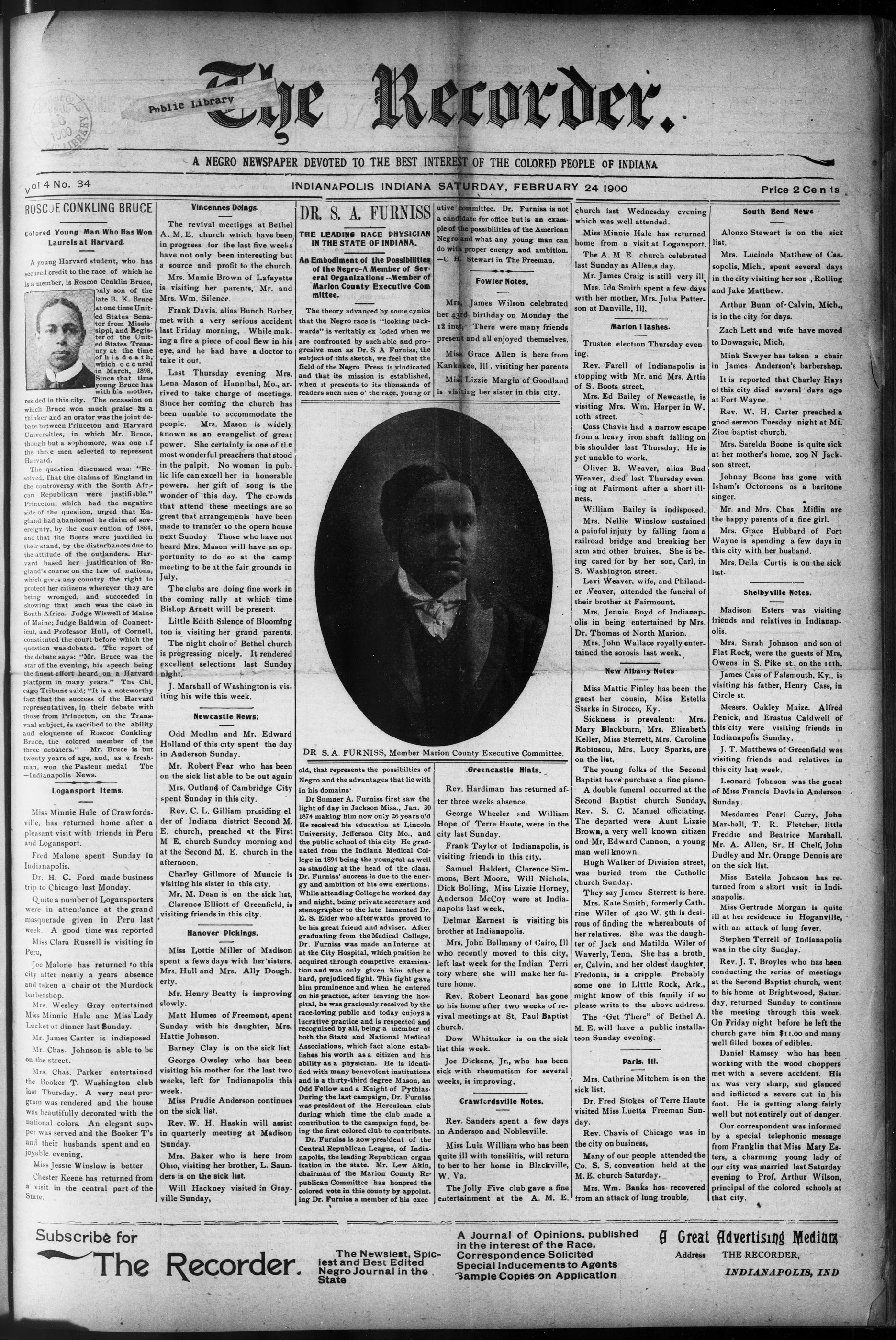
ROSCJE CONKLING BRUCE
Colored Young Man Who Has Won Laurels at Harvard.
A young Harvard student, who has secured credit to the race of which he is a member, is Roscoe Conklin Bruce, only son of the late B. K. Bruce at one time Unit- ed States Senator from Mississippi, and Regist- ter of the Uni- ed States Treas-ury at the time of his death, which occurred in March, 1898. Since that time young Bruce has with his mother,
only son of the late B. K. Bruce at one time United States Senator from Mississippi, and Register of the United States Treasury at the time of his death, which occurred in March, 1898. Since that time young Bruce has with his mother, resided in this city. The occasion on which Bruce won much praise as a thinker and an orator was the joint debate between Princeton and Harvard Universities, in which Mr. Bruce, though but a sophomore, was one of the three men selected to represent Harvard.
The question discussed was: "Resolved, that the claims of England in the controversy with the South African Republican were justifiable." Princeton, which had the negative side of the question, urged that England had abandoned the claim of sovereignty, by the convention of 1884, and that the Boers were justified in their stand, by the disturbances due to the attitude of the outlanders. Harvard based her justification of England's course on the law of nations, which gives any country the right to protect her citizens wherever they are being wronged, and succeeded in showing that such was the case in South Africa. Judge Wiswell of Maine of Maine; Judge Baldwin of Connecticut, and Professor Hull, of Cornell, constituted the court before which the question was debated. The report of the debate says: "Mr. Bruce was the star of the evening, his speech being the finest effort heard on a Harvard platform in many years." The Chi. cago Tribune said; "It is a noteworthy fact that the success of the Harvard representatives, in their debate with those from Princeton, on the Transvaal subject, is ascribed to the ability and eloquence of Roscoe Conkling Bruce, the colored member of the three debaters." Mr. Bruce is but twenty years of age, and, as a freshman, won the Pasteur medal The -Indianapolis News.
Logansport Items
Miss Minnie Hale of Crawfordsville, has returned home after a pleasant visit with friends in Peru and Logansport.
Fred Malone spent Sunday in Indianapolis.
Dr. H. C. Ford made business trip to Chicago last Monday.
Quite a number of Logansporters were in attendance at the grand masquerade given in Peru last week. A good time was reported
Miss Clara Russell is visiting in Peru,
Joe Malone has returned to this city after nearly a years absence and taken a chair of the Murdock barbershop.
Mrs. Wesley Gray entertained Miss Minnie Hale ane Miss Lady Lucket at dinner last Sunday.
Mr. James Carter is indisposed
Mr. Chas. Johnson is able to be on the street.
Mrs. Chas. Parker entertained the Booker T. Washington club last Thursday. A very neat program was rendered and the house was beautifully decorated with the national colors. An elegant supper was served and the Booker T's and their husbands spent and enjoyable evening.
Miss Jessie Winslow is better
Chester Keene has returned from a visit in the central part of the State.
Subscribe for
The Recorder.
Vincennes Doings.
The revival meetings at Bethel A. M. E. church which have been in progress for the last five weeks have not only been interesting but a source and profit to the church.
Mrs. Mamie Brown of Lafayette is visiting her parents, Mr. and Mrs. Wm. Silence.
Frank Davis, alias Bunch Barber, met with a very serious accident last Friday morning, While making a fire a piece of coal flew in his eye, and he had have a doctor to take it out.
Last Thursday evening Mrs. Lena Mason of Hannibal, Mo., arrived to take charge of meetings. Since her coming the church has been unable to accommodate the people. Mrs. Mason is widely known as an evangelist of great power. She certainly is one of the most wonderful preachers that stood in the pulpit. No woman in public life can excel her in honorable powers. her gift of song is the wonder of this day. The crowds that attend these meetings are so great that arrangements have been made to transfer to the opera house next Sunday. Those who have not heard Mrs. Mason will have an opportunity to do so at the camp meeting to be at the fair grounds in July.
The clubs are doing fine work in the coming rally at which time Bisl.op Arnett will be present. Little Edith Silence of Blooming ton is visiting her grand parents.
J. Marshall of Washington is visiting his wife this week.
Newcastle News:
Odd Modlin and Mr. Edward Holland of this city spent the day in Anderson Sunday.
Mr. Robert Fear who has been on the sick list able to be out again
Mrs. Outland of Cambridge City spent Sunday in this city.
Rev. C. L. Gilliam presiding elder of Indiana district Second M. E. church, preached at the First M E. church Sunday morning and at the Second M. E. church in the afternoon.
Charley Gillmore of Muncie is visiting his sister in this city.
Mr. M. Dean is on the sick list,
Clarence Elliott of Greenfield, is visiting friends in this city.
Hanover Pickings.
Miss Lottie Miller of Madison spent a few days with her sisters, Mrs. Hull and Mrs. Ally Dougherty.
Mr. Henry Beatty is improving slowly.
Matt Humes of Freemont, spent Sunday with his daughter, Mrs. Hattie Johnson.
Barney Clay is on the sick list.
George Owsley who has been visiting his mother for the last two weeks, left for Indianapolis this week.
Miss Prudie Anderson continues on the sick list.
Rev. W. H. Haskin will assist in quarterly meeting at Madison Sunday.
Mrs. Baker who is here from Ohio, visiting her brother, L. Saunders is on the sick list.
Will Hackney visited in Grayville Sunday.
DR S.A. FURNISS, Member Marion County Executive Committee.
DR. S. A. FURNISS
THE LEADING RACE PHYSICIAN IN THE STATE OF INDIANA.
An Embodiment of the Possibilities of the Negro-A Member of Several Organizations--Member of Marlon County Executive Committee.
The theory advanced by some cynics that the Negro race is "looking backwards" is veritably ex loded when we are confronted by such able and progressive men as Dr. S A Furniss, the subject of this sketch, we feel that the field of the Negro Press is vindicated and that its mission is established, when it presents to its thousands of readers such men o' the race, young or
DR S. A. FURNISS, Member Mari
old, that represents the possibilities of Negro and the advantages that lie with in his domains:
Dr Sumner A. Furniss first saw the light of day in Jackson Miss., Jan. 30 1874 making him now only 26 years old' he received his education at Lincoln University, Jefferson City Mo., and the public school of this city He graduated from the Indiana Medical College in 1894 being the youngest as well as standing at the head of the class. Dr. Furniss' success is due to the energy and ambition of his own exertions. While attending College he worked day and night, being private secretary and stenographer to the late lamented Dr. E. S. Elder who afterwards proved to be his great friend and adviser. After graduating from the Medical College, Dr. Furniss was made an Interne at at the City Hospital, which position he acquired through competitive examination and was only given him after a hard, prejudiced fight. This fight gave him prominence and when he entered on his practice, after leaving the hospital, he was graciously received by the race-loving public and today enjoys a lucrative practice and is respected and recognized by all, being a member of both the State and National Medical Associations, which fact alone establishes his worth as a citizen and his ability as a physician. He is identified with many benevolent institutions and is a thirty-third degree Mason, an Odd Fellow and a Knight of Pythias During the last campaign, Dr. Furniss was president of the Herculean club during which time the club made a contribution to the campaign fund, being the first colored club to contribute.
Dr. Furniss is now president of the Central Republican League, of Indianapolis, the leading Republican organization in the state. Mr. Lew Akin, chairman of the Marion County Republican Committee has honored the colored vote in this county by appointing Dr. Furniss a member of his exec
The Newsiest, Spiciest and Best Edited Negro Journal in the State
---
A Journal of Opinions. published in the interest of the Race. Correspondence Solicited Special Inducements to Agents Sample Copies on Application
utive committee. Dr. Furniss is not a candidate for office but is an example of the possibilities of the American Negro and what any young man can do with proper energy and ambition. —C H. Stewart in The Freeman.
Fowler Notes.
Mrs. James Wilson celebrated her 43rd birthday on Monday the 12 inst. There were many friends present and all enjoyed themselves. Miss Grace Allen is here from Kankakee, Ill, visiting her parents. Miss Lizzie Margin of Goodland is visiting her sister in this city.
rion County Executive Committee.
Greencastle Hints.
Rev. Hardiman has returned after three weeks absence.
George Wheeler and William Hope of Terre Haute, were in the city last Sunday.
Frank Taylor of Indianapolis, is visiting friends in this city.
Samuel Haldert, Clarence Simmons, Bert Moore, Will Nichols, Dick Bolling, Miss Lizzie Horney, Anderson McCoy were at Indianapolis last week.
Delmar Earnest is visiting his brother at Indianapolis.
Mrs. John Bellmany of Cairo, Ill who recently moved to this city, left last week for the Indian Territory where she will make her future home.
Rev. Robert Leonard has gone to his home after two weeks of revival meetings at St, Paul Baptist church.
Dow Whittaker is on the sick list this week.
Joe Dickens, Jr., who has been sick with rheumatism for several weeks, is improving,
Crawfordsville Notes.
Rev. Sanders spent a few days in Anderson and Noblesville.
Miss Lula William who has been quite ill with tonsilitis, will return to her to her home in Blackville, W. Va.
The Jolly Five club gave a fine entertainment at the A. M. E.
A Journal of Opinion in the interest of the B Correspondence Solid Special Inducements to Sample Copies on Ap
A Great Advertising Medium Address THE RECORDER,
church last Wednesday evening which was well attended.
Miss Minnie Hale has returned home from a visit at Logansport.
The A. M. E. church celebrated last Sunday as Allen,s day.
Mr. James Craig is still very ill.
Mrs. Ida Smirh spent a few days with her mother, Mrs. Julia Patterson at Danville, Ill.
Marion flashes
Trustee election Thursday evening.
Rev. Farell of Indianapolis is stopping with Mr. and Mrs. Artis of S. Boots street.
Mrs. Ed Bailey of Newcastle, is visiting Mrs. Wm. Harper in W. 10th street.
Cass Chavis had a narrow escape from a heavy iron shaft falling on his shoulder last Thursday. He is yet unable to work.
Oliver B. Weaver, alias Bud Weaver, died last Thursday evening at Fairmont after a short illness.
William Bailey is indisposed. Mrs. Nellie Winslow sustained a painful injury by falling from a railroad bridge and breaking her arm and other bruises. She is being cared for by her son, Carl, in S. Washington street. Levi Weaver, wife, and Philander Weaver, attended the funeral of their brother at Fairmount. Mrs. Jennie Boyd of Indianapolis in being entertained by Mrs. Dr. Thomas of North Marion. Mrs. John Wallace royally entertained the sorosis last week.
New Albany Notes
Miss Mattie Finley has been the guest her cousin, Miss Estella Starks in Sirocco, Ky.
Sickness is prevalent: Mrs. Mary Blackburn, Mrs. Elizabeth Keller, Miss Sterrett, Mrs. Caroline Robinson, Mrs. Lucy Sparks, are on the list.
The young folks of the Second Baptist have purchase a fine piano. A double funeral occurred at the Second Baptist church Sunday, Rev. S. C. Manuel officiating. The departed were Aunt Lizzie Brown, a very well known citizen on Mr. Edward Cannon, a young man well known.
Hugh Walker of Division street, was buried from the Catholic church Sunday.
They say James Sterrett is here.
Mrs. Kate Smith, formerly Cathrine Wiler of 420 W. 5th is desirous of finding the whereabouts of her relatives. She was the daughter of Jack and Matilda Wiler of Waverly, Tenn. She has a brother, Calvin, and her oldest daughter, Fredonia, is a cripple. Probably some one in Little Rock, Ark., might know of this family if so please write to the above address.
The "Get There" of Bethel A. M. E. will have a public installateon Sunday evening.
Paris, Ill.
Mrs. Cathrine Mitchem is on the sick list.
Dr. Fred Stokes of Terre Haute visited Miss Luetta Freeman Sunday.
Rev. Chavis of Chicago was in the city on business.
Many of our people attended the Co. S. S. convention held at the M. E. church Saturday.
Mrs. Wm. Banks has recovered from an attack of lung trouble.
Price 2 Cents
South Bend News
Alonzo Stewart is on the sick list.
Mrs. Lucinda Matthew of Cassopolis, Mich., spent several days in the city visiting her son, Rolling and Jake Matthew.
Arthur Bunn of Calvin, Mich., is in the city for days.
Zach Lett and wife have moved to Dowagaic, Mich,
Mink Sawyer has taken a chair in James Anderson's barbershop.
It is reported that Charley Hays of this city died several days ago at Fort Wayne.
Rev. W. H. Carter preached a good sermon Tuesday night at Mt. Zion baptist church.
Mrs. Sarelda Boone is quite sick at her mother's home, 209 N Jackson street.
Johnny Boone has gone with Isham's Octoroons as a baritone singer.
Mr. and Mrs. Chas. Miflin are the happy parents of a fine girl.
Mrs. Grace Hubbard of Fort Wayne is spending a few days in this city with her husband.
Mrs. Della Curtis is on the sick list.
Shelbyville Notes.
Madison Esters was visiting friends and relatives in Indianapolis.
Mrs. Sarah Johnson and son of Flat Rock, were the guests of Mrs, Owens in S. Pike st., on the 11th.
James Cass of Falsmouth, Ky., is visiting his father, Henry Cass, in Circle st.
Messrs. Oakley Maize. Alfred Penick, and Erastus Caldwell of this city were visiting friends in Indianapolis Sunday.
J. T. Matthews of Greenfield was visiting friends and relatives in this city last week.
Leonard Johnson was the guest of Miss Francis Davis in Anderson Sunday.
Mesdames Pearl Curry, John Marshall, T. R. Fletcher, little Freddie and Beatrice Marshall, Mr. A. Allen, Sr., H Chelf, John Dudley and Mr. Orange Dennis are on the sick list.
Miss Estella Johnson has returned from a short visit in Indianapolis.
Miss Gertrude Morgan is quite ill at her residence in Hoganville, with an attack of lung fever.
Stephen Terrell of Indianapolis was in the city Sunday.
Rev. J. T. Broyles who has been conducting the series of meetings at the Second Baptist church, went to his home at Brightwood, Saturday, returned Sunday to continue the meeting through this week. On Friday night before he left the church gave him $11.00 and many well filled boxes of edibles. Daniel Ramsey who has been working with the wood choppers met with a severe accident. His ax was very sharp, and glanced and inflicted a severe cut in his foot. He is getting along fairly well but not entirely out of danger.
Our correspondent was informed by a special telephonic message from Franklin that Miss Mary Esters, a charming young lady of our city was married last Saturday evening to Prof. Arthur Wilson, principal of the colored schools at that city.
Advertising Medium
THE RECORDER,
INDIANAPOLIS, IND
---
A Negro Newspaper,
PUBLISHED EVERY SATURDAY AT
INDIANAPOLIS, INDIANA.
SUBSCRIPTION RATES;
One Year..... $1.00
Six Months..... 50
Three Months..... 25
Subscriptions may be sent by post office money order or registered letter.
All communications for publication should be accompanied with the name of the writer—not necessarily for publication but as a guarantee of good faith, . . . We solicit news, contributions, opinions and in face all matter affecting the Race. We will not pay for any matter, however, unless it is ordered by us. All matter intended for publication must reach this office not later than Wednesday of each week to insure insertion in the current issue.
ADVERTISING RATES
Entered at the Postoffice as second-class matter.
All letters, Communications and Business matters should be addressed to THE RECORDER, 122 W. New Y. k street.
Gee. P. STEWART, Publisher
SATURDAY, FEBRUARY 24, 1900
EDITORIAL
THE investigation of the discharges in the fire and police departments should go on in spite of the defeat of the appropriation ordinance.
FROM the fact that Milwaukee has made an additional offer of "free beer and a wide open town," it is a foregone conclusion that the Democratic National Committee will "wink, blink and smile" before they finally accept.
MAYOR TAGGART himself "winked, blinked and smiled" so much at saloon violations, policy-playing and gambling, that the policemen fell unconsciously into the habit, and to cap the climax, the mayor is still "blinking," but the smile is absent.
COLORED people of Omaha, Neb., are making an effort to preserve "the Lincoln car," in which the great president was wont to journey along the front in war time. It may be taken as an accepted fact that whenever opportunity offers to honor Abraham Lincoln the colored man, loyal to the memory of his benefactor, will be among the foremost of the laurel-bearers.
Democratic Chairman Jones is connected with one of the greatest trusts in the country-the round bale cotton trust, and has been a stockholder and director in the American Cotton Comp. pany for years. Had Mr. Bryan forgotten that Senator Jones' company was incorporated in Jersey City when, in passing through New Jersey recently, he spoke of that state as "robber's roost"?
The finance bill has passed the Senate at last and has gone to a conference of the two Houses. An agreement should be reached and ratified within two weeks. After that it will be impossible for Mr. Bryan to throw the country on a silver basis even if he should be elected and should carry the House with him. Only the capture of all branches of the government can repeal this law.
We have reproduced an article which will be found in another column, dealing with the rise and success of several white business men in this city. The article makes appreciable reading and should act as a stimulus to young colored men. Overcoming poverty, their rise has been step by step, until they have reached the pinnacle of fame and success. Merit and worth will do as much for the colored man as for these two gentlemen.
Consul Macrum is out with an explanation that does not explain. Besides some yawping about a ridiculous "British alliance," his only excuse for deserting his post is that the British censor opened his mail and telegrams. If Mr. Macrum had reported this fact to the Department, as he should have done, it would long ago have been remedied. Great Britian has no right to censor our diplomatic messages and no one will confess the fact quicker than she. The fault is clearly with a superserviceable sub-official. But even the censorship is no excuse for Macrum leaving American interests to look out for themselves while he fled to safety.
If the existing rumor that a counter organization for the purpose of weakening the influence of the Republican Central League, has been formed, is true, such a condition is to be deplored. When will the colored man learn the power and influence of unity? Whether in the church, state, politically or commercially, it is all-important. The existing organization, we believe, carries on its roll of membership some of the leading and influential citizens and the men at the head of it, we are confident, have no political aspirations, so the need of an anti-organization is not apparent. The story which is said to have credence in the ranks of the anti-organization that the State Central Committee has encouraged and is supporting this new club, has, upon investigation, been found untrue and is unworthy of any comment. Let us for once "get together" and have an effective organization.
A Timely Reminiscence.
Our older readers must recall the great panic which in 1857 well night destroyed such industries as foreign competition, under a low tariff, had permitted to survive to that time. Many of our younger business men, however, may never have heard more than a passing reference to it. The present purpose is merely to lift a corner of the curtain behind which there was such broadcast disaster and suffering.
The city of Providence has long been one of the richest in the country and among the most attractive in varied manufacturing industries. So diversified were its lines of production that nothing short of a general depression could seriously mar its prosperity. But the panic of '57 was sufficiently general. The streets of that city looked as if everybody was out of work. The suffering became so all but universal as winter came on that the city government provided food for the unemployed. A high, sandy bluff bordering the Woonasquatucket river valley was cut down and graded, filling the marsh and providing for streets and buildings.
This work was seized with avidity, and thousands of skilled mechanics, as well as common laborers, men accustomed to earning good wages or salaries, shovelled sand all day for fifty cents, and were glad of even such a pittance to keep their families from starvation. The writer hereof saw that great work in progress and knew a little of its awful paths. And never can he forget either that scene upon the wintry hillside or the fatuous policy of discouragement to American labor which brought such distress to our struggling millions.
Lest it may be supposed that the cost of living in "the good old times" of low tariffs were in proportion to the industrial opportunities, especially in times of depression, we will mention that flour was then wholesaling in New York City at something like $12.00 a barrel by the carload directly from the mill, and was retailing in Providence at and above $14.00 a barrel. Of this we have documentary evidence, while memory recalls other items of living expenses of that time equally high as compared with present costs.
How a Monopoly Was Broken.
The free trade papers which are finding so much consolation in Mr. Griffith's testimony regarding the profits of tin plate manufacture under the recent combination, lose sight of that part of his statement in which he said that at the time of the passage of the McKinley tariff bill, and for some time previous, the price of plate was $5.55 a box. At that time all the plate used in this country was made in Wales, and the duty was the same as it was on sheet iron. In other words, the low duty gave the British manufacturers a monopoly which enabled them to obtain $5.65, against the present price of $4.65. It is probable that much of the advance in plates is due to the advance in steel, which is from 75 to 100 per cent. The probability is that if there was no more duty on tin plates now than there is on the steel of which the plates are made, outsiders could not regain the American markets because our manufacturers have learned the business, and, moreover, Congress may well consider this matter, and if there is a combination to prevent the purchase of machinery by outside parties, put that machinery on the free list for a time. After all, the public may rest assured that if there is a profit of even 25 per cent. in the manufacture of tin plates, it will not be long before independent competitors will find way to operate mills and put their goods upon the market. When they do the combination which must pay interest and dividends on bonds and stock representing four times the amount for which new factories can be built, will be the loser in the competition—Indianapolis (Ind.) Journal.
Two Billions of Money.
There has been a gain of about five hundred million dollars in the amount of money in circulation in the United States in the past two years of restored protection and prosperity. The figures of this gigantic increase of material wealth and of money in the hands of the people have a suggestiveness that is startling. They show what the country escaped when in 1896 it chose between William McKinley and William J. Bryan. They are also particularly suggestive in connection with the Presidential contest of this year.
On November 1 the total money in circulation was $1,963,716,148, and on December 1, $1,985,930,964, an increase of $22,214,816 in the month. A gain of even two-thirds this amount in January and February would bring the total money in circulation in the United States past the two billion dollar line for the first time in our his-
Subscribe for The Recorder, one
THE RECORDER. INDIANAPOLIS. DIANA
CORRESPONDENCE.
News, Incidents, Social and Personal Activities
Vancouver Barracks, Wash.
It was a foggy morning and our boys looked like phantoms as they moved forward in line of battle. Meanwhile they came nearer and nearer the hill, eagerly waiting the command "fire!" Every soldier was willing to do his best and moved bravely to the front. It was at once determined by the men to take the hill, [San Juan]. They saw death in their face and had to fight or give up soldiering and go into private life and many will remain in the service. Above all things let soldiers have moral principles for without these qualities the army would be in a state of degradation,
Subscribe for The Recorder and keep posted on the leading topics of the day. 25c for 3 months
Anderson Dots.
Revival meeting is still in prog-
The Spaniards knew the Value of the hill and were careful not to let it go un protected. Long before any thought of war the Spaniards built bobwire fences and dug many trenches on and near the hill. As our boys moved forward every few hundred yards they were meet with bobwire fences which pierced them before they knew it. The news of their engagement caused the most intense excitement of the world. Many English officials declared they did better fighting than could have been done by themselves. England once lost thirty thousand men on the same field. The gallant 71st regiment of New York, was made to retreat; they ran from the Spanish fire, crying we've lost! we've lost! But the brave and daring colored soldiers, stealing through the marshes and bogs, heard their mournful cry, and came rushing to their rescue, crying charge! charge! A cry of grief, of fear, of rage, went up from the Spanish lines when the Storm of shot came from our boys. Violence was in the air. The earth was dark with smoke but amid the roar of of the guns you could hear the boys crying: "Don't tell mother I died with the slain." They knew the thought would drive their dear mothers wild and they thought it would be better should they remain unaware of their death.
The night before the fight our boys rested for a time from their cutomary duty. A gentle breeze relieved the midsummer's heat and the evening closed upon them as down. During the early part of the night the stillness was almsst oppressive but as the night grew old the Spaniards seemed weary and many of our boys gathered around the camp fire, writing what they knew might be their last letters to loved ones far away or giving to friends messages and instruction in case they were killed in battle. There were no signs of fear in camp, but, like brave and intelligent men, they recognized the stern possibilities of "tomorrow" and acted accordingly. Such was the triumph of our boys in camp.
It is said by more than two thirds of the United States army that our boys in blue, far eclipse any other nation under the sun. Their fighting qualities have been proven and have been commended by the public press. There use to be among the officers of the army, a prejudice against serving in regiments of color, but since our boys have shown themselves to be heroes in battle, every officer desires to command them.
Our boys in camp make far more progress in life than the public seem to think. Of course their income is small but inspite of many ravages of want, most of the boys manage to save a handsome little sum. They deposit their savings with the paymaster in sums not less $5.00, which he keeps until their final discharge. A good soldier can save much of his clothing money which will be given in cash on his discharge.
Soldiersshould endeavor to make their army days the brightest of all that is if they would serve their country nobly and faithfully. They should not turn their minds the wrong way but let the starry flag which puts light into every home in the country. When we shall have established peace in the Philippine islands, many of us will stop
soldiering and go into private life and many will remain in the service. Above all things let soldiers have moral principles for without these qualities the army would be in a state of degradation.
Subscribe for The Recorder and keep posted on the leading topics of the day. 25c for 3 months
Anderson Dots.
Revival meeting is still in progress at Second Baptist church.
Andrew Raglan was in Alexandria last Wednesday.
Henry Tanker has returned from Canastota, N. Y.
James Collins was on the sick list last week.
Mrs. Annie Reynolds is visiting in Brazil and Terre Haute.
Mrs. Lizzie Holmes is not improving very much.
Miss Nellie Houser is quite sick.
Mrs. Will Walker is on the sick list this week.
Will Montgomery is able to be out again.
On returning home from church last Sunday evening, Mr. and Mrs. James Davis found their house on fire. Most of their household goods were lost. No insurance. The house belonged to Mrs. Jennie Fletcher. Household of Ruth, No. 1190 will have its anniversary in March.
Prof. Booker T. Washington made two fine and eloquent addresses Monday evening—one to the State League of Republican Clubs and to the public, and the other address was at the First M. E. church to the colored people and the Industrial school, afterwhich he attended the banquet at the Anderson hotel.
Rockville Notes.
Jesse Evans is the only colored dairyman in this county, and has the best customers in Rockville.
Abram Gaston was badly kicked by a horse recently, but is better.
At the "Pigeon Fly" at the A. M. E. church, Mrs. Earl Rouse was the lucky recipient of both prizes, the pigeon flying to her both times.
The Boers of Rockville will soon be taken at Ladysmith. Ha! ha!
be taken at Ladysmith. Ha! ma!
Little Cecil Holmes, of Brazil,
was buried from the A. M. E.
church Friday, Rev. A. M. Taylor
officiating.
Miss Pearl Doon, of Crawfords-
ville remained over Sabbath.
Mitchell Items
Lafe Alien was in Ft. Ritner last week.
Mrs. Bettie Nichols and son James are on the sick list.
Rev. Patterson, of Washington, is assisting Rev. Terrell in his revival meeting.
W. F. Parrott, of Kentucky, is visiting his mother, Mrs. S. Parrott.
Mrs. Fannie Bass and Miss Nellie Taylor, of Bedford are visiting their mother, Mrs. Anna Taylor.
Miss Mary Watkins, of Washington is visiting relatives and friends here.
Indiana's Best Negro Newspaper
Mrs. Charles Duncan died at her home in West Main street Feb. 4, of consumption. Funeral services were held at the A. M. E. church, conducted by Rev. Moorman, assisted by Revs. Terrell and Ferguson. Mrs. Duncan was a christian woman, and was highly respected. Remains were interred in Mitchell cemetery.
Subscribe for The Recorder and keep posted on the leading topics of the day. 25c for 3 months
Around the Hotels.
Henry Florence after two weeks of illness is again in service at the Hotel English.
Mrs Frankie Hodges the well known pastry cook is at the Lorette.
James White has taken the position as house man at the Sherman.
Albert Strauders has given up the bell seat and has accepted a position in the Bates House Dining Room.
Joe McKnight left last Wednesday for New York City.
Will Anderson has taken charge of the kitchen at the Imperial.
Mr Austin B. Robinson the popular head waiter at the Victorio contemplates matrimony next month.
William Ware the old reliable watchman at the Denison is able to be on duty after a week's illness.
"Chuckie" Sanders the well known apron and jackett drummer has a position as checkmau at the Grand Tom Williams is working at the Chalfant. Brutus McWilliams of the Denison's check room is one of the best orators in the city and we predict for him a great future. "Ras" Jones after years of service on the bell stand has given up the 'seat' for good and here after will be known as "Prof." Jones the dancing master. Rastus Demares formally of Denison has joined the Bates Dining room force George Walker after an illness of 11 days has returned to work at the Bates W.S. Kinney of the English is the youngest waiter in the city; his age being fifteen years. Bert Cummings has left the bell seat at the English nd will study law.
With the marriage of Lon Seymour the married men will constitute the whole force of bell men, at the English "English" Quartette will entertain Mr and Mrs Will English next Thursday night in the Hotel Parlors. Harry Beard of the Lorette is on the sick list. Messrs Oliver, Thurman and Stuart well known in the hotel fraternity, gave a parlor musicale at English hotel, for the benefit of the guests, last Thursday evening. Ten numbers were rendered and a series of living pictures added much entertainment of the guests, who highly appreciated the affair.
Masters of Art of Newspaper Advertising.
George A. Gay, vice president and general manager of the Pettit Dry Goods Company, more popularly known as "The New York Store," is a Bostonian, and came to this city nine years ago to take charge of the great enterprise with which he has been identified ever since. In early life his parents moved to Portland, Me., and as a raw schoolboy, with all the earmasks of immaturity and want of confidence, he entered the employ of the firm of Eastman Bros., of that city, and afterward returning to Boston, was given a situation with the great firm of R. H. White & Co., and step by step, with unremitting attention to duty, mounted the commercial ladder until he was finally appointed one of the chief buyers of the firm, which did a business far up into the millions.
So signal was Mr. Gay's success in Boston, and he displayed such an aptitude for discerning the value and selling ability of an article, that when the New York Store was reorganized in this city, he was picked out by the owners as the one best adapted to take the helm of the enterprise and steer it into the clear waters of success. Suffice it to say that he has done so. Of the 500 or more employees in the store, all are known to Mr. Gay by name, and, what is more to the point, he knows the value of each. He constantly has his fingers not only on the pulse of trade and public wants, but he is daily acquainted with all the minutiae of detail which takes place in the establishment. Every consignment of goods, every large sale, and every event of importance connected with the business receives his personal attention, and it is felt that the marked success of the New York Store may be largely attributed to his careful management.
Donn V. Smythe.
Donn V Smythe of this city may lay claim to the unique distinction of not only being jack of many trades, but, what is much better, of being master of many of them. He was born in this city, and after passing through the Indianapolis High School, became an assistant to his father, William H. Smythe, who is secretary of the Indiana Masonic Grand Lodge. He traveled much for that order, and then joined a variety company and toured through the country as a sleight-of-hand performer, and in his feats of legerdemain was successful far beyond his expectations.
Tiring of the roving character of this life, he left the stage and entered the employ of the Pettis Dry Goods Company. He began at the bottom rung of the commercial ladder and, step by step, through earnest work and strict attention to duty, finally became the advertising agent of that concern, a position which he now holds. He is one of the promising young men of this city.—Indianapolis Press.
THE SUNDAY SCHOOL
THE SUNDAY SCHOOL
NOTES ON THE INTERNATIONAL
LESSON FOR FEBRUARY 25.
Subject: "Jesus Rejected at Nara;
reth." (Luke 4:16-30) -Golden Text:
"He Came Unto His Own and His
Own Received Him Not." (John
1:11).
Home Readings:
Monday, Feb. 26 (Luke 4:16-30).
Tuesday, Feb. 27 (Matt. 13:53-58).
Wed., Feb. 28, The Text (Isa. 61:11).
Thursday, March 1 (John 5:36-47).
Friday, March 2 (Luke 20:9-18).
Saturday, March 3 (Prov. 1:20-23).
Sunday, March 4 (Luke 13:24-25).
Jesus came to a people who for centuries had been expecting a Messiah; but they had peculiar ideas of what he should be and what he should teach. Already he had preached in Judea; and now had come to his own Galilee and to Nazareth where he had previously lived. He has passed the time of introduction and now during the second year of his ministry he gives instructions in regard to the principles of his gospel.
Paying full respect to established customs, he attended public service on the sabbath day; and by his priestly rank was permitted to read the rolls of manuscript kept in every synagogue. The text Isa. 61:1 was familiar to all; but they did not expect a Nazarine Saviour.
Preludice.
Prefjudice all men abominate and all obey.
How dark a mist, the eyes of men to blind,
How hot a flame, to burn into the heart,
How strong a chain, to fetter every part
Of a soul's existence, who else would find
Its higher scope, unfolding mind to mind
In free and full communion as we start
Those living founts, where all may heal the smart
Of error's pain, and shackled truth unbind.
Self rules, then Prejudice, with fibers firm.
Takes root; no blossoms spring from 'neath the earth
Sown with its rank seed; no thrill of bird song
Floats through the air; but swiftly swept along.
Is this intolerant curse, stifling at birth.
Each thought engendered from a fruit ful germ.-Virginia G. Ellard.
Influence of Prejudice.
David Rittenhouse, the celebrated astronomer, who was skillful in measuring the size and determining the position of the heavenly bodies, found that a thread of ordinary sewing-silk drawn across the glass of his telescope, would completely conceal a star. The finest fibre of silk would hide a distant star for several seconds. So the smallest speck of prejudice, or the finest thread of worldly policy or ambition drawn across the lens of the mind, obstructs the light of divinest truth, and hides half the glories of the heavens. To see the spiritual world we must keep the passions, cares, and loves of the earth from the eye of the soul, as the astronomer wipes the dust and steam from his glass. Christian Life.
The prejudices of ignorance are more easily removed than the prejudices of interest; the first are all blindly adopted, the second wilfully preferred.—Bancroft.
Beware of prejudices. A man's mind is like a rat trap; prejudices creep in easily, but it is doubtful if they ever get out again.
Many oriental monarchs burned out the eyes of prisoners whom they captured in order to cause their own subjects to obey them through fear: but Jesus healed blind eyes in order to bring even his enemies to love him.
He carried his message of grace to his own old neighbors: but they would not receive it. Immediately after his tendered offers of help, they rejected him.
Many self-righteous sinners condemn the people of Nazareth, while themselves failing to accept the Saviour. There are not one hundred hells and one hundred heavens; because there are only two moral conditions possible for the soul. Jesus said "He that is not for me, is against me." Who is not truly in his heart's affection right toward God is most certainly wrong. For such as these Jesus came; and for such the gospel is still preached.
The strangest thing about the gospel is that Jesus was rejected by the leaders of the church which so long had desired him; and the story of that rejection is the strongest imaginable argument in favor of repentance and confession. As love begets love, so Christ conquers hatred by grace.—E. A. DeVore, D. D.
Love Rejected.
Who is not loved lives not at all
And knows not either joy or woe.
And lest such fate should him befall
He came a beggar, louting low.
"I bend" said he, "that I may live.
I bow before the one I prize.
That she the alms I crave may give.
Drawn from the treasury of her eyes.
Who begs for love but wastes his speech
When far too humbly he implores.
He sets too high above his reach
The being whom he thus adores.
And so, though courtly were her ways.
A veil of scorn her visage bore.
Indifferent to his prayers and praise.
She turned the beggar from the door.
The beggar was not overshrewd
And perfect love had made him blind.
Not his to see a changing mood,
Not his to fathom woman's mind.
For she is musing on his fate,
Felt pity for the suitor spurned,
And pity turned to love—too late—
The beggar never more returned.
Thomas Dunn English in Harper's
magazine. October. 1897.
Pays weekly benefits for Sickness or Accidents Benefits for Death.
ROOM 43 BALDWIN BLOCK, COR. Delaware and Market Sts.
I have and we have absolutely recommend them. We have been troubled for about three years with what I called attacks coming on regularly and it was caused by bulldog, of which I had several. I had the teeth extracted, but the attacks continued. I had seen advertisements of Ripanes Tabulines in all the papers but had no faith in them. I was so scared that I needed me to try them. I have taken two of the small 5-cent boxes of the Tabulines and have had no recurrence of the attacks. Have never given a testimonial for anything before, but the greatness of God which I believe has been done by Ripanes Tabulines induces me to add more to the many testimonials you doubtless have in your possession now.
A. T. D. WIRR.
I have been a gross customer from come for over five years. Nothing gave me an My feet and legs and abdomen were blue. I could not wear shoes on my feet and could not wear shoes on my hands. Daily paper, bought some and took them ed. Have taken them about three weeks in such a change! I am not constipated as and I love it all to Ripanes Tabulines. I have had a household duties and nurturing desk. He has had the蠕 and I am crying Tabulines for him. He feels some better to take some time, he has been sick so may use my letter and name as you like.
MR. MARY GORMAN
I have been suffering from headache
R.I.P.A.N.S
The modern stand-
ard Family Medic-
ine: Cures the
common every-day
ill of humanity.
TRADE
MARKS
FIGURES
Tabules regularly. She keeps a few cottons Ripans Tabules in the house and says she will not be with them. She is very proud of the time she presented with the indigestion which was formerly so great a burden for her. Our whole family take the Tabules regularly, especially after a hearty meal. My moth is fifty years of age and is enjoying the meal, and can impossibility before she took Ripans Tabules. ATHEN H. BLAKEEN.
A new style pocket containing THE REPUBLIC TABLELUM
at some drug stores FOR RIVY CENTRE. This low-priced
dream of the present carcass (SIX tabulars) may be
COMMERCIAL COMPANY, No. 10 Spruce Street, New York—or
REPUBLIC TABLELUM may also be bad of some grocers, genres
and harbor shags. They banish pain, induce sleep and j
The Afro-
of Euro
are faithfully port-
exclusive cable dis-
CAGO RECORD pri-
capitals of the old
special service is i
extended so as to
city in Europe; a
the full regular ca-
ciated Press.
The Chicago Record,
newspapers outside N
now prints original and
cable dispatches daily
the leading capitals o
"The Re-
Is devoted particularly
colored peo-
One Year $1 Six Month
A new style pocket containing THE BEAUTY TABULARS packed in a paper carton (without grisel) is now for sale at some drug stores- for FIVE cents. This low-priced sort is intended for the poor and the economical. One dozen of the five-carat cartons (130 tabulars) can be had by mail by sending forty-eight cents to the BEAUTY COMMERCIAL CO., No. 18 Spruce Street, New York—or a single carton (THE TABULARS) will be sent for five cents. BEAUTY TABULARS may also be had of some grocers, general storebrokers, news agents and as some liquor stores and liquor shops. They handle pain, induce sleep and prolong life. One gives relief.
The Affairs of Europe
are faithfully portrayed in the original and exclusive cable dispatches which THE CHICAGO RECORD prints daily from the leading capitals of the old world. This magnificent special service is in process of being greatly extended so as to include every important city in Europe; and it is supplemented by the full regular cable service of The Associated Press.
The Chicago Record, alone of all American newspapers outside New York city, now prints original and exclusive cable dispatches daily from the leading capitals of Europe.
One Year $1 Six Months 50c Three Months 25
PATENTS
DESIGNS
TRADE-MARKS
AND COPYRIGHTS
OBTAINED
ADVICE AS TO PATENTABILITY
Notice in "Inventive Age"
Book "How to obtain Patents"
FREE
Charges moderate. No fee till patent is secured.
Letter confidential. Address
E. G. SIGGERS, Patent Lawyer, Washington, D.C.
A GREAT NEWSPAPER.
It has always been claimed for The Chicago Tribune that it would, in all probability, pass with the highest average in any competitive examination among the newspapers of the United States for excellence in all departments
The Recorder
A Representative Paper Read by 20.000 Afro- Americans each week Subscription price One Year $1.00
Will be sent to any address in the United States on receipt of subscription price
Agents Wanted.
I want to inform you, in words of highest importance, that I have derived from Ripans Tubules. I am a professional nurse and a doctor, and he always needed. Ripans Tubules does it. After one of my courses, he runs down. Acting on the advice of Mr. G. Owen, Ph. G., 692 Newark Ripans Tubules. Ripans Tubules with grand results. MISS WINNEBAR.
Other was troubled with heartburn and acid indigestion, for a good many years. One day in the paper indorizing Ripans Tubules. She determined to give them a drink, and it relieved by their use and now takes the
I have been a great outfit from congratulation for over five years. Nothing gave me any relief. My feet and legs and abdomen were blended so I could not wear shoes on my feet and only a sole on my feet. I was always in a daily paper, bought some and took them as directed. Have taken them about three weeks and these is such a change! I am not constipated any more and I eave it all to Ripana Tubulas. I am thirty-seven years old, have no occupation, only my job. I have been a dropup and I have had the dropup and I am trying Ripana Tubulas for him. He feels some bother but it will take some time, he has been sick so long. You may use my letter and name as you like.
MRS. MARY GORNAN CLAMBER
I have been suffering from headache ever since I was a little girl. I could never ride in a
Reading some of the testimonials in favor of Ripana Tables, I tried them. Ripana Tables not only relieved but actually cured my younger, more frail sister. I had good condition and he never complains of his stomach. He is now a red, chubby-faced boy. This wonderful change I attribute to Ripana Tables. I satisfied that they will be able to credit the old age if taken according to directions. B. W. Perman.
panked in a paper carton (without glue) is new for sale and sort is intended for the poor and the economist. One hand by mail by sending forty-eight cents to the REAPS and a single carton (THE TASULEN) will be sent for five cents. General storekeepers, news agents and all some larger stores prolong life. One gives relief.
fairs
ope
arrayed in the original and spatches which THE CHI-
aints daily from the leading world. This magnificent process of being greatly include every important and it is supplemented by able service of The Asso-
alone of all American New York city,
and exclusive from of Europe.
"recorder"
ow to the interests of the people of Indiana.
ths 50c Three Months 25
A GREAT NEWSPAPER.
It has always been claimed for The Chicago Tribune that it would. in all probability, pass with the highest average in any competitive examination newspapers of the United States for excellence in all departments of journalism.
* Under date of May 2, 1899, the *Omaha World-Herald*, editorially an-swering a letter from inquire-ing newspapers in this country, points out that a newspaper may excel in the *Newspapers in this country*, points out that a newspaper may excel in the *World-Herald* gives lists under five general headings of leading newspapers distinguished especially for excellence, mentioning in all some twenty.
THE FOLLOWING ARE THE HEADINGS:
*(1) Most and best news, foreign and international news.*
*(2) Best possible presentation of news briefly.*
(3) Typographical appearance.
(4) Classification of news by departments.
(5) Editorials.
The Chicago Tribune is the only newspaper in the United States which the World-Herald considers worthy of mention under four different heads."—From the October Plain Talk.
Practically all high-class intelligent newspaper readers, comprising the best and middle classes in Chicago and vicinity, read The Chicago Tribune. A great majority of them read no other morning newspaper.
The Chicago Tribune prints more advertising year in and year out than any newspaper in the West.
A Great Advertising Medium.
Subscribe for The Recorder and keep posted on the leading topics of the day. 25c for 3 months
car or go into a crowded place without getting a seat. I heard about Ripans Tables from an aunt of mine who was sick. She had taken the stomach. She had found such relief from it to take them too, and I have been doing so since last October, and will say they have completed it. I am twenty-six years old. You are welcome to use this testimonial. H.M. J. BM. SENIOR.
My six-year-old boy suffered with pains in his head, constipation and complained of his stomach. He had children of his age do and what he did did not agree and of a suffrager color.
THE RECORDER, INDIANAPOLIS, INDIANA
BEFORE AND AFTER TREATMENT.
OZONIZED OX MARROW
THE ORIGINAL—OPERSHRED.
The only safe preparation in the world that makes palm oil suitable for nourishing the scalp, prevents the hair from falling out and makes it grow. Sold over 40 years and used by the palm oil industry. Written harmless. Beware of imitation. Get the Original Ozonized Ox Murrow, as the genuinely noiseless palm oil that pleases and nourishes. Only 50 cents. Buy by dealers or send us $1.40 Postal or express money order for 9 bottles at expiry. With your payment organized OX MARROW. 76 WASH AVN, CHICAGO, IL.
E. G. Siggers, Patent Lawyer, Washington,
D. C. reports the following patents granted to
Inventors in the State of Indiana, December 1,
99: He will mail copy of specification and
drawing of any patent for 10 cents in stamps.
J. M. Ross, Reynolds, watering trough; W. Davidson, Evansville, plow; F. Fosset, Dalville, combined stalk cutter and rake; C. Kessler, Indianapolis, self-labeling baker; J. W Lambert, Anderson, apparatus for cooling engine cylinders; H. Long, Greentown, electric lamp support; W. T. Lukenblit, Geosport, acetylene gas generator; M. R. Moore, Indianapolis, valve-gear for engines; H. N. Sotinger, Pendleton, controlling means for spark generators; C. D. Neswenger and J. W. Hawenstine, Ft. Wayne, refrigerator attachment; J. A. Ratcliff, Gilman, fast-gate fastener; H. D. Reed, Indianapolis, ball-caster; A. B. Scott, Summitsville, glass finishing machine; H. F. Smith, Elkart, enclining machine; A. Wood, Anderson, sight for fires. N. H. Bledoe, Ft. Wayne, burner; C. D. and L. House, Hartford city, making concave convex glass plates; A. Fearnaught, Indianapolis, match box; J. T. Friend, Ft. Wayne, burglar alarm; H. Hughes, Brazii, car coupling for mines; J. H. and C. C. King, Montpelier, wrench; J. F. Lewis, Oxford, attachment for pnusmatic straw stackers; O. P. Michael, Marion, composition of matter for repairing tires, F. Moss, Ruslavius, apparatus for making fruit butter; F, O'Nell, Cicero, machine for manufacturing glassware; H. N. Sheek, Greenwood, fly-exit for screens.
Bloomington News
Read The Recorder.
Rev. Morris Lewis, P. E., was the guest of Mr. and Mrs. Loggins while in the city to attend the quarterly meeting at Bethel A. M. E. church. He is always a welcome visitor in our city. Rev. Lewis pastored the church here 25 years ago when the circuit was composed of Washington, Mitchell, Bloomington and Spencer, and he still has many warm friends among old and young who are always glad to see him and hear him preach. All heartily sympathize with him in the great loss which he has sustained in the death of his estimable wife.
The quarterly meeting Sunday was one of the best held in several years, spiritually and financially. One accession to the church. Collections $30.24. The members and friends of Bethel are ncbly sustaining their past reputation for loyalty and devotion to the interests of the church. They believe in paying the presiding elder and pastor what is due them.
The grand jubilee concert under the management of Mrs. Mattie Jacobs will occur on next Thursday evening.
Wm. E. Merryett, of this city, was married to Mrs. Julia Fouse, of Danville on the 14th, Rev. W, H. Taylor officiating. They will make their home in this city.
Rev. Taylor visited Greencastle, Danville, Franklin and Indianapolis this week. He was accompanied by his son, Master Justin.
Benjamin Bass attended the Republican convention at Anderson.
H. V. Eagleson is a candidate for the nomination of statistician upon the state ticket of the Republican party. Many prominent white politicians have promised him their support. Mr. Eagleson should receive the undivided endorsement of the leading men of his race in the state. His nomination would be deserved recognition of the rights of the colored voters of the great state of Indiana.
A mass meeting of colored voters was held in Odd Fellows Hall Feb 2. A permanent organization was formed and the following officers elected: Anderson Johnson, president; G. L. Peoples, vice president; Willis O. Tyler, secretary; Chesley Drake, assistant secretary; W. H. Alexander, treasurer; Col. Tyler, W. H. Alexander and Wm. Arnold, executive committee. There was much enthusiasm and interest and another meeting will be held soon
HOW THE BIRDSTALK
A GOVERNMENT EXPERT HAS STUDIED THE LIRANGUAGE.
He Says the Crow Is a Great Talker, and the Wild Turkey Converses More or Less Freely, But the Hen Is the Best Conversationalist of All.
"An interesting phase of the study of bird language is the discovery that it is not the most highly developed birds that have the greatest variety of sounds expressing different things, and therefore the largest vocabulary. On the contrary, the common field crow has a vocabulary more expressive and of a wider range than many of the finest song birds. In all the comparisons, however, I except the parrot, which I regard as more of a human than a bird.
"The bird language has notes indicating all the emotions—envy, love, jealousy, contentment, alarm, pain, pleasure. It is sufficiently comprehensive for the needs of the different birds and that it is thoroughly understood even by the young birds at an early age is demonstrated to the satisfaction of all who have given the subject any serious and intelligent consideration.
"The American wild turkey, one of the finest fowls of the Western world, or the Eastern for that matter, affords one of the best illustrations of the versatility of bird language. It has a vocabulary of at least a dozen words, well defined. For instances, its constant peril from half a dozen sources, overhead, and underfoot, renders necessary different notes to express the kind of danger, whether immediate or prospective, and the source, whether in the air or on the ground. For danger overhead, as from a hawk or an anagle, where the peril is still remote, the turkey has a low note, well drawn out, which cautions every member of the flock. For immediate danger it gives an entirely different note, quick, sharp, prolonged, tremulous, meaning, "Hide! The enemy! The enemy."
"When danger threatens from a fox or a dog a distinct signal must be used. From the dog or the fox he must fly up into the trees. From the hawk or the eagle the turkey must hide on the ground in the underbrush. Thus, when the dog or the fox appears the signal to fly is given. The same note as the flying signal is used when there is a suspicion of danger on the ground, except that the note is prolonged instead of being quickly uttered. The instant the warning of danger from an unknown enemy on the ground is heard every bird in the flock ceases feeding. With necks elongated, looking carefully in every direction, the flock circles around until it has covered an area great enough to show that the alarm was groundless.
"When feeding in a field where the food is plentiful and of the kind it likes, the turkey has a sound of contentment, varying at the different stages, until the final word from the patriarch of the flock checks the meal instantly and away they go. The turkey also has words or sounds of defiance, often combined with the gobble of the male. Its vocabulary includes a ringing note of exultation when he has conquered a foe, and distinct and characteristic expressions for envy, want, pain, pleasure, alarm or comfort.
"Generally the song of the singing bird is merely a call for its mae. When the canary in its gilded cage sings loudest, it is usually a call of agony, instead of pleasure. It is pouring out music from its throat in the mad endeavor to call its absent mate to its side. Correctly interpreted, it is an appeal for freedom, an appeal for the happiness of old, when with its mate it wandered free in the empire of the air.
"In my investigations I have found that the hen bird of the domestic chicken has as fluent a command of language as almost any member of the feathered tribe. She is a much more fluent talker than the male, her lord and master, and her vocabulary discounts anything thus far discovered in this particular field of investigation. The cackle of the hen is used, for instance, for three distinct purposes, and she has as many distinctive notes. She uses in seeking the nest or when calling her mate one soft note; the trumpet rejoicing the either file, the ones or roft. Likewise, she has more songs of distinct types, the love song, a happy response to the eager counting of her mate; the song of indifference, when idly hunting for food, indicating no certain purpose in her movements; the lullaby song, a low, crooning, so hg ng note, hushing the young chickens to sleep.
"I have frequently experimented with the lullaby song by imitating the low, soothing notes, and little chickens held in the hands and thus sung to in the language they understand will quickly fall asleep. The mother hen has also various notes for warning her brood. She uses a harsh, sharp combination of cackle and cry to warn them of a snake or an unknown object on the ground, while to notify them that she considers certain food unfit for them she utilizes a variation of the slumber song. A certain sharp, prolonged note is used by the hen to keep strange chickens from her brood, and how well the little fuzzy mites understand the mother tongue may be strong in any poultry yard how twenty hens with as many broods, nearly all of the same age, will keep every member of their particular families in line. There is no mixing the babies in the chicken world. Every chicken knows its protector's call, and the mother hen knows the individual progeny for which she holds herself responsible.
"The quail, Mormon of the fowl family, is also the possessor of a vocabulary somewhat more extensive than the majority of his kind, but not so large as that of the domestic hen.
"Because of the habits of the bird and the inability to catch his natural moods in captivity, little progress has thus far been made in interpreting the sounds which comprise his language.
"In the near future we shall be able to group the language of the various members of the fowl family into a comprehensive whole and show how they have been talking among themselves for untold centuries and how the language of the birds is amply sufficient for their environments and needs."—Prof. N. R. Wood, National Museum, Washington.
A trade paper says: "It is remarkable what a large amount of real lace was taken for the holidays. Scarls, handkerchiefs and yard goods sold briskly." It is a fact such as this which enables to keep track of our national prosperity. The first effects of the Dingley law were seen in the larger buying of what we commonly call the necessities of life, and in the disappearance of free soiled dresses and other such products of tariff form. The next step in prosperity was evinced by the more active buying of the so-called comforts of life. Then came the paying off of debts and the satisfaction of mortgages. After that came the time when the trade in those things which properly come under the head of luxuries showed large gains. The purchase of the more common and inexpensive luxuries naturally came first, but, as the Dingley bill grows older, the people proceed step by step to purchase more and more expensive luxuries.
It appears from the trade movement noted in the report quoted above that we have now reached the real lace stage, and as every one who has ever paid for a piece of real lace knows, that is a pretty advanced stage, as represented by the amount of money which changes hands. People supply themselves with almost everything else wished for before they buy real lace. The remarkable activity along this line is merely the trade method of saying that these are unprecedentedly prosperous times.
But No Mercy for Wage Earners.
Says the New York Journal: "By removing the high (?) tariff the power of trusts would be greatly curtailed." What free traders yearn after with such a mighty hanker is a return to the golden free trade era when from 10 to 20 per cent. of our wage earners were robbed of work and wages because America was at the mercy of foreign trusts, especially tin trust, cotton cloth trust, machinery trust, woolen goods trust, boot and shoe trust, wire and wire nail trust, hosiery trust, knit underwear trust, linen goods trust, hair cloth trust, besides other merciless foreign trusts too numerous to enumerate.
The foreign trusts did, however, leave us or create for us the free trade soup houses of 1857 and 1893'94. In the eyes of free traders earth presents no lovelier sight than a gigantic foreign trust which robs our laborers of jobs.
And especially were foreign trusts beautiful beyond measure in the eyes of free traders because under foreign trusts goods were from 25 to 75 per cent. higher than under so-called trusts.
Marine Legislation Demanded.
The extent to which the people of the United States are dependent on foreign shipping for their sea-borne commerce furnishes a conclusive reason for prompt action looking toward the rehabilitation of the American commerce in these days open and opening doors, when the United States is preparing to control the trade of her new dependencies, and besides is clamoring for access to other and bigger markets, it is not creditable to us as a nation that we are carrying in American vessels not more than one-sixth of the total volume of American oversea commerce. It is in the power of the Congress of the United States, acting upon the recommendation of President McKinley in his last annual message, to bring about a radical change in the marine situation, so as to reverse the case that five-sixths of American commerce with foreign countries shall be carried in American ships. There is a general demand for legislation with this end in view. The people expect it.
In Luzon.
A few weeks ago despatches from the Philippines reported the occupation by the United States troops of practically the entire island of Luzon lying between Manila and the northernmost port of Aparri. What was said then of the north can now be said substantially of the south.
Four Generals figured conspicuously in the former campaign, Lawton, MacArthur, Wheaton and Young, Gen. Schwan has been particularly prominent in the second campaign; but one is like the other. Unflagging energy in meeting or following up the insurgent bands is leading rapidly to our military occupation of the entire island.
Pacification, the sincere and final native recognition of American authority and submission to it, will come when the warfare on our soldiers' backs, still being carried on in the United States, ceases. When the Atkinson's, the Hoars and the Bryans stop encouraging the Filipinos to fight on, they will stop fighting.—N. Y. Sun.
Something Wrong.
The extent to which Springfield is feeling the impetus which all business life has experienced is shown in the fact that the records of our post office show that the postal receipts have between July 1 and December 1 increased 48 per cent.—Springfield Republican.
Really! And William McKinley is President of the United States, the protective tariff is still on, and we are waging a wicked war of "criminal aggression" besides. There is something wrong somewhere, "men and brethren."—Springfield Union.
Can Pay for the Shoes
Yes, shoes have advanced, but the $26 which a good yearling cow now brings will pay for the family supply for one year, but the $5 or $6 which the aforesaid yearling would hardly bring in free trade times would leave the family barefoot, and with good old Democratic stone brushes on the children's feet, with shoes at calamity prices. And, laying all jokes aside, the whole situation and difference, is practically summed up and illustrated in this incident.—Carmi (Ill.) Times.
In 1891-92 the free traders entered upon a great campaign of education. And the people learned the truth of the old proverb: "A little learning is a dangerous thing." They voted for free trade; moreover, they got an approach of it. Howbeit, the Wilson tariff swindle experience completed the education. And, lo! wage earners soon learned that any approach toward free trade is good to kick.
Do·You·Know
THAT
THAT
'HE·RECORDER
Is Prepared to do all kinds of Job Printing on short notice? We can make anything from a Bill Head, Letter Head, Minutes, Dodgers, Tickets, Business Cards, Visiting Cards, Book or Newspaper, In fact, everything in Job Printing We make a specialty of first-class Job Printing If you want anything done and are too busy to call, drop us a postal or call telephone 461.
If·You Want any kind of Printing done let us know.
If you have anything to advertise send it to The Recorder.
If you have a house to rent,
If you have a room to let,
If you want a situation,
If you want to sell anything,
If you want anything,
Advertise in THE RECORDER
We Want your subscription, your advertisement,
We want you to buy the paper.
We want a large number of Newsboys to sell the paper,
We don't want much but we want to give you the best for your money.
Send Us your news.
Send Us your news,
word what your
church is doing.
Send us what your lodge in doing,
Send us what your club is doing,
Send us word what you are doing, and we will be glad to publish it.
The Recorder belongs to no party,
The Recorder belongs to no faction,
The Recorder belongs to no sect.
The Recorder belongs to no denomination.
The Recorder belongs to the people and it represents them.
We Want your trade,
your patronage
We want your encouragement;
We want your co-operation;
We want you to assist us in mak ing The Recorder what it really is,
the greatest, the most newsy, ar
the best Negro journal in the State
If You Want to know any more,
call or address
INDIANAPOLIS, IND.
Read The Recorder.
BETHEL A. M. E. CHURCH
Corner Vermont and Toledo Stal
Rev. C. W. Newton, pastor.
Something about the four great monied families of the United States of America: These are called the multi-millionaires. Multi-millionaire means many millions. So these four families are worth many millions each. It means wealth that has been doubled from family to family and from generation to generation. Several men in the United States are worth a million and more, but it has never multiplied itself in the multiple of the families. For instance take the Pullman family; that family has never added a million to the twenty million that the old man left them.
Commodore Cornelius Vanderbilt was born on Staten Island, N. Y., 1794. Died 1877, 83 years old. The family consisted of twenty children, twenty-eight grand children, thirty-four great grand children and eight great great grand children—ninety persons to date. The Goulds begin in 1836, from Jay Gould. He lived 83 years. There have descended six children, nine grand children; no great grand children. Total number in family to date fifteen.
Rockefellers begin in 1811. Two children, eight grand children; no great grand children. Number in family ten. The Astors begin in 1763, one hundred and thirty-seven years ago. John Jacob Astor was born at Waldorf, Germany, 1783. Four children, fifteen grand children, thirty-five great grand children, forty great great grand children. Whole family to date ninety-tour. These are the many million families of America, from the fact that every family have multiplied their millions.
Courage! Doubt never rallies. Work, and results will take care of themselves. What a weakness it is to even be afraid to try. Often men think their work is squandered. They seem to be sowing seed, not upon the overflow of the Nile, to find it abundantly after MANY DAYS, but in mid-ocean to sink and come to naught. Parents and teachers break their hearts, fearing their watchfulness and instruction have failed. Men sow wheat and wait six months for a harvest, but they sow moral seed Sunday, and on Monday whip their children because the seed has not ripened. They forget that apples bitter in July may be sweet in August. Oh, courage, my brother! courage my sister! Courage! Courage! Luther's courage gave the world the liberty of Protestantism.
John Sanders, $5.00; Miss Melissa Davidson, 1.50; Mrs. Allie Francis, 1.20; Mrs. Eliza Tiller, 5.00; Miss Fillie Bethel, Evanston, III., $5.00; Mr. Granger, 2.00; Miss Atsie Grant, 2.75; Mr. Hubbard 2.00; Mrs. Nelson Lawrence, 2.00; Mrs. Effie Givens, 1.50; Frank Gaines, 1.10; Mrs. Glover, 1.50; Mrs. Sullivan 3.00; Mrs. Angie Covington, 2.00; Mrs. Louisa Hill 1.25; Mrs Henrietta Grey, 2.00; Mrs. Edwards 2.15; Mrs. Nancy Dawson, 6.00; Mrs. Georgia Caldwell, 5.32; Mr. and Mrs. Edmund white 18.00; Mrs. Anna Quinn, 8.00; Mrs. Lulu Garnett, 5.00; George Davis, 11.18; Mrs. Ben Stout 9.00; Mrs. C. M. C. Willis, 12.50; Mrs. Maggie Collins, 5.50; Mrs. Anna Brown 5.00; Mrs. Fannie Harvey $6.00; Mr. Spillman 3.75; Mrs. Louisa Poe, 5.80; Mrs. Mary Terrell, 5.00; Mrs. Woodring 2.10 Mrs. Edw. Harris, 5.50; Mrs. Nan Stewart 5.20; Mrs. Nora Hitchens, 5.00; Mr. Kemp, 2.00; Mrs. Breckenridge, 2.00; A. E. Gramby, 1.25.
$1.00 List.
Mrs. Addie Burris, Abraham Burris,
Mrs. Nancy Blair, Miss Isaan Hanley,
Mrs. Mary Palmer, Miss Lizzie Prunes
Mrs. Amanda Bond, Mrs. Alice Jones,
Harry Jones, Mrs Anna Fleming,
Walter Fleming, Mr Sawyers, Harry
Caldwell, Mrs W. W. Christy, Miss
Cora Christy, Mrs. Emma Baker, Mrs.
J. D. Porter, Mrs Mary Beck, Mrs.
Fannie Dickson, Nelson Caldwell, Mrs
Eliza Wells, Mrs. Maria Spears, Mrs.
Alfred Banks, Harry Radliffe.
50c List.
Miss Jennie Neeley, Miss Ruth Higgs
Mrs. May Fleming, Mrs. Rebecca Porter,
Mrs. Cora Powell, Jerry Black,
Mrs. Hardin, Mrs. Hightower, Mrs.
Elizabeth Black, Mrs. Mary Lucas,
Mrs. Elizabeth Walden.
75c List.
Mrs. Hanley, Miss Mabel Johnson,
Ben F. Wade.
Mrs. Smothers, Roberta Murdock.
Dr. D. A. Graham, the financial agent for Payne Theological Seminary at Wilberforce, O., stopped on his way through from Chicago to renew his friendship with the many friends of his former charge. All were glad to see him, and made his stay in the city very pleasant. He preached an interesting discourse at Bethel Sunday
morning. It was greatly enjoyed by all who had the pleasure of hearing him. The doctor visited the meeting of the East End Circle No. 1 at the residence of Mrs. Hill on Missouri street Friday evening. The Circle was delighted with his visit, and hailed him as their beloved organizer. The doctor was the guest of the pastor, Rev. C. W. Newton, 414 Vermont street. He left for Wilberforce Monday at 2:30 p. m. (Come again, good elder.
LADIES' ALLIANCE CLUB, NO. 2.
Nellie Allen, $5.00; Eliza Roberts, 1.00; Nora Roberts, 50c; Will Fisher, 25c; Will Bell 25c; Emma Hall 25; Isadore Blair 25c; Martha Harvey 22c; Nellie Gilliam, 25; cash 45; John Allen 14 $10; cash 1.00. Total $23.65.
Carrie Elbert $5.00; John Hubbard, 1.00; Julia Brown, 1.00; Jerome Johnson, 1.00; George Finn, 50c; Hannah Jameson, 50c; cash 1.00; Wm. Curry, 1.00; Martha Morrisod, 3,50; Eva Winn 1.00; Chas Wechler, 50c; Mrs. N. Pierce 50c; Joseph Milliken 50c; Elmer Donald 1.25; Manie Stewart 1.00; Minnie Elbert, 1.00. Total $20 35.
Mary Elkins, $5.00; Flora Hays 2.50; Angie Elkins, 1.00. Total $8.50.
Emma Floyd, — Suma Floyd, $5.00; Alfred Banks 50c Mrs. Pittman 25c; Mr. Pittman 25c; William Russell 25c; Clarence Dunlap, 26c; cash 50c. Total $7 00.
Sarah Hart $5.00; Wm. Hoffman 2.00 Joe Timberlake 2.00; Belle Davis 50c; Fannie Hill, 25c; cash 50c; cash 25c. Total $10.00.
Susie Goins, $1.85; May Johnson 1.00
Retta Moss $5.00; Harry Wyatt 1.00;
James Nicholson, 5.00; Mattie Duggett
1.00; Alex Posey, 1.00; Ellis Gibbs, 1.00
Alex Williams, 1.00; Susie Hilliard 5.00
Mattie Mendenhall, 25c; Wm. Harvey,
25c; Mon Howard 1.00; Addie Martin,
25c; Wm. Smith 25c; Mary Lucas, 25c;
Mamie Anderson 25c; James Wilson,
1.00. Total $19.00.
Mrs. Manning, 5.00; Mrs. Milliken,
—; Betsey Milliken, $1.00.
Hattie Moore 6.00; Emma Parks,
7.20; Addie Rudd 5.15; Lu y Scott 5.00.
Anna Scott, 5.00; Martha Hall, Ben
Wade, Amanda Johnson, James Mason,
Eugene Armstrong, Eliza Lewis,
Georgia Porter, Jacob Porter, Rev.
Wakefield each 1.00; Mary Hart, 75c.
Total $14.75.
Sarah Skinner, 10.35; Sadie Skinner,
3.70. Total $14.05.
Emma Shepherd 5.00; The Freeman, 25c; Mr. Washington, 50c; Mr. Mame 50c; cash 1.00. Total $7.00. Grand total $188.31.
The Y. P. A.'s had a lovely meeting Monday night in the church parlor. This club's membership is composed of very beautiful ladies and handsome gentlemen, both married and single. The club is alive and so far reports more money raised for the June rally than any of the clubs Miss Roxie Bell possesses fine executive ability. She is a born leader. The club has enrolled 55 members. The club has on foot the newest thing of the season. Did you ever see it? A Box Social. This unique affair will be given next Tuesday night, the 27th, at the residence of Mrs. Al Banks, 813 N. California street. Don't miss this.
The pastor left this week to visit friends in Springfield, Ill.
Do not forget the quarterly meeting and the rally at Jones Tabernacle Sunday afternoon. Rev. Newton will preach the sacramental sermon. Bethel, the town has got its eye on us. Let our part be all right. We will be weighed in the balances; let us not be found wanting.
The Busy Bee lnb No. 14 gave a parlor musical at the residence of Miss Bessie Bartlett Wednesday evening.
ALLEN+CHAPEL A. M. E. CHURCH
(Broadway, between Tenth & Eleventh Sts.
There were eleven accessions to our church Sunday—Etta Alexander, 626 E. Court street; Marshall and Rosa Avery, 1642 Yandes street; Lizzie Wooten, 1012 Ash street; Gertrude Davls, 905 N. Pine street; Fannie Mitchell, 1014 Ash street; Anna Beecham, 103 E. 16th street; Frances King, 775 N. Senate avenue; Cora Wallace, 142 E. Central avenue; Mae Avery 1642 Yandes street; Amanda Wooten, 923 Superior street.
At 10:45 the pastor delivered a special sermon as was stated in last issue. Notwithstanding the sudden change a good audience was present. At 7:45 the Rev. D. A. Graham of Wilberforce preached an excellent sermon to a large audience. We deemed it quite a treat to have Rev. Graham with us and the same fervor that characterizes him in the pulpit was evinced.
The revival meeting continued this week with increased interest. Rev. J. J. Kennedy of Centralia, Ill., preached Monday night; Rev. R. P. Christen preached Tuesday night; Rev M. V. Saunders of Crawfordsville preached Wednesday night. As we have changed the classes from Sunday morning to Tuesday evening
THE RECORDER, INDIANAPOLIS, INDIANA
we appeal to the members of the church to attend. The change was made to benefit the financial department of the church that is to allow the trustees the collections on Sunday and look to the classes to run the steward department of the church. With only 400 members this could easily be done by each paying 5c per week; but we have over 600 enrolled, and yet it has not been accomplished for the reason there are a great many in the church who do not pay 5c classage in six months, and yet they wish to pose as prominent members. You certainly would be ashamed if some one would look at your record as it appears on the classse-book when we only ask you for five cents. Won't you resolve to do some thing along this line. If it is impossible for you to meet your class; see your class leader during the week and give what you can to him You certainly would be ashamed should you be at class and hear your name called and your leader answer, "absent, nothing." Dear member, make an effort, won't you, please to meet us on next Tuesday night?
Miss Florence Miller, 2870 Foundry avenue, Brightwood, Mrs. Rachel Bohanen, 1307 Bismark avenue, West Indianapolis, and Mother Nelson, 622 Agnes street, are very ill and would be pleased to have members and friends of the church visit them. Members are requested to visit them. At 10:45 and 7:45 p.m. tomorrow Rev O. E Jones of Payne Theological Seminary, Wilberforce, O, will preach Members and friends are invited to be present.
Captains, members and friends of church, remember that we have only a little over a month to word toward our $600 rally, and that anything short of $600 will be quite humiliating on our part to announce. We are being looked upon now from various standpoints as to our universal activity and financial ability. Yea, we are being weighed in the balance—will that Sunday find us wanting? It depends upon the individual decision of each.
The clubs and what they are asked to give are as follows: Auxiliary society $100, Mrs. Georgia Alexander, president; Men's club, $100, Mrs. Ella Williams president; Mite Missionary Society $50; Mrs. Ella Murray president; How-do-You-do-do club, $50; Miss Ida Mae Miller, president; Athemene Sewing Circle $50; Mrs. Emma Dokes, president; the Busy Bee, $30; Miss Llenora Ousley president; Young Ladies' club, $30; Miss Lulu Gurnel, president; Chorus of Forty Voices, $30, Miss Dora Alph president; the Get-up club $150; Rev. A. L. Murray president. Watch the amount asked from each club and see how near they come giving the requested appropriation.
He is coming--The first Sunday in March Rev. M. M. Moore, D. D., will preach for us at 7:45 p.m.
Look out for March 14—Chorus of Forty Voices.
JONES TABERNACLE A. M. E ZION
CHURCH
Rev. A. Wakefield, Pasto
Sunday Feb. 26th quarterly meeting and $500 rally day, Rt. Rev. Bishop G. W. Clinton, D. D., will be with us as that time and preach for us at 11 a.m. Rev. C. W. Newton pastor of Bethel A. M. E. church will preach the sacramental sermon at 2:30 p. m. Rev. W. F. Jones, P. E., will preach at 8 p. m. Every club is looking forward to raising their part of the $500. The collection will be under the management of the following pastors: Rev. C. W. Newton, the popular and enthusiastic pastor of Bethel A. M. E. church, will represent the Dorcas Circle; Rev. A. L. Murray, the herculean pastor of Allen Chapel will have the management of the Ladies' Social Club. Rev. J. W. Carr our faithful and tried friend and beloved pastor of the Second Baptist church will assist the Men's Willing Workers. Rev. Geo. A. Sissle, the untiring and indefatigable pastor of Simpson Chapel will look after the interest of the Young Ladies Occasia Club. The Young Girl's Social Club will be under the direction of one who knows and understands how to manage and raise money for the young folks. We are expecting all our friends and well-wishers to be with us and assist in our rally. We say in the words of one of old: "Awake and put on thy strength, O Zion!"
We again thank our friends for their patronage at the Dorcas Circle concert Tuesday night.
Don't fail to attend the last grand concert of this season Tuesday the 27th given by the Get-a-Way Club of Bethel A. M. E. church for the benefit of the Men's Willing Workers. This concert will close the rally, at which time every club is expected to make their final report.
Rev. W. F. Jones, P. E., is the guest of Mrs. Clay W. North street.
Sister Jane Thompson is ill with pleurisy at her home, 1308 N. Missouri street.
Rev. Wm. Craven, Pastor.
Services Sunday morning 10:45; Sunday school 2 p. m. Preaching 7:30 p.m. Prayer meeting Wednesday evening-Communion every second Sunday at 3 o'clock p. m.
MISSES FLANNEL WAISTS.
Made of all Wool Flannel
taimmed with fancy braid
and Gilt buttons : : : : :
Colors; Navy and Yale Blue, Red
and Wine,
Sizes, 20 to 50.
A small quantity of the $1.00 one
For 59cts.
SECOND FLOOR.
Pettis Dry Goods Co.
I am now receiving SPRING STOCK, for the Spring and I extend an invitation to my many friends and the Public, to call and inspect the same : : : : : :
CLEANING, DYEING, REPAIRING
D. L Mesbitt,
Merchant Tailor. 405 Indiana av Indiana's Best Negro Newspaper
Dr. Carr preached a very instructive sermon at 11 a. m. to a very attentive audience, The covenant meeting and communion were well attended at 3 p. m. Mrs. Margaret L. Shepherd preached a fine sermon to a large audience at 8 p. m. There were four accessions to the church. Collection $78. The lecture under the auspices of the Christian Band No. 10 on Mo day evening was a success. A neat sum was realized. Mrs. Florence Goins is president of this band. A general spirit of interest exists among the members and friends. They are determined that the entire debt of "Old Second" shall be paid in July. We intend to make a strong pull by which we expect to pay off the entire debt of our church.
Our protracted meeting is going on,
and is growing in interest. Rev. I.
Toliver, the Texas evangelist, is
expected this week. We invite the pastors
of the city and all church members
and the public to attend these meetings
Mme, Lizzie Dugan-Clark will sing
a solo at the church Sunday evening
Come early to get a seat.
9th Presbyterian Church
Michigan st., bet. Capitol avenue
and Illinois st.
Sunday school meets at 2:30 p. m.
The school is increasing, and is doing
good work under the management of
Prof. Williams and his able corps of
teachers, with Miss Myrtle Hart, pianist.
Public invited.
A Grand Free-For-All!
At its Twentieth Century rally, Golden Link Temple, No. 386, K. O. T. will give a grand reception in honor of Mrs. Ella E. Faison, Grand Queen Mother of the Grand Temple and Tabernacle of the State of Indiana and Jurisdiction Tuesday evening, Feb. 27th at Taborian Hall. Best of music will be furnished. All refreshments will be served free. General admission 25c per each person at entrance. Everybody especially invited to be in attendance. Every arrangement will be conducted first class. Sir R. J. Person, chief Mentor; Sir J. O. Corley Chief Scribe.
WEDDINGS
William Asbury was quietly married last week to a Greencastle belle. The marriage of George Brown and Miss Pinkie Brunswick occurred at the residence of the bride in Miami street Tuesday evening, Rev. A. L. Murray officiating. Rev. Griffin was united in marriage to Mrs. Reynolds at the home of Mr. and Mrs. Thos. Stewart, in North California street, Wednesday evening. Rev Geo. Sislele officiating. Mr. Aionzo Haskins and Miss Mame Jacobs, were quietly married at the home of Rev Wakefield, who officiated Wednesday afternoon. Both the bride and groom have a large circle of acquaintances. They will reside in Darnell street.
Wiley Granger and Miss Nora Nash were married Thursday evening at the home of Mr. and Mrs. Stanford Manning, 312 South street, Rev. Farrell officiating. The wedding was a pretty affair. Both bride and groom are well known. Mr. and Mrs. Granger will be at home after March 1.
BREAD
537 Bright Street: Old Telephone 1799 R. S. STREET, Manager.
Also Dealers in Oils and Gasoline
CONFECTIONS
Reed &
Harry Rhodes and Miss Estelle Elkins were married last Wednesday evening at the home of the bride, Mr. and Mrs. Elkins. 831 Roanoke street. The bride was attired in white dotted silk, en traine, trimmed in point lace. She wore a v il with bride's roses in her hair, and carried a beautiful bouquet of bride's roses. The groom was attired in the conventional black The ladies assisting were Misses Julia Robinson, Mary E. Johnson and Estelle Schadd. A dainty menu of two course was served. Mr and Mrs. Rhodes will be at home to friends Feb 25th at 1210 Fayette street.
PERSONAL MENTION
Telephon: (dd ull nw) 531.
Rev J. J. Blackshear is indisposed.
Fred Lewis le't Thursday for Toledo, O.
Fred Malone, of Logansport was in the city Tuesday
Charles Mitchell, trap drummer, is with Prof. Hart's orchestra,
Ed McClelland has returned to the city for permanent residence.
Mr. Thomas Poston, 506 Drake street is quite ill with the pneumonia.
Isaac P. DeVine, an old Indianapolis boy was in the city this week.
Montgomery K. of P. lodge No 6, has organized a Uniformed Rank.
The Propagandist club house is undergoing extensive improvements.
Mrs. G. L. Moore is in Louisville where she will spend several months
Mary Bundel of Bridgeport is a guest of Mrs. Walker in Muskingum street.
Miss Vaughn of Noblesville, is the guest of Miss Olive Dickson in Ogden street.
Attorney Gurley Brewer, deputy State Statistician was in Chicago last Sunday.
The Alh umbra club will repeat their mid-winter picnic, next Wednesday evening.
Mr Josh Spears, enroute from California to Chicago, visited his wife for a few days.
Miss Lillian M Carter of Richmond, was the guest of Mrs. Lillian Harris last Sunday.
The Propagandist club will give a grand Easter ball at Lyra Hall, Tuesday evening April 10.
Mrs. Sylvanus Emery of Dayton was the guest of Mrs. Belle Poston in W. Drake street, last week.
Mrs. Anna Dryant of Saint Louis, Mo., is visiting Mrs C M. O Willis, in North California street.
Wanted—Situation by first class short order cook, restaurant or private Address, F. Q., oare The Recorder.
At the Palace DeVandyke get your hair cut and shave by the man with the Vandyke. 344 Indiana avenue
Mr. J. W Hunter has removed his barbershop to more spacious quarters at 1305 N. Senate avenue, where he will be pleased to meet his friends.
Club No. 1, of the Second Christian church, will give a social at the residence of Mrs. Susie Wilson, 831 West Eleventh street, next Tuesday night.
Rufus Wilson, tuba soloist, with the Williams & Walker company, was the guest of his mother, in West Twelfth street, last week.
Mesdames James Wells, Fisher and Lindsay entertained in honor of the sixty-ninth anniversary of their mother, Mrs. Nancy Cheatham, Tuesday afternoon, at the residence of Mrs. Wells. Luncheon was served, Mrs. Clarence Hines, Miss Ethel Johnson and Sadie Aebury assisted in receiving. The following persons were present: Mesdames - ennia Brown, Nellie Allen, Alice Floyd, Lizzie Walden, Nancy Smothers, Thomas Stewart, Susie Hillard. Kate Francis, Mary Sawter Allen, Lizzie Ellis and Mary Beard. The favors were the pictures of the Madonna and child.
William Morgan entertained a number of friends in honor of his anniver-
```markdown
```
sary, on last Thursday night, at his home in Muskingum street.
Miss Maggie Barber after an extended visit with her aunt Mrs. William King 1215 N. Senate avenue has returned to her home in Kentucky.
Born to Mr. and Mrs. F. F. Young, 1720 Linden street, a boy, who will be christened as F. F. Young, jr. The mother and child are both doing well.
The General Assembly of the American Mutual Aid Association will meet Mon lay evening, February 28. All members are requested to be present.
Club No. 3, of the Second Christian church, Mrs. William H. Corbin, Captain gave a parlor social, Friday evening, for the benefit of the church. The affair was largely attended.
O. V. Royall, lawyer, has removed his office to 45 Baldwin block, New telephone 1608. Mr. Royall practices in all courts and attends to all business of a legal nature.
A musicale will be given at the residence of Mrs. A, H. Henderson, 419 california street, Monday evening for the benefit of the Flanner Neighborhood Guild. You are invited.
Miss A. Myrtle Wallace, after spending several months with her parents in Monmouth, Ill, is again with The Recorder, and is stopping at the home of Mrs. Mary Brown, 706 Senate avenue North.
Mr. Henry sharpe entertained a num ber of his friends at a birthday stag party, last Monday evening. Mr. sharpe was the recipient of many tokens of friendship. An elegant repast was served.
Misses Hattie L. Taylor and Lillian Thompson gave a birthday surprise in honor of Mr. William H. Pierce, Thursday night at the pretty home of Mr. and Mrs. A. C. Simms.
H. A. Winn, the watch-maker and jeweler, has removed from 414 Indiana avenue to better quarters 342 Indiana avenue and will be pleased to see his old customers and many new ones. All work guaranteed.
Dr. B J. Morgan was elected as the delegate to the General Conference of the M E church, which will convene in Chicago in May. Dr. Morgan will repress Simpson chapel. Hon G. L. Knox was elected as alternate
Quite a number of young people were in attendan e at the birthday reception given by Mrs Jennie starks in honor of her son Walter, at her home 1119 Lewis street Tuesday evening. The lunar consisted of several courses.
A pretty birthday surprise was given in honor of ex- oculenil John A. Puryear by his amiable wife at their home in Camp street Thursday evening. "The 'Ugly Club' of which Mr. Puryear is a member, with a few other invited guests, constituted the party. The tables were decorated with pink carnations, smilax and ferns. Misses Addie Thoruton and Laura Puryear presided at the piano. Several valuable presents were left by friends. A dainty luncheon was served
The Woman's Home and Foreign missionary society of the 'second Baptist church, met at the residence of Mrs Blandford. A large number of persons were in attendance including three visitors—Mesdames Cole, 'art and Smith. The "History of the Baptist's in America" was discussed, led by Mrs A. Griffin. One new member.
The Clytean business club elected the following officers for the ensuing year: President, Mrs. Gertrude Hill; Vice, Mrs. Sarah Moore; Financial secretary, Mrs Elizabeth Weaver; Recording secretary, Mrs Lena Lane; Treasurer, Mrs William Abstone; Banking committee, Mesdames Susie Williams, Amanda Johnson and Florence Smith.
The Anna Douglas club was royally entertained last Saturday week by Mrs. Mattie Griggsby in N. Illinois street. After a very dainty repast the election of officers occurred, with the following result: Mattie Griggsby president; Nanette Wright, vice president; Willa Williams, secretary; Anna Davis, Financial secretary; Mary Wright, treasurer.