The Recorder
Saturday, August 18, 1900
Indianapolis, Indiana
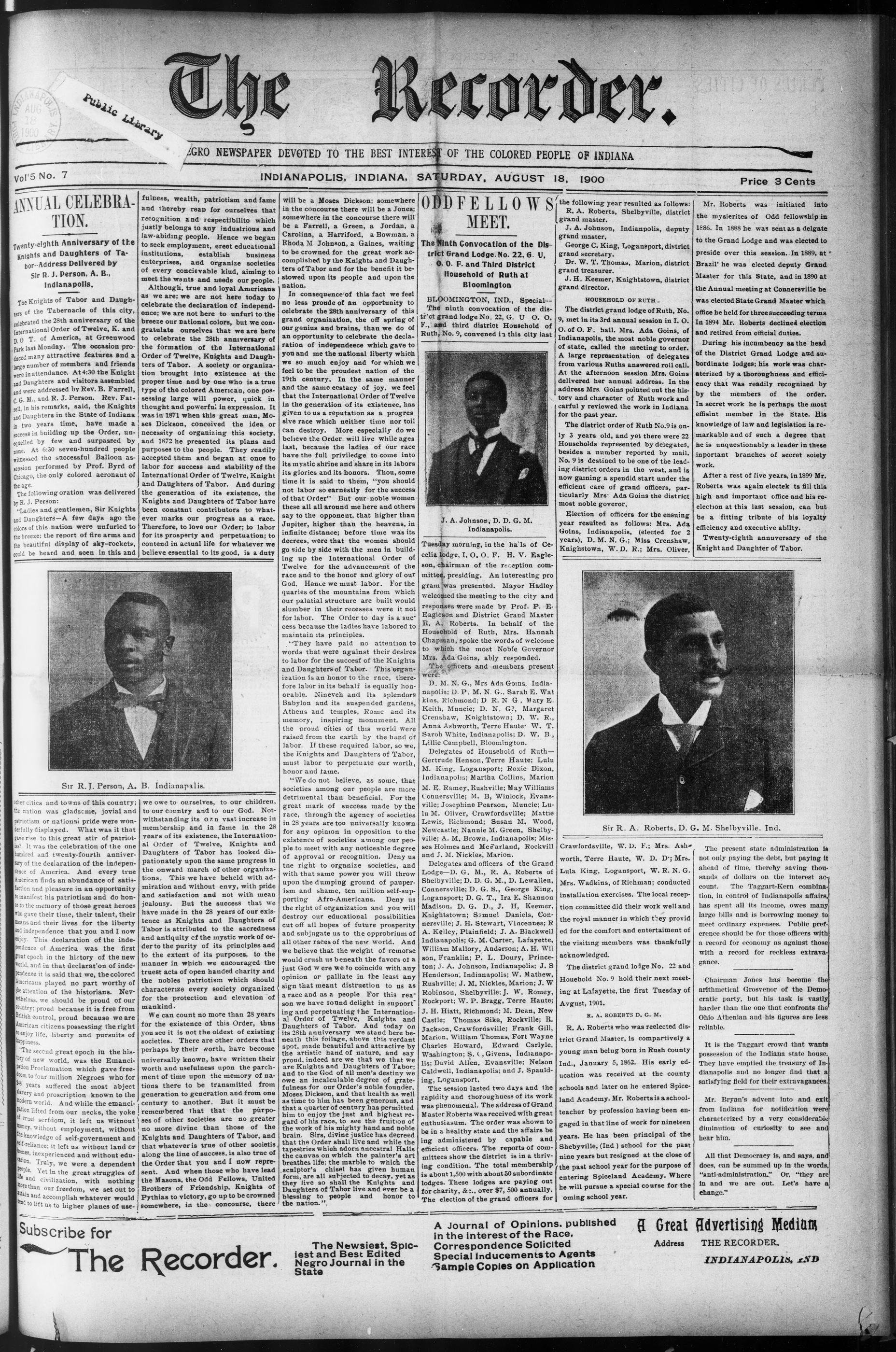
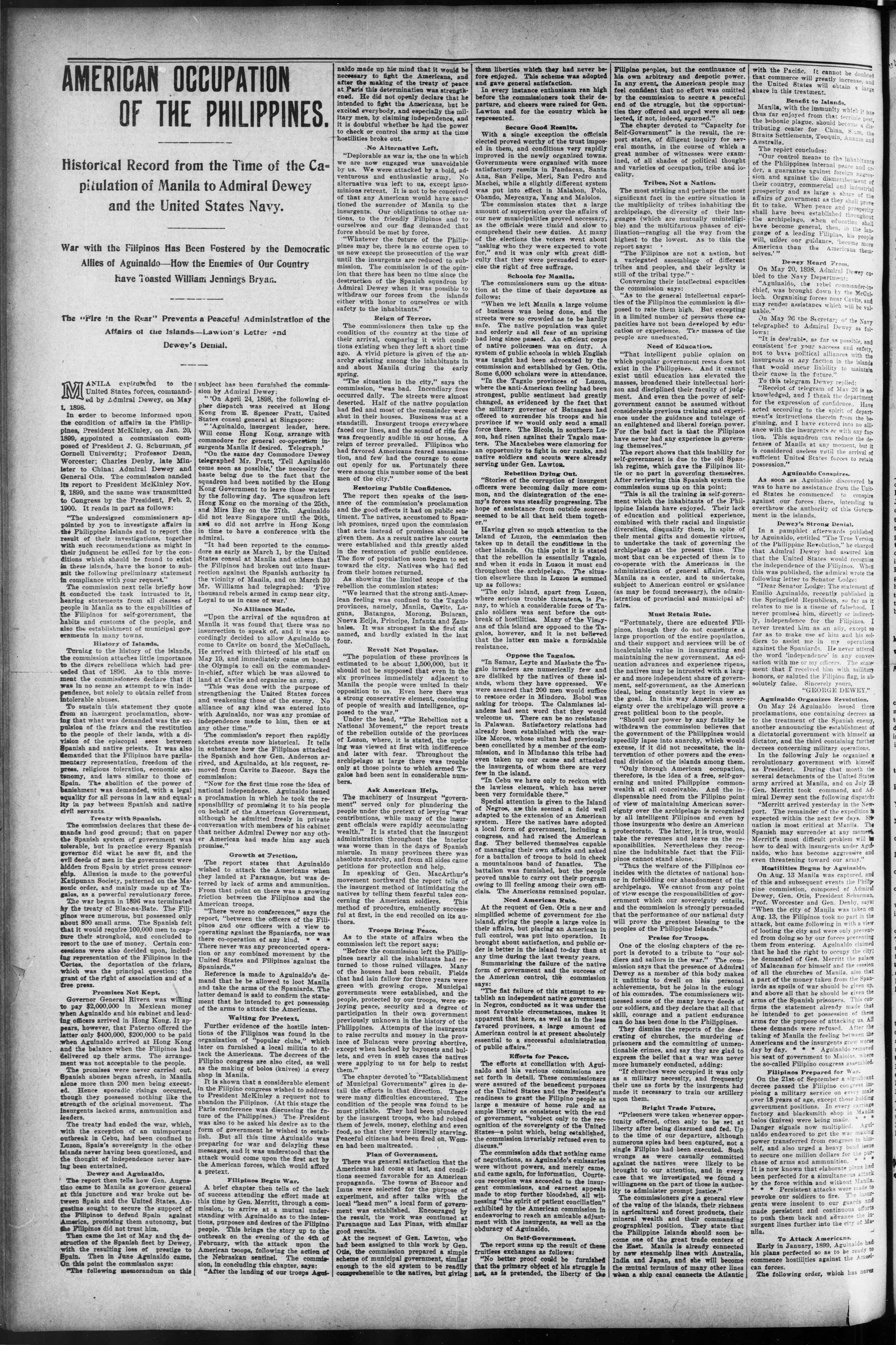
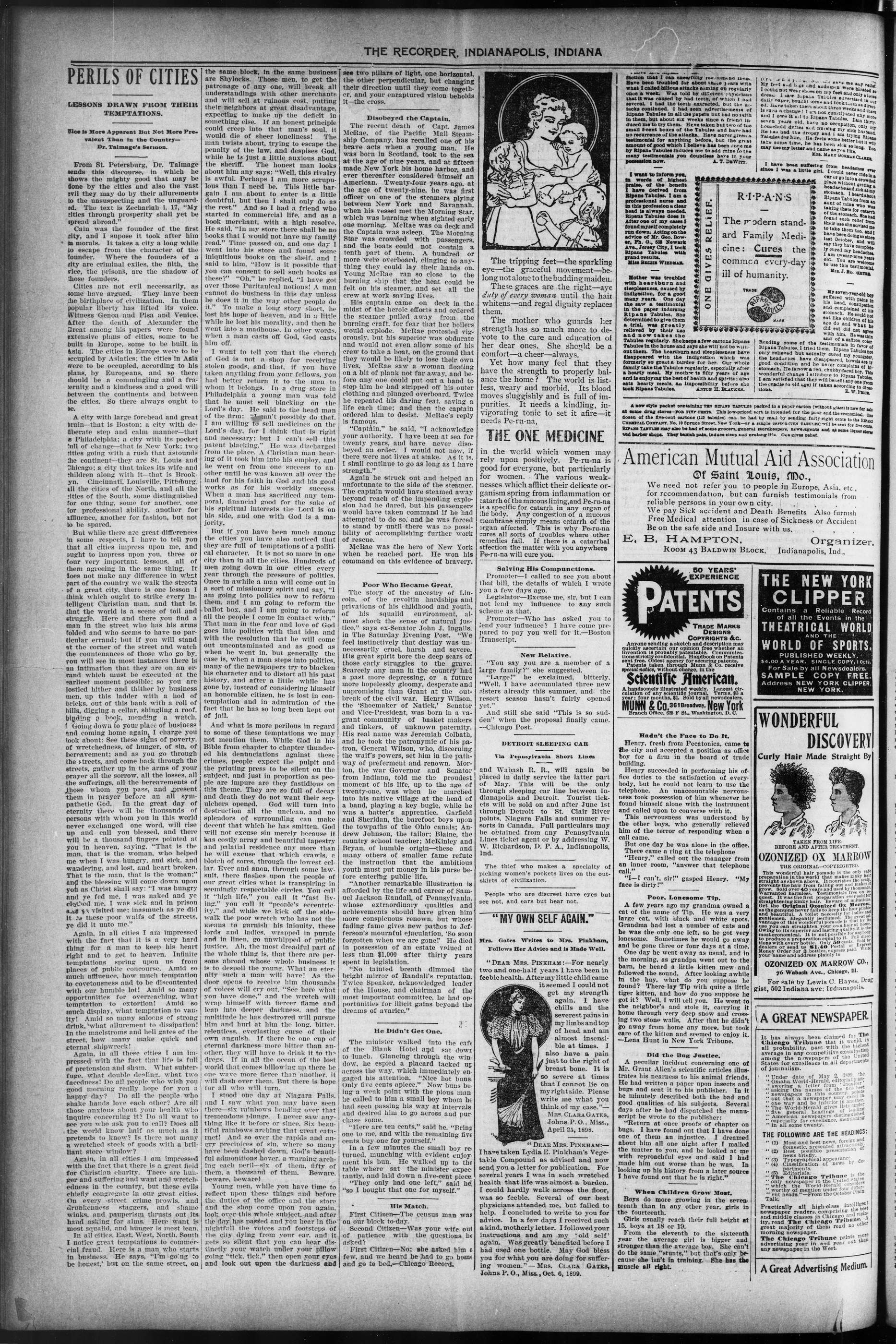
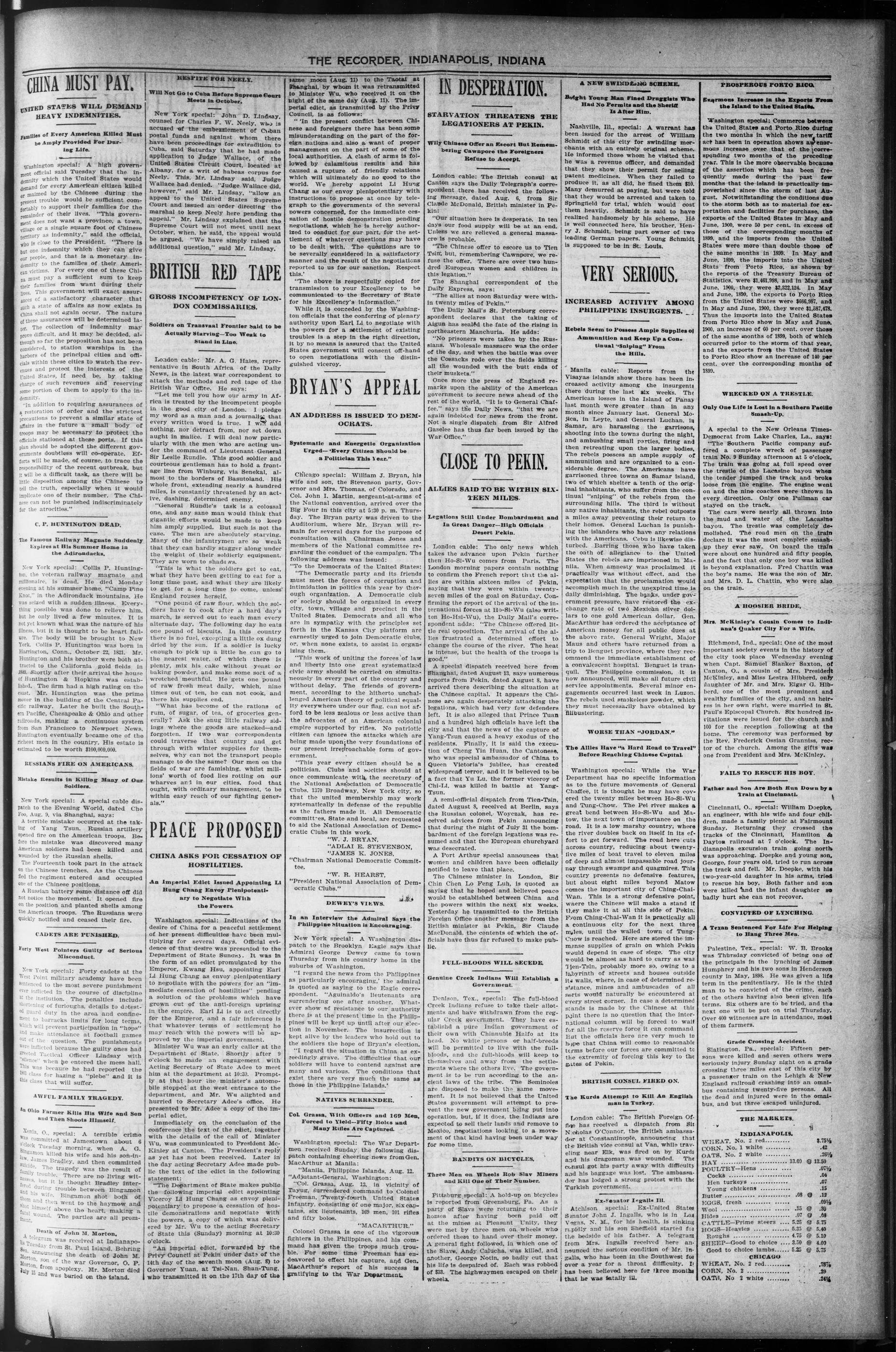
Page text (machine-generated)
ANNUAL CELEBRATION.
Twenty-eighth Anniversary of the Knights and Daughters of Ta Address Delivered by
The Knights of Tabor and Daughters of the Tabernacle of this city, celebrated the 28th anniversary of the International Order of Twelve, K. and D O T. of America, at Greenwood Park last Monday. The occasion produced many attractive features and a large number of members and friends were in attendance. At 4:30 the Knight and Daughters and visitors assembled and were addressed by Rev. B. Farrell, C.G. M., and R. J. Person. Rev. Farrell, in his remarks, said, the Knights and Daughters in the State of Indiana in two years time, have made a success in building up the Order, unquenled by few and surpassed by none. At 6:30 seven-hundred people witnessed the successful Balloon asses-sion performed by Prof. Byrd of Chicago, the only colored aeonaut of the age.
The following oration was delivered by R. J. Person:
"Ladies and gentlemen, Sir Knights and Daughters—A few days ago the colors of this nation were unfurled to the breeze: the report of fire arms and the beautiful display of sky-rockets, could be heard and seen in this and
[Image of a man in a suit and bow tie].
THE MAYOR OF BROOKLYN
Sir R. J. Person, A. B. Indianapalis.
other cities and towns of this country; the nation was gladseme, jovial and patriotism or national pride were wonderfully displayed. What was it that gave rise to this great stir of patriotism? It was the celebration of the one hundred and twenty-fourth anniversary of the declaration of the independence of America. And every true American finds an abundance of satisfaction and pleasure in an opportunity to manifest his patriotism and do honor to the memory of those great heroes who gave their time, their talent, their means and their lives for the liberty and independence that you and I now enjoy. This declaration of the independence of America was the first great epoch in the history of the new world, and in that declaration of independence it is said that we, the colored Americans played no part worthy of the attention of the historians. Nevertheless, we should be proud of our country; proud because it is free from British control, proud because we are American citizens possessing the right to enjoy life, liberty and pursuits of happiness.
"The second great epoch in the history of new world, was the Emancipation Proclamation which gave freedom to four million Negroes who for 182 years suffered the most abject slavery and proscription known to the modern world. And while the emancipation lifted from our necks, the yoke of cruel serfdom, it left us without money, without employment, without the knowledge of self-government and self-reliance; it left us without land or business, inexperienced and without education. Truly, we were a dependent people. Yet in the great struggles of life and civilization, with nothing more than our freedom, we set out to attain and accomplish whatever would tend to lift us to higher planes of use-
Subscribe for The
fulness, wealth, patriotism and fame and thereby reap for ourselves that recognition and respectibilito which justly belongs to any industrious and law-abiding people. Hence we began to seek employment, erect educational institutions, establish business enterprises, and organize societies of every concievable klud, aiming to meet the wants and needs our people.
Although, true and loyal Americans as we are; we are not here today to celebrate the declaration of independence; we are not here to unfurl to the breeze our national colors, but we congratulate ourselves that we are here to celebrate the 28th anniversary of the formation of the International Order of Twelve, Knights and Daughters of Tabor. A society or organization brought into existence at the proper time and by one who is a true type of the colored American, one possessing large will power, quick in thought and powerful in expression. It was in 1871 when this great man, Moses Dickson, conceived the idea or necessity of organizing this society, and 1872 he presented its plans and purposes to the people. They readily accepted them and began at once to labor for success and stability of the International Order of Twelve, Knight and Daughters of Tabor. And during the generation of its existence, the Knights and Daughters of Tabor have been constant contributors to whatever marks our progress as a race. Therefore, to love our Order; to labor for its prosperity and perpetuation; to contend in actual life for whatever we believe essential to its good, is a duty
19
we owe to ourselves, to our children, to our country and to our God. Notwithstanding its own vast increase in membership and in fame in the 28 years of its existence, the International Order of Twelve, Knights and Daughters of Tabor has looked dispassionately upon the same progress in the onward march of other organizations. This we have beheld with admiration and without envy, with pride and satisfaction and not with mean jealousy. But the success that we have made in the 28 years of our existence as Knights and Daughters of Tabor is attributed to the sacredness and antiquity of the mystic work of order to the purity of its principles and to the extent of its purposes, to the manner in which we encouraged the truest acts of open handed charity and the nobles patriotism which should characterize every society organized for the protection and elevation of mankind.
We can count no more than 28 years for the existence of this Order, thus you see it is not the oldest of existing societies. There are other orders that perhaps by their worth, have become universally known, have written their worth and usefulness upon the parchment of time upon the memory of nations there to be transmitted from generation to generation and from one century to another. But it must be remembered that that the purposes of other societies are no greater no more divine than those of the Knights and Daughters of Tabor, and that whatever is true of other societies along the line of success, is also true of the Order that you and I now represent. And when those who have lead the Masons, the Odd Fellows, United Brothers of Friendship, Knights of Pythias to victory, go up to be crowned somewhere, in the concourse, there
Recorder
will be a Moses Dickson; somewhere in the concourse there will be a Jones; somewhere in the concourse there will be a Farrell, a Green, a Jordan, a Carolina, a Harriford, a Bowman, a Rhoda M Johnson, a Gaines, waiting to be crowned for the great work accomplished by the Knights and Daughters of Tabor and for the benefit it bestowed upon its people and upon the nation.
In consequence of this fact we feel no less proude of an opportunity to celebrate the 28th anniversary of this grand organization, the offspring of our genius and brains, than we do of an opportunity to celebrate the declaration of independence which gave to you and me the national liberty which we so much enjoy and for which we feel to be the proudest nation of the 19th century. In the same manner and the same ecstacy of joy, we feel that the International Order of Twelve in the generation of its existence, has given to us a reputation as a progress sive race which neither time nor toil can destroy. More especially do we believe the Order will live while ages last, because the ladies of our race have the full privilege to come into its mystic shrine and share in its labors its glories and its honors. Thou, some time it is said to them, "you should not labor so earnestly for the success of that Order" But our noble women these all all around me here and others say to the opponent, that higher than Jupiter, higher than the heavens, in infinite distance; before time was its decrees, were that the women should go side by side with the men in building up the International Order of Twelve for the advancement of the race and to the honor and glory of our God. Hence we must labor. For the quarries of the mountains from which our palatial structure are built would slumber in their recesses were it not for labor. The Order to day is a success because the ladies have labored to maintain its principles.
"They have paid no attention to words that were against their desires to labor for the success of the Knights and Daughters of Tabor. This organization is an honor to the race, therefore labor in its behalf is equally honorable. Nineveh and its splendors Babylon and its suspended gardens, Athens and temples, Rome and its memory, inspiring monument. All the proud cities of this world were raised from the earth by the hand of labor. If these required labor, so we, the Knights and Daughters of Tabor, must labor to perpetuate our worth, honor and tame.
"We do not believe, as some, that societies among our people are more detrimental than beneficial. For the great mark of success made by the race, through the agency of societies in 28 years are too universally known for any opinion in opposition to the existence of societies among our people to meet with any noticeable degree of approval or recognition. Deny us the right to organize societies, and with that same power you will throw upon the dumping ground of pauperism and shame, ten million self-supporting Afro-Americans. Deny us the right of organization and you will destroy our educational possibilities cut off all hopes of future prosperity and subjugate us to the opproibrium of all other races of the new world. And we believe that the weight of remorse would crush us beneath the favors of a just God we are we to coincide with any opinion or palliate in the least any sign that meant distruction to us as a race and as a people. For this reason we have toound delight in support and perpetuating the International Order of Twelve, Knights and Daughters of Tabor. And today on its 28th anniversary we stand here beneath this foliage, above this verdant spot, made beautiful and attractive by the artistic hand of nature, and say proud, indeed are we that we that we are Knights and Daughters of Tabor; and to the God of all men's destiny we owe an incalculable degree of gratefulness for our Order's noble founder. Moses Dickson, and that health as well as time to him has been generous, and that a quarter of century has permitted him to enjoy the just and highest regard of his race, to see the fruition of the work of his mighty hand and noble brain. Sirs, divine justice has decreed that the Order shall live and while the tapestries which adorn ancestral Halls the canvas on which the painter's art breathes life; the marble to which the sculptor's chisel has given human form, are all subjected to decay, yet as they live so shall the Knights and Daughters of Tabor live and ever be a blessing to people and honor to the nation."
The Newsiest, Spiciest and Best Edited Negro Journal in the State
A Journal of Opinions, published in the interest of the Race. Correspondence Solicited Special Inducements to Agents Sample Copies on Application
ODDFELLOWS MEET.
The Ninth Convocation of the District Grand Lodge. No. 22, G. U,
O. O. F. and Third District Household of Ruth at Bloomington
BLOOMINGTON, IND., Special--
The ninth convocation of the district grand lodge No. 22, G. U O. O.
F., and third district Household of Ruth, No. 9, convened in this city last
J. A. Johnson, D. D. G. M.
Indianapolis.
Tuesday morning, in the ha'ls of Cecelia lodge, I. O. O. F. H. V. Eagleson, chairman of the reception committee, presiding. An interesting program was presented. Mayor Hadley welcomed the meeting to the city and responses were made by Prof. P. E. Eagleson and District Grand Master R. A. Roberts. In behalf of the Household of Ruth, Mrs. Hannah Chapman, spoke the words of welcome to which the most Noble Governor Mrs. Ada Goins, ably responded. The officers and members present were:
D. M. N. G., Mrs Ada Goins, Indianapolis; D. P. M. N. G., Sarah E. Watkins, Richmond; D. R. N. G., Mary E. Keith, Munie; D. N. G?, Margaret Crenshaw, Knightstown; D. W. R., Anna Ashworth, Terre Haute: W. T. Saroh White, Indianapolis; D. W. B., Lillie Campbell, Bloomington.
Delegates of Household of Ruth—Gertrude Henson, Terre Haute; Lula M. King, Logansport; Roxie Dixon, Indianapolis; Martha Collins, Marion M. E. Ramey, Rushville; May Williams Connervsville; M. B, Winlock, Evansville; Josephine Pearson, Munie; Lula M. Oliver, Crawfordsville; Mattie Lewis, Richmond; Susan M. Wood, Newcastle; Nannie M. Green, Shelbyville; A. M. Brown, Indianapolis; Misses Holmes and McArland, Rockvilland and J. M. Nickles, Marion.
Delegates and officers of the Grand Lodge—D. G. M., R. A. Roberts of Shelbyville; D. D. G. M., D. Lewallen, Connersville; D. G. S., George King, Logansport; D. G. T., Ira E. Shannon Madison; D. G. D., J. H. Keemer, Knightstown; Samuel Daniels, Connersville; J. H. Stewart, Vincennes; R. A. Kelley, Plainfield; J. A. Blackwell Indianapolis; G. M. Carter, Lafayette, William Mallory, Anderson; A. H. Wilson, Franklin; P. L. Doury, Princeton; J. A. Johnson, Indianapolis; J. S. Henderson, Indianapolis; W. Mathew, Rushville; J. M. Nickles, Marion; J. W Robinson, Shelbyville; J. W. Romey, Rockport; W. P. Bragg, Terre Haute; J. H. Hiatt, Richmond; M. Dean, New Castle; Thomas Sike, Rockville; R. Jackson, Crawfordsville; Frank Gill, Marion, William Thomas, Fort Wayne Charles Howard, Edward Carlyle, Washington; S. C., Givens, Indianapolis; David Allen, Evansville; Nelson Caldwell, Indianapolis; and J. Spaulding, Logansport.
The session lasted two days and the rapidity and thoroughness of its work was phenomenal. The address of Grand Master Roberts was received with great enthusiasm. The order was shown to be in a healthy state and the affairs being administered by capable and efficient officers. The reports of committees show the district is in a thriving condition. The total membership is about 1,500 with about 50 subordinate lodges. These lodges are paying out for charity, &z., over $7, 500 annually. The election of the grand officers for
M.
Sir R. A. Roberts, D. G. M. Shelbyville. Ind.
the following year resulted as follows:
R. A. Roberts, Shelbyville, district
grand master.
J. A. Johnson, Indianpolis, deputy
grand master.
George C. King, Logansport, district
grand secretary.
Dr. W. T. Thomas, Marion, district grand treasurer.
J. H. Keemer, Knightstown, district grand director.
HOUSEHOLD OF RUTH
The district grand lodge of Ruth, No. 9, met in its 3rd annual session in I. O. O. of O. F. hall. Mrs. Ada Goins, of Indianapolis, the most noble governor of state, called the meeting to order. A large representation of delegates from various Ruths answered roll call. At the afternoon session Mrs. Goins delivered her annual address. In the address Mrs. Goins pointed out the history and character of Ruth work and careful y reviewed the work in Indiana for the past year.
The district order of Ruth No.9 is only 3 years old, and yet there were 22 Households represented by delegates, besides a number reported by mail. No.9 is destined to be one of the leading district orders in the west, and is now ganning a spendid start under the efficient care of grand officers, particularly Mrs. Ada Goins the district most noble governor.
Election of officers for the ensuing year resulted as follows: Mrs. Ada Goins, Indianapolis, (elected for 2 years), D. M. N. G.; Miss Crenshaw, Knightstown, W. D. R.; Mrs. Oliver,
Sir R. A. Roberts, D. C.
Crawfordsville, W. D. F.; Mrs. Ashworth, Terre Haute, W. D. D; Mrs. Lula King, Logansport, W. R. N. G. Mrs. Wadkins, of Richman; conducted installation exercises. The local reception committee did their work well and the royal manner in which they provided for the comfort and entertainment of the visiting members was thankfully acknowledged.
The district grand lodge No. 22 and Household No. 9 hold their next meeting at Lafayette, the first Tuesday of Avgust, 1901.
R. A. Roberts who was reelected district Grand Master, is compartively a young man being born in Rush county Ind., January 5, 1862. His early education was received at the county schools and later on he entered Spiceland Academy. Mr. Roberts is a schoolteacher by profession having been engaged in that line of work for nineteen years. He has been principal of the Shebyville, (Ind.) school for the past nine years but resigned at the close of the past school year for the purpose of entering Spiceland Academy. Where he will pursue a special course for the oming school year.
s. published
ace.
tited
Agents
lication
A Great
Address
Price 3 Cents
Mr. Roberts was initiated into the mysierites of Odd fellowship in 1886. In 1888 he was sent as a delgate to the Grand Lodge and was elected to preside over this session. In 1889, at Brazil' he was elected deputy Grand Master for this State, and in 1890 at the Annual meeting at Connersville he was elected State Grand Master which office he held for three succeeding terms In 1894 Mr. Roberts declined election and retired from official duties.
During his incumbency as the head of the District Grand Lodge and subordinate lodges; his work was characterized by a thoroughness and efficiency that was readily recognized by by the members of the order. In secret work he is perhaps the most effisint member in the State. His knowledge of law and legislation is remarkable and of such a degree that he is unquestionably a leader in these important branches of secret society work.
After a rest of five years, in 1899 Mr. Roberts was again electek to fill this high and important office and his reelection at this last session, can but be a fitting tribute of his loyalty efficiency and executive ability.
Twenty-eighth anniversary of the Knight and Daughter of Tabor.
G. M. Shelbyville. Ind.
The present state administration is not only paying the debt, but paying it ahead of time, thereby saving thousands of dollars on the interest account. The Taggart-Kern combination, in control of Indianapolis affairs, has spent all its income, owes many large bills and is borrowing money to meet ordinary expenses. Public preference should be for those officers with a record for economy as against those with a record for reckless extravagance.
Chairman Jones has become the arithmetical Grosvenor of the Democratic party, but his task is vastly harder than the one that confronts the Ohio Athenian and his figures are less reliable.
It is the Taggart crowd that wants possession of the Indiana state house. They have emptied the treasury of Indianapolis and no longer find that a satisfying field for their extravagances.
Mr. Bryan's advent into and exit from Indiana for notification were characterized by a very considerable diminution of curiosity to see and hear him.
All that Democracy is, and says, and does, can be summed up in the words, "anti-administration." Or, "they are in and we are out. Let's have a change."
Advertising Medium
THE RECORDER.
INDIANAPOLIS, IND
AMERICAN OCCUPATION OF THE PHILIPPINES.
Historical Record from the Time of the Capitulation of Manila to Admiral Dewey and the United States Navy.
War with the Filipinos Has Been Fostered by the Democratic Allies of Aguinaldo—How the Enemies of Our Country Have Toasted William Jennings Bryan.
The "Fire in the Rear" Prevents a Peaceful Administration of the Affairs of the Islands—Lawton's Letter and Dewev's Denial.
MANILA capitulated to the United States forces, commanded by Admiral Dewey, on May 1, 1898.
In order to become informed upon the condition of affairs in the Philippines, President McKinley, on Jan. 20, 1899, appointed a commission composed of President J. G. Schurman, of Cornell University; Professor Dean, Worcester; Charles Denby, late Minister to China; Admiral Dewey and General Otis. The commission nanded its report to President McKinley Nov. 2, 1899, and the same was transmitted to Congress by the President, Feb. 2, 1900. It reads in part as follows:
"The undersigned commissioners appointed by you to investigate affairs in the Philippine Islands and to report the result of their investigations, together with such recommendations as might in their judgment be called for by the conditions which should be found to exist in these islands, have the honor to submit the following preliminary statement in compliance with your request."
The commission next tells briefly how it conducted the task intrusted to it, hearing statements from all classes of people in Manila as to the capabilities of the Filipinos for self-government, the habits and customs of the people, and also the establishment of municipal governments in many towns.
History of Islands.
Turning to the history of the islands, the commission attaches little importance to the divers rebellions which had preceded that of 1890. As to this movement the commissioners declare that it was in no sense an attempt to win independence, but solely to obtain relief from intolerable auses.
To sustain this statement they quote from an insurgent proclamation, showing that what was demanded was the expulsion of the friars and the restitution to the people of their lands, with a division of the episcopal sees between Spanish and native priests. It was also demanded that the Filipinos have parliamentary representation, freedom of the press, religious toleration, economic autonomy, and laws similar to those of Spain. The abolition of the power of banishment was demanded, with a legal equality for all persons in law and equality in pay between Spanish and native civil servants.
The commission declares that these demands had good ground; that on paper the Spanish system of government was tolerable, but in practice every Spanish governor did what he saw fit, and the evil deeds of men in the government were hidden from Spain by strict press censorship. Allusion is made to the powerful Katipunan Society, patterned on the Masonic order, and mainly made up of Tagalos, as a powerful revolutionary force. The war begun in 1896 was terminated by the treaty of Blas-na-Bate. The Filipinos were numerous, but possessed only about 800 small arms. The Spanish felt that it would require 100,000 men to capture their stronghold, and concluded to resort to the use of money. Certain concessions were also decided upon, including representation of the Filipinos in the Cortes, the deportation of the friars, which was the principal question; the grant of the right of association and of a free press.
Governor General Rivera was willing to pay $2,000,000 in Mexican money when Aguinaldo and his cabinet and leading officers arrived in Hong Kong. It appears, however, that Paterno offered the latter only $400,000, $200,000 to be paid when Aguinaldo arrived at Hong Kong and the balance when the Filipinos had delivered up their arms. The arrangement was not acceptable to the people. The promises were never carried out. Spanish abuses began afresh, in Manila alone more than 200 men being executed. Hence sporadic risings occurred, though they possessed nothing like the strength of the original movement. The insurgents lacked arms, ammunition and leaders. The treaty had ended the war, which, with the exception of an unimportant outbreak in Cebu, had been confined to Luzon, Spain's sovereignty in the other islands never having been questioned, and the thought of independence never having been entertained.
The report then tells how Gen. Augustino came to Manila as governor general at this juncture and war broke out between Spain and the United States. Augustino sought to secure the support of the Filipinos to defend Spain against America, promising them autonomy, but the Filipinos did not trust him. Then came the 1st of May and the destruction of the Spanish fleet by Dewey, with the resulting loss of prestige to Spain. Then in June Aguinaldo came. On this point the commission says:
"The following memorandum on this
History of Islands.
Treaty with Spanish.
Promises Not Kept.
Dewey and Agninaldo.
subject has been furnished the commission by Admiral Dewey:
"On April 24, 1808, the following epher dispatch was received at Hong Kong from E. Spencer Pratt, United States consul general at Singapore:
"Aguinaldo, insurgent leader, here.
Will come Hong Kong, arrange with commodore for general co-operation insurgents Manila if desired. Telegraph.
"On the same day Commodore Dewey telegraphed Mr. Pratt, 'Tell Aguinaldo come soon as possible,' the necessity for haste being due to the fact that the squadron had been notified by the Hong Kong Government to leave those waters by the following day. The squadron left Hong Kong on the morning of the 25th, and Mirs Bay on the 27th. Aguinaldo did not leave Singapore until the 26th, and so did not arrive in Hong Kong in time to have a conference with the admiral.
"It had been reported to the commodore as early as March 1, by the United States consul at Manila and others that the Filipinos had broken out into insurrection against the Spanish authority in the vicinity of Manila, and on March 80 Mr. Williams had telegraphed: 'Five thousand rebels armed in camp near city. Loyal to us in case of war.'
No Alliance Made.
"Upon the arrival of the squadron at Manila it was found that there was no insurrection to speak of, and it was accordingly decided to allow Aguinaldo to come to Cavite on board the McCulloch. He arrived with thirteen of his staff on May 10, and immediately came on board the Olympia to call on the commander-in-chief, after which he was allowed to land at Cavite and organize an army.
"This was done with the purpose of strengthening the United States forces and weakening those of the enemy. No alliance of any kind was entered into with Aguinaldo, nor was any promise of independence made to him, then or at any other time."
The commission's report then rapidly sketches events now historical. It tells in substance how the Filipinos attacked the Spanish and how Gen. Anderson arrived, and Aguinaldo, at his request, removed from Cavite to Bacoor. Says the commission:
"Now for the first time rose the idea of national independence. Aguinaldo issued a proclamation in which he took the responsibility of promising it to his people on behalf of the American Government, although he admitted freely in private conversation with members of his cabinet that neither Admiral Dewey nor any other American had made him any such promise."
Growth of Friction.
The report states that Aguinaldo wished to attack the Americans when they landed at Paranaque, but was deterred by lack of arms and ammunition. From that point on there was a growing friction between the Filipinos and the American troops.
"There were no conferences," says the report, "between the officers of the Filipinos and our officers with a view to operating against the Spaniards, nor was there co-operation of any kind. * * *
There never was any preconcerted operation or any combined movement by the United States and Filipinos against the Spaniards."
Reference is made to Aguinaldo's demand that he be allowed to loot Manila and take the arms of the Spaniards. The latter demand is said to confirm the statement that he intended to get possession of the arms to attack the Americans.
Waiting for Pretext.
Further evidence of the hostile intentions of the Filipinos was found in the organization of "popular clubs," which later on furnished a local militia to attack the Americans. The decrees of the Filipino congress are also cited, as well as the making of bolos (knives) in every shop in Manila.
It is shown that a considerable element in the Filipino congress wished to address to President McKinley a request not to abandon the Filipinos. (At this stage the Paris conference was discussing the future of the Philippines.) The President was also to be asked his desire as to the form of government he wished to establish. But all this time Aguinaldo was preparing for war and delaying these messages, and it was understood that the attack would come upon the first act by the American forces, which would afford a pretext.
A brief chapter then tells of the lack of success attending the effort made at this time by Gen. Merritt, through a commission, to arrive at a mutual understanding with Aguinaldo as to the intentions, purposes and desires of the Filipino people. This brings the story up to the outbreak on the evening of the 4th of February, with the attack upon the American troops, following the action of the Nebraskan sentinel. The commission, in concluding this chapter, says: "After the landing of our troops,
---
No Alliance Made.
Growth at Friction.
Waiting for Pretext.
Filipinos Begin War:
naldo made up his mind that it would be necessary to fight the Americans, and after the making of the treaty of peace at Paris this determination was strengthened. He did not openly declare that he intended to fight the Americans, but he excited everybody, and especially the military men, by claiming independence, and it is doubtful whether he had the power to check or control the army at the time hostilities broke out.
No Alternative Left.
"Deplorable as war is, the one in which we are now engaged was unavoidable by us. We were attacked by a bold, adventurous and enthusiastic army. No alternative was left to us, except ignominious retreat. It is not to be conceived of that any American would have sanctioned the surrender of Manila to the insurgents. Our obligations to other nations, to the friendly Filipinos and to ourselves and our flag demanded that force should be met by force.
"Whatever the future of the Philippines may be, there is no course open to us now except the prosecution of the war until the insurgents are reduced to submission. The commission is of the opinion that there has been no time since the destruction of the Spanish squadron by Admiral Dewey when it was possible to withdraw our forces from the islands either with honor to ourselves or with safety to the inhabitants."
Reign of Terror.
The commissioners then take up the condition of the country at the time of their arrival, comparing it with conditions existing when they left a short time ago. A vivid picture is given of the anarchy existing among the inhabitants in and about Manila during the early spring.
"The situation in the city," says the commission, "was bad. Incendiary fires occurred daily. The streets were almost deserted. Half of the native population had fled and most of the remainder were shut in their houses. Business was at a standstill. Insurgent troops everywhere faced our lines, and the sound of rifle fire was frequently audible in our house. A reign of terror prevailed. Filipinos who had favored Americans feared assassination, and few had the courage to come out openly for us. Fortunately there were among this number some of the best men of the city."
Restoring Public Confidence.
The report then speaks of the issuance of the commission's proclamation and the good effects it had on public sentiment. The natives, accustomed to Spanish promises, urged upon the commission that acts instead of promises should be given them. As a result native law courts were established and this greatly aided in the restoration of public confidence. The flow of population soon began to set toward the city. Natives who had fled from their homes returned.
As showing the limited scope of the rebellion the commission states:
"We learned that the strong anti-American feeling was confined to the Tagalo provinces, namely, Manila, Cawite, Laguna, Batangas, Morong, Bulacan, Nueva Ecija, Principa, Infanta and Zambales. It was strongest in the first six named, and hardly existed in the last four.
Revolt Not Popular.
"The population of these provinces is estimated to be about 1,500,000, but it should not be supposed that even in the six provinces immediately adjacent to Manila the people were united in their opposition to us. Even here there was a strong conservative element, consisting of people of wealth and intelligence, opposed to the war."
Under the head, "The Rebellion not a National Movement," the report treats of the rebellion outside of the provinces of Luzon, where, it is stated, the uprising was viewed at first with indifference and later with fear. Throughout the archipelago at large there was trouble only at those points to which armed Tangalos had been sent in considerable numbers.
Ask American Help.
The machinery of insurgent "government" served only for plundering the people under the pretext of levying "war contributions, while many of the insurgent officials were rapidly accumulating wealth." It is stated that the insurgent administration throughout the interior was worse than in the days of Spanish misrule. In many provinces there was absolute anarchy, and from all sides came petitions for protection and help.
In speaking of Gen. MacArthur's movement northward the report tells of the insurgent method of intimidating the natives by telling them fearful tales concerning the American soldiers. This method of procedure, eminently successful at first, in the end recoiled on its authors.
Troops Bring Peace.
As to the state of affairs when the commission left the report says:
"Before the commission left the Philippines nearly all the inhabitants had returned to those ruined villages. Many of the houses had been rebuilt. Fields that had lain fallow for three years were green with growing crops. Municipal governments were established, and the people, protected by our troops, were enjoying peace, security and a degree of participation in their own government previously unknown in the history of the Philippines. Attempts of the insurgents to raise recruits and money in the province of Bulacan were proving abortive, except when backed by bayonets and bullets, and even in such cases the natives were applying to us for help to resist them."
The chapter devoted to "Establishment of Municipal Governments" gives in detail the efforts in that direction. There were many difficulties encountered. The condition of the people was found to be must pitiful. They had been plundered by the insurgent troops, who had robbed them of jewels, money, clothing and even food, so that they were literally starving. Peaceful citizens had been fired on. Women had been maltreated.
Plan of Government.
There was general satisfaction that the Americans had come at last, and conditions seemed favorable for an American propaganda. The towns of Bacoor and Imus were selected for the purpose of experiment, and after talks with the local "head men" a local form of government was established. Encouraged by the result, the work was continued at Paranaca and Las Pinas, with similar good results.
At the request of Gen. Lawton, who had been assigned to this work by Gen. Otis, the commission prepared a simple scheme of municipal government, similar enough to the old system to be readily comprehensible to the natives, but giving
them liberties which they had never before enjoyed. This scheme was adopted and gave general satisfaction. In every instance enthusiasm ran high before the commissioners took their departure, and cheers were raised for Gen. Lawton and for the country which he represented.
Secure Good Results.
With a single exception the officials elected proved worthy of the trust imposed in them, and conditions very rapidly improved in the newly organized towns. Governments were organized with more satisfactory results in Pandacan, Santa Ana, San Felipe, Meri, San Pedro and Machei, while a slightly different system was put into effect in Malabon, Polo, Obando, Meycauya, Yang and Malolos. The commission states that a large amount of supervision over the affairs of our new municipalities proved necessary, as the officials were timid and slow to comprehend their new duties. At many of the elections the voters went about "asking who they were expected to vote for," and it was only with great difficulty that they were persuaded to exercise the right of free suffrage.
Schools for Manila.
The commissioners sum up the situation at the time of their departure as follows:
"When we left Menila a large volume of business was being done, and the streets were so crowded as to be hardly safe. The native population was quiet and orderly and all fear of an uprising had long since passed. An efficient corps of native policemen was on duty. A system of public schools in which English was taught had been advocated by the commission and established by Gen. Otis. Some 6,000 scholars were in attendance.
"In the Tagalo provinces of Luzon, where the anti-American feeling had been strongest, public sentiment had greatly changed, as evidenced by the fact that the military governor of Batangas had offered to surrender his troops and his province if we would only send a small force there. The Bicols, in southern Luzon, had risen against their Tagalo masters. The Macabebes were clamoring for an opportunity to fight in our ranks, and native soldiers and scouts were already serving under Gen. Lawton.
Rebellion Dying Out.
"Stories of the corruption of insurgent officers were becoming daily more common, and the disintegration of the enemy's forces was steadily progressing. The hope of assistance from outside sources seemed to be all that held them together."
Having given so much attention to the Island of Luzon, the commission then takes up in detail the conditions in the other islands. On this point it is stated that the rebellion is essentially Tagalog, and when it ends in Luzon it must end throughout the archipelago. The situation elsewhere than in Luzon is summed up as follows:
"The only island, apart from Luzon, where serious trouble threatens, is Panay, to which a considerable force of Tagalog soldiers was sent before the outbreak of hostilities. Many of the Visayans of this island are opposed to the Tagalos, however, and it is not believed that the latter can make a formidable resistance.
Oppose the Tagalos.
"In Samar, Leyte and Masbate the Tangalo invaders are numerically few and are disliked by the natives of these islands, whom they have oppressed. We were assured that 200 men would suffice to restore order in Mindoro. Bobol was asking for troops. The Calamianes islanders had sent word that they would welcome us. There can be no resistance in Palawan. Satisfactory relations had already been established with the warlike Moros, whose sultan had previously been conciliated by a member of the commission, and in Mindanao this tribe had even taken up our cause and attacked the insurgents, of whom there are very few in the island.
"In Cebu we have only to reckon with the lawless element, which has never been very formidable there."
Special attention is given to the Island of Negros, as this seemed a field well adapted to the extension of an American system. Here the natives have adopted a local form of government, including a congress, and had raised the American flag. They believed themselves capable of managing their own affairs and asked for a battalion of troops to hold in check a mountainous band of fanatics. The battalion was furnished, but the people proved unable to carry out their program owing to ill feeling among their own officials. The Americans remained popular.
Need American Rule.
At the request of Gen. Otis a new and simplified scheme of government for the island, giving the people a large voice in their affairs, but placing an American in full control, was put into operation. It brought about satisfaction, and public order is better in the island to-day than at any time during the last twenty years. Summarizing the failure of the native form of government and the success of the American control, the commission says:
"The flat failure of this attempt to establish an independent native government in Negros, conducted as it was under the most favorable circumstances, makes it apparent that here, as well as in the less favored provinces, a large amount of American control is at present absolutely essential to a successful administration of public affairs."
Efforts for Peace.
The efforts at conciliation with Aguinaldo and his various commissions are set forth in detail. These commissioners were assured of the beneficent purposes of the United States and the President's readiness to grant the Filipino people as large a measure of home rule and as ample liberty as consistent with the end of government, "subject only to the recognition of the sovereignty of the United States—a point which, being established, the commission invariably refused even to discuss."
The commission adds that nothing came of negotiations, as Aguinaldo's emissaries were without powers, and merely came, and came again, for information. Courteous reception was accorded to the insurgent commissions, and earnest appeals made to stop further bloodshed, all witnessing "the spirit of patient conciliation" exhibited by the American commission in endeavoring to reach an amicable adjustment with the insurgents, as well as the obdurancy of Aguinaldo.
On Self-Government
The report sums up the result of these fruitless exchanges as follows:
"No better proof could be furnished that the primary object of his struggle is not as is pretended, the liberty of the
Filipino peoples, but the continuance of his own arbitrary and despotic power. In any event, the American people may feel confident that no effort was omitted by the commission to secure a peaceful end of the struggle, but the opportunities they offered and uged were all neglected, if not, indeed, spurned." The chapter devoted to "Capacity for Self-Government" is the result, the report states, of diligent inquiry for several months, in the course of which a great number of witnesses were examined, of all shades of political thought and varieties of occupation, tribe and locality.
Tribes, Not a Nation.
The most striking and perhaps the most significant fact in the entire situation is the multiplicity of tribes inhabiting the archipelago, the diversity of their languages (which are mutually unintelligible) and the multifarious phases of civilization—ranging all the way from the highest to the lowest. As to this the report says: 'The Filipinos are not a nation, but a variegated assemblage of different tribes and peoples, and their loyalty is still of the tribal type.' Converting their intellectual capacities the commission says: 'As to the general intellectual capacities of the Filipinos the commission is disposed to rate them high. But excepting in a limited number of persons these capacities have not been developed by education or experience. Tr> masses of the people are uneducated.
Need of Education.
"That intelligent public opinion on which popular government rests does not exist in the Philippines. And it cannot exist until education has elevated the masses, broadened their intellectual horizon and disciplined their faculty of judgment. And even then the power of self-government cannot be assumed without considerable previous training and experience under the guidance and tutelage of an enlightened and liberal foreign power. For the bald fact is that the Filipinos have never had any experience in governing themselves."
The report shows that this inability for self-government is due to the old Spanish regime, which gave the Filipinos little or no part in governing themselves. After reviewing this Spanish system the commission sums up on this point:
"This is all the training in self-government which the inhabitants of the Philippine Islands have enjoyed. Their lack of education and political experience, combined with their racial and linguistic diversities, disqualify them, in spite of their mental gifts and domestic virtues, to undertake the task of governing the archipelago at the present time. The most that can be expected of them is to co-operate with the Americans in the administration of general affairs, from Manila as a center, and to undertake, subject to American control or guidance (as may be found necessary), the administration of provincial and municipal affairs.
Must Retain Rule.
"Fortunately, there are educated Filipinos, though they do not constitute a large proportion of the entire population, and their support and services will be of incalculable value in inaugurating and maintaining the new government. As education advances and experience ripens, the natives may be intrusted with a larger and more independent share of government, self-government, as the American ideal, being constantly kept in view as the goal. In this way American sovereignty over the archipelago will prove a great political boon to the people.
"Should our power by any fatality be withdrawn the commission believes that the government of the Philippines would speedily lapse into anarchy, which would excuse, if it did not necessitate, the intervention of other powers and the eventual division of the islands among them.
"Only through American occupation, therefore, is the idea of a free, self-governing and united Philippine commonwealth at all conceivable. And the indispensable need from the Filipino point of view of maintaining American sovereignty over the archipelago is recognized by all intelligent Filipinos and even by those insurgents who desire an American protectorate. The latter, it is true, would take the revenues and leave us the responsibilities. Nevertheless they recognize the indubitable fact that the Filipinos cannot stand alone.
"Thus the welfare of the Filipinos coincides with the dictates of national honor in forbidding our abandonment of the archipelago. We cannot from any point of view escape the responsibilities of government which our sovereignty entails, and the commission is strongly persuaded that the performance of our national duty will prove the greatest blessing to the peoples of the Philippine Islands."
Praise for Troops.
One of the closing chapters of the report is devoted to a tribute to "our soldiers and sailors in the war." The commission says that the presence of Admiral Dewey as a member of this body makes it unfitting to dwell on his personal achievements, but he joins in the eulogy of his comrades. The commissioners witnessed some of the many brave deeds of our soldiers, and they declare that all that skill, courage and a patient endurance can do has been done in the Philippines. They dismiss the reports of the desecrating of churches, the murdering of prisoners and the committing of unmentionable crimes, and say they are glad to express the belief that a war was never more humanely conducted, adding: "If churches were occupied it was only as a military necessity, and frequently their use as forts by the insurgents had made it necessary to train our artillery upon them.
Bright Trade Future.
"Prisoners were taken whenever opportunity offered, often only to be set at liberty after being disarmed and fed. Up to the time of our departure, although numerous spies had been captured, not a single Filipino had been executed. Such wrongs as were casually committed against the natives were likely to be brought to our attention, and in every case that we investigated we found a willingness on the part of those in authority to administer prompt justice." The commissioners give a general view of the valup of the islands, their richness in agricultural and forest products, their mineral wealth and their commanding geographical position. They state that the Philippine Islands should soon become one of the great trade centers of the Earst. Manila is already connected by new steamship lines with Australia, India and Japan, and she will become the mutual terminus of many other lines when a ship canal connects the Atlantic
with the Pacific. It cannot be doubled that commerce will greatly increase, and the United States will obtain a large share in this treatment.
Benefit to Islands
Manila, with the immunity that it has thus far enjoyed from that terrific pest, the bubonic plague, should become a distributing center for China, Sam, the Straits Settlements, Touquia, Annam and Australia.
The report concludes:
"Our control means to the inhabitants of the Philippines internal peace and order, a guarantee against foreign aggression and against the dismemberment of their country, commercial and industrial prosperity and as large a share of the affairs of government as they shall prove fit to take. When peace and prosperity shall have been established throughout the archipelago, when education shall have become general, then, in the language of a leading Filipino, his people will, under our guidance, 'become more American than the Americans themselves.'"
Dewey Heard Exam
On May 20, 1895, Admiral Dewey cabled to the Navy Department;
"Aguinaldo, the rebel commander chief, was brought down by the McCulloch. Organizing forces near Cavite, and may render assistance which will be valuable."
On May 26 the Secretary of the Navy telegraphed to Admiral Dewey as follows:
"It is desirable, as far as possible, and consistent for your success and safety, not to have political alliances with the insurgents or any faction in the islands that would incur liability to maintain their cause in the fature."
To this telegram Dewey replied:
"Receipt of telegram of May 26 is acknowledged, and I thank the department for the expression of confidence. Have acted according to the spirit of department's instructions therein from the beginning, and I have entered into no alliance with the insurgents or with any faction. This squadron can reduce the defenses of Manila at any moment, but it is considered useless until the arrival of sufficient United States forces to retain possession."
Aguinaldo Conspires
As soon as Aguinalde discovered he was to have no assistance from the United States he commenced to conspire against our forces there, intending to overthrow the authority of this Government in the islands.
Dewey's Strong Denial.
In a pamphlet afterwards published by Aguinaldo, entitled "The True Version of the Philippine Revolution," he charged that Admiral Dewey had assured him that the United States would recognize the independence of the Filipinos. When this was published, the admiral wrote the following letter to Senator Lodge:
"Dear Senator Lodge: The statement of Emilio Aguinaldo, recently published in the Springfield Republican, so far as it relates to me is a tissue of falsehood. I never promised him, directly or indirectly, independence for the Filipinos. I never treated him as an ally, except so far as to make use of him and his soldiers to assist me in my operations against the Spaniards. He never uttered the word 'independence' in any conversation with me or my officers. The statement that I received him with military honors, or saluted the Filipino flag, is absolutely false. Sincerely yours,
"GEORGE DEWEY"
Aguinaldo Organizes Revolution.
On May 24 Aguinaldo issued three proclamations, one containing decrees as to the treatment of the Spanish enemy, another announcing the establishment of a dictatorial government with himself as dictator, and the third containing further decrees concerning military operations.
In the following July he organized a revolutionary government with himself as President. During that month the several detachments of the United States army arrived at Manila, and on July 25 Gen. Merritt took command, and Admiral Dewey sent the following dispatch "Merritt arrived yesterday in the Newport. The remainder of the expedition expected within the next few days. Situation is most critical at Manila. The Spanish may surrender at any moment. Merritt's most difficult problem will how to deal with insurgents under Aguinaldo, who has become aggressive and even threatening toward our army."
Hostilities Begin by Aguinaldo.
On Aug. 13 Manila was captured, and of this and subsequent events the Philippine commission, composed of Admiral Dewey, Gen. Otis, President Schurman, Prof. Worcester and Gen. Deny, says "When the city of Manila was taken on Aug. 13, the Filipinos took no part in the attack, but came following in with a view of looting the city and were only prevented from doing so by our forces preventing them from entering. Aguinaldo claimed that he had the right to occupy the city; he demanded of Gen. Merript the palace of Malacanan for himself and thecession of all the churches of Manila, also that a part of the money taken from the Spaniards as spoils of war should be given up, and above all that he should be given the arms of the Spanish prisoners. This confirms the statement already made that he intended to get possession of these arms for the purpose of attacking us. All these demands were refused. After the taking of Manila the feeling between the Americans and the insurgents grew worse day by day. * * * Aguinaldo removed his seat of government to Maniles, where the so-called Filipino congress assembled.
Filipinos Prepared for War
Philipinos prepared for war.
On the 21st of September a significant decree passed the Filipino congress imposing a military service on every male over 18 years of age, except those holding government positions. In every carriage factory and blacksmith shop in Manila belos (knives) were being made. * * * Danger signals now multiplied. Aguinaldo endeavored to get the war making power transferred from congress to himself, and also urged a heavy bond issue to secure one million dollars for the purchase of arms and ammunition. It is now known that elaborate plans had been perfected for a simultaneous attack by the force within and without Manila. * * * Persistent attacks were made to provoke our soldiers to fire. The insurgents were insolent to our guards and made persistent and continuous efforts to push them back and advance the insurgent lines further into the city of Manila.
To Attack Americans.
Early in January, 1889, Aguinado had his plans perfected so as to be ready to commence hostilities against the American forces.
The following order, which has never
PERILS OF CITIES
LESSONS DRAWN FROM THEIR TEMPTATIONS.
Ulice is More Apparent But Not More Pre-
valent Than in the Country—
Dr. Talmage's Sermon.
From St. Petersburg, Dr. Talmage sends this discourse, in which he shows the mighty good that may be done by the cities and also the vast will they may do by their allurements to the unsuspecting and the unguarded. The text is Zechariah 1. 17, "My cities through prosperity shall yet be spread abroad." Cain was the founder of the first city, and I suppose it took after him in morals. It takes a city a long while to escape from the character of the founder. Where the founders of a city are criminal exiles, the fifth, the vice, the prisons, are the shadow of those founders.
Cities are not evil necessarily, as some have argued. They have been the birthplace of civilization. In them popular liberty has lifted its voice. Witness Genoa and Pisa and Venice. After the death of Alexander the Great among his papers were found extensive plans of cities, some to be built in Europe, some to be built in Asia. The cities in Europe were to be occupied by Asiatics; the cities in Asia were to be occupied, according to his plans, by Europeans, and so there should be a commingling and a fraternity and a kindness and a good will between the continents and between the cities. So there always ought to be.
A city with large forehead and great brain—that is Boston; a city with deliberate step and calm manner—that is Philadelphia; a city with its pocket all of change—that is New York; two cities going with a rush that astounds the continent—they are St. Louis and Chicago; a city that takes its wife and children along with it—that is Brooklyn. Cincinnati, Louisville, Pittsburgh, all the cities of the North, and all the cities of the South, some distinguished for one thing, some for another, one for professional ability, another for influence, another for fashion, but not to be spared.
Again, in all cities I am impressed with the fact that it is a very hard thing for a man to keep his heart right and to get to heaven. Infinite temptations spring upon us from places of public concourse. Amid so much affluence, how much temptation to covetousness and to be discontented with our humble lot! Amid so many opportunities for overreaching, what temptation to extortion! Amid so much display, what temptation to vanity! Amid so many saloons of strong drink, what allurement to dissipation! In the macstroms and hell gates of the street, how many make quick and eternal shipwreck!
Again, in all these cities I am impressed with the fact that life is full of pretension and sham. What subterfuge, what double dealing, what two facetedness? Do all people who wish you good morning really hope for you a happy day? Do all the people who shake hands love each other? Are all those anxious about your health who inquire concerning it? Do all want to see you who ask you to call? Does all the world know half as much as it pretends to know? Is there not many a wretched stock of goods with a brilliant store window?
Again, in all cities I am impressed with the fact that there is a great field for Christian charity. There are hunger and suffering and want and wretchedness in the country, but these evils chiefly congregate in our great cities. On every street crime prowls, and drunkenness staggers, and shame winks, and pauperism thrusts out its hand asking for alms. Here want is most squallid, and hunger is most lean.
In all cities, East, West, North, South, I notice great temptations to commer-
cialize in business. He says, "I'm going to
he lonest, but on the same street, on
the same block, in the same business are Shylocks. Those men to get the patronage of any one, will break all understandings with other merchants and will sell at rulous cost, putting their neighbors at great disadvantage, expecting to make up the deficit in something else. If an honest principle could creep into that man's soul, it would die of sheer loneliness. The man twists about, trying to escape the penalty of the law, and despises God, while he laz just a little anxious about the sheriff. The honest man looks about him any says: "Well, this rivalry is awful. Perhaps I am more scrupulous than I need be. This little bargain I am about to enter is a little doubtful, but then I shall only do as the rest." And so I had a friend who started in commercial life, and as a book merchant, with a high resolve. He said, "In my store there shall be no books that I would not have my family read." Time passed on, and one day I went into his store and found some inquisitious books on the shelf, and I said to him, "How is it possible that you can consent to sell such books as these?" "Oh," he replied, "I have got over those Puritanical notions! A man cannot do business in this day unless he does it in the way other people do it." To make a long story short, he lost his hope of heaven, and in a little while he lost his morality, and then he went into a madhouse. In other words, when a man casts off God, God casts him off.
I want to tell you that the church of God is not a shop for receiving stolen goods, and that, if you have taken anything from your fellows, you had better return it to the men to whom it belongs. In a drug store in Philadelphia a young man was told that he must sell blacking on the Lord's day. He said to the head man of the firm: "I can't possibly do that. I am willing to sell medicines on the Lord's day, for I think that is right and necessary; but I can't sell this patent blacking." He was discharged from the place. A Christian man hearing of it took him into his employ, and he went on from one success to another until he was known all over the land for his faith in God and his good works as for his worldly success. When a man has sacrificed any temporal, financial good for the sake of his spiritual interests the Lord is on his side, and one with God is a majority.
But if you have been much among the cities you have also noticed that they are full of temptations of a political character. It is not so more in one city than in all the cities. Hundreds of men going down in our cities every year through the pressure of politics. Once in awhile a man will come out in a sort of missionary spirit and say, "I am going into politics now to reform them, and I am going to reform the ballot box, and I am going to reform all the people I come in contact with." That man in the fear and love of God goes into politics with that idea and with the resolution that he will come out uncontaminated and as good as when he went in, but generally the case is, when a man steps into politics, many of the newspapers try to blacken his character and to distort all his past history, and after a little while has gone by, instead of considering himself an honorable citizen, he is lost in contemplation and in admiration of the fact that he has so long been kept out of jail.
And what is more perilous in regard to some of these temptations we may not mention them. While God in his Bible from chapter to chapter thundered his denunciations against these crimes, people expect the pulpit and the printing press to be silent on the subject, and just in proportion as people are impure are they fastidious on this theme. They are so full of decay and death they do not want their sepulchers opened. God will turn into destruction all the unclean, and no splendors of surrounding can make decent that which he has smitten. God will not excuse sin merely because it has costly array and beautiful tapestry and palatial residence any more than he will excuse that which crawls, a blotch of sores, through the lowest cellar. Ever and anon, through some lawsuits, there flashes upon the people of our great cities what is transpiring in seemingly respectable circles. You call it "high life," you call it "fast living," you call it "people's eccentricity," and while we kick off the sidewalk the poor wretch who has not the means to garnish his iniquity, these lords and ladies, wrapped in purple and in linen, go unwhipped of public justice. Ah, the most dreadful part of the whole thing, that is that there are persons abroad whose whole business it is to despoil the young. What an eternity such a man will have! As the door opens to receive bim thousand of voices will cry out, "See here what you have done," and the wretch will wrap himself with fiercer flame and leap into deeper darkness, and the multitude he has destrured will pursue him and hurt at him the long, bitter, relentless, everlasting curse of their own anguish. If there be one cup of eternal darkness more bitter than another, they will have to drink it to the dregs. If in all the ocean of the lost world that comes billowing up there be one wave more fierce than another, it will dash over them. But there is hope for all who will turn.
I stood one day at Niagara Falls, and I saw what you may have seen there—six rainbows bending over that tremendous plunge. I never saw anything like it before or since. Six beautiful rainbows arching that great cataract! And so over the rapids and angry precincts of sin, where so many have been dashed down. God's beautiful admonitions hover, a warning arching each peril—six of them, fifty of them, a thousand of them. Beware, beware, beware!
Young men, while you have time to reflect upon these things and before the duties of the office and the store and the shop come upon you again, look over this whole subject, and after the day has passed and you hear in the nightfall the voices and footsteps of the city dying from your ear, and it gets so silent that you can hear distinctly your watch under your pillow going "tick, tick." then open your eyes and look out upon the darkness and
see two pillars of light, one horizontal, the other perpendicular, but changing their direction until they come together, and your enraptured vision beholds it—the cross.
Disobeyed the Captain.
The recent death of Capt. James McRae, of the Pacific Moll Steamship Company, has recalled one of his brave acts when a young man. He was born in Scotland, took to the sea at the age of nine years, and at fifteen made New York his home harbor, and ever thereafter considered himself an American. Twenty-four years ago, at the age of twenty-nine, he was first officer on one of the steamers flying between New York and Savannah, when his vessel met the Morning Star, which was burning when sighted early one morning. McRae was on deck and the Captain was asleep. The Morning Star was crowded with passengers, and the boats could not contain a tenth part of them. A hundred or more were overboard, clinging to anything they could lay their hands on. Young McRae ran so close to the burning ship that the heat could be felt on his steamer, and set all the crew at work saving lives.
His captain came on deck in the midst of the heroic efforts and ordered the steamer pulled away from the burning craft, for fear that her boilers would explode. McRae protested vigorously, but his superior was obdurate and would not even allow some of his crew to take a boat, on the ground that they would be likely to lose their own lives. McRae saw a woman floating on a bit of plank not far away, and before any one could put out a hand to stop him he had stripped off his outer clothing and plunged overboard. Twice he repeated his daring feat, saving a life each time; and then the captain ordered him to desist. McRae's reply is famous.
"Captain," he said, "I acknowledge your authority. I have been at sea for twenty years, and have never disobeyed an order. I would not now, if there were not lives at stake. As it is, I shall continue to go as long as I have strength."
Again he struck out and helped an unfortunate to the side of the steamer. The captain would have steamed away beyond reach of the impending explosion had he dared, but his passengers would have taken command if he had attempted to do so, and he was forced to stand by until there was no possibility of accomplishing further work of rescue. McRae was the hero of New York when he reached port. He won his command on this evidence of bravery.
Poor Who Became Great.
The story of the ancestry of Lincoln, of the revoltin hardships and privations of his childhood and youth, of his squall environment, almost shock the sense of natural justice," says ex-Senator John J. Ingalls, in the Saturday Evening Post. "We feel instinctively that destiny was unnecessarily cruel, harsh and severe. His great spirit bore the deep scars of those early struggles to the grave. Scarcely any man in the country had a past more depressing, or a future more hopelessly gloomy, desperate and unpromising than Grant at the outbreak of the civil war. Henry Wilson, the 'Shoemaker of Natick,' Senator and Vice-President, was born in a vagrant community of basket makers and tinkers, of unknown paternity. His real name was Jeremiah Colbath, and he took the patronymic of his patron, General Wilson, who, discerning the walt's powers, set him in the pathway of preferment and renown. Morton, the war Governor and Senator from Indiana, told me the proudest moment of his life, up to the age of twenty-one, was when he marched into his native village at the head of a band, playing a key bugle, while he was a hatter's apprentice. Garfield and Sheridan, the barefoot boys upon the towpaths of the Ohio canals; Andrew Johnson, the taller; Blaine, the country school teacher; McKinley and Bryan, of humble origin—these and many others of smaller fame refute the instruction that the ambitious youth must put money in his purse before entering public life.
"Another remarkable illustration is afforded by the life and career of Samuel Jackson Randall, of Pennsylvania, whose extraordinary qualities and achievements should have given him more conspicuous renown, but whose fading fame gives new pathos to Jefferson's mournful ejaculation, 'So soon forgotten when we are gone!' He died in possession of an estate valued at less than $1,000 after thirty years spent in legislation.
"No tainted breath dimmed the bright mirror of Randall's reputation. Twice Speaker, acknowledged leader of the House, and chairman of the most important committee, he had opportunities for illicit gains beyond the dreams of avarice."
He Didn't Get One.
The minister walked into the cafe of the Blank Hotel and sat down to lunch. Glancing through the window, he espied a placard tacked up across the way, which immediately engaged his attention. "Nice hot buns Only five cents apiece." Now buns being a weak point with the plious man he called to him a small boy whom he had seen passing his way at intervals and desired him to go across and purchase some.
"Here are ten cents," said he. "Bring one to me, and with the remaining five cents buy one for yourself."
In a few minutes the small boy returned, munching with evident enjoyment his bun. He walked up to the table where sat the minister expectantly, and laid down a five-cent piece. "They had had one left," said he. "so I bought that one for myself."
His Match
First Citizen—The census man was on our block to day.
Second Citizen—Was your wife out of patience with the questions he asked?
First Citizen—No; she asked him a few, and we heard he had to go home and go to bed.-Chicago Record.
MOTHER AND SON
The tripping feet—the sparkling eye—the graceful movement—be long not alone to the budding maiden. These graces are the right—aye duty of every woman until the hair whitens—and regal dignity replaces them.
The mother who guards her strength has so much more to devote to the care and education of her dear ones. She should be a comfort—a cheer—always.
Yet how many feel that they have the strength to properly balance the home? The world is listless, weary and morbid. Its blood moves sluggishly and is full of impurities. It needs a kindling, invigorating tonic to set it afire—it needs Pe-ru-na.
THE ONE MEDICINE
in the world which women may rely upon positively. Pe-ru-na is good for everyone, but particularly for women. The various weaknesses which afflict their delicate organism spring from inflammation or catarrh of the mucous lining, and Pe-ru-na is a specific for catarrh in any organ of the body. Any congestion of a mucous membrane simply means catarrh of the organ affected. This is why Pe-ru-na cures all sorts of troubles where other remedies fail. If there is a catarrhal affection the matter with you anywhere Pe-ru-na will cure you.
Salving His Compunctions.
Promoter—I called to see you about that bill, the details of which I wrote you a few days ago.
Legislator—Excuse me, sir, but I can not lend my influence to any such scheme as that.
Promoter—Who has asked you to lend your influence? I have come prepared to pay you well for it.—Boston Transcript.
New Relative
"You say you are a member of a large family?" she suggested. "Large!" he exclaimed, bitterly. "Well. I have accumulated three new sisters already this summer, and the resort season hasn't fairly opened yet." And still she said "This is so sudden" when the proposal finally came. --Chicago Post.
DETROIT SLEEPING CAR
Via Pennsylvania Short Lines
and Wabash R. R., will again be placed in daily service the latter part of May. This will be the only through sleeping car line between Indianapolis and Detroit. Tourist tickets will be sold on and after June 1st through Detroit to St. Clair River points, Niagara Falls and summer resorts in Canada. Full particulars may be obtained from any Pennsylvania Lines ticket agent or by addressing W. W. Richardson, D. P. A., Indianapolis, Ind.
The thief who makes a specialty of picking women's pockets lives on the outskirts of civilization.
People who are discreet have eyes but see not, and ears but hear not.
"MY OWN SELF AGAIN."
Mrs. Gates Writes to Mrs. Pinkham,
Follows Her Advice and is Made Well.
"DEAR Mrs. PINKHAM:—For nearly
two and one-half years I have been in
feeble health. After my little child came
it so
a j b
so th
my w r
thi M
get my strength again. I have chills and the severest pains in my limbs and top of head and am almost insensible at times. I also have a pain just to the right of breast bone. It is so severe at times that I cannot lie on my rightside. Please write me what you think of my case."—MRS. CLARA GATES, Johns P. O., Miss., April 23, 1898.
"DEAR MRS. PINKHAM:
I have taken Lydia E. Pinkham's Vegetable Compound as advised and now send you a letter for publication. For several years I was in such wretched health that life was almost a burden. I could hardly walk across the floor, was so feeble. Several of our best physicians attended me, but failed to help. I concluded to write to you for advice. In a few days I received such a kind, motherly letter. I followed your instructions and am my 'old self' again. Was greatly benefited before I had used one bottle. May God bless you for what you are doing for suffering women." —MRS. CLARA GATES, John P. O., Miss. Oct. 6, 1899.
faction that I can oncefully recommend them.
Have been troubled for about three years with what I called billious attacks coming on regularly once a week. Was told by different physicians that I had been attacked several times, I had the teeth extracted, but the attacks continued. I had seen advertisements of Kipans Tabules in all the papers but had noith of them. I was told by a friend I induced me to try them. Have taken bedside small six boxes of the Tabules and have had no recurrence of the attacks. Have never given a testimonial for anything before, but the great majority of them have been by Ripana Tabules induces me to add nine to the many testimonials you doubtless have in your possession now. A. T. DeWrity.
ONE GIVES RELIEF.
R.I.P.A.N.S
The modern standard Family Medicine: Cures the common every-day ill of humanity.
TRADE
R.I.P.A.N.S
ABULS
MARK
---
Tables regularly. She keeps a few cartons Ripans Reading some of the terminals in favor of the house and says she will not be without them. The heartburn and sleeplessness have disappeared with the indigestion which was formerly so great as a burder for her. Our whole family take the Tabules regularly especially after a hearty meal. My mother is fifty years of age and is enjoying the best of health and spirits; also eats hearty meals, an impossibility before she took Ripans Tabules. AFTCH H. BLACKKS.
A new style packed containing TEN RIPANS TARUBLES packed in a pack of carton (without $1.25) is now for sale at some drug stores—FOR FIVY CENTS. This low-priced sort is intended for the poor and the economical. One dozen of the five-cost cartons (120 tabules) can be had by mail by sending the eight cents to the RIPANS CHEMICAL COMPANY. No. 10 Spruce Street, New York—or a single carton (try TARUBLES—will be sent for five-cost RIPANS TARUBLES may also be had of some grocers, general storekeepers, now-agents and as some liquor store and barber shops. They banish pain, induce sleep and prolong life. One given relief.
American Mutual Aid Association
We need not refer you to people in Europe, Asia, etc. for recommendation, but can furnish testimonials from reliable persons in your own city.
We pay Sick accident and Death Benefits Also furnish Free Medical attention in case of Sickness or Accident Be on the safe side and Insure with us.
50 YEARS' EXPERIENCE
PATENTS
TRADE MARKS
DESIGNS
COPYRIGHT & C.
Anyone sending a sketch and description may quickly ascertain our opinion free whether an institution is present for immediate, handbook or communication. Dependent, Mum, can receive sent free. Oldest agency for securing patents. Patients taken through, Mum, can receive special notice, without charge, in the
Scientific American.
A handsome illustrated weekly. Largest circulation of any publication. One year; four months, $1. Sold by all new dealers.
MUM& Co. 361 Broadway, New York
Branch Office, 65 F. St., Washington, D. C.
Hadn't the Face to Do It.
Henry, fresh from Pecatonica, came to the city and accepted a position as office boy for a firm in the board of trade building.
Henry succeeded in performing his office duties to the satisfaction of everybody, but he could not learn to use the telephone. An unaccountable nervousness took possession of him whenever he found himself alone with the instrument and called upon to converse with it.
This nervousness was understood by the other boys, who generally relieved him of the terror of responding when a call came.
But one day he was alone in the office.
There came a ring at the telephone "Henry," called out the manager from an inner room, "answer that telephone call."
"I-I can't, sir!" gasped Henry. "My face is dirty!"
Pocr, Lonesome Tin.
A few years ago my grandma owned a cat of the name of Tip. He was a very large cat, with black and white spots. Grandma had lost a number of cats and he was the only one left, so he got very lonesome. Sometimes he would go away and be gone three or four days at a time. One day he went away as usual, and in the morning, as grandpa went out to the barn, he heard a little kitten mew and followed the sound. After looking awhile in the hay, what do you suppose he found? There lay Tip with quite a little tiger kitten, and how do you suppose he got it? Well, I will tell you. He went to the neighbor's and stole it, carrying it home through very deep snow and crossing two stone walls. After that he didn't go away from home any more, but took care of the kitten and seemed to enjoy it.—Lena Hunt in New York Tribune.
Did the Bug Justice.
A peculiar incident concerning one of Mr. Grant Alien's scientific articles illustrates his nearness to his animal friends. He had written a paper upon insects and bugs and sent it to his publisher. In it he minutely described both the bad and good qualities of his subjects. Several days after he had dispatched the manuscript he wrote to the publisher: "Return at once proofs of chapter on bugs. I have found out that I have done one of them an injustice. I dreamed about him all one night after I mailed the matter to you, and he looked at me with reproachful eyes and said I had made him out worse than he was. In looking up his history from a later source I have found out that he is right."
When Children Grow Most
Boys do more growing in the seventeenth than in any other year. girls in the fourteenth.
Girls usually reach their full height at 15. boys at 18 or 19.
From the eleventh to the sixteenth year the average girl is bigger and stronger than the average boy. She can't do the same "stunts," but that's only because she isn't in training. She has the muscle all right.
I want to inform you, in words of highest praise, of the benefit Ripans Tabules. I am a professional nurse and in this profession a clear head is always needed. After one of my cases I found myself completely run down. Acting on the advice of Mr. Geo. Bowen, Ave. Jersey City, I took Ripans Tabules with grand results.
MISS BEGER WIEDMAR.
Mother was troubled with heartburn and sleeplessness, caused by indigestion, for a good reason. She saw a testimonial in the paper indoring Ripana Tables. She determined to give them a trial was greatly easier. She and now takes the
for 10 years, and save me my aid. I have been suffering and auditioned were bloody. I could not find a place on my feet and only a bloody dress. I saw Ibanez on my daily paper, bounced some and took it in direct air. have taken them about three weeks ago, and I own not constituted any more and I owe a lot to me. I am thirty-seven years old, have no occupations, only my household duties and nurses my sick sister. He has had the droopy and I am trying to lift it, but some better but it will take too many years, he has to be so long. You may use my letter and name as you wish.
Krs. MARY GOLAN CLARER
I have been suffering from headaches ever since I was a little girl.
hair color
Reading some of the testimonials of Ripana Tahutes, I tried them. Ripana Tahutes only relieved but actually cured my younger sister, who was a bit ill and bowels are in good condition and he needn't be fed to stomach. He is now a red, chubby-faced boy wonderful change of attribute to Ripana Tahutes, and that they will benefit any one (from the cracks of old age) it takes according to directions.
THE NEW YORK CLIPPER
Contains a Reliable Record
of all the Events in the
THEATRICAL WORLD
AND THE
WORLD OF SPORTS.
PUBLISHED WEEKLY.
$4,00 A YEAR. SINGLE COPY, 1 OCTS.
For Sale by all Newdealers.
SAMPLE COPY FREE.
Address NEW YORK CLIPPER.
NEW YORK.
TAKEN FROM LIFE.
This wonderful hair pomade is the only safe preparation in the world that makes kinky hair straight as shown above. It nourishes the scalp, prevents the hair from falling out and makes it grow. Sold over 40 years and used by thousands. Warranted harmless. Testimonials free on request. It was the first preparation ever sold for straightening kinky hair. Reward of imitations. Get the Original Ozonized Ox Marrow, as the genuine never fails to keep the hair please and beautiful. A toilet necessity for ladies and gentlemen. Elegantly perfumed. The great advantage of this wonderful pomade is that by use you can straighten your own hair at home. Owing to its superior and lasting quality it is the most economical. It is not possible for anybody to produce a preparation equal to it. Full directions with every bottle. Only 50 cents. Sold by dealers or send us $1.40 Postal or Express. Money Order for 3 bottles, express paid. Write your name and address plainly to
OZONIZED OX MARROW CO.
26 Wash Ave. Ace, Chicago, IL.
For sale by Lewis C. Hayes, Drug
gist. 502 Indiana ave: Indianapolis.
A GREAT NEWSPAPER.
It has always been claimed for The Chicago Tribune that it in all probability, passages from a newspaper, possessive examination among the newspapers of the United States for exclosure in all departments of journalism.
(1) Under date of May 2, 1909 the editor, William H. Inquier, asking the names of the newspapers, points out that a newspaper may be another. The World-Herald gives it under five general headings. American newspaper distinguished distinction, mentioning in all some twenty.
THE FOLLOWING ARE THE HEADINGS:
(1) Most and best news, foreign and domestic, presented attractively to the public, presents a picture of news briefly.
(2) Typical appearance of the Chicago Tribune.
(3) Characterization of news by departments.
(4) The Chicago Tribune is the only newspaper in the United States considers worthy of mention under four different headings." -From the October Paint Pals
Practically all high-class intelligent newspaper readers, comprising the most intelligent and vicious, read The Chicago Tribune, the great majority of them read no other.
The Chicago Tribune prints more advertising year in and year out than any newspaper in the West.
A Great Advertising Medium.
headaches ever
I could have riven in a
place without a place without getting
place without getting
headache and sit at my
bedboard and I board about
Bipana from an am
aunt of nine to take
taking them for catac
the stomach. She had
relief from their use she
used to take them to
them take them to
have been doing so
they will be sober, and will
be cured my completely
cured my completely
I am twenty-nine years
old. You are welcome
to use this testimonial
MRS. J. B. ENTER
My sixteen-year-old boy
suffered with him in
his head, constipated
and complained of
his stomach. He could
not of him a age do and
he did eat not agree
with him. He was thin
UNITED STATES WILL DEMAND HEAVY INDEMNITIES.
Families of Every American Killed Must be Amply Provided For During Life.
Washington special: A high government official said Tuesday that the indemnity which the United States would demand for every American citizen killed or mained by the Chinese during the present trouble would be sufficient comfortably to support their families for the remainder of their lives. "This government does not want a province, a town, village or a single square foot of Chinese territory as indemnity," said the official, who is close to the President. "There is but one indemnity which they can give our people, and that is a monetary indemnity to the families of their American victims. For every one of these China must pay a sufficient sum to keep their families from want during their lives. This government will exact assurances of a satisfactory character that such a state of affairs as now exists in China shall not again occur. The nature of these assurances will be determined later. The collection of indemnity may prove difficult, and it may be decided, although so far the proposition has not been considered, to station warships in the harbors of the principal cities and officials within these cities to watch the revenues and protect the interests of the United States, if need be, by taking charge of such revenues and reserving some portion of them to apply to the indemnity.
"In addition to requiring assurances of a restoration of order and the strictest precautions to prevent a similar state of affairs in the future a small body of troops may be necessary to protect the officials stationed at these ports. If this plan should be adopted the different governments doubleslill will co-operate. Efforts will be made, of course, to trace the responsibility of the recent outbreak, but it will be a difficult task, as there will be little disposition among the Chinese to tell the truth, especially when it would implicate one of their number. The Chinese can not be punished indiscriminately for the atrocities."
C. P. HUNTINGTON DEAD.
The Famous Railway Magnet Suddenly
Expires at His Summer Home in
the Adriadacks.
New York special: Collis P. Huntington, the veteran railway magnate and millionaire, is dead. He died Monday evening at his summer home, "Camp Pine Knot," in the Adirondack mountains. He was seized with a sudden illness. Everything possible was done to relieve him, but he only lived a few minutes. It is not yet known what was the nature of his illness, but it is thought to be heart failure. The body will be brought to New York. Collis P. Huntington was born in Harrington, Conn., October 22, 1821. Mr. Huntington and his brother were both attracted to the California gold fields in 1862. Shortly after their arrival the house of Huntington & Hopkins was established. The firm had a high rating on the coast. Mr. Huntington was the prime mover in the building of the Central Pacific railway. Later he built the Southern Pacific, Chesapeake & Ohio and other railways, making a continuous system from San Francisco to Newport News. Huntington eventually became one of the richest men in the country. His estate is estimated to be worth $100,000,000.
RUSSIANS FIRE ON AMERICANS.
Mistake Results in Killing Many of Our Soldiers.
New York special: A special cable dispatch to the Evening World, dated Che Foo, Aug. 9, via Shanghai, says:
A terrible mistake occurred at the taking of Yang Tsun. Russian artillery opened fire on the American troops. Before the mistake was discovered many American soldiers had been killed and wounded by the Russian shells.
The Fourteenth took part in the attack on the Chinese trenches. As the Chinese fled the regiment entered and occupied one of the Chinese positions.
A Russian battery some distance off did not notice the movement. It opened fire on the position and planted shells among the American troops. The Russians were quickly notified and ceased their fire.
CADETS ARE PUNISHED.
Forty West Pointers Guilty of Serious Misconduct.
New York special: Forty cadets at the West Point military academy have been sentenced to the most severe punishment ever inflicted in the course of discipline at the institution. The penalties include shortening of furloughs, details to detestated guard duty in the area and confinement to barracks limits for long terms, which will prevent participation in "hops" and make attendance at football games out of the question. The punishments were inflicted because the guilty ones had sweated Tactical Officer Lindsay with "science" when he entered the mess hall. This was because he had reported the B33 class for hazing a "plebe" and it is this class that will suffer.
AWFUL FAMILY TRAGEDY.
An Ohio Farmer Kills His Wife and Son
and Then Shoots Himself.
Nenla, O., special: A terrible crime was committed at Jamestown about 6 o'clock Tuesday morning, when A. G. Bingamon killed his wife and his son-in-law, James Bingamon, and then committed suicide. The tragedy was the result of family trouble. There are no living witnesses, but it is thought Bradley interfered during trouble between Bingamon and his wife. Bingamon shot both of them and then went to the haymow and shot himself above the heart, making a fatal wound. The parties are all prominent.
Death of John M. Morton.
A telegram was received at Indianapolis Tuesday from St. Paul Island. Behring son announcing the death of John M. Morton, son of the war Governor, O. P. Morton, from apoplexy, Mr. Morton died July 15 and was buried on the island
Will Not Go to Cuba Before Supreme Court Meets in October.
New York special: John D. Lindsay, counsel for Charles F. W. Neely, who is accused of the embezzlement of Cuban postal funds and against whom there have been proceedings for extradition to Cuba, said Saturday that he had made application to Judge Wallace, of the United States Circuit Court, located at Albany, for a writ of habeas corpus for Neely. This, Mr. Lindsay said, Judge Wallace had denied. "Judge Wallace did, however," said Mr. Lindsay, "allow an appeal to the United States Supreme Court and issued an order directing the marshal to keep Neely here pending the appeal." Mr. Lindsay explained that the Supreme Court will not meet until next October, when he said, the appeal would be argued. "We have simply raised an additional question," said Mr. Lindsay.
GROSS INCOMPETENCY OF LONDON COMMISSARIES.
Soldiers on Transvaal Frontier said to be Actually Starving—Too Weak to Stand in Line.
London cable: Mr. A. G. Hales, representative in South Africa, of the Daily News, is the latest war correspondent to attack the methods and red tape of the British War Office. He says:
"Let me tell you how our army in Africa is treated by the incompetent people in the good city of London. I pledge my word as a man and a journalist that every written word is true. I will add nothing, nor detract from, nor set down aught in malice. I will deal now particularly with the men who are acting under the command of Lieutenant General Sir Leslie Rundle. This good soldier and courteous gentleman has to hold a frontage line from Winburg, via Senekal, almost to the borders of Basutoland. His whole front, extending nearly a hundred miles, is constantly threatened by an active, dashing, determined enemy.
"General Rundle's task is a colossal one, and any sane man would think that gigantic efforts would be made to keep him amply supplied. But such is not the case. The men are absolutely starving. Many of the infantrymen are so weak that they can hardly stagger along under the weight of their soldierly equipment. They are worn to shadows.
"This is what the soldiers get to eat, what they have been getting to eat for a long time past, and what they are likely to get for a long time to come, unless England rouses herself.
"One pound of raw flour, which the soldiers have to cook after a hard day's march, is served out to each man every alternate day. The following day he eats one pound of biscuits. In this country there is no fuel, excepting a little ox dung dried by the sun. If a soldier is lucky enough to pick up a little he can go to the nearest water, of which there is plenty, mix his cake without yeast or baking powder, and make some sort of a wretched mouthful. He gets one pound of raw fresh meat daily, which, nine times out of ten, he can not cook, and there his supplies end.
"What has become of the rations of rum, of sugar, of tea, of groceries generally? Ask the snug little railway sidings where the goods are stacked—and forgotten. If two war correspondents could traverse that country and get through with winter supplies for themselves, why can not the transport people manage to do the same? Our men on the fields of war are famishing, whilst millions' worth of food lies rotting on our wharves and in our cities, food that ought, with ordinary management, to be within easy reach of our fighting generals."
PEACE PROPOSED
CHINA ASKS FOR CESSATION OF HOSTILITIES.
An Imperial Edict Issued Appointing Li Hung Chang Envoy Plenipotentiary to Negotiate With the Powers.
Washington special: Indications of the desire of China for a peaceful settlement of her present difficulties have been multiplying for several days. Official evidence of that desire was presented to the Department of State Suncey. It was in the form of an edict promulgated by the Emperor, Kwang Hsu, appointing Earl Li Hung Chang as envoy plenipotentiary to negotiate with the powers for an "immediate cessation of hostilities" pending a solution of the problems which have grown out of the anti-foreign uprising in the empire. Earl Li is to act directly for the Emperor, and a fair inference is that whatever terms of settlement he may reach with the powers will be approved by the imperial government.
Minister Wu was an early caller at the Department of State. Shortly after 9 o'clock he made an engagement, with Acting Secretary of State Adee to meet him at the department at 10:30. Promptly at that hour the minister's automobile stopped at the west entrance to the department, and Mr. Wu alighted and hurried to Secretary Adee's office. He presented to Mr. Adee a copy of the imperial edict. Immediately on the conclusion of the conference the text of the edict, together with the details of the call of Minister Wu, was communicated to President McKinley at Canton. The President's reply as yet has not been received. Later in the day acting Secretary Adee made public the text of the edict in the following statement:
"The Department of State makes public the following imperial edict appointing Viceroy Ll Hung Chang as envoy plenipotentary to propose a cessation of hostile demonstrations and negotiate with the powers, a copy of which was delivered by Mr. Wu to the acting Secretary of State this (Sunday) morning at 10:30 o'clock.
"An imperial edict, forwarded by the Privy Council at Pekin under dates of the 14th day of the seventh moon (Aug. 9) to Governor Yuan, at Tsi-Lian, Shan-Tung, who transmitted it on the 17th day of the
THE RECORDER, INDIANAPOLIS, INDIANA
same moon (Aug. 11) to the Taotal at Shanghai, by whom it was retransmitted to Minister Wu, who received it on the night of the same day (Aug. 11). The imperial edict, as transmitted by the Privy Council, is as follows:
"In the present conflict between Chinese and foreigners there has been some misunderstanding on the part of the foreign nations and also a want of proper management on the part of some of the local authorities. A clash of arms is followed by calamitous results and has caused a rupture of friendly relations which will ultimately do no good to the world. We hereby appoint Li Huang Chang as our envoy plenipotentiary with instructions to propose at once by telegraph to the governments of the several powers concerned, for the immediate cessation of hostile demonstration pending negotiations, which he is hereby authorized to conduct for our part, for the settlement of whatever questions may have to be dealt with. The questions are to be severally considered in a satisfactory manner and the result of the negotiations reported to us for our sanction. Respect this."
"The above is respectfully copied for transmission to your Excellency to be communicated to the Secretary of State for his Excellency's information."
While it is conceded by the Washington officials that the conferring of plenary authority upon Earl Li to negotiate with the powers for a settlement of existing troubles is a step in the right direction, it by no means is assured that the United States government will consent off-hand to open negotiations with the distinguished viceroy.
BRYAN'S APPEAL
AN ADDRESS IS ISSUED TO DEMOCRATS.
Systematic and Energetic Organization
Urged—"Every Citizen Should be
a Politician This Year."
Chicago special: William J. Bryan, his wife and son, the Stevenson party, Governor and Mrs. Thomas, of Colorado, and Col. John I. M. sergeant-at-arms of the National convention, arrived over the Big Four in this city at 5:30 p. m. Thursday. The Bryan party was driven to the Auditorium, where Mr. Bryan will remain for several days for the purpose of consultation with Chairman Jones and members of the National committee regarding the conduct of the campaign. The following address was issued:
"To the Democrats of the United States:
"The Democratic party and its friends must meet the forces of corruption and intimidation in politics this year by thorough organization. A Democratic club or society should be organized in every city, town, village and precinct in the United States. Democrats and all who are in sympathy with the principles set forth in the Kansas City platform are earnestly urged to join Democratic clubs, or, when none exists, to assist in organizing them.
"This work of uniting the forces of law and liberty into one great systematized civic army should be carried on simultaneously in every part of the country and without delay. The friends of government, according to the hitherto unchallenged American theory of political equality everywhere under our flag, can not afford to be less zealous or less active than the advocates of an American colonial empire supported by rifles. No patriotic citizen can ignore the attacks which are being made upon the very foundations of our present irreproachable form of government.
"This year every citizen should be a politician. Clubs and societies should at once communicate with the secretary of the National Association of Democratic Clubs. 1370 Broadway, New York city, so that the united membership may work systematically in defense of the republic as the fathers made it. All Democratic committees, State and local, are requested to aid the National Association of Democratic Clubs in this work.
"Chairman National Democratic Committee.
"W. R. HEARST,
"President National Association of Democratic Clubs."
In an Interview the Admiral Says the Philippine Situation is Encouraging.
New York special: A Washington dispatch to the Brooklyn Eagle says that Admiral George Dewey came to town Thursday from his country home in the suburbs of Washington.
"I regard the news from the Philippines as particularly encouraging," the admiral is quoted as saying to the Eagle correspondent. "Aguinaldo's lieutenants are surrendering one after another. Whatever show of resistance to our authority there is at the present time in the Philippines will be kept up until our election in November. The insurrection is kept alive by the leaders who hold out to the soldiers the hope of Bryan's election.
"I regard the situation in China as exceedingly grave. The difficulties that our soldiers will have to contend against are many and various. The conditions that exist there are very much the same as those in the Philippine Islands."
NATIVES SURRENDER
Col. Grassa, With Officers and 160 Men, Forced to Yield-Fifty Holts and Many Rifles Are Captured.
Washington special: The War Department men received Sunday the following dispatch containing cheering news from Gen. MacArthur at Manila:
"Manila, Philippine Islands, Aug. 12. "Adjutant-General, Washington:
"Col. Grassa, Aug. 12, in vicinity of Tayug, surrendered command to Colonel Freeman, Twenty-fourth United States Infantry, consisting of one major, six captains, six lieutenants, 169 men, 101 rifles and fifty bolos.
"MACARTHUR."
Colonel Grassa is one of the vigorous fighters in the Philippines, and his command has given the troops much trouble. For some time Freeman has endeavored to effect his capture, and Gen. MacArthur's report of his success is gratifying to the War Department.
STARVATION THREATENS THE LEGATIONERS AT PEKIN.
Wily Chinese offer an Escort But Remembering Cawpore the Foreigners Refuse to Accept.
London cable: The British consul at Canton says the Daily Telegraph's correspondent there has received the following message, dated Aug. 6, from Sir Claude McDonald, British minister in Pekin:
"Our situation here is desperate. In ten days our food supply will be at an end. Unless we are relieved a general massacre is probable.
"The Chinese offer to escoce us to Tien Tsiin, but, remembering Cawpore, we refuse the offer. There are over two hundred European women and children in this legation."
The Shanghai correspondent of the Daily Express, says:
"The allies at noon Saturday were with in twenty miles of Pekeln."
The Daily Mall's St. Petersburg correspondent declares that the taking of Algun has sealed the fate of the rising in northeastern Manchuria. He adds:
"No prisoners were taken by the Russians. Wholesale massacre was the order of the day, and when the battle was over the Cossacks rode over the fields killing all the wounded with the butt ends of their muskets."
Once more the press of England remarks upon the ability of the American government to secure news ahead of the rest of the world. "It is to General Chaffee," says the Daily News, "that we are again indebted for news from the front. Not a single dispatch from Sir Alfred Gasele has thus far been issued by the War Office."
CLOSE TO PEKIN.
ALLIES SAID TO BE WITHIN SIX-
TEEN MILES.
Legations Still Under Bombardment and In Great Danger-High Officials Desert Pekin.
London cable: The only news which takes the advance upon Pekin further then Ho-Si-Wu comes from Paris. The London morning papers contain nothing to confirm the French report that the allies are within sixteen miles of Pekin, saying that they were within twenty-seven miles of the goal on Saturday. Confirming the report of the arrival of the international forces at Ho-Si-Wu (also written Ho-Hsi-Wu), the Daily Mall's correspondent adds: "The Chinese offered little real opposition. The arrival of the allies frustrated a determined effort to change the course of the river. The heat is intense, but the health of the troops is good."
A special dispatch received here from Shanghai, dated August 13, says numerous reports from Pekin, dated August 8, have arrived there describing the situation at the Chinese capital. It appears the Chinese are again desperately attacking the legations, which had very few defenders left. It is also alleged that Prince Tuan and a hundred high officials have left the city and that the news of the capture of Yang-Tsun caused a heavy exodus of the residents. Finally, it is said the execution of Cheng Yin Huan, the Cantonese, who was special ambassador of China to Queen Victoria's jubilee, has created widespread terror, and it is believed to be a fact that Yu Lu, the former vicector of Chi-Li, was killed in battle at Yang-Tsun.
A semi-official dispatch from Tien-Tsin, dated August 8, received at Berlin, says the Russian colonel, Woyczak, has received advices from Pekin announcing that during the night of July 31 the bombardment of the foreign legations was resumed and that the European churchyard was desecrated.
A Port Arthur special announces that women and children have been officially notified to leave that place. The Chinese minister in London, Sir Chin Chen Lo Feng Luh, is quoted as saying that he hoped and believed peace would be established between China and the powers within the next six weeks. Yesterday he transmitted to the British Foreign Office another message from the British minister at Pekin, Sir Claude MacDonald, the contents of which the officials have thus far refused to make public.
FULL-BLOODS WILL SECEDE
Genuine Creek Indians Will Establish a Government.
Denson, Tex., special: The full-blood Creek Indians refuse to take their allotments and have withdrawn from the regular Creek government. They have established a pure Indian government of their own with Chinnable Halfo at its head. No white persons or half-breeds will be permitted to live with the full-bloods, and the full-bloods will keep to themselves and away from the settlements where the others live. The government is to be run according to the ancient laws of the tribe. The Seminoles are disposed to make the same movement. It is not believed that the United States government will attempt to prevent the new government being put into operation, but, if it does, the Indians are expected to sell their lands and remove to Mexico, negotiations looking to a movement of that kind having been under way for some time.
BANDITS ON BICYCLES.
Three Men on Wheels Rob Slav Miners and Kill One of Their Number.
Pittsburgh special: A hold-up on bicycles is reported from Greensburg, Pa. As a party of Slavs were returning to their homes after having been paid off at the mines at Pleasant Unity, they were met by three men on wheels who ordered them to hand over their money. A general fight followed, in which one of the Slavs, Andy Calucha, was killed, and another, George Notin, so badly cut that his life is despaired of. Each was robbed of 33. The highwaymen escaped on their wheels.
Bright Young Man Fined Druggists Who Had No Permits and the Sheriff Is After Him.
Nashville, Ill., special: A warrant has been issued for the arrest of William Schmidt of this city for swindling merchants with an entirely original scheme. He informed those whom he visited that he was a revenue officer, and demanded that they show their permit for selling patent medicines. When they failed to produce it, as all did, he fined them $10. Many demurred at paying, but were told that they would be arrested and taken to Springfield for trial, which would cost them heavily. Schmidt is said to have realized handsomely by his scheme. He is well connected here, his brother, Henry J. Schmidt, being part owner of two leading German papers. Young Schmidt is supposed to be in St. Louis.
VERY SERIOUS.
INCREASED ACTIVITY AMONG PHILIPPINE INSURGENTS.
Rebels Seem to Possess Ample Supplies of Ammunition and Keep Up a Continual "Sniping" From
Manilla cable: Reports from the Visayas islands show there has been increased activity among the insurgents there during the last six weeks. The American losses in the Island of Panay last month were greater than in any month since January last. General Mojica, in Layte, and General Luchan, in Samar, are harassing the garrisons, shooting into the towns during the night, and ambushing small parties, firing and then retreating upon the larger bodies. The rebels possess an ample supply of ammunition and are organized to a considerable degree. The Americans have rarisoned three towns on Samar island, two of which shelter a tenth of the original inhabitants, who suffer from the continual "sniping" of the rebels from the surrounding hills. The third is without any native inhabitants, the rebel outposts a miles away preventing their return to their homes. General Luchan is punishing the islanders who have any relations with the Americans. Cebu is likewise disturbed. Barring those who have taken the oath of allegiance to the United States the rebels are imprisoned in Manila. When amnesty was proclaimed it practically was without effect, and the expectation that the proclamation would accomplish much in the unexpired time is daily diminishing. The banks, under government pressure, have restored the exchange rate of two Mexican silver dollars to one gold American dollar. Gen. MacArthur has ordered the acceptance of American money for all public dues at the above rate. General Wright, Major Maus and others have returned from a trip to Benguet province, where they recommend the immediate establishment of a convalescent hospital. Benguet is tranquil. The Philippine commission, it is now announced, will make all future civil service appointments. Several minor engagements occurred last week in Luzon. The rebels used smokeless powder, which they must necessarily have obtained by filibustering.
WORSE THAN "JORDAN."
The Allies Have "a Hard Road to Travel"
Before Reaching Chinese Capital
Washington special: While the War Department has no specific information as to the future movements of General Chaffee, it is thought he may have covered the twenty miles between Ho-Si-Wu and Tung-Chow. The Pei river makes a great bend between Ho-Si-Wu and Mautow, the next town of importance on the road. It is a low marshy country, where the river doubles back on itself in its effort to get forward. The road here cuts across country, reducing about twenty-five miles of boat travel to eleven miles of deep and almost impassable road journey through swamps and quagmires. This country presents no defensive features, but about eight miles beyond Matow comes the important city of Ching-Chal-Wan. This is a strong defensive point, where the Chinese will make a stand if they make it at all this side of Pekin. From Ching-Chal-Wan it is practically all a continuous city for the next three miles, until the walled town of Tung-Chow is reached. Here are stored the immense supplies of grain on which Pekin would depend in case of siege. The city would be almost as hard to carry as was Tjen-Tsin, probably more so, owing to a labyrinth of streets and houses outside its walls, where, in case of determined resistance, mines and ambushes of all sorts would naturally be encountered at every street corner. In case a determined stands is made by the Chinese at this point there is no question that the international column will be forced to waft for all the reserve force it can command. But the officials here are very much in hope that China will come to reasonable terms before our forces are committed to the extremity of forcing this key to the gates of Pekin.
BRITISH CONSUL FIRED ON.
The Kurds Attempt to Kill An English man in Turkey.
London cable: The British Foreign Office has received a dispatch from Sir Nicholas O'Connor, the British ambassador at Constantinople, announcing that the British vice consul at Van, while traveling near Elk, was fired on by Kurds and his dragoman was wounded. The consul got his party away with difficulty and his baggage was lost. The ambassador has lodged a strong protest with the Turkish government.
Ex-Senator Legalls Ill.
Atchison special: Ex-United States Senator John J. Ingalls, who is in Los Vegas, N. M. for his health, is sinking rapidly and his son Sheffield started for the bedside of his father. A telegram from Mrs. Ingalls received here announced the sorous condition of Mr. Ingalls, who has been in the Southwest for over a year for a throat difficulty. It has been believed here for three months that he was fatally ill.
Exaggerous Increase in the Exports From the Island to the United States.
Washington special: Commerce between the United States and Porto Rico during the two months in which the new tariff act has been in operation shows an enormous increase over that of the corresponding two months of the preceding year. This is the more observable because of the assertion which has been frequently made during the past few months that the island is practically impoverished since the storm of last August. Notwithstanding the conditions due to the storm both as to material for exportation and facilities for purchase, the exports of the United States in May and June, 1900, were 50 per cent. in excess of those of the corresponding months of 1899, and the imports from the United States were more than double those of the same months in 1899. In May and June, 1899, the imports into the United States from Porto Rico, as shown by the reports of the Treasury Bureau of Statistics, were $1,461,988, and in May and June, 1900, they were $2,322,124. In May and June, 1899, the exports to Porto Rico from the United States were $666,987, and in May and June, 1900, they were $1,857,478. Thus the imports into the United States from Porto Rico show in May and June, 1900, an increase of 50 per cent. over those of the same months of 1899, both of which occurred prior to the storm of that year, and the exports from the United States to Porto Rico show an increase of 140 per cent. over the corresponding months of 1899.
WRECKED ON A TRESTLE.
Only One Life is Lost in a Southern Pacific Smash-Up.
A special to the New Orleans Times-Democrat from Lake Charles, La., says: "The Southern Pacific company suffered a complete wreck of passenger train No. 9 Sunday afternoon at 5 o'clock. The train was going at full speed over the trestle of the Lacasine bayou when the tender jumped the track and broke loose from the engine. The engine went on and the nine coaches were thrown in every direction. Only one Pullman car stayed on the track.
The cars were nearly all thrown into the mud and water of the Lacasine bayou. The trestle was completely demolished. The road men on the train declare it was the most complete smash-up they ever saw. On board the train were about one hundred and fifty people, and the fact that only one boy was killed is beyond explanation. Fred Chattin was the boy's name. He was the son of Mr. and Mrs. D. L. Chattin, who were also on the train.
A HOOSIER BRIDE,
Mrs. McKinley's Cousin Comes to Indiana's Quaker City For a Wife.
Richmond, Ind., special: One of the most important society events in the history of the city took place Wednesday evening when Capt. Samuel Slanker Saxton, of Canton, O., a cousin of Mrs. President McKinley, and Miss Lestra Hibberd, only daughter of Mr. and Mrs. Eligar G. Hibberd, one of the most prominent and wealthy families of the city, and an heirs in her own right, were married in St. Paul's Episcopal Church. Six hundred invitations were issued for the church and 100 for the reception following at the home. The ceremony was performed by the Rev. Frederick Ossian Grannis, rector of the church. Among the gifts was one from President and Mrs. McKinley.
FAILS TO RESCUE HIS BOY.
Father and Son Are Both Run Down by a Train at Cincinnati.
Cinninnati, O., special: William Doepke, an engineer, with his wife and four children, made a family picnic at Fairmount Sunday. Returning they crossed the tracks of the Cincinnati, Hamilton & Dayton railroad at 7 o'clock. The Indianapolis excursion train going north was approaching. Doepke and young son, George, four years old, tried to run across the track and fell. Mr. Doepke, with his two-year-old daughter in his arms, tried to rescue his boy. Both father and son were killed and the infant daughter so badly hurt she can not recover.
A Texan Sentenced For Life For Helping to Hang Three Men.
Palestine, Tex., special: W. B. Brooks was Thursday convicted of being one of the principals in the lynching of James Humphrey and his two sons in Henderson county in May, 1888. He was given a life term in the penitentiary. He is the third man to be convicted of the crime, each of the others having also been given life terms. Six others are to be tried, and the next one will be put on trial Thursday. Over 400 witnesses are in attendance, most of them farmers.
Grade Crossing Accident
Slatington, Pa., special: Fifteen persons were killed and seven others were seriously injury Sunday night on a grade crossing three miles east of this city by a passenger train on the Lehigh & New England railroad crashing into an ombulb containing twenty-five persons. All the dead and injured were in the ombulb, and but three escaped uninjured.
THE MARKETS.
INDIANAPOLIS.
WHEAT, No. 2 red..... $.75½
CORN, No. 1 white..... .42
OATS, No. 2 white..... .28½
HAY..... 13.00 @ 13.50
POULTRY—Hens..... .07½
Cocks..... .04
Hen turkeys..... .07
Young chickens..... .15
Butter..... .08 @ .12
EGGS, fresh..... .09½
Wool..... .15 @ .80
Hides..... .07 @ .08
CATTLE—Prime steers..... 5.25 @ 5.75
HOGS—Heavies..... 5.35 @ 5.40
Roughs..... 4.75 @ 5.10
SHEEP—Good to choice..... 3.50 @ 4.00
Good to choice lambs..... 5.25 @ 5.75
CHICAGO
WHEAT, No. 2 red..... .75½
CORN, No. 2..... .89
OATS, No. 2 white..... .24½
THE RECORDER.
A Negro Newspaper,
PUBLISHED EVERY SATURDAY AT
INDIANAPOLIS, INDIANA.
SUBSCRIPTION RATES:
One Year. $1.00
Six Months. 50
Three Months. 25
Subscriptions may be sent by postoffice
money order, or registered letter.
All communications for publication should
be accompanied with the name of the writer—
not necessarily for publication but as a guar-
antee of good faith, ↵
We solicit news, contributions, opinions and
in fact all matter affecting the Race. We will
not pay for any matter, however, unless it is
ordered by us. All matter intended for publication
must reach this office not later than Wed-
nesday of each week to insure insertion
in the current issue.
Entered at the Postoffice as second-class
matter.
All letters, Communications and Business
matters should be addressed to
THE RECORDER
SATURDAY, AUGUST 18 1900
EDITORIAL
For President.
William McKinley.
For Vice-President.
Theodore Roosevelt
THE STATE TICKET.
For Governor,
WINFIELD T. DURBIN,
Madison County.
For Lieutenant Governor,
NEWTON W. GILBERT,
Steuben County.
For Secretary of State,
UNION B. HUNT,
Randolph County.
For Auditor of State,
WILLIAM H. HART,
Clinton County.
For Treasurer of State,
LEOPOLD LEVY,
Huntington County.
For Attorney General,
WILLIAM L. TAYLOR,
Marion County.
For Superintendent Public Instruction,
FRANK L. JONES,
Tipton County.
For State Statistician,
E. F. JOHNSON,
Benton County.
For Reporter Supreme Court,
CHARLES F. REMY,
Jackson County.
For Judge of the Supreme Court,
First District,
JAMES H. JORDAN,
Morgan County.
Fourth District,
LEANDER J. MONKS
Randolph County.
Delegates-at-Large,
CHARLES W. FAIRBANKS,
ALBERT J. BEVERIDGE,
JAMES A. MOUNT,
CHARLES S. HERNLY.
Alternates,
NATHAN POWELL,
WILLIAM AMSDEN,
THOMAS ADAMS,
GURLEY BREWER.
Electors,
HUGH H. HANNA,
C. W. MILLER.
For Prosecutor—John C. Ruckleshaus.
For Treasurer—Armin C. Koehne
For Sheriff—Eugene Saulcy.
For Commissioner, First District—John McGaughey.
For Commissioner, Third District—Thomas Spafford.
For County Assessor—Marion Eaton
For Coroner—Dr. Alembert W. Brayton.
For Surveyor--James Nelson.
NOW TEN PAGES.
In order to meet the growing demand for a thorough understanding of the principles of the Republican party, and with a view of presenting to our readers, articles on all live topics, the Recorder will issue ten pages each week, beginning with this number. It is hoped that our efforts to keep abreast of the times, will be appreciated, in an increased subscription list—the price is still one dollar per year. The Recorder is now the largest newspaper in the State, and is a distinctive and thorough race journal. Help us maintain this race enterprise.
Twenty-four States will be represented at the first session and organization of the National Negro Business League which Booker T. Washington is promoting at Boston, Thursday and Fr'day August 23-24. This representation is such as to assure the success of the organization, and at the same time, emphasize what black men and women are doing in the commercial world. It will be possible to secure from a representation of this character a true insight into the Negro's worth as a factor in the business world.
Te unanimous sentiment seems to be that this organization is a step in the right direction, and that it is bound to succeed under the supervision of such men as are its promoters. The colored citizens of Boston have completed arrangement to mske the stay of their guests as pleasant and profitable as possible. The good that such an organization will do is so obvious that it has invited and received the most cordial support at the hands of the substancial men of the race everywhere.
GROUNDLESS RUMOR
Rumor has it that the Republican leaders at Washington have issued orders to all colored men holding prominent federal positions to attend the meeting of the Afro-American Council which convenes in this city, August 28 in order to "nip in the bud" any attempt to fight the McKinley administration.
There nothing in the statement that should cause the slightest alarm. In the first place, it is not official, And no one has vouchered for its authenticity. And, even if it were official, in our judgment, we can't see wherein it would have any bearing on this meeting. For it is simply a gathering of prominent men and women in council for the purpose of effecting plans that may benefit the material progress of the race.
We are satisfied that the whole thing is a concocted Democratic scheme to gain votes by confusing the Republican leaders, through whom their aim is to start a general fight among the delegates by waiving such rumors. As a matter of fact, they have a goodly supply of things in stock, so it behooves every Republican to be on the alert lest they might cause serious trouble. The scheme is too transparent to even excite comment, much less cause for uneaseness. So the Democratic schemers and "tricksters" will have to "do some more turns"—this one is too feeble to work.
Furthermore, everybody is too well pleased with this administration to suffer any of the Democratic "scare crow" to cause apprehension in any degree among the party leaders or their followers.
As the campaign is nearing at hand you can expect wild rumors of all kinds, so all that is necessary is to arm ourselves against attempts to offset the voters with such bosh. We can handle them as fast as they come—next!
Theory of Its Failure.
A Savannah embezzler was captured through the instrumentality of a silver mounted rabbit's foot which he had left in his stateroom when he debarked from a steamer at Seattle, Wash. Probably it wasn't a genuine left hind foot from a rabbit killed in a country graveyard on a Friday night in the dark of the moon by a crosseyed negro. -Los Angeles Herald.
His Rowing Experience
A Pittsburg physician who thought of taking his colored servant with him on a projected fishing trip interrogated him as to his acquaintance with aquatics. After a few preliminary questions he asked: "Have you ever rowed, James?" "Only on the cyahs, sah."—Pittsburg Chronicle-Telegraph.
THE RECORDER. INDIANAPOLIS. INDIANA
THE RECORDER
has removed to its new quarters,
414 INDIANA AVENUE
Where we are equipped to do all kinds of Printing on short notice.
Address all matters for publication to The Recorder office, or call
New Telephone, * 1563.
SHORT NEWS STORIES.
Maxim's Artificial Hand—Embassador Chonte and the Baby—Traits of the Khedive.
"I read with more than ordinary interest your recent interview with Hudson Maxim, the inventor of smokeless powder," remarked a New York merchant, according to the New York Commercial. "One reason why it was interesting to me was because of an unusual incident which was the means of my becoming acquainted with Mr. Maxim.
"The inventor, you know, has but one hand, the other having been blown off while he was experimenting with some high explosive. The first time I ever saw Mr. Maxim was one night on an elevated railroad train. He was a stranger to me at that time, and my attention was attracted to him by the actions of a half drunken, burly ruffian, who sat in a cross seat opposite and persisted in annoying him in one way and another. When he got up to leave the car at his station, the
A man in a suit and hat is being struck by another man in a suit and hat. In the background, a man in a suit and hat is holding a newspaper.
HE SENT OUT A GOOD RIGHT HANDER
HE SENT OUT A GOOD RIGHT HANDER, ruffian leered at him and, getting up from his seat, followed him out. It wasn't my station, but feeling almost certain that the stranger would need some protection. I followed them out of the car. The stranger went down the stairs first, the ruffian a few steps behind him, grumbling all the way, and I next. When the stranger reached the bottom of the stairs, he stepped out to the middle of the sidewalk, apparently making room for the ruffian to pass him. Instead of accepting the opportunity to go his way, he made directly for the stranger, who sent out a good right hander which caught the scoundrel on the point of the jaw and knocked him clean across the curb and landed him all in a heap in the gutter, where he lay quivering like a beef, hit with an ax. A grewsome part of the midnight incident was that as the stranger landed his knockout blow his artificial hand became detached and fell to the pavement with a clatter. I confess that I was a little startled at this, and before I could recover myself he had picked up his artificial hand, put it under his arm and walked off. Although he had demonstrated his ability to take care of himself up to that time, I did not know but he would need me as a witness later, and overtaking him I gave him my card. He gave me his in return, and not until I got home and looked at the card did I know that the stranger who had so handsomely protected himself against a ruffian was Hudson Maxim. Since then we have become very good friends and have often wondered what
AROUND THE CHURCHES
THE CHURCH
BETHEL A. M. E. CHURCH
(Corner Vermont and Toledo Tolsto)
Rev. C. W. Newton, pastor hours; 8 to 9 a. m: 5 to 6 p. m. Sunday services: early morning Prayer meeting, 6 o'clock' Chas. Grant, leader. 10;30 a. m., Preaching. 12;30 M. Class es. 2:30, p. m., Sunday-school, John Carter, superintendent. Preaching at 8 p. m.
WEEKLY MEETINGS.
Monday, Y. P. A; second and fourth weeks; Amanda Mayne, president and Mamie Chavis, secretary.
Tuesday; Trustee meeting, first Tuesday night of each month.
Christian Endeavor society, 8 p.
m., Alphonso Beard, president.
Official Board, second and fourth
Tuesday nights.
Wednesday; Class meetings.
Thursday; Prayer meeting, leaders
appointed weekly.
Friday; Classes.
Dollar Money Roll;
Wm. E. Viney, Caroline Elbert, C. B. Rape, Alfred McGruder. M. Rogers Col. Ky. Lawson, Martha Hall, D. W Davis, Jno. H. Allen, Rhoda Tutt, Julia A. Qulnn, Susan Porter.
Benjamin Franklin Rowe, America Davis, J. H. Sweeney, Nannie Perkins The pastor, eyes are a little dim at this writing. At the close of services last Sunday night, the pastor was stricken and fell in the pulpit. He has since been confined to his bed, during which time the members and friends have given to him all possible care and attention. Miss Maude Skinner, readered valuable assistance to the pastor, this week in preparing the notes for the church column.
On account of the heavy rain last Sunday, the Quarterly Meeting was postponed until to-morrow afternoon The morning and night service3 will be devoted to the dollar rally. Bishop Grant will preach at both services. The funeral of Nellie Goins, occured Monday (morning, from the home of her parents, Presiding Elder Saunders and Dr. Elbert officiated. She was a faithful and devoted member, and her loss is deeply felt. Mrs. Mary Buckles, was buried from our church Tuesday afternoon, P. E. Saundets officiating. The deceased
had been a member of Bethel for 25 years and was an ardent worker. The pastor desires to express his humble gratitude to his brother ministers for their kind attention and interest. The stewardess have taken charge of the parsonage, and the pastors comfort has been their sole object
THE UPAS TREE
The latest discovery of modern in-vestigation, proves that the supposed deadly Upas tree is wholly unfounded We attach a statement, which gives both the era and truth of the case and we hope this will serve to set aside what has heretofore been regarded as the "horror of the deadly bane of the Upas tree."
The Upas is a tree belonging to the bread fruit family, which grows in the island of Java. It grows to about 120 feet in height; with a straight trunk, and rounded head, the leaves are five inches in length. The tree has small white flowers and a small purple fruit, like a plum. When this tree was first made known, extraordinary stories were told of it by a surgeon in the service concerning his experience of the Island, in 1878. He said that the emanations from the tree killed all living things near it, even the birds that flew over it falling dead; that criminals condemned to death, were sent to the tree to gather its poisons, and but two out of twenty ever returned. He declared that those fortunate to return assured him that the tree grew in a valley, with no living thing, nor plant within miles of it and that, of 1600 persons who had been forced by a civil war to camp about 14 miles from the tree, all but 300 died. These stories were accepted and repeated, until they were disproved in 1810. Evidently Dr Foersch must have strangely confounded deadly emanations of carbonic acid from the rocks, in the trees, and no animals show and especial fear of it. Its emanations are somewhat poisonous to the skin of human beings, but not more so than those of the sumach or other similar plants, and like there are poisonous to some persons and not to others. The juice or sap of the tree is poisonous to the blood and has been used by the Jarans, from time immemorial, to poison the points of their arrows and spears. The substance when introduced into the circulation, acts directly on the blood vessels, causing death in a short time by congestion.
JONES TABERNACLE A, M. E. ZION
CHURCH
(LOE BLACKFORD & NORTH STREETS)
Sunday services as usual, 11 a. m., 8 p. m., Sundayschool at 2 p. m., C. E. at 7:30 p. m.
We wish to call your attention to our regular Quarterly meeting Sunday Aug. 26. As this will be our last quarterly meeting it is hoped that this will be the best meeting in our six years pastorate. We are looking to every department of the church doing their best, and making this meeting a
grand success. Each department is urged to make its report at the Quarterly conference. Saturday the 25th. All pastors and congregations are invited to be with us, remember this will be our last quarterly meeting.
Don't forget the Connectional Council, on the first Monday in September. As this is the first council held, let us make it a grand success. All the bishops of our beloved Zion will attend; let us open our hearts and homes and receive them. The meeting will be held at this church.
The flower drill and concert by the Young ladies social club, was fine.
The Occassia club will give a lawn
fete at the home of Mrs. R. Byron
Shelton, 1107 N. Missouri street, Tuesday
evening. Come and have a good time.
Mrs. Cecelia Maxey is still confined
to her home by illness; also Mrs. Josephine Frazier. Bro. Thomas Poole is improving.
Mr. J. W. Cooper and Miss Annie Brown of Agnes street, were united in marriage on the 9th, by the pastor.
CORNISHIAN BAPTIST CHURCH
Cornez North and Spring Streets.
The pastor preacned in his usually fine form Sunday morning and at night, the Rev. David Slaughter occupied the pulpit and delivere an able and instructive serum.
The Sunday-school listened to a very pleasant address last Sunday by Mrs. Ida Wells-Barnett, of Chicago.
Rev. and Mrs. Blackshear were tendered an informal reception last Friday night.
The B. Y. P. U. will elect officers Sunday, a, 6:30 p. m.
SIMPSON CHAPEL M. E. CRURCH
Cor. Howard and 11th Streets)
Rev. E. L. Gilham Pastor
The State of Kentucky will picnic Thursday at the home of Mr. Roney, in Mapleton.
The pastor this week married Mr. John Milliken and Miss Addle Jaspers also Mr. R. J. Rickett, an engineer on the Big Four R. and Miss Esther Pettitt, a white couple.
On the sick list; Mrs. Stuart of N. California street, and Mrs. Hayden of Martindale avenue.
Wednesday the Epworth League will picnic at Broad Ripple Park.
To-morrow will be our second Quarterly meeting. All pastors and their congregations are invited.
9th Presbyterian Church Michigan st., bet. Capitol avenue
Sunday-school at 9:50 a. m.
Rev. Brister will preach tomorrow at 11 a. m. and 8 p. m. Prayer meeting, Wednesday at 8 p. m.
Morning subject, "The power of Faith., at night: "Our relation to the Chiln."
OUR CORRESPONDENTS.
---
Oxford. O., Notes.
Mrs. Woodward Steward of Noblesville, Ind., was the guest of Mrs. Nancy Reed Sunday. She is now visiting friends in the country. Mr. Moses Mitchell of Mobile, Ala., is visiting Mrs. Richard Hasty in this city. The basket meeting at the Christian church was well attended last Sunday.
Shelbyville Notes.
Lee Owens of Indianapolis, was in the city Sunday visiting relatives,
James Matthews of Greenfield, was in the city Sunday.
Mrs. Jackson who has been assisting Rev. T. R. Fletcher with his camp meeting for the last twenty days, returned to her home at Indianapolis last Tuesday.
Ernest Montgomery returned to Indianapolis last Sunday.
Mrs. Lilley Georgia spent last Wednesday.
Mrs. Nannie Green and family lett Sunday for Indianapolis where they will make an extended visit. Miss Lizzie Murray returned from Bagdad, Ky., Monday. Bessie and Alex Goens of Bagdad. Ky., are the guests of Mrs. Murray and family.
Kalamazoo Notes.
Benj. Goins, the fife artist, of this city, played in Cooper's Drum Corps at the battalion drill, from Calhoun county, held at Battle Creek last week.
Miss Florence Brown, vocalist, has gone to Ohio for a two months visit.
The lecture and concert given at A. M. E. church, Wednesday, was a success.
Geo. Tillman of Battle Creek, spent Sunday with parents in this city.
Abram Stafford returned last week for Kansas after a delightful visit.
Mrs Etta Mitchell, wife of B. F. Mitchell, died, suddenly at her home in Mich. ave., last Friday evening. The funeral was held from the Second Baptist church of this city last Sunday. She leaves a husband, several children and many friends to mourn her lost. The funeral was largely attended. The Ladies Sewing Circle presented a beautiful floral design in shape of heart; the city expressmen sent an anchor. Rev. T. C. Johnson former pastor, officiating. The text was from Acts xx; 30. Burial was at Riverside. The ladies sewing circle, acted as floral bearers. The pall-bearer were: William Hitchcock, Charles Stalford, Bert Brown, Joe Pettiford, Robert Weaver. Frank Evans. People attended from out of town were: James Mitchell and wife, of South Bend; Ind., Frank Turner and wife, of Bloomingdale; Miss Millie King at Lawton.
Mrs. A. B. Ash, will represent the Second Baptist church at the convention at Benton Harbor.
Rev, R. Gillarn, colored missionary of the State, will occupy the pulpit Sunday afternoon.
Richard Porties of Ft. Wayne, is visiting Mrs. Maxwels and daughter in Dutton street.
Indiana's Best Negro Newspaper
Marion Flashes.
Rev. G. W. Carr attended the Baptist association at Indianapolis last week.
The mother of Annie P. Julius was buried last Sunday, She was 85 years of age.
Mr, and Mrs. Edward Bailey of New Castle visited their children here this week.
The lawn fete given by the Baptists was a grand success.
Rev. C. W. Mossell is now collecting his dollar money.
The Grand lodge of Masons will convene here next week. A reception will be tendered on August 22.
Mrs. Chanley of Indianapolis, is the guest of Mrs. Richard West.
Mrs. Eliza Nichols of Chicago, is visiting relatives here.
Miss Hattie Hill of Niles, Mich., is the guest of her sister, Mrs. Pettiford.
Mrs. Young and son, Charley are visiting at Chicago and Benton Harbor.
Dr. W. T. Thomas performed a successful operation on John Newsome last Monday.
Miss Liza Beard of Louisville, is visiting Mrs. W. T. Thomas.
Mrs. B. D. Pettiford spent Sunday with her husband at Indianapolis.
Miss. Lucky of Washington D. C., is teaching an art class in the lecture room of the A. M. E. church. Her work is very meritorious.
K. E. Union Temple, No. 391, Knights of Tabor, at their last business session, elected officers for the ensuing year: T. C. Scott, C. M.; W. E. Julius, V. M.; H. D. Reed, C. S.; Geo. Stewart, A. S.; R. D. Scott, C. T.; G. W. Claybrooks, C. O.; J. Honiday, C. D. M.; J. W. Brown, C. G.; G. Matthews, C. C. B. The above named officers will be installed the first regular meeting after the grand session.
Robt. Burden is on the sick list this week.
Seymour Sights.
Mrs. W. D. Cain is on the sick list.
The festival at Seeond Baptist church last Saturday night was well attended.
Ora Mitchell of Indianapolis, is visiting her parents, Mr. and Mrs. D. Mitchell,
Work on the Second Baptist church is progressing. Finch Sharpe has the contract.
Quarterly meeting at the Methodist church last Sunday was a success. P. E., Townsend, was in charge. At 3 p. m. Rev. E R. Vest, D. D., of the white M. E. church, preached an able discourse and at night Rev. W. C. Irwin of Greensburg occupied the pulpit.
Miss Virgie Bass of Marion, is visiting her father, James Brown.
Mrs. Jane Smith has returned from Indianapolis, where she attended the State meeting of the S. M, T.
Miss Artitia Shelton of Franklin, is the of Rev. Jesse Hill and family,
Miss Nellie Lamb is visiting friends at Indianapolis.
Mr. and Mrs. Clark Burton of Indianapolis, visited Rev. Lamb and family Sunday.
Mrs. Goens of Lawrenceville, Ill., is visiting her son.
Read The Recorder.
Crawfordsville Notes.
Mesdames Lula Oliver and Mary Hartwood and Mr. Timothy Davis attended the Grand Lodge of Odd Fellows at Bloomington last week Clinton Patterson is at home Danville. Ill. Mesdames Ida Smith, Nate Davis, Walker Patterson, Miss Eva
THE RECORDER, INDIANAPOLIS, INDIANA
Johnson and Will Hall and Eugene Jackson spent Sunday at Logansport. Miss Grace Green has returned home from a visit at Bloomington.
The Eastern Star elected the following officers for the ensuing year Geo. L. Oliver, patron; Bell Patterson, matron; Lula Oliver, adah; Sarah Taylor, Ruth; Ida Smith, Esther; Maria William, Martha; Tennie Patterson, Electa; Irene L. Ceene, Warder; Julius Johnson, Sentinel.
Next week the Baptist association will convene here at the Second Baptist church.
Charlestown Notes.
The A. M. E. church rally Sunday was a grand success.
Subscribe for The Recorder, one year $1
Mesdames Mattie Stone, Amanda Rice, and Messrs Makes and Hardy of Louisville, spent Sunday in the city as the guest of Mrs. Stone and Bell Smith,
Mr. Roberson of Chicago, is visiting relatives and friends here.
Mrs. Logan of Louisville, is the guest of Mrs. Paynther.
Clarence Searce visited at Indianapolis Sunday.
Ben Harrison is able to be out again.
Connersville Items.
Inah Marshall, Ella Collins, Lizzie Allen and Mrs. Mrs. Wm. Left, ridge are at Rising Sun on a two weeks' visit.
The Second M., E. church gave a lawn fete Monday night.
Thomas Coleman and son were at Niagara Falls this week.
Miss Lula Swope is the guest of her uncle, M. Swope, at Warsaw, Ky.
Mrs. Brasher and daughter Luema, have returned from Zanesville Ohio.
Edinburg News
The ladies of the H. and F. M. society gave a lawn fete in the church yard Saturday night with a large attendance. $11 was netted.
Mrs. Harvey Watts is on the sick list this week.
Subscribe for The Recorder, one year $1
Mrs. Bird and daughter, Myrtle, attended the picnic at Columbus last Thursday.
Those who spent Sunday at Indianapolis were: Mrs. Tilman Long Miss Mollie Spriggs. and Charles Collins.
Those from Franklin who attended the lawn fete were: Misses Lonnie Smalls, Bettie Logan and Hattie Irvin, Florence Metzger, Messrs. Harry, Bell, Mat. Bell and Dixon.
Mrs. Lillie Dixon spent Thursday evening at Columbus.
Robert Martin of Indianapolis is here visiting Mr. and Mrs. William Martin.
Greensburg Notes.
Rev. Irwin spent Sunday at Indianapolis.
Miss Lula Saunders is slowly improving in health.
Mr. and Mrs. George Edwards visited Mrs. J. M. Anderson at Indianapolis Sunday.
Elmer Goins is in the city this Little Myrtie Grinnage is on the list.
Misses Anna Hardrick and Georgia and Myrtle Edwards attended the fair and were the guests of Miss Lulu Peck at North Ver-
non last week. They report a most enjoyable time. A number of receptions and teas were given for them.
Harry Bass of Connersville, was in the city last week.
Messrs. Jones, Hardrick. Wm. and John, Irwin Good attended the fair at North Vernon.
Wm. Davis spent Sunday at Indianapolis.
Mrs. Milvin Good has returned home from North Vernon.
The A. M. E congregation of Columbus, will worship here Sunday.
Mr. Johnson was in the city Sunday.
Lafayette Vaporings.
Miss Pearl Powell has gone to Attica to take charge of a hair dressing parlor.
W. H. Lillard will resign his position at the Stockton house about Sept. 1, to take stewardship of the Velinchia flats, at Indianapolic.
Mauy of our people spent Sunday at Chicago.
G. C. King and wife of Logansport, were the guests of Prof. W. F. Anderson and wife last week.
Mr. Oscar Harris and wife of Indianapolis, called on relatives and friends last Sunday.
Mrs. Emina Eckles of Logansport, is visiting relatives and friends in this city.
The Baptist Women's Home and Foreign Missionary society is making and onward move.
Thomas Lake of Logansport was in the city last week.
Don't miss the K. T. conclave in this city August 27--31.
Subscribe for The Recorder and learn what your friends are doing.
All aboard for the association and conference, Wednesday, Aug. 22.
Henry Coker is on the sick list this week.
Mrs. Kidley of Ft. Wayne, was in the city last week visitin her sister, Mrs. Chas Hurst.
Jake Tanders and Miss Gertrude Franklin were married last Monday evening.
Miss Oneida Wilson of Kansas City, Kans.. is in the city visiting friends and relatives.
The Members of the Mt Zion Baptist church, have called the F. P. Green to preach for them.
Mr. and Mrs. J. S. Mitchell were called to Kalamazoo Saturday on account of the death of Mrs. Etta Mitchell.
Subscribe for The Recorder and keep posted on the leading topics of the day. 25c for 3 months
Rhe A. M. E. church members will hold another rally at the church Sunday, 3, for the purpose of raising money to pay off the debt.
Mrs. Lena Sauceball of Lansing, is in the city visiting Mr. and Mrs. Newton Sanders in Water street.
Frank Snelling and Miss Lucy Vaughn were married at Warsaw last Thursday, week.
Miss Etta Brown has returned home from Chicago.
Mr. and Mrs. Charley Marshall are the happy parents of bouncing baby boy.
Street fair at Niles next week.
The celebration given by the Odd
Fellows on the 3rd was a financial
success. There being about seven
hundred people in attendance.
Bcoker T. Washington's speech
was the clamor of the evening. He
held the audience spell bound for
one hour and half. The total expenses
of the celebration were
about $360; net proceeds about
$75.
The Baptist association will convenes at Benton Harbor, Aug. 22, with following delegates from this place: Mesdames Mary Lee, Elizabeth Murphy, Emma Mitchell, and Mr. Jasper and Newton Sanders.
HUMOR OF THE HOUR.
Now, the people of a certain locality were troubled grievously with plantains, which persisted in growing on the lawns in front of their houses.
"Why seek to exterminate them?" asked a stranger who passed that way.
"Do you not know that it is now good form to cultivate plantains instead of lawn grass? Many of our best people are doing it. When properly trimmed, they look much more luxuriant than grass, and the precise shade of green they present is the height of fashion."
So the people quit trying to raise grass on their lawns and devoted themselves to the cultivation of the plantain instead.
But such is the perversity of what we can inanimate things that the plantains at once became sickly and feeble, while the unfashionable and undesirable grass began to grow with such extraordinary zeal and persistency that it soon took entire possession, and the people were compelled, with great reluctance, to give up the struggle and abandon their lawns to the grassy enemy with the old fashioned tint.—Chicago Tribune.
Boating Expressions.
A LONG PULL AND A STRONG PULL AND A
PULL ALL TOGETHER.
2.
FEATHERING THKIR SCULLS.
3
GETTING THE BACK WASH.
Starting a Conversation
"What a study the face of that oldish man across the room would make for Max Nordau," he said, addressing the girl to whom the hostess had just introduced him.
"Why?" she asked.
"Degeneration is so plainly marked upon all his features. Jove! I should hate to have a man with his characteristics for my father!"
"Oh, I don't know," she replied. "It isn't so bad. Come over here, papa, and let me introduce you to Mr. Snively."—Chicago Times-Herald.
BROKEN BRIC-A BRCHS
Mr. Major, the famous cement man, *Ji* New York, explains some very interesting facts about Major's Cement.
The multitudes who use this standard article know that it is many hundred per cent, better than other cements for which similar claims are made; but a great many do not know the reason why. The simple reason is that Mr Major uses the best materials ever discovered and other manufacturers do not use them, because they are too expensive and do not allow large profits. Mr Major tells us that one of the elements of his cement costs $3.75 a pound and another costs $2.65 a gallon, while a large share of the so-called cements and liquid glue upon the market are nothing more than sixteen-cent glue, dissolved in water or citric acid, and in some cases altered slightly in color and odor by the addition of cheap and useless materials.
Major's cement retails at fifteen cents and twenty-five cents a bottle, and when a dealer tries to sell a substitute you can depend upon it that his only object is to make larger profit.
The profit on Major's cement is as much as any dealer ought to make on any cement. And this is doubly true in View of the fact that each dealer gets his share of the benefit of Mr Major's advertising, which now amounts to over $500 a month, throughout the country. Established in 1876.
Insist on having Major's, Don't accept any offhand advice from a druggist.
If you are at all handy (and you will be likely to find that you are a good deal more so than you imagine) you can repair your rubber boots and family shoes, and any other rubber and leather articles, with Major's Rubber Cement and Major's Leather Cement.
And you will be surprised at how many dollars a year you will save.
If your druggist can't supply you, it will be forwarded by mail; either kind. Free of post g.e.
PATENTS
GUARANTEED
DESIGN, TRANSMISSION
CREATES, LICENSES & G.
Our fee returned if we fail. Any one sending sketch and description of any invention will promptly receive our opinion free concerning the patentability of same. "How to Obtain a Patent" sent upon request. Patents secured through us advertised for sale at our expense.
Patents taken out through us receive special notice, without charge, in THE PATENT RECORD, an illustrated and widely circulated journal, consulted by Manufacturers and Investors, Send for sample copy FREE. Address, VICTOR J. EVANS & CO., (Patent Attorneys), Evans Building, WASHINGTON, D. C.
C. M. C. WILLIS
Funeral Director
Old and New Phones 1173
536 Indiana Ave
Indianapolis, Ind
Where to Locate?
Why, in the Territory Traversed
by the
LOUISVILLE
& NASHVILLE
RAILROAD,
The Great Central Southern Trunk
Line in
Kentucky, Tennessee, Alabama
Mississippi, Florida,
Where
FARMERS, FRUIT GROWERS,
STOCK RAISERS, MANUFAC-
TURERS, INVESTORS, SPECU-
ULATORS AND MONEY LENDERS
will find the greatest chances in the United States to make "big money" by reason of the abundance and cheapness of LAND and FARMS,
TIMBER and STONE,
IRON and COAL,
LABOR-EVERYTHING!
Free sites, financial assistance, and Freedom from taxation for the manufacturer.
Land and farms: 400 per acre and up wards, and 500,000 acres in West Florida that can be taken gratis under the U. S. Homestead laws.
Stock raising in the Gulf Coast District will make enormous profits.
Half Fare Excursions the First and Third TUESDAYS of each month.
Let us know what you want, and we will tell you where and how to get it—but don't delay, as the country is filling up rapidly.
Printed matter, maps and information free.
Printed matter, maps and information Tree.
Address.
S. J. WEMYSS.
General Immigration and Industrial Agent, Louisville, Ky.
The Frederick... ..Douglass Watch.
A Premium Watch which Breaks The Record. Read carefully our Offer Below.
FREE FOR ONE DAYS' WORK.
A GENTLEMAN's watch with the bust of hust. Frederick Douglass on the case. We have secured for our friends the most serviceable watches over mankind; they are stem winders and pliances known to the watchmaker's art. The cases are nickel silver. They are made on the celebrant's thin clock commonly called a watch, but a highly jeweled, nickel movement, made by one of the celebrated watch manufacturers in America, on our order. These watches are made of a thin clock, the fist is a watch, found exactly as represented this guarantee is assumed by us. Watches like these a generation ago would have cost $2 if they could have been made of a thin clock, the fist is a watch, then unknown. Each watch has been properly adjusted and will be sent in running order. Its character: They have a jewel balance wheel. The cases are nickel silver. Are stem winding and stem setting. They have a duplex movement. Free to any one sending $4 for two yearly subscriptions, or $2 for one yearly and $1-$3 in all. This watch and The Colored American, one year for $3. The watch as a special inducement, postpaid, to any one sending $2.25.
It will be seen therefore from the above that no one need be without a watch equal for time-keeping to any in the neighborhood, a single this longer. Indeed it will your seek a doff any one to get a small club of subscribers for The Colored American, the national newspaper of the race and the newest and best race journal published. Try it once and get yourself how easy it is to get this watch and to get only two subscribers for The Colored American. Don't lose time but attend to the money can be sent by Post Office Money Order, Express Order, Bank Check, or Registered Letter. Address—
...THE COLORED AMERICAN... 459 C St., N. W. Washington, D. C.
..A Tardy Restitution..
The East India Agency house of Kenneth, Kitson & Co., West End, Saturday afternoon. There is not much doing; the principals have left for their homes, and the great body of clerks only await the word from the grey-headed manager to "skoot" out of the place, and run wildly for train, tram or bus. Some are putting the last touches to their work; a few produce the morning papers and read; several, younger ones, indulge in surreptitious horse play, while two men, senior clerks, both of some thirty years of age, have retired to the further end of the immense room, and are engaged in earnest conversation.
"Well, I envy you, Haddon," remarked Parker; "I wish the Governor had selected me to reinforce the Madras house"
"You are too good, old chap; neither Kitson nor Dermott could do without you here. Remember, I'm being shunted for my sins."
"It's to be hope you'll steady down out yonder—you'll not be able to carry on in Madras as you've been doing here."
"Expect not; and, as it's my last chance, it's better that I did go. But you, why do you envy me?"
"Because India has sadly-sweet associations with my childhood, which make me hallow the very name with fond recollections—I yearn to visit the country."
"Aye; you were out there as a kid, I've heard you say so."
"Till I was twelve, when my fath
er retired and came home."
"Your parents—are they still alive?"
"No, dead."
"And you've no ties in India?"
"None—living."
"Then, what's the attraction?"
"As I have said, associations and recollections; a memory that haunts me, even after all these years." "By Jove! you interest me, Parker, and I should like to hear the story, if you care to tell it. But there's old Craycroft putting on his hat. Come along to my crie if you've nothing better to do; we'll dine somewhere, and I'll walk over with you to Dulwich and see your home." "I don't mind your hearing the story; and I'll come if you don't want me to go in for any of your confounded billiards or cards at public houses, and all that sort of thing, which you know I never fall in with, Haddon." "Of course I do; we'll dine quietly somewhere, and pass the evening over a pipe, with or without whisky and soda, as you like." Arrived at their destination, and closed in Haddon's comfortable little sitting room, the conversation was resumed.
"Yes," said Parker, reflectively, as he filled his pipe: "though my parents were ever kind and indulgent to me, my fondest recollections are centered around a lady, a friend of my mother; she occupied the house next to ours at Masulparam, a place up the coast, where my father was stationed with his regiment. She was childless, and loving children, she took a passionate fancy to me; so much so that I passed more of my time with her than at home, and I became fonder of her than of my own mother. Her husband, Colonel Hannaford, was a rich man, with private means, and they lived in great style. Mrs. Hannaford had a habit of showing me her jewel case; she had acquired them, she said, on her marriage and all would revert to her husband's family on her death—all except one, a bracelet, which she told me was her own property, to do with as she pleased. She wore it habitually, and it was composed of a series of spade guineas, all beautiful specimens; but the cairt intriguing value of the ornament lay in the clasp, set with two great sapphires. The whole being £5,000. Well Colonel Hannaford's regiment in the course of the periodical reliefs, received orders for Secunderabad. The day before they left the farm, and the next morning the regiment marched. A few months afterward we came to England and three years later we read in the Indian papers that both Mrs. Hannaford and her husband had died of cholera on the road between Secunderabad and Kurnool; the first at a place called Oopalum, the second two stages further on, at Jenaunlur. A subsequent paper said that after the regiment arrived at Kurnool and the cholera panic had subsided the officers had caused tombstones to be erected over the graves, which are described as lying immediately to the front of the travelers' bungalows of the two villages named. My parents duly opened Mrs. Hannaford's envelope; and what do you think it proved to contain?—a will, bequeathing to me that spade guinea bracelet with the sapphire clasp, instructing me to dispose of it and put the proceeds to my best use and advantage, with her blessing. There, that's my story Haddon."
"How pathetic. And the bracelet? What became of it?"
"My idea is that Colonel Hannaford, knowing that while in life she never unclapsed it from her arm, was actuated by a romantic fancy into letting the bracelet go down with her to the grave. He was a rich man, remember, so the actual value of the ornament did not weigh with him."
"But, hang it all! Parker, the property is yours, bequeathed to you legally. If—as is probably the case—it was buried with the lady, why haven't you taken steps to recover it?"
"What! exclaimed Parker, in a tone of horror, "desecrate the grave, disturb the moldering remains of a dearly loved friend on so unhallowed and sordid a motive as money! Haddon, I am stocked at the bare suggestion."
"My dear fellow, don't get hot over
it. I spoke thoughtlessly, though the fact still remains. But, look here, you've heard nothing since? None of those present with the Hannafords when they died heard of the bracelet at the last moment, and communicated with you about it?"
"No, not a word; and, as I have already said, I believe it was consigned with its owner to the grave."
The two men smoked reflectively, Parker gazing dreamily into the fire, his mind full of harrowing recollections.
"How do you get to this place?" asked Haddon, suddenly.
"What place?"
"Where the lady is buried."
"Why do you ask?"
"Because I thought that if it is at all accessible from Madras I might get a few days' leave, run up, and see if the grave is in a proper state of preservation; and, if not, I would, if you like, get the authorities—whoever they may be—to repair it. I make this suggestion on your behalf, out of respect for your own feelings of regret and esteem for one who appears to have been very dear to you."
"You'll do this. Haddon?" cried Parker, who had risen to his feet while the other spoke, reaching forward and grasping his friend's hand. "Oh, ten thousand thanks! I do, indeed, revere her memory, and it would be a source of intense, though melancholy, gratification to know that you had looked on her grave and had seen to its well-being."
"Then I'll go to the spot, Parker. Directly I land at Madras I'll ask for leave, run up, do all that may be necessary, and report to you by first mail."
"Again my heartfelt thanks for the offer. I fear the tomb is utterly neglected, for it lies in Nizam's territory. But you must let me pay your expenses; I know you are hard up." "I am—fearfully." "I'll get Kitson to give me an order for, say, twenty pounds, in your favor on Madras, which I will repay here by installments. If that is insufficient you can draw on me." "Thanks; that will do. I think. But now let me make a note of the locality," producing a pocketbook and entering at Parker's dictation. "How do I get to it?" he asked, looking up.
“The railway is now open right up to Kurnool; here you will have to take to the old disused trunk road; cross, first the Hendri, then the Kitsnah, rivers into Nizam's territory, Jemalpu, where the Colonel lies, is the first stage from the Xzthah; then comes Futtehpur, and then Oopalam, where you will find Mrs. Hannaford's grave. I know it all off pat, for I often study an old route book left by my father, dreaming that some day I shall tread that path, to kneel by that solitary grave and offer a prayer on behalf of her lying there, who was so good and kind to me.”
Four months have fled, and Parker received a letter from his friend Haddon reporting the successful issue of his mission. The Madras principal of Kenneth, Kitson & Co. readily granted him ten days' leave. He had journeyed according to Parker's itinerary and found Mrs. Hannaford's last resting place as described. "There was no superstructure" he wrote; "merely the mound, with a headstone, which, as it was leaming a hit, I straightened. I took a copy of the inscription, as I thought you would like to have it."
Five years have passed since Parker received that letter from Haddon, and time had brought about its inevitable changes. Kenneth. Kitson & Co. continued to prosper and had commenced to open branches at various seaports in the United Kingdom. Haddon, who, wonderful to relate, had completely sobered down, had been retransferred home to represent the firm in their new branch at a northern English port and Parker, who had steadily risen to one of the chief subordinate posts in the head office, was under orders to proceed to India to relieve their Mr. Rates, the Madras representative, who had served his time out there. Parker sailed before Haddon landed in England.
* * * * * * *
"Haddon?" said Bates in answer to Parker's query. "Well, at the outset he promised to be a thorn in our sides. The first thing he did was to put in for ten days' leave, giving no reasons for wanting it or saying where he was going. We thought this a strange thing for a newcomer to do. I granted him the leave, but he remained here a week before availing himself of it. As I have shown you, the quarters for the European staff are all on the upper floors of this building. They were an orderly, quiet, money-saving lot—they are now, you will find—but when I say that within that week of his stay Haddon did his utmost to convert the whole place into a pandemonium. I'm using a very inadequate term. He tried all he knew to persuade the men to play and drink, came in at all hours of the night, called or grilled bones and beer, beat the servants, horse-whipped the Duffadar (head messenger) for having complained to me of his ill-treatment, and goodness knows what not else. Well, as I say, he went on his leave and returned. But here comes the extraordinary part of it all
—he came back an entirely changed man; he seemed to have left all his rollicking and roystering proclivities behind him; he had become painfully quite, morose and taciturn. He stuck steadily to his work, never failed in any duties intrusted to him, and for the whole five years he was here, with the exception of that first week, I had no occasion to find the slightest fault with him. At first I tried to fathom the mystery. I asked the man where he had been and what had happened that caused so miraculous a transformation in his habits and manner; but,
no, I could get nothing out of the fellow, so at last I left him alone. Your asking after Haddon has brought the incident back to my recollection. Perhaps, as he is a friend of yours, you can account for the inexplicable change I have alluded to."
"We were as friendly at the London office as the wide difference in our tastes and ideas would allow of," replied Parker absently; "and I knew him pretty well, but I confess I cannot understand the sudden alteration you speak of. I am happy, however, to know that it was for the better and he has sobered down. He promised to go to the dogs—fast."
"He did that, and no mistake, judging from the first week's experience," replied Bates.
gone coon, I fear; he's dying. Jeph who went to take charge of the Br branch a week ago, wrote yesterday saying that poor Haddon was sin steadily."
"Then I'll be off to Paddington once," exclaimed Parker, taking up hat: "I pray God I shall be in time want to thank him for an act of which has made me indebted to forever."
"He's awfully bad," muttered J son, as they ascended to the third side of Kenneth, Kitson & Co.'s Br house in Park street. "The doctor he has something on his mind, suggested a clergyman. I have a Haddon if he would like to see, but he seemed horrified at the idle. I cannot do anything with
```markdown
```
Bates gone, and Parker, as soon as he had mastered the ins-and-outs of his new charge, placed his senior assistant temporarily in command and set forth on his long-dreamt of pilgrimage to the grave of the woman who had loved him with more than a mother's love.
Yes, there it was by the lone roadside, a Oopalam travelers' bungalow, the headstone showing the 10th of December, 1865, or just twenty years previous to this day when he stood hat in hand gazing at the humble mound. At the time of her interment in this desolate spot but few European travelers passed that way, but now, since the development of railways, white faces were seldom, if ever, seen. Even native itinerants had become few and far between, for the iron horse, though taking a circulous route, had rendered most of the magnificent trunk roads in the country mere monuments of the past.
As he stood there with bared head, oblivious of the sun's rays, the superannualed old pensioned seepy (soldier) approached, and standing at a respectful distance, regarded him. The veteran had picked up a smattering of English while serving with the European officers of Nizam's troops, so he was able—after a fashion—to converse with Parker. To avoid tediousness I will render his speech in plain language. "I was here, sir," commenced he, as soon as Parker raised his eyes and noticed him. "when the lady was buried." "That was twenty years ago." "Yes, sir; it was a fearful time. The regiment suffered dreadfully; several European officers coloned on the road, and here the Colonel's lady was stricken just after the corps marched in during the day. By evening she was dead, and the Colonel, her husband, had her buried the same night, sir. Then he died, and was interred at Jemalpur, two stakes farther on."
"Was there a coffin?" asked Parker, pointing to the mound.
"Alas! no, sir. I know your customs; but there was no wood to make a coffin. No sooner did the lady die than a shallow grave was dug, and they placed her in it, with all the officers standing round, while one of them read from a book. Then afterward, when the regiment reached Kurnool and the cholera had disappeared, they sent out two inscribed stones—one for the gentleman and this one for the lady. You may be a son, also, sir?" added the spoy, inquiringly.
"No; she was a very dear friend to me. But why, do you ask if I am a son?" inquired Parker, struck by the unlooked-for nature of the question.
"Because about five years ago, sir, an English gentleman came here, who said he was the lady's son. He asked about her death; I told him as I have told you; he became very sorrowful, and said it was a shame that the lady should have been hald in so shallow a grave. He told me to procure a spade, as he intended deepening the pit and reinterring the remains. I offered to bring him men for the work, but he said no, and ordered me to send away the other bungalow servants to the village."
"Was he by himself? Had he no followers? No cart, like what I have brought with me?" interrupted Parker in amazement.
"He came here alone, sir; he left his servants and cart at Futchepur, as I subsequently ascertained; he ate the food I cooked for him."
"Well, go on."
"He told me to remain at the bungalow gate and allow no one to interrupt or approach him. Late that night, sir, he took the spade and went out to the grave; I could see him at work, for it was starry. After about an hour he returned, and the next morning he paid me and went away. I looked at the grave, sir, and found it nearly covered, and the stone, which hitherto leaned to one side, put upright."
Parker had difficulty in accounting for Haddon's assertion to the spoy of his relationship with the deceased till he reflected that probably he had resorted to the falshood as a justification for operating on the grave, and thus avoiding the chance of interference on the man's part.
He wrote to Haddon several times; letters of fervid thanks for his disinterested solicitude shown to the poor remains of the dead and gone woman whom he had loved, and who had dotted on him. But there came no response. Marveling at his silence, he next wrote to a chum in the London office asking after Haddon and whether anything had happened to him; he feared he might be dead. No, he was still in the flesh, but, apparently, he had fallen into a decline; he did his work well, and the firm were well pleased with him despite the moodiness, the stern reserve of manner that had become so marked a characteristic in him since his return from India; all joy and sunshine seemed to have gone out of his life.
So wrote Parker's friend from the London office.
London once.
Another five years have flown. Parker, on a well-earned leave of absence, returned to England. After paying his respects to Kenneth, Kitson & Co. in their sanctum, he went into the outer offices to receive hearty greetings from several old chums who still plodded on at headquarters in preference to leaving London on promotion. Here he encountered Courtney, the man to whom he had applied for information regarding Haddon.
"Ah," said Courtney, on Parker again mentioning the name; "he's a
gone coon, I fear; he's dying. Jephson who went to take charge of the Bristol branch a week ago, wrote yesterday saying that poor Haddon was sinking steadily."
"Then I'll be off to Paddington at once," exclaimed Parker, taking up his hat: "I pray God I shall be in time. I want to thank him for an act of his which has made me indebted to him forever."
"He's awfully bad," muttered Jephson, as they ascended to the third story of Kenneth. Kitson & Co.'s Bristol house in Park street. "The doctor says he has something on his mind, and suggested a clergyman. I have asked Haddon if he would like to see one, but he seemed horrified at the very idea. I cannot do anything with him. You are an old pal of his; perhaps he'll listen to you. This is his door; I'll leave you with him."
Parker entered, closed the door and approached the bed on tiptoe. There lay Haddon, worn to a shadow. His eyes were open and he regarded his visitor vacantly.
"Haddon, old man," murmured the visitor, going down on his knees and taking the wasted hand: "don't you know me, James Parker, your old chum?"
The sick man stared at him for a few seconds; then a ray of light came into his eyes; he spoke in gasps.
"Yes, I know you, Parker. Why have you come to me?"
"First, to reiterate my thanks, already conveyed by letter, for your good-hearted action—"
"Don't, don't," he moaned, "I did no good action; on the contrary; and I have not known a moment's peace of mind since."
"Dear old chap, don't say so. You have been a bit wild in your time, but you have sobered down now; and, please God, you have many a long year of life before you yet."
"No, Parker, I am dying. I have all along dreaded seeing your face, but now, with the glint of hell fires in my eyes, I am glad you have come."
"Why, Haddon?"
"Because you are the only one to whom I can make my confession, and when you know all, and you forgive me, then perhaps God, too, may show mercy and forgive me my great sins."
Parker understood now that something oppressed his conscience; some pecadillo of his earlier days; a defaecation, perhaps; a falsehood; a wrong dealt to some confiding woman.
"Well, old man, if it will ease your mind to unburden yourself to me, do so. I promise to keep inviolate whatever you may say, for I have an idea you'll soon be up and——"
"Parker, I am dying: no use indulging in false hopes. Listen. When you told me ten years ago the story of Mrs. Hannaford's death and the probability of that bracelet going with her into the grave, you recollect I was on the eve of going out to India?"
"Yes, I remember."
"As you spoke, Parker, the devil entered my soul, and—and—"
"What? asked the other in an awed whisper.
"I resolved to possess myself of that bracelet."
"Good God!" involuntarily ejaculated Parker.
"Yes, I went to the spot, and alone and unaided I desecrated the grave of your friend and unclasped the bracelet from the skeletoned arm and wrote you—a lie!"
"The Lord in His mercy forgive you!" groaned Parker, gazing horror-stricken at the dying sinner before him.
"I thought I could sell it out there and thus command a large sum of money. But, oh! no sooner had I committed the foul deed than an awful remorse seized me, and my sin has been finding me out ever since."
"What did you do with it?" whispered Parker.
"Ah, what did I do with it? Would to God I had died before the temper assailed me! It has been in my possession for ten long years; it has haunted me like a demon. I have never had the courage to set my eyes on it, but it is there! there! there!"
"Where?"
"At the bottom of that box, where I flung it in horror and dismay the day after I took it—the day the worm that dies not fastened on my soul."
He had pointed with a wasted hand to an old "overland" trunk, a souvenir of his outfit when he sailed for India in the long past. Parker, after some difficulty, managed to open the box with Haddon's keys. After removing a quantity of the moldy contents, dampened from lengthy confinement, he came upon a faded fannel shirt, unrolling which his gaze fell on Mrs. Hannaford's bracelet, which he had last beheld nearly twenty-five years ago.
"Show it to me, Parker." walled the dying man.
He returned to the bedside and held up the bracelet before the fast-dimming eyes.
"Thank God! At last I have restored it to its rightful owner! It is finished," and with a long, deep-drawn sigh, the soul of the poor sinner took flight to the Mysterious Land Beyond.—Household Words.
Many Like Him:
"Yes," said the old gentleman, "he is a wonderfully capable young man." "And yet you discharged him?" "True, and that was why I discharged him, too. He is so capable that he insisted upon trying to do my work, to the great neglect of his own. Either he or I had to retire from the management of this concern, and I thought I'd hang on a while longer.—Chicago Post.
A Difference.
"I hear that Bellingham has married money," perks Askerman. "It's a false report." replied Botting-dean, "and I told a cash girl"—Deduct, Free Press.
Settled.
Father—My son, you ought to be married and settled down by this time.
married and settled down by this time. Adult Son—Well. I'm not married, but I proposed to Miss Flrite last night and she settled me.—New York Weekly.
He Tried to Corner the Bear and Wild Cat Market,
But They Organized a Protective Association
and Got Him Up a Tree
"The intelligence of Pike county animals being famed all over the country," said Deacon Todgers, emphatically, "no one was surprised when the agent for a big circus came up here early this spring trying to collect live animals in general, but with a special learning for wild cats and bears. He offered good prices, but the boys, knowing the difficulties of the case, didn't take much interest in his selene. So every one was surprised when Hiram Lampson, who has the reputation of being the laziest man in the whole county, spoke up and allowed he would furnish the agent with bears and wildcats enough to meet the demands of any ten circuses.
"I can't so foolish as I look," said Hiram when I demonstrated with him. Who is the best ventriolquist in this county?
"You are." I responded.
"You are, I responded.
"And who is the best mimic? he asked.
"You are, Hiram Lampson,' I answered him, impatient like. 'And you are the biggest fool, too. Do you propose to give an entertainment for the benefit of the Pike county bears, and charm them so that they will be willing to let you sell them to any circus agent who happens to be in the vicinity? Your undoubted talents may amuse a Sunday-school class, but they won't carry you far along' with the Pike county bear and wildcat theatrical circuit, which it seems to be your intention to organize.'
"Hiram looked quite hurt at my flow of sarcasm.
"It's no wild animal vaudeville entainment I'm going to get up, deacon," he says earnestly. 'My plan is based on the understanding of wild animal nature I acquired sitting around in the woods on warm summer days when prejudiced observers thought I ought to be plowing. My muscles weren't very busy then, to be sure, but my intellect was working overtime."
"I was clean puzzled to see how Hiram was going to catch either bears or wildcats by means of ventriolquism or mimicry. After making me promise not to give his plan away, he unfolded his scheme.
"During these spring months what are Pike county animals busiest about?" he asked.
"Most of them are devoting their energies to looking after promising families of cubs," said I.
"To be sure, deacon, to be sure," answer Hiram, with the air of a man who has gained an important point in an argument. 'Now take the case with bears. Will an old bear, an experienced bear, wander into any trap devised for the catching alive of unsuspecting bruins? But if a bear thinks its cub is in the trap it will blunder right ahead and so be trapped and exchanged for good money for the benefit of an intelligent but overmodest hunter."
"Even then I didn't see through Hiram's plan. 'I don't see,' I argued, 'how you are going to get your cubs. Even the youngest and least suspicious bear wives or mothers will look with doubt on your plan of starting a bear creche with her cubs. And it's certain no wild cat is going to commit her kittens to the tender meries of Hiram Lampson. Day schools and nurseries are all right in their way, but I don't believe you can ever make them popular with Pike county wildcats."
"Nonsense, deacon,' says Hiram impatiently. 'It's not a training school for teaching the bear cub or wild cat kitten idea to shoot that I'm after. I mean to bring my active intellect and just famed powers of mimicry to play. Down at the end of Big Gulch I will build a pen with a little door to it. Then I will get up a tree and imitate the crying of a bear cub in distress. The call will seem to come from the pen. Any mother bear that hears it will hike for that pen, and won't rest until she has explored the inside. Once inside, that bear will stay there until she is exchanged for shekels for the benefit of Hiram Lampson. And the same scheme will work all right with wildeats. Once let me get my plan in working order and any famine in the wild animal supply can promptly be averted by applying to your Uncle Hiram.'
"I was more than shocked at the moral callousness of the man and the way he gloated over the prospective breaking up of happy, if belligerent, families. 'Hiram Lampson,' I said to him, solemnly, it's playing on the tenderest emotions of mother bears that you are proposing. It's using the mother love of unwary wilddeats to draw them into captivity. You may prosper in your ungodly scheme for a while, but in the end fate will reach out and grab you by the neck and twist it."
"But did my solemn and well chosen words of warning turn Hiram from his civil ways? Not a bit. Within in three days he had his trap fixed. Then he climbed a near-by tree, sort of bid in the branches, and sent out a cry like a baby bear that has been caught in a trap. There's no denying Hiram had talent in his unsanctified way, for that call was the most natural sounding thing I ever heard. And before Hiram had repeated it half a dozen times a big she bear came crashing through the bushes, hiked over to where the door was and then stopped. Hiram gave another call, which seems to come right from the corner of the pen. In rushed the old bear. Hiram pulled a string, and down fell the door of the pen. Hiram climbed down from the tree as pleased and happy as if he had done something to be proud of.
"It's only resisting that old bear from the wild woods and hills," he said, sort of exultant like, 'and giving her the benefits of civilization. When the circus agent carts her off he will show her what life in great cities is
like. Blamed if I don't feel as if I was the old original White Man's Burden Bearer.' And he swelled out his chest, like a man who has done all kinds of charitable deeds.
"Hiram sold the bear to the circus agent for more money than he could have earned in three months. The next day he imitated the cry of a wild-cat kitten in distressful circumstances, with the result that in less than an hour he had a small but active and indignant female wildcat in the pen. Hiram was the happiest man in Pike county and began planning what he would do with all the money he saw coming.
"You made a good bundle now, I told him, 'and it's up to you to cash in and get out of the game. Animals with the intelligence of Pike county bears and wildcats won't be made the victims of a perennial brick game. And I've noticed both bears and wildcats prowling about, as if they suspected that pen of yours wasn't a charitable institution."
"But Hiram declared he wouldn't stop while he was fairly coining money. The next day he started after bear. Sure enough, as soon as he gave the bear cub cry, down from the hills came a big bear. But instead of going into the pen, the bear kept nosing about as if she suspected something was wrong. About a minute later she spied Hiram. You could fairly hear her brains working, she was thinking so hard. Being an old and experienced bear, it didn't take her long to figure out that the bear cub cry had come from Hiram. Talk about an angry bear. She started up the tree with the air of a bear who was determined to give at least one person a lesson on the evil of trifling with the affections of respectable mother bears. Hiram didn't wait for explanations, but hunted for a higher limb. Pretty soon he found one which would hold him, being a light man, but wasn't strong enough for an extra sized angry bear. For a minute Hiram seemed safe, though far from happy.
"Just then a big wild cat, evidently a female, came loping along, Mrs. Bear slid down from the tree, waddled over to the wildcat, and a man didn't need to be an expert in wild animal nature to see that an impromptu mothers' cogress was in session. Mrs. Bear evidently explained to Mrs. Wild cat the manner in which Hiram was trying to play on their affections. Then the old bear planted himself at the foot of the tree and waited developments, while the wildcat went up the tree with the evident intention of having an argument with Hiram.
"And it was John Hiram was about to collide with the real thing. The branch he was on was plenty strong enough for the wildcat, and she wasn't wasting any time. Hiram waited until the wildcat was within a couple of feet of him. Then he let out a yell, slid off his branch and came crashing to the ground. For fear he might be lonely, the wildcat came along with him, leaping on his shoulders, and doing her best with her claws to keep him from getting blase.
"Mrs. Bear was waiting for the couple, but, although I hadn't approved of Hiram's scheme, I didn't want him to furnish a meal for a justly engaged mother bear. So I fired my gun. I didn't hurt the bear, but she took alarm and shuffled off in a reluctant sort of way. The wildcat gave Hiram a couple of parting digs and ducked, too, leaving Hiram a saddened and battered man. But was he ashamed of his plan for betraying the affections of confiding bears and wildcats? Not a bit.
"My plan was all right, he snared between his grooms, 'but who would have guesed I would run up against a Pike County Bear and Wildcat Protective Association?' ""E. J. Webster in St. Louis Globe-Democrat.
The Horse in Battle
When it comes to a battle a horse shows no fear of death, no sign of being overcome by panic in all the wild tumult of the battle's roar. A horse in one of our batteries in the Murfreesboro fight was hit by a piece of shell, which split his skull so that one side of it was loosened. The driver turned him loose, but when he saw the team he had worked with being driven back for ammunition he ran to his old place and galloped back with the rest. When an officer pushed him aside to have another horse put in he gazed at the new one with a most sorrowful expression in his eyes. Then he seemed to realize that the battle was no more for him, and he walked away and laid down and died. The officer declared that it was a broken heart that killed him.
He Proved it.
Major Ben Russell, being met one day by his old friend Busy, he was familiarly saluted with a hearty handshake and "How do you do, old Ben Russell?"
"Come now," said Major Ben. "You not take that from you—not a bit of it; you are as old as I am this minute." "Upen my word," said Mr. Busby, "you are my senior by at least ten years."
years.
Not at all, friend Busby; and, if you please, we will determine that question very soon—just tell me what is the first thing you can recollect."
"Well, the very first thing I recou lect," said Mr. Busby, "was hearing people say: "There goes old Ben Russell."
Might Want to Dodge
"Here's a Literary magazine which will keep you in touch with modern fiction."
"Yes, but who said I want to keep in touch with modern fiction?"
---
Look at your tongue. Is it coated?
Then you have a bad taste in your mouth every morning. Your appetite is poor, and food distresses you. You have frequent headaches and are often dizzy. Your stomach is weak and your bowels are always constipated.
There's an old and reliable cure:
Ayer's Pills Don't take a cathartic dose and then stop. Better take a laxative dose each night, just enough to cause one good free movement the day following.
You feel better the very next day. Your appetite returns, your dyspepsia is cured, your headaches pass away, your tongue clears up, your liver acts well, and your bowels no longer give you trouble.
Price, 25 cents. All druggists.
"I have taken Ayer's Pill for 35 years, and I consider them the best medicine I have ever tried. Half that half a box of any other kind I have ever tried. N. E. TALBOT
PENNSYLVANIA SHORT LINES.
Through Sleeper to Michigan Resorts
The Through Sleeping Car Line for Grand Rapids, Traverse City, Petoskey, Bay View, Harbor Springs, Mackinaw City, via Pennsylvania Short Lines and G. R. & I. R. R., will be opened about June 17th. The only Tourist tickets on sale over this through car line from Indianapolis, through car line after June 1st to principal places of summer sojourn in the lake region. For particulars as to time of trains, rates, sleeping car space, etc., call on Pennsylvania Line agent, or address W. W. Richardson, D. P. A.
$24.75 Mackinac Island and Return Via Monon Route,
Going via Chicago, Marquette and Mushing, returning via any direct rail line.
Tickets on sale daily to Sept. 30th; final return limit, Oct. 21st.
For further particulars call on any Mo-
son agent, or address,
R. P. ALGEO, D. P. A.,
Indianapolis, Ind.
Bad temper is contagious.
A Sign of Beauty Is a Joy Forever.
D. F. PELLE, COURTADO, ORIENTAL
CREAM, OR MAGICAL BEAUTIFILE
Remover Tan, Pimplex, Freckles
Moth Patches, Rash, and Skin
diseases, and every blemish on
the skin, and every detection.
It has stood for 60 years,
and harmless we taste it
to be sure it is prov-
able made only of no counterfeit
or similar material.
A. Sayre and to a lady of the haunt-
ton (6) ladies will use them.
I demand Gourd
and Cream and least harmful of all
treatments." For sale by
all Druggists and
Farmers. Home. U.S.
NY.
A Lake That Eats Boats.
A strange lake exists in the center of Sulphur Island off New Zealand. It is 50 acres in extent, about 12 feet in depth and 15 feet above the level of the sea. The most remarkable characteristic of this lake is that the water contains vast quantities of hydrochloric and sulphuric acids hissing and bubbling at a temperature of 110 degrees F. The dark green colored water looks particularly uninviting. Dense clouds of sulphur fumes constantly roll off this boiling caldron, and care has to be exercised in approaching this lake to avoid the risk of suffocation. On the opposite side of the lake may be seen the tremendous blowholes, which, when in full blast, present an awe inspiring sight. The roar of the steam as it rushes forth into the air is deafening, and often huge boulders and stones are hurled out to a height of several hundred feet by the various internal forces of nature. A boat can be launched on the lake, and if proper care be observed the very edges of the blowholes may be safely explored. Some idea of the strength of the acid saturated water of this lake may be gathered from the fact that a boat almost dropped to pieces after all the passengers had been landed, as the rivets had corroded under the influence of the acids.
Much comparison has been made between the endurance of the Chinese and the American working man. Those with authority say that the average working man of America is as superior to the Chinese as Hostetter's Stomach Bitters is to any other dyspepsia cure. The Bitters also cures constipation, indigestion and prevents malaria.
Corroborative Testimony.
Towne—there's one thing I've noticed about Downe; he has a habit of jumping at conclusions. Haven't you noticed it?
Brown—Well, I've observed that he always wakes with a start just as the minister is finishing his sermon—Philadelphia Press.
Try Grain-O! Try Grain-O!
Ask your grocer to-day to show you a package of GRAIN-O, the new food drink that takes the place of coffee. The children may drink it without injury as well as the adult. All who try it like it. GRAIN-O has that rich seal brown of Mocha or Java, but it is made from pure grains, and the most delicate stomach receives it without distress. One-fourth the price of coffee. 15 and 25 cents per package. Sold by all grocers.
Her New Hat.
The picture of innocence! That's how she looked.
But there was a price on her head.
All the people could see it—"Three-
A pedagogue of the old school says that without the liberal use of the rod it is impossible to make boys smart.
Every Box and Girl
should learn to write with Carter's Ink,
because it is the best in the world. "Ink-
lings in Ink," free. Carter's Ink Co., Boston.
You can't have too many tucks in your
summer gown.
Red Cross is the best Ball Blue the
world knows. Large package only 5 cts.
The woman with big feet should never
wear tan shoes.
Piso's Cure is the best medicine we
ever used for all affections of the throat
and lungs—Wm. O. Enisley, Vanburen,
Ind., Feb. 10, 1900.
A woman is not well dressed if she has
a hole in her stocking.
VITALITY low, debilitated or exhausted cured
by Dr. Kline's Invigorating Tour. FIRE. $1. Trial
Bottle containing 2 weasel treatment. Dr. King's
Institute, 524 Arch Street, Philadelphia. Founded 1871.
Home is the place where you grumble
the most and are treated the best.
Red Cross Ball Blue is the best in the world. Large 2 oz. package costs 5 cents.
The dressmakers' work is a mere matter of form.
Lane's Family Medicine
Moves the bowels each day. In order to be healthy this is necessary. Acts gently on the liver and kidneys. Cures sick headache. Price 25 and 50c. Talk may be cheap, but good parrots are always expensive.
What Do the Children Drink?
Don't give them tea or coffee. Have you tried the new food drink called GRAIN-O? It is delicious and nourishing, and takes the place of coffee. The more Grain-O you give the children the more health you distribute through their systems. Grain-O is made of pure grains, and when properly prepared tastes like the choice grades of coffee, but costs about one-fourth as much. All grocers sell it. 15 and 25 cents.
The width of a broad grin is equal to the length of a smile.
Shake into your shoes Allen's Foot-
Ease, a powder for the feet. It makes
tight or new shoes feel easy. Cures
Corns, Burunions, Swollen, Hot and Sweat-
ing Feet. At all druggists and shoe
stores, 25c. Sample sent FREE. Address
Allen S. Olmsted, LeRoy, N. Y.
A wealthy widow is often an object of
interest because of her principal.
Mrs. Winslow's Soothing Syrup for children
toubling, softening, the rinses reduces inflammation
allays pain, cures wind colic. 50 per bottle.
The matches that are the result of love
must be the product of a trust.
Small, 647 Prospect street, Indianapolis.
We have sold our entire stock of G. A.
R. Oil and having calls for it often. Send
new shipment at once. B. P. Martin &
Son, Lope, Ind.
---
THE RECORDER, INDIANAPOLIS, INDIANA
DARING BOY BANDITS
NINE YOUNG ROBBERS, SUPPOSED TO BELONG TO AN ORGANIZED GANG, ARRESTED AT EVANSVILLE.
Cutting Affray at Stilesville—"All's Well That Ends Well"
—The Lyda Murder Case—A Serious Family Row---
A Muncie Heroine----State Notes.
Daring Boy Randits.
Evansville special: Nine boys, claiming Nashville, Tenn., as their home, and supposed to belong to an organized gang of robbers, were arrested here Tuesday. They were loaded down with knives and jewelry, which they were trying to sell. They gave their names as Gray Walton, Isadore Skolar, Will Gould, Willis Williams, Ed Tony, Walter Scott, John W. Williams and John Fletcher. The boys were remanded to jail pending an investigation of the robberies with which it thought they have been connected. Sensational developments are expected, as it is believed that older heads have planned the daring robberies that have recently been perpetrated in this city. The police are working with the prisoners and hope to get confessions from them that will result in the arrest of the leaders and the breaking up of a gang of river thieves.
Cutting Aftray at Stilesville.
Cutting Affray at Stiltsville.
Danville special: Word has reached here of a probably fatal cutting affray at Stiltsville Tuesday night. The James & Loss Swiss bell ringers' company was giving an entertainment and Prof. White, the mind reader, was being tested by Dr. Masters. The latter, it is alleged, pulled the professor's hair and handled him so roughly that Mrs. Loss requested him to desist. Dr. Masters retorted in such language that the woman reported the matter to her husband, who entered the scene and in view of the audience knocked the doctor down and jumped on him. He was administering an awful beating to the doctor when the latter drew a knife and cut Loss twice in the abdomen, once in the arm and thigh and inflicted a stab over the heart, three of these being very nearly fatal. Bystanders interfered and the combatants were separated. Loss is badly injured and at last accounts was in a very precarious condition. Dr. Masters is one of the old practitioners of the county and considered one of the substantial citizens of Stiltsville. He is a man of family and Noble Grand of the Stiltsville I. O. O. F. lodge. This is said to be the first trouble he has ever had. Loss is a son-in-law of James and one of the proprietors of the show.
"All's Well That Ends Well."
"All's Well That Ends Well."
Muncie special: Amos Russe, the base ball player, a member of the New York team, but who has not played with the club for two seasons, has decided to make Muncie his future home, having quit Indianapolis and joined his divorced wife in this city. A few months ago Mrs. Russe secured a divorce and allmony from him in Indianapolis, and she came to her former home in this city, purchased a lot and had built a neat home on the South Side, she has since been residing. Three weeks ago, for the first time, Amos called on her, and since then has been here almost constantly and on Sunday the couple departed for some unknown place with the intention of getting married, after which they will return to Muncie and reside in this city. Russe has some money which he will invest in Muncie, and make this city his future home, quitting base ball, which he says is the cause of his downfall.
Big Land Company Quite Business
Hartford City special: The affairs of the old Hartford City Land Company were wound up here Tuesday at a meeting of the stockholders and the property divided. The company was organized in January, 1881, with a paid up capital of $150,000. The company secured large tracts of land bordering on the north and south sides of the city, and plotted them off in town lots. On the south side there were 502 lots on which over 150 dwellings were erected by the company, while on the northside three additions were laid off which contained 1,000 lots. The remainder of this property, consisting of 500 lots and thirty-five dwellings on the south side, and 400 lots on the north side, was the portion divided, which was done by drawing. The value of the property divided was $25,000.
The Lyda Murder Case
Fowler special: The Lyda murder case was called Monday before Judge Rabb on habeas corpus proceedings, filed by the attorneys for the defense, who want to secure the release of Mrs. William Lyda and Starr Cox from jail on bail. The town was filled with country people all day and the court house was packed. The greatest of interest is manifested everywhere, but there is no spirit that is threatening the safety of the prisoners. The State, in attempting to prevent the liberation of the prisoners on bond until the October term of court, has had seventy-five witnesses summoned. The defense has ten witnesses. The similarity between the Lyda case and the Pettitt poisoning case at Lafayette that resulted in the conviction of the Kev. Mr. Pettitt at Crawfordsville twelve years ago for killing his wife by strychnin+ poisoning, has led the defense to retain George P. Haywood, of Lafayette. Mr. Haywood was one of the attorneys in the Pettitt case, and the technical knowledge concerning strychnine poisoning acquired in that trial makes him a very desirable counsel in the present case.
A Muncle Heroine.
Muncie special: A number of women were attracted to the river bridge by piteous cries, supposed to come from a drowning baby. Miss Etta Roach removed part of her apparel and bravely waded into the deep water. The supposed child proved to be her pet cat. She was frightfully clawed by the felline, but managed to reach shore, nearly exhausted. She rescued the cat.
Demented Man Dies Unidentified.
Demented Man Dies Unidentified.
Noblesville special: The stranger who was found wandering in the woods near this city Saturday and brought here died in jail Tuesday morning, where he had been receiving medical attention. He was buried without being identified. His death was attributed to epilepsy. Pap found on his person indicate that he w Col. Richard Savage, of Omaha, Ne. but a message received from the Omaha authorities was to the effect that he was not known in that city.
Dragged by a Horse.
Bedford special: While driving cattle Saturday evening James Knight was thrown from his horse. His foot became entangled in the stirrup and the horse broke and run some distance before being stopped. Mr. Knight was brought to this city and taken to the home of J. C. Jocey-lyn, where he is lying in a critical condition. No bones were broken, but it is feared by his physician that he is badly hurt internally.
A Serious Family Row.
New Albany special: Charles Kirchgossner, a farmer who lives near Mooresville, was arrested Tuesday on a charge of attempting to kill his wife. He wanted to dispose of his property and move to New York, and his wife refused to sign the deeds. They frequently quarreled, and in one of the quarrels, it is said, he seized his wife around the throat, and, dragging her from the house, raised a butcher knife which he had in his hand and started to plunge it into her body, when her screams attracted the attention of her brother, who seized the arm of the maddened man just as it was descending to the body of his prostrate wife. He was then disarmed. When arrested he had $130 in his pocket, and it is said he intended killing his wife and then leaving for New York.
Killed While Asleep on the Track
Windfall special: Marion Ellis, residing at Hemlock, formerly of this place. 30 years of age, was instantly killed Tuesday morning by being struck by a passenger train on the P., C., C. & St. L, road at a public highway crossing three miles north of this place. The young man had been working in the tin plate mill at Elwood and started to walk home. He sat down on the track at the crossing and it is supposed had fallen asleep, as he made no effort to arise from the track until the train was within a few feet of him. Both his legs, both arms and his neck were broken.
Almost a Tripic Drowning
Elkhart special: Clyde Carter, aged 25 years and married, was drowned in the St. Joseph river near his home, two and one-half miles north of Bristol, at 3:30 p.m., Saturday, and almost caused the drowning of his brothers, George, aged 22, and Donald, aged 20, who were in bathing with him and went to his rescue when he called. The doctors say that heart disease, quite as much as strangulation by water, caused his death. His brothers were about forty rods from him when they heard him call. They hurried to him and he grasped each with vise-like grip, George around the neck and Donald by one arm. In going down the second time he pulled them both under the surface, and his body was dragged along the bottom of the river by George, who was making a desperate effort to break his hold. The boys succeeded in breaking loose, and were forced to see their brother sink before their eyes. The body was recovered and the funeral took place Sunday afternoon.
A Wife-Whisper Stabbed
Muncle special! John Dowd was stabbed six times Sunday night and will probably die. He was whipping his wife when Mrs. Carey and daughter next door interfered when he attacked and struck them. Mr. Carey appeared and cut Dowd with a knife, stabbing him three times in the face and three times on the body, once under the heart. Both men are employees at Hemingray's glass works, and came to Muncle from Covington.
Taking Up a Pipe Line
Bluffton special: Seventy-five men are at work south of this city digging up the pipe line of the Cudahy Oil Company, which runs from Phoenix to Buckeye, twenty-five miles. The pipe is being torn out and hauled to Poneto and shipped thence to Chicago. There is much speculation in the oil field over the move. It is predicted that this field and Warren will be abandoned by the Cudahy lines.
Tried to Cut Off a Man's Head.
Union City special: In a saloon fight at Greenville, O., Sunday night Henry McCabe, of Illinois, a laborer, tried to cut off Frank Muck's head with a razor, making one cut under his chin eleven inches long and another in the back of his neck seven inches long, and breaking the blade, leaving it buried in the flesh. Strange to say the man's windpipe or jugular vein were not cut and he will live. McCabe is under arrest.
Righted a Wrong After Thirty Years
Elkhart special: Saturday a man approached "Johnny" Gore, an invalid, who has a peanut stand on the street, and handed him a dollar, explaining that one day, thirty years ago, when the man was a mere lad, he passed a counterfeit half-dollar on Mr. Gore, the fraud being easily accomplished because of Mr. Gore's defective sight. He declared that the incident had always haunted him and he hoped to be forgiven.
Cigar Dealers Like
to have their regular customers smoke
Old Virginia Cheroots
because they know that once a man
starts smoking them he is "fixed,"
and that he will have no more trouble
with him trying to satisfy him with
different kinds of Five Cent cigars.
Three hundred million Old Virginia Cheroots smoked this
year. Ask your own dealer. Price, 3 for 5 cents.
Indianapolis Business Universit Y
Bryant & Stratton, Established 1850, (Incorporated) When Building, N. Pennsylvania St.
OLDEST, LARGEST AND BEST SCHOOL OF BUSINESS SHORTHAND AND TELEGRAPHY.
Finest quarters of any Business School in America. Ablest faculty; best system; business practice from start; finest penman in Central States; expert accountant and reporter; most successful graduates; students assisted to positions—over 25,000 in good situations; open all year; new students enter daily; time short; expenses low; National patronage; only school in state having sufficient patronage to secure the best positions for its graduates.
Write for beautiful catalogs and specimens.
E. J. HEEB, President.
A Vegetable Preparation for Assimilating the Food and Regulating the Stomachs and Bowels of
Promotes Digestion,Cherful-
ness and Rest.Contains neither
Opium,Morphine nor Miueral.
NOT NARCOTIC.
Recipe of Old Dr. SAMUEL PITCHER
Pumpkin Seed -
Alz.Senat -
Lobular Sala -
Axin Seed -
Pepervine,
H. Carbureth-Soda -
Wine Seed -
Cinnamon Sugar
Watergreen Flavor.
Aperfect Remedy for Constipa-
tion, Sour Stomach, Diarrhoea
Worms,Convulsions,Feverish-
ness and LOSS of SLEEP.
Fac Simile Signature of
Charles H. Putcher
NEW YORK.
At 4 months old
35 DONES - 35 CENTS
EXACT COPY OF WRAPPER.
An Alternative.
The collector laid the bill upon the table with a hard, cruel sneer.
"Of course," he said, "you will tell me, as usual, that the Lord will repay me."
"I trust," replied the clerk of the church, dignifiedly, "you don't imagine I would tell you to go to the devil."
—Puck.
All in the Family.
"I'm glad your headache is better
Henry; what did you do for it?"
"I got up in the night and took a
dose of something out of a bottle I
found on the mantel."—Chicago Record.
How's This?
We offer One Hundred Dollars reward for any case of catarraph that can not be cured by Hall's Cataract F. J. CHENYI & CO., Props. Toledo, O. W, we the undersigned, have known F. J. Chenyf for years and believe him perfectly honorable in all business transactions and financially able to carry out any obligations made by their firm. WAY KENYI, Wholesale Drugs, Toledo, O. WALDING, KINNAN & MARVIN, Wholesale Drugs, Toledo. When Cure is taken internally, acting directly upon Cure the blood and mucous surfaces of the system. Price $75. per bottle. Sold by all drugists. Testimonial free. Hall's Family Hills are the best.
There are lots of men who think that they could run a house very much better than their wives.
BEST FOR THE BOWELS.
No matter what ails you, headache to a cancer, you will never get well until your bowels are put right. CASCARETS help nature, cure you without a gripe or pain, produce easy natural movements, cost you just 10 cents to start getting your teeth back. CASCARETS Cuny Gehartic, the genuine, put, up in metal boxes, every tablet has C. C. C. stamped on it. Beware of imitations.
One of the great mysteries of housekeeping is how the files get in when every window and door is screened.
Write Dr. Small, 647 Prospect street, Indianapolis, for G. A. R. Oil.
DROPSY NEW DISCOVERY; gives quick relief & cures worm cases. Book of testinations and NET WORK treatment FREE. Dr H. H. Greats, Box & Alanta, Gr.
If afflicted with sore eyes, use Thompson's Eye Water
Cigar De
to have their regu
Old Virgin
CASTORIA
For Infants and Children.
The Kind You Have
Always Bought
Bears the
Signature
of
Chat. H. Hitchens.
In
Use
For Over
Thirty Years
CASTORIA
We are meat cookers and canners.
Our business is the largest of its kind
in America and has been learned
everything that anybody knows about
making cooked meat good. That is
our business. We seal the product in
key-opening cans. Turn a key and you
find the meat exactly as it left us.
We put up in this way
Potted Ham, Beef and
Tongue,
Ox Tongue (whole),
Veal Loaf,
Deviled Ham,
Brisket Ham,
Sliced Smoked Beef,
and two dozen other specialties. It is
impossible not only to make lancin-
been meat any better.
Your grocer should have them.
Libby, McNeill & Libby, Chicago:
"How to Make Good Things to Eat"
will be sent free if you ask us.
TOWER'S
FISH BRAND
TRADE
POMMEL
The Best
Saddle Coat.
SLICKER
Keeps both rider and saddle per-
fectly dry in the hardest stores.
Substitutes will disappoint. Ask for
1809 Fish Brand Pommel Slicker—
it is entirely new. If not for sale in
your town, write for catalogue co.
A. J. TOWER, Boston, Mass.
PISO'S CURE FOR
CURES WHERE ALL ELSE FAILS.
Best for casual use. Use
in time. Sold by druggists.
CONSUMPTION
25 CTS
25 CTS
Fine Stationery FOR SALE
Give us a call. 'Phone 1563
PERSONAL MENTION
Patronize our Advertisers.
It pays to advertise in The Recorder
Furnished rooms to let, inquire 501
North West street.
Tell your friends to read next week's
issue of The Recorder.
The best of service at the Macedonia
Miss Beatrice Lewis has returned
from her trip to Marshell, Mich.
Miss Claudine Anderson has returned
home after a visit in Chicago, Ill.
Miss Lulu Wheeler of Danville, Ind,
is in the city the guest of friends.
Mrs. Helen Dickson after a serious
illness with tonsillitis is recovering.
Mrs. Robinson is very ill at her
home, 718 West Tenth street.
Mrs. A. C. Richardson spent Sunday
in Cincinnati.
W. Ozzie Holland will speak in Darker County O., in September.
Miss. Genevieve Bagby is visiting in Lima, O.
For Rent—House, 4 or 6 rooms; 426 North California street.
Have you heard of the Royal Legion of Peace?
Ice Cream, confections and fruits at the Macedonia.
Call and see us in our new quarters-414 Indiana avenue. New phone 1563
Furnished Rooms for Rent. 521 Sciota St., between North and Michigan.
Read The Recorder for the news-the paper of the people.
S. L. Taylor and Co., 17 Virginia ave. cleans, presses and repairs cloths.
Read their adv.
Mrs. West Williams and sister of Connersville, Ind., are in the city visiting.
Mrs. J. T. V. Hill entertained for Mrs. James Wagner of Evanville Sunday.
Lawn fete every Friday night at the home of Mr. and Mrs. Neal 625 Agnes street.
Mrs. T. J. Bond, and daughter have returned from an extended visit in Ohio.
The Womans club meets at the home of Mrs. Roxie Dixion, Monday afternoon, at 2011 Alvord street.
Mrs. Elizabeth Turner accompanied by Miss Hattye Taylor left Wednesday for Bloomington, Ind.
Mrs. Carter Temple Sr. returned Tuesday from Lake Wawassee where she has been the guest of Mrs Allen.
Proffessor Charles Martin and wife of New Aldany spent Sunday the guest of Mrs. Thompson in Fayette street.
Miss Anna Abel of Anderson spent Sunday in the city, the guest of her sister, Mrs. Mary Brown in Agnes st.
Mrs. Joseph Henderson left Sunday for Ohio and Kentucky, where she will visit relatives.
Mr. and Mrs. H. D. Scott spent Sunday in Lima, O., with Mrs. Scott's mother.
Wanted—A first class Women pastry cook-call at 3c6 Bird street.
Felix Davis.
Miss Clarico Smith will visit friends in Jefferonsville and points in Kentucky.
G. A. Griffin, fry cook at the Grand hotel, who was seriously scalded a week ago; is now able to be on duty.
Mrs. Edward Finley and Lizzie Terrell rode to Greenwood on bicycles this week.
Miss Anna Tompkins 513 Mineavia street entertained Sunday in honor of Miss E. Pierson of St. Paul, Minn.
Rev. H. C. Cox was the guest of his nephew, S. L. Robinson a few days this week.
Mrs. Tilman Long of Edinburg is visiting her mother, Mrs, Fanny Martin and sister Miss Mammie Garrett.
Miss Jennie Miller of North Senate avenue left Thursday to visit friends in Marion Ind.
Mrs. Chism and daughter, Miss Mable of Fayette street are visiting in Covinton, Ky.
Miss Louise Thompson went to her home, last Thursday August 9 th, in Pineville N. C.
Miss Flora Roberts left last week for Darke County Ohio to visit her home.
The Progressive club will be entertained next Thursday by Mrs. Cora Jackson 333 Toledo street.
The Recorder is now located at 414 Indiana avenue. New telephone 1563 Furnished Rooms and board by the week, day or meal. J. B. Stradford 355 S. Meridian street.
Delicious Sodas at the Macedonia.
Don't fail to attend the outing of the barbers at Greenwood park Monday Aug. 27.
Try our fresh bread cakes and pies -The Macedonia, 415 Indiana avenue.
Get your money's worth by at'ending the outing given at Greenwood park by the barbers Monday Aug. 27.
Miss Hattie Dean left Chicago last Friday to visi1 Mrs. Ethel Sweeney. from there she will go to Grand Rapid Mich.
Come and go to the outing given by the barbers at Greenfield park. Monday Aug. 27.
The Ladies Aid Society of Corinthian Baptist church will give a outing at Greenwood Park next Thursday Aug. 23; and all friends are invited to attend.
Mrs. E. B. Hampton leaves to day for Detroit, Mich., where goes for her health. She will be gone about six months.
Mrs. Hulda A. Strickland and daughter Scottie of Louisville, Ky., visiting, Mr. A. W. Strickland 808 W. Eleventh street.
Mrs. Maggie Morgan and Mrs. A. Allen of Shelbyville delegates to U. B. R.; Conucil, were guest of Mrs. Weaver in West Twelvth street.
Mrs. Felix Davis the well known cateress has assumed charge of the Macedonia.
One continued round of pleasure at the outing given by the barbers at Greenwood park Aug. 27.
Mrs. Harriete Wagner after three weeks visit with her daughter, Mrs. J. W. Starling left Monday for Evansville.
Mrs. James Pruett and Mrs. Chas. Anderson of Louisville, Ky., spent last Sunday with Mrs. Sylvia A. Courtney of 1106 N. Missouri street.
Ms. Brage of Terre Haute was entertained at 6 oclock Tea Monday evening by Mrs. W. Reed and Harvey Smith in Sheldon street.
The Golden Rule Tabernacle will hold a grand reception at the G. A. R. hall Tuesday evening. A general invitation is extended to the public.
Invitations were issued this week for the thirteenth anniversary of Mrs. E. L, Person; for Wednesday September 5, at 919 North California street.
Mrs. Josphine Turner accompanied by her daughter, Miss Heneretta, returned Sunday from an extended visit in Broadland, Ill.
Indiana's Best Negro Newspaper Hansome Fred Patridge will lead the Grand trancotillion at the outing at Greenwood park Aug. 27.
Rev. W. W, Craven of the Free Baptist church will leave next Thursday for Mount Vernon to take charge of Mt Zion, Free Baptist church there.
It is announced that the marriage of Miss Jennie Due to Mr. Edgar Day will take place at the home of Mrs. J. Skinner in 418 Toledo street.
The committee will spair neither time nor money to entertain you at Greenwood park Monday August 27.
The Elf club will meet at the home of Miss Hazel Minor, 2618 N. Capital avenue, Thursday August 23. Miss Olevia Chavis, president; Miss Katie Duncan, secretary. Proffess's J. L. Wheeler of Kittrell college, Kittrell, N. C., was the guest of Prof. Edwin Stokes, this week. He also was a pleasrnt caller on THE RECORDER. Mrs. Richard Blakey, 438 Puryear street entertained a few friends, Thursday evening, in honor of Mrs. Grant Baker of Chicago and Miss Shakleford of Louisville. J. G. Green of Evanville attended the grand lodge meeting of the U. B. F. which convened in the city last week, while in the city he was a pleasant caller at The Recorder.
The management of the summer outing given by the barbers is in the hands of our congeniel William Miller whose name alone will insure every one a grand time at Greenwood park Monday August 27, 1900.
Mrs Alia Wright of Louisville, Ky., a delegate to the U. B. F., Grand Council returned home Thursday. She was the guest of Mrs. George Moore in West twelvth street.
Come and be happy. Forget the care of business for one day, and join the barbers outing at Greenwood park Monday August 27 1900.
Rev. and Mrs. Thomas Johnson of Dubuque, Ia., are in the city guest of their son Dr. Johnson in North Senate ave.- They contemplate making this city their future home.
Miss Lydia Williams, entertained, last Thureay evening in honor of her guest, Miss Lottie Dunham of Bloomington Ind., and Mr, J. Dunham of Chicago, Ill.
Miss Maurie L. Buckner of Memp his, Tenn., who has been in the city for the last month visiting Mrs. Wallace in Indiana ave., left for her home-last Sunday evening.
The Webb-Jamson Co. of this city has just closed a contract with Heine Saffety Boiler Co. of St. Louis for placing over 150 tons of machinery at El-
wood, Ind. This company has just finished placing over 400 tons of Machinery at the Indianapolis St. R. R. Power house.
Mrs. Anna Bradley and William Hall of Michigan City were quietly married at the home of Mrs. Ella Perkins last Sunday in East Walnut street They will be at home to friends in Michigan City; Rev. J. Morton off-cat-ed.
Proffessos James A. Sterrett's Monday night dancing class is meeting with a great success. Monday evening the members of the Rusco-Holland Minstrels will attend in a body. The public is cordially invited.
Soldier's Relief
A Sure Cure For
Cramps In the Stort
--DIARRHOEA--
SUMMER Complaint
Indigestion.
Call for it over the
Manufactured by A. A. Nicho
407 W. North St., Indianapolis
For Sale by Druggists.
Mrs. A. F. Young of Litchfield ld, Ill., who has been the host of Mr. and Mrs. B. Young, her mother and father in who celebrated their fortieth wedding anniversary dinner left for St. Louis-Mo., for short stay, before returning Litchfield'd, Ill.
The Womens Hame and Foreign Missionary Soley met at the home of Mrs. Smith 417 Agnes street. The meeting was larley attended. We were glad to see so many visitors present. The meeting will be held at Mrs. Holmes' residence in Brett street next week.
The Indiana Assembly of the Americian Mutual Aid Association will meet Friday evening August 25, at the office of E. B. Hampton 43 Baldwin block. A smoker will held at the close of business proceeding. Member are urged to attend.
Mr. and Mrs. Lewis Brown, 311 West North street, entertained in honor of Mrs. Wagner of Evansville, last Sunday evening. Those present were: Mrs. Georgia Mann of Evansville and Mr. and Mrs. John Starling, Mrs. Dilliard also Mrs. Lizzie Reed.
Subscribe for The Recorder, one year $1
There will be a bicycle lawn fete given at the home Mrs. Consins 2020 Alvord street next Friday evening Aug 24 which will be for the bedifet of Corinthian Baptist churh. Those who will go on their wheels will meet on the Circle at 8 oclock. Mr. Reed will lead. All are invited.
Rev. Herod Returus.
The Rev. H. L. Herod, pastor of the Second Christian church, returned this week from an extended visit in Millerburg, Ky., and will preach tomorrow. He reports a very pleasant vacation and returns much improved in health.
Notice!
The Grocery store located at 539 Bright street, formerly operated by the Progressive Joint Stock company, is now owned jointly by W. M. Porter, L. W. Green and George W. Beasley. A first-class stock of staple and fancy groceries is now being carried. We ask the public to give us a call.
Juvenile Picnic
The Juvenile order of G. U. O. O. F. will give a picnic at Armstrong Park, on August 24, 1900. Music and refreshments. The public is invited. Admission, 10c. Loitie Caldwell, president; Mamie Burris, secretary. Supervisors; Mima Lewis and Amanda Wells.
New Officers.
Deborah Chapter No. 25, O. E. S., met at their hall in regular monthly meeting, and elected the following officers for the ensuing year:
Sarah Brown, R. M.
George Whitlock, R. P.
Lizzie Terry, A. M.
Rosella Beachem, Secretary
Emma Baxter, Treasurer,
Sophia Lesly, C,
Annie Jorman, A, C.
Distinguished Visitors
Richard A. Dawson, a bright and in intelligent colored lawyer of Chicago, W. T. Scott, president of the Negro nation al anti-imperial and anti-trust league, J. H. W. Howard, publisher of Howard's American Magazine of Harrisburg, Pa., and J. T. Armistead of W. Virginia, were delegates to the Liberty Congress this week. They were pleasant callers at the Recorder office.
WHAT IS THE Royal Legion of Peace?
The Wise Man.
A wise man is he who instead of visiting summer resorts, obtains with less expense, the same results, by visiting Malones' Barber shop 308 Indiana avenue. Baths and fans workmanship the pink of perfection.
Soldier's Relief
A MAN IN A WESTERN COAT
Cramps In the Stomach
--DIARRHOEA--
SUMMER Complaint and
Indigestion.
Call for it over the Bar.
Manufactured by A. A. Nichols,
407 W. North St., Indianapolis.
For Sale by Druggists.
The Mendenhall-Hines Cafe
Meals, 15c; Lunches 10c. Good Service Everything First-class and Meals at all hours.
Cleaning, Dyeing and Repairing
Timberlake & Sellers,
Merchant Tailors
413 Indiana ave
All work promptly attended to.
Ice Cream and Confectionery Parlor
Take home a box of our best candy to your wife or sweetheart
Our Fine Ice Cream is unsurpassed, Delicious Soda Water-try our Fruit Flavors.
Fine Home-made Bread. Rolls and Cakes a Specialty.
GIVE US A CALL.
Misses Julia Young, of Maysville, Ky.
and Henrietta Davis, in charge.
Mrs. Felix Davis, Mn'g,r.
Elizabeth Baker's Cafe
419 Indiana Avenue.
Will open to-day, Aug. 11,
Meals at all hours,
Home Cooking.
Good Service.
Fragrant Lasting
THE ONLY.....
GENUINE
WOODBINE
Perfume
R. P. Blodau's Drug Store
All First Class
Barber Shops
USE
CUNNINGHAM'S
TAR SHAMPOO SOAP
Large Cake IOc R. A. PEARCE & Sons, Agents 225 Indiana Ave. Indianapolis, Ind
S. L. TAYLOR.
Popular-priced Tailor
(formerly of Taylor & Schneider)
now at 17 Virginia Ave
Pants to order $3.00 up; Suits, $15
up, Pants pressed 15c; Suits, 50c.
NEW YORK STORE
Established in 1853
Sole Agents Butterick Patterns.
They wonder!
at the phenomenal success of
"Sorosis" Shoes
There's really nothing to wom der at, unless it is that there should be any other shoe worn by women. "SORO-IS" value is not found in any other shoe, no matter what price
$3.50
PETTIS DRY GOODS CO.
I. D. Blair, Attorney and Counsellor at Law, damage suits, probate practice and abstracts examined a specialty. Office, 45 Baldwin block, New Telephone, 1608. If you want to buy or sell a home, call at room 45 Bald win Block. Money to loan on city property and farms, at low rates.
OFFICE HOURS: 8 to 10 A.M.
2 to 4 P.M.
7 to 8 P.M.
DR J. H. BALLARD
1434 Hill Avenue
Residence 1203 Woodruff Place
Phone.
```markdown
```
Grant H. Clay, M. D., Dentist,
Go where your work is wanted, and you are
sure to receive the BEST OF SERVICE.
I make $2.50 and $3.00 sets of teeth--if you want
them. They are good, but not the best. Gas or Air given
When you employ Dr. Clay as a Dentist, you get the benefit of 14 years
experience. (Reference, 14 years with New York Dental Co.)
Grant H Clay, M. D.; Dentist.
108 North Illinois Street.
GROBES AND MICROSCOPIC GLOBE
open and close, and is presented one of the best Hourly Troubles, including Indigestion
ants and gripping, it works gently by
delivers the Lungs by eliminating
UCHTS, CATARRH AND CONSUL
it removes the cause, and speedily
eases the weakness and all the
of the diarrhea, and entirely free from any dehydter
and young, it is guaranteed to give
instants, and in order to demyst
must the supply of the Vis Vista,
physical, and have been pronounced
toothless, great variety,
stainless Steel Strips, traction
HAUSTION, INSOMNIA and
at flesh is heir to." The Lightlun-
ture chemist, and is designed to aid
as system with the Vital, or Ele-
pure, rich Blood is made and the
RSEASE, NEURGAL OR RHEA
is Disase, complicated with that
which our Insane Hospitals are
any disorder may reach a stage
LIGHTNING SPECIFIC ALTER
and continue the Treatment as fait
Family Physician, you will find to
build up a new growth of cell stris-
d, for the remedy is warranted
as drugs. Agents wanted everywhere
ORIGINAL STAR CELERY
Robes Park Church, on Huds
ST, cor. Pennsylvania and Washin-
for Indianapolis and vicinity
THE MICROBES AND
and by thus purifying the blood, it prevents
Biliousness and Typhoid, and is pronounced
of Stomach, Liver and Kidney Troubles, in
which causes pain and gripping
moving all the secretions of the
blood, and in this way it prevents and c
COLDS, COUGHS, CATAL
By cleaning blood it removes the
Neuralgia, Loss of Vitamins D and E,
produced by imperfect action of the digestive
prompt and peerless Compound, entirely free
Medicine, sliker for both old and young, it is
we are told by learned scientists, and in order
age in which we live, we exhaust the supply
overwork, both mental and physical, and have
a period of much difficulty to adapt to the
digest and assimilate, and hence we have St
NERVOUS EXHAUSTION,
with all the innumerous "tits that flesh is heir
fully compounded by the LIGHTHOUSE OIL
Dynamo which supplies the system with
which a daily supply of new, pure, rich Blood
retained, will surely cause
or some other form of Nervous Disease, con-
cumefur Mental Maladies, with which our Ins
Delays are often dangerous; any disorder r
curable, but if it is not, the OLIVER LIGHTNING
according to the directions, and continue the
had been prescribed by your Family Physician,
had been prescribed by your Ins
restored to perfect Health, and our Ins
will remain permanently cured, for the
remoins or any other dangerous drugs, Age
Manufactured by the ORIGINAL S
226 Eden Place, North of Roesls Park
HENRY HUDER, DRUGGIST, cor. Penns
for Indianapo
Manufactured by the ORIGINAL STAR CELERY-SELTZER CO..
226 Eden Place, North of Roberts Park Church, on Hudson ave. Indianapolis, In
HENRY HUDER, DRUGGIST, cor. Pennsylvania and Washington Sts., gener al appe
for Indianapolis and vicinity
Meet Me At
ammond's
Tuesday, Aug.
A GOOD TIME.
Outing Given by Pro-
specting from Noon until Midnight.
Y Taylor and Alonzo Gate.
Old Fellows Hall at 12 m., after
ave, cars to Fair Grounds, w
Admission 25
The Royal Legion
is benevolent and race institu-
tionally explain the
you and your friends are in
Artist Church
er, the Rev. G. W. Hardin
a business, benevolent and
members of the race. Art
by evening, A
ed by a church club. A
Dancing from Noon until Midnight. Music by Messrs Harry Taylor and Alonzo Gaten. Wagons leave Odd Fellows Hall at 12 m., after that hour take Central ave, cars to Fair Grounds, wagons will be waiting Free. Admission 25c Refreshments at the Park.
Odd Fellows H
J. A. STERRETT, Central ave, cars to
Dancing Free. Adm
What Is The Roy
The founder of this beneyolent
city, next week and will thoroughl
ings of the Order. You and your
Shiloh Baptist C
and hear the founder, the Rev.
Indiana, speak. This is a business
the advancement of the members of
Thursday even
Refreshments served by a chu
What Is The Royal Legion of Peace?
The founder of this beneyolent and race institution will be in the city, next week and will thoroughly explain the foundation and workings of the Order. You and your friends are invited to be present at
Shiloh Baptist Church Corner of West and Walnut St.
and hear the founder, the Rev. G. W. Hardimon, of Greencastle, Indiana, speak. This is a business, benevolent and the best order far the advancement of the members of the race. Are you interested?
Thursday evening, Aug. 23,
Refreshments served by a church club. Admission Free
FALL STYLES I extend a cordial invitation to the public and friends, to call. CLEANING, DYEING, REPAIRING
CLEANING, DYEING, REPAIRING
D. L Resbitt.
D. L Resbitt,
Merchant Tailor. 405 Indiana av
FOR AN.....
Easy Shave, First-class Hair
Cut or Refreshing Bath
Go To The
Stone Front Shop
216 INDIANA AVENUE
Where you will find three well known
and efficient tonsorial artists;
Mr. WILLIAM BROWN.
Mr. W. D FERGUSON.
Mr. BENJAMIN DUNN,
L. Dunn, Artistic Shoe Polisher.
CHAS, RAPE. Prop.
Give Us A Call
We are carrying a fine line of
Sraple and Fancy Groceries,
Meats and Vegetables.
Fresh Stock. Low Prices.
The Peoples Grocery Store.
587 BRIGHT. STREET.
```markdown
```
9
I AM NOW RECEIVING
The Oliver Lightning Specific
This gentle laxative, aperient or mild cathartic is a purely vegetable compound. It contains pepsin, a peculiar organic substance required by the stomach to aid digestion, with podophyllum, or extract of mandrake, a remedy without a rival as a liver regulator. It readily assists in the assimilation of food, and therefore it never fails to increase the nerve force, giving tone and energy to the entire system. The specific destroys
D MICROSCOPIC GERMS
Its and its Marital Chills, Agnes and Fevers,
including Indigestion, Rheumatism in all cases
including Indigestion, Rheumatism in all cases
it works gently on the Bowels, and by
recharges by eliminating morbid mucus matter from
the ARRH AND CONSUMPTION
It causes, and speedily cures the Sick Headache,
Weakness and all the long list of ailments in
Wakefulness and the Heath and Mental and Family
fee from any deleterious drug, and as a Family
is guaranteed to give complete satisfaction
ELECTRICITY IS LIFE
Justify the demands of the busy, busy
boy of the Vis Vista, or Electo-vital dyspepsia,
have been pronounced "A Nation of Dyspepsia"
to great a variety; our food fails to properly
fuel the body, or Electrical Force, by means
of food is made and the morbid matter, which if
ar to it. The Lightning Specific has been care
and is designed to aid in charging the Physical
Therm or Electrical Force, by means
of food is made and the morbid matter, which if
is SPECIFIC ALTERATIVE
The Treatment as faithfully as you would if it
theician, you will find by giving it a fair trial, nor
new growth of cell structure, you may soon be
at the most Hospitals are crowded to overflowing,
may reach a stage in which it becomes in-
creasing.
STAR CELERY-SELTZER CO.,,
Church, on Hudson v.e. Indianapolis, In
sylvania and Washington St., gener al
polls and vicinity
mond's rove
May, Aug. 21, 1900
GOOD TIME. THE FIRST
GIVEN by Prof. J. A. Sterrett,
until Midnight. Music by Messrs
and Alonzo Gaten. Wagons leave
Hall at 12 m., after that hour take
Fair Grounds, wagons will be waiting
refreshments
Reission 25c Ref at the Park.
Royal Legion of Peace?
at and race institution will be in the
only explain the foundation and work
our friends are invited to be present at
Church Corner of West
and Walnut-st
r. G. W. Hardimon, of Greencastle,
is benevolent and the best order far
of the race. Are you interested?
Ening, Aug. 23,
church club. Admission Free
8 to 10 a. m.
1 to 3 p. m.
6 to 8 p. m.
Dr. J. H. WARD,
Physician & Surgeon,
435 Indiana Avenue.
Old phone, 1 ring-6490; new 1974.
DICK MLLER.
340 Indiana Avenue
CIGARS and
Tobacco
CONFECTIONERY Fruits, Bread, Cakes and Pies. Ice Cream by the pint, quart or gallon. Ballards Ice Cream, 20c a qt.
LEWIS C. HAYES
DRUGGIST
502 and 504 Indiana Avenue
The BEST Ice Cream Soda in "Buck-
town. Sole Agent in the city for
Ozonized Ox Marrow
Subscribe for The Recorder and
keep posted on the leading topics
of the day. 25c for 3 months
SUPPLEMENT TO Indianapolis Recorder.
SATURDAY. AUGUST 18, 1900.
before been published, was received from Captain J. J. Erwin, assistant surgeon Thirteenth infantry, stationed at Lueban, in the Island of Luzon. Captain Erwin says the document was found in the church at Lueban when that place was parished by the Second battalion, Thirteenth infantry, with enlistment rolls with names of officers and men enrolled in uniformity to the order.
containment.
The original is in Spanish and the translation is as follows:
Proof Against Aguinaldo,
Gentlemen.
No. 1253.
The Local Chiefs of the Coast.
From Luebach to Guinayangan.
The Office of the Secretary of the Interior has seen fit to order the following:
The Secretary of the Interior of the G. R. of the Filipinos in a telegraphic circular of yesterday says to me the following:
From the Secretary of the Interior to provincial presidents, to be circulated among the local chiefs of every town,
Push the preparations of all the towns to oppose the American invasion. See that all the inhabitants have their boots and daggers prepared, that in every street or ward there be organized a national militia; every six should have a corporal, every thirteen a sergeant and every twenty-six a second lieutenant, every 52 a first lieutenant and every 104 a captain; the soldiers of the national militia should elect their chiefs of leaders. Make it clear to all that our salvation depends on our activity. The local chief of the Laguna (Lake) will please pass this circular to the chief of Tayabos, and in this manner from one to another until all have received it.
I have the pleasure of transmitting this to you for your information.
ESCOTASTIES SARANDANA.
I transmit the *request* so you for your knowledge and for all, that they fulfill with fidelity that which is ordered therein. Run without loss of time from town to town and return from the last with a report of the fulfillment of all that is hereby ordered.
Correctly Pretend.
This was dated Jan. 5, 1899, just one month before the insurrection against the United States broke out. It shows that the conspiracy had then been perfected and that the Filipino people were being organized to attack the American troops. Two days later, on Jan. 7, Aguinaldo wrote to a personal friends in Manila as follows:
"Malelos. Jan. 7. 1899.
"My Dear Don Benito—I write this to ask you to send to this our government the photograph you have in your house, and I will pay you whatever price you may ask. Also buy me everything which may be necessary to provide the said photograph.
"I beg you to leave Manila with your family and to come here to Malesol, but not because I wish to frighten you. I merely wish to warn you for your satisfaction, although it is not yet the day or the week.
You affectionate friend, who kisses your hands."
"EMILIO AGUINALDO."
Trying to Avert Hostilities,
Meantime the American commander-in-chief, under instructions from President
McKinley, was doing everything in his power to avert hostilities and cultivate terms of friendship with the Filipinos. On this point the report of the Philippine commission says:
"Aguinaldo endeavored to get the warmaking power transferred from congress to himself. He also urged a heavy bond issue to secure one million dollars for the purchase of arms and ammunition. It is now known that elaborate plans had been perfected for a simultaneous attack by the forces within and without Manila. The militia within the city numbered approximately ten thousand; they were armed for the most part with bolos. Gen. Pinel del Pilar slept in the city every night. No definite date had been set for the attack, but a signal by means of rockets had been agreed upon, and it was universally understood that it would come upon the occurrence of the first act on the part of the American forces which would afford a pretext; and in the lack of such act in the near future at all events. Persistent attempts were made to provoke our soldiers to fire. The insurgents were insolent to our guards and made persistent and continuous efforts to push them back and advance the insurgent lines further into the city of Manila. It was a long and trying period of insult and abuse leaped upon our soldiers, with constant submission as the only means of avoiding an open rupture. The Filipinos had concluded that our soldiers were cowards and boasted openly that we were afraid of them. Rumors were always prevalent that our army would be attacked at once.
"With great tact and patience the commanding general had held his forces in check, and he now made a final effort to preserve the peace by appointing a commission to meet a similar body appointed by Aguinaldo to 'confer with regard to the situation of affairs and to arrive at a mutual understanding of the intent, purposes, aims and desires of the Filipino people and of the people of the United States'. Six sessions were held, the last occurring on Jan. 29, six days before the outbreak of hostilities. No substantial results were obtained; the Filipino commissioners being either unable or unwilling to give any definite statements of the intent, purposes and aims of their people; in the close of the last session they were given full assurances that no hostile art would be inaugurated by the United States troops.
The critical moment had now arrived, Aguilinia secretly ordered the Filibinios who were friendly to him to seek refuge outside the city. The Nebraska regiment at that time was in camp on the east line at Santa Mesa, and was guarding its front. For days before the memorable 4th of February, 1890, the outposts in front of the regiment had been openly menaced and assaulted by insurgent soldiers; they were attempting to push our outposts back and advance their line. They made light of our sentinels and persistently ignored their orders.
On the evening of the 4th of February an insurgent officer came to the front
with a detail of men and attempted to pass the guard on the San Juan bridge, our guard being stationed at the west end of the bridge. The Nebraska sentinel drove them back without firing, but a few minutes before 9 o'clock that evening a large body of insurgent troops made an advance on the South Dakota outposts, which fell back rather than fire. About the same time the insurgents came in force to the east end of the San Juan bridge, in front of the Nebraska regiment. For several nights prior thereto a lieutenant in the insurgent army had been coming regularly to our outpost No. 2, of the Nebraska regiment, and attempting to force the outpost back and insisting on posting his guard within the Nebraska lines; and at this time and in the darkness he again appeared with a detail of about six men and approached Private Grayson of Company D, First Nebraska volunteers, the sentinel on duty at outpost No. 2. He, after halting them three times without effect, fired, killing the lieutenant, whose men returned the fire and then retreated. Immediately rockets were sent up by the Filipinos, and they commenced firing all along the line.
"The story of the actual fighting has often been told by military men who were engaged in it, and we do not deem it necessary to give a description of it here. It is known of all men that immediately after the first shot the insurgents opened fire all along their line and continued to fire until about midnight; and about 4 o'clock on the morning of Feb. 5 the insurgents again opened fire all around the city and kept it up until the Americans charged them and drove them with great slaughter out of their trenches
"After the landing of our troops, Aguinaldo made up his mind that it would be necessary to fight the Americans, and after the making of the treaty of peace at Paris this determination was strengthened. He did not openly declare that he intended to fight the Americans, but he excited everybody, and especially the military men, by claiming independence, and it is doubtful whether he had the power to check or control the army at the time hostilities broke out. Deplorable as war is, the one in which we are now engaged was unavoidable by us. We were attacked by a bold, adventurous and enthusiastic army. No alternative was left to us, except ignominious retreat. It is not to be conceived of that any American would have sanctioned the surrender of Manila to the insurgents. Our obligations to other nations; and to the friendly Filipinos, and to ourselves and our flag demanded that force should be met by force. Whatever the future of the Philippines may be, there is no course open to us now except the prosecution of the war until the insurgents are reduced to submission. The commission is of the opinion that there has been no time since the destruction of the Spanish squadron by Admiral Dewey when it was possible to withdraw our forces from the islands either with honor to ourselves or with safety to the inhabitants."
On the very night the actual fighting began Aguinaldo issued the following:
Order to the Philippine Army
Nine o'clock p. m., this date, I received from Caloocan station a message communicated to me that the American forces, without prior notification or any just motive, attacked our camp at San Juan del Monte and our forces garrisoning the blockhouses around the outskirts of Manila, causing losses among our soldiers, who, in view of this unexpected aggression and of the decided attack of the aggressors, were obliged to defend themselves until the firing became general all along the line.
No one can deplore more than I this rupture of hostilities. I have a clear conscience that I have endeavored to avoid it at all costs, using all my efforts to preserve friendship with the army of occupation, even at the cost of not a few humiliations and many sacrificed rights.
But it is my unavoidable duty to maintain the integrity of the national honor and that of the army so unjustly attacked by those who, posing as our friends and liberators, attempted to dominate us in place of the Spandards, as is shown by the grievances enumerated in my manifest of Jan. 8 last; such as the continued outrages and violent exactions committed against the people of Manila, the useless conferences, and all my frustrated efforts in favor of peace and concerc.
Summoned by this unexpected provocation, urged by the duties imposed upon me by honor and patriotism and for the defense of the nation intrusted to me, calling on God as a witness of my good faith and the uprightness of my intentions.
I order and command:
1. Peace and friendly relations between the Philippine forces and the American forces of occupation are broken, and the latter will be treated as enemies, with the limits prescribed by the laws of war.
2. American soldiers who may be captured by the Philippine forces will be treated as prisoners of war.
3. This proclamation shall be communicated to the accredited consuls of Manila, and to congress, in order that it may accord the suspension of the constitutional guarantees and the resulting declaration of war.
Given at Malolos, Feb. 4, 1899.
EMILIO AGUINALDO.
To Attack the Americans.
The following proclamation was issued by Aguinaldo's Secretary of the Interior on Feb. 5, 1890:
First—You will so dispose that at 8 o'clock at night the individuals of the territorial militia at your order will be found united in all the streets of San Pedro armed with their "bolos" and revolvers and guns and ammunition, if convient.
Second—Philippine families only be respected. They should not be molested, but all other individuals, of whatsoever race they may be, will be exterminated without any compassion after the extermination of the army of occupation.
Third—The defenders of the Philippines in your command will attack the guard at Bilbid and liberate the prisoners and "presidiarios," and, having accomplished this, they will be armed, saying to them, "Brothers, we must avenge ourselves on the Americans and exterminate them, that we may take our revenge for the infamies and treacheries which they have committed upon us. Have no compassion upon them; attack with vigor. All Filipinos 'en maste' will second you. Long live Filipino independence!"
Fifth—The order which will be followed in the attack will be as follows: The sharpshooters of Tondo and Santa Ana will begin the attack from without, and these shots will be the signal for the militia of Trozo, Binondo, Quiapo and
Sampater to go out into the street and do their duty. Those of Paco, Ermita and Malate, Santa Cruz and San Miguel will not start out until 12 o'clock unless they see their companions need assistance. Sixth—The militia will start out at 3 o'clock in the morning. If all do their duty our revenge will be complete. Brothers, Europe contemplates us. We know how to die as men, shedding our blood in defense of the liberty of our country. Death to the tyrants; war without quarter to the false Americans, who have deceased us! Either independence or death.
"The Fire in the Rear."
"The fire in the rear" has done more to prolong the insurrection in the Philippines and stimulate the rebel chief to resistance than all the armies Aguinaldo has been able to raise. On this point, Gen. Lawton wrote as follows to Mr. John Barrett, formerly American minister at Siam:
General Lawton's Letter:
"I wish to God that this whole Philippine situation could be known by everyone in America as I know it. If the real history, inspiration and conditions of this insurrection, and the influences, local and external, that now encourage the enemy, as well as the actual possibilities of these islands and peoples and their relations to this great East could be understood at home, we would hear no more talk of unjust 'shooting of government' into the Filipinos or of hauling down our flag in the Philippines.
"If the so-called anti-imperialists would honestly ascertain the truth on the ground, and not in distant America, they, whom I believe to be honest men misinformed, would be convinced of the error of their statements and conclusions and of the unfortunate effect of their publications here. If I am shot by a Filipino bullet, it might as well come from one of my own men, because I know from observation confirmed by captured prisoners, that the continuance of the fighting is chiefly due to reports that are sent out from America."
"HENRY W. LAWTON."
In October, 1899, Aguinaldo published a signed manifesto in which he said: "We ask God that he may grant the trumpet to the United States, which is the party which defends the Philippines, and that imperialism may cease from its mad idea of subduing us with its arms." The revolutionists follow every utterance made by the Democratic enemies of the administration, and by those hostile to the acquisition of the Philippines. Here are some statements that have been printed and published by the Filipinos:
In Honor of Mr. Bryan.
"In the United States meetings and banquets have been held in honor of our honorable President Don Emilio, who was proclaimed by Mr. Bryan the future President of the United States, as one of the heroes of the world.
"The Masonic society, interpreting the unanimous desire of the people, together with the Government, organizes a meeting and popular assembly in this capital in favor of the national independence, which will take place on Sunday, the 29th, in honor of Mr. Bryan and the anti-imperialist party which defends our cause in the United States.
"All the Masons and all the Filipino people are called to take part in this solemn act. The meeting will be composed of three parts: First—At 8 in the morning on the 29th, a gathering in an appropriate place will take place, which will begin by singing the national hymn; then appropriate speeches will be read. Second—At midday a banquet will take place in the palace in honor of Mr. Bryan, who will be represented by American prisoners. Third—At 4 in the afternoon a popular manifestation will take place everywhere—the people will decorate and illuminate their houses, bands of music will pass through the streets."
Co-operating with Bryan.
"Filipino Republic, Secretary of Foreign Affairs:
Wishing to hold a meeting in the morning of Sunday next in the presidential palace of this republic, to correspond with the one held in the United States by Mr. Bryan, who toasted our honorable president as one of the heroes of the world, and with the object of carrying this out with the utmost pomp and with contributing by the presence of your subordinates to its greater splendor, I would be obliged if you would come to see me for a conference upon this matter.
"May God keep you many years.
"FELIPE BUENCAMINO,
"Tarlac, Oct. 26, 1899.
Opposed to McKinley.
Next is an extract from La Independencia, a newspaper published in the Philippines:
Mr. Bryan, the competitor of McKinley in the last presidential election and the candidate selected for the future by the Democratic party, has published a manifesto which has caused a profound sensation in the United States.
Mr. Bryan announces himself decidedly opposed to the imperial policy of the Government, and shows the danger in which American institutions will be placed by this entirely new ambition for colonization. * * * He asks that the regime instituted in Cuba be applied to all the territory taken from Spain. * * * To place the American yoke on the millions of natives who wish to be free, 200,000 men will be needed. * * * Feb. 2, 1899.
A great popular meeting was held in New York on Feb. 23, to protest against the imperialistic policy of the United States. March 8, 1899.
Filipinos Honoring Bryan.
The following is a telegram from the rebel Secretary of War:
Proximal Chief Zambales
"Received your circular by telegraph yesterday. Was received with great animation and patriotic enthusiasm by the people gathered in a great reunion in government house. We had early this morning a gathering of civil and military officers and private persons to celebrate the independence of the country and in honor of Mr. Bryan, and at 4 p. m. we shall have the second part of the meeting. We all join in congratulating our honorable president, the government and the army.
"TARLAC,
"Secretary of War."
The following is a translation of a circular or proclamation:
"May Providence decree that in the election for the President of the United States the Democratic party, which defends us, shall triumph, and not the imperialistic party, which is headed by Mr. McKinley, and which attacks us.
"The great Democrat, Mr. Bryan, one of the most eminent men of the United States, is assured that he will be the
future President, and then our happy hours begin. There have also been celebrated in New York and Chicago great meetings and banquets in honor of our dearly beloved president, Sr. Aguinaldo, who was entitled one of the world's true heroes.
"The masses who have thus voted in our favor have done the same with reference to Cuba, asking her independence, for which she is already to-day struggling.
"Finally, the conduct of the Filipino annexationists condemns itself. They have changed their flag as they change their shirts, and are animated solely by momentary lust of stolen gold; but by their own vile conduct, aided by their thieving country, they are only raising their own scaffold.
"God guard your excellencies many years.
"SIG. DOMINGO SAMSON.
"Guinabaton Dec. 4, 1889."
It is this "fire in the rear" that has done so much to sustain the Philippine rebellion and prolong the war against the peaceful administration of affairs by the United States.
EXPORTS OF MANUFACTURES.
Products of Our Factories Are Now Sold in All Parts of the World.
The increase in the exportation of American manufactures for the past year is one of the most remarkable features of our foreign commerce. We now compete with the nations of the world in every market, and we more than hold our own everywhere. Our total exports of manufactures for 1900 amounted to $432,284,366, an increase of $62,608,508 over 1899, the largest ever known, for in no preceding year has the increase exceeded $50,000,000.
Of the total exportations for the year manufactured goods formed $31\frac{1}{2} per cent, or nearly one-third, against 28 per cent in 1899, 27 per cent in 1897, 28 per cent in 1895, $20\frac{1}{4} per cent in 1885, 15 per cent in 1870, and $12\frac{1}{4} per cent in 1860.
To put the results in a still more striking way it may be stated that in 1860 the total exports of manufactures were $40,345,892, and in 1900 were $432,284,666, while all exports in 1860 were $333,567,057, and in 1900 were $1,394,186,371. From these figures it will be seen that the total exports of 1900 were only four times greater than the total exports of 1860, but the exports of manufactures were ten times greater in 1900 than they were in 1860.
In other words, in 1860 manufactures formed but $12\%$ per cent of the total exports and in 1900 they amounted to $31\%$ per cent.
These are the undeniable facts and figures, and they prove that not only does a protective tariff protect the home workingman and give him high wages, but it enables the American manufacturer to so enlarge his business that he can successfully and profitably enter into the markets of the world.
COMMERCE AND FINANCE
Proofs of Prosperity from the Treasury Bureau.
Never in the history of the United States has there been a more prosperous year than that ended June 30, last. That is the time when the general government makes up its books and draws a balance to see how the nation stands, just as merchants and manufacturers take account of stock at the end of their business year.
The report for the government fiscal year is now published and every citizen, as a member of the great firm of "United States & Co.", may well be gratified at the showing. We have trade in every part of the inhabitable globe and have interchanged commodities with every people.
Our business for the year amounted to the enormous sum of $2,243,901,041, surpassing everything ever before known by nearly $320,000,000.
We sold to foreign countries merchandise valued at $1,394,188,371, and we bought from them to the value of $849,714,670, leaving a balance in our favor to be paid to us in gold, or to be credited to future accounts, of $544,471,701.
A business firm, showing a balance on its sales in a proportion like this, would be pretty sure to feel that it was doing a safe and prosperous business.
DODGING THE ISSUE.
What Candidate Alschuler Said About Free Silver.
(From the Chicago Times-Herald.)
WILL VOTE FOR M'KINLEY.
Prosperity Visits a Farmer Who Wants More of It.
A white farmer of Georgia says: "I have a wife and three children and a little farm. I was raised not more than eight miles from where I live. Now, my friend, I have always voted for a sentiment so as to be in touch with those around me, but now I am going to vote in the interest of my home and that wife and children in the future, sentiment or no sentiment. This year I got more for my potatoes, and more for my syrup, and my cotton, than I have for ten years, and my hides that I used to hang on the fence to cut strings off I am now compelled to put up to save them, or my neighbors would steal them. I get a fair price for all I make and I am going to vote for the Republican party because it helps me provide for my house. My vote is for McKinley, who brought prosperity to my door."
---
PROSPERITY EVERYWHERE
New Southern Industries.
New Southern Industries.
Chattanooga, Tenn., July 30.—Among the more important of the new industries reported by the Tradesman during the week ending July 28, are a $10,000 basket and crate factory in the Fort Valley, Georgia fruit district; a broom factory in middle Georgia, a cigar factory in Florida, coal mines in Arkansas and West.Virginia, electric lights and power plants in Georgia, Kentucky and Texas, a palmetto fiber factory at Gainesville, Fla., a flouring mill and grain elevator at Clarksburg, W. Va., hardware and supply companies in Georgia and Texas, a $50,000 harness and saddlery works at Dallas, Texas, an ice factory in Virginia, an irrigation company in Texas, a knitting mill in North Carolina, lumber mills in Arkansas, Mississippi, South Carolina, and Tennessee, a $600,000 mining and development company in Arkansas, a $50,000 novelty works at Wheeling, W. Va., natural gas and oil companies in the Eastern Kentucky and West Virginia fields, an elevator manufacturing company in Tennessee, a $10,000 shirt factory at Atlanta, Ga., a soap factory in Kentucky, telephone companies in the Carolinas and Texas, tobacco factory in Kentucky.
Laborle Shops of R
Labor's Share of Prosperity.
That labor actually receives the greatest share of our country's prosperity is a fact carefully concealed by the calamity howlers. Labor receives this by drawing yearly the greater share of the products of industry. The census of the United States, Extra Bulletin No. 67, contains an array of figures dealing with the manufacturing industries of this country, and it shows the following figures:
Product total manufactures in 1890 ..... $9,370,107,624
Material and cost ..... 5,780,812,411
Wages cost ..... 2,282,823,265
Balance to capital ..... 1,297,471,948
These official figures show that labor has a yearly income nearly twice that of capital, and this year's census figures will be even more interesting.
Western States Republican.
During the present year it will be possible to carry the States of Idaho, Nevada, Wyoming, South Dakota and Montana on prosperity and the wool question, with a remote chance of Colorado and Utah, as wool-growing in these States is a very important industry. These States voted for Bryan last time on the silver question. The wool growers have received such substantial benefits from the Dingley tariff act, and prices obtained are in such strong contrast with those obtained under the free trade tariff, that the wool growers are convinced of the advantages of protection. Even the Governor of Idaho, a Democrat, is a purchaser of sheep ranches in that State. He is talking very little about free wool.
Prosperity Everywhere.
The most notable feature of the great prosperity wave is the manner in which it has swept over the entire country, not a single locality or a single industry escaping its stimulus. The best evidence of this is in the bank clearings. In New York in 1899 they increased nearly 45 per cent; in Pittsburgh, 57 per cent; in Cleveland, over 32 per cent. Seattle showed a gain of 51 per cent; Salt Lake City, 43 per cent; Birmingham, Ala., nearly 44 per cent; Boston, 30 per cent; Minneapolis, 17 per cent; and throughout the whole country the average gain was 36 per cent over 1898 and 63 per cent over 1897.
So steadily are the Democratic papers and orators engaged in applying epithets and abuse to any who are prosperous, and speaking in tragic tones of the "concentration of wealth," that the actual figures escape them. In 1890 the deposits in all the banks of the United States, national and savings, amounted to the enormous sum of $7,514,000,000. Of this great total the savings banks and the State banks—the depositories of the so-called poor people—held nearly one-half. It will be seen from the above figures that wealth is far from being concentrated and the cry about it should be dropped.
Prosperity in Pennsylvania.
The official reports of the State banks, trust companies and savings banks in the State of Pennsylvania, since 1892, show that prosperity has arrived in that State. Private banks and national banks are not included. Here are the figures:
No. of Amount of Av. to each Year. depositors. deposits. depositor.
1892.....$201,450,822 53.....1893.....184,927,713 56.....1804.....204,924,055 60$430 50
1895.....504,558 218,967,981 72 433 98
1896.....539,239 213,664,457 44 396 23
1897.....571,497 239,083,745 94 418 35
1898.....599,066 265,570,216 94 443 30
1899.....675,463 324,880,705 84 480 98
South Has Lots of Money.
The South is at last getting on a self-sustaining basis, and is able to move the cotton crop with Southern capital. Prosperity and general development of the industries there, on account of the protective tariff, have led to a great increase in the banking facilities so that Southern banks are now able to furnish the money needed to handle the crop. In spite of this great improvement in conditions, the South will be expected to vote for free trade, free silver, anti-expansion or any other dose which the leaders of the Democratic party sees fit to concoct.
Money in Savings Banks.
On June 30, 1899, there were over 5,200,000 depositors in the savings banks of the United States as against 4,800,000 in 1894, and 3,800,000 in 1899. Each of these depositors had more money to his account than ever before. The average amount on deposit rising from $369 for each person in 1894 to $419 in 1899. It will be a terrific task for the Democratic and Populist orators and papers of the same ilk, to persuade this vast army of depositors that has steadily increased its savings, that prosperity is not abroad in the land.
Dollar Bills Circulating
In the four years ending in 1899 the quantity of one dollar,bills in circulation increased from $40,000,000 to $57,000,000, the two-dollar bills from $28,000,000 to $86,000,000, and five-dollar bills from $245,000,000 to $221,000,000. These are the denominations that go into the hands of the wage workers, and the above figures are most instructive.
Money Order Business.
The so-called "common people," and those who do business with the banks generally, send money to relatives, or
when they purchase goods, by mail or postoffice order. The increase in the money order business of the government for the year ending June 30, 1899, over that of the year 1895 was more than 7,000,000 orders issued, and the increase in amount during the same time was $550,000,000. Only a wonderfully prosperous people can send that amount of money by mails.
Nebraska's Bank Deposits:
The most emphatic proof of prosperity and financial comfort in Nebraska is found in the report of the State bank examiner in Jan. 1, 1900. There was on deposit in the State savings banks of the State, most of which are outside the large cities, $21,660,110, an increase of $3,400,000 in one year. As these banks are the banks in which the farmer deposits, as well as the laboring man, it shows that prosperity has arrived in Nebraska in a very healthy state.
Prosperity and Charity.
Prosperity benefits largely education and charity. That the country is prosperous beyond what it has ever known is proven by last year's benefactions. The enormous sum of $79,749,956 was given to charity and various institutions as compared with $33,670,129 in 1896, $26,943,549 in 1895, and $19,567,116 in 1894. Of the amount given in 1899 educational institutions received $55,851,817 charities $13,206,676 churches $2,992,593, art galleries $2,686,500, and libraries $5,012,400.
When the Farmer Thinks
men the farmer thinks.
The farmer is a wonderful and powerful force in United States. There are upwards of 8,500,000 limbs against 5,000,000 manufacturing workers, and only 368,000 mining workers. The farmer is prosperous as he never was before, and his mighty force will be felt when he votes to have his present prosperous condition continued. He remembers the condition of prices of his products under Democratic rule and shudders when he thinks of it.
Demand for Small Coins.
Hon. George E. Roberts, director of the United States mint, says that never in the history of the nation has there been such a call for small denominations of money—pennies, nickels, dimes, quarters, half-dollars and one and two dollar bills. This is the sort of money that makes change in the retail store and is paid out by the banks in small dealings with farmers and wage workers, and shows how much of it they use.
Wyoming's Prosperity.
As to how prosperity is coming along in the State of Wyoming the following official figures as to the total deposits in the banks of the State for the past four years are very instructive. They are as follows:
Dec. 17, 1896 $2,728,084 49
Dec. 15, 1897 $3,618,964 03
Dec. 1, 1898 $4,075,580 59
Dec. 2, 1899 $5,384,533 15
The Price of Wool.
The Yakima Wool Growers' Association of North Yakima, Wash., says that wool in that State, according to grade, sold in 1894 at from $5\frac{1}{4}$ cents to 10 cents per pound; in 1895 from 6 cents to 10 cents per pound; in 1896 from $7\frac{1}{2}$ cents to 12 cents per pound; and in 1899, under McKinley prosperity, it sells from 15 cents to 20 cents per pound.
Wool in Montana.
In 1894, under the Democratic free trade in wool, the average price, according to the official figures furnished by the Montana State Board of Sheep Commissioners of that State, was 9 cents per pound. In 1899, under McKinley and prosperity, it was 16 2-3 cents per pound, and this year contracts have been made at 20 to 22 cents.
Very Few Failures.
The official figures of the mercantile agencies show that the failures in 1899 were the fewest in number and smallest in average liability ever reported in twenty-five years. Verily "the widespread disaster" to all business that Mr. Bryan predicted would follow McKinley's election must have got sidetracked somewhere.
Wool in West Virginia.
In 1895 the wool growers of West Virginia were getting, under the Wilson bill, 9 to 11 cents for fine unwashed wool. In 1899, under prosperity and McKinley, they received 20 to 25 cents. These are the figures from the largest dealers in the State. Is it any wonder that West Virginia is for McKinley and prosperity.
Prosperity Down South
Prosperity is abiding in the South. Atlanta, Ga., has contracts awaiting fulfillment for $6,000,000 worth of new buildings.
Under present prosperity prices the cotton crop of the South is estimated to be worth $300,000,000.
Populist Wheels Run Overtime
The prosperity of the country is not confined to one particular location or class. Even the wheels in the heads of the Populist leaders are running on extra time on that contract of trying to account for the failure of their 1896 predictions.
Live Stock Values.
The live stock in the hands of the farmers is at present prices worth $400,000,000 more than in the Democratic times of 1894-96. The farmer knows this and realizes what prosperity means to him.
Silver and Wheat.
"Speaking of, disappearing guns," inquired the reminiscent man, "what has become of the old 'silver-the-running-mate-of-wheat' howitzer the Democratic orators fired so fast and furiously in 1896."
The Farmers' Capital.
The farmer has an invested capital nearly three times that of the manufacturer in this country and twelve times that of the miner. He knows that he is prosperous and will vote for McKinley.
Savinga Bank Deposits.
An evidence of prosperity that cannot be disputed is the immense increase in savings bank deposits. These banks are the depositories of the wage-carner.
Twice as Many Depositors
The depositors in the banks of the country have doubled in ten years, in spite of "the oppression of the gold standard."