The Recorder
Saturday, September 22, 1900
Indianapolis, Indiana
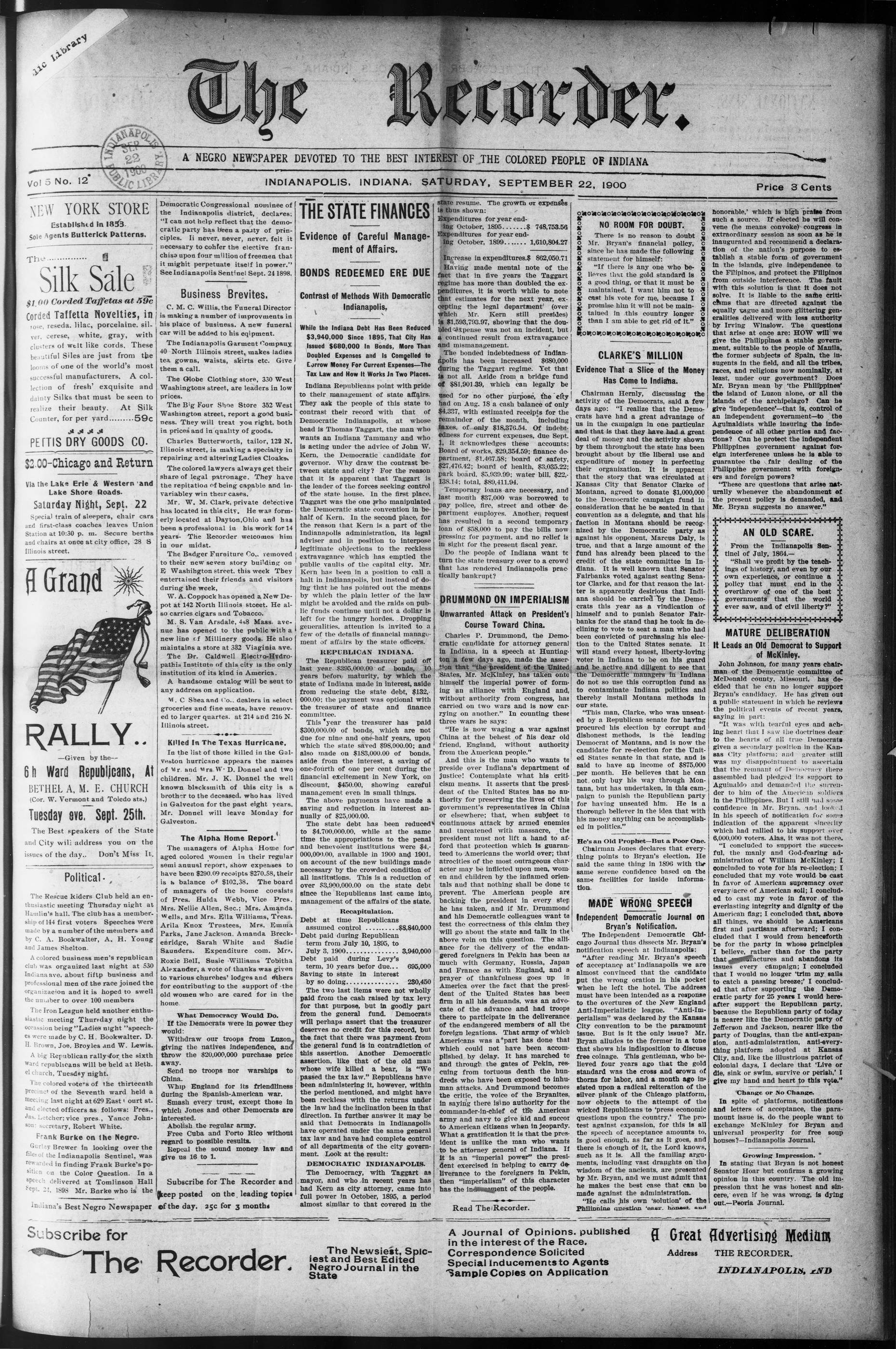
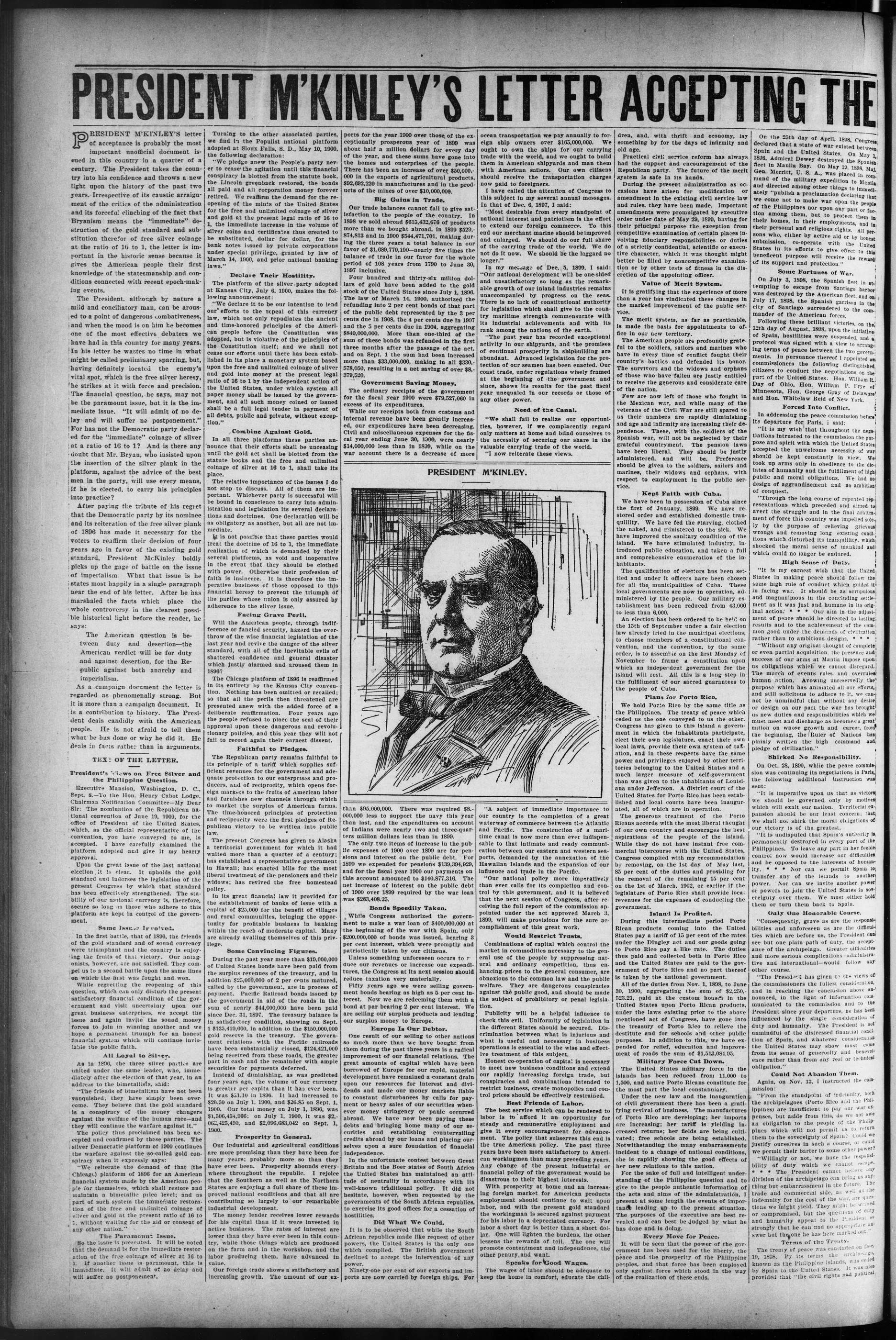
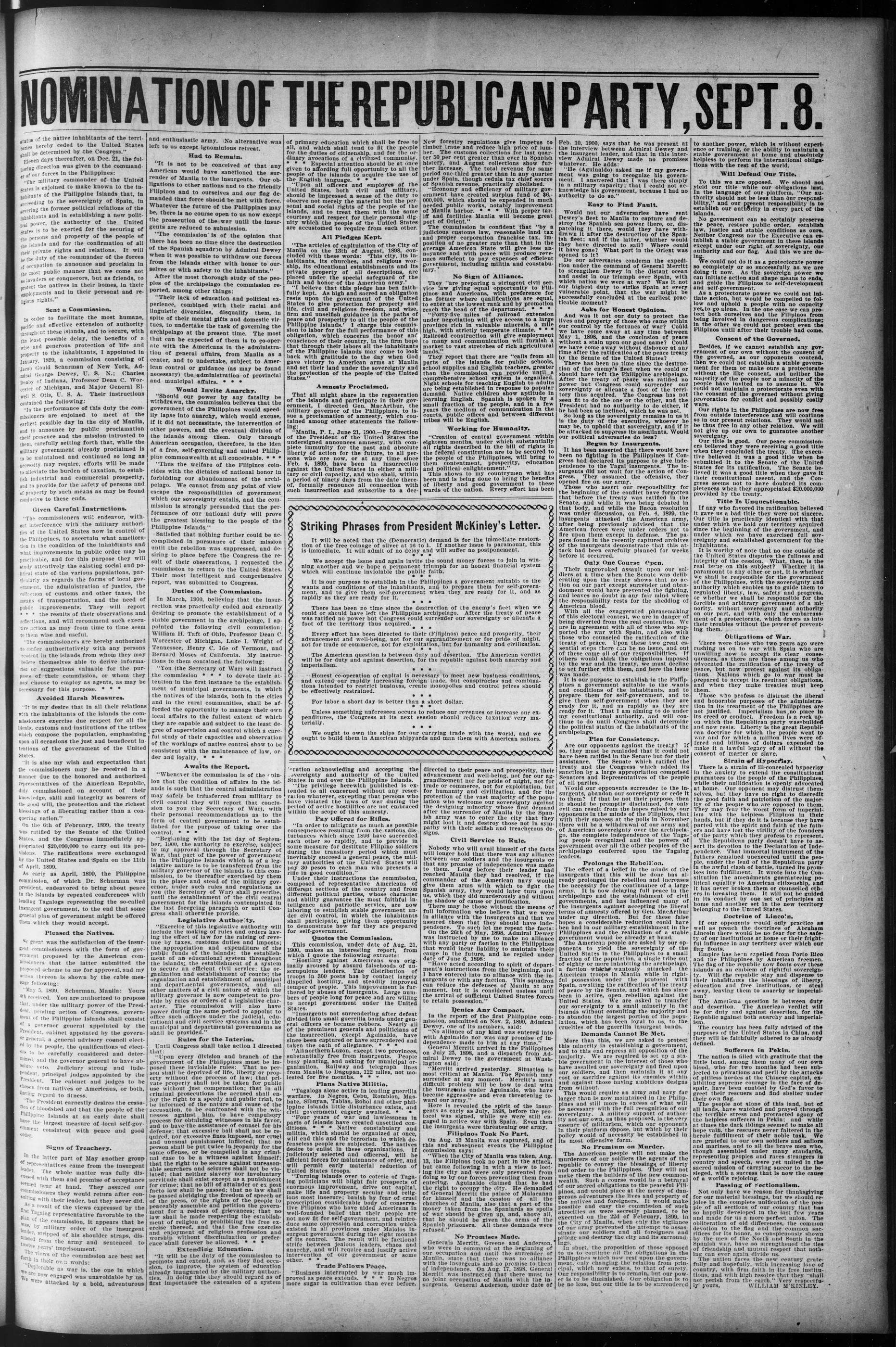
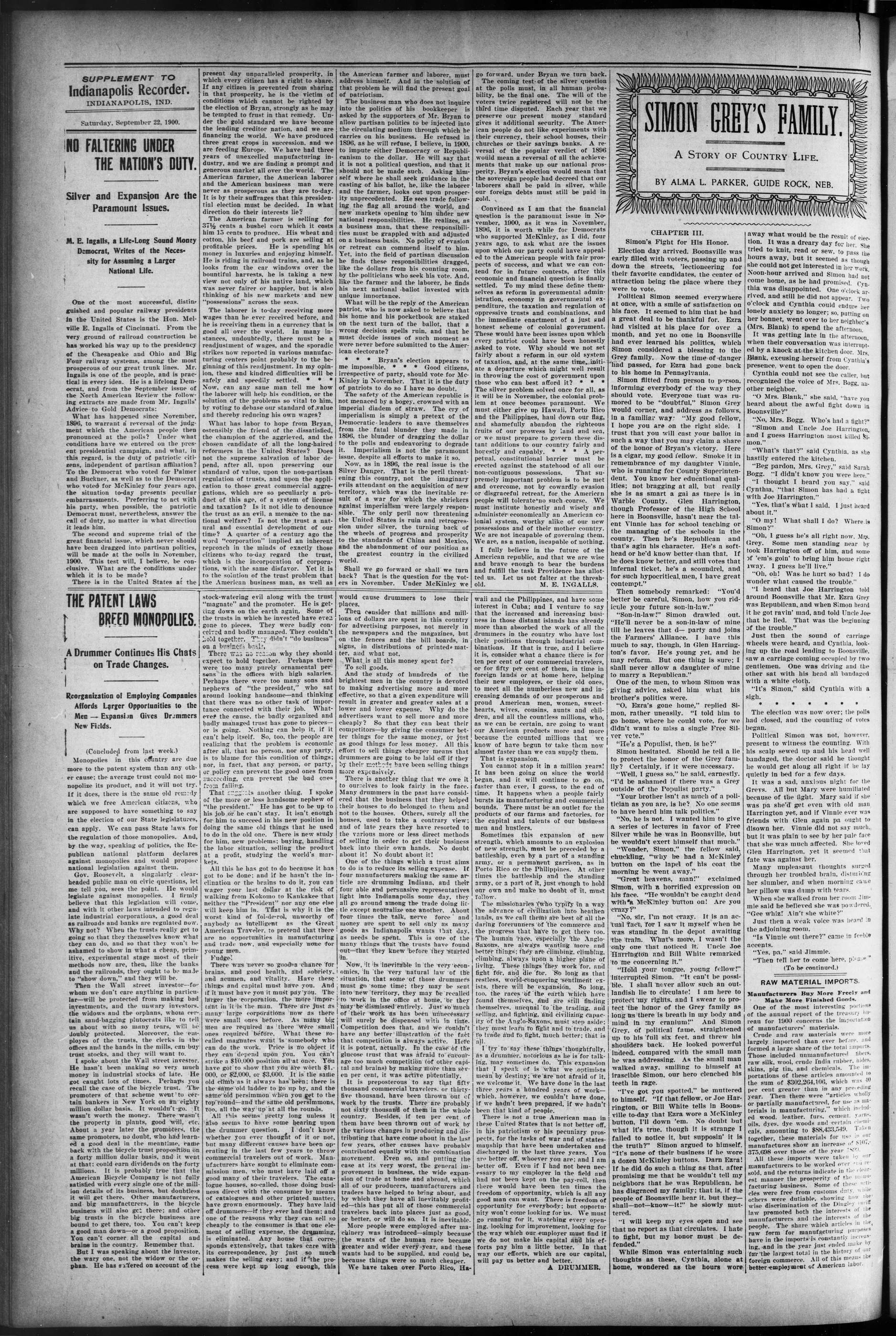
Page text (machine-generated)
INDIANAPOLIS
PUBLIC LIBRARY
SEP
22
1900
Vol 5 No. 12
NEW YORK STORE
Established in 1853.
Sole Agents Butterick Patterns.
The.....
Silk Sale
A STORE
in 1853.
Block Patterns.
Sale
$1.00 Corded Taffetas at 59c
Corded Taffetta Novelties, in
rose, reseda, lilac, porcelaine, silver, cerase, white, gray, with
clusters of welt like cords. These
beautiful Siles are just from the
looms of one of the world's most
successful manufacturers. A
collection of fresh' exquisite and
dainty Silks that must be seen to
realize their beauty. At Silk
Counter, for per yard.....59c
PETTIS DRY GOODS CO.
$2.00-Chicago and Return
Via the Lake Erie & Western and Lake Shore Roads.
Saturday Night, Sept. 22
Special train of sleepers, chair cars and first-class coaches leaves Union Station at 10:30 p. m. Secure berths and chairs at once at city office, 28 S Illinois street.
A Grand RALLY..
6 h Ward Republicans, At BETHEL A, M. E. CHURCH (Cor. W. Vermont and Toledo sts.) Tuesday eve. Sept. 25th. The Best speakers of the State and City will address you on the issues of the day.. Don't Miss It.
The Rescue Kiders Club held an enthusiastic meeting Thursday night at Hamlin's hall. The club has a membership of 144 first voters. Speeches were made by a number of the members and by C. A. Bookwalter, A. H. Young and James Shelton.
A colored business men's republican club was organized last night at 530 Indianaave, about fiftp business and professional men of the race joined the organization and it is hoped to swell the number to over 100 members.
The Iron League held another enthusiastic meeting Thursday night the occasion being "Ladies night" speeches were made by C. H. Bookwalter. D. H. Brown, Joe. Broyles and W. Lewis.
A big Republican rally for the sixth ward republicans will be held at Beth. el church. Tuesday night.
The colored voters of the thirteenth precinct of the Seventh ward held a meeting last night at 629 East (ourst st. and elected officers as follows: Pres., Jas. Letcher; vice pres., Yance Johnson; secretary, Robert White.
Frank Burke on the Negro.
Gurlay Brewer in looking over the file of the Indianapolis Sentinel, was rewarded in finding Frank Burke's position on the Color Question. In a speech delivered at Tomlinson Hall Sept. 24, 1898 Mr. Burke who is the Indiana's Best Negro Newspaper
Subscribe for The
for The R
Politica1.
A NEGRO NEWSPAPER DEVOTED TO THE BEST INTEREST OF THE COLORED PEOPLE OF INDIANA INDIANAPOLIS, INDIANA, SATURDAY, SEPTEMBER 22, 1900
The
Democratic Congressional nominee of the Indianapolis district, declares; "I can not help reflect that the democratic party has been a party of principles. Ii never, never, never, felt it necessary to cofiber the elective franchise upon four million of freemen that it might perpetuate itself in power." See Indianapolis Sentelist Sept. 24 1898.
Business Brevites.
C. M. C. Willis, the Funeral Director is making a number of improvements in his place of business. A new funeral car will be added to his equipment.
The Indianapolis Garment Company 40 North Illinois street, makes ladies tea gowns, waists, skirts etc. Give them a call.
The Globe Clothing store, 330 West Washington street, are leaders in low prices.
The Big Four Shoe Store 352 West Washington street, report a good business. They will treat you right, both in prices and in quality of goods.
Charles Butterworth, tailor, 123 N. Illinois street, is making a specialty in repairing and altering Ladies Cloaks.
The colored lawyers always get their share of legal patronage. They have the repitation of being capable and invariably win their cases. Mr. W. M. Clark, private detective has located in this city. He was formerly located at Dayton, Ohio and has been a professional in his work for 14 years. The Recorder welcomes him in our midst. The Badger Furniture Co., removed to their new seven story building on E Washington street, this week They entertained their friends and visitors during the week. W. A. Coppock has opened a New Depot at 142 North Illinois street. He also carries cigars and Tobacco.
M. S. Van Arsdale, 458 Mass. avenue has opened to the public with a new line of Millinery goods. He also maintains a store at 382 Viaginia ave. The Dr. Caldwell Electro-Hydropathis Institute of this city is the only institution of its kind in America. A handsome catalog will be sent to any address on application. M. C Shea and Co. dealers in select groceries and fine meats, have removed to larger quartes. at 214 and 216 N. Illinois street.
Killed In The Texas Hurricane.
In the list of those killed in the Galveston hurricane appears the names of Mr. and Mrs. W.D. Donnel and two children. Mr. J. K. Donnel the well known blacksmith of this city is a brother to the deceased, who has lived in Galveston for the past eight years. Mr. Donnel will leave Monday for Galveston.
The Alpha Home Report.
The managers of Alpha Home for aged colored women in their regular semi annual report, show expenses to have been $290.09 receipts $270.58, their is a balance of $102.38. The board of managers of the home consists of Pres. Hulda Webb, Vice Pres. Mrs. Nellie Allen, Sec.; Mrs. Amanda Wells, and Mrs. Ella Williams, Treas. Arila Knox Trustees, Mrs. Emma Parks, Jane Jackson, Amanda Breckenridge, Sarah White and Sadie Saunders. Expenditure com. Mrs. Roxie Bell, Susie Williams Tobiah Alexander, a vote of thanks was given to various churches' lodges and others for contributing to the support of the old women who are cared for in the home.
What Democracy Would Do.
If the Democrats were in power they would:
Withdraw our troops from Luzon, giving the natives independence, and throw the $20,000,000 purchase price away.
Send no troops nor warships to China.
Whip England for its friendliness during the Spanish-American war.
Smash every trust, except those in which Jones and other Democrats are interested.
Abolish the regular army.
Free Cuba and Forto Rico without regard to possible results.
Repeal the sound money law and give us 16 to 1.
Subscribe for The Recorder and keep posted on the leading topics of the day. 25c for 3 months
THE STATE FINANCES
Evidence of Careful Management of Affairs.
BONDS REDEEMED ERE DUE
Contrast of Methods With Democratic Indianapolis.
While the Indiana Debt Has Been Reduced $3,940,000 Since 1895, That City Has Issued $680,000 In Bonds, More Than Doubled Expenses and Is Compelled to Eorrow Money For Current Expenses—The Tax Law and How It Works In Two Places.
Indiana Republicans point with pride to their management of state affairs. They ask the people of this state to contrast their record with that of Democratic Indianapolis, at whose head is Thomas Taggart, the man who wants an Indiana Tammany and who is acting under the advice of John W. Kern, the Democratic candidate for governor. Why draw the contrast between state and city? For the reason that it is apparent that Taggart is the leader of the forces seeking control of the state house. In the first place, Taggart was the one who manipulated the Democratic state convention in behalf of Kern. In the second place, for the reason that Kern is a part of the Indianapolis administration, its legal adviser and in position to interpose legitimate objections to the reckless extravagance which has emptied the public vaults of the capital city. Mr. Kern has been in a position to call a halt in Indianapolis, but instead of doing that he has pointed out the means by which the plain letter of the law might be avoided and the raids on public funds continue until not a dollar is left for the hungry hordes. Dropping generalities, attention is invited to a few of the details of financial management of affairs by the state officers.
REPUBLICAN INDIANA.
The Republican treasurer paid off last year $395,000.00 of bonds, 10 years before maturity, by which the state of Indiana made in interest, aside from reducing the state debt, $132,000.00; the payment was optional with the treasurer of state and finance committee.
This year the treasurer has paid $300,000.00 of bonds, which are not due for nine and one-half years, upon which the state saved $98,000.00; and also made on $183,000.00 of bonds, aside from the interest, a saving of one-fourth of one per cent during the financial excitement in New York, on discount, $450.00, showing careful management even in small things.
The above payments have made a saving and reduction in interest annually of $25,000.00.
The state debt has been reduced to $4,700,000.00, while at the same time the appropriations to the penal and benevolent institutions were $4,000,000.00, available in 1900 and 1901, on account of the new buildings made necessary by the crowded condition of all institutions. This is a reduction of over $3,900,000.00 on the state debt since the Republicans last came into management of the affairs of the state.
Recapitulation.
Debt at time Republicans
assumed control ..... $3,840,000
Debt paid during Republican
term from July 10, 1895, to
July 3, 1900..... 3,940,000
Debt paid during Levy's
term, 10 years before due... 695,000
Saving to state in interest
by so doing..... 280,450
The two last items were not wholly paid from the cash raised by tax levy for that purpose, but in goodly part from the general fund. Democrats will perhaps assert that the treasurer deserves no credit for this record, but the fact that there was payment from the general fund is in contradiction of this assertion. Another Democratic assertion, like that of the old man whose wife killed a bear, is "We passed the tax law." Republicans have been administering it, however, within the period mentioned, and might have been reckless with the returns under the law had the inclination been in that direction. In further answer it may be said that Democrats in Indianapolis have operated under the same general tax law and have had complete control of all departments of the city government. Look at the result:
DEMOCRATIC INDIANAPOLIS.
The Democracy, with Taggart as mayor, and who in recent years has had Kern as city attorney, came into full power in October, 1895, a period almost similar to that covered in the
The Newsiest, Spiciest and Best Edited Negro Journal in the State
A Journal of Opinions. published in the interest of the Race. Correspondence Solicited Special Inducements to Agents Sample Copies on Application
state resume. The growth or expenses
is thus shown:
Expenditures for year end-
ing October, 1895.....$ 748,753.56
Expenditures for year end-
ing October, 1899.....1,610,804.27
Increase in expenditures.$ 862,050.71
Having made mental note of the fact that in five years the Taggart regime has more than doubled the expenditures, it is worth while to note that estimates for the next year, excepting the legal department (over which Mr. Kern still presides) is $1,593,793.97, showing that the doubled expense was not an incident, but a continued result from extravagance and mismanagement.
The bonded indebtedness of Indianapolis has been increased $680,000 during the Taggart regime. Yet that is not all. Aside from a bridge fund of $81,901.39, which can legally be
used for no other purpose, the city had on Aug. 18 a cash balance of only $4,337, with estimated receipts for the remainder of the month, including taxes, of only $18,376.54. Of indebtedness for current expenses, due Sept. 1, it acknowledges these accounts: Board of works, $29,354.59; finance department, $1,467.58; board of safety, $27,476.42; board of health, $3,035.22; park board, $5,939.99; water bill, $22,138.14; total, $89,411.94. Temporary loans are necessary, and last month $37,000 was borrowed to pay police, fire, street and other department employees. Another, request has resulted in a second temporary loan of $58,000 to pay the bills now pressing for payment, and no relief is in sight for the present fiscal year. Do the people of Indiana want to turn the state treasury over to a crowd that has rendered Indianapolis practically bankrupt?
DRUMMOND ON IMPERIALISM
Charles P. Drummond, the Democratic candidate for attorney general in Indiana, in a speech at Huntington a few days ago, made the assertion that "the president of the United States, Mr. McKinley, has taken onto himself the imperial power of forming an alliance with England and, without authority from congress, has carried on two wars and is now carrying on another." In counting these three wars he says: "He is now waging a war against China at the behest of his dear old friend, England, without authority from the American people."
And this is the man who wants to preside over Indiana's department of justice! Contemplate what his criticism means. It asserts that the president of the United States has no authority for preserving the lives of this government's representatives in China or elsewhere; that, when subject to continuous attack by armed enemies and threatened with massacre, the president must not lift a hand to afford that protection which is guaranteed to Americans the world over; that atrocities of the most outrageous character may be inflicted upon men, women and children by the inflamed orientals and that nothing shall be done to prevent. The American people are backing the president in every step he has taken, and if Mr. Drummond and his Democratic colleagues want to test the correctness of this claim they will go about the state and talk in the above vein on this question. The alliance for the delivery of the endangered foreigners in Pekin has been as much with Germany, Russia, Japan and France as with England, and a prayer of thankfulness goes up in America over the fact that the president of the United States has been firm in all his demands, was an advocate of the advance and had troops there to participate in the deliverance of the endangered members of all the foreign legations. That army of which Americans is a "part has done that which could not have been accomplished by delay. It has marched to and through the gates of Pekin, rescuing from tortuous death the hundreds who have been exposed to inhuman attacks. And Drummond becomes the critic, the voice of the Bryanites, in saying there is no authority for the commander-in-chief of the American army and navy to give aid and succor to American citizens when in jeopardy. What a gratification it is that the president is unlike the man who wants to be attorney general of Indiana. If it is an "imperial power" the president exercised in helping to carry deliverance to the foreigners in Pekin, then "imperialism" of this character has the indignement of the people.
Read The Recorder.
A Great Advertising Medium Address THE RECORDER.
There is no reason to doubt Mr. Bryan's financial policy, since he has made the following statement for himself: "If there is any one who believes that the gold standard is a good thing, or that it must be maintained, I want him not to cast his vote for me, because I promise him it will not be maintained in this country longer than I am able to get rid of it."
CLARKE'S MILLION
Chairman Hernly, discussing the activity of the Democrats, said a few days ago: "I realize that the Democrats have had a great advantage of us in the campaign in one particular and that is that they have had a great deal of money and the activity shown by them throughout the state has been brought about by the liberal use and expenditure of money in perfecting their organization. It is apparent that the story that was circulated at Kansas City that Senator Clarke of Montana, agreed to donate $1,000,000 to the Democratic campaign fund in consideration that he be seated in that convention as a delegate, and that his faction in Montana should be recognized by the Democratic party as against his opponent, Marcus Daly, is true, and that a large amount of the fund has already been placed to the credit of the state committee in Indiana. It is well known that Senator Fairbanks voted against seating Senator Clarke, and for that reason the latter is apparently desirious that Indiana should be carried by the Democrats this year as a vindication of himself and to punish Senator Fairbanks for the stand that he took in declining to vote to seat a man who had been convicted of purchasing his election to the United States senate. It will stand every honest, liberty-loving voter in Indiana to be on his guard and be active and diligent to see that the Democratic managers in Indiana do not so use this corruption fund as to contaminate Indiana politics and thereby install Montana methods in our state.
"This man, Clarke, who was unseated by a Republican senate for having procured his election by corrupt and dishonest methods, is the leading Democrat of Montana, and is now the candidate for re-election for the United States senate in that state, and is said to have an income of $875,000 per month. He believes that he can not only buy his way through Montana, but has undertaken, in this campaign to punish the Republican party for having unseated him. He is a thorough believer in the idea that with his money anything can be accomplished in politics."
He's an Old Prophet—But a Poor One. Chairman Jones declares that everything points to Bryan's election. He said the same thing in 1896 with the same serene confidence based on the same facilities for inside information.
MADE WRONG SPEECH
Independent Democratic Journal on Bryan's Notification. The Independent Democratic Chicago Journal thus dissects Mr. Bryan's notification speech at Indianapolis:
"After reading Mr. Bryan's speech of acceptance at Indianapolis we are almost convinced that the candidate put the wrong oration in his pocket when he left the hotel. The address must have been intended as a response to the overtures of the New England Anti-Imperialistic league. "Anti-Imperialism" was declared by the Kansas City convention to be the paramount issue. But is it the only issue? Mr. Bryan alludes to the former in a tone that shows his indisposition to discuss free collage. This gentleman, who believed four years ago that the gold standard was the cross and crown of thorns for labor, and a month ago insisted upon a radical reiteration of the silver plank of the Chicago platform, now objects to the attempt of the wicked Republicans to 'press economic questions upon the country.' The protest against expansion, for this is all the speech of acceptance amounts to, is good enough, as far as it goes, and there is enough of it, the Lord knows, such as it is. All the familiar arguments, including vast draughts on the wisdom of the ancients, are presented by Mr. Bryan, and we must admit that he makes the best case that can be made against the administration.
"He calls his own 'solution' of the Philippine question 'easy, honest and
Price 3 Cents
honorable', which is high praise from such a source. If elected he will convene (he means convoke) congress in extraordinary session as soon as he is inaugurated and recommend a declaration of the nation's purpose to establish a stable form of government in the islands, give independence to the Filipinos, and protect the Filipinos from outside interference. The fault with this solution is that it does not solve. It is liable to the same criticisms that are directed against the equally vague and more glittering generalities delivered with less authority by Irving Winslow. The questions that arise at once are: HOW will we give the Philippines a stable government, suitable to the people of Manila, the former subjects of Spain, the insurgents in the field, and all the tribes, races, and religions now nominally, at least, under our government? Does Mr. Bryan mean by 'the Philippines' the island of Luzon alone, or all the islands of the archipelago? Can he give 'independence'—that is, control of an independent government—to the Aguinaldists while insuring the independence of all other parties and factions? Can he protect the independent Philippines government against foreign interference unless he is able to guarantee the fair dealing of the Philippine government with foreigners and foreign powers?
"These are questions that arise naturally whenever the abandonment of the present policy is demanded, and Mr. Bryan suggests no answer."
From the Indianapolis Sentinel of July, 1864.—
timer of July, 1864.—“Shall we profit by the teachings of history, and even by our own experience, or continue a policy that must end in the overthrow of one of the best governments that the world ever saw, and of civil liberty?”
It Leads an Old Democrat to Support of McKinley.
John Johnson, for many years chairman of the Democratic committee of McDonald county, Missouri, has decided that he can no longer support Bryan's candidacy. He has given out a public statement in which he reviews the political events of recent years, saying in part:
"It was with tearful eyes and aching heart that I saw the doctrines dear to the hearts of all true Democrats given a secondary position in the Kansas City platform; and greater still was my disappointment to ascertain that the remnant of Democracy there assembled had pledged its support to Aguinaldo and demanded the surrender to him of the American soldiers in the Philippines. But I still had some confidence in Mr. Bryan, and looked in his speech of notification for some indication of the apparent sincerity which had rallied to his support over 6,000,000 voters. Alas, it was not there.
"I concluded to support the successful, the manly and God-fearing administration of William McKinley; I concluded to vote for his re-election; I concluded that my vote would be cast in favor of American supremacy over every acre of American soil; I concluded to cast my vote in favor of the everlasting integrity and dignity of the American flag; I concluded that, above all things, we should be Americans first and partisans afterward; I concluded that I would from henceforth be for the party in whose principles I believe, rather than for the party that manufactures and abandons its issues every campaign; I concluded that I would no longer trim my sails to catch a passing breeze; I concluded that after supporting the Democratic party for 25 years I would hereafter support the Republican party, because the Republican party of today is nearer like the Democratic party of Jefferson and Jackson, nearer like the party of Douglas, than the anti-expansion, anti-administration, anti-everything platform adopted at Kansas City, and, like the illustrious patriot of colonial days, I declare that 'Live or die, sink or swim, survive or perish.' I give my hand and heart to this vote."
Change or No Change.
In spite of platforms, notifications and letters of acceptance, the paramount issue is, do the people want to exchange McKinley for Bryan and universal prosperity for free soup houses?—Indianapolis Journal.
Growing Impression.
In stating that Bryan is not honest Senator Hoar but confirms a growing opinion in this country. The old impression that he was honest and sincere, even if he was wrong, is dying out.—Peoria Journal.
INDIANAPOLIS, RND
‘ap. Oh Bcceptance te:probeny the most
important unofficial document is
sued in this country in a quarter of a
century. The President takes the coun:
try into his confidence and throws a new
light upon the history of the past two
sears. Irrespective of its caustic arraign
‘ment of the critics of the administration
and its forcefa: clinching of the fact that
‘Bryanism means the “immediate” de
struction of the gold standard and sub-
stitution therefor of free silver coinage
at the ratio of 16 to 1, the letter is im-
portant in the historle sense becanse it
gives the American people their first
knowledge of :he statesmanship and con-
ditions connected with recent epoch-mak
ing events.
‘The President, althozgh by nature a
mild and conciliatory man, can be arous:
ed to 2 point of dangerous combativeness,
jand when the mood is on him ke becomes
‘one of the most effective debaters we
have had in this country for many years.
[Yn his letter he wastes no time in what
‘might be called preliminary sparring, but,
Mhaving definitely located the enemy's
| vital spot, which is the free silver heresy,
'he strikes at it with force and precision.
‘The financial question, he says, may not
‘be the paramount issue, but it is the im-
|mediate issue, “It will admit of no de-
lay and will suffer no postponement.”
'For has not the Democratic party declar-
‘ed for the “immediate” coinage of silver
jat a ratio of 16 to 1? And is there any
‘doubt that Mr. Bryan, who insisted upon
jthe insertion of the silver plank in the
|platform, against the advice of the best
jmen in the party, will use every means,
lit he is elected, to carry his principles
into practice?
* After paring the tribute of his regret
that the Democratic party by its nominee
and its reiteration of the free silver plank
of 1896 has made it necessary for the
Soters to reaffirm their decision of four
|ears ago in favor of the existing gold
(standard, President McKinley boldly
picks up the gage of battle on the issue
‘of imperfalism. What that issue is he
jstates most happily in a single paragraph
‘near the end of his letter. After he has
marshaled the facts whick place the
whole controversy in the clearest possi-
‘ble historical light before the reader, he
says:
The American question is be-
tween duty and desertion—the
American verdict will be for duty
and against desertion, for the Re-
public against both anarchy and
inmperfalismn.
As a.campaign document the letter is
regarded as phenomenally strong. But
it is more than a campaign document, It
is a contribution to history. ‘The Presi-
dent deals candidly with the American
people. He is not afeaid to tell them
what’ be bas done or why he did it. He
apaie fn ticts rathe= than in avcuments.
TKX* OF THE LETTER.
President's “icws ou Free Silver and
the Philippine Question.
Bxecatire Mansion, Washington, D. C.
Sept. $—To the Hou. Henry Cabot Loage,
Chairman Notitieation Committee--My Dear
Sit: The nomination of the Republican na-
tonal convention of June 19, 1900, for the
‘omice of President of the United Siates,
which, as the officiat representative of the
convention, you have conveyed to me, 1s
jaccepted. 1 have carefully examined the
Platform adopted and give It my hearty
“approvai,
Upon the great issue of the last natlonal
election it ts clear. It upholds the gold
standard unit tuderses the legislation of the
present Congress by which that standard
bas been effectively strengthened. The sta-
Dillty of our national curreney fs, therefore,
secure 60 long 1s those who adhere to this
‘platform are kept in control of the govern-
iment.
Same Insc Involved.
In the Hirst battle, that of 1896, the frlends
of the gold standard and of sound currency
‘were triumphant and the country Ix enjoy-
Ing the frults of that vietory. Our antag
‘nists, bowerer, are not satistied. They com-
pel us to a second battle upon the same lines
on which the first was fought and won.
While regrettius the reopening of this
‘qnestica, which can only disturb the present
fatistictory financizt condition of the gor-
erument and visit uncertainty upon ont
‘great business enterprises, we accept the
[Issue and again invite the sound money
Horces to join in winning another and we
hope & permanent triumph for an honest
Ananelat system which will continue Iuvio-
labie the pubite faith.
All Loyal to Silver.
‘Aw tn 1896, the three silver parties are
united under the. same leader, who, imme-
diately after the election of that year, In an
addzess to the bimetaltists, sald:
“The friends of bimetali:su: have not been
vanquished, they have simply been over-
come. ‘They believe that the gold scandard
ts a conspiracy of the money changers
against the welfare of the tuman race—and
they will continue the warfare against It."
‘The policy thus proclaimed has been ac.
cepted and confirmed by these parties. ‘The
Isilver Democratic platform ot 1900 continues
the warfare agalust the so-called gold con-
splracy when It expressly says:
“We relterate the demand of that (the
“ehteage) platform of 1896 for an American
“fnanclai system made by the American peo:
[ple for themselves, which shall restore and
maintain a bimevaltic price level; and as
[part of such system the tmmesiate restora.
‘tion of the free and unlimited coinage of
| eilver and gold at the present ratio of 16 to
5, withont waiting for the aid or consent of
any other nation.”
‘The Paramoun: Issue.
Bo the issne'ls prescated. It will be noted
‘i that the demand ts for the immediate restor.
ation of the free coinage of silver at 16 to
(2. Ht nother Issue is. parsmount, this ts
|imuiediate. I: wilt atealt of ao detay and
| Will suffer uo postponement.
Turning to the other associated parties,
we find {2 the Populist national platform
adopted at Sioux Falls, 8. D., May 10, 1900,
pe eae
eee ee sre
Be EN apt
conspiracy Is blotted from the statute book,
See
per owe
ree
Speeaea aes
mkicie me:
at Kansas City, July 6, 1900, makes the fol-
our‘ efforts to the repeal of this currency
etic ak
BS lire sich cineca oe
tions and doctrines. One declaration will be
realization of which Is demanded by their
=
Some Convincing Figures.
sum of nearly $44,000,000 have been paid
$26.50 on Juiy 1, 1900, and $26.85 on Sept. 1,
1900. Our total money on July 1, 1896, was
$1,506,433,966; on July 1, 1900, it was $2,-
Prosperity in General.
Nie ans eee
Dieloaee ee eon
poe re ee
re ee
try, while those things which are produced
ee ee
rec ohh iadsay
es res aur wears Seater
Ports for the year 1900 over those of the ex-
ceptionally prosperous year of 1809 was
about haif a million dollars for every day
of the year, and these sums have gone into
the homes ‘and enterprises of the people.
‘There has been an Increase of over $50,000,-
000 In the exports of agricultural products,
$92,002,220 In manufactures and in the prod:
ets of the mines of over $10,000,000,
Big Gains in Trade,
Our trade balances cannot fall to give sat:
Istaction to the people of the country. In
1808 we sold abroad $615,492,676 of products
‘more than we bought abroad, in 1809 $529,
874,813 and n 1900 $54,471,701, making dut-
Ing the three years a total balance in our
favor of $1,099,779,190—nearly five times the
balance of trade in our favor for the whole
perlod of 108 years from 1790 to June 20,
1897 Inclusive.
Four bundred and thisty-s!x millon dol-
lars of gold have been added to the gold
stock of the United States since July 2, 1806.
‘The law of March 14, 1900, authorized the
refunding Into 2 per cent bonds of that part
of the publle debt represented by the 8 per
cents due In 1908, the 4 per cents due tn 1907
and the 5 per cents due in 1004, aggregating
$810,000,000. More than one-third of the
suim of these bonds was refunded in the first
three months after the passage of the act,
and on Sept. 1 the sum had been increased
more than $33,000,000, making in all $320,
578,050, resulting In a net saving of over $8,
370,520,
Government Saving Money,
The ordinary receipts of the government
for the fiscal year 1900 were $79,527,060 In
excess of its expenditures,
‘While our receipts bott from customs and
internal revenue have been greatly Increas-
ed, our expenditures have been decreasing.
Civil and miscellaneous expenses for the fs
cal year ending June 30, 1900, were nearly
$14,000,000 less than in 1899, while on the
[war account there is a decrease of more
PRESIDENT M’KINLEY.
i ig ie pe Berar
INR ee ees test |)
than $95,000,000, ‘There was required $8,-
000,000 tess to support the navy this year
than last, and the expenditures on account
of Indians were nearly two and three-quar-
ters million dollars less than in 1899,
‘The only two Items of increase in the pub-
Me expenses of 1900 over 1899 are for pen-
slons and Interest on the public debt. For
1890 we expended for pensions $139,394,029,
and for the fiseal year 1900 our payments on
this account amounted to $140.877,316. ‘The
net increase of Interest on the public debt
of 1900 over 1809 required by the war loan
was $263,408.25,
Bonds Speedily Taken.
White Congress authorized the govern:
ment to make a war loan of $400,000,000 at
the beginning of the war with Spain, only
'$200,000,000 of bonds was Issued, bearing 8
er cent Interest, which were promptly and
patriotically taken by our citizens.
Unless something unforeseen occurs to r
duce our revenues or increase our expendi-
tures, the Congress ac Its next session should
‘reduce taxation yery materially.
Fifty years ago we were selling govern:
ment bonds bearing as high as & per cent in-
terest. Now we are redeeming them with a
bond at par bearing 2 per eent interest. We
are selling our surplus products and lending
our surplus money to Europe.
Europe Is Our Debtor.
One result of our selling to other nations
so much more than we have bought from
them during the past three years Is a radical
improvement of our financial relations, ‘The
great amounts of capital which have been
borrowed of Europe for our rapid, material
development have remained a constant draln
upon our resources for Interest and dlivl-
dends and made our money markets Hable
to constant disturbances by calls for pay-
‘ment or heavy sales of our securities when-
ever money stringency or panle occurred
abroad. We have now been paying these
debts and ‘bringing home many of our se-
curities and establishing countervailing
credits abroad by our loans and placing our.
selves ugon a sure foundation of Snancial
independence.
In the unfortunate contest between Great
Britain and the Boer states of South Africa
the United States bas maintained an attl-
tude of neutrality in accordance with Its
well-known trhditional policy. It did not
hesitate, however, when requested by the
governments of the South African republics,
to exercise its good offices for a cessation of
hostilities.
Did What We Contd,
It Is to be observed that while the South
African republics made Ike request of other
powers, the United States Is the only one
which complied. The British government
declined to accept the intervention of any
power.
‘Ninety-one per cent of our exports and Im-
ports are now carried by forelga ships, For
ocean transportation we pay annually to for-
eign ship owners over $165,000,000. We
‘ought to own the ships for our carrying
trade with the world, and we ought to build
them in American shipyards and man them
with American sailors. Our own citizens
should receive the transportation charges
now pald to foreigners,
[ have called the attention of Congress to
this subject in my several annual messages.
In that of Dee. 6, 1897, I sald:
“Most desirable from every standpoint of
national Interest and patriotism Is the effort
to extend our foreign commerce. ‘To this
end our merchant marine should be Improved
and enlarged. We should do our full share
of the carrying trade of the world. We do
not do It now. We should be the laggard no
longer.”
In my messags of Dec, 5, 1809, I said:
“Our national development wit} be one-sided
and unsatisfactory so long as the remark-
able growth of our inland industries remains
unaccompanied by progress on the seas.
‘There 1s no tack of constitutional authority
for legislation which shall give to the coun-
try maritime strength commensurate with
Its Industrial achievements and with its
rank among the nations of the earth.
“The past year has recorded exceptional
activity In our shipyards, and the promises
of continual prosperity In shipbullding are
abundant, Advanced legislation for the pro-
tection of ovr seamen hus been enacted. Our
coast trade, under regulations wisely framed
at the begtuning of the-goverament and
since, shows its results for the past fiscal
year unequaled In our records or those of
any other power.
‘Need of the Canal.
“We shall fail to reallze our opportunl-
tles, however, If we compiacently regard
only matters at home and biind ourselves to
the necessity of securing our share In the
valuable carrying trade of the world.
“I now relterate these views.
“A sabject of immediate importance to
our country Is the completion of a great
waterway of commerce between the Atlantic
and Pacife. ‘The construction of a mart:
time canal is now more than ever Indispen-
sable to that Intlmate and ready communt-
ation between our eastern and western sea-
ports, demanded by the annexation of the
Hawatian Islands and the expansion of our
Influence and trade in the Pacific,
“Our national polley more mperativeiy
than ever calls for its completion and con-
trol hy this government, and It is belleved
that the next session of Congress, after re-
celving the full report of the commission ap-
pointed under the act approved March i,
1800, will make provistons for the sure ac.
complishment of this great work.
Would Restrict Trusts,
Combinations of capital which control the
market in commodities necessary to the gen:
feral use of the people by suppressing nat-
uurai and ordinary competition, thus en:
haneing-prices to the general consumer, are
obnoxious to the common law and the public
welfare, ‘They are dangerous conspiracies
against thé publte good, aud should be made
the subject of prohibitory or penal legisia
ton.
Publicity will be a helpful induence te
check this evil, Uniformity of legislation tn
the different States should be secured. Dis
crimination between what 1s Injurlous and
what {5 useful and necessary in business
operations is essential to the wise and effect
Ive treatment of this subject.
Honest co-operation of capita: Is necessars
to meet new business conditions and extend
our rapldly Increasing foreign trade, but
conspiracies and combinations Intended te
restrlet business, create monopolies and con:
trol prlees should be effectively restrained.
Best Friends of Labor,
‘The best service which can be rendered t
labor is to’ afford It an opportunity. fo
steady and remunerative employment and
sive It every encouragement for advance
ment. The polley that subserves this end i
the true Amertean policy. The past thre
years have been more satisfactory to Ameri
‘can workingmen than many preceding years
Any change of the present Industrial o
‘nancial polley of the government would bé
Alsastrous to thelr highest interests,
‘With prosperity at home and an increas
Ing forelgn market for Amerlean product
employment should continue to walt upoy
labor, and with the present gold standard
the workingman fs secured against parmen
for his labor In a depreciated currency. Fo
labor a short day is better than a short dot
lar. One will lighten the burdens, the othe
lessens the rewards of toll, ‘The one will
promote contentmest and independence, the
other penury.and want.
Speaks for\Good Wages.
‘The wages of labor should be adequate t
keep the home In comfort, educate the chil
| Practicai civ service reform has always
aa ine npurt od core
PL li
eee
During the present administration as oc-
“a fe
Sa ae mae
ecient
amendments were promulgated by executive
order under date of May 29, 1899, having for
Saari
eet aie
eta ate
Seer
setae ca
ieee ee ata
Cee ena
iy evcrte
ee
ve
eee
eee
=
a pai
orm nessa
ern
ae
ful to the soldiers, sailors and marines who
che ee a
cca hance
secteur soe
Hii Ser
asa
ise
——
ee
Heenan
seca tacts te
chon ea
sietiodariiae
eee
Se rice
have been liberal. They should be justly
Se
ino
Se
a aa eae
=
remo
ee
eee
Serine ies
seg its ao
sacar
cetirome eee
coven oa
tere see
eecritac
ce
—
“eee gamma
siete saree
gcea a ae
tients tine
Hecate Sra
core
ee
oe nn
ofa
sina ais heen
Sete ett
iio mee
si Stace as
Site et
sh er emt
nee nee
cote
aan
ee
sre en mn
ofits
serch ge
freer canine
car iti ate
ss es tee
ise castes
sa te
ree ga
ci ea
cies alee
ements
Scene rine
fri fetes
ret acter
See
Sone
cee Sai
Laer
aioe fie aoe tee
Sine 2 ee
Sean itd
eee
Vitae rate
Sec
eit
ews tar
ied Meet
eae
.
a
ts
st ia
Sie sie
soba e bates
Shei eae
sre each ae
sre tice se
Redo
Seg semecoe
Pgs cir
sete ae
aa re ace
is ae ep
site stare ce
ei ee
Sonia
Set See
see eae rn
petit eel te
i cen
ern
Sa
Sere
eae
ove
a a a
siaeeticr eee
seesgetns Sat
Py eres
“ie wae Sar
conan
su mack arte Sat
Incident to a change of national conditions.
Every Move for Peace.
Tt will be seen that the power of the gov-
emment has been used for the liberty, the
pence and the prosperity of the Philippine
peoples, and that force has been employed
nly agalust force which stood in the way
bf the Sealtaction af these ender
‘aia ian em «On May 2,
1808, Admiea! Dewer destrosed the Syeaict
Rect in Manila Bay. On May 19, 1898, May
Geo. Meritt, U.S An, was placed nt
mand of the military expedition to Meni
al cecl ee ote tan
ately “publish a prociamation deciaring that
We come hot to make war upon the penis
of the Philippines nor upon auy part arse
tion among them, but to protect then
thelr homes, In thelr employmeuts, eo (2
thelr personal and religious rights.” Alt peo
Sonn who, ether by active aid ve iy ets
ftubmlssion, co-operate with the tas
States In Its efforts to give ote: to tnt
Beneficent purpose will receive ihe remang
of Its support and protection” i
, Some Fortunes of War. ‘1
On Suly 3, 1808, the Spanist tee in ap!
tempting to escape from Santiags norte
was destroyed by the American tect, endcg,
July 17, 1808, the Spanish garviscy in the,
clty of Santiago surrendere? to the nen
mander of the American forces, f
Following these brilliant victories, on thet
12th day of August, 1898, upow the initiative,
Of Spain, hostilities were suspeascd, ant a,
Protocol was sicned with a view to astangl
ing terms of peace between the two govern,
ments, In pursuance thereot { appotsted oa
counmissloners the following distingushen
citizens to conduct the negotiations on the!
Fart of the United States. Hou. Willem le]
Day of Oblo, Hon. William [Frye af!
Minnesota, Hon. George Gray of Delumare!
and Hon, Whitelaw ield of New York.
Forced Into Conflict. t
In addressing the peace commission hetore!
{ts departure for, Parts, 7 aid 1
“It is my wish’ that throughout the nego
tations tntrusted to the commission tbe pur}
ose and spirit with whlch the Untied States,
accepted the unwelcome necessity of var
shonid de Kept constantiy in view. Wel
took up arms oniy in obedience to the dle]
tates of humanity and the fuialiment of high]
Publle and moral obligations, We had a0,
design of aggrandizement 2nd a0 ambitioa
of conquest. |
“-throggh the long course of repeated rep)
resentations whieh preceded and aired to
avert che struggle and In the final arte)
ment of force this countey was imipelid soley
iy by the purpose of relieving stievos]
‘wrongs and removing tong existing cond,
tions which disturbed its tramuuiliity, whieh}
shockel the mora} sense of iiukini audi
Which could no longer be endured, '
High Sense of Duty. i
“It {4 my earnest wish that the United)
States In making peace shoud fotiow the|
same high rule of conduct whieh yoiden itl
Jn facing war. It should be as semipcloay)
and magnanimous in the concluding seit!
ment as it was Just and humane in its orig.’
nal action? * * * Our ait in the adjust)
ment of peace zhontd be directed to lasting,
results and to the aeblevement of the nm
mon gooil under the deiands vf eiviieation,
rather than to ambitious designs. © * * |
“Without any original tougit of complete
or even partial acquisition, the presence aud}
success of our arais at Mantia impose apoa
ns obligations whieh we cannot dscns
‘The march of erents rules and overrule
human action, Avowing unreservedly the!
purpose whch has animated all our etfrts|
and sillt sollettous to adhere to I, we cam}
not be unmindfal that without avs ses
or design on our part the war has brought
uls wew duties and respcasibitities whieh wel
must meet aud discharge as becomes a great!
tution am waore apy aad caren, (end
the beginning, the [Ruler of Nations bas)
plainly written the bigh command aad,
pledge of clvilization.”* ‘
Shirked No esponsibility.
‘On Oct. 28, 1890, whlie the peace commis,
sion was continuing itx negotiations in ra
tue following additional struction wal)
sent:
“It Is Imperative upon us thar as victor,
we should be governed only by mote
whieh will exalt our nation. Tervitorlal ef,
pansion should bo out least concern; ‘ast
Wwe shail no: shirk the moral obigations of
our vietory is of the greatest.
“It ts undisputed that Spata's autivetiy Is
permanently destroyed Iu eveiy part of ihe
Phitippiaes, ‘To leave any part her feeb,
contro: now would increase our diticulles
dud be opposed to the Interests of hunane
ty. ¢ 9 * Nor cam we permit Spain 19,
transfer any of the islands to another,
power, Nor can we Juvite another powet
or powers to Joli the United States 10 sor!
erelguty over them, We must either bold
Giem of turn them back t spain,
Guly One Honorable Course.
“Consequently, grave as are the responsh
bilities and unforeseen as are the difical
ties which are before us, the President eat
see but one plain path of duty, the accept
ance of the archipelago. Greater witisuites
aud more serious complleations—aduiniste
tive and Interuational—would foliow 37
otlier course.
“the Presidert has given (> the views of
the coummlssioners the fullest consideration,
and In reaching the conclusion avore a
houneed, in the ligat of Inforwarioa cost
munieated to the commission and t Be
President since your departure, we bas beeB
influenced by the single consideration of
duty and humanity, ‘The President 1s st
mmindful of the distressed tina cons
ton of Spain, and whatever consiuerttaa
the United States may show ust come
from ts sense of generosity aid euessh
euce rather than from ans Zea! or techie
obtigation.”
Comid Not Abandon Them
‘Again, on Noy. 13, 1 justructed the com
mission?
—“¥rom the standpoint of ‘edeunlty, 8
the archipelagoes (Porto Mleu aul 0 Mle
Ippines) are insufficient to pay war war
Penses, but aslde from tis, do we wot oe
an obligation to the people of the Msi
ples which wfit not permit us ¢ rtoes
them to the sovereignty of Spain? (unl we
Justify ourselves in such a course, o: co0id
we Gecuit tele baktet to some otter power?
NOMINATION OF THE REPUBLICAN PARTY. SEPT.8.
status of the native inhabitants of the territories hereby ceded to the United States shall be determined by the Congress."
Eleven days thereafter, on Dec. 21, the following direction was given to the commander of our forces in the Philippines:
"The military commander of the United States is enjoined to make known to the inhabitants of the Philippine Islands that, in succeeding to the sovereignty of Spain, in severing the former political relations of the inhabitants and in establishing a new political power, the authority of the United States is to be exerted for the securing of the persons and property of the people of the islands and for the confirmation of all their private rights and relations. It will be the duty of the commander of the forces of occupation to announce and proclaim in the most public manner that we come not as invaders or conquerors, but as friends, to protect the natives in their homes, in their employments and in their personal and religious rights."
Sent a Commission.
In order to facilitate the most humane, pacific and effective extension of authority through these islands, and to secure, with the least possible delay, the benefits of a wise and generous protection of life and property to the inhabitants, I appointed in January, 1890, a commission consisting of Jacob Gould Senarman of New York, Admiral George Dewey, U. S. N.; Charles Denby of Indiana, Professor Dean C. Worcester of Michigan, and Major General Elwell S. Otis, U. S. A. Their instructions contained the following:
"In the performance of this duty the commissioners are enjoined to meet at the earliest possible day in the city of Manila, and to announce by public proclamation their presence and the mission intrusted to them, carefully setting forth that, while the military government already proclaimed is to be maintained and continued so long as necessity may require, efforts will be made to alleviate the burden of taxation, to establish industrial and commercial prosperity, and to provide for the safety of persons and of property by such means as may be found conducive to these ends.
Given Careful Instructions.
"The commissioners will endeavor, without interference with the military authorities of the United States now in control of the Philippines, to ascertain what amelioration in the condition of the inhabitants and what improvements in public order may be practicable, and for this purpose they will study attentively the existing social and political state of the various populations, particularly as regards the forms of local government, the administration of justice, the collection of customs and other taxes, the means of transportation, and the need of public improvements. They will report . . . the results of their observations and reflections, and will recommend such executive action as may from time to time seem to them wise and useful.
"The commissioners are hereby authorized to confer authoritatively with any persons resident in the islands from whom they may believe themselves able to derive information or suggestions valuable for the purposes of their commission, or whom they may choose to employ as agents, as may be necessary for this purpose. . . .
Avoided Harsh Measures.
"It is my desire that in all their relations with the inhabitants of the islands the commissioners exercise due respect for all the beasts, customs and institutions of the tribes which compose the population, emphasizing upon all occasions the just and beneficent intentions of the government of the United States.
"It is also my wish and expectation that the commissioners may be received in a manner due to the honored and authorized representatives of the American Republic, daily commissioned on account of their knowledge, skill and integrity as bearers of the good will, the protection and the richest blessings of a liberating rather than a conquering nation."
On the 6th of February, 1890, the treaty was ratified by the Senate of the United States, and the Congress immediately appropriated $20,000,000 to carry out its provisions. The ratifications were exchanged by the United States and Spain on the 11th of April, 1890.
As early as April, 1890, the Philippine commission, of which Dr. Schurman was president, endeavored to bring about peace in the islands by repeated conferences with leading Tagalog representing the so-called insurgent government, to the end that some general plan of government might be offered them which they would accept.
Pleased the Natives.
Great was the satisfaction of the insurgent commissioners with the form of government proposed by the American commissioners that the latter submitted the proposed scheme to me for approval, and my action thereon is shown by the cable message following:
"May 5, 1899. Schurman, Manlin: Yours 4th received. You are authorized to propose that, under the military power of the President, pending action of Congress, government of the Philippine Islands shall consist of a governor general appointed by the President, cabinet appointed by the governor general, a general advisory council elected by the people, the qualifications of electors to be carefully considered and determined, and the governor general to have absolute veto. Judiciary strong and independent, principal judges appointed by the President. The cabinet and judges to be chosen from natives or Americanus, or both, having regard to fitness.
"The President earnestly desires the cessation of bloodshed and that the people of the Philippine Islands at an early date shall have the largest measure of local self-government consistent with peace and good order.
Signs of Treachery.
In the latter part of May another group of representatives came from the insurgent leader. The whole matter was fully discussed with them and promise of acceptance seemed near at hand. They assured our commissioners they would return after consulting with their leader, but they never did. As a result of the views expressed by the first Tanggal representative favorable to the plan of the commission, it appears that he was, by military order of the insurgent leader, stripped of his shoulder straps, dismissed from the army and sentenced to twelve years' imprisonment.
The views of the commission are best set forth in their own words:
"Disploar us as war is, the one in which we are now engaged was unavoidable by us. We were attacked by a bold, adventurous
and enthusiastic army. No alternative was left to us except ignominious retreat.
Had to Remain.
"It is not to be conceived of that any American would have sanctioned the surrender of Manila to the insurgents. Our obligations to other nations and to the friendly Filipinos and to ourselves and our flag demanded that force should be met with force. Whatever the future of the Philippines may be, there is no course open to us now except the prosecution of the war until the insurgents are reduced to submission.
"The commission" is of the opinion that there has been no time since the destruction of the Spanish squadron by Admiral Dewey when it was possible to withdraw our forces from the islands either with honor to ourselves or with safety to the inhabitants."
After the most thorough study of the peoples of the archipelago the commission reported, among other things:
"Their lack of education and political experience, combined with their racial and linguistic diversities, disqualify them, in spite of their mental gifts and domestic virtues, to undertake the task of governing the archipelago at the present time. The most that can be expected of them is to go-operate with the Americans in the administration of general affairs, from Manila as a center, and to undertake, subject to American control or guidance (as may be found necessary) the administration of provincial and municipal affairs."
Would Invite Anarchy.
"Should our power by any fatality be withdrawn, the commission believes that the government of the Philippines would speedily lapse into anarchy, which would excuse, if it did not necessitate, the intervention of other powers, and the eventual division of the islands among them. Only through American occupation, therefore, is the idea of a free, self-governing and united Philippine commonwealth at all conceivable. * * *
"Thus the welfare of the Filipinos coincides with the dictates of national honor in forbidding the abandonment of the archipelago. We cannot from any point of view escape the responsibilities of government which our sovereignty entails, and the commission is strongly persuaded that the performance of our national duty will prove the greatest blessing to the people of the Philippine Islands."
Satisfied that nothing further could be accomplished in pursuance of their mission until the rebellion was suppressed, and desiring to place before the Congress the result of their observations, I requested the commission to return to the United States. Their most intelligent and comprehensive report, was submitted to Congress.
Duties of the Commission:
In March, 1900, believing that the insurrection was practically ended and earnestly desiring to promote the establishment of a stable government in the archipelago, I appointed the following civil commission: William H. Taft of Ohio, Professor Dean C. Worcester of Michigan, Luke I. Wright of Tennessee, Henry C. Ide of Vermont, and Bernard Moses of California. My instructions to them contained the following:
"You (the Secretary of War) will instruct the commission * * * to devote their attention in the first instance to the establishment of municipal governments, in which the natives of the islands, both in the cities and in the rural communities, shall be afforded the opportunity to manage their own local affairs to the fullest extent of which they are capable and subject to the least degree of supervision and control which a careful study of their capacities and observation of the workings of native control show to be consistent with the maintenance of law, order and loyalty. * * *
Awaits the Report.
"Whenever the commission is of the 'union' that the condition of affairs in the islands is such that the central administration may safely be transferred from military to civil control they will report that conclusion to you (the Secretary of War), with their personal recommendations as to the form of central government to be established for the purpose of taking over the control. * * *
"Beginning with the 1st day of September, 1900, the authority to exercise, subject to the authority of the president, executed by the War, that part of the power of government in the Philippine Islands which is of a legislative nature is to be transferred from the military governor of the islands to this compartment, and executed by them in the place and stead of the military governor, under such rules and regulations as you (the Secretary of War) shall prescribe, until the establishment of the civil central government for the islands contemplated in the Constitution or until Congress shall otherwise provide.
Legislative Authority.
"Exercise of this legislative authority will include the making of rules and orders having the effect of law for the raising of revenue by taxes, customs duties and imposts; the establishment of a public fund of the islands; the establishment of an educational system throughout the islands; the establishment of a system to secure an efficient civil service; the organization and establishment of municipal and depart-aerial governments, and all other matters of a civil nature of which the military governor is now competent to prosecute and establish the police force. The commission will also have power during the same period to appoint to office such officers under the judicial, educational and civil service systems and in the municipal and departmental governments as shall be required." **Rules for the Interim.**
Until Congress shall take action I directed that:
"Iron every division and branch of the government of the Philippines must be imposed these inviolable rules: that no person shall be allowed to own property without the process of law, private property shall not be taken for public use without just compensation; that in all criminal prosecutions the accused shall enlist the assistance of the nature and cause of the accusation, to be confronted with the witnesses against him, to be compulsory for prosecution, to be assisted by witnesses, and to have the assistance of counsel for his defense; that excessive bail shall not be required, nor excessive fines imposed, nor cruel punishment, nor excessive witness testimony, nor person shall be put twice in jeopardy for the same offense, or be compelled in any criminal case to be a witness against himself; that no evidence against unreasonable prosecutors and seducers shall be passed abiding the freedom of speech or of the press, or the rights of the people to peacefully assemble and the government to be assured of grievances; that law shall be made respecting the establishment of religion or prohibiting the free exercise thereof, and that the free exercise of religion shall be respected in worship without disinclination or preference shall forever be allowed. *
Extending Education.
"It will be the duty of the commission to promote and extend, and, as they find occasion, to improve, the system of education already inaugurated by the military authorities. In doing this they should regard as of first importance the extension of a system
Striking Phrases from President McKinley's Letter.
It will be noted that the (Democratic) demand is for the immediate restoration of the free coinage of silver at 16 to 1. If another issue is paramount, this is immediate. It will admit of no delay and will suffer no postponement.
We accept the issue and again invite the sound money forces to join in winning another and we hope a permanent triumph for an honest financial system which will continue inviolable the public faith.
It is our purpose to establish in the Philippines a government suitable to the wants and conditions of the inhabitants, and to prepare them for self-government, and to give them self-government when they are ready for it, and as rapidly as they are ready for it.
There has been no time since the destruction of the enemy's fleet when we could or should have left the Philippine archipelago. After the treaty of peace was ratified no power but Congress could surrender our sovereignty or alienate a foot of the territory thus acquired.
Every effort has been directed to their (Filipinos) peace and prosperity, their advancement and well-being, not for our aggrandizement or for pride of might, not for trade or commerce, not for exploitation, but for humanity and civilization.
The American question is between duty and desertion. The American verdict will be for duty and against desertion, for the republic against both anarchy and imperialism.
Honest cooperation of capital is necessary to meet new business conditions, and extend our rapidly increasing foreign trade, but conspiracies and combinations intended to restrict business, create monopolies and control prices should be effectively restrained.
Unless something unforeseen occurs to reduce our revenues or increase our expenditures, the Congress at its next session should reduce taxation very materially.
We ought to own the ships for our carrying trade with the world, and we ought to build them in American shipyards and man them with American sailors.
of primary education which shall be free to all, and which shall tend to fit the people for the duties of citizenship, and for the ordinary avocations of a civilized community.
* * * Especial attention should be at once given to affording full opportunity to all the people of the islands to acquire the use of the English language.
* Upon all officers and employees of the United States, both civil and military, should be impressed a sense of the duty to observe not merely the material but the personal and social rights of the people of the islands, and to treat them with the same courtesy and respect for their personal dignity which the people of the United States are accustomed to require from each other.
All Pledges Kent.
"The articles of capitulation of the City of Manila on the 13th of August, 1898, concluded with these words: "This city, its inhabitants, its educational establishments and its private property of all descriptions, are placed under the special safeguard of the United States, civil protection and security," I believe that this pledge has been faithfully kept. As high and sacred an obligation rests upon the government of the United States, we give protection for property and civil protection, for the firm and unselfish guidance in the paths of peace and prosperity to all the people of the Philippine Islands. I charge this commission to give protection, obligation, which concerns the honor and conscience of their country, in the firm hope that through their labor all the inhabitants of the city will be protected back with gratitude to the day when God gave victory to American arms at Manila and set their land under the sovereignty and the protection of the people of the United
Amnesty Proclaimed.
That all might share in the regeneration of the islands and participate in their government. The military governor of the Philippines, to issue a proclamation of amnesty, which contained among other statements the following: "Manila, P. I., June 21, 1900.—By direction of the President of the United States the Secretary of State proclaimed immunity for the past and absolute liberty of action for the future, to all persons who are now, or at any time since the United States entered the war against the United States in either a military or civil capacity, and who shall, within a period of ninety days from the date thereafter, be admitted to the military or such insurrection and subscribe to a de
Striking Phrases from Prison
It will be noted that the (Democratization of the free coinage of silver at 16 cents is immediate. It will admit of no delay.
We accept the issue and again inviting another and we hope a permanent which will continue inviolable the public.
It is our purpose to establish in the wants and conditions of the inhabitant, and to give them self-government rapidly as they are ready for it.
There has been no time since the d could or should have left the Philippines was ratified no power but Congress could foot of the territory thus acquired.
Every effort has been directed to the advancement and well-being, not for our not for trade or commerce, not for exploitation.
The American question is between d will be for duty and against desertion, imperialism.
Honest co-operation of capital is not and extend our rapidly increasing fortifications intended to restrict business, creed be effectively restrained.
For labor a short day is better than
Unless something unforeseen occurs, penditures, the Congress at its next ceremony.
We ought to own the ships for our ought to build them in American shipyards.
oration acknowledging and accepting the sovereignty and authority of the United States in and over the Philippine Islands. "The privilege herewith published is extended to all concerned without any reservation. We have violated the laws of war during the period of active hostilities are not embraced within the scope of this amnesty.
Pay Offered for Rifles
"In order to mitigate as much as possible consequences resulting from the various disturbances which since 1896 have succeeded each time, we must ensure that the measure for desistite Filipino soldiers during the transitory period which must inevitably succeed a general peace, the military to the United States will pay 30 pence to each man who presents a rille in good condition." Under their instructions the commission, compose of representative Americans of different political parties, who present different political parties, whose character and ability guarantee the most faithful influence in establishing stable government under civil control, in which the inhabitants shall participate, giving them opportunity to demonstrate how far they are prepared
Quotes the Commission.
This commission, under date of Aug. 21, 1900, makes an interesting report, from 1900, showing that the hostility against all foreigners was originally aroused by absurd falshoods of unscrupulous leaders. The distribution of troops in 1800 posts by contact largely involved horticulture and forestry, and temper of people. This improvement is furthered by abuses of insurgents. Large numbers of people long for peace and are willing to accept government under the United States. "Insurgents not surrendering after defeat divided into small guerrilla bands under gen. Gustave Boussard or became armed, nearly of the criminal generals and politicians of the insurrection, except Aguinaldo, have since been captured or have surrendered and taken by the northern Luzon, except two provinces, substantially free from insurgents. People busy planting, and asking for municipal organization. Railway and telegraph lines were constructed 122 miles, not molested for five months.
Plans Native Militia.
"Tagalog alone active in leading guerrilla warfare. In Negros, Cebu, Romblon, Masate, in Negros, Tobol and other philippine islands, islands of the Philippines and civil government eagerly awaited.
"Four years of war and lawlessness in parts of islands have created unsettled conditions, native constabulary and which should be organized at will end will end the terrorism to which defenseless people are subjected. The natives desire to enlist in these organizations. If they do not, they will be efficient forces for maintenance of order, and will permit early material reduction of United States troops.
"Turning islands over to oteriate of Tagalog provinces will alter the prospects of enormous improvement, drive make life and property secular and religious most insecure; banish by fear of cruel proscription considerable body of conservatives in provinces under Malolos insurrection well-founded belief that their people are not now fit for self-government, and reintroduce same oppression and corruption which existed in provinces under Malolos insurrection of its control. The result will be factional strife between jealous leaders, chaos and anarchy, and will require and justify active intervention of our government or some
Trade Follows Peace.
"Business interrupted by war much improved as peace extends. * * * In Negros more sugar in cultivation than ever before.
New forestry regulations give impetus to timber trade and reduce high price of lumber. The customs collections for last quarter of 2015, history, and August collections show further increase. The total revenue for same period one-third greater than in any quarter under Spain, though cedula tax chief source of revenue, is practically twice that of "Economy and efficiency of military government have created surplus fund of $8,000,000, which should be expended in much needed public works, notably improvement of roads, bridges, facilities and facilities Manila will become great port of Orient." The commission is confident that "by a judicious customs law, reasonable land tax will be imposed on all positions of no greater rate than that in the average American State will give less annoyance and with peace will produce revenues sufficient to pay expenses of efficient amendment, including militia and costabulary."
No Sign of Alliance.
They "are preparing a stringent civil service law giving equal opportunity to filli-
linos and Americans, with preference for the former where qualifications are equal, to enter at the lowest rank and by promotion reach the head of the department.
"Forty-five miles of railroad extension under negotiation will give access to a large province rich in valuable minerals, a mile high, with strictly temperate climate. " Railroad construction will give employment to many and communication will furnish a market to vast stretches of rich agricultural lands."
They report that there are "calls from all parts of the islands for public schools, school supplies and English teachers, greater than the commission can provide until a comprehensive school system is organized. Night schools for teaching English to adult are being established in response to popular demand. Native children show attitude in learning English. Spanish is spoken by a small fraction of the people, and in a few years the medium of communication in the courts, public offices and between different cities will be English.
Working for Humanity.
"Creation of central government within eighteen months, under which substantially all rights described in the bill of rights in the federal constitution are to be secured by the Constitution, will bring to them contentment, prosperity, education and political enlightenment."
This shows to my countrymen what has been and is being done to bring the benefits of liberty and good government to these wards of the nation. Every effort has been
President McKinley's Letter.
(Note) demand is for the immediate restora-
tion to 1. If another issue is paramount, it
and will suffer no postponement.
We the sound money forces to join in win-
triumph for an honest financial system
faith.
Philippines a government suitable to the
sales, and to prepare them for self-gover-
nment when they are ready for it, and as
destruction of the enemy's fleet when we
archipelago. After the treaty of peace
and surrender our sovereignty or alienate a
their (Filipinos) peace and prosperity, their
aggrandizement or for pride of might,
itation, but for humanity and civilization.
unity and desertion. The American verdict
for the republic against both anarchy and
necessary to meet new business conditions,
ign trade, but conspiracy and combina-
tate monopolies and control prices should
a short dollar.
to reduce our revenues or increase our ex-
cession should taxation very ma-
carrying trade with the world, and we
eds and man them with American sailors.
directed to their peace and prosperity, their advancement and well-being, not for our aggrandizement nor for pride of might, not for our humanity nor for humanity and civilization, and for the protection of the vast majority of the population who welcome our sovereignty against them. But after the surrender of Manila by the Spanish army was to enter the city that they might loot it and destroy those not in sympathy with their selfish and treacherous designs.
Civil Service to Rule.
Nobody will avail himself of the facts will longer hold that there was any alliance between our soldiers and the insurgents or to them. We will not be made to them. Long before their leaders reached Manila they had resolved, if the commander of the American navy would give them arms with which to fight the enemy, they would be upon us, which they did-murderously and without the shadow of cause or justification. There may be those without the means of fathom information who believe that we were in alliance with the enemy and assured them that they should have independence. To such let me repeat the facts: On the 26th of May, 1898, Admiral Dewey was attacked by me to make no alliance with any enemy and assured them that would incur liability to maintain their cause in the future, and he replied under date of June 6, 1898: "I am accusing to spirit of department's instruction from the beginning. I have entered into no alliance with the insurgents or with any faction. This squadron can reduce the defenses of Manila at any time, I considered useless until the arrival of sufficient United States forces to retain possession."
Denice Any Compact.
In the report of the first Philippine commission on the war, Admiral Dewey, one of its members, said: "No alliance of any kind was entered into with the United States of independence, made to him at SPLH."
Merritt arrived yesterday. Situation is now that Manila. The Spanish may surrender at Manila. The French will have difficult problem will be how to deal with the insurgents under Aguinaldo, who have become aggressive and even threatening to take over. Here is revealed the spirit of the insurgents as early as July, 1898, before the pro-independence forces engaged in active war with Spain. Even then the insurgents were threatening our army.
Filipinos Took No Part.
On Aug. 13 Manila was captured, and the pro-independence events the Philippine commission says.
"When the City of Manila was taken, Aug. 13, the Filipinos took no part in the attack, but came following in with a view to looting the city and were only prevented from doing so by the authorities entering lag. Agalinaldo claimed that he had the right to occupy the city. He demanded of General Merritt the palace of Malacanan for himself and the cession of all the land he had taken from the money taken from the Spanishas as spolls of war should be given up, and, above all, that he should be given the arms of the Spanish prisoners. All these demands were
No Promises Made.
Generals Merritt, Greene and Anderson, who were in command at the beginning of our occupation and until the surrender of Manila, state that there was no alliance with the insurgents and no promise to them of independence. On Aug. 17, 1888, General Merritt was instructed that there must be no joint occupation of Manila with the insurgents. General Anderson, under date of
Feb. 10, 1000, says that he was present at the interview between Admiral Dewey and that in this interview Admiral Dewey made no promises whatever. He adds:
He (Agrimaldo) said if my governmentment. I answered that I was there simply a military capacity; that I could not act as a governmentment, because I had no authority to do so.
Easy to Find Fault
Would not our adversaries have sent Dewey's fleet to Manila to capture and destroy the Spanish sea power there, or, disasterally, draw it all out and drawn it after the destruction of the Spanish fleet; and if the latter, whither would they have directed to sail? Where could we go? What port in the Orient was opened to it? Do our adversaries condemn the expedition under the command of General Merritt to strengthen Dewey in the distant ocean where we were to attack, which nation we were at war? Was it not our highest duty to strike Spain at every vulnerable point, that the war might be successfully concluded at the earliest prac-
Aksa for Honest Opinion.
And was it not our duty to protect the lives and property of those who came within our control by the fortunes of war. Could we have been able to suppress its assaults, May 1, 1888, and the conclusion of peace without a stain upon our good name? Could we have been able to resist at any time after the ratification of the peace treaty by the Senate of the United States? There has been no time since the destruction of the city when we could or should have left the killings. After the treaty of peace was ratified no power but Congress could surrender our lives and property to the plague thus acquainted. The Congress has not seen it to do the one or the other, and the President had no authority to do either, if it were not so. So long as the sovereignty remains in us it is the duty of the executive, whoever he may be, to uphold that sovereignty, and if it was not able to suppress its assaults, Would our political system
Begun by Insurgents.
It has been asserted that there would have been no fighting in the Philippines if Congress had declared its purpose to give indecision to insurgents did not wait for the action of Congress. They assumed the offensive, they opened fire on our army, and we had our responsibility for the beginning of the conflict have forgotten that before the treaty was ratified in the Senate, and that was being debated in the House and while the Senate was under discussion, on Feb. 4, 1899, the insurgents attacked the American army, after being previously advised that the attack would be upon them except in defense. The papers found in the recently captured archives of the insurgents demonstrate that this attack was carefully planned for weeks before it occurred.
Only One Course Open.
Their unprovoked assault upon our soldiers at a time when the Senate was deliberation on our part except surrender and abandonment would have prevented the fighting, and leaves no doubt in any fair mind where the responsibility rests for the shedding of Armor. With all the exaggerated phrasemaking of this electoral contest, we are in danger of being diverted from the real concession. We have been supported the war with Spain, and also with those who counseled the ratification of the treaty of peace. Upon these two great estates of these came all of our responsibilities. If others would shirk the obligations imposed by the war and the treaty, we must decline to either with them, and here the issue was made.
It is our purpose to establish in the Philippines a government suitable to the wants of the people, to prepare them for self-government, and to give them self-government when they are ready to do so. I will be ready for it. That I am aiming to do under my constitutional authority, and will continue to do until Congress shall determine the status of the inhabitants of the archipelago.
Plea for Consistency.
Are our opponents against the treaty? if so, they must be reminded that it could not have been ratified in the Senate but for their assistance. The Senate which ratified the treaty, and which was sanction by a large appropriation comprised Senators and Representatives of the people of all parties. Would our opponents surrender to the insurrection of Britain our allegiance to them? If so, their purpose, then it should be promptly disclaimed, for only civil can result from the hopes raised by our opponents in the minds of the Filipinos, that with their success at the polls in November 1916, they would be able to American sovereignty over the archipelago, the complete independence of the Tagalog people recognized and the powers of government over all the other peoples of the archipelago conferred upon the Tagalog
Prolongs the Rebellion.
The effect of a belief in the minds of the insurgents that this will be done has already prolonged the rebellion and increases the necessity for the continuance of a large army. The insurgents have an archipelago and the establishment of civil governments, and has influenced many of the insurgents against accepting the liberal government, our military establishment in the Philippines, our military establishment in the Caribbean government would be already at hand. The American people are asked by our opponents to yield the sovereignty of the people to the government, and the fraction of the population, a single tribe out of eight or more inhabiting the archipelago, a faction which wantonly attacked the government, and the real full possession under the protocol with Spain, awaiting the ratification of the treaty of peace by the Senate, and which has since been defeated by the United States. We are asked to transfer our sovereignty to a small minority in the islands without consulting the majority and to abandon the largest portion of the population in the archipelago and the crucibles of the guerrilla insurgent bands.
Demands Cannot Be Met.
More than this, we are asked to protect this minority in establishing a government, and to this end repress all opposition of the majority. We are required to set up a state of war against the minority, we have assailed our sovereignty and fired upon our soldiers, and then maintain it at any cost or sacrifice against its enemies within and against those having audacious designs for their own people. This would require an army and navy far larger than is now maintained in the Philippines and still more in excess of what will be required by the government, so sovereignty. A military support of authority not our own, as thus proposed, is the very essence of militarism, which our opponents in their platform oppose, but which by their policy we must be established in official, offensive form.
No Premium on Murder.
The American people will not make the murderers of our soldiers the agents of the republic to convey the blessings of liberty and order to the Philippines. They will not commit the treason of the Philippines. Wealth. Such a course would be a betrayal of our sacred obligations to the peaceful Filipinos, and would place at the mercy of daniel and the natives and foreigners. It would make possible and easy the commission of such atrocities as were secretly planned, to be carried out by the enemy. The City of Manila, when only the vigilance of our army prevented the attempt to assassinate our soldiers and all foreigners and pilgrimage and destroy the city and its surround-
In short, the proposition of those opposed to us to continue all the obligations in the present, only changing the relation from principal, which now exists, to that of surety. Our responsibility is to remain, but our power is less, but our title is to be surrendered
to another power, which is without experience or training, or the ability to maintain a stable government at home and absolutely independent obligations with the rest of the world.
Will Defend Our Title.
To this we are opposed. We should not yield our title while our obligations last. Our authority language of no pliiform "Our authority language of no pliiform "Our authority, and our present responsibility is to establish our authority in every part of the islands. Our government can so certainly preserve the peace, restore public order, establish law, justice and stable conditions as ours. Neither Congress nor the Executive can eschew the power to accept except under our right of sovereignty, our authority and our flag. And this we are doing. We could not do it as a protectorate power so completely or so successfully as we are doing it now. As the sovereign power we can initiate action and shape means to enda, we can initiate action and shape means to self-development and self-government. As a protectorate power we could not initiate action, but would be compelled to initiate action. People with capacity yet to go alone. In doing so we could both ourselves and the Filipinos from being involved in dangerous complications; even the Filipinos until after their triumphs.
Consent of the Governed.
Besides, if we cannot establish any government of our own without the consent of the people, then we could not establish a stable government for them or make ours a protectorate without the like consent, and neither the people nor the people we have invited us to assume it. We could not maintain a protectorate even with the consent of the governed without giving provocation for conflict and possibly costly war. Our rights in the Philippines are now free from outside interference and will continue so in our present relations. They would not give up our own to guarantee another sovereignty, it is good. Our peace commissioners believed they were receiving a good title when they concluded the treaty. The executive believed it was a good title when he United States for its ratification. The Senate believed it was a good title when they gave it their constitutional assent, and the Congress seems not to have doubted its compliance to the appropriated $20,000,000 provided by the treaty.
Title Is Unquestionable.
If any who favored its ratification believed it gave us a bad title they were not sincere. Our title is practically identical with that under which we hold our territory acquired beginning of the government, and under which we hold our sovereignty and established government for the inhabitants. It is worthy of note that no outside of the United States disputes the fulness and integrity of our property, law, and program, real issue on this subject? Whether it is paramount to any other or not, it is whether we shall be responsible for the government of the Philippines, with the sovereignty and integrity which enables us to guide them to regulated markets, to regulate our property, or whether we shall be responsible for the forcible and arbitrary government of a minority, without sovereignty and authority on our part, and with only the embarrassment of a protectorate, which draws us into their troubles without the power of preventing them.
Obligations of War.
There were those who two years ago were rushing us on to war with Spain who are unwilling now to accept its clear consequences, as there are those among us who are willing to accept its peace, but now protest against its obligations. Nations which go to war must be prepared to accept its resultant obligations, and when they make treaties must keep that. Those who profess to distrust the liberal and honorable purposes of the administration in its treatment of the Philippines are not justified. Imperialism has no place in its creed or contract. Freedom is a rock up on the Republic of the Philippines and now resists. Liberty is the great Republican doctrine for which the people went to war and for which a million lives were offered and billions of dollars expended to the people without all without the consent of master or slave.
Strain of Hypocrisy.
There is a strain of ill-concealed hypocrisy in the anxiety to extend the constitutional guarantees to the people of the Philippines, while their nullification is openly advocated at home. Our opponent may distrust themselves, but they have no right to discredit the good faith and patriotism of the majority of the people who are opposed to them. They may fear the worst form of imperialism with the helpless Filipinos in their hands, but if they do it is because they have parted from the spirit of faith of the father, and have lost the vitality of the people of the party which they profess to represent.
The Republican party doesn't have to assert its devotion to the Declaration of Independence. That immortal instrument of the fathers remained unexecuted until the people, under the lead of the Republican party in the awful clash of battle, turned its promises into fulfillment. It wrote into the Constitution the amendments guaranteeing political equality to American citizenship, and it has never broken them or counselled others in breaking them. It will not be guided by its confidence in the people of the principles at home and another set in the new territory.
Goetring of Lincoln;
If our opponents would only practice as well as preach the doctrines of Abraham and the Israelites, the security of our institutions at home or their frugile influence in any territory over which our flag floats, has been an expelled from Porto Rico and the Philippines by American freemen. The flag of the republic now floats over these islands as an emblem of rightful sovereignty and national identity. Their inhabitants the blessings of liberty, education and free institutions, or steal away, leaving them to anarchy or imperialism. The America question is between duty and desertion. The American verdict will be for duty and against desertion, for the Republic against both anarchy and imperialism. The country has been fully advised of the purposes of the United States in China, and they will be faithfully adhered to as already defined.
Sufferers in Pekin.
The nation is filled with gratitude that the little band, among many of our own citizens, has been subjected to privations and peril by the attacks of pitiless hordes at the Chinese capital, exhibiting supreme courage in the face of despair, have been enabled by God's favor to seize the scourers and find shelter under their own flag. The people not of this land, but of the people of the terrible stress and protracted agony at the helpless sufferers in Pekin; and while at times the dark tidings seemed to make all men afraid, we have herole fulfillment of their noble task. We are grateful to our own soldiers and sailors and marines, and to all the brave men who, representing peoples and races strangers in country and speech, were yet united in the sacred mission of carrying succet to the begged, with a success that is now the cause
Passing of Sectionalism.
Not only have we reason for thanksgiving for our material blessings, but we should rejoice in the complete unification of the country that has so happily developed in the last few years and made for us a more perfect union. The country devotion to the flag and the common soffice for its honor, so conspicuously shown in the national flag, Spanish war, have so strengthened the ties of friendship and mutual respect that nothing can ever again divide us century gracefully and hopefully, with increasing love of country, with firm faith in its free institutions, and with high resolve that they "shall by yours," WILLIAM M'KNELY.
Saturday, September 22, 1900.
NO FALTERING UNDER THE NATION'S DUTY.
Silver and Expansion Are the Paramount Issues.
M. E. Ingalls, a Life-Long Sound Money Democrat, Writes of the Necessity for Assuming a Larger National Life.
One of the most successful, distinguished and popular railway presidents in the United States is the Hon. Melville E. Ingalls of Cincinnati. From the very ground of railroad construction he has worked his way up to the presidency of the Chesapeake and Ohio and Big Four railway systems, among the most prosperous of our great trunk lines. Mr. Ingalls is one of the people, and is practical in every idea. He is a lifelong Democrat, and from the September issue of the North American Review the following extracts are made from Mr. Ingalls' Advice to Gold Democrats:
What has happened since November, 1896, to warrant a reversal of the judgment which the American people then pronounced at the polls? Under what conditions have we entered on the presidential campaign, and what, in this regard, is the duty of patriotic citizens, independent of partisan affiliation? To the Democrat who voted for Palmer and Buckner, as well as to the Democrat who voted for McKinley four years ago, the situation to-day presents peculiar embarrassments. Preferring to act with his party, when possible, the patriotic Democrat must, nevertheless, answer the call of duty, no matter in what direction it leads him.
The second and supreme trial of the great financial issue, which never should have been dragged into partisan politics, will be made at the polls in November, 1900. This test will, I believe, be conclusive. What are the conditions under which it is to be made?
There is in the United States at the
THE PATENT LAWS
BREED MONOPOLIES.
A Drummer Continues His Chats on Trade Changes.
Reorganization of Employing Companies Affords Larger Opportunities to the Men Expansion Gives Drummers New Fields.
Monopolies in this country are due more to the patent system than any other cause; the average trust could not monopolize its product, and it will not try. If it does, there is the same old remedy which we free American citizens, who are supposed to have something to say in the election of our State legislatures, can apply. We can pass State laws for the regulation of those monopolies. And, by the way, speaking of politics, the Republican national platform declares against monopolies and would propose national legislation against them.
Gov. Roosevelt, a singularly clear-headed public man on civic questions, let me tell you, sees the point. He would legislate against monopolies. I firmly believe that this legislation will come, and with it other laws intended to regulate industrial corporations, a good deal as railroads and banks are regulated now. Why not? When the trusts really get to going so that they themselves know what they can do, and so that they won't be ashamed to show in what a cheap, primitive, experimental stage most of their methods now are, then, like the banks and the railroads, they ought to be made to "show down," and they will be.
Then the Wall street investor-for-whom we don't care anything in particular—will be protected from making bad investments, and the unwary investors, the widows and the orphans, whom certain sand-bagging plutoctars like to tell us about with so many tears, will be doubly protected. Moreover, the employees of the trusts, the clerks in the offices and the hands in the mills, can buy trust stocks, and they will want to.
I spoke about the Wall street investor. He hasn't been making so very much money in industrial stocks of late. He got caught lots of times. Perhaps you recall the case of the bicycle trust. The promoters of that scheme went to certain bankers in New York on an eighty million dollar basis. It wouldn't go. It wasn't worth the money. There wasn't the property in plants, good will, etc. About a year later the promoters, the same promoters, no doubt, who had learned a good deal in the meantime, came back with the bicycle trust proposition on a forty million dollar basis, and it went at that; could earn dividends on the forty millions. It is probably true that the American Bicycle Company is not fully satisfied with every single one of the million details of its business, but doubtless it will get there. Other manufacturers, and big manufacturers, in the bicycle business will also get there; and other big trusts in the bicycle business are bound to get there, too. You can't keep a good man down—or a good proposition. You can't corner all the capital and brains in the country. Remember that.
But I was speaking about the investor, the wary one, not the widow or the orphan. He has satered on account of the
present day unparalleled prosperity, in which every citizen has a right to share. If any citizen is prevented from sharing in that prosperity, he is the victim of conditions which cannot be righted by the election of Bryan, strongly as he may be tempted to trust in that remedy. Under the gold standard we have become the leading creditor nation, and we are financing the world. We have produced three great crops in succession, and we are feeding Europe. We have had three years of unexcelled manufacturing industry, and we are finding a prompt and generous market all over the world. The American farmer, the American laborer and the American business man were never as prosperous as they are to-day. It is by their suffrages that this presidential election must be decided. In what direction do their interests lie?
The American farmer is selling for $37\frac{1}{2}$ cents a bushel corn which it costs him 15 cents to produce. His wheat and cotton, his beef and pork are selling at profitable prices. He is spending his money in luxuries and enjoying himself. He is riding in railroad trains, and, as he looks from the car windows over the bountiful harvests, he is taking a new view not only of his native land, which was never fairer or happier, but is also thinking of his new markets and new "possessions" across the seas.
The laborer is to-day receiving more wages than he ever received before, and he is receiving them in a currency that is good all over the world. In many instances, undoubtedly, there must be a readjustment of wages, and the sporadic strikes now reported in various manufacturing centers point probably to the beginning of this readjustment. In my opinion, these and kindred difficulties will be safely and speedily settled. * * * Now, can any sane man tell me how the laborer will help his condition, or the solution of the problems so vital to him, by voting to debase our standard of value and thereby reducing his own wages?
What has labor to hope from Bryan, ostensibly the friend of the dissatisfied, the champion of the aggrieved, and the chosen candidate of all the long-haired reformers in the United States? Does not the supreme salvation of labor depend, after all, upon preserving our standard of value, upon the non-partisan regulation of trusts, and upon the application to those great commercial aggregations, which are so peculiarly a product of this age, of a system of license and taxation? Is it not idle to denounce the trust as an evil, a menace to the national welfare? Is not the trust a natural and essential development of our time? A quarter of a century ago the word "corporation" implied an inherent reproach in the minds of exactly those citizens who to-day regard the trust, which is the incorporation of corporations, with the same disfavor. Yet it is to the solution of the trust problem that the American business man, as well as
stock-watering evil along with the trust "magnate" and the promoter. He is getting down on the earth again. Some of the trusts in which he invested have even gone to pieces. They were badly concealed and badly managed. They couldn't hold together. They didn't "do business" on a business basis.
There was no reason why they should expect to hold together. Perhaps there were too many purely ornamental persons in the offices with high salaries. Perhaps there were too many sons and nephews of "the president," who sat around looking handsome—and thinking that there was no other task of importance connected with their job. Whatever the cause, the badly organized and badly managed trust has gone to pieces—or is going. Nothing can help it, if it can't help itself. So, too, the people are realizing that the problem is economic after all, that no person, nor any party, is to blame for this condition of things; nor, in fact, that any person, or party, or policy can prevent the good ones from succeeding, can prevent the bad ones from failing.
That suggests another thing. I spoke of the more or less handsome nephew of "the president." He has got to be up to his job or he can't stay. It isn't enough for him to succeed in his new position in doing the same old things that he used to do in the old one. There is new study for him, new problems; buying, handling the labor situation, selling the product at a profit, studying the world's markets.
All this he has got to do because it has got to be done; and if he hasn't the inclination or the brains to do it, you can wager your last dollar at the risk of walking from Kokomo to Kankakee that neither the "President" nor any one else will keep him in. That is why it is the worst kind of fol-de-rol, unworthy of anybody as intelligent as the Great American Traveler, to pretend that there are no opportunities in manufacturing and trade now, and especially none for young men.
There was never so good a chance for brains, and good health, and sobriety, and acumen, and vitality. Have these things and capital must have you. And if it must have you it must pay you. The larger the corporation, the more important in it is the man. There are just as many large corporations now as there were small ones before. As many big men are required as there were small ones required before. What these so-called magnates want is somebody who can do the work. Price is no object if they can depend upon you. You can't strike a $10,000 position all at once. You have got to show that you are worth $1,000, or $2,000, or $3,000. It is the same old club as it always has been: there is the same old ladder to go up by, and the same old persimmon when you get to the top round—and the same old persimmon, too, all the way up at all the rounds.
All this seems pretty long unless it also seems to have some hearing upon the drummer question. I don't know whether you ever thought of it or not, but many different causes have been operating in the last few years to throw commercial travelers out of work. Manufacturers have sought to eliminate commission men, who must have laid off a good many of their travelers. The catalogue houses, so-called, those doing business direct with the consumer by means of catalogues and other printed matter, have grown enormously. They have laid off drummers—if they ever had them; and one of the reasons why they can sell so cheaply to the consumer is that one element of selling expense, the drumming, is eliminated. Any house that corresponds extensively, that takes care with its correspondence, by just so much makes the selling easy; and if the process were kept up long enough, this
the American farmer and laborer, must address himself. And in the solution of that problem he will find the present goal of patriotism.
The business man who does not inquire into the politics of his bookkeeper is asked by the supporters of Mr. Bryan to allow partisan politics to be injected into the circulating medium through which he carries on his business. He refused in 1896, as he will refuse, I believe, in 1900, to impute either Democracy or Republicanism to the dollar. He will say that it is not a political question, and that it should not be made such. Asking himself where he shall seek guidance in the casting of his ballot, he, like the laborer and the farmer, looks out upon prosperity unprecedented. He sees trade following the flag all around the world, and new markets opening to him under new national responsibilities. He realizes, as a business man, that these responsibilities must be grappled with and adjusted on a business basis. No policy of evasion or retreat can command itself to him. Yet, into the field of partisan discussion he finds these responsibilities dragged, like the dollars from his counting room, by the politicians who seek his vote. And, like the farmer and the laborer, he finds his next national ballot invested with unique importance.
What will be the reply of the American patriot, who is now asked to believe that his home and his pocketbook are staked on the next turn of the ballot, that a wrong decision spells ruin, and that he must decide issues of such moment as were never before submitted to the American electorate?
* * * * Bryan's election appears to me impossible. * * * * Good citizens, irrespective of party, should vote for McKinley in November. That it is the duty of patriots to do so I have no doubt.
The safety of the American republic is not menaced by a bogey, crowned with an imperial diadem of straw. The cry of imperialism is simply a pretext of the Democratic leaders to save themselves from the fatal blunder they made in 1896, the blunder of dragging the dollar to the polls and endeavoring to degrade it. Imperialism is not the paramount issue, despite all efforts to make it so.
Now, as in 1896, the real issue is the Silver Danger. That is the peril threatening this country, not the imaginary evils attendant on the acquisition of new territory, which was the inevitable result of a war for which the shriekers against imperialism were largely responsible. The only peril now threatening the United States is ruin and retrogression under silver, the turning back of the wheels of progress and prosperity to the standards of China and Mexico, and the abandonment of our position as the greatest country in the civilized world.
Shall we go forward or shall we turn back? That is the question for the voters in November. Under McKinley we would cause drummers to lose their places.
Then consider that millions and millions of dollars are spent in this country for advertising purposes, not merely in the newspapers and the magazines, but on the fences and the bill boards, in signs, in distributions of printed matter, and what not.
What is all this money spent for?
To sell goods
To sell goods.
And the study of hundreds of the brightest men in the country is devoted to making advertising more and more effective, so that a given expenditure will result in greater and greater sales at a lower and lower expense. Why do the advertisers want to sell more and more cheaply? So that they can beat their competitors—by giving the consumer better things for the same money, or just as good things for less money. All this effort to sell things cheaper means that drummers are going to be laid off if they by their methods have been selling things more expensively.
There is another thing that we owe it to ourselves to look fairly in the face. Many drummers in the past have considered that the business that they helped their houses to do belonged to them and not to the houses. Others, surely all the houses, used to take a contrary view; and of late years they have resorted to the various more or less direct methods of selling in order to get their business back into their own hands. No doubt about it! No doubt about it!
One of the things which a trust aims to do is to reduce its selling expense. If four manufacturers making the same article are drumming Indiana, and their four able and persuasive representatives light into Indianapolis some day, they all go around among the trade doing little except neutralize one another. About four times the talk, nerve force and money are spent to sell only as many goods as Indianapolis wants that day, as needs be spent. This is one of the many things that the trusts have found out—that they knew before they started in.
Now, it is inevitable in the very economics, in the very natural law of the situation, that some of those drummers must go some time; they may be sent into new territory, they may be recalled to work in the office at home, or they may be dismissed entirely. Just so much of their work as has been unnecessary will surely be dispensed with in time. Competition does that, and we couldn't have any better illustration of the fact that competition is always active. Here it is potent, actually. In the case of the glucose trust that was afraid to 'encourage too much competition' (of other capital and brains) by making more than seven per cent, it was active potentially.
It is preposterous to say that fifty thousand commercial travelers, or thirty-five thousand, have been thrown out of work by the trusts. There are probably not sixty thousand of them in the whole country. Besides, if ten per cent of them have been thrown out of work by the various changes in producing and distributing that have come about in the last few years, other causes have probably contributed equally with the combination movement. Even so, and putting the case at its very worst, the general improvement in business, the wide expansion of trade at home and abroad, which all of our producers, manufacturers and traders have helped to bring about, and by which they have all inevitably profited—this has put all of those commercial travelers back into places just as good, or better, or will do. It is inevitable.
More people were employed after machinery was introduced—simply because the wants of the human race became greater and wider every year, and these wants had to be supplied, and could be, because things were so much cheaper. We have taken over Porto Rico, Ha-
go forward, under Bryan we turn back. The coming test of the silver question at the polls must, in all human probability, be the final one. The will of the voters twice registered will not be the third time disputed. Each year that we preserve our present money standard gives it additional security. The American people do not like experiments with their currency, their school houses, their churches or their savings banks. A reversal of the popular verdict of 1896 would mean a reversal of all the achievements that make up our national prosperity. Bryan's election would mean that the sovereign people had decreed that our laborers shall be paid in silver, while our foreign debts must still be paid in gold.
Convinced as I am that the financial question is the paramount issue in November, 1900, as it was in November, 1806, it is worth while for Democrats who supported McKinley, as I did, four years ago, to ask what are the issues upon which our party could have appealed to the American people with fair prospects of success, and what we can contend for in future contests, after this economic and financial question is finally settled. To my mind these define themselves as reform in governmental administration, economy in governmental expenditure, the taxation and regulation of oppressive trusts and combinations, and the immediate enactment of a just and honest scheme of colonial government. These would have been issues upon which every patriot could have honestly asked to vote. Why should we not set fairly about a reform in our old system of taxation, and, at the same time, initiate a departure which might well result in throwing the cost of government upon those who can best afford it? * * * The silver problem solved once for all, as it will be in November, the colonial problem at once becomes paramount. We must either give up Hawaii, Porto Rico and the Philippines, haul down our flag, and shamefully abandon the righteous fruits of our prowess by land and sea, or we must prepare to govern these distant additions to our country fairly and honestly and capably. * * * A perpetual, constitutional barrier must be erected against the statehood of all our non-contiguous possessions. That supremely important problem is to be met and overcome, not by cowardly evasion or disregreatful retreat, for the American people will tolerate no such course. We must institute honestly and wisely and administer economically an American colonial system, worthy allike of our new possessions and of their mother country. We are not incapable of governing them. We are, as a nation, incapable of nothing.
I fully believe in the future of the American republic, and that we are wise and brave enough to bear the burdens and fulfill the task Providence has allotted us. Let us not falter at the threshold. M. E. INGALLS.
wail and the Philippines, and have some interest in Cuba; and I venture to say that the increased and increasing business in those distant islands has already more than absorbed the work of all the drummers in the country who have lost their positions through industrial combinations. If that is true, and I believe it is, consider what a chance there is for ten per cent of our commercial travelers, or for fifty per cent of them, in time in foreign lands or at home here, helping their new employers, or their old ones, to meet all the numberless new and increasing demands of our prosperous and proud American men, women, sweet-hearts, wives, cousins, aunts and children, and all the countless millions, who, as we can be certain, are going to want our American products more and more because the counted millions that we know of have begun to take them new almost faster than we can supply them. That is expansion.
You cannot stop it in a million years! It has been going on since the world began, and it will continue to go on, faster than ever. I guess, to the end of time. It happens when a people fairly bursts its manufacturing and commercial bounds. There must be an outlet for the products of our farms and factories, for the capital and talents of our business men and hustlers. Sometimes this expansion of new strength, which amounts to an explosion of new strength, must be preceded by a battleship, even by a part of a standing army, or a permanent garrison, as in Porto Rico or the Philippines. At other times the battleship and the standing army, or a part of it, just enough to hold our own and make no doubt of it, must follow.
The missionaries (who typify in a way the advance of civilization into heathen lands, as we call them) are best of all the daring foreunners of the commerce and the progress that have to get there too. The human race, especially the Anglo-Saxons, are always wanting more and better things; they are climbing, climbing, climbing, always upon a higher plane of living. These things they work for, and fight for, and die for. So long as that restless, world-conquering sentiment exists, there will be expansion. So long, too, the races of the earth which have found themselves, and are still finding themselves, unequal to the trading, and selling, and fighting, and civilizing capacity of the Anglo-Saxons, must step aside they must learn to fight and to trade, and to trade and to fight, much better; that is all.
I try to say these things thoughtfully, as a drummer, notorious as he is for talking, may sometimes do. This expansion that I speak of is what we optimists mean by destiny; we are not afraid of it, we welcome it. We have done in the last three years a hundred years of work—which, however, we couldn't have done, if we hadn't been prepared, if we hadn't been that kind of people.
There is not a true American man in these United States that is not better off, in his patriotism or his pecuniary prospects, for the tasks of war and of statemanship that have been undertaken and discharged in the last three years. You are better off, whoever you are; and I am better off. Even if I had not been necessary to my employer in the field and had not been kept on the pay-roll, then there would have been ten times the freedom of opportunity, which is all any good man can want. There is freedom of opportunity for everybody; but opportunity won't come looking for us. We must go running for it, watching every opening, looking for improvement, looking for the way which our employer must find if we do not make his capital and his efforts pay him a little better. In that way our efforts, which are our capital, will pay us better and better.
A DRUMMER.
SIMON GREY'S FAMILY.
A STORY OF COUNTRY LIFE.
BY ALMA L. PARKER, GUIDE ROCK, NEB.
Simon's Fight for His Honor.
Election day arrived. Boonsville was early filled with voters, passing up and down the streets, lctioneering for their favorite candidates, the center of attraction being the place where they were to vote.
Political Simon seemed everywhere at once, with a smile of satisfaction on his face. It seemed to him that he had a great deal to be thankful for. Ezra had visited at his place for over a month, and yet no one in Boonsville had ever learned his politics, which Simon considered a blessing to the Grey family. Now the time of danger had passed, for Ezra had gone back to his home in Pennsylvania.
Simon flitted from person to person, informing everybody of the way they should vote. Everyone that was rumored to be “doubtful,” Simon Grey would corner, and address as follows, in a familiar way: “My good fellow, I hope you are on the right side. I trust that you will cast your ballot in such a way that you may claim a share of the honor of Bryan's victory. Here is a cigar, my good fellow. Smoke it in remembrance of my daughter Vinnie, who is running for County Superintendent. You know her educational qualities; not bragging at all, but really she is as smart a gai as there is in Warble County. Glen Harrington, though Professor of the High School here in Boonsville, hasn't near the talent Vinnie has for school teaching or the managing of the schools in the county. Then he's Republican and that's agin his character. He's a softhead or he'd know better than that. If he does know better, and still votes that infernal ticket, he's a scoundrel, and for such hypocritical, men, I have great contempt."
Then somebody remarked: "You'd better be careful, Simon, how you ridicule your future son-in-law."
"Son-in-law!" Simon drawled out. "He'll never be a son-in-law of mine till he leaves that d-- party and joins the Farmers' Alliance. I have this much to say, though, in Glen Harrington's favor. He's young yet, and he may reform. But one thing is sure; I shall never allow a daughter of mine to marry a Republican."
One of the men, to whom Simon was giving advice, asked him what his brother's politics were.
"O, Ezra's gone home," replied Simon, rather unneasy. "I told him to go home, where he could vote, for we didn't want to miss a single Free Silver vote."
"He's Populist, then, is he?"
Simon hesitated. Should he tell a he to protect the honor of the Grey family? Certainly, if it were necessary.
"Well, I guess so," he said, earnestly. "I'd be ashamed if there was a Grey outside of the Populist party."
"Your brother isn't as much of a politician as you are, is he? No one seems to have heard him talk politics."
"No, he is not. I wanted him to give a series of lectures in favor of Free Silver while he was in Boonsville, but he wouldn't exert himself that much."
"Wonder, Simon," the fellow said, chuckling, "why he had a McKinley button on the lapel of his coat the morning he went away."
"Great heavens, man!" exclaimed Simon, with a horrified expression on his face. "He wouldn't be caught dead with a McKinley button on! Are you crazy?"
"No, sir, I'm not crazy. It is an actual fact, for I saw it myself when he was standing in the depot awaiting the train. What's more, I wasn't the only one that noticed it. Uncle Joe Harrington and Bill White remarked to me concerning it."
"Hold your tongue, young fellow!" litterrupted Simon. "It can't be possible. I shall never allow such an outlandish lie to circulate! I am here to protect my rights, and I swear to protect the honor of the Grey family as long as there is breath in my body and mind in my cranium!" And Simon Grey, of political fame, straightened up to his full six feet, and threw his shoulders back. He looked powerful indeed, compared with the small man he was addressing. As the small man walked away, smiling to himself at frascible Simon, our hero clenched his teeth in rage.
"I've got you spotted," he muttered to himself. "If that fellow, or Joe Harrington, or Bill White tells in Boonsville to-day that Ezra wore a McKinley button, I'll down 'em. No doubt but what it's true, though it is strange I failed to notice it, but supposin' it is the truth?" Simon argued to himself. "It's none of their business if he wore a dozen McKinley buttons. Darn Ezra! If he did do such a thing as that, after promising me that he wouldn't tell my neighbors that he was Republican, he has disgraced my family; that is, if the people of Boonsville hear it, but they—shall—not—know—it!" he slowly muttered.
"I will keep my eyes open and see that no report as that circulates. I hate to fight, but my honor must be defended."
While Simon was entertaining such thoughts as these, Cynthia, alone at home, wondered as the hours wore
away what would be the result of ejection. It was a dreary day for her. She tried to knit, read or sew, to pass the hours away, but it seemed as though she could not get interested in her work. Noon-hour arrived and Simon had not come home, as he had promised. Cynthia was disappointed. One o'clock arrived, and still he did not appear. Two o'clock and Cynthia could endure her lonely anxiety no longer; so, putting on her bonnet, went over to her neighbor's (Mrs. Blank) to spend the afternoon. It was getting late in the afternoon, when their conversation was interrupted by a knock at the kitchen door. Mrs. Blank, excusing herself from Cynthia's presence, went to open the door. Cynthia could not see the caller, but recognized the voice of Mrs. Bogg, another neighbor. "O Mrs. Blank," she said, "have you heard about the awful fight down in Boonsville?"
"No, Mrs. Bogg. Who's had a fight?"
"Simon and Uncle Joe Harrington,
and I guess Harrington most killed Simon."
"What's that?" said Cynthia, as she hastily entered the kitchen.
"Beg pardon, Mrs. Grey," said Sarah Bogg. "I didn't know you were here."
"I thought I heard you say," said Cynthia. "that Simon has had a fight with Joe Harrington."
"Yes, that's what I said. I just heard about it."
"O my! What shall I do? Where is Simon?"
"Oh, I guess he's all right now, Mrs. Grey. Some men standing near by took Harrington off of him, and some of 'em's goin' to bring him home right away. I guess he'll live."
"Oh, oh! Was he hurt so bad? I do wonder what caused the trouble."
"I heard that Joe Harrington told around Boonsville that Mr. Ezra Gray was Republican, and when Simon heard it he got ravin' mad, and told Uncle Joe that he lied. That was the beginning of the trouble."
Just then the sound of carriage wheels were heard, and Cynthia, looking up the road leading to Boonsville, saw a carriage coming occupied by two gentlemen. One was driving and the other sat with his head all bandaged with a white cloth.
"It's Simon," said Cynthia with a sigh.
* * * * * * * * * * * * * * *
The election was now over; the polls had closed, and the counting of votes began.
Political Simon was not, however, present to witness the counting. With his scalp sewed up and his head well bandaged, the doctor said he thought he would get along all right if he lay quietly in bed for a few days.
It was a sad, anxious night for the Greys. All but Mary were humiliated because of the fight. Mary said if she was pa she'd get even with old man Harrington yet, and if Vinnie ever was friends with Glen again pa ought to disown her. Vinnie did not say much, but it was plain to see by her pale face that she was much affected. She loved Glen Harrington, yet it seemed that fate was against her.
Many unpleasant thoughts surged through her troubled brain, distressing her slumber, and when morning came her pillow was damp with tears.
When she walked from her room Jimie said he believed she was powdered, "Gee whiz! Ain't she white?"
Just then a weak voice was heard in the adjoining room.
"Is Vinnie out there?" came in feeble accents.
"Yes, pa." said Jimie.
"Then tell her to come here, please"
(To be continued.)
RAW MATERIAL IMPORTS
Manufacturers Buy More Freely and
More Ware Divided Goods.
Make More Finished Goods.
One of the most interesting portions of the annual report of the treasury ream for 1900 concerns the importation of manufacturers' materials.
Crude and raw materials were more largely imported than ever before, and formed a large share of the total imports. Those included unmanufactured fibers, raw silk, wool, crude rubber, rubber, skins, pig tin, and chemicals. The importations of these articles amounted to the sum of $302,264,106, which was 40 per cent greater than in any preceding year. Then there were "articles wholly or partially manufactured, for use as materials in manufacturing," which included wood, leather, furs, cement, yarns, oils, dyes, dye wood and certain chemicals, amounting to $88,433,549. Take together, these materials for use in our manufactures show an increase of 815,375,698 over those of the year 1890.
All these imports were taken by our manufacturers to be worked over and resold, and the returns indicate in the clearest manner the prosperity of the manufacturing business. None of these articles were free from customs duty, while others were dutiful, showing how the wise discrimination of the Dingley law promoted both the interests of the manufacturers and the interests of the people. The share which articles in the raw form for manufacturing purposes have in the imports is constantly increasing, and in the year just ended make by far the largest total in the history of our foreign commerce. All of this means the better employment of American labor.
NATIONAL SINS.
GREAT CALAMITIES ARE GOD'S INSTRUMENTS TO PUNISH
Dr. Talmage, in his journey westward through Europe, has recently visited scenes of thrilling historic events. He sends this sermon, in which he shows that nations are judged in this world and that God rewards them for their virtues and punishes them for their crimes. The text is Isaiah vii, 20. "In the same day shall the Lord shave with a razor that is hired, namely, by them beyond the river, by the king of Assyria."
In this striking text this weapon of the toilet appears under the following circumstances: Judaea needed to have some of its prosperities cut off and God sends against it three Assyrian kings—first Sennacherib, then Esarhadden and afterward Nebuchadnezzar. These three sharp invasions that cut down the glory of Judaea are compared to so many sweeps of the razor across the face of the land. And these devastations were called a hired razor because God took the kings of Assyria, with whom he had no sympathy, to do the work and paid them in palaces and spoils and annexations. These kings were hired to execute the divine behests. And now the text, which on its first reading may have seemed trivial or inapt, is charged with momentous import, "In the same day shall the Lord shave with a razor that is hired, namely, by them beyond the river, by the king of Assyria."
Well, if God's judgments are razors, we had better be careful how we use them on other people. In careful sheath these domestic weapons are put away where no one by accident may touch them and where the hands of children may not reach them. Such instruments must be carefully handled or not handled at all. But how recklessly some people wield the judgments of God! If a man meets with business misfortune, how many there are ready to cry out: "That is a judgment of God upon him because he was unscrupulous or arrogant or overreaching or miserly. I thought he would get cut down. What a clean sweep of everything! His city house and country house gone. His stables emptied of all the fine bays and sorrels and grays that used to prince by his door. All his resources overthrown and all that he prided himself on tumbled into demolition. Good for him!" Stop, my brother. Don't sling around too freely the judgments of God, for they are razors.
Some of the most wicked business men succeed, and they live and die in prosperity, and some of the most honest and conscientious are driven into bankruptcy. Perhaps the unsuccessful man's manner was unfortunate, and he was not really as proud as he looked to be. Some of those who carry their heads erect and look imperial are humble as a child, while many a man in seedy coat and slouch hat and unblacked shoes, is as proud as Lucifer. You can not tell by a man's look. Perhaps he was not unscrupulous in business, for there are two sides to every story, and everybody that accomplishes anything for himself or others gets industriously lied about. Perhaps his business misfortune was not a punishment, but the fatherly discipline to prepare him for heaven, and God may love him far more than he loves you, who can pay dollar for dollar and are put down in the commercial catalogues as AI.
Let us be careful how we shoot at others lest we take down the wrong one, remembering the servant of King William Rufus, who shot at a deer, but the arrow glanced against a tree and killed the king. Instead of out with shafts to pierce and razors to cut we had better imitate the friend of Richard Cœur de Lion. Richard, in the war of the Crusades, was captured and imprisoned, but none of his friends knew where so his loyal friend went around the land from stronghold to stronghold and sang at each window a snatch of song that Richard Cœur de Lion had taught him in other days. And one day, coming before a jail where he suspected his king might be incarcerated, he sang two lines of song, and immediately King Richard responded from his cell with the other two lines, and a successful movement was at once made for his liberation. So let us go up and down the world with the music of kind words and sympathetic hearts, seening the unfortunate and trying to get out of trouble men who had noble natures, but by unforeseen circumstances have been incarcerated, thus liberating kings. More hymnbook and less razor.
Especially ought we to be apologetic and merciful toward those who, while they have great faults, have also great virtues. Some people are barren of virtues. No weeds verily, but no flowers. I must not be too much enraged at a nettle along the fence, if it be in a field containing forty acres of ripe Michigan wheat. Some time ago naturalists told us there was on the sun a spot 20,000 miles long, but from the brightness and warmth I concluded it was a good deal of a sun still. The sun can afford to have a very large spot upon it, though it be 20,000 miles long, and I am very apologetic for those men who have great faults, while at the same time they have magnificent virtues.
Again, when I read in my text that the Lord shaves with the hired razor of Assyria the land of Judua I think myself of the precision of God's providence. A razor swung the tenth part of an inch out of the right line means either failure or laceration, but God's dealings never slip, and they do not miss by the thousandth part of an inch the right direction. People talk as though things in this world were at loose ends. Cholera sweeps across Marseilles and Madrid and Palermo, and we watch anxiously. Will the epidemic sweep Europe and America? People say, "That will entirely depend on whether the inoculation is a successful experiment; that will depend entirely on quarantine regulations;
that will depend on the early or late appearance of frost. That epidemic is pitched into the world, and it goes blundering across the continents, and it is all guess-work and an appalling perhaps." I think, perhaps, that God had something to do with it and that his mercy may have in some way protected us; that he may have done as much for us as the quarantine and the health officers. It was right and a necessity that all caution should be used, but there have come enough macaroni from Italy, and enough grapes from the south of France, and enough rags from tatteredmallions, and hidden in these articles of transportation enough cholera germs to have left by this time all the cities mourning in the cemeteries. I thank the doctors and quarantines, but more than all, and first of all, and last of all, and all the time, I thank God. In all the six thousand years of the world's existence there has not one thing merely "happened so." God is not an anarchist, but a King, a Father.
When little Tad, the son of President Lincoln, died, all America sympathized with the sorrow in the White House. He used to rush into the room where the cabinet was in session and while the most eminent men of the land were discussing the questions of national existence. But the child had no care about those questions. Now, God the Father, and God the Son and God the Holy Ghost, are in perpetual session in regard to this world and kindred worlds. Shall you, his child, rush in to criticise or arraign or condemn the divine government? No; the cabinet of the Eternal Three can govern and will govern in the wisest and best way, and there never will be a mistake and, like razor skillfully swung, shall cut that which ought to be cut and avoid that which ought to be avoided. Precision to the very hairbreadth. Earthly timepieces may get out of order and strike wrong, saying it is 1 o'clock when it is 2, or 2 when it is 3. God's clock is always right, and when it is 1 it is 1, and when it is 12 it strikes 12, and the second hand is as accurate as the minute hand.
Further, my text tells us that God sometimes shaves nations, "In the same day shall the Lord shave with a razor that is hired." With one sharp sweep he went, across Judae, and down went its pride and its power. In 1861 God saved the American nation. We had allowed to grow Sabbath desecration and oppression and blasphemy and fraud and impurity and all sorts of turpitude. The South had its sins, and the North had its sins, and the East its sins, and the West its sins. We had been warned again and again, and we did not heed. At length the sword of war cut from the St. Lawrence to the Gulf and from Atlantic seaboard to Pacific seaboard. The pride of the land, not the cowards, and the heroes, on both sides went down. And that which we took for the sword of war was the Lord's razor. In 1862 again it went across the land; in 1863 again; in 1864 again. Then the sharp instrument was incased and put away.
Never in the history of the ages was any land more thoroughly shaved than during those four years of civil combat, and, my brethren, if we do not quit some of our individual and national sins the Lord will again take us in hand. He has other razors within reach besides war—epidemics, droughts, deluges, plagues, grasshoppers and locust—or our overtowering success may so far excite the jealousy of other lands that under some pretext the great nations may combine to put us down. Our nation, so easily approached on north and south and from both oceans, might have on hand at once more hostilities than were ever arrayed against any one power, I hope no such combination against us will ever be formed, but I want to show that, as Assyria was the hired razor against Babylon, and Cyrus the hired razor against Babylon, and the Huns the hired razor against the Goths, there are now many razors that the Lord could hire if, because of our national sins, he should undertake to shave us. In 1870 Germany was the razor with which the Lord shaved France. Japan was the razor with which he shaved China and America the razor with which he shaved arrogant, oppressive and Bible hating Spain.
One would think that our national symbol of the eagle might sometimes suggest another eagle—that which ancient Rome carried. In the talons of that eagle were clutched at one time Britain, France, Spain, Italy, Dalmatia, Rh乙etia, Noricum, Pannonia, Morsia, Dacia, Thrace, Macedonia, Greece, Asia Minor, Syria, Phoenicia, Palestine, Egypt and all northern Africa and all the islands of the Mediterranean. indeed all the world that was worth having, a hundred and twenty millions of people under the wings of that one eagle. Where is she now? Ask Gibbon, the historian, in his prose poem, "The Decline and Fall of the Roman Empire." Ask her gigantic rulns, beemoaning their sadness through the ages, the screech owl at windows out of which worldwide conquerors looked, Ask the day of judgment, when her crowned debauches, Commodus and Pertinax and Caligula and Diocletian, shall answer for their infamy. As men and as nations let us repent and have our trust in a pardoning God rather than depend on former successes for immunity! Out of thirteen of the greatest battles of the world Napoleon had lost but one before Waterloo. Pride and destruction often ride in the same saddle.
But notice once more, and more than all, in my text, that God is so kind and loving that when it is necessary for him to cut he has to go to others for the sharp-edged weapon "in the same day shall the Lord shave with a razor that is hired." God is love. God is pity. God is help. God is shelter. God is rescue. There are no sharp edges about him, no thrusting points, no instruments of laceration. If you want balm for wounds, he has that. If you want divine sinept for eyesight, he has that. But if there is sharp and cutting work to do, which requires a razor, that he hires. God has notning about him that hurts, save when dire necessity demands, and then he has to go clear off to some one else to get the instrument. This divine clemency will be no novelty to those who have pondered the Calvary massacre, where
God submerged himself in human tears and crimsoned himself from punctured arteries and let the terrestrial and infernal worlds man him until the chandeliers of the sky had to be turned out, because the universe could not endure the outrage. Illustrious for love he must have been to take all that as our substitute, paying out of his own heart the price of our admission at the rates of heaven.
He has used Ripanus with so many factories that I can cheerfully recommend. Have been troubled for about the 20 years what I called billious attacks coming on once a week. Was told by different physicians that it was caused by bad teeth, of which I served it. I had the tooth extracted, but the attacks continued. I had seen advertisements Ripanus Tabulans in all the pages, but had no in them, but about six weeks since a friend dummed me to try them. Have taken but two of them, and no recurrence of the attacks. Have never tested for anything before, but the
King Henry II of England crowned his son as king and on the day of coronation put on a servant's garb and waited, he-the king, at the son's table, to the astonishment of all the princes. But we know of a more wondrous scene—the King of heaven and earth offering to put on you, his child, the crown of life and in the form of a servant waiting on you with blessing. Extol that love, all painting, all sculpture, all music, all architecture, all worship! In Dresdenian gallery let Raphael hold him up as a child, and in Antwerp cathedral let Rubens hand him down from the cross as a martyr, and Handel make all his oratorio vibrate around that one chord—"He was wounded for our transgressions, bruised for our iniquities." But not until all the redeemed get home, and from the countenances in all the galleries of the ransomed shall be revealed the wonders of redemption, shall either man or seraph or archangel know the height and depth and length and breadth of the love of God.
At our national capital a monument in honor of him who did more than any one to achieve our American independence was for scores of years in building, and most of us were discouraged and said it never would be completed. And how glad we all were when in the presence of the highest officials, of the nation the work was done! But will the monument to him who died for the eternal liberation of the human race ever be completed? For ages the work has been going up. Evangelists and apostles and martyrs have been adding to the heavenly pile, and every one of the millions of redeemed going up from earth has made to it contribution of gladness, and weight of glory is swung to the top of other weight of glory, higher and higher as the centuries go by, higher and higher as the whole millenniums roll, sapphire on the top of jasper, sardonyx on the top of chalcedony and chrysoprasus above topaz, until far beneath shall be the walls and towers and domes of our earthly capitol, a monument forever and forever rising and yet never done. "Unto him who hath loved us and washed us from our sins in his own blood and made us kings and priests forever." Alleluia, amen.
Two College Boys.
Two boys left home with just money enough to take them through college, after which they must depend entirely upon their own efforts. They attacked the collegiate problem successfully, passed the graduation, received their diplomas from the factulty, also commendatory letters to large shipbuilding firm with which they desired employment. Ushered into the waiting room of the head of the firm, the first was given an audience. He presented his letters.
"What can you do?" asked the man of millions.
"I should like some sort of clerkship."
"Well, sir, I will take your name and address, and should we have anything of the kind open, will correspond with you."
As he passed out, he remarked to his waiting companion, "You can go in and 'leave your address.'"
The other presented himself and his papers.
"What can you do?" was asked.
"I can do anything that a green hand can do. sir." was the reply.
The mignate touched a bell, which called a superintendent.
"Have you anything to put a man to work at?"
"We want a man to sort scrap iron," replied the superintendent. And the college graduate went to sorting scrap iron. One week passed, and the president meeting the superintendent, asked, "How is the new man getting on?" "Oh," said the boss, "he did his work so well, and never watched the clock, that I put him over the gang." In one year this man had reached the head of a department and an advisory position with the management at a salary represented by four figures, while his whilom companion was "clerk" in a livery stable, washing harnesses and carriages.
He Knew What to Tell.
A horse from a livery stable died soon after it was returned and the man who hired it was sued for damages. The question turned largely upon the reputation of the defendant as a hard rider.
The stable boy was called as the first witness.
"How does the defendant usually ride?"
"Astraddle, sir."
"No, no." said the lawyer. "I mean, does he usually walk, or trot, or gallop?"
"Well," said the witness, very slowly, searching in the depths of his memory for facts, "when he rides a walkin' horse, he walks; when he rides a trottin' horse, he trots, and when he rides a gallopin' horse, he gallops; when——"
The lawyer interposed; "I want to know at what pace the defendant usually goes—fast or slow."
"Well," said the witness, "when his company rides fast, he rides fast, and when his company rides slow, he rides slow."
"Now, I want to know, sir," the lawyer said, drawing a long breath. "how the defendant rides when he's alone."
"Well," said the witness, very slowly. "when he was alone I warn there, so I don't know."
Rank Infidelity.
Divorce Lawyer—You say you want to sue your husband for divorce on the ground of infidelity?
Woman—Yals, sah. De misabul infidul say he doan' believe de whale evah swallerled Jonah, or de animals went into de ark, or nuffin'—Judge.
A new style packet containing the REAL TABULARS packed in a paper carton (without glaze) is now for sale as some drug stores - for FYV CENTERS. This low-priced sort is intended for the poor and the economical. One dozen of the five-cent cartons (30 tablets) can be had by mail by sending forty-eight cents to the REPLACEMENT CHEMICAL COMPANY, No. 10 Brunswick Street, New York - or a single carton (FYV TABULARS) will be sent for five cents. REPLACEMENT TABULARS also be laid of some groceries, general stores, news agenies and as some liquor stores and harbor shops. They handle sales, indus-
American Mutual Aid Association
We need not refer you to people in Europe, Asia, etc., for recommendation, but can furnish testimonials from reliable persons in your own city.
We pay Sick accident and Death Benefits Also furnish Free Medical attention in case of Sickness or Accident Be on the safe side and Insure with us.
E. B. HAMPTON, Organizer.
Room 43 BALDWIN BLOCK, Indianapolis, Id
He used Ripapos thumbs with so much assistance that I can cheerfully recommend them. Have been troubled for about ten years with the pain of the thumb, and have once a week. Was told by different physicians that it was caused by bad teeth, of which I had never l. I had the teeth extracted, but the attack was so severe that I had to wear Ripapos Tables in all the papers, but had no nith in them, but about six weeks since a friend induced me to try them. Have taken but two of the tablets, and have been given no recurrence of the attacks. Have never given a testimonial for anything before, but the great amount of good which I believe has been done me now, and I have many testimonials you doubtless have in your possession now. A. T. DeWitt.
I want to inform you, in words of highest importance, that I have derived from Ripana Tables. I am a professional nurse and in this profession a clear leader, taking on the duties of Ripana Tables does it after one of my cases I completely run down. Adding on the advice of Mr. Gow-Bohr, Ph. G., 888 Newark, I took Ripana Tables with grand results. Miss BESS WINEMAD.
Mother was troubled with heartburn and indigestion, for a good many years. One day she saw a testimonial indicating Ripana Tables determined to give them a trial, was greatly impressed and now takes the
Tabules regularly. She skips a few cartons Ripans Tabules in the house and says she will not be without them. The heartburn and displeaseness have formed so great a burden for her. Our whole family take the Tabules regularly, especially after a hearty meal. My mother is fifty years of age and she has a hearty meal, hearty meals, so impossibility before she took Ripans Tabules. ANTON H. BLACKEN.
A new style pocket containing the REPAIR TABULARS at some drug stores, was very cheap. This low-priced dozen of the grease cartons (38 tabulars) can be CHEMICAL COMPANY, No. 10 Spruce Street, New York—or REPAIR TABULARS may also be laid of some grocers, genera and harbor shops. They banish pain, indulgence and
American Mutual
Of Saint
We need not refer 301 to p for recommendation, but can reliable persons in your own
We pay Sick accident and D Free Medical attention in o Be on the safe side and Insur
E. B. HAMPTON,
ROOM 43 BALDWIN BLOCK
A MATTER OF POLICY.
While honesty is policy
And truth a jewel, too,
I'd hate to be the person
Who told everything that's true,
Who told me politely—
"What a lovely child is that!"
Must in truth say to its mother,
"What an ugly little brat!"
Just suppose at some reception
Entertainment should be slow
And care and be good, a widget,
As we often do, you know,
Who would care to make his farewell
Truthfully to host and say,
"I've been simply bored to death, sir,
And I'm glad to get away?"
Who would care to meet a lady
Whom he hadn't seen for years,
Greet her pleasantly and tell her
How much older she appears?
How much nicer to lie gibly,
Lie sincerely and to say,
"Why, it seems to me that you are
sorry."
Be he saint or be he sinner,
Would a mortal man, forsooth,
Ever dare go out to dinner
If he had to tell the truth—
Say the roast was tough and tasteless,
Say the soup was seasoned wrong,
Say 'twas strange how weak the coffee
When the butter was so strong?
When the amateur canary
In the parlor warbles gay,
Like a buzzsaw on a tantrum,
Who would care to rise and say:
"Goodness me, but how you fattied!
My how shrilly your high notes are!
I have heard young calves that blatted
Better music—better far?"
If to truth you have a leaning,
It's not always wise to say
What you think on some occasions;
There's another, wiser way.
Twixt your policy and conscience
I put pressure on a comrade;
And let what you think be truthful
If what you must tell be lies.
—Bismark Tribune.
How a Man Thinks He Looks.
```markdown
```
The first time he wears a padded overcoat.—Kansas City Times.
The first time he wears a padded overcoat.—Kansas City Times.
Alas, Too True!
"You must pay in advance," said the lady who kept the boarding house at the great bogus lithia spring.
"But," replied the tottering invalid who had just arrived, "can't you let my trunk be security until tomorrow? I expect a check then."
"No. Pay now, or you can't stay here tonight. I want you to understand that I'm not in this business for my health."—Chicago Times-Herald.
for over the 40 years. Noting gave me any relief my feet and legs and abdomen were blasted so I could not wear shoes on my feet, and only a shoe daily paper, but in some and took them as directs. I have taken them about three weeks and there is such a change! I am not conspired any more and I owe it all to Ripans Tables. I am thirty seven years old and no occupation, only my household duties and I have had the dropys and I am trying Ripans Tables for him. He feels some better but it will take some time, he has been sick long. You may use my letter and name as you like. MRS. MARY GORMAN CLARKER
I have been suffering from headaches ever since I was a little girl. I could never ride in a
car or go into a crowded headache and slap at my stomach. I heard about Ripa Tables from an old friend, who had taken them for cataract of the stomach. She had found such relief from her illness to take them too, and I have been doing so since last October, and will say they have completed them. I am twenty-nine years old. You are welcome to use this testimonial MR. J. BR. ENTERE
We seven-year-old boy suffered with pains in his head, constipation and complained of his stomach. He could not eat, do and what he did eat did not agree with him. He was this
Reading some of the testimonials in favor of Ripan Tabules. I tried them. Ripan Tabules not only relieved but actually cured my youngster, and he was so happy with good condition and he never complains of bit stomach. He is now a ren, chubby-faced boy. This wonderful change of attribute to Ripan Tabules. I am satisfied that they will benefit one from their old age (to old age) if taken account of tions. E. W. Pacez
packed in a paper carton (without glass) is now for sale
heart is intended for the poor and the economical. One
aid by mail by sending forty-eight cents to the RPAPS
a simple carton (THE TABULO) will be sent for five cents.
stores, news agents and at some liquor stores
All Aid Association
Louis Mo.,
people in Europe, Asia, etc.,
furnish testimonials from
city.
death Benefits Also furnish
case of Sickness or Accident
me with us.
Organizer.
K, Indianapolis, Id
First Doctor—Well, I congratulate myself I've never yet lost a patient. Second Doctor—What, have none of them ever got better?
WONDERFUL DISCOVERY
Curly Hair Made Straight By
1
This wonderful hair pomade is the only safe preparation in the world that makes kinky hair showmen shown move. It nourishes the hair prevents the showmen from itching and makes it grow. Sold over 40 years and used by thousands. It is a special quest. It was the first preparation ever sold for the Original Ozonized Ox Marrow, as the grooming must be done by a professional. A toilet necessity for ladies and gentlemen. Elegantly perfumed. The great ad is that you can straighten your own hair at home. You use you can straighten your own hair at home. Owing to its superior quality, it is not available for anybody to produce a preparation equal to hair. Sold by dealers or send us $1.40 Postal or Express Money Order and receive paid. Write you name and address plainly to OZONIZED OX MARROW CO., 76 Wabash Ave., Chicago, IL.
For sale by Lewis C Hayes, Druggist, 502 Indiana Ave; Indiana polis.
A GREAT NEWSPAPER.
It has always been claimed for The Chicago Tribune that it would, in all probability, pass with the highest average in any compere of examination papers in the United States for excellece in all departments of journalism.
"Under date of May 2, 1899, the Omanah World-Herald, editorially an authoritative newspaper, asked the names of the five best newspapers in this country, points out in one way and be inferior in another. The World-Herald gives lists under the American newspapers distinguished especially for excellence, mentioning in all some twenty.
THE FOLLOWING ARE THE HEADINGS:
(1) Most and best news, foreign and domestic, presented attractively.
(2) Best possible presentation of public interest.
(3) Typographical appearance.
(4) Classification of news by department.
(5) Editorials.
The Chicago Tribune is the only newspaper in the United States which the World-Herald considers worthy of mention under four different heads." -From the October Plain Talk
Practically all high-class intelligent newspaper readers, comprising the best and middle classes in Chicago and vicinity, read The Chicago Tribune. A great majority of them read no other morning newspaper.
The Chicago Tribune prints more advertising year in and year out than any newspaper in the West.
A Great Advertising Medium.
Do You Know
THAT
THAT
THE RECORDER
Is Prepared to do all kinds of Job Printing on short notice? We can make anything from a Bill Head, Letter Head, Minutes, Dodgers, Tickets, Business Cards, Visiting Cards, Book or Newspaper,
In fact, everything in Job Printing We make a specialty of first-class Job Printing
If you want anything done and are too busy to call, drop us a postal or call telephone 561.
If-You Want any kind of Printing done let us know.
If you have anything to advertise send it to The Recorder.
If you have a house to rent,
If you have a room to let,
If you want a situation,
If you want to sell anything,
If you want anything,
Advertise in THE RECORDER
We Want your subscription, your advertisement,
We want you to buy the paper.
We want a large number of Newsboys to sell the paper,
We don't want much but we want to give you the best for your money.
Send Us your news,
word what your
church is doing.
Send us what your lodge in doing,
Send us what your club is doing,
Send us word what you are doing, and we will be glad to publish it.
Th² Recorder belongs to no party.
The Recorder belongs to no faction,
The Recorder belongs to no sect.
The Recorder belongs to no denomination.
The Recorder belongs to the people and it represents them.
We Want your trade,
your patronage
We want you to assist us in making The Recorder what it really is, the greatest, the most newsy, and the best Negro journal in the State
If You Want to know any more, call or address
The Recorder,
INDIANAPOLIS, IND.
```markdown
```
FORMAL LETTER TO THE NOTIFICATION COM-
MITTEE OF THE DEMOCRATIC NA-
TIONAL CONVENTION.
The Candidate Re-Pledges Himself to a Single Term—The
Plattorm Reviewed in Detail — Emphasizes
16 to 1—Favors Income Tax.
romination for President, was given out
qusday, anc 1 as follows:
“Lincoln, Neb., Sept. 11.
othe Hon, James D. Richardson, Chair-
mon, and Others of the Notification
Committee of the Democratic National
Conventions
*Gentlemen—In accepting the ynomina-
tion tendered by you on Dehalf of the
pomocratie party, I beg to assure you of
ny appreciation of the great honor con-
fore! upon me by the delegates in con-
yention assembled, and by the voters
Jno save instruction to the delegates.
“Tam sensible to. the respons'bilities
stich rest upon thefehiee siagtatrate ot
{) grat a nation, and realize the far-
reaching effect Of the questions Involved
fn the present contest,
“in my letter of acceptance of 1998 T
male the following pledge:
“So deeply am I impressed with the
mgaltude of the power vested by the
constitution In the chief executive of the
pation and with the enormous influence
which he can yield for the benefit or in-
jury of the people, that T wish to enter
the office, If elected, free trom any per-
sonal desire, except the desire to prove
worthy of the confidence of my country
fen. Human judgment ts fallible enough
when unbiased by selfish considerations,
and, in order that T may not be tempted
to use the patronage of the office to ad-
vance any personal ambition, T hereby
announce, with all the emphasis which
yonls can express, my fixed determina-
tion not, under any elrcumstances, to be
a candidate for re-election, in case this
Compan results In my election.”
Further reflection and observation
constrain me to renew this pledge.
“The platform adopted at Kansas City
commands my cordial and unqualified ap-
proval, It courageously meets the fssues
now before the country, and states clear-
Jy and without ambiguity the party posi-
ton on every question considered. Adopt-
«4 by a convention which assembled on
the anniversary of the signing of the De-
ciaration of Independence it breathes the
sirit of candor, Independence and pa-
triotiam which characterizes those who,
st Philadelphia in 1776, promulgated the
esl of the republic.
“Having In my notification spoech, als-
xed somewhat at length the para-
mount Issue, Imperialism, and added
some observations on militarism and the
Boer war, it is sufficient at this time to
review the remaining planks of the plat-
form.
“The platform very properly gives
prominence to the trust question, The
appalling growth of combinations in re-
straint of trade during the present ad-
ministration, proves conclusively that the
Republican. party lacks either the desire
or the ability to deal with the question
effectively.
“Under such a system the consumer
suffers extortion, the producer of raw
material has but one purchaser, and
rust sell at the arbitrary price fixed; the
laborer has but one employer, and Is
powerless to protest against injustice,
ether in wages oF in conditions of labor:
the small stockholder 1s at the merey of
the speculator, while the traveling sales-
man contributes his salary to the over-
grown profits of the trust. Since but a
small proportion of the people can share
In the advantages secured by private
monopoly, {t follows that the remainder
of the people are not only excluded from
the henetits, but are the helpless victims
of every monopoly organized.
“The platform accurately describes the
Dingley tarift Iaw, when it condemns it
as a ‘trust-breeding measure, skillfully
Gevised to give to the few favors which
they do not deserve, and to place upon
tbe many burdens which they should not
“The Demoeratle party makes no war
pon honestly acquired wealth: neither
docs ft seek to embarrass corporations
eoRaged in legitimate business, but it
‘oes protest against corporations enter-
‘og polities, and attempting to assume
Control of the tnstrumentalities of gov-
“The Republiean party has persistently
fused to comply with’ the urgent re-
‘ust of the Interstate commerce commis
son (or such an enlargement of the scope
of the Interstate commerce law aa will
‘able the commission to realize the
hoes aroused by ts creation. ‘The Dem-
cratic party i pledged to legislation
Which will empower the commission to
Motect individuals and communities from
Gscrimination, and the public at large
fom unjust and unfair transportation
“Tie platform relterates the demand
mained in the Chicago platform for an
American financtal system made by the
American people for themselves. ‘The
Purpose of such a system ts to restore
snd maintain a bimetalile level of prices,
sn I onder that there may be no uncer-
‘ahity as to the method of restoring bl-
"etallism, the specific declaration in fa-
Wr of (ree and unlimited coinage at the
[isting ratio of 16 to 1, independent of
{i action of other nations, 1s repeated.
22'S the Republlean party recognized
the hoovssity for earnest effdrt to secure
& international agreement for the free
(mse of sliver. The President imme-
(itl stter his inauguration, by au-
: Congress, appointed a commis-
fi" composed of distinguished citizens
*e" Europe and solicit foretsm ald,
0 the Republtean party, for the
ES Simo, openly abandons its advacacy
(ithe double standard and indorses the
fersary system which it has $0 often
Dey t, gmvaatically condemned. ‘The
ma, US Party, om the contrary, re-
restoring silver to its ancient place as a
standard money,
“The currency bill, which received the
sanction of the executive and the Repub-
Mican members of the House and Senate,
Justifies the warning given by the Demo-
cratic party in 1896. It was then predict-
ed that the Republican party would at-
tempt to retire the greenbacks although
the party and its leaders studiously con-
cealed their intentions. That purpose is
now plain and the people must choose
between the retention of the greenbacks,
issued and controlled in volume by the
government, and a national bank note
currency issued by banks:and controlled
by their own interests,
“The platform Indorses the principle of
Girect legislation. ‘This is already applied
to the more important questions in na-
tion, State and city. It rests upon the
sound theory that the people can be
trusted, and that the more responsive the
government is to the will of the people,
the more free It will be from misuse and
abuse,
“Several planks of the labor platform
are devoted to questions in which the la-
boring classes have an immediately inter-
est, but which more remotely affect our
entire population. While what is gener-
ally known as government by injunction
is at present directed chiefly against the
employes of corporations, when there ts
a disagreement between them and thelr
employer, it involves a principle which
concerns every one. The purpose of the
injunction in such cases Is to substitute
trlal by judge for trial by jury, and is a
covert blow at the Jury system. Abolition
of government by injunction is as neces-
sary for the protection of the reputation
of the court as It is for the security of
the citizen.
“The blacklist as now employed In some
places enables the employer to place the
employe under practical duress, for the
skilled laborer loses his independence
when the employers can not only dis-
charge him but prevent his securing any
sinlar employment. The blacklist en-
ables employers to secure, by mutual
agreement, that control over the wage-
earners which a private monopoly exer-
elses without contract.
“The platform renews the demand for
arbitration between corporations and
their employes. No one who has observed
the friction which arises between great
corporations and their numerous em-
ployes can doubt the wisdom of estab-
ishing an impartml court for the just
and equitable settlement of disputes,
“I ean not too strongly emphasize the
importance of the platform recommenda-
tion for the establishment of a department
of Inbor, with a member of the cabinet
‘at its head. When we remember how.
Important a position the laborer fills tp
our economic, social and political fabric,
it Is hard to concelve of a valid objection
being made to this recognition of his ser-
vices.
“The Chinese exclusion act has proven
an advantage to the country, and its con-
tinuance and strict enforcement, as well
as {ts extension to other stmilar races,
are imperatively necessary.
“The party expresses its pride in the
soldiers and sallors of all our wars and
declares its purpose to deal generously
with them and thelr dependents. A Itb-
eral policy is natural and necessary in a
government which depends upon a citizen,
soldiery instead of a large standing
army. Self-interest, as well as gratitude,
compels the government to make boun-
tiful provision for those who. in the hour
of danger, and at great sacrifice of busi-
ness, health and life, tender their ser-
vices to their country.
“The Democratic party is in favor of
the immediate construction, ownership
and control of the Nicaragua canal by
the United States, The failure of the Re-
publican party to make any progress in
carrying out a pledge contained tn its
platform four years ago, together with
the substitution in its latest platform of
a plank favoring an isthmian canal for a
specific declaration In favor of the Nicar-
agutn canal, would indicate that the Re-
publican leaders either do not appreciate
the importance of this great waterway
to the maritime strength and commercial
interests of the country or that they give
too much consideration to the interested
opposition of the transcontinental lines.
‘The Hay-Pauncefote treaty, now before
the Senate, would, if ratified, greatly les-
sen the value of the canal, if it would
not indeed convert It into a positive men-
‘ace in time of war.
“There will be a popular acquiescence in
the demand for home rule, and a territo-
rial form of government in Alaska and
Porto Rico. Both are entitled to local
self-government and representation in
Congress.
“The recognition contained in both the
Democratic and Republican platforms of
the right of the Cubans to independence,
removes the general principle involved
from the domain of partisan politics. It
is proper, however, to consider whether
the accomplishment of this purpose can
be safely entrusted to..the Republican
party after It has ylelded to the allure-
ments of the colonial idea, and aban-
doned its eariler faith in the natural and
inalienable rights of man.
“ne time is ripe for a systematic and
extended effort to reclaim the arid lands
and fit them for actual settlers. The last
agricultural report estimates that homes
can thus be provided for many mililons
of people. The impounding and us of the
waters whieh are wasted In the spring
ywould people the Western States with
thrifty, intelligent and industrious citi-
zens, and these would furnish a valuable
Le sgeaReaeag MLR ESE QE, Rap alee ie Bialap heats
THE RECORDER, INDIANAPOLIS, INDIANA
ple than would ever seck a residence it
colonies within the tropics.
“The reasons given by Washington,
Jefferson, and other statesmen of the ear-
ly days in support of the doctrine that
we should maintain friendly relations
with all nations, but enter into entan:
gling alllances with none, are ever
stronger to-day than they were 100 yeart
ago. Our commerce is rapidly increasing,
and we are brought into constant com:
munication with all parts ef the world.
Even if we desired to do so, we could not
afford to alfenate many nations by culti-
vating unnecessary intimacy with a few.
Our strength and standing are such that
it is less necessary than ever before to
lean for aid upon the friendliness of a
foreign power.
“The doctrine enunciated by Monroe,
and approved by succeeding Presidents,
is essential to the welfare of the United
States. The continents of North and
South America are dedicated to the de-
velopment of free government. One re-
public after another has been established
until the monarchial idea has barely a
foothold in the new world.
“The position taken by the Republican
leaders, and more recently set forth by
the Republican candidate for the Pres!-
dency, viz: That we can not protect a
nation from outside interference without
exercising sovereignty over its people, le
an assault upon the Monroe doctrine, for
while this argument is at this time di-
rected against the proposition to give to
the Filipinos both Independence and pro-
tection, it {s equally applicable to the re-
publics of Central and South America,
If this government can not lend ite
strength to another republic without
making subjects of its people, then we
must either withdraw our protection from
the republics to the south of us or ab-
sorb them. Under the same plea, that
the guardian nation must exert an au-
thority equal to {ts responsibility, Euro:
pean nations have for centuries exploited
their wards, and It is a significant fact
that the Republican party should accept
the European idea of a protectorate at
the same time that {t adopts a Buropean
colonial policy. There {s no excuse for
this abandonment of the American idea.
‘We have maintained the Monroe doctrine
for three-quarters of a century; the ex-
pense to us has been practically nothing,
but the protection has been beyond value
to our sister republics. If a Filipino re-
public is erected upon the ruins of Span-
ish tyranny, {ts protection by,us will be
neither difficult nor expensive. No Bu-
ropean nation would be wifting for any
other European nation to have the Isl
ands, neither would any European na-
tlon be willing to provoke a war with us
In order to obtain possession of the Isl-
ands. If we assert sovereignty over the
Filipinos we will have to defend that sov-
erelgnty bysforce, and the Filipines will
be our enemies: if we protect them from
outside Interference they will protect
themselves and will be our friends, Tf
they show as much determination in op-
posing the sovereignty of other nations
as they have shown In opposing our sov-
ereignty, they will not require much as-
sistance from us.
“The Republican party, drawing as it
does enormous campaign funds from
those who enjoy special privileges at the
hands of the government, Is powerless to
protect the taxpayers from the attack of
those who profit by large appropriations,
A surplus In the treasury offers constant
temptation to extravagance, and extrav-
agance, in turn, compels a resort to new
means of taxation, which is being kept
In the background until the campaign ts
over. is a fair illustration of the tmposi-
tion which wil! be attempted when there
Is a considerable amount of money idle In
the treasury, ‘The rehabilitation of the
mercantile marine, laudable, in itself, is
made the pretext for expenditure of pub-
Me money for the benefit of large ship-
owners, and in the Interest of a transpor-
tation monopoly. The‘ government being
the only agent of the people, has no right
to collect from the people taxes beyond
the legitimate needs of a government
honestly and effectively administered,
and public servants should exercise the
same degree of care in the use of the
people's money that private individuals
do in the use of thelr own money, With
fa restoration of a foreign polley consist-
ent with Amenfean ideas, there can be no
Immediate and large reduction in the
burdens now borne by the people,
“By inadvertence the income tax plank
agreed upon by the resolutions committee
was omitted from the platform as read
and adopted, The subject, however, {s
covered by the reffirmation of the Chica-
go platform, and I take this oceasion to
reassert my belief in the principles which
underlies the income tax, Congress should
have authority to levy and collect an in-
come tax when necessary, and an amend
ment to the federal constitution specific:
ally conferring such authority ought to
‘be supported by even those who may think
the tax unnecessary at this time, In the
hour of danger the government can draft
the citizen, It ought to be able to draft
the pocketbook as well. Unless money
Is more precious than blood, we cam not
afford to give greater protection to the
incomes of the rich than to’ the lives of
the poor.
“The subjects, however, treated in this
letter, Important ax each may seem In
itself, do not press so Imperatively for s0-
lution as the question which the plat-
form declares to be the paramount issuc
in this campaign. Whether we shall ad-
here to, or abandon those ideas of gov-
ernment which have distinguished this
nation from other nations and given to its
THE REPUBLICAN CHAIRMAN
TAKES A TEXT.
‘The Candidate's Letter of Acceptance
Made the Subject of an Address to
the Chicago Commercial
McKinley Club.
Chicago special: Senator M. A. Hanna
at noon Tuesday made an address to sev-
eral thousand downtown business men
and their employes at the rooms of the
Commercial, McKinley Club, He said in
part:
“You will find my text in the letter of
acceptance of that great apostle of free
silver, W. J. Bryan, It is his last card,
and he begins his interesting appeal to
the people of the United States by telling
what he knows about trusts. At the
Kansas City convention there developed
a wide difterence of opinion in the Demo-
cratic party as to what they should do
of ought to do, and various pilgrims to
Lincoln found Mr. Bryan very uneasy,
as well he might have been, since the
narrow edge of one vote in the conven-
tion meant the saving of his pet hobby—
free silver. But how has it been since
that convention that In all his speeches
during his campaign he made only the
barest references to free siiver. But he
took up another issue, one which he la-
bored in Washington to manufacture.
‘He gave positive orders to certain mem-
bers of Congress to vote to ratity the
‘treaty with Spain, and for no other rea-
son than that he might have an tmagin-
ary chance to attack the administration,
“If our great corporations of amalga-
mated capital are in the interest of the
manufacturer, then are not labor orsant-
zatjons and combinations in the interests
of the workingman? I was the first man
in Ohio to recognize organized labor in
1871, and while the organization of bitu-
minous coal miners existed we never had
a strike,
“E would lke Mr. Bryan or any other
Democrat to tell me what a trust is. I
believe there is not a trust in the entire
United States, ‘There {s a national law,
and in every State there is a law against
trusts. They can not exist, and every law
against trusts, national or State, has
been the product of Republican Inw-mak-
“Bryan tells what he'would do if elect-
cd. Hig first act would be to haul down
the American flag in the Philippines.
(Cries of ‘No! Not") Well that is what
he says he would do, but the American
people would not let him, ‘Then he would
establish ‘a stable govetnment," probably
with Aguinaldo at the head of {t. ‘Think
of st! Pull down our flag, remove our
troops, and leave the brave dead, our
boys in blue, to the tender mercies of
Aguinaldo! Judging from the past,
‘Aguinaldo would soon shock humanity,
and the nations would interfere, as we
@id in Cuba.”
Ea AMPUTATED HIS OWN FINGER x
}}. WHILE IN A TRANCESS~
Binghamton, Xs avec: Ma
1 Noman of Phar amp
taint ne neo as in trl pn
i
E Uata secitce the tember io
Sooke fam the Gabce in @ al
tee suger sed bashed of 0
ger of his right hand. The shock 3
# Srocen tin‘ ni tomer and he
Riuccsed + sureoon, ho com
z pleted the amputation. 3
SUNN HERRERA
“NEVER SAY DIE”
THE BOERS ne FIGHTING
WITH HEAVY LOSs,
es reste Taypre Review Damme
{oat natvayy aba Stuy Ieee
a
London cable: The Daily Teiegraph
publishes the following from Lourenzo
Marques, dated Tuesday: “A pitched bat-
‘tle has been fought midway between
Kaap Mulden and Hectorsprult, result-
ing in heavy Boer losses. The Boers re-
moved and now threaten to destroy the
comwheels of locomotives used. between
Watervalboven and Watervalonder with-
out which the railway cannot be worked.
‘They have blocked and damaged the rail-
way for six miles on the Crocodile Poort
Section. ‘They have destroyed the cul-
Yerts and the Hectorsprult bridge, and
Jootea and burned Komatipoort, The
British are now at Komatipoort, and
heavy fighting 1s proceeding. Tt is ru-
mored that Mr. Steyn has arrive! here.
There is great uneasiness here over a
possibie. Invasion of Portuguese territory
by. the Boers.”
‘Komatipoort is a town on the trontier
ot the ‘Transvaal, and on the railroad
fending from Pretoria to Portuguese ter-
Hitory. Tt Is situated about ‘fty miles
{from Lourenzo Marques. With thé oc~
cupation of Komatipoort the British will
he able to cut off all supplies. reaching
‘the Bocrs by railroad from Portuguese
ee
| AN AWFUL AFTERMATH,
Work of Clearing Up the Debris at Galves-
‘lon Prosecated by 8,000 Men—A Pita-
ble Case—Bodies Constantly
caioe Wecaa:
Galveston special: The work of clear-
ing the streets of debris is progressing
rapidly under the lively work of 8000
men. Bodies are constantly being un-
covered and it Is estimated that 2500 vic-
tims still lie beneath the ruins. Monday
120, bodies were cremated. “An estimate,
based on four persons to a famfly In
eleven out of twelve wards, makes the
number 15,00, Ward 12 suffered most.
Out of BT houses but 28 are left standing.
Insanity and malarial fever claim the at-
tention of Physiclans and nurses. In the
first category the case of Judge John J.
Reagan is most pitiable. ‘The judge lost
every relative he had in Galveston, and
sits In silence, relieved now and then by
a burst of maniacal laughter.
CREMATED IN A TENEMENT,
Seven Persons Lose Their Lives in » Cin«
clnnati Fire—A Father Killed While
Attempting to Rescue His
Children.
Cincinnat! special: Seven dead, one dy-
ing and four seriously hurt is the fatal
record of a fire in the Salvation army
nursery, Monday night. The fire started
‘on the first floor, but the origin is a mys-
tery that will never be explained. The
bullding was,an old three-story brick.
‘The first oor was used as a meeting-
room by the army, and the "second and
third floors as a nursery. The whole of
the upper rooms were enveloped In flames
when the fire was discovered, and it was
impossible to rescue the inmates. Only
three children weregbrought out unhurt,
and they were rescued through a sky-
Ught by two boys, being handed up by
Capt. Erickson. She went back after a
fourth child, but never returned. James
Harkins was killed in attempting to res-
cue his two children. He climbed to the
roof and leaped through the skylight. He
was taken out dead.
INSTIGATORS OF OUTRAGES
MUST BE DELIVERED UP.
German War Office Issues a Circular to All
Powers Announcing Kalser’s Attitude
Prior to Peace Negotiations,
Berlin cable: The foreign -office has
sent circular note to all the powers
announcing that the German government
considers an indispensable preliminary to
the beginning of peace negotiations with
China is the delivering up of those who
were responsible for the outrages. The
text of the telegraphic note follows:
“The government of the Emperor holds
as preliminary to entering upon diplo-
matic negotiations with the Chinese gov-
ernment that those persons must be de-
livered up who have been proved to be
the original and real instigators of the
outrages against international law which
have occurred at Pekin. The number of
those who were merely instruments in
carrying out the outrages is too great,
‘Wholesale executions would be contrary
to the civilized conscience, and the cir-
cumstances of such a group of leaders
can not be completely ascertained. But
a few whose guilt Is notorious should be
delivered up and punished. The repre-
sentatives of the powers at Pekin are in
a position to give or bring forward con-
vineing evidence. Less importance at-
taches to the number punished than to
thelr character as chief instigators and
leaders.
“The government believes that tt can
count on the unanimity of all the cabi-
nets in regard to this point, inasmuch as
Indifference to the idea of just atonement
would be equivalent to indifference to a
repetition of the crime. ‘The government
proposes therefore that the cabinets con-
cerned should instruct their reprsenta-
tives at Pekin to indicate those leading
Chinese personages from whose guilt in
institgating or perpetrating outrages all
doubt is excluded. VON BUBLOW.”
‘The note has been sent to the German
embasstes at Washington, London, Paris,
St. Petersburg, Rome, Vienna and Tokio,
CAPT, ALLEN ACCEPTS.
Writes From the Philippines That the
‘War Is Not Over and That He Will
Remain With His “Boys.”
Capt. D. F. Allen has sent his letter of
acceptance of the nomination for Demo-
cratle Congressman in District 9. He 4s
with the army in the Philippines, and
says he believes he would be condemned
by every voter ‘f he should leave his
“boys" and return for the campaign. His
declaration of principles is:
“On all of the jssues set forth in the
Kansas City platform in this tremendous
struggle for the maintenance of the De-
claration of Independence and the pre-
servation of the constitution of the Unit-
ed States, T stand with the masses of our
people with all my soul and every fiber
of my being, There is no shadow of
doubt in my mind that the stability of
republican institutions of the Untted
States depends upon the success of the
Democratic party and its allies in the
election of William J. Bryan President at
the November election. If T should write
page after page I could not add tw the
force of this statement of my views of
pending issues.""
He says the war in the islands te not
over, and that proclamations to that ef-
fect have no influence.
BOERS STILL FIGHTING.
‘The British Capture Fifty More Loco.
motives.
London cable: ‘The British continue to
meet active opposition in the Lydenberg.
district of the Transvaal.
An official report from Machadodorp.
‘dated Bept. 17, says firing was heard in
the direction of Nelspruit that afternoon.
Gen, Cleary had a skirmish with the
Boers at Export Sunday. His casualties
were one killed, one wounded and one
missing, Gen. French's advance cavalry
was sent from Barberton to Avoca sta-
tion and captured 50 more locomotives.
‘The Boers have blown up several bridges
east of Godmaan.
WRECK ON ©. F. & W.
Passenger Train Ran Into an Open Switch
‘and Collided With a Gravel Train.
Redkey special: The east-bound L. E.
& . passenger train, due here at 10:44 p,
mh, Tuesday night, ran into an open
switch and collided with a gravel train
engine on the switch, killing Fireman
William McClellan and fatally injuring
Engineer Barney Montague of the pas-
sensor train, Pred Limeneld and Clar-
ence Thompson, of Alexandria, who were
riding’ on the tender, beating thelr way
to this city, sustained fatal Injuries.
Montague, the injured engineer. was tak-
en to his home in Lima, O. None of the
passengers were seriously injured.
COMMISSION NOW ENDOWED
WITH LEGISLATIVE POWERS.
Power Passed From Milltary Governor to
Commission Sep. 1, 1900—President
. ‘McKinley's Instractions.
Washington special: The instructions:
of President MeKinley to the Philippine
commission, composed of the Hon. Wile
Mam H. Taft, of Ohio; Prof. Dean C.
Worcester, of Michigan; the Hon. Luke
Wright, of Tennessee; the Hon. Henry
©. Ide, of Vermont, and Prof. Bernard
Moses, of California, were made public
here Tuesday. The instructions bear date
of April 17, 199, and are addressed to the
Secretary of War.
‘At the outset the President says: “It
ts probable that the transfer of authority
from military commanders to civil ofM-
cers will be gradual and will occupy @
considerable period, Its successful ace
complishment and the maiNtenance of
peace and order in the meantime will re-
uire the most perfect co-operation be-
tween the civil and military authorities
In the Island, and both should be directed
during the transition period by the same
executive department. ‘The commission
will, therefore, report to the Secretary of
War, and all their action will be subject
to your approval and control.”
‘The President instructs that on Sept, 1,
1000, that part,of the form of government
of the Philippines, which is of a legisla-
tive nature, shall pass from the military
governor to the commisison, Of the di-
ties of the latter, hie says that without
hampering them by too specific instruc-
tions, they should be enjoined first, to e8-
tablish muntelpal governments, giving
to the natives the opportunity to manage
thelr own local affairs to the fullest exe
tent of which they are capable and sub-
Ject to the least degree of supervision
and control consistent with the mainte-
hance of onder; and, second, to extend
the government by the natives to the
large administrative aivisions, corre:
sponding to counties and provinces.
GOEBEL'S ASSASSIN,
James Howard, Who Is Alléged to Have
Confessed, Placed on Trial.”
Frankfort special: The first really sen-
sational testimony in the trial of James
Howard, charged with having fired the
shot that killed William Goebel, was,
Monday, given by Bowman Gaines, a lo-
cal liveryman, and James Stubblefield, a
former deputy sheriff of Clay county.
‘The former identified Howard as the man
who ran out from the rear of the Stato
House grounds and jumped over the
fence immediately after the shooting.
‘The most sensational witness, however,
was James Stubblefield, a one-legged and
one-armed ex-deputy sheriff of Clay
county. Stubblefield testifled that How-
ard exultantly told him that he fired the
shot that took Goebel's life.
Stubblefield lost his limbs as a result
of the Clay county feuds last year. His
testimony, in detail, was that Howard
stopped at his house in February shortly
after the shooting. Shortly after he came
In Stubblefield says he remarked to him:
“Jim, you all have been having trouble
down at Frankfort.” ;
“Yes,” responded Howard, according to
the witness, “we have raised hell and
cleaned the platter,” and added, “I never
sight down my gun barrel but vhat T get
meat or money, and this time I got
both.”
‘The witness says Howard was again at
his house several days later, and he
asked him what he meant by his remark.
on the former occasion, Howard respond-
ed, “By God, I mean Just what 1 sald.”
Witness sald he then pressed him, putting
the direct question: “Jim, do you mean
to say that you killed Goebel?” Howard,
he says, responded in the affirmative, and
said he belleved his mountain frienda
would stand by him, and that 500 men
could not take him to Frankfort for
trial.
‘TENNESSEE FEUDISTS
Engage In a Battle In a Hotel—Tuirty
‘Shots Fired—One Killed and Two
Fatally Wounded.
‘Madisonville, Tenn.. special: ‘The How-
fard-MeGee feud had a dramatic and
tragie climax Tuesday in which one man
was killed, two others fatally and one
terlously wounded. Monroe cougly, the
home of the Howards and McGébs, has
been expecting this event for two years.
At noon Charles Jones and his brother
Joshua entered the Clew Hotel dining
room, which was filled with guests, and
took ‘seats at a table, A moment later,
Calvin and Tom Howard entered the
room and met the Jones brothers face to
tace, In an instant revolvers were drawn
by the four men and about thirty shots
were fired in quick succession, the terri-
fied guests making their exit from the
room by way of doors and windows.
‘When the firing ceased Charles Jones
was found dead on the floor with two
bullet wounds in his heart and three In
his head Joshua Jones and Calvin How-
ard were mortally wounded and uncon-
sclous and Tom Howard, che only one of
the quartet left on his feet, had a num-
ber of bullet wounds in his body.
THE MARKETS,
INDIANAPOLIS. 3
WHEAT, No. 2 re .....0.006 $B
CORN, No. 1 white cess. 4h
DATS, No. 2 White secs ”
POULTRY—Hens oe. esse a
Ces ices toep oisstinh ‘ot
Hen turkeys ceveseseececssee 1
Young chickens s....ccsse. 5
Butte ciate csaiedo onege OQ NE
EGGS, fresh ooeeecseseccsweee 2
WOOL ccseseecare cstessseeccine A 80
HIDES. co ncsceon ee oes eedentiee: OED 8
CATTLE—Prime steers .... 5.50 @ 5.90
HOGS—Heavles cscs. on. 5.55 @ 5.57%
ROURNS oeeeceses cceensenas 440 @ 5.00
3HEEP—Good to choice .... 3. @ 4.50
Good to choice lambs .....4.75 @ 5.25
cHicaco.
WHEAT, No. 2 red csssseeee 1%
BORN Ne, Beiianese at
DATS, No. 2 White c.essseecee 2%
A Negro Newspaper.
PUBLISHED EVERY SATURDAY AT
INDIAMAPOLIS, INDIANA.
SUBSCRIPTION RATES;
One Year. $1.00
Six Months. 50
Three Months. 25
Subscriptions may be sent, by postoffice
money order, or registered letter.
All communications for publication should
be accompanied with the name of the writer—
not necessarily for publication but as a guar-
antee of good faith, 9
We solicit news, contributions, opinions and
in fact all matter affecting the Race. We will
not pay for any matter, however, unless it is
ordered by us. All matter intended for publica-
tion must reach this office not later than
Wednesday of each week to insure insertion
in the current issue.
ADVERTISING RATES Will be furnished on Application
Entered at the Postoffice as second-class matter.
All letters, Communications and Business matters should be addressed to THE RECORDER.
Geo. P. STEWART, Publisher
SATURDAY, SEPTEMBER 22, 1900
EDITORIAL
M'KINLEY AND ROOSEVELT.
Congressional Ticket.
For Representative—
JESSE OVERSTREET,
Of Marion County.
THE $STATE TICKET.
For Governor,
WINFIELD T. DURBIN,
Madison County.
For Lieutenant Governor,
NEWTON W. GILBERT,
Steuben County.
For Secretary of State,
UNION B. HUNT,
Randolph County.
For Auditor of State,
WILLIAM H. HART,
Clinton County.
For Treasurer of State,
LEOPOLD LEVY,
Huntington County.
For Attorney General,
WILLIAM L. TAYLOR,
Marlon County.
For Superintendent Public Instructor,
FRANK L. JONES,
Tipton County.
For State Statutician,
B. F. JOHNSON,
Benton County.
For Reporter Supreme Court,
CHARLES F. REMY,
Jackson County.
For Judge of the Supreme Court,
First District,
JAMES H. JORDAN,
Morgan County.
Fourth District,
LEANDER J. MONKS
Randolph County.
Legislative Ticket
For Senators--
Frederick E. Matson.
Charles N. Thompson.
James T. Layman.
For Representatives--
Joseph H. Clark.
Joseph R. Morgan.
Joseph A. Minturn.
Carl C. Pritchord.
William Reagan.
Frederick Ostermeyer.
Henry Wessling.
r Joint Representative—
Larz A Whitcomb.
COUNTY TICKET
For Prosecutor--John C. Ruckless
haus.
For Treasurer--Armin C. Koehne
For Sheriff--Eugene Saulcy.
For Commissioner, First District--
John McGaughey.
For Commissioner, Third District--
Thomas Spafford.
For County Assessor--Marion Eaton
For Coroner--Dr. Alembert W. Bray-
ton.
For Surveyor--James Nelson.
```markdown
```
Too often it hss been our American custom to wait until our great men pass to the other shore before we appreciate their true character and treasure their thoughts at their full value. To this the Afro-American people are an exception. When then the immortal Lincoln was yet living and still the target of Democratic abuse, they hailed him as a liberator and savior, some ever to be remembered scenes taking place in the closing years of the war, when the newly liberated slaves thronged to the White House to pour out their gratitude to Lincoln, So with McKinley. Some white men may not perceive at first at first glance the full and surpdssing truth and beaty of McKinley's tribute to the black heroes of the Spanish war, as expressed by him at the tomb of Lincoln, but thousands of Afro-American men already treasure it in their hearts and memories as a pricesless gem of American oratory.
"The Republican party is the ship; all else the sea."—Frederick Douglass.
"The constituted authorities must be cheerfully and vigorously upheld. Lyching must not be tolerated in a great and civilized country like the United States. Courts, not mobs, must execute the penalties of the law. The preservation of public order, the right of discussion, the integrity of the courts and the orderly administration of justice must continue forever the rock of safety upon which our Government surely rests,"—President Wm. McKinley's message to the Fifty-sixth Congress
A vote for McKinley is a vote for continued prosperity.
Whet Bryan refused to do.—Philip Jackson, an Afro-American Democrat of Charleston, W. Va., asked Bryan to sign the following: "I do not countenance the Jim Crow law or any other measure that discriminates against any American citizen on account of color." Bryan refused, saying "I do not want any new issues injected into the campaign."
Senator Tillman is the most abusive speaker in Congress on any subject concerning the Afro-American. Senator Tillman is man who will be Bryan's adviser is case of Democratic success.
The election of Bryan can bring no possible good to the Afro-American. Better let well enough alone and vote for McKinley' reelection
In New York the Tammany Democrats gave the Afro-American Democrats some recognition in the way of places in the public service, but failed to protect the lives and property of black citizens. The Democratic policemen were allowed to beat Afro-Americans to their hearts' content.
Chairman Aanna says the great trouble in this campaigg is the apathy of Republicans. Senator Hanna is a level-headed man. In order to win, all true Republicans must work and work hard for the ticket. It was apathy superinduced by overconfidence that caused the defeat of the party in 1892.
We should rely upon the strong common sense of the people to rebuke Democracy at the polls.
The Afro-American are laboring people and they ought to be interested in the kind of money they receive for their labor. Honest toll should receive honest dollars, not Bryan currency.
The Afro-American has everything to gain by the triumph of the Republican party—the party of freedom and human rights.
The whole power of the administration was used to secure the conviction of the murderers of Postmaster Baker at Lake City, S. C.
"The spirit of the Republican party does not know the white man or the black man. All stand equal before it as they should stand equal before the law"—Hon. John M. Langston.
THE RECORDER, INDIANAPOLIS, INDIANA
Bishop Turner declares that Lincoln's mantle fits the shoulders of Bryan. Lincoln and Bryan are as far apart as the ends of the earth. It is almost sacrilege to compare Bryan to the great Emancipator.
BEFORE AND AFTER
Candidate Bryan, before the adoption of the Paris peace treaty, had this to say on the subject of its ratification:
"The rejection of the treaty would be unwise, because the opponents of the treaty would be compelled to assume the responsibility for the continuance of the war conditions, and for the risk which always attends negotiations with a hostile nation."
After the treaty had been adopted and Mr. Bryan had decided on a campaign against "imperialism" he conjured up this foolish excuse for his attacks on the treaty and its provisions:
"I thought it safer to trust the American people to give independence to the Filipinos than to trust the accomplishment of that purpose to diplomacy with an unfriendly nation." He is as unstable as the form of currency which he advocates.
Additional Personals.
Suit for divorce was filed Monday in the Superior Court Room 1, by Mamie I. Ward vs.Joseph H. Ward.
James Martin and Edward Sanders were the guest of Misses Ada and Nettie Pierson and Louise Burk at Muncie, last Sunday.
Mrs. Ada Goins accompanied by her guest, Miss Tillie Bethel of Evanston Ill. spent Sunday in Cincinnati.
The Womans club will meet at the home of Mrs. Dora Payne 1412 N. Mo. the club will be addressed by Hon. Allison Sweeney'
Mrs. Mollie Britton of Chicago, is the guest of her mother, Mrs. Jane Banks in Middle street.
Misses Mamie Lee and Maud Jackson of Nashville, Teen. have returned from a visit in Cleveland and Detroit.
J. H. Williams who has been in the city with Dr. S. A. Furniss this summer leaves to-day for Meharry Medical college Nashville, Tenn.
Subscribe for The Recorder, one year $1
The select dancing class at Odd Fellows hall last night was attended by an unusually large number of lovers of the light fantastic. Messrs. Smith and Byrd are conducting a first class school and every possible attention is given to their patrons.
Attorney James T. V. Hill, has removed to 208½ East Washington street where he has a suite of five office rooms
Amos Hawkins of Washington attended the State Fair, this week
A large number of visitors from over the state attended the state fair, this week.
Subscribe for The Recorder and keep posted on the leading topics of the day. 25c for 3 months
Condolences.
Mr. Felix Davis was a broad and liberal minded man. An ornament to society and a pleasant addition to any gathering. An excellent organizer as his efforts in perfecting the Propagandist club, has most conclusively proven. His intellectual endowments were of no mean order. His ability as a leader was cheerfully recognized by his friends and admirers Our friend and brother has passed into the beautiful beyond. While we grieve for the loss and companionship of our friend we realize that our sad loss has been his eternal gain: The sunset of life closed in early on him and voiceing the poet, "I am sick of time and I desire to rest", he passed into the sun rise of a glorious day. We pray for the spirit of resignation to rest upon his bereaved family and friends and may they seek the comfort and peace from the fountain of all goodness and receive the peace that a blessed hope of immortality always gives.
Sunset and evening star
And one clear call for me,
And when I cross the bar
May he be there to pilot me.
—Mrs. Henry Moore
and others.
Gertrude Smith' aged 11 yrs., 6 mos
died September 9, at the home of her
parents, Mr. and Mrs. John Smitq 1484
Martindale avenue.
"Suffer them to come unto me"
And so today, I say unto thee
Let Christ receive your little one
And with Him live 'til His Kingdom come"
AROUND THE CHURCHES
THE MUSEUM
Rev. C. W. Newton, pastor
hours; 8 a. m; 5 to 6 p. m. Sunday
services: early morning Prayer meet-
ing, 6 o'clock' Chas. Grant, leader.
10;30 a: m., Preaching. 12;30 M. Class
es. 2:30, p. m., Sunday-school, John
Carter, superintendent.
Preaching at 8 p. m.
WEEKLY MEETINGS.
Monday, Y. P. A; second and fourth
weeks; Amanda Mayne, president and
Mamie 'havis, secretary.
Tuesday; Trustee meeting, first
Tuesday night of each month.
Christian Endeavor society. 8 p.
m., Alphonso Beard, president.
Official Board, second and fourth
Tuesday nights.
Wednesday: Class meetings.
Thursday; Prayer meeting, leaders appointed weekly.
Friday; Classes.
SUNDAY SUBJECTS
Morning, The New Birth," John,
3-viii; night, "Wisdom," Prov. 9-x
MARRIAGES
Monday night at the residence of
Mr. and Mrs. Guy Corley, 1101 North
Missouri street, wr. Abram, L. Meanes
to Miss* Eva M. Orr, of Owensboro,
Ky.
SICK LIST
Mary Harvison, cor. Penn. and 16th streets; Emma Jones, Yandes and 17th streets; Francis Turner, Mill street; C, M. C. Willis, Odd Fellows Hall; Willie Barnett, 417 Indiana ave; Anna Smith, 336 N. Missouri street; Fannie Hill, 1521 Yandes street; Cornelia Darnell, 709 W. 10th street; Mrs. Amanda Beckly, 36 W. Washington street.
PRAYER MEETING
Subject: "Two Blind Men Healed"
Matt. 9-xxvii. Official board questions, "John's first Testimoney to Christ," Second disciplinary question "Explain the difference between the Band Societies and the General Societies."
Class Topic "The preacning of Stephen" Acts 7-iv lx.
Sunday Collections for the Galveston suffers on last Monday night, $25.00. total collection $60.00,
VOLUNTARY SOLOS
Morning, "The Palms" Mrs. Catherine Harper; Night, "The Sinner and the Song," Mrs. Kate Taylor.
The heart and the brain, are mans finest tools which require constant attention to keep them bright as the most brilliant stars. The trouble with many men and women is that they neglect their heart and their brain entirely, and consequently their hearts and brains are void of feeling and wisdom. Such men and women do not live—they merely vegetate and the fruit they bear is as useless as themselves. The smallest thing in this great large age is the boy, the man or women who will not read and study. To do without reading means to be growing less and less all the time. In respect of this great Law, conditions ara equal to the demand. It is a wonderful age in that, every thing is gathered and presented to us. This is the age of record, Information like collected gems is almost as thick as leaves on a tree. Everything that happens in the whole world is promptly transmitted and recorded by an alert press, that brings it to the reader at a trifling cost or even free, in the public libraries. If you do not read then you deprive yourself of the pleasure of knowing whats going on in the great world. And not knowing, you miss chances all around you to lay hold on one out of a hundred opportunities to improve your condition.
CLASS DUES.
Class No. 1, H, C. Milliken leader
collection $2.50
No 2. Wm. Abstome leader; collection $ —.
No 3. D, M. Black; collection $2.25
No 4, H. Canter, leader; collection
No 5. John Sanders, leader; collection $2.00.
No 6. H L. Sanders, leader; collec-
No. 7, Dr. s. A. Elbert, leader; collection $1.05.
No. 8, John L. Dawson, leader; collection $ .60.
No. 10, Mr. Beard leader, collection 1.00
No. 12, J. P. Hoy, leader; collection $1.45
No. 18, Elmer Donald, leader; collection $1.20
OLIVET BAPTIST CHURCH
[Cor, Prospect and McKernan Sts.]
R. D. Leonard, Pastor.
servies were well attended last Sunday.
Rev. C. N. Majors of Evansville will preach for us next Thursday, Friday and Sunday evenings.
Kev. W. F. Hart of Louisville, Ky., preached a logical and stirring sermon last Sunday. Rev. C. F. Williams and other ministers of the city were present.
Missionary services Sunday morning.
The Lyceum will *reorganize next Friday night. Come on!
WAYMAN CHAPE
Preaching 11 a. m. and 8 p. m. Sabbath bshool 2:30 p. m. Christian Endeavor Society Monday evening, Walker Johnson, President. Class meeting Tuesday evening Noah McGee, leader. Prayer meeting Thursday evening, leaders appoited weekly. The public is cordially invited to attend these meetings.
9th Presbyterian Church Michigan st., bet. Capitol avenue and Illinois st
Preaching at 11 oclock and 7:30 p.m, next Sunday week, at 3: p. m., we will have our rally. We invite the ministers, members and friends of the different churches to unite with us in our yforts.
CORINTHIAN BAPTIST CHURCH
Corner North and Spring Streets.
Rev Mr. Rockhold preached in the absense of the pastor, the attendance was flood and the sermons were inspiring. The 19 anniversary of this church will be celebrated, beginning September 25 and continuing until September 30 inclusive. The Old Folks concert given by Miss Geneiveia Cryby's club, last Monday night was not much a success as expected, it will be repeated in the near future. The pastor will be home this week and will preach Sunday. The sick are improving. Prayet meeting Thursday night B. Y, P. U, meet at 6: 30 Sunday evening. The Rev. J. B. Anderson of Lexington, Ky, will be present and preach Thursday and Friday nights and all the city ministers have been invited to participate in the Sunday afternoon services.
FREE BAPTIST CHURCH
(Cerner Rhode Island and Newport Sts)
Don't forget Sunday is rally day
Members and friends are weeded.
SIMPSON CHAPEL M. E. CRURCH
Cor. Howard and 11th Streets)
Services last Sunday were well attended, Rev. M. J. Johnson of Bloomington Ind., preached morning and evening, to the delight of all present.
The state organization will be continued, and through then it is expected to collect sufficient revenue to meet all financial obligations of the church. Owing to too great a strain on his health, Gov. Morgan of Kentucky resigned, and the citizens very reluctantly accepted it, and elected Gov. Ferguson to succeed him. Ex. Governor Morgan will render effective service in the legislature. Govs. Knox, Grysell and Hewitt will push New York, Teenn and North Carolina to the front.
The Epworth League will, it is confidently expected, do a great work this Fall and Winter
The Pastor hopes soon to have the the Brotherhood of St. Paul in workingshape, and proposes to get hold of the young men.
Our Organist, Mrs. Annie Johnson was called to Cleveland, O., and left the Choir in a forlorn condition, but all will be well in time for next Sunday service.
Rex. Gilliam, our pastor, who has been confined to the house for the past two weeks, on account of the accidental fracturing of two ribs, has so far recovered that he will preach Sunday at 11 a. m., and also at 8.00 p. m. As he has been away, it is to be hoped that he will be greeted with a large congregation at each service.
THE LATEST
FALL STYLES I extend a cordial invitation to the public and friends, to call. CLEANING, DYEING, REPAIRING
CLEANING, DYEING, REPAIRING
D. L Resbitt,
Merchant Tailor. 405 Indiana av
LADIES TAILORING
FOR AN.....
Easy Shave, First-class Hair
Cut or Refreshing Bath
Go To The
Stone Front Shop
216 INDIANA AVENUE
Where you will find all well known
and efficient tonsoral artists:
Mr. W. D FERGUSON,
Mr. BENJAMIN DUNN,
L. Dunn, Artistic Shoe Polisher.
CHAS, RAPE Prop.
{8 to 10 a. m.
Office hours {1 to 3 p. m.
{6 to 8 p. m.
Dr. J H. WARD,
Physician & Surgeon.
435 Indiana Avenue.
Old phone, 1 ring-6490; new 1974.
502 and 504 Indiana Avenue The BEST Ice Cream soda in "Bucktown. Sole Agent in the city for Ozonized Ox Marrow
THE MACEDONIA
415 Indiana Ave.
Ice Cream and Confectionery Parlor
Take home a box of our best candy to your wife or sweetheart
Our Fine Ice Cream is unsurpassed, Delicious Soda Water-try our Fruit Flavors.
Fine Home-made Bread. Rolls and Cakes a Specialty.
GIVE US A CALL.
Misses Julia Young, of Maysville, Ky.
and Henrietta Davis, in charge.
Mrs. Felix Davis, Mn'g.r.
All First Class
Barber Shops
USE
CUNNINGHAM'S
TAR SHAMPOO SOAP
Large Cake 10c
R. A. PEARCE & Sons, Agents
225 Indiana Ave. Indianapolis, Ind
JOHN MITHEN.
234 Indiana Ave. Open Evenings
Suits, Overcoats and Pants, Cleaned,
Altered and Repairsd
All Work First-Class and
Guaranteed.
Cleaning, Dyeing and
Repairing
Timberlake & Sellers
Merchant Tailors
CALL AND SEE OUR
Fall Styles
No trouble to show them.
413 Indiana ave
All work promptly attended to.
S. L. TAYLOR,
THE
THE
Popular-priced Tailor
(formerly of Taylor & Schneider)
now at 17 Virginia Ave.
Pants to order $3.00 up; Suits, $15.
up, Pants pressed 15c; Suits, 50c.
OUR CORRESPONDENTS.
News, Incidents, Social * and * Personal Activities
The Recorder
- A Representative Paper Read by 20.000 Afro-Americans each week Subscription price
One Year $1.00
Will be sent to any address in the United States on receipt of subscription price
Agents Wanted.
Lafayette Gleanings.
Mrs. G. H. White is visiting relatives in Indianapolis this week.
Mrs. Virginia Roberts has returned from visiting her daughter. Mrs. C.H. Stafford at Kalamazoo, Mich.
Mr. E. M. McDonald is attending the State Fair at Indianapolis this weak.
Rev. G. H. White moved to Vincennes this week.
Miss Emma Smith is visiting friends in Indianapolis this week.
Mrs. Bessie Rollins is visiting in Indianapolis.
Second Baptist church is preparing for a grand rally the fourth Sunday in October.
Rev. C. M. Allen of the A. M. E. church, preached to a large congregation, Sunday evening.
Read The Recorder.
Greensburg Notes
Rev. W. N. Campbell delivered two excellent sermons Sunday.
The excursionists to Benton Harbor, Sunday were Mesdames Brook, Gaines, Sherman, Hardwrick; Misses Langton, Hardwricks and Theodore Godley.
Mr. and George Edwards entertained Rev. Campbell and William Wright at dinner Sunday.
Miss Sarah Rhim visited Shelbyville, Sunday.
Mrs. Theo. Godley returned home Sunday from an extended visit in Kalamazoo and Grand Rapids, Mich.
Miss Johnson arrived Sunday
the guest of Miss Barker.
Messrs Rhim, V. Hardwricks visited
Shelbyville, Sunday.
William Irvin has accepted a
position at the Elks club-rooms.
Messers Gones and Johnson of
Shelbville were the guest of rela-
tives Sunday.
Miss Laura Dudley passed
through here Sunday enroute to
Nashville.
Aunt Mary Pleasant was able to
attend church Sunday.
Weaver Clipping.
A goodly number weleomed Rev Collins, the new minister at the A. M. E. church, Sunday.
School began Monday, September Tenth, with a large attendance.
The teachers are Miss Ma Jeffries of Columbia City at No. 2 and J.W. Burden of Marion at No. 3.
Rev. Boyd of Indianapolis preached at the Baptist church, Sunday.
Thaddeus Smith is attending the Normal College
```markdown
```
Joseph Casey is working in Marion.
Charles Pettiford has returned to to the city.
Mrs. K. Wallace is indisposed.
Arthur Dunlap is quite ill again.
Eulnburg notes
Miss Ella Martin of Shelbyville was the guest of her parents this week. She left Thursday to attend the State Fair at Indianapolis.
Mrs. H. Hensley of Bloomington who has been visiting the family of Rev. Miller, has returned home.
Mesdames Libbie Dixon and Tilman Long attended the races at Columbus last Friday.
Preaching Sunday morning by Rev. Williams of Indianapolis; in the evening by the pastor, Rev. Franklin.
Madams Tilman Long and Libbie Dixon were in Indianapolis attending the Fair-this week.
Crawfordsville Notes.
Rev. M. V, Sanders has returned from Annual Conference which convened at Mt. Vernon, Ind.
Miss Pearl Powell of Lafayette spent Sunday in the city, the guest of Miss Blanche Patterson.
Miss Eva Johnson entertained several friends at luncheon Sunday evening in honor of Misses Fannie Rowe, of Decatur, Ill., and Pearl Powell of Lafayette, James Davis and Arthur Harris of Marion.
Mrs. James Rollins of Lafayette, visited Mrs. John Hale last week.
Miss Martha Jackson entertained a number of friends Monday evening in honor of her cousin, Miss Fannie Rowe, of Decatur, Ill. A very enjoyable time was spent by all until a late hour.
C. H. Hunter who has lived here for the past two years, left for Indianapolis where he will live in the future.
Mrs, Lizzie Gard of Indianapolis, is visiting Mrs. Zack Williams.
Mr. Bolden of Xenia, O., was in the city Sunday.
Mrs. Pettiford is visiting her daughter, Mrs. Chas Williams. She resides at Marion.
South Bend Notes
Mrs. James Mitchell is on the sick list this week.
Rev. Wm. Simpson preached his first sermon at the A. M. E. church last Sunday evening.
Moras Haithcox is improving from the diphtheria.
Members of the Paul Laurence Dunbar club will meet at the home of Mrs. N. Sanders next Monday evening to arrange for a series of entertainments for the benefit of the Epworth League hospital building.
Miss Ella Scott of Calvin, Mich., was in the city Wednesday visiting Mrs. J. S. Mitchell.
George Powell and Miss Lena Chavis of Cassopolis, were married Sunday morning at the residence of Mrs. Cscar Higgins in Scott st., and left for Chicago, accompanied by Mrs. Mattie Gibbons and O. Higgins, Rev, Carter officiating. The ladies of the Mt. Zion Baptist church are preparing to give a grand reception in honor of their pastor, Rev. F.P. Green, of Benton Harbor. Mrs. Elizabeth Murphy went to Cassapolis, Saturday evening. Oscar Higgin spent Sunday at Chicago seeing the sights.
THE RECORDER, INDIANAPOLIS, INDIANA
Miss Callie James of Detroit, is in the city visiting her parents. J. H. Strawder left Wednesday for Ann Arbor. Dr. and Mrs. Hickman gave a reception in honor of Rev. and Mrs. Alexander, before their departure for their new field of labor. Mrs. Mattie Gibbins of Cassopolis, is the guest of Mr. and Mrs. C. Mifflin.
Shelbyville Notes.
Lee Owens of Indianapolis was the guest of relatives in the city, Sunday.
James Matthews of Greenfield was the guest of friends Sunday.
Dommie Johnston visited in Greensburg Sunday.
Mr. Taylor visited relatives in Indianapolis Saturday,
Thomas Dorsey, Benj. Collins and Mrs Hannah Grissom are on the sick list.
Miss Johnson visited at Greensburg Sunday.
Wm. Grissom of Oklahoma, is the guest of his daughter, Mrs. N. M. Green.
Miss Elnora Yates has returned to Connersville.
Prof. E. Q. Grissom of Mitchell, returned to said city last Saturday.
Miss Laura Dudley left Sunday for Chattanooga, Tenn. where she will probably spend the winter.
Prof. Arthur Wilson was the guest of his father-in-law in this city Friday and Saturday.
Mrs. Katie Gray of Cincinnati, who is the guest of friends and relatives in Indianapolis, was the guest of friends in this city Sunday and Monday.
Miss B. W. Clark who has been with parents in Missouri, returned to her home Sunday night, accompanied by her sister,
Marion Flashes
Oliver Morgan is visiting in Ohio where he tormerly lived.
Rev. C. W. Mossell's wife has taken a trip in the East.
Mrs. Josephine Murral of Wabash, is visiting her mother and sister a faw days.
Lawrence Gillitord attended a swell party at Alexandria on the 12. of this month.
Richard West is very ill this week.
Mrs. Marinda Matthews is much better at thss writing.
The Stewardesses of the A. M. E. church will have new entertainment called "A trip around the world;" Mrs. Anna P. Julius, pres.
Mrs. John Lester will soon start on Southern tour; she will be gone several months.
A large audience greeted the new pastor Sunday.
Mrs. Liza Miller of Chicago, is visiting Mrs. J. M. Nichols.
Gerry and Jerry Nichols returned from Chicago Saturday after three weeks' visit among friends.
Mrs. Mattie Booth and mother, will visit Madison, their old home soon.
Frank Gill is very busy now putting furniture together.
Knightstown News.
Edgar Keemer left Wednesday for Bloomington to attend school.
Miss Mayme Burris of Indianapolis, was the guest of her sister, Mrs. A. E. Gramby Sunday.
Wm. McMeans and Jas. Keemer attended lodge at Newcastle Tuesday.
Ray Lester and Miss Rosa Thomas were the guests of Mr. Gramby and wife Sunday evening.
Louis Fox and Fred Keemer spent Sunday at Indianapolis.
Alvin Roberts of Carthage was in the city Sunday.
Our young people picniced at the grove Sunday afternoon.
Albert Bray was the guest of his parents Sunday.
Charlestown Notes
Mrs. Eliza Stephen of Peoria Ill., is the guest of her aunt, Mrs. Henry Bowman.
Quite a number of out of town people were in the city Sunday.
James Wilson of Franklin, was the guest of Mr. Solomon Wayne and wife last Monday.
Clarence Searce is confined confined to his room with a very badly sprained ankle.
Rev. Kelly preached two very interesting sermons at the A. M. E. chnrch Sunday.
School opened on the 16 with Prof. E. W. Harper as principal and Miss Musett Smith assistant.
Mrs. Wilson and daughter, of Kansas are the guests of Mrs. Lum James. Prof. Maxwell of Spencer has removed to this city and taken charge of the country school. William Paris is dangerously ill with typhoid fever.
Frankfort Notes.
Forest Mitchell and N. Idle were in Chicago last Sunday.
Dr. Brown of Indianapolis, was the guest of Miss Carrie Harper last Sunday.
Rev. J. W. Harper was in Kokomo last Monday on business.
Miss Jennie Parker is on the sick list this week.
SPiceland Brevitles.
Miss Melva Thomas is better.
Wm. Winslow is on the sick list
Bright Whitfield moved to Rush-
ville last week.
Mr. Louis Fox and wife of
Knightstown visited Mrs. Chas.
Brandy last Friday.
James Keemer and Will Means
passed through the city Tuesday
en route to Newcastle.
Miss Gertie Kizer. has returned
from a very pleasant visit to And-
erson.
Wm Jenkins was at Newcastle
last week.
Wm Young of Irvington was in
the city last week looking after his
property.
R. A. Roberts, Grand Master of Odd Fellows of the State, who taught school at Shelbyville for nine years, is taking the senior course at the Acadamy. He is the only colored student in the class. Mrs. Agnes Bassett of Noblesville, visited her mother. Mrs. Jno. Keen in this city last week. Dilcy King of Muncie, spent last week with daughter, Mrs. Laura Modlin in this city
Moses C. Kelly a former student in the Academy here who now lives at Memphis, Nebraska is here visting his many friends. His wife, who was Miss Ellen Gilliam, also attended the school. He owns several valuable pieces of property in Nebraska and is doing nicely. Mary, known as Grandma Kizer died on the 10 at the age of 100 years and was known by every one who ever lived here. The funeral services were held at the A, M, E. church on Wednesday.
Seymour News.
A large crowd attended the parting reception at the A. M. E. church on the 13 inst, in honor of Rev. Allen and family. An excellent program was rendered and also the U. B. F. band rendered several grand selections. Addresses by Prof. D. W. Cain and Rev. D. Dehoney of the Second Baptist church. Each of the speakers had only warm words of praise for the two years administratration of Bro. Allen and family to which he responded with much effectiveness at the conclusion of
of the speaking, after which refreshments were served.
Rev. Allen returned from his new field at Lafayette to remove his household goods. He is delighted with his new charge.
Rev. A. J. Thompson filled his appointment here Sunday.
Mrs. Nettie Goins went to Shelbyville last Saturday to visit her daughter, Mrs. Carter
Rev. C. E. Allen and wife, and Rev. David Dehoney and wife were the guests of Mr. and Mrs. Alex Goins at dinner last Friday.
Monday evening the trustees and steward boards met in joint session
Tuesday evening the pastor held a church conference.
Subscribe for The Recorder, one year $t
BROKEN BRIC-A BRCHS
Mr. Major, the famous cement man, of New York, explains some very interesting facts about Major's Cement. The multitudes who use this standard article know that it is many hundred per cent. better than other cements for which similar claims are made, but a great many do not know the reason why. The simple reason is that Mr. Major uses the best materials ever discovered and other manufacturers do not use them, because they are too expensive and do not allow large profits. Mr. Major tells us that one of the elements of his cement costs $3.75 a pound and another costs $2.65 a gallon, while a large share of the so-called cements and liquid glue upon the market are nothing more than sixteen-cent glue, dissolved in water or citric acid, and in some cases altered slightly in color and odor by the addition of cheap and useless materials.
Major's cement retails at fifteen cents and twenty-five cents a bottle, and when a dealer tries to sell a substitute you can depend upon it that his only object is to make larger profit. The profit on Major's cement is as much as any dealer ought to make on any cement. And this is doubly true in View of the fact that each dealer gets his share of the benefit of Mr Major's advertising, which now amounts to over $5000 a month, throughout the country. Established in 1876. Insist on having Major's, Don't accept any offhand advice from a druggist.
or and service item a trugger.
If you are at all hand (and you will be likely to find that you are a good deal more so than you imagine) you can repair your rubber boots and family shoes, and any other rubber and leather articles, with Major's Rubber Cement and Major's Leather Cement.
And you will be surprised at how many dollars a year you will save.
If your drugstrict can't supply you, it will be forwarded by mail; either kind. Free of post e.——
Where to Locate?
Why, in the Territory Traversed
——by the——
LOUISVILLE & NASHVILLE RAILROAD,
The Great Central Southern Trunk
Where
FARMERS, FRUIT GROWERS,
STOCK RAISERS, MANUFAC-
TURERS, INVESTORS, SPECU-
LATORS AND MONEY LENDERS
will find the greatest chances in the United
States to make "big money" by reason of the
abundance and cheapness of
LAND and FARMS,
TIMBER and STONE,
IRON and COAL,
LABOR-EVERYTHING!
Free sites, financial assistance, and Freedom
from taxation for the manufacturer.
Land and farms at $1.00 per acre and up
wards, and 500,000 acres in West Florida that
can be taken gratis under the U. S. Homestead
laws.
Stock raising in the Gulf Coast District will
make enormous profits.
Half Fare Excursions the First and Third
TUESDAYS of each month.
LET US GO TO SOME MOMENT.
Let us know what you want, and we will tell you where and how to get it—but don't delay, as the country is filling up rapidly.
Printed matter, maps and information free Address,
S. J. WEMYSS.
General Immigration and Industrial Agent, Louisville, Ky.
Soldier's Relief
Soldier's Relief
THE TROOPER
SUMMER Complaint and Indigestion.
Call for it over the Bar
Manufactured by A. A. Nichols,
407 W. North St., Indianapolis.
For Sale by Druggists.
Old and New 'Phones 1173
536 Indiana Ave
Indianapolis, . . . Ind
ANINTENTTODECEIVE
Bryan's Reference to the Silver Coinage Ratio.
A DISINGENUOUS ARGUMENT
Asks Why the Coinage Is Now at Ratio of 16 to 1.
Gets an Answer From an Independent Newspaper That Accuses Him Not of Ignorance but Deception and Points Out the Difference Between a Dollar Redeemable In Gold and One Freely Coined — Effect of Latter Would Be Violent Fluctuations.
On Wednesday, Aug. 28, 1900, Mr. Bryan spoke at Pawnee City, Neb., and, after discussing the various issues, touched on silver with the following words:
"The Republicans now openly espouse the gold standard. They declared for the gold standard at Philadelphia after they threw overboard a platform sanctioned by the administration that contained a promise for international bimetallism. They say they do not believe in the ratio of 16 to 1. When they make that assertion, you ask them why Mr. McKinley's administration is coining silver dollars today at the ratio of 16 to 1? In the month of March the Republican administration coined 4,000,000 silver dollars at the ratio of 16 to 1, and yet the Republicans think that the ratio of 16 to 1 is not right. It is the ratio we have had for 34 years and the Republican, party today does not advocate any change in the ratio."
This is thoroughly disingenuous, says the independent Indianapolis Press. We cannot credit Mr. Bryau with such ignorance as not to understand the principles of coinage, or how much the habits and customs of the people have to do with the framing of coinage laws, fixing the sizes and denominations of coins and thus incidentally fixing ratios. It is difficult to acquit him of intent to deceive in the paragraph quoted. The coinage laws define how many grains of metal at a certain degree of fineness shall go into a particular coin. In the American silver dollar there are 15.98 times as many grains of pure silver as there are grains of pure gold in the gold dollar, and for convenience we call the ratio 16 to 1. Some other countries have attempted to keep more abreast of the commercial ratio between the two metals, and we have the ratio of Russia at 22 to 1 and that of Japan at about 29 to 1.
As a matter of fact, these varying ratios do not cut any more figure than the size of the paper slips on which the paper money circulating in these countries is printed. In our own coinage, as in that of all other countries that do not use the silver standard, silver coins are "token money," or representative money. The American silver dollar contains about 48 cents' worth of silver and the motto "In God We Trust." That does not mean that the man that accepts trusts in the Creator for the other 52 cents, as has sometimes been facetiously remarked; but the holder does trust the American government for the other 52 cents, just as he trusts the American government for 100 cents when he accepts a dollar treasury note, silver certificate, or any other form of paper money. The silver dollar is essentially a promise to pay, just as much as is the copper coin that represents one cent. Nobody pretends that the one cent coin contains one cent's worth of copper; indeed, we have in circulation a one cent coin twice as large as the disc in ordinary use. No government issues fractional coins containing their face value in metal. They pass current among the people because the government will redeem them at their face value. The American silver dollar passes for a dollar for precisely the same reason. In Mexico the American silver dollar will purchase two Mexican silver dollars, each containing more silver than it does, for the sole reason that the American government will redeem its silver dollar with a gold dollar.
The first effect of free coinage at such a generous ratio as 16 to 1 would be a violent fluctuation of all values to the silver basis. There would be a rush of silver to the mints, but it may be doubted if the holders of silver would make much out of it, any more than they could make money now by having their silver coined into Mexican dollars. The winners by the operation would be the speculators, that make money through wide fluctuation in values; the great losers would be the millions earning wages and salaries, for labor and brains are notoriously the last commodities to be readjusted to a cheap-money level of higher prices.
It is the gold prop that keeps up the silver dollar, a fact so well known that the only possible excuse for iterating it lies in the fact that Mr. Bryan's words at Pawnee City place an unfair interpretation upon the action of the government in continuing the coinage of silver, and attempt to make out a case of hypocrisy against the administration by reason of its minting silver bullion to meet the demand for subsidiary currency.
Just Coming Down.
When a politician is insincere it is frequently embarrassing to him to be obliged to face his record. Some of the stones that were thrown in the air in 1896 by Colonel Bryan are just coming down.
The Doctor’s Complicity
haye no business to have adventures,
and doubtless she is right. Louisa
generally is right, at least I have never
“known her to admit that she was not.
-But my adventure on the night of
Septeniber 15 last was certainly not
-of my seeking, and I have never since
‘been able to recall it without consid-
~erable cardiac palpitation, and a sink-
ing sensation in the regionAf the dia-
phragw.
I am sure I was in no way respon-
vsible for the fact that Mrs. Walsing-
iham, who was my wealthiest patient,
‘lived five miles out In the country;
neither could I be blamed for her hav-
Ing chosen that day upon which to
dndulge in a forbidden article of diet,
swhich very naturally brought on one
of her “attacks.”
It had rained all day; in fact, I do
‘mot think that we had had another
‘such day, since away back in the early
‘spring, and as evening approached the
storm continued without any abate-
auent of its strength. I was passing
he telegraph office on my way home
from making my afternoon calls,
‘when a boy who was just coming out
of the door spied me and called out:
“Hi, Doctor! Stop a minute. Here's
-a message for you that I was Just go-
ing to take over to your house.”
A moist enyelope was thrust into
“my hand, but I did not open it until I
“was safely indoors. ‘Then my spirits
‘fellas I unfolded the Inclosure and
read:
“Come at once, or only death cer-
tficate will be required. Mince ple.
“Sarah Walsingham.”
-{ knew that there was but one
‘eourse open to me, and that was to go.
Notwithstanding the wording of the
telegram I did not apprehend any fatal
esults as a consequence of Mrs, Wal-
‘ingham's Imprudence, but I appreci-
ated that any appearance of neglect or
indifference on my part at such a time
anight very easily lead to a severing of
‘our relations, and 1 had five children
to: bring up and educate.
T went upstairs and told Louisa, and
‘then, having put on dry clothes, and
eaten a burried tea, I set forth on my
Journey. ‘There was no up train after
& o'clock, and as I had not received
‘the telegram until a quarter past, I
‘Was left no choice but to drive all the
“way out to Glenmore.
‘he horse that | was‘driving had not
Deon out since the previous day, but
‘the roads were very heavy, and it took
me a full hour and a half to reach my
destination,
Mrs, Walsingham’s trouble yielded
‘readily to treatment, but, with the rec-
‘llection of her suffering still fresh in
her mind she was loath to let me de-
part. ‘The result was that it was half-
past 16 o'clock before I found myself
‘on the road with old Kate's head
turned toward home. It was still-rain-
‘ing, but the sky, which had been 2
great, undefined expanse of black dur-
ng my drive over, was now occasicn-
ally rent by flashes of lightning. As
“we drove on these began to follow one
another in more rapid suecession, and
‘the thonder, which at first had seemed
hardly worthy of notice, came nearer
and nearer, until the peals were crash-
ng ominously over our heads.
Old Kate's nervous system has never
wiven either herself or me any special
trouble, but when, after one terrific
clap, It seemed as though the flood-
gates of heaven had been opened
above us, I deemed it advisable to seek
shelter.
‘Che lightning had giver me an op-
portunity of discovering that we were
‘nearing an wnoceupied country seat
that was about a mile from Glenmore
village. ‘This place, which had been
at one time the summer residence of
@ wealthy Bestonlai named Grayson,
had éxtensive grounds, in the midst
vot which the house was located. ‘The
sowner lic died several years before,
‘since which the property had been in
Uitigation, with the resuit that it had
‘fallen much into disrepair.
T knew that the stable was near the
Sate, and T had noticed wien passing
that the door was secured only by a
rusty padiock and staple, which it
would require no great effort to re-
amove. Quieting my conscience with
the arguinent that trespassing was
pardonable on such a night, I drove in
at the gateway and up to the stable,
where I got out aud found to my sur-
prise that the door was partly open.
Pushing It along so as to widen the
entrance, I led Kate inside, where I
‘discovered another horse and vehicte
alrendy in possession,
Supposing that some other belated
traveler like myself had sought shel-
ter from the storm, I took the lighted
‘antern, which was fastened under my
buggy, and looked about for the own-
-er of the conveyance, which was a box
wagon with two seats. I peered into
the stalls and empty harness closet
and up the narrow stairs that led to
the lofi, at the top of which was a
<door, which I found to be securely
‘bolted on the outside.
‘Phere was apparently no one about,
80, having given Kate a gentle pat, ac:
companied by the promise of a bran
mash when we should be at home, I
‘at down on the stairs prepared ‘to
wait until the worst of the thunder
fhad passed. °
T had been there some five minutes
‘when I became conscious of anpther
presence, and, looking along the wall
‘near which I was sitting, my gaze en-
| & | Sass
ie eee ia de eee SL
Now Louisa has always had a
Prejudice against with women with
yellow hair; in fact, I have heard her
on more than one occasion express
herself qnite foreibly on the subject.)
As I approached the lady stretched
out a well-shaped hand and grasped
my arm.
“Oh, sir; I am in great trouble,” she
sald; “but you can save me if you
will.”
Her tone was piteous and her evi-
dent distress aroused all the chivalry
in my nature.
wy HOW ca I help you?” T asked gent-
Iv.
“By getting me away from here
without delay,” was the hurried an-
swer. “I have gone through a most
dreadful experience in the last twen-
ty-four hours; I will tell you about it
as we drive along, if you will have the
goodness to take me to the nearest
railway station where I can get a
train for New York.”
I hesitated for a moment and con-
sidered the request. It was useless for
me to enter into any speculations
about the woman, but of one thing I
felt quite convinced, and that was that
she Was not insane.
I stepped to the door and, looking
out into the night, found that the
cloud which bad burst over out heads
had spent itself and that the thunder
was rumbling off toward the south,
When I returned the lady had got-
ten out of the feed-box and was stand-
Ing beside my buggy, grasping the
handle of a good-sized traveling bag,
and wearing a neat little hat, I no-
ticed that her dress was soaking wet
and that a pair of gloves which she
carried had received a drenching that
had terminated their period of useful-
hess.
“Don't Iet us lose any time,” she
begged, and, without waiting for the
invitation that I was about to give,
she tucked her bag under the seat of
the carriage and sprang lightly in after
it.
“There Is no down train that stops
at Glenmore until 6 in the morning,
but there is one that leaves our, sta-
tion, which Is the next below, at half
past 12. ‘That means a drive of over
four miles, but I think we can make
it,” I said, looking at my watch.
“Phat will do, and you are very
kind; but do hurry,” she implored as
I backed Kate out of the stable and
moved the door to the position in
whieh I found it.
My companion gave a sigh of relief
as.we drove out of the gate, after
which for nearly a mile she sat beside
me in silence. At last, arousing her-
self with evident effort, she spoke:
“I appreciate your:great kindness,
sir, and I will now give you the ex-
planation to which you are entitled.
My home is in Boston, but, owing to
i health, my husband ‘has been
obliged to give up his business there
and seek employment In a warmer
climate. Some weeks ago he succeeded
in obtaining a position in Caracas,
Yeneuzela, "He engaged passage on a
steamer which sails early tomorrow
morning, and all our arrangements
have been made. He left for New
York with the trunks on Tuesday, aud
I should have joined him there " last
evening, but for this horrible mishap
that befell me.”
She paused for a moment to regain
control of her voice, which had trem-
bled at the recollection of what she
had experienced.
“{ don’t know whether you will be-
Heve what I am going to tell you, for
it sounds more like fiction than truth,”
she continued presently. “I spent the
night before last with my sister at her
country place, which is twenty-five
miles this side of Boston and nearly
six from the railroad. Her coachman
was driving me over to the train yes-
terday afternoon, when, as we were
passing through a lonely bit of woods,
we were set upon by two armed and
masked men, one of whom held’a pis-
tol to the driver’s head. ‘The other
took my purse, which I gave up with-
out resistance, thinking that they
would then leave us, but the thief
Jumped into the carriage, and the next
moment I was breathing in something
sweet and stupefying. I remembered
nothing more until I came to in the
house belonging to the stalfle where
you found me.”
“The Grayson house!” I exclaimed.
“Why, it has not been occupied for
three years!”
“Exactly, and it was therefore a con-
venient: place for those wretches to
hide me. Oh, sir, I passed a most anx-
fous night, as you may well imagine.
Perhaps you have a wife of your
own—" »
“L have, madam, and five children,”
I remarked promptly.
“Then try to imagine her in my po-
sition,” she went on, “locked in an
upper room in that musty old house,
which is apparently far from any oth:
er habitation, and in the power of two
unscrupulous men, who told me that
they intended to keep me a prisoner
until my husban’ had paid a large
sum of money for my ransom.”
{ could not somehow imagine Louisa
as a victim of a kidnapping episode.
‘The part did not seem to suit her.
“They brought me food, but I al-
most feared to eat it,” pursued the
lady, “and T have been faint for want
of nourishment. I have never seen
either of the men without his mask,
Sez
THE RECORDER, INDIANAPOLIS, INDIANA
“{ certainly do,” was the balf:iaugt- | handsome and well educated. Th
Phe sol RE ips chap iran 37p Mn ohio: ang ga
soft turf before I got out myself. You
see, the way I come to bave the bag
at all is that the thieves brought It
thiniking that it might contain some-
thing of value; but when they found
nothing but clothing and some books
that I was taking to read on the voy-
jae, they returned it to me.”
“Yon have certainly had a most re-
markable adventure, madam,’ 1 said.
“And I wish to congratulate you not
only upon your escape, but on the
pluck and determination that accom-
plished it. Why, not one woman in a
thousand would have had the eourage
to attempt what you did. I only hope
those miscreants may receive the pun-
ishment that they deserve.”
“I don't think I care very much
whether they do or not, now that I am
safe,” was the reply. “My only desire
is to reach my husband; and T am go-
ing to ask you, sir, to say nothing of
this matter to any one until after noon
tomorrow. You could not report the
‘matter to the authorities without giv-
ing them a clew to my whereabouts,
in which case I should inevitably be
detained for'a witness. My husband
and I must sail tomorrow morning; his
health requires it, and we can not af-
ford to lose the passage money.”
“But, my dear lady—" 1 ‘ejacu-
lated. z
“I know what you are going to say
—that I am asking you to stand in the
way of justice and all that,” she in-
terrupted. “But just look at the mat-
ter calmly for a moment. In the first
place, my sister has, of course, heard
from the coachman about the attack
upon us and my subsequent disappear-
ance and has without doubt put the
matter in the hands of the police;
therefore, the machinery of the law is
already at work, and should the men
be caught there is always the coach-
man to testify against them. I am
the person prinefpally concerned in
this affair and, having gotten off with-
out anything Worse than a bad fright
and the loss of my pocketbook, I do
not feel called upon to seriously in-
convenience myself and put my_hus-
band to an expense that he can ill af-
ford in order to appear against two
men who I could not identify with any
degree of certainty, since I have never
seen thelr faces.”
“But If I take no steps in the matter
they may escape before tomorrow!” I
exclaimed.
“They may have done so already,”
returned the lady. “They will hardiy
remain after they discover that I am
gone.”
As I thought it all over I began to
see certain advantages to myself in a
course of silence. I felt that Louisa
would disapprove highly of my being
mixed up ina erininal ease’ and
would consider it detrimental to me
professionally. ‘Then I should feel
rather like a brute to interfere with
the plans of this anxious young wom-
an and her sick husband: and lastly,
it was an abominable night and 1
wanted to get home and go to bed.
And so within sight of the depot I
gave her the required promise.
‘As we drew up to the steps my. com-
panion jumped out quickly, taking her
bag gvith her, for the train was whist-
ling‘only a short distance away. Sud-
denly remembering that she could
have no money, I unbuttoned my coat
and took out my pocketbook,
“You will want something for your
fare,” I said apologetically.
“I was forgetting about that,” she
answered. “Five dollars willbe
enough. ‘Thank you. I will return it
by mail, Your name is—”
“Dr. Charles Littlefield. Good-bge,
madam, You have my best wishes.”
“Good-bye, Dr. Littlefield,” and she
turned and hurried toward’ the train,
which was putting loudly at the other
side of the station.
The next day was an unusually
busy one for me, and it was not until
evening that I found time to sit down
and read the morning papers. I was
looking over the political news, when
Louisa, who was reading the evening
paper, gave a characteristic exclama-
tion, which she only uses upon rare o¢-
casions,
“Great powers and mercy, Charles,
we might all have been murdered in
our beds! A gang of desperate thieves
has been hiding in the Grayson house,
not five miles from here!”
T,trembled in anticipation of what
was coming and held on to the arm
of my chair.
“What do you mean, Louisa? Read
the article aloud,” I sald faintly.
It seemed that three nights before,
on the 13th, the store of one of the
largest dealers in precious stones and
silverware in Boston had been robbed
of jewels valued at $20,000. ‘The
watchman had been overpowered and
chloroformed and the safes opened
with a dexterity and neatness that ev-
idenced an experienced hand. The job
was believed to be the work of “Buck
Finney’s” gang, all of whom were well
known to the police, The detectives
had lost no time in confirming thelr
suspicions, and had gotten a clew
which enabled them to trace the bur-
glars, who were traveling by slow
stages to New York:
‘The account went on to say:
“Three of the men were surprised
and captured at 9 o'clock last night
near Glenmore, in the untenanted
house which belonged to the late Mr.
handsome and well educated. ‘The offt
cers brought their captives to Boston
on the freight train which stopped at
Glenmore at midnight.”
‘Nervous excitement had accelerated
the action of my heart and induced a
profuse perspiration, which gaye me
an unpleasant, clammy feeling. made
no comment, but 1 was thinking how
much information I could give the de-
tectives if I chose; for had not my re-
‘spectable buggy harbored “Blonde
Bess” and the bag, which I now felt
‘confident contained the Jewels, for a
distance of nearly five ‘miles? | Had
not I, Charles Littlefield, M. D., assist:
ed her to eseape from under the very
noses of the ofticers of justice, and had
not I given her of my honestly earned
money and paid her compliments, and
wished her well, and promised any-
thing she asked, and—"
“What is the matter, Charles? Have
you taken cold? You are shivering as
thongh you had the ague.”
Loulsa’s voice recalled me to the
present and T answered: “I was just
thinking that I must have’ passed the
Grayson place last night, while they
wore there, criminals, detectives, and
Bs
T felt that the time was past for tell-
ing what I knew to the police, It
seemed to me that the recital would
only make me an object of ridicule,
without assisting In the recovery of
the valuables, for I had no doubt that
what the woman had said about her
Intention of sailing that morning was
the one part of her story that was true,
She was probably by this time safely
out on the high seas and on her way
to a place of safety. As time passed
and the potice failed to produce either
her or the jewels I became convinced
that T had been right,
‘The three men were tried and son-
vieted on the testimony of the wateh:
man, assisted by much circumstantial
evidence, and arenow serving long
terms.
One morning nearly six months after
my adventure I received by mail an
envelope containing a $5 bill and bear-
ing the postmark of a place in Span-
ish Honduras, a country, by the way,
with which we have no extradition
treaty. It was addressed in a feminine
hand and I needed no one to tell me
who It was from, but I have never
been able to understand why a woman
who was capable of making off with
$20,000 worth of stolen property should
have taken the trouble to return the
small sum that I had lent her.
T was glad that Louisa did not see
that postmark, for she might have
asked some awkward questions, My
midnight drive with “Blonde Bess” is
something about which I have never
spoken to my wife. One can never tell
how a woman will view such matters,
and I have a feeling that Loulsa would
see something reprehensible in my con-
duet on that oceasion. y
At any rate I shall continue to hold
my peace—Cornelia Redmond in the
New York Evening Post.
(Citic ek oie t mae
An ancient custom of the Russian
Christmas, which occurs _ twelve
days, after ours, assoclates the festivi-
ties with one of the most important
events of life—the choice of a wife.
‘The curious method is thus described
by the New York Herald:
Some person of importance in the
district announces that the annual fete
will be held at his house. 'Thither
hasten the young men of the country-
side; thither come, with decorous tard-
iness, the maidens of the place. There
are dances and songs, games and feast-
ing, but all else is but the prelude to
the great event.
At the proper hour the hostess gives
a signal and withdraws into an apart-
ment, accompanied by all the girls.
‘The iasses ate ranged upon long
benches.
‘The hostess, with long strips of
broadcloth straightway muilles each
and every maiden, She twists it dett-
ly over and about the head until hair
and features are veiled; she winds it
about the neck, the shoulders, the
waist and on until the figure of the girl
is merged in the outlines of a papoose.
‘This is the preparation. The action
follows, when one by one, in an order
determined by lot, the young men of
the party enter the room. Each in turn
approaches the yelled row and exam-
ines it. ‘The puzzled suitor seeks to
penetrate the bafiling folds and locate
the personality of his idol.
It is the law of custom that this
twain shall become man and wife. If
the custom is broken, a heavy forfeit
must be paid by the unwilling person.
But the result seldom fails to be
happy.
In thelr whispers before the hour of
trial conspiracies for the cheating of
ill fortune are made, and the lover
may depend upon his ingenious inam-
orata to convey to him the concerted
signal whereby her identity will be de-
termined:
‘The Plea That Failed.
A well known lawyer in this clty
has a son who he is sure will one
day be a shining light at the bar.
one day be a shining light at the bar.
‘The other day the father was some-
what surprised to receive a call at his
office from the young hopeful at an
hour when he should have been at
school. Walking up to the desk at
which his father was seated he gravely
laid down a nickel, with the remark,
in a business Ike tone:
“Papa, I want to pay you this as a
retainer.”
: The father pocketed the nickel and
replied:
“Very well, what ean I do for you?”
‘Thereupon the lad handed him a
note, written by his teacher, to the ef-
fect that the bearer had been unruly
in school and should be whipped by
his parents.
“Now, pap. you've got a retainer,
and you've got to do the best you can
to get me out of this.”
“Very well, my son,” was the reply.
“1! make an appeal to the court, over
which your mother will preside.” Per.
haps the court will be lenient.”
Despite the trick of the lad the plea
for mercy failed utterly and a good
spanking was the sentence. ‘The law.
yer, however, declared that he could
not stay by and see the sentence Im-
posed upon his client—Philadelphis
anni
A SOLDIER AND A MIDEN
PPL PAE PLEDGE GODOLLY
‘Hello, the house—hello!”’
‘Two men in the dress of farmers,
and each of them carrying a flint-lock
musket on his shoulder, had. stopped
in front of the Paulding farm, house,
near ‘Tarrytown-on-the-Hudson. — In
response to the call, a man of 30. ap-
peared at the door. His face was
scarlet from having knelt before: the
fire fon the last hour, and In. one hand
he held a pair: of builet molds, and in
| the other a dozen. newly cast bullets,
“Ready ina minute!” he shouted, as
he retreated Into the house, and. the
| men at the gate lighted their pipes,
and sat down on the grass. Three or-
}dinary men—Paulding, Van Wert and
Williams—uneducated, hard. working,
and. unknown beyond. the neighbor-
hood, but on that September day of
1780 they were going to. save the life
of a nation and make history for the
world to read.
“Who is it?” asked the wife of
Paulding, who had been busy clearing
away the breakfast things, as he
molded his bullets,
“Van Wert and Williams.”
“And what are you going to do?”
“Have a pop at some of the British
foragers if the vhance comes. Van
Wert heard last night that they took
about everything Jim Henderson had
yesterday afternoon, We ain't got no
order from anybody, but we're goin’
to do a leetle scoutin’ on our own
hook, and T’'m hopin’ some of these
bullets will find a mark.”
“But be careful, James—be care-
ful,” cautioned the wife.
“Cl be careful ‘nuff, Say, now,
listen to me. You know that big tree,
and the thicket over on the cross-
roads’ It’s only a mile from here
cross-lots. If you see any suspicious
persons hangin’ about, or if the for-
agers come this way, send Minnie to
tell us, We shall hang out there all
day, unless driven off, and I may not
be back before supper time.”
With that the man passed out and
Joined his companions, and the three
Uisappeared in the woods. At almost
the same moment Minnie Paulding, a
girl of 16, who had passed the previous
hight at the house of a girl friend two
miles up the river, started to return
home. She had ‘hardly passed the
Smith homestead, when a stranger,
Who had come out of the house, has:
tened his steps and overtook her.
“A fair good morning to a fair little
maid,” he said, as she turned at sound
of his footsteps.
At a glance she realized that she
had never seen the man before. In the
four years of war she had encountered
hundreds of strangers passing to and
tro over the highways, but she in-
stantly divined that the man before
her was different from any of them.
While his clothing was rough and
sourse, she detected the figure of a
zeutleman beneath the garb. His step
and bearing told her that he was a sol-
ier, and his speech was not that of a
countryman. His voice was soft and
gentle, and he made her obeisance as
he saluted,
“And good morning to you,” she re-
plied hy return, as she ‘resumed her
walk.
“And I may suppose that you live
aot far away?’ querled the stranger,
as he kept step with her, and struck
at the wayside bushes with the switch
in his hand,
“Two miles below, sit.”
“And thy father—is he a king's
man?”
“Indeed, no, else Washington would
aot have dined with us a month ego.
‘This is no road for the king's men to
travel.”
“I fear me, little maid,” he said, att-
er a light laugh, “that I shoxld find
thee a little rebel, if I knew thee
better.”
“Lam one, six, as is every one about
here except the ‘Smiths, "Tis a shame
‘that Tories should be allowed to live
‘on among ws.”
“But these are the king's posses-
‘sions, and those who remain loyal to
‘their king should not be objects of
‘contempt and malice, though were I
a king’s man I might forgive thee on
account of thy sex. Tt Is not for wom-
jen—much less for young. maidens—to
‘tulk: of polities and! war.”
“But I thought you might be a
king’s man,” she said, as she looked
him squarely in the eyes.
He laughed and flushed, and it was
a full minute before he replied:
“Leave war for men, litthé maid. 1
‘should guess thine age to be about 27,
eons
and e
“Sixteen, str.
_“T stand corrected, but let me finish,
‘Chestnut hair, hazel eyes, a Grecian
‘nose, perfect teeth, a trim figure,
small feet and charming frankness.
‘There is a great promise here, and yet,
‘lack! a few years hence will see thee
‘the wife of # boor tolling among these
hills for his daily bread.”
He had not spoken with imperti-
nence, but the cheeks of the maiden
reddened, and he saw that she was
angry, “They walked on for a few
rods in silence, and then he halted
and uncovered his head, and, making
a low bow, he said:
“I have hurt thee, and I beg forgive-
ness. Let us talk of other things. Is
the road clear of pickets and patrols?”
“I believe it is,” she answered, molll-
fied by his words, “but If you'are of
us you need fear no danger.”
“Didst I not tell thee to leave war to
men?” he asked, with a laugh.
““f yo this way,to my home, abd you
eS ae ll
much to say to hee, Some she
stran; are oe
iger Who liad: walked with ber
a but’ she had spoken se
words. Wi
rupted: en the: mottier Inte,
“If the man was a patriot, w
le doing: at the house of "eat
Gist, run and'tell your tather snd
Wert and Willams, “They ‘wi Ae
ime to intercey i
Hine to lmtercept him on: the rites
Half ani Hour later t
at the Big tree ou the crane epee
tol’ her story... neds
“It isn't likely that a Britis,
would be walking the yoni
broad daylight,” responded the tere
“but if he be aistranger to thea tt
Wet us overhaul him. If he bean ee
ext man 1 Will do hit no har ‘Come
sin, you may go with ws and miu
he stranger had daltio
wayside after the girl had on ay
him. Tt was.a°glorious morning, Ro
the squirrels were gathering that
breakfast from the hazel bushes
the wild grapes tempted the ware
to stop here and there. Ie thus ao
riticed a quarter of an hour, sit gee
were the minutes that saved a nati.
‘The three patriots and” the mui
had searcely reached the river road
when the stranger came along ie
was humming a lively air and switeh
ing at the dusty bushes. At tho ory
of “Halt!” he stopped in his tracks, “4
troubled look came into his «es. bit
it passed swiftly away, and le stilal
.as he said:
“L had expected to meet you fa
up the road, but it is well. ave we
encountered any rebels this morning?"
“Then—then you are a king's man?"
asked Paulding. i
“Of course, and you are sent to meet
me.”
‘The three men looked at him ins}
lence and with yery serious faces. He
was still smiling when the sit! stepped
out into the road. ‘Then his face went
white in an instant. He had wonderful
self-control, however. The pallor dis.
appeared and was replaced by a smile
‘and bowing in. a courteous way, be
said:
“Lam charmed that we mect agin
Men, here is gold to divide between
you and I bid you good day.”
“Not so fast,” said Williams, as he
blocked the way. “We must know all
about you before you eam pass on."
“Surely he is a soldier and an Eug-
lishman,” said the girl to herself but
aloud.
“Fie, friends, you are overparticular
this morning,” lightly answered the
stranger, as he again displayed his
gold, “Dake this and let us part in
peace.”
But he had fallen into the hands of
yYeomen whom gold could not tempt.
When they sternly demanded informa
tion his hesitation and confusion
aroused suspicion. They Inststed on a
search of his person and under tho
soles of his feet were found the doct
ments which told the world that Bene.
dict Arnold was a traitor and which
wwere to encompass the death of the
possessor in a few weeks. He salfl po
word when they were discovered, but
he looked at the maiden and bowed
and smiled: In his inherent gallantry
he had praised and complimented, and
in return she bad sent him to the gal-
lows as a spy. ‘The girl did not under-
stand this at first. The men had the
written proofs before them that a
trusted general had bartered his honor
for gold and would strike at the life of
liberty and that the stranger within
their grasp was a spy. But they wer
slow-witted and loth to believe. It
was hours before they realized the full
measure of the crime, and then they
had less nerve than the one accused.
‘As they led him away from Paulding’s
house he knew every step he took was
toward the gallows, but, bowing
and smiling at the fair faced daub:
ter. he kindly and courteously sald
“E thank you for the favors you
have extended and I wish you happl
ness.”
“I—I did not mean to do it!” eried
the maid with tears in her eyes and a
sob in her throat.
“L have forgiven you.” he answered,
as he bowed. “Good day, once mort.
‘And they remembered him only os
Major Andre, the soldier—the gentle
uian—the cavalier—Exchange.
|
:
}
7
}
.
7
7
:
.
|
|
|
7
|
|
3
!
,
)
|
|
:
}
:
)
1
.
)
:
|
|
.
‘The Flight From Paris.
The ships are much embarrassed
by this unexpected home-bound tor-
rent of ghests as they were by the
sudden falling off in sought-for trans
portation coming this way earlier in
the season, for hundreds of people
who had fully intended staying mt
late autumn quite changed their plans
and took passage for America in July
and August, making the travel (te
mendously one-sided and unpreparel
for.. Big accidents, the burning of the
pier in New York harbor, storms aml
all sorts of sea panies, made the fer.
fal and hysterical want to be on the
way home, and war, disappointments
huge, the temperature, and a thoustnl
things which have fought, allied ©
interfere with the Paris Exposition of
1900, have seized the vital intevsts
and made the fair a pale, dull, tying
immensity, not even strong enous! |
hold society and attract royalty. Th
colony of! artists temporarily swelled
to enjoyably companionable lint
has been subjected to a July and Am
gust scattering, which has checked
pleasure and work. Large invoices of
‘American students, who bad come D6
pared to stay until their pockets se
empty and the frost entered the alt
have elther gone back home ot am
anxiously waiting for their day of
sailing, and are not particular bow
they go or who goes with them. 40"
Leslie's Paris letter to Chicago Sev
2
‘an: EAttle Shops.
In Nature's haunts I love t s!"
‘And mark the soarings of my soul,
But Td come down from muta
tops
‘01d candlesticks of copper. VFS
And iron lomps of any clas.
‘And broken teapots set on provs
I worship in the little shops.
L rave o'er settles and o'er chairs
‘And tables needing full repairs
‘Oh, at no point my ardor stops ~
Clean daft am Lo’er little shops |
That ordinary treatment fails to relieve painful periods.
They know Lydia E. Pinkham's Vegetable Compound will and does and has, more than any other medicine.
Every woman knows about Mrs. Pinkham's medicine.
Every woman knows some woman Mrs. Pinkham has cured.
But nine women out of ten put off getting this reliable remedy until their health is nearly wrecked by experiments or neglect!
Then they write to Mrs. Pinkham and she cures them, but of course it takes longer to do so. Don't delay getting help if you are sick.
She has helped a million women. Why not you?
Man Not So Great.
A Kansas editor has figured it out that if a man grew as fast in proportion as a silk worm he would be as big as an elephant in a month. If he could navigate as fast in proportion as the average house fly, he could cross the Atlantic and get back in time for breakfast. If he had as many eyes in proportion as the butterfly, he would have forty thousand, to say nothing of an extra in his head for skylights. If he could spring as far accordingly as a spider, he could jump over the tallest tree in California, and it wouldn't bother him in the least.
Each package of PUTNAM FADELESS DYE colors more goods than any other dye and colors them better, too.
In 180 public balls and masquerades were prohibited in New York.
The best Ball Blue is Red Cross brand. Large package-5 cts. Refuse imitations.
The Sultan possesses no crown, coronation being unknown to Turkey.
70 CURE A COLD IN ONE DAY
Take Laxative Bromo Quinine Tablets. All drugists refund the money if it fails to cure. E.W. Grove's signature is on each box, 25c.
There are 7,300,000 men in Prussia earning less than £21 a year.
One of the most dangerous and repulsive forms of Kidney Disease.is
DROPSY
for which
Dodd's Kidney
Pills are the only certain cure. In Dropsy the Kidneys are actually
dammed up, and the water, which should be expelled in the form of urine, flows back and lodges in the cells of the flesh and puffs out the skin. Remove the filth which plugs up the drain. Restore the Kidneys to health. There is only one Kidney Medicine—
Dodd's
Kidney
Pills.
ABSOLUTE
SECURITY.
Genuine
Carter's
Little Liver Pills.
Must Bear Signature of
A. W. Krood
See Fac-Simile Wrapper Below.
Very small and as easy
to take as sugar.
CARTER'S
LITTLE
IVER
PILLS.
FOR HEADACHE.
FOR DIZZINESS.
FOR BILIOUSNESS.
FOR TORPID LIVER.
FOR CONSTIPATION.
FOR SALLOW SKIN.
FOR THE COMPLEXION
Price
$2.50 Cents
GENUINE. MUST KATE SIGNATURE.
Purely Vegetable.
CURE SICK HEADACHE.
SHOCKING CONFESSION
COLD BLOODED MURDERERS ADMIT GUILT AND DESCRIBE IN DETAIL THE HORRID DEED.
Found Dead in the Road-A Month's Mortality-Old Counterfeit Molds-A Boy Brutally Beaten-Murder Charge Revived-State Notes.
A Shocking Confession
Bedford special: Oliver Thomasson and John Gaines have been indicted by the grand jury for murder in the first degree, the charge being that they killed Frank Lentz, near Bedford, on the night of July 3. The body of Lentz was found on the morning of the 4th, in the barn lot of his mother's home. There were two bullet holes in his body, his throat had been cut from ear to ear and he had been stabbed several times about the shoulders. The arrest of Thomasson and Gaines for the murder was due almost entirely to the work of Sheriff J. M. Stone. As soon as he heard of the murder, he began in a quiet way to ferret out the guilty. During his boyhood he lived in the neighborhood where Thomasson and Gaines reside, and within twenty-four hours after the murder he believed the two men who have been indicted were the ones who killed Lentz. After Thomasson and Gaines were arrested they were locked in the Indiana repressed at Jeffersonville for safe keeping. On August 24 Thomasson sent for Deputy Stone, to whom he made a confession, in the presence of the deputy and others at the reformatory. Thomasson said he and Gaines had distilled near Lentz's home. They had hidden jugs and bottles near the place and on the night of July 3 they started to carry out their plans. Thomasson said he and their met at the gate of the Lentz home, he said, went to the barn and hitched up Lentz's horse while he stood guard outside. As the two were about to drive away a man came up on a bicycle. The man on the wheel was Lentz. Thomasson said he ordered the wheelman to halt. Lentz dismounted and approached the vehicle on foot, when Thomasson says he ordered him to stop, but Lentz came nearer and Thomasson shot him. Lentz reeled to the gate post nearby. Thomasson said he tried to shoot again, but the pistol would not work. Lentz seized a stone and threw at the two men, when Thomasson grappled with him, but Lentz was the stronger and was rapidly getting the better of his assailant when Gaines jumped from the buggy. Thomasson said, seized Lentz by the hair, and, after pulling back his head, cut his throat. The two men then drove south two miles and abandoned the horse, which came back and stood by his master. Thomasson says he and Gaines went to a lake, washed their clothes and returned to their own homes.
Found Dead in the Road.
Monon special: Will Luse, a well known young man of this place, was found dead Monday afternoon at a point two miles distant, with his skull fractured in three places. On Sunday evening he hired a livery rig for the conveyance of his mother to Monticello, and while he was returning he was met three miles east of this place by Charles Smoker, who supposed that he was asleep in his buggy. About 1 o'clock a.m. the team returned to the livery stable without the driver, and at 4:30 p.m. his dead body was found lying directly across the roadway. A post mortem disclosed three large fractures which may have been caused by falling from the buggy. A peculiar feature was the entire absence of all signs of outward injury. No footprints or marks of a struggle could be seen in the dust near the body. Two strange men, in separate rigs, who were here Sunday evening, are reported with saying within hearing of bystanders: "It won't do for us to meet him in town; one of us will go by the north gravel, and the other by the south." Luse could have returned from Monticello by either road. However, Oscar Luse, a brother, knows of no enemies likely to mistreat his brother, and many are disposed to think that death was due to falling from the buggy while asleep. The dead man was about twenty-eight years old and married, but had separated from his wife.
A Gull Lake Story for the Gullible.
Elkhart special: Guests at Gull Lake are much wrought up over the appearance of a monster of the deep, seen near the Allendale camp, last Sunday. It was discovered by John Kemper and Miss Carrie Wirchler, who were fishing. They first lost half a dozen spoon hooks and lines, and then their minnow pall, trailing behind them. Noticing that the water was strangely agitated Mr. Kemper began rowing for the shore, but something grabbed one of the oars and it came up with a piece bitten out. Then a hideous head appeared above the water, swaying from side to side, emitting a hissing sound. Some twenty feet away the tip of the reptile's tail could be seen, inashing the water into foam. Mr. Kemper rowed toward the shore, while the young woman was in a state of collapse. The monster pursued them and attempted to capsize the boat. Near the shore Mr. Kemper used his oar in beating the reptile off, and in doing so overturned the boat and both himself and companion were thrown into the water. They were rescued by a passing launch. Mr. Kemper describes the monster as having short fore legs, and a head as large as a calf, with bulging eyes and large, vicious-looking teeth. On its forehead was a thick growth of hairy-like substance, and its body was covered with scales that gave off a phosphorescent glow in the water.
A Month's Mortality.
There were 300 more deaths in Indiana in August than in July and 900 more than in June. The increase was largely among children. The total number of deaths in the State during August was 3,221, being an annual death rate of 4.3 per 1,000 of
THE RECORDER, INDIANAPOLIS, INDIANA
population. The number of children under 5 who died was 1,196, 779 being under 1. Of the children, 600 died of diarrheal diseases. The same diseases killed 539 in July. Pulmonary consumption, in August killed 325, typhoid fever 140, against 64 for July; diphtheria, 29; whooping cough, 42; pneumonia, 54; violence, 145. There were 618 deaths of persons over 65, and 78 deaths in institutions. In Indianapolis, 230 persons died. Despite the fact that the town of Rising Sun had only eight deaths it had the highest annual death rate, 66 1-10.
Old Counterfelt Molds
Deputy United States Marshal Peck, of Evansville, brought to the secret service office, at Indianapolis, Tuesday, a curious collection, seized about ten days ago in a saloon in Evansville. It consisted of nine old plaster molds, which had been used in making counterfeit halves, quarters and dimes. The molds were so old that the plaster had begun to yellow. The faded imprints of the pattern coins showed they were cast from coins either in the 20s or '50s, which it is difficult to determine. They were found in an old house on Franklin street, which workmen were tearing down. The house had been moved to its location on Franklin street from another location thirty years before. Old inhabitants of Evansville remember the old house, but the occupants' names are forgotten. The place had been used for a warehouse for a number of years. There is no clue by which the detectives can unravel the mystery.
A Boy Brutally Beaten.
Shebayville special: Joseph Ford, 11 years old, son of James Ford, was assaulted and brutally beaten Tuesday night two miles south of town. He drives a wagon for the Baushack fertilizer works, and was on his way to the plant. Meeting three men in a buggy they stopped his team, pulled him off the wagon and beat him until he was unconscious. They then took the lines off the team, tied his hands and feet, placed him in the wagon, filled his mouth with paper and tied a handkerchief over his face. He was denuded of most of his clothing. The team was then turned loose, and did not reach the plant until 1 o'clock Wednesday morning, the boy being almost dead. Ford was unconscious for three hours. He thinks he will be able to recognize the men. Officers are scouring the country for the suspects.
An Economical Council
Lebanon special: There is comment over the manner in which the County Council reduced the estimates filed by the county officials. The county surveyor asked for $306 per diem, which was cut to $200, while an equal amount on account of the deputy's per diem was stricken out altogether. The council also refused to make an appropriation of $185 for a surveyor's transit. The estimate of supplies for the surveyor's office was cut from $428 to $35. The county clerk's estimate of $675 for supplies was reduced to $165, and the $450 per diem was stricken from the files. The auditor asked for $1,200 for supplies and expenses, and was given $865. The sheriff was reduced from $700 to $74, while the recorder, who wanted $775 for supplies, was cut to $304. The treasurer wanted $750 for supplies and was given $296. The reductions were sweeping in all the departments, and the officers are complaining vigorously.
War Against Vaccination
Marion special: The citizens of Marion have declared war against the State and County Board of Health. "The State Board issued an order some time ago that all children that were admitted to the public schools would be accepted only on the certificate of a physician that the child had been successfully vaccinated. The City Council passed an ordinance providing for the vaccination of the children at the expense of the city, the work to be done by the city health officer, and his salary was increased $200 per year on account of his extra duties. The citizens of Marion and the county organized an anti-vaccination society to fight the order of the board of health, a number of meetings have been held recently and the matter has now become a factional fight. The association held a meeting in the Circuit Court room Wednesday night which was addressed by Dr. William Clark, of Indianapolis, who is an anti-vaccination agitator and who has made a study of the matter.
Jeffersonville special: A large dog owned by Sheriff Herman Have prevented a prisoner from escaping from jail and saved Jailer Lon Howes from a severe beating Tuesday afternoon. Clarence Berry had been sent to jail for assaulting former magistrate George Hall during a session of the police court, and he asked the privilege of writing a letter in the sheriff's office. When he was granted the request he knocked Jailer Howes down, intending to escape, but the dog attacked him and held him until help arrived.
Smallpox at Corner
Crown Point special: The smallpox situation at Comer remains unchanged. There are eleven cases reported, eight children and three adults. Dr. English, of the Jasper county Board of Health, has visited the scene, accompanied by Dr. S. C. Johnson, and there is no question as to the type of disease. The people in the neighborhood are being vaccinated and the Conn family is under quarantine.
A Valuable Dog.
An old man in Georgia named Jack Baldwin, having lost his hat in an old dry well one day, hitched a rope to a stump and let himself down. A wicked wag named Neal came along just then, and quietly detaching a bell from Baldwin's old blind horse, approached the well, bell in hand, and began a ting-a-ling.
Jack thought the old horse was coming, and said: "Hang the old blind horse; he's coming this way, sure, and he ain't got no more sense than to fall in on me—whoa, Ball!" The sound came closer.
"Great Jerusalem. The old blind fool will be right on top of me in a minit—whoa, Ball—whoa, Ball!" Neal kicked a little dirt on Jack's head and Jack began to pray:
"Oh, Lord, have mercy on—whoa, Ball—a poor sinner; I'm gone now—whoa, Ball—Our Father, who art in whoa, Ball—Hallowed be thy—gee, Ball! gge what'll I do?—name. Now I lay me down to sl—gee, Ball! (Just then in fell more dirt.) Oh, Lord! If you ever intend to do anything for me—back, Ball! whoa!—thy kingdom come—gee, Ball! Oh, Lord, you know I was baptized in Smith's milldam—whoa, Ball! ho! up! murder! whoa!" Neal could hold in no longer and shouted a laugh which might have been heard two miles, which was about as far as Jack chased him when he got out—Atlanta Journal.
Rare Phillipine Jewels
The rarest corals in the world are to be found in the Philippines. As precious as this jewel is, there is still a rarer one, and that is health. It may be possessed by any one who will use Hostetter's Stomach Bitters for indigestion, dyspepsia, belching, heartburn or sleeplessness. Try it.
A Good Substitute.
Ambassador Choate is quite as good a story teller as he is a lawyer, or an ambassador, either, as far as that goes. He loves a story on himself and relishes the telling. And he loves a story on another quite as well.
Here is the most recent effusion of his, an after-dinner affair that not many days ago was sprung at a banquet in London and brought about his ears a thunder of applause that rattled the chunk of ice in the punch bowl.
Mr. Choate said that he went into a book shop in the Strand a few days before to purchase a copy of Dauce's "Inferno." It was his intention to present the book to a young friend who particularly wanted to read it. Much to Mr. Choate's chagrin, the instant he stepped foot in the store the wolf "inferno" entirely escaped his mind.
He told the salesman that he'd be back in a minute, and he walked away down to Whitehall trying to think of the last half of the book he wanted. Of course it was Dante's "something," but Dante "what?"—that was the question.
Finally he gave up trying to recall the full title and went back to the shop. The clerk asked him what he sought. He made a bold stab. "I want a copy of Dante's 'Hell,'" he replied.
The clerk darted back to the rear of the store.
By and by he returned with empty hand. "I am very sorry," he said, "but we haven't got 'Hell,' by Mr. Dante, but we've got 'Twenty Years in South Africa,' by Cecil Rhodes, if that will do."
"And feeling," concludes Mr. Choate, "that that was practically the same thing, I took the book."
Secret of Hetty Green's Success.
Betty Green was recently induced to talk to a writer for the June Ladies' Home Journal of her business methods that have won her sixty millions of dollars or more. The secret of her success is worth knowing. "I don't believe in speculation as a rule," she says, "and I don't speculate as much as people think. When offered so many shares of stock at so much I buy one share and then send out to see what it will bring. If it's a good advance I buy the rest. If not, I don't. This was my plan when I used to deal in horses. I would get a day's option on a horse, and see what it would bring before buying it. I attribute my success chiefly to the rule of always buying when every one wants to sell, and selling when every one wants to buy. There's a price on everything I have. When that price is offered I sell. I never buy anything just to hold on to it. Not much! And I try to steer clear of Wall Street. Any one who hasn't a whole fortune to back his deals had better do the same. I do everything with all my mind. If there is a lawsuit on hand I go into every detail of it with my lawyer. It's the same with everything else."
Try Grain-Q! Try Grain-Q!
Ask your grocer to day to show you a package of GRAIN-O. the new food drink that takes the place of coffee. The children may drink it without injury as well as the adult. Ah who try it like it. GRAIN-O has that rich seal brown of Mocha or Java, but it is made from pure grains, and the most delicate stomach receives it without distress. One-fourth the price of coffee. 15 and 25 cents per package. Sold by all grocers.
Fame is like a duck in a mudpuddle—easy enough to see but hard to get hold of.
Of the 3.700 Chinese in New Zealand, only twenty-six are women.
Save money. Buy Red Cross Ball Blue. Large 2 oz. package 5 cents.
In the race for wealth too much money seems to be an impossible quantity.
Mrs. Winslow's Soothing syrup for children
tweeting, softens the gums, reduces inflammation
slays pain, cures wind colic. So per bottle.
A rural editor says that elder is the
spirit of the press.
Piso's Cure is the best medicine we
ever used for all affections of the throat
and lungs.-Wm. O. Enasley, Vanburen,
Ind., Feb. 10, 1900.
Carpet is sold by the yard and worn by
the foot.
FOR MALARIA, CHILLS AND FEVER.
The Best Prescription Is Grove's Tasteless Chill Tonic.
The Formula Is Plainly Printed on Every Bottle. So That the People May Know Just What They Are Taking.
Imitators do not advertise their formula knowing that you would not buy their medicine if you knew what it contained. Grove's contains Iron and Quinine put up in correct proportions and is in a Tasteless form. The Iron acts as a tonic while the Quinine drives the malaria out of the system. Any reliable druggist will tell you that Grove's is the Original and that all other so-called "Tasteless" chill tonics are imitations. An analysis of other chill tonics shows that Grove's is superior to all others in every respect. You are not experimenting when you take Grove's—its superiority and excellence having long been established. Grove's is the only Chill Cure sold throughout the entire malarial sections of the United States. No Cure, No Pay. Price, 500
An Expensive "Tip"
is the one which you cut off and
throw away every time that you
smoke a Five Cent cigar. There is
nearly as much labor in making this
end as all the rest of the cigar, and
yet every man who buys a cigar cuts
it off and throws it away. You get
all you pay for when you smoke
Old Virginia Cheroots
Three hundred million Old Virginia Cheroots smoked this
year. Ask your own dealer. Price, 3 for 5 cents.
The gypsies of Hungary are the finest-looking people in Europe. They are very seldom ill.
Deatness Cannot be Cured
by local applications, as they cannot reach the diseased portion of the ear. There is only one way to cure deafness and is caused by constitutional condition of the mucous lining of the Eustachian tissue. Deafness is caused by an inflamed rumbling sound or imperfect hearing, and when it is entirely closed deafness is the result and unless the inflammation can be taken out and this tube can be removed, the swelling will be destroyed forever; nine cases out of ten are caused by catarh, which is nothing but an inflamed condition in the nasal cavity. You can be confused for Dollars for any case of Deafness caused by catarh that cannot be cured by Hall's Cureh Cure. Send for circulars to G. GUENEY & CO., Toledo, G. Sold by Druggs at 255. Hall's Family Pills are the best.
The London County Council will soon be asked to introduce season tickets on its tram lines.
What Do the Children Drink?
Don't give them tea or coffee. Have you tried the new food drink called GRAIN-O? It is delicious and nourishing, and takes the place of coffee. The more Grain-O you give the children the more health you distribute through their systems. Grain-O is made of pure grains, and when properly prepared tastes like the choice grades of coffee, but costs about one-fourth as much. All grocers sell it. 15 and 25 cents.
Abram S. Hewitt of New York says that the world is rebuilt three times in a century.
Lane's Family Medicine
Moves the bowels each day. In order to be healthy this is necessary. Acts gently on the liver and kidneys. Cures sick headache. Price 25 and 50c.
An electric plow. operated by movable trolley wires, has been invented in Halle, Prussia.
Your Poor Back
Aches and aches and aches. Every movement hurts. Standing, lying, sitting, walking, always aches. You may have relief if you will. Science knows why your back aches. Science has given the world Dodd's Kidney Pills. They never fail. Thousands who have doubted just as you do now. have tried and proven them. Their evidence you have. They have tried everything else and given up hope. Many had been given up by the doctors. They say that they have been completely cured by the use of Dodd's Kidney Pills. You, too, may be cured. Do not suffer a moment longer. Be sure you get the genuine Dodd's Kidney Pills.
The man who takes life easy is a dangerous character.
BEST FOR THE BOWELS.
No matter what ails you, headache to a cancer, you will never get well until your bowels are put right. CASCASETS help nature, cure you without a gripe or pain, produce easy natural movements, cost you just costs to start getting your back back. CASCASETS Carnify Chardistic, the genuine, put up in metal boxes, every tablet has C. C. C. stamped on it. Beware of imitations.
A lion always places its head near the ground when roaring.
TOWER'S
FISH BRAND
TRUST
SLICKER
WILL KEEP YOU DRY.
Don't be fooled with a mackintosh
or rubber coat. If you want a coat
that will keep your day in the harshest
storm buy the Fish Brand
Slicker. If not for sale in your
town, write for catalogue to
A.J. TOWER, Boston, Mass.
ELY'S CREAM BALM
Cures CATARRH.
It is placed into the nostrils,
spreads over the membrane
and is absorbed. Relief is im-
mediate. It is not drying, does
not produce frenziness.
Drugstails, 60 cts. or by mail.
ELY BROS., W. Warren St., N.Y.
51ST YEAR
Indianapolis
BUSINESS UNIVERSITY
Oldest, largest, cheapest in West. Positions secured. Enter any time. Particular free.
Penn. St. opp. P. O.
E. J. HEEB, Pres.
DENSION
JOHN W. MORRIS,
Washington, D.C.
Successfully Prosecutes Claims.
37 yrs in civil war, 19 adjudicating claims, atty since
PISO'S CURE FOR
CURES WHERE ALL ELSE FAILS.
Best Cough Syrup. Tastes Good. Use
in time. Sold by drugrists.
CONSUMPTION
I. N. U. INDIANPOLIS, No. 38, 1900.
ELY'S CREAM BALM
Cures CATARRH.
It is placed into the nostril, spreads over the membrane and is absorbed. Relief is immediate. It is not drying, does not produce sneezing. Druggiax, 50 cts, or by mail. ELY BROS, *60 Warren S. N.Y.*
Fine Stationery FOR SALE
Give us a call. 'Phone 156
PERSONAL MENTION
Patronize our Advertisers.
Delicious Sodas at the Macedonia.
It pays to advertise in The Recorder
Thomas Smith was sick a few days
this week.
Mrs. Nellie Warfield was visiting
relatives in Ohio'
Mr. C. M.C. Willis was indisposed a
few days this week.
Mr. Benj. R. Penn left last Sunday
for Nashville, Tenn.
Henry Smith has returned to the city
from Lexington, Ky.
Geo. J. Dawson is advertising solicitor
for The Recorder.
Nimrod Jones has received an increase
of $8, in his pensions.
Miss Anna Smith of Missouri Street
is ill with typhoid fever.
Miss Bessie Starr is ill at her home on
939 Rhode Island Street.
Miss Lizzie Alexander was the guest of friends at Louisville Sunday.
Miss Hattie Moore lett Saturday for Lafayette to visit friends and relatives
Miss Nettie Mathews has returned from an extended visit at Columbus O.
Call and see us in our new quarters-414 Indiana avenue. New phone 1563
Albert Shipp, of Columbus, Ohio, was the guest of Miss Maud Bass last Sundav
Mrs. Wm. Tucker, 638 Superior st., will entertain the club Thursday afternoon.
Mr. Fielding of Cincinnati, spent a few days in the city the guest of Wm. Russel.
Miss Mary Clark of Brazil, is the guest of Mrs. J. W. Prichett 620 Douglass street.
Mr. and Mrs. Thos. Branford have purchased a beautiful home at 630 Torbet, Street.
Miss Tennie Edwards of Louisville, is the guest of Mrs. Francos Smith in Toledo street.
Rev. N. L. Brav of Knightstown is in the city the guest of Mrs. Jones 313 orth street.
Miss Ruby Hogan of Lafayette is the guest of Miss Lulla Hibbitts in N. Missouri street.
Mrs Katie Seal, has returned from Lexington and Cincinnati, where she visited relatives.
Misses Katie and Myrtle Tnomas, and brother visited relatives in Cincinnati, last Sunday.
Miss Ella Fleteher of Minonk Ill. is the guest of Mr. and Mrs. Jno. Phillip 723 Indiana, Avenue.
Miss Elizabeth Dickerson who was the guest of Miss H. O. Davis, returned home last Sunday.
Robert B Bagby was appointed executor of the estate of the late Felix Davis under 800 bond.
Miss Pearl Wrightman, of Moreland is visiting her sister, Mrs. C. E. Bundy, 1625 Ingram street
S. O. Johnson of Louisville, wss the guest of Dr. J. H. Ward and Prof W. H. Huffman last week.
Miss Estella B. Jones of the Louisville public schools, was the guest of Miss J. H. Young this week.
For Sale—Unright piano, in good condition as new. Terms reasonable call at 517 North California street.
Mrs. A C. Richardson entertained Wednesday at cards in honor of Miss Florence Pickens of Louisville.
Miss Florene Pickens of Louisville, is the guest of Mrs. A. C. Richardson in W. St Clair, Street.
Rev. and Mrs. Hubbert Brewer of Corydon Ind. were the guests of the formers parents this week.
Miss Sarah Dickerson attended the Lexington Fair last week. She also visited relatives in Frankfort, Kv.
Miss Carrie Colman famerly of Waoash but now of Franklin was in the city this week the guest of friends.
Mrs. Miller and daughter, Miss Lousia of Paris Kv. are the guests of Mrs. S. Corbin in N. West Street.
Mr. and Mrs. E. D. Thompson, of West Baden, were the guests of Mrs. Oglesby, in Wood street last Saturday.
Mrs. P. J. Cooper of West Michigan street returned last week from an extended visit with friends in Louisville.
Mrs. Lee and daughter, of Cincinnati, who were the guests of Mrs. J. H. Thomas, returned home last Sunday.
Mrs. Wm. Fisher entertained a card party Wednesday evening in honor of Mr and Mrs. Walter Wright of New York
Try our fresh bread cakes and pies -The Macedonia, 415 Indiana avenue.
Williard and Miss Rhue Winburn of Ft. Wayne, spent Sunday in the city the guest of Mrs. M. Phillips, in Martindale, Ave.
Read The Recorder for the news-the paper of the people.
Mrs. Clark McPheaters entertained in honor of Mrs. Moore of Chicago and Mrs. Anderson of St. Louis, last Thursday evening.
Mrs. Lizzie Twyman entertained at her home, 1921 Cornell avenue, Friday from 2 to 6, in honor of Mrs Benson, of Chicago.
Miss Pauline Hayes of Chicago, who was the guest of Mrs' W. H. Jackson, 626 Donglass street, returned home last Monday.
Miss Eleanor Van Cleave, who has been visiting her aunt, Miss Mary Van Cleave, returned to her home in Paris, Monday.
Grant Robinson, accompanied by his aunt, Miss Mamie Adams, leaves to-day for Chicago, and Benton Harbor to visit relatiæs.
Save Money! by buying your brass and iron beds, mattresses and feather pillows from W. D. Shafter 929 Mass. Ave.
The member of Montgomery lodge No. 6, K. P. are forming a uniform rank under the direction of Sir Knigh, Samuel Matthews.
A concert will be given at Shiloh Baptist church, Thursday evening, September 27. The proceeds will be applied on the church dept. The public is invited to attend.
Mrs. Jessie Ringgold and daughter left Tuesday for Columbus, O., where she will spend the Winter with her sister, Mrs. Susie Alexander.
Joseph Henderson will go to Cincinnati tomorrow, where he will meet his wife, who returns from a six weeks visit with relatives in Kentueky.
Miss Daisy Walker, 721 Ind. Ave. has returned from Lexington, where she visited relatives, she was accompanied by Miss La Mont Hunter.
Miss Victoria E. Parham leaves Sunday for home at New Albany, after spending six weeks with her brother Chas. H. Parham, 1028 Lafayette. st.
Mr. and Mrs, Harry Jones entertained Thursday evening at their home in East Sixteenth street' in honor of their nephew, Fred Thomas, of Chicago.
Mrs. Morris White entertained a whist party Thursday evening, in honor of Mr. and Mrs. Walter Wright of Niagara N. Y. who are the guests of Mrs. Burns Fisher.
Miss Emma Angus has removed to 1017 North Missouri street. She makes a speciality in Hair Dressing, Straightening, Shampooing and Manicuring. Take speciaj notice.
Mrs. Watts and daughter gave a six o'clock dinner in honor of Madames Williams and Anderson of Chicago and Mrs. Jones of St. Louis, who were the guest of their sister Mrs. Amada Breckinridge.
Miss Florence Reed of Louisville, Ky. is visiting Mr. and Mrs. Ed. Finley for two weeks. While in the city she was entertained by Misses Cella Bradshaw and Carrie Warfield of 772 W. North Street.
Elected Trustee.
Mr. Willis Kersey was elected at the annual conference, to the of Indiana trustee of Wilberforce College The position is one of great executive ability, and Mr. Kersey was unanimously selected to represent this state.
The Progressive club met at the residence of Mrs. Sally Manning. Election of officers is as follows Mrs R. L. Taylor, President; Miss Ada Perkins, Vice President; Mrs. Cora Jackson, Secretary; Mrs. Sally Manning, assistant secretary; Mrs. Flora Hays, treasurer
Martin R. Delaney Post No. 70 will give an Emancipation Celebration Thursday September 27 at Greenwood Park. A large number of prominent speakers have been secured and an interesting program has been arranged Comrade John Williams, is chairman of the committee,
The Womens Home and Foreign Missionary Society met with Mrs. Lula Green 827 Superior st. The meeting was largely attended the subject discussed," Was the devil saved in the Ark" Mrs. Blackshear visited the society, also Mattie Grigsby the state president, who read a paper on "What can we do for Foreign Mission". The next meeting will be held at Mrs. Millie Scott 707 Fayette street.
Rev. A. Wakefield, who for the past six years has successfully filled the postoral duties at Jones Tabernacle' V M. E. Z church, left Tuesday for the annual conference, which comprise the states of Missouri, Indiana, Kentucky and Illinois. The annual session was held at Henderson, Ky. beginning last Wednesday, and continuing until Monday, Bishop A. Walters, presiding During his stay in the city, Rev. Wakefield has made a host of friends. His efficient work as pastor of Jones Tabernacle both spiritually and financially was marvellous.
THE RECORDER, INDIANAPOLIS, INDIANA
HARTONA
The Grandest of all Preparations for the Hair!
THE ORIGINAL AND ONLY HARTONA.
Matchless and Positively Unequaled for Straightening all Kinky,
Knotty. Stubborn. Harsh. Curly Hair.
HARTONA will make the hair grow long, soft and straight. The use of one box of HARTONA will show immediate results. Makes the hair grow on bald and thin places. HARTONA cures Dandruff, Baldess, Falling out of the Hair and all Scalp Diseases. Remember that HARTONA is the high est priced hair remedy on the market, because it is the best. Price $1.00 a box. Don't allow your hair and face to be ruined by dangerous chemicals that are sold cheap to catch the ignorant and uneducated classes. HARTONA is used by over 50,000 people in every state in the Union. HARTONA does not have to be used all the time, as it straightens the hair and gives it fresh life and lustre, and the hair stays and grows naturally straight after the use of HARTONA. One box of HARTONA can be used by everyone in the family. Benefits and improves children's hair just the same as adults. Money positively refunded if you are not perfectly satisfied.
HARTONA FACE WASH.
will gradually turn the skin of a black person five or six shades lighter, and will turn the skin of a mulatto person perfectly white. HARTONA FACE WASH will not lighten the skin in spots but all over evenly. The skin re. maintains soft and bright without continual use of the Face Wash. One bottle does the work. It is your duty to look as beautiful as possible. Thousands of delighted patrons use testimonials every year from all over the United States. HARTONA FA E WASH will remove Wrinkles, Dark Spots, Pimples, Black-Heads, Freckles and all Blemishes of the Skin. You can regulate the shade of skin on neck face and hands to any shade you wish. Full directions with each bottle. HARTONA FACE WASH is perfectly harmless and is sent to any part of the United States on receipt of price-$1 00 per bottle. Remember your money is positively refunded if you are not absolutely satisfied and delighted with the Hartona Remedies.
HARTONA NO-SMELL
smells and bad odors of the body Cures sore and aching feet HARTONA NO-SMELL is a God-send to all persons suff agreeable odors caused by perspiration of the feet, arm-pits, where on receipt of price-50c a package. all orders to-
will remove all smells and bad odors of the body Cures sore and aching feet chafed limbs, etc HARTONA NO-SMELL is a God-send to all persons suffering from disagreeable odors caused by perspiration of the feet, arm-pits, etc. Sent anywhere on receipt of price—50c a package.
HARTONA REMEDY COMPANY.
To introduce our remedies in this case will cut out and mail to us this Coupon of HARTONA HAIR STRAIGHTENED HARTONA FACE WASH, worth $2.00 MFLL, worth 50c. The entire lot of our curely sealed, so that no one can tell eCoupon. Order goods now, as this is Write your name and address plainly Money Order, Express, or enclosed in the
HARTONA REMEMBER
909 E. Main Street
Gentlemen: I enclose you ONE the following goods at once—Three Large Boxes HARTONA Two Large Bottles HARTONA One Package HARTONA NO SA
My Name is .....
House No.... Street
City.... Co
The CASH & Introductory
See how the Big Stomer brings in several Low rents means Low If you are not satisfied of successful merchant
Dress Goods Offering.
See our remedies in this city, we will send to all persons who mail to us this Coupon and ONE DOLLAR three large boxes HARTONA STRAIGHTENER worth $3.00; two large bottles of RICE WASH, worth $2.00; one package of HARTONA NO. 50c. The entire lot of remedies, worth $5.50, will be sent so that no one can tell contentes, for ONE DOLLAR and this goods now, as this grand offer will last but a short time and address plainly. Money can be sent by Post-office Express, or enclosed in a Registered Letter.
HARTONA REMEDY COMPANY,
909 E. Main Street, RICHMOND, VA.
men:—I enclose you ONE DOLLAR, for which send me living goods at once—
Large Boxes HARTONA Hair Straightener, worth $3
Large Bottles HARTONA Face Wash, worth $2.
Package HARTONA NO SMELL, worth 50c
See how the Big Store is growing daily, each customer brings in several others. Our plan is taking new rents means Low Prices. Your money back you are not satisfied, places us on the high plane successful merchandising.
To introduce our remedies in this city, we will send to all persons who will cut out and mail to us this Coupon and ONE DOLLAR three large boxes of HARTONA HAIR STRAIGHTENER worth $3.00; two large bottles of HARTONA FACE WASH, worth $2.00; one package of HARTONA NOMFLL, worth 50c. The entire lot of remedies, worth $5;50, will be sent securely sealed, so that no one can tell contents, for ONE DOLLAR and this Coupon. Order goods now, as this grand offer will last but a short time Write your name and address plainly. Money can be sent by Post-office Money Order, Express, or enclosed in a Registered Letter.
Gentlemen:—I enclose you ONE DOLLAR, for which send me the following goods at once—
Three Large Boxes HARTONA HAIR Straightener, worth $3
Two Large Bottles HARTONA Face Wash, worth $2.
One Package HARTONA NO SMELL, worth 50c
My Name is ...
House No..... Street......
City..... County..... State.....
The CASH & DOVE CO'S Introductory Sale
See how the Big Store is growing daily, each customer brings in several others. Our plan is taking Low rents means Low Prices. Your money back If you are not satisfied, places us on the high plane of successful merchandising.
39c swell line dress goods. Introductory sale price, only... 25c
75c, 85c dress goods, 100 styles... 49c
New swell Neckwear for Ladies, the latest out.
The swellest line of Fancy Hosiery in the City.
THE CASH &
354-358 Massac
Open Saturday evening until
Enterprise
J, P. KEETER,
420 West Washington Street
PHOTOGRAPHER
THE CASH & DOVE CO.,
554-358 Massachusetts Avenue.
May evening until ten o'clock
Enterprise Hotel Block.
Enlargening Pictures a Specialty.
Residence, 313.W North St.
W. M. CLARK,
... PRIVATE DETECTIVE ...
phones NEW 143.
OLD 3 on 23220.
401-402 Lemcke
INDIANPOLIS.
HS I deal exclusively in CCFFEE
and TEA, my constant stndy
A. B. COFFEE,
New Phone, 2821 430 Mass. Ave.
Subscribe for The Recorder and keep posted on the leading topics of the day. 25c for 3 months
---
Address all orders to
```markdown
```
Cloak Department.
Our great look and Suit department. Thousands of latest garments to select from Introductory sale of $10.00 Jackets ..... $6.50
$20 06 fine suits, very swell, our Introductory price ..... $13.00
Indiana's Best Negro Newspaper
Notice, Removal.
A. A. BUCKNER, will remove to 427 Indiana avenue, October 1st with a full line of Cigars, Tobacco Pool Tables, Shining and Newsstand.
Give Us A Call.
* The Cafeteria Restaurant *
Messrs. N, & L. Murrough, late of North Carolina, announce to the public, that they have purchased and reopened the Cafeteria, and will conduct a first-class business. Good Treatment and Good Service OUR MOTTO IS TO PLEASE 425 Indiana Avenue.
Can tell anything you wish to know of Past Present or Future. Can read your Life from Cradle to Grave. Makes Life happy for those who consult her. Can tell who are your enemies or friends. Describes all persons pertaining to your life. Removes all obstacles, and prevents all troubles. Makes marriages happy. There is nothing impossible for the Madam. Gives Life Reading for $1.00. Gives Luck to those who consult her. Enclose stamp for reply. Address, Madam M. F. Harper, 711 West Spring st. Lima, Ohio.
Cloaks, Furs and Suits
Cloaks, Furs and Suits
PAYMENTS OF 50C AND $1.00 PER WEEK
We are ready for cold weather now any come. Our Stock is complete with Everything N in skirts, suits, jackets, capes and
ready for cold weather now any our Stock is complete with everything N suits, jackets, capes and
We are ready for cold weather now any time it may come. Our Stock is complete with
in skirts, suits, jackets, capes and furs.
MEN & BOYS
Suits and Overco
all this Falls style--
stock, sizes from a 3
old boy to the largest
SOLD
ON ... Easy Pay
EE OUR LINE OF TRUNK
indo-
nd
CONRAD'S
332-334 Mass. ave.
Madam McNaird
Madam M
Madam McNairdee
A
Has shocked this city with her prophetic power. She is still in our midst doing good for her many patrons, all that are heartbroken by family troubles, or love affairs should call on her She challenges the world to excel her advice on love, losses, business, family and financial troubles. She unites those separated, causes speedy marriage, with the one of your choice. Lost affections positively restored, If you think that you've been hoodood or if in bad luck, give her a call. She will tell you past, present and future. No cards allowed in her place of business; no one's ill wishes filled; strictly a Christian lady and depends entirely on her heavenly gift.
Address Mada 41712 India
Address Madam McN
417½ Indiana-Avenue
Cigars and Tobacco
FRANK LOVES,
212 Indiana Ave
Oyster & Lunch House
Good Service. Open Evenings.
Give Us A Call.
D. Shal
--Dealer
New and Se
clothing, boot
Highest Cash price
of Clothing. Send
435 Mas
Dr. GRANT
DENT
---
108 N. Illinois
Guitars, Mando
lins, Bonjos and
Violins.
weather now any time it maylete with ing New s, capes and furs.
MEN & BOYS Suits and Overcoats all this Falls style--no old stock, sizes from a 3 year old boy to the largest man. SOLD ON ... Easy Payments
McNairdee
If you are painful or ailing, think you have been wychcrafted go to see her. She spent eight years in the Jungles of Africa and has traveled through thirty-four States doing good wherever she went.
Do you wish to know who will be the next President? Call on Madam and get the tip.
Three Parlors so arranged that yuo meet no friend or stranger; every thing strictly confidential, owing to such crowds you may call night or day. Permanently located.
N, B. Send lock of hair accompanied by one $1 00 and receive full life reading. Clip this ad.
am McNairdee
ana-Avenue.
D. Shalansky,
--Dealer In--
New and Second-Hand
clothing, boots, and shoes
Highest Cash price paid for all kind
of Clothing. Send Postal Card.
435 Mass. Ave.
Dr. GRANT H. CLAY
DENTIST.
108 N. Illinois Street.
SOLD ON EASY
WEEKLY
PAYMENTS.
BRYAN LOSES In All Sections of the Country MANY VOTES And All Indica-tions Are that He IS BEATEN
Bryan's Pretensions Dissected by a Former Supporter.
Democracy's Death Is a Prerequisite to Any Political Reform, Says George kutherford, the Populist.
Gee, W. Rutherford, one of the pioneers of the Populist party in Marion County, Ill., Bryan's home county, is out against Bryan.
Mr. Rutherford has been a Populist ever since that party was formed and has quite a following in this State, as he is well and favorably known as a man of high integrity. When giving his reasons for not voting for Bryan this year, as he did in 1896, Mr. Rutherford said: "I severed my connection with the Republican party solely on the question of finance, voting for Peter Cooper in 1876. Since then, till 1896, I uniformly voted, when voting at all, for the presidential candidate of the third party.
"I supported W. J. Bryan four years ago because:
1. He stood for bimetallism at the ratio of 16 to 1, demanding also in the platform 'that the standard silver dollar should be a full legal tender, equal with gold, for all debts public and private.'
2. The Democratic party, for the first time since the Civil War, took the affirmative side of the live issues, and we Populists duped ourselves into the belief that Mr. Bryan and his party really meant it for, at least, as many years as five.
3. That party actually named a candidate for President outside of New York, a political heresy they had not dared to be guilty of but twice in thirty-six years.
4. I cannot support Bryan and Stevenson this year for various reasons, some of which are:
1. They stand for a 45-cent silver dollar. By purposely leaving out of their silver plank at Kansas City the legal tender clause, their so-called silver dollar shrinks to its bullion value.
2. Mr. Bryan said in accepting the Populist nomination: 'It is true that the Populists believe in an irredeemable greenback, while the Democrats believe in a greenback redeemable in coin.' 'Tom Merritt of Salem says: 'In fishing for Populists you need no hook. Instead throw in the naked hook; they will bite at anything.' Bryan and Tom attended the same school.
3. Bryan's party relegated to the rear the silver question by 'paramounting' the bogy 'imperialism', which is a child of Bryan's begetting, he acting as accuser in securing the one majority for the Spanish-American treaty. Then he took the place of wet nurse, having the child dressed at Kansas City, afterwards carried to Indianapolis, and holding the public weakling up before the gaze of his auditors, he attempts to justify his liaison by the following self-convicting testimony:
"I believe that we are now in a better position to wage a successful contest against imperialism than we would have been had the treaty been rejected."
"He, not like St. Paul, would do evil that good to his party might come.
"His actions in urging the members of his party in the Senate to vote for the ratification of that treaty, and his language in justification convicts him beyond doubt, to say the least, of duplicity.
That treaty provided for the payment of $20,000,000 to Spain for the Philippines, the United States agreeing to certain stipulations, the performance of which requires ten years from the date of the ratification of the treaty. A fight had occurred between the American soldiers and the Filipinos two days before the treaty was ratified; and that treaty contains the following section: The civil rights and political status of the native inhabitants of the territory herein ceded to the United States shall be determined by Congress."
"All of this Mr. Bryan knew, yet he poses as the champion of the ratification that spawned imperialism as well as the champion anti-imperialist.
"4. The Kansas City platform characterizes the Philippine war as a 'war of criminal aggression.' Mr. Bryan running upon that platform said in substance at Indianapolis: "If elected President, my first act after inauguration will be to convene Congress in extraordinary session and give to the Filipinos a stable and independent government." "If Mr. Bryan is a friend of the American soldier, as well as a friend to the Filipinos, how can he be consistent in the indulgence of that clause of his platform knowing, as he does, that it can have no other effect than the encouragement of the latter to fight on till after November 6? "He may be able to reconcile it with his superabundant love for humanity, especially the Democratic portion of it, on the theory that it puts him and them in a better position to wage a successful war against imperialism than if it was not in the platform.
"The Democratic party has the bold effort to talk about 'the consent of the governed,' when they are the only party in the United States that has been and is guilty of governing people without their consent, and not long since believed in the divine right of one man to own another.
"Had it not been for the transfusion of oxidized Populist blood into the veins of the Democratic party in 1896 the 'old reminiscence' would have ceased cheating the undertaker, and a sandstone slab would now be marking the spot of its everlasting home. Its death is prerequisite to any political reform. It is the veritable dog in the manger. It stands to day as it has always stood, inasmith and sinbloomly across the pathway of progress.
"The party with which I have been identified for nearly twenty-five years has committed suicide, and I am, metaphor-
(Continued at bottom of second column.)
Warmly Supported Expansion in the New York Journal.
Views of the Tammany Leader—"An Insult to Suggest that We Abandon the Peoples Rescued from Bondage.
Every man, in my opinion, should express himself clearly on the great question of the day. That question is national expansion, which has been the mainspring of this nation and the policy of the Democracy since the nation's birth. The views which follow are mine personally, and I write them as a private individual:
I believe in expansion; I believe in holding whatever possessions we have gained by annexation, purchase, or war.
This policy is not only patriotic, but it is the only safe one to pursue. Any other policy would show weakness on the part of the United States and invite foreign complications. This must be avoided, hence our policy must be vigorous.
Every patriotic American, and every Democrat in particular, should favor expansion.
Jefferson was an expansionist, otherwise he would not have favored the acquisition of Louisiana, with its foreign population, which in Jefferson's time was quite as remote as the Philippines. In this age of steam and electricity, distance is no argument against expansion. We spend millions annually for missionary work in foreign countries. Now we have a chance to spend this money in our own possessions, and make the people of our new lands good, law-abiding citizens, who in time will be loyal to our Constitution and our flag. Take England, for example. The people of this little island come pretty near owning the universe. Are not our people as intelligent, as powerful and as patriotic as the English people? The United States is the only country on earth superior to the English. Why not illustrate to the world that we are fully able to cope with greater problems than we have had occasion to in the past, and in the future dominate any emergency?
We have a population of eighty millions of people; the country teems with young men full of life, hope and ambition. Why not give these young men a chance to develop our newly acquired possessions, and build up a country rivaling in grandeur and patriotism our own United States?
I say by all means hold on to all that rightfully belongs to us.
If the great country west of the Rocky Mountains was filled with wild Indians at the present moment, how long would it take us to suppress them and make them respect our laws and our Constitution? The same thing applies to the Philippines and any other country that may fall into our hands by the province of peace or war.
It is an insult to the American people and to our flag even to suggest that we abandon the peoples we have released from bondage, or, what would be more disgraceful, that we should offer to sell them to the highest bidder.
Such a proposition places the American people in the same category with the Chinese, who have neither patriotism nor a foreign policy, and are in consequence utilized as a doormat by the powers of the world.
This is too great a question to be considered as a mere matter of dollars and cents. Our people want their rights protected; they will not figure on the cost. Bring it down to local government—in the case of street cleaning—the cry is, "We want clean streets," regardless of the cost. They demand them as their right. Just so with our possessions—the people want the properties acquired by war protected. They will pay for a standing army, a powerful navy, and the protection of our flag the world over regardless of any monetary consideration. They have proved their willingness to sacrifice their blood for the honor of their country and their flag! and when the question is brought to an issue they will arise as one man and demand expansion as a citizen's sacred right!
RICHARD CROKER.
New York, Jan. 6, 1899.
(Continued from first column.)
ically speaking, a political orphan. As an American citizen I claim the right to do my own thinking and to cast my ballot for the right as I conceive it to be. I am not in accord with the Republican party on the finance question. In thinking that other people are mistaken I have on all questions thought that I, too, being human, was liable to err.
"I have never claimed that the kind of money which should be coined and used by the people of the United States is specified in the 'Bill of Rights,' but is a question of expediency. The gold standard has been adopted and is on trial. If it proves to be the best for us, well and good. If not, our only appeal is to the people. I consider that question settled for the time being.
"It therefore becomes me, as an American citizen, to put my vote where I think, all things considered, it will do the most good. I shall therefore support the party of emancipation and progress."
"Who dare say that the inhabitants of Hawaii and the territory ceded by Spain to the United States are not on the high road to education and civilization, and even now enjoying a greater degree of freedom than they ever dreamed of while under the domination of Spanish rule and that of Queen Lloulkalani?
"President McKinley's administration has received no word of commendation from the Democratic party for its exalted statesmanship in our critical complication with China. For that, if for nothing more, he deserves the everlasting gratitude of all true Americans."
No Thoughtful and Responsible Man Can Hesitate.
John S. Williams, a Virginia Democrat Fearfully Rends the Dangerous Platform and Program of the Bryan-Demo-Popcracy.
The word "Democrat" with us has covered all shades of opinion among responsible people, and has meant, generally, opposition to negro rule and social equality. Outsiders can never know the losses, humiliations and outrages to which we have been subjected in our struggles to regain our rights and to reestablish white supremacy. We have been, politically, under virtual martial law; and means and methods have been resorted to and made familiar which only the exigency of our situation could justify. At last white dominion is being effectually established in the South, and we will have the ways of peace and free government.
The present phase of the negro problem is convincing the North, and the whole world, of the folly and direfulness of the effort to place the negro above or on an equality with the white. Sufficient amends can never be made for the insult and harm done to brothers of a common stock and household. But those who committed it are dead and dying; and a new race and a new era of Americanism is upon us. Forgetting and forgiving are the order of the day.
We of the South have reached our level of citizenship. Absolute unity is no longer necessary to avert a dire danger. We can participate in public questions, and share in government for the common good.
Moreover, with our minds and muscles and manhood, we have in spite of dangers, in every department of human effort and industry in our land, brought forth wonderful resources and achieved wonderful results.
For agricultural, mineral, manufacturing and commercial advantages and promise, our section stands as the favored land of the world; and our domestic and social standards and ideals are of the best and highest.
With our history in the past and latest present, from our immediate standpoint, and with our bright outlook, what we want most is peace and stability in our public affairs. And this is the want of our whole country.
Uncertainty in our standards of value, duplicity in our obligations, want of character in our public men, and mere strife for party supremacy and spoils in our elections, must, each and all, point the way to general confusion and ruin. Under such conditions our best hopes and promises may come to nothing. That's the lesson of history.
As between the present administration and a possible Bryan administration, I can hardly see how a thoughtful and responsible man can hesitate. Those of us who still cherish old sectional animosities have but one old idea, that of opposition to Republicanism, and they go for Bryan. On the other hand, men of business and enterprise, responsible and thoughtful, are almost unanimous against him.
To me, Mr. McKinley represents, largely, stability in general management, and improving financial conditions and sound principles. He is trying to do his duty. Under his administration our country has encountered problems and difficulties of immense importance. The Spanish war was against his will. Both parties rushed into it and he could not withstand them. But in that our country, under the guidance of himself and his cabinet, organized a great army, and, by the favor of heaven, achieved a speedy and overwhelming triumph over a great empire, to the admiration of the world. We were at once approved as a great power among nations. Cuban and Filipino entanglements are unhappy consequences. They can be settled only by experiment and in time.
The Chinese difficulties have been managed with temperance and wisdom and general credit.
Our financial matters are progressing without panic or trouble. Time and experience will cure them. Free banking alone will settle the currency question.
As things are, it is plain wisdom to let well enough alone. Our case calls for temperance.
As to imperialism, that is nothing but a party cry. We have ten thousand times more to fear from the despotism of party leaders and the demoralizing means and methods of Tammany and the minor clubs throughout the country, and political machinery generally, than from the enlargement or expansion or exertion of the strong arm of our government following and protecting the enterprise of our citizens.
In Mr. Bryan I can only recognize the champion of change, the leader of the outs against the ins, the mouthpiece of fault-finders, the head center of malcontents, the mirror and kodak of every phase of politics and fanaticism, an India rubber man, and an infant phenomenon.
In his last canvass he spent six months in scattering heresies and kindling social antagonisms, and feeding envy, hatred, malice and all uncharitableness.
I regard him as a very apostle of confusion. He has covered up free silver, with which he was identified, because it did not seem to take. What else he has reserved in his pandora's box—no one knows. I am no Republican. I claim my right to think for myself, and own my responsibility to vote for the best interests of the commonwealth. And I think the safety of our country depends on every man claiming that right and owning that responsibility. JOHN S. WILLIAMS. Richmond, Va., Aug. 20, 1900.
Gen. Anderson on the Character of Our Filipino Allies.
Thecodore Sandico Issued the Proclamation Ordering the Extermination of All Foreigners and Filipinos Started Fires.
Were any confirmation needed that the Aguinaldo party intended the massacre of all non-Filipinos in Manila and to burn the city itself, it has been supplied by Gen. Thomas M. Anderson (retired). He was in command of the troops at that critical time in Manila, and in regard to the wild statements of Senators Pettigrew and Allen he says in a signed communication:
"Sir—In the report of Senator Spooner's speech in relation to the suppression of the Philippine insurrection, it appears that Senator Pettigrew denied that Theodore Sandico issued a proclamation ordering the extermination of all inhabitants of Manila—men, women and children—except Filipino families. I was then in command of the district south of the Pasig river, and found the proclamation posted in conspicuous places in my part of the city. I had them torn down and one translated. They were signed by Sandico.
"I had received letters from him and knew his signature. Moreover, soldiers of my command arrested two Filipino men in women's clothes setting fire to the houses in the city. They were brought to me and I had them turned over to the provost marshal general.
"Senator Allen also asserted that Senor Torres came into the city under a flag of truce to ask for a suspension of hostilities. As I know that Torres was within our lines when the fighting began it is not apparent how he came in, when it seems almost impossible for him to have gotten on. On the 5th of February white flags were hung out from every Filipino house in Manila, and the few Filipinos who ventured into the streets carried little white flags as an evidence of submission. Senator Allen's reliable informant seems to have forgotten to mention this circumstance in saying that he saw Torres going to headquarters under a flag of truce. Torres naturally inferred, without consultation, that Aguinaldo would like a suspension of hostilities, for in front of our first division alone the insurgents had lost in one day 700 killed and drowned, 400 prisoners and seven canon.
"I send this communication to correct, so far as my testimony is relevant, a very erroneous impression.
"THOMAS M. ANDERSON."
Thos. H. Baker on Moral Support in Modern Warfare.
Aguinaldo Would Have Been a Peaceful Citizen but for the Encouragement Given Him by Sentimental Traitors.
I do not believe that the Southern border States would have seceded from the Union in 1861 but for the aid and comfort given them by the Copperheads of the North. When one distinguished orator declared that the Union army would have to march over the dead bodies of 40,000 Indiana Democrats before they reached the South, the magnificent utterance electrified Tennessee with hope.
Thousands of men hesitated upon the brink of the awful abyss. They loved the Union and hated the Abolitionists. The Union was a "theory" entwined with beautiful and patriotic sentiments. Slavery was a "condition" in which was invested the hard earnings of a lifetime. At the supreme crisis came the promise of Northern Democrats that they would not let us be hurt: their bitter denunciations of the Republican party. The South made the leap.
During the war we saw Indiana regiments and brigades march through the State of Kentucky, "Tramp," "Tramp," "Tramp," they passed through Tennessee, Georgia and South Carolina. We never did learn how the poor fellows got over those 40,000 dead bodies of their Democratic friends and neighbors. We were fully persuaded they killed and made a corduroy road of them, because the anti-imperialists of Indiana said they would.
Our next hope after we got mixed up together was that England and France would help us for commercial reasons, Vallandigham, Stevenson and a thousand other Copperheads like the good brethren who held up Joshua's arms, held ours up by encouraging us to hold out a little longer, by denouncing the war a "failure" and keeping us posted as to the movements of our enemies.
This is all ancient history, but I, an old Confederate, can see very readily how the anti-imperialist league can materially aid Aginaldo and his crowd. Every old soldier, North and South, understands the force of moral support. Our war would not have lasted three months but for Northern Democratic encouragement, and I believe Aginaldo would have been as peaceful a citizen as Gomez but for the encouragement he has received from the sentimental traitors of the Anti-Imperial League.
THOMAS H. BAKER.
United States Marshal Western District of Tennessee.
Memphis, Tenn., Aug. 27, 1900.
"God Has Expanded Us," Says Bishop C. H. Fowler.
A Powerful Sermon on Expansion and the Duties of the Hour, Preached by the Noted Methodist Divine.
All men now begin to recognize the providential character of Abraham Lincoln. We see him as one of God's prophets.
History repeats itself. One generation stones the prophets, and the next, their children, build them monuments. Only a few souls have the intuition to recognize a living prophet. These prophets neither dress nor act like the old prophets; that would be mere charlatanism. Every prophet must be fitted into his own time, suit his own environment. One comes as a pilgrim, like Abraham; another as a hired man and herdsman, like Jacob; another as a leader and lawgiver, like Moses. Another as a warrior, like Joshua; another as an executioner, like Elijah; another as a scholar, like Paul; each man fitting his own age.
To find a prophet, we must not take the grave clothes of the dead scars, and run through the mart, trying to find some man whom they will fit. We must so read events as to recognize the man who fits and fills his time. He must be in league with events. Napoleon on St. Helena said: "At Waterloo events deserted me." He dropped out of the nick of time. The prophet must be a history maker. To find our prophet, we must find the trend of events; then we can easily find the hand that is making the bend in the stream of history. This hand we find in the White House, President McKinley may not fit the clothes of the old prophets, but he is fitting the trend of events in this age.
He so stands in the midst of the world's forces that he reaches results in civilization. He is bending the streams of history in the right direction. Sink down into the undercurrent, down below the party strife on the surface, down into the great stream that sweeps on through the sea of the centuries bearing the races up to higher latitudes and levels, and catch the moral forces that are evolving the world's destiny, and you will find that this statement is not politics, but religion—God's religion, that moves always on in one direction.
The three greatest missionary events of the Christian era since the crucifixion of Jesus are: First, the conversion of St. Paul. This opened the door to the Gentiles; this was our chance. Second, the firing on Fort Sumter. This made the Saxon race fit for evangelical uses. Third, the blowing up of the Maine. This unified the nation and sent us out about our work.
It melted the American elements in the furnace of war, and made all Americans one. The son of Gen. Grant and the nephew of Gen. Lee marched side by side under one flag and against a common enemy. These Saxons are said to be bad neighbors. We have some dark spots in our history. The Saxon sometimes has made a bad record. Yet it must also be said that we have never enslaved a race, without leaving it freer than it was before we enslaved it. For the ages through and the world around, there can be found no such liberties anywhere else as are found under the Stars and Stripes.
The blowing up of the Maine was an eye-opener to us, and soon to all the world. Our great Washington (we should never speak his name but to honor it), our great Washington said to us, as a little strip of Atlantic colonies, "Beware of foreign entanglements." It was the height of wisdom. It suited our infancy like a bib. He pinned this bib upon us and said, "Keep in the middle of the lot, or the boys on the next lot will throw mud on your bib." So we kept in the middle of the lot, and grew till we outgrew the lot. We grew from three millions to seventy-five millions. The bib was too small for us. It looked like a cotton patch on the breast of our uniform. We had more beefsteaks and silk dresses, more spelling books and New Testaments, to the thousand people, than could be found anywhere else in the world.
We were as much under obligations to help the poorer and more ignorant races as ever. St. Paul was to go "far hence to the Gentiles"; but we stuck to our Atlantic waters, coasted by our shores, we held on to our little big, contented, expecting to stay always in our western waters.
But one day the Spanish touched off a magazine under us. Then the jig was up. Come what might, we must fight to the finish. We went up into the air, and came down everywhere—to stay.
This sent us out about our providential job; this made missionaries of us. We are in Manila. We are ready to help China.
God has expanded us; we can't help it. You might as well try to catch ronder eagle perched on a crag of the mountains, pluming his pinions to wrestle with the whirlwind, and then try to crowd him back into the little eggshell out of which he has broken, as to try to throttle this American race and crowd it back into the thirteen original colonies. Some of the old gentlemen on that old soil of some of those old thirteen colonies, who have never left it, may think it would be a good thing for our great continent-embracing people to come back home. But it is impossible.
God has expanded us.
Long years ago, back in the forties,
Thomas H. Benton, United States Senator
from Missouri, standing in his place
in the Senate, pleading for a Pacific railroad,
pointed toward the setting sun and
cried: "See there, gentlemen, there is
the East!"
To-day we catch up our papers and
(Continued at bottom of sixth column.)
Will Destroy Gold Standard at First Opportunity.
He Is Not Begging for Votes of Those Who Believe Gold Standard Essential to Welfare of This Country-
They say I am begging for votes.
Not at all. I never asked a man to vote for me. In fact, I have told some people to vote against me. That is more than most candidates do. I have said that if there was anybody who believed in the maintenance of the gold standard until foreign nations came to us and graciously permitted us to abandon it. I said that if anybody should believe that the gold standard was absolutely essential to the welfare of this country, he ought not to vote for me at all. I do not want any man to vote for me and then object to my doing what I expect to do if you elect me, and if I can prevent the maintenance of the gold standard you can rely upon my doing it the very first possible opportunity given me.
WILLIAM JENNINGS BRYAN.
Philadelphia, Sept. 23, 1896.
'DEAR BOY' LETTERS—NO.5
My Dear Boy—You ask why the Democrats insist that imperialism and militarism are the "paramount issues of this campaign."
The reason, my son, is very plain. Our Democratic friends are pushing these things to the front because there isn't anything else for them to talk about this year. All the rest of their powder has been burnt once and won't even fizzle this year. Their platform denounces the Dingley tariff bill, but they do not wish to meet us before the people on that issue. The hard times under the Wilson bill and the present prosperity under our protective tariff furnish an object lesson which makes it uphill business to argue free trade this year.
Their platform also denounces the gold standard legislation and demands free coinage of silver at the ratio of 16 to 1. But that powder was burnt four years ago and events have shown the falsity of their predictions.
They are like the boy who when beaten-playing marbles says, "Let's play something else." Beaten on tariff and the money question, they want to play "militarism" awhile. Their lack of any other issue is responsible for the conjuring up of the spectre of "imperialism." But while they are not talking about free trade or free silver, the people are not going to forget that they are the free trade and free silver party. And, as Mr. Lincoln used to say, that reminds me of a little story.
One of our excellent missionaries and his good wife went to an island in Polynesia about fifty years ago. They stayed there sixteen years and their work was wonderfully successful. They found a tribe of savages. They left a tribe of civilized, Christian people, industrious and temperate, "clothed and in their right minds."
The incident which illustrates my point occurred during the first year of their residence on the island. A chief clothed in sunshine and nothing else called on the missionaries. They treated him politely, but as he left the house the missionary followed him and said: "Chief, we are glad to see you and want you to come again, but in my country men wear clothes and my wife is not accustomed to see men without clothing. The next time you come to see us, won't you please put on a little clothing, one or two garments at least?" The chief promised compliance. A few days after, he entered the missionaries' home with a satisfied smile on his face, saying, "Me all right now." He had on a shirt collar and a pair of socks.
My son, Mr. Bryan and his friends are badly deceived if they think that their "imperialism" collar and "militarism" socks will hide the free trade and free silver nakedness or the Democratic party from the gaze of the American people.
By the way, speaking of "militarism," I advise you always to watch with suspicion any man or any party that is afraid of the United States army. Our army is a volunteer army of as gallant men as the sun ever shone on them. They are our defenders and the protectors of our persons and property. Hard-working, uncomplaining, brave and faithful, they follow the flag through summer's sun and winter's storms, through tropical jungles and the dangers of fever and of battle for you and me and for their country's sake. If a man is a good, law-abiding citizen he has no reason to be afraid of an American soldier.
I was one, my father was one, my grandfather was one, and my great-grandfather was one, and I feel like taking off my hat to every soldier I meet. And whenever I find a man who is afraid of the "tyranny" of our gallant little army, I feel like asking him what he has been doing. It is a small army for so great a nation, and the introduction of "militarism" in this campaign shows that our Democratic friends are hard up for an issue.
YOUR FATHER.
CLERGYMAN.
look through the Golden Gate for the East, the far East. The ages rolled together at our feet.
We are standing by the cradle of China; she is asking us for deliverance. She has caught; the vision of a Northern Bear "that walks like a man," and she is asking America to save her.
CHARLES H FOWLER, D. D.
Buffalo, N. Y.