Iowa State Bystander
Friday, January 10, 1902
Des Moines, Iowa
Page text (machine-generated)
IOWA
There was given at the home of Miss Gertrude Hyde last Tuesday evening, a pleasant party in honor of Mr. Frank Smith, who is on his way to California. Quite a number were present. All enjoyed themselves by playing different games, after which refreshments were served. At the hour of eleven they departed for their respective homes.
Sunday is quarterly meeting at the A. M. E. church. Elder Malone will be here.
There was a very pleasant surprise party at the home of Mr. and Mrs. H. Hooker, 608 Eighth street, New Years' eve, by quite a number of the young people, in honor of Mr. Fred Hooker of Chicago, one of our old Des Moines boys. The evening was very enjoyable spent in dancing and games, also refreshments were served after which they departed for the A. M. E. church to watch the ending of the old year and the beginning of the new.
Mrs. Fred Jackson was hostess of the H. B. S. R. C, last Thursday afternoon, Jan. 2. An excellent meeting was held and three delightful papers were read by Mesdames L. Wilburn, E. T. Banks and A. G. Edwards. Invited guest present were Mesdames C. B. Woods, Harrison, W. Hawkins of Milwaukee, Wis., Mr. W. Fraiser and Rev H. Graves, A 5 o'clock dinner was served. The Circle adjourned to meet with Mrs. A. Newton Jan. 9.
The ushers of St. Paul A. M. E. church would be greatly assisted in seating the large congregation Sunday nights, if the officers and members of the church would occupy the front seats. It rather embarresses the ushers as well as the people to lead a long train of them up front in the midst of the sermon. THE PASTOR.
DR. A. G. EDWARDS.
DR. A. G. EDWARDS.
Over 764 West Ninth Street
NEW PASTOR ARRIVES.
Rev. T. L. Griffith of Virginia, formerly of the Union Valley Baptist church of Muchakinock, arrived in our city last Friday, having been called to take charge of the Corinthian Baptist church which the highly esteemed and much beloved ex-pastor Rev. S. Bates had built up. Rev. Griffith comes highly recommended and is quite well-known by a few people. He says that while the Virginia charges are larger and have more wealth, yet there is not the free atmosphere there as here and he prefers the West. He is a christian scholar and an able speaker. The public installation will take place next Sunday at the church. Rev. D. J. Tate of Evans, assisted by Revs. Bates, Phelps, Johnson and Winbush. It will be at 3 o'clock p. m. All are invited.
```markdown
```
VOL. 8.
IOWA STATE BYSTANDER.
PUBLISHED EVERY FRIDAY BY THE BYSTANDER PUBLISHING COMPANY, FIFTH AND LOCUST.
ROOM 405 MARQUARDT BLOCK.
IOWA PHONE 899.
OFFICIAL PAPER OF THE AFRO-AMERICAN PROTECTIVE ASSOCIATION OF IOWA.
OFFICIAL PAPER OF THE MOST WORSHIPFUL UNITED GRAND LODGE OF IOWA, A. F. & A. M.
TERMS OF SUBSCRIPTION.
One year.....81 50
Six months.....75
Three months.....50
All subscription payable in advance.
Send money by post office order, money order, express or draft, to the IOWA STATE BYSTANDER Publishing Company.
Communications must be written on one side of the paper only and be of interest to the pubic. "Brevity is the soul of wit," remember
We will not return rejected manuscript, unless accompanied by postage stamps.
CITY NEWS
CITY NEWS
Mrs. Ira Jones is quite sick this week.
Clinton Shaving Parlor, 202 W. 4th wants your patronage.
Mr. Vaughn is still seriously ill and wants his friends to call and see him.
Wm. Wilkinson has resigned his position with the C. & G. W. R'y.
Mr. Wm. Bailey of Ottumwa, who was a legislature employee last session is a candidate for janitor again.
Mr. and Mrs, Morton entertained Mrs. H. Hooker and son Fred at a six o'clock dinner Tuesday, Dec. 31.
J. H. Mixon, Jeweler, No. 312 West Third street, tunes Pianos and repairs Organs.
Miles Taylor who has been absent from the city for several months returned home last week.
Fred Wright of Davenport is in our city this week looking after his interest as a candidate for janitor of the House.
Rev. P. S. Iavin of Chariton is a candidate for janitor of Senate cloak room He is at the Savery lobby.
Mrs. H. Fitch is worse again this week. She took a relapse and for awhile her condition was critical.
Mrs. J. M Roberts who has been quite sick with the pneumonia is somewhat improved this week.
Rev. Carter of Chariton is at the lobby at the Savery House hotel. He is a candidate for House janitor.
Mr. W. S. Morgan who has been with Mr. Eugine Brown on Third St. is now at the Clinton, 202 W. Fourth.
Rev. T. L. Griffith, the new Baptist minister, arrived here last week to live. His family will not come until spring. They are in Albia.
Mr. Forest E. White, one of the highly respected citizens of Muscatine, is in our city. He is a candidate for janitor of the Senate cloak room.
Mr. Ross of Sioux City, who is a candidate for House janitorship, is here working hard for the place.
Hear the Chicago Symphony Orchestra at the auditorium next Thursday, Jan. 15. It is one of the finest orchestras in America. Led by Adolph Rosenbecker.
Mrs. H. W. Hnghes was quite sick the latter part of last week but is much improved this week.
Mr. and Mrs. Lewis Blagburn of 817 Eleveath street entertained a few friends Thursday night of last week; an elaborate 8 o'clock dinner was served. Mr. and Mrs. Hudlin assisted in serving.
Don't forget to give me a call. Equal Rights Barber Shop and Bath Rooms, 320 West Third street. Bath rooms open until 12 on Sundays.
CHAS. J. Roy, Prop.
When in Oskaloosa, Iowa, stop at Mr. Peter Williams, No. 216 North A street, for good meals and room.
Mrs. S. D. Miller, who has been sick so long, is improving. She was taken home from the hospital Monday and is able to be up.
A number of young folks assisted Brannan Hyde in celebrating his fifteenth anniversary Monday evening, Jan. 6, at his home. The evening was spent in games, after which refreshments were passed.
The Bystander's annual or holiday reduction rates is opened from to-tay, Jan. 10 to Feb. 10, just 30 days in which if any one sends $1.00 cash can have the Bystander for one year. Now is your time to send in at once.
LEGISLATURE WILL OPEN MONDAY.
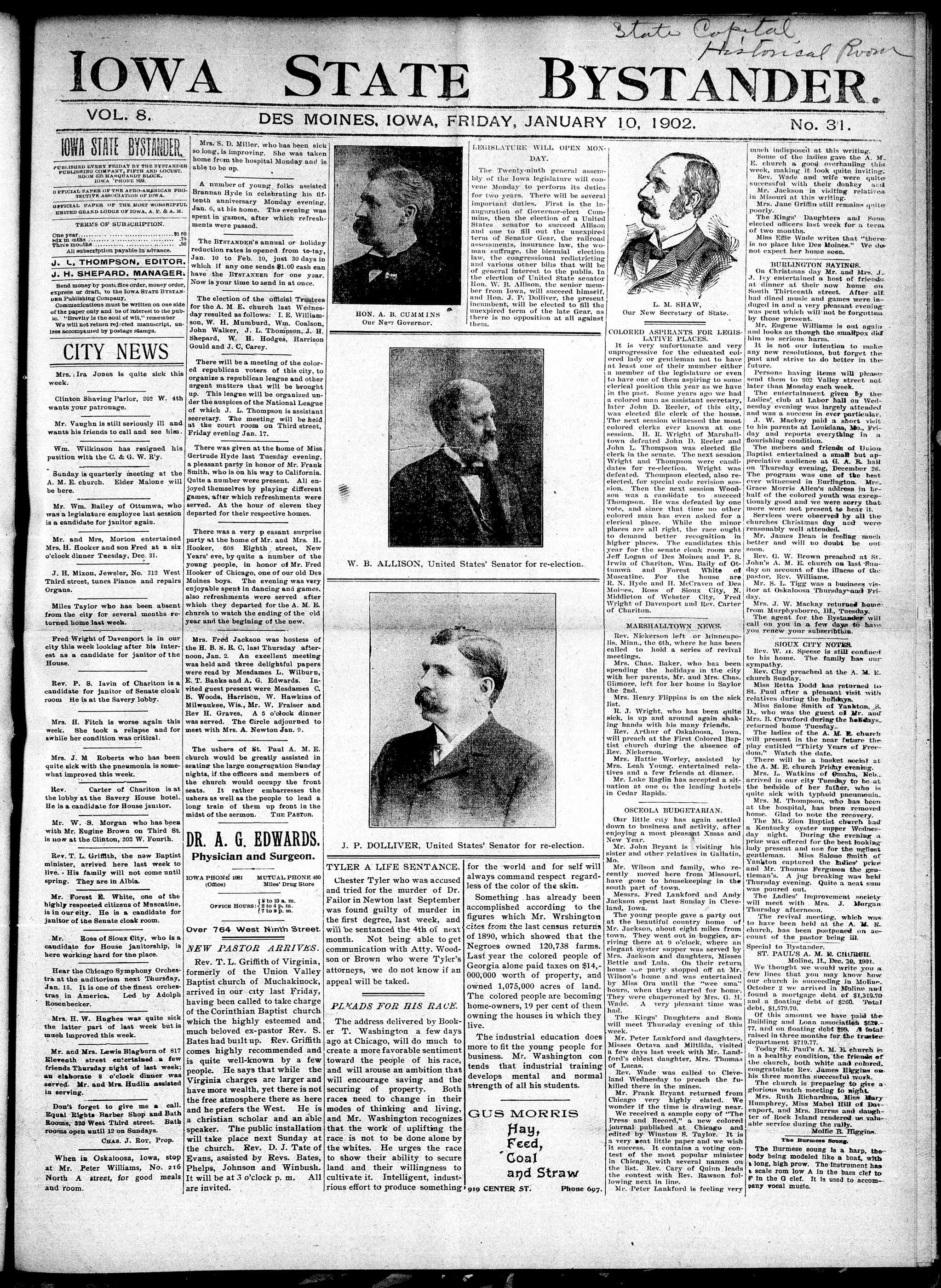
The Twenty-ninth general assembly of the Iowa legislature will convene Monday to perform its duties for two years. There will be several important duties. First is the inauguration of Governor-elect Cummins, then the election of a United States senator to succeed Allison and one to fill out the unexpired term of Senator Gear, the railroad assessments, insurance law, the woman suffrage, the biennial election law, the congressional redistricting and various other bills that will be of general interest to the publs. In the election of United State senator Hon. W. B. Allison, the senior mem-
The election of the official Trustees for the A. M. E. church last Wednesday resulted as follows: I. E. Williamson, W. H. Mumburd, Wm. Coalson, John Walker, J. L. Thompson, J. H. Shepard, W. H. Hodges, Harrison Gould and J. C, Carey.
There will be a meeting of the colored republican voters of this city, to organize a republican league and other urgent matters that will be brought up. This league will be organized under the auspices of the National League of which J. L. Thompson is assistant secretary. The meeting will be held at the court room on Third street, Friday evening Jan. 17.
Physician and Surgeon.
HON. A. B. CUMMINS
Our New Governor.
THE MAYOR OF BROOKLYN
W. B. ALLISON, United S.
J. P. DOLLIVER, United S.
W. B. ALLISON, United States' Senator for re-election.
M. B.
TYLER A LIFE SENTANCE. Chester Tyler who was accused and tried for the murder of Dr. Failor in Newton last September was found guilty of murder in the first degree, last week, and will be sentenced the 4th of next month. Not being able to get communication with Atty. Woodson or Brown who were Tyler's attorneys, we do not know if an appeal will be taked. for the world and for self we always command respect regardless of the color of the skin.
Something has already been accomplished according to the figures which Mr. Wrshing's cites from the last census return of 1890, which showed that Negroes owned 120,738 farm. Last year the colored people Georgia alone paid taxes on $100,000 worth of property, a
PLEADS FOR HIS RACE.
The address delivered by Booker T. Washington a few days ago at Chicago, will do much to create a more favorable sentiment toward the people of his race, and will arouse an ambition that will encourage saving and the securing of property. Both races need to change in their modes of thinking and living, and Mr. Washington recognizes that the work of uplifting the race is not to be done alone by the whites. He urges the race to show their ability to secure land and their willingness to cultivate it. Intelligent, industrious effort to produce something
```markdown
```
LEGISLATURE WILL OPEN MONDAY.
The Twenty-ninth general assembly of the Iowa legislature will convene Monday to perform its duties for two years. There will be several important duties. First is the inauguration of Governor-elect Cummins, then the election of a United States senator to succeed Allison and one to fill out the unexpired term of Senator Gear, the railroad assessments, insurance law, the woman suffrage, the biennial election law, the congressional redistricting and various other bills that will be of general interest to the publis. In the election of United State senator Hon. W. B. Allison, the senior member from Iowa, will succeed himself, and Hon. J. P. Dolliver, the present incumbent, will be elected to fill the unexpired term of the late Gear, as there is no opposition at all against them.
States' Senator for re-election.
States' Senator for re-election.
for the world and for self will always command respect regardless of the color of the skin.
Something has already been accomplished according to the figures which Mr. Wrshington cites from the last census returns of 1890, which showed that the Negroes owned 120,738 farms. Last year the colored people of Georgia alone paid taxes on $14,-000,000 worth of property, and owned 1,075,000 acres of land. The colored people are becoming home-owners, 19 per cent of them owning the houses in which they live.
The industrial education does more to fit the young people for business. Mr. Washington contends that industrial training develops mental and normal strength of all his students.
GUS MORRIS
Hay,
Feed,
Coal
and Straw
919 CENTER ST. Phone 697.
Phone 697.
M.
COLORED ASPIRANTS FOR LEGIS
LATIVE PLACES.
It is very unfortunate and very unprogressive for the educated colored lady or gentleman not to have at least one of their number either a member of the legislature or even to have one of them aspiring to some clerical position this year as we have in the past. Some years ago we had a colored man as assistant secretary, later John D. Reeler, of this city, was elected file clerk of the house. The next session witnessed the most colored clerks ever known at one session. H. R. Wright of Marshall-town defeated John D. Reeler and John L. Thompson was elected file clerk in the senate. The next session Wright and Thompson were candidates for re-election. Wright was defeated. Thompson elected, also re-elected, for special code revision session. Then the next session Woodson was a candidate to succeed Thompson. He was defeated by one vote, and since that time no other colored man has even asked for a clerical place. While the minor places are all right, the race ought to demand better recognition in higher places. The candidates this year for the senate clok room are Jeff Logan of Des Moines and P. S. Irwin of Chariton, Wm. Baily of Otumwa and Forest White of Muscatine. For the house are R. N. Hyde and H. McCraven of Des Moines, Ross of Sioux City, N. Middleton of Webster City, Fred Wright of Davenport and Rev. Carter of Chariton.
Rev. Nickerson left or Minneapolis, Minn., the 6th, where he has been called to hold a series of revival meetings.
Mrs. Chas. Baker, who has been spending the holidays in the city with her parents, Mr. and Mrs. Chas. Glimore, left for her home in Saylor the 2nd.
Mrs. Henry Flippins is on the sick list.
R. J. Wright, who has been quite sick, is up and around again shaking hands with his many friends.
Rev. Arthur of Oskaloosa, Iowa, will preach at the First Colored Baptist church during the absence of Rev. Nickerson.
Mrs. Hattie Worley, assisted by Mrs. Leah Young, entertained relatives and a few friends at dinner.
Mr. Luke Raglin has accepted a situation at one on the leading hotels in Cedar Rapids.
OSCEOLA BUDGETARIAN.
Our little city has again settled down to business and activity, after enjoying a most pleasant Xmas and New Year.
Mr. John Bryant is visiting his sister and other relatives in Gallatin, Mo.
Mr. Wilson and family, who recently moved here from Missouri, have gone to housekeeping in the south part of town.
Messrs. Fred Lankford and Andy Jackson spent last Sunday in Cleveland, Iowa.
The young people gave a party out at the beautiful country home of Mr. Jackson, about eight miles from town. They went out in buggies, arriving there at 9 o'clock, where an elegant oyster supper was served by Mrs. Jackson and daughters, Misses Bettie and Lula. On their return home the party stopped off at Mr. Wilson's home and was entertained by Miss Ora until the "wee sma" hours, when they started for home. They were chaperoned by Mrs. G. H. Wade. A very pleasant time was had.
The Kings' Daughters and Sons will meet Thursday evening of this week.
Mr. Peter Lankford and daughters, Misses Octava and Miltilda, visited a few days last week with Mr. Landford's eldest daughter, Mrs. Thomas of Lucas.
Rev. Wade was called to Cleveland Wednesday to preach the fukilled there in the mines.
Mr. Frank Bryant returned from Chicago very highly elated. We wonder if the time is drawing near. We received a sample copy of "The Press and Record," a new colored journal published at Chicago and edited by Winston S. Taylor. It is a very neat little paper and we wish it success. It contains a voting contest of the most popular minister in Chicago, with several names on the list. Rev. Cary of Quinn leads the contest with Rev. Rawson following next in line.
Mr. Peter Lankford is feeling very
No. 31.
much indisposed at this writing.
Some of the ladies gave the A. M. E. church a good overhauling this week, making it look quite inviting.
Rev. Wade and wife were quite successful with their donkey and Mr. Jackson is visiting relatives in Missouri at this writing.
Mrs. Jane Griffin still remains quite poorly.
The Kings' Daughters and Sons elected officers last week for a term of two months.
Miss Efie Wade writes that "there is no place like Des Moines." We do not expect her home soon.
BURLLINGTON SAYINGS.
On Christmas day Mr. and Mrs. J. J. Ivy entertained a host of friends at dinner at their now home on South Thirteenth street. After all had dined music and games were inudged in and a very pleasant evening was pent which will not be forgotten by those present.
Mr. Eugene Williams is out again and looks as though the smallpox did him no serious harm.
It is not our intention to make any new resolutions, but forget the past and strive to do better in the future.
Persons having items will please send them to 902 Valley street not later than Monday each week.
The entertainment given by the Ladies' club at Labor hall on Wednesday evening was largely attended and was a success in ever particular. J. W. Mackey paid a short visit to his parents at Louisiana, Mo., Friday and reports everything in a flourishing condition. The meebers and friends of Union Baptist entertained a small but appreciative audience at G. A. R. hall on Thursday evening, December 26. The program was one of the best ever witnessed in Burlington. Mrs. Grace Morris Allen's address in behalf of the colored youth was exceptionally good and we were sorry that more were not present to hear it. Services were observed by all the churches Christmas day and were reasonably well attended. Mr. James Dean is feeling much better and will no doubt be out soon.
Rev. G. W. Brown preached at St. John's A. M. E. church on last Sunday on account of the illness of the pastor, Rev. Williams.
Mr. S. L. Tigg was a business visitor at Oskalosa Thursday and Friday.
Mrs. J. W. Mackay returned home from Murphysborro, IL, Tuesday.
The agent for the Bystander will call on you in a few days to have you renew your subscription.
SIOUX CITY NOTES
Rev. W. M. Speese is still confined to his home. The family has our sympathy.
Rev. Clay preached at the A. M. E. church Sunday.
Miss Retta Dodd has returned to St. Paul after a pleasant visit with relatives during the holidays.
Miss Salone Smith of Yankton, S. D., who was the guest of Mr. and Mrs. B. Crawford during the holidays, returned home Tuesday.
The ladies of the A. M. E. church will present in the near future the play entitled "Thirty Years of Freedom." Watch the date.
There will be a basket social at the A. M. E. church Friday evening.
Mrs. L. Watkins of Omahn, Neb. arrived in our city Tuesday to be at the bedside of her father, who is quite sick with typhoid pneumonia.
Mrs. M. Thompson, who has been at the hospital, has been removed home. Glad to note the recovery.
The Mt. Zion Baptist church had a Kentucky oyster supper Wednesday night. During the evening a prize was offered for the best looking lady present and one for the ugliest gentleman.
Miss Salone Smith of Yankton captured the ladies' prize and Mr. Thomas Ferguson the gentleman's. A jug breaking was held Thursday evening. Quite a neat sum was poured out.
The Ladies' Improvement society will meet with Mrs. J. Morgan Thursday afternoon.
The revival meeting, which was to have been held at the A. M. E. church, has been postponed on account of the pastor being ill.
Special to Bystander.
ST. PAUL'S A. M. E. CHURCH.
Moline, ILL., Dec. 30, 1901.
We thought we would write you a few lines that you may know how our church is succeeding in Moline. October 2 we arrived in Moline and found a mortgage debt of $1,319.70 and a floating debt of $260. Total debt, $1,579.70.
Of this amount we have paid the Building and Loan association $629.77, and on floating debt $99. A total raised in three months for the trustee department $719.77.
Today St. Paul's A. M. E. church is in a healthy condition, the friends of the church, both the white and colored, congratulate Rev. James Higgins on his three months successful work.
The church is preparing to give a glorious watch meeting to might.
Mrs. Ruth Richardson, Miss Mary Humphrey, Miss Mabel Hill of Davenport, and Mrs. Burrus and daughter of Rock Island rendered us valuable service during the rally.
The Burmese sound is a harp, the body being modeled like a boat, with a long, high prow. The instrument has a scale rom low A in the bass clef to F in the G clef. It is used to accompany vocal music.
Washington, Jan. 7.—Senate—The senate met yesterday after a recess of more than two weeks, but owing to the recent death of Senator William J. Sewell of New Jersey, no business was transacted.
House—Another Schley resolution was introduced in the house today by Representative Schrim of Maryland. It provides an appropriation of $12,000 for bronze tablets commemorating six great naval victories, beginning with those of John Paul Jones in 1779 and closing with the battle of Saratoga. Commodors Winsfield Scott Schley was "inning" in 1988. A bill restricting immigration was introduced by Representative Dalzell of Pennsylvania. It materially increases the disabilities of alien immigrants. Among those it excludes are "persons who have been engaged in any plot against any government or any of its officers, or who are authorized polygamists, nihilists, or members of secret society, or members of the United States to contrary to the constitution of the United States." Representative Groveson of Ohio introduced an anti-anarchist bill. It is similar to other measures on this subject, except that the death penalty is provided for criminal assaults on officers of the government, without specifically designating the president as the one assassinated. A bill to re-establish the assassination was passed by Representative Hull introduced a bill to provide for a $,000,000 postoffice building at Des Moines.
Washington, Jan. 7.—Senate. The first notes of the contest between the Niceragua and Panama routes for the isthmian canal were heard in the senate today. Morgan offered and secured the adoption of a resolution which indicates his purpose to have the committee on interoceanic canals inquire into the relations between the transcontinental railroad companies of the United States and Canada and the Panama Canal company. In explanation of the resolution Morgan declared that the alleged relations were a "wicked monopoly" which already had cost the people of the Pacific coast millions of dollars. The relations involve the control by the Panama Canal company and the agreement existing between certain railroads of the United States and the Pacific Mail Steamship company.
House.—The debate on the Nicaragua canal bill in the house was opened in lively fashion today by Hepburn, chairman of the interstate and foreign commerce commission, which reported the bill. For two hours he held the floor, replying to a volley of questions concerning the recent offer of the Panama Canal company to the United States for $10,000,000. The interest in the debate centered most entirely in the new phase of the subject. Hepburn maintained that the alleged new offer of the Panama company was a part of the plan of delay. All his utterances along that line were liberally applauded. He pointed out what he claimed was the suspicious circumstances that Panama company had to pay $199,000,000 was decided before the holiday recourse to consider the Nicaragua bill, and then suddenly dropped the price to $40,000,000. Morris of Minnesota gave notice that at the proper time he would offer an amendment to authorize the president, if he could secure the property and rights of the Panama company for $40,000,000. If concessions could be procured from Colombia, and if the Panama company intended to purchase and proceed to complete the Panama canal. The other speakers today were Davis of Florida, Richardson of Alabama, Mann of Illinois and Adams of Pennsylvania.
Washington, Jan. 8.—Senate.—During consideration by the senate today of private pension legislation some important statements were made by Gallinger, chairman of the committee on pensions, in respect to regulations copied by the committee to govern it considering the consideration of private pension bills. He announced that none but absolutely meritorious cases would be presented to the senate for its consideration, and that the closest scrutiny would be given by the committee to every bill introduced. He said that no pension exceeding $50 a month would be recommended by the committee, and that a view of a private officer, and that pensions for the widows of other officers would be scaled down proportionately.
House. The debate on the Nicaraguan canal bill in the house today developed sentiment in favor of giving consideration to the record offer on the Panama company to sell its franchise and property for $40,000,000, this sentiment taking the form of advocating the Morris amendment to allow the latter route if the canal commission upon considering the company's offer recommends it, and the required concessions can be obtained from Colombia. Of sixteen members who spoke today nine favored the Morris amendment. It was agreed that general debate should close tomorrow at 2 o'clock in the morning to amendment under the five-minute rule. The final vote probably will be taken tomorrow. The speakers today were Shackleford of Missouri, Parker of New Jersey, Loving of Massachusetts, Morris of Minnesota, Burton of Ohio, Hill of Connecticut, Bromwell of Ohio, Gillett of Massachusetts and Littlefield of Massachusetts, the Morris company, and Messrs. Burgess of Texas, Bell of Colorado, Cooney of Missouri, Cummings of New York, Wilson of Tennessee and Lacey of Iowa, for the bill in its present form.
A fool idea is all right if you can make it go.
Shelley Visits President.
Washington, Jan. 7—Rear Admiral Shelley, called at the White House yesterday by appointment and spent nearly an hour, in conference with the president. The admiral refused to discuss the conversation, saying that it was of a personal character. The president also declined to intimate the nature of the conference.
THE NEWS IN IOWA
Des Moines, Jan. 9.—Conferences of republican members of the house of the Twenty-ninth General assembly and of the candidates for legislative offices and of leading politicians were held at the Savory yesterday. As the result of these conferences, the was made up agreement readiness candidates that would be supported for the different offices. This applies to the house only, the outcomes of the different contests for places in the senate organization being still indefinite. In the house an agreement has been reached to support the wollowing candidates: Cf. Clerk—Rush Beacom of Shelby county.
First assistant-J. C. Crockett of Eldora.
Second assistant-John A. Cook of Harton.
H.B.
Emprossing clerk—Mrs. M. C. Heist
of Eldon.
of Enbru-
Enrolling clerk—Miss Emma
Gerko, county
Wheeler of Cerro Gordo county.
Journal clerks—Harry E. Griffin of
Maguqueta and Ford Howell of Das
Molves.
Assistant postmistress—Miss Hester
Runyan of Ojibelt.
Bill clerk—Kate Shelley of Moine-
nga.
* File clerk—C. P. Schell of Belmond.
* Sergent at-arms—Charles W. Reynolds of Grundy Center.
* Chief doorkeeper—J. D. Lewis of Sengner.
Terrible Deed of an Insane Lover at West Union.
West Union, Jan. 7.—Homer M. Neff, county surveyor and former county clerk chat and killed Miss Rose Falb, to whom for several years he has been paying attention and wounded Emmet Sullivan, his rival, and then killed himself. The deed was committed in the room of Miss Falb at the Commercial hotel. Sullivan and the girl were visiting when suddenly Neff appeared in the doorway, firing five shots in rapid succession. Four of the shots took place on the right breast, one penetrating the right breast. Sullivan was struck in the face, the bullet glancing. He will recover. Then Neff turned on the light and went across the park to his room where he deliberately locked the door, removed the empty shells from his revolver, turned off the light and shot himself in the temple. Death was instantaneous.
Nefl has lived here a greater part of his life. He was about 45 years old. He has borne an excellent reputation although considered somewhat eccentric. For some time he worked in company with his brother the local electric light plant. There is little question he was prompted to the deed by insane jealousy. The girl had seemed in the past to encourage his suit but when he met ready to marry her, Sullivan is a member of a local farm machinery firm.
STABS HIMSELF
Leaves His Wife, Gets to Drinking
and Finally Gives All Up.
Brighton, Jan. 9—William Elliott, a farm hand, tried to commit suicide with a long bladed pocket knife. He drove the knife into his chest to a depth of four and a half inches. He refuses medical aid and may die. Elliott has a wife and two children in Hedrick, but has not been seen with them for over a year. He has been off and on for the last six years, and has twice been arrested, once for carrying concealed weapons and once for drunkenness.
Busse Case Continued.
Waverly, Jan. 8.—The trial of Louis Busse, the alleged Butler county murderer, has been continued until the next term of the Bremer district court to be held in April. The case was heard in the district court of Butler county the attorneys for Busse succeeded in obtaining a change of venue to Bremer county. The case came up for trial at the present term of court here and the defendant's attorneys made a motion for a continuance, which was sustained by the
Swindlers Fleeced the Farmers.
Independence, Jan. 9.—Two hundred farmers of this county were taken in promissory notes by swindlers last fall. The signed petitions for various causes which were received at the First National Bank yesterday for collection in the form of promissory notes for between $40,000 and $50,000, were replevended and big law suits are anticipated.
Women Swindler is Caught.
Burlington, Jan. 8—Last summer a well groomed woman swindled a number of Burlington residents by means of bogus checks. It is just learned that she has been captured at the airport and is being held there. She will be returned to this place as soon as the Missouri authorities are through with her.
Killed by Falling Tree.
Mitchellville, Jan. 6. While working in the timber northeast of town, Thos. Airley was killed by a tree falling on him. He was an industrial young man and made his home with his widowed mother.
Penn College is Damaged.
Oksalawoa, Jan. 8.—Penn college was damaged by fire which originated from an explosion in the laboratory. It was extinguished, however, before a great amount of damare was done. The loss is estimated at $1,000.
Fire on Gang of Toughs.
Cedar Rapids, Jan. 3.—Two special officers, sworn in to go to Ely for the purpose of preserving order at a dance, were attacked by a gang of ruffians. They returned the onslaught with bullets and one of the Gang was shot in the knee. H. E. Myers and A. Mason were the special officers.
Will Shorten Their Line.
Dubuque, Jan. 6.—It is the intention of the Chicago, Milwaukee & St. Paul company to shorten their line between Dubuque and La Crosse eight miles by removing the curves. Work will begin early in the spring.
SHAW IS GUEST OF HONOR
IOWA REPUBLICANS PAY HIM UNSTINTED TRIBUTE.
Farewell Banquet Tendered the Governor by the Grant Club at Das Moinee
Des Moines, Jan. 11.—The republicans of Iowa paid unstinted tribute to Governor L. M. Shaw, the newly appointed secretary of the treasury, last night. Probably never in the history of the state has there been gathered at any similar function an assemblage of the distinguished men of the republican party of the state that could compare with that held at the last right to attend the banquet gives in honor of the governor by the Grant club. Factionalism was laid aside, and Governor Shaw's fellow-citizens, without reference to past differences, attested their high regard for him and their high appreciation of the exalted position in the ballot by the gift of two portfolios in President Roosevelt's cabinet.
Four hundred guests sat down to the tables in the Savery dining rooms. They were gathered from every corner of Iowa, and included men that rank with the first in the fields of law and politics and business. Governor-elect Cummins was toast-master, and addresses were made by Judge Smith McPherson, Lafayette Young, Governor Shaw, Edward Rosewater, George E. Maclan, George D. Perkins and others.
PENITENTIARY FOR LIFE.
Sentence Given by Jury to Chester
Tulen at Newton
Newton, Jan. 7—In the case of the state vs. Charles Tyler, colored, who has been on trial in the Jasper county district court for over one week, charged with the murder of Dr. B. M. Fallor of this city last September, the jury returned a verdict of guilty and the penalty at life imprisonment.
This ends one of the most important criminal cases in the history of this county. On the night of September 11, 1901, Dr. B. M. Fallor made a professional call near the C. R. F. & r-depot in the town of Brownsboro, home to 10:45 p. m. he was knocked in the head with a club and robbed of his watch and money, near the northwest corner of the Jasper & Sons lumber yard. Many clues were run down and many arreeds made, and finally Tyler was apprehended. He was found in the possession of Tyler's sweetheart, who resides near Des Moines. There was no question about the identity of the watch, for it had Dr. Felior's name engraved in it. This evidence, together with the fact that Tyler was seen here on the eventful night, might suggest that about the time the deed was committed, left no doubt of his guilt in the minos of the jury.
STRIKES BRUTAL FATHER DEAD
Frank B. Ferguson Resents Abuse of
Children With Fetal Plane
a Child With Fatal Blows.
Sloux City, Jan. 7.—With three blows of his first Frank B. Ferguson, a carpenter, formerly of Chicago, almost instantly killed Leonard Shelgren of Cherokee, during a quarrel at a Sloux City boarding house. The blows broke Shelgren's nose and caused confusion in the nose, when he died forty-five minutes later.
Ferguson and Shelgren quarreled over the latter's 3-year-old child, which was being cared for in the boarding-house. Shelgren, who is a widower, handled the child so roughly that Ferguson took it from him and placed it in another room. On his return Shelgren showed fight, and made a vicious lunge at Ferguson, who then dealt the fatal blows in return. He himself notified the police of the affair, not knowing his victim was likely to die.
It was discovered late that Ferguson served two terms in the penitentiary, the last time for ten years for robbery of a rich farmer near Oto. During his first term at Arkansas prison, he was concerned in an insurrection among the prisoners.
Saloon Men Win a Victory.
Des Moines, Jan. 10—Judge Bishop rendered an opinion in the appeal from the board of supervisors in the matter on mult assessments, remitting to sixty-two saloons an amount representing $8,700. When the saloons closed as a result of the supreme court decision February 14, 1899, the mult taxes for that quarter were remitted, but when the saloons opened a few days prior to the beginning of a new quarter the county treasurer assessed the full three months' tax. The saloons objected to this and the matter was carried to the board of supervisors. The action of the treasurer was sustained and it went to the district court on appeal.
Belgian is Killed by Clerk.
Belle Plaine, Jan. 10—Peter Williams a Belgian who came to this country one year ago, and who left his wife and children in the old country, and was saving his earnings to send for them, was struck by a Rock Island train just west of Victor and instantly killed.
Women Burned to Death.
Mount Ayr, Jan. 10.—Miss Adelia Watts of this city, employed as a domestic at the home of Samuel Spurrier, was owed to death in a fire which nearly consumed the Spurrier home. Mrs. Spurrier, who was sleeping in the same bed, narrowly escaped with her baby.
Why is it so many married men have such a subdued look?
After Sioux City Saloons.
Sioux City, Jan. 6.—Sioux City saloonkeepers thought that the election of Rev. H. C. Marshall as state superintendent of the Iowa Anti-Saloon league would take his attention away from Sioux City, consequently they have been rather lax for several weeks in obeying the provisions of the Martin law. Now, however, Rev. Marshall has pounced down upon them unawares, and made a list of officers have saloons against which he has positive ordinance of law violation and each is to be prosecuted in the courts.
HEPBURN BILL IS PASSED
ONLY TWO VOTES AGAINST MEASURE IN THE HOUSE.
Advocates of an Alternative Route Muster 102 Votes as the Maximum of Their Strength.
Of Then Greene-
Washington, Jan. 9—Senate.—The
open session of the senate was de-
voted to routine business. After an
executive session the senate, at 1:50,
adjourned until Monday. The senate
in executive session confirmed the
nomination of Leslie M. Shaw, to be
secretary of the treasury, and of Hon.
G. Paxxra to be postmaster general.
House—The Hepburn Nicaragua canal bill passed the house by practically an unanimous vote. Only two members out of 210 voted against it. Messrs. Fletcher (rep.) of Minnesota and Lassiter (dem.) of Virginia were the two voting in the negative. The opposition to committing the government to the Nicaragua canal attempted to sequestrate the amounts to lodge with the president the discretionary power to purchase and complete the Panama canal, if it could be purchased for $40,000,000. The test came on the first vote, when the advocates of an alternative route polled 102 votes against 170. At each succeeding vote their strength dwindled until Mr. non of Illinois, under whose leadership the fight was as nausea was unable to get asleep and noses on a motion to recommit. All other amendments failed and the bill passed exactly as it came from the committee. None of the votes except that on the final passage of the bill was a record vote. The debate which preceded the taking of the final vote was made memorable by a clash between Democrat and chairman of the appropriation committee. On several previous occasions they have measured swords over canal legislation. Two years ago a similar bill was passed by a vote of 224 to 23.
ROOSEVELT GRANTS SCHLEY'S
REQUEST.
Will Consider an Appeal for Reverential of Secretary Lopal's Action.
Washington, Jan. 8.—The object of Admiral Schley's visit to the white house was to request the president to entertain and consider an appeal for the release of the prisoners Long and the disapproval of the majority judgment of the court of inquiry. The interview was satisfactory, the president granting the admiral's request. Messrs. Rayner and Teague were present in Schley in the preparation of the appeal.
The interview with the president was arranged in advance, and at its conclusion Admiral Schley left the white house in a satisfied state of mind. He had been given a full opportunity to present the case from his standpoint and to acquaint himself with the details of attention the letter could not have any knowledge. While Admiral Schley would not make any statement regarding the matters discussed, holding that an interview between a naval officer and his commander-in-chief should be regarded as confidential, it is understood that he brought to the president the importance of the injustices and discropancies of the majority report or the court of inquiry. Admiral Schley's interview with the president was the result of his determination to exhaust every means in his power to overturn the judgment which had been rendered against him. His new appeal will be presented to the navy department, bringing out some new facts which have an important bearing on the controversy.
The following statement was given out by Admiral Schley's counsel at the conclusion of the conference:
"Admiral Schley has concluded after mature consideration and deliberation to appeal the majority decision of the court of the United States to one of the United States as commander-in-chief of the army and navy. The action having been determined upon nothing more can be divulged at this time, the regulations of the army being such that the nature of the proposed appeal cannot be revealed except by the president after the final documents have been filed with him."
Mr. Rayner stated that it will take some time to prepare the report, which will be filed with the president until after the return of Admiral Schley from his visit to Savannah about the 20th instant.
DEATH IN A TUNNEL.
Seventeen Killed and Forty Injured in New York City.
New York, Jan. 9.—Two local trains sound for New York, one from South Norwalk, the other from White Plains, crashed together in the smoke cloud, and the other in the York Central line yesterday. Seventeen perons were killed and forty injured. Of the latter twelve were seriously injured. The engineer and fireman of the White Plains local and a tower man were were killed. Dozens visited the wreck and will personally direct an investigation.
Shaw Is Nominated.
Washington, Jan. 9.—The president yesterday sent the following nominations to the senate: Leslie M. Shaw of Iowa, secretary of the treasury; Henry B. McCormick, secretary general; John R. A. Crossland, Missouri, minister resident and counsel general to Libera.
When William Jennings Bryan applied for a life insurance policy recently, he wrote in the blank provided in the application for a list of former presidents to fill in the severe attacks of the presidential fever, followed by severe chills, but I have fully recovered from both."
Willing to Help the Boers.
Writing to the Bears
Chicago, Jan. 6—Rev. Dr. Hiram W.
Thomas, recently pastor of the People's Church, of Chicago, has announced by a letter to Peter Van Vlissingen, treasurer of the American branch of the American Transvaal League, the willingness of himself and wife to go to South Africa in the interest of non-combatants gathered in the concentra do camps.
Cuban Postal Fraud Cases.
Havana, Jan. 6.—The trials of the cases arising from the Cuban postoffice embezzlements opened Saturday in the Audencia court before five judges.
OUR SAILORS FIGHT.
Serious Clash Between American Sailors and Russian Soldiers. . . . Washington, Jan. 8.—A serious clash has occurred between American sailors of the United States Steamship Vicksburg and the Russian soldiery at Niechang, China. There has been three fights and as a result a number of Russian soldiers are wounded. The matter was made the subject of a complaint by the Russian ambassador at Peking to United States Minister Conger, and Mr. Conger in turn has notified the U.S. department. Secretary of the Navy Long has canned Commander Berry of the Vicksburg to use every effort to prevent further collisions. The Vicksburg in its winter quarters in a Murdock at the mouth of the river and cannot be released before spring.
COURT REENTERS PEKING
MARVELOUS SCENE OF ORIENTAL TINSELDEN SPLENDOR.
Top of the Chien Gate Covered With Foreigners, Who Gazed Upon the Cortege.
Peking, Jan. 7.—The re-entrance of the Chinese emperor into Peking yesterday was the most remarkable episode in the annals of the dynasty, save the flight of the Chinese court when Peking was bombarded by the allied forces. The spectacular phases of the return of the court exceeded the compassions. The cortese was a sort of glorified lord mayor's show, and was a bewildering barbaric exhibition of Oriental tinselden splendor.
The imperial cortege entered the Forbidden City at 1:30 p. m. It was the most brilliant scene Peking ever witnessed. The procession consisted of a thousand gorgeously adorned horse-drawn carriages, literally parished horses. The emperor, empress dowager, Prince Chun, the empress and several princes were borne in yellow chairs, their escort carrying hundreds of gay banners and silk umbrellas. The troops of Genghis Khan, Kalgoorlie, Mt. Ishmael the emperor. The foreign community gathered on top of the Chien gate.
The emperor and empress dowager entered the temple in the gate and burned incense. The dowager empress upon emerging from the temple saw the foreigners peering down and bowed. A double row of soldiers, kneeling, lined the four mile route. Its chief significance was the complete effacement of the traditional emblem of the royalty. Foreigners were given greater facilities of witnessing the ceremonial than would have been afforded them at most European courts.
In the meantime the Chinese soldiers, Manchu bannermen and minor officials who had crowded the plaza, were reverently kneeling. The two arches at the sides of the ancient gateway framed hundreds of faces of Chinese coolies who, emboldened by the presence of the foreigners, ventured to gaze upon a post sharp contest with the old regime, when neither diplomats nor natives were permitted to view the passage of royal personages along the streets.
The expression of the dowager empress seemed almost appealing as she faced those who had humbled her and brought her down from her former position from her former precession that she is returning to Peking, with anxiety for her safety.
RELATIONS BADLY STRAINED.
Details of the Unpleasant Situation at Newchwang.
Peking, Jan. 9.—While the actual casualties during the fighting at Newcwang between American sailors belonging to the United States gunboat Vicksburg, which is wintering there, and Russian soldiers attached to the garrison of that port, are trifling up to date, the matter has resulted in unpleasantly strained relations between the American, Russian and British authorities there. The Washington and the St. Petersburg governments upon undividing or orange waterers so that there may be no further friction
The trouble originated in the action of some sailors belonging to the British sloop of war Algerine, also in winter quarters at Newchwang, in carrying to shore six rifles for use in a theatrical performance. The Russian sailors, a forced men to arrest the British sailors. The Russians, however, by mistake, broke into a reading room where a party of the Vicksburg's men were seated and tried to arrest them. The Americans resisted, defending themselves with chairs. They were overpowered after a sharp fight, however, and ended up serving the United States consul, who sent them on board the Vicksburg.
The bad feeling which arose from this incident resulted in several fights whenever American or British sailors met Russian soldiers, and the latter, not being accustomed to fistights, were usually badly wounded. This amount of affection is compared to New Year's day in a more serious affray, and the Russian minister here, M. Paul Lesser, complained to Minister Conger that two members of the Vicksburg crew had fired a revolver at an unoffending Russian soldier,ounding him in the arm.
Railroad Merger in Supreme Court, Washington, Jan. 8.-Attorney General Wallace B. Douglas of Minnesota, has filed in the United States supreme court the bill of complaint in the case of Northern Securities against Northern Securities defenders. It is a long document, about 10,000 words, covering thirty-two pages of printed matter.
Libertador Expedition Lands.
Willemsstad, Island of Curacao, Jan. 6.—The armed revolutionary steamer Libertador, formerly the British steamship Ban Righ, has, it is believed here, landed the expedition near Barcelona, Venezuela. Advices received here from Caracas show that the Venezuelan government is without news of the movements of the Libertador. The vessels composing the Venezuelan fleet are without coal and besides their engines are out of order, and, therefore, President Castro's ships could be in sea and search for the Libertador.
Des Moines, Jan. 9, 1902.
John H. Delaney of east Seventh street, has been arrested for alleged unbezzlement of $1,000 from Mrs. Alice M. Slater. She charges that he took possession of the money, which she had left at his house for safe several years ago, and which was taken to March 11 last. At that time she said that her call for an inspection resulted in finding nothing at all. Mrs. Slater stated that she was afraid to put her money in care of the banks for fear they would suspend.
Judge Kinne, on the board of control, has returned from making the regular monthly inspection of the institutions at Clarinda, Glenwood and Council Bluffs. At Clarinda it has been necessary to establish quantitative regulations so as to prevent the admittance of general visitors to the hospital. The smallpox in the town is quite serious, and on this account precautions are being taken. Relatives of inmates are not excluded under the regulations.
Governor Shaw has planned to have 100 of the letters and messages of congratulation he received following his appointment as secretary of the treasury bound. Some of the letters are of unusual nature, their authors embracing prominent men in all parts of the country, including many financiers. Aside from their personal value to the governor, they will some day have a historical worth, and the governor has determined to select the letters from each section of the country, from each section of the country, and have them bound in one volume.
The Y. M. C. A., women and sutlers, according to the annual report of Colonel J. A. Olmsted, inspector general of the state, are three things not wanted or needed about the national guard encampments. The report is a caustic document and calls sharp attention to numerous reforms deemed needed in the Iowa National guard. Important recommendations for the state include offering, including one for the purchase of permanent camp ground. Colonel Olmsted protests against the use of cavalry equipments belonging to the state by the Lincoln hussars of this city, and points out that it is in direct contravention of the code. The inspector general favors the erection of a state arsenal and adjunct general's office by the Lincoln hussars in two battles of artillery in Des Moines that the establishment of a signal service company here, the enlistment of two troops of cavalry in some of the country towns of the state, and various changes in the military code of the state, including one giving officers a tenure of office for life during good behavior. Colonel Olmsted does not beat about it but insists in the subject of reform in the encampments. "There are three things" he says, "our camps can dispense with to the good of the service. There is nothing the sutter sells the men would not be the better for the authorized force in camp and does not need to be eased on the ground so that they are worse than slops and ruinous to the stomach. The Y. M. C. A. is not required in camp to either handle mail or advertise themselves on elaborate letterheads erroneously printed. It should be a part of camp instruction for a command to care for its own mail. In the short week of camp life it is not really necessary to write letters to the commander, taught to look out for themselves in regard to writing material, stamps, etc. As to women living in camp, it is a difficult subject to properly treat. But if they do not know or care that they are a nuisance, underfoot and a detriment to the good work and benefit expected of camp, they have so far unsexed themselves as to be for once on the ground, and underfoot and a plainly ordered to stay out of camp. They become a nuisance as soon as they leave home with a command, crowding the cars to the discomfort of the men, and in camp they not only crowd the grounds, but eat to the detriment of the company messes, and I have never heard of their 'chipping in' to help out the mess."
The insurance adjusters have completed their settlement of the losses on the National Starch Manufacturing Co. plant. The figures were not made public, but it is said that they are very close to the amount claimed by the company as the total damage by fire two months ago. That the starch works will be rebuilt, seems to be the opinion of those who have canvassed the situation, as Des Moines District in the west, with more railroads than any other city, with the best supply of water for the making of starch in the country, and is the greatest crop growing state in the union. It is though that with the settlement by the insurance companies the starch company executive board will decide to move, also known that enterprise will be given hearty support by the Commercial Exchange and the city council.
A. Great January Offer.
The DES MOINES DAILY NEWS has just added a magnificent Sunday morning edition to its collection. The publication price February list to $1.50 a year, but yearly subscriptions mail and postpaid to the address 95. 250 newspapers for $1.00. Full leased wire dispensaries department and all the news of Iowa and the world winter in Iowa, and congress and the new president are making history every day. This edition will draw this offer without notice if our circulation becomes too high. facilities. Address. The Northeastern Iowa, Iowa.
Sailed for Manila.
New York, Jan. 6.—The United States steamship Rainbow, formerly the supply ship of Admiral Dewey's fleet on the Asiatic station, sailed for Manila to replace the cruiser Brooklyn as a station ship near Manila. She carries a crew of 350 men, who will be distributed among the various ships of the fleet on the Asiatic station. Upon the Rainbow's arrival at Manila the Brooklyn will return here, and bring the men whose terms have expired to receive their discharge service from here.
The man with an orchard needs to watch as well as spray.
..The Filibusters of Venezuela..
CHAPTER XXVIII—(Continued).
It was also related to him that Don Juan, the sole surviving member of the royalist band in authority, had returned to the Castle of Salvarez, taking the entire party of Englishmen with him, and had issued a public proclamation announcing the death of Philip and the end of the royal occupation. He had also forwarded to Caracas a full report and confession, and was now waiting to turn the castle over to General Salvarez whenever he should return.
Bursting with all this news, he hurried back to the Cheerway.
to this time he contents to a life
TH
Her Husband By Am
"It is your own Walter May.
"Of course it passionately star carpet. "Do you
"Hurrrah! hurrah!" he shouted, much to the amazement of all on board. "Philip is dead, Gomez is dead, Francisco, Mattazudo and the entire royal army are dead or scattered. The Castle of Salvarez is now occupied by an English party under Lord Chugmough himself, and Don Juan Garza and his daughter are with them." "Don Juan's daughter!" gasped Jacinta. "She is dead!"
"No, she is alive," answered Medworth, his voice trembling with his great emotion. "It was all a mistake—a conspiracy."
Then he proceeded to relate to his astounded audience all that he had learned at Bolivar.
"Then my duty is clear," said Captain Glover. "This Castle of Salvarez, you say, is on the Coronil River—that one just below here?"
"Yes," said Medworth.
"Is the Coronil navigable?"
"That I can't say," said Arthur. "We navigated it on a flatfoot under circumstances that I hope never to meet again, but whether the Cheerway could ascend the river or not, I could not say."
"Bless you, I had no idea of taking the Cheerway into unknown waters," said Captain Glover. "It's the launch I'm thinking of."
"That could do it, I'm sure," said Medworth.
"Then that settles it," said the Captain. "The Cheerway will drop down to the mouth of the Coroni and the launch will take you up to the castle." All of which occurred just as Captain Glover promised.
* * *
Lord Chugmugh, Don Juan and Lola were sitting on the veranda of the castle in the afternoon, chatting over past events, when the Englishman pointed to the river.
"I flatter myself," he said, "that I am at present the only man in Venezuela who possesses an electric launch. As the craft approaching is nothing else, it is probably mine. It has ladies aboard, too, I see. I fancy we are about to receive a call."
Sir Galloping Grace and others came out to see the launch; and Lola, whose young eyes had not been dimmed by her unpleasant experiences, uttered a loud "Arthur! Arthur!" and rushed to the river landing, where the passengers from the launch were shaking themselves on the wharf.
In another moment Don Juan had the doubtful pleasure of seeing his daughter clasped in the arms of the young man he had spurned in happier days in New York.
Dona Marla wept a little at being received so graciously, and welcomed back to her own house by Don Juan, who, in his proud, Spanish way, looked still the conqueror, notwithstanding he was the only one left.
Jacinta felt a hot, jealous pang when she saw Lola being kissed by Mqworth, and had there been no relief for her sore and tender heart, it would, perhaps, have been my unpleasant duty to describe another tragedy. But when she saw that she had lost Arthur, she suddenly remembered Lord Chugmough and his enormous wealth; and when she saw the stalwart frame and stern, handsome face of the Englishman, she smiled again.
But it is not my purpose to dwell upon the flirtation between Jacinta and Lord Chugmough, or to make another story of the tame events that followed the restoration of Castle Salvarez to its proper owners. It would not be interesting to make a long tale of the fact that General Salvarez did not receive the news of Philip's fall because he was already on his way home with two war ships and an army large enough to storm his castle, and that when at last he marched at the head of his column up to his own door, he found his wife and daughter surrounded by friends, and that he was severely reprimanded at Caracas for making so much stir about a little uprising that really amounted to nothing, and wore itself out in his absence.
Nor would it be particularly fascinating to read how Lord Chugmough offered the hospitality of his yacht to Don Juan, Lola and Medworth, and promised to convey them safely to New York.
The Cheerway sailed and in due time arrived at New York, where Don Juan, Lola and Medworth left her. She then proceeded across the Atlantic with her English passengers. Don Juan Kived up to the promise he had made to Lola at the ruined temple, and Medworth and Lola were married soon after their return. Shortly after their marriage Medworth received a letter from Lord Chugmough, which provoked a quiet smile on his handsome face; but up
to this time he has not divulged its contents to a living soul.
THE END.
"It is your own fault, Clara," said Walter May.
"Of course it is," cried out Clara, passionately stamping her foot on the carpet. "Do you suppose I don't know it perfectly well? And that is what makes it so hard—oh, so cruelly hard to bear!"
The fact was that Mr. and Mrs. Walter May had begun life at the wrong end.
Clara Calthorpe was a pretty young girl, just out of the hotbed atmosphere of a fashionable boarding school. Walter May was a bank clerk who had not the least doubt but that he should ultimately make his fortune out of stocks and bonds.
"Clara," he said to his young wife while the golden circle of the honeymoon was yet overshadowing their lives, "would you like a country life?" "Oh, dear no!" said Clara involuntarily recolling.
"Because" said Walter somewhat wistfully, "my father and mother are alone on the farm and I think they would like to have us come and live with them."
"I shouldn't like it at all," said Clara, "and mamma says no young bride should ever settle down among her husband's relations."
Mr. May万朗了 a little, but Mrs. Clara had a pretty positive way of her own, and he remonstrated no further. But at the year's end Walter May had lost his situation, the clouds of debt had gathered darkly around them and all the pretty, new furniture, Eastlake cabinets, china dragons, proof engravings and hot house plants were sold under the red flag. They had made a complete failure of the house-keeping business, and now, in the fourth story of a third-rate hotel, Mr. and Mrs. May were looking their future in the face.
Clara had been extravagant. There was no sort of doubt about that. She had given "recherche" little parties, which she couldn't afford, to people who didn't care for her. She had patterned her tiny establishment after models which were far beyond her reach, and now they were ruined. She had sent a tear-bespinkled letter to her mother who was in Washington trying to ensnare a rich husband for her younger daughter, but Mrs. Calthorpe had hastily written back that it was quite impossible for her to be in New York at that time of year and still more impossible to receive Mrs. Walter May at the monster hotel where she was boarding. And Clara, who had always had a vague idea that her mother was selfish, was quite certain of it now.
"There is but one thigh left for you, Clara," said Walter sadly.
"Is to go back to the old farm. I have no longer a home to offer you, but you will be sure of a warm welcome from my father and mother. I shall remain here and do my best to obtain new situation which will enable men to earn our daily bread."
Clara burst into tears.
"Go to my husband's relations?" she sobbed. "Oh, Walter, I cannot!"
"You will have to," he said doggedly, "or else starve."
So Mrs. May packed up her trunk and obeyed. All the way to Hazel-corpse Farm she cried behind her veil and pictured to herself a story-faced old man with a virago of a wife, who would set her to do menial tasks and overwhelm her with reproaches for having ruined "poor, dear Walter." As for the farmhouse itself, she was quite sure it was a desolate place, with corn and potatoes growing under the very windows, and the road in front filled with p'ows and pows and harrows and broken cart wheels. But in the midst of her tears and desolation the driver called out: "Hazel-corpse Farm! Mr. Noah May's! Here's her, 'touse, ma'm.
A long low gray stone mansion, all garlanded with ivy, its windows bright with geranium blossoms and the scarlet autumn leaves raining down on the velvet-smooth lawn in front. Clara could just see how erroneous had been all her preconceived ideas, when she found herself clasped in the arms of the sweetest and most motherly of old ladies.
"My poor dear!" said old Mrs May, caressingly.
"You are welcome as the sunshine, daughter," said a smiling old gentleman in spectacles.
And Clara was established in the easy chair in front of a great fire of pine logs, and tea was brought in and the two old people套etted and petted her as if she had been a three-year-old child just recovering from the measles.
There was not a word of reproach—not a questioning look, not a sidelong glance—all welcome, and tenderness and loving commiseration. And when Clara went to sleep that night, with
a wood fire glancing and glimmering softly over the crimson hangings of the "best chamber," she began to think that perhaps she had been mistaken in some of her ideas.
The next day she had a long, confidential talk with her father-in-law, while Mrs. May was making mince pies in the kitchen.
"But there's one thing I haven't dared to tell Walter about," she said, with tears in her eyes.
"What is that, my dear?" said the old gentleman.
"My dressmaker's bill," said Clara. "It came the night before I left New York—oh, such a dreadful bill. I hadn't any idea it could amount up so fearfully."
"How much was it?" said Mr. Noab May, patting her hand.
"A hundred and fifty dollars," said Clara, hanging down her head.
"Don't fret, my dear, don't fret," said the old gentleman. "Walter need never know anything about it. I'll settle the bill and there shall be an end of the matter." "Oh, sir, will you really?"
"My dear," said old Mr. May, "I'd do much more than that to buy the color back to your cheeks and the smile to your lips."
And that same afternoon, when Mrs. May had been talking to Clara in the kindest and most motherly way, the girl burst into tears and hid her face on the old lady's shoulder.
"Oh," cried she, "how good you all are! And I had an idea that a father and mother-in-law were such terrible personages! Oh, please, please forgive me for all the wicked things I have thought about you!"
"It was natural enough, my dear," said Mrs. May, smiling, "but you are wiser now and you will not be afraid of us any longer."
When Saturday night arrived Walter May came out to the old farmhouse, dejected and sad at heart. He had discovered that situations do not grow, like blackberries, on every bush; he had met with more than one cruel rebuff, and he was hopelessly discouraged as to the future. Moreover he fully expected to be met with tears and complains by his wife. But to his infinite amazement and relief Clara greeted him on the door-step with radiant smiles. "Tell me, dear," said she, "have you got a new situation?"
He shook his head sadly.
"I'm glad of it," said Clara brightly,
for we've got a place—papa and mamma
and I."
"It's all Clara's plan," said old Nonh
May.
"But it has our hearty approval,"
added the smiling old lady.
"We're all going to live here
together," said Clara. "And you are to
manage the farm, because papa says
he is getting too old and lazy," with
a merry glance at the old gentleman,
who stood by beaming on his daughter-in-law, as if he were ready to subscribe to one and all of her opinions,
"and I am to keep house and take all
the care off mamma's hands. And,
oh! it is so pleasant here, and I do
love the country so dear.y! So if you're willing, dear—"
"Willing!" cried out Walter May, ecstatically, "I'm more than willing. It's the only thing I have always longed for. Good-bye to city walls and hearts of stone; good-bye to hollow appearances and grinding wretchedness! Why, Cara, I shall be the happiest man alive. But—"
"There," said Clara, putting up both hands as if to ward off all possible objections, "I was sure there would be a 'but.'"
"I thought, my dear," said Walter, "that you didn't like the idea of living with your husband's relations."
Clara looked lovingly up into her mother-in-law's sweet old face, while she silently pressed Mr. Noah May's kindly hands.
"I am a deal wiser than I was a week ago," said she. "And, oh, so much happier!"
"So am I!" said Walter.
"Hennery Eggs."
On the front of a retail establishment not far from the Boston public library, is a sign that reads, "Hennery Eggs." This is not the name of the proprietor. No. They don't spell "hennery" with two "n's" and an extra "e" in Boston, you know. It is merely an infimation that eggs of the genuine sort are for sale within. They are not incubator eggs, nor storage eggs, nor eggs for campaign purposes. They are just good old hennery eggs. They're the kind of eggs that you have pawed around in the haymow to find and felt like cackling when you found them. They are hennery eggs with an eloquent accent on the hen. And yet, who knows? All eggs are more or less a mystery. You can't depend on signs. Even a Boston "hennery egg" may not be all its cracked up to be—Cleveland Plain Dealer.
Her Nerves and Her Hats.
A writer in a medical journal has lately advanced the theory that women' heavy hats are responsible for women's jangling nerves and proverial quick temper. The popular impression has been that the man who paid for the hats was the one whose temper suffered; but it seems that large hats weigh too heavily upon the fragile feminine cranium and affect the blood vessels and nerves, and through them the brain. Moreover, according to the writer, the effort to keep large and heavy hats at the right angle impose a parious strain upon the nerves of the wearers. The theory is advanced in all seriousness, but the chances are that it will not induce any normal woman to cut off her hat supply.—New York Sun.
QUEER FISH FOUND IN QUEENSLAND
```markdown
```
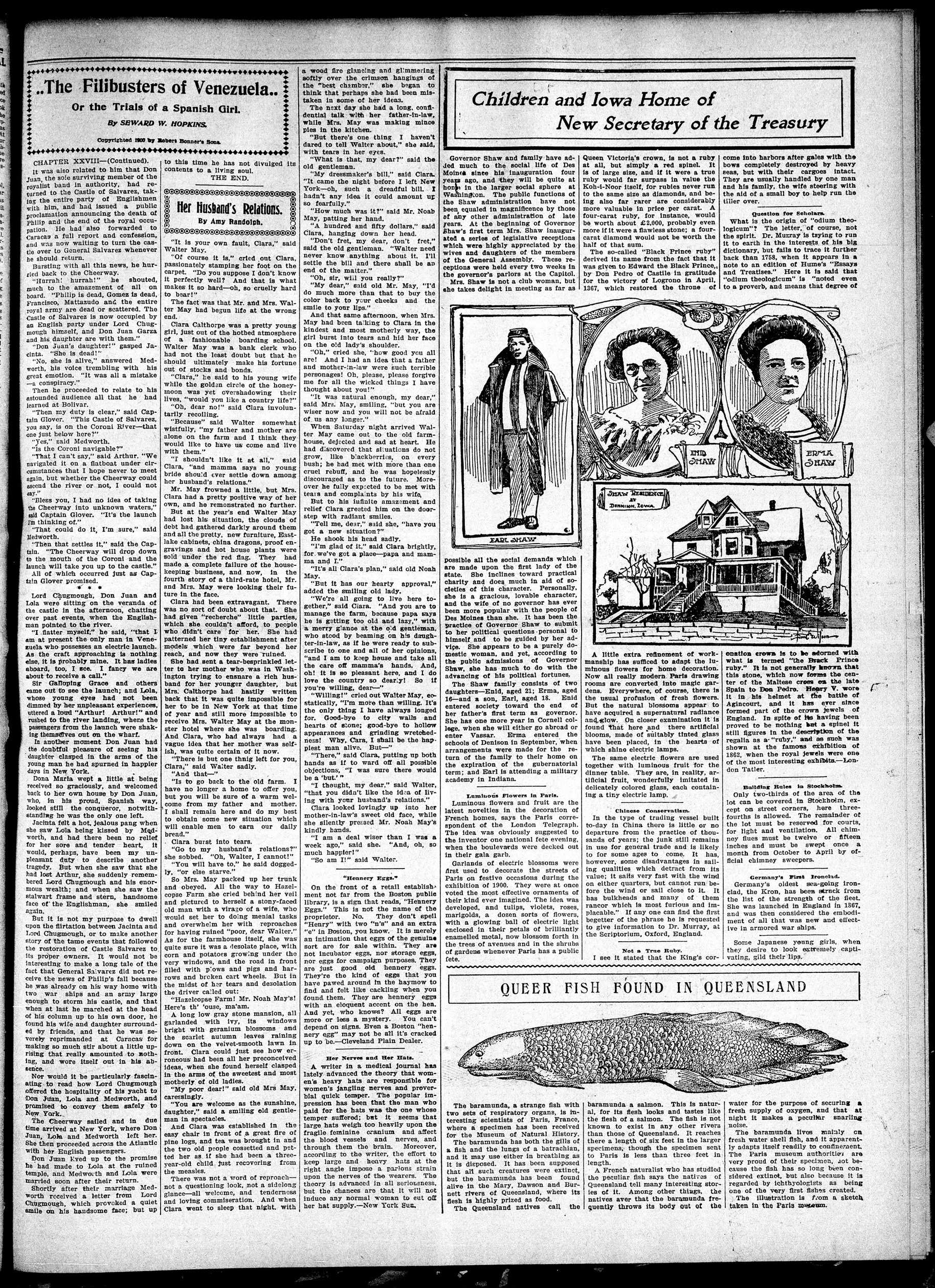
Governor Shaw and family have added much to the social life of Des Moine since his inauguration four years ago, and they will be quite at home in the larger social sphere at Washington. The public functions of the Shaw administration have not been equaled in magnificence by those of any other administration of late years. At the beginning of Governor Shaw's first term Mrs. Shaw inaugurated a series of legislative receptions which were highly appreciated by the wives and daughters of the members of the General Assembly. These receptions were held every two weeks in the governor's parliars at the Capitol.
Mrs. Shaw is not a club woman, but she takes delight in meeting as far as
EARL SHAW
possible all the social demands which are made upon the first lady of the state. She inclines toward practical charity and does much in aid of societies of this character. Personally, she is a gracious, lovable character, and the wife of no governor has ever been more popular with the people of Des Molines than she. It has been the practice of Governor Shaw to submit to her political questions-personal to himself and to be guided by her advice. She appears to be a purely domestic woman, and yet, according to the public admissions of Governor Shaw, she has much to do with the advancing of his political fortunes.
The Shaw family consists of two daughters—Enid, aged 21; Erma, aged 16—and a son, Earl, aged 18. Enid entered society toward the end of her father's first term as governor. She has one more year in Cornell college, when she will either go abroad or enter Vassar. Erma entered the schools of Denison in September, when arrangements were made for the return of the family to their home on the expiration of the gubernatorial term; and Earl is attending a military academy in Indiana.
Lumluoja Flowers in Paris.
Luminous flowers and fruit are the latest novelties in the decoration of French homes, says the Paris correspondent of the London Telegraph. The idea was obviously suggested to the inventor one national fete evening, when the boulevards were decked out in their gala garb. Garlands of electric blossoms were first used to decorate the streets of Paris on festive occasions during the exhibition of 1900. They were at once voted the most effective ornaments of their kind ever imagined. The idea was developed, and tulips, violets, roses, marigolds, a dozen sorts of flowers, with a glowing ball of electric light enclosed in their petals of brilliantly enamelled metal, now blossom forth in the trees of avenues and in the shrubs of gardens whenever Paris has a public fete.
QUEER FI
The baramunda, a strange fish with two sets of respiratory organs, is interesting scientists of Paris, France, where a specimen has been received for the Museum of Natural History.
The baramunda has both the gills of a fish and the lungs of a batrachian, and it may use either in breathing as it is disposed. It has been supposed that all such creatures were extinct, but the baramunda has been found alive in the Mary, Dawson and Burnett rivers of Queensland, where its flesh is highly prized as food.
The Queensland natives call the
SHAW RESIDENCE
AT
DENNISON, IOWA
Queen Victoria's crown, is not a ruby at all, but simply a red spinel. It is of large size, and if it were a true ruby would far surpass in value the Koh-I-Noor itself, for rubles never run to the same size as diamonds, and being also far rarer are considerably more valuable in price per carat. A four-carat ruby, for instance, would be worth about £2,000, probably even more if it were a flawless stone; a four-carat diamond would not be worth the half of that sum. The so-called "Black Prince ruby" derived its name from the fact that it was given to Edward the Black Prince, by Don Pedro of Castile in gratitude for the victory of Logrono in April, 1367, which restored the throne of
END SHAW
SHAW RESIDENCE
AT
DENMIDON, IOWA
A little extra refinement of workmanship has sufficed to adapt the luminous flowers for home decoration. Now all really modern Paris drawing rooms are converted into magic gardens. Everywhere, of course, there is the usual profusion of fresh flowers. But the natural blossoms appear to have acquired a supernatural radiance and glow. On closer examination it is found that here and there artificial blooms, made of suitably tinted glass have been placed, in the hearts of which shine electric lamps.
The same electric flowers are used together with luminous fruit for the dinner table. They are, in reality, artificial fruit, wonderfully imitated in delicately colored glass, each containing a tiny electric lamp.
Chinese Conservatism
In the type of trading vessel built to-day in China there is little or no departure from the practice of thousands of years; the junk still remains in use for general trade and is likely to for some ages to come. It has, however, some disadvantages in sailing qualities which detract from its value; it sails very fast with the wind on either quarters, but cannot run before the wind or sail close to it. It has bulkheads and many of them rancor which is most furious and implacable. "If any one can find the first begetter of the phrase he is requested to give information to Dr. Murray, at the Scriptorium, Oxford, England.
Not a True Ruby.
I see it stated that the King's cor-
SH FOUND IN QU
baramunda a salmon. This is natural, for its flesh looks and tastes like the flesh of a salmon. The fish is not known to exist in any other rivers than those of Queensland. It reaches there a length of six feet in the larger specimens, though the specimen sent to Paris is less than three feet in length.
A French naturalist who has studied the peculiar fish says the natives of Queensland tell many interesting stories of it. Among other things, the natives aver that the baramunda frequently throws its body out of the
come into harbors after gales with the bows completely destroyed by heavy seas, but with their cargoes intact. They are usually handled by one man and his family, the wife steering with the aid of a small boy to help run the tiller over.
Question for Scholars.
What is the origin of "odium theologicum"? The letter, of course, not the spirit. Dr. Murray is trying to run it to earth in the interests of his big dictionary, but fails to trace it further back than 1758, when it appears in a note to an edition of Hume's "Essays and Treatises." Here it is said that "odium theologicum" is "noted even to a proverb, and means that degree of
ERMA
SHAW
onation crown is to be adorned with what is termed "the Brack Prince ruby." It is not generally known that this stone, which now forms the center of the Maltese cross on the late Spain to Don Pedro. Henry V. wore it in his helmet at the battle of Agincourt, and it has ever since formed part of the crown jewels of England. In spite of its having been proved to be nothing but a spinel it still figures in the description of the regalia as a "ruby," and as such was shown at the famous exhibition of 1862, when the royal jewels were one of the most interesting exhibits—London Tatler.
Building Rules in Stockholm
Bathroom
Only two thirds of the area of the lot can be covered in Stockholm, except on street corners, here three-fourths is allowed. The remainder of the lot must be reserved for courts, for light and ventilation. All chimney flues must be twelve or fifteen inches and must be swept once a month from October to April by official chimney sweepers.
Germany's First Ironclad.
Germany's oldest sea-going iron-clad, the Kron, has been struck from the list of the strength of the fleet. She was launched in England in 1867, and was then considered the embodiment of all that was new and effective in armored war ships.
Some Japanese young girls, when they desire to look extremely captivating, gilt their lips.
QUEENSLAND
water for the purpose of securing a fresh supply of oxygen, and that at night it makes a peculiar snarling noise.
The baramunda lives mainly on fresh water shell fish, and it apparently adapts itself readily to confinement. The Paris museum authorities are very proud of their specimen, not because the fish has so long been considered extinct, but also because it is regarded by ichthyologists as being one of the very first fishes created. The illustration is from a sketch taken in the Paris museum.
---
Mr. Henry of St. Paul, Minn., was in our city last evening visiting friends. He went from here to Oksaloosa to visit.
Mr. and Mrs. Charlie Clay who have been in our city for the past few months left for the capital city to make their home. We wish them success.
Mrs. W. H. Mason who visited her daughter and son-in-law Mr. J. Davis arrived in our city after a very pleasant visit.
Mrs. Fannie Tomlin and children who have been visiting her mother in Huntsville, Mo. will arrive home this afternoon.
THE NEWS FROM BUXTON.
A crowded house greeted the initial appearance of the Jackson Orchestra. The first number of the program was a piano solo by Prot. Jackson, which was warmly received. The first selection by the orchestra was a march "Watch Hill." The Burton City Male Quartette sang a fishing song in which Mr. Robt. Pannel the bass songster especially distinguished himself. Mrs. Cornelia Reeves, the Prima Dona of the orchestra sang a beautiful soprano solo, "Just a Song at Twilight, which called fourth a roar of applause. Every body laughed when Mr. Frank Johnson sang, "I Love My Babe." Mr. John Tate's clarinet solo well executed and well received. Little Zenota and Freeda Jackson brought a ripple of smiles when they appeared in a dust. "Side by Side" Will Thomas, the Black Sousa, charmed his Audience with his euplionium solo, "My Old Kentucky Home." Lin Willis, the tenor, sang, "Because He Loved His Mother." Mr. H. Lee, baritone soloist sang, "Down in the deep." Each number of the orchestra was well received.
The above is only a portion of the carefully prepared program; space will not permit us to give the program in full. The Jackson Orchestra is a new musical organization, only a few months ago did it come into existence. Prof. A. R. Jackson, the well known bandmaster, is president and manager. The orchestra promises to be one of the best of its kind in the West.
ALBIA NOTES.
Mrs. M. F. Ward is visiting this week in Muchakinock with her daughter Mrs. Pearl Thomas.
Mr. Burton from Missouri returned some the first of this week.
A number of the boys and girls of Albia spent Sunday and Sunday in Hilton.
Blind Boone's concert was given hee in the Christian church Thursday night.
All present report the concert a good one.
Mrs. Cora Taylor of Hilton was in town Saturday.
Miss Mattle Boman is visiting with her grand parents in Missouri.
Mrs. Nora Grayson from Hiteman spent Sunday in Albia with her mother.
Miss May Davis spent a few days of this week in Garden Grove with her sister Mrs. D. Martin.
The Daughters of Tabor held open doors in the Masonia hall Jan. 1. They served chocolate, sandwiches and candies from 2 till 5. In the evening they hand a social.
SAYLOR ITEMS.
I was very quite in Saylor during the holidays, although every one seemed to enjoy themselves.
Mr. Homer Houstin was very glad to know that Miss Blissie Jenkins had not forgotten, as she gave him a nice present for New Years.
Mr. George Lewis has returned from his trip to Keotuk where he spent the holidays.
Mrs. Corbett has returned from Muchainckinock where she spent the holidays.
Mr. add Mrs. Baker have returned from their visit to Marshalltown where they are most delightful time. Thei mother entertained at dinner Xumas in honor of their home coming.
Mrs. Rice Barber has been on the sick list but is able to be out again.
Little Edna Roach is on the sick list also Master Bennie Baker.
Mr. Matten who was hurt some time ago went to work too soon and is in bed again.
The entertainment given by the Garret Bros. was a grand success. Every one reports a grand time. The guests numbered 71. Supper was served at 10:30 with all the delicies of the season. Many thanks were returned to Mesdames Phillips. Barrel and Barefield for making everything so pleasant. They were the waiters.
ORIGINAL NOTICE
In the District Court of the State of Iowa, in and for Polk county:
Birdie Gay
vs
John Gay
March Term, A. D. 1902.
To John Gay: You are hereby notified that on or before the 8th day of February, A. D. 1902, there will be a petition on file in the Clerk's office of the district court, in and for Polk County, Iowa, claiming of you a divorce from the bonds of matrimony that is existing between you and plaintiff, on the grounds of desertion without a cause, and which other relief as may be just and equitable, and unless you appear and make defense thereto, on or before noon of the 4th day of March, A. D. 1902, which is the second day of the said March of 1902 term of court, which is held at the court house at Des Moines, Polk county, Iowa, default will be rendered on and decree rendered thereon as payment for the pension this 11 day of January, A. D. 1902.
J. B. BUSH.
Attorney for plaintiff.
NOTICE OF EXPIRATION.
To Harris Eggleston and unknown owners:
You are hereby notified, that the following described real estate, situated in Polk County, Iowa, to-wit Lot 4 Block D, Des Moines Company's Addition to Polk City, Iowa, was sold for the taxes of 1895, 1896 and 1897 on the Fifth day of December, 1898 to J. L. Sands, and that the right of redemption will expire, and a Treasurer's addition said land will be redeemed from such sale be made within ninety days from the date of completed service of this notice. You will govern yourself accordingly.
Dated Seventh day of November, A. D., 1901, J. L. SANDS.
COLD INDEED
Some of the Old Trikes of Liquid Alk
Liquid air is, perhaps, the coldest
thing in the world. It is so cold that a
cake of ice is like a fierce fire as com-
pared with it, for a kettle of liquid air
placed on a cake of ice will boil just
as water boils over a hot fire. It
freezes mercury so hard that one can
drive nails in it. The story is told that
Mr. Charles E. Tripler, the experi-
menter in liquid air, recently took a
quart can of the remarkable substance
with him on a visit to a friend. On
the way he stopped in a restaurant to
eat a beefsteak. The waiter brought
in a hot broiled steak and placed it in
front of Mr. Tripler. As soon as the
waiter's back was turned Mr. Tripler
hastily opened the can and exposed the
meat to the liquid air. Instinctly the
steak was frozen hard as a rock. When
the waiter came back his customer
complained that the steak was frozen.
So the waiter called the head waiter,
and the head waiter blamed it all on
the cook and the cook was at less to
explain, and the result was that the
frozen steak was taken into the
kitchen as a mysterious curiosity. A
new steak was broiled for Mr. Tripler,
and this one ate with much relish
He Collects Antique Statuary.
Stanford White is one of the largest collectors of antique statuary in America. Not only is his house in Grammarcy park, New York, a veritable museum of Greek and Roman art, but the lawn is now filled to overflowing with other examples.
Odd Names in Virginia
One county of West Virginia has among its political subdivisions the Slab Fork, the Marsh Fork, the Shady Spring, the Clear Fork and the Trap Hill districts. Another has the Pipe Stem and the Jumping Branch districts.
Queer Japanese Custom
At the birth of a Japanese baby a tree is planted that must remain untouched until the marriage of the child. When the nuptial hour arrives the tree is cut down and the wood is transformed into furniture.
AS TRUE AS GOSPEL
There is always compensation. Our angels go out that our archangels may come in.
Unhappy is the man for whom his own mother has not made all other mothers venerable.
It is poor wit who lives by borrowing the words, decisions, mein, inventions and actions of others.
What an absurd thing it is to pass over the valuable part of a man, and fix our attentions on his infirmities.
Virtue will catch as well as vice contact; and the public stock of honest, manly principle will daily accumulate.
A greater value should be set on having received instructive and useful lessons than of possessing great store of wealth; for the latter is transitory good, the former is durable.
There is scarcely a generalization for one sex which does not apply equally to the other, so perfectly alike in nature are men and women. The difference is only in circumstances.
A Prominent Chicago Woman Spedks.
Prof. Roxa Tyler, of Chicago, Vice President Illinois Woman's Alliance, in speaking of Chamberlain's Cough Remedy says: "I suffered with a severe cold this winter which threatened to run into pneumonia. I tried different remedies but I seemed to grow worse and the medicine up-set my stomach. A friend advised me to try Chamberlain's Cough Remedy and I found it was pleasant to take and it relieved me at once. I am now entirely recovered, saved a doctor's bill, time and suffering, and I will never be without this splendid medicine again." For sale by all Druggists.
Caleb Powers and Numbes "13."
Powers, the Kentuckian convicted of complicity in the murder of Goebel, may be excused if he put some faith in the idea that thirteen is an unlucky number. He was nominated for office June 13, 1839; arraigned July 13, 1900; as one of thirteen conspirators named; was defended by thirteen lawyers; his sweetheart was the thirteenth witness; the evidence showed that 1,300 soldiers were ready to defend him; he gave Culton $1,300 to pay the expenses of the mountaineers; he took $1,300 with him when he fired; the evidence closed Aug. 13.
Sixteen of the violins and violoncellos owned by the late Sir Arthur Sultan were recently sold for $1,800. The greatest prize realized for any one of the instruments was $850, which was paid for a violoncello by Joseph Guarnerius.
Sold at all drug stores. Price, 25c. in large cans-Contains One Month's Treatment. If your druppist does not keep it he will get it for you, or we will mail it to any address, securely wrapped on receipt of 30c. in stamps or silver. For testimonials and full information, address
Burlington Route
The Corinthian Baptist Church—stunted on 11th St. between Crocker and School St. Preaching at 11 A.M. Sunday School at 13 o'clock. Preaching at 7 A.M. Rev. N. Bates, Pastor.
St. Paul A. M. E.—Corner of Second and Center Streets. Preaching at 10:30 a. m.; Sunday School at 3 o'clock. Epworth League at 7 p. m.; preaching at 8 p. m. L. J. Phillips, pastor.
First African Baptist Church—Corner School and Fourth streets. Rev. F. Lomach, Pastor. Preaching at 11:30 a. m.; Sunday School at 3 p. m. Mr. M. E., Houston. Superintendent; Young People's meeting 7 p. m., preaching 800 p.m.
Burn's M. E.—East Second and Des Motnes street.—Sunday services, preaching at 11:00 a. m. and 14 p. m. Sunday School at 30. Prayer and Class meeting. Wednesday 8 p.m. All are welcome. Rev. C. W. Holmes, pastor, 230 Des Molines street.
Mount Nebo Baptist Church—E. Second street. between Lncust and Grand avenue—Sunday service, preaching at 11 a. m.; Sunday School at 12 p.m. Superintendent, John Johnson. Preaching at 8 p.m. Rev. H Bell, pastor.
Tabernacle Baptist Church Mission—Stunted over 665 East Locust street. Preaching at 11 a. m.; Sunday School at 9:00 a. m.; preaching at 8 p.m. Rev. J. R. Winbush, pastor.
SECRET ORDERS
North Star Lodge, No. 3, A. F. A. M.-Meets
Hason Hall-Fourth and Court avenue, J. H. Shep-
ard, W. M. T. S. Ruff, secretary.
King Solomon Commandery, No. 6 - Meets
Second and Fourth Thursday in each month
Prod Jackson, M. G. C. H. Cleggett, Rec.
Nacmi Court, No. 3 - meets Second Monday
in each month at Masonic hall, Mrs. J. H.
Shepard, matron; Mrs. Fred Jackson, secre-
ture.
Mt. Olive Court, No. 4 - Meets First Thursday
of each month at Masonic hall, Mrs. Susia
Wate, matron; Mrs. Flora Majors, secre-
tary.
Charley Lodge, No. 2192, G. U. o. of O. F.
Meets First, Second and Third Tuesday each
month at Masonic hall, Mrs. Six and
Wainut streets, D. Burns, G. N.; F.
Brown P. S.
H. H of R., no. 69 of G. U. o. of O. F. Con-
tacts the first and third Thursday in每
promptly at 8 o'clock. Mrs. B. J
Holmes, M. N. G. Mrs. G. L. Williams W. R.
Holmes, M. N. G. Mrs. G. L. Williams
178 Victoria Lodge-meets every Monday
evening at Webster's Hall, corner of Tenth
Floor-Fourth and Court avenue. Proctor
Mrs Rose Johnson, Secretary.
What a Gin Did
A girl named Ackerman, aged 14, daughter of an English laborer, has just completed her education. She has never missed being present since the school was opened, and in completing her 3,451 attendances is said to have walked 6,000 miles. She has passed every standard successfully and in the three subjects on first grade drawing obtained "excellent" prizes in freehand and model, as also in the three stages of the specific subjects, literature, domestic economy and animal physiology, and in one stage in physical geography. She has also obtained 26 other prizes for good attendance, sculpture, writing ete
Dairies of New York.
Outside of the business of supplying New York with city milk, the farmers of New York state have an investment of $43,450,000 in cows, and a corresponding amount in dairy farms and fixtures—an amount not less than $150,000,000.
JERSEY LEE
Nelson's Straightine
FREE FROM ALL INJURGED CHEMICALS.
GUARANTEED PERFECTLY HARMLESS.
Nelson's Straightine Not only straightens the hair, but, by nourishing the roots, prevents it from felling out, removes Dandruff, cures leching, irritating Scalp Diseases, and gives a long and Beautiful Head of Hair. It is used and highly endorsed by the best people in all sections of the country. To guarantee Straightine to be free from all injuries chemicals, and cannot injure the hair. Straightine does not make the hair sticky or gummy, and is highly perfumed. Straightine does not require the use of irons, and can be left off at any time, or can be径向 as desired. Thousands of testimonials on file.
Broad Vestibule
First-Class Sleepers
DAILY-
Great Rock Island Route
Yeave Chicago on Big 5 at 10:00 p. m.
Fill the best scenery of the Rocky Mountains and the Sierra Nevada by daylight in both directions.
These cars are carried on the limited trains of the Great Rock Island Route,
Denever and Rio Grande (Scenic Route), Rio Grande Western and Southern Pacific.
Dining Car Service Through Buffett Library Cars.
JOHN SEBASTIAN, G. P. A.,
Chicago.
EVERYBODY
KNOWSTHAT MUNGER'S LAUNDRY is the best in the city. Try then and be decided.
Maine Office 211-215 NINTH St
Brane Office 504 MULBERRY St.
PHONE 579
50 YEARS' EXPERIENCE
PATENTS
TRADE MARKS DESIGNS
COPYRIGHTS & C.
Anyone sendle a sketch and description may quickly be accepted. An invention is probably patentable. Communications strictly confidential. Handbook on Patents for free (see location: F. Secondary P. X).
Patents taken by Lounge Mum & Co. receive special honor and made in the United States.
Scientific American.
A handsomely illustrated weekly. Largestcircumference invention free. Whichever a year; four months, £. Sold by all newsealers.
MUNN & Co. 3610 Dawley, New York
Branch Office, 65 E. St. Washburg, D.C.
DRS. FELLOWS & FELLOWS
WE CURE for life. Skin Diseases, Blood Poison, Swellings, Ulcers, Sores, Gonorrhoea and Gleast, and all Private Diseases cured or money returned. 86-page book sent free also question blank. Created by our method. Don't let this addiction run along. Our 30 years expert knowledge in its successful treatment is a guarantee to you that your book will work.
STRICTURE in its successful treatment is a guarantee to you that our 30 years expert
handles your case in or by mail. All medicines will packed and free from gase.
DRS. FELLOWS, Des Moines, Iowa.
Corner 4th and Ward 1 Iowa.
Iowa State Bystander
Agents in 24 towns in Iowa and correspondence from many different states.
NELSON MANUFACTURING CO., 1833-1835 R. Franklin Ct., Richmond, Va.
BENNETT
regular practice, we now devote all our cure to the treatment of Chronic, Harvest and Special Disease. Guranteed support, or use from our own laboratory. Notedation from business. Patient treated by mail and express. Medicines sent everywhere free of charge. Age and experience are important. State your age, patients cured, and banks, etc. Consultation free and confidential, personally by letter.
SEMINAL WEAKNESS AND SEXUAL DEBILITY, producing lesions, pimples and blotches on the face, rushes of blood to the head, pains in back, forgetfulness, basal ganglia, loss of sexual power, loss of manhood, cured for life, no ooze above the skin, radically, and permanently cure. We can administer to fifteen days. We annually, cure hundreds.
76 Counties in Iowa
29 States in the Union
2 Foreign Countries.
24 towns in Iowa and corres
from many different states.
by nature
from falling
and gives a
by the best
to be free
hiring does
straighting
me, or con-
sider.
AFTER USING.
North's Treatment. If your druggist does
you, or we will mail it to any address, se-
tion, address
1853-1855 E. Franklin St., Richmond, Va.
No Fashion: Many Styles.
As if to prove conclusively the infinite number of ways in which a comparatively simple thing may be done, note the various fashions in which men hold their cigars in their mouths. Every man seems to work out his own way of smoking a cigar, evolving it slowly from the first time, when he placed it carefully in the middle of his mouth and blew the smoke out as if he were whistling. There is no accepted conventional standard; no fashion, but many styles—New York Post.
Where Sedan Chairs Survive
Will it be believed that the Sedan chair still exists in a bustling town not far from Paris—in Orleans? In this pretty city, says a Paris newspaper, especially on Sundays at the hour of mass, the classic Sedan chair, as it was known to the gallants of the Eighteenth century, is borne through the streets by robust carriers, its occupants being aged people and inviids, to whom the jolting of a carriage is intensely disagreeable.
Cocoapants at Their Best
Before the shell of the coconut becomes thick and hard and while the meat is soft and about the consistency of clabber, many of the nuts are gathered and sold upon the street corners of South American cities and in the drink shops. The nuts are cut open with a machete. The milk proves a most refreshing drink, while the meat is eaten with a spoon, or more often with a silver cut from the shell.
The Imitation "Benben."
The imitation "Reuben," clad in a linen duster and carrying a carpet bag, no longer fools the people in New York streets. Time was when such a man, if he had a gulless expression, and concealed his advertising dodge long enough, could collect a crowd anywhere; nowadays, people who are much in the streets have become too "wise."—New York Press.
Coffee a Barometer.
Drop a lump of sugar in a cup of hot coffee, watch the bubbles rise without disturbing the coffee. If they collect in the middle the weather will be fair. If they adhere to the cup, forming a ring, rain will fall. If they separate, floating in unfixed position, it is a sure sign of changeable weather. Picnickers, watch your cup of coffee in the morning.
Kind to the Negroes.
R. B. Weddington, a Union county, North Carolina, farmer who died recently, lived in the kindiest relations with the negroes, and in his will he gave three tracts of land to three of his faithful colored servants, leaving money to others. The remainder of his estate, amounting to 1,660 acres he bequeathed to the Methodist church
Gain of Some Cities.
In the ten years between 1890 and 1900, Passaic, N. J., gained 113 per cent in population; Butte, Mont., 184; Superior, Wls., 160; Newcastle, Pa., 185; Seattle, Wash., 88; Waterbury, Conn., 60; St. Joseph, Mo., 96; East St. Louis, Ill.; 85; Jacksonville, Fla., 65, and South Omaha, Neb., 222 per cent.
Self-Supporting Students.
It is worth noting in these days that in the graduating class at the University of Vermont this year was a young woman who supported herself doing housework through the entire four years' course, and a young man who supported himself by working at his trade of stone-cutter.
Britain's Population and Ours
Forty-one and one-half millions of people are now crowded into the United Kingdom. A similar density of population in the United States would mean a total population in this country, excluding the dependencies, of about one billion thirty-six millions,
Objected to Being in Novel
Dan Godfrey, the famous British band-leader, has recently obtained damages for libel from a publisher and a woman author for putting him into a novel, also an injunction against the further publication of the book.
British Coal Fields
South Wales raises more coal than any other part of Great Britain, nearly 29,000,000 tons a year. Twenty-seven millions come from Midland collieries and 26,000,000 from York and Lincolnshire.
Odd Advertising In Chicago
The following advertisement appears in a Chicago paper: "Young men having a large circle of friends exerting their influence can obtain their fall clothes free of charge. Address, etc."
Demand for Meersthaum Pipes.
Among retail dealers, it is said that the demand for meersthaum pipes and holders has greatly decreased in the last few years. French bbrar has supplanted it in popularity.
The Mother's Favorite
Chamberlain's Cough Remedy is the mother's favorite. It is pleasant and safe for children to take and always cures. It is intended especially for coughs, colds, croup and whooping cough, and is the best medicine made for these diseases. There is not the least danger in giving it to children for it contains no opium or other injurious drug and may be given as confidently to a babe as to an adult. For sale by all Druggists.
It costs less to agree with a phooc than to differ with him.
All men owe much more to chance than they are willing to admit.
Men who luv the least to make mummy, luv the most to spend it.
Old age is a perch whare all the akes, sorrows and lilis ov life cum tc roost.
Obstinacy mite be excusable in a wize man, but wize men are never obstinate.
The best friend and the worst enemy than enny man haz got iz his confluence.
Luv, which is simply the result ov fear, will turn to hate the fust good chance it gits.
Thare is nothing that God luvs more, and nothing that makes us all feel better, than thankfulness.
The man who won't proffit bl the experiences ov others, aln't a going to proffit mutch bl his own.
Take all the folly and foolishness out ov this world, and there would be but little excitement, and no fun at all in living in it.
When the bottom does fall out of a simply comik fool, he all goes to pieces in such a way that he never kan be mended agin.
All human natur luvs to tak the chances. Thare is grate fun in seeing how near yu can go to a mule's heels without gitting highsted.
I have no doubt thare iz a perfecktly honest man in the world sumwhare, but I will travel 250 miles to see him, and giv 10 dollars for the sight after I git thare.
To lie well a man must have a greasy tongue, a level face, and abuv all a smart memory, so that he can tell the same lie at least twice allike out ov 3 times.
A true kritkick iz like a bee; he hunts for funny, and nothing else, wherever he lights.-Josh Billings in New York Weekly.
HOUSEWIFE SUGGESTIONS.
A few drops of turpentine in hot starch add luster to iron lined linen.
Arrowroot tied in a thick cotton rag and bolled with linens and cottonts imparts an odor to them that is pleasing.
English pottery with Dutch mottoes seems an anomaly and rather incongruous, but the effect is quaint and attractive. Candlesticks with strange birds and beasts appeal to the eye.
Silk and linen are woven together to make the handsomest table damask.
Sometimes the goods is brought out in mauve, gold and white and an especially pretty pattern was all in soft rosy pink.
A shelf supported by brackets and from which falls a curtain is a good scheme to conceal a radiator. Then the shelf may be embellished by a large brass or copper pot or a few pieces of bric-a-brac.
To avoid wrinkling bodices and jackets they should be hung on frames such as men use for their coats, winding the frames first with cloth or silk, upon which, if desired, orris or other sachet powder may be sprinkled.
Little used matting, as in spare chambers or upper summer rooms, should be swept very clean, then wiped with a cloth wrung out of sweet milk. Do this once a year—it keeps the straw live and to a degree pliant. If the milk wash is used in a living room or on a plaza, follow it by wiping with very hot clear water to keep the floor from drawing files—Chicago News.
PEOPLE'S QUEER WAYS.
In the extreme north and extreme south of England some remains can be traced of the old style of harvest home, which was usually celebrated during September. The emblem of it was the kern-baby, or, as it is called in the north, the kern-dolly, a tiny sheaf made of the last stalks of grain cut, tied with bright ribbon and carried home by the harvest queen, to be afterward hung on the wall of the great straw barn, while the harvesters feasted on bolled mutton and potatoes and home-brewed beer and then danced till morning.
A party of Bedouin Arabs, with camels, horses and donkeys, which camped for some weeks at the zoological gardens in Vienna, took with them, when they left for Trieste, seven Viennese brides, to whom they will be married with Arabian rites upon reaching their destination. All the women had property. Thirty others who wanted to take up a desert life were rejected because of their poverty.
A traveler in Abyssinia writes: "We here found quite a now currency—thin bands of iron, 2 feet long, 1 inch wide, sixteen of which go to the Abyssinian dollar. They are called 'dorma.'"—Chicago News.
ITEMS OF INTEREST.
South Dakota has more Indians (11,000) than any other state. Of the territories Indian Territory has 56,000 and Arizona 25,000.
The common measure of road distance in Greece is the pike, three quarters of an English yard, 1,000 pikes being about 750 yards.
The orange tree is very fruitful; a single tree will produce 20,000 oranges fit for use. A good lemon tree will produce 8,000 lemons.
By the advice of eminent oculists, the authorities of Munich have decided no longer to use gas or petrol-cum for lighting school rooms.
A curious custom prevails in Korea. If a man meets his wife in the street he ignores her presence and passes her as if she were a stranger.
FORECAST OF FASHIONS.
A fichu effect of Hamburg is pretty on a wash frock.
Lawn collars with colored borders are the latest fad.
Very long waisted effects are now the fashion for small children.
Black grondinads, both plain and figured, are offered in great varieties.
A popular style of trimming for the street and everyday hat is the draped silk scarf.
Gainsborough and Duchess of Devonshire hats appear among the high-priced millinery.
Rich, dull black is exceedingly becoming to golden-haired, fair-complexioned women.
Embroidered pongees appear beautiful in the excellence of their fiber and needleworked design.
Costly netted fringes add greatly to the grace of the sweeping, clinging gowns of soft fabrics.
Long, unlined sleeves are again the mode of evening gowns. They are made long over the hands.
Entire gowns of crape for either the street or the house are exceedingly handsome, and always becoming.
Plaited and flounced skirts will be worn the entire summer season for morning, afternoon and evening.
French challis and sheer nun's vellings are two very favorite materials in the preparing of the summer outfit.
Black and white is perhaps the most favored combination of the season, and some lovely effects are to be seen in simple materials.
All waists have a becoming fullness at the front and skirts are extra full at the bottom. Puff effects are also noticeable on the sleeves.
Striking-looking parasols are those made of silk of broad pronounced stripes, running around the upper part of the parasol, while the lower part is of chiffon and silk.
Mercerized sateen, which very closely resemble satin fouilard, and soft silk and linen mixtures in dainty colorings, striped, dotted, and plain of surface, are among the favored materials for shirt waists for morning wear this spring.
HAPPY TIT-BITS.
"Poor Matte, her marriage was a disappointment." "Was it?" "Oh, yes; she didn't get half the nice presents she counted on." "You are not addicted to any kind of athletics, are you?" "Athletics?" Gracious man, I earn a good living for a family of seven. "The doctor says I must go away for a change of climate," said Mrs. Dukane. "If that's all you need," replied Dukane, "stay right here, and the change of climate will come to you." "Wait a minute," she said to the young man. Now, the young man, being a wise party, immediately went to the telephone and told his friends he would possibly be with them in two hours.
Mistress—Bridget I am tired of your carelessness. Only look at all that dust lying about on the furniture; it is six months old at the very least. Maid (very dignified)—Then it is no fault of mine. You knows, very well, mum, that I have been with you only three months.
WHAT THE LAW DECIDES.
A loan made to a married woman on her credit, although she gave notes therefor payable to her husband, which are void, is held in National bank vs. Tyndale (Mass.), 51 L. R. A. 447, to sustain an action at law against her estate upon the common counts for money lent or money had and received, Bona-fide residence of the plaintiff in a suit for divorce is held, in Bell vs. Bell, U. S. Adv. Sheets 551, to be necessary to give jurisdiction of a suit for a divorce against a resident of another state, and a recital of facts necessary to give jurisdiction is held not to be conclusive on the courts of another state.
Actual notice of proceedings for divorce in a court of the state which has always been the domicile is held, in Atherton vs. Atherton, U. S. Adv. Sheets 544, not to be necessary to bind a non-resident defendant if reasonable efforts to give her actual notice are required by the state statutes and are actually made.
ODDS AND ENDS.
There are now fifty-eight factories, with 250,000 horse-power in the French Alps.
The number of Japanese at present living in the United States is estimated at 35,000.
The population of the German empire includes 3,000,000 who use the Polish language.
The Neodesha (Kas.) Register has a report of a shale bed that shows the prints of horses' feet, shod.
In New Hampshire the state government pays a bounty on dead grass-hoppers at the rate of $1 a bushel.
"Tartar" morocco is the leather of which the new card cases and purses are made. The colors are delicate and artistic.
Although the letter carrier have been ordered to wear shirt waists, they are not forbidden to deliver mail in wrappers.
Trohold Killing British Soldiers.
Trophylid Killing Disease Society.
During the first three months of this year there were, among the British troops in South Africa, 6,258 cases of typhoid fever, 1,060 of which proved fatal.
STEAM LAUNDRY
Coal Coal
Is Is
King King
CEMYERS&CO
34 38 CHAPT BLOCK
AND
COAL COKE
DES MOINES,
IOWA.
BETHEL A. M. E. CHURCH
KEOKUK, IOWA.
Corner of Fourteen and Blondian Streets
Pastor F. J. Peterson D. D. Residence
1381 Fulton Street.
Services: Preaching 10:30 a.m and 7:20 p.m
Messenger 10:30 a.m and 7:20 p.m
Endease 6:30 p.m Praiser Meeting Wed
7:30 p.m. All are welcome to these service.
MT PLEASANT NEWS.
Mr. Bily Carter left Thursday to resume his work at Albia after a pleasant visit at home.
Miss Sallie Smith and brother Willie Johnson left Thursday for their home in Kahoka.
Mis Irene McNeal has returned to her position in Peoria.
Mr. John Colstan is home visiting relatives and friends.
Mr. James Bartlett has returned home after a pleasant visit in Keokuk.
Mrs. William Spots departed for Chicago after a visit of several weeks with her mother, Mrs. Dortch.
Mrs. Charlie Fitzgerald is able to attend church again after a long illness.
Mrs. Lou Munley is slowly improving.
Mrs. Clay Ried is not so well and may be confident to her bed some time:
Mrs. Fannie Jones is worse. She has been obliged to take to her bed again. Mr. Elias Berry is rapidly improving.
Miss Myra Carter is able to be at her post as organist of the church after an absence of a few weeks.
Mr. and Mrs. Robert Anderson entertained some of the young people of the city at their home on Cherry street Tuesday, December 31, in honor of Mrs. Anderson, Miss Sallie Smith and Mr. Willie Johnson of Kahoka. Missouri. A delightful evening spent in music, dance, several beautiful solo were rendered which were much enjoyed—both vocal and instrumental. Mr. Willie Johnson rendered several beautiful selections on the piano which were highly appreciated by all present. Refreshments were served just as the old year was stepping out and the new coming in. At a late hour the guests departed wishing many a Happy New Year.
The I. K. S. club met at the home of the Misses Bartlett Tuesday evening, January 2. The following program was presented to the South Mrs. Grandison; Select Reading, Myrtle Tailt; Vocal Solo, Julia Bartlett; Talk, "Chances for Success."
Rev. Underwood, pastor of the Second Baptist church at Fort Madison, will preach in the Second Baptist church of this city Sunday, January 12, 1902, both morning and evening. The B. Y. P. U. will meet Sunday, January 12 at 6 p. m. A very extensive testing program is being arranged. Mr. Maurice Wicks and Mr. Arthur Owens were in the city Sunday.
ROCK ISLAND AND TWIN CITY
NOTES
Mrs. R. Jenkins of Fourth avenue, Moline, was so unfortunate as to fall from a street car which moved ere she had alighted upon the ground, and broke her arm. At this writing she is getting along nicely. The ladies of the Order of the Eastern Star gave another of their delightful social parties Tuesday evening at Turner hall in Rock Island. This one was a masquerade. A delightful time was had by all and the early morning hours of Christmas day the honored their way homeward hoping to have the pleasure of enjoying another party with the O. F. S.
Mrs. Wm. Taylor of Twelfth and Seventh avenue entertain the Toussaint P Overture club at her home Tuesday afternoon from 2 till 6. The club is one of the best ever organized in the three cities, no ladies only the most select being admitted. It is progressing nicely. The objects o. the club are to promote art, music, literature and philanthropy. Mrs. P. Moss of Harrison street, Davenport, entertains the club at most on January 8. We wish the ladies success. The church societies of St. Paul's A. M. E. church, Moline, gave an entertainment at the church Friday evening. They were aided by those of Davenport. Supper was served after
the program in the church. The whole was a grand success and the ladies are to be congratulated.
Tuesday at her pleasant home in Moline Mrs. Walkup entertained at dinner Daniels Moore, Green, King, C. J. Toliver and Ingraham, Messrs. Messrs. John Ingram and R. Phoenix, in the afternoon a comfort was kotted, on eagle landing. Mrs. Geo. Hilling of Chicago, formerly Miss Mae Toliver of Rock Island, is visiting relatives and friends. All her friends are glad to see her back.
Miss Margaret Bradley of South Moline is visiting friends in Muscatine.
Space will not permit us to mention all those giving dinners, luncheons, etc., during the holidays, as they are so numerous.
We wish the Bystander force and all its friends happy New Year.
THIS WEEK'S NEWS.
Mr. Earl Bradley has returned from his visit in Galesburg, III. His face is all smiles from some cause.
Much praise is being given to Mr. Eugene Green of Davenport for his efforts put forth to organize a young people's club, the object of which shall be to promote the interest of the young people in the Tri Cities in church work. One Sunday in each month shall be devoted to this club. The first sacred concert and entertainment being given Sunday evening. A splendid program was rendered at the A. M. E. church in Davenport. Bassars, Clark, Mason and W. King of Gatesburg spent the holidays in the tri-cities. Mr. King was the guest of Miss Leonidus Ferrell while here. Everyone enjoyed themselves immensely at the dance New Year's night given by Mr. John King and Ray Samuels. The two gentlemen gave their patrons the best of everything, i. e., an elegant supper, fine hall and excellent orchestra, and in return netted a large sum.
Beat Out of an Increase of His Pension.
A Mexican war veteran and prominent editor writes: "Seeing the advertisement of Chamberlain's Colic Cholera and Diarrhoea Remedy, I am reminded that as a soldier in Mexico in '47 and '48, I contracted Mexican diarrhoea and this remedy has kept me from getting an inercase in my pension for on every renewal a dose of it restores me." It is unequalled as a quick cure for diarrhoea and is pleasant and safe to take. For sale by all Druggists.
Subscribe for the Bystander.
BLACK SKIN REMOVER.
REGISTERED
PATENT OFFICE
U.S.
BEFORE AFTER A WONDERFUL FACE BLEACH.
AND HAIR STRAIGHTENER.
both in a box for $1, or three boxes for $2. Guaranteed to do what we say and to be the whole in the world." One box is all that is required if needed directed.
A WONDERFUL FACE BLEACH.
A PEACH-LIKE complexion obtained if used as directed. Will turn the skin of a black or brown person for five shades lighter, and a mutilation person perfectly white. Infory-height house shades of two will be poticable. It does not turn the skin in spots but bleaches off white, the skin remaining beautiful without minimal taste. Will carry wrinkles, freckles, dark spots, pimples or bumps or black heads, making the skin very soft and smooth. Small pox pits, tan, liver spots removed without her skin. When I'm get
THE HAIR STRAIGHTENER
that goes in every one dollar box is enough to keep it from falling out. Highly permeated and makes the hair soft and easy to comb. Mint worth ten dollars, we sell it for one dollar a box. THE NO-NELL thrown in free. The NO-NELL letter or Post Office money order, express money order or registered letter, we will send it through the mail. It will come by express. $26. exxn.
In any case where it fails to do what we claim
we will coin your money or send a box free of
charges. Lacked that no one will know contents except receiver.
CRANE AND CO.
122 west Broad Street.
RICHMOND, VA.
Work of Livingstone University
The two surviving daughters of Dr. Livingstone recently opened the extension of Livingstone College at Leyton, England, founded eight years ago for training in medicine and surgery those missionaries about to depart for far away stations where they would be called up to play the part of doctors as often as that of priest. It was because Livingstone himself was such a splendid example of the medically trained missionary that the fine college at Leyton was erected to his memory.
Boy Story-Writer's Honor
A monument to the late Rev. Elijah Kellogg, the preacher and writer of books for boys, is projected in Maine, and three towns are laying claim to its location—Portland, the city of his birth; Brunswick, where he was educated, and Harpswell, the little seacoast town where he preached for so many years and where he died. Some of his friends suggest that the monument be erected in Portland and memorial tablets be placed in Brunswick and Harpswell.
Transvaal Gets New Stamps First
The first stamps to be issued by the British government bearing the imprint of King Edward VIH, will be a complete set for use in the Transvaal, says a London newspaper. The government designers are now at work on the pattern, which is understood to be a profile of his majesty on a background of deep carmine. At the same time the imprint of the King when Prince of Wales has been used by one or two of the colonies.
One Woman in Business
A Chicago broker recently found a postal card in his morning mail reading as follows: "Dear Sir—Please buy me five thousand shares of People's Gas at 95 cents and sell the same at $1.15. After deducting your commission you may remit the balance in a registered letter. Yours respectfully, Mrs. Bland. P. S.—My future patronage depends upon the promptness with which you act in executing the above order."
Married Each Other Often.
John and Mary Burkett, of Kokomo, Ind., began marrying each other about forty years ago, and have kept it up at intervals ever since. They have had three divorces and four weddings, neither having wedded another in the meantime. Kokomo also reports another couple, Henry and Myrtle Mohn, who have been married to each other three times, and are now living happily.
Waves Checked by Netu
Baron Benvenuto d'Alessandro, an Italian, has invented a means of checking the force of waves by means of nets made of waterproof hemp. One recently tried with success at Haven was 360 feet long and fifty feet wide, with meshes eleven inches apart. The nets will break the waves at sea, and will also be a bulwark for hydraulic works against heavy surf.
Policeman's Christian Association
Canon Hobson, the founder of the Policeman's Christian association, has arrived at New York. This association was founded eighteen years ago in a cellar in Liverpool. It had three members at the start, but today has over 100,000 throughout Great Britain and her colonies. He comes over to visit his sister in Fulton, Oswego country. New York.
Real Coral the Cheaper.
A store in New York which makes a specialty of fancy articles for woman's wear recently displayed in a window two chains of coral beads. One was of round, smoothly polished beads and bore the legend, "imitation coral, 65 cents." The other, of ragged, uncut coral, was marked, "Real coral, 25 cents."
Wheat Belt Around Wichita
The Kansas wheat, belt centers around Wichita. Within a hundred-mile radius of the town fully 60 per cent of the wheat of Kansas was raised, while in seventeen counties of southern and central Kansas 50 per cent of the yield was reaped. In northern Kansas but little wheat is raised.
Damage-Sult Lawyer's Wealth:
lawyer named Patterson died a few days ago in Brooklyn, leaving about $1,000,000, nearly all made by conducting damage suits in cases of accidents and personal injuries, the defendants being chiefly street railroad and similar corporations.
Poems by Klar James J.
An interesting literary discovery is reported from Oxford, where a number of hitherto unknown poems by King James I. have been found in the Bodleian Library. They are stated to be undoubtedly genuine and bear the royal autograph.
Traveling With OX Teams
A novel vacation trip is being taken by Banker Jenkins and a party of eleven friends, from Carrollton, Kas. They are traveling across the state of Colorado in an old-style prairie wagon behind relays of oxen spans.
University Extension for St. Helena.
St. Helena is to have a university extension. The Cape University is going to send examiners to the island for the young Boer prisoners who are studying to enter the university.
Debt of Four Great Cities.
New York City's debt is now $233-
$42,000. The debt of Chicago is $26-
$000,000, of Philadelphia $13,000,000,
and of Boston $28,000,000. The oldest cit-
es have the largest debt.
CHRONOLOGY of THE YEAR
Events of Importance That Have Marked the Past Twelve Months.
```markdown
```
Two events overshadowed all others in the first year of the new century. One was the assassination of William McKinley, president of the United States, and the other the death of John F. Kennedy, president of the longest and bring the most respects the most remarkable reign in British history. Each of the two great English-speaking nations of the world was thus called upon to mourn for its highest representative of authority and to face what at one time have been severe trials in its affairs; but neither case was there even thesemblance of political or industrial disturbance, or of governmental instability. Theodore Roosevelt became president and Edward VII, king precisely in the manner prescribed by law and the use of law finds each country the most useful and secure twelve months ago.
In the United States the affairs of greatest importance before the public, aside from the murder of the president, are the war against the dictator, the Schley inquiry, the Supreme court decisions in the insular cases, the formation of the United States Senate, the combination of capital, the panic in the New York stock market, and the princely gifts to educational institutions by Andrew Carnegie, Rockefeller, D. C. Carnegie, and others.
The Year Politically
Politically, the year in the United States was a rather eventful one. William McKinley began his second term as president of the United States on the 4th of March, when he was inaugurated with Theophilus Chandler. On the 5th of September he was stricken down by an assassin and Mr. Roosevelt became the chief executive. No other changes took place at the time, but in December the postmaster-general, Charles E. Smith, and the secretary of the treasury, Bryan Lyman Gage, became theILLinois governor was chosen to succeed the former and Leslie M. Shaw, governor of Iowa, the latter.
Work of 56th Congress.
Among the important laws enacted at the second session of the 59th congress were these: Reorganizing the on the ground bill of 60,000,100,000 men; materially reducing the war revenue taxes; increasing the member-hip of house of representatives from 10,000 to 100,000;gressional districts; abolishing the army canteen. The river and harbor bill, the Nicaragua canal bill and the ship sub- bill were measures that failed to pass.
Our Insular Problems.
Considerable progress toward the settlement of the insular problems was made. The greater portion of the Philippine islands had been brought under complete control card in the year 1800 and the greater did a great deal to hasten the work of pacification. On the 4th of July civil government was established with William H. Taft as the first civil governor. He was appointed in the year 1802 in the islands was transferred from Gen. Arthur MacArthur to Gen. A. R. Chaffee. Opposition to United States rule not entirely at an end. In Samar women attack men in the interior. On 18, killing ten and wounding six men. Other less disastrous encounters have occurred.
Trade with New Possessions.
Under a decision of the United States supreme court rendered Dec. 2 it was held that the Philippines became domestic territory immediately upon the ratification of the constitution in the absence of legislation by congress duties lapsed upon the products of the islands were illegal. It was further held that the right of congress to pass laws restricted coming from the constitution itself. In substance it was held the collection of duties on products coming from Porto Rico between the time the treaty was signed and when the Foraker tariff act became a law was illegal that the island of Porto Rico is a territory appurtenant and belonging to the United States but not a territory of the Philippines, an unequal clause of the constitution, and that the Foraker act is constitutional.
Relations with Cuba.
The relations to exist between the United States and Cuba were determined, at least temporarily, by the adoption of the Platt resolutions of congress in June. The United States deed the government of the island shall retain its independence of all foreign countries, that the United States may intervene to preempt the actions of the United States during the period of military occupancy shall be ratified, that sanitary plans for the prevention of epidemics shall be carried out and that this country shall be permitted to buy or lease buildings at points to be agreed upon.
On the 1st of February the constitution as agreed to by the members of the Cuban convention was signed by the president of the United States upon that of the United States. Dec. 21 Gen. Tomaso Estrada Palma was elected the first president of Cuba. Free trade between Porto Rico and the United States was established, 52% the anniversary of the landing of the American troops on the island in 1859. Civil government under the provisions of the Foraker act was established in May, 1900, and the first governor was Charles H. Hunt. He succeeded this year by William H. Hunt.
President McKinley's Murder.
The murder of President William McKinley are still too vividly remembered to require extended mention. He had entered upon his second term under the most favorable auspices of the nation, and a future seemed bright with promise when, without a moment's warning, he was shot down by an anarchist. The fatal bullet struck the president receiving the public in the Temple of Music at the Pan-American exposition in Buffalo on the afternoon of Tuesday, September 11, early on the morning of the 10th of the month, when he passed away, with the words: "God's will, not curs, be done." The grief of the people was as deep and intense as the condolence came from all parts of the civilized world and from persons in all stations of life. The grief was speedily tried, convicted and the sentence of death executed. Cologne Hotel in the electric chair
In Auburn prison on the morning of Oct. 29.
Roosevelt Becomes President.
Theodore Roosevelt assumed the office of president Sept. 14, the day on which McKinley died, taking the oath of office in Buffalo. One of his first public announcements was that the policy of his successor would be faithfully executed.
Schley-Sampson Controversy.
The Schley-Sampion controversy as to which commander was entitled to the credit for the destruction of Cervera's fleet at Santiago reached its culmination in July when the third volume of Edgar D. Schley's book, "The Navy" was published. In this book the conduct of Winfield S. Schley as commander of the flying squadron was censured in the severest terms. The author declared that the admiral was guilty of stealing the aircraft and proceed to Santiago when ordered to do so and that the Brooklyn's famous "loop" was the result of his cowardice.
As the historian was connected with the navy department as an employee Admiral Schley could not overlook the letter to Secretary Long asking for an investigation. His request was complied with and a court of three, with Admiral Dewey president, listened to the testimony and the arguments of counsel from the case, under adjudgment.
Dec. 15 is the verdict was announced. It was in two parts, the first signed by all the members of the court and the second Admiral Almoghoneh Bear-Admirals Bank and Ramsay Compound majority of the court, condemned Admiral Schley in general terms, but Admiral Dewey in a minority report declared Schley was to credit the credit for the value of San Francisco. Secretary Long approved the majority finding and declared that the opinion added by Admiral Dewey was not proper. President Roosevelt ordered the immediate release of the navy department of Macau and the order was carried into effect.
Isthmian Canal Treaty Signed.
The outlook for the building of an isthmian canal in the near future became much more promising when on Nov. 18 Lord Pauncefote and Secretary Hay Mackenzie visited the respective governments. This agreement superseded the old Clayton-Bulwer treaty and did not contain the objectionable features of the document which was so objectionable by the senate that to be unacceptable to Great Britain. Its most salient feature was the implied right of this country to fortify the canal and be the agent of the agreement laid before the senate was ratified by that body Dec. 16 by a vote of 72 to 6. The canal commission appointed to investigate the two available routes—the Niceragua and the Niceragua favor of the former, and a bill authorizing the building of a ship canal at Nicaragua was at once introduced in the house of representatives. Late in December, the French Panama company was willing to sell its property and rights for $40,000,000, and it is, therefore, possible that the claims of the Panama route will receive consideration at the hands of congress.
DISASTERS OF THE YEAR.
Record Is Long, and the Number of Deaths Involved Excessive.
Jacksonville, Fla., was the scene of the most disastrous fire of the year in America in January 1900. May 1, causing a total loss of about $1,100,000. Another serious fire was that in Montreal, Jan. 23. The loss was $2,500,000. Twenty-eight lives were lost in the fire. Bocchieri (N. X.) orphan asylum Jan. 8; nineteen persons were killed in a furniture-house fire in Philadelphia. Oct. 25 and 100 or more lives were lost in a great oil fire at Bcu, Russia. Feb. 5.
Tornadoes, cyclones and floods were fortunately few in number camped to other years. The worst disaster of this year was the tornado that hit the horn valley of West Virginia June 23. Between fifty and sixty lives were lost and property to the value of about $1,000,000 was destroyed.
A list of the most prominent disasters in 1901:
In January 10 were killed by an explosion at Lel-Tung, China; 8 by a fire at Jakarta, Indonesia; 20 by a fire at Mikhail Apostolovich Austria; 20 by a fire at Tokyo, Japan; 12 by a blizzard in south Russia; 50 by the captizing of a burge off the const of Madagascar; 400 by a storm on the coast of the Philippines at Hang Chow, China; 10 by a boiler explosion at Recklinghauser, Bohemia; and 35 by a hurricane at Trondjheim, Norway.
February 87 persons perished in a mine accident at Durango, Mexico; 522 by a storm on the coast of China; 6 by an explosion at Guilford, England; 7 by a fire at Tokyo, Japan; 60 by a mine accident in Cumberland, B. C., and 5 at Hermosillo, Mexico; 21 by fire at Tokyo, Japan; 40 by storm at Odessa, Russia; 5 by fire at Birmingham, Germany; 5 by fire at a mine accident at Kemmerer, Wyo.
In March 50 persons were killed by an explosion in China; 7 by explosion in Spain; 9 by a railroad accident at Waikato; 10 by explosion at Yaboril; Japan; 10 by mine accident at Gilsenkirche, Prussia; 8 by cyclone in Texas; 16 by a cyclone in Arkansas; 10 boiler explosion in Chicago; 8 by an explosion in New York; 8 by Bolivia; 15 by bursting of a dam at Bologna, Italy; 9 by a railroad accident in New South Wales; 13 by cyclone at Birmingham, and by a mine accident at Jaffa, Italy. In April 26 lost their lives by a mine accident in the Transvaal; 6 by a hotel fire at St. Mary's, W. Va.; 12 by cyclone in Canary Island; 12 by explosion at Birmingham, and by a mine accident at Hornu, Belgium; 20 by a snow slide in Alaska; 1 by a railroad accident in Pekin; 8 by fire at St. Jean, France; 10 by railroad accident at Caledon, South Africa; 15 by the fall of a church, in Albania.
In May 35 perished by fire at Amreel, India; 100 by a ferryboat disaster on the Dulpeer River; 7 by fire in Chicago; 6 by fire in Chicago; 7 by fire in a boiler exploded on the bank; 8 by fire in Switzerland; 7 by a mine accident in Fairmont, W. Va.; 15 by an avalanche at Avacenza, Italy; 28 by fire at Sohendorf, Bohemia; 14 by floods in Tennessee; 30 by floods in Tennessee; 21 by mine accident at Langheywyd, Wales; 21 by a mine accident at Wolsenburg,
Prussia: 151 by volcanic eruption in Java; 7 by a trolley car accident in Albany, N. Y.; 21 by a mine accident in Dayton, Tenn.; 29 by drowning at Manana Island, and 7 by drowning in Schuylkill River.
In June 70 lives were lost by fire on the Tehuantepec Isthmus; 8 by a mine accident at Iron Mountain, Mich.; 9 by a railroad accident in Pretoria; 9 by dynamite explosion at Binghamton, N. Y.; 7 by a cyclone in Oklahoma; 16 by a mine accident at Jacob's Creek, Pa.; 12 by fire at St. Petersburg; 15 by explosion in cartridge factory, Paris; 9 by a cyclone at Napier, Neb.; 24 by explosion at Paterson, N. J.; and 10 by flood in Elkhorn Valley, W. Va.
In July 11 were killed by a lightning stroke in Chicago; 4,000 by a fire at Klang So, China; 300 by earthquake at Lung Kang So, China; 1,000 by a fire in Baderin; by a storm at Hattl; 9 by collapse of a bridge at Springfield, Pa.; 6 by drowning at Savannah, Ga.; 700 by volcanic eruption in Java; 500 by flood in China; 400 by flood the Danube River; 40 by oil explosion at Batou, and 7 by fire at Louisville, Ky.
In August 17 perished by collapse of a wharf at Tampico, Mexico; 8 by a gasoline explosion in Philadelphia; 20,000 by fire in China; 160 by fire in Cleveland, O.; 6 by floods in Louisiana; 7 by explosion at steel works, Youngstown, O.; 5 by fire in Philadelphia, Pa.; 6 by a dynamite explosion in Herklmer, N.Y. 6 by a hurricane in Spain, and 6 by fire in Brooklyn, N.Y.
In September 10 were killed by a mine explosion at Caerphilly. Wales; 5 by a boiler explosion at Oakland, N. J.; 17 by drowning off coast of Brittany; 6 by mine accident at Newcastle, Colo.; 23 by drowning in the Kulpa River, Croatia; 11 by powder explosion at Ripault, France; 22 by a railroad accident near Bucharest; 7 by fire at Naples; 8 by gas explosion at Newark, N. J.; 13 by fire at Cloudburnt in Presidio County, Tel. 50 by powder explosion in Cozena, Italy; and 19 by a mine accident at Nanalmo, B.C.
In October 74 were lost in a gale on the Japan coast; 20 by a typhoon at Manila; 80 by a tidal wave in the Sea of Marmora, and 11 by flood in Sicily.
In November 170 perished by a storm at Lake Balkal, Siberia; 9 by fire at Hurley, Wls.; 7 by an explosion at Athens, Greece; 9 by mine accident at Pocahontas, W. Va.; 22 by earthquake at Eramroml; 23 by mine accident at Telco, Telco; 17 by a mine accident at Bluefields, W. Va.; 7 by a boiler explosion at Wilkesbarre, Pa.; 30 by boiler explosion at Detroit, Mich.; 7 by railroad disaster at Seneca, Mich., and 15 by drowning in the Hawaiian Islands.
In December 25 were killed by a railroad accident at Kabron, Russia; 20 lost their lives by drowning in Japan; 140 by drowning at Goa, India; 11 by gas explosion at Pittsburg, Pa.; 6 by boiler explosion at Pittsburg, Pa.; 38 by railroad accident at Altenbrechen, Germany; 6 by railroad accident at Melegnano, Italy; 45 by fire at Zacatecas, Mexico; 37 by railroad accident at Liverpool, England; by mine accident, Hartshorn, I. T., 6; by waterspout at Saffee, Morocco, 200.
The loss of life by railroad accidents reported by mail and telegraph for 1901 was 3,669, as compared with 4,169 in 1900 and 3,696 in 1899. The number of seriously injured was 3,265, as compared with 3,870 in 1900 and 3,385 in 1899.
THE FINANCIAL REVIEW.
United States Has Sustained Position of Leader of the World.
A review of the financial history of the past year should make every American's heart thrill with pride. For if in 1900 the United States fought its way to a position as the financial leader of the world, it would fortify itself in the first place that its pre-eminence in the financial matters of the world is assured for an indefinite period to come.
Not only was the money center of the world the permanent center of the market during the year, but the invasion of the markets of the world by this country that had been gathering in strength for ten years was likewise pushed during 1901 with such success that this country may be able to the industrial supremacy of the globe.
The extent of our invasion of foreign markets during 1901 may be judged from the figures contained in the annual report of the foreign commerce in merchandise for the fiscal year 1901 showed a decrease of $26,759,109 in imports and an increase of $92,281,909 in exports when compared with the figures of 1901 with no increases of imports of 1901 with those of 1901, there is a decrease of $21,744,031 in imports and an increase of $608,234,181 in exports. The imports of the year 1901 were $23,172,165 and $92,281,909 were $21,744,031. The success of exports over imports $608,234,181. Both the total exports and the excess of exports over imports were greater in 1901 than in any preceding year in the history. To say that the country has prospered during 1901 is a weak statement of the facts. The floodtide of prosperity has oiled ahead for the past twelvemonths with even less than no indications that the ebb is to come. The government's finances have profited much during the past year. Revenues to the government from all sources for the fiscal year 1901 were $621,588,546.54 showing a surplus of $77,717,588,546.54. Compared with the fiscal year the receipts for 1901 increased $23,721,909 and the increase of $621,588,546.54 in expenditures.
The private moneyed interests, as given in the above table, associated banks, have an equally happy story to tell. During the year the New York bank deposited $6,690,000 and in loans $41,577,000.
LARGE SUMS GIVEN AWAY.
Liberal Donations Made to Charitable and Educational Institutions
The year 1899 was a record-breaker in donations and bequests made educational institutions, libraries and art museums, charities, churches and religious enterprises, to tions and cities for the public benefit and to support the total reaching the colossal sum of $78,749,956, while the year 1900 was a close second, the total being $32,461,204. Both these years must now give way to 1901, which will be the year 1902. The total of its gifts reaches $123,858,732, an amount which may properly be called "colossal." The world has never before known such generosity as this in a single year. The century has opened well for education, art culture, religion and history. Of the total amount stated above there has been given to educational institutions the princely sum of $68,850,961, to charities, $22,217,470, to churches, $6,298,112, to museums, $11,133,112, and to libraries $15,288,727.
Andrew Carnegie, John D. Rockefeller, J. P. Morgan, Jane L. Stanford and others contributed sums running up into the millions. The greatest single contribution was made by Mr. Carnegie gave the Stanford university property to the value of $30,000,000. Mr. Carnegie founded scores of libraries throughout the United States, gave $10,000,000 to the Scotch university, offered the same to the United States for the purpose of higher education. In the west Dr. D. K. Pearson of Chicago continued his liberal giving to the smaller colleges. The total contributions made for library materials outside of the house made by Mr. Carnegie $2,377,200. Including his, the total is the extraordinary sum of $15,237,700.
THE DISTINGUISHED DEAD.
List of These for Whom the World
Following is the year's necrology:
Aldrich, Louis, actor. June 12.
Armour, Philip D., packer, capitalist and
businessman.
philanthropist, McKinley, organist, Oct. 22.
Babbock, Maltble, clergyman, Jan. 25.
Batchelden, Gen. Richard N., Jan. 4.
Beknapk, Hugh R., paymaster, Nov. 12.
Bickelman, Mary A., civil war leader, Nov. 8.
Blair, Jacob B., jurist, Feb. 12.
Boutelle, Charles A., congressman, May 11.
Bedbury, James W., ex-senator, Jan. 6.
Brewer, Mark S., member of the United States civil service commission, March 18.
Brodie, Steve, bridge-jumper, Jan. 31.
Brosius, Marriott, congressman, March 12.
Bunce, Francis M., rear-admiral, Oct. 19.
Butterfield, Gen. D., soldier, July 17.
Cammack, C., broker, Feb. 5.
Cammack, George Q., mormon church leader, April 12.
Cheney, P. C., ex-minister to Switzerland, June 19.
Cook, Joseph, Boston clergyman and lecturer, June. 25
Cramp, Henry W. shipbuilder, Oct. 3.
Croly, Mrs. Jennie C. (Jennie June).
Cumberland, George W., actor, June 6.
Cushing, Samuel T., brigadier-general,
retired, July 21.
Daly, Dr. William H., surgeon, June 9.
Desmond Edward Parker, Boston million-
er, July 5.
Delmonico, Charles C., restaurant pro-
proprietor, Sept. 20.
Donnelly, Ignatius, author, Jan. 2.
Donahue, Strickr, March 18.
Elkins, Henry K., editor, March 20.
Elkins, Henry King, lumberman, July 20.
Ellicott, Henry J., sculptr, Feb. 11.
Evans, R. G., attorney, Aug. 25.
Favarri, James, Aug. 25.
Favarri, William P., lawyer, Jan. 15.
Fisk, Franklin W., founder of the Chi-
canoe theological seminary. July 4.
paco theological seminary. July 4.
Gage, Mary Lyman J. May IH.
Haverley, "Jack," manager of minstrel companies, Sept. 28.
Hay, Adelbert S., son of Secretary Hay, June 28.
Howgate, Henry W., captain in army charged with heavy embezzlement, June June George, ex-attorney-general of Illinois, March 17.
Irwin, John, rear admiral, retread, July 28. Kimball, Edward, "church-debt rabbit." June 5. Kyle, James H., United States senator, July 28. Laude Joseph, founder of Dawson City, June 28.
Leary, Richard P., captain U. s. navy. Dec. 7. Littlejohn, Joseph, scientist. July 6. Littlejohn, Abram L., bishop. Aug. 3. Lorlhard, Pierre, capitalist. July 7.
Ludlow, Erig-Gen. William, Aug. 30.
McClurg, Alexander C., bookseller and
reporter.
pabhani, 47, pp. 119.
Morgan, John, horticulturist, Nov. 19.
Michie, Lien-Col, Francis, May 29.
Moore, John, bishop, July 30.
Moran, Edward, artist, June 9.
Mount, James A., ex-governor of Indiana, Jan. 18.
McKinley, William, president of the United States, Sept. 14.
Nordhoff, Charles, author, July 14.
Peavay, Frank H., elevator owner, Dec.
30.
Phelps, Thomas F., rear admiral, retired,
Jan. 10.
Phillips, Jesse J., Illinois Supreme court,
Feb. 15.
Pierce, Gilbert A., ex-United States senator,
Feb. 15.
Pillibury, John S., ex-governor of Minnesota, Oct. 18.
Pingree, Hazen S., ex-governor of Michigan, June 18.
Wilson, William, general, May 21.
Raab, Henry, ex-superintendent of public instruction of Illinois, March 13.
Rearick, Peter A., rear admiral, retired.
Rogers Jacob, locomotive manufacturer, Feb. 9.
Rugges, Gen. J. M., veteran, Feb. 9.
Safford, Truman H., astronomer, June 13.
Sabury, Edward E., orientalist, Feb. 6.
Samford, William J., governor of Alabama, June 11.
Shaw, Col. Albert D., ex-commander of the Grand Army of the Republic, Feb. 10.
Scott, William J., United States senator, Dec. 27.
Sillman, Benjamin D., lawyer, New York, Jan. 14.
Snow, Lorenzo, head of the mormon church, Oct. 10.
Stokes Eliza Allen, writer, Sept. 7.
Stokes Edward S., slayer of James Flak, Nov. 2.
Studebaker, Clem, manufacturer, Nov. 27.
Tanner, John R., ex-governor of Illinois,
Mary Thompson, Maurice, author, Feb. 15.
Trenholm, William L., ex-cmproller of
the currency, Jan. 11.
Troubey, B., general of the civil
War, June 19.
Uhl, Edwin F., ex-assistant secretary of state, May 17.
Walte, Davis H., ex-governor of Colorado, Nov. 27.
Walker, Aldace F., railway man, April 13.
Wheeler, Henry B., bishop, Sept. 16.
White, Stephen M., ex-United States senator, Feb. 12.
Wigger, W. M., bishop, Jan. 6.
Wildman, Rounseville, ex-consul to Hong-
kong, Feb. 22.
Wilson, Jere, lawyer, Sept. 24.
Woods, William A., United States Circ-
cuit court judge, June 23.
Ferment, James E., philanthropist,
July 24.
Foreign.
Abdurrahman, amee, Oct. 1.
Aman, Andrew, steamship owner, June 27.
Audran, Edmond, composer, Aug. 19.
Besant, Sir Walter, author, June 9.
Brogile, Duo de, statesman, Jan. 19.
Blaumann, the late, statesman, May 14.
Conquest, George, playwright, May 14.
Crispi, Francesco, statesman, Aug. 11.
D'Olyll, Carte, producer of light operas, April.
Emeritus, Federigo, president of Chile, July 11.
Ex-Empressor Frederick, Aug. 5.
Gourkow, field marshal, Jan. 29.
Greenaways, Kate, artist, Nov. 6.
Huff Hartsha, grand vizer of Turkey, Nov. 9.
Henderson, John, shipbuilder, July 22.
Hohenlohe, Prince von, German statesman.
Hoshi Toru, Japanese statesman, June 21.
Kruger, Mrs. Paul, July 21.
Lai Hong, Chang, Chinese statesman, Nov. 7.
Orleans, Prince Henry of, explorer,
Aug. 9.
Ormerod, Miss Eleanor A., scientist, July 13. Protorius, Martinus Wessel, first president of the Transvival republic, May 19.
Rothschild, Baron Wilhelm von, head of the great banked house, Jan. 25. Rummel, Frans, pianist, in Germany. Stainer, William, bishop of Oxford, April
Tanner, Dr. Charles K. D., Irish statesman, Sept. 7.
Victoria, shape, composer, Jan. 27.
Victoria, Queen, Jan. 27.
Yonge, Charlotte M., author, March 24.
LYNCHINGS IN 1901.
Executions Due to Popular Excitement
Show an Increase
The lynchings reported in 1900 showed an increase of eight over those of 1899. A still further increase must be noted this year—an increase in brutality as well as in number—the record standing 107 in 1859, 115 in 1900 and 185 in 1901. The number of low-க்கு-high, swinging in the number of lynchings in the last seventeen years may be of value to those engaged in the study of this branch of criminology: 1885, 184, 185, 188, 183, 187, 122, 188, 142, 168, 175, 189, 127, 189, 192, 189, 225, 183, 200, 184, 190, 185, 171, 189, 31, 189, 166, 157, 189, 107, 1900, 115, 1901, 235.
The lynchings in the various states and territories were as follows: Alcalá, Calabria, Calfornias; & Col-orado, 15; & Ossese, 5; & Delaware, 0; Florida, 7; Georgia, 14; Idaho, 1; Illinois, 0; Indiana, 1; Iowa, 0; Kansas, 2; Kentucky, 7; Louisiana, 15; Maine, 0; Maryland, 0; Massachusetts, 0; Michigan, 0; Minnesota, 0; Mississippi, 16; Missouri, 0; Montana, 4; Nebraska, 0; New York, 0; Nevada, 0; New Hampshire, 0; New York, 0; North Carolina, 0; North Dakota, 0; Ohio, 0; Oregon, 0; Pennsylvania, 0; Rhode Island, 0; South Carolina, 5; South Dakota, 0; Tennessee, 12; Texas, 11; Vermont, 0; Virginia, 2; West Virginia, 2; Wisconsin, 0; Washington, 0; Wyoming, 0; Arizona, 1; District of Columbia, 0; New Mexico, 0; Indian概
Of these lynchings 121 occurred in the South and 14 in the North. Of the total number 107 were negroes, 28 whites, 1 Indian and 1 Chinaman. The alleged crimes for which they were lynched were as follows: theft, 12; murderous assault, 5; attempted criminal assault, 8; cattle and horse stealing, 7; complicity in murder, 6; quarrel over profit sharing, 5; arson, 4; suspected murder, 3; suspected criminal assault, 1; murder and criminal assault, 1; assaulting a gambling house, 1; suspected of killing cattle, 1; resisting arrest, 1; insulting a white woman, 1; burglary, 1; forcing a white boy to commit crime, 1. Besides these, 9 were lynched because of race prejudice, 3 for unknown reasons, there was 1 case of mistaken identity.
FIRE LOSSES WERE GREAT.
Year Has Been Very Hard on the Insurance Companies.
The year has been especially hard on the fire insurance companies, because it has come immediately after another year of high insurance rates. Many companies were forced to quit the business, and those that held on did so in the belief that the worst had been passed and that better conditions were inevitable. The losses for the year in the United States are $20,000,000 greater than in 1900.
The result has been a number of reinsurances, retirements and amalgamations of companies unprecedented since the year of the Chicago fire, when so many companies were wiped out. Fourteen companies and eight mutuals have retired absolutely from the field, beside a great number of small mutual and assessment companies. Scores of other companies were retired because of the South or both, or have materially restricted their writings in the sections of the country where they had suffered most.
A result business men needing large amounts of insurance have been unable to get it, and a horde of wildcat companies and irresponsible Lloyds have been started, to prey upon the necessities of the people.
For the entire year are put at $152,084,414, as against $120,028,000 in 1900, and $113,686,000 in 1899.
Life insurance has closed the most prosperous year in its history. The people have been prosperous and have been investing their money regularly in endowment funds, which are necessary for the benefit of their families. It is believed that the total of new business written during the year by the legal reserve companies will be $1,500,000,000, and the reserve will amount to $7,500,000,000. One company has written alone over $300,000,000.
BUSINESS OF RAILROADS
Traffic Receipts Enormous, and Many Miles of New Track Lald.
Keeping pace with the general prosperity of the country, railway building in the United States during the year 1901 has exceeded the expected 100 million year old mills when 5,677 miles of track were completed, and the record for that year might have surpassed had the steel mills been able to furnish the necessary cars.
The railways of the Railwa) Age for 1901 show that with the returns thus far received not less than 5,675 miles of track have been laid on 322 lines in 43 states and territories.
The exception of Pennsylvania there has been little building in Eastern and New England states, but there has been much important work in all other sections of the country, the greatest being located in the southwest. The construction of the River has amounted to 3,187 miles, and the states east of the Mississippi and south of the Ohio have added 891 miles, total of 4,075 miles built in the states south of the Ohio and west of the Mississippi.
Official reports to the interstate commerce commission for the fiscal year end December 31, gross earnings of all the steam railroads, and net earnings of States were $1,578,164,162, or an average of $2,121 per mile. The previous year the net earnings were $1,044,914,144. The net earnings the past fiscal year were $907,924, or $3,577,213 more than in the previous fiscal year. The amount of dividends paid in the previous year was $121,-108,637, which is $13,000,000 more than the dividend payments the previous year.
BUSINESS CONSOLIDATION
Increasing Tendency Shown to Form Combinations of Capital.
The feature of the industrial situation of the year was the continuation of the tendency to form great combinations of capital or trusts. In the first eight corporations organized was $2,467,355,000, as against $1,855,650,000 for the same gigantic of the combinations effected was the United States Steel corporation, having a capital of $1,100,000,000. Its chief companies entering the Pont Morgan. The companies entering the Carnegie, Federal, American Steel Wire, National Tube, American Bridge, National American Sheet Steel, American Steel Hoop, Hoop, Lake Superior Consolidated Iron mine, Shelby Steel Tube. Some of the other combinations brought about were the Alarmmen, Amalgamated Copper, American Steel, Consolidated Tobacco, American Plow, Consolidated Tobacco
American Trust, United Box. Board and Paper, United States Shipbuilding and the Northern Securities companies.
CHIEF SPORTING EVENTR
Sporting events of importance included the race for the America's cup, results of the America's cup yacht the Columbia over the Housatonic lion's Shamrock II, Sept. 26 Oct. 1 and the defeat of an English team yacht the Herschel's Shamrock II, June; the sighting of the world's sculling championship teams downs of Australia at Rat Portage, England; in June; the decision of the international committee of the decision of the international committee of the decision of the next Olympian games; and in place in Chicago in 1904. Pitttehill in the National Basketball league and Chicago first in the American league. In the case of a war was the undisputed football championship against the honors were divided between Winston and Michigan. In horse racing the feature was the trotting of a mile in 2004 at Croesus at Columbus, O. Aug. 2.
Wars of the World.
The war which has most conspicuously engaged public attention during the has been the Boer war. It has now been the American warfare, and the new year opens with serious losses inflicted upon British arms, including to the South African struggle there from the customary number of revolutions, and a more or less sanguinary conflict between India and Colombia. The pending tensions between Argentina and Chile may be solved by the Chinese has been closed by treaty. The Philippines desultory warfare with stollen of natives continues. The list of casualties including killed and wounded, for the South Africa, 5,577; Arabia, 5,144; South Africa, 5,577; Arabia, 5,144; South Africa, 5,577; Colombia, 2,588; China, 1,644; Philippines, 965; Mexico, 423; Coros, 1,261; Philippines, 965; Mexico, 423; Albania, 654; Bulgaria, 44; Macedonia. The total losses for the year are 27,581, as compared with 123,575 in 1909.
Strikes Only Slightly Disturbs
Strikes Only Slightly Disturbing.
A factor in the indisputable delay 20 the machinists in some of the larger in the country struck for a nine-hour day without reduction in wages. About 50 of the cases they were successful, but in others they were filled with other men. On the date of July a strike of iron, steel and tile of the United States Steel is in some of the mills of the United States Steel to compel the adoption of the seventy-five thousand men were effected. Growing out of the strike was that orangated Association of Iron Workers, in August. This ended in September in failure. Strikes involving rice and wheat were lived in Albany, X. in the Teide Province, among the teamsters in San Francisco and the miners in Kentucky.
Embezzlements of 1901.
The record of embellishing, forgery, faulting, and bank wreckage for the shows a small decrease as compared with that of 1900. The total is $4,053.55, as compared with 1900. The state statement of dishonesty by months follows: January, $245.18; February, $189.38; March, $113.16; April, $507.18; May, 074; June, $38.00; July, $179.36; August, $82; September, $121.40; October, $222; November, $458.75; December, $202.
The losses are distributed as follow
Stolen by public officials, $66,945 from
mergers, $34,000 from agents, associates,
$36,615; by postmasters, $13,135; min-
laneous stealings, $1,008,977.
Loss of Life by Epidemic
The loss of life by epidemic disease has often considerably as compared with 1901. The number of victims is increased, the number of victims is being a little over $3,800, as compared with 20,000 in 1900. Cholera, however, is greatly increased in 1901 being about 5,000, as compared with about 60,000 in 1900. The total deaths in 1900 owing to the Indian famine is estimated in 1901, as compared with about 60,000 in 1900. It is difficult to make any accurate estimate of statistics of this kind, but, roughly estimated, the cholera and plague in India returns have been made of the fatalities by famine in India and Russia.
Legal Execution
The number of legal executions in 1898 was 118, as compared with 119 in 1898, 1899, 169 in 1898, 127 in 1877, 122 in 1832 in 1895, 132 in 1894, 126 in 1832, and 119 in 1892.
There were 82 hanged in the South and 90 in the north, of whom 74 were for which 42 and 47 were executed for which were executed were: Murder, 17; criminal assault, 9; attempted criminal assault, 1; and train robbery, 1.
Suicide on the Increase
Suicide continues to increase in the United States. The total number reported for the year 1901 was 7,245, as compared with 6,755 in 1900 and 5,340 in 1908. Of the 6,755 which curiously mates with the same proportion of nearly five males to one female for several years past, physicians, as usual, head the list among protestors, journalists, lawyers, attorneys, 10; clergymen, 10; bankers, 6; journalists, 6; college professors, 1.
In the Stock Market.
In May a stock panic took place in New York as a result of the efforts of opposing interests to get control of the stock market. The company was cornered and forced up to the unheard-price of $1,000 a share. While many took heavily because of the slump in the stock market, there were serious failures and the effect outside of speculative circles was exceedingly slight.
Pan-American Exposition.
The Pan-American Exposition opened at Buffalo May 1 and closed Nov. 2. It was a financial failure, due in part to assassination attempts, but it is a success. It was a success. The tent attendance was 2,853,673. Stockholders were about $3,000,000 out of the $4,000,000 in Indiana interstate and West Indian Exposition to ban Dec. 2, to run throughout the winter.
Most Notable Invention
In the way of inventions the most notable achievement of the year was the successful attempt of Marconi to signal across the Atlantic ocean by means wireless telegraphy. The test was made Dec. 12 between a port on the Corvain coast and Fremont, N. F., and the letter "W" was repeatedly sent and received.
Chicago Stock Yard Receipts.
Nineteen hundred and one in the live stock trade has been one of the greatest years in Chicago's history. The complete receipts of all kinds of live stock during the year reached 16,257,000, the highest value of $291,800,000, with the largest on record greater than ever before.
MRS. HULDA JAKEMAN
Wife of President Jakeman of Elders of the Mormon Church, Salt Lake City, Utah, Recommends Lydia E. Pinkham's Vegetable Compound For Women's Periodic Palms.
"Dear MRS. PENKHAM: -Before I new of Lydia E. Pinkham's Vegetable Compound I dreaded the approach of the time for my menstrual period, as it would mean a couple of
5
days in bed with intense pain and suffering. I was under the physicians care for over a year without any relief, when my attention was called to Lydia L. Pinkham's Vegetable Compound by several of our Mormon women who had been cured through its use, began its systematic use and immediately in health and the use of six bottles my health was completely restored, and for over two years I have had neither ache or pain. you have a truly wonderful remedy for women. Very sincerely yours, UGUA JAKMAN, Salt Lake City, Utah. $4000 lifefit if you ask for testimonial is not genuine. Just a woman who was cured just so surely will ydia E. Pinkham's Vegetable compound cure every woman nursing from any form of female ill. Mrs. Pinkham advises sick woman free. Address, Lynn, Mass.
DROPSY NEW DISCOVERY, gives quick relief and cures wounds. Book of testimonial in BOX, B, Atlanta, Ga.
ED RIVER VALLEY
FOR SALE at low-est prices. Good farms from $8 to $27 per acre according to location and improvements. Write for life and map. Many of these farms will double in value in 12 months. FLANDEERS, Warren, Minn. Caskier First Rat. Back
Mer's Rape
for which
FARM
SPELTZ-
What is it
FARM
tells
SEEDS
SALZER'S SEEDS NEVER FAIL!
1,000,000 Customers
Proudest record of any redemption on earth, and yet we are reaching out for more. We desire, by July 1st, 202000 more and hence this unprecedented offer.
$10 WORTH FOR 10c
We will mail upon receipt of 10c in stamps our great catalogue, worth $100.00 to any wide awake farmer or gardener, to gather the many fared samples, to positively worth $10.00 to get a share of the total cost of the price.
We are all the more.
earliest vegetable
this with to Salzer.
Catalog alone, $c.
Send at once.
the Literary Success of the day in New York and London
SIR RICHARD CALMADY BY LUCAS MALET Author of "The Wages of Sin"
"This remarkable novel sets the daughter of Charles Kingsley almost at her father's side. Compared to the phenomenally successful 'novels of the day, it towers like a Colossus."—The Literary Digest.
DODD: MEAD & CO. Publishers
Sold by of DOUGLAS stores direct to wearer as a profit; also by the best of the dealers everywhere.
BEST IN THE WORLD.
$3.00 DOUGLAS W.I.DOUGLAS SHOES $3.50 UNION MADE.
Notice increase of sales on table below:
1890 = 888,316 Pairs.
1900 = 1,355,784 Pairs.
1901 = 1,566,720 Pairs.
Business More Than Doubled in Four Years.
W. in Douglass makes and sells more men's
clothes. No shoes than any other two-man-
ufacturers.
W. L. Douglas $3.00 and $5.00 shoes placed
by side with $5.00 and $5.00 shoes of
them are found to be just as good.
may will outflow two pairs of ordinary
shoes and $3.00 shoes.
Made of the best leather. Including Patent
material of the best leather. International Kanguro.
Color System and Alpyn. Warranty. New. Deed.
not be equalled by "Gift Edge Line".
by mail 812 extra. Catalog Free.
W. L. Dugdon. Brockton Mills.
PISO'S CURE FOR
CURES WHERE ALL ELSE FAILS.
Best Grooming. Warranty. Use
in time. Sold by druglits.
CONSUMPTION
On a recent visit to St. Louis, Archbishop Ryan, a noted Philadelphia prelate, rode in a carriage to the parochial residence with Bishop Glen and an rather diminutive size in arm and of slightly larger stomach regions, while Archbishop Ryan is tall and very robust. As they alighted from the carriage Bishop Ryan an said to his companion: "Bishop Glenon, I once was asked to explain the difference between a bishop and an arm and of lesser assistance (and the archbishop extended his arm in a semicircle from his own healthy body, at the same time glancing rather sharply at Bishop Glenon), "the difference is all in the arch."
Drive Rheumatism Away by the use of MATT J. MONSON'S COST. It cures thoroughly and quickly.
The itinerant spiritualist is a circulating medium.
Ask your grocer for DEFIANCE STARCH, the only 15 oz. package for 10 cents. All other nozzle jar contains only 12 oz. Satisfaction guaranteed or money refunded.
It is an extraordinary fact that men buried in an avalanche of snow hear distinctly every word uttered by those who are seeking for them, while their most strenuous shouts fail to penetrate even a few feet of the snow.
I am sure Piso's Cure for Consumption saved my life three years ago.—Mrs. Thos. Robbins, Maple Street, Norwich, N. Y., Feb 17, 1000.
Be what you wish others to become. Let yourself and your words, preach.
Mrs. Winslow's Soothing Syrup
For children teething, softens the gums. Uses infamious shiny pain, cures wind colds. Scaa bottle.
The man who is not in love with his work never draws a very lofty salary.
FITS Permanently Curd. No fits or nervousness after treatment. For FREE $2.00 trial bottle and treaties. Dr. P. H. KLUNK, 911 Arch St., Philadelphia, Pa.
Lost the cable of a car from San Francisco to Honolulu is put at $3,000,000.
FOR SALE—Summer County, Kansas, wheat, corn, cotton. In the land. For sale at Wellington Land, Co., Wellington, Kansas.
The point where Colorado, Utah, New Mexico and Arizona join is unique from the fact that it is the only place where four states, territories or provinces join. This is true not only of the United States, but is true as to the world.
WHEN YOU GO TO BUY BLUING.
Ask for Russ Bleaching Blue, Made by The Russ Company, South Bend, Ind.
Satire is the salt of wit rubbed on a sore spot.
How Clothes Are Blistered.
Many of the starches now being used in washable fabrics contain ingredients that break and blister the goods so that after a few washings they are of little service. Defiance starch (made in Nebraska) is manufactured with a special view to obviating the difficulty. It contains a solution that can in no way injure the linen—but instead gives it a smooth, glossy finish that makes goods look new after each ironing. Sold by leading grocers. Made by magnetic Starch Co., Omaha, Neb. Money may not buy happiness, but it will alleviate misery.
The Santa Fe at Charleston.
The series of special photographs contributed by the Santa Fe railway to the exhibit of the Postal Department at the Pan-American Exposition is one of the few which are to be transferred with the exhibit to the Interstate and West Indian Exposition at Charleston, S. C.
The series is illustrative of the transcontinental mall service on the Santa Fe between Chicago and San Francisco, and aside from the very interesting features shown many novel portions of Uncle Sam's postal service between remote mountain districts, Indian trading posts, etc. The pony express and the Indian runner, lith and long limbed, are still necessary to the government in some sections of the West.
The postal department has asked and received permission from the Santa Fe, to place the photographs permanently in the Postal Museum at Washington after the close of the Charleston exposition.
A good many women wear high-heeled shoes who do not have a high-heeled appearance.
He who is well and seeks ill, if it comes, God Help him. GAZET.
PATENTS No charge for examination and opinion on patentability of the invention. RELIABLE. EST. 1899. No bogus "guarantees" or "refund schemes. Unequaled references. Handwritten. F. R. K. A. R. LAESE, Patent Attorneys, Washington, D. C.
CAPSICUM VASELINE
(PUT IN COLLABORATION TO THE FORM OF A SUBSTITUTOR)
A substitutive group of the group of the same kind of any other plaster, and will not blister the most delicate skin. The palm-alllying and curative qualities of this article are wonderful. It will stop the polyacid at times, and relieve headache and scafion. We recommend it as the best and safest external counter-irritant known, also as an external remedy for palms in the same form and, and the same, neuralgia and gouty complaints. A trial will prove what we claim for it, and it will be found to be invaluable in the household. In the most of all of our preparations. " Price 16 cents, at all druglists or other dealers, or by sending this amount to us in postage stamps we will send you a copy of the sample of the sample we shall be accepted by the public unless the same carries our label, as otherwise it is not genuine. CHESEBROUGH MEG. CO.
17 State Street, NEW YORK CITY.
JUST THINK OF IT
Every farmer his own landlord, no incumbances, his bank account increasing year by year, land value increasing, stock increasing, etc. Increasing sales, client schools and churches, low taxation, high prices for cattle and raw materials, and every possible comfort. This is the
condition of the farmer in Western Canada—Province of Manitoba and Ontario—and Alberta. Thousands of Americans are now settled there. Reduced rates on all railways for home seekers and set up a new housing program for the year. The new forty-page atlas of Western Canada sent free to all applicants. F. Pedley, Superintendent of Immigration and Canadian Government Agent, 500 Fifth St., Des Moines, Iowa.
---
HEPBURN BILL WILL PASS HOUSE
Fight There Is Simply to Give Senate Excuse to Block It.
WHAT SENATOR MORGAN SAYS.
Declares Transcontinental Railroad Fix
Isthmus Rates—Insists that Panama
Company Is Party to an Agreement
to Maintain a Monopoly.
Washington, D. C., Jan. 9.—The Hepburn canal bill has encountered greater opposition than Mr. Hepburn anticipated, but not enough to prevent its passage by the House. There has developed considerable sentiment in the House favorable to the proposition to leave the selection of the canal route to the President and the canal commission. This sentiment is not strong enough either to amend the bill or defeat it. Mr. Hepburn was unable to secure an agreement for a vote during the day, and the House adjourned without such an agreement. The debate will continue to-morrow, and may go over for another day. The opponents have no hope of amending it in the House. They are simply preparing the ground work for the opposition which will develop in the Senate. The Senators who wish to block the way of the bill desire to have some opposition in the House as an excuse for holding back the bill. It is not apparent that the Panama proposition is gaining ground. It is being used as an excuse for not adopting the Nicaragua route. Senator Morgan hopes to be able to show that there is still in existence a contract between the Panama railroad, owned by the Panama Canal company, and the transcontinental railroads, whereby a monopoly is maintained by fixing the rate of freight and passengers across the isthmus and on the steamer lines. If Senator Morgan is able to produce this contract he may establish the real source of the opposition to canal legislation. He declares that the transcontinental railroads now fix the rates between the Atlantic and Pacific coasts by the isthmus, as well as across the country by rail. The committee on inter-oceanic canal has been authorized to make investigations regarding this alleged contract. The second day of the debate was opened by Mr. Shackleford of Missouri, a member of the committee which reported the bill. He spoke earnestly in advocacy of its passage.
"If you favor this bill," interposed Mr. Bartholdt (Mo.), "why is it that you and your Democratic colleagues from Missouri at the last session voted against a similar bill?" "Because," replied Mr. Shackleford, "the bill at the last session was passed through this House to the tune of 'God Save the Queen.' I want it passed to the sweet strains of 'Hall, Columbia.' "But the Hay-Paucefote treaty was not ratified at the last session," observed Mr. Bartholdt.
"True, it was not," replied Mr. Shackleford, "but our English secretary of state wanted it ratified, and, because we believed the wishes of her majesty's representative in the cabinet would prevail, we opposed the bill."
Presidential Appointments.
Washington, Jan. 9—The President has sent the following nominations, among many others, to the senate: Leslie M. Shaw, Iowa, secretary of the treasury; Henry C. Payne, Wisconsin, postmaster general; John R. A. Crossland, Missouri, minister resident and consul general to Liberia; Alphonso J. Lespinasso, New York consul at Turpan, Mexico; Conrad N. Jordan, assistant treasurer of the United States at New York; George W. Whitehead, appraisal of merchandise, district of New York.
ALLIES ARE AT ODDS.
Sailors' Row in China Provokes a Friction.
Pekin, Jan. 9.—While the actual casualties during the fighting at New-Chwang between American sailors belonging to the United States gunboat Vicksburg, which is wintering there, and Russian soldiers attached to the garrison of that port are trifling up to date, the matter has resulted in unpleasantly strained relations between the American, Russian and British authorities there. The Washington and St. Petersburg governments are now endeavoring to arrange matters so that there may be no further friction.
Gorman Named for Senate.
Annapolis, Md., Jan. 9.—Arthur Pue Gorman and Chairman Murray Vandiver of the Democratic state central committee were selected as the Democratic nominees for United States senator and state treasurer, respectively, at the Democratic caucus held last night. Senator Gorman's selection was unanimous and enthusiastic.
Receiver for a Railroad.
Detroit, Mich., Jan. 9.—On petition of Henry A. Everett, which was filed in the United States circuit court of this district, Judge Swan has appointed Manager A. F. Edwards of the Detroit and Toledo Shore Line electric railroad receiver of that road.
Gas Explodes in Salt Well.
Sarnia, Ont., Jan. 9.—An explosion of gas this afternoon at the plant of the Sarnia and Cleveland Sawmill company wrecked machinery valued at $40,000.
The Distinctive Value
of Syrup of Figs is due to its pleasant form and perfect freedom from every objectionable quality or substance and to the fact that it acts gently and truly as a laxative, without in any way disturbing the natural functions. The requisite knowledge of what a laxative should be and of the best means for its production enable the California Fig Syrup Co. to supply the general demand for a laxative, simple and wholesome in its nature and truly beneficial in its effects; a laxative which acts pleasantly and leaves the internal organs in a naturally healthy condition and which does not weaken them.
To assist nature, when nature needs assistance, it is all important that the medicinal agents used should be of the best quality and of known value and Syrup of Figs possesses this great advantage over all other remedies, that it does not weaken the organs on which it acts and therefore it promotes a healthful condition of the bowels and assists one in forming regular habits. Among its many excellent qualities may be mentioned its perfect safety, in all cases requiring a laxative, even for the babe, or its mother, the maiden, or the wife, the invalid, or the robust man.
Syrup of Figs is well known to be a combination of the laxative principles of plants, which act most beneficially, with pleasant aromatic liquids and the juice of figs, agreeable and refreshing to the taste and acceptable to the system, when its gentle cleansing is desired. The quality of Syrup of Figs is due not only to the excellence of the combination, but also to the original method of manufacture which ensures perfect purity and uniformity of product and it is therefore all important, in buying, in order to get its beneficial effects, to note the full name of the Company—California Fig Syrup Co.—printed on the front of every package.
Some men can bear the sreal sternities of life better than they can the fancy frills.
KILL THE DANDRUFF GERM.
Or Your Hair Will Fall Out Till You Become Bald.
Modern science has discovered that dandruff is caused by a germ that digs up the scab in scales. It burrows up the scab in scales, the hair, which destroys the hair's vitality, causing failing hair, and ultimately baldness. After Prof. Unna, of Hamburg, Germany, discovered the dandruff germ, all efforts to destroy it failed until the laboratory discovery was made which resulted in Newbrow's Herpicide. It alone of all other hair preparations kills the dandruff germ. Without dandruff, hair grows inexactly. Destroy the cause, you remove the effect.
One of the children of Woolycrest, the hope of older and poor children, mainly trained by Miss Helen Gould, asked in his letter to Santa Claus that a nice present be brought to Miss Gould.
In 1273 Friar Bacon predicted that dying would "shor-", become a genetically altered child, and yet be as usual to hear a call for his wings when he is going on a journey as it is now to hear him call for his boots.
An attack of hysteria simulating unconsciousness in a woman may be stopped, says Modern Medicine, by the surgeon taking a pair of scissors and regrettably announcing that he will have to cut all the patient's hair off in order to make application to her head. It is doubtful whether this bluff has ever been known to fail.
A French scientist claims to have discovered that laziness in mankind is caused by bacteria. Now he is experimenting with drugs which he hopes will kill the microbes of laziness and permit the man to become industrious and energetic, and easier to earn a good living. He so far has no good idea to are so fond of indulence that they will never willingly let the innocent little microbes be harmed.
A Grateful Man:
Cox, Wils, Jan. 6.—With Kidney disease so bad that he could hardly walk across the room for pain, Frank M. Russell of this place was a man greatly to be pitied.
He tired out with the slightest exertion and in spite of all the doctors could do for him he was growing gradually worse. He had tried many medicines and treatments without benefit, but recently he read in a newspaper about Dodd's Kidney Pills, and these helped him from the very first dose.
He took several boxes before he was completely cured, but now he is well and strong as ever he was, and feels very grateful to Dodd's Kidney Pills for his restoration to good health.
If heaven is as bright as the good people say it is, it is bright enough there to freckle.
VERY LOW RATES OF FARE.
Homesekers' Excursions Twice
On the first and third Tuesdays of January and February, 1902, the Iowa Central railway will have on sale at all stations homesseckers' tickets to many points in the north, northwest, west, south, southeast and southwest at the low rate of one fare plus two dollars for the round trip. Best line to Dakota, Minnesota, Kansas, Missouri, and Iowa, Texas points. Elegant equipment—through chair cars, and sleeping cars, and fast time. For full information call on ticket agents or address Geo. S. Batty, G. P. & T. A., Marshalltown, Iowa.
The dog wags his tail not for you but for the br.ad.
Lessens Labor, Ask Your Neighbor
USE
Diamond "C"
Soap
TRADE C MARK
BEAUTIFUL
PREMIUMS
FOR THE
WRAPPERS.
32-Page, fully
illustrated
Premium Book
Mailed FREE
for the asking.
AN HONEST, PURE TALLOW SOAP.
THE CUDAHY PACKING COMPANY, - - - SOUTH OMAHA, NEB.
Beware of Ointments for Catarrh That Contain Mercury.
As mercury will surely destroy the sense of smell and completely derange the whole system when entering it through the mucous surfaces. Such articles should never be used except on prescriptions from reputable physicians, as the damage they will do is tenfold to the good. You can possibly derive from them. Hall's Catarrh Cure, manufactured by F. J. Cheney & Co., Toledo, O., contains no mercury, and is taken internally, as long directly upon the blood and mucous surfaces of the system. In buying Hall's Catarrh Cure before you get the genuine. It is taken internally, and made in Toledo, Ohio, by F. J. Cheney & Co. Testimonials free. Sold by Dr. Gruzzis, prior to this port is the Hall's Family Pills are the best.
Of the soldiers in the civil war 48 per cent were farmers.
PUTNAM FADELESS DYES color more goods, per package, than any other. Sold by druggists, 10c. per package.
If all women were homely none of them would dare to be wicked.
Brooklyn, N. Y., Jan. 6th. - A very time-
bly and practical suggestion comes from a pa-
tient of this city. He says, "Where Garled Tea, the Herb Modahee. It is especially needed at this season when the year kid is to be out of eating rich food. This wonderful remedy cleanses the system and regulates the sweaty cheeks and bowels. It is simple, pure and effective, and is good for young and old."
Some men, like donkeys, are destitute of horse sense.
When in doilent use Wizard Ullor for pain; both suffering and doubt #ill vanish. Your doctor and druggist know it.
Whatever you dislike in another take care to correct in yourself.
ALWAYS USE RUSSE RUSSE BLUE, nackeledged the leading bibing. Made by The Russ Company, South Bend, Ind.
Some people are so good natured they are disagreeable.
Lessens Labor, A
USE
Diam
TRADE MARK
AN HONEST, PURE TAL
THE CUDAHY PACKING COMPANY,
HAS NO EQUAL.
DEFIANCE
TRADE
MARK
DEFIANCE
IN QUALITY & QUANTITY
STARCH
REQUIRES NO COOKING
PREPARED FOR
LAUNDRY PURPOSES ONLY
16 OZ.
MANUFACTURED BY
MAGNETIC STARCH MFG Co
OMAHA, NEB.
Distinctive
TRADITION
FAIRING
A Disabled Man
is certainly not in it, and
Sprains and Bruises
disable, but this is where
St.Jacobs Oil
comes in for a prompt, sure cure.
It Conquers Pain
Price, 25c. and 50c.
SOLD BY ALL DEALERS IN MEDICINE
OKLAHOMA 500 HOMESTEAD CLAIMS
DICK T. MORGAN, El Reno, D.
"LLL WRIGHT-FOR MORE THAN HALF A CENTURY"
WRIGHTS
INDIAN
VEGETABLE
PILLS
Dove Headache, Custipation, Chills and Prayer, and all Blemish Complaints. All Proceeds. Price $30 per a New WRIGHT'S INDIAN VEGETABLE FILL CO., New York.
W. N. U., Des Moines, No. 2—1902.
ASK YOUR Neighbor
and "C"
Soap
BEAUTIFUL
PREMIUMS
FOR THE
WRAPPERS.
$2-Page, fully
Illustrated
Premium Book
Mailed FREE
for the asking.
BOW SOAP.
SOUTH OMAHA, NEB.
To buy the best is not always easy. A lavish display of cheap and gaudy premiums often makes a poor article look like a good one. With Defiance Starch are no premiums, but you get 16 ounces of the best starch in the world for 10c. It needs no cooking. Simply mix with cold water.
Don't forget it—a better quality and one-third more of it.
alue
---
▲ TEOUGHT FOR ENDEAVORERS.
by Gra Brown.
There is food for thought in last Sunday's Christian Endeaveor prayer meeting topic, "That Which Comes First." An excellent suggestion for those who would "turn over a new leaf" at the beginning of the new year. No doubt "those who would" are as numerous as Christmas presents.
As Christian Endeavorers we can ill afford to pass this over lightly. An occasional study of the topic would do us all good. What comes first? God and all His laws, righteousness, the law exorable; the plan have no other God before me, is a eternal; hence man must suffer the consequences of any deviation on his part from the law. Thou shalt have no other gods before me, is a direct command immutable; infinite, every image, every idol, every false god shall be literally swept away.
Man is not forced to obey, but he will be forced to acknowledge God supreme. While we do not, as the ignorant heathen do, make for ourselves gods of wood and stone, we take an active part in building idols in the human heart, selfishness and passion, the two most favored gods of man.
Enthroned and served by Him will be the cause of His inevitable destruction. Men of all ages have had this lesson to learn. God first above all, to the eternal fitness of things all else will be adjusted.
CLINTON.
Miss Cora Davis, who has been confined some time by illness, passed away at 2 o'clock Monday morning, death occurring by the dread disease consumption.
W. J. Brown of Elgin returned home Tuesday after being in attendance at the funeral of his sister, Mrs. M. O. Culberson.
Rev. Taylor returned to his work in Muscatine after a pleasant visit with his family through the holidays.
The Misses Gila Robinson and Mary Moreland are home from a holiday visit in Chicago.
Friends of Bily Conelson of Des Moines are pleased to hear of his possible appointment to a position at Washington, through the efforts of Ex-Governor Shaw.
Mrs. Melissa Glanton is experiencing a physical indisposition. We hope nothing serious.
Miss Anna Cooper is home from a visit with Dixon friends.
A stove in the home of Mrs. Brown on Eleventh avenue accidentally fell over Monday forenoon, threw the fire out upon the floor. The fire department was called, but owing to the prompt action of the family their services were not needed. The damage was slight and the loss small. Mrs. W. A. Searcy is entertaining her brother and wife for an indefinite period. Georgia, the infant daughter of Rev. and Mrs. Searcy, has been quite ill but is some better now. Smiley, of Chicago, had a corps of his efficient employees in attendance at the Curtis-Towle wedding the past week. Mrs. Stepp and sisters, Mary and Eya, of Chicago, are in the city, called here by the death of their sister. Mrs. M. O. Culberson.
The funeral of Mrs. Harriett Brown Culberson, who died on the 4th inst., took place at Bethel A. M. E. church the 7th at 2 p. m. Services were conducted by the Rev. Scarey. Rev. Russell, assisted by Miss Blanche Newsome, sang "Lead, Kindly Light," and an impromptu quartet directed by Schiler Emerson rendered some selections which were favorites with the deceased. The duties of funeral director were carried out by A. A. Bush. The many floral tributes were evidence of the high esteem in which Mrs. Culberson was held. A large concourse of friends followed the remains to their last resting place in Springdale cemetery. A mother, husband, three children, four sisters and a brother are left to mourn her demise.
THOSE GIRLS.
You know about the automatic sys-
tem
In those large department stores,
situated is the basement
With access to all the pous
The money that is spent in al parts
of the house.
Goes stealing to the basement as
quiet as a mouse.
Why its awonder of the world,
Just to watch those cashier girls.
As those little tubes they send
Up the pipes to foe or friend,
For to them its all the same
Just so they make the O. K. change.
In mathematics they are up-to-date,
Can't afford to make a mistake.
Heart, mind, brain and hand
Is the staff on which these girls
depend.
No matter what they say or do,
To their work they must be true.
To pity these girls is out of place.
For they are strong in mind and full
of grace,
With plent good looks and happy
smiles.
Working, but cheerful al the while. Although on no one they depend. They are not adverse to making friends.
This dedication of mine in verse Is not for the idler who wish to converse. But for strong and valiant men Who don't always notice such little things. If any criticism you have in mind Just drop the writer a single line. Luther H. Brown. Des Moines, Iowa.
It is said that the Indians gave to the first eastern immigrants who reached California the name of "Woohah," formed from "whoa-haw," the sound they heard the drivers produce when they shouted to their oxen. When Oliver Goldsmith was one day asked regarding James Boswell, "What is this Scotch cur at Johnson's heels?" the author of "The Good-Natured Man" characteristically responded: "You are too severe. He is not a cur, he is only a bur. Tom Davies dung him at Johnson in sport and he has the faculty of sticking."
One day in a London tobacconist's shop, Sandow, the strong man, was handed come change, and in the middle of it he saw something that looked like a bad shilling. He pushed it back across the counter. "I think that one is bad," he said. "Nonsense," said the shop keeper, with an incredulous air. He took up the shilling and tried it in the little brass coin-tester that was screwed to the side of the counter. Then he tendered it again. "It's quite good," he said, "I can't bend it." Sandow smiled and took it between his finger and thumb. "You can't bend it! May I try?" he asked. "Certainly," said the man, with a grin. The strong man pressed the tip of his forefinger toward the tip of his thumb, and the spurious coin bent like tissue paper. "Well," said the tobacconist, dum-founded, "it looks like a wrong 'un after all. Perhaps you will accept another?" And Sandow did.
President Porfirio Diaz of Mexico gained national prominence and won his spurs at the battle of Puebla, where the liberal forces made a gallant but ineffectual stand against the French who had invaded Mexico for the purpose of erecting a throne for Maximilian. Notwithstanding that the Mexican forces were defeated, their defense against superior numbers was so gallant that the anniversary of the battle of the 5th of May became a national holiday in Mexico. A brusque American once asked the President: "Why do you Mexicans celebrate a defeat, when you know that the French finally took Puebla?" President Diaz with a twinkle in his eye, replied: "Perhaps we imitated the Americans even to the extent of celebrating our dofests, for I have been told that the British defeated the colonists at Bunker Hill, and yet you built a monument to commemorate the event."
SERMONETTES ON M'KINLEY.
The President's home was ideal, and his loyalty as a disciple of Jesus Christ was notable.Rev. D. McLeod, Presbyterian, Washington, D. C.
The heroic spectacle of that Christian deathbed is an example for all time of how a Christian man may meet the issues of life and death.—Rev. C. J. Young, Puritan, New York City.
Above all, McKinley was a Christian, exemplifying in his daily life the sublime power and excellency of the principles of Christianity.—Rev. Dr. Chapman, Methodist, Washington, D. C.
The simple truth is this, anarchy is atheism. It is the denial of any overruling Providence and the refusal to recognize any God whose will is Law.—Rev. Dr. Huntington, Episcopalian, New York City.
President McKinley is dead, but he lives in the lives and in the hearts of all decent people as a man who was true to his God, his country and his manhood.—Rev. C. L. Twing, Episcopalian, Brooklyn, N. Y.
The doctrine that humanity could exist, that order and civilization could be maintained without law and order, as the disciples of anarchy assert, is one of the wildest notions.—Rev. Dr. Drachman, Rabbit, New York City.
There is a national grief, and there must needs be a national lesson. What is this horde which finds a harbor among us, and who, to further their own principles and ideas, strike at the innocent and lay them low? They are a class with disdained minds, on evil bent.—Rev. R. M. Kemp, Episcopalian, New York City.
BILLPOSTING IN FRANCE.
The landlord, usufructuary or tenant in chief, has always the right to oppose any posting on his house and he can take down all posters placarded without his permission.
All placarding, done knowingly, of posters which do not contain the names, profession and address of the author and printer is punished by imprisonment of from six days to six months. This punishment is reduced to a fine if the printer's name be disclosed.
If the contents of a poster incite to crime or misdemeanors, if they be contrary to morality, the distributors, printers or authors will be punished with a fine of from 16 to 500 francs, imprisonment from one to twelve months and the confiscation of the posters.
No private individual may placard posters on public monuments or on posters destined to receive official posters—penalty 100 francs. Posting is not allowed on walls of buildings bearing the legend "Stick no bills."—Chicago Chronicle.
IN A NUTSHELL
The demand for electrical ventilators in India is ahead of the supply. Electrical apparatus used in mining in this country is estimated to be worth about $100,000,000. Paying experiments are to be made in Havana with vtrified bricks, granite squares and sandstone blocks.
RE-BUILDING
We are going to enlarge our store, and when we are through we will have one of the Best Clothing Sto In Des Moines
st Clothing Stores In Des Moines
Best Clothing Stores
and while the Carpenters are busy, we are going to Cut Prices on Everythi
Prices on Everything.
Cut Prices on Everything.
So if you are in need of any thing the line of
Furnishing Good.
We can save you money. Come and see us. Everything new and up-to-date.
Store Clerks 509 East Locust St., One Price Opposite the Fair Store.
COAL
K COAL COMPANY
Sellers of Iowa's Best Coal.
FRED MORRISMGR.
CO.
REX COAL
Sellers of low
FRED M
COAL REX COAL COMPANY Sellers of Iowa's Best Coal. FRED MORRISMGR.
Cheaper Than Ever
TO
COLORADO AND UTAH
Daily to Sept. 10th, 1901.
VIA THE
GREAT
ROCK ISLAND
ROUTE
ROUND TRIP RATES
FROM
Chicago to Denver, Colorado Springs
and Pueblo
$22.00 Aug. 1 to 10 $31.50 July 10 to 31
Sept. 1 to 10 Aug. 11 to 31
Similar reduced Rates on same dates to
other Colorado and Utah Tourist
Points.
Rates from other points on Rock Island
Route proportionately lower on
same dates of sale.
Return Lint October 31, 1901
Rocky Mountain Limited
Leaves Chicago daily at 1:00 p.m. arriving
Denver 4:40 p.m. Colorado Springs (Manitou)
4:30 p.m'next day.
ONLY ONE NIGHT OUT
See your Agent for details and Colorado literature or address
JOHN SEBASTIAN, G. P. A. CHICAGO.
W. L. MORRIS
Is Our
FLORIST
609 Walnut Street.
DES MOINES, IOWA.
---
Union Store
Union Clerks
MUTUAL PHONE 624
IOWA PHONE 644
VIA THE
Is Our
OFFICE AND YARDS
416 SEVENTH STREET.
DES MOINES PASSENGER TRAINS
C. R. I & P., COING EAST.
ARKIVE
4 30 pm ... Chicago Limited. ... *4 35 pm
4 39 pm ... Day Express & Mail. ... 4 45 pm
11 56 pm ... Night Limited. ... *12 01 am
12 31 pm ... Day Express. ... *12 48 pm
9 10 pm ... Hawkeye West. ... 7 00 am
C. R. I & P., COING EAST.
C. R. I. & P. GOING WEST
8 30 am ..... Denver Limited ..... *8 35 am
9 55 pm ..... Night Limited Express ..... 6 40 am
4 00 pm ..... Day Express ..... *4 15 am
9 55 am ..... Rocky Mountain Limited ..... *1 10 am
11 40 am ..... Fast Mall ..... *11 40 am
C. R. I. & P. TO KEOGUK
O. K. I. L. LORUK.
11:30 am Eldon 6:55 pm
3:50 pm Keokuk 7:10 pm
DES MOINES & FORT DODGE.
6 35 pm. Ruthen句 Hall & Express. 12 10 pm.
8 15 pm. Mina and St. Louis. *9 10 pm.
4 15 am. St. Paul and Mina. Flyer. 8 30 am.
WINTERSET BRANCH.
11 20 am. Mail. 4 40 pm
8 50 pm. Express. 7 20 pm
8 50 pm. Freight. 8 45 am
4 15 am. O'Connor. Mail. 8 30 am.
CHICAGO BURLINGTON & QUINCY
*12 pm . Alba and Burlington Pass. *15 pm
540 pm . Alba Passenger . 800 am
700 pm . Alba Passenger . 548 am
*20 KOGIK & WESTERN
REOKUK & WESTERN
PASSENGER TRAINS LEAVE Q STATION,
1033 am.....Mail and Express.....1240 pm
550 pm.....Mail and Express.....825 am
CHICAGO & NORTH-WESTERN
615 pm.....Sioux City, N. & W.....910 am
115 pm.....Colorado Special.....440 pm
*540 am.....Chicago Limited.....930 pm
1155 am.....Dakota Limited.....320 am
1720 pm.....Chicago Express.....700 am
1720 pm.....Chicago Special.....1105 am
1720 pm.....Omaha Express.....910 am
720 am.....Chicago Express.....440 pm
1050 am.....Omaha & Pa. Exprese.....800 am
WABASH RAILWAY
815 am.....St. Louis Passenger.....1645 pm
915 pm.....St. Louis Eastern Ex.....1630 am
C. M. and St. P.-Fonda Line.
C. M. and St. P.-Fonda Line.
7 20 pm - Storm Lake Express. .4 05 pm
1 05 pm - Frost & Slouk Lake Line. .0 05 am
C. M & ST P-BOONE LIME
1 25 pm - Boone Mall and Express. .3 40 pm
7 10 pm - Mall and Express. .7 40 am
9 10 pm - Chicago Express. .9 10 am
11 90 am - Chicago Express. .11 00 am
12 45 pm - Sloux City & Onaha. .2 00 am
*Daily.* Daily.
All other trains daily except Sanday
All Druggists guarantees every bottle of Chamberlain's Cough Remedy and will refund the money to anyone who is not satisfied after using two-thirds of the contents. This is the best remedy in the world for la gripe, coughs, colds, croup and whoopin cough and is pleasant and safe to take. It prevents any tendency of a cold to result in pneumonia.
THE AMERICAN MONTHLY REVIEW OF REVIEWS is commended by Statesmen. Professional men and thousands of others prominent in the world's activities, for its fine discrimination in sifting the actual news from conflicting report and the presentation of current events in their just proportion. They comment on its freedom from daily-paper sensationalism. All men and women who want to know what the world is doing find it an intellectual necessity, to judge from the letters received from hundreds. Its editors are comprehensive, and labor saving to the busy man or woman. Its timely contributions on important topics are by the best-informed writers. Its reviews of other magazines give the best of their best work. It is profusely illustrated.
These letters will enable all thoughtful men and women to judge of its value to them:
Send for particulars as to how it can be had with an invaluable set of books for 50 cents a month. The Review of Reviews Company 13 ASTOR PLACE, NEW YORK
CAPT. GEORGE BEALL,
This is what Captain Beall says to day: Dr. C. M. McLennan, My Dear Doctor, "After catarrh had blighted my boyhood days and cursed my mahood, and after it had produced a chronic catarrh of the stomach which was killing me, and when all the other doctors had made a failure of my catarrh, I have seen had a pain or ache or a sign of catarrh for several years, and I want the world to know it. Very respectfully yours, GEORGE BEALL We refer the afflicted to people we have cured, among them: H. C. Harris, of Harris, Emery, Dry Goods Co.; Rey, Dr. Wirt, Pastor St. John's Lutheran Church, Des Moines, Iowa. The treatment at $5.00 per month includes all medicines for the cure of Catarrh, Deafness, Hay Fever, Bronchitis, Asthma, and all afflictions of the Nose, Throat, and Lung; also Stomach, Lice, Wound, Kidney, and Bladder troubles. Consultation free by mail or at office.
Consultation Blank and Symptom Sheets with Dr. McLean's Monograph on heart disease. The book also contains hundreds of testimonial letters from cured patients.
"I know that through its columns views have been presented to me that I could not otherwise have had access to; because all earnest and thoughtful men, no matter how widely their ideas diverge, are given free utterance in its columns." —Theodore Roosevelt
EX-PRESIDENT
"I consider it a very valuable addition to my library."
—Grover Cleveland.
"It is a publication of very great value. I have sometimes found there very important matter indeed which I should not otherwise have discovered." —George F. Hoar, U. S. Senator, Massachusetts.
Send for particulars as to how of books for 50 cents a month.
The Review
C. W.
My Dear Doctor..."After catarrh had biglity
mood, and after it had produced all other
all the other doctors had made a failure of my
a pain or ache or a sign of catarrh for seven
We refer the afflicted to people we have cured.
Dry Goods Co.; Rev. Dr. Wirt, Pastor St. John.
The treatment at $5.00 per month.
Day Feet, Bronchitis, Asthma, and all afflictions.
Bowl, Kidney, and Bladder troubles. Consultation
Consultation Blank and Symptom Sheets.
and Cutarrah Sent FREE to any Addre
The book also contains hundreds of testimonia
THE COPELAND M
Dr. C, M. M
PRILLS OF FASHION.
Variations in children's gowns bloom out from time to time, even though they are very slight, and small girl rival their mothers in their ambition to keep up to date.
Soft wool materials make up very prettily in this way. In figured French flannel the collar may be made of the same and trimmed with rows of narrow braid or velvet ribbon. Skirts of the small gowns are usually plain, but the older girls have some sort of trimming either tucks, stitched bands, ruffles or velvet folds, stitched on.
The long-waisted mode, in which the w.ist line rounds down low in front is conspicuously evident among the gowns for girls over 10 years of age and the small gowns for dainty little girls of 6 imitate this fashion as much as possible by having the long waists all around. Guimpe dresses, which never seem to go out of style, are suitable for all ages, from 6 to the more mature years of middle age.
Bolero jackets are very popular in the kingdom of small costumes, and the attempt to produce the effect of stolens is seen in one little gown, where narrow lace reverses are carried down the entire length of the front, as shown in the illustration. Another pretty effect is made by two box plaits in front, one at either side from the yoke to the them, and two in the back, giving a long effect to the waist, which is defined with a narrow velvet belt ending in small velvet rosettes at either side of the front on the plaits. The skirt gathers on to the waist between the plaits, which apparently are a continuation of those in the waist. A sailor collar of lace covers the shoulders in the back and opens in front over a yoke of tucked white silk or batiste.
Thin gowns of point d'esprit for party, wear are variously trimmed with ruches, ruffles, lace insertion and rows of colored satin ribbon. A pretty feature of the small girl's costume is the coat and hat to match.—New York Sun.
An Atchison father who has a lazy worthless son sent him adrift on Saturday at noon, saying he never wanted to se him again. The young man mother carried on in a pitiful way, but the father was inexorable, the young man must get out and shift for himself. The young man went away saying he would return a rich man someday and make his father ashamed of himself. His mother said he was a noble boy, and swoohed. That night at 6 o'clock the kitchen door opened softly, and the young man came in carrying a small armful of wood. When supper was ready he took his usual place at the table, and ate with his customed appetite. The father sat nothing, but the mother waited on his son with unusual care, as though he had returned with the fortune he had talked about at noon.—Atchison Globe
---
"I am a constant reader of the Review of Reviews, and appreciate it very highly indeed. I think it a very important part of my library, and practically a necessity for one in public life"—J. B. Foraker, U. S. Senator, Ohio.
"It is one of the best and most satisfactory publications of the day."—Charles W. Fairbanks, U. S. Senator, Indiana.
"I do not have a great deal of time to read magazines, but I take pleasure in saying that the 'Review of Reviews' is among the number which finds a place on my table each month."—James K. Jones, U. S. Senator, Arkansas.
it can be be had with an invaluable set
of Reviews Company
3 ASTOR PLACE, NEW YORK
GEORGE BEALL,
Pol Police, Das Moines, Iowa.
In 1894 Capt. Beall's days seemed to humm. Seventh of Friends had given him up to die, and the man who caused a Captain's stripes during the war, and who later because a Chief of Police was passing away great beyond. Big Cap. Beall did not die, he was by Dr. McLean's New Treatment. The family doctors and his friends were amazed, even years ago, who passed and killed.
tain Beal says to-day: DR. C. M. McLWAM
of the stomach which was killing me, and when
as you took hold of it and cured me, I have
seven years, and I want the world to know it."
ry respectfully yours, GEORGE BEAL
among them, C. H. Harris of Harris, Emily,
and I shen Church, Des Moines, Iowa.
all mediations for the cure of Catarrh, Deatha
the Nose, Throat, and Lungs also Stomach, Iowa
free by mail or at office.
with Dr. McLean's Monograph on Deafness,
and is of Great Value to the Afflicted.
letters from cured patients.
EDICAL INSTITUTE,
Lean, Chief Consulting Physician,
GOG Walnut St. Des Moines, Iowa
LITERARY NOTES.
E. Nesbitt's new story, which will be published in the autumn, will have the queer title, "The Wouldbegoods." S. R. Crockett's new book, "Love Idylls," will be published soon. It will be uniform in size with "An Englishwoman's Love Letters." Maurice Thompson's "Alice of Old Vincennes" is to be published in Great Britain, as is also "The Story of Eva," the Chicago novel by Will Payne. Few persons are aware, even in England, that a privately printed collection of unpublished writings from the pen of Robert Louis Stevenson is about to be issued. In Dr. Minot J. Savage's new book, "The Passing and the Permanent in Religion," the author tries to make clear the great positive elements of religion which cannot pass away.
Henry James was recently told that Sarah Grand, the novelist, says she was 14 years old before she ever learned to read or write. "She hasn't learned to write even yet," he remarked.
Edmund Gosse is about to become a publisher. His first venture will be a collection of the poems of his friend Austin Dobson which have been written since July, 1899, when the last edition of his collected poems was published. The new book will contain about thirty pieces, among them being gosses on the war and on the queen. Mr. Gosse intends to charge $3.20 for each copy.
A new book on "Modern Strategy," which is said to be a work of importance, will be published soon. It is the work of Capt. Walter H. James of the British army. It is a treatise on the strategy of today and deals with the effect which railroads and telegraphs and the increase of newspapers have had on war. The campaigns chosen to illustrate it are chiefly taken from the Napoleonic wars and those of recent times. At the end of the book a chapter has been added on the effect of modern weapons upon tactics.
IN A NUTSHELL.
in size, not counting colonies, the European powers stand in this order: Russia, Austria, Germany, France, United Kingdom, Italy.
White List for Managers.
New York, like London, is to have a "white list" of theatrical managers. An organization calling itself the Women's anti-vice committee has come into existence, and its avowed purpose is to protect the chorus girl. The manager who is on the list will be there because the committee will have decided that he treats chorus girls of his company properly. Public placarding with the aim of public boycott will be the fate of the manager who does not get a certificate of high moral rating—Chicago Tribune.
---