Iowa State Bystander
Friday, September 13, 1912
Des Moines, Iowa
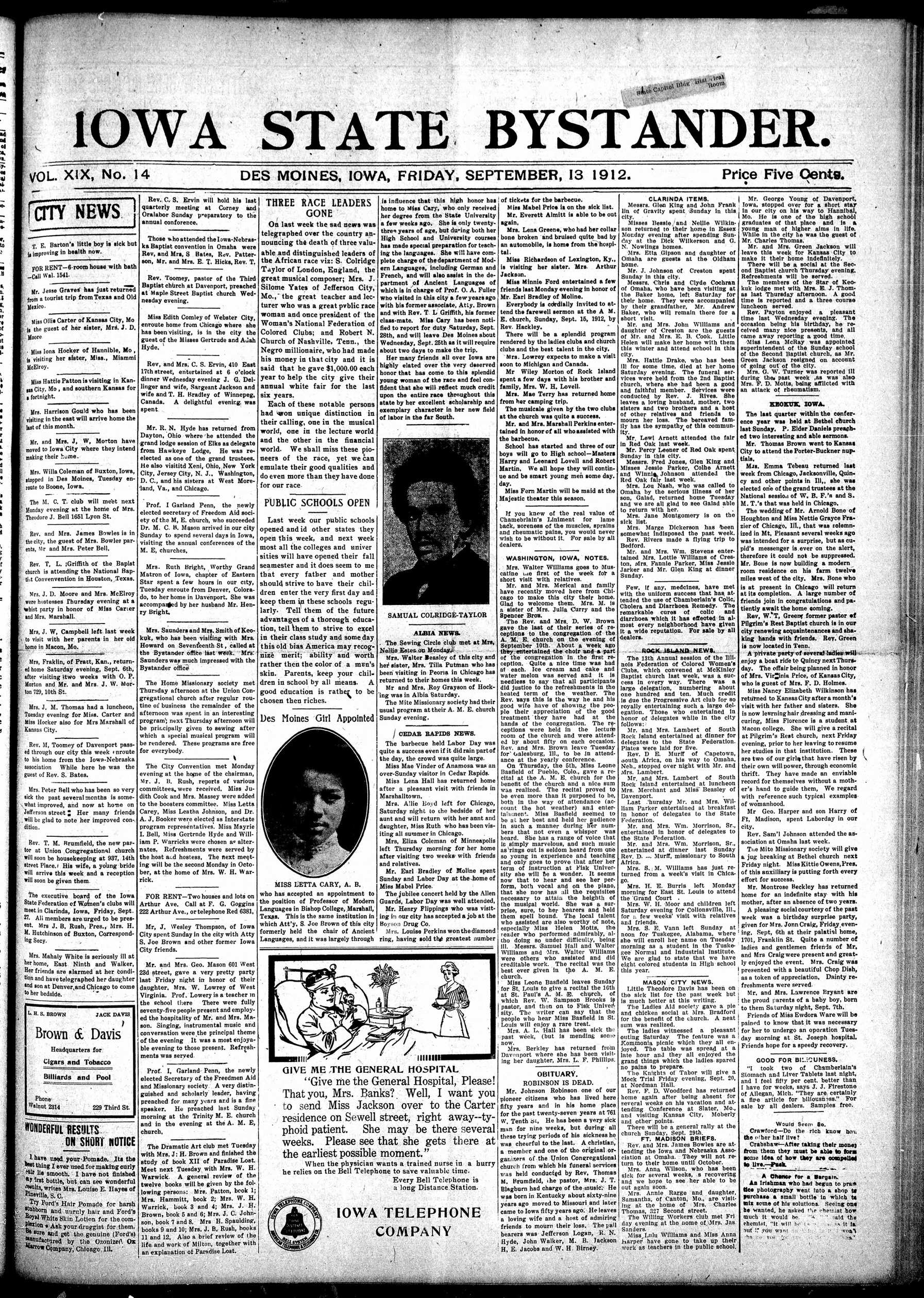
Page text (machine-generated)
IOWA STATE BYSTANDER.
VOL. XIX, No. 14
CITY NEWS
T. E. Barton's little boy is sick but is improving in health now.
FOR RENT—6-room house with bath—Call Wall. 1541.
Mr. Jesse Graves has just returned from a tourist trip from Texas and Old Mexico.
Miss Ollie Carter of Kansas City, Mo. is the guest of her sister, Mrs. J. D. Moore.
Miss Iona, Hocker of Hannible, Mo. is visiting her sister, Miss., Miammi McElroy.
Miss Hattie Patton is visiting in Kansas City, Mo. and southern Kansas for a fortnight.
Mrs. Harrison Gould who has been visiting in the east will arrive home the last of this month.
Mr. and Mrs. J, W, Morton have moved to Iowa City where they intend making their home.
Mrs. Willa Coleman of Buxton, Iowa, stopped in Des Moines, Tuesday enroute to Boone, Iowa.
The M. C. T. club will meet next Monday evening at the home of Mrs. Theodore J. Bell 1651 Lyon St.
Rev, and Mrs. James Bowles is in the city, the guest of Mrs. Bowles parents, Mr. and Mrs. Peter Bell.
Rev. T. L. Griffith of the Baptist church is attending the National Baptist Convenction in Houston, Texas.
Mrs. J. D. Moore and Mrs. McElroy were hostesses Thursday evening at a whist party in honor of Miss Carter and Mrs. Marshall.
Mrs. J. W. Campbell left last week to visit with her parents in her old home in Macon, Mo.
Mrs. Fraklin, of Pratt, Kan., returned home Saturday evening, Sept. 6th, after visiting it two weeks with O. P. Morton and Mr. and Mrs. J. W. Morton 729, 10th St.
Mrs. J. M. Thomas had a luncheon, Tuesday evening for Miss. Carter and Miss Hocker also for Mrs Marshall of Kansas City.
Rev. M. Toomey of Davenport passed through our city this week nroute to his home from the Iowa-Nebraska association While here he was the guest of Rev. S. Bates.
Mrs. Peter Bell who has been so very sick the past several months is somewhat improved, and now at home on Jefferson street. Her many friends will be glad to note her improved condition.
Rev. T. M. Brumfield, the new pastor at Union Congregational church will soon be housekeeping at 937, 14th Street Place. His wife, a young bride will arrive this week and a reception will soon be given them.
The executive board of the Iowa State Federation of Women's clubs will meet in Clarinda, Iowa, Friday, Sept. 27. All members are urged to be present. Mrs J. B. Rush, Pres., Mrs H. M. Hutchinson of Buxton, Corresponding Seey.
Mrs. Mahaly White is seriously ill at her home, East Ninth and Walker, Her friends are alarmed at her condition and have telegraphed her daughter and son at Denver, and Chicago to come to her bedside.
L. H. S. BROWN JACK DAVIS
Brown & Davis
Headquarters for
Cigars and Tobacco
Billiards and Pool
Phone
Walnut 2814 229 Third St.
WONDERFUL RESULTS
ON SHORT NOTICE
I have used your Pomade. Its the best thing I ever used for making early skin lie smooth. I have not finished my first bottle, but can see wonderful results, writes Mrs. Louise E. Hayes of Pineville, S.C.
Try Ford's Hair Pomade for harsh shibbob and unruly hair and Ford's Royal White Skin Lotion for the complication. Ask your drugstrict for them. Be sure and get the genuine (Ford's) manufactured by the Ozonizer Or Marrow Company, Chicago, Ill.
Rev. C. S. Ervin will hold his last quarterly meeting at Corney and Oralabor Sunday preparatory to the annual conference.
Those who attended the Iowa-Nebraska Baptist convention in Omaha were Rev, and Mrs. S Bates, Rev. Patterson, Mr. and Mrs. E. T. Hicks, Rev. T.
Rev. Toomey, pastor of the Third Baptist church at Davenport, prescheated at Maple Street Baptist church Wednesday evening.
Miss Edith Comley of Webster City, enroute home from Chicago where she has been visiting, is in the city the guest of the Misses Gertrude and Aiah Hyde.
Rev, and Mrs. C. S. Ervin, 410 East 17th street, entertained at 6 o'clock dinner Wednesday evening J. G. Dellinger and wife, Sargeant Jackson and wife and T. H. Bradley of Winnepeg, Canada. A delightful evening, was spent.
Mr. R. N. Hyde has returned from Dayton, Ohio where he attended the grand lodge session of Elks as delegate from Hawkeye Lodge. He was reelected as one of the grand trustees. He also visited Keni, Ohio, New York City, Jersey City, N. J., Washington, D. C., and his sisters at West Moreland, Va., and Chicago.
Prof. I Garland Penn, the newly elected secretary of Freedom Aid society of the M. E. church, who succeeded Dr. M. C. B. Mason arrived in our city Sunday to spend several days in Iowa, visiting the annual conferences of the M. E. churches.
Mrs. Ruth Bright, Worthy Grand Matron of Iowa, chapter of Eastern Star spent a few hours in our city, Tuesday enroute from Denver, Colorado, to her home in Davenport. She was accompanied by her husband Mr. Henry Bright.
Mrs. Saunders and Mrs. Smith of Keokuk, who has been visiting with Mrs. Howard on Seventeenth St., called at the Bystander office last week. Mrs. Saunders was much impressed with the Bystander office
The Home Missionary society met Thursday afternoon at the Union Congregational church after regular routine of business the remainder of the afternoon was spent in an interesting program; next Thursday afternoon will be principally given to sawing after which a special musical program will be rendered. These programs are free for everybody.
The City Convention met Monday evening at the home of the chairman, Mr. J. B. Rush, reports of various committees, were received. Miss Judith Cook and Mrs. Massey were added to the boosters committee. Miss Letta Carey, Miss Leatha Johnson, and Dr. A. J. Booker were elected as Interstate program representatives. Miss Mayrie I. Bell, Miss Gettrude Hye and William P. Warricks were chosen as alternates. Refreshments were served by the host a. d. hostess. The next meeting will be the second Monday in October, at the home of Mrs. W. H. Warrick.
FOR RENT—Two houses and lots on Arthur Ave. Call at F. G. Goggins 222 Arthur Ave., or telephone Red 6381.
Mr. J. Wesley Thompson, of Iowa City spent Sunday in the city with Atty S. Joe Brown and other former Iowa City friends.
Mr. and Mrs. Geo. Mason 601 West 29d street, gave a very pretty party last Friday night in honor of their daughter, Mrs. W. Lowrey of West Virginia. Prof. Lowery is a teacher in the school there. There were fully seventy-five people present and employed the hospitality of Mr. and Mrs. Maria. Singing, instrumental music and conversation were the principal theme of the evening. It was a most enjoyable evening to those present. Refreshments was served.
Prof. I, Garland Penn, the newly elected Secretary of the Freedman Aid and Missionary society. A very distinguished and scholarly leader, having preached for many years and is a fine speaker. He preached last Sunday morning at the Trinity M. E. church and in the evening at the A. M. E, church.
The Dramatic Art club met Tuesday with Mrs. J. H. Brown and finished the study of book XII of Paradise Lost. Meet next Tuesday with Mrs. W. H. Warwick. A general review of the twelve books will be given by the following persons: Mrs. Patton, book 1; Mrs. Hammitt, book 2; Mrs. W. H. Warrick, book 3 and 4; Mrs. J. H. Brown, book 5 and 6; Mrs. J. C. Johnson, book 7 and 8; Mrs. H. Spaulding, books 9 and 10; Mrs. J. B. Rush, books 11 and 12. Also a brief review of the life and work of Milton, together with an explanation of Paradise Lost.
DES MOINES, IOWA, FRIDAY, SEPTEMBER, 13 1912.
THREE RACE LEADERS
GONE
On last week the sad news was telegraphed over the country announcing the death of three valuable and distinguished leaders of the African race viz: S. Colridge Taylor of London, England, the great musical composer; Mrs. J. Silome Yates of Jefferson City, Mo., the great teacher and lecturer who was a great public race woman and once president of the Woman's National Federation of Colored Clubs; and Robert N. Church of Nashville, Tenn., the Negro millionaire, who had made his money in that city and it is said that he gave $1,000.00 each year to help the city give their annual white fair for the last six years.
Each of these notable persons had won unique distinction in their calling, one in the musical world, one in the lecture world and the other in the financial world. We shall miss these pioneers of the race, yet we can emulate their good qualities and do even more than they have done for our race.
PUBLIC SCHOOLS OPEN
Last week our public schools opened and id other states they open this week, and next week most all the colleges and universities will have opened their fall seamester and it does seem to me that every father and mother should strive to have their children enter the very first day and keep them in these schools regularly. Tell them of the future advantages of a thorough education, tell them to strive to excel in their class study and some day this old bias America may recognize merit; ability and worth rather then the color of a man's skin. Parents, keep your children in school by all means. A good education is rather to be chosen then riches.
Des Moines Girl Appointed
MISS LETTA CARY, A. B. who has accepted an appointment to the position of Professor of Modern Languages in Bishop College, Marshall, Texas. This is the same institution in which Att'y. S. Joe Brown of this city formerly held the chair of Ancient Languages, and it was largely through
THE GENERAL HOSPITAL
me the General Hospital, Please!
Mrs. Banks? Well, I want you
Miss Jackson over to the Carter
on Sewell street, right away--ty-
nt. She may be there several
please see that she gets there at
possible moment."
The physician wants a trained nurse in a hurry
Bell Telephone to save valuable time.
Every Bell Telephone is
a long Distance Station.
GIVE ME THE GENE
"Give me the C
That you, Mrs. Bar
to send Miss Jack
residence on Sewell
phoid patient. Sh
weeks. Please see
the earliest possible
When the physician
he relies on the Bell Telep
GIVE ME THE GENERAL HOSPITAL
"Give me the General Hospital, Please! That you, Mrs. Banks? Well, I want you to send Miss Jackson over to the Carter residence on Sewell street, right away--typhoid patient. She may be there several weeks. Please see that she gets there at the earliest possible moment."
When the physician wants a trained nurse in a hurry he relies on the Bell Telephone to save valuable time.
Every Bell Telephone is a long Distance Station.
IOWA TELEPHONE COMPANY
```markdown
```
MISS LETTA CARY. A. B.
IDAHO TELEPHONE COMPANY
MIDWAY
MIDWAY
MILL SYSTEM
TELEPHONE COMPANY
is influence that this high honor has home to Miss Cary, who only received her degree from the State University a few weeks ago. She is only twenty-three years of age, but diving both her High School and University courses has made special preparation for teaching the languages. She will have complete charge of the department of Modern Languages, including German and French, and will also assist in the department of Ancient Languages of which is in charge of Prof. O. A. Fuller who visited in this city a few years ago with his former associate, Atty. Brown and with Rev. T. L Griffith, his former class-mate. Miss Cary has been notified to report for duty Saturday, Sept. 28th, and will leave Des Moines about Wednesday, Sept. 25th as it will require about two days to make the trip.
Her many friends all over Iowa are highly elated over the very deserved honor that has come to this splendid young woman of the race and feel confident that she will reflect much credit upon the entire race throughout this state by her excellent scholarship and exemplary character in her new field of labor in the far South.
SAMUAL COLRIDGE-TAYLOR
ALBIA NEWS.
The Sewing Circle club met at Mrs. Nellie Eaten on Monday. Mrs. Walter Beasley of this city and her sister, Mrs. Tilla Puttman who has been visiting in Peoria in Chicago has returned to their homes this week.
Mr and Mrs. Roy Grayson of Hocking was in Albia Saturday. The Mite Missionary society had their usual program at their A. M. E. church Sunday evening.
CEDAR RAPIDS NEWS.
The barbecue held Labor Day was quite a success even if it did rain part of the day, the crowd was quite large.
Miss Mae Vinder of Anamosa was an over-Sunday visitor in Cedar Rapids. Miss Lena Hall has returned home after a pleasant visit with friends in Marshalltown. Miss Allie Boyd left for Chicago, Saturday night to the bedside of her aunt and will return with her aunt and daughter, Miss Ruth who has been visiting all summer in Chicago. Miss Eliza Coleman of Minneapolis left Thursday morning for her home after visiting two weeks with friends and relatives. Mr. Earl Bradley of Moline spent Sunday and Labor Day at the home of Miss Mabel Price. The jubilee concert held by the Allen Guards, Labor Day was well attended, Mr. Henry Flippings who was visiting in our city has accepted a job at the Boyson Drug Co. Mrs. Louise Perkins won the diamond ring, having sold the greatest number
of tickets for the barbecue.
Miss Mabel Price is on the sick list.
Mr. Everett Almitt is able to be out again.
Mrs. Lena Greene, who had her collar bone broken and bruised quite bad by an automobile, is home from the hospital.
Miss Richardson of Lexington, Ky., is visiting her sister. Mrs. Arthur Jackson.
Miss Minnie Ford entertained a few friends last Monday evening in honor of Mr. Earl Bradley of Molline.
Everybody is cordially invited to attend the farewell sermon at the A. M. e. church, Sunday, Sept. 15, 1912, by Rev. Hackley.
There will be a splendid program rendered by the ladies clubs and church clubs and the best talent in the city.
Mrs. Lowrey expects to make a visit soon to Michigan and Canada. Mr Wiley Morton of Rock Island spent a few days with his brother and family, Mrs. W. H. Lovell. Mrs. Mae Terry has returned home from her camping trip.
The musicale given by the two clubs at the church was quite a success.
Mr. and Mrs. Marshall Perkins entertained in honor of all who assisted with the barbecue.
School has started and three of our boys will go to High school—Masters Harry and Leenard Lovell and Robert Martin. We all hope they will continue and be smart young men some day, day.
Miss Fern Martin will be maid at the Majestic theater this season.
If you knew of the real value of Chameblain's Lhiment for lame back, soreness of the muscles, sprains in humeric palms, you would never wish to be without it. For sale by all dealers.
WASHINGTON, IOWA.
Mrs. Walter Williams goes to Muscatine the first of the week for a short visit with relatives.
Mr. and Mrs. Merical and family have recently moved here from Chicago to make this city their home. Glad to welcome them. Mrs. M. is a sister of Mrs. Julia Curry and the Spencer Bros.
The Rev. and Mrs. D. W. Brown gave the last of their series of receptions to the congregation of the A. M. E. church on the evening of September 10th. About a week ago they entertained the choir and a part of the congregation in the first reception. Quite a nice time was had at each. Ice cream and cake and water melon was served and it is needless to say that all participants did justice to the refreshments in the heated term of the weather. The Rev. says this is the way he and his good wife have of showing the people their appreciation of the good treatment they have had at the hands of the congregation. The reception were held in the lecture room of the church and were attended by about fifty on each occasion. Rev. and Mrs. Brown leave Tuesday for Galesburg, Ill., to be in attendance at the yearly conference.
On Thursday, the 5th, Miss Leone Basfield of Pueblo, Colo., gave a recital at the A. M. E. church for the benefit of the church and a nice sum was realized. The recital proved to be even more important to the public than to the people who of attendance (account the hot weather) and an entertainer. Miss Basfield seemed to be at her best and held her guidance in such a manner during her numbers that not even a whisper was heard. She has a range of voice that is more natural and more natural than is the words out is seldom heard from one so young in experience and teaching and only goes to prove that after her term of Instruction at Fisk University she will be a wonder. It seems now that to hear and see her perform, both vocal and on the piano, that she is not more natural than she is. Miss Leone has the necessary to attain the height of the musical world. She was a surprise, sure, to her hearers and held them spell bound. The local talent who assisted are also worthy of note, especially Miss Helen Mottis, the reader who performed admirably, the author of the first of his works, the first of the first of his works. Messrs. Samuel Hall and Walter Williams and Mrs. Walter Williams were others who assisted and did creditable work. The recital was the best ever given in the A. M. E. church.
Miss Leone Basfield leaves Sunday from 5 p.m. to 11 p.m. to give a recital the 16th at St. Paul's A. M. E. church, of which Rev. W. Sampson Brooks is pastor, and then on to Fisk University. The writer can say that the people who hear Miss Basfield in St. Louis will enjoy a rare treat.
Mrs. A. L. Hall has been sick the past week, (but is mending some new things.)
Mrs. Berkley has returned from Davenport where she has been visiting her daughter, Mrs. L. F. Phillips.
OBITUARY
ROBINSON IS DEAD
Mr. Johnson Robinson one of our pioneer citizens who has lived here fifty years and in his home place for the past twenty-seven years at 761 W. Tenth St. He has been a very sick man for nine weeks, but during all these trying periods of his sickness he was cheerful to the last. A christian, a member and one of the original organizers of the Union Congregational church from which his funeral services was held conducted by Rev, Thomas M. Brumfield, the pastor, Mrs. J. T. Blagburn had charge of the music. He was born in Kentucky about sixty-nine years ago moved to Missouri and later came to Iowa fifty years ago. He leaves a loving wife and a host of admiring friends to mourn their loss. The pall bearers was Jefferson Logan, R. N. Hyde, John Walker, M. B. Jackson H. E. Jacobs and W. H. Birney.
CLARINDA ITEMS.
Messrs. Glen King and John Frank
lin of Gravity spent Sunday in this
city.
Messrs. Bessie and Neill Wilkinson
returned to their home in Essex
Monday evening after spending Sunday
at the Dick Wilkerson and G. N.
Nowlings homes.
Mrs. Ett Gipson and daughter of
Omma are guests at the Oldham
home.
Mr. J. Johnson of Creston spent
Sunday in this city.
Messrs. Chris and Clyde Cochran
of Omma are been visiting at
the Baker home, left Saturday
for their home. They were accompanied
by their grandfather, Mr. Andrew
Baker, who will remain there for a
shake up.
Mr. and Mrs. John Williams and
daughter of Creston are the guests
of Mr. and Mrs. E. B. Cook. Little
Helen will make her home with them
this winter and attend school in this
city.
Miss Hattie Drake, who has been
ill for some time, died at her home
Saturday evening. The funeral services
were held from the 2nd Baptist
house, where she is the last and faithful member. Services were
conducted by Rev. J. Rives. She leaves a loving husband, mother, two
sisters and two brothers and a host of other relatives and friends. She
has the sympathy of the community.
Mr. Lewl Attnett attended the fair
in Red Oak last week.
Mr. Lewl Attnett of Red Oak spent
Sunday in this city.
Messrs. Fred Jones, Glen King and Misses Jesse Parker, Colleh Arnett and Winnie Johnson attended the Red Oak falr last week.
Mrs. Lou Nash, who was called to Olivia's second illness of her son, returned home Tuesday and we are all glad to Galad able to return with her.
Mrs. Jane Montgomery is on the slick list.
Maryge Dickerson has been somewhat indisposed the past week. Rev. Rivers made a flying trip to Bedford.
Mr. and Mrs. Wm. Stevens entertained Mrs. Lottie Williams of Creston, Mrs. Fannie Parker, Miss Jesse Jarker and Mr. Glen King at dinner Sunday.
Few, if any, medicines, have met with the uniform success that has attended the use of Chamberlain's Colic, Cholera and Diarrhoea Remedy. The remarkable cures of and most of the every neighborhood have given it a wide reputation. For sale by all dealers.
ROCK ISLAND NEWS
The 13th Annual session of the Illinois Federation of Colored Women's Clubs, which convened at McKinley Baptist church last week, was a success. One way, that is, the delegation number, about one hundred and ten. Much credit is due the Progressive Art club for royally entertaining such a large delegation. Those who entertained in honor of delegates while in the city for football, Mr. and Mrs. Lambert of South Rock Island entertained at dinner for delegates to the State Federation. Plates were laid for five. Rev. D. E. Murh of Capetown, Sr. of Erie his wife to Onaha, Neb. stopped over night with Mr. and Mrs. Lambert. Mr. and Mrs. Lambert of South Rock Island entertained at luncheon Mrs. Merchant and Miss Beasley of Davenport. Mr. and Mrs. Lambert of Saturday Mr. and Mrs. William Parker entertained at breakfast in honor of delegates to the State Federation. Mr. and Mrs. Wm. Morrison, Sr., entertained his wife of delegates to the Federation. Mr. and Mrs. Wm. Morrison, Sr., entertained at dinner last Sunday Rev. D. ... Murf, missionary to South Africa. Mrs. S. ... M. Williams has just returned from a week's visit in Chicago. Mrs. H. E. Burris left Monday morning for East St. Louis to attend the Grand Court. Mrs. W. H. Moor and children left Saturday evening for Colonville, Ill. for three weeks' visit with relatives and friends.
Mrs. S. E. Vann left Sunday at noon for Tuskegee, Alabama, where she will spend the morning as a student in the Tuskegee Normal and Industrial Institute. We are glad to state that we have enrolled students in High school this year.
MASON CITY NEWS
Little Theodore Davis has been on the sick list for the past week but is much better at this writing. He attended a pie and chicken social at Mrs. Bradford for the benefit of the church. A neat sum was realized. The ladies witnessed a pleasant outing Saturday. The feature was a celebration they all enjoyed. The table was spread at a late hour and they all enjoyed the grand things which the ladies spared no pain to prepare. The guest will give a Mock Trial Friday evening, Sept. 20, at Nordman Hall. Rev. F. D. Woodford has returned home again after being absent for several weeks on his vacation and on vacation with his sister. and visiting Kansas City, Moberly and other points. There will be a general rally at the church Sunday, Sept. 29th. Rev. and Mrs. James Bowles are attending the Iowa and Nebraska Association at Omaha. They will not return to their home until October. Mrs. Anna Wilson who has been visiting San Antonio is covering and we hope to see her able to be out again soon. Mrs. Annie Rarge and daughter, Samantha, of Canton, Mo., are visiting San Antonio. Mrs. Charles Thomas, 227 Second club. The Willing Workers club met Friday evening at the name of Mrs. Jas Sanders. Mrs. Julia Williams and Mrs Annaanner have gone to take up their work as teachers in the public school,
---
Price Five Cents.
Frank, Mr. George Young of Davenport, lowly student of Davenport, in our city on his way to Hannahs Mo. He is one of the high school graduates of that place and is a Saxs young man of higher alms in life. Sunny life in the city he was the guest of d. G. Mr. Charles Thomas.
Mr. and Mrs. Green Jackson will leave this week for Kansas City to make it their home indefinitely.
There will be a social at the Second Baptist church Thursday evening, Refreshments will be served.
The members of the Star of Keokuk lodge met with Mrs. E. J. Thomas last Thursday afternoon. A good time is reported and a three course luncheon served.
Rev. Payton enjoyed a pleasant time last Wednesday evening. The occasion being his birthday, he received many nice presents, and all came away reporting a good time.
Miss Lena McRay was appointed superintendent of the Sunday school of the Second Baptist church, as Mr. Green Jackson resigned on account of going out of the city.
Mrs. G. W. Turner was reported ill during the past week, as was also Mrs. F. D. Motts, being afflicted with an attack of rheumatism.
KEOKUK IOWA
The last quarter within the conference year was held at Bethel church last Sunday. P. Elder Daniels preached two interesting and able sermons. Mr. Thomas Brown went to Kansas City to attend the Porter-Bucker nuptials. Ms. Emma Teebau returned last week from Chicago, Jacksonville, Quincy and other points in Ill., she was elected one of the grand trustees at the National session of W. B. F.'s and S. M. T.'s that was held in Chicago. The wedding of Mr. Arnold Bone of Houghton and Miss Nettie Graye Frazier of Chicago, Ill., that was solemnized in Mt. Pleasant several weeks ago was intended for a surprise, but as cupid's messenger is ever on the alert, therefore it could not be suppressed. Mr. Bone is now building a modern room residence on his farm twelve miles west of the city. Mrs. Bone who is at present in Chicago will return at its completion. A large number of friends join in congratulations and patiently await the home coming. Rev. W. T. Green, former pastor of Pilgrim's Rest Baptist church is in our city renewing acquaintances and shaking hands with friends. Rev. Green is now located in Tenn.
A private party of several ladies will enjoy a boat ride to Quincy next Thursday. The affair being planned in honor of Mrs. Virgina Price, of Kansas City, who is guest of Mrs. F. D. Holmes.
Miss Nancy Elizabeth Wilkinson has returned to Kansas City after a month's visit with her father and sisters. She is now leavening hair dressing and manicuring. Miss Florence is a student at Macon college. She will give a recital at Pilgrim's Reat church, next Friday evening, prior to her leaving to resume her studies in that institution. These are two of our girls that have risen by their own will power, through economic thrift. They have made an enviable record for themselves without a mother's hand to guide them. We regard with reference such typical examples of womanhood. Mr. Gear Harper and son Harry of Ft. Madison, spent Laborday in our city. Rev. Sam'l Johnson attended the association at Omaha last week. The Mite Missionary society will give a jug breaking at Bethel church next Friday night. Miss Kittie Owens, Pres. of this auxiliary is putting forth every effort for success. Mr. Montrose Beckley has returned home for an indefinite stay with his mother, after an absence of two years. A pleasing social courtesy of the past week was a birthday surprise party, given for Mrs. John Craig, Friday, evening, Sept. 6th at their palatial home, 1701 Franklin St. Quite a number of ladies and gentlemen friends of Mr. and Mrs Craig were present and greatly enjoyed the event. Mrs. Craig was presented with a beautiful Chop Dish, as a token of appreciation, Dainty refreshments were served.
Mr. and Mrs. Lawrence Bryant are the proud parents of a baby boy, born to them Saturday night, Sept. 7th. Friends of Miss Ewdora Ware will be pained to know that it was necessary for her to undergo an operation Tuesday morning at St. Joseph hospital, Friends hope for a speedy recovery.
GOOD FOR BILIGUNESS.
"I took two of Chamberlain's Stomach and Liver Tablets last night, and I feel fifty per cent. better than I have for weeks, says J. Frenkel. "We are friendly, a family a fire sale for billions." For sale by all dealers. Samples free.
Would Seem So
Crawford—Do the rich know how
the other half live?
Crabshaw—After taking their money from them they must be able to form some idea of how they are compelled to live—Push
A Chance for a Bargain
An Irishman who had begun to practice photography went into a shop to purchase a small bottle in which to mix some of his solutions. Seeing one he wanted, he asked the chemist how much it would be. He said the chemist, "it will be $100" and it in out if you want to buy it now but if you want to buy it later you can do so."
lowa S.ate Bystana-.
BYSTANDER PUB, CO., Publishers,
DES MOINES, - + + IOWA
—
‘LIVE LIFE OF THE BEASTS
‘With Bad Harvests for Ten Years
V'iberian Settler Barely te Able
eee
tn epite of glowing ofc! = re
ports the Siberian colonists seen
to be far removed from Elysium,
writes @ St, Petersburgh correspond
‘ent of the New York World. The
private societies which sent mex
‘out to report give sad acocunts of
‘settlers’ troubles,
‘Most of them arrive with nothing
‘ut the $50 government — capital
‘which they eat up before they cal
reap their harvest or build cottages
Most of thom live in mud huts and
barely 15. per cent Rave either
plow or @ horse aftar they have bees
there two years. Neither havo they
Knowledge of farming, being mostly
workmen trom overcrowded indus
trial centers, driven from one life of
penury to another,
‘Natives and older settlers are hos
tile and make newcomers pay ex
horbitant prices for bare necessities
To add to thelr misery they get only
an average of four good harvests
each ten years, Siberian climate be
ing what {t 1s. Eight months’ win
ter means somistarvation for all. Tho
short summer 1s taken up with su
perhuman efforts to gather in grain
and fodder amidst terrible pests, the
Siberian Sy and the mosquito.
‘Though each male head of a tam
Uy gets a government grant of be
twen twenty-seven and forty scres
scarcely one-third 1s fit for imme
late cultivation. In many villages tn
tho Irkutak government people were
found sunk in the most terrible pov:
erty, having nelther plows, cattle nor
clothes. They ~ lived more lke
Deaste than men, on potatoos with:
out salt in summer and coarse marsh
grass in ‘the winter.
‘When questioned, the poorest of
them sald, however, that they pre
ferred their present misery to
what they bore as factory hands in
Europeon Russia. What must that
Save teen!
American Air Death Rate.
‘Twenty-five per cent. of the fatal
aeroplane accidents are due to the
Jack of ability of the pilots of the ma-
chines, in the opinion of Major Roche
of the French army aviation corps. He
classifies the causes of accidents un-
der seven general heads. About one:
third of the accidents, says Popular
Mechanics, he finds to have been
caused by faulty construction of the
machines, which the French critle dt-
vides under two heads. Lack of proper
rigility and solidity of construction,
he belleves, causes collapse of about
20 per cent. of the machines that fall,
and 13 per cent. break bpcause of
radical errors of tonstruction. Acro-
atic displays in the alr claim 6 per
cent. of the victims, he states; 10 to
12 per cent. lose their lives through
unfavorable conditions of the atmos-
phere; lack of presence of mind
causes 6 per cent, and 13 per cent. are
die to tmproper education of the
pilots, while no cause ts ascribed for
the remaining 6 per cent. of fatalities.
Great Sculptor’s Masterpiece.
A replica by Rodin of his statue of
“La Danaide” has been purchased by
the Brooklyn museum and will form a
part of {ts permanent collection. The
‘subject, though tragical one, fs ten-
erly treated. The Danaldes, it will
‘be yemembered, were condemned to
pour water everlastingly into a sleve,
‘and the statue embodies in a woman's
prostrate figure the endless tragedk
‘of a wasted life. A Frenchman de-
scribes the statue as “one of the most
tender female figures that was ever
lovingly molded by this sculptor of
the energetic.”
aT RS 2
Te is possible to say of Emerson, as
bo said of almself, that his sontences
are mutually repellant particles—that
he has re construction; of Dickens
that ke runs too much to external
tage for character; of Jane Auscen
‘that her stage 1s small; of Scott that
he-is careless and long; even of
Shakespeare that he 1s uneven, cares
nothing for the spiritual unity of
tho universe, and sees life only as a
punorama. And when you have sald
ail these things you have said noth-
ing. You have not appreached the
thing that makes Emerson, or Dick-
ens, or Shakespeare; tho different-
‘ness from the rest of us; the slzo;
the greatness: the glft, that fs all—
Collier's Weekly.
A Sure Sign.
“ow do you lke your new nelgh-
bor?”
“He's rather restful; but there's no
‘way forme to learn whether he ts a
‘wise man or a fool.”
“How's that?”
“He keeps his mouth shut so tight
ay"
“He's « wise man.”
‘The Reason.
Smart, meeting Slack at the postof-
fice the other day, remarked:
“Bo poor old Stamps, the postman,
thas got the sack.”
Slack—What on earth for?
Smart—For carrying letters—Tit-
Bits.
Ne aa
|. First week-end guest—Would you
‘ask our hostess to lend us a motor?
‘Becond weak-end guest—Good heav-
‘ens, no! Y'4 as soon think of asking
hher for a pleco of string —Lite,
Humitiating.
| Mra, Tingle—They say that Mrs,
Nenurich ia becoming more proper ev.
‘ery day.
‘Mrs. Dimple—Yes, indeed; you
‘vila Have ‘seen how mortified she
‘was while ago when she learned
that her husband owned common
‘stock in » raslrond.—Satire.
| Improved. Soldering tron.
} A soldering fron, heated by a Jet
‘within tho polnt fed from s gasoline
tank op the bandle, 1s’ recent ‘n-
‘rentlon. ‘
Obtain Loans Through Co-Oper-
ative Credit System.
Ambassador Curtle Guild at St. Peters:
burg Sends to State Department
Exhaustive Report on Plan
6. 0) Aidapeed ta That Country,
| washegton—ven ta remote sine
sia and Tarvestan baa the farmers co
perative eredit system reared & Anan
cha fabric to assiat the Dossant farm:
trof the Ruslan caars domain, The
State ‘department ‘has just recelved
from Amnvsador Curtis Gulla at St
Petersburg an edhauative report on
the Tarmera" cooperative credit aye
tem fo Rovela,
‘This te the frat of a serlen of re
ports requested by. President. Taft
| from nearly sree: ‘one of the diplo-
| matle omeers tn'urope on thie move:
[iment which he ie wring ttre:
plant to thie country for the boned of
jie ‘American. farmer.
"At the present tne tho Russlan gov-
get a ary tory os of
dolias of government money Invested
in the farmers’ co-operative credit 6ya-
tem.” How estabilsued a part of the
| Russian peasant’s life this financial
| Retaii dbesmlog lacey shows
In the practice of the peasants to de.
posit thelr savings withthe credit 99.
Tletien om the understanding thatthe
depontte will be paid out ter thelr
Genth for thelr funeral expenses oF
that they will be returned to them at
the time ofthe coming of age of «san
or tho marriage of a dauater
| ‘The co-operative movement among
Russian peanunte has now developed
[fro anunct aime: First, to educate
the pansanta, a large proportion of
| whom are gutesiilterate, along the
|iineo of modern farming: aud, second:
liv, to encourage them to save felt
tarninge and acqulre the habit of pro
Slaing’agaipat tho rainy days. The
| izect alm of the Russian government
fn organizing thle system wan to re
‘Heve the peasant from tW® necessity
_of paying exorbitant and ruinous rates
of interest: mpoeed upon them DY
hele monty lendars
| tho movement afords further ed
| cation for the peasant since tho Rus
tian government has very wisely To
the management ofthe socletien large
Iy in the hands of tho farmors (hem
| tuven conducted through the goneral
| mectingn of tho soctetis, in wich ev
jery member of the society is given
fue vote. The pessant is thus given
| onaldercble experience nancial
| Staite and menagemont, The. mem
| bore elect aboard ot rectors and a
| council: "These bodles. take. care of
[eM ner. ney weer
the general meetings of the soctetles,
[at whic all tho members are prevent.
| The government exercises supervision
| Grer the noctttes through the als:
fry of nance.
[Although nated ot a 285,
na movement hae spread in Russia to
felade ten thousand farmers" aoco.
tas ‘rth an average mombership In
| cach ‘oclety of nearly five hundred
The network of rctetio covers\prac.
Geaiy the entire immense area of the
Russan empire, Widespread interest
Bituten fa the movement bom by te
Rowulan government and by the pase
To chi’ de. government Ie a¢ the
preeat time considering a further ela
Tration of te athone,
im aludying the Russian cooparative
credit ayatens from the vlewpolat ot
| fhe ‘american “farmer, “Ambassador
| Guila finds that naturally the great
| Giterence' obtaiatng between. cond!
fiour in the United States end in Ru.
Martin rererd to the amount of land
farmed by individuals, the system of
Hand ‘tene, tbe wealth of the farm
|g’ clas, ad tn tho general faclKty
for borrowing money, makes i impos
tibte for thie country to secure mich
Benen from a study ot the. Russian
enter boyond tte general principee
ror example, the average 1on0 re
aquited by the tarmer tn Russia, does
Sot oxceed $50 and Te gonerally em
loved to purchase some sic neces
reveas tie moment evch a an Agr
altura implament or a tore, the
fan betag vepala hy the Russian fa
‘eer lnomedietaly after the harvest. Of
Course, the American, farmer, who
work a much larger acreage, would
Zoually nocd more money std louget
lime. "He would roquire hie oan, Bot
fo mich for the moment's exigency, aa
forthe gradual developasnt ofa
property.
bret, Ambassador Gulld reports
tne Runslan system to bo an Insts
Uo "ot cooperative. loan -sccetis
tiong the Iarmers, conducted under
foverimental patronage 0d tupervi
Sn'by wbleh the farmer, st n0 cost
tebineall ia given, the’ benedt ot
leans trom is society on long. tine
tea tty terms, and, at the same time,
{uipermitia to sharo In bls society's
prose.
KEEPS VOW TO BAR WHIP,
Forty years ago little Willie Wilson
was late for school at Blantyde, In
Scotland, and the schoolmaster sound-
ly thrashed him for it. That day
Willie took an oath that when be
got to parliament he would pass a
Inw,making such behavior on the
part of teachers a penal offense. He
never went to parliament, but in the
house of representatives he took steps
to make good his oath,
‘As a representative from the Fit
teenth Pennsylvania district, he
ropped in the speaker's basket a bill
making corporal punishment in the
District of Columbia a serious offense.
eat file tena
“Why did you prohibit jewelry at
the meetings of your bridge club?” “It
Decame too easy to signal for trumps.
Nearly every one of the players wore
heart-shaped pendant, a solitaire
diamond, a marquise ring that looked
Ike spade and a cloverleat brooch.”
Oll-Btained Carpets, —
To take oll stains out of carpets
spread the solled paris thickly with
‘a paste made of fuller's earth and cold
water. Allow st to dry, and then re-
move with a stiff brush.
SENATORS GRT CANNON.
‘The sonate demanded cannon—and
got them. “There were cannon to the
right of them, cannon to the left of
them, cannon ahead of them, but the
only “volleying and thundering” that
‘was done was the thundering of tn
Alvidual senators for more cannon, ‘All
of the troubles of the waning session
wore forgotten in the getting of tha
guns.
Senator O'Gorman caused the trop:
ble when he called up a bill granting
condemned cannon to half hundred
towns throughout the country, to be
placed in public squares, the grounds
ot publi buildings and about state
armories, No sooner had the bill beep
read than there arose a chorus, of
"Mr. President!" from the floor. Sen:
ator Jones of Washington got cannon
for half dozen towns in his state.
Senator Pomerene of Ohio was grant
ed one gun. Senator Catron of New
Mexico got two. Finally John Sharp
‘Williams arose and drawled:
"Tra ke a cannon for some place in
Misslasipp! to be designated later.”
“There won't be enough cannon to
g0 round,” remarked Senator Martine.
“We want to shoot some down in
Kentucky," declared Senator Bradley.
“Two cannon, suitably trimmed, for
Lancaster, Ky." read the clerk,
“Didn't say 1 wanted them trim-
med?" sald Bradley, but he accepted
the “outfit of cannon balls” when the
term was explained.
‘The bill fnally disposed of some 105
cennon.
BIG BARGAIN SALE,
‘The biggest bargain sale of machin:
ery in bistory ts promised upon the
completion of the Panama canal. To
Aispose of machinery costing more
than $15,000,000 is the problem con
fronting government authorities when
the canal is opened. 2
Although understood in a general
way, Colonel Goethals, superintendent
of the canal work, reports actual fis
ures of machinery bought since the
United States began digging the “big
ditch.” Here are a few of the pri
cipal Items, Steam shovels, 102; cars,
4,181; locomotives, 189; rock drills,
725; cranes, 79; dredges, 14; barges
4
Many of the locomotives and cara
will be usoful in operating the canal
and the Panama railroad, but most of
the dredges, steam shovels and moun
tains of other steel Implements will bo
put on the block for sale.
‘Secretary of the Interior Fisher has
suggested tho plan of transferring
much of the discarded machinery to
‘Alaska for uso in constructing a gov:
ernment rallroad to the Interior of
that- territory. If congress does not
authorize the federal rallway in Alas
ka, however, most of the Panama ma
chinery will be sold for the best price
it will bring.
WANTED ARTIFICIAL LEGS.
Charles Mitchell, a Polish miner
who lost his legs in a West Virginia
mine several months ago, came here
tho other day to get a pair of artificial
legs. He was told by a friend In West
Virginia that Congressmen had wood:
en legs, garden seeds, bulletins and
other things to’ give away. Upon be-
ing advised that artifictal limbs are
not to bo had at the Capitol for the
asking, Mitchell became downcast. Ho
was sent to a public lodging house by
police officers.
‘When told of the West Virginia erip-
ple Sam Pollard, the legless pencil
vendor on Pensylvania avenue, sald:
“There Js but one way to get IT in
Washington, and that {8 work for It.
Fifteen years ago I was run over by
fa steam boat and had both legs cut
off, but 1 am etill ving. No congress.
man ever offered me a pair of wooden
legs.”
‘TURKEYS FOR ARMY WORMS.
From a farmer at Groveland, Ga..
came a tip to congress of a way to rid
the south of the army worm.
‘M. M. Kieklighter wrote a letter, in
red Ink throughout, to the "House or
Senate,” telling of bis discovery.
“1 saw your advertisement in the At-
tanta paper for ald to check the army
worms,” It began. “I had ten acres of
corn and the army worms had just
started in. I drove my turkeys in my
field and they ate the army worms up
In two days, and if {t had not been for
my turkeys I would have lost 600
bushels of corn by those worms.
“go please send meacheck for sald
amount, for that 18 the only way to
destroy the army worme.”
Congress recently appropriated §25,-
000 to eliminate the worm.
MUST LAY LARGER EGGs.
Poultry experts in the department
of agriculture have undertaken to
teach the farmera of the country how
to save about $50,000,000 on cess &
year.
“Ic ts a conservative estimate,” eald
Mt. B. Pennington of the poultry di
violon of the department, “that more
than $45,000,000 are Tost ‘annually by
the handling of eggs for the market”
"Among other things the department
experts will urge the farmers to en-
courage thelr hens to lay larger exes.
and lese sterifo eggs for market pur
pores.
By the cooperation of the farmer
and the ben, Mr. Pennington argues,
the cost of iiving ‘can be lowered to
the average max, If the $45,000,000 or
$50,000,000 now lost annually can be
teved every man, Woman and child tn
the United States will be at least 60
cents Detter off.
Healthy Palme.
‘Am oltve off bath is an oxcellont
thing for palm or fern. Pour two
tablespoontuls of olive oll at the root
of your plant about once a month.
You will immediately note the difer:
ence in the plant.’ Tt becomes a
healthy green and tho leaves fatrly
sparkle in Ahe light, It your plant ts
smi, you will not need so much ofl
PSE AIR EEE Say
‘China uses millions of pounds at
old newspapers, - chiefly British, as
wall paper for houses and cottages.
MRS, CORNWALLIS-WEST'S
UNUSUAL INSPIRATION
1s the spirit of Wiliam Shakapeare
sulting tho hand and: brain of Mra
Cornvalle-West—
London woctety fe
orlte and creator
ind. manager, of
fe vondertul
eBhakepesres
: England reatival
y helt sat, Berle
SY | count
{ | “hie ts generat
gp’ | ty believed to be
| true by London.
| ers, who declare
Bs that no woman
S| ike “Mee “west,
Uke Mrs. West,
,
‘clety & vocation instead of the amuse-
‘ment business, could possibly show
the genius in’ management and the
‘business ability to put on what 1s no
doubt one of the biggest single amuse-
ment projects ever witnessed In Eng:
land.
‘That the Bard of Avon has influ
enced this woman successfully to car
ry ut the festival that doom honor to
hla memory ie belleved by all but the
most skeptical who have seen the ex:
hibition
It Bhakspeare's aptett dld not inf
‘ence Mra, Weal, what accounts for her
‘sudden Inspiration to stage the ple-
‘turesque scenes of Ellzabethan Eng:
land at the cost of hundreds of thow-
‘sands of dollars,
Olving up her social dutles and
[working nine hours each day and
many extra nights organizing the bis
‘show on speculation.
"Superintending the construction of
the buildings of that perlod.
~"Poring over works ‘of history and
‘devoting days upon days to the de-
‘signing of certain costumes in order to
have the smallest detail historically
correct.
“Leaving Mayfair and tho brilliant
court of St, James after a lite of idle
luxury and plunging tnto hard labor
‘And, above all, ehowing a genius in
‘the work which in said by experts to
bbe worthy of the great poet himself.
Mra, West displayed “such splendid
nla that many of her rlends and
fcquaintances belleve that even with
‘the knowledge of English history she
hhas she could not have revived those
days of Ults and jouste with such ac
curacy an she has shown.
The afory 18 most mysterious be
cause Mra, West will nelther deny nor
confirm it. This much, however, 1s
known: , She spent monthe wandering
over every Inch of the ground with Its
ivy.grown cottages and gay gardens
that was beloved by the great Eng
ish poet; she spent hours vielting the
homes in whleh he once lived and
then took her books and read, and
meditated and talked Shakspeare with
‘everybody who loves the great English
‘dramatist and hie works. It ts. sald
that when her work was completed
fand she went back to London prior
to the pageant, Marle Corelll sald to
her: “It will be a wonderful success,
Tt must be, for Shakspeare will bo
with you at the pageant and will di
rect the show, If you follow hls in
struction you ‘will’ be well rewarded,
for he will not leave you atter the
Pageant Is over. He is with many
‘reat writers, inspiring .them to do
thelr best, and he will remain with
you. If it were not for his great ge
infus and that of others who have gone
to the great unknown there would be
few writers in the world today. It Is
Shakspeare and the lesser lights who
have Inspired me and others to do
thelr best.”
Since everybody 18 congratulating
Mra, West on her splendid success,
she cannot forget the words that Mfa-
He Corel! spoke to: her. She Is be
sinning to wonder if there 1s some
halt trath in theae words, and that she
may yet be aided to do great works
acon i leap
FRANZ JOSEF ASKS POPE
TO STOP TURKISH WAR
In a personal letter, penned with
ds san ek te kd ere
Franz Josef has
made an appeal
to Pope Plus to
urge intervention
between Italy and
Turkey and bring
about the close of
‘a war which bis
imperial majesty
describes as a
grave danger to
the progress of
civilization, “In-
stead of weaken-
ing Mohametan-
a ae ca
Ke os made an appeal
fe, AL | to Pope Plus to
ie Ate urge Intervention
‘- between Italy and
$Afe py | Tonto an bine
Reef) Teste and eae
| & war woten bis
Be imperial majesty
SUR ies
. ee
re tes the progress of
NORE TGy| civmzation, te
PRT Yee) stead of weaken:
| GM tne Monametan.
[ae
foes Ge anes Shien ie Se
weSiilne tates “outaat" ontatee
the world over, Mordlly it has been
Penta
Fe i scavarea mi
a Pca oes Soreret tt pees
coe ae ee
Seer tae 2 a Da
seit ta cote to tas ene
Seine ae oenion sats ae
aloes ce we chelsea
Se ene ees ‘see
fag ets ees ee
Beattie atte ema e
fos San sevenaie ot ate BE
Shera aia “tes nee wes
aE erg ere
eee ee ee as
visitor. s
Frese Gain
raiser Se sar at
es Se
Sia sire apetaa
Fee ET cine
ies caren ae
as
a
Father—“You seem to have no {dea
fof the value of money.” Son—'"No {dea.
Why, dad, I can mention a hundred dit-
erent ways of spending money you
‘never dreamed of.’—Boston ‘Tran-
serlpt.
ines da Matick: bala Thee
“Don't you feel sometimes like you'd
Mke to be a bird?” sald Miss Miami
Brown, sentimentally. “I specs meb-
bo I wouldn't mind,” replied Erastus
Pinkley, “if I oowld be @ chicken
‘aawk.”
SENORA PEZET, WIFE
OF PERUVIAN MINISTER
‘The Minister from Peru and. bis
charming wite endsanachave gapeited’
S.gordial welcome
on tholr second
coming to Wash-
ington, Mr. Pezet
was frat. sccre
tary of the Peru:
vien Legation for
five years and
lett Washington
In 1900 to become
minister to the re
public of Central
America. He ald
not sever his ties
of friendship. but
BE en en nga
3 %
years has kept up ® brisk correspond
ence with many Washingtonians,
When bis only son, called George
‘Washington Peset, decause he was
born on February 22, and because his
Parents are fervent admirers of, the
great neighbor to the north and its
founder, was of college’ age he was
placed at Harvard, where two years
‘ago he graduated ‘with high honors,
Young Mr, Pezet has since resided
In Boston intending to take up litera
ture as a profession.
“I return to Washington," remark
ed Senora Pézet, “as one comes back
to a dearly” loved spot filled with
pleasant memorles, I find the city
changed but not sufficiently so to
make me feel strange except tn a few
locations. In a way I feel as thous
T left only a few months ago and |
take np the thread of affairs with zea
‘and energy engendered by a complete
Test. My hom elty ts Lima, one of
the oldest cities of the New World
‘and one of the most fascinating, Less
than fifty years after Columbus dis
covered this vast empire for Spain
the first stone of the Cathedral o
Lima was lald by Pizarro, in January
1535."
Senor and Senora Pezet two year
ago celebrated the silver anniversary
of thelr wedding, but to see the
Senofa suggests that she has discov
ered Ponce de Leon's spring of eter
nal youth. Being a perfect blonde
with deep biue eyes and fatr skin, an
unusual type for a Spanish-American
though often seen in Spain, she looks
as though she were entering her twen
tes,
Senora Pezet {s the daughter of the
Inte Jose Marla Corbacho of Lima, 1
prominent citizen and one who hel
‘many offices of trust, She bears th
pretty name of Coraline, shortened
Into Cora. She was educated at home
by governesges after the way of the
Latins, who never serd thelr children
away from home until they are wel
grown and her marriage to the min
fster, who was the son of a neigh
bor, ‘occurred before she reached the
dignity of attending a bourdins
school. She spent a few. months
however, with the madams of th
Sacred Heart and since coming tc
this country, she frequently visits es
tablishments of that order near Phil
adelphia and New York.
Senor and Senora Pezet have fon¢
hopes of thelr son, George Washing
‘ton Pezet, who hae already developed
remarkable talent for the drama
He writes entirely in English. He {s
a tall, slender youth bearing @ mark
‘ed resemblance to his mother.
SECRETARY NAGEL SAYS
$65 A WEEK IS ENOUGH
Is £25 a week enough to clothe, feed
and house three adulty?
Secretary of
commerce and
Ms Labor Nagel wes
ie called, upon ‘the
P| ctncr aay to do
ay © | cide this question.
ne Pe A Acid it a
LP E | twoamematve. 19
PY peal | Secretary Negol's
1 AL! opinion” $28" a
“<C— Bt week is sufficient
FMP to Koop a family
PERMA of five or six.
AMSG Mary Fleming,
Roiebewee 66 years old, and
aceeeeys OO years old, and
Commerce and
Re Labor Nagel wes
Cs called, upon ‘the
ee Foran to
| cise tuis question
bre PPA | He scclag ttn
Le © | cncamrmattre. ta
ne Secretary Nagel’
7 opluion $25" a
‘week ls stifictent
to keep family
ot five oF six.
Mary." Fleming,
66 years old, and
her sister. Cect
Ua, 58 years old, arrived in New
York a fow days ago trom Dublin, Ire
land, They had never before been to
the United States, - When examined
by immigration Inspectors at Bilis Ta
Tand they sald they had $115 between
hom but tha thoy were oIne ob
cared for by thelr nepow. John
Francis Byrno, a New York nesiapaper
Feporter., This did. not. satiety” Act
{ng Commlssloner Uhl, and he. ques
tioned Sit. Byrne, Mr. Byrne eald the
two maiden auute had been the satho
fs parents to him when he was small
and thot he was anxious to care for
them and that he had ent to Ireland
for them, He sald he recelved $25 8
wweok asa reporter and thought. that
tuflcient to support himself and bis
aunt.
Commissioner Ubl reported to See
retary ‘Nagel. that while the ,aunts
trere véry nce ladies and apparently
Healthy, he did not think Byrne could
support them on $25 a week.
Secretary Nagel ruled. that Byrne
could. support thorn, and. Instructed
Commissioner Ub to admit the two
pivcayrag
‘As to School Holidays.
“In Rome, in the time of the Re
public, 64 days tn every year were de-
Yoted to public festivals recognized
by law. TiAmerican republic has
not reached such a number of holt
days, but {ts schools surpassed It long
ago." says the current report of the
United States Bureau of Education.
The document polnts out, however,
that there {s now a wholesome trend
away from the custom of granting
an overabundance of school holidays.
~_ His Source of Livelihood.
Solfeitor (in the West London Coun-
ty Court, to debtor)— “What are you
earning now?" Debtor—"Nothing.~
His Honor—"Ar you living on the
moon?” Debtor—"No; on my wife.”
His Honor—“Ten Days.’
\ concise Explanation.
A young policeman glving evidence
tn a London burglary caso was 80 ox-
cited that he aceldentally sald:
“Please, your worship, I was the only
person presenti the house except
‘another constable, who’ was outside.”
Has Man of the House Right to
Discharge Cook?
4or Can Domestic, Told by Wife te
‘StIck to Her Post, Hold the Fort?—
Matter of Some Moment
‘4s Sesbaadni
Our sympathy goes out to T. R-
Dunkerly of Tacoma. ‘This free-born
‘American citizen finds st impossible,
‘even with the help of the courts, to
rid himself of his cook, though, ac
cording to his allegations, her bread
fo “like bricks and her biscuits lke
stones.” When he attempted to put
the cook out of the house she “threat-
‘ened btm,” and as he was a small per-
fon It became necessary for him to
‘appeal to the law, When the constable
arrived with the avarrant the cook ad-
mitted that she had refused to leave,
but sald that she had been hired by
Mrs. Dunkerley, who was away from
home, but had ordered her not to
leave under any circumstances.
‘The case 1s one of plainly confilct-
Ing Jurisdiction, There seems to de
fa twilight zone within which positive
faction, at least by the husband, ts im-
possible, As a rule, the wife employs
the servants, But whether she 1s in
the legal sense the employer ts doubt-
ful. As a rule, the one who pays the
wages ts the employer. If this rule
holds in domestic affairs, and if Mr.
Dunkerly was tn truth the paymaster,
ft would scom as though it were for
him to say whether the cook should
0 or stuy.
Yet the case Is not free from com-
plexity, To Insist on the rule in its
strictness would be to make the wife
the mere agent of the husband, whlck
of course, Is not, In these days, to be
thought of. ‘There are those who will
argue that when a man gives his wife
money with which to run the house
the money Is hers. On that theory
she would be the employer. But it ts
not necessary to take this extreme
view. Wo may hold that all the mon-
ey earned or poseessed by elther hus-
band or wife belongs to both, and
that the money which was paid to
this cook was; when It was pald, the
property of Mrs, Dunkerley. At least
ft was as much the wife’s as tt was
the husband's, As {t was part of her
duty, as representative of the family,
to hire the cook, and as she may be
held to have pala her wages and to
have been the employer, one may
fairly conclude that Dunkerley was a
mere Interloper in his own home.
But the case fs a sad one, and there
fre, of course, many who will take the
other view than that here elaborated.
It {8 hard to hgve to eat bread lke
bricks and biscults like stones. There
ought to be some redress besides re-
sort to the tavern, especialfy when
one feels that one is paying for bread
and biscuit that are not like bricks
and stones. But the appeal seems to
be to the Indy of the house, and we
hope that it will not be {a valn—Indl
‘anapolis News.
Rate and the Plague.
After hundreds of negative examina-
tions of rats made during the last few
weeks one rat carrying bubonic plague
bactilt was found In New Orleans, on
July 27, and ond in Philadelphia on
July 29. New cases of plague have
been reported in both Porto Rico and
Cuba. At Porto Rico special examina-
tion will bo given to freight to be
shipped to the United States, Large
forces of rat polsouers and rat catch-
crs are at work and five hundred rats
are belng examined dally. ‘The Unit-
ed Statgs treanuty department has or
dered that all vessels from ports in
South America, the West Indies, Af-
rica, Russa, China, India and the Pa-
cific fslands, while lying in United
States ports, shall have all lines or
hawsers leading to wharves or shore
protected by rat guards, and that all
gang planks shall be raised at night
unless men be placed nearby to de
stroy escaping rats.
dia am ‘Agubon:.
John L. Griffiths, formerly of Indian.
apolis, now consul general at Lon.
don, writes that greater London has a
population of 7,250,000. The county of
London comprises only a portion of
the metropolitant area. The county
counett's abstract shows the following
Interesting Items: Population, 4,522,
861; debt, $558,583,080; ratable value,
$217,023.44; weddings a year, 40,201;
births, 112,795; deaths, 61,909; deaths
by aceldents, 1,846; fires, 3,208; pau-
pers, 140,560; pollee, 17,293; soldiers,
10,058; postal employes, 49,969; fire-
men, 1,865; motor ears, 8,318; cattle,
3.971; ‘sheep, 2,941; pigs, 1,948; or.
chards (acres), 168; corn crops, 242;
postofices, 1,061; letters delivered,
805,900,000; post’ cards, 199,800,000;
telegrams, 25,662,000. ‘The imports n-
to London constitute $3.6 per cent of
the total {mports into the United King.
dom, and more than halt the income
tax on salaries 1s paid by London.
‘They Knew All About It.
“You must have lived in a little
Scotch town,” remarked a busy Lon-
don woman, “to appreciate the pin-
points of interest to which « village
may, be reduced and the absolute pub-
Nelty of Your every movement in such
1 place.
“Once while I was visiting at home
I happened to be lying down when
callers came, so my mother did not
Alsturb me. ‘At -tea-time other callers
arrived, and by way of making con-
versathn one of them said to me very
sweetly: f
“We hear you've been lying
down.’ "Harper's Bazar.
Ciaakew OA Maa
All things seem to work together for
‘the good of the plous producers of pé-
troleum. While more than two mil
Hon automobiles In the world are
burning thelr gasoline, called petrol
‘broad, the time ts near at hand when
the ocean steamers will substitute
cot! ofl for coal. When that day ar
rlvos there will be many a grimy
Stoker thrown out of a job. ‘The olly.
feod will be run automatically under
the bollers and tho ocean monsters
of tomorrow. may be bullt without
tunnels and go without smoke.
Juggernaut Not Allowed to Claim
His Human Victims.
Journey of tne God to Country Hours
Shorn of te Anclent Horrors,
‘Through Attion of the Brit-
leh Gouerament
Persons whose tender childish years
wore nurtured upon tales of the unfor.
gettable car of Juggernaut, beneath
the wheels of which plous Hindus
flung thempelves to be mangled into
Immortality, will hardly read without
8 pang of regret the following report
from the anclent city of Purl, threo
hundred miles south of Calcutta,
where Juggernaut kes hed bis sbriae
since 1198 or earlier.
“At one. place by the walls,” says
the Christian Herald, “is a great fg.
ture of Juggernaut, carved in rellet,
‘and standing elghteen feet high. Au
almost horrible object It 1s, glossy
black except for {te apelike face,
which is brilliant red. Devout pit
grims place frult or rico before it,
press thelr foreheads to its feet, and
ass on, confident that they have ap-
peased this god on thelr long journey
to the Hindu’s paradise.
“Outelde the walle of the temple lle
remnants of this year’s great car
wheels, elght feet in diameter and a
foot thick, mounted on axles twenty-
two fest long and fourteen inches in
diameter. One pictures the car as
carved trom costly wood, black with
age, ormsmented with gold and set
with prectons stones.
“In fact, a new car ts bullt every
year, In which the god journeys the
two ‘miles for a fortnight’s rest at
his garden or country house. Vast
numbers of pilgrims grasp the ropes
and the car moves slowly forward to
the cheers of thousands of spectators
But the heavy wheels cut deep into
the sand and it slows down and stops.
Interest Ings, the priest now accepting,
fa mere touching of the ropes as sufi
clent service, and hired cooltes com
plete the journey, two weeks being
sometimes necessary to traverse tho
two miles, and an even greater timo
to return. The British government
now prevents the sacrifice of life un
der the car, which probably accounts
for the decline of the festival.”
‘Typewriter Hindustani.
Being In a great hurry—she was
conetitutlonally in a great burry—she
rattled and banged the typewriter
with energy worthy of a grand cause.
Then she threw back the carriage and
read—or trled to:
“Sa Nez Ayhnes Gmllore upts it:
Henw ash ash alnged oseth ghtsr!
ualeq thlw enm tath seh sl wno me
dandnig, hagw sha ownam to velg eth
rolwd nf turenr?”
It looked 0 much like high casto
Hindustan! that she was tempted to
let {t go at that and learn the whole
language, but time pressed, so she
trled again and got this:
“As Inez Haynes Gilmore puts it:
When she has gained those rights
equal with men that she Is now de-
manding, what has woman to give the
world in return?”
-Find Patlents for Doctors.
A curlous occupation has sprung up
in Parle, Several doctors have re
celved a circular from a newly formed
agency, which offers to find patlents
for them. The fees are rather high.
They vary from $20 to $100. On re-
celpt of the fee the doctor 1s assured
a list of twenty consumptives, twenty
eplieptics, twenty people suffering
from cancer, etc. He is then at Iib-
erty to call and offer his services. The
agency's circular declares that the
Ust of patients are complied from
absolutely certain sources and that
the money will be returned if there
are more than three mistakes in each
Ust. This fe a rather grim proviso,
© piscine Beasolled Placed.
Its feet held fast in soft tar which
had been melted by the sun on the
root of the supply house of the board
of education, West Monroe street, &
pigeon was being shorn of its feathers
by a flock of sparrows when it was
sighted by policemen who were stan¢-
ing in front of the patrol wagon barn
at the Desplaines street station. The
sparrows bad plucked feather after
feather from the plgeon before the
policemen realized what was taking
place. Policemen Sullivan, Murphy
and Crotty finally berated the pigeot:
—Chleago Dally News.
‘Grouse In London.
Grouse are not allowed to be on
ale in London before August 12, the
opening of the shooting season, yet on
that yrery day, even Defore the birds
ean be, shot on the wild moors, they
are on sale. And when thes birds
are sold tt is found that they are two
years old. When the magic words
“cold storage” are uttered the my%
‘tery ts resolved. ‘They have been for
many months hanging in long, peat
rows in cold storage awaiting the
“new birth.” The slow-going Briton
hhas caught on to some American metb
ods.
Uncle Bonbon.
An elderly beau had been delivering
himself of certain forcible home truths
when lecturing his nephew.
“Wonderful chap, your uncle,” ob
served a friend when the’ old gentle
man had disappeared. “So wellre
served.”
“T don't know #0 much about bis be
ing Well preserved,” growled the of
fended nephew, “but he is unpleasant.
ly candid!”—Youth's Companion.
Pet Dogs Remembered.
‘Two English women who have dled
recently left provisions in their will
for the care of their pet dogs. Mrs
Douglas, of Uxbridge, left $20 a week
to her coachman to be expended 0%
her doge during thelr lives, and Mrs.
‘Trotter, of Blackheath, left $260 t0
her maid for the maintenance of her
pet dog.
Unuaual.
“How's your insomnia, Slocyjm?”
afore and worse! ‘T eng’t even
‘sleep when it’s time to ge ih!”
AFRO-AMERICAN CULLINGS
There were no negroes on the illited Titanic when she went down in mid-ocean. It develops that none were to be permitted to cross the pond on the majestic lake. One instance where race discrimination was of advantage to the black man.
There are many white men in this broad land of ours who are sore on Ice, but because the land is the championship title in the heavyweight class of the world, and these same people knew that Flynn had as much chance to win as a snowball has to keep from melting on a summer's day in the sunshine. They ought to be tickled to death that he was not put to sleep in the first round, which could have happened with perfect ease if Johnson had desired.
Coon songs have invaded musical circles in Company, and sung time is giving battle to classical selections of Wagner. It is peculiar how negro music is claiming the affections of music lovers the world over.
The annual session of the Texas Negro Business league was held in Palestine, Tex. The program was of most interest. The officers of the league are: R. L. Smith, Wac, president; R. C. Smith, Jr. Fort Worth, H. L. Presbyterian, second vicepresident; H. L. Price secretary; A. J. Sykes, Sherman, assistant secretary; W. C. Rollin, Prairie View, corresponding secretary; J. B. Bell, Houston, treasurer; E. M. Giggs, Palestine, state organizer Executive committee—S. J. Chestnut; Executive committee—W. C. M. Morris, Houston, R. B. Marshall, Temple J. F. McGowan, Livingston; A. W. Taylor, Marshall.
The St. Luke Herald's editorial comment on Howard university's new president is this: "So, Howard university has another white preacher for president," from which we infer that this sprightly little weekly of Redmond, Va., is among the working number of negroes who are saying about them they prefer negro laymen with experience in our educational affairs to hold our foremost institutions of learning.
Thanks to the fair and broad-minded stand taken by President W. P. Moley of the hospital and health board, and Health Commissioner W. S. Wheeler, negro internes will be retained at the old city hospital in Kansas City, which was remodeled at the expense of $15,000 and turned over to the old citizens of Kansas City last year. The hospital has a visiting staff of color and white physicians and surgeons, and although known as a colored institution, an effort was made to displace negro internes by white ones.
The Savannah (Ga.) Tribune has plugged away for nearly 27 years to help carry the negro's colossal burdens, and has been rewarded with a handsome two-story brick building of own, and expansion from a two-story home print eight page paper to four-page home print eight-page paper. We hope some day to see it an all-home print semi-weekly or daily.
Rev. George E. Nolley of Macon, Ga., has received from Central City college in that the degree of "Doctor of Diritty."
Our sympathies go out to the people of Haiti in the latest caimanty that has befallen them. The national palace was destroyed by a gunpowder explosion, when President Chinatman Le Conte and many palace attendants were killed and some 400 people were injured. It appears that President Le Conte had explosives and arms in the cellars of the palace to be in readiness for a war with his neighbor, Santo Domingo, just across the border, which it was expected, would break out at any moment. The belief is general that an enemy of the president set a slow rush of the magazine, and thus got rid of the magazine, the national palace and the precious magazine in one grand explosion.
The presidents of Hatti have a hard time to get the office, and a harder time to keep it. Most of them die with their boots on, by the act of an assassin, some flee from mob soldier wrath and die in exile, often in poverty, and some are blown up. It does not appear by the record to be a very desirable job to have, and yet there is always a long line of men waiting to be killed. In the call of the presidents of Hatti during the past century reads as solemnly and mournfully as "The Death March in Snul." Already there are plots and rumors of revolution all the way from Port-au-Prince to Paris, by way of St. Thomas and Jamaica by men ambitious to succeed President Le Conte. There is no hope for the future and stability of Hatti while it is governed by revolution and the impulse to revolution. It needs peaceful administration in order to develop a strong field of education and forest, and to educate its children at home instead of in France for the work of construction at home. Can it have such administration and education? We hope so, but there is nothing in the history of Hatti to justify the hope—New York Age.
The Charleston (S. C.) Messenger is untrying in its outspoken attitude on all vital questions affecting our people. This excellent weekly newspaper has been doing what it could to champion the cause of the oppressed in our country over many years. Like old wine it is constantly improving with age.
In many Negro settlements the mouths of some Negro preachers can be heard along the highways during weekdays like fog-horns on ocean tramps. Men of this profession who make a practice of hanging around postoffices and grocery stores all day engaging in wordy arguments are a blackening disgrace to our people. The examples are bad before the young men. How can they muster the nerve to preach against loafing and vagrancy than loafers? Ministers are expected to greet people pleasantly on the highway and to enjoy a few moments of pleasant chat together when meeting with one another. It is not against this I raise a protest. I am protesting against preachers congregating on corners and in front of public places for long-drawn out blatant, verbal contentions and hee-haw story telling which many of them indulge in out before the public for hours at a time. The conduct is void of ministerial dignity and lacks self-respect. Can they find a more beneficial way to occupy their spare time so that their actions before the young will speak louder than their words?
The death of Dr. R. F. Boyd of Nashville, Tenn., removes from our professional ranks one of the most succesful business and business men of the country.
In this great cooperation called life, the elements that are educational are those 'that carry the least rewards. The school teacher works for the poorest pay—brother to the writer, the reporter, the editor and the magazine—all on meager pay. Now and then a best seller is exploited, in some way catches the public eye and enriches a person here and there, but the great rank and file of this army are in moderate circumstances. The country editors may not be rich, but how brave they are in little communities, defying the rich, defying the wealthy, defying their creditors. I know and adored the magazine, a building said: "I shall foreclose this mortgage and you shall print your rag in the street"; and the little man said: "Very well, I will print it there." And many a little editor, some village Hampton, has done the same—Dou Seitz, Business Manager New York World.
Although he is running a $50,000 colored theater to make money, M. A. N. Johnson of Nashville, Tenn., has not lost sight of the necessity for moral uplift for the negro. Recently at a performance in his magnificent show house a comedian began cracking suggestive, smutty jokes. Mr. Johnson immediately stopped the show and ordered the performer off the stage.
Professors in southern state universities have formed themselves into a commission for studying the race lem.
There was a time when our leaders fought a separation of the races in public accommodations. Now they are welcoming a separation with the hope of securing equal accommodations. Nashville, Tenn., is rejoicing in a new city park set apart exclusively for negroes. Hadley's park, as it is named, was dedicated July Fourth with marked enthusiasm on the part of the colored people.
, Hiram Starr, a hermit of Falls City, Ore, eighty-five years old at his death, left $10,000 to Tuskegee Institute.
GOOD ROADS BRING UP RUN-DOWN ROADS
Too Little is Being Taught of Funda-
mental Principles Should Begin
at Very Bottom. At Very Bottom.
There has been a good deal said in the various farm papers and in the institute bulletins about high road-making, and at the institute meetings also. The institute meetings and farm meetings, and how to bring up run-down farms, and maintain them, our herds, our flocks, etc., writes C. E. Haskins in Hoard's Dairyman. But there is nothing said in regard to the fundamental principles, i.e. l. commencing at the bottom of the farm, bringing it to proper grade to use a dryer.
Now, I would take a road that is not sandy, and is dishing in the middle; I would get the center and grade and then I would commence in the middle and plow lightly the first two or three rounds, and go a little deeper until I got the usual depth of plowing, and plow the width of 30 feet cross slope, and plow the width of 30 feet cross slope, the spring as possible and let it until the last of May or first of June, if it was sod. But in the meantime, I would run a fair heft road drag over it occasionally until the last of May or first of June, to mellow it up into dirt. Then I would commence outside of the wheel track (providing the travel was in the center of the road) and Plow again as far as before, and then keep the road drag in use after every stop. You will have as nicely a stationally. You will have as nicely a cross slope as you could ask for, and cheaper than any other method.
Our farmers' institutes are doing a great work in our great state of Wisconsin, which I have no fault to find with in any respect. But our roads ought to be first on the list, for we are at a place where we have got to have practical men along this line. We are not going to have rock roads all at once, because our state is not in need of them. We are going to us to build rock roads in one year, not in ten. So I saw we ought to have the A, B, C's taught at our farmers' institutes, and through our farm papers along with our high road making.
IMPROVEMENT OF THE HORSE
One of Best Methode to Encourage Interest is Organization of "Colt Shows" in Fall.
(BY W. H. TOMSHAVE)
Nearly every person, whether living in the city, village or country, takes more or less interest in the horse. It is easy to get an audience when it comes to studying horses, be it at a county fair, farmers' institute, or livestock meeting of any kind. We all have our favorites among the horses and we are ready to express our opinion as to the merits and demiestals of the individuals.
Such interest should be encouraged in every community, and one of the best ways of doing it is to hold "colt shows" during the fall and winter months. In the state of Iowa, a number of these shows have been held during the past few years; and they have done much to improve the horses in the state.
In planning these shows, the first step is to solicit, among the farmers, stallion owners and business men, for prizes that are to be awarded. These need not be in the form of money, but may be merchandise, machinery, or live stock of some kind. After the prizes have been assured it will be necessary to advertise the show and appoint a committee, who should make a personal canvass of the community, to encourage the owners of colts to bring them out for the contest. Proper classification should be made; so that all colts, such as draft and light colts, will not be shown in the same class. Also, have pure-bred and light colts grown in separate classes. If possible it is a good plan to have the colts from each township show in separate classes, and the first prize winners come together as champions of the show.
The colt shows may be held in connection with local market days, or live stock meetings of some kind. Outside uninterested parties should be secured to do the judging; and they should in each case give reasons for placing the colts. After the judging is done, practical talks on horse breeding, by local men and those secured to do the judging, will be shown. Colt shows of this kind will also do much to advertise the stallions in a community. One of the best ways of judging the value of a stallion is by the crop of colts which he has sired.
Killing Trees.
Peeling trees in the late summer will kill them. The stumps can easily be removed with a stump puller or if the ground is cultivated around them they will rot in time. They may be destroyed by fire or blasted with a small can of dynamite. Spruce can be cut off the trunk or the branches continually cutting them under the surface with a mattook and by steady cultivation.
Money In Dairying.
For the farmer who will milk 20 good cows, produce the feed on the farm and do the work himself, there is "good money" in the farm dairy. In this business he makes his own milk, himself, employ him and his family at good wages to do the work, and removes little fertility from the farm.
Test the Milk.
Have your cow's milk tested and see
their color and new star board
in the head.
ROAD DRAG IS USEFUL
Proven Success Everywhere,
When Used After Rains.
Implement is of Particular Value In Rounding Up Crown and Filling in Ruts—Harrow Makes Excellent Substitute.
The road drag has proved a success everywhere when used after rains to round up the crown and fill the ruts. This does not mean that the crown should be so sharp as to slant the wagon unduly, for as the road is not to be neglected, but cheap for too sharp, it is no need for too sharp an elevation.
We shall soon be hauling an immense tonnage to market, and I believe the drag should be used whether it rains or not, to keep the roads in shape, or we shall again, unless there are frequent rains, which seldom occur in the fall, have deep cuts all across the traveled surface which are so close they cannot be avoided, says a writer in the Denver Weekly Post. When we start hauling we follow a course, which we then be cornered deeply rutted and we straddle those ruts, continuing whilst any surface is left which is at all solid. The great loads cut deeper and deeper, forcing the dirt higher and higher at the side of the road where it dries out, becoming pliable and looses. In fact, the road begins to present the pearance of a badly plowed field which has not known the harrow. The escape of moisture leaves the soil particles without a film of water around them to bind them together, and there is a more of less complete break up of the road surface. In the pitch of a rut which filler, which is obvious, to which I wish to draw attention as to its use as an agent to retain some moisture which will bind the road and give it resistance to the wheels, just as harrowing a field or race track works for in either case. It is the dust mulch on top that preserves the lower levels from air spaces and breaks up. Teams and teamsters will follow the lines of least resistance, and how often the road runs round where once was wet spot on a sharp curve for months cause the erstwhile mumu to lie the rough and broken way. Where these rough spots are short, team returns with empty wagons can easily straighten out the road, but they seldom do so.
If the road be dragged occasionally, perhaps we cannot entirely prevent the formation of rut, but when the first ones are straddled the old ones will be filled, and soon we can travel both tracks, alternating at the same time, forming a most solid comb to the road by the rolling of the wheels. A wagon wheel, on account of its small size, dropping off a hard onto a soft spot, naturally makes cracks, whilst a road drag, whilst it may not fill all the holes if there is not enough loose dirt, produces long undulations which not to tend to cut out day by day we shall have and worse. Sometimes we shall have to fall in the fall even if we drag because our road material is not equal to resisting the loads placed upon it but the road cannot become so bad as it does when no attention what ever is given to leveling it and keeping it compact. Where no drag is available, a harrow, with the teeth stunted, will work a very great im provement, and it can be cheaply appl.
GOOD BUILDING FOR POULTRY
House Should be About Seven Feet
High in Front and Face the South
—Cement Floor is Best.
In reply to a query the Wisconsin
agriculturist gives the following plans
for a poultry house:
"A poultry house in order to be
convenient should be built fourteen or
sixteen feet wide and as long as is
necessary to accommodate the number
of fowls you wish to keep. It
should be about seven feet high in
front and high enough in the rear to
give it enough slope to the roof. Build
it close to the ground and have it face
the south or southeast. Have it
cated on a rise of ground. Have it
drainage from the house. Furnish
up the floor with cinders or grave
and put in a cement floor in the
whole house upon which you can
keep two or three inches of fresh
sandy loam. Have the windows to
the south and east and the roosting
closets in the farthest portion of the
pens away from the windows.
Divide the house into pens about eight or ten feet wide. A good method of building a poultry house is to make one pen with a cement floor eight feet wide in the rear of which is a tight roosting closet and next to this have a scratching shed ten feet wide or two feet wide or except a dirt floor and have the house entirely open in front. Provide a heavy curtain which can be let down in stormy weather to keep out the rain and snow. By building two laying and roosting rooms together and a scratching shed on each end, and then adding similar sections you can keep as many fowls as you choose and keep them cared for especially if you make an entrance in the rear, or you can enter each pen and scratching shed by providing a door which swings both ways.
Feed for Pigs.
Green feed for pigs acts like pasture for dairy cows and fattening steers. It is and is nearly as satisfactory. It is an economy.
Second Crop Potatoes.
For second crop potatoes it is advisable to use cold storage potatoes and not rely on local stock grown this season. Cut large potatoes for seed rather than use small ones whole. The use of 300 to 400 pounds of acid phosphate and kaint mix should greatly help the yield. Irish Cobber is not common, but good potato for use. It is good potato, but it is always advisable to consult neighbors who have been growing second crop of potatoes, and plant some of the varieties they are using.
PANTHERS SLAY COW
PANTHERS SLAY COW
BEASTS CAUSE A SCARE IN OLD PENNSYLVANIA.
State Rangers Find Many Indications of Their Presence, Including Signs of Attacks That Had Been Made on Bears.
Williamsport, Pa.—The panther scare that has laid hold on the Pine Creek region and which began a month ago when Abbey Highwood of Lucullus found a cow and two hefters claim in the woods has been intensified by a discovery made by a state forest ranger, M. E. Westcott of State forest during an inspection trip over his range.
At a point about two miles up State Run his attention was attracted by the torn up condition of the ground leading to the edge of a steep bare embankment, and a trail could be very easily discerned in the clay soil of the embankment/ itself, showing that something or somebody engaging in a desperate struggle had gone down over the embankment. Westcott followed out his discovery, fearing that perhaps some luckless trout fisherman had been attacked by a bear or a catamount and had met death at the foot of the embankment. Westcott wasn't long finding dence at the bottom of the embankment to show what had taken place on the ground was terribly torn up and so fresh that he concluded that the battle must have taken place that day. Great patches of long black animal hair to which in some instances torn flesh adhered were found upon the ground.
The brush was disturbed for yards around, and spiotes of blood were found. The hair was evidently that of a black bear, and that the animal had been attacked by a panther there wasn't must doubt, for no other creature native to the Pine Creek region would tackle a full grown black bear. The animal was sitting atop the ledge, for a subsequent examination showed the excorated bark of a tree from which the panther evidently had made its initial leap upon the unsuspecting bear as the latter passed beneath. The distance the fighting animals rolled was about 30 feet, and the way the ground was torn up at the foot of the bank showed the fight had continued for some time. Westcott made a thorough search of the area, expecting to find the carcass of the bear, but was unable to do so, and he concluded that bruin at last got the better of the fight and drove the panther off.
The proved presence of a panther in the Pine Creek and Black Forest region has created the wildest sort of interest among all the settlers of those parts, and the latest find, showing the desperation of the creature in tackling a bear, has added to the natural trepidation. Samuel Lebo of Lucullus, a ranger whose district lies in the very heart of the black bear country, and embraces some of the wildest territory of any owned by the state, has equipped himself partially for action if he comes in sight of the panther. The theory is that if there is one panther there are more, so that over the vast stretch of range throughout McHenry and Brown townships in Lycoming county and in Gallagher township in Clinton county the closest watch is being kept for these destructive animals.
NEW JERSEY CASTLE ROBBED
Jewels Stolen From House Bulk Like
Medieval Jewels and Guard-
and Guard-
By Bulldog
Belleville, N. J.—If you had built your house like a mediaeval dungeon, with iron doors and bars at the windows; if you had stationed three ferocious bulldogs to guard it as the fairy-tale kings guarded their princess daughters; if you had put all your family jewelry in two boxes, a closet and then locked that, and then—THEN found, when you went to look for these jewels, that they were GONE! what would you think of the saying that a "man's house is his case?" Well, it happens in this instance that the castle was built by a woman, so there's an end to that puzzle. The woman was a man, a man of a brick avenue. She is a widow and with her daughter.
Two years ago Mrs. Lewin built a house like the one described. She has always had a shivering fear of thieves, so she had an iron door, with bars behind the window, put in the front entrance; corralled three of the fiercest bulldogs she could find, of the sort that cartoonists portray in the act of tearing triangular patches from the seats of plee-skewing hobos' breeches; locked up her jewels in two boxes, one within the other, and locked these in a closet. She called came to the house and Mrs. Lewin said she would like to show her the "sparklers." She went to the closet, unlocked it, got out the boxes, unlocked them and fainted.
The jewels were gone.
There is not a mark on the house to show that it was broken into, no servant girl has left precipitately, no ghost has gronaded on the premises. Mrs. Lewin searched and ransacked the dwelling for two days and then reported the theft to the police, to which he is issuing heirlooms are ring with 16 diamonds, a scarf with 33 diamonds and a number of other jewels.
$2,500,000 for a Laborer
Bangor. Me.-That he is one of nine heirs to the $2,000,000 estate of his great-grandfather, David Evens, who died some years ago in Wales, is the news just received by George Yeamens of 49 Pendleton street, Brewer, Me, a woodsman for the Great Northern Paper company. The estate is to be settled in October. Yeamens is forty-five years old and has worked in the Maine woods all his life. He is married and has four children and a comfortable home in Brewer.
CAMP BEAR ON SPREE
FOUR-LEGED DOMESTIC TRANS
FORMED INTO MISCREANT.
Taught to Drink by Men of the Camp
He Took to Going Out for a
"Good Time!" - Run Over
by Train.
Bangor. Maine. - Reddy, the lumber
camp bear of Reddington, is dead,
gone to a drunkard's grave.
Four years ago Reddy was found,
whining and shivering, a friendless orphan bear, in the woods near Brad
champ, and camped in by some of the champs. His mother had been
killed and his brothers had been taken
away by the hunters, who had over
locked him. It was pretty near the
end of the season at Bradshaw's.
The cook, Peter St. Plere, adopted him
and later took him to his home, a few
miles away. Peter had a wife, but no
children, and Reddy got all the attention
and petting that Peter would
have bestowed upon a son. Next seas
when Peter took him to camp,
he was the best educated bear
in all Maine.
What Reddy couldn't do in the line of clever tricks wasn't worth mentioning, and Peter declared that he was a great help to him. Reddy would sour pots and pans, go out and fetch chips for kindling, make up the men's bunks, tidy up the camp, help clear off the table, and early on frost mornings would go out and uncover the fire. He would do it and fetch in the steaming pot. He saved Peter a good many steps and much labor.
At first Reddy used to sit up at the table with the men and eat, and visitors said his table manners were perfect, except that he always lapped his tin plate clean after eating flapjackes and molasses. He drank coffee from a tin dipper like the rest and used to eat the table when he wanted more. But when the crew was increased in numbers Peter needed Reddy's help as waiter, and after that he was made to carry food to the men and dined at the second table with Peter. He could play seven-up and other simple card games, and, under the tutelage of Jack Rafferty, he became a fine dancer, and joked with his f舞er, and the first squeak of Peter St. Pierre's fiddle would wake him out of a sound sleep and set him going.
Educated in many useful arts, faithful and industrious, companionable and sweet-tempered. Reddy became loved and famous all through northern Maine. Many tempting offers were made for him by rich afterwards, after his impressions, but gold could not buy him away.
But Reddy's life was ruined by the demon rum. One Christmas eve some Banger sportmen came to Bradshaw's camp for a night's lodging, bringing liquor with them. As a joke Reddy was invited to take a little whisky. No one thought he would drink the stuff, but he did, and whimpered for more. After all hands had gone to sleep Reddy got up and applied to bottle, and out and uncover the bean hole he was stretched out on the camp floor, snging like a volcano. Reddy was drunk. From that day Reddy was a changed bear. He was cross and lazy. He became a vagabond, stealing away from camp at every opportunity and being absent for days at a time. Finally it was discovered that Reddy was being entertained by men at a hotel six miles away. They gave him all the whisky he wanted. He danced and danced or performed some of his many clever tricks. The hotel-keeper offered St. Pierre $200 for him.
The end came after one of Reddy's debaubles at the Umbajueh House. In a foozed condition he started for home. Had he been sober he would have gone straight across the country, making the distance about six miles, but with his head all awhirl he was afraid he might not find his way, so he followed the railroad track, where the going would be easier and the journey safer, if longer. It would have been all right at that had Reddy not fallen asleep on the track. The night train came along and killed him. He was buried with honors in the presence of many mourners.
BUYS THE BOTTOM OF A BAY
Hartford, Conn, Man Finds His Sup
posed Woman, Who is Guarded
by, Bastillean.
Bremerton, Wash.—When E. A. Fuller, a tobacco importor of Bremerton, Conn., receives a letter from a realty company of this city he will learn that his Western ranch of 160 acres is guarded from marauding Indians by a fleet of Uncle Sam's war vessels, which are anchored some ten fathoms above it at low tide. Fuller wrote to the realty company, to whom he had been referred by Bradstreet's, asking for information about his farm, which he located accurately by range, township and section. Investigation showed "the farm" lies at the bottom of the bay between Fort Orchard and Bremerton, where Pacific reserve fleet is lying at anchor. Fuller did not state how he came into possession of the farm. He asked for information relative to its value, also the probability of finding a customer for it, as he desired to sell. So far the realty man has found no purchaser.
Victoria's Stockings Sold.
London...Among the royal relics sold recently at Manor House, near Harrogate, were a pair of silk stockings said to have been worn by Queen Victoria on her wedding day and a pair of silk blossom from her bridal wreath. The articles named were in a bifur table which sold for $385, and which also contained pieces of the bridal cakes of King Edward VII, and King George V. The silk blossom, garter, and shoes worn by Pauline Bonaparte, son of Napoleon.
```markdown
```
HOLD BE KEPT. SEPARATELY
AFTER HOME RENDERING.
warm Housewives Have Good Meth
d With Wish Suet—Old-Fashioned
Manner of Clarifying Fat
From the Soup Kettle.
Fats that are derived from the cooking of bacon, ham, chicken, beef and other meats should be kept, each in its own receptacle, to be used for different purposes.
Home rendering of both suet and leaf lard has its advantages, because the product is generally superior to what can be bought for the same price.
Both suet and leaf lard require cooking in order to loosen the fat from the tough membrane that holds it. For this purpose the material is cut in small pieces and covered with water to make slowly some time until no more water remains and the scrap has turned to a light brown.
A better method for suet is that used by German housewives, who economize on butter by the use of beef fat more than do American housekeepers. The suet is cut in small pieces and covered with water, in which it is allowed to soak for a day, and then chilled in the time. It is then drained and put into an iron kettle with one-half tea cup of skim milk to every pound of the suet. It should be cooked very slowly. When it has partly cooked it should be carefully poured off. This fat has no unpleasant taste or odor, and in many recipes may be substituted for part of the butter. Some cooks add a pound of leaf lard to four or five of the suet; this makes a softer fat, as the meat is a lower melting point than beef fat.
An old-fashioned method of clarifying fat from the soup kettle, or from cooked meats, so that it may be used in the kitchen, is to add the cold fat to a liberal quantity of cold water, then heat slowly and let cook for an hour or more. When cold, the cake of meat will contain the small particles of meat, etc., should be scraped away and the white, clean fat saved. If the flavor or color of both are not satisfactory the process may be repeated several times. Another method which is often recommended is to cook a number of silices of raw potato in the boiling fat. When an ice chest is used, fat in small quantities may be easily kept in the cooking purposes. If lard is rendered at home in quantity sufficient for a long time, it should be covered in this or earthen jars, in a cool, dry place.
Mustard Pickle.
One large head of cauliflower, one quart of white button onions, one dozen dill pickles, two quartes of vinegar, one teaspoonful mustard seed, two teaspoonful celery seed, two cupfuls of sugar, three-quarters of a cup of flour, one-quarter of a cup of flour, one tablespoon of turmeric powder. Divide cauliflower in pieces and boil it and the onions in salted water until about half done, drain, cut up dill pickles; mix flour, mustard and turmeric with a little cold water and add this to the boiling vinegar in which the sugar and celery and mustard seeds have been placed. Boil the mixture over the pickle. This makes about one gallon of f mustard pickle and is easy to prepare.
Rhubarb Flummery
Peel and cut up 2½ pounds of rhubarb; put in a basin with a little cold water, not enough to quite cover. If place a plate over the top and cook it until soft in the oven. Dissolve one heaping tablespoonful of powdered sugar in a spliff and add strained juice of rhubarb and stir until dissolved. With a wooden spoon rub the cooked rhubarb through a sieve, then add to gelatin, with seven tablespoonfuls of whipped cream and eight tablespoonfuls of sugar. Set this on the fire to reheat, but do not burn the sugar. Pour into wet moulds, turn out when firm and serve with custard around them.
Orange Cake.
Two cups sugar, one-half cup cold water, two and one-half cups flour, one-half teaspoon soda, tartin salt, one teaspoon cream tartin, five eggs, keeping two out white, one orange, grated rind and juice; beat egg whites to a stiff froth and fold in after other ingredients all well beaten. Bake in two layers and put together with betted frosting, made with two cups sugar, the juice of one orange and whites of two eggs.
Tomato Ple.
One pint of chopped green tomatoes,
five apples chopped, two cups of sugar,
one cup of molasses, one-half cup of
vinegar, three tablespoons of flour,
spice of all kinds. Put whole raisins
and bits of butter on top before put-
ting on the upper crust. Makes one
large or two small plues.
Banana Sherbet.
Boll three pints of water and three cups of sugar for ten minutes, then strain and chill. Strain the juice from three lemons and two large oranges, add the pulp of three bananas pressed through a sieve, stir in the chilled sipup, pack in salt and ice, freeze and let stand one or more hours to ripen.
Bolling Cracked Eggs
An egg that is cracked can be bolted by including it in a place of soft paper. When the paper becomes wet it adheres to the egg, and prevents it from coming through the shell. This process should be successful in every case where the crack is of a moderate length.
Washing White Stockings
When washing white silk stockings use tepid water and pure white soap. Rub gently with the hands. Rinse in cold water and add a little bluing to the last rinsing water. This keeps them from becoming yellow.
BUXTON BRIEF&
Mr. Ed. Green was over from Oka-looa last week and spent a few days with relatives, friends and his "beautiful Doll"
Mrs. Jeanette Watta of Kewanse, Ill., arrived in the city last Friday to see her cousin, Cyrus Hurst, who was badly burned in the mine about three weeks ago. Cyrus is improving very slowly.
Miss Georgiana Desleet who has been on the sick list is much improved at this writing
Mrs. Sally Jackson, president of the Mission circle at Mt Zion church made a very beautiful table and through the church presented it to Mr. L. G. Cheatham who took his departure for Lynchburg, Va., last week. The piece was displayed at the church and an offering taken for Mission to the amount of $5.25. This is one of the presidents very unique ways of raising money for her circle and at the same time making glad the hearts of departing friends. This is the third of those beautiful pieces that has been made by the president and given in that manner to friends leaving the membership of the church.
Miss Bertha Strother spent a few days in Colafax last week.
Messrs. John Gilbert and Henry Hamilton of Des Moines are in the city the guest of Mr. and Mrs J. W. Price.
The eight months old baby of Mr. and Mrs. Wm. Rhodes died last Wednesday and was buried Thursday Rev. Chas, Allen officiating.
A bright eyed girl was born to Mr. and Mrs. Walter Blakely, Tuesday, Sept 3. Mother and daughter doing nicely.
Mrs. Belle Payne with her daughter, Ethel of Spring Valley, Ills., is visiting in the home of her daughter, Mrs. Lucy Miller.
Mr. Pelan Jones received a telegram from Kimball, W Va., to the effect that his mother was quite sick, and he left last Thursday night for that city.
Miss Julia Fletcher of Gary, Indiana, is in the city the guest of her brother and sister-in-law Mr. and Mrs. Arthur Fletcher.
Mr. Moses Tandy while working in the Mine last week struck his elbow against some hard substance, deadening the nerve of his arm from his elbow to the tips of the fingers, and since then has had something like saint vitus dance in that arm that has baffled the skill of the physicians. While there is no great pain it is quite annoying.
About the 16th of September there will be a grand opening of the new Buxton hotel, owned by Mr. Reuben Gains. The building is strictly modern being equipped and steam heated. It has 15 bed rooms, 12 on the top floor and three on the office floor. It also has 2 bath rooms, toilets and closets. There is one large dining room, 18x28, an office 18x26, three nice large business rooms, a cafe and dumb waiter and 6 foot hall running them. There will also be a two story porch on the front. All told it is the finest hotel on Buxton soil. Messrs. W. J. Jones & Son are the architects and builders and that is sufficient to say that the workmanship is of the best Messrs. W. J. and Benjamin Jones have built dwelling houses, churches, and hotels, and are known to be very splendid workmen
This hotel will be operated by Mr. Oscar Peterson and since it fills a long felt want in Buxton, it is hoped that it will be run on such a plan and be of such first class order that our best men and women when coming here will have no hesitancy in stopping at the Buxton Hotel.
The public schools opened Monday morning with good enrollments in each of the rooms. The principal and teachers in No. 1 school were given in last week's issue. The principal and teachers in No. 2 school are Miss Georgia Blackburn, principal, Misses Nellie Leftridge, Lettie Carey and Gertrude Lucas, teachers. No. 3 school in East Swede, town did not beginwork Monday morning on account of not having teachers.
Atty. Jas. A. Spears left Tuesday morning for Des Moines on business.
The funeral of Mr. King Baker was preached by Rev. Butler at A. M. E. church Monday p. m. The local Union had full charge of the corpse and because of the fact that he had no wife or relatives. The entire amount of his claim was used in funeral expenses. P. E. Moore held quarterly meeting and conference at St. John's church Sun and Monday and pronounced as being the best held during the three years of Rev. Butler pastorate, $98 50 being raised. Rev. Moore left Tuesday morning. Meadames Jake Wilson and Ed. Jones are among the sick of our city, also Mrs. Wilson's baby is sick. A. M. E. Sunday school had a rally last Sunday afternoon, but was interfered with by the sudden storm that arose. Earl Johnson was hurt in the mine Monday. Not seriously.
Mrs. S, A. Spicer, who has been in the city some time visiting her parents and other relatives, left last Wednesday for Chicago. Mrs. Lulu Marshbanks of Chicago daughter of Mr. and Mrs. W. J. Jones arrived in the city Saturday for a short visit.
CEDAR RAPIDS.
On Sept. 2nd, at Riverside Park, under the auspices of Allen Guards and Bethel M. E. church, an old fashion Southern dinner was given for the pastors fund. The jubilee concert company, composed of the best talent of the city, associated by talent from other cities. A large tent with seating capacity of four or five hundred people was used. The city had a true southern style was ready. And the weirman—he was ready also—it rained; yes, it rained! Everyone quoted the old adage, "rain before seven, quit before eleven," and sure enough it come true. Riverside Park is kind to her
patrons. One short hour of sunshine and the rainy morning was forgotten. Every seat at dinner table was taken. Mr. Marshall Perkins, headwaiter, with his crew of waiters rendered splendid service so well and good naturedly. Mr. Perkins invited every worker on Thursday, and the terse remarks, "you have my plate of bread," "that is my coffee," etc., was soon forgotten in the atmosphere of the smiling faces and hospitality of Mrs. Perkins. The evening was spent in singing and story telling. Rev. Hackey, in wee chords shaped by letter which music matched—each one had something to do with the entertainments. Mr. Nellsern won first prize in the story telling contest. Mrs. Boyd and Robinson, in their Indian sturt, Mrs. Milligan beat the tom tom drum, a few more such gatherings bring about that used to time social at our midst. The dinner was a success "God be With You" was sang mingled with goodnight.
BEST TREATMENT FOR A BURN.
If for no other reason, Chamberlain's Salve should be kept in every house- old on account of its great value in the treatment of burns. It allays the pain almost instantly, and unless the injury is a severe one, heals the parts without leaving a scar. This salve is also unequaled for chapped hands, sore nipples and diseases of the skin. Price 25 cents. For sale by all dealers.
GALESBURG, ILL
Mr. and Mrs. Gatewood, who have been visiting their son, Mr. Grant Dorsey, have returned to their home in Pittsburg, Pa.
Mrs. Sarah Newsome of Chicago is the guest of Mrs. William Jackson.
Mrs. M. Drury entertained at breakfast, Monday for Mr. M. Watts and family of Mt. Pleasant.
Miss Eva Carter has returned from a visit of several weeks, having a visited in Chicago and points in Indiana, Born last week to Mr. and Mrs. John Britton, a son
The Culture club held their first meeting of the season at the home of Mrs. Georgia Fletcher, Tuesday afternoon
A program of exceptional merit was enjoyed. Guests of the afternoon were Mrs. May Jackson and Mrs. C. Watkins
Mr. Fred Williams is on the sick list
The concert given by the Watts family Friday evening was largely attended and quite successful. They returned home Monday evening.
Misses Irene and Ella McGaw and Mr. Henry McGaw of Davenport have returned home after a visit here with their sisters.
Phone your news to 513
Mrs. Smith and Dorsey Slaughter of Keokun are guests of Mrs. B. Gregsby. Mrs. Blanch Nelson was called to Chicago by the serious illness of her sister.
TTUMWA NEWS
The Stewardess, Aid gave a social at the A. M. E. charch, Tuesday evening. The Faithful Few society met at the home of Mr. and Mrs. Chas. Taylor on Marion street, Thursday evening. A good attendance was present. The hostess had invited quite a number of visitors. The out of town guests being Mrs. Ida Stevens and Mrs. Tom Vincent, of Chicago, Delicious refreshments were served.
The sad news was received Monday morning that Mrs. Eva Crump-Quinn of Spokane, Washington, had passed to the great beyond, Tuesday night, Sept. 3 at 12 o'clock. The news came as a great shock to her relatives and friends. She leaves to movin' their loss her daughter, Daisy May Crump, her husband, "Mr. Crump of Spokane, two sisters one brother of this city: Mrs. Mary Wilsyn, Mrs. Daisy Johnson and Mr. John Harris and brother, Wm. Harris of Chicago, besides other relatives and a host of friends. The sympathy of the entire community goes out to them in their bereavement. Interment was made in Spokane, Wash, A sister of Mrs. John Chesshire on Mechanic St., and her family, are visiting at the Chesshire home. They expect to buy property here and mal-this their future home. We welcome them.
Miss Leitha Beverly has returned to her home after visiting relatives in Missouri. She brought a lady friend with her.
Mr. Roscoe Gunn is not able to be at his post of duty on account of sickness. He is staying with his grandmother, Mrs. Taylor 361 Marion St.
Mrs. Blanch Horn and sister, Miss Daquila Bell have returned to their home in Chicago, after a pleasans visit with their friends in the city. While here Mrs. Horn was divorced from her husband, B. Horn.
Mrs Nora Bason is ill at her home on Marion street.
Mr. Wm. Tompson has returned after a visit with relatives in Clinton.
Mr. Sarah Gooden entered the Ottumwa hospital Sunday afternoon for Surgical treatment.
Ollie Alexander, who has been absent from the city since her mother's death, several years ago, has returned and is quite sick at the home of her father and mother on Center avenue.
Miss Hazel Wagner had the misfortune, several days ago to fall so that she wrenched her back so badly that she is still confined to her bed.
Mr. and Mrs. Earl Wagner left last week to make Chicago their home.
The next meeting of the Faithful Few society will be with Mr. and Mrs. Oscar Williams on Panama St.
Mrs. George Baily entertained the Friday club at dinner last week.
Mr. Lem Ward, chef of the leading hotel in Knoxville visited at the home of Mr. and Mrs. Frank Henson, Frank St. last Friday.
Mrs. Nelson Foster and daughters are visiting in Leadville, Col.
Mrs. Maud Marshall entertained Monday evening at the home of her sister,
Mrs. Mate Clark, in honor of her mother. Mrs. Hattie Brenton, seventy-see
on birthday. A pleasant time was had,
Dainty refreshments was served.
Mr. Wm. Bally has closed up his barber shop and will engage in other work for the present.
Miss Minnie Tompson has returned home after visiting in Newton.
Mrs. Tom Vincent has returned to
Mrs. Tom Vincent has returned to her home in Chicago. Orvette Spotts of the Ry, mail service is at home this week.
SIoux CITY ITEMS
The public schools opened their doors Monday for the children to enter. It is said that this year's attendance has exceeded any previous year.
Mr. Joseph Baker left for St, Paul, Minn., Saturday to spend Sunday with his wife and children who has been visiting there for the past three weeks. He will return home Monday, accompanied by his wife
Mrs Alina Mae Askew returned home Thursday from Atlanta, Ga., where she has spent the summer visiting relatives
Mr. S. Joe Brown of Des Moines was in our city last Wednesday on business returning home Thursday.
Miss Geraldine Grant returned home Saturday from Saint Paul, Minn., after a three weeks pleasant visit with relatives and friends.
The funeral of Mrs. Kid William, who was accidentally shot last Wednesday was held at Westcott's undertaking parls, Monday afternoon. Rev. J. W.
Phone Red 1085
Pool and Billiards
G. W. SCOTT, PROPRIETOR We have opened a first class pool and billiard hall at the above address and solicit your patronage. Courteous treatment to all. We carry a full line of choice Cigars and Tobacco.
PILE and RECTAL
BOOK SENT FREE
PETER
Explains the Mild Medical Treatment for all Rialt Diseases
Contains scores of testimonials
with whom you may correspond or go to see. My professional life has been devoted to the excite
the Dialectical Diseases in Des Moines
Send for book today.
DR. C. Y. CLEMENT
Suite 402
Marquardt Bldg. Des Moines, IA
MRS. A: M. POPE-TURNBO
PROPRIETOR
"Poro" College
3100 Pine St. St. Louis, Mo.
THE "PORO" SYSTEM of Scalp and Hair treatment is based on the latest scientific and sanitary methods, effecting a healthy scalp thus promoting a growth of hair. The "PORO" preparations used in connection with the treatment are made and sold exclusively by myself, having the exclusive right to that name; and I alone, know the secret of the composition that bears that name. Our claim has always been that when the hair begins to grow as the result of the use of "PORO," it will continue to do so if only the scalp and hair be kept clean. This sanitary method of treatment is also having the desired effect in helping to prevent the spread of diseases, for example, by preventing a condition carries the germs of disease which often prove fatal to innocent persons coming in contact with them. For treatment, call on or address:
Mrs. Mollie Whitney
726 10th St. Des Moines
NOTICE OF INCORPORATION.
Notice is hereby given, that the undersigned have become incorporated under the name of the North Star Masonic Temple Association, in accordance with the provisions of Chapter One (1), Title Nine (9) of the Law, and under the thereto for the purpose of leasing or purchasing real estate, and the erections of buildings on such real estate as the Association may lease or own. The principal place of business of this Association shall be at Des Molines in Polk County, Iowa. The authorized capital stock of this Association is $20,000, nor will which shall be issued until fully paid for. The Association shall commence business when its certificate of incorporation is issued by the Secretary of State of Iowa, and shall continue for twenty years thereafter, unless sooner dissolved in the manner provided by law, and may be renewed in accordance with law. The Association shall be managed by
a board of directors who shall be elected by a ballot from among the stockholders, on the 2d Tuesday in June of each year. The Association shall at no time subject itself to an indebtedness exceeding two-thirds (2-3) of its paid up capital stock. The private private stockholders shall be exempt from corporate debts. Signed at Des Moines, Iowa, this 31st day of July, 1912.
E. TRACY BLAGBURN,
JOHN L. THOMPSON,
H. E. Jacobs,
V. L. JONES,
E. N. WYETH,
EFFIE WATKINS,
GUS, WATKINS,
H. GOULD, JR.,
J. H. WOODS.
YOU CAN'T BEAT IT
Dowden officiating. Interment in Floyd cemetery.
Died in our city, Saturday, Sept. 7th,
Mr. Henry Rose, age 25 years, at the
home of his mother's, Mrs. Katrine
Akew. He was a sufferer of typhoid
fever for six weeks or more, when
death came and relieved him from his
misery. All the relatives were at the
bedside when the end came. He leaves
a mother and father to mourn his
departure. Henry was a good loveable
young man and liked by all who knew
him. He will be missed around the
fireside of his home. The funeral was
held Monday afternoon from the family
residence. Interment in Logan Park
cemetery, Rev. M. H. Spenser of the
Mt. Zion Baptist church officiated.
The floral offerings were many and beautiful. The family have our sympathy in their bereavement.
PLEA FOR SELF-RELIANCE
Charles G. Dawes' Good Advice to Young Men in Business
This is a hard world in business. B always has been and always will be. There are many good and generous men in it. There are many who will lead a helping hand to you in your adversity, but in the time of need you will not find them among the men who tried to get you to embark in speculation with your little surplus, and to sell you something which would help you to "easy money." Be self-reliant. Make your own investment into investments. When you cannot, put your money in a good savings bank. Distrust the financial demagogues as you distrust the political demagogue. Keep your hand on your pocketbook as you travel life-first, to give always in proportion as your means to those who are poorer; second, to hold from those who would take through force or fraud what you need for yourself and yours. You will then, writes Mr. Dawes in the Saturday Evening Post, have your hand where most of the other fellows have only their eyes. In this alone you will have the advantage of them
An article having real merit should in time become popular. That such is the case with Chamberlain's Cough Remedy has been attested by many dealers. Here is one of them. H. W. Hendrickson. Ohio Falls, Ind. writes, "Chamberlain's Cough Remedy is the best for coughs, colds and croup, and is my best seller." For sale by all dealers.
French Dressings
1. Mix one-half level teaspoon of salt
2. dash of paprika with three table
spoons of olive oil, one-half table
spoons of each of vinegar and lemon
juice.
Lemon Sauce
Three-quarters cup sugar, one-quarter cup water, two teaspoonful butter, one tablespoon lemon juice. Makes a syrup by boiling sugar and water eight minutes, remove from fire; add butter and lemon juice.
FORD'S
HAIR POMADE
MAKES HAIR, NURTURE OF CURRY HAIR
GLOSSY, SOFTER AND MORE PLAIN,
EASY TO COMB AND PUT UP IN ANY STYLE
THE LENGTH WILL PERMIT UNCHECKED
FOR PREVENTING HAIR FROM FALLING OUT, DURRHOUND AND MOVING
OF SCALE BEWARE OF INITIATIONS, GET THE GENIUS, PUT UP IN
25+ AND 50+ BOTTLES WITH CHARLES FORD'S NAME ON
EVERY PACKAGE
TRY FORD'S ROYAL WHITE
SKIN LOTION FOR THE COMPLEXION,
MAKES THE SKIN WHITER IMMEDIATELY
UPON APPLICATION, WILL NOT IRRITATE
FOR ESSENTLE DELICATE SKIN. UNEXCEELED
FOR ESSENTLE DELICATE SKIN. UNEXCEELED
ROUGH SKIN AND FRECKLES.
SOLD BY DRUGGISTS. IF YOUR DRUGGIST CANNOT
SUPPLY YOU, WILL SEND YOU TO YOUDirect AT THE
FOLLOWING MACHINE, SALL SEED BOTTLE 25+ LARGE SEED BOTTLE,
50% THE OZONIZED OX MARROW CO.
LAKE 31 ST. CHICAGO, IL 60611
WHERE YOU WANT TO SEE US.
P. B.
W. L. HARRISON, Prop
Best Patent
FAST MARK
WEDNESDAY
AT 3:00 P.M.
FALCON
FLCUN
Phannon & Mott Kes
Des Moines, IA
Milled under most
sanitary conditions
The very best service guaranteed
Prices the lowest
Calls answered promptly day or
night No extra charges for distance—Reverse all phone charges
When in Davenport
Iowa go to
E. Green's
RESTAURANT
114 East 5th St.
Good Meals and Lunches
Everything First Class.
Cigars and Tobacco
E. GREEN. Prop. Davenport
E. GREEN. Prop.
C. E. DICKERSON'S
RESTAURANT
when in Rock Island
Everything Good To Eat
Ice Cream Soda and Soft
Drinks—Cigars and Tobacco
—ICE CREAM WHOLESALE—
624-9th St.
C. E. Dickerson
Prop.
Rock Island, Ill.
"When you feels any appreciation comin' along," said the friend and ad viser, "you mus' say: 'Get the behin' me, Satan.'"
"Do's what I done said," answered Mr. Erastus Pinkley, "an' Gen I answer I myhus Satan answer me back: 'Da's all right. We's both gwine de same way, nohow, an' it don' make no diffence to me which leads to subcession."
Rare Washington Portrait
A rare and curious mezzotint portrait of George Washington in the library of the late Lafayette S. Richardson of Lowell, Mass., was auctioned on last year in Boston. It is entitled "George Washington, late president of the United States of America, etc." and was published March 14, 1801, by J Hinton Lindon. It is a small folio and is colored by hand. It looks as much like George III, as it does the Father of His Country. Baker, who wrote the "Engraved Portraits of Washington," says that only one impression of this mezzotint has come under the notice of the writer. It was in neither the Clarkson, nor the Carson sale of Washington portraits.
Insist on Yellow Flour.
REAL HAIR, PLAIN, MY STYLE, EXCELLED ROMING IN LANE OR
KION, ATTENTLY LITATE EELLED PLES,
CANNOTIATE BEELLED CO.
GOALS.
Charles Christadoro, an expert on flour and grains, sounds the keynote of the new situation brought about by the bleached flour decision when he says in a communication to the editor commenting on the bleached flour decision: "The housewife will now insist on yellow tinted or creamy flour, and will learn to realize that a natural flour very white can in no manner compare with the creamy or yellow flour in so far as glutens and muscle building values are concerned.
"As from 85 to 90 per cent. of the large flour mills of the country were using this bleaching process, the decision is far-reaching."—National Food Magazine.
Hot Home-Made Bread all day with those delicious home cooked meals. When in Chicago, Ill. Everybody eats at the
12 West 31st St. Near State St.
Columbia Hotel Bldg., Chicago
Moderate Prices Quick Service
Phones—Aldine 3368—Automatic 73-174
Falcon
Flour
Madame T. D. Perkins, of Denver, Col., who has spent five years in study of the scalp, is now interesting women all over the globe in the care of the hair and scalp. No matter how dark your skin is, Madame Perkins' Matchless Scalp Preparation and scientific method of treatment for cultivating, beautifying and growing the hair will grow your hair if there is no physical ailment to prevent. Her treatments have been successful where all others have failed. Have you written her? If not, and you want hair like her own, write her today. Be sure to enclose a four-cent stamp and write your name and address very plain if you expect a reply. Don't write unless you can business. No agent wanted.
THIS TELLS THE STORY
COPYRIGHTED-1910.
Women! Stop! Wait! Listen! Read
If a Woman have long hair, it is a Glory to Her:—I Cor., 11-15 Every Woman Can Have That Glory if She Wishes It This is for you. No more ironed hair, but soft, long, beautiful hair that need not be put on the dresser on retiring. Do you want this kind of hair? If so, write for particulars to Madame T. D, Perkins, the Scientific Scalp Specialist, of Denver, Colo., who is astonishing the world with her wonderful art of growing hair.
My own hair is my best advertisement. With these treatments my hair grew 17 inches in two years. It had remained one length (four inches) for 15 years. What I did for my hair I am doing for hundreds of others, and will do for you with my Matchless Scientific Scalp Preparations. My treatment stop falling hair or breaking off, cures split ends, removes dandruff and scalp scurf, causes the hair to grow long, no matter how short; soft, no matter how harsh; thick, no matter how thin; straight from the bulbs, no matter how kinky. First treatment will show wonderful improvement. Do not wait if you are interested in your hair. I give treatments all over the United States by mail. Write me at once. I send booklet of information, and testimonials of those taking my treatments when four-cent stamp is enclosed. I do not have agents. I need a personal history of your hair and scalp and your physical condition. All mail promptly answered when four-cent stamp is enclosed. I am the only woman of the race growing hair to-day who can show the public the real length my hair was when I first began treating it. Send for booklet if you mean business. You can secure these preparations only from me. None like them made in the world.
T. D. P. Scientific Scalp Preparation, Madame Perkins sole agent
When in Mason City stop at the
Furnished Rooms and Meals.
Lunchever Short Orders at
all hours.
Cigars and Tobacco Barber
Shop, Pool Hall and hot baths
Best of accomodations,
H. D. Green, Prop. Mason City
Just across from the M. and St. L. Depot.
When in St. Paul,
Minn., go to the
Busy Bee Cafe
for good Meals. Lunches served at all hours.
Special private dining room in included.
317 Wabasha St. St. Paul, Minn.
W. F. T. CHANDLER, Prop.
When in Peoria,
Ill., stop at the Maryland Restaurant
for good Meals and Lunches at all hours.
Prompt service at reasonable prices.
LUELLA SMITH, Prop. Peoria, II.
When in Keokuk, Iowa, go to
Darden Hotel
Everything First Class
Meals and Lunches at
all hours.
No. 8 and 10 Main Street
R. H. DARDEN Prop. Keokuk
The implicit confidence that many
people have in Chamberlain's Colic,
Cholera and Diarrhoea Remedy
is founded on their experience in the
use of that remedy and their knowl-
edge of the many remarkable cures
of colic, diarrhoea and dysentery
that it has effected. For sale by all
dealers.
MADAME T.
Scientific Sci
4630 West 35th Avenue
Madame T. D. Perkins, of D years in study of the scalp, is n globe in the care of the hair and a skin is, Madame Perkins' Matchle method of treatment for cultivated hair will grow your hair if there Her treatments have been success Have you written her? If not, write her today. Be sure to en
JOIN L. THOMPSON, EDITOR,
J. H. SHEPARD, MANAGER
Official paper of the M. W. U. Grand
Lodge of Iowa, A. E. & A. M., and
International Grand Congress of
Heroines of Jericho of America,
and Western Baptist Association.
Published every
by the Bystander Publishing Company, Des Moines, Iowa. Office in Chemical building, corner Seventh and Maberry streets, Iowa phone, Walnut 899.
Entered at the postoffice as 800-ond class matter
We will not return rejected manuscript, unless accompanied by postage stamps.
Send money by postoffice order, money order, express or draft, to the Iowa State Bystander Company, Des Moines, Iowa.
We are prepared to do first-class job work at reasonable time. All of our work is guaranteed.
Advertising rates for display ad
20 cents per inch, for each insertion.
Three to six months' contract, 15
cents per inch. Local advertising,
10 cents per line for each insertion,
counting seven words to a line. For
churches and secret societies where
admission is charged, one-half of the
above mentioned rates. For pro-
motional, legal, and announcement
cards, yearly contracts, etc. terms
are given on application. All
advertising is to be paid in advance.
TERMS OF SUBSCRIPTION
One year $1.5
Six months .75
Three months .50
All subscriptions payable in
advance.
N. B.—Correspondents: Please
mail your letters that contain news
for publication not later than Tues-
day night to insure publication for
the current week; and sign your
name, not for publication, but that
we may know who writes the news.
The Iowa State University
the oldest Afro-American journal
published in Iowa. It was established
in 1894, and is read by nearly all
the colored people of Iowa. We
have correspondents in the following
towns:
Blaise.....Miss May Davis
Osakaoka.....Luella B. Franklin
Washington.....N. L. Black
Burlington.....Mrs. J. E. Johnson
Mt. Pleasant
Mrs. M. Burnaugh
Monmouth, Ill. Georgia Norwood
Running up and down stairs,
sweeping and bending over making
beds will not make a woman healthy
or beautiful. She must get out of
doors, walk a mile or two every day
and take Chamberlain's Tablets to
improve her digestion and regulate her
bowels. For sale by all dealers.
Denver, Col.