Iowa State Bystander
Friday, June 6, 1913
Des Moines, Iowa
Page text (machine-generated)
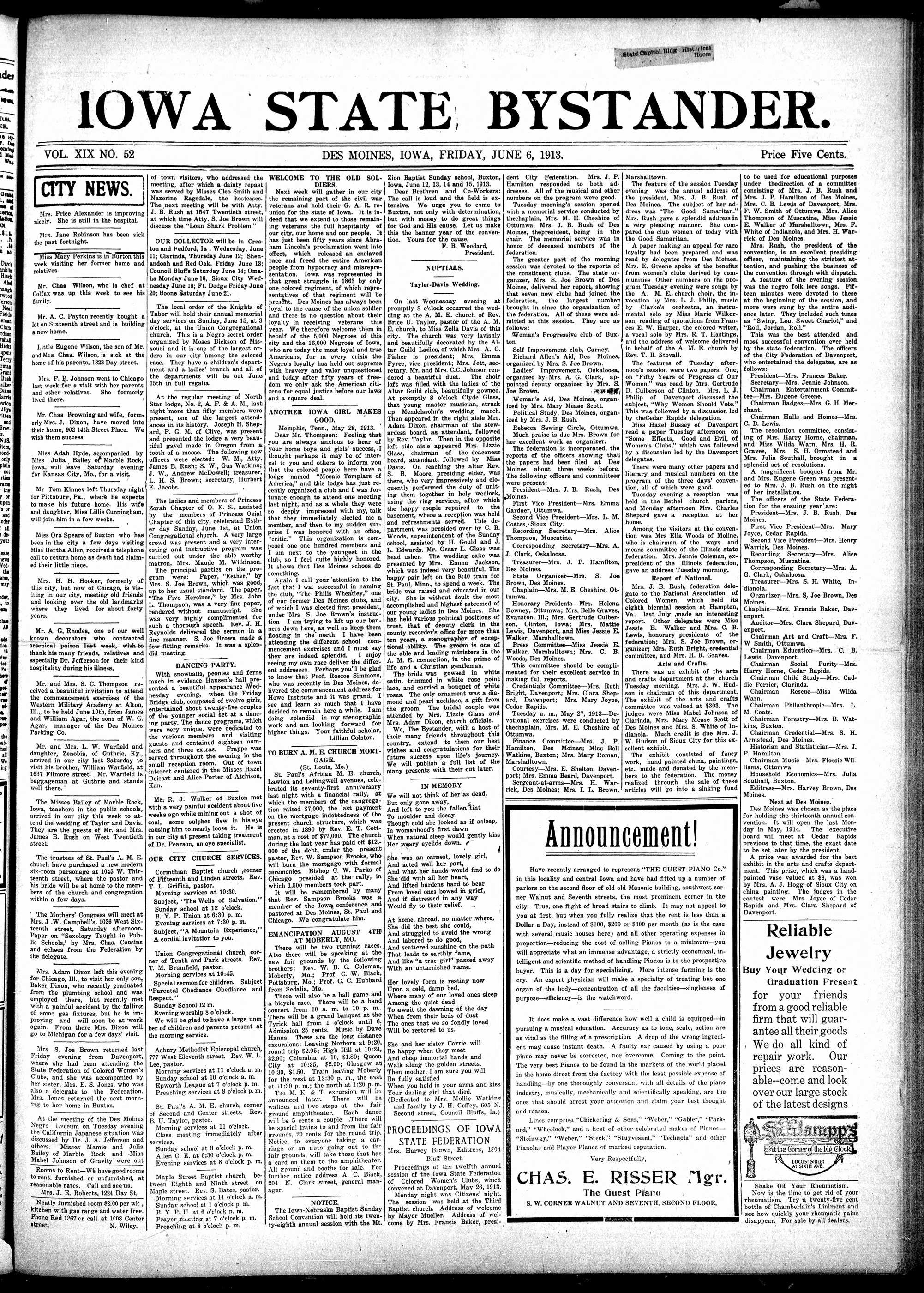
IOWA STATE BYSTANDER.
VOL. XIX NO. 52
CITY NEWS.
Mrs. Price Alexander is improving nicely. She is still in the hospital.
Mrs. Jane Robinson has been sick the past fortnight.
Miss Mary Perkins is in Burton this week visiting her former home and relatives.
Mr. Chas Wilson, who is chef at Colfax was up this week to see his family.
Mr. A. C. Payton recently bought a lot on Sixteenth street and is building a new home.
Little Eugene Wilson, the son of Mr. and Mrs Chas. Wilson, is sick at the home of his parents, 1323 Day street.
Mrs. F. P. Johnson went to Chicago last week for a visit with her parents and other relatives. She formerly lived there.
Mr. Chas Browning and wife, formerly Mrs. J. Dixon, have moved into their home, 902 14th Street Place. We wish them success.
Miss Adah Hyde, accompanied by Miss Julia, Bailey of Marble Rock, Iowa, will leave Saturday evening for Kansas City, Mo., for a visit.
Mr Tom Kinney left Thursday night for Pittsburg, Pa., where he expects to make his future home. His wife and daughter, Miss Lillie Cunningham, will join him in a few weeks.
Miss Ora Spears of Buxton who has been in the city a few days visiting Miss Bertha Allen, received a telephone call to return home as death had claimed their little niece.
Mrs. H. H. Hooker, formerly of this city, but now of Chicago, is visiting in our city, meeting old friends and looking over the old landmarks where they lived for about forty years.
Mr. A. G. Rhodes, one of our well known decorators who contracted arsenical poison last week, wish to thank his many friends, relatives and especially Dr. Jefferson for their kind hospitality during his illness.
Mr. and Mrs. S. C. Thompson received a beautiful invitation to attend the commencement exercises of the Western Military Academy at Alton, Ill., to be held June 10th, from James and William Agar, the sons of W. G. Agar, manager of the Des Moines Packing Co.
Mr. and Mrs. L. W. Warfield and daughter, Zenobia, of Guthrie, Ky., arrived in our city last Saturday to visit his brother, William Warfield, at 1637 Filmore street. Mr. Warfield is baggageman at Guthrie and stands well there.
The Misses Bailey of Marble Rock, Iowa, teachers in the public schools, arrived in our city this week to attend the wedding of Taylor and Davis. They are the guests of Mr. and Mrs. James B. Rush on West Twenticth street.
The trustees of St. Paul's A. M. E. church have purchased a new modern six-room parsonage at 1045 W. Thirteenth street, where the pastor and his bride will be at home to the members of the church and congregation within a few days.
The Mothers' Congress will meet at Mrs. J. W. Campbell's, 1028 West Sixteenth street, Saturday afternoon. Paper on "Sexology Taught in Public Schools," by Mrs. Chas. Cousins and echees from the Federation by the delegate.
Mrs. Adam Dixon left this evening for Chicago, Ill., to visit her only son, Baker Dixon, who recently graduated from the plumbing school and was employed there, but recently met with a painful accident by the falling of some gas fixtures, but he is improving and will soon be at work again. From there Mrs. Dixon will go to Michigan for a few days' visit.
Mrs. S. Joe Brown returned last Friday evening from Davenport, where she had been attending the State Federation of Colored Women's Clubs, and she was accompanied by her sister, Mrs. E. S. Jones, who was also a delegate to the Federation. Mrs. Jones returned the next morning to her home in Buxton.
At the meeting of the Des Moines Negro Lovceum on Tuesday evening the California Japanese situation was discussed by Dr. J. A. Jefferson and others. Misses Mamie and Julia Bailey of Marble Rock and Miss Mabel Johnson of Gravity were out
Rooms to Rent—We have good rooms to rent, furnished or unfurnished, at reasonable rates. Call and see us.
Mrs. J. E. Roberts, 1224 Day St.
Nearly furnished room $2.00 per wk, kitchen with gas range and water free. Phone Red 1267 cr call at 1087 Center street.
N. Wiley.
of town visitors, who addressed the meeting, after which a dainty repast was served by Misses Cleo Smith and Nazerine Ragsdale, the hostesses. The next meeting will be with Atty. J. B. Rush at 1547 Twentieth street, at which Atty. S. Joe Brown will discuss the "Loan Shark Problem."
OUR COLLECTOR will be in Creton and Bedford, Ia, Wednesday, June 11; Clarinda, Thursday June 12; Shenandoah and Oak, Friday June 13; Council Bluffs Saturday June 14; Omaha Monday June 16, Sioux City Wednesday June 18; Ft. Dodge Friday June 20; boone Saturday June 21.
The local order of the Knights of Tabor will hold their annual memorial day services on Sunday, June 15, at 3 o'clock, at the Union Congregational church. This is a Negro secret order organized by Moses Dickson of Missouri and it is one of the largest orders in our city among the colored race. They have a children's department and a ladies' branch and all of the departments will be out June 15th in full regalia.
At the regular meeting of North Star lodge, No. 2, A. F. & A. M., last night more than fifty members were present, one of the largest attendances in its history. Joseph H. Shepard, P. G. M. of Clive, was present and presented the lodge a very beautiful gavel made in Oregon from a tooth of a moose. The following new officers were elected: W. M., Atty James B. Rush; S. W., Gus Watkins; J. W., Andrew McDowell; treasurer, L. H. S. Brown; secretary, Hurbert E. Jacobs.
The ladies and members of Princess Zorah Chapter of O. E. S., assisted by the members of Princess Ozial Chapter of this city, celebrated Esther day Sunday, June 1st, at Union Congregational church. A very large crowd was present and a very interesting and instructive program was carried out under the able worthy matron, Mrs. Maude M. Wilkinson. The principal parties on the program were: Paper, "Esther," by Mrs. S. Joe Brown, which was good, up to her usual standard. The paper, "The Five Heroes," by Mrs. John L. Thompson, was a very fine paper, rendered without manuscript. She was very highly complimented for such a thorough speech. Rev. J. H. Reynolds delivered the sermon in a fine manner. S. Joe Brown made a few fitting remarks. It was a splendid meeting.
DANCING PARTY
With snowawals, peonies and ferns much in evidence Hansen's hall presented a beautiful appearance Wednesday evening, when the Friday Bridge club, composed of twelve girls, entertained about twenty-five couples of the younger social set at a dancing party. The dance programs, which were very unique, were dedicated to the various members and visiting guests and contained eighteen numbers and three extras. Frappe was served throughout the evening in the small reception room. Out of town interest centered in the Misses Hazel Deisart and Alice Porter of Atchison, Kan.
Mr. R. J. Walker of Buxton met with a very painful accident about five weeks ago while mining out a shot of coal, some sulphur flew in his eye causing him to nearly loose it. He is in our city at present taking treatment of Dr. Pearson, an eye specialist.
OUR CITY CHURCH SERVICES.
Corinthian Baptist church, corner of Fifteenth and Linden streets. Rev. T. L. Griffith, pastor.
Morning services at 10:30.
Subject, "The Wells of Salvation."
Sunday school at 12 o'clock.
B. Y. P. Union at 6:30 p. m.
Evening services at 7:30 p. m.
Subject, "A Mountain Experience," A cordial invitation to you.
Union Congregational church, corner of Tenth and Park streets. Rev. T. M. Brumfield, pastor.
Morning services at 10:45.
Special sermon for children. Subject "Parental Obediance Obedience and Respect."
Sunday School 12 m.
Evening worship 8 o'clock.
We will be glad to have a large unmber of children and parents present at the morning service.
Asbury Methodist Episcopal church, 777 West Eleventh street. Rev. W. L. Lee, pastor.
Morning services at 11 o'clock a. m.
Sunday school at 10 o'clock a. m.
Epworth League at 7 o'clock p. m.
Preaching services at 8 o'clock p. m.
St. Paul's A. M. E. church, corner of Second and Center streets. Rev. B. U. Taylor, pastor.
Morning services at 11 o'clock.
Class meeting immediately after services.
Sunday school at 3 o'clock p. m.
Allen C. E. at 6:30 o'clock p. m.
Evening services at 8 o'clock p. m.
Maple Street Baptist church, between Eighth and Ninth street on Maple street. Rev. S. Bates, pastor.
Morning services at 11 o'clock a. m.
Sunday school at 1 o'clock p. m.
R. Y. P. U. at 6 o'clock p. m.
Prayer meeting at 7 o'clock p. m.
Preaching at 8 o'clock p. m.
WELCOME TO THE OLD SOLDIERS.
Next week will gather in our city the remaining part of the civil war veterans and hold their G. A. R. reunion for the state of Iowa. It is indeed that we extend to those remaining veterans the full hospitality of our city, our home and our people. It has just been fifty years since Abraham Lincoln's proclamation went into effect, which released an enslaved race and freed the entire American people from hypocracy and misrepresentation. Iowa was represented in that great struggle in 1863 by only one colored regiment, of which representatives of that regiment will be present. Des Moines has always been loyal to the cause of the union soldier and there is no question about their loyalty in receiving veterans this year. We therefore welcome them in hebalf of the 5,000 Negroes of this city and the 16,000 Negroes of Iowa, who are today the most loyal and true Americans, for in every crisis the Negro's loyalty has held out supreme with bravery and valor unquestioned and today after fifty years of freedom we only ask the American citizens for equal justice before our laws and a square deal.
ANOTHER IOWA GIRL MAKES GOOD
Memphis, Tenn., May 28, 1913.
Dear Mr. Thompson: Feeling that you are always anxious to hear of your home boys and girls' success, I thought perhaps it may be of interest to you and others to inform you that the colored people here have a lodge named "Mosaic Templars of America," and this lodge has just recently organized a club and I was fortunate enough to attend one meeting last night, and as a whole they were so deeply impressed with my, talk that they immediately elected me a member, and then to my sudden surprise I was honored with an office, "critic." This organization is composed one one hundred members and I am next to the youngest in the club, so I feel quite highly honored. It shows that Des Moines schools do something.
Again I call your 'attention to the fact that I was: successful in naming the club, "The Philis Wheatley," one of our former Des Moines clubs, and of which I was elected first president, under Mrs. S. Joe Brown's instruction I am trying to lift up our banners down here, as well as keep them floating in the north I have been attending the different school commencement exercises and I must say they are indeed splendid. I enjoy seeing my own race deliver the different addresses. Perhaps you'll be glad to know that Prof. Roscoe Simmons, who was recently in Des Moines, delivered the commencement address for Howe Institute and it was grand. I see and learn so much that I have decided to remain here a while. I am doing splendid in my stenographic work and am looking forward for higher things. Your faithful scholar, Lillian Colston.
TO BURN A. M. E. CHURCH MORT
St. Paul's African M. E. church, Lawton and Leffling well avenues, celebrated its seventy-first anniversary last night with a financial rally, at which the members of the congregation raised $7,000, the last payment on the mortgage indebtedness of the present church structure, which was erected in 1890 by Rev. E. T. Cottman, at a cost of $77,000. The church during the last year has paid off $12,000 of the debt, under the present pastor, Rev. W. Sampson Brooks, who will burn the mortgage with formal ceremonies. Bishop C. W. Parks of Chicago presided at the rally, in which 1,500 members took part. It will be remembered by many that Rev. Sampson Brooks was a member of the Iowa conference and pastored at Des Moines, St. Paul and Chicago. We congratulate him.
EMANCIPATION AUGUST 4TH
AT MORERLY MO.
There will be two running races. Also there will be speaking at the new fair grounds by the following brothers: Rev. W. B. C. Coleman, Moberly, Mo.; Prof. C. W. Black, Pottsburg, Mo.; Prof. C. C. Hubbard from Sedalia, Mo.
There will also be a ball game and a bicycle race. There will be a band concert from 10 a. m. to 10 p. m.. There will be a grand banquet at the Tyrick hall from 1 o'clock until 6. Admission 25 cents. Music by Dave Hanna. These are the long distance excursions: Leaving Norborn at 9:20, round trip $2.95; High Hill at 10:24, $2.90; Columbia at 10, $1.80; Queen City at 10:35, $2.90; Glasgow at 10:30, $1.50. Train leaving Moberly for the west at 12:30 p. m., the east at 11:30 p. m.; the north at 1:20 p. m. The M. K. & T. excursion will be announced later. There will be waltzes and two steps at the fair ground amphitheater. Each dance will be 5 cents a couple. There will be special trains to and from the fair grounds, 20 cents for the round trip. Notice, to everyone taking a carriage or an auto going out to the fair grounds, will take those that has a card on them to the amphitheater. All ground and booths for sale. For further notice address A. C. Black, 204 N. Clark street, general manager.
NOTICE
The Iowa-Nebraska Baptist Sunday School Convention will hold its twenty-eighth annual session with the Mt.
Zion Baptist Sunday school, Buxton, Iowa, June 12, 13, 14 and 15, 1913.
Dear Brethren and Co-Workers:
The call is loud and the field is extensive. We urge you to come to Buxton, not only with determination, but with money to do great things for God and His cause. Let us make this the banner year of the convention. Yours for the cause,
F. B. Woodard President.
NUPTIALS.
Taylor-Davis Wedding.
The bride was gowed in white satin, trimmed in white rose point lace, and carried a bouquet of white roses. The only ornament was a diamond and pearl necklace, a gift from the groom. The bridal couple was attended by Mrs. Lizzie Glass and Mrs. Adam Dixon, church officials. We, The Bystander, with a host of their many friends throughout this country, extend to them our best wishes and congratulations for their future success upon life's journey. We will publish a full list of the many presents with their cut later.
IN MEMORY
We will not think of her as dead,
But only gone away,
And left to you the fallen tint
To moulder and decay.
Though cold she looked as if asleep,
In womanhood's first dawn
When natural sleep would gently kiss
Her weary eyelids down.
She was an earnest, lovely girl,
And acted well her part,
And what her hands would find to do
She did with all her heart,
And lifted burdens hard to bear
From loved ones bowed in grief,
And if distressed in any way
Would fly to their relief.
At home, abroad, no matter where,
She did the best she could,
And struggled to avoid the wrong
And labored to do good,
And scattered sunshine on the path
That leads to earthly fame,
And like "a true girl" passed away
With an untarnished name.
Her lovely form is resting now
Upon a cold, damp bed,
Where many of our loved ones sleep
Among the quiet dead
To await the dawning of the day
When from their beds of dust
The ones that we so fondly loved
Will be restored to us.
She and her sister Carrie will
be happy when they meet
And clasp immortal hands and
Walk along the golden streets.
Then mother, I am sure you will
Be fully satisfied
When you hold in your arms and kiss
Your darling girl that died.
(Dedicated to Mrs. Mollie Watkins and family by J. H. Coffey, 605 N. Second street, Council Bluffs, Ia.)
PROCEEDINGS OF IOWA STATE FEDERATION
STATE FEDERATION Mrs. Harvey Brown, Editress, 1804 Bluff Street.
Proceedings of the twelfth annual session of the Iowa State Federation of Colored Women's Clubs, which convened at Davenport, May 26, 1913. Monday night was Citizens' night. The session was held at the Third Baptist church. Address of welcome by Mayor Mueller. Address of welcome by Mrs. Francis Baker, presi-
TAND
dent City Federation. Mrs. J. P. Hamilton responded to both addresses. All of the musical and other numbers on the program were good.
Tuesday morning's session opened with a memorial service conducted by thecheplain, Mrs. M. E. Cheshire of Ottumwa, Mrs. J. B. Rush of Des Moines, thepresident, being in the chair. The memorial service was in honor of deceased members of the federation.
The greater part of the morning session was devoted to the reports of the constituent clubs. The state organizer, Mrs. S. Joe Brown of Des Moines, delivered her report, showing that seven new clubs had joined the federation, the largest number brought in since the organization of the federation. All of these were admitted at this session. They are as follows:
Woman's Progressive club of Buxton
Self Improvement club, Carney.
Richard Allen's Aid, Des Moines, organized by Mrs. S. Joe Brown.
Ladies' Improvement, Oskaloosa, organized by Mrs. A. G. Clark, appointed deputy organizer by Mrs. S. Joe Brown.
Woman's Aid, Des Moines, organized by Mrs. Mary Mease Scott.
Political Study, Des Moines, organized by Mrs. J. B. Rush.
Rebecca Sewing Circle, Ottumwa.
Much praise is due Mrs. Brown for her excellent work as organizer.
The federation is incorporated, the reports of the officers showing that the papers had been filed at Des Moines about three weeks before.
The following officers and committees were present:
President—Mrs. J. B. Rush, Des Moines.
First Vice President—Mrs. Emma Gardner. Ottumwa.
Second Vice President—Mrs. L. M. Coates, Sioux City.
Coates, Shaun Cay.
Recording Secretary—Mrs. Alice Thompson, Muscatine.
Corresponding Secretary—Mrs. A. J. Clark, Oskaloosa.
Treasurer—Mrs. J. P. Hamilton, Des Moines.
State Organizer—Mrs. S. Joe Brown, Des Moines.
Chaplain—Mrs. M. E. Cheshire, Ottumwa.
Honorary Preidents—Mrs. Helena Downey, Ottumwa; Mrs. Belle Graves, Evanston, Ill.; Mrs. Gertrude Culberson, Clinton, Iowa; Mrs. Mattie Lewis, Davenport, Miss Jessie E. Walker, Marshalltown.
Press Committee—Miss Jessie E. Walker, Marshalltown; Mrs. C. B. Woods, Des Moines.
This committee should be complimented for their excellent service in making full reports.
Credentials Committee—Mrs. Ruth Bright, Davenport; Mrs. Clara Shepard, Davenport; Mrs. Mary Joyce, Cedar Rapids.
Tuesday a. m., May 27, 1913—Devotional exercises were conducted by thechaplain, Mrs. M. E. Cheshire of Ottumwa.
Finance Committee—Mrs. J. P. Hamilton, Des Moines; Miss Bell Watkins, Buxton; Mrs. Mary Roman, Marshalltown.
Courtesy—Mrs. E. Shelton, Davenport; Mrs. Emma Beard, Davenport.
Sergeant-at-arms--Mrs. H. Warrick, Des Moines; Mrs. I. L. Brown,
ENOUCEMENT!
angled to represent "THE GUEST PIANO Co." central Iowa and have had fitted up a number of porch of old old Masonic building, southwest cornhills streets, the most prominent corner in the broad stairs to climb. It may not appeal to you fully realize that the rent is less than a $100, $200 or $300 per month (as is the cases here) and all other operating expenses in the cost of selling Pianos to a minimum—you immense advantage, a strictly economical, method of handling Pianos is to the prospective for specializing. More intense farming is the man will make a specialty of treating but one concentration of all the faculties—singleness of the watchword.
It difference how well a child is equipped—in education. Accuracy as to tone, scale, action are a prescription. A drop of the wrong ingredi-death. A faulty car caused by using a poor corrected, nor overcome. Coming to the point. Be found in the markets of the world placed in the factory with the least possible expense of highly conversant with all details of the piano mechanically and scientifically speaking, are the your attention and claim your best thought
wickering & Sons," "Weber," "Gabler," "Pack-a host of other celebrated makes of Pianos—Steek," "Stuyvesant," "Technola" and other nos of marked reputation.
Announcement!
Have recently arranged to represent "THE GUEST PIANO Co." in this locality and central Iowa and have had fitted up a number of parlors on the second floor of old old Masonic building, southwest corner Walnut and Seventh streets, the most prominent corner in the city. True, one flight of broad stairs to climb. It may not appeal to you at first, but when you fully realize that the rent is less than a Dollar a Day, instead of $100, $200 or $300 per month (as is the case with several music houses here) and all other operating expenses in proportion—reducing the cost of selling Pianos to a minimum—you will appreciate what an immense advantage, a strictly economical, intelligent and scientific method of handling Pianos is to the prospective buyer. This is a day for specializing. More intense farming is the cry. An expert physician will make a specialty of treating but one organ of the body—concentration of all the faculties—singleness of purpose—efficiency—is the watchword.
It does make a vast difference how well a child is equipped—in pursuing a musical education. Accuracy as to tone, scale, action are as vital as the filling of a prescription. A drop of the wrong ingredient may cause instant death. A faulty car caused by using a poor piano may never be corrected, nor overcome. Coming to the point. The very best Pianos to be found in the markets of the world placed in the home direct from the factory with the least possible expense of handling—by one thoroughly conversant with all details of the piano industry, musically, mechanically and scientifically speaking, are the ones that should arrest your attention and claim your best thought and reason.
Lines comprise "Chickering & Sons," "Weber," "Gabler," "Packard," "Wheelock," and a host of other celebrated makes of Pianos—"Steinway," "Weber," "Steek," "Stuyvesant," "Technola" and other Pianolas and Player Pianos of marked reputation.
Very Respectfully,
CHAS. E. RISSER Mgr.
The Guest Piano
S. W. CORNER WALNUT AND SEVENTH, SECOND FLOOR.
CHAS. E. RISSER Mgr.
The Guest Piano
S. W. CORNER WALNUT AND SEVENTH, SECOND FLOOR.
Stad Capitol Blog Hotelica
Room
Marshalltown.
The feature of the session Tuesday evening was the annual address of the president, Mrs. J. B. Rush of Des Moines. The subject of her address was "The Good Samaritan." Mrs. Rush gave a splendid address in a very pleasing manner. She compared the club women of today with the Good Samaritan.
A paper making an appeal for race loyalty had been prepared and was read by delegates from Des Moines. Mrs. E. Greene spoke of the benefits from women's clubs derived by communities. Other numbers on the program Tuesday evening were songs by the A. M. E., church choir, the invocation by Mrs. L. J. Philip, music by Clarke's orchestra, an instrumental solo by Mrs. Marie Wilkerson, reading of quotations from Frances E. W. Harper, the colored writer, a vocal solo by Mrs. R. T. Hastings, and the address of welcome delivered in behalf of the A. M. E. church by Rev. T. B. Stovall.
The features of Tuesday afternoon's session were two papers. One, on "Fifty Years of Progress of Our Women," was read by Mrs. Gertrude D. Culbertson of Clinton. Mrs. L. J. Philip of Davenport discussed the subject, "Why Women Should Vote." This was followed by a discussion led by theCedar Rapids delegation.
Miss Hazel Busssey of Davenport read a paper Tuesday afternoon on "Some Effects, Good and Evil, of Women's Clubs," which was followed by a discussion led by the Davenport delegates.
There were many other papers and literary and musical numbers on the program of the three days' convention, all of which were good.
Tuesday evening a reception was held in the Bethel church parlors, and Monday afternoon Mrs. Charles Shepard gave a reception at her home.
Among the visitors at the convention was Mrs Ella Woods of Moline, who is chairman of the ways and means committee of the Illinois state federation. Mrs Jennie Coleman, expresident of the Illinois federation, gave an address Tuesday morning.
Report of National.
Mrs. J. B. Rush, federation delegate to the National Association of Colored Women, which held its eighth biennial session at Hampton, Va., last July made an interesting report. Other delegates were Miss Jessie E. Walker and Mrs. C. B. Lewis, honorary presidents of the federation; Mrs. S. Joe Brown, organizer; Mrs. Ruth Bright, credential committee, and Mrs. H. G. Graves.
Arts and Crafts.
There was an exhibit of the arts and crafts department at the church Tuesday morning. Mrs. J. W. Hudson is chairman of this department. The exhibit of the arts and crafts committee was valued at $303. The judges were Miss Mabel Johnson of Clarinda, Mrs. Mary Mease Scott of Des Moines and Mrs. S. White of Indianola. Much credit is due Mrs. J. W. Hudson of Sioux City for this excellent exhibit...
The exhibit consisted of fancy work, hand painted china, paintings, etc., made and donated by the members to the federation. The money realized through the sale of these articles will go into a sinking fund
Price Five Cents.
to be used for educational purposes under the direction of a committee consisting of Mrs. J. B. Rush and Mrs. J. P. Hamilton of Des Moines, Mrs. C. B. Lewis of Davenport, Mrs. F. W. Smith of Ottumwa, Mrs. Alice Thompson of Muscatine, Miss Jessie E. Walker of Marshaltown, Mrs. F. White of Indiana, and Mrs. H. Warrick of Des Moines.
Mrs. Rush, the president of the convention, is an excellent presiding officer, maintaining the strictest attention, and pushing the business of the convention through with dispatch.
A feature of the evening session was the negro folk lore songs. Fifteen minutes were devoted to these at the beginning of the session, and more were sung by the entire audience later. They included such tunes as "Swing, Lou, Sweet Chariot," and "Roll, Jordan, Roll."
This was the best attended and most successful convention ever held by the state federation. The officers of the City Federation of Davenport, who entertained the delegates, are as follows:
Chairman Badges—Mrs. G. H. Merchant.
Chairman Halls and Homes—Mrs. C. B. Lewis.
The resolution committee, consisting of Mrs. Harry Horne, chairman, and Miss Wilda Warn, Mrs. H. R. Graves, Mrs. S. H. Ormstead and Mrs. Julia Southhall, brought in a splendid set of resolutions.
A magnificent bouquet from Mr. and Mrs. Eugene Green was presented to Mrs. J. B. Rush on the night of her installation.
The officers of the State Federation for the ensuing year' are:
President—Mrs. J. B. Rush, Des Moines.
First Vice President—Mrs. Mary Joyce, Cedar Rapids.
Second Vice President—Mrs. Henry Warrick, Des Moines.
Recording Secretary—Mrs. Alice Thompson, Muscatine.
Corresponding Secretary—Mrs. A. G. Clark, Oskaloaa.
Treasurer—Mrs. S. H. White, Indianola.
Organizer—Mrs. S. Joe Brown, Des Moines.
Chaplain—Mrs. Francis Baker, Davenport.
Auditor—Mrs. Clara Shepard, Davenport.
Chairman Art and Craft—Mrs. F. W Smith, Ottumwa. Chairman Education—Mrs. C. B. Lewis, Davenport.
Chairman Social Purity—Mrs.
Harry Horne, Cadar Rapids.
Chairman Child Study—Mrs. Caddie
Dferrier, Clarinda.
Chairman Rescue—Miss Wilda.
Warn.
Chairman Philanthropic—Mrs. L.
M. Coats.
Chairman Forestry—Mrs. B. Watkins, Buxton.
Chairman Credential—Mrs. S. H. Armstead, Des Moines.
Historian and Statistician—Mrs. J. P. Hamilton.
Chairman Music—Mrs. Flossie Williams, Ottumwa.
Household Economics—Mrs. Julia Southall, Buxton.
Editress—Mrs. Harvey Brown, Des Moines.
Next at Des Moines.
Des Moines was chosen as the place for holding the thirteenth annual convention. It will open the last Monday in May, 1914. The executive board will meet at Cedar Rapids previous to that time, the exact date to be set later by the president.
A prize was awarded for the best exhibit in the arts and crafts department. This prize, which was a hand-painted vase valued at $8, was won by Mrs. A. J. Hogg of Sioux City on china painting. The judges in the contest were Mrs. Joyce of Cedar Rapids and Mrs. Clara Shepard of Davenport.
Reliable Jewelry
for your friends from a good reliable firm that will guarantee all their goods We do all kind of repair work. Our prices are reasonable--come and look over our large stock of the latest designs
At the Corner of the big Clock
LOCUST STREET
SIXTH AVE.
Shake Off Your Rheumatism. Now is the time to get rid of your rheumatism. Try a twenty-five cenu bottle of Chamberlain's Liniment and see how quickly your rheumatic pains disappear. For sale by all dealers.
Doralee Professor Tells How They May Be Distinguished From Their Fellow Citizens.
If you meet a man coming down the street, whose nose is large and aquiline and perhaps a large nose, and whose ears are large, with large lobes, it might be just as wise to right about face and take to your heels, for in all probability that man is a murder—potentially not if actually.
If a man raises his hat and displays a plentiful thatch of hair, if it is not gray, if his forehead recedes and his skull is abnormally large, coming to a noticeable point, you can be sure that you have diagnosed your face correctly and can accommodate your pace without laying yourself open to the charge of cowardice.
At least that is what Prof. Frederick A. Busheye says, and he ought to know, says the Denver Post, for he holds the chair of sociology at the state university. The thief has the same egglike head that marks the murderer and the same long arms and big ears, but he can be distinguished by his fattened nose. His face is apt to show many wrinkles, especially on the side of the face and in the forehead, probaby caused by the shape of the skull. This is a mark of all born criminals, as is the depression at the base of the skull, which probably indicates a similar depression in the brain. This swindler can be recognized by his thin lips. His features will probably be asymmetrical, one side of the face being different from the other. This characteristic is not confined to swindlers or to criminals, but is one of the traits generally found in conjunction with the others mentioned.
If a man is bald or gray haired, according to the professor, you can be reasonably certain that he is not a born criminal. Of course he may be of uncoupled mollicious money makers, but he can't blame his wrong on heredity.
Middle Age.
Uncle 'Rastus, Mr. Thompson explained, was employed on a farm in Virginia, where there was a prize bull that became so ferocious that the owner was compelled to send for a veterinary surgeon and have his horns cut off.
Uncle 'Rastus viewed the proceeding with evident satisfaction from a safe place in the stable, and when the sharp horns had been rendered harmless he rushed up and seized the veterinarian's hand.
"It certely glad, foctah," he gratefully exclaimed, "at yo habs done you are, are you, are dat bull's ho'n!" Go on, are you, are you? "jestingly responded the veterinarian" "Why are you so glad about it"
"It am jes' dis way, doctah," explained 'Rastus, with considerable feeling. "Tee too old to climb trees an 'I see too young to die."
Ancient Arithmetic
A Anuburn, Me, man is the owner of a rare old historical document in the form of an arithmetic composed and written by Thomas Chase, while in an English prison in 1778. He was an American sailor during the revolution and was captured by an English man-of-war and taken to Mill prison, where he remained for several months before making his escape. He was then captured by his own船 and crossed the British channel to France, where he joined Paul Jones and continued to fight for his country until the close of the war. While a captive he amused himself by writing this mathematical work.
Detector for Lost Pipes.
An apparatus for detecting the position of underground pipes, which is being introduced in England, consists of an electrical vibrator, induction coil and telegraph receiver. In using the instrument an electric current is produced which is used to supply the battery to the nearest points of the pipe above ground, such as taps and fire hydrants, and the position of the pipe is determined through the electric field which then surrounds it, inducing a current in the detector coil when the latter is brought within its influence. The coil is connected to the pipe through which the coil is to the pipe the louder is the sound heard in the receiver.
Going Straight.
Mrs. Bacon—This paper says that blind horses are never known to make a mistake in their diet while grazing. Like all other horses, they are guided by the nostrils in the selection of proper food.
Mr. Bacon—Well, it's a good rule for human beings, too.
"What?"
"To follow your nose."
"I Should Worry."
Mrs. Crimsonbeak—I see there are 180,000 dry goods stores in the United States, and of these 27,000 are department stores.
Mr. Crimsonbeak—And yet some women profess to find nothing to occupy their time.
No Unseen Blush There!
Gray had just written "Full many a figure is born to blush men."
"Not on your life," we assured him. "Smith's chickens can see them three inches under ground."
Rodd—This paper says a three-years' course in house decorating has been added to the curriculum of Columbia university.
Greene—That means a demand for steins and algar store Indians.
London English.
Witness at the Old Street Police Court—Husband my wife a koo.
Constrictor—What?
MANY ALIENS COME
Tide of Immigration Reaches a Record Point.
More Foreigners Admitted to Ucle
Game's Domain During This Year
Than in Any of the Three Pre
vious Years, Figures Show.
Washington. — Immigration to the
United States has been heavier this
year than during the three previous
years, 747,998 immigrant aliens have
been admitted to this country during
the nine months from July, 2012,
and including March in addition to
which 140,901 nonimmigrant aliens
are admitted, making a total of 888,
899.
A total of 12,557 allens were
debarred for various causes. Emigrant
allens departing numbered 247,798
and non-emigrant allens 188,065.
American citizens go abroad during
the nine months numbered 242,
169; those returning 223,478. These
departures and arrivals made the pas-
sage movement during that period
totaling 112,494 arrivals and 688,022 de-
partures.
More Japanese entered the country during the nine months than during the entire previous year, 6,435, compared with 6,172 while 591 returned to Japan, compared with 1,501 during 1912. Immigrants from the Russian empire predominated during the period, 176,252 persons from there having entered, compared with 162,395 in 1912. Italians were next with 150,383, compared with 157,234 in 1912. By occupation the majority of immigrants were farm laborers, 172,639 having entered; others were 133,214; servants 90,532 and tailors, 16,648. The significant feature of the fact that the number of laborers departing exceeded the number arriving. During the nine months 164,025 sailed and during the previous year 209,279, compared with 133,214 arrivals in the period and 135,726 for 1912.
GOVERNMENT MUST PAY.
The commonwealth of New Hampshire the other day lodged a claim for 35 cents against the federal government of the United States, and the worst of it is the United States has to pay, notwithstanding that economy must be the watchword of the administration in the face of tariff revision. The unorious state authorities in an unrelenting campaign against mests invaded the back yard of the postoffice building at Dover, N. H., and discovered three browntail moth nests in a lonely tree that sheds its shade on the hard-working postal employees of Dover during their rest periods. The state "bugologists" without much ado destroyed the nests of the pernicious bugs and nonchalantly presented a bill for 35 cents, evidently raised the rate of 13 cents for the first nest and 10 cents for each of the others.
The postmaster protested vigorously, with the declaration that he himself could have annihilated the moths without expense if the state had pointed them out. An issue was threatened and the quarrel was referred to the treasury department. Sherman Allen, assistant secretary of the treasury, who learned diplomacy as an assistant secretary to President Taft, conceded the point. After a formal bill and voucher was rendered a treasury warrant was sent to the state.
SHOWS BIG GAIN.
More than 150,000,000 parcel post packages were handled in the postal service during the first three months the new system was in operation, according to reports submitted to Postmaster General Burleson. These figures, which are based on the amount of business done at the 50 largest post-offices, show that approximately 62,000,000 parcels were handled during the first three months, 12,000,000 more than were handled in February, when the total exceeded January by 10,000,000. Approximately, 55 percent, more business was handled in March than in January.
As during the first two months, Chicago led all other cities in the number of parcels handled with a total of 6,858,744; New York city handled 5,373,075 and Boston 1,657,039. The most noticeable gain was made in Detroit by jumping from eighth place in fourth in March, with a total of 1,420,000; following in order are Philadelphia with a total of 1,294,954; Cleveland, 1,209,908; St. Louis, 1,146,858; Brooklyn, 983,130; Jersey City, 865,484; and Kansas City with 687,000.
CHINA'S FOREIGN TRADE.
China's total foreign trade for 1912 was approximately 900,000,000 teals, or $855,000,000 in United States money. This is an increase of $33,000,000 over 1911. The combination of the revolution in 1911 and bumper crops in 1912 was responsible for the improvement, the impact continued to be somewhat in excess of the exports.
America's participation in the trade with China in 1912 kept pace with previous years, except in cotton piece goods. In 1911 China took 16,000,000 pieces, but only 11,250,000 pieces in 1912. The American contribution of 1,700,000 pieces last year, representing $7,000,000 and $4,500,000, respectively.
What the Carver Does.
To be a good carver is to possess an accomplishment. Observation, practice and confidence are necessary. To carve a fowl a previous study of the joints in an uncoiled bird is a help to a beginner. When the carving is to be done, for a roast chicken or tomkey, remove first the leg then the wing, from one side then from the other, then dressing the wing. Then carve the breast on each side; next take off the wishbone, separate the collar bones and shoulder blades.
EILLIONS OF EGGS COLLECTED
The annually increasing value of the work of the United States bureau of fisheries is shown by the fact that in the first eight months of the present year, 1,000,000 fish are selected for planting exceeded by 834,000,000 the number gathered in the same period last year. The number so far this year reaches the gigantic total of 2,185,000,000, against 1,851,000,000 in 1912.
The greatest gain has been in whitefish eggs from the great lakes, where this year's take has been 584,000,000 in lakes trout the increase has been from 59,000,000 to 69,000,000.
In the New England coast this year's gathering of pollock eggs has been 867,000,000. At Gloucester, Mass., last year's haddock egg collection totaled 160,000,000 and this year's will exceed that by many millions. All the haddock eggs are taken from fish caught for market, as the eggs that are sold and then are saved for further propagation.
Dog salmon egg collection shows the largest gain on the Pacific coast, this year's take having been 20,000,000, against 3,300,000 last year.
MONEY ALMOST GERM PROOF.
Those who have hesitated to amass wealth because of the warning to "beware the billions of bacteria that lurk in every gill" need hesitate no longer, according to Dr W. C. Rucker, assistant surgeon general of the public health service. He declared the other day that tests and examination of currency, both washed and unwashed bills, showed them to be singularly free from germs. He attributed this to the ink used in printing the bills, which he said had proved to be an almost perfect germicide.
"The public health service was called upon to examine the sold money returned to the treasury," said Dr Rucker, "after it had traveled around the country and had passed through the hands of persons. The surprise it was found to be singularly free from bacteria, and the ink used in the bills is given the credit."
The ingredients used in the government's ink are not made public, the recipe for the manufacture of the ink for the bureau of engraving and printing be zealously guarded.
PRICES CUT DOWN.
Prices received by producers in the United States for staple crops increased 2.3 per cent. from April 1 to May 1, according to a report by the department of agriculture. The increase for the same period a year ago was 8.4 and the average increase during April for the last five years was 8.1. The average averaged about 30.1 per cent. lower than on May 1, 1912, according to the department. The average for meat animals increased 3.7 per cent. from March 15 to April 15, as compared with an increase of 10.7 per cent. for the same period of 1912. On April 15 prices of meat animals averaged 26.6 per cent. lower than on April 15, 1912. On April 15, the prices for meat animals were 26.6 per cent. lower than they were on April 15 this year.
VAST "COOKBOOK" ISSUE.
More than 12,000,000 copies of the various "cookbooks" prepared by the department of agriculture, the latest of which is one on how to serve mutton in a number of detectable forms, have been issued since this line of government activity began. By far the largest number published was of a bulletin in the "Economic Use of Meat in the Home," which ran up to the enormous total of 2,235,000. Congress itself printed 500,000 copies in addition to those distributed by the department.
Of the bread-making pamphlet, nearly 500,000 have been distributed, and of the cheese leaflet almost 300,000 have been sent out. Of the mutton bulletin, just out, 50,000 copies have been ordered for initial distribution.
Six-Mile Depth Near Philippines.
A surveying ship of the German navy has recently discovered the deepest known spot in the ocean. It is near the Philippines, about forty sea miles off the north coast of Mindanao.
Great depths were found to be numerous in this region, but the record sounding showed the amazing result of 9.780 meters, or 406 feet more than six miles.
The greatest ocean depth hitherto known was found by the United States cable steamer Nero in 1901. This spot was to the south of the Island of Guam, and the deep sea lead indicated 9.635 meters—just a little less than six miles.
Finds Moonlight Calls Forth Germs. Strange powers always have been assigned to the moon, and it is not surprising to learn that a South African belief is that moonlight hastens the decomposition of fish.
But it surprising to find this belief brought forward as more than a superstition. D. E. Hutchins says he has obtained experimental proof of this action of the moon, and suggested that it is due to some low form of life called forth or stimulated to action by moonlight.
Solamp Speculation
"So you think that new turtle cures will be expensive?" said one doctor. "Well," replied the other, "it may depend on whether it employs ordinary mud turtles or terrapin."
separate the breast bone from the back, then the back from the body, then the back from the body, then the second joins and legs should be carved in at least two pieces.
Hard to Say
"Cherful doctors are very comforting to their patients." "Well, that depends on one's point of view. When my doctor is optimistic I will look forward to seeing me well again, or is merely anticipating a fee."
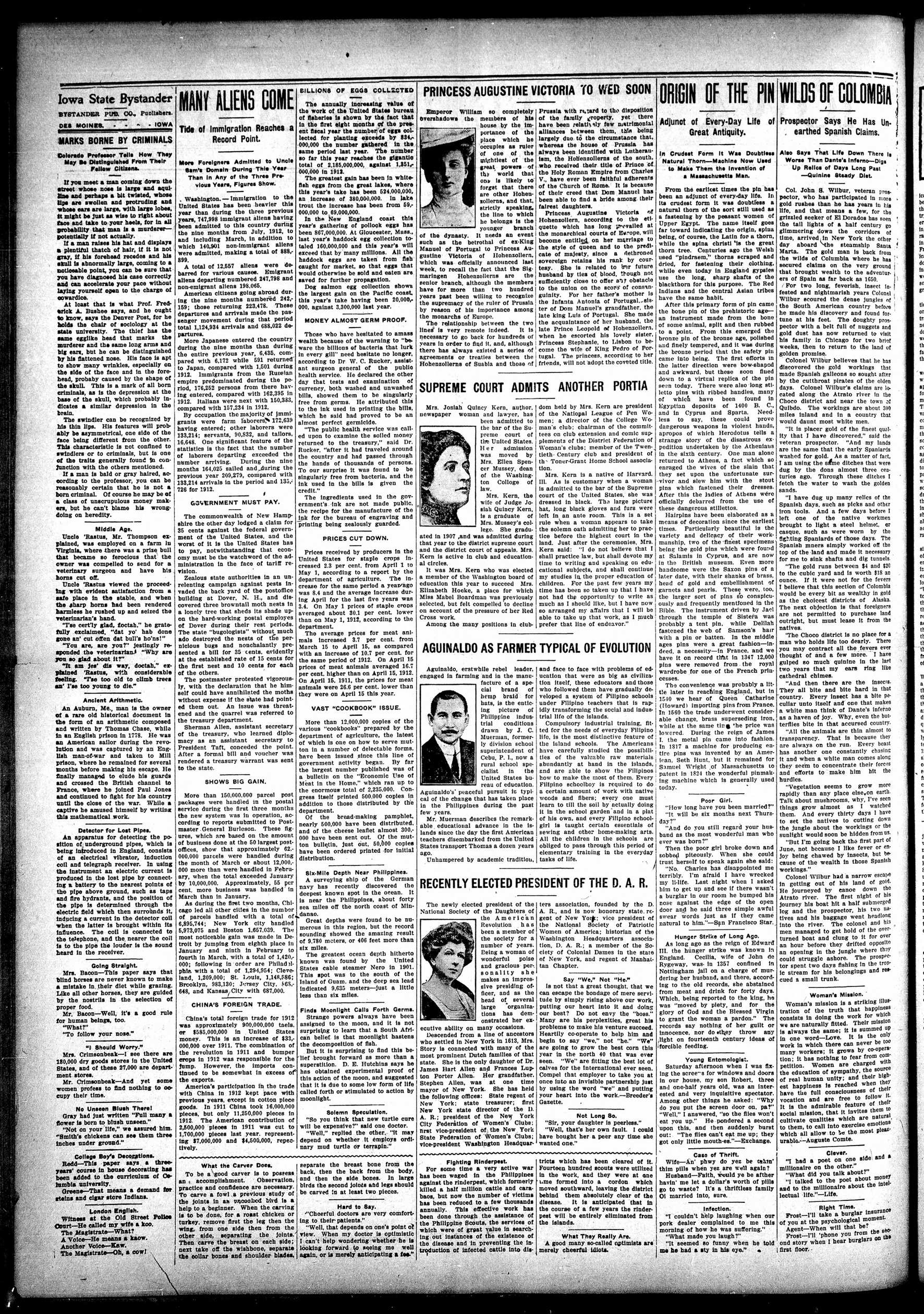
PRINCESS AUGUSTINE VICTORIA TO WED SOON
SUPREME COURT ADMITS ANOTHER PORTIA
AGUINALDO AS FARMER TYPICAL OF EVOLUTION
RECENTLY ELECTED PRESIDENT OF THE D. A. R.
Emperor William so completely
overshadows the members of his
m so completely members of his house by the importance of the which occupies as ruler of one of the nighteist of the great powers of the world that one is likely to forget that there are so many sollers, and that, strictly speaking, the line to which he belongs is the younger branch
house by the importance of the place which occupies a ruler of one of the mightiest of the great powers of the world that one is likely to forget that there are other Hohenzollers, and that, strictly speaking, the line to which he belongs is younger branch of the dynasty. It needs an event such as the betrothal of ex-King Manuel of Portugal to Princess Augustine Victoria of Hohenzollern, which was officially announced last week, to recall the fact that the Sigmaringen Hohenzollers are the senior branch, although the members have for more than two hundred years past been willing to recognize the supremacy of the ruler of Prusia by reason of his influence among the monarchs of Europe.
The relationship between the two lines is very remote indeed. It is necessary to go back for hundreds of years in order to find it, and, although there has always existed a series of Hohenzollers of Suabia and those of Hohenzollers of Suabia and those of
---
Mrs. Josiah Quincy Kern, author,
newspaper woman and lawyer, has
a and lawyer, has been admitted to the bar of the Suzanne Johnson United States. Her admission was moved by Mrs. Ellen Spencer Mussey, dean of the Washing of College of law.
P
Mrs. Kern, the wife of Judge Josiah Quincy Kern, is a graduate of Mrs. Mussy's college. She graduated in 1907 and was appointed that year to the district supreme court and the district court of appeals. Mrs. Kern is active in club and educational circles. It was Mrs. Kern who was elected a member of the Washington board of education this year to succeed Mrs. Elizabeth Hooke, a place for which Miss Mabel Boardman was previously elected, but fell compelled to decline on account of the pressure of her Red Cross work. Among the many positions in club-
Aguinaldo, erstwhile rebel engaged in farming and in the
facture of a special brand of hemp braid for hats, is the entitlement, the picture of Philippine industrial conditions drawn by J. C. Muerman, formerly division school superintendent of Cebu. P. I., now a rural school speculator in the United States bureau of education.
special brand of hemp braid for hats, is the enticing picture of Philippine industrial conditions drawn by J. C. Muerman, formerly division school superintendent of Cebu, P. L. known a rural school specialist in the United States bureau of education.
Aguinaldo's peaceful pursuit is typical of the change that has taken place in the Philippines during the past few years.
Mr. Muerman describes the remarkable advance in education in the islands since the decision teachers disbanded from the United States transport Thomas a dozen years ago.
Unhampered by academic tradition,
The newly elected president of the National Society of the Daughters of
the Daughters of the American Revolution has been a member of the American Society for number of years. Being a woman of wonderful poise and gracious personality she makes an impressive presiding officer, and as the head of several large organizations has demonstrated her ex-
the Ariel ba ha Revolution ha been a member of the society for a number of years Being a woman of wonderful poise and gracious personality ha makes an impressive presiding of fierer, and as the head of several large organizations has demonstrated her ex-ecutive ability on many occasions.
Descended from a line of ancestors who settled in New York in 1613, Mrs. Story is connected with many of the most prominent Dutch families of that state. She is the only daughter of Dr. James Hart Allen and Frances Lupton Porter Allen. Her grandfather, Stephen Allen, was at one time mayor of New York. She has held the following offices: the New York state treasurer; first New York state director of the D.A.; president of the New York City Federation of Women's Clubs; first vice-president of the New York State Federation of Women's Clubs; vice-president Washington Headquar-
Flighting Rinderpest.
For some time a very active war has been waged in the Philippines against the rinderpest, which formerly killed a half million cattle and carabas, but now the number of victims has been reduced to a few thousands annually. This effective work has been done through the Philippines, the services of which are of great value in searching out instances of the existence of the disease and in preventing the introduction of infected cattle into dis-
Prussia with regard to the disposition of the family property, yet there have been relatively few matrimonial alliances between them, this being largely due to the circumstance that, whereas the house of Prussia has always been identified with Lutheranism, the Hollenzollers of the south, who received their title of Prince of the Holy Roman Empire from Charles I, were the adherents of the Church of Rome. It is because of their creed that Dom Manuel has been able to find a bride among their fairest daughters.
Princess Augustine Victoria of Hohenzollern, according to the etiquette which has long prevailed at the monarchical courts of Europe, will become entitled on her marriage to the style of queen and to the predicate of majesty, since a dethroned sovereign retains his rank by courtesy. She is related to her future husband by ties of blood, though not sufficiently close to offer any obstacle to the union on the scors of consanguinity. For her father mother the Inna Titania of Tuscany, also called Manuel's grandfather, the late king Luis of Portugal. She made the acquaintance of her husband, the late Prince Leopold of Hohenzollern, when he escaped his lovely sister, Princess Stephanie, to Lisbon to become the wife of King Pedro of Portugal. The princess, according to her friends, will not adopt the coveted title.
dom held by Mrs. Kern are president of the National League of Pen Women; a director of the College Woman's club; chairman of the committees on club extension and comic supplements of the District Federation of Woman's clubs; member of the Twentieth Century club and president of th' Toner-Grant Home School association
Mrs. Kern is a native of Harvard, Ill. As is customary when a woman is admitted to the bar of the Supreme court of the United States, she was dressed in black. The large picture hat, long black gloves and furs were left in an ante room. This is a set rule when a woman appears to take the solemn oath admitting her to practice before the highest court in the land. Just after the ceremonies, Mrs. Kern said: "I do not believe that I shall practice law, but shall devote my time to writing and speaking on educational subjects, and shall continue my studies in the schools of children. For the past few years my time has been so taken up that I have not had the opportunity to write as much as I should like, but I have now so arranged my affairs that I will be able to take up that work, as I much prefer that line of endeavor."
and face to face with problems of education that were as big as civilization itself, these educators and those who followed them have gradually developed a system of Filipino schools under Filipino teachers that is rapidly transforming the social and industrial life of the islands. Compulsory industrial training, fitted for the needs of everyday Filipino life, is the most distinctive feature of the island schools. The Americans have carefully studied the possibilities of the valuable raw materials abundantly at hand in the islands, and are able to about the Filipinos to make the most of them. Every Filipino schoolboy is required to do a certain amount of work with native woods and fibers; one must learn to till the soil by actually doing it in the school garden and in a plot of his own, and every Filipino schoolgirl is taught the essentials of sewing and other home-making arts. All the children in the schools are obliged to pass through this period of elementary training in the everyday tasks of life.
ters association, founded by the D. A. R., and is now honorary state. regent of New York; vice president of the National Society of Patriotic Women of America; historian of the Washington Headquarters association, D. A. R.; a member of the Society of Colonial Dames in the state of New York, and regent of Manhattan Chapter.
Say "We." Not "He."
Is not that a great thought, that we can escape the bodge of mere servitude by simply rising above our work, putting our heart into it and doing our best? Do not envy the "boss." Many are his peptixeptis, great his bosses, and Heartly co-operate to help him and begin to say "we," not "we." "He" are going to grow the best corn this year in the north 40 that was ever seen. "We" are fitting the best lot of calves for the international ever seen. Compel that employer to take you at his business partnership just by using the word "we" and your heart into the work—Breeders' Gazette.
Not Long 80.
"Sir, your daughter is peerless." "Well, that her own fault. I could have bought her a peer any time she wanted one."
tricts which has been cleared of it. Fourteen hundred scouts were utilized in the work, and they were at one time formed into a cordon which moved southward, leaving the district behind them absolutely clear of the disease. It is anticipated that in the course of a few years the rinderpest will be entirely eliminated from the islands.
What They Really Are. A good many so-called optimists are merely cheerful idiots.
ORIGIN OF THE PIN WILDS OF COLOMBIA
Adjunct of Every-Day Life
Great Antiquity.
In Crudest Form It Was Doubtless Natural Thorn - Machine Now Used to Make Them the Invention of a Massachusetts Man.
From the earliest times the pin has been an adjunct of everyday life. Its crudest form it was doubtless a natural thorn of the sort still used as a decorative element in the name of Upper Embry. The name itself goes far toward indicating the origin, spina being, of course, the Latin for a thorn, while the spina christi 'is the great thorn tree. Centuries ago the Welsh used "pindraem," thorns scraped and dried, for fastening their clothing, while even today in England gypseus use the long, sharp shards of the bleathorn for this purpose. The Red Indians and the central Asian tribes have the same habit.
After this primary form of pin came the bone pin of the prehistoric age—an instrument made from the bone of some animal, split and then rubbed to a point. From this emerged the bronze pin of the bronze age, polished and finely tempered, and it was during the Bronze Age that came into being. The first efforts in the latter direction were bone shapel and awkward, but these soon fined down to a virtual replica of the pin seen today. There were also long attelto pins with ribbed handles, many of which have been found in Egyptian deposits of 1400 B. C. and in Cyprus and Greece. Need to these could prove dangerous weapons in violent hands, apropos of which Herodotus tells a strange story of the disastrous expedition undertaken by the Athenians in the sixth century. One man alone returned to Athens, a fact which so enraged the wives of the slain that they set upon the fortunate survivor and slew him with the stout weapon. After this the ladies of Athens were officially debarred from the use of these dangerous stilletos.
Hairpins have been elaborated as a means of decoration since the earliest times. Particularly beautiful is the variety and delicacy of their workmanship, two of the finest specimens being the gold pins which were found at Salamis in Cyprus, and are now in the British museum. Even more handsome were the Saxon pins of a later date, with their shanks of brass, head of gold and embellishment of garnets and pearls. These were, too, the larger sort of pins so conspicuously and frequently mentioned in the Bible. The instrument driven by Jack through the temple of Sistera was probably a tent pin. In the web of Samson's hair fastened in a pin or batten. In the middle ages pins were a great fashion—indeed, a necessity—in France, and we have it on record that in 1347 12,000 pins were removed from the royal wardrobe for one of the French princesses.
The convenience was probably a little later in reaching England, but in 1510 we hear of Queen Catherine (Howard) importing pins from France. In 1560 the trade underwent considerable change, brass superseized iron, while at the same time the price was lowered. During the reign of James I, the metal pin came into fashion. In 1817 a machine for producing entire pins was invented by an American, Seth Hunt, but it remained for Samuel Wright of Massachusetts to patent in 1824 the wonderful pinmaking machine which is generally used today.
Poor Girl
"How long have you been married?" "It will be six months next Thursday?" "And do you still regard your husband as the most wonderful man who ever was?" "The poor girl broke down and sobbed piteously. When she could trust herself to speak again she said: "No. Charles has disappointed me terribly. I'm afraid I have wrecked my life. Last night when I asked him to get up and see if there wasn't a burglar in our room he dumped his wife and his children into the door and he said three simple awful swear words just as if they came natural to him."—Sen Gonzalo Star.
Hunger Strike of Long Ago
As long ago as the reign of Edward III, the hunger strike was known in England. Cecilia, wife of John de Ryeway, was in 1357 confined in Nottingham jail on a charge of murdering her husband, and there, according to the old records, she abstained from meat and drink for forty days. Which, being reported to the king, he was "moved by plety, and for the glory of God and the Blessed Virgin to grant the woman a pardon." The records say nothing of her guilt or innocence, nor do they throw any light on fourteenth century ideas of forcible feeding.
Young Entomologist
Saturday afternoon when I was fixing the scree's for windows and doors in our house, my son Robert, three and one-half years old, was an interested and very inquisitive spectator. Among other things he asked: "Why do you put the screen door on, pa?" "Well," I answered, "so the flies won't eat you up." He pondered a second upon this, and then suddenly burst out: "The flies can't eat me up; you got only little mouth-es."—Exchange
Case of Thrift
Wife—An' phwy do yez be 'taan™
thim pills when yez are well again?
Husband—Faith, would ye be afther
havin' me let a dollar's worth of pills
go to waste? It's a thriftless family
Oi married into, sure.
Infection.
"I couldn't help laughing when our pork dealer complained to me this morning of how he was suffering." "What made you laugh?" "It seemed so funny when he told me he had a sty in his eye."
Prospector Says He Has Unearthed Spanish Claims.
Also Says That Life Down There Is Worse Than Dante's Inferno—Digs Up Relice of Days Long Past —Quinine Steady Diet
Col. John S. Wilbur, veteran prospector, who has participated in more gold rushes than he has years in his life, and that means a few, for the grizzled seeker of El Dorados has seen the tall lights of a half century go glimmering down the corridors of time, arrived in New York the other day aboard the steamship Santa Marta. The gold man is back from the grizzled place where he has secured claims on the ground that brought wealth to the adventurers of Spain as far back as 1650.
For two long, feverish, insect infested and nightmarish years Colonel Wilbur scoured the dense jungles of the South American country before he made his discovery and found fortune at his feet. The doughty prospector with a belt full of nuggets and gold dust has now returned to visit his family in Chicago for two brief weeks, then to return to the land of golden promise. Colonel Wilbur believes that he has divided his gold workings that made Spanish galleons so sought after by the cutthroat pirates of the old days. Colonel Wilbur's alms are located along the Atrato river in the Choco district and near the town of Quibdo. The workings are about 300 miles inland and in a country that would dawn most white men.
"It is placer gold of the finest quality that I have discovered," said the veteran prospector. "And my lands are the same that the early Spaniards washed for gold. As a matter of fact, I am using the same ditches that were dug by the dons almost three centuries ago. Through these ditches I fetch the water to wash the golden砂岩. "I have dug up many relics of the Spanish days, such as picks and other iron tools. And a few days before I left one of the native workmen brought to light a steel helmet, or casque, such as were worn by the fighting Spaniards of those days. The Spanish mners simply worked off the top of the land and made it necessary for me to sink shafts and dig tunnels. "The gold runs between $4 and $20 to the cubic yard and is worth $18 an ounce. If it were not for the fevers I believe that this section of Colombia would be every bit as wealthy in gold as the choicest districts of that foreigner are not permitted to purchase land outright, but must lease it from the natives.
The Choco district is no place for a man who holds life too dearly. There you may contract all the fevers ever thought of and a few more. I have gulped so much quinine in the last two years that my ears ring like cathedral chimes.
"And then there are the inescens. They all bite and bite hard in that insect, its insect has a bite peculiar unto itself and one that makes a white man think of Dante's inferno as a haven of joy. Why, even the butterflies bite in that accured country. "All the animals are thin almost to transparency. That is because they are always on the run. Every beast has another one constantly chasing it and when a white man comes along they seem to concentrate their forces and efforts to make him hit the hurdles.
"Vegetation seems to grow more rapidly than any place else, on earth. Talk about mushrooms, why. I've seen them. I watched I watched them. And every thirty days I have to set the natives to cutting down the jungle about the workings or the sunlight would soon be hidden from us.
"But I'm going back back the first part of June, not because I like fever or enjoy being chawed by insects, but because of the wealth in those Spanish workings."
Colonel Wilbur had a narrow escape in getting out of his land of gold. He journeyed by canoe down the Atrato river. The first night of his journey his boat hit a hatch submerged log and the prospector, his two natives and his baggage went headling into the river. The colonel and his men managed to get hold of the over an hour before they drifted opposite an opening in the jungle where they could struggle ashore. The prospector spent two days fishing in the tropic stream for his belongings and rescued a small trunk.
Woman's Mission.
Woman's mission is a striking illustration of the truth that happiness consists in doing the work for which we are naturally fitted. Their mission is always the same; it is summed up in one word—Love. It is the only work in which there can never be too many workers; it grows by co-operation; it has nothing to fear from competition. Women are charged with the education of sympathy, the source of real human unity; and their highest happiness is reached when they have the full consciousness of their vocation and the free to follow it. An amenable feature of their social mission, that it invites them to cultivate qualities which are natural to them, to call into exercise emotions which all allow to be the most pleasurable.—Auguste Comte.
Clever.
"I had a poet on one side and a millionaire on the other." "What did you talk about?" "I talked to the poet about money and to the millionaire about the intellectual life."—Life.
Right Time.
Frost—I'll take a burglar insurance of you at the psychological moment.
Agent—When will that be?
Frost—I'll 'phone you from the second story when I hear burglarls on the first floor.
AFRO-AMERICAN CULLINGS
The history of womanhood in America would be incomplete without note being taken of the heroic struggle of the colored women born in this country, who, from the time of their liberation from slavery, have been exerting every effort to overcome in their race the effects of a bondage extending over unnumbered centuries, writes Frederic J. Haskin. The Afro-American woman demonstrates more than do most others the tender, maternal instinct of the primeval woman, who would labor and suffer and bear strong sons whose vigor might add to the greatness of the world.
The development of this great nation necessitated the freedom of the one-time slave. Unequipped with the training and education needed for the new duties and responsibilities freedom brought to them, the colored women from the beginning keenly felt the responsibility of preparing her family for the new life dawning upon them.
No greater task ever came to the women of any nation, and the loyalty with which they are fulfilling it must appeal to any one who will consider for a moment some of their achievements in the face of great obstacles. The colored woman recognizes the value of education far more than the colored man, as is evidenced by the much larger number of colored women than men now found in the higher schools. It was only the exceptional colored woman, a generation or two ago, who, by the aid of some kindly disposed friends, and usually by untold sacrifice and exertion on her own part, was able to secure an education which demonstrated her fitness for something more than the mental drudgery which had been considered the lot of the women of her race. Having achieved an advantage for herself, she did not selfishly enjoy it, but, in almost every instance, devoted her added advantage to help others of her race.
Like the white woman, the progressive colored woman realized the value of organization. When the great Federation of Women's clubs was organized several of the clubs, composed of educated colored women, were credulous enough to believe that the motto "Unity in Diversity" was broad enough to include the enlightened women of their race who were working toward the general uplift of humanity. The refusal of the general federation to admit Mrs. Ruffin, as a delegate from the New Era club of Boston, answered this assumption. Stung by this rebutt, the colored women realized that for the present they must receive aid from organizations composed entirely of their own race.
The National Association of Colored Women in the United States now fills a greater place in the development of the colored women of the country than does the general federation for the white women. Its bonds are closer and more sympathetic because of the discouragements its members so frequently receive. This organization, which has grown from a comparatively small body, organized in Washington in 1896, now represents more than 150,000 colored women in its membership. It has state federations in most of the states and is strongest in the south. The association recognizes the fact that whether cultured or not, the colored woman receives practically the same treatment from the white public. The women who have culture therefore really help themselves in helping those who have not, and the spirit of
Disunion is the result of perverted judgment or a lack of understanding which, in either case, is hurtful. Ignorance is a fruitful producer of woes and it is a grave misfortune not to know or realize its banal effects. Success in life hinges upon a proper use of the materials employed in its making; and we-sink or swim in accordance with the execution of our plans. The Negro occupies a position not envied by the others of mankind; but his opportunities are many and he may with readiness pull the load, if he rightly puts his shoulder to the wheel.
Chinkapin chains, a novelty just over from London, are made of large, polished wood beads in black and costume colors, strung on knotted silk or fastened with metal links. They come in the form of lorgette chains, purse chains, and graduated necklaces, and retail at from 34 to 44 cents.
A hitherto unknown clan of Jews has been discovered in the interior desert of Arabia.
Have you really got as much faith in God, and your religion as you say you have? If so, why is it you resort to methods that are not of God in order to accomplish some things? Why don't you put the matter in his hands, as you say he will fight your battles for you?—The Interstate Reporter.
The fishermen of Maine, making use of power boats, are generally making use of a mixture of gasoline and lubricating oil, which is said to keep the cylinders thoroughly oiled without the use of lubricating cups.
Dainty bags for holding knitting of the sort that an elderly gentlewoman likes to have about her drawing room, and which a girl can easily make, are of flatiron shape. The foundation is of buckram or very stiff canvas, the lining of a pale hued silk and the outside of black, mauve or silver gray satin in moire, embroidered in white.
Weather records of Panama for twenty-two years show that the Canal Zone each year has eight months that can be classed as wet and four as dry
the association is one of general helpfulness, which is expressed in its motto, "Lifting as We Climb." Most of the problems which confront the white wife and mother come also to her colored sister. The difficulties of the latter are largely increased by the barriers of race. The colored women are just as anxious to educate their children and to have a high standard of living as the white women. The number of uneducated women who will toll over a wash tub all day long in order to keep their children in school demonstrates this. But their ambitions are gained only by a constant struggle such as the white woman has never even imagined.
In all the history of its pioneer work in the development of the Negro folk songs, Fisk university had never given such a concert as was presented to an enthusiastic audience last night in Ryman auditorium, the largest hall in the city. This immense audience gave the 300 Negro students round after round of applause, demanding an encore for every number on the program. Nowhere else in the United States could there be gathered such a company of select Negro voices under such leadership, for the singing of these songs, as that which greeted the music lovers of Nashville on this occasion. From the opening song of "Brethren, Rise," to the closing, "Brewing Low, Sweet Charlot," led by Mrs. Ella Sheppard Moore, one of the original jubilee singers, this mammoth chorus held the audience in wret attention. The chorus was assisted by the University orchestra, the Men's Glee club, and the Women's Glee club, whose rendition of Mendelssohn's "Lift Thine Eyes" was as pure a piece of vocal harmony as one seldom has a chance to hear. The choral work was under the direction of Professor John W. Work, the noted leader of Negro folk songs. His solo, "Onaway, Awake Beloved," by Coleridge-Taylor, was one of the features of the evening.
This concert was given as a part of the strenuous effort the university is making to raise the balance of nearly $100,000 to complete a much needed endowment fund. The raising of this fund will meet a great crisis in the history of this noted institution. Cash and pledges to the amount of $202,000 have been secured. Many of the pledges are conditions on the raising of the balance of a $300,000 fund by June 1, 1913. The following is the program of the concert, without the encores, which followed each selection:
PART I.
Ortizan
Brethren, Rise., Negro Folk Song
Witness for My Lord., Negro Folk Song
Led by Miss Green.
Lift Thine Eyes., Mendelssohn
Lift Thine Eyes., Glee Club.
Steal Away to Jesus., Negro Folk Song
Rosary., Arranged
Messames C. O. Haddley and J. W. Work.
Messames J. W. Work and A. G. Price.
Great Work, Glee Club., Negro Folk Song
Led by Mrs. C. O. Haddley.
Remarks., By Friends of Flask
PART II.
Couldn't Hear Nobody Pray.
Negro Folk Song
Led by J. A. Myers.
Onaway, Awake, Beloved.
Coloridge Taylor
J. W. Work.
I'm Goln' to do all I can for My Lord.
Negro Folk Song
Led by A. G. Price.
There, Little Girl, Don't Cry., Westendorf
There, Little Girl, Glee Club.
Readings from the Works of Dunbar
J. A. Myers.
Swing Low, Glee Club.
Led by Mrs. G. W. Woolf of the Original
Jubilee Singers.
The students of the Atlanta Baptist College (Georgia) held spell-bound an audience of four thousand people in the Armory auditorium in Atlanta recently with a program from Negro composers. One marked feature of the occasion was the rendition of the grand chorus, "Gallia," by 250 male voices. Both races were there. Atlanta's very best and most cultured, and they were unanimous and enthusiastic in rendering the verdict that it was a wonderful performance. Mme. Azalla Hackley trained the program. President Hope wisely encouraged it.
There is a class which makes great pretensions to interest as to to the welfare of their fellow-men, but when the opportunity for manifesting it appears, excuses used coined are dragged from their covert to brace the fibs they tell. Such characters, selfish in purpose are of little benefit to themselves and none whatever to the society of which they form a part.
The pawnbroker won't advance a cent on your self-esteem.
Samuel Coleridge-Taylor, one of the best known modern composers, and the most prominent of Negro composers, died in London, England. The deceased was one of England's leading writers, and was well known in this country, having made several visits to Anterica. In Washington, D. C., a few years ago, he produced a part of his greatest work—his *Hilawatha trilogy*—*Hiwatha's Wedding Feast*, and was voted a composer of marked ability by both press and public. His last visit to the United States was two seasons ago.
The loudest public professions do not always guarantee the righteousness of private acts. Many would be the dupes if the utterances of all men were given serious consideration.
The girl with two or three good looking brothers always has more girl friends than she knows what to do with.
Start out with the intention of calling everything by its right name and you will change your mind before you have gone a block.
CAN BE MADE ONE OF THE MOST
COMFORTABLE APARTMENTS.
With Appropriate Furnishings it Will
Be Found a Constant Delight
Pleasant Place for Breakfast
or Luncheon.
Each summer brings more appreciation of living out of doors, of taking what we can of our daily life out into the sweet air and near the refreshing green. The gallery has become very popular and buildings pay much attention to it. What was once a narrow, rallied in strip is now practically a room, and a well-furnished room, too. Rugs of grass matting, or rag rugs will not suffer harm from damp, and give the verandah an aspect of comfort. Comfortable chairs of wicker or wood, the latter painted to agree with the house coloring, are set in inviting arrangement. A table with undershelf is ready to hold magazines and fancy work. If a cloth is used, it should be well weighted down at the corners for safety during windy days. If possible, a sofa should be given a place, for out-of-door naps are very restful. The sofas are light and very pretty in appearance, but a rug, or even two, should be at hand, for there should always be one under the sleeper. The chairs have a wide extension on the arm are very practical when one wants to do writing, or to take a cup of tea of an afternoon. Cushions, covers for chairs, and lounge should be of wash material. Denim, Turkey red, or art ticking, are strong and serviceable. Make them to button on. If it is at all possible the meal should have at least one meal a day on the gallery. In one house where this was done the enjoyment was a recompense for the extra trouble, and the trouble was minimized as much as possible by the table being placed on the gallery just outside the dining-room window. Everything for the meal was passed out of the window, saving unnecessary steps. A plain deal kitchen table was used. A curtain to shut out sun, wind, or even rain, if necessary, one that draws up with a cord. Matting roller blinds for this purpose are to be had in the shops. A light on the verandah at night makes the evenings available for reading and sewing, but sometimes almost necessitates an entire screening of mosquito velling.
One of the gallery seats, or perhaps the lounge, should be of the box variety, furnishing a receptacle for cushions, rugs, books, etc., where they can be hastily disposed of at night if desired. A hammock bed is a much coveted addition to the verandah furnishings. Plants and vines must not be forgotten in planning the beauty as well as the comfort of this out-door living room, and many additional comforts and pleasure still suggest themselves as the season passes.
Any expense and trouble caused in the preparation of this out-door resort and in its care will be more than repaid when the autumn chill comes again by the many hours of pleasure enjoyed there in sultry days and evenings.
The provided image is too blurry and low-resolution to accurately recognize any text. Therefore, no text can be extracted from this image.
To Save Juice or Rhubarb Pies.
One of the minor advantages women in the suburbs enjoy at this season is the opportunity to go out in their gardens and cut fresh rhubarb. But how provoking it is to a housekeeper when baking rhubarb pies, or any fruit pies, to have the juice overflow, and what a burnt, sticky mess it makes on the bottom of the oven! We should like to have all that juice in the pie, and it may be kept in by taking a short piece of uncooked macaroni and inserting it in the pie, like a little chimney stack. Some people make paper funnels to answer the same purpose, but I think the macaroni is better. Of course, it should be removed after the pie is baked, as its presence is purely useful, not ornamental.
Chocolate Bread Pudding
Take two cups stale bread crumbs.
Stir into crumbs one-half cupful sugar
add one tablespoonful of cocoa or a
little more if desired. Add two cupfuls sweet milk, then beaten yolk of one egg and a small piece of butter.
Bake in fairly hot oven for three-quarters of an hour.
Sauce—Take one-fourth cupful butter and one-half cupful sugar and cream by hand, then add beaten white of egg.
Novel and Delicious
Large bunch asparagus, three eggs, butter, salt.
Parboll asparagus, remove water, and boil in fresh water until tender. Remove to deep, long baking dish, and dress with butter, and cover with yolks of eggs well beaten. Make a froth of the whites, cover the whole, and place in oven for some minutes until set.
Basse Partout for Mending
If you tear a black dress, cut a narrow strip of black passe-partout braid, wet it and paste on the back of the rent. You will find that the dress is mended invisibly. Be careful to draw the edges of the rent closely together. This is especially valuable to persons traveling, as it does not require a hot iron like the ordinary mending tissue. —McCall's Magazine.
Top for Pudding.
After baking a bread pudding, cover the top with marshmallows and put back into the oven until they melt and brown. This forms a delicious mock-meringue top that fills the place of the hard sauce usually served with bread pudding, says Good Housekeeping. Do not place the marshmallows too near the edge of your baking dish or they will stick to it in serving.
To Remove Paint.
To remove paint from clothes use equal parts of benzine and ammonia, rubbing with a cloth on the wrong way of the nap to get out all the paint. Then hang the garment on the clothesline to dry in the open air. When dry, if no trace of the paint is seen, brush the cloth in the proper direction. When using benzine keep away from fire.
PHOTO BY
FRED
TOWNSHIP
"Certain parties," who would no doubt delight to see things go badly for Manager Miller Huggins of the Cards, have circulated stories that Sheckard is held as a club over Huggins' head, being secured and kept on the team with the idea of being made Huggins' successor at the least sign of the Cards breaking. There are two things that show there is nothing in this sort of talk, says the Sporting News. First the showing of the Cards under Huggins; second the whole-hearted way that Sheckard is giving his services to Huggins and the good feeling that exists between the two. Sheckard is out to win for Huggins—and the Cardinals.
Infielder Roy Rock has been appointed captain of the New London team.
Scorers in the Western league have cut Pitcher McConnaughey's name to McConney.
Eddie Cicotte has progressed in a year from a losing pitcher to the leading slabman of the Chicago White Sox.
Sisler's pitching baffled Cornell at Ann Arbor, and Michigan won, 6 to 2
Sisler's pitching baffled Cornell at Ann Arbor, and Michigan won, 6 to 2.
This fellow James, who is pitching for the Boston Braves, seems to have both curves and stamina.
"Tilly" Shafer, the Giants' shortstop, has been fielding in sensational style and batting like a flend.
Outfielders seem to be the best batters in the American league. Among the 25 .300 stickers, 15 of them are outfielders.
Bridge whist has taken the place formerly held "by poker as a diversion for big leaguers while riding from town to town.
The two Bills, Klem in the National and Evans in the American leagues, are said to be the umpires most respected by ball players.
Frye's pitching enabled Harvard to shut out Syracuse 3 to 0 at Cambridge. The Harvard slabmen allowed only one hit and did not pass a man.
---
Frank Laporte of the Senators continues to show unexpected form at third base, making plays which would do credit to most any third baseman.
. . .
Christy Mathewson and a rushing style of play seem to be all the Giants have this season. The New York aggregation has not added any strength
---
Olaf Henriksen, the little outfielder of the Boston Red Sox, is justifying the faith Manager Stahl has had in him. He is batting right up there with the best of them.
A version of Casey up to date has been printed in Boston, which winds up: "And somewhere men are laughing And somewhere children play, But there is no joy in Boston—Walter Johnson works today!"
Manager Griffith thinks that George McBride is the best stopper of them all. "You can have your Wagoners, Weavers and the pick of them all," said the Old Fox, "but for mine I will always stick to the man we have."
. . .
Wrecking crews are the latest rage. Nearly every club outside Greater New York has a spot in its batting order where two or three sluggers come in a bunch, and said bunch has accounted for more than its share of the team's victories.
---
Fans in Davenport declare that Shortstop Milt Reed, who succeeded Ray Chapman, is just as good a ball player as the lad now starring with Cleveland and that if he keeps up his lick he will jump to the majors sure.
---
Pitcher Aldous of Battle Creek has given up the game to follow his profession of electric engineer, and hopes that he would report after being out last season are blasted. In 1911 he won ten out of 12 games for Battle Creek
Infeldler Roy Rock has been appointed captain of the New London team.
Scorers in the Western league have cut Pitcher McConnaughey's name to McConney.
Eddie Cicotte has progressed in a year from a losing pitcher to the leading slabman of the Chicago White Sox.
Joseph Pfeiffer of the Pittsfield "Eagle" has been appointed official scorer for that city by President James H. O'Rourke of the Eastern association.
---
The Southern Michigan league has adopted President Johnson's idea for the American league umpires and will give prizes to the umpires who show records of the shortest game.
Goulait, the Toronto club's new right-hand twirler, is a little fellow, not as tall as Dick Rudolph, but stockly built. He pronounces his name "Goolay."
---
Barney Schreiber appears to be a pitcher who believes in letting the fielders work. In a recent game he pitched 17 fly balls were garnered by the outfielders on the Denver team.
Manager Joe Kelly of the Toronto team, according to New York critics, has secured a fine young ball player in Joe Schultz, recently with the Braves. Schultz is a fine hitter, a fast, clever fielder, and lacking only experience to be major league caliber.
SPORTING WORLD
"Kid" Williams of Baltimore knocked out "Young" Diggins of Philadelphia at the Empire theater in Baltimore.
Harry Donahue of Pekin, Ill., had a shade over Mickey Sheridan of Chicago in a ten-round bout before the Social Athletic club at Peoria.
Yale nosed out Princeton by the score of $60\frac{1}{2}$ to $56\frac{1}{2}$ in their annual track meet.
Vernon McKinney is to be kept on the coast and will be missed from the free-for-all events.
Geers will have the California sensation, San Felipe, 2:09; that won every start last year.
It is thought that with a year's rest Joe Bowers will be all right for the grand circuit this year.
Barongale is being mated with a number of mares in Kentucky and will have a grand chance to distinguish himself.
In the Cleveland pacing sweepstakes are Evelyn W. Earl, Jr., Braden Direct, Don Denamore, Joe Patchen II. and Gold Seal.
"Jock" Soutar of Philadelphia won the professional raquet championship of the world by defeating Charles Williams of England, the titleholder.
It is announced that two race meetings for the harness horses would be held in connection with the Panama-Pacific exposition in 1915, one in June and the other in October.
UNFINISHED STORY FROM THE FAITHFUL
Mary Preston, teacher of English in a select school for young ladies, sat in the vine-clad summer house of her aunt's lovely garden. Scattered about on the table before her were books, paper and pencils. She reread the page just completed, made a few corrections and began to write another, when a hummingbird flew into the bower to filch the sweets from the trumpet flowers. She watched it, polishing gracefully in the air, gorging itself with honey, not daring to move for fear of frightening the timid creature. When the flowers' treasure was exhausted the tiny robber departed.
The pretty teacher had dreamed for years of writing a romance of the days of chivalry, but many vacations ended with the story untold. She determined to have the manuscript ready for the publisher when September arrived, and to accomplish this she had sacrificed a summer spent at the mountain cottage with chums to come to Fairview with her Aunt Eliza, who was deaf and not at all companionable.
Her vacation was almost ended and the story but half told. The thoughts refused to form clearly, so Mary walked to the garden and picked bouquets for the house.
In the next garden the professor was endearing to train the refractory honeysuckle vines in the way they should go.
"Good morning, Miss Molly," he called cheerily. "How goes the adventurous knight today?"
"Very slowly, my good neighbor, I am loath to confess. In return may I ask how the translations from the Arabian poets are progressing? Your light still burned after midnight and we agreed not to work later."
"I became so absorbed that our compact was forgotten. Pardon me!" He drew nearer to the hedge.
"I knew you were writing in the summer house, and longed to interrupt your work, for it is a glorious morning for tennis, but, knowing how anxious you are to complete the book, I bade Satan get behind me. Noticing the neglected tangle of vines I decided to help them to a higher plane."
"But why aren't you translating this morning? Yesterday you said we must waste no more precious hours or we would both return to our labors with comparatively nothing accomplished."
"I must leave here sooner than I expected. A letter came this morning from the president of the college, requesting me to spend the last two weeks with him, to discuss some changes in my department. When I realize that only ten days remain for me to enjoy the beauties of this place, the Arabian poets no longer charm. Are you going to condemn me to solitary ramblings or do you prefer the company of the tenth-century knight?" "I dare not waste any more time in pleasure. You can imagine how the girls would ridicule me if I returned without the book." "Well, I'm off for the country club. Goodby, and good luck to your knight." Mary worked furiously that afternoon, but now and again she found herself gazing absently through the vine-curtained door to the hills be-
At sundown her neighbor returned and called cheerly across the hedge, "You missed packs of fun for the sake of your knight; we had three exciting sets and I actually won two. Surely, you are not going to work tonight?" Mary nodded her head in the positive. "You are unkind to continually remind me of the sacrifice I am making." "There is to be a moonlight sail on the bay and I wanted you for my mate. That is all," he said, sadly, and swung up the path toward the house. She did not change her frock that evening, for fear of changing her mind with it, and ate such a small bit for dinner that Aunt Eliza protested. She strolled into the garden to take one last look at the flowers in the moonlight. The professor came out, apparently for the same reason, and catching a glimpse of her white dress among the tall shrubbery, he called, "Come with me! This night is too glorious to be spent indoors."
She felt her good resolutions crumble, like a house of cards.
"Walt until I get my coat," she said. "I will go."
Two hours later they were skimming over the unruffled surface of the bay. The wind wafted snatches of songs from the other sailboats and the professor locked the wheel and came to Mary.
"I want to take you back with me," he said. "Will you marry me tomorrow?"
"I don't want to marry," she gasped. "Yes you do!" he insisted.
"Well, then, there's my book."
"Hang your old book," said the professor, clasping her to his breast.
The poor knight still rides through the forest, and the noble lady remains a prisoner in the tower.—New York Press.
United States Radium Production. Dr. Otto Brill, the first man to manufacture radium in this country, is an Austrian chemist, who came to the United States seven months ago to direct and develop the radium manufacturing plant at Pittsburgh. This country now leads the world in the production of the chemical, and the six grams a year is greater than the rest of the world combined is producing.
Housewife's Comfort
Belle—I see Miss Fay Kellog, New York's first successful woman architect, earns $8,000 a year designing comfortable houses for women.
Beulah—Do you mean to say a house can have as many closets as that?
Putting It Strongly
"I guess she loves me, all right."
"Why so?"
"She vows she'd rather be miserable with me than happy with any body else."
---
Much Money Collected In the Temples of Japan.
Offertory Chests Yield Piles of Small Coin That Are Regularly Collected and Applied to Needs of Edifices.
Among the many oddities in Japan which are enormously big in the outward form, but are in reality exceedingly small, we must count the Kwannon of Askusa, which is scarcely three inches in height and yet is housed in a colossal edifice known as the Kwannon Temple.
On the other hand, there are not a few things which at first sight appear extremely small and insignificant and which in truth assume gigantic dimensions. To this latter category belongs the saisen (offerings) daily, hourly, nay, every minute, unceasingly thrown into the offertery chests before the same Kwan-non Temple of Askusa. The Nichi Nichi has an interesting paragraph concerning the receipts of the Kwan-non Temple accruing from the 20 offertery boxes placed at various places within the temple compound. The following is the latest information upon the subject:
At certain stated days all the salsen coffers are emptied under the joint supervision of four responsible priests, and mountains of coins of various descriptions are piled up. One-half of these coins are five rin copperps, while 40 per cent. of the whole are ten coins, the remainder being nickels, small silver and old-fashioned rin coins with square holes. Sometimes the priests find paper money, even of as high denomination as 5 yen and 10 yen.
Every 10 days these heterogeneous masses of small coins are exchanged into convenient and uniform currency or checks. Two money changers named Messrs. Yamada and Hayakawa are regularly intrusted with this custom. The receipts vary according to various seasons, and in the festive season of the flower season, such as the present, no less than 1,500 yen is obtained every 10 days. Even when the season is unfavorable the receipts will not go below 700 or 800 yen, and the average monthly income from the 20 offertory coffers amount to 4,000 yen.
The manner of exchange is somewhat unique. It is not conducted on the commission basis usually adopted. The coins are exchanged, not ad valorem, but specifically, so to say. All the coins are jumbled up upon large scales and weighed, and the exchanges take them all indiscriminately by weight, paying 5 yen, for every kwan of the heterogeneous coins.
The regular monthly takings of 4,000 yen from the offertory chests alone is certainly a good income; but we are reminded at the same time that the expenditures defrayed by the temple authorities regularly is by no means inconsiderable. When we are told that for the repairs of the temple buildings alone an outlay of from 6,000 yen to 10,000 yen is required per annum we can form some idea of the expenses in other directions.
Spiked Her Guns.
One of the neatest callings down we ever hear or heard of was that one administered by the matron of an old Western Reserve family to an upstart would-be, last week. The latter said: "Harold has just introduced me to an acquaintance of his who's quite impossible. He is educated, I understand, and he is well dressed and polite. But his father was a bricklayer. If I refuse to treat him as an intimate, do you think he will become offended?" "No, dear," answered the older lady. "Nothing foolish or illbred that you or any of your set may do will surprise him in the least."—Cleveland Plain Dealer.
Italian War Strength.
The figures for the year 1911 give Italy a peace strength of 225,000; a war strength of 525,000, and 'available for duty unorganized.' 1,200,000. The latter figures are, of course, based on the estimated male population of military age, and are probably correct. Figures for the same year give Italy 7 modern battleships, 5 other battleships, 7 first class cruisers, 3 second class cruisers, 13 third class cruisers, 13 gunboats, 3 destroyers, 75 torpedo boats and 19 submarines. Personnel of navy, officers and men, 29,941.
Country's Voting Laws
No alien can vote in any one of the United States. Before a man can exercise the ballot in Massachusetts, New York, Georgia or any one of the forty-eight states, he must have received his naturalization papers and thus become a citizen of the United States. The laws regarding voting vary considerably in the various states, but, very naturally, they are a unit on this matter of United States citizenship.
Pompell.
Pompeii was overwhelmed by an eruption of Vesuvius on the night of August 24, A. D. 79. The city lay buried in ashes for 15 centuries when a man turning up the ground found a bronze figure which led to further search, with the result that the whole city was at last uncovered. The finds at Pompeii have caused the rewriting of much history and the realignment of many opinions about the ancient world in general and the Roman world in particular.
Unwilling to Spell Anticipation
"Suppose," began the ribbon counter girl, "that you were Hetty Green, and—"
"Don't," interrupted the girl from the hosiery department, "I've just found 10 cents I didn't know I had, and I'm going to blow it all in on my lunch today."
"Then you weren't always a black sheep?"
"No. mum. I started my career as a Wall street lank."
GRAND COURT OF H. OF J.
The twenty-third annual communication of the Grand Court of Heroes of Jericho for the state of Iowa and jurisdiction will be held at Keokou, Iowa, June 10, 11, 12, 1913. Brent Court entertains.
Subordinate court representatives and as many visitors that will be in attendance forward your name to G. C. secretary, Mrs. Emma Teabeau, 1802 Time street, Keokou, Iowa. All Grand Court officers requested to be present at hour of opening, 9:30 a.m. June 10. By order of Maude M. Wilkinson, G. M. A. M. Rev. W. A. Searcy, G. W. J.
Mrs. Etta Grant of Sioux City was the guest of Mr. and Mr. J. S. Wilkinson while in the city en route from Electa Grand Chapter, O. E. S., held at Buxton, Iowa. She left for her home Saturday.
Mr. W. W. Rowland of Chillicothe, Mo, arrived in our city Sunday to be the guest of his mother and sisters. Mrs. Florence Taylor and Mrs. Maude Wilkinson, 223 East Thirteenth street. Mrs. Jennie Koger and Mrs. Eva L. Abbey departed for their homes in Minneapolis, Minn., Wednesday, after spending a few days in our city, the guests of Dr. and Mrs. Dulin, 1619 E. Walnut street. Mr. and Mrs. J. S. Wilkinson entertained at an informal 6 o'clock dinner Monday for Mrs. Koger and Abbey of Minneapolis and Mr. W. W. Rowland of Chillicothe, Mo.
ALBIA NEWS
On Monday evening theyoung people of the A. M. E. church gave their musical for the month of May. Some very good selections were rendered by its, members.
Thomas brothers spent Sunday in Buxton.
Lawyer James Spear of Buxton was in Albia this week.
was born in 1902. He attended Hall and Boyers of Des Moines were in Albia the past week.
Mesdames Hah and Boyers Moines were in Albia the past week. On last Wednesday occurred the death of the infant daughter of Mr. and Mrs. Freeman. The baby had been ill for some time. The body was buried in Oakview cemetery Thursday.
Miss Jenett Lewis has finished her high school course with the class of 1913 with honor. She has spent the week very busy in high school play, alumni banquet and other fetes due to high school students.
Mrs. Nellie Estes attended the alumni banquet at the M. E. church on Friday evening.
Mr. and Mrs. Roy Grayson and children of Hocking were in Albia Friday and Saturday.
A number of people were in Albia from Hocking and Buxton on Decoration day.
Misses Illa Lewis, Edith Harris and Pauline Thomas took part in the drill and march at the city park on last Friday afternoon, also marched with the children on Decoration day. Some strangers in town the past week.
KEOGUK NEWS.
On last Wednesday occurred the death of the late Thomas Watson, an aged veteran, who had served through the civil war as a member of Company B, Eleventh U. S. infantry. Deceased had been a resident of Keokuk for the past forty years. As far as is known here he has no surviving relatives. Funeral services were conducted at Crimmins & Chase's undertaking parlers. Interment was made in the national cemetery.
Miss Edna Raach greatly enjoyed the hospitality of several of her friends last Monday afternoon at the home of Mrs. Anna Alden. They reminding her of the fact that it was her 16th birthday anniversary, and as guest of honor Miss Roach was made the recipient of many beautiful and useful presents from admiring friends, and an enjoyable time was had by all.
Miss Daisy Ware appeared on the program in a solo at Canton, Mo., last week at commencement exercises. Robbins' orchestra, composed of Miss Naomi Mills, accompanist; Mr. Cornelius Brooks, who plays the trapdrum, and Arthur Robbins as violinist, rendered themusic. This orchestra constitutes a trio of Keokuk talent that is fast winning musical fame.
Miss Alice Clark, of Louisiana, Mo., who has been conducting a series of meetings in Davenport, Iowa, passed through our city last week en route to Clarksville, Mo., to attend the district conference.
We are glad to know that we have in the person of Mr. Russell Bland one graduate to appear with the class of 1913 and we are also proud of Mr. Ralph Tebeau, who is to receive his diploma next Thursday evening as a graduate from Macon, Mo, Western college, and Miss Florence Wilkinson, who has by her own resources and determined will merited the distinction of honor upon the class roll. The class poem as written by Miss Wilkinson exhibits development of highest training. These worthy young people are to be commended for their uniting efforts and brilliant qualities. We hope that many more may pursue the same course.
Mr. Robert Scott is employed as night baggagemagnet at the union depot.
Miss Ollie Tucker, who has been teaching school at Clarence, Mo., accompanied by her brother, Mr. Jno. Tucker, passed through our city last Monday en route to their home in Farmington, Iowa.
Jönes Cafe
The Old Reliable Place
to get your meals
PHONE RED 318 W. 3rd St
3027
Rooming House at 216-218
3rd St.
Mrs. Mott of Davenport, Iowa, is visiting at the home of Mr. and Mrs. Geo. Mott.
Stewardess board No. 1 of Bethel church will serve a chicken pie supper Thursday evening, June 5th, at the church. All are invited. Mrs. M. J. Lowe, president.
The converts' entertainment at Pilgrim's Rest church last Tuesday evening was very largely attended.
Mrs. Jerietta Sasley attended commencement exercises at Canton, Mo., last week.
Mrs. Emma Teebau left last Monday morning for Macon, Mo., to be present at thegraduation of her son, Ralph.
Rev. and Mrs. D. W. Brown of Washington, Iowa, were in our city last week visiting relatives and making some repairs to their home on Twenty-second street.
Deepest sympathy is expressed by friends to Mr. and Mrs. Wadsworth of Pueblo, Colo., because of the death of their little infant that was born last week. Mrs. Wadsworth, who is reported convalescent, was formerly Miss Julia Ware and has been at home visiting her mother for several weeks past.
Rev. J. P. Sims preached a U. B. F. and S. M. T. sermon at Bethel last Sunday afternoon to the Illinois jurisdiction of S. M. T.'s. The visitors made a good showing and a goodly number of friends were present. A little more than $10 was presented Rev. J. P. Sims by the temple.
We are sorry that the Rev. is not a U. B. F. and hope he may be ere long.
Remember, subscribers, that our editor is en route this way, and your correspondent kindly requests that you meet all delinquent subscriptions, if possible, before his arrival and thus express our appreciation by supporting one of the best journals that is published in defense of our race.
Mr. and Mrs. Grant, who recently came here from St. Louis, Mo., are now located at 1308 High street. Mr. Grant is a barber at the tonsorial parlor of Prof. W. H. Jones.
Mrs. M. E. Dixon and Mrs. Mary Bland returned from Buxton highly elated over the progress being made by the O. E. S. and of the hospitality accorded them. Mrs. Bland was honored with the re-election of grand secretary and Mrs. Dixon with the office of grand chaplain.
Officer A. J. Fields, our most efficient patrolman, is now off duty for a week enjoying a vacation.
CLARINDA IOWA.
Messrs. Oscar Stewart of Hastings, Neb., James Fishes and Jewett Alexander of Red Oak visited Monday in our city.
Mrs. Henry Farrier has returned from the Women's Federation and reports an enjoyable trip.
Mrs. M. Pemberton, also Mrs. R. Pemberton and Mrs. G. Wallis of Omaha spent Decoration day in our city.
We are sorry indeed to chronicle the death of our young man, Gaylord Nash, of this city. He died at his home Thursday at the age of 19. Among the young men he will be greatly missed and the family circle is broken forever. He was sick only a week with that dreadful disease, kidney trouble. With his jaws locked in death he would raise his hand to the * eternal home. He leaves to mourn his loss three sisters, Mrs. Judy Beard, Mrs. Mary Ennis and Miss Mabel Nash; one brother, Mr. Pearl Nash, also father and mother, and two sisters, Mrs. A. J. Field of Omaha and Mrs. Dora McNeal of Kansas City.
Mr. Robt. Jones departed from this world at the age of 82. He has been a constant yet patient sufferer for many days. He was a member of the First Baptist church for thirty-five years and died in full triumphant of his faith. His children 'did all that patient hands could do, yet the grim reaper came along and took his soul on to God that gave it. He leaves three sons, three daughters, seventeen grandchildren and a host of friends to mourn his loss. Mr. Give Nowling was called to Greenfield, Mo., to the bedside of his aged father. Mrs. Thalbia Pemberton spent a few days in this city thequest of her mother, Mrs. Carrie Reed. Mrs. Lillie Fisher and Mrs. Linnie Washington attended the Gaylord Nash funeral. Mr. and Mrs. W. Washington of Corning attended the G. Nash funeral.
Mrs. Madge Dickerson and baby and Mrs. Myrtle Lesley of Waterloo are in our city.
Mr. and Mrs. Virgil Lewis are the proud parents of a girl.
Mr. Lewis Montgomery and Gaylord Nash of Cedar Rapids at present are in our city.
Mrs. Emma Nash of Leavenworth, Kansas, visited her brother, Mr. Ed Nash, a few days.
The Collins boys of Shenandoah played ball with Shenandoah high school against Clarinda.
Master Leon Pemberton left for Omaha with his grandmother to spend the summer.
An entertainment which was to be given the 31st by the esteemedesses of the A. M. E. church was postponed till the 5th.
DAVENPORT, IOWA.
The I. S. F. of C. W. C. met here last week from the 26th to 28th of May. The convention opened Tuesday a. m. with the president, Mrs J. B. Rush, presiding. There were about sixty-one delegates present and quite a number of visitors were also present. Every meeting was well attended and proved to be a pleasant and profitable session. Prof. J. H. Hamilton of Chicago gave a splendid address at Bethel A. M. E. church Sunday evening. Naomi Chapter No. 1, O E. S., held Esther day services at Bethel A. M. E. church Sunday, June 1st. Rev. T. B. Stovall preached the sermon. The A. M. E. choir furnished the music. Mr. John Young departed this life Saturday, May 31st, at 2 a. m. The funeral services were held Monday
We are Headquarters for Books of all kinds
We also do Paper Cleaning Try us for Satisfaction
afternoon at 2 o'clock from the home of his mother, Mrs. Jane Young. The deceased leaves a mother and three brothers, Joe, Clarence and George, to mourn his loss, also a host of friends. Rev T. B. Stovall officiating. Interment/ in Oakdale cemetery. Mrs. Arvella Cook of 336 Bridge avenue is quite sick. Mrs. Hattie Richardson, who was operated on last week at Dr. Davis' sanitarium in Rock Island, is reported as getting on nicely. Rev Nicholson, thenew pastor of the Third Baptist church, left Sunday night for Chicago. He will return with his family in a few days. Bethel A. M. E. church will hold a twenty nights' fair, beginning Monday, June 9th, and will close with Richard B. Harrison's recital on June 30, 1913.
CEDAR RAPIDS, IOWA
Mrs. Melvina Jackson and Mrs. Emma Milligan have returned from attending the Iowa Grand Chapter, O. E. S., which convened in Buxton. The ladies report a grand session. Mrs. Milligan was elected W. G. treasurer.
Mrs. Mary Joyce, Mrs. Lulu Horne, Mrs Melvina Jackson, Mrs. Bell Christian, Mrs. Will Hicks and Miss Mae Terry attended the I. S. F. of C. W. C., which convened in Davenport on May 26th to 28th. All rewas elected vice president of state was elected vice president of th. Cedar Rapids is very proud to note two of our women holding state offices.
Mr. Browels and Mr. Hamilton are in the city in the interest of their schools. We wish them success. Mr. Hamilton was the guest of Mrs. Lowrey.
Word has been received that Prof. Jones will soon visit the Rapids. We always welcome Lawrence.
Mrs. H. Flowers is improving.
Mrs. R. Hicks is some better.
Mr. John Harrison is better.
Miss Phillips and Miss Motts of Washington were Cedar Rapids visitors Saturday.
Mr. Hughes of Newton was visiting his cousin, Miss Terry.
Mr. Fred Sims and Mr. Albert Greene of Toledo were in our city on Sunday.
Mr. Thomas K. Lowery of Marion was visiting his mother, Mrs. Lowery.
Misses Ethel Francis and Maude Richardson are employed at Boyson's Grill room.
June the 2nd was the schools' field meet. The meet was not as interesting as it was last year, because the Lavell brothers were not competing, as they are in the high school.
Mrs. Amelia Ford will represent the Normal at Washington, Iowa.
Mrs. Ford is an able teacher.
Anyone having items for the Bystander will help the agent by calling 3497 not later than Monday evening. All news accepted.
Sore Nipples.
Any mother who has had experience with this distressing ailment will be pleased to know that a cure may be effected by applying Chamberlain's Salve as soon as the child is done nursing. Wipe it off with a soft cloth before allowing the babe to nurse. Many trained nurses use this salve with best results. For sale by all dealers.
ROCK ISLAND. ILL.
The Golden Leaf club gave a musical at McKinley Baptist church on April 29th and it proved quite a success.
Mrs. Slaughter is improving at this writing.
Mrs. Mary Perkins is very sick at her home.
Mrs. John Blackwell is doing hair dressing at her home, Seventh avenue and Eleventh street.
Mrs. James Toliver of St. Paul is visiting her sister, Mrs. Chas. Jones.
Mrs. Thompson, who was operated on last month by Dr. Davis, is able to go back to her home.
The Eastern Star lodge held their annual services at McKinley Baptist church Sunday, June 1st.
Rev. Joseph W. Whitfield, pastor of McKinley Baptist church, Rock Island and Tabernacle Baptist church of Moline, left Tuesday, June 3, to attend the state convention at Aurora Ill., to be held June 4-6.
The McKinley Baptist church has planned a rally for the fourth Sunday in June Everyone is requested to pay as much as possible on their pledges.
Quite a number from Rock Island attended the Federation in Davenport last week.
Edgar Bowen had his finger cut very bad while working on the island Monday.
We are all glad to see Mrs. Windsor out again.
Miss D. Mae Lee of Buxton, Iowa, has been spending a few days with her cousin, Mrs. Pearson.
Mrs. John L. Jones was a caller in Rock Island on Tuesday.
COLFAX. IOWA.
Mrs. Ella Johnson and little son returned to their home in Buxton, after spending several weeks with her mother, Mrs. Morris.
801 Locust St.
Sore Nipples.
Phone Wal. 1565
Mr. Matt Banks was in our city between trains Thursday of last week.
The Ladies' Home Mission and the Sunday school will give an entertainment on the church lawn Saturday, June 7th. Everybody come out and help to make it a success.
Mrs. Lulu Edgar entertained Mrs. Ella Johnson of Buxton at a 6 o'clock dinner Wednesday of last week.
Mrs. J. J. Beasley left one day last week for a visit at her home town, Carrollton, Mo., and be there for Decoration day, and is visiting a sister now in Colombia.
Mr. Owen Redman finishes his four years of college at Grinnell on June 10, 1913, and quite a number of Colfax friends have received beautiful invitations to the exercises, which take place at Grinnell.
Misses Gertrude Brodus, Hazel Shaw and Ella Sorrell and Mr. Howard Shaw are our eight grade graduates this year. We express our gratitude to these young people and hope they may still continue until they have made their last grade entirely. We are proud of our young girls and poys.
Mr. and Mrs. Wilson received a telegram announcing the death of Mr. Wilson's mother, who lives at Norfolk, Virginia. Mr. and Mrs. Wilson have our sympathy in their sad hour.
Mrs. Morris and children wish to express their sincere thanks to their many friends for their kindness shown to them in the sickness of their husband and death and the beautiful flowers. May God bless you all.
Take Plenty of Time to Eat:
There is a saying that "rapid eating is slow suicide." If you have formed the habit of eating too rapidly you are most likely suffering from indigestion or constipation, which will result eventually in serious illness unless corrected. Digestion begins in the mouth. Food should be thoroughly masticated and insalivated. Then when you have a fullness of the stomach or feel dull and stupid after eating, take one of Chamberlain's Tablets. Many severe cases of stomach trouble and constipation have been cured by the use of these tablets. They are easy to take and most agreeable in effect. Sold by all dealers.
EDITOR'S OBSERVATIONS By J. L. Thompson
Clinton, Iowa, was our next stop, and as our efficient agent, A. A. Bush, had done most of the collecting, we did not have an opportunity to meet many of the people or to observe their progress, hence we can not say much about this town. However, each week you get news from them and know that Clinton is a wide-awake town. There are two colored churches here. The A. M. E. is presided over by Rev. G. W. Slater and the Baptist church presided over by Rev. G. E. Sanders, formerly of Des Moines. Mr. Hancock, who has moved from his old location and is having a new building built for his future business home. Mr. Hancock is perhaps one of the most successful colored men in business in Iowa, having been in the ice cream and confectionery business for twenty years or more. H. G. Williams is still working at the gas plant as engineer, with Mr. Weatherall as his assistant. Mr. M. O. Culberson is still working at his business and is highly respected and successful, as is his brother, J. T. Culberson, who formerly run a grocery store for about eighteen years. Mr. Geo. Robinson is doing well; so is Mr. C. Donahue.
We next landed in the Parlor City, Cedar Rapids, where we found everything moving along nicely and the people doing well. There is only one church, the A. M E., presided over by our good friend, Dr. F. J. Peterson, who formerly held a Des Moines church, and is well known throughout the state, and the church is doing well. Mr. Thomas Jackson is still conducting his first class barber shop and doing well. E. C. Thomas is still engineering at his old place, where he has been for the past twenty years. Mr. R. Hicks is doing nicely. He formerly lived in Des Moines. W. H. Milligan is still on his farm fruit about two miles from town. In addition to raising strawberries, cherries and all other kinds of berries he has recently turned his attention to the raising of fine poultry and is considered authority on the buttercup breed. Ye editor had dinner at his beautiful new home, which he has just completed. It was indeed an inspiration to see about 350 young chicks, all thoroughbreds. A wonderful improvement to his place are the new chicken houses and his new home, which is all modern, with eight rooms. Brother Milligan and his wife are indeed a credit to any race and are doing more to solve the race problem than any other colored family in Linn county. His mother, who is claimed to be 104 years old, is living with them and is a very active lady for her age. Rev. Holly is still enjoying good health and doing well. R. B. Nelson has a good barber shop and is an active man in society here. Rev.
A. Ford is pastor of the Waterloo church, but lives here. Mr. L. W. Lowrey is still in the mail service and is still single and taking care of his mother. He is one of the coming young men of our race. Mr. T. E. Woods is another successful man. Mr. French Perkins lives in the outskirts of the city and is a carpet cleaner, also a hustler, and doing well and is one of the real representative men here. Mrs. May Terry will chronicle the Parlor City notes this year for The Bystander, and we will no doubt hear from this city regularly in the future.
From here we went to Marshall town, another beautiful city where the Old Soldiers' Home is located. Here we have two colored churches, the Baptist, presided over by Rev. Romans, and the A M. E., by Rev. I. H. Kinney. Both are do well. Mr. G. A. Johnson is janitor at the library and is one of our good citizens and highly respected, having succeeded Mr. I. L. Brown, who is now employed at a large office building and who also is doing well. Mr. M. J. Jackson is still working at the same place. Mr. G. R. Warn is still on his truck farm in the eastern part of the city doing well. His daughter, Miss Wilda, is well known in this city and a prominent lady of that town. Albert Walker has a first class barber shop here and is doing well. He has moved about half a block from the old stand. His sister, Miss Jessie, is still keeping him for him. Here are two young people that have succeeded financially and are highly respected here. They are both a credit to the race. W. D. Crawford is still working at the same place. Mr. Henry Fippins is still at the Elks club. He owes valuable property. Geo. L. Suter is still engineer at the water works. George is one of the most influential men of our race here and is well liked by both races. He is chairman of the committee on foreign correspondence of the Masonic Grand Lodge. Mr. C. P. Gilmore is one of the oldest and respected citizens and owns valuable property and is doing well. Mr. Grant Jackson is also doing nicely. He formerly lived in Des Moines. At the latter's home Ye Editor ran across an old soldier who is stopping at the Old Soldiers' Home by the name of Leroy Stephens, who belonged to the colored regiment of Iowa and served in the civil war. He was in Company E, First United States regiment, and enlisted from Keokuk. Mr. Stephens stated that he spent six months in Libby prison, that hell hole of the south. He gave me the names of some other colored men that he could remember, as follows: Enos Lukado of Company E, Keokuk; Iowa; John Lewis, from Keokuk; Benjamin Berry, Keokuk; J. N. Davis and Dudley Smith of Keokuk; Richmond Lewis of Company A, Ottumwa; Iowa; Thomas Marshall, of Company E, Belle Plaine, Iowa, and Cullen B. Suter, the grandfather of our Geo. L. Suter, who came to Burlington, Iowa, in 1836.
Many remarkable cures of stomach
WE are the only Importers and Manufact-
ers of Real Colored People's Hair.
Also Waxy Hair.
We absolutely guarantee our hair to stand combing and washing and to retain its color and crimp.
Wigs, Plats, Braids, Transformations and Puffs in stock or to order; all shades, none too difficult.
Straightening Combs and Toilet Articles.
Send two-cent stamp for Price List. Mail Orders receive prompt attention.
The Old Reliable Mme. Baum's Hair Emporium
486 8th Avenue 11-18-2-16 Between 34th and 53th Sts. NEW YORK CITY
```markdown
```
M. FAY.
With 70,000 towns every other, by two mance wire, the Bell mighty near a point be
By Bell Telephone, O Des Moines and Minne door to nearly every city of the Rockies.
With 70,000 towns connected, each with every other, by two million miles of long distance wire, the Bell Telephone horizon is mighty near a point beyond conception.
By Bell Telephone, Omaha is next door to Des Moines and Minneapolis, and all are next door to nearly every city, town and hamlet east of the Rockies.
Bell Lines Reach Nearly Everywhere.
IOWA TELEPHONE COMPANY
205—IT
H
MIDDLEBURG HIGH SCHOOL
ONLY
LEARNER
BILL STATES
NEW PUBLISHED COMPANY
205-IT
troubles have been effected by Chamberlain's Tablets. One man who had spent over two thousand dollars for medicine and treatment was cured by a few boxes of these tablets. Price. 25 cents. For sale by all dealers.
A good place to get Rooms and Board down town is at
MRS. ELLA EPPERSON, Prop.
WASHINGTON, IOWA, NOTES.
G. W. Black has passed his 79th birthday and is hale and hearty for a man of his age and attends to his business at the barber shop every day.
Mrs. Shorts of Iowa City was in the city Wednesday of last week, the guest at the J. D. Daniels home. He was here to see the large oil traction road engines work.
Mrs. Cora Jones of Oskaloosa stopped off here last Wednesday on her way home from Davenport, where she had attended the meeting of the Federation of Colored Women's Clubs, and was a guest at the Theo Turner home.
Rev. and Mrs. D. W. Brown went to Muscatine last Sunday morning and returned home Thursday a. m. They report a very enjoyable time.
The Rev. Geo. W. Slater, Jr., will give his lecture, "God and the Poor," at the A. M. E. church on the evening of June 24th Everyone will want to hear him again.
Ray and Arnold Hall have been sick the past week with the measles.
The children of Mr. and Mrs. Tom Lewis, who have been sick, are getting along nicely now.
The delegates to the Sunday school convention are Mr. Hayes Crayton and Miss Helen Motts.
Mrs. A. G. Clark was a guest at the Jas. Redd home this week. She was on her way home to Oskaloosa after having attended the Federation meeting at Davenport.
Mrs. G. W. Black and Mrs. Jas. Redd are home from the Federation meeting at Davenport. They report an excellent time.
VIVIAN L. JONES
Funeral Director
PHONE: Maple 2548
Residence Black 1658.
Office
519 East Court Ave
Des Moines
Northern Artificial Limb Company
Artificial Limbs
Trusses, Shoulder Braces, Artificial
Arms, Apparatus for Elevated feet
and Shortened Limbs. All kinds of
Brace work for deformities.
Crutches and E astic Goods.
312-314 W. 7th Street
Phone Walnut E$47. Des Mones
JOHN L. THOMPSON, EDITOR
Entered at the postoffice as an end class matter.
Quite a few friends of the Rev. Brooks, formerly a member of the Chicago conference and pastor of several charges in same, will be interested in learning that he has just finished paying off the mortgage of St. Paul's A. M. E. church at St. Louis, and at the same time celebrated its 71st anniversary with a financial rally, at which themembers of the church raised $7,541.15, making $12,000 that the congregation had raised during the last year. The Rev. will have the honor and pleasure of burning the mortgage. The church was bought in 1890 by the Rev. E. T. Cottman at a cost of $77,000.
Bob Armstrong is expected this week from Los Angeles, Cal., for a visit with his mother and wife.
The Intellectual Improvement club will hold its regular meeting next Tuesday evening at the A. M. E. church. Echoes from the Federation by Meedames G. W. Black and Jas Redd. Everybody invited.
Chamberlain's Colic, Cholera and Diarrhoea Remedy. Every family without exception should keep his preparation at hand during the hot weather of the summer months. Chamberlain's Colic, Cholera and Diarrhoea Remedy is worth many times its cost when needed and is almost certain to be needed before the summer is over. It has no superior for the purposes for which it is intended. Buy it now. For sale by all dealers.
PETER
PILE and RECTAL BOOK BENT FREE
Explains the Mid Medical Treatment for all Rectal Diseases.
Contains scores of testimonials from persons cut years ago and those who go or to see. Your professional has been devoted to the care and treatment of Rectal Diseases. Measures Send for book订来.
DR. C. Y. CLEMENT
Suite 402
The splendid work of Chamberlain's Tablets is daily becoming more widely known. No such grand remedy for stomach and liver troubles has ever been known. For sale by all dealers.
DAVENPORT, IOWA.
(Special by Dysarton)
Mrs. William Turner entertained at dinner Wednesday, May 28th, in honor of Mrs. C. B. Woods, Mrs. R. N. Hyde, Madame Watkins, Mrs. Armstead, Mrs. Harvey Brown and Miss Coalison of Des Moines and Mrs. C. B. Lewis of Davenport.
Mrs. Eugene Allen entertained at 6 o'clock luncheon Thursday, May 29th, as a courtesy to Mrs. J. B. Rush and Mrs. Harvey Brown of Des Moines and Mrs. C. B. Lewis and Mrs. Francis Baker of Davenport.
Mrs. Allen entertained May 31st Dr. R. S. Taylor of Davenport and Miss Mae D. Lee of Beeport, Iowa.
Mayo's Restaurant
for good meals and lunches
at all hours
308 Douglass street
New Phone 2095 Mrs. A. Mayo,
Proprietor
Also Good Rooming House at 917
4th Street-
New Phone 4084
When in Rock Island, in fig. 10
Williams Restaurant
For good meals and short orders
at all hours.
Barber Shop and Bath in connection
G. W. Williams, prop. 2215 3rd Ave.