Iowa State Bystander
Friday, July 18, 1913
Des Moines, Iowa
Page text (machine-generated)
IOWA STATE BYSTANDER.
State Capitol Blvd. Historical
Room
10W
VOL. XX NO. 5
CITY NEWS.
WANTED—A first class barber.
L. J. Shelton, 213 Fifth street.
Mr. Fred Poindexter of Oskaloosa spent a few hours in our city Tuesday.
Mr. and Mrs. Thornton Graves are the proud parents of a fine eight pound baby boy, which arrived Sunday.
Mr. Lee Blagburn of Denver, Colo., was called to our city on account of the death of his father.
Miss Adah Hyde has returned home, after a delightful visit of several weeks in Kansas City, Mo., and Topeka, Kans.
Dramatic Art Club met Tuesday with Miss Georgia Blackburn and had an interesting lesson. They will meet next Tuesday with Mrs. Wm Hammitt and study Cantos XXII-XIII-XVI of Purgatory.
Mesdames Geo. Stanton, Selma Brown, T. L. Griffith, Mrs. Reaves and Rev. Griffith left Monday morning for Topeka, Kans., to attend the Western Baptist convention.
Mr. John Thomas Blagburn, one of our oldest and most highly respected citizens, died Tuesday morning, July 15, at the home of his son, E. Tracy, 1827 Jefferson street. Writeup will appear in our next issue.
The old settlers' will picnic at Union park August 7th. The committee has arranged an interesting program for the afternoon and would like for all the churches and Sunday schools to take part in celebrating this annual event. A cordial welcome is extended to all.
When visiting in Omaha, Nebraska see D. G. Russell for neatly furnished rooms—all modern up-to-date houses. Phones, residence Douglass 5033; Office Douglass 3193. 1918 and 1922 Cummings street.
Mr. and Mrs. C. G. Brooks of 1623 Searle street entertained at 6 o'clock dinner Tuesday the Rev. B. U. Taylor and wife, Mrs. Maggie Hogsete and Mrs. Gertrude Hogsete Walker of Minneapolis, Minn., who is visiting her father and mother, Mr. and Mrs. N. F. Hogsete of 1020 Thirteenth street.
A picnic will be given August 2, to be known as Virginia picnic. All those who were born in the state of Virginia are asked to take part and all other states are invited. Committee. W. K. Perry, Porterfield, Mrs. Spencer Carey and Mr. Ed Reeves. For further information call Mr. Reeves, Walnut 4617.
Mr. Wm. Gray, 76 years of age, a brother-in-law of Jefferson Logan of this city, died at his home in Savannah, Mo., last Thursday noon and was buried last Friday. He leaves a loving wife and three children to mourn his death. Mr. Logan attended the funeral services.
The Political Study club met Thursday, July 10th, with Mrs. J. B. Rush and had an interesting lesson on tariff. Mrs. V. Simmons discussed the Wilson bill. Then the bills beginning from the present day were discussed. Meet the second Thursday evening in August with Mrs. Simmons and study taxes. Mrs. Warricks will lead the discussion of inheritance tax, Mrs. Rush property tax, Mrs. Watkins income tax. All women interested in politics are invited to attend.
A crowd of young people enjoyed a hayrack and dancing party at the country home of Mr. and Mrs. Andy Fulton on Thursday evening. A picnic supper was served at several long tables on the lawn. The out of town guests were Misses Carrie Watson of Kansas City, Eva Murrell of Nashville, Tenn., Marguerite Davis of Ottumwa and Naomi Kimbrough* of Oskaloosa.
The Woman's Home and Foreign Mission Circle of Corinthian Baptist church will meet Wednesday at the church. The following topics will be discussed: The Seven Churches of Asia, by Mrs. H. R. Graves; Paul's Ministry in Greece, by Mrs. George Laws. Mrs. Harvey Brown will give a reading. Everybody come and enjoy the meeting of the circle
Mrs. Ruth B. Bright, G. W. M. of the O. E. S. of Davenport, was in our city Thursday en route to Colorado Springs with Mrs. Fred Jackson of Des Moines and Mrs. Mary L. Joyce of Cedar Rapids. They will spend six weeks in their cottage at said city and will visit Denver and other points of interest in Colorado. A number of other ladies expect to join them later.
Twenty-five Cents Is the Price of Peace.
The terrible itching and smarting, incident to certain skin diseases, is almost instantly allayed by applying Chamberlain's Salve. Price, 25 cents. For sale by all dealers.
In the absence of their Minister there will be Vesper Services at Union Congregational Church 10th and Park Sta Sunday afternoon July 20 at 4:30 instead of evening services. Prof. George I. Holt will preach the morning sermon.
PROF. AND MRS. LAURENCE C
JONES IN IOWA.
While en route to the grand lodge Ye Editor had the pleasure of meeting Prof. Laurence C. Jones. Having closed the fourth successful year of their work at Braxton, Prof. and Mrs. Jones are now in Iowa in the interest of their work. Their Piney Woods school now has 169 acres of land, eight teachers, four large buildings and several small ones, eight trades are taught and nearly four thousand dollars was hndled during the school year. The "Crisis," our greatest race magazine, contains a fine article in the July issue concerning the work of Mr. and Mrs. Jones. They are products of our Iowa schools and are worthy of all encouragement. While in Iowa their many friends are endeavoring to make it pleasant for them in a social way. In Keokul Mr. and Mrs. Alonzo Drain served a nine-course dinner in their honor and at Burlington Mr. and Mrs. Ross, both of whom are from the south, served an old fashioned Virginia dinner for them. The Bystander wishes this happy young couple a pleasant and profitable summer in the greatest state in the union.
David N. Barner was born in North Carolina, March 2, 1851, and died July 11, 1913, aged 62 years. He was born in slavery, but was brought north to La Porte, Iowa, when 14 years of age by Dr. W. F. Knowles of Sioux City, Iowa.
He was converted in a Methodist church in Des Moines and had a trusting faith in God, but never united in active membership with any church. He was twice married. His first wife was Helena Bell Wilburn, whom he married in 1882. Two children were born to this union, but all have gone on before. He was married to Anna Bell in Des Moines in 1900. She survives him, besides a large number of loyal and devoted friends. Mr. Barner had lived in Grimes for over thirty-five years and had a wide acquaintance, who loved the man for his upright character and loyalty. He was devoted to his home, industrious in his habits, and so he earned the respect of his community.
For three years he had been in failing health, but continued his labor until January 5th, since which time he was unable to work. He often remarked that his friends were giving him flowers while he lived. All winter long the good people have kept a bouquet in his room and have given him the kindest Christian attention. About thirty old settlers from Des Moines attended the funeral.
HENRY COOPER DEAD.
After an illness of only three days Henry Cooper, a pioneer citizen of Burlington, Iowa, passed away Sunday morning, June 13, in the Burlington hospital, where he had gone for treatment. He came to Burlington forty years ago and was 69 years old when he died.
He leaves to mourn him a wife, who is well known in Des Moines, having formerly been Gertrude Poindexter. She was a race loving woman and had many friends in Des Moines, who sympathize with her in these sad hours. Mrs. Jennie Drew and Prof. and Mrs. Laurence C. Jones of Braxton, Miss., have been in the homestead, 1205 Twelfth street, and have helped lessen the sorrow of her loss.
Mr. Cooper was a man of more than common intelligence and his word was as good as a government bond. He was an old soldier and drew a pension from the government for faithful discharge of duty.
In Burlington he was a "bad debt collector" and made quite a success of it, not only collecting for his townmen, but for people all over the country.
The testimony of our neighbors is always a good index of our standing. When Henry Cooper died his white neighbors brought many garlands of flowers.
The Bystander on behalf of its thousands of readers extends its deepest sympathy.
Recent news was received that Mr. and Mrs. Earl Dundee of Spokane, Washington, are leaving their present home in that city for the Hawaiian Islands, where they will make their future home. Mrs. Dundee was formerly Miss Daisy May Crump of Otumtum, having resided there most of her life. Mr. Dundee will be engaged in business of his own in Honolulu, Hawaii.
Our collector will be in the following cities and we hope our subscribers will be prepared to meet him: Wednesday, July 16, Galesburg, Ill.; Friday, July 18, Kewanee, Ill., and Peoria Ill.: Monday, July 21st, Chicago, Ill.; Wednesday, July 23, Duxbury and Waterloo, Iowa; Thursday, July 24th, Mason City, Iowa; Friday, July 25th, Minneapolis, Minn.; Monday, July 28th, St. aul, Minn.
OBITUARY.
OTTUMWA, IOWA.
(Special.)
DES MOINES, IOWA, FRIDAY, JULY 18, 1913.
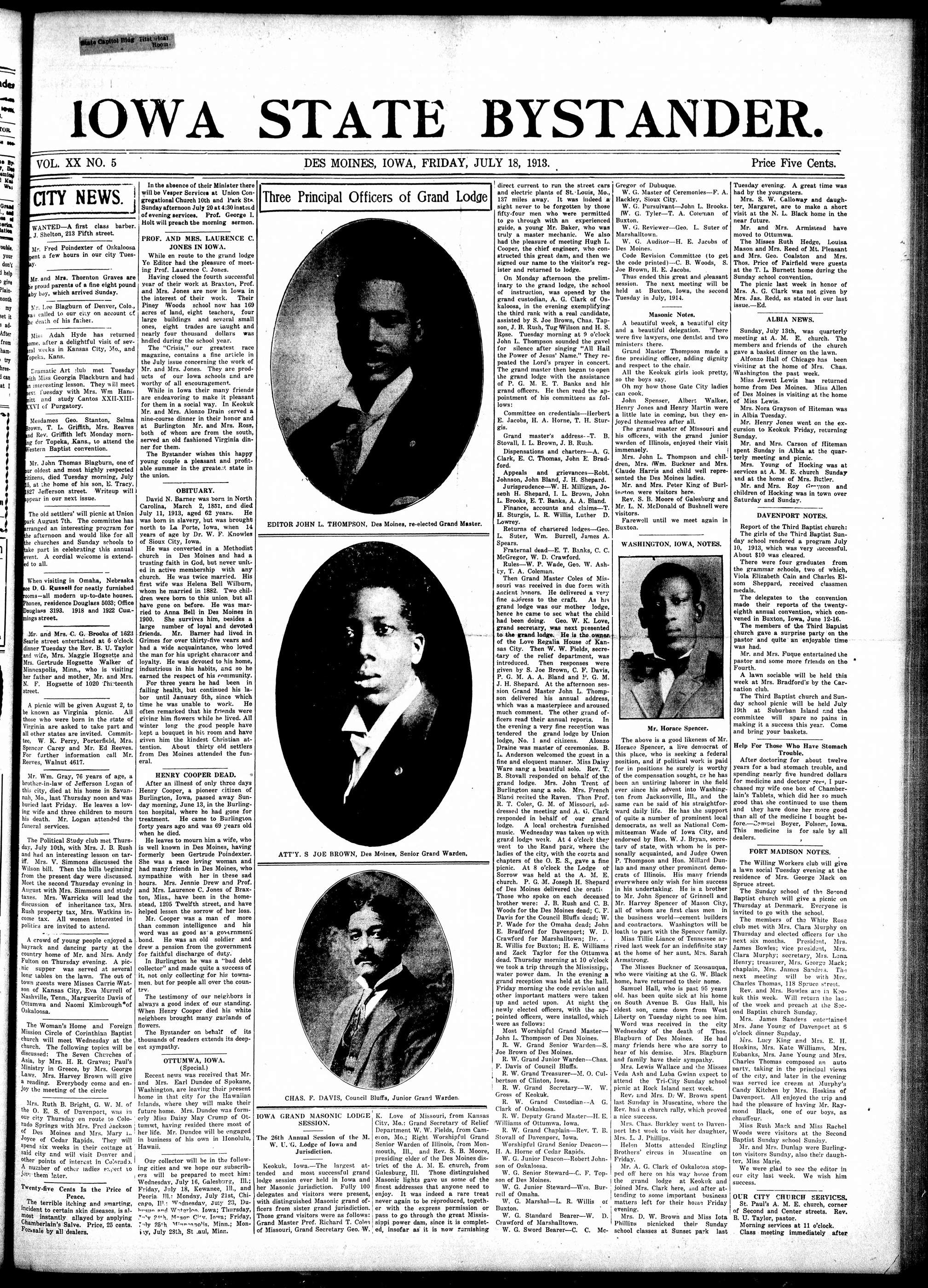
Three Principal Officers of Grand Lodge
EDITOR JOHN L. THOMPSON. Des Moines, re-elected Grand Master.
[Name]
ATT'Y. S JOE BROWN, Des Moines, Senior Grand Warden.
CHAS. E. DAVIS, Council Bluffs, Junior Grand Warden.
IOWA GRAND MASONIC LODGE
SESSION.
The 26th Annual Session of the M.
W. U. G. Lodge of Iowa and
Jurisdiction.
Keokuk, Iowa.—The largest
attended and most successful grand
lodge session ever held in Iowa and
her Masonic jurisdiction. Fully 100
delegates and visitors were present,
with distinguished Masonic grand
officers from sister grand jurisdiction.
Those grand visitors were as follows:
Grand Master Prof. Richard T. Coles
of Missouri. Grand Secretary Geo. W.
K. Love of Missouri, from Kansas City, Mo.; Grand Secretary of Relief Department W. W. Fields, from Camelon, Mo.; Right Worshipful Grand Senior Warden of Illinois, from Monmouth, Ill., and Rev. S. B. Moore, presiding elder of the Des Moines district of the A. M. E. church, from Galesburg, Ill. Those distinguished Masonic lights gave us some of the finest addresses that anyone need to enjoy. It was indeed a rare treat never again to be reproduced, together with the express permission or pass to go through the great Mississippi power dam, since it is completed, insofar as it is now furnishing
direct current to run the street cars and electric plants of St. Louis, Mo., 137 miles away. It was indeed a sight never to be forgotten by those fifty-four men who were permitted to go through with an experienced guide, a young Mr. Baker, who was truly a master mechanic. We also had the pleasure of meeting Hugh L. Cooper, the chief engineer, who constructed this great dam, and then we signed our name to the visitor's register and returned to lodge.
On Monday afternoon the preliminary to the grand lodge, the school of instruction, was opened by the grand custodian, A. G. Clark of Oskaloosa, in the evening exemplifying the third rank with a real candidate, assisted by S. Joe Brown, Chas. Tapson, J. B. Rush, Tug Wilson and H. S. Rose. Tuesday morning at 9 o'clock John L. Thompson sounded the gavel for silence after singing "All Hail the Power of Jesus' Name." They repeated the Lord's prayer in concert. The grand master then began to open the grand lodge with the assistance of P. G. M. E. T. Banks and his grand officers. He then read the appointment of his committees as follows:
Committee on credentials—Herbert E. Jacobs, H. A. Horne, T. H. Sturgis.
Grand master's address--T. B. Stovall, I. L. Brown, J. B. Rush.
Dispensations and charters—A. G. Clark, E. C. Thomas, John E. Bradford.
Appeals and grievances—Robt Johnson, John Bland, J. H. Shepard.
Jurisprudence—W. H. Milligan, Joseph H. Shepard, I. L. Brown, John L. Brooks, E. T. Banks, A. A. Bland.
Finance, accounts and claims—T. H. Sturgis, L. R. Willis, Luther D. Lowrey.
Returns of chartered lodges—Geo L. Suter, Wm. Burrell, James A. Spears.
Fraternal dead—E. T. Banks, C. C. McGregor, W. D. Crawford.
Rules—W. P. Wade, Geo. W. Ashtv. T. A. Coleman.
Then Grand Master Coles of Missouri was received in due form with ancient honors. He delivered a very fine address to the craft. As his grand lodge was our mother lodge, hence he came to see what the child had been doing. Geo. W. K. Love, grand secretary, was next presented to the grand lodge. He is the owner of the Love Regalia House of Kansas City. Then W. W. Fields, secretary of the relief department, was introduced. Then responses were given by S. Joe Brown, C. F. Davis, P. G. M. A. A. Bland and P. G. M. J. H. Shepard. At the afternoon session Grand Master John L. Thompson delivered his annual address, which was a masterpiece and aroused much comment. The other grand officers read their annual reports. In the evening a very fine reception was tendered the grand lodge by Union lodge. No. 1 and citizens. Alonzo Draine was master of ceremonies. B. L. Anderson welcomed the guest in a fine and eloquent manner. Miss Daisy Ware sang a beautiful rev. Rev. T. B. Stovall responded on behalf of the grand lodge. Mrs. John Trent of Burlington sang a solo. Mrs. French Bland recited the Raven. Then Prof. R. T. Coles, M. G. of Missouri, addressed the meeting and A. G. Clark responded in behalf of our grand lodge. A local orchestra furnished music. Wednesday was taken up with grand lodge work. At 4 o'clock they went to the Rand park, where the ladies of the city, with the courts and chapters of the O. E. S., gave a fine picnic. At 8 o'clock the Lodge of Sorrow was held at the A. M. E. church. P. G. M. Joseph H. Shepard of Des Moines delivered the orati. Those who spoke on each deceased brother were: J. B. Rush and C. B. Woods for the Des Moines dead; C. F. Davis for the Council Bluffs dead; W. P. Wade for the Omaha dead; John E. Bradford for Davenport; W. D. Crawford for Marshalltown; Dr.
R. Willis for Buxton; H. E. Williams and Zack Taylor for the Ottumwa dead. Thursday morning at 10 o'clock we took a trip through the Mississippi water power dam. In the evening a grand reception was held at the hall. Friday morning the code revision and other important matters were taken up and acted upon. At night the newly elected officers, with the appointed officers, were installed, which were as follows:
Most Worshipful Grand Master—John L. Thompson of Des Moines.
R. W. Grand Senior Warden—S. Joe Brown of Des Moines.
R. W. Grand Junior Warden—Chas.
F. Davis of Council Bluffs.
R. W. Grand Fire Dept.
R. W. Grand Treasurer—M. O. Culbertson of Clinton, Iowa
bertson of Chinton, Iowa.
R. W. Grand Secretary—W. W.
Gross of Keuku.
R. W. Grand Custodian—A G.
Clark of Oksaloa.
R. W. Deputy Grand Master—H. E.
Williams of Ottumwa, Iowa.
R. W. Grand Chaplain—Rev. T. B.
Stovall of Davenport, Iowa.
Worshiful Grand Session, Dagenon
Worshipful Grand Senior Deacon—
H. A. Horne of Cedar Rapids.
W. G. Junior Deacon—Robert Johnson of Kakaloza.
W. G. Senior Steward—C. F. Topson of Des Moines.
W. G. Junior Steward—Wm. Burrell of Omaha.
W. G. Marshal—L. R. Willis or Buxton.
W. G. Standard Bearer—W. D.
Crawford of marshalltown.
W. G. Sword Bearer—C. C. Mc-
Gregor of Dubuque.
W. G. Master of Ceremonies—F. A. Hackley, Sioux City.
W. G. Pursuitant—John L. Brooks.
(W. G. Tyler—T. A. Coleman of Buxton.
W. G. Reviewer—Geo. L. Suter of Marshalltown.
W. G. Auditor—H. E. Jacobs of Des Moines.
Code Revision Committee (to get the code printed)—C. B. Woods, S. Joe Brown, H. E. Jacobs.
Thus ended this great and pleasant session. The next meeting will be held at Buxton, Iowa, the second Tuesday in July, 1914.
Masonic Notes.
A beautiful week, a beautiful city and a beautiful delegation. There were five lawyers, one dentist and two ministers there.
Grand Master Thompson made a fine presiding officer, adding dignity and respect to the chair.
All the Keokun girls look pretty, so the boys say.
Oh my how those Gate City ladies can cook.
John Spenser, Albert Walker, Henry Jones and Henry Martin were a little late in coming, but they enjoyed themselves after all.
The grand master of Missouri and his officers, with the grand junior warden of Illinois, enjoyed their visit immensely.
Mrs. John L. Thompson and children, Mrs. Wm. Buckner and Mrs. Claude Harris and child well represented the Des Moines ladies.
Mr. and Mrs. Peter King of Burlington were visitors here.
Rev. S. B. Moore of Galesburg and Mr. L. N. McDonald of Bushnell were visitors.
Farewell until we meet again in Buxton.
WASHINGTON, IOWA, NOTES
A. B.
Mr. Horace Spencer.
The above is a good likeness of Mr. Horace Spencer, a live democrat of this place, who is seeking a federal position, and if political work is paid for in positions he surely is worthy of the compensation sought, as he has been an unitting laborer in the field ever since his advent into Washington from Jacksonville, Ill., and the same can be said of his straightforward daily life. He has the support of quite a number of prominent local democrats, as well as National Committee Wade of Wide City, and endorsed by Hon. W. J. Bryan, secretary of state, with whom he is personally acquainted, and Judge Owen P. Thompson and Hon. Millard Dunlap and many other prominent democrats of Illinois. His many friends everywhere only wish for him success in his undertaking. He is a brother to Mr. John Spencer of Grinnell and Mr. Harvey Spencer of Mason City, all of whom are first class men in the business world—cement builders and contractors. Washington will be loath to part with the Spencer family.
Miss Tillie Lance of Tennessee arrived last week for an indefinite stay at the home of her aunt, Mrs. Sarah Armstrong.
The Misses Buckner of Keosauqua, who were visiting at the G. W. Black home, have returned to their nome.
Samuel Hall, who is past 95 years old, has been quite sick at his home on South Avenue B. Gus Hall, his eldest son, came down from West Liberty on Tuesday night to see him.
Word was received in the city Wednesday of the death of Thos. Blagburn of Des Moines. He had many friends here who are sorry to hear of his demise. Mrs. Blagburn and family have their sympathy.
Mrs. Lewis Wallace and the Misses Veda Ash and Luba Gwinn expect to attend the Tri-City Sunday school picnic at Rock Island next week.
Rev. and Mrs. D. W. Brown spent last Sunday in Muscatine, where the Rev. had a church rally, which proved a nice success.
Mrs. Chas. Burkley went to Davenport last week to visit her daughter, Mrs. L. J. Phillips.
Helen Motts attended Ringling Brothers' circus in Muscatine on Friday.
Mr. A. G. Clark of Oksalaosa stopped off here on his way home from the grand lodge at Keokuk and joined Mrs. Clark here, and after attending to some important business matters left for their home Friday evening.
Mrs. D. W. Brown and Miss Iota Phillins pienicked their Sunday school classes at Sunset park last
Price Five Cents.
Tuesday evening. A great time was had by the youngsters.
Mrs. S. W. Calloway and daughter, Margaret, are to make a short visit at the N. L. Black home in the near future.
Mr. and Mrs. Armistead have moved to Ottumwa.
The Misses Ruth Hedge, Louisa Mason and Mrs. Reed of Mt. Pleasant and Mrs. Geo. Coalston and Mrs. Thos. Price of Fairfield were guests at the T. L. Burnett home during the Sunday school convention.
The picnic last week in honor of Mrs. A. G. Clark was not given by Mrs. Jas. Redd, as stated in our last issue.-Ed.
ALBIA NEWS.
Sunday, July 13th, was quarterly meeting at A. M. E. church. The members and friends of the church gave a basket dinner on the lawn. Alfonzo Hall of Chicago has been visiting at the home of Mrs. Chas. Washington the past week.
Miss Jewett Lewis has returned home from Des Moines. Miss Allen of Des Moines is visiting at the home of Miss Lewis.
Mrs. Nora Grayson of Hiteman was in Albia Tuesday.
Mr. Henry Jones went on the excursion to Keokuk Friday, returning Sunday.
Mr. and Mrs. Carson of Hiteman spent Sunday in Albia at the quarterly meeting and picnic.
Mrs. Young of Hocking was at services at A. M. E. church Sunday and at the home of Mrs. Butler.
Mr. and Mrs. Roy Grayson and children of Hocking was in town over Saturday and Sunday.
DAVENPORT NOTES.
Report of the Third Baptist church:
The girls of the Third Baptist Sunday school rendered a program July 10, 1913, which was very successful. About $10 was cleared.
There were four graduates from the grammar schools, two of which, Viola Elizabeth Cain and Charles Elsom Sheppard, received classmen medals.
The delegates to the convention made their reports of the twenty-eighth annual convention, which convened in Buxton, Iowa, June 12-16.
The members of the Third Baptist church gave a surprise party on the pastor and quite an enjoyable time was had.
Mr. and Mrs. Fuque entertained the pastor and some more friends on the Fourth.
A lawn sociable will be held this week at Mrs. Bradford's by the Carnation club.
The Third Baptist church and Sunday school picnic will be held July 19th at Suburban Island and the committee will spare no pains in making it a success this year. Come and bring your baskets.
Help For Those Who Have Stomach Trouble.
After doctoring for about twelve years for a bad stomach trouble, and spending nearly five hundred dollars for medicine and doctors' fees, I purchased my wife one box of Chamberlain's Tablets, which did her so much good that she continued to use them and they have done her more good than all of the medicine I bought before.—Samuel Boyer, Folsom, Iowa. This medicine is for sale by all dealers.
FORT MADISON NOTES
The Willing Workers club will give a lawn social Tuesday evening at the residence of George Mack on Spruce street.
The Sunday school of the Second Baptist church will give a picnic on Thursday at Denmark. Everyone is invited to go with the school.
The members of the White Rose club met with Mrs. Clara Murphy on Thursday and elected officers for the next six months. President, Mrs. James Bowles; vice president, Mrs. Clara Murphy; secretary, Mrs. Lena Henry; treasurer, Mrs. George Mack; chaplain, Mrs. James Sanders. The next meeting will be with Mrs. Charles Thomas, 118 Spruce street.
Rev. and Mrs. Bowles are in Kookuk this week. Will return the last of the week and preach at the Second Baptist church Sunday.
Mrs. James Sanders entertained Mrs. Jane Young of Davenport at 6 o'clock dinner Sunday.
Mrs. Lucy King and Mrs. E. H. Hoskins, Mrs. Kate Williams, Mrs. Eubanks, Mrs. Jane Young and Mrs. Charles Thomas composed an auto party, taking in the principal views of the city, and later in the evening was served ice cream at Murphy's Candy Kitchen by Mrs. Hoskins of Davenport. All enjoyed the trip and had the pleasure of having Mr. Raymond Black, one of our boys, as chauffeur.
Miss Ruth Mack and Miss Rachel Woods were visitors at the Second Baptist Sunday school Sunday. Mr. and Mrs. Dunlap were Burlington visitors Sunday, also their daughter, Miss Marie. We were glad to see the editor in our city last week. We wish him success.
OUR CITY CHURCH SERVICES.
St. Paul's A. M. E. church, corner of Second and Center streets. Rev. B. U. Taylor, pastor.
Morning services at 11 o'clock.
Class meeting immediately after
BYSTANDER PUE. CO. Publishers.
DE MOINES. IOWA
REWARD FOR LONG SERVICE
Silver Medals of Honor Given Frenchmen of Thirty Years in One Industrial Establishment.
The press of Havre has just published a list of 107 persons (84 men and 22 women) employed in this city and its vicinity to whom silver medals of honor have been awarded by decree of the minister of commerce and industry of France for the faithful service of thirty years in the same industrial establishment or business house.
In this list are included superintendents, managers, dock foremen, accountants, clerks, weavers, spinners, tailors, dressmakers tramway conductors masons, cabinet makers, boiler makers, stokers, laborers, etc.
The medal of honor for employees and workmen was established in France by the decree of July 16, 1856, which authorized the minister of commerce and industry to give them to persons whose services had covered thirty years in the establishment, although it might have changed hands several times. Intervening military service will not interfere.
An important condition is that the beneficiary be a citizen of France, although his employers may be foreigners. The medals are presented with suitable ceremony, to the employees by the mayor or his representative at his office, in the presence of the employers and the friends of those to be honored. This institution is very properly held in high regard by those for whom it is intended. It is, in fact, a form of decoration bestowed by the French government analogous to the legion of honor, since those who have received the medal are permitted to wear on the lap of their coat, or in the case of plumed on their corsage, a narrow tricolor ribbon of red, white and blue. There is an organization at Havev, the Association des Medalles du Travail, composed exclusively of those who have received the medal of honor.
This institution has, of course, nothing to do with the old-age pension system in operation in France; but it is undoubtedly a factor in bring about industrial solidarity, esprit de corps, loyalty to employers, and cordial relations between employers and their employees.—Consular Reports.
Hia Wants Were Met.
An air of assurance distinguished the jaunty young man who had appeared in answer to an advertisement for a clerk; but his manner did not command him to the leather merchant. There a good opening here for young men to write about him and doesn't care to begin at the bottom of the ladder?" asked the applicant, before the merchant had an opportunity to speak. "Yes," he replied, after a comprehensive survey of his jaunty visitor, "there is. A thoughtful carpenter, foreseeing the men, prepares a good opening in the middle of that left-hand wall. Kindly make use of it."
Pertinent Query.
The drummer had been bragging about his achievements for a goodly time, and finally the meek little man in the corner piped up.
"Excuse me," he said, "but perhaps you can tell me why you gentlemen are called drummers.
"You shouldn't be we as called? We drum up trade, don't we?" was the retort.
"I know," said the meek little man, "but the drum is not a wind instrument."—Harper's Weekly.
London's Primitive Water Pins
London's Primitive Water Pipes.
London's water supply formerly came through wooden pipes. These were of the simplest construction, formed of the stems of small elm trees, drilled through the center and cut in lengths of about six feet, one end being tapered so as to fit into the adjoining pipe. The stem which a timber of about 400 milimetres long, use, leaked considerably, decayed rapidly, burst during frosts and were always troublesome. It was not until 1830 that they began to be supervised by cast iron, and a quarter of a century later some of the old wooden pipes were still in use.
Revengeful Shade.
"The spirit of your deceased husband, madam, wishes to communicate with you on the subject of your remarriage," said the medium.
"Very well," said the woman, "Let him proceed. What is it he wishes to say"
"He says," murnured the medium, going into a trance"—he says he is very glad you are going to marry Mr. Skeezicks. He always hated him."—Harper's Weekly.
When the Mind $ ^{3} $ Is Ripened.
No man can learn what he has not preparation for learning, however near to his eyes is the subject. A chemist may tell his most most precious secrets to a carpenter, and he shall be never the wiser—the secrets he would not utter to a chemist for an estate. . . . Our eyes are holden that we cannot see things that stare us in the face until the hour arrives when the mind is ripened; then we behold them and the time when we saw them not is like a dream—Emerson.
At Performance of "Hamlet."
"My did you ever hear so many famous quotations in any one play before? It must have taken a long time to piece them all together so nicely." "Almost long enough to have written an original play!" said the other—Christian Science Monitor
Tough for the Baby.
In one of the Cleveland schools the girls use a live baby in learning how to bathe an infant. It may be good to teach them to feel a little sorrow for the baby.
---
Imports From United States by Islands Show Increase.
Large Gain is Shown in Cotton Goods, the Sale of Which Almost Doubled as Compared With Previous Similar Period.
Washington — During the nine months ending with March last the value of the imports from the United States into the Philippine Islands was $19,468,592, or 44 per cent. of the total importations, which amounted to $43,817,234.
The increase of 6 per cent. in imports over the previous corresponding period was due almost wholly to increased importations from the United States.
Official statistics of the foreign commerce of the Philippines, compiled by the bureau of insular affairs, show that this country figured in the Philippine export trade to the amount of $16,837,116, or 39 per cent. of the total value, as against $15,616,867 for the same period of the previous year.
"Among the articles imported into the islands from the United States," says a statement from the insular rubber, "cotton goods showed the most marked increase, the value during the latter period being $1,584.84, against $2,991.06 during the former, an increase of 90 per cent of the value of cotton cloth imported into the islands during the nine months ending March, 1913, was $6,525.86, as compared with $6,880.32 during the previous year.
"Other commodities which figured in the increase in importations were wheat, flour, automobiles, machinery, mineral oils and rice.
"The increase in the value of rice importations was due entirely, however, to the higher prices, as the quantity imported was slightly less than during the previous year. The only decrease was in the imports of cattle.
"The United States purchased hemp from the islands to the value of $101,018,570, an increase of $4,353,715 over the same period for the previous year. Approximately 80,000,000 cigars, with a value of $1,708,293, were exported to this country, which represents a material increase. There was a reduction of sugar and copa exportations, particularly to the United States, due principally, however, to reduced prices rather than to reduced production."
TO INVESTIGATE ELECTRICITY
DANGERS.
Experts in the United States bureau of standards are now making plans for an investigation of the dangers to life and property from electricity provided for in the amendment to the appropriation bill of the last congress introduced by former Representative James M. Cox, now governor of Ohio. This investigation will be started during the coming summer and the work will be conducted by Dr. E. B. Rosa and his assistants of the bureau of standards, under the direction of Dr. W. Stratton. This study of methods of safeguarding life is looked forward to by electrical men to produce results in the line of human conservation in more important than any other work of the government. Less industrial accidents perhaps then the investigations to make less hazardous the work of men engaged in mining and the interstate commerce commission's railway safety investigations.
With the rapid increase in the use of electricity as a force of production and transportation and for purposes of lighting and heating there has been a marked increase during late years in the number of lives lost and persons injured by electric shock. While reliable figures are not available, it shown throughout the country each week in electrical accidents, and it is also that the number of accidents could be greatly lessened if safety measures now in use in some places could be standardized and generally adopted.
LEADS IN SUGAR CONSUMPTION
The per capita consumption of sugar in the United States is 76.9 pounds a year, according to the latest statistics compiled by the government experts. Americans need not believe that they are the most sweet-toothed people, however, for in the United Kingdom the per capita consumption is said to be 86.49. These are some of the statistics concerned by F. J. Sheridan, commercial agent of the bureau of foreign and domestic commerce, made public by Secretary of Commerce Redfield.
The United States is the greatest sugar consuming country in the world, according to the report. It consumes annually almost one-fifth of the entire amount of sugar produced in the world. In 1999-10 it consumed 1,071,956 tons of sugar, with 1,707,956 tons by the United Kingdom, 1,199,389 tons by Russia, and 1,116,315 tons by Germany, all other countries consuming less than 1,000,000 tons each. The per capita consumption of the United States in the same period was 79.9 pounds, which was the highest except that of the United Kingdom, which had an apparent per capita consumption of 80.5 pounds, and amounts used in fruit canning and preserving for export.
United States and Japan.
In the event of war between the United States and Japan the issue would necessarily have to be fought out on the oceans. The mighty distance preclude the invasion of either country by the other. Even if the coaling problem were settled, it would practically bankrupt either nation to put down the war of three or four millions of men, and for the purposes of invasion no smaller army would for a moment be worth considering.
GIANT SUBMARINES PLANNED.
While the navy department consistently has been extremely reticent concerning its submarines, it has become known that the plans for the three vessels of this type authorized by the last session of congress, and for which bids are about to be asked, contemplate vessels much larger than any now in commission. In submarine navigation, the American navy has been outstretched by European engineers in the matter of size, speed and offensive power of under-water craft. The navy department designers now are planning much larger and more formidable vessels of this type, and some of them prophey the development of the submarine into a giant battleship that will replace the dreadnoughts in the first line of defense in the war. Such a vessel could be able to disappear beneath the surface of the sea to escape a return fire after discharging their great 12-inch rifles at an enemy.
ARMY LOSES STRENGTH.
Increasing difficulty in securing enlistments for the army is becoming so grave that an appeal may be made to congress by the secretary of war to amend the existing enlistment laws if the army is to be kept up to its normal strength. The reports indicate the successes of the young men of the country to contract away their time for a period as long as seven years, even after it is explained to them that only four of these years must be spent with the colors. With growing demands for troops for garrison duty in Hawaii and the canal zone and the recruitment of the existing regiments up to the fourteenth century, the long service is giving serious concern to army officers.
HAT INDUSTRY STIMULATED.
Consul General Thomas Sammons, stationed at Yokohama, Japan, has reported to the department of commerce that the cutting of queues in China has greatly stimulated the hat industry. "In 1910 Japan sold to China $69.263 worth of hats," writes Consul Sammons. "In 1912 the sales amounted to $688,713. The great increase in Japan's sales to China resulted from the demand for inexpensive felt hats and cloth caps for the immediate use of the Chinese who have cut their quarrels." "The demand for hats and caps among Chinese men is greater south of the Yangtse river than in the northern provinces, the manufacturers of this class of Japanese goods being advised that the cutting of the queues was more active in the south than in the north."
Pursued.
He was on the sidewalk in his make-believe automobile, and he was racing the street car. Of course the street car won, but he put up a good fight, anyhow. His automobile was a shiny red affair that he pedaled with his feet; he was all of five years old. Tied to the rear of his race, some clanging thing jangled along it the end of a long, stout piece of string. As he pedaled, he turned up and once in the road and backed back at the trailer, an expression of fear on his face. When his little, fat legs stopped their furious pumping and the machine came to a hait, it was to be seen that the banging, noisy thing tied to the rear was a large dustpan. "And what's the dustpan for?" we asked him. "That?" He turned his head and gave it a look; when he saw that it lay at a safe distance his face assumed a rested, peaceful expression. "That," he explained, "is the motor-
He Was a Fighting Man
In a cemetery at Waterford, Erie county, Pennsylvania, is a stone with an interesting epitaph. The stone has lain flat on the ground and was broken in pieces, but the D. A. R. had it patched up and placed on a concrete base, where it is now an object of great interest to visitors. The inscription reads: "Michael Hare. Born in Armagh county, Ireland, June 10, 1727. Was in the French war and at Braddock's defeat. Served through the Revolutionary war. Served at St. Croix and was at his defeat by the Indians. Died May 3, 1843, aged 115 years eight months and 22 days. Elizabeth, his wife, died April 10, 1843, aged ninety years."
Faith Ill-Defined.
Discussing the lamentable fact that, according to the last census, half the American people never go to church, Canon Hughes Scott said at a dinner in Denver:
"The trouble is, perhaps, that Americans have wrong idea about the church. They think the church wants them to believe a lot of outworn dogma. That is not true.
"Yes, the trouble is that the people define faith as the little girl defined it in school.
"Faith,' the little girl said, 'is believing what you know not true."
German Harvest Laborers Scarce.
Germany has more than sixty-five million people living in an area less than that of Texas, and only five times as great as that of Ohio, but, nevertheless, labor is so scarce in harvest time in many parts of the German empire that about thirty thousand farm workers go into Germany from Russia and Austria-Hungary every year to help gather the crops.
The entire Japanese empire, including Formosa, is a trifle smaller than the single state of California. But the density of the population may be got at from the fact that the empire contains 55,000,000 people.
Tlp to the C. P.
"Are you one of those who believe the common people will ultimately get all they are demanding?" "Nope. I am one of those who believe firmly in asking politely for what you want."
IT'S WATER WAGON FOR THE PRINCE OF WALES
MRS. MARSHALL HOLDS THE CALLING RECORD
MRS. MARSHALL HOLDS THE CALLING RECORD
CORNELIUS FORD APPOINTED PUBLIC PRINTER
CORNELIUS FORD APPOINTED PUBLIC PRINTER
RETAINS MINISTER BECAUSE OF WITTICISM
The news came from London recently that Queen Mary had sent a curt
telegram to the young prince of Wales, at Oxford, at St. Mary's, to remove his name from the Bullingdon club because he had attended a "Bullingdon blind" - a euphormistic phrase for an unorthodox evening of drink and song.
PETER
The prince, it seems, has had
difficulty in getting his parents' commission to join the Bullingdon, and eventually obtained it only on the understanding that he never join in a "blind." Unluckily, the prince was persuaded to participate in one of these club events a few weeks ago, and a report was not long in reaching the king and queen. To one who has any knowledge of undergraduate life at Oxford, it is not surprising that the prince should join the Bullingdon club. Once a member of that limited group, he did not a "blind" but a series of "blinds." The Bullingdon is the club of the sons of nobility, the sons of great wealth. Its membership
While a lively discussion is going on in and out of official society as to
whether or not the wives of cabinet members of the new Democratic administration shall return calls made on them. Mrs. Thomas R. Marshell, who finds her position somewhat anabogical, b u not entirely similar to that of Mrs. Wilson and the cabinet women,
the wives of cabinet members of the new Demo-
cratic administration shall return calls made on them. Mrs. Thomas R. Marshall, who finds her position somewhat analogous, b u not entirely similar to that of Mrs. Wilson and the cabinet women, has gone quietly on and broken the calling record of Washington.
One afternoon recently Mrs. Marshall shall made forty-five calls in one hour and 30 minutes. She had no winged feet to carry her cards about either, nor did she send them by a message. She went about in her own car, drove up to each door and methodically left the proper number of cards. Had many hostesses been receiving Mrs. Marshall could not have made this record, although, as it was, she found more than one woman in "in." Mrs. Marshall has made more than 800 calls, and if it has fatigued her in the least she does not show it. She is fresh and bright, and it is good health as she does before the vice-president she made governor of Indiana and she was initiated to official life. Mrs. Marshall has missed only two
The new public printer. Cornellus
Ford, comes from Hoboken. N. J. Hits
Hoboken, N. J. His nomination went to the senate to the other day and the aigly interesting contest of the best places in Washington outside of a cabinet office.
M.
The several thousand employees of the big print shop have been worked up over the incoming chief for several months and there has been much misplanning in congress and elsewhere in behalf of different candidates.
President Lynch of the International Typographical union has been strongly in President Wilson's mind and at one time it looked as if the New Jersey candidate would not be named. His friends, however, continued the fight for him and after Lynch was put forward as the probable selection of the president himself, he himself did not care to accept the place after the fight started on him. The contest then narrowed down to Ford and Turley, the Chattanooga printer, with a number of southern senators and representatives urging the president to nominate Turley.
Dr. Maurice Francis Egan, at pres-
ent minister to Denmark, has proved
that a sense of hu-
mor is one of the
most valuable as-
sets a diploma
may possess.
PETER H. BURTON
Upon the inau-
guration of the
Democratic regi-
me Minister
Egan, following
the precedent of
the diplomatic
service, tendered
his resignation to
the president.
"The relinquishment of my post," he wrote, "reminds me very much of the English lady of rank who was forced by reduced circumstance she sheared her socks deserted street and walked along call
One On the Teacher.
Teachers in a New York public are discussing with some merriment a recent school incident. One of the boys in Miss Jones' class "got on the nerves" of the teacher by continually grinning and laughing, and finally Miss Jones, her patience exhausted, appealed to the principal to meet me, said she would. When the boy sat, lectured before the principal letter, with all the sternness at his command, lectured him, bringing the discourse to a close with: "Now,
represents the "young bloods" of the university, and the "blind" is the great club event. One outcroping of Bullington "blinds", is a matter of recent history. After one of these occasions, three Bullington men—two lords and a lone American member—swam the Isis—reached a deer park attached to Magdalen college, captured a deer, and, still in their blue evening dress coats and canary wintcools, drove the deer up the High street at midnight. The three of them were called up to the police, and it was believed that they would all be expelled. To the surprise of Oxford the proctor only imposed a fine of five pounds each.
Certain rules have been made and are strictly enforced. For instance, a student must be in college promptly at midnight; he must ask permission if he wishes to absent himself for a night; he must not go into a war zone of lock up; he is fined five shillings if the university procter meets him after dark without the academic dress which everyone is supposed to wear at that time of the day.
These proctors and their assistants, appropriately known as "buildings," room the students on campus to look for the wily undergraduate is also on the lookout for the proctors.
weeks since March 4 in observing her Wednesday "at home," and this has left thousands of cards on her hands. She necessarily has had to take the stand that where no street address was given she was not expected to return a visit, except in the cases of women in the house in the state. These she has barely burgled up. Mrs. Marshall purposes to go on calling and leaving cards until the one duty exacted of the wife of a vicepresident, aside from dining out, is performed. Asked how she could make so many calls in so short a time, Mrs. Marshall she thought it was by systematizing the matter. She arranges her cards according to the time of day, and leaves her motor car she can go through formality of returning several calls before again entering the car.
Mrs. Bryan, the ranking woman of the cabinet, is also returning calls, first to diplomats, the supreme court and senators, of course, and then general social calls. If there is a move on foot to put calling out of business for cabinet women, Mrs. Bryan is not falling into line. She may not be able to return all of the calls made on her, but she is trying to.
Mrs. Daniels, wife of the secretary of the navy, is said to have something like a list just made up, and it certainly looks formidable; but she will make those for which precedence calls—on the ambassadors, the supreme court and the senate—and is proceeding as rapidly as possible, considering the warm weather.
labor circles. He has been at the head of organized labor in New Jersey as president of the State Federation of Labor for the last ten years. He has served three terms in the state legislature and was an important factor in helping put through the legislation which attracted the attention of the country to Governor Wilson. He was a member of the Hoboken in 1867. He graduated from the Hoboken high school and immediately entered the priting trade, and had had 30 years practical experience in that craft. He has a thorough-going knowledge of the mechanics of printing and at the present time, holds an executive position with the Hudson Observer, one of the largest papers of New Jersey. He was a member of the Hoboken board of education for four years. He served six years in the National Guard state and has always taken large interest in social welfare legislation.
During the period which he has been president of the labor federation it has prospered and gained the confidence of the employees and the public generally: Through Mr. Ford the federation was a vital force in adding Governor Wilson to bring about enlightened factory legislation and an employers' liability act. This legislation has worked exceedingly well and today is taken as a model of its kind. Children, and domestic in the latter.
ing, 'Eggs, tuppence; eggs, tuppence — I hope nobody hears me, I hope nobody hears me—eggs, tuppence." President Wilson accepted the challenge implied in the story and retained the minister. There was talk of promoting Mr. Egan to be ambassadors to the president a few days ago named F. C. Penfield of Pennsylvania for that post. For many years Dr. Egan was a professor of literature in the Catholic University of America, located in Washington. He is a noted orator and author of many books.
Make Austrian Official Language. One probable result of the scheme attributed to the Archdule Franz Ferdinand for the constitution of a Shavupship would be the abolition of German as the official language of the Austrian army.
there are only two classes which are
continually grinning—monkeys and
idots. Which class are you in "n"
class Jones class, sir," whimpered the
Even Worse Grievance
"Your worship," said the princess, "you don't know how heartrending it is to have a wife who can cook but won't do it." "No," said his honor, and won't do it. "Thank goodness, man, you haven't one that can't cook and will do it."
TEST WEAK MINDED HOBOES HAVE STYLE
Views of a Belgian Scientist on Subject.
Says Only Mentally Deficient Know Which of Two Objects is Heavier-Experiments Seem to Demonstrate Accuracy of Theory.
If you are able to judge accurately which of two weights is the heavier you are mentally deficient, according to Dr. Demoor, a Belgian physician and scientist, says the New York American. Dr. Demoor doesn't go quite as far as to declare this is an infallible rule, and you may possess this ability without being, perforce, weak-minded, but in a series of experiments made by this doctor those who guessed which of two objects was heavier were known to be weak-minded, while those who made errors in their guesses were all normal.
One experiment along this line of considerable interest was carried on by Dr. Demoor about 380 children whose ages varied from six to fifteen years. For this the doctor prepared two bottles by covering them with black paper. These bottles were of different size, which could be told at a glance, but in each bottle the doctor put heavy milk until both the large and the small bottle had exactly the same weight. The black covering prevented the children from seeing the equal amount of mineral in each bottle. These two bottles were handed to each of the 380 children and they were asked to judge which was the heavier. They balanced them in their hands and many said the larger one was heavier, many other the smaller bottle was heavier. Three hundred and seventy of those failed to judge轻重, or to declare that there was no difference in the weight of the bottles.
Ten of these children guessed correctly. They declared the bottles were equal in weight. The remarkable part of this is that among these 350 children there were only ten mentally deficient, and these ten mentally deficient children stated that there was no difference in the weight of the bottles—they were the correct guessers.
And because of this and many other similar experiments Doctor Deer satisfied that while ordinary people people with normal brains, find it difficult to guess weights accurately, it is quite the reverse with the mentally deficient.
The bottle test was by no means the only one made. Other objects were used, such as boxes of the same size, but containing things that made them unequal in weight. Also boxes of unequal size, but that weighed the same. These same children were used in the experiments with the same results; the normal children were used in the experiments while the mentally deficient ones either guessed correctly or very close to the correct weights.
Then, to make doubly certain, the experiments were tried on other people, different groups of children, and also of adults, and it was found that among the children the normal on could not make anywhere near as accurate guesses or estimates as those who were recognized to be abnormal, mentally deficient, degenerates, etc.
Mongolian Lamas.
Every third man in Mongolia is a lama. Some live in tents, with and on their relatives, while others live in the temples. The temple lamas are of the lower type; they are coarse and filthy and must inferior both morally and physically to the tent lamas. They are not unlike those sometimes seen by travelers in the Lama temple. They are found in tents among the people are of a better class and are much respected and looked up to all over Mongolia. Sume, which consists of the two temples and their outbuildings, forms one of the largest and most imported monasteries in outer Mongolia. There are about two thousand lamas living here, some quite young, as Sume is an important theological school. This lamasery, or monastery, is a town in itself and very interesting. Lamas may be found on the tops and corners of the temples are prayer wheels covered with gold leaf; these contain long prayers written on rolls of script, and the wheels revolve in the wind.
Deodanda.
If it were customary or possible for the king of Great Britain and Ireland rigidly to exercise his royal preagregatives, he would, in the course of a few months, become the owner of many vehicles, especially motor cars, that traverse the streets and roads of his kingdom, since he is entitled to all deedlands. He has proved the immediate and accidental occasion of the death of any reasonable creature." This right was for hundreds of years enforced as a means of swelling the royal exchequer and, legally speaking could still be enforced. If a man were killed by being run over the vehicle and its contents, as well as the horse, became the king's property: The number of "reasonable creatures" (and dogs) included by a category) run over by motors in England would keep the king in automobiles until he would be obliged to construct many garages—Harper's Weekly.
"Too bad!" said the optimist to the man next to him on the bus, whose hat had been blown into the river; "but it might have been worse." "I can't see how," replied the hatless one, with a stare.
"Why, it might have been my hat."
His Idea of Improvement.
His idea of improvement.
Church—I see the street railway service is to be greatly improved this summer.
Gotham—Do you mean to tell me they've built cars with all end seats?
Supertramp Has Been Developed in England.
One Wanderer Carried Collapsible Kitchen and Folding Bed, and His Own Bank; Travels With Toilet Accessories.
Although the United States is known to possess the "hobo" in a high state of development, England has discovered that among the 60,000 tramps that adorn her countryside are some sure enough aristocrat who, patriots believe, would take a lot of beating from even the swiftest of American knights of the road. England has fact, claim it, to have evolved the supertramp; a hobbit who is shared and manicured as carefully as west and "nut," and whose dandylans nothing but spats and a crease down his trousers. One such Beau Brummel of the turnipke—whose cash capital consisted of 1 cent—leagued against the dockrail of a London police court in an attitude of Picadilly grace the other day and smiled languidly while a police sergeant recited from his notebook as follows:
"I found upon the prisoner, your worship, the following articles:
"Razor, in case, leather back padding, in glue brush (badder hair), tablet, Windex, bone, hose case, brush of case, spool of cotton, thimble, table knife, dessert spoon."
Referring to the case, a Scottish yard inspector with whom the writer talked declared that searching an English tramp was "like dipping into a lucky bag," and instanced a woman named Willis who was arrested for vagrancy a short time ago. To the outward eye she simply was a homeless woman, without money, food or clothing, but closer observation revealed a leather belt under her waist to which were attached, with a seat row of hooks, an equipment of knives and forks, a collapsible frying pan, changes of clothing, needle work, a purse containing $6.80 and a bag of food.
This outfit, moreover said the Scotland yard man, was not luxurious, but primitive compared with the portables carried by many British "weaes." One connonssieur is known who brews exquisite China tea under Survey hedges, while there is another known to the brotherhood as the "doctor" whose luggage includes a beak, a hat, a pair of gloves and hides in thick grass or under a heap of stones before he knocks for admission to the nearest "casual ward."
Some British hobes are ardent collectors. They collect everything except work. The police at Kingston-on-Thames discovered a tramp awhile ago who was traveling about with a handsome kitbag. They found in it, among other things, sixty-one lead pencils, four pairs of spectacles, two table knives, three linen collars, three boxes of matches, a looking glass, a boot brush, two pairs of lace, a handsome magnifying glass and a silver mounted pipe.
The owner of this collection proudly denied that he was a peddler, declaring indignantly that he had "never" money he had none, but every now and then a tramp is discovered in possession of a sum that none of us would be sorry to have to his credit in the bank.
One such Monte Cristo among bohees was Patrick Halloran, who, after touring the beauty spots of Ireland for 35 years, was discovered at Middleton, in County Cork, with $75 in his possession, all in golden half-sovereigns. This money was neatly piled up in two tin canisters he had been painting before him for many years. He had a collapsible kitchen and a collapable bed on his wheelbarrow too!
Then there was a queer character known as the "eccentric duchess" who sought the aid of the police at Kettering to find shelter for the night. This "duchess" was as tattered and torn as the man in "The House That Jack Built," and her personal bag lage consisted of only two brown paper parceles. When there were epiphanies, 344 bright sovereigns worth $5 each flowed out on the inspector's desk among the pens and memoranda.
First to Sing Famous Hymn.
First to Sing Famous Hymns
The man to sing the immoral hymn, "Lead, Kindly Light," was a boatman, the place an orange boat becalmed on the Mediterranean off the island of Caperna, the time 90 years ago, June 16, 1833. John Henry Newman, afterward the great cardinal, was a passenger on the boat. Ill in body and mind, he was idling in the Mediterranean in the hope of recovering his health. He was especially depressed on that day when the orange boat becalmed, and sought to soothe his spirits by composing a fine hymn, "The result was 'Lead Kindly Light.'" The composition occupied but a few hours, and the boatman, who spoke English and was possessed of a fine voice, was asked to sing it. As the day melted into darkness a breamp up, and the becalmed voyagers were guided by the "kindly lights" along the Caperna shore into a safe harbor. The composer, who health restored, soon returned to England, and became a leader in the Oxford movement, until in 1845 he went over to the Catholic church, which later rewarded his ability and devotion to the bestowal of the red hat.
Chairs Once Alexander Hamilton's
Chairs Once Alexander
Two separate glass cases in the hall of history of the Nathaniel museum contain four of his splendid pedigrees. He thought to be from 150 to 175 years old and have come from the family of Alexander Hamilton.
"What would you need
should knock on the door?"
"Well, before becoming effusive
would you not whether or not abse
ber her identity."
recreate ea eaieacarecmaraeaeaceenaaeaceeaeaercaeeamamraaeaaianaciaeeaacaaeacaea menace
AFRO-AMEREAN CULLS
‘Wiltam: Hoary awis, one of the
country’s most eminent colored men,
was a star football player at Harvard,
a member of the Massachusetts state
legislature, and recently, assistant
United States attorney general. Book-
er Washington writes about him {a
the American Magazine in part as
follows: “In 1911, when he was ap-
pointed to the position he occupied
until recently, that of assistant attor-
ney general of the United States, the
colored men of Boston gave him a
banquet at one of the leading hotels
of the clty. At this banquet, in reply
to the congratulations showered upon
him by other speakers, Mr. Lewis
made a speech in which he made two
references that particularly {mpressed
me. He recalled the fact that in this
same hotel in which he was at that
moment an honored guest, he had
once served In the capacity of a walt-
‘er; and in reference to the honor that
had been conferred upon him, he de-
clared that he had no illusion, he
knew, he sald, that it was not tn
spite-of, but because of the fact that
he was a negro that he had been hon-
ored with this high office. He added
that he accepted the responstbiitty of
the position not merely as a distinc-
tlon conferred upon himself but upon
the whole race which he represented.
The reason I mention this fact is be-
cause it {s not always comfortable to
bea colored man in this country, and
the Snconvenfences frequently increase
as individuals, either by fortune or
through their own particular merits,
succeed in rising to a position above
the masses of thelr fellows. One rea-
ron why I, with mot: other colored
people, believe in, honor and respect
Mr, Lewis 18 because, in the high po-
sition in which he has risen, he has
neither forgotten his own path nor
sought to separate himself from the
race to which he belongs.”
Ree: JNORS Me FON Tee Sh sere:
prejudice s being waved jn Washing.
ton, and the daye of reconstruction are
being lived. over again, according to
a Washington correspondent of the
Detroit Free Press, The old race
question {s to the fore in the national
capital with its accompaniment of
long-winded arguments pro and con on
the question. The revival of the ques-
tion 1s due to the organization here
not long ago of the Nattonal Fair
Play association, which, over night,
has sprung into an important position,
and automatically the problem has
opened up again like an old wound,
‘The basis of all tho altercation is the
question of whether or not white men
and black men, white women and
black women should be compelled to
work side by side in government de-
partmental offices. And it is the north
and the south which are disputing the
‘question, as it always has been and it
ever will be when the race question is
at the bar. In conformity with the an-
clent theory expressed by Thomas Jef-
ferson in tho declaration of indepen-
dence to the effect that “mankind are
more inclined to suffer evils which
such evils are sufferable” than over-
throw the organized system under
which they are living and working,
evil wrought by the enforced close
association of the two races has been
suffered for a long time, because those
in charge have considered it better to
suffer those evils than to disorganize
the present order of things. But every
few years some man or some society
or organization of employes brings the
question up again and it is all
thrashed out along the lines of its
original premises. Such an organiza-
tion now is in process.
‘The pretty girl gets the admiration
and the solitaire; the plain girl who
knows all about the art of cooking
gets all the dinner calls she wants.
Are dried fruits, such as figs,
peaches and dates, necessaries or lux-
urles? Canadian merchants, who are
asking for a reduction of freight rates,
assert that these are now necessaries
—made so by an elevation of the
standard of living.
Equality of strength in both arms
occurs almost twice as frequently
with women as with men, more men
than women being stronger in the
right arm than In the left.
Many of the world’s great men are
unknown to fame, They are great be-
cause they share their pleasures with
others and keep their troubles to them-
selves,
In the southern states alone negroes
are proprietors of 10,000 general
stores, 30 pharmacies and 57 banking
institutions. In the entire country
they own 20,000,000 deres of land, and
more than 600,000 houses.
Some women love to keep a caged
bird because they feel that way them-
selves,
‘Trewyddfa mountain, near Morris-
ton, England, on which the Swansea
corporation has spent several thou-
sands of pounds in providing municipal
houses for workers, appears to be grad-
ually sliding toward the river.
Don’t eriticise your neighbor _be-
cause the dust has settled on her fur-
niture. Better that {t be there than
tn your lungs,
The man who goes out to look for
trouble comes back home to find it
full grown.
New York authorities are making
terts to determine the effect of tea and
coffee on school children, using ten
thousand subjects.
Almost any diplomatic female can
teach a man to think he is teaching
her.
‘Hero worship ts often but another
‘ame for self-esteem.
‘aation by tho socuctarracreco cle
ulation by the commissioners of the
District, establishing a closing hour
for church services Is a blow to relis-
lous liberty, nad that the complaints
against certain wslored churches be-
cause of the alleged disturbance of
the peace wore based upon insufficient
cause, were some of the statements
embodied in the protest of pastors and
representatives of a large number of
colored churches of the District of
Columbia made at a hearing before
the commissioners. Formal reeolu-
tons in rogard to the matter were
presented by the Evangelical Minie-
ters’ alliance and the Baptist Minis-
ters’ union of Washington, composed
of more than a hundred pastors of
colored churches in the District of Co-
lumbia. It was further stated in the
resolutions that “We do not ask that
our churches shall remain open longer
than theaters, dance halls, saloons or
other public resorts.” The resolutions
stated emphatically that the organiza-
tlons signing them do not deem it
necessary to multiply ordinances to
stop unseagonable meetings that do
not exist. They added that it there
should be an Isolated instance of
breach of community comfort the
church violating the law should be
dealt with individually. Complaints
by residents In the vicinity of certain
negro churehes have been numerous
recently because of alleged noisiness
and the lateness of the hours to which
thelr services extend. On receipt of
the complaints the heads of the Dis-
triet addressed a communication to
several of the colored ministers of the
city, suggesting that a conference be
held between the commissioners and
the pastors, with a view to making the
adoption of ordinances correcting the
matter unnecessary,
Institution to which we have vowed
allegiance fall to prosper when indit-
ference retgns; and in thelr operations,
suffer the penalty of negligence. Then
injury is elastic, and In Its rebound
does greater damage to the hurler
than the object which first received
the blow. We are too Intolerant tn
our disposition, and give prominence
to injuries of small import; thereby
destroying happiness and disturbing
the peace of communities. Discord
always weakeng in any undertaking;
and though, It may seem Invisible, its
blighting affects are felt. Dominion
crowns ~ harmontous whole; and al-
though the burden intended for many
may be borne by a few, to a joyous
and successful end, yet there exist for
human uplift, a greater power and in-
fluence in the unity of all the parts —
Exchange.
With the exception of eleven cities
in the United States Honolulu has a
higher percentage of tuberculosis pa-
tients than any city on the mainland.
Richard H. Bowling (colored) of
Norfolk, Va. won the highest honors
at the’ sixty-seventh annual com-
mencement of Bucknell university.
After an impassioned plea for a broad-
er opportunity for his race he was
awarded the Chaplain J, J. Kane prize
of a gold wateh for the best oration in
competition with nine other honor
graduates, two of whom were young
women. In spite of the fact that
Bowling was hazed and had his hair
clipped off by some southern students
two years ago, he had the good will
of the student body, and the award
of the judges met with general ap-
proval. Bowling took as the subject
of his oration, “The Negro and Our
National Ideals.”
A truthful mirror ts a woman's
best friend, but it is hard to convince
her of that fact.
Plants, animals and birds of the
Bible have been made the subject of
‘a special exhibition in the natural hie-
tory department of the British mu-
seum.
By far the largest part of the
world’s turquoise comes from the
mines near the Persian elty of Nisha-
pur, where Omar Khayam was born
and Hes buried.
When a man {s wealthy he pos-
sesses all but that which 1s given to
humble souls to enjoy.
An Illinois inventor has brought out
an asbestos lined wooden cigar that
may be filled with tobacco and smoked
by those who like to be regarded as
‘smokers of cigars exclusively.
‘The upper side of a dirigible balloon
built for the British navy has been
coated with aluminum dust to reflect
the sun's rays and lessen the effect of
their heat on the gas it contains.
Arizona in 1912 produced 350,000,
000 pounds of copper.
‘The tide of progress reaches its
ebb when a man sits at his window
watebing the parade go by.
Assemble the young of the land to-
gether, and ask them the greatest
national Institution. ‘The reply will
be a chorus of “Haseball!”
‘The experience of another is not a
Jesson—tt 1s merely the key by which
we open the school-door.
Blackbirds are protected by law in
California and exist in clouds.
‘The second Friday In each March
ts salmon day in Portland, Ore. Every
family eats salmon to boost the Pa-
cific coast manufacture of paper.
On a test, paper insulation on ex-
posed electric wires has withstood
service for twenty-three years.
‘The temperature of steam at a pres-
sure of one pound a square inch Is
216.8 Fahrenheit.
LESS HOUSEWORK IN SUMMER
Take Up the Heavy Carpete—Remove
Unnecessary Furniture, and
Get Rest.
You are not human if you do not try
to get through the warm season with
as Iittle work as possible, To do this,
frst have a grand housecleaning; elim-
inate all of the unnecessaries,
Don't Ieave a heavy, thick napped
rug on your living room or dining
room this summer, for they are de-
eldedly out of place and look hot. Ev-
eryone recognizes the value of tem-
perament, and much depends on how
cool your home looks.
‘Take up the heavy rugs and earpets,
and elther leave the floor bare or put
down some sort of Inexpensive cover-
Ing. Rag rugs that are woven in many
pretty designs are practicable and
much used, Old fashioned braided rugs
are also in vogue, while jute of grass
rugs, beeldes being pretty, are easily
kept clean.
You probably do not care to go to
the eagense of buying expensive cur-
tains, but take down the heavy ones
you used In the winter and then, after
you have packed them away where you
can't get at them, you will have to get
new ones. No living room seems
homey without curtains, but draperies
can be made of muslin, scrim or even
cheesecloth.
Now take every unnecessary pleco
of furniture out of the rooms, #0 they
won't appear hot and stuffy. ‘The por
Uleres between the parlor and dining
room should go.
Now that everything {s arranged and
In order, there 1s something else for
you to remember. Where the fly is,
there heat will be also, They make
you seom hot, so do away with this
troublesome creature,
Keep the house closed as much as
possible during the heat of the day.
Then, in the evening, open all the win-
dows’ and doors. Alwaye remember,
too, that a cool house fs a clean one
—Kansas Industrialist.
¥ Q —_-
Fish to be crisp should not be cov-
ered while cooking.
Odd bite of soap, when boiled, make
an excellent shampoo Jelly.
Medicine bottles, .drink or food,
should not be uncovered in the slck-
room.
Lamp burners, if boiled in weak-
ened vinegar, witl burn much bright-
er,
Marble should be washed with am-
mona and water rather than soap.
When serving large red apples
whole on the table polish them with
olive all.
‘A few drops of rosewater added to
almonds will prevent their oiling
when chopped.
‘A clam shell placed inside the tea
kettle will prevent the formation of
Ime on the kettle.
‘After peeling onions, rub your
hands with celery or parsley. It will
counteract the odor.
‘To cool an oven when baking, nev-
er open the door, but remove one of
the plates over the oven.
faaute: Mali leeibebiin..
Food experts long ago pointed out
the very small quantity of mineral
matter and bone-Dullding material in
succulent vegetables. Now Josephine
©. Berry, a houschold expert and food
scientist, has found that when, such
vegetables as spinach, cabbage and
carrots are boiled they lose about halt
of the small amount of mineral, con-
stituents which they contain. Spin-
ach, for example, gave up more than
50 per cent. of {ts mineral constlt-
vents, and cabbage 40 per cent. As
the lose of mineral matter in these
foods makes them less nutritious, the
problem of retaining these mineral
parts of the food assumes some im
portance—Farm and Fireside.
Cheese Pie.
Cut two-thirds of a five-cent stale
baker's loaf in one+third-inch slices
and remove crusts; then cut slices in
halves. Arrange a layer In a buttered
shallow baking dish, cover with a
layer of soft mild cheese, cut in one-
efghth-inch slices, and sprinkle with
salt und paprika; repeat. Beat twe
eggs slightly, add one cup milk, and
pour over the mixture. Bake until
cheese fs soft, the tlme required be
{ng about thirty minutes.
Saal eae
‘Mix one cup molasses with one cup
of milk, add two tablespoonfuls of
melted lard, one level teaspoonful each
of ginger and soda, a saltepoontul of
alt, one tablespoonful of vinegar and
four cupfule of sifted flour. Add the
ast cupful of flour carefully, because
the molasses may be so thick that It
will not all be needed. Bake in a
shallow pan and serve with a lemon
sauce or steam in a mold two hours.
Quick Bleaching.
Handkerchiefs and white clothes
that have become yellow from use of
too much soap, oF any other cause,
/may be whitened in the following
‘manner: After washing, let them soak
over night in a tub of clear water, to
which 1s added a teaspoonful of cream
of tartar. When ironed they will be
white as snow.
To Keep Cheese Fresh.
lt, 208, old ke to know how to
keep cheese fresh, here fs an excel-
ent method: Wet a cloth in vinegar,
wrapping It around the cheese, then
‘put ft Into a paper bag and keep in a
‘coo! place. This will help the cheese
{to retain its moisture and freshness
‘and keep It from molding.
Soak well with warm water and hold
a hot fron near the surface. If tha
dent is a large one wet a heavy cloth
in hot water and place over the bruise
and place a hot flatiron on it, |
Finale Mie eae |
T always use breadcrumbs Instead of
eracker crumbs for frying or for cov-
ering the tops of entrecs, You will
find this very good, as It does not ab-
sorb the molsture and become soggy.
itn
iN i
Hans Wagner Is slowly crawling up
in the batting figures,
Slim Sallee, the lanky hurler of the
Cardinals, is back in form,
| “The world’s series money will go to
‘the Athletics,” says McGraw.
| Snodgrasa has been killing the ball
‘sluce restored to a regular berth,
Connie Mack has the highest av-
eraged pitching staff in the American
league.
er who was signed up by the Glants,
is only nineteen years old.
| Pitcher Bob Whitney, former cay
tain of the Penn State nine, is sald to
have a lot of speed and some good
curves.
eee
In Rebel Oakes the St. Louls Car
dinals have a corking outfelder and
hitter. Reb is especially dangerous in
a pinch.
“Washington has no license to think
It fs a better club than Cleveland,”
says Manager Birmingham of the
Naps.
Hal Chase has demonstrated in fact
and figures every day he is about as
big a bargain as Callahan ever
plucked.
Harold Partenhelmer, captain and
third baseman of the Amherst college
baseball team, has been elgned by the
Detroit Tigers.
‘The Boston Red Sox appear to be
moving up, The team Is playing a bet-
tor grade of ball now than It has previ
ously this season.
Pat Moran, who 1s assisting Doola,
says he does not know of a team in
the National league that looks as
strong as the Phillies,
‘The Naps have the hardest-nitting
outfield in the country. Jackson, Ryan
and Graney are ali clouting consistent-
ly in the 300 rank,
Bobby Bescher and Josh Devore are
said to be the two fastest men on the
Cincinnati team, with Cuba Marsane
very close to them in speed.
Somebody asked Joe Wood it he con:
sidered speed his best asset. “Yes,”
replied Smoky Joe. “I think it's best
to throw the ball past them.”
Connle Mack says that Washington
ls the only club he expects any contest
trom, He belleves the Cleveland Naps
aro playing beyond their speed.
George Baumgardner, the big right
hander of the St. Louls Browns, is eald
to be the successor of Rube Waddell
and Bugs Raymond for eccentricity.
“Wanted—Somebody who can wear
a Pirate uniform and not forget he 1s
alive," reads an advertisement Insert.
ed by a jokesmith in a Pittsburgh pa-
per.
In St, Louis they have a baseball
team called tho “Fate.” And they
sure are fat. The total welght of the
team consisting of ten men is 2,193
pounds.
Pitcher Rudolph of the Boston
Braves looks good to Manager Fred
Clarke of the Pirates. “I wish I had
couple of hurlers like him,” said
Fred.
Eddie Collins 1s making a great rec.
ord for himself this season. He leads
the American league in run getting, !s
second in base stealing and fourth tn
batting.
Manager Chance is now pleased with
the fighting spirit displayed by the
Highlanders. The Yankees have be
gun to hit and are playing # much {m.
proved game.
The Iatest definition of baseball
would seem to include the fact that
a8 a sport {t 1s obsolescent, but as a
‘business enterprise ts flourishing in
‘New York. i
If, as has been stated by eminent au:
thorities, beating the Pirates means
winning the pennant, then there 1s
Mkely to be a cluster of clubs finish.
ing first.
Baseball scribes believe that Detrolt
will have & great pitching staff before
the close of the season. The young.
sters have rounded Into form and are
pitching wonderful ball,
Chief Wilson, of the Pittsburgh Pi.
rates, has recovered his batting eye
and is banging the ball now as he did
last year, when his run of three-bag
gers formed one of the season's big
sensations.
Is St hot strange that Chris Yon der
Ahe should have been the only St.
Louis magnate to have produced a
winner? Was Chris lucky or a base.
ball genlus unrecognized as such in
his day? a
President Britton of the Cardinals
says that anybody on the St. Louls
MANAGER CLARKE GRIFFITH
4
2 b ees
‘The remarkable success of the
Washington team this year Is attrib-
uted to Manager Griffith's knowledge
of pitchers, He fs given credit for
knowing just when to use them and
when to relleve them, Furthermore,
he has the spirit that Inspires young
players.
reer
Chance’s team is on the rise. He
hag found the right yeast.
It is getting to be easter each day
to beat tall Fred Falkenberg, who
started the season unbeatable,
‘The Boston Nationals are reported
to have pald Topeka $3,000 for Pitcher
Cochrebam. The sale is made for fall
delivery,
One Cincinnat! double play involves
‘a trio with names Iike the bill of fare
at a rathskeller. Berghammer to Groh
to Hoblitzell.
A Philadelphia baseball scribe says:
“Stand the Imperator on its keel and
it will almost look ike J. Franklin
Baker's clean-up bat.”
Detroit has an excellent utility catch.
er and first sacker In Rondeau, Like
Fournier of the White Sox—another
Frenchman, by the way—he qualifies
for both positions.
SPORTING
WORLD
| Hamilton, Ont., is to have a hockey
arena to seat 6,000.
| ‘There are 626 yacht clubs in this
country and 86 yachting associations.
Belgium will prohibit. boxing be
tween professionals as detrimental to
the cause of amateur sport, and as
having no educational value.
Creosote ts the tallest stake trotter
in training for the light harness sea-
son on the Grand Circult, and Star
Winter is the smallest horse.
Ariel Rowing Club of Baltimore ts
the latest to secure the sectional style
of elghtoared shell, It can be taken
apart and 1s easler to ship to outof-
town regattas.
Philadelphia has twenty-eight golt
courses. The Fairmount Park com
missioners vetoed the plan to lay out
& public course in the great public
park there.
It 16 estimated $500,000 was spent
on this year's big eastern inter-col-
legiate rowing races on the Thames
at New London and on the Hudson at
Poughkeepsie.
Yale's football candidates will have
football practice this summer at the
Newport (R. I.) estate of the late Wil-
Mam T. Bull of New York, a former
Yale football star.
The self-supporting sports at Har-
vard university are fcotball, baseball
and hockey, although the receipts from
hockey, $2,827.11, about equal the ex
pense of maintaining the sport.
‘The United States of America Foot
ball Association recently admitted to
the International Federation, tke
world-wide ruling body of association
or soccer football, plans to govern the
game in this country.
Because of newspaper criticism to
the effect that he is going “pot hunt
ing,” Arthur S, Robinson, the phenom
enal sprinter of Mercersburg academy,
has decided not to cross the Atlantic
to take part In the English and Seotch
‘championships,
‘The Westchester Polo Grounds are
being put in shape for another polo
tourney, which will follow the na-
tional championships. The latter are
to take place at the Point Judith Club,
Narragansett Pier, R. 1, July 21 to
August 16,
Mrs, W. H. Herbert of London will
Judge the Pekinese dog show to be
hheld at the Plaza Hotel, New York, in
the early part of next December.
Norman 8. Taber of Brown Univer:
sity, who finished second to John
Paul Jones of Cornell, in his record-
breaking 4:14 2-5 mile at the’ inter-
collegiate track and field champton-
ships in Harvard stadium, will con-
tinue his career in Bngland, where he
fs due to take up his studies as a
Rhodes scholar, following his gradua-
tion from Brown.
THE FATES UNAIND
Time's Changes alfrighted Bach-
elor After Fifteen Years
of Absence.
And Jack Wilson stretched himself
to full length in the canvas ham
mock on the awningshaded bungalow
porch. ‘Then he reached to the table
At his side and took the tall glass of
fruit puneh, cooling his parched throat
with the refreshing beverage, and five
minutes later was fast asleep. Sleep
1s a blessed boon when the scorching
Winds blow across Hrazil, and espe:
clally If kind dreams take you to the
north, where snow-clad mountains and
cooling breezes abound the greater
part of the time,
Jack came to Brazil Atteen years
previous In search of @ fortuno, and
when he left the states promised no
fewer than four girls to return and
wed them when fortune deigned to
stuile upon his honest efforts to court
her—for Jack was always courting
some oue. The fickle dame had not
only smiled, but laughed heartily, and
the shekels rolled Jack's way. When
he awoke from his dreams it suddenly
dawned upon his heat-dulled senses
that he was a very lonely man, and
had been for many year. Entering the
bungalow, he opened a small oaken
chest and from the top tray took sev-
eral photographs afd studied them
carefully. Each one represented
pretty, Inughing girl, and each had a
sentinient expressed in ink on the
back, and the names signing these
were: Ellen, Bary, Lillian and Isabel
He placed the ‘photographs in his
suitcase and packed it full of articles
needed for a long journey.
Jt was unbearably hot in Tucano,
‘A month later found Jack mounting
the brownstone steps of a residence in
Chicago, for this was where Ellen
lived.
‘A maid opened the door and ushered
him Into the sitting room to walt until
Miss Ellen returned from her shopping
tour.
He sat at the window nervously
turning the leaves of a magazine and
glancing now and then toward the
stoop. Finally a woman weighing
about 220 pounds lehortously mounted
‘the steps and rang the bell. He heard
excited whispers in the hall and rec-
ognized Elien’s voice. While the lady,
assisted by her mald, was changing
her dress, Jack made a hasty exit and
when he turned the corner paused a
minute to wipe the heavy beads of
perspiration from bis brow.
‘The noxt week he departed for
Cleveland, the home of Mary, and
when he inquired at the old number
they directed him to a house alx
‘blocks away,
‘Again he mounted steps and rang
a bell, which was answered by a
woman to whose skirts clung four
small children—it was Mary. Luck-
fly she did not recognize him and
Jack, stammering, asked it Mrs, Par-
ker lived there and was curtly in-
formed that she did not, He returned
to the hotel, ate a good dinner, ro-
covered his stunned senses and then
boarded a train for New York.
Lillian lived at Mount Vernon in
pretty Queen Anne cottage and Jack
tetiled eek tn the tontean of the
motor car, anticipating the renewal
of his old-time friendship with dainty,
blond Lillian. Arriving at the house,
for the third time he rang a bell and
when the trim mald opened the door
he asked for Lillian,
“Dear me, sir, she’s been dead elght
years and more. Sorry, sir.”
Poor Jack began to believe that the
Furies were close at his heels, but
It fate had chosen Isabel tor him,
she was the one he would marry.
Isabel dwelt at Basthampton and
/was a school teacher, so Jack decided
‘to make the trip in the motor car.
He and Isabel could be married and
continue on through Canada for their
honeymoon. He arrived at the little
Massachusetts town on Saturday aft-
ernoon, and, going to the old-fash-
loned home of the Arnolds, inquired
for Isabel. She was lecturing, he was
told, at the town hall, Jack always
admired her intellectuality and has-
tened to the hall, proud that he was
to be the husband of a woman who
could address an audience. Entering
the hall he saw on the platform a tall,
spare, spectacled woman whose long
arms were gesticulating wildly as she
emphatically propounded the worthy
subject of equal suffrage. He re-
mained but ten minutes, and jumping
Into the car directed the chauffeur to
retrace the roads to New York. Dur-
ing the ride he had ample time to
collect his thoughts and make plans
for the future, deciding finally to take
the first boat to Brazil,
Jack realized that even in the states
it was exceedingly hot at tlmes—and
besides, fall is a delightful season in
Brazil.—New York Press.
Hostese—I believe you are a musi-
clan, Mr. Brown?
Brown (who 1s dying to give an ex-
hibition of his powers)—Well—er—
yes, I think I can claim to have a
small reputation as a pianist.
Hostess—I am delighted to hear it.
‘My daughter is going to play, and I
should be so glad if you would turn
the music for her.
‘Worse:
“So Miss Brown ts married. Well,
I'm not surprised. She always de:
spised her own name for its common:
ness, and declared she would change
tt at the first opportunity. By the
way, whom did she marry?”
“A Mr. Smith.”
Why She Called It Off.
“I was very happy,” said the confes-
ror, “when, after years of wooing, she
finally said ‘Yes.""
“and why did you break off the en-
gagement 80 soon after?” asked his
friend.
“Man, it was she who dissolved it."
“Really?” said the friend. “How did
that happen?”
“It was due to my accustomed ab-
sent-mindedness. When a few days
later I called at her home, I again
asked her to marry me.”—Youth’s
‘Companion.
USE FOR OLD NAILS.
Of Great Value to All Forms of
Trees and Plants.
No Better Fertilizer Can Be Applied—
Especially on City and Town Lote
la the Need for Thi Sup-
i -08 tres
But few persons know the value
of old nails, They are worth more
than new ones, when used for certain
purposes. All forma of vegetation
need more or less tron, and unless
this ts already {n the soll or supplied,
the tree or plant will be in need of
a tonic that can easily be supplied by
the use of old rusty nails.
All kinds of house plants soon ex-
haust the soll in which they stand
and grow for months, and when oth-
er fertilizers aro used the tron ts apt
to be overlooked. Place a few rusty
nalls in the earth about the plants.
Simply press the nails down among
the roots and the mofsture will soon
dissolve the fron to a certain extent
and {t will be carried to the plant
through the roots.
Moat fruit trees need more or leas
fron. ‘Trees that stand on city or
town lots are apt to exhaust the soll
about the roote, and when this occurs
the results are not as satisfactory as
when the soll has a larger supply for
the tree to draw from. Iron may be
provided In two ways by the use of
rusty nails. Old nails that are not
rusty will soon become so If allowed
to remain out of doors a short time,
or It buried about the roots of the
tree, A dozen nails buried in the
earth at a dozen points about the
ground a short distance from the treo
will supply all the Iron it needs for
several months. This will take some-
thing like a gross of nails. They may
be all sizes.
Fruit trees that have attained an
age that should produce fruit, and
which have seemed to lack some-
thing, should be given some iron by
driving a number of rusty nails into
the body of the tree.
From twenty-five to one hundred
nails of different sizes may be driven
into a large frult tree without danger
of inpury. Care should be taken not
to atrike the bark at the point where
the nails are driven after the nail has
been driven In. The nails should be
pretty well distributed over the trank
of the tree.
Plum, peach and cherry need more
tron than apple or pear.
‘A lot of old nails mixed with the
earth in making a flower bed will
assist greatly in producing a wealth
of bright foliage, as well as more
brilliant colors in the flowers.
Didn't Lose Her.
‘A young man was timidly courting
a pretty girl, One afternoon, in the
garden, he scraped up courage enough
to ask in a tremulous whleper for a
Kiss.
“A kiss!” she sald, “You ask me
for a kiss? Now, applied to the hand
a kiss signifies respect. On the fore-
head it denotes friendship. Upon the
lips It denotes all things—or nothing.”
She paused pensively, then went on.
“You may, since you wish {t, kiss me.
You may express yourself in one kiss.
Proceed.”
‘The timid young man, red and con-
fuged, pondered, “I mustn't lose her!”
he muttered to himself. “Where, then,
shall [ kiss her?”
His meditations were interrupted by
a pretty whistle, It was his divinity,
her red mouth puckered into the shape
of a rosebud, her hat pulled down over
her eyes, hiding her forehead com-
pletely, and her hands were thrust up
to her wrists in the pockets of her
jacket. :
Remarkable Gift.
“A sense of humor is a fine pos-
session, With some men, however, it
goes to extremes—to ghastly ex-
tremes.”
‘The scene was the Economie club's
dinner at the Hotel Astor in New
York, The speaker, Mayor Hunt of
Cincinnat!, continued:
“1 uned to know in Horace Annesley
aman with this excessive sense of
humor. Horace said to me one morn-
Ing with a ghoulish laugh:
“‘T've got the greatest joke to tell
you!"
“Well, what is It? sald 1.
“*You know,’ sald Horace, ‘that 1
was examined and passed for life in-
surance Iast week? Well—ha—ba—
ha!—t've been to consult a spectallst
this morning and he tells me I've got
an incurable disease. He gives me
Just one year. Ha, ba, ha!’”
Whose Bull Is Gored?
Servant—Johnny t'rew bis ball
trough th’ windy, mam, an’ broke a
pane of glass.
Johnny's Mother—Well, that's noth-
ing to make such a fuss about. Acel-
dents will happen, and, besides, wo
don't own the house and intend to
move next week,
Servant—But th’ ball struck the
chany teacup you got with a halt pound
of tay and smashed it all to splinters.
Johnny's Mother (angrily)—What!
Send that boy right to me! I'l teach
him to be more eareful next time!—
Puck.
Rich Girls to Learn Farming.
Miss Hazel King and her sister of
San Francisco are going to begin
farming for themselves in a short
time, having been inspired to become
agriculturlsts while at college. ‘Their
father is the president of the Bank
ot California,
Patriots, |
Vice-President Marshall was talk.
ing in New York about a famous multi-
millionatre:
“The man 1s a great patriot,” sald
the witty and genial vice-president.
“Yet, for all his patriotic talk, some
people think he doesn’t really love his
country. The dea! Him not love his
country!
“Why, he loves his country so well
that he'd take the whole of it if he
could. As it fs, he's taken far more
than his share. Love his country, Im
deed—he positively adores it!”
HEALTH HINTS
By A. J. Booker.
Breast-fed babies stand better chances against illness, and especially bowel complaints, than do those who are fed artificially. The best substitutes we have for mother's milk are poor at best. Even cow's milk is not ideal. All over the world attention is being drawn to this fact, and in Germany if a child dies it is necessary to attach to the death certificate the kind of food the baby had. There must be a good and sufficient reason why a mother does not nurse her child.
Mothers who nurse children must, of course, pay proper attention to their health, so that the drain on the systems will not weaken them. Proper hours of rest, recreation in the open air and good wholesome food are most important. It has been demonstrated time and time again that it takes from three to four hours for a child's stomach to become empty. So that those who feed children according to time are doing better than those who feed a baby every time it cries. Every two hours for the first two months, with a feeding at midnight, every three hours till four months, then every four hours.
The reason children do not get along so readily, and must have so much more attention than in the old days is because their mothers and fathers, coming up in a haphazard manner, did not have energy stored up to bequeath to their children. It is important that we conserve all the energy possible, build strong bodies and sound nerves if the race is to hold its own in generations to come. Science will give better results in child culture, as it has in other animals and in farming that a hit and miss proposition.
CLINTON JOWA
Clifford Culberson of Davenport spent July 4th in Clinton with his parents. The picnic given on July 4th under the auspices of the Deaconess Board was a success. A large number were in attendance throughout the day and evening. Dinner was spread at noon and supper in the evening, of which a number partook. One of the faetures of the day was a ball game between the married and single men, which was won by the latter. Various sports and games helped to enliven the occasion. Mr. and Mrs. A. Wetherall report the birth of a daughter, born a few days ago. This accounts for the smiles on the father's face.
Mr. and Mrs. M. O. Culberson were the host and hostess at a well appointed dinner given at their home on Thursday evening, July 3rd, in honor of Mrs. Wm. Graham of Minneapolis, Minn. Covers were laid for nine. On Friday, July 4th, fourteen ladies were entertained by Mrs. Culberson at a reception, the hours being from 4 to 7. M. O. Culberson was in attendance at the grand lodge of Masons, which was in session last week in Keokuk. He reports an enjoyable time.
Mr. Wm. Graham of Minneapolis is expected in the city some time this week, when he will join his wife, who is visiting relatives. Many social functions have been given for Mrs. Graham while here Thursday evening, July 10th, Miss Gilla Robinson gave a dinner at her home in Lyons. On Monday evening Mrs. Emma S. Heron and sister, Miss Sayles, entertained twenty-four of their friends at dinner at nature's ideal pleasure spot at Eagle Point park, surrounded by all the beauties and pleasures of nature. The event was enjoyable in the extreme. Tuesday evening Mr. and Mrs. A. A. Bush did the honors at a dinner, to which fourteen were guests. Other functions will follow during the week, of which we will speak later. Mrs. Schiller Emerson of Chicago was reported lint las tweek at the home of her father-in-law, W. A. Emerson.
Mr. and Mrs. Holland Williams visited Sunday in Davenport. Mr. and Mrs. Geo. Robinson are happy in the advent of a son, born Monday evening. Mother and baby doing well. The annual picnic of Bethel A. M. E. Sunday school will be held on Friday, August 1st. A good time is anticipated. A number are expected from out of the city to be in attendance. Prof. Z. W. Mitchell is in Clinton this week in the interest of the Loyal Legion Co-operative Educational system, of which he is the founder. He gave a very interesting talk on Sunday to the school at the A. M. E. church, showing his interest and sincerity of purpose in the race. Rev. G. E. Sanders left Monday for Topeka, Kan., to attend the Western District Baptist association.
A grand barbecue and celebration is one of the coming events for August 4th, given by some of our people. Arrangements are being made for excursions to be run here from other cities.
A. A. Bush received a message Tuesday morning conveying the sad intelligence of the death of his wife's uncle, Mr. J. T. Blagburn, of Des Moines. He was well known in this city, where he was a resident some years ago. His friends were numbered by his acquaintances, who regret to hear of the closing of his life's career, and who join in extending sympathies to the bereaved family.
Edward Martin, Jr., and Guy Green of Dubuque, Miss Otie McGaw, Carl Culberson and Geo. Young of Davenport were Sunday visitors at the M. M. Culberson home. The two former returned to their homes Tuesday morning.
Attention Subscribers: You who are in arrears please see the agent
and make a settlement; some of you have been reading the paper for the past two years, but have failed to pay for the privilege. Be square now and pay up.
MASON CITY, IOWA
We are glad to report that at this writing Mr. Victor Wright, who was compelled to lay off duty for several weeks with a bad hand, is much better and able to go back to his work. The Ladies' Aid will give a picnic Thursday afternoon in the new park. Each lady is urged to come and bring a basket. The men will be served supper for 10 cents. Come and enjoy yourself.
Rev. W. H. Wheeler is expected in the city Sunday to hold quarterly conference. Each member is expected to be present Sunday and bring a dollar.
Mr. and Mrs. W. W. Moore and family of Manley, Iowa, have moved to Mason City. They expect to make Mason City their future home.
Mr. Earnest Goodin left Sunday to visit with his family in Ottumwa, Iowa. Mr. Goodin has been employed by the Allen Spencer Co.
Mr. Walter Davis, Jr., left the city this week by auto to visit in New York for an indefinite time.
Mr. and Mrs. John Davis of Cairo, Ill. (their former home was in Mississippi), has moved to Mason City and is at the residence of Rev. F. D. Woodford, 667 East Ninth street.
Mr. Carl Brown and Harry Flippings of Marshall, Iowa, were visitors in Mason City last week.
Miss Artivia Williams of East State street entertained Mr. Carl Brown and Mr. Harry Flippings for supper last Saturday evening.
Mr. and Mrs. Virgil Warren of East Sixth street entertained Mr. and Mrs. Arthur Eaton for dinner Sunday.
Mrs. Ella Mitchell is still reported on the sick list.
Rev. M. D. Woodford preached a rousing sermon Sunday evening. Surely the Rev. was at his best. It was a thoughtful, inspiring and impressive sermon.
We have just received the sad news of the death of Mr. J. R. Wron, who has been sick for some time. He departed from this life this afternoon at the residence of Mr. and Mrs. Charlie Smith on Steward avenue. The funeral services will be held from the residence Wednesday afternoon, Rev. M. D. Woodford will preach the sermon.
A CORRECTION.
To the Public: We, the undersigned, wish to make a statement to our friends and the public at large, towit: That during our seven years' residence in Des Moines we have allowed ourselves to be known as Mr. and Mrs. J. Oliver Fletcher Harris, but legally speaking this is incorrect, as it should be Mr. and Mrs. J. O. Fletcher. (Signed) Mr. and Mrs. J. Oliver Fletcher, 766 W. 9th St., Des Moines, Iowa.
MT. PLEASANT, IOWA
(Last Week.)
Misses Ruth Hedge and Louise Mason and Mrs. Clay Reed have returned from the A. M. E. convention and report a very enjoyable session.
The entertainment given at the home of Mrs. S. Berry proved a financial success.
Mr. and Mrs. Perry Greenup of Fairfield have been in the city visiting at the home of Mr. and Mrs. John Greenup.
Rev. L. Owens of Fairfield filled the pulpit at the A. M. E. church last Sunday very ably.
(This Week.)
Rev. Penn and wife of Burlington were in the city Sunday. The former preached a very interesting sermon in the morning.
Many outing parties report a very enjoyable time on the 4th of July.
Mr. Luther Mason, formerly of this city, passed through here last week en route from Omaha to Chicago.
A surprise birthday party was given on Mrs. Chas. Watson last Tuesday evening. Its success was due to the kindness of her mother, Mrs. H. Hedge.
Miss Mahala Hunt was born December 6, 1876, and died July 10, 1913, at the home of her sister, Mrs. Lulu B. Knight, Des Moines, Iowa. She leaves to mourn her loss three sons, two sisters, one brother and a host of relatives and friends. The funeral was held from the Second Bantist church Sunday afternoon, of which the deceased was a member. Rev. J. M. Eaves, assisted by Rev. Lowery of the A. M. E. church, and Rev. Lute of Fairfield.
Mr. L. Lowery of Cedar Rapids was in the city last week visiting at the home of his brother, Rev. Lowery.
Mrs. A. M. Pope—Turnbo
Results of "Poro" Treatment
"PORO COLLEGE"
Largest College of its kind in the world.
300 PINE STREET, ST. LOUIS, MO.
FOR GUARANTEES
Every hat of "Poro" is to be given to all students
factured at the college with the receipt of the box.
FIFTH BEDROOM, and used with the appropriate form of seal upon
permission, on all applications from each student.
SCHOLARSHIP, on all applications from each student.
SCHOLARSHIP, on all applications from each student.
SCHOLARSHIP, on all applications from each student.
402 N. 300 PINE STREET NO. 6128
Mr. Leighman Munnelly has returned from Marion, Indiana, for an indefinite stay. Mr. Leo Reeder of Keokuk was the guest of Miss Leona Palmer on Monday. Mrs. Hattie Hedge entertained the Kensington at the park last Thursday and a very enjoyable afternoon was spent. Mrs. Jane Taylor is spending a few days in Chicago with her children.
SIOUX CITY, IOWA.
Rev. J. P. Howard of Kansas City, Mo., is expected in the city and will preach at the A. M. E. church on Wednesday evening and also at the Sunday services.
Miss D. Mae Lee, immersonator and reader of Buxton, Iowa, will give a recital at the A. M. E. church Friday evening. At the close of the concert refreshments will be served by the stewardesses.
The Mt. Zion Baptist church gave a social last Friday evening at the residence of Rev. and Mrs. M. H. Spencer for the benefit of the rally which is to be held in the near future.
The ladies of Mt. Zion Baptist church will give a fried chicken supper Thursday evening.
Mrs. M. A. Brown has recovered from the operation which she had recently performed on her hand.
Mrs. A. L. Johnson entertained the Mite Missionary society last Thursday afternoon at the parsonage. The time was spent in visiting and sewing. At the close of the afternoon light refreshments were served by the hostess. The A. I. P. club will give its annual picnic Thursday on the campus surrounding the home of Mrs. R. D. Knight. Master Peerless Gordon, son of Mr. and Mrs. D. C. Gordon, is ill with the appendicitis. He is reported to be convalescing at this writing. A wedding of interest and that came as a great surprise to their many friends was that of Miss Irene Hill to Mr. W. F. Figerus. The ceremony was performed last Sunday evening by Rev. A. L. Johnson. The bride is a popular young lady, having resided in this community for some time. Best wishes for their future happiness.
COLFAX NEWS
Mr. Geo. Williams or Des Moines has secured the contract for plastering the new Davis building and has three other men, Mr. Tom Robinson, Mr. William Trent and Mr. Arthur Johnson, all from the Capital City, and they are stopping at the Battle house.
Mrs. E. Banks and children were callers at the Battle house one day the past week.
Mr. Isaac Brooklyn of Colaf, Iowa, and Miss Annie Freely of Colaf were united in marriage Wednesday, July 9, 1913. Their many friends are congratulating them and wishing them a happy voyage through life.
Mrs. Chas. Holmes and children from Oralabor are expected to arrive in our city some time this week to spend a couple of weeks visiting at the parental home and other friends in our city.
Mrs. Lucy Jones, who was operated on at the D. Porter hospital, has so far recovered as to be able to be removed to her home tomorrow, which is Monday, which is good news to all her many friends, and we hope to see Mrs. Jones at herself again soon. Mrs. J. L. Beaulay still remains on.
Mr. J. J. Beasley still remains on the sick list, unable to be at work.
Miss Stella Pierson received the sad news from Mrs. Wm. Gray of Savannah, Mo., stating the death of her husband, Mr. Wm. Gray, who died at his home Thursday, July 10, 1913. Mrs. Gray is a sister of Mr. Jefferson Logan of the Capital City. We extend our sympathy to the bereaved family. Mr. Charles and Oscar Miller left Monday morning for Waterloo on business. We had several cool sights last week, in which we all can say we enjoyed it, but say for this week we can all speak of the hot days and nights.
VIVIAN L. JONES
Funeral Director
The very best service guaranteed
Prices the lowest
Calls answered promptly day or
night No extra charges for distance—Reverse all phone charges
PHONE: Maple 2548
Residence Black 1658.
Office
519 East Court Ave
Des Moines
A good place to get Rooms
and Board down town is at
Mrs Ella Epperson
507 Grand Avenue
Meals are Served to the Public
Phone Red 4076.
MRS. ELLA EPPERSON, Prop.
Joëns Cafe
The Old Reliable Place
to get your meals
PHONE RED 318 W. 3rd St
3027
Rooming House at 216-218
3rd St.
Magic Hair Grower and Straightening Oil
MME. JOHNSON AND SOUTH
The most wonderful hair preparation on the market. When we say Magic we do not exaggerate, as you can see great results in the first few treatments. We guarantee Magic Hair Grower to stop the hair at once from falling out and breaking off; making harsh, stubborn hair soft and silky. Magic Hair Grower grows hair on bald places of the head. If you use these preparations once you will never be without them, Magic Hair Grower and Straightening Oil are manufactured by Meadames South and Johnson. We also do scalp treating.
Magic Hair Grower, 50c. Straightening Oil, 35c. All orders filler, 10c.
FORT MADISON, IOWA.
The Willing Workers club will meet Tuesday evening at the home of Mrs. Sanders on Fifth street. The president, Mrs. James Bowles, requests all members to be present.
Mrs. Lucy King entertained at 6 o'clock dinner Mr. and Mrs. Charles Thomas, Mrs. Katie Williams of St. Louis, Mo. and Mrs. Jane Young of Davenport.
Wedding bells have been ringing and one of our young ladies has gone to Keokuk to make it her home.
Mrs. Eubanks and sister, Miss Lulu Williams, were Keokuk visitors Wednesday.
Rev. and Mrs. Bowles were with us Sunday. Praise service and communion in the morning and Sunday evening preached to a well filled house.
Mrs. Blade of Denmark, Iowa, spent Sunday with friends.
Mr. and Mrs. E. H. Hoskins are guests at the home of Rev. and Mrs. McClelland. Mrs. Hoskins has been taking care of her mother, who has been in ill health for some time, but is improving.
The delegates from the Sunday school convention have returned, reporting a good time in Buxton. Rev. Bowles made a very interesting report of the work throughout the states of Iowa and Nebraska.
Miss Ruth Mack reports an excellent time at Washington, Iowa, where she attended the A. M. E. Sunday school convention.
Mrs. Charles Thomas of 118 Spruce street entertained at luncheon Mrs. A. L. King, Mrs. Katie Williams, Mrs. Robert Goodwin, Mrs. James Bowles, Mrs. Eliza Jackson, Mrs. Clara Murphy, Mrs. E. H. Hoskins of Davenport in honor of Mrs. Jane Young of Davenport, house guest. All went away declaring Mrs. Thomas a pleasant hostess to meet.
Mrs. Jane Young of Davenport, Mr. William Brown of Chanute, Kans., Rev. and Mrs. Bowles were guests of Mr. and Mrs. Charles Thomas on Thursday evening.
A Good Investment.
W. D. Magli, a well known merchant of Woundis, Wm., bought a stock of Chamberlain's medicine so as to be able to supply them to his customers. After receiving him he was himself taken sick and says that one small bottle of Chamberlain's Colic, Cholera and Diarrhoea Remedy was worth more to him than the cost of his entire stock of these medicines. For sale by all dealers.
MONMOUTH ITEMS.
The order of the S. M. T.'s held their monthly meeting last Monday, July 7th, and seven new members were initiated. Several members were over from Galesburg. A very nice luncheon was served during the evening and all present reported a most excellent meeting. Mrs. Gowens of Keokuk spent several days visiting her brother, Mr. Thomas Brown, at the home of Mr. and Mrs. G. W. Neil on South Eighth street. A baby girl was born to Mr. and Mrs. Clyde Bassett last Thursday. Mother lies critically ill at this writing. She was formerly Miss Ora Smith. We hope for her a speedy recovery.
Six or seven young ladies from Galesburg spent a pleasant day in the city Sunday as the guests of Mrs. Anderson. Among them were Mrs. Eva Carter, Miss Carter, Miss Addie Johnson and Mrs. Smith of Gary, Ind. Mrs. Mary Brown and daughters, Misses Mary and Florence, spent the
Hotel Buxton
A new modern steam heated hotel—Everything first class
Cigars, Soft Drinks, Lunches etc Open Day and Night
O. PETERSON, Phone 261 Proprietor Buxton, Iowa
MEMBER
NATIONAL NEGRO PRESS
ASSOCIATION
Magic Hair Grower and
MME. JOHNSON AND SOUTH
The most wonderful hair preparation on the day we say Magic we do not exaggerate, as you call it in the first few treatments. We guarantee Grower to stop the hair at once from falling out, making harsh, stubborn hair soft and silky. Grower grows hair on bald places of the head these preparations once you will never be. Magic Hair Grower and Straightening Oil are by Mesdames South and Johnson. We also do Magic Hair Grower, 50c. Straightening All orders promptly filled; send 10c for postage.
---
Fourth in Knoxville with Mrs. Hattie Pruitt.
Several groups of plenickers left the city for the woods and streams during the Fourth. Among them was a crowd of sixteen young people who spent a pleasant day six miles in the country, and another group of younger folk who enjoyed a gay time in the shade of Riverside park. All agreed that a day in the woods was better than one in a heated city.
Dr. E. L. Scruggs returned last week from a visit with his family in Macon, Mo., bringing with him his little daughter, Bernice. Mrs. Scruggs will join them a few weeks hence.
Mr. John Elliott, on his way from Keokuk and other points to his home in Minneapolis, stopped off for a few hours' visit with his mother, Mrs. Betty Price.
Mr. Samuel McFall, who was stricken a few weeks ago with paralysis in Chicago, has recovered to the extent that he was able to reach the city Tuesday to see his father, John McFall.
It is hoped that all Monmouth subscribers will get all subscriptions in arrears in readiness, as the editor, John L. Thompson, is expected at any time.
The Best Medicine in the World.
"My little girl had dysentery very bad. I thought she would die. Chamberlain's Colic, Cholera and Diarrhoea Remedy cured her, and I can truthfully say that I think it is the best medicine in the world," writes Mrs. William Orvis, Clare, Mich. For sale by all dealers.
SHERIDAN WYO
Mrs. Geneva Graham will leave tonight for her old home, Burlington, Iowa, for an indefinite stay to visit friends.
The A. M. E. church choir rendered a very good musical program at the evening service last Sunday. Organist, Mrs. L. E. Harrison; choirmaster, Mr. T. H. Newsom.
Mrs. B. F. McCully will leave tonight for an extensive visit to Boley, Okla, and points in Colorado.
Mrs. Nettie Ivey passed away at her Dutch Creek ranch home at 5 o'clock Saturday evening, leaving to mourn her loss her husband, John; Mrs. Edmunds, her mother, and four children. Funeral was held at Champion's parlors at 1:30 p. m. The casket was covered with flowers. She
Green's Cafe
The Old and Reliable Place
to get good meals or lunches
Ice Cream and Cigars
114 E. 5th Street
Phone 4908.y
E. Green, Prop. Davenport Ia
1021 West Broadway
A New modern Cafe
Everything first class
Good Rooms
Open at All Hours.
C. H. BURKE, Council Bi
Manager. Iowa.
C. H. BURKE
Manager.
Council Bluffs,
Iowa.
When in Rock Island, Ill. go to
Williams Restaurant
For good meals and short orders
at all hours.
Barber Shop and Bath in connection
G. W. Williams, prop 2215 3rd Ave.
PILE and RECTAL
BOOK BENT FREE
Explains the Mild Medical Treatment
for all Rectal Diseases.
Contains scores of testimonials
from persons with the
with whom you may correspond
or go to see. My professional life
has been devoted to the ex-
tensive study and treatment of Re-
ctal Diseases in Des Moines.
Send for book today.
DR. C. Y. CLEMENT
Marquardt Bldg, Des Moines, Ia.
Explains the Mild Medical Treatment for all Rectal Diseases. Covers the use of testimonials from persons cured by men and with whom you may correspond or go to see. My professional life has been devoted to the excelsive study and treatment of Rectal Diseases in Des Moines. Send for book today.
DR. C. Y. CLEMENT
Suite 101
Marquardt Bldg. Des Moines ia.
```markdown
```
stage. Money must accompany all orders.
Agents wanted —Write for particulars.
We carry everything in the latest fashion-
able hair goods at the lowest prices.
We make switches, puffs, transformation
curls, cornet braids, and combings
made to order, matching all shades a
specialty. Send samples of hair with
all orders.
2416 Blondo St., Omaha, Neb.
Phone, Webster 880
211-1T
---
was laid to rest in Mt. Hope cemetery.
Iowa State Bystander
Mrs. Kansas Wilson and Mr. and Mrs. Levi Douglas were in from their ranch today to attend the funeral of Mrs. Ivey.
BYSTANDER FUR CO.
DES MOINE.
FRIDAY, JULY 18, 9113.
Mrs. Isabell Baker will visit in Sheridan from Cheyenne.
Mrs. Sarah Corneal and sister will leave for San Antonio, Texas, to visit relatives in the near future.
Entered at the postoffice as second class matter.
Mrs. John Hardin returned from Alliance, Nebraska, a few days ago. Mr. Leonard Harrison was called on business to his farm in Oklahoma.
Published every Friday by the Bystander Publishing Company, Des Moines, Iowa. Office in Chemical building, corner Seventh and Maberry streets. Iowa phone, Walnut 899.
Mr. Thomas Wilson will spend the summer in the city instead of going to his ranch. Mr. Wesley Proctor is manager of the Mission pool hall.
Official paper of the M. W. U. Grand
Lodge of Iowa. A. E. & A. M. and
International Great Congress of
Historic Bishops in the Church
and Western Baptist Association.
Mrs. T. H. Newsm called on Mrs. L. E. Harrison last evening.
Miss Amy Campbell gave a lunch- on party to her friends, Mesdames T. H. Newsm, L. E. Harrison, Cora Manuel, Lenora Smith, Messrs. T. H. Newsm and Lloyd Cravford.
Surprising Cure of Stomach Troubles
When you have trouble with your stomach or chronic constipation, don't imagine that your case is beyond help just because your doctor fails to give you relief. Mrs. G. Stengle, Plainfield, N. J., writes, "For over a month past I have been troubled with my stomach. Everything I ate upset it terribly. One of Chamberlain's advertising booklets to me. After reading a few of the letters from people who had been cured by Chamberlain's Tablets, I decided to try them. I have taken nearly three-fourths of a package of them and can now eat almost everything that I want." For sale by all dealers.
ROCK ISLAND ILL.
The eldest daughter of Mr. and Mrs. Andy Fulton of Des Moines is spending her summer vacation with her grandparents, Mr. and Mrs. Cass Lambert.
Mr. William Taylor and mother left last Thursday for Chicago to attend the funeral of Mr. William Patterson.
Mrs. F. Bassett left Monday for Quincy, Ill., to spend a few days.
Mr. Fred Slaughter is home on his vacation. His mother is reported better at this writing.
Mrs. Rumbles of Chicago is stopping at the residence of Mrs. R. D. Pollard.
A good place to get good
Wall Paper
and Good Books
H. Jesse Miller
801 Locust Street Des Moines, Iowa
Phone Red 4076
Picture Framing a Specialty
Miss Bessie Rhodes of Des Moines is visiting Mrs. Lavinia Black. Mrs. William Taylor has returned home from Washington, Iowa, after spending a few days visiting her grandfather.
Causes of Stomach Troubles
Sedentary habits, lack of outdoor exercise, insufficient mastication of food, constipation, a torpid liver, worry and anxiety, overeating, partaking of food and drink not suited to your age and occupation. Correct your habits and take Chamberlain's Tablets and you will soon be well again. For sale by all dealers.
New Barber Shop Bath Room
We have just opened a firs-class Barber Shop and Bath Room—both shower and tub bath.
409 5th Street
J. W. NORIS, Pres.
M. ASKEW, Treas.
C. A. GROSS, Sec.
Sioux City,
REAL COLORED PEOPLE'S HAIR
REAL COLORED PEOPLE'S HAIR
---
```markdown
```
WE are the largest Importer and Manufacturer in this line. Plaints, Wigs, Pomps Puffs, Braids and Transformations in stock or to order. All our goods guaranteed to stard combing and washing and to hold the color and crimp. All shades matched, none too difficult. Mixed gray our specialty.
Mail Orders Promptly Attended To
MME. BAUM'S
Well-Known Toilet Preparations
Those Toilet Preparations are guaranteed to be pure and free from all injurious ingredients and guaranteed unear the Pure Food and Drug Law. Serial No. 44428
Mme, Baum's Hair Success for straining hair. Price per bottle. 60c. Mme, Baum's French Tonic, an absolute hair grower. Price per bottle. 60c. Mme, Baum's Wonder Hair Tonic will put new hair splendid for scalp and skin, 60c. on on those bald tapes. 50c. Tonic and $1.00 Lamp Brackets, will set over lamp chimney or
Price per bottle, 50c. Mme. Baum's French
Vegetable Tonic, an absolute hair grower.
per bottle 50c. Mme. Baum's Shampoo,
palm oil for scalp and skin, 50c, 60c.
Lamp Drain Bowl for cool towels, 60c
gas get, for heating compacts or $1
Mme. Baum's Straightening Combs will render
the most stubborn hair straight. Price $2.150
$1, 88c, 69c, 49c, 25c.
Mime. Baeau. Face Blach and Skin Whitner. liquid or cream. Baeau. $75, 10c per bottle or jar. Baeau. $75, 10c Power. 50c per box. Mime. Baeau. Gold Great for cleaning the skin. 50c per jar.
Mine. Baum's Victims Combs, 89e and 75e.
Mine. Baum's $1.00 and $1.50 an ideal
straightener.
Mmm. Baum's Skin Food. for nurshing the skin.
50c per jar.
straighten.
Mme. Baum.'s Electric Straightening Comb 25c
Mme. Baum.'s Magic Comb 89, cents.
Heating Stoves for heating straighten
Mina. Banna. Brilliantness and Iaal. Hair Dressings
and Makeup. The look is elegant and glossy, will make the hair look livelly.
Mme. Baum's pinching irons or pullers, 50c,
75c and $1.00.
ms. Baum's Dandruff Remedy will absolutely remove dandruff and make the hair grow.
Universal Service What it Means to You
CLEVELAND
The Bell System, comprising a number of Associated Telephone Companies, all inter-connected and cooperating, affords each subscriber of every Company the advantages of universal long distance service. This Company, cooperating with the Associated Bell Companies and with the American Telephone and Telegraph Company, reaches practically every town in America east of the Rocky Mountains.
Bell Telephone Lines Reach
Seventy Thousand Towns.
COMPANY
AMERICAN TELEPHONE & TELEPHONE CO.
1904
LONG
DISTANCE
TELEPHONE
KILL SYSTEM
AND ASSOCIATED COMPANIES
IOWA TELEPHONE COMPANY