Iowa State Bystander
Friday, August 1, 1913
Des Moines, Iowa
Page text (machine-generated)
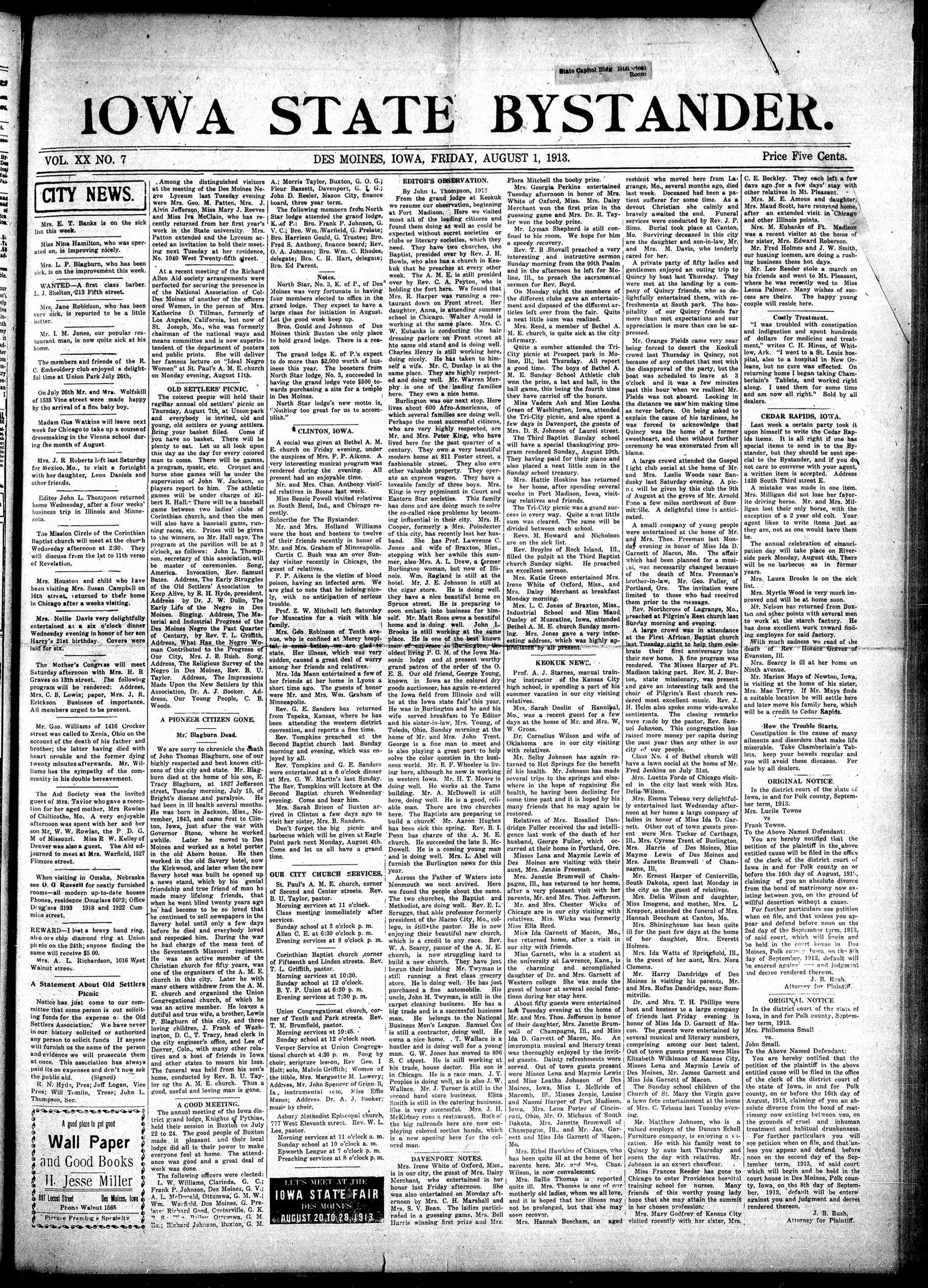
IOWA STATE BYSTANDER.
VOL. XX NO. 7
CITY NEWS.
Mrs. E. T. Banks is on the sick list this week.
Miss Nina Hamilton, who was operated on, is improving nicely.
Mrs. L. P. Blagburn, who has been sick, is on the improvement this week.
WANTED—A first class barber. L. J. Shelton, 213 Fifth street.
Mrs. Jane Robinson, who has been very sick, is reported to be a little better.
Mr. I. M. Jones, our popular restaurant man, is now quite sick at his home.
The members and friends of the R. C. Embroidery club enjoyed a delightful time at Union Park July 26th.
On July 26th Mr. and Mrs. Wolfskill of 1633 Vine street were made happy by the arrival of a fine baby boy.
Madam Gus Watkins will leave next week for Chicago to take up a course of dressmaking in the Vienna school during the month of August.
Mrs. J. R Roberts left last Saturday for Mexico, Mo., to visit a fortnight with her daughter, Leon Daniels and other friends.
Editor John L. Thompson returned home Wednesday, after a four weeks' business trip in Illinois and Minnesota.
The Mission Circle of the Corinthian Baptist church will meet at the church Wednesday afternoon at 2:30. They will discuss from the 1st to 11th verse of Revelation.
Mrs. Houston and child who have been visiting Mrs. Susan Campbell on 16th street, returned to their home in Chicago after a weeks visiting.
Mrs. Nellie Davis very delightfully entertained at a six o'clock dinner Wednesday evening in honor of her son Harry's 21st birthday. Covers were laid for six.
The Mother's Congress will meet Saturday afternoon with Mrs. H. R Graves on 15th street. The following program will be rendered: Address, Mrs. C. B. Lewis; paper, Mrs. J. R. Erickson. Business of importance. All members urged to be present.
Mr. Gao. Williams of 1416 Crocker street was called to Xenia, Ohio on the account of the death of his father and brother; the latter having died with heart trouble and the former dying twenty minutes afterwards. Mr. Williams has the sympathy of the community in his double bereavement.
The Aid Society was the invited guest of Mrs. Taylor who gave a reception for her aged mother, Mrs Rowlan of Chiliotie, Mo. A very enjoyable afternoon was spent with her and her son Mr. W. W. Rowlan, the P. D. G. M. of Missouri. Miss R W. Kelley of Denver was also a guest. The Aid adjourned to meet at Mrs. Warfield, 1527 Filmore street.
When visiting in Omaha, Nebraska see D. G Russell for neatly furnished rooms—all modern up-to-date houses. Phones, residence Douglass 5083; Office Drug use 3193 1918 and 1922 Cummins street.
REWOARD—I need a heavy band ring. also ore chip diamond ring at Union plink on the 24th; anyone finding the same will receive $5.00.
Mrs. A. L. Richardson, 1016 West Walnut street.
A Statement About Old Settlers
Plain
Notice has just come to our committee that some person is out soliciting funds for the expense of the Old Settlers Association. We have never in our history solicited or authorized any person to solicit funds. If anyone will furnish us the name of the person and evidence we will prosecute them at once. This association has always paid its on expenses and don't now ask the public aid. (Signed)
R. N. Hyda, Pres; Jeff Logan, Vice Pres; Will Tomlin, Treas; John L. Thompson, Sec.
A good place to get good
Wall Paper
and Good Books
H. Jesse Miller
507 Locust Street
Des Moines, Iowa
Phone Walnut 1565
Pleasure Framing a Specialty
Among the distinguished visitors at the meeting of the Des Moines Negro Lycme last Tuesday evening were Mrs. Geo. M. Patten, Mrs. J. Alvin Jefferson, Miss Mary J. Reeves and Miss Iva McClain, who has recently returned from her first year's work in the State university. Mrs. Patton extended and the Lycme accepted an invitation to hold their meeting next Tuesday at her residence, No. 1040 West twenty-fifth street.
At a recent meeting of the Richard Allen Aid society arrangements were perfected for securing the presence in of the National Association of Colleges and Universities of Women, in the person of Mrs. Katherine D. Tillman, formerly of Los Angeles; California, but now of St. Joseph, Mo., who was formerly chairman of the national ways and means committee and is now superintendent of the department of posters and public prints. She will deliver her famous lecture on "Ideal Negro Women" at St. Paul's A. M. E. church on Monday evening, August 11th.
OLD SETTLERS' PICNIC.
The colored people will hold their regular annual old settlers' picnic on Thursday, August 7th, at Union park and everybody is invited, old and young, old settlers or young settlers. Bring your basket filled. Come if you have no basket. There will be plenty to eat. Let us all look upon this day as the day for every colored man to come. There will be games, a program, music, etc. Croquet and horse shoe games will be under the supervision of John W. Jackson, so players report to him. The athletic games will be under charge of Elbert R. Hall. There will be a baseball game between two ladies' clubs of Corinthian church, and then the men will also have a baseball game, running races, etc. Prizes will be given to the winners, so Mr. Hall says. The program at the pavilion will be at 3 o'clock, as follows: John L. Thompson, secretary of the william, will be master of ceremonies. Song, America. Invocation, Rev. Samuel Bates. Address. The Early Struggle of the Old Settlers' Association to Keep Alive, by Dr. R. H. Hyd, president. Address by Dr. J. W. Dulin, The Early Life of the Negro in Des Moines. Singing. Address. Ana- and Industrial Progress of the Des Moines Negro the Past Quarter of Century, by Rev. T. L. Griffith. Address, What Has the Negro Woman Contributed to the Progress of Our City, Mrs. J. B. Rush. Song. Address, The Religious Survey of the Negro in Des Moines, Rev. B. U. Taylor. Address, The Impressions Made Upon the New Settlers by this Association, Dr. A. J. Booker. Address, Our Young People. C. B. Woods.
A PIONEER CITIZEN GONE
Mr. Blagburn Dead.
We are sorry to chronicle the death of John Thomas Blagburn, one of our highly respected and best known citizens of this city and state. Mr. Blagburn died at the home of his son, E. Tracy Blagburn, at 1827 Jefferson street, Tuesday morning, July 15, of Bright's disease, and paralysis. He had been in ill health several months. He was born in Jackson, Miss., November, 1843, and came first to Clinton, Iowa, just after the war with Governor Stone, where he worked awhile. Later he moved to Des Moines and worked as a hotel porter in the old Aborn house. He then worked in the old Saverity hotel, now the Kirkwood, and later when the new Saverity hotel was built he opened up a news stand, which by his genial friendship and true friend of man he made many lifelong friends, that when he went blind twenty years ago he had become to be so loved that he continued to sell newspapers in the Saverity hotel until a few days before he died and everybody loved and rescheduled him. During the war he had charge of the mess tent of the Seventeenth Missouri regiment. He was an active member of the Christian church for fifty years, one of the organizers of the A. M. E. church in this town. Later he with many withdrew from the A. M. E. church and organized the Union Congregational church, of which he was an active member. He leaves a dutiful and true wife, a brother, Lewis P. Blagburn of this city, and three loving children, J. Frank of Washington, D. C., T. Tracy, head clerk in the city engineer's office, and Lee of Denver, Colo., with many other relatives and a host of friends in Iowa and other states to mourn his loss. The funeral was held from his son's home, conducted by Rev. B. U. Taylor or the A. M. E. church. Thus a good, useful and loving man is gone.
A GOOD MEETING
The annual meeting of the Iowa district grand lodge, Knights of Pythias, held their session in Buxton on July 22 to 24. The good people of Buxton made it pleasant and their local lodge did all in their power to make everyone feel at home. The attendance was good and a great deal of work was done.
The following officers were elected: L. W. Williams, Chanda, G. C.; L. M. Johnson, Des Moines, G. V.; A. L. Johnson, Des Moines, G. M. W.; Wm. Warfield, Des Moines, G. Prelate; Richard Good, Centerville, G. K.; S. W. Bellow, Ottumwa, G. M.; Richard Johnson, Buxton, G. M.
DES MOINES, IOWA, FRIDAY, AUGUST 1, 1913.
A.; Morris Taylor, Buxton, G. O. G.; Fleur Bassett, Taylor, G. L.; John D. Reeler, Mason City, finance board, three year term. The following memoirs from North Star lodge attended the grand lodge, K. of P.; Bro. Frank P. Johnson, G. V. C.; Bro. Wm. Warfield, G. P;relate; Bro. Harrison Gould, G. Truste; Bro. Fred S. Anthony, finance board; Rev. O. A. Johnson; Bro. Wm. C. Rhodes, delegate; Bro. C. H. Hart, delegate; Bro. Ed Parent.
EDITOR'S OBSERVATION.
By John L. Thompson, 1913
From the grand lodge at Keokuk we resume our observation, beginning at Fort Madison. Here we visited most all of the leading citizens and found them doing as well as could be expected without secret societies or clubs or literary societies, which they need. They have two churches, the Baptist, presided over by Rev. J. H. Bowls, who also has a church in Keo-
Notes.
North Star, No. 3, K of P., of Des Moines is very fortunate in having four members elected to office in the grand lodge. They expect to have a large class for initiation in August. Let the good work keep up. Bros. Gould and Johnson of Des Moines think Buxton the only place to hold grand lodge. There is a reason the grand lodge K. of P.'s expect to do more than $2,000 worth of business this year. The boosters from North Star lodge, No. 3, succeeded in having the grand lodge vote $600 towards purchasing a site for a temple in Des Moines. North Star lodge's new motto is, "Nothing too great for us to accomplish."
CLINTON, IOWA.
A social was given at Bethel A. M. E. church on Friday evening, under the auspices of Mrs. F. P. Alkens. A very interesting musical program was rendered during the evening. All present had an enjoyable time.
Mr. and Mrs. Chas. Anthony visited relatives in Boone last week. Miss Bessie Powell visited relatives in South Bend, Ind., and Chicago recently.
Subscribe for the Bystander.
Mr. and Mrs. Holland Williams were the host and hostess to twelve of their friends recently in honor of Mr. and Mrs. Graham of Minneapolis.
Curtis C. Bush was an over Sunday visitor recently in Chicago, the guest of relatives.
F. P. Aikens is the victim of blood poison, having an infected arm. We are glad to note that he is idiotic nicely, with no anticipation of serious trouble.
Prof. Z. W. Mitchell left Saturday for Muscatine for a visit with his family.
Mrs. Géo Robinson of Tenth avenue, who is confined to Mercy hospital, is some better, we are glad to state. Her illness, which was very sudden, caused a great deal of worry among her friends and relatives.
Mrs. Ida Mann entertained a few of her friends at her home in Lyons a short time ago. The guests of honor were Mr. and Mrs. Wm. Graham of Minneapolis.
Rev. G. E. Sanders has returned from Topeka, Kansas, where he has been attending the western district convention, and reports a fine time.
Rev. Tompkins preaches at the Second Baptist church last Sunday morning and evening, which was enjoyed all night.
Rev. Tompkins and G. E. Sanders were entertained at a 6 o'clock dinner at Mrs. G. W. Martin's last Sunday. The Rev. Tompkins will lecture at the Second Baptist church Wednesday evening. Come and hear him.
Mrs. Sarah Brison of Buxton arrived in Clinton a few days ago to visit her sister, Mrs. B. Sanders. Don't forget the big picnic and barbecue which will be given at Eagle Point park next Monday, August 4th. Come and let us all have a grand time.
OUR CITY CHURCH SERVICES.
St. Paul's A. M. E. church, corner of Second and Center streets. Rev. B. U. Taylor, pastor.
Morning services at 11 o'clock.
Class meeting immediately after services.
Sunday school at 3 o'clock p. m.
Allen C. E. at 6:30 o'clock p. m.
Evening services at 8 o'clock p. m.
Corinthian Baptist church, corner of Fifteenth and Linden streets. Rev. T. L. Griffith, pastor.
Morning services at 10:30.
Sunday school at 12 o'clock.
B. Y. P. Union at 6:30 p. m.
Evening services at 7:30 p. m.
Union Congregational church, corner of Tenth and Park streets. Rev. T. M. Brumfield, pastor.
Morning services at 10:45.
Sunday school at 12 o'clock nown.
Vesper Service at Union Congregational church at 4:30 p. m. Song by choir; scripture lesson, Rev Geo. I. Holt; solo, Malvin Griffith; Women of the Bible, Mrs. Marguette M. Lowery; Address, Mr. John Spencer of Grinnell, Ia, instrumental solo, Miss Effie Mason; Address, Dr. A. J. Jooker; music by choir.
Asbury Methodist Episcopal church, 777 West Eleventh street. Rev. W. L. Lee, pastor.
Morning services at 11 o'clock a. m.
Sunday school at 10 o'clock a. m.
Epworth League at 7 o'clock p. m.
Preaching services at 8 o'clock p. m.
LET'S MEET AT THE
IOWA STATE FAIR
DES MOINES
AUGUST 20,10 28,1913
EDITOR'S OBSERVATION.
By John L. Thompson, 1912
From the grand judge at Keokuk
we resume our observation, beginning
at Fort Madison. Here we visited
most all of the leading citizens and
found them doing what they expect
expecting a secret society or
club or literary societies, which they
need. They have two churches, the
Baptist, presided over by Rev. J. H.
Bowls, who also has a church in Keokuk that he preaches at every other week. The A. M. E. is still presided over by Rev. C. A. Peyton, who is holding the fort here. We found that Mrs. R. Harper was running a restaurant down on Front street. Her daughter, Anna, is attending summer school in Chicago. Walter Arnold is working at the same place. Mrs. C. W. Eubanks is conducting the hair dressing parlor on Front street at hte same old stand and is doing well. Charles Henry is still doing here, doing what he takes on. Mrs. C. M. Cunlun is at the same place. They are highly respected and doing well. Mr. Warren Murphy is one of the leading families here. They own a nice home.
Burlington was our next stop. Here lives about 600 Afro-Americans, of which several families are doing well. Perhaps the most successful citizens, who are very highly respected, are Mr. and Mrs. Peter King, who have lived here for the past quarter of a century. They own a very beautiful modern home at 811 Foster street, a fashionable house. They also own other valuable property. They operate an express wagon. They have a loveable family of three boys. Mrs. King is very prominent in Court and Eastern Star societies. This family has done and are doing much to solve the so-called race problems by becoming influential in their city. Mrs. H. Cooper, formerly a Mrs. Poindexter of this city, has recently lost her husband. She has Prof. Lawrence C. Jones and wife of Braxton, Miss, stopping with her awhile this summer, also Mrs. A. L. Drew, a former Burlington man and now is still of the Iowa. Mr. J. E. Johnson is still the cigar store. He is doing well, they have a nice home on Spruce street. He is preparing to soon embark into business for himself. Mr. Matt Ross owns a beautiful home and is doing well. John L. Brooks is still working at the same place. He is one of the best men of our race in Burlington, the oldest living P. G. M. of the Iowa Masonic lodge and at present worthy grand patron of the order of the O. E. S. Our old friend, George Young, known in Iowa as the colored dry goods auctioneer, has again re-entered the Iowa field from Illinois and will be at the Iowa state fair* this year. He was in Burlington and he and his wife served breakfast to Yo Editor and his sister-in-law, Mrs. Young, of Toledo, Ohio, Sunday morning at the home of Mr. and Mrs. John Trent. George is a fine man to meet and is also playing a great part to help solve the color question in business world. Mr. B. F. Wheeler is living here, although he now is working in western Iowa. Mr. W. Young is doing well. He works at the Tama house of Mr. A. McDowell is still here, doing well. He is a good, reliable man. There are two churches here. The Baptists are preparing to build a church. Mr. Aaron Hughes has been sick this spring. Rev. B. I. Penn has charge of the A. M. E. church. He succeeded the late S. McDowell. He is a coming young man and is doing well. Mrs. L. Abel will furnish the Burlington news for this year.
Across the Father of Waters into Monmouth we next arrived. Here we found the people about the same. The two churches, the Baptist and Methodist, are doing well. Rev. E. L. Seruggs, that able professor former president of the Macon City, Mo., college, is still* the pastor. He is now enjoying their beautiful new church, which is a credit to any race. Rev. W. A. Searcy, pastor of the A. M. E. church, is now struggling hard to build a new church. They have just begun their building Mr. Twyman is still running a first class grocery store. He is doing well. He has just purchased a fine automobile. His uncle, John H. Twyman, is in still the carpet cleaning business. He has a big trade and is a successful business man. He belongs to the National Business Men's League. He is still a teacher, doing well. He is a nice home. T. Wallace is a hustler and is doing well for a young man. G. W. Jones has moved to 806 S. C street. He is still working at his trade, house doctor. His son is in Chicago. He is a race man. J. T. Peopleis doing well, as is also J. W. Wallace. Mr. J. Turner is still in the second hand store business. Eliza Smith is still in the catering business. She is very successful. Mrs. J. H. McKimfrey is a restaurant. Both of the big railroads here are now employing colored section hands, which is a new opening here for the colored man.
DAVENPORT NOTES.
Miss. Irene White of Oxford, Miss., is in our city, the guest of Mrs. Daisy Merchant, who entertained in her honor last Friday afternoon. She was also entertained on Monday afternoon by Mrs. C. H. Marshall. The third participant in the tournament, participated in a guessing game, Miss. Bell Harris winning first, prizes and Mrs.
State Capitol Bldg Historical Room
Flora Mitchell the booby prize.
Mrs. Georgia Perkins entertained Tuesday afternoon in honor of Mrs. White of Oxford, Miss. Mrs. Daisy Merchant won the first prize in the guessing game and Mrs. Dr. R. Taylor won the bobbie prize. Mr. Lyman Shepherd is still confined to his room. We hope for him a speedy recovery. Rev. T. B. Stovall preached a very interesting, and instructive sermon Sunday morning from the 90th Psalm and in the afternoon he left for Molle, Ill., to preach the sacramental sermon for Rev. Boyd. On Monday night the members of the different clubs gave an entertainment and disposed of the different articles left over from the fair. Quite a neat little sum was realized. Mrs. Reed, a member of Bethel A. M. E. church, is quite sick at the city infirmary. Quite a number attended the TriCity picnic at Prospect park in Molle, Ill., last Thursday. All report a good time. The boys of Bethel A. M. E. Sunday School Athletic club won the prize, a bat and ball, in the ball game, this being the fourth time they have carried off the honors. Miss Vadera Ash and Miss Louba Green of Washington, Iowa, attended the TriCity picnic, and also spent a few days in Davenport, the guests of Mrs. D. S. Johnson of Laurel street. The Third Baptist Sunday school will have a special thanksgiving program rendered Sunday, August 10th. They having paid for their piano and also placed a neat little sum in the Sunday school treasury.
Mrs. Hattie Hoskins has returned to her home, after spending several weeks in Fort Madison, Iowa, visiting relatives and friends. The Tri-City picnic was a grand success in every way. Quite a natt little sum was cleared. The same will be divided between each school. Revs. M. Howard and Nicholson are on the sick list. Rev. Broyles of Rock Island, Ill., filled the pulpit at the Third Baptist church Sunday night. He preached an excellent sermon. Mrs. Katie Green entertained Mrs. Irene White of Oxford, Miss., and Mrs. Dawn Merchant at breakfast Monday morning. Mrs. L. C. Jones of Braxton, Miss., Industrial School and Miss Maud Ousley of Muscatine, Iowa, attended Bethel M. E. m Church Sunday morning. Mrs. Jones gave a very interesting address, which was highly appreciated by all present.
KEOKUK NEWS.
Prof. A. J. Starnes, manual training instructor of the Kansas City high school, is spending a part of his summer vacation in our city visiting relatives.
Mrs. Sarah Doolin of Hannipal, Mo., was a recent guest for a few days at the home of Mr. and Mrs. W. W. Gross.
Dr. Cornelius Wilson and wife of Oklahoma are in our city visiting with relatives.
Mr. Selby Johnson has again returned to Hot Springs for the benefit of his health. Mr. Johnson has made several trips to the springs and elsewhere in the hope of regaining his health, he having been declining for some time past and it is hoped by his many friends that he may again be restored.
Relatives of Mrs. Rosalind Dandridge Fuller received the sad intelligence last week of the death of her husband, George Fuller, which occurred at their home in Portland, Ore.
Misses Lena and Maynie Lewis of Des Moines are visiting with their aunt, Mrs. Jennie Freeman.
Mrs. Janette Brumwell of Champagne, Ill., has returned to her home, after a very pleasant visit with her parents, Mr. and Mrs. Thos. Jefferson.
Mr. and Mrs. Chester Wicks of Chicago are in our city visiting with relatives. Mrs. Wicks was formerly Miss Ella Reed.
Miss Ia Garnett of Macon, Mo., has returned home, after a visit in our city with friends.
Miss Garnett, who is a student at the university at Lawrence, Kans., is the charming and accomplished daughter of Dr. and Mrs. Garnett of Western college She was made the guest of honor at several social functions during her stay here.
About fifty guests were entertained last Tuesday evening at the home of Mr. and Mrs. Thros. Jefferson in honor of their daughter, Mrs. Janette Brumwell of Champagne, Ill., and Miss Ida D. Garnett of Macon, Mo. An impromptu musical and literary treat was thoroughly enjoyed by the invited guests. Dainty refreshments were served. Out of town guests were Misses Lena and Mayie Lewis and Miss Leatha Johnson of Des Moines, Iowa, Miss I. McBride of Macom, Ill., Misses Jennie, Louise and NamiHarper of Fort Madison, Iowa, Mrs. Lena Porter of Cincinnati, Ohio, Mr. O. Michaux of South Dakota, Mrs. Janette Brumwell of Champagne, Ill., and Mr. Jas. Garnett and Miss Ida Garnett of Macon, Mo.
Mrs. Ethel Hawkins of Chicago, who has been quite ill at the home of her parents here, Mr. and Mrs. Chas. Wilson, is now convalescent.
Mrs. Sallie Thomas is reported quite ill. Mrs. Thomas is one of our motherly old ladies, whom we all love, and it is hoped that her illness may not be prolonged, but that she may soon recover.
resident who moved here from LaGrange, Mo., several months ago, died last week. Deceased had been a patient sufferer for some time. As a devout Christian she calmly and bravely awaited the end. Funeral services were conducted by Rev. J. P. Sims. Burial took place at Canton, Mo. Surviving deceased in this city are the daughter and son-in-law, Mr. and Mrs. M. Davis, who tenderly cared for her.
A private party of fifty ladies and gentlemen enjoyed an outing trip to Quincy by boat last Thursday. They were met at the landing by a company of Quincy friends, who so delightfully entertained them, with refreshments at South Park. The hospitality of our Quincy friends far more than met expectations and our appreciation is more than can be expressed.
Mr. Orange Fields came very near being to desert the Keokuk crowd last Thursday in Quincy, not because of any conduct that met with the disapproval of the party, but the boat was scheduled to leave at 3 o'clock and it was a few minutes past this hour when we realized Mr. Fields was not aboard. Looking in the distance we saw him making time as never before. On being asked to explain the cause of his tardiness, he was forced to acknowledge that Quincy was the home of a former sweetheart, and then without further ceremony he was exonerated from all blame.
A large crowd attended the Gospel Light club social at the home of Mr. and Mrs. Leslie Woods near Sandusky last Saturday evening. A picnic will be given by this club the 9th of August at the grove of Mr. Arnold Pone a few miles northwest of Summitville. A delightful time is anticipated.
A small company of young people were entertained at the home of Mr. and Mrs. Thos. Freeman last Monday evening in honor of Miss Ida D. Garnett of Macon, Mo. The affair which had been planned for a musical, was necessarily changed because of the death of Mrs. Freeman's brother-in-law, Mr. Geo. Fuller, of Portland, Ore. The invitation were limited to those who had received them prior to the message.
Rev. Northcross of Lagrange, Mo., preached at Pilgrim's Rest church last Sunday morning and evening.
A large crowd was in attendance at the First African Baptist church last Tuesday night to help them celebrate their first anniversary into their new home. A fine program was rendered. The Misses Harper of Ft. Madison taking part. Rev. M. J. Burton, state missionary, was present and gave an interesting talk and the choir of Pilgrim's Rest church rendered most excellent music. Rev. J. H. Helm also spoke some wide-awe sentiments. The closing remarks were rade by the pastor, Rev. Samuel Johnson. This congregation has raised more money per capita during the past year than any other in our city of our people.
Class No. 4 of Bethel church will have a lawn social at the home of Mr. Fred Jenkins on July 31st.
Ms. Luetta Forte of Chicago visited in the city last week with Mrs. Delia-Wilson.
Ms. Emma Tebaeu very delightfully entertained last Wednesday afternoon at her home a large company of ladies in honor of Miss Ida D. Garnett. Other out of town guests present were Mrs. Tucker of Carthage, Ill., Mrs. Cyrene Trent of Burlington, Mrs. Harris of Des Moines, Miss Mayme Lewis of Des Moines and Mrs. Janette Brumwell of Champagne, Ill.
Mr. Ernest Harper of Centerville, South Dakota, spent last Monday in the city as the guest of relatives.
Ms. Delia Wilson and daughter, Miss Imogene, and mother, Mrs. L Krepper, attended the funeral of Mrs Hannah Beecham at Canton, Mo.
Ms. Shininghouse has been quite ill for the past few days at the home daughter, Mrs. Everett Holmes.
Ms. Ida Watts of Springfield, Ill., is the guest of her aunt, Mrs. Nora Clemens.
Mr. Harry Dandridge of Des Moines is visiting his parents, Mr. and Mrs. Rufus Dandridge, near Summitville.
Dr. and Mrs. T. H. Phillips were host and hostess to a large company of friends last Friday evening in honor of Miss Ida D. Garnett of Macon. The guests were entertained by several musical and literary numbers, comprising among our best talent. Out of town guests present were Miss Elizabeth Wilkinson of Kansas City, Miss Lena and Maynie Lewis of Des Moines, Mr. James Garnett and Miss Ida Garnett of Macon. The Sunday school children of the Church of St. Mary the Virgin gave a lawn fete entertainment at the home of Mrs. C. Teebau last Tuesday evening.
Mr. Matthew Johnson, who is a valued employee of the Duncan Shell Furniture company, is enjoying a vacation. He with his family went to Quincy by auto last Thursday and sent the day with relatives. Mr. Johnson is an expert chauffeur.
Miss Frances Reeder has gone to Chicago to enter Providence hospital training school for nurses. Many friends of this worthy young lady hope that she may attain the summit in her chosen profession:
Mrs. Mary Godfrey of Kansas City visited recently with her sister, Mrs.
Price Five Cents.
C. E. Beckley. They each left a few days ago for a few days' stay with other relatives in Mt. Pleasant.
Mrs. M. E. Amous and daughter, Maud Mc Scott, have returned home, after an extended visit in Chicago and other Illinois points.
Mrs. M. Eubanks of Ft. Madison was a recent visitor at the home of her sister, Mrs. Edward Robertson.
Mr. Fred Holmes and J. W. Smith, our husting icemen, are doing a rushing business these hot days.
Mr. Leo Reeder stole a march on his friends and went to Mt. Pleasant, where he was recently wed to Miss Leona Palmer. Many wishes of success are theirs. The happy young couple will reside here.
Costly Treatment.
"I was troubled with constipation and indigestion and spent hundreds of dollars for medicine and treatment," writes C. H. Hines, of Whitlow, Ark. "I went to a St. Louis hospital, also to a hospital in New Orleans, but no cure was effected. On returning home I began taking Chamberlain's Tablets, and worked right along. I used them for some time and am now all right." Sold by all dealers.
CEDAR RAPIDS, IOWA
Last week a certain party took it upon himself to write the Cedar Rapids items. It is all right if one has special items to send in to the Bystander, but they should be sent special to the Bystander, and if you do not care to converse with your agent, a written item is accepted. Address 1426 South Third street E.
A mistake was made in one item. Mrs. Milligan did not lose her fayer driving horse. Mr. and Mrs. Milligan lost their only horse, with the exception of a 2 year old colt. Your agent likes to write items just as they are, not as one would have them.
The annual celebration of emancipation day will take place on Riverside park Monday, August 4th. There will be no barbecue as in former years.
Mrs. Laura Brooks is on the sick list.
Mrs. Myrtle Wood is very much improved and will be at home soon. Mr. Nelson has returned from Buxton and other points with several men to work at the starch factory. He has done excellent work toward finding employees for said factory.
With much sadness we read of the death of Rev Horace Graves of Evanston, Ill.
Mrs. Searcy is ill at her home on Ninth avenue.
Mr. Marion Mays of Newton, Iowa, is visiting at the home of his sister, Mrs. Mae Terry. If Mr. Mays finds a suitable location he will settle here and later move his family here, which will be a credit to Cedar Rapids.
How the Trouble Starts
Constipation is the cause of many ailments and disorders that make life miserable. Take Chamberlain's Tablets, keep your bowels regular and you will avoid these discases. For sale by all dealers.
ORIGINAL NOTICE
In the district court of the state of Iowa, in and for Polk county, September term, 1913.
Mrs. Lucile Towne vs Frank Towne.
To the Above Named Dafendant:
You are hereby notified that the petition of the plaintiff in the above entitled cause will be filed in the office of the clerk of the district court of Iowa in or before the 16th day of August, 1913, claiming of you an absolute divorce from the bond of matrimony now existing between you, on the ground of willful desertion without a cause. For further particulars see petition when on file, and that unless you appear and defend before noon on the 2nd day of the September term, 1913, of said court, which will begin and be held in the court house in Des Moines, Polk county, Iowa, on the 8th day of September, 1913, default will be entered against you and judgment and decree rendered thereon.
J. B. Rush.
Attorney for Plaintiff.
ORIGINAL NOTICE
In the district court of the state of Iowa, in and for Polk county, September term, 1913.
To the Above Named Defendant:
You are hereby notified that the petition of the plaintiff in the above entitled cause will be filed in the office of the clerk of the district court of the state of Iowa, in and for Polk county, on or before the 16th day of August, 1913, claiming of you an absolute divorce from the bond of matrimony now existing between you, on the grounds of cruel and inhuman treatment and habitual drunkenness. For further particulars you will see petition on on file, and that unless you appear and defend before noon on the second day of the September term, 1913, of said court which will begin and be held in the court house in Des Moines. Polk county, Iowa, on the 8th day of September, 1913, default will be enter/against you and judgment and decret rendered thereon.
J. B. Rush,
Attorney for Plaintiff.
BY FORCE OF PERSONALITY
Rise of Rachel, Foremost of Tragic Actresses, to Fame, is an Inspiration to Her Sex.
Rachel, one of the foremost actresses in history, represents the fact that personality is one of the most important assets of womankind. This wonderful woman holds a place in the progress of the drama that is to be envied. With personality, she compelled recognition and forged to the front ranks by dint of hard work and earnestness of purpose.
Rachel is one of the most interesting examples of the force of individuality over an audience. She held her listeners spellbound, sweeping them with her up to the heights and down to the depths of emotion with her wonderful acting.
In "Bajazet" and "Andromaque," in "Marie Stuart," she electrified the house, and even in the monotonous "Aranee of Thomas Cornellie, and the dull "Tancrede of Voltaire she worked up her audience, by the force of her impersonations, to a state of frantic admiration. Great indeed, must have been the audience to have not only reconciled the English taste to the uncongenial classicalities of French "legitimate" tragedy, but to have produced in her audience a positive enthusiasm. It is a genuine fact that many ladies fainted from emotion during these representations. One was carried insensible to the theater, in spite of all efforts to recover her. On this circumstance being told to a manager, he would have been nothing! She ought to have died in the theater. The effect would have been tremendous—what a gooduff lost!
The humble origin of Mademoiselle Rachel is well known, but few, perhaps, are aware that she had not received in her youth the commonest rudiments of education, and that she taught herself writing merely by copying the manuscripts of others. On her first introduction into high society she was greatly embarrassed by the conventions of the table; and the question that once arose in her mind at a grand moment of the paper use of the knife and fork in the consumption of asparagus was infinitely embarrassing.
Her obscure beginning and her important life hold in them encouragement and hope for all of her sisters.
Plenty of Tima to Repair It.
One day a well-dressed elderly man called at the shop of the local jeweler in a small Scottish town, and asked:
"Is my watch ready?"
As the watchmaker had at the moment no remembrance of the man, he asked him in turn:
"When did you leave your watch?"
"Oh," replied the man, "I didn't leave it in this shop. Ye were ower by Nelson street when ye got it."
"Nelson street!" repeated the jeweler. "We left Nelson street seventeen years ago."
"Can you tell me the name and the number of the watch?"
They were promptly given, as well as a description of the watch, and it was found. Exactly twenty-two years had passed since it was left for repairs, yet at the end of that time its owner had called for it as naturally as if he had only left it the preceding week.
"Why have you not got your property before?" asked the jeweler. "I responded, the man. I went over the property shortly after. I kept the watch would be safe with you till I cam back, but I stayed a wee thocht langer than I intended."—Youth's Companion.
Hens Adopt Male Plumage
Remarkable developments in poultry would seem to suggest that the masculine tendencies of some women have flow spread to the hens! a London letter states.
A well known Sussex breeder of Hallhamm possesses a two and one-half-year-old speckled Sussex hen, which at the end of her first year was in appearance a hen, had a tail of eggs and a brood of chicks. Last year she did not lay, but molted into a cock's plumage, with the exception of the headgear, which is normally a pullet's.
A partridge Wyandotte hen has been presented to the Natural History museum which presents a specially peculiar case.
The hen was hatched in 1910 and molted normally in the autumn of that season and again in 1911. After the 1912 molt her plumage been altered, that of a cock. Although she will laid eggs, not one of them has been hatched.
Mr. A. R. Cooper of Knaresborough has had a blue Legchorn female with a male's headgear, but in this case the bird did not lay any eggs.
Lack of Legislation
"I am told that sometimes the Equisimax chew boots and shoes for nourishment."
"Well," replied the systematic man, "I suppose that's what they get for not having any proper pure food laws."
Appropriate Greeting:
"When I passed Lucy's house yesterday, she gave me a salute strictly; in keeping with the season."
Ethel-I can't understand why she broke the engagement.
Marie-Perhaps she got "cold feet."
Ethel-That's no excuse. Jack offered to lay his burning heart at her feet when he proposed to her.
Courting Days.
"Would you mind resting your head on my left shoulder, dearest?" "To be nearer your heart?" murmured the beautiful girl.
"Yes; and to be farther away from
the house I have in my right pocket."
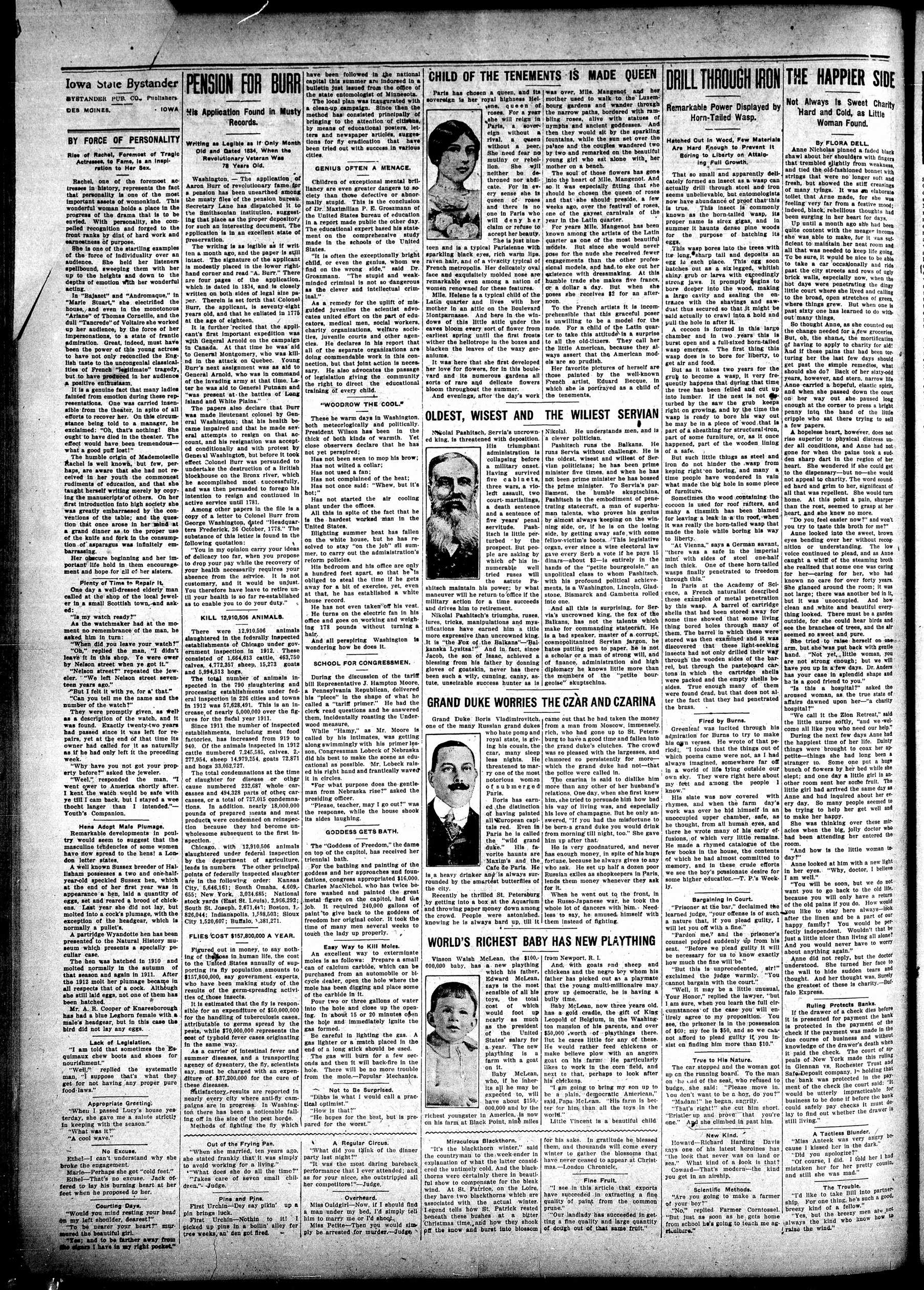
PENSION FOR BURR
Writing as Legible as If Only Month Old and Dated 1834, When the Revolutionary Veteran Was 78 Years Old.
Washington. — The application of Aaron Burr of revolutionary fame, for a pension has been unearthed among the musty flies of the pension bureau. Secretary Lane has dispatched it to the Smithsonian institution, suggesting that place as the proper depository for such an interesting document. The application is in an excellent state of preservation.
The writing is as legible as if written a month ago, and the paper is still intact. The signature of the applicant is modestly placed in the lower right-hand corner and read "A. Burrell, who are four pages long, a application, written in 1834, and is closely written on both sides of legal size paper. Therein is set forth that Colonel Burr, the applicant, is seventy-eight years old, and that he enlisted in 1775 at the age of eighteen.
It is further recited that the applicant's first important expedition was with General Arnold on the campaign in Canada. At that time he was 'aid to General Montgomery, who was killed in the attack on Quebec. Young Burr's next assignment was as a aid to General Arnold, who was in command of the invading army at that time. Later he was aid to General Putnan and "was present at the battles of Long island and White Plains." The papers also declare that Burr was made leutenant colonel by General Washington; that his health became impaired and that he made several attempts to resign on that account, and his resignation was accepted conditionally and with proof it took effect. Colonel Washington, before it took effect, was persuaded to the destruction of a British blockhouse on the Bronx river, which he accomplished most successfully, and was then persuaded to forego his intention to resign and continued in active service until 1781.
Among other papers in the file is a copy of a letter to Colonel Burr from George Washington, dated "Headquarters Frederick, 26 October, 1778." The substance of this letter is found in the following quotation:
"You in my opinion carry your ideas of delicacy too far, when you propose to drop your pay with me. You certainly requires your absence from the service. It is not customary, and it would be unjust. You therefore have leave to retire until your health is so far re-established as to enable you to do your duty."
KILL 12.910.506 ANIMALS.
There were 12,910,506 animals slaughtered in the federally inspected establishments of Chicago under government inspection in 1912. These consisted of 1,664,613 cattle, 462,750 calves, 4,772,537 sheep, 12,573 goats and 5,994,513 hogs.
The total number of animals inspected in the 790 slaughtering and processing establishments under federal inspection in 228 cities and towns in 1912 was 57,628,491. This is an increase of nearly 5,000,000 over the figures for the fiscal year 1911. Since 1911 the number of inspected establishments meat food facilities has increased from 919 to 940. Of the animals inspected in 1912 cattle numbered 7,245,555 calves, 2,277,954 sheep 14,979,554 goats 72,871 and hops 33,052,727.
The total condemnations at the time of slaughter for disease or other cause numbered 232,687 whole carcasses and 494,328 parts of other carcasses, or a total of 727,015 condemnations. In addition, nearly 18,000,000 pounds of prepared meats and meat products were condemned on reinspection because they had become unwholesome subsequent to the first Inspection.
Chicago, with 12,910,506 animals shattered under federal inspection by the department of agriculture, leads in number. The other principal points of federally inspected slaughter are in the following order: Kansas City, 5,464,161; South Omaha, 4,609; 655; New York, 3,034,685; National stock yards (East St. Louis), 2,969,292; South St. Joseph, 2,671,447; Boston, 1,826,044; Indianapolis, 1,598,503; Sloux City, 1,620,607; Buffalo, 3,812,211.
FLIES 'COST $157,800,000 A YEAR.
Figured out in money, to say nothing of the loss in human life, the cost to the United States annually of supporting its fly population amounts to $157,800,000, say government experts, who have been making study of the results of the germ-spreading activities of those insects. It is estimated that the fly is responsible for an expenditure of $50,000,000 for the handling of tuberculosis cases, attributable to germs spread by the pests, while $70,000,000 represents the cost of typhoid fever cases originating in the same way. As a carrier of intestinal fever and summer diseases, and a transporting agency of dysentery, the fly, scientists say, must be charged with an expenditure of $37,200,000 for the cure of these diseases. Satisfactory results are reported in nearly every city where anti-fly campaigns are in progress. In Washington there has been a noticeable falling off in the size of the pest horse.
Out of the Frying Pan
"When she married, ten years ago, she stated frankly that it was simply to avoid working for a living."
"What does she do all the time?"
"Fakes care of seven small children."- Judge.
Pine and Pine.
First Urchin—Dey say plikin' up a pln brings luck.
First Urchin—Nothin to it! I picked up pins in a bollin' alley for tree weeks' an' den got fired.
have been followed in the national capital this summer are indoored in a bulletin just issued from the office of the state entomologist of Minnesota. The local plan was inaugurated with a clean-up campaign. Since then the method has consisted principally of bringing to the attention of citizens, by means of educational articles, by means of educational articles, suggestions for fly eradication that have been tried out with success in various cities.
GENIUS OFTEN A MENACE.
Children of exceptional mental brilliance are even greater dangers to society than those defective or abnormally stupid. This is the conclusion of Dr. Maximilian P. E. Groszmann of the United States bureau of education in a report published last year that expert based his statement on the comprehensive study made in the schools of the United States.
"It is often the exceptionally bright child, or even the genius, whom we find on the wrong side," said Dr. Groszmann. "The stupid and weak-minded criminal is not so dangerous as the clever and intellectual criminal."
As a remedy for the uplift of misguided juveniles the scientist advocates united effort on the part of educators, medical men, social workers, charity organizations, welfare societies, juvenile courts and other agencies. He declares in his report that all of the separate organizations are doing commendable work in this connection, but that joint action is necessary. He also advocates the passage of legislation giving the community the right to direct the educational training of every child.
"WOODROW THE COOL."
These he warm days in Washington, both meteorologically and politically. President Wilson has been in the thick of both kinds of warmth. Yet close observers declare that he has not yet perspired;
Has not been seen to mop his brow;
Has not wilted a collar;
Has not used a fan;
Has not complained of the heat;
Has not once said: "Whew, but it's hot.
Has not started the air cooling plant under the offices.
All this in spite of the fact that he is the hardest worked man in the United States.
Blighting summer heat has fallen on the white house, but he has resolved to stay "on the job" all summer, to carry out the administration's reform policies.
His bedroom and its office are only a hundred feet smart, so that he's obliged for the time if he gets for a bit of exercise, yet, even at that, he has established a white house record.
He has not even taken' off his vest. He turns on the electric fan in his office and goes on working and weighing 178 pounds without turning a his. And all periphrase Washington is wondering how he does it.
SCHOOL FOR CONGRESSMEN.
During the discussion of the tariff bill Representative J. Hampton Moore, a Pennsylvania Republican, delivered his "piece" in the shape of what he called a "tariff primer." He had the clerk read questions and he answered them, incidentally roasting the Underwood measure, "Hummy," as Mr. Moore is called by his intimates, was getting along swimmingly with his primer lesson, Congressman Lobec of Nebraska did his best to make the scene as educational as possible. Mr. Lobec raised his right hand and frantically waved it in circles.
"For what purpose does the gentleman from Nebraska rise?" asked the presiding officer. "And may I go out?" was the response, while the house shook its sides laughing.
GODDESS GETS BATH.
The "Goddess of Freedom," the dame on top of the capitol, has received her triennial bath. For the bathing and painting of the goddess and her approaches and foundations, congress appropriated $16,000. Charles MacNichol, who has twice before washed and painted the great metal figure on the capitol, had the job. It required 240,000 gallons of paint to give back to the goddess of freedom her original color. It took the time of many men several weeks to touch the lady up properly.
Easy Way to Kill Moles.
An excellent way to exterminate moles is as follows: Prepare a small can of calcium carbide, which can be purchased from an automobile or bicycle dealer, open the hole where the mole has been digging and place some of the carbide in it. Throw three gallons of water into the hole and close up the opening. In about 15 or 20 minutes open the hole and immediately ignite the gas formed.
Be careful in lighting the gas. A gas lighter or a match placed in the end of a long stick should be used.
The gas will burn for a few seconds and then it will back-fire in the hole. There will be no more trouble from the mole.—Popular Mechanics.
Not to Be Surprised.
"Dibbs is what I would call a practical optimist."
"How is that?"
"He hopes for the best, but is prepared for the worst."
"What did you think of the dinner party last night?"
"It was the most daring bareback performance that I ever attended; and as for your nice, she outstripped all her competitors!"—Judge.
Miss Petite--Then you would simply be arrested for murder--Judge
CHILD OF THE TENEMENTS IS MADE QUEEN
OLDEST, WISEST AND THE WILIEST SERVIAN
GRAND DUKE WORRIES THE CZAR AND CZARINA
WORLD'S RICHEST BABY HAS NEW PLAYTHING
Paris has chosen a queen, and its sovereign is her royal highness Heli-
sene, queen of
roses. For a year
she will reign in
Paris, a sovereign without a
rival, a queen without a
peer.
She need fear no
mutiny or rebellion. She will neither be de-
throned nor abdicate. For in Europe she is queen of roses and there is no one in Paris who will deny her
claim or refuse to accept her beauty.
She is just nine
queen for roses. For a year. For a rose. Paris will be held. Paris, a navyeign without a rival, a queen without a peer. She need fear no mutiny or rebellion. She will neither be dehonored nor abdicate. For in every sense she is queen of roses and there is no one in Paris who will deny her claim or refuse to accept her beauty. She is just nine teen and is a typical Parisienne with sparkling black eyes or raven hair, and of a vixyce typical of French metropolis. Her delicately oval face and exquisitely molded nose are remarkable even among a nation of women renowned for these features.
Mile. Helene is a typical child of the Latin quarter and lives with her mother in an attic on the Boulevard Montparnasse. And here in the windows of this little attic under the eaves bloom every sort of flower from earliest spring until the first frosters with the hellotrope in the boxes and blacken the leaves of the waxy geranulms.
It was here that she first developed her love for flowers, for in this boulevard and its numerous gardens all sorts of rare and delicate flowers bloom throughout the summer.
And evenings, after the day's work
*Nolal Paahitsch, Servia's uncrowned king, is threatened with deposition
His triumphant administration is collapsing before a military onset. Having survived five cabinets, three wars, a virology assault, two court-martialings, a death sentence and a sentence of five years' penal servitude. Pasha, burdened by the prospect. But people are asking by which of his innumerable well tried ruses will the astute Pa-
administration is collapsing before a military onset. Having survived five cabins in three wars, a victory left assault, two court-martialings a death sentence and a sentence of five years penal servitude. Pashisht is little perturbed by the prospect. But people are asking by which of his innumerable well tried ruses will the astute Pashisht maintain his power when maneuver will he return to office if the military action for a time succeeds and drives him to retirement.
Nikolai Pashitch's triumphs, ruses, lures, tricks, manipulations and mystifications have earned him a title more expressive than uncrowned king. It is "the Fox of the Balkans"—Balkanans Lysatta! And in fact, since he was blessed with blessing from his father by donging gloves of goatskin, never has there been such a wily, cunning, canny, astute, unseizable success hunter as is
Grand Duke Boris Vladimirovitch
one of the many Russian grand dukes
who hate pump and
royal state, is giving
his cousin, the czar, many sleep
less nights. He
threatened to marry
one of the most
notorious woman
of submerged
Paris.
JOHN H. BURKE
Poris has earned the distinction of having painted all European capitals red. Even in Paris he is called the "wild grand duke." His favorite haunts are Maxim's and Cindy's. He is a heavy drinker and is always surrounded by the smartest butterflies of the city. Recently he thrilled St. Petersburg by getting into a box at the Aquarium and throwing paper money down among the crowd. People were astonished, knowing he is always hard, till it
Vinson Walsh McLean, the $100,
000,000 baby, has a new plaything
which his father, Edward McLean, says is the most sensible of all his toys, the total cost of which would foot up nearly as much as the president of the United States salaries a year. The new plaything is a farm with a goat on it.
1930
Baby McLean, who, if he inherits all he may be expected to, will have about $150,000,000 and by the richest youngster in America, is now on his farm at Black Point, nine miles
"I'ts the blackthorn winter," said the countryman to the week end in explanation of what the latter considered the untimely cold. And the blackthorns were certainly there in beautiful show to compensate for the bleak wind. At St. Patrice, on the hill they have been planted, they are matched with the actual winter. Legend tells how St. Patrick rested beneath these bushes at a bitter Christmas time, and how they shook off the snow and burst into bloom
was over, Mile. Manganet and her mother used to walk to the Luxembourg gardens and wander through the narrow paths, bordered with rambling roses, alive with statues of nymphs and ancient goddesses. And then they would sit by the spilling fountain, while she over the river and couples wandered two by two and remarked on the beautiful young girl who sat alone with, her mother on a bench.
The soul of those flowers has gone into the heart of Mile. Manganet. And so it was especially fitting that she should be chosen the queen of roses and that she should predecease, weeks ago, on the trail of roses, always the carnival of the year in the Latin quarter.
For years Mille, Mangenet has been known among the artists of the Latin quarter as one of the most beautiful models. But since she would never pose for the nude she received fewer engagements than the other professional models, and had, to ekue out her existence with dressmaking. At this humble museum she may have sold dollar bills a day. But when sheoses she receives $2 for an afternoon.
To the French artists it is incomprehensible that this graceful poser is unwilling to be a model for the nude. For a child of the Latin quarter to take this attitude is a surprise to all the old-timmers. They call her the little American, because they always assert that the American models are so beautiful picture pictures of herself are those painted by the well-known French artist, Eduard Beque. in which she is portrayed as a child of the tenements.
Nikolai. He understands men, and is a clever politician. Pashitch runs the Balkans. He runs Servia without challenge. He is the oldest, wisest and wisest of Servian politicians; he has been prime minister five times, and when he had not been prime minister he has been the prime minister. He is Servia's paranormal friend. He skipschuina. Pashitch is the embodiment of penetrating statecraft, a man of superhuman talents, who proves his genius by almost always keeping on the winning side, or, if he is on the losing side, by getting away safe, with some fellow-victim's boot. This legislative organ, ever since a wite electoral law gave every Serb a vote if he pays 15 dinars—that $3—is entirely in the hands of the "petite bourgeois" and unpolitical Serb. Pashitch, profound political achievements, is a Washington, Lincoln, Gladstone, Bismarck and Gambetta rolled into one.
And all this is surprising, for Servia's uncrowned king, the fox of the Balkans, has not the talents which make for commanding statecraft. He is a bad speaker, master of a corrupt, cosmopolitanized Servian jargon, he hates putting pen to paper. he is not a scholar or a man of strong will, and of finance, administration and high diplomacy he knows little more than the members of the "petite bourgeise" skuptschina.
came out that he had taken the money from a man from Moscow, immensely rich, who had gone up to St. Petersburg to have a good time and fallen into the grand duke's clutches. The crowd was so pleased with the largeses, and clamored so persistently for more—which the grand duke had not—that the police were called in. He was so pleased to dislike him more than any other of her husband's relations. One day, when she first knew him, she tried to persuade him how bad his way of living was, and especially his love of champagne. But he only answered, "If you had the misfortune to be born a grand duke you would drink from morning till night, too." She gave him up after that.
He is very goodnatured, and never has enough money, in spite of his huge fortune, because he always gives to any who ask. He set up half a dozen men exiles as shoppers to lend them money whenever they ask for it.
When he went out to the front, in the Russo-Japanese war, he took the whole lot of dancers with him. Needless to say, he himself with them instead of fighting.
from Newport, R. I.
And, with goats and sheep and chickens and the negro boy whom his father has picked out as a playmate that the young multi-millionaire may grow up democratic, he is having a bully time.
Baby McLean, now three years old, has a gold cradle, the gift of King Leopold of Belgium, in the Washington mansion of his parents, and over $50,000, worth of playhouses there. But he cares little for any of these. He would rather feed chickens or make believe plow with an angrora goat on his farm. He particularly likes to work in the corn field, and that, perhaps to look after his chickens.
"I am going to bring my son up to be a plain, democratic American," said Papa McLean. "His farm is better for him than all the toys in the world."
Little Vincent is a beautiful child
for his sake. In gratitude he blessed them, and thousands will come every winter to gather the blossoms that have never ceased to appear at Christmas.—London Chronicle.
Fine Fruit.
"I see in this article that exports have succeeded in extracting a fine quality of paint from the common prune."
"Our landlady has succeeded in getting a fine quality and large quantity of dough out of that same fruit."
Remarkable Power Displayed by Horn-Tailed Wasp.
Hatched Out in Wood, Few Materials
Are Hard Enough to Prevent It
Boring to Liberty on Attain-
ing Fully Growth.
That so small and apparently delicately formed an insect as a wasp can actually drill through steel and iron seems unbelievable, but entomologists now have abundance of proof that this true.
As known as the horn-tailed wasp, its proper name is sirex gigas, and in summer it haunts dense pine woods for the purpose of hatching its eggs.
This wasp bores into the trees with its long, sharp tail and deposits an egg in each place. This egg soon hatches out as a six legged, whitish shibr gurb or larva with exceedingly strong jaws. It promptly begins to bore deeper into the wood, making a large cavity and with the shaving and sawdust thus secured so that it might be said actually to crawl into a hold and pull the hole in after it.
A cocoon is formed in this large chamber and in two years this is burst open and a full-sized horn-tall wasp emerges. The first thing this wasp does is to bore for liberty, to get air and food.
But as it takes two years for the grab to become a wasp, it very frequently happens that during that time the tree has been felled and cut up into lumber. If the nest is not turbed by the saw the grab keeps right on growing, and by the time the wasp is ready to bore his way out he may be in a piece of wood that is part of a sheathing of structural iron, part of some furniture, or, as it once happened, part of the wooden lining of a safe.
But such little things as steel and wood not hinder the wasp from keeping right on boring, and many a time people have wondered in vain what made the big hole in some piece of furniture.
Sometimes the wood containing the cocoon is used for roof rafters, and many a thimson has been blamed for leaving a leak in a tin roof, when it was really the horn-tailed wasp that made the hole while boring his way to liberty. "At Vienna," says a German savant, "there was a safe in the imperial chamber of sides of steel one-ball inch thick. One of these horn-tailed wasps finally penetrated to freedom through this."
In Paris at the Academy of Science, a French naturalist described these examples of metal penetration by this wasp. A barrel of cartridge shells that had been stored away for some time showed that some living bored holes through many of them. The barrel in which these were stored was then examined and it was discovered that these lightning insects had not only drilled their way through the wooden sides of the barren shells through the pasteboard cartons in which the cartridge shells were packed and the empty shells besides. True enough many of them were found dead, but that does not alter the fact that they had penetrated the brass.
Fired by Burns.
Greenleaf was incited through his admiration for Burns to try to make his own verses. He wrote of that period: "I found that the things out of which poems came were not, as I had always imagined, somewhere far off in a world of life lying outside our own sky. They were right here about my feet and among the people I know."
His slate was now covered with rhymes, and when the farm day's work was over he hid himself in an unoccupied upper chamber, safe, as he thought, from all human eyes, and there he wrote many of his early effusions, of which very little remains. He made a rhymed catalogue of the few books in the house, the contents of which he had almost committed to memory, and in these crude efforts we see the boy's possession desire for some higher education.—T. P.'s Weekly.
Bargaining In Court.
"Prisoner at the bar," declaimed the learned judge, "your offense is of such a nature that, if you plead guilty, I will let you off with a fine."
"Pardon me," and the prisoner's counsel popped suddenly up from his seat. "Before we plead guilty it will be necessary for us to know exactly how much the will be will."
"But this is unprecedented, sir!" exclaimed the judge warmly. "You cannot bargain with the court."
"Well, it may be a little unusual. Your Honor," replied the lawyer, "but I am sure, when he arrives, the case you will entitle me to my proposition. You see, the prisoner is in the possession of $60; my fee is $50, and so we cannot afford to plead guilty if you insist on finding him more than $10."
True to His Nature.
The car stopped and the woman got up on the running board. To the man on the end of the seat, who refused to budge, she said: "Please move in. You don't be a bog, do you?" "Madam!" he began, angrily. "That's right!" she cut him short. "Bristle up and prove that you're one." And she climbed in past him.
New Kind.
Howard-Richard Harding Davis rays one of his latest heroes has "the look that never was on land or sea." What kind of a look is that?
Coward—That's modern—the kind you get in an airship.
Scientific Methods.
"Are you going to make a farmer of your boy?" "No," replied Farmer Corntosell. "But just as soon as he gets home from school he's going to teach me agriculture."
THE HAPPIER SIDE
Not Always Is Sweet Charity Hard and Cold, as Little Woman Found.
By FLORA DELL
Anne Nicholas pinched a faded black shawl about her shoulders with fingers that trembled slightly from weakness, and tied the old-fashioned bonnet with strings that were no longer soft and fresh, but showed the stiff crestings of many tying. It was an elaborate dress, far more formal than for she was feeling very far from home; mood was indeed, red, rebellious though had been nursing in her heart for days. Up until a month ago she had been quite content with the meager income she was able to make, for it was sufficient to maintain her neat room and all that was needed to keep life going. To be sure, it would be nice to be able to take a car occasionally and ride past the city streets and rows of ugly brick walls, especially now, when the hite days were penetrating the dingy street and calling to the broad, open stretches of green, where things grew. But when one is past sixty one has learned to do without many things.
So thought Anne, as she counted out the change needed for a few groceries, But, oh, the shance, the mortification of having to apply to charity for aid; And if these pains that had been tormenting her the last few days should get past the simple remedies, what should she do? Back of her sixty-ood years, however, and stern, narrow life Anne carried a hopeful, elastic spirit, and when she passed down the court on her way out she paused long enough at the corner to press a bright penny into the hand of the little cripple who sat there trying to sell a few papers.
A hopeless heart, however, does not rhinoplasty or physical distress under the care of anne, and Anne did not gone for when the pain took out den sharp dart in the region of her heart. She wondered if she could get to the dispensary—but no—she would not appeal to charity. The word sounded hard and grim to her, significant of all that was repellent. She would turn home. At this point a pain, sharper than the rest, seemed to grasp at her heart, and she knew no more.
"Do you feel easier now?" and don't you try to taste this broth for me?
Anne looked into the sweet, brown eyes bending over her without recognition or understanding. The low voice continued to plead, and as Anne caught a whiff of the steaming broth she realized that some one was caring for her—caring for her, who had known no care for over forty years.
She glanced around the room; it was not large; there was another bed in it, but it was unoccupied. And how clean and beautiful everything looked. There must be a garden outside, for she could hear birds and see the branches of trees, and the air seemed so sweet and pure.
She tried to raise herself on a arm, but she was bare with gentle hand. Little woman, you have not strong enough; but we will have you up in a few days. Dr. Anders has your case in splendid shape and he is a good friend to you.
"Is this a hospital?" asked the aroused woman, as the true state of affairs dawned upon her—a charity hospital!"
"We call it the Zion Retreat," said the little nurse softly, "and we welcome all like you who need our help." During the next few days Anne had the happiest time of her life. Dainty things were brought to cox her appetite—things she had long been a stranger to. Some one put a huge bunch of flowers by her bed while she slept; and one day a little girl in another room sent her some fruit. The little girl had arrived the same day as Anne and had inquired about her every day. So many people seemed to be trying to help her get well and to make her happy.
She was thinking over these miracles when the big, jolly doctor who had been attending her entered the room.
"And how is the little woman today?" Anne looked at him with a new light in her eyes. "Why, doctor, I believe I am well."
"You will be soon, but we do not want you to go back to the old life, because you will only have a return of the old pains if you do. How would you like to stay here always—look after the linen and be a part of our happy family? You would be perfectly independent. Wouldn't be just a little nicer than living alone? And you would never have to worry about anything again." Anne did not reply, but the doctor told her. She turned her face to the wall to hide sudden tears and thought. And her thought was, Surely the greatest of these is charity—But falo Express.
Ruling Protects Bank
If the drawer of a bank dies before it is presented for payment the bank is protected in the payment of the check if the payment was made in the due course of business and without the knowledge of the drawer's death when it paid the check. The court of appeals of New York made this ruling in Glennan vs. Rochester Trust and Safe Deposit company. I hold that the bank was protected in the payment of the check the court said: "It would be utterly impracticable for business to be done if before the bank could safely pay checks it must draw to find out whether the drawer is still living."
A Tactless Blunder.
"Miss Anteck was very angry because I kissed her in the dark."
"Did you apologize?"
"Of course, I did. I told her I had mistaken her for her pretty cousin, and still she was mad."
"I'd like to take Bill into partnership. For one thing, he's such a good, brave kind of a fellow."
breezy kind of the breezy men are not
"Yes, but the breezy men are not
always the kind who know how to
raise the wind."
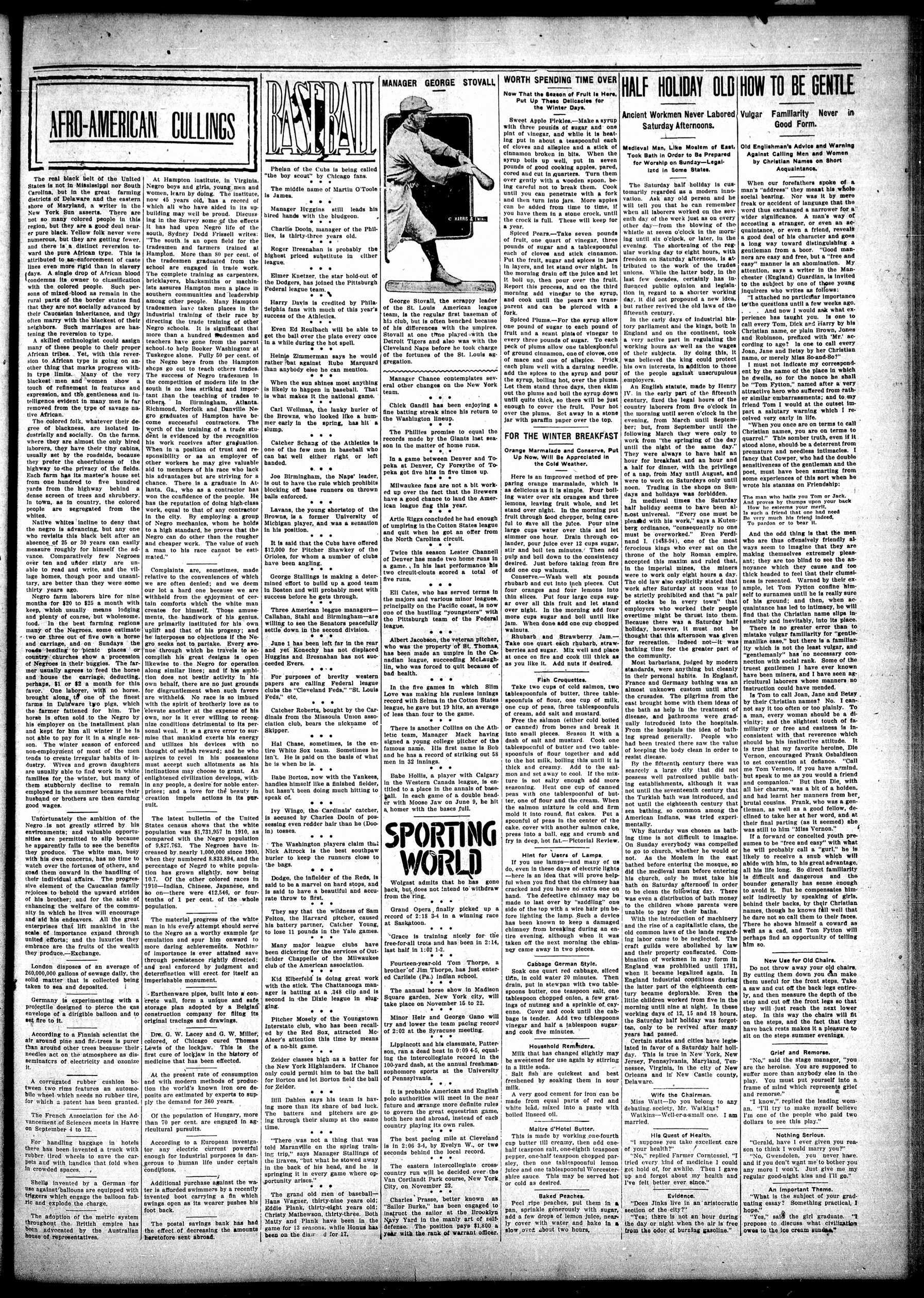
AFRO-AMERICAN CULLINGS
The real black belt of the United States is not in Mississippi nor South Carolina, but in the great farming districts of Delaware and the eastern shore of Maryland, a writer in the New York Sun asserts. There are not so many colored people in this region, but they are a good deal near pure black. Yellow folk never were numerous, but they are getting fewer, and there is a distinct reversion toward the pure African type. This is attributed to an enforcement of caste laws, but they are getting fewer. A single drop of African blood condensus its owner to classification with the colored people. Such persons of mixed-blood as remain in the rural parts of the border states find that they are not socially advanced by their Caucasian inheritance, and they often marry with the blackest of their neighbors. Such marriages are hastening the reversion to type. A skilled enthologist could assign many of these people to their proper African tribes. Yet, with this reversion to African type is going on another thing that marks progress within type limits. Many of the very blackest men and women show a strong sense of expression, and the gentleness and intelligence evident in many men are far removed from the type of savage native African.
The colored folk, whatever their degree of blackness, are isolated industrially and socially. On the farms, where they are almost the only hired laborers, they have their tiny cabins, usually set by the roadside, because they prefer the cheerfulness of the highway to the privacy of the fields. Each farm has its master's house set up with a series of yards from the highway behind a dense screen of trees and shrubbery. In town, as in country, the colored people are segregated from the whites. Native whites incline to deny that the negro is advancing, but any one who revisits this black belt after an absence of 25 or 30 years can easily measure roughly for himself the advance. Comparatively few Negroes are hardheaded to live and write, and the village homes, though poor and unsanty, are better than they were some thirty years ago.
Negro farm laborers hire for nine months for $20 to $25 a month with keep, which usually means lodging and plenty of coarse, but wholesome food. In the best farming regions many of the Negroes, some estimate two or three out of five own a horse and carriage, and on Sundays the roads leading to picnic places or country churches show a procession of Negroes usually agrees to feed the horse and house the carriage, deducting, perhaps, $1 or $2 a month for this favor. One laborer, with no horse, brought along one of the finest farms in Delaware two pigs, which the farmer fattened for him. The horse is often sold to the Negro by his employer on the installment plan and kept for him all winter if he is not able to pay for it in a single season. The winter season of enforced non-employment of most of the men needs to create irregular habits of dwellers and grown daughters are usually able to find work in white families for the winter, but many of them stubbornly decline to remain employed in the summer because their husband or brothers are then earning good wages.
Unfortunately the ambition of the Negro is not greatly stirred by his environments; and valuable opportunities are permitted to slip because he apparently fails to see the benefits they produce. The white man, busy with his own concerns, has no time to watch over the fortunes of others, and lend them onward to the mansion of their individual affairs. The progressive element of the Caucasian family rejoices to behold the upward strides of his brother; and for the sake of enhancing the welfare of the community in which he lives will encourage and aid his endeavors. All the great enterprises that lift mankind in the scale of importance expand through united efforts; and the luxuries they embrace are the fruits of the wealth they produce.—Exchange.
London disposes of an average of 260,000 gallons of sewage daily, the solid matter that is collected being taken to sea and deposited.
Germany is experimenting with a projectile designed to pierce the gas envelope of a dirigible balloon and to set fire to it.
According to a Finnish scientist the air around pine and fir trees is purer than around other trees because their needles act on the atmosphere as disseminators of electricity and ozone it.
A corrugated rubber cushion between two rims features an automobile wheel which needs no rubber tire, for which a patent has been granted.
The French Association for the Advancement of Sciences meets in Havre on September 4 to 12.
For handling baggage in hotels there has been invented a truck with rubber tired wheels to save the carpets and with handles that fold when in crowded spaces.
Shells invented by a German for use against balloons are equipped with triggers which engage the balloon fabric and explode the charge.
The adoption of the metric system throughout the British empire has been advocated by the Australian house of representatives.
Complaints are, sometimes, made relative to the convenience of which we are often denied; and we deem our lot a hard one because we are withheld from the enjoyment of certain comforts which the white man creates for himself. Those amusements, the handwork of his genius, are primarily instituted for his own uplift and that of his progeny; and he interposes no objections if the Negro seeks not to participate. Every aware man is obliged to accomplish his great designs is open likewise to the Negro for operation along similar lines; and if his ambition does not bestrer activity in his own behalf, there are no just grounds for disgruntlement when such favors are withheld. No race is so imbued with the spirit of brotherly love as to elevate another at the expense of his own, nor is it ever willing to recognize conditions detrimental to its personal weal. It is a grave error to surmise that mankind exerts his energy and utilizes his devices with no thought of selfish reward; and he who aspires to revel in his possessions must accept such choices as an enlightened civilization develops, with in any people, a desire for noble enterprises; and a love for the beauty in creation impels actions in its pursuit.
The latest bulletin of the United States census shows that the white population was 81,731,957 in 1910, as compared with the Negro population of 8,827,763. The Negroes have increased by nearly 1,000,000 since 1900, when they numbered 8,833,894, and the percentage of Negro to white population has grown slightly, now being the other colored races in 1910—Indian, Japanese, and so on—there were 412,546, or four-tenths of 1 per cent. of the whole population.
The material progress of the white man in his every attempt should serve to the Negro as a worthy example for simulation and spur him onward to more daring achievements. Nothing of importance is ever attained save through persistence right directed; and zeal enforced by judgment and determination will erect for itself an imperishable monument.
Earthenware pipes, built into a concrete wall, form a unique and safe storage plan adopted by a Belgian construction company for filing its original tracings and drawings.
Drs. G. W. Lacey and G. W. Miller, colored, of Chicago cured Thomas Lewis of the lockjaw. This is the first cure of lockjaw in the history of medicine that has been effected.
At the present rate of consumption and with modern methods of production the world's known iron ore deposits are estimated by experts to supply the demand for 360 years.
Of the population of Hungary, more than 70 per cent. are engaged in agricultural pursuits.
According to a European investigator any electric current powerful enough for industrial purposes is dangerous to human life under certain conditions.
Additional purchase against the water is afforded swimmers by a recently invented boot carrying a fn which swings open as its wearer pushes his foot back.
The postal savings bank has had the effect of decreasing the amounts bereftofore sent abroad.
BASEBALL
Phelan of the Cubs is being called "the boy scout" by Chicago fans.
The middle name of Martin O'Toole is James.
Manager Heggins still leads his hired hands with the bludgeon.
Charlie Doolin, manager of the Phillies, is thirty-three years old.
Roger Bresnahan is probably the highest priced substitute in either league.
Harry Davis is credited by Philadelphia fans with much of this year's success of the Athletics.
Even Ed Reulbach will be able to get the ball over the plate every once in a while during the hot spell.
Helmie Zimmerman says he would rather bat against Rube Marquard than anybody else he can mention.
When the sun shines most anything is likely to happen in baseball. That is what makes it the national game.
Carl Wellman, the lanky hurler of the Browns, who looked like a hummer early in the spring, has hit a slump.
Catcher Schang of the Athletics is one of the few men in baseball who can bat well either right or left handed.
Lavans, the young shortstop of the Browns, is a former University of Michigan player, and was a sensation in his position.
It is said that the Cubs have offered $12,000 for Pitcher Shawkey of the Orioles, for whom a number of clubs have been angling.
George Stallings is making a determined effort to build up a good team in Boston and will probably meet with success before he gets through.
Three American league managers—Callahan, Stahl and Birmingham—are willing to see the Senators peacefully settle down in the second division.
June 1 has been left far in the rear and yet Konechy has not displaced Huggins and Bresnahan has not succeeded Evers.
For purposes of brevity western papers are calling Federal league clubs the "Cleveland Feds," "St. Louis Feds," etc.
Catcher Roberts, bought by the Cardinals from the Missoula Union association club, bears the nickname of Skipper.
---
Hal Chase, sometimes, is the entire White Sox team. Sometimes he isn't. He is paid on the basis of what he is when he is.
Babe Borton, now with the Yankees, handles himself like a finished feilder, but hasn't been doing much hitting to speak of.
Ivy Wingo, the Cardinals' catcher, is accused by Charles Doolen of possessing the righthand half he (Doole) sees.
---
The Washington players claim that Nick Altrock is the best southpaw hurler to keep the runners close to the bags.
---
Dodge, the infielder of the Reds, is said to be a marvel on hard stops, and is said to have a beautiful and accurate throw to first.
They say that the wildness of Sam Felton, the Harvard pitcher, caused his battery partner, Catcher Young, to lose 11 pounds in the Yale games.
Many major league clubs have been dickering for the services of Outfielder Chappelle of the Milwaukee club of the American association.
---
Kid Eberfeld is doing great work with the stick. The Chattanooga manager is batting at a .348 clip and is second in the Dixie league in slugging.
Pitcher Mosely of the Youngstown Interstate club, who has been recall ed by the Red Sox, attracted McAlera's attention this time by means of a no-hit game.
Zeider classes high as a batter for the New York Highlanders. If Chance only could permit him to bat the ball for Barton and let Borton field the ball for Zeider.
---
Bill Dahlen says his team is having more than its share of bad luck. The batters and pitchers are going through their slump at the same
---
"There was not a thing that was told Maranville on the spring training trip," says Manager Stallings of the Braves, "but what he stowed away in the back of his head, and he is springing it in every game where opportunity arises."
The grand old raen of baseball—Hans Wagner, thirty-nine years old; Eddie Plank, thirty-eight years old; Christy Mathewson, thirty-three. Both Matty and Plank have been in the game for 13 seasons, while Honus has been on the diamond for 17.
George Stovall, the scrappy leader of the St. Louis American league team, is the regular first baseman of his club, but is often benched because of his differences with the umpires. Stovall at one time played with the Detroit Tigers and also was with the Cleveland Naps before he took charge of the fortunes of the St. Louis aggregation.
---
Chick Gandil has been enjoying a fine batting streak since his return to the Washington lineup.
The Phillies promise to equal the records made by the Giants last season in the matter of home runs.
In a game between Denver and Topeka at Denver, Cy Forsythe of Topeka got five hits in five times up.
Milwaukee fans are not a bit worked up over the fact that the Brewers have a good chance to land the American league flag this year.
Artie Riggs concluded he had enough of umpiring in the Cotton States league and quit when he got an offer from the North Carolina circuit.
Twice this season Lester Channel of Denver has made two home runs in a game. In his last performance his five-run clout scored a total of five runs.
---
Ell Cateen, who has served terms in the majors and various minor leagues, principally on the Pacific coast, is now one of the hustling "youngsters" with the Pittsburgh team of the Federal league.
---
Albert Jacobson, the veteran pitcher, who was the property of St. Thomas, has been made an umpire in the Canadian league, succeeding McLaughlin, who was forced to quit because of bad health.
---
In the five games in which Silm Love was making his runless innings record with Selma in the Cotton States game, the average of less than four to the game.
---
There is another Collina on the Athletic team, Manager Mack having signed a young college pitcher of the famous name. His first name is Bob and he has a record of striking out 58 men in 32 innings.
...
Babe Hollie, a player with Calgary in the Western Canada league, is entitled to a place in the annals of base ball. In each game of a double header with Moose Jaw on June 9, he hit a homer with the bases full.
SPORTING WORLD
Wolgast admits that he has gone back, but does not intend to withdraw from the ring.
Grand Opera, finally picked up a record of 2:18 3-4 in a winning race at Saskatoon.
Grace is training nicely for the free-for-all trot and has been in 2:14, last half in 1:02 1-2.
Fourteen-year-old Tom Thorpe, a brother of Jim Thorpe, has just entered Carlisle (Pa.) Indian school.
The annual horse show in Madison Square garden, New York city, will take place on November 15 to 22.
Minor Heir and George Gano will try and lower the team pacing record of 2:02 at the Syracuse meeting.
Lippincott and his classmate, Patterson, ran a dead heat in 0:09 4-5, equaling the intercollegiate record in the 100-yard dash, at the annual freshman-sophomore sports at the University of Pennsylvania.
It is probable American and English pole authorities will meet in the near future and arrange more definite rules to govern the great equestrian game, both here and abroad, instead of each country playing its own rules.
The best pacing mile at Cleveland is in 2:06 3-4, by Evelyn W., or two seconds behind the local record.
The eastern intercollegiate cross-country run will be decided over the Van Cortlandt Park course, New York City, on November 22.
Charles Prasse, better known as "Sailor Burke" has been engaged to sail at the Brooklyn Navy Yard in the manly art of self-defense. The position pays $1,800 a year with the rank of warrant officer.
WORTH SPENDING TIME OVER
Now That the Season of Fruit Is Here,
Put Up These Delicacies for
the Winter Days.
Sweet Apple Pickles.—Make a syrup
with three pounds of sugar and one
pint of vinegar, and while it is heating
put in about a teaspoonful each
of cloves and allepice and a stick of
cinnamon broken in bits. When the
syrup buns up well, put in seven
pounds of good cooking apples, pared,
cored and cut in quarters. Turn them
gently with a wooden spoon, being
careful not to break them. Cook
until you can penetrate with a fork
and then turn into jars. More apples
can be added from time to time, if
you have them in a stone crock, until
the crock is full. These will keep for
a year.
Spiced Pears.—Take seven pounds of
fruit, one quart of vinegar, three
pounds of sugar and a tablepoonful
each of cloves and stick cinnamon.
Put the fruit, sugar and spices in jars
in layers, and let stand over night. In
the morning drain off the juice and let
it boll up, then pour over the fruit.
Report this process, and on the third
morning add vinegar to the syrup
and cook until the pears are trans-
parens and can be pierced with a fork.
Speeled Plums.—For the syrup allow one pound of sugar to each pound of fruit and a scant plum of vinegar to every three pounds of sugar. To each peck of plums allow one tablepoonful of ground cinnamon, one of cloves, one of mace and one of allspice. Prick each plum well with a darned needle. add the spices to the syrup and pour the syrup, boiling hot, over the plums. Let them stand three days, then skim out the plums and boil the syrup down until quite thick, so there will be just enough to cover the fruit. Pour hot over the plums. Set away in a stone jar with paraffin paper over the top.
FOR THE WINTER BREAKFAST
Orange Marmalade and Conserve, Put
Up Now, Wear and Appreciated in
Cold Weather. Cold Wear
Here is an improved method of preparing orange marmalade, which is as delicious as it is simple. Pour boiling water over six oranges and three lemons, leaving fruit whole, and let stand over night. In the morning put fruit through Food chopper, being cared for by a microwave. In the morning large cups water over this and let simmer one hour. Drrain through coiler, pour juice over 12 cups sugar, stir and boil ten minutes. Then add pulp and boll down to the consistency desired. Just before taking from fire add one cup walnuts.
Conserve. Wash well six pounds rhubarb and boll down to inch pieces. Cut four oranges and four lemons into thin slices. Put four large cups sugar over all this fruit and let stand over night. In the morning add four more cups sugar and boll until like jam. When done add one cup chopped walnuts.
Rhubarb and Strawberry Jam. Take three quartes each rhubarb, strawberries and cook. Mix well and place at once on fire and cook till thick as you like it. Add nuts if desired.
Fish Croquettes
Take two cups of cold salmon, two tablespoonfuls of butter, three tablespoonfuls of flour, one cup of milk, one cup of peas, three tablespoonfuls of cream, add salt and mustard.
Free the salmon (either cold boiled or canned) from bones and break it in half. Add the cream, dash of salt and mustard. Cook one tablespoonful of butter and two tablespoonfuls of flour together and add to the hot milk, boiling this until it is thick and creamy. Add to the salmon and set away to cool. If the mixture is not salty enough add more seasoning. Heat one cup of canned peas with one tablespoonful of butter, one of flour and the cream. When the mixture is hot, add the cream to mold it into round, flat cakes. Put a spoonful of peas in the center of the cake, cover with another salmon cake, press into a ball, egg and crumb and fry in deep, hot fat—Pictorial Review.
Hint for Users of Lamps
If you use lamps—and many of us do, even in these days of electric lights—here is an idea that will prove helpful. You can use a cracked lamp and you have no extra one on hand. The defective chimney may be made to last over by "saddling" one side of the top with a wire hair pin before lighting the lamp. Such a device has been known to keep a damaged chimney from breaking during an enclosure fire. It can be taken off next morning the chimney came away in two pieces.
Cabbage German Style.
Soak one cold red cabbage, sliced tifn, in cold water 20 minutes. Then drain, put in stewpan with two tablespoons butter, one teaspoon salt, one tablespoon chopped onion, a few gratings of nutmeg and a sprinkle of cayenne. Cover and cook until the cabbage is tender. Add two tablespoons vinegar and half a tablespoon sugar and cook five minutes.
Household Reminders.
Milk that has changed slightly may be sweetened for use again by stirring in a little soda. Salt fish are quickest and best freshened by soaking them in sour milk. A very good cement for iron can be made from equal parts of red and white lead, mixed into a paste with boiled lined oil.
Maitre d'Hotel Butter.
This is made by working one-fourth cup butter till creamy, then add one-half teaspoon salt, one-eighth teaspoon pepper, one-half teaspoon chopped parsley, then one tablespoonful lemon juice and one tablespoonful Worcestershire sauce. This may be served hot or cold as desired.
Baked Peaches
Peel ripe peaches, put them in a pan, sprinkle generously with sugar, add a few drops of lemon juice, near the fruit, and let it rain in a slow, over about two hours.
HALF HOLIDAY OLD HOW TO BE GENTLE
Ancient Workmen Never Labored Saturday Afternoons.
Medieval Man, Like Moslem of East Took Bath in Order to Be Prepared for Worship on Sunday—Legalized in Some States.
The Saturday half holiday is customarily regarded as a modern innovation. Ask any old person and he will tell you that he can remember when all laborers worked on the seventh day of the week just as on every other day—from the blowing of the whistle at seven o'clock in the morning until six o'clock, or later, in the evening. The shortening of the regular working day to eight hours, with freedom on Saturday afternoon, is the work of the trades unions. While the latter body, in the last few decades, certainly has influenced public opinion and legislation in regard to a shorter working day, it did not propound a new idea, but rather revived the old laws of the fifteenth century.
In the early days of industrial history parliament and the kings, both in England and on the continent, took a very active part in regulating the working hours as well as the wages of their subjects. This, in turn, the king could protect his own interests, in addition to those of the people against unscrutulous emplovers.
An English statute, made by Henry IV. in the early part of the fifteenth century, fixed the legal hours of the country laborers from five o'clock in the morning until seven o'clock in the evening, from March until September; but, from September until the following March they were only to work from 'the springing of the day until the night of the same day.' They were always to have half an hour for breakfast and an hour for work. The privilege of a nap, from May until August, and to work on Saturdays only until noon. Trading in the shops on Sundays and holidays was forbidden.
In medieval times the Saturday half holiday seems to have been almost universal. "Every one must be pleased with his work," says a Kutenberg ordinance, "consequently no one must be overworked." Even Ferdinand I. (1485-84), one of the most ferocious kings who ever sat on the throne of the holy Roman empire, accepted this maxim and ruled that "the men were to work only eight hours a day. The old law also explicitly stated that work after Saturday at noon was to be strictly prohibited and that "a pair of stocks be in every town" that employers who worked their people overtime might be thrust into them. Because there was a Saturday half holiday, however, it must not be thought that this afternoon was given for recreation. Indeed not—it was bathing time for the greater part of the day. Most barbarians, judged by modern standards, were anything but cleanly in their personal habits. In England, France and Germany bathing was an almost unknown custom until after the crusades. The pilgrims from the east brought home with them ideas of the bath as help in the treatment of disease, and bathrooms were gradually introduced into the hospitals. From the hospitals the idea of bathing was then used and had been treated there the value of keeping the body clean in order to resist disease.
By the fifteenth century there was scarcely a large city that did not possess well patronized public bathing establishments, although it was not until the seventeenth century that the Turkish bath was introduced, and not until the eighteenth century that sea bathing, so common among the American Indians, was tried experimentally. Why Saturday was chosen as bathing time is not difficult to imagine. On Sunday everybody was compelled to go to church, whether he would or not. As the Moslem in the east bathed before entering the mosque, so did the medieval man before entering his church, only he must take his bath on Saturday afternoon in order to be clean the following day. There was even a distribution of bath money to the children whose parents were not their own baths. With the introduction of machinery and the rise of a capitalistic class, the old common laws of the lands regarding labor came to be neglected. The craft guilds were abolished by law and their property confiscated. Combination of workmen in any form in England was prohibited until 1781, when it became legalized again. In England industrial conditions during the latter part of the eighteenth century became deplorable. Even the little children worked from live in the house, and the working days of 12, 15 and 18 hours, the Saturday half holiday was forgotten, only to be revived after many years had passed.
Certain states and cities have legislated in favor of a Saturday half holiday. This is true in New York, New Jersey, Pennsylvania, Maryland, Tennessee, Virginia, in the city of New Orleans and in New Castle County, Delaware.
Wife the Chairman
Watkins—Well-er-a-small one. I am married.
His Quest of Health.
"I suppose you take excellent care of your health?"
"No," replied Farmer Cortcissel. "I tried every kind of medicine I could get hold of, for awhile. Then I gave up and forget about my health and I've felt better ever since."
Evidence.
"Does Jinks live in an aristocratic section of the city?"
section of the city.
"Yes; there is not an hour during the day or night when the air is free from the odor of burning gasoline."
---
Old Englishman's Advice and Warning Against Calling Men and Women by Christian Names on Short Acquaintance.
Our forewriters spoke of a man's "address" they meant his whole social bearing. Nor was it by mere freak or accident of language that the word thus exchanged a narrower for a wider significance. A man's way of accosting a stranger, or even an acquaintance, or even a friend, reveals a good deal of interest in the direction distinguishing a gentleman from a boor. "Good manners are easy and free, but a 'free and easy' manner is an abomination. My attention, says a writer in the Manchester (England) Guardian, is invited to the subject by one of those young inquirers who writes as follows:
"I attached no particular importance to the questions until a few weeks ago. And now I would ask what experience has taught me, and is one to his Christian name, or plain Brown, Jones and Robinson, prefixed with 'Mr.' according to age? Is one to call every Joan, Jane and Betsey by her Christian name, or merely Miss So-and-So?" I must not indicate my correspondent by the name of the place in which he dwells, so for the nonce he shall be "Fom Tyfton," named after a very attractive hero who suffered from rather similar embarrassments; and a friend Tom would at least attempt impressing which I received very early in life.
"When you once are on terms to call Christian names, you are on terms to quarrel." This somber truth, even if it stood alone, should be a deterrent from premature and needless intimacies. I fancy that Cowper, who had the double sensitivity of the gentleman and the poet, must have been smarting from some experiences of this sort when he wrote his stanzas on Friendship:
The man who hails you Tom or Jack, And proves by thumps up your back Is such a friend that one had need Be it that he added, and pardon or to bear it.
And the odd thing is that the men who are thus offensively friendly always seem to imagine that they are making themselves extremely pleasant; they are too blind to see the annoyance which they cause and too thick headed to feel that their clumsiness is resented. Warned by their example, let Tom Fytton confine himself to surnames until he is really sure of his ground; and then, when acquaintance has led to intimacy, he will find that the Christian name slips in insanely and inevitably, into its place. There is no greater error than to mistake vulgar familiarity for "gentlemanlike use," but there is a familiality which is not the least necessary and "gentlemanlike" necessary connection with social rank. Some of the gentleman I have ever known have been miners, and I have seen agricultural laborers whose manners no instruction could have mended.
Is Tom to call Joan, Jane and Bety by their Christian names? No. I cannot say it too often or too plainly. To a man, every woman should be a divinity; and the slightest touch of familiarity or free and easiness is inconsistent with that reverence which should be his instinctive attitude. It is true that my favorite heroine, Dle Vernon, encouraged Frank Osbaldson to set convention at defiance. me Tom Vernon, if you were a criminal, but speak to me. He would a friend be my cousin." But then Die, with all her charms, was a bit of a holden, and had learnt her manners from her brutal cousins. Frank, who was a gentleman, as well as a good fellow, declined to take her at her word, and at their final parting (it seemed) she was still to him "Miss Vernon." If a forward or conceited youth presumes to be "free and easy" with what he will probably call a "gurl," he is likely to receive a snub which will abide with him, to his great advantage, all his life long. So direct familiarity is difficult and dangerous and the bounder generally has sense enough to avoid it. But he compensates himself indirectly by speaking of girls, behind their backs by their Christian brother, who knows fall well that he dare not so call them to their faces. There he shows himself a coward as well as a cad, and Tom Fytton will perhaps find an opportunity of telling him so.
New Use for Old Chairs
Do not throw away your old chairs. By cutting them down you can make them useful for the front steps. Take a saw and cut off the back legs entirely, and then measure the depth of the step and cut off the front legs so that they will just reach the next lower step. Then measure the depth of the steps, and the fact that they have back rests makes it a pleasure to sit on the steps summer evenings.
Grief and Remorse
"No," said the stage manager, "you are the heroine. You are supposed to suffer more than anybody else in the play. You must put yourself into a frame of mind which represents grief and remorse."
"I know," replied the leading woman. "I'll try to make myself believe I'm one of the people who paid two dollars to see this play."
Nothing Serious.
"Gerald, have I ever given you reason to think I would marry you?"
"No, Gwendolen, you never have,
and if you don't want me to bother you
any more I won't. Just give me my
regular good-night kiss and I'll go."
An Important Theme.
"What is the subject of your graduating essay? Something practical, I hope."
"Yes," said the girl graduate. "I propose to discuss what civilization owes to the ice cream sundae."
SIOUX CITY, IOWA.
Last Sunday was quarterly meeting at the A. M. E. church. Presiding Elder Rev. S. B. Moore was unable to be present, so Rev. J. H. Garrison of Council Bluffs acted in his capacity and conducted the services. He preached three able sermons, which were enjoyed by everyone. We are favorably impressed with Rev. Garrison. During the day eighteen probationers were received into the church as full members.
Rev. J. P. Howard of Kansas City, Mo., was taken suddenly ill last Wednesday and was unable to preach at the midweek service.
The body of Oliver W. Knight, son of Dr. R. L. Knight, who died at Anna, Ill., was brought here for burial. The funeral will be held at the A. M. E. church Tuesday afternoon. The family have our heartfelt sympathy in their hour of bereavement.
Mr. Abe Cason, an old resident and highly respected citizen of Sioux City, left Sunday morning to join his family, who are now residing in Minneapolis.
Miss D. Mae Lee of Buxton, Iowa, gave a recital at Mt. Zion Baptist church last Friday evening. The audience was very much enthused with her reading.
The ladies of the Mt. Zion Baptist church will give a social and fried chicken supper Thursday evening. The affair is under the management of Mrs. Harry Jewell and Mrs. D. C. Gordon.
The intermediate class of the A. M. E. Sunday school will give an entertainment Tuesday evening under the auspices of their teacher. Miss Mary Thompson. The proceeds raised will be for the benefit of the rally.
Miss Arabele Dowdy departed for Chicago on Sunday evening to visit several weeks with her sister and friends.
Mr. Walter Williams has been in the city visiting with relatives and old friends.
Mr. Mansfield Askew visited in Yankton last Thursday.
Mrs. Etta Grant and daughter, Geraldine, have gone to Minneapolis for a visit.
The Art and Culture club will meet with Mrs. C. B. Watkins this week.
The A. I. P. club met with Mrs. L. M. Coats of Minneapolis last week.
The club presented the hostess, who is their ex-president, with a set of silver teapoons as a token of their appreciation for the faithful service she rendered during her term of office.
Mrs. Edward Shelley and daughter have gone to Norfolk, Neb.
What Is Best For Indigestion?
Mr. A. Robinson of Drumquin, Ontario, has been troubled for years with indigestion, and recommends Chamberlain's Tablets as "the best medicine I ever used." If troubled with indigestion or constipation give them a trial. They are certain to prove beneficial. They are easy to take and pleasant in effect. Price, 25 cents. For sale by all dealers.
MACON, MO., NEWS.
The Second Baptist church is preparing to give a picnic the 1st of August. We hope them much success.
Mrs. Estella Allen of Chicago and her sister, Mrs. Bessie Watson of Ohio are visiting relatives in this city.
Mrs. Addie Hoskins of Rock Island, Ill., is visiting her parents, Mr. and Mrs. Cora Harris.
Mr. Ray Houston is preparing to visit his brother, John Harris, of Quincy, Ill., and Clarence Daily of Keokuf, Iowa, and Fort Madison, Iowa, before returning. Dr. B. P. E. Gales preached an excellent sermon Sunday morning and evening. Mrs. Clark Brookins and sister left Thursday for Washington, D. C. Mrs. Cora Harris is still crippled up with rheumatism.
Mrs. Sallie Williams is improving slowly.
Addie Hoskins is on the sick list
Mrs. Fannie Harris and children are visiting her mother, Mrs. Robue, of Calla.
Lucy Harris is still visiting in Minnesota. We expect her home soon.
MONMOUTH, ILL.
We are sorry to relate the death of Mr. Fred Smith, the only son of Mr. and Mrs. Harry Smith. Mr. Smith was a quiet, respectable young man and well liked. While returning home from the ball game on Sunday, July 20th, he was stricken with paralysis, from which he never recovered. The end coming Thursday afternoon. He is survived by his father, mother and little sister, Augusta. Funeral services were conducted by Dr. E. L. Scruggs from Calvary Baptist church on Sunday.
Miss Mabel Bland of Keokuk, Miss Easie Niel and Mr. Thomas Brown spent the day Sunday week in the tricities and Watertown.
Mr. Wm. Mayo of Macomb visited a couple of days with friends in the city. He was en route to Denver, Colo., where he expects to make his home.
Mr. and Mrs. Samuel Skinner and daughter, Mrs. Addie Ford, attended the tri-city picnic last Thursday. Mrs. Skinner returned home Sunday, after a visit with her sister in Clinton, Iowa.
Mesdames Mary Niel, Marsh South and Crenshaw entertained at the home of the latter in honor of Mr. and Mrs. Daniel Waters of Pittsburg, Pa. A two-course luncheon was served and a delightful afternoon was enjoyed. Out of town guests were Mrs. C. O. Mason of Washington, D. C., and Mr. and Mrs. Wm. Thomas of Chicago. In the evening the honor guests were entertained at the home of Mr. and Mrs. Samuel Cox. Mrs. Bertha Alden Dennis of Keokuk visited Wednesday and Thursday with her grandmother, Mrs. Betty Price.
Misses Nobely, Ada Richardson and Marguerite Allen of Galuesburg were
Magic Hair Grower and Straightening Oil
MME, JOHNSON AND SOUTH
The most wonderful hair preparation on the market. When we say Magic we do not exaggerate, as you can see great results in the first few treatments. We guarantee Magic Hair Grower to stop the hair at once from falling out and breaking off; making harsh, stubborn hair soft and silky. Magic Hair Grower grows hair on bald places of the head. If you use these preparations once you will never be without them, Magic Hair Grower and Straightening Oil are manufactured by Measdames South and Johnson. We also do scalp treating.
All orders promptly filled; send 10c for postage. Money must accompany all orders.
callers in the city Sunday.
The local order of the S. M. T.'s are making preparations for the grand session, which is to be held in the city the first part of August.
Mrs. King and Mrs. D. Early of Burlington, while en route from Davenport stopped off in the city for a short visit with Mrs. Emmet Loveless.
Mr. Stanley Johnson and Mr. Weldon of Keokuk are now working in the city for Mr. Jas. Johnson, the contractor.
MT PLEASANT IOWA
M. PLEASANT, IOWA
On July 15th Cupid played another one of his notorious games, which united Miss Leone Calmer of this city and Mr. T. G. Reeder of Keokuk in marriage. The whole affair was a surprise to the many friends of each, even to the minister, Rev. Eaves, who was called from the suburbs of the city to tie the knot. They left immediately for their home in Keokuk. They have the best wishes of their many friends.
Rev. Eaves filled the pulpit in New Boston last Sunday.
Messrs. Everett Reed and Guy Richardson were Fairfield visitors, last Sunday.
Mr. J. Sullivan of Kewanee was in our city last week visiting at the Chas. Watson and Rev. Burnaugh homes.
Mr. and Mrs. Wm. White left for Fairfield last week for an indefinite stay.
Mrs. Dora Rice and son, George, of Omaha are here visiting relatives and friends in the city.
Tuesday evening, July 22, a few friends completely surprised Miss Nora Harris at the home of her parents on East Madison street. A very delightful evening was indulged in and light refreshments were served. Mr. Wm. Greenway of Muscatine motored through last Sunday in his car and spent a few days at the home of Mr. M. Nunnell.
The remains of Chas. Fidler were brought home Sunday from Hastings, Neb., where the deceased has resided for some time. Mr. Fidler was a man 45 years of age. The funeral services were held from the house on Monday afternoon. He leaves to mourn his loss one brother and three sisters, as follows: Joseph and Mrs. Hackley of this city, Mrs. Beckley of Keokuk and Mrs. Godfrey of Kansas City. Mrs. Godfrey and Mrs. Beckley and son, Montrose, were here to attend the funeral.
The Kensington was entertained by Mrs. Ralph Burnaugh at her home. A very enjoyable afternoon was spent and light refreshments were served.
A party composed of Messrs. Greenway and Monroe Nunnelly. Mrs. Dora Rice and George and Rupert, and Mr. and Mrs. Wm. Burnaugh, motored to Burlington on Sunday afternoon. The trip was a delightful all one and all report a grand time.
COUNCIL BLUFFS ITEMS.
Rev. Overton preached two souls-suirring sermons on Sunday, July 27, at Bethel A. M. E. church during the absence of Rev. J. H. Garrison. There will be a chicken supper given by Mrs. R. V. Robinson at the church and a guessing contest of how many beans in the bag August 13th for the benefit of the church. After a pleasant visit with her mother, Mrs. Fanny Asiford will return to her home in St. Louis in a few days. Eugene Moore is rapidly improving since taking treatments from Dr. A. Davis. Mrs. W. M. Moore will be at home to her many friends on Eighth avenue in a few days. Mrs Hazel Turner and sister, Mrs. Redrick, report a pleasant visit with their sister in St. Joseph, Mo. The Masons of Council Bluffs have been invited to attend the cornerstone laying of Zion Baptist church of Omaha, Neb. Sunday, August 3.
July 29th a party will be given for Mrs. Redrick by the young men of this city at Masonic hall. Zennia Bruce Tent, No. 11, will give
Williams Restaurant
For good meals and short orders
at all hours.
Barber Shop and Bath in connection
G. W. Williams, prop. 2215 3rd Ave.
Magic Hair Grower and
MME, JOHNSON AND SOUTH
The most wonderful hair preparation on the we say Magic we do not exaggerate, as you cults in the first few treatments. We guarantee Grower to stop the hair at once from falling off, making harsh, stubborn hair soft and silky. Grower grows hair on bald places of the face these preparations once you will never be Magic Hair Grower and Straightening Oil are by Meadames South and Johnson. We also do Magic Hair Grower, 50c. Straighteningin All orders promptly filled send 10c for postage
---
The daughters of International Order of 12 will meet August 7 at G. A. R. hall.
Mrs. J. Garret of Wichita, Kansas is v. ting her sister, Mrs. Davis.
Mrs. Redrick will be a guest of honor at a party given by Mrs. A. E. Geen and Mrs. H. Bess at the residence of Mrs. H. Bess on Friday, August 1.
Sunday, August 3, is rally day for Tabernacle Baptist church. New speakers for the day. Everybody welcome. Come and help us have success.
Granulated Sore Eyes Cured.
"For twenty years I suffered from a bad case of granulated sore eyes, says Martin Boyd, of Henrietta, Ky. "In February, 1903, a gentleman asked me to try Chamberlain's Salve. I bought one box and used about two-thirds of it and my eyes have not riven me any trouble since." This salve is for sale by all dealers.
CLARINDA, IOWA.
Mrs. C. Reed returned from her extended visit.
The A. M. E. Sunday school gave their picnic Tuesday at Thompson's grove. About one hundred took part, with plenty of fun and amusements and lots of good things to eat. It was certainly rare treat to all who took part.
Mr. Harry Baker and Mrs. Elsa Baker were united in bonds of holy wedlock Sunday by Uncle Andrew Baker. Wish them many prosperous days together.
Miss Frances Jones and brother, Vansol, are here visiting friends.
Mr. and Mrs. Cecil Corbon of Platte Cityv. Mo., are here visiting their cousin, Mrs. Charlie Oldham.
Mrs. Pemberton and two sons, Joe and Will, have moved from Omaha.
Mrs. Ralph Pemberton and family have moved to Omaha.
Mrs. Johnson and daughter, Mabel, also Dr. Beshears of St. Joe attended the picnic Thursday.
Mr. and Mrs. N. H. Pemberton attended the K. P. lodge at Buxton at their annual session. Mr. Allen Jones and Mrs. Pemberton were delegagtes from Clarinda.
Miss Anna Baker is at present spending her summer vacation in Los Angeles. Cal.
Mr. Joe Beard returned, after making a ten days' visit in Chicago.
Miss Madge Cason visited Mrs. Thalbia Pemberton a few days.
Jones Cafe
The Old Reliable Place
to get your meals
PHONE RED 318 W. 3rd St
3027
Rooming House at 216-218
3rd St.
A good place to get Rooms
and Board down town is at
Mrs Ella Epperson
507 Grand Avenue
Meals are Served to the Public
Phone Red 4076.
MRS. ELLA IJJJJ(1).140
REASONABLE RATES PUBLIC INVITED
Hotel Buxton
A new modern steam heated
hotel—Everything
first class
Cigars, Soft Drinks, Lunches etc
Open Day and Night
O. PETERSON, Phone 261
Proprietor Buxton, Iowa
and Straightening Oil
```markdown
```
Agents warned — Wine for particulars.
We carry everything in the latest fashionable hair goods at the lowest prices.
We make switches, puffs, transformation curls, coronet braids, and combings made to order, matching all shades a specialty. Send samples of hair with all orders.
2416 Blondo St., Omaha, Neb.
Phones, Webster 580
Mr, Wm, Walker apent a few days of last week in Kansas City.
Mr. Anderson of Troy, Kas., spent Sunday in our city, returning home Monday afternoon.
Miss M. Moker of Prescott, Ariz., is spending part of her vacation with relatives and friends in this city.
The annual session of the Knights and Daughters of Tabor was concluded last Friday afternoon. Sir A. R. Chinn of Glasgow was elected grand chief mentor. A large delegation attended and the local committee had made good arrangements, so the visitors had an excellent time during the session.
Among the members of our tennis club that played in Kansas City last week was Dr. Carrion, the Messrs. Jas, Gordon, Jr., E. Sims, O. Burns, W. H. Whitsey, P. Garnett. They say they had a good time and good games. The Kansas City teams won the most games. They will come here next month to play.
The forty-seventh annual communication of the Most Worshiful Grand Lodge of Missouri and Jurisdiction, A. F. & A. M., will convene in this city from August 11th to 15th and the different committees are making good progress for furnishing different entertainments for the many delegates and visitors who are expected in the city during that week. Mr. W. H. Jones, 506 South Sixteenth street, is chairman of the general arrangements committee; T. M. S. Morris, on public comfort. Dr. Lawrie of Columbia spent several days in our city this week while en route home from Kansas City from the annual meeting of the K. of P. Mr. and Mrs. Rogers of Omaha arrived here last week and expect to spend several months. Mr. Robt. T. Baker of Kansas City, Kans., a portrait artist, has been soliciting orders for the past ten days.
Miss Edna Cooper, a teacher in the public schools at Trenton, Mo., is visiting relatives and friends in this city.
Miss Ida Baker last left week for an extended visit to Seattle, Wash.
CENTERVILLE NEWS ITEMS
Delegates from the grand lodge of the Knights of Pythias returned home last Saturday, all reporting a good time and a grand session. Among those who attended from this city to
Mrs. A. M. Pope--Turnbe
Results of "Poro" Treatment
"FORO COLLEGE"
Largest College of its kind in the world.
NEW YORK, BROOKLYN, ST. LOUIS, N.Y.
A very large "FORO" is being established at the
Mrs. A. M. Pope School of the Law, 120
BROOKLYN Avenue, New York, N.Y.
A very large "FORO" is being established at the
Mrs. A. M. Pope School of the Law, 120
BROOKLYN Avenue, New York, N.Y.
AND THE MRS. A. M. POPE SCHOOL OF THE LAW, 120
BROOKLYN Avenue, New York, N.Y.
DURUY'S New a History
DURUY'S New and Up-to-Date History of the World
In four splendid volumes, richly bound in cloth and lavishly illustrated with valuable portraits, sketches, maps and diagrams.
Revised to the minute—including this Summer's Presidential nominations
FREE
with a year's
subscription
for the
Review of
Reviews
The announcement of a new and revised edition of the World will be hailed as a great publisher fascinating history has held the highest place and Over 2,000,000 copies have been sold in France into all tongues, and has enjoyed international co-fair, and interesting presentation of world events text book on world history in many of our lead bids fair to establish even a new record for popu
The announcement of a new and revised edition of Duruy's famous History of the World will be halled as a great publishing event. For 50 years this fascinating history his held the highest place among the countries of Europe. Over 2,000,000 copies have been sold in France alone. It has been translated into all tongues, and has enjoyed international confidence because of its broad, fair, and interesting presentation of world events. In condensed form it is the textbook on world history in many of our leading universities. And now it bids fair to establish even a new record for popularity and big sales.
More Absorbing than Fiction
Every volume tingles with full-blooded life, under her eyes with men, and beautifl feudal France, dark Italy, and the armies are guided through the wars of Caesar, the Crusade. From first to last it is more captivating, more engrossed. Yet none of its accuracy has been sacrificed. this history gives you an appreciation of past present-day problems that you cannot get it right, and equal contests which authoritative, and so attractively written. Never in the history of publishing has there
Yet none of its accuracy has been sacrificed. Clear, concise, well arranged, this history gives you an appreciation of past ages, and an understanding of present-day problems of life that you cannot get from any other source. There is no history of equal comprehensiveness which is at once up-to-date, so authoritative, and so attractively written. Never in the history of publishing has there been an offer like this in its appeal to intelligent thinking men and women, for if you act at once not only do you get a full year's subscription for
appeal to intelligent thinking men and wome not only do you get a full year's subscription for the Review of Reviews, "the necessary magazine" but absolutely FREE this famous history that has been endorsed by college professors, professional men, statesmen, scientists, historians—and hundreds of other students and scholars. All that we ask is that you pay 25c for the cost of packing the set of books.
This great combination offer for the special low price of $3.25
Cut out this advertisement and send at once to the Review of Reviews, 30 Irving Place, N.Y.
the grand lodge at Buxton, Iowa, were Mr. Richard Good, Mrs. Dora Foster and Mrs. Irane McDonald. We are proud of the honors conferred on Mr. Good at this session. He was elected to the office of grand keeper of records and seals of the grand lodge of Iowa and jurisdiction, which is one among the highest offices of the lodge in this or any other state. Mr. Good is a worthy citizen and is considered by those who know him in this vicinity to be one of the leading men of the race. He is also first vice president of the local union here of the U. M. W. A. Mr. J. L. Foster, who has resided in Buxton since early spring, returned home in company with his wife, Mrs. Dora Foster, last Saturday. Mrs. Ida Hunter of Chicago is in the city visiting with her mother, Mrs. Marv Wells, of 424 East Jackson street.
Mr. E. L. Davis of Gallitan, Mo., who recently returned back to his old position at the Continental hotel, was joined by his wife last evening.
Mr. S. H. Jones, assisted by Mr. Robert Terrell, has just had completed the papering of the Second Baptist church, which gives it a beautiful appearance on the inside.
Mrs. Emma Hicks of 802 East Jackson street will entertain with a lawn social Tuesday evening, July 29th.
Invitations are out for the celebration of the tenth and twelfth birthday of Master Deforest and Theodore Evans at the home of their parents, Rev. and Mrs. J. W. Evans, of East Wilson street.
Mr. Johnnie Leek and Mrs. Clara Gooding were quietly married last Saturday evening at 6:40 p. m. at the home of the bride's grandmother, Mrs. Mary Williamson. Only the stepfather of the groom and the sister of the bride were present, Mr. Joseph Saunders and Mrs. Irene McDonald. Rev. J. W. Evans officiated.
Rev. G. E. Saunders of Clinton, Iowa, preached at the Second Baptist church last Wednesday evening. Rev.
Remarkable Cure of Dysentery.
"I was attacked with dysentery about July 15th, and used the doctor's medicine and other remedies with no relief, only getting worse all the time. I was unable to do anything and my weight dropped from 145 to 125 pounds. I suffered for about two months, when I was advised to use
The Old and Reliable Place
to get good meals or lunches
Ice Cream and Cigars
114 E. 5th Street
Phone 4908-y
E. Green, Prop. Davenport Ia
A New modern Cafe Everything first class Good Rooms
C. H. BURKE, Manager.
Will in a broad mind, rational way tell of the big and essential things that make a book a work of art. Leduc authorials, abilic cartoons, and authoritative special articles will make a constructive interpretation of a complex problems and events. As a competitor in the art, history, art and lathers, the Review of Review of liberal education.[29]
Chamberlain's Colic, Cholera and Diarrhoea Remedy. I used two bottles of it and it gave me permanent relief," writes B. W. Hill of Snow Hill, N. C. For sale by all dealers.
The Sewing Circle club met at the home of Mr. Nellie Estes on Monday afternoon.
Prof. Powell of Albany lectured on the conditions of schools and Negroes in general in the South on Monday evening at the A. M. E. church.
The Bishop Lee of the A. M. E church lectured on Education and Extension of missionary work at the A. M. E church on Sunday morning and afternoon preached an able sermon.
Mr. and Mrs. Carthon of Hiteman was in town Sunday.
A number of people from Hocking were in to services Sunday.
W. G. Davis, Frederick and Dorthy Tobush, Henry and Jones, Mr. and Mrs. George Hull spent Sunday in Hiteman at the home, of Mrs Nora Grayson.
Mr and Mrs. Roy Grayson and children were in town Monday.
Good Reason For His Enthusiasm.
When a man has suffered for several days with colic, diarrhoea or other form of bowel complaint and is then cured sound and well by one or two doses of Chamberlain's Colic, Cholera and Diarrhoea Remedy, as is often the case, it is but natural that he should be enthusiastic in his praise of the remedy, and especially is this the case of a severe attack when life is threatened. It never fails. Sold by all dealers.
VIVIAN L. JONES
Funeral Director
The very best service guaranteed Prices the lowest Calls answered promptly day or night No extra charges for distance—Reverse all phone charges
Phone: {Maple 2548}
Office Residence: Black 1658.
519 East Court Ave
New Barber Shop
Barber Shop and Bath Room
We have just opened a first-class
Barber Shop and Bath Room—
both shower and tub bath.
409 5th Street
RIS, Pres.
Treas.
S. Sec.
Sioux City.
Iowa
COLORED PEOPLE'S HAIR
REAL COLORED PEOPLE'S HAIR
WE are the largest Importer and Manu-
facturer in this line, Plaits, Wigs, Pomps
Puffs, Braids and and Transformations in stock
or to order. All our goods guaranteed to stair
combing and washing and to hold the color and
crimp. All shades matched, none too difficult.
Mixed gray our specialty.
Send 2c for catalogue. Straightening combs
des our specialty. The Only and Old Reliable.
E. BAUM'S HAIR EMPORIUM
/New York City
Mail Orders Promptly Attended To
MME. BAUM'S
Send 2c for catalogue. Straightening combs and toilet articles our specialty. The Only and OLD Reliable.
and toilet articles our specialty. The C
Mme. BAUM'S HALL
486 8th Avenue
Mail Orders Prompt
MME. E
Well-Known Toilet Preparations
These Toilet Preparations are guaranteed to be pure and free from all injurious ingredients and guaranteed under the Pure Food and Drug Law. Serial No. 44425
Mme. Baum's Hair Success for straightening hair. Price per bottle, 50c. Mme. Baum's French hair can dandruff and improve growth of Vegetable Tonic, an absolute hair grower. Mme. Baum's Hair Success for straightening hair. Price per bottle, 50c. Mme. Baum's French hair can dandruff and improve growth of Vegetable Tonic, an absolute hair grower.
Mme. Baum's Bare Hair Tonic will put new hair on those wondable垫衬。50c, $1.00 and $1.00 per piece。Mme. Baum's Face Blush and Skin Whitener, I liquid or cream。50c, $1.50 and one bottle or jar。Mme. Baum's Creme Face Powder,35c per box。Mme. Baum's Cream for cleaning the skin。50c per jar。
Mme. Baum's Skin Food. for nursuring the skin.
500 per jar.
Mma. Baura the Brilliantas and Ideal Hair Dressings
make the hair look lively, soft and glossy; will make
the hair look lively.
Mms. Bauss' Dandruff Remedy will absolutely remove dandruff and make the hair grow.
TELEPHONE DIRECTORY
OF
THE
UNITED STATES
America has more tele-
tions of the earth.
Of the 22 billion tele-
world, 15 billion are ma-
million out of 12 million t
In America the vario-
panies operate under one
ing universal service.
America Leads the World
America has more telephones than all other na-
of the earth.
The 22 billion telephone talks a year in the
15 billion are made in the United States; 8
a out of 12 million telephones are here.
America the various Bell Telephone Com-
operate under one policy, as one system, giv-
iversal service.
Parcel Post Stamps only accepted as payment of postage.
TELEPHONE DIRECTORY OF THE UNITED STATES
America Leads the World
TELEPHONE DIRECTORY OF EUROPE
TELEPHONE DIRECTORY OF SOUTH AMERICA
TELEPHONE DIRECTORY OF ASIA
America has more telephones than all other nations of the earth.
Of the 22 billion telephone talks a year in the world, 15 billion are made in the United States; 8 million out of 12 million telephones are here.
In America the various Bell Telephone Companies operate under one policy, as one system, giving universal service.
Long Distance Bell Telephone
Lines Reach Nearly Everywhere.
IOWA TELEPHONE COMPANY
314-IT.
---
ALBIA NEWS.
J. W. NORIS, Pres.
M. ASKEW, Treas.
C. A. GROSS, Sec.
```markdown
```
POLICE DEPARTMENT & EQUIPMENT DEPARTMENT
ALL CITY OF BROOKLYN
CITY OF BROOKLYN
Official paper of the N. W. U. Grass
Lodge of Iowa, A. E. & A. M. and
International Grand Congress of
Heroines of Jerticho of America
and Western Baptist Association
TERMS OF SUBSCRIPTION
One year ..... $1.5
Six months ..... 75
Three months ..... 40
All subscriptions payable in adv-
ance.
NOTICE TO CORRESPONDENTS
This notice applies to all writers, contributors, agents and correspondents. Sign all articles, write only upon one side of paper, write a plain hand and spell accurately. Do not send in names of persons at parties or receptions nor send in programs to be published before or after the event. Do not give an eulogy or write your personal comment upon the event. Simply tell the news or event in a brief, simple manner and let the audience know. The Bystander must Write the news of all classes, all societies, all religious denominations, irrespective of your personal whims or ideas.
We are prepared to do first-class job work at reasonable prices. All of our work is guaranteed.
P
Explains the Midtreatment for all Recital Diseases, from persons cured years ago with whom you may correspond or go to see. My professional life includes a study and treatment of Recital Diseases in Des Moines. Send for book today.
MEMBER
NATIONAL NEGRO PRESS
ASSOCIATION
New York City
Price per bottle, 50c. Mme. Baum's French Vegetable Tonic, an absolute hair grower.
Per bottle 50c. Mme. Baum's Shampoo, splendid wash for scalp and skin, 50 cents.
Lamp Brackets, will set over lamp chimney or gas get, for heating comb or iron. Price $35c.
Mme. Baum's Straightening Combs will render the most stubborn hair straight. Price $2, $1.50 $1, 89c, 69c, 49c, 25c.
Mme. Baum's Victors Comb, 69c and 75c.
Perfection tongs, $1.00 and $1.50; an ideal straightener.
Mme. Baum's Electric Straightening Comb $25c.
Mme. Baum's Magic Comb, 89 cents.
Heating Stoves for heating straightening combs $35c, $50c, $75c, $1.00 $1.50.
Mme. Baum's pinching irons or pullers, $50c, $75c and $1.00.