Iowa State Bystander
Friday, September 5, 1913
Des Moines, Iowa
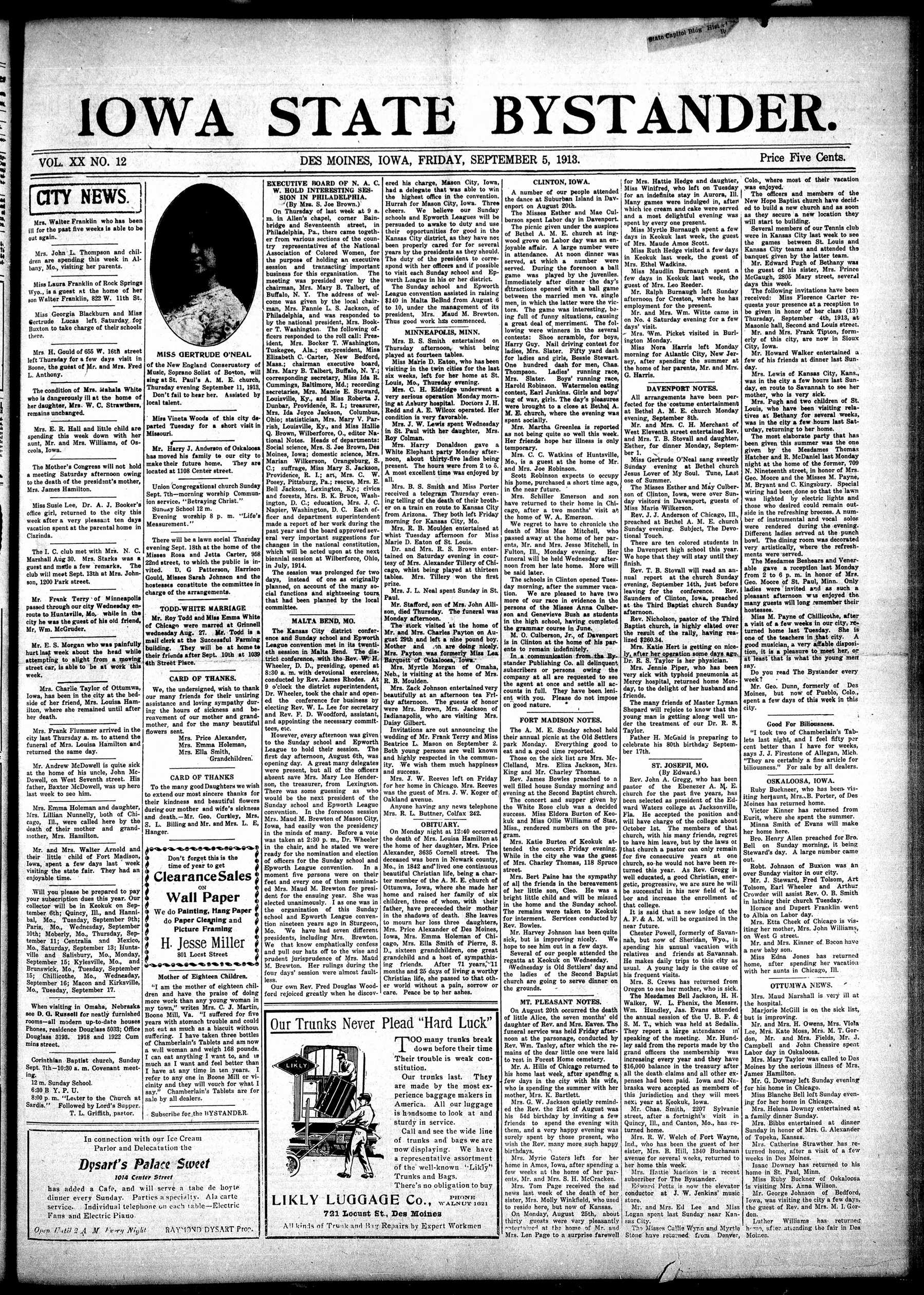
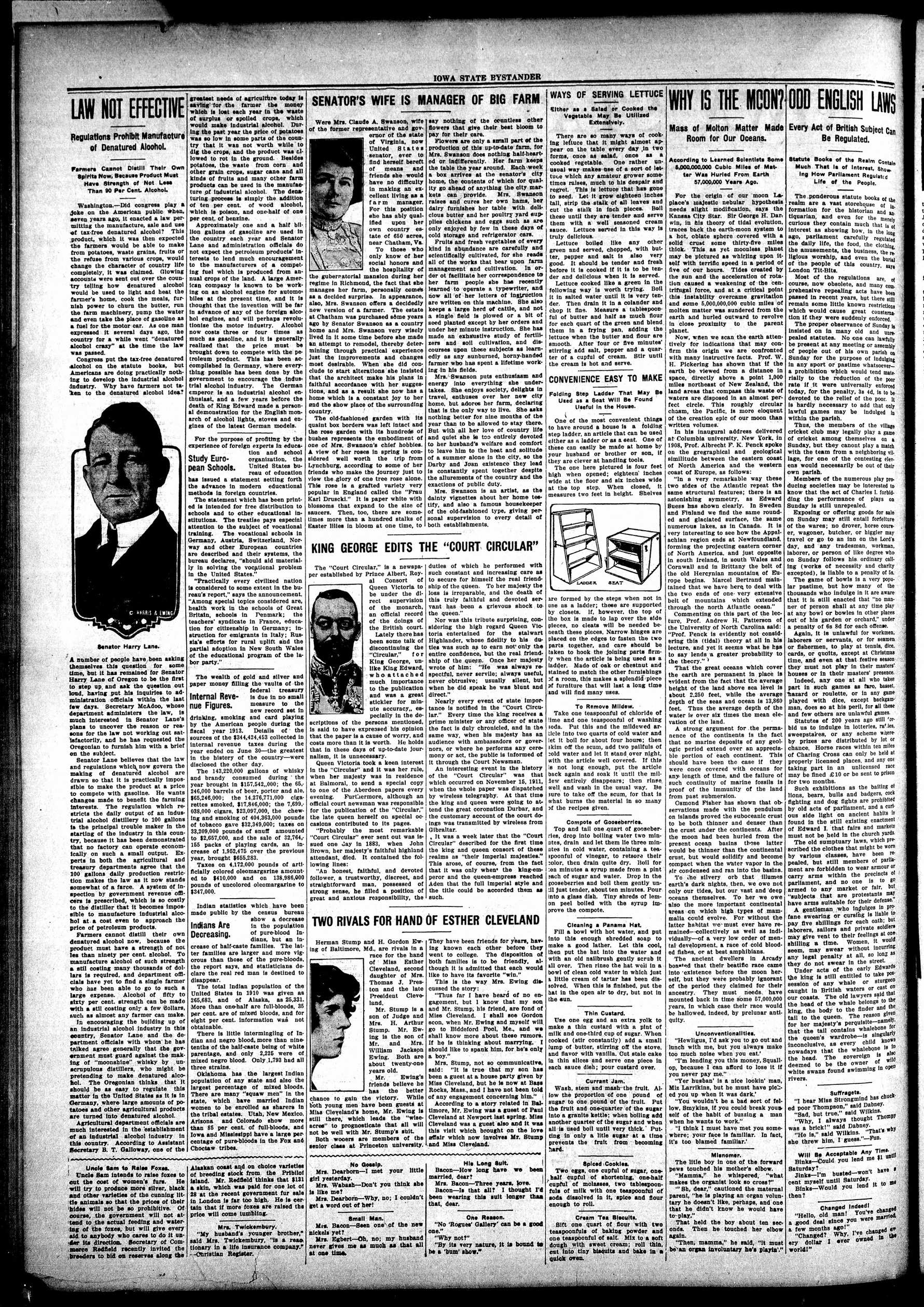
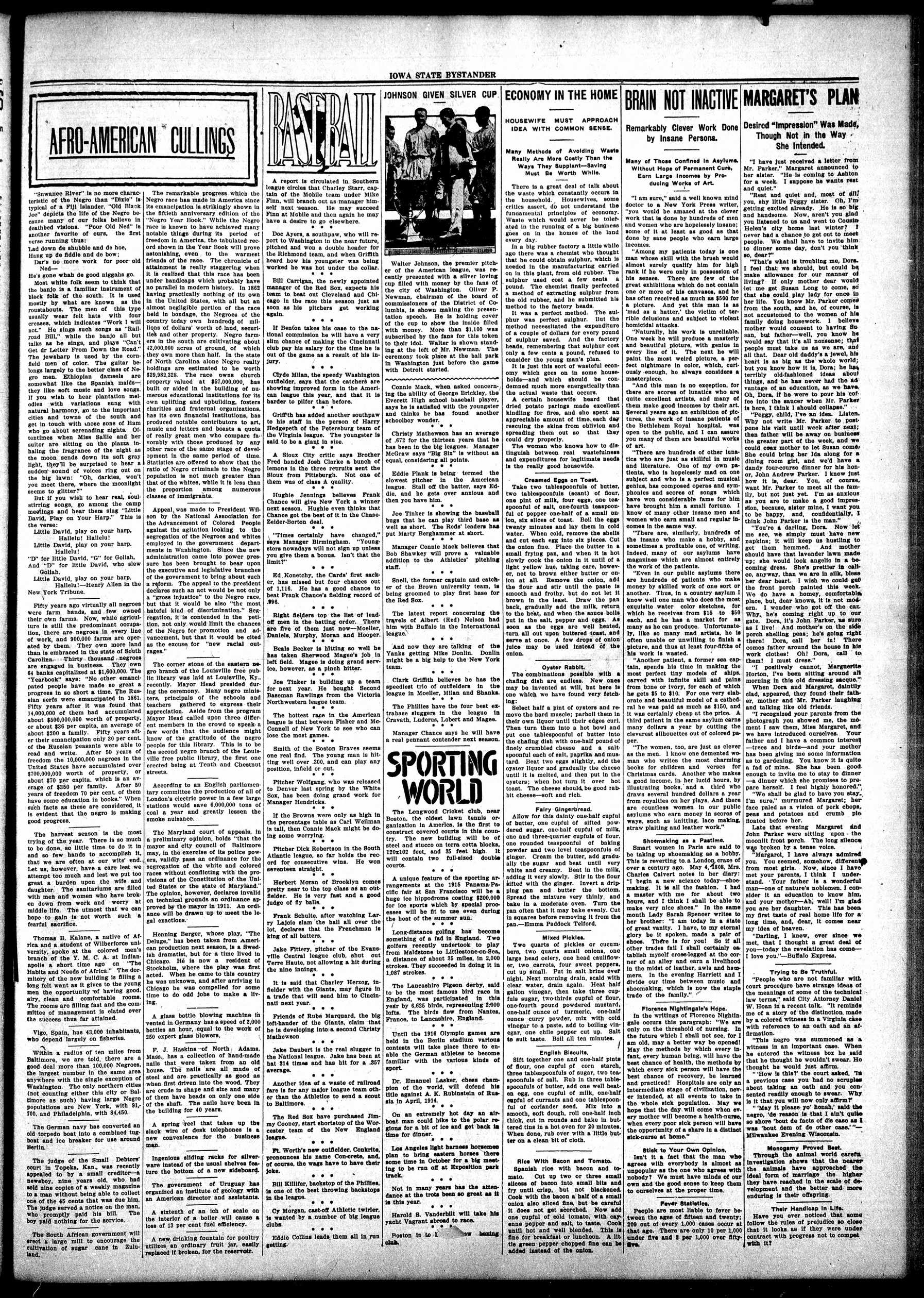
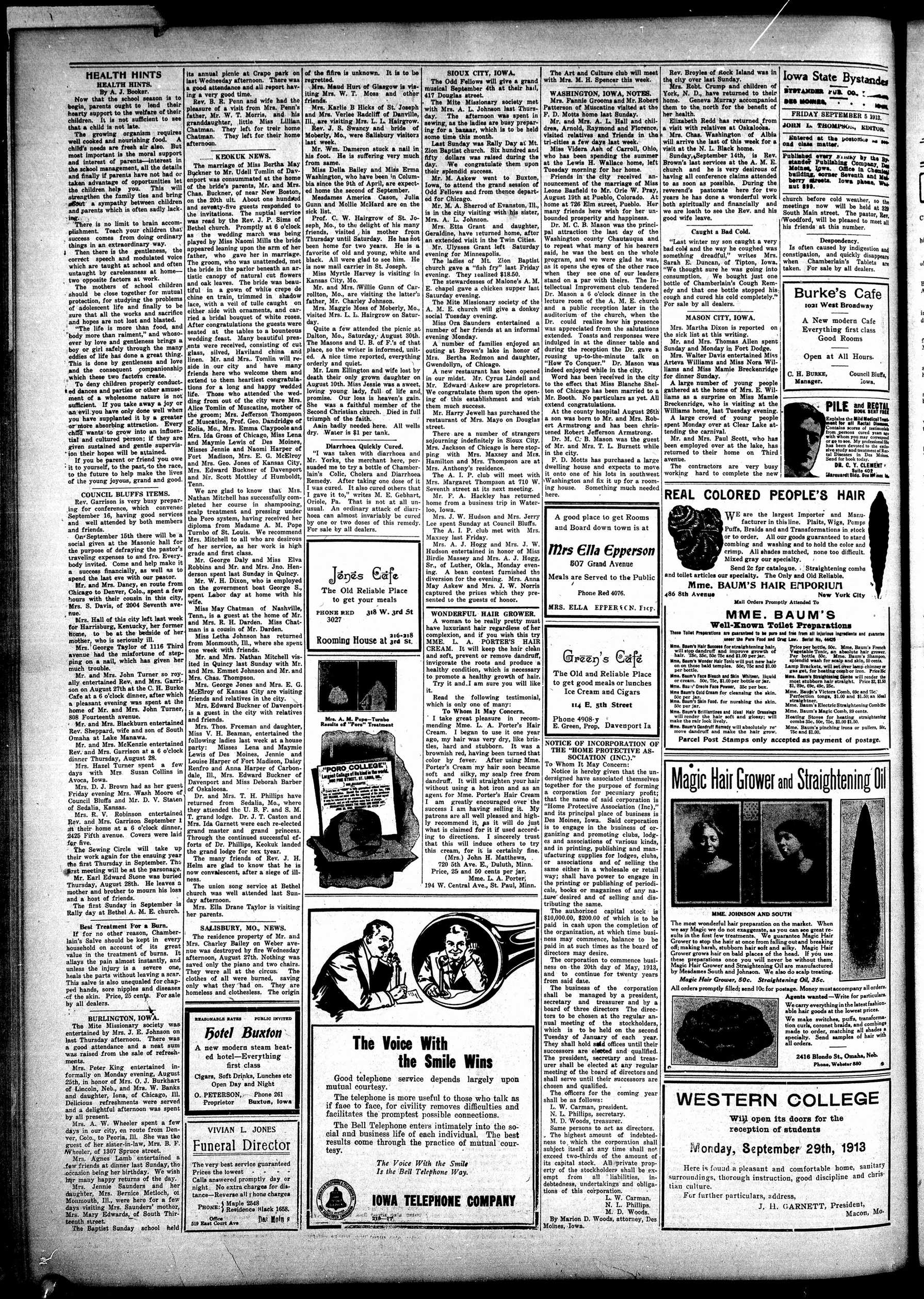
Page text (machine-generated)
IOWA STATE BYSTANDER.
VOL. XX NO. 12
CITY NEWS.
Mrs. Walter Franklin who has been ill for the past five weeks is able to be out again.
Mrs. John L. Thompson and children are spending this week in Albany, Mo., visiting her parents.
Miss Laura Franklin of Rock Springs Wyo., is a guest at the home of her son Walter Franklin, 822 W. 11th St.
Miss Georgia Blackburn and Miss Gertrude Lucas left Saturday for Buxton to take charge of their schools there.
Mrs. H. Gould of 655 W. 16th street left Thursday for a few days visit in Boone, the guest of Mr. and Mrs. Fred L. Anthony.
The condition of Mrs. Mahala White who is dangerously ill at the home of her daughter, Mrs. W. C. Strawthers, remains unchanged.
Mrs. E. R. Hall and little child are spending this week down with her aunt, Mr. and Mrs. Williams, of Osceola, Iowa.
The Mother's Congress will not hold a meeting Saturday afternoon owing to the death of the president's mother, Mrs. James Hamilton.
Miss Susie Lee, Dr. A. J. Booker's office girl, returned to the city this week after a very pleasant ten days vacation spent at the parental home in Clarinda.
The I. C. club met with Mrs. N. C. Marshall Aug 30. Mrs. Starks was a guest and made a few remarks. The club will meet Sept. 13th at Mrs. Johnson, 1200 Park street.
Mr. Frank Terry of Minneapolis passed through our city Wednesday enroute to Huntsville, Mo., while in the city he was the guest of his old friend, Mr. Wm. McGruder.
Mr. E. S. Morgan who was painfully hurt last week about the head while attempting to alight from a moving street car, is able to be at work this week.
Mrs. Charlie Taylor of Ottumwa, Iowa, has been in the city at the bedside of her friend, Mrs. Louisa Hamilton, where she remained until after her death.
Mr. Frank Flummer arrived in the city last Thursday a. m. to attend the funeral of Mrs. Louisa Hamilton and returned the same day.
Mr. Andrew McDowell is quite sick at the home of his uncle, John McDowell, on West Seventh street. His father, Baxter McDowell, was up here last week to see him.
Mrs. Emma Holeman and daughter,
Mrs. Lillian Nunnelly, both of Chicago,
Ill., were called here by the death of their mother and grandmother, Mrs. Hamilton.
Mr. and Mrs. Walter Arnold and their little child of Fort Madison, Iowa, spent a few days last week visiting the state fair. They had an enjoyable time.
Will you please be prepared to pay your subscription dues this year. Our collector will be in Keokuk on September 6th; Quincy, Ill., and Hannibal, Mo., Tuesday, September 9th; Moberly, Mo., Thursday, September 10th; Moberly, Mo., Thursday, September 11; Centralia and Mexico, Mo., Saturday, September 13; Huntsville and Salisbury, Mo., Monday, September 15; Kylesville, Mo., and Brunswick, Mo., Tuesday, September 15; Chillicothe, Mo., Wednesday, September 16; Macon and Kirksville, Mo., Tuesday, September 17.
When visiting in Omaha, Nebraska see D. G. Russell for neatly furnished rooms—all modern up-to-date houses, phones, residence Douglas 5033; Office Douglass 3193. 1918 and 1922 Cumms street.
Corinthian Baptist church, Sunday Sept. 7th—10:30 a.m. Covenant meeting.
12 m. Sunday School.
6:30 R. Y. P. U.
8:00 p. m. "Letter to the Church at Sardis." Followed by Lord's Supper. T. L. Griffith, pastor.
In connection with our Ice Cream Parlor and Delecatation the
Dysart's Palace Sweet
has added a Cafe, and w
dinner every Sunday. Pa
service. Individual teleph
Fans and Electric Piano.
Open Until 2 A M Every Night
has added a Cafe, and will serve a table de hoyte dinner every Sunday. Parties a specialty. Ala carte service. Individual telephone on each table—Electric Fans and Electric Piano.
Open Until 2 A M Every Night RAYMOND DYSART Prov.
MISS GERTRUDE O'NEAL
of the New England Conservatory of
Music, Soprano Solist of Boston, will
sing at St. Paul's A. M. E. church,
Thursday evening September 11, 1913,
Don't fail to hear her. Assisted by
local talent.
Miss Vineta Woods of this city departed Tuesday for a short visit in Missouri.
Mr. Harry J. Anderson of Oskaloosa
has moved his family to our city to
make their future home. They are
located at 1108 Center street.
Union Congregational church Sunday Sept. 7th—morning worship Communication service, "Betraying Christ." Sunny School 12 m. Evening worship 8 p. m. "Life's Measurement."
There will be a lawn social Thursday evening Sept. 18th at the home of the Misses Rosa and Jetta Carter, 968 22nd street, to which the public is invited. D. G Patterson, Harrison Gould, Misses Sarah Johnson and the hostesses constitute the committee in charge of the arrangements.
TODD-WHITE MARRIAGE
Mr. Roy Todd and Miss Emma White of Chicago were married at Grinnell Wednesday Aug. 27. Mr. Todd is a mail clerk at the Successful Farming building. They will be at home to their friends after Sept. 10th at 1039 318 Street Place.
CARD OF THANKS.
We, the undersigned, wish to thank our many friends for their uniting assistance and loving sympathy during the hours of sickness and bereavement of our mother and grandmother, and for the many beautiful flowers sent.
Mrs. Price Alexander,
Mrs. Emma Holeman,
Mrs. Ella Smith,
Grandchildren.
CARD OF THANKS
To the many good Daughter we wish to extend our most sincere thanks for their kindness and beautiful flowers during our mother and wife's sickness and death.—Mr. Geo, Curtley, Mrs. S. L. Billing and Mr. and Mrs. L. E. Hanger.
Don't forget this is the time of year to get Clearance Sales ON Wall Paper
We do Painting, Hang Paper do Paper Cleaning and Picture Framing
H. Jesse Miller
801 Locet Street
Mother of Eighteen Children.
"I am the mother of eighteen children and have the praise of doing more work than any young woman in my town," writes Mrs. C. J. Martin, Boone Mill, Va. "I suffered for five years with stomach trouble and could not eat as much as a biscuit without suffering. I have taken three bottles of Chamberlain's Tablets and am now a will woman and weigh 168 pounds. I can eat anything I want to, and as much as I want and feel better than I have at any time in ten years. I refer to any one in Boone Mill or vicinity and they will vouch for what I say." Chamberlain's Tablets are for sale by all dealers.
Subscribe for the BYSTANDER.
Water Street
will serve a tabe de hoyte
certies a specialty. Ala carte
phone on each table—Electric
RAYMOND DYSART Prop.
DES MOINES, IOWA, FRIDAY, SEPTEMBER 5, 1913.
Our Trunks Never Plead "Hard Luck"
721 Locust St., Des Moines
All kinds of Trunk and Bag Repairs by Expert Workmen
EXECUTIVE BOARD OF N. A. C
W. HOLD INTERESTING SES-
SION IN PHILADELPHIA.
(By Mrs. S Joe Brown.)
(By Mrs. S. Joe Brown).
On Thursday of last week at 9 a.m. in the museum and Bainbridge, Bainbridge and Seventeenth street, in Philadelphia, Pa. there came together from various sections of the country representatives of the National Association of Colored Women, for the purpose of holding an executive session and transacting important business for this organization. The meeting was presided over by the chairman, Mrs. Mary B. Talbert, of Buffalo, N. Y. The address of welcome was given by the local chairman, Mrs. Fannie L. S. Jackson, of Philadelphia, and was responded to by the national president, Mrs. Booker T. Washington. The following officers responded to the roll call: President, Mrs. Booker T. Washington, Tuskegee, Ala.; ex-president, Miss Elizabeth A. Mrs. B. Net Bedford, Mrs. B. Net Bedford, Mrs. Mary B. Talbert, Buffalo, N. Y.; corresponding secretary, Mrs. Ida R. Cummings, Baltimore, Md.; recording secretaries, Mrs. Manie E. Steward, Louisville, Ky., and Miss Roberta J. Dunbar, Providence, R. I.; treasurer, Mrs. Ida Joyce Jackson, Columbus, Ohio; statistician, Mrs. Mary V. Parish, Louisville, Ky., and Miss Hallie Q. Brown, Wilberforce, O., editor National Notes. Heads of departments: Social science, Mrs. S. Joe Brown, Des Moines, Iowa; domestic science, Mrs. Marian Wilkerson, Orangeburg, S. C.; suffrage, Miss Mary S. Jackson, Providence, R. I.; art, Mrs. C. W. Posey, Pittsburg, Pa.; rescue, Mrs. E. Bell Jackson, Lexington, KY.; civics and forests, Mrs. B. K. Bruce, Washington, D. C.; education, Mrs. B. Jacques, C. Each office and department superintendent made a report of her work during the past year and the board approved several very important suggestions for changes in the national constitution, which will be acted upon at the next biennial session at Wilberforce, Ohio, in July, 1914.
The session was prolonged for two days, instead of one as originally planned, on account of the many social functions and sightseeing tours that had been planned by the local committee.
MALTA BEND, MO.
The Kansas City district conference and Sunday school and Epworth League convention met in its twentieth session in Malta Bend. The district conference, with the Rev. W. H Wheeler, D. D., presiding, opened at 8:30 a. m. with devotional exercises, conducted by Rev. James Rhodes. At 9 o'clock the district superintendent, Dr. Wheeler, took the chair and opened the conference for business by the Rev. F. D. Woodford, assistant, and appointing the necessary committees, etc.
However, every afternoon was given to the Sunday school and Epworth League to hold their session. The first day afternoon, August 6th, was opening day. A great many delegates were present, but all of the officers absent save Mrs. Mary Lee Henderson, the treasurer, from Lexington. There was some guessing as who would be the next president of the Sunday school and Epworth League convention. In the forementioned session Mrs. Maud M. Brewton of Mason City, Iowa, had easily won the presidency in the minds of many. Before a vote was taken at 2:30 p. m., Dr. Wheeler in the chair, and he stated we were ready for the nomination and election of officers for the Sunday school and Epworth League convention. In a moment five persons were on their feet and every one of them nominated Mrs. Maud M. Brewton for president for the ensuing year. She was elected unanimously. I as one was in the organization of this Sunday school and Epworth League convention nineteen years ago in Sturgeon, Mo. We have had seven different presidents, including Mrs. Brewton. We that know emphatically confess and pull our hats off to the wise and prudent jurisprudence of Mrs. Maud M. Brewton. Her rulings during the four days' session were almost faultless.
Our own Rev. Fred Douglas Woodford rejoiced greatly when he discov-
LIKLY
ered his charge, Mason City, Iowa, had a delegate that was able to win the highest office in the convention. Hurrah for Mason City, Iowa. Three cheers. We believe our Sunday schools and Epworth Schools will be persuaded to awake to duty and use their opportunities for good in the Kansas City district, as they have not been properly cared for for several years by the presidents as they should. The duty of the president to correspond with her officers and if possible to visit each Sunday school district. Epworth League convention assisted in raising $140 in Malta BeNd from August 6 to 10, under the management of its president, Mrs. Maud M. Brewton. Thus good work has commenced.
MINNEAPOLIS, MINN.
Mrs. B. S. Smith entertained on Thursday afternoon, whist being played at fourteen tables.
Miss Marie D. Eaton, who has been visiting in the twin cities for the last six weeks, left for her home at St. Louis, Mo. Thursday evening.
Mrs. C. H. Eldridge underwent a very serious operation Monday morning at Asbury hospital. Doctor J. H. Redd and A. E. Wilcox operated. Her condition is very favorable.
Mrs. J. W. Lewis spent Wednesday in St. Paul with her daughter, Mrs. Roy Colman.
Mrs. Harry Donaldson gave a White Elephant party Monday afternoon, about thirty-five ladies being present. The hours were from 2 to 5. A most excellent time was enjoyed by all.
Mrs. B. S. Smith and Miss Porter received a telegram Thursday evening telling of the death of their brother on a train en route to Kansas City from Arizona. They both left Friday morning for Kansas City, Mo.
Mrs. R. B. Moulden entertained at whist Tuesday afternoon for Miss Marie D. Eaton of St. Louis.
Mrs. R. B. Moulden entertained on Saturday evening in courtesy of Mrs. Alexander Tillery of Chicago, whist being played at thirteen tables. Mrs. Tillery won the first prize.
Mrs. J. L. Neal spent Sunday in St. Paul.
Mr. Stafford, son of Mrs. John Allison, died Thursday. The funeral was Monday afternoon.
The stork visited at the home of Mr. and Mrs. Charles Payton on August 29th and left a nine pound boy. Mother and on are doing nicely. Mrs Payton was formerly Miss Lea Barquett of Oaklanda, Iowa. Mrs Myrtle Morgan of Omaha, Neb., is visiting at the home of Mrs. R. B. Moulden. Mrs Zack Johnson entertained very beautifully at an afternoon tea Friday afternoon. The guests of honor were Mrs. Brown, Mrs. Jackson of Indianapolis, who are visiting Mrs. Daisy Gilbert. Invitations are out announcing the wedding of Mr. Frank Terry and Miss Beatrice L. Mason on September 2. Both young persons are well known and highly respected in the community. We wish them much happiness and success. Mrs. J. W. Reeves left on Friday for her home in Chicago. Mrs. Reeves was the guest of Mrs. J. W. Koger of Oakland avenue. Anyone having any news telephone Mrs. R. L. Buttner, Colafx 242.
OBITUARY.
On Monday night at 12:40 occurred the death of Mrs. Louisa Hamilton at the home of her daughter, Mrs. Price Alexander, 3635 Cornell street. The deceased was born in Newark county, Mo., in 1842 and lived one continuous beautiful Christian life, being a char member of the A. M. E. church of Ottawa, Iowa, where she made her home and raised her family of six children, three of whom, with their father, have preceded their mother in the shadows of death. She leaves to mourn her loss three daughters, Mrs. Price Alexander of Des Moines, Iowa, Mrs. Ema Holme of Chicago, Mrs. Ella Smith of Pierre, S. sixteen grandchildren, one great grandchild and a host of sympathizing friends. After 71 years, 11 months and 25 days of living a worthy Christian life, she passed to that other world without a pain, sorrow or care. Peace be to her ashes.
TOO many trunks break down before their time Their trouble is weak constitution. Our trunks last. They are made by the most experience baggage makers in America. All our luggage is handsome to look at and sturdy in service. Call and see the wide line of trunks and bags we are now displaying. We have a representative assortment of the well-known 'Likly' Trunks and Bags. There's no obligation to buy
There's no obligation to buy
CLINTON, IOWA.
A number of our people attended the dance at Suburban Island in Davenport on August 20th. The Misses Esther and Mae Culberson spent Labor day in Davenport.
The picnic given under the auspices of Bethel A. M. E. church at ingwood grove on Labor day was an enjoyable affair. A large number were in attendance. At noon dinner was served, at which a number were served. During the forenoon a ball game was played by the juveniles. Immediately after dinner the day's attractions opened with a ball game between the married men vs. single men, in which the latter were the victors. The game was interesting, being full of funny situations, causing a great deal of merriment. The following were winners in the several contests: Harry Scrum, for boys; Harry Guy, Nail driving contest for ladies; Suzie Stuart, for ladies and girls; Bessie Stewart, One hundred dash for men, Chas Thompson; Ladies' running race, Mrs. Slater, Boys' running race, Harold Robinson, Watermelon eating contest, Earl Junkins, Girls and boys' tug of war, girls. The day's pleasures were brought to a close at Bethel A. M. E. church, where the evening was spent socially.
Mrs. Martha Greenlea is reported as not being quite so well this week. Her friends hope her illness is only temporary.
Mrs. C. C. Watkins of Huntsville, Mo. is a guest at the home of Mr. and Mrs. Joe Robinson.
Scott Robinson expects to occupy his home, purchased a short time ago, in the near future.
Mrs. Schiller Emerson and son have returned to their home in Chicago, after a two months' visit at the home of W. A. Emerson.
We regret to have to chronicle the death of Miss Mae Mitchell, who passed away at the home of her parents, Mr. and Mrs. Jesse Mitchell, in Fulton, Ill., Monday evening. Her funeral will be held Wednesday afternoon from her late home. More will be said later.
The schools in Clinton opened Tuesday morning, after the summer vacation. We are pleased to have two more of the persons of the Misses Armand Culberson and Genevieve Bush as students in the high school, having completed the grammar course in June.
M. O. Culberson, Jr., of Davenport is in Clinton at the home of his parents to remain indefinitely.
In a communication from the Bystander Publishing Co. all delinquent subscribers or persons owing the company at all are requested to see the agent at once and settle all accounts in full. They have been lenient with you. Please do not impose on good nature.
FORT MADISON NOTES
The A. M. E. Sunday school held their annual picnic at the Old Settlers park Monday. Everything good to eat and a good time reported. Those on the sick list are Mrs. McCleland, the Mrs. Eliza Jackson, Mrs. King and Mr. Charley Thomas. Rev. James Bowles preached to a well filled house Sunday morning and evening at the Second Baptist church. The concert and supper given by the White Rose club was a decided success. Miss Eldora Burton of Keokuk and Miss Olie Willie of Star, Miss., rendered numbers on the program. Mrs. Katie Burton of Keokuk attended the concert Friday evening. While in the city she was the guest of Mrs. Charley Thomas, 118 Spruce street. Mrs. Bert Paine has the sympathy of all the friends in the bereavement of her little son, Cleo. He was a bright little child and will be missed in the home and the Sunday school. The remains were taken to Keokuk for interment. Services conducted by Rev. Bowles. Mr. Harvey Johnson has been quite sick, but is improving nicely. We hope to see him out in a few days. Several of our people attended the regatta at Keokuk on Wednesday. Wednesday is Old Settlers' day and the ladies of the Second Baptist church are going to serve dinner on the grounds.
MT. PLEASANT NOTES
On August 20th occurred the death of little Alice, the seven months' old daughter of Rev. and Mrs. Eaves. The funeral service was held Friday afternoon at the parsonage, conducted by Rev. Wm. Tasley, after which the remains of the dear little one were laid to rest in Forest Home cemetery. Mr. A. Hills of Chicago returned to his home last week, after spending a few days in the city with his wife, who is spending the summer with her mother, Mrs. K. Bartlett. Mrs. G. W. Jackson quietly reminded the Rev. the 21st of August was his 54 birthday by inviting a few friends to spend the evening with them, and a very happy evening was surely spent by those present, who wish the Rev. many more such happy birthdays. Mrs. Myrle Gaters left for her home, Iowa, after spending a few weeks at the home of her parents, Mrs. and Mrs. S. H. McCracken. Mrs. Tom Page received the sad news last week of the death of her sister, Mrs. Molly Winkfield, who used to reside here, but now of Kansas. On Monday, August 25th, about thirty guests were very pleasantly entertained at the home of Mr. and Mrs. Len Page to a surprise farewell
for Mrs. Hattie Hedge and daughter,
Miss Winfred, who left on Tuesday
for an indefinite stay in Aurora, Ile.
Many games were inadulged in, after
which ice cream and cake were served
and a most delightful evening was
spent by every one present.
Miss Myrtle Burnaugh spent a few
days in Keokul last week, the guest
of Mrs. Maude Amos Scott.
Miss Ruth Hedge visited a few days
in Keokul last week, the guest of
Mrs. Ethel Wadkins.
Miss Maudlin Burnaugh spent a
few days in Keokul last week, the
guest of Mrs. Leo Reeder.
Mr. Ralph Burnaugh left Sunday
afternoon for Creston, where he has
employment for the present.
Mr. and Mrs. Wm. Witte came in
on Monday, evening for a few
days' visit.
Mrs. Wm. Picket visited in Burlington Monday.
Miss Nora Harris left Monday
morning for Atlantic City, New Jersey,
after spending the summer at the home of her parents, Mr. and Mrs.
G. Harris.
DAVENPORT NOTES
All arrangements have been perfected for the costume entertainment at Bethel A. M. E. church Monday evening, September 8th.
Mr. and Mrs. C. H. Merchant of West Eleventh street entertained Rev. and Mrs. T. B. Stovall and daughter, Esther, for dinner Monday, September 1.
Miss Gertrude O'Neal sang sweetly Sunday evening at Bethel church Jesus Lover of My Soul. Tune, Last ose of Summer.
The Misses Esther and May Culberston, Iowa, were over Sunday visitors in Davenport, guests of Miss Marie Wilkerson.
Rev. J. J. Anderson of Chicago, Ill., preached at Bethel A. M. E. church Sunday evening. Subject, The Devotional Touch.
There are ten colored students in the Davenport high school this year. We hope that they will stay until they finish.
Rev. T. B. Stovall will read an annual report at the church Sunday evening, September 14th, just before leaving for the conference. Rev. Saunders of Clinton, Iowa, preached at the Third Baptist church Sunday afternoon.
Rev. Nicholson, pastor of the Third Baptist church, is highly elated over the result of the rally, having realized $260.34.
Mrs. Katie Hert is getting on nicely, her operation one day ago, Dr. R. S. Tappin is her physician.
Mrs. Jenice Piper, who has been very sick with typhoid pneumonia at Mercy hospital, returned home Monday, to the delight of her husband and friends.
The many friends of Master Lyman Shepard will rejoice to know that the young man is getting along well under the treatment of our Dr. R. S. Taylor. Father H. McGaid is preparing to celebrate his 80th birthday September 17th.
ST JOSEPH MO
(By Edward.)
Rev. John A. Gregg, who has been pastor of the Ebenezer A. M. E. church for the past five years, has been selected as president of the Edward Waters college at Jacksonville, Fla. He accepted the position and will have charge of the college about October 1st. The members of that church, with his many friends, regret to have him leave, but by the laws or that church a pastor can only remain for five consecutive years at one church, so he would not have been returned this year. As Rev. Gregg is well educated, a good Christian, energetic, progressive, we are sure he will be successful in his new field of field and increase the enrollment of that college. And that a new lodge of the A. F. & A. M. will be organized in the near future.
Chester Powell, formerly of Savannah, but now of Sheridan, Wyo., is spending his annual vacation with relatives and friends at Savannah. He makes daily trips to this city as usual. A young lady is the cause of his frequent visits.
Mrs. S. Crews has returned from Oregon to see her mother, who is sick
The Meadames Bell Jackson, H. H. Walker, W. L. Phenix, the Messrs. Wm. Hundley, Jas. Evans attended the annual session of the U. B. F. & S. M. T., which was held at Sedalia. They report a large attendance m' speaking of the meeting. Mr. Hundley said from the reports made by the grand officers the membership was increasing every year and they have $16,000 balance in the treasury after all the death claims and all other expenses had been paid. Iowa and Nebraska were accepted as members of this jurisdiction and they will meet next year at Kookuk, Iowa. Mr. Chas. Smith, 2207 Sylvanie street, after a fortnight's visit in Quincy, Ill., and Canton, Mo., has returned home. Mr. Welch of Fort Wayne, Ind., who has been the guest of her sister, Mrs. B. Hill, 1340 Buchanan avenue for several weeks, returned to her home this week. Mrs. Hattie Madison is a recent subscriber for The Bysander. Edward Potts is now the elevator conductor at J. W. Jenkins' music store. Mr. and Mrs. Ed Lee and Miss Logan spent last Sunday near Kansas City. The Misses Callie Wynn and Myrtle Stone have returned from Denver,
Price Five Cents.
Colo., where most of their vacation was enjoyed.
The officers and members of the New Hope Baptist church have decided to build a new church and as soon as they secure a new location they will start to building.
Several members of our Tennis club were in Kansas City last week to see the games between St. Louis and Kansas City teams and attended the banquet given by the latter team.
Mr. Edward Pugh of Bethany was the guest of his sister, Mrs. Prince McGaugh, 818, Mary street, several days this week.
The following invitions have been received: Miss Florence Carter requests your presence at a reception to be given in honor of her class (13) Thursday, September 4th, 1913, at Masonic hall, Second and Louis street.
Mr. and Mrs. Frank Tipton, formerly of the city, are now in Sloux City, Iowa.
Mr. Howard Walker entertained a few of his friends at dinner last Sunday.
Mrs. Lewis of Kansas City, Kans., was in the city a few hours last Sunday, en route to Savannah to see her mother, who is very sick.
Mrs. Pugh, who have been visiting relatives at Bethany for several weeks, was in the city a few hours last Saturday, returning to her home.
The most elaborate party that has been given this summer was the one given by the Medameses Thomas Hatcher and R. McDaniel last Monday night at the home of the former, 709 N. nineteenth street, in honor of Mrs. Geo. Moore and the Misses M. Payne, M. Bryant and C. Kingsbury. Special wiring had been done so that the lawn was lighted by electric lights and those who desired could remain outside in the refreshing breezes. A number of instrumental musicians sold solos during the evening. Different ladies served at the punch bowl. The dining room was decorated very artistically, where the refreshments were served.
The Medameses Behears and Venerable gave a reception last Monday from 2 to 6 p. m. in honor of Mrs. Geo. Moore of St. Paul, Minn. Only ladies were invited and as such a pleasant afternoon was enjoyed the many guests will long remember their hostesses.
Miss M. Payne of Chillicothe, after a visit of a few weeks in our city, returned home last Tuesday. She is one of the teachers in that city, a good musician, a very able disposition, it is a pleasure to meet her, or at least that is what the young men ask.
Do you read The Bystander every week?
Mr. Geo. Dunn, formerly of Des Moines, but now of Pueblo, Colo., spent a few days of this week in this city.
Good For Biliousness.
"I took two of Chamberlain's Tablets last night, and I feel fifty percent better than I have for weeks, says J. J. Firestone of Allegan, Mich. "They are certainly a fine article for biliousness." For sale by all dealers.
OSKALOOSA, IOWA.
Ruby Buckner, who has been visiting heraunt, Mrs. B. Porter, of Des Moines has returned home.
Victor Kinner has returned from Eurit, where she spent the summer.
Minna Smith of Evans will make her home here.
Bro. Henry Allen preached for Bro. Bell on Sunday morning, it being Steward's day. A large number came out.
Rob. Johnson of Buxton was an over Sunday visitor in our city.
Mr. J. Steward, Fred Tolson, Art Tolson, Earl Wheeler and Arthur Crowder will assist Rev. O. B. Smith in lathing their church Tuesday.
Horace and Dupert Franklin went to Albia on Labor day.
Mrs. Etta Cheek of Chicago is visiting her mother, Mrs. John Williams, on West G street.
Mr. and Mrs. Kinner of Bacon have a new baby son.
Miss Edna Jones has returned home, after spending her vacation with her aunts in Chicago, Ill.
OTTUMWA NEWS.
Mrs. Maud Marshall is very ill at the hospital.
Marjorie McGill is on the sick list, but is improving.
Mr. and Mrs. H. Owens, Mrs. Viola Lee, Mrs. Kate Moss, Mrs. M. T. Gordon, Mr. and Mrs. Fields, Mr. J. Campbell and John Chessire spent Labor day in Oskaloosa.
Mrs. Mary Taylor was called to Des Moines by the serious illness of Mrs. James Hamilton.
Mr. G. Downey left Sunday evening for his home in Chicago.
Miss Blanche Bell left Sunday evening for her home in Chicago.
Mrs. Helen Downey entertained at a family dinner Sunday.
Mrs. Bibbs entertained at dinner Sunday in honor of Mrs. G. Alexander of Topeka, Kansas.
Mrs. Catherine Strawther has returned home, after a visit of a few weeks in Des Moines.
Isaac Downey has returned to his home in St. Paul, Minn.
Miss Ruby Buckner of Okaloosa is visiting Mrs. Anna Wilson.
Mr. George Johnson of Bedford, Iowa, was visiting the city a few days, the guest of Rev. and Mrs. M. I. Gordon.
Author Williams has returned home, after attending the fair in Des Moines.
Regulations Prohibit Manufacture of Denatured Alcohol.
Farmers Cannot Distill Their Own Spirits Now, Because Product Must Have Strength of Not Less Than 90 Per Cent. Alcohol.
Washington—Did congress play a joke on the American public when, seven years ago, it enacted a law permitting the manufacture, sale and use of tax-free denatured alcohol? This product, which it was then expected the farmers would waste grains, fruits or the refuse from various crops, would change the character of country life completely, it was claimed. Glowing accounts were sent out over the country telling how denatured alcohol would be used to light and heat the farmer's home, cook the meals, furnish power to churn the butter, water and even take the place of gasoline as a fuel for the motor car. As one man expressed it several days ago, the country for a while went "denatured alcohol crazy" at the time the law was passed. Congress put the tax-free denatured alcohol on the statute books, but it was not until 2005 nothing to develop the industrial alcohol industry. Why have farmers not taken to the denatured alcohol idea?
C. MARRIS & EWING
Senator Harry Lane.
A number of people have been asking themselves this question for some time, but it has remained for Senator Harry Lane of Oregon to be the first to step up and ask the question out loud, having put his inquiries to administration officials within the last few days. Secretary McAdoo, whose department monitors the law, is interested in Senator Lane's plans to uncover the reason or reasons for the law not working out satisfactorily, and he has requested the Oregonian to furnish him with a brief on the subject.
Senator Lane believes that the law and regulations which now govern the making of denatured alcohol are drawn so that it is practically impossible to make the product at a price to compete with gasoline. He wants changes made to benefit the farming interests. The regulation which restricts the use of denatured alcohol distillery to 100 gallons is the principal trouble maker in the starting of the industry in this country, because it has been demonstrated that no factory can operate economically on such a small output. Experts in both the agricultural and treasury departments agree that the 100 gallons daily production restriction makes the law as it now stands somewhat of a force. A system of inspection by government revenue officers is now in effect to the distiller that it becomes impossible to manufacture industrial alcohol at a cost even to approach the price of petroleum products.
Farmers cannot distill their own denatured alcohol now, because the product must have a strength of less than ninety per cent. alcohol. To manufacture alcohol of such strength a still coating many thousands of dollars is required, and department officials have to find a single farmer who has the experience. Alcohol of fifty to sixty per cent. strength can be made with a still coating only a few dollars, such as almost any farmer can make. In encouraging the building up of an industrial alcohol industry in this country, Senator Lane and the department officials with whom he has talked agree generally that the government must guard against the making of "moonshine" whisky by unscrupulous distillers, who might be pretending to be Oregonians. Oregon thinks, that it should be as easy to regulate this matter in the United States as it is in Germany, where large amounts of potatoes and other agricultural products are turned into denatured alcohol.
Agricultural department officials are much interested in the establishment of an industrial alcohol industry in this country. According to Assistant Secretary B. T. Galloway, one of the Uncle Sam to Raise Foxes. Uncle Sam intends to raise forces to cut the cost of women's fun. He will try to produce more silver, black and other varieties of the cunning little animals so that the prices of their bides will not be so prohibitive. Of course, the government will not attend to the actual feeding and watering of the foxes, but will give every aid to anybody who cares to do it under its direction. Secretary of Commerce Redfield recently invited the breeders to bid on reserves along the
greatest needs of agriculture today is saving for the farmer the money which is lost each year in the waste of surplus or spoiled crops, which would make industrial alcohol. During the past year the price of potatoes was so low in some parts of the country that it was not worth while to dig the crops, and the product was allowed to rot in the ground. Besides potatoes, the waste from corn and other grain crops, sugar cane and all kinds of fruits and many other farm products, is the main structure of industrial alcohol. The denaturing process is simply the addition of ten per cent. of wood alcohol, which is poison, and one-half of one per cent. of bengene.
Approximately one and a half billion gallons of gasoline are used in the country each year and Senator Lane and administration officials do not expect the petroleum products' interests to lend much encouragement to the manufacturers of a competition to produce the annual crops of the land. A large American company is known to be working on an alcohol engine for automobiles at the present time, and it is thought that the invention will be far in advance of any of the foreign alcohol engines, and will perhaps revolutionize the motor industry. Alcohol now costs three or four times as much as alcohol engines, and will perhaps revolutionize the price must be brought down to compete with the petroleum product. This has been accomplished in Germany, where everything possible has been done by the government to encourage the industrial alcohol industry. The German emperor is an industrial alcohol enthusiast, and a few years before the German government began a demonstration for the English monarch of alcohol lights, stoves and engines of the latest German models.
For the purpose of profiting by the experience of foreign experts in education and school organization, the United States bureau of education has issued a statement setting forth the advance in modern educational methods in foreign countries. The statement which has been printed is intended for free distribution to schools and to other educational institutions. The treatise pays especial attention to the subject of vocational education in the European schools in Germany, Austria, Switzerland, Norway and other European countries are described and their systems, the bureau declares, "should aid materially in solving the vocational problem in the United States."
"Practically every civilized nation is considered to some extent in the bureau's report," says the announcement. "Among special topics considered are, health work in the schools of Great Britain, schools in Denmark; the teachers' syndicate in France, education for citizen immigration in Germany; the immigration in Italy; Russia's efforts for rural uplift and the partial adoption in New South Wales of the educational program of the labor party."
Internal Revenue Figures.
drinking, smoking and card playing by the American people during the fiscal year 1913. Details of the sources of the $344,442,453 collected in internal revenue taxes during the year ended on June 30—the greatest country—were disclosed the other day.
The 143,220,000 gallons of whisky and brandy consumed during the year brought in $157,542,000; the 65,246,000 barrels of beer, porter and oil; $65,246,000; the 14,275,771,000 cigarettes smoked; $17,846,000; the 7,693,088,000 cigars; $17,846,000; the 40,435,300 pounds of tobacco gave $23,496,000; taxes on 32,208,000 pounds of snuff amounted to $2,657,000, and the sale of 32,764,155 packs of playing cards, an increase of 1,952,475 over the previous year, brought $655,283.
Taxes on 4,172,000 pounds of artificially colored oleomargarite amounted to $1,048,000; on 138,985,000 pounds of uncolored oleomargarite to $247,000.
crease of half-caste families. The latter families are larger and more vigorous than those of the pure-bloods, the report says, and statisticians declare the real red man is destined to disappear.
The Indian population of the United States in 1910 was given as 265,683, and of Alaska, as 25,331. More than one-half are full-bloods, 35 per cent. are of mixed bloods, and for eight per cent. information was not obtainable.
There is little intermingling of Indian and negro blood, more than nineteenth of the half-caste being of white parentage, and only 2,226 were of mixed blood. Only 1,793 had three strains.
Oklahoma has the largest Indian population of any state and also the largest percentage of mixed bloods. There are many "squaw men" in the state, which have married Indian women to be enrolled as sharers in the tribal estates. Utah, New Mexico, Arizona and Colorado show more than 40 percent of full-bloods and Mississippi have a large percentage of pure-bloods in the Fox and Chochet tribes.
Alaskan coast and on choice varieties of breeding stock from the Pribilof island. Mr. Redfield thinks that $131 a skin, which was paid for one lot of 28 at the recent government fur sale in London is far too high. He is certain that if more foxes are raised the price will come tumbling.
Mrs. Twickembury.
"My husband's younger brother," said Mrs. Twickembury, "is a rea-tionary in a life insurance company."
Christian Resister.
SENATOR'S WIFE IS MANAGER OF BIG FARM
KING GEORGE EDITS THE "COURT CIRCULAR"
TWO RIVALS FOR HAND OF ESTHER CLEVELAND
---
Were Mrs. Claude A. Swanson, wife of the former representative and governor of the state of Virginia, now United States senator, ever to find herself bereft of means and friends she would have no difficulty in making a cellulose living as a farm manager. For this position she has ably qualified upon her own country estate of 650 acres, near Chatham, Va.
MARY MAY
To those who only know of her social honors and the hospitality of
the gubernatorial manston during her regime in Richmond, the fact that she manages her farm, personally comes as a decided surprise. In appearance, also, Ms. Swanson offers a decidedly new version of a farmer. The estate at Chatham was purchased some years ago by Senator Swanson as a country home and Mrs. Swanson very wisely lived in it some time before she made an attempt to remodel, thereby determining through practical experience just the improvements and changes most desirable. When she did conceive the architect she inherited that the architect make his plans in faithful accordance with her suggestions, and as a result she now has a home which is a constant joy to her and the show place of the surrounding country.
The old-fashioned garden with its quaint box borders was left intact and the rose garden with its hundreds of bushes represents the embodiment of one of Mrs. Swanson's charlie hobbies. A view of her roses in spring is considered well worth the trip from Lynchburg, according to some of her friends who make the journey just to view the glory of one tree rose alone. This rose is a grafted variety very popular in England called the 'Blooming Rose' and a wisteria with blossoms that expand to the size of saucers. Then, too, there are sometimes more than a hundred stalks of Easter lilies in bloom at one time, to
The "Court Circular," is a newspaper established by Prince Albert, Roy
al Consort of Queen Victoria to be under the direct supervision of the monarch, an official record of the doings of the British court.
[Name]
Lately there has been some talk of discontinuing the "Circular," to or King George, unlike King Edward, who was much importance to the publication and was a great sticker for minute accuracy, especially in the descriptions of the persons mentioned, is said to have expressed his opinion that the paper is a cause of worry, and costs more than it. He believed in these days of up-to-date journalism, it is unnecessary. Queen Victoria took a keen interest in the "Circular" and it was her rule, when her majesty was in residence at Balmoral, to send a special copy to one of the Aberdeen papers every evening. Furthermore, although an official court newspaper was responsible for the publication, the late queen herself on special occasions contributed to its nakes.
"Probably the most remarkable 'Court Circular' ever sent out was issued one day in 1883, when John Brown, her majesty's faithful highland attendant, died. It contained the following lines: "An honest, faithful, and devoted footman, most trustworthy, discreet, and straightforward man, possessed of strong sense, he filled a position of great, and anxious, responsibility, the
Herman Stump and H. Gordon Ewing of Baltimore, Md., are rivals in a
race for the hand of Miss Esther Cleveland, second daughter of Mrs. Thomas J. Preston and the late President Clever
```markdown
```
Mr. Stump is a son of Judge and Mrs. H. Arthur Stump. Mr. Ewing is the son of Mr. and Mrs. William Jackson Ewing. Both are about twenty-one years old.
Mr. Ewing's friends believe he has the better chance to gain the victory. While both young men have been guests at Misa Cleveland's home, Mr. Ewing is still there, which leads the "wisecre" to prognosticate that all will not be well with Mr. Stump's suit. Both wooers are members of the senior class at Princeton university.
IOWA STATE BYSTANDER
say nothing of the countless other flowers that give their best bloom to pay for their care. Flowers are only a small part of the production of this up-to-date farm, for Mrs. Swanson does nothing half-hearted or indifferently. He arrives at the market each week a box arrives at the senator's city home, the contents of which for quality go ahead of anything the city markets can provide. Mrs. Swanson raises and cures her own hams, her dairy furnishes her table with delicious butter and her poultry yard supplies chickens and eggs. She brings in these days of cold storage and refrigerator cars.
Fruits and fresh vegetables of every kind in abundance are carefully and scientifically cultivated, for she reads all of the works that bear upon farm management and cultivation. In order of facilitate her correspondence to her farm people she has recently written all of her letters of ingrudence are written on this machine. She also keeps a large herd of cattle, and not a single field is plowed or a bit of seed planted except by her orders and under her minute instruction. She has made an exhaustive study of fertilizers and soil cultivation, and discourses upon these subjects are burned, corny-handed farmer who has spent a lifetime working in his fields.
Mrs. Swanson puts enthusiasm and energy into everything she undertakes. She enjoys society, delights in travel, enthuses over her new city home, but adores her farm, declaring that is the only way to live. She asks nothing better for nine months of the year than to be allowed to stay there. But with all her love of country life and quiet she is too entirely devoted to her husband's welfare and comfort to leave him to the heat and solitude of a summer alone in the city, so the Darby and Joan existence they live is constantly spared together despite the country duties and the reactions of public duty.
Mrs. Swanson is an artist, as the dainty vignettes about her home totey, and also a famous housekeeper of the old-fashioned type, giving personal supervision to every detail of both establishments.
duties of which he performed with such constant and increasing care as to secure for himself the real friendship of the queen. To her majesty the loss is irreparable, and the death of this truly faithful and devoted servant has been a grievous shock to the queen.
Nor was this tribute surprising, considering the high regard the Queen Victoria entertained, the steward whose fidelity to his duties was such as to earn not only the entire confidence, but the real friendship of the queen. Once her majesty wrote of him: "He was always respectful, never servile; always useful, never obtrusive; usually silent, but when he did speak he was blunt and direct."
Nearly every event of state importance is notified in the "Court Circular." Every time the king receives a prime minister or any officer of the fact is duly chronicled, and in the same way is when he meets with ambassadors or governors, or where he performs any ceremony or act, the public is informed of it through the Court Newsman.
An interesting event in the history of the "Court Circular" was that which occurred on November 15, 1911, when the whole paper was dispatched by wireless telegraphy. At that time the king and queen were going to attend the great coronation Durbar, and a account of the court doings was transmitted by wireless from Gibraltar. It was a week later that the "Court Circular" described for the first time the king and queen consort of these realms as "their imperial majesties". This arose, of course, from the fact that it was only when the king-emperor Aden that the full imperial style and the title could be accorded them as such.
They have been friends for years, having known each other before they went to college. The disposition of both families is to be friendly, although it is admitted that each would like to have its favorite "win."
This is the way Mrs. Ewing discussed the story. I have heard of no engagement, but I know that my son and Mr. Stump, his friend, are fond of Mise Cleveland. I shall see Gordon soon, when Mr. Ewing and myself will go to Blddeford Pool, Me, and we shall know more about these rumors. If he is thinking about marrying, I should like to spank him, for he's only a boy."
Mrs. Stump, not so communicative, said, "It mees that my son has been a guest at a house party given by Miss Cleveland, but he is now at Bass Rocks, Mass, and I have not been told of any engagement concerning him."
According to a story related in Baltimore, Mr. Ewing was a guest of Paul Cleveland at Newport last spring. Miss Cleveland was a guest also and it was this visit which brought on the love between the two volves Mr. Stump and Miss Cleveland.
Mrs. Bacon-Three years, love.
Bacon-Is that all? I thought I've been wearing this suit longer than that, dear.
Either as a Salad or Cooked the Vegetable May Be Utilized Extensively.
There are so many ways of cooking lettuce that it might almost appear on the table every day in two forms, once as salad, once as a cooked vegetable. In case of a sort of lettuce which any amateur grower sometimes raises, much to his despair and regret. This is lettuce that has gone to seed. Let it grow eighteen inches tall, strip the stalk of all leaves and cut the stalk in inch pieces. Boll these until they are tender and serve them with a well seasoned cream sauce. Lettuce served in this way is truly delicious.
Lettuce boiled like any other green and pepper, chopped, with butter, pepper and salt is also very good. It should be tender and fresh before it is cooked if it is to be tender and delicious when it is served.
Lettuce cooked like a green in the following way is worth trying. Boll it in salted water until it is very tender. Then drain it in a colander and chop it fine. Measure a tablespoonful of butter and half as much four for each quart of the green and blend them in a frying pan. Add the lettuce when the green and flour are cooked. Add four or five minutes' stirring add salt, pepper and a quarter of a cupful of cream. Stir until the cream is hot and serve.
CONVENIENCE EASY TO MAKE
Folding Step Ladder That May Be Used as a Soat Will Be Found Useful in the House.
One of the most convenient things to have around a house is a folding step ladder, an article that can be used either as a ladder or as a seat. One of these can easily be made at home by your husband or brother or son, if they are clever at handling tools. The one here pictured is four feet high when opened; eighteen inches wide at the floor and six inches wide at the top step. When closed, it measures two feet in height. Shelves
LADDER SEAT
are formed by the steps when not in use as a ladder; these are supported by closets. If, however, the top of the box is made to lap over the side pieces, no cleats will be needed beneath these pieces. Narrow hinges are placed on the edges to fasten the two parts together, and care should be taken to hook the joining parts firmly. The pieces are used as a ladder. Mold of oak or chestnut and stained to match the other furnishings of a room, this makes a splendid piece of furniture that will last a long time and will find many uses.
To Remove Mildew.
Take one teaspoonful of chloride of time and one teaspoonful of washing soda. Put this and the mildew article into two quartes of cold water and let it boll for about four hours; then skim off the scum, add two palpitations of cold water and let it stand over night, with the article well covered. If this is not long enough, put the article back again and soak it until the flesh is soft and clear; then rinses well and wash in the usual way. Be sure to take off the scum, for that is what burns the material in so many of the recipes given.
Compote of Gooseberries
Top and tail one quart of gooseberries, drop into boiling water two minutes, drain and let them lie three minutes in cold water, containing a teaspoonful of vinegar, to retors their color, then drain quite dry. Boll for ten minutes a syrup made from a pint such of sugar and water. Drop in the sugar and water. Drop in the juice until tender, about ten minutes. Pour into a glass dish. Tiny shreds of lemon peel boiled with the syrup improve the compete.
Cleaning a Panama Hat
Fill a bowl with hot water, and put into this enough shredded soap to make a good lather. Let this cool, then put the hat into the water and with an old nailbrush gently scrub it all over. Then rinse the hat in wet in a bowl of clean cold water in which just swab the cartar has been dissolved. When this in the air to dry, but not in the sun.
Thin Custard.
Use one egg and an extra yolk to make a thin custard with a pint of milk and one-third cup of sugar. When cooked (stir constantly) and a small lump of butter, stirring off the stove, and flavor with vanilla. Cut stale cake in thin slices and serve one piece in each sauce dish; pour custard over.
Currant Jam.
Wash, stem and mash the fruit. Allow the proportion of one pound of sugar to one pound of the fruit. Put the fruit and one-quarter of the sugar into a granite kettle; when boiling add another quarter of the sugar and when boiling in only a little sugar at a time prevents the fruit from becoming hard.
Spiced Cookies.
Two eggs, one cupful of sugar, one-half cupful of shortening, one-half cupful of milk with one teaspoon of soda dissolved in it, spice and flour enough to roll.
Cream Tea Biscuits
Sift one flour of flour with two teaspoonfuls of baking powder and one teaspoonful of salt. Mix to a soft dough with sweet cream; roll thin, cut into tiny biscuits and bake in a quick oven.
WHY IS THE MOON? ODD ENGLISH LAWS
Mass of Molton Matter Made Room for Our Oceans.
According to Learned Scientists Some 6,000,000,000 Cubic Miles of Master Was Hurried From Earth 57,000,000 Years Ago.
For the origin of our moon Laplace's majestic nebular hypothesis needs slight modification, says the Kansas City Star. Sir George H. Darwin, in his theory of tidal evolution, traces back the earth-moon system to a hot, oblate sphere covered with a solid crust some thirty-five miles thick. This as yet moonless planet may be pictured as whirling upon itself with terrific speed in a period of five of our hours. Tides created by the sun and the acceleration of rotation caused a weakening of the centrifugal force, and at a critical point stability permits gravity and some 5,000,000 cubic miles of molten matter was surrendered from the earth and hurled outward to revolve in close proximity to the parent planet.
Now, when we scan the earth attentively for indications that may confirm this origin we are confronted with many instructive facts. Prof. W. H. Pickering has shown that if the earth be viewed from a distance in space, directly above a point 1,000 miles northeast of New Zealand, the land areas that compass this waste of waters are disposed in an almost perfect circle. This roughly circular chasm, the Pacific, is more eloquent of the creation epic of our moon than written volumes. This inaugural address delivered at Columbia University, New York, in 1808, Prof. Albrecht P. K. Penck spoke on the geographical and geological similitude between the eastern coast of North America and the western coast of Eurpee, as follows:
"In a very remarkable way these two sides of the Atlantic repeat the same structural features; there is an astonishing symmetry, as Edward Buess has shown clearly. In Sweden and Flüland we find the same rounded and glacial surface, the same numerous lakes, as in Canada. It is very interesting to see how the Appalachian region ends at Newfoundland, the northern part of North America, and just opposite in south Ireland, in south Wales and Cornwall and in Brittany the belt of the old Hercynian mountains of Europe begins. Marcel Bertrand maintained that we have here to deal with the two ends of one very extensive belt of mountains which extended through the north Atlantic ocean."
Commenting on this part of the lecture, Prof. Andrew H. Patterson of the University of North Carolina said: "I am very interested in creating this (tidal) theory at all in his lecture, and yet it seems what he has to say lends a greater probability to the theory."
That the great oceans which cover the earth are permanent in place is evident from the fact that the average height of the land above sea level is about 2,250 feet, while the average depth of the seas and ocean is 13,860 feet. Thus the average depth of the ocean times the mean elevation of the land. A strong argument for the permanence of the continents is the fact that no marine deposits of any geologic period extend over an appreciable portion of each continent. This should have been the case if they were once covered with oceans for any length of time. The geometric continuity of marine fossils is proof of the immunity of the land from past submerSION.
Osmond Fisher has shown that observations made with the pendulum on islands proved the suboceanic crust to be both thinner and denser than the crust under the continents. After the moon had been hurled from the present ocean basins these latter would be thinner than the continental crust, but would solidify and become compact when the water vapor in the air condensed and ran into the basins. To the silvery orb that illumens earth's dark nights, then, we owe not only our tides, but our vast and deep oceans themselves. To her we owe also the more important continental areas on which we live. For without the latter habitat we must ever have remained—collectively as well as individually—of a very low order of mental development, a race of cold blooded fishes, or at heat amphibians.
The ancient dwellers in Arcadia boast that their beastie race came into existence before the moon herself, but they were probably ignorant of the period they claimed for their ancestry. They must needs, have mounted back in time some 57,000,000 years, in which case their race would be hallowed, indeed, by prelunar anti-putty.
Unconventionalities
"Hewligus, I'd ask you to go out and lunch with me, but you always make too much noise when you eat."
"I'm lending you this money, Squallop, because I can afford to lose it if you don't." "Yer husband is a nice lookin' man, Miz Larrikins, but he must have pieced up you when it was dark."
"You wouldn't be a bad sort of fellow, Smykins, if you could break your self of the habit of buzzing a man when he wants to work."
"I think I have not met you someone in fact, a familiar. In fact, it's too blamed familiar."
Mianomer.
"Sh, dear," cautioned the maternal parent, "he is playing an organ voluntary he doesn't like, perhaps, and one that he didn't know he would have to play."
That held the boy about ten seconds. Then he touched her elbow again.
"Then, mamma," he said, "it must be an organ involuntary he plays."
Every Act of British Subject Can Be Regulated.
Statute Books of the Realm Contain Much That is of Interest, Showing How Parliament Regulated Life of the People.
The ponderous statute books of the realm are a vast storehouse of information for the historian and antiquarian, and even for the merely curious they contain much that is of interest as showing how, in the long ago, parliament carefully regulated the daily life, the food, the clothing, the anusements, the business, the religious worship, and the burial of the people of this country, says London Pilgrim.
Most of the regulations are, of course, now obsolete, and many comprehensive repealing acts have been passed in recent years, but there still remain some little known restrictions which would cause great consternation if they were suddenly enforced.
The proper observance of Sunday is insisted on in many old and unrepealed statutes. No one can lawfully be present at any meeting or assembly of people out of his own parish on Sunday for the purpose of indulging in any sport or pastime whatsoever—a prohibition which would tend materially to the reduction of the poor to the wealthy. Enforced today, for the penalty, 3s. ad. be devoted to the relief of the poor; it is hardly necessary to add that only lawful games may be indulged in within the parish.
Thus, the members of the village cricket club may legally play a game of cricket among themselves on a Sunday, but they cannot play a match with the team from a neighboring village, for one of the contesting eleven would necessarily be out of their own parish.
Of the numerous play producing societies may be interested to know that the act of Charles I. forbidding the performance of plays on Sunday is still unrepealed.
Exposing or offering goods for sale on Sunday may still entail forfeiture of the wares; no drover, horse courrier, wagerer, butcher, or higher may travel or go to an inn on the Lord's day, and any tradesman, workman, laborer, or person of like degree who on Sunday follows his ordinary calling (works of necessity and charity excepted), is liable to a penalty of 8s. The game of bowls is a very popular pastime, but how many of the thousands of bowls that the man is still enacted that "no man of person shall at any time play at any bowl or bowles in other places out of his garden or orchard," under a penalty of 6s 8d for each offense. Again, it is unlawful for workmen, laborers or servants, or for seamen or fishermen, to play at tennis, dice, cards, or quoits, except at Christmas time, and even at that festive season they must not play in their masters' houses or in their masters' presence.
Indeed, any one at all who takes part in such games as faro, basset, hazard or roulette, or played with them, accepts backgammon down to its peril, for all these and few others are unlawful games.
Statutes of 200 years ago still 'oblid us to indulge in lotteries, rafles, sweepstakes, or any scheme whereby prizes are distributed by lot or chance. Horse races within ten miles of Charing Cross can only be held at properly licensed places, and any one taking part in an unlicensed race may be fined £10 or be sent to prison for two months.
Such exhibitions as the battling of lions, bears, butts and badgers, cockfight and bug fights are prohibited by old laws of parliament, and a curious side light on ancient habits is found in the still existing enactment of Edward I. that fares and markete must not be held in the church pars.
The old sumptuary laws, which prescribed the clothes that might be worn by various classes, have been repealed, but still members of parliament are forbidden to wear armour carry arms within the precincts of parliament, and no one can goarmed to any market or fair, but "subjects that are protestants may have arms suitable for their defense." A gentleman who indulges in profane swearing or cursing is liable to pay five shillings for each cath; to laborers, and private soldiers may give vent to their feelings at one time. Women, it would seem, may swear without incurring any legal penalty at all, so long as they do not swear in the street.
Under acts of the early Edwards the king is still entitled to take possession of any whale or sturgeon caught in British waters or cast on our coasts. The old lawyers said that the head of the whale belongs to the king, the body to the finder and the tail to the queen. The reason given for her majesty's perquisite amusement, that the tail contains whalebone for the queen's wardrobe is singularly inconclusive, as a queen child knows nowadays that the whalebone is in the head. The sovereign is also likely to be the owner of wild white swans found swimming in open rivers.
Suffragete.
"Sad, but true."
"Why, I always thought Thompson"
"Dabney."
was a brick!" said Baud. "He 'is,' said Wilkins. "That's why she threw him, I guess." Fun.
Will Be Acceptable Any Time.
Binks—Could you lend me $1 until Saturday?
Jinks—I'm buasted—won't have a self until Saturday.
Changed!
"Hello, old man." You've changed
a good deal since you were married,
a few months ago!"
"Changed? Why. I've changed
every dollar I ever owned in the
AFRO-AMERICAN CULLINGS
"Swainee River" is no more characteristic of the Negro than "Dixie" is typical of a Fiji islander. "Old Black Joe" depicts the life of the Negro because many of our folks believe in deathbed visions. "Poor Old Ned" is another favorite of ours, the first verse running thus:
Lad down shubble and de heo,
Hang up diddle and de bow;
Dar's no more work for poor old Ned—
He's gone wha de good niggha go. Most white folk seem to think that the banjo is a familiar instrument of black folk of the south. It is used mostly by what are known as the roustabouts, but this type usually felt hats with four sleeves, which indicates "Work I will not." He sings such songs as "Railroad BILL," while the banjo all but talks as he sings, and plays "Can't Get dr Letter From Down the Road." The jewsharp is used by the cornfield men of color. The guitar belongs largely to the better class of Negro men. Ethiopian damnels are somewhat like the Spanish damsels. If you wish to hear plantation melodies with variations sung with natural harmony, go to the important cities and towns of the south and get in touch with anose sons of Ham who go about serendling nights. Obtentimes when Miss Sallie and her suitor are sitting on the plaza inhaling the fragrance of the night as the moon sends down its soft gray light they defend their hand of voices ring out on the big lawn: "Oh, dark, dawns, won't you meet there, where the moonlight seems to glitter?"
But if you wish to hear real, soul-stirring songs, go among the camp meetings and hear them sing "Little David, Play on Your Harp." This is the verse:
Little David, play on your harp,
Hallelu! Hallelu!
Little David, play on your harp,
Hallelu!
"D" for little David, "G" for Goliah,
And "D" for little David, who slew Goliah.
Little David, play on your harp,
Hallelu!-Henry Allen in the New York Tribune.
Fifty years ago virtually all negroes were farm hands, and few owned their own farms. Now, while agriculture is still the predominant occupation, there are negroes in every line of work, and 900,000 farms are operated by them. They own more land than is embraced in the state of South Carolina. Thirty thousand negroes are engaged in business. They own 64 banks capitalized at $1,600,000. The "Yearbook" says: "No other emancipated people have made so great a progress in so short a time. The Russian serfs were emancipated in 1861. Fifty years after it was found that 14,000,000 of them had accumulated about $500,000,000 worth of property, or about $36 per capita. About $200 a family. Fifty years after their emancipation only 30 per cent of the Russian peasants were able to read and write. After 50 years of the 10,000,000 negroes in the United States have accumulated over $700,000,000 worth of property, or about $70 per capita, which is an average of $250 per family. After 50 years of freedom 70 per cent. of them have some education in books." When such facts as these are considered, it is evident that the negro is making good progress.
The harvest season is the most trying of the year. There is so much to be done, so little time to do it in and so few hands to accomplish it, that we are often at our wits' end. Let us, however, have a care lest we attempt too much and lest we put too great a burden upon the wife and daughter. The sanitariums are filled with men and women who have endured down from work and every at middle life. The utmost that we can hope to gain is not worth such a fearful sacrifice.
Thomas B. Kalane, a native of Africa and a student of Wilberforce university, spoke at the colored men's branch of the Y. M. C. A. at Indianapolis a short time ago. on "The Habits and Needs of Africa." The dormitory of the new building is filling a long felt want as it gives to the young men the opportunity of having good. rooms. The rooms are filling fast and the committee of management is elated over the success thus far attained.
Vigo, Spain, has 43,000 inhabitants, who depend largely on fisheries.
Within a radius of ten miles from Baltimore, we are told, there are a good deal more than 100,000 Negroes, the largest number in the same area anywhere with the single exception of Washington. The only northern cities (not counting either this city or Baltimore as such) having large Negro populations are New York, with 91,700, and Philadelphia, with 84,450.
The German navy has converted an old torpedo boat into a combined tugboat and ice breaker for use around Berlin.
The judge of the Small Debtors court in Topeka, Kan., was recently appealed to by a small creditor—a newboy, nine years old, who had sold nine copies of a weekly magazine to a man without being able to collect one of the 45 cents that was due him. The judge served a notice on the man, who promptly paid his bill. The boy paid nothing for the service.
The South African government will erect a large mill to encourage the cultivation of sugar cane in Zulu-land.
The remarkable progress which the Negro race has made in America since its emancipation is strikingly shown in the fifteenth anniversary edition of the "Negro Year Book." While the Negro race is known to have achieved many notable times during its period of freedom in America, the tabulated record shown in the Year Book will prove astonishing, even to the warmest friends of the race. The chronicle of attainment is really staggering when it is realized that this race has been under handicaps which probably have no parallel in modern history. In 1882 having practically nothing of its own in the United States, with all but an armored car, Negroes held in bondage, the Negroes of country today own hundreds of millions of dollars' worth of land, security and other property. Negro farmers in the south are cultivating about 42,000,000 acres of ground, of which they own more than half. In the state of North Carolina alone Negro realty holdings are estimated to be worth $29,832,328. The race owns church property valued at $57,000,000, has built or aided in the building of numerous educational institutions for its own uplifting and upbuilding, fosters charities and fraternal organizations, has its own financial institutions, has produced notable contributors to art, music and letters and boasts a quota of really great men who compare favorably with those produced by any other race. Negroes are a stage of development in the same period of time. Statistics are offered to show that the ratio of Negro criminals to the Negro population is not much greater than that of the whites, while it is less than the proportion among numerous classes of immigrants.
Appeal, was made to President Wilson by the National Association for the Advancement of Colored People against the agitation looking to the segregation of the Negroes and whites employed in the government departments in Washington. Since the new administration came into power presiding over the government, he brought to the executive and legislative branches of the government to bring about such a reform. The appeal to the president declares such an act would be not only a "gross injustice" to the Negro race, but that it would be also "the most hateful kind of discrimination." Segregation, it is contended in the petition, not only would limit the chances of the Negro for promotion and admittance to the white workforce it would be exasperated or "new racial outrages."
The corner stone of the eastern negro branch of the Louisville free public library was laid at Louisville, Ky., recently. Mayor Head presided during the ceremony. Many negro ministers, principals of the schools and teachers gathered to express their appreciation. Aside from the program Mayor Head presented, the differ-ent members in the crowd to speak a few words that the audience might know of the gratitude of the negro people for this library. This is to be the second negro branch of the Louisville free public library, the first one erected being at Tenth and Chestnut streets.
According to an English parliamentary committee the production of all of London's electric power in a few large stations would save 6,000,000 tons of coal a year and greatly lessen the smoke nuisance.
The Maryland court of appeals, in a preliminary opinion, holds "that the mayor and city council of Baltimore may, in the exercise of its police powers, validly pass an ordinance for the segregation of the white and colored races without conflicting with the provisions of the Constitution of the United States or the state of Maryland." The opinion, however, declares invalid on technical grounds an ordinance approved by the mayor in 1911. An ordinance will be drawn up to meet the legal exactions.
Henning Berger, whose play, "The Deluge," has been taken from American production next season, is a Swedish dramatist, for a time lived in Chicago. He is now resident of Baltimore, where the play was first acted. When he came to this country he was unknown, and after arriving in Chicago he was compelled for some time to do odd jobs to make a living.
A glass bottle blowing machine in vented in Germany has a speed of 2,000 bottles an hour, equal to the work of 250 expert glass blowers.
F. J. Haskins of North Adams, Mass., has a collection of hand-made nails that were taken from an old house. The nails are all made of steel and are practically as good as when first driven into the wood. They are crude in shape and size and many of them have heads on only one side of the shaft. The nails have been in the building for 40 years.
A spring reel that takes up the slack wire of desk telephones is a new convenience for the business man.
Ingenious sliding racks for silverware instead of the usual shelves feature the bottom of a new sideboard.
The government of Uruguay has organized an institute of geology with an American director and assistants.
A sixth of an ich of scale on the interior of a boiler will cause a loss of 13 per cent fuel efficiency.
A new drinking fountain for poultry utilizes an ordinary fruit jar, easily replaced if broken, for the reservoir.
BASEBALL
A report is circulated in Southern league circles that Charley Starr, captain of the Mobile team under Mike Finn, will branch out as manager himself next season. He may succeed Finn at Mobile and then again he may have a desire to go elsewhere.
Doc Ayers, a southpaw, who will report to Washington in the near future, pitched and won a double header for the Richmond team, and when Griffith heard how his youngster was being worked he was hot under the collar.
Bill Carrigan, the newly appointed manager of the Red Sox, expects his team to beat out Cleveland and Chicago in the race this season just as soon as his pitchers get working again.
---
If Benton takes his case to the national commission he will have a very slim chance of making the Cincinnati club pay his salary for the time he is out of the game as a result of his injury.
---
Clyde Milan, the speedy Washington outfielder, says that the catchers are showing improved form in the American league this year, and that it is harder to puffer than before.
Griffith has added another southpaw to his staff in the person of Harry Hedgepeth of the Petersburg team of the Virginia league. The youngster is said to be a giant in the league.
A Sloux City critic says Brother Fred handed Josh Clarke a bunch of lemons in the three recruits sent the Sloux from Pittsburgh. Not one of them was of class A quality.
them was or chose A quality.
Hughee Jennings believes Frank Chance will give New York a winner next season. Hughee even thinks that Chance got the best of it in the Chasee Zedler-Borton deal.
"Times certainly have changed," says Manager Birmingham. "Young sters nowadays will not sign up unless you give them a bonus. Isn't that the limit?" Ed Konetchy, the Cards' first sacker, has missed but four chances out of 1,116. He has a good chance to beat Frank Chance's fielding record of 966.
---
Right fielders top the list of lead-off men in the batting order. There are five of them just now—Moeiler, Daniels, Murphy, Moran and Hooper.
Beals Becker is hitting so well he has taken Sherwood Magee's job in left field. Magee is doing grand service, however, as a pinch hitter.
Joe Tinker is building up a team for next year. He bought Second Baseman Rawlings from the Victoria Northwestern league team.
The hottest race in the American league is that between Fisher and McConnell of New York to see who can lose the most games.
Smith of the Boston Braves seems one real find. The young man is hitting well over 300, and can play any position, infield or out.
Pitcher Wolfgang, who was released to Denver last spring by the White Sox, has been doing grand work for Manager Hendricks.
If the Browns were only as high in the percentage table as Carl Wellman is tall, then Connie Mack might be doing some worrying.
Pitcher Dick Robertson in the South Atlantic league, so far holds the record for consecutive wins. He won seventen straight.
Herbert Moran of Brooklyn comes pretty near to the top class as an outfielder. He is very fast and a good judge of fly balls.
Frank Schulte, after watching Larry Lajoie slam the ball all over the lot, declares that the Frenchman is king of all batters.
Jake Fitterty, pitcher of the Evansville Central league club, shut out Terre Haute, not allowing a hit during the nine innings.
It is said that Charley Herzog, in
fielder with the Giants, may figure in
a trade that will send him to Cincinnati next year.
Friends of Rube Marquard, the big left-hander of the Giants, claim that he is developing into a second Christy Mathewson.
Jake Daubert is the real slugger in the National league. Jake has been at bat 314 times and has hit for a .357 average.
Another idea of a waste of railroad fare is for any major league team other than the Athletics to send a scout to Baltimore.
The Red Sox have purchased Jimmy Cooney, start shortstop of the Worcester team of the New England league.
Ft. Worth's new outfielder, Connrite, pronounces his name Concrete, and, of course, the wags have to have their loke.
Bill Killifer, backstop of the Phillies,
is one of the best throwing backstops
in the league.
Cy Morgan, cast-off Athletic twirler,
is wanted by a number of big league
clubs.
Eddie Collins leads them all in run
getting.
IOWA STATE BYSTANDER
JOHNSON GIVEN SILVER CUP
Walter Johnson, the premier pitcher of the American league, was recently presented with a silver loving cup filled with money by the fans of Washington, Oliver P. Newman, chairman of the board of commissioners of the District of Columbia, is shown making the presentation speech. He is holding cover of the cup to show the inside filled with money. More than $1,100 was subscribed by the fans for this token to their idol. Walter is shown standing at the left of Mr. Newman. He looks place at the ball park in Washington just before the game with Detroit started.
Connie Mack, when asked concerning the ability of George Brickley, the Everett High school baseball player, says he is satisfied with the youngster and thinks he has found another schoolboy wonder.
Christy Mathewon has an average of .672 for the thirteen years that he has been in the big leagues. Manager McGraw says "Big Skir" is without an equal, considering all points.
Eddie Plank is being termed the slowest pitcher in the American league. Stall off the batter, says Eddie, and he gets over anxious and then you have him.
Joe Tinker is showing the baseball bugs that he can play third base as well as short. The Reds' leaders has put Marty Bergermann at short.
Manager Connie Mack believes that Bob Shawkey will prove a valuable addition to the Athletics' pitching staff.
Snell, the former captain and catcher of the Brown university team, is being groomed to play first base for the Red Sox.
The latest report concerning the travels of Albert (Red) Nelson had him with Buffalo in the International league.
And now they are talking of the Yanks getting Mike Donlin. Donlin might be a big help to the New York team.
Clark Griffith believes he has the speediest trio of outfielders in the league in Moeller, Milan and Shanks.
The Phillies have the four best extrabase sluggers in the league in Cravath, Luderus, Lobert and Magee.
Manager Chance says he will have a real pennant contender next season.
SPORTING WORLD
The Longwood Cricket club, near Boston, the oldest lawn tennis organization in America, is the first to construct covered courts in this country. The new building will be of steel and stucco on terra cotta blocks, 120x102 feet, and 35 feet high. It will contain two full-sized double courts.
---
A unique feature of the sporting arrangements at the 1915 Panama-Pacific fair at San Francisco will be a huge ice hippodrome costing $200,000 for ice sports which by special processes will be fit to use even during the heat of the summer sun.
Long-distance golfing has become something of a fad in England. Two golfers recently undertook to play from Maltastone to Littlestone-on-Sea, a distance of about 35 miles, in 2,000 strokes. They succeeded in doing it in 1,887 strokes.
The Lancashire Pigeon derby, said to be the most famous bird race in England, was participated in this year by 6,625 birds, representing 2,000 lofts. The birds flew from Nantes, France, to Lancashire, England.
---
Until the 1916 Olympic games are held in the Berlin stadium various contests will take place there to enable the German athletes to become familiar with the various kinds of sport.
Dr. Emanuel Lasker, chess champion of the world, will defend his title against A. K. Rubinstein of Russia in April, 1914.
On an extremely hot day an airboat man could hike to the polar regions for a bit of ice and get back in time for dinner.
Los Angeles light harness horsemen plan to bring eastern horses there some time in October for a big meeting to be run off at Exposition park track.
---
Not in many years has the attendance at the trots been so great as it is this year.
Harold S. Vanderhilt will take his yacht Vargent abroad to race.
Poston is to 1. new baxing club.
ECONOMY IN THE HOME
HOUSEWIFE MUST APPROACH IDEA WITH COMMON BENSE.
Many Methods of Avoiding Waste Really Are More Costly Than the Ways They Supplant—Saving Must Be Worth While.
There is a great deal of talk about the waste which constantly occurs in the household. Housewives, some critics assert, do not understand the fundamental principles of economy. Waste which would never be tolerated in the running of a big business on in the homes of the land every day.
In a big rubber factory a little while ago there was a chemist who thought that he could obtain sulphur, which is needed in the manufacturing carried on in this plant, from old rubber. The sulphur used cost a few cents a pound. The chemist finally performed a method of extracting sulphur from the soil by submitting his method to the factory heads.
It was a perfect method. The sulphur was perfect sulphur. But the method necessitated the expenditure of a couple of dollars for every pound of sulphur saved. And the factory heads, remembering that sulphur cost only a few cents a pound, refused to buy it. It is just this sort of wasteful economy which goes on in some households—and which should be condemned much more energetically than the actual waste that occurs.
A certain housewife heard that dried potato parings made excellent kindling for fires, and she spent an appreciable amount of time, each day rescuing the skins from oblivion and spreading them out so that they could be used.
The woman who knows how to distinguish between real wastefulness and expenditures for legitimate needs is the really good housewife.
Creamed Eggs on Toast.
Take two tablespoonfuls of butter, two tablespoonfuls (secan) of flour, one pint of milk, four eggs, one teaspoonful of salt, one-fourth teaspoonful of pepper one-half of a small onion, six slices of toast. Boll the eggs twenty minutes and lay them in cold water. When cold, remove the shells and cut each egg into six pieces. Cut the onion fine. Place the butter in a bowl and pour it over the whole onion slowly cook the onion in it until of a light yellow hue, taking care, however, not to brown either butter or onion at all. Remove the onion, add the flour and stir until the paste is smooth and frothy, but do not let it brown in the least. Draw the pan back, gradually add the milk, return to the heat, and when the sauce boll put in the salt, pepper and eggs. Assemble the egg and pepper mixture and turn all out upon buttered toast, and serve at once. A few drops of onion juice may be used instead of the onion.
Ovater Rabbit.
The combinations possible with a chafing dish are endless. New ones may be invented at will, but here is one which we have found very fetching:
Select half a pint of oysters and remove the hard muscle; parboil them in their own liquor until their edges curl. Then turn them into a hot bowl and put one tablespoonful of butter into the chafing dish with one-half pound of finely crumbled cheese and a salt and pepper mixture of salt, paprika and mustard. Heat two eggs slightly, add the oyster liquor and gradually the cheese until it is melted, and then put in the oysters; when hot turn it over hot toast. The cheese should be good rabbit cheese—soft and rich.
Fairy Gingerbread
Allow for this dainty one-half cupful of butter, one cupful of sifted powdered sugar, one-half cupful of milk, one and three-quarter cupful of flour, one rounded teaspoonful of baking powder and two level teaspoonfuls of ginger. Cream the butter, add gradually the sugar and beat until very white and creamy. Beat in the milk, adding it very slowly. Stir in the four sifted with the ginger. Stir in the drip. Spread the mixture very thinly, and bake in a moderate oven. Turn the pan often that it may bake evenly. Cut in squares before removing it from the pan—Emmy Padock Telford.
Mixed Pickles.
Two quarts of pickles or cucumbers, two quarts small onions, one large head celery, one head cauliflower, two carrots, four sweet peppers, up cut small. Put in salt brine over night. Next morning drain, scald with clear water, drain again. Heat half gallon vinegar, then take it out of the pot and pour four fourth pound powdered mustard, one-half ounce of turmeric, one-half ounce curry powder, mix with cold vinegar to a paste, add to boiling vinegar, one chili pepper cut up. Salt to suit taste. Boll all ten minutes.
English Biscuits
Sift together one and one-half pints of flour, one cupful of corn starch, three tablespoonfuls of sugar, two teaspoonfuls of salt. Rub in three tablespoonfuls of butter, add one well beaten egg, one cupful of milk, one-half cupful of currants and one tablespoonful of coriander seed. Mix into a smooth soft dough and bake in a hot oven and bake in buttered tins in a hot oven for 20 minutes. When done, rub over with a little butter on a clean bit of cloth.
Rice With Bacon and Tomato.
Spanish rice with bacon and tomato. Cut up two or three small slices of bacon into small bits and fry until crisp, but not blackened. Cook with the bacon a half of a small onion also sliced fine, but be careful it does not get scorched. Now add one cupful of cold tomato, with cayenne pepper and salt, to taste. Cook until the tomato is soft. Add a breakfast or lunch. A lil' tite the green pepper chopped fine can be added instead of the onion.
BRAIN NOT INACTIVE
Remarkably Clever Work Done by Insane Persons.
Many of Those Confined in Alysium. Without Hope of Permanent Cure, Earn Large Incomes by Producing Works of Art.
"I am sure," said a well known mind doctor to a New York Press writer, "you would be amazed at the clever work that is done by hundreds of men and women who are hopelessly insane; some of it at least as good as that done by sane people who earn large incomes.
"Among my patients today is one man whose skill with the brush would almost surely qualify him for high rank if he were only in possession of his senses. There are few of the great exhibitions which do not contain one or more of his canvases, and he has often received as much as 500 for a job as a waiter as for a mad as a hatter, the victim of terrible delusions and subject to violent homicidal attacks.
"Naturally, his work is unreliable. One week he will produce a masterly and beautiful picture, with genius in every line of it. The next he will paint the most weird picture, a perfect nightmare in color, which, curiously, he always considers a masterpiece.
"And this man is no exception, for there are scores of lunatics who are quite excellent artists, and many of them make good incomes by their art. Several years ago an exhibition of pictures, the work of insane patients of the Bethlehem Royal hospital, was held in the public, and you many of them are beautiful works of art.
"There are hundreds of other lunatics who are just as skillful in music and literature. One of my own patients, who is hopelessly mad on one subject and who is a perfect musical genius, has composed operas and symphonies and scores for the theater, and has brought him a small fortune. I know of many other insane men and women who earn small and regular incomes in the same way.
"There are, similarly, hundreds of the insane who make a hobby, and sometimes a profitable one, of writing, indeed, many of our insults have invented both, such that entirely the work of the patients.
"Even in our public asylums there are hundreds of patients who make money by skilled work of one sort or another. Thus, in a country asylum I know well one man who does the most exquisite water color sketches, for which he receives from $15 to $60 each, and he has a market for as many as he can produce. Unusual artists, he is often unable or unwilling to finish a picture, and thus at least four-fifths of his work is wasted.
"Another patient, a former sea captain, spends his time in making the most perfect tiny models of ships, carved with infinite skill and pains from bone or ivory, for each of which he gets $5 to $10. For one very elaborate and beautiful model of a cathedral he was paid as much as $150, and it was certainly cheap at the price. Third patient in the same manner, he was paid $200 near by by cutting the clearest silhouettes out of colored paper.
"The women, too, are just as clever as the men. I know one demented woman who writes the most charming books for children and verses for Christmas cards. Another who makes a good income, in her lucid hours, by illustrating books, and a third who draws several paintings. These women play on her plays. And there are countless women in our public asylums who earn money in scores of ways, such as knitting, lace making, straw plaiting and leather work."
Shoemaking a PastTime
Smart women in Paris are said to be taking up sheeaking as a hobby. This is reverting to a London craze of over a century ago. May 4, 1908, Mrs. Charles Calvert notes in her diary: "I begin a new science today—sheeaking. It is all the fashion. I had a master with me for about two hours, and I think I shall be able to make very nice shoes." In the same month Sarah Spencer writes to her brother: "I am today in a state of great vanity. I have to my eternal glory be it spoken, made a pair of shoes. There are no shoes. I fall I shall certainly establish myself cross-legged at the corner of an alley and earn a livelihood in the midst of leather, laws and hammers. In the evening Harriett and I divide our time between music and sheeaking, which is now the staple trade of the family."
Florence Nightingale's Hône
In the writings of Florence Nightingale occurs this paragraph: "We are only on the threshold of nursing. In the future which I shall not see, for I am old, may a better way be opened! May the methods by which every infant, every human being, will have the best chance of health, the methods by which every sick person will have the best chance of recovery, be learned and practiced! Hospitals are only an intermediate stage of civilization, never intended, at all events to take in every child. May the hope that the day will come when every mother will become a health-nurse, when every poor sick person will have the opportunity of a share in a distinct sick-nurse at home."
Stick to Your Own Opinion
'Imn't it a fact that the man who agrees with everybody is almost as unpopular as the one who agrees with nobody? We must have minds of our own and the good sense to keep them to ourselves at the proper time.
Kewar Statistics
People are most liable to fever between the ages of fifteen and twenty; 209 out of every 1,000 cases occur at that age. There are only 10 per 1,000 under five and 2 per 1,000 over fifty.
---
Desired "impression" Was Made,
Though Not in the Way
She Intended.
"I have just received a letter from
Mr. Parker. Margaret announced to
her sister. "He is coming to Antonb
for a week. I suppose he wants rest
and quiet."
"Rest and quiet and, most of all,
you say a Peggy sister. Oh, I'm
getting excited already. He is so big
and handsome. Now, aren't you glad
you lattened to us and went to Cousin
Helen's city home last winter? I
never had a chance to get out to meet
people. We shall have to invite him
to dinner some day, don't you 'think
so dear."
"That's what is troubling me, Dora. I feel that we should, but could he make allowance for our manner of living? If only mother dear would let me get Susan Long to come, so that she could play lady for once in her life. You know Mr. Parker comes from the south, and he, of course, is not accustomed to the women of his family doing housework. I believe mother would consent to having Susan, but father—well, you know he would say that it's all nonsense; the people must take us away, and the children are a jewel, his heart is as big as the whole world; but you know how it is, Dora; he has terribly old-fashioned ideas about things, and he has never had the advantage of an education, as we have, O.Dora. If he were to pour his coffee into the saucer when Mr. Parker is here, I think I should collapse."
"Peggy, child, I've an idea. Listen. Why not write Mr. Parker to postpone his visit until week after next; then father will be away on business the greater part of the week, and we could coexe mother to let Susan come. She could bring her Ida along for a dining room girl, and we'd have a dandy four-course dinner for his honor, John Andrew Parker. I know how, you see, I want you, Mr. Parker to tour all the family, but not just yet. I'm as an纵吻 as you are to make a good impression, because, sister mine, I want you to be happy, and, confidentially, I think John Parker is the man."
"You're a darling, Dora. Now let me see, we simply must have new napkins; it will keep us hustling to get them hemed. And mother should have that lavender lawn made up; she would look angelic in a becoming dress. She's pretty in calico, anyway, than we are in silk, bless her dear heart. I wish we could get the front porch of her home, comfortable place, but, dear knight, it is not modern, I wonder who got off the car. Why, he's coming right up to our gate. Dora, it's John Parker, as sure as I live! And mother's on the side porch shelling peas; he's going right there! Dora, call her in! There comes father around the house in his work clothes! Oh! Dora, call to them! I must dress! "I positively cannot, Marguerite Hinton, in this old dressing around all morning in this old dressing sacque." When Dora and Marguerite, daintily clad, appeared, they found their father, mother and Mr. Parker laughing and talking like old friends.
"I recognized your parents from the photograph you showed me, the moment I saw them, Miss Margaret, and we have introduced ourselves. Your father and I have a common interest—trees and birds—and your mother has been giving me some information as to gardening. You know it is quite a fad of mine. She has been good enough to invite me to stay to dinner—a dinner which she promises to prepare herself. I feel highly honored." We shall be glad Margaret. I'm now a proud Margaret; her face paled as a vision of pork chops, peas and potatoes and crumb plo floated before her.
Late that evening Margaret and John Parker were sitting upon the moonlit front porch. The long silence was broken by a tense voice.
"Margaret, I have always admired you. You seemed, somehow, different from most girls. Now, since I have met your parents, I think I understand. Your father is a wonderful man—one of nature's noblemen. I consider it an education to know him, and your mother—Ah, well! I'm glad you are her daughter. This has been my first taste of real home life for a long time, and, dear, it comes near my idea of heaven.
"Darling, I knew, ever since we met, that I thought a great deal of you—today the revelation has come—I love you."-Buffalo Express.
Trying to Be Truthful
"People who are not familiar with court procedure have strange ideas of the meanings of some of the technical law terms," said City Attorney Daniel W. Horn in a recent talk. "It reminds me of a story of the distinction made by a colored witness in a Virginia case with references to an oath and an affirmation." This negro was summoned as a witness in an important case. When he entered the witness box he said that he thought he wouldn't swear. He thought he would just affirm. "How is this?' the court asked. 'In a previous case you had no scruples about taking an oath and you consented readily enough to swear. Why is it that you will now affirm your oath?' The negro, 'de reason is that I n't quite so shore 'bout de facts of di case as it was 'bout dem of de other case.'"—Milwaukee Wisconsin.
Monogamy Proved Best.
Through the animal world carefew investigation shows that the nearer the animals have approached the ideal form of marriage the higher they have reached in the scale of development and the better and more enduring is their offspring.
Their Handicap in Life
Have you ever noticed that some follow the rules of prejudice so close that it looks as if they were under contract with progress not to compete with it?
HEALTH HINTS
Now that the school season is to begin, parents ought to lend their hearty support to the welfare of their children. It is not sufficient to see that a child is not late. The growing organism requires well cooked and nourishing food. A child's needs are fresh air also. But most important is the moral support and interest of parents—interest in the school management, all the details and finally if parents have not had or taken advantage of opportunities let the children help you. You strengthen the family ties and bring about a sympathy between children and parents which is often sady lackliness. There is no limit to brain accomplishment. Teach your children that success comes from doing ordinary things in an extraordinary way. Then there is the gentleness, the correct speech and modulated voice which are taught at school and often untaught by carelessness at home—two opposite factors at work.
The mothers of school children should be close together for mutual protection, for studying the problems of adolescent life and finally to be sure that all the works and sacrifice and hopes are not lost and blasted. "The life is more than food, and body more than raiment," and whosoever by love and gentleness brings a boy or girl safely through the many eddies of life has done a great thing. This is done by gentleness and love and the consequent companionship which these two factors create. To deny children properly conducted dances and parties of an amusement of a wholesome nature is not sufficient. If you take away a joy or an evil you only done well when you have supplanted it by a greater force absorbing attraction. Every chief wants to grow into an influential and cultured person; if they are given sustained and gentle supervision their hopes will be attained. If you be parent or friend you owe it to yourself, to the past, to the race, to the future to help make the lives of the young joyous, grand and good.
COUNCIL: BLUFFS ITEMS
Rev. Garrison is very busy preparing for conference, which convenes September 16, having good services and well attended by both members and friends.
On September 15th there will be a social given at the Masonic hall for the purpose of defraying the pastor's traveling expenses to and fro. Everybody invited. Come and help make it a success financially, as well as to spend the last eve with our pastor.
Mr. and Mrs. Dancy, en route from Chicago to Denver, Colo., spent a few hours with their cousin in this city. Mrs. S. Davis, of 2004 Seventh avenue.
Mrs. Hall of this city left last week for Harriburg, Kentucky, her former home, to be at the bedside of her mother, who is seriously ill.
Mr. George Taylor of 1116 Third avenue had the mifortune of stepping on a nail, which has given her much trouble.
Mr. and Mrs. John Turner so royally entertained Rev, and Mrs. Garrison on August 27th at the C. H. Burke Cafe at a 6'clock dinner, after which a pleasant evening was spent at the home of Mr. and Mrs. John Turner, 808 Fourteenth avenue.
Mr. and Mrs. Blackburn entertained Rev. Sheppard, wife and son of South Omaha at Lake Manawa.
Mr. and Mrs. McKenzie entertained Rev. and Mrs. Garrison at a 6'clock dinner Thursday, August 28.
Mr. Hazel Turner spent a few days with Mrs Susan Collins in Omaha.
Mrs. D. J. Brown had as her guest Friday evening Mrs. Wash Moore of Council Bluffs and M. D. V. Staten of Sedalia, Kansas.
Mrs. R. V. Robinson entertained Rev. and Mrs. Garrison September 1 at their home at a 6'clock dinner, 2425 Fifth avenue. Covers were laid for five.
The Sewing Circle will take up their work again for the ensuing year the first Thursday in September. The first meeting will be at the parsonage.
Mr. Earl Edward Stone was buried Thursday, August 28th. He leaves a mother and brother to mourn his loss and a host of friends.
The first Sunday in September is Rally day at Bethel A. M. e. church.
Best Treatment For a Burn.
If for no other reason, Chamberlain's Salve should be kept in every household on account of its great value in the treatment of burns. It allays the pain instantly, and unless the injury is a severe one, heals the parts without leaving a scar. This salve is unequaled for chaplethes, ores, nipples and diseases of the skin. Price, 25 cents. For sale by all dealers.
BURLINGTON, IOWA.
The Mite Missionary society was entertained by Mrs. J. E. Johnson on last Thursday afternoon. There was a good attendance and a neat sum was raised from the sale of refreshments.
Mrs. Peter King entertained informally on Monday evening, August 25th, in honor of Mrs. O. J. Burkhard of Lincoln, Neb. and Mrs. W. Banks and daughter, Iona, of Chicago, Ill. Delicious refreshments were served and a delightful afternoon was spent by all present.
Mrs. A. W. Wheeler spent a few days in course on route from Dener, to Peoria, Ill. She was the guest of her sister-in-law, Mrs. B. F. Wheeler, of 1807 Spruce street.
Mrs. Agnes Lamb entertained a few friends at dinner last Sunday, the occasion being her birthday. We wish her many happy returns of the day.
Mrs. Jennie Saunders and her daughter, Mrs. Bernice Mieloch, at Monmouth, Ill., were here for a few days visiting Mrs. Saunders' mother, Mrs. Mary Edwards, of South Thirteenth street.
The Baptist Sunday school held
its annual picnic at Grapo park on
last Wednesday afternoon. There was
a good attendance and all report havi-
ing a very good time.
Rev. B. R. Penn and wife had the
pleasure of a visit from Mrs. Penn's
father, Mr. Penn's mother,
grandmother, little Miss Lillian
Chattman. They left for their home
Chattman. They left for their home
afternoon.
..... KEOKUK NEWS.
The marriage of Miss Bertha May Buckner to Mr. Udell Tomlin of Davenport was consummated at the home of the bride's parents, Mr. and Mrs. Chas. Buckner, of near New Boston, on the 20th ult. About one hundred and seventy-five guests responded to the invitations. The nuptial service was read by the Rev. J. P. Sims of Bethel church. Promptly at 6 o'clock as the wedding march was being played by Miss Naomi Mills the bride appeared leaning upon the arm of her father, who gave her in marriage. The groom, who was unattended, met the bride in the parlor beneath an artistic canopy of natural cut flowers and oak leaves. The bride was beautiful in a gown of white crepe de chine en train, trimmed in shadow lace, with a veil of tulle caught on either side with ornaments, and carried a bridal bouquet of white roses. After congratulations the guests were seated at the tables to a bounteous wedding feast. Many beautiful presents were received, consisting of cut glass, slived, Haviland china and linen. Mr. and Mrs. Tomlin will reside in our city and have many friends here who welcome them and extend to them heartiest congratulations for a long and extended life. Those who attended the wedding cut out to attend the city were Mrs. Alice Tomlin of Muscatine, mother of the groom; Mrs. Jefferson Thompson of Muscatine, Prof. Geo. Dandridge of Eolia, Mo. Mrs. Emma Claypole and Mrs. Ida Gross of Chicago, Miss Lena and Maynie Lewis of Des Moines, Misses Jennie and Naomi Harper of Fort Madison, Mrs. E. G. McElroy and Mrs. Geo. Jones of Kansas City, Mrs. Edward Buckner of Davenport and Mr. Scott Mottley of Humboldt, Tenn.
We are glad to know that Mrs. Nathan Mitchell has successfully completed her course in shampooing, scalp treatment and pressing under the Poro system, having received her diploma from Madame A. M. Pope Turnbo of St. Louis. We recommend Mrs. Mitchell to all who are desirous of her service, as her work is high grade and first class. George Daly and Miss Elva Robbins and Mr. and Mrs. Jno. Henderson spent last Sunday in Quincy. Mr. W. H. Dixon, who is employed on the government boat George S., spent Labor day at home with his wife. Miss May Chatman of Nashville, Tenn., is a guest at the home of Mr. and Mrs. R. H. Darden. Miss Chatman is a cousin of Mr. Darden. Miss Letha Johnson has returned from Mouthmouth, Ill., where she spent one week with friends. Miss Letha Johnson Mitchell visited in Quincy last Sunday with Mr. and Mrs. Emmet Johnson and Mr. and Mrs. Chas. Thompson.
Mrs. George Jones and Mrs. E. G. McErloy of Kansas City are visiting friends and relatives in the city.
Mrs. Edward Buckner of Davenport is a guest in the city with relatives and friends.
Mrs. Thos. Freeman and daughter,
Miss V. H. Beaman, entertained the following ladies last week at a house party:
Misses Lena and Maymie Lewis of Des Moines, Jennie and Louise Harper of Fort Madison, Daisy Renfro and Anna Harper of Carbondale, Ill., Mrs. Edward Buckner of Davenport and Miss Deborah Barber of Oskaloosa.
Dr. and Mrs. T. H. Phillips have returned from Sedalia, Mo., where they attended the U. B. F. and S. M. t. grand lodge. Dr. J. T. Caston and Ida Garnett were each re-elected master and grand master. Through the continued successful efforts of Dr. Phillips, Keokun landed the grand lodge for next year.
The many friends of Rev. J. H. Helm are glad to know that he is now convalescent, after a siege of illness.
The union song service at Bethel church was well attended last Sunday afternoon. Willie Orane Taylor is visiting her parents.
SALISBURY, MO. NEWS
The residence property of Mr. and Mrs. Charley Bailey on Weber avenue was destroyed by fire Wednesday afternoon, August 27th. Nothing was saved only the piano and two chairs. They were all at the circus. The clothes of all were burned, saving only what they had on. They are homeless and clothesless. The origin
REASONABLE RATES PUBLIC INVITED
Hotel Buxton
A new modern steam heated hotel—Everything first class
Cigars, Soft Drinks, Lunches etc Open Day and Night
O. PETERSON, Phone 261 Proprietor Buxton, Iowa
VIVIAN L. JONES
Funeral Director
The very best service guaranteed
Prices the lowest
Calls answered promptly day or
night. No extra charges for distance—Reverse all jhone charges
4 Manle 2548
PHONE: ) Residence Black 1658.
Office
519 East Court Ave
Das Mohn 9
of the fire is unknown. It is to be regretted. Mrs. Maud Hurt of Glasgow is visiting Mrs. W. T. Moss and other friends. Mrs. Karlie B Hicks of St Joseph and Mrs. Verne Radcliff of Danville, Mrs. Verne Radcliff of Danville, Rev. J. S. Swancy and bride of Moberly, Mo, were Salisbury visitors last week.
Mr. Wm. Dameron stuck a nail in his foot. He is suffering very much from same. Miss Della Bailey and Miss Erma Washington, who have been in Columbia since the 9th of April, are expected home the second of September. Mesdames America Cason, Julia Gunn and Mollie McHard are on the stage. Prof. C. W. Hairgrow of St. Joseph, Mo. to the delight of his many friends, visited his mother from Thursday until Saturday. He has not been home for two years. He is a favorite of old and young, white and black. All were glad to see him. He is now mail carrier in St. Joseph. My Missy Harvey is visiting in Kansas City, Mo. Mr. and Mrs. Willie Gunn of Carrollton, Mo., are visiting the latter's father, Johnson. Mr. Maggie Moss of Moberly, Mo., visited Mrs. L. L. Hairgrow on Saturday.
Quite a few attended the picnic at Dalton, Mo., Saturday, August 30th. The Masons and U. B. of F.'s of that place, so the writer is informed, united. A nice time reported, everything orderly and quiet. Mr. Lum Ellington and wife lost by death their only grown daughter on August 10th. Miss Jessie was a sweet, loving young lady, full of life and promise. Our loss is heaven's gain. She was a faithful member of the Second Christian church. Died in full triumph of the faith. Ain badly needed here. All wells dry. Water is $1 per tank.
Diarrhoea Quickly Cured.
"I was taken with diarrhoea and
Mr. Yorks, the merchant here, per-
suaded me to try a bottle of Chamber-
lain's Colic, Cholera and Diarrhoea
Remedy. After taking one dose of it
I was cured. It also cured others that
I gave it to," writes M. E. Gebhart,
Oriole, Pa. That is not at all unusual.
An ordinary attack of diarrhoea
can almost invariably be cured
by one or two doses of this remedy.
For sale by all dealers.
Jönnes Cafe
The Old Reliable Place
to get your meals
PHONE RED 318 W. 3rd St
3027
Rooming House at 3rd St
216-218
Mrs. A. M. Pope—Turnbe
Results of "Poro" Treatment
"PORO COLLEGE"
Largest College of the world at the work
SUNY PUERTO PLAYET, ST. LOUIS, MO.
For more information, call 212-745-2000.
Please visit www.poro.edu for more information.
A
THE NEW YORK TIMES
The Voice With the Smile Wins
Good telephone service mutual courtesy.
The telephone is more or if face to face, for civilifi facilitates the promptest
The Bell Telephone ential and business life of results come through the tesy.
Good telephone service depends largely upon mutual courtesy.
The telephone is more useful to those who talk as if face to face, for civility removes difficulties and facilitates the promptest possible connections.
The Bell Telephone enters intimately into the social and business life of each individual. The best results come through the practice of mutual courtesy.
The Voice With the Smile
Is the Bell Telephone Way.
```markdown
```
BANGKOK BUDDHA YOGA CENTER
BANGKOK, KRIBU
SINCE 1970
BANGKOK BUDDHA YOGA CENTER
BANGKOK, KRIBU
SINCE 1970
The Odd Fellows will give a grand musical September 4th at their hall, 417 Douglas street.
The Mite Missionary society met with Mrs. A. L. Johnson last Thursday. The afternoon was spent in sewing, as the ladies are busy preparing for a bazaar, which is to be held some time this month.
Last Sunday was Rally Day at Mt. Zion Baptist church. Six hundred and fifty dollars was raised during the day. We congratulate them upon their splendid success.
Mr. M. Askew went to Buxton, Iowa, to attend the grand session of Odd Fellows and from thence departed for Chicago.
Mr. M. A. Sherrod of Evanston, Ill., is in the city visiting with his sister, Mrs. A. L. Johnson.
Mr. Eke Grant and daughter, Mr. Eke Grant, home after an extended visit in the Twin Cities.
Mr. Ulysses Grant left Saturday evening for Minneapolis.
The ladies of Mt. Zion Baptist church gave a "fish fry" last Friday evening. They realized $18.50.
The stewardesses of Malone's A. M. E. chapel gave a chicken soup lattu Saturday evening.
The Mite Missionary society of the A. M. E. church will give a donkey social Tuesday evening.
Miss Ora Saunders entertained a number of her friends at an informal evening Monday and families enjoyed an outing at Brown's lake in honor of Mrs. Bertha Redmon and daughter, Gwendolyn, of Chicago.
A new restaurant has been opened in our midst. Mr. Cyrus Lindell and Mr. Edward Askew are proprietors. We congratulate them upon the opening of this establishment and wish them much success.
Mr. Harry Jewell has purchased the restaurant of Mrs. Mayo on Douglas street.
There are a number of strangers seeking indefinitely in Sloux City, Mrs. Jackson of Chicago is here stopping with Mrs. Maxsey and Mrs. Hamilton and Mrs. Thompson are at Mrs. Anthony's residence.
The A. I. P. club will meet with Mrs. Margaret Thompson at 710 W. Seventh street at its next meeting. Mr. F. A. Hackley has returned home from a business trip in Waterloo, Iowa. Mrs. J. W. Hudson and Mrs. Jerry Lee spent Sunday at Council Bluffs. The A. I. P. club met with Mrs. Maxsey has Friday. Mrs. J. W. Hudson and Mrs. J. W. Hudson entertained in honor of Miss Birdie Massey and Mrs. A. J. Hogg, Sr., of Luther, Okla, Monday evening. A bean contest furnished the diversion for the evening. Mrs. Anna May Askew and Mrs. J. W. Norris captured the prizes which they presented to the guests of honor.
WONDERFUL HAIR GROWER.
A woman to be really pretty must have luxuriant hair regardless of her complexion, and if you wish this try MME. L. A. PORTER'S HAIR CREAM. It will keep the hair clean and soft, prevent or remove dandruff, invigorate the roots and produce a healthy condition, which is necessary to promote a healthy growth of hair. Try it and. I am sure you will like it.
Read the following testimonial, which is only one of many:
TO WHOM IT MAY CONCERN.
I take great pleasure in recommending Mme. L. A. Porter's Hair Cream, began by using it one year ago, but we have since turned it kies, hard and stubborn. It was a brownish red, having been turned that color by fever. After using Mme. Porter's Cream my hair soon became soft and silky, my scalp free from dandruff. It will straighten your hair without using a hot iron and as an agent for Mme. Porter's Hair Cream I am greatly encouraged over the success I am having selling it. My patrons are all well pleased and highly recommend it, as it will do just what is claimed for it if it used according to directions. I sincerely trust that this will induce others to try this cream, for it is certainly fine.
(Mrs.) John H. Matthews,
270th E. Ave., E. Duluth, Minn.
Price, 25 and 50 cents per jar.
Mme. L. A. Porter,
M.H.C.
194 W. Central Ave., St. Paul, Minn.
depends largely upon
useful to those who talk as
they removes difficulties and
possible connections.
ers intimately into the so-
each individual. The best
practice of mutual cour-
EPHONE COMPANY
The Art and Culture club will meet with Mrs. M. H. Spencer this week.
WASHINGTON, IOWA, NOTES.
Mrs. Fannie Grooms and Mr. Robert Patterson of Muscatine visited at the F. D. Motta home last Sunday.
Mr. and Mrs. A. L. Hall and children, Arnold, Raymond and Florence, visited relatives and Friends in the tri-cities a few days last week.
Miss Videra Ash of Carroll, Ohio, who has been spending the summer at the Lewis H. Wallace home, left Tuesday morning for her home.
Friends in the city received announcement of the marriage of Miss Leone Basfield to Mr. Orie W. Pray, August 19th at Pueblo, Colorado. At home at 126 Elm street, Pueblo. Her many friends here wish for her unbound prosperity and happiness.
Dr. M. C. B. Mason was the principal attraction the last day of the Washington county Chautauqua and to repeat what many of his hearers said, he was the best on the whole program, and we were glad he was, as it opens the eyes of the other race when they see one of our leaders stand on a par with theirs. The Intellectual Improvement club tendered Dr. Mason a 6 o'clock dinner in the lecture room of the A. M. E. church and a public reception later in the auditorium of the church, when the Dr. could realize how his presence was appreciated from the salutations and the responses were indulged in at the dinner reception during the reception the Dr. gave a rousing up-to-the-minute talk on "How To Conquer." Dr. Mason was indeed enjoyed while in the city. Word has been received in the city to the effect that Miss Blanche Shelton of Chicago has been married to a Mr. Booth. No particulars as yet. All extend congratulations.
At the county hospital August 26th a son was born to Mr. and Mrs. Robert Armstrong and has been christened Robert Jefferson Armstrong.
Dr. M. C: B. Mason was the guest of Mr. and Mrs. T. L. Burnett while in the city. F. D. Motts has purchased a large dwelling house and expects to move it onto one of his lots in southwest Washington and fix it up for a rooming house. Something much needed here
A good place to get Rooms and Board down town is at
Mrs Ella Epperson
507 Grand Avenue
Meals are Served to the Public
Phone Red 4076.
MRS. ELLA EPPERSON. Prep.
The Old and Reliable Place
to get good meals or lunches
Ice Cream and Cigars
114 E. 5th Street
Phone 4908-y
E. Green, Prop, Davenport Ia
NOTICE OF INCORPORATION OF
THE "HOME PROTECTIVE AS-
SOCIATION (INC.)"
SOCIATION (INC.).
To Whom It May Concern:
Notice is hereby given that the undersigned have associated themselves together for the purpose of forming a corporation for pecuniary profit; the undersigned of said corporation is "Home Protector Association (Inc.)" and its principal place of business is Des Moines, Iowa. Said corporation is to engage in the business of organizing and promoting organizations and associations of various kinds, and in printing, publishing and manufacturing supplies for lodges, clubs, or associations and of selling the same either in a wholesale or retail way; shall have power to engage in the printing or publishing of periodicals, books or magazines of any nature desired and of selling and distributing the same.
The authorized capital stock is $10,000.00, $200.00 of which is to be paid in cash upon the completion of the organization, at which time business may commence, balance to be paid in at such times as the board of directors may desire.
The corporation to commence business on the 20th day of May, 1913, and to continue for twenty years from said date.
The business of the corporation shall be managed by a president, secretary and treasurer and by a board of three directors The directors to be chosen at the regular annual meeting of the stockholders, which is to be held on the second Tuesday of January of each year. They shall hold said offices until their successors are elected and qualified. The president, secretary and treasurer shall be elected at any regular meeting of the board of directors and shall serve until their successors are chosen and qualified.
The officers for the coming year shall be as follows: L. W. Carman, president. N. L. Phillips, secretary. M. D. Woods, treasurer.
Same persons to act as directors. The highest amount of indebtedness to which the corporation shall subject itself at any time shall not exceed two-thirds of the amount of its capital stock. All private property of the stockholders shall be exempt from all liabilities, indebtedness, undertakings and obligations of this corporation.
Rev. Broyles of Rock island was in the city over last Sunday.
Mr. Robt. Crump and children of York, N. D., have returned to their home. Geneva Murray accompanied them to the north for the benefit of her health.
Elizabeth Redd has returned from a visit with relatives at Oaklaoosa. Mrs. Chas. Washington of Albia will arrive the last of this week for a visit at the N. L. Black home.
Sunday, September 14, is Rev. Brown's last services at the A. M. E. church and he is very desirous of having all conference claims attended to as soon as possible. During the reverend's pastorate here for two years he has done a wonderful work both spiritually and financially and we are loath to see the Rev. and his good wife leave.
Published every pliny by the Epistleer Publisher Company, Des Moines, Iowa. In service in Chemical building, former Sorensen and Maberry streets. Iowa plena, Waukum 899.
church before cold weather, so the meetings now will be held at 220 South Main street. The pastor, Rev. Woodford, will be pleased to meet all his friends at this meeting.
Caught a Bad Cold.
"Last winter my son caught a very bad cold and the way he coughed was something dreadful," writes Mrs. Sarah E. Duncan, of Tipon, Iowa. "We thought sure he was going into consumption. We bought just one bottle of Chamberlain's Cough Remedy and that one bottle stopped his cough and cured his cold completely." For sale by all dealers.
Is often caused by indigestion and constipation, and quickly disappears when Chamberlain's Tablets are taken. For sale by all dealers.
MASON CITY, IOWA
A New modern Cafe Everything first class Good Rooms
Mrs. Martha Dixon is reported on the sick list at this writing.
Mr. and Mrs. Thomas Allen spent Sunday and Monday in Fort Dodge.
Sunday and Monday in Fott Dodge.
Mrs. Walter Davis entertained us.
Miss Nona Williams, Nona Williams
and Miss Mamie Breckenridge
for dinner Sunday.
C. H. BURKE Manager.
Council Bluffs, Iowa.
A large number of young people gathered at the home of the Mrs. E. Williams as a surprise on Miss Mamie Breckenridge, who is visiting at the Williams home, last Tuesday evening. A large crowd of young people spent Monday over at Clear Lake attending the carnival.
```markdown
```
Explains the *Medical Medical Trust* scores of *testimonial* Contains scores of *testimonial* with whom you cared for years ago or to go see. My professional life includes a study and treatment of Respiratory Disease. Makes. Send for book订购.
Mr. and Mrs. Paul Scott, who has been employed over at the lake, has returned to their home on Third avenue.
DR. C. Y. CLEMENT
Suite 402
Marquardt Bldg. Des Moines
The contractors are very busy working hard to complete the new
REAL COLORED PEOPLE'S HAIR
```markdown
```
WE are the largest Importer and Manufacurer in this line. Plains, Wigs, Pomps Puffs, Braids and and Transformations in stock or to order. All our goods guaranteed to stard combing and washing and to hold the color and crimp. All shades matched, none too difficult. Mixed gray our specialty.
MME. BAUM'S
These Toliet Preparations are guaranteed to be pure and free from all injurious ingredients and guarantee under the Pure Food and Drug Law. Serial No. 44425
Mme. Baum's Hair Success for straightening hair, will stop dandruff and improve growth of hair. 25c, 35c, 50c 75c and $1.00 per jar.
Mme. Baum's Wonder Hair Tonsil will put new hair on those bald temples. 50c, 75c and $1.00 per bottle.
Mme. Baum's Face Bleach and Skin Whitener, liquid or cream. 50c, 75c, $1.00 per bottle or jar.
Mme. Baum's Crate Face Power, $5c new box.
Price per bottle, 50c. Mme. Baum's French Vegetable Tonic, an absolute hair grower. Per bottle 50c. Mme. Baum's Shampoo, splendid wash for scalp and skin, 50 cents.
Lamp Brackets, will set over lamp chimney or gas get, for heating comb or iron. Price $5c.
Mme. Baum's Straightening Gems will render the most stubborn hair straight. Price $2, $1.50.
Mme. Baum's Hair Success for straightening hair, will stop dandruff and improve growth of hair. 25c, 35c, 50c 75c and $1.00 per jar.
Mme. Baum's Wonder Hair Tenis will put new hair on on those bald temples. 50c, 75c and $1.00 per bottle.
Mme. Baum's Face Bleach and Skin Whitener, liquid or cream. 50c, 75c, $1.00 per bottle or jar.
Mme. Baum's Cracle Face Power, 35c per box.
Mme Baum's Cold Cream for cleansing the skin. 50c per jar.
Mme. Baum's Skin Food, for nursing the skin. 50c per jar.
Mine. Baum's Victims Comb. 68 and $1.00
perfection tongs, 10 and $1.00 an ideal
Mine. Baum's Electric Strikingness Comb. 68
Mine. Baum's Magic Comb. 89 cents.
Mine. Baae's Brilliantness and Ideal Hair Dressings
make the hair look lively, and glossy, will make the hair look lively.
Heating Stoves for heating straightening
combes 38c, 60c, 70c, $1.00 $1.50.
Mina. Baum's Danduff Ramsey will absolutely re- **Mina. Baum's pinching irons or pullers,** or **Parcel Post Stamps only** accepted as payment of postage.
Magic Hair Grower and Straightening Oil
---
MME. JOHNSON AND SOUTH
The most wonderful hair preparation on the market. When we say Magic we do not exaggerate, as you can see great results in the first few treatments. We guarantee Magic Hair Grower to stop the hair at once from falling out and breaking off making hair, sunburn hair soft and silky. Magic Hair Grower grows hair on bald places of the head. If you use these preparations once you will never be without them, Magic Hair Grower and Straightening Oil are manufactured by Mesdames South and Johnson. We also do scalp treating. Magic Hair Grower, 50c. Straightening Oil, 35c.
All orders promptly filled; send 10c for postage. Money must accompany all orders.
Agents wanted—Write for particulars.
We carry everything in the latest fashion-
able hair goods at the lowest prices.
We make switches, puffs, transformation
nails, coconut brads, and combing
made to order, matching all shades a
specialty. Send samples of hair with
all orders.
2416 Blondo St, Omaha, Neb.
Phone, Webster 880
Hours wanted . . . Wint. 11:30
We carry everything in the latest fashion hair goods at the lowest prices.
We make switches, puffs, transformation curls, coronet braids, and combins made of order, matching all shades a specially. Send samples of hair with all orders.
2416 Blond St. Omaha, Neb.
Webster, Phone 880 880
WESTERN COLLEGE
Will open its doors for the reception of students
Here is found a pleasant and comfortable home, sanitary surroundings, thorough instruction, good discipline and christian culture.