Iowa State Bystander
Friday, April 24, 1914
Des Moines, Iowa
Page text (machine-generated)
IOWA STATE BYSTANDER.
VOL. XX NO. 44
CITY NEWS
Miss Alka Steele of New York City is in our city visiting, as the guest of Mr. and Mrs. V. L. Jones.
Mr. John Wright and James Smith of Buxton, Iowa, were business callers at the Capital City this week.
Lawn Mowers sharpened and repaired Dawson's Hardware. 6th Ave.
Wm. Wormley died at his home, 901 West Twenty-third street, Thursday of paralysis. Funeral arrangements have not been announced yet.
The R. C. club will meet at the residence of Mrs. S. Bakley, Fourteenth and Crocker streets, Saturday afternoon, April 25th.
J. Clifford Williams, one of the employees at the court house, was taken to the hospital for a very serious operation this week.
Mrs. S. Joe Brown returned from her trip to Sioux City and Kansas City Mo. At the former place she lectured to the club ladies. She found this club in good condition.
Mrs. Lelah Sheffey Taylor, the wife of Dr. Taylor of Boston, Georgia, and a niece of Hon. Geo. H. Woodson, is visiting in our city, the guest of Mrs. James Smith of West Thirteenth street.
Lawn Mowers cheapest at Dawson's Hardware, 6th Ave
Mr. and Mrs. Mack Robison of 1342 East Seventeenth street entertained a number of friends Sunday afternoon in honor of Mrs. Hattie Henderson. Birthday covers were laid for twenty and all spent an enjoyable evening.
Mr. and Mrs. Frank Shelton entertained Mr. and Mrs. Chas. Wilson of Highland Park at a two-course luncheon Tuesday evening, April 21, at the home of Mrs. W. Hieronymus, 1014 Center street. A delightful time was reported.
The reception given last Monday on Rev. T. L. Griffith at the Corinthian Baptist church was quite a nice affair. It was his birthday. A very excellent and helpful program was given, even though an impromptu one, and there were many presents given as tokens of esteem that our able divine was held.
Princess Ozeal chapter of the O. E. S. initiated a large number of new candidates last night into the mysteries of the order—eleven in number. It was a fine initiation and a very fine banquet was tendered the lodge by the candidates.
The Young Woman's club is having excellent meetings and the sojourns of our nephews sprucexia who are interested in the work to join with them, for in union there is strength. The society expects to give a public entertainment the first week in May.
Paints and Varnishes at Dawson's Hardware, 6th Ave.
Mrs. Ida Yeager of Huntsville, Mo., is in our city visiting her mother-in-law this week at 108 West Thirteenth street and other relatives. She will remain in our city some time. She has had a peculiar experience in that she was a bride, mother and widow in less than one year.
A very beautiful informal reception was tendered Mr. and Mrs. Tug W. Wilson last Wednesday evening by the groom's sister, Mr. and Mrs. S. Joe Brown, at their beautiful home at 1048 West Fifth street, in honor of their recent wedding. Quite a number of young people enjoyed the social reception. Mrs. Brown was assisted by Miss Mayrie I. Bell and Miss Julia Cook. The bride was formerly an Iowa girl, a Miss Johnson of Burlington. They will make their home in Kansas City, Mo. They left this week for that city.
Mr. Harry Allen, who recently moved here from Enterprise, Iowa, and has opened a general claim adjuster and real estate office at 317 West Locust street, where he will be glad to meet the public. Mr. Allen has had many years of experience. He was justice of the peace of Four Mile township, was school director of Enterprise and while he was a director they had colored school teachers in Enterprise. See his adv. elsewhere.
The many friends of Mrs. Hallie Q. Brown, instructor in modern languages at Wilberforce, Ohio, will be pained to learn of the death of her mother, Mrs. Francis J. Brown, which occurred last Thursday evening, April 18th, at their home in Wilberforce. Mrs. Brown was 95 years of age. The Bystander wishes to extend their sympathy.
Screen Wire Dawson's Hardware.
The M. C. T. club met last Monday evening with Miss Ada Hyde and completed the study of Macaulay's Lay of Ancient Rome. The review
was conducted by Miss Mayrie I. Ball. Mrs. T. W. Wilson of Kansas City, Mo., and Mrs. S. Joe Brown were guests of the club. Refreshments were served by the hostess, assisted by Mrs. Eydh Strawthers. The next meeting will be with Miss Gertrude Hyde on Monday, April 27, at which time Mrs. V. L. Jones will have a paper on child study, followed with discussion, led by Mrs. J. G. Davis and Mrs. J. B. Rush, president of I. S. F. of C. W. C., will be present and address the society.
Chicken Wire. Dawson's Hardware.
UNION CONGREGATIONAL
CHURCH
Tenth and Park Streets.
Worship and preaching at 11 a. m.
tnd 8 p. m. Subject for the morning,
"The Church Waiting." Subject for
the evening, "The Church in Action."
The Y. P. S. C. E. at 7 p. m.
Prayer meeting (inspirational), 8
p. m. Wednesday.
E. J. Penney,
Acting Pastor,
Residence 931 14th St. Place.
Lawn and Garden Rakes, Dawson's
Hardware 6th Ave.
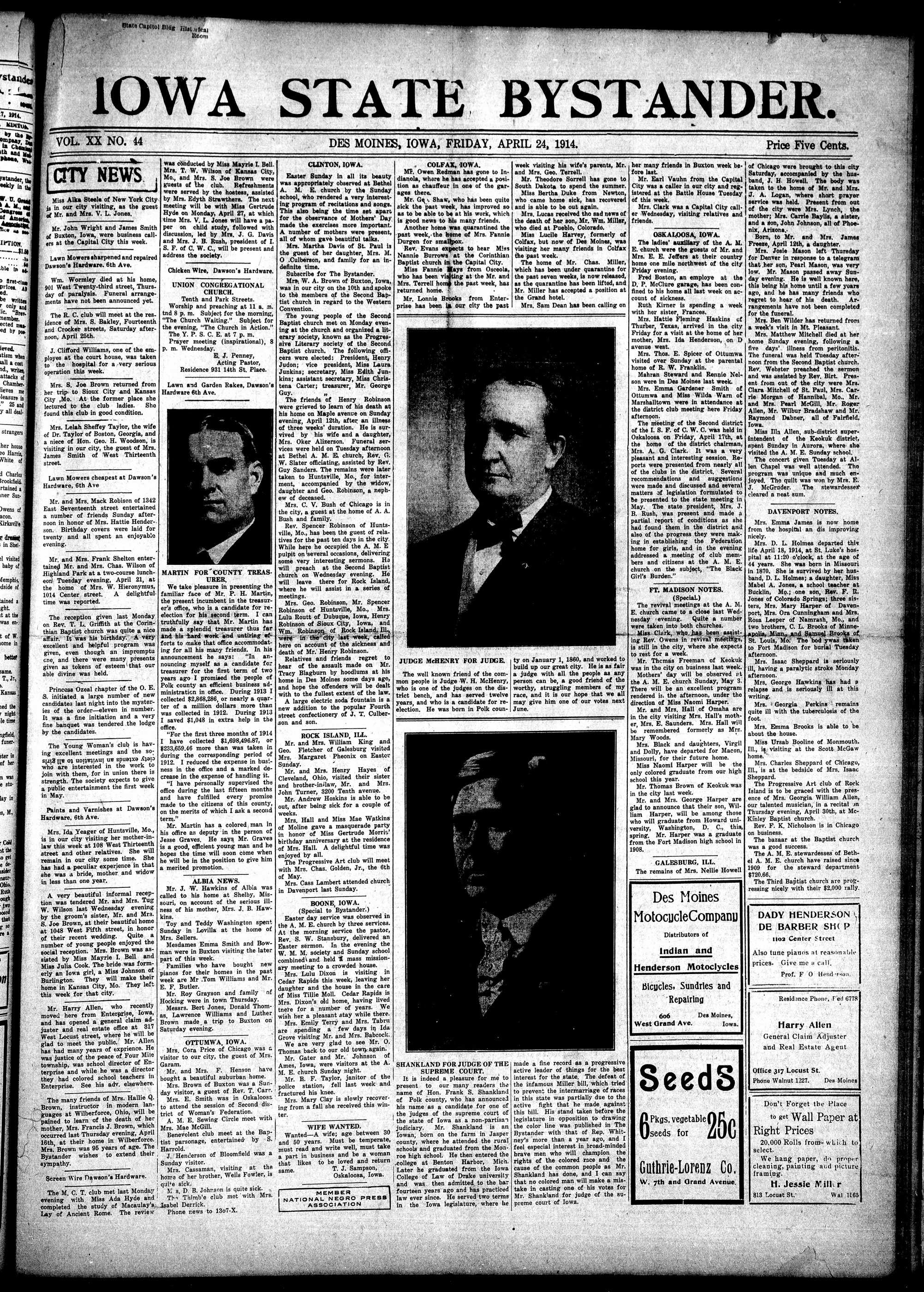
MARTIN FOR COUNTY TREASURER
MARTIN FOR COUNTY TREASURER.
We take pleasure in presenting the familiar face of Mr. P. H. Martin, the present incumbent in the treasurer's office, who is a candidate for reelection for his second term. I can truthfully say that Mr. Martin has made a splendid treasurer thus far and his hard work and untiring efforts to make that office accommodating for all his many friends. In his announcement he says: "In announcing myself as a candidate for treasurer for the first term of two years ago I promised the office of Polk county an efficient business administration in office. During 1913 I collected $2,868,286, or nearly a quarter of a million dollars more than was collected in 1912. During 1913 I saved $1,048 in extra help in the office.
"For the first three months of 1914 I have collected $1,698,496.87, or $233,659.46 more than was taken in during the corresponding period of 1912. I reduced the expense in business in the office and a marked decrease in the expense of handling it.
"I have personally supervised the office during the last fifteen months and have fulfilled every promise made to the citizens of this county, on the merits of which I ask a second term."
Mr. Martin has a colored man in his office as deputy in the person of Jesse Graves. He says Mr. Graves is a good, efficient young man and he hopes the time will soon come when he will be in the position to give him a merited promotion.
ALBIA NEWS.
Mr. J. W. Hawkins of Albia was called to his home at Shelby, Missouri, on account of the serious illness of his mother, Mrs. J. B. Hawkins.
Toy and Teddy Washington spent Sunday in Lovilla at the home of Mrs. Sellers.
Mesdames Emma Smith and Bowman were in Buxton visiting the later part of this week.
Families who have bought new pianos for their homes in the past week are Mr. Tom Williams and Mr. E. F. Butler.
Mr. Roy Grayson and family of Hocking were in town Thursday.
Messrs. Bert Jones, Donald Thomas, Lawrence Williams and Luther Brown made a trip to Buxton on Saturday evening.
OTTUMWA, IOWA.
Mrs. Cora Price of Chicago was a visitor to our city, the guest of Mrs. Garam.
Mr. and Mrs. F. Henson have bought a beautiful suburban home.
Mrs. Brown of Buxton was a Sunday visitor, a guest of Rev. T. Carr.
Mrs. E. Smith was in Oskaloosa to attend the session of Second district of Woman's Federation.
A. M. E. Sewing Circle meet with Mrs. Mae McGill.
Benevolent club meet at the Baptist parsonage, entertained by S. Harrold.
J. Henderson of Bloomfield was a Sunday visitor.
Mrs. Cassaman, visiting at the home of her brother, Wells Fowler, is quite sick.
M. s. D. B. Johnson is quite sick.
The Thimble club met with Mrs. Jachel Darrick
gabel Derrick.
Phone news to 1307-X.
CLINTON, IOWA.
Easter Sunday in all its beauty was appropriately observed at Bethel A. M. E. church by the Sunday school, who rendered a very interesting program of recitations and songs. This also being the time set apart for the observance of Mothers' Day made the exercises more important. A number of mothers were present, all of whom gave beautiful talks.
Mrs. Martha Davis of St. Paul is the guest of her daughter, Mrs. M. O. Culbertson, and family for an indefinite time.
Subscribe for The Bystander.
Mrs. W. A. Brown of Buxton, Iowa, was in our city on the 10th and spoke to the members of the Second Baptist church in regard to the Western Convention.
The young people of the Second Baptist church met on Monday evening at the church and organized a literary society, known as the Progressive Literary society of the Second Baptist church. The following officers were elected: President, Henry Judon; vice president, Miss Laura Junkins; secretary, Miss Edith Junkins; assistant secretary, Miss Christena Carter; treasurer, Mr. George Guy.
"The friends of Henry Robinson were grieved to learn of his death at his home on Maple avenue on Sunday evening, April 12th, after an illness of three weeks' duration. He is survived by his wife and a daughter, Mrs. Oker Alizerson. Funeral services were held on Tuesday afternoon at Bethel A. M. E. church, Rev. G. W. Slater officiating, assisted by Rev. Guy Sanders. The remains were later taken to Huntsville, Mo., for interment, accompanied by the widow, daughter and Geo. Robinson, a nephew of deceased.
Mrs. C. V. Bush of Chicago is in the city, a guest at the home of A. A. Bush and family.
Rev. Spencer Robinson of Huntsville, Mo., has been the guest of relatives for the past ten days in the city. While here he occupied the A. M. E pulpit on several occasions, delivering some very interesting sermons. He will preach at the Second Baptist church on Wednesday evening. He will leave there for Rock Island, where he will assist in a series of meetings.
Mrs. Geo. Robinson, Mr. Spencer Robinson of Huntsville, Mo., Mrs. Lulu Routt of Dubuque, Iowa, Henry Robinson of Sioux City, Iowa, and Wm. Robinson of Rock Island, Ill, were in the city last week, called here on account of the sickness and death of Mr. Henry Robinson.
Relatives and friends regret to hear of the assault made on Mr. Tracy Blagburn at hoodlums at his home in Des Moines some days ago, and hope the offenders will be dealt with to the fullest extent of the law.
A large electric soda fountain is a new addition to the popular Fourth street confectionery of J. T. Culberson and son.
ROCK ISLAND, ILL.
Mr. and Mrs. William King and Geo. Fletcher of Galesburg visited Mrs. Margaret Pheonix on Easter Sunday.
Mr. and Mrs. Henry Hayes of Cleveland, Ohio, visited their sister and brother-in-law, Mr. and Mrs. John Turner, 3200 Tenth avenue.
Mr. Andrew Hoskins is able to be out, after being sick for a couple of weeks.
Mrs. Hall and Miss Mae Watkins of Moline have a masquerade party in honor of Miss Gertrude Morris's birthday anniversary at the residence of Mrs. Hall. A delightful time was enjoyed by all. The Progressive Art club will meet with Mrs. Chas. Golden, Jr., the 6th of May. Mrs. Cass Lambert attended church in Davenport last Sunday.
Easter day service was observed in the A. M. E. church by three services. At the morning service the pastor, Rev. S. W. Stansbury, delivered an Easter sermon. In the evening the W. M. M. society and Sunday school combined\ and held mass missionary meeting to a crowded house. Mrs. Lulu Dixon is visiting in Cedar Rapids this week, leaving her daughter and the house in the care of Miss Tillie Moll. Cedar Rapids is Mrs. Dixon's old home, having lived there for a number of years. We wish her a pleasant stay while there. Tabern
Mrs. Emily Terry and Mrs. Tabbu are spending a few days in Ida Grove visiting Mr. and Mrs. Babcock. We are very glad to see Mr. O. Thomas back to our old town, again. Mr. Gater and Mr. Johnson of Ames, Iowa, were visitors at the A.M. E. church Sunday night.
Mr. B. F. Taylor, janitor of the police station, fell last week and fractured his knee. Mrs. Mary Clay is slowly recovering from a fall she received this winter.
WIFE WANTED.
Wanted—A wife; age between 30 and 50 years. Must be temperate, must read and write well, must take a part in business and be a woman that likes to be loved and return same. T. J. Sampson,
Oskaloosa, Iowa.
MEMBER
NATIONAL NEGRO PRESS
ASSOCIATION
M. H.
M.
COLFAX JOWA
Mr. Owen Redman has gone to Indianola, where he has accepted a position as chauffeur in one of the garages there.
Mr. Gee, Shaw, who has been quite sick the past week, has improved so as to be able to be at his work, which is good news to his many friends.
Another home was quarantined the past week, the home of Mrs. Fannie Durgen for smallpox.
Rev. Evans expects to hear Miss Nannie Burrows at the Corinthian Baptist church in the Capital City.
Miss Fannie Mays from Osceola, who has been visiting at the Mr. and Mrs. Terrell home the past week, has returned home.
Mr. Lonnie Brooks from Enterprise has been in our city the past
[Picture of a man in a suit with a bow tie].
JUDGE McHENRY FOR JUDGE.
The well known friend of the common people is Judge W. H. McHenry, who is one of the judges on the district bench, and has served twelve years, and who is a candidate for reelection. He was born in Polk coun-
THE NEW YORKER
SHANKLAND FOR JUDGE OF THE SUPREME COURT.
It is indeed a pleasure for me to present to our many readers the name of Hon. Frank S. Shankland of Polk county, who has announced his name as a candidate for one of the judges of the supreme court of the state of Iowa as a non-partisan judiciary. Mr. Shankland is an Iowa, born on the farm in Jasper county, where he attended the rural schools and graduated from the Monroe high school. He then entered the college at Benton Harbor, Mich. Later he graduated from the Iowa College of Law of Drake university and was then admitted to the bar fourteen years ago and has practiced law ever since. He served two terms in the Iowa legislature, where he
week visiting his wife's parents, Mr. and Mrs. Geo. Terrell.
Mr. Theodore Sorrell has gone to South Dakota to spend the summer. Miss Bertha Duke from Newton, who came home sick, has recovered and is able to be out again. Mrs. Lucas received the sad news of the death of her son, Mr. Wm. Miller, who died at Pueblo, Colorado. Miss Lucile Harvey, formerly of Colfax, but now of Des Moines, was visiting her many friends in Colfax the past week. The home of Mr. Chas. Miller, which has been under quarantine for the past seven weeks, is now released, as the quarantine has been lifted, and Mr. Miller has accepted a position at the Grand hotel. Mrs. Sam Dean has been calling on
1910
ty on January 1, 1860, and worked to build up our great city. He is as fair a judge with all the people as any person can be, a good friend of the worthy, struggling members of my race, and it is our hope that we all may give him one of our votes next June.
1. The image shows a person with a bald head and dark eyes. They are wearing a dark-colored shirt and pants. The background is a plain black surface with no visible details.
made a fine record as a progressive active leader of things for the best interest for the state. The defeat of the infamous Miller bill, which tried to prevent the intermarriage of races in this state was partially due to the active fight that he made against this bill. His stand taken before the legislature in opposition to drawing the color line was published in The Bystander with that of Rep. Whitney's more than a year ago, and I feel especial interest in broad-minded brave men who will champion the rights of the colored race and the cause of the common people as Mr. Shankland has done, and I can say that no colored man will make a mistake in casting one of his votes for Mr. Shankland for judge of the supreme court of Iowa.
her many friends in Buxton week before last.
Mr. Earl Vauhn from the Capital City was a caller in our city and registered at the Battle House Tuesday of this week.
Mrs. Clark was a Capital City caller Wednesday, visiting relatives and friends.
OSKALOOSA IOWA.
The ladies' auxiliary of the A. M. E. church were the guests of Mr. and Mrs. E. E. Jeffers at their country home one mile northwest of the city Friday evening.
Fred Boston, an employee at the D. P. McClure garage, has been confined to his home all last week on account of sickness.
Ruth Kirner is spending a week with her sister, Frances.
Mrs. Hattie Fleming Haskins of Thurber, Texas, arrived in the city Friday for a visit at the home of her mother, Mrs. Ida Henderson, on D avenue west.
Mrs. Thos. E. Spicer of Ottumwa visited over Sunday at the parental home of R. W. Franklin.
Mahran Steward and Rennie Nelson were in Des Moines last week.
Mrs. Emma Gardener Smith of Ottumwa and Miss Wilda Warn of Marshaltown were in attendance at the district club meeting here Friday afternoon.
The meeting of the Second district of the I. S. F. of C. W. C. was held in Oskaloosa on Friday, April 17th, at the home of the district chairman, Mrs. A. G. Clark. It was a very pleasant and interesting session. Reports were presented from nearly all of the clubs in the district. Several recommendations and suggestions were made and discussed and several matters of legislation formulated to be presented to the state meeting in May. The state president, Mrs. J. B. Rush, was present and made a partial report of conditions as she had found them in the district and also of the progress they were making in establishing the Federation home for girls, and in the evening addressed a meeting of club members and citizens at the A. M. E. church on the subject, "The Black Girl's Burden."
FT. MADISON NOTES. (Special.)
The revival meetings at the A. M. E. church came to a close last Wednesday evening. Quite a number were taken into both churches.
Miss Clark, who has been assisting Rev. Owens in revival meetings, is still in the city, where she expects to rest for a week.
Mr. Thomas Freeman of Keokuk was in the city on business last week. Mothers' day will be observed at the A. M. E. church Sunday, May 3. There will be an excellent program rendered in the afternoon, under the direction of Miss Naoimi Harper.
Mr. and Mrs. Hall of Omaha are in the city visiting Mrs. Hall's mother, Mrs. E. Saunders. Mrs. Hall will be remembered formerly as Mrs. Mary Woods.
Mrs. Black and daughters, Virgil and Dolly, have departed for Macon, Missouri, for their future home.
Mrs. Naoimi Harper will be the only colored graduate from our high school this year.
Mr. Thomas Brown of Keokuk was in the city last week.
Mr. and Mrs. George Harper are glad to announce that their son, William Harper, will be among those who will graduate from Howard university, Washington, D. C., this spring. Mr. Harper was a graduate from the Fort Madison high school in 1908.
GALESBURG, ILL.
The remains of Mrs. Nellie Howell
Des Moines
MotocycleCompany
Distributors of
Indian and
Henderson Motoclycles
Bicycles, Sundries and
Repairing
606 Des Moines,
West Grand Ave. Iowa.
SeedS
6 Pkgs. vegetable seeds for 25c
Guthrie-Lorenz Co.
W. 7th and Grand Avenue.
Price Five Cents.
of Chicago were brought to this city Saturday, accompanied by the husband, J. H. Howell. The body was taken to the home of the Mr. and Mrs. J. A. Logan, where short grayer service was held. Present from out of the city were Mrs. Lynch, the mother; Mrs. Carrie Baylis, a sister, and a son, John Johnson, all of Phoenix, Arizona.
Born, to Mr. and Mrs. James Freeze, April 12th, a daughter.
Mrs. Josie Mason left Thursday for Denver in response to a telegram that her son, Pearl Mason, was very low. Mr. Mason passed away Sunday evening. He is well known here, this being his home until a few years ago, and he has many friends who regret to hear of his death. Arrangements have not been completed for the funeral.
Mrs. Ben Wilder has returned from a week's visit in Mt. Pleasant.
Mrs. Matthew Mitchell died at her home Sunday evening, following a five days' illness from peritonitis. The funeral was held Tuesday afternoon from the Second Baptist church. Rev. Webster preached the sermon and was assisted by Rev. Birt. Present from out of the city were Mrs. Clara Mitchell of St. Paul, Mrs. Carrie Morgan of Hannibal, Mo., Mr. and Mrs. Pearl McGill, Mr. Roger Allen, Mr. Wilbur Bradshaw and Mr. Raymond Dabner, all of Fairfield, Iowa.
Miss Illa Allen, sub-district superintendent of the Keokuk district, spent Sunday in Aurora, where she visited the A. M. E. Sunday school.
The concert given Tuesday at Allen Chapel was well attended. The program was unique and much enjoyed. The quilt was won by Mrs. E. J. McGrudder. The stewardesses cleared a neat sum.
DAVENPORT NOTES
Mrs. Emma James is now home from the hospital an dis improving nicely.
Mrs. D. L. Holmes departed this life April 18, 1914, at St. Luke's hospital at 11:20 o'clock, at the age of 44 years. She was born in Missouri in 1870. She is survived by her husband, D. L. Holmes; a daughter, Miss Mabel A. Jones, a school teacher at Bucklin, Mo.; one son, Rev. F. I. Jones of Colorado Springs; three sisters, Mrs. Mary Harper of Davenport, Mrs. Ora Cunningham and Mrs. Rosa Leeper of Namrash, Mo., and two brothers, C. L. Brooks of Minnesota, Mum, and Samuel Brooks of St. Louis, Mo. The bed ywas taken to Fort Madison for burial Tuesday afternoon.
Mrs. Isaac Sheppard is seriously ill, having a paralytic stroke Monday afternoon.
Mrs. George Hawkins has had a relapse and is seriously ill at this writing.
Mrs. Georgia Perkins remains quite ill with the tuberculosis of the foot.
Mrs. Emma Brooks is able to be about the house.
Miss Ursab Booline of Monmouth, Ill., is visiting at the Scott McGaw home.
Mrs. Charles Sheppard of Chicago, Ill., is at the bedside of Mrs. Isaac Sheppard.
The Progressive Art club of Rock Island is to be graced with the presence of Mrs. Georgia William Allen, our talented musician, in a recital on Thursday evening, April 30th, at McKinley Baptist church.
Rev. F. K. Nicholson is in Chicago on business.
The bazaar at the Baptist church was a good success.
The A. M. E. stewardesses of Bethel A. M. E. church have raised since 1909 for the steward department $720.66.
The Third Baptist church are progressing nicely with their $2,000 rally.
DADY HENDERSON
DE BARBER SHOP
1102 Center Street
Also tune pianos at reasonable prices. Give me a call.
Prof. F O Henderson.
Residence Phone, Fed 6778
Harry Allen
General Claim Adjuster
and Real Estate Agent
Office 317 Locust St.
Phone Walnut 1227. Des Moines
Don't Forget the Place
to get Wall Paper at
Right Prices
20,000 Rolls from which to
select.
We hang paper, do proper
cleaning, painting and picture
framing.
H. Jessie Miller
813 Locust St. Wal 165
---
SHOW SMALL PROFIT
Agricultural Department Refuse Belle Ruralite Residing in City and Leasing Land is Plutocrat—Corn Belt Data is Given.
Washington—Popular belief that the farm owner who lives in the city and owns the farm is in the class with prodigal plutocrats was given a severe lott in a bulletin just issued by the department of agriculture, which shows that the average return from rented farms is but 3½ per cent on the investment. The size of the farm seems to have no effect on the percentage.
The bureau of farm management which developed these facts studied several hundred farms in Indiana, Illinois and Iowa.
States in the corn belt were chosen because they excel almost all other regions in wealth of farm products. In this section modern machinery, with more horses and fewer men, has made the farm less than 100 acres an "inefficient unit." Further readjustments are constantly taking place to lessen the number of persons needed and to increase the net productions of the farm.
The average labor income of the farm owners operating their own farms was $408 for the year studied and $870 for the tenants. These figures are obtained by deducting 5 per cent of the capital investment from the income. As the tenant has a smaller capital investment his labor income is proportionately larger.
Strangely enough, the farmers making the lowest labor incomes are on big farms, but they fall through inefficient management. Poor crops, low yields, and poor management failure to work and unused capital are given as the main causes contributing to their failure.
The income of the farmer who owns his farm is in direct proportion to his capital and the size of his farm. Men owning small farms often materially increase their incomes by renting additional land. The tenant's income is in direct proportion to the risk he assumes. On the cash rent basis, his income is greater in a good year and less in a poor year when he rents on the share basis. Approximately one-third of the total farm expenses is for labor, this is the "fully-sale" farm is the most desirable; that is, one which provides just a fair amount of work for the farmer and his sons and permits the best use of men, hoeses and machinery.
Of the "crop farm," where 50 per cent of the total farm receipts are derived from the sale of grain, and the live stock farm, where the farmer feeds most of his crops, the latter proved a much better investment, though the fact that they were usually larger than the "crop farm" contributed something to this result. But the average labor income of the crop farmer who owned his own farm was but $23 per farm, whereas the average live stock farmer under similar conditions had a labor income of $750.
POTATO CROP OF THE WORLD.
Out of a total of 5,945,846,000 bushes, the world's crop for 1912, Germany produced 1,844,863,000 bushes, or 31 per cent, says the department of agriculture.
It is remarkable that the immense Russian empire, with 8,291,429 square miles, produced only about three-fourths the quantity of potatoes that Germany produced on her 208,780 square miles, while the United States, with 3,026,789 square miles, produced not quite one-fourth the German crop, although the area under potatoes in the United States was nearly half the potato area of Germany, and the Russian potato area exceeded that of Germany by nearly 3,000,000 acres.
The explanation is to be found in the fact that only 28 per cent of the German potato crop is used for human consumption, while the rest is used in the arts and for stock food. For the last-named purpose nearly 42 per cent is used, showing that Germany, with a very limited area of pasture land, has to depend largely on garnered produce to feed her live stock. The steady increase of the potato crop, with a practically stationary acreage, has the possibilities of intensive cultivation. The production of the 1911 with that of 1912, for the principal countries, is seen that the former was a lean year, the latter a fat year, representing an advance not only over 1911, but in most cases over earlier years, the German production of 1912 being the highest on record. The United Kingdom is an exception, its production in 1912 having been the lowest since 1900.
British East Africa in the fiscal year 1923 bought $1,808,777 worth of unbleached cotton goods, and $67,491 worth of these came from the United States, despite the distance between the two countries and the lack of direct means of transportation. In the trade in other lines of cotton goods American manufacturers have little or no share. American gray goods were introduced many years ago by an American firm that has long been engaged in East African trade. They
Various Salutations.
"How do you do?". That's English and American. "How do you carry yourself?" That's German. "How do you stand?" That's Italian. "How do you find yourself?" That's German. "How do you care?" That's Dutch. "How do you eat?" That's Swedish. "How do you perspire?" That's Egyptian. "How is your stomach?" You have eaten your rice". That's Chinese. "How do you have yourself?" That's Polish. "How do you live on?" That's May. "May thy shadow never be
```markdown
```
are everywhere called America (although the tarm is generally applied to gray goods of all kinds from whatever country they come), and they are so well and favorably known in the market that the native prefers them to all others. In this respect conditions are very similar to those in the Red Sea markets. The native always prefers 'American gray sheeting' and is willing to pay slightly more to get it, but when the margin between the price of. European and American goods become very wide there is a demand for the former. Italy in particular has been making a strong effort to get a larger share of the trade, and has been partly successful.
The foregoing facts are from a bulletin on the cotton goods trade of British East Africa, Uganda, Zanzibar and German East Africa issued by the bureau of foreign and domestic commerce, department of commerce. The bulletin was written by Commercial Agent Ralph M. Odell, and is written giving the results of his investigation in East and South Africa. Zanzibar is mainly a transhipping point, but its trade will continue important until the smaller coast towns on the mainland are linked by railroad.
COMMERCIAL ORGANIZATIONS.
That the range of the functions of a chamber of commerce or board of trade is materially broadening is indicated by a bulletin just issued by the bureau of foreign and domestic commerce, department of commerce, in the commercial organizations in 25 southern and western cities are described.
Nearly every commercial organization has some line of work in which it has proved especially successful, or which it has taken up because of conditions peculiar to its field. It is these lines that the bulletin describes in more or less detail. It describes, for example, how the chamber of commerce in Atlanta, Ga., launched and carried to a successful conclusion a campaign for a $3,000,000 bond issue to provide municipal improvements; it describes the freight-record service in Houston in the permanent office of the inspection bureau work in San Francisco, the co-operation between commercial organizations and the state of Oregon, the charity endorsement and taxation bureaus in Seattle, the garden contest system in Spokane, the park improvement campaign in Denver, the study of the good roads problem in territory tributary to Minneapolis, etc. No attempt is made to describe the entire work of any one association or to present minor details. The bulletin aims to indicate what commercial organizations in certain cities have done and are doing, so that their experience may be made of benefit to other associations in conducting work already in hand or determining new ones. The bulletin also describes the Commercial Organizations in Southern and Western Cities, Special Agents Series No. 19) may be obtained from the superintendent of documents, government printing office, Washington, D. for ten cents.
The general features of commercial organization work are treated in a bulletin issued by the bureau of foreign and domestic commerce in 1912 (Commercial Organizations, Special Agents Series No. 60), copies of which also may be obtained from the super-intendent of documents for five cents each.
SCHOOLS TEST FARMERS' SEEDS.
If Oklahoma has humper crops this year it will be due in considerable measure to the direct aid rendered the farmers by the schools. Throughout the state the teachers and pupils have been systematically testing seeds for the planters in their respective communities, according to information received at the United States bureau of education. Every teacher in the state has received from State Superintendent Wilson a scoring sheet on which to record the tests. Seed from last year's crop is reported to be particularly unreliable, and agricultural experts say there is special need this year for some direct service as the schools have offered.
"No movement has been started in our state which can result in as much good with so little cost to the people generally," declares Mr. Wilson. "It will not only be a financial benefit to the farmer by teaching him to plant none but good seed, but it is of distinct educational value to the children. It furnishes one of the best lessons that can be taught to the children, and the opportunity to come in closer contact with every farmer in the community, a thing which all good teachers are anxious to do."
"If the tests are properly made, and the information followed by the farmers, the results should be remarkable. The lessons taught can be applied year after year and constantly improved upon, until the time will come in Oklahoma, as it should come, when no seeds of any kind whoever will be planted until they have first been tested. If the schools, through their teachers and pupils, can bring this about, they will have fulfilled one of the greatest missions for which they are supported by public funds—that of making breadwinning easier."
Officials of the bureau of education point to Superintendent Wilson's experiment in Oklahoma as an important example of what the schools can do to make the contact between education and the real life of the community in which the school is located.
less." That's Persian—and all mean much the same thing.
Qualified in part.
She was very literary and he was not. He had spent a few evening discussing authors whom he knew nothing, and less, their books, of which less, less. Presently the maiden asked, archly: "Of course, you've read 'Romeo and Juliet'." He foundered hapless for a moment, and then, having a brilliant thought, blurted out, happily: "I've read 'Romeo!'
SUMS UP THEORIES OF LIFE IN TEN WORDS
GIVES 4.000 BOOKS TO LIBRARY OF CONGRESS
GIVES 4.000 BOOKS TO LIBRARY OF CONGRESS
ALBERT I. IS DIFFERENT FROM PREDECESSOR
M'CUMBER'S CONTROVERSY WITH HIS CAR
Can you, in ten words sum up your theories of life? This woman can.
Have you some motto which expresses, not necessarily your religion, but your belief as to the proper mode of living?
A.
Not some ancient maxim, gleaned from a volume of quotations, nor yet a post card guide to the life happy. It must be original; the result of careful thought experience, a n d formulated to best meet your own present, as well as your future needs. Simple though it may sound, the problem is difficult. Every one has ideas on life and how to live. And, usually, every one is willing to impart them to any listening audience. But it is far more than a ten-word sign post on life's way that they paint. The real difficulty lies in condensing the ideas and the theories into the specified number of words. At least one woman believes she has found the answer. Here it is: "Count your blessings, and do all the good you can."
Such is the keynote of the life of Mrs. William S. Kenyon, wife of the junior senator from Iowa. And while she is a Christian, Kenyon's religion, it exemplifies her ideas
the distinguished has just made a second notable the library of COURSE
Jacob H. Schiff,
New York banker.
It is to supplement the one made by him in 1912, consisting of a collection of Jewish books (Hebraica) compris 10,000 volumes. The second collection, like the first, was brought together by Ephraim Delnard, the well-known collector, who, after disposing of the first collection, went to Europe and then to Palestine, for the purpose of forming a second collection which should supplement the first. It is this that Mr. Schiff has acquired and presented to the library.
It consists of more than 4,000 volumes touching every field of Jewish thought and learning, religious and secular, extending over many centuries. It includes, for instance, Bibles with their commentaries and supercommentaries, Mishah and Talmud with their commentaries, the books of sermons, liturgy, philosophy, philology, scientific works, history, geography and Beliebs letters in general.
Many of the books are first editions
A gay, dashing young beauty of the Belgium aristocracy entered the ball
v entered the ballroom of the royal palace in Brussels the other night wearing a cape that it had of the latest design, and so quite naturally, there was a dis play of silk hose. Now, Albert I, king of the Belgians, is very opposed to feminine apparel of this nature. The man an had not proceeded far before a court marshal approached her.
palace in Brussels the other night wearing a fashionable gown. It was of the latest design, and so, quite naturally, there was a display of silk hosiery. Now, Albert I, king of the Belgians, is very much opposed to feminine apparel of this nature. The young woman had not proceeded far before a court marshal approached her.
"His majesty noticed," said the marshal, bowing, "that you had torn your gown and requested me to escort you to your carriage so that you may re-
Senator Porter J. McCumber, probably the most dignified United States
signed United States senator in that august body since the attack. Beacon had a controversy with his automobile the other day, and he came out of the scrimimage looking as though he had been struck by one of his North Dakota cyclones. He had attempted to crank his automobile while standing on the slippery pavement that man had widened the road.
august body since the death of Sensor Bacon, had a controversy with his automobile the other day, and he came out of the scrimmage looking as though he had been struck by one of his North Dakota cyclones. He had attempted to crank his automobile while standing on the slippery pavement. The machine had resisted the son's efforts, but the ice had not. He had been precipitated from an erect position to a sitting posture. Already out he had also "got under" his little
Mixed Metaphore.
A clergyman in an eastern town warned his hearses lately "not to walk in a slippery path, lest they be sucked, maelstrom-like, into its meshes." This metaphor suggests that of another clergyman, who prayed that the Word might be as a nail driven in a sure place, sending its roots downwards and its branches upwards.
Not for Him to Rejoice.
"You say you haven't anything to be that kill for," said the clergyman
IOWA STATE BYSTANDER
as to the ordinary duties of life—the best way to live so as to be happy, and create happiness.
"It is surprising," she says, "how many blessings each of us have if we will only make the effort to look for them. If we are as persistent in our search for blessings as some people are in hunting trouble, the blessings will so overshadow the more important them without undue despondency.
Most people have motives. Some have them on the walls of their homes; others have them in their hearts. Some live up to them, but many do not. Mrs. Kenyon keeps her motto in her heart, and makes it the guide post to her everyday, life. As for the first part of it, counting the blessings, she is willing and ready to talk. But as to the latter, doing good, it remains for others to the rest, and as blonde, is the personification of optimism. It would be hard, indeed, to find any one more ready to laugh, more anxious to look on the bright side than is she.
Nor is this a pose with her. She needs no Billiken or even Kewpie to lend an air of happiness when she is around. She is just naturally full of the joy of life and it would require a confirmed grouch, indeed, to withstand the suniness of her nature. As for the last part of her motorcycle, she must accommodate that it needs an accompaniment of brass band or trumpet, and that the little kindnesses which she just beyond one's door should be done as quickly and willingly as the big opportunity, which hangs forever just on the horton line.
and rare. It includes also more than one hundred manuscripts, many of which bear early dates and can be traced to various countries, as well as several "incunabula" (fifteenth century books) of importance. While supplementing the former collection in several respects, the new one has also its individual features and characteristics. There is an excellent collection of Jewish melodies and songs, accompanied by notes and a fine collection of books and periodicals printed in Palestine. Of especial note is the extensive representation of the products of modern Hebrew literature. This branch of Hebrew literature, generally known as "Haskalah," started with the Mendelssohn period and has developed over the time when the children allowed to participate in the life and culture of the European nations. This literature, which is still flourishing in some countries, is mostly written in elegant, modernized Hebrew, and embraces the various subjects covered by the western culture of today.
Combined with the numerous Hebrew and Yiddish books formerly in the possession of the library, the two collections presented by Mr. Schiff form an excellent foundation for the Semitic division, for which an organization first was provided in the appropriation act effective last July. There seems a prospect that this division will develop into one of the most notable collections in the United States for the study of Semitics.
turn home and have the damage required."
The king had soon noticed this violation of the royal edict against the wearing of what he calls immodest gowns at court balls and immediately ordered the culprit escorted from the room. This modesty may seem rather unique coming from a Belgian monarch, but the present ruler is vastly different from his uncle, King Leopold II, whom he succeeded on the throne. Since King Alberts accession the Belgian court has done with scandals and has assumed an air of strict propriety. And the court was badly in need of cleaning. The king would soon become the principal events in the little kingdom were the court scandals.
While his early married life seemed to be as happy as is usual with kings, it wasn't long before Leopold demonstrated that he held his marriage vows more lightly than was the custom among European monarchs of his time.
old automobile. With his chest bone he made an attempt to jam loose the cast-iron license ticket from in front of the hood. Also the turning crank had walloped the senatorial occiput a good, hard wallop. A piece of sandy gray adhesive plaster indicated the point of contact with the license card. The site of the crank wallop was not visible. He was right but—la, la—if he, had met, up, with any, of his, hardhell constituents while his face looked like a Balkan war man it sure would have been all day with him.
Why Kneck?
Mrs. Ellsworth had a new colored maid. One morning as the maid came downstairs the mistress said: "Emma, did you knock at Miss Flora's door when I sent you with her breakfast!" "No, ma'am," replied the maid, with preternatural gravity. "What was de use of a 'knockin' at her do 'wen I knew to' sure she was in darf"—St. Louis Mirror.
to one of his parishioners. "Why, look at your neighbor, Hayes; he has just lost his wife by influenza." "Well," said the parishioner, "that don't do me any good; I can't Hayes."—Dallas News.
Spelled Her Evening.
Madge: "How was it you didn't have a good time at the reception!" Marjorie: "I heard a story about a girl who was there, but she kept within hearing all the time, and I couldn't tell it to anybody."—Life.
Lighter Refreshments Here in Order
Than the Sweets That Have
Hitherto Been Popular.
A cupful of tea and a delicious
sandwich or two constitutes cuita
enough of "a bite" to tide one over
until dinner time, when the bridge
game breaks up, and less and less
do bridge hostesses feel compelled to
offer elaborate lunch in the way of
salads, ices and sweet cakes so late
in the afternoon. Some women are
afraid of spoiling the dinner, occurring
so thereafter, and other women
are in mortal terror of growing fat, so
the elaborate lunch is little appreciated
and though everybody nibbles
politely, most of the dalmities are left on
the plates.
Tea and buttered muffins, always ofered by a certain hostess after the bridge meeting at her home, make her afternoons especially popular. Coffee and sandwiches are also relished, but sweets are better avoided, for few women really want to eat them and sweets are better avoided, they do the same the keen appetite of late afternoon makes sweets especially palatable.
Celery stalks chilled and stuffed with cream cheese and chopped nuts is a toothsome delicacy for after-bridge serving. Coffee and tiny rolled sandwiches may accompany the stuffed celery. To make rolled sandwiches, cut the bread in thin slices in the morning, having first shaved off all the crust from the loaf. Pack the slices, one on one and then wet put them in a bread time have some melted butter, a pastry brush and squares of oiled paper. Brush each slice of bread with melted butter, roll and wrap firmly in the soiled paper. Set the rolls of paper in the ice box and just before serving remove the papers. The sandwiches will retain their rolled up shape.
Cooked sausage meat, put through a chopper, makes delicious filling for sandwiches. So does chopped apple and celery. Cream cheese, chopped nuts, lime juice, excelled green peppers are relied on by some people as a sandwich filling, but there should always be other sandwiches without the onion filling.
HOUSEHOLD NOTES
A cloth wet with camphor will remove white spots from furniture. The long-handled dustpan is a great help to the modern housewife. Use vinegar instead of water to thin paste and the paste will not spoil. A small iron frying pan, such as is used for omelets, is best for frying goods. White or very pale shades of dress goods can be successfully dyed almost any color. If you have no screen and need one in an emergency, cover a clotheshose with sheets. Babies should have plenty of playthings, so that they can be changed now and then. Daydreamers advise a good bedtime routine for people who are nervous and emaciated. In cooking very sour fruits, put in a very little salt, and much less sugar will be necessary.
Norwegian Prune Pudding:
One-half pound of prunes, two cupfuls of cold water, one cupful of sugar, one-inch piece of stick cinnamon, one and one-third cupful of boiling water, one-third cupful of cornstarch, one tablespoonful of lemon juice. Pick over wash prunes, then soak one hour in cold water and boil until soft; remove the stones. Then add the sugar, cinnamon, boiling water and simmer ten minutes. Dilute the cornstarch with enough cold water to pour easily, add to the prune mixture and cook five minutes. Remove the cinnamon, add the lemon juice, mold, then chill sad serve with cream.
To Clean Gasoline
Ordinary gasoline leaves a ring on most any fabric when used to take out spots. To aid in avoiding this, first wash the gasoline in this manner: Put the desired amount into a glass jar, adding an equal amount of strong soapsuds. Shake the jar rapidly for several minutes, and allow contents to bottle. The soapy water will be drizzle having taken the water from the jar. Put off the latter and put into a bottle. It will leave no ring when used as a cleaner.
Poached Eggs.
Rub over the bottom of the frying pan with butter, pour in about one pint boiling water; add half a teaspoon salt and a teaspoon of vinegar. Break in eggs, be careful not to disturb yolk. Let stand until eggs are set on the bottom, then loosen from the pan by pushing beneath them a griddle cake turner to avoid too much cooking on the bottom; then stand until delicately cooked throughout. Eggs poached in this way will be tender and will not spread.
Cereal Batter Cakes.
Excellent batter cakes can be made by taking an equal quantity of flour and cold cereal, add salt to flavor and beat up with milk until it becomes a smooth batter, add one or two eggs according to the amount of batter; it should be of a consistency to drop from the end of a spoon readily. Bake on a griddle with a medium fire until nicely browned. Spread with currant jelly, pile one on top of another and serve three to a person.
To Keep a Saucepaint Bright.
When I have occasion to use a bright saucepaint or kettle over a study table I may put little over the bright part. Then I wash it in hot water, and the pan is an bright as ever, as the grease prevents the smoke from blackening the metal—Exchange.
To Clean Jet Trimming.
To clean jet trimming that have become dull and dirty-looking, I have found the following excellent: Wipe cloth dipped in water, cloth dipped in equal quantities of water, then wipe it dry and lay in the sun for a few hours—Exchange.
AFRO-AMERICAN CULLINGS
There is certainly one thing which the negro has done since his emancipation gave him the opportunity. He has proved himself a brave, capable soldier. The military history of the nation for the past half century bears abundant witness to the fact.
Gen. Nelson A. Miles, the former chief of the army, gave excellent testimony to this effect in his address at the Lincoln bighday celebration at Quinn chapel, Chicago, when he said: "Even in the Civil war the negro proved that he was brave and worthy to be a free man. When volunteers were called to man vessels which were destined to go down to sure destruction against the Confederate vessel Merrimac, the terror of the enemy appeal for negro volunteers was made and all who heard the call responded. After negro troops of the Spanish war, after negro troops had taken and held San Juan hill, a call was made for volunteers to fight fever in the hospitals. An entire regiment responded as one man. The negro is a brave soldier. He has the stuff of which good citizens are made."
That is expert testimony. General Miles is quite right in instancing the willingness of the negro soldiers to serve in fever camps as a great example of herolism. It is a better example than mere courage in the face of death on the field. The story told by Samuel Lover of the Catholic priest who effected a revocation the millet left as smallpox case, whereupon the military man in horror moved his seat far away from the priest, well illustrates this point.
The negro is brave on the field. His aptitude for nursing the sick is well understood. The records of the graduates of Provident hospital in this city show that young negro women make excellent nurses.
Atogether, there is no denying the gaudy courage and, although it takes more than mere courage to make good citizens, the possession of this excellent attribute gives emphasis to the claims which the negro is making good in many ways—Chicago Inter Ocean.
The form of government in Liberia is modeled after that of the United States, with a president, vice-president, cabinet officer, senate, legislature and judiciary, of whom are black men, descendants of Afro-Americans or natives, many educated and trained in institutions of learning in Liberia. The present president, Daniel E. Howard, was educated in Liberia and is the son of a former slave from Norfalk, Va. The seat of government is located at Monrovia, a city of 10,000 inhabitants, where there is located, also, the United States legislation, consults of France, Germany, England, Spain and Central America. Most of the people in Monrovia are large meralic interiors, which give the city of Monrovia buite a modern form of civilization, notwithstanding the climate is very unhealthy, caused from lack of proper sanitation, hospitals and poor water supply.
The constitution forbids the right of any white man to own real estate or vote in Liberia.
There are no more cheap lands in the West. Land that was sold 13 years ago for $1 an acre is how selling at from $10 to $100 in sections where there are successful irrigation systems.
"Do you deep in the heart of the average American there is a sense of fair play, and he is willing to recognize success, whether it is under a white or black skin," Booker T. Washington, president of Tuskegee Institute, told a gathering of negroes at Kansas City. The educator spoke at the Second Baptist church to more than a thousand members.
"What we need to do is to advertise our advantages as a race, our ability to overcome difficulties," he said.
"Leave it to others to advertise our advantages as a businessman." It does not pay in business, and it will not pay as a race to advertise our troubles and our failures to the world."
Japan has about 125 steam trawlers, and at the present rate of increase the number will reach several hundred in a couple of years. The catches range from five to ten tons each, and the net profit on one ton of fish is $50 to $75.
The average optimist is like a toy balloon. It does not take much of a punch to make him collapse.
The highest point in Nevada is Wheeler peak, which, according to a chart published by the United States geological survey, is 12,060 feet above level. The average elevation of the state of Nevada is 5,600 feet. Only four states—Colorado, Utah, Wyoming and New Mexico—are higher.
A bill has been introduced in the legislature of Manitoba to prohibit the employment of white women and girls in any factory or place of business owned or managed by Chinese or Japanese.
It is impossible to buy friendship,
but you can rent it while your cash
holds out.
More than 120,000,000 board feet of
timber was given away by the
government last year to settlers and miners living in or near the national forests.
Iowa now has women factory inspectors.
Rabbar heels are popular in Switzerland.
Booker Washington talked in New York a few days ago of what the negro has done in the last 50 years in the United States.
"I'm proud of my race," he declared.
"I tell you that the American negro is the only dark-skinned race that ever lived side by side with you white men—and grew."
Because of the negro's tangible as well as spiritual achievements he thinks that some consideration should be shown him.
"You should allow the negro a chance a readjust himself to his changed conditions," said Washington. He has a habit of telling a story to make. He wishes he wiesses to make. He told such story more.
"I called on a friend of mine," said he.
"He was a lawyer in Jacksonville. He lived there in a fine house—I'm afraid to tell you much money that house cost. He was proud of it and he showed me around. By and by he came to the dining room.
"When I put my foot on this bell, he said, standing by the dining room table, the maid comes to see what I want."
"So he put his foot on the bell and the maid came. Then he put his foot on the bell again and the maid popped in at the door. He motioned her away, but pretty soon he put his foot on the bell again, and the maid came once more.
"What are you doing that for? I asked him.
"Well, said he, 'it isn't so long since I was a Pullman porter. And I can't get used to seeing people come when I ring for 'em.
"Washington compared this map with another porter he once encountered. After the man had done his work Washington sat down to talk with him. He found the porter an educated and intelligent man. By and by the porter said:
"Mr. Washington, I have some whiskey in my bag. Let's have a drink."
Washington refused and expressed his surprise that a man of the other's apparent intelligence should drink on duty.
"I wanted to be something once," said the porter, "but I've found out that I can never be anything but just a porter. Why shouldn't I drink? No one cares what a nigger porter does!" It's the first point of view, naturally, that Washington approves.
The new spirit of co-operation is beautifully shown by the list of supporters of the social clinic at Nashville, Tenn. The room for the milk work is furnished by a negro woman of Nashville; milk is supplied by a fund raised by the Nashville Banner, the strongest daily in the city; the library is furnished by Mr. Julius Rosenwald of Chicago, a Jew; the dean of the woman's department is a white graduate of Chicago university; her salary is paid by the Christian Service society of Chicago; the expense of the playground is borne by a negro, and so on and on.
With the suddenness of an Arctic spring latent forces push to the light. From the good old days before the war, the young South has inherited the traditional love for the negro, which even in the bitterness engendered by the war, the older South never forgot. And the bitterness is drained away.—Boston Transcript.
The roads of the plains of Argentina have deeper dust in summer and deeper mud in winter than those of any other part of the world; consequently the wagons used on them have wheels from six to fifteen feet in diameter.
Sponge waste is used in many German industries, especially for stuffing dolls.
Toronto, Canada, has a housewives' league.
A Hindu child of seven may be a skilled workman.
Alaska was bought from Russia in 1867 for $7,200,000.
There are 66,527,000 cattle on United States farms.
A Washington tree stump makes a stable for two horses.
School teachers in Italy receive less than $600 a year salary.
In the year 1913 Austria produced 515,986,000 gallons of beer.
More than 900 nurses are employed in Moscow hospital, the largest in Europe.
It costs Paris nearly $100,000 a year to care for the trees on its streets and boulevards and in its parks, more than 1,000 new ones being planted annually.
Last year the forest service distributed 116,000 basket willow cuttings—15,000 to forest schools, 20,000 to agricultural experiment stations and 80,000 to individuals.
Occasionally a widow gets more than even with an old bachelor by marrying him.
He who loves his neighbor as himself is never on the devil's calling list.
Another foolish habit is falling in with people who are always falling out.
It is easier to convert a town than to prevent the citizens from becoming devilish again.
BASEBALL
Larry Lajole says he'll probably quit after 25 years' service—probably.
Ed Konetchy is pleased with his Pittsburgh berth, and says he'll play his best for Manager Clarke.
"I feel sure the gonfalon will be floating at Shibb park after the 1914 season is over," says Connie Mack.
Tim Jordan will be kept by the Giants to bat in pinches, although Mike Doolin is under contract for this purpose.
Fred Clarke isn't claiming the hunting for his Pirates. All he has to say is that he has an entirely new team.
Charley Herzog isn't promising Cincinnati fans any pennant. However, he says he'll work hard to gain a good position.
Miller Huggins declares that he won't run the Cards from the beach until he is through as a player—if he lasts that long.
Brazil is called the land of nuts. Good place for some of the major league managers to take several of their players.
Rolle Zeider says they can all laugh at his nose but he'd like to stake a little bet that half of them could not hit the point of it.
Little Acosta, the Cuban with the Washington 6'4ators, is being used as a pinch hitter by Manager Griffith and is making good.
Mordecal Brown says he expects to pitch 45 games this year. Inasmuch as he is in the Federal league, he ought to get away with it.
Baseball is a popular sport at Princeton university. The Tiger nine showed a net profit of more than $10,500 for the season of 1932-13.
Lefty Leifield, the former Pittsburgh heaver, has turned down an offer from the Federal league and signed with the San Francisco team.
In his nine years in the National league, Mike Doolan, the former Philly shotstop, now with the Fews, never had a batting average lighter than 263.
Substant is the one position Heine Zimmerman has shown a weakness at. The Cub can play at third and second, but is exceptionally weak at short field.
Louis Sepulveda, catcher for the San Francisco Seals, could spend his life in case and affiance, if he so wished, for his father is a millionaire.
Joe Birmingham says a team is only as strong as its subs, and ins much as the Naps are in need of reserves, the manager has cause to worry.
Heine Zimmerman closely resembles Hans Wagner, averns a critic, the resemblance consisting principally of the fact that Zim possesses two hands and two feet.
Jim Thorpe is referred to by Manager McGraw of the Glants as a new star for the latter outfit. Thorpe did great work while in the Antipodes, says McGraw.
Frank Laporte, a veteran of the big leagues, has gone over to the Feds. The indefuel and utility man, who is a hard batman, has signed with the Indianapolis club.
Garlow, a Carliile graduate, who is said to be Chief Bender's equal, is being given a tryout by the Red Sox. He has plenty of speed and curves, but lacks experience.
Manager Bill Carrigan says he has a fine system for taking off weight. "Don't eat," says Bill. Show us the athletes who'll stop eating just to take off a few pounds.
Manager Joe Birmingham wants a permanent training camp. Why not train in Cleveland? There is just as much snow and rain there as the team will ever find in the south.
a team of Japanese players living in Seattle is to go to Japan next year.
The invaders will remain in 'Japan about two months and will play a series of games with native teams.
A. G. Mills, once president of the National league, and a leading baseball player, makes the interesting statement that the original demand for the reserve rule came from the players.
Bill Collins, the Dodger outfielder who has been sent back to Newark by President Ebbets, of the Brooklyn Dodgers, will take the place of Harry Swacins, who has gone over to the Baltimore Federal at first base.
John Brodie Williams, the Hawaiian right-hander with the Tigers, says the bean ball is of no value to a pitcher. "When you try to hit a batter in the head it shows that he has your goat," says Williams.
Infielder McDonald, who jumped to the Pittsburgh Federales, had a short but brilliant career in the National league. He was a hitter of the cleanup type while with the Braves, but injuries put him out of the running, and when he recovered he failed to show his former class.
MANAGER SHAREES BOOIN
Charles F. Dcoln, manager and catcher of the Philadelphia Nationals, was born in Cincinnati, O, June 12, 1880. He broke into baseball as a professional in 1900 with the St. Joseph team of the Western league. At the close of the season he was drafted by the Chicago White Sox, but sent back for St. Joseph team for the season. He was then drafted and obtained his second trial in fast company, this time with the Philadelphia Nationals. He made good and has been a member of the Phillies ever since. In 1911 he was made manager of the team, the position he occupies at the present time. Besides his ability as a pilot "Red," as he is familiarly known, is one of the best backups in the game. He is a strong pegger to base, and although not a heavy hitter, he managed to break into the .300 class in 1911. When the baseball season is over Charley takes to the stage, his singing sketch being considered one of the headliners on the vaudeville circuit.
Bert Noblett, formerly a well known pitcher, now engaged in the sporting goods business in Grand Rapids, has purchased a half interest from Bill Essick in the Grand Rapids Central League club.
Of all the knockers we hand the medal to a Waco paper, which says: "A. Johnson, a Waco pitcher, pitched one inning. He gave six bases on balls, hit a man, made two wild pitches and one wild throw." He was wild.
Despite the unfortunate contretemps that concluded the fall series between the Cardinals and the Browns, a spring series will be staged between the two clubs. It is to be under the supervision of the National Commission.
---
Bill Foxen, old-time major leaguer, formerly with the Cubs and Phillies of the N. L. has bobbled into the time-light and now is saying that he is to jump to the Feds. He is a south-paw and was last year in the Southern league with Chattanooga.
SPORTING WORLD
Waiting to see McFarland meet Gibbons nowadays has become like crying for the moon.
One example of perpetual motion is George Sutton striving to wrest billiard titles from Willie Hoppe.
Is the German government's legalization of race track betting a wise move to encourage immigration?
Buck Crouse is running second to Bat Levinsky. He fought three battles in three days and won 'em all.
Philadelphia and New York are bidding high for the Army-Navy football game. Gee, they want everything to themselves, even the world's series.
Lurie, the French heavyweight boxer, has challenged Bombardier Wells to a 20-round contest, to take place in England or France, for the best purse offered.
An eastern alumnus has presented Princeton with a $300,000 stadium, but the western alumni will continue their annual donation of approximately $800,000 worth of football playm this year.
The informal awarding of the Davis cup matches to the West Side Tennis club marks the passing of Newport at the court capital of the country. Australia preferred to play its matches in New York city.
It has been announced that Gould will play a return court tennis match with Covey in England next spring, giving the Briant a chance to show something on his native heath.
Members of the American Olympic committee in New York are framing plans to insure raising $50,000 for the American team in 1916. Approximately $3.28 already has been subscribed.
Bob Fitzsimmons says his hardest battle was with Jim Jeffries and his easiest with Jeff Thorne.
WEALTH UNDER SEA
French Authorities Plan Search for Treasure.
Vessels of War, Sunk in Conflict in 1692, May Be Salvaged—Work, Apart From Intrinsic Value, Much Worthen
Adventurous Americans searching for the loot of Pirate Jean Laffitte in the swamps of Louisiana are attacking their problem in a way very different from a treasure hunt described by Consul Gaborne of Havre: "In the great naval battle of La Houague (anglicized as La Houague), which was fought May 19 to May 24, 1692, between the French feet under Admiral Tourville and the combined English and Dutch feet, 16 French men entered the battle. Of these 13 were sunk in the bay of Ste Vaast, department of Manche, in this consular district. In 1912 an engineer of Cherbourg, while engaged in dredging in this region, brought up two bars of silver stamped with the date 1692. This discovery has led the administration of maritime inscription of La Houague, department of Manche, to invite public tenders for the salvage of wreckage and treasure in the sunken fleet. The conditions are that the contractor shall pay 20 per cent of any scale or articles and materials of the marine. The marine also reserves the right to take, on the advice of experts, any objects discovered which possess historical interest.
"Most of the vessels sunk off the island of Tathoul are buried in the sand and have never been a source of danger to navigation. An exception to this, however, is the Terrible, whose wreck sailors avoid with care. The anchor of the Magnifique also constitutes a danger to trawlers. About 80 years ago an unusually large number of cases of sunk vessels, and cannon balls and pieces of artillery were taken out. While the belief has always existed that the wrecks contain valuable treasure all efforts to recover it have failed hitherto. Great interest, therefore, is taken in the prospective salvage work. Some idea of the extent of the wreckage may be obtained from the following data respecting the French vessels destined for the battle. 15 French men-of-war having been utterly destroyed.
"Six men-of-war were burned and sunk close to the island of Tatihou, as follows: Terrible, carrying 88 cannon and 650 men; Mervellieux, 100 cannon, 950 men; Saint Phillipe, 90 cannon, 800 men; Magnifique, 92 cannon, 655 men; Entendu, 64 cannon, 350 men; Courtian, 82 cannon, 600 men. The following seven men-of-war took refuge under the fort of La Houge, where they were finally sunk: Ambleix, carrying 100 cannon and 900 men; Gallard, 88 cannon, 650 men; Foudroyant, 96 cannon, 900 men; Rlustre, 84 cannon, 650 men; Prince, 68 cannon, 350 men.
Hia Revenge.
Norman Happgood was condemning, in New York, a certain type of politician.
"These fellows," he went on, "instead of fighting for the people they represent, act very much like Jones." Jones sat in a barroom one Saturday night with a party of cronies, when one of them, Billy Croft, was called away by his wife. Billy Croft hurried, leaving his glass of beer on the table.
"A few minutes afterwards Jones' little boy ran into the bar, crying:
"Father, mother's bina a jawin" with Billy Croft's wife and Billy has hit mother on the nose!
"Jones jumped up, but, then, on second thought, he resumed his seat and muttered, scared. "Hit mother on the nose, did he? Then I'll drink his beer."
Pretender Seeks Funds.
Don Miguel Braganza, royalist pretender to the Portuguese throne, is busily engaged in raising a fund of a million dollars in France to finance a revolution in Portugal next autumn and is meeting with some encouragement.
Her Remedy.
"Did Clara take anything for her toothache?"
"Oh, yes; she took French leave when the dentist came."
Not Quite.
"She took your millionaire friend for a poor young mechanic."
"She took Billyuns for a poor man? Well, that's rich!"
Got Mixed.
"The British ministers declared the king did not take the initiative."
"Well, what did he do about the referendum?"
Comparisons.
"You ought to see a judge I know at drawing a jury."
"You ought to see one I know at draw poker."
Accounted For.
"Why did Smith's relatives put on only half mourning for him?"
"I suppose they were only half sorry he was dead."
More Accurately Stated.
Gibbs—His father spent a fortune on that boy.
Dibbs-Why, I understood that the boy did the spending.
The Reason.
"That was a lame apology John wrote me."
"Well, he has a limping style."
Probably.
"When I first started to become gray I felt that I had nothing to live for."
"And so you dyed, eh?"
IOWA STATE BYSTANDER
DIDN'T KNOW DAVID
Betty's Advice of Little Value to Wife Who Took Time for Second Thought.
For months Helen had reasoned the matter in her mind until she had fully decided she was a much-neglected person; that her marriage was a failure, and that she should leave David. "It was a great mistake to marry a man so much older than myself," she mused. "I should have known better. Poor staid David! I leave him to his fireside and slippers. I'm going back to the world of galaxy, where I belong. I'll not be old before my time. It's not right that I should! He will take it dreadfully hard. Poor fellow! He does care women for me in his quiet way, but I crave a more expressive love, and I shall have it yet! Tonight I'll tell David how unhappy I am and that I wish a final separation. Oh, dear, how I dread it all! The publicity. The unjust criticism! But I suppose I must live through it somehow. Ah, if only mother were living. She would understand and sympathize with me, but I would not want it to be Elizabeth. Yes, I think I could confide in Betty. She has always been my best friend; but will she understand? She has her idea of right. I fear she will try to impress me with the serious nature of the matter, as if I had not thought it over a thousand times! And she'll point out all David's good points—yes, he has good points, I'll admit; one has one; but I must tell some one, or I shall be distracted.
“Betty, dear, I know it is a queer time to call, but I just had to come. I must confide in some one. I'm worried sick. I—I—you may have guessed that my married life has not been—not been—quite happy, Betty. David doesn't quite understand my—my nature. I mean—I—I—oh, dear, I can't—I must get a—”
“Don't distress yourself, dear child; come sit by me, and we'll have it out. Don't cry, dear; of course he doesn't understand you. I have feared for some time that you were unhappy, your poor dear; no, no, don't exert yourself; I understand perfectly. I know David does not appreciate you as he should; you are so young and beautiful, while he is old and staid; indeed, he is not your equal in any sense; he is—”
“Oh, Betty; David is far superior to me intellectually; why, he is a scholar!”
"Yes, of course, dear; I'll grant all that, but he is a cut-and-dried specimen of a man who craves dark corners and musty books, while you need sunshine and life; why, just yesterday Mrs. Anderson said she never could understand whatever attracted you to David Stirper, and, frankly, I have wondered, too sometimes, Helen, dear, did you ever think of it? There is a way for you to get freedom; why—why not get a separation!"
"Separation." Why. Elizabeth Deering, how dare you mention such a thing! I thought you were my friend. I supposed you had ideas of right and honor. David is one of the best of men, very kind in his way, and he is brilliant. He is president of the largest literary club in this city, and men come from everywhere to get his opinion of things. Of course, he is somewhat reserved in his manner, but I'm sure I'd rather have him that way than like Mrs. Anderson's husband; I have always thought him as about desistence of brains as a doll. No, no Elizabeth; I'm not offended; not all! I know you mean well, but you don't quite understand that, all. You really don't know. Come out next Thursday; I will be our second wedding anniversary, and I shall have a royal dinner to celebrate the event."
"Well, I certainly am disappointed in Betty." Helen told herself on the way home. "She lacks good judgment. To think of her suggesting separation! Why, the idea is preposterous!"—Philadelphia North American.
Japanese to Settle Brazil?
With a population of but six to the square mile, with a vast and rich unoccupied territory, Brazil presents an inviting field for Japanese colonization. During the last few years over 5,000 Japanese have settled in Brazil, and arrangements have been made for settling 3,000 more, says Leslie's Weekly. The Brazilian government has entered into agreements with Japanese immigration companies to bring out settlers for the coffee plantations. The government pays steerage for all immigrants who settle with their families within a certain period, builds carriage roads for the nearest railway station or harbor, maintains experimental farm and a school for teaching the Portuguese language, and exempts settlers from state taxes for five years. Perhaps the most attractive feature of all to the Japanese is that they meet neither racial nor color prejudice among the Brazilians.
"It is never worth while to enter into any argument with an under-taker."
"Why not?"
"He always wants to bury the subject."
A Flattering Resemblance.
"Miss Wombat seems to have taken a sudden fancy to you."
"Yes; she thinks I look something like her little dog that was stolen."
Corrected His Diagnosis.
Grannie—And wilt the matter wrt me to doctor?
Doctor—Oh, just old age, Mrs. Mao Dousall.
Granille—Hoots, man; 'ye're haver in. The left leg's hale and sound and they're haith the same age.—Punch.
Her Generosity.
He—Why did she marry Dick? I thought she valued her freedom.
She—She did. But she couldn't bear to think of Dick having any.—Judge.
FOR LUNCH OR BREAKFAST
Smoked Scotch Haddock — "Finnan Haddle" — One of the Best of the Available Light Dishes.
Translated from the French: The city of Finnan is a little seaport situated six miles from Aberdeen in Scotland. It is here where the haddock are so numerous that the business of smoking them originated. Today Finnan is popular on a large scale not only at Finnan, but in all Scotland.
The haddock is opened for its whole length, then rubbed with salt, suspended by the tail, and smoked 24 hours. This short space of time suffices to give it a savor of the most appetizing and a golden color. It is true that the fish so prepared keeps only a few days, so that one can send it a long distance only during the winter.
The Finnan haddock constitutes an excellent luncheon dish. In order to serve it one simply grill it. The fish is often after it is served in oil. When it is dressed on a dish one brushes over it fresh melted butter. If a grill is wanting, one can cook it in the oven or boil it five minutes.
In England one serves it sometimes at the end of dinner at the same time as the cheese. It is served also cut up in little dice which one makes hot in a little curry sauce and garnishes it with little pieces of toast.
Finnan Haddle a la Delmonico.—Half a pound of finnan haddle, picked up and fried slightly in butter; one cupful of cream; one hard-boiled egg cut up in small pieces; one cupful of egg one teaspoon of grated Eden cheese one tablespoon of butter, and flour enough to thicken; seasoning to taste and cooked seven or eight minutes. This is nice for breakfast served on thin dry toast that has been made of stale bread and buttered slightly.
BEST KIND OF SPONGECAKE
Dellicate Confection Requires Much
Care in Mixing Ingredients
and Baking.
Quarter of a pound of loaf sugar, half a gill of water, four eggs, quarter of a pound of Vienna flour, a little grated lemon rind. For coating the tin: A little salad oil or melted butter, one tablespoonful of water, one tablespoonful of pulverized sugar.
Slieve together two tablespoons of flour, four a little salad oil or melted butter into the tin and let it run all over it; then, pour out any there is over.
Next put in the mixed flour and sugar and shake it all over the tin, turning all that will not stick to the oil. Put the sugar and water in a pan on the fire and let the sugar dissolve, then boil it to a sip, which should feel quite sticky when pressed between the finger and thigh on a basin and whisk them for ten or fifteen minutes. When the sip is ready, add it gradually to the eggs, beating them all the time. Continue beating for ten minutes after the sip is beaten.
Note the absence from this recipe of eggs, butter and milk. Make it just in this order. It will scarcely take five minutes to mix. First of all, thoroughly wash your raisins and currants so they will be drained and almost dry before mixing, or they will deaden the cake. Then into a flour sifter put three and a half cupups of flour, one cupful white sugar, one tablespoonful each of ginger, cinnamon and baking soda and one teaspoonful cloves and sift them all into a bowl, scattering half a cupful of seeded raisins, or a pair, or both, over the flour and sifting on more. This prevents their falling to the bottom of the mould, much stirring. Make a bowl in the middle, pour in one cupful molasses, add one-half cupful of softened dripping from suet or other shortening, and lastly a cupful of boiling water. Mix fast, bake in moderate oven in a pan, which has been greased or prepared.—Mother, Ont.
Kinks In the Kitchen
When ironing try sprinkling orris powder under the ironing sheet. It gives a delicate perfume to the freshly-ironed clothing that is very agreeable. To use up cold lamb, cut into rather thick slices, dip in olive oil and sprinkle with salt, pepper and curry powder. Place in a broiler over a good fire. It makes a most tempting dish. In creaming butter and sugar for cake or hard sauce use a wooden pota-tcher. Warm the mixing bowl before putting in the ingredients, and they will soon become a light, creamy mass, with half the usual labor.
Home-Made Sirup.
Put one crunch of granulated sugar into a frying pan or iron skillet and melt it without water, stirring constantly to keep from burning. When melted have ready one pint of boiling water and add it at once. The sugar will form a hard cake, but the water will run under it and keep it from burning. Now add one and one-half cupful of sugar and boil until the melted sugar is dissolved. This makes a golden brown sugar with a delicious flavor and costs much less than any cheap brand one can buy.
Care of the Piano.
To take care of a piano and keep it in good condition the following is excellent: Never stand the piano against an outside wall, nor should it be very near a fire, as extreme heat is not good. Keep it free from dust, both inside and out. If the keys get yellow, make a paste of whiting and potash; lay it on them, and leave for twenty-four hours. Heavy things on the top of a piano deaden the sound.
Baltimore Relish.
"Good served with fish." Two cupulets finely chopped cabbage, one red pepper, finely chopped, one and a half teaspoonful celiac salt, two table-spoonful mustard, one-fourth cupuil vinegar. Mix celery salt, sugar and mustard in a bowl. Add pepper to cabbage and then add dill mitrape.
RAIL FENCE GOING
Made of Timber That Brings High Prices.
Once Used All Over Country—Immense Oaks With Large Straight Trunks Were Chopped Down and Split Into Heavy Rails.
In this age of rapid progress, with all sorts of new methods and materials, many of the old modes are being discarded, and will soon be more memories, says an exchange.
Very few of our young people, for instance, have ever seen the old fashioned rail fence, which was once used all over this country by thousands of farmers. The native woodlands, and Impeached oaks, with large straight trunks that would have been excellent for manufacturing what is known as quarter-sawed lumber for flue furniture, were chopped down and split into heavy rails that went to make "worm" fences.
In many sections, especially in Pennsylvania, Ohio, West Virginia and Kentucky, where the black walnut grew so abundantly in the early days of the country, the trees were not considered of any more value than the ordinary forest timber, and they were often cut and split into rails which were light in weight, but were very durable. The tall black walnut riffle construction for the greater part of a century. In certain localities some of these old walnut rails are to be found yet. Such trees as were used in making them would bring large sums at the present time. One farmer in eastern Ohio recently sold 25 large black walnut trees to a dealer in fancy timber for $4,300. Chestnut is a wood that splits easily, and in many localities these trees were cut and made into rails. Now the chestnut is a valuable timber for many. The old style rail fence, which most of our grandparents were familiar with, was, when properly erected, a very substantial structure.
The rails were 11 feet in length, usually being split so as to have three sides. The corners were sharp, and when properly laid up would make a solid fence. Heavy chunks were often used at the corners and the fence built from eight to ten rails high, laid at an angle, one on top of the other. When the fence was finished, except the top rail, stout stakes or rails were used. The fence was one on either side, in such a manner that they rested in the angles and crossed to hold the top rail, or "rider," as it was called.
In some sections people built what was known as the "post and rail" fence. The posts were square, or a little broader one way than the other, and five or six oblong holes were morticed through the portion that stood above the ground, and the ends of the rails sharpened and the points stuck through the posts. This method enabled the person to build a fairly straight fence, and it was possible to cultivate more of the land.
Soon after the new method of building a rail fence was tried, the trees were sawn into boards, and post and board fences were all the rage; but in a few more years the factories turned out great quantities of metal and the wire fence hated the place of enclosure. During the period when rails were extensively used shingles were split from short lengths of the straightest-grained oak timber, and houses and barns were roofed with these. When properly put on, such a roof would last for more than half a century.
Now the roofing is nearly all done with slate or metal, or some form of pulp, woven and pressed into sheets that are treated with paints of various colors. The roof is finished with a fashioned roof has disappeared from many sections entirely.
Solfish California Skinner
"I will not stop to tow you off. I have fish aboard."
This was the answer returned by the captain of a fishing steamer to the signal of distress from a pilot boat on the rocks at the entrance of the Golden Gate a few days ago. No one will deny that the sail is a heartless answer, but it is an answer that is being constantly given in all relations of life, says the Portland (Ore.) Journal. All around pilot boats are on the rocks or suffering pain, but the fishing boat sails by unheeding because it has fish aboard, and has not time to stop and throw out a towline. How many fishing boats there are, the refusal word of a sailor, counsel, a friendly smile of encouragement! How many fishing boats there are that are blind, deaf or indifferent to the hopes, aspirations and struggles of those who are on the rocks!
"We can't stop. We have fish on board."
Stubborn Philander.
"Brother Philander," said I to our head deacon the other evening as we were walking home from services. "I believe we are entitled to better preaching. Isn't there some way we can get a stronger man than our present minister?" "Certainly there is," replied Old Philander with increasing warmth. "All we will have to do is to let some of us learn about it and get plenty of 1000 men for six hundred have their way for about a year." Old Philander is terribly set in his notions at times. —Kansas City Star.
The killing of a pig at sea is always an occasion of much importance, not only for the reason that fresh meat is to be enjoyed—a great luxury on a sailing ship—but also for the reason that sails—but because what is termed a "pig breeze" or favorable wind may be looked upon as a certainty. Pigs when kept on sailing ships are often let out of their pens, and their movements, which are believed to foretell the state of the wind to be expected, are watched with keen
Smell Cannot Be Relied Upon at All Times.
Clerk Used to Waiting on Wealthy Politicians. Fooled by a Different Odor—What the Man in Corduroya Finally Purchased.
This story happened in Harrisburg. Pa., but its moral in the selling of underwear may be found universally applicable.
In Harrisburg, then, there is a certain haberdashery establishment not a thousand miles away from the capitol buildings. Whether this said gentlemen's furnishings emporium was designed for the needs of those plurocratic ones who bought and sold tables by the haberdashery foot or not the story does not say. But it is known, at least, that the establishment kept a rather nine line of goods.
One day to this shiny little palace came a person in corduroys. They were not fashionable corduroys, worn with suede gloves, a velvet hat and windshirt tie. No. These corduroys were much crumpled and stained, bagged badly at the knees, and—worst of all!—had an unmistakable odor of the stable upon them. They were obviously far out of their orbit in thus thrusting themselves into the senatorial haberdashery. But in they went, mirrors and all.
The non-committual youngish man who sported them asked a supercilious salesman to see underclothes. The salesman, sniffing that odor of the stable, threw down one box on the counter, the box containing a heavy woolen garment.
"One dollar," declared the salesman.
The corduroy person examined the garment, looked up and said: "Haven't you something a little better than you."
Our senatorial salesman flushed at the plebian slur on his stock. "Certainly," he answered, and tumbled down a second box, "One-fifty."
Corduroys carefully examined the one-fifty garment also, but again looked up. "This the best you got?" he inquired.
The salesman swore a great oath under his romantic mustache. "I'll fix you, you mucker!" he murmured. Down came a swagge box, off came the lid and the neck exposed a beautiful blue silk confection. "Fifteen dollars a garment," explained the savve autocrat accustomed to deal with contractors. "Thirty dollars a suit."
The stable-smelling one looked as before, paused and said, thoughtfully: "I'll take two suits, please. Send them down to the circus grounds, can you?" He got out his pocketbook, stripped loose three $20 bills and mentioned name. The name was probably the most famous one in circus annals of this day.
The our salesman is very kind to the occasional misguided farmers who drift into the glittering shop and cares his haughtiness for more state senators and so on.
Dodging the issue.
William J. Price, minister to Panama, smiled recently when reference was made to the way that some people have of dodging the issue. He said he was reminded of Jones.
When Jones returned to his happy little home in the suburbs at hash time a car drove to him he was met by door by mother, who was wearing a stern expression that seemed to portend a domestic argument.
"James," said the good woman, impressively, "come out into the shed. I want to show you something."
"I am right with you, beloved one," merrily responded father, inwardly doing a bit of guessing. "Trot out the show."
"Just look at those empty bottles," returned mother, pointing to quite a large heap of pints and half pints on the floor. "How do you suppose they even sit in our cellar?"
"Rearly, dear, I don't know," answered father, blushing guiltily. "I never took an empty bottle in the cellar in all my life."—Philadelphia Telegraph
Growl of the Bear.
"Russia desires peace, but is ready for war," declares the St. Petersburg Bourse Gazette, in a semi-official article responding to the attacks on Russia appearing in the German press. The caar's name is mentioned more than once, and the fact that the Bourse Gazette is a Liberal organ adds additional importance to the article, which goes on to say: "We are informed from an unquestionable source that Russia, whose military power is being augmented by the will of the sovereign, does not think of war, but is prepared for all eventualities. Being ready, she does not need to be excited by recent alarms. It is known abroad that the idea that Russia in the event of war would maintain a purely defensive strategy is now abandoned, and that henceforward Russia will assume the offensive."
Too Small an Order to Trifle With.
The Manhattan Nationalist tells of a Kansas man who bought a farm in California who had heard of his neighbor's talent for raising large potatoes, so sent his farmhand to home, get a hummer, and go back to back to harvest the talented farmer to the messenger, "and tell your boss that I won't cut a potato for anyone."—Kansas City Star.
Ancient Custom Kept Up.
To determine the letting of a piece of meadow land, a quaint device was resorted to for the task. A candle was lighted and a pin stuck in its side. Then bled commenced. The candle burned until the flame reached the pin, which fell out, and the land was declared to the last bldder prior to the pin failing. There are people still living who remember when the sandglass was used at auctions in Lincolnshire, the candle and pin in a revival
Magic Hair Grower and Straightening Oil
MME. JOHNSON AND SOUTH
The most wonderful hair preparation on the market. When we say Magic we do not exaggerate, as you can see great results in the final final treatments. We guarantee Magic Hair Grower to stop the hair at once from falling out and breaking off; making harsh, stubborn hair soft and silky. Magic Hair Grower grows hair on bald places of the head. If you use these preparations once, you will never be without them. Magic Hair Grower and Straightening Oil are manufactured by Meadames South and Johnson. We also do so safely treating.
Magic Hair Grower, 50c. Straightening Oil, 35c.
All orders promptly filled; send 10c for postage. Money must accompany all orders.
The death of Mr. Nelson Anderson
occurred at his home near New Boston
on the 12th inst. Mr. Anderson was a pioneer farmer living in the vicinity of Ne W Boston. He was 83 years of age and is survived by his wife, to whom he had been married fifty years, six sons and two daughters, all living in this immediate vicinity viz. Frank, Wm. Wm. Abe, Henry, Beil and John Anderson, Mrs. Emma Weldon and Mrs. Jas. Mitchell, to whom are extended the deepest sympathy of a host of friends. Mrs. Effe Galbraith recently returned from Mexico, Mc. where she was called to the bedside of her mother, Mrs. Anna Caldwell, and sister, Mrs. May Gibb, each of whom are now convalescent.
Mrs. Mary Bland, Miss Bessie Stuart and Mrs. Etha Goins have each returned to their homes from the hospital.
Miss Nellie Kelles has returned from Monmouth, Ill., where she has been visiting at the home of Miss Georgia Norwood.
The death reaper silently came into our midst last Friday night and took from us a gem of the household, the beloved wife of Dr. T. H. Phillips. Her young life was swept away after a surgical operation at a local hospital in the midst of all the tender care that loving hands could do. As a church and society worker Mrs. Phillips' ability was unsurpassed. She was superintendent of the Pilgrim's Rest Baptist Sunday school for a long period and the M. W. P. of Wisdom Temple, No. 113 for nine consecutive years. Dr. T. H. Phillips, at the solicitation of her request has under course of construction a literary hall designated as a meeting place for the U. B. F.'s and S. M. T.'s, and which will now be completed and dedicated to her memory. We would that space would allow us further comment on the life of such a character, whose works will ever stand as a tribute to her unilateral labor. The dental service was held at Pilgrim's Rest church last Tuesday evening, conducted by the pastor J. H. J. Halm, assisted by H. Garnett of Macon, Mo., president of Western college. Mrs. J. H. Garnett, M. W. G. P. of the grand temple of S. M. T. of Missouri, conducted the temple service. Of surviving relatives there are left to mourn four sisters and one brother, viz., Mrs. Dora Davis and Miss Sarah Graves and Mrs. Hattie Rothwell of Denver, Colo., Mrs. Maggie Johnson of Caloway county, Mo., and one brother, Paul Graves, of Lovejoy, Ill. In loving remembrance we can but say:
Your work on earth is now complete.
The golden shore awaits thee.
Not far distant we shall meet,
To dwell with the eternity.
At the Church of St. Mary the
Virgin there were baptized last Sunday
evening Stacy Flournoy Johnson,
Smith Hamilton Johnson, Maxine
Johnson and Miss Imogene Wilson.
Relatives here have been tpirtised
of the death of Mrs. D. L. Holmes of
Davenport.
Miss Nellie Kelles has returned to
her claim near Upton, Wyoming,
after a few months' leave of absence,
which she has been spending at home
with her parents.
Mrs. Peter King of Burlington was
an over Sunday visitor at the home
of Mr. and Mrs. Harry Ashy on
the 12th inst.
Miss Dora Ware has been ill with
typhoid fever for the past two weeks.
That she may soon be able to be out
again is the wishes of her many
friends.
Mr. W. S. Burns, who has been employed as janitor at the Trinity Methodist church (white) for several years, has gone to Sioux Falls, S. D., where he has accepted a similar position.
Mrs. Harry Ashby and her house guest, Mrs. Peter King, of Burlington, and Mrs. W. H. Jones were the invited guests to dinner at the home of Mr. and Mrs. Thos. Freeman on the 13th inst.
Mrs. Anna Alden recently entertained a company of friends in honor of her son Clarence's birthday.
Mrs. Hulda Moss of Hannibal, Mo., and Mr. Ralph Watson of St. Paul, Minn., attended the funeral of J. E. Phillips.
Mrs. Annie Geiser of near New
Magic Hair Grower
MME. JOHNSON AND SO
The most wonderful hair preparation on
we say Magic we do not exaggerate a
sake for the first few treatments. We grow
Grower to stop the hair at once from fall
off; making harsh, stubborn hair soft and
Growet grows hair on bald places of the
these preparations once you will new
Magic Hair Grower and Straightening C
by Meadam South and Johnson. We a
Magic Hair Grower 60c. Straight
All orders promptly filled; send 10c for p
...
Boston has been quit ill for several weeks.
Milk was intended to be delivered directly to the consumer from the producer, and is by nature one of the ideal foods, especially at both extremes of life. If it were not for the little babies the there would be no milk problem as we know it. In cities the question is how to get milk to the people so that it
If it were not for the little babies there would be no milk problem as we know it. In cities the question is how to get milk to the people so that it is not unfit for use. The question of proper dairying, and cart of milk after it leaves the dairy and its subsequent handling makes this a matter of state supervision.
There is no better food for babies, that are so unfortunate as to be deprived of mother's milk, than cow's milk. All the condensed milk and prepared baby foods do not equal good cow's milk. It is a fallacy to suppose that one cow's milk is better than that of a herd. Herd milk is more nearly normal and average than one cow's milk. The first thing that becomes of milk after it gets out of sight is to curdle, as a result of the acid in the stomach, this being one of the first processes of digestion. So when a person vomits and we see the milk it naturally is curdy. Milk therefore naturally curdles in the stomach.
In order to have a pure milk and a wholesome milk the public must its share as well as the milkman. Glass containers are the best, for one can see the dirt in the bottom without trouble. The dirt gets in the milk from the milk chiffy. There are germs in the dirt and these germs are capable not only of starting up trouble in the digestive tract, but in many instances cause new diseases to be spread in communities; so if it is known that a contagious disease exists among the dairy hands the milk from this farm or dairy is taken off the market. It is to the delicate stomach of children that these things are most dangerous, although people do not need assistance. It is not sufficient that the dairy herd be free from disease, that the milk is properly handled by healthy peo- and that the minimum amount of bacteria are present, and the milk delivered in sealed glass containers; the public must see that only clean utensils are used in handling the milk at home and that it is properly iced. More than this, they should see that milk is not left on the doorsteps so that the cats and dogs can come along with smell or lick the top and leave a few germs of goodness know what to grow on the milk. Milk is one of the best materials in the world for germs to sprout and grow in, so that we need to be particular with it.
Any baby that must be artificially fed will do better on cow's milk than on the many advertised-baby foods and any intelligent doctor can help the mother to modify the milk to meet the demands of the baby's digestion.
Once in every four hours is often enough to feed any baby after it becomes two months and a half old. This is the season to begin to think of the baby and the way it is to be taken care of this summer. Do not till it is hot and the unnecessary summer diarrhoea begins. Keep the baby's bottles cleaner than anything in the house, wash the nipple off every time it falls on the floor, get your milk from the dairy that has the least sediment in the containers, have the milk set up off the floor.
MOBERLY NOTES.
Prof. C. C. Hubbard passed through the city Saturday. Mr. Willard Taylor and Miss Lydia Callaway were quietly married at the bride's home in Fayette on Wednesday night. They will make their home in this city. The K. of P. and Court of Calanthe had their annual sermon Sunday at the second Baptist church. The entertainment given Friday was that Mrs. Lucy Graves was quite a success. Mr. and Mrs. W. A. Busch of Slater were in the city visiting
```markdown
```
Agents wanted — Write for particulars.
We carry everything in the latest fashion-
able hair goods at the lowest prices.
We make switches, puffs, transformation
curls, coronet braids, and combings
made to order, matching all shades a
specialty. Send samples of hair with
all orders.
2416 Blonde St, Dumah, Neb.
Phone: Webster 880
friends.
The E. A. E. club was pleasantly entertained at the home of Mrs. Bertha Palmers on Thursday afternoon.
Mrs. Lady Bell Reed and Miss Hazel Buckner were visiting in Salisbury Saturday and Sunday.
Mrs. A. C. Black made a flying trip to St. Louis on Tuesday night on business.
Prof. A. B. Bolden was the great of his wife Saturday, Mrs. A. B. Bolden.
Miss Mary Lee Johnson will leave in a few days for St. Louis. She will be accompanied by Miss Carrie Boone.
Mr. A. C. Black left Monday evening for Mexico to make arrangements with the orchestra for the 3rd of August.
A Care for Nour Steamach.
Wm. Wm. M. Thompson, of Battle Creek, Mich., states: "I have been troubled with indigestion, sour stomach and bad breath. After taking two bottles of Chambralin's Tablets I am well. These tablets are splendid—none better." For sale by all dealers.
ALBIA NEWS.
Rev. Melborn of Centerville preached at the A. M. E. church on Sunday evening.
Mrs. Griffin, a missionary from Africa, visiting in Albia (white), lectured on Sunday afternoon at the A. M. E. church to a large crowd on the country of Africa. All present enjoyed the discourse very much.
The Sewing Circle club met at the home of Mrs. Lucinda Jones on Monday. The hostess served a very nice lunch after the business-hour.
Some few strangers in town the past week.
Mr. Charles Davis from Denver, Colo, is at the parental Monroe Davis home for a few months' visit.
MOLINE, ILL.
The steward helpers met at the residence of Mrs. W. A. Stewart on Monday afternoon. Arrangements were made for a May bazaar and festival to be held Thursday, May 14. Mrs.Will Enix is on the sick list. Mr. and Mrs. Harry Stewart were guests at dinner Sunday with Mr. and Mrs. Albert Curtis. A neighborhood manifesto will be held at the residence of Rev. and Mrs. S. B. Walkup 'Thursday evening, April 30th, for the benefit of the A. M. E. church. Mrs.Matte Hall and little granddaughter, Habel, who have been sick for some time, are able to be out again. Mr. and Mrs. Henry Harris have moved to 3021 Eleventh avenue. Mrs.Henry Wood, who has been seriously ill, is reported much improved at this writing. Mr. Will Ingram had the misfortune to sprain his ankle while playing ball at the home of his brother in Rock Island last week. He was conquered to his home in thi scity.
The steward helpers will hold a meeting Monday afternoon with Mrs. Geo. Tarver to complete arrango-
FREE
F
R
E
E
1014 Catalogue
We are the largest importers and manufacturers of colored peoples hair and the most reliable firm in this line. We make wigs, switches, braids, transformations and all styles of hair that can comb and wash the same as your own. We also sell straightening combs, hair nets and cut hair by the pound. We guarantee all goods, and if not satisfied money will be refunded. Our prices are lower than those quoted elsewhere. Send 2e stamp for illustrated book. Humania Hair Company Dept 51 28 Duane St., New York
Business Man Praises Dr. Miles' Heart Remedy
Business Man Praises Dr. Miles' Heart Remedy
Successful Merchant After Investigation
Found a Remedy That Restored His Health.
"This is Thanksgiving day in the state of Pennsylvania, and I want to devote a part of it in writing a letter to you. On the 28th day of November, 10, I was stricken with a terrible My family physician called Angina Pectoris. I had frightened me to five attacks in 24 hours, in the latter part of the day. I wrote to the
devote a part of my letter to you. On the 26th day of November, 10, 1916, with heart trouble. My痛 called it Angina. I paced from one to five hours, in the latter part of the day. I wrote to the
Miles Medical Co., for information concerning my case, and in reply I received a letter from Dr. Miles which I handed to my family doctor, and he told me to use your Remedies and he gave me the Remedies I gave me, so I did. I used five bottles of Dr. Miles' Heart Remedy and seven bottles of Dr. Miles' Heart Remedy and seven confined to the house for about four months. The action of my heart is now, and has been normal for the last seven years. I command Dr. Miles' Nervine and Heart Remedy to do what they are intended for, if you kindly provide for your advice in answer my monthly reports. I am now sixty-seven years of age, have been in the hospital for the last three years." A. B. HOLLINGER, Lincoln, Pennsylvania Dr. Miles' Heart Remedy is sold and guaranteed by all druggists. MILES MEDICAL CO., Elkhard, Ind.
IOWA STATE SYSTANDER
Mr. Carl Leouney, the chef, has purchased property.
ments for their May festival and bazaar.
Mrs. J. B. Rush, president of the State Federation, gave an interesting talk Saturday night, after which a supper was given.
Miss Martha Anderson, who was sick at the home of Mrs. John Curd last week, is much improved and has returned to her work at the arsenal.
The Ladies' Federation club met at Mrs. E. Black's on Tuesday evening.
Mr. Washington and family of Forrest City, Mo., have moved to our city and purchased property.
A Healing Salve For Buras, Chapped Hands and Sore Nipples.
We overlooked in last news in selecting officers of Eastern Star to mention Mrs. Laura Headley, assistant matron.
As a healing salve for burns, sores, sore nipples and chapped hands Chamberlain's Salve is most excellent. It allays the pain of a burn almost instantly, and unless the injury is very severe, heals the parts without leaving a scar. Price. 25 cents. For sale by all dealers.
Mrs. Lottie Williams entertained about twenty-eight at a house party. The out of town guests were Miss Mabel Johnson of Gravity, Mr. Collins of Shenandosh and Miss Chapel of Red Oak.
A.
Easter services were rendered at the A. M. E. church. The little ones did excellent. Exercises were conducted by Mrs. L. Jones and Mrs. Lane.
Mrs. Henry Johnson and daughter, Mabel, were Clarinda visitors Friday. Mrs. Lulu Ramey is on the sick list.
Mrs. Lizzie Robinson is again sick. Rev. Mitchell visited his church in Oregon, Mo., last Sunday.
Mr. and Mrs. Walker made a business trip to Plattsburg, Mo., and brought back their daughter.
Mr. Albert Cason visited his mother in Glenwood, who is very low at this writing.
Mr. Roberts had the misfortune to lose his eye, which was caused by a stick of wood hitting the ball. But he at present is getting along nicely.
Miss Frances Johnson is visiting in our town.
Woman's Crowning Glory is her nail
Why not grow your hair by using
Mme. M. Beard Hair Grower
It removes dandruff, stops itching
of the scalp and makes it grow long
soft beautiful. Price 500 a box.
Send stamp for pamplet.
Mme. M. Beard
AGENTS WANTED
Grandma Campbell is again on the sick list.
Uncle Edd, who has been seriously ill, is improving.
R. T. Lans opened his restaurant Thursday.
Rev. N. R. Morgan filled his pulpit at Redford on Sunday.
519 So. 16th St. St. Joseph, Mo.
Quite a few strangers in town.
REAL COLORED PEOPLE'S HAIR
```markdown
```
WE are the largest Importer and Manufacturer in this line, Plaints, Wigs, Pomps Puffs, Braids and and Transformations in stock or to order. All our goods guaranteed to stand combing and washing and to hold the color and crimp. All shades matched, none too difficult. Mixed gray our specialty.
Well-Known Toilet Preparations
These Toilet Preparations are guaranteed to be pure and free from all injurious ingredients and guarantee unseat the Pure Food and Drug Law. Serial No. 44423
Mme. Baum's Hair Success for straightening hair, $ Price per bottle, 50c. Mme. Baum's French hair, will stop dandruff and improve growth of Vegetable Tonic, an absolute hair grower, hair, 25c. Mme. 50c. 50c and $1.00 per jar. Per bottle 50c. Mme. Baum's Shampoo, Mme. Baum's Wonder Hair Toilet Will put new hair splendid wash for scalp and hair, 60 cents.
Mina. Baima Hair Success for straightening hair,
hair for balayage, hair for brow, hair for
brown, 25c, 50c, 75c and 1.00 per jar.
Mina. Baima Wonder Hair Tollo will put new hair
on on these bald tapes. 60c, 75c and $1.00
gas get, for heating comb or iron. Price $8.65
Menn. Bain's Straightening Strips will render the most stubborn hair straight. Price $2. $1.50
$1. $86, 69c, 49c, 25c.
Mime, Baume Face Bleach and Skin Whitener, liquid or cream, $50, $75, $100 per bottle or jar, $5 per box. *Balm Oracle Face Power, $5 per box. Mime, Baume Gold Cream for cleaning the skin.
Mine. Baum's Victors Combat, 696 and 75c,
Mine. Baum's $1.00 and $1.00, an ideal
strengthener.
Mma. Baum's Skin Food. for nurshing the skin.
500 per jar.
Mine. Baum's Electric Straightening Comb 26e
Mine. Baum's Magic Comb 89 cents.
Mama. Bumma brilliantness and Heal Hair Dressings
that make her look lovely and glossy, and make
the hair look lovely.
Mme. Baum's pinching irons or pullers, 50c,
75c and $1.00.
Mine. Baum's Dad/friend Harry will absolutely 're' Mine. Baum's pinching irons or pullers, a.
Parcel. Post Stamps only accepted as payment of postage.
NORTHERN GROWN SEED POTATOES
NORTHERN GROWN
1910
Superior to home grown in earliness and yielding, it is better to store them in a cool, dry storage. There is a big difference between seed potatoes and eating stock. The latter is kept a low temperature from them and always kept in a refrigerator. It is also always kept in the cold storage.
PRICE IS NOT SO IMPORTANT—as quality, Come and look over our stock and let us supply your wants for planting. Prices are not excessively high.
209-211 WALNUT STREET
East Des Moines Branch, 416 East Locust bt.
DES MOINES, IOWA
When You Telephone Why Not Smile?
A.
Persons with whom you talk over the telephone cannot see you. The impression you make is accomplished wholly through the tone of your voice and what you say.
Speak slowly and enunciate clearly when you talk. Half the art of telephoning lies in deliberate speech. This gives clearness and emphasis.
Politeness is Contagious
The more deliberate and courteous we are the more deliberate and courteous those with whom we talk become. The telephone voice should be clear and distinct, and have a pleasant, rising inflection. The Smiling Voice Is the Winning Way.
For all Lodge and Church Socities
Rheumatic Pain Relieved.
Why suffer from rheumatism when relief may be had at so small a cost Mrs. Elmer Hatch, Peru, Ind., writes,
"I have been subject to attacks of rheumatism for years. Chamberlain's Liminion always relieves me immediately, and I take pleasure in recommending it to others." 25 and 50 cent bottles. For sale by all dealers.
The Youth's Companion
No Present like it for any one in any home at any price.
Give it to whom you will, you will find all the family looking for it. It is more than 52 numbers filled with delightful reading—it is an influence for all that is best in home and American life.
52 times a year - not 12
Christmas Coupon
Cut this out and send it with $2.00
for The Companion for 1914, and
we will send FREE all the issues
for the month of 1913
and The Companion Practical
Home Calendar for 1914.
THE YOUTH'S COMPANION
144 Berkeley Street
Boston, Mass.
Subscriptions Received at this Office
See Our Family Combination Offer Below
Stomach Trouble Cured
Mrs. H. G. Cleveland, Arnold, Pa.
writes, "For some time I suffered
from stomach trouble. I would have
sour stomach and feel blasted after
eating. Nothing benefited me until
I got Chamberlain's Tablets. After
taking two bottles of them I was
cured." For sale by all dealers.
Mrs. L. F. Phillips preached an
interesting sermon at Bethel church on
Sunday evening.
Jönnes Cafe
The Old Reliable Place
to get your meals
PHONE RED 318 W. 3rd St
3027
Rooming House at 316-218
3rd St.
VIVIAN L. JONES
Funeral Director
The very best service guaranteed
Prices the lowest
Calls answered promptly day or
night No extra charges for distance—Reverse all phone charges
PHONE: Maple 2548
Residence Black 1668.
Office
519 East Court Ave
Des Moines
Green's Cafe
The Old and Reliable Place
to get good meals or lunches
Ice Cream and Cigars
Phone 4908-y
E. Green, Prop. Davenport Ia
Badges
Emb
Regalia
Bo
BANGKOK INTERNATIONAL HOSPITAL
BANGKOK INTERNATIONAL HOSPITAL
BANGKOK INTERNATIONAL HOSPITAL
JOHN L. THOMPSON, EDITOR
Published every day by the
standed Publishing Company, Des-
troit, M.D.
published in Chemical
building, corner Sewerway and M.
berry street, Iowa phase, War
nut 899.
Official paper of the M. W. U. Grand
Company of the A. M., and
International Grand Company
of Heroines of Jersey City of
and Western Baptist Association.
Entered at the postoffice on
second class matter.
TERMS OF SUBSCRIPTION.
One copy $1.50
six months.
Three months.
All subscriptions payable in
advance.
We are prepared to do first-class
job assignments. All our work is
guaranteed.
Communications must be written
on one side of the paper only
and be of interest to the public. "Brevity is the soul of wit," remember.
We return rejected manuscript, unless accompanied by postage stamp.
For Constipation
Mr. L. H. Fursham, a prominent druggist of Spirit Lake, Iowa, says: "Chamblain's Tablets are certainly the best thing on the market for constipation." Give these tablets a trial. You are certain to find them agreeable and pleasant in effect. Price, 25 cents. For sale by all dealers.
NOTICE TO CORRESPONDENTS.
This notice applies to all writers, artists, and publishers of events. Sign all articles, write only upon one side of paper, write a plain hand and spell accurately. Do not send in names of persons at parties or receptions nor send in programs for the event. Do not give an eulogy or write your personal comment upon the event. Simply tell the news or event in a brief, simple manner and let the readers of the Bystander comment. Write the news of all societies, a peligros nominations, irrespective of your personal whims or ideas.
The Iowa State Stander is the oldest Afro-American journal published in Iowa. It was established in 1894, and is read by nearly all the colored people of Iowa. The correspondents in the following towns:
Albia Miss M. May Davis
Oskalooa. Luelia B. Franklin
Washington N. L. Black
Burlington M. R. L. Macaw
Messant. M. M. Burnough
Monmouth. Ill. Georgia Norwood
Colafx Miss Stella Pierson
Minneapolis. Mrs. R. L. Buttner
Cedar Rapids, Iowa. Mrs. M. Terry Moline, Ill. Miss Mamie Ritchie
Buxton Richard Stewart
Sioux City. Miss Goldie Hackley
Clinton. Mrs. C. Reed
Council Bluffs. Mrs. Minnie Cave
Councilville. Mrs. C. Reed
Macon, Mo. Lucy Harris
Mason City. Mrs. Maud Brewnot
Quincy, Ill. Mrs. Matty Llewis
Clarinda. Mrs. J. R. Lane
Keokuh. Mrs. Jennie Freeman
Ottumwa. Mrs. H. Owens
Galesburg, Ill. Maynard
Monsanto. Mrs. C. H. Marshall
St. Paul. Q. Q. Hikons
Rock Island. J. H. Ligons
Advertising rates for display 25 cents per inch, for each insertion. Three to six months' contract, 16 cents per inch. Local advertisers 10 cents per line for each insertion, counting seven words to a line. churches and secret societies raise admission is charged by behalf of professional, legal and unguaranteed cards, yearly contracts, etc. terms are given on application. All advertising is to be paid in advance.
Send money by postoffice order, money order, express or draft. to the Iowa State Bystander Company Des Moines, Iowa.
Nothing So Good for a Cough or Cold
When you have a cold you want the best medicine obtainable so as to get rid of it with the least possible delay. There are many who consider Chamberlain's Cough Remedy unsurpassed. Mrs. J. Boroch, Elida, Ohio, says, "Ever since my daughter Ruth was cured of a severe cold and cough by Chamberlain's Cough Remedy two years ago, I have felt kindly disposed toward the manufacturers of that preparation. I know of nothing so quick to relieve a cough or cold." For sale by all dealers.
A Good Rooming House Down
Town is at
Mrs Ella Epperson
507 Grand Avenue
Phone Red 4076.
Banners
Magic Hair Grower and Straightening Oil
MME. JOHNSON AND SOUTH
The most wonderful hair preparation on the market. When we say Magic we do not exaggerate, as you can see great results in the first few treatments. We guarantee Magic Hair Grower to stop the hair at once from falling out and breaking off, making harsh, stubborn hair soft and silky. Magic Hair Grower grows hair on bald places of the head. If you use these preparations once you will never be without them. Magic Hair Grower and Straightening Oil are manufactured by Meadames South and Johnson. We also do scalp treating.
Magic Hair Grower, 50c. Straightening Oil, 35c.
All orders promptly filled; send 10c for postage. Money must accompany all orders.
KEOOKUK NEWS.
The death of Mr. Nelson Anderson occurred at his home near New Boston on the 12th inst. Mr. Anderson was a pioneer farmer living in the vicinity of Ne w Boston. He was 84 years of age and is survived by his wife, to whom he had been married fifty years, six sons and two daughters, all living in this immediate vicinity, viz., Frank Wm. Abe, Henry, Berl and John Anderson, Mrs. Emma Weldon and Mrs. Jas. Mitchell, to whom are extended the deepest sympathy of a host of friends.
Mrs. Eilegal Calbraith recently returned from Mexico, Mo., where she was called to the bedside of her mother, Mrs. Anna Caldwell, and sister, Mrs. May Gibb, each of whom are now convalescent.
Mrs. Mary Bland, Miss Bessie Stuart and Mrs. Etha Goins have each returned to their homes from the hospital.
Miss Nellie Kelles has returned from Monmouth, Ill., where she has been visiting at the home of Miss Georgia Norwood.
The death reaper silently came into our miest last Friday night and took from us a gem of the household, the beloved wife of Dr. T. H. Phillips. Her young life was swept away after a surgical operation at a local hospital in the midst of all the tender care that loved hands could. As a church and society worker Mrs. Phillips' ability was unsurpassed. She was superintendent of the Pilgrim's Rest Baptist Sunday school for a long period and was the M. W. P. of Wisdom Temple, No. 113, for nine consecutive years. Dr. T. H. Phillips, at the solicitation of her request has under course of construction a literary hall designated as a meeting place for the U. B. F.'s and S. M. T.'s, and which will now be completed and dedicated to her memory. We would that space would allow us further comment on the life of such a character, whose works will ever stand as a fitting tribute to her untiring labors. Funeral service was held at Pilgrim's Rest church last Tuesday morning, conducted by the pastor, Rev. J. H. Helm, assisted by Dr. J. H. Garnett of Macon, Mo., president of Western college. Mrs. J. H. Garnett, M. W. G. P. of the grand temple of S. M. T. of Missouri, conducted the temple service. Of surviving relatives there are left to mourn four sisters and one brother, viz. Mrs. Dora Davis and Miss Sarah Graves and Mrs. Hattie Rothwell of Denver, Colo., Mrs. Maggie Johnson of Caloway county, Mo., and one brother, Paul Graves, of Lovejoy, Ill. In loving remembrance we can but say:
Your work on earth is now complete. The golden shore awaits thee. Not far distant we shall meet, To dwell with thee in eternity.
At the Church of St. Mary the Virgin there were baptized last Sunday evening Stacy Flournoy Johnson, Smith Hamilton Johnson, Maxine Johnson and Miss Imogene Wilson. Relatives here have been tpprised of the death of Mrs. D. L. Holmes of Davenport.
Miss Nellie Kelles has returned to her claim near Upton, Wyoming, after a few months' leave of absence, which she has been spending at home with her parents.
Mrs. Peter King of Burlington was an over Sunday visitor at the home of Mr. and Mrs. Harry Ashby on the 12th inst.
Miss Dora Hare has been ill with typhoid fever for the past two weeks. That she may soon be able to be out again is the wishes of her many friends.
Mr. W. S. Burns, who has been employed as janitor at the Trinity Methodist church (white) for several years, has gone to Sioux Falls, S. D., where he has accepted a similar position.
Mrs. Harry Ashby and her house guest, Mrs. Peter King, of Burlington, and Mrs. W. H. Jones were the invited guests to dinner at the home of Mr. and Mrs. Thos. Freeman on the 13th inst.
Mrs. Anna Alden recently entertained a company of friends in honor of her son Clarence's birthday.
Mrs. Hulda Moss of Hannibal, Mo., and Mr. Ralph Watson of St. Paul, Minn., attended the funeral of Mrs. J. E. Phillips.
Mrs. Annie Geiser of near New
Magic Hair Grower and
MME. JOHNSON AND SO
The most wonderful hair preparation on we say Magic we do not exaggerate, as you ask in the first few treatments. We give Grower to stop the hair at once from fall off; making harah, stubborn hair soft and Grower grows hair on bald places of these preparations once you will never Magic Hair Grower and Straightening O by Meadames South and Johnson. We all Magic Hair Grower, 50c. Straight
All orders promptly filled; send 10c for p
10
11
Boston has been quit ill for several weeks.
Milk was intended to be delivered directly to the consumer from the producer, and is by nature one of the ideal foods, especially at both ex-
tremes of life.
If it were not
for the little
babies there
would be no milk
problem as we
know it. In
cities the question is how to get milk to the people so that it
If it were not for the little babies there would be no milk problem as we know it. In cities the question is how to get milk to the people so that it is not unfit for use. The question of proper dairying, and cart of milk after it leaves the dairy and its subsequent handling makes this a matter of state supervision. There is no better food for babies, that are so unfortunate as to be deprived of mother's milk, than cow's milk. All the condensed milk and prepared baby foods do not equal good cow's milk. It is a fallacy to suppose that one cow's milk is better than that of a herd. Herd milk is more nearly normal and average than one cow's milk. The first thing that becomes of milk after it gets out of sight is to curdle, as a result of the acid in the stomach, this being one of the first processes of digestion. So when a person vomits and we see the milk it naturally is curdy. Milk tnerefore naturally curdles in the stomach.
In order to have a pure milk and a wholesome milk the milk must do its share as well as the milkman. Glass containers are the best, for one can see the dirt in the bottom without trouble. The dirt gets in the milk from the cow chifly. There are germs in the dirt and these germs are capable not only of starting up trouble in the digestive tract, but in many instances cause new diseases to be spread in communities; so if it is known that a contagious disease exists among the dairy hands the milk from this farm or dairy is taken off the market. It is to the delicate stomach of children that these things are most dangerous, although older people do not necessarily escape. But it is not sufficient that the dairy herd be free from disease, that the milk is properly handled by healthy people, and that the minimum amount of bacteria are present, and the milk delivered in sealed glass containers; the public must see that only clean utensils are used in handling the milk at home and that it is properly良. More than this, they should see that milk is not left on the doorsteps so that the cats and dogs can come along and smell or lick the top and leave a few germs of goodness knows what to grow on the milk. Milk is one of the best materials in the world for germs to sprout and grow in, so that we need to be particularly with it.
Any baby that must be artificially fed will do better on cow's milk than on the many advertised baby foods and any intelligent doctor can help the mother to modify the milk to meet the demands of the baby's digestion.
Once in every four hours is often enough to feed any baby after it becomes two months and a half old. This is the season to begin to think of the baby and the way it is to be taken care of this summer. Do not wait till it is hot and the unnecessary summer diarrhoea begins. Keep the baby's bottles cleaner than anything in the house, wash the nipple off every time it falls on the floor, get your milk from the dairy that has the least sediment in the containers, have the milk set up off the floor.
MOBERLY NOTES.
Prof. C. C. Hubbard passed through the city Saturday.
Mr. Willard Taylor and Miss Lydia Callaway were quietly married at the bride's home in Fayette on Wednesday night. They will make their home in this city.
The K. of P. and Court of Calanthe had their annual sermon Sunday at the Second Baptist church.
The entertainment given Friday and Saturday by Mrs. Lucy Graves was quite a success.
Mr. and Mrs. W. A. Busch of Slater were in the city visiting
---
Agents wanted — write for particular.
We carry everything in the latest fashionable hair goods at the lowest prices.
We make switches, puffs, transformation curls, coronet braids, and combings made to order, matching all shades a specialty. Send samples of hair with all orders.
The E. A. E. club was pleasantly entertained at the home of Mrs. Bertha Palmers on Thursday afternoon.
Miss Lady Bell Reed and Miss Hazel Buckner were visiting in Salisbury Saturday and Sunday.
Mrs. A. C. Black made a flying trip to St. Louis on Tuesday night on business.
Prof. A. B. Bolden was the guest of his wife Saturday, Mrs. A. B. Bolden.
Miss Mary Lee Johnson will leave in a few days for St. Louis. She will be accompanied by Miss Carrie Boone.
Mr. A. C. Black left Monday evening for Mexico to make arrangements with the orchestra for the 3rd of August.
A Care for Sour Stomach.
Mrs. Wm. M. Thompson, of Battle Creek, Mich., states: "I have been troubled with indigestion, sour stomach and bad breath. After taking two bottles of Chamberlain's Tables I am well. These tablets are splendid—none better." For sale by all dealers.
ALBIA NEWS.
Rev. Melborn of Centerville preached at the A. M. E. church on Sunday evening.
Mrs. Griffin, a missionary from Africa, visiting in Albia (white), lectured on Sunday afternoon at the A. M. E. church to a large crowd on the country of Africa. All present enjoyed the discourse very much.
The Sewing Circle club met at the home of Mrs. Lucinda Jones on Monday. The hostess served a very nice lunch after the business-hour.
Some few strangers in town the past week.
Mr. Charles Davis from Denver, Colo., is at the parental Monroe Davis house for a few months' visit.
MOLINE. ILL.
The steward helpers met at the residence of Mrs. W. A. Stewart on Monday afternoon. Arrangements were made for a May bazaar and festival to be held Thursday, May 14. Mrs. Will Enix is on the sick list. Mr. and Mrs. Harry Stewart were guests at dinner Sunday with Mr. and Mrs. Albert Curtis. A neighborhood manifesto will be held at the residence of Rev. and Mrs. S. B. Walkup 'Thursday evening, April 30th, for the benefit of the A. M. E. church. Mrs. Mattie Hall and little granddaughter, Habel, who have been sick for some time, are able to be out again. Mr. and Mrs. Henry Harris have moved to 3021 Eleventh avenue. Mrs. Henry Wood, who has been seriously ill, is reported much improved at this writing. Mr. Will Ingram had the misfortune to sprain his ankle while playing ball at the home of his brother in Rock Island last week. He was conveyed to his home in his scity. The steward helpers will hold a meeting Monday afternoon with Mrs. Geo. Tarver to complete arrangec-
FREE
F F
R R
E E
E E
1914 Catalogue
COLORED PEOPLES HAIR
We are the largest importers and manufacturers of colored peoples hair and the most reliable firm in this line.
We make wigs, switches, braids, transformations and all styles of hair that can comb and wash the same as your own. We also sell straightening combs, hair nets and cut hair by the pound. We guarantee all goods, and if not satisfied money will be refunded. Our prices are lower than those quoted elsewhere. Send 2c stamp for illustrated book.
Humania Hair Company
Dept 61
23 Duane St., New York
Business Man Praises Dr. Miles' Heart Remedy
Successful Merchant After Investigation
Found a Remedy That Restored His Health.
"This is Thanksgiving day in the
state of Pennsylvania, and I want to
do it as a part of it." In writing
a letter to you.
On the 26th day of November, 10,
I was stricken with heart
tissue from a family physician
called Angina Pectoris. I had
from one to five attacks
in 24 hours, in the
hospital part. December, 1910.
I wrote to the
J. B. H.
Miles Medical Co., for information concerning my case, and in reply I received a kind and instructive letter, while I kindly thanked Dr. Miles and he told me to use your Remedies in connection with the medicine he gave me, so I did. I used five bottles of Deflated Milk Remedy and seven bottles of Dr. Miles' Milk, confined to the house for about four months. The action of my heart is now, and has been normal for the last seven years. Dr. Miles' Nervine and Heart Remedy to do what they are intended for, if used according to directions. I thank you kindly for your advice in answer to my request. Seven years of age, have been in the mercantile business for thirty-five years and lived retired for the last thirteen years. A. B. HOLLINGBUR, Lincoln, Penna. Dr. Miles' Heart Remedy is sold and guaranteed by all druggists. MILES MEDICAL CO., Elkhard, Ind.
IOWA STATE SYSTANDER
Mr. Carl Looney, the chef, has purchased property.
ments for their May festival and bazaar.
Mrs. J. B. Rush, president of the State Federation, gave an interesting talk Saturday night, after which a supper was given.
Miss Martha Anderson, who was sick at the home of Mrs. John Curd last week, is much improved and has returned to her work at the arsenal.
The Ladies' Federation club met at Mrs. E. Black's on Tuesday evening.
CLARINDA, IOWA. (Last Week's News.) Mr. Washington and family of Forrest City, Mo., have moved to our city and purchased property.
A Healing Salve For Burns, Chapped Hands and Sore Nipples.
As a healing salve for burns, sores, sore nipples and chapped hands Chamberlain's Salve is most excellent. It allays the pain of a burn almost instantly, and unless the injury is very severe, heals the parts without leaving a scar. Price, 25 cents. For sale by all dealers.
We overlooked in last news in selecting officers of Eastern Star to mention Mrs. Laura Headley, assistant matron.
Mr. Williams, grand chancellor, made a business trip out of our city.
Mrs. Lottie Williams entertained about twenty-eight at a house party. The out of town guests were Miss Mabel Johnson of Gravity, Mr. Collins of Shenandoah and Miss Chapel of Red Oak.
A.
Easter services were rendered at the A. M. E. church. The little ones did excellent. Exercises were conducted by Mrs. L. Jones and Mrs. Lane.
Mrs. Henry Johnson and daughter, Mabel, were Clarina visitors Friday. Mrs. Lulu Ramey is on the sick list.
Mrs. Lizzie Robinson is again sick. Rev. Mitchell visited his church in Oregon, Mo., last Sunday.
Mr. and Mrs. Walker made a business trip to Plattsburg, Mo., and brought back their daughter.
Mr. Albert Cason visited his mother in Glenwood, who is very low at this writing.
Mr. Roberts had the misfortune to lose his eye, which was caused by a stick of wood hitting the ball. But he at present is getting along nicely. Miss Frances Johnson is visiting in our town.
Woman's Crowning Glory is ter nair
Why not grow your hair by using
Grandma Campbell is again on the sick list.
Why not grow your hair by doing
Mme. M. Beard Hair Grower
It removes dandruff, stops itching
of the scalp and makes it grow long
soft beautiful. Price 50c a box.
Send stamp for pamplet.
Mme. M. Beard
AGENTS WANTED
Uncle Edd, who has been seriously ill, is improving.
R. T. Lane opened his restaurant Thursday.
Rev. N. R. Morgan filled his pulpit at Bedford on Sunday. Quite a few strangers in town.
REAL COLORED PEOPLE'S HAIR
```markdown
```
WE are the largest Importer and Manufacturer in this line. Plaints, Wigs, Pompa Puffs, Braids and and Transformations in stock or to order. All our goods guaranteed to stand combing and washing and to hold the color and crimp. All shades matched, none too difficult. Mixed gray our specialty.
Send 2e for catalogue. Straightening combs and toilet articles our specialty. The Only and Old Reliable.
Well-Known Toilet Preparations
These Toliet Preparations are guaranteed to be pure and free from all injurious ingredients and guarantees
uneer the Pure Food and Drug Law. Serial No. 44425
Mme. Baum's Hair Success for straightening hair, Price per bottle, 50c. Mme. Baum's French will stop dandruff and improve growth of Vegetable Tonic, an absolute hair grower hair. 25c, 35c, 50c 75c and $1.00 per jar. Per bottle 50c. Mme. Baum's Shampoo
Price per bottle, 60c. Mme. Baum's French
Vegetable Tonic, an absolute hair grower,
Vegetable Tonic, an absolute hair grower,
splendid wash for scalp and skin, 60c.
Lamp Baskets, will set over lamp chimney or
Lamp Baskets, will set over lamp chimney or
Mime, Baum's Wonder Hair Toll will put new hair
on the oneday tapes, 60c, 75c and $1.00
gas get, for heating comb or iron. Price $8c
Menum. Baum's Straightening Cotton will render the most stubborn hair straight. Price $2. $1.50
$1, $8c, $9c, $4c, $2c.
Mme. Baum's Foam Bless and Skin Whitener, liquid or cream, 50c, $10.00 per bottle or jar, Mme. Bau's Oracle Foam Power, 50c per box. Mme Baum's Gold Cream for cleansing the skin.
Mme. Baum's Victors Comb, 69 and 75c.
Perfection tensions, $1.00 and $1.50; an ideal
a stairhanger
a straightener Electric Straightening Comb 25¢ Mine, Baum's Magic Comb 8¢ cents.
Mme. Baum's Baum for, nourishing the skin. 60 per jar.
For hair rinsations and ideal Hair Dressings will render the hair soft and glossy; will make the hair look lively.
$0.00 in $10.00, $10.00, $10.00, $10.00
Mix in ironclaws or pullers, $60.00
$70.00 and $1.00.
Mme. Baum's Damn Helpry will absolutely re- Mme. Baum's pinching irons or pullers, 2. Parcel Post. Stamps only accepted as payment of postage.
NORTHERN GROWN SEED POTATOES
POTATOES
Superior to home grown in earliness and yielding fruit, it is also superior to seed potatoes. There is a big difference between seed potatoes and eating stool. The latter is kept a low temperature and is kept dry. The latter is frequently and frequently killed and nearly always it is weakened in the cold storage.
PRICE IS NOT SO IMPORTANT—as quality. Come and look over our stock and let us assess the quality of our stock and use it as our quality and comforted, they are really cheap.
209-211 WALNUT STREET
East Des Moines Branch, 416 East Locust st.
DES MOINES, IOWA
When You Telephone Why Not Smile?
A
Persons with whom you talk over the telephone cannot see you. The impression you make is accomplished wholly through the tone of your voice and what you say.
Speak slowly and enunciate clearly when you talk. Half the art of telephoning lies in deliberate speech. This gives clearness and emphasis.
Politeness is Contagious
The more deliberate and courteous we are the more deliberate and courteous those with whom we talk become. The telephone voice should be clear and distinct, and have a pleasant, rising inflection.
The Smiling Voice Is the Winning Way.
Badges Banners
Emblems
Regalia Furniture
Books
For all Lodge and Church Socities
A Negro Firm
The Love Regalia Co.
GEO, W. K. LOVE, Pres.
2413 Flora Ave. Kansas City, Mo.
Rheumatic Palms Relieved.
Why suffer from rheumatism when relief may be had at so small a cost Mrs. Elmer Hatch, Peru, Ind., writes, "I have been subject to attacks of rheumatism for years. Chamberlain's Liniment always relieves me immediately, and I take pleasure in recommending it to others." 25 and 50 cent bottles. For sale by all dealers.
The Youth's Companion
No Present like it for any one in any home at any price.
Give it to whom you will, you will find all the family looking for it. It is more than 52 numbers filled with delightful reading—it is an influence for all that is best in home and American life.
52 times a year ~ not 12
Christmas Coupon
Cut this out and send it with $2.00 for The Companion for 1914, and we will send FREE all the issues for the remaining weeks of 1913 and The Companion Practical Home Calendar for 1914.
THE YOUTH'S COMPANION
144 Berkeley Street
Boston, Mass.
Subscriptions Received at this Office
See Our Family Combination Offer elsewhere
Mrs. H. G. Cleveland, Arnold, Pa., writes, "For some time I suffered from stomach trouble. I would have sour stomach and feel bloated after eating. Nothing benefited me until I got Chamberlain's Tablets. After taking two bottles of them I was cured." For sale by all dealers.
Mrs. L. F. Phillips preached an interesting sermon at Bethel church on Sunday evening.
Joyes Cafe
The Old Reliable Place
to get your meals
PHONE RED 318 W. 3rd St
3027
Rooming House at 216-218
3rd St.
VIVIAN L. JONES
The very best service guaranteed Prices the lowest
Calls answered promptly day or night No extra charges for distance—Reverse all phone charges
PHONE: { Maple 2548 Residence Black 1668.
Office 519 East Court Ave
Drs MoInF8
Green's Cafe
The Old and Reliable Place
to get good meals or lunches
Ice Cream and Cigars
114 E. 5th Street
Phone 4908-y
E. Green, Prop. Davenport Ia
Badges
Emb
Regalia
MIDDLEBURG HISTORICAL & MUSEUM
MIDDLEBURG PARK
MIDDLEBURG COUNTY CENTER
Published every day by the
stander Publishing Company, Des
Moffat, Iowa. Office in Chemical
building, corner Seventh and Ma-
berry streets. Iowa phone, Wau-
nut 899.
Official paper of the M. W. U. Grand
Lodge of Iowa, A. F. & A. M. and
International Grand Congress of
Heroines of Jericho of America
and Western Baptist Association.
Entered at the postoffice on second
class matter.
TERMS OF SUBSCRIPTION.
One year. $1.50
six months. .15
Three months. .50
All subscriptions payable in adv-
ance.
We are prepared to do first-class
job work at reasonable prices. All
of our work is guaranteed.
Communications must be written
on one side of the paper only and
be of interest to the public. "Brev-
ity is the soul of wit," remember.
We will not return rejected manuscript, unless accompanied by postage stamps.
For Constipation.
Mr. L. H. Farsham, a prominent druggist of Spirit Lake, Iowa, says: "Chamblain's Tablets are certainly the best thing on the market for constipation." Give these tablets a trial. You are certain to find them agreeable and pleasant in effect. Price, 25 cents. For sale by all dealers.
NOTICE TO CORRESPONDENTS.
NOTICE TO CORRESPONDENTS.
This notice applies to all writers, contributors, agents and correspondents. Sign all articles, write only upon one side of paper, write a plain hand and spell accurately. Do not send in names of persons at parties or receptions nor send in programs to be published before or after the event. Do not give an eulogy or write your personal message upon the event. Simply tell the news or report in a brief, simple manner and let the readers of The Bystander comment. Write the news of all classes, all societies, all religious demonstrations, irrespective of your personal whims or ideas.
The Iowa State Bystander is the oldest Afro-American journal published in Iowa. It was established in 1894, and is read by nearly all the colored people of Iowa. We have correspondents in the following towns:
Albia ..... Miss May Davis
Oskalooa ..... Lueila B. Franklin
Washington ..... N. L. Black
Burlington ..... Mrs. L. M. Abel
Mt. Pleasant ..... Mrs. M. Burnage
Monmouth. Ill ..... Georgia Norwood
Colfax ..... Miss Stella Pierson
Minneapolis ..... Mrs. R. L. Buttner
Cedar Rapids, Iowa ..... Mrs. May Terry
Moline, Ill ..... Miss Mamie Richie
Buxton ..... Richard Stewart
Sloux City ..... Miss Goldie Hackley
Clinton ..... A. A. Bush
Council Bluffs ..... Miss Minnie Cave
Centerville ..... Mrs. C. Reed
Macon, Mo ..... Lucy Harris
Mason City ..... Mrs. Maud Brewton
Quincy, Ill ..... Mrs. Mattie Lilly
Clarinda ..... Mrs. J. R. Lane
Keokuk ..... Mrs. Jennie Freeman
Ottumwa ..... Mrs. H. Owens
Galesburg, Ill ..... Mayme Richardson
Davenport ..... Mrs. C. H. Marshall
St. Paul ..... Mrs. Q. H. Hicks
Rock Island ..... J. H. Ligons
Advertising rates for duplify ad
25 cents per inch, for each insertion.
Three to six months' contract, 10
cents per inch. Local advertising
10 cents per line for each insertion,
counting seven words to the word
churches and secret societies where
admissions are one-half
more-mentioned rates. For professional,
legal and annuity cards,
yearly contracts, etc., terms
are given on application. All advertising
is to be paid in advance.
Send money by postoffice order
money order, express or draft.
to the Iowa State Bystander Company
Des Moines, Iowa.
Nothing So Good for a Cough or Cold
When you have a cold you want the
best medicine obtainable so as to get
rid of it with the least possible delay.
There are many who consider
Chamberlain's Cough Remedy unsurpassed. Mrs. J. Boroff, Elida, Ohio,
says, "Ever since my daughter Ruth
was cured of a severe cold and cough
by Chamberlain's Cough Remedy
two years ago, I have felt kindly disposed
toward the manufacturers of that
preparation. I know of nothing so
quick to relieve a cough or cure a
cold." For sale by all dealers.
A Good Rooming House Down
Town is at
Mrs Ella Epperson
507 Grand Avenue
Phone Red 4076.