Iowa State Bystander
Friday, July 10, 1914
Des Moines, Iowa
Page text (machine-generated)
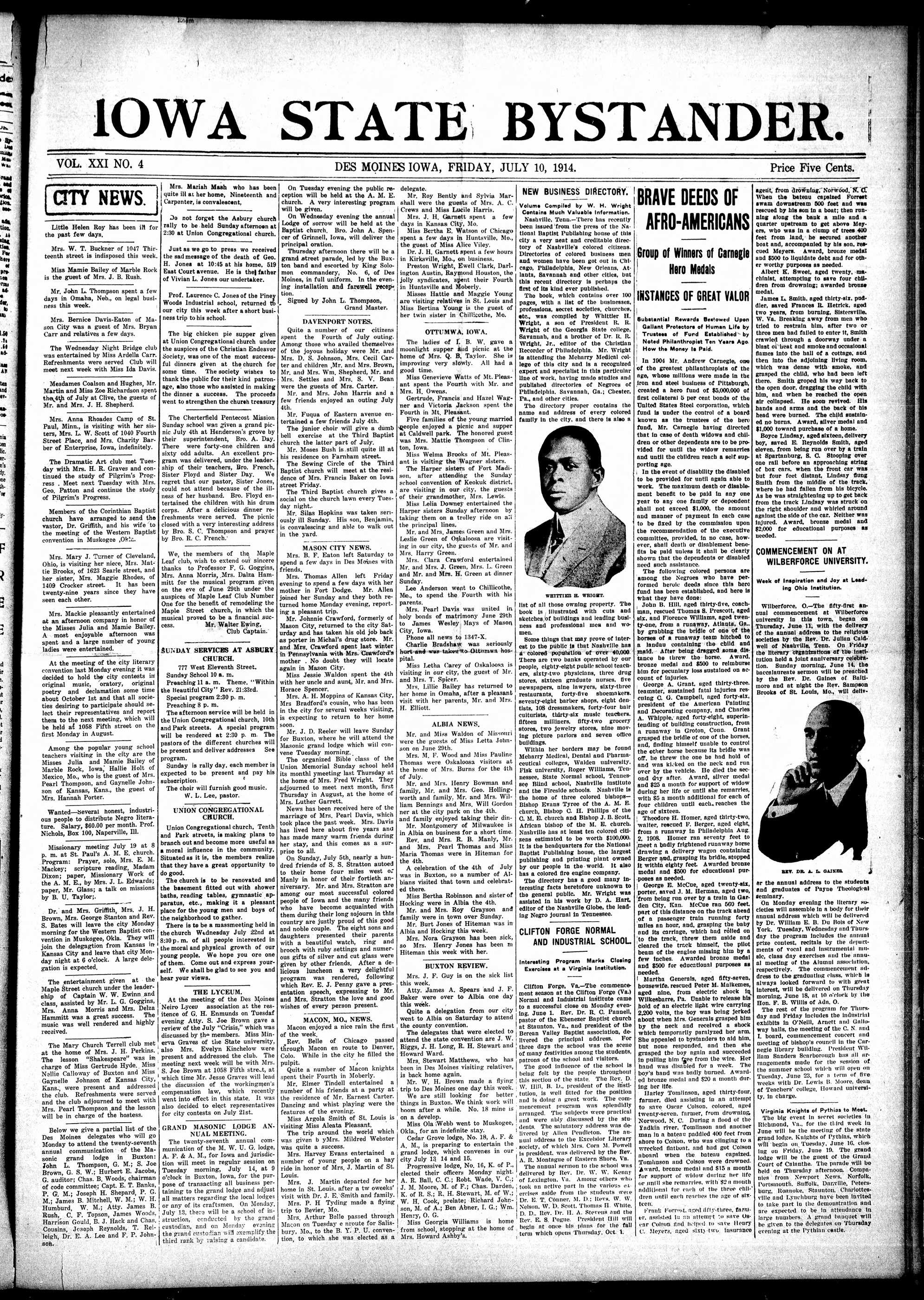
IOWA STATE BYSTANDER.
VOL. XXI NO. 4
CITY NEWS
Little Helen Roy has been ill for the past few days.
Mrs. W. T. Buckner of 1047 Thirteenth street is indisposed this week.
Miss Mamie Bailey of Marble Rock is the guest of Mrs. J. B. Rush.
Mr. John L. Thompson spent a few days in Omaha, Neb., on legal business this week.
Mrs. Bernice Davis-Eaton of Mason City was a guest of Mrs. Bryan Carr and relatives a few days.
The Wednesday Night Bridge club was entertained by Miss Ardella Carr. Refreshments were served Club will meet next week with Miss Ida Davis.
Mesdames Coalson and Hughes, Mr. Martin and Miss Zoe Richardson spent the 4th of July at Clive, the guests of Mr. and Mrs. J. H. Shepherd.
Mrs. Anna Rhoades Camp of St. Paul, Minn., is visiting with her sisters, Mrs. L. W. Scott of 1040 Fourth Street Place, and Mrs. Charity Barber of Enterprise, Iowa, indefinitely.
The Dramatic Art club met Tuesday with Mrs. H. R. Graves and continued the study of Pilgrim's Progress. Meet next Tuesday with Mrs. Geo. Patton and continue the study of Pilgrim's Progress.
Members of the Corinthian Baptist church have arranged to send the vastor, Dr. Griffith, and his wife to the meeting of the Western Baptist convention in Muskogee, Okla.
Mrs. Mary J. Turner of Cleveland, Ohio, is visiting her niece, Mrs. Mattei Brooks, of 1623 Searle street, and her sister, Mrs. Maggie Rhodes, of 1409 Crocker street. It has been twenty-nine years since they have seen each other.
Mrs. Mackie pleasantly entertained at an afternoon company in honor of the Misses Julia and Mamie Bailey. A most enjoyable afternoon was spent and a large number of young ladies were entertained.
At the meeting of the city literary convention last Monday evening it was decided to hold the city contests in original music, oratory, original poetry and declamation some time about October 1st and that all societies desiring to participate should select their representatives and report them to the next meeting, which will be held at 1058 Fifth street on the first Monday in August.
Among the popular young school teachers visiting in the city are the Misses Julia and Mamie Bailey of Marble Rock, Iowa, Hallie Holt of Mexico, Mo., who is the guest of Mrs. Pearl Thompson, and Gayne Johnson of Kansas, Kans., the guest of Mrs. Hannah Porter.
Wanted—Several honest, industrious people to distribute Negro literature. Salary, $60.00 per month. Prof. Nichols, Box 100, Naperville, Ill.
Missionary meeting July 19 at 8 p. m. at St Paul's A. M. e. church. Program: Prayer, solo, Mrs. E. M. Mackey; scripture reading, Madam Dixon; paper, Missionary Work of the A. M. E., by Mrs. J. L. Edwards; paper, Mr. Glass; a talk on missions by B. U. Taylor;
Dr. and Mrs. Griffith, Mrs. J. H. Brown, Mrs. George Stanton and Rev. S. Bates will leave the city Monday morning for the Western Baptist convention in Muskogee, Okla. They will join the delegation from Kansas in Kansas City and leave that city Monday night at 6 o'clock. A large delegation is expected.
The entertainment given at the Maple Street church under the leadership of Captain W. W. Ewinn and class, assisted by Mr. L. G. Goggins, Mrs. Anna Morris and Mrs. Delza Hammitt was a great success. The music was well rendered and highly received.
The Mary Church Terrell club met at the home of Mrs. J. H. Perkins. The lesson "Shakespeare" was in charge of Miss Gertrude Hyde, Miss Nellie Calloway of Buxton and Miss Gaynelle Johnson of Kansas City, Kans., were present and addressed the club. Refreshments were served and the club adjourned to meet with Mrs. Pearl Thompson and the lesson will be in charge of the hostess.
Below we give a partial list of the Des Moines delegates who will go Monday to attend the twenty-seventh annual communication of the Masonic grand lodge in Buxton: John L. Thompson, G. M.; S. Joe Brown, G. S. W.; Hurbert E. Jacobs, G. auditor; Chas. B. Woods, chairman of code committee; Capt. E. T. Banks, P. G. M.; Joseph H. Shepard, P. G. M; James B. Mitchell, W. M.; W. H. Humburd, W. M.; Atty. James B. Rush, C. F. Topson, James Woods, Harrison Gould, B. J. Hack and Chas. Cousins, Joseph Reynolds, T. Reileigh, Dr. E. A. Lee and F. P. John-
Mrs. Mariah Mash who has been quite ill at her home, Nineteenth and Carpenter, is convalescent.
Do not forget the Asbury church rally to be held Sunday afternoon at 2:30 at Union Congregational church.
Just as we go to press we received the sad message of the death of Geo. H. Jones at 10:45 at his home, 519 East Court avenue. He is the father of Vivian L. Jones our undertaker.
Prof. Laurence C. Jones of the Piney Woods Industrial school, returned to our city this week after a short business trip to his school.
The big chicken pie supper given at Union Congregational church under the auspices of the Christian Endeavor Society, was one of the most successful dinners given at the church for some time. The society wishes to thank the public for their kind patronage, also those who assisted in making the dinner a success. The proceeds went to strengthen the church treasury
The Cherterfield Pentecost Mission Sunday school was given a grand picnic July 4th at Henderson's grove by their superintendent, Bro. A. Day. There were forty-one children and sixty odd adults. An excellent program was delivered, under the leadership of their teachers, Bro. French, Sister Floyd and Sister Day. We regret that our pastor, Sister Jones, could not attend because of the illness of her husband. Bro. Floyd entertained the children with his drum corps. After a delicious dinner refreshments were served. The picnic closed with a very interesting address by Bro. S. C. Thompson and prayer by Bro. R. C. French.
We, the members of the Maple Leaf club, wish to extend our sincere thanks to Professor F. G. Goggins, Mrs. Anna Morris, Mrs. Dalza Hammitt for the musical program given on the eve of June 29th under the auspices of Maple Leaf Club Number One for the benefit of remodeling the Maple Street church, in which the musical proved to be a financial success.
Mr. Walter Ewing,
SUNDAY SERVICES AT ASBURY
CHURCH
777 West Eleventh Street.
Sunday School 10 a. m.
Preaching 11 a. m. Theme, "Within the beautiful City" Rev. 21:33rd.
Special program 2:30 p. m.
Preaching 8 p. m.
The afternoon service will be held in the Union Congregational church, 10th and Park streets. A special program will be rendered at 2:30 p. m. The pastors of the different churches will be present and deliver addresses See program.
Sunday is rally day, each member is expected to be present and pay his subscription.
The choir will furnish good music.
W. L. Lee, pastor.
UNION CONGREGATIONAL
CHURCH
Union Congregational church, Tenth and Park streets, is making plans to branch out and become more useful as a moral influence in the community. Situated as it is, the members realize that they have a great opportunity to do good. The church is to be renovated and the basement fitted out with shower baths, reading tables, gymnastic apparatus, etc., making it a pleasant place for the young men and boys of the neighborhood to gather. There is to be a massmeeting held in the church Wednesday July 22nd at 8:30 p.m. of all people interested in the moral and physical growth of our young people. We hope you are one of them. Come out and express yourself. We shall be glad to see you and hear your views.
THE LYCEUM.
At the meeting of the Des Moines Neiro Lyceu association at the resistance of G. H. Emmonds on Tuesday evening Atty. S. Joe Brown gave a review of the July "Crisis," which was discussed by the members. Miss Minerva Graves of the State university, also Mrs. Evelyn Kinchelow were present and addressed the club. The meeting next week will be with Mrs. S. Joe Brown at 1058 Fifth st. t, at which time Mr. Jesse Graves will lead the discussion of the workingmen's compensation law, which recently went into effect in this state. It was also decided to elect representatives for city contests on July 21st.
GRAND MASONIC LODGE AN-
NUAL MEETING
The twenty-seventh annual communication of the M. W. U. G. lodge, A. F. & A. M., for Iowa and jurisdiction will meet in regular session on Tuesday morning, July 14, at 9 o'clock in Buxton, Iowa, for the purpose of transacting all business pertaining to the grand lodge and adjust all matters regarding the local lodges or any of its craftsmen. On Monday, July 13, there will be a school of instruction, conducted by the grand custodian, and on Monday evening the grand custodian will exemplify the third rank by raising a candidate.
On Tuesday evening the public reception will be held at the A. M. E. church. A very interesting program will be given.
On Wednesday evening the annual Lodge of sorrow will be held at the Baptist church. Bro. John A. Spencer of Grinnell, Iowa, will deliver the principal oration.
Thursday afternoon there will be a grand street parade, led by the Buxton band and escorted by King Solomon commandery, No. 6, of Des Moines, in full uniform. In the evening installation and farewell reception.
Signed by John L. Thompson, Grand Master.
Mr. Roy Bently and Sylvia Marshall were the guests of Mrs. A. C. Crews and Miss Lucile Harris.
Miss J. H. Garnett spent a few days in Kansas City, Mo.
Miss Bertha E. Watson of Chicago spent a few days in Huntsville, Mo., the guest of Miss Alice Viley.
Dr. J. H. Garnett spent a few hours in Kirkville, Mo., on business.
Preston Wright, Ewell Clark, Darlington Austin, Raymond Houston, the jolly syndicates, spent their Fourth in Huntsville and Moberly.
Misses Hattie and Maggie Young are visiting relatives in St. Louis and Miss Bertina Young is the guest of
NEW BUSINESS
Volume Compiled
Contains Much Val
Nashville, Tenn.—been issued from the national Baptist public city a very neat artistry of Nashville's directories of color and women have been caged, Philadelphia, lanta, Savannah and this recent director first of its kind ever.
The book, which pages, with a list of professors secret.
DAVENPORT NOTES
Quite a number of our citizens spent the Fourth of July outing. Among those who availed themselves of the joyous holiday were Mr. and Mrs. D. S. Johnson, Mrs. Cecil Carter and children Mr. and Mrs. Brown, Mr. and Mrs. Wm, Shepherd, Mr. and Mrs. Settles and Mrs. S. V. Bean were the guests of Mrs. Carter.
Mr. and Mrs. John Harris and a few friends enjoyed an outing July 4th.
Mr. Fuqua of Eastern avenue entertained a few friends July 4th.
The junior choir will give a dumb bell exercise at the Third Baptist church the latter part of July.
Mr. Moses Bush is still quite ill at his residence on Farnham street.
his residence of Arkansas.
The Sewing Circle of the Third Baptist church will meet at the residence of Mrs. Francis Baker on Iowa street Friday.
The Third Baptist church gives a social on the church lawn every Tuesday night.
Mr. Silas Hopkins was taken seriously ill Sunday. His son, Benjamin, is convalescing and able to walk out in the yard.
MASON CITY NEWS
Mrs. B. F. Eaton left Saturday to spend a few days in Des Moines with friends.
Mrs. Thomas Allen left Friday evening to spend a few days with her mother in Fort Dodge. Mr. Allen joined her Sunday and they both returned home Monday evening, reporting a pleasant trip.
Mr. Johnnie Crawford, formerly of Mason City, returned to the city Saturday and has taken his old job back as porter in Micha's drug store. Mr. and Mrs. Crawford spent last winter in Pennsylvania with Mrs. Crawford's mother. No doubt they will locate again in Mason City.
Miss Jessie Walden spent the 4th with her uncle and aunt, Mr. and Mrs. Horace Spencer.
Mrs. A. M. Hoppins of Kansas City, Mrs Bradford's cousin, who has been in the city for several weeks visiting, is expecting to return to her home soon.
Mr. J. D. Reeler will leave Sunday for Buxton, where he will attend the Masonic grand lodge which will convene Tuesday morning.
The organized Bible class of the Union Memorial Sunday school held its monthly ymeeting last Thursday at the home of Mrs. Fred Wright. They adjourned to meet next month, first Thursday in August, at the home of Mrs. Luther Garrett.
News has been received here of the marriage of Mrs. Pearl Davis, which took place the past week. Mrs. Davis has lived here about five years and has made many warm friends during her stay, and this comes as a surprise to all.
On Sunday, July 5th, nearly a hundred friends of S. S. Stratton autogto their home four miles west or Manly in honor of their fortieth anniversary. Mr. and Mrs. Stratton are among our most successful colored people of Iowa and the many friends who have become acquainted with them during their long sojourn in this country are justly proud of this good and noble couple. The eight sons and daughters presented their parents with a beautiful watch, ring and brooch with ruby settings and numerous gifts of silver and cut glass were given by other friends. After a delicious luncheon a very delightful program was rendered, following which Rev. E. J. Penny gave a presentation speech, expressing to Mr. and Mrs. Stratton the love and good wishes of every person present.
MACON, MO, NEWS
Macon enjoyed a nice rain the first of the week.
Rev. Belle of Chicago passed through Macon en route to Denver, Colo. While in the city he filled the pulpit.
Quite a number of Macon knights spent their Fourth in Moberly.
Mr. Elmer Tindell entertained a number of his friends at a party at the residence of Mr. Earnest Carter. Dancing and whist playing were the features of the evening.
Miss Argola Smith of St. Louis is visiting Miss Aleata Pleasant.
The trip around the world which was given b y Mrs. Mildred Webster was quite a success.
Mrs. Harvey Evans entertained a number of young people on a hay ride in honor of Mrs. J. Martin of St. Louis.
Mrs. J. Martin departed for her home in St. Louis, after a tw o weeps' visit with Dr. J. E. Smith and family.
Mrs. P. H Tyding made a flying trip to Bevier, Mo.
Mrs. Arthur Belle passed through Macon on Tuesday e mroute for Salisbury, Mo, to the B. Y. P. U. convention to which she was elected as a
delegate.
Mr. Roy Bently and Sylvia Marshall were the guests of Mrs. A. C. Crews and Miss Lucile Harris.
Mrs. J. H. Garnett spent a few days in Kansas City, Mo.
Miss Bertha E. Watson of Chicago spent a few days in Huntsville, Mo., the guest of Miss Alice Viley.
Dr. J. H. Garnett spent a few hours in Kirkville, Mo., on business.
Preston Wright, Ewell Clark, Darlington Austin, Raymond Houston, the jolly syndicates, spent their Fourth in Huntsville and Moberly. Misses Hattie and Maggie Young are visiting relatives in St. Louis and Miss Bertina Young is the guest of her twin sister in Chillicothe, Mo.
OTTUMWA, IOWA.
The ladies of I. B. W. gave a moonlight supper and picnic at the home of Mrs. Q. B. Taylor. She is improving very slowly. All had a good time.
Miss Genevieve Watts of Mt. Pleasant spent the Fourth with Mr. and Mrs. H. Owens.
Gertrude, Francis and Hazel Wagner and Victoria Jackson spent the Fourth in Mt. Pleasant.
Five families of the young married people enjoyed a picnic and supper at Caldwell park. The honored guest was Mrs. Mattie Thompson of Clinton, Iowa.
Miss Welma Brooks of Mt. Pleasant is visiting the Wagner sisters.
The Harper sisters of Fort Madison, after attending the Sunday school convention of Keokuk district, are visiting in our city, the guests of their grandmother, Mrs. Lewis.
Miss Lelia Downey entertained the Harper sisters Sunday afternoon by taking them on a trolley ride on all the principal lines.
Mr. and Mrs. James Green and Mrs. Leslie Green of Oskaloosa are visiting in our city, the guests of Mr. and Mrs. Harry Green.
Mrs. Clara Crawford entertained Mr. and Mrs. J. Green, Mrs. L. Green and Mr. and Mrs. H. Green at dinner Sunday.
Lee Anderson went to Chillicothe, Mo., to spend the Fourth with his parents.
Mrs. Pearl Davis was united in holy bonds of matrimony June 29th to James Wesley Mays of Mason City, Iowa.
Phone all news to 1347-X.
Charlie Bradshaw was seriously hurt and was taken to Ottumwa hospital.
Miss Letha Carey of Oskaloosa is visiting in our city, the guest of Mr. and Mrs. T. Spicer.
Mrs. Lillie Bailey has returned to her home in Omaha, after a pleasant visit with her parents, Mr. and Mrs. H. Elliott.
ALBIA NEWS
Mr. and Miss Waldon of Missouri were the guests of Miss Letta Johnson on June 29th. Mrs. M. F. Wood and Miss Pauline Thomas were Oskaloosa visitors at the home of Mrs. Burns for the 4th of July. Mr. and Mrs. Henry Bowman and family, Mr. and Mrs. Geo. Hollingworth and family, Mr. and Mrs. William Bennings and Mrs. Will Gordon ner at the city park on the 4th.
and family enjoyed taking their din-
air. Montgomery of Milwaukee is in Albia on business for a short time.
Rev, and Mrs. R. B. Manly, Mr.
and Mrs. Pearl Thomas and Miss
Maria Thomas were in Hiteman for the 4th.
A celebration of the 4th of July was in Buxton, so a number of Albians visited that town and celebrated there.
Miss Bertha Robinson and sister of Hocking were in Albia the 4th.
Mr. and Mrs. Roy Grayson and family were in town over Sunday.
family were in town over Sunday.
Mr. Burt Jones of Hiteman was in Albia and Hocking this week.
Mrs. Nora Grayson has been sick,
so Mrs. Henry Jones has been m
Hiteman this week with her.
BUXTON REVIEW.
Mrs. J. F. Guy is on the sick list this week.
Atty. James A. Spears and J. F. Baker were over to Albia one day this week.
Quite a delegation from our city went to Albia on Saturday to attend the county convention.
The delegates that were elected to attend the state convention are J. W. Riggs, J. H. Long, R. H. Stewart and Howard Ward.
Mrs. Stewart Matthews, who has been in Des Moines visiting relatives, is back home again.
Mr. W. H. Brown made a flying trip to Des Moines one day this week.
We are still looking for better things in Buxton. We think work will boom after a while. No. 18 mile on a develop.
Miss Ola Webb went to Muskogee, Okla, for an indefinite stay.
Cedar Grove lodge, No. 18, A. F. & A. M., is preparing to entertain the grand lodge, which convenes in our city July 13 14 and 15.
Progressive lodge, No. 16, K. of P., elected the officers Monday night. A. R. Ball, C. C.; Robt. Wade, V. C.; J. M. Moore, M. of F.; Chas. Darden, K. of R. S.; R. H. Stewart, M. of W.; W. H. Cook, prelate; Richard Johnson, M. of A.; Ben Aner, I. G.; Wm. Henry, O. G.
Miss Georgia Williams is home from school, stopping at the home of Mrs. Howard Ashby's.
NEW BUSINESS DIRECTORY.
Volume Compiled by W. H. Wright
Contains Much Valuable Information.
Nashville, Tenn.-There has recently been issued from the press of the National Baptist Publishing house of this city a very neat and creditable directory of Nashville's colored citizens.
Directories of colored business men and women have been got out in Chicago, Philadelphia, New Orleans, Atlanta, Savannah and other cities, but this recent directory is perhaps the first of its kind ever published.
The book, which contains over 100 pages, with a list of the businesses, professions, secret societies, churches, etc., was compiled by Whittier H. Wright, a son of President R. R. Wright of the Georgia State college, Savannah, and a brother of Dr. R. R. Wright, Jr., editor of the Christian Recorder of Philadelphia. Mr. Wright is attending the Meharry Medical college of this city and is a recognized expert and specialist in this particular line of work, having made studies and published directories of Negroes of Philadelphia, Savannah, Ga.; Chester, Pa., and other cities.
The directory proper contains the name and address of every colored family in the city, and there is also a
WHITTIER H. WRIGHT. list of all those owning property. The book is illustrated with cuts and sketches of buildings and leading business and professional men and women.
Some things that may prove of interest to the public is that Nashville has a colored population of over 40,000. There are two banks operated by our people, eighty-eight public school teachers, sixty-two physicians, three drug stores, sixteen graduate nurses, five newspapers, nine lawyers, sixty-three restaurants, forty-five shoemakers, seventy-eight barber shops, eight dentists, 108 dressmakers, forty-four hair culturists, thirty-six music teachers, fifteen milliners, fifty-two grocery stores, two jewelry stores, nine moving picture parlorists and seven office buildings.
Within her borders may be found Mehary Medical, Dental and Pharmaceutical colleges, Walden university, Fisk university, Roger Williams, Tennessee, State Normal school, Tennessee Blind school, Nashville institute and the Fireside schools. Nashville is the home of three colored bishops—Bishop Evans Tyre of the A. M. E. church, Bishop C. H. Phillips of the C. M. E. church and Bishop J. B. Scott, African bishop of the M. E. church. Nashville has at least ten colored citizens estimated to be worth $100,000. It is the headquarters for the National Baptist Publishing house, the largest publishing and printing plant owned by our people in the world. It also has a colored fire engine company.
The directory has a good many interesting facts heretofore unknown to the general public. Mr. Wright was assisted in his work by D. A. Hart, editor of the Nashville Globe, the leading Negro journal in Tennessee.
CLIFTON FORGE NORMAL AND INDUSTRIAL SCHOOL.
Interesting Program Marks Closing Exercises at a Virginia Institution.
Clifton Forge, Va.-The commencement season at the Clifton Forge (Va). Normal and Industrial Institute came to a successful close on Monday evening, June 1. Rev. Dr. R. C. Pannell, pastor of the Ebenezer Baptist church at Staundon, Va., and president of the Beren Valley Baptist association, delivered the principal address. For three days the school was the scene of many festivities among the students, patrons of the school and visitors.
The good influence of the school is being felt by the people throughout this section of the state. The Rev. D. W. Hill, B. D., president of the institution, is well fitted for the position and is doing a great work. The commencement program was splendidly arranged. The subjects were practical and were able discussed by the students. The salutatory address was delivered by Allen Pendleton. The annual address to the Excelsior Literary society, of which Mrs. Corn M. Powell is president, was delivered by the Rev. A. R. Montague of Eastern Shore, Va. The annual sermon to the school was delivered by Rev. Dr. W. W. Kenny of Lexington, Va. Among others who took an active part in the various exercises aside from the students were Dr. E. T. Conner, M. D.; Revs. W. W. Nelson, W. D. Scott, Thomas H. White, D. D. Rev. Dr. H. A. Stevens and the Rev. E. S. Pogue. President Hill will begin at once his plans for the fall term which opens Thursday, Oct. 1.
BRAVE DEEDS OF AFRO-AMERICANS
Group of Winners of Carnegie Hero Medals
INSTANCES OF GREAT VALOR
Substantial Rewards Bestowed Upon Gallant Protectors of Human Life by Trustees of Fund Established by Noted Philanthropist Ten Years Ago. How the Money is Paid.
In 1904 Mr. Andrew Carnegie, one of the greatest philanthropists of the age, whose millions were made in the iron and steel business of Pittsburgh, created a hero fund of $5,000,000 of first collateral 5 per cent bonds of the United States Steel corporation, which fund is under the control of a board known as the trustees of the hero fund, Mr. Carnegie having directed that in case of death widows and children or other dependents are to be provided for until the widow remarries and until the children reach a self support age.
In the event of disability the disabled to be provided for until again able to work. The maximum death or disablement benefit to be paid in any one year to any one family or dependent shall not exceed $1,000, the amount and manner of payment in each case to be fixed by the commission upon the recommendation of the executive committee, provided, in no case, however, shall death or disablement benefits be paid unless it shall be clearly shown that the dependents or disabled need such assistance.
The following colored persons are among the Negroes who have performed heroic deeds since this hero fund has been established, and here is what they have done:
John B. Hill, aged thirty-five, coachman, rescued Thomas S. Prescott, aged six, and Florence Williams, aged twenty-one, from a runaway, Atlanta, Ga., by grabbing the bridle of one of the horses of a runaway team hitched to a landau containing the child and maid. After being dragged some distance he threw the horse. Award, bronze medal and $500 to reimburse him for pecuniary loss sustained on account of injuries.
George A. Grant, aged thirty-three, teamster, sustained fatal injuries rescuing C. G. Campbell, aged forty-six, president of the American Painting and Decorating company, and Charles A. Whipple, aged forty-eight, superintending of building construction, from a runaway in Groton, Conn. Grant grasped the bridle of one of the horses, and, finding himself unable to control the other horse because its bridle was off, he threw the one he had hold of and was kicked on the neck and run over by the vehicle. He died the second day after. Award, silver medal and $25 a month for support of widow during her life or until she remarries, with $5 a month additional for each of four children until each reaches the age of sixteen.
Theodore H. Homer, aged thirty-two, waiter, rescued F. Berger, aged eight, from a runaway in Philadelphia Aug. 2, 1908. Homer ran seventy feet to meet a badly frightened runaway horse drawing a delivery wagon containing Berger and, grasping its bride, stopped it within eighty feet. Awarded bronze medal and $500 for educational purposes as needed.
George E. McCue, aged twenty-six, porter, saved J. M. Herman, aged two, from being run over by a train in Garden City, Kan. McCue ran 560 feet, part of this distance on the track ahead of a passenger train running forty miles an hour, and, grasping the baby and its carriage, which had rolled on to the track, threw them aside and cleared the track himself, the pilot beam of the engine missing him by a few inches. Awarded bronze medal and $500 for educational purposes as needed.
Martha Generals, aged fifty-seven, housewife, rescued Peter M. Malkemes, aged nine, from electric shock in Wilkesbarre, Pa. Unable to release his hold of an electric light wire carrying 2,200 volts, the boy was being jerked about when Mrs. Generals grasped him by the neck and received a shock which temporarily paralyzed her arm. She appealed to bystanders to aid him, but none responded, and then she grasped the boy again and succeeded in pulling him from the wire. Her hand was disabled for a week. The boy's hand was badly burned. Awarded bronze medal and $20 a month during her life.
Harley Tomlinson, aged thirty-four, farmer, died assisting in an attempt to save Oscar Colson, colored, aged twenty-seven, farmer, from drowning, Norwood, N. C. During a flood of the Yadkin river, Tomlinson and another man in a bateau paddled 400 feet from shore to Colson, who was clinging to a wrecked fatbott, and had got Colson aboard when the bateau capsized. Tomlinson and Colson were drowned. Award, bronze medal and $15 a month for support of widow during her life or until she remarries, with $2 a month additional for each of the three children until each reaches the age of sixteen. Frank Forrest, aged fifty-three, farmer, assisted in an attempt to save Oscar Colson and helped to save Henry C. Meyers, aged sixty-two, insurance
Price Five Cents.
agent, from drowning, Norwood, N. C.
When the bateau capsized Forest swam downstream 500 feet and was rescued by his son in a boat; then running along the bank a mile and a quarter upstream to get above Meyers, who was in a clump of trees 400 feet from land, be secured another boat and, accompanied by his son, rescued Meyers. Award, bronze medal and $500 to liquidate debt and for other worthy purposes as needed.
Albert K. Sweet, aged twenty, machinist, attempting to save four children from drowning; awarded bronze medal.
James L. Smith, aged thirty-six, puddler, saved Frances R. Hetrick, aged two years, from burning, Sisterville, W. Va. Breaking away from men who tried to restrain him, after two or three men had failed to enter it, Smith crawled through a doorway under a blast of heat and smoke and occasional flames into the hall of a cottage, and then into the adjoining living room, which was dense with smoke, and grasped the child, who had been left there. Smith groped his way back to the open door, dragging the child with him, and when he reached the open air collapsed. He soon revived. His hands and arms and the back of his head were burned. The child sustained no burns. Award, silver medal and $1,000 toward purchase of a home.
Boyce Lindsay, aged sixteen, delivery boy, saved E. Reynolds Smith, aged eleven, from being run over by a train at Spartanburg, S. C. Stooping over one rail before an approaching string of box cars, when the front car was but four feet distant, Lindsay fung Smith from the middle of the track, where he had fallen from his bicycle. As he was straightening up to get back from the track Lindsay was struck on the right shoulder and whirled around against the side of the car. Neither was injured. Award, bronze medal and $2,000 for educational purposes as needed.
COMMENCEMENT ON AT WILBERFORCE UNIVERSITY.
Week of Inspiration and Joy at Leading Ohio Institution.
Wilberforce, O.-The fifty-first annual commencement at Wilberforce university in this town, began on Thursday, June 11, with the delivery of the annual address to the religious societies by the Rev. Dr. Julian Caldwell of Nashville, Tenn. On Friday the literary organizations of the institution held a joint anniversary celebration. Sunday morning, June 14, the baccalaureate sermon will be preached by the Rev. Dr. Galines of Baltimore and at night the Rev. Sampson Brooks of St. Louis, Mo., will deliv-
REV. DR. A. L. GAINES.
er the annual address to the students
and graduates of Payne Theological
seminary.
On Monday evening the literary societies will assemble in a body for their annual address which will be delivered by Dr. William E. B. Du Bois of New York. Tuesday, Wednesday and Thursday the program includes the annual prize contest, recitals by the departments of vocal and instrumental music, class day exercises and the annual meeting of the Alumni association, respectively. The commencement address to the graduating class, which is always looked forward to with great interest, will be delivered on Thursday morning, June 18, at 10 o'clock by the Hon. F. B. Wills of Aden, O.
The rest of the program for Thursday and Friday includes the industrial exhibits in O'Neill, Arnett and Galloway balls, the meeting of the C. N. and I. board, commencement concert and meeting of bishop's council in the Carnegie library building. President William Sanders Scarborough has all arrangements made for the session of the summer school which will open on Tuesday, June 23, for a term of five weeks with Dr. Lewis B. Moore, dean of Teachers' college, Howard university, in charge.
Virginia Knights of Pythias to Meet
The big event in secret societies in Richmond, Va., for the third week in June will be the meeting of the state grand lodge, Knights of Pythias, which will begin on Tuesday, June 16, on Friday, June 19. The grand lodge will be the guest of the Grand Court of Calanthe. The parade will be held on Thursday afternoon. Companies from Newport News, Norfolk, Portsmouth, Suffolk, Dariville, Petersburg, Routneck, Staunton, Charlottesville and Lynchburg have been invited to take part in the demonstration and are expected to be in attendance in large numbers. A grand banquet will be given to the delegates on Thursday evening at the Pythian castle.
EGGS BY MAIL NGW
System of Marketing That Offers Possibilities of Better Prices for Producer and Fresher Articles for the Consumer.
Washington—That eggs can be marketed successfully by parcel post and that this method frequently secures a better price for the producer and a fresher article for the consumer has now been demonstrated to the satisfaction of the experts in the United States department of agriculture. The department conducted tests that covered a period of five months. At the end of that period it came to the conclusion that the parcel post was of particular value to the man whose fock was too small to who lives too far from the service service to permit him to ship his eggs in the regular commercial case which holds 30 dozen eggs.
In the course of these experiments the department shipped 9,131 eggs in 466 lots. Of these 327 or slightly less than 3.6 per cent were broken, but only 209 or slightly less than 2.3 per cent were absolutely wasted. The others, though broken, could still be used. The percentage of breakage, moreover, will be greatly reduced, it is when the employees of the post office become more accustomed to handling the eggs. That the eggs should be properly packed is of course essential. This implies time, care and some expense and is one reason why no attempt should be made to market by parcel post any but the finest quality of eggs for they alone will bring remunerative prices. Moreover, if the customer who buys in small lots finds that any considerable proportion of his purchases is undesirable or even unattractive in appearance, he will not trouble to ask for deduction that account; he will not discontinue the production. The producer, therefore, must see to it that all the eggs the postman delivers are what he represents them to be.
This can only be done by candling them. Candling. "The process of testing eggs by passing light through them so as to reveal the condition of the contents," is omitted by many producers who rely on care in collecting to eliminate all bad eggs. It is, however, impossible to avoid an environmental accident and there is therefore a severe precaution. A simple outfit can be made out of a small hand lamp and an ordinary pasteboard box sufficiently large to be placed over the lamp, after the ends have been removed, without risk of fire. In order to supply air to the enclosed lamp, notices should be cut in the edge on which the box rests. A round hole is then cut in the box at the level of the lamp fame and the candling done by holding each egg against this hole while the bomb is in place. The light from the bomb reveals the contents of the egg and those that show any defect can be relected.
If possible only infertile eggs should be sent to market. Fertile eggs deteriorate rapidly in warm weather and are the cause of much loss. A broody hen on the nest or accidental exposure to a high temperature may start incubation and cause the egg to spoil and injure the shiper's reputation. It is advisable, therefore, to retain the fertile eggs for home use or dispose of them in some other way than through the parcel post. This method should be solled eggs, which should never be intended for high-class trade, since the process removes a natural muculaginous coating and opens the pores of the shell.
After this thorough elimination of the unfit, the eggs that remain should be carefully packed in a container of corrugated pasteboard, metal, wood or other suitable material. The post office regulations require this container to be so wrapped that nothing can escape from the package and each egg in addition to be wrapped separately in excelsor, cotton, or some such material. Any soft paper serves the purpose quite well. As for the container itself, there are many kinds on the market and the department of agriculture investigators have not attempted to decide which is the best. Instead they refer inquirers to the various state experiment stations which have available information on this question.
In packing eggs it is well to sort them as far as is practical, according to size and color and to keep for home use those which are irregular in shape, unusually long or thin-shelled. Containers that have been badly stained by broken eggs should be replaced by new ones and the package wrapped as nearly as possible. In short every effort should be made to deliver as attractive a package as possible into the hands of the customers. The extra expense will be little and the returns in increased trade great. The larger the shipments that the producer can arrange to make, the cheaper he can afford to sell his eggs. Within the first and second zones of the parcel post service, a package costs five cents for each additional pound for cent for each additional pound. Ordinarily eggs weigh about one and one-half pounds a dozen, which with the additional weight of the wrapping and container, would make a package of a dozen eggs weigh between two and three pounds. The
Howard Palmer, in his book on "The Silkirk Mountains," cites a case from his own experience that represents a test of endurance probably unequaled in the history of the canning industry. Speaking of his return from a fourteen-hour climb and the rations partaken at of its close, he wrote: "That the meat, beef, devoured as raw meat, was no less than eight-summers old, did not in the least disturb as. We had discovered it used by on the site of the Topham
---
postage on this would be 7 cents. If another dozen eggs were included in the package the postage would not be more than 9 cents, or 4½ instead of 7 cents a dozen eggs.
To the value of the eggs and the cost of postage must be added the cost of the container and the wrapping. For two dozen eggs this may be estimated at 8 cents with postage cost and therefore, cost 17 cents to market two dozen eggs, or 8½ cents a dozen. By shipping in 10-dosen lots, it is estimated that the marketing cost can be reduced to 4.7 cents a dozen.
Where the container can be used more than once, this cost can of course be somewhat reduced. Large sized containers will stand from two to four trips, smaller ones from five, so that the producer can sell his customer to return the containers periodically. The postage required for this is of course deducted from the bill for the next shipment.
Although it is obviously advantageous both to the producer and consumer that the eggs be shipped in large quantities and consequently economically, it must be remembered in taking orders that the supply of eggs undergoes the greatest fluctuations. In times of scarcity it is not good policy for the producer to send all his customers to one customer, neglecting his other friends, nor in times of plenty can be stocked of his entire stock to his regular customers. These points must be given due consideration and the quantities that are to be supplied at each season of the year carefully stated in the contract. The price, too, varies with the supply. One good method of determining this is to take as a basis the wholesale price of eggs on the open market and add to this a certain number of cents a dozen for the new-lal parcel post eggs. Care should be taken, however, to see that there is no possibility of any in the outstanding arising in any of the basic price. In this, the quotation is given in a given newspaper or some other similar authority may be accepted.
Eggs are scarcest and highest in the fall. Chickens should, therefore, be hatched early enough to begin laying at this season. Moreover little difficulty will be experienced then in disposing of the entire output and it will in consequence be unprofitable to divert any of the supply to home purposes. This difficulty can be overcome by preserving eggs in the spring, when they are plentiful and cheap. A solution of water glass, which can be obtained at drug stores for 75 cent-gallon, should be used to pose, each quart be diluted with 10 quarts of which has been bolted together. The eggs should be packed in stone jars or crocks and the solution poured over them, or they may be carefully placed in the solution each day. Eggs kept in this way are perfectly good, but naturally they are not command the prices of those newly laid. The shells sometimes break in bolling, but this may be avoided by puncturing the end with a pin just before they are dropped into the water.
With the home demands for domestic foodstuffs almost equaling production the United Big Demand for States is not only Domestic Foods, reducing its exports, but is increasing its imports of certain foodstuffs. This is one of the key features of a review by the department of commerce of the foreign trade firm, the first six months under the new tariff.
Figures show that imports of foodstuffs in their natural condition included food animals, increased from $117,194,237, in the half year ended with March, 1913, to $143,421,536 during the corresponding period this year, and that imports of foodstuffs, partly or wholly prepared for use in the same period increased from 144,241,967 in 1907. The increase in portions of all food products in the period named approximated more than thirty million dollars, or an average of $5,000,000 a month.
Figures of exports are even more striking. Of crude foodstuffs exports fell off more than fifty per cent, while prepared foodstuffs also declined. Exports of crude foodstuffs fell from $11,550,453 in the six months' period of 1913 to $54,438,787 in the corresponding period this year, and manufactured products from $180,002,422 to $162,022,620 foodstuffs showing largest increases in importations were beef, cattle, corn, wheat, rice, macaroni, fruits, molasses and edible oils.
In a little room of the Smithsonian Institution a woman is reconstructing
of the Smithsonian is in reconstructing the tattered remnants of the identical flag "whose broad stripes and
Historical Flag Being Restored
bright stars" inspired Francis Scott Key during the bombardment of Fort McHenry, near Baltimore, on the morning of Sept. 14, 1814. No new fabric will be used; it will be the same texture woven into it by the women of Baltimore at the outbreak of the second war with England. This flag has been an exhibit of the National Museum and the Smithsonian Institute since 1907. It became the property of the museum only within the last few months. Not long ago it was reported to w. de C. Ravenel, administrative assistant of the National Museum, that unless something was done to repair the flag it would have to be withdrawn from exhibition. The fabric was so rotted that it would scarcely bear handling. Mr. Ravenel heard of Mrs. Amelia Fowler, who makes a specialty of repairing old flags and intrusted the task to her.
And Forster camp of 1890, undoubtedly abandoned by them at that time when the weather compelled their return to the Glacier house."
No Job for Women
"I was reading an article the other day saying that the native women of Ceylon dive for pearls and that some of them remain beneath the water for three minutes at a time."
"Another newspaper lie."
"How do you know it is a lie?" "People cannot talk under water."
RICH GIRL GIVES UP ALL FOR CHAUFFEUR
WHAT SORT OF MAN IS GENERAL CARRANZA?
WHAT M. FABRE OBSERVES ABOUT SCORPIONS
GOES TO CHINA ON A RECLAMATION PROJECT
The chauffeur has scored again, this time in competition with a millionaire
with a millionaire uncle promising all the galeties which millions can bring to a girl, the prospect of the principal share of these millions, travel and musical education abroad, pearls—a magnificent string of them valued at $40,000—and other jewels to her heart's content.
M.
Despite the seeming unquail line-up, forces upward are the ncees of
Robert H. Ingersoll, maker of dollar watches and of a million dollars, says she can't understand why so much fuss has been made over her marriage. But there has been considerable fuss since the secret marriage became known in New York and Mrs. Arthur Henry Laliberte is not the first to have trouble seeing certain things as others see them under such conditions. Brief dispatches from New York some time ago told how the marriage of Miss Naomi Clare Noland to the Ingersoll chauffeur was discovered and how she refused all her uncle's proffers tempting her to leave her hus-
In Hamilton Fyfe's book, "The Real Mexico," is this sketch of Carranza:
"A Spanishi d of pure descent, a man of striking personal dignity is Carranza. If he happened to become provisional president, everyone would have said how well he graced the position. It is true that many of the .bnd d which can be selves. 'Carranzistas' practise the methods of bandits, extorting money, driving off cattle, stealing
pure descent, a man of striking personal dignity is Carranza. If he happened to become provisional president, everyone would have said well he graced the position. It is true that many of the bands which call themselves 'Carranzistas' practise the methods of bandits, extorting money, driving off cattle, stealing horses, looting houses and shops. Although Carranza may disapprove, he must recognize the usual methods of civil warfare. The general has no choice. If his troops did not steal, they would starve.
"That" Arranza is ambitious I do not doub. He would probably have revolted against Madero, if Madero had not been deposed. Those who knew and watched him said that he thought his moment had come when the little president lost his popularity. "Like Madero. Vernustiano Arranza
Among certain varieties of scorpions in southern France the male is
France the male is decidedly inferior in size to the female, with consequences in courtship that Jean Henri Fabre sets forth delightfully;
P.
"The little forelegs flutter in fevered caresses. What are they saying to each other? How shall we translate their silent epithalamium into words?" "The whole household turns out to see this curious group, which our presence in no way disturbs. The palf are pronounced to be pretty"; the expression is exaggerated. Semitranslucent and shining in the light of the lantern, they seem carved out of a block of yellow amber. Their arms outstretched, their tails rolled into graceful volutes, they wander on with a slow movement and with means
Arthur Powell Davis, chief engineer of the United States reclamation serv
ice, left Washington the other day for Vancouver, he B., whence he is to sail for China. Mr. Davis is one of an engineering commission selectors. Cross society to study the problem of reclaiming a large tract of agricultural land in China which have been in inundated periodically for thousands of years, causing destruction of crops and resulting in life.
ton the other day for Vancouver, B. C., whence he is to sail for China. Mr. Davis is one of an engineering commission selected by the Red Cross society to study the problem of reclaiming large tracts of agricultural land in China who have been illuminated periodically for thousands of years, causing destruction of crops and resulting in famines and loss of life. Mr. Davis has been chief engineer of the reclamation service since the organization of the service, twelve years ago. Previous to that time he occupied important positions in the geological survey and was twice se-
Discordant Thoughts.
in. wandering through your mental pleasure grounds, whenever you come upon an ugly intruder of a thought which might bloom into some poisonous emotion such as fear, env, hate, worry, remorse, anger, and the like, there is only one way to it, it writes to H. Schaufer in the it, pull it up like a weed; drop it upon the rubbish heap as promptly as if it were a stinging nettle; and let some harmonious thought grow in its place. There is no more reck-
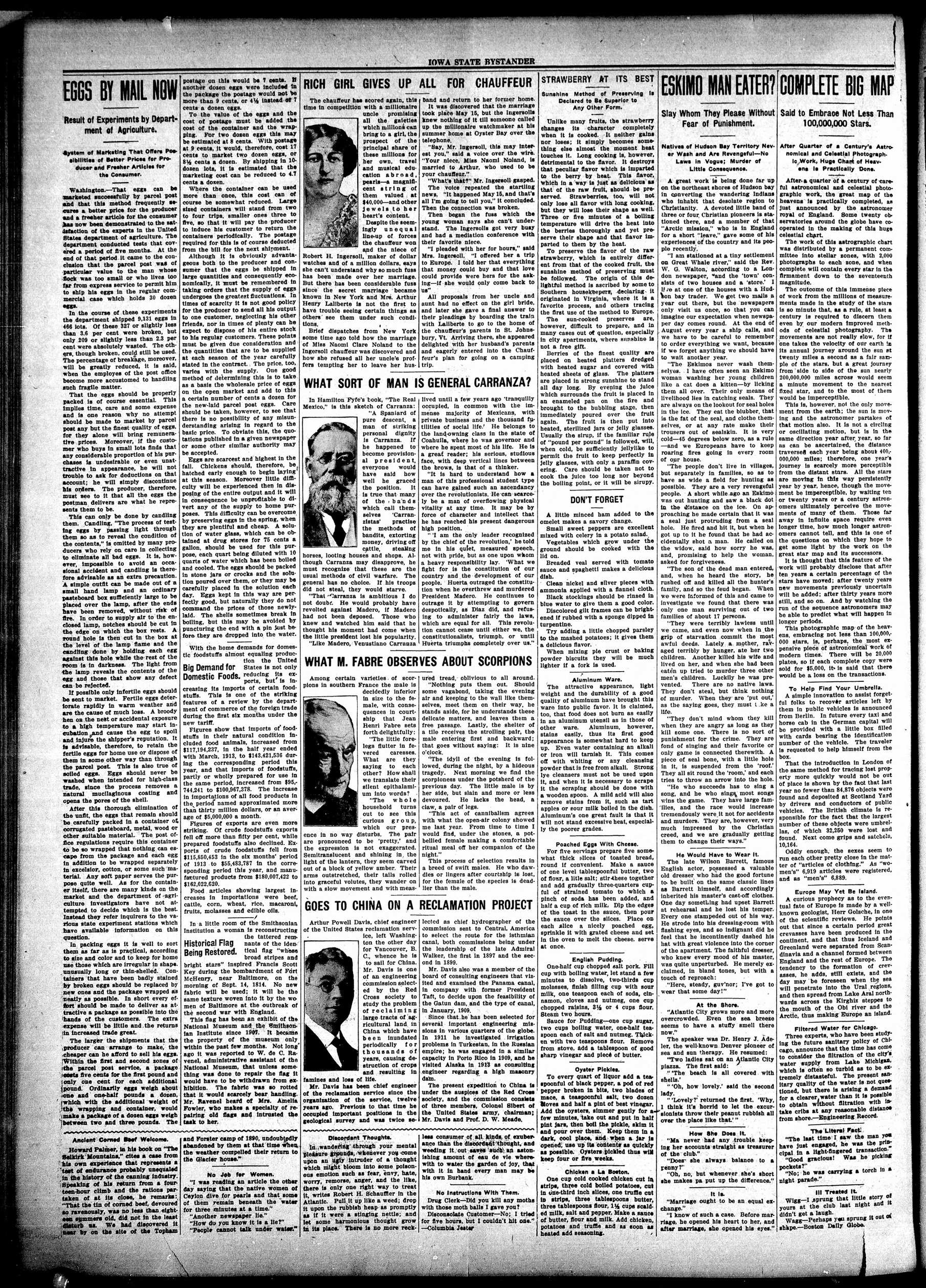
IOWA STATE BYSTANDER
band and return to her former home.
It was discovered that the marriage took place May 15, but the Ingersollers knew nothing of it till someone called up the millionaire watchmaker at his summer home at Oyster Bay over the telephone.
"Say, Mr. Ingersoll, this may interest you," said a voice over the wire. "Your niece, Miss Naomi Noland, is married to Arthur, who used to be your chauffer."
"What's that?" Mr. Ingersoll gasped. The voice repeated the startling news. "It happened May 15, and that's all I'm going to tell you." It concluded. Then the connection was broken. Then began the search, which the woman was she can't understand. The Ingersollers got very busy and had a mediation conference with their favorite niece.
"I pleaded with her for hours," said Mrs. Ingersoll. "I offered her a trip to Europe. I told her that everything that money could buy and that love could provide were hers for the asking—if she would only come back to us."
All proposals from her uncle and aunt had no effect on the girl bride, and later she gave a final answer to their pleadings by boarding the train with Laliberté to go to the home of the chauffeur's parents in St. Johns, Florida, where the proposed delighted with her husband's parents and eagerly entered into the Chauffeur's plan for going on a camping trip.
lived until a few years ago 'tranquilly occupied, in common with the immense majority of Mexicans, with private business and the thousand facilities of social life.' He belongs to the land-owning class in the state of Coahuila, where he was governor and where he spent much time in his serious, studious face, with deep vertical lines between the brows, is that of a thinker. "It is hard to understand how a man of this professional student type can have gained such an ascendancy over the revolutionists. He can searcely be a man of overflowing physical vitality at any time. It may be by chance, but that he has reached his present dangerous high position.
"I am the only leader recognized by the chief of the revolution," he told me in his quiet, measured speech, not with pride, but as one upon whom a heavy responsibility lay. "What we fight for is the constitution of our country and the development of our people. Huerta outraged the constitution when he overthrew and murdered President Madero. He continues to outrage the constitution, as well as, as Diaz did, and refusing to administer fairly the laws, which are equal for all. This revolution cannot cease until either we, the constitutionalists, triumph, or until Huerta triumphs completely over us."
ured tread, oblivious to all around.
"Nothing puts them out. Should some vagabond, taking the evening air and keeping to the wall like themselves, meet them on their way, he stands aside, for he understands these delicate matters, and leaves them a free passage. Lastly, the shelter of a tile receives the strolling pair, the male entering first and backward; that goes without saying: It is nine o'clock.
"The idyll of the evening is followed, during the night, by a hideous tragedy. Next morning we find the scorpionless under the potsherd of the previous day. The little male is by her side, but slain and more or less devoured. He lacks the head, a claw, a palpation. The act of cannibalism agrees with what the open-air colony showed me last year. From time to time I would find, under the stones, a potbellied female making a comfortable ritual meal off her companion of the night."
This process of selection results in a breed of swift males. He who dawds or lingers after courtship is dead, and the species is deadier than the male.
lected as chief hydrographer of the commission sent to Central, America to select the route for the isthman canal, both commissions being under the leadership of the late Admiral Walker, the first in 1897 and the second in 1899.
Mr. Davis also was a member of the board of consulting engineers that visited and examined the Panama canal, the Panama Canal Bridge, the Taft, to decide upon the feasibility of the Gatun dam, and the type of canal, in January, 1909.
Since that he has been selected for several important engineering missions in various quarters of the globe. In 1911 he investigated irrigation problems in Turkistan, in the Russian empire; he was engaged in a similar capacity in Porto Rico in 1909, and he visited Alaska in 1913 as consulting engineer regarding a high masonry dam.
The present expedition to China is under the auspise of the Red Cross society, and the commission consists of three members, Colonel Silbert of the United States army, chairman; Mr. Davies and Prof. D. W. Meade.
less consumer of all kinds, of exuber-
ance than the discordant thought, and
weeding it out save such an aston-
ishing amount of eau de vie where-
with to water the garden of joy, that
with it in hand every man may be
his own Burbank.
No Instructions With Them
No Instructions With Them.
mothers with those moths both I gave you?
Disconcerted Customer--No! I tried
to couch, but I couldn't hit one."
-Columbia
STRAWBERRY AT ITS BEST
Sunshine Method of Preserving is Declared to Be Superior to Any Other Form.
Unlike many fruits, the strawberry changes its character completely when it is cooked. It neither gains nor loses; it simply becomes something else almost the moment heat touches it. Long cooking is, however, detrimental to the flavor. It destroys that peculiar flavor which is imparted to the berry by heat. This flavor, which in a way is just as delicious as that of the raw fruit, should be preserved. Strawberries, too, will not only lose all flavor with long cooking but will still have their shape as well. Three or five minutes of a boiling temperature will drive the heat into the berries thoroughly and yet preserve their shape and that flavor imparted to them by the heat.
To preserve the flavor of the raw strawberry, which is entirely different from that of the cooked fruit, the sunshine method of preserving must be followed. The origin of this delightful method is ascribed by some to Southern housekeepers, declaring it originated in Virginia, where it is a favorite process, and others teaching the first use of the method to Europe. The sunshine method preserves are, however, difficult to prepare, and in many cases out of question, especially in city apartments, where sunshine is not a free gift.
Berries of the finest quality are placed on heated platters dredged with heated sugar and covered with heated sheets of glass. The platters are placed in strong sunshine to stand all day long. By evening the juice which surrounds the fruit is placed in an enameled pan on the fire and brought to the bubbling stage, then immediately poured over the fruit again. The fruit is then put into heated, sterilized jars or jelly glasses. Usually the sirup, if the familiar rule of "pound per pound" is followed, will, when cold, be sufficiently jellylike to permit the fruit to keep perfectly in jelly glasses, with only a paraffin cover. Care should be taken not to cook the juice too long nor beyond the boiling point, or it will be sirup.
DON'T FORGET
A little minced ham added to the omelet makes a savory change. Small sweet peppers are excellent mixed with celery in a potato salad. Vegetables which grow under the ground should be cooked with the lid on. Added veal served with tomato sauce and spaghetti makes a delicious dish. Clean nickel and silver pieces with ammonia applied with a flannel cloth. Black stockings should be rinsed in
blue water to give them a good color.
Discored gilt frames can be brightened if rubbed with a sponge dipped in turpentine.
Try adding a little chopped parsley to the mashed potatoes; it gives them a delicious flavor.
When mixing pie crust or baking powder biscuits they will be much lighter if a fork is used.
Aluminum Ware
The attractive appearance, light weight and the durability of a good quality of aluminum have brought this ware into public favor. It is claimed, too, that food does not burn as easily in an aluminum utensil as in those of other ware. Aluminum, however, stains easily. It is great for some somewhat hard to keep up. Even water containing an alkali or iron will tarnish it. This comes off with whiting or any any cleansing powder that is free from alkali. Strongly cleansers must not be used upon it, and when it is necessary to scrape it the scraping should be done with a wooden spoon. A mild acid will also remove stains. Apples or sour milk bolted in the dish. Aluminum's one great fault is that it will not stand excessive heat, especially the poorer grades.
Poached Eggs With Cheese
For five servings prepare five somewhat thick slices of toasted bread, round if convenient. Make a sauce of one level tablespoonful butter, two of flour, a little salt; stir these together and add gradually three-quarter cupful of strained tomato to which a pinch of soda has been added, and half a cup of rich milk. Dip the edges of the toast in the sauce then pour on the slices. Place on each slice a nicely poached egg, sprinkle it with grated cheese and set in the oven to melt the cheese. serve at once.
English Pudding
One-half cup chopped salt pork. Fill cup with boiling water, let stand a few minutes to dissolve, two-thirds cup molasses, finish filling cup with sour milk, one teaspoon each of soda, chanion, cloves and nutmeg, one cup chopped raisins, $3\frac{1}{2}$ or 4 cups flour. Steam two hours.
Sauce for Pudding—one cup sugar, two cups boiling water, one-half teaspoon each of salt and nutmeg. Thicken with two teaspoons flour. Remove from stove, add a tablepoon of good sharp vinegar and piece of butter.
Oyster Pickles.
To every quart of liquor add a teaspoonful of black pepper, a pod of red pepper broken in bits, two blades of mace, a teaspoonful salt, two dozen cloves and half a pint of best vinegar. Add the oysters, simmer gently for a few minutes, take out and put in half pint jars, then bath them, skim it with a spoon, then pour into a dark, cool place, and when a jar is opened, use up its contents as quickly as possible. Oysters pickled thus will keep four or five weeks.
Chicken a La Boston.
One cup cold cooked chicken cut in strips, three cold boiled potatoes, cut in one-third inch slices, one truffle cut in strips, three tablespoons butter, three tablespoons four, 1/4 cups scalded milk, salt and pepper. Make a sauce of chicken, potatoes and truffle and as soon as heated add seasoning.
Slay Whom They Please Without Fear of Punishment.
Natives of Hudson Bay Territory Never Wash and Are Revengeful—No Laws in Vogue; Murder of Little Consequence.
A great work is being done far up on the northeast shores of Hudson bay in converting the wandering Indians who inhabit that desolate region to Christianity. A devoted little band of three or four Christian ploneers is stationed there, and a member of that "Arctic mission," who is in England for a short "leave," gave some of his experiences of the country and its people recently.
"I am stationed at a tiny settlement on Great Whale river," said the Rev. W. G. Walton, according to a London newspaper, "and the 'town' consists of two houses and a 'store.' I live at one of the houses with a Hudson bay trader. We get two mails a year out there, but the newspapers only visit us once, so that you can imagine our expectation when newspaper day comes round. At the end of August every year a ship calls, and we have to be careful to remember to order everything we want, because if we forget anything we should have to wait another year.
"The Eskimos never wash them selves. I have often seen an Eskimo woman washing her young children like a cat does a kitten—by licking them all over. Their only means of livelihood lies in catching seals. They are always on the lookout for seal holes in the ice. They eat the blubber, that is the fat of the seal, and clothe them selves, or at any time, make their own sealings of sealskin. It is very cold—45 degrees below zero, as a rule—and we Europeans have to keep roaring fires going in every room of our house.
"The people don't live in villages, but separately in families, so as to have as wide a field for hunting as possible. They are a very revengeful people. A short while ago an Eskimo was out hunting and saw a black dot in the distance on the ice. On ap proaching he made certain that it was a seal just protruding from a seal hole. He fired and hit him. He said he had accidentally shot a man. He called on the widow, said how sorry he was, and promising to help the woman, asked for forgiveness.
"The son of the dead man entered, and, when he heard the story, he rushed off and killed all the hunter's family, and so the feud began. When we were informed of this and came to investigate we found that there was only one man surviving out of two familes of about 100. He then barely awitness until we came, and even now when in the grip of starvation commit the most awful deeds. Lately a mother, ravaged terribly by hunger, ate her two children. Another killed his wife and lived on, and when she had been eaten up tried to murder three other men's children. Luckily he was prevented. There are no native laws. They don't steal, but think nothing of murder. When they are 'put out', the saying goes, they must 'be a life.'
"They don't mind whom they kill when they are angry as long as they kill some one. There is no sort of punishment for the crime. They are fond of singing and their favorite or only game is connected therewith. A piece of seal bone, with a little hole in it, is suspended from the roof. They all sit round the 'room', and each tries to throw an arrow into the hole. "He who succeeds has a long time to win, and the most tough wins the game. They have large families, and the race would increase tremendously were it not for accidents and murders. They are, however, very much impressed by the Christian creed, and we are gradually getting them to change their ways."
He Would Have to Wear It.
The late Wilson Barrett, famous English actor, possessed a valuable old dresser who had the good fortune to be built on the same classic lines as Barrett himself, and accordingly inherited his master's cast-off clothes. One day something had upset Barrett at rehearsal and he lost his temper. Every one stamped out of his way. He strode into his dressing-room with flashing eyes, and so indignant he feel that he incontinently dashed his hat with great violence into the corner of the apartment. The faithful dresser, who knew every mood of his master, was quite unperturbed. He merely exclaimed, in bland tones, but with a touch of reproach: "Here, steady, guv'nor; I've got to wear that day!"
At the Shore.
"Atlantic City grows more and more overcrowded. Even the sea breeze seems to have a stuffy smell there now."
The speaker was Dr. Henry J. Adeleer, the well-known Denver pioneer of sea and sun therapy. He resumed:
"Two ladies sat on an Atlantic City plaza. The first said:
"The beach is all covered with shells."
"Oh, how lovely," said the second lady.
"Lovely? returned the first. Why, I think it's horrid to let the excursionists throw their peanut rubbish all over the place like that."
How She Does It
"Ma never had any trouble keeping her accounts straight as treasurer of the club."
"Does she always balance to a penny?"
"Oh, no, but whenever she's short she makes pa put up the difference."
It is.
"Marriage ought to be an equal exchange." How of such a case. Before marriage he opened his heart to her, and after marriage he opened his syss."
Said to Embrace Not Less Than 100,000,000 Stars.
After Quarter of a Century's Astronomical and Celestial Photographic Work, Huge Chart of Heavens is Practically Done.
After a quarter of a century of careful astronomical and celestial photographic work, the great map of the heavens is practically completed, as just announced by the astronomer royal of England. Some twenty observatories around the globe have cooperated in the making of this huge celestial chart.
The work of this astrographic chart was distributed by a permanent committee into stellar zones, with 2,000 photographs to each zone, and when complete contain every star in the firmament down to the seventeenth magnitude.
The outcome of this immense piece of work from the millions of measurements made in the study of the stars is so minute that, as a rule, at least a century is required to discern them even by our modern improved methods of celestial photography. The movements are not really slow, for if one takes the velocity of our earth in its annual journey around the sun at twenty miles a second as a fair sample of the stars, but a great journey of 200,000,000 miles across would seem a minute movement to the nearest fixed star, and to the most of them would he imperceptible.
This is, however, not the only movement from the earth; the sun is moving and the astronomer partakes of that motion also. It is not a circling or oscillating motion, but is in the same direction year after year, so far as can be ascertained, the distance traversed each year being about 400,000,000 miles; therefore, one year's journey is scarcely more perceptible from the distant star. All the stars are moving in this way persistently year by year, hence, though the movement be imperceptible, by waiting ten or twenty years on the earth, they perfectly perceive the movements of many of them. Those far away in infinite space require even longer time, how much longer astronomers cannot tell, and this is one of the questions on which they hope to get some light by the work on the great star map and its successors.
It is thought that this feature of the work will probably disclose that after ten years a certain percentage of the stars have moved; after twenty years new movements previously uncertain can be added; and after ten years still a certain percentage. And by watching the run of the sequence astronomers may be able to predict what will happen in longer periods.
This photographic map of the heavens, embracing not less than 100,000,000 stars, is, perhaps, the most expensive piece of astronomical equipment, but it will be 20,000 ploughed so if each complete copy was sold for $5,000, it is said that there would be a loss on the transactions.
To Help Find Your Umbrella
A simple innovation to assist forgetful folks to recover articles left by them in public vehicles is announced from Berlin. In future every taxi and horse cab in the German capital will be provided with a little box filled with cards bearing the identification number of the vehicle. The traveler is requested to help himself from the box.
That the introduction in London of the same method for tracing lost property more quickly would not be out of place is shown by the fact that last year no fewer than 84,876 objects were found and deposited at Scotland Yard by drivers and conductors of public vehicles. The British climate is responsible for the fact that the largest number of these objects were umbrellas, of which 32,250 were lost and found. Next come grips and satchels, 10,184.
Only enough, the sacks seem to run each other pretty close in the matter of "articles of clothing." As "women's" 6,919 articles were registered, and as "men's" 6,889.
Europe May Yet Be Island
A curious prophecy as to the eventual fate of Europe is made by a well-known geologist, Herr Golache, in one of the scientific reviews. He points out that since a certain period great crevasses have been produced in the continent, and that thus Iceland and Greenland were separated from Scandinavia and a channel formed between England and the rest of Europe. The tendency to the formation of crevasses, he adds, still exists, and the day may be foreseen when the Ural regions, and then spread from Lake Aral northwards across the Kirkghz steps to the mouth of the Obi river and the Arctic, thus making Europe an island.
Filtered Water for Chicago.
Three experts, who have been studying the future sanitary policy of Chicago, announce that the time has come to consider the filtration of the city's water supply from Lake Michigan, which is often so turbid as to be tremendely distasteful. The sanitary quality of the water is not questioned, but the water is arising a demand for water, water than it is possible to obtain without filtration with intake crisbs at any reasonable distance from shore--Engineering Record.
The Literal Fact
"The last time I saw the man you have just engaged, he was the principal in a light-fingered transaction." "Good gracious! Was he picking pockets?" "No; he was carrying a torch in a
III Treated It.
Wigg-I sprung that little story of yours at the club last night and it didn't get a laugh.
Wagg- Perhaps yon sprung it out of
china. Donaly Dalfy Globe.
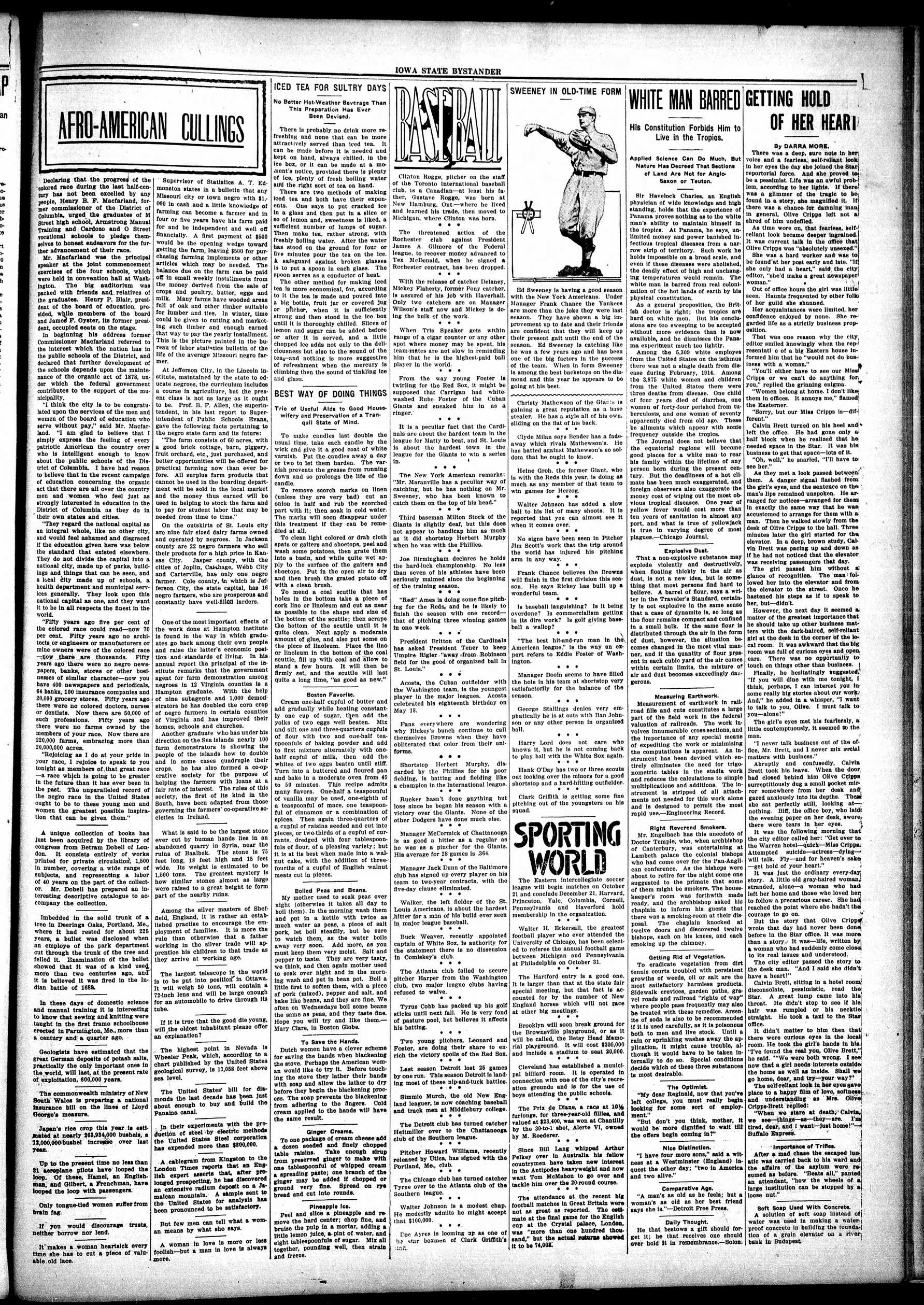
AFRO-AMERICAN CULLINGS
Declaring that the progress of the colored race during the last half-century has not been excelled by any people, Henry B. F. Macfarland, former commissioner of the District of Columbia, urged the graduates of M Street high school, Armstrong Manual School, and occasional schools to pledge themselves to honest endeavors for the further advancement of their race.
Mr. Macfarland was the principal speaker at the joint commencement exercises of the four schools, which were held in the convention hall at Washington. The big auditorium was packed with friends and relatives of the graduates. Henry P. Blair, president of the board of education, presided, while members of the board and James F. Oyster, its former president, occupied seats on the stage. In beginning his address former Commissioner Macfarland referred to the interest which the nation has in the public schools of the District, and declared further development of schools depends upon the finance of the organic act of 1878, under which the federal government contributes to the support of the municipality.
"I think the city is to be congratulated upon the services of the men and women of the board of education who serve without pay," said Mr. MacFarland. "I am glad to believe that I simply express the feeling of every patriotic American the country over who is intelligent enough to know about the public schools of the District of Columbia. I have had reason to believe that in the recent campaign of education concerning the organic sciences of the country men and women who feel strongly interested in education in the District of Columbia as they do in their own states and cities.
"They regard the national capital as an integral whole, like no other city, and would feel ashamed and disgraced if the education given here was below the standard that existed elsewhere. They do not divide the capital into a national city, made up of parks, buildings and things that can be seen, and a local city made up of schools, a health department and municipal services generally. They look upon this national capital as one, and they want it to be in all respects the finest in the world.
"Fifty years ago five per cent of the colored race could read—now 70 per cent. Fifty years ago no architects or engineers or manufacturers or mine owners were of the colored race—now there are thousands. Fifty years ago there were no negro newspapers, banks, stores or other businesses of similar character—now you have 400 newspapers and periodicals, 64 banks, 100 insurance companies and 20,000 grocery stores. Fifty years ago there were no colored doctors, nurses or dentists. Now there are 50,000 of such professions. Fifty years ago there were no farms owned by the farmers of your race. Now there are 220,000 farms, embracing more than 20,000 acres.
"Rejoicing I do at your pride in your race, I reslieve to speak to you tonight as members of that great race—a race which is going to be greater in the future than it has ever been in the past. The unparalleled record of the negro race in the United States ought to be to these young men and women the greatest possible inspiration that can be given them."
A unique collection of books has just been acquired by the library of congress from Betram Dobell of London. It consists entirely of works printed for private circulation, 1,500 in number, covering a wide range of subjects, and representing a labor of 40 years on the part of the collector. Mr. Dobell has prepared an interesting descriptive catalogue to accompany the collection.
Imbedded in the solid trunk of a tree in Deerings Oaks, Portland Me, where it had rested about 225 years after it was disclosed when an employee of the park department cut through the trunk of the tree and felled it. Examination of the bullet showed that it was of a kind used more than two centuries ago, and it be believed it was fired in the Indian battle of 1684.
In these days of domestic science and manual training it is interesting to know that sewing and knitting were taught in the first frame schoolhouse erected in Farmington, Me., more than a century and a quarter ago.
Geologists have estimated that the great German deposits of potash salts, practically the only important ones in the world, will last, at the present rate of exploitation, 600,000 years.
The commonwealth ministry of New South Wales is preparing a national insurance bill on the lines of Lloyd George's measure.
Japan's rice crop this year is estimated at nearly 263,934,000 bushels, a 12,000,000 bushel increase over last year.
Up to the present time no less than 81 acreplane pilots have looped the loop. Of these, Hamel, an Englishman, and Gilbert, a Frenchman, have looped the loop with passengers.
Only tongue-tied women suffer from brain fag.
If you would discourage trusts, neither borrow nor lend.
It makes a woman heartstick every time she has to cut a piece of valuable old lace.
Supervisor of Statistics A. T. Edmonston states in a bulletin that any Missouri city or town negro with $1,000 in cash and a little knowledge of farming can become a farmer and in four or five years have his farm paid for and be independent and well off financially. A first payment of $500 would be the opening edge toward getting the farm, leaving $500 for purchasing farming implements or other articles which may be needed. The balance due on the farm can be paid in small weekly installments from the money derived from the sale of crop and poultry, butter, eggs and milk. Farmes have wooded areas full of oak and other timber suitable for fumber and tice. In summer, could be given to cutting and marketing such timber and enough earned that way to pay the yearly installment. This is the picture painted in the bureau of labor statistics bulletin of the life of the average Missouri negro farmer.
At Jefferson City, in the Lincoln Institute, maintained by the state to educate negroes, the curriculum includes a course in agriculture, but the present class is not as large as it ought to be. Prof. B. F. Allen, the superintendent, in his last report to Superintendent of Public Schools Evans, gave the following facts pertaining to the negro state farm and its future: "The farm consists of 60 acres, with a good brick cottage, barn, piggery, fruit orchard, etc., just purchased, and better opportunities will be offered for practical farming now than ever before. All surplus farm products that cannot be used in the boarding department will be sold in the local market and the money thus earned will be used in helping to stock the farm and to pay for student labor that may be needed from time to time."
On the outskirts of St. Louis city are nine fair sized dairy farms owned and operated by negroes. In Jackson county are 22 negro farmers who sell their products for a high price in Kansas City. Jasper county, with the cities of Joplin, Carthage, Webb City and Carterville, has only one negro farmer. Cole county, in which is Jefferson City, the state capital, has 16 negro farmers, who are prosperous and constantly have well-filled larders.
---
One of the most important effects of the work done at Hampton institute is found in the way in which graduates go back among their own people and raise the latter's economic position and standards of living. In his annual report the principal of the institute remarks that the government agent for farm demonstration among negroes in 12 Virginia counties is a Hampton graduate. With the help of nine subagents and 1,000 demonstrators he has doubled the corn crop of negro farmers in certain counties of Virginia and has improved their homes, schools and churches. Another graduate who has under his direction on the Sea Island is nearly 100 farm demonstrators, showing the people of islands how to double and in some cases quadruple their crops, he has also formed a co-operative society for the purpose of helping the farmers with loans at a fair rate of interest. The rules of this society, the first of its kind in the South, have been adapted from those governing the farmers' co-operative societies in Ireland.
What is said to be the largest stone ever cut by human hands lies in an abandoned quarry in Syria, near the ruins of Baalbek. The stone is 75 feet long, 18 feet high and 15 feet wide. Its weight is estimated to be 1,500 tons. The greatest mystery is how similar stones almost as large were raised to a great height to form part of the nearby ruins.
Among the silver masters of Sheffield, England, it is rather an established practise to encourage the employment of families. It is more the rule than otherwise that a father working in the silver trade will apprentice his children to that trade as they arrive at working age.
The largest telescope in the world is to be put into position in Ottawa. It will weigh 50 tons, will contain a 72-inch lens and will be large enough for an automobile to drive through its tube.
If it is true that the good die young, will the oldest inhabitant please offer an explanation?
The highest point in Nevada is Wheeler Peak, which, according to a chart published by the United States geological survey, is 13,058 feet above sea level.
The United States' bill for diamonds the last decade has been just about enough to buy and build the Panama canal.
In their experiments with the production of steel by electric methods the United States Steel corporation has expended more than $800,000.
A cablegram from Kingston to the London Times reports that an English expert asserts that, after prolonged prospecting, he has discovered an extensive radium deposit on a Jamaican mountain. A sample sent to the United States for analysis has been pronounced to be satisfactory.
But few men can tell what a woman means by what she says.
A woman in love is more or less foolish—but a man in love is always more.
ICED TEA FOR SULTRY DAYS
No Better Hot-Weather Beverage Than This Preparation Has Ever Been Devised.
There is probably no drink more refreshing and none that can be more attractively served than ice tea. It can be made before it is needed and kept on hand, always chilled, in the ice box, or it can be made at a moment's notice, provided there is plenty of ice, plenty of fresh boiling water and another kind of tea on hand. There are two ways to prepare ice tea and both have their exponents. One says to put cracked ice in a glass and then put in a slice or so of lemon and, sweetness is liked, a sufficient number of lumps of sugar. Then make tea, rather strong, with freshly boiling water. After the water has stood on the ground for four or five minutes pour the tea on the ice. A safeguard against broken glasses is to use a moon-scoop conductor of heat.
The other method for making ice tea is more economical, for, according to it the tea is made and poured into a big bottle, fruit jar or covered jar or pichter, when it is sufficiently strong and then stood in the ice box until it is thoroughly chilled. Slices of lemon and sugar can be added before or after it is served, and a little chopped ice adds not only to the flavor but also to the sound of the tea—and the suggestive of refreshment when the mercury is climbing then the sound of tinkling ice and glass.
BEST WAY OF DOING THINGS
Trio of Useful Alds to Good House wifery and Preservation of a Tranquil State of Mind.
To make candles last double the usual time, take each candle by the wick and give it a good coat of white varnish. Put the candles away a day or two to let them harden. The varnish prevents the grease from running down and so prolongs the life of the candle.
To remove scorch marks on linen (unless they are very bad) cut an onlon in half and rub the scorched part with it; then soak in cold water. The marks will soon disappear under this treatment if they can be remedied at all.
To clean light colored or drab cloth or gaters and sheetets, peel and wate them once, then grate them into a burner, and while quite wet apply to the surface of the gaters and sheetets. Put in the open air to dry and then brush the grated potato off with a clean brush.
To mend a coal scuttle that has holes in the bottom take a piece of cork lino or linoleum and cut as near as possible to the shape and size of the bottom of the scuttle; then scrape the bottom of the scuttle until it is quite clean. Next apply a moderate amount of glue, and also put some on the piece of linoleum. Place the lino or linoleum in the bottom of the coal scuttle, fill up with coal and allow to stand a few hours. It will then be firmly set, and the scuttle will last quite a long time, "as good as new."
Boston Favorite.
Cream one-half cupful of butter and add gradually while heating constantly one cup of sugar, then add the yolks of two eggs well beaten. Mix and sift one and three-quarter cups of flour with two and half teaspoonfuls of baking powder and add to first mixture alternately with one teaspoonful of flour and whites of two eggs beaten until still Turn into a buttered and floured pan and bake in a moderate oven from 45 to 50 minutes. This recipe admits many flavors. One-half a teaspoonful of vanilla may be used, one-eighth of a teaspoonful of mace, one teaspoonful of cinnamon or a combination of spices. Then again three-quarters of a cupful of raisins seeded and cut into pieces, or two-thirds of a cupful of curd or four tablespoons of flour, of a pleasing variety; but it is at its best when made into a walnut cake, with the addition of three-fourths of a cupful of English walnut meats cut in pieces.
Bolled Peas and Beans.
My mother used to soak peas over night (otherwise it takes all day to boil them). In the morning wash them and put in a kettle with twice as much water as peas, a piece of salt pork, let boil steadily, but be sure to watch them, as the water boils away very soon. Add more, as you must keep them very moist. Salt and pepper to taste. They are very tasty, we think, and then again mother used to soak over night and in the morning wash and put in bean pot. Boll a little first to soften them, with a piece of pork (mixed), pepper and salt, and bake like beans, and they are fine. We often on Wednesdays boll some beans the same as peas, and they taste fine. Hope you will try and like them—Mary Clare, in Boston Globe.
To Save the Hands
Dutch women have a clever scheme for saving the hands when blackening the stove. Perhaps the American woman would like to try it. Before touching the stove they lather their hands with soap and with the ladder to blacken before they touch the blackening process. Soap prevents the blackening from adhering to the fingers. Cold cream applied to the hands will have the same result.
Ginger Creams.
To one package of cream cheese add a dozen seeded and finely chopped table raisins. Take enough sirup from preserved ginger to make with one tablespoonful of the spreading powder one branch of the ginger be added if chopped or around very fine. Spread on rye bread and cut into rounds.
Pineapple Ice.
Peel and slice a pineapple and remove the hard center; chop fine, and bruise the pulp in a mortar, adding a little lemon juice, a little eight tablespoonfuls of sugar. Mix all together, ground well, then strain freeze.
IOWA STATE BYSTANDER
BASEBALL
Clinton Rogge, pitcher on the staff of the Toronto international baseball club, is a Canadian—at least his father, Gustave Rogge, was born at New Hamburg. Ont.—where he lived and learned his trade, then moved to Michigan, where Clinton was born.
---
The threatened action of the Rochester club against President James A. Gilmore of the Federal league, to recover money advanced to Tex McDonald, when he signed a Rochester contract, has been dropped. With the release of catcher Delaney, Mickey Flanhery, former Pony catcher, is assured of his job with Haverhall. Only two catchers are on Manager Wilson's staff now and Mickey is doing the bulk of the work.
---
When Tris Speaker gets within range of a cigar counter or any other spot where money may be spent, his team-mates are not slow in reminding him that he is the highest-paid ball player in the world.
From the way young Foster is twirling for the Cube Sox, it might be supposed that Carrie Giants had white-washed Rube Foster of the Cuban Giants and snaked him in as a ringer.
. . .
It is a peculiar fact that the Cardinals are about the hardest team in the league for Matty to beat, and St. Louis is about the hardest town in the league for the Giants to win a series in.
---
The New York American remarks: "Mr. Maranville has a peculiar way of catching, but he has nothing on Mr. Maranville. He can't catch them on the top of his head."
---
Third baseman Milton Stock of the Giants is slightly deaf, but this does not appear to handicap him as much as it did shortstop Herbert Murphy when he was with the Phillies.
Joe Birmingham declares he holds the hard-luck championship. No less than seven of his athletes have been seriously maimed since the beginning of the training season.
"Red" Ames is doing some fine pitching for the Reds, and he is likely to finish the season with one record—that of pitching three winning games in one week.
---
President Britton of the Cardinals has asked President Tener to keep Umpire Rigler "away from Robinson of the good of organized ball in St. Louis."
---
Acosta, the Cuban outfielder with the Washington team, is the youngest player in the major leagues. Acosta celebrated his eighteenth birthday on May 18.
Fans everywhere are wondering why Rickey's bunch continue to call themselves Browns when they have characterized that color from their uniforms.
---
Shortstop Herbert Murphy, discarded by the Philfies for his poor fielding, is batting and fielding like a champion in the international league.
Rucker hasn't done anything but lose since he began his season with a victory over the Giants. None of the other Dodgers have done much else.
Manager McCormick of Chattanooga is as good a hitter as a regular as he was as a pincher for the Giants. His average for 28 games is .364.
Manager Jack Dunn of the Baltimore club has signed up every player on his team to two-year contracts, with the five-day clause eliminated.
Walker, the left fielder of the St. Louis Americans, is about the hardest hitter for a man of his build ever seen in major league baseball.
Buck Weaver, recently appointed captain of White Sox, is authority for the statement there is no dissension in Comiskey's club.
The Atlanta club failed to secure pitcher Harper from the Washington club, two major league clubs having refused to waive.
Tyrus Cobb has packed up his golf sticks until next fall. He is very fond of pasture pool, but believes it affects his batting.
Two young pitchers, Leonard and Foster, are doing their share to enrich the victory spoils of the Red Sox.
Last season Detroit lost 25 games by one run. This season Detroit is landing most of these nip-and-tuck battles.
Simmie Murch, the old New England league, is now coaching baseball and track men at Middlebury college.
The Detroit club has turned catcher Heitmiller over to the Chattanooga club of the Southern league.
Pitcher Howard Williams, recently released by Utica, has signed with the Portland, Me, club.
The Chicago club has turned catcher Tyree over to the Atlanta club of the Southern league.
Walter Johnson is a modest chap. He modestly admits he might accept that $100,000.
Doc Aryes is looming up as one of the star boxmen of Clark Griffith's h
1
Ed Sweeney is having a good season with the New York Americans. Under Manager Frank Chance the Yankees are more than the Joke they were last season. They have shown a big improvement up to date and their friends are confident that they will keep up their present gait until the end of the season. Ed Sweeney is catching like he was a few years ago and has been one of the big factors in the success of the team. When in form Sweeney is among the best backups on the diamond and this year he appears to be going at his best.
Christy Mathewson of the Glair's is gaining a great reputation as a base stealer. He has a style all of his own, sliding on the flat of his back.
Clyde Milan says Bender has a fade away which rivals Mathewson's. He has batted against Mathewson's so seldom that he ought to know.
Heine Groh, the former Giant, who is with the Reds this year, is doing as much as any member of that team to win games for Herzog.
Walter Johnson has added a slow ball to his list of many shoots. It is reported that you can almost see it when it comes over.
No signs have been seen in Pitcher Jim Scott's work that the trip around the world has injured his pitching arm in any way.
Frank Chance believes the Browns will finish in the first division this season. He says Rickey has built up a wonderful team.
Is baseball languishing? Is it being overdone? Is commercialism getting in its dire work? Is golf giving baseball a wallop?
"The best hit-and-run man in the American league." is the way an expert refers to Eddie Foster of Washington.
Manager Dooin seems to have filled the hole in his team at shortstop very satisfactorily for the balance of the season.
George Stallings denies very emphatically he is at outs with Ban Johnson or any other person in organized ball.
---
Harry Lord does not care who knows it, but he is not coming back to play ball with the White Sox again.
Hank O'Day has two or three scouts out looking over the minors for a good shortstop and a hard-hitting outfielder.
Clark Griffith is getting some fine pitching out of the youngsters on his squad.
SPORTING WORLD
The Eastern intercollegiate soccer league will begin matches on October 21 and conclude December 21. Harvard Princeton, Yale, Columbia, Cornell Pennsylvania and Haverford hold membership in the organization.
Walter H. Eckersall, the greatest football player who ever attended the University of Chicago, has been selected to referee the annual football game between Michigan and Pennsylvania at Philadelphia on October 31.
The Hartford entry is a good one. It is larger than that at the state fair special meeting, but that fact is accounted for by the number of New England horses who will not race at other big meetings.
Brooklyn will soon break ground for the Brownsville playground, or as it will be called, the Betsy Bay Memorial playground. It will cost $200,000 and include a stadium to seat 20,000.
Cleveland has established a municipal billboard room. It is operated in connection with one of the city's recreation ground and is for the use of boys attending the public schools.
The Prix de Diane, a race at 10% furlings, for three-year-old fillies, and valued at $23,400, was won at Chantilly by the 30-to-1 shot, Alerte VI, owned by M. Roederer.
Since Bill Lang whipped Arthur Pelkey over in Australia his fellow countrymen have taken new interest in the Antipodes heavyweight and now want Tom McMahon to go over and tackle him over the 20-round course.
The attendance at the recent big football matches in Great Britain were not as high reported. The estimate at the final game for the English cup at the Crystal palace, London, "more than one hundred thousand," but the actual returns showed it to be 74,003.
WHITE MAN BARRED
His Constitution Forbids Him to Live in the Tropos.
Applied Science Can Do Much, But Nature Has Decreed That Sections of Land Are Not for Anglo-Saxon or Teuton.
Sir Havelock Charles, an English physician of wide knowledge and high standing, holds that the experience of Panama proves nothing as to the white man's ability to maintain himself in the tropics. At Panama, he says, unlimited money and power banished infections tropical diseases from a narrow area, but such work holds impossible on a broad scale, and even if these diseases were abolished, the deadly effect of high and unchanging temperatures would remain. The white man is barred from real colonization of the hot lands of earth by his physical constitution.
As a general proposition, the British doctor is right; the tropics are hard on white men. But his conclusions are too sweeping to be accepted without more evidence than is now available, and he dismisses the Panama experiment much too lightly.
Among the 5,309 white employees from the United States on the isthmus there was not a single death from disease during February, 1914. Among the $375 white women and children from the United States there were three deaths from disease. One child of four years died of diarrhea, one woman of forty-four perished from tumour. Another apparently died from old age. These be aliments which appear with some frequency outside the tropics. The Journal does not believe that the equatorial regions will become good places for a white man to rear his family within the lifetime of any person born during the present century. But the deadness of a hot climate has been much exaggerated, and foreign observers also exaggerate the money cost of wiping out the most obvious tropical disease. One year of ten years of sanitation in almost any port, and what is true of yellowjack is true in varying degree of most plagues.-Chicago Journal.
Explosive Dust.
That a non-explosive substance may explode violently and destructively, when floating thickly in the air as dust, is not a new idea, but is something that most persons find hard to believe. A barrel of flour, says a writer in the Traveler's Standard, certainly is not explosive in the same sense that a case of dynamite is, so long as the flour remains compact and confined in a small bulk. If the same flour is distributed through the air of dust, however, the situation becomes increased in the most vital manner, and if the quantity of flour present in each cubic yard of the air comes within certain limits, the mixture of air and dust becomes exceedingly dangerous.
Measuring Earthwork
Measurement of earthwork in railroad file and cuts constitutes a large part of the field work in the federal valuation of railroads. The work involves innumerable cross-sections, and the importance of any special means of expediting the work or minimizing the computations is apparent. An instrument has been devised which entirely eliminates the need for nometric tables and work and simplifies calculations to simple multiplications and additions. The instrument is stripped of all attachments not needed for this work alone and is designed to permit the most rapid use—Engineering Record.
Right Reverend Smokers
Mr. Engelbach has this anecdote of Doctor Temple, who, when archbishop of Canterbury, was entertaining at Lambeth palace the colonial bishops who had come over for the Pan-Anglican conference. As the bishops were about to retire for the night some one suggested to the primate that some of them might be smokers. The housekeeper's room was forthwith made ready, and the archbishop asked his chaplain to inform him that there was smoke from their disarray. The chaplain knocked at twelve doors and discovered twelve bishops, each on his knees, and each smoking up the chimney.
Getting Bid of Vegetation
To eradicate vegetation from dirt tennis courts troubled with persistent growths of weeds, oil or salt are the most satisfactory harmless products. Sidewalk crevices, garden paths, gravel roads and railroad "rights of way" where people pass frequently may also be treated with these remedies. Arsenite of soda is used to be recommended if it is used carefully, as it is poisonous both to men and live stock. Until a rain or spritz cleans away the application, it might cause trouble, although it would have to be taken intentionally to do so. Special conditions decide which of these three substances is most desirable.
The Optimist.
"My dear Reginald, now that you've left college, you must really begin looking for some sort of employment."
"But don't you think, mother, it would be better, wait till the baby comes in."
Nice Distinction.
"I have four more sons," said a wife ness at a Westminster (England) inquest the other day; "two in America and two alive."
Comparative Age.
"A man's as old as he feels; but a woman's as young as she feels. Who is she is?" Detroit Free Press.
Daily Thought
Bartley Maughan
He that bestows a gift should forget it; he that receives one should ever hold it in remembrance.-Solon.
GETTING HOLD OF HER HEART
By DARRA MORE
There was a deep, sure note in her voice and a fearless, self-reliant look in her eyes the day she joined the Star reportorial force. And she proved to be a pessimist. Life was an awful problem, according to her lights. If there was a glimmer of the tragic to be found in a story, she magnified it. If there was a chance for damming man in general, Olive Cripps left not a shred of him undefiled.
As time wore on, that fearless, self-reliant look became deeper ingrained. It was current talk in the office that Olive Cripps was "absolutely unsexed." She was a hard worker and was to be found at her post early and迟. "If she only had a heart," said the city woman. "she'd make a great newspaper woman."
Out of office hours the girl was little seen. Haunts frequented by other folks of her guild she shunned.
Her acquaintances were limited, her confidence enjoyed by none. She regarded life as a strictly business proposition.
That was one reason why the city, editor smiled knowingly when the representative of a big eastern house in the city would not do business with a "woman."
"You'll either have to see our Miss Cripps or we can't do anything for you," replied the grinning enigma. "Women belong at home. I don't like them in offices. It annoys me," famed the Easterner.
"Sorry, but our Miss Cripps is—different."
Calvin Brett turned on his heel and left the office. He had gone only a half block when he realized that he needed space in the Star. It was his business to get that space—lots of it. "Oh, well," he snarled, "I'll have to see her."
As they met a look passed between them. A danger signal flashed from the girl's eyes, and the sentence on the man's lips remained unspoken. He arranged for notices—arranged for them in exactly the same way that he was instructed to arrange for them with a man. Then he walked slowly from the desk of Olive Cripps to the hall. Three minutes later the girl started for the elevator. In a deep, brown study, Calvin Brett was pacing up and down as if he had not noticed that the elevator was receiving passengers that day.
The girl passed him without a glance of recognition. The man followed her into the elevator and from the elevator to the street. Once he hastened his steps as if to speak to her, but—didn't.
However, the next day it seemed a matter of the greatest importance that he should take up other business; matriarchal self-reliant girl at the desk in the corner of the local room. It was awkward that the big room was full of curious eyes and open ears. There was no opportunity to touch on things other than business.
Finally, he heastatingly suggested, "If you will dine with me tonight, I think, perhaps, I can interest you in some really big stories about our work. And," he added in a whisper, "I want to talk to you, Olive. I must talk to you—alone!" The girl's eyes met his fearlessly, a little contemptuously, it seemed to the man. "I never talk business out of the office, Mr. Brett, and I never mix social matters with business."
Abruptly and confusedly, Calvin Brett took his leave. When the door had closed behind him Olive Crippa surreptitiously dug a small pocket mirror somewhere from her desk and gazed anxiously into its depths. Then she sat perfectly still, looking at—nothing. Biff, the office boy, who laid the evening paper on her desk, swore there were tears in her eyes.
It was the following morning that the city editor called her: "Get over to the Warren hotel—quick—Miss Crippa Attempted suicide—actress—dying—will talk. Fly—and for heaven's sake—get hold of your heart."
It was just the ordinary everyday story. A little old gray-haired woman, stranded, alone—a woman who had left her home and those who loved her to follow a precarious career. She had reached the point where she hadn't the courage to go on.
But the point that Olive Crippa was that day had never been done before in the Star office. It was more than a story. It was—life, written by a woman who had suddenly come close to its real issues and understood.
The city editor passed the story to the desk man. "And I said she didn't have a heart!" Calvin Brett, sitting in a hotel room disconsole, pessimistic, read the Star. A great lump came into his throat. He didn't stop to see if his hair was rumped or his necktie straight. He took a taxi to the Star office. It didn't matter to him then that there were curious eyes in the local room. He took the girl's hands in his. "I've found the real you, Olive Brett," he said. "We were both wrong. I see now that a girl needs interests outside the home as well as inside. Shall we go home, dear, and try—your way?" The self-reliant look in her eyes gave place to a happy film of love, softness and understanding as Mrs. Olive Calvin. "When we stare at death, Calvin, we see—things—as they—are. I'm tired, dear, and I want—just home!"—Buffalo Express.
Importance of Trifles
After a mad chase the escaped lupatic was carried back to his ward and the affairs of the asylum were resumed as before. "Beats all," panted an attendant, "how the wheels of a large institution can be stopped by a loose nut."
Soft Soap Used With Concrete.
A solution of soft soap instead of water was used in making a waterproof concrete in building the foundation of a grain elevator on a river bank in Budapest.
RAPID PROGRESS IN MOUND CITY
BUSINESS IS GROWING FAST
In Culture Also Colored Population of St. Louis Is Showing the Way to Less Advanced Communities—Some of the Leaders of the Race and What They Are Doing.
By RALPH W. TYLER.
St. Louis—Visiting this city as a representative of and in the interest of the National Negro Business league. I naturally went into conditions here more carefully than the casual visitor. Next to Washington perhaps St. Louis has been famed most for her colored society. Its large number of colored schoolteachers, drawn from every section of the country and representing the best institutions of higher education, gives to the city a cultured community, as Washington's more than 500 colored teachers give to that city a superior air of culture.
Secure in their professions of culture and consciousness of much "higher" education, the colored people of St. Louis for years neglected that basic foundation for permanent and substantial progress—business. There is a revival on here now, a business revival, and, while not neglecting either culture or the so called "higher" education, the colored people of St. Louis, inspired by the achievements of colored business men in other cities and encouraged by its local Negro Business league, are branching out rapidly and successfully into various lines of activities.
One of the most complete men's furnishing stores conducted by colored men in the country is to be found here in this city, conducted by Clark & Smith. The largest and most modern steam laundry, owned and operated by colored men, is one of St. Louis' boasted colored co-operative enterprises. The drug stores, print shops, grocery stores, newspapers and cafes are now equal to the best to be found in other parts of the country.
The schools are among the best in the country-best buildings, best equipped, best managed and possessing a corps of the best prepared teachers. No city compares with St. Louis for the magnificence of its colored churches, and no city's colored pulpiteers surpass in eloquence and preparedness the colored ministers of this city nor in their race devotion.
I was of course particularly interested in learning of business progress among our people. I ascertained, after four days' careful investigation, that the colored people of this city have $150,000 invested in business enterprises, that they own $250,000 worth of real estate and that the men and women engaged in business and professions are injecting into their work rare energy and an admirable personal service which makes for success. I also ascertained that the race is represented as owners and conductors of the following businesses: Men's furnishings, groceries, meat markets, drug stores, coffee and teas, undertakers, livery, shoe repairing, notion stores, printing, publishing, horseshoeing, theaters, cafes, laundry, hair culture, etc. I found the local Negro Business league, recently organized, under that splendid business man, W. C. Gordon, has become a very potent factor in propagating the doctrine of business and professional co-operation. While here every opportunity was offered to me to get at the real facts concerning the race's progress, along business lines. In few places have I enjoyed greater courtesies.
There are seven colored lawyers, seven colored dentists and twenty-one colored physicians. They are top-notchers in their respective professions and appear to be enjoying splendid practices which their ability deserves and warrants. Dr. Ernest Harris, Dr. Wilson and Dr. W. H. Mosby, the druggists, have indicated race progress with their modernly furnished and largely stocked drug stores, the former having two stores. C. K. Robinson, one of the most public spirited race men I have had the good fortune to meet, is making splendid success with his modern, up to date printing establishment, and one must go far to find a cafe to equal in appointments and cuisine the one conducted by Mr. Ferguson.
A few of the men who are pushing the business spirit among colored people in this city and who are uniting in their efforts to make the race commercially strong in Missouri's metropolis are O. K. Robinson, W. C. Gordon, Dr. Ernest Harris, William Osborne, E. L. Williams, A. Russell, T. J. Nevins, R. H. Stanton, W. H. Mosby, with Messrs. Ficklin, Bergson, Calloway, Clark and Smith. The cause of the race here in the Mound City is most ably championed by two enterprising newspapers which stand for the best among the members of the fourth estate.
It was while here I renewed an old acquaintance with Professor Richard Cota, principal of one of the colored schools, whom I knew familiar years ago as Dick Cole of Cincinnati. He is still the vigorous man of twenty-five years ago and a splendid asset to the public school system.
Cured of Indigestion.
bila, Sadie Ch. Clawson, Indiana, Pa. was bothered with indigestion. "My stomach pained me night and day," she writes. "I would feel bloated and have headache and belching after eating. I also suffered from constipation. My daughter had used Chamberlain's Tablets and they did her so much good that she gave me a few doses of them and insisted upon my trying them. They helped me as nothing else has done." For sale by all dealers.
```markdown
```
HEALTH HINTS.
"It is hard to teach old dogs new tricks," so if you want to have them know things, begin early. In the respect of learning people do not differ much from dogs. The earlier a man makes up his mind to learn a thing the better his chances if he begins young. We hear of people taking to things like a duck to water. It is early surroundings and training g. The world is full of
P
people who are trying to adapt themselves to things and conditions which they started out for after they had passed the age of adaptability. Certainly they deserve credit for trying and the effort is commendable, but the fact remains the same that it is hard to teach the old dog new tricks. It is the exception and not the rule that a farmer becomes a great artist; that the rogue becomes honest; that the liar learns to love the truth; that the spendthrift becomes a financier—these and more wonderful things have happened, but it is a gamble to expect such results.
People tell you that the child is the model of obedience and virtue always, but today, at this particular time, the reverse is true; it is always the first time the thief ever stole anything; never before did the prevaricator fail to convey the correct idea. All these things are true signs of the individual's character and the reflection of his true make. An_honest man will not steal, an obedient child will not rebel, a truth telling tongue will stick before it will give utterance to a falsehood. And yet all these faults are the culmination of former impressions. We are to a large extent what our parents are, plus our environments on the outside of home influences. Whether your boy or girl is going to be fine or a direlect will depend to a great extent upon the ideals you instill. Poverty is no bar to nobility of mind and action.
There is one best time to teach the value of proper employment of the passing moments; to instill the reverence for truth; to place the idea of proper value of money; to place a premium en right and that is ntw. Now while the brain is receptive, now while the conscience is plastic, now while the ideals are forming, now while there should be some restraint on the conduct. We hear a great deal about the duty of the child to the varents and too little of the parents' duty to the child. Still all these have their place. If you want a thing learned well begin to teach the lesson write the pupil is young. Do not expect the child to tell the truth when he knows that it is almost next to impossible for you to do so. Do not expect a child to be courteous when you do not know the meaning of refinement. Do not expect a fine sensibility when you toughen mind by the use of hard epithets. There is moral sickness as well as physical ailments.
PHONE RED 318 W. 3rd St
3027
Rooming House at 216-218
3rd St.
The very best service guaranteed
Prices the lowest - - - - - Calls answered promptly day or night No extra charges for distance-Reverse all phone charges
PHONE: Maple 2548 Residence Wal. 6624.
Office 519 East Court Ave Des Moines'
Severe Attack of Colic Cured.
E. E. Cross, who travels in Virgini
and other southern states, was taken
suddenly and severely ill with colic
At the first store he came to the mer-
chant recommended Chamberlain's
Colic, Cholera and Darrhea Remedy
Two doses of it cured him. No one
should leave home on a journey without
a bottle of this preparation. For
sale by all dealers.
Subscribe for The Iowa State Bystander.
Every day in your talk and reading,
on the street car, in the office, shop,
and school some new question is sure
to come up. You seek quick, accurate,
encyclopedic, up-to-date
information.
This NEW CREATION will answer
all your questions with author-
ity. 999 Words Defined. 2700
Pages. 6000 Illustrations. Cost
$400,000. The only dictionary with
the new divided page. A "Stroke
of Genius."
Write for spec-
fic magazines, i.
lustrations, etc.
Mention this pub-
lisher and receive
FREE a set of
pocket maps.
G. & C.
MERRIAM
CO.,
Springfield,
Mass.
U. S. A.
IOWA STATE BYSTANDER
COMING EVENTS THAT CAST
THEIR SHADOW FOR 1514.
The twenty-seventh annual communication of the M. W. U. grand lodge, A. F. & A. M., for Iowa and jurisdiction in Buxton on July 14 to 16.
The forty-eighth annual communication of the M. W. G. L., A. F. & A. M. for Missouri and jurisdiction in Moberly, Mo, August 12 to 14.
The annual session of the National Negro Business League will meet in Muskogee, Okla., August 19 to 21.
The National Association of Teachers will hold their annual meeting in Savannah, Ga., July 29 to August 1.
The thirty-sixth annual session of Iowa-Nebraska Baptist association will be held in Des Moines on September 8 to 10.
The eighteenth annual session of the International Order of Twelve, Knights and Daughters of Tabor, will be held in Centerville, Iowa, August 11 to 12. The annual meeting of the United Brothers of Friendship and Sisters of the Mysterious Ten of Missouri will hold their session in Keokuk, Iowa, in August. The ninth biannual session of the National Association of Colored Women will meet at Wilberforce, Ohio, August 4 to 7.
Finds Cure for Epilepsy
After Years of Suffering
"My daughter was afflicted with epileptic fits for three years, the attacks coming every few weeks. We employed several doctors but they did her no good. About a year ago we heard of Dr. Miles' Nervine, and it certainly has proved a blessing to our little girl. She is now apparently cured and is enjoying the best of health. It is over a year since she has had a fit. We cannot speak too highly of Dr. Miles' Nervine."
MRS. FRANK ANDERSON, Comptess, Minn.
Thousands of children in the United States who are suffering from attacks of epilepsy are a burden and sorrow to their parents, who would give anything to restore health to the sufferers.
Dr. Miles' Nervine
is one of the best remedies known for this alliation. It has proven beneficial in thousands of cases and those who have used it have the greatest faith in it. It is not a "cure-all," but a reliable remedy for nervous diseases. You need not hesitate to give it a trial.
Sold by all Druggists. If the first bottle falls to benefit your money is returned. MEDICAL GO. Filibert Inc.
MILES MEDICAL CO., Elkhart, Ind.
Will straighten the most kinky and stubborn hair
Will dry the hair after Shampoo. Will cultivate
the hair and make it long and beautiful.
The hair will grow long and beautiful.
SPECIAL PRICE COMPLETE $2.50
We are the largest importers and Manufacturers
of Colored People's Hair Caps. Send 2e stamp
for our best price to the College
THE OLD RELIABLE
Mme. Baum's Hair Emporium
488 - 8th Ave. New York City
We manufacture Lodge Regalia for every Fraternal Society. Cash or Installment Plan. Cheapest Badge House in the Country. Catalogue for your Society FREE. CENTRAL REGALIA CO. The Negro Regalia House. JOS. L. JONES, Press. N. E. Cor. 8th & Plum Cincinnati, Ohio
Magic Hair Grower and Straightening Oil
MME. JOHNSON AND SOUTH
The most wonderful hair preparation on the market. When we say Magic we do not exaggerate, as you can see great results in the first few treatments. We guarantee Magic Hair Grower to stop the hair at once from falling out and breaking off; making harah, stubborn hair soft and silky. Magic Hair Grower grows hair on bald places of the head. If you use these preparations once you will never be without them, Magic Hair Grower and Straightening Oil are manufactured by Meidames South and Johnson. We also do scalp treating.
**Agents wanted** - Write for particular.
We carry everything in the latest fashionable hair goods at the lowest prices.
We make switches, puffs, transformation curls, coronet braids, and combings made to order, matching all shades a speciality. Send samples of hair with all orders.
BUXTON BRIEFS.
One of the most appreciative audiences ever assembled in Buxton was the one on last Saturday afternoon, July 4th, when the citizens of Buxton and the neighboring towns came together in the Buxton park in commemoration of the day of independence. Aside from the readingss of the Declaration of Independence by Mrs. S. B. White, a prominent church and club worker, interesting and instructive addresses were made by the Rev. F. B. Woodard and Rev. J. W. Northcross and Dr. E. A. Carter of Buxton, attorneys W. E. Glitter and Chas. E. Miller of Albia, Mrs. S. Joe Brown of Des Moines, superintendent of the department of social science of the National Association of Colored Women, and the Hon. C. W. Ramseyer of Bloomfield, candidate for congress of the Sixth congressional district. Atty. Geo. H. Woodson, master of ceremonies, after a number of selections by the famous Y. M. C. A. quartette, athletic games by men, women and children were indulged in, and the winners in each being awarded prizes.
Mr. E. F. Butler of Albia was in our city the 4th.
Mrs. Annie B. Price is on the sick list this week.
Mrs. Ada Childes of Centerville, Iowa, is in our city, the guest of Mrs. W. H. Cook of 7 E. Seventh street.
The boy of Mr. Dowell, who was run over by an automobile last week, is improving.
Mr. Earl Bowman of Albia spent the 4th in our city.
Mr. J. W. Goings is very ill at this writing.
On last Sunday afternoon at her beautiful country home Mrs. E. F. Jones was hostess to a number of her friends in honor of her sister.
Mrs. S. Joe Brown of Des Moines.
Mrs. Jones was assisted by Mrs. Stewart Bingham and the Misses Magnolia Sears, Priscilla Sears and Edth M. Sears.
Dr, and Mrs. C. S. Taylor, who have been visiting in the city for a few days, left Monday morning for Des Moines.
Phone Walnut 7104.
Plans and Estimates
Job Work a Specialty
3635 Cornell Street
Des Moines Iowa
When in Cedar Rapids call at
Fields' Restaurant
For Good Meals and Prompt Service
221 S. First Street E.
P
```markdown
```
MME. JOHNSON AND SOUTH
```markdown
```
good. About a year ago we heard of Dr. Miles' Nervine, and it certainly has proved a blessing to our little girl. She is now apparently cured and is enjoying the best of health. It is over a year since she has had a sneak too highly.
P
```markdown
```
Books
For all Lodge and C
A Negro F
The Love Re
GEO, W. K. LOV
2418 Flora Ave.
RIDER AGE
IN EACH TOWN and district to
"Ranger" bicycle furnished by
the company, priced at $100
NO MONEY REQUIRED UNTIL
We ship to anyone anywhere
in the country, priced at
which time you may ride the
If you are then not perfect
cycle ship it back to us at
FACTORY PRICES pos-
tional factory cost. You sa-
lve immediately the bicycle.
DO NOT BUY a
any price until you receive
factory system and care
YOU WILL BE ASTON
the wonderfully low prices we can
bicycles for less money than any
above factory cost. HOWLY
own name plate at double our pr
but usually have a number on hand taken in trade
promptly at retail ranging from $3 to $8 or
COASTER BRAKES, and equipment of
$10.00 Hedgethorn Pun
Self-healing Tires
The regular retail price of these tires is $0.00 per pair, but to buy
you a sample pair for $0.50 (cash
duce we will sell
Books For all Lodge and Church Societies
The Love Regalia Co.
GEO, W. K. LOVE, Pres.
2418 Flora Ave. Kansas City, Mo
Each Town and district to ride and exhibit a sample Latest Model "Ranger" bicycle furnished by us. Our Rider Agents everywhere are making money fast. Write for full particulars and special offer at once. NO MONEY REQUIRED until you receive and approve your bicycle. We ship to anyone anywhere in the U.S. without a cent deposit in advance, prepay freight, and allow TENDAY'S FREE TRIAL during which time you may ride the bicycle and put it to any test you wish. If you are then not perfectly satisfied or do not wish to keep the bicycle ship it back to us about expense and you will not be out one cent.
FACTORY PRICES
The most common small profit above actual factory cost. You save $10 to $25 mid-year profit by buying direct of us and have the manufacturer's agreement behind your bicycle. DO NOT BUY a bicycle or a pair of tires from anyone at any price until you receive our catalogues and learn our unheard of factory prices and remarkable special offers.
YOU WILL BE ASTONISHED when you receive our beautiful catalogues and study our superb models at the wonderfully low price we can make you this year. We sell the highest grade biocycles less than one month in service. We can be satisfied with $1.00 profit above factory cost. BICYCLE DEALERS, you can see the cost of the product your own name place at double our prices. Orders filled the day. Received.
punctures without allowing air to escape. They weigh no more than an ordinary tire, the puncture: resisting no more than a quarter inch of air, but prepared fabric on the tread. The regular price of these tires is $10.00 per pair, but for advertising purposes we offer $8.00 per pair, and $1.80 per pair. All orders shipped same day letter is received. We will ship C.O.D. on approval. You do
No more than an ordinary fire, the puncture resisting qualities being given by several layers of thin special prepared fabric on the tread. The regular price of these tires is £0.00 per pair, but for advertising purposes we are making a special factory price to the rider of only £4.00 per pair. All orders shipped-sama day letter received. We will ship the new to our company.
We will allow a cash discount of £5 per cent (here) you send to the three or four orders and enclose it to our satisfactory on-order as the three may be returned at CCS at the time of issuance. We are perfect will be sent to you in any time you will find that they will ride enrol, run than any five years before or even in any case. We know that all orders you will give to us are not in the order of any one kind of IF YOU NEED TIRES don't buy any kind of tires quoted always; or write for only 300.00 for the time of the time of service and bicycle equipment and sands are only two but two. Do NOT WAIT but write to a postal�.
It costs only a postal to join everything. Write it if 40%.
J. L. MEAD CYOLE COMPA
We will allow a cash discount of 5 per cent (including making the price $4.5 per pair) if you send FULL CASH WITH ORDER and enclose this enrolment page. You can no more be sending us an order as the tires may be returned at C$8.00 and you need it for any reason to be used as a pair of these tires, you will find that they will ride enrol, run faster, work better, last longer and last thing than any tire you have ever used or even at any price. We know that you will be well pleased last night and you are always you will have your order. We want you to send the right order on one, because it is a pair of Resistances if YOU NEED TIRES.
Prices quoted above: or write for our big Tire and boundary car carpooling for the special history kinds of cars and biecie equipment and sunders of a long half-length price.
BUT WE ARE NOT WAVE
but write an a postal to you. You know the price and what is the price or a pair of tires from any price until you know the price and what is the price or a pair of tires from any price.
J.L.MEAD CYCLE COMPANY. ANGAGO, ILL.
DAVENPORT, IOWA.
(Special to Bystander.)
A large audience listened to a fine piano recital given by Clyde LeRoy Glass of Des Moines, Iowa. He held his audience spellbound for an hour and a quarter. He gave credit to himself and also the people that heard him. He will appear again in Davenport with his second recital some time in September, under the auspices of the Sunday school. Watch for the date.
Help For Those who have Stomach Trouble
After doctoring for about twelve years for a bad stomach trouble, and spending nearly five hundred dollars for medicine and doctors' fees, I purchased my wife one box of Chamberlain's Tablets, which did her so much good that she continued to use them and they have done her more good than all of the medicine I bought before—Samuel Boyer, Folsom, Iowa. This medicine is for sale by all dealers.
THE EAGLE
The Youth's Companion
No Present like it for any one in any home at any price.
Give it to whom you will, you will find all the family looking for it. It is more than 52 numbers filled with delightful reading—it is an influence for all that is best in home and American life.
52 times a year - not 12
Christmas Coupon
Cut this out and send it with $2.00
for The Companion for 1914, and
we will send FREE all the issues
for the remaining weeks of 1913
and The Companion Practical
Home Calendar for 1914.
THE YOUTH'S COMPANION
114 Berkeley Street
Boston, Mass.
Subscriptions Received at this Office
See Our Family Combination Offer Elsewhere
Badges
Regalia
MORE TROUBLE FROM FUNCTURES
Mails, Tools or rocks will not let the air out.
We can spend a thousand or more.
DESCRIPTION: Made in all sizes.
riding, very dry, durable, a special porous or rubber, which lower becomes porous and which closes up small
FREE
F
R
R
E
E
E
1914 Catalogue
We are the largest importers and manufacturers of colored peoples hair and the most reliable firm in this line. We make wigs, switches, braids, transformations and all styles of hair that can comb and wash the same as your own. We also sell straightening combs, hair nets and cut hair by the pound. We guarantee all goods, and if not satisfied money will be refunded. Our prices are lower than those quoted elsewhere. Send 2c stamp for illustrated book.
Humania Hair Company
Dept 61 23 Duane St., New York
Best Diarrhoea Remedy
If you have ever used Chamberlain's Colic, Cholera and Diarrhoea Remedy you know that it is a success. Sam F. Guin, Whatley, Ala., writes: "I had measles and got caught out in the rain, and it settled in my stomach and bowels. I had an awful time, and had it not been for Chamberlain's Colic, Cholera and Diarrhoea Remedy I could not possibly have lived but a few hours longer, but thanks to this remedy, I am now well and strong." For sale by all dealers.
Let us all subscribe and pay for The Iowa State Bystander and stop borrowing your neighbor's paper.
Twenty-five Cents is the Price of Peace.
The terrible itching and smarting, incident to certain skin diseases, is almost instantly allayed by applying Chamberlain's Salve. Price, 25 cents. For sale by all dealers.
We Knock the Spots Out of Things
Ladies' and Gents' garments cleaned and dyed in a superior manner Send us your garments and have them cleaned clean.
The Perfection
Thos. Bush Proprietor
1012 Walnut St.
Work called for and deliverd. Our service is perfect.
Phone Walnut 6182
Banners
blems
Furniture
Books
and Church Societies
Gro Firm
Regalia Co.
K. LOVE, Pres.
Kansas City, Mo
AGENTS WANTED
and district to ride and exhibit a sample Latest Model furnished by us. Our Rider Agents everywhere are Write for full particulars and special offer at once. DURED until you receive and approve your bicycle, on anywhere in the U. S. without a cent deposit in advance with the bicycle and will test you wish not perfectly satisfied or do not wish to keep the bike to us at our expense and you will not be outune cent.
BIGES
FURNISH the highest grade bicycles it is possible to make with one proof test you wish not perfectly satisfied or do not wish to keep the bike to us at our expense and you will not be outune cent.
You save $10 to $15 middlemen's profits by buying and the manufacturer signed behind your bike. We receive our catalogues and learn our unhassed of remarkable special offers.
ASTONISHED
We receive our beautiful catalogues and study our superb models better than any other factory. We are satisfied with its profit potential by buying and studying our bicycles under your BICYCLE DEALERS. You can sell our bicycles under your BICYCLE DEALERS. We do not regularly handle second-hand bicycles. We do not regularly handle second-hand bicycles. We do not regularly handle second-hand bicycles. We do not regularly handle second-hand bicycles.
We purchase our roller chains and pedals, repairs, equipment of all kinds is just the regular retail price.
Puncture-Proof $4.80
A SAMPLE PAIR
AGES TO INTRODUCE, ONLY
MASSACHUSETTS ARCHIVE
PASSOFORE
PUBLISHING
WINE CO.
SELF HEALING.
They weigh
to resist
bending
curiosity of these
purposes we
der of only
the piece in
al. You do
Notice the thick rubber tread
"A" and puncture strip "B"
and "D" also rim strip "U"
that restricts the tire will outlast any other
motor—SOFT, ELASTIC and
EASY RIDING.
d find them elicid as represented.
ent (cherchó making the price $4.55 per pair) if
enclose this advertisement. You run no risk in
med at OUN expened if for any reason Ux is the nos
and money went to the pre-part in a bank. You order
an order run faster, work better, last longer and look, then
We know that you will be well prepared that way well.
I send you a total document of the, bennier's remarsh to the office.
You find a guy price until you send it a pair of Peepleth
root, then on approach and make the whoal but the money
sundry can do so much, and the and you'll make and
to the half the price price.
I say that you'll be a big vote or a pair
with you now there, and when it's all others do any making
to N.
Published every Friday by the Bystander Publishing Company, Des Moines, Iowa. Office in Chambers building, corner Seventh and Maberry streets. Iowa phase, Waukegan 899. Official paper of the M. W. U. M. Grand Lodge, Iowa, A. F. & A. M. Grand and International Grand Council of Heroines of Jardillo of America and Western Baptist Association. Entered at the postoffice as second class matter. Advertising rates for display ads, 25 cents per inch, for each insertion. Three to six months' contract, 10 cents per inch. Local advertising 10 cents per line for each insertion, counting seven words to a line. For churches and secret societies where affiliation above-mentioned rates. One half of above-mentioned rates. Professional, legal and announcer cards, yearly contracts, etc., terms are given on application. All advertising is to be paid in advance.
Send money by postoffice order,
money order, express or draft, to
the Iowa State Bystander Company.
Des Moines, Iowa.
TERMS OF SUBSCRIPTION
One year ..... $1.50
Six months ..... 75
Three months ..... 50
All subscriptions payable in advance.
We are prepared to do first-class
job work at reasonable prices. All
of our work is guaranteed.
Communications must be written
on one side of the paper only and
be of interest to the public. "Brevity is the soul of wit," remember.
We will not return rejected manuscript, unless accompanied by postage stamps.
This notice applies to all writers, contributors, agents and correspondents. Sign all articles, write only upon one side of paper, write a plain hand and spell accurately. Do not send in names of persons at parties or receptions nor send in programs to be published before or after the event. Do not give an eulogy or write your personal comment upon the event. Simply tell the news or event in a brief, simple manner and let the readers of The Bystander comment. Write the news of all classes, all societies, all religious denominations, irrespective of your personal whims or ideas. The Iowa State Bystander is the oldest Afro-American journal published in Iowa. It was established in 1894, and is read by nearly all the colored people of Iowa. We have correspondents in the following towns:
Albia ..... Miss May Davis
Oskaloosa ..... Luella B. Franklin
Washington ..... N. L. Black
Burlington ..... Mrs. L. M. Abel
Mt. Pleasant ..... Mrs. M. Burnaugh
Monmouth. Ill ..... Georgia. Norwood
Colfax ..... Miss Stella Pierson
Minneapolis ..... Mrs. R. L. Butner
Cedar Rapids, Iowa .. Mrs. May Terry
Moline, Ill ..... Mrs. Mamie Ritchie
Buxton ..... Richard Stewart
Sloux City ..... Miss Goldie Hackley
Clinton ..... A. A. Bush
Council Bluffs ..... Miss Minnie Cave
Centerville ..... Mrs. C. Reed
Macon, Mo ..... Lucy Harris
Mason City ..... Maud Brewnot
Quincy, Ill ..... Mattyte Lillie
Clarinda ..... Mrs. J. R. Lane
Keokuk .. Mrs. Jennie Freeman
Ottumwa ..... Mrs. H. Owens
Galesburg, Ill ..... Mayme Richardson
Davenport ..... Mrs. C. H. Marshall
St. Paul ..... Mrs. Q. H. Hicks
Rock Island ..... J. H. Ligons
Headache and Nervousness Cured.
"Chamberlain's Tablets are entitled to all the praise I can give them," writes Mrs. Richard Olp, Spencerport, N. Y. They have cured me of headache and nervousness and restored me to my normal health." For sale by all dealers.
DADY HENDERSON
DE BARBER SHOP
1102 Center Street
Also tune pianos at reasonable prices. Give me a call.
Prof. F. O. Henderson.
Green's Cafe
The Old and Reliable Place
to get good meals or lunches
Ice Cream and Cigars
114 E. 5th Street
Phone 4908-y
E. Green, Prop. Davenport Ia
TAXI-GAB CO.
Stand 121 E. Locust Street
Pay as you enter and you
wont have trouble when
you come back.
Phone Maple 3078
Des Moines, Iowa
Don't Forget the Place
to get Wall Paper at
Right Prices
20,000 Rolls from which to
select.
We hang paper, do paper
cleaning, painting and picture
framing.
H. Jesse Miller
813 Locust St. Wal. 1565