Iowa State Bystander
Friday, October 9, 1914
Des Moines, Iowa
Page text (machine-generated)
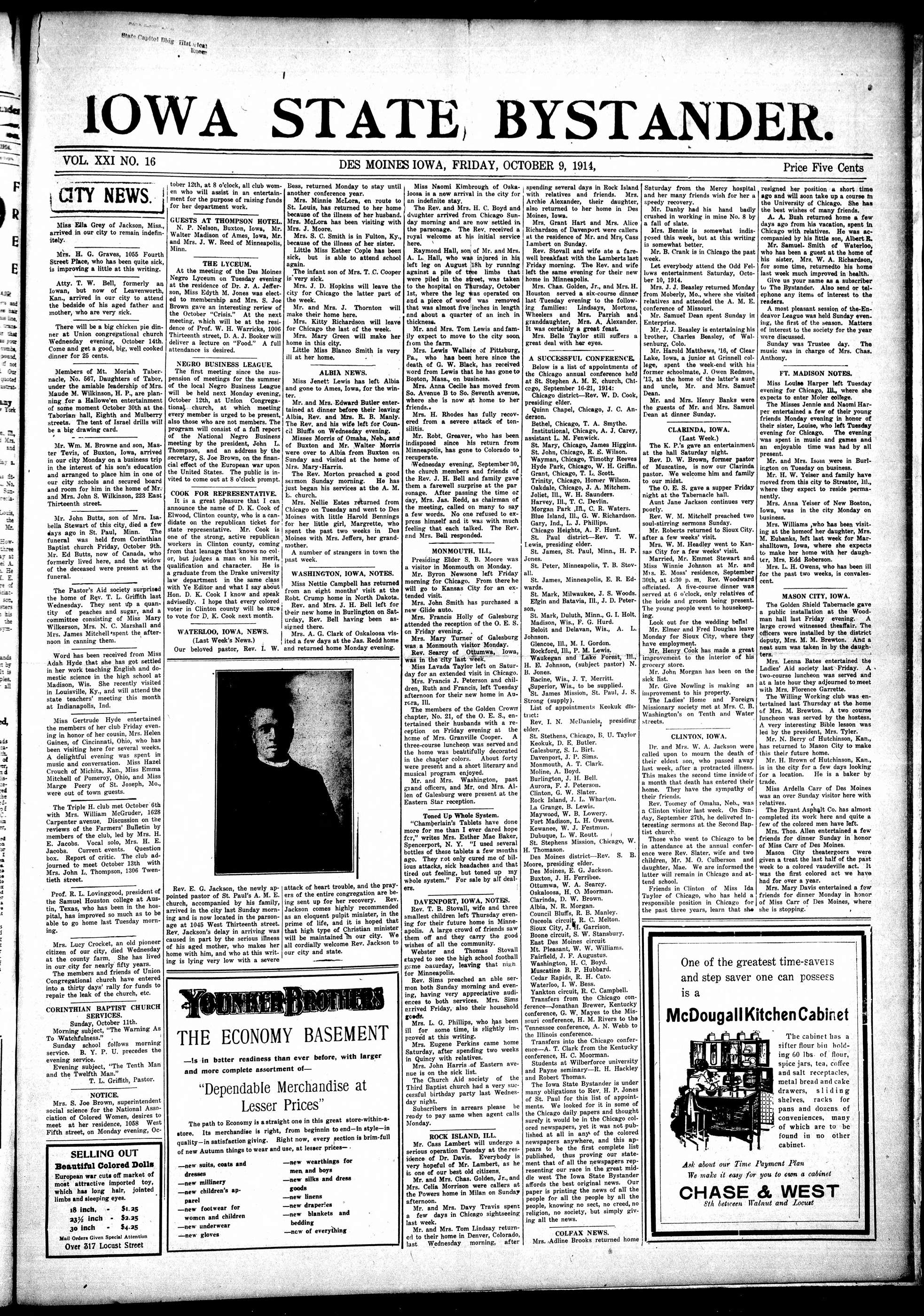
IOWA STATE BYSTANDER.
IOW
VOL. XXI NO. 16
CITY NEWS.
Miss Ella Grey of Jackson, Miss, arrived in our city to remain indefin- itely.
Mrs. H. G. Graves, 1055 Fourth Street Place, who has been quite sick, is improving a little at this writing.
Atty. T. W. Bell, formerly an Iowan, but now of Leavenworth, Kan., arrived in our city to attend the bedside of his aged father and mother, who are very sick.
There will be a big chicken pie dinner at Union congregational church Wednesday evening, October 14th. Come and get a good, big, well cooked dinner for 25 cents.
Members of Mt. Moriah Tabernacle, No. 567, Daughters of Tabor, under the amiable leadership of Mrs. Maude M. Wilkinson, H. P., are planning for a Hallowe'en entertainment of some moment October 30th at the Taborian hall, Eighth and Mulberry streets. The tent of Israel drills will be a big drawing card.
Mr. Wm. M. Browne and son, Master Tevis, of Buxton, Iowa, arrived in our city Monday on a business trip in the interest of his son's education and arranged to place him in one of our city schools and secured board and room for him in the home of Mr. and Mrs. John S. Wilkinson, 223 East Thirteenth street.
Mr. John Butts, son of Mrs. Isabella Stewart of this city, died a few days ago in St. Paul, Minn. The funeral was held from Corinthian Baptist church Friday, October 9th. Mr. Ed Butts, now of Canada, who formerly lived here, and the widow of the deceased were present at the funeral.
The Pastor's Aid society surprised the home of Rev. T. L. Griffith last Wednesday. They sent up a quantity of peaches and sugar, and a committee consisting of Miss Mary Wilkerson, Mrs. N. C. Marshall and Mrs. James Mitchell spent the afternoon in canning them.
Word has been received from Miss Adah Hyde that she has got settled in her work teaching English and domestic science in the high school at Madison, Wis. She recently visited in Louisville, Ky., and will attend the state teachers' meeting this month at Indianapolis, Ind.
Miss Gertrude Hyde entertained the members of her club Friday evening in honor of her cousin, Mrs. Helen Gaines, of Cincinnati, Ohio, who has been visiting here for several weeks. A delightful evening was spent in music and conversation. Miss Hazel Crouch of Michita, Kan., Miss Emma Mitchell of Pomeroy, Ohio, and Miss Marge Peery of St. Joseph, Mo., were out of town guests.
The Triple H. club met October 6th with Mrs. William McGruder, 1628 Carpenter avenue. Discussion on the reviews of the Farmers' Bulletin by members of the club, led by Mrs. H. E. Jacobs. Vocal solo, Mrs. H. E. Jacobs. Current events. Question box. Report of critic. The club adjourned to meet October 13th with Mrs. John L. Thompson, 1306 Twentieth street.
Prof. R. L. Lovinggood, president of the Samuel Houston college at Austin, Texas, who has been in the hospital, has improved so much as to be able to go home last Tuesday morning.
Mrs. Lucy Crocket, an old pioneer citizen of our city, died Wednesday at the county farm. She has lived in our city for nearly fifty years.
The members and friends of Union Congregational church have entered into a thirty days' rally for funds to repair the leak of the church, etc.
CORINTHIAN BAPTIST CHURCH SERVICES.
Sunday, October 11th.
Morning subject, "The Warning As To Watchfulness."
Sunday school follows morning service. B. Y. P. U. precedes the evening service. Evening subject, "The Tenth Man and the Twelfth Man."
Mrs. S. Joe Brown, superintendent social science for the National Association of Colored Women, desires to meet at her residence, 1058 West Fifth street, on Monday evening, Oc-
SELLING OUT
Beautiful Colored Dolls
European war cuts off market of
most attractive imported toy,
which has long hair, jointed
limbs and sleeping eyes.
18 inch, - $1.25
23½ inch - $2.25
30 inch - $4.25
Mail Orders Given Special Attention
Over 317 Locust Street
NOTICE
tober 12th, at 8 o'clock, all club women who will assist in an entertainment for the purpose of raising funds for her department work.
GUESTS AT THOMPSON HOTEL.
N. P. Nelson, Buxton, Iowa, Mr. Walter Madison of Ames, Iowa, Mr. and Mrs. J. W. Reed of Minneapolis, Minn.
At the meeting of the Des Moines Negro Lyceum on Tuesday evening at the residence of Dr. J. A. Jefferson, Miss Eydth M. Jones was elected to membership and Mrs. S. Joe Brown gave an interesting review of the October "Crisis." At the next meeting, which will be at the residence of Prof. W. H. Warricks, 1006 Thirteenth street, D. A. J. Booker will deliver a lecture on "Food." A full attendance is desired.
NEGRO BUSINESS LEAGUE
The first meeting since the suspension of meetings for the summer of the local Negro Business League will be held next Monday evening, October 12th, at Union Congregational church, at which meeting every member is urged to be present, also those who are not members. The program will consist of a full report of the National Negro Business meeting by the president, John L. Thompson, and an address by the secretary, S. Joe Brown, on the financial effect of the European war upon the United States. The public is invited to come out at 8 o'clock prompt.
COOK FOR REPRESENTATIVE.
It is a great pleasure that I can announce the name of D. K. Cook of Elwood, Clinton county, who is a candidate on the republican ticket for state representative. Mr. Cook is one of the strong, active republican workers in Clinton county, coming from that leanage that knows no color, but judges a man on his merit, qualification and character. He is a graduate from the Drake university law department in the same class with Ye Editor and what I say about Hon. D. K. Cook I know and speak advisedly. I hope that every colored voter in Clinton county will be sure to vote for D. K. Cook next month.
WATERLOO, IOWA, NEWS.
(Last Week's News.)
Our beloved pastor. Rev. I. W.
Rev. E. G. Jackson, the newly appointed pastor of St. Paul's A. M. E. church, accompanied by his family, arrived in the city last Sunday morning and is now located in the parsonage at 1045 West Thirteenth street. Rev. Jackson's delay in arriving was caused in part by the serious illness of his aged mother, who makes her home with him, and who at this writing is lying very low with a severe
YOUNGER
THE ECONOMY
—is in better readiness than and more complete assortm
"Dependable M
THE ECONOMY BASEMENT
—ls in bstter readiness than ever before, with larger and more complete assortment of—
The path to Economy is a straight one in this great store-within-a store. Its merchandise is right, from beginnin to end-In style-in quality-in satisfaction giving. Right now, every section is brim-full of new Autumn things to wear and use, at lesser prices.
THE LYCEUM.
P.
Bess, returned Monday to stay until another conference year.
Mrs. Minnie McLora, en route to St. Louis, has returned to her home because of the illness of her husband. Mrs. McLora has been visiting with Mrs. J. Moore. Mrs. S. C. Smith is in Fulton, Ky., because of the illness of her sister. Little Miss Esther Cople has been sick, but is able to attend school again.
The infant son of Mrs. T. C. Cooper is very sick.
Mrs. J. D. Hopkins will leave the city for Chicago the latter part of the week.
Mr. and Mrs. J. Thornton will make their home here.
Miss Naomi Kimbrough of Oskaloosa is a new arrival in the city for an indefinite stay.
The Rev. and Mrs. H. C. Boyd and daughter arrived from Chicago Sunday morning and are now settled in the parsonage. The Rev. received a royal welcome at his initial service here.
Raymond Hall, son of Mr. and Mrs. A. L. Hall, who was injured in his left leg on August 18th by running against a pile of tree limbs that were piled in the street, was taken to the hospital on Thursday, October 1st, where the leg was operated on and a piece of wood was removed that was almost five inches in length and about a quarter of an inch in spending several days with relatives and for Archie Alexander, the also returned to her Moines, Iowa.
Mrs. Grant Hart and Richardson of Davenport at the residence of Mr. Lambert on Sunday.
Stovall and wif well breakfast with the Friday morning. The left the same evening home in Minneapolis.
Mrs. Chas. Golden, Jr. Houston served a six- last Tuesday evening ting families: Linda Wheelers and Mrs.
Mrs. Kitty Richardson will leave for Chicago the last of the week. Mrs. Mary Green will make her home in this city. Little Miss Blanco Smith is very ill at her home.
ALBIA NEWS
Miss Jenett Lewis has left Albia and gone to Ames, Iowa, for the winter.
Mr. and Mrs. Edward Butler entertained at dinner before their leaving Albia, Rev. and Mrs. R. B. Manly. The Rev. and his wife left for Council Bluffs on Wednesday evening.
Misses Morris of Omaha, Neb., and of Buxton and Mr. Walter Morris were over to Albia from Buxton on Sunday and visited at the home of Mrs. Mary-Harris.
The Rev. Morton preached a good sermon Sunday morning. He has just began his services at the A. M. E. church.
Mrs. Nellie Estes returned from Chicago on Tuesday and went to Des Moines with little Harold Bennings for her little girl, Margrette, who spent the past two weeks in Des Moines with Mrs. Jeffers, her grandmother.
A number of strangers in town the past week.
WASHINGTON, IOWA. NOTES.
Miss Nettle Campbell has returned from an eight months' visit at the Robt. Crump house in North Dakota. Rev. and Mrs. J. H. Bell left for their new home in Burlington on Saturday, Rev. Bell having been assigned there. Mrs. A. G. Clark of Oskaloosa visited a few days at the Jas. Redd home and returned home Monday evening.
attack of heart trouble, and the prayers of the entire congregation are being sent up for her recovery. Rev. Jackson comes highly recommended as an eloquent pulit minister, in the prime of life, and it is hoped that that high type of Christian minister will be maintained in our city. We all cordially welcome Rev. Jackson to our city and state.
—new wearthings for men and boys
—new silks and dress goods
—new linens
—new draperies
—new blankets and bedding
—new of everything
Miss Naomi Kimbrough of Oskaloosa is a new arrival in the city for an indefinite stay.
The Rev. and Mrs. H. C. Boyd and daughter arrived from Chicago Sunday morning and are now settled in the parsonage. The Rev. received a royal welcome at his initial service here.
Raymond Hall, son of Mr. and Mrs. A. L. Hall, who was injured in his left leg on August 18th by running against a pile of tree limbs that were piled in the street, was taken to the hospital on Thursday, October 1st, where the leg was operated on and a piece of wood was removed that was almost five inches in length and about a quarter of an inch in thickness.
Mr. and Mrs. Tom Lewis and family expect to move to the city soon from the farm.
Mrs. Lewis Wallace of Pittsburg, Pa., who has been here since the death of G. W. Black, has received word from Lewis that he has gone to Boston, Mass., on business.
Mrs. Anna Cecile has moved from So. Avenue B to So. Seventh avenue, where she is now at home to her friends.
Mrs. H. Rhodes has fully recovered from a severe attack of tonsilitis.
Mr. Robt. Greaver, who has been indisposed since his return from Minneapolis, has gone to Colorado to recuperate.
Wednesday evening, September 30, the church members and friends of the Rev. J. H. Bell and family gave them a farewell surprise at the parsonage. After passing the time or day, Mrs. Jas. Redd, as chairman of the meeting, called on many to say a few words. No one refused to express himself and it was with much feeling that each talked. The Rev. and Mrs. Bell responded.
MONMOUTH ILL
Presiding Elder S. B. Moore was a visitor in Monmouth on Monday. Mr. Byron Newsome left Friday morning for Chicago. From there he will go to Kansas City for an extended visit. Mrs. John Smith has purchased a new Glide auto. Mrs. Francis Holly of Galesburg attended the reception of the O. E. S. on Friday evening. Mrs. Mary Turner of Galesburg was a Monmouth visitor Monday.
Miss Lavada Taylor left on Saturday for an extended visit in Chicago
Mrs. E. S. Day for an extended visit in Chicago. Mrs. Francis J. Peterson and children, Ruth and Francis, left Tuesday afternoon for their new home in Aurora, Ill. The members of the Golden Crown chapter, No. 21, of the O. E. S., entertained their husbands with a reception on Friday evening at the home of Mrs. Granville Cooper. A three-course luncheon was served and the home was beautifully decorated in the chapter colors. About forty were present and a short literary and musical program enjoyed. Mr. and Mrs. Washington, past grand officers, and Mr. and Mrs. Alen of Galesburg were present at the Eastern Star reception.
Toned Up Whole System
"Chamberlain's Tablets have done more for me than I ever dared hope for," writes Mrs. Esther Mae Baker, Spencerport, N.Y. "I used several bottles of these tablets a few months ago. They rot only cured me of bilious attacks, sick headaches and that tired out feeling, but toned up my whole system." For sale by all dealers.
DAVENPORT, IOWA, NOTES.
Rev. T. B. Stovall, wife and three smallest children left Thursday evening for their future home in Minneapolis. A large crowd of friends saw them off and they carry the good wishes of all the community.
Webster and Thomas Stovall stayed to see the high school football game Saturday, leaving that nigir for Minneapolis.
Rev. Sims preached an able sermon both Sunday morning and evening, having very appreciative audiences to both services. Mrs. Sims arrived Friday, also their household goods.
Mrs. L. G. Phillips, who has been ill for some time, is slightly improved at this writing.
Mrs. Eugene Perkins came home Saturday, after spending two weeks in Quincy with relatives.
Mrs. John Harris of Eastern avenue is on the sick list.
nide is on the side.
The Church Aid society of the
Third Baptist church had a very successful birthday party last Wednesday night.
Subscribers in arrears please be ready to pay same when agent calls Monday.
ROCK ISLAND. ILL.
Mr. Cass Lambert will undergo a serious operation Tuesday at the residence of Dr. Davis. Everybody is very hopeful of Mr. Lambert, as he is one of our best old citizens. Mr. and Mrs. Chas. Golden, Jr., and Mrs. Cella Morrison were callers at the Powers home in Milan on Sunday afternoon. Mr. and Mrs. Davy Travis spent a few days in Chicago sightseeing last week. Mr. and Mrs. Tom Lindsay returned to their home in Denver, Colorado last Wednesday morning, after
spending several days in Rock Island with relatives and friends. Mrs. Archie Alexander, their daughter, also returned to her home in Des Moines, Iowa. Mrs. Grant Hart and Mrs. Alice Richardson of Davenport were callers at the residence of Mr. and Mrs. Cass Lambert on Sunday. Rev. Stovall and wife ate a farewell breakfast with the Lamberts last Friday morning. The Rev. and wife left the same evening for their new home in Minneapolis. Mrs. Chas. Golden, Jr., and Mrs. H. Houston served a six-course dinner last Tuesday evening to the following families: Lindsays, Mortons, Wheelers and Mrs. Parrish and granddaughter, Mrs. A. Alexander. It was certainly a great feast. Mrs. Belle Taylor still suffers a great deal with her eyes.
A SUCCESSFUL CONFERENCE.
Below is a list of appointments of the Chicago annual conference held at St. Stephen A. M. E. church, Chicago, September 16-21, 1914: Chicago district—Rev. W. D. Cook, presiding elder.
Quinn Chapel, Chicago, J. C. Anderson.
Bethel, Chicago, T. A. Smythe.
Institutional, Chicago, A. J. Carey, assistant L. M. Fenwick.
St. Mary, Chicago, James Higgins.
St. John, Chicago, R. E. Wilson.
Wayman, Chicago, Timothy Reeves Hyde Park, Chicago, W. H. Griffin.
Grant, Chicago, T. L. Scott.
Morgan Park, III., C. R. Waters.
Blue Island, Ill., G. W. Richardson.
Gary, Ind., L. J. Phillips.
Chicago Heights, A. F. Hunt.
St. Paul district—Rev. T. W.
Lewis, presiding elder.
St. James, St. Paul, Minn., H. P.
Jones.
St. Peter, Minneapolis, T. B. Stovall.
St. James, Minneapolis, E. R. Edwards.
St. Mark, Milwaukee, J. S. Woods.
Elgin and Batavia, Ill., J. D. Peterson.
St. Mark, Duluth, Minn. G. I. Holt. Madison, Wis., F. G. Hurd. Beloit and Delavan, Wis., A. L. Johnson. Glencoe, Ill., M. I. Gordon. Rockford, Ill., P. M. Lewis. Waukegan and Lake Forest, Ill., H. E. Johnson (subject pastor) N. B. Jones. Racine, Wis., J. T. Merritt. Superior, Wis., to be supplied. St. James Mission, St. Paul, J. S. Strong (supply). List of appointments Keokuk district: Rev. I. N. McDaniels, presiding elder. St. Stethens, Chicago, B. U. Taylor Keokuk, D. E. Butler. Galesburg, S. L. Birt. Davenport, J. P. Sims. Monmouth, A. T. Clark. Moline, A. Boyd. Burlington, J. H. Bell. Aurora, F. J. Peterson. Clinton, G. W. Slater. Rock Island, J. L. Wharton. La Grange, B. L. Lewis. Maywood, W. B. Lowery. Fort Madison, L. H. Owens. Kewanee, W. J. Festmun. Dubuque, L. W. Routt. St. Stephens Mission, Chicago, W. H. Thomason.
Des Moines district—Rev. S. B. Moore, presiding elder.
Des Moines, E. G. Jackson.
Buxton, J. H. Ferribee.
Ottumwa, W. A. Searcy.
Oskalaosa, H. O. Moorman.
Clarinda, D. W. Brown.
Cairnholt
Albia, N. R. Morgan.
Council Bluffs, R. B. Manley.
Osceola circuit, R. C. Melton.
Sioux City, J. H. Garrison.
Boone circuit, S. W. Stansbury.
East Des Moines circuit
M. T. Pleasant, W. W. Williams.
Fairfield, J. F. Augustus.
Washington, H. C. Boyd.
Muscatine B. F. Hubbard.
Cedar Rapids, R. H. Cato.
Waterloo, I. W. Bess.
Yankton circuit, R. C. Campbell.
Transfers from the Chicago conference—Jonathan Brewer, Kentucky conference, G. W. Mayes to the Missouri conference, H. M. Rivers to the Tennessee conference, A. N. Webb to the Illinois conference.
Transfers into the Chicago conference—A. T. Clark from the Kentucky conference, H. C. Moorman.
Students at Wilberforce university and Payne seminary—R. H. Hackley and Robert Thomas.
The Iowa State Bystander is under many obligations to Rev. H. P. Jones of St. Paul for this list of appointments. We looked for it in some of the Chicago daily papers and thought surely it would be in the Chicago colored newspapers, yet it was not published at all in any of the colored newspapers anywhere, and this appears to be the first complete list published, thus proving our statement that of all the newspapers representing our race in the great middle west The Iowa State Bystander affords the best original news. Our paper is printing the news of all the people for all the people by all the people, knowing no seet, no creed, no religion, no society, but simply giving all the news.
COLFAX NEWS.
Mrs. Adline Brooks returned home
---
One of the greatest time-savers and step saver one can possess is a
McDougallKitchenCabinet
Ask about our Time Payment Plan
We make it easy for you to own a cabinet
CHASE & WEST
8th between Walnut and Locust
Saturday from the Mercy hospital and her many friends wish for her a speedy recovery.
Mr. Danby had his hand badly crushed in working in mine No. 8 by a fall of slate.
Mrs. Bennie is somewhat indisposed this week, but at this writing is somewhat better.
Mr. B. Crank is in Chicago the past week.
Let everybody attend the Odd Fellows entertainment Saturday, October 10, 1914.
Mrs. J. J. Beasley returned Monday from Moberly, Mo., where she visited relatives and attended the A. M. E. conference of Missouri.
Mr. Samuel Dean spent Sunday in Enterprise.
Mr. J. J. Beasley is entertaining his brother, Charles Beasley, of Walsenburg, Colo.
Mr. Harold Matthews, '16, of Clear Lake, Iowa, a junior at Grinnell college, spent the week-end with his former schoolmate, J. Owen Redmon, '13, at the home of the latter's aunt and uncle, Mr. and Mrs. Samuel Dean.
Mr. and Mrs. Henry Banks were the guests of Mr. and Mrs. Samuel Dean at dinner Sunday.
CLARINDA. IOWA.
The K. P.'s gave an entertainment at the hall Saturday night. Rev. D. W. Brown, former pastor of Muscatine, is now our Clarinda pastor. We welcome him and family to our midst. The O. E. S. gave a supper Friday night at the Tabernacle hall. Aunt Jane Jackson continues very poorly.
Rev. W. M. Mitchell preached two soul-stirring sermons Sunday.
Mr. Roberts returned to Sioux City, after a few weeks' visit.
Mrs. W. M. Headley went to Kansas City for a few weeks' visit.
Married, Mr. Emmet Stewart and Miss Winnie Johnson at Mr. and Mrs. E. Moss' residence, September 30th, at 4:30 p. m. Rev. Woodward officiated. A five-course dinner was served at 6 o'clock, only relatives of the bride and groom being present. The young people went to housekeeping.
Look out for the wedding bells!
Mr. Elmer and Fred Douglas leave Monday for Sioux City, where they have employment.
Mr. Henry Cook has made a great improvement to the interior of his grocery store.
Mr. John Morgan has been on the sick list.
Mr. Give Nowling is making an improvement to his property.
The Ladies' Home and Foreign Missionary society met at Mrs. C. B. Washington's on Tenth and Water streets.
CLINTON, IOWA.
Dr. and Mrs. W. A. Jackson were called upon to mourn the death of their eldest son, who passed away last week, after a protracted illness. This makes the second time inside of a month that death has entered their home. They have the sympathy of their friends. Rev. Toomey of Omaha, Neb., was a Clinton visitor last week. On Sunday, September 27th, he delivered interesting sermons at the Second Baptist church. Those who went to Chicago to be in attendance at the annual conference were Rev. Slater, wife and two children, Mr. M. O. Culberson and daughter, Mae. We are informed the latter will remain in Chicago and attend school. Friends in Clinton of Miss Ida Taylor of Chicago, who has held a responsible position in Chicago for the past three years, learn that she
One of the greatest
and step saver one
is a
McDougallKitc
Ask about our Time Paym
We make it easy for you
CHASE &
8th between Walnut
Price Five Cents
resigned her position a short time ago and will soon take up a course in the University of Chicago. She has the best wishes of many friends.
A. A. Bush returned home a few days ago from his vacation, spent in Chicago with relatives. He was accompanied by his little son, Albert R. Mr. Samuel. Smith of Waterloo, who has been a guest at the home of his sister, Mrs. W. A. Richardson, for some time, returned to his home last week much improved in health.
Give us your name as a subscriber to The Bystander. Also send or telephone any items of interest to the readers.
A most pleasant session of the Endeavor League was held Sunday evening, the first of the season. Matters of interest to the society for the year were discussed.
Sunday was Trustee day. The music was in charge of Mrs. Chas. Anthony.
FT. MADISON NOTES.
Miss Louise Harper left Tuesday evening for Chicago, Ill., where she expects to enter Moler college.
The Misses Jennie and Naomi Harper entertained a few of their young friends Monday evening in honor of their sister, Louise, who left Tuesday evening for Chicago. The evening was spent in music and games and an enjoyable time was had by all present.
Mr. and Mrs. Ison were in Burlington on Tuesday on business.
Mr. H. W. Yeiser and family have moved from this city to Streator, Ill., where they expect to reside permanently.
Mrs. Anna Yeiser of New Boston, Iowa, was in the city Monday on business.
Mrs. Williams, who has been visiting at the home of her daughter, Mrs. M. Eubanks, left last week for Marshalltown, Iowa, where she expects to make her home with her daughter, Mrs. Edd Roberson.
Mrs. L. H. Owens, who has been ill for the past two weeks, is convalescent.
MASON CITY, IOWA.
The Golden Shield Tabermacle gave a public installation at the Woodman hall last Friday evening. A large crowd witnessed the affair. The officers were installed by the district deputy, Mrs. M. M. Brewton. And a neat sum was taken in by the daughters.
Mrs. Lenna Bates entertained the Ladies' Aid society last Friday. A two-course luncheon was served and at a late hour they adjourned to meet with Mrs. Florence Garrett.
The Willing Working club was entertained last Thursday at the home of Mrs. M. Brewton. A two course luncheon was served by the hostess. A very interesting Bible lesson was led by the president, Mrs. Tyler.
Mr. N. Berry of Hutchinson, Kan, has returned to Mason City to make this their future home.
Mr. H. Brown of Hutchinson, Kan, is in the city for a few days looking for a location. He is a baker by trade.
Miss Ardella Carr of Des Moines was an over Sunday visitor here with relatives.
The Bryant Asphalt Co. has almost completed its work here and quite a few of the colored men have left.
Mrs. Thos. Allen entertained a few friends for dinner Sunday in honor of Miss Carr of Des Moines.
Mason City theatergoers were given a treat the last half of the past week to a colored vaudeville act. It was the first colored act we have had for over a year.
Mrs. Mary Davis entertained a few friends for dinner Monday in honor of Miss Carr of Des Moines, where she is stopping.
test time-savers
one can possess
kitchen Cabinet
The cabinet has a sifter flour bin holding 60 lbs. of flour, spice jars, tea, coffee and salt receptacles, metal bread and cake drawers, sliding shelves, racks for pans and dozens of conveniences, many of which are to be found in no other cabinet.
Payment Plan
you to own a cabinet
& WEST
almnut and Locust
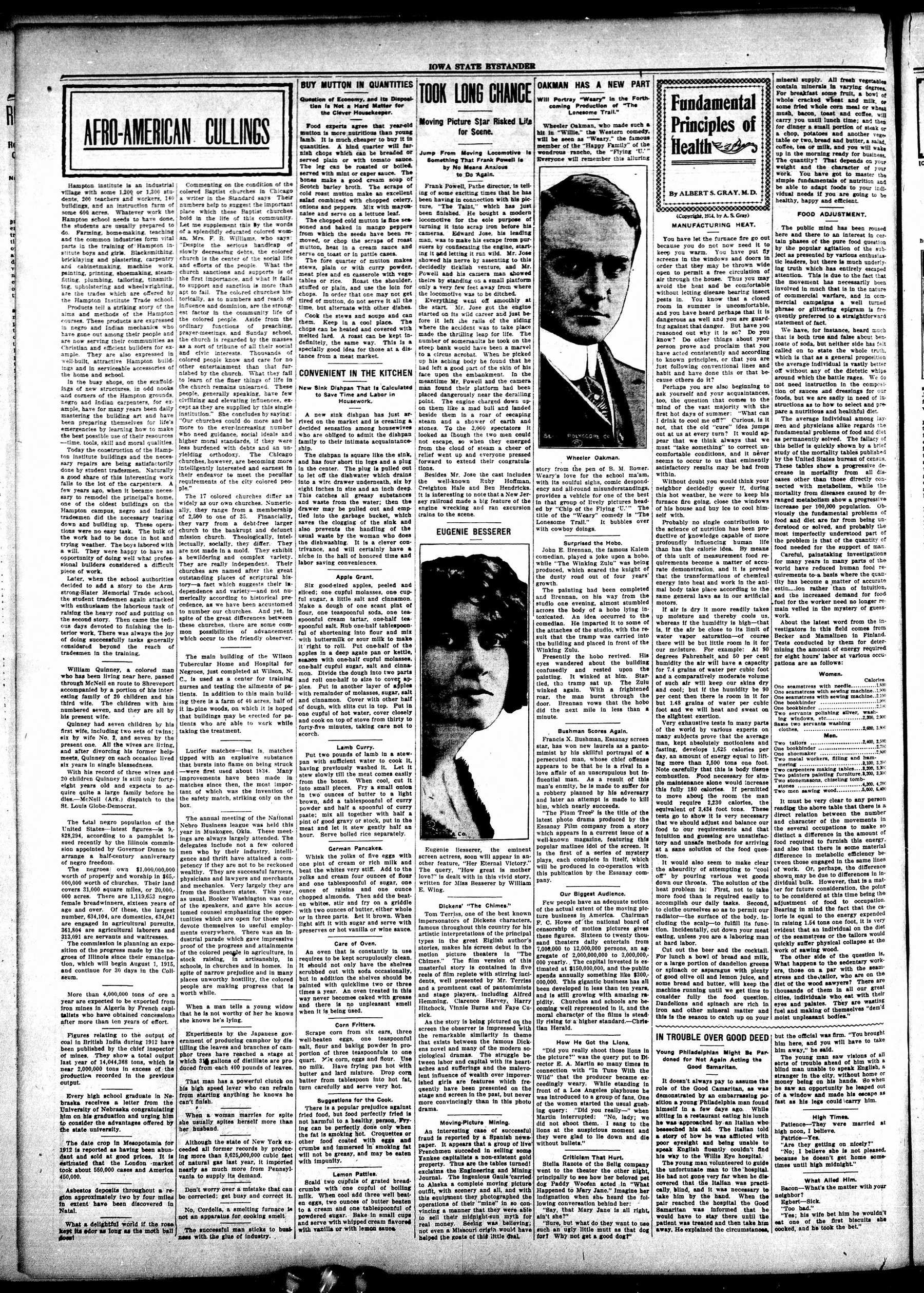
AFRO-AMERICAN CULLINGS
Hampton institute is an industrial village with some 1,200 or 1,300 students, 200 teachers and workers, 140 buildings, and an instruction farm of some 400 acres. Whatever work the Hampton school needs to have done, the students are usually prepared to do. Farming, home-making, teaching and the common industries form vital parts in the training of Hampton institute boys and girls. Blacksmithing, bricklaying and plastering, carpentry and cabinetmaking, machine work, painting, printing, showmaking, steaming, plumbing, tailoring, tinsmithing, upholstering and wheelwrighting, are the trades which are offered by the Hampton Institute Trade school. Products tell a striking story of the aims and methods of the Hampton courses. These products are expressed in negro and Indian mechanics who have gone out among their people and communities as Christian and efficient builders for example. They are also expressed in well-built, attractive Hampton buildings and in serviceable accessories of the home and school.
In the busy shops, on the scaffoldings of new structures, in odd nooks and corners of the Hampton grounds, negro and Indian carpenters, for example, have for many years been daily mastering the building art and have been preparing themselves for life's emergencies by learning how to make the best possible use of their resources—time, tools, skill and moral qualities. Today the construction of the Hampton institute buildings and the necessary repairs are being satisfactorily done by student tradesmen. Naturally a good share of this interesting work falls to the lot of the carpenters. A few years ago, when it became necessary to remodel the principal's home, one of the oldest buildings on the Hampton campus, negro and Indian tradesmen did the necessary tearing and building up. These operations are no easy task. The bulk of the work had to be done in hot and trying weather. The boys labored with a will. They were happy to have an opportunity of doing well what professional builders considered a difficult piece of work.
Later, when the school authorities decided to add a story to the Armstrong-Slater Memorial Trade school, the student tradesmen again attacked with enthusiasm the laborious task of raising the heavy roof and putting on the second story. Then came the tedious days devoted to finishing the interior work. There was always the joy of doing successfully tasks generally considered beyond the reach of tradesmen in the training.
---
William Quinney, a colored man who has been living near here, passed through McNeil en route to Shreveport accompanied by a portion of his interesting family of 20 children and his third wife. The children with him numbered seven, and they are all by his present wife.
Quinney had seven children by his first wife, including two sets of twins; six by wife No. 2, and seven by the present one. All the wives are living, and after divorcing his former helpmeets, Quinney on each occasion lived six years in single blessedness. With his record of three wives and 20 children Quinney is still only forty-eight years old and expects to acquire quite a large family before he dies—McNeil (Ark.) dispatch to the St. Louis Globe-Democrat.
The total negro population of the United States—latest figures—is 9,822,294. In 1954, a pamphlet issued recently by the Illinois Commission appointed by Governor Dunne to arrange a half-century anniversary of negro freedom.
The negroes own $1,000,000,000 worth of property and worship in $65,000,000 worth of churches. Their land covers 31,000 square miles, or 20,000,000 acres. There are 1,119,653 negra female breadwinners, sixteen years of age and over. Of these, the largest number, 634,104, are domestics, 434,044 are engaged in agricultural pursuits 631,804 are agricultural laborers and 313,091 are servants and waitresses. The commission is planning an expo in the city to celebrate the growth of Illinois since their emancipation, which will begin August 1, 1915 and continue for 30 days in the Coliseum.
---
More than 4,000,000 tons of ore a year are expected to be exported from mines in Algeria by French capitalists who have obtained concessions after more than ten years of effort.
Figures relating to the output of coal in British India during 1912 have been published by the chief inspector of these show total output last year of 14,044,388 tons, which is near 2,000,000 tons in excess of the production recorded in the previous output.
Every high school graduate in Nebraska receives a letter from the University of Nebraska congratulating him on his graduation and urging him to consider the advantages offered by the state university.
The date crop in Mesopotamia for 1912 is reported as having been abundant and sold at good prices. It is estimated that the London market took about 550,000 cases and America 450,000.
Asbestos deposits throughout a region approximately two by four miles in extent have been discovered in Natal.
What a delightful world if the rose kept its odor as long as the moth ball down!
Commenting on the condition of the colored Baptist churches in Chicago a writer in the Standard says Their numbers help to suggest the important place which these Baptist churches hold in the life of this community. Let me supplement this by the words of a splendidly educated colored woman, Mrs. F. B. Williams, who says: "Despite the serious handicap of slowly decreasing debts, the colored church is the center of the social life and efforts of the people. What the church sanctions and supports is of the first importance, and what the support and sanction changes than at last is the number of churches historically, as to numbers and reach of influence and dominion, are the strongest factor in the community life of the colored people. Aside from the ordinary fractions of preaching, prayer-meetings, and Sunday school, the church is regarded by the masses as a sort of tribune of all their social and civic interests. Thousands of colored people know and care for no other entertainment than that furnished by the church. What they fall to learn of the finer things of life in the church remains unlearned. These people, generally speaking, have few civilizing and elevating influences, except as they are supplied by this single institution." She concludes by saying: "Our churches could do more and be more to the ever-increasing number of people gaining social status, if they were less burdened with debts and an unyielding orthodoxy. The Chicago churches, however, are becoming more intelligently interested and earnest in their endeavor to meet the peculiar requirements of the city colored people."
The 17 colored churches differ as widely as our own churches. Numerically, they range from a membership of 2,500 to one of 35. Financially, they vary from a debt-free larger church to the bankrupt and defunct mission church. Theologically, intellectually, and culturally, these churches are not made in a mold. They exhibit a bewildering and complex variety. They are really independent. Their churches are named after the great outstanding places of scriptural history—a fact which suggests their independence and variety—and not numerically according to historical precedence, as we have been accustomed to do. We are also split into parts of the great differences between these churches, there are some common possibilities of advancement which occur to the friendly observer.
The main building of the Wilson Tubercular Home and Hospital for Negroes, just completed at Wilson, N. C., is used as a center for training nurses and testing the ailments of patients. In addition to this main building there is a farm of 40 acres, half of it in pine woods, on which it is hoped that buildings may be erected for patients who are able to work while taking the treatment.
---
Lucifer matches—that is, matches tipped with an explosive substance that bursts into flame on being struck—were first used about 1834. Many improvements have been made in matches since the invention of the safety match, striking only on the box.
The annual meeting of the National Nebro Business league was held this year in Muskogee, Okla. These meetings are always largely attended. The delegates include not a few colored men who by their industry, intelligence and thrift have attained a competency if they are not to be reckoned wealthy. They are successful farmers, physicians and lawyers and merchants and mechanics. Very large they are from the Southern states. This year, as usual, Booker Washington was one of the speakers, and gave his accustomed counsel emphasizing the opportunities which are open for those who devote themselves to useful employments. An inlunary parade which gave impressive proof of the progress and attainments of the colored people in agriculture, in stock raising, in artisanship, in schools, in churches and in homes. In spite of narrow prejudice and in many places unworthy hostility, the colored people are making progress that is worth while.
When a man tells a young widow that he is not worthy of her he knows she knows he's lying.
Experiments by the Japanese government of producing camphor by distilling the leaves and branches of camphor trees have reached a stage at which 39 gallons of distillate are produced from each 400 pounds of leaves.
That man has a powerful clutch on his high speed lever who can refrain from starting anything he knows he can't finish.
When a woman marries for spite she usually spites herself more than her husband.
Although the state of New York exceeded all former records by producing more than 8,625,000 cubic feet of natural gas last year, it imported nearly as much to supply its demand.
Don't worry over a mistake that can be corrected; get busy and correct it.
No, Cordelia, a smelting furnace is not an apparatus for cooking smelt. The successful man sticks to business with the rise of industry.
BUY MUTTON IN QUANTITIES
Question of Economy, and its Disposal
for the Clerk Housekeeper,
for the Clever Housekeeper.
Food experts agree that year-old mutton is more nutritious than young lamb. It is much cheaper to buy it in quantities. A hind quarter will furnish chops which can be breaded or served plain or with tomato sauce. The leg can be roasted or baked with mint or paper sauce. The bonas make a good group of Scotch barley broth. The scraps of cold roast mutton make an excellent salad combined with chopped celery, onions and peppers. Mix with mayonnaise and serve on a lettuce leaf. The chopped cold mutton is fine seasoned and baked in mango peppers from which the seeds have been removed or to chop the scraps from mutton or tochop the scraps from sauce and serve on toast or in nictice cases.
The fore quarter of mutton makes stews, plain or with curry powder, meat pies and en casserole with vegetables or rice. Roast the shoulder, stuffed or plain, and use the loin for chops. In order that one may not get tired of mutton, do not serve it all the time, but alternate with other dishes. Cook the stews and soups and can use them. The chops can be hesed and covered with melted lard. A roast can be kept indefinitely, the same way. This is a specially good idea for those at a distance from a meat market.
CONVENIENT IN THE KITCHEN
New Sink Dispain That Is Calculated to Save Time and Labor in Housework.
A new sink dishpan has just arrived on the market and is creating a decided sensation among housewives who are obliged to admit the dishpan family to their intimate acquaintanceship.
The dishpan is square like the sink, and has four short tin legs and a plug in the center. The plug is pulled out to let off the dishwater which drains into a wire drawer underneath, six by eight inches in size and an inch deep. This catches all greasy substances and waste from the water; then the drawer may be pulled out and emptied into the garbage bucket, which saves the clogging of the sink and also prevents the handling of the usual waste by the woman who does the dishwashing. It is a clever contrivance, and will certainly have a niche in the hall of honored time and labor saving conveniences.
Apple Grant.
Six good-sized apples, peeled and sliced; one cupful molasses, one cupful sugar, a little salt and cinnamon.
Make a dough of one scant pint of flour, one teaspoonful soda, one teaspoonful cream tartar, one-half teaspoonful salt. Rub one-half tablespoonful of shortening into flour and mix with buttermilk or milk to make it right to roll. Put one-half of the apples in a deep agate pan or kettle, season with one-half cupful molasses, one-half cupful sugar, salt and cinnamon. Divide the dough into two and roll it plain with cover up. Put in another layer of apples with remainder of molasses, sugar, salt and cinnamon. Cover with other half of dough, with slits cut in top. Put in one cupful of hot water, cover closely and cook on top of stove from thirty to forty-five minutes, taking care not to scorch.
Lamb Curry.
Put two pounds of lamb in a stewpan with sufficient water to cook it, having previously washed it. Let it stew slowly till the meat comes easily from the bones. When cool, cut it into small pieces. Fry a small onion in two ounces of butter to a light brown, add a little salt and half a spoonful of curry paste; mix all together with half a pint of good gravy or stock, put in the meat and let it stew gently half an hour. Serve boiled rice separately.
German Pancake.
Whisk the yolks of five eggs with one pint of cream or rich milk and beat the whites very stiff. Add to the yolks and cream four ounces of flour and one tablespoonful of sugar, one ounce of raisins and one ounce chopped almonds. Then add the beaten whites, stir and fry on a griddle with two ounces of butter, either whole or in three parts. Let it brown. When light lift it with sugar and serve with preserves or hot vanilla or wine sauce.
Care of Oven.
An oven that is constantly in use requires to be kept scrupulously clean. It should not only have the shelves scrubbed out with soda occasionally, but in addition the shelves should be painted with quicklime two or three times a year. An oven treated in this way never becomes caked with grease and there is no unpleasant smell when it is being used.
Corn Fritters
Scrape corn from six ears, three well-beaten eggs, one teaspoonful salt, flour and baking powder in proportion of three teaspoonfuls to one quart. *⅛* corn, eggs and flour. Use the flour and eggs in a batter and lard mixture. Drop corn batter from tablespoon into hot fat, turn carefully and serve very hot.
Suggestions for the Cook.
There is a popular prejudice against fried food, but food perfectly fried is not harmful to a healthy person. Frying can be perfectly done only when the fat is smoking hot. Croquettes or other food coated with eggs and milk can be improved in smoked meat with not be greasy, and may be eaten with impunity.
Lemon Pattles.
Scald two cupfuls of grated breadcrumbs with one cupful of boiling milk. When cool add three well beaten eggs, two ounces of butter beaten to a cream and one tablespoonful of powdered sugar. Bake in small cups and serve with whipped cream flavored with vanilla or with lemon sauce.
```markdown
```
IOWA STATE BYSTANDEE
Moving Picture Star Risked Life for Scene.
Jump From Moving Locomotive Is Something That Frank Powell is by No Means Anxious to Do Again.
Frank Powell, Pathe director, is telling of some exciting times that he has been having in connection with his picture, "The Taint," which has just been finished. He bought a modern locomotive for the sole purpose of turning it into scrap iron before his cameras. Edward Joseph, his leading man, was to make his escape from pursuers by confiscating the engine, starting it and letting it run wild. Mr. Jose showed his nerve by assembling to this decidedly dickish venture, and Mr. Powell and his camera man, Mr. Taint, were on their platform only a very few miles away from where the locomotive was to be ditched.
Everything went off smoothly at the start. Mr. Jose got the engine started on its wild career and just before it left the rails of the sliding where the accident was to take place made the thrilling leap for life. The number of somersaults he took on the steep bank would have been a marvel to a circus acrobat. When he picked up his aching body he found that his face was so deformed that his face upon the embankment. In the meantime Mr. Powell and the camera man found their platform had been placed dangerously near the derailing point. The engine charged down upon them like a mad bull and landed beside them in a roar of escaping steam and a shower of earth and stones. To the 3,000 spectators it looked as though the two men could not escape, so when they emerged from the cloak they felt of left up and everyone pressed forward to extend their congratulations.
Besides Mr. Jose the cast includes the well-known Ruby Hoffman Creighton Hale and Ben Hendricks it is interesting to note a New Jersey railway made a big feature of the movie. It also had an excursion trains to the scene.
EUGENIE BESSERER
MUSIC A CO.
Eugenie Besserer, the eminent screen actress, soon will appear in an other feature, "Her Eternal Victory." The query, "How great is mother she is dealt with in this vivid story written for Miss Besserer by William E. Wing.
Dickens' "The Chimes."
Tom Terris, one of the best known impersonators of Dickens characters, famous throughout this country for his artistic interpretations of the principal types in the great Eiglish author's stories, makes his screen debut in the motion picture theaters in "The Chimes." The film version of this masterful story is contained in five reels of film replete with stirring incidents, all presented by Mr. Triche, a prominent cast of pantomimists and stage players, including Alfred Hemmick, Clarence Harvey, Harry Hitchock, Vinnie Burns and Faye Cusick.
As the story is being played on the screen the observer is impressed with the remarkable similarity in theme that exists between the famous Dickens novel and many of the modern sociological dramas. The struggle between labor and capital with its heartaches and sufferings and the malevolent influence wears on the impoverished characters, which are features often have been presented on the stage and screen in the past, but never more convincingly than in this photo drama.
Moving-Picture Mining
An interesting case of successful fraud is reported by a Spanish newspaper. It appears that a group of live Frenchmen succeeded in selling some Kankee capitalists a non-existant gold property. Thus are the tables turned! exclaims the Engineering and Mining Journal. The Ingenious Gauls carried outt, with scenery and all, and with this equipment they photographed the operations of the company that they were able to install their midnight-sun myth for real money. Seeing was believing; not even a Missouri orign, would have helped the roots of this little deal
OAKMAN HAS A NEW PART
Will Portray "Weary" in the Forth-
coming Production of "The
Lonesome Trail."
Wheeler Oakman, who made such a
hit in "Willie," the Western comedy,
will be seen as "Weary," the famou
member of the "Happy Family" of the
wondrous rancho, the "Flying 'U'."
Everyone will remember this alluring
SE. POLYGON CO.
Wheeler Oakman.
story from the pen of B. M. Bower, Weary's love for the school ma'am, with its soulful sighs, comic condescency and all-round misunderstandings, provides a vehicle for one of the best in that group of lively pictures headed by "Chip the Flying Cat." The title of "Chip the Flying Cat" comedy is "The Lonesome Trail." It bubbles over with cowboy doings.
Surprised the Hobo
John E. Brennan, the famous Kaleem comedian, played a joke upon a hobo, while "The Winking Zulu" was being produced, which scared the knight of the dusty road out of four years' growth.
The painting had been completed and Brennan, on his way from the studio one evening, almost stumbled across the room of a hobo living inward. An idea occurred to the comedian. He imparted it to some of the attaches of the studio, with the result that the tramp was carried into the building and placed in front of the Winking Zulu.
Presently the hobo revived. His eyes wandered about the building confusedly and rested upon the painting. It winked at him. Started, the tramp wiped up. The Zulu winked at him. With a frightened door, the man burst through the room. Brennan vows that the hobo did the next mile in less than a minute.
Bushman Scores Again.
Francis X. Bushman, Essanay screen star, has won new laurels as a pantomimist by his skillful portrayal of a persecuted man, whose chief offense appears to be that he is a rival in a love affair of an unscrupulous but influential man. As a result of this man's enemy, he is led by his adversary, who thereby planned by his adversary and later an attempt is made to kill him, which nearly succeeds.
"The Plum Tree" is the title of the latest photo drama produced by the Essanay Film company from a story which appears in a current issue of a well-known magazine, featuring this popular matinee idol of the screen. It is the first complete in itself, which will be produced in co-operation with this publication by the Essanay company.
Our Biggest Audience
Few people have an adequate notion of the actual extent of the moving picture business in America. Chairman F. C. Howe of the national board of censorship of motion pictures gives these figures. Sixteen to twenty thousand theaters, two daily entertain from 2,000,000 to 3,000,000,000 to 3,000,000,000 yearly. The capital invested is estimated at $150,000,000, and the public spends annually something like $300,000,000. This gigantic business has all been developed in less than ten years, and is still growing with amazing rapidity. Churches and schools are becoming well represented in it, and the public films are rising to a higher standard.-Christian Herald.
How He Got the Lions
"Did you really shoot those lions in the picture?" was the query put to Director E. A. Martin so many times in connection with "In Tune With the Wild" that the producer became exceedingly weary. While standing in front of a Los Angeles playhouse he was introduced to a group of fans. One of the women started the usual gushing query: "You really when you interrupted, 'I lady,' did not shoot them. I sang to the lions at the auspicious moment and they were glad to lie down and die without bullets."
Criticism That Hurt
Stella Razote of the Selig company went to the theater the other night, principally to see how her beloved pet dog had been treated to Mary Jane." Imagine her indignation when she heard the following conversation behind her: "Say, that Mary Jane is all right, say, that she is all right," "Say, but what do they want to use such an ugly little mutt as that dog for? Why not get a good dog?"
---
You have let the furnace fire go out because you do not now need it to keep you warm. You have put fly screens in the windows and doors in order that they may be thrown wide open to permit a free circulation of air through the house. Thus you may avoid the heat and be comfortable without letting the bearling room in your house know that a closed room in summer is uncomfortable, and you have heard perhaps that it is dangerous as well and you are guarding against that danger. But have you reasoned out why it is so? Do you know? Do other things about your person prove and proclaim that you have acted consistently and according to the rules, just following conventional lines and habit and have done this or that because others do it?
Perhaps you are also beginning to ask yourself and your acquaintances, too, the question that comes to the mind of the vast majority with the first hot days of summer: "What can I drink to cool me off?" Curious, is it not, that the old man is so eager to all say every turn? It would appear that we think always that we must "take something" to correct uncomfortable conditions, and it never seems to occur to us that eminently satisfactory results may be bad from within.
Without doubt you would think your neighbor decidedly queer if, during this hot weather, he were to keep his fire going, close the windows of his house and buy ice to cool himself with.
Probably no single contribution to the science of nutrition has been productive of knowledge capable of more profoundly influencing human life than has the calorie idea. By means of this unit of measurement food requirements become a matter of accurate demonstration, and it is proved that the transformations of chemical energy into heat and work in the animal body take place according to the same general laws as in our artificial moors. If air is dry it more readily takes up moisture and thereby cools us, whereas if the humidity is high—that is, if the air be close to its limit of water vapor saturation—of course there will be but little room in it for our moisture. For example: At 90 degrees Fahrenheit, and 50 per cent humidity the air will have a capacity for 7.4 grains of water per cubic foot and a comparatively moderate volume of such air will keep our skins dry and we will feel cooler than per cent there is room in it for but 1.48 grains of water per cubic foot and we will heat and sweat on the slightest exertion.
Very exhaustive tests in many parts of the world by various experts on many subjects prove that the average man, kept absolutely motionless and fasting, develops 1,625 calories per day, an amount of energy equal to lifting more than 2,500 tons one foot. Note carefully that this is body tissue combustion. Food necessary for simple maintenance alone would increase this fully 180 calories. If permitted to move about the room the man would require 2,434 foot calories. The amount of 2,434 foot tons. These tests go to show it is very necessary that we should adjust and balance our food to our requirements and that intuition and guessing are unsatisfactory and unsafe methods for arriving at a sane solution of the food question.
It would also seem to make clear the absurdity of attempting to "cool off" by pouring various wet goods down our throats. The solution of the heat problem is: First, not to take more food than is required easily to accomplish our daily tasks. Second, to clothe ourselves so as to permit our food to be used in the body, including the scalp—to fulfill the need. Incidentally, cut down your meat eating, unless you are a laboring man at hard labor. Cut out the beer and the cocktail. For lunch a bowl of bread and milk, or a large portion of dandelion greens or spinach or asparagus with plenty of good olive oil and lemon juice, and some bread and butter, will keep the machine running until we get time to cook a meal and food question. Dandelions and sparrow iron and other mineral matter and this is the season to catch up on your
IN TROUBLE OVER GOOD DEED
Young Philadelphia Might Be Par
doned for Not Agreeing to the
taking
It doesn't always pay to assume the role of the Good Camaritan, as was demonstrated by an embarrassing position a young Philadelphia man found himself in a few days ago. While sitting in a restaurant eating his lunch he was approached by an Italian who beseeched his aid. The Italian told a story of how he was afflicted with poor eyesight and being unable to speak English faintly couldn't find his way to the Willis Eye hospital. The young man volunteered to guide the unfortunate man to the hospital. He had not gone very far when he discovered that the Italian was practically blind, and it was necessary to take him. When the rached the hospital Good Samaritan was informed that he would have to stay there until the patient was treated and then take him away. He explained the circumstances.
mineral supply. All fresh vegetables contain minerals in varying degrees. For breakfast some fruit, a bowl of whole cracked wheat and milk, or some fried whole corn meal or wheat mush, bacon, toast and coffee, will carry you until lunch time; and then for dinner a small portion of steak or a chop, potatoes and another vegetable or two, bread and butter, a salad, coffee, tea or milk, and you will wake up ready for business. The quantity? That depends on your weight and the character of your work. You have got to master simple fundamentals of nutrition and be able to adapt foods to your individual needs if you are going to be healthy, happy and efficient.
FOOD ADJUSTMENT
The public mind has been roused here and there to an interest in certain phases of the pure food question by the popular agitation of the subject as presented by various enthusiastic leaders, but there is much underlying truth which has entirely escaped attention. This is due to the fact that the movement has necessarily been inured in much that is in the nature of comedy, and in the commercial campaigns a well turned phrase or glittering epigram is frequently preferred to a straightforward statement of fact.
We have, for instance, heard much that is both true and false about benzote of soda, but neither side has felt called on to state the whole truth which is that as a general proposition the average individual is vastly better off without any of the dietetic whites around which the battle rages. We do not need instruction in the competency of foods, but we are sady in need of instructions as to how to select and prepare a nutritious and healthful diet.
The average individual among laymen and physicians alike regards the fundamental problems of food and diet as permanently solved. The fallacy of this belief is quickly shown by a brief study of the mortality tables published by the United States bureau of census. These tables show a progressive decrease in mortality from all diseases other than those directly connected with metabolism, while the mortality from diseases caused by deranged metabolism show a progressive increase per 100,000 population. Obviously the fundamental problems of food and diet are far from being understood or solved, and probably the most imperfectly understood part of the problem is that of the quantity of food needed for the support of man. Careful, painstaking investigations for many years in many parts of the world have reduced human food requirements to a basis where the quantity has become a matter of accuracy. ion runoff is the most needed demand for food fuel for the worker need no longer remain velled in the mystery of guesswork.
About the latest word from the investigators in this field comes from Becker and Mamallinen in Finland. Tests conducted by them for determining the energy required by the labor at various occupations are as follows:
Women.
One seamstress with needle. .1,800
One seamstress with sewing machine.1,800
One seamstress with sewing machine.2,800
One bookbinder .2,800
One bookbinder .2,800
Two servants polishing silver, washing windows, etc. .2,300
Two servants polishing silver, washing windows, etc. .2,300
Same two servants washing clothes. 2,600, 3,800
Two tailors 2,400, 2,500
One bookbinder 2,700
One shoemaker 2,600
Two metal workers, filling and hammering 2,100, 3,300
Two carpenters making tables 3,200, 3,300
Two painters painting furniture 2,300, 3,300
Two stonemasons, chiseling tombstones 4,300, 4,700
Two men sawing wood 5,000, 5,400
It must be very clear to any person reading the above table that there is a direct relation between the number and character of the movements in the several occupations to make so distinct a difference in the amount of food required to furnish this energy, and also that there is some material difference in metabolic efficiency between those engaged in the same lines of work. Or, perhaps, the difference shown may be due to differences in individual bulk. However, that is a matter for future consideration, a point to be considered at this time being the adjustment of food to occupation. Bearing in mind the fact that the calorie is equal to the energy expended in 1,545 tons one foot, it is very evident that an individual on the diet of the seamstress or the tailors would quickly suffer physical collapse at the work of sawing wood.
The other side of the question is, what happens to the sedentary workers, those on a par with the seamstress and the tailor, who are on the diet of the wood sawyers? There are thousands of them in all our great cities, individuals who eat with their eyes and palates. They are wasting fuel and making of themselves "demd moist unpleasant bodies." but the official was firm. "You brought him here, and you will have to take him away," he said.
The young man saw visions of all sorts of trouble ahead of him with a blind man unable to speak English, a ranger in the city without home or money being on his hands. So when he saw an opportunity he leaped out of a window and made his escape as fast as his legs could carry him.
High Times
Patience—They were married at high noon, I believe.
Patrice—Yes.
"Are they getting on nicely?"
"No; it is not pleased, because he doesn't get home sometimes until high midnight."
What Allied Him.
Bacon- What's the matter with your neighbor?
Egbert—Sick.
"Too bad."
"Yes; his wife bet him he wouldn't eat one of the first biscuits she cooked, and he took the bet."
LauraJeanLibbeu's Talks on Heart Topics
[Copyright, 1914, by the McCure Newspaper Syndicate]
IN HONOR'S GRIP.
If you are too weak to journey
Up the mountain steep and high,
You can stand within the valley,
While the multitude
You can chant in happy measure
As they slowly pass along
Theo they may forget the singer
They will not forget the song.
It is not unusual for a merry, light-
hearted young fellow to imagine him-
self deeply smitten with a bright,
vivacious, pretty young girl at the
first moment of the introduction.
A whirlwind of courtship ensues,
and their engagement follows.
A.
As the old saying goes, "quick to fall in love, quick to fall out again!" Another girl, or, perchance, another young man comes upon the scene. He or she is more courteous to the stranger than the occasion demands. Jealousy arises, and a lover's quarrel follows. There is a parting of the ways.
This does not seem to end the compact which each entered into so thoughtlessly — recklessly. Neither feels possessed of the right to encourage another love. Two entered into the betrothal compact. It took two to make it. One cannot have the sole privilege of breaking it, it takes two! Thus both are held in the grip of honor until each releases the other. The man and maid who hold a betrothal sacred cannot be said to be fickle in affection.
If a man discovers that the sweet-heart with whom he has parted has ceased to love him, it is cruelty for him to hold her in honor bound to fulfill the engagement. He should be resigned to having found out the state of her heart before marriage, rather than after.
The same rule holds good in regard to a man. A girl should be too proud spirited to hold a man in the grip of an engagement of marriage which has become irksome to him. Those who are forced, as it were, to the altar against their will, always hold in their heart a feeling of keen resentment. This feeling never resolves into love. On the other hand, those whose hearts are welded together, but not mated, are apt to blame themselves bitterly for being so foolish as to allow themselves to believe that it were impossible to loosen what they thought to be honor's grip.
Love is serious and sacred. Marriage is still more so. A girl and her sweetheart should feel that they could not exist without each other to produce sufficient faith to wed. One-sided unions are not God's purpose of mating. It is not honorable to give the hand when the heart does not go with it.
The girl who has waited patiently through a long engagement for her lover to fulfill his matrimonial engagement with her feels that she holds him in honor's grip not to forsake her, even though her youth and beauty has faded. In such an instance, the woman has the world's sympathy and takes issue with those who would decide against her. Men and women should be chary pledging their love. But exchange of hearts once made, each should consider wedlock love's grip, tender and sweet as it is firm.
LOST! A WOMAN'S CONFIDENCE.
Ah, world unknown! how charming is thy view,
Thy pleasures many, and each pleasure
Ah! world experienced! what's of thee is
old.
How few thy pleasures, and those few how cold.
Contented is the woman who has implicit faith in the man she loves. The pangs of jealousy are unknown to her. The most beautiful and brilliant of women may flutter about him; but if a fillet of love binds his eyes, he does not see them. He is deaf to their flattery. Absence makes his heart grow fonder toward the object of his affection; but it happens once in a while that even the most conscientious of men are caught in a whirlpool of circumstances from which they find it difficult to extricate themselves to the entire satisfaction of sweethearts.
A girl rival of his loved one may be persistent in her efforts at setting her cap for him. If he meets her at the home of a friend, quite unexpecedly, he must be courteous to her; and, especially at night. If she asks him archly if he will execute a little errand for her—stop at a florist's, and order her a dozen choice roses, her favorite, he, as an old acquaintance of her family, would not disoblige her.
If he is taking a short cut through the park and happens to encounter the same girl, it does not occur to him to hurry past with a slight nod. If she's going in his direction he feels in duty bound to slacken his pace and walk beside her as far as the entrance. Of themselves, these incidents are of small moment to him, but when the girl carelessly recounts to his sweetheart that the lover she has such confidence in has been beauling her home from evening affairs, taking walks with her, sending her flowers, her faith in him is shaken to its foundation. He may explain the matter frankly, but that is not saying her fears are groundless, and forever set at rest. The woman who believes her trust betrayed always harbors a doubt in her heart. This is the blighting frost that sooner or later kills love. If the
heart is disturbed in its love dream, it can never afterwards heat with the same joyous rhythm. It is always wisest and best for a lover to explain at the time being just how this or that occurrence took place, that he may have her views on the subject. Her confidence is worth everything to him. With it a happy future is assured for them. Without it, their lives will drift apart. Lost is the whole world to him if he possesses not the jewel of her confidence.
BLAMING HERSELF.
I hold it true what he'er befall,
I feel it when I sorrow most;
The better to have loved and lost
Than never to have loved at all.
When a woman does the best she
can with either her daily tasks or
her love affairs, she should not fall in
lamentation and grieve if they go
wrong.
In regard to even the duties she knows best how to perform, it is comforting for her to hear that mistakes will happen even in the best of families. It is quite as true that love affairs the whole world over have not run smoothly. If she has a quarrel with her lover, and he goes off in a huff, when she sits down and thinks the matter over, nine times out of ten she blames herself. She goes over the whole affair carefully. When he said he could not come the following evening, but stubbornly refused to give the reason, why, she shouldn't have jumped at the conclusion that he was going with some other girl, accused him of it and been unprepared for his bitter resentment.
At the time she supposed he would assure her to the contrary. His silence made matters worse. She blamed herself for not laughing the matter off, remembering that a gentle word turns aside wrath.
As time rolls its slow length by and she does not hear from him, she wonders if she were not at fault in not giving him encouragement to bridge over the difficulty. She does not stop to consider that many another girl of spirit would have done just as she did; that it really takes two to make a quarrel, especially if the girl has a will of her own, insists upon everything going her way.
No matter how long a girl may know her lover, she will find traits in him, even at the end of the longest courtship, which she never knew he possessed. The careless, easy-going man she discovers to be capable of sudden and unforeseen obstinacy. He on his part, discovers that the girl he thought had the sweetest of dispositions can be distrustful and capable of downright jealousy. A little kindness on his part would have turned the tide of good feeling.
But does a man blame himself? Never! He considers that a girl has no right to pry into his private business, even if they are betrothed. It is time enough to inform her when she becomes his wife. Men seldom, or never, die over a love dream which had a rude awakening. He does not say to himself "It was all my fault." On the contrary, he is more than apt to put three-fourths of the blame on the girl; to conclude she shouldn't have said or done this or that to provoke him into an angry retort.
As the years go on, the more set he is in this belief. Girls should realize that the men who are content to leave them because of a slight quarrel are not worth having. An even half of the blame rests upon the shoulders of both. Often love quarrels which seem most serious are in reality but a tempest in a teapot. Blame shouldn't be put on the wrong one.
SPIES IN COMMERCIAL LIFE
Their Duty Is to Investigate and Report Inventions That Have Proved of Value.
Spying is as prevalent in the commercial as in political world, though the existence of these commercial spies is not nearly so well known. There are certain classes of manufacturers, however, who habitually employ a regiment of spies—competent men, whose business it is to go to other lands and spy out the new enterprises and inventions being made by the various traders. Individual methods adopted vary very greatly, and we are often so subtle as to make it difficult to tackle them. Very often designers in big potteries, brass foundries, and other manufactories are approached by agents of unscrupulous foreign firms and offered big money for copies of the new designs of their firm.
Again, a very large number of young men are sent to England from the continent every year, ostensibly to learn the English language and British business methods, but in reality to keep their continental employers well informed of what is going on in our trade centers. This spying has been existent now for many years, and it has a serious effect upon the commerce of the whole world.—Answers.
Early Invasion of Britain.
August 27, 55 years before the Christian era, has been set down as the day on which Julius Caesar invaded the Island of Britain, making his landing and first encampment at Romney, remarks the Indianapolis News. The Roman commander embarked on his expedition at the port since called Boulogne and shipped his cavalry form the adjacent harbor of Ambleteuse. Caesar himself tells that he set out on his expedition when little summer remained, that the people of South Britain were engaged in their harvest and that he returned three weeks after—before the equinox. Thus the day must have been in August. He further adds that the full moon occurred on the fourth day after his landing. Astronomical tables show that the full moon of August in that year was at 3 a.m. of the 31st. Hence Caesar landed on the 27th. The invading force was a small one. He had set out from Boulogne at midnight with 8,000 men in 20 transports besides a few swift war galleys and arrived on the British coast about ten o'clock in the forenoo.
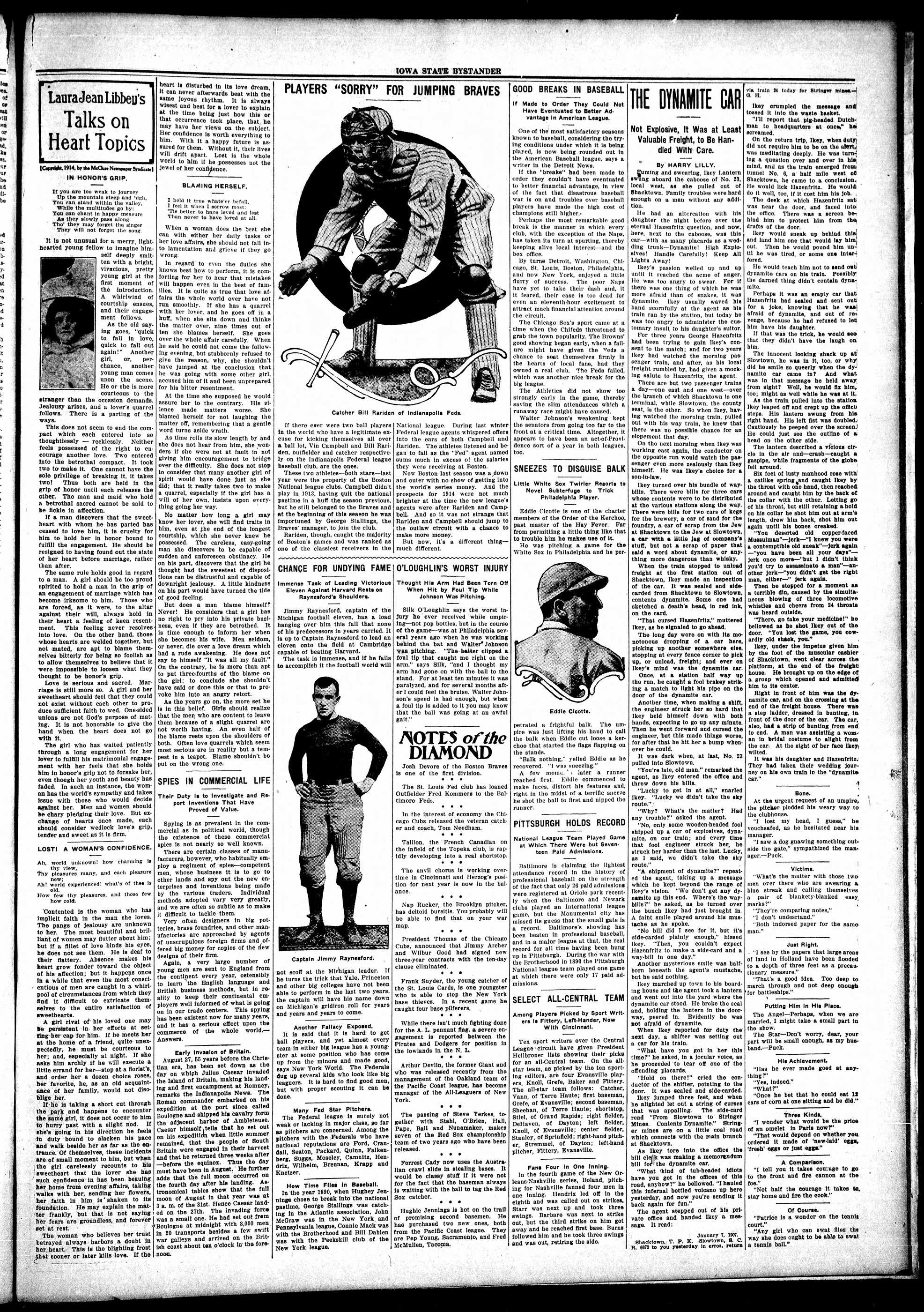
PLAYERS "SORRY" FOR JUMPING BRAVES
KO
Catcher Bill Rariden of Indianapolis Feds.
If there ever were two ball players in the world who have a legitimate excuse for kicking themselves all over a ball lot, Vin Campbell and Bill Rariden, outfielder and catcher respectively on the Indianapolis Federal league baseball club, are the ones.
These two athletes—both stars—last year were the property of the Boston National league clubs. Campbell didn't play in 1913, having quit the national pastime in a huff the season previous, but he still belonged to the Braves and at the beginning of this season he was importted by George Stallings, the Braves' manager, to join the club.
Rariden, though, caught the majority of Boston's games and was ranked as one of the classiest receivers in the
National league. Due Federal league agents into the ears of Rariden. The athletes gan to fall as the "Fed sums much in excess they were receiving a Now Boston last season and outer with no show the world's series prospects for 1914 brighter at the time agents were after Rarell. And so it was Rariden and Campbell the outlaw circuit make more money. But now, it's a much different.
Immense Task of Leading Victorious Eleven Against Harvard Rests on Raynesford's Shoulders.
Jimmy Raynesford, captain of the Michigan football eleven, has a load hanging over him this fall that none of his predecessors in years carried. It is up to Captain Raynesford to lead an eleven onto the field at Cambridge capable of beating Harvard.
The task is immense, and if he fails to accomplish it the football world will
COLUMBUS
Captain Jimmy Rayneesford. not scoff at the Michigan leader. If he turns the trick that Yale, Princeton and other big colleges have not been able to perform in the last two years, the captain will have his name down on Michigan's gridiron roll for years and years and years to come.
Another Fallacy Exposed
It is said that it is hard to get ball players, and yet almost every team in either big league has a youngster at some position who has come up from the minors and made good, says New York World. The Federalis dug up several kids who look like big leaguers. It is hard to find good men, but with proper scouting it can be done.
Many Fed Star Pitchers.
The Federal league is surely not weak or lacking in major class, so far as pitchers are concerned. Among the pitchers with the Federals who have national reputations are Ford, Crandall, Seaton, Packard, Quinn, Falkenberg, Suggs, Moseley, Camnitz, Hendrix, Wilhelm, Brennan, Krapp and Knetzer.
How Time Elites In Baseball.
In the year 1890, when Hughey Jennings chose to break into the national pastime, George Stallings was catching in the Atlantic association, John McGraw was in the New York and Pennsylvania league, Connie Mack was with the Brotherhood and Bill Dahlen was with the Peekskill club of the New York league.
IOWA STATE BYSTANDER
OR JUMPING BRAVES
National league. During last winter Federal league agents whispered offers into the ears of both Campbell and Rariden. The athletes listened and began to fall as the "Fed" agent named sums much in excess of the salaries they were receiving at Boston. Now Boston last season was a down and outer with no show of getting into the world's series money. And the prospects for 1914 were not much brighter at the time the new league's agents were after Rariden and Campbell. And so it was not strange that Rariden and Campbell should jump to the outlaw circuit with a chance to make more money. But now, it's a different thing—much different.
Thought His Arm Had Been Torn Off When Hit by Foul Tip While Johnson Was Pitching.
Silk O'Loughlin says the worst injury he ever received while umpiring—not pop bottles, but in the course of the game—was at Philadelphia several years ago when he was working behind the bat and Walter Johnson was pitching. "The batter clipped a foul tip that caught me right on the arm," says Silk, "and I thought my arm had gone on with the ball to the stand. For at least ten minutes it was paralyzed, and for several months after I could feel the bruise. Walter Johnson's speed is bad enough, but when a foul tip is added to it you may know that the ball was going at an awful gait."
NOTES of the DIAMOND
Josh Devore of the Boston Braves is one of the first division.
The St. Louis Fed club has loaned Outfielder Fred Kommers to the Baltimore Feds.
In the interest of economy the Chicago Cubs released the veteran catcher and coach, Tom Needham.
Tallion, the French Canadian on the infield of the Topeka club, is rapidly developing into a real shortstop.
The anvil chorus is working overtime in Cincinnati and Herzog's position for next year is now in the balance.
Nap Rucker, the Brooklyn pitcher, has deltoid bursitis. You probably will be able to find that on your war man.
President Thomas of the Chicago
Cubs, announced that Jimmy Archer
and Wilbur Good had signed new
three-year contracts with the ten-day
clause eliminated.
Frank Snyder, the young catcher of
the St. Louis Cards, is one youngster
who is able to stop the New York
base thieves. In a recent game he
caught four base pilfers.
While there isn't much fighting done
for the A. L. pennant flag, a severe
engagement is reported between the
Pirates and Dodgers for position in
the lowlands in the N. L.
Arthur Devlin, the former Giant and
who was released recently from the
management of the Oakland team of
the Pacific Coast league, has become
manager of the All-Leaguers of New
York.
The passing of Steve Yerkes, together with Stahl, O'Brien, Hall, Pape, Ball and Nunamaker, makes seven of the Red Sox championship team of two years ago who have been released.
Forrest Cady now uses the Australian crawl slide in stealing bases. It would be classy stuff if it were not for the fact that the baseman always is waiting with the ball to tag the Red Sox catcher.
Hughe Jennings is hot on the trail of promising second basemen. He has purchased two new ones, both from the Pacific Coast league. They are Pep Young, Sacramento, and Fred McMullen, Tacoma.
---
---
---
. . .
. . .
---
GOOD BREAKS IN BASEBALL
If Made to Order They Could Not Have Evaluated to Better Advantage in American League.
One of the most satisfactory seasons known to baseball, considering the trying conditions under which it is being played, is now being rounded out in the American Baseball league, says a writer in the Detroit News. If the "breake" had been made to order they couldn't have eventuated to better financial advantage, in view of the fact that disastrous baseball war is on and troubles over baseball players have made the high cost of champions still higher.
Perhaps the most remarkable good break is the manner in which every club, with the exception of the Naps, has taken its turn at spurting, thereby keeping alive local interest—and the box office.
By turns Detroit, Washington, Chicago, St. Louis, Boston, Philadelphia, and now New York, enjoyed a little flurry of success. The poor Naps have yet to take their dash and, it it feared, their case is too dead for even an eleventh-hour excitement to attract much financial attention around the circuit.
The Chicago Sox's spurt came at a time when the Chifeds threatened to grab the town popularity. The Brown's good showing began early, when a failure might have given the "beds a chance to seat themselves firmly in the hearts of local fans, had they owned a real club. The Feds failed, which was another nice break for the big league.
The Athletics did not show too strongly early in the game, thereby saving the slim attendances which a runaway race might have caused.
Walter Johnson's weakening kept the senators from going too far to the front at a critical time. Altogether, it appears to have been an act-of-Providence sort of a year in both leagues, too.
SNEEZES TO DISGUISE BALK
Little White Sox Twirler Resorts to
Novel Subterfuge to Trick
Philadelphia Player.
Eddie Cicotte is one of the charter
members of the Order of the Kerocho,
past master of the Hay Fever. Far
from permitting a little thing like that
to trouble him he makes use of it.
He was pitching a game for the
White Sox in Philadelphia and he per-
Eddie Clotte.
petrated a frightful balk. The umpire was just lifting his hand to call the balk when Eddie cut loose a kerchoo that started the flags flapping on the stands.
"Balk nothing," yelled Eddie as he recovered. "I was sneezing."
A few mome... later a runner reached first. Eddie commenced to make faces, distort his features and, right in the midst of a terrific sneeze he shot the ball to first and nipped the runner.
PITTSBURGH HOLDS RECORD
National League Team Played Game at Which There Were but Seventeen Paid Admissions.
Baltimore is claiming the lightest attendance record in the history of professional baseball on the strength of the fact that only 26 paid admissions were registered at Orlole park recently when the Baltimore and Newark clubs played an International league game, but the Monumental city has missed its guess that the small gate is a record. Baltimore's showing has been beaten in professional baseball, and in a major league at that, the real record for all time having been hung up in Pittsburgh. During the war with the Brotherhood in 1890 the Pittsburgh National league team played one game at which there were only 17 paid admissions.
SELECT ALL-CENTRAL TEAM
Among Players Picked by Sport Writers is Fittery, Left-Hander, Now With Cincinnati.
Ten sport writers over the Central League circuit have given President Helbroner lists showing their picks for an all-Central team. On the all-star team, as picked by the ten sporting editors, are four Evansville players, Knoll, Grefe, Baker and Fittery. The all-star team follows: Catcher, Vann, of Terre Haute; first baseman, Grefe, of Evansville; second baseman, Sheehan, of Terre Haute; shortstop, Stiel, of Grand Rapids; right fielder, DeHaven, of Dayton; left fielder, Knoll, of Evansville; center fielder, Stanley, of Springfield; right-hand pitcher, Stremmel, of Dayton; left-hand pitcher, Fittery, Evansville.
Fane Four In One Inning
In the fourth game of the New Orleans-Nashville series, Boland, pitching for Nashville fanned four men in one inning. Hendrix led off in the eighth and was called out on strikes. Starr was next up and took three swings. Barbare was next to strike out, but the third strike on him got away and he reached first base. Burns followed him and he took three swings and was out, retiring the side.
---
Not Explosive, It Was at Least Valuable Freight, to Be Handled With Care.
Not Explosive, It Was at Least Valuable Freight, to Be Handled With Care.
By HARRY LILLY.
Fuming and swearing, Ikey Lantern swing aboard the caboose of No. 23, local west, as she pulled out of Shacktown. Family troubles were hard enough on a man without any addition.
He had an altercation with his daughter the night before over the eternal Hazenfritz question, and now, here, next to the caboose, was this car—with as many placards as a wedding trunk—Dynamite! High Explosives! Handle Carefully! Keep All Lights Away!
Ikey's passion willed up and up until it reached the acme of anger. He was too angry to swear. For if there was one thing of which he was more afraid than of snakes, it was dynamite. Ikey usually waved his hand scornfully at the agent as his train ran by the station, but today he was too angry to administer the customary insult to his daughter's suitor.
For three years George Hazenfritz had been trying to gain Ikey's consent to the match; and for two years Ikey had watched the morning passenger train, and after, as his local freight rumbled by, had given a mocking salute to Hazenfritz, the agent. There are but two passenger trains a day—one east and one west—over the branch of which Shacktown is one terminal, while Slowtown, the county seat, is the other. So when Ikey, having watched the morning train, pulled out with his way train, he knew that there was no possible chance for an elopement that day.
On the next morning when Ikey was working east again, the conductor on the opposite run would watch the passenger even more zealously than Ikey himself. He was Ikey's choice for a son-in-law.
Ikey turned over his bundle of waybills. There were bills for three cars whose contents were to be distributed at the various stations along the way. There were bills for two cars of kegs for the brewery, a car of sand for the foundry, a car of scrap from the Jew at Shacktown to the Jew at Slowtown, a car with a little jag of company's stuff, but not a scrap of paper that said a word about dynamite, or anything more dangerous than whisky. When the train stopped to unload freight at the first station out of Shacktown, Ikey made an inspection of the car. It was sealed and sidecarded from Shacktown to Slowtown, contents dynamite. Some one had sketched a death's head, in red ink, on the card.
"That cursed Hazenfritz," muttered Ikey, as he signaled to go ahead.
The long day wore on with its monotonous dropping of a car here, picking up another somewhere else, stopping at every fence corner to pick up, or unload, freight; and ever on key's mind was the dynamite car. Once, at a station half way up the run, he caught a fool brake striking a match to light his pipe on the door of the dynamite car.
Another time, when making a shift, the engineer struck her so hard that key held himself down with both hands, expecting to go up any minute. Then he went forward and cursed the engineer, but this made things worse, for after that he hit her a bump whenever he could.
It was dark when, at last, No. 23 pulled into Slowtown.
"You're late, old man," remarked the agent, as key entered the office and throw down his bills.
"Lucky to get in at all," snarled ikey. "Lucky we didn't take the sky route."
"Why? What's the matter? Had any trouble?" asked the agent.
"No, only some wooden-headed fool shipped up a car of explosives, dynamite, on our train; and every time that fool engineer struck her, he struck her harder than the last. Lucky, as I said, we didn't take the sky route."
"A shipment of dynamite?" repeated the agent, taking up a message which he kept beyond the range of likey's vision. "We don't get any dynamite up this end. Where's the waybills?" he asked, as he turned over the bunch Ikey had just brought in. A faint smile played around his mustache as he spoke.
"No bill did I see for it, but it's side-carded plainly enough," hissed Ikey. "Then, you couldn't expect Hazenfritz to make a side-card and a way-bill in one day."
Another mysterious smile was half-born beneath the agent's mustache, but he said nothing.
Ikey marched up town to his boarding house and the agent took a lantern and went out into the yard where the dynamite car stood. He broke the seal and, holding the lantern in the doorway, peered in. Evidently he was not afraid of dynamite.
When Ikey reported for duty the next day, a shifter was setting out a car for his train.
"What have you got in her this time?" he asked, in a jocular voice, as he proceeded to tear off one of the offending placards.
"Hold on there!" cried the conductor of the shifter, pointing to the door. It was sealed and side-carved.
ductor of the shifter, pointing to the door. It was sealed and side-carded. Ikey jumped three feet, and when he alighted let out a string of curses that was appalling. The side-card read "From Slowtown to Stringer Mines. Contents Dynamite." Stringer mines are on a little coal road which connects with the main branch at Shacktown.
As Ikey tore into the office the bill clerk was making a memorandum bill for the dynamite car.
"What kind of tub-headed idiots have you got in the offices of this road, anyhow?" he bellowed. "I hauled an infernal bottled volcano up here yesterday, and now you're sending it back again for fun."
The agent stepped out of his private office and handed Ikey a message. It read:
January 7, 1907.
Shacktown, T. P. K. Slowtown, S. C.
B. 6673 to you yesterday in error, return
via train 24 today for Stringer mines. G. H.
Ikey crumpled the message and tossed it into the waste basket.
"I'll report that pig-headed Dutchman to headquarters at once," he screamed.
On the return trip, Ikey, when duty did not require him to be on the alert, was meditating deeply. He was turning a question over and over in his mind, and as the train emerged from tunnel No. 6, a half mile west of Shacktown, he came to a conclusion. He would lick Hazenfritz. He would do it well, too, if it cost him his job.
The desk at which Hazenfritz sat was near the door, and faced into the office. There was a screen behind him to protect him from the drafts of the door.
Ikey would sneak up behind this and land him one that would lay him out. Then he would pound him until he was tired, or some one interfered.
He would teach him not to send out dynamite cars on his train. Possibly the darned thing didn't contain dynamite.
Perhaps it was an empty car that Hazenfritz had sealed and sent out for a joke, knowing that he was afraid of dynamite, and out of revenge, because he had refused to let him have his daughter.
If that was the trick, he would see that they didn't have the laugh on him.
The innocent looking shack up at Slowtown, he was in it, too, or why did he smile so queerly when the dynamite car came in? And what was in that message he held away from sight? Well, he would fix him, too; might as well while he was at it.
As the train pulled into the station likely leaped off and crept up the office his. His lantern swung from his right hand. His left fist was doubled. Cautiously he peeped over the screen. He could just see the outline of a head on the other side.
The lantern described a vicious circle in the air and—crash—caught a gaspie, white fragments of the globe fell around.
Six feet of lusty manhood with a catlike spring and caught leye by the throat with one hand, then reached around and caught him by the back of the collar with the other. Letting go of his throat, but still retaining a hold on his collar he shot him out at arm's length, drew him back, shot him out again until his bones creaked.
"You deserved old copper-faced Musculman"—jerk—"I knew you were a contemptible old sneak"—jerk again—"you have been all your days"—jerk once more—"but I didn't think you'd try to assassinate a man"—another jerk—"you didn't get the right man, either"—jerk again.
Then he stopped for a moment as a terrible din, caused by the simultaneous blowing of three locomotive whistles and cheers from 24 throats was heard outside.
"There, go take your medicine!" he bellowed as he shot ikey out of the door. "You lost the game, you cowardly old shack, you."
Ikey, under the impetus given him by the foot of the muscular cashier of Shacktown, went clear across the platform, at the end of the freight house. He brought up on the edge of a group which opened and admitted him to its center.
Right in front of him was the dynamite car, and on the crossing at the end of the freight house. There was a step ladder, dressed in bunting, in front of the door of the car. The car, also, had a strip of bunting from end to end. A man was assisting a woman in bridal costume to alight from the car. At the sight of her face ikey, wilted.
It was his daughter and Hazenfritz. They had taken their wedding journey on his own train in the "dynamite car."
Bone.
At the urgent request of an umpire, the pitcher plodded his weary way to the clubhouse.
"I lost my head, I guess," he vouchsafed, as he hesitated near his manager.
"I saw a dog guawing something outside the gate," sympathized the manager—Puck.
Victims
"What's the matter with those two men over there who are swearing a blue streak and calling themselves a pair of blankety-blanked easy marks?"
"They're comparing notes," "I don't understand." "Both indorsed paper for the same man."
Just Right.
"I see by the papers that large areas of land in Holland have been flooded to a depth of three feet as a precautionary measure."
"That's a good idea. Too deep to march through and not deep enough for battleships."
Putting Him In His Place.
The Angel—Perhabs, when we are married, I might take a small part in the show.
The Star—Don't worry, dear, your part will be small enough, as my husband—Puck.
His Achievement.
"Has he ever made good at anything?"
"Yes, indeed."
"What?"
"Once he bet that he could eat 12 ears of corn at one sitting and he did."
Three Kinds.
"I wonder what would be the price of an omelet in Paris now?" "That would depend on whether you ordered it made of 'new-lal' eggs. 'fresh' eggs or just eggs."
A. Comparison.
"I tell you it takes courage to go to the front and fire cannon at the foe. Not half the courage it takes to stay home and fire the cook."
Of Course.
"Patrice is a wonder on the tennis court."
"Any girl who can swat files the way she does ought to be able to swat a tennis ball."
ROCK ISLAND, HLL.
Mr. Case Lammert underwent a slight operation last Monday morning. Dr. Davis performed the operation and reports that the patient is the Members of Wayman Chapel are very much delighted over their new minister, Rev. Wharton. A very large congregation greeted him Sunday morning and evening.
Mr. and Mrs. Tom Landay of Denver, Colorado, former residents of Rock Island, and daughter, Mrs. Ardine Alexander, of Des Moines, Iowa, are visiting relatives and friends in the city.
A little Miss Whitfield arrived at the Whitfield home Saturday evening. Rev. Touney of Omaha, Me, will give an illustrated lecture on Booker I. Washington at the Second Baptist church Tuesday evening.
The emancipation celebration was largely attended at Hale's Garden last Tuesday. The club members say it was one of the best financial celebrations they have had in two years. Mr. Baines and son of Manatee, Iowa, attended the celebration last Tuesday. Mr. Ulysses Clark returned home last Sunday from Iowa City. He has resumed his studies at the high school, this being his last year. Mrs. Cella Morrison entertained the following ladies at a 6 o'clock dinner Tuesday evening: Mrs. Wheeler of Clark, Teem, Mr. and Mrs. Tom Lindsay of Denver, Cole, Mrs. A. Alexander of Des Moines, Iowa, and Mrs. Parish, Mrs. Jennie Work and Mrs. W. Morton of Rock Island. Owing to the illness of Mr. Lambert, Irene Fulton returned home Wednesday morning with Mrs. A. Alexander.
Mrs. Ada Davis of Galeenburg, was a guest of Mrs. Jennie McClain last week.
Mrs. Gen. Green remains very poorly.
Mrs. Wylie Morton entertained at a family dinner Sunday in honor of her sister, Mrs. Tom Lindsay.
Mrs. Grace Remington returned home Sunday night, after a month's visit in Chicago with her sister, Mrs. Patterson.
Mr. and Mrs. Dr. Davis and Colvert, Jr., have returned home, after a two weeks' vacation.
What Would You Do?
There are many times when one man questions another's actions and motives. Men act differently under different circumstances. The question is, what would you do right now if you had a severe cold? Could you be better than to take Chamberlain's Cough Remedy? It is highly recommended by people who have used it for years and know its value. Mrs. O. E. Sargent, Pern, Ind., says, "Chamberlain's Cough Remedy is worth its weight in gold and I take pleasure in recommending it." For sale by all dealers.
OSKALOOSA, IOWA
Miss A. Tolson and Mrs. Adams of Jackson, Mo., are here visiting Mrs. P. D. Tolson at 442 North Fifth street indefinitely.
B. F. Cooper of Buxton was a business caller in our city last week.
Rev. Woodard and Miss Nettie Lewis were married last Thursday, September 24, at the M. E. parsonage by Rev. Tolson at 8 o'clock. After the ceremony the guests went to the home of the bride, where a luncheon was served.
The L. P. L. club met at the home of Mrs. Bell Bush on First avenue West. It was visitors' day and a program was rendered. Quite a goodly number were out. After the program the hostess served an elaborate banch.
Mrs. L. Barber of Evanston, Ill., is in our city, the guest of Mrs. H. Williams.
Henry Dunlap has resumed his place as chef at the Lacey hotel, after a summer's rest.
Will Rodgers has gone to Ottumwa to work at the Ballinghall hotel with Pierre Barquette.
Mrs. Chas. Wilson of Ottumwa spent Sunday at the home of her parents, Mr. and Mrs. E. E. Jones, 428 North Fifth street.
Mrs. B. Richmond of Centerville was visiting at the home of her mother, Mrs. Frank Allen, 615 B avenue West. Mrs. Richmond is moving to Highland Park, Ill., for the winter, where her husband is employed.
Rev. O. A. Johnson has returned home to Lexington, Mo., after two weeks among friends.
Presiding Elder Wheeler was here and held his second quarterly meeting at Wesley A. M. E. church on Sunday, September 20th.
Rev. J. Bowles of Fort Madison Second Baptist church preached here at the Second Baptist church Sunday, September 20th.
The ladies of the Second Baptist church went to Evans, Iowa, Saturday. It being the birthday of Rev. O. B. Smith they remembered him with a new hat and many more happy birthdays. Mrs. Chas. Adams leaves Wednesday for Old Virginia, her home, for a visit. Lewis Green of Toledo, Iowa, spent Sunday visiting Mrs. I. Fredrick.... Naomi Kimbrough has gone to Washington, Iowa, to spend the fall.
ALBIA NEWS.
Rev. and Mrs. G. W. Jackson were the guests of Mrs. Tom Williams over Sunday, en route on their way from Des Moines to M. Pleasant. Mrs. Will Harris also entertained them at dinner and they made a trip to Buxton in their auto for afternoon services at the church.
Rev. Morton is pastor of the A. M. E. church in Albia and Rev. and Mrs. K. B. Manly have gone to Council Bluffs to be pastor of the A. M. E. church in that city.
On Thursday evening in Hawkeye, Iowa, occurred the death of Mrs. Cora McCarthy, a daughter of Rev. and Mrs. Cornelius Thomas, a well known family in Albia. Mrs. McCarthy was.
born in Mt. Pleasant, Iowa, and lived most of her childcare days and homemade in Aliaia. She became a member of the A. M. E. church at the age of 12 years and has always been identified with the A. M. E. church. She married in 1866 in Burlington and moved to Hawkeye on a farm. Mr. and Mrs. McCarthy have resided in Hawkeye since their marriage. Mrs. McCarthy was a woman of much intelligence and loved by all. At her death she was 45 years old. She was galled to rest in the early prime of her life for a woman of so much intelligence. She has a father, mother, three brothers, two sisters, a husband and about ten nephews and nieces and a little boy she was raised to mourn her loss, with a number of friends. Many farm Burton, Hawkeye, Des Mouns, Histeman and Hocking were in attendance at the funeral. Rev. and Mrs. R. B. Massly leave Wednesday for Council Effus. They have made many friends in Aliaia.
Many strangers in Albia the past week.
Rev. and Mrs. Griffith and family of Des Moines have been at the parental C. Thomas home for several days this week.
Mr. Carlton, Mr. Burt Jones and Mrs. Nora Grayman of Histeman were in Albia on Sunday.
Mrs. Burnt. Mrs. Headpeath and a number of others from Hocking were in Albia over Sunday.
HEALTH HINTS
A. J. Bowie.
The most cruel person be the world it is the one that puts mean ideas into a child's head. It is not that any same person really deliberately sits down and teaches a child devilment, hence the danger. The greatest danger danger and the most lasting injury is done by people who do not think. Of all the impotent excuses, "I didn't think" is the least. People who do not think have no
greatest danger and danger the most lasting injury is done by people who do not think. Of all the impotent excuses, "I didn't think" is the least. People who do not think have no business with children, nor anything that is influenced by suggestion.
The human soul is so allied to God that it is limitless in achievement, if it wills and is properly directed. Children are closer to God than most grown persons, because they have more faith and less duplicity. They know no limit to their ability and they are right. They know love and tenderness and respond to encouragement. There are some persons in the world that are a calamity to any child that comes in contact with them. Bound down by superstition, held immovable by ignorance of their kinship with God, and the consequent power, cowed by a few disappointments, they impregnate the atmosphere and chill every warm blooded spirit within reach.
Sush people can and often do kill the chances of children for life. When in a fit of anger, or of despondency, you tell a child that it will never amount to anything you are taking the life of its spirit. Better by far kill it with a club than strangle its hopes and crush its dreams. It is our hopes and dreams that keep us alive—it is not what de do.
Let it be said that you are crazy, that you steal, that you lie, that you drink and are absolutely worthless; but never let the stain of cripping a future be laid at your door. These other things do you harm, but to change the bright picture of a child is an unendenable sin.
How can a child fight the battle of life when he has been told that he did not amount to anything? Most of the tragedies of life do not reach the papers; they are bound up in human hearts, that are sealed to all the world, and we wonder why so many people fail. Some one who did not think dropped a suggestion that was cruel and sharp; it burned its way into the soul and left an indelible impression—for the things that hurt make the deepest impression. Then fear, and loss of hope, and lack of confidence quickly sprout and the world is lost. The bright picture of the future is changed to comber hues, the soul is injured and the world knows another direlect because some one did not think.
MINNEAPOLIS MINN
Quarterly meeting will take place at St. James' A. M. E. church October 4th:
Mrs. William Hyde of 2840 Eleventh avenue So. entertained at dinner Saturday evening. Mrs. PatyEaton of St. Louis was the guest of honor. Covers were laid for eight.
Mrs. R. B. Moulden entertained Saturday evening. Whist was played at eight tables.
It is indeed a great disappointment to the many friends of Mrs. Edward Hammond of Clinton avenue to learn of her sudden serious illness. It was hoped she was on the road to recovery.
Mr. and Mrs. J. A. Abbey of Hannibal, Mo., mother and father of Mr. Luther Abbey, are making their home in our city now. They reside at 2421 Fourth avenue So.
We learn that Mrs. June Burt, who lost her mind a couple of weeks ago, is improving at the sanitarium where she is confined.
Rev. E. R. Edwards, pastor of St. James' A. M. E. church, has returned from Chicago, where he went to attend the Chicago conference. He filled his pulpit at both services Sunday and was listened to by a very appreciative audience. Rev. E. G. Jackson, former pastor of St. Peter's A. M. E. church, filled the pulpit at St. Peter's on Sunday at both services, as Rev. T. B. Stovall has not arrived yet. Rev. T. B. Stovall, former pastor at Davenport, Iowa, is expected in this city Friday morning and expects to fill his pulpit at St. Peter's A. M. E. church next Sunday.
There will be a reception given at
St. Peter's A. M. E. church Friday
courting for Rev. E. G. Jackson, the congregant pastor, and for Rev. T. E. Stowall, the incoming pastor.
Mr. Vivian Jones of Des Moines, Iowa, made a short visit to Minnesota and St. Paul on Monday and Tuesday of this week.
Rev. E. G. Jackson expects to leave Saturday morning for Des Moines, Iowa.
MASON CITY NEWS
LAST WEEK NEWS
Mrs. Bernice Eaton spent the past week in South City on business.
Erv. W. H. Wheeler, the district superintendent, held the second quarterly meeting at Union Memorial church Sunday. Erv. Wheeler preached three powerful and spiritual sermons. A large audience witnessed the sermon Sunday evening.
Among those who entertained Erv. Wheeler while he was here were Mrs. Banning, Mrs. Brewton, Mrs. Eesler, Mrs. Caskell, Mrs. P. Wright and Mrs. Davis.
Mrs. Tho. Allen went to Fort Lodge on Saturday for an over Sunday visit with her mother.
Quite a few of our young people went to Hampton, Iowa, Friday evening to attend a party given in honor of the two baseball teams, the All Nations and Chicago Union Giants.
Miss Marie Hall of Hampton, Iowa, was in the city over Sunday visiting at the Williams home on East State street.
Mrs. Alfred King went to Chicago last week to spend his few days vacation.
Mrs. Mary Davis entertained for dinner Sunday Rev. Wheeler and Rev. F. D. Woodford and wife. A three-course dinner was served.
Mr. Harding is here filling the vacancy of Mr. King, who is also from Chicago.
Mr. and Mrs. Boaz of Chicago are in the city stopping at the home of Mr. and Mrs. Harvey Spencer. Mr. Boaz is employer on the C., M. & St. P. R. R.
Mr. C. M. Ray, who has been in Mason City for the past three months at the home of Mr. and Mrs. Chas. Brewnut, left Monday for Rochester, where she is expected to undergo an operation in the near future.
The Ladies' Aid society held a very interesting meeting last Friday afternoon at the church. Rev. Wheeler, Rev. Penney and Mrs. Penney and Mr. Reeser were the principal speakers of the day. Refreshments were served by the society and a neat sum realized.
Will straighten the most kinky and slubbed hair
Will dry the hair after Shampoo. Will cultivate
the Best and Only Solid Bamboo Comb Made
SPECIAL PRICE COMPLETE $2.80
SPECIAL PRICE COMPLETE $2.80
Colored People's Hair Goods. Send 2c stamp
for our beautiful illustrated Catalogue.
The Street Railway Franchise Is Now Up to the People
The Company Favors Publicity
All of the people of Des Moines are urged to inform themselves as to the provisions of the proposed new franchise.
Thousands of copies of the franchise have been printed and are being distributed broadcast throughout the city.
Petition workers are leaving copies of the franchise in the downtown district.
Any citizen who desires a copy may obtain same by calling at the franchise headquarters, 216 Sixth avenue, or by telephoning Walnut 2602 and requesting that same be sent by mail.
Everything connected with the franchise election is open and above board.
Every word of the franchise is open to the searchlight of public opinion.
The Street Railway Company desires that every voter shall be informed as to the provisions of the proposed franchise.
The company guarantees good service at a reasonable rate; it certainly cannot be questioned.
The City Railway Company favors all possible publicity in connection with the franchise and the franchise election.
MARY
IOWA STATE SYRACUSE
Mr. and Mrs. Paul Scott, who had charge of the Country club at Clear Lake, have returned home and are as busy as usual greeting their friends in a most pleasing manner.
Mrs. J. D. Reeder very pleasantly entertained a few of her friends last Thursday afternoon in honor of Mrs. E. J. Penney, who is expected to leave soon for Boston, Mississippi, where Mr. Penney will teach in one of the schools.
Mrs. Ala Dent has moved to Mason City and will open up a first class rooming house this week.
Mr. J. L. Thompson was in our city last Wednesday in the interest of the Bryanters.
The J. I. club met last Friday an annual and had a very interesting discussion. "What can we do to better the condition of our race?" which was well discussed by all. Next Friday evening will be the ladies' evening, when they will render a special program for the occasion.
Mr. and Mrs. Fred Mitchell have moved from 121 W. Bradley to 1025 Sherman street.
More Than Enough is Too Much.
More Than Laugh is Too Much.
To maintain health, a mature man or woman needs just enough food to repair the waste and supply energy and body heat. The habitual consumption of more food is necessary for these purposes is the prime cause of stomach troubles, rheumatism and disorders of the kidneys. If troubled with indigestion, revise your diet, let reason and not appetite control and take a few doses of Chamberlain's Tablets and you will soon be all right again. For sale by all dealers.
Mrs. Fletcher Coleman has returned to her home in Galesburg, after a three weeks' visit with her mother, Mrs. Margaret Coleman.
Mr. and Mrs. Walter Hannah of Moberly spent Friday and Saturday in the city, the guests of Mr. and Mrs. John Jewell.
Quite a number of young people attended the circus in Moberly on Monday.
Dr. Rilep of Warrenburg, Mo., the eye specialist, was in the city last week.
Rev. Richardson, pastor of the A.M. E. church, leaves next week to take up his charge at Kirkville, Mo. We are sorry to lose such an able preacher as Rev. Richardson is.
Rev. and Mrs. McAllister and family of Clarksville, Mo. are the guests
Street Railw s Now Up to t
Company Fa people of Des Moines are urged to of the proposed new franchise
PARIS. MO.
Mary Jane
Letter No. 3
of Prof. and Mrs. G. A. Jumaladam.
Quite a number A. attended conference in Motherly on Saturday and Sunday.
Mr. Leverd Jewell has returned home, after a week and visit with friends in Sedalia, Mo.
The concert given at the A. M. E.
The "Bell Co.
There is no one "Bell Co. system is made up of seven each giving service within and the American Telephone pany, which operates long d the various local companies.
The American Telephone assists in financing the whole and directs in the introduction ideas and systematic plans the most satisfactory equipment be made uniform throughout.
The Bell policy has made one system and nation-wide result that Bell service has the world.
The "Bell Company"
there is no one "Bell Company," but the company is made up of several operating companies giving service within a definite territory. The American Telephone and Telegraph Company which operates long distance lines connects various local companies.
The American Telephone and Telegraph Company is financing the whole Bell System, and directs in the introduction and development of and systematic plans and inventions, so most satisfactory equipment and practice made uniform throughout the country.
The Bell policy has made possible one more system and nation-wide transmission, with that Bell service has become the standard world.
```markdown
```
There is no one "Bell Company," but the Bell System is made up of several operating companies, each giving service within a definite territory, and the American Telephone and Telegraph Company, which operates long distance lines connecting the various local companies.
The American Telephone and Telegraph Company assists in financing the whole Bell System, and aids and directs in the introduction and development of ideas and systematic plans and inventions, so that the most satisfactory equipment and practices may be made uniform throughout the country.
The Bell policy has made possible one method, one system and nation-wide transmission, with the result that Bell service has become the standard of the world.
"We Advertise So the People May Know."
IOWA TELEPHONE COMPANY
Badges
Embler
Ban
Emblems
Furn
Books
for all Lodge and Church Socities
For all Lodge and
Books For all Lodge and Church Societies
A Negro Firm
The Love Re
GEO, W. K. LOV
2418 Flora Ave.
Railway Franchise
to the People
r No. 3
Favors Publici
urged to inform themselves as to the
franchise.
have been printed and are being
the city.
the franchise in the downtown dis-
tain same by calling at the fran-
by telephoning Walnut 2602 and
election is open and above board
to the searchlight of public opinion
that every voter shall be informed
of the franchise.
at a reasonable rate; it certainly can
possible publicity in connection
section.
Franchise
People
Publicity
in themselves as to the pro-
inted and are being dis-
in the downtown district.
by calling at the franchise
ing Walnut 2602 and re-
open and above board.
right of public opinion.
er shall be informed as to
le rate; it certainly cannot
publicity in connection with
The Love Regalia Co.
GEO, W. K. LOVE, Pres.
2418 Flora Ave. Kansas City, Mo
DES MOINES CITY RAILWAY,
By Emil G. Schmidt, President.
```markdown
```
Badges
Regalia
church last Saturday night was quite a success. The program was excellent. Rev. Brooks of Richmond, Mo., stopped off in the city for a few days. He is on his way to his new pastorate at Palmyra, Mo.
Mrs. Bentie Palmer of Kansas City
Company"
"the Company," but the Bell several operating companies, within a definite territory, phone and Telegraph Coming distance lines connecting lines.
One and Telegraph Company, whole Bell System, and aids connection and development of cars and inventions, so that equipment and practices may out the country.
made possible one method, wide transmission, with the was become the standard of
---
ks
Church Socities
Banners
Furniture
was the guest of Mrs. Ellisa Bean-
champ last week.
Mrs. Bolden and Mrs. Logan of
Galenburg, Ill., were the guests of
Mrs. Carrie Ragland.
(Last Week.)
Little Ella Curr left Tuesday to
spend a few days with her aunt, Mrs.
James Sidles, in Hammabal, Mo.
It Always Does the Work.
"I like Chamberlain's Cough Re-
edy better than any other," writes
E. Roberts, Homer City, Pa.
"I have taken it off and on for years and
has never failed to give the desi-
tual results." For sale by all dealers.
Jönnes Cafe
The Old Reliable Place
to get your meals
PHONE RED 318 W. 3rd St
3027
Rooming House at 216-218
3rd St.
NOTICE OF EXPIRATION OF
RIGHT OF REDEMPTION.
To A. W. Bliss:
You are hereby notified that on the 11th day of December, 1911, the following described real estate, situated in Polk county, Iowa, towit: Lot eight (8) in block seven (7) in Morningstar's addition, being in and a part of the city of Des Moines, Iowa, was sold for the then delinquent and unpaid tax for the year 1910 to me; that I am still the thowner and holder of the certificate of purchase issued in pursuance of the above mentioned sale, and that the right of redemption will expire and a deed for said lot will be made unless redemption is made within ninety days from the completed service hereof.
Dated this first day of October, 1914.
Geo. Harnagel.
FREE
F
R
E
E
We are the largest importers and manufacturers of colored peoples hair and the most reliable firm in this line. We make wigs, switches, braids, transformations and all styles of hair that can comb and wash the same as your own. We also sell straightening combs, hair nets and cut hair by the pound. We guarantee all goods, and if not satisfied money will be refunded. Our prices are lower than those quoted elsewhere. Send 2c stamp for illustrated book.
Humania Hair Company
Dept 6J
23 Duane St., New York
For Chapped Skin.
Chapped skin, whether on the hands or face, may be cured in one night by applying Chamberlain's Salve. It is also unequaled for sore nipples, burns and scalds. For sale by all dealers.
MARSHALLTOWN ITEMS.
We are having fine weather here now.
Mrs. I. L. Brown entertained the Dunbar Progressive club. Much business was transacted. They are planning to have a bazaar in the near future.
Mrs. G. L. Suter still seems to improve slowly.
The Birthday club met at the residence of Mr. and Mrs. I. L. Brown.
Everyone is getting ready for the grand reception given by the Mutual club on October 21st in Cummings hall.
Mrs. S. W. Green of Toledo, Iowa, sister of Mrs. I. L. Brown, and Miss Della Watkins of Davenport made a short visit while shopping.
Mr. Carl Brown was an over Sunday visitor in Toledo, Iowa.
Why Not Publish It?
WHY NOT PUBLISH?
When you want a fact to become generally known, the right way is to publish it. Mrs. Joseph Kallans, Peru, Ind, was troubled with belching, sour stomach and frequent headaches. She writes, "I feel it my duty to tell others what Chamberlain's Tablets have done for me. They have helped my digestion and regulated my bowels. Since using them I have been entirely well." For sale by all dealers.
VIVIAN L. JONES
Funeral Director
The very best service guaranteed
Prices the lowest
Calls answered promptly day or
night No extra charges for distance—Reverse all phone charges
PHONE:} Maple 2548
Residence Wal. 6824.
Office
519 East Court Ave
Des Moines