Iowa State Bystander
Friday, October 23, 1914
Des Moines, Iowa
Page text (machine-generated)
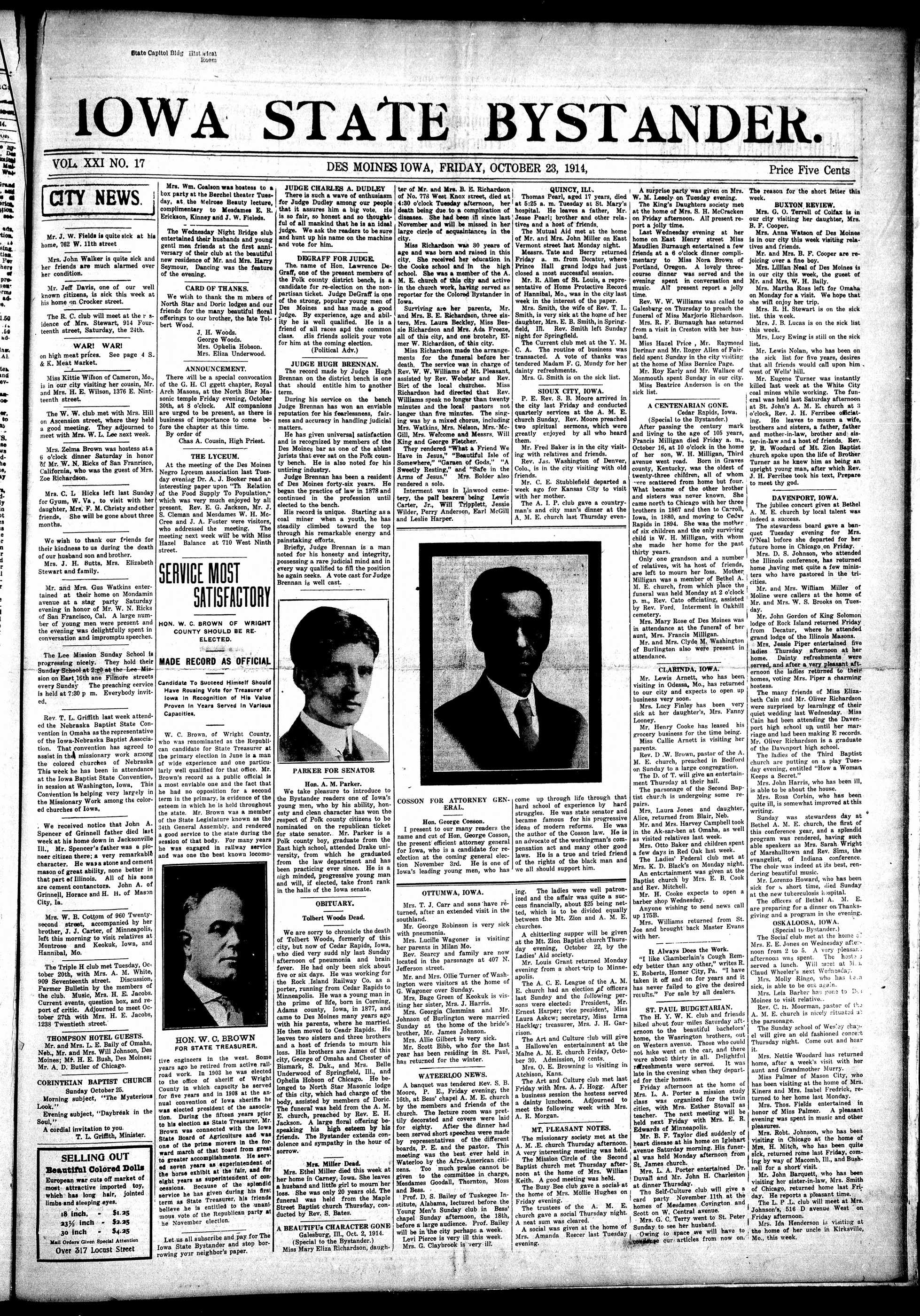
IOWA STATE BYSTANDER.
State Capitol Bldg Hlat wecal
Koorn
OWA
17
Mr. J. W. Fields is quite sick at his home, 762 W. 11th street
Mrs. John Walker is quite sick and her friends are much alarmed over her condition.
Mr. Jeff Davis, one of our well known citizens, is sick this week at his home on Crocker street.
The R. C. club will meet at the residence of Mrs. Stewart, 914 Fourteenth street, Saturday, the 24th.
on high meat prices. See page 4 S. & K. Meat Market.
Miss Kittie Wilson of Cameron, Mo., is in our city visiting her cousin, Mr. and Mrs. H. E. Wilson, 1376 E. Nintteenth street.
The W. W. club met with Mrs. Hill on Ascension street, where they held a good meeting. They adjourned to meet with Mrs. W. L. Lee next week.
Mrs. Zelma Brown was hostess at a 6 o'clock dinner Saturday in honor of Mr. W. N. Ricks of San Franisco, California, who was the guest of Mrs. Zoe Richardson.
Mrs. C. L Hicks left last Sunday for Gyum, W. Va., to visit with her daughter, Mrs. F. M. Christy and other friends. She will be gone about three months.
We wish to thank our friends for their kindness to us during the death of our husband son and brother.
Mrs. J. H. Butts, Mrs. Elizabeth Stewart and family.
Mr. and Mrs. Gus Watkins entertained at their home on Mondamin avenue at a stag party Saturday evening in honor of Mr. W. N. Ricks of San Francisco, Cal. A large number of young men were present and the evening was delightfully spent in conversation and impromptu speeches.
The Lee Mission Sunday School is progressing nicely. They hold their Sunday School at 2:30 at the Lee Mission on East 16th acre Filmore streets every Sunday. The preaching service is held at 7:30 p.m. Everybody invited.
Rev. T. L. Griffith last week attended the Nebraska Baptist State Convention in Omaha as the representative of the Iowa-Nebraska Baptist Association. That convention has agreed to assist in the missionary work among the colored churches of Nebraska This week he has been in attendance at the Iowa Baptist State Convention, in session at Washington, Iowa. This Convention is helping very largely in the Missionary Work among the colored churches of Iowa.
We received notice that John A. Spencer of Grinnell father died last week at his home down in Jacksonville Ill., Mr. Spencer's father was a pioneer citizen there; a very remarkable character. He was a stone and cement mason of great ability, none better in that part of Illinois. All of his sons are cement contractors. John A. of Grinnell, Horace and H. H. of Mason City, Ia.
Mrs. W. B. Cottom of 960 Twenty-second street, accompanied by her brother, J. J. Carter, of Minneapolis, left this morning to visit relatives at Montrose and Keokuk, Iowa, and Hannibal, Mo.
The Triple H club met Tuesday, October 20th, with Mrs. A. M. White, 909 Seventeenth street. Discussion, Farmer Bulletin by the members of the club. Music, Mrs. H. E. Jacobs. Current events, question box, and report of critic. Adjourned to meet October 27th with Mrs. H. E. Jacobs, 1238 Twentieth street.
THOMPSON HOTEL GUESTS.
Mr. and Mrs. L. E. Baily of Omaha, Neb., Mr. and Mrs. Will Johnson, Des Moines; Mf. H. E. Bush, Des Moines; Mr. A. D. Butler of Chicago.
CORINTHIAN BAPTIST CHURCH
Sunday October 25
Morning subject, "The Mysterious Look."
Evening subject, "Daybreak in the Soul."
---
---
VOL. XXI NO. 17
CITY NEWS
WAR! WAR!
A cordial invitation to you.
T. L. Griffith, Minister.
SELLING OUT
Beautiful Colored Dolls
European war cuts off market of
most attractive imported toy,
which has long hair, jointed
limbs and sleeping eyes.
18 inch, - $1.25
23½ inch - $2.25
30 inch - $4.25
Mail Orders Given Special Attention
Over 317 Locust Street
Mrs. Wm. Coalson was hostess to a box party at the Berchel theater Tuesday, at the Melrose Beauty lecture, complimentary to Mesdames E. R. Erickson, Kinney and J. W. Fields.
The Wednesday Night Bridge club entertained their husbands and young gentl men friends at the first anniversary of their club at the beautiful new residence of Mr. and Mrs. Harry Seymour, Dancing was the feature of the evening.
CARD OF THANKS.
We wish to thank the m mbers of North Star and Doric lodges and our friends for the many beautiful floral offerings to our brother, the late Tolbert Wood.
J. H. Woods.
George Woods.
Mrs. Ophelia Hobson.
Mrs. Eliza Underwood.
ANNOUNCEMENT.
There will be a special convocation of the G. H. Cl gget chapter, Royal Arch Masons, at the North Star Masonic temple Friday evening, October 30th, at 8 o'clock. All companions are urged to be present, as there is business of importance to come before the chapter at this time. By order of Chas A. Cousin, High Priest.
THE LYCEUM.
At the meeting of the Des Moines Negro Lyceum association last Tuesday evening Dr. A. J. Booker read an interesting paper upon "Th Relation of the Food Supply To Population," which was very much enjoyed by all present, Rev. E. G. Jackson, Mr. J. S. Cleman and Mesdames W. H. McCree and J. A. Foster were visitors, who addressed the meeting. The meeting next week will be with Miss Hazel Balance at 710 West Ninth street.
SERVICE MOST SATISFACTORY
HON. W. C. BROWN OF WRIGHT COUNTY SHOULD BE RE ELECTED.
Candidate To Succeed Himself Should Have Rousing Vote for Treasurer of Iowa in Recognition of His Value Proven in Years Served in Varleus Capacities.
W. C. Brown, of Wright County, who was renominated as the Republican candidate for State Treasurer at the primary election in June is a man of wide experience and one particularly well qualified for that office. Mr. Brown's record as a public official is a most enviable one and the fact that he had no opposition for a second term in the primary, is evidence of the esteem in which he is held throughout the state. Mr. Brown was a member of the State Legislature known as the 34th General Assembly, and rendered a good service to the state during the session of that body. For many years he was engaged in railway service and was one the best known locomo-
M.
HON. W. C. BROWN
FOR STATE TREASURER
tive engineers in the west. Some years ago he retired from active railroad work. In 1903 he was elected to the office of sheriff of Wright County in which capacity he served for five years and in 1908 at the annual convention of Iowa sheriffs he was elected president of the association. During the fifteen years prior to his election as State Treasurer, Mr. Brown was connected with the Iowa State Board of Agriculture and was one of the prime movers in the forward march of that board from great to greater accomplishments. He served seven years as superintendent of the horse exhibit at the fair, and for eight years as superintendent of concessions. Because of the splendid service he has given during his first term as State Treasurer, his friends believe he is entitled to the unanimous vote of the Republican party at he November election.
Let us all subscribe and pay for The Iowa State Bystander and stop borrowing your neighbor's paper.
JUDGE CHARLES A. DUDLEY
There is such a wave of enthusiasm for Judge Dudley among our people that it assures him a big vote. He is so fair, so honest and so thoughtful of all mankind that he is an ideal judge. We ask the readers to be sure and hunt up his name on the machine and vote for him.
ter of Mr. and Mrs. B. E. Richardson of No. 778 West Knox street, died at 4:30 o'clock Tuesday afternoon, her death being due to a complication of diseases. She had been ill since last November and will be missed in her large circle of acquaintances in the city.
Miss Richardson was 30 years of
QUINCY, IL
Thomas Pearl, aged 1 at 5:25 a. m. Tuesday a hospital. He leaves a Jesse Pearl; brother and aides and a host of friends. The Mutual Aid met of Mr. and Mrs. John M. Vermont street last Mor
DEGRAFF FOR JUDGE
The. name of Hon. Lawrence DeGraff, one of the present members of the Polk county district bench, is a candidate for re-election on the nonpartisan ticket. Judge DeGraff is one of the strong, popular young men of Des Moines and has made a good judge. By experience, age and ability he is well qualified. He is a friend of all races and the common class. His friends solicit your vote for him at the coming election.
JUDGE HUGH BRENNAN
The record made by Judge Hugh Brennan on the district bench is one that should entitle him to another term.
During his service on the bench Judge Brennan has won an enviable reputation for his fearlessness, fairness and accuracy in handling judicial matters.
He has given universal satisfaction and is recognized by members of the Des Moines bar as one of the ablest jurists that ever sat on the Polk county bench. He is also noted for his untiring industry.
Judge Brennan has been a resident of Des Moines forty-six years. He began the practice of law in 1878 and continued in the profession until elected to the bench.
His record is unique. Starting as a coal miner when a youth, he has steadily climbed toward the top through his remarkable energy and painstaking efforts.
Briefly, Judge Brennan is a man noted for his honesty and integrity, possessing a rare judicial mind and in every way qualified to fill the position he again seeks. A vote cast for Judge Brennan is well cast.
PARKER FOR SENATOR
Hon. A. M. Parker.
We take pleasure to introduce to the Bystander readers one of Iowa's young men, who by his ability, honesty and clean character has won the respect of Polk county citizens to be nominated on the republican ticket for state senator. Mr. Parker is a Polk county boy, graduate from the East high school, attended Drake university, from which he graduated from the law department and has been practicing ever since. He is a high mind, progressive young man and will, if elected, take front rank in the halls of the Iowa senate.
OBITUARY.
Tolbert Woods Dead.
We are sorry to chronicle the death of Tobert Woods, formerly of this city, but now of Cedar Rapids, Iowa, who died very sudd nly last Sunday afternoon of pneumonia and brain fever. He had only been sick about five or six days. He was working for the Rock Island Railway Co. as a porter, running from Cedar Rapids to Minneapolis. He was a young man in the prime of life, born in Corning, Adams county, Iowa, in 1877, and came to Des Moines many years ago with his parents, where he married. He then moved to Cedar Rapids. He leaves two sisters and three brothers and a host of friends to mourn his loss. His brothers are James of this city, George of Omaha and Chester of Bismark, S. Dak, and Mrs. Belle Underwood of Springfield, Ill., and Underholm of Chicago. He belonged to North Star Masonic lodge of this city, which had charge of the body, assisted by members of Doric. The funeral was held from the A. M. E. church, preached by Rev. E. H. Jackson. A large floral offering bespeaking his high esteem by his friends. The Bystander extends condolence and sympathy in the hour of sorrow.
Mrs. Miller Dead.
Mrs. Ethel Miller died this week at her home in Carney, Iowa. She leaves a husband and little girl to mourn her loss. She was only 20 years old. The funeral was held from the Maple Street Baptist church Thursday, conducted by Rev. S. Bates.
A BEAUTIFUL CHARACTER GONE Galesburg, Ill., Oct. 2, 1914. (Special to the Bystander.)
Miss Mary Eliza Richardson, daugh-
The
ter of Mr. and Mrs. B. E. Richardson of No. 778 West Knox street, died at 4:30 o'clock Tuesday afternoon, her death being due to a complication of diseases. She had been ill since last November and will be missed in her large circle of acquaintances in the city.
Miss Richardson was 80 years of age and was born and raised in this city. She received her education in the Cooke school and in the high school. She was a member of the A. M. E. church of this city and active in the church work, having served as reporter for the Colored Bystander in Iowa.
Surviving are her parents, Mr. and Mrs. B. E. Richardson, three sisters, Mrs. Laura Beckley, Miss Bessie Richardson and Mrs. Ada Freeze, all of this city, and one brother, Elmer W. Richardson, of this city.
Miss Richardson made the arrangements for the funeral before her death. The service was in charge of Rev. W. W. Williams of Mt. Pleasant, assisted by Rev. Webster and Rev. Birt of the local churches. Miss Richardson had directed that Rev. Williams speak no longer than twenty minutes and the local pastors not longer than five minutes. The singing was by a mixed chorus, including Mrs. Watkins, Mrs. Nelson, Mrs. McGill, Mrs. Welcome and Messrs. Will King and George Fletcher.
They rendered "What a Friend We Have in Jesus," "Beautiful Isle of Somewhere," "Garaen of Gods," "A Sweetly Resting," and "Safe in the Arms of Jesus." Mrs. Bolder also rendered a solo.
Interment was in Linwood cemetery, the pal bearers being Lewis Carter, Jr., Will Tripplett, Jessie Wilder, Perry Anderson, Earl McGill and Leslie Harper.
COSSON FOR ATTORNEY GEN-
ERAL.
Hon. George Cosson.
I present to our many readers the name and cut of Hon, George Cosson, the present efficient attorney general for Iowa, who is a candidate for reelection at the coming general election November 3rd. He is one of Iowa's leading young men, who has
OTTUMWA. IOWA.
Mrs. T. J. Carr and sons have returned, after an extended visit in the southland.
Mr. George Robinson is very sick with pneumonia.
Mrs. Lucile Wagoner is visiting her parents in Milan Mo.
Rev. Searcy and family are now located in the parsonage at 407 N. Jefferson street.
Mr. and Mrs. Ollie Turner of Washington were visitors at the home of G. Wagoner over Sunday.
Mrs. Bage Green of Keokuk is visiting her sister, Mrs. J. Harris.
Mrs. Georgia Clemmins and Mr. Johnson of Burlington were married Sunday at the home of the bride's brother, Mr. James Johnson.
Mrs. Alice Gilbert is very sick.
Mr. Scott Bibb, who for the last year has been residing in St. Paul, has returned for the winter.
WATEERLOO NEWS.
A banquet was tendered Rev. S. B. Moore, P. E., Friday evening, the 16th, at Bess' chapel A. M. E. church by the members and friends of the church. The lecture room was prettily decorated and covers were laid for eighty. After the dinner had been served short speeches were made by representatives of the different boards, P. E. and the pastor. This meeting was the best ever held in Waterloo by the Afro-American citizens. Too much praise cannot be given to the committee in charge, Mesdames Goodall, Thornton, Moss and Bess.
Prof. D. S. Bailey of Tuskegee Institute, Alabama, lectured before the Young Men's Sunday club in Bess' chapel Sunday afternoon, the 18th, before a large audience. Prof. Bailey will be in 'the city perhaps a week.
Levi Pierce is very ill this week.
Mrs. G. Claybrook is very ill.
QUINCY, ILL.
Thomas Pearl, aged 17 years, died at 5:25 a. m. Tuesday at St. Mary's hospital. He leaves a father, Mr. Jesse Pearl; brother and other relatives and a host of friends.
The Mutual Aid met at the home of Mr. and Mrs. John Miller on East Vermont street last Monday night.
Messrs. Tate and Berry returned Friday a. m. from Docatur, where Prince Hall grand lodge had just closed a most successful session.
Mr. R. Allen of St. Louis, a representative of Home Protective Record of Hannibal, Mo., was in the city last week in the interest of the paper.
Mrs. Smith, the wife of Rev. T. L. Smith, is very sick at the home of her daughter, Mrs. E. B. Smith, in Springfield, Ill. Rev. Smith left Sunday night for Springfield.
The Current club met at the Y. M. C. A. The routine of business was transacted. A vote of thanks was tendered Madam F. G. Mundy for her dainty refreshments.
Mrs. G. Smith is on the sick list.
SIOUX CITY, IOWA.
P. E. Rev. S. B. Moore arrived in the city last Friday and conducted quarterly services at the A. M. E. church Sunday. Rev. Moore preached two spiritual sermons, which were greatly enjoyed by all who heard them.
Mr. Fred Baker is in the city visiting with relatives and friends.
Rev. Jas. Washington of Denver, Colo., is in the city visiting with old friends.
Mr. C. E. Stubblefield departed a week ago for Kansas City to visit with her mother.
The A. I. P. club gave a countryman's and city man's dinner at the A. M. E. church last Thursday even-
M.
come up through life through that hard school of experience by hard struggles. He was state senator and became famous for his progressive ideas of modern reforms. He was the author of the Cosson law. He is an advocate of the workingman's compensation act and many other good laws. He is a true and tried friend of the rights of the black man and we all should support him.
ing. The ladies were well patronized and the affair was quite a success financially, about $25 being netted, which is to be divided equally between the Mt. Zion and A. M. E. churches.
A chitterling supper will be given at the Mt. Zion Baptist church Thursday evening, October 22, by the Ladies' Aid society.
Mr. Louis Grant returned Monday evening from a short trip to Minneapolis.
The A. C. E. League of the A. M. E. church had an election of officers last Sunday and the following persons were elected: President, Mr. Ernest Harper; vice president, Miss Laura Askew; secretary, Miss Irma Hackley; treasurer, Mrs. J. H. Garrison.
The Art and Culture club will give a Hallowe'en entertainment at the Mahne A. M. E. church Friday, October 30. Admission, 10 cents. Mrs. O. E. Browning is visiting in Atchison, Kans. The Art and Culture club met last Friday with Mrs. A. J. Hogg. After a business session the hostess served a dainty luncheon. Adjourned to meet the following week with Mrs. A. R. Morgan.
MT. PLEASANT NOTES.
The missionary society met at the A. M. E. church Thursday afternoon. A very interesting meeting was held. The Mission Circle of the Second Baptist church met Thursday afternoon at the home of Mrs. William Keith. A good meeting was held.
The Busy Bee club gave a social at the home of Mrs. Mollie Hughes on Friday evening.
The trustees of the A. M. E. church gave a social Thursday night. A neat sum was cleared.
A social was given at the home of Mrs. Amanda Reecer last Tuesday evening.
A surprise party was given on Mrs.
W. M. Lesely on Tuesday evening.
The King's Daughters society met at the home of Mrs. S. H. McCracken on Friday afternoon. All present report a jolly time.
Last Wednesday evening at her home on East Henry street Miss Maudlien Burnaugh entertained a few friends at a 6 o'clock dinner complimentary to Miss Nora Brown of Portland, Oregon. A lovely three-course dinner was served and the evening spent in conversation and music. All present report a jolly time.
Rev. W. W. Williams was called to Galesburg on Thursday to preach the funeral of Miss Marjorie Richardson. Mrs. R. F. Burnaugh has seturned from a visit in Creston with her husband.
Miss Hazel Price , Mr. Raymond Dorinar and Mr. Roger Allen of Fairfield spent Sunday in the city visiting at the home of Miss Bernice Page.
Mr. Roy Early and Mr. Wallace of Monmouth spent Sunday in our city. Miss Beatrice Anderson is on the sick list.
A CENTENARIAN GONE.
Cedar Rapids, Iowa.
After passing the century mark and living to the age of 105 years, Francis Milligan died Friday a. m., October 16, at 10 o'clock in the home of her son, W. H. Milligan, Third avenue west road. Born in Graves county, Kentucky, was the oldest of twenty-three children, all of whom were scattered from home but four. What became of the other brother and sisters was never known. She came north to Chicago with her three brothers in 1867 and then to Carroll, Iowa, in 1880, and moving to Cedar Rapids in 1894. She was the mother of six children and the only surviving child is W. H. Milligan, with whom she made her home for the past thirty years.
Only one grandson and a number of relatives, wit ha host of friends, are left to mourn her loss. Mother Milligan was a member of Bethel A. M. E. church, from which place the funeral was held Monday at 2 o'clock p. m., Rev. Cato officiating, assisted by Rev. Ford. Interment in Oakhill cemetery.
Mrs. Mary Rose of Des Moines was in attendance at the funeral of her aunt, Mrs. Francis Milligan.
Mr. and Mrs. Clyde M. Washington of Burlington also were present in attendance.
CLARINDA, IOWA.
Mr. Lewis Arnett, who has been visiting in Odessa, Mo., has returned to our city and expects to open up business very soon.
Mrs. Lucy Finley has been very sick at her daughter's, Mrs. Fanny Looney.
Mr. Henry Cooke has leased his grocery business for the time being.
Miss Callie Arnett is visiting her parents.
Rev. D. W. Brown, pastor of the A. M. E. church, preached in Bedford on Sunday to a large congregation.
The D. of T. will give an entertainment Thursday at their hall.
The parsonage of the Second Baptist church is undergoing some repairs.
Mrs. Laura Jones and daughter, Alice, returned from Blair, Neb.
Mr. and Mrs. Harvey Campbell took in the Ak-sar-ben at Omaha, as well as visited relatives last week.
Mrs. Otto Baker and children spent a few days in Red Oak hast week.
The Ladies' Federal club met at Mrs. K. D. Black's on Monday night.
Mrs. K. D. Black's on Monday night.
An entertainment was given at the Baptist church by Mrs. E. B. Cook and Rev. Mitchell.
Mr. H. Cooke expects to open a barber shop Wednesday.
Anyone wishing to send news call up 175B.
Mrs. Williams returned from St. Joe and brought back Master Evans with her.
It Always Does the Work. "I like Chamberlain's Cough Remedy better than any other," writes R. E. Roberts, Homer City, Pa. "I have taken it off and on for years and it has never failed to give the desired results." For sale by all dealers.
ST. PAUL BUDGETARIAN.
THE H. Y. W. K. club and friends hiked about four miles Saturday afternoon to the beautiful bachelor's home, the Washington brothers, on our Western avenue. Those who could not hike went on the car, and there were about thirty in all. Delightful refreshments were served. It was late in the evening when they departed for their homes.
Friday afternoon at the home of Mrs. L. A. Porter a mission study class was organized for the twin cities, with Mrs. Esther Stovall as teacher. The next meeting will be held next Friday with Mrs. E. R. Edwards of Minneapolis.
Mr. B. F. Taylor died suddenly of heart disease at his home on Iglehair avenue Saturday morning. His funeral was held Monday afternoon from St. James church.
Mrs. L. F. A. Porter entertained Dr. Duvall and Mr. John H. Charleston at dinner Thursday.
The Self-Culture club will give a card party November 11th at the homes of Mesdames Covington and Scott on W. Central avenue.
Mrs. G. C. Terry went to St. Peter Sunday to see her husband. Owing to space we will have to observe our articles from now on.
Price Five Cents
the reason for the short letter this week.
BUXTON REVIEW.
Mrs. G. O. Terrell of Colafax is in our city visiting her daughter, Mrs. B. F. Cooper.
Mrs. Anna Watson of Des Moines is in our city this week visiting relatives and friends.
Mr. and Mrs. B. F. Cooper are rejoicing over a fine boy.
Mrs. Lillian Neal of Des Moines is in our city this week, the guest of Mr. and Mrs. W. H. Bally.
Mrs. Martha Ross left for Omaha on Monday for a visit. We hope that she will enjoy her trip.
Mrs. R. H. Stewart is on the sick list, this week.
Mrs. J. B. Lucas is on the sick list this week.
Mrs. Lucy Ewing is still on the sick list.
Mr. Lewis Nolan, who has been on the sick list for five years, desires that all friends would call upon him west of Well's hill.
Mr. Eugene Turner was instantly killed last week at the White City coal mines while working. The funeral was held last Saturday afternoon at St. John's A. M. E. church at 3 o'clock, Rev J. H. Ferribe officerating. He leaves to mourn a wife brothers and sisters, a father, father and mother-in-law, brother and sister-in-law and a host of friends. Rev F. B. Woodard of Mt. Zion Baptist church spoke upon the life of Brother Turner as he knew him as being an upright young man, after which Rev J. H. Ferribe took his text, Prepare to meet thy god.
DAVENPORT, IOWA
The jubilee concert given at Bethel A. M. E. church by local talent was indeed a success.
The stewardess board gave a banquet Tuesday evening for Mrs. O'Neal before she departed for her future home in Chicago on Friday.
Mrs. D. S. Johnson, who attended the Illinois conference, has returned home, having met quite a few ministers who have pastored in the tricities.
Mr. and Mrs. William Miller of Moline were callers at the home of Mr. and Mrs. W. S. Brooks on Tuesday.
Mr. John Gordon of King Solomon lodge of Rock Island returned Friday from Decatur, where he attended grand lodge of the Illinois Masons.
Mrs. Jessie Piper entertained five ladies Thursday afternoon at her home. Dainty refreshments were served, and after a very pleasant afternoon the ladies returned to their homes, voting Mrs. Piper a charming hostess.
The many friends of Miss Elizabeth Cain and Mr. Oliver Richardson were surprised by learningg of their quiet wedding last Wednesday. Miss Cain had been attending the Davenport high school up, until her marriage and had been making E records. Mr. Oliver Richardson is a graduate of the Davenport high school.
The ladies of the Third Baptist church are putting on a play Tuesday evening, entitled "How a Woman Keeps a Secret."
Mrs. John Harris, who has been ill, is able to be about the house.
Mrs. Rosa Corbin, who has been quite ill, is somewhat improved at this writing.
Sunday was stewardess day at Bethel A. M. E. church, the first of this conference year, and a splendid program was rendered, having such able speakers as Mrs. Sarah Wright of Marshalltown and Rev. Sims, the evangelist, of Indiana conference. The choir was indeed at its best, rendering beautiful music.
Mrs. Lorenzo Howard, who has been sick for a short time, died Sunday at the new tuberculosis hospital.
The officers of Bethel A. M. E. are preparing for a dinner on Thanksgiving and a program in the evening.
OSKALOOSA, IOWA.
The Social club met at the home of Mrs. E. J. Eon on Wednesday afternoon from 2 to 5. A very pleasant afternoon was spent. The host is served a lunch. Will meet at M. Claud Wheeler's next Wednesday. Mrs. Molly Ringo, who has team sick, is able to be out again. Mrs. Lela Barber has gone to Doe Moines to visit relative. Rev. C. H. Moorman, pastor of the A. M. E. church is nicely situated at the parsonage. The Sunday school of Wesley chapel will give an old fashioned concert Thursday night. Come out and hear it. Mrs. Nettie Woodard has returned home, after a week's visit with her aunt and Grandmother Murry. Miss Palmer of Mason City, who has been visiting at the home of Mrs. Kiners and Mrs. Isabel Fredrick, returned to her home last Monday. Mrs. Thos. Fields entertained in honor of Miss Palmer. A pleasant evening was spent in music and other pleasures. Mrs. Robt. Johnson, who has been visiting in Chicago at the home of Mrs. H. Mitch, who has been quite sick, returned lore last Friday, coming by way of Macomb, Ill., and Bushnell for a short visit. Mr. John Barquett, who has been visiting her sister-in-law, Mrs. Smith of Chicago, returned home last Friday. He reports a pleasant time.
The L. P. L. club will meet at Mrs. Johnson's, 516 D avenue West on Friday afternoon. Mrs. Ida Henderson is visiting at the home of her uncle in Kirksville, Mo. this week.
AFRO-AMERICAN CULLINGS
Our readers have already been instructed and edited by Mrs. George F. Shears' account of the biennial meeting of the Federation of Colored Women's clubs at Wilberforce, O. Miss Zona Gale, her companion, the two, we believe, making the only white attendees, has given her version of the story in Life and Labor, the organ of the Woman's Trade unions. The extracts from the utterances of those present found in Miss Gale's article are so vivid and inspiring and individually hold true for the benefit of Unity readers. The chairman of the executive board, Mrs. Mary Talbert of Buffalo, among other things, said:
"Never in the history of our race have our women had so great a privilege as is granted to us, the privilege to be and to do what we will, to develop our highest powers, to improve every opportunity, to satisfy our deepest longings for educational advantages. For the women of our race of 50 years ago were the common burden bearers, the common property of the horee, refused the privilege of the horse, forbidden their own wishes as they saw them in writing. And yet they were trusting in God.
"To my mind comes the first Negro club woman, Frances Ellen Watkins Harper, who after the Civil war—or rather, I might say, after our new birth—went up and down the Southland to the newly liberated slaves, and urged upon those mothers to start at the firehouse. In the spring of March 29, 1870, she writes: 'Now is the time for women to begin to try to lift up their heads and plant the roots of progress under the heartstones.' Today the Negro women all over the country have seen that flower grow, and it is for us to continue to plant.
"This is the field. Now what of the co-operation? There can be but one motive in all our work—the spirit of Christian love, the expression of racial brotherhood. What we have done cannot be measured only by advance, but by the deterioration which we have helped to prevent. We know that in every community there are splendid women who have not yet seen the necessity of 'lifting us as we climb', who have not felt that they could leave their whistles to do this work, and yet they will tell you that they are in sympathy with what we are trying to do. Nobody can be the friend of any class by being the enemy of any other class. You can be the friend of one class only by 'howing it' the line along which it can accommodate its work to the best advantage. The lines of help are the lines of support. I firmly believe that the more we interest our women of the favored classes to work with the women in humbler lives the better our work will be done—this work of lifting an entire Negro manhood and womanhood into better life.
"It behooves us as club women to see that we urge our ministry to co-operate with us. Our ministers have been particularly antagonistic to this club movement, fearing that it will affect the financial support of the church. We sympathize with the feeling of such ministers, for we know that the average minister does not receive a living salary. But we must educate them to the fact that the time has come when they, too, must join with us in enlarging the work by these organizations of women's clubs."—Unity
Inquiries replies to which will demonstrate convictions pertaining to a majority of the questions now of the greatest importance to the Negro race have been sent to all candidates for congress of the Republican, Democratic and Progressive parties by the National Association for the Advancement of Colored People, with headquarters in New York. The candidate is requested to make known his intention as to whether, if elected, he will vote against any measure abrogating the fourteenth and fifteenth amendments, segregation in the federal service, residence in the colony, segregation in the district, Columbia, segregation in regards "Jim Crow" cars in the district and laws making racial intermarriage in the district invalid. He is also asked if, under any circumstances, he justifies lynching or favors the enforcement of clause 2 of the fourteenth amendment of the Constitution.
Recently colored nurses have been placed in responsible positions as attendants in the state hospitals of Kansas.
Applewood is the favorite material for ordinary saw handles, and some goes into so-called brarian pipes.
Nearly five hundred cities now have public playgrounds and about half of them receive municipal support.
To the close of 1913 Alaska had produced known mineral wealth to the value of $248,300,000.
More than 858,000 young trees are being set out on national forests in Utah and southern Idaho.
Automobiles are becoming popular in Belirat, Syria. Already 27 cars are registered.
St. Pierre, Martinique, destroyed in 1902 by earthquake, has never been rebuilt.
More than 50,000 Africans—Negroes
—have come to this country since
1801.
The buffalo of the United States and
Canada now number about three thousand.
If one of three Negro boys can't ride the animal, that horse will not see service in the allies' cavalry. The British government, which continues buying horses at the Kansas City stock yards, says nothing about Negroes in its horse contracts, but under the clause "well broken" the British inspectors have to see the horse ridden, and it is up to the man selling the horse to supply riders. Therefore it falls to Negro cuffers at the horse barns to supply the "nerve touch" required by the British. Sambo, Pete, Jake one day may be Fred, "Willum," or may "the next it makes little difference, what their last has," are beoes among their fellow beings, and in addition to the receipt of three five dollars a day, by risking their necks offender they may get a tip from the boss.
The firm handling the horses has tried cowbirds and circus riders, but because riders are not allowed saddles real cowbirds pass up the job. The uncertain gait and movements of the horses soon discourage the circus riders. But the Negro boys stick. An alley 150 feet long, flanked by high board fences and brick paving underneath, may be the horses' last run in America. Horse and Samba are at one end, the inspector at the other.
"Ready," calls the ring master, and Sambo goes in the air, alights like a spring clotheshop on a new rope line. The horse may go all right, and then he may go both ways at once, but if he passes up and down the alley twice without displacing his jibsail he goes to the British.
The firm government has accepted 5,100 horses at the Kansas City stock yards barn. The animals had all been measured, tested for sight and soundness, and the bulk of them ridden by colored boys.
Most of them had been given the "Mallein" test for glanders. D. H. B. Adair and his assistants in Kansas City of th' United States bureau of animal industry, applied that test to 4,370 horses, during September, and 1,000 more are at Lathrop, Mo, awaiting the test. The government test for glanders is free of charge.
After the rider has discharged his duty the horse is the brand on the hoof, the gets through, there is an arrow on the shoulder, and a number on the hoof. The horse is a Britsher.
Jacob Estey, one the pioneer makers of pianos and organs in America, was born in Hinsdale, N. H., one hundred years ago. His youth was one of adversity, and it was only by the hardest work and personal sacrifice that he was able to obtain a common school education, twoteen years later, with his saving interest in a business for the making of melodones. For a number of years thereafter he acted as his own salesman, traveling through New England and Canada selling his instruments. With the profits thus obtained he embarked in the manufacture of pianos and organs. His business grew rapidly, and at the time of his death in 1890, he was the world's most famous man. Mr. Estey spent his large fortune liberally for good purposes. He was the chief founder of Shaw university for colored people at Raleigh, N. C.
In the Hampton Trade school, and, indeed, in other departments, a student is rated for speed, accuracy, judgment, initiative, earnestness, neatness, responsibility and conduct. Of course, all of these factors do not receive the same weight, but they do form the basis for judging individuals. Hampton applies, in its daily routine, the common tests of everyday life used in the outside world where men and women must stand or fall according to the standards which they attain in their work.
Learning by doing, turning disadvantages into advantages, making the best one of our resources—these are some of the fundamentals in the Hampton idea of education. Service and self-sacrifice form the core of the Hampton training. Results in good citizenship and safe leadership characterize Hampton's work.
The total coal supply of the world recently was estimated at 7,397,533,000,000 tons, of which nearly 4,000,000,000 tons are bituminous, Asia having the largest quantity of any continent.
Last year the revenue cutter service saved 327 persons from death or peril, took 264 persons off shipwrecked vessels, destroyed 31 dehydrated and saved other derelicts to the value of $18,000.
San Antonio, Tex. is to try the experiment of giving streets with mesquite wood blocks. It is stated that millions of acres of land in southern Texas and northern Mexico are covered with a thick growth of mesquite trees. The wood, it is said, is of remarkable durability.
Salmon fishermen in British Columbia earn $15 a day, and some instances when the catch is exceptionally good as much as $25 a day.
The world's greatest deposit of wolframite, the mineral from which tungsten is obtained, now being exploited in the world, is in Portugal.
A San Francisco electrical company is using a demonstration car to make rural communities acquainted with the use of the current on the farm and in the household.
TWO VARIETIES OF PUREE
May Accompany Meat or Form the Foundation of a Most Substantial Soup.
A purée may be either an accompaniment to meat or form the foundation of a substantial soup. Whatever vegetarian or meat purée must first be well boiled, then passed through a slave—a work demanding patience, it is true. The purée will then have a little butter and seasoning added to it, cream or the yolks of eggs, or some gravy sauce, according to what meat it accompanies.
A purée of chestnututs accompanies veal or poultry and receives the addition of little cream. A purée of white haricot beans accompanies roast meat.
A puree of sorrel or spinach, or both combined, is really nicest when served without meat and placed in individual cotties or in shells of fried bread. After passing the spinach, etc., through the sieve it is beaten up with a little butter and cream and liberally seasoned. It should not be bollied more than just epough to cook it tender, and then it will keep its color and seasoning. Cucumbers, marrows, turnips, artichokes and pumpkins all make delicious pures, sweet or savory. Another delicious purée of small white onions and new potatoes makes a dainty dish. If sufficient cream is added, and the mixture is put into small china dishes and browned on top. The purée destined for serving alone or as an accompaniment to meat must be kept thick, yet smooth; the purée that forms the foundation of a soup is lengthened out to make a thick, creamy addition, by adding it to meat or vegetable stock, and milk or cream, or milk or eggs, etc. The eggs and cream should not be put in until after the purée is cooked and taken from the fire.
HOME HELPS
The furniture will be improved by being wiped off occasionally; with a cloth dipped in lined oil.
The short grass trimmings from the lawn make very good feed for fowls.
To save face towels put a hanger on both sides of the towel and you will find that instead of one end wearing a glove, the other unworn, both ends will wear evenly.
One quart of flour made up into baking powder biscuits will make from twelve to fifteen, according to the size of the cutter.
When using whipped cream if you add the white of an egg to the cream and whip with it, it requires less cream and is more delicate in taste and flavor.
Washing silk blanks, a teaspoon of methylated spirit, added to two pints of water, gives just the sufficient stiffness required and saves starching or ironing, when too wet.
Pickled Eggs.
Take eight hard-boiled eggs and, having shelled them, stick four cloves in each. Heat one quart of vinegar (it may need to be diluted if strong) to boiling and add a teaspoonful each of salt, pepper and mustard, or scant these somewhat. Put the eggs into a glass fruit jar, for the boiling vinegar over them and let them stand two weeks or use sooner if to taste. Serve sliced with broiled beefsteak or mutton, or as you will.
Cocoa Cornstarch Pudding
Two cupfuls of milk, two tablespoonfuls cocoa, two tablespoonfuls cornstarch, one-half cupful sugar, one-quarter teaspoonful salt. Put the milk in top of double boiler, and when boiling, add the cocoa, sugar, cornstarch and salt, which have been mixed with milk. Pour the milk into a bowl. Pour into ice cream glasses or sheerb cups and set aside to cool—Philadelphia North American.
Four-Egg Cake.
One cupful of butter, two cupfuls of sugar, $3\frac{1}{2}$ cupfuls of flour, one cupful of milk, four eggs, two teaspoonfuls sode, or you can use three teaspoonfuls baking powder. Mixed in the flour. Beat yellows and whitese separately. Add sugar and vanilla. Mix and yokes of eggs, then stiffly baten whites. This resembles and tastes like pound cake. Cupful raisins make it like fruit cake.
Cottage Pudding.
Cream three-fourths tablespoonful butter and one and a half tablespoonfuls sugar, add two teaspoonfuls of beaten egg, one and a half tablespoonfuls milk and five tablespoonfuls four mixed and sifted with one-half teaspoonfuls salt. Beat vigorously, turn into two buttered individual tins and bake in moderate oven. Serve with cream, wine or brandy sauce.
Pork Apple Pie.
Line your platter with rich piecest and put a layer of apple, the one of all fat pork shaved as thin as you can possibly shave it, then repeat till plate is full enough, then sprinkle a little salt over top of apples, large half culpted sugar, pinch of cinnamon or use nutmeg to taste. Cover with top crust, brush over with milk and bake.
Braised Cucumbers
Cut cucumbers into halves, peel, remove pulp and mix it with minced meat of any kind, which has been seasoned with salt, pepper and catch-up. Press some of this mixture into each cucumber shell, add a little stock, cover closely and braise in the oven until tender.
To Wash Greasy Tins and Irons. Pour a few drops of ammonia into every greasy roasting pan after filling the pan with hot water. If the pots and pans are treated in this way, medially after roasting and left to stand until it is time to wash them the work of cleaning them will be found half fone.
Pocket Electric Heater. For the convenience of travelers there has been invented a pocket electric heater, taking current from a light socket, which will boil a quart of water in three minutes.
---
IOWA STATE BYSTANDER
Fundamental Principles of Health
By ALBERT S. GRAY, M.D.
(Copyright, 1914, by A. S. Gray)
PROTEIN FOOD.
We have noted that the average man, kept absolutely motionless in bed and fasting, develops 1,625 calories a day, an amount of energy equivalent to lifting one ton (2,000 pounds) more than 2,500 feet, and that to this must be added the energy expended in every additional motion, even to the additional heart beats resulting from mental excitement or any other form of muscular action. This implies a combustion of tissue fuel and, of course, wherever there is combustion, unless it be of pure carbon, there must be waste or ash.
Among our main food materials the proteins are characterized by containing nitrogen in a wonderfully complex molecule that passes through a bewildering series of metabolite changes in our bodies and finally forming compounds that are expelled from the body chiefly in the urine, but to a smaller extent in the feces and sweat.
Physiologists take these facts as a basis from which to figure the food requirements of our bodies, and when they speak of the nitrogen balance, or the carbon balance, they refer to that amount of nitrogen or carbon intake that is exactly balanced by the amounts of nitrogen or carbon excreted from the body. Nitrogen equilibrium, then, is that state of body in which the nitrogen intake is exactly balanced by the nitrogen compounds expelled. If the balance is even, then the body is receiving in the food as much protein nitrogen as it is excreting. If the balance is excreta. If there is a plus balance in favor of the food it is evident that the body is laying on or storing protein, while if the balance is minus, that is, if the total nitrogen excreted exceeds the nitrogen protein taken in the food, the body must be losing protein.
Obviously, anything that will tend to disturb the normal appetite* must upset this delicate balance, and there in lies the disadvantage and the grave danger in using dietic whips in the shape of condiments, sauces, cocktails and all highly flavored non-nutritious substances. It is important to bear in mind the fact that nitrogen or other nutrients are not easily established on different levels. For instance, one may be in nitrogen equilibrium on one ounce of protein and may increase it to two or three ounces and still be in equilibrium, just as you can burn in your furnace three buckets of coal a day or ten. Experience teaches that the extra protein is metabolized in the body and equilibrium is established on a higher level so that there is no accumulation, but the organs must work harder to expel the additional ash. Experimentally it has been found that the limit of protein which just suffices to maintain nitrogen balance, and between this level and the maximum capacity of the body to digest and absorb protein food the nitrogen equilibrium may be maintained upon any given amount of protein. The investigations of Chittenden and others in this field seem to show that nitrogen equilibrium may easily be maintained on a plane vastly lower than that generally prevailing, and to lower the minimum and undoubtedly would be of great benefit to the average individual in many ways, especially during hot weather.
Nitrogen is eliminated from the body as urea, creatinine and uric acid. Urea is the most important of the nitrogenous excreta of the body, being the chief end product, so far as nitrogen is concerned, of the physiological metabolism of the proteins and the albumenoids of the foods. If we know how much urea is secreted in a given period we know approximately how much protein has been broken down in the body in the same time.
Next to urea and the ammonia compounds it forms, the most important of the known nitrogen constituents of the urine is creatinine.
The body generally believed to be the result of the daily wear and tear of cell constituents, the final result of cleavage of nucleoproteins. Just what the latent adaptive powers of the normal human body may be we do not know, but inasmuch as there is some close connection between the uric acid group and many of our insidious diseases, the wise man is using great caution in the matter of
Frenchman Telle of Some Remarkable Things That May Be Done With the Humble Flower Pot.
A certain Frenchman of an investigating turn of mind has just found out that an ordinary red clay flower pot can be made use of to keep water, butter and other things at refrigerator temperatures in tropical climates or the hottest of August day. Just an ordinary clay pot will do, or any sort of clay that parens vessel, or common unglazed earthware pot. All you do is to insulate a cloth with strong water and keep it over the top of the flower pot. The ends should dip down into a soak dish or basin on which the flower pot stands. This draining dish must be kept full of water all the time. A dark, cool pantry, just where you would keep an ice cooler or a refrigerator, is a good place to keep the clay or jar.
Another way described is to wrap
an object in a layer of wax.
The water or butter of what is not
his protein foods, especially as the moderate use thereof appears to add to his immediate comfort and well being.
PURIN FOOD MATTER.
Emil Fischer first called attention to a nucleus composed of carbon, hydrogen and nitrogen, which he called "Purin," and which is found to be widely distributed among food matter. The purin bodies are regarded as the parent substance of compounds of the uric acid and zanthin group, which are progressively oxidised purin, and about as well as other Purin, deniming about as well. Purin, or amino-oxy-purin, hypoxanthin, or oxy-purin; xanthin, or dioxy-purin; uric acid, or trioxy-purin, uric acid be the most highly oxidised purin of the group.
About twelve different combinations of the purin nucleus are known to exist in the microenvironment, but not fewer than 146 have been produced in the laboratory. How many may be formed in the body in the cycle between the protein and the microenvironment, and their final effect on human health and happiness is not known, but certainly they exert a profound influence on us.
Purin bodies are stimulants and they exist in all meat extracts, in the flesh meats of ordinary consumption and in much larger quantities in the glandular organs. In lesser amounts they occur in many vegetables and grains, as in cates, the potato and the sugar beet. Caffein, the active principle of coffee and tea, and the theobromin, the active principle of cocoa, are respectively trimethyl and dimethyl compounds of xanthin.
Hall names a number of common foods containing purin bodies, and the following list gives the amount contained per pound:
FISH.
Grains per pound. Grains per pound.
Hallbutt. 7.16Salmon. 8.15
MEAT.
Mutton. 8.75Beefsteak. 14.81
Veal. 8.13Beef liver. 15.26
Loin pork. 8.45Sweetbreads. 70.43
Ham. 8.08Chicken. 9.06
Beef ribs. 8.08Turkey. 8.83
Beef sirloin. 8.10
VEGETABLE MATTER
Grains
per cup.
Oatmeal
4.55Tea
Beans
4.15Coffee
Peas
2.52Potatoes
Milk, butter and cheese are not found to contain any free purin or purin yielding substances. Lehman found one gram (15.43 grams) of uric acid excreted in 24 hours on a purely vegetable diet; 1.1 grams (16.94 grams) on a mixed diet, and 1.4 grams (21.56 grams) on a diet consisting chiefly of meat. Hauxton found three times as much uric acid excreted by meat eaters as by vegetable eaters, and Herman, Rosenfeld and Orgler found uric acid-nitrogen excreted in amounts ranging from 0.046 gram in 24 hours on purin-free diet to 2,793 grams on a meat diet.
Dapper, Ranke, Bunge, Mares, Schultz, Taylor, Burian and Schur and many others find that a higher excretion of uric acid is brought about by a meat diet than by vegetables, fats and carbohydrates. Dietetics is gradually becoming an exact science and certain general principles are recognized by science about as universally as they are disregarded by the average individual.
One definitely fixed fact is that the physiological fuel values of our food are as follows:
Carbohydrates, 4 calories per gram (15.45 grain).
Fat, 9 calories per gram (15.45 grain).
Protein, 4 calories per gram (15.45 grain).
Proteins are exactly interchangeable with carbohydrates as a fuel food, but carbohydrates are not interchangeable with proteins. Proteins are, as we have seen, growth and tissue repair foods, for which there is but a limited demand, and any material excess, especially in the purin nucleus containing proteins, tends to derange our metabolizing functions, to form body poisons and thereby break down our excreting organs.
Carbohydrates and fats, on the other hand, furnish straight fuel or energy producing foods, which, in their natural state, are burned in the body with a minimum residue and without creating deleterious by-products. Because of its stimulating qualities, protein is not only an uncomfortable and dangerous hot-wet fuel food, but also a source of the thousand calories of lean steak at 20 cents a pound cost $1.25; the same amount of energy in oysters at 20 cents a quart will cost $1.90; but the same 3,000 calories in genuine whole-wheat flour at 6 cents a pound will cost 10 cents, and the same energy in milk at 8 cents a quart will cost but 37 cents.
To be healthy and efficient about three-tenths of our energy should be secured from butter, cream, milk, fats and oils; six-tenths from potatoes, bread and vegetables; one-tenth from protein foods—beef, chicken, fish and the like.
put in the jar and it is exposed to a current of air, say, on a dark window sill with windows open and shutters closed. The water inside the porous pot perspires its way in a microscopic moisture through to the outer surface. The burp maintains such a slow rate of evaporation that the pot is kept cool. This use of flower pots to make ice water can be made valuable not only to every home and boarding house in the land, but in times of ice famine on trains, in deserts, on the baseball field and in the pantries and kitchens of hotels and other places.
American Girl Coatmopolis. An East End car stopped for several minutes in an exclusive district and my attention was attracted to a well-dressed girl standing on the sidewalk. I idly speculated on the cosmopolitan character displayed by her. I wore a Russian skirt, a China silk blouse, a Roman striped girdle, Panama hat with a Scotch plaid head and English walking shoes—New York Sun.
LauraJeanLibbeu's Talks on Heart Topics
ARE HONELY MEN POPULAR WITH WOMEN?
'Tis the pang alone to part
from those we love that rends the heart:
That agony to save,
Some nameless power in nature strives,
and blossoms, and our hope ravives.
The briary young man whom nature did not favor with a handsome face
a handsome face
should not stand
up, and let his good
looking chum
push ahead of
him, when there
are young and
old women
about.
100
Men who lack brilliancy of speech, as well as good looks, often fly in the opposite direction when they see women approach. They imagine they cut a poor figure and because of no confidence in their powers to entertain they would rather refuse the invitation of a pretty girl to her home than accept.
If the homely man musters up sufficient courage to call upon a young lady whom he admires and finds a handome, dashing young fellow in her parlor, he would gladly beat a heavy retreat e he has had a opportunity to seet himself. If he but knew it, while young women duly admire many beauty, when it comes to taking a life partner ten girls out of a dozen would prefer the homely man.
Why? Well, they would tell you a score of reasons, but giving you just a few of them is sufficient. Where a man is given a handsome face he is apt to be a little selfish at heart. He is used to admiration and looks for it from women. Marriage does not seem to stifle this egolism. The homely man is used to have flighty, frolicsome girls pass him by for his frolicsome brothers. But when he finds one in whose eyes the lovelight ahnes for him, his sincere gratitude and delight are boundless. His reverence for womankind is part of his religion. He is so anxious to please and secure the girl that he doesn't stand long on ceremony, but proposes in short order to settle his doubts and fears.
Happy indeed is the woman who secures him for a husband. He is all devotion for her. Home, wife and children, are his first consideration. He throws himself into business with a zest to surround them with comforts, aye, luxuries. It is seldom or never the very homely man who figures in scandals or who is caught flirting with lively malds when his wife is off for the summer. His heart is a jewel, even though the setting is plain and rugged. Years go on; his peace of mind and contentment show in his face, his lips wear a smile. The man who is handsome in his face at least meets and bares with that friend, and the time, becomes disgruntled and cross. To outlive his good looks, pass through a crowd unnoticed, is a calamity to him. Good looks are well enough in a man, if he does not bank too much upon them. In the race for love, it is usually the homely man who carries off the prize. Plainness is not a handicap in a woman's eyes.
PRUDES OR COQUETTES
Life is delight, each hour that passes over.
Comes like a malted's kisses to her lover.
A present joy that craves no happier morrow;
Love enthralls us till we hug the chain
And Beauty's smile is worth a miser's
When Hope is better than reality and Faith is boundless as the boundless sea.
If two girl chums employed in the same establishment go together for a summer outing they are both supposed to have the same likings, enjoy the same pleasures. This is not always the case, however. More often than not the girl's little counterpart is instructed to the girl who is her opposite in disposition—quiet and severely 'dignified almost to prudishness.
The girl with bright eyes and winning smiles is smoother after by gay rollicking young fellows whose object is simply to have a good time on their summer vacation. They are obliged to be circumcause in their love making because of the presence of the dignified girl, who stares her disapproval if a fellow forgets himself sufficiently to slip an arm about her friend's sup plea waist. It is she, who keeps track of the hours that only tread on flowers. She reminds her friends that the clock in some adjoining steeple has struck ten and insists that they return to their boarding house, though the young men declare it to be just the edge of the evening.
It is she who censors the sport of her heedless friend, frowns down the moonlight bugy rides which one of the young men dares the vivacious coquette to take with him—alone. There are men who are annoyed at the prude's presence; there are other men who admire her sincerely for her sense in keeping out of dangers that her heedless little friend would rush into were it not for her calm, staying hand grasping her firmly and holding her heart. The coquette who is led by her heart instead of her head is almost sure to pick up a broken stick when it comes to matrimony. Not so the prude. The roues and free lances pass her by, knowing full well she is not for them. The man who appreciates sense and morals, strict unto prudery, lays his fortune at her feet and gives his heart to her for safe keeping.
Two rolllicking, merry hearted girls
do not make the most desirable companions for each other on a summer outing. Each feels that she has no restraining power from the pleasures which she would induce in, yet knows they are not for her best interest. She picks up strange acquaintances that had best be let alone, makes wrong friends among women which she may hays cause to regret later. The road of the coquette is filled with unexpected turns and happenings. Of course prudishness may be carried too far. But at the worst it is better than coquetry, which she cannot keep up long. Coquetes should have a good strain of prudery underlining their light badness. Prudges might profit by having a spice of coquetry in their quiet natures.
POINTING OUT GIRLS.
You touched my heart; it gave a thrill
Just like a rose
in bloom is always yours until
You bib it close.
There are girls who are modest almost to shyness. There are girls who seem to take delight in dressing loudly — that is, wearing skirts so tight that they cannot step on a street car safety, or poke hats so bizarre that they attract attention wherever they go and are always pointed out as examples of audacity. They do not have a good time where they are not noticed, admired and catered to, especially by the young men.
Every girl seems to endeavor to specialize in some particular accomplishment. Each like to be pointed out, to have folks kiss of her as she sheds her hair, to have the least dancer dance in town! Or, "You ought to hear that girl play the piano. Why? she'd make Paderewski sit up, and take notice."
Other girls like to be pointed out for their beauty of face, and to draw particular attention to their comely features they make liberal dips into the paint far, and rouge saucer, to say nothing of tinting their hair the popular shade. She whose laugh is louder than her companion's makes a bid for attention, as do girls who are foolish enough to tell risque stories in the parlor, thinking it cute and that they will be pointed out as being clever and vivacious.
While young men may be eager to be introduced to these different types of girls, or to beau them about for awhile, when it comes to marrying—well, that's quite a different matter.
It's a very strange type of man who would want to marry the loud-talking, slangy, painted girl, who has no thoughts higher than tangering or creating a sensation. It is the modest, inconspicuous girl who wins a man's respect that ends in love. There are no truer words than those which the poet has given us: "The rose which all are admiring is not the rose for me! I'd rather have the modest maid whom no one seems to see!" The unobtrusive girl, who shrinks from being pointed out, never loses her hold on the friendships she makes. The lover who counts her is sure that he has got a prize. He loses no time in bringing her to the table of contentment with her by his side. He trusts to her good judgment and wisdom never to shame him by loud dressing or boisterous manner. It is most always the girls who call attention to themselves on the street or in public places who are obliged to walk the road of single blessedness. A girl should think over this, and give no cause to be pointed out.
ROMANCE IN LIFE OF POET
First Girl Loved by Arlozo Immortalized in His Most Famous Poetic Production.
Arriosto's first love was a beautiful girl, who was once dearer to him, he writes, than his own soul, and whom he immortalized as Ginevra di Scozia in his "Orlando Furioso." With the proverbial fickleness of a hard, however, he abandoned this girl for the young and buxom widow of Tito Zozil, a Florentine nobile, who, frightened the poet's lucentness, was tempting him to himself. She looked seductively pretty, Arriosto tells us, in her weeds, the somber tint of which was relieved by wreaths of vines and bunches of grapes in purple and gold; while her fair, luxurious hair, gathered in a net behind and parted in front, fell down on either side of her face in long curls, touching carelessly her snow-white shoulders. On being asked why she thus adorned her mourning dress, the coy reyl repellent: he the world that while I still weep for my dead lord. I am ready to be consoled by a live one."
Arriosto gave her the sweet consolation of which she was in quest.
Stamp Markets In the Street
Stamp Markets in the Street
A street vendor operating in the Strand, London, has struck out a novel line. He is trading as a perma-bulating stamp dealer, in place of chocolates, marmalates, bootleashes, his tray, and with neat packets of cocoa and foreign stamps and boxes of stamp mounts. But, like most novelties, this is not entirely new. In the fitties and skites of last century philatelists of all ranks, including cabinet ministers and ladies, whose footmen carried their albums, flocked to the open-air stamp market and exchange in Birchin lane, until the police interfered on account of traffic congestion. And in Paris there is, or at least was, another famous al fresco stamp mar-
Wireless Circles island. There is now a chain of wireless stations around the Australian coast close to each other that as close as a vessel gets out of the range of boats it enter that of another communication, in fact, can be added in a zone of 400 miles by sea and 1,500 miles by night from the position on the seaboard. Stations in the north and south of New Zealand and a short-term installation at Fiji complete the system, and it is proposed to link the outlying British possessions in the South seas.
Badges Banners
Emblems
Regalia Furniture
Books
For all Lodge and Church Socities
A Negro Firm
The Love Regalia Co.
GEO, W. K. LOVE, Pres.
2418 Flora Ave. Kansas City, Mo
Magic Hair Grower and Straightening Oil
MME. JOHNSON AND SOUTH
The most wonderful hair preparation on the market. When we say Magic we do not exaggerate, as you can see great results in the first few treatments. We guarantee Magic Hair Grower to stop the hair at once from falling out and breaking off, making harsh, stubborn hair soft and silky. Magic Hair Grower grows hair on bald places of the head. If you use these preparations once, you will never be without them. Magic Hair Grower and Straightening Oil are manufactured by Meadames South and Johnson. We also do scalp treating.
KEOKUK. IOWA.
Mrs. Daisy Ware Triplett met with a painful accident last Tuesday by falling from a moving train. She is getting along nicely.
The classes at the People's Institute have begun under very able teachers.
Rev. Butler, the new minister of the A. M. E. church, preached to a large congregation last Sunday.
The dancing class at the Masonic hall will be the second and fourth Friday.
Ralph Tebeau has again entered Howard university to study dentistry.
MaKinley Brooks is at Meharry to study medicine.
The musical given by the Violet Choral club at Pilgrim's Rest church was well attended.
Born, to Mr. and Mrs. F. S. Johnson, a fine girl.
Mrs. Mana Green is visiting in Ottawa.
We were all glad to meet our friend, Mr. Geo. Holt and wife, who were here a few weeks ago.
Mr. Jimmie Franklin has finished his nice new residence, which is a beauty.
Mrs. Coleman, Mrs. Bird and Miss Madah and Marie Lewis have returned home from St. Louis.
BURLINGTON, IOWA.
The following named persons called at the parsonage and very agreeably surprised Rev. J. H. Bell and family: Mesdames Rosa Chavis, Emma Early, Georgia Browner, Wells, Ella May Murray, E. Marshall, Ella Flippings, Misses Bille Hunter, Anna and Irma Woods, Mrs. Rosa Cowden, Lena Dewitt, Messrs. William Browner, Chas. Cook, Zan Hill, A. McDowell, Chas. E. Wells, J. Williams, Geo. Uptergrath, J. C. Claibourne, Fred White and Dave Flippings. They brought many useful things, also served ice cream and cake.
ALBIA NEWS
Miss Florence Hayes, daughter of Mr. John Hayes, was married to Mr. Jones of Ottumwa in Albia on October 13, 191b, and in the evening for Ottumwa, their future home.
Mr. and Mrs. Richards were called to Des Moines on account of the sickness of their daughter, Mrs. Bertha Green, who is reported very sick.
Master Clyde Johnson fell and broke his ankle while climbing on Sunday afternoon.
Master Teddy Gravely and Floyd Bowman went to Des Min's on Saturday afternoon.
Mr. Williams of Hocking, who has been working in Ottumwa, was in town Saturday.
Mr. Alfred Grayson of Knoxville, Ill., is visiting with his grandchildren in Albia at present. He may spend the winter.
Mr. Arthur Wilson ofHitidle spent Sunday in Albia.
Mrs. Nora Grayson of Hiteman was in Albia last week at the parental Henry Jones home.
NEWS OF WATER100.
The first meeting of the A. M. E. church will be held Wednesday evening, the 14th of October. Rev. S. B. Moore, P. E., will be present to conduct the services.
Badges
Embly
Regalia
Boo
For all Lodge and
A Negro
The Love R
GEO, W. K.
2418 Flora Ave.
Magic Hair Grower and
MME. JOHNSON AND SOU
The most wonderful hair preparation on
we say Magic we do not exaggerate, as you
sults in the first few treatments. We gue
Grower to stop the hair at once from falling
off, mitching hair, stubborn hair soft and
Grower grower hair on bald places of the
these preparations once you will never
Magic Hair Grower and Straightening Oil
by Mechamus South and Johnson. We also
Magic Hair Grower, 50c. Straight
All orders promptly filled; send 10c for po
---
Mrs. Geo. Claybrook is very ill at her home on Onelida street.
The A. M. E. church choir has organized on orchestra, which will play with it in the future.
Mr. U. G. Smith is on a tour over the Illinois Central system with the officials.
The members and friends of the A. M. E. church will take supper at that church in honor of P. E. S. B. Moore.
Mr. Geo. N. Maye, who has been in Australia and the Philippine islands, i snow in this city. He will make his residence with his cousin, Mrs. U. G. Smith.
Mr. S. C. Smith has left for the hospital in Rochester, Mich.
The brass band is discarding their old instruments and taking new ones. They are planning for a banquet to be given on the 26th of next month.
For Chapped Skin
Chapped skin, whether on the hands or face, may be cured in one night by applying Chamberlain's Salve. It is also unequaled for sore nipples, burns and scalds. For sale by all ocalers.
WASHINGTON, IOWA, NOTES.
Mrs. Eva Gwinn entertained Miss Cordella Whaley and her sister, Mrs. Patterson, of Missouri, at 6 a 6'clock dinner Monday evening, October 12th.
The Christian Culture club held a reception for Miss Nottie Campbell, who has recently returned from North Dakota, at the home of Mrs. Delphia Howard on Thursday afternoon, October 8th. A very pleasant time was had by the members present.
Moses Hall was an Oskaloosa visitor at the fall festival last week.
Mrs. Patterson of Missouri, sister of Miss Cordella Whaley, arrived last week for an extended visit.
The Intellectual Improvement club had a very interesting meeting Tuesday evening.
The P. E. girls met at the parsonage last Tuesday evening and organized for this conference year.
The Missionary society of the A. M. E. church held its first session at the parsonage Friday afternoon with the new president, Mrs. H. C. Boyd.
Mrs. Luella Wallace of Kansas City is in the city for an indefinite stay at the home of Mr. and Mrs. Harry Sims. She is an aunt of Mrs. Sims.
CLINTON, IOWA.
The Sabbath school parade held on Sunday was a success. One thousand pupils, from the youngest to the old-
Funeral Director
The very best service guaranteed
Prices the lowest
Calls answered promptly day or
night No extra charges for distance
-Reverse all phone charges
PHONE: $ Maple 2548
Residence Wal. 6824.
Office
519 East Court Ave
Des Moines
Subscribe for The Iowa State By
stander.
Banners
Items
Furniture
Books
d Church Socities
To Firm
Regalia Co.
LOVE, Pres.
Kansas City, Mo
```markdown
```
ostage. Money must accompany all orders.
Agents wanted—Write for particulars.
We carry everything in the latest fashion-
able hair goods at the lowest prices.
We make switches, puffs, transformation
curls, coronet braids, and combings
made to order, matching all shades a
specialty. Send samples of hair with
all orders.
2416 Blondo St., Omaha, Neb.
Phone, Webster 860
R! What Is It All About?
d gone stark mad over a very foolish and trivial words rattling, cannon rumbling, mailed armour Russia wanted to show her love for the little mer—Servia?
WAR! What Is It All About?
HAS the whole world gone stark mad over a very foolish and trivial question? Are swords rattling, cannon rumbling, mailed armour glistening just because Russia wanted to show her love for the little brother—Servia?
Tear aside the curtain of Europe's politics and see the grim and sinister game of chess that is being played. See upon what a slim, yet desperate, excuse the sacred lives of millions may be sacrificed. Read the history of the past one hundred years, as written by one of the greatest authorities the world has known and known a great truth. Just to get you started as a Review of Reviews subscriber, we make you this extraordinary offer. We will give to you
today is the climax of a hundred years of preparation. And in this timely, authoritative, complete, AND THELY CONDENSED classic world history—of which over 200,000 copies have been sold in France alone—just what has place in the inner council of Europe during the past one year, the youngest of them, how Russia years craftily been trying to escape from her darkness—a year-round open port, with its economic freedom. How Germany and Austria, fearful of the monster's strength, have been trying to checkmate her and how we pinned all in this last, supreme stake.
Today is the climax of a hundred years of preparation. Read in this timely, authoritative, complete, AND THE ONLY CONDENSED classic world history—of which over 2,000,000 copies have been sold in France alone—just what has taken place in the inner councils of Europe during the past one hundred years. Read in these entrancing pages how Russia has for years craftily been trying to escape from her darkness—to get a year-round open port, with its economic freedom.
THIS master of the pen shows you the glory that was Greece: the Middle Ages, the pictureure old days of fodalism and the crusaders; through the Renaissance up to contemporaries; in the story of the just; in the secrets of today. And you will understand them better when you see you a fine interpretation of the event that are叫ing place with such rapidity. It is not enough to read the daily news; a fine interpretation of the event that are叫ing rationally depends on a true Interpretation of the meaning and the "reason way." You will be charged by you Dirty Interest, a voluminous book in cloth. Review of the Reviews will do for you.
est, were said to be in line. It was the second event of the kind and meet with great favor. Every school in the city was represented. Mr. F. F. Jackson returned last week from a trip to Michigan and Chicago. He was accompanied home by his father-in-law, Mr. John H. Peterson, of Portland, Mich. Clifford Culberson, who has spent some time in Davenport, has returned home. Mr. John C. Peterson is ill at the home of his daughter, Mrs. F. F. Jackson. Rev. G. W. Slater is assisting Rev. L. W. Routt in a series of meetings in Dubuque. No service was held at Bethel A. M. E. church as the result.
Mrs. Holland Williams was agreeably surprised a fortnight ago by a number of her friends in honor of her twelfth wedding anniversary, her husband planning the event. The evening was spent pleasantly. Mr. and Mrs. Williams were the recipients of some beautiful tokens of remembrance.
Mr. F. F. Jackson, proprietor of the Tenth Avenue hotel, is ever on the alert to please his patrons. He has recently fitted up comfortable quarters in connection with his other interests, where chop suy, yakum, hotomales and other delicacies will be served. Unique decorations overhead of crepe design, interspersed with Chinese lanterns of varied design.
Subscribe for The Bystander.
Allen Endeavor League held a most enjoyable meeting with Miss Minda Beason as leader. Mr. M. O. Culberson will lead next Sunday.
Mrs. F. F. Jackson is entertaining her nephew, Mr. Wm. H. Peterson of Buffalo, N. Y.
Mr. Wm. Allen, Jr., has removed his laundry and pantatorium to North Fourth stre ti where he will be pleased to meet his patrons.
The Woman's Loyal club will give a supper at Bethel A. M. E. church on Wednesday evening.
Mrs. Chas. Anthony served refreshments to the members of the choir after rehearsal on last Wednesday evening at her home.
Friends in Clinton of B. F. Cooper of Buxton extend congratulations to him and wife on the advent of a son recently.
QUINCY. ILL.. NOTES
The Current Event club held their opening meeting of the season at the home of Madam H. L. Longress on October 6th, and the regular routine of business was transacted. A bountiful repast was served by the hostess. Mrs. Georgia Perkins left for her home in Davenport, Iowa, the first of the month, after a visit with her mother-in-law, Mrs. Lucy Perkins, and other relatives. Rev. T. Price, who has been the pastor of Bethel A. M. E. church for four years, was assigned to the church at Danville, Ill; Rev. J. J. Evans will pastor Quincy Bethel. Rev. J. H. Higgins was returned to Wayman Chapel. Mrs. Chas. Brown was a visitor in St. Louis during the fall celebration of that city. Mr. Andrew Carpenter was a visitor to the conference in Jacksonville, Ill. Messrs. Wm. Tate and Russell Berry are in attendance at the Prince Hall
IOWA STATE BYSTANDER
grand lodge, A. F. & A. M., which is now in session at Decatur, Ill.
Mrs. Irene Bullett is now able to be around in the house, of which her many friends are glad to hear.
Rev. R. A. Adams, the evangelist and editor of the Kansas City Independent, was in the city several hours en route to Chicago from his home in Kansas City, Kan. He will lecture in various cities in Illinois, Indiana, Michigan and Ohio.
Mrs. Lulu Majors and daughter, Virgine Dean, of Jaiksonville, Ill., spent Sunday with heh cousin, Ms. Wm. Lilly.
Little Louise Cobb is confined to her home with typhoid fever.
The gospel choir, organized by Dr. R. A. Adams during the revival last winter, gathered at the home of Mrs. Louvenia Howell on Monday evening and enjoyed the evening with Dr. Adams, whom the choir and the people of Quincy have learned to reverence.
Mrs. Mae Kerr and others were visitors in Hannibal last week.
Rev. T. Price left Thursday last with his family for Danville, his new field.
The oyster social at the home of Sister Lucy Perkins on last Friday night, given by the stewardess board No. 1, was not well attended on account of inclemency of the weather.
HENRY BANK. JR.
Of Kookub, Lee County, Iowa,
Candidate for Judge of District Court
Candidate for Judge of District Court
Whose record as a jurist is well
known and needs no comment, will
appreciate the assistance and vote of
the voters of Lee county at the elec-
tion to be held November 3, 1914.
Don't fail to vote for Judge bank
on the non-partisan judicial ticket, in
addition to your regular party ticket.
See column 7 on printel ballot, headed
"Non-Partisan Judicial Ticket."
Names of candidates for judge will
only be found in column 7, headed
"Non-Partisan Judicial Ticket."
You are hereby notified that on the 11th day of December, 1911, the following described real estate, situated in Pol keounty, Iowa, towit: Lot eight (8) in block seven (7), in Morningstar's addition, being in and a part of the city of Des Moines, Iowa, was sold for the then delinquent and unpaid tax for the year 1910 to me; that I am still the owner and holder of the certificate of purchase issued in pursuance of the above mentioned sale, and that the right of redemption will expire and a deed for said let will be made unless redemption is made within ninety days from the completed service hereof.
Dated this first day of October, 1914.
Geo. Harnagel.
What Would You Do?
There are many times when one man questions another's actions and motives. Men act differently under different circumstances. The question is, what would you do right now if you had a severe cold? Could you do better than to take Chamberlain's Cough Remedy. It is highly recommended by people who have used it
FREE!
Four splendid cloth volumes, full of
portraits, sketches, maps, diagrams
The Lesson of the Past
for years and know, its value. Mrs. O. E. Sargent, Peru, Ind., says, "Chamberlain's Cough Remedy is worth its weight in gold and I take pleasure in recommending it." For sale by all dealers.
A STEADY SUBSCRIBER
How dear to our heart is the steady subscriber
Who pays in advance at this time of each year;
Who lays down the money and does it quite gladly,
And casts 'round the office a halo of sheer.
He never says—"Stop it, I cannot afford it—
I'm getting more papers now than I can read";
Eut always says—"Send it; our people all like it—
In fact we all think it a help and a need."
How welcome this when it reaches our sanctum,
How it makes our pulse throb—
how it makes our heart dance; We outwardly thank him; we inwardly bless him—
The steady subscriber who pays in advance.
The above is a clipping from the Central Afro-American, St. Louis, Mo. We hope that all of our subscribers will heed this and pay up. Next week we will begin the city collection, so all please be ready to pay on the first call.
Just the Information We Need
WEBSTER'S
NEW INTERNATIONAL
- THE NEWCOMB WEBSTER
Every day in your talk and reading, on the street car, in the office, shop, and school, now questions sure to come up. You seek quick, accurate, encyclopedic, up-to-date information.
This NEW CREATION will answer
your questions with real authority.
400, 000 Pages. Defined. 2700
Pages. 6000 Illustrations. Cost
$10,000. A dictionary of the
new divided page. A "Stroke
of Genius."
Write for spec. for
furniture, page 11
lustrations, etc.
Mention this publication
and receive
a free copy of pocket-maps.
C. & C.
MERRAM
CO.
Springfield,
Maine.
U. S. A.
Jönnes Cafe
The Old Reliable Place
to get your meals
PHONE RED 318 W. 3rd 5t
3027
Rooming House at 3rd St.
216-218
50 YEARS' EXPERIENCE
PATENTS
TRADE MARKS
DESIGNS
COPYRIGHTS & C.
Anyone sending a sketch or drawing may quickly ascertain our opinion free whether an invention is probably patented, communicated, and handbook. Patents sent free, oldest agency for securing patients. Patents taken without permission, to receive稿致码, without charge, in the Scientific American.
A handsomely illustrated weekly. Largest circulation of any scientific journal. Verma, a year's worth of proceedings, $1. Sold by all newsteelers.
MUNN & Co. 361 Broadway, New York
Branch Office, 25 F St., Washington, D.C.
people more
A good remedy for sleepiness is to wet a towel and apply to the back of the neck, pressing it hard up against the base of the brain and fastening over this cloth to prevent too rapid evaporation. The effect will be prompt and pleasant, cooling the brain and inducing a sweet and peaceful slumber. Warm water is better than cold for the purpose. This remedy will prove useful to people suffering from overwork, excitement or anyoty.
Protective Review
When a telephone line is electrically charged the telephone acts as a condenser. The winding server as one plate of the condenser, the frame of the receiver as the dielectric and the person who is holding the receiver to his car as the other plate of the condenser. In order to prevent this condenser from discharging through the person, a German inventor provides a grounded metallic cover to the receiver, the capacity of which is somewhat greater than that of the body.
MEMBER
NATIONAL NEGRO PRESS
ASSOCIATION
BUCKEY.
"We has achieved success: who has lived long, laughed often, and loved much; who has gained the trust of pure women, the respect of intelligent men, and the love of little children, who has filled his niche and accomplished his task; who has left the world better than he found it, whether by an improved poppy, a perfect poem or a rescued soul; who has never lacked appreciation of earth's beauty nor failed to express it; who has always looked for the best in others and given the best he had. whose life was an inspiration; whose memory a benediction"—Bezzia A. Stanley.
WHERE MONEY GOES
OLD TIMER OF IOWA HAS FIGURE
ED IT ALL OUT FOR
OUR READERS.
FACTS IN HUMOROUS VEIN
Mileleading Statements of Candidates
Will Not Stand the Test When Common Sense is Brought to Bear On the Actual Figures.
I guess I am 'about an average tax payer. I see that my friend' John T says one out o' five pays taxes. He bein' a banker ought to know. Now supposis' it amounts to $20 apiece all 'round; that would mean that I, as an average taxpayer, pay about $100 in taxes.
Let's figure a little on this tax business, having the records at hand, right from the state house where anybody at all interested can get them. Figuring's easy and some people can figure out Iowa as robbed, ruined and bankrupt. But let's keep to the facts in our figuring.
I got all the figures straight from the records, as I said, and I want to know where my money goes and all about it. I'm going to get at it on the basis of that hundred I pay in taxes. Then it is easily understood and no mistake.
In the first place I find that of my hundred dollar tax bill the biggest slice goes plunk into our common schools. How much d'ye suppose? Just $35.03. But I'm mighty proud of our schools. And really that isn't all that goes into our schools either, as I found out afterwards.
Then the next biggest bunch goes right into our roads and bridges, but we're building real bridges now and making roads better and keepin' 'em dragged so the buzz cars can make fast time. They're putting $19.90 of my hundred right into roads. But wait till they begin paving them and then see what it costs.
Then we have seven or eight hundred mighty fine towns in Iowa, with lights and water and paving and all those things, and a hundred good cities where we market our stuff. Of the hundred in taxes paid by every one in five, I learn that $14.39 goes to make these cities and towns so we can be proud of them.
Now I find here another considerable item in making up this hundred. It is $98.87. That goes to the county seat and none of it gets further away than an hour in the auto.
It pays for the county officers, some drainage matters, for court house purposes and some of it goes for roads. It pays for cemeteries and to help the poor folks, and pays the widow's pensions and to help bury the old soldiers, and to care for the insane in the county. Guess that's all right.
Now we come to an item about which a lot of fuss is made. I find that out of my hundred is taken $6.02 for state purposes. That goes to Des Moines to be used in the way the legislature says.
But here is just one more item. It is for $2.27. They call it "militage taxes" and on inquiry I find that it goes to Ames, and Iowa City, and Council Bluffs, and Clarinda, Mount Pleasant, Davenport, Vinton, Chroekee, Cedar Falls and so on. It is distributed all round, but Ames gets most of it. My friend' John T., the Cedar Rapids banker, says it is "expenses of state government," but $6 so all right. Then it also includes, as I discover, the pay for all the work those college extension fellows are doing to help the farmers and to hold institutes and crop meetings and colt shows and all that sort of thing. If that's expenses of state government it's all right.
What's left? O' I 'most forget it. Just $1.02 and where dy' suppose it goes. Why for capitol extension. And they do tell that they're buying it so cheap that it could all be sold back in a jiffy at a profit, if anybody ever finds Iowa bankrupt and busted and needin' the money. But wait, I find that here's a million dollar item I didn't include in the large amount of taxes we pay. It is a little side line. It's a million in automobile taxes. But then it comes back to us and goes into our road fund. So the road money is more than I had figured. That auto tax is collected in Des Moines, but it doesn't remain there. Every township of the state gets a slice.
Now, I've been wondering what becomes of the $6.02 in state taxes I pay each year. I made some inquiry about that, also, and find that it doesn't all go to pay for janitors and postage and committee clerks and printin' of reports so that my frieg, the banker, can get all the facts if he wants to.
'Fr instance, an' John T. never said a word about this, either. I find that all the district judges—50 of them—are paid by the state, and some of them actually live in towns around here. That takes $200,000 a year.
Then, so it seems, when the rent for the armory down at the county seat is paid a check is drawn on the state treasury, and when the guard boys have drill or go to camp the money comes right from Des Moines so pay 'em. It costs those fellows down there $150,000.
Then, as I said before, the $35 I pay
Schwab's Important Aid.
Charles M. Schwab's right-hand man is Oliver Wren. In this particular instance "right-hand man" applies aptly to Mr. Wren, whose functions are considerably wider than those of the average secretary, in that he is in authority to pass decision upon important matters as well as handle the routine of the office. Mr. Wren practically shares with Mr. Schwab a considerable part of his executive duties. Mr. Wren accompanies him as secretary, adviser and companion in most all of
for the schools isn't all. We've got two high school' in the county where they are makin' teachers and every once in a while a check comes from Des Moines to help pay for that work. And over in the next county they are organizing a consolidated school with everything right up to the minute and they are going to bet a bonus out of my $6 I sent to Des Moines.
O, yes. I almost forgot; we had a fine county fair, and they sent us a check to help pay the premiums, and last winter we had a farmers' institute and got a check for that from those fellows in the state house.
By the way I happened over t' Ames some time ago and they was building a fine new building at the college, and I was told it was being paid for also by the state out of its funds, not the "millage taxes," so they said. And I learn they are also doing some building the same way at some of the other institutions. They must slice my $6 down into pretty thin slices.
By the way, there was an inspector fellow here the other day and he jacked up some of the farmers over on the bottoms for not keeping their barns clean where they milk the cows. That suited me. And then he told our butter maker a whole lot about makin' good butter. Over in town, so I read in the paper, they put the screws to some of the fellows selling coal short weight, and that was because another inspector man was on the job. Then over in the south end they caught a fellow that had been burnin' the barns and sent him up for a long time. That was a good job. And I learn that all these inspector men—and they don't live at Des Moines either—are paid out of my $6 I sent up to Des Moines. Maybe after all they do pretty well to make that state money go round so far. If we'd only get at much for every dollar we send from the state money we wouldn't have to be dodging the tax collector and hiding the gas engine in the barn.
It's taken a lot of figuring to work it out just this way; but you can bank on the figures as being correct. Anybody can get the facts and do the figuring if he's got a penell.
AN OPEN LETTER ON TRUTH.
To Jack Dalton,
Editor Democrat, Manson, Iowa.
You are a Democrat with a big D.
Priding yourself on your love of truth,
hatred of those who bear false witness against their fellows you not long ago printed:
"We are telling the truth about Maurice Connelly and his backers and Maurice Connelly lied, yes LIED, about us and we can prove it."
More recently you printed a half column of syndicated stuff which included a declaration about the valuation of railroads as having been "reduced 50 per cent." You added that these "facts and figures" must convince everyone he should vote for your democratic candidates for office.
Now bearing in mind your hatred of liars, will you have the fairness and honesty to get the facts and figures as to railroad valuation is low, from any one of your democratic county officials at the county seat, where the published records are always available. Mayhap they will be too busy to look it up, but if they do they will furnish you the following facts.
Actual value of all steam railroads, interurbans, and sleeping cars assessed to these railroads:
For the year 1914, $323,145,668
For the year 1912, 269,749,340
Increase by Clarke $53,396,328
Perhaps, though, you had in mind your own county of Cathoum, with which you are, of course, familiar. If you investigated you found these to be the facts as to valuation:
For the year 1913, $4,709,192
For the year 1912, 3,114,048
Increase $1,595,144
Increase
Unless your county officials are derelict they will collect taxes on this enormous increase of more than 50 per cent in value of railroad property in Calhoun county the coming year.
Now what did you mean by printing a story that railroad valuation had been reduced 50 per cent? Why conceal the 50 per cent increase in your own county? Where did you get what you have palmed off as "facts" as well as "figures" regarding railroad valuation?
I know, and we all know, where you got the story. It was furnished you by John T. Hamilton. They were sent into every county with intent they should be believed and thereby gain votes of the supporters of Connellly, Hamilton, Myers and others on your democratic ticket.
Just what it was your friend Connellly palmed off on you has never been explained in print, but it is inconceivable that it was as big as this one.
Your candidate, John T. Hamilton, "misinformed" you to the extent of exactly $208,270,998.
Compare the two falsehoods and see how Connelly and Hamilton measure up.
And this wicked falsehood that was palmed off on you has gone into every precinct, John T. Hamilton paying the postage; now what are the voters going to think of a candidate who lets his money talk for him in this way?
Yours for Truth,
TAXPAYER.
his movements, and is responsible for the carrying out of plans that are formulated during the course of the day. For this purpose he has his assistants in the various offices, who do the detail work connected with the laterests with which they are identified—System.
Makes a Good solder.
The addition of three drops of new
curve to a solder will make a solder fusing at a low
temperature for uniting soft solder.
PHYSICIAN AND BUSINESS MAN
Stady Advance of Man Who Worked His Way Through College, Founded Hospital and Became Foremost In His Profession — Great Organizer, Prometer and Devent Churchman.
Knoxville, Tenn. — From a farmer in a backwoods county in Georgia to one of the leading physicians and surgeons of the race is the record of Dr. Henry M. Green of this city, who enjoys a lucrative practice and is foremost in almost everything that is for the moral and intellectual development of his people. He was born in Barton county, LA., Aug. 26, 1876. He received his early education in the public schools of his native county, after which he entered Knoxville college, where he prepared for his professional work. He graduated in 1885, having worked his way through college.
His parents were unable to give him any assistance in his school work, but he decided that an education was with in his reach and declared that he was going to have it. He believed in the proverb, "Where there is a will there is a way." He had the will and found a way.
With his little learning from the Georgia public school he was prepared to do three things—be a Pullman porch, work in the coal mines or teach school. He used one of these during the vacations and did not have trouble in finding employment. He was a college graduate in bed making on a sleeping car and in digging in the coal mines, and every dollar earned in these places he invested in brains.
Finishing at Knoxville college, he decided to study medicine because he had made up his mind to be a physician and surgeon. He went to Chicago, and when the Northwestern university threw open its doors in September, 1896, he was among the first to enter. He made such rapid progress that he was appointed an intern in the postgraduate medical school in Chicago. In this he got both theory and practice. He served out his time and then returned to Knoxville and finished his work in the Knoxville Medical college in 1901.
Dr. Green decided to take a more thorough course in medicine and surgery and went to Edinburgh, where he pursued these subjects under the most competent instructors. While in Scotland he visited London, Vienna and Berlin. He gained much general knowledge by travel and observation. Having well qualified himself for his profession he returned to America and began the practice of medicine in Knoxville, Tenn.
In order to have the best facilities for doing real work, he established the first hospital among our people in this section of the country. He has been doing general surgical work ever since. He is now the surgeon in chief of the Wallace Memorial hospital in this city, where he performs many difficult operations during the year. It is putting it mildly to say that Dr. Green ranks with such surgeons as Dra. D. H. Williams and G. C. Hall of Chicago and Dr. A. M. Curtis of Washington.
As a churchman he is very active, being a member of the Mount Zion Baptist church and is chairman of the trustee board. When it comes to the promotion of education he is always found in the front. At this time he is an active trustee of Roger Williams university, Nashville, Tenn., and Nelson Merry college, Jefferson City, Tenn. He is one of the surgeons for the Knoxville, Severville and Eastern Railroad company, the first member of his race in this city to hold such a position and the only one. For four years Dr. Green was a member of the Knoxville city council, and during his administration one of the best school buildings in the state was erected, and it now bears his name. As a member of the city council he had the respect of all the members and the personal friendship of the mayor of the city.
One year ago Dr. Green called together several men with money and told them that it was possible for the race to operate a coal yard in Knoxville. While many people said that it would not do, he convinced Dr. J. J. Johnson and C. H. Fisher, and they put down the money. Thus the Colored Company, with a capital stock of $5,000, all paid in, was begun. A coal yard was fitted up, and because of the business standing of Dr. Green there was no trouble in getting all the coal needed.
The Southern railroad delivers carloads of coal into the yard regularly. It is the largest coal business in the country operated by the race. Thousands of dollars' worth of coal is being unloaded into the yard, and large contracts have already been signed for coal for next winter. Five wagons are busy, and when next winter sets in it will be necessary to put on almost as many more. Employment is being furnished to a number of men of the race and young women as clerks, bookkeepers and stenographers. This is the way to solve the race problem. Dr. Green has invested some money in real estate and owns a palatial home.
When you want a fact to become generally known, the right way is to publish it. Mrs. Joseph Kallans, Peru, Ind, was troubled with belching, sour stomach and frequent headaches. She writes, "I feel it is my duty to tell others what Chamberlain's Tablets have done for me. They have helped my digestion and regulated my bowels. Since using them I have been entirely well." For sale by all dealers.
Subscribe for The Iowa State By-
sermons Sunday to a good congregation
Miss Julia Woods made a business
trin to Kookuk on Tuesday.
trip to Kookok on Tuesday.
Mrs. Coleson and daughter, Miss
Lola, of Mt. Pleasant spent Sunday
in this city.
Mr. Ben Meadows of Jacksonville,
Ill., visited with relatives and friends
of this city a few hours last week.
Mrs. Katie Boyd had an accident
last week by severely cutting her
thumb with a hatchet, which has been
causing her great pain for several
days.
Mrs. H. Yeizer still remains on the
sick list.
"Chamberlain's Tablets have done more for me than I ever dared hope for," writes Mrs. Eater Mae Baker, Spencerport, N. Y. "I used several bottles of these tablets a few months ago. They rot only cured me of bilious attacks, sick headaches and that tired out feeling, but toned up my whole system." For sale by all dealers.
Mrs. J. D. Reeler and Mrs. Edna Stratton left last week for a two weeks' visit with relatives and friends in St. Paul.
Mrs. Paul Scott left last week for a few weeks' visit with friends in Chicago.
Mrs. Suiter is reported on the sick list this week.
The stork visited the home of Mr. and Mrs. David Howard on East Ninth street, leaving a fine baby girl. Mother and child doing fine.
Mrs. Smith, Mrs. Howard's sister, who has been here in the city for several weeks, left last Thursday for her home in Omaha, Neb.
Mrs. F. D. Woodford, who was called to Oskaloosa at the bedside of her grandmother last week, returned home and reports her grandmother much improved.
Mrs. Elizabeth Williams was called to Omaha last week on account of the illness of her mother. Ruby, her youngest daughter, accompanied her there.
Mr. Harvey and Horace Spencer and sister, Mrs. J. Taylor, were called to Springfield, Ill., Sunday, as their father died some time early Sunday morning.
Mrs. Corinne M. Ray, who went to Rochester, Minn., several weeks ago to undergo an operation, is doing fine. She was successful in having the goitre removed from her neck, which her friends are glad to hear of her doing so well.
The Scott Catering Co. and friends gave a big chicken dinner and supper last week and took in one hundred and ten dollars, of which $57 and some cents was turned over to the pastor and trustees of the Union Memorial church.
Miss Beatrice Palmer, who has been visiting for several weeks in Oskaloosa, returned home last week and is stopping at the home of Mrs. Walter Davis.
Miss Ethel Pugh of Des Moines is visiting in the city at the home of Mrs. M. Brewton.
Mrs. Honeybuss, who has been in Des Moines for several weeks, has returned to Mason City.
EAGLE
The Youth's Companion
No Present like it for any one in any home at any price.
Give it to whom you will, you will find all the family looking for it. It is more than 52 numbers filled with delightful reading—it is an influence for all that is best in home and American life.
52 times a year ~ not 12
Christmas Coupon
Cut this out and send it with $2.00
for The Companion for 1914, and
we will send FREE all the issues
for the remaining weeks of 1913
and The Companion Practical
Home Calendar for 1914.
THE YOUTH'S COMPANION
144 Barkley Street
Boston, Mass.
Subscriptions Received at this Office
See Our Family Combination Offer elsewhere
Will straighten the most kinky and elbowbrown
Will dry the hair after Shampoo. Will cultivate
the hair and make it grow lions and beautiful.
THE SPECIAL PRICE COMPLETE $8.99
We are the largest importers and Manufacturers
of Colored People's hair Goods. Send 2c stamp
for our beautiful illustrated Catalogue.
THE OLD REUSABLE
Mme. Beaut's Hair Emporium
480 - 8th Ave., New York City
A. J. Booker, M. D.
So much has been said abut "Twilight Sleep" that some of my readers have asked for a little "Hint" on the subject. It is a new thing only to those physicians who wait until the<u>alguin</u> ureu<u>alguin</u> before they themselves investigate a subject.
```markdown
```
It was my privilege, as an internte, eight years ago, to come in contact with Dr. Bertha Van Hoosen for a year and a half and get my first experience with this excellent method. That it is of value no one who has the opportunity of a large observation will deny. Like every other medicinal procedure, it has its place and indications. We have many little Negro "twilight" habies around the city, but have made no noise about it because it was one of the ordinary things to us.
There will be no new drugs discovered, nor surgical principles laid down that will take the place of brains on the part of the attendant, and the bad results often are the results of inexperience on the part of men using methods with which they are not acquainted, rather than the fault of the drug. People have a perfect right to choose whom they please to administer unto them when they are ill, but some of them abuse the privilege by getting the men who are least competent. This method of anesthesia has the approval of some of the best men in the country. Those who object are the ones who are unfamiliar with the use and indications and consequently anticipate trouble. Why would not a man expect trouble when he is without knowledge of the action of powerful drugs? Some men are not students and depend upon the experience of others entirely, without at the same time getting the fine points. This is the reason that it will soon not be possible for men to walk directly from the college to the sick room and take the responsibility of life in their hands. But so long as the public thinks that one doctor is the same as another, the one who claims the most will get the most trials and consequently make the most failures. Some men will try anything on others, while there is another class into whom you could not pound a new idea with a batte: of books.
If there is one thing more than another that we as a race have suffered from more than another, it is men who race through some sort of school and think that a diploma is all that is necessary to work the public with. It is not diplomas, but work and experience and the keeping up with whatever trade or profession a man adopts. When a good man comes along he finds the road strewn with broken faith and incompetence that makes him work twice as hard to prove that he is better. All the fools and impeders of progress are not black, however, as one will observe when something new is placed on the track of progress.
Mothers have the right to select the new or the old way of bearing children; they have the privilege of saying whether they will be the ones to give experience or if they will go into experienced hands to have things assured.
Dr. Van Hoosen's comparisons were eminently fair, her conclusions were correct and based upon years of experience with a method that was justly made popular by a lay magazine. Mothers deserve to have life made as easy as possible for them.
BURLINGTON, IOWA.
(Last Week's Items.)
A welcome reception was given at the St. John's A. M. E. church last Thursday evening in honor of our new pastor, Rev. and Mrs. J. H. Bell and daughter, Dorcas. The welcome address was given by Mrs. G. M. Abel, after which responses were made by Mrs. Julia Folks and Rev. Bell. Mr. A. Akemen had charge of the music. Light refreshments were served.
Mrs. Josephine Bland entertained the Art Industrial club at her home on S. Sixth street last Thursday evening. The attendance was good and four new members were taken in. Mr. and Mrs. Thomas Yeizer, who have been visiting with relatives in the eastern states, have returned to this city and will visit here and in Keokuk for a few weeks before returning to their home in Canyon City, Colo.
Mrs. Fannie Parker entertained Rev. J. H. Bell and family, Mrs. Agnes Lamb and Mrs. Mary Hickey at luncheon Sunday evening.
Miss Mildred Linwood ras returned to her home in Clarinda, after visiting at the home of her uncle, Mr. Clarence Baker, and family of this city.
Miss Helen Mackey, who has been visiting in Chillicothe, Mo., for several months, has returned to her home in this city.
Miss Grace Pleasant spent Sunday in Fort Madison with relatives.
Mrs. Emaline Brown, who spent a week in this city at the home of her daughter, Mrs. Anna Motts, has returned to her home in Keokuk.
(This Week.)
Rev. J. H. Bell, pastor of St. John's A. M. E. church, delivered two able
Tuned Up Whole System
MASON CITY, IOWA.
A.
The Street Railway Franchise Is Now Up to the People
Two supervisors, one elected by the City Council and one selected by the company, shall have charge of the service. ) The city supervisor shall hold office at the pleasure of the City Council.
In case of disagreement by the two supervisors, the company and city must submit the question to arbitration.
In case of arbitration each party shall appoint one arboritor within five days after written notice and if they fail to agree within fifteen days a third arbitrator shall be appointed.
In case of failure or refusal to appoint arbitrators within the times specified, the Supreme Court of the State shall appoint said arbitrators as required.
Des Moines City Railway Company By Emil G. Schmidt, President
IOWA STATE EYSTANDER
More Than Enough is Too Much.
To maintain health, a mature man or woman needs just enough food to repair the waste and supply energy and body heat. The habitual consumption of more food than is necessary for these purposes is the prime cause of stomach troubles, rheumatism and disorders of the kidneys. If troubled with indigestion, revise your diet, let reason and not appetite control and take a few doses of Chamberlain's Tablets and you will soon be all right again. For sale by all dealers.
Mix one-half level teaspoon of milk
dish of paprika with three tablespoon
spoons of olive oil, one-half table
spoon each of vinegar and lemon
juice.
Lemon Sauce.
Three-quarters cup sugar, one-quarter
cup water, two teaspoonful butter,
one tablespoon lemon juice. Mix
a syrup by boiling sugar and water
eight minutes, remove from fire) add
butter and lemon juice.
Finds Cure for Epilepsy After Years of Suffering
My daughter was afflicted with epileptic fits for three years, the attacks coming every few weeks. We employed several doctors but they did her no
good. About a year ago we heard of Dr. Miller' Nervine, and it certainly has proved a blessing to our little girl. She is now apparently cured and is enjoying the best of health. It is over a year had a fit. We cannot speak too highly.
year ago we heard of Dr. Miles' Nervine, and it certainly has proved a blessing to our little girl. She is now apparently cured and is enjoying the health. It is over a year since she has had a fit. We cannot speak too highly of Dr. Miles' Nervine. MRS. FRANK ANDERSON. Comfrey, Minn.
Thousands of children in the United States who are suffering from attacks of epilepsy are a burden and sorrow to their parents, who would give anything to restore health to the sufferers.
Dr. Miles' Nervine
is one of the best remedies known for this affliction. It has proven beneficial in thousands of cases and those who have used it have the greatest faith in it. It is not a "cure-all," but a reliable remedy for nervous diseases. You need not hesitate to give it a trial.
Sold by all Druggists. If the first bottle fails to benefit your money is returned.
MILES MEDICAL CO., Elkhart, Ind.
Watch the Scales. Compare the Quality and you will find that we lead them all S. & K. MARKET C 219 Walnut Street Des Moines
& K. MARKET C
Walnut Street Des Moines
S. & K. MARKET CO
Pork Loins 150
Lard, absolutely pure 110
Salt Pork, 8 pounds $1.00
Leaf Lard, 8 pounds $1.00
Bacon, sugar cured 140
Cal. Ham 140
Send us your order
restaurants and boarding h
United States. Markets e
and us your order by mail. Free deliver
tats and boarding houses, Largest retailer
states. Markets everywhere.
J. F. ERHARD,
Send us your order by mail. Free deliver to hotels, restaurants and boarding houses. Largest retailers in the United States. Markets everywhere. J.F. EBHARD, M
BELL
Something About Rates
As a public service to the public and as such efficiently.
To give the most efficient equipment and operate conform to the best k
To meet these requl charge such rates as expenses, provide add worn-out or obsolete p money actually invest be reasonable and suffi required for expansion
Should any earning those necessary to meet the amount should be public to further increase the service.
a public service corporation we are serve
public and as such should discharge our
ently.
I give the most efficient service, the constr
ement and operation of this Company
form to the best known practices.
I meet these requirements, the Company
are such rates as will meet necessary oper
ases, provide adequate reserves for rep
out or obsolete plant, and give a return
y actually invested in the business that
reasonable and sufficient to invite new cap
ured for expansion.
Could any earnings be made over and
necessary to meet these requirements, we
amount should be used for the benefit of the
further increase the efficiency and reliabil
service.
As a public service corporation we are servants of the public and as such should discharge our duties efficiently.
To give the most efficient service, the construction, equipment and operation of this Company must conform to the best known practices.
To meet these requirements, the Company must charge such rates as will meet necessary operating expenses, provide adequate reserves for replacing worn-out or obsolete plant, and give a return on the money actually invested in the business that shall be reasonable and sufficient to invite new capital as required for expansion.
Should any earnings be made over and above those necessary to meet these requirements, we feel the amount should be used for the benefit of the public to further increase the efficiency and reliability of the service.
t Railway Franchise Up to the People
Railway Franchise
Up to the People
LETTER No. 5
S OF SE
Of Des Moines and the City
al voice in fixing street car
OF SERVICE
Published every month by the
staffer Publishing Company, Des-
Moine, Iowa. Office in Chemistry
building, corner Seventh and Mum-
berry streets. Iowa phase. Wau-
urt 890.
Official paper of the M. W. U. Grand
Lodge of Omaha. A. M., and
international Grand Association.
Hereofs of Jardine of America
and Western Baptist Association.
Entered at the postoffice as second
class matter.
Advertising rates for display ada
25 cents per inch, for each insertion
three to six months' contract, to
cents per inch. Local advertising
10 cents per line for each insertion,
counting seven words to a line. For
churches and secret societies where
admission is charged, one-half for
professional, legal and amusement
cards, yearly contracts, etc. terms
are given on application. All ad-
vertising is to be paid in advance.
One year $1.50
Six months 74
Three months 56
All subscriptions payable in ad
vance.
We are prepared to do first-class job work at reasonable prices. All of our work is guaranteed.
Communications must be written on one side of the paper only and be of interest to the public. "Brevity is the soul of wit," remember.
We will not return rejected manuscript, unless accompanied by postage stamps.
Send money by postoffice order, money order, express or draft, to the Iowa State Bystander Compau Des Moines, Iowa.
NOTICE TO CORRESPONDENTS.
N. B.—Correspondents: Please mail your letters that contain news for publication not later than Wednesday to insure publication for the current week; and sign your name, not for publication, but that we may know who writes the news.
This notice applies to all writery, contributors, agents and correspondents. Sign all articles, write only upon one side of paper, write a plain hand and spell accurately. Do not seep in names of persons at parties or receptions nor send in programs to be published before or after the event. Do not give an eulogy or write your personal comment upon the event. Simply tell the news or event in a brief, simple manner and let the readers of The Bystander comment. Write the news of all classes, all societies, all religious denominations, irrespective of your personal whims or ideas. The Iowa State Bystander is the oldest Afro-American journal published in Iowa. It was established in 1894, and is read by nearly all the colored people of Iowa. We have correspondents in the following towns:
Albia Miss May Davis
Oskaloosa Luele B. Franklin
Washington N. L. Black
Burlington Mrs. L. M. Abel
Mt. Pleasant Mrs. M. Burnaugh
Monmouth. Ill. Georgia Norwood
Colfax Miss Stella Pierson
Minneapolis. Mrs. R. L. Butner
Cedar Rapids. Iowa. Mrs. Merry Terry
Moline. Ill. Mrs. Mamie Ritchie
Buxton Richard Stewart
Sioux City. Miss Goldie Hackley
Clinton A. A. Bush
Council Bluffs. Miss Minnie Cave
Centerville. Mrs. C. Reed
Macon. Mo. Lucy Harris
Mason City. Mrs. Maud Brewton
Quincy. Ill. Mrs. Mattye Lillie
Clarinda. Mrs. J. R. Lane
Keokuk. Mrs. Jennie Freeman
Ottumwa. Mrs. H. Owens
Galesburg. Ill. Mayme Richardson
Green's Cafe
The Old and Reliable Place
to get good meals or lunches
Ice Cream and Cigars
114 E. 5th Street
Phone 4908 y
E. Green, Prop. Davenport Ia
F F
R R
E E
E E
COLOREO PEOPLES HAIR
We are the largest importers and manufacturers of colored peoples hair and the most reliable firm in this line. We make wigs, switches, braids, transformations and all styles of hair that can comb and wash the same as your own. We also sell straightening combs, hair nets and cut hair by the pound. We guarantee all goods, and if not satisfied money will be refunded. Our prices are lower than those quoted elsewhere. Send 2c stamp for illustrated book.
Humania Hair Company
Dept 61
23 Duane St., New York
A Chance for a Bargain.
An Irishman who had begun to press the photography went into a shop to purchase a small bottle in which it mix some of his solutions. Seeing one he wanted, he asked the chemist how much it would be. "Wet," said the chemist, "it will be two-ice as it is but I want anything in it. I won't charge you for the bottle." "Then," said Pat. "but I work it."