Iowa State Bystander
Friday, November 27, 1914
Des Moines, Iowa
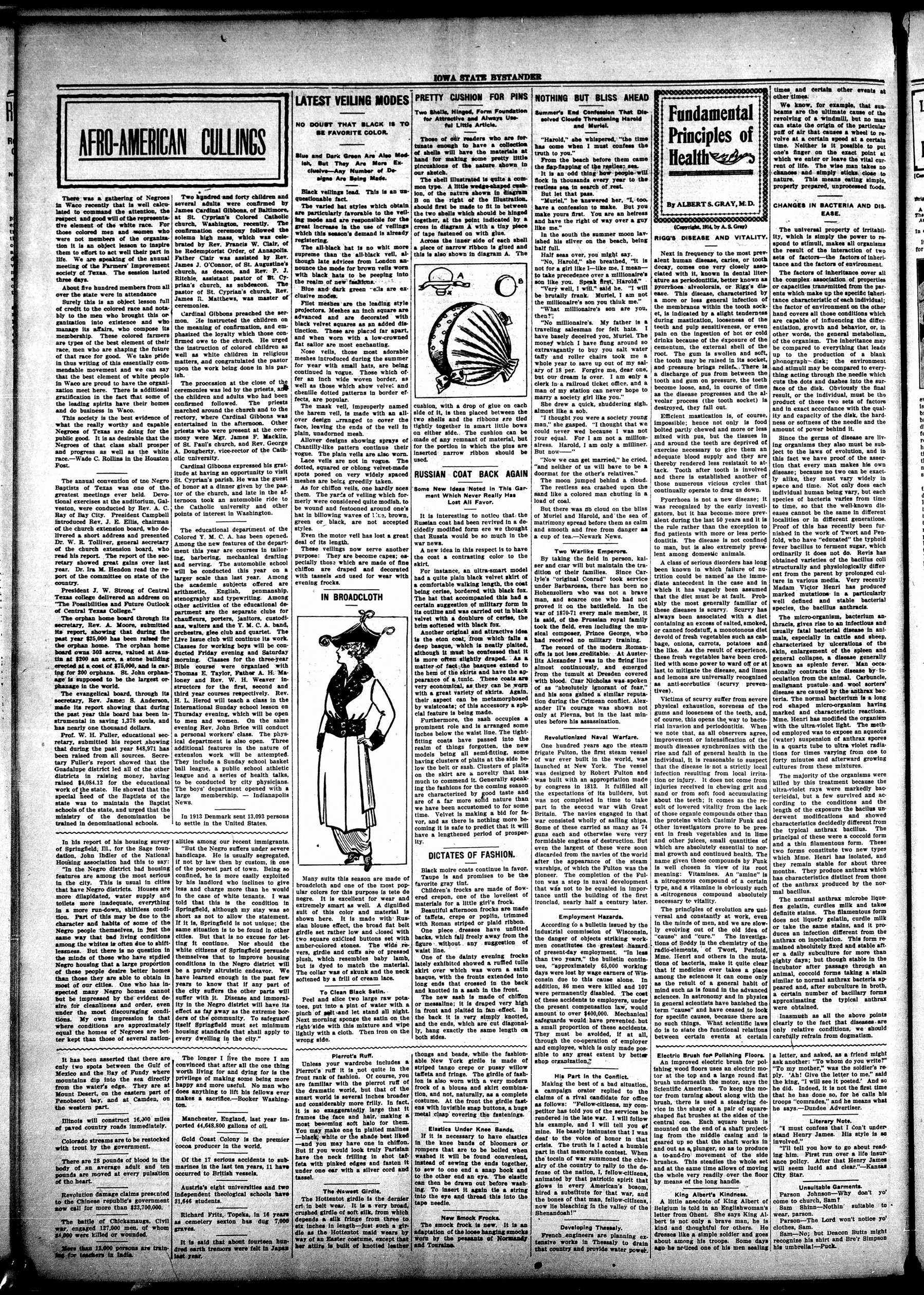
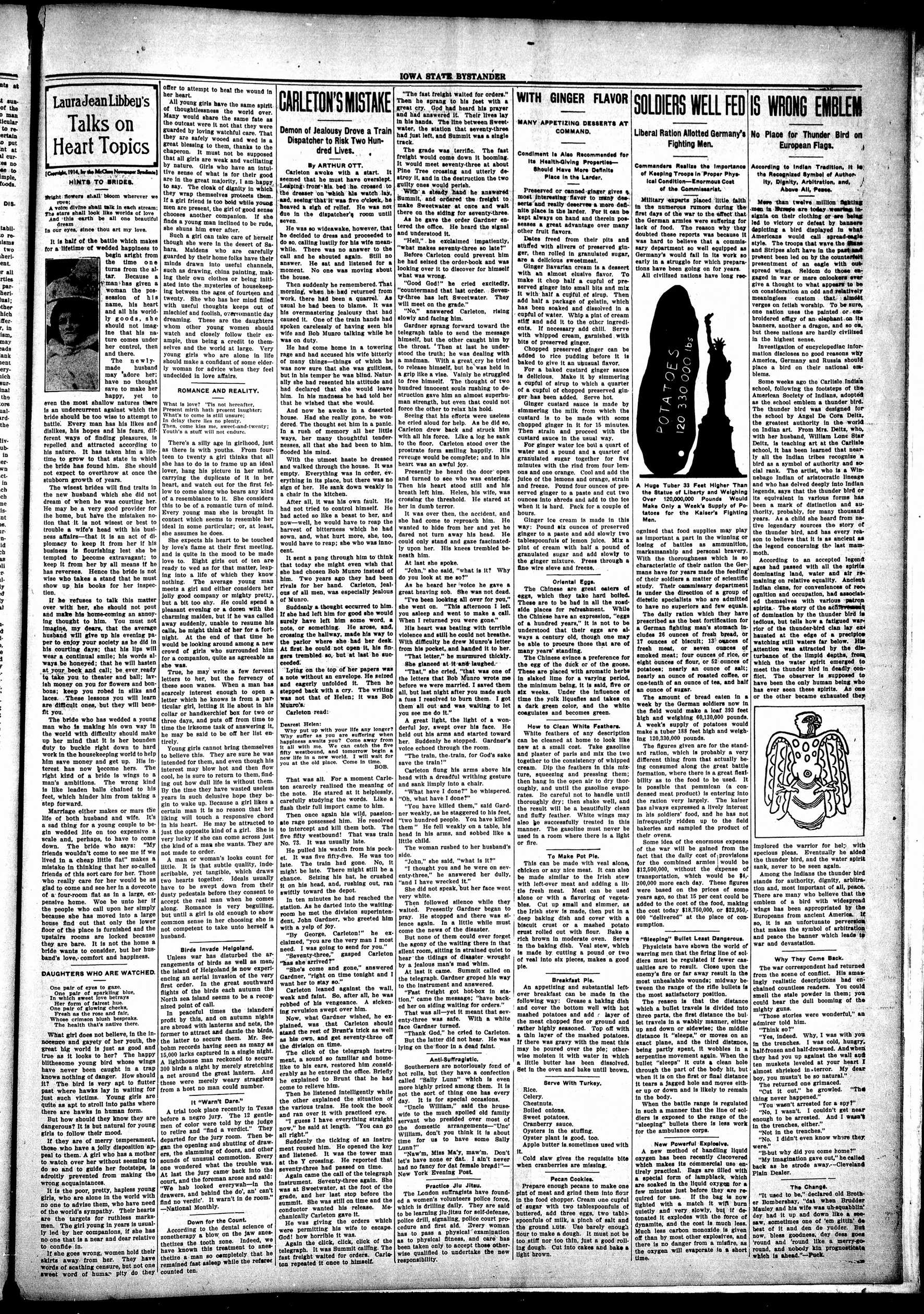
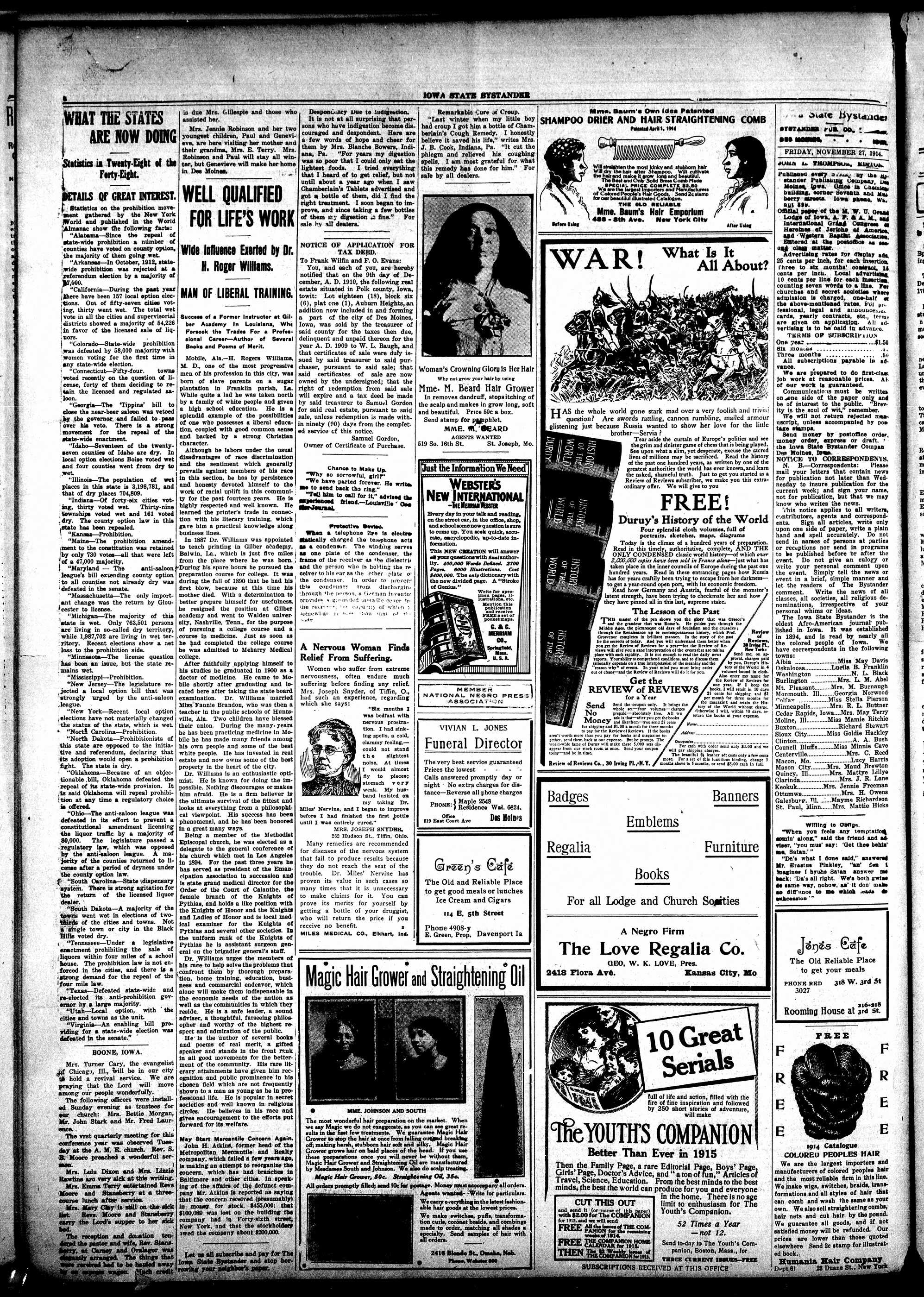
Page text (machine-generated)
IOWA STATE BYSTANDER.
VOL. XXI NO. 22
CITY NEWS
Mr. and Mrs. John Wright of Buxton was in our city last week shopping.
Don't forget Mrs. Booker T. Washington will lecture Monday evening at the A. M. E. church.
Mrs. W. Hieronymaus of 1014 Center street was taken suddenly ill yesterday at her home.
Miss Georgie Blackburn, one of the school Mams who is teaching in Buxton arrived here yesterday for a visit with her mother and sister.
The Thompson hotel guests were Mr. Fred Townsend, secretary of the Y. M. C. A. (boys' department), Buxton, and Mr. and Mrs. J. W. Lyles of Chicago, Ill.
The Union Thanksgiving services held at the Maple Street Baptist church yesterday was very largely attended and the program as printed last week was well rendered. About $25 00 was taken up.
Matiida Lee of Clarinda is here for a few weeks visit with her daughter, Miss Susie Lee, at the home of Mr. and Mrs. H. Gould.
Born on last Saturday, Nov. 21 to Mr. and Mrs. G L. Williams an 8 lbouncing baby girl, both mother and daughter doing well.
The Womnas' Working club met at Mrs. L. Bundy on November 23rd at 1009 West Walnut street. After business was transacted the hostess served a nice luncheon. They adjourned to meet at Miss M. E. Sweets, 2621 Chester avenue, December 1st.
Mr. O. O. Buckner and wife and baby came down from Ft. Dodge to spend a few days, the guest of Mr. and Mrs. Jerry Jackson on 12th and Day street. Mrs. Buckner and baby will remain a week while Mr. Buckner will return today.
At a special conclave of the G. H. Cleggett chapter of Royal Arch Masons last Friday evening the following were initiated into the mysteries of the Royal Arch chapter: E. L. Shaw, W. T. Jones, J. W. Johnson, A. L. Winn, R. N. Hyde, M. L. Gregory, Wm. Tomlin, W. L. Riley, Rev. T. L. Griffith, Rev. S. B. Moore, Chas Carl, E. S. Morgan, C. C. Johnson, V. L. Jones, Dr. J. A. Jefferson, G. L. Johnson, J. W. Black, M. J. Jackson, J. H. Reynolds, J. J. Roach, Wm. Walker and J. A. Graham.
DES MOINES NEGRO WINS HON-
ORS. AT AMES.
Word has been received by Sergeant John Jackson of this city that his son, Rufus, a recent honor graduate of East Des Moines high school and now a student at the State college at Ames, Iowa, has been selected as one of the eight representatives of that great student body to enter the horticulture and forestry speaking contest to be held in Des Moines on Wednesday, December 9th, under the auspices of the Iowa State Horticultural society, one of the prizes for which contest is a life membership is said society. Mr. Jackson will speak upon the subject "The Spirit of the Orchardist."
ANNOUNCEMENT.
Notice is hereby given that the special meeting of Princess Oziel chapter, No. 9, Order of the Eastern Star, has been changed from Thursday, November 13th, to Thursday, November 6th. All members will please take notice and govern themselves accordingly. By order of
Mrs. Addie French,
Worthy Matron.
A Farm for Rent
We have a farm for rent in Decatur county, Iowa. 4 miles from town of 140 acres to rent for cash, very low, from one to five years lease. 120 acres in cultivation, a good stock farm, land rolling, fruit trees, shade with well and barn. Would prefer a colored farmer. Write to John L. Thompson, 1306 W. 20th.
Sick Headache.
This distressing disease results from a disordered condition of the stomach, and can be cured by taking Chamberlain's Tablets. For sale by all dealers.
L. E. Hanger Wm. Aiken
Hanger & Aikens
New York Restaurant
304 West Grand Avenue
Des Moines Iowa
State Capitol Bldg Historical
Room
THANKSGIVING.
Yesterday the American people were called to cease their work and rest and give thanks to the All Wise Being for the manifold blessings that we have received for the past year. We as Americans should give thanks that we have peace, prosperity, happiness and good health. We should also pray for a cessation of the great war that is now raging in Europe, destroying millions of people, the hope of future generations. Our sympathies should go out to suffering humanity all over the globe and 'our hope is that by next Thanksgiving all the civilized people will be in peace as our country.
EDITOR'S OBSERVATION
We could not close this year's observation without observing a few things about Buxton. Well we have spent a few days here for two pay days and I must say that Buxton is no more the famous old live money making business whirl and enthusiastic band of labor. To one who has bees there once each year since it was organized and has seen it at its height and now to see it one can hardly imagine the great change. The work is poor, only working from three to five days a week, and only about one-third of the miners here as usually. About one-third of the houses are now vacant. The reasons for this are many. The two main reasons are, first the losing of Mr. Ben Buxton as superintendent; second, democratic hard times coming on; third, the blowing out of one mine and the sinking of a new shaft; fourth cause is that some of the superintendents have tried to replace many colored miners with white miners. All of these have had a telling effect upon the population and condition of Buxton. I was informed that about five years ago there were about 2,000 men on the pay roll. Now only about 700. The population of Buxton now will not exceed 2,500, of which perhaps 1,500 are colored. We now have a white postmaster, with all his help, a democrat, the first time that a white man was ever postmaster of Buxton. There are five churches, three Negro and two white. The A. M. E. has just got a new man, Rev J. H. Ferribe, who comes well recommended, and his matured age his enthusiasm for the work he will, we hope succeed.
Rev. P. B. Woodard is still pastor at the St. John's Baptist church. He has a large field and is holding his own. He is a Christian gentleman, well equipped for the work. They have just been holding a series of services. Rev Woodard met with a misfortune this summer of losing his wife. He is also suffering from rheumatic trouble and has to walk with crutches or with a cain. He is improving, however. At the Tabernacle Baptist church we find Rev. J. R. Northcross. He is doing a good work out there and has a good following. A peculiar thing about these churches is that the Sunday school hour at all the churches is at 9 o'clock and they are all well attended with a band of thoroughly strong teachers. The Y. M. C. A., which we are always proud to mention as the only colored Y. M. C. A. in Iowa, is doing as well as can be expected under the efficient management of J. H. McGrew and Mr. Townsend, who is superintendent of the boys' department. They are both trained Y. M. C. A. men and are a credit to the race. Mr. J. H. Baker is running the only printing office and newspaper here. This is one of the new business enterprises here and business in the field we wish for him success. Mr. B. F. Cooper, the pioneer driver, is still at the old stand. He feels more like a real man since the arrival of his first child, a boy, a few months ago. Mr. Reuben Gains, Sr. is still here. His only son, Ben, Jr., runs the hotel in conjunction with fairly well. Mr. Gains is one of the richest men in Iowa. They have a fine $1,500 five-passenger car. He is one of the important factors in Buxton. Mr W. H. London and E. A. London are still in the music and furniture business. Mr. James Roberts is still working at the cigar manufacturing business and is doing well. Dr. E. A. Carter is at the head of the company's doctors and is the only colored physician in the United states that has charge of a company's business. He is also in charge of the Northwestern Railroad Co.'s business at this end. He has been having white assistants. He has recently bought him a new fine passenger car. Dr. C. G. Robinson is the only colored physician here. He has a good trade and drives a beautiful horse. Mr. G. L. Neal is still manager of the famous Buxton Wonders baseball team. Mr. J. W Nealy runs a drug and confectionery store in Coopertown, also a grocery store in southwest Buxton. He is a business young man. Mr. Andrew Jeffries is still running the restaurant, which is the oldest restaurant in Buxton. They have a very large trade, as usual. More about Buxton next week.
MONMOUTH, ILL.
MONM
Mrs. Fannie Munson has returned
home, after a short visit in Daven-
port with her daughter, Mrs. Bell
Harris.
Mr. P. H. Lewis left last Saturday for her home in Indianapolis. Ad. after being called here by the illness
Mr. George Farner is on the sick list.
The Calvary Baptist church promise their usual good Thanksgiving dinner and supper, which will be ed in the church dining room.
Miss Levietta Taylor returned home from Chicago.
The ladies of the A. M. E. church have organized a church sweeping circle. Mrs. Susie McWilliams was elected president and Mrs. G. T. Brown secretary.
Mrs. Effe Merial is on the sick list.
On Friday evening Mr. and Mrs. J. T. Peoples entertained several friends with a four-course dinner in honor of Rev, and Mrs. P. H. Lewis. Still being confined at the hospital, Rev. Lewis was unable to attend.
Earl Vaughn went to Des Moines last Friday afternoon.
IOWA CITY, IOWA.
Nebraska slaughtered us in the game last Saturday with a score of 17 to 6. They had a fine team, the lightest men weighing about as much as our heaviest men. Mr. Ross and Mr. Hicks were royally entertained at the fraternity. Mr. Hicks is so well pleased with the K. A. N. that he will become a prep medic here upon the beginning of the medic year term. Mr. Ross came up on the band . This law student had played his time out on the football team.
Christian Endeavor Sunday night.
The G. S. U. I. want to extend their hearty welcome to and most sincere regrets at being unable to hear Mrs. Booker T. Washington.
Douglas Miller will go to Des Moines for the Thanksgiving recess.
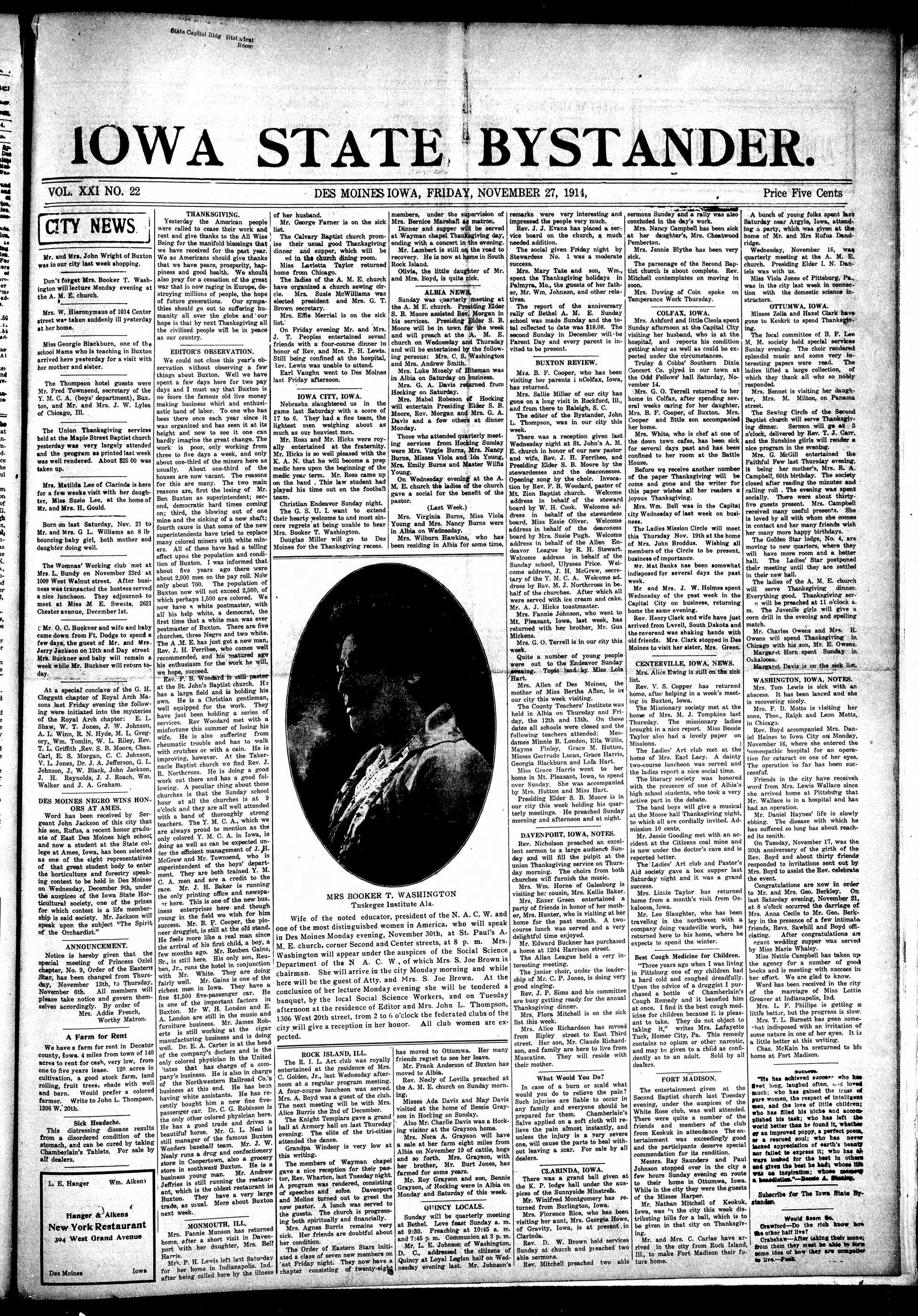
[Portrait of a woman in a white dress with a veil, looking to the right.]
M.
MRS BOOKER T. WASHINGTON
Tuskegee Institute Ala.
Wife of the noted educator, president of the N
one of the most distinguished women in America, w
in Des Moines Monday evening, November 30th, at
M. E. church, corner Second and Center streets, at 8
Washington will appear under the auspices of the
Department of the N A. C. W., of which Mrs. S
chairman. She will arrive in the city Monday morn
here will be the guest of Atty. and Mrs. S. Joe Br
conclusion of her lecture Monday evening she will
banquet, by the local Social Science Workers, an
afternoon at the residence of Editor and Mrs. John
1306 West 20th street, from 2 to 6 o'clock the federal
city will give a reception in her honor. All club is
pected.
Wife of the noted educator, president of the N. A. C. W. and one of the most distinguished women in America, who will speak in Des Moines Monday evening, November 30th, at St. Paul's A. M. E. church, corner Second and Center streets, at 8 p. m. Mrs. Washington will appear under the auspices of the Social Science Department of the N. A. C. W., of which Mrs. S. Joe Brown is chairman. She will arrive in the city Monday morning and while here will be the guest of Atty. and Mrs. S. Joe Brown. At the conclusion of her lecture Monday evening she will be tendered a banquet, by the local Social Science Workers, and on Tuesday afternoon at the residence of Editor and Mrs. John L. Thompson, 1306 West 20th street, from 2 to 6 o'clock the federated clubs of the city will give a reception in her honor. All club women are expected.
ROCK ISLAND, ILL
The R. I. L. Art club was royally entertained at the residence of Mrs. C. Golden, Jr., last Wednesday afternoon at a regular program meeting. A four-course luncheon was served. Mrs. A. Boyd was a guest of the club. The next meeting will be with Mrs. Alice Burris the 2nd of December. The Knight Templars gave a grand ball at Armory hall on last Thursday evening. The elite of the tri-cities attended the dance. Grandpa Windsor is very low at this writing.
The members of Wayman chapel gave a nice reception for their pastor, Rev. Wharton, last Tuesday night. A program was rendered, consisting of speeches and solos. Davenport and Moline turned out to greet the new pastor. A lunch was served to the guests. The church is progressing both spiritually and financially. Mrs. Agnes Burris remains very sick. Her friends are doubtful about her condition.
The Order of Eastern Stars initiated a class of seven new members on last Friday night. They now have a chapter consisting of twenty-eight
members, under the supervision of Mrs. Bernice Marshall as matron.
Mr. Lambert is still on the road to recovery. He is now at home in South Rock Island. Olivia, the little daughter of Mr. and Mrs. Royd, is quite rick.
ALBIA NEWS.
Sunday was quarterly meeting at the A. M. E. church. Presiding Elder S. B. Moore assisted Rev. Morgan in his services. Presiding Elder S. B. Moore will be in town for the week and will preach at the A. M. E. church on Wednesday and Thursday and will be entertained by the following persons: Mrs. C. S. Washington and Mrs. Andrew Smith.
Mrs. G. A. Davis returned from Hocking on Saturday.
Mrs. Mabel Robeson of Hocking will entertain Presiding Elder S. B. Moore, Rev. Morgan and Mrs. G. A. Davis and a few others at dinner Monday.
Those who attended quarterly meeting services from Hocking Sunday were Mrs. Virgile Burns, Mrs. Nancy Burns, Misses Viola and Ida Young, Mrs. Emily Burns and Master Wilks Young.
On Wednesday evening at the A. M. E. church the ladies of the church gave a social for the benefit of the pastor.
(Last Week.)
Mrs. Virginia Burns, Miss Viola Young and Mrs. Nancy Burns were in Albia on Wednesday. Mrs. Wilburn Hawkins, who has been residing in Albia for some time,
```markdown
```
r, president of the N. A. C. W. and women in America, who will speak November 30th, at St. Paul's A. Center streets, at 8 p. m. Mrs. the auspices of the Social Science W., of which Mrs. S. Joe Brown is the city Monday morning and while and Mrs. S. Joe Brown. At the evening she will be tendered a science Workers, and on Tuesdayitor and Mrs. John L. Thompson, 6 o'clock the federated clubs of the honor. All club women are ex- has moved to Ottumwa. Her many friends regret to see her leave. Mr. Frank Anderson of Buxton has moved to Albia. Rev. Ness of Lovilla preached at the A. M. E. church on Sunday morning. Misses Ada Davis and May Davis visited at the home of Bessie Grayson in Hocking on Sunday. Also Mr. Charlie Davis was a Hocking visitor at the Grayson home. Mrs. Nora A. Grayson will have a sale at her farm eight miles from Albia on November 19 of cattle, hogs and so forth. Mrs. Grayson, with her brother, Mr. Burt Jones, has farmed for some years.
Mr. Roy Grayson and son, Bennie Grayson, of Hocking were in Albia on Monday and Saturday of this week.
QUINCY LOCALS.
Sunday will be quarterly meeting at Bethel. Love feast Sunday a. m. at 8:00. Preaching at 10:45 a. m. at 7:45 p. m. Communion at 3 p. m. Mr. L. E. Johnson of Washington, D. C., addressed the citizens of Quincy at Loyal Legion hall on Wednesday evening last. Mr. Johnson's
remarks were very interesting and impressed the people very much.
Rev. J. J. Evans has placed a service board on the church, a much needed addition.
The social given Friday night by Stewardess No. 1 was a moderate success.
Mrs. Mary Tate and son, Wm., spent the Thanksgiving holidays in Palmyra, Mo., the guests of her father, Mr. Wm. Johnson, and other relatives.
The report of the anniversary rally of Bethel A. M. E. Sunday school was made Sunday and the total collected to date was $18.08. The second Sunday in December will be Parent Day and every parent is invited to be present.
BUXTON REVIEW.
Mrs. G. O. Terrell is in our city this week.
Quite a number of young people were out to the Endesavor Sunday evening. Topic lead by Miss Lola Hart.
Mrs. Allen of Des Moines, the mother of Miss Herta Allen, is in our city this week visiting.
The County Teachers' Institute was held in Albia on Thursday and Friday, the 12th and 13th. On these dates all schools were closed and the following teachers attended: Mesdames Minnie B. London, Ella Willis, Mayme Finley, Grace M. Hutton, Miss Gerteur Lucas, Grace Harris, Georgia Blackburn and Lola Hart.
Miss Grace Harris went to her home in Mt. Pleasant, Iowa, to spend over Sunday. She was accompanied by Mrs. Hutton and Miss Hart.
Presiding Elder S. B. Moore is in our city this week holding his quarterly meetings. He preached Sunday morning and afternoon and at night.
DAVENPORT, IOWA, NOTES.
Rev. Nicholson preached an excellent sermon to a large audience Sunday and will fill the pulpit at the union Thanksgiving service on Thursday morning. The choirs from both churches will furnish the music. Mrs. Wm. Horse of Galesburg is visiting her cousin, Mrs. Kellis Baker.
visiting her cousin, Mrs. Kellis Baker. Mrs. Enzner Green entertained a party of friends in honor of her mother, Mrs. Hunter, who is visiting at her home for the past month. A two-course lunch was served and a very delightful time enjoyed.
Mr. Edward Buckner has purchased a home at 1204 Harrison street. The Allan League held a very interesting meeting. The junior choir, under the leadership of Mr. C. P. Jones, is doing very good singing. Rev. J. P. Sims and his committee are busy getting ready for the annual Thanksgiving dinner. Mrs. Flora Mitchell is on the sick list this week. Mrs. Alice Richardson has mvoed from Ripley street to East Third street. Her son, Mr. Claude Richardson, and family are here to live from Muscatine. They will reside with their mother.
What Would You Do?
In case of a burn or scald what would you do to relieve the pain? Such injuries are liable to occur in any family and everyone should be prepared for them. Chamberlain's Salve applied on a soft cloth will relieve the pain almost instantly, and unless the injury is a very severe one, will cause the parts to heal without leaving a scar. For sale by all dealers.
CLARINDA JOWA
There was a grand ball given at the K. P. lodge hall under the auspices of the Sunnyside Minstrels. Mr. Winifred Montgomery has returned from Burlington, Iowa. Mrs. Florence Rice, who has been visiting her aunt, Mrs. Georgia Howe, of Gravity, Iowa, is at present, in Clarinda. Rev. D. W. Brown held services Sunday at church and preached two able sermons.
able seismic Rev. Mitchell preached two able
sermons Sunday and a rally was also concluded in the day's work. Mrs. Nancy Campbell has been sick at her daughter's, Mrs. Cheatwood Pemberton. Mrs. Jennie Blythe has been very sick. The parsonage of the Second Baptist church is about complete. Rev. Mitchell contemplates on moving in soon. Mrs. Dowing of Coin spoke on Temperance Work Thursday.
COLFAX. IOWA.
Mrs. Ashford and little Cleola spent Sunday afternoon at the Capital City visiting her husband, who is at the hospital, and reports his condition getting along as well as could be expected under the circumstances.
Truley & Cobbs' Southern Dixie Concert Co. plyed in our town at the Odd Fellows' hall Saturday, November 14.
Mrs. G. O. Terrell returned to her home in Colafax, after spending several weeks caring for her daughter, Mrs. B. F. Cooper, of Buxton. Mrs. Cooper and little son accompanied her home.
Mrs. White, who is chef at one of the down town cafes, has been sick for several days past and has been confined to her room at the Battle House.
Before we receive another number of the paper Thanksgiving will be come and gone and the writer for this paper wishes all her readers a joyous Thanksgiving.
Mrs. Wm. Bell was in the Capital city Wednesday of last week on business.
The Ladies Mission Circle will meet this Thursday Nov. 19th at the home of Mrs. John Broddus. Wishing all members of the Circle to be present, business of importance.
Mr. Mat Banks has been somewhat indisposed for several days the past week.
Mr and Mrs. J. W. Holmes spent Wednesday of the past week in the Capital City on business, returning home the same evening.
Rev. Henry Clark and wife have just arrived from Lavell, South Dakota and the reverend was shaking hands with old friends. Mrs. Clark stopped in Des Moines to visit her sister, Mrs. Green.
CENTERVILLE, IOWA, NEWS.
Mrs. Alice Ewing is still on the sick list.
Rev. V. S. Copper has returned home, after helping in a week's meeting in Buxton, Iowa.
The Missionary society met at the home of Mrs. M. J. Tompkins last Thursday. The missionary ladies brought in a nice report. Miss Bessie Taylor also had a lovely paper on Missions.
The Ladies' Art club met at the home of Mrs. Earl Lacy. A dainty two-course luncheon was served and the ladies report a nice social time.
The literary society was honored with the presence of one of Albia's high school students, who took a very active part in the debate.
The band boys will give a musical at the Moose hall Thanksgiving night, to which all are cordially invited. Admission 10 cents.
Mr. Jessie Gooding met with an accident at the Citizens coal mine and is now under the doctor's care and is reported better.
The 'Ladies' Art club and Pastor's Aid society gave a box supper last Saturday night and it was a grand success. Mrs. Lizzie Taylor has returned home from a month's visit to Oskaloosa, Iowa. Mr. Leo Slaughter, who has been traveling in the northwest with a company doing vaudeville work, has returned here to his home, where he expects to spend the winter.
Best Cough Medicine for Children.
"Three years age when I was living in Pittsburgh one of my children had a hard cold and coughed dreadfully. Upon the advice of a druggist I purchased a bottle of Chamberlain's Cough Remedy and it benefited him at once. I find it the best cough medicine for children because it is pleasant to take. They do not object to taking it," writes Mrs. Lafayette Tuck, Homer City, Pa. This remedy contains no opium or other narcotic and may be given to a child as confidently as to an adult. Sold by al dealers.
FORT MADISON.
The entertainment given at the Second Baptist church last Tuesday evening, under the auspices of the White Rose club, was well attended. There were quite a number of the friends and members of the club from Keokuk in attendance. The entertainment was exceedingly good and the participants deserve special commendation for its rendition. Messrs. Ray Saunders and Paul Johnson stopped over in the city a few hours Sunday evening en route to their home in Ottumwa, Iowa. While in the city they were the guests of the Misses Harper. Mr. Nathan Mitchell of Keokuk, Iowa, was in the city this week distributing bills for a ball, which is to be given in that city on Thanksgiving. Mr. and Mrs. C. Carlos have arrived in the city from Rock Island, Ill, to make Fort Madison their future home.
Price Five Cents
A bunch of young folks spent last Saturday near Argyle, Iowa, attending a party, which was given at the home of Mr. and Mrs Rufus Dandridge.
Wednesday, November 18, was quarterly meeting at the A. M. E. church. Presiding Elder I. N. Daniels was with us.
Miss Viola Jones of Pittsburg, Pa., was in the city last week in connection with the domestic science instructors.
OTTUMWA, IOWA.
Misses Zella and Hazel Clark have gone to Keokrk to spend Thanksgiving.
The local committee of B. F. Lee M. M. society held special services Sunley evening. The choir rendered splendid music and some very interesting papers were read. The ladies lifted a large collection, of which they thank all who so nobly responded.
Mrs. Bennet is visiting her daughter, Mrs. M. M. Milton, on Panama street.
The Sewing Circle of the Second Baptist church will serve Thanksgiving dinner. Sermon will go at 3 o'clock, delivered by Rev. T. J. Carr, and the Sunshine girls will render a nice program in the evening.
Mrs. G. McGill entertained the Faithful Few last Thursday evening, it being her mother's Mrs. R. A. Campbell, 66th birthday. The society closed after reading the minutes and calling roll. The evening was spent socially. There were about thirty-five guests present. Mrs. Campbell received many useful presents. She is loved by all with whom she comes in contact and her many friends wish her many more happy birthdays.
The Golden Star lodge, No. 4, is moving to new quarters, where they will have more room and a better hall. The Ladies' Star postponed their meeting until they are settled in their new hall.
The ladies of the A. M. E. church will serve Thanksgiving dinner. Everything good. Thanksgiving serm. will be preached at 11 o'clock a.m. The Juvenile girls will give a corn drill in the evening and spelling match.
Mr. Charles Owens and Mrs. H. Owens will spend Thanksgiving in Chicago with his son, Mr. E. Owens. Margaret Horn spent Sunday in Oskaloosa.
Margaret Davis is on the sick list.
WASHINGTON, IOWA, NOTES.
Mrs. Tom Lewis is sick with an abscess. It has been lanced and she is recovering nicely.
Mrs. F. D. Motts is visiting her sons, Thos., Ralph and Leon Motts, in Chicago.
Rev. Boyd accompanied Mrs. Daniel Haines to Iowa City on Monday, November 16, where she entered the homeopathic hospital for an operation for cataract on one of her eyes. The operation so far has been successful.
Friends in the city have receiveh word from Mrs. Lewis Wallace since she arrived home at Pittsburgh that Mr. Wallace is in a hospital and has had an operation.
Mr. Daniel Haynes' life is slowly ebbing. The disease with which he has suffered so long has about reached its zenith.
On Tuesday, November 17, was the 30th anniversary of the girth of the Rev. Boyd and about thirty friends responded to invitations sent out by Mrs. Boyd to assist the Rev. celebrate the event.
Congratulations are now in order to Mr. and Mrs. Geo. Berkley. On last Saturday evening, November 21, at 8 o'clock occurred the daringage of Mrs. Anna Cecile to Mr. Geo. Berkley in the presence of a few intimate friends, Revs. Sawhill and Boyd officiating. After congratulations are grant wedding supper was served by Miss Marie Whaley.
Miss Nettie Campbell has taken up the agency for a number of good books and is meeting with success in her effort. We are glad to know.
Word has been received in the city of the marriage of Miss Lottie Greaver at Indianapolis, Ind.
Mrs. L. F. Phillips is getting a little better, but the progress is slow.
Mrs. T. L. Burnett has geen some-
that indisposed with an irritation of
some nature in one of her eyes. It is
a little better at this writing.
Chas, McKain has sreturned to his
home at Fort Madison.
SUCCESS.
"He has achieved success who has lived long, laughed often, and loved much; who has gained the trust of pure women, the respect of intelligent men, and the love of little children, who has filled his niche and accomplished his task; who has left the world better than he found it, whether or an improved poppy, a perfect poem, or a rescued soul; who has never locked appreciation of earth's beauty nor failed to express it; who has always looked for the best in others and given the best he had; whose life was an inspiration; whose memory a benediction."—Benete A. Stanley.
Subscribe for The Iowa State Bystander.
Would Seem So.
Crawford—Do the rich know how
the other half live!
Crabshaw—After taking their money from them they must be able to form some idea of how they are compelled to live—Peak
AFRO-AMERICAN CULLINGS
---
There was a gathering of Negroes in Waco recently that is well calculated to command the attention, the respect and good will of the representative element of the white race. For those colored men and women who were not members of the organization it is an object lesson to inspire them effort to attend to such an issue in the meeting of the Farmers' Improvement society of Texas. The session lasted three days. About five hundred members from all over the state were in attendance
Surely this is an object lesson full of credit to the colored race and notably to the men who brought this organization into existence and who manage its affairs, who compose its membership. These colored farmers are types of the best element of their race, men who are shaping the future of that race for good. We take pride in thus writing of this essentially commendable movement and we can say that the best element of white people in Waco are proud to have the organization meet here. There is additional gradification in the fact that some of the things in Waco that their homes and do business in Waco. This society is the best evidence of what the really worthy and capable Negroes of Texas are doing for the public good. It is as desirable that the Negroes of that class shall prosper and progress as well as the white race.—Wade C. Rollins in the Houston Post.
The annual convention of the Negro Baptists of Texas was one of the greatest meetings ever held. Devotional exercises at the auditorium, Galveston, were conducted by Rev. A. C. Ray of Bay City. President Campbell introduced Rev. J. E. Ellis, chairman of the church extension board, who delivered a short address and presented Dr. W. R. Tolliver, general secretary of the church extension board, who read his report. The report of the secretary showed great gains over last year. Dr. Ira M. Hendon read the report of the committee on state of the country.
President J. W. Strong of Central Texas college delivered an address on "The Possibilities and Future Outlook of Central Texas College."
The orphan home board through its secretary, Rev. A. Moore, submitted its report, showing that during the past year $25,000 has been raised for the orphan home board owns 303 acres, valued at Austin at $200 an acre, a stone building erected at a cost of $75,000, and is caring for 200 orphans. St. John orphanage is supposed to be the largest orphanage board in the evangelical board, through its secretary, Rev. James S. Anderson, made its report showing that during the past year this board has been instrumental in saving 1,378 souls, and has nearly one thousand dollars.
Prof. W. H. Fuller, educational secretary, submitted his report showing that during the past year $48,791 has been raised from all sources. Secretary Fuller's report showed that the Guadalupe district led all of the other districts in raising money, having raised $4,064.12 for the educational work of the state. He showed that the special heed of the Baptists of the state was to maintain the Baptist schools of the state, and urged that the ministry of the denomination be trained in denominational schools.
In his report of his housing survey of Springfield, Ill., for the Sage foundation, John Indler of the National Housing association had this to say: "In the Negro district bad housing features are among the most serious in the city. This is usual in cities that have Negro districts. Houses are more dilapidated, not intact, and toilet seats are more run-down, shift condition. Part of this may be due to the character and habits of some of the Negro people themselves, in fast the same way that bad living conditions among the whites is often due to shiftlessness. But there is no question in the minds of those who have studied Negro housing that a large proportion of these people desire better homes than those they are able to obtain in most of our cities. One who has inspected many Negro homes cannot but be impressed by the evident desire for cleanliness of the interior under the most discouraging condition from impression is that where conditions are approximately equal the homes of Negroes are better kept than those of several nation-
It has been asserted that there are only two spots between the Gulf of Mexico and the Bay of Fundy where mountains dip into the sea directly from the water's edge. They are at Mount Desert, on the eastern part of Penobscot bay, and at Camden, on the western part.
Illinois will construct 16,000 miles of paved country roads immediately.
Colorado streams are to be restocked with trout by the government.
There are 28 pounds of blood in the body of an average adult and ten pounds are moved at every pulsation of the heart.
Revolution damage claims presented to the Chinese republic's government now call for more than $23,700,000.
The battle of Chickamauga. Civil was engaged 127,000 men, of whom 24,000 were killed or wounded.
More than 12,000 persons are trained for teachers in India.
Two hundred and forty children and several adults were confirmed by James Cardinal Gibbons, of Baltimore, at St. Cyprian's Colored Catholic church, Washington, recently. The confirmation ceremony followed the solemn high mass, which was celebrated by Rev. Francis W. Clair, of the Redemptorist Order, of Annapolis. Father Clair was assisted by Rev. James J. O'Connor, of St. Augustine's church, as deacon, and Rev. P. J. Ritchie, assistant pastor of St. Cyprian's church, as subdeacon. The pastor of St. Cyprian's church, Rev. James R. Matthews, was master of ceremonies.
Cardinal Gibbons preached the sermon. He instructed the children on the meaning of confirmation, and emphasized the loyalty which those conjoined to the church. He urged the instruction of colored children as well as white children in religious matters, and congratulated the pastor upon the work being done in his parish.
The procession at the close of the ceremonies was led by the priests, and the children and adults who had been confirmed followed. The priests marched around the church and to the rectory, where Cardinal Gibbons was entertained in the afternoon. Other priests who were present at the ceremony were Mgr. James F. Macklin, of St. Paul's church, and Rev. George A. Dougherty, vice-rector of the Catholic university.
Cardinal Gibbons expressed his gratitude at having an opportunity to visit St. Cyprian's parish. He was the guest of honor at a dinner given by the pastor of the church, and late in the afternoon took an automobile ride to the Catholic university and other points of interest in Washington.
---
The educational department of the Colored M. M. C. A. has been opened. Among the new features of the department this year are courses in tailoring, barbering, mechanical drafting and serving. The automobile school will be conducted this year on a larger scale than last year. Among the academic subjects offered are arithmetic, English, penmanship, stenography and typewriting. Among other activities of the educational department are the separate clubs for chauffeurs, porters, jailors, custodians, waiters, and the Y. M. C. A. band, orchestra, glee club and quartet. The Live Issue club will continue its work. Classes for working boys will be conducted Friday evening and Saturday morning. Classes for the three-year Bible course were organized with Thomas E. Taylor, Father A. H. Maloney and Rev. W. H. Weaver instructors for the first, second and third year courses respectively. Rev. W. H. Weaver instructors in the International Sunday school lesson on Thursday evening, which will be open to men and women. On the same evening Rev. John Brice will conduct a personal workers' class. The physical department is also open. Three additional features in the nature of extension work will be attempted. They include a Sunday school basket ball league, a public school athletic league and a series of health talks, to be conducted by city physicians. The boys' department opened with a large membership. — Indianapolis News.
In 1913 Denmark sent 13.093 persons to settle in the United States.
altities among our recent immigrants. "But the Negro suffers under severe handicaps. He is usually segregated, if not by law then by custom, in one of the poorest part of town. Being so confined, he is more easily exploited by his landlord who inclines to give less and charge more than he would in the case of white tenants. I was in Springfield, although my way was so short as not to allow the statement. If it is, Springfield is not unique; the same situation is to be found in other cities. But that is no excuse for letting it continue. Nor should the white citizens of Springfield persuade themselves that to improve housing conditions in the Negro district will be a purely altruistic endeavor. We have learned enough in the past few years to know that if any part of the city suffers the other parts will suffer from Disease and immorality. But the Negro as a far away as the extremists of the community. To safeguard itself Springfield must set minimum housing standards that shall apply to every dwelling in the city."
The longer I live the more I am convinced that after all the one thing worth living for and dying for is the privilege of making some being more happy and more useful. No man who does anything to lift his fellows ever makes a sacrifice.—Booker Washington.
Manchester, England, last year imported 44,648,800 gallons of oil.
Gold Coast Colony is the premier cocoa producer in the world.
Of the 17 serious accidents to submarines in the last ten years, 11 have occurred to British vessels.
Austria's eight universities and two independent theological schools have 31,646 students.
LATEST VEILING MODES
NO DOUBT THAT BLACK IS TO BE FAVORITE COLOR.
Blue and Dark Green Are Also Modish, But They Are More Exclusive—Any Number of Designs Are Being Made.
Black vellings lead. This is an unquestionable fact.
The varied hat styles which obtain are particularly favorable to the velling mode and are responsible for the great increase in the use of vellings which this season's demand is already registering.
The all-black hat is no whit more supreme than the all-black vell, although late advices from London announce the mode for brown vellens worn with black to be being into the realm of new fashion.
Blue and dark green vellens are exclusive modes.
Flet meshes are the leading style protectors. Meshes an inch square are advanced and are decorated with black velvet squares as an added distinction. These are placed far apart, and when worn with a low-crowned flat sailor are most enchanting. Nose veils, those most adorable meshes introduced during the summer for wear with small hats, are being continued in vogue. Those which offer an inch wide woven border, as well as those which show velvet; and chillel dotted patterns in border effects, are popular. The mask veil, improperly named the harem veil, is made with an all-over arrangement arranged to cover the face, lesseps of the veil in plain, unadorned mans. Allover designs show sprays of Chantilly-like pattern continue their vogue. The plain veils also are worn. Lace veils are not in vogue. The dotted, squared or oblong velvet-made spots posed on very widely spaced meshes are being greedily taken.
As for chiffon veils, one hardly sees them. The yarls of velling which formerly were considered quite modish. to be wound and festooned around one's hat in billowing waves of 1.12, brown, green or black, are not accepted styles.
Even the motor vell has lost a great deal of its length. The garments now serve another purpose: The are become capes; especially those which are made of fine chiffon are draped and decorated with tassels and used for wear with evening frocks.
IN BROADCLOTH
THE FASHION OF THE TWENTIETH CENTURY
Many suits this season are made of broadcloth and one of the most popular colors for this purpose is tede negre. It is excellent for wear and extremely smart as well. A dignified suit of this color and material is shown here. It is made with Russian blouse effect, the broad fat belt girdle set rather low and closed with two square oxidized buttons set with amber-colored stones. The wide revers, girdle and cuffs are of pressed plush, which resembles baby lamb, but is dyed to match the material. The collar was of skunk and the neck softened by a frill of cream lace.
To Clean Black Satin.
Peel and slice two large raw potatoes, put into a pint of water with a pinch of salt and let stand all night. Next morning sponge the satin on the right side with this mixture and wipe lightly with a cloth. Then iron on the right side.
Unless your wardrobe includes a Pierrot's ruff it is not quite in the front rank of fashion. Of course, you are familiar with the pierrot ruff of the dramatic world, but that of the smart world is several inches broader and considerably more frilly. In fact, it is so exaggeratedly large that it makes a most becoming soft halo for them. You may make one in plaited malines —black, white or the shade best liked—and you may have one in chiffon. But if you would look truly Parisian the neck frilling in shot tafetta with pinked edges and fasten it under one ear with a silver cord and tassel.
The Newest Girdle.
The Hottentot girdle is the dernier crt in belt wear. It is a very broad, smooth girdle from which crt flanks a silk fringes from these six inches in length—just such a girdle as the Hottentot maid wears by way of an Easter costume, except that her attire is built of knotted leather
IOWA STATE BYSTANDER
Two Shells, Hinged, Form Foundation for Attractive and Always Useful Little Article.
Those of our readers who are fortunate enough to have a collection of shells will have the opportunity at least once to pretty little pincuncions of the nature shown in our sketch.
The shell illustrated is quite a common type. A little wedge-shaped cushion, of the nature shown in diagram B on the right of the illustration, should first be made to fit in between the two shells which should be hinged together, at the point indicated by a cross in diagram A with a tiny piece of material, with which it faces. At the inner side of each shell a piece of narrow ribbon is glued and it is also shown in diagram A. The
cushion, with a drop of glue on each side of it, is then placed between the two shells and the ribbons are tied tightly together in smart little bows on each side. The cushion can be made of any remnant of material, but for the portion in which the pins are inserted narrow ribbon should be used.
RUSSIAN COAT BACK AGAIN
Some New Ideas Noted in This Garment Which Never Really Has Lost All Favor.
It is interesting to notice that the Russian coat had been revived in a decidedly modified form are we thought that Russia would be so much in the war news.
A new idea in this respect is to have the coat a contrasting color to the skirt.
For instance, an ultra-smart model had a quite plain black velvet skirt of a comfortable walking length, the coat being cerise, bordered with black fox. The hat accompanied this had a certain suggestion of military form in its outlines and was carried out in black velvet with a doublure of cerise, the brim softened with black fox.
Another original and attractive idea is the eton coat, from which falls a deep basque, which is neatly plaited, although it must be confessed that it is more often slightly draped. As a matter of fact the basques extend to the hem of the skirts and have the appearance of a tunic. These coats are very economical, and are often made of skirts. Again, their aspect can be metamorphosed by waistcoats; of this accessory a special feature is being made.
Furthermore, the sash occupies a prominent role and is arranged some inches below the waist line. The tight-fitting coats have passed into the realm of things forgotten, the new models being all semi-fitting, some having clusters of plats at the side below the belt or sash. Clusters of plats on the skirt are a novelty that has much to commend it. Generally, wearing the fashions for the cool season are characterized by good taste and of a far more solid nature than have been customised to for some time. Velvet is making a bid for flavor, and as there is nothing more becoming it is safe to predict that it will have a lengthened period of prosperity.
DICTATES OF FASHION
Black moire coats continue in favor. Taupe is and promises to be the favorite gray tint. Children's frocks are made of flowered crepon, one of the loveliest of materials for a little girl's frock. Beautiful afternoon frocks are made of taufea, crepe or poplain, imprinted with Roman stripe or plaid ribbon. One piece is worn, unstitched body with fall freely away from the figure without any suggestion of waist line. One of the dainty evening frocks lately exhibited showed a ruffled tilt skirt over which was worn a satin basque, with the fronts extended into long ends that crossed in the back and knotted in a sash in the front. The new sash is made of chiffon or messaline; it is draped very high in front and plated in fan effect. In the back it is sheer, but tipped in bands, which are cut diagonally, hang exactly the same length on both sides.
thongs and beads, while the fashionable New York girdle is made of striped tango crepe or pasyw willow taffeta and fringe. The girdle of fashion is also worn with a very modern frock of a blouse and skirt combination, and not, naturally, as a complete costume. At the front the girdle fastens with invisible snap buttons, a huge metal clap covering the fastening
Elastica Under Knee Bands
If it is necessary to have elastics in the knee bands of bloomers or rompers that are to be beaded when washed it will be found convenient, instead of sewing the ends together, to sew to one end a snap hook and to the other end an eye. The elastic can then be drawn out before washing. To insert it again tie a string through the tape and thread this into the tape needle.
New Smock Frocks.
The smock frock is new. It is an adaptation of the loose shucking smocks worn by the peasants of Normandy and Tournaise.
NOTHING BUT BLISS AHEAD
Summer's End Confession That Discovered Clouds Threatening Harold and Muriel.
"Harold," she whispered, "the time has come when I must confess the truth to you."
The beach before them came the flat-packed of the resilient; sea. It is an odd thing: how people will flock in thousands every year to the restless sea in search of rest. But let that pass.
"Muriel," he answered her, "I, too, have a confession to make. But you make yours first. You are an heftress and have the right of way over a guy like me."
So south the summer moon lavished his silver on the beach, being half full. Half sea, over you may say.
"No, Harold," she breathed, "it is not for a girl like—like me, I mean—to take precedence over a millionaire's son like you. Speak first, Harold." "Very well, I will." said he. "I will be brutally frank. Muriel, I am not the millionaire's son you think me." "What millionaire's son are you, then?" "No millionaire's. My father is a traveling salesman for felt hats. I have basely deceived you. Muriel. The money which I have funged around so extravagantly to buy salt water taffy and roller chairs took me a whole year to save up out of my salary of 18 per. Forgive me, dear one, but our dream is over. I am only a clerk in a railroad ticket office, and a man of my station can never hope to marry a society girl like you." I drew a quilt, shuddering sigh, almost like a sob. "I thought you were a society young man," she gasped. "I thought that we could never wed because I was not your equal. For I am not a millionaire. Harold, I am only a milliner. But now——"
"Now we can get married," he cried, "and neither of us will have to be a doormat for the other's relatives." The moon jumped behind a cloud. The restless sea crashed upon the sand like a colored man chitting in a load of coal. But there was no cloud on the bliss of Muriel and Harold, and the sea of matrimony spread before them as calm and smooth and free from danger as a cup of tea—Newark News.
Two Warlike Emperors.
By taking the field in person, kaiser and czar will but maintain the tradition of their families. Since Caryle's "original Conrad" took service under Barbarosa, there has been no Hohenzollern who was not a brave man, and scarce one who had not proved it on the battlefield. In the war of 1870-71 every male member, it is said, of the Prussian royal family took the field, even including the musical composer, Prince George, who had received no military training. The record of the modern Romanoff is not less creditable. At Austerlitz Alexander I was in the firing line almost continued, emerging an armed force at Dresden with blood. Czar Nicholas was spoken of as "absolutely ignorant of fear" and his sons gained a similar reputation during the Crimean conflict. Alexander II's courage was shown not only at Plevna, but in the last minutes before his assassination.
Revolutionized Naval Warfare.
One hundred years ago the steam frigate Fulton, the first steam vessel of war ever built in the world, was launched at New York. The vessel was designed by Robert Fulton and was built with an appropriation made by congress in 1813. It fulfilled all the expectations of its builders, but was not completed in time to take part in the second war with Great Britain. The navies engaged in that war consisted wholly of sailing ships. Some of these carried as many as 74 guns each and otherwise were very formidable engines of destruction. But even the largest of these were soon discarded from the navies of the world after the appearance of the steam warships, of which the Fulton was the pioneer. The completion of the Fulton was a step in naval development that was not to be equaled in importance until the building of the first ironclad, nearly half a century later.
Employment Hazards
According to a bulletin issued by the industrial commission of Wisconsin, the danger of objects striking workmen constitutes the greatest hazard of present-day employment. "In less than two years," the bulletin continues, "approximately 65,000 working days were lost by wage earners of Wisconsin due to this cause alone. In addition, 88 men were killed and 107 were permanently disabled. The cost of these accidents to employers, under the present compensation law, would amount to 400,000. Mechanical awards would have presented but a small proportion of these accidents. They must be avoided, if at all, through the co-operation of employer and employee, which is only made possible to any great extent by better shop organization."
His Part In the Conflict:
Making the best of a bad situation,
a campaign orator replied to the
claims of a rival candidate for office
as follows: "Fellow-citizens, my competitor has told you of the services he rendered in the late war. I will follow his example, and I will tell you of mine. He basely insinulates that I was deaf to the voice of honor in that crisis. The truth is I acted a humble part in that memorable contest. When the toesin of war summoned the chivalry to call to the defense of the nation, I fellow-citizens, animated by that patriotic spirit that glows in every American's bosom,
hired a substitute for that war, the bones of that man, fellow-citizens, now lie bleaching in the valley of the Shenandoah!"
Developing Thessaly.
French engineers are planning extensive works in Thessaly to drain that country and provide water power.
---
Fundamental Principles of Health
By ALBERT S. GRAY, M.D.
(Copyright, 1914, by A. S. Gray)
RIGG'S DISEASE AND VITALITY.
Next in frequency to the most prevalent human disease, caries, or tooth decay, comes one very closely associated with it, known in dental literature as perdontitis, better known as pyroarthritis alveolaris, or Rigg's disease. This disease, characterized by a more or less general infection of the teeth, is indicated by a slight tenderness during mastication, looseness of the teeth and pulp sensitivity, or even pain on the ingestion of hot or cold drinks because of the exposure of the cementum, the external shell of the root. The gum is swollen and soft, the tooth may be raised in its socket, and pressure brings relief. There is a discharge of pus from between the tooth and gum on pressure, the tooth may be raised in time as the disease progresses and the alveolar process (the tooth socket) is destroyed, they fall out.
Efficient mastication is, of course, impossible; hence not only is food bolted partly chewed and more or less mixed with pus, but the tissues in and around the teeth are deprived of exercise necessary to give them an adequate blood supply and they are thereby rendered less resistant to attack. Tooth after tooth is involved and there is established another of those numerous vicious cycles that continually operate to drag us down. Pyrrohone is not a new disease; it was recognized by the early investigators, but it has become more prevalent during the last 50 years and it is the rule rather than the exception with more or less periodontitis. The disease is not confined to man, but is also extremely prevalent among domestic animals.
A class of serious disorders has long been known in which failure of nutrition could be named as the immediate antecedent in the case and in which it has vaguely been assumed that the diet must be at fault. Probably the most theorized family of these disorders is scurry. Scurry has always been associated with a diet containing an excess of salted, smoked, or canned foodstuff, a monotonous diet devoid of fresh vegetables such as cabbage, onions, carrots, potatoes and the like. As the result of experience, these fresh vegetables have been credited with some power to ward off or at least to prevent scurry. And lemons are universally recognized as anti-scorbutic (scurry prevents).
Victims of scurvy suffer from severe physical exhaustion, soreness of the gums and looseness of the teeth, and, of course, this opens the way to bacterial invasion and periodontitis. When we note that, as all observers agree, improvement or intensification of the mouth diseases synchronizes with the rise and fall of general health in the individual, it is reasonable to suspect that the disease is not a strictly local infection resulting from local irritation or injury. It does not come from injuries received in chewing grit and sand or from soft food accumulating about the teeth; it comes as the result of lowered vitality from the lack of those organic compounds other than the proteins which Casmir Funk and other investigators prove to be present in lime and other juices, small quantities which are absolutely essential to normal growth and continued health. The name given these compounds by Funk is well chosen in view of its root meaning: Vitamines. An "amine" is a nitrogenous compound of a certain type, and a vitamin is obviously such a nitrogenous compound absolutely necessary to vitality.
The principles of evolution are universal and constantly at work, even in the minds of men, and we are slowly evolving out of the old idea of "cause" and "cure." The investigations of Soddy in the chemistry of the radio-elements, of Twort, Penfold, and others, of the other sciences of bacteria, make it quite clear that if medicine ever takes a place among the sciences it can come only as the result of a general habit of mind such as is found in the advanced sciences. In astronomy and in physics in general scientists have banshed the term "cause" and have ceased to look for causes. We have no such things. What scientific laws do is to state the functional relations between certain events at certain
Electric Brush for Polishing Floors.
An improved electric brush for polishing wood floors uses an electric motor at the top and a large round flat brush at the bottom. The Scientific American. To keep the motor from turning about along with the brush, there is used a steadying device in the shape of a pair of squareshaped flat brushes at the sides of the central one. Each square brush is mounted on the end of a shaft projecting from the middle casing and is geared up so that the shaft works in and out as a plunger, so that products can be moved around the side brushes. This steadies the whole set and at the same time allows of moving the whole very readily over the floor by means of the long handle.
King Albert's Kindness.
A little anecdote of King Albert of Belgium is told in an Englishwoman's letter from Ghent. She says King Albert is not only a brave man, he is kind and thoughtful for others. He dresses like a simple soldier and goes about among his troops. Some days he necided one of his men sealing
times and certain other events at other times.
We know, for example, that sunbeans are the ultimate cause of the revolving of a windmill, but no man can state the origin of the particular puff of air that causes a wheel to revolve at a certain speed at a certain time. Neither is it possible to put sunbeans on an exact point at which we enter or leave the current of life. The wise man takes chances and simply sticks close to nature. This means eating simple, properly prepared, unprocessed foods.
The universal property of irritability, which is simply the power to respond to stimuli, makes all organisms the result of the interaction of two sets of factors—the factors of inheritance and the factors of environment.
The factors of inheritance cover all the complex association of properties or capacities transmitted from the parents which make up the specific inheritance characteristic of each individual; the factor of environment on the other hand covers all those conditions which are capable of influencing the different traits of the organism in other words, the general metabolism, of the organism. The inheritance may be compared to everything that leads up to the production of a blank phonograph- disk; the environment and stimuli may be compared to everything acting through the needle which cuts the dots and dashes into the surface of the disk. Obviously the final result, or the individual, must be the quality of factors and in exact accordance with the quality and capacity of the disk, the hardness or softness of the needle and the amount of power behind it.
Since the germs of disease are living organisms they also must be subject to the laws of evolution, and in this fact we have proof of the assertion that every man makes his own disease; because no two can be exactly alike, they must vary widely in space and time. Not only does each individual human being but each other human being differ from time to time, so that the well-known diseases cannot be the same in different localities or in different generations. Proof of this has recently been furnished in the work of Twort and Penfold, who have "educated" the typhoid fever bacillus to ferment sugar, which ordinarily it does not do. Revis has obtained varieties of the bacillus colli structurally and physiologically different from the parent by the addition of Madam Victor Henri has produced marked mutations in a particularly well defined and stable bacterial species, the bacillus anthracis.
The micro-organism, bacterium anthracis, gives rise to an infectious and usually fatal bacterial disease in animals, especially in cattle and sheep, characterized by ulcerations of the skin, enlargement of the spleen and general collapse, a disease generally known as splenic fever. Man occasionally contracts the disease by inoculation from the animal. Carbuncle, malignant pustule and wool sorters' disease are caused by the anthrax bacteria. The normal bacterium is rod-shaped micro-organism having many acidogenic reactions. The Henri has modified the organism with the ultra-violet light. The method employed was to expose an aqueous (water) suspension of anthrax spores in a quartz tube to ultra violet radiations for times varying from one to forty minutes and afterward growing cultures from these mixtures.
The majority of the organisms were killed by this treatment because the ultra-violet rays were markedly bacierial, but a few survived and according to the conditions and the length of the exposure the bacteria developed. They also showed characteristics decidedly different from the typical anthrax bacillus. The principal of these were a coccolob form and a thin filamentous form. These two forms constitute two new types which Mme. Henril has isolated, and they remain stable for about three months. They produce a distinct form of the anthrax produced by the normal bacillus.
The normal anthrax microbies liquefies gelatin, curdles milk and takes definite stains. The filamentous form does not liquefy gelatin, curdle milk or take the same stains, and it produces an infection different from the anthrax on inoculation. This form remained absolutely fixed and stable after a daily subculture for more than eighty days; but though stable in the incubator after passage, through an animal, coccoid forms taking a stimulant anthrax bacteria stain applied and, after subculture in broth, a certain number of bacillary forms approximating the typical anthrax were obtained.
Inasmuch as all the above points clearly to the fact that diseases are only carefully refrain from dogmatism.
a letter, and asked, as a friend might ask another: "To whom do you write?" "To my mother," was the soldier's reply. 'Ah! Give the letter to me,' said the king, "I will see it posted." And so he asked, "What does he do that he has done so, for he calls his troops "conrades," and he means what he says." -Dundee Advertiser.
Literary Note.
"I must confess that I don't understand Henry James. His style is so involved."
"I'll tell you how to go about reading him. First run over a life insurance policy. After that Henry James will seem lucid and clear."—Kansas City Star.
Sam Shinn—Nothin' suitable to wear, parson.
Parson—The Lord won't notice yo' clothes. Sam
Laura Jean Libbey's Talks on Heart Topics
right flowers shall bloom wherever we
wear. A volvulus shall talk in each stream;
a tarsus shall look like worlds of love
and this earth shall be all one beautiful
dream
In our eyes, since thou art my love.
It is half of the battle which makes
for a lifetime of wedded happiness to
begin aright from the time one turns from the altar. Because a man has given a woman the possession of his name, his heart and all his world, does she should be in line that his nature comes under her control, then and there.
A
The newly-made husband may 'adore her; have no thought save to make her happy, yet to even the most shallow natures there is an undercurrent against which the bride should be too wise to attempt to battle. Every man has his likes and dislikes, his hopes and his fears, different ways of finding pleasures, is repelled and attracted according to his nature. It has taken him a lifetime to grow to that state in which the bride has found him. She should not expect to overthrow at once the stubborn growth of years.
The wiest brides will find traits in the new husband which she did not dream of when he was courting her. He may be a very good provider for the home, but have the mistaken notion that it is not wiest or best to trouble a wife's head with his business affairs—that it is an act of diplomacy to keep it from her if his business is flourishing lest she be tempted to become extravagant; to keep it from her by all means if he has reverses. Hence the bride is not wise who takes a stand that he must show up his books for her inspection.
If he refuses to talk this matter over with her, she should not pout and make his home-coming an annoying thought to him. You must not imagine, my dears, that the average husband will give up his evening paper to enjoy your society as he did in his courting days; that his lips will wear a continual smile; his words always be honeyed; that he will hasten at your beck and call; be ever ready to take you to the theater, tell all the stories of your friends and bonbons; keep you robed in silks and laces. These lessons you will learn are difficult ones, but they will benefit you.
The bride who has wedded a young man who is making his own way in the world with difficulty should make up her mind that it is her bounden duty to buckle right down to hard work in the housekeeping world to help him save money and get up. His interest has now become hers. The right kind of a bride is the kind of woman who is wrong kind is like leader balls chained to his feet, which hinder him from taking a step forward.
Marriage either makes or mars the life of both husband and wife. It's a sad thing for a young couple to begin wedded life on too expensive a scale and, perhaps, to have to come down. The bride who says: "My friends wouldn't come to see me if we lived in a cheap little flat" makes a mistake in thinking that her so-called friends of this sort care for her. Those who really care for her would be as glad to come and see her in a dovecote of a four-room flat as in a large, expensive home. Woe be to unite if the people who call upon her simply because she has moved into a large house find out that only the lower floor of the place is furnished and the upstairs rooms are locked because they are bare. It is not the home a bride wants to consider, but her husband's love, comfort and happiness.
DAUGHTERS WHO ARE WATCHED
One pair of eyes to gaze.
One pair of sparkling blue,
I have winked.
Her form of fairest hue.
One pair of glowing cheeks.
Fresh as the rose and fair,
Whose crimson blush beaks.
The health that's native there.
What girl does not believe, in the innocence and gayety of her youth, the great big world is just as good and true as it looks to her? The happy blithesome young bird who wings have never been caught in a trap knows nothing of danger. How should
The blithesome young bird put to flutter past her hawks lay in waiting for just much victims. Young girls are quite as apt to stroll into paths where there are hawks in human form.
But how should they know they are dangerous? It is but natural for young girls to follow their mood.
If they are of merry temperament, those who have a jolly disposition appeal to them. A girl who has a mother to watch over her without seeming to do so and to guide her footsteps, is adroitly prevented from making the wrong occultations.
It is the poor, pretty, hapless young girls, who are alone in the world with no one to advise them, who have need of the world's sympathy. Their hearts are the targets for ruthless markmen. The girl young in years is usually led by her companions, if she has no one that is a near and dear relative to confide in. If she is wrong, women hold their skirts away from her. They have words of scathing censure, but not one sweet word of human pity do they
offer to attempt to heal the wound in her heart.
All young girls have the same spirit of thoughtlessness the world over. Many would share the same fate as the outcast were it not that they were guarded by loving watchful care. That they are safely wooed and wed is a great blessing to them, thanks to the chapenor. It must not be supposed that all girls are weak and vacillating by nature. Girls who have an intuluctive sense of what is for their good are in the minority, I am happy to say. The girl dignity in which they wrap themselves protects them. If a girl friend is too bad while young men are present, the girl of good sense chooses another companion. She finds a young man inclined to be rude, she shuns him ever after.
Such a girl can take care of herself though she were in the desert of Sahara. Maldaens who are carefully guarded by their home folks have their minds drawn into useful channels, such as drawing, china painting, making their own clothes or being initiated into the mysteries of housekeeping between the ages of fourteen and twenty. She who has her mind filled with useful thoughts keeps out of mischief and foolish, overromantic day dreaming. These are the daughters who are young women should watch and calm follow their example, thus being able to themselves and the world at large. Very young girls who are alone in life should make a confidant of some elderly woman for advice when they feel undecided in love affairs.
ROMANCE AND REALITY.
Then, come kiss me, sweet-and-twenty; You's a stuff will not endure.
There's a silly age in girlhood, just as there is with youths. From fourteen to twenty a girl thinks that all she has to do is to frame up an ideal lover, hang his picture in her mind, carrying the duplicate of it in her heart, and out for the first follow to come along who bears any kind of a resemblance to it. She considers this to be of a romantic turn of mind. Every young man she is brought in contact which seems to resemble her ideal in some particular; or, at least, she assumes he does.
She expects his heart to be touched by love's flame at their first meeting, and is quite in the mood to be made love to. Eight girls out of ten are ready to wed as for that matter, leaping into a life of which they know nothing. The average young man meets a girl and either considers her jolly good company or might pretty, but a bit too shy. He could speak pleasingly to it, knowing the madden, but if he was called away suddenly, unable to resume his calls, he might think of her for a fortnight. At the end of that time he would be looking around among a new crowd of girls who surrounded him for a companion, quite as agreeable as she was.
True, he may write a few fervent letters to her, but the fervency of these soon wanes. When a man has scarcely interest enough to open a letter which he knows is about a particular girl, letting it know in his handkerchief box for two or three days, and puts off from time to time the irksome task of answering it, he may be said to be off her list entirely.
Young girls cannot bring themselves to believe this. They are sure he was intended for them, and even though his interest may blow hot and then flow cool, he is sure to return to them, finding out how dull life is without them. By the time they have wasted useless years in such delusive love, they begin to wake up because a girl like a certain girl will touch a responsive chord in his heart. He may be attracted to just the opposite kind of a girl. She is very lucky if she can come across just the kind of a man she wants. They are not made to order.
A man or woman's looks count for little. It is that subtle quality, indescribable, yet tangible, which draws two hearts together. Ideals usually have to be swept down so their dusty pedestals allow their consent to accept a man when he comes alone. Romance is very beguiling, until a girl is old enough to show common sense in her choosing she is not competent to take unto herself a husband.
Birds Invade Helgoland
Unless war has disturbed the arrangements of birds as well as men, the island of Helgoland is now experiencing an aerial invasion of the very first order. In the great southward flights of the birds each autumn the North sea island seems to be a recognized point of call. In peaceful times the islanders profit by this, and on autumn nights are abroad with lanterns and nets, the former to attract and dazzle the birds, the latter to secure them. Mr. Seebohm records having seen as many as 15,000 larks captured in a single night. A lighthouse man reckoned to secure 300 birds a night by merely stretching a net around the great lantern. And these were merely wing stranglers from a host no man could number.
It "Warn't Dare."
A trial took place recently in Texas before a negro jury. The 12 gentlemen of color were told by the judge to retire and "find a verdict." They departed for the jury room. Then began the opening and shutting of drawers, the slamming of doors, and other sounds of unusual commotion. Every one wondered what the事情 was. At last the jury came into court, and the foreman arrose and said: "We haub locout everywah—in the drawers, and behind the do, 'an' can't find no hide." It wasn't in de room. "We moved monthly."
Down for the Count.
According to the dental science of zonotherapy a blow on the jaw anesthetizes the tooth zone. Indeed, we have known this treatment. We thetize a man so completely that he remained fast asleep while the refreser
CARLETON'S MISTAKE
By ARTHUR OTT.
Carleton awoke with a start. It seemed that he must have overleapt. Leaping from his bed he crossed to the dresser on which his watch lay, and seeing that it was five o'clock, he heaved a sigh of relief. He was not due in the dispatcher's room until seven.
He was so wide awake, however, that he decided to dress and proceed to do so, calling lustily for his wife meanwhile. There was no answer to the call and he shouted again. Still no answer. He sat and listened for a moment. No one was moving about the house.
Then suddenly he remembered. That morning, when he had returned from work there had been a quarrel. As usual he had been to blame. It was his wife who had caused it. One of the train hands had spoken carelessly of having seen his wife and Bob Munro talking while he was on duty.
He had come home in a towering rage and had accused his wife bitterly of many things—things of which he was now sure that she was guttled, but in his temper he was blind. Naturally she had resented his attitude and had declared that she would leave and had declared that she had told her that he wished that she would.
And now he awoke in a deserted house. Had she really gone, he wondered. The thought set him in a panic. In a rush of memory all her little ways, her many thoughtful tenderness, all that she had been to him, flooded his mind.
With the utmost haste he dressed and walked through the house. It was empty. Everything was in order. He was not a man without no sign of her. He sank down weakly in a chair in the kitchen.
After all, it was his own fault. He had not tried to control himself. He had acted so like a beast to her, and now—well, he would have to reap the harvest of bitterness which he had sown, and what hurt more, she, too, would have to reap; she who was innocent, it sent a pang through him to think that today she might even wish that she had chosen Bob Munro instead of him. Two years ago they had been rivals for her hand. Carleton, jealous of all men, was especially jealous of Munro.
Suddenly a thought occurred to him. If she had left him for good she would surely have left him some word, a note, or something. He arose, and, crossing the hallway, he met her, and she had her desk. At first he could not open it, his fingers trembled so, but at last he succeeded.
Lying on the top of her papers was a note without an envelope. He seized and eagerly unfolded it. Then he stepped back with a cry. The writing that of Helen; it was Bob Munroys. Carleton read:
Dearest Helen:
Why put up with your life any longer? Why suffer as you are suffering when happiness awaits you? Come away from it, catch the five fifty westbound, and tomorrow begin a new life in a new world. I will wait for you at the old place. Come in time. BOB.
That was all. For a moment Carleton scarcely realized the meaning of the note. He stared at it helplessly, carefully studying the words. Like a flash their full import came to him. Then once again his wild, passionate rage possessed him. He resolved to intercept and kill them both. The five fifty westbound! That was train No. 73. It was usually late. He pulled his watch from his pocket. It was five fifty-five. He was too dead. The train had gone. No, it might be late. So there might still be a chance. Scaling his hat, he crushed it on his head, and rushing out, ran swiftly toward the depot.
In ten minutes he had reached the station. As he darted into the waiting room he met the division superintendent. John Gardner, who greeted him a vein of fox.
"By George, Carleton!" he exclaimed, "you are the very man I most need. I was going to send for you." "Seventy-three," gasped Carleton "has she arrived?" "She's come and gone," answered Gardner, "right on time tonight and I want her to stay so." Carleton leaned against the wall, weak and faint. So, after all, he was robbed of his vengeance. A slicking revulsion swept over him. Now, what Gardner wished, he explained, was that Carleton should stand the rest of Brunt's trick as well as his own, and get seventy-three off the division on time. The click of the telegraph instrument, so familiar and home-like, in his ears, restored him considerably as he entered the office. Briefly he explained to Brunt that he had come to relieve him.
Then he listened intelligently while the other explained the situation of the various trains. He took the book and ran over it with practiced eye. "I guess I have everything straight now," he said at length. "You can go all right." Suddenly the ticking of an instrument roused him. He opened the key and listened. It was the tower man at the crossing. He reported that security three had passed on time. Again came the call of the telegraph instrument. Seventy-three again. She was at Sweetwater, at the foot of the grade, and her last stop before the summit. She was still on time and the conductor wanted his release. Mechanically Carleton gave it. He was giving the orders which were permitting him to escape. God! how horrible it was. Again the click, click, click of the telegraph, it was Summit calling. The freight waited for orders. Carleton renealed it once to himself.
IOWA STATE BYSTANDER
"The fast freight waited for orders."
Then he sprang to his feet with a green cry. God had heard his prayer and he held on in his hands. The line between Sweetwater, the station that seventy-three had just left, and Summit was a single track.
The grade was terrific. The fast freight would come down it booming. It would meet seventy-three at about Pine Tree crossing and utterly destroy it, and in the destruction the two guilty ones would perish.
With a steady hand he answered Summit, and ordered the freight to make Sweetwater at once and wait there on the siding for seventy-three.
As he gave the order Gardner entered the office. He heard the signal and understood it.
"Hell," he exclaimed impatiently, "what must happen-three no late?"
Before Carleton could prevent him he had seized the order-book and was looking over it to discover for himself what was wrong.
"Good God!" he cried excitedly, "countermatter that last order. Seventy-three has left Sweetwater. They will meet on the grade."
"No," answered Carleton, rising slowly and facing him.
Gardner sprang forward toward the telegraph table to send the message himself, but the other caught him by the throat. "Then at last he understood the truth; he was dealing with a madman. With a great cry he tried to release himself, but he was held in a grip like a vise. Vainly he struggled to free himself. The thought of two hundred innocent souls rushing to destruction gave him an almost superhuman strength, but even that could not force the other to relax his hold.
Giving his that relaxes were useless he cried, "And he did so, Carleton drew back and struck him with all his force. Like a log he sank to the floor. Carleton stood over the prostrate form smiling happily. His revenge would be complete; and in his heart was an awful joy.
Presently he heard the door open and turned to see who was entering. Then his heart stood still and his breath left him. Helen, his wife, was crossing the threshold. He stared at her in dumb terror. It was over then, the accident, and she had come to reproach him. He wanted to hide from her and yet he dared not turn away his head. He could only stand and gaze fascinated upon her. His knees trembled beneath him.
At last she spoke.
"John," she said, "what is it? Why do you look at me so?"
As he heard her voice he gave a great heavening sob. She was not dead. "I've been looking all over for you," she went on. "This afternoon I left you asleep and went to make a call. When I returned you were gone."
His heart was beating with terrible violence and still he could not breathe. With difficulty he drew Munro's letter from his pocket, and handed it to her. "That letter," he murmured thickly. She glanced at it and laughed.
"That," she cried, "that was one of the letters that Bob Munro wrote me before we were married. I saved them all, but last night after you made such a fuss I resolved to burn them. I got them all out and was waiting to let you see me do it."
"She great light," the light of a wonderlight swept over his face. He hold out his arms and started toward her. Suddenly he stopped. Gardner's voice echoed through the room.
"The train, the-train, for God's sake save the train!"
Carleton fung his arms above his head with a dreadful wistful gesture and sank limply into a chair.
"What have I done?" he whispered. "Oh, what have I done?"
"You have killed them," said Gardner nerely, as he staggered to his feet, "two hundred people. You have killed them." He fell weakly on a table, his head in his arms, and sobbed like a little child.
The woman rushed to her husband's side.
"John," she said, "what is it?"
"I thought you and he were on seventy-three," he answered her dully, "and I have wrecked it." She did not speak, but her face went very white. Then followed silence while they waited. Presently Gardner began to pray. He stopped and there was silence again. In a little while must come the news of the disaster. But none of them could ever forget the agony of the waiting there in that silent room, sitting in strained wrested to hear the tidings of disaster wrought by a jealous man's mad whim. At last it came. Summit called on the telegraph. Gardner groped his way to the instrument and answered.
"Fast freight got hot-box in station," came the message; "have backed her on siding waiting for orders." That was all—yet it meant that seventy-three cars were With a white fahler turned. "Thank God," he cried to Carleton. But the latter did not hear. He was lying on the floor in a dead faint.
Anti-Suffragistic.
Southerners are notoriously fond of hot rolls, but they have a confection called "Sally Lunn" which is even more highly prized among them. It is not the sort of thing one has every day. It is for special occasions. "Uncle William," said the housewife to the much spoiled old family servant who presided over most of the domestic affairs of the family. "Uncle William, don't you think it is about time for us to have some Sally Lunn?" "Naw'm, Miss Ma'y," maw'm. Don't let have none or dart. I ain't never had no fancy for dat female bread!"—New York Evening Post.
Practice dlu diteu
The London suffragists have founded a women's volunteers police force, which is drilling daily. They are said to be learning jit-jitus for self-defense, police drill, signaling, police court procedure and first aid. Every woman has to pass a physical examination as to physical fitness, and care has been taken only to access those otherwise qualified to undertake the new law.
WITH GINGER FLAVOR
MANY APPETIZING DESBERTS AT COMMAND.
Condiment Is Also Recommended for its Health-Giving Properties—Should Have More Definite Place in the Larder.
Preserved or canned ginger gives a most interesting flavor to many desserts and really deserves a more definite place in the larder. For it can be kept always on hand and therein possesses a great advantage over many other fruit flavors.
Dates freed from their pits and stirred with silvers of preserved ginger, then rolled in granulated sugar, are a nutritious treat.
Ginger Bavarian cinnamon is a dessert with an almost elusive flavor. To make it chop half a cupul of preserved ginger into small bits and mix it with half a cupul of stirp. Then add half a package of gelatin, which has been soaked and dissolved in a cupul of water. Whip a pint of cream stiff and add it to the other ingredients. If necessary add chill. Serve chipped cream, garnished with bits of cheese.
Chopped preserved ginger can be added to rice pudding before it is baked to give it an unusual flavor.
For a baked custard ginger sauce is delicious. Make it by simmering a cupful of sirup to which a quarter of a cupful of chopped preserved ginger has been added. Serve hot.
Ginger custard sauce is made by simmering the milk from which the custard is to be made with some chopped ginger in it for 15 minutes. The cream and an proceed with the custard and the rest of the way.
For ginger water ice boll a quart of water and a pound and a quarter of granulated sugar together for five minutes with the rind from four lemons and one orange. Cool and add the juice of the lemons and orange, strain and freeze. Pound four ounces of preserved ginger to a paste and cut two ounces into shreds and add to the ice when it is hard. Pack for a couple of hours.
Ginger ice cream is made in this way: Pound six ounces of preserved ginger to a paste and cut two ounces of frozen juice. Mix a pint of cream with half a pound of granulated sugar and add slowly to the ginger mixture. Press through a fine wire sleeve and freeze.
Oriental Eggs.
The Chinese are great eaters of eggs, which they take hard boiled. These are to be had in all the roadside places for refreshment. While the Chinese have an expression, "eggs of a hundred years," it is not to be understood that their eggs are always a century old, though one may be able to procure those that are of many years' standing. The Chinese evince a preference for the egg of the goose. These eggs placed with aromatic herbs in slaked lime for a varying period, the minimum being, it is said, five or six weeks. Under the influence of time the yolk liquefies and takes on a dark green color, and the white coagulates and becomes green.
How to Clean White Feathers
White feathers of any description can be cleaned at home to look like new at a small cost. Take gasoline and plaster of paris and mix the two together to the consistency of whipped cream. Dip the feathers in this mixture, squeezing and pressing them; then hang in the open air to dry thoroughly, and until the gasoline evaporates. Be careful not to handle until thoroughly dry; then shake well, and the result will be beautifully feathered. White wings may also be successfully treated in this manner. The gasoline must never be used in a room where there is a light or fire.
To Make Pot Pie
This can be made with veal alone, chicken or any nice meat. It can also be made similar to the Irish stew with left-over meat and adding a little fresh meat. Meat can be used alone or with a flavoring of vegetables. Cut up small and simmer, as the Irish stew is made, then put in a deep baking dish and cover with a biscuit crust or a mashed potato crust rolled out with flour. Bake a rich brown in moderate oven. Serve in the baking dish. Veal stew, which is made by cutting a pound or two of veal into six pieces, makes a good pie.
Breakfast Ple.
An appetizing and substantial left-over breakfast can be made in the following way: Grease a baking dish and cover the bottom well with hot mashed potatoes and add layer of the meat chopped fine or ground and rather highly seasoned. Top off with a thin layer of the mashed potatoes. Cover the bottom with the may be poured over the pie; once we moisten it with water in which a little butter has been dissolved. Set in the oven and bake until brown.
Serve With Turkey.
Cold slaw gives the requisite bite when cranberries are missing.
Pecan Cookies.
Prepare enough pecans to make one pint of meat and grind them into flour in the food chopper. Cream one cupful of sugar with two tablespoons of buttered, add three eggs, two tablespoons of milk, a pinch of salt and the ground Lutin. Use barely enough flour to mixture. It must not be too thick, but too thin. Just a little dough. Cut into cakes and bake a light brown.
SOLDIERS WELL FED
Liberal Ration Allotted Germany's Fighting Men.
Commanders Realize the Importance of Keeping Troops in Proper Physical Condition—Enormous Cost of the Commissariat.
Military experts placed little faith in the numerous rumors during the first days of the war to the effect that the German armies were suffering for lack of food. The reason why they doubled these reports was because it was hard to believe that a commissary department as well equipped as Germany's would fail its work so early in a struggle for which preparations have been going on for years. All civilized nations have long ree-
POTATOES
120 330 000 lbs
A Huge Tuber 33 Feet Higher Than the Statue of Liberty and Weighing Over 120,000,000 Pounds Would Make Only a Week's Supply of Potatoes for the Kaiser's Fighting Men.
A Huge Tuber 33 Feet Higher Than the Statue of Liberty and Weighing Over 120,000,000 Pounds Would Make Only a Week's Supply of Potatoes for the Kaiser's Fighting Men.
organized that food supplies may play as important a part in the winning or losing of battles as ammunition, markmanship and personal bravery. With the thoroughness which is so characteristic of their nation the Germans have for years made the feeding of their soldiers a matter of scientific study. Their commissary department is under the direction of a group of dieticial specialists who are admitted to have no superiors and few equals.
The daily ration which they have prescribed as the best fortification for a German fighting man's stomach includes 26 ounces of fresh bread, or 17 ounces of biscuit; 13 ounces of fresh meat, or seven ounces of smoked meat; four ounces of rice, or eight ounces of flour, or 52 ounces of potatoes; nearly an ounce of salt; nearly an ounce of roasted coffee, or one-tenth of an ounce of tea, and half an ounce of sugar.
The amount of bread eaten in a week by a German soldier now in the field would make a leaf 383 feet high and weighing 60,130 pounds. A week's supply of potatoes would make a leaf 188 feet high and weighing 120,330 pounds.
The figures given are for the standard ration, which is probably a very different thing from that actually being consumed along the great battle formation, where there is a great flexibility as to the food to be used. It is possible that penniman (a condensed meat product) is entering into the ration very largely. The kaiser has always expressed a lively interest in his soldiers' food, and he has not infrequently ridden up to the field bakeries and sampled the product of their ovens.
Some idea of the enormous expense of the war will be gained from the fact that he daily cost of provisions combined armies would be $12,500,000, without the expense of transportation, which would be $4,200,000 more each day. These figures were based on the prices of some years ago, so that 15 per cent could be added to the cost of the food, making the cost today $18,750,000, or $2,950,000 "delivered" at the place of consumption.
"Sleeping" Bullet Least Dangerous. Physicians have shown the world of warring men that the firing line of soldiers must be regulated if fewer casualties are to result. Close upon the enemy's fire or far away result in the most unhealable wounds; midway between the range of the rifle bullets is the most satisfactory position. The reason is that the distance which a bullet travels is divided into three parts, the first distance the bullet travels in a wabby manner, either up and down or sidewise; the middle distance it "sleeps," or moves on an exact plane, and the third distance, being partly spent, it wobbles in a serpentine movement; when the bullet "sleepes" it cuts, clear through the part of the body hit, but when it is on the first or final distance it uses a fagged hole and moves either up or down and is likely to remain in the body. When the battle range is regulated in such a manner that the line of soldiers is exposed to the range of the "sleeping" bullets there is less work for the ambulance corps.
New Powerful Explosive
A new method of handling liquid oxygen has been recently discovered which makes its commercial use entirely practical. Bags are filled with a special form of lampblack, which are soaked in the liquid oxygen for a few minutes just before they are required for use. If the bag is now lighted with a match it will burn quietly and very slowly, but if detonated it explodes with the force of dynamite, and the cause is an oxide. Much less can be done with other explosives, and there is no danger from a fire, as the oxygen will evaporate in a short time.
No Place for Thunder Bird on European Flags.
According to Indian Tradition, it is the Recognized Symbol of Authority, Dignity, Arbitration, and, Above All, Peace.
More than twelve million fighting men in Europe are today wearing insignia on their clothing or are being led to victory or defeat by banners depicting a bird displayed in what Americans would call spread-angle style. The troops that wave the Globe and Stripes soft have in the past and present been led on by the countryside and by those outspread wings. Seldom do those engaged in war or more onlookers ever give a thought to what appears to be on consideration an odd and relatively meaningless custom that almost verges on feticil worship. To be sure, one nation uses the painted or embroidered effigy of an elephant on its banners, another a dragon, and so on, but these nations are hardly civilized in the highest sense.
Investigation of encyclopedic information on good reasons why America, Germany and Russia should place a bird on their national emblems.
Some weeks ago the Carlile Indian school, following the footsteps of the American Society of Indians, adopted as the school emblem a thunder bird. The thunder bird was designed for the school by Angel De Cora Deltis, the greatest authority in the world on Indian art. From Mrs. Delts, who, with her husband, taught art at the Carlile school, it has been learned that nearly all the Indian tribes recognize a bird as a symbol of authority and social rank. The artist, who is a Winnebago Indian of aristocratic lineage and who has delved deeply into Indian legends, says that the thunder bird or its equivalent in various forms has been a mark of distinction and authority, probably, for many thousand years. As a child she heard from native legendary sources the need to reason so to believe that it is as ancient as the legend concerning the last mammoth.
According to an accepted legend ages had passed with all the spirits dominating land, water and air remaining on relative equality. Ancient Indian clans, for conveniences of recognition and occupation, had associated themselves with various patron spirits. The story of the achievement of domination by the thunder bird is tedious, but tells how a fatigued warrior of the thunder-bird clan lay exhausted at the edge of a preciples watching still waters far below. His attention was attracted. Illurence of the water spirit, depth from the thunder bird spirit emerged to meet the thunder bird in deadly conflict. The observer is supposed to have been the only human being who has ever seen these spirits. An one or the other been exhausted they
implored the warrior for help, with specious pleas. Eventually he aided the thunder bird, and the water spirit sank, never to be seen again.
Among the Indians the thunder bird stands for authority, dignity, arbitration and, most important of all, peace. There are many who believe that the emblem of a bird with widespread wings has been appropriated by the Europeans from ancient human societies. This perversion that makes the symbol of arbitration and peace the banner which leads to war and devastation.
Why They Come Back
The war correspondent had returned from the scene of conflict. His amazingly realistic descriptions had enchained countless readers. You could smell the stale powder in them; you could hear the dull booming of the mighty guns.
"Those stories were wonderful," an admirer told him.
"Think so?"
"Yes, indeed. Why, I was with you in the trenches. I was cold, hungry, half-frozen and half-drowned. And when they had you up against the wall and ten muskets leveled at your heart I almost shrieked in terror. My dear boy, you mustn't be so natural."
The returned one grimaced.
"Cut it out," he growled. "The thing never happened."
"You wasn't arrested for a spy?" "No, I wasn't. I couldn't get near enough to be arrested. And I wasn't in the trenches, either." "Not in the trenches." "No, I didn't even know where they were." "But why did you come home?" "My imagination gave out," he called back as he strode away.-Cleveland Plain Dealer.
The Change.
"It used to be," declared old Brother Bombershay, "dat when Brudder Mauley and his wife was u-squabblin' dey had it up and down like a seasaw, sometimes one of 'em gittin' de best of it and deen de yudu. But now, bless goodness, dey des goes 'round and 'round like a merry-go-round, and nobody kno prognosticate which is ahead."—Puck
WHAT THE STATES ARE NOW DOING
Statistics in Twenty-Eight of the Forty-Eight.
Statistics on the prohibition movement gathered by the New York World and published in the World Almanac show the following facts: "Alabama—Since the repeal of state-wide prohibition a number of counties have voted on county option, the majority of them going wet. "Arkansas—In October, 1912, state-wide prohibition was rejected at a referendum election by a majority of 27,000. "California—During the past year there have been 157 local option elections. Out of fifty-seven cities voting, thirty went wet. The total vote in all the cities and supervisorial districts showed a majority of 54,226 in favor of the licensed sale of liquors. "Colorado—State-wide prohibition was defeated by 58,000 majority with women voting for the first time in any state-wide election.
"Connecticut—Fifty-four. towns voted recently on the question of license, forty of them deciding to retain the licensed and regulated saloon.
"Georgia—The 'Tippins' bill to close the near-beer saloon was vetoed by the governor and failed to pass over his veto. There is a strong movement for the repeal of the state-wide enactment.
"Idaho—Seventeen of the twenty-seven counties of Idaho are dry. In local option elections Boise voted wet and four counties went from dry to wet.
"Illinois—The population of wet places in this state is 3,198,781, and that of dry places 704,809.
"Indiana—Of forty-six cities voting, thirty voted wet. Thirty-nine townships voted wet and 161 voted dry. The county option law in this state has been repealed.
"Maine—The prohibition amendment to the constitution was retained by only 730 votes—all that were left of a 47,000 majority.
"Maryland — The anti-saloon league's bill extending county option to all counties not already dry was defeated in the senate.
"Massachusetts—The only important change was the return by Gloucester to license.
"Michigan—The majority of this state is wet. Only 763,501 persons are living in so-called dry territory, while 1,987,702 are living in wet territory. Recent elections show a net loss to the prohibition side.
"Minnesota—The license question has been an issue, but the state remains wet.
"Mississippi—Prohibition.
"New Jersey—The legislature rejected a local option bill that was strongly urged by the anti-saloon league.
"New York—Recent local option elections have not materially changed the status of the state, which is wet. "North Carolina—Prohibition. "North Dakota—Prohibitionists of this state are opposed to the initiative and referendum, declaring that its adoption would open a prohibition fight. The state is dry. "Oklahoma—Because of an objectionable bill, Oklahoma defeated the repeal of its state-wide provision. It is said Oklahoma will repeal prohibition at any time a regulatory choice is offered. "Ohio—The anti-saloon league was defeated in its effort to prevent a constitutional amendment licensing the liquor traffic by a majority of 80,000. The legislature passed a regulatory law, which was opposed by the anti-saloon league. A majority of the counties returned to license after a period of dryness under the county option law.
"South Carolina—State dispensary system. There is strong agitation for the return of the licensed liquor dealer.
"South Dakota—A majority of the towns went wet in elections of two-thirds of the cities and towns. Not a single town or city in the Black Hills voted dry.
"Tennessee—Under a legislative enactment prohibiting the sale of liquors within four miles of a school house. The prohibition law is not enforced in the cities, and there is a strong demand for the repeal of the four mile law.
"Texas—Defeated state-wide and re-elected its anti-prohibition governor by a large majority.
"Utah—Local option, with the cities and towns as the unit.
"Virginia—An enabling bill providing for a state-wide election was defeated in the senate."
BOONE. IOWA.
Mrs. Turner Cary, the evangelist of Chicago, Ill., will be in our city to hold a revival service. We are praying that the Lord will move among our people wonderfully.
The following officers were installed Sunday evening as trustees for our church: Mrs. Bettie Morgan, Mr. John Stark and Mr. Fred Laurence. The vvt quarterly meeting for this conference year was observed Tuesday at the A. M. E. church. Rev. S. B. Moore preached a wonderful sermon.
The reception and donation tended the pastor and wife, Rev. Ssan-bery, at Carney and Oralaguer was constantly arranged. The things that were received had to be laughed away by an unseen wagon. Much credit
is due Mrs. Gillespie and those who assisted her.
Mrs. Jennie Robinson and her two youngest children, Paul and Genevieve, are here visiting her mother and their grandma, Mrs. E. Terry. Mrs. Robinson and Paul will stay all winter, but Genevieve will make her home in Des Moines.
WELL QUALIFIED FOR LIFE'S WORK
MAN OF LIBERAL TRAINING.
Success of a Former Instructor at Gilber Academy In Louisiana, Wha Worsook the Trades For a Professional Career—Author of Several Books and Poems of Merit.
Mobile, Ala.-H. Rogers Williams, M. D., one of the most progressive men of his profession in this city, was born of slave parents on a sugar plantation in Franklin parish, La. While quite a lad he was taken north by a family of white people and given a high school education. He is a splendid example of the possibilities of one who possesses a liberal education, coupled with good common sense and backed by a strong Christian character.
Although he labors under the usual disadvantages of race discrimination and the sentiment which generally prevails against members of his race in this section, he has by persistence and honesty devoted himself to the work of racial uplift in this community for the past fourteen years. He is highly respected and well known. He learned the printer's trade in connection with his literary training, which gave him a practical knowledge along business lines.
In 1887 Dr. Williams was appointed to teach printing in Gilber academy, Balwin, La., which is just five miles from the place where he was born. During his spare hours he pursued the preparation course for college. It was during the fall of 1890 that he had his first blow, because at this time his mother died. With a determination to better prepare himself for usefulness, he resigned the position at Gilber academy and went to Walden university, Nashville, Tenn., for the purpose of pursuing a college course and a course in medicine. Just as soon as he had completed the college course he was admitted to Meharry Medical college.
After faithfully applying himself to his studies he graduated in 1900 as a doctor of medicine. He came to Mobile shortly after graduating and located here after taking the state board examination. Dr. Williams married Miss Fannie Brandon, who was then a teacher in the public schools of Huntsville, Ala. Two children have blessed their union. During the many years he has been practicing medicine in Mobile he has made many friends among his own people and some of the best white people. He has invested in real estate and now owns some of the best property in the heart of the city. Dr. Williams is an enthusiastic optimist. He is known for doing the impossible. Nothing discourages or makes him afraid. He is a firm believer in the ultimate survival of the fittest and looks at everything from a philosophical viewpoint. His success has been phenomenal, and he has been honored in a great many ways.
Being a member of the Methodist Episcopal church, he was elected as a delegate to the general conference of his church which met in Los Angeles in 1894. For the past three years he has served as president of the Emancipation association in succession and is state grand medical director for the Order of the Court of Calanthe, the female branch of the Knights of Pythias, and holds a like position with the Knights of Honor and the Knights and Ladles of Honor and is local medical examiner for the Knights of Pythias and several other societies. In the uniform rank of the Knights of Pythias he is assistant surgeon general on the brigadier general's staff.
Dr. Williams urges the members of his race to help solve the problems that confront them by through preparation, home training, education, business and commercial endeavor, which alone will make them indispensable in the economic needs of the nation as well as the communities in which they reside. He is a safe leader, a sound adviser, a thoughtful, farseeing philosopher and worthy of the highest respect and admiration of the public.
He is the author of several books and poems of real merit, a gifted speaker and stands in the front rank in all good movements for the betterment of the community. His rare literary attachments have given him recognition and public prominence in his chosen field which are not frequently shown to a man as young as he in professional life. He is popular in secret societies and well known in religious circles. He believes in his race and gives encouragement to the efforts put forward for its welfare.
May Start Mercantile Concern Again.
John H. Atkins, former head of the Metropolitan Mercantile and Realty company, which called a few years ago, is making an attempt to reorganize the concern, which has had branches in Baltimore and other cities. In speaking of the affairs of the defunct company Mr. Atkins is reported as saying that the concern received (presumably) in money for stock, $455,000; that $100,080 was lost on the building the company had in Forty-sixth street, New York, and that the stockholder awed the company about $200,000.
Let us all subscribe and pay for The Iowa State Bystander and stop borrowing your neighbor's paper.
Magic Hair Grower and Straightening Oil
MME. JOHNSON AND SOUTH
The most wonderful hair preparation on the market. When we say Magic we do not exaggerate, as you can see great results in the first few treatments. We guarantee Magic Hair Grower to stop the hair at once from falling out and breaking off; making harah, stubborn hair soft and silky. Magic Hair Grower grows hair on bald places of the head. If you use these preparations once you will never be without them, Magic Hair Grower and Straightening Oil are manufactured by Meedhames South and Johnson. We also do scalp treating.
All orders promptly filled; send 10c for postage. Money must accompany all orders.
Despentency Due to indigestion.
It is not at all surprising that persons who have indigestion become discouraged and despondent. Here are a few words of hope and cheer for them by Mrs. Blanche Bowers, Indiana, Pa. "For years my digestion was so poor that I could only eat the lightest foods. I tried everything that I heard of to get relief, but not until about a year ago when I saw Chamberlain's Tablets advertised and got a bottle of them, did I find the right treatment. I soon began to improve, and since taking a few bottles of them my digestion is fine." For sale by all dealers.
NOTICE OF APPLICATION FOR
TAX DERD.
To Frank Wilfin and F. O. Evans:
You, and each of you, are hereby notified that on the 9th day of December, A. D. 1910, the following real estate situated in Polk county, Iowa, toit: Lot eighteen (18), block six (6), plat one (1), Auburn Heights, an addition now included in and forming a part of the city of Des Moines, Iowa, was sold by the treasurer of said county for the taxes then due, delinquent and unpaid thereon for the year A. D. 1909 to W. L. Baugh, and that certificates of sale were duly issued by said treasurer to said purchaser, pursuant to said sale; that said certificates of sale are now owned by the undersigned; that the right of redemption from said sale will expire and a tax deed be made by said treasurer to Samuel Gordon for said real estate, pursuant to said sale, unless redemption is made within ninety (90) days from the completed service of this notice.
Samuel Gordon,
Owner of Certificate of Purchase.
Chance to Make Up.
"Why so sorrowful, girl?"
"We have parted forever. He writes me to send back the ring."
"Tell him to call for it," advised the experienced friend.—Louisville 'One the Journal.
Protective Review.
When a telephone line is electrically charged the telephone acts as a condenser. The winding serves as one plate of the condenser, the frame of the receiver as the dielectric and the person who is holding the receiver to his ear as the other plate of the condenser. In order to prevent this condenser from discharging through the person, a German inventor provides a grounded metal cover to the receiver in the capacity of which one穿衣 is more than that of the body.
A Nervous Woman Finds Relief From Suffering.
Women who suffer from extreme nervousness, often endure much suffering before finding any relief. Mrs. Joseph Snyder, of Tiffin, O., had such an experience, regarding which she saws;
"Six months I was bedfast with nervous prostration. I had sinking spells, a cold, clammy feeling.—could not stand the slightest noise. At times I would almost fly to pieces; stomach very weak. My husband insisted on my taking Dr.
was bedfast with
nervous prostration. I had sink
sing spells, a cold,
clammy feeling.—
could not stand
the slightest
noise. At times
I would almost
fly to pieces;
stomach very
weak. My hus-
band insisted on
my taking Dr.
Miles' Nervine, and I began to improve
before I had finished the first bottle
until I was entirely curled.
MRS. JOSEPH SNYDER.
282 Hudson St. T10p Ohio
Many remedies are recommended for diseases of the nervous system that fail to produce results because they do not reach the seat of the trouble. Dr. Miles' Nervine has proven its value in such cases so many times that it is unnecessary to make claims for it. You can prove its merits for yourself by getting a bottle of your druggist, who will return the price if you receive no benefit.
MILES MEDICAL CO., Elkhart, Ind.
Magic Hair Grower and
MME, JOHNSON AND SOUTH
The most wonderful hair preparation on the new we say Magic we do not exaggerate, as you can suits in the first few treatments. We guarantee Grower to stop the hair at once from falling out off, making haunch, stubborn hair soils and silky Grower grower hair on bald places of the head these preparations once you will never be Magic Hair Grower and Straightening Oil are by Meedames South and Johnson. We also do Magic Hair Grower, 50c. Straightening All orders promptly filled; send 10c. for postage.
IOWA STATE SYSTANDER
Remarkable Cure of Croup.
"Last winter when my little boy had croup I got him a bottle of Chamberlain's Cough Remedy. I honestly believe it saved his life," writes Mrs. J. B. Cook, Indiana, Pa. "It cut the phlegm and relieved his coughing spells. I am most grateful for what this remedy has done for him." For sale by all dealers.
A.
Woman's Crowning Glorius Her Hair
Why not grow your hair by using
Mme. M. Beard Hair Grower
In removes dandruff, stops itching of
the scalp and makes in grow long, soft
and beautiful. Price 50c a box.
Send stamp for phonhet.
MME. M. 'GEARD
AGENTS WANTED
519 So. 16th St. St. Joseph, Mo.
Just the Information We Need
WEBSTER'S
NEW INTERNATIONAL
- THE WEBSTER WEBSTER
Every day in your talk and reading,
on the street car, in the office, shop,
and school some new question is sure
to come up. You seek quick, accurate,
encyclopedic, up-to-date information.
**This NEW CREATION will answer**
**your questions with final authority.**
400,000 Word Defined. 2700
pages. 6000 Illustrations. Cost
$400. The new dictionary
the new divided page. A "Stroke of
Genius."
Write for spec-
ific issues, pages 11
illustrations, etc.
Mention this publ-
ishment and receive
FREE set of
pocket maps.
G. & C.
MERRIAM
CO.,
Springfield,
Missouri.
U. S. A.
MEMBER
NATIONAL NEGRO PRESS
ASSOCIATION
VIVIAN L. JONES
The very best service guaranteed
Prices the lowest
Calls answered promptly day or
night. No extra charges for dis-
tance—Reverse all phone charges
PHONE: Maple 2543
Residence Wal. 6624.
Office
519 East Court Ave
Des Moines
Green's Cafe
The Old and Reliable Place
to get good meals or lunches
Ice Cream and Cigars
114 E. 5th Street
Phone 4908-y
E. Green, Prop. Davenport Ia
nd Straightening Oil
I
stage. Money must accompany all orders.
Agents wanted - Write for particulars.
We carry a everything in the latest fashion-
able hair goods at the lowest prices.
We make switches, puffs, transformation
curs, coronet braids, and combings
made to order, matching all shades
specialty. Send samples of hair with
all orders.
2416 Blonde St, Omaha, Neb.
Phone: 800-800-800
Mme. Baum's Own Idea Patented
SHAMPOO DRIER AND HAIR STRAIGHTENING COMB
Patented April 1, 1944
Will straighten the most kinky and stubborn hair
and make it shine. Will straighten the hair and make it grow long and beautiful.
The Best and Only Solid Bristle Comb Made
from silk and cotton. We are the largest importers and Manufacturers of Colored People's Hair Goods. Send 2x slamp for our best hair products.
THE OLD RELIABLE
WAR!
HAS the whole world gone stark
question? Are swords rattling
glistening just because Russia wante
AR! What Is It
All About?
whole world gone stark mad over a very foolish and trivial?
Are swords rattling, cannon rumbling, mailed armour
because Russia wanted to show her love for the little
brother—Servia?
WAR! What Is It All About?
HAS the whole world gone stark mad over a very foolish and trivial question? Are swords rattling, cannon rumbling, mailed armour glistening just because Russia wanted to show her love for the little
Tear aside the curtain of Europe's politics and the grim and sinister game of chess that is being played. See upon what a slim, yet desperate, excuse the sacred lives of millions may be sacrificed. Exread the history of the past one hundred years, as written by the greatest authorities the world has known. Just to get you started as a Review of Reviews subscriber, we make you this extraordinary offer. We will give to you
Duruy's History of the World
Four splendid cloth volumes, full of portraits, sketches, maps, diagrams
Today is the climax of a hundred years of preparation.
Read in this timely, authoritative, complete, AND THE ONLY CONDENSED classic world history—of which over 2,000,000 copies have been sold in France alone—just what has taken place in the inner councils of Europe during the past one hundred years. Russia has for years craftily been trying to escape from her darkness—to get a year-round open port, with its economic freedom.
Read how Germany and Austria, fearful of the monster's latent strength, have been trying to checkmate her and how they have pinned all in this last, supreme stake.
Today is the climax of a hundred years of preparation. Read in this timely, authoritative, complete, AND THE ONLY CONDENSED classic world history—of which over 2,000,000 copies have been sold in France alone—just what has happened to the world in the last hundred years. Read in these entracing pages how Russia has for years craftily been trying to escape from her darkness—to get a year-round open port, with its economic freedom. Read how Germany and Austria, fearful of the monster's
Read how Germany and Austria, fearful of the monster's
treatments, and her anger and how they have pinned all in this last, supreme stake.
The Lesson of the Past
THIS master of the pen shows you the glory that was Greece's and the grandeur that was Rome's. He guides you through the history of the picturequeen of the city through the Renaissance contemporaneous history. The crucifix of Grovercomen creates in brilliant manner. In the story of the past he executes today, and you will understand them better when you read the reviews. You will give you a sense interpretation of the events that are taking place with much richness, not enough to read the daily news portal, charged pages, reliably depends on a true interpretation of the meaning and by you. Duruy's reason why of events. In your mind you must bring order out of chaos and the Review of Review will do it for you.
Get the REVIEW of REVIEWS for a Year
Send the coupon only. It brings the whole set—four volumes—charges to your account. Otherwise I will, within 10 days, charge you in the expense. Money and like them you send 25 cents for the Review of Review. If you
THIS master of the pen shows you the glory that was Greece's and the grandeur that was Rome's. He guides you through the Middle Age, the picturesque old days of feudalism and the crusades; through the Renaissance up to contemporaneous history, which Prof. Growenor completes in brilliant manner. In the story of the past lie the secrets of today. And you will understand them better when you get the Review of Reviews for a year—for the Review of Reviews will give you a same interpretation of the event that are taking place with such rapidity. It is not enough to read the daily news reports. Your ability to comprehend conditions, and to discuss them rationally depends on a true interpretation of the meaning and the reason why" of events. In your mind you must bring order out of chaos—and the Review of Reviews will do it for you.
aren't worth more than you pay for books and magazine to
getter, and then look at no expense. But be prompt. The
world-wide fame of Dumy will make these 5,000 sets dis-
appear from our stock room at once. Send your coupon
today—and be in time.
Review of Reviews Co., 30 Irving Pl., N.Y.
Badges
Banners
Emblems
Books
all Lodge and Church Societies
A Negro Firm
Love Regalia Co.
GEO, W. K. LOVE, Pres.
Ave. Kansas City, Mo
10 Great
Serials
Book
For all Lodge and
A Negro
The Love R
GEO, W. K. L.
2418 Flora Ave.
Books For all Lodge and Church Societies
MAGAZINE
The YOUTH'S C Better Than Ev Then the Family Page, a rare Girl's Page, Doctor's Advice, and Travel, Science, Education. Fr minds, the best the world can pro
YOUTH'S COMPANION Better Than Ever in 1915 Family Page, a rare Editorial Page, Boys' Page, Doctor's Advice, and "a ton of fun," Articles of Ence, Education. From the best minds to the best best the world can produce for you and everyone
Then the Family Page, a rare Editorial Page, Boys' Page, Girls' Page, Doctor's Advice, and "a ton of fun," Articles of Travel, Science, Education. From the best minds to the best minds, the best the world can produce for you and everyone
CUT THIS OUT
and send it (or name of this paper) with $2.00 for The COMPANION for 1915, and we will send FREE
All the leaves of THE COMPANION for the remaining 1915.
FREE THE COMPANION HOME CALENDAR for 1915.
THEN The 82 Weekly leaves of THE COMPANION for 1915.
In the home. There is no age limit to enthusiasm for The Youth's Companion.
52 Times a Year
— not 12.
Send to-day to The Youth's Companion, Boston, Mass., for
P
HISTORY
OF THE
WORLD
DURING
HISTORY
OF THE
WORLD
HISTORY
OF THE
WORLD
HISTORY
OF THE
THIS m
and the
battle we
through the
Groveron
let the secret
you get the a
views will give
place with suc
event. Your re
retually depen
"reason why"
out of chaos—
REVIEW
Send
No
Money
and
for shipping and $1.
Badges
Regalia
A.
FREE!
Banners
Furniture
full of life and action, filled with the fire of fine inspiration and followed by 250 short stories of adventure, will make
in the home. There is no age limit to enthusiasm for The Youth's Companion.
Published every day by the My
stander Publishing Company, Des
Moine, Iowa. Once in Chemistry
building, corner Seventh and Mam
berry streets. Iowa phone, Wau
au 899. Office of the M. W. U. G.
Lodge of Iowa, P. A. A. M. K.
and International Grand Congress,
Herotones of Jardine of America
and Western Baptist Association.
Entered at the postoffice as second
class matter.
Advertising rates for display add
25 cents per inch, for each insertion
three to six months' contract, 15
cents per inch. Local advertising
10 cents per line for each insertion,
counting seven words to a line. For
churches and secret societies where
admission charged, one-ball of
money met-mental fees, professional,
legal and announcements,
yearly contracts, etc., terms
given on application. All ad-
vertising is to be paid in advance.
Three months ..... 56
All subscriptions payable in advance.
We are prepared to do first-class job work at reasonable prices. All of our work is guaranteed.
Communications must be written on one side of the paper only and be of interest to the public. "Brevity is the soul of wit," remember.
We will not return rejected manuscript accompanied by postage stamps.
Send money by postoffice order, money order, express or draft.
The Iowa State Bryantander Company Des Moines, Iowa
NOTICE TO CORRESPONDENTS.
N. B.-Correspondents: Please
mail your letters that contain news
for publication not later than Wednesday
to insure publication for the
current week; and sign your name,
not for publication, but that we may
know who writes the news.
This notice applies to all writers,
contributors, agents and correspondents.
Sign all articles, write only
upon one side of paper, write a plain
hand and spell accurately. Do not
send in names of persons at parties
or receptions nor send in programs
to be published in the program
to give an eulogy or
write your personal comment upon
the event. Simply tell the news or
event in a brief, simple manner and
let the readers of The Bystander
comment. Write the news of all
classes, all societies, all religious
denominations, irrespective of your
personal whims or ideas.
The Iowa State Bystander is the oldest Afro-American journal published in Iowa. It was established in 1894, and is read by nearly the colored people of Iowa. We have correspondents in the following towns:
Albia ..... Miss May Davis
Oskaloosa ..... Luella B. Franklin
Washington ..... N. L. Black
Burlington ..... Mrs. L. M. Abel
Mt. Pleasant ..... Mrs. M. Burnaugh
Monmouth. Ill ..... Georgia Norwood
Colafy ..... Miss Stella Pierson
Minneapolis ..... Mrs. R. L. Butner
Cedar Rapids, Iowa ..... Mrs. May Terry
Moline, Ill ..... Miss Mamie Ritchie
Buxton ..... Richard Stewart
Sioux City ..... Miss Goldie Hackley
Clinton ..... A. A. Bush
Council Bluffs ..... Miss Minnie Cave
Centerville ..... Mrs. C. Reed
Macon, Mo. ..... Lucy Harris
Mason City ..... Mrs. Maud Brewton
Quincy, Ill ..... Mrs. Mattte Lillie
Clarinda ..... Mrs. J. R. Lane
Keokuk ..... Mrs. Jennie Freeman
Ottumwa ..... Mrs. H. Owens
Galesbury, Ill ..... Mayme Richardson
St. Paul, Minn ..... Mrs. Mattie Hicks
Willing to Orange.
"When you feels any temptation comin' along," said the friend and adviser, "you mus' say: 'Get thee behils me, Satan.'"
"Do's what I done said," answered Mr. Erastus Pinkley, "an' den I imagine I hyster Satan answer me back: 'Da's all right. We's both gwine do same way, nohow, as' it don' make so diffence to me which made so subeason."
The Old Reliable Place
to get your meals
PHONE RED 318 W. 3rd St
3027
Rooming House at 216-218
3rd St.
FREE
F
R
R
E
E
E
We are the largest importers and manufacturers of colored peoples hair and the most reliable firm in this line. We make wigs, switches, braids, transformations and all styles of hair that can comb and wash the same as your own. We also sell straightening combs, hair nets and cut hair by the pound. We guarantee all goods, and if not satisfied money will be refunded. Our prices are lower than those quoted elsewhere Send 2c stamp for illustrated book.
Humania Hair Company
Dept 61 28 Duane St. New York