Iowa State Bystander
Friday, March 26, 1915
Des Moines, Iowa
Page text (machine-generated)
IOWA STATE BYSTANDER.
State Capitol Blvd History Room
10W
XXI No. 38
XXI No. 38
Mrs. E. M. Warren who has been very sick is some better at this writing
Mr. Arthur Jones is quite sick with the pneumonia at his home on 14th Street Place
Mr. Nelson Watkins who has been very sick is better at present, able to sit up.
Mrs. Fred Johnson of Gravity, Iowa is in the city visiting her father and other relatives.
Mrs. Geo Morton is quite sick at her home on W. 12th street, but is a little better now.
Mrs. J. H. Perkins was called to Kackuk. In, last week to the bedside of her sick mother.
Mr. John Walker cn 14th Street Place who has been very sick is convalescent.
Rev. T. L. Griffith's little daughter who was operated on at the hospital is improving. She was taken home last Friday.
Dr. Jefferson who has one of the finest furnished offices of any physician in the city, has added to his equipment a new medical Oliver typewriter.
All of last year's Little Giants baseball boys who wish to try out for the S. & K. Market baseball team will please meet T. Howard and Ed Lippford Sunday afternoon at 1:30 o'clock.
Dr. Jefferson will speak at Asbury M. E. church, 11th and Park streets next Sunday evening. Subject "Public Health Education."
Mr. Fred Berry, 918 12th street, was operated upon Tuesday 22nd at the Methodist hospital for infected glands. The operation was very successful and the patient is getting along nicely.
The Athenian Literary club met Tuesday evening at the Union Congregational church in regular session. A good meeting was held, a program was given and several new members were added. They now have a membership of about thirty-five.
Word has been received from St Paul to the effect that Mrs. Ma-guriet Field-Loe, who has been seriously ill is a great deal) better and will soon be removed from the hospital to her home. Her mother, Mrs. J. W. Fields' still remains with her.
The Triple H clnb met March 23rd with Mrs. John Wilson at Mrs. A. M. White, 90 W 17th street. Quotations Temperature paper, Mrs. J. H. McDowell; discussion by members of club Current Events; Report of Critic. Ad-journed to meet March 29th with Mrs. Herbert Jacobs, 1238 20th street.
Mrs. Ruth B. Bright, W. G. M. of Electa Grand Chanter of O. E. S. of Iowa, spent a few days this week in our city. While here she was the guest of Mrs. C. B. Woods, 1074 11th street. She was the special guest of Daborah Past Matron's Council of Administrative Council on Tuesday evening, held at Mrs. S. Joe Brown. A goodly number of the members were present. A dainty lunch was served.
The W. W. club of Ashbury M. E. church held a reception Monday at the residence of Mrs. Fred Berry, in honor of Mrs. Anna Cannon who left Thursday for Waterloo where she will make her home. A nice program was rendered by the club. A few conundrums was given, Mrs. Julia Turner receiving the prize by answering the most questions. After the program the church presented Mrs. Cannon with a manicuring set. A two course lunch was served. The club will meet with Mrs. W. L. Lee, 939 W. 12th street March 30th.
Pursuant to the call of Mrs. S. Joe Brown a number of women met at her home, 1058 5th street, March 18th for the purpose of listening to an address by Mrs. Eliza E Peterson and also to organize a W. C. T. U. The meeting was called to order by Mrs. Anna McPherson-Edworthy' state superintendent of legislation. Prayer was offered by Mrs. S. M. McBride, state superintendent of medical temperance and health. Mrs. Eliza M. Hill the president of the district W. C. T. U., made the opening address and introduced the speaker, Mrs. Eliza M. Peterson, who delighted her hearers by an able presentation of the work of this great and grand union of women. After the lecture a temporary organization was perfected with Mrs. A. M. Rivers, president; Mrs. J. H. McDowell, Vice President; Mrs. H. J. Eacobs, Secretary; Mrs. S. Joe Brown, Treasurer. This organization expects to do great things in our city among the women of our race towards helping to put out of commission that great enemy of the human family, strong drink
A boys' club was temporarily organized last Sunday afternoon by Mrs. H. E. Jacobs at the Unilever Co.
gregational church. The object of the club is to see if the young boys cannot be gotten from off the street corners Sunday afternoons and find a shelter and a reading room where good literature and useful instructions will be given the boys each afternoon. They will meet next Sunday at 1 oclock to perfect the organization. Mrs. S. S. Joe Brown, the founder of the High School Girls' club, will be present and address the club. All boys are invited to be present.
WALLACE RADCLIFFE.
The S & K Market will organize a local colored baseball club this spring to play all comers. We are glad thatsome of our big stores will equip a good colored team. Mr. Erhard deserves great credit to fit up a club. He already has their new suits.
Mr. Tug W. Wilson has returned to his post of duty in the train service of the Chicago Great Western railway, after an illness of about three weeks as the result of the shaking up he received in the wreck near Conception, Mo., in which two of his crew lost their lives and a number of others were seriously injured.
THE LYCEUM
Atty. S. Joe Brown reviewed the proposed commission form of government for the state at the Lycme meeting with Miss Mildred Griffin on Tuesday evening, after which musical numbers were rendered by Miss Beatrice Turner and a dainty repast served by the hostess. The meeting for next week will be abandoned on account of the Mary Church Terrell lecture.
ANNOUNCEMENT.
There will be a special conclave of King Solomon Commandery, No. 6, Knights Templars, at the asylum in North Star Masonic temple on Saturday evening, March 27th, at 8 o'clock for work in the knight templar degree. All sir knights will appear in full dress uniform. By order of
CARD OF THANKS.
We wish to thank the neighbors and friends for their kindness and assistance in the stiffness and death of our mother.
Mrs. Amelia Dewery.
Bruce Dewery.
Mr. and Mrs. H. Stark.
Mr. and Mrs. B. H. Switzer.
Mr. and Mrs. E. H. Carter.
Major Marmaduke.
WORTHY GRAND MATRON VISIT.
The Des Moines chapters of the O. E. S. enjoyed the annual official visit of the most worthy grand matron for Iowa and jurisdiction, Mrs. Ruth B. Bright, of Davenport, Iowa. The two chapters, Princess Oziel, No. 8, and Princess Zorah, No. 10, held a joint session in the hall of Princess Zorah, Tenth and Center streets. A very large number was present and an enjoyable time, as well as an instructive meeting was held. Mrs. Bright was inspired by the large and enthusiastic number of the O. E. S. members. Her lecture was fine and very full of good, wholesome instructions for all. After her lecture many fine responses were made by many distinguished members of the O. E. S. present. It was indeed an evening full of peace, love and harmony and will greatly strengthen the chapters of Des Moines:
"The Choctaw Freedman," by Robert E. Flickinger of Rockwell City, Iowa, is the first book you book just printed, dealing with the early history of the five civilized tribes of Indians and the Bible in the public schools. France a half century without the Bible is indeed a very thorough and most interesting reading. The author is a retired Presbyterian minister. Below we publish a comment:
Washington, D. C., Mar. 17, 1915. Rev. Robert E. Flickenger, Rockwell City, Iowa.
My Dear Brother: I wish to acknowledge the receipt of a very interesting book, "The Choctaw Freedmen" of which you are the author. It is remarkably well done and gives a great deal of exceedingly instructive and encouraging information. Your work has been intelligent and well directed and evidently very richly blessed. I have also read the chapters on the "Bible in the Public Schools" and endorse heartily all the claims made therein. The book must do a great deal of good, it gives valuable history, and reflects great credit upon you and your associates.
With thanks and good wishes, Sincerely yours,
ST. PAUL BUDGETMAN
Pilgrim Baptist, St. James A. M. E. and St. Phillips Episcopal held union services Sunday evening last at the former church, it being national health day set apart by the Negro Business League. At the same time a rally was carried on for the support of Gispus Attacks home. Rev. Father Leathead presided. Dr. Valerie Warren's health day. Dr. P. F. Barber Attacks home. The Don't Worry club was entertained Friday afternoon by Mrs. Gertrude Barber of Thomas street. A large number of the members and visitors attended.
ANNOUNCEMENT
Eminent Commander.
CARD OF THANKS
NEW BOOK
Mrs. Thos. H. Lyles entertained the Hikers club last Tuesday evening. The usual good time was enjoyed. Mrs. Mary Black has recovered from her recent illness, also Mrs. L. A. Porter. Mrs. C. G. Charleston remains quite low at her home on University avenue. Mr. Hurbert H. London of Buxton, Iowa, is in the city, the guest of Mr. and Mrs. Q. Hicks of 463 Thomas street. Mr. London is a student of the State University of Iowa, a member of the class of liberal arts. Palm Sunday will be observed in our churches next Sunday. In the evening memorial services will be held at St. James' A. M. E. church in honor of the late Amanda Smith.
A young men's athletic club is be-
```markdown
```
The image provided is too blurry to accurately recognize any text or details. It appears to be a grayscale photograph of a person, but no identifiable features or clothing can be discerned. Therefore, no text can be extracted from this image.
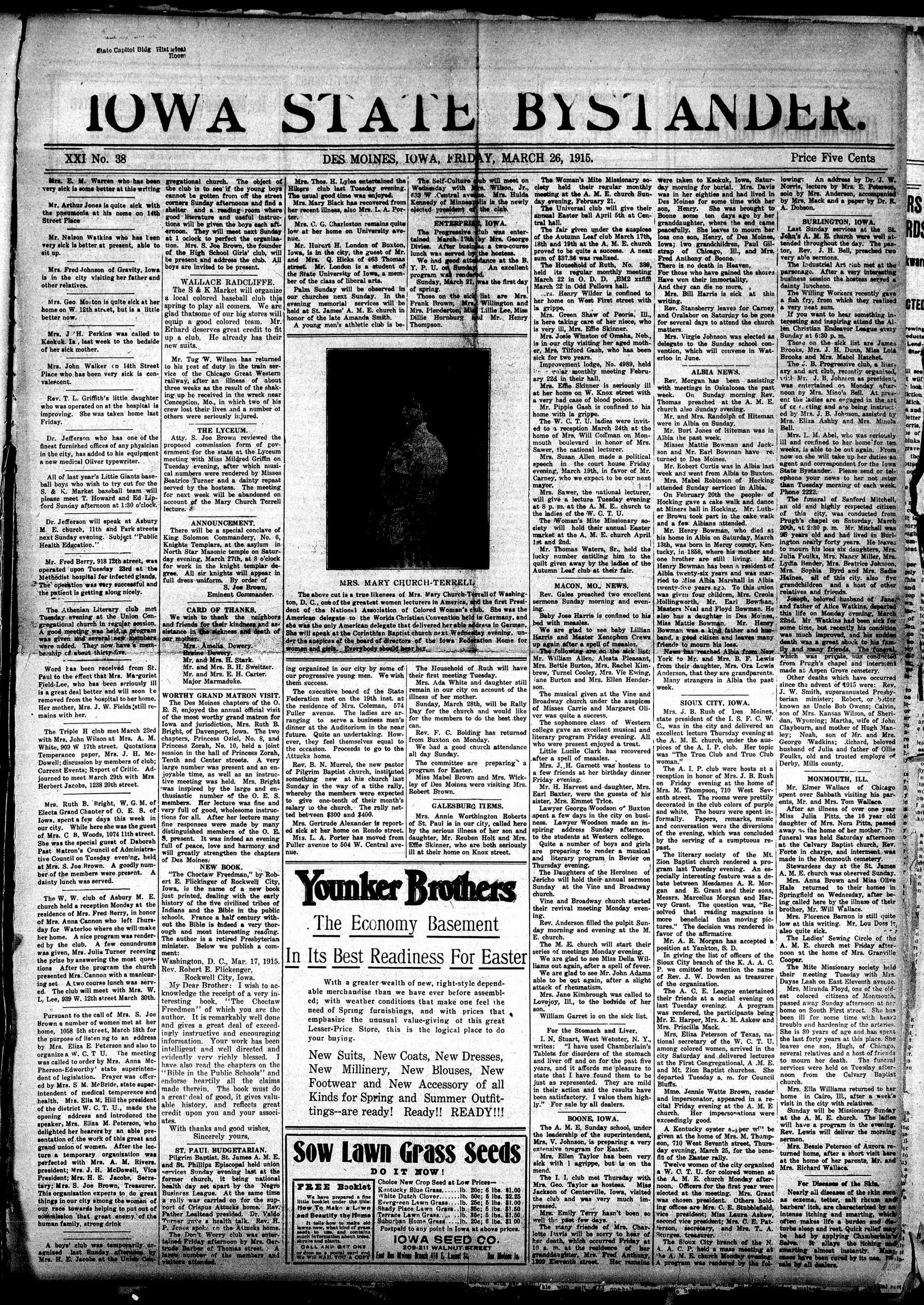
MRS. MARY CHURCH-TERRELL
The above cut is a true likeness of ton, D. C., one of the greatest women indent of the National Association of American delegate to the World Chie she was the only American delegate the She will speak at the Corinthian Baptist she the apaestics of the board of director women and girls. Everybody should be
out is a true likeness of Mrs. Mary Church-Taylor of the greatest women lecturers in America, as National Association of Colored Women's delegate to the Worlds Christian Convention held by the American delegate that delivered her able act at the Corinthian Baptist church next Wednesday of the board of directors of the Iowa Podcasts. Everybody should hear her.
klennesses of Mrs. Mary Church-Terrell of Washing-
town lecturers in America, and the first Presi-
tion of Colored Woman's club. She was the
Worlds Christian Convention held in Germany, and
delegate that delivered her able address in German,
staff Baptist church next Wednesday evening, un-
of directors of the Iowa Redemption Home for
should hear her.
The above cut is a true likeness of Mrs. Mary Church-Terrill of Washington, D. C., one of the greatest women lecturers in America, and the first President of the National Association of Colored Woman's club. She was the American delegate to the Worlds Christian Convention held in Germany, and she was the only American delegate that delivered her able address in German. She will speak at the Corinthian Baptist church next Wednesday evening, under the anglers of the board of directors of the Iowa Federation Home for women and girls. Everybody should hear her.
ing organized in our city by some of our progressive young men. We wish them success.
The executive board of the State Federation met on the 19th inst. at the residence of Mrs. Coleman, 574 Fuller avenue. The ladies are arranging to serve a business men's dinner at the Auditorium in the near future. Quite an undertaking. However, they feel themselves equal to the occasion. Proceeds to go to the Attucks home.
Rev. B. N. Murrel, the new pastor of Pilgrim Baptist church, instituted something new at his church last Sunday in the way of a title rally, whereby the members were expected to give one-tenth of their month's salary to the church. The rally netted beteen $300 and $400.
Mrs. Gertrude Alexander is reported sick at her home on Rondo street. Mrs. L. A. Porter has moved from Fuller avenue to 504 W. Central avenue.
The Household of Ruth will have their first meeting Tuesday.
Mrs. Ada White and daughter still remain in our city on account of the illness of her mother.
Sunday, March 28th, will be Rally Day for the church and would like for the members to do the best they can.
Rev. F. C. Bolding has returned from Buxton on Monday.
We had a good church attendance all day Sunday.
The committee are preparing a program for Easter.
Miss Mabel Brown and Mrs. Wickley of Des Moines were visiting Mrs. Robert Brown.
GALESBURG ITEMS.
Mrs. Annie Worthington Roberts of St. Paul is in our city, called here by the serious illness of her son and daughter, Mr. Reuben Holt and Mrs. Effe Skinner, who are both seriously ill at their home on Knox street.
Younker
The Economy
In Its Best Ready
With a greater wealth
able merchandise than we
ed; with weather condition
need of Spring furnishing
empbasize the unusual w
Lesser-Price Store, this
your buying.
New Suits, New C
New Millinery, N
Footwear and New
Kinds for Spring ar
tings--are ready!
Sow Lawn
DO IT
Bunker Brothers
The Economy Basement
The Best Readiness For
with a greater wealth of new, right-style
merchandise than we have ever before a
with weather conditions that make one
of Spring furnishings, and with price
size the unusual value-giving of the
-Price Store, this is the logical place
buying.
New Suits, New Coats, New Dress
New Millinery, New Blouses,
New wear and New Accessory
Tools for Spring and Summer C
-are ready! Ready!! REAL
New Lawn Grass S
DO IT NOW!
Easter Brothers
Economy Basement
Readiness For Easter
Over wealth of new, right-style depend-
than we have ever before assembl-
conditions that make one feel the
furnishings, and with prices that
usual value-giving of this great
e, this is the logical place to do
New Coats, New Dresses,
Every, New Blouses, New
and New Accessory of all
spring and Summer Outfit-
ready! Ready!! READY!!!
Town Grass Seeds
DO IT NOW!
Younker Brothers The Economy Basement
In Its Best Readiness For Easter
With a greater wealth of new, right-style dependable merchandise than we have ever before assembled; with weather conditions that make one feel the need of Spring furnishings, and with prices that emphasize the unusual value-giving of this great Lesser-Price Store, this is the logical place to do your buying.
New Suits, New Coats, New Dresses, New Millinery, New Blouses, New Footwear and New Accessory of all Kinds for Spring and Summer Outfittings--are ready! Ready!! READY!!!
Sow Lawn Grass Seeds
Choice New Crop Seed at Low Prices —
Kentucky Blue Grass . . . lb 20c; 6 lbs. $1.00
White Dutch Clover . . . lb 50c; 5 lbs. $2.25
Evergreen Lawn Grass . . . lb 25c; 5 lbs. $1.50
Shady Place Lawn Grass . . . lb 35c; 5 lbs. $1.50
Terrase Lawn Grass . . . lb 35c; 5 lbs. $1.50
Suburban Home Grass . . . lb 20c; 6 lbs. $1.00
Postpaid to any point in Iowa at above prices.
FREE Booklet
We have prepared a fine little booklet under the title: How To Make a Lawn and Beautify the Home. It tells how to make old trees, to make needles to use, and contains many tips about trees, shrubs and plants.
CALL AND GIVE OR DOWN us a postal card and we WILL TALK YOU A OFFER.
IOWA SEED CO.
209-211 WALNUT STREET
East New Haven Branch 411 E. L. Laundry St
New Haven, CT 06810
The Self-Culture club will meet on Wednesday with Mrs. Wilson, Jr., 633 W. Central ave. Mrs. Hula Kennedy of Minnesota is the newly elected president of the club.
ENTERPRISE, IOWA.
The Progressive club was entertained March 17th by Mrs. George Divies. After business a two-course lunch was served by the hostess.
We had good attendance at the B. Y. P. U. on Sunday. An excellent program was rendered.
Sunday, March 21, was the first day of spring.
Those on the sick list are Mrs. Frank Brown, Mrs. Willington and Mrs. Friederdon, Miss Lillie Lee, Miss Dillie Hornburg and Mr. Henry Thompson.
The Household of Ruth will have their first meeting Tuesday.
Mrs. Ada White and daughter still remain in our city on account of the illness of her mother.
Sunday, March 28th, will be Rally Day for the church and would like for the members to do the best they can.
Rev. F. C. Bolding has returned from Buxton on Monday.
We had a good church attendance all day Sunday.
The committee are preparing a program for Easter.
Miss Mabel Brown and Mrs. Wickley of Des Moines were visiting Mrs. Robert Brown.
GALESBURG ITEMS
Mrs. Annie Worthington Roberts of St. Paul is in our city, called here by the serious illness of her son and daughter, Mr. Reuben Holt and Mrs. Eilea Skinner, who are both seriously ill at their home on Knox street.
The Woman's Mite Missionary society held their regular monthly meeting at the A. M. E. church Sunday evening, February 21.
The Universal club will give their annual Easter hall April 5th at Central hall.
The fair given under the auspices of the Autumn Leaf club March 17th, 18th and 19th at the A. M. E. church proved to be quite a success. A neat sum of $37.38 was realized.
The Household of Ruth, No. 389, held its regular monthly meeting March 22 in O. D. D. EM2 xniff March 22 in Oddell Hallwa.
Mr. Henry Wilder is confined to her home on West Street with la gripe.
Mrs. Green Shaw of Peoria, Ill., is here taking care of her niece, who is very ill, Mrs. Effie Skinner.
Mrs. Josie Winston of Omaha, Neb., is in our city visiting her aged mother, Mrs. Tilford Gash, who has been sick for two years, No. 4899, held in Imperial lodge, No. 4899, monthly meeting February 22d in their hall.
Mrs. Effie Skinner is seriously ill at her home on W. Knox street with a very had case of blood poison.
Mr. Pippie Gash is confined to his home with la gripe.
The W. C. T. U. ladies were invited to a reception March 24th at the home of Mrs. Will Collman on Monmouth boulevard in honor of Mrs. Sawer, the national lecturer.
Mrs. Susan Allen made a political speech in the court house Friday evening, March 19th, in favor of Mr. Carney, who we expect to be our next mayor.
Mrs. Sawer, the national lecturer, will give a lecture Tuesday evening at 8 p.m. at the M. E. church to the society with the W. U. church. The Woman's Mite Missionary society will hold their annual Easter market at the A. M. E. church April 1st and 2nd.
Mr. Thomas Waters, Sr., held the lucky number entitleing him to the quilt given away by the ladies of the Autumn Leaf club at their fair.
MACON. MO., NEWS.
Rev. Gales preached two excellent sermons Sunday morning and evening.
Baby Jose Harris is confined to his bed with measles.
We are glad to see baby Lillian Harris and Master Xenophon Crews up again after a spell of measles.
The following are on the sick list: Mr. William Allen, Alaeta Pleasant, Mrs. Bettie Cooke, Mrs. Rachel Kimbrew, Turnel Cooley, Mrs. Vie Ewing, Jane Burton and Mrs. Ellen Henderson.
The musical given at the Vine and Broadway church under the auspices of Misses Carrie and Margaret Oliver was quite a success.
The sophomore class of Western college gave an excellent musical and literary program Friday evening. All who were present enjoyed a treat.
Little Lucile Clark has recovered after a spell of measles.
Mrs. J. H. Garnett was hostess to a few friends at her birthday dinner Friday evening.
Mr. H. Harvest and daughter, Mrs. Earl Baxter, were the guests of his sister, Mrs. Emmet Triche.
Lawyer Gorge Woodson of Buxton spanned five in the city on business. Lawyer Woodson made an inspiring address Sunday afternoon to the students at Western college.
Quite a number of boys and girls are preparing to render a musical and literary program in Bevier on Thursday evening.
The Daughters of the Heroines of Jericho will hold their annual sermon Sunday at the Vine and Broadway church.
Vine and Broadway church started their revival meeting Monday evening.
Rev. Anderson filled the pulpit Sunday morning and evening at the M. E. church.
The M. E. church will start their series of meetings Monday evening.
We are glad to see Miss Della Williams out again, after a spell of fever.
We are glad to see Mr. John Adams able to be out again, after a slight attack of rheumatism.
Mrs. Jane Kimbrough was called to Lovejoy, Ill., to the bedside of her son.
William Garret is on the sick list.
For the Stomach and Liver.
I. N. Stuart, West Webster, N. Y., writes: "I have used Chamberlain's Tablets for disorders of the stomach and liver off and on for the past five years, and it affords me pleasure to state that I have found them to be just as represented. They are mild in their action and the results have been satisfactory. I value them highly." For sale by all dealers.
BOONE, IOWA.
The A. M. E. Sunday school, under the leadership of the superintendent, Mrs. V. Johnson, is preparing a very extensive program for Easter. Mrs. Ellen Taylor has been very sick with 1 agripple, but is on the mend. The I. I. club met Thursday with Mrs. Geo. Taylor as hostess. Miss Jackson of Centerville, Iowa, visited the club and was very much impressed. Mrs. Emily Terry hasn't been so well the past few days.
The many friends of Mrs. Charlotte Iavis will be sorry to hear of her death, which occurred Friday at 10 a.m. at the residence of her grandmother, Mrs. Fred Anthony, 1800 Eleventh street. Her remains
were taken to Kookuk, Iowa, Saturday morning for burial. Mrs. Davis was in her eighties and had lived in Des Moines for some time with her son, Henry. She was brought to Boone some ten days ago by her granddaughter, where the end came peacefully. She leaves to mourn her loss one son, Henry, of Des Moines, Iowa; two grandchildren, Paul Gilstrap of Chicago, Ill., and Mrs. Fred Anthony of Boone. There is no death in Heaven. For those who have gained the shores Have won their immortality. And they can die no more. Mrs. Bill Harris is sick at this writing. Rev. Stansberry leaves for Carney and Oralabor on Saturday to be gone for several days to attend the church matters. Mrs. Virgile Johnson was elected as delegate to the Sunday school convention, which will convene in Waterloo in June.
ALBIA NEWS.
Rev. Morgan has been assisting with meetings in Oaklanda, the past week. On Sunday morning Rev. Thomas preached at the A. M. E. church also Sunday evening.
Mr. and Mrs. Randolph of Hiteman were in Albia on Sunday.
Mr. Burt Jones of Hiteman was in Albia the past week.
Misses Mattie Bowman and Jackson and Mr. Earl Bowman have returned to Des Moines.
Mr. Robert Curtis was in Albia last week and went from Albia to Buxton.
Mrs. Mabel Robinson of Hocking attended Sunday services in Albia.
On February 20th the people of Hocking gave a cake walk and dance at Miners hall in Hocking. Mr. Luther Brown took part in the cake walk and a few Albias attended.
Mr. Henry Bowman who died at his home in Albia on Saturday, March 13th, was born in Meroy county, Kentucky, in 1858, where his mother and one brother are still living.
Mr. Henry Bowman has been a resident of Albia twenty-six years and was married to Miss Albia Marshall in Albia twenty-five years ago. To this union was given four children, Mrs. Creola Hollingworth, Mr. Ear Bowman, Masters Neal and Floyd Bowman. He has a daughter in Des Moines, Miss. Mabel Robinson, Mr. Bowman was kind father and have band, a good citizen and leave many friends to mourn his loss.
News has reached Albia from New York to Mr. and Mrs. B. F. Lewis from their daughter, Mrs. Ora Lewis Anderson, that they are grandparents.
Many strangers in Albia the past week.
SIQUN CITY IOWA
Mrs. J. B. Rush of Des Moines, state president of the I. S. F. C. W. C., was in the city and delivered an excellent lecture Thursday evening at the A. M. E. church, under the auspices of the A. I. P. club. Her topic was "The True Club and True Club woman."
The A. I. P. club was hosts at a reception in honor of Mrs. J. B. Rush on Friday evening at the home of Mrs. M. Thompson, 710 West Seventh street. The rooms were pretty decorated in the club colors of purple and white. The hours were spent informally. Papers, remarks, music and conversation were the diversions of the evening, which was concluded by the serving of a sumptuous repast.
The literary society of the Mt. Zion Baptist church rendered a program last Tuesday evening. An especially interesting feature was a debate between Mesdames A. R. Morrison and E. R. Grant and their messages, Messrs. Marcellus Morgan and Hervy Grant. The question was "Resolved that reading magazines is more beneficial than moving pictures." The decision was rendered in favor of the affirmative.
Mr. A. R. Morgan has accepted a position at Yankton, S. D.
In giving the list of officers of the Sioux City branch of the K. A. A. C. P. we omitted to mention the name of Rev. J. W. Dowden as treasurer of the organization.
The A. C. E. League entertained their friends at a social evening on last Tuesday evening. A program was rendered, the participants being Mr. E. Harper, Mrs. A. M. Askew and Mrs. Pricilla Mack. Mrs. Eliza Peterson of Texas, national secretary of the W. C. T. U. among colored women, arrived in the city Saturday and delivered lectures at the First Congregational, A. M. E. and Mt. Zion Baptist churches. She departed Tuesday a. m. for Council Bluffs. Mme. Jennie Watts Brown, reader and impersonator, appeared in a recital Friday evening at the A. M. E. church. Her impersonations were exceedingly good. A Kentucky oyster s. per wi' be given at the home of Mrs. M. Thompson, 710 West Seventh street, Thursday evening, March 25, for the benefit of the Easter rally. Twelve women of the city organized a W. C. T. U. for colored women at the A. M. E. church Monday afternoon, offers for the first year were chosen for the meeting. Mrs. Gratton was chosen office officer. Other offices are Mrs. C. E. Stubblefield, vice president; Miss Laura Askew, second vice president; Mrs. C. E. Patterson, secretary, and Mrs. T. A. Sturgus, treasurer.
The Sloux City branch of the N.
A. A. C. P. held a mass meeting at
the A. M. E. church Monday evening.
A program was rendered by the fol-
lowing: An address by Dr. J. W. Norris, lecture by Mrs. E. Peterson, solo by Mrs. Anderson, accompanied by Mrs. Mack and a paper by Dr. R. A. Dobson.
**BURLINGTON, IOWA.**
Last Sunday services at the St. John's A. M. E. church were well attended throughout the day. The pastor, Rev. J. H. Bell, prescheduled two very able sermons.
The Industrial Art club met at the parsonage. After a very interesting business session the hostess served a dainty luncheon.
The Willing Workers recently gave a fish fry, from which they realized a very neat sum.
If you want to hear something interesting and inspire attend the Allen Christian Endeavor League every Sunday at 6:30 p. m.
Those on the sick list are James Brooks, Mrs. J. H. Dunn, Miss Lola Brooks and Mrs. Mabel Hatchet.
The J. B. Progressive club, a literary and art club, recently organized, visited Mr. J. B. Johnson as president, was entertained on Monday afternoon by Mrs. Mine's Bell. At present the ladies are engaged in the art of citing and are being instructed by Mrs. J. B. Johnson, assisted by Mrs. Eliza Ashby and Mrs. Minola Bell.
Mrs. L. M. Abel, who was seriously ill and confined to her home for ten weeks, is able to be out again. From now on she will take up her duties as agent and correspondent for the Iowa State Bystander. Please send or telephone your news to her not interst than Tuesday morning of each week. Phone 2222.
The funeral of Sanford Mitchell, an old and highly respected citizen of this city, was conducted from Prugh's chapel on Saturday, March 20, at 2:30 p. m. Mr. Mitchell was 96 years old and had lived in Burlington nearly forty years. He leaves to mourn his loss six daughters, Mrs. Joulke Fouls, Mrs. Nancy Miller, Mrs. Lydia Bender, Mrs. Beatrice Johnson, Mrs. Sophia Byrd and Mrs. Sadie Haines, all of this city, also five grandchildren and a host of other relatives and friends.
Joseph, beloved husband of Jane, and father of Alice Watkins, departed this life on Monday evening, March 22nd. Mr. Watkins had been sick for some time, but recently his condition was much improved, and his sudden death was a great shock to his family and many friends. The funeral, which was private, was conducted from Prugh's chapel and interment at Aspen Grove cemetery.
Other deaths which have occurred since the advent of 4915 were: Rev. J. W. Smith, superannuated Presbyterian minister; Robert, or better known as Uncle Bob Owens; Calvin, son of Mrs. Kansas Wilson, of Sheridan, Wyoming; Martha, wife of John Hawkins, and mother of Huguenot Marie; George Wadkins, Richard, beloved husband of Julia and father of Ollie Foulks, old and trusted employee of Derby, Mills county.
MONMOUTH, ILL.
Mr. Elmer Wallace of Chicago spent over Sabbath visiting his parents, Mr. and Mrs. Tom Wallace. After an illness of over one year Miss Julia Pitts, the 16 year old daughter of Mrs. Nora Pitts, passed away at the home of her mother. The funeral was held Saturday afternoon at the Calvary Baptist church. Rev. Forte in charge, and interment was made in the Monmouth cemetery. Stewardess day at the St. James A. M. E. church was observed Sunday. Mrs. Anna Brown and Mrs. Olive Hale returned to their homes in Springfield on Wednesday, after being called here by the illness of their brother, Mr. Will Wallace. Mrs. Florence Barnun is still quite low at this writing. Mr. Lou Doss is also quite sick. The Ladies' Sewing Circle of the A. M. E. church met Friday afternoon at the home of Mrs. Granville Cooper. The Mite Missionary society held their meeting Tuesday with Mrs. Dayse Lash on Eight Eleventh avenue. Mrs. Miranda Floyd, one of the oldest colored citizens of Monmouth, passed away Sunday afternoon at her home on First Street. She has been ill for some time with heart trouble and hardening of the arteries. She is 80 years of age and has spent the last forty years at this place. She leaves one son, Hugh, of Chicago, several relatives and a host of friends to mourn her death. The funeral services were held on Tuesday afternoon from the Calvary Baptist church.
Mrs. Ella Williams returned to her home in Cairo, Ill., after a week's visit in the city with relatives.
Sunday will be Missionary Sunday at the A. M. E. church. The ladies will have a program in the evening. Rev. Lewis will deliver the morning sermon.
Mrs. Bessie Peterson of Aurora returned home, after a short visit here at the home of her parents, Mr. and Mrs. Richard Wallace.
For Diseases of the Skin.
Nearly all diseases of the skin such as eczema, tetter, salt rhamn and barbers' itch, are characterised by an intense itching and smarting, which often makes life a burden and disturbs sleep and rest. Quick relief may be had by applying Chambrun's Salve. It always the itching and smarting almost instantly. Many cases have been cured by its use. For sale by all dealers.
AFRO-AMERICAN CULLINGS
Only a few days ago we had as visitors to the Vukeska institute the governor of Alabama, the superintendent of education, judges of the supreme court, and many other state officers, and, without hesitation, they declared themselves in favor of education of all the people regardless of race and color, says a dispatch from Tuskegee.
Progress is being made. Two years ago, for example, in Louisiana 111 children in each thousand between the ages of ten and fourteen could not read or write. Within two years we have reduced that number in Louisiana to 115 in each 1,000. South Carolina, from 150 to 85, in Alabama from 77 to 87, in North Carolina, from 187 to 88, in Georgia from 166 to 58; in Arkansas from 113 to 47, and in Virginia from 97 to 67. Including what they pay in the way they are paid in extra taxes in producing the school terms and building schoolhouses and supporting private schools, the Negroes in the South now contribute $8,000,000 annually toward their own education.
Just now in New York, Booker Washington records, I note that much attention is being given to the inves tigation of the work of the Rockefeller boards and the Carnegie boards. This investigation should go further. The work of these boards should be followed into our southern states where the money that they have given is helping to make a new South and a new civilization which would investigate could get into the South and trace the influence of the Rockefeller and Carnegie money in bringing about better supervision of the schools by reason of the work of the state supervisors; could trace the influence of these boards in the work of the country supervisors, in the work that the farm demonstration agents are doing, in the work of the canning clubs and pig clubs. I wish the influence of this money could be followed into the colleges, the farms and into the homes of the farmers. I wish the influence of the money from these boards may be felt and seen in the bringing about of higher civilization for white and black people.
Through the education of both races we are getting rid of the crime of lynching. Twenty-very years ago there were 225 cases of lynchings, mainly in the South; in 1914 there were only 22 cases of lynchings, a reduction of 400 per cent.
Through education the white and the black races are being taught how to live together and work together. There are numerous state and local organizations that now bring the races together in friendly and helpful cooperation. Among these are the Virginia Organization society, the Southern Sociological congress, the Business league, chambers of commerce and women's clubs.
The buildings of the various institutes at Tuskegee were shown to a visiting party as model schoolhouses, types of the new and better school system which Alabama is trying to multiply. We understand that thirty or more such schoolhouses are slated for completion the next year, all under the energetic direction of Professor Dibble, a native born white Alabaman, who holds the position of independent of colored rural schools. The excursion was in his charge and his energy and enthusiasm
Dr. W. D. Weatherford, athlete, author, traveler and Christian leader, addressed a general assembly at the university at Washington on a moral and subject subject applicable to undergraduate life. A Southerner by birth moved to a location on the South as a speaker, he was forced to cancel engagements with five universities there in order to make a tour of northwestern universities and colleges.
Doctor Weatherford was a variety baseball and basketball player at his alma mater, Vanderbilt university, and was for three years director of the gymnasium at that institution. For 13 years he has been the Y. M. C. A student secretary of the international committee for all the colleges in the southern states. He is the author of several volumes, including two on the split of the Negro; and is said to have done more than any other man to enlist the friendly co-operation of college men in Negro betterment.
With the exception of lovemaking, there are many new ways of doing old things.
The fur of the cat is full of electricity, and before a thunder storm it will be noticed that a cat is always extremely lively and playful, probably an account of its electrical condition. Before rain is expected a cat will assiduously wash its hair.
Labor, to some people, is not so much a problem as a horror.—Nashville Banner.
A cheerful idiot has at least his susperness to commend him to tolerance.
The California-Mexican border covers 193 miles. Arizona has 300 miles of border on Mexico. New Mexico embarkers with the Mexicans for 410 miles, and Texas lies along the Mexican boundary for more than 900 miles.
showed how it take personality plus money to achieve success here an elsewhere. At each place arrangements were made to seat the visitors; most generally in an adjoining church, and there was much singing and a little talking. At Madison we found a station named after a pioneer colored man, an ex-slave, whose daughter is the efficient director of the school. The party arrived at Tuskegee early on Sunday evening in time to listen to the quaint singing of the great student body in the beautiful chapel with a capacity of from 1,600 to 2,000, fully utilized.
Then began three days of inspection filled with surprises to those who saw for the first time the wonderful work being done at Tuskegee, not only for the colored young men and women of the South, but for the cause of education, for Tuskegee is a contribution to pedagogy as well as to the rave problem. Educators everywhere will have to reckon with Tuskegee if they want to bring their theories and practice down to date.
Frederick Douglas for two or three decades was one of the favorites of the lycceum, which he abandoned only after the emancipation of his race. Douglas was beyond all comparison the ablest man whom the black race ever produced in our country, either among the pure black or the class of mixed blood.
He himself was a mulatto. His father was pure white of a distinguished Maryland family. His mother was pure black and his father's slave—that is, his mother was a pure black and his father a pure white.
He always gave his mother the credit of his talents. Douglas was born a slave. In early manhood he managed to escape on a ship, and landed in New Bedford, Mass. There he soon learned to read, and worked at such work as he could find. By and by he attended antislavery meetings, and soon became a speaker and the pet of the abolitionists. His graphic accounts of his life as a slave were very popular. From giving the story of his life, he gradually branched out into discussions of the political questions of the day, and, next to Phillips, was probably the ablest orator of the antislavery movement. Eventually, went to Rochester and published, for the first time, his antislavery paper. Its title was Frederick Douglas' Paper, which, next to Garrison's Laboratory and the Antislavery Standard, was recognized as the ablest antislavery paper in America.
then he became a lecturer, and his fame spread so rapidly that he took rank in the favor of the lecture-going public with Phillips and the other leading lights of the lyceum. When Lincoln came into power, Douglas moved to Washington, and was appointed to office in the District of Columbia as marshal, a position he held during the entire period of Lincoln's administration. Douglas' first wife was a plantation Negress without any education. A few years ago he married again. His second wife was white, and a woman of education and wealth. The black race was under fire by effective speakers, but Douglas was the only man among who deserved to be regarded as a real orator. —The Great Divide.
William E. Valentine of Indianapolis, widely known as a Negro educator, was selected by the New Jersey State Board of Education to succeed James M. Gregory as principal of the Industrial School for Colored Youths at Bordentown.
He was born at Montclair and was graduated from Harvard. He is now a supervising principal of schools in Indianapolis.
In Germany the sofa is invested with a sanctity as of a throne. The visitor must not sit on it unless especially invited to do so by the hostess. To take a seat there unasked is an outrageous presumption.
Wine tasters, employed in their professional duties, never swallow the wine they taste. They merely hold a sip of the beverage in the mouth for a few moments and breathe through the noirls.
And the average man spends nine tenths of his life trying to accumulate enough money to enable him to spend the other tenth in comfort.
About three minutes after starting an average man finds that he can go downhill fast without a sled under him.
Seville reports a dull olive market, the producers and purchasers being deadlocked, waiting for higher or lower prices, respectively.
Using a new aeroplane gun, United States army officers flying at a rate of nearly a mile a minute 600 feet in the air have made more than 90 per cent of hits on a small target on the ground.
In Persia there grows a weed the seed pods of which have long horns that enter the nostrils of grasing animals and frequently kill them by preventing them from eating or drinking.
Electrical apparatus has been invented to automatically give warning that a chimney is smoking by illuminating a sign/first end, if this is not headed by tying a bell.
(Copyright, 1915, by the McClure Newspaper Syndicate.)
On what strange grounds we build our
Manhole life all a mist, and in the dark
our fortunes meet us.
When we drive or whether we are
driven.
If ill, its ours; if good, the act of heaven.
To the girl who must make her own way in the world the choice of occu-
pation, at the outset, is a grave problem indeed if she picks up any daily paper she finds columns devoted to the advertisements of those who are eager to offer work to young women in the capacity of housemaids, cooks, and general houseworkers. She may find two or three openings for stenographers, mentioning, however, that they must be experienced, which she is not. No store clerk, factory hands, millers' or dressmakers' helpers are wanted. The only position open to the great army of young women looking for work is in households.
She secures a place of this kind after going the rounds, as a last resort. No matter how amenable the mistress of the home may be, if she is maid of all work, the pleasant smile may lighten her heart, but it will not lighten the burden of work her hands, and hers alone, must accomplish. Hard as the toll is, most girls would not complain if a little sunshine could drift in now and then to dispel the gloom of the steady, monotonous grind. Willfully blind is the mistress, who cannot see that an injustice is done to the maid who is refused the health-giving privilege of an afternoon a week to get out of doors and breathe God's free, invigorating sunshine, and every other Sunday for herself as well.
It is the monofony of the work that causes girls to shrink from engaging in it. Few mistresses take the trouble to consider how pitifully disheartening is the houseowner's lot. Up in the morning at dawn, ill or well, through zero winter weather or summer heat, going through the same duties of getting a hearty breakfast ready with the utmost dispatch. If the chops brown occasionally a trifle too much, the eggs play a joke on the three-minute process, or the biscuits and quilts one holds in mistress in fifty is wise enough to wait until they are alone to inquire about it, but takes the maid angrily to task before the entire family at the table.
To offset this lonely existence, what are her pleasures? Visiting her girl friends on her outing days, and often than not helping them in their tasks, or bringing her hard-earned wages home to the old folks, who grow each day more dependent upon her earnings. People who do not understand set up the cry: "Why don't girls who are looking for work take positions to do general housework, where their wages are paid regularly and a roof and good food furnished them?"
Money, a roof and food furnished are not everything. Who can blame the young for craving evenings to themselves for amusement and the employment which permits them this relaxation after the day's labor are over? Housework would not be dreaded as an occupation by young girls if the matter of recreation for them was entered into and adhered to by their mistresses. Girls should have home privileges to make them contented. What girl would not appreciate and be doubly faithful to the good mistress who gave her the use of a nice, neat, plainly furnished sitting room, to which she could have her friends visiting the house. The girls and their escorts would be decorous in their department, appreciating the loan of the family Victrola and the privilege of enjoying cakes and coffee.
The anticipation of such a pleasure would be something for a girl to look forward to. Her work would not seem monotonous. There would be a smile and a song on her lips instead of a sigh. If a large number of women employing maids would enter into such a compact for brightening the lonely lives of the girls working in their homes, the housemaid problem would be happily solved with satisfaction all around.
ARE MEN PAST FORTY WOOERS?
Flame at the core of the world.
And flame is the fire of the ancient spheres
The owl is Jude's to be;
And, on, there's a flame that is both their flames.
It has often been said that if a man does not marry in his early twenties he is not apt to wed until late in life, if he does at all. There a more than a grain of truth in such a prophecy. It is very unusual for a family to urge a potted son to wed early, no matter how sweet the girls are with whom he is thrown in contact. "You will have plenty of time, later on, to choose," he says. If he declares he is already in love, his diplomatic father sends him on a business trip which most, any of the clerks in his employ could have extended to better than he. By adroit ruses, the young man is kept out of harms' way until the fervor of his passion has waned. In seeing newer prettier boys he heals the girl she felt behind him. If his heart is or
```markdown
```
LauraJeanLibbey's Talks on Heart Topics
THE HOUSESHOLD PROBLEM.
THE
IOWA STATE BYSTANDER
truer mettle, and he writes to his sister that he cannot forget the malden of his dreams, unless the attachment is greatly to be desired. If he must wed young, the sisters take pains to introduce the girl to other young men quite as aligible, in the hope that she may take a fancy one of them and be safely wedded once her brother returns.
No question of cruel injustice in this matter their minds. But, all the same, her brother's love dream is shattered. He thinks all women untrue because of the faithlessness of one. He takes a grim pleasure in attracting women, flattering them, and riding away. In the strength and vigor of his manhood, women are susceptible to his fascination and are not averse to being bored by him.
When a man has reached forty years of age, he has his ideals. Unless a woman is able to touch the silver cord to which his heart responds, as if by magic, he fingers by her side but a short time; laughs with her and turns away. He is no longer on a love quest. He simply wants to be amused by fair women to pass the time away. He thinks he is proof against Cupid's arrows. There he makes a grave mistake. At least, many hearts are receptive as it was at twenty. He is simply waiting for the right woman to appear. He will woo her with an arder which surprises even himself.
He realizes the time that he lost in single blessedness he can never regain. He is not willing to wait a twelve-month, but presses his suit with eagerness and haste. He realizes, though a host of relatives say bim nay, that he needs his own home and a wife in it now, if ever. Even the opinion of his closest friend will have no power to turn him from his purposes. He is aware that the most precious possession that comes to a man in this world is a woman's heart. The man who has steered clear of marriagable women all of his life is very prone to engage in the love game and to make a better and more considerate husband at forty than at twenty.
LOVE CHASERS.
One hour with thee: when sun is set. Oh, what can teach me to forget The thankless labor of the day: The hopes, the wishes-flung away. There are some girls whom it is difficult to bring to a realization of the fact that it is best for a man to make the first move on love's checkerboard. Modest maidens have been, and always will be, timid, clinging to that old-fashioned, but always sweetly romantic belief, that the right heart is in the right place, not soon or late from the rest of the world of women, and straightway begin a seige upon their heart. This girlish day dream is a valuable armor for unawakened hearts, keeping them innocent and pure.
There is another class of young women who rebel against the old theories and defy custom by refusing to await man's leisure in beginning the love quest, and lose no opportunities in casting about for a suitable mate. If a new acquaintance drops a chance word that she has a marriageable single brother, the love chaser does not stand upon ceremony in her endeavor to make a bosom friend of the sister without delay. If someone casually mentions that this doctor or that lawyer is heart whole and fancy free, she adroldly invigeles her gouty old father to change his doctor for at least one or two trials. In invigeling head of the house never imagines for a moment that there is a motive back when his daughter insists that he must settle some trifling matter by consulting the aforementioned young lawyer to confirm or dispute the judgment of the parental opinion. Father's suspicion is not aroused even when his pretty daughter insists on accompanying him, donning her Sunday-go-to-meeting clothes for the visit.
The love chaser, invigilies all her acquaintances into introducing her to a nice beau, makes the life of the men folks of her family miserable by eagery eying the good-looking men whom they salute in passing, and nagging for an introduction.
Such girls rarely make good. Men do not be able to hold the evidence of admiration in the girl's gaze time they meet her. They do not relish being pressed for a promise to call upon her in the first sentence or so that falls from her lips after they have been introduced. Every man knows full well when he is being angled for, and with the perverseness of mankind, will evade the baited trap at any cost. He concludes, seeing her so anxious to make an impression on him, that she is unable to awaken any other man's heart whom she may have met.
She brings a warm glow to the heart of even the most worldly of men to be able to bring a blush of sweet girlish confusion because of his presence to the face of a sweet, haughty maiden.
A man does not want a woman to teach him love's subtle art; he feels confident that he knows quite as much about her as she does, probably much more, in fact.
War-Time Wireless
In the early days of the war merchant vessels of the belligerent nations had to cork up their wireless (at least for sending word as to their whereabouts) for fear the enemy war vessels would pick up the messages. Although this danger is now very largely obviated, the following plan, suggested by a British writer, for rendering these "whereabouts" messages safe to send even in an enemy's sea, is perhaps worth recording. The signaled latitude and longitude sentences are to be falsified on each day for the arranged plan. For example in Portsmouth the captain of the vessel, after making his observations, consults his code of falsifications. He finds that on this date he is to add 14 degrees to the latitude and subtract 21 degrees from the longitude. When these figures are received at the home office, they are corrected by means of the same code.
Coming In Throngs.
"My wife is greatly disturbed."
"What's the trouble?"
"She says the young girls are holding an old home week in our parity"—Louisville Courrier Journal.
HOW THE SECONDARY PARTS MAY BE UTILIZED.
Excellent for Hash, or Other Like Dishes, If Properly Prepared and Highly Seasoned—Saving the Sour Milk or Cream.
The following advice about "left-overs" will contain nothing new to the good cook or the experienced housekeeper, but it is just what the average American home cook needs, for she rarely knows how to make good use of left-over meats, vegetables and other foods, which too often find their way into the garbage pail. This advice is taken from a pamphlet issued by Mayor Mitchel's food supply committee. The pamphlet, which is full of good recipes, will be sent free to anyone who cares to write for it to the committee at the city hall, New York;
Left-Over Meat—Do not reheat left-over cooked meat for a long time at a great heat, as this will make the meat tough.
Left-over cooked meat will be more palatable if highly seasoned.
Left-over beef, lamb, mutton and veal are excellent for lamb, scalloped dishes, croquettes, a loaf and salads.
Left-over beef, lamb or mutton make excellent stews with the addition of any left-over vegetables. Any left-over meat, vegetables and gravy may be used to make a meat pie.
A left-over ham bone will greatly improve the flavor of pea or bean soup.
Any kind of cold meat may be chopped and used in an omelet, or combined with rice and tomatoes, used for a scalloped dish.
Sour Milk or Cream—No sour milk or cream should be wasted. Put it into an earthen or glass jar, little by little, until you have half a cup or a cupful. As soon as it thickens use it for cottage cheese, griddle cakes, biscuits, cornbread or gingerbread.
Sour cream may also be used for filling for cake.
Cheese.—All the little dried pieces of cheese should be grated and put in a covered glass jar. These cheese crumbs are excellent for many made-over dishes and are particularly good for foods, such as potatoes, macaroni, etc.
Very tasty crackers can be made by spreading this grated cheese on crackers, seasoning them and then putting them in the oven for a few minutes.
Cherry Cream.
One tablepoonful gelatin, two eggs, half cupful cream, two cupuples canned cherries, three-fourths cupful sugar, Dissolve the gelatin in a little of the juice from the cherries. Make a custard of the yolks of the eggs and the rest of the cherry juice. Add the gelatin to the boiling mixture, and lift at once from the fire. In turn, add the sugar, the cream, whipped, and the whites of the eggs still beaten. Mix thoroughly and add cherries. Turn into mold, and serve very cold. If the cherries do not sufficiently color the cream, do this artificially. If the cherries have been canned wifi's plenty of sugar omit part of the sugar called for in this recipe. Cherry cream is excellent served with broken lemon jelly.
A simple cherry cream may be made with tapioca. It is, however, a dish more suited to a family dinner than a company luncheon.
Pork Tenderloins
Pork tenderloins are delightful, whether broiled or baked. For broiling they are usually split and brushed with butter. When cooked in the oven a delightful way is to split them almost through. Make a stuffing as for fowl, using fine crumbs, a seasoning of salt, pepper, little fine thyme and grated onion and two tablespoonfuls of butter for each cupful of stuffing. Spread the oil of this over one of the opened loins cover with a second loin and tie together in three or four places. Roast in a quick oven, basting often.
Ham in Cider.
Boil a medium sized ham over a slow fire, in sufficient sweet cider to half cover it. Skim off the grease which rises to the top, occasionally. When tender, take out, remove rind, slice the fat in diamond shape and into each diamond stick a whole clove. Make a paste of crumber crumbs and brown sugar. Save the cider liqueur and after the frit meal place back in this which keeps it juicy and improves the flavor.
For Mildew Stains
Mix a small quantity of soft soap with the same proportion of powdered starch and salt and the juice of a lemon. Apply this mixture to both sides of the stain with a small brush, and, if possible, let the article lie on the grass all day and night until the stains have quite disappeared. Then wash in the usual way.
Some Special Recipes.
Cook's delicious fudge was made with sour cream instead of fresh milk or cream. What gave the peas she served such a nice color and taste was the adding of a juice leaf and a tablespoonful of sugar. They had almost the taste of the fresh green peas and looked as green as the pools.
Creamed Salmon on Toast
Creamed Salmon on Toast.
Make a white sauce by melting two tablespoonfuls of butter in a saucepan. Add one tablespoonful of flour and milk until it is a smooth paste. Now add one tablespoonful of half-cupful of warm sweet milk and season to taste. Mix this with one small cm of salmon and pour over hot toast.
King's Pudding.
Two cupcakes bread crumbs, one-half cupful suet or butter, one-half cupful molasses, one egg, one teaspoonful of soda, one-half cupful milk, one-half teaspoonful cloves, one teaspoonful cinnamon, pinch of salt; boil or steam like a leaf of brown bread two hours; serve with lemon or hard sause.
The Married Life of Helen and Warren
By MABEL HERBERT URNER
Originator of "Their Married Life." Author of "The
Journal of a Neglected Wife," "The Woman Alone," etc.
Warren Orders an Expensive Dinner and Helen Can
Think Only of the Check
(Copyright, 1915, by the McClure Newspaper Syndicate.)
"We'll, not order just yet," Warren waved aside the dinner card. "Expect a gentleman here in a minute." Expect a gentleman here in a minute." The waiter filled their glasses, placed the menu before them and hurried off.
"Dinner de Luxe, two dollars," read Helen, with a gasp of dismay "Two dollars! Why, that's outrageous! It was never more than a dollar and a half."
"That is pretty stiff," Warren admitted. "Well, now they've got the crowd coming—they've boosted the price."
"But we don't have to take the dinner, do we?" persisted Helen. "Can't we order a la carte?"
"Yes, and it'll cost a darn sight more before we're through."
"Not if we don't order so much, and it's so hot tonight, dear, we won't want much."
"There's Elliot now!" Warren waved the card at a man in white flannels standing expectantly in the doorway. He saw the signal and made his way toward them.
"Hope I haven't kept you waiting," as he greeted Helen. Then in answer to Warren's query, "Yes, a dry Martini."
Helen was unresponsive to Mr. Elliot's genial efforts to include her in the conversation. She had come to dread his semiannual trip to New York, because Warren always took him out and always paid the bill. How could he accept such hospitality and make no effort to return it? Of course, he had repeatedly invited them to St. Louis, but he was safe in that, for he knew they would never come.
"Now, let's get this ordering over first. Warren pushed the card towed Elliot. What do you feel like—the dinner?"
"Looks pretty heavy. I don't know about you folks, but I want something light this weather."
Helen greeted this announcement with enthusiasm.
"I was just telling Warren that. We'd all be much better off if we'd eat less while it's so warm."
"All right, we'll order then." Warren turned to the waiter. "Let's see your a la carte card."
The waiter brought it with evident reluctance. Apparently in this room you were expected to take the dinner and not try to economize by a la carte order. "What about clams?" suggested Warren. "I can always eat clams," agreed Mr. Ellot.
"Cocktail or plain?"
"Plain."
Helen made a troubled note that clams here were 35 cents—that made a dollar and five for the first course. Perhaps the dinner would have been cheaper after all.
"Soup?" asked Warren. "That St. Germain ought to be pretty good—they must it of fresh pea now."
"Oh, it's too warm for soup," interrupted Helen, hoping desperately that Warren was not going to order a course dinner at a la carte prices. It would be twice as much as the table d'hote.
Chicken broth jellied," suggested Mr. Elliot "that cold."
At this Helen dropped her eyes to hide their resentment.
"All right—three chicken broth," ordered Warren. Then, reading from the fish list: "Bass, Fresh Mackerel, Fletto of Sole."
"Oh, dear, I don't think it's safe to eat fish," broke in Helen, determinedly.
"it ought to be all right at a place like this," Mr. Elliot assured her. "I had some sole here last summer that was exceptionally fine."
Countless times Helen had heard Warren declare that there was no sole in America, that it was only flounder, but now he tactfully refrained from this favorite comment and promptly ordered the sole.
Now, Elliot, look over those entrees. Anything there strikes you?
Helen was wretchedly twisting the napkin in her lap: Clams, soup, fish, and now an entree and probably a ceasar sh, why didn't they take the dinner? Every moment increased her fierce resentment of this man. How could he let Warren order so extravagantly?
However, he did suggest that they skip the entree, but for the roast he proposed guinea hen—one of the highest priced items on the menu.
"How about that, waited?" asked Warren. "That guinea hen enough for three?"
Helen almost gasped. The guines hen was $2.00—surely he would not order an extra portion! But the waiter said the hens were fair sized and, with the rest of the dinner, should be enough for three.
"Well, bring with it some new potatoes and green peas. That'll do. I'll give the rest of the order later. Now, let's see your wine card."
By this time Helen was almost in tears. What would this dinner cost? "I tell you a good summer wine—sparkling Chablis, suggested Mr. Hot, cheerfully. "Do you like a sparkling wine, Mrs. Curtis?"
"Why, I know so little about wines, answered Helen, fearing that sparkling Chablis was expensive, and wanting to order Medoc, the cheapest claret on the list. "I often tell Warren I enjoy the red ink at those Italian tables d'hote as much as I do champagne."
But this hint for inten
But this hint for inexpensive claret passed unnoticed.
It was, in fact, exceptionally good and well served, but Helen, who kept trying to add up in her mind the amount of the bill, could not enjoy it. She had propped the menu against
the mirrored wall beside her and kept glancing at it to verify the prices.
After the roast Warren ordered endive salad, then coffee, cordial and cigars. It was half-past ten before he called for the check.
"Here's something I haven't seen since I was in Paris," remarked Mr. Elliot abruptly, taking up the pepper grinder with its unground pods and grinding out a few grains on the tablecloth.
"No, you don't often see those," Helen answered stiffly, feeling that this was merely to make conversation while Warren paid the bill.
"Pepper should always be ground fresh. Now, in India they serve it in —" began Mr. Ellott, but Helen did not hear the rest; she was watching anxiously the waiter to bring the cheek.
It was well over twelve dollars, but she had a morbid desire to know the exact amount. Mr. Elliot was launched on a long story about India, so that he might seem absorbed while Warren paid, a subterfuge which she knew. Warren was too generous and wholesouled to see through.
The waiter was coming now. But, to Helen's astonishment, he placed the tray by Mr. Elliot—not by Warren. Then she saw that it was not the check—but money! Several bills and some silver! What did it mean?
"See here, what's this?" demanded Warren, with a puzzled frown.
"Got ahead of you this trip," smiled Mr. Elliot, showing a dollar bill toward the waiter and pocketing the rest. "I've dined with you every time I've been in New York, so it was about my turn."
"But, how in the devil—"
"That was easy. Just slipped the head waiter a twenty-dollar bill as I came in. Told him to deduct the check."
"Well, it's one on me, all right," grinned Warren, "but you'll not put that over again."
Helen's first sensation had been an immense relief. Warren did not have to pay the check—it was paid! But, then, came the thought of her ungratiousness to Mr. Elliot. She had hardly been civil—he must have felt her antagonism throughout the dinner! Could he have guessed the cause and been secretly exultant?
The color flooded her face as she tumbled with her fan. Did she imagine it, or was he looking at her with a grim satisfaction.
It was a relief when he left them at the subway.
"He fell," mused Warren, as he lit a fire. "Yes Elliot's a mighty fine fellow. Corking dinner, too. Then, suddenly, "What the devil made you glum."
"Why, dear. I wasn't—I didn't mean to be. I've had a headache all day from the heat—perhaps that was it."
"Well, when a man gives a dinner like that, it's up to you to look pleasant."
"But I didn't know it was his dinner—I thought—" Helen stopped in confusion; she had not intended to admit that.
"Oh, that's it, is it?" Warren gave her a keen glance. "You thought the dinner was on me, and you were so blamed stingy you begrudged every mouthful!"
"You know it wasn't that," lied Helen, miserably. "You don't think I—"
"You're a fine kill-joy, contemptously. "See here, this thing's growing on you. By Jove, if you get to begrudging what we eat—"
But the rest was lost in the roar of the train as it drew in.
Helen sank into a seat, her eyes fixed on the blank walls of the subway. Was she really so small and mercenary? Was this desire to save growing upon her? If it was, how could she combat it?
She thought of the wasted evening, of the dinner which she should have enjoyed, but which had been for her only a period of torture.
And yet when Warren was constantly complaining of "hard times," could she enjoy a dinner upon which she was squandering money so recklessly?
Pérfumes Prevent Nausea
A New York physician reports in the Medical Record that he has been very successful in preventing the nausea so apt to follow an anesthetic by the application to the nostrils of the patient of a pleasant perfume, preferably oil of bitter orange peel, as soon as the ether or chloroform is discontinued. He elevates the patient's head a little and turns it to one side, fastening a little adhesive to the tip of the nose and saturating this with cologne. Or if the patient has a mustache the perfume may be placed on that. He says the result is not always efficacious in preventing nausea after the anesthetic, but in many cases it is.
We all know that smelling salts are excellent in overcoming ordinary nausea and seasickness, and many people find them good for relieving the stuffiness in the nose caused by a cold in the head.
Paw Knows Everything.
Willie-Paw, do you know everything?
Wille—Well, does the spur of the moment cause time to fly?
Paw—Wille, you get your lessons.—Cincinnati Enquirer.
_____
These Fastidious People.
The most pittable thing in life is that fastidious man who tries to eat sparebear with a knife and fork.—Macon Telegraph.
TO PREPARE AND USE VEGETABLES
AGRICULTURAL DEPARTMENT EXPERTS GIVE RESULTS OF STUDY AND EXPERIMENT.
UNDERGROUND VEGETABLES
Some Facts About Roots and Underground Stems That Are Eaten as Vegetables—Cooking Starch.
(Prepared by the United States Department of Agriculture)
Nearly all roots and underground stems that are eaten as vegetables contain large quantities of water, in addition to starch or some similar material, a little nitrogenous matter, and a mineral matter. The roots and stems store materials for future growth during favorable seasons. Plants that store most of their food as insoluble starch (as potatoes and cassava) are which the "starch-bearing plants," which the in the form of soluble carbohybrates (sugar hybrids) which give the root a more or less juicy character are classed as "succulent roots."
In northern regions the potato is the most important of the starch-bearing plants. In the southern states the sweet potato is more generally used. One reason why the potato has be come such a favorite is doubtless its lack of pronounced flavor. It 'tarmarsizes with foods having a more positive taste, and one does not tire of it as one would of the continuous use of turnip or squash. Then, too, it is easily grown, gives an abundant yield, and may be readily stored for winter use.
How Much Should Potatoes Weigh? Potatoes should weigh 60 pounds to the bushel, or 15 pounds to the peck in three or four average potatoes will together weigh one pound, a peck should number from 40 to 60.
The oftener potatoes are handled in their transit from producer to consumer the poorer their quality and the greater the percentage of refuse. When received from the market it is desirable to sort them carefully, that one of the same size may be cooked together—smooth, medium ones to be baked; large ones to be steamed in their skins; and imperfect and inferno ones to be pared before boiling. My portions that are dark-colored on ceen should be removed, as they may impart a bad flavor to the rest sprouts should be broken from potatoes before cooking.
When potatoes are old and wrinkled they are much improved by cutting off the ends or by partially or wholly paring and by soaking in cold water for several hours like dried beans, etc. In fact, inferior potatoes of any age are much improved by paring and soaking. Where potatoes are inexpensive or the parings can be fed to animals it is often a profitable custom to pare before cooking, since thus imperfections and strong-flavored portions are disposed of, leaving a nearly pure starch, comparable to arrowroot or tapioca and ready for the table as soon as cooked; this is true notwithstanding that careful investigations have proved that such cooking causes considerable loss of the nutrients in the potato. When potatoes are the only vegetable palatable it might be wiser to cook them without paring, so that their mineral salts may be retained, but people who use salad plants and other vegetables freely are justified in considering chiefly convenience and palatability in the preparation of these tubers.
Often it is a convenience for the housekeeper who has several dishes to prepare at once just before dinner to have the potatoes pared earlier in the day. Most good cooks believe that it is wiser to discard the water in which potatoes are boiled, as it is likely to be strong in flavor. Potato flour may be found in large groceries and is used in cakes and for thickening purposes in much the same way as cornstarch. Sweet potatoes are not strictly tubers like Irish potatoes, but are tuberous roots. They should be kept in a dry place if possible at a temperature of from 50 to 65 degrees F. Because their sweetness is to some extent lost in water, they are better steamed than boiled, and baking is a favorite method of preparation. After steaming they may be sifted and used in puddings or pies like squash and added to breads, particularly cornbread.
Sweet potatoes are sometimes canned and are often dried like fruits for family use. A flour is also made from the sweet potato.
In southern homes the sliced sweet potato (often first parboiled) has always been cooked with sugar, butter, and other seasoning. Such dishes, under a variety of names, are now general favorites. Sweet potatoes are baked the process should not be too rapid, but should continue for an hour or until the skin separates from the pulp, and in the case of the varieties moist when cooked, until the slurp condenses, and the pulp grows moist. The negroes in the southern states bake them in the ashes in the fireplace; and as soon as one meal is over put in these needed for the next.
A New Vegetable—the Dasheen.
A new tuber which has received some attention from the bureau of plantation in tropical countries. The plants are simple the caladium, which is such a popular ornamental plant, and the so, which provides the "pol" of the wallahans, and which is a stalic food many tropical islands. The dasheens be served like potatoes, boiled, creamed, etc. but to many are potatoes, most acceptable when used. They have a rough outer coat, and are cool. It entails some
there is a tendency to discolor, and with potatoes. More detailed information regarding this new introduction and its preparation will be sent free to the housewife who applies to the United States department of agriculture.
The importance of Properly Cooking Starch.
Starch cookery is a very important subject. That starch may be thoroughly cooked it is essential that every starch grain be brought into contact with water of at least 140 to 175 degrees F.
In the case of starches separated from the plant cells when they were formed (arrow root, corn starch, etc) cooking is a simple matter, and long continued cooking is seldom needed to make them palatable and in good condition for digestion.
The selection of potato starch instead of corn or wheat starch for thickening sauces in accordance with the custom of French cooks is rational, since it does not require so long boiling to insure the heat results.
In the case of starch still encolled in plant cells—as is the case with the starch present in cereal breakfast foods, etc.—long cooking is desirable in order that water may penetrate to each individual starch grain and unite with it to form the well cooked material which is considered most wholesome.
Starches from different plants or plant parts differ in the form of the starch grain, so that starches of various kinds can be identified by use of the microscope. But from the culinary point of view, technically interchangeable one form of starch may be substituted for another in nearly all cases. Just as we may substitute the yam or a dish of rice for the potato as a vegetab' so we may use starch from the potato, or corn, or wheat, or rice for thickening gravies or making puddings, making slight changes in proportion, according to the expansive powers of each kind.
Suggestions Regarding Succulent Roots.
Beets contain a larger percentage of sugar than most vegetables, and should be baked or steamed to retain as much of this as possible. At all events, they should be cooked in the skins, and the tip of the root and a portion of the leaf stems should also be left on until after cooking. Even so, some color and sweetness are lost in the water in which they are cooked. Radishes, red or white, when a little too large to eat raw, may be cooked like turnips and served with a white sauce.
Raw carrots often are eaten by children, and are advocated by those who believe in the use of raw foods. When grated, raw carrots may be used in cooking for further cooking, or added to salads. The carrot contains so much sugar that its use for sugar making in the same way as the beet, has been seriously considered.
The parsnip is said to have been cultivated even before the Christian era. The woody fibre of these roots is softened by freezing without injury to other portions. Hence they are left in the ground until the frost comes or even through the winter. But the roots must be used before they begin to grow again or they lose their sweetness and get "rusty." The larger ones are likely to be less sweet and more woody. Small parsnips just from the ground in the spring will cook in less than a half hour. The roots are less sweet than by boiling. They should be peped after cooking, and served plain or with white sauce, or sautéed in butter or mashed and made into fritters. They may be made into a stew with potatoes, onions, and milk.
The vegetables sometimes known as the "oyster plant" is the "salalty", which is most available for use during the late fall and winter. The root turns dark quickly if the skin is removed before cooking, and after paring, should be dropped at once into vinegar and water to prevent discoloration. After boiling for about thirty minutes, the salty may be served with butter or white sauce, or mashed and made into fritters.
Boam In Alarm Clocks.
Merchants here report a rising market for alarm clocks. The board of education is to blame, and children of school age are in the lead as purchasers.
Last year school used to open at 9:16 in the morning. Then there was a protest against making the pupils attend chapel, so the time for these services was fixed at nine o'clock, while those who did not wish to attend chapel came in at 9:15.
Then chapel time was fixed at 8:50 and the opening of the study session at nine. Now the time has been fixed at 8:46, and there is chapel only one day a week—Freeport (R. I.) Dispatch to New York Press.
Their Great Scheme
A local couple, recently married, hit upon a scheme for saving what they figured was just about right. Each month they would save a certain sum each day. The first day one cent, the second day two cents, third four cents. Each day the amount was to be doubled until the end of 30 days. By that time they would have a tidy sum加a wawy. Before starting the husband figured out just how much would be accumulated in this scheme, our usual amount to be saving what like $5,800,000, so after considering the matter they decided that one dollar a week would be about their apeed — Youngstown Telegram.
Get the Hook.
"If man evolved from the monkey," remarked. Dinglobatz, "he at least has the satisfaction of knowing that, his ancestors were remarkably intelligent."
"What's the answer?" queried Snick-lefritz.
"They were educated in the higher branches," replied Dinglebatz—Indianapolis Star.
Relic of the Past.
"Seems to be a diversity of opinion about one thing."
"What is that?"
"Some old fables seem to think a trunk strap is more efficacious in reforming a bad boy than a suspended
The HOME BEAUTIFUL
Flowers and Shrubbery
Their Care and Cultivation
```markdown
```
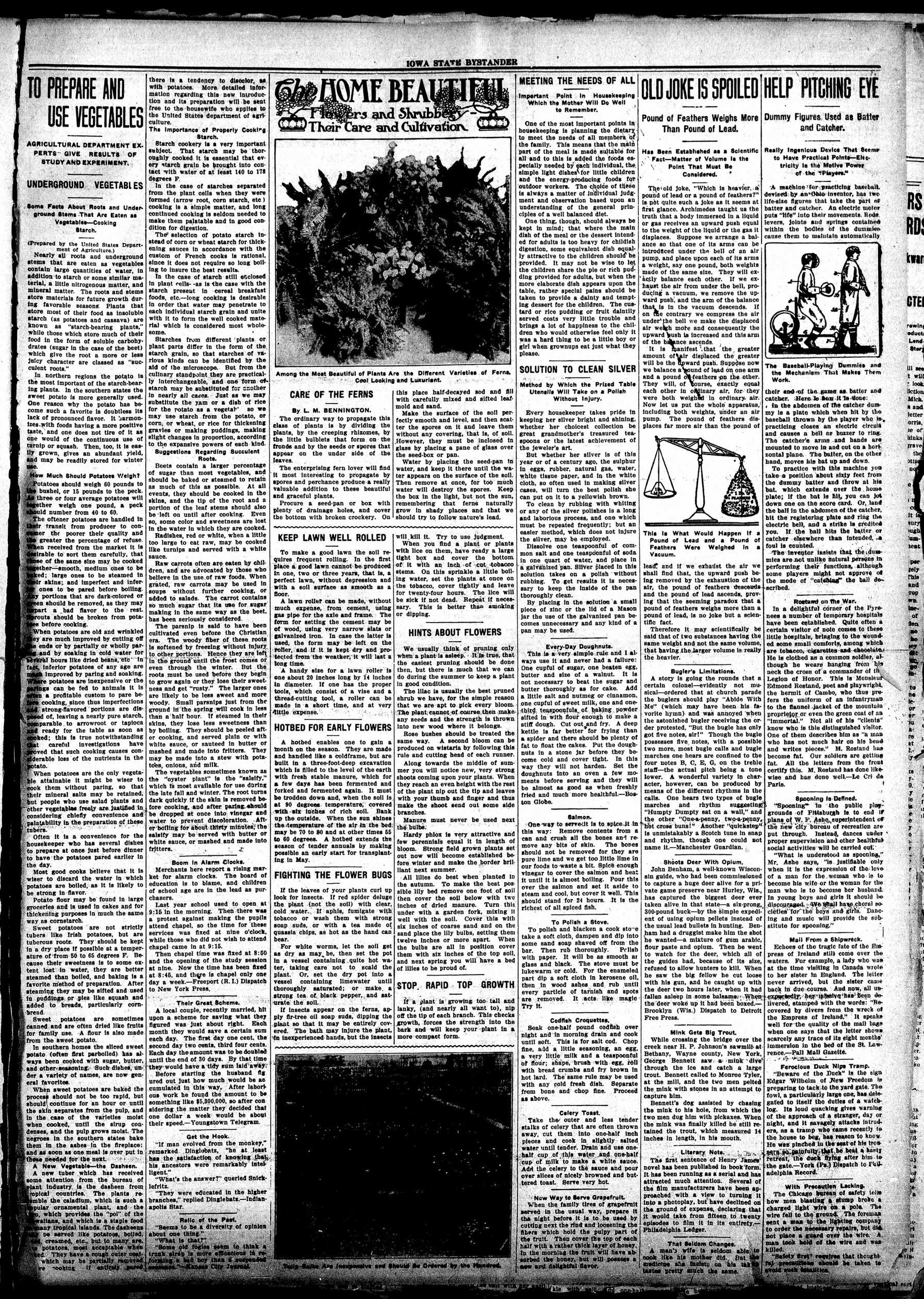
Among the Most Beautiful of Plants Are the Different Varieties of Ferns, Cool Looking and Luxurient.
THE FEDERAL RESERVE OF MONEY
FOR THE FEDERAL RESERVE OF MONEY
FOR THE FEDERAL RESERVE OF MONEY
Talia Sutra Are Inexpensive and Should Be Ordered by the Hundred.
CARE OF THE FERNS
Bx J. M. BENNINGTON
The ordinary way to propagate this class of plants is by dividing the plants, by the creeping rhizomes, by the little bulblets that form on the fronds and by the seeds or spores that appear on the under side of the leaves.
The enterprising fern lover will find it most interesting to propagate by spores and perchance produce a really beautiful plant, these beautiful and graceful plants.
Procure a seed-pan or box with plenty of drainage holes, and cover the bottom with broken crockery. On
KEEP LAWN WELL ROLLED
To make a good lawn the soil requires frequent rolling. In the first place a good lawn cannot be produced in one, two or three years, that is, a perfect lawn, without depression and with a soil surface as smooth as a floor.
A lawn roller can be made, without much expense, from cement, using gas pipe for the axle and frame. The form for setting the cement may be of wood, using very narrow slats or galvanized iron. In case the latter is used, the form may be left on the roller, and if it is kept dry and protected from the weather, it will last a long time.
A handy size for a lawn roller is one about 20 inches long by 14 inches in diameter. If one has the proper tools, which consist of a vise and a thread-cutting tool, a roller can be made in a short time, and at very little expense.
HOTBED FOR EARLY FLOWERS
A hotbed enables one to gain a month on the season. They are made and handled like a coldframe, but are built in a three-foot-deep excavation which is filled to the level of the earth with fresh stable manure, which for a few days has been fermented and forked and fermented again. It must be trodden down and, when the soil is at 90 degrees, temperature, covered with six inches of rich soil. Bank up the outside. When the sun shines the temperature of the air in the bed may be 70 to 80 and at other times 55 to 60 degrees. A hotbed extends the season of tender annuals by making possible an early start for transplanting in May.
FIGHTING THE FLOWER BUGS
If the leaves of your plants curl up look for insects. If red spider deluge the plant (not the soil) with clear, cold water. If aphis, fumigate with tobacco or wash them with strong soap soaps, or with a tea made of quassia chips, as hot as the hand can bear. For white worms, let the soil get as dry as may be, then set the pot in a vessel containing quite hot water, taking care not to scald the plant. Or, set the dry pot into a vessel containing limewater until thoroughly saturated; or make, a strong tea of black pepper, and saturate the soil. If insects appear on the ferns, apply fir-tree oil soap suds, dipping the plant so that it may be entirely covered. The bath may injure the plant, in inexperienced hands, but the insects
IOWA STATE BYSTANDER
BEAUTIFUL
and Shrubbery
and Cultivation
are the Different Varieties of Ferns,
and Luxuriant.
this place half-decayed soil and sill with carefully mixed and sifted leaf mold and sand.
Make the surface of the soil perfectly smooth and level, and then scatter the spores on it and leave them without any covering, that is, of soil. However, they must be inclosed in glass by placing a pane of glass over the seed-box or pan.
Water by placing the seed-pan in water, and keep it there until the water appears on the surface of the soil. Then remove at least one spore from the spores. Keep the box in the light, but not the sun, remembering that ferns naturally grow in shady areas and that we should try to follow nature's lead.
will kill it. It try to use judgment. When you find a plant or plants with lice on them, have ready a large tight box and cover the bottom of it with an inch of cut tobacco stems. On this sprinkle a little boiling water, set the plants at once on the tobacco, cover tightly and leave for twenty-four hours. The lice will be sick if not dead. Repeat if necessary. This is better than amoking or dipping.
HINTS ABOUT FLOWERS
We usually think of pruning only when a plant is asleep. It is true, that the easiest pruning should be done then, but there is much that we can do during the summer to keep a plant in good condition. The illac is usually the best pruned shrub we have, for the simple reason that we are apt to pick every bloom. The plant cannot of course then make any seeds and the strength is thrown into new wood where it belongs. Rose bushes should be treated the same way. A second bloom can be produced on wistaria by following this rule and cutting head of each runner. Along towards the middle of summer you will notice new, very strong shoots coming upon your plants. When they reach an even height with the rest of the plant nip out the tip and leaves with your thumb and finger and thus make the shoot send out some side branches. Manure must never be used next the bulb.
Hardy phlox is very attractive and few perennials equal it in length of bloom. Strong field grown plants set out now will become established before winter and make the border brilliant next summer. All lilies do best when planted in the autumn. To make the best possible lily bed remove one foot of soil then cover the soil below with two inches of dried manure. Turn this under with a garden fork, mixing it well with the soil. Cover this with six inches of coarse sand and on the sand place the lily bulbs, setting them twelve inches or more apart. When the bulbs are all in position cover them with six inches of the top soil, and next spring you will have a bed of lilies to be proud of.
STOP RAPID TOP GROWTH
If a plant is growing too tall and lanky, (and nearly all want to), nip off the tip of each branch. This checks growth, forces the strength into the bark and will keep your plant in a more compact form.
MEETING THE NEEDS OF ALL
Important Point In Housekeeping Which the Mother Will Do Well to Remember.
One of the most important points in housekeeping is planning the dietary to meet the needs of all members of the family. This means that the main part of the meal is made suitable for all and to this is added the foods especially needed by each individual, the simple light dishes for little children and the energy-producing foods for outdoor workers. The choice of tides is always a matter of individual judgment and observation based upon an understanding of the general principles of a well balanced diet.
One thing, though, should always be kept in mind; that where the main dish of the meal or the dessert intended for adults is too heavy for childish digestion, some equivalent dish equally attractive to the children should be provided. It may not be wise to let the children share the pie or rich pudding provided for adults, but when the more elaborate dish appears upon the table, rather special pains should be taken to provide a dainty and tempting dessert for the children. The custard or rice pudding or fruit dainty served costs very little trouble and brings a lot of happiness to the children who would otherwise feel only it was a hard thing to be a little boy or girl when grownups eat just what they please.
SOLUTION TO CLEAN SILVER
Method by Which the Prized Table Utenails Will Take on a Polish Without Injury.
Every housekeeper takes pride in keeping her silver bright and shining, whether her choicest collection be great grandmother's treasured teaspoons or the latest achievement of the jeweler's art.
But whether her silver is of this year or of a century ago, the sulphur in eggs, rubber, natural gas, water, white tissue paper, and in the white cloth, so often used in making silver cases, will turn the best polish she can on it to yellow brown. To clean by rubbing with whiting or any of the silver polishes is a long and laborious process, and one which must be repeated frequently; but an easier method, which does not injure the silver, may be employed.
Dissolve one teaspoonful of common salt and one teaspoonful of soda in one quart of water, and place in a galvanized pan. Silver placed in this solution takes on a polish without rubbing. To get results it is necessary to keep the inside of the pan thoroughly clean. Pour the solution a small piece of zinc or the lid of a Mason jar the use of the galvanized pan becomes unnecessary and any kind of a pan may be used.
Every-Day Doughnuts.
Every Day Doughnut.
This is a very simple rule and I always use it and never a failure. One cupful of sugar, one beaten egg, butter and a slice of walnut. It is not necessary to beat the sugar and thoroughly as for cake. Add a little salt and nutmeg or cinnamon, one cupful of sweet milk, one and one-third teaspoonful, of baking powder sifted in with flour enough to make a stiff dough. Cut out and fry. A deep kettle is far better for frying than a spider and there should be plenty of fat to float the cake. Put the doughnuts in a stone jar before they become cold and cover tight. In this way they will not harden. Set the doughnuts into an oven a few moments before serving and they will be almost as good as when freshly fried and much more healthful—Boston Globe.
Salmon.
One way to serve it is to spice it in this way: Remove contents from a can and crush all the bones and remove any bits of skin. The bones should not be removed for they are pure lime and we get too little lime in our foods to waste a bit. Spice enough vinegar to cover the salmon and heat it until it is almost cooked in the salmon and set it aside to steam and cool, but cover it well. This should stand for 24 hours. It is the richest of all spiced fish.
To Polish a Stove.
To polish and blacken a cook owl take a soft cloth, dampen and dip into some sand soap shaved off from the bar. Then rub thoroughly. Prish with paper. It will be as smooth as glass and black. The stove must be lukewarm or cold. For the enameled part dip a soft cloth in kerosene oil, then in wood ashes and rub until every particle of tarnish and spots are removed. It acts like magic Try it.
Codflab Croquette.
Soak one-half pound codfish over night and in morning drain and cook until soft. This is for salt cod. Chop fine, add a little seasoning, an egg, a very little milk and a teaspoonful of flour; shape, brush with egg, roll with bread crumbs and fry brown in the oven. Drain and serve with any cold fresh dish. Separate from bone and chop fine. Proceed as above.
Celery Toast.
Take the outer and less tender stalks of celery that are often thrown away, cut them into one-half inch pieces and cook in slightly salted water until tender. Drain and use one-half cup of this water and one-half cup of milk to make a white sauce. Add the celery to the sauce and pour over slices of nicely browned and buttered toast. Serve very hot.
Now Way to Serve Grapefruit
When the family tries of grapefruit served in the usual way, prepare it the night before it is to be used by cutting next the rind and loosening the fibers which hold the pulpy part of the fruit. Then cover the top of each half with a rather thick layer of honey. In the morning the fruit will have absorbed the honey, but will possess a new and delightful flavor.
OLD JOKE IS SPOILED HELP PITCHING EYE
Pound of Feathers Weighs More Than Pound of Lead.
Has Been Established as a Scientific Fact—Matter of Volume is the Point That Must Be Considered.
The old joke, "Which is heavier, a pound of lead or a pound of feathers?" is not quite such a joke as it seems at first glance. Archimedes taught us the truth that a body immersed in a liquid or gas receives an upward push equal to the weight of the liquid or the gas it displaces. Suppose we arrange a balance so that one of its arms can be introduced under the bell of an air pump, and place upon each of its arms a weight, say one pound, both weights made of the same size. They will exactly balance each other. If we exhaust the air from under the bell, producing a vacuum, we remove the upward push, and the arm of the balance that is in the vacuum descends. If on the contrary we compress the air under the bell we make the displaced air weight more and consequently the upward push is increased and this arm of the balance ascends.
It is manifest that the greater amount of air displaced the greater will be the upward push. Suppose now we balance a pound of lead on one arm and a pound of feathers on the other. They will, of course, exactly equal each other in ordinary air, for they were both weighted in ordinary air. Now let us put the whole apparatus, including both weights, under an air pump. The pound of feathers displaces far more air than the pound of
This Is What Would Happen If a Pound of Lead and a Pound of Feathers Were Welghed In a Vacuum.
This is What Would Happen If a Pound of Lead and a Pound of Feathers Were Welighed in a Vacuum.
lead, and if we exhaust the air we shall find that, the upward push being removed by the exhaustion of the air, the pound of feathers descent, proving that the seeming paradox that a pound of feathers weighs more than a pound of lead, is no joke but a scientific fact.
Therefore it may scientifically be said that of two substances having the same weight and not the same volume, that having the larger volume is really the heavier.
Bugler's Limitations
A story is going the rounds that a certain colonel—evidently not a musical—ordered that at church parade the buglers should play "Abide With Me" (which may have been his favorite hymn) and was annoyed when the astonished bugler receiving the order protested, "But the bugle has only got five notes, sir!" Though the bugle possesses five notes, with a possible two more, most bugle calls and bugle marches one hears are confined to the four notes B, C, E, G, on the treble staff—the actual pitch being a tone lower. A wonderful variety in character, however, can be produced by means of the different rhythms in the bugle marches. The bugle marches and rhythm suggestging "Humpy Dumpy sat on a wall" and the other "One-a-penny, one-a-penny, ht cross buna!" Another "quickest" is unmistakably a Scotch tune in snap and rhythm, though one could not name it—Manchester Guardian.
Shoota Deer With Opium
John Benham, a well-known Wisconsin guide, who had been commissioned to capture a huge deer alive for a private game preserve near Hurley, Wils., has captured the biggest deer ever taken alive in that state—a six-prong, 300-pound buck—by the simple expedient of using opium pellets instead of the usual lead bullets in hunting. Benham had a druggist make him the shot he wanted—a mixture of gum arabic, flour paste and opium. Then he went to watch for the deer, which all of the guides had, because of its size, refused to allow hunters to kill. When he saw the big fellow he cut loose with his gun, and he caught up with the deer two hours later, when it had fallen asleep in some balsamine. When the deer woke up it had been boxed—Brooklyn (Wis.) Dispatch to Detroit Free Press.
Mink Gets Big Trout
While crossing the bridge over the creek near H. P. Johnson's sawmill at Bethany, Wayne county, New York, George Bennett saw a mink dive through the ice and catch a large trout. Bennett called to Monroe Tyler, at the mill, and the two men pelted the mink with stones in an attempt to capture him.
Bennett's dog assisted by chasing the mink to his hole, from which the two men dug him with pickaxes. When the mink was finally killed he still retained the trout, which measured 14 inches in length, in his mouth.
Literary Notes.
The first sentence of Henry James' novel has been published in book form. It has been running as a serial and has attracted much attention. Several of the film manufacturers have been approached with a view to turning it into a photoplay, but have declined on the ground of expense, declaring that it would take from fifteen to twenty episodes to film it in its entirety—Philadelphia Ledger.
That Seldom Changes.
A man's wife is seldom able to cook like his mother did. But the medicines she tainly on his take tastes pretty much the same.
Dummy Figures Used as Batter and Catcher.
Really Ingenious Device That Seems to Have Practical Points—Electricity in the Motive Power of the "Players."
A machine for practicing baseball, devised by an "Obolo inventor," has two life-size figures that take the part of batter and catcher. An electric motor puts "life" into their movements. Rods, levers, joints and springs contained within the bodies of the dummies cause them to maintain automatically
The Baseball-Playing Dummies and the Mechanism That Makes Them Work.
their end of the game as batter and catcher. Here is how it is done:
In the abdomen of the catcher dummy is a plate which when hit by the baseball thrown by the player who is practicing closes an electric circuit and causes a bell or buzzer to ring. The catcher's arms, and hands are mounted to move in and out on a backzonal plane. The batter, on the other hand, moves his bat up and down. To practice with this machine you take a position about sixty feet from the dummy batter and throw at his bat, which extends over the home plate; if the bat is hit, you can jot down one on the score card. Or, land the ball in the abdomen of the catcher, hit the registering plate and ring electric bell, and a strike induces you. If the ball hits the batter or other cleaver than intended, a foul is counted. The inventor insists that the dummies are not unlike natural persons in performing their functions, although some players might not approve of the mode of "catching" the ball described.
Rostand on the War.
In a delightful corner of the Pyrenees a number of temporary hospitals have been established. Quite often a certain visitor of note comes to these little hospitals, brings to the wounded some small comfort, among which are tobacco, cigarettes and chocolate. He is clothed as a common soldier, although he wears hanging from his neck the cross of a commander of the Legion of Honor. This is Monsieur Edmond Rostand, poet and playwright, the hermit of Cambo, who thus prefers the uniform of an infantryman to the fannel jacket of the mountain proprietor or even the green coat of an "immortal." Not all of his "clients" know who is this distinguished visitor. One of them describes him as "a man who has not much hair on his head and writes pieces." M. Rostand has become fat. Our soldiers are getting fat. All the letters from the front certify this. M. Rostand has done likewise and has done well.—Le Crie de Paris.
Snapping Is Defined.
"Spooning" in the public playgrounds of Pittsburgh is to end if plans of W. F. Asho, superintendent of the new city bureau of recreation are put through. Instead, dances under proper supervision and other health social activities will be carried out. "What is understood as spooning," Mr. Asho says, "is justifiable only when it is the expression of the love of a man for the woman who is to become his wife or the woman for the man who is to become her husband. In young boys and girls it should be discouraged. "We all have choral societies for the boys and girls. Dancing and music will provide the substitute for spooning."
Mail From a Shipwreck
Echoes of the tragic fate of the Empress of Ireland still come over the waters. For example, a lady who was at the time visiting in Canada wrote to her sister in England. The letter never arrived, but the sister came back in due course. And now, all unexpectedly, her identity has been delivered, stamped with the words: "Recovered by divers from the wreck of the Empress of Ireland." It speaks well for the quality of the mall bags when one says that the letter shows scarcely any trace of its eight months' immersion in the bed of the St. Lawrence.—Pall Mall Gazette.
Ferroelectric Duck Nim Trans
Ferocious Duck Nips Tramp.
"Beware of the Duck" is the sign Edgar Wilhelm of New Freedom is preparing to tack to the yard gate. The fowl, a particularly large one, has delegated to itself the duties of a watelog. Its loud quacking gives warning of the approach of a stranger, day or night, and it savages attacks intruders, as a tramp who came recently to the house to beg, has reason to know. He was pinched in the seat of his tronskog so painfully, that he beat a harsh retreat, the duck flying after him to the gate.—York (Pa.) Dispatch to Philadelphia.
With Prescription Lacking.
The Chicago burglar of safety tells how men blasting a gumple charged a light wire on a pole. The wire fell to the ground. The foreman sent a man to the lighting company to order the necessary repairs, but did not place a guard over the wire. A man took hold of the wire and was killed. "Safety first!" requires that thoughtful precautions should be taken to avoid such detritus.
MASONIC NOTES.
Chips From the Quarry.
After contemplating over the royal reception and grand banquet and the beautiful token of appreciation that Hiram lodge of Davenport, with the co-operation of the chapter, commemorates and bids lodge of Rockefeller and Motte, Illinois. I begin to realize as never before that after all it pays a man to live right, act right and set a good example in the community in which he lives. Our next visit was with Keystone lodge, No 33, Clarinda. Here is one of my new lodge is doing nicely under that good theistic meeting. Some came about thirty miles to, be there. This new lodge is doing nicely under that good Christian gentleman, Wm Headley, as W. M. They are learning the ritual very nicely and are working in peace and harmony. After 11:30 o'clock we marched down to Brother Lane's restaurant, where we found about sixteen of the ladies of the O. E. S, who had a long table filled full of good things to eat, and we, like our Davenport brothers, had a banquet. The only difference was in Clarinda the ladies of the O. E. S were out, while in Davenport there were no meetings. Our next official stop was with Twin City, Council Bluces. Here, through a mistake of some of the officers, they did not expect me and had called no meeting, yet. I met a few of the officers, and enjoyed a very fine supper with Brother Chas. Burke, who runs a first class restaurant, and his sister, who is a member of the O. E. S. The next evening across the big muddy into Omaha I landed, the guest of Rescue lodge. Here we met a goodly number of the Omaha members. Council Bluces had sent a delegation of six master Masons to hear my address and to show the Rescue brothers their love. We held a fine meeting; with much enthusiasm. Everybody enjoyed themselves immensely. This lodge is just now beginning to rise under the leadership of Chas. W. Dickerson, acting W. M., since the denise of the regular W. M., Brother Clenlens. We hope that they will take on a new growth and become a strong lodge. Tidings W. mormeatshtaOystympY
We will assemble some of the grand lodge members to Waterloo, Kays, Tuesday, April 20th, to initiate a bunch of men and to set up a new lodge Dame, Any master Mason in good and regular standing is invited to be present. Below we publish an excerpt from the Oskaloosa Daily Herald relating to the visit of our most worthy grand matron:
Mrs. Ruth Bright, of Davenport, worthy grand matron of Electa grand chapter, Q. E. S., paid an official visit at Ethel chapter, No. 6, on Friday evening, March 18th, and was greeted by nearly the entire membership. Mrs. Bright, who is serving her third term in the Grand East, has fully sustained the wisdom of the grand chapter in its choice. Her executive ability has kept all departments in fine running order and her ritualistic work has been, a source of inspiration to all who have heard her. She has not grown stale or indifferent, but by study, work and application she has acquired 'each year'an' increasing fund of knowledge regarding the laws, regulations and symbolisms of the order that makes her a most welcome visitor, in any of the chapters. Her lecture here was interesting and instructive and was greatly enjoyed by all. After the lecture a social session was held and an opportunity given to meet the grand matron personally. Mrs. Bright was the guest of the Mrs. Mollie Ringo home during her stay in the city.
Recommends Chamberlain Cough Remedy.
"I take pleasure in recommending Chamberlain's Cough Remedy to my customers because I have confidence in it. I find that they are pleased with it and call for it when again in need of such a medicine" writes J. W. Saxson, Mentevallo, Mo. For sale by all dealers.
KEOKUK, IOWA.
Mr. Charles Owens returned home Sunday, after a two months' stay in Florida.
On Friday occurred the death of Miss Molly Bundy at her home, 217 North Tenth street. She is survived by her husband, two sons and an adopted daughter.
Rev. G. D. Saunders of Bowling Green, Mo., is assisting Rev. Helm in revival services.
Mrs. Lucy Delay, spurned honea Sunday, after a two months' stay in Florida.
On Sunday afternoon occurred the death of Mr. Moses Mann at one of the local hospitals. He was taken ill Thursday afternoon with pleura pneumonia. He is survived by one brother and sister.
Miss Ola Tucker, a school teacher of Cameron, Mo., passed through our city an route to Farmington, being called to the bedside of her mother, Mrs. Cameron, who died Wednesday, March 17. Burial took place March 18.
An Easter marke will be given at the home of Mrs. A. J. Field, 318 North Thirteenth street, Saturday, April 3, under the auspices of the Altae Guild of 54 Mary the Virgin.
Ellen Louise Martin celebrated her 7th birthday Monday, March 29.
Mrs. Leona Blant will give a Lenten tea on Thursday, April 19.
Mr. Horace Craig returned Monday, after a two days' visit in Ottawa.
The funeral of Mrs. Charlotte Davie was held Sunday afternoon from Residual A. M. E. church. Mr. Davie was about 89 years old. He was a resident of Kookuk until about ten years ago, when she moved to Dixon Minneapolis.
MEMBER
NATIONAL GRO PRINT
FORT MADISON RECEPTION.
(Special to the Bystander.)
The White Rose club met with Mrs. George Mack on Thursday evening. Rev. and Mrs. Bowles were guests of honor as they will soon go to Waterloo, Iowa, to take up the work there. The house was beautifully decorated in club colors. Out of town guests were Mrs. G. H. Jackson of Kansas City, Mo., ex-president of foreign mission board of Iowa and Nebraska, and Mrs. E. J. Thomas of Keokuk, by whom the club was organized. After refreshments were served all departed to their homes, wishing Rev. and Mrs. Bowles success and happiness in their new field of labor.
HEALTH HINTS. A. J. Bockm. M. D.
Many people are of the opinion that there is always something else that a doctor might have done if he had been interested enough, and have saved a life. There is no question about the fact that doctors are human and consequently differ in ability and judgment.
SW 11 15188
In looking over a recent number of the Journal of the American Medical Society I noted the death of 65 physicians.
Their aged ranged from 29 to 91 years. The causes of death in twenty-seven cases were not given, but among the causes there were three cases of pneumonia, five of brain hemorrhage, nine of heart disease, among the latter a former professor of mine; two of tuberculosis, two of Bright's disease, two of blood poison, one of cancer, one following an operation, one of erysipelas, one of bronchitis. If there were any special remedies for these common ailments surely doctors would help each other out. Their wives and children die of the same causes as other people do. It is, of course, better to give the best possible man a chance to see you, but doctors get, or take credit for saving more lives than they really do. The man who is always saving life is either a four-fusher or he ought to be at the head of his profession.
It is a crime to prey on the sick and pretend that another half hour or ten minutes would have been too late, unless it is a matter of stopping the flow of blood or resuscitating some one from drowning, or some allied condition. Some men save the life of every patient, to hear them tell it. But as a matter of fact the physician is a protector and an interpreter of symptoms. It is for him to aid, to advise, to attempt certain measures. The matter of the source of life and its end is as much a mystery as it ever was; and it is an insult to your intelligence to have some one pretend to save a life every time they are called.
Every true physician will do all in his power to augment the patient's natural powers, to suggest the views of his equals, or if he is his superiors. Finally it is the greatest kindness to tell the family it appears to be a losing game, rather than keep them in suspense and pretend to be doing something when nothing can be done. The passing of the state board examination is merely a matter of some protection to the public. The state does not guarantee that a man who holds a license is all that he should be. It is rather an indication that the holder is not entirely incompetent. It would be almost impossible to give an examination of sufficient length to determine whether a man had judgment along with his book knowledge. This matter is for the people to decide.
Finally it is perfectly lawful and ethical for a physician to treat his own wife and family. Many men do not care to assume the responsibility of passing on matters in their families where there are likely to be serious consequences, since it might be embarrassing. It is also ethical and lawful to charge fellow physicians.
I hope that in this article I have made some questions plain that different people have asked, namely: That doctors die of the same diseases that other folks do, and that there are no private remedies for them nor their families. That it is perfectly lawful and ethical for a doctor to treat himself and family. That the state examination is to keep out the miserably prepared, but it is not an indication to ability.
VIVIAN L. JONES
Funeral Director
VIVIAN L. JONES
Funeral Director
The very best service guaranteed
Prices the lowest
Calls answered promptly day or
night No extra charges for distance—Reverse all phone charges
PHONE: $ Maple 2548
OTTUMWA, IOWA.
Mrs. R. B. Bright, the G. M. of the O. E. S. of the state of Iowa, made her official visit to Esther chapter, No. 4. of Ottumwa on Thursday evening, March 18th. The grand matron delivered an interesting lecture and exemplified the chapter work, which was highly appreciated by the members. Rev. S. B. Moore, patron of the chapter of Galesburg, was a visitor and gave a good talk. After the session the G. M. organized an administrative council with the following officers: President, Mrs. Mattie Weeks; vice president, Mrs. Henry Elliott; treasurer, Mrs. Mary Baller; secretary, Mrs. Mate Clark; inner guard, Mrs. Susan Harris; outer guard Mr. J. H. Weeks; councilor, Mr. G. Baller. The ladies then spent a dual hour and light refreshments near secretary, Mrs. B. B. Bright was assisted by Mrs. H. Elliott, F. G. M.
n Spring Suits at $8.88
Stylish Spring Suits
Some trim and stylish in design—yet with an air of quite modesty that well befits the suit intended for business and every day wear. Others more fancy in effect for dress occasions
They're fashioned of men's wear serges—a suiting that's in great favor this spring; excellently tailored with flare skirt and vestee effect in Jacket.
Navy, black, putty and Copenhagen shades—your choice of several different styles at $8.88.
S·EMERY CO
VALUES-UNEXCELLED VENTILATION
IN BASEMENT
HARRIS·E
FAMOUS FOR VALUES - UN
BARGAIN B
Gas Rang
This
HAPRIS EMERY CO FAMOUS FOR VALUES-UNEXCELED VENTILATION BARGAIN BASEMENT
Gas Range Special This Week
ESTATE
e & West
4-316 West Eighth Street
Chase &
312-314-316 West
Girl
en years
trouble.
place her
window
could get
h. One
old. Poor
is likely
Green's Cafe
114 E. 5th Street
Phone 4908-y
E. Green, Prop. Davenport Ia
L. E. Hanger
NEW
Elite Restaurant
New Reliable Place to Eat
Meals 15c and up
Lunches or Short Orders Served
304 W. Grand Ave.
Des Moines Iowa
1
Mrs. Amanda Kennedy is in Buxton visiting her daughter.
Mr. and Mrs. Luther Williams are the proud parents of a baby girl.
Mrs. H. Elliott entertained at dinner Thursday, March 18th. The table was laid for eight and beautifully decorated, in honor of Mrs. B. B. Bright, G. M., and Rev. S. B. Moore.
Mrs. H. Owens entertained a few friends at luncheon in honor of Mrs. B. B. Bright.
The M. M. S. gave a social and old time spelling bee Monday night at the A. M. E. church.
Bertram Searcy of Monmouth, Ill., was a Sunday visitor at the home of his parents.
Mr. Horace Craig of Keokup, Iowa, is in the city visiting at the home of Mrs. Mate Clark.
Mrs. Hattie Robinson entertained Mrs. B. B. Bright at supper.
Mrs. Wells Fowler has returned after a two weeks' visit in Chicago, and is quite sick.
Mrs. T. J. Carr is quite sick at her home with la gripe.
Mrs. M. Woodford is sick, not able to be out.
Fatal to Young Girl
'My daughter, when thirteen years old, was stricken with heart trouble. She was so bad we had to place her bed near a window so she could get her breath. One doctor said, "Poor child, she is likely to fall dead any time." A friend told me Dr. Miles' Heart Remedy had claimed that so I tried it, and she began to improve. She took a great many bottles, but she was too day, a fat rosey
bed near a window so she could get her breath. One doctor said. Poor child, she is likely to fall dead any time.' A friend told me Dr. Miles' Heart Remedy had cured her father, as she believed she began to improve. She took a great many bottles, but she is spared to me to day. checked girl. No one can imagine the confidence I have in Dr. Miles' Heart Remedy.' A. R. CANON, Worth, Mo.
The unbounded confidence Mr. Canon has in Dr. Miles' Heart Remedy is shared by thousands of others who know its value from experience. Many heart disorders yield to treatment, if the treatment is right. If you are bothered with short breath, fainting spells, swelling of feet or ankles, pains about the heart and shoulder blades, palpitation, weak and hungry spells, you should begin using Dr. Miles' Heart Remedy at once. Profit by the experience of others while you may.
Dr. Miles' Heart Remedy is cold and guaranteed by all drugs. MILES MEDICAL CO., Elkhart, Ind.
Best Treatment For Compensation.
"My daughter used Chamberlin's
Tablets for constipation with good
results and I can recommend them
highly," writes Paul H. Babin, F-ushly,
La. For sale by all dealers.
Read the Iowa State Postander, the
greatest newspaper weekly in the state.
IOWA STATE BYSTANDER
Basement
THIS is one of the celebrated Estate Ranges. Has 18 inch oven, 4 burners and simmer on top, and extra large broiler. A thoroughly well made and very practical range, and an exceptional value this week.
$15
Connections made free. Payments arranged if desired.
F
R
E
E
F
R
E
E
1914 Catalogue
COLOREO PEOPLES HAIR
We are the largest importers and manufacturers of colored peoples hair and the most reliable firm in this line. We make wigs, switches, braids, transformations and all styles of hair that can comb and wash the same as your own. We also sell straightening combs, hair nets and cut hair by the pound. We guarantee all goods, and if not satisfied money will be refunded. Our prices are lower than those quoted elsewhere. Send 2c stamp for illustrated book.
Humania Hair Company
Dept 61 23 Duane St., New York
The Old and Reliable Place to get good meals or lunches Ice Cream and Cigars
Jönes Cafe
The Old Reliable Place
to get your meals
PHONE RED 318 W. 3rd St
3027
Rooming House at 216-218
3rd St.
8 pounds of Salt Pork $1.00
7 pounds Iowa Prime Bacon 1.00
Smoked Picnic Hams 10c
Halibut 12½c
Cat Fish 12½c
White Fish 15
Perch 10c
Above prices good all week.
We are leaders not follows.
S. & K. MARKET
The New Thompson
A First-Class Modern Hotel
Rates Reasonable
K. MARKET CO.
New Thompson Hotel
S. & K. MARKET CO.
The New Thompson Hotel
A First-Class Modern Hotel Rates Reasonable
Rates Reasonable
On Depot
Mark Sts.
The Public is
Invited,
HAVE YOU BEAUTIFUL HAIR
WE are the only Importers and Manufacturers of Real Colored People's Hair. Also Wavy Hair.
We absolutely guarantee our hair to stand combing and washing and to retain its color and crimp.
Wigs, Plats, Brides, Transformations and Puffs in stock or to order; all shades, none too difficult.
Straightening Combs and Toilet Articles.
mp for Price List. Mail Orders receive prompt attention.
Reliable Mme. Baum's Hair Emporium
14-16-216 Between 34th and 36th Sts. NEW YORK CITY
Grower and Straightening Oil
Send two-cent stamp for Price List. Mail Orders receive
The Old Reliable Mme. Baum's Hair H
486 8th Avenue 11-18-2-18 Between 34th and 35th Sts.
Magic Hair Grower and Straigh
Send two-cent stamp for Price List. Mail Orders receive prompt attention.
The Old Reliable Mme. Baum's Hair Emporium
486 8th Avenue 11-18-2-18 Between 8th and 8th Sts. NEW YORK CITY
Magic Hair Grower and Straightening Oil
Magic Hair Grower and Straightening Oil
MME. JOHNSON AND SOUTH
The most wonderful hair preparation on the market. When we say Magic Hair we do not exaggerate, as you can see great results in the first few treatments. We guarantee Magic Hair Grower to stop the hair loss once from the off, make harah, stubborn hair soft and silky. Magic Hair Grower grows hair on bald places of the head. If you use these preparations once, you will never be without them. Magic Hair Grower and Straightening Oil are manufactured by Meidames South and Johnson. We also do scalp treating Magic Hair Grower, 50c. Straightening Oil, 35c. All orders promptly filled; send 10c for postage. Money must
The most wonderful hair preparation on the market. When we say Magic we do not exaggerate, as you can see great results in the first few treatments. We guarantee Magic Hair Grower to stop the hair at once from falling out and breaking off, make hair, stubborn hair soft and silky. Magic Hair Grower to stop the hair at once from falling out and breaking off these preparations once. you will never be without them! Magic Hair Grower and Straightening Oil are manufactured by Meedames South and Johnson. We also do scalp treating.
Magic Hair Grower, 50c. Straightening Oil, 35c.
All orders promptly filled; send 10c for postage. Money must
Agents wanted
We carry every
able hair goods
We make swi
tion curls, corona
made to order
specially. Send
all orders.
2416 Blond
Phon
Agents wanted. Write for particulars.
We carry everything in the latest fashion-
able hair goods at the lowest prices.
We make switches, puffs, transformation
curls, coronet braids, and combings
made to order, matching all shades a
specialty. Send samples of hair with
all orders.
2416 Blondo St. Ömaha, Neb.
Phone, Webster 880
10 Great
Serials
THE MUSEUM
full of life and action, filled with the fire of fine inspiration and followed by 250 short stories of adventure, will make
The YOUTH'S COMPANION
Better Than Ever in 1915
Then the Family Page, a rare Editorial Page, Boys' Page Girls' Page, Doctor's Advice, and "a ton of fun." Articles Travel, Science, Education. From the best minds to the best minds, the best the world can produce for you and every
YOUTH'S COMPANION
Ever Than Ever in 1915
Only Page, a rare Editorial Page, Boys' Page,
Actor's Advice, and "a ton of fun." Articles of
Education. From the best minds to the best
the world can produce for you and everyone
in the home. There is no age
limit to enthusiasm for The
Youth's Companion.
52 Times a Year
— not 12.
Send to-day to The Youth's Com-
Then the Family Page, a rare Editorial Page, Boys' Page, Girls' Page, Doctor's Advice, and "a ton of fun." Articles of Travel, Science, Education. From the best minds to the best minds, the best the world can produce for you and everyone
CUT THIS OUT and apply it (or tame of this parent) with $2.00 for The COMPANION for 1915, and we will send FREE At the house of THE COMPANION for the remaining weeks of 1914.
FREE THE COMPANION HOME CALENDAR for 1915
THEN The 18 Weekly issue of THE COMPANION for 1915
In the home. There is no age limit to enthusiasm for The Youth's Companion.
52 Times a Year — not 12.
Send to-day to The Youth's Companion, Boston, Mass., for
10 Blocks from Union Depot
Corner of 9th and Park Sts.
HAVE
WE
Also
comb
crimp
stock
European Plan The Public is Invited.
```markdown
```
A.
Woman's Crowning Glory is Her Hair
Why not grow your hair by using
Mme- M. Beard Hair Grower
It removes dandruff, stops itching of
the scalp and makes it grow long, soft
and beautiful. Price 50c a box.
Send stamp for pamphlet.
Mrs. John Washington, who has been very sick, is somewhat improved.
The twilight services of the Cross and Crown League of Bethel A. M. E. church on last Sunday were enjoyed by all present.
Revs. J. E. Javens and J. H. Higgins left Tuesday afternoon for Springfield, Ill., the seat of the Quincy district conference.
Mr. Wm. A. Lilly, who has suffered at three different times severe attacks of the head, was committed to the state hospital at Jacksonville for treatment on last Saturday. We wish him a speedy recovery.
Mrs. Mary Tate was slightly indisposed last week.
Mrs. M. E. Jordan of Monroe City, Mo., left for her home, after several days' visit with her son, Mr. Wm. Lillye, and family, Sunday morning.
The churches are all preparing special programs for the Easteride. Mesdames Cole and Perkins are slowly recovering from several weeks' illness.
IOWA CITY. IOWA.
(Special to the Bystander.)
The missionary ladies of the Bethel A. M. E. church gave a program March 14th, assisted by the missionary ladies of the First M. E. church.
Mrs. Dayton, president of the missionary ladies of the First M. E. church, gave a history of the missionary work done with the Indians.
Two selections by the Glee club of the M. E. church. A talk by Dr. Lowery, "What the Negro Has Done For Himself," was to the point. Closing remarks by Rev. Wells of Alabama, in behalf of the colored children of the state of Alabama. A neat sum was realized.
A Pleasant Physic
When you want a pleasant physic give Chamberlain's Tablets a trial. They are mild and gentle in their action and always produce a pleasant cathartic effect. For sale by all dealers.
ORIGINAL NOTICE
ORIGINAL NOTICE
In the district court of the state of Iowa, in and for Polk county, May term, A. D. 1915.
Ivy Wilder, plaintiff,
vs.
John G. Wilder, defendant.
To said defendant:
You are hereby notified that on or before the 25th day of March, A. D. 1915, the petition of the plaintiff in the above entitled cause will be fled in the office of the clerk of the district court of the state of Iowa, in and for Polk county, Iowa, claiming of you a divorce on the grounds of desertion. For particulars see petition now on file.
And unless you appear thereto and defend before noon of the second day of the next term, being the May term of said court, which will commence at Des Moines on the 3rd day of May, 1915, default will be entered against you and judgment and decree rendered thereon.
Dated this 25th day of March, 1915.
Sullivan & Sullivan,
Attorneys for Plaintiff.
Published in the Iowa State By-
stander March 26, April 2, 9, and 16,
1915.
ORIGINAL NOTICE.
In the district court of the state of Iowa, in and for Polk county, May term, A. D. 1915.
Charles A. Davis, defendant.
vs.
Lucy Davis, plaintiff.
To said defendant:
You are hereby notified that on or before the 25th day of March, A. D. 1915, the petition of the plaintiff in the above entitled cause will be filed in the office of the clerk of the district court of the state of Iowa, in and for Polk county, Iowa, claiming of you a divorce on the grounds of cruel and inhuman treatment. For particulars see petition now on file.
And unless you appear thereto and defend before noon of the second day of the next term, being the May term of said court, which will commence at Des Moines on the 3rd day of May, 1915, default will be entered against you and judgment and decree renferred thereon.
Dated this 25th day of March, 1915.
Sullivan and Sullivan.
Attorneys for Plaintiff.
Published in the Iowa State By-ender March 28, April 9, 9, and 16, 1915.