Iowa State Bystander
Friday, April 9, 1915
Des Moines, Iowa
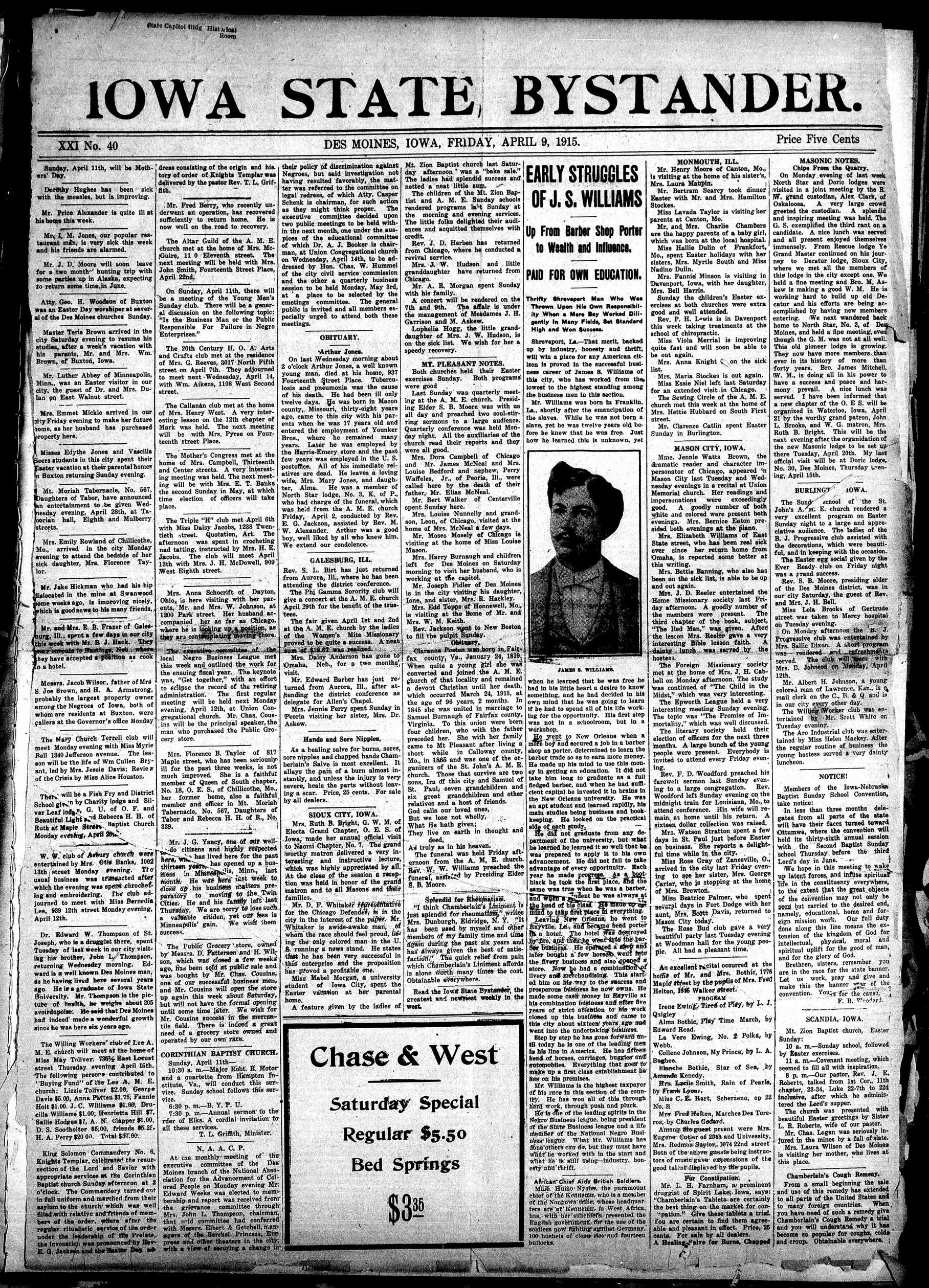
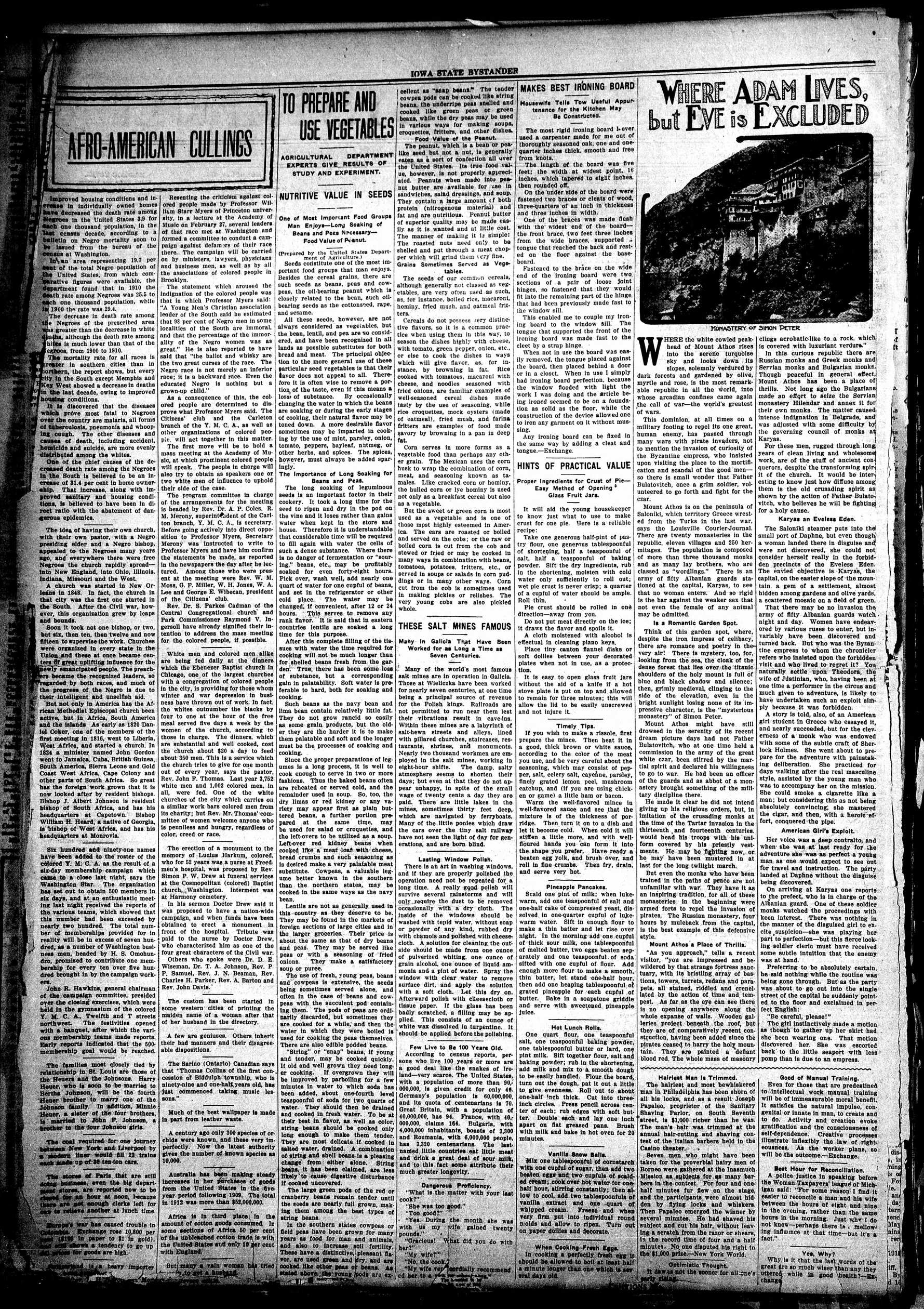
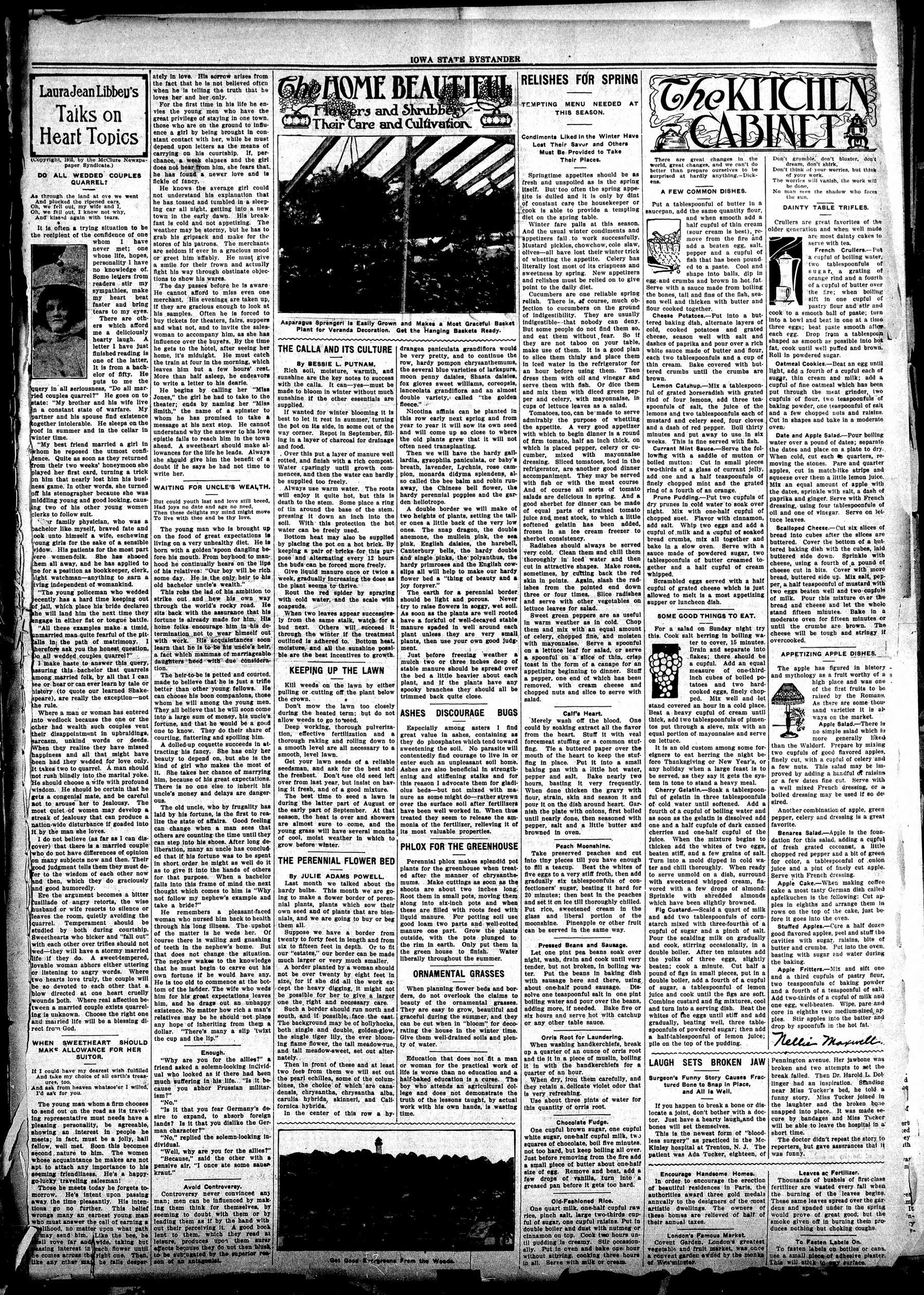
Page text (machine-generated)
IOWA STATE, BYSTANDER.
XXI No. 40
Sunday, April 11th, will be Mothers' Day.
Dorothy Hughes has been sick with the measles, but is improving.
Mr. Price Alexander is quite ill at his home this week.
Mr. I. M. Jones, our popular restaurant mall, is very sick this week and his friends are alarmed.
Mr. J. D. Moore will soon leave for a two month' hunting trip with some parties up in Alaska, expecting to return some time in June.
Atty. Geo. H. Woodson of Buxton was an Easter Day worshiper at several of the Des Moines churches Sunday.
Master Teris Brown arrived in the city Saturday evening to resume his studies, after a week's vacation with his parents, Mr. and Mrs. Wm. Brown, of Buxton, Iowa.
Mr. Luther Abbey of Minneapolis, Minn., was an Easter visitor in our city, the guest of Dr. and Mrs. Dulan on East Walnut street.
Mrs. Emmet Mickle arrived in our city Friday evening to make her future home, as her husband has purchased property here.
Misses Edythe Jones and Vasilla Seers students in this city spent their Easter vacation at their parental homes in Buxton returning Sunday evening.
Mt. Moriah Tabernacle, No. 567, Daughters of Tabor, have announced an entertainment to be given Wednesday evening, April 28th, at Tacorian hall, Eighth and Mulberry streets.
Mrs. Emily Rowland of Chillicothe, Mo., arrived in the city Monday evening to attend the bedside of her sick daughter, Mrs. Florence Taylor.
Mr. Jake Hickman who had his hip dislocated in the mine at Swanwood some weeks ago, is improving nicely, which is good news to his many friends.
Mr. and Mrs. B. B. Frazer of Galesburg, Ill., spent a few days in our city this week with Mr. B. J. Hack. They were entrusted to Hastings, Neb., where they have accepted a position as cook in a hotel.
Messrs. Jacob Wilson, father of Mrs. S. Joe Brown, and H. A. Armstrong, probably the largest property owner among the Negroes of Iowa, both of whom are residents at Buxton, were callers at the Governor's office Monday
The Mary Church Terzell club will meet Monday evening with Miss Myrie Bell R134 Jefferson avenue. The lesson will be the life of Wm Cullen Bryant, led by Mrs. Jess Davis; Review of the Crisis by Miss Alice Houston.
There will be a Fish Fry and District School given by Charity lodge and Silver Leaf lodge, G. U. of O. F. and Beautiful Light and Rebecca H. H. of Ruth at Maple Street. Baptist Church Monday evening, April 20.
W. club of Asbury church were entertained by Mrs. Otis Banks, 1002 13th street Monday evening. The usual business was transacted after which the evening was spent choreo-ing and embroidering. The club adjourned to meet with Miss Berneaide Lee, 989 12th street Monday evening, April 12th.
Dr. Edward W. Thompson of St. Joseph, who is a druggist there, spent Tuesday of last week in our city visiting his brother, John L. Thompson, returning Wednesday morning. Edward is a well known Des Moines man, as he having lived here several years ago. He is a graduate of Iowa State University. Mr. Thompson is the picture of health, he weighs about 205 avoidpution. He said that Des Moines had indeed made a wonderful growth since he was here six years ago.
The Willing Workers' club of Lee A. M. E. church will meet at the home of Miss May Toliver. 736% East Locust street Thursday evening April 16th. The following persons contributed to "Buying Fund" of the Lee A. M. E. church: Lizzie Toliver $2.00, George Davis $0.50, Anna Patten $1.75, Fannie Holt $1.00, J. C. Williams $1.00, Drucilla Williams $1.00, Henrietta Hill $7, Sallie Hodges $7, A. N. Clapper $1.00, D. S. Soolholter $5.00, friends $6.25, H. A. Perry $2.00. Total $79.00.
King Solomon Commandery No. 6, Knights Templar, celebrates the resurrection of the Lord and Savior with appropriate services at the Corinthian Baptist church Sunday afternoon at 3 o'clock. The Commandery turned out in full uniform and marched from their asylum to the church which was well dilled with relative and Friends of members of the order, where after the regular ritualistic service of the order under the leadership of the Prelate, the invocation was pronounced by Rev. E. G. Jackson and the Taster Day ad
dress consisting of the origin and his history of order of Knights Templar was delivered by the pastor Rev. T. L. Griffith.
Mr. Fred Berry, who recently underwent an operation, has recovered sufficiently to return home. He is now well on the road to recovery.
The Altar Guild of the A. M. E. church met at the home of Mrs. McGuire, 11 0 Eleventh street. The next meeting will be held with Mrs. John Smith, Fourteenth Street Place, April 22nd.
On Sunday, April 11th, there will be a meeting of the Young Men's Sunday club. There will be a general discussion on the following topic: "Is the Business Man or the Public Responsible For Failure in Negro Enterprises."
The 20th Century H. O. A: Arts and Crafts club met at the residence of Mrs. G. Reeves, 3017 North Fifth street on April 7th. They adjourned to meet next Wednesday, April 14, with Wm. Aikens, 1108 West Second street.
The Callanan Club met at the home of Mrs. Henry West. A very interesting lesson on the 12th chapter of Mark was held. The next meeting will be with Mrs. Pyreex on Fourteenth street Place.
The Mother's Congress met at the home of Mrs. Campbell, Thirteenth and Center streets. A very interesting meeting was held. The next meeting will be with Mrs. E. T. Banks the second Sunday in May, at which time election of officers will take place.
The Triple "H" club met April 6th with Miss Daisy Jacobs, 1238 Twentieth street. Quotation, Art. The afternoon was spent in crocheting and tatting, instructed by Mrs. H. E. Jacobs. The club will meet April 13th with Mrs. J. H. McDowell, 909 West Eighth street.
Mrs. Anna Schocrift of Dayton, Ohio, is here visiting with her parents, Mr. and Mrs. W. Johnson, at 1200 Park street. Her husband accompanied her as far as Chicago, where he is looking up a position, as they are contemplating moving there.
The executive committee of the local Negro Business League met this week and outlined the work for the ensuing fiscal year. The keynote was, "Get together," with an effort to collapse the record of the retiring administration. The first regular meeting will be held next Monday evening, April 12th, at Union Congregational Church. Mr. Chas, cousin will be the principal speaker, the man who purchased the Public Grocery store.
Mrs. Florence B. Taylor of 817 Maple street, who has been seriously ill for the past three weeks, is not much improved. She is a faithful member of Queen of South chamber. No. 18, O. E. S., of Chillicothe, Mo. her former home, also a faithful member and officer in Mt. Moriah Tabernacle, No. 567, Daughters of Tabor and Rebecca H. H. of R., No. 339.
Mr. J. G. Yancy, one of our well-do citizens and highly respected here, will have lived here for the past thirteen years, has opened up a business in Minnesota, Minn., last month. He was here last week to close up his business matters preparatory to moving to the Twin Cities. He and his family left last Thursday. We are sorry to lose such a valuable citizen, yet our loss is Minneapolis' gain. We wish them success.
The Public Grocery store, owned by Messrs. D. Patterson and H. Wilson, which was closed a few weeks ago, has been sold at public sale and was bought by Mr. Chas. Cousins, one of our successful business men, and Mr. Cousins will open the store up again this week about Saturday, will not have the formal opening until some time later. We wish for Mr. Cousins success in the mercantile field. There is indeed a great need of a grocery store owned and operated by our own rate.
CORINTHIAN BAPTIST CHURCH.
Sunday, April 11th—
10:30 a.m. *M*-Major Robt. R. Motor and a quartette from Hampton Institute, Va., will conduct this service. Sunday school follows this service.
6:30 p. m.—B. Y. P. U.
7:30 p. m.—Annual sermon to the rider of Elks. A cordial invitation to all these services.
T. L. Griffith, Minister:
N. A. A. C. P.
At the monthly meeting of 'the executive committee of the Des Moines branch of the National Association for the Advancement of Colored People on Monday evening Mr. Edward Weeks was elected to membership and report was received from the grievance committee through Mrs. John L. Thompson, chairman, that said committee had conferred with Messrs. Elbert & Getchell, managers of the Bermel Princess, Empress and other theaters in the city, with a view of securing a change in
DES MOINES, IOWA, FR1DAY, APRIL 9, 1915.
Chase & West
Saturday Special
Regular $5.50
Bed Springs
$3.35
their policy of discrimination against Negroes, but said investigation not having resulted favorably, the matter was referred to the committee on legal adenk, of which Atty. Casper Schenk is chairman, for such action as they might think proper. The executive committee decided upon two public meetings to be held within the next month, one under the auspices of the educational committee of which Dr. A. J. Booker is chairman, at Union Congregational church on Wednesday, April 14th, to be addressed by Hon. Chas. W. Hummel of the city civil service commission and the other a quarterly business session to be held Monday, May 3rd, at a place to be selected by the emetings committee. The general public is invited and all members especially urged to attend both these meetings.
ORITUARY.
Arthur Jones.
On last Wednesday morning about 2 o'clock Arthur Jones, a well known young man, died at his home, 937 Fourteenth Street Place. Tuberculosis and pneumonia was the cause of his death. He had been ill only twelve days. He was born in Macon county, Missouri, thirty-eight years ago, came to this city with his parents when he was 17 years old and entered the employment of Younker Bros, where he remained many years. Later he was employed by the Harris-Emery store and the past few years was employed in the U. S. postoffice. All of his immediate relatives are dead. He leaves a loving wife, Mrs. Mary Jones, and daughter, Alma. He was a member of North Star lodge, No. 3, K. of P., who had charge of the funeral, which was he'd from the A. M. E. church Friday, April 2, conducted by Rev. E. G. Jackson, assisted by Rev. M. W. Alexander. Arthur was a good boy, well liked by all who knew him. We extend our condolence.
GALESBURG. ILL.
Rev. S. L. Birt has just returned from Aurora, Ill., where he has been attending the district conference. The Phi Gamma Sorority club will give a concert at the A. M. E. church April 29th for the benefit of the trustees. The fair given April 1st and 2nd at the A. M. E. church by the ladies of the Women's Mite Missionary proved to be quite a success. A neat sum of $11.67 was realized. Mrs. Daisy Anderson has gone to Omaha, Neb., for a two month's' visit. Mr. Edward Barber has just returned from Aurora, Ill., after attending the district conference as delegate for Allen's Chapel. Mrs. Jennie Perry spent Sunday in Peoria visiting her sister, Mrs. Dr. Askew.
Hands and Sore Nipples
As a healing salve for burns, sores, sore nipples and chapped hands Chamberlain's Salve is most excellent. It allays the pain of a burn almost instantly, and unless the injury is very severe, heals the parts without leaving a scar. Price, 25 cents. For sale by all dealers.
SIoux CITY, IOWA.
Mrs. Ruth B. Bright, G. W. M. of Electa Grand Chapter, O. E. S. of Iowa, made her annual visit official to Neonil Chapter, No. 7. The grand matron delivered a very interesting and instructive lecture, which was highly appreciated by all. At the close of the session a reception was held in honor of the grand matron and to all Masons and their families. Mr. D. F. Whitaker representative for the Chicago Defender, is in the city in the interest of the pater. Mr. Whitaker is awake-awake man, of whom the race should feel proud, being the only colored man in the U. B. running a news stand. He states that he has been very successful in this enterprise and the proposition has proved a profitable one.
Miss Mabel Morgan, a university student of Iowa City, spent the Easter vacation at her parental home.
A feature given by the ladies of
Mt. Zion Baptist church last Saturday afternoon "was a "bake sale." The ladies had splendid success and netted a neat little sum. The children of the Mt. Zion Baptist and A. M. E. Sunday schools rendered programs last Sunday at the morning and evening services. The little folks delighted their audiences and acquitted themselves with credit. Rev. J. D. Herben has returned from Chicago, where he conducted a revival service.
Mrs. J. W. Hudson and little granddaughter have returned from Chicago.
Mr. A. R. Morgan spent Sunday with his family.
A concert will be rendered on the 7th and 9th. The affair is under the management of Meedames J. H. Garrison and M. Askew.
Luphella Hogg, the little granddaughter of Mrs. J. W. Hudson, is on the sick list. We wish for her a speedy recovery.
MT. PLEASANT NOTES
Both churches held their Easter exercises Sunday. Both programs were good
Last Sunday was quarterly meeting at the A. M. E. church. Presiding Elder S. B. Moore was with us all day and preached two soul-shrirm sermons to a large audience. Quarterly conference was held Monday night. All the auxiliaries of the church read their reports and they all good.
Mrs. Dora Campbell of Chicago and Mr. James McNeal and Mrs. Louise Bedford and nephew, Perry Waffeles, Jr., of Peoria, Ill., were called here by the death of their father: Mr. Elias McNeal.
Mr. Bert Walker of Centerville spent Sunday here.
Mrs. Louise Nunnelly and grandson, Leon, of Chicago, visited at the home of Mrs. McNeal a few days.
Mrs. Moses Moseley of Chicago is visiting at the home of Miss Louise Mason.
Mrs. Harry Burnaugh and children left for Des Moines on Saturday morning to visit her husband, who is working at the capitol.
Mr. Joseph Fidler of Des Moines is in the city visiting his daughter, Ione, and sister, Mrs. R. Hackley.
Mrs. Edd Topops of Honewell, Mc., is visiting at the home of Mr. and Mrs. W. M. Keith.
Rev. Jackson went to New Boston to fill the pulpit Sunday.
Obligation.
Charlanna Porter was born in Fairfax county, Va., January 24, 1819. When quite a young girl she was converted and joined the A. M. E. church of that locality and remained a devout Christian until her death, which occurred March 24, 1915, at the age of 96 years, 2 months. In 1845 she was united in marriage to Samuel Burnough of Fairfax county, Virginia. To this union were born four children, who with the father preceded her. She with her family came to Mt Pleasant after living a short while in Calloway county, Mo., in 1865 and was one of the organizers of the St. John's A. M. E. church. Those that survive are two sons, Ira of this city and Samuel of St. Paul, seven grandchildren and six great grandchildren and other relatives and a host of friends.
God calls our loved ones, But we lose not wholly, What He hath given; They live on earth in thought and deed,
deed,
As truly as in his heaven.
As truly as the
the funeral was held Friday
afternoon from the A. M. E. church.
Rev W. W. Williams preached the
funeral, assisted by Presiding Elder
S. B. Moore.
Splendid for Rheumatism
"I think Chamberlain's Liniment is
just splendid for rheumatism" writes
Mrs. Dunburgh, Eldridge, N. Y. "It
has been used by myself, and other
members of my family time and time
again during the past years and
has always given the best of satisfaction."
The quick relief from pain
which Chamberlain's Liniment affords
is alone worth many times the cost.
Obtainable everywhere.
Read the Iowa State Systemer, the
createst and newest weekly in the
west.
EARLY STRUGGLES OF J. S. WILLIAMS
Up From Barber Shop Porter to Wealth and Influence.
PAID FOR OWN EDUCATION.
Thrify Shreveport Man Who Was Thrown Upon His Own Responsibility When a Mare Bye Worked Diligently in Many Fields, Set Standard High and Won Success. Shreveport, La.—That merit, backed up by industry, honesty and thrift, will win a place for any American citizen is proved in the successful business career of James B. Williams of this city, who has worked from the lowest to the highest standing among the business men in this section. Mr. Williams was born in Franklin, La., shortly after the emancipation of the slaves. While he was not born a slave, yet he was twelve years old before he knew that he was free. Just how he learned this is unknown, yet
JAMES S. WILLIAMS.
when he learned that he was free he had in his little heart a desire to know something, and he had decided in his own mind that he was going to learn if he had to spend all of his life working for the opportunity. His first step was not in a schoolroom, but in a workshop.
He went to New Orleans when a meek boy and secured a job in a barber shop as porter, determined to learn the barber trade so as to earn more money. He made up his mind to use this money in getting an education. It did not take him long to graduate as a full fledged barber, and when he had sufficient capital he invested it in brains in the New Orleans university. He was an apt student and learned rapidly, his main studies being business and bookkeeping. He looked on the practical side of each study.
He did not graduate from any department of the university, but what he learned he learned it so well that he was prepared to apply it to his own advancement. He did not fall to take advantage of every opportunity. Each year he made progress. As a bootblack he took the first place, and the same was true when he was a barber, and when a student he was always at the head of his business. He made my mind to take first place in everything. Leaving New Orleans, he went to Raville, La. and became head porter in a hotel. The hotel was destroyed by fire, and then he went into the bar business. He operated a shop and later bought a few bowshirts into the fivery business and also opened a store. Now he had a combination of livery and merchandising. This started him on his way to the success and prosperous business he now owns. He made some cash money in his combination business and offer five years of strict business to his work closed up his business, and came to work sixteen years ago and went into the undertaking business. Step by step he has gone forward until today he is one of the leading men in his line in America. He has fifteen head of horses, cartages, buggies and automobiles. Everything that goes to make up a first class establishment he has on his premises.
Mr. Williams is the highest taxpayer of his race in this section of the country. He has won all of this through hard work, push and pluck.
He is one of the leading spirits in the Negro Business league, being president of the State Business league and a life member of the National Negro Business league. What Mr. Williams has done others can do, but they must have what he worked with in the start and what he is still using—industry, honesty and thrift.
African Chief Aids British Soldiers
Mukh Humu Nyam, the paramount chief of the Kennemm, who is a member of the Nongew tribe whose headquarters are at Kennemm, in West Africa, has, with his subordinates, presented the English government, for the use of the soldiers now fighting against Germany, 100 bushels of clean side and fourteen bullets.
MONOUTH, ILL.
Mr. Henry Moore of Canton, Mo,
is visiting at the home of his sister's,
Mrs. Laura Maupin.
Mr. Bertram Searcy took dinner
Easter with Mr. and Mrs. Hamilton
Stocks.
Miss Lavada Taylor is visiting her
parents at Canton, Mo.
Mr. and Mrs. Charlie Chambers
are the happy parents of a baby girl,
which was born at the local hospital.
Miss Hallie Dulin of Frankfort,
Mo., spent Easter holidays with her
sisters, Mrs. Myrtle South and Miss
Nadine Dulin.
Mrs. Fannie Minson is visiting in
Davenport, Iowa, with her daughter,
Mrs. Bell Harris.
Sunday the children's Easter
exercises at both churches were extra
good and well attended.
P. V. P. Lewis is in Davenport
this week taking treatments at the
school of chiropractic.
Miss Viola Merrial is improving
quite fast and will soon be able to
be out again.
Mrs. Anna Knight on the sick
list.
Mrs. Maria Stockes is out again.
Miss Essie Niel left last Saturday
for an extended visit in Chicago.
The Sewing Circle of the A. M. E.
church met this week at the home of
Mrs. Hettie Hubbard on South First
street.
Mr. Clarence Catlin spent Easter
Sunday in Burlington.
MASON CITY, IOWA.
Mme. Jennie Watts Brown, the dramatic reader and character impersonator of Chicago, appeared in "Mason City last Tuesday and Wednesday evenings in a recital at Union Memorial church. Her readings and impressions were exceedingly good. A goodly number of both white and colored were present both evenings. Mrs. Bernice Eaton presided both evenings at the piano.
Mrs. Elizabeth Williams of East State street, who has been real sick ever since her return home from Omaha, is reported some better at this writing.
Mrs. Bettie Banning, who also has been on the sick list, is able to be up and out again.
Mrs. J. D. Reeler entertained the Home Missionary society last Friday afternoon. A goodly number of the members were present. The third chapter of the book, subject, "The Ied Man," was given. After the lesson Mrs. Reeler gave a very interesting Bible lesson faith. A dainty lunch was served by the hosts.
The Foreign Missionary society met at the home of Mrs. J. H. Cabbell on Monday afternoon. The study was continued of "The Child in the Midst," which was very interesting.
The Epworth League held a very interesting meeting Sunday evening. The topic was "The Promise of Importality," which was well discussed.
The literary society held their election of officers for the next three months. A large bunch of the young people were present. Everybody is invited to attend every Friday evening.
Rev. F. D. Woodford preached his farewell sermon last Sunday evening to a large congregation. Rev. Woodford left Sunday evening on the midnight train for Louisiana, Mo. to attend conference. His wife will remain at home until his return. A sixteen dollar collection was raised. Mrs. Watson Stratton spent a few days in St. Paul just before Easter on business. She reports a delightful time while in the city. Miss Rose Gray of Zanesville, O., arrived in the city last Friday evening to see her sister, Mrs. George Carter, who is stopping at the home of Mrs. Brewton. Miss Beatrice Palmer, who spent several days in Fort Dodge with her aunt, Mrs. Scott Davis, returned to Mason City today. The Rose Bud club gave a very beautiful party last Tuesday evening at Woodman hall for the young people. All had a pleasant time.
An excellent recital occurred at the home of Mr. and Mrs. Bothic, 1776 Maple street by the pupils of Mrs. Fred Helton, 1666 Walker street.
PROGRAM
Irene Ewing, Tired of Play, by L. J. Quigley
Alma Bothic, Play Time March, by Edward Read.
La Vere Ewing, No. 2 Polka, by Webb.
Collene Johnson, My Prince, by L. A. Bogbee.
Bhanshe Bothie, Star of Sea, by Amanda Kennedy.
Mrs. Lacile Smith, Rain of Pearls, by Frank Lyons.
Mius C. E. Hart, Scherzeno, op 22 No. 8.
Mrs. Fred Helten, Marches Des Toreros, by Charles Godard.
Among the guest present were Mrs. Eugene Cutler of 228th and University, Mrs. Redmin Saylor, 1074 22nd street Both of the guest guests being instructors of music gave expressions of the good talent displayed by the pupils.
For Coordination:
For Compensation.
Mr. L. H. Farnham, as prominent druggist of Spirit Lake, Iowa, says "Chamberlain's Tablets are certainly the best thing on the market for compensation." Give these tablets a trial. You are certain to find them agreeable and pleasant in effect. Price, 25 cents. For sale by all dealers.
A Healing-Save for Burns, Chapped
MASONIC NOTES.
Chips From the Quarry.
On Monday evening of last week North Star and Doric lodges were visited in a joint meeting by the R. W. grand custodian, Alex Clark, of Oskaloosa. A very large crowd greeted the custodian. A splendid and inspiring meeting was held. The G. S. exemplified the third rant on a candidate. A nice lunch was served and all present enjoyed themselves immensely. From Rescue lodge Ye Grand Master continued on his journey to Decatur lodge, Sioux City, where we met all the members of this lodge in the city except one. We held a fine meeting and Bro. M. Askew is making a good W. M. He is working hard to build up old Decatur and his efforts are being accomplished by having new members entering. We next wandered back home to North Star, No. 2 of Des Moines, and held a fine meeting, even though the G. M. was not at all well. This old pioneer lodge is growing. They now have more members, than ever in its history of more than forty years. Bro. James Mitchell, W. M., is doing all in his power to have a success and peace and harmony prevail. A nice lunch was served. I have been informed that a new chapter of the O. E. S. will be organized in Waterloo, April 21 by the worthy grand patron, John L. Brooks, and W. G. matron, Mrs. Ruth B. Bright. This will be the next evening after the organization of the new Masonic lodge to be set up there Tuesday, April 20th. My last official visit will be at Doric lodge, No. 30, Des Moines, Thursday evening, April 15th.
BURLINGT IOWA.
The Sunday school of the St. John's A. m. E. church rendered a very excellent program on Easter Sunday night to a large and appreciative audience. The ladies of the B. J. Progressive club assisted with the decorations, which were beautiful, and in keeping with the occasion. The Easter egg social given by the Ever Ready club on Friday night was a grand success.
Rev. S. B. Moore, presiding elder of the Des Moines district, was in our city Saturday, the guest of Rev. and Mrs. J. H. Bell.
Miss Lola Brooks of Gertrude street was taken to Mercy hospital on Tuesday evening.
On Monday afternoon the B. J. Progressive club was entertained by Mrs. Sallie Dixon. A short program was rendered and refreshments served. The club will meet with Mrs. B. Johnson on Monday, April 12th.
Mr. Albert H. Johnson, a young colored man of Lawrence, Kan., is a mail clerk on the C. B. & Q. and is in our city every other day.
The Willing Worker club was entertained by Mr. Scott White on Tuesday evening.
The Aro Industrial club was entertained by Miss Helen Mackey. After the regular routine of business the young hostess served a very dainty luncheon.
NOTICE!
Members of the Iowa-Nebraska Baptist Sunday School Convention, take notice:
In less than three months delegates from all parts of the state will have their faces turned toward Ottumwa, where the convention will hold its thirty-sixth annual session with the Second Baptist Sunday school Thursday, before the third Lord's day in June.
We hope in this meeting to make up latent forces, and infuse spiritual life in the constituency everywhere, to the extent that the great objects of the convention may not only be sent but carried to the desired end, namely, educational, home and foreign mission work. Our full duty done along this line means the extension of the kingdom of God for intellectual, physical, moral and spiritual uplift for the good of man, and for the glory of God.
Brethren, sisters, remember you are in the race for the state banner. Let us work, pray and give and make this the banner war of the convention. You are for the cause.
B. R. Woodson.
SCANDIA. IOWA.
Mt. Zion Baptist church, Easter
Sunday:
10 a. m. —Sunday school, followed by Easter exercises.
11 a. m.—Covenant meeting, which seemed to fill all with inspiration.
seemed to nib all with inspiration.
8 p.m. "our pastor, Rev. J. E.
Roberts, talked from 1st Cor., 11th
chapter, 23-34, Luke 22-7th to 22d
inclusive, after which he administered
the Lord's supper.
The church was presented with beautiful Easter greetings by Sister L. R. Roberts, wife of our pastor.
Mr. Chas. Logan was seriously injured in the mines by a fall of slate.
Mrs. Laura Wilson of Des Moines is visiting her mother, who lives at this place.
Chamberlain's Cough Remedy.
From a small beginning the sale and use of this remedy has extended to all parts of the United States and to many foreign countries. When you have need of such a remedy give Chamberlain's Cough Remedy a trial and you will understand why it has become so popular for coughs, colds and croup. Obtainable everywhere.
AFRO-AMERICAN CULLINGS
Improved housing conditions and increase in individually owned homes have decreased the death rate among Negroes in the United States 3.9 for each one thousand population, in the last census decade, according to a bulletin on Negro mortality soon to be issued from the bureau of the census at Washington. In an area representing 19.7 percent of the total Negro population of the United States, from which comparative figures were available, the department found that in 1910 the death rate among Negroes was 25.5 to each one thousand population, while in 1900 the rate was 29.4. The death rate among the Negroes of the prescribed area was greater than the decrease in white deaths, although the death rate among whites is much lower than that of the Negroes, from 1800 to 1910.
The mortality rate for all races is greater in southern cities than in northern, the report shows, but every city in the South except Memphis and Oklahoma showed a decrease in deaths in the last decade, leading to improved housing conditions.
It is discovered that the diseases which prove most fatal to Negroes over the country are malaria, all forms of tuberculosis, pneumonia and whooping cough. The other diseases and causes of death, including accident, homicide and suicide, are more evenly distributed among the whites.
One of the chief causes of the disease with rate among the Negroes in the South is believed to be an increase of 21.4 per cent in home ownership. That increase, along with improved sanitary and housing conditions, is believed to have been in direct ratio with the abatement of dangerous epidemics.
The idea of having their own church, with their own pastor, with a Negro presiding elder and a Negro bishop, ago and everywhere there were free Negroes the church rapidly spread—into New England, into Ohio, Illinois, Indiana, Missouri and the West.
A church was started in New Orleans in 1848. In fact, the church in that city was the first one started in the South. After the Civil war, however, this organization grew by leaps and bounds.
Soon it took not one bishop, or two, but six, then ten, then twelve and now fifteen to supervise the work. Churches were organized in every state in the Union and these at once became centers of great uplifting influence for the newly emancipated people. The preach-ers were accorded the best rewarded by both races, and much of the progress of the Negro is due to their intelligent and musilf aid.
But not only in America has the African Methodist Episcopal church been active, but in Africa, South America, and the islands. As early as 1820 Daniel Coker, one of the members of the first meeting in 1816, went to Liberia, West Africa, and started a church. In 1824 a minister named John Gordon went to Jamaica, Cuba, British Guinea, South America, Sierra Leone and Gold Coast West Africa, Cape Colony and other parts of South Africa. So great has the foreign work grown that it is now looked after by resident bishops. Bishop J. Albert Johnson is resident bishop of South Africa, and has his headquarters at Capetown. Bishop William H. Heard, a native of Georgia, is bishop of West Africa, and has his headquarters at Monrovia.
Six hundred and ninety-one names have been added to the roster of the colored Y. M. C. A. as the result of a six-day membership campaign which came to a close last night, says the Washington Star. The organization has set out to obtain 500 members in six days, and at an enthusiastic meeting last night received the reports of the various teams, which showed that this number had been exceeded by nearly two hundred. The total number of memberships provided for in reality will be in excess of seven hundred, as a number of Washington business men, headed by H. O. Smomhro, promised to contribute one membership for every ten over five hundred brought in by the campaign workers.
John R. Hawkins, general chairman of the campaign committee, presided over the closing exercises, which were held in the gymnasium of the colored V. M. C. A. Twelfth and T streets northwest. The festivities opened with a banquet, after which the various membership teams made reports. Early reports indicated that the 500-memberhip goal would be reached.
The families most closely tied by relationship in St. Louis are those of the Heuers and the Johnsons. Herman Huer, who is soon to be married to Bertha Johnson, will be the fourth Heuer brother to marry one of the Johnson family. In addition, Mimile Huer, a sister of the four brothers, is married to John F. Johnson, a brother to the four Johnson girls.
The coal required for one journey between New York and Liverpool by a modern liner would fill 22 trains made up of 30 ten-ton cars.
The stores of Paris that are still doing business, even the big department stores, are reported now to be closed for an hour at noon, because there are not enough clerks left for one to relieve another at lunch time.
Resenting the criticism against colored people made by Professor William Starr Miers of Princeton university, in a lecture at the Academy of Music on February 27, several leaders of that race met at Washington and formed a committee to conduct a campaign against defamators of their race there. The campaign was led by Miers, physicians and business men, as well as by all the associations of colored people in Brooklyn.
The statement which aroused the indignation of the colored people was that in which Professor Myers said: "A Young Men's Christian association leader of the South said he estimated that 98 per cent of Negro men in some localities of the South are immoral, and that the percentage of the immorality of the Negro women was as great." He is also reported to have said that "the ballot and whisky are the two great curses of the race. The Negro race is not merely an inferior race; it is a backward race. Even the educated Negro is nothing but a grown-up" consequence of this, the colored people are determined to disprove what Professor Myers said. The Citizens' club and the Carleton branch of the Y. M. C. A., as well as other organizations of colored people, will act together in this matter.
The first move will be to hold a mass meeting at the Academy of Music, at which prominent colored people will speak. The people in charge will also try to obtain as speakers one or two white men of influence to uphold their side of the case.
The program committee in charge of the arrangements for the meeting is headed by Rev. Dr. A. P. Coles. R. M. Merony, superintendent of the Carlton branch, Y. M. C. A., is secretary. Before going actively into direct opposition to Professor Myers, Secretary Merony was instructed to write the statements he will him confirm the statements he made, as reported in the newspapers the day after he lectured. Among those who were present at the meeting were Rev. W. M. Moss, G. F. Miller, W. H. Jones, W. A. Lee and George E. Wibecan, president of the Citizens' club.
Rev. Dr. S. Parkes Cadman of the Central Congregational church and Park Commissioner Raymond V. Ingersoll have already signified their intention to address the mass meeting for the colored people, if possible.
White men and colored men alike are being fed daily at the dinners which the Ebenezer Baptist church in Chicago, one of the largest churches with a congregation of colored people in the city, is providing for those whom winter and war depression in business have thrown out of work. In fact, the whites outnumber the blacks by four to one at the hour of the free meal served five days a week by the women of the church, according to those in charge. The dinners, which are substantial and well cooked, the church about $20 a day to feed about 350 men. This is a service which the church tries to give for one month in the spring. The Rev. John F. Thomas. Last year 3,752 white men and 1,002 colored men, in all, were fed. One of the white churches of the city which carries on a similar work bars colored men from its charity; but Rev. Mr. Thomas' committee of women welcome anyone who is penniless and hungry, regardless of creed, creed or race.
The erection of a monument to the memory of Lucius Harkum, colored, who for 82 years was a nurse at Freedman's hospital, was proposed by Rev. Simon P. W. Drew at funeral services at the Museum of colored (baptist church, Washington. Interment was at Harmony cemetery.
In his sermon Doctor Drew said it was proposed to have a nation-wide campaign, and when funds have been obtained to erect a monument in front of the hospital. Tribute was paid to the nurse by Doctor Drew, who characterized him as one of the four great characters of the Civil war. Others who spoke were Dr. D. E. Wiseman, Dr. T. A. Johnson, Rev. P. P. Samuel, Rev. J. N. Beaman, Rev. Charles H. Parker, Rev. A. Barton and Rev. John Davis.
The custom has been started in some western cities of printing the maiden name of a woman after that of her husband in the directory.
A few are geniuses. Others inherit their bad manners and their disagreeable dispositions.
The Sarino (Ontario) Canadian says that "Thomas Collins of the first concession of Bldulph township, who is ninety-nine and one-half years old, has just commenced taking music lessons."
Much of the best wallpaper is made in part from leather waste.
A century ago only 300 species of orchids were known, and these very imperfect. Now the latest authority gives the number of known species as 10,000.
Australia has been making steady increases in her purchases of goods from the United States in the five-year period following 1909. The total in 1912 was more than $33,000,000.
Africa is in third place in the amount of cotton goods consumed. In some sections of Africa 50 per cent of the unbleached cotton trade is with the United States and only 10 per cent with England.
But many a vain woman has tried to get a husband
TO PREPARE AND USE VEGETABLES
TO PREPARE AND USE VEGETABLES
AGRICULTURAL DEPARTMENT EXPERTS GIVE RESULTS OF STUDY AND EXPERIMENT.
NUTRITIVE VALUE IN SEEDS
One of Most Important Food Groups
Man Enjoys—Long Soaking of
Beans and Pets Necessary—
Food Value of Peanut.
(Prepared by the United States Department of Agriculture.) Seeds constitute one of the most important food groups that man enjoys. Besides the cereal grains, there are such seeds as beans, peas and cowpeas, the oil-bearing peanut which is closely related to the bean, such oil-bearing seeds as the cottonseed, rape, and sesame.
All these seeds, however, are not always considered as vegetables, but the bean, lentil, and pea are so considered, and have been recognized in all lands as possible substitutes for both bread and meat. The principal objection to the more general use of these particular seed vegetables is that their flavor does not appeal to all. Therefore it is often wise to remove a portion of the taste, even if this means a loss of substance. By occasionally changing the water in which the beans are soaking or during the early stages of cooking, their natural flavor may be toned down. A more desirable flavor sometimes may be imparted in cooking by the use of mint, parsley, onion, tomato, peppers, bayleaf, nutmeg, or other herbs, and spices. The spices, however, must always be added sparingly.
The Importance of Long Soaking for Beans and Peas.
The long soaking of leguminous seeds is an important factor in their cookery. It took a long time for the seed to ripen and dry in the pod on the vine and it loses rather than gains water when kept in the store and house. Therefore it is understandable that considerable time will be required to fill again with water the cells of such a dense substance. Where there is no danger of fermentation or "souring," beans, etc., may be profitably soaked for even forty-eight hours. Pick over, wash well, add nearly one quart of water for one cupful of beans, and set in the refrigerator or other cold place. The water may be changed, if convenient, after 12 or 24 hours. This serves to remove any rank flavor. It is said that in eastern countries lentils are soaked a long time for this purpose.
After this complete filling of the tissues with water the time required for cooking will not be much longer than for shelled beans fresh from the garden. True, there has been some loss of substance, but a corresponding gain in palatability. Soft water is preferable to hard, both for soaking and cooking.
Such beans as the navy bean and lima bean contain relatively little fat. They do not grow rapidly so quickly in cooking, but the older they are the harder it is to make them palatable and soft and the longer must be the processes of soaking and cooking.
Since the proper preparations of legumes is a long process, it is well to cook enough to serve in two or more fashions. Thus the baked beans often are reheated or served cold, and the remainder used in soup. So, too, the dry limbs or red kidney or any variety may appear first as plain buttered beans, a further portion prepared at the same time, may be used for salad or croquettes, and the left-tovers to be utilized as a soup. Left-over red kidney beans when cooked like a meat loaf with cheese, bread crumbs, and sweet mozzarella may be made a very palatable substitute. Cowpea, a valuable legume better known in the southern than the northern states, may be cooked in the same ways as the navy bean.
Lentils are not as generally used in this country as they deserve to be. They may be found in the markets of foreign sections of large cities and in the larger groceries. Their price is about the same as that of dry beans and peas. They may be served like peas or with a seasoning of fried onions. They make a satisfactory soup or purée. The use of fresh, young peas, beans and cowpeas is extensive, the seeds being sometimes served alone, and often in the case of beans and cowpeas, maintaining them. The pods of peas are rarely discarded, but sometimes they are cooked for a while, and then the water in which they were boiled is used for cooking the peas themselves. There are also edible podded beans.
"String" or "snap" beans, if young and tender, may be cooked quickly. If old and well grown they need longer cooking. If overgrown they will be improved by parbrolling for a few minutes in water to which soda has been added, about one-fourth level teaspoonful of soda for two quartes of water. They should then be drained and cooked in fresh water. To be at their best in flavor, as well as color, string beans should be cooked only long enough to make them tender. They are most delicate if cooked in salted water, drained. A combination of string and shell beans is a pleasing change from either alone. String beans, it has been claimed, are less likely to cause digestive disturbance if cooked uncovered.
The large green pods of the red or cranberry beans remain tender until the seeds are nearly full grown, making them among the best types of string beans.
In the southern states cowpeas or field peas have been grown for many years as food for man and animals, and also to increase soil fertility. These have a distinctive, pleasant flavor, are used green and dry, and are cooked like other peas or beans. As stated above, the young pods are ar
IOWA STATE BYSTANDER
cellent as "seap beans." The tender cowpea pods can be cooked like string beans, the underripe peas snailled and cooked like green peas or green beans, while the dry peas may be used in various ways for making soups, croquettes, fritters, and other dishes.
Food Value of the Peanuts
The peanut, which is a bean or pea-like seed but not a nut, is generally eaten as a sort of confection all over the United States. Its true food value, however, is not properly appreciated. Peanuts are made into peanut bitters available for use in sandwiches, salad dressings, and soup. The contain a large amount (if both nitrogenous material) and fat are nutritious. Peanut butter of superior quality may be made easily as it is wanted and at little cost. The manner of making it is simple.
The roasted nuts need only to be shelled and pat through a meat chopper which will grind them very fine.
Grain. Sometimes served as Vegetable.
The seeds of our common cereals, although generally not classed as vegetables, are very often used as such, as for instance, boiled rice, macaroni, hominy, fried mush, and oatmeal fritters. Cereals do not possess very distinctive flavors, so it is a common practice when using them in this way, to season the dishes highly with cheese, with tomato, green pepper, onion, etc., or else to cook the dishes in ways which will give flavor, as, for instance, by browning in fat. Rice cooked with tomatoes, macaroni with cheese, and noodles seasoned with fried onions, are familiar examples of well-seasoned cereal dishes made tasty by the use of seasoning, while rice croquettes, mock oysters (made of oatmeal), fried mush, and farina fritters are examples of food made savory by browning in a pan in deep fat.
Corn serves in more forms as a vegetable food than perhaps any other grain. The Mexican uses the corn husk to wrap the combination of corn, meat, and seasoning known as tamales. Like cracked corn or hominy, the hulled corn or lye hominy is used not only as a breakfast cereal but also as a vegetable.
But the sweet or green corn is most used as a vegetable and is one of those most highly esteemed in America. The ears are roasted or boiled and served on the cobs; or the raw or boiled corn is cut from the cob and stewed or fried or may be cooked in many ways in combination with beans, tomatoes, potatoes, fritters, etc., or served in soups or salads in corn puddings or in many other ways. Corn cut from the cob is sometimes used in making pickles or relishes. The very young cobs are also pickled whole.
THESE SALT MINES FAMOUS
Many In Galicia That Have Been Worked for as Long a Time as Seven Centuries.
Many of the world's most famous salt mines are in operation in Galicia. Those at Wieliczka have been worked for nearly seven centuries, at one time being a principal source of revenue for the Polish kings. Railroads are not permitted to run near them less their vibrations result in cave-ins. Within these mines are a labyrinth of salthewn streets and alleys, lined with pillared churches, staircases, restaurants, shrines, and monuments. Nearly two thousand workmen are employed in the salt mines, working in eight-hour shifts. The damp, salty atmosphere seems to shorten their days; but even at that they do not apear unhappy, in spite of the small wage of twenty cents a day they are paid. There are little lakes in the mines, sometimes thirty feet deep which are navigated by ferryboats. Many of the little ponies which draw the cars over the tiny salt railway have not seen the light of day for generations, and are born blind.
Lasting Window Polish.
There is an art in washing windows, and if they are properly polished the operation need not be repeated for a long time. A really good polish will survive several rainstorms and will only require the dust to be removed occasionally with a dry cloth. The inside of the windows should be washed with tepid water, without soap or powder of any kind, rubbed dry with chamois and polished with cheesecloth. A solution for cleaning the outside should be made from one ounce of pulverized whiting, one ounce of grain alcohol, one ounce of liquid ammonia, and a glass of water. A window with clear water to remove surface dirt, and apply the solution with a soft cloth. Let this dry on. Afterward polish with cheesecloth or tissue paper. If the glass has been badly scratched, a filling may be applied. This consists of an ounce of white wax dissolved in turpentine. It should be applied before the polishing.
Few Live to Be 100 Years Old.
Few live to be 100 years Old.
According to census reports, persons living in the years or more are a good deal like the smokes of Ireland—very scarced. The United States, with a population of more than 90,000,000, is given credit for only 46. Germany's population is 60,000,000, and its quota of centenarians is 70. Great Britain, with a population of 40,000,000, has 94. France, with 40,000,000, claims 164. Bulgars, with 4,000,000 inhabitants, boasts of 3,000 and Roumanis, with 6,000,000 people, has 3,320 centenarians. The last-named little countries eat little meat and drink a great deal of sour milk, and to this fact some attribute their much greater longevity.
Dangerous Proficiency.
"What is the matter with your last cook?"
"She was too good."
"Too good!"
"Yes. During the month she was with us my wife gained twenty pounds."
"Gracious! What did you do with her?"
"My wife?"
"No, the cook."
"My wife yet cordially recommend her to a friend."
The book is by
MAKES BEST IRONING BOARD
Housewife Tails Tow Useful Appurtenance for the Kitchen May Be Constructed.
The most rigid ironing board I ever used a carpenter made for me out of thoroughly seasoned oak; one and one-quarter inches thick, smooth and free from knots.
The length of the board was five feet; the length at widest point, 16 inches, which tapered to eight inches. On the under side of the board were fastened two braces or cleats of wood, three-quarter of an inch in thickness and three inches in width.
One of the braces was made flush with the widest end of the board—the front brace, two feet three inches from the wide braces, supported tongue that reached the back and rested on the floor against the baseboard.
Fastened to the brace on the wide end of the ironing board were two sections of a pair of loose joint hinges, so fastened that they would fit into the remaining part of the hinge that had been previously made fast to the window sill. I reached me to couple my ironing board to the window sill. The tongue that supported the front of the ironing board was made fast to the cleat by a strap hinges.
When not in use the board was easily removed, the tongue placed against the board, then placed behind a door or in a closet. When in use I simply had ironing board perfection, because the window flooded with light the work I was doing and the article being ironed seemed to be on a foundation as solid as the floor, while the construction of the device allowed one to iron any garment on it without mussel. Any ironing board can be fixed in the same way by adding a cleat and tongue.—Exchange.
HINTS OF PRACTICAL VALUE
Proper Ingredients for Crust of Pie— Easy Method of Opening $ ^{b} $ Glass Fruit Jars.
It will aid the young housekeeper to know just what to use to make crust for one pie. Here is a reliable recipe:
Take one generous half-pint of pastry flour, one generous tablespoonful of shortening, half a teaspoonful of salt, half a teaspoonful of baking powder. Sift the dry ingredients, rub in the shortening, moisten with cold water only sufficiently to roll out; wet pie crust is never crisp; a quarter of a cupful of water should be ample. Roll thin.
Pie crust should be rolled in one direction—away from you.
Do not put meat directly on the ice; it draws the flavor and spoils it.
A cloth moistened with alcohol is effectual in cleaning piano keys.
Place tiny canton flannel disks or soft dolllies between your decorated plates when not in use, as a protection.
It is easy to open glass fruit jars without the aid of a knife if a hot stove plate is put on top and allowed to remain for three minutes; this will allow the lid to be easily unscrewed and not injure it.
Timely Tips.
If you wish to make a rissole, first prepare the mince. Then heat it in a good, thick brown or white sauce, according to the color of the meat you use, and be very careful about the seasoning, which may consist of pepper, salt, celery salt, cayenne, parsley, finely grated lemon peel, mushroom catchup, and (if you are using chicken or game) a little ham or bacon. Warm the well-flavored mince in well-flavored sauce and see that the mixture is thick enough for the porridge. Then turn it on to a dish and let it become cold. When cold it will stiffen a little more, and with well-fluoured hands you can form it into the shape you prefer. Have ready a beaten egg yolk, and brush over, and roll in fine crumbs. Then fry, drain, and serve very hot.
Pineapple Pancakes
Scald one pint of milk; when lukewarm, add one teaspoonful of salt and one half-cake of compressed yeast, dissolved in one-quarter cupful of lukewarm water. Sift in enough flour to make a thin batter and let rise over night. In the morning add one cupful of thick sour milk, one tablespoonful of melted butter, two eggs beaten separately and one teaspoonful of soda sifted with one cupful of flour. Add enough more flour to make a smooth, thin batter, let stand one-half hour, then add one heap tablespoonful of grated pineapple for each cupful of butter. Bake in a soapstone griddle and serve with sweetened pineapple juice.
Hot Lunch Rolls
One quart flour, one teaspoonful salt, one teaspoonful baking powder, one tablespoonful butter or lard, one pint milk. Sift together flour, salt and baking powder; rub in the shortening, add milk and mix to a smooth dough to be easily handled. Flour the board, turn out the dough, pat it out a little to give evenness. Roll out to about one-half inch thick. Cut into three-inch circles. Press pencil across center of each; rub edges with soft butter. Double each and lay one inch apart on flat gheeled pans. Brush with milk and bake in hot oven for 20 minutes.
Vanilla Snow Balls
Mix one tablespoonful of cornstarch with one cupful of sugar, then add two beaten eggs and two cupfuls of scalded cream; cook over hot water for one half hour, stirring constantly; then allow to cool, add two tablespoonful of vanilla extract and one quart of whipped cream. Freeze. and when very firm put into individual round molds and allow to ripen. Turn out on paper dollies and decorate.
When Cooking Fresh Eggs
In cooking a perfectly fresh egg it should be allowed to boil at least half a minute longer than one which is several days old.
WHERE ADAM LIVES but EVE is EXCLUDED
THE PATHEWALA
MONASTERY OF SIMON PETER
WHERE the white cowed peakhead of Mount Athos rises into the serene turquoise sky and looks down its slopes, solemnly verdured by dark forests and gardened by olive, myrtle and rose, is the most remarkable republic in all the world, into whose arcadian confines came again the call of war—the world's greatest of wars.
This dominion, at all times on a military footing to repel its one great, human enemy, has passed through many wars with pirate invaders, not to mention the invasion of Egypt by the Byzantine empire, who insisted upon visiting the place to the mortification and scandal of the good men—so there is small wonder that Father Bulatovich, once a grim soldier, volunteered to go forth and fight for the war.
Mount Athos is on the peninsula of Saloniki, which territory Greece wrested from the Turks in the last war, says the Louisville Courier-Journal. There are twenty monasteries in the republic, eleven villages and 250 hermitages. The population is composed of more than three thousand monks and as many lay brothers, who are classed as "wordlings." There is an army of fifty Albanian guards stationed at the capital, Karyas, to see that no woman enters. And so rigid is the bar against the weaker sex that not even the female of any animal may be admitted.
Is a Romantic Garden Spot.
Think of this garden spot, where, despite the iron impress of colibacy, there are romance and poetry in the very air! There is mystery, too, for, looking from the sea, the cloak of the dense forest that lies over the titanic shoulders of the holy mount is full of blue and black shadow and silence; then, grimly medieval, clinging to the side of the elevation, even in the bright sunlight losing none of its impressive character, is the "mysterious monastery" of Simon Peter. Mount Athos might have still drowned in the serenity of its recent dream picture days had not Father Bulatovitch, who at one time held a commission in the army of the great white czar, been stirred by the martial spirit and declared his willingness to go to war. He had been an officer of the guards and as abbot of a monastery brought something of the military discipline there.
He made it clear he did not intend giving up his religious orders, but, in imitation of the crusading monks at the time of the Tartar invasion in the thirteenth, and fourteenth centuries, would head his troops with his uniform covered by his priestly vestments. He may be fighting now, or may have been mustered in at last for the long twilight march. But even the monks who have been trained in the paths of peace are not unfamiliar with war. They have it as an inspiring tradition, for all of these monasteries in the beginning were armed forts to repel the invasion of pirates. The Russian monastery, four hours by muleback from the capital, is the best example of this defensive style.
Mount Athos a Place of Thrills.
"As you approach," tells a recent visitor, "you are impressed and bewildered by that strange fortress sanctuary, with its bristling array of bastions, towers, turrets, redans and parapets, all stained, redened and crenelated by the action of time and tempest. As far as the eye can see there is no opening anywhere along the whole expanse of walls. Wooden galleries project beneath the roof, but they are of comparatively recent construction, having been added since the pirates ceased to harry the holy mountain. They are painted a defiant blood red. The whole mass of masonry
Hairiest Man Is Trimmed.
Hairiest Man is Trimmed.
The hairiest and most bewhiskered man in Philadelphia has been shorn of all his locks, and as a result Joseph Papaloa, proprietor of the Sanitary Shaving Parlor, on South Seventh Street, New York, has the man's hair was trimmed at the annual hair-cutting and shaving contest of the Italian barbers held in the Casino theater.
Seven men who might have been taken for the proverbial hairy men of Bornae were gathered at the Inasmuch Mission as subjects for as many barbers in the contest. For four and one-half minutes fur few on the stage, and the participants were almost blind by flying locks and whiskers. Then Papaloa emerged the winner by several minutes. He had shaved his subject and cut his hair, without leaving a scrach from the razor or shears, in the record time of four and a half minutes. No one disputed his right to the $1,000 price—New York World.
Optimistic Tendrils
Optimistic Thought.
It dawns not the sooner for all one's
easy riding
hair
clings acrobatic-like to a rock, which is covered with luxuriant verdure." In this curious republic there are Russian monks and Greek monks and Servian monks and Bulgarian monks. Though peaceful in general effect, Mount Athos has been a place of thrills. Not long ago the Bulgarians made an effort to seize the Servian monastery Hildebrand and anger it by their own monks. The matter caused intense indignation in Belgrade, and was adjusted with some difficulty by the governing council of monks at Karyas.
For these men, rugged through long, years of clean living and wholesome work, are of the stuff of ancient conquerors, despite the transforming spirit of the church. It would be interesting to know just how diffuse among them is the old crusading spirit as shown by the action of Father Bulato-vitch, who believes he will be fighting for a holy cause.
Karyas an Eveless Eden.
The Saloniki stainer puts into the small port of Daphe, but even though a woman landed there in disguise and were not discovered, she could not consider herself really in the forbidden precincts of the Eveless Eden. The envised objective is Karyas, the capital, on the easter slope of the mountain, a gem of a settlement, almost hidden among gardens and olive yards, a scattered mosaic on a field of green. That there may be no invasion the army of fifty Albanian guards watch night and day. Women have endeavored by various rushes to enter, but invariably have been discovered and turned back. But who was the Byzantine empress to whom the chronicler refers who insisted upon the forbidden visit and who lived to regret it? You naturally settle upon Theodors, the wife of Justinian, who, having been at one time a performer in the circus and much given to adventure, is likely to have undertaken such an exploit simply because it was forbidden.
A story is told, also, of an American girl student in Greece who essayed it, and nearly succeeded, but for the clearness of a monk who was endowed with some of the subtle craft of Sherlock Holmes. She went about to prepare for the adventure with painstaking deliberation. She practiced for days walking after the real masculine style, assisted by the young man who was to accompany her on the mission. She could smoke a cigarette like a man; but considering this as not being absolutely convincing, she mastered the cigar, and then, with a heroic effort, conquered the plue.
American Girl's Exploit.
Her voice was a deep contrainto, and when she wan at last ready for the adventure she was as perfect a young man as one would expect to see out for travel and instruction. The party landed at Daphnine without the disguise being discovered.
On arriving at Karyas one reports to the prefect, who is in charge of the Albanian guard. One of these soldier monks watched the proceedings with keen interest. There was nothing in the manner of the disguised girl to exert herself, and was playing her part to perfection—but the scarce looking soldier cleric must have received some subtle intuition that the enemy was at hand.
Preferring to be absolutely certain, he said nothing while the routine was being gone through. But as the party was about to go out into the single street of the capital he suddenly pointed to the floor and exclaimed in perfect English:
The girl instinctively made a motion as though to gather up her skirt had she been wearing one. That motion discovered her. She was escorted back to the little seaport with less pomp than is due to an empress.
Good of Manual Training.
Even for those that are predestined to intellectual work, manual training will be of immeasurable moral benefit. It satisfies the natural impulse, congenial or innate in man, to create and to do. Activity and creation evoke gratification and the consciousness of self-dependence. Creative processes illustrate inflexibility the law of right-euphony. As the worker plans, so will be the outcome—Exchange.
Best Hour for Reconciliation.
A police justice in speaking before the Woman Taxpayers' league of Michigan said: "For some reason I find it easier to reconcile a man and his wife between the hours of eight and nine in the evening, rather than the same hours in the morning. Just why I do not know—perhaps there is...mellowing influence at that time—but it's a fact."
Yes, Why?
Why is it that the last words of the great are so much wiser than any they uttered while in good health?—Ex-change
LauraJeanLibbey's Taiks on Heart Topics
(Copyright, 1936, by the McClure Newspaper syndicate.)
DO ALL WEDDED COUPLES QUARREL?
As through the land at ove we went
And plucked the ripened ears.
Oh, we fell out, my eyes I.
Oh, we fell out, I know not why.
And kissed again with tears.
It is often a trying situation to be
the recipient of the confidence of one
whom I have
never met; one
whose life, hopes,
personality I have
no knowledge of.
Some letters from
readers stir my
sympathies, make my
heart beat
faster and bring
tears to my eyes.
10
There are others which afford me a delicously hearty laugh. A letter I have just finished reading is one of the latter, it is from a bachelor of fifty. He puts to me the query in all seriousness, "Do all married couples quarrel?" He goes on to state: "My brother and my wife live in a constant state of warfare. My partner and his spouse find existence together intolerable. He sleeps on the roof in summer and in the cellar in winter time. My best friend married a girl in whom he reposed the utmost confidence. Quite as soon as they returned from their two weeks' honeymoon she played her first card, turning a trick on him that nearly lost him his business game. In other words, she turned off his stenographer because she was middling young and good looking, causing two of his other young women clerks to follow suit.
our family physician, who was a bachelor like myself, braved fate and cook unto himself a wife, eschewing young girls for the sake of a sensible widow. His patients for the most part were women-folk. She has showed them all away, and he has applied to me for a position as bookkeeper, clerk, light watchman—anything to earn a living independent of womankind.
"The young policeman who wedded recently has a hard time keeping out of fall, which place his bride declares she will land him the next time they engage in either fist or tongue battle.
"All these examples make a timid, unmarried man quite fearful of the pitfalls in the matrimony. I therefore ask you the honest question, do all wedded couples quarrel?"
I make haste to answer this query, ensuring this bachelor that quarrels among married folk, by all that I can see or hear or can ever learn by tale or history (to quote our learned Shakespeare), are really the exception—not the rule. Where a man or woman has entered into wedlock because the one or the other had wealth such couples vent their disappointment in upbraidings, sarcasm, unkind words or deeds. When they realize they have missed happiness and all that might have been had they wedded for love only, it takes two to quarrel. A man should not run blindly into the mind of a child. He should choose an audience with profound wisdom. He should be certain that he gained an ingenial mate, and be careful not to arouse her to jealousy. The most quiet of women may develop a streak of jealousy that can produce a nation-wide disturbance if gouged into it by the man she loves.
I do not believe (as far as I can discover) that there is a married couple who do not have differences of opinion on many subjects now and then. Their good judgment tells them they must defer to the wisdom of each other now and then, which they do graciously and good humbly.
Ere the argument becomes a bitter insultade of angry retorts, the wise husband or wife resorts to silence or leaves the room, quietly avoiding the quarrel. Temperament should be studied by both during courtship, sweethearts who bicker and "fall out" with each other over trifles should not wed—they will have a stormy married life if they do. A sweet-tempered, lovable woman abhors either uttering or listening to angry words. Where two hearts love truly, the couple will be so devoted to each other that a blow directed at one heart cruelly wounds both. Where real affection between a married couple exists quarrelling is unknown. Choose the right one and married life will be a blessing direct from God.
WHEN SWEETHEART SHOULD
MAKES ALL THE FEATURE FOR HER
SWITCHS
SWITCHS
If I could have my dearest wish fulfilled
And take my choice of all earth's treasures, too.
And ask from heaven whatsoe'er I willd,
I'd eat for you.
The young man whom a firm chooses to send out on the road as its traveling representative must needs have a pleasing personality, be agreeable, showing an interest in people he meets; in fact, must be familiar with this becomes second nature to him. The women whose acquaintance he makes are not apt to attach any importance to his seeming friendliness. He's a happy-lucky traveler salam!
Those he meets today he forgets tomorrow. He's intent upon passing away the time pleasantly. His intentions go no further. This belief wrongs many an earnest young man who must answer the call of earning a lifehood, no matter upon what path he takes. He will have to call allove far and wide, taking butasing interest in each flower until he comes across the right one. Then, like any other man he falls despair.
ately in love. His sorrow arises from the fact that he is not believed often when he is telling the truth that he loves her and her only.
For the first time in his life he envises the young men who have the great privilege of staying in one town, those who are on the ground to influence a girl by being brought in constant contact with her, while he must depend upon letters as the means of carrying on his courtship. If, perchance, a week elapses and the girl does not hear from him, she fears that he has found a newer love and is fickle of fancy.
He knows the average girl could not understand his explanation that he has tossed and tumbled in a sleeping car all night, getting into a new town in the early dawn. His breakfast is cold and not appetizing. The weather may be stormy, but he has to grab his gripack and make for the stores of his patrons. The merchants are seldom if ever in a gracious mood or greet him affably. He must give a smile for their frown and actually fight his way through obstinate objections to show his wares.
The day passes before he is aware. He cannot afford to miss even one merchant. His evenings are taken up, if they are gracious enough to look at his samples. Often he is forced to buy tickets for theaters, fairs, suppers and what not, and he must convince him, as she has influence over the buyers. By the time he gets to the hotel, after seeing her home, it's midnight. He must catch the train at four in the morning, which leaves him in a few hours' rest. More than half asleep, he endeavors to write a letter to his dearie.
He begins by calling her "Miss Jones," the girl he had to take to the theater; ends by naming her "Miss Smith," the name of a spinster to whom he has promised to take a message at his next stop. He cannot understand why the answer to his love epistle falls to reach him in the town ahead. A sweetheart he asks her leads. Always she should give him the benefit of a doubt if he says he had not time to write her.
WAITING FOR UNCLE'S WEALTH.
But could youth last and love still breed,
Had joys no date and age no need.
Then these delights my mind might move
To live with thee and be thy love.
The young man who is brought up
on the food of great expectations
is living on a very unhealthy diet. He is
born with a golden 'spoon dangling
before his mouth. From boyhood to manhood he continually hears on the lips of his relatives: "Our boy will be rich some day. He is the only heir to his old bachelor uncle's wealth."
This robs the lad of his ambition to strike out and hew his own way through the world's rocky roars. He back with the amusements that his fortune already encourages him in his determination not to wear himself out with work. His acquaintances soon learn that he is to be his uncle's heir, a fact which mammas of marriageable daughters heed with due consideration.
The heir-to-be is petted and courted, made to believe that he is just a trifle better than other young fellows. He can choose his boon companions, those whom he will among the young men. They all believe that he will soon come into a large sum of money, his uncle's fortune, and that he would be a good one to know. They do their share of courting, flattering and spilling him. A dololed coquette succeeds in attracting his fancy. She has only beauty to depend on, but she is the kind of girl who makes the most of it. She takes her chance of marrying him, because of his great expectations. There is no one else to inherit his uncle's money and delays are dangerous.
The old uncle, who by frugality has laid by his fortune, is the first to realize the state of affairs. Good feeling can change when a man sees that others are counting the time until they can step into his shoes. After long deliberation, many an uncle has concluded that if his fortune was to be spent in short order he might as well do it to as give it into the hands of others. The uncle, who bachelor falls into this frame of mind the next thought which comes to him is "Why not follow my nephew's example and take a bride?"
He remembers a pleasant-faced woman who nursed him back to health through his long illness. The upshot of the matter is he weds her. Of course there is wailing and gnashing of teeth in the nephew's home. But that does not change the situation. The nephew wakes to the knowledge that he must begin to carve out his own fortune if he would have any. He is too old to be a child. He is a ladder. The wife who weds him for his great expectations leaves him, and he drags out an unhappy existence. No matter how rich a man's relatives may be he should not place any hope of inheriting from them a dollar. "There's many a slip 'twix the cup and the lip.'"
Enough.
"Why are you for the allies?" a friend asked a solemn-looking individual who looked at if there had been much suffering in his life. "Is it be cause you abhor Prussian militarism?"
ism?
"No."
"Is it that you fear Germany's desire to expand, to absorb foreign lands? Is it that you dislike the German character?"
"No," replied the solemn-looking individual.
"Well, why are you for the allies?" "Because," said the other with a pensive air, "I once ate some sauceskraut."
Avoid Controversy.
Controversy never convince any man; men can be influenced by making them think for themselves, by seeming to doubt with them or by leading them as if they had with their insisting it. A good book lent to them, which they read at leisure, produces upon them surer effects because they do not then blush to be subjugated by the superior reason of an antagonist.
The HOME BEAUTIFUL Flowers and Shrubbies Their Care and Cultivation
Asparagus Sprengeri is Easily Grown and Makes a Most Graceful Basket Plant for Veranda Decoration. Get the Hanging Baskets Ready.
(3)
By BESSIE L. PUTNAM.
Rich soil, moisture, warmth, and sunshine are the key notes to success with the calla. It can—yes—must be made to bloom in winter without much sunshine if the other essentials are supplied.
If wanted for winter blooming it is best to let it rest in summer, turning the pot on its side, in some out of the way corner. Repot in September, filling in a layer of charcoal for drainage and food.
Once this put a layer of manure well rotted, and finish with a rich compost. Water sparingly until growth commences, and then the water can hardly be supplied too freely.
Always use warm water. The roots will enjoy it quite hot, but this is death to the stem. Some place a ring of tin around the base of the stem, pressing it down an inch into the soil. With this protection the hot water can be freely used.
Bottom heat may also be supplied by placing the pot on a hot brick. By keeping a pair of bricks for this purpose and alternating every 12 hours the buds can be forced more freely. Give liquid manure once or twice a week, gradually increasing the doe as the plant seems to thrive. Rout the red spider by spraying with cold water, and the scale with soapsuds. When two leaves appear successively from the same stalk, will watch it through the winter if the treatment outlined is adhered to. Bottom heat, moisture, and all the sunshine possible are the best incentives to growth.
KEEPING UP THE LAWN
Kill weeds on the lawn by either pulling or cutting off the plant below the crown.
Don't mow the lawn too closely during the heated term; but do not allow weeds to go to seed.
Deep working, thorough pulverization, effective fertilization and a thorough raking and rolling down to a smooth level are all necessary to a smooth, level lawn.
Get your lawn seeds of a reliable seedsman, and ask for the best and the freshest. Don't use old seed left over from last year, but insist on having it fresh, and of a good mixture.
The best time to seed a lawn is during the latter part of August or the early part of September. At that season, the heat is over and showers are almost to come, and the young grass will have several months of cool, moist weather in which to grow before winter.
THE PERENNIAL FLOWER BED
By JULIE ADAMS POWELL
Last month we talked about the hardy bulbs. This month we are going to make a slower border of perennial plants, plants which sow their own seed and of plants that are biennials, and we are going to buy or beg them all.
Suppose we have a border from twenty to forty feet in length and from six to fifteen feet in depth. Or to or fit our "estates," our border can be made much larger or very much smaller. A border planted by a woman should not be over twenty by eight feet in size, for if she did all the work except the heavy digging, it might not be possible for her to give a larger one the right and necessary care. Such a border should run north and south, and if possible, face the east. The background may be of hollyhocks, both single and double, golden-glow, the single tiger lily, the ever blooming flower, the tall meadow-tue, and tall meadow-sweet, set out alternately.
Then in front of these and at least two feef from them we will set out the pearl echilae, some of the columbines, the choice of which are canadens, chrysantha, chrysantha alba, carulha hybrida, skinner, and California hybrida.
In the center of this row a hy-
IOWA STATE BYSTANDER
BEAUTIFUL
A Shrubbery
and Cultivation
and Makes a Most Graceful Basket
Get the Hanging Baskets Ready.
drangea paniculata grandiflora would be very pretty, and to continue the row, hardy pompon chrysanthemums, the several blue varieties of larkspurs, moon penny daisies, Shasta daisies, fox gloves sweet williams, coreopsis, lanceolata grandiflora and an almost double variety, called "the golden fleece."
Nicotina affinis can be planted in this row early next spring and from year to year it will sow its own seed and will come up so close to where the old plants grew that it will not often need transplanting.
When we will have the hardy gallardia palmata grandiflora, or baby's breath, lavender, Lychnis rose campan, monarda didyma splendens, also called the bee balm and robin runaway, the Chinese bell flower, the hardy perennial poppies and the garden hellotone.
A double border we will make of two heights of plants, setting the taller ones a little back of the very low ones. The snap dragon, the double anemone, the mullein pink, the sea pink, English daisies, the harebell, Canterbury bells, the hardy double and single pinks, the polyanthus, the hardy primroses and the English cowhips all will help to make our hardy flower bed a "thing of beauty and a joy forver."
The earth for a perennial border should be light and porous. Never try to raise flowers in eggsy, wet soil. As soon as the plants are well rooted have a forkful of well-decayed stable manure spaded in well around each plant unless they are very small plants, then use your own good judgment.
Just before freezing weather a mulch two or three inches deep of stable manure should be spread over the bed a little heavier about each plant, and if the plants have any spooky branches they should all be trimmed back quite close.
ASHES DISCOURAGE
ASHES DISCOURAGE BUGS
Especially among asters I find great value in ashes, containing as they do phosphates which tend toward sweetening the soil. No parasite will contentedly find courage to live in or enter such an unpleasant soil home. Ashes are also beneficial in strengthening and stiffening stalks and for this reason I advocate them for gladiolus beds—but not mixed with manure as some might do—rather strewn over the surface soil after fertilizers have been well worked in. When thus treated they seem to release the ammonia of the fertilizer, relieving it of its most valuable properties.
PHLOX FOR THE GREENHOUSE
Perennial phlox makes splendid pot plants for the greenhouse when treated after the manner of chrysanthemums. Make cuttings as soon as the shoots are about two inches long. Root them in small pots, moving them along into six-inch pots and when these are filled with roots feed with liquid manure. For potting soil use good loam two parts and well-rotted soil. Plant the pots outside, with the pots plunged to the rim in earth. Only put them in the green house to finish. Water liberally throughout the summer.
ORNAMENTAL GRASSES
When planning flower beds and borders, do not overlook the claims to beauty of the ornamental grasses. They are easy to grow, beautiful and graceful during the summer, and they can be cut when in "bloom" for decorating the house in the winter time. Give them well-drained soils and plenty of water.
Education that does not fit a man or woman for the practical work of life is worse than no education and a half-baked education is a curse. The boy who attends an agricultural college does not demonstrate the truth of the lessons taught, by actual work with his own hands, is wasting time.
From the Woods.
The KITCHEN CABINET
There are great changes in the world, great changes, and we can't do better than prepare ourselves to be surprised at hardly anything.—Dick-greys
Don't grumble, don't bluster, don't dream, don't shirk.
Don't think of your worries, but think of your work.
The worries will vanish, the work will
Put a tablespoonful of butter in a saucepan, add the same quantity four, and when smooth add a half cupful of thin cream (sour cream is best), remove from the fire and add a beaten egg, salt, pepper and a cupful of fish that has been pounded to a paste. Cool and shape into balls, dip in egg and crumbs and brown in hot fat. Serve with a sauce made from boiling the bones, tail and fins of the fish, season well and thicken with butter and flour cooked together.
Cheese Potatoes.—Put into a buttered baking dish, alternate layers of cold, cooked potatoes and grated cheese, season well with salt and dashes of paprika and pour over a rich white sauce made of butter and flour, each two tablespoonfuls and a cup of thin cream. Bake covered with buttered crumbs until the crumbs are brown.
Lemon Catnip—Mix a tablespoonful of grated horseradish with grated rind of four lemons, and three tablespoonfuls of salt, the juice of the lemons and two tablespoonfuls each of mustard and celery seed, four cloves and a dash of red pepper. Boll thirty minutes and put away to use in six weeks. This is fine served with fish. Currant Mint M sauce—Serve the following with a saddle of mutton or boiled mutton: Cut in small pieces two-thirds of a glass of currant jelly, add one and a half tablespoonfuls of finely chopped mint and the grated rind of a fourth of an orange. Prune Pudding—Put two cupfuls of dry prunes in cold water to soak over night. Mix with one-half cupful of chopped suet. Flavor with cinnamon, add salt. Whip two eggs and add a cupful of milk and a cupful of soaked bread crumbs, mix all together and bake in a slow oven. Serve with a sauce made of powdered sugar, two tablespoonfuls of butter creamed together and a half cupful of cream whipped.
Scrambled eggs served with a half cupful of grated cheese which is just allowed to melt is a most appetizing supper or luncheon dish.
For a salad on Sunday night try this. Cook salt herring in boiling water to cover, 15 minutes. Drain and separate into lakes; there should be a cupful. Add an equal measure of one-third cubes of boiled potatoes and two hard-cooked eggs, finely chopped. Mix well and let stand covered an hour in a cold place. Beat a heavy cupful of cream until thick, add two tablespoonfuls of pimentos put through a sieve, mix with an equal portion of mayonnaise and serve on lettuce.
It is an old custom among some foreigners to eat herring the night before Thanksgiving or New Year's, or any holiday when a large feast is to be served, as they say it gets the system in tone to stand a heavy meal.
Cherry Gelatin—Soak a tablespoonful of gelatin in a tablepoonfuls of cold water until softened. Add a fourth of a cupul of boiling water and as soon as the gelatin is dissolved add one and a half cupul of dark canned cherries and one-half cupul of the juice. When the mixture begins to thicken add the whites of two eggs, beaten stiff, and a few grains of salt. Turn into a mold dipped in cold water and chill thoroughly. Then cream out the mixture of dish, wine, and with sweetened whipped cream, flavored with a few drops of almond: Sprinkle with shredded almonds which have been slightly browned.
**Fig Custard.**—Scald a quart of milk and add two tablespoonfuls of corn starch mixed with three-fourths of a cupful of sugar and a pinch of salt. Pour the scalding milk on gradually and cook, stirring occasionally, in a double boiler. After ten minutes add the yolks of three eggs, slightly beaten; cook a minute. Cut half a pound of figs in small pieces, put in a double boiler, add a fourth of a cupful of sugar, a tablespoonful of lemon juice and cook until the figs are soft. Combine custard and fig mixtures, cool and turn into a serving dish. Beat the whites of the eggs until stiff and add gradually, beating well, three tablespoonfuls of powdered sugar; then add a half-tablepoonful of lemon juice; pile on the top of the pudding.
Surgeon's Funny Story Causes Fractured Bone to Snap in Place, and All Is Well.
If you happen to break a bone or dislocate a joint, don't bother with a doctor. Just have a hearty laugh and the bones will set themselves.
This is the newest form of "bloodless surgery" as practiced in the McKinley hospital at Trenton, N. J. The patient was Ada Tucker, eighteen, of
Encourage Handsome Homes.
In order to encourage the erection of beautiful residences in Paris, the authorities award three gold medals annually to the designers of the most artistic dwellings. The owners of these homes are relieved of half of their annual taxes.
London's Famous Market.
Covent Garden, London's greatest vegetable and fruit market, was once a convent garden wiled by the monks of Westminster.
RELISHES FOR SPRING
TEMPTING MENU NEEDED AT
THIS SEASON.
Condiments Liked in the Winter Have
Lost Their Savor and Others
Must Be Provided to Take
Their Places.
Springtime appetites should be as
fresh and unspoiled as in the spring
but. But too often the spring appetite
is dulled and it is only by dint
of constant care the housekeeper or
cook is able to provide a tempting
diet on the spring table.
Winter fare palls at this season.
And the usual winter condiments
and appetizers fall to work successfully.
Mustard pickles, chowchow, cole slaw,
olives—all have lost their winter trick
of whetting the appetite. Celery has
literally lost most of its crispness and
sweetness by spring. New appetizers
and relishes must be relied on to give
point to the daily diet.
Cucumbers are one reliable spring relish. There is, 24 course, much objection to cucumbers on the ground of indigestibility. They are usually indigestible--that nobody can deny. But some people do not find them so, and eat them without, fear. So if they are not taboo on your table, make use of them. It is a good plan to slice them thinly and place them in iced water in the refrigerator or in hot water for eating. The dress them with oil and vinegar and serve them with fish. Or dice them and mix them with diced green pepper and celery, with mayonnaise, in cups of lettuce leaves as a salad.
Tomatoes, too, can be made to serve admirably the purpose of whetting the appetite. A very good appetizer with which to begin dinner is a round of firm tomato, half an inch thick, on which is placed pepper, celery or cucumber, mixed with mayonnaise dressing. Sliced tomatoes, lced in the refrigerator, are another good dinner accompaniment. They may be served with fish or with the meat course. And of course all sorts of tomato salads are delicious in spring. And a good shebet for dinner can be made of equal parts of strained tomato juice and meat stock, to which a little softened gelatin has been added, frozen in an ice cream freezer to shebert consistency. Radishes should always be served very cold. Clean them and chill them until they are fully tender and then cut in attractive shapes. Make roses, sometimes, by cutting back the red skin in points. Again, slash the radishes from the pointed end down three or four times. Slice radishes and serve with other vegetables on lettuce leaves for salad.
Sweet green peppers are as useful in warm weather as in cold. Chop them and mix with an equal amount of celery, chopped fine, and moisten with mayonnaise. Serve a spoonful on a lettuce leaf for salad, or serve a spoonful on a slice of thin, crisp toast in the form of a canape for an appetizing beginning to dinner. Stuff an appetizer on each thick slice removed, with cream cheese and chopped nuts and slice to serve with salad.
Calf's Heart.
Merely wash off the blood. One could by seaking extract all the flavor from the heart. Stuff it with veal forcemeat stuffing or a common stuffing. Tie a buttered paper over the mouth of the heart to keep the stuffing in place. Put it into a small baking pan with a little hot water, pepper and salt. Bake nearly two hours, basting it very frequently. When browned the gray with skin, skin and season it and pour it on the dish around heart. Garnish the plate with onions, first boiled until nearly done, then seasoned with pepper, salt and a little butter and browned in oven.
Peach Moonshine.
Take preserved peaches and cut into tiny pieces till you have enough to fill a teacup. Beat the whites of five eggs to a very stiff froth, then add gradually six tablespoonfuls of confectioner's sugar, beating it hard for 20 minutes; then beat in the peaches and set it on ice till thoroughly chilled. Put rice, sweetened cream in the glass and liberal portion of the moonshine. Pineapple or other fruit can be served in the same way.
Pressed Beans and Sausage
Let one pint pea beans soak over night, wash, drain and cook until very tender, but not broken, in boiling water. Put the beans in baking dish with sausage here and there, using about one-half pound sausage. Dis solve one teaspoon salt. Add one teaspoon oil over the beans, adding more, if needed. Bake five or six hours and serve hot with catchup or any other table sauce.
Orris Root for Laundering
When washing handkerchiefs, break up a quarter of an ounce of orris root and tie it in a piece of muslin, boiling it in with the handkerchiefs for a quarter of an hour. When dry, iron them carefully, and they retain a delicate violet odor that is very refreshing. Use about three pints of water for this quantity of orris root.
Chocolate Fudge.
One cupful brown sugar, one cupful white sugar, one-half cupful milk, two squares of chocolate, boil five minutes, not too hard, but keep boiling all over. Just before removing from the fire add a small piece of butter about one-half size of egg. Remove and beat, add a few drops of vanilla, turn into a greased pan before it gets too hard.
Old-Fashioned Rice.
One quart milk, one-half cupful raw rice, pinch salt, large two-thirds cupful of sugar, one cupful pulsin. Put in double boiler and dust with nutmeg or chinamon on top. Cook two hours until pudding is creamy. Str occasionally. Put in boiling water, hourly, cooking three hours in all. Serve with milk or cream.
A FEW COMMON DISHES.
and when smooth add a half cupful of thin cream (sour cream is best), remove from the fire and add a beaten egg, salt, sugar and fish that has been pounded to a paste. Cool and shape into balls, dip in
SOME GOOD THINGS TO EAT.
ter to cover, 15 minutes.
Drain and separate into
flakes; there should be
a cupful. Add an equal
measure of one hundred
one-half cuped
tatoes and two hard-
cooked eggs, finely chopped.
Mix well and let
Don't grumble, don't bluster, don't dream, don't shirk,
Don't think of your worries, but think of your work.
The worries will vanish, the work will be done.
No man sees the shadow who faces the sun.
DAINTY TABLE TRIFLES.
Cruellers are great favorites of the older generation and when well made are most dainty cakes to
```markdown
```
French Crullers—Put a cupful of boiling water, two tablespoonfuls of sugar, a grating of orange rind and a fourth of a cupful of butter over the fire; when boiling sift in one cupful of pastry flour and stir and cook to a smooth ball of pastry; turn into a bowl and beat in one at a time three eggs; beat paste smooth after each egg. Drop from a tablespoon shaped as smooth as possible into hot fat, cook until well puffed and Brown. Roll in powdered sugar.
Oatmeal Cookies—Beat an egg until light, add a fourth of a cupful of each sugar, thin cream and milk; add a cupful of fine oatmeal which has been put through the meat grinder, two cupfuls of flour, two teaspoonfuls of baking powder, one teaspoonful of and a few chopped nuts and raisins. Cut in shapes and bake in a moderate oven.
Date and Apple Salad—Pour boiling water over a pound of dates; separate the dates and place on a plate to dry. When cold, cut each quarters, removing the stones. Pare and quarter apples, cut in match-like strips and squeeze over them a little lemon juice. Mix an equal amount of apple with water, and serve with pearlipaste and ginger. Serve with French dressing, using four tablespoonfuls of oil and one of vinegar. Serve on lettuce leaves.
Scalloped Cheese—Cut six slices of bread into cubes after the slices are buttered. Cover the bottom of a butter baked dish with the cubes, laid buttered side down. Sprinkle with cheese, using a fourth of a pound of cheese cut in bits. Cover with more bread, buttered side up. Mix salt, pepper, a half teaspoon of mustard with two eggs beaten well and two cups of milk. Pour this mixture over the bread and let it rest for fifteen minutes. Bake in a moderate oven for fifteen minutes or until the crumbs are brown. The cheese will be tough and stringy if overcooked.
APPETIZING APPLE DISHES.
The apple has figured in history and mythology as a fruit worthy of a high place and was one of the first fruits to be raised by the Romans. As there are some thousand varieties it is always on the market.
Hawaiian Islands
Apple Salad—There is no simple salad which is more generally liked than the Waldorf. Prepare by mixing two cupfuls of good flavored apples, finely cut, with a cupful of celery and a few nuts. This salad may be improved by adding a handful of raisins or a few dates fine cut. Serve with a well mixed French dressing, or a boiled dressing may be used if so desired.
Another combination of apple, green pepper, celery and dressing is a great favorite.
Benares Salad—Apple is the foundation for this salad, adding a cupful of fresh grated coconut, a little chopped red pepper and a bit of green for color, a tablepoonful of onion juice and a pint of finely cut apple. Serve with French dressing.
Apple Cake—When making coffee cake a most tasty German dish called apfelkuchen is the following: Cut apples in eighths and arrange them in rows on the top of the cake, just before it goes into the oven.
Stuffed Apples…Core a half dozen good flavored apples, peel and stuff the cavities with sugar, raisins, bits of butter and crumbs. Put into the oven, basting with sugar and water during the baking.
Apple Fritters…Nix and sift one and a third cupuples of pastry flour, two teaspoonfuls of baking powder and a fourth of a teaspoonful of salt. Add two-thirds of a cupuple of milk and one egg, well-beaten. Wipe, pare and core in eighties two medium-sized apples. Stir apples into the batter and drop by spoonfuls in the hot fat.
Pennington avenue. Her jawbone was broken and two attempts to set the break failed. Then Dr. Harold L. Doblinger had an inspiration. Standing near Miss Tucker's bed, he told a funny story. Miss Tucker joined in the laughter and the broken bone snapped into place. It was made secure by bandages and Miss Tucker will be able to leave the hospital in a short time. The doctor didn't repeat the story to reporters, but gave assurances that it was funny.
Leaves ac. Fertilizer.
Thousands of bushels of first-class fertilizer are wasted every fall when the burning of the leaves begins. These same leaves spread over the gardens and spaded under in the spring would prove of great good, but the smoke given off in burning them produces nothing but choking coughs.
To Fasten Labels On.
To fasten labels on bottles or cans.
Use a small piece of adhesive plaster.
This will stick to any surface.
ST. FAUL BUDGETARIAN,
where Sunday was observed at all churches with appropriate exteriors and special music. At St. A. M. E. church at the mornings the choir, under the direction of Mrs. Addle Minor, sang Halleijah Chorus from the Mess. In the evening they rendered contata, entitled "Resurrection." At the Pilgrim Church they rendered under the direction of Mrs. Hattie Hall. At the churches had large attendances all day.
The Knights Templar had their annual sermon delivered Sunday morning at St James A. M. E. Church Rev. H. P. Jones officiating. Medianes Birdie High and Mamie Crowes are confined to their respective homes with severe cases of ton-
Mrs. Stephen Harris and daughter, Grace, are visiting the former's father, Mrs. Mamie Burns, in Chicago.
The King's Daughters club was entertained Monday afternoon by Mrs. Bettie Jones, 488 Charles street.
Mrs. Mattie R. Hicks read a paper on "The Origin of the Negro," which was discussed by the members. After the business the hostess served dainty refreshments. The club adjourned to meet the first Monday in May.
The H. Y. W. K. club broke the record Tuesday evening when they served a turkey supper at the residence of Mrs. Katie Crawford. A large crowd was present and a neat realized.
Mrs. B. Fields of Des Moines spent a few days last week as a guest of Mrs. S. Hatcher in the Union block.
The funeral of Miss M. Smith, who passed away Saturday, was held Monday afternoon from Memorial Church.
Mrs. W. Covington of Central University was hostess for the Self-Cultured club Wednesday afternoon.
Mrs. Mary Billups while running to catch a car last week and hurt herself to the extent that she was taken to the hospital and later removed to her home, where she is recovering.
There are about twenty-eight of our people confined in the city and county hospital, who would be very glad to have any and all of us to call and see them.
Mrs. Mary E. Brown is confined to her home with a severe case of lumbago.
St. James A. M. E. choir received and accepted an invitation to sing at the Plymouth Congregational church on the eve of the 15th inst., at which time they will celebrate their homecoming.
MACON, MO. NEWS.
Macon is enjoying beautiful weather nowadays.
Miss Blanch Brooks spent Easter with her parents.
Mr. Ray Davis of Shelbina was the manager of Miss Blanch Brook
students of Western college exhibited College day Thursday, March 3. An enjoyable time was spent during the day. Many orations were delivered during the day by the creators of the junior and senior classes. At night a reception was given in honor of the president, members of the faculty and students. The assembly room was beautifully decorated in variety of colors. The students departed at a very late hour, all enjoying themselves to the highest.
Mr. Jeel Ancell and Miss Estella Wright spent Sunday last in Moberly. Clara Bell spent Sunday in Macdon.
Revival meetings closed Friday night, at which Rev. A. V. Cooper of Centerville, Iowa, was conducting the services.
Rev. B. P. E. Gales preached an excellent sermon Sunday morning.
Sunday was a beautiful day and Easter was enjoyed by all. Many out of town guests were present. A program was rendered by the Sunday school.
The death of Mother Gooding occurred Monday evening at the home of her son, Monroe Gooding.
Mr. William Craig was the guest of Miss Carrie Pettis on Sunday.
Mrs. Salle Wille and niece, Miss Mabel Turner, of Higbee spent Easter in our city, the guests of Mrs. J. Jackson.
Miss Luille Evans is on the sick list.
An excellent program was rendered Sunday, by the students of Western college.
Miss Ida D. Garnett, the amiable daughter of Dr. J. H. Garnett, spent Easter vacation with her parents. Miss Carrie Turpin spent Sunday in our city and Gastee Shannon spent Sunday in our city.
Several Macon knights attended the Easter ball in Moberly on Monday night. Mrs. Ida L. Garnett spent a few days on business in Hamibal, Mo. The death of Mrs. G. Ruthford occurred at her home Wednesday evening. Funeral services were conducted at the Vine and Broadway church by Ev. B. P. E. Gales.
Mrs. Coriime Rays remains very
well this writing.
Sor Am. I. Bird spent a few days out of the city on business.
Mrs. Rachel Kimbrouch remains the name.
Miss Cleo Harris was the guest of Mrs. A. C. Crews on Sunday last.
Mrs. Rasia Reynolds spent a few hours in our city on business.
We are glad to see Mrs. G. T. Stuart out again, after a slight spell of business.
after the usual business was transacted, light refreshments were served. Each left expressing the hostess a charming entertainer.
Owing to the fact that this being Health week to be lectured on in the churches throughout the district, the members and friends of the A. M. E. church listened to a fine lecture given by Dr. Birmingham. Subject, "How To Preserve Health," which was very interesting. Mr. Reuben Holt is improving slowly. The Autumn Leaf club will meet with Mrs. E. J. McGruder on North Clark street Thursday afternoon at the usual hour. Mrs. Henry Wilder is improving at this writing.
Mrs. Alice Murphy of Monmouth is in the city visiting at the home of her son, Mr. Joseph Henderson. Mrs. Eiffle Skinner is able to be on our streets, slowly recovering from a very severe case of blood poison.
Miss Ila Allen, Sunday school district superintendent over the Keokuk district, made her annual visit to Kewanee, Ill., Sunday, March 28. Presiding Elder S. B. Moore is in the city for a few days with his family, after just finishing up the work of his second quarter over the Des Moines district. Mrs. G. W. K. Widdick is confined to her bed at her home on East South street. The A. M. E. Sunday school will render their Easter program Sunday evening at 8 p.m. Presiding Elder S. B. Moore expects P. Leave for Cedar Rapids. Town Friday evening to hold his third quarterly Sunday, April 4th.
quarterstown Rev, S. L. Birt, pastor, and Mrs. Edd Barber, who was elected as delegate for Allen's Chapel, left March 30th en route for Aurora, Ill., to be present at the district conference.
Should Not Feel Discouraged.
So many people troubled with indigestion and constipation have been benefited by taking Chamberlain's Tablets that no one should feel discouraged who has not given them a trial. They contain no pepin or other digestive ferments, but strengthen the stomach and enable it to perform its functions naturally. Obtainable everywhere.
ALBIA NEWS.
Mrs. Wm. Benninga and Bowman are still on sick list.
Mr. John Lewis was a Des Moines visitor over Sunday.
Mr. Rhodes of Buxton was visiting in Albia this week.
Mrs. Chas. Carchon of Hiteman was in Albia Wednesday and Sunday.
Mr. White and Miss Nettle Gaines of Buxton was in Albia Saturday.
The A. M. E. Sunday School held their Easter program at the A. M. E. church Sunday evening April 4th. The program rendered by the scholars of the combined towns of Albia and Hocking was of the best in music and singing.
Mrs. Nellie Estes the superintendent of the school and her teachers and choir desires much credit for their work.
Mrs Nellie Estes returned home from a visit in Des Moines with her mother, Mrs. Jeffers on Saturday.
Mr. Johnson of Hiddle spent Sunday in Albia with his family.
CLARINDA. IOWA.
Mr. Fred Irving of Creston, Iowa, visited lady friend over Sunday. The Easter exercises were rendered excellent at the A. M. E. church Sabbath day. The church was visited by Rev. W. R. Morgan, formerly pastor. Rev. D. W. Brown is preparing to move and repair the church. A surprise was given on Mr. and Mrs. Geo. Johnson last week. About twenty-eight of the people of the town went in and spent an enjoyable evening. Music was rendered by
M.
Why not grow your hair by using
Mme. M. Beard Hair Grower
It removes dandruff, stops itching of
the scalp and makes it grow long, soft and beautiful. Price 500 a box.
Send Ramp for pamphlet.
The very best service guaranteed
Prices the lowest
Cells answered promptly day or
night No extra charges for distance
-Reverse all phone charges
ONION SEED
SEEDS
IOWA SEED
Messrs. Gipson and Cooke.
The Easter exercises, were observed at the Baptist church at 7 p. m., after which a lovely sermon was preached by Rev. D. W. Brown. A shower was given on Mrs. Otto Anderson at Mr. Lees Leroy Arnett's. A two-lunch宴会 was served. Mr. Lewis Banks of Omaha is visiting friends in Charinda.
Mr. Glen King is visiting friends in St. Joe, Mo. The Ladies' Study club is preparing to give an entertainment at the K. P. hall. Proceeds to be divided between the two churches. Mr. Geo. Jones visited out of town a few days.
Mrs. Ella Black was called away on account of her uncle's death.
Mr. Elmer Carter is at present in Omaha.
DAYENPORT NOTES
The Easter exercises at the Third Baptist church were excellent. The church was beautifully decorated. The children held their exercises in the afternoon and the adults in the evening. The choir rendered some excellent numbers. The Easter exercises at Bethel A. M. E. church were fine indeed. Rev. Sims preached an excellent sermon on the resurrection of Christ in the morning and in the evening the Sunday school rendered an excellent program. The church was beautifully decorated with palms and ferns and lilies. Harrist Sill Roberts died April 1st and her funeral was held from Anthony's church Sunday afternoon at 2:30 o'clock. The pall bearers were her relatives. She was buried in St. Margaret's cemetery. She had made her home with her brother, Alec Roberts, of 920 Harrison street. Mrs. Emma Shepard's daughter, Irene, who has been sick for three months, was taken to Mercy hospital Monday for treatment.
Alac Richardson of Christy street is seriously ill with Bright's disease and is no better at this writing.
Mrs. Emma Cain was thrown from the street car and seriously hurt. She resides at 617 Harrison street.
NOTICE OF SHERIFF'S SALE ON
SPECIAL EXECUTION.
State of Iowa, Polk county, ss.
District court of Polk county, Iowa
Chase & West
vs.
F. O. Evans Piano Co.
By virtue of a special execution to
me directed, issued by the clerk of
the district court of Polk county,
Iowa, in favor of Chase & West,
and against F. O. Evans Piano Co., on
a judgment rendered by said court on
the 30th day of March, A. D. 1915,
wherein it was ordered, adjudged
and decreed that the following
described property be sold to satisfy
said judgment, towit: One Hampton
Cabinet Grand Piano No. 2920
one Artist's Model Piano, No. 3056
also known as No. 2635; one Artist's
Model Piano, No. 2161, also known
as No. 44439; one Artist's Model
Player Piano, No. 16152.
Now, therefore, public notice is hereby given that unless the said defendants appear at my office in Des Moines on or before the 29th day of April, A. D. 1915, at ten o'clock a.m. of said day, at which time above described property is hereby advertised to be sold, and pay off the amount of said execution, with interest and costs, I will sell said property, or sufficient thereof to satisfy said execution, with interest and costs, at public outcry, to the highest bidder, at Chase & West's, 312-314-316 Eighth street, in Des Moines, Iowa, for cash in hand to pay off said execution.
J. F. Griffin,
Sheriff of Polk County, Iowa.
By J. H. Kelley, Deputy.
Sheriff's office, Des Moines, Iowa.
Date of first publication, April 9, 1915.
Published and printed by The Iowa State Bystander.
Told That There Was No Cure for Him
"After suffering for over twenty years with indigestion and having some of the best doctors here tell me there was no cure for me, I think it only right to tell you for the sake of other sufferers as well as your own satisfaction that a 25 cent bottle of Chambourin's Tablets not only relieved me, but cured me within two months, although I am a man of 65 years," writes Jul. Grobien, Houston, Texas. Obtained everywhere.
Chance to Make Up
"We have parted forever. He write
me to send back the ringer."
"Tell him to call for it," advised the experienced friend—Louisville. Give the Journal.
Willing to Change.
"When you feels any temptation
couldn't along," said the friend and a
wise, "you must say: 'Get the behin'
me, Satan.'"
"Does what I done said," answered
Mr. Ernestine Pinkley, "an am I
can? Another me, another me,
all right. We don't have
which can."
IOWA STATE BYSTANDER
ONION SETS
Are very inexpensive and by planting them
you can have fresh onions ready for the
table in a few weeks. They are the most
valuable of all vegetables, as they grow off
disease. Almost all onions like them, either
cooked or on their natural state, and young
onions sprout from the garden are de-
cidedly appetizing. If you want large onions
for winter use, sow our new crop, American
grown onion seed. It is the best onion of
you can raise ten bushels from an ounce of
seed, cutting only a few cents. Catalog free.
CO. 209-211 Wainton Street
DEMING MOINES, IOWA
ANCH. 416 East Locust Street
A
Take
One
Pain Pill,
then—
Take
it
Easy.
To Head-Off
a Headache
Nothing is Better than
Dr. Miles' Anti-Pain Pills
They Give Relief Without
Bad After-Effects.
I can say that Dr. Miles' Remedies have been a godsend to me and my family. I used to have such terrible headaches. I would almost be wild for days at a time. I began using Dr. Miles' Anti-Pain Pills and never have heartaches any more. I can speak highly of Dr. Miles' Nervine also for it cured one of my children of a terrible nervous disorder. I would for our Remedies and have recommended them to a good many of my friends who have been well pleased with them.
MRS. GBQ. L. BRYAN.
Jamesville, Iowa.
For Sale by All Druggists.
25" Dosee, 25 Cents.
MILES MEDICAL CO., Elkhard, Ind.
Jones Cafe
The Old Reliable Place
to get your meals
PHONE RHD 318 W. 3rd St
3027
Rooming House at 216-218
3rd St.
Green's Cafe
The Old and Reliable Place
to get good meals or lunches
Ice Cream and Cigars
114 E. 5th Street
Phone 4908-y
E. Green, Prop. Davenport Ia
MEMBER
NATIONAL NEGRO PRESS
ASSOCIATION
L. E. Hanger
NEW
Elite Restaurant
New Reliable Place to Eat
Meals 15c and up
Lunches or Short Orders Served
304 W. Grand Ave.
Des Moines Iowa
PLEA FOR SELF-RELIANCE
Charles G. Dewser' Good Advice to Young Men in Business.
This is a hard world in business. It always has been and always will be. There are many good and generous men in it. There are many who will lend a helping hand to you in your adversity, but in the time of need you will not find them among the men who tried to get you to embark in speculation with your little surplus, and to sell you something which would help you to "easy money." Be self-reliant. Make your own investment into investments. When you cannot, put your money in a good savings bank. Distrust the financial demagogues as you distrust the political demagogues. Keep your hand on your pocketbook as you travel life-first, to give always in proportion as you means to those who are poor; second, to hold from those who would take through force or frustrate what you need for yourself and yours. You will then write Mr. Dawes in the Saturday Evening Post, have your hands where most of the other followers have only their eyes. In this alone roc will have the advantage of these
CHAMBER FOR a Bargain.
An Irishman who had begun to press the photo he had taken to a shop to purchase a small bottle, who asked some of his solutions, Reeling out he asked, he asked the chemist how much it would be. "Will I said the chemist; it will be $100 as it is but you want anything else if I were the one you want in the bottle." That was the answer.
Old or new, houses wired—it makes no difference. Under this very liberal plan, every home owner whose house is located on the lines of this company, should now provide for electricity in the home.
Don't wait another day. Do it now! Go to the phone and call Walnut 5300—ask for the Commercial Department—or if a phone isn't handy, drop us a postal card and we will send a man to see you, and quote you the price for the complete job and terms of payment.
Des Moine Electric Co. 8th and Locust St
The New Thompson Hotel
A First-Class Modern Hotel Rates Reasonable
HAVE YOU BEAUTIFUL HAIR?
WE are the only Importers and Manufacturers of Real Colored People's Hair. Also Wavy Hair.
We absolutely guarantee our hair to stand combing and washing and to retain its color and crimp.
Wigs, Plate, Brushes, Transformations and Puffs in stock or in order all shades, most difficult.
Straightening Pombs and Toilet Articles.
Send two-cut Mamp for Price List. Mail orders are prompt attention.
The Old Reliable Mme. Baum's Hair Emporium
486 8th Avenue 11-16-318 Between 34th and 35th St. NEW YORK CITY
Magic Hair Grower and Straightening Oil
Magic Hair Grower and Straightening Oil
MISS. JOHNSON AND SOUTH
The most wonderful hair preparation on the market. When we say Magic we do not exaggerate, as you can see great results in the first few treatments. We guarantee Magic Hair Grower to stop the hair at once from falling out and breaking off, making harsh, stubborn hair soft and alky. Magic Hair Grower grows hair on bald places of the head. If you use these preparations once you will move be without them, Magic Hair Grower and Stretching Oil are manufactured by Meadames South and Johnson. We also do so by wearing.
Magic Hair Grouser, 50c. Strengthening Oil, 35c.
10 Great Serials
full of life and action, filled with the fire of fine inspiration and followed by 250 short stories of adventure,
The YOUTH'S COMPANION
10 Blocks from Union Depot Corner of oth and Park Sts.
HAVE YOU LOVE
WE are the largest Grower
Also Wavy Hair
We absolu
combing and w
crimp.
Wigs, Plets,
stock or is bri
Straighten
Bend two-cent Mamp for Price List. Mail
The Old Reliable Mme. Bac
486 8th Avenue 11-18-218 Between 34
Magic Hair Grower and
MISS JOHNSON AND SOUTH
The most wonderful hair preparation on the we say Magic we do not engagegite, as you can auita in the first few treatments. We guarantee Grower to stop the hair at once from falling off; making hard, stubborn hair soft and silk. Grower grows hair on bald places of the hair these preparations will will Magic Hair Grower and Straightening Oil are by Meadnes South and Johnson. We also do Magic Hair Grower, 50c. Straightening All orders promptly filled; send 10k for postage.
The YOUTH'S C
Better Than Ev
Then the Family Page, a rare B
Girls' Page, Doctor's Advice; an
Travel, Science, Education. From
minds, the best the world can pro
CUT THIS OUT
and send it (or name of this paper)
with $2.00 Gift Certificate
for 1015, and we will send
FREE
PANION
at the name of THE COAL
PANION for the remaining
wages of 1015.
FREE
BILLBOARD for 1015.
THEN
The Coal Company will send
European Plan The Public is Invited,
DO BEAUTIFUL HAIR?
the only Importers and Manufacturer of Real Colored People's Hair, Hair,
solutely guarantees our hair to stand and washing and to retain its color and
hair, Bride, Transformations and Puffs in all shades, none too difficult.
Shining Combs and Toilet Articles.
Mail Orders receive prompt attention.
Batum's Hair Emporium
34th and 35th Sts.
NEW YORK CITY
and Straightening Oil
---
Molly needs to accompany all orders.
Agents wanted - Write for particulars.
We carry everything in the latest fashion-
hair goods at the lowest prices.
We make switches, puffs, transformation
curls, coral braids, and combings
made to order, matching all shades a
specialty. Send samples of hair with
all orders.
2416 Blonde St, Omaha, Neb.
Phone, Webster 880
10 Great Serials
all of life and action, filled with the
ease of fine inspiration and followed
250 short stories of adventure,
will make
COMPANION
Ever in 1915
e Editorial Page, Boys' Page,
and "a ton of fun," Articles of
From the best minds to the best
produce for you and everyone
in the home. There is no age
limit to enthusiasm for The
Youth's Companion.
52 Times a Year
— not 12.
Band to-day to The Youth's Companion, Boston, Mass., for
THREE CURRENT ISSUES FREE
LIVED AT THIS OFFICE
Published every Sunday by the Myster- stander. Publishing Company, Dax
Mollen, Iowa. Office in Chemistry
building, earlier Savath and Muss-
berry streets. Iowa phone. Wax-
borough.
Official paper of the M. W. U. Grand
Lodge of Iowa, A. F. P. A. M. and
International Grand Congress on
Heritages of Jiechao of the
Western Bayesian Association.
Entered at postoffice as seco-
dary at
org. advertising rates for display ad.
25 cents per inch, for each insertion.
Three to six months' contract, 15
cents per inch. Local advertising
10 cents per line for each insertion.
counting seven words to a line.
churches and secret, where
admission is required, one-half
of the mentioned rates. For pro-
fessional, legal and annuance
cards, yearly contracts, etc. terms
are given on application. All ad-
vertising is to be paid in advance.
TERMS OF SUBSCRIPTION
One year ..... $1.50
Six months ..... $1.60
Three months ..... $1.60
subscriptions payable in advance.
Send monax by postoffice order,
money order, express or draft, to
the Iowa State Bristander Company
We are prepared to do first-class
job work at reasonable prices. AE
Communications must be written on one side of the paper only and be of interest to the public. "Brevity is the soul of wit," remember. We will not return rejected manuscript, unless accompanied by postage stamps.
NOTICE TO CORRESPONDENTS. N. B.—Correspondents: Please mail your letters containing a notice of later than Wednesday to insure-publication for the current week; and sign your name, not for publication, but that we may know who writes the news.
This notice applies to all writers, contributors, agents and correspondents. Sign all articles, write only upon one side of paper, write a plain hand and spell accurately. Do not send in names of pergams or orceptions nor send programs to the event or after the event. Do not give an eulogy or write your personal comment upon the event. Simply tell the news or event in a brief, simple manner and let the readers of the Bystander comment. Write the news of all classes, all societies, all religious denominations, irrespective of your personal whims or ideas. The Iowa State Bystander is the oldest Afro-American journal published in Iowa. It was established in 1858 and is read by nearly all the colored people of Iowa. We have correspondents in the following towns.
Albia Miss May Davis
Oskaloosa Lucia B. Franklin
Washington N. L. Black
Burlington Mrs. L. M. Abel
Mf. Pleasant Mrs. M. Burnaed
Monmouth II. Georgia Norwood
Colaf Miss Stuart Piersor
Minneapolis Mrs. R. L. Butner
Cedar Rapids Mrs. May Brett
Moline, Ill. Miss Mamie Ritchie
Buxton Richard Stewart
Sioux City Miss Goldie Hackley
Clinton A. A. Bush
Council Bluffs Miss Minnie Gavee
Centerville Mrs. M. Cave
Macon, Mo. Mary Harri
Mason City Mrs. Maud Brewton
Illinois Mrs. Mattye Lilly
Clerinda Mrs. J. R. Lane
Keokwk Mrs. Jennie Freeman
Ottawa Mrs. H. Owens
Gatesburg, Ill. Mayme Richardson
St. Paul, Minn. Mattie Hicks
ORIGINAL NOTICE
In the district court of the state of Iowa, in and for Polk county, May term, A. D. 1915.
Ivy Wilder, plaintiff.
VS:
John G. Wilder, defendant.
To said defendant:
You are hereby notified that on or before the 25th day of March, A. D. 1915, the petition of the plaintiff in the above entitled cause will be filed in the office of the clerk of the district court of the state of Iowa, in and for Polk county, Iowa, claiming of you a divorce on the grounds of desertion. For particulars see petition now on file.
A. D. unless you appear thereto and defend before noon of the second day of the next month, bringing the May term of said court, which will be at Des Moines on the 3rd day of May 1915, default will be entered against you and judgment and decree rendered thereon.
Dated this 25th day of March, 1915.
Sullivan & Sullivan.
Attorneys for Plaintiff.
Published in the Iowa State Ey-
stander March 26, April 2, 9, and 16,
1915.
ORIGINAL NOTICE
In the district court of the state of Iowa, in and for Polk county, May term, A. D. 1915.
Charles A. Davis, defendant
vs.
Lucy Davis, plaintiff
To said defendant:
You are hereby notified that on or before the 25th day of March, A. D. 1915, the petition of the plaintiff in the above entitled cause will be filed in the office of the clerk of the district court of the state of Iowa, in and for Polk county, Iowa, claiming that you a divorce on the grounds of cruel and inhuman treatment. For particiarians see petition now on file.
And unless you appear thereto and defend before noon of the second day of the next term, being the May term of said court, which will commence at Des Moines on the 3rd day of May 1915, default will be entered against you and judgment and decree rendered thereon.
Dated this 25th day of March, 1918.
Sullivan and Sullivan.
Attorneys for Plaintiff.
Published in the Iowa State BY-
onder March 26 April 2, 9, and 16,
1918.