Iowa State Bystander
Friday, March 3, 1916
Des Moines, Iowa
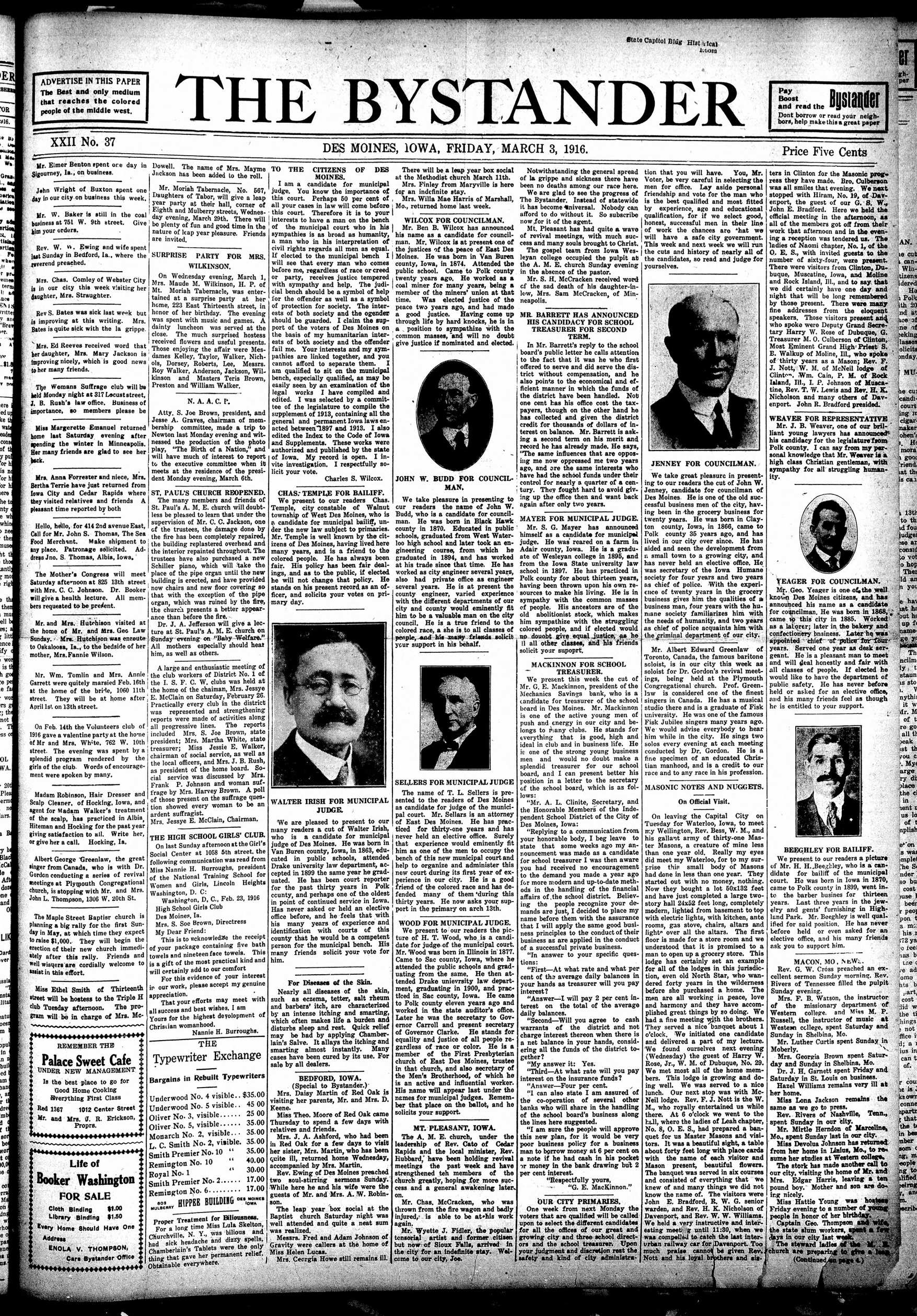
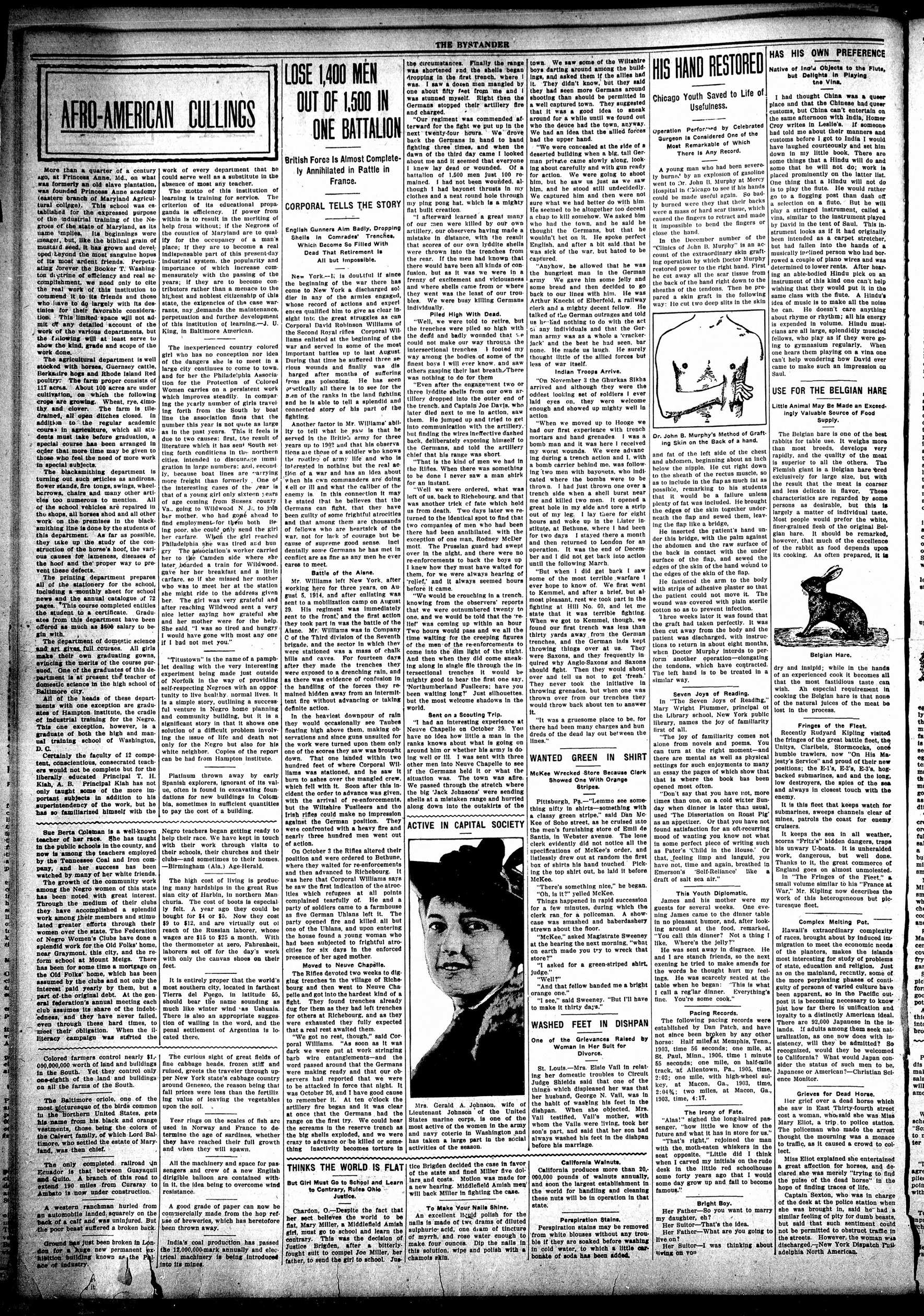

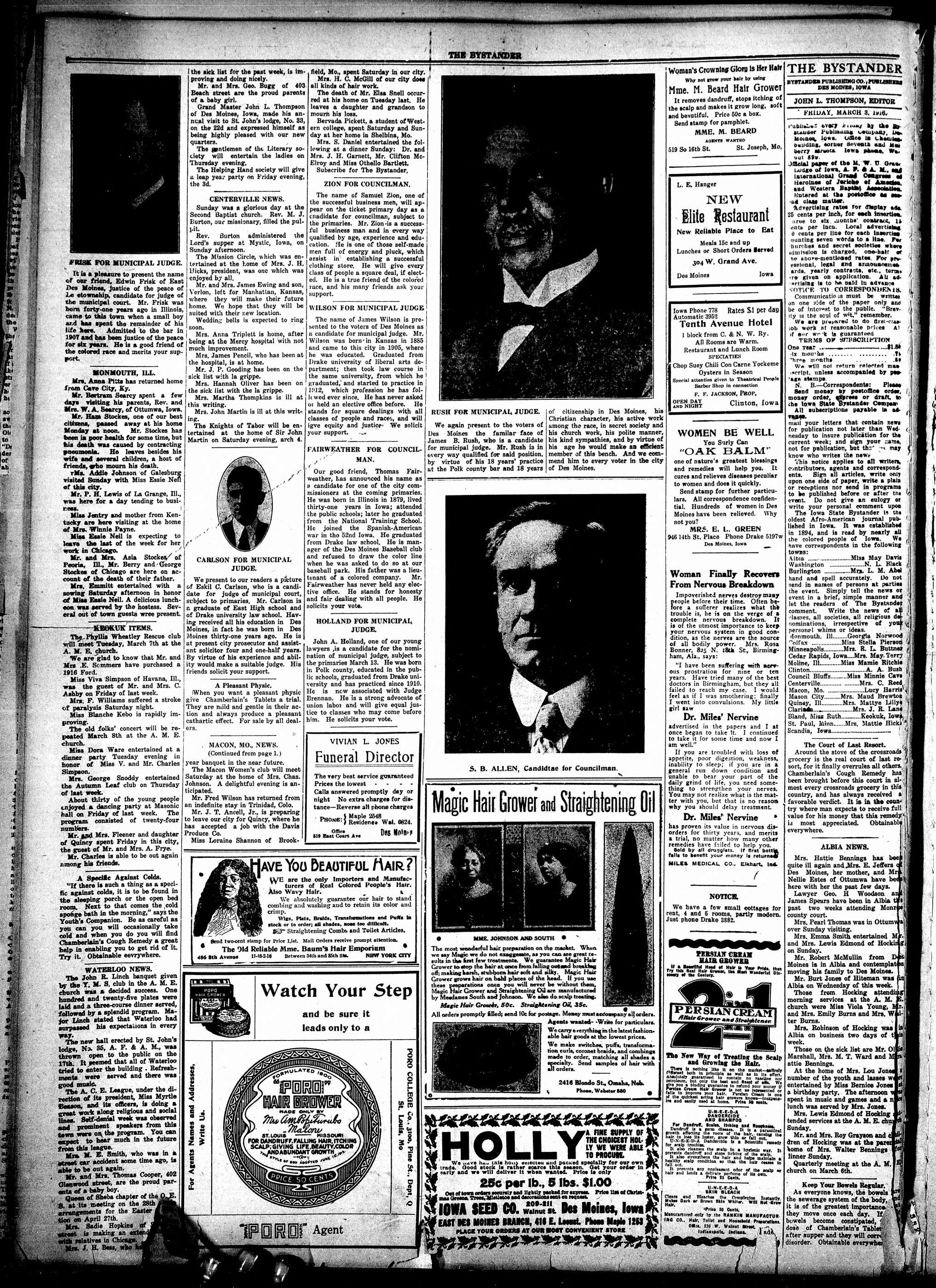
Page text (machine-generated)
ADVERTISE IN THIS PAPER
The Best and only medium
that reaches the colored
people of the middle west.
XXII No. 37
Mr. Elmer Benton spent ore day in
Sigourney, Ia., on business.
John Wright of Buxton spent one
day in our city on business this week.
Mr. W. Baker is still in the coal
business at 751 W. 9th street. Give
him your orders.
Rev. W. W. Ewing and wife spent
last Sunday in Bedford, Ia., where the
reverend preached.
Mrs. Chas. Comley of Webster City
is in our city this week visiting her
daughter, Mrs. Straught.
Rev S. Bates was sick last week but
is improving at this writing. Mrs.
Bates is quite sick with the la gripe.
Mrs. Ed Reeves received word that
her daughter, Mrs. Mary Jackson is
improving nicely, which is good news
to her many friends.
The Woman's Suffrage club will be held Monday night at 317 Locust street, J. B. Rush's law office. Business of importance, so members please be
Miss Margerette Emanuel returned home last Saturday evening after spending the winter in Minneapolis. Har many friends are glad to see her back.
Mrs. Anna Forrester and niece, Mrs. Bertha Terrie have just returned from Iowa City and Cedar Rapids where they visited relatives and friends. A pleasant time reported by both
Hello, hello, for 414 2nd avenue East, Call for Mr. John S. Thomas, The Sea Food Merchant. Make shipment to any place. Patronage solicited. Address Jno. S. Thomas, Albis, Iowa.
The Mother's Congress will meet Saturday afternoon at 825 13th street with Mrs. C. C. Johnson. Dr. Booker will give a health lecture. All members requested to be present.
Mr. and Mrs. Hutchison visited at the home of Mr. and Mrs. Geo Law Sunday. Mrs. Hutchison was enroute to Oksaloakea, Ia., to the bedside of her mother, Mrs. Fannie Wilson.
Mr. Wm. Tomlin and Mrs. Annie Garrett were quitely marrised Feb. 16th at the home of the bride, 1060 11th street. They will be at home after April 1st on 13th street.
On Feb. 14th the Volunteers club of 1916 gave a valentine party at the home of Mr and Mrs. White, 762 W. 10th street. The evening was spent by a splendid program rendered by the girls of the club. Words of encouragement were spoken by many.
Madam Robinson, Hair Dresser and Scalp Cleaner, of Hocking, Iowa, and agent for Madam Walker's treatment of the scalp, has practiced in Albia, Hiteman and Hocking for the past year giving satisfaction to all. Write her, or give her a call. Hocking, Ia.
Albert George Greenlaw, the great singer from Canada, who is with Dr. Gordon conducting a series of revival meetings at Plymouth Congregational church, is stopping with Mr. and Mrs. John L. Thompson, 1306 W. 20th St.
The Maple Street Baptisr church is planning a big rally for the first Sunday in May, at which time they expect to raise $1,000. They will begin the erection of their new church immediately after this rally. Friends and well wiswers are cordially welcome to assist in this effort.
Miss Ethel Smith of Thirteenth street will be hostess to the Triple H club Tuesday afternoon. The program will be in charge of Mrs. Mc.
REMEMBER THE Palace Sweet Cafe UNDER NEW MANAGEMENT Is the best place to go for Good Home Cooking Everything First Class Red 1367 1012 Center Street Mr. and Mrs. J. R. Erickson, Props.
Life of
THE BYSTANDER
Dowell. The name of Mrs. Mayme Jackson has been added to the roll.
Mr. Moriah Tabernacle, No. 567, Daughters of Tabor, will give a leap year party at their hall, corner of Eighth and Mulberry streets, Wednesday evening, March 29th. There will be plenty of fun and good time in the nature of leap year pleasure. Friends are invited.
SURPRISE PARTY FOR MRS.
WILKINSON.
On Wednesday evening, March 1, Mrs. Maude M. Wilkinson, H. P. of Mt. Moriah Tabernacle, was entertained at a surprise party at her home, 223 East Thirteenth street, in honor of her birthday. The evening was spent with music and games. A dainty luncheon was served at the close. The much surprised hostess received flowers and useful presents. Those enjoying the affair were Mesdames Kelley, Taylor, Walrich, Nichols, Dorsey, Roberts, Lee, Messrs. Roy Walker, Anderson, Jackson, Wilkinson and Masters Teris Brown, Preston and William Walker.
N. A. A. C. P.
Atty, S. Joe Brown, president, and Jesse A. Graves, chairman of membership committee, made a trip to Newton last Monday evening and witnessed the production of the photo play, "The Birth of a Nation," and will have much of interest to reports to the executive committee when it meets at the residence of the president Monday evening, March 6th.
ST. PAUL'S CHURCH REOPENED.
ST. PAUL'S CHURCH REOPENED
The many members and friends of St. Paul's A. M. E. church will doubtless be pleased to learn that under the supervision of Mr. C. C. Jackson, one of the trustees, the damage done by the fire has been completely repaired, the building replastered overhead and the interior repaired throughout. The trustees have also purchased a new chapel, which will take the place of the pipe organ until the new building is erected, and have provided new chairs and new floor covering so that with the exception of the pipe organ, which was ruined by the fire, the churca presents a better appearance than before the fire.
Dr. J. A. Jefferson will give a lecture at St. Paul's A. M. E. church on Sunday evening on "Baby Welfare." All mothers especially should hear him, as well as others.
A large and enthusiastic meeting of the club workers of District No. 1 of the I. S. F. C. W. clubs was held at the home of the chaperan, Mrs. Jessye E. McClain on Saturday, February 26. Practically every club in the district was represented and strengthening reports were made of activities along all progressive lines. The reports included Mrs. S. Joe Brown, state president; Mrs. Martha White, state treasurer; Miss Jessie E. Walker, chairman of social service, as well as the local officers, and Mrs. J. B. Rush, as president of the home board. Social service was discussed by Mrs. Frank P. Johnson and woman suffrage by Mrs. Harvey Brown. A poll of those present on the suffrage question showed every woman to be an ardent suffragist.
Mrs. Jessye E. McClain, Chairman.
THE HIGH SCHOOL GIRLS' CLUB.
On last Sunday afternoon at the Girl's Social Center at 1058 5th street, the following communication was read from Miss Nannie H. Burroughs, president of the National Training School for Women and Girls, Lincoln Heights Washington, D. C:
Washington, D. C., Feb. 23, 1916
High School Girls Club
Des Moines, Ia.
Mrs. S. Soe Brown, Directress
My Dear Friend:
This is to acknowledge the receipt of your package containing five bath towels and nineteen face towels. This is a gift of the most practical kind and will certainly add to our comfort
For this evidence of your interest in our work, please accept my genuine appreciation.
That your efforts may meet with all success and best wishes. I am Yours for the highest development of Chrisian womanhood.
Typewriter Exchange
Bargains in Rebuilt Typewriters
Underwood No. 4 visible... $35.00
Underwood No. 5 visible... 45.00
Oliver No. 3, visible... 25.00
Oliver No. 5, visible... 35.00
Monarch No. 2, visible... 35.00
L. C. Smith No. 2, visible... 35.00
Smith Premier No. 10 " 35.00
Remington No. 10 " 40.00
Royal No. 1 " 30.00
Smith Premier No. 2... 17.00
Remington No. 6... 17.00
803 HIPPEP BUILDING DES MOINES
MULBERRY IOWA
Proper Treatment for Bailiness.
For a long time Miss Lula Skelton,
Churchville, N. Y., was billed and
had sick headache and dizzy spells,
Chamberlain's Tablets were the only
thing that gave her permanent relief.
Obligable everywhere.
DES MOINES, IOWA, FRIDAY, MARCH 3, 1916.
I am a candidate for municipal judge. You know the importance of this court. Perhaps 50 per cent of all your cases in law will come before this court. Therefore it is to your interests to have a man on the bench of the municipal court who in his sympathies is as broad as humanity, a man who in his interpretation of civil rights regards all men as equal. If elected to the municipal bench I will see that every man who comes before me, regardless of race or creed or party, receives justice tempered with sympathy and help. The judicial bench should be a symbol of help for the offender as well as a symbol of protection for society. The interests of both society and the ogender should be guarded. I claim the support of the voters of Des Moines on the basis of my humanitarian interests of both society and the offender fail me. Your interests and my sympathies are linked together, and you cannot afford to separate them. I am qualified to sit on the municipal bench, especially qualified, as may be easily seen by an examination of the legal works I have compiled and edited. I was selected by a committee of the legislature to compile the supplement of 1913, containing all the general and permanent Iowa laws enacted between 1897 and 1913. I also edited the Index to the Code of Iowa and Supplements. These works were authorized and published by the state of Iowa. My record is open. I invite investigation. I respectfully solicit your vote.
Charles S. Wilcox.
CHAS. TEMPLE FOR BAILIFF.
We present to our readers Chas. Temple, city constable of Walnut township of West Des Moines, who is a candidate for municipal bailiff, under the new law subject to primaries. Mr. Temple is well known by the citizens of Des Moines, having lived here many years, and is a friend to the colored people. He has always been fair. His policy has been fair dealings, and as to the public, if elected he will not change that policy. He stands on his present record as an officer, and solicits your votes on primary day.
WALTER IRISH FOR MUNICIPAL
JUDGE.
We are pleased to present to our many readers a cut to Walt Irish, who is a candidate for municipal judge of Des Moines. He was born in Van Buren county, Iowa, in 1863, educated in public schools, attended Drake university law department, accepted in 1899 the same year he graduated. He has been court reporter for the past thirty years in Polk county, and perhaps one of the oldest in point of continued service in Iowa. Has never asked or held an elective office before, and he feels that with his many years of experience and identification with courts of this county that he would be a competent person for the municipal bench. His many friends solicit your vote for
For Diseases of the Skin
Nearly all diseases of the skin, such as eczema, tetter, salt rheum and barbers' itch, are characterized by an intense itching and smarting, which often makes life a burden and disturbs sleep and rest. Quick relief may be had by applying Chamberlain's Salve. It allays the itching and smarting almost instantly. Many cases have been cured by its use. For sale by all dealers.
BEDFORD. IOWA.
Mrs. Daisy Martin of Red Oak is visiting her parents, Mr. and Mrs. D. Keenec.
Miss Theo. Moore of Red Oak came
Thursday to spend a few days with relatives and friends.
Mrs. J. A. Ahmord, who had been in Red Oak for a few days to visit her sister, Mrs. Martin, who has been quite ill, returned home Wednesday, accompanied by Mrs. Martin.
Rev. Ewing of Des Moines preached two soul-stirring sermons Sunday. While here he and his wife were the guests of Mr. and Mrs. A. W. Robinson.
The leap year box social at the Baptist church Saturday night was well attended and quite a neat sum was realized.
Messra. Fred and Adam Johnson of Gravity were callers at the home of Miss Helen Lucas.
There will be a leap year box social at the Methodist church March 11th. Mrs. Finley from Maryville is here for an indefinite stay. Mrs. Willa Mae Harris of Marshall, Mo., returned home last week.
WILCOX FOR COUNCILMAN
WILCOX FOR COUNCILMAN.
Mr. Ben B. Wilcox has announced his name as a candidate for councilman. Mr. Wilcox is at present one of the justices of the peace of East Des Moines. He was born in Van Buren county, Iowa, in 1874. Attended the public school. Came to Polk county twenty years ago. He worked as a coal miner for many years, being a member of the miners' union at that time. Was elected justice of the peace two years ago, and had made a good justice. Having come up through life by hard knocks, he is in a position to sympathize with the common masses, and will no doubt give justice if nominated and elected.
JOHN W. BUDD FOR COUNCILMAN.
We take pleasure in presenting to our readers the name of John W. Budd, who is a candidate for councilman. He was born in Black Hawk county in 1870. Educated in public schools, graduated from West Waterloo high school and later took an engineering course, from which he graduated in 1894, and has worked at his trade since that time. He has worked as city engineer several years, also had private office as engineer several years. He is at present the county engineer, varied experience with the different departments of our city and county would eminently fit him to be a valuable man on the city council. He is a true friend to the colored race, a she is to all classes of people, and his many friends solicit your support in his behalf.
SELLERS FOR MUNICIPAL JUDGE
The name of T. L. Sellers is presented to the readers of Des Moines as candidate for judge of the municipal court. Mr. Sellars is an attorney of East Des Moines. He has practiced for thirty-one years and has never held an elective office. Surely that experience would eminently fit him as one of the men to occupy the bench of this new municipal court and have been a new court during its first year of experience in our city. He is a good friend of the colored race and has defended many of them 'during this thirty years. He now asks your support in the primary on arch 13th.
WOOD FOR MUNICIPAL JUDGE
WOOD FOR MUNICIPAL JUDGE.
We present to our readers the picture of H. T. Wood, who is a candidate for judge of the municipal court. Mr. Wood was born in Illinois in 1877. Came to Sac county, Iowa, where he attended the public schools and graduating from the same. He then attended Drake university law department, graduating in 1900, and practiced in Sac county, Iowa. He came to Polk county eleven years ago and worked in the state auditor's office. Later he became Carroll and present secretary of Governor Clarke. He stands for equality and justice of all people regardless of race or color. He is a member of the First Presbyterian church of East Des Moines, trustees in that church, and also secretary of the Men's Brotherhood, of which he is an active and influential worker. His name will appear last under the names for municipal judges. Remember that place on the ballot, and he solicits your support.
MT. PLEASANT, IOWA.
The A. M. E. church, under the leadership of Rev. Cato of Cedar Rapids and the local minister, Rev. Hubbard, have been holding revival meetings the past week and have strengthened teh members of the church greatly, hoping for more success and a general awakening later on.
Mr. Chas, McCracken, who was thrown from the fire wagon and badly injured, is able to be at his work again.
Mr. Wyette J. Fidler, the popular tonsorial artist and former citizen but now of Sloux Falls, arrived in the city for an indefinite stay. Welcome to our city, Joe.
Notwithstanding the general spread of la gripe and sickness there have been no deaths among our race here. We are glad to see the progress of the Bystander. Instead of statewid it has become universal. Nobody can afford to do without it. So subscribe now for it of the agent. Mt. Pleasant has had quite a wave of revival meetings, with much success and many souls brought to Christ. The gospel team from Iowa Wesleyan church occupied the pulpit at the A. M. Church, evening in the absence of the pastor. Mr. S. H. McCracken received word of the sad death of his daughter-in-law, Mrs. Sam McCracken, of Minneapolis.
MR. BARRETT HAS ANNOUNCED
HIS CANDIDACY FOR SCHOOL
TREASURER FOR SECOND
TERM
In Mr. Barrett's reply to the school board's public letter he calls attention to the fact that it was he who first offered to serve and did serve the district without compensation, and he also points to the economical and efficient manner in which the funds of the district have been handled. Not one cent has his office cost the taxpayers, though on the other hand he has collected and given the district credit for thousands of dollars of interest on balance. Mr. Barrett is asking a second term on his merit and record he has already made. He says, "The same influences that are opposing me now oppressed me two years ago, and are the same interests who have had the school funds under their control for nearly a quarter of a century. They fought hard to avoid giving up the office then and want back again after only two years.
MAYER FOR MUNICIPAL JUDGE
Mr. S. G. Mayer has announced himself as a candidate for municipal judge. He was reared on a farm in Adair county, Iowa. He is a graduate of Wesleyan college in 1895, and from the Iowa State University law school in 1897. He has practiced in Polk county for about thirteen years, having been thrown upon his own resources to make his living. He is in sympathy with the common masses of people. His ancestors are of the old abolitionist stock, which makes him sympathize with the struggling colored people, and if elected would no doubt give equal justice, as he all other classes, and his friends solicit your support.
MACKINNON FOR SCHOOL
TREASURER
We present this week the cut of Mr. G. M. Mackinnon, president of the Mechanics Savings bank, who is a candidate for treasurer of the school board in Des Moines. Mr. Mackinnon is one of the active young men of push and energy in our city and belongs to many clubs. He stands for everything that is good, high and ideal in club and in business life. He is one of the strong young business men and would no doubt make a splendid treasurer for our school board, and I can present better his position in a letter to the secretary of the school board, which is as follows:
"Mr. A. L. Clintie, Secretary, and the Honorable Members of the Independent School District of the City of Des Moines, Iowa:
"Replying to a communication from your honorable body, I beg leave to state that some weeks ago my announcement was made as a candidate for school treasurer I was then aware you had received no encouragement to the demand you made a year ago for more modern and up-to-date methods in the handling of the financial affairs of the school district. Believing the people recognize your demands are just, I decided to place my name before them with the assurance that I will apply the same good business principles to the conduct of their business as are applied in the conduct of a successful private business.
"In answer to your specific questions:
"First—At what rate and what percent of the average daily balances in your hands as treasurer will you pay interest?
"Answer—I will pay 2 per cent interest on the total of the average daily balances.
"Second—Will you agree to cash warrants of the district and not charge interest thereon when there is a net balance in your hands, considering all the funds of the district together?"
"My answer it: Yes.
"Third—At what rate will you pay interest on the insurance funds?
"Answer—Four per cent.
"I can also state I am assured of the co-operation of several other banks who will share in the handling of the school board's business along the lines here suggested.
"I am sure the people will approve this new plan, for it would be very poor business policy for a business man to borrow money at 6 per cent on a note if he had cash in his pocket or money in the bank drawing but 2 per cent interest.
"Respectfully yours,
"G. E. MacKinnon."
OUR CITY PRIMARIES
One week from next Monday the voters that are qualified will be called upon to select the different candidates for all the offices of our great and growing city and three school directors and the school treasurer. Upon your judgment and discretion rest the safety and kind of city administra-
State Capitol Blag Historical
room
tion that you will have. You, Mr. Voter, be very careful in selecting the men for office. Lay aside personal friendship and vote for the man who is the best qualified and most fitted by experience, age and educational qualification, for if we select good, honest, successful men in their line of work the chances are 'hat we will have a safe city government. This week and next week we will run the cuts and history of nearly all of the candidates, so read and judge for yourselves.
JENNEY FOR COUNCILMAN.
We take great pleasure in presenting to our readers the cut of John W. Jenney, candidate for councilman of Des Moines. He is one of the old successful business men of the city, having been in the grocery business for twenty years. He was born in Clayton county, Iowa, in 1866, came to Polk county 35 years ago, and has lived in our city over since. He has aided and seen the development from a small town to a growing city, and has never held an elective office. He was secretary of the Iowa Humane society for four years and two years as chief of police. With the experience of twenty years in the grocery business gives him the qualities of a business man, four years with the humane society familiarizes him with the needs of humanity, and two years as chief of police acquaints him with the criminal department of our city.
Mr. Albert Edward Greenlaw of Toronto, Canada, the famous lawson solist, is in our city this week as solist for Dr. Gordon's revival meetings, being held at the Plymouth Congregational church. Prof. Greenlaw is considered one of the finest singers in Canada. He has a musical studio there and is a graduate of Fisk university. He was one of the famous Fisk Jubilee singers many years ago. We would advise everybody to hear him while in the city. He sings two soles every evening at each meeting conducted by Dr. Gordon. He is a fine specimen of an educated Christian manhood, and is a credit to our race and to any race in his profession.
MASONIC NOTES AND NUGGETS.
On Official Visit.
ters in Clinton for the Masonic progress they have made. Bro. Culberson was all mimes that evening. W. Stopped with Hiram, No. 19, of Davenport, the guest of our G. S. W. John E. Bradford. Here we hold the official meeting in the afternoon, as all of the members got off from their work that afternoon and in the evening a reception was tendered us. The ladies of Naomi chapter, No. 1, of the O. E. S., with invited guests to the number of sixty-four, were present. There were visitors from Clinton, Dubue, Muscatine, Iowa, and Moline and Rock Island, Ill., and to say that we did certainly have one day and night that will be long remembered by those present. There were many fine addresses from the eloquent speakers. Those visitors present and who spoke were Deputy Grand Secretary Harry W. Rose of Dubue, G. Treasurer M. O. Culberson of Clinton, Most Eminent Grand High Priest S. E. Walkup of Moline, I., who spoke of thirty years as a Mason, Rev. F. J. Nott, W. M. of McNellodge of Clockland, Wm. Cain, P. M. of Rock Island, Ill., I. P. Johnson of Muscatine, Rev. T. W. Lewis and Rev. H. K. Nicholson and many others of Davenport. John R. Bradford presided.
WEAVER FOR REPRESENTATIVE
Mr. J. B. Weaver, one of our brilliant young lawyers has announced his candidacy for the legislature from Polk county. I can say from my personal knowledge that Mr. Weaver is a high class Christian gentleman, with sympathy for all struggling humanity.
YEAGER FOR COUNCILMAN.
Mr. Geo. Yeager is one of the well known Des Moines citizens, and has announced his name as a candidate for councilman. He was born in 1868, came to this city in 1885. Worked as a laterer; later in the bakery and confectionery business. Later he was appointed chief of police for four years. Served one year as desk sergeant. He is a pleasant man to meet and will deal honestly and fair with all classes of people. If elected he would like to have the department of public safety. He has never before held or asked for an elective office, and his many friends feel as though he is entitled to your support.
BEEGHLEY FOR BAILIFF.
We present to our readers a picture of Mr. H. H. Beeghley, who is a candidate for bailiff of the municipal court. He was born in Iowa in 1870, came to Polk county in 1899, went into the barber business for thirteen years. Last three years in the jewelry and gents' furnishing in Highland Park. Mr. Beeghley is well qualified for said position. He has never before held or even asked for an elective office, and his many friends ask you to support him.
MACON MO NEW;
Rev. G. W. Cross preached an excellent sermon Sunday morning. Rev. Rivers of Tennessee filled the pulpit Sunday evening.
Mrs. F. B. Watson, the instructor of the missionary department of Western college, and Miss M. P. Russell, the instructor of music at Western college, spent Saturday and Sunday in Shelbina, Mo.
Mr. Luther Curtis spent Sunday in Moberly.
Mrs. Georgia Brown spent Saturday and Sunday in Shelbina, Mo.
Dr. J. H. Garnett spent Friday and Saturday in St. Louis on business.
Hazel Williams remains very ill at her home.
Miss Lona Jackson remains the same as we go to press.
Rev. Rivers of Nashville, Tenn., spent Sunday in our city.
Mr. Mirtle Herndon of Marceline, Mo., spent Sunday last in our city.
Miss Devolua Johnson has returned from her home in Lilah, Mo., to resume her studies at Western college.
The stork has made another call to our city, visiting the home of Mr. and Mrs. Edgar Harris, leaving a ten pound boy. Mother and son are doing nicely.
Miss Hattie Young was hostess Friday evening to a number of young people in honor of her birthday.
Captain Geo. Thompson and wife the state slum workers, spent a few days in our city last week.
The steward ladies of the Mr. B church are preparing to give a fare
AFRO-AMERICAN CULLINGS
More than a quarter of a century ago, at Princess Anne, Md., on what was formerly an old slave plantation, was founded Princess Anne academy (eastern branch of Maryland Agricultural college). This school was established for the expressed purpose of the industrial training of the Negroes of the state of Maryland, as its name implies. Its beginnings were meager, but, like the biblical grain of mustard seed, it has grown and developed beyond the most sanguine hopes of its most ardent friends. Perpetuating forever the Booker T. Washington doctrine of efficiency and real accomplishment, we need only to cite the institution of this institute, command it to the booker and those who have to do largely with its destinies for their favorable consideration. This limited space will not admit off any detailed account of the work of the various departments, but the following will at least serve to show the kind, grade and scope of the work done.
The agricultural department is well stocked with horses, Guernsey cattle, Berkshire hogs and Rhode Island Red poultry. The farm proper consists of 117 acres. About 100 acres are under cultivation, on which the following crops are growing. Wheat, rye, timothy and clover. The farm is tiled-drained, all open ditches closed. In addition to the regular academic courses in agriculture, which all students must take before graduation, a special course has been arranged in order that more time may be given to those who feel the need of more work in special subjects.
The blacksmithing department is turning out such articles as androids, flower stands, fire tongs, swings, wheel berries, chairs and many other articles too numerous to mention. All of the school vehicles are repaired in the shops, all horses shod and all other work on the premises in the blacksmithing line is done by the students of this department. As far as possible, they take up the study of the construction of the horse's hoof, the various causes for lameness, diseases of the hoof and the proper way to prevent these defects.
The printing department prepares all of the stationery for the school, including a monthly sheet for school news and the annual catalogue of 72 pages. This course completed entitles the student to a certificate. Graduates from this department have been offered as much as $600 salary to begin with.
The department of domestic science and art gives full courses. All girls make their own graduating gowns, evincing the merits of the course pursued. One of the graduates of this department is at present the teacher of domestic science in the high school of Baltimore city. All of the heads of these departments with one exception are graduates of Hampton institute, the cradle of industrial training for the Negro. This one exception, however, is a graduate of both the high and manual training school of Washington, D.C. Certainly the faculty of 12 competent, conscientious, consecrated teachers could not be complete but for the liberally educated Principal T. H. Kiah, A. B. Principal Kish has not only taught some of the more important subjects in addition to his superintendency of the work, but he has so familiarized himself with the
Sue Berta Coleman is a well-known teacher of her race. She has taught in the public schools in the county, and now is among the teachers employed by many, and her success has been watched by many of her white friends.
The growth of the community work among the Negro women of this state has been noted with great interest. Through the medium of their clubs they have accomplished a splendid work among their members and stimulated greater efforts through their women over the state. The Federation of Negro Women's Clubs have done a splendid work for the Old Fols' home, near Graymont, this city, and the school at Mount Meigs. There has been for some time a mortgage on the Old Fols' home, which was assumed by the community not only the interest, but nearly by them, but a portion of the original debt. At the general federation's annual meeting each club assumes its share of the indebtedness, and they have never failed, even through these hard times, to meet their obligation. When the illiteracy campaign was stifled the
Colored farmers control nearly $1,000,000,000 worth of land and buildings in the South. Yet they control only one-eighth of the land and buildings on all the farms of the South.
The Baltimore oriole, one of the most picturesque of the birds common in the northern United States, gets his name from his black and orange vestments, those being the colors of the Calvert family, of which Lord Baltimore, who settled the estate of Maryland, was then chief.
The only completed railroad in Ecuador is that between Guayasuay and Quito. A branch of this road to extend 190 miles from Curaray to Ambato is now under construction.
A western ranchman hurled from an automobile landed, squarely on the back of a calf and was uninjured. But the poor beast suffered a broken back.
Ground has just been broken in London, for a huge new permanent exhibition building known as the Palace of Industry.
work of every department that he could serve well as a substitute in the absence of most any teacher. The motto of this institution of learning is training for service. The criterion of its educational propaganda is efficiency. If power from within is to result in the meriting of help from without; if the Negroes of the counties of Maryland are to qualify for the occupancy of a man's place; if they are to become a real indispensable part of this present-day industrial system, the popularity and importance of which increase commensurately with the passing of the years; if they are to become contributors rather than a menace to the highest and noblest citizenship of this state, the exigencies of the case warrants, nay demands the maintenance, perpetuation and further development of this institution of learning.—J. U. King, in Baltimore American.
The inexperienced country colored girl who has no conception nor idea of the dangers she is to meet in a large city continues to come to town, and for her the Philadelphia Association for the Protection of Colored Women carries on a persistent work which improves steadily. In comparing the yearly number of girls traveling forth from the South by boat line the association finns that the number this year is not quite as large as in the past years. This it feels is due to two causes: first, the result of literature which it has sent South settling forth conditions in the northern cities, intended to discourage immigration in large numbers; and, second, because boat lines are carrying more freight than formerly. One of the interesting cases of the year is that of a young girl only sixteen years of age coming from Sussex county Va. going to New York to go and her mother who had gone ahead to her government for them both being governor she could only send her carriage. When the girl reached Philadelphia she was tired and hungry. The association's worker carried her to the Camden side where she later boarded a train for Wildwood, gave her breakfast and a little carfare, so if she missed her mother who was to meet her at the station she might ride to the address given her. The girl was very grateful and after reaching Wildwood sent a very nice letter saying how grateful she and her mother were for the help. She said "I was so tired and hungry I would have gone with most any one if I had not met you."
"Titustown" is the name of a pamphlet dealing with the very interesting experiment being made just outside of Norfolk in the way of providing self-respecting Negroes with an opportunity to live healthy, normal lives. It is a simple story, outlining a successful venture in Negro home planning and community building, but it is a significant story in that it shows one solution of a difficult problem involving the issue of life and death not only for the Negro but also for his white neighbor. Copies of the report can be had from Hampton institute.
Platinum thrown away by early Spanish explorers, ignorant of its value, often is found in excavating foundations for new buildings in Colombia, sometimes in sufficient quantities to pay the cost of a building.
Negro teachers began getting ready to help their race. We have kept in touch with their work through visits to their schools, their churches and their clubs—and sometimes to their homes.
—Birmingham (Ala.) Age-Herald.
The high cost of living is producing many hardships in the great Russian city of Harbin, in northern Manchuria. The cost of boots is especially felt. A year ago they could be bought for $4 or $5. Now they cost $9 to $12, and are virtually out of reach of the Russian laborer, whose wages are $15 to $2 a month. With the thermometer at zero, Fahrenheit, laborers set off for the day's work with only the canvas shoes on their feet.
It is entirely proper that the world's most southern city, located in farthest Tierra del Fuego, in latitude 65, should bear the name sounding as much like winter wind as Ushuaia. There is also an appropriate suggestion of wailing in the word, and the penal settlement of Argentina is located there.
The curious sight of great fields of fine cabbage heads, frozen stiff and ruined, greets the traveler through upper New York state's cabbage country around Genesee, the reason being that fall prices were less than the fertilizing value of leaving the vegetables upon the soil.
Year rings on the scales of fish are used in Norway and France to determine the age of sardines, whether they have reached their full growth and when they will spawn.
All the machinery and space for passengers and crew of a new English dirigible balloon are contained within it, the idea being to overcome wind resistance.
A good grade of paper can now be commercially made from the hop refuse of breweries, which has heretofore been thrown away.
India's coal production has passed the 12,000,000-mark annually and electrical machinery is being introduced into its mines.
LOSE 1,400 MEN
OUT OF 1,500 IN
ONE BATTALION
British Force Is Almost Completely Annihilated in Battle in France.
English Gunners Aim Badly, Dropping Shells in Comrades' Trenches, Which Become So Filled With Dead That Retirement is All but Impossible.
New York.-I is doubtful if since the beginning of the war there has come to New York a discharged soldier in any of the armies engaged, whose record of actions and experiences qualified him to give as clear insight into the great struggles as can Corporal David Robinson Williams of the Second Royal rifles. Corporal Williams enlisted at the beginning of the war and served in some of the most important battles up to last August. During that time he suffered three serious wounds and finally was barged after months of suffering from gas poisoning. He has seen personally that he is to see for the men of the ranks in the land fighting and he is able to tell a splendid and connected story of his part of the fighting.
Another factor in Mr. Williams' ability to tell what he saw is that he served in the British army for three years up to 1923 and that his observations are those of a soldier who knows the routings of army life and who is interested in nothing but the real action of a war and has an idea about when his own commanders are doing *cell or ill and what the caliber of the enemy* is. This connection it may be stated that he believes that the Germans can fight that they have been guilty of so fearful abjective acts that the enemy are thousands of fellows who are heartstick of the war, not for lack of courage but because of supreme good sense. Incidentally some Germans he has met in conflict are as fine as any men he ever cares to meet.
Battle of the Aisne.
Mr. Williams left New York, after working here for three years, on August 5, 1914, and after enlisting was sent to a mobilization camp on August 29. His regiment was immediately sent to the front, and the first action they took part in was the battle of the Alsne. Mr. Williams was in Company C of the Third division of the Seventh brigade, and the sector in which they were stationed was a mass of chalk hills and caves. For fourteen days after they made the trenons they were exposed in a drenching rain, and there was evidence of confusion in the handling of the forces they remained hidden away from an intermittent fire without advancing or taking definite action.
in the heaviest downpour of rain they would occasionally see Taubes floating high above them, making observations and since guns unsuited for the work were turned upon them only one of the scores they saw was brought down. That one landed within two hundred feet of where Corporal Williams was stationed, and he saw it burn to ashes over the mangled crew, which fell with it. Soon after this incident the order to advance the arrival of re-enforcements, but the Wiltshire Fusiliers and the Irish rifles could make no impression against the German position. They were confronted with a heavy fire and nearly three hundred men went out of action.
On October 3 the Rifles altered their position and were ordered to Bethune, where they waited for re-enforcements and then advanced to RIChebourg. It was here that Corporal Williams says he saw the first indication of the atrocities which refugees at all points complained tearfully of. He and a party of soldiers came to a farmhouse as five German Uhlans left it. The party opened fire and killed all but one of the Uhlans, and upon entering the house found a young woman who had been subjected to frightful atrocities for six days in the enforced presence of her aged mother.
Moved to Neuve Chapelle.
The Rifles devoted two weeks to digging trenches in the village of Richebourg and then went to Neuve Chapelle and got into the hardest kind of a fight. They found trenches already dug for them as they had left trenches in the village. The soldiers were exhausted they fully expected that a real rest awafted them.
"We got no rest, though," said Corporal Williams. "As soon as it was dark we were put at work stringing barb wire entanglements—and the word passed around that the Germans were making ready and that our observers had reported that we were to be attacked in force that night. It was October 26, and I have good cause to remember it. At ten o'clock the artillery fire began and the Germans had the range on the first try. We could hear the screams in the reserve trench as the big shells exploded, and we were crazy to advance or be killed or something inactivity becomes torture in
THINKS THE WORLD IS FLAT
Chardon, O.—Despite the fact that her sect believes the world to be flat, Mary Meyer, a Middlefield Amish girl, must go to school and learn the contrary. This was the decision of Justice Brigden, after a bitterly-fought suit to compel Joe Miller, her father, to send the girl to school. Jus-
THE BYSTANDER
the circumstances. Finally the range was shortened and the shark was dropping the first trench, when she was a dozen men mangled by one about fifty feet from me and I was stunned myself. Right then the Germans stopped their artillery fire and charged.
"Our regiment was commended afterward for the fight we put up in the next twenty-four hours. We drove back the Germans in hand to hand fighting three times, and when the dawn of the third day came I looked about me and it seemed that everyone I knew lay dead or wounded. Of a battalion of 1,500 men just 100 remained. All the soldiers wounded. I had bayonet thrins in my clothes and a neat round hole through my ping plong hat, which is a mighty flat built creation.
"I afterward learned a great many of our men were killed by our own artillery, our observers having made a mistake in distance, with the result that scores of our own lyddite shells were thrown into the trenches from the rear. If the men had known that there would have been all kinds of confusion, but as it was we were in a frenzy of excitement the enemy came from where they went was the least of our troubles. We were busy killing Germans individually.
Piled High With Dead.
"Well, we were told to retire, but the trenches were piled so high with the deft and badly wounded that we could not make our way through the intersectional trenches. I footed my way among the bodies of some of the finest boys I will ever know, and saw others casping their last breath. There was nothing to do for them.
"Even after the engagement two or three lydite shells from our own artillery dropped into the outer end of the trench, and Captain Joe Davis, who later died next to me in action, saw them. He jumped up and tried to get into communication with the artillery, but finding the wires ineffective dashed back, deliberately exposing himself to the Germans, and told the artillery chief that his range was short.
"That is the kind of men we had in the Rifles. When there was something to be done I never saw a man shirk for an instant.
"Well we were ordered, what was left of us, back to Richebourg, and that was another trick of fate which held us from death. Two days later we returned to the identical spot to find that two companies of men who had been there had been annihilated, with the exception of one man, Rodney McDermott. The Prussian guard had swept over in the night, and there were no witnesses. I knew how they must have waited for them, for we were always hearing of 'relief', and it always seemed hours before it came.
"We would be crouching in a trench, knowing from the observers' reports that we were outnumbered twenty to one, and we would be told that the relief" was coming up within an hour. Two hours would pass and we all the time waiting for the creeping figures of the men of the re-enforcements to come into the dim light of the night. And then when they did come sneaking along in single file through the inroads, they would be it, would be mighty good to hear the first one say, 'Northumberland Fusiliers: have you been waiting long?' Just slhouettes, but the most welcome shadows in the world.
Sent on a Scouting Trip.
"I had an interesting experience at Neuve Chapelle on October 29. You have no idea how little a man in the ranks know about what is going on around him or whether his army is doing well or ill. I was sent with three other men into Neuve Chapelle to see if the Germans held it or what the situation was. The town was after. We passed through the stretch where the big 'Jack Johnson' were sending shells at a mistaken range and hurried along down into the outskirts of the ACTIVE IN CAPITAL SOCIETY
Mary C.
Mrs. Gerald A. Johnson, wife of Lieutenant Johnson of the United States marine corps, is one of the most active of the women in the army and navy coterie in Washington and has taken a large part in the social activities of the season.
tice Brigden decided the case in favor of the state and fined Miller five dollars and costs. Motion was made for a new hearing. Middlefield Amish men will back Miller in fighting the case.
To Make Your Nails Shine.
An excellent liquid polish for the nails is made of two drums of diluted sulphuric acid, one a dam of tincture of myrrh, and rose water enough to make four ounces. Dip the nails in water, wipe and polish with a champlain skin.
town. We saw some of the Wiltshire boys darting around among the buildings, and asked them if the allies had it. They didn't know, but they said they had seen more Germans around shooting than should be permitted in a well captured town. They suggested that it was a good idea to sneak around for a while until we found out who the deuce had the town, anyway. We had an idea that the allied forces had the upper hand.
"We were concealed at the side of a deserted building when a big, tall German private came slowly along, looking about carefully and with gun ready for action. We were going to shoot him, but he saw us just as we saw him, and he stood still undecided. We captured him and then were sure what we had better do than he seemed to be altogether too decent chap to kill somehow. We asked him to the town, and he said he thought the Germans, but that he wouldn't bet on it. He spoke perfect English, and after a bit said that he was sick of the war, but hated to be captured.
"Anyhow, he allowed that he was the hungriest man in the German army. We gave him some jelly and some bread and then decided to go back to our lines with him. He was Arthur Knecht of Eiberfeld, a railway clerk and a mighty decent fellow. He talked of the German outrages and told us he had nothing to do with the act of any individuals and that the German army and the best he had seen, bar none. He made us laugh. He surely thought little of the allied forces but less of war itself.
Indian Troops Arrive.
"On November 3 the Ghurkas Sikha arrived and although they were the oddest looking set of soldiers I ever laid eyes on, they were welcome enough and showed up mighty well in action.
"When we moved up to Hooge we had our first experience with trench mortars and hand grenades. I was a bomb man and it was here I received my worst wounds. We were advancing during a trench action and I, with a bomb carrier behind me, was following two men with bayonets, who indicated the bombs were to be thrown. I had just thrown one over a trench side when a shell burst near me and killed two men. It opened a great hole in my side and tore a strangle out of my leg. I lay there for eight minutes. In the Lister institute, at Bethune, where I had been for two days. I stayed there a month and then returned to London for an operation. It was the end of December and I did not get back into action until the following March.
"But when I did get back I saw some of the most terrible warfare I ever hope to know of. We first went to Kemmel, and after a brief, but almost pleasant, rest we took part in the attack at Hill No. 60, and let me state that it was terrible fighting. When we got to Kemmel, though, we found our first trench was less than thirty yards away, from the German trenches, and the German indels kept throwing things over at us. They were Saxons, and they frequently in quiried why Anglo-Saxons and Saxons should fight. Then they would about to tell us not to get 'fresh'. They never took the initiative in throwing grenades, but when one was thrown over from our trenches they would back about ten to answer it.
"It was a grusome place to be, for there had been many charges and hundreds of the dead lay out between the lines."
WANTED GREEN IN SHIRT
McKee Wrecked Store Because Clerk
Showed One With Orange
Stripe.
Pittsburgh, Pa.—"Lemme see something nifty in shirts—something with a classy green stripe," said Dan McKee of Soho street, as he crushed into the men's furnishing store of Emil de Santis, in Webster avenue. The lone clerk evidently did not notice the specifications of McKee's order, and listlessly drew out at random the first box of shirts his hand touched. Picking the top shirt out, he laid it before McKee.
"Where's something nice," he began. "Oh is it?" yelled McKee.
Things happened in rapid succession for a few minutes, during which the clerk ran for a policeman. A showcase was smashed and haberdashery strewn about the floor.
"McKee," asked Magistrate Sweeney at the hearing the next morning, "what on earth made you try to wreck that store?"
"I asked for a green-striped shirt, judge."
"And that fellow handed me a bright one." "I see," said Sweeney. "But I'll have to make it thirty days."
WASHED FEET IN DISHPAN
One of the Grievances Raised by Woman in Her Suit for Divorce.
St. Louis.—Mrs. Elisle Vall in relating her domestic troubles to Circuit Judge Shields said that one of the things which displeased her was that her husband, George N. Vall, was in the habit of wasking his feet in the dishpan. When she objected, Mrs. Vall testified, Vall's mother, with whom the Valls were living, took her son's part, and said that her son had always washed his feet in the dishpan before his marriage.
California Walnuts.
California produces more than 20, 000,000 pounds of walnuts annually, and soon the largest establishment in the world for handling and cleaning these nuts will be in operation in that state.
Perspiration Stains.
Perspiration stains may be removed from white blouses without any trouble if they are soaked before washing. A little amount of soda has been added.
HIS HAND RESTORED
Chicago Youth Saved to Life of Usefulness.
Operation Performed by Celebrated Gurgeon is Considered One of the Most Remarkable of Which There is Any Record.
A young man who had been severely burned by an explosion of gasoline went to Dr. John B. Murphy at Mercy Hospital in Chicago to see if his hands could be made useful again. So badly burned were they that their backs were a mass of hard scar tissue, which caused the fingers to retract and made it impossible to bend the fingers or close the hand.
In the December number of the "Clinics of John B. Murphy" is an account of the extraordinary skin grafting operation by which Doctor Murphy restored power to the right hand. First he cut away all the scar tissue from the back of the hand right down to the sheaths of the tendons. Then he prepared a skin graft in the following way: He cut two deep slits in the skin
Dr. John B. Murphy's Method of Graft
Jee Skin on the Back of a hand.
Dr. John B. Murphy's Method of Grafting Skin on the Back of a hand, and fat of the left side of the chest and abdomen, beginning about an inch below the nipple. He cut right down to the edge of the rectus muscle, so to include in the flap as much fat as possible, remarking to his students that it would be a failure unless plenty of fat was included. He brought the edges of the skin together underneath the flap and sewed them, leaving the flap like a bridge. He inserted the patient's hand under this bridge, with the palm against the abdomen and the raw surface of the back in contact with the under surface of the flap, and sewed the edges of the skin onto the wound to the edges of the flap. He fastened the arm to the body with a piece of adhesive plaster so that the patient could not move it. The wound was covered with plain sterile cotton so as to prevent infection.
Three weeks later it was found that the graft had taken perfectly. It was then cut away from the body and the patient was discharged, with instructions to return in about eight months, when Doctor Murphy intends to perform another operation—elongating the tendons, which have contracted. The left hand is to be treated in a similar way.
Seven Jaws of Reading
In "The Seven Joys of Reading," Mary Wright Plummer, principal of the Library school, New York public library, names the joy of familiarity first of all.
"The joy of familiarity comes not alone from novels and poems. You can turn at the right moment—and there are mental as well as physical settings for such enjoyments to many an essay the pages of which show that that is where the book has been opened most often.
"Don't say that you have not, more times than one, on a cold winter Sunday when dinner is later than usual, used 'The Dissertation on Rost Pig' as an appetizer. Or that you have not found satisfaction for an off-recurring mood of wanting you know not what in some perfect piece of writing such as Pater's 'Child in the House.' Or that, feeling limp and languid, you have not, time and again, breathed in Emerson's 'Self-Reliance' like a draft of salt sea air."
This Youth Diplomatic
James and his mother were my guests for several weeks. One evening James came to the dinner table in no pleasant humor, and, after looking around at the food, remarked, "You call this dinner? Not a thing I like. Where's the jelly?" He was sent away in disgrace. He and I are stanch friends, so the next enxening he makes for mencors for the house he thought would suitings. He was scarcely seated at the table when he began: "This is what I call a regular dar dinner. Everything's fine. You're some cook."
Pacing Records
The following pacing records were established by Dan Patch, and have not since been broken by any other horse: Half mile at Memphis, Tenn., 1903, time 56 seconds; one mile, at St. Paul, Minn., 1906, time 1 minute 55 seconds; one mile, on half-mile track, at Allentown, Pa., 1905, time; 2:02, one mile, with high-wheel sulkey, at Macon, Ga., 1903, time; 2:04%; two miles, at Macon, Ga., 1903, time; 4:17.
The Irony of Fate
"Alas!" sighed the long-haired passenger, "how little we know of the future and what it has in store for us." "That's right," rejoined the man with the moth-eaten whiskers in the seat opposite. "Little did I think when I carved mine in the desk of the red schoolhouse for forty years ago that I would some day grow up and fall to become famous."
Bright Boy.
Native of India Objects to the Flute,
but Delights in Playing
the Vina.
I had thought China was a queer place and that the Chinese had queer customs, but China can't entertain on the same afternoon with India, Homer Croy writes in Leille's. If someone had told me about their manners and customs before I got to India I would have laughed courteously and set him down in my little book. There are some things that a Hindu will do and some that he will not do; work is placed prominently on the latter list. One thing that a Hindu will not do is to play the flute. He would rather go to a flogging post than dash off a selection on a flute. But he will play a stringed instrument, called a vina, similar to the instrument played by David in the tent of Saul. This instrument looks as if it had originally been intended as a carpet stretcher, but had fallen into the hands of a musically inclined person who had borrowed a couple of piano wires and was determined to lower rents. After hearing an able-bodied Hindu pick on an instrument of this kind one can't help wishing that they would put it in the same class with the flute. A Hindu's idea of music is to make all the noise he can. He doesn't care anything about rhyme or rhythm; all his energy is expended in volume. Hindu musicians are all large, splendidly muscled fellows, who play as if they were going to gymnasium regularly. When one hears them playing on a vina can't help wondering how David ever came to make such an impression on Saul.
USE FOR THE BELGIAN HARE
Little Animal May Be Made an Exceedingly Valuable Source of Food Supply.
The Belgian hare is one of the best rabbits for table use. It weighs more than most breeds, develops very rapidly, and the quality of the meat is superior to all the others. The Flemish giant is a Belgian hare bred exclusively for large size, but with the result that the meat is coarser and less delicate in flavor. These characteristics are regarded by some persons as desirable, but this is largely a matter of individual taste. Most people would prefer the white, fine-grained flesh of the original Belgian hare. It should be remarked, however, that much of the excellence of the rabbit as food depends upon its cooking. As often prepared, it is
Belgian Hare.
dry and insplid; while in the hands of an experienced cook it becomes all that the most fastidious taste can wish. An especial requirement in cooking the Belgian hare is that none of the natural juices of the meat be lost in the process.
Fringes of the Fleet
Recently Rudyard Kipling visited the fringes of the great battle fleet, the Unity, Claribelles, Stormcocks, once humble trawlers, now "On His Majesty's Service" and proud of their new positions; the E-1's, E-2's, E-3's, bogbacked submarines, and and the long, low destroyers, the spies of the sea and always in closest touch with the enemy.
It is this fleet that keeps watch for submarines, sweeps channels clear of mines, patrols the coast for enemy cruisers.
It keeps the sea in all weather, scorns "Fritz's" hidden dangers, traps his unary U-boats. It is unheralded work, dangerous, but well done. The great commerce of England goes on almost unimpeded.
In "The Fringes of the Fleet," a small volume similar to his "France at War," Mr. Kipling now describes the work of this heterogeneous but picturesque fleet.
Complex Melting Pot.
Hawaii's extraordinary complexity of races, brought about by induced immigration to meet the economic needs of the planters, makes the islands most interesting for study of problems of state, education and religion. Just as on the mainland, recently, some of the more perplexing phases of contiguy of persons of varied culture have been apparent, so in the Pacific outpost it is becoming necessary to know just how far she is unification and loyalty to a distinctly American ideal. There are 92,000 Japanese in the islands. If adults among them seek naturalization, as one now does with insistence, will they be admitted? So recognized, would they be welcomed to California? What would Japan consider the status of such men to be, Japanese or American?—Christian Science Monitor.
Grieves for Dead Horse
Her grief over a dead horse which she saw in East Thirty-fourth street cost a woman, who said she was Miss Mary Eliot, a trip to police station. The policeman who made the arrest thought the mourning was a monace to traffic, as it caused a crowd to collect.
Miss Eliot explained she entertained a great affection for horses, and declared she was merely "trying to find the pulse of the dead horse" in the hope of finding traces of life.
Captain Sexton, who was in charge of the desk at the police station when she was brought in, said he had a similar feeling of pity for dumb beasts, but said that such sentiment could not be permitted to obstruct traffic in the streets. However, the woman was discharged.—New York Dispatch Full-length North American.
The KITCHEN CABINET
The world is so full of a number of things.
I am sure we should all be as happy as kings.
Desserts that are simple to make,
economical and wholesome are always
moved here
Brown Sugar Pudding.—Mix four blespoutfuls of cornstarch with two cupfuls of brown sugar and when well mixed add two cupfuls of boiling water and a pinch of salt. Boil until the cornstarch is well cooked and simmer in a double boiler. Just before taking from the fire add a half cupful of walnut meats, broken in pieces. Serve cold with whipped cream.
Potato Chowder.—Cut a slice of salt pork in dice and try brown in a soup kettle. Then add three medium sized pieces of onion, onion pulp through the meat chopper, add salt and pepper and serve with flour, cover with boiling water and simmer until tender. Add a pint and a half of hot milk, a small piece of butter and serve with toasted crackers.
Parisian Salmon.—Take a thick slice of salmon, tie it in a cloth and simmer gently in soup stock to which has been added a bay leaf, two chopped onions, a stalk of celery, one diced carrot, and some parsley Place the fish when cooked on a platter and pour over it the following sauce: Place in a double boiler a cupful of milk, add half a teaspoon of beef extract, salt, celery salt and a tablespoonful of cornstarch, mixed with a little cold water. Cook well to cook the starch, then stir in a cupful of asaparagus tips. Serve a border of mashed potato and small green peas and the fish with the sauce poured over the fish.
Oatmeal Slice—Slice a large onion into one teaspoon of melted butter and let simmer. Add one cupful of cooked oatmeal and cook until the onions are tender. Add a scant pint of milk and salt and pepper to taste. Strain, bring to a boll and serve hot with toasted crackers.
When making celery soup, stew the leaves rather than the heavy coarse stalks, as there is more flavor in them.
MAKING OF CROQUETTES.
Croquettes will never lose their hold upon us, for they are most delightful
will never lose their hold
they are most delightful
dishes when well sea-
sick and when they are
dinner after crumbs.
+
The tedious method of handling, dipping and rolling each one in crumbs may be done much faster if the croquettes are rolled in fours, dipped and crumbed in fours, the egg can be thrown four as quickly as one over. Then in frying have the fat the right temperature for the mixture, brown a cube of bread in the fat. If it browns in forty seconds it is ready for cooked mixtures and sixty seconds for uncooked mixtures. When eggs are added to each egg without making any difference in the process, thus saving quite a little egg when making a number of croquettes. One good croquette maker says she uses as much water as egg and can see no difference.
The white sauce to use in binding croquettes should be thicker than the ordinary white sauce. Use a half cup of flour, one-half teaspoonful of salt, four tablespoonfuls of butter and a pint of milk. When the butter is bubbling hot, add the flour and when mixed pour on the milk; cook until smooth and thick.
Marcaroni croquettes are most tasty. Mix cooked macaroni, broken in very small pieces, with a thick seasoned white sauce to which a little grated cheese has been added. Place in a cool place until firm, then dip in eggs and crumbs and fry as usual.
Potato Croquettes With Peas.—Make the potato balls, scoop out the center and fill with seasoned peas and roll in ice cream, crumbs and fry. Serve with a thick white sauce garnished with parsley.
Salmon mixed with a chopped sour pickle, white sauce and seasonings, formed into croquettes makes another good supper dish. Serve with ricod potato.
A very thick white sauce, stirred thick with cheese, cooled, then molded into balls and dipped in buttered brown crumbs is a tasty dish.
Terrible Threat.
Parson Johnson—De contribution dis morning will be 'to de purpose ob making up de deficit in your pastor's salary! De choir will now sing, and will continue to sing, until de full amount am collected!—Puck.
Giving Them Fair Warning.
William, soon after he started to school, came home one day and said: "Some boys at school are beginning to meddle with me and they had better stop it."
Diplomatic Statesman.
"Do you think your constituents agree with your views?" "Yes," replied Senator Sorghum. "I made it a point to have my views in agreement with theirs before I said a word."
Will Be Remarkable Map.
To make a map of the world on the unprecedented scale of 16 miles to the ech is a project of British scientists.
Doily Thought.
Search others for their virtues, and self for thy vices.—Fuller
To understand everything is to forgive everything.-Guatama.
Resolve to keep happy and your joy and you shall form an invincible host against difficulty.-Helen Keller
GOOD DISHES FOR LENT.
This is the season when we should appreciate our delicious cheese, and
the season when we should
our delicious cheese and
and use it in many com-
binations with vegetables
for the main or
chief dish of the meal.
CITY
Escaloped Onions With Cheese.-Holl untender a dozen or more small sized onions, drain carefully and place in a fireproof serving dish. pour over a cupul and a half of thick white sauce, and a cupul of finely chopped cheese, and buttered crumbs to the oven long enough to br. aw. the crumbs. Too long or too hot a cooking will toughen the cheese.
Lentil Soup.-Wash a half pound of lentils and soak all night in a quart of water. Cut one medium sized onion in small pieces, also one turnip, one carrot and two stalks of celery. Cook these in a tablespoonful of butter for five minutes, add the lentils and water in which they were soaked and one teaspoonful of salt. Bolt and skim, then simmer two hours. Rub through the cheese. Bend with two tablespoonful of butter and flour with a cupul of milk
Macaroni With Chestnuts—Make twenty chestnuts until soft, then pound in a mortar with pepper, salt and butter. Add a half pound of cooked macaroni, four tablespoonfuls of butter and a tablespoonful of onion juice, if too dry add a little milk, stir in a cupful of grated cheese, heat very hot and serve.
Fricase of Onions and Potatoes—Take a dozen small potatoes, peeled, and a half dozen small onions. also peeled. Place in a saucepan with two tablespoonfuls of butter and cook five minutes. Add a cupful of water, salt and pepper and cook until the vegetables are tender. Mix together four tablespoonfuls of flour and a half cupful of milk, add to the vegetables, cook five minutes, beat an egg and add to the mixture. Arrange a ring of cooked spaghetti on a hot dish, sprinkle with grated cheese and bake in the oven until the cheese is melted. Serve with the vegetables in the center.
SEASONABLE DISHES
A pretty as well as a tasty dish to serve with lamb or roast of meat is
Palm Tree
Celery Relish. Place half a box of gelatin in a cup of water heat a cupful of water and when the gelatin is soft add to it. While hot add the juice of two lemons, and a half cupful of sugar. Let cool, then add a table-spoonful of fresh grated horseradish, a dash of cayenne and color a light green with vegetable coloring. When hot add a child with a cupful of chopped celery. Set on lee to harden and cut in squares to serve. This may be served on lettuce with a salad dressing making a most attractive salad.
Manhattan Apples.-Core and pare six or eight apples, cook in a sipu made of a cupulant and a half each of sugar and water, turning often until the apples are tender. A good way to add to the flavor of this dish is to cook the apple peelings in water to cover, strain and use that with the sugar for the sipu. If the apples have a red peel it will make them a beautiful pink color. Have ready as many rounds of sponge cake as there are apples, brown in a little hot butter and on each place an apple, pour over the sipu and serve with whipped cream or simply with the apple sipu.
Newport Whites.-Stand a glass of raspberry jelly in a warm place where it will soften to a thick stick. Heat the whites of two eggs until foamy. add the jelly, then gradually pour in a cupful of thick cream. stir in a half cupful of powdered sugar and beat all together with a large dover egg beater or whip in a cream churn. Take off the froth as it rises and place in a sieve to drain. When no more froth appears arrange it in glasses placing a spoonful of the froth on top of each. Serve ice cold. One may make this with jelly, egg and a little sugar without the cream, beating just the cream. Then serve with whipped cream if so desired
Nellie Maxwell
Hepsy="That boy of ours seems might; t fond of tendin' to other folks business" Hiram="Guess we'll how to make a lawyer of him. Then he git paid for doin' it."-Boston Transcript
Education is a Big Thing
Education is a grand good thing Before she went away to schoo Virginia Featheringham called her mother "maw." Now she refers to her as "the mater."—Topeca Capital.
Victory in Hard Struggle I think that there is success in all honest endeavor, and that there is some victory gained in every gallant struggle that is made—Dickens
Worst Kind of Llars.
The most mischievous liars are those who keep sliding on the verge of truth.-Selected.
Matrimonial Felicities.
"Oh, why did I ever marry you?" cause I didn't know any better."
UNDERWOOD UNDERWOOD
Anticipating that Germany's next great drive will be into Egypt, with the capture of the Suez canal as the objective, Great Britain is concentrating its ammunition, food and supplies to block such a possibility. This photograph shows.
CUTS STEEL OUTPUT
CUTS STEEL OUTPUT
Shortage in Ferro-Manganese Is Becoming Serious.
Many Important Plants Threatened With Enforced Curtailment—South American Ore Largely Controlled by Allies.
Pittsburgh, Pa.—The seriousness of the shortage in the United States at the present time of ferro-manganese as an alloy in making steel is disclosed by reports that unless the situation is speedily relieved many important steel works will have to curtail the production of raw steel, while not a few of them will have to suspend operations entirely. Pittsburgh reports intimate that manganese prices may be expected to reach the unprecedented figure of $200 a ton or even more.
Manganese is used as an alloy for steel employed in work which requires that the metal shall possess both hardness and durability, such as rock-crushing machinery, railway crossings, mine-car wheels and safes. Manganese bronze propellers have in recent years been fitted to nearly all high-speed warships and express steamships. Propeller blades made of manganese composition will bend under a blow, but seldom break, and frequently all that is necessary to make a bent manganese, blade good to be hammer it back into shape. The blow that would snap clean off a steel blade of a propeller only suffices, usually, to bend one made of manganese.
While there have been scattered deposits of manganese ore found in the United States, the supply is unstable, and it may be said that practically all the manganese used in steel making in this country is imported.
The principal sources of supply of manganese ore are India, South America and Russia. Between the years 1910 and 1914 the United States imported manganese ore in values of $1,592,073, for 1910; $2,169,161, in 1912; and $1,841,451, in 1914. In 1914 Brazil sent to the United States 72,189 tons, British India 115,685 tons and Russia in Europe 34,810 tons, and Russia in Asia 1912 the Russian Black sea ports forwarded directly to the United States 7,753 tons. This source of supply has now been entirely cut off owing to the closing of the Dardanelles. The Steel Steel Corporation
MRS. CHARLES A. HOLDER
I
Mrs. Charles A. Holder is the wife of the newly-appointed trade adviser to the state department. She is a new and charming addition to Washington special circles. Doctor Holder is one of the most successful service and succeeded Robert F. R. Rose.
GERMAN WOMEN SELL HAIR
Mother and Daughter Send Tresses to the United States to Aid Soldiers.
Denver, Colo.—To obtain funds for wounded German soldiers they are nursing in a military hospital conducted by their husband and father, Mrs. Louis B. Ries of Karlsruhe, Germany, and her daughter, twenty years old, have sent their hair to Mrs. Francis Bode, Mrs. Ries' sister here, for sale.
```markdown
```
---
STROOPS READY AT ALEXANDRA
great drive will be into Egypt, with the men, ammunition, food and supplies to be way station in Alexandria.
ST. CYR AND HIS WIFE
THE WEDDING
Jean Harold Edward St. Cyr's marriages to society women who were double, or nearly double, his age, has astonished society of two continents. His first wife was Mrs. Caroline Reddfield, who died a year ago last January. During the following April he married his present wife, who was the widow of James Henry ("Silent") Smith, the millionaire. St. Cyr is a man of many graces and social accomplishments, he is said to be John Henry Edward Thompson of Waco, Tex., formerly a newsboy, hotel clerk, haberdasher's salesman and hotel man.
vessels employed in carrying steel products for export to the far East have been employed in carrying manganese ore carges, it is said, on return voyages. The British supply of manganese, it is declared, is now held exclusively for the British government needs and is unavailable for use in the United States. There still remain the supplies obtainable in Brazil, but according to current report the Brazil manganese is largely controlled now by the allies. What South American manganese is reaching the United States is wholly inadequate to the demands.
Manganese steel contains about twelve per cent of manganese and 1.50 per cent of carbon. The alloy was first known as 'Jadfeld', manganese steel. Its ductility is effected by the rate of cooling. Sudden cooling makes the metal extremely ductile, while slow cooling makes it brittle. In this respect the behavior is the opposite to that of carbon steel. The great hardness of manganese, however, is effected by the rate of cooling.
In the shortage of manganese in the United States at the present time steel makers are as much concerned over the question of future supply as they are at the prospect of immediately advancing prices.
The situation with reference to manganese is shared largely by high speed steel. Chromium and tungsten enter largely into the making of high speed steel, and the making of high speed steel tools has been to a very great extent a British industry.
The British government, it is understood, will permit any high speed steel to be exported at present, and it is now well nigh impossible to obtain high speed cutting tools in this country.
The introduction of chromium and tungsten into steel mixtures yields a red hardness which makes it possible for tools to cut metals even when the temperature of the cutting tool under a high speed drive is raised to 600 degrees Centigrades, or 1,112 degrees Fahrenheit. This heat is occasioned by the friction under the high speed working. In consequence of high speed, steel machinists can cut down metal with a lathe nearly six times as fast as with carbon steel tools.
It has become the practice for women in Germany to sell their hair, and Mrs. Hada has already sold the hair of one of her little nieces for $25 for the same purpose.
To Hat Tippers.
Cleveland, O.-Do you know that when you tip your hat you are inviting death? Deadly germs lurk in the air, which can be pounced on the propped'head' by the gallant hat tipper, says Health Commissioner Ford of Cleveland.
---
THE BYSTANDER
To Hat Tippers.
FAMOUS INN PASSES
FAMOUS INN PASSES
Old Three Pigeons, Dear to Shakespeare, Is Closed.
House Was Popular Resort for Poets and Dramatists of Elizabethan Era
—Familiar to Readers of Dickens.
London.—One of the last, if not actually the last, of the old Elizabethan inns associated with the name of Shakespeare and his literary contemporaries, passes away with the closing of the famous Three Pigeons at Brentford.
Much of the old-timbered building, including its low-carved and paneled chambers, disappeared years ago, and now comes the order of the Middleesex Learning justices that the ancient hostelry must be closed.
The Inn, which was owned by Messrs. Charrington & Co. well-known brewers, has been in occupation up to the last, and although not in a bad state of repair and having nothing against its record, it was decided that it now bad become unnecessary.
When the place actually was built no one can tell. "It was as old as the hills," said one of the district officials, "but we can give no more definite date than that."
It is curious how popular the house seems to have been with poets and dramatists of the Elizabethan era, seeing that the old town appears to have been always a byproduct of its "dirt and town is constantly referred to by Thomsen, Gay, Goldsmith and others on account of its dirt, and it is the subject of one of Doctor Johnson's most famous gibes.
And yet, whenever Shakespeare and his friends had nothing better to do, they seem to have turned their footsteps westward to Brentford and there held high revel at the Three Pigeons. The house was the scene of some of George Peele's "Merry Jests," and Ben Jonson wrote. "Well Tickle It at the Pigeon."
Shakespeare's time it was occupied by one John Lowin, one of the tragedians who played at the old Globe theater.
Shakespeare not only refers to the town of Brentford in his plays, but specifically mentions in a sarcastic fashion the proprietress of a neighboring rival house, the Red Lion. The house also is referred to in Butler's "Hudibras" as the headquarters of them, and later trailiations connect Dick Turpin with it. Up to quite recent times there were mysterious accounts of locked doors found unlocked during the night and specters at the foot of the beds of casual sojourners and shadows at the windows o' nights. Three modern times Brentford and the Three Pigeons are familiar to readers of Dickens. It was through Brentford that little Oliver Twist was made to tramp by Bill Sikes on his way to the burgary at Shepperton, and the inn itself is mentioned in "Our Mutual Friend."
PLUMBERS MUST NOT RIDE
Elkhart Union Forbids Them to Go on Bicycle for Short Tasks.
Elkhart, Ind.—"We walk!" has been the slogan of Elkhart journeyman plumbers since the passage of a rule by the union forbidding the use of bicycle or motorcycle in going to and from "short jobs."
The penalty is a $5 fine. Men are permitted under the rule to ride to work for all-day tasks, and to use wheels at the noon lunch hour, but they must not make intervening trips or wheels. They may be passengers at any time in vehicles provided by their regular employers.
The rule was the result of a boast at a union meeting of one of the men that he had completed an unusually large number of "short jobs" during that particular day, chiefly because he used a bicycle.
Gasoline Is Ignited
Chicago...A spark caused by friction from rubbing a fur muff ignited a bowl of gasoline and probably fatally burned Mrs. Moses Dalton.
Words That Live.
It was Baxter, chaplain in Oliver Cromwell's army, author of "The Saints' Rest" and other books, who dug up from an obscure seventeenth-century writer, Rupertus Meldenius, and made current coin these golden words: "In essentials, unity; in non essentials, liberty; and in both, charity."
Life's Gradations.
At twenty years of age the will reigns, at thirty the wit, and at forty the judgment—Gracial.
19
An Attractive Sunken Garden.
FIRST WORK FOR THE GARDEN
By E. VAN BENTHUYSEN
To get both pleasure and profit from a garden one does not need a large variety of flowers and vegetables. I do the planting and much of the work in a plot of about one acre. The products include asters, dahillas, strawberries, tomatoes, celery, lettuce, string beans, etc.
March is none too soon to commence shaping one's plans for the garden. A good catalogue from some reliable seedman is necessary. The winter months are the time to study and plan out your scheme of garden. My experience has been that it is a mistake to try too many varieties of vegetables. Of peas, tomatoes and cabbage select two varieties, one early, the other late. Of all the other vegetables I find one variety suffices.
Order your seeds early, for by the middle of March one can begin operations by sowing tomato, cabbage and celery seeds in boxes filled with earth.
Citar boxes make a good receptacle for starting plants. They are deep enough and a good size to stand on the window sill. Two hundred plants can be started in one box. The early cabbage and tomato should be planted first. If you are going to try colery if you should be among the first started. Do not cover the seed too deep. Follow the direction on the package as to depth. Do not get discouraged about results, as celery seed germinates very slowly. Keen the top of the earth always moist and do not look for plants until the third week. Then they do show, give plenty of light, so that they will not be spindling.
This also amplies to cabbage and tomatoes. All of them will grow long, thread-like stems, which will be too weak to support themselves, unless given plenty of sunlight. The celery plants can remain in the cigar box much longer than any of the other plants that I have suggested for house planting. They grow slowly. The tomatoes and cabbage will soon need larger quarters. As soon as the fourth leaf is under way, they should be planted into flats. Mine are about two feet square and three inches deep. I nailed them up myself, and any other woman with a
Nothing Adds to the Attractiveness of
SPRING WORK AMONG FLOW-ERS
THE HOME OF THE HERITAGE CLUB
Nothing Adds to the Attractiveness of the Home Place Like Thrifty Vines.
If you want rosebuds for Easter, pot a few hybrids and ramblers and put them in the cellar. About the last of January, place in the window garden and keep the temperature at 50 degrees until the buds start, then give them ten degrees more.
Mend the walks about the house and garden, and if the fences need it, repair them. Later the spring rust of work will prevent this.
few boards, a saw and a hammer, can do as much. Once made, they will be good for several seasons. Do not fill with earth to the top.
By the time the plants are transplanted in the flats there will be many days when they can be placed outside for a few hours. This should be done whenever possible.
Bulbs plunged in ashes should be ready to bring to the window by this time.
HOME GROUNDS BEAUTIFUL
Nothing adds to the attractiveness of the home place more than thrifty vines, and for most places perennial vines are best. For temporary screens annual vines will do. Start the seeds indoor early and transplant frequently in order to make the plants stalky, and as soon as the ground gets warm they may be set out where they are to remain.
A part of these will grow but little at the for the first year, but will be making root growth and be getting ready to make top progress afterwards. Some of the shrubs and perennials, and even the biennials may give a scant bloom the first year, and some may wait for the first flowering for the third year.
Seeds of most of the desirable ornamental vines, shrubs, biennials and perennials germinate readily, while others are slow in sprouting, but if planted in good soil and allowed time to dry, they should inform ourselves on these subjects as much as possible before undertaking the work.
February and March is a good time to get our window boxes ready. In these boxes may be planted the seeds, together with many bulbous and tuberous-rooted varieties of plants. Many of our best seedlings seem to be too large to keep a customer by sending out good seeds and plants. Get your trial order from a reliable firm and study the catalogues, especially the directions on how to prepare the soil and the depth to plant the seeds. Do not try to do anything about the garden in a happy-lucky way. Give and thought to the planning. The result justifies your most intelligent care.
the Home Place Like Thrifty Vines.
PRETTY FLOWERING BULBS
Last summer I only had, a dozen gladioli, Lemones hybrid mixture, or butterfly gladioli. Their coloring was remarkable for its brilliancy and markings. This year I will add to these:
Six pearl tuberoses.
One dozen meontbretias.
One dozen tigridias.
One dozen epbyranthus.
Three or four dozen summer flowers orals for a burrow.
1930
FRISK FOR MUNICIPAL JUDGE.
It is a pleasure to present the name of our friend, Edwin Frisk of East Des Moines, justice of the peace of Le township, candidate for judge of the municipal court. Mr. Frisk was born forty-one years ago in Illinois, came to this town when a small boy and has spent the remainder of his life here. Admitted to the bar in 1907 and has been justice of the peace for six years. He is a good friend of the colored race and merits your support.
MONMOUTH. ILL.
Mrs. Anna Pitta has returned home from Cave City, Ky.
Mr. Bertram Searcy spent a few days visiting his parents, Rev. and Mrs. W. A. Searcy, of Ottumwa, Iowa.
Mr. Ham Stockes, one of our best citizens, passed away at his home Monday at noon. Mr. Stockes has been in poor health for some time, but his death was caused by contracting pneumonia.
He leaves besides his wife and several children, a host of friends, who mourn his death.
rMs. Addie Johnson of Galesburg visited Sunday with Miss Essie Neil of this city.
Mr. P. H. Lewis of La Grange, Ill., was here for a day tending to business.
Miss Jentry and mother from Kentucky are here visiting at the home of Mrs. Winnie Payne.
Miss Essie Neil is expecting to leave the last of the week for her work in Chicago.
Mr. and Mrs. Asia Stockes/ of Peoria, Ill., Mr. Berry and George Stockes of Chicago are here on account of the death of their father. Mrs. Emmitt entertained with a sowing Saturday afternoon in honor of Miss Ease Neil. A delicious lunch was served by the hostess. Several out of town guests wre present.
KEOKUK ITEMS
The Phyllis Wheatley Rescue club will meet Tuesday, March 7 at the A. M. E. church.
We are glad to know that Mr. and Mrs. E. Semmers have purchased a 1916 Ford.
Miss Viva Simpson of Havana, Ill., was the guest of Mr. and Mrs. C. Anhby on Friday of last week.
Mrs. F. Williams suffered a stroke of paralysis Saturday night.
Miss Blanche Kebo is rapidly improving.
The old folks' concert will be repeated March 8th at the A. M. E. church.
Miss Dora Ware entertained at a dinner party Tuesday evening in honor of Miss V. and Mr. Charles Simpson.
Mrs. George Snoddy entertained the Autumn Leaf club on Thursday of last week.
About thirty of the young people enjoyed a dancing party at Masonic hall on Friday of last week. The program consisted of twenty-four numbers. Mr. and Mrs. Fleener and daughter of Quincy spent Friday in this city, the guest of Mr. and Mrs. A. Frye. Mr. Charles is able to be out again among his friends.
A Speciale Against Colds
"If there is such a thing as a specific against colds, it is to be found in the sleeping porch or the open bed room. Next to that comes the cold sponge bath in the morning," says the Youth's Companion. Be as careful as you can you will occasionally take cold and when you do you will find Chamberlain's Cough Remedy a great help in enabling you to get rid of it. Try it. Obtainable everywhere.
WATERLOO NEWS.
The John R. Linch banquet given by the Y. M. S. club in the A. M. E. church was a decided success. One hundred and twenty-five plates were laid and a three-course dinner served, followed by a splendid program. Major Linch stated that Waterloo had surpassed his expectations in every way.
The new hall erected by St. John's lodge, No. 35, A. F. & A. M., was thrown open to the public on the 17th. It seemed that all of Waterloo tried to enter the building. Refreshments were served and there was good music.
The A. C. E. League, under the direction of its president, Miss Myrlea Cleason, and its officers, is doing a great work along religious and social lines. Self-delivery week was observed and prominent speakers from this town were on the program. You can expect to hear much in the future from this league.
Mrs. M. E. Smith, who was in a street car accident some time ago, is able to be out again.
Mr. and Mrs. Thomas Cooper, 402 Glanwood street, are the proud parents of a baby boy.
Queen of Sheba chapter of the Q. E.
S. at its meeting on the 28th
arrangements for the Easter
time on April 27th.
the sick list for the past week, is improving and doing nicely.
Mr. and Mrs. Geo. Bugg of 403 Beach street are the proud parents of a baby girl.
Grand Master John L. Thompson of Des Moines, Iowa, made his annual visit to St. John's lodge, No. 33, on the 22nd and expressed himself as being highly pleased with our new quarters.
The gentlemen of the Literary society will entertain the ladies on Thursday evening.
The Helping Hand society will give a leap year party on Friday evening, the 3d.
CENTERVILLE NEWS
Sunday was a glorious day at the Second Baptist church. Rev. M. J. Eurton, our missionary, filled the pulpit.
Rev. Burton administered the Lord's supper at Mystic, Iowa, on Sunday afternoon.
The Mission Circle, which was entertained at the home of Mrs. J. H. Hicks, president, was one which was enjoyed by all.
Mr. and Mrs. James Ewing and son, Verlon, left for Manhattan, Kansas, where they will make their future home. We hope that they will be suited with their new location.
Wedding; bells is expected to ring soon.
Mrs. Anna Triplett is home, after being at the Mercy hospital with not much improvement.
Mrs. James Pencil, who has been at the hospital, is at home.
Mr. J. P. Gooding has been on the sick list with the lappie.
Mrs. Hannah Oliver has been on the sick list with the la gripe.
Mrs. Martha Thompkins is ill at this writing.
Mrs. John Martin is ill at this writing.
The Knights of Tabor will be entertained at the home of Sir John Martin on Saturday evening, arch 4.
CARLSON FOR MUNICIPAL JUDGE.
We present to our readers a picture of Eskil C. Carlson, who is a candidate for judge of municipal court, subject to primaries. Mr. Carlson is a graduate of East High school and of Drake university law school. Having received all his education in Des Moines, in fact he was born in Des Moines thirty-one years ago. He is at present city prosecutor and assistant solicitor four and one-half years. By virtue of his experience and ability would make a suitable judge. His friends solicit your support.
A Pleasant Physic
When you want a pleasant physic give Chamberlain's Tablets a trial. They are mild and gentle in their action and always produce a pleasant cathartic effect. For sale by all dealers.
MACON, MO., NEWS. (Continued from page 1.)
year banquet in the near future.
The Macon Women's club will meet
Saturday at the home of Mrs. Chas.
Johnson. A delightful evening is
anticipated.
Mr. Fred Wilson has returned from
an indefinite stay in Trinidad. Colo.
Mr. J. T. Ancell, Jr., is preparing to leave our city for Quincy, where he has accepted a job with the Davis Produce Co. Miss Loraine Shannon of Brook-
HAVE YOU BEAUTIFUL HAIR?
H
WE are the only Importers and Manufacturers of Real Colored People's Hair. Also Wavy Hair.
We absolutely guarantee our hair to stand combing and washing and to retain its color and crimp.
Wigs, Plats, Braids, Transformations and Puffs in stock or to order; all shades, none too difficult.
Straightening Combs and Toilet Articles, or Price List. Mail Orders receive prompt attention.
Table Mme. Baum's Hair Emporism
18 Between 8th and 88th St.
NEW YORK CITY
Watch Your Step
Send two-cent stamp for Price List. The Old Reliable Mme. E. 486 8th Avenue 11-18-216 Between
Send two-cent stamp for Price List. Mail Orders receive prompt attention.
The Old Reliable Mme. Baum's Hair Emporium
486 8th Avenue 13-18-216 Between 38th and 85th St. NEW YORK CITY
FORMULATED 1800
66 PORO 99
HAIR GROWER
MADE ONLY BY
Mrs Amphol Turubo
Malone
T. LOUIS MISSOURI
ANDRUFF, FALLING HAIR, ITCHING
P: GIVING LIFE, BEAUTY, COLOR
ANDABUNDIT GROWTH
STYLE OF RON ADOPTED JUNE 12,1915.
PRICE 50 CENTS
FOR Agents Names and Addresses,
Write Us.
FORMULATION
FOR PON
HAIR GRE
MADE ON
Mrs Amber
Mary
ST. LOUIS
FOR BANDRUFF, FALL
SCALP; GIVING LIFE
AND ABUNDANCE
THIS STYLE OF BON ADVERTISING
PRICE 50.00
FOR AGENTS NAMES AND ADDRESSES,
Write Us.
FORMULATED 1800
1899
PORO
HAIR GROWER
MADE ONLY BY
Mrs Amber Purubo
Maloni
ST. LOUIS
MISSOURI
FOR DANDRUFF, FALLING HAIR, ITCHING
SCALP; GIVING LIFE, BEAUTY, COLOR
AND ABUNDANT GROWTH
THE STYLE OF BON ADOPTED JUNE 12, 1915.
PRICE 50 CENTS
"PORO" Agent
---
POPO
PAIN COWER
YEAR
field, Mo, spent Saturday in our city, Mrs. H. C. McGill of our city does all kinds of hair work. The death of Mr. Elsa Snell occurred at his home on Tuesday last. He leaves a daughter and grandson to mourn his loss. Bervada Pickett, a student of Western college, spent Saturday and Sunday at her home in Shelbina, Mo. Mrs. S. Daniel entertained the following at a dinner Sunday: Dr. and Mrs. J. H. Garnett, Mr. Clifton McElroy and Miss Othello Bartlett. Subscribe for the Bystander.
ZION FOR COUNCILMAN
The name of Samuel Zion, one of the successful business men, will appear on the ticket primary day as a candidate for councilman, subject to the primaries. Mr. Zion is a successful business man and in every way qualified by age, experience and education. He is one of those self-made men full of energy and pluck, which assist in establishing a successful clothing store. He will give every class of people a square deal, if elected. He is a true friend of the colored race, and his many friends ask your support.
WILSON FOR MUNICIPAL JUDGE
The name of James Wilson is presented to the voters of Des Moines as a candidate for municipal judge. Mr. Wilson was born in Kansas in 1855 and came to this city in 1905, where he was educated. Graduated from Drake university of liberal arts department; then took law course in the same university, from which he graduated, and started to practice in 1912, which profession he has followed ever since. He has never asked or held an elective deal before. He stands for square dealings with all classes of people and races, and will give equity and justice. We solicit your support.
FAIRWEATHER FOR COUNCIL MAN.
Our good friend, Thomas Fairweather, has announced his name as a candidate for one of the city commissioners at the coming primaries. He was born in Illinois in 1879, lived thirty-one years in Iowa; attended the public schools; later he graduated from the National Training School. He joined the Spanish-American war in the 12nd Iowa. He graduated from Drake law school. He is manager of the Des Moines Baseball club and refused to draw the color line when he was asked to do so at our baseball park. His father was a lieutenant of a colored company. Mr. Fairweather has never held any elective office. He stands for honesty and fair dealing with all people. He solicits your vote.
HOLLAND FOR MUNICIPAL JUDGE.
John A. Holland, one of our young lawyers, is a candidate for the nomination of municipal judge, subject to the primaries March 13. He was born in Polk county, educated in the public schools, graduated from Drake university and has practiced since 1910. He is now associated with Judge Brennan. He is a strong advocate of union labor and will give equal justice to classes who may come before him. He solicits your vote.
VIVIAN L. JONES
Funeral Director
The very best service guaranteed
Prices the lowest - - - - - Calls answered promptly day or
night No extra charges for distance-Reverse all phone charges
PHONE:} Maple 2548 Residence Wal. 6624.
Office Des Moine
519 East Court Ave
and be sure it leads only to a
THE BYSTANDER
THE NEW YORK TIMES
THE NEW YORK TIMES
M.
RUSH FOR MUNICIPAL, JUDGE.
We again present to the voters of Des Moines the familiar face of James B. Rush, who is a candidate for municipal judge. Mr. Rush is in every way qualified for said position, by virtue of his 18 years' practice at the Polk county bar and 18 years
S. B. ALLEN, Candl
Magic Hair Grower
5. B. ALLEN, Candidtae for C
Hair Grower and Stra
M. B.
S. B. ALLEN. Candidtae for Councilman.
Magic Hair Grower and Straightening Oil
MME, JOHNSON AND SOUTH
The most wonderful hair preparation on
we say Magic we do not exaggerate, as you
suits in the first few treatments. We
Grower grows hair from a frontal off-
working harb, stubborn hair soft and
Grower grows hair on bald places of the
these preparations once you will never
Magic Hair Grower and Straightening Oil
by Meidames South and Johnson. We ake
Magic Hair Grower, 50c, Straight
All orders promptly filled; send 10c for po
durable hair preparation on the market.
we do not exaggerate, as you can see get few treatments. We guarantee Magi
Magi hair on the head, neck, chest, stubborn hair soft and silky. Magi
hair on bald places of the head. If you
once you will never be without
power and Straightening Oil are manufac
outh and Johnson. We also do scalp tr
Ground, 50c. Straightening Oil, 3
mpletly filled; send 10c for postage. More
The most wonderful hair preparation on the market. When we say Magic we do not exaggerate, as you can see great results in the first few treatments. We guarantee Magic Hair Grower to stop the hair at once from falling out and breaking off; making harsh, stubborn hair soft and silky. Magic Hair Grower grows hair on bald places of the head. If you use these preparations once you will never be without them. Magic Hair Grower and Straightening Oil are manufactured by Meedames South and Johnson. We also do scalp treating.
Magic Hair Grower, 50c, Straightening Oil, 35c.
All orders promptly filled; send 10c for postage. Money must accompany all orders.
Agents wanted—Write for particulars
We carry everything in the latest fashionable hair goods at the lowest prices.
We make switches, puffs, transformation curls, coronet braids, and combing made to order, matching all shades a specialty. Send samples of hair with all orders.
2416 Blondo St., Omaha, Neb.
Phone, Webster 850
HOLL
We have had this house selected
trade good work is rather yours
early and we will deliver it when
25c per lb.
Out of town orders securely and lightly
mas Greena, Trees, Mistletoe and decoration
IOWA SEED CO. 209-8
EAST DES MOINES BRANCH, 410
PLACE YOUR ORDERS AT OUR
HOLLY
we had this hour selected and packed
and packed rather secure this season.
we will deliver it when wanted. Pric
25c per lb., 5 lbs.
orders securely and lightly packed for exp.
trees. Mistletoe and decorations sent on req.
SEED CO. 209-211
MOINES BRANCH, 416 E. Loees
EY YOUR ORDERS AT OUR MOST CON
HOLLY
A FINE SUPPLY OF
THE CHOICEST HOLLY WE WERE ABLE
TO PROCURE.
We have had this hour selected and packed specially for our own
trade. Good stock is rather scarce this season. Get your order in
early and we will deliver it when wanted. Price is only
25c per lb., 5 lbs. $1.00
Out of town orders securely and lightly packed for express. Price list of Christmas Grocer, Trees, Mistletoe and decorations sent on request.
IOWA SEED CO. Walnut St. Des Moines, Iowa
EAST DES MOINES BRANCH, 418 E. Locust. Phone Maple 1253
PLACE YOUR ORDERS AT OUR MOST CONVENIENT STORE
of citizenship in Des Moines, his Christian character, his active work among the race, in secret society and his church work, his polite manner, his kind sympathies, and by virtue of his age he would make an efficient member of this bench. And we commend him to every voter in the city of Des Moines.
dtae for Councilman.
and Straightening Oil
MAGNETS MADE - Write for particulars.
We carry everything in the latest fashionable hair goods at the lowest prices.
We make switches, puffs, transformation curls, cornet braids, and combing made to order, matching all shades a speciality. Send samples of hair with all orders.
LY
A FINE SUPPLY OF
THE CHOICEST HOL-
LY WE WERE ABLE
TO PROCURE.
and packed specially for our own
this season. Get your order in
wanted. Price is only
5 lbs. $1.00
packed for express. Price list of Christ-
```markdown
```
2416 Blondo St., Omaha, Neb.
Phone, Webster 880
Woman's Crowning Glory is Her Hair
Why not grow your hair by using
Mme. M. Beard Hair Grower
It removes dandruff, stops itching of
the scalp and makes it grow long, soft
and beautiful. Price 50c a box.
Send stamp for pamphlet.
MME, M. BEARD
AGENTS WANTED
519 So 16th St. St. Joseph, Mo,
L. E. Hanger
NEW Elite Restaurant
New Reliable Place to Eat
Meals 15c and up
Lunches or Short Orders Served
304 W. Grand Ave.
Des Moines Iowa
Iowa Phone 778 Rates $1 per day
Automatic 3952
Tenth Avenue Hotel
1 block from C. & N. W. Ry.
All Rooms are Warm.
Restaurant and Lunch Room
SPECIATIES
Chop Suey Chili Carne Yockeme
Oysters in Season
Special attention given to Theatrical People
Barber Shop in connection
F. F. JACKSON, PROP,
OPEN DAY
AND NIGHT Clinton, Iowa
WOMEN BE WELL
You Surly Can
"OAK BALM"
one of nature's greatest blessings and remedies will help you. It cures and relieves diseases peculiar to women and does it quickly.
Send stamp for further particulars. All correspondence confidential. Hundreds of women in Des Moines have been relieved. Why not you?
MRS. E. L. GREEN
946 14th St. Place Phone Drake 5197w
Des Moines, Iowa
Woman Finally Recovers From Nervous Breakdown
Impoverished nerves destroy many people before their time. Often before a sufferer realizes what the trouble is, he is on the verge of a complete nervous breakdown. It is of the utmost importance to keep your nervous system in good condition, as the nerves are the source of all body power. Mrs. Rosa Bonner, 825 N. 18th St., Birmingham, Ala., says: "I have been suffering with nervous prostration for nine or ten years. Have tried many of the best doctors in Birmingham, but they all feel as if I was smothering; finally I went into convulsions. My little girl saw
Dr. Miles' Nervine
advertised in the papers and I at once began to take it. I continued to take it for some time and now I am well."
If you are troubled with loss of appetite, poor digestion, weakness, inability to sleep; if you are in a general run down condition and unable to bear your part of the daily grind of life, you need something to strengthen your nerves. You may not realize what is the matter with you, but that is no reason why you should delay treatment.
Dr. Miles' Nervine
has proven its value in nervous dis-
orders for thirty years, and merits
a trial, no matter how many other
remedies have failed to help you.
Solid by all druggists. If first bottle
falls to benefit your money is returned
MILES MEDICAL CO., Elkhart, Ind.
NOTICE.
NOTICE
We have a few small cottages for rent, 4 and 5 rooms, partly modern. Just phone Drake 3882.
PERSIAN CREAM
HAIR GROWER
If a Beautiful Head of Hair is Your Pride, than Try this Real Hair Grower, the Most Wonderful Discovery of the Century.
PERSIAN CREAM
Allair Grower and Stroightener
The New Way of Treating the Scalp and Growing the Hair.
There is nothing like it on the market—affordable, well as well as in its effect. Absolutely guaranteed to be safe, petroleum, but only the best and finest of oils. You can refuse to refund your money in Persian Cream Hair Glow Cream to improve your hair. Persian Cream is one oasis and easily used on hair. Persian Cream is inexpensive and easily used on hair. Persian Cream is inexpensive and easily used on hair.
U-N-E-E-D-A
DANDERCIDE
AND SHAMPOO
For Dandruff, Scales, Itching and Roughness, a parasitical growth affecting the roots of the hair, the hair to lose its luster, grow thin or fall out. The undercoat is indecise in a scientific nursery for scalp troubles. It also cleans the scalp in a hygienic way. It can also cleanse and stitch the scalp. It also strengthens the hair. It provides a healthy scalp condition so that the hair comes out. It may any unpleasant odor of the scalp.
It presents an unpleasant odor of the scalp or hair and lends a delicate perfume of its own.
U-N-E-E-D-A
SKIN BLEACH
Clears and Bleaches the Complexion Instantly.
Makes Dark or Brown Skin Whiter. Will Not Grow
Hair.
Price 50 Cent.
Manufactured only by the RANKIN MANUFACTUR-
ING CO., Hair, Tollet and Household Preparations.
Office, 238 W. Walnut Street.
Indianapolis, Indiana.
Iade
THE BYSTANDER
BYSTANDER PUBLISHING CO., PUBLISHERS
DES MOINES, IOWA
FRIDAY, MARCH 8, 1916.
Publisher of this Friday by the Brushmaster Publishing Company, Des Moine, Iowa. Office in Chicago, building, corner Seventh and Main berry streets. Iowa phone. Wax out 899.
Official paper of the M. W. U. Grand Lodge of Iowa, A. F. & A. M., and International Grand Congress of Heroes of Jericho of America, and Western Baptist Association, entered at the postoffice as second class matter.
Advertising rates for display ads 25 cents per inch, for each insertion, arise to six months' contract, 18 cents per inch. Local advertising 6 cents per line for each insertion counting seven words to a line. For churches and secret societies where admission is not mentioned rates. For professional, legal and announcem-ards, yearly contracts, etc., terms are given on application. All advertising is to be paid in advance.
NOTICE TO CORRESPONDEN
Communication is must be written on one side of the paper only and be of interest to the public. "Brevity is the soul of wit." remember.
We are prepared to do first-class job work at reasonable prices. All of our work is guaranteed
TERMS OF SUBSCRIPTION
One year. $1.54
six months. .79
three months. .68
We will not return selected manuscript, unless accompanied by postage stamps.
N. B.-Correspondents: Please Send money by postoffice order, money order, express or draft, to the Iowa State Bryander Company. All subscriptions payable in advance.
mail your letters that contain news for publication not later than Wednesday to insure publication for the current week; and sign your name, not for publication, but that we may know who writes the news.
This notice applies to all writen
contributors, agents and correspond-
ents. Sign all articles, write only
upon one side of paper, write a plain
or receptions nor send in programs
to be published before or after the
event. Do not give an eulogy or
write your personal comment upon
The Iowa State Bystander is the
oldest Afro-American journal pub-
lished in Iowa. It was established
in 1894, and is read by nearly all
the colored people of Iowa. We
have correspondents in the following
towns:
Albia ..... Miss May Davis
Washington ..... N. L. Black
Burlington ..... Mrs. L. M. Abel
hand and spell accurately. Do not
send in names of persons at parties
the event. Simply tell the news or
event in a brief, simple manner and
let the readers of The Bystander
comment. Write the news of all
classes, all societies, all religious
dominations, irrespective of your
personal whims or ideas.
Nomouth, Ill.....Georgia Norwood
Colfax.....Miss Stella Pierson
Minneapolis.....Mrs. R. L. Buttner
Cedar Rapids, Iowa.....Mrs. May Terry
Moline, Ill.....Miss Mamie Ritchie
Clinton.....A. A. Bush
Council Bluffs.....Miss Minnie Cave
Centerville.....Mrs. C. Reed
Macon, Mo.....Lucy Harris
Mason City.....Mrs. Maud Brewton
Quinay, Ill.....Mrs. Mattye Lilly
Clarinda.....Mrs. J. R. Lane
Bland, Miss Ruth.....Keokuk, Iowa
St. Paul, Minn.....Mrs. Mattie Hicks
Scandia, Iowa
The Court of Last Resort
Around the stove of the crossroads grocery is the real court of last resort, for it finally overrules all others. Chamberlain's Cough Remedy has been brought before this court in most every crossroads grocery in this country, and has always received a favorable verdict. It is in the country where man expects to receive full value for his money that this remedy is most appreciated. Obtainable everywhere.
ALBIA NEWS.
Mrs. Hattie Bennings has been quite ill again and Mrs. E. Jeffers of Des Moines, her mother, and Mrs. Nellie Estes of Ottumwa have been here with her the past few days. Lawyer Geo. H Woodson and James Spears have been in Albia this past two weeks attending Monroe county court. Mrs. Pearl Thomas was in Ottumwa over Sunday visiting. Mrs. Emma Smith entertained Mr. and Mrs. Lewis Edmond of Hocking on Sunday. Mr. Robert McMullin from Des Moines is in Albia and contemplates moving his family to Des Moines. Mr. Burt Jones of Hiteman was in Albia on Wednesday of this week. Those from Hocking attending morning services at the A. M. E. church were Miss Viola Young, Mr. and Mrs. Emily Burns and Mrs. Walter Burns.
Mrs. Robinson of Hocking was a Albia on business two days of the week.
Those on the sick list are Mr. Ol Marshall, Mrs. M. T. Ward and M. attie Bennings.
At the home of Mrs. Lou Jones number of the youth and lasses we entertained by Miss Bernice Jones a birthday party. The afternoon we spent in music and games and a n lunch was served by Mrs. Jones.
Mrs. Lewis Edmond of Hocking tended services at the A. M. E. chur Sunday.
Mr. and Mrs. Roy Grayson and children of Hocking was at the parent home of Mrs. Walter Bennings to linner Sunday.
Quarterly meeting at the A. M. church on March 6th.
Keep Your Bowels Regular.
As everyone knows, the bowels the sewerage system of the body, it is of the greatest importance they move once each day. If bowels become constipated, dose of Chamberlain's Tablet after supper and they will corris disorder. Obtainable everywhere