Iowa State Bystander
Friday, April 7, 1916
Des Moines, Iowa
Page text (machine-generated)
ADVERTISE IN THIS PAPER The Best and only medium that reaches the colored people of the middle west.
XXII No. 41
Jefferson Logan is reported sick just as we go to press.
Mr. W. K. Perry, one of our city employees, is sick at his home, 3118 North Union street.
Mrs. Theo. Pemberton entertained at dinner Sunday Mrs. Tillie Lee and daughter.
Wilbert Lee Brown is spending his vacation with his father, L. M. Brown, in Davenport, Iowa.
Mr. Julius C. Welch of Colfax attended the funeral of Mr. J. W. Riggs in this city.
Mr. C. H. Comley of Webster City, Iowa, was a Capital City visitor this week.
Mrs. Ida Murray of Peoria attended the funeral of her brother Mr. J. W. Riggs, in this city.
Mrs. Viola Johnson of Joliet attended the funeral of her father, Mr. J. W. Riggs, in this city.
The A. M. E. church Altar Guild will meet Thursday afternoon at the home of Mrs. Jennie Taylor.
Mr. E. A. Greenlaw will sing some solos Sunday night at the Union Congregational church. Everybody is invited to come.
"Fruits of His Follies" in five acts will be given next Tuesday evening at the McMiller skating rink. Everybody invited.
Mrs. George Henderson wishes to extend her thanks to the kind friends and neighbors who condoled and sympathized with her in the death of her husband, Mr. George Henderson. The floral offerings were very beautiful and very much appreciated.
The superintendent of the A. M. E. Sunday school invites all the young people who wish to take part in the Sunday school chorus Easter Sunday to be present Sunday at 1:30 p. m., under the direction of Mrs. Chas. C. Johnson.
Mr. Geo. H. Edmunds, 1410 East Eighteenth street, international organizer for the Miners union, is making extensive improvements on his home. An addition of three rooms, with city water, is nearly completed, which will make Mr. Edmunds' house modern in every respect.
The Young Women's club will have a special meeting Sunday afternoon at 4:30 p. m. at the home of Miss Marie I. Bell, 1340 Jefferson street, at which time they will have election of officers. President, Marie I. Bell; secretary, Zella B. White.
The ladies of the Mite Missionary met Tuesday afternoon at the parsonage in their usual manner. After the business quite an interesting paper was read by Mrs. Adam Dixon, Subject, "Conservation of the Indian," and it was discussed by the members of the society. The ladies are preparing for a centennial entertainment showing and telling what rapid progress the church has made during that time. We hope that each missionary society will see to it that they send delegates, if possible, to the district convention, which convenes in Des Moines on May 23 and 24, 1916.
The B. Y. W. Y. K. club was entertained Tuesday afternoon by Mrs. Sadie Allen. Bible study was the order of the afternoon. The club is progressing financially, and they elected two delegates to the federation. Mrs. Byrant, the president, and Mrs. Allen, delegate-elect. Club will meet next Tuesday with Mrs. Tolliver, 1629 Walker street.
The Missionary society of the Union Congregational church will give a penny social next Thursday evening. It will cost only a penny to go in and nothing will sell for over a penny. The public is invited.
REMEMBER THE Palace Sweet Cafe UNDER NEW MANAGEMENT
Is the best place to go for Good Home Cooking
Everything First Class
Red 1367 1012 Center Street
Mr. and Mrs. J. R. Erickson,
Proprs.
To the Auto Buyer
THE BUSH CAR, 1916
MODEL
5 and 7 passenger sells
for $675
on time payments. $100 cash deposit and $10 payments.
Please write or call,
BUSH CAR CO.
1215 School St.
E. Bennett, Gen. Mgr.
THE BYSTANDER
There will me a mass meeting of the colored people in the near future at the Masonic Temple building with the view of uniting all the colored clubs together. Also uniting the colored voters into a closer union.
Mr. Albert E. Greenlaw, the famous soloist who was with Dr. Gordon in a series of evangelistic meetings, returned to our city Tuesday to spend a week. He will give one great song recital Thursday evening at the A. M. E. church, and on Sunday afternoon at 4:30 o'clock he will sing at the Plymouth Congregational church and in the evening at 8 o'clock at the Union Congregational church.
As the climax of a busy and highly satisfactory election day campaign launched by the Polk County Suffrage association Monday, and which included duty at the polls, distribution of suffrage literature, presentation of suffrage buttons and speech making, fifty gaily decorated automobiles filled with prominent and enthusiastic suffragists paraded the business district in the evening, and in response to an invitation extended to Mrs. S. oe Brown, president of the I. S. F. C. W. C., this organization was further represented by Mrs. Jessye E. McClain, state secretary; Mrs. Frank P. Johnson, state organizer, together with Mrs. S. L. Birt of the Richard Allen Aid and Mrs. J. W. Fields of the Mothers' Congress clubs.
HIGH SCHOOL GIRLS' CLUB.
The High School Girls' club met last Sunday afternoon at the home of Mrs. S. Joe Mrown. Miss Nellie Johnson was a visitor to the club. The next meeting will be Sunday p. m. at 1058 Fifth street.
A GREAT TEMPERANCE LEC
TURE HEARD
Mrs. Eliza E. Peterson of Texarkana, Texas, organizer of the Eliza E. Peterson Union, who is touring the state, will arrive in Des Moines on Monday, April 10th. Mrs. Peterson will present Gospel Temperance and the Work of the Woman's Christian Temperance Union. She is a fine speaker of national reputation. She will wish to meet the general public for evening addresses. In the afternoon she will meet the women for mothers' meetings and services of general interest. On Sundays she will take the pulpit for regular services.
Mrs. Peterson asks no financial guarantee. She wishes to be entertained in the homes of our own people and will take offerings after the regular services. While in the city she will be the guest of Mr. and Mrs. J. H. McDowell, 909 Eighth street.
The Greenlaw recital held last night at the A. M. E. church was very fine. Mr. Greenlaw was at his best and rendered some very strong and difficult pieces. He has a wonderful voice and everywhere in Iowa that he has sung he has met with large audiences. Last night the church was crowded all went away highly gratified. Some strong local numbers were rendered.
The Callanan Industrial club met Wednesday afternoon at the home of Mrs. A. M. Rivers, 1220 Sixteenth street. The delegates to the Iowa Women's Federation were Mrs. G. L Johnson, delegate; Mrs. Frank Steward, alternate, Mrs. G. L Johnson and Mrs. Amos Adams, delegates, and Mrs. S. L. Birt, alternate, to be present at Federation in Buxton. Next meeting to be held at the home of Mrs. G. L Johnson, 2622 Chester avenue, April 20th.
The entertainment at the McMiller hall Tuesday evening, April 4th, was a success, regardless of the unfortunate backset in the beginning. Every one who witnessed the play speaks very highly of it and many are anxious of seeing it again. Mr. McMiller is putting forth every available effort to make his hall a clean, respectable place, where the Negroes of Des Monies and elsewhere can come and enjoy themselves and feel safe, and anything scheduled hereafter is guaranteed to begin promptly on time.
Let us as Negroes co-operate with Mr. McMiller in his efforts. Yours with many thanks, A. M. White.
A CORRECTION
Last week in the Iowa City news there appeared to be two articles together where it stated that the Young People's Literary society held a pleasant meeting at the church. Then everybody was invited to attend a dance by some club. This is wrong. The Literary society and the Chaufeurs club are two different clubs and they were not associated together at all and they did not invite the Literary society to attend a dance.
OBITUARY.
Riggs Dead.
Mr. John Wesley Riggs was born in Fredrick City, Maryland, in 1863. He spent since 1886 in Muchakinock and Buxton, Iowa. In March, 1916, he came to Des Moines, where he departed this life April 2, 1916. He leaves to mourn his loss two sisters, Mrs. Mary Campbell of Des Moines, and Mrs. Ida Murray of Peoria, Ill.; three nieces. Mrs. Lula Hill of Des Moines, Miss Laura Murray of Peoria, Ill.; two stepdaughters, Mrs.
Sadie Drape of Des Moines, and Mrs. Viola Johnson of Joliet, Ill.; one brother-in-law, Mr. Buck Campbell, and a host of relatives and friends.
OUR CITY ELECTION
Last week our exciting city election came to a close and after some of the defeated candidates came so close of election asked to reopen the voting machines. It was finally found out that the first unofficial report was correct, John MacVicar elected mayor, John W. Budd, Thomas Fairweather, Harry Frase and Ben Woolgar the new councilmen, and Walter Irish, Joe Meyer, E. Carlson and J. E. Mershon the municipal judges; John T. Genevay, clerk, and Fred Berg, bailiff.
RACE PREJUDICE IN COLLIER'S WEEKLY
Mr. Editor: I wish to bring to the attention of the colored people of the United States the fact that Collier's Weekly does not want colored subscribers. The following statement contains the essential facts:
On the 6th of March I was employed by the Collier manager at Omaha to solicit for the magazine club offer of Collier's Weekly. A few days later an auditor from New York arrived to check accounts and stock, and, happening to see me turning in subscriptions, ordered the local manager to discharge me for the reason that Collier's wanted neither colored solicitors or colored subscribers. All my orders were held up at once and I was notified that my services were no longer wanted.
I did not care anything about the discharge, but felt that it was up to me to ascertain the truth of the statement and, if true, to publish the same. I thereupon wrote to Collier's and received a reply which substantiated the remarks of the auditor. The letter read:
"The attached card will give you a list of occupations; the people engaged in said occupations we do not care to do business with."
The card referred to enumerates waiters, barbers, bell boys, porters, railroad men, laborers, etc., as undesirables, and under division 11 states specifically the "soldiers, sailors, Negroes, etc," are not wanted. This card, of course, is supposed to reach only the hands of Collier solicitors, but F. H. Rice, chief of branch administration, took pains to place a cross beside the word "Negroes" to be sure that it would not be overlooked. No further comment is necessary. Respectfully, George Wells Park.r.
THE OLD WAY
The Bartell Patent Pocket
Our Clothes Wear
because we are careful with the workmanship, paying even more attention to the inside than to the part on show.
Every stitch is sewed by hand, painstakingly and slowly. Every part is re-inforced with thousands of blind stitches at every point where the shape is likely to be distorted by the body.
We put in the Bartell Patent Pocket because it keeps the front from breaking, the pockets from sagging, and the coat from pulling out of shape when the pockets are overloaded.
Our finished garment looks right, wears right, and stays right till the fabric is worn out.
Examine our tailoring work minutely when you drop in to see our new woolens.
Order now for Easter
Glasgow
TAILORS DES MOINES, IA.
AID 6 AVI
OMAHA. NEB.
Mr. Horace Sherwood, 2630 Grant street, was given a surprise party Thursday night of lat week in honor of his birthday. His wife planned the pleasant affair. About forty guests were present.
P. J. Henkins has gone to Excelsior
c. Mrs. Dugda, Bergman, 2214 Charles
P. J. Henkins has gone to Excelsior
c. Mrs. Dugda, Bergman, 2214 Charles
tiful spray.
Mrs. H. Lambert through The Bystander wishes to thank the following persons for their kindness during the illness of her husband, Mrs. Sara Hart, Mrs. Perkins, Mrs. R. Corbin and Mr. Underhill and wife of Davenport, Iowa, and to all the neighbors and friends of Rock Island.
Dr. Jefferson reports the following births for Monday, April 3d: A seven pound boy born to Mr. and Mrs. Ealy, 1326 Main street, and a seven and one-half pound girl born to Mr. and Mrs. Owen Brown, 1524 Filmore street. All are doing well.
Messrs. Burt Jones and Mosely of Hiteman were in Albia on Sunday. Mr. Buck Williams of Buxton visited his wife, Mrs. Williams, at the Miners' hospital in Albia. She has
1930
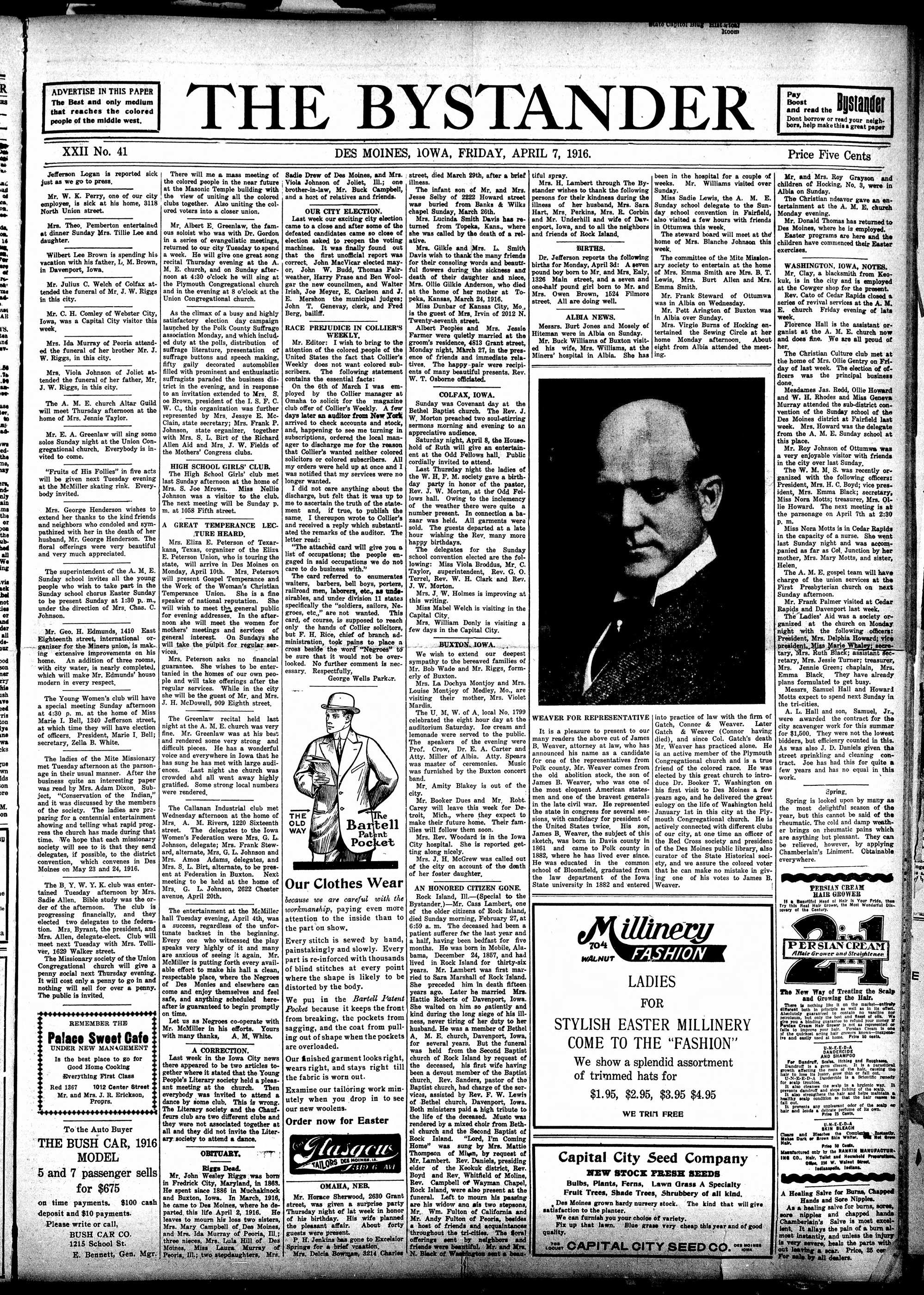
WEAVER FOR REPRESENTATIVE
It is a pleasure to present to our many readers the above cut of James B. Weaver, attorney at law, who has announced his name as a candidate for one of the representatives from Polk county. Mr. Weaver comes from the old abolition stock, the son of James B. Weaver, who was one of the most eloquent American statesmen and one of the bravest generals in the late civil war. He represented the state in congress for several sessions, with candidacy for president of the United States twice. His son, James B. Weaver, the subject of this sketch, was born in Davis county in 1861 and came to Polk county in 1882, where he has lived ever since. He was educated in the common school of Bloomfield, graduated from the law department of the Iowa State university in 1882 and entered
704
WALNUT
Millinery
704
WALNUT
FASHION
LADIES
FOR
STYLISH EASTER MILLINERY
COME TO THE "FASHION"
We show a splendid assortment
of trimmed hats for
$1.95, $2.95, $3.95 $4.95
WE TRIM FREE
street, died March 29th, after a brief illness.
The infant son of Mr. and Mrs. Jesse Selby of 2222 Howard street was buried from Banks & Wilks chapel Sunday, March 26th.
Mrs. Lucinda Smith Davis has returned from Topeka, Kans., where she was called by the death of a relative.
Mrs. Gilkle and Mrs. L. Smith Davis wish to thank the many friends for their consoling words and beautiful flowers during the sickness and death of their daughter and niece, Mrs. Ollie Gilkle Anderson, who died at the home of her mother at Topeka, Kansas, March 24, 1916.
Miss Dunbar of Kansas City, Moe, is the guest of Mrs. Irvin of 2012 N. Twenty-seventh street.
Albert Peoples and Mrs. Jessie Farmer were quietly married at the groom's residence, 4513 Grant street, Monday night, March 27, in the presence of friends and immediate relatives. The happy-pair were recipients of many beautiful presents. Rev. W. T. Osborne officiated.
COLFAX IOWA.
Sunday was Covenant day at the Bethel Baptist church. The Rev. J. W. Morton preached two soul-stirring sermons morning and evening to an appreciative audience. Saturday night, April 8, the Household of Ruth will give an entertainment at the Odd Fellows hall. Public cordially invited to attend. Last Thursday night the ladies of the W. H. F. M. society gave a birthday party in honor of the pastor, Rev. J. W. Morton, at the Odd Fellows hall. Owing to the inclementy of the weather there were quite a number present. In connection a bazaar was held. All garments were sold. The guests departed at a late hour wishing the Rev. many more happy birthdays. The delegates for the Sunday school convention elected are the following: Miss Viola Broddus, Mr. C. Taylor, superintendent, Rev. G. O. Terrel, Rev. W. H. Clark and Rev. J. W. Morton. Mrs. J. W. Holmes is improving at this writing. Miss Mabel Welch is visiting in the Capital City. Mrs. William Donly is visiting a few days in the Capital City.
BUXTON, IOWA
We wish to extend our deepest sympathy to the bereaved families of Mr. Bob Wade and Mr. Riggs, formerly of Buxton. Mrs. La Dochya Montjoy and Mrs. Louise Montjoy of Medley, Mo., are visiting their mother, Mrs. Violet Mardis. The U. M, W. of A. local No. 1799 celebrated the eight hour day at the auditorium Saturday. Ice cream and lemonade were served to the public. The speakers of the evening were Prof. Crow, Dr. E. A. Carter and Atty. Miller of Albia. Atty. Spears was master of ceremonies. Music was furnished by the Buxton concert band. Mr. Amity Blakey is out of the city. Mr. Booker Dues and Mr. Robt. Carey will leave this week for Detroit, Mich., where they expect to make their future home. Their families will follow them soon. Mrs. Rev. Woodard is in the Iowa City hospital. She is reported getting along nicely. Mrs. J. H. McGrew was called out of the city on account of the death of her foster daughter.
AN HONORED CITIZEN GONE.
AN HONORED CITIZEN GONE. Rock Island, Ill.—(Special to the Bystander.)—Mr. Cass Lambert, one of the older citizens of Rock Island, died Sunday morning, February 27, at 6:59 a.m. The deceased had been a patient sufferer for the last year and a half, having been bedfast for five months. He was born in Mobile, Alabama, December 24, 1857, and had lived in Rock Island for thirty-six years. Mr. Lambert was first married to Sara Marshall of Rock Island. She preceded him in death fifteen years ago. Later he married Mrs. Hattie Roberts of Davenport, Iowa. She waited on him so patiently and kind during the long siege of his illness, never tiring of her duty to her husband. He was a member of Bethel A. M. E. church, Davenport, Iowa, for several years. But the funeral was held from the Second Baptist church of Rock Island by request of the deceased, his first wife having been a devout member of the Baptist church, Rev. Sanders, pastor of the Baptist church, had charge of the services, assisted by Rev. F. W. Lewis of Bethel church, Davenport, Iowa. Both ministers paid a high tribute to the life of the deceased. Music was rendered by a mixed choir from Bethel church and the Second Baptist of Rock Island. "Lord, I'm Coming Home" was sung by Mrs. Mattie Thompson of Miken, by request of Mr. Lambert. Rev. Daniels, presiding elder of the Keokuk district, Rev. Boyd and Rev. Whitfield of Moline, Rev. Campbell of Wayman Chapel, Rock Island, were also present at the funeral. Left to mourn his passing are his widow and sis two stepsons, Mr. Wm. Fulton of California and Mr. Andy Fulton of Peoria, besides a host of friends and acquaintances throughout the tri-cities. The Sorral offerings sent by neighbors and friends were beautiful. Mr. and Mrs. N. Black of Washington sent a bear
Capital City Seed Company
BIRTHS.
ALBIA NEWS
been in the hospital for a couple of weeks. Mr. Williams visited over Sunday.
Miss Sadie Lewis, the A. M. E. Sunday school delegate to the Sunday school convention in Fairfield, also visited a few hours with friends in Ottumwa this week.
The steward board will meet at the home of Mrs. Blanche Johnson this week.
The committee of the Mite Missionary society to entertain at the home of Mrs. Emma Smith are Mrs. B. T. Lewis, Mrs. Burt Allen and Mrs. Emma Smith.
Mr. Frank Steward of Ottumwa was in Albia on Wednesday.
Mr. Pett Arington of Buxton was in Albia over Sunday.
Mrs. Virgie Burns of Hocking entertained the Sewing Circle at her home Monday afternoon. About eight from Albia attended the meeting.
THE NEW YORK TIMES
into practice of law with the firm of Gatch, Connor & Weaver. Later Gatch & Weaver (Connor having died), and since Col. Gatch's death Mr. Weaver has practiced alone. He is an active member of the Plymouth Congregational church and is a true friend of the colored race. He was elected by this great church to introduce Dr. Booker T. Washington on his first visit to Des Moines a few years ago, and he delivered the great eulogy on the life of Washington held January 1st in this city at the Plymouth Congregational church. He is actively connected with different clubs of our city, at one time an officer of the Red Cross society and president of the Des Moines public library, also curator of the State Historical society, and we assure the colored voter that he can make no mistake in giving one of his votes to James B. Weaver.
inery FASHION DIES
Pay
Boost
and read the
Dont borrow or read your neighbors, help make this a great paper
Price Five Cents
Mr. and Mrs. Roy Grayson and children of Hocking, No. 3, were in Albia on Sunday.
The Christian endeavor gave an entertainment at the A. M. E. church Monday evening.
Mr. Donald Thomas has returned to Des Moines, where he is employed
WASHINGTON, IOWA, NOTES.
Mr. Clay, a blacksmith from Keokuk, is in the city and is employed at the Cowger shop for the present.
Rev. Cato of Cedar Rapids closed a series of revival services at the A. M. E. church Friday evening of lats week.
Florence Hall is the assistant organist at the A. M. E. church now and does fine. We are all proud of her.
The Christian Culture club met at the home of Mrs. Ollie Gentry on Friday of last week. The election of officers was the principal business done.
Mesdames Jas. Redd, Ollie Howard and W. H. Rhodes and Miss Geneva Murray attended the sub-district convention of the Sunday school of the Des Moines district at Fairfield last week. Mrs. Howard was the delegate from the A. M. E. Sunday school at this place.
Mr. Roy Johnson of Ottumwa was a very enjoyable visitor with friends in the city over last Sunday.
The W. M. M. S. was recently organized with the following officers: President, Mrs. H. C. Boyd; vice president, Mrs. Emma Black; secretary, Miss Nora Mott;s treasurer, Mrs. Ollie Howard. The next meeting is at the parsonage on April 7th at 2:30 p. m.
Miss Nora Motts is in Cedar Rapids in the capacity of a nurse. She went last Sunday night and was accompanied as far as Col. Junction by her mother, Mrs. Mary Motts, and sister, Helen.
The A. M. E. gospel team will have charge of the union services at the First Presbyterian church on next Sunday afternoon.
Mr. Frank Palmer visited at Cedar Rapids and Davenport last week.
The Ladies' Aid was a society organized at the church on Monday night with the following officers: President, Mrs. Delphia Howard; vice president, Miss Marie Whale; secretary, Mrs. Ruth Black; assistant secretary, Mrs. Jessie Turner; treasurer, Mrs. Jennie Green; chaplain, Mrs. Emma Black. They have already plans formulated to get busy.
Messrs. Samuel Hall and Howard Motts expect to spend next Sunday in the tri-cities.
A. L. Hall and son, Samuel, Jr., were awarded the contract for the city scavenger work for this summar for $1,500. They were not the lowest bidders, but efficiency counted in this. As was also J. D. Daniels given the street sprinkling and cleaning contract. Joe has had this for quite a few years and has no equal in this work.
Spring.
Spring is looked upon by many as the most delightful season of the year, but this cannot be said of the rheumatic. The cold and damp weather brings on rheumatic pains which are anything but pleasant. They can be relieved, however, by applying Chamberlain's Liniment. Obtainable everywhere.
15. a. Beautiful Head of Hair Is Your Pride, then
b. A Beautiful Head, the Most Wonderful Dis-
persion of Culture.
2IN1
PERSIAN CREAM
Affair Grower and Straightener
There is nothing like it on the market—intriguing different both in principle as well as in its effect. Petroleum is a natural product, petroleum, but only the best and finest of oils. You give a blender a blinding guarantee that it is not as represented or fails to improve your hair. Persian Cream is one of the most popular products used and easily used at home. Price 50 cents.
U-N-E-E-D-A
DANDERCIDE
AND SHAMPOO
For Dandruff, Scites, Itches and Roughness,
Dandruff is a germ affecting the roots of the hair, causing the hair to lose its luster, grow thin or fall out.
Ointment Dandruff is a scientific remedy for scalp troubles.
It also cleanses the scalp in a hydric way. It is also dandruff and bleaching of the scalp.
It also strengthens the hair and helps maintain a healthy scalp condition so that the hair ceases to itch.
It prevents any unpleasant odor of the scalp or hair and lends a delicate perfume of its own.
Price: $1.00
U.N.-S.E.D.A.
MAIN BLEACH
Clears and bleaches the COMPLEX. Instantly, Maken Dark or Brown Skin Whiter. Not Great Hair.
Price: $50 Cents.
Manufactured only by the RANKIN MANUFACTURING CO. Hair, Toilet and Household Procedures.
Officen 239 W. Walnut Street.
Indianapolis, Indiana.
A Healing Salve for Burns, Chapped Hands and Sore Nipples.
Hands and Sore Nipples. As a healing salve for burns, sores, sore nipples and chapped hands Chamberlain's Salve is most excellent. It allays the pain of a burn almost instantly, and unless the injury is very severe, heals the parts with out leaving a scar. Price. 25 cent. For sale by all dealers.
AFRO-AMERICAN CULLINGS
A few days before he died Booker T. Washington wrote to the editor of the Forum magazine suggesting the printing of an article dealing with the "definite, indisputable facts relating to the Negro's progress as a race." He inclosed what he called a rough outline of such an article, which, of course, was never completed. What he wrote is presented in its unfinished state in the current issue of the magazine.
first he presented striking figures to show Negro progress toward literacy. On emerging from slavery, he wrote, the Negro was not more than 5 per cent literate. The census of 1910 shows that the Negro has reduced his literacy from 65 per cent to 30.4. Contrasting the percentage of illiteracy among Negroes with that of other people, Mr. Washington wrote that "If the Negro had done no more good than lead Greece and Italy in the matter of literacy his showing would have been profoundly significant." His figures show the comparative percentage of illiteracy as follows: Negroes, 65.5; Greece, 57.2; Hungary, 40.9; Italy, 48.2; Poland, 59.3; Portugal, 73.4; Russia, 79.7; Serbia, 19.9; Spain, 75.4; Chile, 49.9; Cuba, 56.8; Mexico, 75.3; Porto Rico, 79.6; India, 92.5; Philippine islands, 55.5; Cape of Good Hope, 65.8; Egypt, 92.7.
Figures were not available for all of the Negro's wealth, but the census bureau gave the value of the Negro's farm property alone as $1,142,000,900, or $116.20 for each Negro in the United States. Comparing this with the statistics of the wealth of nations, Mr. Washington said that, with the exception of Argentina, whose money wealth is $135 per capita, the Negro's wealth is more than twice that of any nation in Africa. Negro he wrote, operated 89,370 farms in 1910, having an increase of 42,279,510, and the value of these farms increased 128.4 per cent during the period of 1901-1910 alone.
As against an estimated value of about $1,000,000 of the 550 Negro churches owned in 1863 he set the value of $56,636,159 of buildings alone of the 36,427 churches and halls owned in 1906. This, he held, indicated not only economic progress but a continuing and increasing devotion to religious life. Starting in 1863 with about 2,000 business enterprises, the Negro has developed in some fifty years over 42,000 business concerns with an annual volume of business of about $1,000,000. Fifty-seven banks are operated by colored people with a capitalization of $1,600,000, and an annual business of about $20,000,000. Among indications of progress in the standard increase of living Mr. Washington cited the increase in the southern states alone of the percentage of homes owned free from incumbrance from 20 per cent in 1900 to 22.4 per cent in 1910. Another indication of the rising standard of living cited is the recent widespread legislation to prevent Negroes from buying property in desirable localities. Progress in health is indicated in a death rate of 3.9 per cent in ten years in a registration area embracing 19.9 per cent of the Negro population. Mr. Washington also quoted census figures to show an increased percentage of Negroes entering skilled industries. In general, he argued that when it was considered that the progress made in the last fifty years by the American Negro had been largely in the face of obstacles, it was great progress.
O. T. Jackson, founder of the Dearman Settlement of colored farmers located in Webb county, Colorado, is a big man of broad views, determined purpose, and tremendously vigorous personality. His outlook is distinctly practical, according to the Southern Workman. He lives to put as many of his race as possible on their feet. At this moment he has a bunch of 250 of them fairly started toward independence. He is deeply conscious of the fact that colored people are of the soil in tastes and capacities, getting them close to the soil. In a word, he is a way and to a deformer. Parker Washington in conviction, purpose and endear. His band of settlers is the pluckiest lot of agricultural toilers of whom I have any knowledge.
"The first year there were only seven families in the settlement," says Mr. Jackson, "and we had only three teams. We managed to get in garden corn, melons, pumpkins, squash, Mexican beans and potatoes. We cleared a few acres of hay ground, removed the sagebrush by hand, the women and children welding grub.
Louis Merriman, a Negro, who was born when George Washington was president of the United States, died at his home in Kansas City, Kan., a short time ago. Merriman was the oldest man on the United States pension rolls, and claimed to have substantiated the fact that he was born 121 years ago on the Sopher plantation, in Virginia, in 1795.
A cutter which can be kept strung on a ball of twine, ready for use, has been patented by a Maryland inventor.
The bootblack business is now followed by the blind. When you take a seat in the chair it is only necessary to tell the attendant whether your shoes are black or tan.
For use in places where acids in water would quickly corrode metals a pump has been invented that is composed almost entirely of wood.
Military photographs of the enemy's position are now made by means of a camera carried aloft on a huge aircraft.
The late Dr. Booker T. Washington graduated from Hampton, and his work was the direct result of Hampton's influence. Maj. Robert R. Moton, successor to Doctor Washington as head of Tuskegee, who spoke in Carnegie hall, Pittsburgh, on the occasion of the Hampton singers' visit March 27, is another product of Hampton.
He hearty endorsement of well-known public men and educators has been given to the work done there. president Woodrow Wilson, William H. Taft, Theodore Roosevelt, Edward Everett Hale, Charles W. Eliot and many others have enthusiastically indorsed the work.
The Hampton quartet, known from coast to coast as the best Afro-American quartet in America, famous for singing of the plantation melodies or spirituals of the South, are the picked musicians from the big choral of 900 voices at Hampton Institute, Virginia. Unique and imitative, it is the only music of this country, except that of the Indians, which can claim to be folk music. These singers make tours to all parts of the country in the interest of the school, and during the past summer won the gold medal at the Panama-Pacific exposition in San Francisco.
Hampton is neither a state nor a government school, and must depend largely upon voluntary contributions for its support. It was founded by Gen Samuel Chapman Armstrong in 1865, and was designed to instruct Afro-American youth in morality, industry and thrift, as well as in earnest and practical Christianity. Ten years later indians were admitted to the Hampton school, which from a humble beginning, with two teachers and 15 students, has gradually developed into an industrial village, with over 1,300 students, 200 teachers and other workers, more than 140 buildings, and an instruction farm of 600 acres. Hampton has sent well over eight thousand men and women, equipped to earn honorable living as farmers and skilled tradesmen. It has imbued in its students a desire to be of service, and by their own homes, their work and their daily life, to act as examples and teachers to the less fortunate among whom they live. Many of its graduates have been tremendous forces in the struggle for advancement.
The New Orleans public school board has arranged for a summer normal school for Negro teachers to be held at Straight university, June 12 to July 21. Superintendent Gwin has appointed Prof. A. Lawless director with the following advisory committee: Mrs. Sylvina Williams, Prof. J. W. Hoffman, Prof. A. Priestly, Mrs. Hattle V. Feger, Florence Lewis and Rev. H. H. Dunn, registrar.
An unusually strong faculty will be secured. Many applications are coming in from rural teachers and from all indications the extension will be much larger this year than last. New Orleans has the distinction of the largest summer normal in the state in 1915. New Orleans offers many superior facilities and advantages in its public and private libraries and the splendid lectures given by some of the finest educators in the country, who are instructors in the Tulane summer normal.
Pacific island of Midway is importing shiploads of soil in order to produce land capable of feeding cattle.
bers as industriously as the men, though not as sturdily perhaps; and after grubbing we plowed, harrowed and burned the remaining brush. Our sufferings were intense, as we had scarcely any wood to burn. Three of our horses died from starvation and the other three were too weak to pull an empty wagon. Now we have 20 teams, 28 cows and calves, 32 breeding hogs, 100 chickens, and all kinds of farming implements and tools. We have 595 acres planted to crops and 300 acres in native hay. Conditions point to a very favorable season and we hope to prove our worth to the soil and the community in which we live by raising a bumper crop, so that our success may be an inceptive to thousands of others of our race to come back to the land in some part of this great divide region."
With less than half her available farming land utilised, the United States produces one-eighth of the world's wheat, four-ninths of its corn, one-fourth of its oats, one-eighth of its cattle, one-third of its hogs, and one-twelfth of its sheep.
A recent invention provides an umbrella frame or sketcher and any suitable number of interchangeable covers therefor, whereby a new cover may be substituted for an old, worn damaged one, or a cover of one color or figure may be substituted for another, according to the costume of a lady carrying the same.
A dinner table reaching around the earth 16 times would be required if the inhabitants of the world set down at a meal together.
The charts of the coast and geodetic survey will be publicly displayed at the leading post offices of the country to get persons familiar with their use.
Several German chemists are endeavoring to find economical processes for the recovery of combustible material from coal ash.
To increase the volume of sound from a schlumberger a Purkinje has been invited to instrument that will stay three seconds simultaneously.
BALKED BY MIRAGE
British Artillery Has Queer Trouble in Arabia.
Evolutions of Troops Are Obscured—
See Infantry Like Trees Moving
and Think Them a Transport
Train.
Sheikh Saad, Arabia—The ground
between the Tigris river and the hills
was the scene of the battle of Sheikh
Saad. The land is maliciously and
fanatically sterile. Even the agoon
and the karnoog come to an end. It
was over this rutty ground that the
transport wagons bumped and jolted
with their freight of wounded on the
evening of January 7.
It was evening when our steamer
moored near the battlefield. We went
out to meet them as they streamed in
over the mud-colored flat, and gave
what aid we could. Many were walking
very erect, some of them with the
stiffness of effort. There were the less
serious wagons. The stretches and
transport wagons came in later. One
was struck with the hardiness and
stotism of the British and Indian
alike.
"Beg you pardon, sir," says a British private; "can you tell me where the ambulance is?" and he deprecates the support of my shoulder, though his calf is bandaged and it is painful for him to put his left foot to the ground. "I am all right, sir; it is nothing serious."
He lifts up his shirt and points to a puncture in his stomach. His face is bloody and bandaged.
"It is nothing," he explains, "took off a bit of my gums."
He will not rest, but moves on towards the distant Red Cross flag and the funnels of the steamer on the river. Here at least should be rest, warm tea and comforts for his wounds. Mesopotamia it is a far cry to but the ammoniac ambulances of France, the rapid transit to the hospital, where an hour or two after he has received first aid doctors and nurses are ready with every saving device that science can provide.
We have heard the guns overnight and again in the morning as our pad-die steamer with its attendant lighters forged up stream. The first shell disturbed a flight of sand grouse which came whealing across the river in such myriads that we who were watching from the roof of the bridge forgot the shells and turned our glasses on the birds—a skim of plumage half a mile long tying itself up in loops in the most complicated evolutions, the van suddenly wheeling around, while the rear, an opposite point, then converged in a hoop. They were dark at one turn, silvery the next, as the sun caught their underwings through the black smoke of a monitor.
The evolutions of our troops on land were obscured by the mirage. We saw infantry like trees moving, and thought them a transport train. Other masses, which could be nothing but artillery, crossed the pontoon bridge ahead of us from the right bank to the left. The mirage does not affect the atmosphere at the height of a bursting shell; we could see the shrapnel smoke unfolding two or three miles from the bank, and wondered if it were Turkish artillery or our own. "Shelling their advance posts" was the general verdict. It was not until later that we realized that the whole force was at grips with the enemy; and it was not until we moored and the converging stream coming in from the trenches that we realized how costly the day had been. The guns we had heard played but a small part in the action, for the mirage had made artillery preparation for our advance ineffectual, and the bulk of our casualties on both banks of the stream had occurred in frontal attacks on the enemy's position.
As I write we are moving on to attack a new position, and it is not the moment yet for a detailed account of the action.
FUNERAL WAITS FOR COFFIN
She and Her Husband Selected Walnut Lumber From Their Farm, but There Was Delay.
St. Louis.—The funeral of Mrs. Anton Wenkee of Edwardsville, Ill., was delayed until a coffin could be made from a walnut tree of her "home place." Mrs. Wenkee and her husband, three years ago, picked out the walnut tree on their farm from which to have their coffins made. It was sawed into boards, which were permitted to season until last June, when Wenkee took the lumber to a plaining mill and ordered it made into coffins. Wenkee was then eighty years old, and his wife was seventy-seven. The work of making the caskets was put off. When Mrs. Wenkee died, rather unspectfully, orders were given to rush one of the coffins to completion. Mrs. Wenkee was the daughter of Anton Louis, a pioneer St. Louis drugist.
Finda Coin Minted In 1790
Frederickkursburg, Tex.-Arthur Kuenemann found a silver coin on his lot here which was found to have been mined in 1790 under Francis II, emperor of Germany, king of Bohemia and Hungary. The coin is the size of a silver dollar and in a fair state of preservation.
Electric Lamp Tells In Tub as Woman an Reads and Charges Water.
Toledo, Q.—While Wife, Josephine Bellows, twenty-two, was sitting in a bath tub in her apartment and reading a magazine as the tub was filling, an electric lamp toppled into the tub, broke and charged the water with electricity, killing her instantly.
Neighbors heard her scream, but
ROMPS IN THE TRENCHES
THE BYSTANDER
TO HAVE HIS HEART'S WISH
INTERNATIONAL
NEWS SERVICE
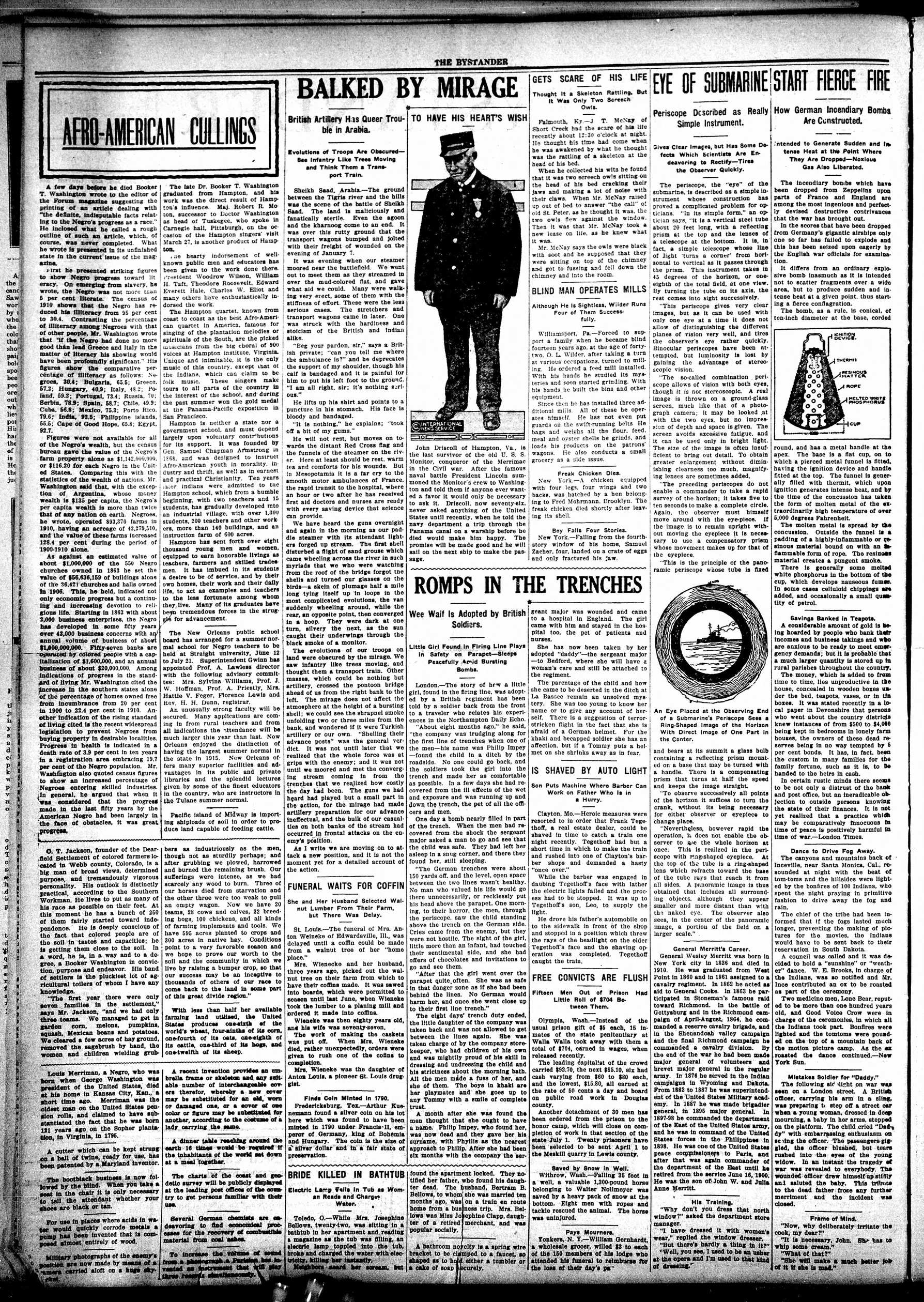
John Driscoll of Hampton, Va., is the last survivor of the old U. S. S. Monitor, conqueror of the Merrimac in the Civil war. After the famous naval battle President Lincoln summoned the Monitor's crew to Washington and told them if anyone ever wanted a favor it would only be necessary to ask it. Driscoll, now seventy-air, never asked anything of the United States until recently, when he told the navy canal on a warship before he died would make him happy. The promise will be made good and he will sail on the next ship to make the passage.
Wee Wail Is Adopted by British Soldiers.
Little Girl Found in Firing Line Plays in Safety on Parapet—Sieeps Peacefully Arid Bursting Bombs.
London.—The story of how a little girl, found in the firing line, was adopted by a British regiment has been told by a soldier back from the front to a traveler who relates his experiences in the Northampton Daily Echo. "About eight months ago," he said, "the company was trudging along for the first line of trenches when one of the men—his name was Philip Impey—found the child in a bar the readable. No one could back and the soldiers took the girl into the trench and made her as comfortable as possible. In a few days she had recovered from the ill effects of the wet and exposure and was running up and down the trench, the pet of all the officers and men.
One day a bomb nearly filled in part of the trench. When the men had recovered from the shock the sergeant major asked a man to go and see that the child was safe. They had left her sleep in a snug corner, and there they found her, still sleeping.
"The German trenches were about 150 yards off, and the level, open space between the two lines wasn't healthy. No man who valued his life would go there unnecessarily, or recklessly put his head above the parapet. One morning, to their horror, the men, through the periscope, saw the child standing above the trench on the German side. Cries came from the enemy, but they were not hostile. The sight of the girl, little more than an infant, had touched their sentimental side, and she had offers of chocolates and invitations to go and see them.
"After the girl went over the parapet quite often. She was as safe in that danger zone as if she had been behind the lines. No German would harm her, and once she went close up to their first line trench."
The eight days' trench duty ended, the little daughter of the company was taken back and was not allowed to get between the lines again. She was taken charge of by the company storekeeper, who had children of his own and was mightily proud of his skill in dressing and undressing the child and his strictness about the morning bath. All the men made a fuss of her, and she of them. The boys in khaki are her playmates and she goes up to any Tommy with a smile of complete trust. A month after she was found the men thought that she ought to have a name. Philip Imphey, who found her, was now dead and they gave her his surname, with Phyllis as the nearest approach to Philip. After she had been six months with the company the ser-
found the apartment locked. They notified her father, who found his daughter dead. The husband, Bertram B. Bellows, to whom she was married ten months ago, was on a train en route home from a business trip. Mrs. Bellows was Miss Josephine Clapp, daughter of a retired merchant, and was popular socially.
A bathroom novelty is a spring wire bracket to be clamped to a faucet, so shaped as to hold either a tumbler or a cake of soap securely.
GETS SCARE OF HIS LIFE
Thought It a Skeleton Rattling. But It Was Only Two Screech Owls.
Palmouth, Ky.-J. T. McNzy of Short Creek had the scare of his life recently about 12:30 o'clock at night. He thought his time had come when he was awakened by what he thought was the rattling of a skeleton at the head of his bed.
When he collected his wits he found that it was two screech owls sitting on the head of his bed cracking their jaws and making a lot of noise with their claws. When Mr. McNzy raised up out of bed to answer "the call" of old St. Peter, as he thought it was the two owls flew against the window. Then it was that Mr. McNzy took a new lease on life, as he knew what it was. Mr. McNzy says the owls were black with soot and he supposed that they were sitting on top of the chimney and got to fussing and fell down the chimney and into the room.
BLIND MAN OPERATES MILLS
Although He is Sightless, Wilder Runs
Four of Them Successfully.
Williamsport, Pa.—Forced to support a family when he became blind fourteen years ago, at the age of forty-two, O. L. Wilder, after taking a turn at various occupations, turned to milling. He ordered a feed mill installed. With his hands he studied its mysteries and soon started grinding. With his hands he built the bins and other equipment.
Since him in he has installed three additional mills. All of these he operates himself. He has not even put guards on the swift running belts he bags and weighs all the flour, feed, meal and oyster shells he grinds, and loads his products on the patron's wagons. He also conducts a small grocery as a side issue.
Freak Chicken Dies
New York.—A chicken equipped with four legs. four wings and two backs, was hatched by a hen bisoning to Fred Mohmmann. Brooklyn. The freak chicken died shortly after leaving its shell.
Boy Falls Four Stories
New York—Falling from the fourth story window of his home, Samuel Zacher, four, landed on a crate of eggs and only fractured his 'law.
geant major was wounded and came to a hospital in England. The girl came with him and stayed in the hospital too, the pet of patients and nurses.
She has now been taken by her adopted "daddy"—the sergeant major—to Bedford, where she will have a woman's care and still be attached to the regiment.
The percentage of the child and how she came to be deserted in the ditch at La Basse remain an unsolved mystery, too young to know her name or to give her self. There is a suggestion of terror-strecken flight in the fact that she is afraid of a German helmet. For the khaki and becapped soldier she has an affection, but if a Tommy puts a helmet on she shrinks away as in fear.
IS SHAVED BY AUTO LIGHT
Son Puts Machine Where Barber Can Work on Father Who Is in a Hurry.
Clayton, Mo.-Heroic measures were resorted to in order that Frank Tegethoff, a real estate dealer, could be shaved in time to catch a train one night recently. Tegethoff had but a short time in which to make the train and rushed into one of Clayton's barber shops and demanded a hasty "once over."
While the barber was engaged in dabbling Tegethoff's face with lather the electric lights failed and the process had to be stopped. It was up to Tegethoff's son, Leo, to supply the light.
He drove his father's automobile on to the sidewalk in front of the shop and stopped in a position which threw the rays of the headlight on the older Tegethoff's face and the shaving operation was completed. Tegethoff caught the train.
FREE CONVICTS ARE FLUSH
Fifteen Men Out of Prison Had Little Roll of $704 between Them.
Olympia, Wash.-Instead of the usual prison gift of $5 each, 15 inmates of the state penitentiary at Walla Walla took away with them a total of $704, earned in wages, when released recently.
The leading capitalist of the crowd carried $92.70, the next $55.10, six had cash varying from $60 to $80 each, and the lowest, $15.80, all earned at the rate of 50 cents a day and board on public road work in Douglas county.
Another detachment of 30 men has been ordered from the prison to the honor camp, which will close on completion of work in that section of the state July 1. Twenty prisoners have been selected to be sent April 1 to the Measkill quarry in Lewis county.
Saved by Snow in Well
Withrow, Wash.—Falling 35 feet in a well, a valuable 1,300-pound horse belonging to Walter Nollmeyer was saved by a heavy pack of snow at the bottom. Eight men with ropes and tackle rescued the animal. The horse was uninjured.
Pays Mourners.
Yonkers, N. Y.—William Gernhardt, a wholesale grocer, willed $3 to each of the 150 members of his lodge who attended his funeral to reimburse for the loss of their day's pa-
Periscope Described as Simple Instrument.
Gives Clear Images, but Has Some Defects Which Scientists Are Endeavoring to Rectify—Tires the Observer Quickly.
The periscope, the "eye" of the submarine, is described as a simple instrument whose construction has proved a complicated problem for opticians. "In its simple form," an optician says, "it is a vertical steel tube about 20 feet long, with a reflecting prism at the top and the lenses of a telescope at the bottom. It is, in fact, a simple telescope whose line of light 'turns a corner' from horizontal to vertical as it passes through the prism. This instrument takes in 45 degrees of the horizon, or one-eighth of the total field, at one view. By turning the tube on its axis, the rest comes into sight successively.
"This periscope gives very clear images, but as it can be used with only one eye at a time it does not allow of distinguishing the different planes of vision very well, and tires the observer's eye rather quickly. Binocular periscope have been attempted, but luminosity is lost by gaining the advantage of stereoscopic vision. The so-called combination periscope allows of vision with both eyes, though it is not stereoscopic. A real image is thrown on a ground-glass screen, much like that of a photograph camera; it may be looked at with the two eyes and no space in the image is given. The screen avoids excessive fatigue, and it can be used only in bright light. The size of the image is often insufficient to bring out detail. To obtain greater enlargement without diminishing clearness too much, magnifying lenses are sometimes added.
The preceding periscope do not enable a commander to take a rapid survey of the horizon; it takes five to ten seconds to make a complete circle. Again, the observer must himself move around with the eye-piece. If the image is to remain upright without moving the eyepiece, the panoramic prism whose movement makes up for that of the eyepiece.
*This is the principle of the panoramic periscope whose tube is fixed*
An Eye Placed at the Observing End of a Submarine's Periscope Sees a Ring-Shaped Image of the Horizon With Direct Image of One Part in the Center.
and bears at its summit a glass bulb containing a reflecting prism mounted on a base that may be turned with a handle. There is a compensating prism that turns at half the speed and keeps the image straight.
"To observe successively all points of the horizon it suffices to turn the crank, without its being necessary for either observer or eyepiece to change place.
"Nevertheless, however rapid the operation, it does not enable the observer to see the whole horizon at once. This is realized in the periscope with ring-shaped eyepiece. At the top of the tube is a ring-shaped base of the tube rays that reach it from all sides. A panoramic image is thus obtained that includes all surrounding objects, although they appear smaller and more distant than with the naked eye. The observer also sees, in the center of the panoramic image, a portion of the field on a larger scale."
General Merritt's Career
General Wesley Merritt was born in New York city in 1836 and died in 1910. He was graduated from West Point in 1860 and in 1861 assigned to a cavalry regiment. In 1862 he acted as aid to General Cooke. In 1863 he participated in Stoneman's famous raid toward Richmond. In the battle of Gettysburg and in the Richmond campaign of April-August, 1864, he commanded a reserve cavalry brigade, and in the Shenandoah valley campaign and the final Richmond campaign he commanded a cavalry division. By the end of the war he had been made major general of volunteers and brevet major general in the regular army. In 1876 he served in the Indian campaigns in Wyoming and Dakota. From 1882 to 1887 he was superintendent of the United States Military academy. In 1887 he was made brigadier general, in 1895 major general. In 1897-98 he commanded the department of the East of the United States army, and he was in command of the United States forces in the Philippines in 1898. He was one of the United States peace commissioners to Paris, and after that was again commander of the department of the East until he retired from the service June 16, 1900. He was the son of John W. and Julia Anne Merritt.
"Why don't you dress that north window?" asked the department store manager. "We dressed it with women's wear," replied the window dresser. "But there's hardly a thing in it." "Well, you see, I used to be an usher at the opera and I'm used to that kind of dressing."
intended to Generate Sudden and in intense Heat at the Point Where They Are Dropped—Noxious Gas Also Liberated.
The incendiary bombs which have been dropped from Zeppelins upon parts of France and England are among the most ingenious and perfectly devised destructive contrivances that the war has brought out.
In the scores that have been dropped from Germany's gigantic airships only one so far has failed to explode and this has been seized upon eagerly by the English war officials for examination.
It differs from an ordinary explosive bomb inasmuch as it intended not to scatter fragments as it宽ened a wide area, but to bomb and intense heat at a given point, thus starting a fierce conflagration.
The bomb, as a rule, is conical, of ten-inch diameter at the base, corded
round, and has a metal handle at the apex. The base is a flat cup, on to which a pierced metal funnel is fitted, having the ignition device and handle fitted at the top. The funnel is generally filled with thermi, which upon ignition generates intense heat, and by the time of the concussion has taken the form of molten metal of the extraordinarily high temperature of over 5,000 degrees Fahrenheit.
The molten metal is spread by the concussion. Outside the funnel is a padding of a highly-inflammable or resinous material bound on with an inflammable form of rope. The resinous material creates a pungent smoke. There is generally some melted white phosphorus in the bottom of the cup, which develops nauseous fumes. In some cases celluloid chippings are added, and occasionally a small quantity of petrol.
Savings Banked In Teapota
A considerable amount of gold is being hoarded by people who bank their incomes and business takings and who are anxious to be ready to meet emergency demands; but it is probable that a much larger quantity is stored up in rural parishes throughout the country. The money, which is added to from time to time, lies unproductive in the house, concealed in wooden boxes under the bed, teapots, vases, or in tin boxes. It was stated recently in a local paper in Devonshire that persons who went about the country districts knew instances of from $500 to $4,000 being kept in bedrooms in lonely farm houses, the owners of the dead reserves being in no way tempted by 5 per cent bonds. It has, in fact, the custom in many families for the family fortune, such as it is, to be handed to the heirs in cash.
In certain rustic minds there seems to be not only a distrust of the bank and post office, but an inerable objection to outside persons knowing the state of their finances. It is not unreasonable to assume that they may be comparatively innocuous in time of peace is positively harmful in time of war—London Times.
Dance to Drive Fog Away.
The canyons and mountains back of Incievel, near Santa Monica, Cal., resounded at night with the beat of tomtoms and the hillsides were lighted by the bonfires of 100 Indians, who spent the night praying in primitive fashion to drive away the fog and rain.
The chief of the tribe had been informed that if the fogs lasted much longer, preventing the making of pictures for the movies, the Indians would have to be sent back to their reservation in South Dakota.
A council was called and it was decided to hold a "sunshine" or "weather" dance. W. E. Brooks, in charge of the Indians, was so notified and Mr. Ince contributed an ox to be roasted as part of the ceremony.
Two medicine men, Lone Bear, reputed to be more than one hundred years old, and Good Voice Crow were in charge of the ceremonies, in which all the Indians took part. Bonfires were lighted and the tomtoms were pounded on the top of a mountain back of the motion picture camp. As the roasted the dance continued.—New York Sun.
Mistakes Soldier for "Daddy."
The following six sleet on war was seen on a London street. A British officer, carrying his arm in a sling, was preparing it step off a street car when a young woman, dressed in deep mourning, a baby in her arms, stepped on the platform. The child cried "Dad,dy" with embarrassing enthusiasm on seeing the officer. The passengers giggle, the officer blushed, but tears rushed into the eyes of the young widow. In an instant the tragedy of war was revealed to everybody. The wounded officer drew himself up stiffly and saluted the baby. This tribute to the dead father froze any further merriment and the incident was closed.
Frame of Mind.
"Now, why deliberately irritate the cook, my dear!"
"It is necessary, John. She has to whip some cream."
"What of that!"
"She will make a much better job of it if she is mad."
WIRELESS AND WIT COVERED GOEBEN FLIGHT
With Breslau, Watched on One Route, She Got to Turkey by Another.
FLASHES TOLD EVERY MOVE
Fooled British as to Destination,
Changed Course and Jammed Enemy's Wireless So Warships
Could Not Be Advised.
London.—A pictureque account of the thrilling escape of the Goeben and the Breslau to the Dardanelles at the beginning of the war is contained in a book which is considered an instant in Germany. The author, Emi Ludwig, who says that the facts were gathered from sources of unquestioned reliability, asserts that the two German warships owe their escape from the British pursuit to a remarkable wireless device. He also says that the British fleet was so certain of the enemy cruisers' intention to gain an Austrian port in the Adriatic that special precautions were taken to guard the Strait of Oranto, thus leaving to the Germans a clear road from Messina to Constantinople.
There is evidence that the author has had access to the log book of the Goeben, and that he also received first hand information regarding the flight from the commander in chief, Vice-Admiral Souchon.
Vice-Admiral Souchon, it appears from the book, was informed on June 28, 1914, by wireless of the murder of the archduke, and later—the exact date is not given, but judging by the context it would seem to have been toward the middle of July—the following wireless message reached the Goeben from the German admiralty staff at Berlin:
"German ships must not touch French and English harbors."
Exchanged Courtesies.
Officers and men of the Goeben working in the wireless room in relays of four hours at a time for ten days flashed the message to German ships in the Mediterranean, the Black sea and the Atlantic ocean.
The writer dates the story of the flight from July 30, when he says the crew of the Breslau gave cheers for the British destroyers Defence and Raccoon, which she encountered. The cheers were promptly returned. On the evening of the same day the Breslau received the following message from the British "ship of the lino" Gloucester: "Tomorrow an English sailor is to be buried; please run your flag down to half mast." An invitation was extended to the British officers to come on board the Breslau for the following evening. Obviously only the staff knew then the possibilities of the European situation. The Gloucester disappeared during the night. Four days later the Gloucester was chasing the Breslau through the Mediterranean sea.
On the same morning on which the British ship had disappeared an order came from the admiral that the Breslau should leave for Brindish, there to await instructions. The Breslau welged anchor and rushed away at twenty-eight miles an hour toward Brindish. On the way the following emphatic message was received by the admiral: "Political relations broken off between Triple Alliance and France, Russia and Great Britain." A one o'clock in the afternoon of August 1 the Breslau came alongside the Goeben before Brindish. A third ship, the German passenger finer General, joined the warships at about the same time, having been called thither by the admiral. The three ships arrived at Messina on August 2.
At one o'clock on the morning of August 3 the Goeben and Breslau put to sea. Only the staff knew why and whither. Throughout the next day, proceeds the writer, Souchen anxiously awaited news by wireless, and it was not before six o'clock in the evening that an officer slipped on to the bridge with the following deciphered message:
"France has declared war."
"Coal like the devil," said the admiral a little later. "We shall see the Algerian coast at dawn and get the first shot in." At two minutes to midnight the following wireless message was handed to the admiral:
"Breslau and Goeben must steam with all speed to Constantinople."
The message was "unexpected, startling; almost incredible."
The admiral resolved to give his blow in at the first hour. Algerian, and the Goeben Philippine, and the admiral had intercepted French wireless messages which indicated a belief that "the German cruiser" was continuing westward.
At 10:50 in the morning the two German ships sighted two British ships, Invincible and Inflexible. Later a third British vessel, of the Weymouth class, joined the latter. At eleven o'clock that night the wireless officer decliphered by means of his lamp and code book the following message received from Norddeich: "England has declared war." The admiral and his staff were not surprised, but the crew, when the
LOCOMOTIVES IN TRENCHES
Unique Gas Engines to Haul the Supplies Ordered Here From Russia.
Philadelphia.—An order for 350 gas line locomotives, to be used in the trenches on the eastern battle front, has been placed by the Russian government. These engines, of unique construction, will travel on tracks two feet apart, and will virtually be automobiles on rails. The engines will weigh seven
news was communicated to them, "became quiet." At four o'clock in the morning of August 5 the two ships reached Messina. The General was waiting there laden with coal, but the representatives of the Italian government refused on grounds of neutrality to allow the warships themselves to coal there.
Thanked to Deceive British.
On the evening of the same day another shock occurred. An Italian officer "representing the commander at Messina" arrived and was ushered into the admiral's dining room. The admiral asked him to take a seat, but he preferred to ask "What may I do for you?" asked the admiral. "We want to know," replied the officer (in German), "how long the German ships propose to remain here. They can only remain twenty-four hours in a neutral port." The semi-official writer observes, "The last words came with difficulty from the Italian's lips." "Very well, I will remain here twenty-four hours," replied the admiral. There was a pause. "Of course I reckon the respite from this moment in which you inform me that Messina is, in fact, a neutral port."
At midday on August 6 the admiral issued the following order to the three ships under his command: "News about the enemy is uncertain. I presume his strength lies in the Adriatic and that he is watching both exits in the Messina straits.
"Object: To break through to the East and reach the Dardanelles.
"Order of going: Goeben leaves at five o'clock at seventeen miles an hour; Breslau follows at a distance of five miles and closes it up at darkness.
"I want to create the impression that we are wanting to go to the Adriatic, and in case I do succeed in creating the impression that we are wanting to go to the Adriatic we shall rear run in the night and make for Cape Matapan, if possible throwing off the enemy.
"The steamer General to leave at seven o'clock in the evening, to keep along the Sicilian coast and to try and recapture the city.
"As the ships—flags flying and music playing—were reaching the open sea the following wireless message from the kaiser reached the admiral:
"Hie majesty expects the Goeben and the Breslau to succeed in breaking through."
Shortly after leaving the harbor an English cruiser of the Weymouth class, alleged to be the Gloucester, appeared on the horizon. The German narrative proceeds: Profiled by Enemy's Wrong Guess. "The commander asked the admiral whether they should open fire. 'No, no.' Astonishment. The wireless officers were even more puzzled. The could hear the wireless waves being transmitted by the operators on the E-glish cruiser. They did not know the code, but they noted the call and the answer. The German boats were evidently expected, and all preparations for attacking them. were being made." The English cruiser was emitting signals in three groups, and it was clear that it referred to the Goeben. "The wireless receivers finally de-derered the signal of the British cruiser as 'Goeben making for the Adratic.'
"The German wireless officer argued thuswise: 'I can jam him. If I break my waves against his I can confuse, hold up, destroy his messages.' Shall I jam his wireless?" he added. "No, 'wave the answer to both questions. No one apart from the staff."
BASIL DENISSOFF
M. B.
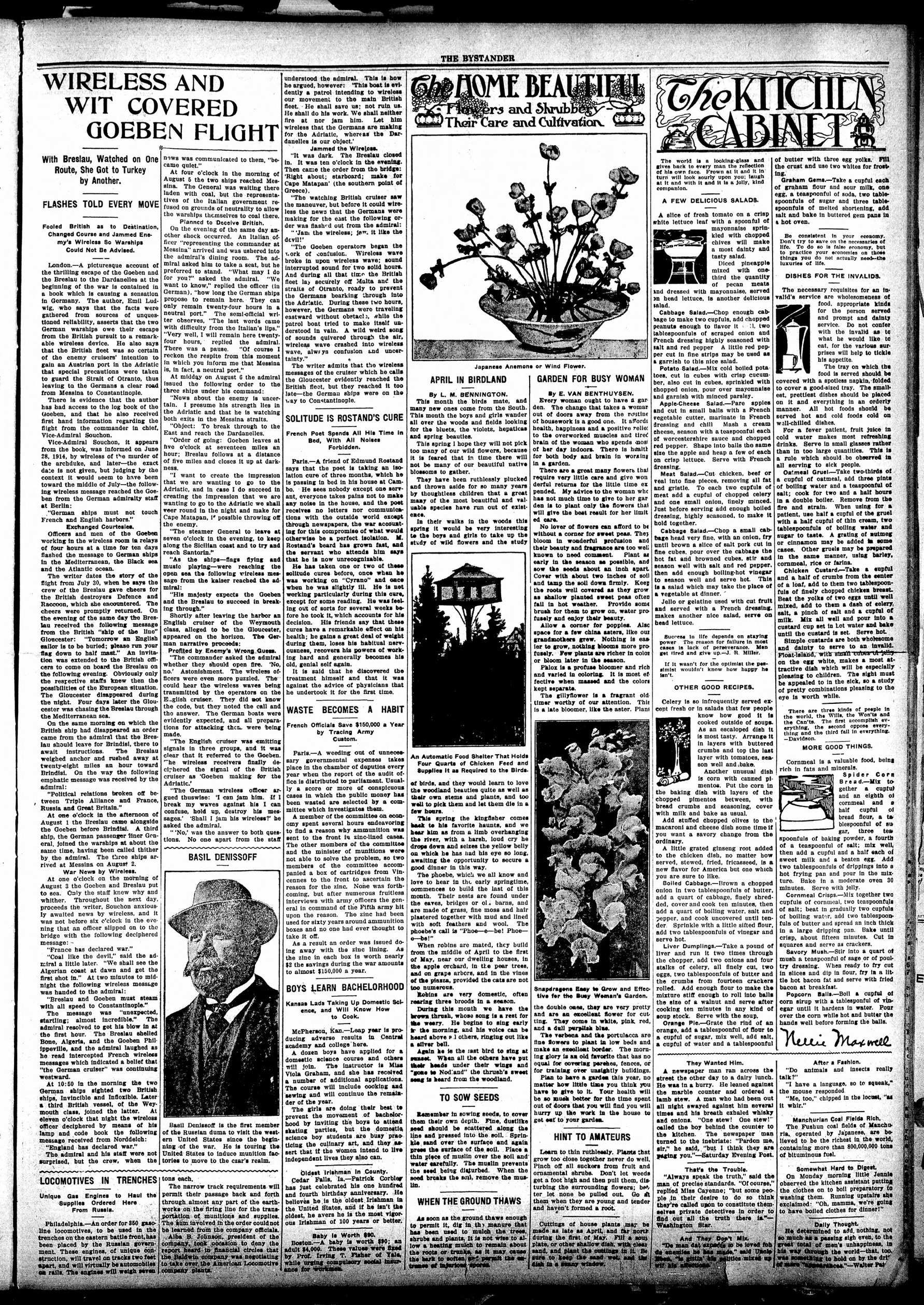
Basil Donissoff is the first member of the Russian duma to visit the western United States since the beginning of the war. He is touring the United States to induce munition factories to move to the czar's realm.
tons each.
The narrow track requirements will permit their passage back and forth through almost any part of the earthworks on the firing line for the transportation of munitions and supplies.
Thekm involved in the order could not be learned from the company officials.
Alba B. Johnson, president of the company, took occasion to deny the report heard in financial circles that the Baldwin company was negotiating to take over the American Locomotive company plants.
understood the admiral. This is how he argued, however: "This boat is evidently a patrol intending to wireless our movement to the main British fleet. He shall save us; not ruin us. He shall do his work. He shall neither fire at nor jam him. Let him wireless that the Germans are making for the enemy as the Dardanelles is our object." I laughed the Wireless.
"It was dark. The Breslau closed in. It was ten o'clock in the evening. Then came the order from the bridge: 'Right about; starboard; make for Cape Matapan' (the southern point of Greece). "The watching British cruiser saw the maneuver, but before it could wireless the news that the Germans were making for the cast the following der was flash'd out from the dmiral; him the wireless; Jew, it like the devil."
"The Goeben operators began the work of confusion. Wireless wave broke in upon wireless wave; sound interrupted sound for two solid hours. And during all that time the British fleet lay securely off Malta and the straits of Ornato, ready to prevent the Germans bearkring through into the Adratic. During these two hours, however, the Germans were traveling eastward without obstacle, while the patrol boat tried to make itself understood in vain. A wild welling song of sounds quivered. The wireless wave crashed into wireless waves confusion and uncertainty."
The writer admits that the wireless messages of the cruiser which he calls the Gloucester evidently reached the British fleet, but they reached it too late—the German ships were on the way to Constantinople.
SOLITUDE IS ROSTAND'S CURE
French Post Spends All His Time In Bed, With All Noises Forbidden.
Paris.—A friend of Edmund Rostand says that the poet is taking an isolation cure of three months, which he is passing in bed in his house at Cambo. He sees nobody except one servant, everyone takes pains not to make any noise in the house, and the poet receives no letters nor communications with the outside world except through newspapers, the war accounting for this compulsory task. He is perfect isolation. M. Rostand's beard has grown fast, and the servant who attends him says that he is now unrecognizable.
He has taken one or two of these solitude cures before, once when he was working on "Cryano" and once when he was slightly ill. He is not working particularly during this cure, except for some reading. He was feeling out of sorts for several weeks before he took it, which accounts for his decision. His friends say that these cures have a remarkable effect on his health; he gains a great deal of weight during the recovery, and he loses his powers of working hard and generally becomes his old, genial self again.
It is said that he discovered the treatment himself and that it was against the advice of physicians that he undertook it for the first time.
WASTE BECOMES A HABIT
French Officials Save $150,000 a Year by Tracing Army Custom.
Paris. A weeding out of unnecessary governmental expenses takes place in the chamber of deputies every year when the report of the audit office is distributed to parliament Usually by a score, or of conspicuous cases in which the public money has been wasted are selected by a committee which investigates them.
A member of the committee on economy spent several hours endeavoring to find a reason why ammunition was sent to the front in zinc-lined cases. The other members of the committee and the minister of munitions were not able to solve the problem, so two members of the committee accompanied a box of cartridges from Vincennes to the front to ascertain the reason for the zinc. None was forthcoming, but after numerous fruitless interviews with army officers the general in command of the unit built upon the reason. The zinc had been used for thirty years around ammunition and no one had ever thought to take it off.
As a result an order was issued doing away with the zinc lining. As the zinc in each box is worth nearly $2 the savings during the war amounts to almost $150,000 a year.
BOYS LEARN BACHELORHOOD
Kansas Lads Taking Up Domestic Science, and Will Know How to Cook.
McPherson, Kan.-Leap year is producing adverse results in Central academy and college here.
A dozen boys have applied for a domestic science course and others will join. The instructor is Miss Viola Graham, and she received a number of additional applications. The course will include cooking and sewing and will continue the remainder of the year.
The girls are doing their best to prevent the movement of bachelorhood by inviting the boys to attend skating parties, but the domestic science boy students are busy practicing the culinary art, and they assert that if the women intend to live independent lives they also can.
Oldest Irishman In County
Cedar Falls, In.—Patrick Corbies has just celebrated his one hundred and fourth birthday anniversary. He believes he is the oldest Irishman in the United States, and if he isn't the oldest, he hears he is the most vigorous Irishman of 100 years or better.
Baby is Worth $90.
Boston—A baby is worth $90; an adult $4,000. These values were fixed by Prof. Irv. Wright T. Fisher of Yale, while urging compulsory social insurance for workmen.
THE BYSTANDER
The HOME
Flowers and
Their Care and
The HOME BEAUTIFUL
Flowers and Shrubbery
Their Care and Cultivation
Poppies in a bowl
Japanese Anemone or Wind Flower.
APRIL IN BIRDLAND
B. J. M. BENNINGTON
BY L. M. BENNINGTON.
This month the birds mate, and many new ones come from the thicket. The thicket is a girl wander all over the woods and fields looking for the bluets, the violets, hepaticas and spring beauties.
This spring I hope they will not pick too many of our wild flowers, because it is feared that in time there will not be many of our beautiful native blossoms to gather.
They have been ruthlessly plucked and thrown aside for so many years by thoughtless children that a great many of the most beautiful and valuable species have run out of existence.
In their walks in the woods this spring it would be very interesting to the boys and girls to take up the study of wild flowers and the study
THE TOWER
An Automatic Food Shelter That Holds Four Quartz of Chicken Feed and Supplies it as Required to the Birds-of birds, and they would learn to love the woodland beauties quite as well as their own stems and plants, and too well to pick them and let them die in a few hours.
This spring the kingfisher comes back to his favorite haunts, and he hear him as from a limb overhanging the river, with a harsh, loud cry he drops down and seizes the yellow belly on which he has had his eye so long, awaiting the opportunity to secure a good dinner. This we the Phoebe which we all know and love to hear in the early springtime, come to build the last of this month. Their nests are found under the caves, bridges or o. l. barns, and are made of grass, fine moss and hair plastered together with mud and lined with soft feathers and wool. The phoebe's call is "Phoose—e-bel! Phoebe—e-bel!"
When robins are mated, they build from the middle of April to the first of May, near our dwelling houses, in the apple orchard, in the pear trees, and on grape arbors, and in the vines of the piazza, provided the cats are not too numerous.
Robins are very domestic, oftenearing three broods in a season.
During this month we have the brown thrush, whose song is a rest for the weary. He begins to sing early in the morning, and his voice can be heard above 1 others, ringing out like a silver bell.
Again he is the last bird to sing at sunset. When all the others have put their heads under their wings and "gone to Nod." the thrush's sweet song is heard from the woodland.
TO SOW SEEDS
Remember in sowing seeds, to cover them their own depth. Fine, dustlike seed should be scattered along the line and pressed into the soil. Sprinkle sand over the surface and again press the surface of the soil. Place a thin piece of muslin over the soil and water earth with water until it is being disburbed. When the seed breaks the soil, remove the muslin.
WHEN THE GROUND THAWS
As soon as the ground thaws enough to permit it, dig in the manure that has been used to muck the trees, shrubs and plants. It is not wise to allow a heating mulch to remain about the roots or trunk, as it may cause the bark to soften per- permit the entrance of infiltrating roots.
GARDEN FOR BUSY WOMAN
By E. VAN BENTHUYSEN.
Every woman ought to have a garden. The change that takes a woman out of doors away from the routine of housework is a good one. It affords health, happiness and a positive relief to the overworked muscles and tired brain of the woman who spends most of her day indoors. There is health for both body and brain in working in a garden.
There are a great many flowers that require very intimate care and give wonderful joy for the little time ex-pended. My advice to the woman who has not much time to give to her gar丹 is to plant only the flowers that will give the best result for her limited care.
No lover of flowers can afford to be without a corner for sweet peas. They bloom in wonderful profusion and their beauty and fragrance are too well known to need comment. Plant as early in the season as possible, and sow the seeds on an inch apart. Cover with about two inches of soil and tamp the soil down firmly. Keep the roots well covered as they grow as shallow planted sweet peas often fall in hot weather. Provide some brush for them to grow on, water profusely and enjoy their beauty.
Allow a corner for poppies. Also space for a few china asters, like our grandmothers grew. Nothing is easier to grow, nothing blooms more profusely. Few plants are richer in color or bloom later in the season. In water they are rich and varied in coloring. It is most effective when massed and the colors kept separa.
The gillyflower is a fragrant old-timer worthy of our attention. This is a late bloomer, like the aster. Plant
```markdown
```
Snappagrades Easy to Grow and Effective for the Busy Woman's Garden.
the double ones, they are very pretty and are an excellent flower for cutting. They come in white, pink red, and a dull purple blue.
The verbena and the portulacae are fine flowers to plant in low beds and make an excellent border. The morning glory is an old favorite that has no equal for covering perches, fences, or for training over unightly buildings.
Plan to have a garden this year, no matter how little time you think you have to give to it. Your health will be so much better for the time spent out of doors that you will find you will hurry up the work in the house to get eat to your garden.
HINT TO AMATEURS
Learn to thin ruthlessly. Plants that grow too close together never do well. Pinch off all suckers from fruit and ornamental shrubs. Don't let weeds get a foot high and then pull them, disturbing the surrounding flowers; be careful not to damage them when they are young and tender and haven't formed a root.
____
Cuttings of house plants may be made as late as April, and far north during the first of May. Fill a soil plate, or other shallow dish, with clear sand, and plant the cuttings in it. Be sure to keep the sand wet, and the dish in a sunny window.
The KITCHEN CABINET
The world is a looking-glass and gives back to every man the reflection of his own face. Frown at it and it in turn will look sourly upon you; laugh at and with it and it is a jolly, kind companion.
of butter with three egg yolks. Flat the crust and use two whites for frozing.
Graham Gems.—Take a cupful each of graham flour and sour milk, on
A FEW DELICIOUS SALADS.
A slice of fresh tomato on a crisp
white lettuce leaf with a spoonful of
tomato on a crisp
with a spoonful of
mayonnaise sprinkled
with chopped
peppers a most
daisy and
tasty salad.
H
Diced pineapple mixed with one-third the quantity of pecan meats and dressed with mayonnaise, served on head lettuce, is another delicious salad.
Cabbage Salad—Chop enough cabbage to make two cupfuls, adpped peanuts enough to flavor it. It two tablespoonfuls of scraped onion and French dressing highly seasoned with salt and red pepper A little red pepper cut in fine strips may be used as a garnish to this nice salad.
Potato Salad—Mix cold boiled potatoes, cut in cubes with crisp cucumber, also cut in cubes, sprinkled with chopped onion, pour over mayonnaise and garnish with minced parsley.
Apple-Cheese Salad—Pare apples and cut in small bails with a French vegetable cutter, marinate in French dressing and chill Mash a cream cheese, season with a teaspoonful each of worcesterra sauce and chopped red pepper. Shape into bails the same size the apple and heap a few of each on crisp lettuce. Serve with French dressing.
Meat Salad—Cut chicken, beef or real into fine pieces, removing all fat and gristle. To each two cupfuls of meat add a cupful of chopped celery and one small onion, finely minced. Just before serving add enough boiled dressing, highly seasoned, to make it hold together.
Cabbage Salad—Chop a small cabbage head very fine, with an onion, fry until browned a slice of salt pork cut in fine cubes, pour over the cabbage the hot fat and browned cubes, stir and season well with salt and red pepper, then add enboiling-hot vinegar to season well and serve hot. This is a salad which may take the place of a vegetable at dinner.
Jello or gelatine used with cut fruit and served with a French dressing, makes another nice salad, serve on head lettuce.
Success in life depends on staying power. The reason for failure in most cases in lack of perseverance. Men get tired and give up.-J. R. Miller.
If it wasn't for the optimist the pessimist wouldn't know how happy he isn't.
OTHER GOOD RECIPES.
Colery is so infrequently served except fresh or in salads that few people know how good it is cooked outside of soups. As an escaloped dish it is most tasty. Arrange it in layers with buttered crumbs and top the last layer with tomatoes, season well and bake.
A tree with a dog
Another unusual dish is corn with canned plentos. Put the corn in
the baking dish with layers of the chopped pimentos between, with bread crumbs and seasoning, cover with milk and bake as usual.
Add stuffed chopped olives to the macaroni and cheese dish some time if you want a savory change from the ordinary.
A little grated ginseng root added to the chicken dish, no matter how served, stewed, fried, fricassee, in a new flavor for America but one which you are sure to like.
Boiled Cabbage—Brown a chopped onion in two tablespoons of butter, add a quart of cabbage, finely shredded, cover and cook ten minutes, then add a quart of boiling water, salt and pepper, and cook uncovered until tender. Sprinkle with a little sifted flour, add two tablespoons of vinegar and serve hot.
Liver Dumplings—Take a pound of liver and run it two times through the chopper, add two onions and four stalks of celery, all finely cut, two eggs, two tablespoonfuls of butter and the crumbs from fourteen crackers rolled. Add enough four to make the mixture stiff enough to roll into balls the size of a walnut and serve after cooking ten minutes in any kind of oven. Orange Pie—Grate the rind of an orange, add a tablepoonful of flour to a cupful of sugar, mix well, add salt, a cupful of water and a tablepoonful
They Wanted Him.
A newspaper man ran across the street the other day to a dairy lunch. He was in a hurry. He leaned against the marble counter and ordered a lamb stew. A man who had been out all night swayed against him several times and his breath exhaled white and onions and cheese boy behind the counter to the kitchen. The newspaper man turned to the inebriate: "Pardon me, sir," he said, "but I think they are paging you." - Saturday Evening Post.
That's the Trouble.
"Always speak the truth," said the man of precise standards. "Of course," replied Miss Cayenne; "but some people in their desire to do so think they are called upon to constitute themselves private detectives in order to find out what the truth there is"—Washington Star.
And They Don't Mix.
"De man dat exprets to be loved foh de enamies he has masc," said Uncle Miam. "is pitts' he politics mixed up with the enamies."
of butter with three egg yolks. Fill the crust and use two whites for frosting.
Graham Gema—Take a cupful of graham flour and sour milk, one egg, a teaspoonful of soda, two tablespoonfuls of sugar and three tablespoonfuls of melted shortening, add salt and bake in buttered gem pans in a hot oven.
Be consistent in your economy. Don't try to save on the necessities of life. To do so is false economy, but to practise your economies on those things you not actually need—the luxuries of life.
DISHES FOR THE INVALIDS.
The necessary requisites for an invalid's service are wholesomeness of food, appropriate kinds for the person served and prompt and delightful service. Do not confer with the invalid as to what he would like to eat, for the various surprises will help to tickle his appetite.
N
The tray on which the food is served should be covered with a spatula napkin, folded to cover a good-sized tray. The smallest, prettiest dishes should be placed on it and everything in an orderly manner. All hot foods should be served hot and cold foods cold on well-chilled dishes.
For a fever patient, fruit juice in cold water makes most refreshing drinks. In small glasses rather than in too large quantities. This is a rule which should be observed in all serving to sick people.
Oatmeal Grue!—Take two-thirds of a cupful of oatmeal, and three pints of boiling water and a teaspoonful of salt; cook for two hours in a double oven. Remove from the fire and drain. When using for a preparation, use half a cupful of the gruel with a half cupful of thin cream, two tablespoonfuls of boiling water and sugar to taste. A grating of autumn or cinnamon may be added in some cases. Other gruels may be prepared in the same manner, using barley, cornmeal, rice or farina.
Chicken Custard—Take a cupful and a half of crumbs from the center of a loaf, add to them two tablespoonfuls of finely chopped chicken breast. Beat the yolks of two eggs until well mixed, add to them a dash of celery, salt, a pinch of salt and a cupful of milk. Mix all well and pour into a custard set in lot water and bake until the custard is set. Serve hot. Simple custards are both wholesome and dainty to serve to an invalid. Float-island, with small cubes of ice on the egg white, makes a most tractive dish which will be especially pleasing to children. It must be appealed to in the slick, so a study of pretty combinations pleasing to the eye is worth while.
There are three kinds of people in the world, the Willa, the Wonts and the Can'ts. The first accomplish everything, the second oppose everything and the third fall in everything.
MORE GOOD THINGS.
Cornmeal is a valuable food, being rich in食 and minerals. Spider Corn Bread-Mix together a cupful and an eighth of cornmeal and e half cupful bread flour, a tasse biespouillon of nu gar, three tess
Spider Corn Bread—Mix together a cupful and an eight of cornmeal and a half cupful of bread flour, a twelve blesponful of sugar, three teaspoons of baking powder a quart of a teaspoonful of salt; mix well, then add a cupful and a half each of sweet milk and a beaten egg. Add two tablespoons of drippings into a hot frying water and pour in the mixture. Bake in a moderate oven 30 minutes. Serve with jelly.
Cornmeal Crisps—Mix together two cupfuls of cornmeal, two teaspoonfuls of salt; heat in gradually two cupfuls of boiling water, add two tablespoonfuls of butter and spread an inch thick in a large dripping pan. Bake until crisp, about fifteen minutes. Cut in squares and serve as crackers.
Savory Mush.—Stir into a quart of mush a teapoonful of sage or of poultry dressing. When ready to try cut in slices and dip in flour, fry in a little hot bacon fat and serve with fried bacon at breakfast.
Popcorn Balls.—Boll a cupful of corn sirup with a tablepoulled of vinegar until it hardens in water. Pour over the corn while hot and butter the hands well before forming the balls.
Nellie Maxwell
"Do animals and insects really talk?"
"I have a language, so to squeak," the mouse responded.
"Me, too," chipped in the locust, "as it whir."
Manchurian Coal Fields Rich.
The Fushun coal fields of Manchuria, operated by Japanese, are believed to be the richest in the world, containing more than 800,000,000 tons of bituminous fuel.
Somewhat hard to Digest.
On Monday morning little Jennie observed the kitchen assistant putting the clothes on to boll preparatory to washing them. Running upstairs she exclaimed: "Oh, mamma, we going to have boiled clothes for dinner!"
Daily Thought.
He determined to add, nothing, not so much as a passing eighteen, even to the great total of man's unhappiness, in his way through the world—that, too, was something to hold on by the dri' of more moisture." Walter Pat
Those who missed hearing George Woodson talk on the influence of women on the progress of a race are to be pitied. Woodson is an orator; the words pour off his tongue like the fall of water in a mountain stream, when the sunlight falls on the limpid spray, giving more clearness and iridescence. But it is not alone at word
not alone at word painting that he is an artist; his wisdom and state craft are admirable and awesome. He struck the keynote, in an aside, when he spoke of patriotism. People glory most in the
things for which they suffer most. That which costs most is most talked of and most prized. Because we have suffered, because we have worked, because we have hope that all these things will bear fruit ought we he patriotic and love this land and this flag. Patriotism is as normal a constituent of the spiritual make-up as is a belief in God and justice. Men do not turn from God because the ways of life are hard, nor do normal men become unpatriotic because some conditions are not ideal.
I heard a mother say a short time ago that she taught her child to not love this country. I asked her what country she did teach him to love. It staggers the imagination to take away from a child that which is common to all his associates and leave him nothing instead. When we take away hope, we must put something in its stead. If a country is unbearable, then we must go somewhere where conditions are to our liking. If we seek the ideal place, it is not on this earth. The reason this is such a polygot land is because men have left every land in the world to find here the ideal. Every other country in the world acords the same conditions to a greater or less extent. But whether you go to Europe, or to the south of the equator, you find men from all other parts of the world and find them with a love still for the native land. Negroes in other countries still love America and the American flag makes little thrills run up their backs unless tears come to the eve.
It is one thing to plant discontent in young minds, with no other result than bitterness, and quite another to teach the hope that we will some day realize the ideals set forth in the Declaration of Independence. But ideals do not come through prayers alone; it is only by dint of hard work, mild persistence and the waging of moral and political battles that we move on to better conditions. Any coward can quit a country or scene, but it takes courage of the supreme type to wage an insistent fight for rights which are slowly granted. It is the highest act of patriotism to insist that all people be accorded their inalienable rights of life, liberty and the pursuit of happiness. For then we have reawakened the civic consciousness to the highest national ideal in the world. We are equal in the great democracy before birth, we are equal before that great democrat death; it is only in the brief span between the two eternities that there is any difference.
In the district court of the state of Iowa, in and for Folk county. In the matter of the estate of Maria Mash, deceased. L. M. Grimes, administrator.
This matter comes up on this 26th day of February, 1916, on the application of L. M. Grimes, administrator above named, presented by William B. Brown, attorney, for an order as to what notice of the death of the decedent aforesaid and amount and kind of property left by her within the state of Iowa shall be given to those interested or supposed to be interested in the property left by said decedent, and the court having examined said application, heard proof, listened to counsel, and being fully advised finds that said Maria Mash departed this life intestate on or about February 5, 1916; that she left no spouse surviving and that so far as known she left no heirs; that she left no personal property so far as known and that said decedent died seized of an undivided one-third interest in and to the following described real estate in the county of Polk and state of Iowa:
Five (5) acres more or less formally owned by Charles Maish also spelled Charles Mash, being the same person, formerly her husband, who predeceased her, specifically described as the north half (n 1-2) of the northeast quarter (ne 1-4) of the southwest quarter (sw 1-4) of the southeast quarter (se 1-4) of section thirty-six (36), township seventy-nine (79), north range twenty-five (25), west 5th P. M. Iowa. And that said property after claims are paid will escheat to the state of Iowa, if she left no heirs.
Therefore pursuant to section 3889 of the code, it is ordered and adjudged that the said L. M. Grimes, an administrator of the estate of Maria Mash, deceased, shall publish notices of the facts herein set forth, once each week for four consecutive weeks both in the Iowa State Byrander, a weekly newspaper published in the city of Des Moines, Polk county, Iowa, and that a copy of this order shall be a sufficient notice to publish and that if within six months from the giving of such notice no claimant thereof appears, such property may be sold and the proceeds, under the direction of the state auditor, paid over by the administrator for the benefit of the school fund. If real estate, the sale shall be conducted and the proceeds treated like those of school lands.
NOTICE TO REDEEM FROM TAX SALE.
To Allen Larsion, in whose name the within described reality is taxed, and to Lena Bidding and Priestley Larsion:
You are hereby notified that at a regular tax sale held in and for Polk county, Iowa, on December 4, 1911 the following described real estate in said county, town, lot, seventeen (17), in block eighteen (18), Larsion Place, now included in and forming a part of the city of Des Moines Polk county, Iowa, was sold to C. B. Minnis for the payment of the taxes then due and unpaid therefor for the year 1910 and a certificate of purchase was duly issued to C. B. Minnis by the treasurer of said Polk county, Iowa, therefor, which certificate has been duly assigned to and is now lawfully held and owned by Max Lavine.
You are further notified that the time for redemption from said sale will expire and a deed for said lot will be issued to Max Lavine by the treasurer of said Polk county, Iowa, unless redemption from said sale be made within ninety days from completed service of this notice to redeem from said sale.
Dated at Des Moines, Iowa, this 22d day of March, 1916.
Max Lavine.
By J. T. Hambleton,
His Agent
ORIGINAL NOTICE.
In the district court of the state of Iowa, in and for Polk county, May term, A. D. 1916.
Serena Congdon, plaintiff,
vs.
Dwight F. Congdon, defendant.
To Dwight F. Congdon:
You are hereby notified that the
petition of the plaintiff in the above
entitled cause is now on file in the
office of the clerk of the district
court of the state of Iowa, in and for:
Polk county, praying for a decree
of absolute divorce against you on
the grounds of desertion; and that
unless you appear thereto and
defend before noon of the second day
of the May term, A. D. 1916, of the
said court, which will convene at Des
Moines, Iowa, on the first day of
May, A. D. 1916, default will be
entered against you, and judgment
rendered thereon.
C. H. Miller and M. E. Auten,
Attorneys for Plaintiff.
ORIGINAL NOTICE
In the district court of the state of Iowa, in and for Polk county, May term, A. D. 1916.
Mrs. Ethel May Bush, plaintiff, .
Milton H. Busk, defendant.
To Milton H. Bush:
You are hereby notified that on or before the 15th day of April, A. D. 1916, the petition of the plaintiff in the above petition cause will be filed in the office of the clerk of the district court of the state of Iowa, in and for Polk county, Iowa, claiming you an absolute divorce from the bond of matrimony now and heretofore existing between you, on the ground of wilful desertion without a cause.
For further information see petition on file in the office of the clerk of the district court of the state of Iowa, in and for Polk county, and unless you appear thereto and defend before noon of the second day of the next term, being the May term of said court, which will commence at Des Moines on the 1st day of May, 1916, default will be entered against you and judgment and decree rendered thereon.
ORIGINAL NOTICE
In the district court of the state of Iowa, in and for Polk county, May term, A. D. 1916.
Earnest L. Couch, plaintiff,
vs.
Mrs. Ruby B. Couch, defendant.
To Mrs. Ruby B. Couch:
You are hereby notified that on or before the 17th day of March, A. D. 1916, the petition of the plaintiff in the above entitled cause will be filed in the office of the clerk of the district court of the state of Iowa, in and for Polk county, Iowa, claiming of you an absolute divorce from the bond of matrimony now existing between you, on the ground of wilful disobedience to the court. You further information see petition on file in the office of the clerk of the district court of the state of Iowa, in and for Polk county.
And unless you appear thereto and defend before noon of the second day of the next term, being the May term of said court, which will commence at Des Moines on the 1st day of May, 1916 default will be entered against you and judgment and decree rendered thereon.
Dated this 17th day of March, 1916.
J. B. Rush,
Attorney for Plaintiff.
ORIGINAL NOTICE.
In the district court of the state of
Iowa, in and for Polk county, May
term, A. D. 1916.
Mrs. Liza Johnson, plaintiff,
vs.
Art Johnson, defendant.
To Art Johnson:
You are hereby notified that on or
before the 15th day of April, A. D.
1916, the petition of the plaintiff in
the above entitled cause will be filed
in the office of the clerk of the
district court of the state of Iowa,
in and for Polk county, Iowa, claiming
you an absolute divorce from the
bond of matrimony now existing between you, on the ground of cruel
and inhuman treatment and non-support.
For further information see petition on file in the office of the clerk
of the district court of the state of Iowa, in and for Polk county, and unless
you appear thereto and defend before noon of the second day of the
next term, being the May term of
said court, which will commence at
Des Moines on the 1st day of May,
Do You Know That David Kohler & Campbell In Mahogany or Oak Case at
Here is an instrument that has a more over a hundred and fifty thousand made to withstand the hard usage result is used in hundreds of schools, etc., where teaching the piano. During the many years we have had Kohler and Campbell has proved it priced instrument. It has a full metal sounding, ebony sharps and in every respect equals man. Be sure to have the Kohler and Campbell piano any other.
Of Either Case—$250—Terms As Low As And Columbia Records
You choose from these two great sources of instrument—only at Davidson's can you hear so that desirable records by different artists of in-Regardless of where you bought your other instrument will play of the both catalogs and we invite you to make this headquarters just as about 1000 others have. Ords from both libraries—select a well-bal-ar individual library. Come in whenever con- the new numbers.
Columbia Records up from 65c
WILLIAMS
PUBLISHING
Here is an instrument that has a reputation for pleasing over a hundred and fifty thousand purchasers, that is made to withstand the hard usage of beginners, and as a result is used in hundreds of schools, academies, seminaries, etc., where teaching the piano is a specialty. During the many years we have been selling pianos, the Kohler and Campbell has proved itself the most depend-
able moderate priced instrument. It bass, ivory keys, ebony sharps and in higher prices. Be sure to have the E you purchase any other.
Choice of Either Case—$
Victor and Columbia
Only here can you choose from these two versified entertainment—only at Davis many of the most desirable records by d'ernation, the touls of where Grafonole, either instrument with titles listed in both catalogs and we invi your disc-record headquarters just as abe Choose your records from both libraries anced list for your individual library. Convenient and hear the new numbers.
10-inch Columbia Records
able moderate priced instrument. It has a full metal sounding board, copper wound bass, ivory keys, ebony sharps and in every respect equals many pianos sold at much higher prices. Be sure to have the Kohler and Campbell piano demonstrated before you purchase any other.
Choice of Either Case—$250—Terms As Low As $1.00 a Week
Victor and Columbia Records
Only here you can choose from these two great sources of diversified entertainment—only at Davidson can you hear so many of the most desirable records by different artists of international fame. Regardless of where you bought your Victrola or Grafonolia, either instrument will play any of the tunes you want. You can choose your disc-record headquarters just as about 1000 others have. Choose your records from both libraries—select a well-balanced list for your individual library. Come in whenever convenient and hear the new numbers.
10-inch Columbia Records up from 65c
DAVIDSONS
TOWA'S LARGEST FURNITURE STORE
412-414-416-418 - WALNUT-ST
Order Your East
NOW!
MADE TO
ORDER $15.00
Largest assortment of
patterns in Des Mo
ENGLISH WOOD
510-512 Locust St
Your Easter Suit
NOW!
$15.00 UNION,
MADE
at assortment of snappy
terns in Des Moines
SH WOOLEN Co
0-512 Locust Street
Order Your Easter Suit
NOW!
MADE TO ORDER $15.00 UNION MADE
Largest assortment of snappy
patterns in Des Moines
ENGLISH WOOLEN Co
510-512 Locust Street
1916, default will be entered against coughs, colds and croup. Obtainable you and judgment and decree ren- everywhere.
L. E. Hanger
NEW
Elite Restaurant
Des Moines Iowa
HAVE YOU BEAUTIFUL HAIR?
HAVE YOU BEAUTIFUL HAIR?
WE are the only Importers and Manufacturers of Real Colored People's Hair. Also Wavy Hair.
We absolutely guarantee our hair to stand combing and washing and to retain its color and crimp.
Wigs, Plates, Braids, Transformations and Puffs in stock or to order; all shades, none too difficult.
Straightening Combs and Toilet Articles.
or Price List. Mail Orders receive prompt attention.
Table Mme. Baum's Hair Emporium
16 Between 34th and 35th St.
NEW YORK CITY
A Good Garden
Send two-cent stamp for Price List. Mail Orders rec
The Old Reliable Mme. Baum's Ha
11-16-216 Between 34th and 35th S
486 8th Avenue
Givee Pleasure, Health and Profit.
Prepare for a good garden this year and the first
necessary is to send for a copy of our large des-
cribive catalogue to select the varieties wanted.
NOW IS THE TIME to start Joma-
cey and other plants in the house as well as Farn-
asters, Verbenas and other flower seeds. Don't neglect
to have everything started early in your garden and
grow grass seeds on your lawn.
FARM SEEDS are also a great
specialty with us. Catalogue free if you mention this
paper. Address
IOWA SEED COMPANY, Des Moines, Iowa
Watch Your Step
Watch Your Step
and be sure it leads only to a
FORMULATED 1904
& PORO
HAIR GROWER
MADE ONLY BY
Mrs Amelia Purbulo
Malone
LOUIS, MISSOURI
ANDRUFF, FALLING HAIR, ITCHING
P: GIVING LIFE, BEAUTY, COLOR
AND ABUNDANT GROWTH
STYLE OF BOX ADOPTED JUNE 11,1913
PRICE 50 CENTS
FOR Agents Names and A dresses, Write Us.
FORMULATED 1900
PORO
HAIR GROWER
MADE ONLY BY
Mrs Gimmy Pachurso
Mallons
ST. LOUIS
MISSOUR
FOR DANDRUFF, FALLING HAIR, ITC
SCALP; GIVING LIFE, BEAUTY, CO
AND ABUNDANT GROWTH
THE STYLE OF BOX ARGOTTED JUNE 15, 1900
PRICE 50 CENTS
FORMULATED 1900
$5 $99
PORO
HAIR GROWER
MADE ONLY BY
Mrs Amelia Thurubo
Malawi
ST. LOUIS, MISSOURI:
FOR DANDRUFF, FALLING HAIR, ITCHING
SCALP; GIVING LIFE, BEAUTY, COLOR
AND ABUNDANT GROWTH
THIS STYLE OF BOX ADOPTED JUNE 1915
PRICE 50 CENTS
PORO Agent
Everything for the Home
1916, default will be entered against
you and judgment and decree
rendered thereon.
Dated this 15th day of March, 1916
J. B. Rush,
Attorney for Plaintiff.
Safe Medicine for Children.
"Is it safe?" is the first question to be considered when buying cough Cough Remedy has long been a favorite with mothers of young children, as it contains no opium or other narcotic, and may be given to a child as confidently as to an adult. It is pleasant to take, too, which is of great importance when a medicine must be given to young children. This remedy is most effectual in relieving HAVE YOU WE are tired. Also Wave We all combing at crimp. Wigs, F stock or to Stru
12
PORO
HAIR CHEWER
CHEWING GUM
PORO
HAIR CHEWER
CHEWING GUM
Do You Know That Davidsons Sell The
Kohler & Campbell Piano
In Mahogany or
Oak Case at $250
Do You Know That Davidsons Sell The
Kohler & Campbell Piano
In Mahogany or
Oak Case at $250
THE BYSTANDE
L. E. Hanger
New Reliable Place to 'Eat
Meals 15c and up
Lunches or Short Orders Served
304 W. Grand Ave.
VICTOR RECORDS
ENTERTAINMENT
NOTICE OF APPLICATION TO SELL REAL ESTATE. In the district court of the state of Iowa, in and for Polk county.
In the matter of the estate of Mary
E. Cottomas, deceased.,
J. E. O'Brien, administrator.
To Sadie Cottomas, Lillian Cottomas,
Rose Cottomas, Eva Cottomas,
Marie Cottomas, Eva Cottomas,
Marie Winfield, Preston Cottomas,
Cottomas, and Kirby Winfield;
Cottomas, and Kirby Winfield;
Pursuant to the order of the district court of Polk county, Iowa, made on the 20th day of March, A.D. 1916, you and each of you are hereby notified that there is now on file in the office of the clerk of the district court of the state of Iowa in and for Polk county, the application of J. E. O'Brien, administrator of the estate of Mary E. Cottomas, deceased, asking for authority to sell either at public or private sale the following described real estate, towit: The west half (w 1-2) of the north half (n 1-2) of lot twenty-eight (28), block forty-four (44), Stewart's addition to the city of Des Moines, Iowa, which property was owned at the time of her death by the said Mary E. Cottomas; the said property to be sold to pay claims against said estate and debts of the said Mary E. Cottomas.
You are further notified that said application will come on for hearing by the said district court of Poli county, at Des Moines, Iowa, pursuant to the order of said court, on the 1st day of May, 1916, at 9 o'clock a.m. on the said date, or as soon thereafter as the same is reached by the said court.
You will govern yourselves accordingly.
Dated at Des Moines, Iowa, March 20, 1916.
J. E. O'Brien,
Administrator of the Estate of Mary E. Cottomas, Decased.
To the Negro Farmer
An excellent opportunity is offered you to buy a piece of land in the best farming section of Wisconsin, near towns, schools and churches, on a SMALL PAYMENT DOWN and balance in annual installments. There is also ample opportunity for employment to help you. For further information, write FREDERICK D. McCRACKEN Suite 410 Court Block, St. Paul, Minn.
Business Man Praises Dr. Miles' Heart Remedy
Successful Merchant After Investigation
Found a Remedy That Restored His Health.
This "This" is written in the state of Pennsylvania and I want to
, and I want to
write it in writing a
letter to you.
On the 26th day
of November, 19,
with heart
trouble. My
family physician
called Angina
from one to five
attacks in
24 hours, in the
latter part of
the day.
I wrote to the
A. H. H.
Miles Medical Co. for information concerning my case, and in reply I received a kind and instructive letter, which I kindly and instructive letter, and he told me to use your Remedies in connection with the medicine he gave me, so I did. I used five bottles of Dr. Miller's Remedy and seven bottles of Dr. Miller's Remedy, confined to the house for about four months. The action of my heart is now, and has been normal for the last seven years of age. Dr. Miller's Newville and Heart Remedy to do what they are intended for, if used according to directions. I thank you kindly for your advice in answer to my request. We have been in seven years of age, have been in the merchantile business for thirty-five years and lived retired for the last thirteen years." A. B. HOLLINGER, Lincoln, Penns.
Dr. Miles' Heart Remedy is sold and guaranteed by all druggists. 10 MILES MEDICAL CO., Elkhard, Ind.
Magic Hair Grower and S
Magic Hair Grower and Straightening Oil
MARY B. BURTON
MME. JOHNSON AND SOUTH
The most wonderful hair preparation on the mark is we magic Hair we do not exaggerate, as you can sault in the first few hairs we guarantee a Grower to stop the hair from falling out, off; making harsh, stubborn hair soft and Grower grows hair on bald places of the head, these preparations once you will never be with Magic Hair Grower and Straightening Oil are made by Meidames and Johnson. We also do exac Magic Hair Grower, 50c. Straightening O All orders promptly filled; send 10c for postage.
The most wonderful hair preparation on the market. When 'we say Magic we do not exaggerate, as you can see great results in the first few treatments. We guarantee Magic Hair Grower to stop the hair at once from falling out and breaking like kerns, stubborn hair soft and silky. Magic Hair Grower to maintain hair straightness these preparations once you will never be without them. Magic Hair Grower and Straightening Oil are manufactured by Medamesa South and Johnson. We also do scals treating.
the sleep more or less, and is often the cause of insomnia. Eat a light supper with little if any meat, and no milk; also take one of Chamberlain's Tablets immediately after supper, and see if you do not rest much better. Obtainable everywhere.
Free
to Colored Women's Car 1915 Style Book
We are the largest manufacturer of colored women's hair and in order to introduce our products, we are sending the latest book, a book, show in styles, for colored women, the latest - hair dressing.
We are the largest manufacturers of colored women's hair, and in order to introduce our goods we are sending free our latest * book, showing styles for colored women, in the latest hair dressing. Every colored woman should have one. We are the guarantee every article we sell or money refunded. All hair will positively stand combing and washing the same as your own.
We manufacture a straighten and heavy back, absolutely made, fully guaranteed. With each comb we sell at the low price of $9 cents we give a lamp cup free. Send your order for this straightening comb today.
A FULL LINE of Hair Brushes,
Nets and Toilet Articles is illustrated
and displayed elsewhere.
Send two copies to camp for book today.
AGENTS WANTED.
1811 Park Bow, New York.
Department 61.
ORIGINAL NOTICE
In the district court of the state of Iowa, in and for Polk county, May term, A. D. 1916.
Mrs. Ida Brown, plaintiff,
vs.
George Brown, defendant.
To George Brown:
You are hereby notified that on or
before the 15th day of April, A. D.
1916, the petition of the plaintiff in
the above entitled cause will be filed
in the office of the clerk of the
district court of the state of Iowa, in
and for Polk county, Iowa, claiming
of you an absolute divorce from the
bond of matrimony now and heretofore
existing between you, on the
ground of willful desertion without a
cause.
For further information see petition
on file in the office of the clerk
of the district court of the state of
Iowa, in and for Polk county, and unless
you appear thereto and defend
before noon of the second day of the
next term, being the May term of
said court, which will commence at
Des Moines on the 1st day of May,
1916, default will be entered against
you and judgment and decree rendered thereon.
Dated this 15th day of March, 1916
J. B. Rush,
Attorney for Plaintiff.
NOTICE TO REDEEM FROM TAX
SALE.
To M. W. Morrow, in whose name tne
within described realty is taxed:
You are hereby notified that at a regular tax sale held in and for Polk county, Iowa, on December 2, 1912, the following described real estate in Polk county, Iowa, toow: Lot twenty-two in black "E" Gray Heights, now included in and forming a part of the city of Des Moines, Iowa, was sold to C. DeBoVoise Royal for the taxes then due and unpaid thereon for the year 1911 and a certificate of purchase was duly issued to C. DeBoVoise Royal by the treasurer of said Polk county, Iowa, therefor, which certificate has been duly assigned to and is now lawfully held and owned by Sanitarium and Hospital, Des Moines, Iowa. You are further notified that the time for redemption from said sale will expire and a deed for said lot will be issued to the Sanitarium and Hospital of Des Moines, Iowa, by the treasurer of said Polk county, Iowa, unless redemption from said sale be made within ninety days from completed service of this notice to redeem from said sale.
Dated at Des Moines, Iowa, this 25th day of March, 1916.
Sanitarium and Hospital.
By J. T. Hambleton,
Their Authorized Agent
CENTERVILLE NEWS.
Sunday was a glorious day at the
Second Baptist church. Rev. Kelley
of Oskaloosa, Iowa, preached two ex-
```markdown
```
BYSTANDER FUILSING CO., PUBLISHERS
DES MOINES, IOWA
FRIDAY, APRIL 7, 1916
cellent sermons morning and evening to a large audience.
Mr. and Mrs. S. H Jones is now housekeeping on East Wilson street, having moved from the home of his mother, Mrs. C. G. Jones, Rev Thomas of Keokuk, Iowa, is expected to preach for us Wednesday evening.
Rev. Burton is expected to be with us the laft marm of the week.
Robert Boag (white) of this city, one of the U. S. navy boys, died at Annapolis, Maryland, Wednesday. His parents receiving a message that he was critically left for that place. "Bobbie," as he was widely known, was brought to this city, accompanied by his parents, Mr. and Mrs. R. Boag, Sr., and funeral services were conducted by Rev. J. A. McKenzie, pastor of the Christian church, Monday afternoon and interment was made at the Oakland cemetery. Robert leaves to mourn his loss his parents and brothers and sister and a host of relatives and friends of both white and colored. Miss Edna M. Hicks is able to be out again, after a few weeks of sickness. The skating rink on the East Side has been opened on Tuesday nights for colored people. All seemed to have en enjoyable time and a large number attended.
Woman's Crowning Glory is Her Hair
Why not grow your hair by using
Mme. M. Beard Hair Grower
It removes dandruff, stops itching of
the scalp and makes it grow long, soft
and beautiful. Price 500 a box.
Send stamp for pamphlet.
MME. M. BEARD
AGENTS WANTED
519 So 16th St.
St. Joseph, Mo,
Why Constipation Injures.
The bowels are the natural sewerage system of the body. When they become obstructed by constipation a part of the poisonous matter which they should carry off is absorbed into the system, making you feel dull and stupid, and interfering with the digestion and assimilation of food. This condition is quickly relieved by Chamberlain's Tablets. Obtainable everywhere.
Subscribe for and read your own Bystander and quit borrowing your neighbor's or quit going to the public library to read it.
Iowa Phone 778 Rates $1 per day
Automatic 3952
Tenth Avenue Hotel
1 block from C. & N. W. Ry.
All Rooms are Warm.
Restaurant and Lunch Room
SPECIATIES
Chop Suey Chili Con Carne Yockeme
Oysters in Season
Special attention given to Theatrical People
Barber Shop in connection
F. F. JACKSON, PROP.
OPEN DAY
AND NIGHT Clinton, Iowa
```markdown
```
Agents wanted—Write for particulars.
We carry a everything in the latest fashionable hair goods at the lowest prices.
We make switches, pulses, transformation curves, cornet bands, and tambourines made to order, matching all shades a speciality. Send samples of hair with all orders.