Kansas City Advocate
Friday, March 29, 1918
Kansas City, Kansas
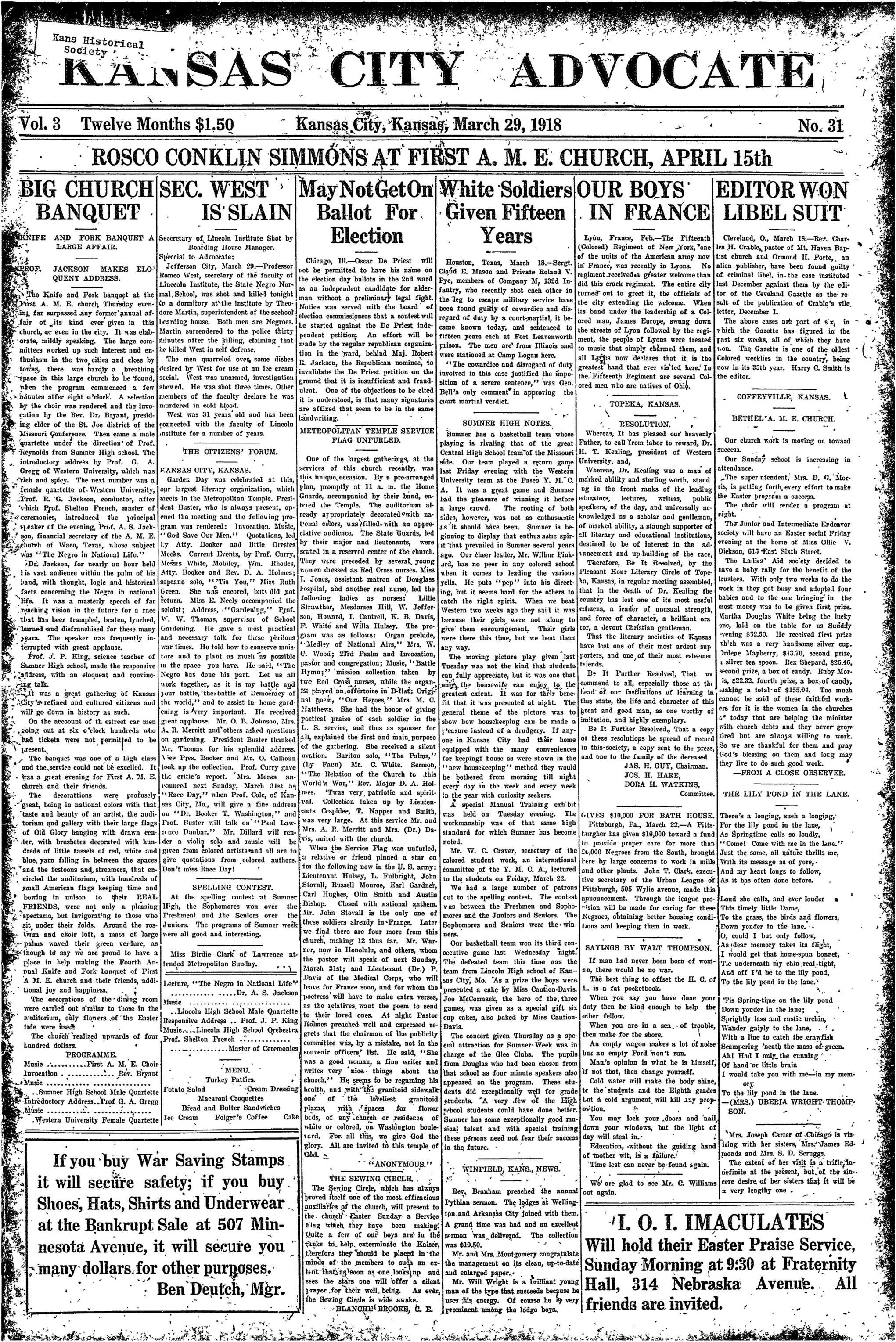
Page text (machine-generated)
If you buy War Saving Stamps it will secure safety; if you buy Shoes, Hats, Shirts and Underwear at the Bankrupt Sale at 507 Minnesota Avenue, it will secure you many dollars for other purposes. Ben Deutch, Mgr.
Kans Historical Society
BIG CHURCH BANQUET
KNIFE AND FORK BANQUET A LARGE AFFAIR.
PROF. JACKSON MAKES ELO- QUENT ADDRESS.
The Knife and Fork banquet at the First A. M. E. church Thursday evening, far surpassed any former annual affair of its kind ever given in this church, or even in the city. It was elaborate, mildly speaking. The large committees worked up such interest and enthusiasm in the two cities and close by towns, there was hardly a breathing space in this large church to be found, when the program commenced a few minutes after eight o'clock. A selection by the choir was rendered and the invocation by the Rev. Dr. Bryant, presiding elder of the St. Joe district of the Missouri Conference. Then came a male quartette under the direction of Prof. Reynolds from Sumner High school. The introductory address by Prof. G. A. Gregg of Western University, which was rich and spicy. The next number was a female quartette of Western University, Prof. R. G. Jackson, conductor, after which Prof. Shelton French, master of ceremonies, introduced the principal speaker of the evening, Prof. A. S. Jackson, financial secretary of the A. M. E. church of Waco, Texas, whose subject was "The Negro in National Life."
Dr. Jackson, for nearly an hour held his vast audience within the palm of his hand, with thought, logic and historical facts concerning the Negro in national life. It was a masterly speech of far reaching vision in the future for a race that has been trampled, beaten, lynched, burned and disfranchised for these many years. The speaker was frequently interrupted with great applause.
Prof. J. P. King, science teacher of Sumner High school, made the responsive address, with an eloquent and convincing talk.
It was a great gathering of Kansas City's refined and cultured citizens and will go down in history as such.
On the account of th estreet car men going out at six o'clock hundreds who had tickets were not permitted to be present.
The banquet was one of a high class and the service could not be excelled. It was a great evening for First A. M. E. church and their friends.
The decorations were profusely great, being in national colors with that taste and beauty of an artist, the auditorium and gallery with their large flags of Old Glory hanging with drawn center, with brushes decorated with hundreds of little tassels of red, white and blue, yarn filling in between the spaces and the festoons and streamers, that encircled the auditorium, with hundreds of small American flags keeping time and bowing in unison to their REAL FRIENDS, were not only a pleasing spectacle, but invigorating to those who sit under their folds. Around the rostrum and choir loft, a mass of large palms waved their green verdure, as though to say we are proud to have a place in help making the Fourth Annual Knife and Fork banquet of First A M. E. church and their friends, additional joy and happiness.
The decorations of the dining room were carried out similar to those in the auditorium, only flowers of the Easter tide were used.
The church realized upwards of four hundred dollars.
PROGRAMME.
Music ..... First A. M. E. Choir
Invocation ..... Rev. Bryant
Music ..... Sumner High School Male Quartette
Introductory Address.. Prof G. A. Gregg
Music ..... Western University Female Quartette
SEC. WEST IS SLAIN
Secretary of Lincoln Institute Shot by Boarding House Manager. Speecial to Adroccate: Jefferson City, March 29.—Professor Romeo West, secretary of the faculty of Lincoln Institute, the State Negro Normal School, was shot and killed tonight in a dormitory at the institute by Theodore Martin, superintendent of the school boarding house. Both men are Negroes. Martin surrendered to the police thirty minutes after the killing, claiming that he killed West in self defense. The men quarreled over some dishes desired by West for use at an ice cream social. West was unarmed, investigation showed. He was shot three times. Other members of the faculty declare he was murdered in cold blood. West was 31 years old and has been connected with the faculty of Lincoln institute for a number of years.
THE CITIZENS' FORUM.
Garden Day was celebrated at this, our largest literary organization, which meets in the Metropolitan Temple. President Buster, who is always present, opened the meeting and the following program was rendered: Invocation Music, "God Save Our Men." Quotations, led by Atty. Booker and little Orestes Meeks. Current Events, by Prof. Curry, Messrs White, Mobiley, Wm. Rhodes, Atty. Booker and Rev. D. A. Holmes; soprano solo, "Tis You," Miss Ruth Green. She was enclosed, but did not return. Miss E. Neely accompanied the soloist; Address, "Gardening," Prof. W. W. Thomas, supervisor of School Gardening. He gave a most practical and necessary talk for these perilous war times. He told how to conserve moisture and to plant as much as possible in the space you have. He said, "The Negro has done his part. Let us all work together, as it is my battle and your battle, the battle of Democracy of the world," and to assist in home gardening is very important. He received great applause. Mr. O. B. Johnson, Mrs. A. R. Merritt and others asked questions on gardening. President Buster thanked Mr. Thomas for his splendid address. Vice Pres. Booker and Mr. O. Calloun took up the collection. Prof. Curry gave the critic's report. Mrs. Meeks announced next Sunday, March 31st as "Race Day," when Prof. Cole, of Kansas City, Mo., will give a fine address on "Dr. Booker T. Washington," and Prof. Buster will talk on "Paul Lawrence Dunbar." Mr. Dillard will render a violin solo and music will be given from colored artists and all are to give quotations from colored authors. Don't miss Race Day!
At the spelling contest at Sumner High, the Sophomores won over the Freshment and the Seniors over the Juniors. The programs of Sumner week were all good and interesting.
MayNotGetOn Ballot For Election
Chicago, Ill.—Oscar De Priest will not be permitted to have his name on the election day ballots in the 2nd ward as an independent candidate for alderman without a preliminary legal fight. Notice was served with the board of election commissioners that a contest will be started against the De Priest independent petition. An effort will be made by the regular republican organization in the ward, behind Maj. Robert R. Jackson, the Republican nominee, to invalidate the De Priest petition on the ground that it is insufficient and fraudulent. One of the objections to be cited it is understood, is that many signatures are affixed that seem to be in the same handwriting.
METROPOLITAN TEMPLE SERVICE FLAG UNFURLED.
One of the largest gatherings, at the services of this church recently, was this unique occasion. By a pre-arranged plan, promptly at 11 a. m. the Home Guards, accompanied by their band, entered the Temple. The auditorium already appropriately decorated with national colors, was filled with an appreciative audience. The State Guards, led by their major and lieutenants, were seated in a reserved center of the church. They were preceded by several, young women dressed as Red Cross nurses. Miss I. Jones, assistant matron of Douglass hospital, and another real nurse, led the following ladies as nurses: Lillie Strawther, Mesdames Hill, W. Jefferson, Howard, I. Cantrell, K. B. Davis, F. White and Willa Hulsey. The program was as follows: Organ prelude, "Medley of National Airs," Mrs. W. G. Wood; 23rd Psalm and Invocation, pastor and congregation; Music, "Battle Hymn;" mission collection taken by two Red Cross nurses, while the organist played an offertoire in B-flat: Original poem, "Our Heroes," Mrs. M. C. Matthews. She had the honor of giving poetical praise of each soldier in the C. S. service, and thus as sponsor for all, explained the first and main purpose of the gathering. She received a silent ovation. Bariton solo, "The Palms," (by Faun) Mr. C. White. Sermon, "The Relation of the Church to this World's War," Rev. Major D. A. Holmes. "Twas very patriotic and spiritual. Collection taken up by Lieutenants Cespidee, T. Napper and Smith, was very large. At this service Mr. and Mrs. A. R. Merritt and Mrs. (Dr.) Davis, united with the church.
When the Service Flag was unfurled, a relative or friend pinned a star on for the following now in the U. S. army: Lieutenant Hulsey, L. Fulbright, John Slovall, Russell Monroe, Earl Gardner, Carl Hughes, Olin Smith and Austin Bishop. Closed with national anthem. Mr. John Stovall is the only one of these soldiers already in France. Later we find there are four more from this church, making 12 thus far. Mr. Warner, now in Honolulu, and others, whom the pastor will speak of next Sunday, March 31st; and Lieutenant (Dr.) P. Davis of the Medical Corps, who will leave for France soon, and for whom the poetress will have to make extra verses, as the relatives want the poem to send to their loved ones. At night Pastor Holmes preached well and expressed regrets that the chairman of the publicity committee was, by a mistake, not in the souvenir officers' list. He said, "She was a good woman, a fine writer and writes very nice things about the church." He seems to be regaining his health, and with the granitoid sidewalk one of the loveliest granitoid plazas, with spaces for flower beds, of any church or residence of white or colored, on Washington boulevard. For all this, we give God the glory. All are invited to this temple of Gód.
THE SEWING CIRCLE.
The Sewing Circle, which has always proved itself one of the most efficacious auxiliaries of the church, will present to the church Easter Sunday a Service Flag which they have been making. Quite a few of our boys are in the ranks to help exterminate the Kaiser, therefore they should be placed in the minds of the members to such an extent that as soon as one looks up and sees the stars one will offer a silent prayer for their well being. As ever, the Sewing Circle is wide awake.
BLANCHB BROOKS, C. E.
Houston, Texas, March 18.—Sergt. Claud E. Mason and Private Roland V. Pye, members of Company M, 132d Infantry, who recently shot each other in the leg to escape military service have been found guilty of cowardice and disregard of duty by a court-martial, it became known today, and sentenced to fifteen years each at Fort Leavenworth prison. The men are from Illinois and were stationed at Camp Logan here.
"The cowardice and disregard of duty involved in this case justified the imposition of a severe sentence," was Gen. Bell's only comment in approving the court martial verdict.
SUMNER HIGH NOTES.
Sumner has a basketball team whose playing is rivaling that of the great Central High School team of the Missouri side. Our team played a return game last Friday evening with the Western University team at the Paseo Y. M. C. A. It was a great game and Sumner had the pleasure of winning it before a large crowd. The rooting of both sides, however, was not as enthusiastic as it should have been. Sumner is beginning to display that enthusia astre spirit that prevailed in Sumner several years ago. Our cheer leader, Mr. Wilbur Pinkard, has no peer in any colored school when it comes to leading the various yells. He puts "pep" into his directing, but it seems hard for the others to catch the right spirit. When we beat Western two weeks ago they sail it was because their girls were not along to give them encouragement. Their girls were there this time, but we beat them any way.
The moving picture play given last Tuesday was not the kind that students can fully appreciate, but it was one that only the housewife can enjoy to the greatest extent. It was for their benefit that it was presented at night. The general theme of the picture was to show how housekeeping can be made a pleasure instead of a drudgery. If anyone in Kansas City had their home equipped with the many conveniences for keepingf house as were shown in the "new housekeeping" method they would be bothered from morning till night every day in the week and every week in the year with curiosity seekers. A special Manual Training exh'bit was held on Tuesday evening. The workmanship was of that same high standard for which Sumner has become noted. Mr. W. C. Craver, secretary of the colored student work, an international committee of the Y. M. C. A., lectured to the students on Friday, March 22.
We had a large number of patrons cut to the spelling contest. The contest was between the Freshmen and Sophores and the Juniors and Seniors. The Sophomores and Seniors were the winners.
Our basketball team won its third consecutive game last Wednesday night. The defeated team this time was the team from Lincoln High school of Kansas City, Mo. As a prize the boys were presented a cake by Miss Caution-Davis. Joe McCormack, the hero of the three games, was given as a special gift six cup cakes, also baked by Miss Caution-Davis.
The concert given Thursday as a special attraction for Sumner-Week was in charge of the Glee Clubs. The pupils from Douglas who had been chosen from that school as four minute speakers also appeared on the program. These students did exceptionally well for grade students. A very few of the High school students could have done better. Sumner has some exceptionally good musical talent and with special training these persons need not fear their success in the future.
Rev. Branham preached the annual Pythian sermon. The lodges at Wellington and Arkansas City joined with them. A grand time was had and an excellent sermon was delivered. The collection was $19.50. Mr. and Mrs. Montgomery congratulate the management on its clean, up-to-date and enlarged paper. Mr. Will Wright is a brilliant young man of the type that succeeds because he uses his energy. Of course he is very prominent among the lodge boys.
I. O. I. IMACULATES Will hold their Easter Praise Service, Sunday Morning at 9:30 at Fraternity Hall, 314 Nebraska Avenue. All friends are invited.
Lyon, France, Feb.-The Fifteenth (Colored) Regiment of New York, one of the units of the American army now in France, was recently in Lyons. No regiment received a greater welcome than did this crack regiment. The entire city turned out to greet it, the officials of the city extending the welcome. When its band under the leadership of a Colored man, James Europe, swung down the streets of Lyon followed by the regiment, the people of Lyons were treated to music that simply charmed them, and all Lyons now declares that it is the greatest band that ever visited here. In the Fifteenth Regiment are several Colored men who are natives of Ohio.
Whereas, It has pleased our heavenly Father, to call from labor to reward, Dr. H. T. Kealing, president of Western University, and,
Whereas, Dr. Kealing was a man of marked ability and sterling worth, standing in the front ranks of the leading educators, lectures, writers, public speakers, of the day, and universally acknowledged as a scholar and gentleman, of marked ability, a staunch supporter of all literary and educational institutions, destined to be of interest in the advancement and up-building of the race.
Therefore, Be It Resolved, by the Pleasant Hour Literary Circle of Topeka, Kansas, in regular meeting assembled, that in the death of Dr. Kealing the country has lost one of its most useful citizens, a leader of unusual strength, and force of character, a brilliant orator, a devout Christian gentleman.
That the literary societies of Kansas have lost one of their most ardent supporters, and one of their most esteemed friends.
Be It Further Resolved, That we commend to all, especially those at the head of our institutions of learning in this state, the life and character of this great and good man, as one worthy of imitation, and highly exemplary.
Be It Further Resolved, That a copy of these resolutions be spread of record in this society, a copy sent to the press, and one to the family of the deceased
GIVES $10,000 FOR BATH HOUSE. Pittsburgh, Pa., March 22.—A Pittsburgh has given $10,000 toward a fund to provide proper care for more than 24,000 Negroes from the South, brought here by large concerns to work in mills and other plants. John T. Clark, executive secretary of the Urban League of Pittsburgh, 505 Wylie avenue, made this announcement. Through the league provision will be made for caring for these Negroes, obtaining better housing conditions and keeping them in work.
SAYINGS BY WALT THOMPSON.
If man had never been born of woman, there would be no war.
The best thing to offset the H. C. of L. is a fat pocketbook.
When you say you have done your duty then be kind enough to help the other fellow.
When you are in a sea of trouble, then make for the shore.
An empty wagon makes a lot of noise but an empty Ford won't run.
Man's opinion is what he is himself, if not that, then change yourself.
Cold water will make the body shine, to the students and the Eighth grades but a cold argument will kill any proposition.
You may lock your doors and nail down your windows, but the light of day will steal in.
Education, without the guiding hand of mother wit, is a failure.
Time lost can never be found again.
We are glad to see Mr. C. Williams cut again.
No.31 L 15th
EDITOR WON LIBEL SUIT
Cleveland, O., March 18.—Rev. Charles H. Crable, pastor of Mt. Haven Baptist church and Ormond H. Forte, an alien publisher, have been found guilty of criminal libel, in the case instituted last December against them by the editor of the Ceveland Gazette as the result of the publication of Crable's vile letter, December 1.
The above cases are part of $s_x$ in which the Gazette has figured in the past six weeks, all of which they have won. The Gazette is one of the oldest Colored weeklies in the country, being now in its 35th year. Harry C. Smith is the editor.
COFFEYVILLE, KANSAS.
Our church work is moving on toward success.
Our Sunday school is increasing in attendance.
The superintendent, Mrs. D. G. Morris, is putting forth every effort to make the Easter program a success.
The choir will render a program at right.
The Junior and Intermediate Endeavor society will have an Easter social Friday evening at the home of Miss Ollie V. Dickson, 615 East Sixth Street.
The Ladius' Aid so'eety decided to have a baby rally for the benefit of the trustees. With only two weeks to do the work in they got busy and adopted four babies and to the one bringing in the most money was to be given first prize. Martha Douglas White being the lucky one, laid on the table for us Sunddy evening $32.50. He received first prize which was a very handsome silver cup. Ordeene Mayberry, $43.76, second prize, a silver tea spoon. Rex Shepard, $26.46, second prize, a box of candy. Ruby Morris, $22.32, fourth prize, a box of candy, making a total of $155.04. Too much cannot be said of these faithful workers for it is the women in the churches today that are helping the minister with church debts and they never grow tired but are always willing to work. So we are thankful for them and pray God's blessing on them and lorg may they live to do such good work.
—FROM A CLOSE OBSERVER.
There's a longing, such a longing,
For the lily pond in the lane,
As Springtime calls so loudly,
"Come! Come with me in the lane."
Just the same, all nature thrills me,
With its message as of yore,
And my heart longs to follow,
As it has often done before.
Loud she calls, and ever louder
This timely little Dame,
To the grass, the birds and flowers,
Down yonder in the lane.
O, could I but only follow,
As dear memory takes its flight,
I would get that home-spun bonnet,
Tie underneath my chin real-tight,
And off I'd be to the lily pond,
To the lily pond in the lane.
"Tis Spring-time on the lily pond
Down yonder in the lane;
Sprightly less and rustic urchin,
Wander gaiyly to the lane,
With a line to catch the crawfish
Scampering 'neath the mass of green.
Ahl Had I only, the cunning
Of hand or little brain
I would take you with me—in my memory.
To the lily pond in the lane.
—(MRS.) UBERIA WRIGHT THOMPSON.
Mrs. Joseph Carter of Chicago is visiting with her sisters, Mrs. James Edmonds and Mrs. S. D. Scruggs.
The extent of her visit is a trifle indefinite at the present, but of the sincere desire of her sisters that it will be a very lengthy one.
ACULATES
Master Praise Service,
at 9:30 at Fraternity
aska Avenue. All
il.
rae jeg ae a
- Kansas City Advocate :
: THOMAS KENNEDY,
“Editor and Prop.
G, A. GREGG,
- | Associate Editor,
: MERVIN HABRIS,
(, Greulation Manager. - *
AIRS. MC. MATTHEWS. +
‘ Society’ Editor. .
Published every Friday at 834 Ne-
Lraska Aye, Kansas City, Kansas.”
‘The Advocate is a weckly journal de-
_ voted to Race Progress and Human Up-
lite Se
SUBSCRIPTION. 7
y Ver YUE ssccvsessssseseseepavee GL 50
Sia Months .....ccceceetieeeeee 80
Three Months ....scececersee ee AS
| Single Vopy ...sssescessceeseeess 05
“*Entered as second-class matter Au
gust 29, 1914, at the postoffice at Kan-
eas’ City, Kansas, under the. Act of
/ Maréh 3, 1879."°
“Don’t forget The Advocate ecilectors
wien they call, It's only 15e per month
_ and no ,one should put the eolleefar off,
“Tiave your news in our oiniee vot lave:
than ‘Imusiay of eaech neck to insure
yubhes.ion. Office Sot Nebraska ave-
rue,
—~ MEMBER
/ NATIONAL NEGRO PRESS
‘ ASSOCIATION.
WITCHITA, KANSAS
Mr. O. 2. Laylor, head walter at the
Laton Motel, is commander-in-ehiet of the
Corsis.ory and Master of the Arkansas
Valley snd 32 Man, He has filled his
silico dor tno terms and was a credit
to the Ledge.
& DUCTOR F. 0, MILLER,
Telefona: Mkt. 2999 de Res. Mktt246.
Miss Georgia Penny of L’Overture
school was ont of school for a short time
owing to illness,
Miss Catherine Take is on the sick
list. ‘
Mr. J. FE, Lewis of the Taylor.
Lewis Furniture company, is contined
_ to his home with rheumatism.
‘Mra, Frauk Young is’ much improved
aw health,
The intant daughter of Mr, and Mrs.
U. Frankl n, 715 Cleveland, is reported
to be ill. 5
DOCTOR F. 0. MILLER,
‘Telefono: Mkt. 2999 de Res, MktH246.
Miss Mary’ Ramsey spent Sunday in
Newton with her mother
A comlnittee of colored citizens de-
manded of City Manager Ash the remov-
21 of Detective Galloway. Mis reply was
“x refusal and that he considered Gallo-
vay his best booze catcher and that
Maywood was a depserate character A
petition has been forwarded to the gov-
emor for his interception in the affa'r.
s Judge Ridhard Bird was off his bench
tor a day on acfount of illness.
Miss Christine Porter, a HS. gitl,
served as a substitute teacher of Domes:
Ue Science department of L’Overture
school, during the absence of Miss Geor-
- gia Penney, the regular teacher,
- DOCTOR F. 0. MILLER,
Tlefono: Mkt. 2999 de Res. Mkt4246.
Mss Mattie Jordan who resides with
Trof. #. L. Barhett’s family, bas been
reported ill,
‘Mr. and Mrs. Geo, Payne.and daugh-
ter-in-law, Mrs. C. Payne, were in the
city last Sunday.
New Hope Baptist church was packed
Tuesday night to hear Prof. Henry Cof-
fm Fellow of Friends University, one
of th's cbureh anil school’s greatest read-
ers ani authors, The massive audience
could have sit and listened to way in
the night to this great edueator. He
was assisted by home talent, which was
extra good. Dr. Fishback is pastor of
this wide-awake church, - t
The Heroines of Jericho held their cn-
nral Thauksgiving serviegs at St. Paul
4. M. E. chureh last Sunday morning.
Rev, J. R. Ransom preached the sermon.
The G. L, A. club met last Tuesday
afternoon with Mrs. J. L. Harper. Quo-
tations from Da Bois. {Existing eondi-
tcns of Our Public Ipstitutions,’ was
the subject of a paper read by Miss Faye
Oliver, Current Events were Ted by Mrs!
V. C, Griffin, ‘They then tack up domes
‘tieyscience work Yor a few moments, They
will meet- next week~with Mss Ruby
Smith. qi Pe
Miss Mattie Jordan has returned to
‘Newton, Kas, to live.’ Z
“Mr, Dick Stewart of Pratt, Kans, tne
son of Mrs, W. H. A. Clark made a visit
to*his mother. Mr. Stewart runs on the
Rock Island and has been in their ser
Viee ‘several years, ‘
Rev. E. P. Geiger has returu:d from
conference. He nas returned to continne
on with the work here. He has planned
Great services for Easter. a
Rev, W. L. Darias will preach at M, E.
-vtoreh ‘Thursday night. He whs a form-
er pastor of th's charge.
‘Mrs, ‘Mamie Moore is ill at her home;
wee Wabsth avenue, ae
+ ‘Mr, Chas, Knox: was seen ont- al-
, thongh he looks rather slow now. He will
wcbiiibe up to his usual gait,
*_ Lawyer E. T, Barber of El Reno and
Grand Pythian Atty. for the state of
Oklahoma, passed thrdugh. Wichita Sun-
day, e's ¥
f- ie
‘THE-WEEKLY ANNOUNCER
-* OF FIRST A. M..E. CHURCH.
$4 '*
J. F. GRIFFIN, Pastor.
Ses Sree Oe OREM ET Rr eee
Residencee, 1930 N. Sixth Street.
Phone Bell West 2904,
. ORDER OF SERVICES. -
°9:30 A. M., Sunday school.
11:00 A. ML, -preaching,
5:00 P. M., Jr. Allen League,
6:00 P, M., Sr. Allen-Leaguz, =:
WEEKLY SERVICES.
, Offieia} Board, 2nd and 4th Monday
7930 PL Me
Choir rehearsal, Tuesday, 7:30 P. M.
CHRIST 19 RISEN.
‘fhe services Sunday at 21 a, m._were
nt unusual in atteridance; Rev. J. E
Patterson of the sciencg chair of West,
etn University 1iled ‘the pulpit asd
preached a ‘sermon that ‘Yeacbei the
tearts of h’s hearers. :
Dr. Griffin returned from the spring:
Saturday feeling mush jimproved and
stated to the congregation his apprecia.
I son for their good will and loving kind
ncss in sending+ him to this healthful
vesort tor the neck.
The pastor will deliver a apectl East
( sermon at the 11 o’elack, serv"ee Sun
tiny mornifg, at which time the choir will
render several selections appropriate for
the oecasion. \
The Passion Play will be given in
moving pictures at the evening gervice
ay Prof, Patférgon. These pietnres are
¢mply tine and nofone should miss
veng them, IT 18 FREE ‘to all who
may come. 2
‘the Fourth Annual Knife And Fork
banquet was undoubtedly one of the
argest and grandest affairs ever held in
he city. It was great.
‘The social s'de of the hanqnet was
‘orth incre to the community than all
ke recaipts, which were looked after in
tine style by the social committee and
nembers of the church,
Every person, saint or sinner, should
attedl some ebureh Sunday and pay
tomage to the risen Christ. Why should
-f not be an appropriate time ta take a
Neciled stand to lead a better life tor
the tuture.
You ure ever recone the honse of
‘od. Come and go with us and beof some
service to the Christ and humanity for the
few days yon have to remain amouc
te people of the earth. Next week's is.
sve of The Advocate will publish, the
vegular class reports, showing ‘the
amount ench class tumed in for the
[wonth. Get busy, leaders. .
| The new roof is on the parsovage and
i looks tine, The brick work will soot
ccmmence. 7
INDEPENDENCE. KANS.
Quinn, A, M. E. church, Rev. LA.
Brown, pastor. =
I am sure it will be of some interest
@ the public in general to note the fact
thatethe Rev. I. A. Brown and members
nave labored hard during the last threc
months, and despite the severe winter
and the shortage of fuel, they have com
Ficted che of the most modern parson-
ages in the d'strict if not insthe state,
ene that not only the city of Independ
see will be proud’ of, but one that the
evtire connection will be proud of,
Last Thursday evening, March 2lst,
nas the date of opening and inspection.
‘The publie was asked to donate some.
thing ‘to help furnish up the new build
ng. Indeed it was surprisinng how the
people responded in clubs and in s'ngk
file and gave many beautiful presents
The living room was fitted up all the
say except a rug and a book ease,
‘There was also an excellent program,
hireeted by Mrs, Martina Fickis and
afiss Anna Vanderford. Mistress Field
was Mistress of, Ceremonies.
*At 8:45 the program began by singing
Ameriea. Invoeattion by Rer. J. W.
Patton of the M. E> church, Words of
“teleome by the pastor, Rev. Brown, A
quartette by Harry Tidwell, Cleon Flu-
vilen, M'ss Anna Vanderford and Miss
Martina Fields, Miss Iva Vanderford
played. Remarke by Rev. J. W. Wil-
iams, ‘ex-pastor, and Rev. B. M. Strad-
iord, ex-pastor of St, John Baptist
chnfeh (this city).
After these" speakers, Rev." J. TT.
‘mith, PB. E, he and ‘wife being our
special guests, and speaker of the how
1 off with the eloquence that tetongel
to the days of the Romans. For thirty
minutes he held his. hearers spell” bound,
dwelling upon the pride off the pastor
and members of the A. M. E, chureb in
Independence. He .also clinched = h's
sords by saying, ‘<You have caught ‘the
Vision of the PATHERS and have done
something worth while.?? '
We were dismissed by Rev. Stratford
aud retired ‘to the new parsonage grhere
we were served lavistdy with punch and
Lenufiful flowers, ye
Miss Burns; oie of oun teachers: at-
tended ‘Mettopol'tan“Temple Sunday and
spoke in .bigh terms. of the sermon, the
Service Flag, poem and-enjoyed tlie ‘mu-
sie for the occasion, ~ :
Ms ——————
The, Courts of the Heroines of’ Jericho
2SR4 e*Boecial -progeamytér- Pala Sun
sy ut the Av ME. dhorch Rer. Grif-
‘Yin preached “the sermon, - ae
aL NT MEME Egy
- ‘LINCOEN. HIGH SCHOOL: —
: atthe
. Convention Hall, May 10,.1918.."
’-.77 "" Annual Cadet,Dzill and Girls) 2" 2,
' 2. __ Physical Training Exhibition". - 5%
a_i PAGEANT e123
> The Spirit of 1918”. >"
-+,10;000'Séats, Popular Prices’ - -° are 4
. 8 Further damouneement gi Coty ees |
FIRST BAPTIST SUNDAY:
At last we of the First Baptist are
cdming to adapt ourselves to prompt:
ness, All the services started on. time.
Let“us~ admonish you, however, ‘abot
next Suinday, March 31, beeagse thers
the beginning of setting the clocks
akead. Eleven o’clock by the ‘clock will
be but 10 o’clock by the sun,’so take
eare, “ee a
The pastor, Rev. W. A. Bowren,
preached what one could call a patriotix
sermon of religions polit’es. He spe-
ally showed that a Christian dying on
tke battle field was saved. He pointed
out “how the people of God were
called upon frequently to” go to battle
ond yet weren’t any the best Christians
The wars of David and Joshua are ‘bis
religious events of history and both men
were noble Christians, therefore the wat
of today make men no less Christians
und ‘£ their'sins have been forgiven an¢
they have confessed Christ, and try’ te
live in his footsteps, when death does
tuke them whether upon, the battle field
fighting for their rights, or at home
God the Just will reecive them into His
kingdom. ae a!
The Rally, Bands are couscicntiously
trying to reach the desired goal ‘of the
May Rally. °
, The Evens, every Friday: evening un.
der the guardianship of .Mrs, Bailey
and the Odds every Thursday evening
under the generalship of Mrs. Lena B
Downs. Ay excellent dinner is served
Yor both bands for 20c on their nights.
All péople are ever weleomed to First
Baptist. -
KEEP YOUR EAR TO TIE
GROUND AND LISTEN FOR THE
BIGGEST THING YOU HAVE EVER
HEARD OR SEEN, THIS IS NO
JOKE. WATCH FOR BIG ADVER-
TISEMENT. AT FIRST: A. M. *E.
CHURCH APRIL THE 15TH, IT’S
TREE! FREE! FREE.“ -. ~
BIBLE CLASS. >
‘The Neighborhood Bible class did not
1ail to mnect at Mrs? Howard's vith dis
cussions by Mrs. Hicks, Mrs. I! Rog:
xs and others. Mrs. Howard and Mrs.
Carroll also made remarks. ‘They -met
this*weck at the ¥. W. @. A. wth Mrs
3. Williams and the blackboard outline
a chapter of Hebrens was given by
Mis. M. C. Matthens, showing what
fverenze we ought to have for Goi.
Next mecting is Wedneslay, April 3rd
t Mis. M .Greene’s, 934 Washington
ssulevard, 7 to 8:30, with, a piano-play.
r program oF sacred and classiea) iu:
ue." Saints and sinners aro invited. Les-
sn Rebreus V. chapter.
+ Prof. ‘1. A. Reynolds will visit camp
Sunston this week,
Ais. Preston Talbot of ‘Topeka ghas
just returned -home after, a few days’
‘sit with her cousin, Mrs, Ws L. Jones.
SHERIPF’SSALE. ”
district Court, #
-vunty of Wyandotte, ss,
>. 'T. Thomas and Cora, L. Thomas, ,
Plaintiffs.
VS y
« W. Neloms and Victoria Neloms,
Defendants,
Under and by virtue of an Order ot
sale issued by the Clerk. of the District
fourt in and for said County of Wyan-
lotfe, in a certain cause in said court
aumbered G610A ‘wherein the parties
above named were respecteively plaintiffs
wd defendants, and to me the under-
signed, Sheriff of said County, dirceted.
1 will Offer for sale, at public auction,
and sell to the highest bidder for eash iti
hard, at the front door of the Court
House inthe City of Kansas City, iii said
‘County, on Monday, the Ist day“of April,
A. D., 1918, at 10 o’elock A. M. of said
aay, the following described Real Estate
sitaate in the County of Wyandotte and
State of Kansas, towit: t
Lots thirty (30) and thirty-one (31)
im block forty-one (#1) in the former
City of Wyandotte, now o part, of Kan-
sua. City, in Wyandotte County, Kansas.
3 JOHN A. WOLFE,
Sheriff of Wyandotte County, Kansas. ”
(First publicaction Marech, Ist, 1918)
ao 8 ok wire ne ese an Fe MR Olt a ee ae 7
thé’ District °C QWrando
In thé” District *Court of sWrandotte
Zounty, Kanga $7 Bt
H.W. Cox, Pialit, © >
vB. :
George Hector Turnbull,-Deféndant. *
ye te .° No, 9118 Ay
‘2 PUBLICATION NOTICE:
- "The State of-Katisas-to,the Defendant,
Meorge Hector Turnbull, Greeting:
| The sdefendant, George Hector Tiin-
Wall; is*hereby notified that he has been
ued by the plaintiff in the above -enti-
“led actiontin the’ above court, and that
‘yerniust Answer the petition of the plain:
iff in said action filed of or before
the 2ist day“of, March,’A. D. 1918, o}
Je sume “will ‘be taken ‘es trae, and
amen will be rendered, quieting the
title in the -plaintiff to‘ the following
ei real estate, situate ia >the
‘ceunty of Wyandotte and State of
Kansas, towit: —“y
/ Lot ten in, block five of Resurvey
ot Kansas Place’? in Kansas City, Kan:
‘ias, as the same is marekd and desig-
jaled npon the recorded plat thereot
Low on file in the office of the register
af deeds -of Wyandotte county, Kansas:
4 Witness the and of the clerk and the
el of said court, this 2lst day of
March, A. D. 1918, ee os
|, Attest: | 7 ;
Luss R. J. MeFARLAND,
Clerk of the District Court. -
(Seal). . .
By W. F. MATHIS; Deputy.
3 - H.W. COX, Plaintiff.
ao D. E, HENDERSON, -
Attorney for Plaintiff.
» (First published Mareh 22nd, 1918.)
_ EASTER ,
p< 4 a ag
~ CLOTHES -
EEE PAC; 3
Ee SEEMS |
4. - and footwear’...
--* 5 forevery .* 4
op Member. -
ars of the . = ‘eo .
Boa NP he family ee
KANSAS CITY, MISSOURI.
; In the District Court of Wyandotte
Jounty, Kansas,
Neal Cramp, Piaintiff, .
+ ys. “ys
Lyd'a Crump, Defendant.
PUBLICATION NOTICE.
To the alove named defendant, you
tre herchy notified that you have been
sued in the above named court, by the
above named plaintiff, and that unless
‘you appear and answer on or before the
tk day of May, 1918, the petition filed,
“il be presented, dnd evidence will be
artroduged therean, upon whieh a judg:
rent will be rendered; the nature of
alich will be a deeree, dissolving the
Londs of matrimony between the pla'n:
ttf and you, the defendant, and divore
ing the plaintiff from you, the defend:
ant, and a judgment againy you for the
“osts in’ this action, . .
BRADLEY &BRADLEY,
* Attorneys for the Prtff.
Attest:
R. J. MeFARLAND,
Clerk of the District Court.
(Wirst published Mareh 22nd, 1918.)
* ‘ 4 _# «
2 tM yp eet NO we Sts
: ay Tus ; mae ¢ ‘
; i 1 4
= 2 7 e s - <
_. Béar in Mind ‘
g FLOWERS AND ELOOMING PLANTS add much to J
~ " cheer and brighten the home surroundings at this time
while we strive to accomplish great things, Flowers |:
“ever present, stimulates activity. - ‘
WE ARE YOURS TO COMMAND. Flowers for all,
occasions. ey so - 7
Your Florist, . 4 % —
ce © MRS. T. AY MOSELEY, : ond
710, Minnesota Ava * Kansas City, Kaidas *,
Both Phones West 64. NO, *
. 4 . 2 . a,
{ a . r ¢
te, * . 7 8 2
Sk ee, a MR te —s
Be Ut gatite
Se Pe Al Pak iH “e
. ws oe ty 2 ug
J : : “
wi . fy
FREE $1.00
; . .
GS.
Is guaranteed for one bottle to benefit
any enese of pellagra, rheumatism, ecze-
ma, setofula or ay blood, liver or kid
1cy disease, or’ your dollar returned and
vo questions asked; or if you take twa
uottles between October 122, 1917, and
Mareh 1, 1918, and you- recive no bene:
fits, upon affidavit of same I will_re
fund to you your $2.00 and gre you
$1.00 free. Why experiment? Take a
remedy with wonderful merit. A trial is
all I ask you to give G. S. sold by all
druggists or sent prepaid. Price, $1.00,
o: six for $5.00. Call on your druggist
tor G. 8. before you order from me,
Write for testimonials. os
Wonder New Spring Suits.
«$1250 2
* ax e . 4
If you can’t afford to pay. WAR, PRICES. for yours
NEW SPRING suit---buy it at the Wonder, 524 Minneso,
ta Avenue. eo
7 , * oy . , *s
Direct'From Maker,to Wearer . ¢
You get value, service and fit for youn mofey hetess
Let your good judgment decide. el, g
= 7 . 2 a
r we x fond
Wonder New: Spring Sints*
. tate . — es 1
Re SIO BQ
; : PLA 8 08
A
Dr. W. S. Stephens
‘The Baiuless Dettist, 516 Minnesota
Ave, Best Dentistry at Lowest Prices,
Cares, ‘Thorough. ‘and Painless “Work,
‘I WILL SAYE.YOU MONEY.
> Give mo a tridl, 4Satistaetion Guaran-
Ses gt
eee” Bae ee oa
Phones:" “oties Bull WHO.s121; Res.
West 4184W. a
‘ . [fa Ue 4 rs Ee. ‘é
SPRING: bE
Fo. CROSSETTS: |
rhe, A TRL & Oy : _—_ a ¥
pe ‘The latest in all shapes and leathers for Eastet now
réady.+ We invite your inspéetion: | *~ ht 4
~"S Qyossett Shoe Store: §
ae THE MEN'S STORE 2
1005-Main Strest "°° == Mansas City, Missoutft
Mr. Chas. Williams was at Excelsior Springs a part of this week taking treatment.
Mrs. A. Rogers, a. well to do farmer of Bethel, was visiting in the city this week.
We are glad that Mr. T. S. Booker on Everett was reported better Sunday.
Mr. Robt. Bradford of Omaha and Rev. Bradford of Emporia were in the city attending the funeral of their relative, Miss Emma Bradford.
Miss Almeda Jared, one of our teachers, died in Chicago after an illness of about three years.
Mrs. Mimms of North Sixth street made a pleasant trip to Omaha this week.
We regret to learn of the death of Mrs. Godfrey on Troup. She is the mother of Miss Godfrey who teaches in Kansas City, Mo.
Miss Minnie Jackson, one of our teachers, and Mrs. Nellie Holloway attended the Temple Sunday a. m.
Mr. and Mrs. Collins, at Tenth and Everett, are the proud parents of a new baby.
Mrs. Alice Gray brought Mrs. Kealing's mother and Mr. Day as visitors to the Temple Sunday morning.
Mrs. (Dr.) H. T. Kealing was also a pleasant visitor.
Rev. Smith of the M. E. denomination left Tuesday for Marshalltown, Iowa, where he will pastor a church.
At the Neighborhood Bible class, which met a the "Y", the leader was assisted in discussing the lesson by Mrs. C. O. Taylor, Mrs. S. Williams, Misses Williams of W. U., Edna Haines and Baxter. Mr. Gillmore of the late draft was present, also Mrs. L. Rogers, Misses Black, P. Moore and others. "Twas a good meeting."
Dr. Bethel, Brig.-Gen. for the state of Oklahoma, Capt. Holmes of Oklahoma City have invited Imperial Co. No. 1 to a competitive drill in the future. I don't believe that they can out-drill Imperial No. 1.
Home products are the best for home use, not only is this true of food and other products that can be seen on the daily markets but this is even true of the men that we should elect to hold the offices that are to be filled at this next election. We speak especially concerning a Wichita boy, who by his pluck and grit has forced his way into recognition in public life from a newsboy to a state representative. This is in the person of Mr. Clarence Sowers, a candidate for the office of county attorney
BITTER FIGHTS OVER BEARDS
Tartars and Persians Long in Conflic
Because They Held Varying Opin
ions on the Matter.
Before now the wearing of beards has caused a bitter war and made the executioner's ax cut through many a neck. The Tartars waged a long war with the Persians, declaring them infidels because they would not shave their beards after the fashion of Tartary.
The Greeks wore beards until the time of Alexander, who ordered the Macedonians to be shaved lest their beards should give handles to their enemies. The ancient Romans wore beards, but in England they were not fashionable after the conquest until the thirteenth century and were discontinued at the Restoration.
Peter the Great kept a squad of officers whose duty it was to cut the beards of unwilling citizens by force. Before 1840 shaving was almost universal in the United States.
There have been numerous instances of women with long masculine beards, Margaret of Savoy, daughter of Maximilian I, had a long stiff beard, and a woman was seen in Paris with a black bushy beard that reached to her waist. At the battle of Pultowa the Russians captured a bearded woman, whom they presented to the czar. She had a beard, five-and-one-half feet long.
Mourning the Departed.
The newest thing in mourning is dark blue. It is not for the sod half of the menage, but for the widow who disagrees with her other half, who seeks the courts to cut the knot. Such a person was seen yesterday and when usked if she had lost some one replied: "Yes, my husband." "When did he die?" "Don't understand." "I divorced him. I felt for a time that I should retire quietly, and now that I have emerged I wear a compromise color—blue. I didn't really dislike my husband, but I had to divorce him. The mourning is half for him and half for the memories. But, poor boy, he married again. His stenographer."—New York Tribune.
LIFE' PRIMITIVE AND RUGGED
Scenes on Bosom of Russia's Mighty River Cannot Be Duplicated Anywhere on Earth.
The days on the Volga are as alike as the white towns strung on the Volga chain, and all laden with a sense of life, sluggish and primal and potential. The scent of plines, of new-mown hay, of drying nets, and the fragrance of illies; brawny red-shirted sailors shouting and splashing each other with water as they scrub the decks; the whistling of grain steamers; the sound of hammers from barges building along the shore; anchor chins rattling as we drop into the wharf where fishermen are unloading their shining catch. It is a robust river life, not familiar, but transposed into strange keys and staged largely.
The rafts seemed the most essentially Russian part of the Volga. We had seen them before. Gargantuan yellow logs, as delicious looking as taffy, dragged from a forest in Tver and bound together with snailings, each raft bearing a tiny huf for the families who make the journey with the rafts to the sea. Now we met them on the river, people with rolllicking figures, who balanced themselves with long poles and laughed and siouthed unintelligible cries to us as the surge of the steamer threatened their foothold.
The trackers, borlaki, we never say; debased men of herculean strength, muscles knotting in their halary throats, thwets straining like horses against the dead weight of the barges as Rieplin had painted them. They have passed with the sails. But the other figures—on the rafts, in the fishing boats—are their brothers! And never have I felt life emerging so freshly from the black mold. Olive Gilbreath in the Yale Review.
FIRST THOUGHT IS ISOLATION
Aviator Longs for Sound of Human Volces When He Is Soaring Far Above the Earth.
I became conscious of a feeling of loneliness, writes James N. Hall, in the Atlantic. I remembered what J. B. had said that morning. There was something unpleasant in that isolation, something to make one look longingly down to earth; to make one wonder whether we shall ever feel really at home in the air. I too, longed for the sound of human voices, and all that I heard was the roar of the motor and the swish of the wind through wires and struts—sounds which have no human quality in them, and are no more companionable than the lapping of the waves would be to a man adrift on a raft in midocean. Underlying this feeling, and no doubt, in part responsible for it, was the knowledge of the fallibility of that seemingly perfect mechanism which rode so steadily through the air; of the quick response which that ingenious arrangement of inanimate matter would make to an eternal and inexorable law, if a few frail wires should part; of the equally quick, but less phlegmatic response of another fallible mechanism, capable of registering horror, capable, it is said, of passing its past life in review in the space of a few seconds, and then—capable of becoming equally inanimate matter.
Determining Age of Planets-
A novel idea in estimating the physical condition of planets was put forth by M. Veronnet before the Academie des Sciences at a recent meeting in Paris. He based it upon a calculation of the quantity of water that rocks such as granite and porphyry absorb before becoming perfectly dry.
He said that on the moon all water has been completely absorbed by slow diffusion as the rocks gradually cooled. Venus is still surrounded by a thick layer of vapor, while no water has yet been condensed on the surface of Mercury, this planet being still in a condition in which its geological life has not begun, and consequently no clouds have yet formed on its surface.
M. Veronnet calculates that the rocks of our earth now contain absorbed water which would cover the earth to an average depth of about 400 metres.
Titled Lady as Shoemaker.
It is an interesting fact that, although the women of the United Kingdom have invaded most employments that formerly were followed chiefly by men, the shoemaking trade has not experienced much change in this respect. Yet, something over a hundred years ago, shoemaking was one of the "employments of high society" in London. Ludy Sarah Spencer, in a letter to her brother, written about the year 1808, says: "In the evening we divide our time between music and shoemaking, which is now the staple trade of the family. I am today in a state of great vanity, for I have made a pair of shoes—there is news for you. So if all other trades fall I shall certainly establish myself, cross-legged, at the corner of an alley to earn a livelihood in the midst of leather, awls and hammers."
Don't Have a Double Chin.
An investigator declares that the double chin can be controlled and very largely mitigated. It depends largely upon the carriage and pose of the head. The person who has a repeated chin, or is threatened with one, should recall and practice Dr. Edward Hale's famous advice: "Look up, not down." The person who sits, or stands, or walks, with an erect body and keeps the chin up-tilted, can defy the crease and the fatty ridges.
SUFFERED FOR HIS COUNTRY
Silas Deane, First American Diplomatic Agent, Received Harsh Treatment From Government.
Silas Deane, the first diplomatic agent of the United States, was born at Groton, Mass., close to 200 years ago. He became a merchant and was a delegate to the first Continental congress. In the spring of 1776 he was sent to France as a secret diplomatic agent. He posed as a merchant from Bermuda, and upon his arrival in Paris sought an interview with Count de Vergennes, the Minister of Foreign Affairs, who refused to receive him. Deane was reduced to the direst poverty and was elected by his landlord.
Subsequent American ambassadors have complained of the lack of suitable embassies, but Deane was reduced to a point where he had to accept poor lodgings from a sympathetic Frenchman. Eventually he was given an audience with Vergennes and began the diplomatic relations which eventually resulted in the French alliance. In 1777 Deane was recalled.
In the bitter controversy which followed his recall Thomas Paline revealed the fact that supplies furnished the colonies had been furnished by the French government. This was considered a diplomatic indiscretion and it cost Paline his place as secretary of the Committee on Foreign Affairs. Deane, driven into poverty and exile, died in England in 1789. Half a century later his claim for his services abroad was adjusted by congress and a large sum, was paid his heirs.
ALL MADE EQUAL BY DEATH
No Democracy Ever Conceived Is at All Comparable to That of the Tomb.
In the democracy of the dead all men at last are equal. There is neither rank nor station nor prerogative in the republic of the grave. At this fatal threshold the philosopher ceases to be wise, and the song of the poet is silent. Dives relinquils his millions and Lazarus his rags. The poor man is as rich as the richest, and the rich man is as poor as the pauper. The creditor loses his usury and the debtor is acquitted of his obligation. There the proud man surrenders his dignities, the politician his honors, the wordling his pleasures; the invalid needs no physician, and the laborer rests from unrequited toll.
Here, at last, is nature's final decree in equity. The wrongs of time are redressed. Injustice is explated, the irony of fate is refuted; the unequal distribution of wealth, honor, capacity, pleasure and opportunity which makes life such a cruel and inexplicable tragedy, ceases in the realm of death. The strongest there has no supremacy, and the weakest needs no defense. The mightiest captain sucumbes to that invincible adversary who disarms all the victor and the vanquished.—John J. Ingalls.
Sprouts After 1.000 Years.
At the Zensul Temple, Iwane village, Koga-gun, Shiga Prefecture, a very ancient wooden idol of Valsravana was opened four years ago and some rice that had reposed therein fully ten centuries was removed and planted. The seeds germinated and the rice grown therefrom appears to be similar in all respects to that of the present day. The yield was large and the crop for next year from this seed is expected to be excellent.
Valsravana is the God of Treasure. When the statue was repaired a bag of coarse flaxen textile was exhumed containing rice seeds, with a piece of paper bearing the following inscription, in Chinese: "This image has been engraved for the peace of the world. If any one of later generations opens it, he should put in new seeds." The Tokyo Academy of Fine Art pronounces the image and its contents of great antiquity—at least 1,000 years old.
Origin of Blizzard.
Bilzard is undoubtedly a word of American origin, but it is much older than suggested. In Amersham (Eng.) churchyard today there is a tomb of the Bilzard family and people of that name still reside in the village of Chalfont St. Giles. A man of this name accompanied William Penn to the new world. This Bilzard, it is said, developed very unsusceptible habits and settled far away from his fellows in the remote Northwest. Now a northwest-born snowstorm is the most disgraceful thing there is about the whole climate, and Mr. Bilzard, being so unpleasant a person to his neighbors, his name was adopted to describe the objectionable type of weather which blew from his direction.
America's First Cartoon.
Benjamin Franklin's *Pennsylvania Gazette* was the first American newspaper to print a cartoon. There were rumors of a possible war with the French, which resulted in a call for a meeting at Albany of the representatives of the British colonies. Franklin was one of the commissioners, and to increase the force of an appeal for united action, on May 9, 1754, printed a cartoon representing a snake cut into eight parts, the head representing New England and the other seven parts the various colonies outside of New England. The legend read: "Join or die."
**Its Class.**
"A club buffet is a paradoxical sort of thing."
"Why so?"
"Because so many men use it when they are out of spirits."
Charles Francis Adams Told of Taking a Nap on a Hillside During Pickett's Charge.
In the campaigns of both Antietam and Gettysburg I was an officer in a regiment of cavalry, a mere subordinate, responsible only for obedience to orders.
At Gettysburg July 3 the division to which we belonged occupied the high, partly wooded ground on the right of the line, covering the enemy's flank and rear. It was a bright July day, hot, and with white clouds slowly rolling across the sky. Neither our lines nor those of the enemy were visible to us; and the sounds of battle were hushed. Waiting for orders and for action, we dismounted, out of regard for our horses as well as for ourselves, and sat or lay on the turf.
Inured to danger by contact long and close and thoroughly tired In body and overwrought in mind we listened for the battle to begin; and shortly after noon the artillery opened. We did not know it, for we could see nothing in that direction, but it covered the famous advance of Pickett's Virginia division upon Mende's. center—that wonderful feat of arms—and just then, bulled by the incessant roar of the cannon, while the fate of the army and the nation trembled in the balance, at the very crisis of the great conflict, I dropped quietly asleep. It was not heroic, but it was essentially war.—From the Autobiography of Charles Francis Adams.
HAD - THOUGHT FOR OTHERS
Second Traveler Decidedly More Considerate of His Fellows Than Was the First.
At the information booth in a large railroad terminal a traveler asked for a time-table, which he looked through until he came to the particular table he wanted. This table he cut out with his pocketknife, and then he put the booklet with this table now gone out of it back on the counter.
It seemed a thoughtless thing to do because, lying there as it did with its outer cover smooth, somebody might have picked it up and carried it off thinking, naturally enough, that it was complete, to discover its real condition only when it was too late.
But this misfortune really befell no one, for a moment later another traveler standing near who had seen all this done and who was perhaps more thoughtful than the first, picked up the torn time-table and carried it off to drop it in the nearest waste paper receptacle.
Siberia Has Vast Resources
The common notion of Siberia is based on latitude and climate. Because part of it is in the arctic circle the whole vast region has been assumed to be almost, beyond the pale of civilized occupancy. Notwithstanding that much has been written describing Siberia as it is, the common notion is still that it is fit only for penal settlements and that the nihilists and other political exiles were sent to these settlements as a living death. This is not far from the truth. But the inhospitable regions in which the penal settlements were placed are far from being all Siberia, and even some of these districts are capable of sustaining the vigorous inhabitants of northern climates.
Siberia, in the economic sense, has all the resources which go to make a vast stretch of territory self-sustaining as an independent nation. It has forests, mines and great agricultural regions where every product of the temperate climate is capable of cultivation. The timber is in the north and west. The mines are in widely scattered districts.
Reflections.
His face would have stopped a clock. But how can one wonder at it when one learns that he was a wandering lecturer? Anyway, no one had even seen anything approaching the face that he hauled into Puddle-in-the-Clay one wet and muddy November night and set up in the town hall, allowing words—calculated to make every drinker of anything stronger than barleywater at once reform and spend the rest of his existence in sackcloth and ashes—alide out of the hole in the middle of it.
"Yes, my dear brothers," said the weird looking person, "for more than forty years I have shunned the glass." "And I bloomin' well believe yer, guv'nor," said a loud and hearty voice from the middle of the audience. "If I'd a face like yours I wouldn't never look in a pull of water even."—London Ideas.
The Magnetic Compass
Experiments with magnets known to the scientists, 2,500 years ago, which, developed by Doctor Gilbert and Peter Perigrinus, led up to the present-day admiralty compass of Kelvin, were shown recently by Prof. J. A. Fleming, professor of electrical engineering, University of London, at the Royal institute.
"The earth is a magnet," said the professor, "and every piece of iron that has stood in a vertical position for any length, of time is magnetized by the earth. You can try it on your garden railings."
The hostelry sign, "The Goat and Compass," he said, "does not refer to the mariner's friend, but is a contraction of the saying, 'God encompasses us,' and the compass takes its name, from the magnet which weaving
NO NEED NOW TO HAVE A DARK SKIN
S. Crowder Phil Smith
Wyandotte Transfer Company
Phone West 3576
Bell Pbone W. 424
Ree. 1407 North 8th Street
Luella Green
Notary Public
516 Minn, Ave., K. C. Kas.
Sugar Bowl
We Do Our Own Baking
Bread, Cakes, Pies,
Wedding Cakes
We Make Our Own Candies
Sugar Bowl
720 Minnesota Avenue
Eyes Examined
Glasses Fitted
F. C.
Wahlenmaier
746 Minnesota Avenue
Kansas City, :: Kansas
BOULDIN C
"That C
SANITARY FIRST.
NO NEED HAVE A D When a few ap DR. FRED
Tells all about the war; it is fair to Colored people; everyone a tremendous seller. Please only fill in enquiries making $3 to $13 per day. Send 24 cents quick for agents' outfit.
AUSTIN JENKINS CO. P Street, Washington, D.C.
SANTAL CAPSULES MIDY
CATARRH of the BLADDER relieved in 24 HOURS
Each Capule bears the MIDY number 24
Retrieves of crown browns
```markdown
```
SCIENTIFIC
DRYICIAN
All Work Guaranteed
Kassel Jewelry Co.
548 Minnesota Ave.
Kansas City Kansas
CLEANERS Clean"
LADIES' AND GENTS TAILOR-
ING.
Suits Cleaned and Pressed $1.00
Suits Sponged and Pressed
ALL WORK REASONABLE.
Cleaning, Pressing and
Repairing.
WE USE THE HOFF-MAN
METHOD.
Quality, Service Satisfaction
Prompt Auto Service. Call us
up.
Bell Phone, West-838.
1606 N. 5th St. K. C. K.
NOW TO ARK SKIN
---
"BETTER BLIND THAN DEAF"
Scientific Writer Points Out Why the Former Affliction Is Less Hard to Bear.
Scientists have shown that sound not only informs the intellect, as does sight, but that, much in excess of that sense, it excites feelings—that is, sound pure and simple has a specific relation to feelings widely different from that of sight.
Its primary effect was the creating of moods, Margaret Baldwin writes in the Atlantic magazine. This being so, the simple fact is that sound has far more to do fundamentally with originating our emotions, or how we feel from day to day, than has what we see.
It should be said in passing, that there is very little recognition of this fact by the person with normal hearing. Sight and sound are so interwoven for him that he does not discriminate as to what belongs intrinsically to each in the province of feelings. It is only when the two are clearly separated, as in deafness or blindness, that experience takes note of what belongs to the one and the other.
A scientific writer points out that we can see with indifference the writings of a suffering animal that is still, but that, if there are cries of pain, it produces emotions at once. We are distressed. In reports of terrilble marine disasters, it is almost never said by people that they can never forget the sights they saw, but always that they can never forget the cries of the drowning.
Although one would hardly hesitate to say that the excess of the blind man's calmness over that of the deaf man is sufficient to overbalance this elemental function of sound to produce moods, yet the universal fact remains that the blind are more cheerful than the deaf.
NOTHING BUT SHEER WISDOM
Possibly Aunty's Idea in Burning Chicken Feathers Was to Destroy Circumstantial Evidence.
The dainty and winsome heiress of a Kentucky planter, recently graduated from a fashionable northern seminary, was devoting the monging of the first day of her return to the old homestead renewing acquaintance with her father's darky retainers "down among the quarters." As she entered one of the cabins she saw old Aunt Martha, born in slavery during the life of the young lady's grandfather, bending over a broad log fire, carefully burning, piece by piece, a bunch of chicken feathers.
"Aunt Martha," inquired the young lady, after watching the work of the ex-slave a few moments in silence, "why do you burn those feathers so carefully and systematically? Is it because of some religious idea or a superstition?"
"No Missus Lucy" came the answer from the deliberate old woman, as she watched the last telltale feather crumple into nothing. "Tain't no 'ligon an' tain't nuffu tuh do wno sewpstishnns. It's wsdum. Jes plain, out-an-out wsdum."
Clever Fox Sparrow.
The fox sparrow prides himself, doubtties, because he is bigger than most of his American brothers. He is only a bit of a bird, at that, but song sparrow, white-throat, grass flush and a nosed or so of the others doubttles look on their fox-coated relative's additional inch as an elf, with something thrown in for good measure. The junco, the little slate-colored snowbird, a sparrow after his kind also, frequently accompanies the fox sparrow on his travels. There is a suspicion which is hard to lose that the fox sparrow jaws along with the junco solely to make his own song secure among the acknowledged melodies, for the junco, while an insistent performer, glipes an attenuated tune.
California Has Jap Village.
Few people realize that in the United States there is a village composed entirely of Japanese, who live their lives just as they did before leaving the Flowery kingdom. This quintet spot of interest is north of the long plier, a mile from Santa Monica, Cal. Here is the home of a number of Japanese fishermen. Their native dress, food and the daily routine of their lives are carried out as though the little village were on the far shore of Nippon. On Sundays are to be seen the native sports of the Japanese. The gelsha girls serve tea and bonbons to visitors, while the young men display their prowess 'at wrestling, jiu-jitsu and other Oriental pastimes—Los Angeles Times.
Chief Executives and the Press.
When John Adams became president, in 1797, he was even more severely attacked in the press than Washington had been. But his administration fought the attacks. Armed by the sedition law, which was passed the following year, it sought to annihilate the papers which it could not force to surrender. In the fight, which lasted four years, the people rallied to the support of the papers and defeated Adams in the election of 1800 by putting Thomas Jefferson in the presidential chair.
Good Cause.
"I hear that De Smythe's efforts to trace his ancestors have been suspended."
"I suppose he found some of the ancestors were suspended, too."
FEDERAL INCOME TAX IN BRIEF
The Requirements Boiled Down for Busy Folks.
Returns must be filed on or before April 1, 1918.
Tax due may be paid now or on or before June 15, 1918.
If you were single and your net income for 1917 was $1,000 or more you must file a return.
If you were married and living with wife (or husband) and had a net income of $2,000 or more for 1917 you must file a return.
Husband's and wife's income must be considered jointly, plus income of minor children.
Income of a minor or incompetent, derived from a separate estate, must be reported by his legal representative.
Severe penalties are provided for those who neglect or evade the law.
For false or fraudulent return there is a penalty not exceeding $2,000 fine or year's imprisonment, or both, plus 100 per cent of tax.
For failure to make return on or before April 1, 1918, fine is from $20 to $1,000, plus 50 per cent. of tax due.
Returns must be filed with the Collector of Internal Revenue of district in which you live.
An agent may file 'return for a person who is ill, absent from the country or otherwise incapacitated.
Each return must be signed and sworn or affirmed by person executing it.
Single persons are allowed $1,000 exemption in computing normal tax.
A married person living with wife (or husband) is allowed $2,000 exemption, plus $200 for each dependent child under 18.
A head of family, though single, is allowed $2,000 exemption if actually supporting one or more relatives.
Returns must show the entire amount of earnings, gains and profits received during the year.
Officials and employees are not taxable on the salaries or wages received from a state, county, city or town in the United States.
Interest on state and municipal bonds issued within the U. S. is exempt from federal income tax and should be omitted.
Interest on United States government bonds is also exempt, except on individual holdings of Liberty Fours in excess of $5,000 par value.
Dividends are not subject to normal tax, but must be reported and included in net income.
Gifts and legacies are not income and should not be included on the return of the beneficiary.
Life insurance received as a beneficiary or as premiums paid back at maturity or surrender of policy is not income.
Payments received for real or personal property sold is not income, but the profit realized thereon is income for the year of sale.
Amounts received in payment of notes or mortgages is not income, but the interest on such notes or mortgages is taxable income.
From the entire gross income certain allowances are made in arriving at the net income.
Necessary expenses actually paid in the conduct of business, trade or profession may be claimed.
A farmer can claim payments for labor, seed, fertilizer, stock feed, repairs on buildings, except his dwelling; repairs of fences and farm machinery, materials and small tools for immediate use.
The amount of rent paid for a farm may also be claimed as a tenant, farmer's expense.
Payments for live stock are allowable if bought for resale. But if bought for breeding purposes cattle are an investment, not an expense, and cannot be allowed.
A storekeeper can claim amounts paid for advertising, clerk hire, telephone, water, light and fuel, also drainage and freight bills and cost of operating and repairing, wagons and trucks.
A physleinan can claim cost of his professional supplies, rent, office help, telephone, expense of team, or automobile used in making professional calls and expenses attending medical conventions.
A dentist can claim similar items except team dental expense, which are not necessary in his profession.
Expenses that are personal or connected in any way with the support or well being of a person or family are not allowable.
The costs of machines, instruments, vehicles or implements that are more or less permanent in character are not allowable as an expense. They are investments.
Interest paid on a mortgage or other personal indebtedness is allowable on a personal return.
All taxes paid within the year can be taken out on a federal return, except federal income taxes. Inheritance taxes and assessments for local improvements.
Losses sustained in business or through fire, storm or shipwreck or by theft, except when compensated by insurance or otherwise.
Wear and tear of rented buildings or machinery used in business may be claimed.
You can also claim the amount paid to the Red Cross and to other charities, religious or educational organization to the extent of 15 per cent of your net income.
EAR WAY TO EVIL SPIRITS
Malaysians Believe) Mountains Were
Pieced to Shut Out Strange
Race of Yajuj.
In the dak bungalow at Kwala Kubu
(in Malaysia) the Chinaboy chowkidar, queue in pocket, shod in shoes of stent-felt, served my breakfast. Twas at lest on the threshold of a strange expedition in a land to which no letter ever came correctly addressed, so unknown was it to the outside world. At this, moment the strangest thing in sight was my breakfast. It consisted chiefly of tins of tiny Mongolian fuchs — humming birds in size, squabs in taste—canned a dozen in a tin.
As I devoured the pitiful little birds; bones and all, I looked up at the great Malay mountain range, the backbone of the finger peninsula which stretches southward from Slam to within sight of the band of Singapore itself. Mountains, so the Malays say, are the wall of the world, shutting out great winds and beasts of prey. And they believe that a strange race—the Yaju—are forever straying to bore through, and when they succeed, then will come the end of all things.
The great limestone caves scattered throughout the mountains are places where the Yaju have attempted and failed. There is nothing impossible or unbelievable in all this, when one comes to know Malay mounting in all their weirdness—William Beebe, in the Atlantic Monthly.
RUDE AWAKENING FOR GUEST
Visiting Parson Got the "Dusting"
That Irate Father Intended to
Bestow on Offspring.
A story of how a parson got the
dusting instead of a youth is related
by a newspaper man of Wenatchee,
Wash.
"The boy in the plot was Oscar
Woods," he says. "It happened in
Nebraska. In our home it was the custi-
tor for one of the boys to take his
turn at starting the fire on cold morn-
ings. It was 15 degrees below zero,
and it was Oscar's turn. He lit the
fire and then proceeded to the barn
to feed the stock. But the fire went
out.
"An hour later, perceiving that there
was no fire, father sent another call,
louder. Then several more. But no
sound came. The 'governor' started
upstairs.
"Without informing the head of the house, my brother had brought home a preacher the night before and put him in the same bed with Oscar.
"The parson had a thrilling awakening. He was yanked, out of bed." He resisted. This was too much for indignant dad.
"The conflict was exciting. The preacher fought like a wildest.
"In the cold gray dawn dad found that he had made a mistake. It was tough, but the proacher survived."
Earthquake Statistics
It has been calculated that there occur about 30,000 earthquakes within a year, or 8,760 hours, hence, that there are on the average three and one-half earthquakes in an hour. Fortunately, not all earthquakes are of a violent nature, like that of A. D. 526, that killed from 120,000 to 200,000 persons in the region of the Mediterranean, or that of 1633, to which 60,000 persons fell victims in Sicily, or of Lisbon in 1755, and those that devastated Chile, Peru and Japan. Of great frequency are the minor earthquakes. In fact, our so-called firm earth can be said to be in a state of perpetual ignition. Our senses do not perceive the slight disturbances, but the seismograph, a very delicate and ingenious apparatus devised to keep track of them, furnishes all the information dented to us by our natural insensibility. They often furnish us too much of it in the excess of their zeal, recording sometimes as seismic phenomena vibrations that later proved to have been due to the ringing of church bells.
Privileges of the Poor.
Will you show me any other people outside of the fairy books who can put the most fearful calamity on like a cloak and doff it at will, who can augment their families to seven or eight children overnight, and reduce them as readily to five or six on the following day if it but seem to them advisable? Where outside their ranks is there anyone capable of persuading you that it is a privilege to sleep cool so that some Darius you never saw or care to see shall, he had his allegorical mule, go better warmed? Who else, being neither of your kith nor kin, has such power over you that, with a mere bloodshot eye and silver of the shoulders, they can turn your automobile, your furs, your warmth and all your pleasant pleasures into Dead sea apples of discomfort?-Laura Spencer Porter, in the Atlantic Magazine.
Now They're Mollycoddles
Dandies who are making their repre-
nance at the Royal theater, were fast disappearing when Queen Victoria began her reign, says the London Times.
Extravagance in dress and manners did not of course originate with them, but in earlier times there were other names for those who were noted for similar eccentricities. They were called beaux in the days of Queen Anne and the earlier Georges, "fops" and "sparks" being storied synonyms.
In the latter half of the eighteenth century these 'fashionable' fops were known as macarons, and the dandies may be said to have come in during the regency.
MR. SIMPKINS PAYS HIS INCOME TAX
MR. SIMPKINS PAYS HIS INCOME TAX
By ROBERT McBLAIR.
Mr. Simpkins, gazed at the portrait on the wall 'till his eyes filled with tears. It was a portrait of his father, Colonel Simpkins, who had four times been promoted for valor during the Civil War and had died bravely on the field of action. Mr. Simpkins' throat ache now for two reasons: First, he reverenced and adored the memory of his father; secondly, his age and his eyes and his game leg wouldn't let him go to war himself. And as he observed the martial bearing and uncompromising gaze of Colonel Simpkins he saw, in imagination, the khaki-clad lads of the new generation marching forth and crossing three thousand miles of sea to fight, maybe die, for liberty.
Mr. Simpkins peered around to make sure that neither Bess nor John (who were at the tensing ages of sixteen and seventeen) were where they could see him, he straightened and threw his right arm up for a salute. But his gouty shoulder twined, and he gronned. He couldn't even salute.
"Dunn" said Mr. Simphls, and with his other hand fiercely twirled his white mustachios.
He turned and limped into the library and sat down creakily before the mahogany desk on which were lying the blanks for his income tax statement, blanks which he had rather grumply got from the Internal Revenue officer only that day after lunch on his way home from the club.
Mr. Simpkins' income for 1917 had amounted to just about $15,000, and he had been rather snappy on the subject of taxes ever since he had discovered that the more income a man has the greater the percentage of it he pays in taxes. He could think of several men who, like himself, were married and had two children, and yet, although their incomes were nearly half of his, they would pay only a small fraction of the amount he paid, he gloomily drew the blank nearer and began filling in the information that it asked for.
As Mr. Simpkins' income was $15,000 he had to figure out the amounts payable on each of the successive smaller classes of incomes in order to arrive at the total due from himself. He passed over the first class who must pay taxes, that is, single men making over 1,000. His calculation for married men then showed us as follows:
First, they pay 2 per cent, (under the 1016 law) on all income over $4,000, deducting $200 for each of their children under eighteen years. In Mr. Simpkins' case this was $212, which he put down in the "payable" column.
He saw next that, under the 1917 law, married men pay an additional 2 per cent, on all over $2,000—with the same allowance for children. This added $522 to his "payable" column.
He then observed that for every $2,500 jump in his income over $5,000 he had to pay a Surtax, the percentage growing larger with each jump. This was $250 more added to his burden. And on top of all this came an "Excess Profits" mix of 8 per cent, on all "occupation" income over $3,000, making $720 more.
The total, then, he must pay was fourteen hundred and thirty-four dollars.
"Whew!!" exclaimed Mr. Simpkins angrily. "There's young Henry Wilkins, who married Jake Johnson's girl, he makes $2,000 and he doesn't pay a cent of taxes. I guess this is his war as well as mine!"
Thinking of young Henry Wilkins, he remembered that Mrs. Wilkins went every afternoon to make bandages for the Red Cross and that Henry, who was a lawyer, was aiding the Local Draft Board with its questionnaires.
"Well," he admitted to himself, "that makes a difference."
He thought next of Judge Willoughby, whose income was about $3,000.
"He only pays $20," commented Mr. Simpkins, not quite so angrily this time; and then a thought struck him and he sat up rightly in his chair.
/Judge Willoughby's son had been drowned on the Tuscania when it was submarined with the loss of two hundred soldiers.
/Judge Willoughby gave his son to America," muttered Mr. Simpkins.
For a long time Mr. Simpkins sat very still in that position. There was no sound in the library except the ticking of the tall clock and an occasional trill of laughter from the children skylarking upstairs. The square of lights on the carpet gradually withdrew itself through the window, and first twilight and then darkness settled in about the quiet, white haired, sometimes irascible old man.
Mr. Simpkins was thinking things which he would never afterward speak of, he was thinking things that were too sacred ever to be put into words. But some inkling of his thoughts may be found in his rejoinder to Mrs. Simpkins when that plucked lady came in and turned on the lights, and asked him whether he was ready for dinner.
"Judge" Wiloughby's only son was worth as much as fourteen hundred and 'thirty-four dollars,' wasn't be? Mr. Simpkins demanied of her.
As his wife, who was not unused to his supercilious irritations, varnished him in mild astonishment, Mr. Simpkins limped out to the hall, and took his old felt hat and silver-handed cane from the hat rack. Leitting himself out into the foggy evening, he tapped his way down to the corner, and malled his income tax statement and check with his own hands.
"Now, God he thanked," said Mr. Simpkins as the old clanked shut over his missile. "I can do this much for my country, my shop."
SIMPLE THINGS WORTH WHILE
Many Make Mistake of Thinking Happiness Comes Only From Material or Outward Conditions.
Why should you care to be pestered with a large bank account or distressed, by a house full of servants? asks the Albuquerque Evening Herald, which adds: Adam and Eve had neither of these and they called their place of abode Paradise. Few people have learned the secret of living well. Too many think it depends almost wholly on the condition of the pocketbook. This is most certainly a mistake. Happiness is not born of material or outward conditions. It is largely the result of a purely mental process. Amid the duller threads of duty it is well to weave one bright strand of desires—it is well to mix a little sunshine with your daily food. You can soften the sound of cab and car in the stony street by calling to memory a bird's song heard in the fields on a summer afternoon in childhood. It is sweeter to your soul—if you have one—than is the railroad that you own yourself.
Take a day off and go out to some cemeteries where you may reflect on the brevity of life and the, insufficiency of things pertaining to the pocketbook. It is better that you go before it comes your turn to ride out there in the big plumed car that never hauls its load back again. Don't wait until you own your private automobile, but go while you are able to walk and to think. From the dead you may learn much of life. Scan all the virtues inscribed upon all the headstones by loving hands—and among them all you will not find recorded the possession of a million dollars or a docked-tall horse or a brownstone palace or a 12-cylinder car or a "handsome" wardrobe.
No1 The headstones usually tell you only of those things worth while.
IDEAS CURIOUS AND POETIC
Remarkable Beliefs That Have, Been Firmly Ingrained Into the Children of Slam.
Mr. Ernest Young, who went to Slam to organize the educational system, related at London recently some curious beliefs held by the children there. He explained that he had experienced considerable difficulty in teaching them the rudiments of science. They believed that the earth was flat because the priest had told them so. It was also the impression of these children that a big crab went down into the sea and made the tide flow, and when the crab came up for fresh air the tide ebbed. When the gods became angry rolling thunder was heard, and when the angels got sporty and struck fire out of bricks, summer lightning flashes were seen. When many angels got into the bath at the same time water ran over the side and it rained.
Directly Mr. Young entered a school the children prostrated theselves before him, and the only way they could be induced to abandon this practice was to tell them that English children did not do that. They would do anything English children were said to do. They were awful lilacs, but when told that the English boy was truthful they gave up the habit.
Precious Stones In British Crown
Precious Stones in British Crown.
There are no less than 3,000 stones in the crown of the British king. Some very famous - jewels are included in this number. One of these is a large heart-shaped ruby, given to Edward, the Black Prince, in 1637, by Don Pedro of Castile. 'Another precious gem of the crown is a huge sapphire, bought by George IV. The remaining jewels consist of 1,363 brilliant diamonds, 1,273 rose diamonds, 147 table diamonds, 277 pearls, 16 sapphires, 11 emeralds and four rubles. Complete with its white silk lining and purple cap, the crown welghs slightly more than 39 ounces.
Chinese Canals.
At what period the Chinese began to dig canals, there is no authentic record to prove. Sometimes it seems as if these remarkable people must always have had canals and other works, so long have they been familiar to them and so well established have they been as a part of the country as the men from the Occident first visited it. One thinks of the Grand Canal of China and the Great Wall of China together, although, of course, they have nothing whatever to do with each other, except that they are both ancient and remarkable works of the Chinese people.
Don't Envy Others
Idle women, or women who seem to be spared anything that savors of work, are never happy or satisfied. Persons who live almighty lives simply cannot be happy.
Let the woman given to envying those "fortunate," but in reality inzy and listless individuals, ponder seriously over this truth, become interested in some worthwhile duty of the hour, and try to forget herself. If she does this she will not find any time' to waste in idle wishing, but, on the other hand, will experience a .contentment delightfully new and satisfying.
Glassmaking Old Industry.
Glassmaking in Venice is of remote antiquity. By a law of November 8, 1291, the authorities of Venice, to avoid the risk of fire, ordered the glassmaking industry to be transferred to the adjacent island of Murmuno. Ever since Murmuno has been the most important center for hand-made glass and glassbead manufacture in the world.
HAVE APPETITE FOR PRAISE
Everybody Craves Words of Approval and Comment—Effect of the Timsley Kind Attention.
It is a human frailty to want praise. We begin young to crave the approving notice of others. "There is none, like to me," says the cub in the pride of his earliest kill. "But the jungle is large, and the cub ne is small; let him think and be still." Children brought up in school can generally be told from those who have been trained solitarily, says a writer in the Philadelphia Ledger, for the children thrown much with other children are less likely to develop arrogance, selfishness and conceit. They do not find their schoolmates in a frame of mind to put them on a pedestal or crown their brows with laurel. They are not regarded as little tin gods on wheels; they are lost to sight in the shuffle of the classroom and the playground. Nobody defends to their opinions; nobody minds when they stump the foot and shout angrily.
Children of a larger growth often crave an admiration which they do not get. They think to draw an audience by harping on the theme of self, and they find that the audience for that kind of recital is likely to be limited to the performer. To knock the "out of one's conversation is not necessarily to make it interesting. Many times a narrative loses greatly in pity and pungency by the impersonality in which it is couched. A story of adventure greatly gains by the sense of the first-hand participation of the narrator in the incidents he describes. When the first person is introduced for the sake of the elicitation of the reader, there need be no apology; when it is introduced for the glorification of the speaker, it is obvious altogether.
A man must do his work as well as he can, whether he is praised for it or not. The taste of publicity is likely to be what the taste of blood is to tiger or lion; it whets the desire for more of the same thing. There are some who rarely do a good deed without rushing to neighbor or newspaper to let it be known. To others the "free advertising" is abhorrent. They are made happy by a glowing consciousness that the right thing was done, and that auto-satisfaction of virtue is their reward. But most of us have not reached that lofty pinnacle where we can ablide serenely independent of what others think or say. We want a kind word now and then to keep us going. We hunger for appreciation, even when we tell ourselves we are not worth it. Who has not known the lift a letter of encouragement, a sentence of commendation, has brought? The day is brighter for it, and we feel refreshed, renewed. Blessed are they, who speak in time the heartening, quickening word.
Goats' Milk Is Favored.
Everyone who is at all acquainted with the milk goat knows of the value of the milk for infants' and invalids' use—one of the first points about the milk goat that presents itself, asserts a writer. The goat's practically free from tuberculosis. According to the annual reports of the bureau of animal industry (U. S.), covering federal inspection of animals slaughtered for food, there were inspected during the eight years, 1007 to 1014, inclusive, 579,617 goats, of which not a single animal was condemned for tuberculosis. This fact alone should be the strongest argument in favor of the milk of the goat. The cream globules of the milk of the goat are smaller than those of cows' milk, and because of this milk being condensed the cream globules are contained in a more perfect state of emulsion than the cows' milk. An argument in favor of sterilized milk is that authorities agree it is actually more easily digested than the 'fresh milk,' this referring to goats' and cows' milk dilike.
Field Crops of Canada.
The census and statistics office has issued its preliminary estimate of the total value of the field crops of Canada for the past year, as* compared with the finally revised estimates of 1916 and 1915. The estimated values for 1917 represent the prices received by farmers and are calculated from current market quotations. According to this preliminary estimate, the total value of all field crops for 1917 is placed at $1,059,687,000, as compared with $855,494,900 in 1916 and $825,370,000 in 1915. The items making up this total are as follows: Wheat, $451,874,000; oats, $231,424,000; hay, clover, and alfalfa, $145,561,600; potatoes, $13,355,000; other grain crops, $134,006,700; and root and fodder crops, $40,974,700.
In the year 1916 the crops were as follows: Wheat, $344,094,400; oats, $210,957,500; hay, clover and alfalfa, $171,613,900; potatoes, $50,922,900; other grain crops, $34,679,800, and other root and fodder crops, $34,165,000.
Kerensky Real Diplomat
Here is a Kerensky story told by a man lately returned from Petrograd. Kerensky was summoned from his hotel after midnight to the headquarters of the provisional government. A fellow, guest at the hotel met Kerensky as he was going out and, learning of the summons Kerensky, had received, exclaimed:
"Not another revolution, I hope!"
"I don't know," replied Kerensky, and hurried away.
The next day his fellow guest asked Kerensky what had been the trouble which had brought him out so late the previous evening.
Kerensky smiled.
"I had forgotten to sign a letter," he replied.