Kansas City Sun
Saturday, August 22, 1914
Kansas City, Missouri
Page text (machine-generated)
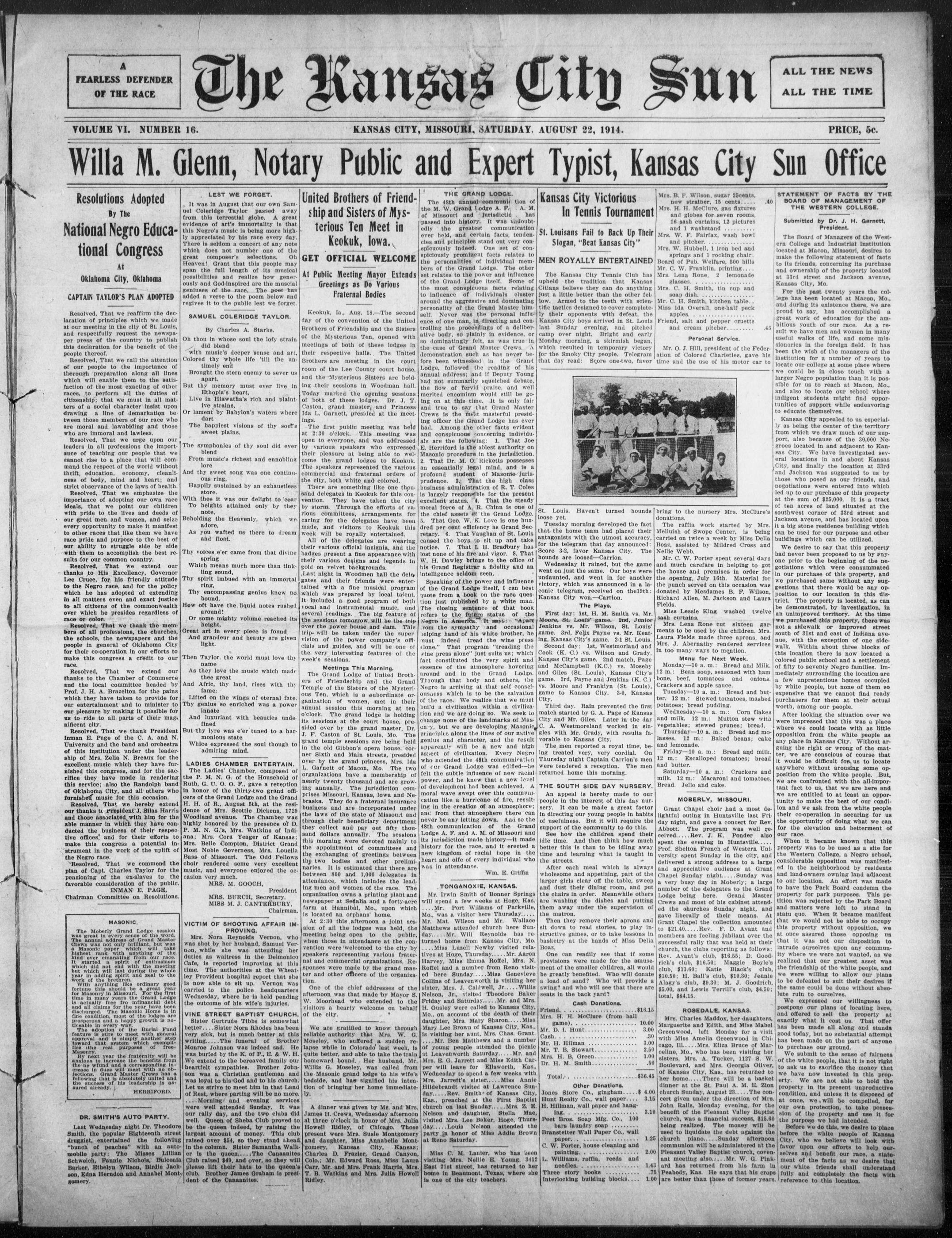
Willa M. Glenn, Notary Public and Expert Typist, Kansas City Sun Office
A FEARLESS DEFENDER OF THE RACE
VOLUME VI. NUMBER 16. Willa M. Gle
Resolutions Adopted By The National Negro Educational Congress
Oklahoma City, Oklahoma
CAPTAIN TAYLOR'S PLAN ADOPTED
Resolved, That we reaffirm the declaration of principles which we made at our meeting in the city of St. Louis, and respectfully request the newspaper press of the country to publish this declaration for the benefit of the people thereof.
Resolved, That we call the attention of our people to the importance of thorough preparation along all lines which will enable them to the satisfaction of the most exacting of other races, to perform all the duties of citizenship; that we must in all matters of a social character insist upon drawing a line of demarkation between those members of our race who are moral and lawabiding and those who are immoral and lawless.
Resolved, That we urge upon our leaders in all professions the importance of teaching our people that we cannot rise to a place that will command the respect of the world without thrift, education, economy, cleanliness of body, mind and heart; and strict observance of the laws of health.
Resolved. That we emphasize the importance of adopting our own race ideals, that we point our children with pride to the lives and deeds of our great men and women, and selize every opportunity to make it manifest to other races that like them we have race pride and purpose to the best of our ability to struggle side by side with them to accomplish the best results for our common country.
Resolved. That we extend our thanks to His Excellency, Governor Lee Cruce, for his friendly attitude to the Negro race, and for the policy which he has adopted of extending in all matters even and exact justice to all citizens of the commonwealth over which he presides regardless of race or color.
Resolved. That we thank the members of all professions, the churches, the schools, the newspapers and the people in general of Oklahoma City for their co-operation in our efforts to make this congress a credit to our race.
Resolved. That we extend our thanks to the Chamber of Commerce and the local committee headed by Prof. J. H. A. Brazelton for the pains which they have taken to provide for our entertainment and to minister to our pleasure by making it possible for us to ride to all parts of their magnificent city.
Resolved. That we thank President Inman E. Page of the C. A. and N. University and the band and orchestra of this institution under the leadership of Mrs. Zelia N. Breaux for the excellent music which they have furnished this congress, and for the sacrifice they have made in rendering this service; also the Randolph band of Oklahoma City, and all others who furnished music for this occasion.
Resolved. That we hereby extend our thanks to President J. Silas Harris and those associated with him for the able manner in which they have conducted the business of their respective offices, and for their efforts to make this congress a potential instrument in the work of the uplift of the Negro race.
Resolved. That we commend the plan of Capt. Charles Taylor for the pensioning of the ex-slaves to the favorable consideration of the public.
INMAN E. PAGE,
Chairman Committee on Resolutions.
MASONIC
The Moberly Grand Lodge session was great in every sense of the word. The Masonic Crews was not only brilliant, but take a Masonic paper which will take a kind ever emanating from our race. It started a spirit of enthusiasm which did not end with the meeting in 1850, but it continued year in adding spirit and zeal to the work of the brethren. It was ordinary good fortune this should be a great year for Masonry in Missouri. For the first time in many years the Grand Lodge has been discharged, and all claims for the year have been discharged. The Masonic Home is in time condition, most of the lodges are approved and is simply another step toward that system which exemplifies real purposes of free-Masonry. By next year the fraternity will be anxious to increase the benefits from the real purposes of Masonic crease in dues will meet with no objections. Grand Master Crews has a following that is absolutely united and has succeeded in his leadership in aured already.
DR. SMITH'S AUTO PARTY.
Last Wednesday night Dr. Theodore Smith, the popular Eighteenth street druggist, entertained the following "bunch of peaches" with an automobile party: The Misses Lillian Schweich, Fannie Nichols, Dalcenla Barker, Ethelyn Wilson, Birdie Jackson, Edna Herndon and Annabel Montgomery.
The Kansas City Sun
It was in August that our own Samuel Coleridge Taylor passed away from this terrestrial globe. A great evidence of art's immortality is that this Negro's music is being more highly appreciated by his race every day. There is seldom a concert of any note which does not number one of the great composer's selections. Oh Heaven! Grant that this people may span the full length of its musical possibilities and realize how generously and God-inspired are the musical geniuses of the race. The poet has added a verse to the poem below and regives it to the public lest we forget.
SAMUEL COLERIDGE TAYLOR.
with music's deeper sense and art
Colored thy whole life 'till the un-
timely end
Brought the stern enemy to sever us
apart.
But thy memory must ever live in
Ethiopia's heart.
Live in Hiwatha's rich and plaint
live strains.
Or lament by Babylon's waters where
dart
The happiest visions of thy soul's
sweet plains.
The symphonies of thy soul did ever
blend
From music's richest and ennobling
lore
And thy sweet song was one continuous ring,
Happily sustained by an exhaustless store.
With thee it was our delight to coan
To heights attained only by they note.
Beholding the Heavenly, which we adore.
Thy voices e'er came from that divine spring
Which means much more than tinkling sound,
Thy spirit imbued with an immortal ring,
Thy encompassing genius knew no bound.
How oft have the liquid notes rushed around!
Or some mighty volume reached its height,
Great art in every piece is found
And grandeur and beauty are given light.
Then Taylor, the world must love thy name
As they love the music which made thee great
And Afric, thy land, rises with thy fame.
Lifted on the wings of eternal fate
Thy genius so enriched was a power
innate
And luxuriant with beauties unde
fined
But thy lyre was e'er tuned to a har monious state
Whice expressed the soul though to admiring mind.
LADIES CHAMBER ENTERTAIN.
The Ladies' Chamber, composed of the P. M. N. G. of the household of Ruth, G. U. O. O. F., gave a reception in honor of the thirty-two grand officers of the Grand Lodge and the Grand H. H. of R., August 5th, at the residence of Mrs. Scottie Dickens, 1729 Woodland avenue. The Chamber was highly honored by the presence of D. P. M. N. G.'s, Mrs. Watkins of Indiana; Mrs. Cora Yeager of Kansas; Mrs. Belle Compton, District Most Noble Governess, Mrs. Louella Bass of Missouri. The Old Fellows choir rendered some very excellent music, and everyone enjoyed the occasion very much.
MRS. M. GOOCH,
President
MRS. BURCH, Secretary.
MISS M. J. CANTERBURY,
Chairman.
VICTIM OF SHOOTING AFFAIR IMPROVING
Mrs. Nora Reynolds Vernon, who was shot by her husband, Samuel Vernon, while she was attending her duties as waitress in the Delmohite Cafe, is reported improving at this time. The authorities at the Wheatley Provident hospital report that she is now able to sit up. Vernon was carried to the police headquarters Wednesday, where he is held pending the outcome of his wife's injuries.
VINE STREET BAPTIST CHURCH.
Sister Gertrude Tibbs is somewhat better.... Sister Nora Rhodes has been very sick, but is much better at this writing.... The funeral of Brother Monroe Johnson was indeed sad. He was buried by the K. of P. E. & W. H. We extend to the bereaved family our heartfelt sympathies. Brother Johnson was a Christian gentleman and was loyal to his God and to his church. Let us strive to meet him in that Land of Rest, where parting will be no more. ... Morning/ and evening services were well attended Sunday. It was our rally day, and the two clubs did well. Queen of Sheba Club proved to be the queen indeed, by raising the largest amount of money. This club raised over $54, so they stand ahead in the column. Sister Samantia Walker is the queen.... The Canaanites Club raised $49, and over, so they will please lift their hats to the queen's club. Brother James Graham is president of the Canaanites.
KANSAS CITY, MISSOURI, SATURDAY, AUGUST 22, 1914.
United Brothers of Friendship and Sisters of Mysterious Ten Meet in Keokuk, Iowa.
GET OFFICIAL WELCOME
At Public Meeting Mayor Extends
Greetings as Do Various
Fraternal Bodies
Keokuk, Ia., Aug. 18.—The second day of the convention of the United Brothers of Friendship and the Sisters of the Mysterious Ten, opened with meetings of both of these lodges in their respective halls. The United Brothers are meeting in the court room of the Lee County court house, and the Mysterious Sisters are holding their sessions in Woodman hall. Today marked the opening sessions of both of these lodges. Dr. J. T Caston, grand master, and Princess Ida L. Garnett, presided at the meetings.
The first public meeting was held at 2:30 o'clock. This meeting was open to everyone, and was addressed by various speakers who expressed their pleasure at being able to welcome the grand lodges to Keokuk. The speakers represented the various commercial and fraternal orders of the city, both white and colored.
There are something like one thousand delegates in Keokuk for this convention. They have taken the city by storm. Through the efforts of various committees, arrangements for caring for the delegates have been made, and visitors to Keokuk this week will be royally entertained.
All of the delegates are wearing their various official insignia, and the badges present a fine appearance with their various designs and legends in gold on velvet backgrounds.
Last night in Woodmen hall the delegates and their friends were entertained with a fine musical program which was prepared by local talent. It included a good program of both vocal and instrumental music, and several readings. The big feature of the sessions tomorrow will be the trip over the power house and dam. This trip will be taken under the supervision of the power company's officials and guides, and will be one of the very interesting features of the week's sessions.
Meetings This Morning
Meetings This Morning.
The Grand Lodge of United Brothers of Friendship and the Grand Temple of the Sisters of the Mysterious Ten, which is a subordinate organization of women, met in their annual session this morning at ten o'clock. The grand lodge is holding its sessions at the court house, presided over by the grand master, Dr. J. F. Caston of St. Louis, Mo. The grand temple sessions are being held in the old Gibbon's opera house. corner Sixth and Main streets, presided over by the grand princess, Mrs. Ida L. Garnett of Macon, Mo. The two organizations have a membership of nearly twenty thousand and are growing annually. The jurisdiction comprises Missouri, Kansas, Iowa and Nebraska. They do a fraternal insurance business and are incorporated under the laws of the state of Missouri and through their beneficiary department they collect and pay out fifty thousand dollars annually. The sessions this morning were devoted mainly to the appointment of committees and the exchanging of greetings between the two bodies and other preliminaries. It is estimated that there are between 800 and 1,000 delegates in attendance, which includes the leading men and women of the race. The organization owns a printing plant and newspaper at Sedalia and a forty-acre farm at Hannibal, Mo., upon which is located an orphan's home.
At 2:30 this afternoon a joint session of all the lodges was held, the meeting being open to the public, when those in attendance at the convention were welcomed to the city by speakers representing various fraternal and commercial organizations. Responses were made by the grand master and other officers of the organization.
One of the chief addresses of the afternoon was that made by Mayor S. W. Moorhead who extended to the visitors a hearty welcome on behalf of the city.
We are gratified to know through reliable authority that Mrs. W. G. Moseley, who suffered a sudden relapse while in Colorado last week, is quite better, and able to take the train homeward bound. Her husband, Mr. Willis G. Moseley, was called from the Masonic grand lodge to his wife's bedside, and has signified his intention of bringing her home immediately.
A dinner was given by Mr. and Mrs. James H. Crews, Wednesday afternoon at three o'clock in honor of Mrs. Julia Howell Ridley, of Chicago. Those present were Mrs. Susie Montgomery and daughter, Miss Annabelle Montgomery, Kansas City, Kansas; Charles D. Frazier, Grand Canyon, Colo.; Mr. Edward Ross, Miss Laura Carr, Mr. and Mrs. Frank Harris, Mrs. T. B. Watkins and Mrs. Julia Howell Ridley
THE GRAND LODGE.
The 48th annual communication of the M. W. Grand Lodge A. F. A. M. of Missouri and juridictic has passed into history. It was undoubtedly the greatest communication ever held, and certain facts, tendencies and principles stand out very conspicuously indeed. One set of conspicuously prominent facts relates to the personalities of individual members of the Grand Lodge. The other set relates to the power and influence of the Grand Lodge itself. Some of the most conspicuous facts relating to influence of individuals cluster around the aggressive and dominating personality of the Grand Master himself. Never was the personal influence of one man, in directing and controlling the proceedings of a deliberative body, so plainly in evidence, or so dominatingly felt, as was true in the case of Grand Master Crews. A demonstration such as has never been witnessed in the Grand Lodge, followed the reading of his annual address, and if Deputy Young had not summarily squelched debate, the flow of fervid praise, and well merited encomium would still be going on at this time. It is only fair and true to say that Grand Master Crews is the most masterful presiding officer the Grand Lodge has ever had. Among the other facts evident and conspicuous concerning individuals are the following: 1. That Joe E. Herriford is the ablest authority on Masonic procedure in the juridiction. 2. That Dr. M. O. Ricketts possesses an essentially legal mind, and is a profound student of Masonic juridence. 3. That the high class business administration of R. T. Coles is largely responsible for the present excellent status. 4. That the steady moral force of A. R. Chinn is one of the chief assets of the Grand Lodge. 5. That Geo. W. K. Love is one hundred per cent efficiency as Grand Secretary. 6. That Vaughan of St. Louis caused the boys to sit up and take notice. 7. That I. H. Bradbury has lost none of his fire and vigor. 8. That W. H. Dawley brings to the office of his Grand Registrar a fidelity and an intelligence seldom seen.
Speaking of the power and influence of the Grand Lodge itself, I can best quote from a book on the race question just published by a white man. The closing sentence of that book refers to the status of the Negro in America. It says: "Apart from the sympathy and occasional helping hand of his white brother, he must indeed tread the wine press alone." That program "treading the wine press alone" just suits us; which fact constituted the very spirit and essence of the atmosphere hovering around and in the Grand Lodge. Through that body and others, the Negro is arriving at that self-consciousness which is to be the salvation of the race. We realize that we must build a civilization within a civilization and we are doing so. We seek to change none of the landmarks of Masonry, but we are developing Masonic principles along the lines of our native genius and character, and the result apparently will be a new and high aspect of civilization. Every Negro who attended the 48th communication of our Grand Lodge was filled—he felt the subtle influence of new racial power, and he knew that a new level of development had been achieved. A moral wave swept over this communication like a hurricane of fire, resulting in the creation of an atmosphere; and from that atmosphere there can never be any letting down. And so the 48th communication of the Grand Lodge A. F. and A. M. of Missouri and its jurisdiction made history. It made history for the race, and it erected a new kingdom of racial hope in the heart and ofe of every individual who was in attendance.
TONGANOXIE, KANSAS.
Mr. Irwin Smith of Bonner Springs will spend a few weeks at Hoge, Kas....Mr. Port Williams of Parkville, Mo., was a visitor here Thursday....Mr. Mat. Wilson and Mr. Wallace Matthews attended church here Sunday....Mr. Will Reynolds has returned home from Kansas City, Mo....Miss Luzell Newby visited relatives at Hoge, Thursday....Mr. Aaron Harvey, Miss Emma Roffel, Mrs. N. Roffel and a number from Reno visited here Sunday....Miss Genevieve Collins of Leavenworth is visiting her sister, Mrs. J. Caldwell, Jr....Willis Nelson, Jr., visited the Oreiller Baker Friday and Saturday....Mr. and Mrs. H. Ousley were called to Kansas City, Mo., on account of the death of their daughter, Mrs. Mary Sharon....Miss Mary Lee Brown of Kansas City, Kas., is visiting her aunt, Mrs. Chas. Grant....Mr. Ben Matthews and a number of young people attended the picnic at Leavenworth Saturday....Mr. and Mrs. E. G. Jarrett and Miss Edith Carper will leave for Ellsworth, Kas. Wednesday to spend a few weeks with Mrs. Jarrett's sister....Miss Ann Hildebrandt visited at Lawrence Sunday....Rev. Smith of Kansas City, Kas., preached at the First Baptist church on last Sunday....Mrs. Z. E Nelson and daughter, Stella Mae visited Mrs. Lee Baker, Hoge, Thursday....Louis Nelson attended the party in honor of Miss Addie Brown at Reno Saturday.
Miss C. M. Lanier, who has been visiting Mrs. Nellie E. Young, 3412 East 21st street, has returned to her home in Beaumont, Texas, where she is one of the city teachers.
TENNIS
Kansas City Victorious In Tennis Tournament
St. Louisans Fail to Back Up Their Slogan, "Beat Kansas City"
MEN ROYALLY ENTERTAINED
The Kansas City Tennis Club has upheld the tradition that Kansas Citians believe they can do anything just a little better than the other fellow. Armed to the teeth with scientific tactics designed to cover completely their opponents with defeat, the Kansas City boys arrived in St. Louis last Sunday evening, and pitched camp over night. Bright and early Monday morning, a skirmish began, which resulted in temporary victory for the Smoky City people. Telegram that day read: Score one-two, favor
St. Louis. Haven't turned hounds loose yet.
Tuesday morning developed the fact that the home team had placed their antagonists with the utmost accuracy for the telegram that day announced: Score 3-2, favor Kansas City. The hounds are loosed—Carrion. Wednesday it rained, but the game went on just the same. Our boys were undaunted, and went in for another victory, which was announced in a laconic telegram, received on the 19th: Kansas City won—Carrion.
The Plays.
First day: 1st, H. M. Smith vs. Mr. Moore, St. Louis' game. 2nd, Junior Jenkins vs. Mr. Wilson, St. Louis' game. 3rd, Felix Payne vs. Mr. Keating, Kansas City's game. 2-1 St. Louis. Second day: 1st, Westmorland and Cook (K. C.) vs. Wilson and Grady, Kansas City's game. 2nd match, Page and McCampbell (K.C.) vs. Moseby and Giles (St. Louis), Kansas City's game. 3rd, Payne and Jenkins (K. C.) vs. Moore and Franklin (St. Louis), game to Kansas City. 3-0, Kansas City. Third day. Rain prevented the first match started by G. A. Page of Kansas City and Mr. Giles. Later in the day C. A. Westmoreland worked in singles with Mr. Grady, with results favorable to Kansas City.
The men reported a royal time, being treated very, very cordial. On Thursday night Captain Carrion's men were tendered a reception. The men returned home this morning.
THE SOUTH SIDE DAY NURSERY
An appeal is hereby made to our people in the interest of this day nursery. It can be made a great factor in directing our young people in habits of usefulness. But it will require the support of the community to do this.
See how the children spend their idle time. And then think how much better this is than to be idling away time and learning what is taught in the streets.
After each meal which is always wholesome and appetizing, part of the larger girls clear off the table, sweep and dust their dining room, and put the chairs in order. Meanwhile others are washing the dishes and putting them away under the supervision of the matron.
Then they remove their aprons and sit down to read stories, to play instructive games, or to take lessons in basketry at the hands of Miss Delia Boaz.
One can readily see that if some provisions were made for the amusement of the smaller children, all would be greatly benefited. Who will donate a load of sand? Who wil provide a swing? and who will see that there are seats in the back yard?
Cash Donations.
Mrs. H. H. McClure (from ball
game). 10.00
Mr. D. I. Hunt 3.00
Cash. 30
Mr. H. Hillman 3.00
Mr. T. B. Stewart 2.50
Mrs. H. B. Green 1.00
Dr. H. M. Smith 50
Jones Store Co., gingham..... $ 4.00
Hunt Realty Co., wall paper..... 3.15
H. Hillman, wall paper and hang-
ing..... 3.10
Peet Bros. Soap Mfg. Co., 100
bars laundry soap ..... 3.10
Branstetter Wall Paper Co., wall
paper. ..... 1.20
C. W. Porter, house cleaning and
painting. ..... 2.00
L. Williams, raffia, reeds and
needles. ..... 1.40
Three story books ..... 7.
Interlocking building blocks..... 1.00
and 1 washstand
Mrs. W. Fairfax, wash bowl
and pitcher.
Mrs. W. Hubbell, 1 iron bed
and springs and 1 rocking chair.
Board of Pub, Welfare, 500 bills
Mr. C. W. Franklin, printing.
Mrs. Lena Rone, 2 lemonade
glasses.
Mrs. C. H. Smith, tin cup and soar daan. Dr. C. H. Smith, kitchen table. Miss ida Overall, one-half peck apples.
Friend, salt and pepper cruetts
and cream pitcher.
Personal Service
Mr. O. J. Hill, president of the Federation of Colored Charities, gave his time and the use of his motor car to bring to the nursery Mrs. McClure's donations.
The raffia work started by Mrs. Melluish of Swope Center, is being carried on twice a week by Miss Della Boaz, assisted by Mildred Cross and Nellie Webb.
Mr. C. W. Porter spent several days and much carefare in helping to get the house and premises in order for the opening, July 16th. Material for the punch served on this occasion was donated by Mesdames B. F. Wilson, Richard Allen, M. Jackson and Laura Fields.
Miss Leslie King washed twelve sash curtains.
Mrs. Lena Rone cut sixteen garments to be used by the children. Mrs. Laura Fields made three aprons, and Mrs. J. Abernathy rendered services in too many ways to mention.
**Menu for Next Week.**
Monday—10 a.m. : Bread and Milk.
12 m. : Bean soup, seasoned with ham bone, beef, tomatoes and onions. Crackers and apple sauce.
Tuesday—10 a.m. : Bread and butter.
12 m. : Stewed tomatoes, mashed potatoes; bread pudding.
Wednesday—10 a.m. : Corn flakes and milk. 12 m. : Mutton stew with vegetables; stewed prunes; bread.
Thursday—10 a.m. : Bread and mo-lasses. 12 m. : Baked beans; cake and lemonade.
Friday—10 a.m. : Bread and milk.
12 m. : Escalloped tomatoes; bread and butter.
Saturday—10 a.m. : Crackers and milk. 12 m. : Macaroni and tomatoes. Bread. Jello and cake.
MOBERLY, MISSOURI
Grant Chapel choir had a most delightful outing in Huntsville last Friday night, and gave a concert for Rev. Abbott. The program was well received....Rev. J. K. Ponder also spent the evening in Huntsville....Prof. Shelton French of Western University spent Sunday in the city, and delivered a strong address to a large and appreciative audience at Grant Chapel Sunday night....Sunday was a very busy day in Moberly; a large number of the delegates to the Grand Lodge being here. Grand Master Crews and most of his cabinet attended the obrches Sunday night, and gave liberally of their means. At Grant Chapel the collection amounted to $21.40....Rev. F. D. Avant and members are feeling jubilant over the successful rally that was held at their church, the clubs reporting as follows: Rev. Avant's club, $16.55; D. Good rich's club, $16.50; Maggie Boyle's club, $11.60; Katie Black's club, $10.50; H. Ball's club, $10.30; Jennie Alagy's club, $9.30; M. J. Goodrich $5.00, and Lewis Terrill's club, $4.50; total, $84.15.
ROSEDALE, KANSAS
Mrs. Charles Maddox, her daughters, Marguerite and Edith, and Miss Mabel Greenwood, left Monday for a visit with Miss Amelia Greenwood in Chicago, Ill. Mrs. Eliza Bruce of Marceline, Mo, who has been visiting her sisters, Mrs. A. Tucker, 1127 S. W. Boulevard, and Mrs. Georgia Oliver, of Kansas City, Kas, has returned to her home.... There will be a basket dinner at the St. Paul A. M. E. Zion church Sunday, August 25.... The concert given under the direction of Mrs. John Ralls, Monday evening, for the benefit of the Pleasant Valley Baptist church, was a financial success, $15.60 being realized. The money will be used to liquidate the debt against the church piano.... Sunday afternoon communion will be administered at the Pleasant Valley Baptist church, covenant meeting also.... Mr. W. G. Pinkard has returned from his farm in Peabody, Kas. He says that his crops are better than those of former years
ALL THE NEWS ALL THE TIME
PRICE. 5c.
STATEMENT OF FACTS BY THE BOARD OF MANAGEMENT OF THE WESTERN COLLEGE.
Submitted by Dr. J. H. Garnett, President.
The Board of Managers of the Western College and Industrial institution located at Macon, Missouri, desires to make the following statement of facts to its friends, concerning its purchase and ownership of the property located at 33rd street and Jackson avenue, Kansas City, Mo.
For the past twenty years the college has been located at Macon, Mo., and during its existence there, we are proud to say, has accomplished a great work of education for the ambitious youth of our race. As a result we have men and women in many useful walks of life, and some missionaries in the foreign field. It has been the wish of the managers of the institution for a number of years to locate our college at some place where we could be in close touch with a larger Negro population than it is possible for us to reach at Macon, Mo., and also to locate our school where indigent students might find opportunities of support while endeavoring to educate themselves.
Kansas City appealed to us especially as being the center of the territory from which we draw much of our support, also because of the 30,000 Negroes located in and adjacent to Kansas City. We have investigated several locations in and about Kansas City, and finally the location at 33rd and Jackson was suggested to us by those who posed as our friends, and negotiations were entered into which led up to our purchase of this property at the sum of $25,000. It is a tract of ten acres of land situated at the southwest corner of 33rd street and Jackson avenue, and has located upon it a big stone residence building which can be used for our purpose and other buildings which can be utilized.
We desire to say that this property had never been proposed to us by anyone prior to the beginning of the negotiations which were consummated in our purchase of this property, and we purchased same without any suggestions that there would be any opposition to our location in this district. The property is located, as can be demonstrated, by investigation, in an unimproved territory. At the time we purchased this property, there was not a sidewalk or improved street south of 31st and east of Indiana avenue, with the exception of one sidewalk. Within about three blocks of this location there is now located a colored public school and a settlement of fifty to seventy Negro families. Immediately surrounding the location are a few unpretentious homes occupied by white people, but none of them so expensive that we cannot find ready purchasers for them at their actual worth, among our people.
After looking the situation over we were impressed that this was a place where we could locate with as little opposition from the white people as any place in Kansas City. Without arguing the right or wrong of the matter, we are conscious of course that it would be difficult for us to locate anywhere without arousing some opposition from the white people. But, we are confronted with the all-important fact to us, that we are here and we are entitled to at least an opportunity to make the best of our condition and we ask from the white people their co-operation in securing for us the opportunity of doing what we can for the elevation and betterment of our race.
When it became known that this property was to be used as a site for the Western College, a Negro school, considerable opposition was manifested in the neighborhood by residents and land-owners owning land adjacent to our location. An effort was made to have the Park Board condemn the property for park purposes. This petition was rejected by the Park Board and matters were left to stand in statu quo. When it became manifest that we would not be able to occupy this property without opposition, we at once assured those opposing us that it was not our disposition to intrude ourselves upon any community where we were not wanted, as we realized that our greatest asset was the friendship of the white people, and we were willing to allow our plans to be defeated to suit their desires if the same could be done without absolute ruin to ourselves.
We expressed our willingness to postpone our plans of locating here, and offered to sell the property at exactly what it cost us. That offer has been made all along and stands good today, but no substantial attempt has been made on the part of anyone to purchase our ground.
We submit to the sense of fairness of the white people, that it is not right to ask us to sacrifice the money that we have now invested in this property. We are not able to hold the property in its present unproductive condition, and unless it is disposed of at once, we will be compelled, for our own protection, to take possession of the property and use it for the purpose we had intended. Before we do this, we desire to place before the white people of Kansas City, who we believe will look with favor upon our efforts to help ourselves and benefit our race, a statement of the facts as we desire that our white friends shall understand fully and completely the facts with reference to this location.
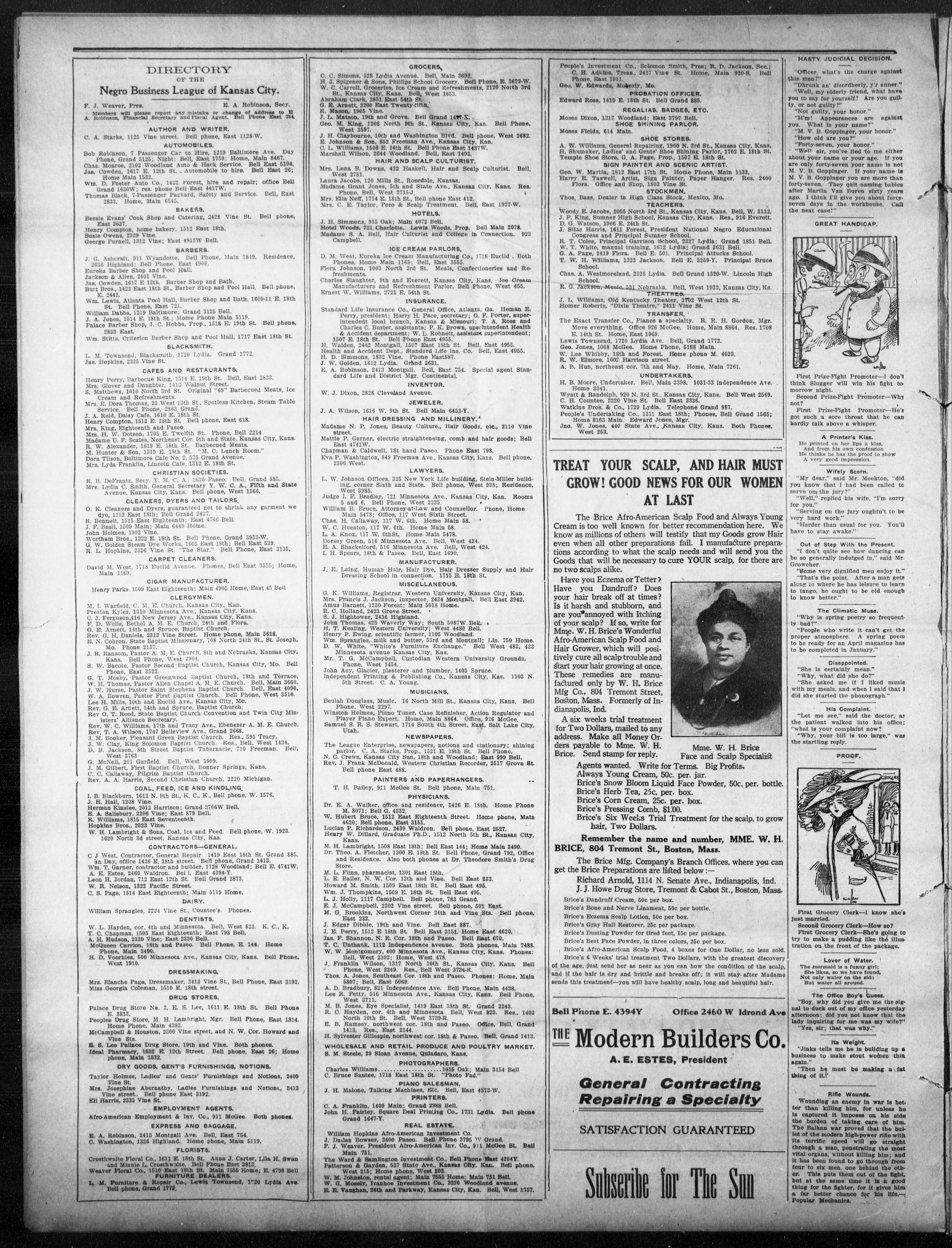
Negro Business League of Kansas City.
F. J. Weaver, Pres. E. A. Robinson, Secy. Members will please report any mistake or change of address to E A. Robinson, Financial Secretary and Fiscal Agent. Bell Phone East 754.
AUTHOR AND WRITER.
Bob Robinson, 7 Passenger Car to Hire, 1219 Baltimore Ave, 8467
Phone, Grand N1325; Night, Belfast, E1759; Home, Main 8467.
Chas, Monroe, 2102 Woodland Auto & Hack Service. Bell East 5134.
Jas, Cowden, 1617, 121st St., Automobile to hire. Bell East 5126.
Wm. D. Poster Auto Co., 1423 Forest, hire and repair; office Bell
Grand 1630W; res. phone Bell East 4417W.
Thomas Black, 7-Passenger Packard, Safety and Service. Bell, East
2833. Home, Main 6545.
BAKER9.
East 3637.
Henry Compton, home bakery, 1512 East 18th.
Susie Owens, 2329 Vine.
George Purnell, 1312 Vine; East 4915W Bell.
BARBERS.
J. G. Ashcraft, 911 Wyandotte. Bell Phone, Main 3849. Residence,
2636 Highland; Bell Phone, East 4908.
E. 2342.
Wm. Lewis, Atlanta Pool Hall, Barber Shop and Bath, 1609-11 E. 18th St., Pell Phone, East. 721.
Wm. Stitts, Criterion Barber Shop and Pool Hall, 1717 East 18th St.
BLACKSMITH.
L. M. Townsend, Blacksmith, 1720 Lydia. Grand 1772.
Jas. Hopkins, 2225 Vine St.
CAFES AND RESTAURANTS.
Henry Perry, Barbecue King, 1514 E. 19th St. Bell, East 2833.
Mrs. Glover and Daughter, 1413 Walnut Street.
S. Matthews, 1040 North 3rd St. Original "69" Barbecued Meats, Ice Cream and Refreshments.
Mrs. E. Dora Thomas, 23 West 13th St. Spotless Kitchen, Steam Table Service, Bell Phone, 2863 Grand.
J. A. Reid, Dalsy Cafe, 1619 E. 18th St.
Henry Compton, 1512 E. 18th St. Bell phone, East 618.
Mrs. King, Eighteenth and Pass.
Mrs. H. Dixon, 109 E. Twelfth St. Phone, Bell 2214
Mascalus U. F. Scales, Northeast Cor. 5th and State, Kansas City, Kans.
R. W. Alexander, 1619 E. 18th St. Barbecued Meats.
M. Hunter & Son, 1319 E. 18th St. "M. C. Lunch Room."
Dora Tilson, Baltimore Cafe No. 2, 575 Grand Avenue.
Mrs. Lyda Franklin, Lincoln Cafe, 1312 E. 18th St.
CHRISTIAN SOCIETIES.
R. B. DeFrantz, Secy. Y. M. C. A., 1830 Paseo. Bell, Grand $85.
Mydia L. Cdaia, Kauai. Bell, Grand $85.
Kauai. Kansas City, Kauai. Bell phone, West 1566.
CLEANERS, DYERS AND TAILORS.
O. K. Cleaners and Dyers, guaranteed not to shrink any garment we dye, 1113 East 15th; Bell Grand 2437.
R. Bennett, 1515 East Eighteenth; East 4746 Bell.
J. F. Basil, 1509 Main; Main 6449 Home.
John Holmes, 1903 Vine.
Wortham Bros., 1222 E. 19th St. Bell Phone, Grand 3933-W.
G. W. Golden Steam Dye Works, 1605 East 18th; Bell East 539.
R. L. Hopkins, 2326 Vine St. "The Star," Bell Phone, East 3135.
CARPET CLEANERS
David M. West, 1718 Euclid Avenue. Phones, Bell East 3555; Home, Main 1169.
CIGAR MANUFACTURER.
Henry Parks. 1509 East Eighteenth; Main 4905 Home, East 45 Bell
CLERGYMEN.
M. I. Warfield, C. M. E. Church, Kansas City, Kan.
Preston Kyles, 1310 Minnesota Ave., Kansas City, Kans.
C. J. Ferguson, 416 New Jersey Ave., Kansas City, Kans.
F. D. Wells, Bethel A. M. E. Church, 24th and Flora.
G. E. Arnett, 14th and Spruce, Baptist Church.
Rev. G. H. Daniels, 2313 Vine Street. Home phone, Main 5618.
E. N. Cohran, State Baptist Missionary, 708 North 24th St., St. Joseph,
Mo. Phone 2137.
J. R. Ransom, Pastor A. M. E. Church, 5th and Nebraska, Kansas City,
Kans. Bell Phone, West 2904.
S. W. Bacote, Pastor Second Baptist Church, Kansas City, Mo. Bell
Phone, East 3522.
G. T. Mosby, Pastor Greenwood Baptist Church, 18th and Terrace,
W. H. Thomas, Pastor Allen Chapel A. M. E. Church, Bell, Main 3660.
J. W. House, Pastor Saint Stephens Baptist Church, Bell, East 4090.
W. A. Bowren, Pastor First Baptist Church. Bell Phone, West 3510.
Lee H. Mills, 10th and Euclid Ave., Kansas City, Mo.
Rev. G. E. Arnett, 14th and Spruce, Baptist Church.
Rev O. T. Reed, State Baptist Church Convention and Twin City Ministers' Alliance Secretary.
Rev. W. C. Williams, 17th and Tracy Ave., Ebenezer A. M. E. Church, Rev. T. A. Wilson, 1747 Belleview Ave., Grand 2668.
G. McNeil, 211 Garfield. Bell, West 1899.
J. M. Gilbert, First Baptist Church, Bonner Springs, Kans.
C. C. Callaway, Pilgrim Baptist Church.
Rev. A. A. Harris, Second Christian Church, 2220 Michigan.
COAL, FEED, ICE AND KINDLING.
I. B. Blackburn, 1612 N. 9th St., K. C., K., Bell phone, W. 1576.
J. H. Hall, 1208 Vine.
Herman Kinslee, 2012 Harrison; Grand 2766 W Bell.
E. A. Salsbury, 2206 Vine; East 879 Bell.
R. Williams, 1815 East Seventeenth.
Hopkins Bros., 2323 Vine.
W. H. Lambright & Sons, Coal, Ice and Feed. Bell phone, W. 1923.
1620 North 3d street, Kansas City, Kas.
CONTRACTORS—GENERAL.
C J West, Contractor, General Repair 1419 East 18th St. Grand 885,
in Day, office 1426 E, 18th street. Bell phone, Grand 1413.
Wm. T. Garner, contractor and builder, 1728 Woodland; Bell E. 4741W.
A. E. Estes, 2460 Waldron. Bel I. East 4394-Y.
Leon H. Jordan, 712 East 12th St. Bell Grand 2873.
W. R. Nelson, 1322 Pacific Street.
C. S. Page, 1514 Eighteenth; Main 5119 Home.
W. L. Hayden, cor. 4th and Minnesota. Bell, West 823. K. C., K.
T. C. Chapman, 1505 East Eighteenth; East 798 Bell.
A. H. Hudson, 2330 Vine; East 2330 Bell.
McQueen Carrion, 18th and Paseo. Bell Phone, E. 144. Home
Phone, Main 3490.
H. D. Voorhies, 500 Minnesota Ave., Kansas City, Kans. Bell Phone,
West 1910.
DRESSMAKING
Mrs. Blanche Page, Dressmaker, 2413 Vine St., Bell Phone, East 3192.
Miss Georgia Coleman, 1510 E. 18th street.
DRUG STORES.
Palace Drug Store No. 2, E. S. Lee, 1611 E. 18th St. Bell Phone
E. 3813.
Peoples Drug Store, M. H. Lambright, Mgr. Bell Phone, East 1814.
Home Phone, Main 4382.
McCampbell & Houston, 2300 Vine street, and N. W. Cor. Howard and
Vine Sts.
DRUG STORES
E. S. Lee Pallace Drug Store, 19th and Vine. Both phones.
Ideal Pharmacy, 1532 E. 12th Street. Bell phone, East 26; Home phone, Main 1532.
DRY GOODS, GENT'S FURNISHINGS, NOTIONS.
Taylor Holmes, Ladies' and Gents' Furnishings and Notions, 2409 Vine St.
Mrs. Josephine Abernathy, Ladies Furnishings and Notions, 2413 Vine street.. Bell phone East 3192.
Eli Harris, 2333 Vine St.
EMPLOYMENT AGENTS.
Afro-American Employment & Inv. Co., 911 McGee. Both phones.
EXPRESS AND BAGGAGE.
E. A. Robinson, 2413 Montgall Ave. Bell. East 754.
C. Washington, 1326 Highland. Home phone, Main 5119.
FLORISTS.
Crostwalte Floral Co., 1611 E. 18th St. Anna J. Carter, Lila H. Swan and Minnie L. Crostwalte. Bell Phone East 3813.
Weaver Floral Co., 1510 E. 18th St. Main 7556 Home; E. 4798 Bell FURNITURE DEALERS.
L. M. Furniture & Repair Co., Lewis Townsend, 1720 Lydia Ave.
Bell phone, Grand 1772.
C. C. Simons, 528 Lydia Avenue. Bell, Main 3692.
H. J. Spiigner & Sons, Phillips School Grocery. Bell Phone, E. 3679-W.
W. C. Carroll, Groceries, Ice Cream and Refreshments, 2120 North 3rd
St. Kansas City, Kans. Bell, West 1653.
Abraham Clark, 2831 East 54th St.
G. E. Arnett, 2200 East Twenty-fifth.
R. Mason, 1905 Vine.
J. L. Matson, 19th and Grove. Bell Grand 1497-X.
Geo. M. King, 1208 North 9th St. Kansas City, Kan. Bell Phone,
West 3597.
J. H. Claybourne, 10th and Washington Blvd. Bell phone, West 2682.
E. Johnson & Son, 525 Freeman Ave., Kansas City, Kan.
C. L. Williams, 1508 E. 24th St. Bell Phone East 1437W.
Marshall Wilson, 2644 Woodland. Bell, East 1493.
HAIR AND SCALP CULTURIST.
Mrs. Lena B. Downs, 422 Haskell, Hair and Scalp Culturist. Bell,
West 2781.
Laura Jacobs, 120 Mills St., Rosedale, Kansas.
Madame Grant Jones, 5th and State Ave., Kansas City, Kans. Res.
Phone, Bell West 3715J.
Mrs. Ela Nef, 1714 E, 188th St., Bell phone East 412.
Mrs. C. E. Taylor, Poro & Scalp Treatment, Bell, East 1927-W.
HOTELS.
J. H. Simmons, 915 Oak; Main 4072 Bell.
Hotel Woods, 721 Charlotte. Lewis Woods, Prop. Bell Main 2078.
Madame S. A. Bell, Hair Culturist and College in Connection. 923
Campbell.
ICE CREAM PARLORS
Charles Slaughter, 9th and Everett, Kansas City, Kans. - Joe-Cream
Manufacturers, and Refreshment Parlor, Bell Phone, West 455.
Bell Phone, West 455.
INSURANCE.
Standard Life Insurance Co., General Office, Atlanta, Ga. Homan E. Perry, president; Harry H. Pace, secretary; G. F. Porter, superintendent local branch, Kansas & Missouri; T. A. Ross and Charles C. Buster, assistants; P. K. Brown, superintendent Health & Accident department; W. L. Robnett, assistant superintendent; 1507 E. 18th St. Bell Phone East 4955.
H. Walden, 2442 Montgall, 1507 East 18th St. Bell, East 4955.
Health and Accident Dept., Standard Life Ins. Co. Bell, East 4955.
H. D. Simmons, 1832 Vine, Phone East887.
J. W. Golden, 1612 Lydia. Grand 2631.
E. A. Robinson, 2413 Montgall, Bell, East 754. Special agent Standard Life and District Mgr. Continental.
INVENTOR.
W. J. Dixon, 2828 Cleveland Avenue.
JEWELER.
J. A. Wilson, 1616 W. 9th St. Bell Main 6453-Y.
HAIR DRESSING AND MILLINERY.'
Madame N. P. Jones, Beauty Culture., Hair Goods, etc., 2110 Vine
street.
Mattie P. Garner, electric straighteneing, comb and hair goods; Bell
East 4741W.
LAWYERS.
L. W. Johnson Offices, 325 New York Life building, Stein-Miller building, corner Sixth and State. Bell phone, West 938; Residence, West 3985.
Judge I. F. Bradley, 721 Minnesota Ave., Kansas City, Kan. Rooms 5 and 6. Bell Phone, West 2335.
William B. Bruce, Attorney-at-Law and Counsellor. Phone, Home Main 5478; Office, 117 West Sixth Street.
Chas. H. Callaway, 117 W. 6th. Home Main 58.
W. C. Hueston, 117 W. 6th. Home Main 58.
L. A. Knox, 117 W. 6thSt. Home Main 5478.
Dorsey Green, 516 Minnesota Ave. Bell, West 424.
E. A. Shackellford, 516 Minnesota Ave. Bell, West 424.
I. H. Spears, 18th & Paseo. Bell, East 1690.
MANUFACTURER.
MANUFACTURER
J. E. Laing, Human Hair, Hair Dye, Hair Dresser Supply and Hair Dressing School in connection. 1715 E. 18th St.
MISCELLANEOUS.
G. K. Williams, Registrar, Western University, Kansas City, Kan.
Mrs. Francis J. Jackson, Inspection, 2434 Montgall, Bell East 3942.
Amus Barnett, 1230 Forest; Main 5018 Home.
R. C. Holland, 2423 Grove Street.
S. J. Hightower, 2426 Highland.
John Thomas, 425 Waverly Way; South 5087W Bek.
H. T. Kealing, Western University; West 4480 Bell.
Henry P. Ewing, scientific farmer, 1105 Woodland.
Wm. Sprangles, milk and butter, 53rd and Montgall; Lin. 750 Home.
D. W. White, "White's Furniture Exchange." Bell West 483, 423
Minnesota avenue Kansas City, Kas.
Mr. T. G. McCampbell, Custodian Western University Grounds,
Phone, West 1454.
Johy Acy, Glacier, plasterer and plumber, 1405 Spruce.
Independent Printing & Publishing Co., Kansas City, Kas. 1103 N.
5th Street. C. A. Young.
MUSICIANS.
Beulah Douglass, Music. 16 North Mill St., Kansas City, Kans. Bell Phone, West 2297.
Winston Holmes, Plano Tuner, Case Refinisher, Action Regulator and Player Piano Expert. Home, Main 8864. Office, 926 McGee, Samuel S. R. S. Stewart, 1714 South 4th Street, East, Salt Lake City, Utah.
NEWSPAPERS.
The League Enterprise, newspapers, notions and stationary; shining parlor. C. A. Starks, Prop., 1521 E. 18th St. Bell Phone. N. C. Crews, Kansas City Sun, 18th and Woodland; East 999 Bell. Rev. J. Frank McDonald, Western Christian Recorder, 2517 Grove St. Bell phone East 488.
PAINTERS AND PAPERHANGERS.
T. H. Bailey, 911 McGee St. Bell phone, Main 751.
PHYSICIANS.
Dr. E. A. Walker, office and residence, 1426 E. 18th. Home Phone M. 8071; Bell G. 4332.
W. Hubert Bruce, 1512 East Eighteenth Street. Home phone, Main 4620; Bell phone, East 3151.
Lucian P. Richardson, 2439 Waldron. Bell phone, East 2527.
Henry W. Dillard, Graduate Ph.D., 1512 North 5th St., Kansas City, Kans.
M. H. Lambright, 1508 East 18th; Bell East 144; Home Main 3490.
Dr. Theo. A. Fletcher, 1300 E. 18th St. Bell Phone, Grand 792, Office and Residence. Also both phones at Dr. Theodore Smith's Drug Store.
M. L. Flinn, pharmacist, 1301 East 18th.
L. E. Bailer, N. W. Cor. 12th and Vine. Bell East 232.
Howard M. Smith, 1509 E. 18th St. Bell East 495.
Wm. J. Thompkins, 1509 E. 18th St. Bell East 495.
L. J. Holly, 1117 Campbell. Bell phone, 783 Grand.
E. J. McCampbell, 2302 Vine street. Bell phone, 501 East.
M. G. Brookins, Northwest Corner 24th and Vine Sts. Bell phone, East 232.
T. C. Unthank, 1112 Independence avenue. Both phones, Main 7488.
W. W. Montgomery, 400 Minnesota Ave. Kansas City, Kans. Phones:
Bell, West 2302; Home, West 478.
J. Franklin Wilson, 1317 North 10th St., Kansas City, Kans. Bell
Phone, West 2249. Res., Bell West 3734-R.
Thos. A. Jones, Southeast Cor. 18th and Paseo. Phones: Home, Main
5807; Bell, East 5069.
A. D. Bradbury, 821 Independence Ave. Bell Phone, Main 4438.
Lee R. Petty, 516 Minnesota Ave., Kansas City, Kans. Bell Phone,
West 3711.
M. B. Jones, Eye Specialist, 1419 East 18th St. Grand 2243.
R. C. Hayden, cor. 4th and Minnesota Bell, West 823. Res., 1403
North 10th St. Bell, West 3739-R.
E. B. Ramsey, northwest cor. 18th and Paseo. Office, Bell, Grand
1413. Res., East 2144.
H. Sylvester Gillespie, northwest cor. 18th & Paseo. Bell, Grand 1413.
WHOLESALE AND RETAIL PRODUCE AND POULTRY MARKET.
S. M. Steele, 29 Sloan Avenue, Quindaro, Kans.
PHOTOGRAPHERS.
Charles Williams. 1718 East 18th St. "Photo Fad." C. Bruce Santee, 1718 East 18th St.
C. A. Franklin, 1409 Main; Grand 2388 Bell.
John H. Fairley, Square Deal Printing Co., 1731 Lydia. Bell phone
Grand 1647-Y.
REAL ESTATE.
REAL ESTATE.
William Hopkins Afro-American Investment Co.
J. Dailas Bowser, 2400 Paseo. Bell Phone 3795 W Grand.
F. J. Weaver, President Afro-American Inv. Co., 911 McGee St. Bell Main 751.
The Ward & Samlington Investment Co., Bell Phone East 4294Y.
Patterson & Gayden, 527 State Ave., Kansas City, Kan. Bell phone, West 215; Home phone, West 503.
W. M. Johnston, rental agent; Main 7555 Home; Main 751 Bell.
W. G. Mosely, Ivanhoe Investment Co., 2220 Woodland avenue.
E. E. Vaughan, 26th and Parkway, Kansas City, Kan. Bell, West 1757.
People's Investment Co., Solomon Smith, Pres; R. D. Jackson, Sec.; C. H. Adkins, Treas., 2427 Vine St. Home, Main 920-S. Bell Phone, East 1011.
Geo. W. Edwards, Moberly, Mo.
PROBATION OFFICER.
Edward Ross, 1419 E. 18th St. Bell Grand 885.
REGALIAS, BADGES, ETC.
Moses Dixon, 1217 Woodland; East 3797 Bell.
SHOE SHINING PARLOR.
Moses Fields, 614 Main.
SHOE STORES.
SHOE STORES
A. W. Williams, General Repairing, 1960 N. 3rd St., Kansas City, Kans.
H. Shumaker, Ladies' and Gent's Shoe Shining Parlor, 1702 E. 18th St.
Temple Shoe Store, G. A. Page, Prop., 1507 E. 18th St.
SIGN PAINTER AND SCENIC ARTIST.
Geo. W. Martin, 1812 East 17th St., Home Phone, Main 1133.
Harry E. Taswell, Artist, Sign Painter, Paint Hanger. Res. 2400
Flora. Office and Shop, 1803 Vine St.
STOCKMEN.
Thos. Bass, Dealer in High Class Stock, Mexico, Mo.
TEACHERS.
Woody E. Jacobs, 2055 North 3rd St., Kansas City, Kans. Bell, W. 3112.
J. P. King, Summer High School, Kansas City, Kans. Res., 916 Everett.
D. G. Watson, 1906 E. 24th St.
J. Silas Harris, 1611 Forest, President National Negro Educational Congress and Principal Sumner School.
T. W. H. Williams, 1323 Jackson. Bell E. 3259-Y. Principal Bruce School.
Chas. A. Westmoreland, 2325 Lydia. Bell Grand 1320-W. Lincoln High School.
R. G. Jackson, Music, 531 Nebraska. Bell, West 1032, Kansas City, Ks.
THEATRE.
J. I. Williams, Old Kentucky Theater, 1702 West 12th St.
Homer Roberts, "Dixie Theatre", 2411 Vine St.
TRANSFER.
The Exact Transfer Co., Planos a speciality. R. R. H. Gordon, Mgr.
Move everything, Office 326 McGee. Home, Main 8864. Res. 1708
E. 14th St. Home, East 1969.
Lewis Townsend, 1720 Lydia Ave. Bell, Grand 1772.
Geo. Jones, 1008 McGee. Home Phone, 5188 Main.
W. Lee Whibby, 18th and Forest. Home phone M. 4023.
R. W. Elmore, 1607 Harrison street.
A. B. Hun, northeast cor. 7th and May. Home, Main 7261.
UNDERTAKERS.
H. B. Moore, Undertaker. Bell, Main 3398. 1031-33 Independence Ave.
Home 3341.
Wyatt & Randolph, 920 N. 3rd St., Kansas City, Kans. Bell West 2569.
C. H. Countee, 2220 Vine St. Bell East 3336.
TREAT YOUR SCALP, AND HAIR MUST GROW! GOOD NEWS FOR OUR WOMEN AT LAST
The Brice Afro-American Scalp Food and Always Young Cream is too well known for better recommendation here. We know as millions of others will testify that my Goods grow Hair even when all other preparations fail. I manufacture preparations according to what the scalp needs and will send you the Goods that will be necessary to cure YOUR scalp, for there are no two scalps alike.
TREAT YOUR SCALP, AND HAIR MUST GROW! GOOD NEWS FOR OUR WOMEN AT LAST
AT LAST
The Brice Afro-American Scalp Food and Always Young Cream is too well known for better recommendation here. We know as millions of others will testify that my Goods grow Hair even when all other preparations fail. I manufacture preparations according to what the scalp needs and will send you the Goods that will be necessary to cure YOUR scalp, for there are no two scalps alike.
Have you Eczema or Tetter? Have you Dandruff? Does your hair break off at times? Is it harsh and stubborn, and are you annoyed with Itching of your scalp? If so, write for Mme. W. H. Brice's Wonderful Afro-American Scalp Food and Hair Grower, which will positively cure all scalp trouble and start your hair growing at once. These remedies are manufactured only by W. H. Brice Mfg Co., 804 Tremont Street, Boston, Mass. Formerly of Indianapolis, Ind.
T. H.
A six weeks trial treatment for Two Dollars, mailed to any address. Make all Money Orders payable to Mme. W. H. Brice. Send stamp for reply.
Mme. W. H. Brice
Face and Scalp Specialist
Agents wanted. Write for Terms. Big Profits.
Always Young Cream, 50c. per. jar.
Brice's Snow Bloom Liquid Face Powder, 50c. per. bottle.
Brice's Herb Tea, 25c. per. box.
Brice's Corn Cream, 25c. per. box.
Brice's Pressing Comb, $1.00.
Brice's Six Weeks Trial Treatment for the scalp, to grow hair, Two Dollars.
Remember the name and number, MME. W. H. BRICE, 804 Tremont St., Boston, Mass.
The Brice Mfg. Company's Branch Offices, where you can get the Brice Preparations are listed below:—
Remember the name and number, MME. W. H. BRICE, 804 Tremont St., Boston, Mass.
The Brice Mfg. Company's Branch Offices, where you can get the Brice Preparations are listed below:—
Richard Arnold, 1114 N. Senate Ave., Indianapolis, Ind.
J. J. Howe Drug Store, Tremont & Cabot St., Boston, Mass.
Brice's Dandruff Cream. 50c per box.
Brice's Bone and Nerve Linament, 50c per bottle.
Brice's Eczema Scalp Lotion, 50c per box.
Brice's Gray Hall Restorer, 25c per package.
Brice's Dusting Powder for tired feet, 15c per package.
Brice's Best Face Powder, in three colors, 25c per box.
Brice's Afro-American Scalp Food, 4 boxes for One Dollar, no less sold.
Brice's 6 Weeks' trial treatment Two Dollars, with the greatest discovery of the age, just send her as near as you can how the condition of the scalp and if the hair is dry and brittle and breaks off; it will stay after Madam sends this treatment—you will have healthy scalp, long and beautiful hair.
Bell Phone E. 4394Y Office 2460 W Idrond Ave
THE Modern Builders Co.
A. E. ESTES, President
Brice's Afro-American Scalp Food, 4 boxes for One Dollar, no less sold. Brice's 6 Weeks' trial treatment Two Dollars, with the greatest discovery of the age, just send her as near as you can how the condition of the scalp, and if the hair is dry and brittle and breaks off; it will stay after Madame sends this treatment—you will have healthy scalp, long and beautiful hair.
General Contracting Repairing a Specialty
SATISFACTION GUARANTEED
Subseribe for The Sun
"Officer, what's the charge against this man?"
"Dhrunk an' disorderlyly, y'r anner."
"Well, my elderly friend, what have you to say for yourself? Are you guilty, or not guilty?"
"Not guilty, your honor."
"H'm! Appearances are against you. What is your name?"
"M. V. B. Goppinger, your honor."
"How old are you?"
"Forty-seven, your honor."
"Well sir, you've lied to me either about your name or your age. If you are only forty-seven your name is not M. V. B. Goppinger. If your name is M. V. B. Goppinger you are more than forty-seven. They quit naming babies after Martin Van Buren sixty years ago. I think I'll give you about forty-seven days in the workhouse. Call the next case!"
GREAT HANDICAP
First Prize-Fight Promoter—I don't think Slugger will win his fight to morrow night.
Second Prize-Fight Promoter—Why not?
First Prize-Fight Promoter—He's got such a sore throat that he can hardly talk above a whisper.
A Printer's Kiss.
He printed on bar lips a tiss.
And from his own confession
He thinks he has the proof to show
A very good impression.
Wifely Scorn.
"My dear," said Mr. Meekton, "did you know that I had been called to serve on the jury?"
"Well," replied his wife, "I'm sorry for you."
"Serving on the jury oughtn't to be very hard work."
"Harder than usual for you. You'll have to stay awake."
Out of Step With the Present.
"I don't quite see how dancing can be so generally indulged in," said Mr. Growcher.
"Some very dignified men enjoy it." "That's the point. After a man gets along to where he has leisure to learn to tango, he ought to be old enough to know better."
The Climatic Muse.
"Why is spring poetry so frequently bad?"
"People who write it can't get the proper atmosphere. A spring poem to be ready for an April magazine has to be completed in January."
Disappointed.
"She asked me if I liked music with my meals, and when I said that I did she started the phonograph."
His Complaint.
"Let me see," said the doctor, as the patient walked into his office; "what is your complaint now?
"Why, your bill is too large," was the startling reply.
PROOF.
First Grocery Clerk—I know she's just married.
Second Grocery Clerk—How so?
First Grocery Clerk—She's going to try to make a pudding like the illustration on the front of the package.
Lover of Water.
The mermaid is a funny girl;
She likes, so we have found,
Not only water on the slido.
But water all around.
The Office Boy's Guess.
"Boy, why did you give me the signal to duck out of my office yesterday afternoon; did you not know that the lady inquiring for me was my wife?"
"Yes, sir: that was why."
"Then he must be making a fat thing of it."
Rifle Wounds.
Wounding an enemy in war is better than killing him, for unless he is captured it imposes on his side the burden of taking care of him. The Balkan war proved that the bullet of the modern high-power rifle with its terrific speed will go straight through a man, penetrating the most vital organs, without killing him; and it has been found to go through from four to six men, one behind the other. This puts them out of the fight, but at the same time it is a good thing for the fighter, for it gives him a far better chance for his life.—Popular Mechanics.
No Mighty Result Achieved Without the Crowning Sacrifice of the Blood.
It is true even upon the lowest plane that without shedding of blood there is nothing, no mighty result, no achievement, no triumph. Every worthy deed costs something; no high thing can be done easily. No great thing can be accomplished without the shedding of blood. Life is just our chance of making this great and strange discovery. Many of us never make it. We begin by trifling, by working with a fraction of our strength. We soon see that nothing comes of that. At last, if we are wise, we see that all the strength is needed. What have we beside this? We must disbroke ourselves. We do it; what our object remains ungained. What more have we to give? We have our blood. So at last the blood is shed, the life is parted with, and the goal is reached. We are happy if we know that everything noble and enduring in this world is accomplished by the shedding of blood, not merely the concentration of the heart and soul and mind on one object, but the pruning and even the maiming of life. Young men are being taught this lesson now, and unless all signs are false they will be taught it more sternly in the future.
Without shedding of blood there is no remission. There has been from the beginning a profound and solemn witness in the human heart to this. Many of the primitive religious ideas are God's deep preparation of the mind and heart of man for the grand gospel of Christianity, the substitution of the Lord Jesus Christ for guilty sinners. This witness is embedded in our language. What is meant by the word "bless?" It is derived from the Anglo-Saxon word for blood. We may legitimately translate this by saying that before we can truly bless another human being we must shed our blood for him. You can lighten a brother's way by cups of cold water, by small gifts, by smiles, by friendly words, and these things are great in the eyes of Christ. But to bless in the superlative degree we must part with life.
Doctrine of Atonement.
Doctrine of Atonement.
So the Eternal Son shed as it were great drops of blood in Gethsemane, and offered himself immaculate to God on the cross. We can never render the doctrine of the atonement in terms of human self-sacrifice and self-surrender. But the human analogies help us, and indeed, the doctrine of the atonement without them would be a mere blank for our minds. So I seem to see how it is that the simple receive and understand the plainest preaching of the glorious, truth of propitiation, and leap to it, while those whose minds are overlaid with speculation and what is called culture find it difficult. Alas! we often see the theologians, even evangelical theologians, using infinite evasions and subtleties to disencumber themselves of the one weapon without which the evangelist can do nothing at all. But we know that Christ's appearing would have had no purpose and conducted to no end, if he had not stayed long enough with us to shed his blood in Gethsemane and Calvary. To know what our redemption cost him we must, with the author of the Epistle to the Hebrews, look at Gethsemane as well as Calvary, and even then we do not know.
Most Intense of Prayers.
Most Intense or Prayers.
But we do know something. We see him in his extremity when he began fully to understand the bitterness of his cup. We hear him pray his prayer with strong crying and tears, "If it be possible to let this cup pass from me." That transeat calix! There is no prayer like that, no prayer ever uttered with such intensity. The prayer that is lifted when it seems just possible that the cup may pass, and that the pleading may decide it, is in itself a shedding of blood. We realize the dim witness who heard afar the broken meaning, the long sobs, who witnessed the hard-won victory which seemed a defeat, who could not watch with him one hour. We know what the strain must have been when there came to his succor the all-pitying, but undimmed angel. If it had nbt been that God made his minister a flame of fire in that darkness, could Christ have conquered? The cup was not taken away, but the prayer was answered, for his lips were made brave to drink it. Perhaps they are right who say that Gethsemane was the crowning point of our Redeemer's sufferings, though it was Calvary that he finished his work. I do not know. He quivered for a moment on Calvary, too.—Rev. W. Robertson Nicoll.
Cemmodore McDonough.
Commodore Thomas McDonough was born in 1783 and died in 1835 on a homeward voyage from the Mediterranean. He entered the navy in 1800, was made lieutenant in 1807, and master commander in 1813. His fame rests on the great victory that he won, September 11, 1814, over the British fleet, under Captain Downey, at Plattsburg, for which action he received a gold medal from congress, together with many civic honors.
Bungalow as a Prison.
At Camp Hill prison seven two-room bungalows are being built for the accommodation of prisoners whose characters are apparently improving under preventive detention. In each bungalow there will be a living room and a bedroom. The new buildings will be surrounded by a high boundary wall, but the prisoners occupying them will have more license and privileges than before.—London Chronicle.
To Get Rid of Flies.
1. Get Rid of Prices.
A quick method to drive files out of the house is to put 20 drops of carbolic acid on a hot stove lid or hot shovel. Make the room semi-dark and leave only one window or door open. The files will hurry away. A tablespoonful of formaldehyde, in a pint of water, left standing in a room, also drives them out.
```markdown
```
Hello, Neighbor!
Do You Read The Sun?
Do you know you can get it for ONE YEAR for ONE DOLLAR AND FIFTY CENTS. Sent anywhere in the United States.
ORDER NOW! OUR PHONE IS BELL EAST 999. Call us, write, or see our agents.
Muehlebach's PILSENER BEER
"A HOME PRODUCT"
"A DELICIOUS DRINK"
"A BEER OF PURITY"
Surpassed by None in the Market.
Geo. Muehlebach Brewing Co.
Bell Phone 777 Grand Kansas City, Mo. Home Phone 3277 Main
The People's Undertaking Go. Cut Rate Undertakers
Funeral Directors and Licensed Embalmers OUR MOTTO "Do unto others as you would they should do unto you."
When in need of an Undertaker call and get our prices and look over our stock before going elsewhere.
Experienced and EDWARD JONES,
Practical Licensed Enbalmer. Manager.
HOME PHONE, 8165 MAIN. BELL PHONE, 1565 GRAND.
1211 EAST 18th STREET.
THIS Swiftly-Sweeping, Easy-Running DUNTLEY Sweeper cleans without raising dust, and at the same time picks up pins, lint, ravelings, etc., in ONE OPERATION. Its ease makes sweeping a simple task quickly finished. It reaches even the most difficult places, and eliminates the necessity of moving and lifting all heavy furniture.
The Great Labor Saver of the Home—Every home, large or small, can enjoy relief from Broom drudgery and protection from the danger of flying dust.
Duntley is the Pioneer of Pneumatic Sweepers—Has the combination of the Pneumatic Suction Nozzle and revolving Brush. Very easily operated and absolutely guaranteed. In buying a Vacuum Cleaner, why not give the "Duntley" a trial in your home at our expense?
Write today for full particulars
Emery, Bird, Thayer D. G. Co., Kansas City, Mo.
1803 East 18th Street.
SOME OF THE STRUGGLES OF
THE NEGRO PRESS.
One evening this week at the close of a very busy day I drew me up at my desk. Before me was scattered a mass of newspapers, all bearing the distinction og colored. My already tired brain and sun strained eyes almost refused the task that was set before. But from somewhere and somehow I gained courage, and plunged in by string with the one on top—it was the Oklahoma—O, there I go, I didn't mean to call any names, but the press work on that particular journal was so poor that one could not even properly translate the answers to Booker Washington's article, asking for better traveling accommodations for Negro passengers over certain railroad lines; which was bravely undertaken. The Dallas Express came in for a similar criticism white the Boston Alliance and Conservative Counselor is void of that harmonious toning with other parts of the papers on account of too much front page advertisement. In others there were similar and even more grievous errors.
The colored papers that take first rank in typographical cleanliness and mechanical accuracy are the Amsterdam News, Richmond Planet, Kansas City Sun, and New York Age.
It is with no small degree of appreciation that I review the merits and demurits of these journals and journalists, who are struggling as I am; for to publish a Negro journal at this period means sacrifice at every stopover. I see written in great red headlines at the head of the meanest effort in the way of a Negro journal these words, "Self Sacrifice."
Our readers are more sensitive to literary abuse in a race paper than they are to the big dailies. I often have a man come into my office to complain about a stick of matter upside down in the last issue of an article that was backed up the wrong way. Now, if he, perhaps, knew that my day had been 36 hours instead of eight in comparison with his, instead of criticising he would step in and offer to pay his subscription with the hope that his mite might help a little in relieving the situation. For whenever you see faults standing out conspicuously in Negro papers there is but one conclusion to come to, and that is that finance is oh, so short. Now, don't stand apart and laugh jeeringly or criticise an effort that you yourself are not brave enough to make. If you cannot give thousands, you can give the widow's mite and the least you pay on your subscription will be precious in the editor's sight.-California Eagle.
ADVERTISE YOUR SOCIETY.
We would like to see every lodge and society in Kansas City put their cards in The Sun. It is the most popular way to let the world know who you are, when and where you meet and your object and purpose. For the next month we will make special announcements to have you put in your lodge or society list of of officers in this paper.
TYPEWRITING DONE at Kansas City Son office, 1803 East Eighteenth street. Neat, neat. work. Rates reasonable. Engagements by appointment. Bell phone East 999.
KELLEY'S BEST HIGH PATENT
ESTATE
All Kinds For Sale
s Citys and Topeka
IS TO SUIT
BRADLEY & CO.
Knaskell Ave., Kansas City, Kas.
ONE WEST 644
Sth Bidg., Sixth and Minnesota Ave.
ka, Kas.: 410 Kansas Ave.
Metal Specialists
KAS CITY.
We have been doing high class guarantees.
We have thousands of satisfied patients.
Business 80 Years
opt in repairs free of charge.
NATION FREE
GUET THE BEST
guaranteed 20 years
th here has undoubtedly had more experience,
list in the city, so you get the most expen
REAL E
Property of All Kid
In Both Kansas City
TERMS TO
MISS RUTH BRA
Main Office: 400 Haskell Ave
BELL PHONE W
Branch Office: Portsmouth Bldg.,
Branch Office, Topeka, Kas
Expert Dental
OF KANSAS
Our work has stood the test. We have b
Dental Work for the past 26 years. We ha
Remember, in Busi
All work kept in repair fi
SAVE MONEY EXAMINATION P
All work guaranteed
The doctor who extracts your tooth here has
in this line than any other dentist in the
service. Painless Extracting, 25a.
Property of All Kinds For Sale In Both Kansas Citys and Topeka TERMS TO SUIT
Main Office: 400 Haskell Ave., Kansas City, Kas.
BELL PHONE WEST 644
Branch Office: Portsmouth Bldg., Sixth and Minnesota Ave.
Branch Office, Topeka, Kas.: 410 Kansas Ave.
Expert Dental Specialists
Our work has stood the test. We have been doing high class guarantee Dental Work for the past 26 years. We have thousands of satisfied patients.
Remember in Business 26 Years
All work kept in repair free of charge.
SAVE MONEY EXAMINATION FREE All work guaranteed 20 years
The doctor who extracts your teeth here has undoubtedly had more experience in this line than any other dentist in the city, so you get the most expensive service. Painless Extracting, 25s.
BRIDGE WORK
Spaces where from one to ten teeth have been lost we replace with bridge work. We look the same natural teeth long time and requires no plate. Broken down teeth we restore to beauty and usefulness with crowns of porcelain and gold.
$8
, 75e. and $1
Te Crowne $3, $4 and $8
Platina Fillings 200
TEETH $4 TO $8
K DENTAL CO
on 1017-19 Walnut St.
1 door north Emery, Bird, Thayer Co
MARSHOCK
AND MEATS
AND VEGETABLES
Fresh and First Class
PHONE 6496 MAIN
Gold Crowns $3, $4 and $8
Silver Fillings, 75e. and
White Crowns
FULL SET TEETH
'NEW YORK DIR
New Location 1017-1
Over Jaccard's Jewelry store, 1 door n
FRED MAR
GROCERIES A
FRUITS AND VE
Everything Fresh 4
HOME PHONE 64
Gold Crowne #3, $4 and $5
Silver Fillings, 75o. and $1
White Crowne $3, $4 and $5
Platinum Fillings $200
New Location 1017-19 Walnut St.
Over Jaccard's Jewelry store, 1 door north Emery, Bird, Thayer Co
FRUITS AND VEGETABLES
Everything Fresh and First Class
HOME PHONE 6496 MAIN
700 Charlotte Street Kansas City
ghbor!
r!
```markdown
```
700 Charlotte Street
Kelley's Best Beat all the Rest. Kelley Milling Co. K.C., U.S.A.
BRIDGE WORK
Kansas City, Mo.
A. F. and A. M.
Missouri Jurisdiction
N. C. Crews, Kansas City, Grand Master.
Deputy Grand Master, Richard Young, Lincoln, Neb.
L. F. Payne, Glasgow, Mo., Grand Senior Warden.
F. J. Brown, St. Louis, Grand Junior Warden.
H. H. Walker, St. Joseph, Grand Treasurer.
Geo. W. K. Love, Grand Secretary, Kansas City, Me.
W. W. Fields, Secretary of Masonite Relief, Cameron, Mo.
E. J. Cooper, Mexico, Mo., Grand Lecturer.
Grand Commandery Officers.
A. D. Butler, R. E. G. C., St. Joseph
Mo.
W. G. Mosely, G. E. G, Kansas City,
Mo.
Theo. Wiley, V. E. G. C., St. Louis,
Mo.
P. C. Kincade, E. G. C. G., Kansas
City.
T. P. Mahammitt, G. Treasurer,
Omaha, Neb.
Grand Chapter Officers.
Geo. Broomfield, G. H. P., St. Louis,
Mo.
T. G. McCampbell, D. G. H. P., Kansas
City.
A. L. Thomas, G. K., Jefferson City,
Mo.
J. P. Moffitte, G. S., Sedalia, Mo.
Chas. Griggsby, G. Treas, Liberty.
Mo.
E. S. Baker, G. Sec'y, Kansas City,
Mo.
MASONIC BUILDING ASSOCIATION
MEMBERS.
R. T. Coles, Chairman.
E. S. Baker, Secretary.
R. W. Foster, Treasurer.
W. C. Mallory,
Wm. Washington, Geo. Bradley.
T. W. H. Williams, H. R. Edwards,
J. E. Herriford,
E. G. Lacey,
E. G. Miller,
W. C. Hueston.
Lodge Directory
Pritchard Lodge No. 42, A. F. and A. M., meets the 2nd and 4th Monday in each month. All Master Masons in good standing and H. Oler, W. M.; J. H. Sniginer, Sec'y.
Rone Lodge No. 25, A. F. and A. M., meets the 1st and 3rd Monday in each month. All Master Masons in good standing and H. Oler, W. M.; T. J. McCampbell, Sec'y.
Mt. Olive Lodge No. 59, A. F. and A. M., meets the 2nd and 4th Friday in every month. Visiting Master Masons are wel- lited Love, Jackson, W. M. Frank Love, Secretary, 1518 Baltimore Ave.
U. B. F.
King of the West Lodge No. 218 meets first and third Mondays in each month at 563 W. M., 1718 Euclid, Jas. Har- w, W. M., 1718 Euclid, Jas. Har- w, Sec'y, 1732 Woodland Ave.
Office of
DR. M. G. BROOKINS
1816 Woodland Avenue
Bell Phone East 838. Home
Phone Main 2554.
Office Hours: 10 to 12; 2 to 4;
6 to 9 p. m.
Calls Answered Day or Night.
Office Hours
8 to 12 m. & 1 to 5 p.m.
Sunday by Appointment
Bell Grand 2558W
DR. E. C. BUNCH
DENTIST
Gold Crown, Bridges and
Plates A Specialty
Painless Extraction
716 East 12th St. Kansas City, Mo.
BEDFORD'S HAIR GROWER.
Mrs. C. A. Smith
has opened a branch office of
MRS. S. BEDFORD'S
Wonderful Hair Grower &
Scalp Treatment
This treatment has proved to be a
wonderful success. Mrs. Smith will
receive patients for treatment from
From 8:30 a.m. to 6:00 p.m. at
her residence. 11th and Highland
Every ingredient used on the hair
is perfectly safe and
Guaranteed to Give Satisfaction
Bell Phone, East 4975.
Best Shine in K. C.
5c For Ladies Gents
AGENCY FOR
The Kansas City Son.
The Crisis,
The New York Age,
The Freeman
and All Daily Papers
Ice Cream and Soda
Cigars and Tobacco
HENRY SHUMAKER
1702 East 18th St.
THE KANSAS CITY SUN
All communications should be addressed to The Kansas City Sun, 1803 East 18th Street.
Bell Phone East 999.
Entered as second-class matter, August 12, 1908, at the postoffice at Kansas City, Mo., under the act of March 3, 1879.
Nelson C. Craws.....Editor and Owner
Willa B. Glenn.....General Manager
Geo. E. Thompson.....Adv. Agent
J. G. Tyler.....Advertising Solicitor
Eva P. Washington.....Traveling Representative
Rosa Morton.....Collector
Alma Crews.....Collector
SUBSCRIPTION RATES:
One Year.....$1.50
Six Months.....75
Three Months.....50
It occasionally happens that papers sent to subscribers are lost or stolen. In case you do not receive any number when due, inform us by postal card and we will cheerfully forward a duplicate of the missing number. ¼
ADVERTISING RATE, 50 CENTS PER INCH.
CHURCH DIRECTORY.
Bethel A. M. E. Church, 244 and Flora
Stephen's Baptist Church, 604 Charlotte
Christian Church, 19th and Tracy.
Centennial M. E. Church, 19th and
Woodland.
Midland Baptist Church, 10th and Char-
lotte.
Allen Chapel A. M. E. Church, 10th and
Chicago.
Kansas Ave. Baptist Church, 46th and
Kansas.
Ebenezer A. M. E. Church, 17th and
Troost.
St. Augustine's P. E. Church, 11th and
Troost.
M. St. Baptist Church, 1325 Vine St.
Ward Chapel A. M. E. Church, 11th and
Woodland.
Zile Valley Baptist church, 1120 Crystal avenue.
Jen's A. M. E. Church, 1743 Pelleview.
Seventh Day Adventist, 123rd and Woodland.
St. Monica's Catholic, 17th and Lydia.
Morning Star Baptist Church, 2311 Vine.
Highland Avenue Baptist Church, 1111 Highland.
Centropolis A. M. E. Church, Centropolis, Mo.
Hilbright Baptist Church, 614 Charlotte
St.
Pligrim Baptist Church, 614 Charlotte
St.
Calvary Baptist Church, 19th and
Askew.
Hallow A. M. E Mission, 5th and
Lydia.
Progressive Baptist Church, 29th and
Summit.
C. E. Church, 1817 Flora Ave.
St. James Baptist Church, 4085 Mill St.
St. Luke's A. M E Church, 43rd and
Prospect Place.
A. M. E. Mission, 565 Grand Ave.
KANSAS CITY, KAN. CHURCHES.
First A. M. E. Church, 8th and 11b.
Pleasant Green Baptist Church, 1st and 12b.
Eighth St. Baptist Church, 8th and Oakland.
Metropolitan Baptist Church, 9th and Washington.
Bethei A. M. E. Church, Water and Steward Streets.
Paul A. M. E. Church, 21st and Ruby.
First Baptist Church, 5th and Neb.
Solomon Church, Church, 3rd and
State
Quindaro A. M. E. Church, Quindaro
Pleasant Valley Baptist Church, Rosedale
Kan.
M. E. Church, 9th and Oakland,
A. M. E. Church, 4th and Oakland.
Salter Mission, A. M. E. Church, South
Park, Kan.
Protestant Episcopal, 3rd and Stewart.
Second Baptist Church, 24th and Ruby.
Wesley Chapel M. E. 106. Shawnee.
Wesley A. M. E. Zion Church, 4000
Adams.
Bethal A. M. E. Church, Roseale, Kan
M. Zion Baptist Church, 4th and Virginia
Ebenezer A. M. E. Church, Sanford and Tremont.
It is related that a couple of high society gentlemen gave a dance last week in honor of a visiting lady and after the invited guests had arrived the men were lined up and asked to chip in on the expenses.
Those who essay to decide upon the affiliations in the "cut glass set" should not forget their own past or, better still, should not forget the possible present and that they themselves are doing the very things which they criticise in others.
Writers to the "Public Mind" column of the Star feel very sorry that the colored Baptists are likely to lose their investment in the Massle building simply because the prejudice of the christian neighborhood opposes the coming of a christian institution like Western College.
The experiment of the Board of Education in employing the manual training teachers and classes in summer building and repair work is proving highly successful as is evidenced in the services rendered by Mr. Joe E. Herriford, Jr., and his class of boys who are constructing a shop at the Wendell Phillips school.
It is well that the Baptist people so ardently believe that "God moves in mysterious ways His wonders to perform." Otherwise they might think that the devil has something to do with the organized remonstrance against the coming of their theological school to Kansas City. Of course, the objections are all thoroughly religious and scriptures can be cited for their validity.
Mrs. Victoria Clay Haley, Grand Matron of the O. E. S., made what may properly be called a big hit with the Masons in her address before the Grand Lodge last week. Now if her administration will simply take on a high form and completely eliminate the objectionable elements of the last few years the whole Masonic fraternity will be ready to render her the services which she desires in building up the order.
A SWEET THOUGHT.
In the silent slumbers of night
When my soul is at sweet rest,
And airy sleep struggles with light,
I live in the state of the blest.
Soothing are my dreams and never
sleeping thought
Still intoxicates and leads me on
and on.
Every sweet treasure of the day is
rebrought
As the moon rebrings the glory of
the sun.
Ah! this ever present mind, who
hides
From its glory, or its encompassing
brace?
In earth as in Heaven mind abides,
Enriching al life, all time, all space.
—Chas. A. Starks.
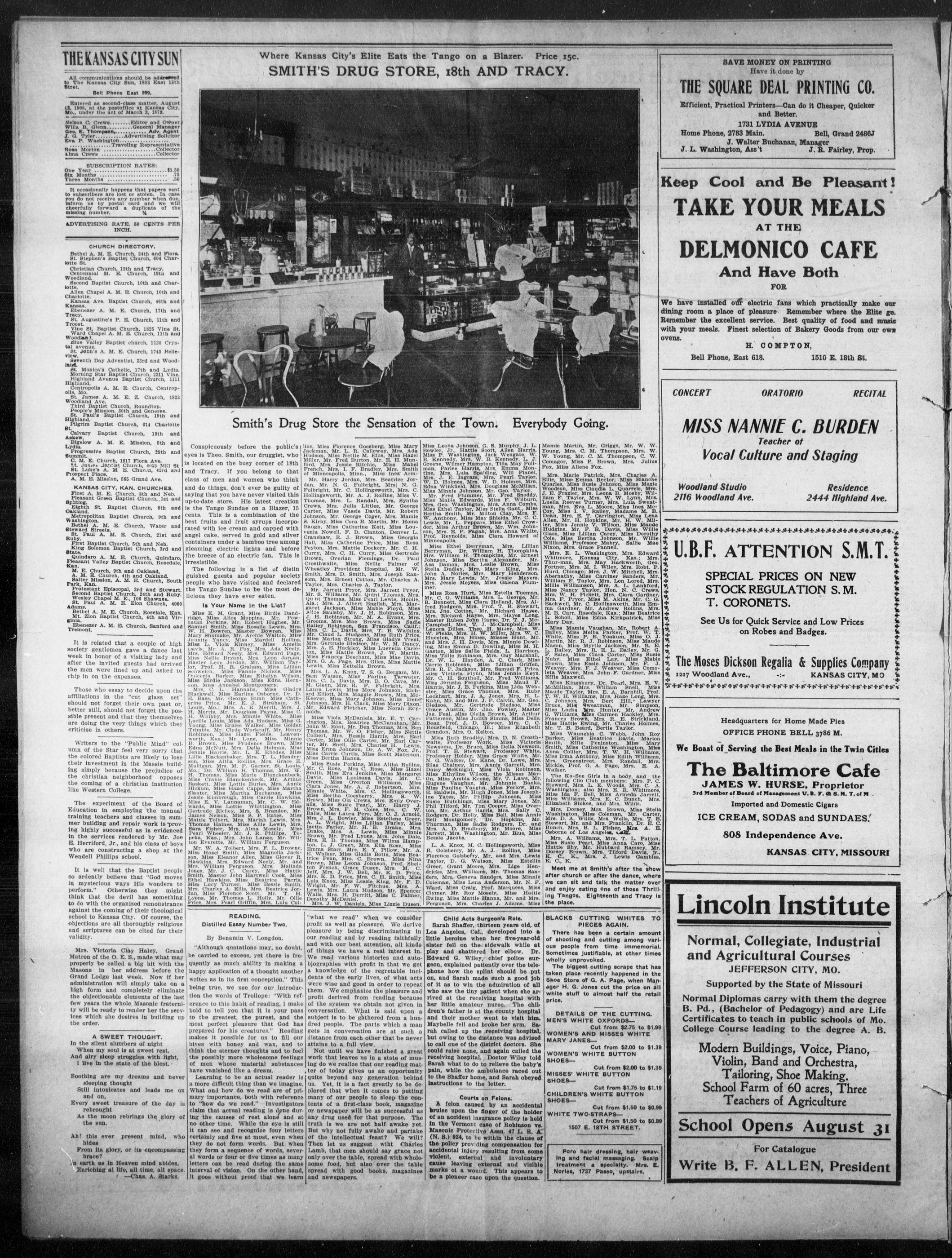
Where Kansas City's Elite Eats the Tango on a Blazer. Price 15c. SMITH'S DRUG STORE, 18th AND TRACY.
THE COFFEE SHOP
Smith's Drug Store the Sensation of the Town. Everybody Going.
Conspicuously before the public's eyes is Theo. Smith, our druggist, who is located on the busy corner of 18th and Tracy. If you belong to that class of men and women who think and do things, don't ever be guilty of saying that you have never visited this up-to-date store. His latest creation is the Tango Sundae on a Blazer, 15 cents. This is a combination of the best fruits and fruit syrups incorporated with ice cream and capped with angel cake, served in gold and silver containers under a bamboo tree among gleaming electric lights and before the breeze of an electric fan. This is irresistible.
The following is a list of distin guished guests and popular society people who have visited and declared the Tango Sundae to be the most delicious they have ever eaten.
Is Your Name In the List?
Miss E. M. Grant, Miss Birdie Dandridge, Miss Alice Moppins, Mr. Powell, Miss Alice Moppins, Samuel Smith, Miss Rosalele Lewis, Mrs. W. H. Bowren, Master, Bowren Lewis, Mrs. Jainite Yancy, Miss Mardell Rollins, Miss L. Vlola Kinney, Miss Amelia Rollins, Miss L. Scuwell, Mrs. Edward Neely, Mrs. Edward Page, Miss Nelle Bryant, Mrs. Leon Joran, Master Leon Jordan, Mr. William Tay, Mr. William Tay, Scuwell, Mrs. Fannie Nichols, Miss Dulceina Barker, Miss Ethelyn Wilson, Miss Aimelie Hern, Miss Aimelie Montgomery,
Mr. W. W. A. Tolbert, Mrs. F. L. Brown,
Miss Hazel Smith, Miss Magnolia Jack-
hawkins, Miss Edward Neely, Mr. and
Mrs. William Ferguson, Mrs. Malinda
Jones, Mr. J. C. Carey, Miss Hattie
Jones, Mr. J. C. Carey, Miss Hattie
Ethel Hawkins, Miss Beatrice Paris,
Miss Lucy Turner, Miss Bessie Smith,
Mrs. Charles A. Ellis, Miss Beatrice Jor-
ney, Mrs. Beatrice Jorney,
Lyons, Mr. Thomas L. Holly, Mr. Ollie
Price, Mrs. Pearl Griffin, Mrs. Lulu Col-
READING.
Distilled Essay Number Two.
By Benamin V. Longdon.
"Although quotations may, no doubt, be carried to excess, yet there is frequently as much ability in making a happy application of a thought another writes as in its first conception." This being true, we use for our introduction the words of Trollope: "With reference to this habit of reading, I make bold to tell you that it is your pass to the greatest, the purest, and the most perfect pleasure that God has prepared for his creatures." Reading makes it possible for us to fill our hives with honey and wax, and to think the sterner thoughts and to feel the possibly more wholesome feelings of men whose material substances have vanished like a dream.
Learning to be an actual reader is a more difficult thing than we imagine. What and how do we read are of primary importance, both with reference to "how do we read." Investigators claim that actual reading is done during the causes of rest alone and at no other time. While the eye is still it can see and recognize four letters certainly and five at most, even when they do not form words. But when they form a sequence of words, several words or four or five times as many letters can be read during the same interval of vision. On the other hand, it goes without proof that we learn
ins, Miss Florence Goesberg, Miss Mary Jackman, Mrs. L. R. Calloway, Mrs. Ada Hudson, Miss Jettie M. Ellis, Miss Hazel Ford, Miss Jillian M. Ellis, Miss Ford, Mrs. Jessie Ritchie, Miss Mabel French, Mrs. L. F. Bradley, Mrs. Smith of Minneapolis, Minn., Miss Inez Arm, Mr. Harry Jordan, Mrs. Beatrice Jordan, Mr. M. G. Fulbright, Mrs. N. G. Furbright, Mrs. J. F. Furbright, Mrs. Hollingsworth, Mr. A. J. Rollins, Miss V. Thomas, Mrs. L. Randall, Mrs. Syntha Crews, Mrs. Julia Littles, Mr. George Carter, Miss Vassie Davis, Mr. Robert Johnson, Mr. George Coger, Mrs. Mamle S. Kirby, Miss Cora B. Martin, Mr. Homa Baugh, Miss Catherine Kett, Miss Louise Crane, Miss George Coger, Mrs. Mamle S. Kirby, Miss Cora B. Martin, Mr. Homa Baugh, Miss Catherine Kett, Miss Louise Crane, Miss George Coger, Mrs. Mamle S. Kirby, Miss Cora B. Martin, Mr. Homa Baugh, Miss Catherine Price, Miss Rosa Peyton, Mrs. Mattie Dockery, C. M. H. Curry, C. M. H. Curry, Miss Gertrude Brown, Overlan Flemings, Dr. Paul Crosthaite, Miss Nelle Palmer of Miss Jillian M. Ellis, Miss Smith, Mrs. D. Smith, Mrs. Joseph Ransom, Mrs. Ernest Cotton, Mr. Charles A Taylor, Mrs. Charles A Taylor,
"what we read" when we consider profit as well as pleasure. We derive pleasure by being discriminating in our reading and by reading faithfully and with our best attention, all kinds of things we have a real interest in. We read various histories and autobiographies with profit in that we get a knowledge of the regretable incidents of the early lives, of what acts were wise and good in order to repeat them. We emphasize the pleasure and profit derived from reading because of the system we obtain not given in conversation. What is said upon a subject is to be gathered from a hundred people. The parts which a man gets in conversation are at such a distance from each other that he never attains to a full view.
Not until we have finished a great work that leaves us in a state of musting do we realize that our reading matter of today gives us an opportunity quite beyond any generation behind us. Yet, it is a fact greatly to be deplored that when it comes to putting many of our people to sleep the contents of a first-class book, magazine or newspaper will be as successful as any drug used for that purpose. The truth is we are not half awake yet. But why not fully awake and partake of the intellectual feast? We will? Then let us suggest wilt Charles Lamb, that men should say grace not only over the table, spread with wholesome food, but also over the table spread with good books, magazines and newspapers.
Miss Ruth Bradley, Mrs. D. N. Crosstwaite, Professor Work, Mrs. Victoria Washburn, Professor Work, Mrs. P. T. Powell, Prow T. R. Stewart, Professor Washner, Professor Holder, Miss Grace Waltre, Mrs. G. Walker, Dr. Kane, Dr. Lowe, Mrs. M. Baldwin, Mrs. Johns, Daisy McKnight, Miss Viola Robinson, Miss Ethyline Wilson, the Misses Maran, Miss Imbia Keene, Mrs. Johns, Miss Pauline Vaughn, Miss Ferlow, Mrs. E. Baldwin, Mr. Hughes Jones, Miss Josephine McKnight, Mrs. Mary Jones, Susie Tilford, Mrs. Mary Jones, Mrs. Phil Tilford, Mr. Tim Cooper, Miss Overton, Mr. Arthur Harris, Mrs. Sally C. McKnight, Mrs. Mary Jones, Bell Montgomery, Dr. Hopkins, Mr. Thurman, Miss Sade Rodgers, Dr. and Mrs. A. D. Bradbury, Mr. Moore, Miss Washington, Mr. Blue, Miss Bessie Jacobs.
L. A. Knox, M. C. Hollingsworth, Mrs. R. Golsberg, Mr. A. J. Rollins, Mrs. Florence Golsbeffry, Mr. and Mrs. Lewis Taylor, D. G. Watson, Miss Estellin Greer, Grant Moore, Mrs. Lige Hendricks, Mrs. Williams, Mr. Thomas Sanders, Mrs. Geneva Sanders, Miss Minkle Coleman, Mrs. Lena Anderson, Mrs. Crayer, Mrs. Crayer, Mrs. Clyner, Mrs. Roy Mosley, Miss Hattie Ewing, Miss Mattle Hanna, and Mrs. Ferguson, Mrs. Charles J. Adams, Miss
Child Acts Surgeon's Role.
Sarah Shaffer, thirteen years old, of Los Angeles, call, developed into a little heroine when her five-year-old sister fell on the sidewalk while at play and shattered her elbow. Dr. Edward G. Wiley, chief police surgeon, explained patiently over the telephone how the splint should be put on, and Sarah made such a good job of it as to win the admiration of all who saw the幼 patient when she arrived at the receiving hospital with her little amateur nurse. The children's father is at the county hospital and their mother went to visit him. Maybelle fell and broke her arm. Sarah called up the receiving hospital, but owing to the distance was advised to call one of the district doctors. She could raise none, and again called the receiving hospital. Doctor Wiley told Sarah what to do to relieve the baby's pain, while the ambulance raced out to the Shaffer home, and Sarah obeyed instructions to the letter.
Courts on Felons:
A felon caused by an accidental bruise upon the finger of the holder, of an accident insurance policy is held in the Vermont case of Robinson vs. Masonic Protective Assn. 47 L. R. A. (N. S.) 924, to be within the clause of the policy providing compensation for accident injury resulting from some violent, external and involuntary cause leaving external and visible marks of a wound. This appears to be a pioneer case upon the question.
Mamie Martin, Mr. Griggs, Mr. W. W.
Young, Mrs. C. M. Thompson, Mrs. W.
Young, Mr. C. M. Thompson, C. W.
Cullus, Mrs. M. Thompson, Mrs. J. W.
Fox, Mrs. Miss Allen Fox.
Mrs. Marie Patrick, Mrs. Charles A.
Ellis, Miss Emma Rector, Mrs. Blanche
Quarles, Miss Susie Johnson, Miss Mace
Joe, Miss Emma Johnson, Mrs. J. E.
Frazier, Mrs. Lea B. Moose, Moosey,
William F. Taylor, Mrs. W. W. Lynn, Mrs.
Mrs. J. E. Frazier, Mrs. Lea B. Moosey,
Mrs. Eva L. Moore, Miss Inez McCoy,
Mrs. I. V. Railley, Madame M. B.
Allen, Mrs. H. Hopkins, Mrs. H. W. M.
Glass, Mrs Jennie V. Wilson, Miss Maude
Glass, Mrs H. Hopkins, Mrs. H. W. M.
Glass, Mrs Lillian Carey, Miss Dorothy
Cole, Miss Bertha Johnson, Mr. Willie
Nixon, Mrs. Grace Pannel.
Mrs. E. L. Weslington, Mrs. Edward Whitmore, Kansas City, Kas.; Mrs. J. Whitmore, Kansas City, Kas.; Mrs. Fortner, Mrs. M. L. Wiley, Mrs. Robt. P. Hurd, Chicago; Mrs. J. W. Mitchell, Mrs. Abernathy, Miss Carrier Sanders, Mr. M. Abernathy, Miss Carrier Sanders, Mr. M. Millle Williamson, Mrs. A. L. Lankford, Miss Nancy Taylor, Hon. N. C. Crews, Miss P. Fryor, Miss M. Akins, Mr. C. Backwell, Mrs. C. Hollinsworth, Miss Em. Fryor, Miss M. Akins, Mr. C. B. Carr, Rosedale, Kas.; Miss Beatrice L. Scholl, Miss Edna Kirkpatrick, Miss Mary Day.
Miss Vaughan, Mr. Robert A. Bailley, Miss Melba Parker, Prof. W. T. White, Miss P. B. Yoakum, Miss O. J. White, Miss P. B. Yoakum, Miss O. J. Maason, Miss Myrtle Jackson, Mr. R. E. L. Bailley, Mrs. R. E. L. Bailley, Mr. G. Sales, Miss Clara Carter, Miss Susie Carter, Miss Clara Carter, Miss Susie Brown, Miss Essie Johnson, Mr. F. J. Weaver, Mrs. F. J. Weaver, Miss Como Brown, Miss Essie Johnson, Mr. F. J. Weaver, Mrs. F. J. Weaver, Mrs. John F. Gardner, Miss Eiffel Maxwell
Miss Kingsbury, Dr. Pearl, Mrs. E. V. McMillian, Mrs. William Snell, Miss Maude Taylor, Mrs. E. A. Barnhill, Prof. C. W. Williams, Mrs. Haze Long, Mrs. E. Johnson, Mrs. Bert Hill, Lawyer Bruce, Miss Sweatman, Mr. Simpson, Miss Locke, Mrs. Hunter, Mr. Andrew G. Williams, Miss Carmen Hackley, Mrs. Frances Brown, Mrs. R. E. Strickland, Mr. T. W. Williams, Mr. Thomas Holmes, Mr. T. B. Beard, Bertie Taylor.
Miss Waunbia C. Webb, John Roy Barker, Miss Beatrice Davis, Marion Smith, Effie Penston, Miss Mary Smith, Miss Catherine Washington, Miss Anna Collier, Mrs. T. W. Williams, Miss Inventory, Miss Edith Williams, Mrs. Greenstreet, Mrs. Randall Mrs. Mickle, Prof. G. A. Page, Mrs. E. A. Walker.
The Ka-See Girls in a body, and the following Clio Club members: Mrs. P. C. A. Award, Mrs. L. E. Woods, Mrs. A. Washington, Miss E. R.粟伯, Miss Ida F. Bell, Miss Armeda Jarrett, Miss Williams, Mrs. E. C. Bunch, Mrs. Elizabeth Stokes, and Mrs. Willis.
Mrs. Dorsey, Mrs. Brown, Miss Stella Washington, Miss Coleman, Mr. Carter, Mrs. D. A. Willis, Mrs. Wells, Mrs. T. B. Bunch, Mrs. B. L. Fisher, Mrs. A. E. Osborne of Los Angeles,
Mrs. A. Williams, Mrs. T. L. Patton, Mrs. Max Williams, Marilyn Marshall, Mrs. Miss Hattie Shy, Mr. Hubbard Ramsey, Mr. Dorssey Brown, Mrs. Tilford Davis, Jr., K. C., K., Mrs. J. Lewis Gambles, K. C, K.
Meet me at Smith's after the show after church or after the dance, where we can sit and talk the matter over and enjoy eating one of those Thrilling Tangos. Eighteenth and Tracy is the place.
BLACKS CUTTING WHITES TO PIECEB AGAIN.
There has been a certain amount of shooting and cutting among various people from time immemorial. Sometimes justifiable, at other times wholly unprovoked.
The biggest cutting scrape that has taken place recently happened in the Shoe Store of G. A. Page, when Manager H. G. Jones cut the price on all white stuff to almost half the retail price.
DETAILS OF THE CUTTING.
MEN'S WHITE OXFORDS—
Cut from $2.75 to $1.99
WOMEN'S AND MISSES WHITE
MARY JANES—
Cut from $2.00 to $1.39
WOMEN'S WHITE BUTTON
SHOES—
Cut from $2.00 to $1.39
MISSES' WHITE BUTTON
SHOES—
Cut from $1.75 to $1.19
CHILDREN'S WHITE BUTTON
SHOES—
Cut from $1.50 to $0.99
WHITE TWO-STRAPS—
Cut from $1.50 to $0.89
1507 E. 18TH STREET.
Poro hair dressing, hair wea-
ing and facial massaging. Scalp
treatment a specialty. Mrs. E.
Norles, 1737 Paseo, upstairs.
---
Efficient, Practical Printers—Can do it Cheaper, Quicker and Better.
And Have Both
FOR
We have installed our electric fans which practi-
cating room a place of pleasure. Remember when
remember the excellent service. Best quality of
with your meals. Finest selection of Bakery Good
ens.
H. COMPTON,
FOR
told our electric fans which practice
place of pleasure. Remember where
excellent service. Best quality of fai
s. Finest selection of Bakery Goods
H. COMPTON,
We have installed our electric fans which practically make our dining room a place of pleasure Remember where the Elite go. Remember the excellent service. Best quality of food and music with your meals. Finest selection of Bakery Goods from our own ovens.
H. COMPTON,
Bell Phone, East 613. 1510 E. 18th St.
MISS NANNY
Vocal Cultu
S NANNIE C. BURG
Teacher of
Local Culture and Stagion
MISS NANNIE C. BURDEN Teacher of Vocal Culture and Staging
Woodland Studio 2116 Woodland Ave.
U.B.F. ATTN
SPECIAL P
STOCK REQ
T. CORONA
See Us for Quick
on Rob
The Moses Dickson R
1217 Woodland Ave.,
ATTENTION S
SPECIAL PRICES ON NEW
STOCK REGULATION S. I.
L. CORONETS.
Us for Quick Service and Low P
on Robes and Badges.
Dickson Regalia & Supplies
and Ave., KANSAS
U.B.F. ATTENTION S.M.T.
SPECIAL PRICES ON NEW STOCK REGULATION S.M. T. CORONETS. See Us for Quick Service and Low Prices on Robes and Badges.
The Moses Dickson Regalia & Supplies Company
1217 Woodland Ave., KANSAS CITY, MO
Headquarters for Home Made Pies OFFICE PHONE BELL 3786 M.
We Boast of Serving the
The Ball
JAMES W.
3rd Member of Board of
Imported
ICE CREAM, S
of Serving the Best Meals in the
Baltimore C
MES W. HURSE, Proprie
labor of Board of Management U. B. F. @ S. M
Imported and Domestic Cigars
CREAM, SODAS and SUND
We Boast of Serving the Best Meals in the Twin Cities
The Baltimore Cafe
JAMES W. HURSE, Proprietor
3rd Member of Board of Management V.B. F. @ S.M. T. of M.
Imported and Domestic Cigars
ICE CREAM, SODAS and SUNDAES.
808 Independence Ave.
KANSAS CITY, MISSOU
Lincoln Institut
coln Institute
Lincoln Institute
Normal, Collegiate, Industrial and Agricultural Courses
JEFFERSON CITY, MO.
Supported by the State of Missouri
Normal Diplomas carry with them the degree
B. Pd., (Bachelor of Pedagogy) and are Life
Certificates to teach in public schools of Mo.
College Course leading to the degree A. B.
Modern Buildings, Voice, Piano,
Violin, Band and Orchestra,
Tailoring, Shoe Making.
School Farm of 60 acres, Three
Teachers of Agriculture
For Catalogue Write B. F. ALLEN, President
CONCERT
FOR
Eric fans which practically make our
care Remember where the Elite go
price. Best quality of food and musi
ction of Bakery Goods from our own
OMPTON,
1510 E. 18th St.
ORATORIO RECITAL
NIE C. BURDEN
Teacher of
Nature and Staging
Residence
2444 Highland Ave.
ENTION S.M.T.
PRICES ON NEW
REGULATION S.M.
NETS.
Rock Service and Low Prices
Buses and Badges.
Regalia & Supplies Company
KANSAS CITY, MO
the Best Meals in the Twin Cities
timore Cafe
HURSE, Proprietor
Management U. B. F. @ S. M. T. of M
and Domestic Cigars
SODAS and SUNDAES.
Institute
FOR
RECITAL
Mrs. Lige Hendricks and son left today for a two weeks' stay in the country.
Mrs. Martha Martin, mother of Mrs. Robert Simpson, 1323 East 14th street, is ill at her residence.
FOR RENT—1011 Tracy Avenue. Nicely furnished rooms in modern house, for gentlemen; reasonable.
Born to Mr. and Mrs. James Anderson, 1105 Woodland, a son, August 9th. The little fellow is doing nicely.
WANTED—Colored lady barber. Splendid opportunity. Address Madam H. C. Walls, 878 South State St., Chicago, Ill.
Madame P. M. Dabney, who has been touring the state in the interest of her hair preparations, has returned home for a month's stay.
FOR RENT—2440 Montgall avenue,
6 rooms modern, $22.50 per month.
J. M. Day, N. W. Cor. 18th and Paseo.
Grand 1413—Bell phone
Miss Vernon Carter, Garden City,
Kas., is in the city visiting relatives
and is residing at the residence of
Mrs. Daisy Smith, 1211 East 21st
street.
Mrs. T. C. Greenstreet, 2455 Montg
gall avenue, left Sunday afternoon for
Memphis, Tenn., where she has been
called to the bier of her deceased
grandmother.
Mrs. Rosa Lee Dale, 3862 Charlotte
street, has gone to Denver, Col.
where she will live permanently. Her
many friends of this city regret very
much to loose her.
Mrs. W. G. Lewis, 321 West Armour Boulevard, with her son and her sisters, the Misses Minnie and Mayme Lewis, left Tuesday night for an extensive tour through Colorado.
Mrs. S. A. Dabney left Friday, August 14, for her home in Jacksonville, Ill., after spending five weeks with her sons, Messrs. Fred W., William A. and James William Dabney, of this city.
Old houses made new; we will point your house, stop all kinds of leaks, patch your porches and fix up your steps for a reasonable sum. Call Bell phone 2089W. James L. Blake.
Mrs. Annie E. Floyd, Mrs. Harry J. Brown and little Helen Floyd, left to attend the Grand Lodge of S. M. T.'s at Keokau, Iowa. Before returning home they will visit in Chicago and Benton Harbor.
Mrs. E. Spruell entertained at her beautifully furnished apartment in honor of Mrs. Lillian Coleman of St. Louis. After games, Mr. Spruell served a beautiful luncheon to the many guests present.
Miss Viola Kinney, Superintendent of Music in the Negro schools of the city of Sedalia, and who has been assisting Prof. R. G. Jackson at his studio this summer, will return to Sedalia on or about the first of September.
After an absence of two years, Miss Lillian Griffin left here August 12th on a return trip to Columbus, Ky., where she will visit her mother and friends. Enroute she visited friends in Mayfield, Ky., and many other cities in the Sunny South.
Mr. Arthur W. Harris, commercial printer, is again answering his phone at 1515 East 1st street. Mr. Harris has just completed a five-weeks' campaign in his home state, Kansas, and returns to his office at least financially better, if not wiser.
Mrs. Lige Hendricks entertained last Sunday at her residence, 1802 East 24th, with a dinner for Mr. and Mrs. J. C. Reeves, Mr. and Mrs. S. Steele, Mr. and Mrs. Charles Irving and Mr. and Mrs. Ben James. They expressed themselves as having had a delightful time
Miss Herda Ashcraft entertained at the residence of her parents, 2636 Highland avenue, twenty of her little friends complimentary to little Melba Birch of Washington, D. C., last Friday afternoon. Games and music were indulged in and the little folks enjoyed themselves very much.
Miss Olivia Porter of Oswego, Kas. is in the city visiting her sister, Mrs. Nash Porter, 1208 Woodland avenue. Miss Porter is the newly elected Grand Matron O. E. S. of Kansas, Colorado and jurisdiction, and will remain here a week longer and then go for a visit with Mrs. Gudgell at Colorado Springs, before returning to her duties as teacher in the schools at Oswego.
Sr. A. Cantu, of Monterey, Mexico who is the professor of Spanish at the William Jewell College, Liberty, Mo., will give lessons in Spanish weekly at the office of Dr. S. H. Thompson, 1512 North Fifth Street, Kansas City, Kaa. All those desiring to join the class will please communicate immediately with Dr. Thompson, Bell telephone West 380.
REMOVAL NOTICE.
The Crosthwait Floral Company has been forced to move, on account of the great increase of its business, from 1611 East 18th street to 1711 East 19th street, where they will be pleased to see all patrons and friends. Bell 'phone', East 272—Crosthwait Floral Co.
CITY NEWS.
The Social Pathfinders Club met Wednesday evening at the residence of Mrs. Louis Cave, 1611 East 10th street. A large number of the members were present, and the president laid before the members quite an elaborate plan of the work to be done this year. Everyone enjoyed themselves highly. The next meeting will be at the residence of Mrs. Edmonia Brown, 2630 Highland avenue, Wednesday evening. The books are open for new members.
One among the many social events of the season was the formal reception given by Mrs. Nash Porter in honor of her sister, Miss Olivia Porter, at her cozy home, 1208 Woodland, Monday afternoon.
The house was beautifully decorated with ferns, roses and gladiolus and presented a very beautiful scene. There were quite a number of guests present, and when departing they expressed themselves as spending a very pleasant afternoon.
A HUNDRED MEN WANTED.
Wanted, 100 intelligent, wide-awake Negro professional and business men to locate in Kaansas City. It is one of the best cities in the United States for wide-awake Negro business men. For further information write THEODORE SMITH, 1301 East 18th Street.
There is a reason why the larger per cent of Cabinet Stationary used by the Negro business men is from the Arthur W. Harris Printing Establishment. First their workmanship in this class of service is unacquainted by any of the large and best equipped printing establishments in this city, since they all but make a speciality, of the Negro business men their prices are not always the lowest, they are always the fairest. They have "delivered with a great endeavour to over 90 percent of the claey weddings and receptions during the past year and now when a function of one shot that Harris will handle the job.
The funeral of Mr. J. Franklin took place from the residence of his sister, Mrs. Versia Rice, 1015 Tracy avenue, the services were conducted by the Rev. Dr. Thomas. Sweet and solemn songs were rendered by Mrs. Ada Grear, who presided at the piano. Interment in Highland cemetery.
Mrs. H. O. Cook, 2436 Montgall, is gradually improving from her recent severe illness.
Mrs. Ella Whetts of St. Louis, Mo., is the guest of her nephew, Mr. H. W. Miller, 1612 Norton avenue.
Miss M. L. Gaines, daughter of the late Bishop Gaines of Atlanta, Ga., is in the city the guest of Dr. and Mrs. William H. Thomas, Allen Chapel parsonage. Miss Gaines will remain in the city over Sunday, and then will leave for Baltimore, Md., for a visit.
OBITUARY.
Mr. James Gillespie, 55 years old, residing at 2424 Woodland avenue, died of throat and stomach trouble August 5. Mr. Gillespie was born in Murraytown, Tenn., but had lived in Kansas City some thirteen years. He leaves a wife, Mattie, and three sons, Oscar, Burt and Earl Gillespie, all of this city.
CARD OF THANKS
We wish to thank our neighbors and friends for their many kindnesses and flowers tendered during the illness and at the death of our husband and father.
MRS. MATTIE GILLESPIE, wife,
MR. OSCAR GILLESPIE,
MR. BURT GILLESPIE,
MR. EARL GILLESPIE, sons.
WORDS OF APPRECIATION.
More Mothers Testify to Merite of XXth Century Hair Preparations.
Nelson, Mo., April 13, 1913.
Dear Madam Dabney: I am writing you for a small order. I want you to please send by mail 3 bottles of shampoo, 3 boxes of hair grower and 2 boxes of pressing oil. I like the remedy just fine; I would not be without it for anything. I am using it on my little girl's hair; it seems to be helping it greatly.
MRS. ANNA BRUNER.
Kansas City, Mo., Jan. 20, 1913.
Dear Madam Dabney: I am a mother of four girls. In trying to improve their hair I had tried several preparations, but none gave me good results until I used Madam Dabney's XXth Century Preparations. Their hair was thin, harsh and would fall out so that I dreaded to use a comb. Now their hair is growing nicely—does not fall out—has no dandruff—is soft and pretty. Three of these girls are attending Wendell Phillips School, Howard and Vine streets. Investigation will bear out my testimony. I would not be without the XXth Century Preparation in my house.
A six week's treatment of Madam P. M. Dabney's XXth Century Hair Preparations sent on receipt of P. O. money order of $1.25, or a single package of XXth Century Hair Grower, Pressing Oil or Shampoo sent for 500. Write today to Madam P. M. Dabney's XXth Century Hair Preparations Co., 1806 E. 24th St., Kansas City, Mo., Dept. 40.
Persons living in Kansas City who cannot be supplied by their druggist will be called upon by an agent on dropping a postal card to the above address or calling Bell phone, East 2475
LANDSCAPE GARDENING AND ROAD BUILDING.
Tuskegee Institute, Ala., Aug. 17.—Since the federal government took a hand in road building and highway improvement almost every state in the union has gone in for better roads. Many states have joined in appropriations to increase or improve the highways joining state to state, and counties in states of every section are issuing bonds for road building or road improvement. This has all come about through the steady process in agricultural development and the rise of the farmer in big affairs of government. New England, of course, has long been noted for its fine roads, and the west as far back as the early 70's put a lot of money in roads. Officials interested in the products and improvements of the farms had great faith in decent roads as an incentive to farmers to improve their land and stay on it.
The section that has made the big effort to put its roads in good condition is the South, the highways of which for many years have been miserable for travel and more miserable for big hauls. The plans for road improvement are usually made by men trained for that work, but in almost every instance of road improvement the real work the grading and the digging and finish, is being done by colored men.
Tuskegee Institute has put in a new course. It is devoted to a study of surveying and road building, and is designed to fit young men to prepare to do the head work as well as the hand work in road improvement, for this is to bethe big job in the South during the next fifty years. Colored surveyors are scarce and road bosses and contractors are scarce also, but only because colored men have not been trained to do the work as scientific workmen. The fine roads around Tuskegee Institute, and the roads all through the big grounds, were all surveyed and made under the direction of the road building division of the school. Every county in the South will be improving its roads in progressive fashion in the future and young colored men will get in on the jobs if they know how to survey and grade and finish.
TROY, KANSAS.
Special to The Sun.
Mrs. Mollie Brown and Mr. Chas. Schumache are attending the Grand Lodge of the U. B.F. and S. M. T. in Keokun, Ia., this week...Little Miss Florence Webster celebrated her 7th birthday anniversary with a lawn party at the residence of her grandparents, Mr. and Mrs. Chas. Schumache. The party was chaperoned by Mesdames Schumache, Brown, Webster, Lee, Lair and Miss Elsie Lair, Lillian and Charles Webster assisted. Games were played, stories told and all enjoyed the lemonade, punch, ice cream and the lovely birthday cakes which were beautifully lighted with candles and pink mints. The color scheme was pink and white. About 20 were in attendance...Miss Vermay Lightie has been very sick... Miss Lucile Wallace is visiting her cousin, Mrs. W. A. Hill of the "Protest" in St. Joseph...Many attended the annual convention of the Christian church at Wathena last week. We did not get the delegates' names
...Mrs. Howard, Sr., and Mrs. Mary Howard of Sweet Springs, Mo., are guests of Mr. and Mrs. Charles Howard...Mr. M. W. Webster spent the week-end with his family...Mr. E. D. Holland went to Sparks the first of the week to complete arrangements for his picnic stand...Miss Dora Barnes left last Saturday for a visit with her parents in Quenemo, Kans., which accounts for that sad look on some one's face...Mr. Ernest McCurry returned from Horton Sunday, ...Mrs. Chas. Butcher and daughter, Amanda, visited in Wathena last week...Those who attended the Sells-Flote circus in St. Joseph Monday, August 17, were: Mrs. Lewis Snoody, Miss Lizzle Lightle, Mr. Geo, Lair and Mr. Bert Wakefield...Mr. O. H. Schoolen of Maryville, Mo., was the guest of Miss Elsie Lair Sunday.
...The Masonic lodge gave an ice cream and watermelon social Saturday night. ...Mrs. Stella Breckenridge of White Cloud, Kans., is visiting Troy friends this week. ...Mrs. Bert Wakefield and lite daughter are attending the Baptist Association in Hiawatha this week. ...Rev. Wm. Enyard and wife were St. Joseph shoppers Monday. ...Mrs. Betta True of Chicago is the guest of Mrs. George Lair. ...Mesdames Hughes, Penne, Howard, Mr. and Mrs. Chas. Schumache, Miss Lair and Mr. Lair attended the Starr-Pennel wedding in Highland Wednesday, August 12. ...Mrs. Ada Birch and children of St. Joseph are visiting her parents, Mr. and Mrs. John Ward. ...Mrs. Holland and Mrs. Ward attended the Gund Lodge, O. E S. in Great Bend, Kans. ...Mrs. Georgia Montgomery of Kansas City is visiting her parents, Mr. and Mrs. William Taylor.
CHILLICOTHE. MISSOURI.
The number of our weekly visitors to our city is usually larger than the number of our citizens abroad: This week Mr. Harold Estes of Des Moines, Iowa, is visiting with relatives; Miss Hazel Thompson of St. Louis, is spending a few days with her grandparents; Mrs. Bettle Clark of St. Joseph, Mo, is visiting at the home of her parents, and Mr. Richard Young and H. A. Longdon, M. D., of Lincoln, Neb., are the guests of Rev. and Mrs. R. H. Longdon. Mrs. Thomas Scott is visiting at Gallatin, Mo.; Mr. Benjamin Bland, at Kansas City, Mo., and the Misses Audrey and Mercedes Mitchell are at Bucklin, visiting...The
Daughters of Tabor gave their annual plenic last Thursday. Four hayracks were taxed by the crowd to make the short excursion to the plenic grounds, near Bear Lake, where games and other amusements and refreshments were enjoyed.... There were no services at the Mt. Zion Baptist church last Sunday, because baptismal rites were administered to several persons in Grand River. A basket dinner was served, and regula religious services were observed in "God's first temple." The evening services were held in the church.... Great preparations on an extensive plan are being made for an A-number-one play, "At Sixes and Sevens," which is to be given at the A. M. E. church, August 25th, under the direction of Professor Wm. Longdon. The play has a tendency to emphasize what Dr. Johnson said many years ago, that "nature having given women so much power, the law has very wisely given them little."
EXCELSIOR SPRINGS. MISSOURI.
Mrs. Alice Hubert spent Saturday and Sunday in Kansas City and Parkville, Mo....Mr. and Mrs. James Mconald is visiting in Utica....The horse trained by Mr. William Lewis took first prize at the Smithville Horse Show. Mr. Lewis is now at the Richmond Fair....Mr. David Allen of Kansas City spent Saturday here....The Albany is doing a good business this week. Among the guests are Miss A. E. Wheeler and Mrs. Sarah Jones, of Kansas City; Mr. Lee Rosenheim, of St. Louis; Mrs. Tooley and Mrs. McKnight of Kansas City....Mrs. Olo Estes Page died Saturday morning, August 15th, and was buried August 16th, at Salem, from the Main Street Baptist church, Rev. Hillman officiating. We extend to the family our sympathy....Dr. G. E. Gray is among the many guests at the Harris Flats....Messrs. Roy Marshall, Carl Gipson, Earl Garnett, Barton Richardson and Ralph Baylless will entertain Misses Wade and Harris of St. Louis.
...Mrs. Alexander of Topeka, and Mrs. Blanch Hawkins of St. Louis, are at the safe this week....Mr. E7ugene Woods will build a modern sixteen room flat in this town shortly....Mr. Porter Ponder and Mr. Bright of Liberty spent Sunday at the Springs....The Barnes sisters have returned from an extensive trip in Kansas....Mrs. Shaw has retu ed to the Springs and is stopping at the Barnes apartments....Mr. and Mrs. Mabion, Mrs. Trigg and Mr. Barton Richardson will motor to Plattsburg Sunday to attend the corner stone laying.
WOULD TAKE A LITTLE TIME
Uncle Billy Had Some Sons to Consult and Probably Real Estate Agent Missed the Train.
The real estate man from the city was eager to close the deal for Uncle Billy Weatherman's 40 acres, which would front on a beautiful lake after the big White river dam in the Missouri Ozarks was built.
The papers lay on the table, awaiting Uncle Billy's signature. The real estate man was impatient. He was in a hurry to get back to Hollister, the nearest railway station, so as to catch the only train that would get him back to Kansas City the next morning.
"Now if you'll sign right there—on the dotted line," he said, handing a fountain pen to Uncle Billy.
Uncle Billy took out his spectacles, and read the papers carefully.
"I reckon I'd better not be in too big a hurry about this hyar," he temporized, with the shrewdness of the Ozark mountaineer. "I don't read as peart as I used to. I b'leve I'll have my sons read them papers, mister." "It would be a great favor to me; Uncle Billy," remarked the Kansas City man, looking at his watch, "if you could manage to see them in time to finish up this transaction by noon. You see, I've got to get away today. How many sons have you, anyway?" Uncle Billy scratched his head a minute, and said, "Eighteen."—Youth's Companion.
First War Correspondent.
The first war correspondent, according to a theory propounded by Sutherland Edwards, appears to have been Homer, who was sent by the editor of an Argos paper called the Chronos to describe the siege of Troy. Hostilities lasted only about seven weeks, and when they came to an end the Greek chiefs were in no hurry to return to their wives. Homer was a good sort, and as he drew a large salary and a handsome allowance for expenses from the Chronos, he readily accepted the scheme propounded by the wise Ulysses—to keep the war going in the columns of his paper so long as he could manage to write about it. His letters were too good not to publish, and meantime the Greek chiefs had an enjoyable time at Troy and elsewhere. Re-issued in book form as "The lilted," these early examples of war correspondence have enjoyed a wider circulation than was possible even in the columns of the Chronos.
Sandwiches for Illness.
"Persons always are seeking some kind of preventive for being ill when on the ocean," said one of the managers of a large Washington hotel. "We have had women who wanted dry biscuits and special milk, and others who wanted soda water. Different persons go so far as to study what they eat for two weeks before they go on board a steamship. But here's something ordered evidently for the same sort of preventive. H. D. Multon of Richmond, Va., evidently believes in sandwiches. He has ordered sandwiches and champagne sent to his vessel," the manager added.
How They Looked.
"I see by transplanting the cornea of a pig's eye to the diseased eye of a baby, Baltimore surgeons recently restored the child's sight," said a woman to her neighbor over the back fence.
"Well," replied the other, with a curl of the lip, "I've seen children who looked like pigs, and they never had that done to 'em."
A 16-Mile Ride—
5 Cents for Adults
2½ Cents for Children
between 12 and 8—
Free for Those Under 8
when accompanied by a fare
From west end of Chelsea Park line to Swope Park,
sixteen miles.
From Argentine to Mt. Washington, one fare.
A dozen other inexpensive long distance Trolley
Outings, including Kansas City, Mo., Kansas
City, Kas. and Rosedale.
Metropolitan Street Ry. Co.
R. J. Dunham, Ford F. Harvey, Receivers
REAL HONEY
About 300 lbs. of Clear Strained Honey from my own bee-hive Now Ready For Delivery 2 lbs. 25 Cents Call Bell Phone Argentine 860, and make reservation. ELMER JACKSON 37th & Barber. Argentine. Kansa
How dear to our heart is the steady subscriber
Who pays in advance at this time of each year,
Who lays down the money and does it quite gladly,
And casts 'round the office a halo of cheer.
He never says—"Stop it, I cannot afford it,
I'm getting more papers now than I can read;"
But always says—"Send it, our people all like it—
In fact we all think it a help and a need."
How welcome this when it reaches our sanctum,
How it makes our pulse throb, how it makes our heart dance;
De outwardly thank him; we inwardly bless him—
The steady subscriber who pays in advance.
PROG. GEO. W. 8TEVENS.
Dr. G. W. Stevens, the well known and famous spiritualist, can be consulted at his residence, 618 State St., Kansas City, Kan., any day from 8 a. m. to 9 p. m.
J.C.WAGNER
The Clean Market Man
Oysters, Fish and Game in
Season.
Fancy Groceries and all Table
Luxuries.
Courteous Treatment to All
1819 Howard Ave.
Bell Phone 3596 Eas
Kansas City, Missouri.
A. E. H.
E. EUGENE VAUGHAN.
MEMBER K, C. BUSINESS LEAGUE.
ANNOUNCEMENT.
I have plenty of capital to build houses. Telephone me to-day. Eventually you will. Estimates cheerfully given.
TO THE NEWLYWEDS.
While now your hearts are so joyful,
Take heed lest you forget,
That buying a home today, for tomorrow,
Is a step you'll ne'er regret.
GOING!
GOING!
What?
First class 7 per cent mortgages for sale.
4 rooms, 25 ft.....$650.00. $50.00 down
EUGENE EDWARD VAUGHAN,
Twenty-sixth and Parkway,
KANSAS CITY, KANSAS.
Bell phone, West 1757.
CHEAP
JOHN'S
PLACE
New and Second Hand
Goods Bought, Sold and
Exchanged
2122 Vine Street
WM. HOPKINS, Prop.
HONEY
ed Honey from my own bee-hive
For Delivery
Ladies' Tailoring Dressmaking AND Drafting...
Fancy Gowns a Specialty
I am prepared to offer the public the best dressmaking, tailoring, drafting and fitting.
Graduate of one of the best white downtown colleges.
Will also teach Drafting.
Bell Phone East 4173W
Mrs. Lillie Williams
2914 Woodland Avenue
KANSAS CITY, MISOURI
A League Enterprise!
On Eighteenth in the Fifteen Hundred Block
A News Bureau
Every Negro Periodical Negro Pictures. Negro Books. Novelties Stationery
5c. Every Day in the Year
1521 Bast 18th Street.
CHAS. A. STARKS, Prop.
Our Motto: "Nothing but The Best"
The Crosthwait Floral Company
Everything in Flowers
and Flower Designs
"WE DELIVER THE GOODS"
The People say we have
made some of the most
beautiful and original de-
signs in flowers ever seen
in Kansas City.
Our Specialty--
"Quick Delivery--Satisfactory Service"
Bell Phone East 272
1719 E. 17th St., Kansas City, Mo.
Subscribe for the SUN
Bell Phone East 999
1803 East 18th Street
---
Human Documents of Married Life By Virginia T. Van de Water
Intimate and Human, Intensely Alive, Each Story Presenting a Problem Which Might Occur to Any One of Us at Any Time
WHY I LEFT HOME
WAS an only child. This in itself would seem to be a sufficient reason for a daughter to live at home. In my case it was not.
L
My mother was a sweet-twist, soft-spoken woman. One of my earliest recollections is of watching her making my dainty clothes, for she was deft with her fingers.
I fancy I had a happy childhood, as childhoods go. There is a popular fiction that the happiest time of one's life is when one is so young that one is absolutely under the control of one's "governors, teachers, pastors and masters." Perhaps it is, but as a small girl I longed often to have my own way. I told my father this once when I was but ten years of age. He smiled whimsically and patted my head.
"Ah, little girl," he expostulated, "how foolish you are! Here is your dad wishing that he need never decide what is right and what is wrong for himself, but that there was some one in whom he had perfect confidence who would say to him 'you Iust do this,' or 'you must not do that.'"
I was fond of novel-reading, but read only such books as my parents approved. I have wondered often since how it happened that I was in such complete subjection to my father and mother. I know that there were at school girls who read what they pleased, but when I left home my mother had asked me to peruse only such books as she, my father, or the school principal recommended. I promised and kept the promise. My roommate was a singularly sweet, pure-minded girl, and I cared for no other intimates, although I was on pleasant terms with many of the other scholars. But I think all of them thought me too prim and particular to be much fun. So when I returned to my home at the end of my school career my fastidious mother and my anxious father found me as childlike and unsophisticated as when they had sent me from them. They had decided that I was not to go to college. I knew there had been a little discussion about this matter, but my father had very strong convictions along these lines. He wanted his daughter to be "all womanly," and had a contempt, founded more upon prejudice than upon knowledge, of the typical college woman. While my mother's views did not coincide in every particular with his, she was so anxious to keep me with her that she readily accepted his decision against college. She needed me, she said. She had been "so lonely" since I left and wanted me for her "very own friend and companion now and always."
She told me this the night after I returned to the little home and the pretty room that had been "done over" for me.
"So many of the girls I know are going to 'do things' of some kind," I informed her. "Mother, dear, is there any special line of work you want me to take up? Do you want me to have some way of earning my living?"
"No!" she said impulsively. "What I want is to have you to myself as long as I live, at least," she added, "until you marry. And perhaps you may not do that. Even then I would want you to live near me. I have sacrificed myself, and my own wishes, for the sake of having you educated, and I feel that I have the right to enjoy you now."
"But." I hesitated as I asked the question, "suppose that the time should come when I had to support myself—what could I do then?"
"It won't come, I hope," she insisted. "And if it did—why, you write a beautiful hand. You can be a secretary—or something!"
Several years later I remembered that speech.
The following evening my father and I had a long talk as we sat together on the veranda. Mother had a headache and had gone to her room early, insisting, however, that I help her undress and see her comfortably in bed before joining my father where he sat alone, smoking.
"What have you been doing?" he asked as I came out softly upon the veranda after leaving my mother in a peaceful sleep, soothed thereto by my gentle stroking of her aching head. When I told him he drew me down to a chair beside him.
"Poor little girl," he said banteringly, "you are already getting broken into work, aren't you?"
"Work!" I exclaimed, almost indignantly. "I don't call it work to make poor, dear mother comfortable when she is ill."
"It may get monotonous after a while," he remarked dryly. And then he sighed. I asked no questions, but again in my heart was the old familiar ache for him and for my mother and the old puzzling question as to which I should sympathize with.
Soon our talk drifted to my school days, and, tentatively, I said to him just what I had said to my mother the evening before about my acquiring some way of earning a living. What did he think of it?
He smoked for several minutes he-
It is always a question whether a literary man should seek to evade indigestion, remarks a writer in the London Chronicle. Did not Mrs. Radliffe confess that some of the most thrilling episodes in the "Mysteries of Udolpho" came to her in a nightmare consequent upon eating pork chops? May not the "brownies," also, who gave Stevenson the dream inspiration of "Jekyll and Hyde," have been traceable to some similarly injudicious but lucky meal? Personally, I have had
fore he answered. Then he spoke slowly. "Well, daughter dear, I hope that I will be able to support you as long as I live, and when I die leave you enough insurance to keep the wolf from the door."
"That's what mother thinks," I explained, "but how can you know what may happen? Mother says that all she wants me to do is to live at home and be company for her, and, while that sounds lovely for me, I do feel that one never knows when one may have to support herself."
"So your mother said that, did she?" he mused. Then, as if to himself: "That would be about all she would want, I suppose. And yet, it sounds a bit selfish."
I hastened to vindicate my mother. "Indeed, Daddy, she is not selfish! She only meant that she loves me so much."
"There are many kinds of love, and some kinds are selfish," he insisted gravely.
"And you are willing to have me live right on here, unless, of course, something happens?"
"I suppose that 'something' means your getting married," he remarked, somewhat gruffly. "If I have my way that so-called happy event will not occur for many years yet. On this point at least your mother and I agree. I do not believe she will ever want you to marry, even when you are old enough, which you are not yet, thank heaven!"
An inexplicable impulse emboldened me to ask, "Why doesn't mother want me to marry some time?"
"Because she does not consider marriage a success," he declared; then, as an afterthought, he said, "at least most marriages."
"Hers is an exception," I suggested timidly.
My father made no reply, but he pressed suddenly the hand he held, and I had difficulty in repressing an exclamation of pain. Then he changed the subject, and talked of indifferent matters until, as the clock struck tqn, my mother's pleading voice called: "Bessie! Where are you? Won't you get me a drink of water, dear?"
I rose at once, but not so quickly that I did not hear my father's impatient sigh.
"I am sorry you have to go," he said rufely. "I find it pleasant to sit here and chat with you, Elizabeth."
"I kissed him affectionately."
"Thank you for calling me Elizabeth, Daddy!" I said softly. "At school everybody called me that, but I just can't get mother to do it."
"One just can't get' your mother to do anything she is not in the habit of doing," replied my father.
I hurried away upstairs, wishing that he had not spoken that last sentence. Somehow it almost spoiled my memory of our evening together.
My mother had never been very strong, but after my home-coming she succumbed more often than of old to her sick headaches and nervous attacks. Therefore almost all of the housekeeping tasks devolved upon me. My father used to say that it was too bad that this was the case, but that, nevertheless, he believed it was a good thing for a girl to know how to manage a household, and I voiced no complaint. I soon saw, however, that he did not fancy my taking the part of a sick-nurse. In fact, he protested vigorously against it within a few months after my return from school. It was a glorious October day, and when he came home from business he found me in my mother's room, reading to her. After asking about her head, and regretting that she was "sick again," he turned to me.
"Have you been out today, daughter?" he asked.
"No, sir."
"Why not?"
"I did not want to leave mother alone when she was suffering." I explained. To me the reason seemed all-sufficient. But his face darkened.
"Alone!" he exclaimed. "Isn't Nora downstairs?"
"My mother interposed. "Yes, Tom, of course she is; but downstairs isn't up here. And what good is a servant when one is ill?"
"Just as much good as she has been for the five years that she has lived with us," declared my father. "When Elizabeth was away you managed to survive comfortably with Nora's ministrations. Now this child is always doing duty as a slick-nurse. It is not fair."
I interrupted him with: "Daddy! That is not fair! I love to be with mother, and would stay even if she insisted on my going out."
My mother closed her eyes and lay very still for a moment. Then she put her hand to her head and moaned. "Is the pain so bad?" I queried anxiously. "Awful!" she whispered. "This kind of thing is killing me. If it wasn't for you I would want to die." I knelt by her and put my arms around her. "Can I do anything for you before I go downstairs?" I asked her gently. "Oh, no! I don't want to detain you from your father for a moment. I know you want to get down to him
after-supper dreams long and circumstantly worked out, which, could I remember them more distinctly in waking moments, might make my fortune as a writer of "thrillers."
Too Many Lonely Breakfasts.
Lord Tennison, late in life, said sadly to a friend, "I have taken breakfast alone for 25 years." This was after his wife became a confirmed invalid and his family was scattered.
There are men who breakfast alone whose wives appear very vigorous at
and that he will be waiting for you. I am used to being alone."
I hesitated. "Dear," I pleaded, "you know that I will not leave you if you are lonely and suffering. I will wait for my dinner until you feel better."
But she shook her head. "No, child, go down. It will only make it harder for me if you don't. But do not send me up anything to eat until you have finished. Then bring it up to me yourself. And if your father goes out tonight will you mind sitting up here with me? I shall be lonely."
"I will come up whether he goes out or not," I said.
I had told my mother that I had been invited to spend the evening with Mary Lane, a girl friend living near us, but she had evidently forgotten the fact. I would not remind her of it.
Nevertheless, being young, I was disappointed. I had anticipated a jolly evening, for half a dozen girls and young men had been asked to Mary's house, and her parents always made her friends welcome. I did not entertain, for my mother was made nervous by the thought of company, and my father, being a mere man, did not appreciate how much girls like good times in their own homes. But he did want me to have simple pleasures and, strangely enough, recollected just as we finished dinner that I had "said something about some affair for tonight." I hastened to state that unless mother was better I would not leave her. I tried to speak as if it made no difference, but he must have fancied a wistful note in my voice, for he said quickly:
"You must go. Elizabeth. I shall be at home all the evening, and will listen for your mother." He glanced at his watch.
"What time are you due at Mrs. Lane's?"
"At half-past eight."
"Well, run away and dress at once," he commanded.
"But mother's dinner—" I began.
"Near her'll attend to her," he said.
"Norah will attend to that," he said,
"She doesn't want Norah to take it up, daddy," I expostulated, "I told her I would do it."
"And I tell you you will not," he said firmly. "It is time this nonsense stopped."
I looked at him, startled.
"I mean," he explained, "that when a servant and a husband are on hand to fetch and carry there is no need of you sacrificing yourself both day and night. And while I am here you shall not do it. I will carry your mother's dinner to her."
Although the evening at Mary Lane's was pleasant, the memory of what had gone before it lurked in the depths of my consciousness all the while. My father came for me at the time appointed to take me home. When I inquired how my mother was he replied briefly that she was asleep, and I asked no more questions. But as he kissed me good night at the door of my room he drew me to him in a sudden embrace.
"Dear little girl," he said, "but for you I should be very lonely!"
The words were those used by my mother that afternoon. They repeated themselves to me until I fell asleep.
I went out little that year and the next. I found that my mother really needed me; at least, that she was cheerful when I remained with her, but that, when I had been out of the house for a few hours, she was sure to be depressed, and that her depression almost invariably culminated in a sick headache. But I also learned that my father had little patience with this depression, and, to keep the peace, I pretended to him that society bored me, and that I did not care for teas, receptions, and the like.
Sometimes when my mother would speak slightlyly of my father I tried to call her attention to his many good characteristics, but I was always met by a frigid silence or the remark: "You are but a girl. How should you know what men are?"
Thus matters stood for eighteen months after my graduation. On my second Christmas as a home-daughter there occurred a scene which made upon my mind and feelings a lasting impression. My father had learned from Mary Lane that she was again planning for an evening of merriment at her home, and he insisted on my attending the festivities. This he did in my mother's presence a few days before Christmas, adding that as he had an engagement himself that night he would stop and bring me home on his return. My mother compressed her lips, but said nothing. I had an intuition that she was awaiting developments, and I felt vaguely uncomfortable. Then the matter passed from my mind, until at supper on Christmas evening she said to my father, as if to test him:
"Have you a very important engagement tonight?"
He started slightly. "Only a call I am going to make," he said.
"Upon whom?" she asked.
He met her gaze as directly as she met his. "On Mrs. Framingham," he answered.
"I was sure of that," she asserted coldly.
"Then why did you ask?" quired my father, with a sarcastic smile.
"Because I could hardly believe
the bridge table or club meetings or the dance class, and who are, in fact, equal to almost any effort but appearing in the morning before their husbands go to business or their children—if there are—any to school or to the park.
An eligible bachelor said the other day. "I used to dream of a pretty face across the coffee pot, but a dozen years in a smart apartment hotel have dispelled several illusions. To begin with, I hardly know a married man there who wouldn't like to keep
what my woman's instinct warned me was," replied my mother. I looked from one to the other, puzzled. I knew Mrs. Framingham, a graceful, attractive widow, at least forty-five years old, who had often called at our house and whose husband, dead now for two years, had been my father's friend. What more natural, I thought, than that my father should run in to see her in her loneliness on this holiday night? Father evidently thought as I did, and said as much. "No explanations are necessary," affirmed my mother, "at least," she added, with a glance at me, "where your young and innocent daughter is." My father sprang to his feet. His face was pale and his eyes as hard as steel. "Since you have made that speech," he declared, "where your young and innocent daughter is, you will please explain it to her."
"I decline to do anything of the kind," said my mother. "When she is older she will understand only too well, I fear, what life and men are. Until then, if she can love you I will let her do so."
A wave of angry contempt swept over me. I looked from one to the other as if I had never really known either before. Yet, in the turmoil of emotions that possessed me, I found it within me to see the justice of my father's stand. My mother, not he, had started the discussion in my presence. I pushed my chair back from the table with a brief, "Excuse me!" and started to leave the room. My mother stopped me.
"Stay where you are!" she commanded. "You always champion your father just because I have never told you my side of any trouble between us. Now, since your father seems not to object to your knowing the truth, you may see for yourself how things stand."
"I do not care to see or hear either side," I insisted, frightened at my own temerity.
"You are right, Elizabeth," said my father gravely. "As your mother has just said, you will know life soon enough without being dragged into painful scenes in which you have no concern. You may leave the room now if you want to."
But, as I passed my mother's chair she held out her arms to me with a moan: "Oh, Bessie, Bessie! my only comfort, don't go like this! It will kill me if you, too, turn against me!" I threw my arms about her and began to cry.
When I lifted my head from her shoulder my father's chair was empty. He had quietly left the room. I know that he did not make the proposed call that evening for, an hour later, when I went downstairs to telephone to Mary Lane that my mother was too far from well for me to go out, I saw under his door a streak of light, and heard him walking up and down for a long time afterward. All that evening I sat by my mother's couch, stroking her aching head, and letting her talk out her griefs. I entered her room a girl, simple hearted and trustful; I came out of it at bedtime a puzzled, distrustful, disappointed woman. And it was my own mother who had wrought this change in me, for she had told me that my father cared more for another woman than for her or for me. She spoke of "love passages" between him and Mrs. Framingham. At first I was too sick at heart to ask any questions. Then my better self asserted its rights to learn what evidence she had against the man who had been a tender father to me, and I asked:
"How do you know these things? What proofs have you?"
"I am no fool," she retorted, "and I have kept my eyes open, and have watched, as any wife should do if she would keep her husband's love."
In the dark I smiled bitterly. Is this the way women keep love? I wondered.
"But, mother," I pleaded, "suspicions are not proof."
My mother laughed sarcastically. "It is my fault, I suppose, that you are so unsophisticated. It is because of my mistaken loyalty to your father that I have held my peace and kept you in ignorance. Now it is your right to know the truth."
"So that you may appreciate just what kind of a man he is" she declared, with such absolute lack of logic that I asked no more. Then she went on to say that since I would not believe what she told me I might watch developments myself, if I could not take the word of my own mother. But she had never thought that her "own child would take sides against her."
As usual, weak fear gripped me at the thought of displeasing her. I told her that I did not mean to wound her, that I "only wanted to be just."
"I should think you might trust me in this matter," she complained.
"After all I have borne for you, after all I have done for you and sacrificed for you from babyhood, my word ought to go for something!"
I felt conscience-smitten. Peace lay in accepting her statements, and under the stress of her reproaches and tears I found myself yielding weakly and assuring her that I was sorry that I had seemed lacking in sympathy, and that I would "do anything to make her happy—anything!" Little by little I quieted her, but I did not leave her until after the clock had struck twelve and she had sunk into a deep sleep. Then I stole away to my own room and lay awake through the remainder of the night. The next morning, after breakfast, to which my mother did not descend, my father told me that he wished to see me alone in the library. He said, as he closed the door behind us, that he did not wish to drag me into any discussions between himself and my
house, but their wives won't take the trouble. Why, I know two dozen women who never get up to breakfast."—New York Times.
The Koran.
In a recent number of the London Everyman is a review of the Koran and its author Mohammed. It is a one man's book, and that man not an imaginative one, but essentially a man of action and lacking in invention. The Koran is a jumbled mass of precepts, doctrines, threats, injunctions.
mother, "The man who tells anybody, even his own daughter, of his quarrel with his wife is a bounder and cad," he stated. "Moreover, I love you too much to wish to make you unhappy by touching upon any question of which you have not already heard enough to make you uncomfortable. But, child, all I ask is that you will trust me until you see reason for distrust." I could hold my peace no longer. "But, father, mother is so unhappy. Forgive me, but why do you do the things she hates to have you do?" "Such as what?" he asked gently. I stammered and flushed. "I hardly know what some of them ars." I admitted confusedly. "But I do know that mother does not like you to go to see Mrs. Framingham." "Why?"
The question staggered me. I did not know just why, and I spoke timidly. "Well, I think she feels that you belong to her, that you are married to her, and that you should give all your time to her."
"She would be bored to death if I did," he rejoined.
I shook my head sadly. I was puzzled and miserable, and went out of the room without further comment.
This condition of affairs at home decided me to accept an alluring invitation received the following day. A girl whom I had known at boarding school had married a wealthy man and had a handsome home in New York. We lived in a suburban town an hour from the metropolis. Edith Warren wrote asking me to spend several days with her, and although, when at school, she and I had had few tastes in common, I gladly embraced the opportunity of getting away from home and its problems.
As I have said before, my mother was fond of providing pretty clothes for me, and had always taken a certain pride in my appearance. So, while my wardrobe was not elaborate, it was dainty, and I had no need to be ashamed of my costumes in the midst of the more elegantly gowned company in which I found myself at the Warrens'. I recognized at once the fact that what my hostess called "the crowd" that frequented her home were what might be termed a rich Bohemian set—not the refined kind of persons whom I had met in the limited circle chosen for me by my parents. Perhaps because I was unhappy I did not object to the unconventional manners of these people. They made me laugh, they gave me a good time—that was all I cared about. I met one man who encouraged me to talk freely to him when we were alone together. Gradually he learned that I was not content at home, although I did not tell him why. I acknowledged to him that of late I had been longing to be independent, to earn my own living, to come and go freely, as did many women. He listened with sympathy, then asked me what I could do. I told him that all I was fitted for was to be some sort of a secretary. He suggested that he needed in his office a person who could write well. Perhaps if, later, I wanted this position I would let him know. I was half frightened at the offer, but promised to remember it. The salary he mentioned took away my breath, but I tried not to look astonished. I knew nothing of the remuneration received by secretaries without experience, so I expressed no surprise.
On the last night of my visit to New York we all went to the play. The piece was a rollingick musical comedy, and I enjoyed it thoroughly. But as we were leaving the theater, and I was laughing at some witty remark of my escort, the laugh suddenly dled on my lips. In the crowd surging out of the doors in front of us I saw my father and with him, chatting gally, was Mrs. Framingham. Even as I watched I saw father hall a passing cab and help Mrs. Framingham into it, then in himself. I was near enough to hear him name the restaurant to which he wished to be driven; I heard him call out, "Hurry, for we have a train to make at twelve-thirty!"
My mother was excitedly glad to see me back, but she listened to my account of my visit with what I saw was but half-hearted interest. As I sat in my usual place by her couch—for she had another headache—I wondered if she suspected that my father had taken another woman to the theater and to supper, and had not reached home until the early morning hours, while she lay there suffering with nervousness and, perhaps, wondering where he was. I could not forgive my father this deception. Why did people marry, anyhow?
I had forgotten thus far in my musings when my mother's sharp tone startled me from my seeming calmness.
"I have the proof that you asked for the other night," she said suddenly. "I can show you now what your father is."
She drew from the pocket of her wrapper a letter addressed to my father. Pulling it from the envelope that held it, she read it to me so rapidly that she was half-way through it before I attempted to check her. Then my protest was in vain, for, with a sharp "Be quiet!" she continued. The letter was signed "Ida." I knew that was Mrs. Framingham's first name, but I did not know anyone except the members of her family called her that—least of all my father. It began "Dear Tom," and said that "the suggested plan" suited her perfectly, that she would be ready at the time he named, and added, "You are too good to, You're gratefully, Ida." "You see," exclaimed my mother triumphantly, "what kind of a man he is! Now will you defend him?" "Did he show you that letter?" I asked, perplexed. She looked at me with amazement.
divine commands, narrative, lyric and epic poetry. Its heaven and hell are too material for modern thought. "Obviously," says Everyman, "the Koran is meant not to be read with the eye, but to be recited, when the repetitions are not nearly so pronounced. It reflects a social order, a system of ideas as remote from Rome and more especially from Greece, as our own are from the North American Indian. But neither time nor evolution can utterly quench the flame of Mohammed's personality, which carried his followers
"Show it to me, child? He, a guilty man, show his wife a letter like that? Never!"
I rose to my feet and stood looking at her. "Then." I asked slowly "where did you get it?"
Her eyes did not fall before my questioning gaze. Her habit of self-justification kept her from any sensation of shame.
"The postman handed it to me several days ago. Norah was out, and I went into the kitchen and steamed the envelope over the teakettle, read the letter, then, while the mucilage was still damp, sealed it again, putting it under a book to press it tight shut. I took it out just before your father came home. I handed it to him, and he did not have the grace to blush. Afterward I looked in the pocket of the coat he wore that day and got it out to show to you."
I still stood looking at her. She held out her hand to me.
"You look sick, darling!" she exclaimed. "No wonder you do, confronted with such proof as that against the father you have loved!" I wet my dry lips with my tongue before I could speak. My voice sounded harsh and lifeless. I did not take a step toward my mother.
"The proof against my father is not all that hurts*me," I said. "To think that you, his wife and my mother, should steal his mail, open it, read it, give it to him in an innocent way, then steal it again to prove to me that he is as bad as you paint him—oh, I cannot stand it!" With a groan, I buried my face in my hands. At this moment the door opened and my father entered. "He stopped short at sight of me, and his eyes fell upon the letter lying on the floor between my mother and myself. Darting forward, he snatched it up.
"Where did this come from?" he asked quickly. Then, as no one answered, he turned sharply to his wife. "You stole this, did you?" he sneered. "I took it to show your daughter just what you are," my mother said sullenly. "The time has come for her to choose between us."
My father glanced at the letter, then thrust it into his pocket. He laid his hand on my arm.
"Child," he said, "there is nothing evil in that letter. I asked a woman friend to go out with me. She accepted, and we went. That is all there is to it. I swear it before Heaven!" He caught my hands in his and drew them from my face.
"I saw you with her," I said dully. "Where? exclaimed my mother, starting to her feet. "Tell me where you saw him? Where did he take that woman?"
She sprang at me and shook me as she used to do when I was a little child four years old. Her face was transfigured with rage, her eyes blazed. My father laid his hand on her arm, but she jerked away from him.
"I will have the truth!" she shrilled. "You despise me because I read your father's letter, and yet you aid and abet him in all his evil! Oh, God! And this is the child that I loved!" I tried to calm her. "Mother!" I expostulated. "Be reasonable! Listen to me! I knew nothing of where father was going, except that I saw him the other day on the street in New York."
I checked myself. Already she was making me Re. What had become of my sense of honor, of my clear ideas of right and wrong? I caught my father's eye and was silent. My mother turned to him.
"Aren't you ashamed of yourself!" she gasped. "But of course you aren't! Not satisfied with ruining my happiness, you hide behind this child's skirts! Now is the chance to tell me the truth, if you ever do tell it. How far has this thing gone?"
"What thing?" he asked, as if to gain time.
"This affair between you and—that woman!" she sneered. "What does that note mean?"
"That she and I are good friends," he said coldly, without any spark of excitement. "That she had a legal matter to attend to in New York, and that I offered to take her to the office of a lawyer who could fix it up for her."
"I wonder if that is true," my mother muttered, looking from my father to me.
"Belleve it or not as you please," said he, turning away.
I stood silent until he reached the door. In the moment since he had finished speaking I had made up my mind.
"Father and mother," I said, "I think it is as well to tell you now that I have accepted a position as secretary in New York. I am twenty-one, you know, and old enough to be caring for myself. And I want to leave home."
My mother died five years ago. She never knew the truth of that first fearful year in New York, nor guessed that the man who engaged me as secretary was as bad as he was attractive. I acquired my knowledge of life and evil from personal experience when I was a woman grown. After my mother's death my father came to live with me in my tiny apartment, the rent of which I paid from my salary as social secretary to a wealthy society woman who had been kind to me. When those first hideous experiences were dead and buried, and were only a sickening memory, I told my father a part of the pitiful story. He could not understand how such dreadful things could happen to a girl who had been "so carefully brought up."
(Copyright, by Moffat, Yard & Co.)
A great exposition will be held at Dusseldorf in 1915 to show what Germany has accomplished in the last century in almost every field of human activity.
to reckless excesses, to the sovereignty of empires which created an art peculiar to Islam, and founded age-long traditions."
One Line of Credit.
"So your grocer refuses to give you credit for another thing."
"Not exactly; he says he'll give me credit for any cash I pay on account."
—Boston Transcript.
A man who is a freak is usually a self-made man.—Deseret News.
HOME
TOWN
HELPS
BEAUTY OF WELL KEPT LAWN
Care Taken of Land Surrounding the
Home Adds Much to Arraclive-
ness of Town.
At various times in connection with the newspaper reports of the meetings of citizens' associations the subject of well kept lawns and attractive flower beds has been touched on, and in a number of instances citizens' associations have agreed to continue the practise previously found effective of giving awards for lawns and flower growths of distinguished merit. Many of the urban and suburban neighborhoods of the district are the handsomer, happier and more valuable because of the care given to the land in front or at the rear or on the grass sides of the home. A well kept grass plot or a carefully tended flower garden tells all the world which passes that way that somebody lives there, that there is home life there and that order and content reigns within.
In most cases the condition of the yard or "grounds" can be and will be taken as an index of the housekeeping system that is followed inside. The garden or the lawn tended with care gives a proper touch to the home and applied to contiguous homes makes the neighborhood better. The climate of Washington is encouraging to fine gardens and everybody who lives in a house has time enough to care for one. The lawnmower, the rake and the spade are fine implements of physical culture. The security of private lawns and flower beds is greater than it ever was. Public opinion has been so improved and educated in this matter that complaint of marauding are rare, whereas not many years ago they were frequent. This is shown by reference to an editorial in the Star, May 27, 1876, which in part follows:
"There is probably no place in the country where more is done by its inhabitants to beautify their homes by the cultivation of flowers, shrubbery, etc., than by the citizens of Washington. Nor is there a place where such efforts are more successful considering the discouragements and drawbacks under which they are made. We refer more especially to the pulling of flowers, the destruction of shrubbery and the theft of rare plants from private grounds. So great has this abuse grown in some parts of the city that not a few of those who have been so frequently raided are hesitating between giving up the pleasant duty of ornamenting their grounds and lying in wait for the marauders with loaded shotguns. The most curious thing to these sufferers is the fact that the police apparently never see any of the despelling, and that in spite of the stringent law on the subject no arrests are made or at least no punishment is inflicted."
PLAYGROUNDS FOR THE CITY
Statistics Show Less Crime in Places Where the Recreation Plan Obtains.
At a meeting of the City Club in Philadelphia recently at which the subject of municipal recreation was under discussion one of the speakers gave utterance to the sentiment: "A foot of playground is worth an acre of penal institutions."
It is difficult to gauge the value of the playground, but in every city where a playground or a system of playgrounds has been established the testimony has been in its favor as a beneficial institution. Most of our American cities did not give much thought to the recreation idea in the beginning, but none of them undertook to get along without prisons. Perhaps if the playgrounds were more numerous the country might be able to dispense with a few acres of its penal establishments.
That the playground had a civilizing and elevating influence is not to be doubted. Figures compiled in various cities show that juvenile offenses are fewest in localities where recreation grounds are available. They also show that there are fewer accidents and injuries to children in such neighborhoods. Children who are "raised up in the streets" make trouble for themselves and for other persons. In cities where there is not a playground system it is inevitable that children will play in the streets—for it is the nature of the child to play.
No city ever made a bad investment in buying a playground or in establishing a system of playgrounds.
Footlighte—How did he come out in his act?
Miss Sue Brette—In a hurry.
"How so?"
"Why, the snake charmer followed him, and one of her snakes hissed him off the stage."
The Human Variety.
"Oh, ma, Flossie's mamma got a donkey and cart for a birthday present. Did anybody ever give you a donkey for a present?"
"Yes, child; pa did when he married me."
Chivalry Has Trials.
Chivalry exacts a certain indulgence of feminine whims from the male sex, but there is a limit, according to a Kansas City man who, after getting a divorce from his wife, asked the court to restore her maiden name. He says his wife twice attempted suicide, flirted with a wife-murderer in jail and now is playing baseball with a "bloom-er girls" team in Oklahoma. It is not to be wondered at that the judge regretted his inability to comply with the request—Louisville Times.
AFRO-AMERICAN CULLINGS
As a race, perhaps, we are too prone to emphasize the evil some few of the whites do us, and too inconsiderate of the good that others of the same race do for us; too rebellious against the wrongs that some white men inflict upon us and too unappreciative of the benefits others of the white race bestow upon us; too hasty, at times, in our sweeping denunciations because of some discriminating statute some white legislator would have enacted, and too unmindful of the unostentious, forebible and unselfish service other white men are rendering us; too assiduous in our perusal of white antagonistic publications for bitter criticisms of the race and too lax in noting the splendid editorials and helpful articles other white publications are publishing on and for us; too apt to make a country-wide issue out of the dismissal of some $660 negro federal laborer, while overlooking the large contributions of efforts and money that white philanthropists are making for our uplift. In short, we augment the wrongs and minimize the good the whites do us.
In the last 20 years white friends in this country have privately contributed to exceed $20,000,000 for the cause of negro education and to exceed $5,000,000 for our benevolent and religious institutions. Hampton and Tuskegee, the two greatest exclusive industrial educational institutions, white or black, in the country, especially established and maintained for the benefit of the negro, are endowed from the private purses of white friends, Fisk, Atlanta and Wilberforce colleges, types of so-called negro institutions for higher education, and every negro educational institution in all the southern states, except the negro denominational schools, were established, have been fostered and maintained from the private means of white friends. And many of the denominational schools have benefited from the private means of helpful white friends.
We open our eyes, stand aghast and denounce, with that volatile propensity characteristic of our own and the Latin races, the mere introduction of a restrictive legislative measure offered merely to appease a passan sectional constituency, but too frequently fall to awake to and applaud the beneficent gifts made by philanthropic white friends to assist racial advancement. The gifts of a Rockeffelier to negro educational institutions and for colored Y. M. C. A, establishments are too soon forgotten in our zeal to denounce the antagonism of some Tillman. The splendidly large bequests of a Carnegie to help along race advancement are overlooked while we stop to anathemaize some Vardaman for opposing the appointment of some negro to an inconsequential in its influences in up the sum total of race progress. We fail to congregate and publicly thank some Jewish philanthropist like Mr. Rosenwald for his munificent gifts to negro education and colored Y. M. C. A. work while making hake to call mass meetings to protest against the cheap political antagonism of some man, who caters to a ribald hostility.
"The city has been owing me 50 cents for almost half a century," said M. H. Scott, as he presented a yellow slip of paper, which was a check for 50 cents, signed by H. Bartling, mayor of Topeka, 40 years ago. It was baked by City Treasurer Albert Hale.
It is the fine optimism of Dr. Booker T. Washington that causes him to take no of the intermittent shots fired by isolated race enemies, while he is pursuing a constructive program for race betterment and reciprocal feeling between the races.
It is well, perhaps, that we note and voice respectful protest against any and all attempts to abridge or restrict our rights and privileges vouchsafed by the Constitution. It is also urgently necessary, as an evidence of grateful appreciation, that we note and voice publicly our approval of the splendid, helpful, vitalizing assistance of our good white friends.
The silent, helpful white factors outside of legislative halls and executive offices, rather than the antagonistic minority within, are the ones who are actually helping to solve the race problem. Political and social freedom, except in a few instances, has always come through persuasion. The good office and contributions of white friends alone incited the race to reduce its illiteracy to a point where we can boast that but 17 per cent of the 11,000,000 negroes of this country are illiterate.
Oil fields in German New Guinea are to be developed, four large companies seeking concessions. It is announced from Berlin that the legislative budget carries $120,000 for geological studies in German New Guinea, prior to granting concessions.
A submarine cable will carry electric power from Sweden to Denmark. The electricity will be generated by the fall of the Lagan river and the underwater cable will carry the power to the island of Zeeland, where it will be used in manufacturing.
Stocking Economy.
Stocking Economy.
Children's white hose that are merely worn at the top from pinning them up, and are good everywhere else may be made into nice little socks. Cut them off at the top and crochet an edge of color to make them pretty and to prevent theirraveling.
To keep the many pairs of children's stockings in a large family separate sew two inches of very narrow tape at the top and back of each stocking. Except when being worn each pair is kept tied together. It does
There is no effort or intention of European governments having possessions in West Africa, or of Europeans having business interests here, to colonize these possessions at present or in the future. Though thousands of Europeans are engaged in the service of the various governments and trading and mining companies, they do not intend to make West Africa their home. They are usually on contract with one of the governments or with trading or mining companies for one, two or three years, at the end of which periods they return to their European homes. Government officials claim that the country is being developed solely for the native, and that there is neither purpose nor hope to make it a "white man's" country. At present, at least, this appears to be the purpose of the various governments, excepting Liberia, the negro republic, which invites colonization of American negroes of financial means and education. Even Syrians and East Indians coming to West Africa to engage in trade return periodically to their Asiatic homes. Of the few American negroes who have found their way to West Africa to settle in Liberia, 99 percent are unprepared to meet the economic conditions and express regret at having left America. These excepting a few who cannot secure passage money, return to the United States. Some have been assisted by the consul in securing passage on sailing vessels returning to America. Few other than well-educated American negroes, can accommodate themselves to the existing racial, religious and economic conditions, the natives all ways considering them foreigners.
In sociologic symbolism, the "povery line" and the "color line" must not be confused. The burden is not peculiar to this land; all the world over, people living under such conditions as those in which the bulk of our negro population is placed are affected by their environment, and react upon it, just as the American negro does. Poverty and ignorance are no respecters of social differentiation. But race consciousness is not merely ineradicable, it is a desirable thing, it is a beneficial necessity: "Life does not develop toward uniformity but toward richness of variety in a unity of beauty and service. In the light of natural law and ultimate physical oneness of the human races becomes as chimerical as the disappearance of the rich diversity of winged forms in favor of an Ultimate Bird." Racial differences are not marks of superiority and inferiority. The white race needs to lose not its regard for racial purity and differentiation but its prejudice, and the black race needs to cherish its entity, with faith in its own fitness for some peculiar "service which it, and it alone, can render in richest measure to the great Brotherhood of Man." Although she does not say so, the author of "In Black and White," Mrs. L. H. Hammond, would probably indorse as a motto for both black and white folks: True altruism begins at home.
An explosion in a Michigan mine killed all the rats, and the miners refused to return to work until a fresh supply was obtained. They are regarded as a necessity in these mines, and are known as the miners' friends. They act as scavengers and give warning of impending danger, thus saving miners', lives.
The conscience of humanity demanded and secured justice for Dreyfus the Jew in France; humane treatment for the blacks in the Congo and freedom for the mixed peoples in Cuba.
Then, too, the conservation of cultural values can also be better secured through race sympathy than through race antipathy. The production of such values may depend upon particular races, not necessarily, however, their conservation. One race may raise the flower and give the seed to others. The more one race after another shares in the intellectual wealth of the world, the more humanity progresses. These very values are produced on the higher levels, and race antipathy belongs to lower levels. We must depend upon race sympathy for their conservation. Therefore, it seems clear that whatever good purpose race antipathy has hitherto served can now be better served by race sympathy. Not through race aversion, but through race appreciation; not through race antagonism, but through race co-operation; not through race separation, but through race fellowship lies the way to the richer, fuller life of humanity.
More than 65,000,000 pounds of aluminium were consumed in various industries in the United States last year—a new high record.
More than 46,000,000 bunches of bananas were imported into the United States last year, or about 40 bananas for each man, woman and child.
The Servian government is supporting a plan to link all towns in the country not connected by railroads with automobile passenger and freight lines.
not interfere with washing them, and there is no tedious sorting when the laundry comes home.
Sewing Hint.
The best way to reduce mending is to guard against it. You will find that one reason why children's clothes rip is because the seams are sewed with cotton thread, which is brittle. Any dress which will give hard wear should be made up entirely of silk. The sun and water rots cotton, but does not affect silk.
HONOR CONVICT GANG AT WORK IN A QUARRY
IN COLORADO
S the old-time prison, where prisoners were treated like cattle, tolerated, prodded and driven by armed guards until all of the manhood was either cowed out of them, or they were made surly, and a premium was placed on their escape, doomed to extinction? Will the prison
of the future be one where walls and bars and guards are merely incidental, and honor and manliness, work and friendship are fundamental?
of the future be one where walls and bars and guards are merely incidental, and honor and manliness, work and friendship are fundamental?
These are questions that have arisen as the result of the amazing prison reform methods that have made Colorado, Oregon and Arizona the center of attention in recent months. Strange tales have been told of convicts roaming, without guards, over the state farms adjacent to these prisons; of squads being sent as far away as 300 miles, where they would work for weeks, and then every man return to his cell; of the honor system bringing astonishing results. And, incredible as it may seem, these stories are true.
Not long ago the superintendent of the Arizona state prison at Florence was called to the long distance telephone one day to receive this strange message from Phoenix:
"Send Bob Anderson to the capitol on the next train—this is Hunt speaking."
Now, Bob Anderson was a reputed bad man, and the prison superintendent was revolving in his mind whether he had any guards that could be spared to accompany the prisoner. But the suspense was soon ended.
at the prison
e and forty
place them."
Anderson
as he could
to buy gro-
journey out
wild, rough
mountains.
Hors got hold
of act of the
invicted mur-
on walls or
years. The
that he had
detained that
e or secret-
opposition
by tempting
issues, and
thus the wilder
erson came
prison cell.
Measuring the distance
with the eye, one puts the
"If the state of Colorado
a band a half mile to a
can umpire the game and
can promise to refrain
out it out; if several hu-
ate characters—the stuff
in the popular imagina-
and jolly the players, and
return without the loss
and preserve in the long
throughout the evening
pin to echo—well, what
and dread of the convic-
tion
Entering the stockade
block and the smaller
City prison, another su-
Perhaps 50 men, all in
restraint within the ence-
of a big city schoolyard
playing at quoits; other
and boxing intermittent
are much in evidence.
Warden Tynan is big
jowal, and has much to
Canon City experiment.
stay overnight with him
farm after lunch," he
I'll take you down to my
club may be the visit
usually stays.
The dinner is
for all the world like the
liner; the men in ord-
games, their walking ar-
into line in the cell-blo-
Contrast with what you
two the recent prison rie
the milidia had to be
where flogging was ree-
old days at many state
system, where men were
sun to sun, and threw
story windows to main
not be obliged to do tha-
look for the rough baseball
boasts, can be seen tha-
the worn base lines, and
on the outskirts of the to-
not the village baseball
on the distant plateau,
block looms up. Lower
invitingly sheltering wow
want to run away, is the
Here, at once, the grea-
era at this state prison.
Measuring the distance
with the eye, one puts the
"If the state of Colorado
a band a half mile to a
can umpire the game and
can promise to refrain
out it out; if several hu-
ate characters—the stuff
in the popular imagina-
and jolly the players, and
return without the loss
and preserve in the long
throughout the evening
pin to echo—well, what
and dread of the convic-
tion
Entering the stockade
block and the smaller
City prison, another su-
Perhaps 50 men, all in
restraint within the ence-
of a big city schoolyard
playing at quoits; other
and boxing intermittent
are much in evidence.
Warden Tynan is big
jowal, and has much to
Canon City experiment.
stay overnight with him
farm after lunch," he
I'll take you down to my
club may be the visit
usually stays.
The dinner is
for all the world like the
liner; the men in ord-
games, their walking ar-
into line in the cell-blo-
Contrast with what you
two the recent prison rie
the milidia had to be
where flogging was ree-
old days at many state
system, where men were
sun to sun, and threw
story windows to main
not be obliged to do tha-
These are questions that have arisen as the result of the amazing prison reform methods that have made Colorado, Oregon and Arizona the center of attention in recent months. Strange tales have been told of convicts roaming, without guards, over the state farms adjacent to these prisons; of squads being sent as far away as 300 miles, where they would work for weeks, and then every man return to his cell; of the honor system bringing astonishing results. And, incredible as it may seem, these stories are true.
Not long ago the superintendent of the Arizona state prison at Florence was called to the long distance telephone one day to receive this strange message from Phoenix:
"Send Bob Anderson to the capitol on the next train—this is Hunt speaking."
Now, Bob Anderson was a reputed bad man, and the prison superintendent was revolving in his mind whether he had any guards that could be spared to accompany the prisoner. But the suspense was soon ended.
MEN OF ORKTON INVITING THE GROUP
GOVERNOR WEST OF OREGON ENTERTAINED AT AN HONOR
CONCERT LUNAR
state eight dollars a month—while out at the prison we are paying out between thirty-five and forty dollars a month for another team to replace them."
Arrangements were soon completed. Anderson was provided with a ticket to go as far as he could by train. Then he was given money to buy groceries, for he was starting on a week's journey out across the lonely desert and up into the wild, rough foothills at the edge of the timbered mountains.
It was not long before the newspapers got hold of this scare-head story—this most rash act of the governor in releasing scot-free, a convicted murderer who hadn't been outside of prison walls or beyond the fire of a dozen riflemen for years. The governor's closest advisers deplored what he had done, and the opposition newspapers hinted that the chief executive must be either insane or secretly conniving. At the very best, the opposition boldly declared, the governor was sorely tempting the convict—donating him money, provisions, and the use of two of the state's horses, and, thus equipped, sending him off alone into the wilderness.
The week wore around—and Anderson came back with the team to his life-time prison cell. Arizona, which has a larger proportionate prison population than any other state in the Union, had learned its first lesson in the application of the radical and bold "honor system" among convicts.
Lesson number two was not long in following. Another Arizona state prison inmate, a convicted forger, was released "on his honor" for a month's time, and given enough money to carry him to Washington, D. C., that he might file patents for several of his inventions. The governor assumed responsibility—but before the month came to an end Roy J. Meyers had voluntarily returned to his prison cell. A banker friend of the governor was still critical of the new prison "honor system," so when a certain convicted forger was discharged after his prison term, the banker sent him a bill for a former forged check. The next mail brought back currency to the amount.
One might add instances from other reform state prisons that have adopted the "honor system." In Oregon, Governor West learned that the shoe shops in the state prison at Salem had out-of-date equipment. So the governor called up the prison one day and requested that a certain lifterermer be sent down to his office, without guard. The warden at first protested, but the convict came. The governor merely talked with him for a few minutes, then sent the convict out to see the town for an hour. At the third visit the governor explained why he wanted to get acquainted. The prisoner was given money to go to Portland and buy new shoe-shop machinery in the name of the state. It was Rose Festival week in the Oregon metropolis and the city was crowded with visitors. But "No. 3615" completed the business and returned to his life-time prison cell.
The "honor system" has probably never had a more thorough and satisfactory test at the Colorado state prison, in Canon City, under Warden Thomas J. Tynan. During the past three years this prison has had over 1,000 individual prisoners in the convict camps. These men, without guards—some 50, 100 and even 300 miles away from the prison—have created a national reputation for loyalty. Less than one per cent have violated their pledges by successful escape.
Just outside of Canon City, where one would
state eight dollars a month—while out at the prison we are paying out between thirty-five and forty dollars a month for another team to replace them." Arrangements were soon completed. Anderson was provided with a ticket to go as far as he could by train. Then he was given money to buy groceries, for he was starting on a week's journey out across the lonely desert and into the wild, rough foothills at the edge of the timbered mountains.
It was not long before the newspapers got hold of this scare-head story—this most rash act of the governor in releasing scot-free, a convicted murderer who hadn't been outside of prison walls or beyond the fire of a dozen riflemen for years. The governor's closest advisers deplored what he had done, and the opposition newspapers hinted that the chief executive must be either insane or secretly conniving. At the very best, the opposition boldly declared, the governor was sorely tempting the convict—donating him money, provisions, and the use of two of the state's horses, and, thus equipped, sending him off alone into the wilderness.
The week wore around—and Anderson came back with the team to his life-time prison cell. Arizona, which has a larger proportionate prison population than any other state in the Union, had learned its first lesson in the application of the radical and bold "honor system" among convicts. Lesson number two was not long in following. Another Arizona state prison inmate, a convicted forger, was released "on his honor" for a month's time, and given enough money to carry him to Washington, D. C., that he might file patents for several of his inventions. The governor assumed responsibility—but before the month came to an end Roy J. Meyers had voluntarily returned to his prison cell. A banker friend of the governor was still critical of the new prison "honor system," so when a certain convicted forger was discharged after his prison term, the banker sent him a bill for a formerly forged check. The next mail brought back currency to the amount.
One might add instances from other reform state prisons that have adopted the "honor system." In Oregon, Governor West learned that the shoe shops in the state prison at Salem had out-of-date equipment. So the governor called up the prison one day and requested that a certain life-termer be sent down to his office, without guard. The warden at first protested, but the convict came. The governor merely talked with him for a few minutes, then sent the convict out to see the town for an hour. At the third visit the governor explained why he wanted to get acquainted. The prisoner was given money to go to Portland and buy new shoe-shop machinery in the name of the state. It was Rose Festival week in the Oregon metropolis and the city was crowded with visitors. But "No. 3615" completed the business and returned to his life-time prison cell.
The "honor system" has probably never had at a more thorough and satisfactory test than at the Colorado state prison, in Canon City, under Warden Thomas J. Tynan. During the past three years this prison has had over 1,000 individual prisoners in the convict camps. These men, without guards—some 50, 100 and even 300 miles away from the prison—have created a national reputation for loyalty. Less than one per cent have violated their pledges by successful escape.
Just outside of Canon City, where one would
The young woman returned shortly and attempted to prove, in all kinds of ways, that she had left the yeast in the customary place, but really forgot what she had done with it. The family forgot about it until yesterday, when various remarks were made at the breakfast table about the disagreeable odor in the house. A plumber was put on the job in the morning, and after looking about all the sinks, declared that nothing could be the trouble in the plumbing line.
The real hunt was started with fa-
---
I
"Give him a ticket and some money—and send him alone," the voice continued. "Tell him I want to see him at the governor's office."
The life-time convict was very ill at ease when he arrived alone at Governor Hunt's office, several hours later.
"I want you to go up on the Verde and get the prison team," the recently-elected governor announced, after Anderson's suspense had been relieved by some pleas-antries. "The horses are in a pasture way up in the mountains, costing the
ODD PLACE FOR YEAST CAKE
Young Lady's Peculiar Disposition of Household Article Made a Whole Lot of Trouble.
The forgetfulness of a young woman who lives at the South end recently upset the peace of mind of her family. Monday, at the request of her mother, she purchased a yeast cake, but about 9 o'clock her mother went hunting for her yeast, and father was sent to the corner grocery for another cake.
CONVICT ON HIS HONOR ROBERT A. MOULTON
```markdown
```
WELCOME
HONOR CONVICT ROAD GANG WELCOME GOVERNOR WEST OF OREGON
HONOR CONVICES WORKING WITHOUT SHARDS
look for the rough baseball field that every suburb boasts, can be seen the big, black score board, the worn base lines, and the benches. But there on the outskirts of the town it's a prison diamond, not the village baseball field. Across the fields, on the distant plateau, the huge gray stone cell-block looms up. Lower down, backed up against invitingly sheltering woods for those that might want to run away, is the diamond.
drive him away wherever they may family. Of course their liberty, and some way or other sense of honor, an
Soon the pig she was earnestly urged tiny porkers hardl
Here, at once, the great significance of the new era at this state prison bursts upon the visitor. Measuring the distance from prison to diamond with the eye, one puts this proposition to himself: "If the state of Colorado can march convicts with a band a half mile to a ball field; if the warden can umpire the game and escape alive; if the boys can promise to refrain from swearing, and really cut it out; if several hundred supposedly desperate characters—the stuff the gunmen are made of, in the popular imagination—can yell and howl and jolly the players, and, when the game is over, return without the loss of a man to the cell-block, and preserve in the long, vast building a silence throughout the evening that causes the proverbial pin to echo—well, what of our traditional distrust and dread of the convict?"
Entering the stockade between the huge cell-block and the smaller buildings at the Canon City prison, another surprise awaits the visitor. Perhaps 50 men, all in gray, are moving without restraint within the enclosure; it makes one think of a big city schoolyard. Some of the men are playing at quoits; others are chasing each other and boxing intermittently; pipes and cigarettes are much in evidence.
Warden Tynan is big-bodied, big-hearted, and jovial, and has much to tell and rejoice at in the Canon City experiment. He invites the visitor to stay overnight with him. "We'll drive over the farm after luncheon," he says, "and this evening I'll take you down to my club." Just where that club may be the visitor cannot fathom—but he usually stays.
It is now the dinner hour. The trumpet blows for all the world like the dinner call of an Atlantic liner; the men in orderly fashion cease their games, their walking and their smoking, and fall into line in the cell-block.
Contrast with what you will read in a minute or two the recent prison riots in another state, where the militia had to be called to restore order, and where flogging was re-established. Contrast the old days at many state prisons, under the contract system, where men were worked, practically, from sun to sun, and threw themselves from second-story windows to main themselves that they might not be obliged to do the racking, deadly work of
COLORADO STATE HIGHWAY BUILT BY HONOR CONVICTTEN
residence, the houseman is a colored convict, faithful in every way; the butler is a convict, formerly the warden's clerk; the cook is a convict, and he certainly is a cook. The warden's coachman is a convict; the chauffeur is a convict. Indeed, wherever one turns, one finds the prisoners filling places of trust. The houseman closes up the house at night, locks everything up, goes up to the prison half a mile away, and is the first one down in the morning. And the warden's club is nothing else than a fifteen-minute gathering of the house boys and himself in his kitchen after the work of the day is all done.
residence, the houseman is a colored convict, faithful in every way; the butter is a convict, formerly one warden's clerk; the cook is a convict, and he certainly is a cook. The warden's coachman is a convict; the chaufeur is a convict. Indeed, wherever one turns, one finds the prisoners filling places of trust. The houseman closes up the house at night, locks everything up, goes up to the prison half a mile away, and is the first one down in the morning. And the warden's club is nothing else than a fifteen-minute gathering of the house boys and himself in his kitchen after the work of the day is all done.
After luncheon the warden ordered a carriage and drove the visitor several miles around the farm. Wherever one looked were seen prisoners at work, without guards.
After luncheon the warden ordered a carriage and drove the visitor several miles around the farm. Wherever one looked were seen prisoners at work.
drive him away from the work. All the men, wherever they may be, are working like one big family. Of course, the fellows would rather have their liberty, and be away from the prison, but some way or other they have all developed the sense of honor, and they stick."
drive him away from the work. All the men, wherever they may be, are working like one big family. Of course, the fellows would rather have their liberty, and be away from the prison, but some way or other they have all developed the sense of honor, and they stick."
Soon the pig shed was reached, and the visitor was earnestly urged to get out and inspect eight tiny porkers hardly able to waddle, and about 100 other pigs, all under the care and training of one prisoner, who grinned all over in his pride.
burses down from prison to diamond is proposition to himself: he can march convicts with ball field; if the warden escape alive; if the boys from swearing, and really undressed supposedly desperate the gunmen are made of,otion—can yell and howl, when the game is over, of a man to the cell-block, vast building a silence that causes the proverbial of our traditional distrust?
It between the huge cell-buildings at the Canon praises the visitor, gray, are moving without care, it makes one think. Some of the men are are chasing each other by; pipes and cigarettes embodied, big-hearted, and tell and relocate at in the He invites the visitor to. "We'll drive over the says, and this evening club." Just where that cannot fathom—but he pour. The trumpet blows dinner call of an Atlantic early fashion cease their smoking, and fall. a will read in a minute or its in another state, where led to restore order, and established. Contrast the unders, under the contract worked, practically, from themselves from second- themselves that they might racking, deadly work of
"You have working heres are at ranches, e Three years experiment every stance "Colorado fares and who are he are "Many s the prison paid too much "Work on we. We work and work and every the road whole situating to one best it "So much honor system, period, our way at a state of $ products the provenience they the "During greatly extended in permanent Colorado, perience, w 5,000 miles ten years to add any taxpayers. has proven financial riched; br formed, and measure of before."
"You have seen some of the prisoners who are working here," the warden said. "About 400 others are at work on the various road camps, ranches, etc., some as far as 300 miles away. Three years ago our road camps were largely experimental. Today the success of the plan, from every standpoint, is definitely established.
"You have seen some of the prisoners who are working here," the warden said. "About 400 others are at work on the various road camps, ranches, etc., some as far as 300 miles away. Three years ago our road camps were largely experimental. Today the success of the plan, from every standpoint, is definitely established.
"Colorado owes many of its wonderful thoroughfares and access to its scenic beauties to the men who are housed in the gray prison at Canon City.
"Many states have found convict labor outside the prison wells unprofitable, because they have paid too much attention to guarding the convicts.
"Work on the roads is sought for by our prisoners. We make it an object for them to do good work and not attempt to escape.
"I personally have had many talks with each and every prisoner before he leaves the prison for the road camp, and this talk is the keynote to the whole situation. The prisoner feels that he is talking to one that has his interests at heart, and the very best in him comes uppermost."
"So much for the reformative features of the 'honor system'. Society asks—what is the financial benefit to us? During the 1909-1910 biennial period, our convicts built 50 miles of finished roadway at a total actual cost to the taxpayers of the state of $56,700, a saving of $155,460. In ranch products they earned $16,890. In saving on improvements they earned $106,746, and in cash earnings they made $38,125.
"During the biennial period of 1911-1912 we greatly exceeded our former record, having constructed in the neighborhood of 300 miles of permanent roadways. Considering the situation in Colorado, and basing our figures on actual experience, we are confident that we can construct 5,000 miles of the very finest roadways in the next ten years for less than $500,000, and this without adding anything whatever to the burden of the taxpayers. Taking it all in all, the 'honor system' has proven eminently successful from the soundest financial standpoints. The country has been enriched; broken and sin-laden men have been reformed, and society has been guaranteed a greater measure of good and willing citizens than ever before."
"So much for the reformative features of the 'honor system'. Society asks—what is the financial benefit to us? During the 1909-1910 biennial period, our convicts built 50 miles of finished roadway at a total actual cost to the taxpayers of the state of $65,700, a saving of $155,460. In ranch products they earned $16,890. In saving on improvements they earned $106,746, and in cash earnings they made $38,125.
"During the biennial period of 1911-1912 we greatly exceeded our former record, having constructed in the neighborhood of 300 miles of permanent roadways. Considering the situation in Colorado, and basing our figures on actual experience, we are confident that we can construct 5,000 miles of the very finest roadways in the next ten years for less than $500,000, and this without adding anything whatever to the burden of the taxpayers. Taking it all in all, the 'honor system' has proven eminently successful from the soundest financial standpoints. The country has been enriched; broken and sin-laden men have been reformed, and society has been guaranteed a greater measure of good and willing citizens than ever before."
ther, who had planned on the ball game, doing all the heavy lifting, and pushing the furniture about the house for fear that there might be something dead around.
The odor grew stronger as they neared the young woman's room, and after pulling out every drawer in the bureau and going through the various articles they finally found a pocket-book which, when opened, disclosed the entire trouble for, much to the surprise of the young woman, she withdrew the yeast cake.—Worcester Post.
---
the contractors. Contrast even the well-managed prisons today in some of the more progressive states, where the prison walls are the restraining bonds of, probably, 95 per cent of the inmates, and where many of the cell houses half century or a century are of the pattern of a ago, with small, tomblike rooms, not large enough for a man, and in the past often occupied by two.
At Warden Tynan's
"That mountain over there," the warden said, "is our sheep range. The sheep boy is a convict. He goes clean over the mountain after the sheep. Off course," he continued, pointing toward the east, "back of the mountain there is now a gang cutting wood. They have no guards. About half-past four you will see them coming down the mountain. Look at that old man in the garden next my house. He works there all by himself, and you have to
An international congress on home education will be held in Philadelphia, September 21-28. Mrs. J. Scott Anderson is general secretary of the congress and President Wilson, by authority of congress, has asked the foreign delegates to send delegates. This is the fourth time the congress has met and at the third meeting, held in Lège, Belgium, in 1910, 20 governments were represented and more than two hundred read papers and addresses in seven different languages.
Fire Walking Practiced by Ancient Religious Sect.
Believed in Japan Ceremony Antedates Human Family, the Gods Having Observed It in Their Progress Toward "Perfect Purity."
"Hiwatari," or the miracle of "fire walking," is one of the oldest religiousrites of the Shinto sect, which they claim is indigenous to Japan. Buddhism was imported from India via China and Korea. The nation is not divided into two distinct sections, however, as the teachings are so thoroughly interfused that the number belonging exclusively to either is comparatively small. Every Japanese child at birth is placed by its parents under the protection of a Shinto deity. The Shinto religion is a compound of ancestorship and nature-worship, and does not give any ethical teachings beyond "obeying the decree of the emperor" and "following the natural impulse of right."
"Shinto" is a Chinese word meaning the "way of the gods." There are gods and goddesses innumerable: Goddess of the sun, and god of the moon, god of the wind, fire and food, of the ocean, mountains, rivers, trees and temples. The rite of fire walking is believed to antedate the human family, the gods having observed it in their progress toward "perfect purity", which is the fulfillment of life. It is observed twice annually, and was witnessed by the writer on a recent visit to Japan at the Temple of Ontak, Kudan.
On two sides of the temple court a platform was raised overlooking the court and seats reserved for the embassies and visitors to witness this most ancient and interesting ceremony. In the court, which is "holy ground," the pyre was built on strictly prescribed lines and of purest material. First a layer of straw which was covered with sand from the seashore carefully screened to insure purity, then logs or sticks of pine, and this was covered with charcoal about twenty inches deep.
The bed was about seven feet wide and eighteen feet long. This was lighted in the early morning and was fanned continually with long-handled fans and whipped with thin boards until it was a glowing mass of live coal. The ceremony begins at dusk and is a prolonged affair. The temple priests dressed in white march around and around fanning the ash always to the center, and casting handfuls of salt, which they take in passing from a large bowl placed conveniently near. At each end of the pyre a canvas mat is spread covered thickly with salt, on which the priests rub their bare feet. They breathe incantations with a peculiar swishing sound so foreign to our ears, and stop at frequent intervals to gesticulate, twist their fingers and spread their hands out over the fire, urging the evil spirits to depart. It was a weird scene, and one which claimed our closest attention.
Finally the chief priest entered, dressed in a long loose robe with flowing sleeves and fastened at the wrist with a girdle. He walked devoutly to the end of the pyre and, bowing his head low over his unclasped hands, dedicated the pyre to the god and prayed him to descend on the bed. A prolonged pause ensued; then a priest struck a spark from flint on steel, and it was supposed the invitation was accepted.
The chief priest walked with calm dignity across the bed, followed by the other priests, apparently oblivious of the tremendous heat which seemed bearable to the spectators 30 feet away. The crowd pressed forward and participated, old and young, children being carried or led by their parents and the very aged carried on the shoulders of young men. It was certainly a most impressive ceremony, as they all seemed possessed with a certain religious fervor that made them unconscious of burns.
As they walked so calmly, occasionally one would pick up his foot and hop along; then he would seem to remember it was an acknowledgment of impurity and he would place his foot firmly down and walk on. If they are pure in spirit, they are immune and can traverse the bed with perfect safety; and this rite is the test of perfect purity.
While the procession was in progress the traveling companion of the writer, an American girl, slipped away unnoticed and appeared in the arena. Gathering her clothes closely about her, she walked on the bed of coals fearlessly and absolutely without burning. When the audience realized it was a foreigner making the test they gave her a tremendous ovation. On inquiry if she found it hot, she replied that she did not linger long enough to test the degree of heat.
The Japanese theory is that the spirit of water descends from the moon and drives the spirit of fire from the coals; and the lesson taught by the rite is that evil may be driven from the heart of man and only good survive. The only explanation of their being able to walk without burning to the normal mind is that the salt cools the surface of the bed. After the ceremony is over every priest prods it with long poles, stirring up the live coals from the bottom and dismissing the spirits of fire if any lingered through the ceremony.
Leaving a Rich Field.
"What are you laughing at?" asked the Old Fegy. "What's so funny in that paper?"
"It says here that a hundred persons have left New York to engage in missionary work," said the Grouch.
A. Ready Suggestion
"Leonidas! I believe there is a burglar in the house."
"Suppose you make one of your speeches, Henrietta," suggested Mr. Meekton. "it'll either scare him or put him to sleep."
WHOM SHALL I EMPLOY?
WHOM SHALL I EMPLOY?
This question comes at a time of Great Bereavement. Many are Least Prepared for it.
Unhesitatingly the answer is, the Firm that does not take Advantage of its patrons because of peculiar bereavement, but Protects and Advises them Sympathetically.
The firm whose goods are of the best quality, prices the Most Reasonable services the Promptest, Most Efficient and Most Courteous.
IF YOU DESIRE MODERATE PRICES, THE BEST QUALITY, COURTERY AND PROMPTNESS, CALL
The firm that is well known for its Upright Dealing and questioned Integrity.
Such a firm is C. H. Coun Undertaker and Licensed balmer. It entered the business first and Paved the way for others. Its Nineteen years of stinted satisfaction to Hundred of patrons in the conduct of TIs sands of funerals enable it to standerand the Peculiar needs the patrons of Greater Kan City.
C. H. COUNTEE, UNDERTAKER
Men
Women
Beauty
Hair
NELSON
HAIR DRY
will make you
It is unsurpassed for
stubborn hair—soft, gl
It not only beautifies
in good condition.
Price, 25 and 50
NELSON MFG.
COOPER &
Successor
Carry a
DRY
Patent D
Cigars,
and
PHONES: Home M
18th an
Summer T
Missou
Men Admire Women with Beautiful Hair!
NELSON'S HAIR DRESSING
will make you proud of your hair
It is unsurpassed for making harsh, kinky and stubborn hair—soft, glossy and luxurious.
It not only beautifies the hair—but also keeps it in good condition.
Price, 25 and 50 Cents Everywhere
SON MFG. CO., RICHMOND, VA.
OPER & CAMPBELL
Successor to G. A. Roy
Carry a Full Line of DRUGS,
tent Medicines
gars, Sundries
and Paints
NES: Home Main 7344; Bell East 43
18th and Paseo
Summer Tourist Fares
VIA
Missouri Pacific
---
Men Admire
Women
with
Beautiful
Hair!
NELSON'S
HAIR DRESSING
will make you proud of your hair
It is unsurpassed for making harsh, kinky and
stubborn hair—soft, glossy and luxurious.
It not only beautifies the hair—but also keeps it
in good condition.
Price, 25 and 50 Cents Everywhere
NELSON MFG. CO., RICHMOND, VA.
GOOPER & CAMPBELL
Successor to G. A. Roy
Carry a Full Line of
DRUGS,
Patent Medicines
Cigars, Sundries
and Paints
PHONES: Home Main 7344; Bell East 43
18th and Paseo
On Sale June 1st to September 30th.
Los Angeles and San Francisco. $60
Portland and Seattle. 60
Salt Lake and Ogden. 30
Denver, Colorado Springs and
Pueblo. 17
Nashville, Tenn. 26
Chattanooga. 27
Return Lin
New York. 43
Boston. 42
Atlantic City. 43
Niagara Falls. 31
Return
"THE LINES"
4 Trains Daily to St. Louis.
2 Trains Daily to Little Rock
3 Trains Daily to Omaha
3 Trains Daily to
2 Trains Dai
2 Train
Return Limit October 31st.
43.00 Montreal. $36.50
42.50 Quebec. 40.50
43.00 Toronto. 27.00
31.10 Portland, Me. 43.85
Return Limit 60 Days.
"THE LINES WITH THE SERVICE"
Daly to St. Louis.
Trains Daily to Little Rock and Hot Springs.
Trains Daily to Omaha.
3 Trains Daily to Joplin and Carthage.
2 Trains Daily to Wichita.
2 Trains Daily to Pueblo, Denver, Salt Lake
and Pacific Coast.
New York. 43.00 Montreal. $36.50
Boston. 42.50 Quebec. 40.50
Atlantic City. 43.00 Toledo. 27.00
Niagara Falls. 31.10 Portland, Me. 43.85
1 Trains Daily to St. Louis.
2 Trains Daily to Little Rock and Hot Springs.
3 Trains Daily to Omaha.
3 Trains Daily to Joplin and Carthage.
2 Trains Daily to Wichita.
2 Trains Daily to Pueblo, Denver, Salt Lake
and Pacific Coast.
Telephones—6327 Main, Home; 6740 Main, Bell.
Particular attention may be given to the f
dreds of thousands using the Eureka Comb
Isles. They give the best of satisfaction as
hair beautifully with one stroke, and as ass
Evidences coming to us from every source, of
forms precisely as advertised.
After comb on the market for purposes as we have been
needs to benefits and effectual influences when used as
Particular attention may be given to the following subject, since there are hundreds of thousands using the Eureka Comb throughout the United States and Isles. They give the best of satisfaction as to our recommend, straightening the hair beautifully with one stroke, and as assistance in causing a rapid growth. Evidences coming to us from every source, of which is pleasing, that the Eureka
Comb performs precisely as a
No better comb on the m
when it comes to benefits and
placed goes with it instruction
preferable. Merchants and ag
the public.
They are usually sold for
be careful in the purchase as
Eureka. We wholesale the E
wholesalers of this special dev
The devises are patented a
No better comb on the market for purposes as we have been advised that other combs are toys, when it comes to benefits and effectual influences when used as to directions, for which every comb placed goes with it instructions, how to use and for what purposes. Wherever introduced the Eureka preferable. Merchants and agents are successful when they are placed conveniently in quantities for the public.
They are usually sold for $1.50 (one dollar and fifty cents) each complete. The only thing is to be careful in the purchase as there is no other comb that will answer the purposes so well as the Eureka. We wholesale the Eureka Comb, being the manufacturers and promoters, and are the only wholesalers of this special device; if there are others we would be pleased to be informed.
The devices are patented and registered. For prices and further information write
MISSOURI
PACIFIC
IPON
MOUNTAIN
LAMP
CAP
The firm that is well known for its Upright Dealing and Unquestioned Integrity.
Such a firm is C. H. Countee, Undertaker and Licensed Embalmer. It entered the business first and Paved the way for the others. Its Nineteen years of unstinted satisfaction to Hundreds of patrons in the conduct of Thousands of funerals enable it to understand, the Peculiar needs of the patrons of Greater Kansas City.
BOTH PHONES
Glenwood Springs, Colo. 27.50
Buffalo 51.60
Buffalo and Niagara Falls. 36.60
Washington and Baltimore 47.20
Philadelphia. 50.50
St. Paul. 16.50
Minneapolis. 16.50
Duluth. 22.50
901 Main Street, Union Depot.
Assistant General Passenger Agent.
Rooms For Rent
FOR RENT—Six room house, strictyq modern, with steam heat. Inquire at 1120 Troost avenue, Grand 1967W Bell.
For Rent—Five rooms, modern (except furnace), will rent partly furnished if deired. 2413 Flora.
For Rent—Neatly furnished rooms. Modern, quiet neighborhood; near Troost car line. Mrs. Daisy Smith. Bell phone, Grand 2779. 1211 East 21st.
ROOMS FOR RENT.
Furnished and unfurnished rooms in the rear of 21st and Harrison Street Flats, for light housekeeping if desired. All modern conveniences. Only $1.50 and $1.75 per week. Also rooms in flats. See Kinsler, 918 E. 21st St. Phones, Bell, Grand 2303-R; Home, 6516 Main.
FOR RENT—Neatly furnished front room. 1607 Harrison. Inquire 1326 East 14th street.
FOR RENT—Modern furnished room. Bell phone, East 4721-W, 910 Garfield avenue. Wm. Fisher, Prop.
J.C. WAGNER
The Clean Market Man
Oysters, Fish and Game in Season.
Fancy Groceries and all Table Luxuries.
Courteous Treatment to All.
1819 Howard Ave.
Bell Phone 3596 East
Kansas City. Missouri
HOWARD
UNIVERSITY
Stephen M. Newman, A. M., D. D. President
COLLEGE OF ARTS AND
SCIENCES
A. B. and B. S. Courses
TEACHERS' COLLEGE
A. B. and B. S. in Pedagogy Courses
SCHOOL OF MANUAL ARTS
AND APPLIED SCIENCES
Courses in Engineering
Domestic Science
Domestic Arts
Manual Arts
CONSERVATORY OF MUSIC
ACADEMY
Three Preparatory Courses
(Classical, Scientific, Normal)
COMMERCIAL COLLEGE
Stenography
Typewriting
Economics
Bookkeeping
LIBRARY SCHOOL
PROFESSIONAL SCHOOLS
SCHOOL OF THEOLOGY
SCHOOL OF MEDICINE
College of Medicine
College of Dentistry
College of Pharmacy
SCHOOL OF LAW
All Courses begin Sept. 30th, 1914.
For Catalogue, address Howard
University, Washington, D. C.
Telephone 561
Strictly First-Class
Emma Montgomery
DELICATESSEN
517 Shawnee St.,
Leavenworth, Kansas
Open Day and Night
Meals at All Hours
Special Service for Balls, Parties,
Etc. Meals Sert Out by Request
and Satisfaction Assured.
When in Moberly, Mo., Stop at
ALONZO RAY'S
ROOMING HOUSE
ALONZO RAY, Prop.
Electric Lights and Hot Baths
and Ladies Massage
Best Rooming House in Moberly
212 North Ault Street
e Union Station
EUREKA REG. PAT D AUG 1911
The following subject, since there are humb throughout the United States and as to our recommend, straightening the assistance in causing a rapid growth of which is pleasing, that the Eureka been advised that other combs are toys as to directions, for which every combs purposes. Wherever introduced the Eureka are placed conveniently in quantities for cats) each complete. The only thing is to will answer the purposes so well as the curators and promoters, and are the only did be pleased to be informed. further information write
EUREKA COMB COMPANY,
Chattanooga, Tenn.
Missouri is Now Practically Free of Dreaded Horse Disease.
ONLY FIVE CASES THIS YEAR
Health Authorities Succeed in Controlling Plague by Use of Sanitary Drinking Buckets.
Missouri is practically free of glanders, that most fatal of all horse diseases. It is sometimes communicated to persons.
In 1903 it threatened to exterminate the two largest horse and mule markets in the world, those at St. Louis and Kansas City. In 1903 in Kansas City 292 cases of glanders were brought to the notice of state officials and more than that number were disposed of by killing animals affected, without being reported to the officials.
Since the first day of January only one case has been discovered in Kansas City and only five in the entire state of Missouri. In Missouri there are 1,428,964 horses and mules. In New York state, where there are about six hundred thousand horses and mules, 1,640 cases of glanders have been reported.
Missouri appropriates only $12,500 for investigating animal diseases, while the appropriation in New York last year was 4 million dollars.
Dr. D. F. Luckey, state veterinarian of Missouri, says that Kansas City's ability to free itself so quickly from the scourge was due to the change from the old iron drinking troughs to the present sanitary drinking places. Each teamster now is required to carry an individual drinking bucket for his horses.
Less than ten years ago Dr. D. F. Luckey and H. M. Beers, a dealer in horses and mules at the Kansas City stock yards, went before the board of public works and argued for a change in the horse watering system in Kansas City. The change was made two years later, and great results have been obtained.
TO TOUR STATE FOR VOTES
Flying Squadron of Woman Orators to Campaign for Suffrage Amendment in Motor Cars.
A "flying squadron" of motor cars bearing suffragist orators will leave Columbia soon to tour Missouri in the interest of the amendment to the state constitution, to be voted on this fall, which will grant the ballot to women. Among the speakers who will take part in the Missouri campaign are: Miss Jane Addams, Hull House, Chicago; Mrs. Beatrice Forbes Robinson Halg, New York; Dr. Anna Howard Shaw, New York, president of the National Woman Suffrage Associations.
Miss Lavina Engle, Washington, D. C., secretary of the National American Woman Suffrage Association, has arrived in Columbia to take part in the Missouri campaign with Mrs. Walter McNab Miller, president of the Missouri association, who has headquarters in Columbia. Miss Engle organized the state suffrage associations in North Carolina, South Carolina and Florida, and recently came from Chicago, where she had assisted in the Illinois campaign that gave women the ballot.
Miss Engle says suffrage will win in all states where it is to be voted on this fall, except possibly Ohio.
Mrs. Miller will campaign in Kansas City and St. Joseph. She announced that Harold McCormick, Chicago, had sent $1,000 to aid in the campaign. Many pieces of jewelry are coming to headquarters for the campaign melting hot.
★★
Leaves Law Partner Fortune.—By the will of Judge Peter Harst Sangree, his former law partner, Chief Justice Henry Lamm is left half interest in a $15,000 business building, $5,000 in cash and all interest in the law library of Sangree & Lamm. Judge John D. Bohling, who was a partner of Judge Sangree when he died, is left $5,000. D. Sangree Lamm and Foster Lamm, sons of Judge Lamm, are bequeathed $2,000 and $500 respectively. A negroinator gets $500.
★★
Veteran Dies—Joshua M. Gibbs, 73 years old, who was with General Sherman on his march to the sea, is dead at his home in Hannibal. He was a sergeant in the army during the Civil War and was wounded at Kenesaw Mountain. He located here in 1867 and was in the jewelry business here for many years.
★★
Accused Woman Hangs Herself.—Mrs. Carl Myers, who was arrested at Carthage on a charge of check forgery, hanged herself in the woods near her home. She was 40 years old.
***
Condemn News Ban.—Members of the German National Alliance in Springfield at a mass meeting condemned the strict censorship that is being exercised over news of the fighting in Europe, especially over that pertaining to the German view.
M. S. U. Man to California.—Prof. W. L. Howard of the horticultural department of the University of Missouri has accepted a similar position with California university. He was formerly secretary of the Missouri board of horticulture.
Gave the Thing Away.
Harry—"I understand Gertrude Gad-alotte married a man who made a big fortune by a lucky speculation in soap." Grace—"Yes; and he disgraced her while they were on their honeymoon." Harry—"How did he do it?" Grace—"Gertrude wanted the other passengers to think an ocean voyage was an old story to them, when her husband, the first crack out of the box, pointed to a row of life preservers and asked the captain what was the idea of all the extra tires."
Eight Men Injured When Steel Girder Strikes Abutment at De Soto.
WHOLE TOWN TO THE RESCUE
Citizens Armed with Pick and Shovel
Rushed to Scene to Dig
'Out Victims.
One man probably will die and
eight others were badly injured when
the De Soto Bridge over Kill Creek
caved in on the builders the other day.
J. D. Soule, contractor, standing on
an "unset" abutment of the bridge,
called to his men, "Swing her over."
The heavy 18-foot steel girder swung
upward and out over the stream.
Then something snapped, a rope
broke or a hand slipped and the
heavy girder struck the abutment on
which the men were standing. The
false work crackled and before the
men could escape they were buried
beneath several tons of rock and
undried concrete.
Merchants left their work, the blacksmith stopped his hammer and every man in De Soto seized a pick, a shovel or a spade and joined in the volunteer rescue corps. In the meantime the women were preparing to take care of the injured. Every doctor within ten miles was notified of the accident by telephone. Among the first to arrive was Dr. Fred Candler of Bonner Springs, Kas., who hurried to the accident in his motor car. De Soto is in Johnson county, Kas., and is ten miles from Bonner Springs. The workers were still at their work when Dr. Chadler arrived. The eight men had been uncovered so that they were not shut off from air, but were still held fast by the stone and dirt.
LABOR TO MEET IN EMPORIA
State Federation Chooses Next Year's Meeting Place and Elects New Officers.
Emporla was chosen as the meeting place of the 1915 convention of the Kansas Federation of Labor and officers for the next year were chosen at the final session of the convention at Pittsburg. John Craddock of Weir was re-elected president-organizer over George Blakely of Emporla.
Other officers elected are: First vice president, J. E. Winsby, Pittsburg; second vice president, George Blakely, Emporia; third vice president, R. C. Salisbury, Osawatomie; secretary-treasurer, George B. Edgell, Leavenworth; sergeant-at-arms, Charles Moyer, Wichita; delegate to Missouri Federation of Labor convention, L. T. Prickell, Kansas City; legislative committeeman, C. O. Treasurer, Torpea.
Three Hurt by Explosion.—Three persons were injured at Cherryvale when a gas explosion wrecked the large glass glass front of a two-story building. The structure was badly damaged. A fire which followed the explosion was quickly extinguished.
Callahan Rearrested.—John Callahan, who eluded the sheriff of Sumner county about two months ago, while a proceeding in habeas corpus was pending in the probate court of Sedgwick county, has been rearrested at Ponca City, Ok.
Lived 92 Years.—Mrs. Rebecca Chitty, 92 years old, was found dead in bed at Atchison by her daughter. She apparently was in good health the night before. Death was due to natural causes.
★★
Don C. Porter Dies—Don C. Porter, for 35 years a drug salesman in Kansas, died at his home in Wichita. He was a charter member of the Wichita Shrine and a member of the consistory. He was also a charter member of the Wichita Elks lodge. Seven years ago he went to the City of Mexico with a team of sixteen Shriners and helped make former President Diaz a member of the order.
★★
Laid Cornerstone—The cornerstone of the new court house for Wallace county was laid recently at Sharon Springs. Charles C. Chandler, grand master of the Kansas Masons, presided over the ceremonies and Judge J. C. Rupenthal of the Twenty-third District made the address. The court house will cost $30,000.
★★
Fist Blow Kills.—Church C. Hannon,
30 years old, a clerk, met Samuel
Tate, 50 years old, in Wichita, following
a quarrel over an eviction suit
which involved a horse trade.
Hannon struck Tate on the chin, knocking
him down. Tate died immediately
and Hannon is held without bond.
To Try 100 Liquor Cases.—The two
divisions of the district court in Sedgwick
county will hear over a hundred
liquor cases next month. Raids on
joins in Wichita have been general,
and as a result, in two months seventy-five convictions have been made in police court.
Dies From Accident.—William B.
Ward, a stockman of Coldwater,
whose feet were cut off when a Santa
Fe train struck his motor car, is dead
in a hospital at Wichita. Ward was
43 years old.
Midsummer Fire.
The old Midsummer Fire festival, of Druidial origin, is still celebrated on the continent, but there is probably only one spot in Great Britain where it is still observed, and that is Tarbolton, in Ayrshire. For days before the festival the village lads collect materials for the great bonfire. The fuel is built upon an altar of turf, and a match is applied at sunset, after which the folk solemnly march around the blaze and the daring youngsters vie with one another in dashing through the flames.
A
THEY SAY
—That Dr. Theo. Smith is the leading druggist of Kansas City.
—That it does not pay to play in your neighbor's back yard.
—That some people never see any good in any one but themselves.
—That a certain married man is quite interested in his wife's chum.
—That husbands surely enjoy themselves when "wifey goes to the country."
—That a good knock on a business man is sometimes a boost. The auditors get interested.
—That the 1300 block on Michigan avenue is now considered to be the most popular for Negroes in Kansas City.
—That a certain man, who is now very prosperous is causing many of his sweethearts to regret having allowed "opportunity" to pass.
—That if a certain single miss had refused a conference with her rival, much embarrassment would have been avoided.
A. E. B.
A GOOD
George R. S.
SEDALE
offers Courses in English
guages, Science, Agricultu-
ing, Dressmaking
Next School Year
For terms and other information
CALDWELL
Hair and
18th and Paseo
Home Pho
Scalp Treatment a Specialty. C
Grows Hair. Try it. S
and any old H
Hair Matched From Samples. F
Blocked. Agents for Spirella Co
WORK GUARANTEED.
MANICURING
We teach t
A Splendid Opportun
offers Courses in English, Ancient and Modern Languages, Science, Agriculture, Music, Business, Sewing, Dressmaking, Cooking, etc.
Next School Year Opens October lst.
For terms and other information address GEORGE EVANS, Pres.
Scalp Treatment a Specialty. Caldwell's Pomade and Tonic really Grows Hair. Try it. Save your combings, cut hair and any old hat you may have.
Hair Matched From Samples. Feathers and Hats Cleaned, Dyed and Blocked. Agents for Spirella Coresets. Mail orders answered promptly
A Splendid Opportunity For Investment!
STOCK FOR SALE IN THE
Kaw Valley T
(INCOR
GROWERS AND SHIPPERS OF
SWEET POTATO PLANT
CABBAGE PLANT
WATER
References: Commercial Nat
Commercial Nat
Kaw Valley Truck Farm Co.
(INCORPORATED.)
GROWERS AND SHIPPERS OF EARLY GARDEN VEGETABLES,
SWEET POTATO PLANTS, TOMATO, PEPPER AND
CABBAGE PLANTS, POTATOES AND
WATERMELONS.
References: Commercial National Bank, Independence, Kansas.
Commercial National Bank, Kansas City, Kansas.
OFFICERS AND DIRECTORS
General Offices: 117 West Six
Agents: J. P. MAYNARD, 233
REV. G. T. MOSBY
General Offices: 117 West Sixth Street—H. P. EWING, Manager.
Agents: J. P. MAYNARD, 2330 Vine Street, Bell Phone, East 2330.
REV. G. T. MOSBY, 2404 Highland Avenue.
—That a certain lady who recently married secretly says if that last sentence of the ceremony could be recalled, she would never, never be guilty again.
_____
—That the most serious injury oftimes falls in the creation of an estrangement between man and wife—that is after it is over she generally seeks him as of yore.
_____
—That a certain man when told that his hours on earth were limited and that all his desires would be satisfied, said, "if you give me some chicken and watermelon, I'll be ready to go."
—That a certain wife who thought she could "do better" was not at home when hubby came off the road, but after a week's stay with "lovey" and being told she would have "to help out," she wired hubby like this: "I did not know how much I loved you until I went away. Wire ticket."
Mme. Benton Dean, the popular milliner, has moved to 1010 Troost avenue, where she is elegantly located and will be extremely pleased to meet her many friends and customers at that number. Belle phone Main 2102J.
There is a celebrated specialist in Washington, as well known for his bluntness of speech as for his professional skill.
On one occasion a rather pretentious and elderly woman, the wife of a cabinet officer, sought his advice. He listened to a long recital of her symptoms and then prescribed as follows:
"An egg and a cup of tea for breakfast, then walk for two hours; a elite of cold beef and half a glass of wine for luncheon, then walk again for two hours; fish (except salmon) and a bit of chicken for dinner, with a single glass of wine; to bed at ten and rise at seven, etc. No automobile exercise, please."
The patient listened with surprise.
"But, doctor," she expostulated, "do you know my position?"
"Perfectly, madam," said the doctor, "I am prescribing for an old woman with a deranged stomach."
The Star Cleaners and Dyers, Mr. R. L. Hopkins, proprietor, five years at this location, 2326 Vine street, wish to take your measure for summer and winter suits. Steam and French dry cleaning a specialty. Ladies' and gentlemen's clothes called for and delivered. We make a specialty of altering Ladies' and Gentlemen's clothes. Our work speaks for itself as well as hundreds of satisfied customers. If you want good work at moderate prices, give us a call. Bell phone, East 1207J. R. L. HOPKINS, 2326 Vine street.
D SCHOOL
Smith College
CALLIA, MO..
Fresh, Ancient and Modern Lan-
culture, Music, Business, Sew-
inking, Cooking, etc.
Year Opens October 1st.
Station address GEORGE EVANS, Pres.
L & CHAPMAN
Millinery
Mo, Kansas City, Mo.
Phone Main 7499
Caldwell's Pomade and Tonic really
Save your combings, cut hair
and hat you may have.
Feathers and Hats Cleaned, Dyed and
forsets. Mail orders answered promptly
LIVE AGENTS WANTED
FACIAL MASSAGE
with the work we do
TRUCK FARM CO.
CORPORATED.)
OF EARLY GARDEN VEGETABLES
ENTS, TOMATO, PEPPER AND
ENTS, POTATOES AND
PERMELONS.
National Bank, Independence, Kansas.
National Bank, Kansas City, Kansas.
Rev. J. R. Richardson, President,
Rev. W. A. Bowren, Vice-President,
Rev. D. B. Jackson, Treasurer.
H. P. Ewing, Secretary and Manager,
George McNeal, Assistant Secretary,
J. C. Branch, Assistant Manager,
Nick Chiles, Auditor.
I. F. Bradley, Attorney.
Sixth Street—H. P. EWING, Manager
2330 Vine Street, Bell Phone, East 2330
BY, 2404 Highland Avenue.
He Understood.