Kansas City Sun
Saturday, February 6, 1915
Kansas City, Missouri
Page text (machine-generated)
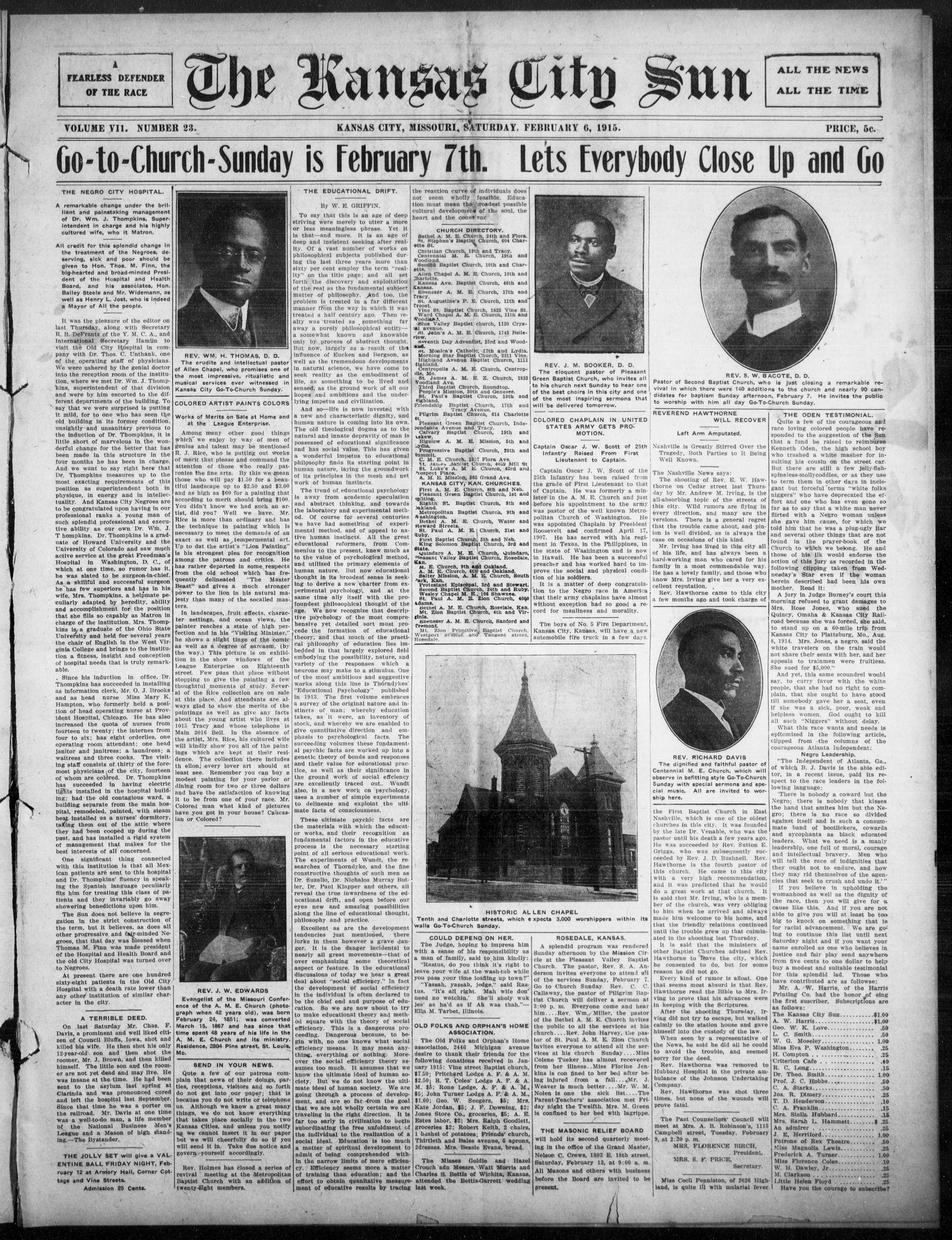
Go-to-Church-Sunday is February 7th. Lets Everybody Close Up and Go
VOLUME VI1. NUMBER 23.
A FEARLESS DEFENDER OF THE RACE
THE NEGRO CITY HOSPITAL.
A remarkable change under the brilliant and painstaking management of Dr. Wm. J. Thompkins, Superintendent in charge and his highly cultured wife, who it Matron.
All credit for this splendid change in the treatment of the Negroes, deserving, sick and poor should be given to Hon. Thos. M. Finn, the big-hearted and broad-minded President of the Hospital and Health Board, and his associates, Hon. Bailey Steele and Mr. Widemann, as well as Henry L. Jost, who is indeed a Mayor of All the people.
It was the pleasure of the editor on last Thursday, along with Secretary R. B. DeFrantz of the Y. M. C. A., and International Secretary Hamlin to visit the Old City Hospital in company with Dr. Thos. C. Unthank, one of the operating staff of physicians. We were ushered by the genial doctor into the reception room of the institution, where we met Dr. Wm. J. Thompkins, superintendent of that division and were by him escorted to the different departments of the building. To say that we were surprised is putting it mild, for to one who has seen the old building in its former condition, unsightly- and unsanitary previous to the induction of Dr. Thompkins, it is little short of marvelous in the wonderful change for the better that has been made in this structure in the four months he has been in charge. And we want to say right here that Dr. Thompkins measures up to the most exacting requirements of this position as superintendent both in physique, in energy and in intellectual. And Kansas City Negroes are to be congratulated upon having in our professional ranks a young man of such splendid professional and executive ability as our own Dr. Wm. J. Thompkins. Dr. Thompkins is a graduate of Howard University and the University of Colorado and saw much active service at the great Freedman's Hospital in Washington, D. C., of which at one time, so rumor has it, he was slated to be surgeon-in-chief. As a skillful and successful surgeon he has few superiors and has in his wife, Mrs. Thompkins, a helpmate peculiarly adapted by heredity, ability and accomplishment for the position that she fills so capably as Matron in charge of the institution. Mrs. Thompkins is a graduate of the Ohio State University and held for several years the chair of English in the West Virginia College and brings to the institution a fitness, insight and conception of hospital needs that is truly remarkable.
Since his induction in office, Dr. Thompkins has succeeded in installing as information clerk, Mr. O. J. Brooks and as head nurse Miss Mary K. Hampton, who formerly held a position of head operating nurse at Provident Hospital, Chicago. He has also increased the quota of nurses from fourteen to twenty; the internes from four to six; has eight orderlies, one operating room attendant; one head janitor and janitress; a laundress; a waitress and three cooks. The visiting staff consists of thirty of the foremost physicians of the city, fourteen of whom are colored. Dr. Thompkins has succeeded in having electric lights installed in the hospital building; had the old contagious ward, a building separate from the main hospital, remodeled, painted, with steam heat installed as a nurses' dormitory, taking them out of the attic where they had been cooped up during the past, and has installed a rigid system of management that makes for the best interests of all concerned.
One significant thing connected with this institution is that all Mexican patients are sent to this hospital and Dr. Thompkins' fluency in speaking the Spanish language peculiarly fits him for treating this class of patients and they invariably go away showering benedictions upon him.
The Sun does not believe in segregation in the strict construction of the term, but it believes, as does all other progressive and fair-minded Negroes, that that day was blessed when Thomas M. Finn was made president of the Hospital and Health Board and the old City Hospital was turned over to Negroes.
At present there are one hundred sixty-eight patients in the Old City Hospital with a death rate lower than any other institution of similar character in the city.
A TERRIBLE DEED
On last Saturday Mr. Chas. F. Davis, a prominent and well liked citizen of Council Bluffs, Iowa, shot and killed his wife. He then shot his only 12-year-old son and then shot the roomer, Mr. J. Brown, and then killed himself. The little son and the roomer are not yet dead and may live. He was insane at the time. He had been sent to the asylum last spring at Clarinda and was pronounced cured and left the hospital last September. Since that time he was a porter on the railroad. Mr. Davis at one time was a well-to-do man, a life member of the National Business Men's League and a Mason of high standing.—The Bystander.
THE JOLLY SET will give a VALENTINE BALL FRIDAY NIGHT, February 12 at Armory Hall, Corner Cottage and Vine Streets.
Admission 25 Cents.
The Kansas City Sun
REV. WM. H. THOMAS, D. D.
The erudite and intellectual pastor of Allen Chapel, who promises one of the most impressive, ritualistic and musical services ever witnessed in Kansas City Go-To-Church Sunday.
COLORED ARTIST PAINTS COLORS
Works of Merits on Sale at Home and at the League Enterprise.
Among many other good things which we enjoy by way of men of genius and talent may be mentioned R. J. Rice, who is putting out works of merit that please and command the attention of those who really patronize the fine arts. By this we mean those who will pay $1.50 for a beautiful landscape up to $2.50 and $3.00 and as high as $60 for a painting that according to merit should bring $100. You didn't know we had such an artist, did you? Well we have. Mr. Rice is more than ordinary and has the technique in painting which is necessary to meet the demands of an exact as well as temperamental art. Up to dat the artist's "Lion Painting" is his strongest plea for recognition among the patrons and critics. He has rather departed in some respects from the old school which has frequently delineated "The Master Beast" and gives a much stronger power to the lion in his natural majesty than many of the so-called masters.
In landscapes, fruit effects, character settings, and ocean views, the painter reaches a state of high perfection and in his "Visiting Minister," he shows a slight tinge of the comic as well as a degree of sarcasm, (by the way.) This picture is on exhibition in the show windows of the League Enterprise on Eighteenth street. Few pass that place without stopping to give the painting a few thoughtful moments of study. Several of the Rice collection are on sale at this place. And attendants are always glad to show the merits of the paintings as well as give any facts about the young artist who lives at 1015 Tracy and whose telephone is Main 2016 Bell. In the absence of the artist, Mrs. Rice, his cultured wife will kindly show you all of the paintings which are kept at their residence. The collection there includes th elon, every lover art should at least see. Remember you can buy a modest painting for your parlor or dining room for two or three dollars and have the satisfaction of knowing it to be from one of your race. Mr. Colored man what kind of pictures have you got in your house? Caicasian or Colored?
REV. J. W. EDWARDS
Evangelist of the Missouri Conference of the A. M. E. Church (photograph when 42 years old), was born February 24, 1851, was converted March 15, 1867 and has since that time spent 48 years of his life in the A. M. E. Church and its ministry Residence, 2804 Pine street, St. Louis, Mo.
SEND IN YOUR NEWS
Qute a few of our patrons complain that news of their doings, parties, receptions, visitors and so forth do not get into our paper; that is because you do not write or telephone us. Although we know a great many things, we do not know everything that takes place socially in the two Kansas Cities, and unless you notify us we cannot insert it in our paper but we will cheerfully do so if you will send it in. Take due notice and govern yourself accordingly.
Rev. Holmes has closed a series of revival meeting at the Metropolitan Baptist Church with an addition of twenty-eight members.
KANSAS CITY, MISSOURI, SATURDAY, FEBRUARY 6, 1915.
THE EDUCATIONAL DRIFT.
By W. E. GRIFFIN
To say that this is an age of deep striving were merely to utter a more or less meaningless phrase. Yet it is that—and more. It is an age of deep and insistent seeking after reality. Of a vast number of works on philosophical subjects published during the last three years more than sixty per cent employ the term "reality" on the title page; and all set forth the discovery and exploitation of the real as the fundamental subject matter of philosophy. And too, the problem is treated in a far different manner from the way in which it was treated a half century ago. Then reality was treated as something far away a purely philosophical entity—a somewhat known and knowable only by process of abstract thought. But now, largely as a result of the influence of Eucken and Bergson, as well as the tremendous developments in natural science, we have come to seek reality as the embodiment of life, as something to be lived and sensed, as the ground work of all our hopes and ambitions and the underlying impetus and civilization.
And so—life is now invested with a new and characteristic dignity, and human nature is coming into its own. The old theological dogma as to the natural and innate deprivation of man is possessed of educational significance and has social value. This has given a wonderful impetus to educational philosophy finds its starting point in human nature, laying the groundwork of its principles in the mesh and net work of human instincts.
The trend of educational psychology is away from academic speculation and abstract thinking, and towards the laboratory and experimental method. Of course for several centuries we have had something of experimental method, and of appeal to native human instincts. All the great educational reformers, from Commenius to the present, knew much as to the value of psychological method, and utilized the primary elements of human nature. But now educational thought in its broadest sense is seeking to derive a new charter from experimental psychology, and at the same time all itself with the profoundest philosophical thought of the age. We now recognize that descriptive psychology of the most comprehensive yet detailed sort must proceed the formation of educational theory, and that much of the practical philosophy of education lies imbedded in that largely explored field embodying the possibility, nature, and variety of the responses which a neurone may make to a stimulus. One of the most ambitious and suggestive works along this line is Thorndikes" "Educational Psychology" published in 1913. The first volume embraces a survey of the original nature and instincts of man; whereby education takes, as it were, an inventory of stock, and whereby we are enabled to give quantitative direction and emphasis to psychological facts. The succeeding volumes these fundamental psychic facts are worked up into a genetic theory of bonds and responses and their value for educational practice, as well as their significance in the ground work of social efficiency are excellently traced out.. Wundt also, in a new work on psychology, uses a number of simple experiments to delineate and exploit the ultimate facts of consciousness.
These ultimate psychic facts are the materials with which the educator works, and their recognition as fundamental factors in the educative process is the necessary starting point of all serious educational work. The experiments of Wundt, the researches of Thorndyke, and the fine constructive thoughts of such men as Dr. Suzallo, Dr. Nicholas Murray Butler, Dr. Paul Klapper and others, all reveal the true inwardness of the educational drift, and open before our eyes new and amazing possibilities along the line of educational thought, philosophy and practice.
Excellent as are the development tendencies just mentioned, there hurks in them however a grave danger. It is the danger incidental to nearly all great movements—that of over emphasizing some theoretical aspect or feature. In the educational discussions of today we hear a great deal about "social efficiency." In fact the development of social efficiency in the individual is often declared to be the chief end and purpose of education. So we are now about to try to make educational theory and method square with the theory of social efficiency. This is a dangerous proceeding. Dangerous because, to begin with, no one knows what social efficiency means. It may mean anything, everything or nothing. Moreover the social efficiency theory assumes too much. It assumes that we know the ultimate ideal of human society. But we do not know the ultimate ideal of human society. We are going through a process of development, and are so far from the goal that we are not wholly certain we are traveling in the right direction. It is far too early in civilization to begin subordinating the free unfoldment of the individual to the realization of a social ideal. Education is too much a matter of spiritual development to admit of being comprehended with in the narrow limits of mere efficiency. Efficiency seems more a matter of training than education; and the effort to obtain quantitative measurement of educative results by tracing
the reaction curve of individuals does not seem wholly feasible. Education must mean the broadest possible cultural developments of the soul, the heart and the constenc
CHURCH DIRECTORY.
Bethle A. M. E. Church, 24th and Flora. St. Stephen's Baptist Church, 604 Charlotte St.
Christian Church, 19th and Tracy. Centennial M. E. Church, 19th and Woodland.
Solid Baptist Church, 10th and Charotte.
Alien Chapel A. M. E. Church, 10th and Kansas.
Kansas. Ave. Baptist Church, 46th and Kansas.
Ebenezer A. M. E. Church, 17th and Tracy.
St. Augustine's P. E. Church, 11th and Troost.
Lins St. Baptist Church, 1825 Vine St. W. Chapel A. M. E. Church, 11th and Woodland.
seventh Day Adventist, 23rd and Woodland
St. Monica's Catholic, 17th and Lydia.
Highland Avenue Baptist Church, 1111
Highland.
Centropolis A. M. B. Church, Centropolis
St. James A. M. E. Z. Church, 1823
Third Baptist Church, Roundtop,
Third Baptist Church, Roundtop,
People's Mission, 30th and Genesee,
People's Baptist Church, 19th and
highland.
Independent Avenue and Tracy, Independence Avenue and Tracy, Calvary Baptist Church, 19th and 20th Street, Calvary Baptist Church, 19th and 20th Street,
Bigelow A. M. E. Mission, 5th and Jorda.
Diverseive Baptist Church, 29th and summit.
C. M. E. Church, 1817 Flora Ave. St. James, Baptist Church, 4638 Mill Ave. M. E. Church, 45rd and Prospect Place.
A. M. E. Mission, 565 Grand Ave.
KANSAS CITY; KAN. CHURCHES.
First A. M. E. Church, 8th and Neb.
Pleasant Green Baptist Church, 1st and
Eighth St. Baptist Church, 8th and
jakland.
Metropolitan Baptist Church, 9th and
Washington.
Bethel A. M. E. Church, Water and
stairway Streets.
St. Paul A. M. E. Church, 21st and
Quby.
First Baptist Church 5th and Neb.
Solomon Baptist Church, 3rd and
5th.
Quindardo A. M. E. Church, Quindardo
Peasant Valley Baptist Church, Rosedale
Kan.
M. E. Church, 9th and Oakland.
A. M. E. Church, 4th and Oakland.
Salter Mission, A. M. E. Church, South
ark, Kan.
Protestant Episcopal, 3rd and Stewart
Second Baptist Church, 24th and Ruby
Wheeler Chapel M. E. 106, Shawnee,
Paul A. M. A. E. Zion Church, 400
Adams
bethel A. M. E. Church, Roseale, Kan
Zion Baptist Church, 4th and Virtu-
al.
Ebenezer A. M. E. Church, Sanford and
Ebenezer A. M. E. Church, Sanford and
TIMO
Milton Primitive Baptist Church
Westport avenue and Tangent street,
200 W. Milton Ave.
1
HISTORIC ALLEN CHAPEL
Tenth and Charlotte streets, which expects 3,000 worshippers within its walls Go-To-Church Sunday.
COULD DEPEND ON HER.
The Judge, hoping to impress him with a sense of his responsibility as a man of family, said to him kindly:
ROSEDALE, KANSAS.
A splendid program was rendered Sunday afternoon by the Mission Circle at the Pleasant Valley, Baptist
"Yassah, yassah, jedge," said Rastus. "it's all right. 'Mah wife don' need not watchin'. She'll sholy wuk jes' as ha'd as if af Haw was thah"—Ella M. Tarbet, Illinois.
OLD FOLKS AND ORPHAN'S HOME
ASSOCIATION.
The Old Folks and Orphan's Home association, 2446 Michigan avenue desire to thank their friends for the following donations received in January 1915: Vine street Baptist church, $7.50; Pritchard Lodge A. F. & A. M. $2.50; R.T. Coles' Lodge A. F. & A. M. $5; Rone Lodge, A. F. & A. M. $5; John Turner Lodge A. F. & A. M. $1.60; Geo. W. Seegers, $5; Mrs. Kate Jordan, $5; J. F. Downing, $2; Jones Store Co., groceries, $5; A. E. Estes labor, $2; Mrs. Ralph Goodlett, groceries $2; Robert Keith, 2 chairs, 1 bushel of potatoes; Friends' church, Thirtieth and Bales avenue, 4 aprons, 2 dresses. Mrs. Bessie Evans, bread.
The Misses Goldie and Hazel Crouch adn Messrs. Watt Morris and Charles S. Bettis of Wichita, Kansas, attended the Bettis-Garrett wedding last week.
REV. J. M. BOOKER, D. D.
The eloquent pastor of Pleasant Green Baptist Church, who invites all to his church next Sunday to hear one of the best choirs in this city and one of the most inspiring sermons that will be delivered tomorrow.
COLORED CHAPLAIN IN UNITED STATES ARMY GETS PROMOTION.
Captain Oscar J. W. Scott of 25th Infantry Raised From First Lieutenant to Captain.
Captain Oscar J. W. Scott of the 25th Infantry has been raised from the grade of First Lieutenant to that of Captain. He was formerly a minister in the A. M. E. Church and just before his appointment to the army was pastor of the well known Metropolitan Church of Washington. He was appointed Chaplain by President Roosevelt and confirmed April 17, 1907. He has served with his regiment in Texas, in the Phillippines, in the state of Washington and is now Hawaii. He has been a successful preacher and has worked hard to improve the social and physical condition of his soldiers.
It is a matter of deep congratulation to the Negro race in America that their army chaplains have almost without exception had so good a record for manliness and morality.
The boys of No. 5 Fire Department Kansas City, Kansas, will have a new automobile fire truck in a few days
THE CHURCH OF THE SUNSHINE
ROSEDALE, KANSAS
A splendid program was rendered Sunday afternoon by the Mission Circle at the Pleasant Valley Baptist Church. The pastor, Rev. S. A. Anderson invites everyone to attend all of the services Sunday, February 7. Go to Church Sunday. Rev. C. C. Callaway, the pastor of Pillgrim Baptist Church will deliver a sermon at 3:00 p. m. Everyone come and hear him...Rev. Wm. Miller, the pastor of the Bethel A. M. E. Church invites the public to all the services at his church...Rev. John Harvey, the pastor of St. Paul A. M. E. Zion Church invites everyone to attend all the services at his church Sunday...Miss Colene Tueker has almost recovered from her illness. Miss Florine Jenks is con fined to her bed after being injured from a fall...Mr. J Weaver is much better...Mr. W. M. Nolen is one the sick list...The Parent-Teachers' association met Friday night the Twelfth. Mrs. M. Green is confined to her bed with lagrippe
THE MASONIC RELIEF BOARD
will hold its second quarterly meeting in the office of the Grand Master Nelson C. Crews, 1803 E. 18th street Saturday, February 13, at 9:00 a.m. All Masons and others with business before the Board are invited to be present.
REV. S. W. BACOTE, D. D.
Pastor of Second Baptist Church, who is just closing a remarkable revival in which there were 140 additions to the church and nearly 90 candidates for baptism Sunday afternoon, February 7. He invites the public to worship with him all day Go-To-Church Sunday.
Nashville is Greatly Stirred Over the Tragedy, Both Parties to It Being Well Known.
The Nashville News says:
The shooting of Rev. E. W. Hawthorne on Cedar street last Thursday by Mr. Andrew M. Irving, is the all-absorbing topic of the streets of this city. Wild rumors are flying in every direction, and many are the versions. There is a general regret that the trouble came about, and pinion is well divided, as is always the case on occasions of this kind.
Mr. Irving has lived in this city all of his life, and has always been a hard-working man who cared for his family in a most commendable way. He has a lovely family, and those who know Mrs. Irving give her a very excellent reputation.
Rev. Hawthorne came to this city a few months ago and took charge of
REV. RICHARD DAVIS
The dignified and faithful pastor of Centennial M. E. Church, which will observe in beffitting style Go-To-Church Sunday with special sermons and special music. All are invited to worship here.
the First Baptist Church in East Nashville, which is one of the oldest churches in this city. It was founded by the late Dr. Venable, who was the pastor until his death a few years ago. He was succeeded by Rev. Sutton E. Griggs, who was subsequently succeeded by Rev. J. D. Bushnell. Rev. Hawthorne is the fourth pastor of this church. He came to this city with a very high recommendation, and it was predicted that he would do a great work at that church. It is said that Mr. Irving, who is a member of the church, was very obliging to him when he arrived and always made him welcome to his home, and that the friendly relations continued until the trouble grew up that culminated in the shooting last Thursday. It is said that the ministers of other Baptist Churches advised Rev. Hawthorne to leave the city, which he consented to do, but for some reason he did not go.
Every kind of rumor is afloat. One that seems most absurd is that Rev. Hawthorne read the Bible to Mrs. Irving to prove that his advances were in keeping with the Scriptures.
After the shooting Thursday, Irving did not try to escape, but walked calmly to the station house and gave himself into the custody of the law.
When seen by a representative of the News, he said he did all he could to avoid the trouble, and seemed sorry for the deed.
Rev. Hawthorne was removed to Hubbard Hospital in the private ambulance of the Johnson Undertaking Company.
Rev. Hawthorne was shot three times, but none of the wounds will prove fatal.
The Past Counsellors' Council will meet at Mrs. A. B. Robinson's, 1115 Campbell street, Tuesday, February 9, at 2:30 p. m.
Miss Cecil Penniston, of 2626 Highland, is quite ill with malaria fever
ALL THE NEWS ALL THE TIME
THE ODEN TESTIMONIAL.
Quite a few of the courageous and race loving colored people have responded to the suggestion of the Sun that a fund be raised to reimburse Kenneth Oden, the high school boy who trashed a white masher for insulting his cousin on the street car. But there are still a few jelly-fish-spineless-mollycoddles, or as they use to term them in other days in inelegant but forceful terms "white folks niggers" who have deprecated the effort and one who has even gone so far as to say that a white man never flirted with a Negro woman unless she gave him cause, for which we told him that he was a plug-ugly liar and several other things that are not found in the prayer-book of the Church to which we bekong. He and those of his ilk would endorse the action of this jury as recorded in the following clipping taken from Wednesday's Star even if the woman herein described had been his own mother. Read it:
A jury in Judge Burney's court this morning refused to grant damages to Mrs. Rose Jones, who sued the Quincy, Omaha & Kansas City Railroad because she was forced, she said, to stand up on a 60-mile trip from Kansas City to Plattsburg, Mo., Aug. 8, 1914. Mrs. Jones, a negro, said the white travelers on the train would not share their seats with her, and her appeals to trainmen were fruitless. She sued for $5,000.
And yet, this same scoundrel would say, to curry favor with the white people, that she had no right to complain, that she ought to have stood till somebody gave her a seat, even if she was a sick, poor, weak and helpless women. God ought to kill all such "Niggers" without delay. What this race wants and needs epitomized in the following article, clipped from the columns of the courageous Atlanta Independent:
Negro Leadership
"The Independent of Atlanta, Ga., of which B. J. Davis is the able editor, in a recent issue, paid its respect to the race leaders in the following language:
"There is nobody a coward but the Negro; there is nobody that kisses the hand that smites him but the Negro; there is no race so divided against itself and is such a consumate band of bootlickers, cowards and sycophants as black educated leaders. What we need is a manly leadership, one full of moral, courage and intellectual bravery. Men who will tell the race of indignities that they ought not to endure, and how they may rid themselves of the agencies that seek to crush and undo it."
If you believe in upholding the womanhood as well as the dignity of the race, then you will give for a cause like this. And if you are not able to give you will at least be too big to knock on something that is for racial advancement. We are going to continue this list until next Saturday night and if you want your name enrolled as one who believes in justice and fair play send anywhere from five cents to one dollar to help buy a modest and suitable testimonial for this splendid lad. Those who have contributed are as followse:
Mr. A. W. Harris, of the Harris Printing Co. had the honor of eing the first suscriber. Subscriptions are as follows:
The Kansas City Sun . . . $1
A. W. Harris . . . $1
Geo. W. K. Love . . . L. C. Smith . . . W. G. Moseley . . . 1
Miss Eva P. Washington . . . H. Compton . . . Criterion Cafe . . . R. C. Long . . . Dr. Theo. Smith . . . 1
Prof. J. C. Hobbs . . . C. A. Starks . . . Jos. R. Dimery . . . T. D. Henderson . . . C. A. Franklin . . . Mrs. Stella Hubbard . . . Mrs. Sarah L. Hammett . $ An admirer . . . J. E. Herriford . . . 1
Patrons of Rex Theatre . . . Miss Magnolia Lewis . . . Frederick A. Turner . . . Miss Florence Coles . . . W. H. Dawley, Jr . . . M. Clarkson . . . Little Helen Floyd . . . Have you the courage to subscr
PRICE. 5c.
AFRO-AMERICAN CULLINGS
In the article of Mr. James Croggan, in the Sunday Star, it is stated that "one hundred years ago the first colored troops who ever served in the army of the United States won the commendation of General Jackson in the battles in and around New Orleans." This statement as to when the first colored troops served in the army of the United States is incorrect, writes Albert N. Sip in a communication to the Washington Star. Bancroft's History, volume five, pages 152, 153, says: "On the first of January, 1776, the tricolored American banner, not yet spanned with stars, but showing 13 stripes of alternate red and white in the field, and the united red and white crosses of Saint George and Saint Andrew on a blue ground in the corner, was unfurled over the new continental army around Boston, which, at that moment of its greatest weakness, consisted of but 9,650 men. On that day, free Negroes stood in the ranks by the side of white men. In the beginning of the war they had entered the provincial army; the first general order which was issued by General Ward had required a return among other things, of "the complexion" of the soldiers; and black men like others, were retained in the service after the troops were adopted by the continent.
We have seen Edward Rutledge defeated in his attempt to compel their discharge. In October, the conference at the camp, with Franklin, Harrison and Lynch, thought it proper to exclude them from the new enlistment; but Washington, at the crisis of his distress, finding that they were very much dissatisfied at being discarded, reversed the decision and asked the approval of congress. That body appointed Wythe, Samuel Adams and Wilson to deliberate on the question; and, on the report of their abl committee, they voted "that the free Negroes who had served faithfully in the army at Cambridge might be re-enlisted therein, but no others." The right of free Negroes to take part in the defense of the country having thus been partially admitted by the highest power, the limitation was lost sight of, and they served in the ranks of the American armies during every period of the war.
When in 1778 the army was reduced to its lowest point in numbers, Bancroft states, in volume six, page 48, that "Varnum, a brigadier of Rhode Island, proposed the emancipation of slaves in that state, on condition of their enlisting in the army for the war. The scheme, approved by Washington, and by him referred to Cooke, the governor of the state, was accepted. Every able-bodied slave in Rhode Island received law liberty to enlist in the army for the war. On passing muster he became free and entitled to all the wages and encouragements given by congress to any soldier. The state made some compensation to their masters.
As the object of this communication is simply to correct the error of Mr. Croggon as to when the first colored troops served in the army of the United States, it is not necessary to refer to the well-known fact that Negroes fought at the battle of Bunker Hill, taking part in common with the white yeomanry of Massachusetts and other states. Their services in the Union army during the Civil war are well known.
Kansas City has 130 miles of boulevards.
Houston has a Negro population of probably thirty thousand, and we be-believe it can be said without exaggeration that there is not a city in the country where the Negroes are making better progress. We do not mean to say that there is not room for improvement or that everything that might be done to aid them is being done, but year by year the white people are coming to know that their interest in everything that improves conditions among the Negroes is one of vital importance. It is no longer difficult to enlist the co-operation of the white people in any movement having for its object the welfare of the Negro people, and we think nearly all of the southern cities can say as much.—Houston (Texas) Post.
One of the objects of an Australian antarctic expedition will be the establishment of a meteorological station to give warnings by wireless of the severe storms which sweep for southern seas.
Peruvian oil fields are rapidly being developed.
The Illinois river was so termed from the Illinois, an tribe of Indians on its banks. Another derivation is suggested in Isle aux Noix, Island of Nuts. Several derivatives more or less fanciful are suggested by the etymologists and geographers.
One of the strangest cargoes ever carried on the sea was a shipload of bees sent from Holland to the Isle of Wight, England, where the native bees are threatened with extinction by disease. The cargo consisted of 300 hives, containing about 10,000,000 bees.
Jenny Lind's California Debut.
At Monterey, Cal., formerly a part of Mexico, and ceded to the United States during the Mexican war, is the first public building built in California and now a broken-down, weather-tracked ruin of adobe, relates the Health Magazine. In this building Jenny Lind made her first California debut, and when the gold the enthusiastic miners had thrown upon the stage after her performance was gathered up it was found to fill two five-gallon oil can's—about twenty pounds
A. H.
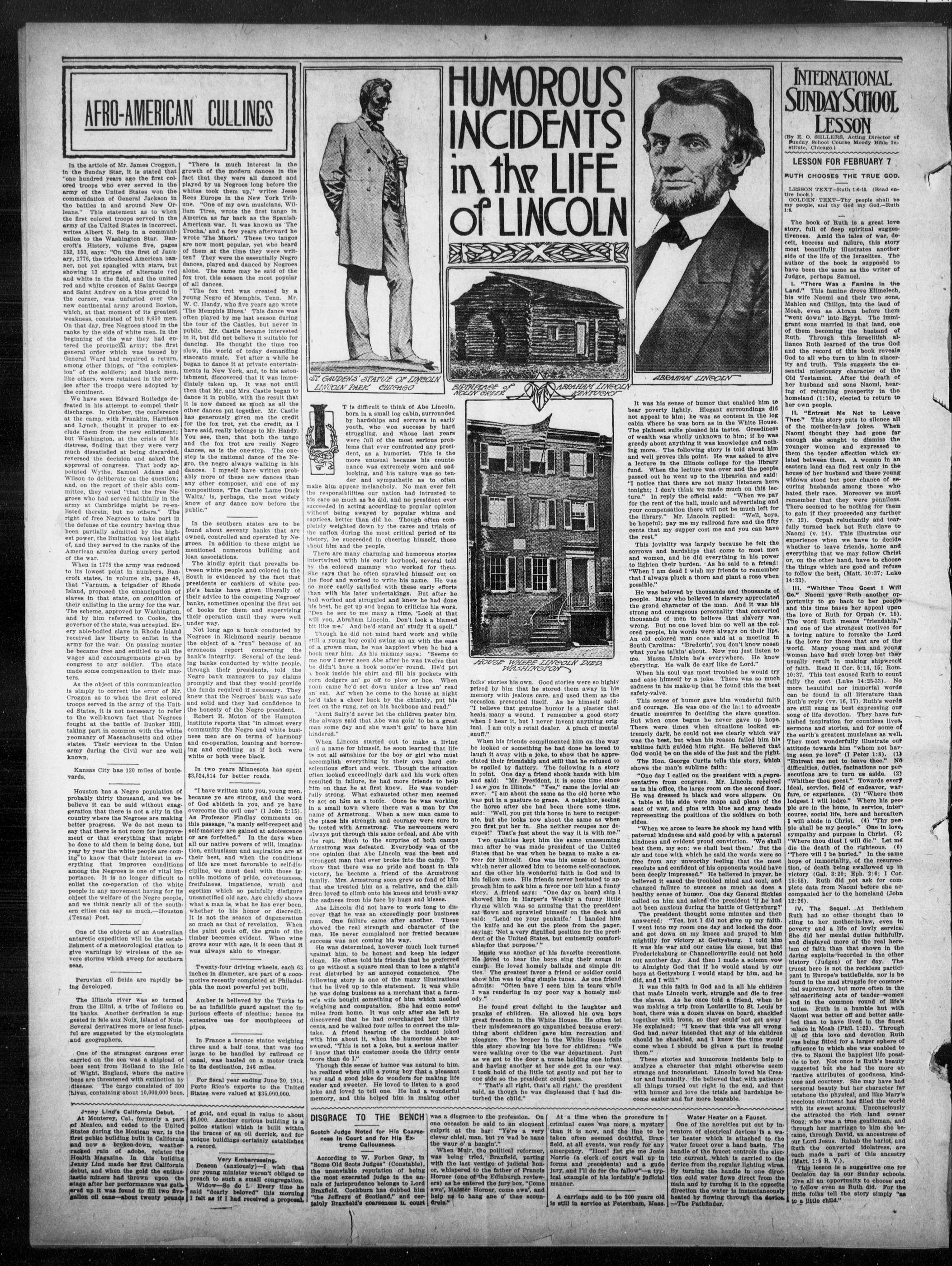
ST GAUDEENS' STATUE OF LINCOLN
LINCOLN PARK CHICAGO
T is difficult to think of Abe Lincoln,
born in a small log cabin, surrounded
by hardships and sorrows in early
youth, who won success by hard
struggling, and whose last years
were full of the most serious pro-
blems that ever confronted an pres-
ident, as a humorist. This is the
more unusual because his counten-
ance was extremely worn and sad-
looking, and his nature was so tender and sympathetic as to often
make him appear melancholy. No man ever felt
the responsibilities our nation had intruded to
his care so much as he did, and no president ever
succeeded in acting according to popular opinion
without being swayed by popular whims and
caprices, better than did he. Though often com-
pletely weighted down by the cares and trials of
the nation during the most critical period of its
history, he succeeded in cheering himself, those
about him and the people.
There are many charming and humorous stories intertwined with his early boyhood, several told by the colored mammy who worked for then. She says that he often sprawled himself out on the floor and worked to write his name. He was no more easily satisfied with these early efforts than with his later undertakings. But after he had worked and struggled and knew he had done his best, he got up and began to criticize his work. "Den he sez to me many a time, 'Look at that will you, Abraham Lincoln. Don't look a blamed bit like me.' And he'd stand an' study it a spell." Though he did not mind hard work and while still a young boy could swing an ax with the case of a grown man, he was happiest when he had a book near him. As his mammy says: "Seems to me now I never seen Abe after he was twelve that he didn't have a book some'er round. He'd put a book inside his shirt and fill his pockets with corn dodgers an' go off to plow or owe. Whenoon came he'd set down under a tree an' read an' eat. Ar' when he come to the house at night he'd take a cheer back by the chimbly, put his feet on the rung, set on his backbone and read."
"Aunt Sairy'd never let the children pester him. She always said that Abe was gain' to be a great man some day and she wasn't gain' to have him hindered."
When Lincoln started out to make a living and a name for himself, he soon learned that life is not all sunshine for the boy or girl who must accomplish everything by their own hard conscientious effort and work. Though the situation often looked exceedingly dark and his work often resulted in failure, he had more friends to help him on than he at first knew. He was wonderfully strong. What exhausted other men seemed to act on him as a tonic. Once he was working in a small town where there was a man by the name of Armstrong. When a new man came to the place his strength and courage were sure to be tested with Armstrong. The newcomers were always put through this same ordeal, and Abe with the rest. Much to the surprise of both camps Armstrong was defeated. Everybody was of the one opinion that Abe Lincoln was the best and strongest man that ever broke into the camp. To show that there was no pride and boast in this victory, he became a friend of the Armstrong family. Mrs. Armstrong soon grew so fond of him that she treated him as a relative, and the children loved to climb onto his knees and brush away the sadness from his face by hugs and kisses.
Abe Lincoln did not have to work long to discover that he was an exceedingly poor business man. One failure came after another. These showed the real strength and character of the man. He never complained nor fretted because success was not coming his way.
He was determined, however much luck turned against him, to be honest and keep his ledger clean. He often told his friends that he preferred to go without a square meal than to lose a night's rest disturbed by an annoyed conscience. The following story is one of the many illustrations that he lived up to this statement. It was while he was doing business as a merchant that a farmer's wife bought something of him which needed weighing and computation. She had come some miles from home. It was only after she left he discovered that he had overcharged her thirty cents, and he walked four miles to correct the mistake. A friend hearing of the incident joked with him about it, when the humorous Abe answered, "This is not a joke, but a serious matter. I know that this customer needs the thirty cents more than do I."
"There is much interest in the growth of the modern dances in the fact that they were all danced and played by us Negroes long before the whites took them up." writes Jesse Rees Europe in the New York Tribune. "One of my own musicians, William Tires, wrote the first tango in America as far back as the Spanish-American战军. It was known as 'The Trocha', and a few years afterward he wrote 'The Maori'. These two tangos are now most popular, yet who heard of them at the time they were written? They were the essentially Negro dances, played and danced by Negroes alone. The same may be said of the fox trot, this season the most popular of all dances.
"The fox trot was created by a young Negro of Memphis, Tenn. Mr. W. C. Handy, who five years ago wrote 'The Memphis Blues.' This dance was often played by me last season during the tour of the Castles, but never in public. Mr. Castle became interested in it, but did not believe it suitable for dancing. He thought the time too slow, the world of today demanding staccato music. Yet after a while he began to dance it at private entertainments in New York, and, to his astonishment, discovered that it was immediately taken up. It was not until then that Mr. and Mrs. Castle began to dance it in public, with the result that it is now danced as much as all the other dances put together. Mr. Castle has generously given me the credit for the fox trot, yet the credit, as I have said, really belongs to Mr. Handy. You see, then, that both the tango and the fox trot are really Negro dances, as is the one-step. The one-step is the national dance of the Negro, the negro always walking in his dances. I myself have written probably more of these new dances than any other composer, and one of my compositions, 'The Castle Lame Duck Waltz,' is, perhaps, the most widely know of any dance now before the public."
In the southern states are to be found about seventy banks that are owned, controlled and operated by Negroes. In addition to these might be mentioned numerous building and loan associations.
The kindly spirit that prevails between white people and colored in the South is evidenced by the fact that presidents or cashiers of white people's banks have given liberally of their advice to the competing Negroes' banks, sometimes opening the first set of books for them and supervising their operation until they were well under way.
Not long ago a bank conducted by Negroes in Richmond nearly became the object of a "run" because of an erroneous report concerning the bank's integrity. Several of the leading banks conducted by white people, through their presidents, told the Negro bank managers to pay claims promptly and that they would provide the funds required if necessary. They knew that the Negroes' bank was safe and solid and they had confidence in the honesty of the Negro president.
Robert R. Moton of the Hampton institute reports that "in almost every community the Negro and white business men are on terms of harmony and co-operation, loaning and borrowing and crediting as if both were white or both were black.
In two years Minnesota has spent $3,524,814 for better roads.
"I have written unto you, young men, because ye are strong, and the word of God abldeth in you, and ye have overcome the evil one" (I John 2:15). As Professor Findlay comments on this passage, "a manly self-respect and self-mastery are gained at adolescence or are forfeited." In the days when all our native powers of will, imagination, enthusiasm and aspiration are at their best, and when the conditions of life are most favorable to self-discipline, we must deal with those ignorable motions of pride, covetousness, fretfulness, impatience, wrath and egotism which so painfully disfigure unsanctified old age. Age chiefly shows what a man is, what he has ever been, whether to his honor or discredit. It is not the season of degeneration so much as that of revelation. When the paint peels off, the grain of the timber becomes evident. When wine grows sour with age, it is seen that it was always akin to vinegar.
Twenty-four driving wheels, each 63 inches in diameter, are part of a coomotive recently completed at Philadelphia the most powerful yet built.
Amber is believed by the Turks to be an infallible guard against the injurious effects of nicotine; hence its extensive use for mouthpieces of pipes.
In France a bronze statue weighing three and a half tons, that was too large to be handled by railroad or canal, was hauled on a motor truck to its destination, 246 miles.
For fiscal year ending June 30, 1914, Porto Rico's exports to the United States were valued at $55,000,000.
of gold, and equal in value to about $5,000. Another curious building is a police station) which is built within the braces of an oil derrick, and for unique buildings certainly establishes a record.
Deacon (anxiously)—I wish that our young minister weren't obliged to preach to such a small congregation. Widow—So do I. Every time he said "dearly beloved" this morning I felt as if I had received a proposal.
T is difficult to think of Abe Lincoln, born in a small log cabin, surrounded by hardships and sorrows in early youth, who won success by hard struggling, and whose last years were 'full of the most serious problems that ever confronted any president, as a humorist. This is the more unusual because his countenance was extremely worn and sad-looking, and his nature is so tender and sympathetic as to often
Though this sense of humor was natural to him, he realized when still a young boy that a pleasant way and a good joke do wonders for making life easier and sweeter. He loved to listen to a good joke and loved to tell one. He had a wonderful memory, and this helped him in making other
was a disgrace to the profession. On one occasion he said to an eloquent culprit at the bar: "Ye're a very clever clich, man, but ye be wane the waur o' a hangin." When Muir, the political reformer, was being tried, Brazfield, parting with the last vestige of judicial honor, whispered to the father of Francis Horner (one of the Edinburgh reviewers) as he entered the fury box, "Come awa', Maister Horner, come awa', and help us to hang an o' thea scoundruls."
DISGRACE TO THE BENCH
Scotch Judge Noted for His Coarseness in Court and for His Extreme Callousness.
According to W. Forbes Gray, in "Some Old Scots Judges" (Constable), the unenviable reputation of being the most execrated judge in the annals of jurisprudence belongs to Lord Brafield. Cockburn has dubbed him "the Jeffreys of Scotland," and certainly Brafield's coarseness is court
HUMOROUS INCIDENTS in the LIFE of LINCOLN
BIRTHPLACE OF
ABRAHAM LINCOLN
NOLN GREEN
KENTUCKY
1820
folks' stories his own. Good stories were so highly prized by him that he stored them away in his memory with jealous care, and used them as the occasion presented itself. As he himself said: "I believe that genuine humor is a plaster that heals many a wound. I remember a good story when I hear it, but I never invent anything original. I am only a retailer. a pinch of mental snuff."
When his friends complimented him on the way he looked or something he had done he loved to laugh it away with a joke, to show that he appreciated their friendship and still that he refused to be spoiled by flattery. The following is a story in point. One day a friend shook hands with him and said: "Mr. President, it is some time since I saw you in illinois." "Yes," came the jovial answer. "I am about the same as the old horse who was put in a pasture to graze. A neighbor, seeing the horse after she had been there some time, said: "Well, you put this horse in here to recuperate, but she looks now about the same as when you first put her in. She neither recuperes nor decures! That's just about the way it is with me."
Two qualities kept him the same unassuming man after he was made president of the United States that he was when he began to make a career for himself. One was his sense of humor, which never allowed him to become self-conscious, and the other his wonderful faith in God and in his fellow men. His friends never hesitated to approach him to ask him a favor nor tell him a funny story. A friend says: "One day on board ship I showed him in Harper's Weekly a funny little rhyme which was so amusing that the president sat down and sprawled himself on the deck and said: 'Lend me your pennife.' I handed him the knife and he cut the piece from the paper, saying: 'Not a very dignified position for the president of the United States, but eminently comfortable for that purpose.'"
Music was another of his favorite recreations. He loved to hear the boys sing their songs in camp. He loved homely ballads and simple ditties. The greatest favor a friend or soldier could show him was to sing simple tunes. As one friend admits: "Often have I seen him in tears while I was rendering in my poor way a homely melody."
He found great delight in the laughter and pranks of children. He allowed his own boys great freedom in the White House. He often let their misdemeanors go unpunished because everything about children gave him recreation and pleasure. The keeper in the White House tells this story showing his love for children: "We were walking over to the war department. Just as we got to the door a nurse holding one infant and having another at her side got in our way. I took hold of the little tot gently and put her to one side so the president could pass.
"That's all right, that's all right," the president said, as though he was displeased that I had disturbed the child."
At a time when the procedure in criminal cases was more, a mystery than it is now, and the line to be taken often seemed doubtful, Braxfield, at all events, was ready for any emergency. "Hoot! just gie me Josie Norrie (a clerk, of court wall up in forma and precedents) and a gude jury, and I'll do for the fallow"—a typical example of his lordship's judicial manner.
A carriage said to be 200 years old is still in service at Petersham, Mass.
ABRAHAM LINCOLN
It was his sense of humor that enabled him to bear poverty lightly. Elegant surroundings did not appeal to him; he was as content in the log cabin where he was born as in the White House. The plainest suite pleased his tastes. Greediness of wealth was wholly unknown to him; if he was greedy about anything it was knowledge and nothing more. The following story is told about him and well proves this point. He was asked to give a lecture in the Illinois college for the library. When the lecture was over and the people passed out he went up to the librarian and said: "I notice that there are not many listeners here tonight; I don't think we made much on this lecture." In reply the official said: "When we pay for the rent of the hall, music and advertising and your compensation there will not be much left for the library." Mr. Lincoln replied: "Well, boys, be hopeful; pay me my railroad fare and the fifty cents that my supper cost me and you can have the rest."
This joviality was largely because he felt the sorrows and hardships that come to most men and women, and he did everything in his power to lighten their burden. As he said to a friend: "When I am dead I wish my friends to remember that I always pluck a thorn and plant a rose when possible."
He was beloved by thousands and thousands of people. Many who believed in slavery appreciated the grand character of the man. And it was his strong and courageous personality that converted thousands of men to believe that slavery was wrong. But no one loved him so well as the colored people, his words were always on their lips. An old colored man once said at a meeting in South Carolina: "Brederin, you don't know nosem what you're talkin' about. Now you just listen to me. Massa Linkin he's everywhere. He know eberyting. He walk de earf like de Lord."
He was beloved by thousands and thousands of people. Many who believed in slavery appreciated the grand character of the man. And it was his strong and courageous personality that converted thousands of men to believe that slavery was wrong. But no one loved him so well as the colored people, his words were always on their lips. An old colored man once said at a meeting in South Carolina: "Brederin', you don't know nosen what youse talkin' about. Now you just listen to me. Massa Linkin he's everywhere. He know eberyting. He walk de earf like de Lord." When his soul was most troubled he would try and ease himself by a joke. There was so much sadness in his make-up that he found this the best safety-valve.
This sense of humor gave him wonderful faith and courage. He was one of the last to advocate drastic measures in deciding the slave question. But when once begun he never gave up hope. There were times when situations looked extremely dark, he could not see clearly which way was the best, but when his reason failed him his sublime faith guided him right. He believed that God would be on the side of the just and the right. The Hon. George Curtis tells this story, which shows the man's sublime faith:
"One day I called on the president with a representative from congress. Mr. Lincoln received us in his office, the large room on the second floor. He was dressed in black and wore slippers. On a table at his side were maps and plans of the seat of war, and pins with blue and gray heads representing the positions of the soldiers on both sides.
"When we grose to leave he shook my hand with paternal kindness and said good-by with a paternal kindness and evident proud conviction. 'We shall beat them, my son; we shall beat them.' But the air and tone with which he said the words were so free from any unworthy feeling that the most resolute and confident of his opponents would have been deeply impressed." He believed in prayer, he believed it eased the troubled mind and soul, and changed failure to success as much as does a healthy sense of humor. One day General Sickles called on him and asked the president "if he had not been anxious during the battle of Gettysburg?"
"When we arose to leave he shook my hand with paternal kindness and said good by with a paternal kindness and evident proud conviction. 'We shall beat them, my son; we shall beat them.' But the air and tone with which he said the words were so free from any unworthy feeling that the most resolute and confident of his opponents would have been deeply impressed." He believed in prayer, he believed it eased the troubled mind and soul, and changed failure to success as much as does a healthy sense of humor. One day General Stickles called on him and asked the president "if he had not been anxious during the battle of Gettysburg?"
The president thought some minutes and then answered: "Yes, but I did not give up my faith. I went into my room one day and locked the door and got down on my knees and prayed to him mightily for victory at Gettysburg. I told him it was his war and our cause his cause, but that Fredericklsburg or Chancellorsville could not hold out another day. And then I made a solemn vow to Almighty God that if he would stand by our boys at Gettysburg I would stand by him, and he did, and I will."
It was this faith in God and in all his children that made Lincoln work, struggle and die to free the slaves. As he once told a friend, when he was making a trip from Louisville to St. Louis by boat, there was a dozen slaves on board, shackled together with irons, so they could not get away He explained: "I knew that this was all wrong God had never intended that any of his children should be shackled, and I knew the time would come when I should be given a part in freeing them."
These stories and humorous incidents help to analyze a character that might otherwise seem strange and inconsistent. Lincoln loved his Creator and humanity. He believed that with patience all things turned out right in the end, and that with humor and love the trials and hardships become easier and far more bearable.
The president thought some minutes and then answered: "Yes, but I did not give up my faith. I went into my room one day and locked the door and got down on my knees and prayed to him mightily for victory at Gettysburg. I told him it was his war and our cause his cause, but that Fredericksburg or Chancellorsville could not hold out another day. And then I made a solemn vow to Almighty God that if he would stand by our boys at Gettysburg I would stand by him, and he did, and I will."
It was this faith in God and in all his children that made Lincoln work, struggle and die to free the slaves. As he once told a friend, when he was making a trip from Loulouville to St. Louis by boat, there was a dozen slaves on board, shackled together with irons, so they could not get away He explained: "I knew that this was all wrong God had never intended that any of his children should be shackled, and I knew the time would come when I should be given a part in freeing them."
These stories and humorous incidents help to analyze a character that might otherwise seem strange and inconsistent. Lincoln loved his Creator and humanity. He believed that with patience all things turned out right in the end, and that with humor and love the trials and hardships become easier and far more bearable.
---
ABRAHAM LINCOLN
One of the novelties put out by inventors of electrical devices is a water heater which is attached to the water faucet over a hand basin. The handle of the faucet controls the electric current, which is carried to the device from the regular lighting wires. By turning the handle in one direction cold water flows direct from the main and by turning it in the opposite direction the water is instantaneously heated by flowing through the device.—The Pathfinder.
INTERNATIONAL
SUNDAY SCHOOL
LESSON
(By E. O. SELLERS, Acting Director of
Moody College's Sports Bible
Institute, Chicago).
RUTH CHOOSES THE TRUE GOD.
LESSON TEXT—Ruth 1:6-18. (Read entire book.)
ture book.
GOLDEN NEXT—Thy people shall be my people, and thy God my God.—Ruth 1:6.
The book of Ruth is a great love story, full of deep spiritual suggestiveness. Amid the tales of war, deceit, success and failure, this story most beautifully illustrates another side of the life of the Israelites. The author of the book is supposed to have been the same as the writer of Judges, perhaps Samuel.
1. "There Was a Famine in the Land." This famine drove Elimelech, his wife Naomi and their two sons, Mahon and Chilion, into the land of Moab, even as Abram before them "went down" into Egypt. The immigrant sons married in that land, one of them becoming the husband of Ruth. Through this Isaeliitish alliance Ruth learned of the true God and the record of this book reveals God to all who turn to him in sincerity and truth. This suggests the essential missionary character of the Old Testament. After the death of her husband and sons Naomi, hearing of returning prosperity in the homeland (1:16), elected to return to her own people.
II. "Entreat Me Not to Leave Thee." This story puts to silence all of the mother-in-law jokes. When Naomi thought they had gone far enough she sought to dismiss the younger women and expressed to them the tender affection which existed between them. A woman in an eastern land can find rest only in the house of her husband and these young widows stood but poor chance of securing husbands among those who hated their race. Moreover we must remember that they were penniless. There seemed to be nothing for them to gain if they proceeded any farther (v. 12). Orphac reluctantly and tearfully turned back but Ruth clave to Naomi (v. 14). This illustrates our experience when we have to decide whether to leave friends, home and everything that we may follow Christ or, on the other hand, have to choose the things which are good and refuse to follow the best, (Matt. 10:37; Luke 14:33).
III. "Whither Thou Goest I Will Go." Naomi gave Ruth another opportunity to go back to her people and this time bases her appeal upon the love of Ruth for Orpha (v. 15). The word Ruth means "friendship," and one of the strongest motives for a loving nature to forsake the Lord is the love for those that are of the world. Many young men and young women have had such loves but they usually result in making shipwreck of faith. Read II Cor. 5:14, 15; Rom. 10:37. This test caused Ruth to count fully the cost (Luke 14:25-33). No more beautiful nor immortal words can be found in all literature than Ruth's reply (vv. 16, 17). Ruth's words are still sung as best expressing our song of life devotion. They have furnished inspiration for countless lives, sermons and stories, and for some of the earth's greatest musicians as well. They most wonderfully illustrate our attitude towards him "whom not having seen ye love" (I Peter 1:8). (1) "Entreat me not to leave thee." No difficulties, duties, facinations nor persecutions are to turn us aside. (2) "Whither thou goest." Towards every ideal, service, field of endeavor, warfare, or experience. (3) "Where thou lodgest I will lodge." Where his people are in the home, in service, intercourse, social life, here and hereafter I will abide in Christ. (4) "The thy people shall be my people." One in love sympathy and purpose in Christ. (5) "Where thou dest I will die." Let me die the death of the righteous. (6) "There will I be buried." In the same hope of immortality, of the resurrection, of death being swallowed up in victory (Gal. 3:20; Eph. 2:6; I Cor. 15:55). Ruth did not ask for complete data from Naomi before she accompanied her to the homeland (John 12:26).
IV. The Sequel. At Bethlehem Ruth had no other thought than to cling to her mother-in-law, even in poverty and a life of lowly service. She did her mental duties faithfully, and displayed more of the real heroism of faith than that shown in the daring exploits recorded in the other history (Judges) of her day. The trustest hero is not the reckless participant in Europe's battlefields, nor is he found in the mid struggle for commercial supremacy, but more often in the self-sacrificing acts of tender-women and in the common round of life's lusties. Ruth in a humble but with Naomi was better off and better satisfied than to have lived in the finest palace in Moab (Phll. 1:23). Through all of this love and devotion Ruth was being fitted for a larger sphere of influence in which she was enabled to dive to Naomi the happiest life possible to her. Not once is Ruth's beauty suggested but she had the more attractive attributes of goodness, kindness and courtesy. She may have had personal beauty but her character far outshone the physical, and like Mary's precious sentiment has filled the world with its sweet aroma. Unconciously she attracted the rich land owner Boaz, who was a true gentleman, and through her marriage to him she became, through David, an ancestress of our Lord Jesus. Rahab the harlot, and Rahb the converted idolatress, are each made a part of this ancestry (Matt. 1:5 R. V.).
This lesson is a suggestive one for Decision day in our Sunday schools. Give all an opportunity to choose and to follow even as Ruth did. For the little folks tell the story simply "as to a little child."
You who are suffering from loss of hair or any scalp disease, give Mrs. Simpson's vegetable Salve to you. It will make harsh dry hair soft and pliable and promote its growth. It grows hair on bald heads and temples and shows results. It will make hair quicker than any preparation on the market. It is good for all scalp diseases such as pin heads, eczema, dandruff, tettor, and for all sore and itching scalps. It has done for others, it will do for you. $ .50
Simpson's Hair Tonic. $ .50
Simpson's Salve. $ .25
Singing and Clipping. $ 1.00
Simpson's Hair Tonic ..... $ .50
Simpson's Salve ..... $ .50
Singing and Clipping ..... $ .25
Treatments ..... 1.00
Miss Lillie Page will give treatments at 201 Garfield Ave., Kansas City, Kans.
I have been a sufferer from a diseased scalp ever since I could remember—and my hair had come out until now, was almost gone. I went to every scalp specialist I could hear of but nothing did me any good. I went to M. Simpson of Denver, Coke, and she treated scalp using her own remedies. I could see good results from the first treatment. I went to Vegetable Salve and Hair Tonic to all who desire a nice growth of hair or are unable to kind of scalp disease. I can only praise the Lord for these wonderful remedies.
LILLIE PAGE.
Mme. Benton Dean, the popular milliner, is now at 1010 Troost avenue, where she is elegantly located and will be extremely pleased to meet her many friends and customers at that number. Belle phone Main 2102J.
TYPEWRITING DONE at Kansas City Son office, 1803 East Eighteenth street. Neat, quick work. Rates reasonable. Engagements by appointment. Bell phone East 999.
HAIR NETS
Real Human Creole Hair
HAND MADE
BEAUTIFULLY
ILLUSTRATED
CATALOGUE
FREE
COLORED WOMEN'S HAIR
This Comb is SOLID BRASS
EXTRA HEAVY BACK 89 Cents
Shows all latest styles in colored
Ladies' Hair and Toilet Articles.
The above is but four of the many
new design we are now making up.
We have poured millions of manufactu-
rers and importers of natural
creole hair and we guarantee every
article sold, or money refunded. Don't
be malked in the minds of hair, as
many of our small competitors are
offering cheap and inferior hair, which
will not stand washing and combing.
But the best man, manufacturer's prices, also hair nets and toilet
articles.
We have been doing business for
years and we have not had a dissatis-
fied customer.
SEND 'TWO
CENT'S TAMP
TO THE
FOR
BOOK
AGENTS
WANTED
HUMANIA HAIR Co.
Dept 05 23 Duane St. New York City
Ladies' Tailoring Dressmaking AND Drafting...
Fancy Gowns a Specialty
I am prepared to offer the public the best dressmaking, tailoring, drafting and fitting.
Graduate of one of the best white downtown colleges.
Will also teach Drafting.
Bell Phone East 3413 M
Mrs. Lillie Williams
2914 Woodland Avenue
KANSAS CITY, MISOURI
CHEAP
JOHN'S
PLACE
New and Second Hand
Goods Bought, Sold and
Exchanged
Bell Phone East 3851 W
2122 Vine Street
WM. HOPKINS, Prop.
J.C.WAGNER
The Clean Market Man
Oysters, Fish and Game in
Season.
Fancy Groceries and all Table
Luxuries.
Courteous Treatment to All.
1819 Howard Ave.
Bell Phone 3596 East
Kansas City. Missouri
---
Negro Business League of Kansas City
Meets First and Third Thursday in Each Month, 1803 E. 18th Street.
F. J. Weaver, President. E. A. Robinson, Secretary.
Members will please report any mistake or change of address to the Secretary or Editor of The Sun.
J. H. Clayborne, 954 Washington Blvd.,
Kansas City, Kas., Bell Phone West
2682.
R. Mason, 1905 Vine.
Marshall Wilson, 2644 Woodland—
Bell phone East 1493.
JEWELERS.
J. A. Wilson, 1616 W. 9th street—Bell
Phone Main 6248R.
MILLINERY.
Miss Eva P. Washington, 849 Freeman
avenue, Kansas City, Kas., Mil
linery and Hair Work—Bell phone
2306 West.
MUSICIANS.
Winston Holmes, Plano Tuner, 2227
Michigan, Home Phone 5314 Main.
E. 4394Y Office 2460 W. L.
Modern Builders
A. E. ESTES, President
General Contracting
Repairing a Special
ISFACTION GUARANTY
S WILLA M. GLEY
COOL OF STENOGRAM
AND TYPEWRITING
Monable. Enroll Now. Persons Not Eligible Not Finished the Grade Schools or the Equivalent.
Bell Phone E. 4394Y
THE Modern
A. E. ESTE
General
Repairing
SATISFACTION
MISS WILLA
SCHOOL OF S
AND TYPE
Rates Reasonable. Enroll N
Have Not Finished the
Equ
MISS WILLA M. GLENN
SCHOOL OF STENOGRAPHY AND TYPEWRITING Rates Reasonable. Enroll Now. Persons Not Eligible Who Have Not Finished the Grade Schools or the Equivalent. PHONE BELL EAST 999.
OPEN UNDER NEW MANAGEMENT
MEALS AT ALL HOURS 15 Cents and Up
BEST OF SERVICE
TUCKER & LEWIS
ST OF SERVICE GIVEN OUR PATRO
& LEWIS 1700 E. 18TH
BEST OF SERVICE GIVEN OUR PATRONS
TUCKER & LEWIS 1700 E. 18TH STREET
THE
EAL PHARMA
MASONIC TEMPLE
THE IDEAL PLACE FOR BUYING YOU
IDEAL PHARMACY
MASONIC TEMPLE
THE IDEAL PLACE FOR BUYING YOUR
Drugs, Toilet Articles
and Sundries
BOTH PHONES FREE—CALL US UP
Special New Line of Prescription Drugs
Graduate Prescriptionist.
Calling Cards, Business Cards, Church, Society, Book and Stationery Printing of all kinds.
JNO. R- FAIRLEY, Mgr.
Square Deal Printing Co.
The Printing House for the two Kansas Citys. Our Facilities for doing first class work unexcelled
Home 2785 Main
Bell 1647Y Grand
1731 Lydia Ave. (Hod Carriers' Hall.)
Subscribe Now for The Sun
GROCERS.
NOTES ON RACIAL PROGRESS.
Furnished by the National Negro Business League.
The late Mrs. Ellen Bransford, of Little Rock, Arkansas, better known as "Aunt Ellen" left $6,000 to the Negro Lutheran church of that city. She had been working as a domestic since the Civil War and invested wisely in real estate.e
Solomon Harper, a colored man, has invented an automatic signal and safety device for train. Representative colored men of New York city have organized a company called the National Grand Control Signal company which will take charge and promote the sales. John E. Nail is the president.
Mr. E. G. Charleston, a colored undertaker of Charleston, South Carolina, has erected a $10,000 office building in that city.
The Philadelphia (Pa.), Courant has a published "black list" of advertisements which they refuse. The list includes liquor cure-all medicines, chairvoyants, fake land sales and all advertisements which hold the race up to ridicule.
The Raiyway Employes Protective association was organized in Nashville, Tennessee recently. This is an organization of colored men from all sections of the country.
The National Negro Business League has issued a call for the observance of a National Negro Health Week, March 21 to 27th.
The Provident association of St. Louis has been organized to relieve the poor and destitute of that city. The colored people have already contributed more than $200.
The Standard American Mutual Fire Insurance company, of Houston, Texas, made a very creditable showing for its first six months of operation. Dr. M. W. Dogan is president.
The Farmers' Cooperative Mercantile company, of Mound Bayou, Mississippi, has just closed the most successful year in its history. The books showed a total business for the year of $32,210.51.
Colored business men of Des Moines, Iowa, have organized the Iowa Realty Investment company company with S. Joe Brown as the secretary, Mr. Brown is also secretary of the Local Negro Business League.
Henry Burris, for twenty-five years a carrier in the postoffice at Rock Island, Illinois, was recently tendered a banquet by other carriers in his city. Speeches of appreciation were delivered by the Postmaster and Assistant Postmaster.
BUTTE, MONT.
Jerry Larkins, 9 East Galena street, Butte, Mont., proprietor of the Up to Date Tonsorial Parlor is the agent for the Kansas City Sun and the Chicago Defender. These papers can be had every Monday morning by calling at the shop or phoning Independent phone 5708 and a paper will be delivered to your address. The Crisis is also for sale. Leave your orders for any of these papers and see what progress the race is making. Let Larkins help you get them.
Dr. T. C. Unthank desires to an-
nounce to his patrons and the
public in general that he has sold
his drug store to Cooper & Good-
son; but by virtue of their agree-
ment he will retain for the next
two years his office there at 931
Independence avenue.
Thanking you one and all for
your patronage during the past
year and a half, I remain
Faithfully
T. C. UNTHANK, M. D.
THE
NELSON
GIRL
Are you satisfied with your
hair?
Is it as long as it should be?
Is it soft and glossy and full of life?
Can you comb it out easily or is it full of tangles?
Are you proud of your hair?
The Answer
Is:—
NELSON'S
HAIR DRESSING
25¢
50¢
KELLEY'S BEST HIGH PATENT
ESTATE
All Kinds For Sale
s Citys and Topeka
IS TO SUIT
BRADLEY & CO.
Muskell Ave., Kansas City, Kas.
ONE WEST 644
North Bldg., Sixth and Minnesota Ave.
ka, Kas.: 410 Kansas Ave.
Specialists
SAS CITY.
We have been doing high class guarantee
We have thousands of satisfied patients
Business 26 Years
not in repair free of charge.
NATION FREE
GET THE BEST
with here has undoubtedly had more experience
list in the city, so you get the most expen
REAL E
Property of All Kill
In Both Kansas City
TERMS TO
MISS RUTH BRA
Main Office: 400 Haskell Ave.
BELL PHONE W
Branch Office: Portsmouth Bldg.,
Branch Office, Topeka, Kas
Expert Dental
OF KANSAS
Our work has stood the test. We have b
Dental Work for the past 26 years. We ha
Remember, in Busi
All work kept in repair
SAVE MONEY EXAMINATION P
All work guaranteed
The doctor who extracts your tooth here has
in this line than any other dentist in the
service. Painless Extracting, 35a.
REAL ESTATE
Property of All Kinds For Sale
in Kansas Citys and T
TERMS TO SUIT
BRUTH BRADLEY C
Office: 400 Haskell Ave., Kansas City
BELL PHONE WEST 644
E: Portsmouth Bldg., Sixth and Minn
Office, Topeka, Kas.: 410 Ka
t Dental Special
OF KANSAS CITY.
Good the test. We have been doing high ed
the past 26 years. We have thousands of sa
member. In Business 26 Years.
All work kept in repair free of charge.
NEY EXAMINATION FREE GET THE
extracts your tooth here has undoubtedly had n
any other dentist in the city, so you get t
Extracting, 35a.
Property of All Kinds For Sale In Both Kansas Citys and Topeka TERMS TO SUIT
MISS RUTH BRADLEY & CO.
Main Office: 400 Haskell Ave., Kansas City, Kas.
BELL PHONE WEST 644
Branch Office: Portsmouth Bidg., Sixth and Minnesota Ave.
Branch Office, Topeka, Kas.: 410 Kansas Ave.
Expert Dental Specialists
Expert Dental Specialists
Our work has stood the test. We have been doing high class guaranteed Dental Work for the past 26 years. We have thousands of satisfied patients.
Remember in Business 20 Years
All work kept in repair free of charge.
SAVE MONEY EXAMINATION FREE GET THE BEST
All work guaranteed 20 years
The doctor who extracts your teeth here has undoubtedly had more experience in this line than any other dentist in the city, so you get the most expo service. Painless Extracting, 35a.
BRIDGE WORK
Spaces where from one to ten teeth have been lost we replace with bridge work. Books the same as natural teeth, lasts a lifetime and requires no plate. Broken down teeth we restore to beauty and usefulness with crowns of porcelain and gold.
Spaces where from one to ten teeth have been lost we replace with bridge work. It looks the same as natural teeth, lasts a little time and requires no plato. Broken down teeth we restore to beauty and usefulness with crowns of porcelain and gold.
$8
, 75e. and $1
to Crowne $3, $4 and $8
Platina Fillage 20g
TEETM $4 TO $8
K DENTAL CO
on 1017-19 Walnut St.
, 1 door north Emery, Bird, Thayer Co
THOMAS
O LIVERY
Gold Crowne $3, $4 and $8
Silver Fillings, 750. a.
White Crowne
FULL SET TEETH
'NEW YORK DE
New Location 1017-
Over Jaccard's Jewelry store, 1 door n
BEN THE
AUTO LI
$3, $4 and $8
Silver Fillings, 75e. and $1
White Crowne $3, $4 and
Platina
FULL SET TEETH $4 TO $8
YORK DENTAL
New Location 1017-19 Walnut St.
Jewelry store, 1 door north Emery, Birn
BEN THOMAS
AUTO LIVERY
Gold Crowne $3, $4 and $8
Silver Fillings, 75s. and $1
White Crowne $3, $4 and $8
Platine Fillings $30
'NEW YORK DENTAL CO
New Location 1017-19 Walnut St.
Over Jaccard's Jewelry store, 1 door north Emery, Bird, Thayer Co
By the Trip or Hour
CALLS ANSWERED PROMPT
$2.00 per
5-PASSENGER PREMI
Bell Phone Ea
1415 VINE STREET,
H. L. KIN
RENTAL AND REAL
Have homes to sell or rent, also mo
916-18 EAST 216
In therear of these flats we have furnish
housekeeping and cheap
Bell Phone Grand 2303R.
ANSWERED PROMPTLY DAY OR N
$2.00 per Hour
5-PASSENGER PREMIER SERVICE.
Bell Phone East 4079.
STREET, KANS.
N. L. KINSLEY
REAL AND REAL ESTATE A
comes to sell or rent, also modern furnished roo
916-18 EAST 21st STREET
these flats we have furnished and unfurnished
housekeeping and cheap living quarters.
Grand 2303R. Home Phone
PROMPTLY DAY OR NIGHT.
$0 per Hour
PER PREMIER SERVICE.
Phone East 4079.
KANSAS CITY, MO.
KINSLER
REAL ESTATE AGENT
at, also modern furnished rooms in flats.
EAST 21st STREET
live furnished and unfurnished rooms for light
and cheap living quarters.
R. Home Phone Main 6516
CALLS ANSWERED PROMPTLY DAY OR NIGHT.
$2.00 per Hour
5.PASSENGER PREMIER SERVICE.
Bell Phone East 4079.
1415 VINE STREET,
KANSAS CITY, MO.
H. L. KINSLER
RENTAL AND REAL ESTATE AGENT
Have homes to sell or rent, also modern furnished rooms in flats.
1916-18 EAST 21st STREET
In the rear of these flats we have furnished and unfurnished rooms for light housekeeping and cheap living quarters.
Bell Phone Grand 2303R. Home Phone Main 6516
Nelson's Hair Dressing as we do you would never use anything else on your hair.
know it personally by actual use,
don't take our word for it, or any-
one else,—test it yourself.
**You can do this.**
send us your name and address
and we will send you,
a sample box of Nelson's Hair Dressing, also a sample of Nelson's Scalp and Hair Cleaner and a sample cake of Nelson's -Skin and Complexion Soap.
in your own home, if they are not what we claim, you are not out anything.
We have confidence
in them and are ready and anxious to prove every claim we make.
Write to day,
enclosing two cent stamp to pay postage on samples.
NELSON MANUFACTURING CO.,
Richmond, Virginia
```markdown
```
---
---
If you knew
Kelley's Best Beat all the Rest.
Kelley Milling Co.
K.C., U.S.A.
BRIDGE WORK
NELSON'S HAIR DRESSING
Has no superior as a hair beautifier
Thousands of men and women have improved the appearance of their hair by using NELSON'S HAIR DRESSING.
For those who know—it is a toilet necessity.
Ask your druggist. If he cannot supply you, send us his name and address and we will send you a free sample.
NELSON MFG. CO.
RICHMOND, VA.
THE
NELSON
GIRL
"A. F. and A. M.
Missouri Jurisdiction
N. C. Crews, Kansas City, Grand Master.
Deputy Grand Master, Richard Young, Lincoln, Neb.
F. J. Brown, St. Louis, Grand Senior Warden.
Wm. Green, Plattsburg, Grand Junior Warden.
H. H. Walker, St. Joseph, Grand Treasurer.
Geo. W. K. Love, Grand Secretary, Kansas City, Mo.
W. W. Fields, Secretary of Masonio Relief, Cameron, Mo.
P. L. Pratt, Kansas City, Mo., Grand Lecturer.
Grand Commandery Officers.
W. G. Mosely, Kansas City, Mo.,
R. E. G. C.
J. H. Sherwood, St. Paul, Minn.,
G. E. G.
P. C. Kincaid, Kansas City, Mo.,
V. E. G. C.
J. W. Beard, St. Louis, Mo., E. G. C. G.
Wm. Roberts, Hannibal, Mo., Grand
Secretary.
T. P. Mahammitt, Grand Treasurer,
Omaha, Neb.
Grand Chapter Officers.
Geo. Broomfield, G. H. P., St. Louis,
Mo.
T. G. McCampbell, D. G. H. P., Kansas
City.
A. L. Thomas, G. K., Jefferson City,
Mo.
J. P. Mofitte, G. S., Sedalia, Mo.
Chas. Griggsby, G. Treas., Liberty,
Mo.
E. S. Baker, G. Sec'y, Kansas City,
Mo.
R. T. Coles, Chairman.
R. S. Baker, Secretary.
R. W. Foster, Treasurer.
W. C. Mallory, Sandy Meyers.
Wm. Washington, F. P. Porteet.
T. W. H. Williams, W. G. Moseley.
J. E. Herriford, E. G. Lacey,
J. E. Miller, Robert. Wiley.
Lodge Directory
LODGE DIRECTORY.
Pritchard Lodge No. 42, A. F. and A. M., meets the 2nd and 4th Monday in each month. All Mason in good standing welcome. R. Groom, W. M.; J. H. Sniginer, Sec'y.
Rone Lodge No. 25, A. F. and A. M., meets the 1st and 3rd Monday in each month. All Master Masons in good standing welcome. F. W. Glmore, W. M.; T. J. McCampbell, Sec'y.
Mt. Olive Lodge No. 63, A. F. and A. M., meets the 2nd and 3rd Monday in every month. Visiting Masons. Thos. Jackson, W. M. Frank Lowe, Secretary, 1618 Baltimore Ave.
U. B. F.
King of the West Lodge No. 218 meets first and third Mondays in each month at 650 Grand Avenue. Thos. Jackson, W. M., 1718 Euclid; Jas. Harris, Sec'y 1732 Woodland Ave.
ADVERTISE YOUR SOCIETY.
We would like to see every lodge and society in Kansas City put their cards in The Sun. It is the most popular way to let the world know who you are, when and where you meet and your object and purpose. For the next month we will make special announcements to have you put in your lodge or society list of of officers in this paper.
Office Hours
8 to 12 m. & 1 to 5 p. m.
Sunday by Appointment
Bell Grand 2553W
DR. E. C. BUNCH
DENTIST
Gold Crown, Bridges and
Plates A Specialty
Painless Extraction
716 East 12th St. Kansas City, Mo.
Mrs. C. A. Smith has opened a branch office of MRS. S. BEDFORD'S
This treatment has proved to be a wonderful success. Mrs. Smith will receive patients for treatment from From 8:30 a.m. to 6:00 p.m. at her residence. 11th and Highland Every ingredient used on the hair is perfectly safe and Guaranteed to Give Satisfaction Bell Phone, East 4975.
Best Shine in K.C.
5c
For Ladies Gents
AGENCY FOR
The Kansas City Son.
The Crisis,
The New York Age,
The Freeman
and All Daily Papers
Ice Cream and Soda
Cigars and Tobacco
HENRY SHUMAKER
1702 East 18th St.
```markdown
```
THE KANSAS CITY SUN PUBLISHED WEEKLY.
All communications should be addressed to the Kansas City Sun, 1803 East 18th Street
Bell Phone East 999.
Entered as second-class matter, August
12, 1908, at the postoffice at Kansas City,
Mo. under the act of March 3, 1879.
Nelson C. Crews. Editor and Owner
William T. Blenn. General Manager
T. TLEM. Adv. Agent
G. E. THOMPSON. Adv. Agent
G. E. THOMPSON. Adv. Agent
Almeda johnson. Collector
Elmer Craig. Collector
DVERTISING RATE, 50 CENTS PER INCH.
EDITORIALS.
Go to church tomorrow. Your old mother, if living, or her transported spirit, if she is dead, will lovingly approve your act. Lay aside for one day the deadly charms of the world. You may receive a guiding inspiration toward a happiness greater than you have yet known.
A news item in the last issue of The Seachlight tells in detail about a Christmas tree celebration pulled off in Columbia, which indicates a degree of up-to-dateness highly commendable. It will soon be time for news of "watch meeting" and New Year's Day revels.
Negroes of the city who undertook to raise twenty-five hundred dollars toward the provident fund have only reached one-fifth of that amount to date. This clearly indicates a serious fault either in the solicitors or in the benevolence of that large number of us who are fully able to give.
Kenneth Oden is coming for his due share of commendation from all loyal Negroes for the manly defense of his cousin, who was wantonly insulted by a white man while she was enroute home after a visit in this city a few days ago. Naturally the court exhonorated the white man in the case, but young Oden had already given him what was due him.
Senator Tillman once said, "there are just as many virtuous Negro women en as there are bad white women, and there are no bad white women." Most of the "strainer" class of white men proceed upon that doctrine and assume that all Negro women are their legitimate prey. It remains for our women to carefully guard their conduct and for our men to carefully guard the women against these brutes.
ALEXANDER LEE
The splendid Pharmacist who was relieved of a position by the sale of the Unthank Drug Store to a white druggist. Mr. Lee left immediately for Springfield, Mo., to take charge of a drug store recently opened by Dr. J. B. Clark, formerly of Kansas City, Mo.
There is a great deal of speculation in regards the future of the jitney buss. From reports that come from other cities where they are in operation, it appears that they have come to stay. But not under the present conditions. They must be regulated and put under control the same as any other public carrier. The public must be safeguarded and given the protection it received before the jitney arrived. When that has been brought about and the novelty has worn off, a large majority who are patronizing the jitney now will drift back to the street car and be satisfied.
The National association for the Advancement of Colored People gave a fine entertainment to a large crowd at Allen Chapel last Friday night, notwithstanding discontent over the awarding of the cup trophies. This was the first effort of the kind made by the local branch and was in a way experimental. Doubtless there will be a better classification of oratorical and musical numbers at the next contest and a better code of rules provided for the judges. To the ordinary mind it would seem incongruous that the element of voice should be eliminated in an oratorical contest simply because the contestants were made up of both men and women. Such a rule reduces oratory to pantomime. Nor can the literary value of a production be properly measured, especially as to originality, unless the composition is studied by the judges in advance of its rendition.
WANTED TO FIND.
Mrs. Hattie Foster, my sister, who left Fort Scott, Kas., 15, or 20 years ago. She has since married. Anyone knowing of her whereabouts will kindly write Sam Foster, 344 E. 41st street, Chicago, Ill.
PORO HAIR GROWER.
Scalp Treatment A Specialty.
Hours 8:30 A. M. to 7:30 P. M.
MRS. A. B. HOLT,
Mrs. South 6409. 3235 Main 64
Home South 2408. 3215 Main St.
A weekly discussion of Hygiene and Sanitation, First Aid Measures and Preventive Medicine. Questions will be answered but no diagnoses nor prescriptions will be given in this column.
By Dr.
A weekly tation, tive Me wered tions w
ON EATING VEGETABLES AND FRUIT.
The three essential constituents of the human dietary are commonly known as proteids, carboydrates, and fats. Our food, therefore, should combine all three of these items of nourishment—in the greatest proportion proteids as from such the body is built up and waste tissues replaced; next in proportion carboydrates, from which we obtain muscular energy; and to a smaller extent must be taken fat which produces heat in the body.
Speaking generally, the title proteid, or albumen, means animal food and in the same way, the term carbohydrates designates vegetable food. Still there are vegetables which contain more protel than meat; thus peas have 23 per cent, while lean beef has only 21 per cent, proteid. A considerable portion of the peas, however, is not digested, whereas all of the meat is.
Among the vegetable foods peas and beans contain not only the highest per cent of fat. These properties, in addition to carbohydrate substance, which is common to all vegetables, make peas and beans most valuable in the general nutrition of the body. Indeed, they may entirely replace meat in the diet for long periods of time without loss of defty to the individual. Their permanent use in this manner, however, because of the large quantities in which they would necessarily be taken and because of their greater difficulty in digestion, would place too great a strain upon the digestive system. Nevertheless, they may at all times, be used to furnish to the body a part of the protel that would otherwise be supplied by meat.
Rice is a foodstuff of enormous value. It is the article o diet which most clearly compiles with the popular conception of a vegetable food, as it is rich in carbohydrates and poor in proteins and fats. Of all the cereals, rice forms the least uric acid in the body and also contains little salt. For this reason it places the least work upon the kidneys and is an essential element of diet in disorders of these organs.
That rice is a most excellent food is proved by the fact that the Japanese are able to do enormous work on rice and fish food, and in athletes they show great muscular strength and prowess. The large carbohydrates content of rice, by virtue of which furnishes abundant muscular energy, together with the ease and completeness of its digestion, should make it a favorite food for persons doing physical work. Rice, with a moderate amount of meat, is both
Y. M. C. A. NOTES
Anniversary Week.
Great Book Reception and Unveiling of Pictures, February 12, 1915.
Brief addresses, music and volley ball game, Dr. J. B. Silcox, next Sunday, February 7, 1915.
Our friend, Dr. J. B. Silcox, will address the Men's Lobby Meeting next Sunday, February 7, at 3:30 p. m. This will probably be the last time the men will have the opportunity to hear this distinguished Divine before he leaves for Canada. He has requested that the two boys, whose membership he is paying, be present. He hopes to keep in communication with them.
A check for $19 was received last week from Mr. W. L. Gary, the former employer of Mr. Frank Sallee, one of the active workers of the building campaign, who died the past October. This check was the balance due on Mr. Sallee's pledge of $50 toward the building fund. This is just another instance of the desire our friends have to see us finish the work so well begun. A special request is made that the subscribers to the Building-Furnishing funds, whose subscriptions are now due, pay up their balances immediately. Only $2,000 is needed to reach the amount. $25,000, we were supposed to give.
The Book-Picture reception of February 12, Lincoln-Douglas. Birthday promises to be one of the big events in the life of the association. The promoters are requesting every citizen of Kansas City to give a book with his name written there. These books will give the Y. M. C. A. one of the best libraries owned by any like organization in the country. Already most of the desired pictures have been selected. During the program the pictures of Abraham Lincoln, Fredrick Douglas and Julius Rosenwald, with appropriate addresses, will be unveiled. Following this program will be a volley ball game between the Business-Noonday class and the afternoon and evening classes. The challengers, the Noonday class, is made up of the following men: Messrs. Jno. A. Jones, L. C. Smith, A. T. Moore, Hercy Gritton, C. A. Savage, P. C. James, J. L. Steele, Viniel D. B. Brown, D. Harris, G. B. Golden, W. L. Martin, E. Ross, S. A. Robinson, B. D. DeBrantz, Reverends J. M. Booker, J. Frank McDonald, Dr. T. C. Chapman, W. H. Bruce and Thos. A. Fletcher, Dr. L. E. Bailer is general chairman of the picture committee, Mr. L. A knox is general chairman of the book committee, associated with him on sub-committees are Mrs. Jno. A. Jones, committee on history; Mr. Fred W. Dabney on fiction; Mrs. Wm. J. Thompson, reference; Mr. Geo. S. Ellison, biography.
cheaper and more healthy than an abundance of meat. Hence, it is a food that not only pressing economic conditions, but our better knowledge of hygiene, should bring into more universal use. In America, the Irish potato, though it is not so rich in nutritive qualities, takes the place which rice holds in Asiatic countries. New potatoes contain 16 per cent of carbohydrates, old potatoes 22 per cent, while rice has nearly 78 per cent. Potatoes, however, have the advantage of containing a large amount of alkaline mineral matter which serves to counteract the acid formed in the body from the digestion of meat and albuminous vegetables such as peas and beans. Besides the three important elements, proteids carbohydrates, and fats, there is another class of substances indispensable to our health and well being; these are mineral matter, vegetables and fruit acids cellulose and water. Lime and iron are the important mineral constituents. The condition of the teeth depends largely upon the richness of our bodies in lime, as does also the work of the heart, the secretion of stomach juices, and the movements of the intestines. Iron, on the other hand, is an essential element of the red blood cells and upo nthis substance depends largely the integrity of the blood.
It is necessary, therefore, that we introduce into the body food which contains lime and iron. The following vegetables and fruits contain time in percentages decreasing in the order given: strawberries, figs, prunes, peas, dates, potatoes. Those containing iron may be similarly classified as spinach, asparagus, cabbage, apples, cherries, strawberries, carrots, beans, peas potatoes.
A striking example of the chemical changes through which food passes within the body is furnished by the acids of fruits and vegetables which, after combustion, are transformed into alkalies to te purpose of preserving the alkalinity of the blood fluids. In this capacity acid fruits such as lemons, grape fruit, oranges, strawberries, grapes, cherries and apples, serve admirably and should constitute a part of our daily diet in winter as well as in summer.
Another important substance contained in fruits and vegetables is cellulose, the advantage of which lies not in its nourishing properties, because it is indigestible, but in its bulk, by means of which it stimulates the bowel movements.
Vegetables and fruit, therefore, while they should not be used exclusively any more than meat or any other article of diet, constitute a necessary element of our daily food.
Betty & Sam's
Little Corner
—That two of the hardest things to get rid of are colds and creditors.
—That the Second Baptist Church will baptize 85 candidates Sunday afternoon.
—That if you wish to avoid criticism say nothing, do nothing and be nothing.
—That the fellow who is good at making excuses is usually good for nothing else.
—That some well known "big-todos" were caught in the policy game raid the other day.
—That lots of these Kansas City men look as if their wives had gotten them with trading stamps.
—That there is nothing so mean and hateful as a woman who refuses to tell another woman a "secret."
—That there is a Negro woman in this town who has such a long tongue that she can sit in the parlor and lick a skillet in the kitchen. Oh, you tongue.
—That the reason the ground-hog never got to see his shadow the other day, was because some of the "culldol folks" on Vine street nabbed him and had him in the pot before he had time
—That Pullman Inspectors have been picking up Uncle George's sheets, towels, blankets, combs, soap, etc. all over the two Kansas Cities. Bettie and Sam told you once before "Let the white folks things alone." to see anything. Hard times, these.
KANSAS CITY, KAS.
KANSAS CITY, KAS.
KANSAS CITY, KAS. BRANCH OFFICE
849 Freeman Avenue,
Miss Eva P. Washington.....Manager
Mrs. Dorsey Green is suffering from
a broken arm by falling.
Mrs. C. C. Barnett is recovering
from illness received by a fall.
Mr. F. J. Jennings is able to be out
again after several weeks' illness.
Mr. D. G. Emery, 312 Greely is
much improved after a severe illness.
Mrs. James Woods, 2900 North
Sherman avenue, is ill at her home.
Mrs. R. C. Cox, 1003 Walker avenue
has been ill the last two weeks with
rheumatism.
Mrs. B. Stevens, 1016 Barnett avenue
spent a few days at Independence
visiting Rev. and Mrs. Page.
Attorney E. A. Shackleford delivered
an address to the faculty and student
body at Western university.
Myrtle Hayes daughter of Mr. and
Mrs. Aubrey Hayes, 946 Oakland is
out again after two weeks' illness.
Mrs. Ella Holvay is suffering from a
severe accident sustained at the
Union Station enroute from Colorado.
Mrs. Dollie Thompson of Charleston, W. Va., mother of Drs. S. H. and J. R. Thompson, is visiting here in the city.
Mrs. W. H. Lambright, 2015 North Third street was buried from the First Baptist Church. Rev. Bowren officiated.
Mr. and Mrs. Jones, 1240 Barnett avenue entertained Sunday with a four course dinner. Covers were laid for fourteen.
Mr. and Mrs. J. Collins, 1042 Freeman avenue returned home from Wichita, Kansas last week, where they were visiting relatives, they report a pleasant trip.
Misses Cecil, Bell, Myrtle and Agnes Winston of St. Joseph, Mo., attended the oratorical contest at Allen Chapel and visited Mrs. Willa Dwinggins, 852 Aakland avenue.
Mrs. J. J. Lewis, 817 Oakland avenue was called to Oklahoma City last week by the death of her sister, Mrs. Mattie Tucker, who died Friday, January 29 at 7:50 a. m. The Sun extends sympathy.
The Board of Management of the Yates W. Y. W. C. A. for 1915 is composed of Mrs. F. K. Douglass, Mrs. W. P. Mimms, Mrs. Dorsey Green, Mrs. S. D. Scruggs, Mrs. S. C. Jones, Mrs. D. F. Harris, Mrs. J. C. Branche, Mrs. H. T. Kealing, Mrs. W. Sinclair, Mrs. J. H. Claybourne, Mrs. J. W. Jacobs Mrs. J. N. Freeman, Mrs. Belle Hye, Mrs. W. G. Wood, Mrs. J. H. M. Smith.
LYDIA C. SMITH, General Secretary.
Miss Eva P. Washington wishes to thank her many patrons and friends for the large patronage given her in the various lines in which she is interested and for a future continuance. Having been connected for six years with Sun, she has been shown much loyalty in and out of the Kansas Cities. In comparing reports she found her monthly report of January 1914 to have been $18.30, while that of January 1915 was $9.30. From other lines millinery hair and fancy crochet work she realized $25.00.
Msr. Lola Edwards has gone to Los Angeles, Calif., for an indefinite stay. She buried her husband, Mr. Chas Edwards a few weeks ago and is the cousin of Mrs. Robinson, 1025 Nebraska avenue. Mrs. F. P. Perry, 1815 North Third street one of Allen Chapel's active members elaborately entertained the Sewing Circle and friends of the First A. M. E. Church, Eighth and Nebraska avenue, at her home. A four course dinner was served. Mrs. W. H. Thomas, Mrs. Hill and Miss Eva P. Washington were visitors. Mrs. Al Bryant, president.
The following officers were elected at the Citizens' Forum, which meets at the Metropolitan Church: J. W. French, Pres.; Mrs. Willa Dwiggins, 1st Vice-Pres.; Mr. T. Reynolds, 2nd Vice-Pres.; Mrs. S. H. Thompson, 3rd Vice-Pres.; Miss Daisy Whitfield, Secy.; Miss E. Howell, Asst. Secy.; Mrs. T. Davis, Treasurer; Dr. Soanes, Critic; Mr. Raymond Welton, Chairman of Ex. Com.; Mrs. Gloria Dillard, Asst. of Ex. Com. Mr. French presided nicely and the committee had an interesting program. A paper on "Optimism" by Miss Winnie Morton was read by Miss Ora Carter. Two beautiful solos were sung by Miss Jackson and Mrs. Evans.
Miss Anna H. Jones was greeted by a large and representative gathering at the meeting of the Young Women's Christian Association at the First A. M. E. Church on last Sunday. The address was full of inspiration and hope and the speaker held her auditors from beginning to end. The latter including our girls expressed their gratitude with a hearty handshake to Miss Jones. Dr. J. R. Ransom gave the invocation. Miss Ida Godfrey presided at the piano. Others who took part were Mrs. W. P. Mimms, Mrs. D. F. Harris, our Association girls' and the General Secretary. The latter announced that Miss Edna Cook, a graduate of Howard University and of the Y. M. C. A. Training School, who is a very capable and efficient young woman is to be her successor. The meeting was one of the best that the Association has held.
Japanese Railroads
Japan's government railways have a mileage of 5,217.
THE WATLINGTON DRILL CAMP,
of the U. B. of F.
KANSAS CITY, MISSOURI.
The Watlington Drill Camp, which
was organized only one year ago, is
composed of some of the youngest
active members of the U. B. F. and S.
M. T. Order. Though this Uniform
Camp is still in its infancy, it has
made extraordinary progress considering
the very short time of its existence.
Every lodge is represented in this
camp, the members are striving to
make the order proud of its Uniform camp. Every member connected with the camp is taught discipline
and is on his honor to carry this
discipline study into his everyabout. All Kansas City will be proud of their successful achievement. The members are all full of enthusiasm and that is the first and principal requisite of an organization of this kind where there is a labor of love.
The Captain of the Uniform Camp is Thomas Eaton, who is Colonel of Aide Camp Patriarch of America and is the best Drill Master in the State of Missouri. Captain Eaton is preparing the Camp for Omaha, where the Grand Lodge meets in August and he says if the lodges and temples will help the Uniform department to equip themselves he will have the boys in shape to bring home the bacon.
The Drill Camp has bought their swords, belts and fatigue caps. This shows that the camp is doing all they can to uniform themselves. They have gone half way now. Will the lodges and temples meet them the other half? The camp will order their uniforms the first of March by paying $100 down on the uniforms so the factory may start to work on them at once.
The camp will also start a campaign about the 20th of March among the lodges and temples for sufficient amount of money to secure their uniforms. The dreams of every U. B. of F. and S. M. T. has surely come true, all the camp wants is the assistance from each lodge and temple and that long dream will come true—when our uniform ranks will lead our possession this year. They have given several exhibition drills and have been stamped O. K. by all lodges and temples.
The lodges and temples of Kansas City, Kansas, say, "If there is any lodge or temple of Kansas City, Missouri, that fails to give something towards the upbuilding of the Wattlington drill camp of the U. B. F and S. M. T. they ought to be fined. If there is anything that we, Kansas lodge or temples, can do for the Uniform Camp do not be afraid to call on us and we will come to your rescue." Thank God, those lodges and temples in Kansas believe in helping those who are trying to help themselves and the camp says to Kansas lodges and temples you may call on us any moment we will be at your service.
Neal Range, president of The Wattlington Drill Camp says, "all I ask is that every member of the camp put his shoulder to the wheel and with the help of God I will try to guide it to success."
It is the duty of every lodge and temple to take a great interest in this Uniform camp and give them every possible assistance and contribute liberally towards the equipment of the camp. It will not take the lodges and temples long to find out that the Uniform camp is worthy of any support and assistance it may receive from them. The camp will prove an honor to the order, their success is assured and their progress will be followed with much interest by thousands of well wishers.
Rev. W. H. Watlington and Rev. Geo. F. Martin, who were the founders of the Watlington drill camp resigned from the camp to preach the Gospel. Rev. Geo. F. Martin, who entered the A. M. E. field last year and was appointed pastor of the church at Miami, Missouri, and we know that these two brothers' spirit will walk, talk, watch, listen and eat with the camp and they will pray for the camp's success.
At the close of TheWatlington Drill camp campaign they will give a banquet at the Y. M. C. A. If there is any member of theU.B. of F. and S. M. T. that is out of the city and desires to help this graden movement to success you may address all communications to the chairman of the campaign committee, Joseph Parrent.
There is nothing more beautifying to an organization than a Uniform rank. Every U. B. of F. and S. M. T. in the city is talking "Uniform Rank." They have decided to stop talking and with their money will sho the people of Kansas City their Uniform camp.
Many of the lodges and temples are very anxious to give something towards the upbuilding of this camp as they have sent word to the arrangement committee that their donation is waiting for them. One temple said they would donate a large amount and also give an entertainment for the camp benefit. The camp will give an exhibition drill Saturday, February 27 at 563 Grand avenue.
MOON'S
Live and Dressed Poultry, Eggs and Game, Foods for
The spirit of the times is, do if now—when there is an emergency to meet, when a need of business or the home presents itself, quick, decisive action is demanded.
MOON—with the best of live and dressed poultry—quality in all the word implies—has been, is now and shall be a large factor in the distribution of produce products and the money, too. Why? Because we have the goods, and the cost is no more.
Saturday Specials!
Kansas trapped rabbits . . . 14
Springs . . . 15½c
Broilers . . . 16½c
Nice fat, young hens . . . 15½c
For quick service call Bell Phone, Grand 1746W. 1335 M. 18th St.
PLAIN FACTS.
To the Kansas City Sun:
On June 17, 1914, there was held an examination for the position of Bath Matron at the Garrison Square Field House. I was a competitor in the examination, ranking second, when the results were announced. On December 29, I received word that the one who had ranked first and had been holding the position from the time of the examination, had been transferred to another department, and that the work was now open for me to report for duty, which I did January 1, 1915. Just fourteen days later, I received the surprising information from the Park Board that my services were no longer desired. Why? you ask. So do I—so do many others. Upon inquiring into the cause at the rooms of the Park Board, I was told that my position had been abolished, because the few demands at the Bath Department there now, do not justify the expenditure of $45 per month for an attendant; but that, instead the former playground instructress there had been employed as assistant jantress and could also attend the few baths wanted at $25 per month.
Now why do I give the public this information? Do I want the work again? Would I have it? After living in that polluted atmosphere fourteen days, by no means. But it is because I think that the public, and particularly those who have striven to make the Garrison Square Field House a success, should know of the conditions there, that I feel were really responsible for this unjust change. I say unjust, because I was given no choice in the matter. Maybe I too, would have done the work for $25 and for all anyone knows to the contrary. I might have done it for nothing, in order to help make the place a success. And doesn't it seem reasonable to suppose that had no suggestion been made to the Park Board when they decided to reduce the salary, that they would offer it first to the one already work, instead of to one whose work was of an entirely different sort—and certainly a drop from $45 to $25 would not be so surprising as one from $60 to $25, the former being the salary of a playground instructress. And this, too, regardless of the fact that, according to her own words, my work was perfectly satisfactory to Miss Canty. And such report did she make at headquarters. As to whether or not Mr. Bailey was pleased and could have recommended that I be given the first offer, I could not say, for not once during my stay there did he express himself on the subject of my work, not even to give instructions about my duties and I have only my predecessors to thank for information about anything that I did not find out for myself.
And this attitude was maintained in spite of his expressed approval of my appointment should the position be available to me. Why the change of attitude? Simply that he wanted the former assistant there—not that she is more capable than I for that particular work; but to afford greater opportunity for their attention to each other. Now I say this not for slander, and not idly, but for the good of the institution. As long as we have the place it behooves us not only to try to keep it, but to keep it on a high plane, above the sordid level of impure influences. And the moral atmosphere of the place now is certainly not what it ought to be. Why should one whose work has been closed and services dispensed with, frequent the place practically every day, missing only two days out of fourteen and having only two voluntary classes during that time, and stay for hours each time in close conversation and in private rooms with doors closed with the head of the institution, when the latter cannot even give instructions to a new employee?
Why would he, when she was there ostensibly for no business whatever, tell me nearly every evening from one to three hours before my time was up, that I might go, when it would leave only him and this woman (who was then an outsider to the work of the place) in the building, with the exception of a fireman in the basement? These things have been observed not by myself alone, but by others both employees and visitors, even children who go there, having been heard gossiping about the "frisky" attitude, is that the sort of example to have before those children who particularly need inspiration for higher ideals? I say these things openly and unafraid, in spite of Mr. Bailey's cautioning me when I left "to be careful what I said after leaving or I might lay my liebable to the court." I am willing to tell the courts exactly what I know in order to make this institution worthy of us—and I feel that the Negroes of Kansas City should investigate conditions there and see for themselves if things are as they ought to be, and if not to make them so.
TROY. KANSAS
Mr. True Davis of Wathena, Kansas was in the city last Monday... Mr. and Mrs. Ira Wilkinson went to White Cloud the past week to visit the latter's parents, Mr. and Mrs. Stillman, Mr. Wilkinson returned in a few days and Mrs. Wilkinson will remain for an indefinite period... Mr. Sam Beard of Wathena was in the city this week settling with his attorney in the Beard vs. Beard case... Miss Quinnie Walker of Elwood was the guest of Mrs. Nelle E. Howard while attending the examinations here... Mrs. Mary Schmache was in the city Sunday the guest of her husband, Mr. Chas, Schmache... Miss Elsie Lair took the Teachers' examination at the court house Friday and Saturday... Mr. Clifford Hammond of Highland passed through the city enroute to St. Joseph, where he has gone to consult a specialist to prevent the loss of his eyesight from an accident that occurred to him last Friday.
Those sojourning or living in Chicago will find the Sun on sale at Mr. W. H. Robinson's place, 1937 West Lake street, or A. D. Hayes, 3640 S. State street.
Rooms For Rent
Fort Rent—Nearly furnished rooms in modern home. Gentleman and wife or men only. High class. Inquire at office of Kansas City Sun.
FOR RENT—Modern furnished rooms with heat. 2531 Michigan Ave. Bell Phone, East 4594.
Mrs. Jennie White and Roscoe
For Rent—Nice furnished rooms with kitchen privileges. 1306 Michigan Ave. Bell Phone East 477J.
For Rent—2440 Montgall ave., six rooms; modern; $22.50 per month. John M. Day, 1411 Lydia ave.
For Rent—Nice house for good colored family. Modern conveniences. Home phone S. 553. 403 Steptoe.
For rent—Neatly furnished rooms. Quiet place to sleep with bath and free phone. Room $1.50 and up a week. 1527½ Lydia avenue. Bell phone Grand 4494. Mrs. P. Reed.
For Rent—2502 Michigan Ave., 1st fl; 4 large rooms, double parlor, bath, water paid; basement and laundry rooms, $13.50. Bell Phone Grand 3795W.
J. DALLAS BOWSER,
2400 Paseo.
Our Motto: "Nothing but The Best"
The Crosthwait Floral Company Everything in Flowers and Flower Designs
"WE DELIVER THE GOODS"
The People say we have made some of the most beautiful and original designs in flowers ever seen in Kansas City.
Bell Phone East 273
Home Phone Main 9070
1801 E. 18th St., Kansas City, Mo
MRS. KATE MARTIN
Madame K. Martin the cultured Scalp Specialist is now ready to treat your scalp and grow your hair. Shampooing, massaging and hair growing a specialty. Madame Martin cures all scalp diseases, dandruff germ, tetter, eczema and guarantees satisfaction. No matter how short the hair, I guarantee to grow it and can produce testimonials of the same. Have finished a special course of methods of treating the scalp and growing hair and I hold a diploma from Lelia college, Indianapolis, Ind. I would be pleased to have you call. Consultation free. Your patronage solicited. Hours 8:30 a. m. to 5:30 p. m. Residence, 2220 Michigan avenue, 2nd floor. Bell phone East 3936W. Any ladies desiring to learn the method of growing hair may consult me as I shall open a class soon when the whole course will be taught. For further information, call Bell phone, East 3936W.
MADAME MARTIN.
2220 Michigan avenue.
Kansas City, Mo.
Business Man Praises Dr. Miles' Heart Remedy
Successful Merchant After Investigation
Found a Remedy That Restored His Health.
"This is Thanksgiving day in the state of Pennsylvania, and I want to
giving day in the
a, and I want to
devote a part of
it in writing a
book for you.
On the 28th of
November, '10,
I was stricken
with heart
trouble. My
family physician
called it Angina
from one to two
attacks in 24
hours, in 24
the latter part of
December, 1910.
A. B.
Miles Medical Co., for information concerning my case, and in reply I received a very kind and instructive letter, which I handed to my family doctor, and he told me to use your Remedies in connection with the medicines he gave me. I received five bottles of Dr. Miles' Heart Remedy and bottles of Dr. Miles' Nervine. I was confined to the house for about four months. The action of my heart is now, and has been normal for the last month. I can truly recommend Dr. Miles' Nervine. I am reminded to do what they are intended for. If used according to directions, I thank you kindly for your advice in answer to my monthly reports. I am now sixty-seven years of age, have been in the automobile business for thirty-five years and lived retired for eleven years." A. B. HOLLINGER, Lincoln, Penna.
Dr. Miles' Heart Remedy is sold and guaranteed by all druggists.
MILES MEDICAL CO., Elkhardt, Ind.
CITY NEWS.
Visit Smith's drug store.
Mrs. N. Clark Smith, who has been visiting relatives and friends at Wichita returned home last week.
Mrs. Chas. Gillam, 1325 Woodland avenue, left last Saturday evening for Omaha and St. Paul, where she will spend several weeks visiting friends.
Women's Club Notes
GRAECO ART CLUB
SECOND ANNUAL EXHIBIT
LYRIC HALL
MONDAY NIGHT FEBRUARY 15, 1915.
Among the Churches
ST. JAMES A. M. E. ZION CHURCH.
St. James extends to you a most cordial and christian invitation to be present and enjoy each of these highly interesting and wonderfully inspir-
Col. Geo. E. Thompson, 1319 Walnut street, has been quite ill during the past three weeks and will be pleased to see his many friends at his residence.
Word reaches this city that Miss Joyce Dorsey, now at Minneapolis, Minn., studying music, has been quite ill with scarlet fever, but is somewhat improved at this time.
Dancing every Wednesday night at Armory Hall, Cottage and Vine streets. Prof. Rose White, Dancing Master, Class every Saturday night. Mrs. Jennie White, teacher. Bell Phone, East 4594.
Mr. R. P. Hamlin, one of the International secretaries, an associate of Dr. J. E. Moorland, is visiting our building this week. He says among the other good things, no place has a better cafeteria and dormitory accommodations.
John Douglass, a member of Graham Dodge No. 128, A. F. & A. M. dled at his residence on Parallel avenue, Kansas City, Kansas, last Tuesday, and was buried under the auspices of his lodge from St. John's A. M. E. Church, Thursday at 2:00 p.m.
Master Geo. Williams Jefferson, son of Mr. and Mrs. William Jefferson, 2542 Michigan avenue, entertained a few of his friends Saturday, January 30, complimentary to his eighth birthday. Among the out-of-town guests was his grandmother, Mrs. Henrietta Jefferson, of Sedalia, M.
The many friends of Miss Emma
Booker were pained to hear of her
illness and death which occurred last
week. Her funeral was held under
the auspices of the Heroines of Jericho of which she was a member from St. Stephen's Baptist Church and her pastor Rev. J. W. Hurse paid high tribute to her worth, and loyalty to her Church, her society and her race. The Sun extends its sympathy.
DRESSMAKING CLASS.
Mrs. Birdie Jackson
* Mrs. Birdie Jackson
* the fashionable dressmaker, lo
* located with the Bennett Tailoring
* Company, is now opening a class
* of ladies tailoring, drafting and
* cutting, using the Kejster system.
* Anyone desiring such a course.
* call
6 Bell Phone East 4746
* Terms reasonable. 1610 E 18th St.
Alexander Johnson one of the pioneers of this city and a charter member of Ebenezer A. M. E. Church-died Friday, January 29 at the age of seventy years and was buried last Monday with high honors from the church of which he was one of the original founders. The sermon was by his pastor Rev. W. C. Williams, assisted by Rev. J. Frank McDonald, J. P. Howard, and J. H. Allen. Remarks on behalf of the Church were made by Mrs. Sadie Dimery and "the old time religion" was feelingly sung by her little daughter, Hortense. It was one of the largest funerals ever held at Ebenezer. And Dr. Williams saw that every honor due Brother Johnson was paid him. The Sun extends its sympathy to the bereaved family.
By C. HORATIO WARRICK.
The early morning's watch was on
And Christ was at the gates
The golden gates of paradise
Where He for loved ones waits.
The angels gathered round in mass
With bugles in their hands
To give a great reception to
A saint from foreign lands.
Mother in Christ we see no more
Thy face transcendent sweet
Until we meet with one accord,
At our redeemer's feet.
Nomore on earth we'll hear you sing
Your favorite songs in class
Nor see you sitting in your seat
Each time we gently pass.
Thy memory shall ever live
Within our saddened hearts
We'll miss your pleasant countenance
And all thy sacred arts.
With one accord we've gathered here
With love that is as one
Your mission here on earth is o'er
"So Lord thy will be done."
Sixty-one years a soldier brave
With one hope to retreat.
She fought the fight undauntedly
With valor saintly sweet.
She laid her trophies at His feet
A thousand times or more
Her fighting days are o'er at last
She rests on yonder shore.
Me thinks I hear my Saviour say
"You've worn this body out
Come in sweet saint for heavens thine
Now shout, and shout and shout.
Th' old time religion, that you had
So changeless strong, and true
Has wafted you to Paradise
Twill land us safely, too.
Women's Club Notes Among the Churches
GRAECO ART CLUB
SECOND ANNUAL EXHIBIT
LYRIC HALL
PROGRESS STUDY CLUB.
The Progress Study club met with Mrs. Willa Bigby, 1414 Highland, Wednesday, February 3. A large number were present. The club meets next week with Mrs. Maude Chaney, 1223 Vine street. The subject, "Douglass as a Slave," by Mrs. John Lange; discussion will be held by Mrs. Mary Hill.
MARTHA WASHINGTON TEA PARTY
Given by
THE BILLIKEN WHIST CLUB
For the Benefit of OLD FOLKS' AND ORPHANS' HOME
2446 Michigan Ave.
at
ARMORY HALL
Cottage and Vine Streets
Monday Evening, FEBRUARY 22.
DANCING.
Admission 2 5Cents.
Entire Proceeds go to the Old Folks' and Orphans' Home.
The XX History and Art Club met at the residence of Miss Catherine Washington with Mrs. McNair, as hostess. All of the members were present but two. It being Art day many beautiful art pieces were shown. The Club planned to have a Charity pound party Thursday, February 11 at the residence of the President- CATHERINE WASHINGTON, President, ROSE SMITH, Secretary.
OUR SECOND ANNIVERSARY
February, 1913
We beg to acknowledge we printing during the past two yi ciation of your patronage.
Our purpose is to always g and values and thus merit your
We beg to acknowledge with thanks over 1,900 orders for printing during the past two years and to express our appreciation of your patronage.
Our purpose is to always give you the best in both service and values and thus merit your continued favors.
ARTHUR W. HARRIS
COMMERCIAL PRINTER
Bell Phone, East 2782 1515 East 18th Street
A big valentine party for Lincoln High School students and other young people on Friday afternoon and evening, February 12. A large mail box will be provided in which valentines may be deposited up until 9:30, at which time the box will be opened and the valentines delivered to those to whom addressed. Parents and friends of the young people are especially invited to this party. Lots of fun and a good time to everybody. A good time to even up the jokes on your of friends. Remember no costs attached to pleasures at the Field House.
English Table Delicacy.
The Englishman's weakness for pudding and pie is attested by the fact that the great London fire began at Pudding lane and ended at Pye corner. Wine Office court derived its name from the wine traffic formerly carried on there. Lambert Simnel, the pretender in Henry VIII's time, originated the Simnel or mid-Lent cake, now a celebrated specialty of Hereford. The cake is made of four filled with plums and candied peel. It is tied in a cloth and boiled for hours, after which it is brushed over with egg and baked hard.
Relics of Other Days.
Splendid gates remain in many of the lesser cities of the old world, just as far north in Germany as there are remains of aqueducts built by the Romans which are as fine as the Aquia Marcia at the papal capital, remains of the days that are long faded, but the monuments of which can be seen above ground or dug out of the underground like those of Troy, of the alleged Babylon, of the more certain Pompeii.
About the Orchid.
In 1768 only 80 specimens of Epidendra were known to be under cultivation. In 1712 a traveler noted some specimens in Japan, but up to 1820 orchids were looked upon as a curiosity in botanical gardens. The "moth orchid," grown in the Philippines, is an air plant, as are many of the specimens. The price paid for this rare bloom was 100 guineas.
Golfer's First Thought.
Some enthusiastic golfers are so engrossed in the game that on and off the green they can think and talk of nothing else. Such a one was taken by an astronomer to see the moon through a telescope. Asked what he thought of the satellite, to his scientific friend's surprise and dismay, he said: "It's a right, but it's awfu' fu' o' bunkers."
Dolla for Society Women.
In Vienna a regular trade is done in elegantly dressed dolls that are purchased by society women. These dolls are carved by hand after models by well known artists, and they often fetch as much as $15 each. Their costumes are beautifully made, and no two are alike in face and figure. Many of these handsome toys are exported to America.
ST. JAMES A. M. E. ZION CHURCH.
St. James extends to you a most cordial and Christian invitation to be present and enjoy each of these highly interesting and wonderfully inspiring services....Dr. Winston begins series of evangelical meetings at our church Sunday, February 7. He will be able assisted by Mrs. E. Viola Winston, America's sweetest gospel soloist and pianist. Thir spromises to be the greatest religious campaign Kansas City has ever witnessed among our people. Plan to attend.
REV. F. D. DOUGLASS. Pastor.
VINE STREET BAPSTIST CHURCH.
Morning services last Sunday were very good. Two additions were made to the church and one for Baptism. Evening services were very good. We were indeed glad to see Mrs. Ella Lawson out to church last Sunday morning; notwithstanding she has been ill for sometime, she has not forgotten that smile of gratitude which she believes she owes to her many friends. . . Mr. Kay's mother died last Sunday and we extend to the bereaved family, our heartfelt sympathy. . . The B. Y. P. U. did fine last Sunday. Miss Lucille Gilham was absent and Mrs. P. A. McFadden, the vice president conducted the services. . . Mr. D. J. Storey was the speaker of the evening. Mr. Story said many good things in his address and we hope he will give us another talk in the near future.
SECOND BAPSTIST CHURCH.
Mr. L. B. Cheeks no werving a third successful term as president of the B. Y. P. U. has by introducing the Christian Culture Course therein proven himself to be a man of ability, not
February, 1915
with thanks over 1,900 orders for
years and to express our appre-
give you the best in both service
or continued favors.
1515 East 18th Street
fearful to do what he believes to be right against precedent which is characteristic of all great leaders.... Miss Lulu Knox the organist is quite ill.... We overlooked to mention Mrs. Cora Green among the list of sisters who are doing such a great work for the Master in this revival.... The Lord is certainly with us as souls are being added to the church at every meeting. There are 138 additions of which 94 are to be baptized Sunday. February 7 at 3:00 p. m. Come early to the morning service and stay all day. Bring your luncheon for hot coffee and tea will be served free by the church. Let this meeting be of one accord by laying aside all style and formality praying that we may have a glorious meeting and shouting if you feel like it.
CARD OF THANKS
Mr. and Mrs. Thos. A. Wheeler desire through the Sun to thank their neighbors, friends, Westport Lodge No. 46 A. F. & A. M., and the Post office employees for their uniform kindness during the recent illness of Mr. Wheeler from which he is recovering nicely. Sincecerely, Mr. and Mrs. Thos. A. Wheeler, 2323 Highland Aye.
SMITH'S PHARMACY
It will cure that severe case of Rheumatism. That severe cough, and cold.—That severe case of Female weakness.—When you can't get relief after you have tried a number of other remedies.
Ask for SURE SHOT they are the remedies that cure. Prices 50 cents, 75 cents and $1.00 at SMITH'S DRUG STORE
1301 East 18th Street,
Bell Phone No .4591 Grand Home Phone No. 5467 Main.
Anything in the Drug line by phone and mail orders.
WEIR CITY, KANSAS.
The home of Mr. Richard Bluett was dynamited Monday, January 25 and the family is residing with Mrs. Lucas....The Barber shop of Mr. Robert Fields was also dynamited Sunday night, January 31 at 9:30, but very little damage was done to the shop. Several buildings nearby were shaken and the windows were broken. No trace has been found of the gullity parties....The Y. P. C. E. of the Ward's Chapel A. M. E. church will give a social at the residence of Rev. D. A. Dillard Wednesday evening, at 7:30 o'clock....Rev. Walker of Pittsburg preached at St. John's Baptist church January 31....Prof. W. F. King and Miss Viola 'Mae Jackson will attend the Southeastern Kansas Teachers' association at Pittsburg February 5 and 5....Mrs. Heath of Pittsburg visited in Weir Sunday the guest of Mrs. Mary King.
---
BIG AUDIENCE HEARS CONTEST
ANTS.
Master J. H. Steele of Geo. R. Smith
College Lands "Cup" for his School.
NO DECISION FOR MUSICAL
HONORS.
It was altogether a big, hearted and generous audience that actually filled Historio. Allen's Auditorium on Friday evening on January 29. The occasion was the Oratorical contest given under auspices of the local branch of the National Association for the Advancement of Colored people. There were several important colleges heralded as participants but only the following materialized: Western University, Quindaro Kansas; Bartlett High school, St. Joseph, Mo.; Geo. R. Smith College, Sedalia, Mo.; and our own "Lincoln High." The contest discovered many fine points in oratory and not a few pleasing phases of the Negro's musical genius, gifts which God has poured upon his soul as if divinely understood that he needs song to inspire and cheer as well oratory to incite and instruct. Here was a feast of both, and this broadgued audience partook and drank in the sweet delights which served as good food for the mind and as wine of inspiration for the soul. It was the Western University chorus directed by Prof. Jackson that rendered the first musical number on program. This selection put the audience in a fine humor to hear the first contestants sing for the "Cup." It was the boys' Glee club Lincoln High who sang two fairly pleasing numbers.
Meredith Lee of Bartlett High school, St. Joseph, Mo., followed with an oration, "Against the Domination of the Labor Union in Politics." The merit of this effort consiste dechiefly in a fine enunciation. His "broadsides" lacked unity with his vocal expression for instance the young orator would hold out his deft arm extremely long after he had already emphasized a particular thought. The point is this: If gesture is an allowable feature in oratory then it must be in perfect harmony with the vocal expression it can really be considered an asset. However with more coaching and a studious care in making a more brilliant climax this young man will win a place in the future. J. H. Steele of Geo. R. Smith college was next for an oration on "Vision of Higher Things." He started his preoration in what everyone discovered was too high a pitch. The thought was extremely elevated and the praseology quite difficult although the speaker seemed equal to the occasion in spite of an apparent uneasiness which the audience noticed but was surprised to see the lad leave the rostrum quite suddenly after having an explosion of rich verbage. What was the matter? People asked. Someone said he fainted, but the very thoughtful will exclude the idea altogether as being impossible. (They say Negroes cannot fair) let us assign some simple reason for instance: a too sudden ascension to a high altitude of an extremely high pitched tone or as the doctors would simply say, "A case of hydrolyzed complication." But fainting? Never!!!
"Give me another chance" the boy said as he was led to one of the church's offices. We shall see him later on.
This time Western University was to sing in the contest for the "Cup." Let us state right here that under the divine influence of a perfect rendition of song, as this chorus gave, it would have been disastrous to the aspirations of the other contestants who were seeking musical honors to have a decision rendered on pure merit, for the selection that was sung by the Westernites produced more than ordinary music. The song starts with fine effect, the Magnetic director the incomparable Jackson motioning his wand, forty-or more voices burst forth in musical acclaim and as suddenly melt in a soft and dying dream, whilst the leading soprano reaches out with this wonderful assertion:
"He shall feed his flock like a sheepherd
And carry the young lambs in his bosom."
The chorus answering tunefully: "Listen to the Lamb A-Crying, Listen to the Lamb. A-A-A-A. Listen." Remember this is taken up as with one voice by the chorus lik the solemn tone organ. Now a tremendous gathering of voices, fairly shaking the roof, then a waving sound now soft, now sharp, now weed and happy as they sing over again: "Listen to the Lamb" with the most thrilling musical rumbling imaginable until with a few operatic flourishes they chop off the effect.—We say it it was good that there was decision.
"The Nation's Legacy," called forth up to the time, the best there was in oratory—Miss Marion Brown, Lincoln High school our local representative took up the Elocutionary art and so satisfied the audience to the extent that most of the auditors dissented from the decision rendered later by the judges against her in favor of Miss Eva Jessie of Western University who really delivered a fine oration on. "Swinging." She showed a spendid voice with natural ease and flow, making clear the subject matter giving nice pointed illustrations such as on, "Failure," and other well turned expressions which the audience understood and appreciated. But nevertheless we heard surprising remarks and dissenting voices in the audience when it was learned that she was awarded the prize over the Lincolnian. What was the basis of this sentiment on the part of the audience? We are bold enough to try to answer this. The deepest art in oratory has always been the power to stir men's minds. Remember how Mark Anthony feigningly wished he could speak like Brutus who was reputed to possess this very oratory skill? It is the power to paint, to imbue with passion and to stir the mind and heart with smypathies is what counts in the high art. Enunciation, gesture, emphatic tone and so on, contribute their share in making oratory effective. Now the very fact that Miss Brown seemed to discover these qualities more ably to the audi
ence than her successful rival may be true reason why the people dissented at the judges' decision. On the other hand we should not hasten to condemn a verdict handed down by men who lay no claims to infailibility but may modestly claim a fine portion of fairness and impartiality. Selah, "Barcolle from Tales of Hoffman" sung by the Girls' Glee club Lincoln High was an exquisite rendition but it remained for "Kentucky Babe" to furnish the vehicle by which these singers could show off the fine turns of vocal manipulation which the girls proceeded to do in true Lincoln style. There was one particular high soprano voice which made all kinds of antics in tone display easily going to "high C" and dropping like an aeroplane, which allows itself several flip-flops eepee lites on terra firma. It was the rendition of this song upon Lincoln High based its claims for the "cup" and felt a certain chagrin (we are told) because a decision was not rendered in music. What is bad can be worse. There is triumph, there is also defeat, and in this case triumph may not have been in the direction that some were looking for it. In fact Judges Rev. Peck, the Hon. C. H. Calloway and Sackleford gave the only practical and logical verdict. "No decision on the account of many inequalities between the several contentants." When J. H. Steele was reintroduced the people applaud. The thought ran through their minds that here was a hero trying to "come back." Give him a chance" they said and showed their approval by loud applause. Now that hushed expectancy which follows an introduction is evident as with hands behind him the speaker begins a preoration which for one sustained effort with a period easily rivaled those long paragraphs we read in the Consummate orations of Webster and Douglas. He spoke and as he pursued the three "visual" course that he had outlined the audience saw just what was in this lad as they listened to the resonant effusion he poured out in continual flow and fall until he reached a beautiful and glorious climax which struck telling yupon the audience. After due deliberation, the judges awarded the "Cup" to Mr. Steele, because his effort was preeminently superior to any of the rest. Hats off to Mr. Steele who who "came back."
The National Association for the Advancement of Colored People has instituted an annual event which Kansas Citians may look to with pleasure. Other literary features could be added and the thing could be made a national affair—A goodly number joined the association which expresses gratitude and appreciation to the public at large. To Allen Chapelites, and particularly to the contestants as well as Mr. J. A. Wilson the pioneer jeweler and race man who secured the "Cups" for the association at an extremely moderate price.
ASSUMING OUR RESPONSIBILITIES
BY DENNIS S. THOMPON.
Everyone ought to remember to take their share of the duties of citizenship and to carry their part of the burdens of the community, to make their own business worthy of themselves and the community, to take their share of the pioneering in new civil and economic directions and not fall in measuring up to the full stature of the men and women they ought to be. There are a great many times when we become direlict and let down ni our ambitions and ideals, and to lower our standards, and to leave the important tasks undone; but the very moment we do this, someone else has to take up the burden. It should be borne in mind that the world moves right along, and there are always some earnest, self-sacrificing persons to see that progress comes, even though we fall in our part and become the recipients of these other persons largess.
However we should not settle down on this degree of self satisfaction; we we know that the world's work will go on, but it is the duty of every individual to perform their share of this work; every moment, every day, and everywhere we go, there are duties that are incumbent upon us. There is our duty to God and to our selves and to the world at large; it is not enough to fill up our time, in fact few people are idlers in the sense of the word. The important thing is not to keep busy but to do work that counts each day, that can all be applied to a definite end, and one of sufficient importance to deserve to call out one's ambition. When half-hearted work is being done all about us it seems a hard matter sometimes to keep our own ideals night, and there are many times when one is apt to lower their work to conform to the standards of those about them. But this is a practice which is very dangerous and uncalled for; the unworthy ideals of others should not be allowed to lower our standard. There are high purposes which we should live up to, regardless of the atmosphere around us. The good we get out of life depends largely on the good will be put into it. Instead of wishing for, and expecting blessings all the time, we should make them ourselves. Each day we should asume the responsibilities that are ours as in so doing we are only performing the duties that devolve upon the Christian and citizen.
TRADE PORO MARK
"THE HAITIAN RESOLUTION 1791-1804"
T. G. STEWART, RETIRED CHAPLAIN 25TH INFANTRY
U. S. A.
A true and accurate account of black men who broke their chains, made themselves free, expelled their former masters, and constructed a state that has stood the twelve tests of a century without help.
PRICE, $1.25
WM. H. DAWLEY, JR. , 2126 TRACY
FREE! FREE! FREE! FREE!
The above book to anyone bringing Six New Subscribers of One Dollar Each for the Sun.
WATKINS BROS. & CO.
JOHN T. WATKINS.
Phones: Home 7989 Main
Bell 987 Grand
1729 LYDIA AVENUE
THE STORY OF WENDELL PHILLIPS.
By Charles Edward Russell
When, before the War, Wendell Phillips denounced chattel slavery, he was assailed by the slaveholding interests of the South; when, after the war, he rejected all proffers of high political office and threatened wage-slavery, he was assailed by the manufacturing interests of the North. In both instances he threatened somebody's profits. That was all, and for this reason Southern fire-eaters offered a price for his head.
Yet, in his long life of ceaseless activities, he debated for no crown, argued for no fees, strove for no reward, sought no place nor any fame, cared for no achievement for its own sake, and used his unequalled gifts only for some cause of justice or freedom in which he could earn nothing but oblackat, hatred and isolation.
No man ever gave up more for the sake of his faith. All his brilliant career was wrecked in an instant. His friends and family deserted him. Some of his relatives declared that he was insane and planned to have him confined in an asylum. The press covered him with ridicule and abuse. For more than twenty years he lived in daily danger of his life, with a price on his head. When a cause was won, as in the case of the abolition of slavery in the South, and in the natural revulsion of popular feeling men sought to make him its hero, he put aside their tributes and demanded their attention to the next unpopular reform. Compared with such a career, the stories of the men that on the grounds of material triumph have won place in the world's regard, seem poor indeed. They toiled for themselves, or for the glory of achievement.
This man's single and unselfish purpose was to win better conditions for the unfortunate, wherever they might be, to strive against injustice, to further brotherhood, to spread liberty.
As ardently as other men sought wealth and power, he sought the Common Good.
This is an outline of the story Russell tells in this book of 185 pages, including many glowing passages from Phillips's speeches. Almost any capitalist publishing house would have paid the author handsomely for this book if "toned down." Russell prefers to have us print unexpurgated, at a price the workers can pay. So we offer it in neat strong cloth binding at 50c postpaid.
Russell's Doing Us Good and Plenty an up-to-date campaign book, is published in the same style at the same price. His Stories of the Great Rail roads, a much larger book, will be mailed for $1.00. Address
CHARLES H. KERR & COMPANY
118 West Kinstle Street, Chicago.
THERON B. WATKINS.
Res., Bell Phone 3281 East
KANSAS CITY, MO.
THE WORLD'S LARGEST WOMEN'S HISTORY MUSEUM
Rev. Sister Dee Pearl, 3101 East 16 has reopened her Church Grant Chapel at 533 Harison street . It is a beautiful Church room easily seating 100 persons. To add to its comfort Sister Pearl is master in her profession of and altogether it is a very comfortable and cozy Church room. Sister Pearl it master in her profession of divine healing coupled also with the gift of wisdom to preach the infallible doctrine of truth makes her a tower of strength in advancing the cause of Christ, unfortunate and fallen humanity and giving God the praise. Sister Pearl will also open a spiritual study at her church for the acceptance of members and all those who are spiritually inclined that they may gain strength and knowledge in the study of the scripture in this great study with faith in Jesus Christ. For information consult Sister Pearl at her residence, 3101 E. 16th. Bell Phone, East 2367.
NOTICE TO REAL ESTATE BUYER- COUNSEL FREE.
Have you made up your mind to buy? Have you saved up $100 or $200? Do you want the best bargain you can get for your savings and enjoy it paying for your home as you would pay rent? Ask Wm. Hopkins. He will give you sound and reliable information free. Has the best knowledge of property values in Greater Kansas City and will gladly help you. Free consultation. Absolutely no charges. I make it my business to list property for sale to colored folks at the very lowest figures for your money. I show you the property and let you find out for yourself. Bell phone East 3851W.
WM. HOPKINS.
---
TEST OF COURAGE
By MARY HOWELL FOOTE.
Cannons were booming, but in a country at peace. Martial music filled the air, but it was the accompaniment to military practice maneuvers. Gerald Price and Grace Rowlard speed along the smooth sloping shore of Chesapeake bay, noting the same and taking in at a safe distance naval and camp tactics.
"The last day of the week, the last day of the month, the last day of my vacation," spoke Grace, with quite a sigh, and she bestowed a glance of underwhelled real gratitude and appreciation upon the escort who had tried to make her two weeks' respite from studio work in the hot, dusty city pleasant for her.
"And the last auto drive we shall take together," murmured Gerald in tones of manifest regret.
"There—there is next season, you know," suggested Grace, with a hopeful smile.
There was that in her tones that thrilled Gerald Price—genuine sincerity. He did not follow up the mute beckoning of those lovely, longing eyes. He was a shy fellow and he blushed. Then a narrow, winding course required some expert maneuvering, and the thread of the conversation that might have led to his heart's desire was interrupted.
He was shy and reticent in mind and manner, this novice in the courts of love. Many a time at lawn parties and plenics he had envied the big, bolstered fellows whose brisk ways he took for courage. He had not their initiative, he thought. He must appear as their inferior, he decided. And this had made him timid-hearted whenever he was with Grace. That he loved her deeply he was sure. That she returned his affection he very much doubted.
The bold, brash ways of forward youths had not made the impression upon Miss Rowland that he fancied, but Gerald did not know this. She was, however, disappointed that Gerald did not act more self-assertive. His shyness was rather a merit with her, for it covered intense respect for the
A woman in a dress with a flower on her head stands in front of a large radar dish, while a man in a hat raises a flag.
Out From His Hand Waved the Long White Vell.
young ladies with whom he came in contact. Altogether he was a gentleman, but she could not palliate a timidity which might imply cowardice.
Two evenings previous, in the white moonlight, amid garden airs redolent with the soft perfume of flowers, he had very nearly told her all. The passing of a laughing, chaffing couple of friends had abashed him. He was embarrassed and ill at ease after that, and Grace found him poor company for the rest of the evening. She was somewhat nettled, she knew not why. She had not yet fully fathomed the real depths of her budding soul.
Today, Gerald of a verity believed it would be his final companionship with the fair young creature who had transformed his whole life. She was returning to a southern city, he to the West. They would be widely separated. He dreaded a refusal of his love. Faint-hearted and sensitive, he had made up his mind that he would not speak the words that might bring him crushing despair. He would seek her permission to correspond with her, and hope for the future.
"We seem to be off the regular course," he remarked, as he discovered that they were crossing an unfamiliar reach of barren land fronting the bay.
"Yes, I do not remember of having ever been here before," responded Grace.
"There is a road here," observed Gerald, "so we may as well keep on. It may turn into a better one beyond that grove of trees. Ah, a breakdown!"
In truth it was. Directly behind what seemed to be a small sand dune, the wheels stuck in the heavy sand, came to a stop. A snap had announced a breakage through the unusual pulling stress. Gerald got out and looked the machine over.
"I am sorry," he said, "but I shall have to walk back to the last garage we passed on the regular road and get a repair man."
"But that is miles away!" said Grace in dismay.
"Oh, no, not more than three miles. I fear you must remain here—"
"Oh! what is that?"
Gerald had come up to the side of the machine. With a violent start Grace reached out and clung to his arm, trembling all over.
Boom—crash!
He, too, was suddenly startled. Somewhat beyond them was another elevation, like to the one in the shadow of which the automobile was
anchored in the sand. Now a speedy conception of their situation came to the mind of Gerald as he recognized what it really was. He stepped quickly to the edge of the elevation that screened them from the bay. He gave a quick gap. A mile out in the bay two battleships were ranged. The "dunes" were target points, and as Gerald glanced over the one that shielded them he observed a round, white-painted wooden target at its apex. Just then a second shot plowed up the sand into a great cascade not twenty feet from them. The next might strike the target base beside them. "Quick!" he said, rushing back to the machine and almost tearing from Grace the white, flowing veil she wore.
Grace, thrilled, petrified, saw him run back, describe a wild leap, and he landed on a staggering balance on the top of a hummock, steading himself across its uneven surface by climbing to the edge of the great target.
Out from his hand waved the long white veil. Could they see him? Would they see him? His heart quivered as a puff of smoke from one of the distant vessels was followed by a bounding blotch, boring space, and a shot landed 50 feet short of the hummock.
A second puff of smoke—but still Gerald stood at his post of peril, waving the filmy signal, and then—the crisis! the climax!
Gerald was conscious of a terrific shock. That last shot, better almed than its predecessor, had neared the target. It had not struck it, or he would have been killed. It landed against the base of the hummock and sent it splitting apart, and, dizzied, stunned, Gerald found himself sinking through space.
It might have been a minute, it might have been an hour when Gerald aroused to sensibility, he knew not which at the moment. He had endured a great shock, but was not otherwise injured. He was lying amid the partial ruins of the hummock, his head in Grace's lap. She was wringing her hands distractedly and the tears were raining down on his face. "He is dead!" she walled. "And for my sake! And I thought he had no courage! Oh, my dear! my dear!" and she leaned over and kissed his cheek in a transport of mingled love and despair. "What glorious medicine!" Gerald could not help but cry out ecstatically, thrilling under the magic of love's marvelous restorative. He sat up and extended his arms towards her, the words of hope and happiness upon his lips, but there was an interruption. A small boat had been sent ashore from the battleship to investigate the veil signal and possible damage done.
"Oh, that dreadful moment!" abd-
dered Grace, as, two hours later, the
machine repaired, they started on
their way.
"Oh, happy day!" cried the delight
ed lover. "I bless the hour that
brought us into deadly peril."
(Copyright 2004 by Kelly Perl.)
(Copyright, 1914, by W. G. Chapman.)
WILLING TO SUFFER AGAIN
Old Woman's Prayers Were Not Exactly the Result of a Feeling of Gratitude.
A lady had a friend who called to see her one day, accompanied by her poodle. On the way they met an old beggar woman, whose appearance so annoyed the dog that it promptly bit the mendicant, whose howls and lamentations terrified the kind-hearted lady. "Here, my poor woman, here's ten shillings for you," she said, nervously tendering the coin.
The old woman grabbed it, and then fell on her knees in the middle of the road and started praying for all she was worth, regardless of mud or motors.
"And people say the lower orders are irreligious and ungrateful," soilloquized her ladyship, who was quite touched by the exhibition.
At last the supplications became more and more vehement, and curiosity prompted the donor to inquire what special blessings were being invoked. "What are you praying for?" said she.
The old vagrant stopped and looked at her sympathetic inquirer. "Sure, am' an askin' the blessed saints t) persuade the crathur to bite me on the other leg!" she answered.—London Tit-Bits.
Gay Kilts Are Covered.
There are many regiments of Scotchmen in the British army in Europe at the present time. They are proving themselves good soldiers, as they always have, but no longer does the kilt go undimmed into battle. The Beer war taught the Scotchmen that their kilt and plaids made them an easy mark for the enemy and in that war khaki was first used to hide the vivid coloring of the kilt. Since that war khaki aprons have been served out as part of the uniform of the Scotch regiment in the British army and, while the kilt is retained in all its glory on dress parade, the subdued coloring of the khaki takes its place in the field.
The Pittsburgh of Africa.
The Pittsburgh of Africa probably will be in Katanga, in the Belgian Congo. Its development may be halted for a time by reason of the European war, but it seems destined to grow into one of the great industrial centers of the world. The district is not far from Lake Tanganyika, which is between Belgian Congo and German East Africa, and near by are vast deposits of coal, iron, and tin. At present attention is devoted principally to copper, smelters for which are at Lubumbaba, near Elizabethville—Commerce and Finance.
Her First Dinner Party
I was giving my first dinner in our new home, and, being somewhat excited, asked a couple who were Quakers by faith to ask a blessing on our food. They refused and in turn suggested that I ask the blessing. Never having made a prayer or speech in company, I became greatly confused and said: "Oh, no, let's just pass it up"—Chicago Tribune.
THE LADY OF THE WEST
WHILE the winter evenings are long, and stormy days tempt one to the coziness of indoors, undermuslin for the coming spring and summer are made. They beguile the mind with thoughts of summer time and provide work that is not at all trying. The average needlewoman can make them as pretty to look at and a little more carefully finished than the ready-made garments, although there is not a great saving in cost.
Ready-made undermuslins may be bought in several grades, the price increasing according to the amount of handwork and the quality of the making in the garments. Very good materials are used in the moderately priced as well as the higher priced pieces. It is wonderful, in fact, how such good-looking things can be bought for such low prices. But the homemade garment has two points of superiority over the ready-made. More attention is given to details of finishing, and the individual taste of the wearer, in laces and embroidery, has a chance to make itself apparent.
Narrow valenciennes insertions and edgings, lace patterns in beadings, and small dainty designs in embroidery,
Two Dressy Blous
A BLOUSE of white crepe ce chine draped with wide shadow lace in a fine and novel pattern and having half-sleeves of lace, has proved itself to be one of the most useful and dependable articles for the wardrobe of any woman. The same design in light pink, light blue, or malze, is equally pretty.
The underblouse of crepe is plain, with front and back gathered along the shoulder seam, and sleeveless. The lace drapery is merely a short jacket lengthened at the side but not reaching to the waist line.
A medicl collar of the lace is gathered at the back and supported by wires. It is extended down the front at each side of the blouse to the bottom.
The second blouse is designed to match a suit and is made of a dark-colored chiffon draped over an under-waist of lace and chiffon. It is made with a short yoke at the back and front and has long, fashionable mousquetaire sleeves.
A pretty lace chemisette with faring collar is set in at the front, and lace cuffs finish the sleeves. As a last
Styles Change for the Better.
A certain dignified simplicity of style, which is not without a peculiar attraction of its own, characterizes the latest mode, more particularly, perhaps, where walking costumes are concerned. Any gown seen in the street and carried out in a grotesque and extravagant style seems nowadays to strike a jarring note, even though it may be infinitely less absurd than many of the frocks which were allowed to go unchallenged, and which we were even called upon to
are favored in all the new models in nightgowns, corset covers, combinations, chemises and drawers. Medallions of fine embroidery of lace, set into the material, are especially liked. And everywhere ribbons are used. The ribbonless undergarment is hardly to be found. Two new nightdresses are shown in the picture, one of them with sleeves made of rows of valenciennes insertion stitched together. Sleeves of this kind are immensely popular, and the new corset covers are provided with them. The body of the gown is simply two widths of nailsock sewed together and shaped at the top to fit a shallow voke and lace sleeves.
Nainsoak is liked best of all the materials made for the new undermuslins. Heavier pieces are made of lonsdale cambrick, and very fine ones of batiste. Fine cotton crepes, some of them figured, mercerized mule, crepe de chine and all-over embroideries figure in the body of many garments; the figured crepe and colored lawns are used for nightgowns and all over embroidery for corset covers and brassieres.
es of Airy Fabrics
finishing touch a cavat of narrow black velvet ribbon extends about the neck, terminating in a tiny flat bow, with double loops at the front. Similar bows adorn the sleeves above the lace cuffs.
There are many small brilliant buttons made for these dressy blouses. Although they are not featured as they are on coats and dresses they add a very effective and elegant touch in the finish of these very useful garments.
Many of the latest models in blouses are made with high military collars. These are not practical unless they are detachable, as collars become quickly solled. But chemisettes with standing collars are made to be worn under the blouse, and this solves the difficulty for those who like the new high collar.
A rubberized plaid cape with green and blue coloring and yellow cross stripes is the latest thing for motoring. The reverse side is of gray. A deep yoke and full hood, for head wear, make it ideal.
admire, before the war. Our point of view has altered altogether and the change is entirely one for the better.
Two very novel and graceful walking costumes were seen the other day, which may be taken as typical of the latest mode. They are intended for wearing either with fur coats or with large stoles to match the muffs.
Earth Tremors in Japan.
It is said that about fourteen hundred earth tremors were felt in Japan last year.
---
Dr. Marden's Uplift Talks
BY ORISON SWETT MARDEN.
Copyright by McClure Newspaper Syndicate
"PERFECTION TO THE FINISH," A GOOD MOTTO.
The problem of the unemployed is one that usually confronts the whole country during the winter months. The thousands demanding shelter and food in the large cities of the country would seem to indicate great distress among the laboring classes.
A Chicago official gave as the chief reason for the large "army of unemployed" in that city the refusal of the men to accept work when offered them. Out of 347 men assigned to work one day, according to a report made to Mayor Harrison by the superintendent of the municipal employment bureau, 199 failed to report, and 100 of these had been provided with street car tickets. According to the superintendent there were 2,555 jobs available, but it is daily becoming more difficult to find men who will take these places offered them.
"We want work," says one young man in New York, "but we're not going to work for starvation wages. Offer us $3 a day jobs and we'll go to work, otherwise we won't. What's the use of working and starving as well? It's easier to starve loafing."
If a man is a capable, careful worker and can give service worth $3 a day it would seem only fair that he should be able to get it, but how often, if the characters of the great army of unemployed and sidetracked people were analyzed, it would be found that most of these people have been accustomed to half do things. It is seldom that a person who does whatever he undertakes to do as well as it can be done is out of a situation, unless he possesses some other serious character defects. It is a fact that, although there are hundreds of thousands out of employment, almost every great concern in the country is constantly on the lookout for better employees, better clerks, better bookkeepers, better stenographers, better service everywhere. With a raised standard of service salaries would naturally increase.
I should advise a youth starting out in the world to take as his motto, "Perfect to the finish," for its adoption early in life may mean all the difference between success and failure.
"Oh, that is good enough!" has been the unsafe stone in the foundation of many a life which has caused the building to topple. A habit of incompleteness formed when young is the secret of innumerable failures.
The world is full of people who be moan their hard luck and are constantly pitying themselves because fate is against them, because they cannot succeed as others do. The real cause of their failure generally lies in themselves. They do not throw their whole souls into their work. They only touch their employment with the tips of their fingers. They are half-hearted, absent-minded and lack energy, push, perseverance; they have no ambition-fires to melt the obstacles in their pathways, to weld together in one continuous chain the links of their efforts.
The world wants your best, and you should resolve early in life never to give anything but the best of which you are capable. Put your best thought, your best work, your best energy into everything you do. Make up your mind that you will never do anything by halves, no matter what others may do. Your life is worth too much to be thrown away in half doing things, or botching anything you undertake. It is not enough to do a thing pretty well; it should be done as well as it can be done.
POISON OF FATIGUE—ITS TRAG EDIES.
Nerve specialists say that a great many suicides are the direct result of exhausted brain cells.
Not long ago a boy in New York was driven to suicide from overtaxing his brain in an effort to pass difficult examinations in school. The boy was ambitious and was obliged to do errands before and after school in order to buy his clothing, and then he would sit up and study half the night. When the examinations came around he was in no physical condition to take them. His mentality was utterly depleted. The boy became despondent, melancholy, and several times tried to blow out his brains with a revolver; a last desperate attempt succeeded.
Hundreds of cases of this kind might be cited when boys and girls all over the country are driven to suicide, or permanently injure their health by overstudy, excessive brain stimulation.
Who can estimate the tragedies which have resulted from exhausted brain and nerve cells—from the poison of fatigue? How often we pick up a newspaper and read of horrible accidents due most frequently to overtaxed nerves and overworked faculties. Quite recently a terrible railroad disaster, in which many precious lives were lost, was traced to the fact that the engineer had been compelled to work continuously for some thirty-six hours under a most terrific tension. This man had previously earned a high reputation for carefulness and strict attention to duty, and yet, on this co-
A Japanese wife can now become head of the house, a direct contrast to the laws which were in vogue in olden times in that country. New York city has a special woman sleuth, whose duty it is to assist in reported cases of girls who have run away from home. In Japan a woman has no particular lord, but must look to her husband as her lord and must serve him with all worship and reverence. The Girls' Guides of England are
cason the poison of fatigue has no demoralized his faculties that he disregarded danger signals, thus causing the loss of many precious lives. We all know that our ability deteriorates, that our efficiency is cut down when we are mentally exhausted. Our courage, our initiative, our perceptions, our power of fine discrimination and appreciation, as well as our observation and our hearing are impaired, because the blood and other secretions are loaded with poison, which benumbs the faculties. No man can do his best when he is obliged to spur on his jaded faculties; when he feels his mentality lagging and is compelled to force it to yield by pressure. There must be spontaneity in the thought or there will be no vividness of imagination, no certainty of memory.
I know a business man who has tremendous brain power, but much of his work is exceedingly ordinary and tame, because he does it when his brain is jaded and fagged. He is constantly working under a great strain. The result is that his judgment, which is very remarkable when he is rested, is much of the time poor, and he is frequently irritated because he makes foolish, unaccountable blunders.
We cannot cheat nature without paying the penalty. We may force the brain to do a little extra work one day, but we get the protest in reaction the next day. The brain will always do its maximum of work during the year if it is only required to give out each day the force which is generated in that day without drawing upon the reserve. Who overdraws from this daily supply faces mental bankrupty.
When overfatigued many people make the mistake of sleeping just nine hours—when, as a matter of fact, they should sleep until they feel absolutely refreshed, renewed. It is only then that the debris, the broken-down tissues, all the poisons from the previous day's run, have been eliminated.
We have all had the experience of retiring at night completely discouraged over something we were trying to accomplish, and waking in the morning with an entirely changed mental attitude—new hope and a new resolve. This is due to the fact that the poisons have been eliminated during our sleep, which has also increased the resisting power of the body and filled the blood with new building material, new courage, new energy, new life. In fact, after a refreshing sleep we wake into a new world, a world of hope and expectation. This is why we should make it a life rule not to decide important things at night when tired and discouraged. We are apt to do things then which we will regret in the morning, after the poisons have been burned out of the system and we are made over into new creatures. Sleep, rest, complete relaxation, is simply the antidote for brain poison.
Bismarck on Russian
Although Bismarck knew Russian well, he declined to take any notice of dispatches addressed to the German foreign office in that language. "My predecessor," he once quoted, "wrote to all the diplomats in German, and they replied each in his own language — Russian, Spanish, Swedish and wh. not. I decided that all communications received in languages other than German, French, English and Italian should be left unnoticed. Budberg, the Russian ambassador in Berlin, wrote me screeed after screed always in Russian. No answer was returned, and at last he came to ask the reason for my silence. "There is a great pile of documents in Russian downstairs," I told him; 'yours are probably amongst them. We have no one who understands Russian, and I have given instructions for all documents written in a language we do not understand to be put away in the archives.' It was then arranged that Budberg should write to us in French."
A Boy's Work.
As a general rule, the man that is worth anything to his country and the world is he who, when a boy, had learned to work. The only channel of reform lies in the direction of a boy's life. The only worth, the only truth, the only happiness is in doing. This does not mean drudgery. It is the employment of one's thought or one's hands in the accomplishment of something of value to life. There is no value in mere learning. A man may know all mathematics and all classics and then be no more than a mere figurehead. And this disposition to work cannot be talked into a boy. It comes the same way a flower does—out from under some gentle influence. What that influence is is the greatest problem of life—Columbus Ohio State Journal.
Quite Simple.
During a school tea a kindly lady sat regarding one of the young guests with evident alarm. Undismayed by the lady's glances, the young hopeful demolished plate after plate of bread and butter and cake. At last the lady could stand it no longer. Going up to the urchin she said: "My boy, have you never read any book which would tell you what to eat, what to drink, and what to avoid?" "Why, bless yer, ma'am," replied the young gentleman, with his mouth full of cake, "I don't want no book. It's very simple. I eats all I can, I drinks all I can, an' I avoids bustin'."
Her Only Excuse.
"Did you hear about Mrs. Midy's latest? She actually kissed her hus band good-by at the railway station."
"The simple old dear. She's hopefully old-fashioned."
proving to be of much value to the government since they are making quilts for the soldiers at the front. Nellie Bly, who made quite a reputation by her 80-day trip around the world, is now acting as a war correspondent in northern France.
Game In California
California is one of the richest states of the Union in game. The varieties include deer, elk, moose, antelope, caribou, wild turkey, phasant, duck, goose, brant, plover, anilpe and rail.
HOMETOWN HELPS
NEEDS DIRECTION OF EXPERT
Advice Given by New York Times is Worth Consideration by Authorities of Other Cities.
Discussing the advisability of the formation of a body for the exclusive purpose of developing plans for the improvement of the city the New York Times says:
"The city-planning commission should have in its permanent employ a well-paid executive officer, who should be an expert in city planning and city maintenance, familiar not only with domestic affairs, but thoroughly acquainted with all the various phases of European municipal undertakings, so that he may avoid as much as possible experimental work at the public expense. Such an expert must be able to treat the subject freely on its merit. He should have no property or other interests in the city liable to be affected, and he should have no personal considerations that might bend the plan to his own advantage, as is likely to be the case of a plan formulated by those put in office by local politicians.
"The work of replanning a city like New York involves so many and such intricate features that it is undesirable to intrust it exclusively to local municipal engineers and architects, for however much experience they may have in their own lines they will be lacking in the special knowledge that is necessary to make a success of city planning."
HOLDING GARDEN TO MARK
Constant Attention to What Might Be Considered Trifles Will Be Found Imperative.
One of the world's greatest artists, Michel Angelo, said perfection is made up of trifles. The rules of art, so far as rules apply, bear the same relation to every earthly activity, whether it be sculpture or gardens. Therefore, the perfect garden is one where the planner has given, at some time, attention to each little matter of detail to see that it harmonizes with the garden as a whole. It may not be possible to deal with all at once, yet in time the grand total may be covered and the sum of the little things will constitute perfection. In order to keep a garden up to a high standard it is not necessary to make many or marked changes at once, but deal with each little problem as it arises. If a plant dies, put in another at once. Do not wait for a bigger job with several. Keep substitute plants always ready.
Efficient City Planning
It must not be understood that the artistic effect has always been the only aim in city-planning schemes of the old regime. There were exceptions, the most remarkable one being the case of Berlin in the seventeenth and eighteenth centuries, when the Prussian rulers practiced in a very efficient and far-sighted manner city planning on an entirely social basis, working with powerful hands for the rapid opening and building up of wide and healthful suburban areas, without neglecting the beauty of the central district.
It is largely due to this powerful and advanced city planning that Berlin, from a little medieval town of 8,000 people, became one of the leading capitals of Europe, with 160,000 people at the beginning of the French revolution. This social kind of city planning, however, was the exception, and, with the entire change of the political situation caused by the French revolution, the social tendencies in city planning suffered the same decline as artistic city planning all over Europe.
Ireland'a Stirring Song
The origin of the unofficial anthem of Ireland, "St. Patrick's Day in the Morning," is most obscure. The earliest known copy appears in Rutherford's "Country Dances," published in 1749, but it is said to have been played by the Irish pipers at the battle of Fonteynen in 1745, and was probably current for some time before this. The tune is found attached to various rollicking old English songs. The Cumberland song of faithless Barbary Bell, whose lover vows to wear a red coat for her sake, is sung to a version of "St. Patrick's Day." the words "Barbary Bell's my darling" being substituted in the chorus for "Patrick's Day in the Morning."
Character of Ambergris
Character of Ambergris.
Ambergris, which is used as a basis for much standard perfumery, was first found, an unattractive mass, floating on the sea or lodged upon the shore. How so unlikely a substance ever suggested itself as a perfume is not known, but it has been in use for centuries. It is believed by some to be the morbid secretion of the liver of a sperm whale. It is described as a fatty waxy substance, disagreeable to sight and touch, but even in its crude state exhaling a pleasant odor. The crude substance is subjected to chemical action to extract the active principle called amberine.
Miss Vane—He was talking to you about me, wasn't he?
Miss Spetz—Well, yes.
Miss Vane—I thought he heard him remark that I had a thick head of hair.
Miss Spetz—Partly correct. He didn't mention your hair, however.
Her Revenge.
She—I heard about the elopement. Has her mother forgiven them?
He—I think not. I understand she has gone to live with them.
MONSTER FLEET NOW ASSEMBLED FOR MANEUVERS
United States Warships in for Month of Hardest Kind of Drilling.
COMMANDED BY FLETCHER
Largest and Most Powerful Fleet Ever
Assembled Under the Stars and
Stripes—May Solve Efficiency
of Our Navy.
Washington.—The largest and most
powerful fleet ever assembled under
the Stars and Stripes is now gathered
off Guantanamo, on the North coast of
Cuba, for a month of the hardest kind
of drilling. It will be a great spectacle
for the few civilians who will see it,
but for the more than one thousand
officers and 25,000 enlisted men it
means work, unceasing labor, to fit the
American navy for battle.
Yet every Jack Tar is glad he is
there. Great fascination surrounds the
maneuvers, the orderly marching and
counter-marching over the parade
ground of the ocean, dreadnaughts and
cruisers taking the place of individual
soldiers, but obeying the orders sent
by wireless and wigwag just as
implicitly and readily as a squadron of
well-drilled cavalry.
The firing of the great guns is fun for officer and man, too. Target practice is a great game. Every nerve is strained to make the enormous rifles do their best, and hot rivalry is exhibited by the gun crews. Business is pleasure when the heart is in it. The eyes of the whole United States are directed to Rear Admiral Frank Friday. Fletcher and his ships today. A great wave of criticism has swept over the country. The European war has created interest in the army and navy; and every patriot feels that if not the greatest we should have the best navy in the world.
Is the navy up to scratch?
This is the question the maneuvers may solve and at the same time do a great deal toward making it possible to answer in the affirmative. The navy needs maneuvers, just as an army needs drills. A fleet will be awkward in forming in battle line in time of war if the superior officers have not performed all the evolutions often in time of peace.
Much Practicing Necessary. Partly due to the use of the big ships off the coast of Mexico, the maneuvers have been neglected. This is the first time in three years that the entire fleet will be assembled for battle practice. Three years means a long while when one considers how fast the art of naval warfare is developing. Just to mention one item: Naval guns of 14-inch caliber were carried on no ship in the world three years ago. Now the Texas and the New York carry these mammoth rifles, and it is currently reported that Great Britain's new Queen Elizabeth class, now building, will have 15-inch guns. When one considers that the fleets of Great Britain, Germany, France, Austria, Russia and Japan are now engaged in actual war work every day in the year, it is easy to see that the United States must do a lot of practicing even to approximate the degree of efficiency to which the fighting navies of the world are arriving.
The Guantanamo maneuvers will be the most extensive target and fleet practice the American navy has ever gone through. They will last through the greater part of the month, and will be followed by the Panama canal opening exercises, which may involve some maneuvers of value, too.
The armored fleet (the biggest ships) will be in four divisions of 21 vessels. Ten will be of the so-called "dreadnaught" class and 11 of the pre-dreadnaught type. Besides these, two of the four armored cruisers of the fleet and all of the torpedo flotillas, except those in reserve, will be present.
Never before did the fleet contain practically two complete divisions of the dreadnaught class. The first division consists of dreadnaughts of the most powerful type and the second division is made up of these powerful vessels except one battleship.
In addition to the battleships, five of the seven divisions of torpedo-boat destroyers will have a part in the exercises. This means 21 more craft. There will be ten auxillaries and the scout cruiser Birmingham, which is the flagship of the torpedo flotilla.
Directs 103 Vessels
This does not mean that all the vessels under Admiral Fletcher's command will be at Guantanamo. There will be missing all the submarines, as well as all the smaller cruisers and gunboats and two divisions of the destroyer flotilla. Admiral Fletcher directs 103 vessels, of which 55 will be at Guantanamo.
It was figured by a naval officer here that the 12-inch guns of the fleet can fire a broadside of 105,400 pounds and the 14-inch guns bring this up to 133,400 pounds. There are 124 12-inch guns in the reorganized fleet, all of which are placed so that they can be loaded in a single broadside. The New York
Arkansas Youth Had Been Convicted in Court of Stealing Animal.
Little Rock, Ark.-The finding of the skeleton of a cow in a woods in Howard county saved William Kennedy, twenty-four, from entering the penitentiary. Kennedy had been convicted of stealing the cow, and sentenced to one year.
He was allowed to come to Little
```markdown
```
INTERNATIONAL
NEW SERVICE
An Austrian outpost in the Carpathian mountains, only about 1,200 meters from the Russian front.
have ten 14-inch guns. The projectiles fired from these guns weigh 1,400 pounds each, and it costs the American people $777 every time one is fired, not counting the deterioration in the gun.
Fletcher has five rear admirals under him, one to command each division of the fleet. There are 25 captains, more than 1,000 officers of lesser rank, and about 25,000 enlisted men.
The total money value of the fleet is $300,000,000.
The New York, with its sister ship the Texas the most powerful ship in the American navy is ordinarily the flagship of Rear Admiral Fletcher, but his flag has been transferred to the Wyoming. The New York has been fitted up with luxurious quarters to receive President Wilson and his party at New York after the maneuvers, and carry them to the canal. It has been informally christened "The Boudoir Ship."
BOY HERO SAVES PLAYMATE
George Hughes, Ten Years Old, Rescues Companion From Wheels of Railroad Locomotive.
Washington, Pa. — Ten-year-old George Hughes proved himself a hero when his playmate, Paul Enoch, of the same age, became entangled in the wheel of a moving railroad locomotive on the Waynesburg and Washington railroad here.
The two boys were standing by the track when Paul Enoch slipped and his leg became entangled in the wheels of the engine. Before it could be stopped or anyone could reach him the lad had been whirled around twice by the wheel's revolution. Then George reached him and, grabbing his companion by the leg, pulled him free and saved his life.
The boy was unconscious when rescued, but physicians, who were immediately called, said that his only serious injury was a deep gash in the right leg. George Hughes was proclaimed a hero by the persons who witnessed the rescue. He could not, however, understand that he had done anything remarkable, and insisted that he merely grabbed his playmate and pulled him out of the wheel.
CONSOLING THE HOMELESS
A man and a woman stand in front of a cart in a village.
A French general sympathizing with peasants in northern France who have lost their homes.
MEN BECOME MERE MACHINES
Soldiers in the Trenches Get Absolutely Dehumanized Under Continuous Fire.
Paris.—A motorcyclist who has been in front of the army and continually under fire writes as follows:
"When they are in the trenches with shells bursting all around, men become mere machines. They get absolutely dehumanized under continuous fire. It is the only alternative to going mad! One has no consciousness of danger, but obeys orders without realizing what they mean. One forgets what death is.
"When first I had to carry a dispatch under fire I used to dismount when I saw a shell burst on the road ahead and wait to see if more were coming. Now I don't notice them. My comrade riding twenty yards behind me was killed by a shell, but the incident had no effect on my mind. We are no better than brutes on the firing line."
AUSTRIANS IN T
An Austrian outpost in the Carpath
from the Russian front.
Rock alone, and was about to go to the penitentiary to surrender, when a delegation of friends brought him the good news.
HOLDS OFFICE FOR 44 YEARS
Civil War Veteran Has Continuous Terms as School Board Clerk.
Marshall, Minn.—For 44 years Jacob Rouse has been clerk of the school board of District No. 1 in Lyon
INTERNATIONAL NATIONAL NATIONAL
Type of the native Egyptian soldier in the British infantry service.
QUITS HUSBAND FOR TRAMP
Woman Twice Crosses Continent With Man Arrested With Her on Serious Charge.
Portland, Ore.—After twice crossing the continent in boxcars and eking out a meager existence as a tramp with Fred Halstead, Mrs. W. H. Slade, aged thirty-one, walked from Oakland to Portland, with Halstead and was arrested with him by Detectives Hyde and Vaughn, who charge Halstead with violating the Mann "white slave" act.
According to information received by Detective Captain Baty from True Van Sickle, attorney, of Oakland, Cal., Halstead caused the woman to desert her husband and three children at Oakland.
When they first fled, more than a year ago, Halstead and the woman worked their way to New York and made the return trip in a similar manner.
Mrs. Slade is suffering from a dislocation of one of her hips, the result of a beating administered by Halstead when he found out she had written to her husband.
Evidence intended to show that Halstead is guilty of violating the federal law was taken by the detectives and turned over to the federal authorities.
JUDGE HAS NARROW ESCAPE
Dumb-Bell Exercises Arouse Suspicion
That He Is Communicating
With Enemy.
London.—An English judge had a narrow escape from arrest on the ground of signaling to the enemy. He was taking a short holiday on the East coast, and, as is customary with him, was indulging in a little dumb-bell exercise before retiring to rest. The movements of his arms behind the red blind of his bedroom attracted the attention of the sentries on the cliffs. They thought someone was signalling and hastened to the hotel to capture the culprit. For some time they refused to believe the judge's explanations, and it was only on being shown the visitors' book that they withdrew.
Earl Escapes Germans
London.—Disguised as a Belgian refugee, the earl of Leven and Melville, wounded in the thigh, escaped from a German hospital through the German lines, crossed Holland without a passport, and reached London.
THE CARPATHIANS
INTERNATIONAL
NEWS SERVICE
ian mountains, only about 1,200 meters
county. He was first elected in 1870 and has held the office ever since. He has seen the district grow from a small one-room log schoolhouse with but a few scattering pupils to a four-room consolidated school with four teachers in charge of 135 pupils who have the advantages of domestic science and manual arts. Mr. Rouse lives in the Camden valley of Lynd township, where in 1870 he took a claim in section 22. He was for one term treasurer of Lyon county and is a veteran of the Civil war.
IN TAMERLANE'S COUNTRY THE whole of last summer I was wandering through Rus- sian Central Asia, says Stephen and eastern Russia. He wore wha was traditionally held to be the a
Life. I commenced on May day from the frontier of Persia, visited Bokhara, Samarkand, Tashkent, tramped across Syr Daria, traversed the great Russian colony of Seven Rivers Land and had reached a village in the Altai mountains, 1,500 versts away from a railway, when the war broke out. There were three months full of interest and adventure spent among the Russian peasant colonists, the Cossacks, the Kirghiz and the Sarts. The whole of this vast territory is colonized by specially loyal Russians, preferably by Cossacks.
One of the conditions of the tenure of land is that the colonist unreservedly believes in war, and is ready to bear arms at the call of the czar. No Quakers, Dukhobors or people with consciences are allowed to be there, no Jews except the aboriginal Asiatic Jews. This policy is designed to create in southern Asia a counterbalance to Siberia, so strongly influenced by the thousands of revolutionaries who have been sent there.
Where Tamerlane Ruled.
The glorious southern May was spent in what is particularly the land of Tamerlane, a sort of Russian India on the northern side of Hindoo Koosh, a country with a majestic past bus with a little present. Tamerlane the Tartar was once emperor of Asia and a potentate of greater fame than Alex ander. At the head of the Tartar
TOMB
الدار الكبير
TOMB of TIMOUR
hordes he conquered all the nations of the East and ravaged every land, committing deeds of splendor and of barbaric cruelty. The cruelty that is in the Cossack and the Russian, and the taste for barbaric splendor comes directly from the Tartar and the Mougol. But the greatness of the Tartars has passed away—they are all tradesmen today—and the greatness of the Russians has come about—they are all soldiers.
There stand among the deserts of Turkestan and beside the irrigated cotton fields of a new civilization the remains and rulers of medieval glory, the mosques and tombs and palaces of the days of Timour and of his loved wife, Bibi Khanum. For Timour was the true name of the emperor; he was only nicknamed Tamerlane for his uginess. The Russians are not touched by archeology and have no interest in pagans, even splendid pagans. English people have considerable difficulty in obtaining permission to enter the country. So Tamer-
Russia's immensity. With the bulk of its crops raised by the peasantry, and for the most part employing primitive means of farming, Russia is still able to produce a large proportion of the world's food supply. In 1913 it gave to civilization nearly a fourth of its wheat, a full fourth of its oats, a third of its barley and more than half its rye. That year its wheat crop was 200 million bushels greater than our own, its oat crop equaled ours, its barley crop was three times as great as ours, and its rye crop 25 times as large as ours. Russia has more horses than any other nation on earth, with 35 million, as compared with our 24 million; more sheep than any other nation, with 80 million, as compared with our 50 million; nearly as many cattle, with 61 million, as compared with our 59 million.
German army officers are experimenting with rubber foot pontoons to enable soldiers to walk on water, carrying heavy loads and using their rifles freely at the same time.
Russia's Immensity.
lane is little thought of. Yet in two successive years he conquered India and eastern Russia. He wore what was traditionally held to be the armor of King David. He dethroned by power of arms twenty-seven kings. Yet today, who so poor as to do him reverence? Only the beautiful name of Timour and the ruins of his tombs and mosques remain—giving a strange atmosphere of mystery and melancholy to the youngest of Russian colonies.
In the Village of Antonovka.
In the Village of Antonovka.
One night, near the new Russian village of Antonovka, there was an appalling sunset—through a barrel-shaped thundercloud into a sea of fire. And directly the sun went below the horizon the lightning became visible in the cloud, and I watched it running through the dark vells of vapor in ropes and loops and flying lassoes of silver. The thunder rolled lugubriously, and far away I could see the rail pouring in continuous flood, the black fringe of the cloud torn from heaven down to earth. I wondered had I not better pack up and go down to the village. But a little wisp of clear sky containing one pale star expanded its self slowly and drove away the great lightning-riven barrel and banished every cloud, and it was clear and the thunder was not, and the night was dry and starry. Dawn next morning was clear and cold, and at the sound of cart wheels on the highway below me I gladly took 'the road again—quick march to get warm. In an hour, however, the sun was already too an
TIMOUR
dent a friend, and I took shelter in a caravanseral, and from the ever steaming samovar prepared my morning tea.
The village street was full of life, crowded with wagons and wagoners standing half in the bright new light of day and half in the deep, damp shadow of mud walls and banks. I sat down opposite the village school. The school door was wide open, and I saw all the village children sitting in desks round the mud-built room. There were about thirty children, and they were a pretty sight, the boys in turkey red cotton trousers, the girls in red frocks, with their black hair in plaits. There was only one row of desks, but it went right round the room. In the 'middle space were two teachers squatting on a carpet spread on the floor. Each and every child was saying his lesson at the top of his voice, and sing-song—but not the same thing, all different according to the page the boy or girl was at, some far behind, another far in front.
National Religion of Russia.
Prince Vladimir of Russia, who brought the Greek religion to Russia in 992, preferred it because of its oriental form, and thought it stood closer to the Russian character than the rites of the Roman. He made Kieff the seat of the metropolitan, while the patrarch remained just the same in Constantinople. But Peter the Great forbade the Russian clergy to recognize the foreign patrarch, and founded the Holy Synod in 1722, which became the head of the Russian church. There are about 15,000 monks and 30,000 priests in Russia, the former cellates, the latter married. Besides there are some 5,000 nuns with 250 convents, of which Novo Devitchy is the largest of all.
A prominent Eastern astrologer cautions his readers to bear in mind that "the effects of lunation are subordinate to those of the quarterly ingresses." If only he will tell us now whether this is a threat or a promise our relief of mind will be great.—St. Paul Dipatch.
Threat or Promise?
BEANS AND BROWN BREAD
Appetizing Combination Not as Easy to Cook as Most People Seem to Imagine.
When considering the results, the bean and the bean pot are most important. The bean pot must be brown earthen, with a handle at the side and a closely fitted cover with a white glazed lining. The beans must be pea beans. To a quart allow a pound of salt pork, a solid chunk, lean and fat about equally divided. Soak the beans over night in the bean pot.
In the morning set them on the range and let the water just come to a boll, but do not let them cook at all after that. Drain off the water and take out about a cupful of the beans. Pour boiling water over the pork and score the rind with a sharp knife. Put it into the center of the bean pot and dispose of the beans you took out around it. On the rind place a half a teaspoonful of bicarbonate of soda and three tablespoonfuls of molasses.
Fill up the pot with boiling water, cover closely and cook in a very slow oven all day, filling up with boiling water from time to time. If you use a gas oven have the rear burner lit and turned down to the lowest point of ignition and the door of the lower oven open.
There are many recipes for the so-called Boston brown bread. Some call for rye meal and some for flour to be used in combination with the cornmeal. The following is the recipe which the writer's family has used for years, almost in sight of Bunker Hill. so it deserves the name: One cupful of cornmeal, one cupful of graham flour, one cupful of white flour, three-fourths teaspoonful of soda, one teaspoonful of salt, three-fourths cupful of molasses and one and three-fourths cupful of sweet milk. Mix the dry ingredients, add the milk and molasses, mix well and put in buttered molds. Fill the molds about two-thirds full, leaving space for the bread to rise. Steam until the bread is done and then set in a hot oven to brown. To cut hot brown bread, draw a clean, strong, white thread sharply and firmly across the loaf, pushing it down equally on either side. The result will be clean, smooth slices, free from the stickiness that comes from knife cutting.
MAKES A DELICIOUS PUDDING
Stale Bread Crumbs the Basis, With Other Ingredients and an Accompaniment of Cherry Sauce.
Mix thoroughly two cupfuls of stale bread crumbs, one cupful of molasses, one cupful of sweet milk, one-half teaspoonful chopped suet, two eggs, one teaspoonful of cinnamon, one-half teaspoonful ground cloves, one-half teaspoonful of nutmeg, one cupful of ralsins, one cupful chopped nuts (fats and dates, if desired), one-half cupful flour, one-quarter teaspoonful soda. Steam four hours.
Cherry Sauce—Cream one-half cupful butter, blend it into two cupfuls brown sugar. Gradually add six tablespoonfuls of sweet cream. Melt over hot water to a smooth sauce. Add cherries and sirup from a small bottle of Maraschino cherries and serve hot.
Combination Salad.
Mix one sliced peeled cucumber with one peeled and sliced tomato, one finely sliced onion, one stalk of sliced radishes, and one bunch of thinly sliced radishes. Mix and serve with sliced stuffed olives. For the salad dressing, mix together in a double boiler one teaspoonful of salt, one tablespoonful of flour, one teaspoonful of mustard, one-half cupful of sugar and one beaten egg; add one cupful of vinegar, then cook and stir over the fire until thick. Cool and add three-fourths cupful of cream.
Stitch in Time
If you mean to save your sheets and pillow slips and towels, you must give them a glance before they go into the laundress' hands. Often a stitch set then will mend a little break that washing would develop into a hole. The hem-stitching of a towel which has begun to break may be caught up in two minutes now. If you wait until the towel comes home you will find the hem hanging in a strip which will require half an hour's work if it is to be repaired properly.
Preparation of Frying Pan:
The preparation of the frying pan for heating up or for cooking a great number of things needs to have little more butter or dripping used than is put on the baking tin. If butter is used, even when partly for seasoning as well as for a heating medium, it is better to take just as little as possible at the start to prepare the pan, and then add the part used for seasoning just as the food is taken from the stove—Chicago Tribune.
Graham Biscuits.
Two cupfuls of graham flour, one cupful of white flour, one cupful of sour milk, half cupful of water added to milk, one scant teaspoonful of baking powder, shortening, lard the size of an egg, half cupful of brown sugar, a little salt. Mix lard, flour, baking powder, salt and brown sugar together; then add soda to sour milk and water. Stir this in the flour. Dough must be soft. Roll and cut with small utter.
Chocolate Squares
One cupful of sugar, one-quarter cake of chocolate, one-half cupful of molasses, one-half cupful of milk, one-half cupful of butter; mix this all together and boil it 20 minutes; cool it a very little and add one teaspoonful of vanilla. Pour into pans and, when cool, mark off in squares.—St. Nicholas.
Purse of Carrots.
Boll enough carrots to make a pint after being run through colander. Put one and one-half pints of milk and carrots on stove, when boiling add three tablespoonfuls of flour wet in little cold milk. Stir constantly as it boils and, last, a little pepper, butter and saltspoonful of salt.
PROPERLY BAKED HAM
SOMEWHAT LENGTH PROCESS,
BUT WORTH WHILE.
Expert Gives Exploit Directions for Preparation of Dainty—May Be Soaked in Claret or Clder, as Is Preferred.
It is, perhaps, worth while to add that in judging a ham, dry, black-green mold upon the flesh side is ranked by epicures the hallmark of excellence, highly desirable.
To approximate fairly the famous French concoction, jambon au madere, you should pour the boiling water off the ham while it is still hot, after the ham is done, then let it simmer for an hour in enough of either claret or cider to float it, turning the ham from time to time and letting it cool in the liquor.
Some Oyster Hints.
All styles of panned, creamed or stewed oysters should be cooked over an open fire or live steam, because they should start to cook the moment the heat strikes the pan or chafing dish and continue at a forced rate until finished.
The cooking of oysters can be greatly improved by the use of the chafing dish instead of the saucepan in connection with the recipes where the latter is mentioned.
Oysters most easily secured and mostly desired are Saddle Rocks, Rocks, Rockaways, Lynn Haven Bays, Shrewsbury, Blue Points, Cotuits, Lynnhavens, Cape Cods, Buzzards Bay, Norfolk, Cape May Salts, Cherry Stones, Chincoteagueans and Oak Creeks.
Chocolate Pancakes
This makes a delicious dessert for luncheon and one that is quickly prepared: Mix together two eggs, yolks and whites, with two heaping tablespoonfuls of sweetened chocolate that has been grated (if unsweetened brand is used, then the mixture must be sweetened to taste), half cupful of milk, half cupful of flour. Beat all together well. Fry like ordinary pancakes, brown on both sides and roll them, lay on a hot platter, sprinkle with powdered sugar and serve immediately.
Chocolate Souffle
Soak half a cupful of breadcrumbs in milk and wring them dry in a clean cloth. Put them into a bowl and add half a cupful of melted butter and half a cupful of sugar. Beat until light and then add the well-beaten yolks of four eggs, vanilla to taste and three squares of chocolate grated. Beat light again and then add the stiff whites of four eggs and pour into a buttered dish. Bake in a moderately oven and serve immediately.
Tagging the Piece Bag
Here is a sensible way of tagging the contents of a piece bag: On the outside of the bag fasten the largest procurable safety pln. When dress-making is over attach samples to this pln of every remnant that goes into the bag. A great amount of time and patience is saved by this simple device, for one can see at a glance just what the bag contains.—Racine Journal.
Steamed Pigeons.
If you have no steamer, you can cook your pigeons in a conolander in a deep pan of boiling water. Clean, wash, flour and truss it as directed above. It will take about three-quarters of an hour to cook, and should be served with white sauce and appets of toast.
And Have Good Hair
Mme. P. M. Dabney's XXth Century Hair Grower
Madam P. M. Dabney's XXth Century Hair Grower promotes a beautiful growth of hair, stops falling out and breaking of hair, removes dandruff and relieves itching of scalp. It will make YOUR hair grow. For woman, man or child.
PRICE 50c. PER JAR
Mme. P. M. Dabney's XXth Century Hair Grower
TESTIMONIAL
"This is to certify that the writer suffered for four years with danduff and itching of the scalp until practically bald, trying many remedies but of no avail. About six months ago I began to use Madam P. M. Dabney's XXth Century Hair Grower, the results up to date are pleasing. Dandruff removed, itching stopped, good growth of hair started. The remedy is O. K. Yours for succes, Rev. L. W. Harris, Mod. Mt. Zion Baptist Association, Carrollton, Mo."
New Store at 2200 VINE STREET
We fully appreciated the fact that we must come to you for trade—we fully realized that in order to gain your confidence we must treat you fairly, honestly and honorably to establish a connection that would justify such a store as we have—it is MODERN in every respect—Sanitary to the limit—equipped so that we can render our own lard, MAKE OUR OWN SAUSAGE—MAKE OUR OWN MINCE MEAT. This enable us to sell and deliver to your articles you can depend on—and as the proof of the pudding is in the eating thereof all we can say is CALL AND CONVINCE YOURSELF AND WE ASSURE YOU THAT ANY ARTICLE BOUGHT—IF FOUND UNSATISFACTORY—YOUR MONEY WILL BE REFUNDED WITHOUT ARGUMENT. CAN YOU ASK MORE?
Bring in your basket. Let us fill it for you and we fully believe you will be our customer.
NILES GROCERY. 2200 VINE ST.
8:00 to 10:00 a. m.—Breakfast.
12:30 to 3:00 p. m.—Dinner.
5:30 to 8:00 p. m.—Dinner.
to patronize a man who has been for lo these many years striving to help himself and also build up the business prestige of his race.
Kansas City's Pioneer Negro Jeweler Sells Watches, Clocks, Diamonds and other Staple Reliable Jewelry
Mme. P. M. Dabney's XXth Century Pressing Oil
Madam P. M. Dabney's XXth Century Pressing Oil is an ideal hair dressing, having properties which protect the hair from wind, weather and disease, make it soft and glossy; improves the quality of the hair and promotes straightening without irons. For woman, man or child.
PRICE 50c. PER BOX
Mme. P. M. Dabney's
XXth Century Pressing Oil
Six 'Weeks'
Six ' Weeks' Treatment $1.25
XXth Centu Make a course of treat which will last six week enclosing P. O. money o by parcel post prepaid, or
Make a course of treatment for the hair and scalp which will last six weeks. Send us an order today enclosing P. O. money order for $1.25 and receive them by parcel post prepaid, or write for literature and information to Madam P. M. Dabney's XXth Century HAIR PREPARATIONS CO. 1806 E. 24th St. Kansas City, Mo.
One jar Madam P. M. Dabney's XXth Century Hair Grower One box Madam P. M. Dabney's XXth Century Pressing Oil And one bottle Madam P. M. Dabney's
TESTIMONIAL
"With the use of Madam P. M. Dabney's XXth Century Hair Preparations my hair has grown four inches in six months. I would not be without them." Mrs. Henderson, 1721 Forest Ave., Kansas City, Mo.
Mme. P. M. Dabney's XXth Century Shampoo
Madam P. M. Dabney's XXth Century Shampoo is the best cleaner for the washing of the heads of colored people. It contains no astringents or other ingredients harmful to the scalp. It promotes hair health and vigor. For woman, man or child.
PRICE 50c. PER BOTTLE
Mme. P. M. Dabney's
XXth Century Shampoo
Treatment $1.25
tury Shampoo . . .
tment for the hair and scalp
eks. Send us an order today
order for $1.25 and receive them
write for literature and infor-
abney's XXth Century
PARATIONS CO.
Kansas City, Mo.
Mr. Charles Wolscale of Ottumwa Ia., is visiting relatives and friends....Miss Clementina Banks is the guest of Mr. and Mrs. Vie Banks of Des Moines, Ia....Mr. Henry Longdon of Kansas City, Mo., spent Wednesday with relatives....Rev. Wilson an agent for the Red Bird Realty company, preached at the A. M. E. church Sunday morning and evening....The Sewing Circle of the A. M. E. church held a bazaar last week Many useful articles were sold. A beautiful comforter which was one of the notable attractions of the bazaar was given to Prof. Longdon, who held the lucky number. This effort of the Circle working with an unusual zeal for the realization of a high hope resulted an appreciable sum....Miss Mayme Cabbell entertained the Bachelor Girls last Saturday afternoon....The young married ladies organized a social and culture club Saturday afternoon with Mrs. Jennie Anderson as hostess. Believing there is something in a name, the club anxiously awalts the report of a competent committee....Mrs. Jane Holmes and Mr. Joseph Holmes, Jr., are on the sick list....Mr. Wm. Alnutt, an efficient plasterer and mason, who has been unable to work since a painful fall on the icy ground about a month ago, is recovering. He considers the Sun ta be his best weekly visitor, personal or otherwise....Mrs. Margaret Hicks bears her prolonged illness with unfinching faith despite the additional weight of years...."Aunt" Melinda Lewis greets us today with "God bless you" in the clear and full tone of former years. It is in the hame of Aunt Melinda with its novel furniture and strange arrangement that one comes to know her. She has lived alone since the death of her husband. Rev. Moses Lewis, ten years ago; yet there is no woman who values or years for human association more than she. There is close converse one learns the working of a sententive centenarians mind through innocent of book, yet so quick to grasp the very heart of truth so full of home wint, and prophetic intuition. Forever robed in white as if already glorified and touched with colors of a heavenly dawn, we pause to listen "When Melinda sings." She is comfortably provided for by generous citizens.
FARMINGTON, M.
Mr. Peter Swink went to Crystal Ctl Tuesday, where he will remain indefinitely...Mrs. Laura Kennedy returned from Charleston Monday...Miss Loraine Staten of Coffman, came to the city last week for a visit with relatives and friends...Messrs. Chas. Douthit of Coffman, and Benj Chappelle of Avon, were visitors in the city the first of the week...Mrs. Lillian Chappelle of Coffman, and Misses Mildred and Ida Chappelle of Avon, were visitors in the city the latter part of the week. Mrs. Chappelle was visiting her mother, Mrs. Nancy Bufford, who is quite sick Mrs. Emily Doddie and Mrs. Ada Murphy were taken ill Saturday...Miss Amy Busch went to St. Louis Sunday to attend the funeral of her uncle, Mr. Peter Taylor...Messrs. Geo. Meyers and Lewis Murphy, who have employment in Crystal City, spent the week's end with their families...On Tuesday evening at 9:30 p. m. the members of the A. M. E. church assembled at the residence of Mrs. Jane Hunt and from there proceeded to the parsonage, taking with them provisions of many kinds and money which had been contributed
SAFETY FIRST
EVERY motorman and conductor in the street railway company’s service is instructed to bring car to full stop where passengers are entering or leaving. Patrons are requested not to leave a car that is in motion—a moment’s wait may save you from a serious accident.
With the cooperation of the company’s patrons and the company’s employees the number of accidents can be materially reduced and the efficiency of the service greatly increased.
Metropolitan Street Railway Company
R. J. DUNHAM and FORD F. HARVEY, Recelvers
towards a worthy effort and disturbed the peace of their pastor and wife, Rev. and Mrs. T. L. Watson, and presented to them the treasures they had collected for them. The pastor and wife received them with many expressions of gratitude expressed in words and in actions.
HOLDEN, MO.
Miss Anna Edwards spent Wednesday day in Holden, Mo., the guest of the Misses Georgia and Katherine Jacobs...Mrs. Mollie Hendricks was called to her father's bedside. She left Sunday for her home at Warrensburg leaving him much improved....Mr. Herbert, Jacobs has recently obtained a position as chauffeur at Ester's garage...Mr. Jessie Smith went to Warrensburg Sunday to look after business...The little son of Harry Renx was severely burned by hot water, but is reported somewhat better....The Y. L. S. C. business meeting was held...Mr. Arthur Harden is in Kansas City visiting friends this week....All of the sick are reported improved except Mr. Atkins...Mr. Orb King and Mrs. Carmichael were quietly married last Thursday. Mr. King is a coal miner of Richmond, Mo., and the bride is well known and respected throughout the county...Mrs. Ed Green had a severe accident last week by slipping on the ice...Miss Mable Simms is doing nicely in her school work.
SEDALIA, MO.
Bq J. P. MOFFITTIE
The revival meeting at the George R. Smith college last week was conducted by Dr. Richard Davis of the Centenniel M. E. church, Kansas City, Mo....Sister Matilda Wilson, one of Sedalia's oldest and most respected citizens passed over the great divide into the sweet beyond Friday evening, January 29. We extend the bereaved our sincere sympathy.....Mrs. Sallie Taylor of West Clay street died at 5 a. m., Sunday. Her death was a sad surprise to all....James T. Ferrel, P. D. Grand Master of Masons of Missouri and a Mechanician at the M. K. & T. shops here was quietly married a few days ago in tS. Louis to Miss Anna Dixon, one of the foremost teachers of Lincoln Institute at Jefferson Citq, Mo....Dr. J. Will Jackson, pastor of the M. E. church at Independence, Mo., is at home with his family this week....Prof. C. C. Hubbard the most wide awake principal that Lincoln High school ever head is doing a great work in keeping the U. B. F. lodges here and up to the standard of good work.
MOBERLY, MO.
By MRS. W. H. DAVIS.
The Union Revival meeting closed Sunday with fifty-two additions. Rev. D. Y. Mitchell, the Elevated preacher enlisted his closing sermon Sunday night, leaving for Columbia, Mo. He is a good revivalist and gospel preacher and much good has been accomplished. The collection at Grant Chapel Sunday was $21 and the services were well attended. Mrs. Washington is slowly improving, also Mrs. Katie Kitchen... Dr. Riely of Sedalia, Mo. passed through on his honeymoon to Iowa, spending the evening at Mrs. Coates' residence on North Ault street...Mr. Henry Longdon graduate of Western University and also from a pharmaceutical course in Tennessee
is preparing to open a colored pharmacy in our city....Miss Filmerine Taylor has a large music lass in Higbee and is doing much to towards the unfit of the race. She is organist of the Second Baptist church. Rev. E.W. Johnson preached Sunday morning at the Second Baptist church and Rev. G.L. Mightkins preached at night. The inclement weather did not prevent a large crowd from attending....Miss Carrie Johnson is visiting her sister in Carrollton....Mrs. Lulu Watts slipped and fell on Reed street last week. She was rendered unconscious for about four hours. She is consolescant at this writing....The Second Baptist church Sunday school is progressing financially....The largest colored man in this county died Tuesday at Higbee, Mo....Prince Brooks a brother of Kent Brooks of Moberly was born in Renick, Mo. twenty-four years ago. He weighed 700 pounds. It required seven gallons of embalming fluid to prepare the body for burial. The casket could not be brought into the house but was left out of doors and a dray was used to carry it to the cemetery as no hearse was large enough. M. Brooks' death was due to pneumonia, contracted a short time ago. During the summer months he was employed as an attraction with a Carnival company dressing as a woman. He drew a large salary nd assisted in the supported of his widowed mother and younger sisters and brothers.
A sermon delivered by Rev. J. S. Swancy, pastor of Pilgrim Rest Baptist church.
He that has my commandments and keepeth them, he it is that loveth me; and he that loveth me shall be loved of my Father, and I will love him, and will manifest myself to him.—John 14:21.
Theme—"Saving Religion, a Religion of Obedience."
It is only necessary then, that we define and specify the nature of that obedience which is essential to saving "cilion.
1. It must be Evangelical. Not self righteous obedience.
2. It must be affectionate. The obedience of love. "He it is that loveth me."
3. It must be unquestioning. We must ascertain clearly the will of God and then do it.
6. I must be perserving. He that endures to the end shall be saved. Be thou faithful until death and I will give thee a crown of life."
MARYVILLE, MO.
The Trustee Board was called together by its President, Brother Allen, last Monday to devise plans to have the church raised and a new foundation built. Each member agreed to assess himself and also to give rallies to make up the amount. Rev. F. D. Welyls preached two able sermons Sunday and Rev. C. C. Baker was present. The choir rendered good music...Miss Dorsie Allen, th orgranist, is on the sick list...Mrs. Campbell has been quite ill but is somewhat improved...Mrs. J. Gooden is ill.
Man's Best Lessons.
The best lessons a man can learn are from his own mistakes.
Scalp Treatment a Specialty. Caldwell's Pomade and Tonic really Grows Hair. Try it. Save your combings, cut hair and any old hat you may have.
Hair Matched From Samples. Feathers and Hats Cleaned, Dyed and Blocked. Agents for Spirella Correts. Mall orders answered promptly
2211 1-2 Vine Street
VICE ELECTRIC
Grear, Prop. F. J. Walker.
s, Hair Cuts and Shampoos. Best
money down town when you can
u will always find us at our post a
GOOD SERVICE ELECTRIC LIGHTED
First Class Shaves, Hair Cuts and Shampoos. Best Shop in the City.
Do not take your money down town when you can get good service for it at home. You will always find us at our post and ready to serve.
GIVE US A CALL
based Tell Your Friends and I Tobaccos Jackson L
ands and if not Tell Us.
Jackson Laundry Agent
TRIAL
COAL & FEED
FOR QUANTITY
.25 CENTS,
SIMOND and SLACK.
CHOPS.
If You are Pleased Tell Your Friends and if not Tell Us.
Bell Phone, Grand 2441.