Kansas City Sun
Saturday, April 17, 1915
Kansas City, Missouri
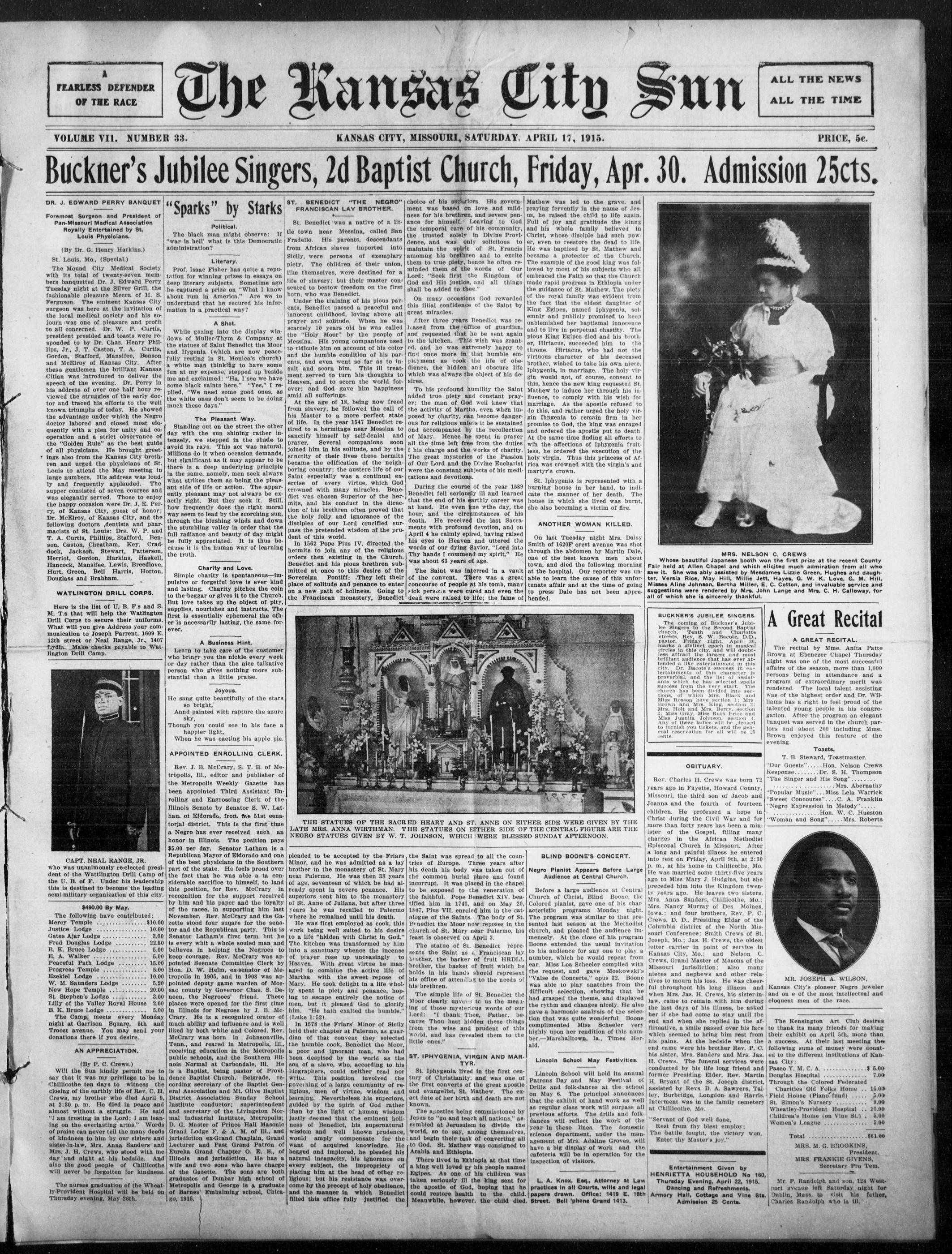
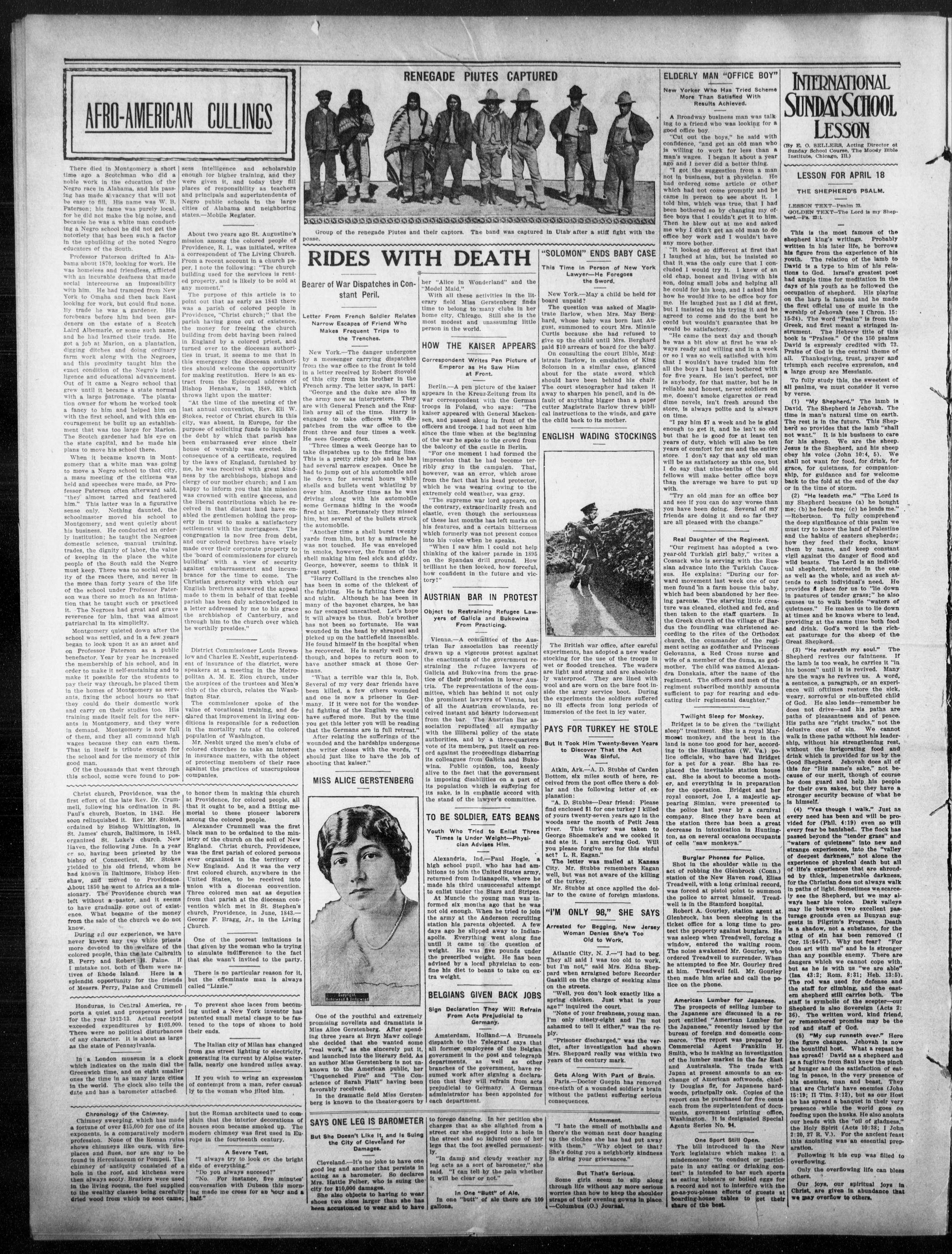
Page text (machine-generated)
Buckner's Jubilee Singers, 2d Baptist Church, Friday, Apr. 30. Admission 25cts.
A FEARLESS DEFENDER OF THE RACE
VOLUME VI1. NUMBER 33.
DR. J. EDWARD PERRY BANQUET
Foremost Surgeon and President of Pan-Missouri Medical Association Royally Entertained by St. Louis Physicians.
(By Dr. G. Henry Harkins.)
St. Louis, Mo. (Special.)
The Mound City Medical Society, with its total of twenty-seven members banqueted Dr. J. Edward Perry Tuesday night at the Silver Grill, the fashionable pleasure Mecca of H. S. Ferguson. The eminent Kansas City surgeon was here at the invitation of the local medical society and his sojourn was one of pleasure and profit to all concerned. Dr. W. P. Curtis, president presided and toasts were responded to by Dr. Chas. Henry Phillips, Jr., J. T. Caston, T. A. Curtis, Gordon, Stafford, Mansife, Benson and McEloy of Kansas City. After these gentlemen the brilliant Kansas Citian was introduced to deliver the speech of the evening. Dr. Perry in his address of over one half hour reviewed the struggles of the early doctor and traced his efforts to the well known triumphs of today. He showed the advantage under which the Negro doctor labored and closed most eloquently with a plea for unity and cooperation and a strict observance of the "Golden Rule" as the best guide of all physicians. He brought greetings also from the Kansas City brethren and urged the physicians of St Louis to attend the May meeting in large numbers. His address was loudly and frequently applauded. The supper consisted of seven courses and was elegantly served. Those to enjoy the happy occasion were Dr. J. E. Perry, of Kansas City, guest of honor; Dr. McEloy, of Kansas City, and the following doctors, dentists and phar-macists of St. Louis: Drs. W. P. and T. A. Curtis, Phillips, Stafford, Benson, Caston, Cheatham, Key, Cradock, Jackson, Stewart, Patterson Herriot, Gordon, Harkins, Haskell Hancock, Mansife, Lewis, Brewleove Hurt, Green, Bell Harris, Horton Douglass and Brabbu.
WATLINGTON DRILL CORPS.
Here is the list of U. B. Fs and S. M. Ts that will help the Wattlington Drill Corps to secure their uniforms. What will you give Address your communication to Joseph Parrent, 1609 E. 13th street or Neal Range, Jr., 1407 Lydia. Make checks payable to Wattlington Drill Camp.
CAPT. NEAL RANGE, JR. who was unanimously re-elected president of the Wattlington Drill Camp of the U. B. of F. Under his leadership this is destined to become the leading semi-military organization of this city.
$490.00 By May.
The following have contributed:
Mercy Temple ..... $10.00
Justice Lodge ..... 10.00
Gates Ajar Lodge ..... 3.00
Fred Douglas Lodge ..... 22.50
B. K. Bruce Lodge ..... 5.00
E. A. Walker ..... 5.00
Peaceful Path Lodge ..... 15.00
Progress Temple ..... 5.00
Ezekiel Lodge ..... 10.00
W. M. Saunders Lodge ..... 5.20
New Hope Temple ..... 20.00
St. Stephen's Lodge ..... 20.00
Lilly of the Valley Royal House ..... 2.00
B. K. Bruce Lodge ..... 5.00
The Camp meets every Monday night at Garrison Square, 5th and Troost avenue. You may send your donations there if you desire.
AN APPRECIATION
(By P. C. Crews)
Will the Sun kindly permit me to say that it was my privilege to be in Chillicothe ten days to witness the closing of the earthly life of Rev. C. H. Crews, my brother who died April 9, at 2:30 p. m. He died in peace and almost without a struggle. He said "I am trusting in the Lord; I am learning on the everlasting arms." Words of praise can never tell the many deeds of kindness to him by our sisters and sister-in-law, Mrs. Anna Sanders and Mrs. J. H. Crews, who stood with me day and night at his bedside. And also the good people of Chillicothe will never be forgotten for kindness.
The nurses graduation of the Wheatly-Provident Hospital will be held on Thursday evening, May 26th.
The Kansas City Sun
"Sparks" by Starks
The black man might observe: If "war is hell" what is this Democratic administration?
Literary.
Prof. Isaac Fisher has quite a reputation for winning prizes in essays on deep literary subjects. Sometimes ago he captured a prize on "What I know about rum in America." Are we to understand that he secured his information in a practical way?
A Shot.
While gazing into the display windows of Muller-Thym & Company at the statues of Saint Benedict the Moon and Hygenia (which are now peacefully resting in St. Monica's church) a white man thinking to have some fun at my expense, stepped up beside me and exclaimed: "Ha, I see we have some black saints here." "Yes," I replied, "We need some good ones, as the white ones don't seem to be doing much these days."
The Pleasant Way.
Standing out on the street the other day with the sun shining rather intensely, we stepped in the shade to avoid its rays. This act was natural. Millions do it when occasion demands, but significant as it may appear to be there is a deep underlying principle in the same, namely, men seek always what strikes them as being the pleasant side of life or action. The apparently pleasant may not always be exactly right. But they seek it. Still, how frequently does the right moral way seem to lead by the scorching sun, through the blushing winds and down the stumbling valley in order that the full radiance and beauty of day might be fully appreciated. It is thus because it is the human way of learning the truth.
Charity and Love.
Simple charity is spontaneous—impulsive or forgetful love is ever kind and lasting. Charity pitches the coin to the beggar or gives it to the Church. But love takes up the object of pity supplies, nourishes and instructs. The first is essentially ephemeral the other is necessarily lasting, the same for ever.
A. Business Hint
Learn to take care of the customer who brings you the nickle every week or day rather than the nice talkative person who gives nothing more substantial than a little praise.
Joyous.
He sang quite beautifully of the stars so bright,
Andn painted with rapture the azure sky,
Though you could see in his face a happier light,
When he was eaetting his apple pie.
Rev. J. B. McCryar, S. T. B. of Metropolis, Ill., editor and publisher of the Metropolis Weekly Gazette has been appointed Third Assistant Enrolling and Engrossing Clerk of the Illinois Senate by Senator S. W. Latham, ot Eldorado, fron. the bist eenatorial district. This is the first time a Negro has ever received such an honor in Illinois. The position pays $5.00 per day. Senator Latham is a Republican Mayor of Eldorado and one of the best physicians in the Southern part of the state. He feels proud over the fact that he was able a ta considerable sacrifice to himself, to land this position, for Rev. McCryar in recognition for the support received by him and his paper and the loyalty of the race, in supporting him last November. Rev. McCryar and the Gazette stood four square for the senator and the Republican party. This is Senator Latham's first term but he is every whit a whole souled man and believes in helping the Negroes to keep courage. Rev. McCryar is appointed Seenate Committee Clerk by Hon. D. W. Helm-ex-senator of Metropolis in 1905 and in 1908 was appointed deputy game warden of Mossac county by Governor Chas. S. Deneen, the Negroes' friend. Rev. McCryar is he recognized or mator of much ability and influence and is well liked by both white and Colored. Rev. McCryar was born in Johnsonville, Tenn., and reared in Metropolis, Ill., receiving education in the Metropolis public schools, and the Southern Illinois Normal at Carbondale, Ill. He is a Baptist, being pastor of Providence Baptist Church, Belgrade, recording secretary of the Baptist General Association and Mt. Olive Baptist District Association Sunday School Institute conductor; superintendent and secretary of the Livingston Normal Industrial Institute, Metropolis; D. G. Master of Prince Hall Masonic Grand Lodge F. & A. M. of Ill., and jurisdiction ex-Grand Chaplain, Grand Lecturer and Past Grand Patron of Eureka Grand Chapter O. E. S., of Illinois and jurisdiction. He has a wife and two sons who have charge of the Gazette. The sons are both graduates of Dunbar high school of Metropolis and George is a graduate of Barnes' Embalming school, Chica-
KANSAS CITY, MISSOURI, SATURDAY, APRIL 17, 1915.
THE STATUES OF THE SACRED HEART AND ST. ANNE ON EITHER SIDE WERE GIVEN BY THE LATE MRS. ANNA WIRTHMAN. THE STATUES ON EITHER SIDE OF THE CENTRAL FIGURE ARE THE NEGRO STATUES GIVEN BY W. T. JOHNSON. WHICH WERE BLESSED SUNDAY AFTERNOON.
ST. BENEDICT "THE NEGRO" FRANCISCAN LAY BROTHER.
St. Benedict was a native of a little town near Messina, called San Fradello. His parents, descendants from African slaves imported into Sicily, were persons of exemplary piety. The children of their union, like themselves, were destined for a life of slavery; but their master consented to bestow freedom on the first born, who was Benedict.
Under the training of his pious parents, Benedict passed a peaceful and innocent childhood, loving above all prayer and solitude. When he was scarcely 10 years old he was called the "Holy Moor" by the people of Messina. His young companions used to ridicule him on account of his color and the humble condition of his parents, and even went so far as to insult and scorn him. This ill treatment served to turn his thoughts to Heaven, and to scorn the world forever; and God gave him happiness amid all sufferings.
At the age of 18, being now freed from slavery, he followed the call of his Master to a more perfect state of life. In the year 1547 Benedict retired to a hermitage near Messina to sanctify himself by self-denial and prayer. Several companions soon joined him in his solitude, and by the sanctity of their lives these hermits became the edification of the neighboring country; the austere life of our Saint especially was a continual exercise of every virtue, which God crowned with many miracles. Benedict was chosen Superior of the hermits, and his conduct in the direction of his brethren often proved that the holy folly and ignorance of the disciples of our Lord crucified surpass the pretended wisdom of the prudent of this world.
In 1562 Pope Pius IV, directed the hermits to join any of the religious orders then existing in the Church. Benedict and his plous brethren submitted at once to this desire of the Sovereign Pontiff: They left their place of solitude and penance to enter on a new path of holiness. Going to the Franciscan monastery, Benedict
THE STATUES OF THE SACR
LATE MRS. ANNA WIRTHMAN. T
NEGRO STATUES GIVEN BY W. T
pleaded to be accepted by the Friars Minor, and he was admitted as a lay brother in the monastery of St. Mary near Palermo. He was then 38 years of age, seventeen of which he had already spent in severe penance. His superiors sent him to the monastery of St. Anne of Jullana, but after three years he was recalled to Palermo where he remained until his death. He was first employed as cook, this work being well suited to his desire to a life "hidden with Christ in God." The kitchen was transformed by him into a sanctuary whence the incense of prayer rose up unceasingly to Heaven. With great virtue he managed to combine the active life of Martha with the sweet repose of Mary. He took delight in a life wholly spent in piety and penance, hoping to escape entirely the notice of men, but it pleased God to glorify him. "He hath exalted the humble." (Luke 1:52)
In 1578 the Friars' Minor of Sicily held their chapter at Palermo, as guardian of that convent they selected the humble cook, Benedict the Moor, a poor and ignorant man, who had been despised by the world as the son of a slave, who, according to his biographers, could neither read nor write. This position involved the governing of a large community of religious, men of virtue, wisdom and learning. Nevertheless his superiors, guided by the spirit of God rather than by the light of human wisdom justly deemed that the eminent holiness of Benedict, his supernatural wisdom and well known prudence, would amply compensate for the want of acquired knowledge. He begged and implored, he pleaded his natural incapacity, his ignorance on every subject, the impropriety of placing him at the head of other religious; but his resistance was overcome by the precept of holy obedience, and the manner in which Benedict filled this office fully justified the
choice of his superiors. His government was based on love and mildness for his brethren, and severe penance for himself. Leaving to God the temporal care of his community, the trusted solely in Divine Providence, and was only solicitous to maintain the spirit of St. Francis amoming his brethren and to excite them to true piety, hence he often reminded them of the words of Our Lord: "Seek first the Kingdom of God and His justice, and all things shall be added to thee."
On many occasions God rewarded this filial confidence of the Saint by great miracles.
After three years Benedict was released from the office of guardian, and requested that he be sent again to the kitchen. This wish was granted, and he was extremely happy to find once more in that humble employment as cook the life of obedience, the hidden and obscure life which was always the object of his desires.
To his profound humility the Saint added true piety and constant prayer; the man of God well knew that the activity of Marta, even when imposed by charity, can become dangerous for religious unless it be sustained and accompanied by the recollection of Mary. Hence he spent in prayer all the time left free from the duties f his charge and the works of charity. The great mysteries of the Passion of Our Lord and the Divine Eucharist were the constant subjects of his meditations and devotions.
During the course of the year 1589 Benedict fell seriously ill and learned that the end of his earthly career was at hand. He even line wield the day, the hour, and the circumstances of his death. He received the last Sacrament with profound devotion, and on April 4 he calmly epired, having raised his eyes to Heaven and uttered the words of our dying Savior, "Lord into Thy hands I commend my spirit." He was about 63 years of age.
The Saint was interred in a vault of the convent. There was a great concourse of people at his tomb, many sick persons were cured and even the dead were raised to life; the fame of
RED HEART AND ST. ANNE ON EITHER THE STATUES ON EITHER SIDE OF ST. JOHNSON, WHICH WERE BLESSE
the Saint was spread to all the countries of Europe. Three years after his death his body was taken out of the common burial place and found incorrupt. It was placed in the chapel to be exposed to the veneration of the faithful. Pope Benedict XIV, beattired him in 1743, and on May 20, 1807, Plus VII, enrolled him in the catalogue of the Saints. The body of St. Benedict the Moor now reposes in the church of St. Mary near Palermo, his feast is observed on April 3.
The statue of St. Benedict represents the Saint as a Franciscan lay brother, the barker of fruit HRDLL brother, the basket of fruit which he holds in his hands should represent his office of attending to the needs of his brethren.
The simple life of St. Benedict the Moor clearly unveils to us the meaning of those mysterious words of our Lord: "I thank Thee, Father, because Thou hast hidden these things from the wise and prudent of this world, and has revealed them to the little ones."
ST. IPHYGENIA, VIRGIN AND MAR-
TYR.
St. Iphygenia lived in the first century of Christianity, and was one of the first converts of the great apostle and evangelist, St. Mathew. The exact date of her birth and death are not known.
The apostles being commissioned by Jesus to "go and teach all nations," assembled at Jerusalem to divide the world, so to say, among themselves, and begin their task of converting all to God. St. Mathew was consigned to Arabia and Ethiopia.
There lived in Ethiopia at that time a king well loved by his people named Egipes. As one of his children was taken seriously ill the king sent for the apostle of God, hoping that he could restore health to the child. Meanwhile, however, the child died
Mathew was led to the grave, and praying fervently in the name of Jesus, he raised the child to life again. Full of joy and gratitude the king and his whole family believed in Christ, whose discipline had such power, even to restore the dead to life. He was baptized by St. Mathew and became a protector of the Church. The example of the good king was followed by most of his subjects who all embraced the Faith so that the Church made rapid progress in Ethiopia under the guidance of St. Mathew. The pleiety of the royal family was evident from the fact that the oldest daughter of King Egines, named Iphygenia, solemnly and publicly promised to keep unblemished her baptismal innocence and to live in perpetual chastity. The plious King Egines died and his brother, Hirtacus, succeeded him to the throne. Hirtacus, who had not the virtuous character of his deceased brother, wished to take his own niece, Iphygenia, in marriage. The holy virgin would not, of course, consent to this, hence the new king requested St. Mathew to induce her through his influence, to comply with his wish for marriage. As the apostle refused to do this, and rather urged the holy virgin Iphygenia to remain firm in her promise to God, the king was enraged and ordered the apostle put to death. At the same time finding all efforts to wif the affections of Iphygenia fruitless, he ordered the execution of the holy virgin. Thus this princess of Africa was crowned with the virgin's and martyr's crown.
St. Iphigenia is represented with a burning house in her hand, to indicate the manner of her death. The house in which she lived was burnt, she also becoming a victim of fire.
ANOTHER WOMAN KILLED
On last Tuesday night Mrs. Daisy Smith of 1620F crest avenue was shot through the abdomen by Martin Dale one of the best known men about town, and died the following morning at the hospital. Our reporter was un able to learn the cause of this unfortunate affair and at the time of going to press Dale has not been apprehended.
THER SIDE WERE GIVEN BY THE
OF THE CENTRAL FIGURE ARE THE
ED SUNDAY AFTERNOON.
BLIND BOONE'S CONCERT
Negro Planist Appears Before Large Audience at Central Church.
Before a large audience at Central Church of Christ, Blind Boone, the Colored pianist, gave one of his characteristic programs Monday night. The program was similar to that presented last season at the Methodist church, and pleased the audience immensely. At the close of his program Boone extended the usual invitation to his audience for any one to play a number, which he would repeat from ear. Miss Loa Scheeler compiled with the request, and gave Moskowski's "Valse de Concerte," opus 32. Boone was able to play snatches from the difficult selection, showing that he had grasped the theme, and displayed the rythm and changes nicely. He also gave a harmonic analysis of the selection that was quite wonderful. Boone complimented Miss Scheeler very highly upon her rendition of this number.—Marshalltown, Ia., Times Herald.
Lincoln School May Festivities.
Lincoln School will hold its annual Patrons Day and May Festival of Drills and folk-dances at the school on May 6. The principal announces that the exhibit of hand work as well as regular class work will surpass all previous efforts. The drills and folk-dances will reflect the work of the year in these lines. The domestic science department, under the management of Mrs. Adaline Groves, will have a big display of work and the cafeteria will be in operation for the inspection of visitors.
L. A. Knox, Esq., Attorney at Law practices in all Courts, wills and legal papere drawn. Office: 1419 E. 18th Street. Bell 'phone Grand 1413.
Mary Louise
MRS. NELSON C. CREWS
Whose beautiful Japanese booth we
Fair held at Allen Chapel and which we
saw it. She was ably assisted by Mesd
ter, Versia Rice, May Hill, Mill Jett
Misses Aline Johnson, Bertha Miller, E
suggestions were rendered by Mrs. John
all of which she is sincerely thankful.
Whose beautiful Japanese booth won the first prize at the recent County Fair held at Allen Chapel and which elicited much admiration from all who saw it. She was ably assisted by Mesdames Lizzie Green, Hughes and daughter, Versla Rice, May Hill, Mille Jille Hayes, G. W. K. Love, G. M. Hill, Mrs. Lance, May Hill, Mille Jille Hayes, C. Cotton, and invaluable service and suggestions were rendered by Mrs. John Lange and Mrs. C. H. Calloway, for all of which she is sincerely thankful.
BUCKNER'S JUBILEE SINGERS.
The coming of Buckner's Jubilee Singers to the Second Baptist church, Tenth and Charlotte streets, Rev S. W. Bacote, D.D., marks a distinct epoch in musical circles in this city, and will doubtless attract the largest and most enticing performances which he has selected spells success from the very start. The church has been divided into sections: Mrs Miss Rosson have section 1; Mrs Brown and Mrs, King, section 2; Mrs Holt and Mrs Berry, section 3; Mrs Juanta Johnson, section 4. Any of these ladies will be pleased to furnish you tickets, and the general reservation for all will be 25 cents.
Rev. Charles H. Crews was born 72 years ago in Fayette, Howard County, Missouri, the third son of Jacob and Joanna and the fourth of fourteen children. He professed a hope in Christ during the Civil War and for more than forty years has been a minister of the Gospel, filling many charges in the African Methodist Episcopal Church in Missouri. After a long and painful illness he entered into rest on Friday, April 9th, at 2:30 p. m., at his home in Chillicothe, Mo. He was married some thirty-five years ago to Miss Mary J. Hudgins, but she preceded him into the Kingdom twenty years ago. He leaves two sisters, Mrs. Anna Sanders, Chillicothe, Mo.; Mrs. Nancy Murray of Des Moines, Iowa; and four brothers, Rev. P. C. Crews, D. D., Presiding Elder of the Columbia district of the North Missouri Conference; Smith Crews of St. Joseph, Mo.; Jas. H. Crews, the oldest letter carrier in point of service in Kansas City, Mo.; and Nelson C. Crews, Grand Master of Masons of the Missouri jurisdiction; also many nieces and nephews and other relatives to mourn his loss. He was cheerful throughout his long illness and when Mrs. Jas. H. Crews, his sister-in-law, came to remain with him during the last days of his illness, he asked her if he had come to stay until the end and when she replied in the affirmative, a smile passed over his face which seemed to bring him rest from his pains. At the bedside when the end came were his brother Rev. P. C. his sister, Mrs. Sanders and Mrs. Jas. H. Crews. The funeral services were conducted by his life long friend and former Presiding Elder, Rev. Martin H. Bryant of the St. Joseph district assisted by Revs. D. A. Sawyers, Taley, Burbidge, Longdon and Harris Interment was in the family cemetery at Chillicothe, Mo.
Servant of God was done,
Rest from thy blest employ;
The battle fought, the victory won,
Enter thy Master's joy."
Entertainment Given by
HENRIETTA HOUSEHOLD No 160.
Thursday Evening, April 22, 1915.
Dancing and Refreshments. Armory Hall, Cottage and Vine Sts. Admission 25 Cents.
OBITUARY
ALL THE NEWS
ALL THE TIME
ssion 25cts.
von the first prize at the recent County
licited much admiration from all who
dames Lizzie Green, Hughes and daugh-
tt, Hayes, G. W. K. Love, G. M. Hill,
E. C. Cotton, and invaluable service and
John Lange and Mrs. C. H. Calloway, for
A Great Recital
The recital by Mme. Anita Patte Brown at Ebenenezer Chapel Thursday night was one of the most successful affairs of the season, more than 1,000 persons being in attendance and a program of extraordinary merit was rendered. The local talent assisting was of the highest order and Dr. Williams has a right to feel proud of the talented young people in his congregation. After the program an elegant banquet was served in the church parlors and about 200 including Mme. Brown enjoyed this feature of the evening.
"Our Guests".....Hon. Nelson Crews
Response.....Dr. S. H. Thompson
"The Singer and His Song".....Mrs. Abernathy
"Popular Music".....Miss Lela Warrick
"Sweet Concourse".....C. A. Franklin
"Negro Expression in Melody".....Hon. W. C. Hueston
"Woman and Song".....Mrs. Roberts
MR. JOSEPH A. WILSON,
Kansas City's pioneer Negro jeweler
and on e of the most intellectual and
eloquent men of the race.
Kansas City's pioneer Negro jeweler
and on e of the most intellectual and
elquent men of the race.
The Kensington Art Club desires
to thank its many friends for making
their exhibit on April 5th, more than
a success. At their last meeting the
following sums of money were donat-
ed to the different institutions of Kansas City:
Pasco Y. M. C. A. $ 5.00
Douglas Hospital 7.00
Through the Colored Federated
Charities' Old Folks Home 15.00
Field House (Piano fund) 5.00
St. Simon's Nursery 9.00
Wheatley-Provident Hospital 10.00
Children's Home (on Vine St.) 5.00
Women's League 5.00
Mr. P. Randolph and son, 124 Westport avenue left Saturday night for Dublin, Mass. to visit his father, Charles Randolph who is ill.
PRICE. 5c.
A GREAT RECITAL
Toasts.
MRS. M. G. BROOKINS,
President.
MRS. FRANKIE GIVENS,
Secretary Pro Tem.
AFRO-AMERICAN CULLINGS
There died in Montgomery a short time ago a Scotchman who did a noble work in the education of the Negro race in Alabama, and his passing has made a vacancy that will not be easy to fill. His name was W. B. Paterson; his fame was purely local, for he did not make the big noise, and because he was a white man conducting a Negro school he did not get the notoriety that has been such a factor in the upbuilding of the noted Negro educators of the South.
Professor Paterson drifted in Alabama about 1870, looking for work. He was homeless and friendless, afflicted with an incurable deafness that made social intercourse an impossibility with him. He had tramped from New York to Omaha and then back East looking for work, but could find none. By trade he was a gardener. His forebears before him had been gardeners on the estate of a Scotch Laird Albemarle, or some such name, and he had learned their trade. He got a job at Marion, on a plantation, digging ditches and doing ordinary farm work along with the Negroes, and this proximity taught him the exact condition of the Negro's intelligence and educational advancement. Out of it came a Negro school that grew until it became a state normal with a large patronage. The plantation owner for whom he worked took a fancy to him and helped him on with the first school, and with this encouragement he built up an establishment that was too large for Marion. The Scotch gardener had his eye on the state capital, and he made his plans to move his school there.
When it became known in Montgomery that a white man was going to move a Negro school to that city, a mass meeting of the citizens was held and speeches were made, as Professor Paterson often afterward said, "they almost tarred and feathered him." This latter was in a figurative sense only. Nothing daunted, the schoolmaster moved his school to Montgomery, and went quiet about his business. He conducted an orderly institution; he taught the Negroes domestic science, manual training, trades, the dignity of labor, the value of keeping in the place the white people of the South said the Negro must keep. There was no social equality of the races there, and never in the more than forty years of the life of the school under Professor Paterson was there so much as an intimation that he taught such or practiced it. The Negroes had great and grave reverence for him, that was almost patriarchal in its simplicity.
Montgomery quieted down after the school was settled, and in a few years began to look upon it as an asset and on Professor Paterson as a public benefactor. Year by year he increased the membership of his school, and in order to make it self-sustaining and to make it possible for the students to pay their way through, he placed them in the homes of Montgomery as servants, fixing the school hours so that they could do their domestic work and carry on their studies too. His training made itself felt for the servants in Montgomery, and they were in demand. Montgomery is now full of them, and they all command high wages because they can earn them. That in itself is tribute enough for the school and for the memory of this good man.
Of the thousands that went through this school, some were found to pos-
Christ church, Providence, was the first effort of the late Rev. Dr. Crummell, following his ordination in St. Paul's church, Boston, in 1842. He soon relinquished it. Rev. Mr. Stokes, ordained by Bishop Whitlington, in St. James' church, Baltimore, in 1843, organized St. Luke's church. New Haven, the following June. In a year or so, having been priested by the bishop of Connecticut, Mr. Stokes yielded to his old friend, whom he had known in Baltimore, Bishop Henshaw, and moved to Providence. About 1850 he went to Africa as a missionary. The Providence church was left without a pastor, and it seems to have gradually gone out of existence. What became of the money from the sale of the church we do not know.
During all our experience, we have never known any two white priests more devoted to the welfare of the colored people, than the late Calbrath B. Perry and Robert H. Paine. If I mistake not, both of them were natives of Rhode Island. Here is a splendid opportunity for the friends of Messrs. Perry, Paine and Crummell
Honduras, in Central America, reports a quiet and prosperous period for the year 1912-13. Actual receipts exceeded expenditures by $103,000. There were no political disturbances of any character. It is about as large as the state of Pennsylvania.
In a London museum is a clock which indicates on the main dial the Greenwich time, and on eight smaller ones the time in as many large cities in the world. The clock also tells the date and has a barometer attached.
Chronology of the Chimney.
Chimney sweeping, which has made a fortune of over $15,000 for one of its exponents, is a comparatively modern profession. None of the Roman ruins shows chimneys like ours, with fireplaces and flues, nor are any to be found in Herculaneum or Pompeii. The chimney of antiquity consisted of a hole in the roof, and kitchens were then always sooty. Braziers were used in the living rooms, the fuel supplied to the wealthy classes being carefully dried wood from which no soot came;
sess intelligence and scholarship enough for higher training, and they were given it, and today they fill places of responsibility as teachers and principals and superintendents of Negro public schools in the large cities of Alabama and neighboring states.—Mobile Register.
About two years ago St. Augustine's mission among the colored people of Providence, R. L. was initiated, writes a correspondent of The Living Church. From a recent account in a church paper, I note the following: "The church building used for the services is rented property, and is likely to be sold at any moment."
The purpose of this article is to point out that as early as 1843 there was a parish of colored people in Providence, "Christ church;" that the parish having gone out of existence, the money for freeing the church building from debt having been raised in England by a colored priest, and turned over to the diocesan authorities in trust, it seems to me that in this emergency the diocesan authorities should welcome the opportunity for making restitution. Here is an extract from the Episcopal address of Bishop Henshaw, in 1849, which throws light upon the matter;
"At the time of the meeting of the last annual convention, Rev. Eli W. Stokes, rector of Christ church in this city, was absent, in Europe, for the purpose of soliciting funds to liquidate the debt by which that parish has been embarrassed ever since their house of worship was erected. In consequence of a certificate, required by the laws of England, furnished by me, he was received with great kindness by the archbishops, bishops and clergy of our mother church; and I am happy to inform you that his mission was crowned with entire success, and the liberal contributions which he received in that distant land have enabled the gentlemen holding the property in trust to make a satisfactory settlement with the mortgages. The congregation is now free from debt, and our colored brethren have wisely made over their corporate property to the 'board of commissioners for church building' with a view of security against embarrassment and incumbrance for the time to come. The Christian generosity with which our English brethren answered the appeal made to them in behalf of that feeble parish has been duly acknowledged in a letter addressed by me to his grace the archbishop of Canterbury, and through him to the church over which he worthy presides."
District Commissioner Louis Brownlow and Charles E. Nesbit, superintendent of insurance of the district, were speakers at a meeting in the Metropolitan A. M. E. Zion church, under the auspices of the trustees and Men's club of the church, relates the Washington Star.
The commissioner spoke of the value of vocational training, and declared that improvement in living conditions is responsible for a reduction in the mortality rate of the colored population of Washington.
Mr. Nesbit urged the men's clubs of colored churches to take an interest in insurance matters, with the object of protecting members of their race against the practices of unscrupulous companies.
to honor them in making this church at Providence, for colored people, all that it ought to be, and a fitting memorial to these pioneer laborers among the colored people.
Alexander Crummell was the first black man to be ordained to the ministry of the church on the soil of New England. Christ church, Providence, was the first parish of colored persons ever organized in the territory of New England. And it was the very first colored church, anywhere in the United States, to be received into union with a diocesan convention. Three colored men sat as deputies from that parish at the diocesan convention which met in St. Stephen's church, Providence, in June, 1843.—George F. Bragg, Jr., in the Living Church.
One of the poorest imitations is that given by the woman who is trying to simulate indifference to the fact that she wasn't invited to the party.
There is no particular reason for it, but the effeminate man is always called "Lizzle."
To prevent shoe laces from becoming untied a New York inventor has patented small metal clasps to be fastened to the tops of shoes to hold their ends.
The Italian city of Milan has changed from gas street lighting to electricity, generating its current by Alpine waterfalls, nearly one hundred miles away.
If you wish to wring an expression of contempt from a man, refer casually to the woman who jilted him.
but the Roman architects used to complain that the interior decorations of houses soon became smoked up. The modern chimney was first used in Europe in the fourteenth century.
A Severe Test.
"I always try to look on the bright side of everything."
"Do you always succeed?"
"No. For instance, five minutes' conversation with Dubson this morning made me cross for an hour and a halk."
RENEGADE PIUTES CAPTURED
Group of the renegade Plutes and their captors. The band was captured in Utah after a stiff fight with the posse.
Group of the renegade Flutes and their captors. The band was captured in Utah after a stiff fight with the posse.
RIDES WITH DEATH
Bearer of War Dispatches in Constant Peril.
Letter From French Soldier Relates Narrow Escapes of Friend Who Makes Frequent Trips to the Trenches.
New York.—The danger undergone by a messenger carrying dispatches from the war office to the front is told in a letter received by Robert Stovold of this city from his brother in the French army. The letter says, in part: "George and the duke are also in the army now as interpreters. They are with General French and the English army all of the time. Harry is engaged to take officers with dispatches from the war office to the front three and four times a week. He sees George often.
"Three times a week George has to take dispatches up to the firing line. This is a pretty risky job and he has had several narrow escapes. Once he had to jump out of his automobile and lie down for several hours while shells and bullets went whistling by over him. Another time as he was driving along with his automobile some Germans hiding in the woods fired at him. Fortunately they missed him, but several of the bullets struck the automobile.
"Another time a shell burst twenty yards from him, but by a miracle he was not touched. He was enveloped in smoke, however, the fumes of the shell making him feel sick and giddy. George, however, seems to think it great sport.
"Harry Collard in the trenches also has been in some of the thickest of the fighting. He is fighting there day and night. Although he has been in many of the bayonet charges, he has so far escaped unscatched. Let's hope it will always be thus. Bob's brother has not been so fortunate. He was wounded in the head by shrapnel and picked up on the battlefield insensible. He found himself in the hospital when he recovered. He is nearly well now, though, and hopes to return soon to have another smack at those Germans.
"What a terrible war this is, Bob. Several of my very dear friends have been killed, a few others wounded and one is now a prisoner in Germany. If it were not for the wonderful fighting of the English we would have suffered more. But by the time you get this letter you will be reading that the Germans are in full retreat."
After relating the sufferings of the wounded and the hardships undergone the writer closes with the words, "I should just like to have the job of shooting that kaiser."
MISS ALICE GERSTENBERG
Lappiith
Lappiith & Bidermond
One of the youthful and extremely promising novelists and dramatists is Miss Alice Gerstenberg. After spending three years at Bryn Mwr college she decided that she wanted some "real work," as she sincerely put it, and launched into the literary field. As an author Miss Gerstenberg is not unknown to the American public, her "Unquenched Fire" and "The Conscience of Sarah Platt" having been favorably received. In the dramatic field Miss Gerstenberg is known to the theater-goers by
SAYS ONE LEG IS BAROMETER
But She Doesn't Like It, and Is Suing the City of Cleveland for Damages.
Cleveland.—It's no joke to have one good leg and another that persists in acting as a barometer. So declares Mrs. Hattle Felber, who is suing the city for $10,000 damages.
She also objects to having to wear shoes two sizes larger than she has been accustomed to and to have
her "Alice in Wonderland" and the "Model Maid." With all these activities in the literary field Miss Gerstenberg finds time to belong to many clubs in her home city, Chicago. Still she is the most modest and unassuming little person in the world.
HOW THE KAISER APPEARS
Correspondent Writes Pen Picture of Emperor as He Saw Him at Front.
Berlin—A pen picture of the kaiser appears in the Kreuz-Zeitung from its war correspondent with the German troops in Poland, who says: "The kaiser appeared with General Mackensen, and passed along in front of the officers and troops. I had not seen him since the time when at the beginning of the war he spoke to the crowd from the balcony of the castle in Berlin.
"For one moment I had formed the impression that he had become terribly gray in the campaign. That, however, was an error, which arose from the fact that his head protector, which he was wearing owing to the extremely cold weather, was gray.
"The supreme war lord appears, on the contrary, extraordinarily fresh and elastic, even though the seriousness of these last months has left marks on his features, and a certain bitterness which formerly was not present comes into his voice when he speaks.
"When I saw him I could not help thinking of the kaiser parade in 1895 on the Spandau drill ground. How brilliant he then looked, how forceful, how confident in the future and victory!"
AUSTRIAN BAR IN PROTEST
Object to Restraining Refugee Lawyers of Galicia and Bukowina From Practicing.
Vienna.—A committee of the Austrian Bar association has recently drawn up a vigorous protest against the enactments of the government restraining the refugee lawyers of Galicia and Bukowina from the practice of their profession in lower Austria. The representations of the committee, which has behind it not only the prominent lawyers of Vienna, but of all the Austrian crowlands, received instant and hearty indorsement from the bar. The Austrian Bar association repudiated all sympathy with the illiberal policy of the state authorities, and by a three-quarters vote of its members, put itself on record against the proceedings disbarring its colleagues from Galicia and Bukowina. Public opinion, too, keenly alive to the fact that the government is imposing disabilities on a part of its population which is suffering for its sake, is in emphatic accord with the stand of the lawyer's committee.
TO BE SOLDIER, EATS BEANS
Youth Who Tried to Enlist Three Times Is Under Weight—Physician Advises Him.
Alexandria, Ind.-Paul Hogle, a high school pupil, who has had ambitions to join the United States army, returned from Indianapolis, where he made his third unsuccessful attempt to enlist under the Stars and Stripes. At Muncie the young man was informed six months ago that he was not old enough. When he tried to join the army at the Anderson recruiting station his parents objected. A few days ago he slipped away to Indianapolis. Everything went along fine until it came to the question of weight. He was five pounds under the prescribed weight. He has been advised by a local physician to confine his diet to beans to take on extra weight.
BELGIANS GIVEN BACK JOBS
Sign Declaration They Will Refrain From Acts Prejudicial to Germany.
Amsterdam, Holland.—A Brussels dispatch to the Telegraf says that all former employees of the Belgian government in the post and telegraph departments, as well as other branches of the government, have resumed work after signing a declaration that they will refrain from acts prejudicial to Germany. A German administrator has been appointed for each department.
to forego dancing. In her petition she charges that as she alighted from a street car she stepped into a hole in the street and so injured one of her legs that the foot swelled permanently.
"In damp and cloudy weather my leg acts as a sort of barometer," she said. "I can tell by the pain whether it will be clear or not."
In One "Butt" of Ale.
In one "butt" of ale there are 100 gallons.
"SOLOMON" ENDS BABY CASE
This Time in Person of New York
Lawyer—He Foregoes
the Sword,
New York.—May a child be held for
board unpaid?
The question was asked of Magistrate Barlow, when Mrs. May Berghard, whose baby was born last August, summoned to court Mrs. Minnie Curtis because she had refused to give up the child until Mrs. Berghard paid $10 arrears of board for the baby.
On consulting the court Bible, Magistrate Barlow, in emulation of King Solomon in a similar case, glanced about for the state sword which should have been behind his chair. The court stenographer had taken it away to sharpen his pencil, and in default of anything bigger than a paper cutter Magistrate Barlow threw biblical instructions to the winds, and gave the child back to its mother.
ENGLISH WADING STOCKINGS
A man carrying a large load on his back.
The British war office, after careful experiments, has adopted a new wader stocking for the use of the troops in wet or flooded trenches. The waders are light and strong and are absolutely waterproof. They are lined with wool and are worn on the bare foot inside the army service boot. During the experiments the soldiers suffered no ill effects from long periods of immersion of the feet in ice water.
PAYS FOR TURKEY HE STOLE
But It Took Him Twenty-Seven Years to Discover That the Act Was Sinful.
Atkin, Ark.—A. D. Stubbs of Carden Bottom, six miles south of here, received from the post office there a dollar and the following letter of explanation:
"A. D. Stubbs—Dear friend: Please find enclosed $1 for one turkey I killed of yours twenty-seven years ago in the woods near the mouth of Petit Jean river. This turkey was taken to George Shoemake's and we cooked it and ate it. I am serving God. Will you please forgive me for this sinful act? L. R. Eagan."
The letter was mailed at Kansas City. Mr. Stubbs remembers Eagan well, but was not aware of the killing of the turkey.
Mr. Stubbs at once applauded the dollar to the cause of foreign missions.
"I'M ONLY 98." SHE SAYS
Arrested for Begging, New Jersey
Woman Denies She's Too
Old to Work.
Atlantic City, N. J.—"I had to beg.
They all said I was too old to work,
but I'm not," said Mrs. Edna Sheppard when arranged before Recorder Gaskill on the charge of seeking alms on the streets.
"Well, you don't look exactly like a spring chicken. Just what is your age?" inquired the court.
"None of your freshness, young man.
I'm only ninety-eight and I'm not ashamed to tell it either," was the reply.
"Prisoner discharged," was the verdict, after investigation had shown Mrs. Sheppard really was within two years of the century mark.
Gets Along With Part of Brain. Paris. -Doctor Guepin has removed one-sixth of a wounded soldier's brain without the patient suffering serious consequences.
"I hate the smell of mothballs and there's the woman next door hanging up the clothes she has had put away with them." "Why object to that? She's doing you a neighborly kindness in airing your grievances."
But That's Serious.
Some girls seem to slip along through life without any more serious worries than how to keep the shoulder straps of their evening gowns in place. —Columbus (O.) Journal.
ELDERLY MAN "OFFICE BOY"
New Yorker Who Has Tried Scheme More Than Satisfied With Results Achieved.
A Broadway business man was talking to a friend who was looking for a good office boy.
"Cut out the boys," he said with confidence, "and get an old man who is willing to work for less than a man's wages. I began it about a year ago and I never did a better thing.
"I got the suggestion from a man not in business, but a physician. He had ordered some article or other which had not come promptly and he came in person to see about it. I told him, which was true, that I had been bothered so by changing my office boys that I couldn't get it to him. Then he blew out at me and asked me why I didn't get an old man to do office boy work and I wouldn't have any more bother.
"It looked so different at first that I laughed at him, but he insisted so that it was the only cure that I concluded I would try it. I knew of an old chap, honest and living with his son, doing small jobs and helping all he could for his keep, and I asked him how he would like to be office boy for me. He laughed just as I did at first, but I insisted on his trying it and he agreed to come and do the best he could but wouldn't guarantee that he would be satisfactory.
"He came the next day and though he was a bit slow at first he was always ready and willing and in a week or so I was so well satisfied with him that I wouldn't have traded him for all the boys I had been bothered with for five years. He isn't perfect, nor is anybody, for that matter, but he is reliable and honest, never soldiers on me, doesn't smoke cigarettes or read dime novels, isn't fresh around the store, is always polite and is always on time.
"I pay him $7 a week and he is glad enough to get it, and he isn't so old but that he is good for at least ten years of duty, which will also be ten years of comfort for me and the entire store. I don't say that any old man will be as satisfactory as this one, but I do say that nine-tenths of the old fellows will make better office boys than the average we have to put up with.
"Try an old man for an office boy and see if you can do any worse than you have been doing. Several of my friends are doing it and so far they are all pleased with the change."
Real Daughter of the Regiment.
"Our regiment has adopted a two-year-old Turkish girl baby," writes a Cossack who is serving with the Russian advance into the Turkish Caucasus. He explains: "During our forward movement last week one of our men found 'in a farm house this baby, which had been abandoned by her fleeing parents. The starving little creature was cleaned, clothed and fed, and then taken to the staff quarters. In the Greek church of the village of Bardus the foundling was christened according to the rites of the Orthodox church, the commander of the regiment acting as godfather and Princess Gelovanna, a Red Cross nurse and wife of a member of the duma, as godmother. The child was named Alexandra Donskala, after the name of the regiment. The officers and men of the regiment subscribed monthly amounts sufficient to pay for rearing and educating their regimental daughter."
Twilight Sleep for Monkey.
Bridget is to be given the "twilight sleep" treatment. She is a royal Marmoset monkey, and the best in the land is none too good for her, according to the Huntington (W. Va.) police officials, who have had Bridget for a pet for a year. She has replaced the inevitable station house cat. She is about to become a mother, and everything is in preparation for the operation. Bridget and her royal consort, Joe I, a majestic appearing Simian, were presented to the police last year by a carnival company. Since they have been at the station there has been a great decrease in intoxication in Huntington, as on several occasions occupants of cells "saw monkeys."
Burglar Phones for Police
Shot in the shoulder while in the act of robbing the Glenbrock (Conn.) station of the New Haven road. Elias Treadwell, with a long criminal record, was forced at pistol point to summon the police to arrest himself. Treadwell is in the Stamford hospital.
Robert A. Gourley, station agent at Glenbrock, has been sleeping in the ticket office for a long time to protect the property against burglars. He was asleep when Treadwell, forcing a window, entered the waiting room. The noise awakened Mr. Gourley, who ordered Treadwell to surrender. When he attempted to flee Mr. Gourley fired at him. Treadwell fell. Mr. Gourley then made him arise and call the police on the phone.
American Lumber for Japanese
American Lumber for Japanese.
The prospects of selling lumber to the Japanese are discussed in a report entitled "American Lumber for the Japanese," recently issued by the bureau of foreign and domestic commerce. The report was prepared by Commercial Agent Franklin H. Smith, who is making an investigation of the lumber market in the far East and Australasia. The trade with Japan at present amounts to an exchange of American softwoods, chiefly Douglas fir, for Japanese hardwoods, principally oak. Copies of the report can be purchased for five cents each from the superintendent of documents, government printing office, Washington. It is designated Special Agents Series No. 94.
One Sport Still Open
The bill introduced in the New York legislature which makes it: a misdemeanor "to conduct or participate in any eating or drinking contest" is intended to bar such sports as eating lobsters or boiled eggs for a record and not to interfere with the go-a-you-please efforts of guests at boarding-house tables to get their share of the best.
INTERNATIONAL
SUNDAY SCHOOL
LESSON
(By E. O. SELLERS, Acting Director of
The Moody Bible Institute)
**CLASSIC** (II)
LESSON FOR APRIL 18
THE SHEPHERD'S PSALM.
LESSON TEXT—Psalm 23.
GOLDEN TEXT—The Lord is my Shep-
berd—Pa. 23.1.
This is the most famous of the shepherd king's writings. Probably written in his later life, he borrows his figure from the experience of his youth. The relation of the lamb to David is a type to him of his relations to God. Israel's greatest poet had ample time for meditation in the days of his youth as he followed the occupation of shepherd. His playing on the harp is famous and he made the first official use of music in the worship of Jehovah (see I Chron. 15: 15-24). The word "Psalm" is from the Greek, and first meant a stringed instrument. The Hebrew title of this book is "Praleses." Of the 150 psalms David is expressly credited with 73. Praise of God is the central theme of all. Thanksgiving, trust, prayer and triumph each receive expression, and a large group are Messianic. To fully study this, the sweetest of all psalms, we must consider it verse by verse.
(1) "My Shepherd." The lamb is David. The Shepherd is Jehovah. The time is man's natural time on earth. The rest is in the future. This Shepherd so provides that the lamb "shall not want." It is his business to care for his sheep. We are the sheep. Jesus is the Shepherd, and his sheep obey his voice (John 10:4, 5). We shall not want for food, for drink, for grace, for quietness, for companionship, for guidance and for welcome back to the fold at the end of the day or in the time of storm.
(2) "He leadeth me." "The Lord is my Shepherd because (a) he bought me; (b) he feeds me; (c) he leads me."—Robertson. To fully comprehend the deep significance of this psalm we must try to know the land of Palestine and the habits of eastern shepherds; how they feed their flocks, know them by name, and keep constant vigil against the danger of flood and wild beasts. The Lord is an individual shepherd, interested in the one as well as the whole, and as such attends to each individual's need. He provides a place for us to "lie down in pastures of tender grass"; he also causes us to walk beside "waters of quietness." He makes us to lie down at times and he knows where to lead, providing at the same time both food and drink. God's word is therichest pasturage for the sheep of the Great Shepherd.
(3) "He restoreth my soul." The Shepherd revives our faintness. If the lamb is too weak, he carries it "in his bosom" until it is revived. Many are the ways he revives us. A word, a sentence, a paragraph, or an experience will oftimes restore the sick, weary, sorrowful or sin-buffeted child of God. He also leads—remember he does not drive—and his paths are paths of pleasantness and of peace. His paths are "right tracks," not the delusive ones of sin. We cannot walk in these paths without his leadership, without his strengthening rest, without the invigorating food and drink which is provided for us by the Good Shepherd. Jehovah does all of this for "His name's sake," not because of our merit, though of course he does guard and help, his people for their own sakes, but they have a stronger security because of what he is himself.
(4) "Yea though I walk." Just as every need has been and will be provided for (Phll. 4:19) even so will every fear be banished. The flock has passed beyond the "tender grass" and "waters of quietness" into new and strange experiences, into the "valley of deepest darkness," not alone the experience of physical death but all of life's experiences that are shrouded by thick, impenetrable darkness, for the Christian does not always walk in paths of light. Sometimes we scarcely see the Shepherd, but we may always hear his voice. Dark valleys may lie between two excellent pasture grounds even as Bunyan suggests in Pilgrim's Progress. Death is a shadow, not a substance, for the sting of sin has been removed (I Cor. 15:54-57). Why not fear? "For thou art with me" and he is stronger than any possible enemy. There are dangers which we cannot cope with, but as he is with us "we are able" (Isa 43:2; Rom. 8:31; Heb. 13:5). The rod was used for defense and the staff for climbing, and the eastern shepherd still carries both. The staff is symbolic of the scepter—our Shepherd is also Sovereign (Acts 2:36). The written word, kind friend, or remembered promise may be the rod and staff of God.
(5) "My cup runneth over." Here the figure changes. Jehovah is now the bountiful host. What a repast he has spread! David as a shepherd and as a fugitive from Saul knew the pinch of hunger and the satisfaction of eating in peace, in the very presence of his enemies, man and beast. They that are Christ's have enemies (John 15:19; II Tit. 3:12), but as our Host he has spread a banquet in their very presence while the world goes on feeding upon the husks. He also anoints our heads with the "oil of gladness," the Holy Spirit (Acts 10:38; I John 2:20, 27 R. V.). For the ancient feast this anointing was an essential preparation.
Following it his cup was filled to overflowing.
Only the overflowing life can bless others.
Our joys, our spiritual joys in Christ, are given in abundance that we may overflow to others.
'A. F. and A. M.
Missouri Jurisdiction
N. C. Crews, Kansas City, Grand Master.
Deputy Grand Master, Richard Young, Lincoln, Neb.
F. J. Brown, St. Louis, Grand Senior Warden.
Wm. Green, Plattsburg, Grand Junior Warden.
H. H. Walker, St. Joseph, Grand Treasurer.
Geo. W. K. Love, Grand Secretary, Kansas City, Mo.
W. W. Fields, Secretary of Masonic Relief, Cameron, Mo.
P. L. Pratt, Kansas City, Mo., Grand Lecturer.
Grand Commandery Officers.
W. G. Mosely, Kansas City, Mo.
R. E. G. C.
J. H. Sherwood, St. Paul, Minn.
G. E. G.
P. C. Kincald, Kansas City, Mo.
V. E. G. C.
J. W. Beard, St. Louis, Mo., E. G.
C. G.
Wm. Roberts, Hannibal, Mo., Grand
Secretary.
T. P. Mahammitt, Grand Treasurer,
Omaha, Neb.
Grand Chapter Officers.
Geo. Broomfield, G. H. P., St. Louis,
Mo.
T. G. McCampbell, D. G. H. P., Kansas City.
A. L. Thomas, G. K., Jefferson City,
Mo.
J. P. Mofitte, G. S., Sedalla, Mo.
Chas, Griggsby, G. Treas., Liberty,
Mo.
E. S. Baker, G. Sec'y, Kansas City,
Mo.
MASONIC BUILDING ASSOCIATION
MEMBERS.
R. T. Colles, Chairman.
E. S. Baker, Secretary.
R. W. Foster, Treasurer.
W. C. Mallory, Sandy Meyers,
Wm. Washington, F. P. Porteet,
T. W. H. Williams, W. G. Moseley,
J. E. Herriford, E. G. Lacey,
E. G. Miller, Robt. Wiley.
Lodge Directory
Pritchard A. Lodge No. 42, A. F. and A. M. meets the 2nd and 4th Friday in every month. Visiting Master Masons are wel-
loved. Jackson W. M. Frank Lowe, Secretary, 1815 Baltimore Ave.
I. O. I.
Queen Esther Court No. 43. Hale from I. O. I. meets the first and 4th Mondays in each month. 230 p.m. 10th and Campbell Sts. Kansas City Mio. Mrs. Mrs. Bettle Davis, M. Q. Rosa L. Jones, Chron.
1406 34rd Rt. Kansas City, Kas.
U. B. F.
King of the West Lodge No.
218 meets first and third Mondays in each month at 563
Grand avenue. D. M. West
W. M., 1718 Euclid; Jas. Harris, Sec'y, 1732 Woodland Ave
See Wm. Hopkins For Bargains.
See Wm. Hopkins For Bargains.
If you are going to buy real estate counsel given free. I have plenty of money to loan on improved real estate in Kansas City,
Bell Phone East 3851.
J.C.WAGNER
The Clean Market Man
Oysters, Fish and Game in Season.
Fancy Groceries and all Table Luxuries.
Courteous Treatment to All.
1819 Howard Ave.
Woman Finally Recovers From Nervous Breakdown
Impoverished nerves destroy many people before their time. Often before a sufferer realizes what the trouble is, he is on the verge of a complete nervous breakdown. It is of the utmost importance to keep your nervous system in good condition, as the nerves are the source of all bodily power. Mrs. Rosa Bonner, 825 N. 18th St., Birmingham, Ala., says:
"I have been suffering with nervous prostration for nine or ten years. Have tried many of the best doctors in Birmingham, but they all failed to reach my case. I would feel as if I was smothering; finally I went into convulsions. My little girl saw
Dr. Miles' Nervine
advertised in the papers and I at once began to take it. I continued to take it for some time and now I am well."
If you are troubled with loss of appetite, poor digestion, weakness, inability to sleep; if you are in a general run down condition and unable to bear your part of the daily grind of life, you need something to strengthen your nerves. You may not realize what is the matter with you, but that is no reason why you should delay treatment.
Dr. Miles' Nervine has proven its value in nervous disorders for thirty years, and merits a trial, no matter how many other remedies have failed to help you.
Cold by all druggists. If first bottle fails to benefit your money is returned.
MILES MEDICAL CO., Elkhart, Ind.
[Name]
One of Kansas City's foremost lawyers; Colonel of the Second Regiment Uniform Rank, K. of P. of Missouri; Worshipful Master of Ideal Lodge, A. F. & A. M., and a strong factor in the social and political life of this city.
If you knew
Nelson's Hair Dressing as we do
you would never use anything
else on your hair.
We want you to know it—
know it personally by actual use,
don't take our word for it, or any-
one elses,—test it yourself.
You can do this,
send us your name and address
and we will send you.
Free of cost,
a sample box of Nelson's Hair
Dressing, also a sample of Nelson's Scalp and Hair Cleaner and a sample cake of Nelson's Skin and Complexion Soap.
Test them
in your own home, if they are
not what we claim, you are not
out anything.
We have confidence
in them and are ready and anx-
ious to prove every claim we
make.
Write to day,
enclosing two cent stamp to pay
postage on samples.
NELSON'S
HAIR DRESSING
25¢
50¢
Are you satisfied with your
hair?
Is it as long as it should
be?
Is it soft and glossy and
full of life?
Can you comb it out easily
or is it full of tangles?
Are you proud of your
hair?
The Answer
Is:—
NELSON'S
HAIR DRESSING
25¢
50¢
NELSON'S
HAIR DRESSING
Has no superior as
a hair beautifier
Thousands of men and
women have improved the
appearance of their hair by
using NELSON'S HAIR
DRESSING.
For those who know—it
is a toilet necessity.
Why not try it yourself?
Ask your druggist. If he
cannot supply you, send us
his name and address and we
will send you a free sample.
NELSON MFG. CO.
RICHMOND, VA.
NELSON MANUFACTURING CO.,
Richmond, Virginia
Kansas City Sun
One Year for ONE DOLLAR and FIFTY CENTS, cash or credit.
Mme. Benton Dean, the popular milliner, is now at 1010 Troost avenue, where she is elegantly located and will be extremely pleased to meet her many friends and customers at that number. Belle phone Main 2102J.
(Sent anywhere in the United States.)
Call us, write, or see our agents.
We would like to see every lodge and society in Kansas City put their cards in The Sun. It is the most popular way to let the world know who you are, when and where you meet and your object and purpose. For the next month we will make special announcements to have you put in your lodge or society list of of officers in
NELSON C. CREWS, Editor and Owner.
Go way, Niggah, spring's done come,
Wintah sho is on de bum;
Robin tell me? Nary whit,
Red birds wahble, not a bit;
I got signs what fills de bill,
Annyul suhmons on de "Hill."
Go on coon, I guess I know,
Spring's drift' winah out de do
Sprouting Grass? You lose agin,
Busting buds? You's full o' gin.
I got signs what fill de bill,
Annyul suhmons on de "Hill."
Take away yo' grass an' trees,
Take away you birds an' bees
Take away yo' new sprig clothes
And yo' seeds what nebber grows,
Cause my signs jes' fills de bill,
Annyul suhmons on de "Hill."
—G. A. Page.
Use both phones free at Ideal Pharmacy. Phone us for ice cream, toilet articles and sundries.
Ladies' Tailoring Dressmaking AND Drafting...
Ladies' Tailoring Dressmaking AND Drafting...
Fancy Gowns a Specialty
I am prepared to offer the public the best dressmaking, tailoring, drafting and fitting.
Graduate of one of the best white downtown colleges.
Will also teach Drafting.
Bell Phone East 3413 M
Mess Little Williams
And Have Good Hair
Mme. P. M. Dabney's XXth Century Hair Grower
Madam P. M. Dabney's XXth Century Hair Grower promotes a beautiful growth of hair, stops falling out and breaking of hair, removes dandruff and relieves itching of scalp. It will make YOUR hair grow. For woman, man or child.
PRICE 50c. PER JAR
Mme. P. M. Dabney's XXth Century Hair Grower
TESTIMONIAL
"This is to certify that the writer suffered for four years with danduft and itching of the scalp until practically bald, trying many remedies but of no avail. About six months ago I began to use Madam P. M. Dabney the XXth Century Hair Grower, the results up to date are pleasing. Dandruff removed, itching stopped, good growth of hair started. The remedy is O. K. Yours for succes, Rev. L. W. Harris, Mod. Mt. Zion Baptist Association, Carrollton, Mo."
MME. MARTIN.
Culture, scalp and shampoo specialist. It is wonderful to watch the hair grow; if you want to get good results, use Mme. Martin's Sanitary Hair preparation and have a healthy growth of hair. Grows hir on bald heads, on thin and bald temples, stops hair from falling out at once. Cures all scalp diseases, dandruff, tetter and eczema. Try it and you will get results for it is wonderful. I have not had one failure. I have treated some very bad scalps and the hair is growing nicely. Sanitary Hair Grower is guaranteed to grow hair. Real live agents wanted. Good profit. All persons desiring answers please inclose postage. Sanitary Hair Grower..... 50c
Sanitary Shampoo..... 50c
Sanitary Temple Grower..... 35c
Sanitary Glossine..... 55c
Sanitary Hair Preparations..... 2220
Michigan Ave. Bell phone East 2936W
Office Hours
8 to 12 m. & 1 to 5 p. m.
Sunday by Appointment
Bell Grand 2553W
DR. E. C. BUNCH
DENTIST
Gold Crown, Bridges and
Plates A Specialty
Painless Extraction
716 East 12th St. Kansas City, Me
Mme. P. M. Dabney's XXth Century Pressing O
Madam P. M. Dabney's XXth Century Pressing Oil is an ideal hair dressing, having properties which protect the hair from wind, weather and disease, make it soft and glossy; improves the quality of the hair and promotes straightening without irons. For woman, man or child.
PRICE 50c. PER BOX
Mme. P. M. Dabney's XXth Century Pressing O
Six 'Weeks'
Six ' Weeks' Treatment $1.25
Make a course of treat-
which will last six week-
enclosing P. O. money
by parcel post prepaid, o-
mation to
Madam P. M. D.
HAIR PR
1806 E. 24th St.
Expert Dent
OF KANS
Our work has stood the test. W
Dental Work for the past 26 years.
Remember, in
All work kept
SAVE MONEY EXAMIN
All work kept
The doctor who extracts your teeth
in this line than any other dental
service. Painless Extracting, 26a.
Make a course of treatment for the hair and scalp which will last six weeks. Send us an order today enclosing P. O. money order for $1.25 and receive them by parcel post prepaid, or write for literature and information to
Madam P. M. Dabney's XXth Century
HAIR PREPARATIONS CO.
1806 E. 24th St. Kansas City, Mo.
Expert Dental Specialists
Our work has stood the test. We have been doing high class guaranteed Dental Work for the past 26 years. We have thousands of satisfied patients.
Remember, in Business 20 Years
All work kept in repairs free of charge.
SAVE MONEY EXAMINATION FREE GET THE BEST
All work guaranteed 20 years
The doctor who extracts your teeth here has undoubtedly had more experience in this line than any other dentist in the city, so you get the most expensive service. Painless Extracting, 25a.
BRIDGE WORK
Spaces where from one to ten teeth have been lost we replace with bridge work. It looks the same as natural teeth, lasts a lifetime and requires no plata. Broken down teeth we restore to beauty and usefulness with crowns of porcelain and gold.
Gold Crowns #3, $4 and 1
Silver Fillings,
White
FULL SET
'NEW YORK
New Location
Over Jaccard's Jewelry store, n
Gold Crowne $3, $4 and $8
Silver Fillings, 75c. and $1
White Crowne $3, $4 and $8
Platina Fillings $50
NEW YORK DENTAL CO
New Location 1017-19 Walnut St.
Over Jaccard's jewelry store, 1 door north Emery, Bird, Thayer Co
M. Dabney's Pressing Oil Mme. P. M. Da XXth Century
Weeks' Treatment
One jar Madam P. M. Dabney's
XXth Century Hair Grower
One box Madam P. M. Dabney's
XXth Century Pressing Oil
And one bottle Madam P. M.
Dabney's
XXth Century Shampoo
Art Dental Special
OF KANSAS CITY.
Good the test. We have been doing high cis.
the last 26 years. We have thousands of ma-
member, in Business 26 Years.
All work kept in repairs free of charge.
NEY EXAMINATION FREE GET THE
Extracts your teeth here has undoubtedly had m
any other dentist in the city, so you get th
Extracting, 25a.
$3, $4 and $8
Liver Fillinga, 75o. and $1
White Crowne $3, $4 and
Pistina I
FULL SET TEETH $4 TO $8
YORK DENTAL
New Location 1017-19 Walnut St.
jewelry store, 1 door north Emery, Bird
TESTIMONIAL
"With the use of Madam P. M. Dabney's XXth Century Hair Preparations my hair has grown four inches in six months. I would not be without them." Mrs. Henderson, 1721 Forest Ave., Kansas City, Mo.
Madam P. M. Dabney's XXth Century Shampoo is the best cleaner for the washing of the heads of colored people. It contains no astringents or other ingredients harmful to the scalp. It promotes hair health and vigor. For woman, man or child.
PRICE 50c. PER BOTTLE
Mme. P. M. Dabney's
XXth Century Shampoo
Treatment $1.25
treatment for the hair and scalp
seeks. Send us an order today
by order for $1.25 and receive them
or write for literature and infor-
Dabney's XXth Century
PREPARATIONS CO.
Kansas City, Mo.
Specialists
SAS CITY.
We have been doing high class guaranteed
We have thousands of satisfied patients
Business 80 Years
up in repairs free of charge.
INATION FREE GET THE BEST
guaranteed 80 years
th here has undoubtedly had more experience
list in the city, so you get the most expen
BRIDGE WORK
Spaces where from one to ten teeth have been lost we replace with bridge work. It looks the same as natural teeth, lasts a little time and requires no plata. Broken down teeth we restore to beauty and usefulness with crowns of porcelain and gold.
$8
, 75e. and $1
te Crowne $3, $4 and $8
Platine Fillinge $8
TEETH $4 TO $8
K DENTAL CO
in 1017-19 Walnut St.
1 door north Emery, Bird, Thayer Co
Everything fresh in the complete stock of drugs, toilet needs, sundries, candies and cigars at the Ideal Pharmacy, 18th and Woodland. Free phones, telegrams, want ads and long distance.
F.ORD'S
HAIR POMADE
THE OLD RELIABLE DRESSING FOR
KINNY OR CURLY HAIR. IT'S USE MAKES
STUBBORN, HARSH HAIR SOFTER, MORE
PLIABLE AND GLOSSY, EASY TO COMB AND
PUT UP IN ANY STYLE THE LENGTH WILL
PERMIT. WRITE FOR TESTIMONIES, TELLING
HOW THIS REMARKABLE REMEDY MAKES
SHORT, KINNY HAIR GROW LONG AND
WAVY. BEST POMADE ON THE MARKET
FOR DANDRUFF, ITCHING OF THE SCALP
AND FALLING OUT OF THE HAIR.
BEWARE OF IMITATIONS, GET THE
GENUINE, PUT UP IN 25* AND 50* BOTTLES
WITH CHARLES FORD'S
NAME ON EVERY PACKAGE.
* SOLD BY DRUGGISTS.
IF YOUR DRUGGIST CANNOT SUPPLY
YOU, WILL SEND IT TO YOU DIRECT
AT THE FOLLOWING PRICES, SMALL SIZED
BOTTLE, 25* LARGE SIZED BOTTLE, 50*
THE OZONIZED OX MARROW CO.
216 LAKE ST. DEPT. 80. CHICAGO, IL.
AGENTS WANTER
All communications should be addressed to
the Kansas City Sun, 1803 Eighth
Broad.
Bell Phone East 999.
Entered as second-class matter, August
12, 1908, at the postoffice at Kansas City,
Mo., under the act of March 3, 1879.
Nelson C. Crews.....Editor and Owner
Willa B. Glenn.....General Manager
SUBSCRIPTION RATES:
One Year.....$1.50
Six Months.....75
Three Months.....50
ADVERTISING RATE, 50 CENTS PER
INCH.
CHURCH DIRECTORY.
Bethel A. M. E. Church, 24th and Flora
St. Stephen's Baptist Church, 604 Char-
lotte St.
Cypressmanal M. E. Church, 19th and
Woodland.
Second Baptist Church, 10th and Char-
lotte.
Mun Chapel A. M. E. Church, 10th and
Charlotte.
Kansas Ave, Baptist Church, 46th and
Kansas.
Ebenezer A. M. E. Church, 17th and
Township.
St. Augustine's P. E. Church, 11th and Tropea.
Vine St. Baptist Church, 1825 Vine St.
Chapel A. M. E. Church, 11th and
12th St.
Blue Valley Baptist church, 1120 Crystal avenue.
St. Monica's Catholic, 17th and Lydia.
Morning Star Baptist Church, 231 Vine.
Highland Avenue Baptist Church, 1111
Highland.
Centropolis A. M. E. Church, Centropolis, Mo.
James A. M. E. Z. Church, 1823 Woodland Ave.
Third Baptist Church, Roundtop.
People's Mission, 30th and Genesee.
His Results, Baptist Church, 19th and
Highland
Friendship Baptist Church, 17th and Tracy Avenue.
Pilgrim Baptist Church, 614 Charlotte
St.
Pleasant Green Baptist Church, Independent
Catholic Church, Tracy, 19th and
Calvary Baptist Church, 19th and
Bigelow A. M. E. Mission, 5th and Lydia. A. M. E. Mission, 29th and Summit. C. M. E. Church, 1817 Flora Ave. St. Jane. Baptist Church, 4058 Mill St. M. E. Church, M. E. Church, 43rd and Prospect Place.
A. M. E. Mission, 565 Grand Ave.
Eighth St. Baptist Church, 8th and
Metropolitan Baptist Church, 9th and
First Baptist Church, 5th and Neb.
Solomon Baptist Church, 3rd and
Batat.
Quindaro A. M. E. Church, Quindaro,
Pleasant Valley Baptist Church, Rosedale,
Kan.
M. E Church, 8th and Oakland.
A. M. E Church, 8th and Oakland.
Saiter Mission, A. M. E Church, South
Park, Kan.
Protestant Episcopal, 3rd and Stewart.
Second Baptist Church, 24th and Ruby.
Wesley Chapel M. E. 106 Shawnee.
Paul A. M. E. M. Zion Church, 4000
Adams
Bethel A. M. E. Church, Roselale, Kan.
Mt. Zion Baptist Church, 4th and Virgil
Ebenezer A. M. E. Church, Sanford and
Tremont.
Mt. Zion Primitive Baptist Church,
Wilton avenue and Tangent street,
Roselale.
EDITORIAL.
That the "Unspeakable Turks" should put up such a stubborn as well as skillful resistance to the capture of Constantinople by the Allies must be quite galling to the proud Aryan race.
The refusal of the Nebraska legislature while endorsing President Wilson to also endorse Secretary Bryan may be explained upon the theory that grape juice is not a popular drink at Lincoln.
Rev. W. A. Fountain, president of Morris Brown College, Atlanta, Ga. is being accused of graft, nepotism, neglect of duty, usurpation of authority and inordinate ambition, but it is thought that he is all right otherwise.
The election of Hon. Oscar De-Priest of Chicago to membership in the city council shows what Negroes are able to accomplish when they act together for their common good. This is a new event in Chicago politics.
To the great disappointment of those who like to see but one side of a subject it is found that the laws which were so hurriedly passed to prohibit the Johnson-Jeffries fight pictures will also prohibit the Willard-Johnson pictures with their delightful Aryan finale.
It is sargued by some people that a glaring inconsistency is shown by the ladies social clubs which so persistently urge the sale of tickets to their pay affairs and are so exclusive in their formal events. Why not raise the price of tickets and confine the sale to persons on the invitation lists.
Perhaps those boys who play such good baseball games out on the parade on Sunday afternoons cannot afford uniform suits but it is hard to believe that they cannot at least clean up and make a more decent showing. Everybody loves baseball but a lack of reasonable pride in its presentation takes away a great deal of the enjoyment.
In the death of Col. W. R. Nelson, editor of the Star, American newspaperd loses one of its most forcible characters. From a literary and news standpoint the Nelson papers rank in a very select circle and this fact is acknowledged the world over. The Star is not always right and it is not always fair but under Col. Nelson it wielded a remarkable influence in politics and social life.
The many friends of Dr. C. Elias Winston, founder and manager of the New Church Improvement Bureau, 1713 E. 18th street are proud to learn of the successful work that he is doing in Columbia, Mo., in a campaign against sin for Rev. C. W. Newton the able and efficient pastor of the A. M. E. church of that city having also the united support of the different churches and their pastors in the effort. Dr. Winston is a strong, vigorous and aggressive preacher and will doubtless do much good for the Master's cause with benefit to all the Churches there.
SUBJECT: "IMMORTALITY THE GREAT HOPE"
(The following sermon delivered Sunday, April 4, 1815, by Dr. W. H. Thomas D. D., pastor of Allen Chapel A. M. E. church, Kansas City, Mo., was stenographically reported by Misses Susie R. Brinson and Eldyte E. Thompson, students of the Commercial Department at Western University, Quindaro, Kas.)
(Republished by request )
The message of the hour is based upon the words which are found in the book of Job, fourteenth chapter and fourteenth verse. "If a man die, shall he live again?" Our subject is "Immortality the Great Hope." "If a man die, shall he live again?" Can the t ombre broken? Is it all of life to live? Does death end all? Is there no life beyond the grave? Was the Sadducee correct in his sneer at the teachings of Jesus when he said: "Eat, drink and be merry, for tomorrow we die." If there was no Easter, we would say yes, but the message of Easter is now, has Christ risen from the dead and become the first fruits of them that slept. I will show you the glory of Greece, said an ancient to his friend, and so saying he took him to Solon, the Spartan law given. And is this all, asked the man? Yes, replied the ancient, for when thou hast seen Solon, thou hast seen all. Solon made Greece what he thought Greece became. He was a typical Grecian, Christ is Christianity.
In his inspired sermon the Apostle Paul says, I will show you Christ risen, then, I will show you the Christian risen in Christ. I will show you Christ, the victor of the grave. Then, I will show you the Christian victor through Christ. He who sees Solon sees Greece. He who sees Christ sees Christianity and all the glorious hope of immortality which Christ brings to the human race. "If a man die, shall he live again?" Easter answers this question in the affirmative.
PROF. J. H. FOSTER
the capable and efficient instructor in stenography, bookkeeping and typewriting at Western University, through whose kindness we are permitted to obtain stenographic reports of the sermons of various prominent ministers.
If in our hymn books following the passion songs, there was no Easter hymns; if in our new testaments following the history of Christ's suffering there was no Easter gospel; if in our churches following lent there was no Easter festival, then our condition would be sad, indeed, and our entire Christian life would be like a dark night without the morning dawn: a heart rending discord without an appeasing final cord. But today, where there are bells to ring, choirs to sing, lips to praise and hearts to rejoice, there the Easter story is being told. Now, is Christ risen from the dead and has become the first fruits of them that slent.
In order to know that our Lord really did rise from the dead, we must establish beyond a shadow of a doubt that, he whom they took down from the cross on Good Friday, was really dead. Perhaps, simply perhaps, he merely fainted or soooned away, then there was no resurrection for he simply recovered consciousness after an interval, but the evangelists, each one of them expressly state that he had died and the wonder is not that he did die after hanging on that cross for three hours. But the wonder, the great wonder is that he lived so long after being cruelly tried by those soldiers and the populace at large. Suppose simply suppose that he did not die; would he have survived the lance which was driven into his side by the Roman soldiers? Out of that wound there flowed what blood there yet remained in his heart.
We are told that when the soldiers came to the cross they did not break his limbs. They broke the limbs of the two thieves, for they were not dead, but when they came to Jesus they did not break his limbs for he was dead already. Surely these agents of the Roman government would have established beyond a shadow of a doubt that he was dead ere they took him down from that cross. But suppose simply, for argument sake that he had not died. He would have been suffocated by the embalming process to which Joseph of Aramathea and Nicodemus subjected his body; for they rubbed over his body 100 pounds of alces and then they bound bandages about his limbs, his hands, his body, his head, and laid him in the tomb.
The apostles had no hint of Easter on Good Friday. It looked indeed, as if his work had ended and his career was finished and that he himself was gone, gone out of their lives, gone into death, gone into the grave, gone forever as far as sense could tell; but on the morning of the third day he arose and the faithful women who went early to the sepulchre to anoint his body with sweet spices, found the tomb empty, and an angel stood there and invited them to "come and see the place where the Lord lay," and then commanded them to "go and tell His disciples and Peter," that he went before the minto Galilee. Since then
the Church has kept Easter in remembrance of him who said, "I was dead, but I am alive and I have the keys of hell and of death." "If a man die, shall he live again?"
Some one tells the story of an infidel German princess, who commanded that at her death her grave was to be covered with a huge granite stone and around that stone there was to be placed solid blocks of stones bound together by iron clasps, and on that huge granite stone covering the grave was to be written these words: "This the burial place purchased to all eternity is never to be opened." Thus did that German princess publish to the world that she did not believe in the resurrection of the dead; but by chance, thre was buried with that German princess, a little tiny seed, a simple acorn which greded. It germinated and it sent upward its shoots which penetrated between the rock. Silently, slowly, surely, the oak grew. It pushed aside the huge granite slate. It burst asunder the iron clasps shooting upward, a tall, stately and majestic oak, and that tree grows there today, a veritable tree of life.
In every grave on earth's green sward there is buried a seed of the resurrected life of Jesus Christ, which cannot be destroyed; for all that are in their graves shall hear the voice of the Son of God, and shall come forth they that have done good unto the resurrection of eternal life and they that have done evil unto the resurrection of eternal damnation. "If a man die, shall he live again?" Science affirms the fact of immortality by its laws concerning the indestructability of matter and the conservation of force not a particle of matter has ever been lost nor has the original force of the world diminished. A naturalist finds a fossil 500 feet below the surface of the earth. He brings it to light, he examines it and says that animal once lived on the surface of the earth. How does he know? Why, there are sockets there for the eyes and nature never makes anything in vain. It must have lived where the light was, and the world calls that logic. Now, in man we find a yearning, a hope for immortality; and can it be true that the God who made water for the web-foot, and beauty for the eye is neglectful of the soul of man. Reason says, I will build an argument on human love. The logic of love will not allow a man to conclude that his loved ones go out of existence forever.
Since last Easter, many here have lost loved ones. The air is filled with farewells for the dying and mourning for the dead. How many here, this Easter morning are longing for the touch of the vanished hand and the sound of a voice that is still? Love thinks of the loved ones somewhere. Love in the person of David as he looks into the dead dead face of his little child, says "He shall not return to me, but I shall go to him." Love in the person of Robert Browning, as he stood by his dead死, Evxelyn Hope places a flower in her hand and says:
"You will wake and remember and understand." Yes, the doctrine of immortality is the best explanation of unfinished lives, of the man, of the woman who is cut down in the very midst of their usefulness. How many lives are broken off like a column in the midst? Are such lives fragmentary, are they a failure? No, not in the light of immortality but in another world, in a large sphere and on a vaster scale the high ideals and plans conceived of here shall be wrought to a glorious perfection. The life beyond the grave is a reassurance to those who are doomed to crosses and fetters and infirmities here. How hard and unfair the lot of man if there be no hereafter. God has made these children of sorrow but for to suffer. Yes, justice as well as love, demands a continuance of life beyond the grave. There fettered minds will be freed. Broken hearts will be healed and malmed bodies will be made perfect. "If a man die, shall he live again?" Yes, Christ is the master of the grave. Christ and death measured lances.
Outside of the village of Nain, a widow is about to bury her only daughter. The air is filed with mourning and farewells. Christ approaches; he touches the bier, he speaks to the young man and says, "I say unto thee arise," and he that was dead comes back to life again. Yes, Christ is here this Easter morning to repeat that same miracle and to those who are dead, dead in trespasses and sins, the Easter Christ stands ready to meet you and to release you from your fetters by saying, young man, young woman, I say unto thee, arise.
Just twenty-five years ago today, when but a mere youth, on a glad Easter day, I met with the Easter Christ. He spoke to me and I entered in on the new life, and the same Christ, the same Easter Christ, who met me in my far eastern home is here this morning to meet some man, some woman, who is dead in trespasses and sins. He says young man, young woman, I say unto thee, arise. He is here to meet with others who like the apostles have forsaken him, and who like Peter, have denied him, and possibly, like Judas have betrayed him, but the Easter Christ meets you in the way he speaks to you. His message is "arise, arise."
STATEMENT OF THE OWNERSHIP,
MANAGEMENT, CIRCULA-
TION, ETC.,
Of the Kansas City Sun, published
weekly at Kansas City, Mo.
Name of Editor—Nelson C. Crews,
Kansas City, Mo.
Managing Editor—Nelson C. Crews,
Kansas City, Mo.
Business Manager—Willa M. Glenn,
Publisher—Nelson C. Crews.
Owners—Nelson C. Crews, Kansas
City, Mo.
Known hondholders, mortgagees and
other security holders holding 1 per
cent or more of total amount of bonds,
mortgages or other securities—None.
NELSON C. CREWS,
(Signature of Editor).
Sworn to and subscribed before me
this 25th day of March. 1915.
WILLA M. GLENN,
(Seal)
Notary Public.
My commission expires April 10,
1918.
A weekly discussion of Hygiene and Sanitation, First Aid Measures and Preventive Medicine. Questions will be answered but no diagnoses nor prescriptions will be given in this column.
50
PAIS
IN
Registering Fare Boxes on Troost and Prospect Lines
installed on the Troost Avenue and Prospect Avenue street railway lines and the passenger is requested to drop exact fare in the box instead of handing it to the conductor. Boxes will receive and register nickels, dimes and pennies; conductors will make change for coins of larger denomination.
Two types of the fare boxes will be installed at first. They are in use in New York City, Boston, Detroit, Newark, St. Louis, Jersey City, Cincinnati, Montreal and many other cities in the United States and Canada and in every instance they have proved a means of accelerating the service.
A. K.
ON SUNLIGHT.
It is astonishing how few people there are who properly estimate the hygienic value of the sun's rays. A valuable lesson on this point may be learned by observing the lower animals, none of which ever neglect an opportunity to bask in the sun. And the nearer man approaches to his primitive condition the more he is inclined to follow the example of animals. It is a natural instinct which civilization has partially destroyed in the human race.
Sunlight is essential to life. If by some terrible catastrophe the sun was suddenly extinguished it is impossible to conceive the misery that would follow. In the event of such a fearful calamity it would require but a very short time to depopulate the earth. It is questionable whether defective lighting is not productive of as much physical deterioration in the crowded tenement districts as defective ventilation. Certainly it is only secondary in degree. Sunlight is as free as it is necessary, and why human beings endowed with reason should attempt to exclude it from their dwellings is a thing which passes comprehension. "Let there be light" is as imperative now as when the fiat went forth at the dawn of creation.
We should not be afraid to let the sunlight penetrate our dwellings, especially the morning sun. Thrity housewives are prone to regard the action of the sun's rays on their interior decorations as disastrous in the extreme, but its exclusion from their dwellings is far more disastrous to the health of the inmates. There is, of course, a happy medium in all things, and therefore, it is not necessary to have the sun's rays streaming in every door and window during the whole day; but the entire dwellings should be, as far as possible, thrown open to the health giving beams of the sun for an hour in the morning. This will, at the same time, thoroughly ventilate the dwellings.
It has been shown by exact researches that the sun's rays kill bacteria, and statistics have shown that in sunny weather there are fewer infectious diseases, like influenza, than
MARYVILLE, MO.
The Ladies Embroidery Club had its weekly meeting at Mrs. Alfred Allen's residence. The ladies are doing some fine work. We wish them success....The Missionary Circle was entertained by Mr. and Mrs. Thos. Jackson last Wednesday evening. A pleasant time was reported....The Pansy Art Club held its weekly meeting at the residence of Mrs. C. C. Baker. This is one of the organizations that should be complimented. It is composed of school children under the supervision of Mrs. C. C. Baker. We look for great work from them judging from what they have done in the past. Mrs. B. E. Smart is all with hump.
in dull weather. The large number of cloudy days during the present season has probably been responsible for the large number of cases of la grip in this community.
Sunshine exercises a wonderful influence over our mental condition. We often notice that on days when there is no sunshine, especially when, at the same time, it is cold and damp, we feel depressed in spirit. On sunny days, however, we feel better able to work and to take outdoor exercise. Particularly in old age is sunshine precious. We see our old house dog or cat lying in the sunshine and taking a sun bath. In the same way instinct tells old people that the sun is good for them and thus they eagerly watch for it to shine and like to sit in it, especially on cold days.
The effect of sunlight is not merely to warm and raise the heat of the body; its rays have chemical and electric functions also. When we are exposed to the sunlight for a long time and get an inflamed skin, this is due mainly to the chemical rays. The relief which strong sunlight affords neuralgic and inflammatory pain is due, likewise, to its chemical action.
The ancient Romans made use of the healing action of sunshine and many of them took sunbaths on the roofs of their houses. There were also public sun baths much visited by the population.
Exposure to the sun for a certain length of tirs causes dilation of the blood vessels, and later on, abundant perspiration. This not only stimulates the skin but relieves the kidneys. The quality of the blood is also improved by the action of sunlight upon the body.
Not only persons in good health but particularly those suffering from nervous diseases and insomnia, rheumatism, and the chilliness which is the result of sluggish circulation, will be greatly benefitted by frequent sun baths.
Sunshine is a finer stimulus than wine, electricity or massage, and notwithstanding the high estimate we have learned to place upon its rejuvenating and healing powers, we are even now on the verge of greater discoveries concerning it.
go.....Mrs. Jas. Malcolm has a serious attack of la grippie..Mr. Paul Smith is on the sick list this week.....
The Stewardess of the A. M. E. church presented 18 pews to the church Monday evening at the official board meeting....The Baptist Church has called Rev. Harris of Gallatin, to the pastorate here....Dr. M. O. Rickettes of St. Joseph, Mo. lectured to the men of the Afro-American club room Tuesday evening and some very essential and valuable points on Masonry were made....Let us all rally to the cause and get in touch with our race in other places. We hope Dr. Rickett's talk has opened the eyes of those that did not see clearly. We are bound to organize and push on so why not go with the first?
PROMPT WORK
REASONABLE PRICES
BELL PHONE East 2526
SHOP 1207 Highland. Res. 1031 Highland
KANSAS CITY. MO.
It's Up to You
It's Up to You
to patronize a man who has been for lo these
ing to help himself and also build up the
of his race.
J. A. WILSON
Kansas City's Pioneer Negro
Sells Watches, Clocks, Diamond
and other Staple Relie
or will help you to buy the same from any
house.
You will receive courteous treatment at
This store is at 1616 West 9th street, Kansas
half block west from Wyoming street or st
n for lo these many years striv-
to build up the business prestige
WILSON
meer Negro Jeweler
iss, Diamonds
apple Reliable Jewelry
come from any leading wholesale
use.
treatment and square dealing.
street, Kansas City, Mo., one-
street or station.
to patronize a man who has been for lo these many years striving to help himself and also build up the business prestige of his race.
You will receive courteous treatment and square dealing. This store is at 1616 West 9th street, Kansas City, Mo., one half block west from Wyoming street or station.
Bell Phone E. 4394Y Office 24
Office 2460 Waldrond Ave.
SATISFACTION GUARANTEED
Everything in First-Class Style Mrs, L. E. FITZHUGH and R. L. JORDON, Props. Give us a call.
Superb Wall Papers
Samples Shown at Your Home
No obligation to purchase.
A postal brings us.
Telephone, Bell Main 6248R.
Visit or call up.
Mrs. Thos. J. Saunders, 2726 Highland avenue is ill with pneumonia.
Money to loan on approved security. We sell homes on easy terms. See me or my clerk at my office, 5211½ Virginia. Phone 1259. J. N. Brownlee, Joplin, Mo.
Mrs. P. C. Kincaid, 1605 Va., who has been ill for several weeks shows no improvement.
There will be a cantata given at the C. M. E. church April 22d, conducted by Mrs. A. Moore.
H. A. Page, Shoes, SHOES, spring slippers, misses' patent white tops, boys' tans, children's baby dolls in swell grays and white. 1507 East 18th street. G. A. Page.
Hon. Herbert A. Fields of St. Louis,
Mo., Grand Master A. U. K. D. of A., is
transacting business in the city this
week.
Miss Cora Potts who made a short
visit with her sister, Mrs. W. E. Maxwell,
left last night for her home in
Columbia, Mo.
Mr. and Mrs. Wm. H. Ferguson of
Lexington, Mo., will reside here
permanently at 910 Garfield avenue. Bell
phone East 4721W.
A very pleasant party was given in
honor of Mr. and Mrs. A. J. Mason of
Joplin, Mo. A large number of presents
were received.
Mrs. Lena E. Ingram of the 2521 Grove
street is confined to the Wheatley-
Provident hospital. Her many friends
hope for her early recuperation.
TYPEWRITING DONE at Kansas City Sun office, 1803 East Eighteenth street. Neat, quick work. Rates reasonable. Engagements by appointment. Bell phone East 999.
Mr. John McKay of 2406 Flora avenue was called to attend the funeral of his sister last Wednesday morning and returned Saturday evening.
Mr. Wm. Smith who is walking to Galveston, Tex., writes that he reached Florence, Kas, the 13th and left for Peabody, Newton and thence to Wichita, Kas.
We have the best shoes and fullest lines that we have ever had. We try to please. Our prices are lower and we guarantee satisfaction. Give us your next call and save money. G. A. Page, 1507 East 18th st.
Mrs. Maggie Counce of Sedalla, Mo. and Mr. Ernest F. Edwards of this city were quietly married at the parsonage of Allen Chapel Monday afternoon, April 12, 1915.
Colonel A. L. Thomas, one of the race's most successful business men of Jefferson City, Mo., spent a few days here visiting relatives and friends. Mr. Thomas is an enthusiastic advocate of Mayor Thomas of Jefferson City, as the next Republican candidate for governor and says he is one of the ablest men of the party and can win by 30,000 majority.
WANTED—Canvassers, men or women, to sell the famous Peerless furniture polish. Liberal commission. A splendid opportunity for the right parties. For information see J. H. Malone, 1318 Michigan.
Dr. Theo Smith was given a surprise with a forty mile auto drive in the famous "Brown Clipper" by a number of his lady friends early last Sunday morning. He claims it was the most delightful drive he has ever had. He also predicts that the "Brown Clipper" operated by the careful and courteous owner, Mr. Hubbell, will be the favorite among the society people during the auto season.
Have you seen that white top patent leather laced baby doll in the window at the Colored Shoe store, 1507 East Eighteenth street? They say it's the latest and smartest thing for well dressed misses and children.
Wm. H. Mills, a detective sergeant of East St. Louis, Ill., and a former member of No. 11 Fire Company of this city, is in the city to attend the funeral of his father, Rev. Isaac Mills, which will take place Sunday under the auspices of the U. B. F. from Pleasant Green Baptist church, Independence avenue and Tracy, at 2 p. m. Rev. Mills died at Sweet Springs, Mo., where he has pastored many years, but his home was here at 2405 Flora avenue.
All the members of the Wheatley-Provident Hospital Association are urgently requested to meet at the Y. M. C. A. rooms Monday evening, April 26th, for the annual election of officers. All persons holding membership cards or that have contributed $2.00 during the last year for the support of the hospital are eligible to vote.
REV. T. H. EWING, Pres.
MRS. JESSIE NOVEL, Sec'y.
Mrs. Florence B. Taylor of 817 Macle street, who has been seriously ill for the past three weeks, is not much improved. She is a faithful member of Queen of South chapter, No. 18, O. E. S., of Chillicothe, Mo., her former home, also a faithful member and of officer in Mt. Moriah Tabernacle, No. 567, Daughters of Tabor and Rebecca H. h. of R., No. 339—Des Moines By stander.
CITY NEWS.
IN MEMORIAM.
In sad and loving memory of our darling father, James H. Haworth, who departed this life one year ago April 17, 1914.
Sad and sudden was the call
For our darling father loved by all
We little thot that on that day
Our darling father would be called away.
But rest on dear father, thy work is o'er,
Thy willing hands shall toil no more
On earth there is grief in Heaven rest,
They miss you most who loved you best.
Sadly missed by your children,
HENRY G. and JOHN R.
HAWORTH, Sons.
ELLA, ANNA and WILLIE, Daughters.
Watch next week.
In sad and loving remembrance of our dear wife and mother, Belle Pierce, who passed away seven years ago April 14, 1908.
Why should our tears in sorrow flow When God recalls his own?
And bids her leave a world of woe For an immortal throne.
Her toils are past, her work is done
And she is fully blest;
She fought the fight, the victory won
And entered into rest.
Sadl ymished by husband and chil
dren.
REV. R. C. PIERCE,
BIRDIE NEAL,
BLANCHIE PIERCE,
JESSIE GRUBBS,
EUGENE PIERCE,
EDITH EVANS,
CLARA POPE,
EDWIN PIERCE.
ROSEDALE, KANSAS
Miss Martha Elizabeth Brown, the daughter of Mrs. Ida May Brown, passed away at her residence, 4007 Adams street, Saturday morning. Besides her mother she is survived by four sisters and four brothers. Miss Brown was a member of the Senior Class at Summer High School and also of the Pleasant Valley Baptist church, from which place the funeral services were held Tuesday morning. Interment was made in Highland cemetery. The Sun extends sympathy.....Miss Rosa Morton, the intelligent and faithful collector for the Kansas City Sun and one of our best young women, is very ill at her residence, 3829 Adams street.
FOR RENT
FOR SALE.
1423 Michigan—4-room cottage; $1,800;
$150 down; $14 month.
1315 Michigan—7-room modern 2-story
frame; $2,700; $200 down; $20 month.
2430 Garfield—4-room cottage; water
and toilet and electric lights in house;
corner lot. Price $1,350; $150 down; $13
month.
2004 East 11th—7-room strictly modern
pressed brick, slate roof, hardwood floors.
Price $4,252; $600 down.
Persons renting or buying from us will
be given preference on all employment in
our employment department.
AFRO-AMERICAN INV. AND EMP. CO.
911 McGee St.
Main 7555 Home.
Main 751 Bell.
Women's Club Notes
Grand Art Exhibit by XX History and Art Club, at Armory Hall, Cottage and Vine streets, Monday, May 3. Watch this date.
The Progress Study Club meets Wednesday, April 21st with Mrs. Jessie Novel, 1614 E. 13th street. "The Education of Negro Manhood" by Mrs. M. W. Wilson will be the subject for discussion.
The B. C. Club will give their Spring festival at Lyric Hall, Monday evening, April 19th, and will be pleased to meet their many friends. Admission, 25 cents.
The Jolly Matrons Friday afternoon whist club met with Mrs. Hill, 1606½ Lyda avenue March 16th. First and second prizes were given. An elabo rate lunch was served after which Miss Edna Hammett rendered an instrumental solo.
ALL HAIL! ALL HAIL! ALL HAIL!
There will be a public installation of Pritchard Court No. 3, Star of West Court No. 77, Century Court No. 66, Octavia Court No. 103, H of J. at Lyric Hall Friday night, April 30th Admission, 25 cents. The public is cordially invited. Dance until 1 p. m.
Oak Leaf Art Club met with Miss Prowl, 1419 E. 24th street, with a large attendance and a very interesting business meeting was held. The next meeting, April 16th, was held with Mrs. Hellen McDonald, 2452 Euclid avenue and April 23d, with Mrs. Allen
MRS, HELLEN McDONALD,
MRS, J. C. RAY, Sect'y.
The XX History and Art Club meet April 15 with Miss Ida Jones, 1645 Cottage avenue. The general routine of business was transacted and art in instruction given. Miss Leola Scott was a pleasant visitor. The hostess served a delightful luncheon, after which we adjourned to meet with Mrs Wm. McElhaney, 2435 Euclid avenue April 22.
MISS CATHERINE WASHINGTON President.
MRS. ROSA FORD, Secretary.
The Phyllis Wheatley Art Club met Thursday, April 15, with Mrs. Isaacson 2444 Woodland avenue, with a large attendance. Mr. A. W. Lloyd, G. C. of K. of P., St. Louis, Mo., was a visitor and spoke very encouragingly to the Club relative to the excellent work being done. The hostess served, after the regular routine of business, a very delicious luncheon and the Club adjoined to meet April 22 with Mrs. P. M. McDonald, 1222 Highland avenue, and with Mrs. Young, 2936 Summit April 29.
MRS. G. G. MASON, Reporter.
The Ladies Needlecraft Club met Wednesday, April 14th, with Mrs. M. Roberts, 1702 E. 27th street. All members are doing beautiful work and are trying to make this young club all that its name implies. A delightful evening being spent, the club adjourned to meet April 21st, with Mrs. Fannie Carson, 1621 E. 13th street.
MRS. W. A. BLACK.
President.
MRS. J. D. LACY, Sect'y.
MISS TRUDA JEFFERSON
Reporter.
Explanation.
A mistake was made in last week's issue of the Phyllis Wheley Art Club's apology to Mrs. Weaver. On the evening of the tea Mrs. McClarane reported and handed in the largest amount for tickets sold; Mrs. Bertha Estol, second largest. At the first club meeting following the tea, Mrs. Weaver, a contestant handed in her money, Mrs. McClarane still holds the first prize; Mrs. Estol holds second. Mrs. J. Eliot was not in the contest.
The Lyceum Art Club met Thursday, April 8th, at the residence of Mrs. Nett the Johnson, 1806 Howard avenue. The members worked steadily for two hours after which business was transacted. The visitors present were Mrs. Lemons, who gave the club some very encouraging remarks and also Mrs. Burton. The club was served with a dainty two-course luncheon by the hostess. After spending a delightful evening and every member present declaring Mrs. Johnson an ideal hostess, the club adjourned to meet with Mrs. Mary Whrerry.
MRS. RICHARD ALLEN,
President
MISS MABLE C. SMITH,
Secretary
All B. Y. P. U.s and churches located throughout the states of Missouri, Kansas and Oklahoma, are hereby given notice that the fourth Sunday in April, is set apart as "Red Letter Day" for our national work. The program committee of the various B. Y. P. U.s are asked to arrange special programs for that day. Let every loyal Baptist respond to the crying needs and financial calls of our work on that day. Make remittances not later than Thursday, April 29th, payable to the National B. Y. P. U. Board, Rev. I. T. Mack, District Secretary National B. Y. P. U. Board, Slater, Mo., that you may be given credit for the district. State the name of the association to which your B. Y. P. U. or church belongs and don't fall to give name and proper address of your president and secretary. This is important.
Among the Churches
Among the Churches
ASCENSION PRESBYTERIAN CHURCH.
Our services were held in Dunbar Hall opposite the Holmes Square. Preaching at 11 a. m. "Confidence in God and abiding in His love—an everlasting Christian heritage." All services last Sunday were well attended and a glorious time was had. Everybody is cordially invited to worship with us.
WILL H. LANE, Minister.
VINE STREET BAPTIST CHURCH.
Mrs. E. J. Hines is about the same but we hope for her recovery soon.... Mrs. Matilda Derick is somewhat better and we hope she will continue to improve. .....Services were well attended last Sunday. Three joined at the morning services and five were baptized at night. Let the good work go on....The B. Y. P. U. elected the following officers for the ensuing three months: Herbert Johnson, president; Lottie Brinkley, vice-president; Clara Freemore, secretary; Nettle Cooper, treasurer; Lucille Gilham, C. C. W. we wish for them all success.
SECOND BAPTIST CHURCH.
The Dixie Jubilee Concert Company which is said to be one of the best companies in the world will appear at this church Friday night, April 30th. Don't miss this treat. Mr. Neal Range the president of the Bacote Literary Society which meets Thursday nights has prepared an excellent program and requests your attendance. More young people are urged to attend Wednesday evening prayer meeting. Mrs. Corrine Lester, president of the Leisure Hour Club, which meets every Tuesday night, desires to see more of our members attend. During the services last Sunday, Dr. Bacote delivered powerful sermons. The Sunday School which meets at 1:00 p. m. was attended by about 150. At 2:30 p. m. the last sad rites were held over the remains of Brother Henry Lay. Several lodges turned out and the pastor delivered a grand oration. After the evening services Dr. Bacote administered the ordinance of baptism.
Y. M. C. A. NOTES
The Kensington Art Club kindly remembered the Y. M. C. A. in a distribution of funds to various philanthropic and charitable institutions.
This week thirty volumes of books were received from Mr. and Mrs. G. W. Wood, of Kansas City, Kas., also a number of books from Mrs. Edwin Henderson, 1410 Mersington, avenue.
The extension of the time of the membership campaign between the "Reds" and the "Blues" is resulting in a large increase in the membership. Each side vows that it will beat the other. Today the count is again a tie. To date Mr. J. H. Crews has brought in the largest number of members. Monday, March 19, will be the closing date.
One of the largest crowds of the season heard Section I. Garland Penn. of Cincinnati, on last Sunday. On next Sunday, April 18th, at 3:30 p. m., the men are expecting an unusually strong address by Dr. W. F. Richardson, of the First Christian Church Subject: "The One Hopeless War." All men feel welcome at these Sunday meetings.
BLIND BOONE GIVES EXOELLENT
CONCERT.
Nearly 700 People Hear Famous
Pianist at First Methodist Church
—Will Return to City
April 26.
About 700 persons gathered at the
First M. E. church last evening to
hear Blind Boone, famous pianist.
Those who heard him last evening
and many years ago in Burnam's
Academy of Music, declare he has
lost none of his rare attributes during
the past 35 years he has traveled
from place to place giving concerts.
Blind Boone was here 35 years ago.
His audience was nearly as large then
as last night, but was no more de-
lighted. It can truthfully be said of
Blind Boone that he is a wonderful
musician.
One of the most enjoyable selections he gave last evening was of his own composition. In this piece he imitated a tornado that swept over Missouri in years gone by. Blind Boone was in that terrible storm, and that it made a deep impression upon his mind is seen from the manner in which he imitates it. Another great selection was a waltz of his own composition. Among the more difficult renditions was the "Hungarian Rhapsody No. 12," by Lászt; "Selections From II Trovatore" and the "Military Polonaise," by Chopin. Others were camp meeting selections of his own composition. In giving these he also sang.
He startled his audience by repeating a very difficult selection, given by Miss Madaline Smith, daughter of Mr. and Mrs. A. C. Smith, 1400 West Second street, a pupil of the Ross Conservatory of Music. Miss Smith was invited to select a difficult piece and play it. She selected "Ventienne Barcarolle," by Godard. After she had finished the piece Blind Boone paid her a high compliment on her excellent work, and then repeated the piece in the same key.
Blind Boone was assisted in his concert work by Miss Melissa Fuell, mezzo soprano, and Miss Jessie Brosius, soprano. The concert was under the direction of John Lang, who began teaching music to the now famous pianist when Blind Boone was a small boy. Mr. Lang was a Sunday school teacher at that time and recognized in Blind Boone a wonderful talent for music. He developed that talent to such a degree that the
name of Blind Boone is known throughout the country. An announcement was made last evening that will be of great interest to the people in this city. It was that Blind Boone will return to Waterloo April 26, at which time he will appear in concert at the First Presbyterian church. Waterloo, la., Times-Tribune.
Betty & Sam's Little Corner
THE COURT
THEY SAY
That there are three things to govern; temper, tongue and conduct.
—That it looks "moughty" like Willard didn't whip Johnson after all.
—That there are three things to cultivate: Courage, affection and gentleness.
—That there are three things to despise: Cruelty, arrogance and ingratitude.
—That if they draw the pugilistic color line, it will be publicly admitted cowardice.
—That there are three things to wish for: Health, friends and contentment.
—That men who say they want nothing but justice never go into court without a lawyer.
—That Jack Johnson got the money,
Jess Willard the title and Kansas a
write-up, so everybody's happy.
—That there are three things to
give: Alms to the needy, comfort to
the sad and appreciation to the worthy.
That some people will say anything
and do anything and if the preacher or
newspaper speaks about it, they swell
up like a toad. Why?
BUTTE, MONT.
( By Jerry Larkins. )
Mrs. Laura Burkes of Omaha decided to remain until the 16th....The Sunshine Mission of Bethel Baptist Church met Wednesday with Mrs. F. M. Shannon....Rev. Raulson will deliver the Odd Fellows sermon the 2d Sunday in May....Rev. Maney, state missionary of Washington who has been in the city the guest of Rev. E. B. Reed, departed this morning for the East....Easter being a fine day many were out to attend the special services at Bethel Baptist Church....Mr. Wm. Freeman, masseur at the Hunter Hot Springs was home to spend Easter week with his family....Rev. C. A. Raulson, pastor of Shafer chapel A. M. E. church, returned after three weeks' visit in the South....Mrs. Sam Jones spent the week with her son, Mr. Henry Brown and wife. At Bethel Street Church, Idaho and Mercury streets a special Saster service was rendered. Preaching by the pastor Rev. Emmett B. Reed at 11 a.m. "The Resurrection of Jesus, the Foundation of Christian Faith." The junior choir sang. The offering was $5.12 o'clock Communion; 12:30 p.m. the children of the Sunday School gave a splendid program. A. J. Henson is superintendent. The evening program was given by the choir before a large audience, many white persons being present. The program was as follows: Song We Praise Thee, O God; choir and congregation; Invocation—Rev. Emmet B. Reed; Anthem—"Christ the Lord is Risen." H. Hager—The choir; Tenor solo "Palm Branches." J. Faurce—Henry W. Brown; Female quartett—"Guide Me, Brown Great Jehovah"—Guide Me, Hiram C. Dunn, Wm. King, F. M. Shannon and Edw. Lee; Mezzo soprano solo—"The Way of the Cross"—Mrs. Wm. Freeman; Duett—"My Redeemer"—Mesames Wm. King and Henry W. Brown; bass solo—"Calvary"—Robt. C. Logan; Female quartett—"Welcome Happy Morning"—Mesames Wm. Freeman, Sarah Johnson, F. M. Shannon and Ben S. Lewis; Trio—"Savior Comfort Me"—Harry W. Brown, Walter E. Scott and Robt. C. Logan; Double quartett—"The Lord is My Light"—Mesames Jerry Larkins, Gryle Fenter, Edw. Lee, Jesse Smith, Messrs. Jerry Larkins, Jesse Smith, Ben S. Lewis, Wm. L. Ford; Duet—"O Life Immortal"—Mrs. Hiram C. Dunn and Mrs. Ben S. Lewis; Mixed quartett—"One Sweetly Solemn Thought"—Mesames Wm. Freeman. F. M. Shannon, Messrs. Henry W. Brown and Robt. C. Logan; Anthem—"The Voice of Many Angels"—Choir; Remarks by the pastor. The offering was $38.05; Song—"God Be With You Till Meet Again"—Choir and congregation; Benediction. The members of the choir are: Sopranos—Mesames Wm. Freeman, Hiram C. Dunn, Wm. King, Jerry Larkins, Sarah Johnson and Gryle Fenter; Altos—Mesames Frank M. Shannon, Ben S. Lewis, Henry W. Brown, Louis Sheets, Edw. Lee and Jesse Smith; Tenors—Messrs. Henry W. Brown, Jerry Larkins, Walter E. Scott and Jesse Smith; Bassos—Robt. C. Logan, Ben S. Lewis, Wm. L. Ford, Lee Taylor and Wm. Ashley. Mrs. Robt. C. Logan, accompanist and directress.
CLEDE HO
LACLE
LACLEDE HOTEL
ELECTRIC LIGHTED
ALL OUTSIDE ROOMS
ROOMS BY DAY OR WEEK
Rates: $2.50 and $3.00 per week
in St. Joseph, MI
YOU WILL FIND
BEST PLACE TO
TO BE THE
Saratoga Resta
FOR PEOPLE WHO CARRY
Edmond Street, St. Joseph
RS. ELIZA CARRIGER,
Bell Phone, East 3852 2200 Vine Street MRS. ANNIE WILLIAMS, Prop.
"FOR PEOPLE WHO CARE"
304 Edmond Street, St. Joseph, Mo.
MRS. ELIZA CARRIGER, Proprietress
M.
premier dancing master and proprietor which have been moved from his old home more suitable location at 24th and W. most complete, handsomely furnished, cigar stands and billiard parlors to be if his old friends and patrons and strangers to call and make it their headquarter
Kansas City's premier dancing master and proprietor of the Bon Ton Tonsorial Parlors, which have been moved from his old location, 19th and Vine streets, to the more suitable location at 24th and Vine streets, where he has one of the most complete, handsomely furnished, and up to the minute Barber Shops, cigar stands and billiard parlors to be found in Greater Kansas City. All of his old friends and patrons and strangers passing thus the city are invited to call and make it their headquarters.
TRADE
PORO
MARK
TO THE PUBLIC:
to come to us for everything carried
CINES, TOWEL EDITIONS, RUBBER,
MADAM WALKER HAIR-GROWER-DR,
STRAIGHTENING COMBES, ETC.
and guarantee everything offers
presented. WE DO NOT "SUBSTITUTE"
than you ask for. You "want what
you have it.
OUR PRICES ARE RIGHT
online. We give careful attention to all
and fair treatment to give perfect as
when you think of Drugs think of
THEO. SMITH'S PHARMACY.
and is too difficult for us to supply. If
our store, phone us your wants and we
call Orders Solicited and Promptly F
Theo. Smith's Drug Store
Phone 4591 Grand. Home Phone 5
St. KA
[Image of a man in a suit with a bow tie].
Greater Kansas City
AFRO-AMERICAN
MALE CHORUS----50 VOICES
AND
Symphony Orchestra
(25 Musicians—Professionals)
Send your name and address to—Bell W. 4481
Maj. N. Clark Smith, Western University
EDE HOTEL
ED HEAT AND BATH
St. Joseph, Missouri,
YOU WILL FIND
IT PLACE TO EAT
TO BE THE
Itoga Restaurant
"PEOPLE WHO CARE"
and Street, St. Joseph, Mo.
LIZA CARRIGER, Proprietress
PROF. J. C. HOBBS.
dancing master and proprietor of the Bon To
he been moved from his old location, 19th and
multiple location at 24th and Vine streets, where
plete, handsomely furnished, and up to the min
ands and billiard parlors to be found in Greater
friends and patrons and strangers passing thru
and make it their headquarters.
to us for everything carried by a Drug Store.
OILLET ARTICLES, RUBBER GOODS, COMB8,
WALKER HAIR-GROWER-DRYING COMB8,
HIGHTENING COMB8, ETC.
and guarantee everything offered for sale to be
WE DO NOT "SUBSTITUTE" nor ask you to
you ask for. You "want what you want" and
OUR PRICES ARE RIGHT
give careful attention to all orders, and aim
treatment to give perfect satisfaction to our
think of Drugs think of
O. SMITH'S PHARMACY.
difficult for us to supply. If you are too busy
phone us your wants and we will do the rest.
Solicited and Promptly Filled.
Smith's Drug Store.
I Grand. Home Phone 5467 Main.
KANSAS CITY, MO.
HIS SPOILED STORY
By H. L. STURTEVANT.
When Walter Tolland was promoted from an ordinary cub reporter to be dramatic critic for the Argus, he naturally felt that his future was assured. To be appointed dramatic critic of a first-class metropolitan newspaper implied a remarkable discernment of his abilities on the part of the managing editor. So he promptly bought Bray's "How to Be a Dramatic Critic," and Dugmore's "The Stage and the Reporter," pored over them for a few days, and started out to make a reputation.
What the managing editor had actually said to the city editor was: "I'm tired of these quarrels with the theater people. Put some young cub on the job and tell him to give everyone a show in turn."
Tolland went to "The Girl From a Little Town," and saw at once that, according to the books, Miss Edith Lawrence didn't know the first principles of acting. The show was not much good, anyhow, and he went home and wrote two columns of withering criticism, which the city editor scanned hastily and cut down to a stick and a half.
That stick and a half was enough to blast the reputation of the best actress that ever trod Broadway boards. It took Miss Lawrence and tore her to pieces, made pulp of what was left, and scattered that to the four winds of heaven. Everybody who read it grinned. They knew that Tolland would tone down after a while. It was tough on Miss Lawrence, but it couldn't be helped, and anyway, it was funny.
That afternoon Tolland received a special delivery letter that smelled strongly of musk. It was from Miss
M. W. H. R.
"I've taken Half a Pound of Strychnine."
Edith Lawrence. It merely asked him whether he would favor her with a visit at her apartment that afternoon at five.
Tolland accepted the invitation with a sense of dogged duty. He felt that perhaps he had gone a little too far, but still he had the reputation of his newspaper to maintain. And, to be frank, he wanted to explain to her that he had been actuated by no personal malice. The case was simply this, Miss Lawrence didn't come up to the standards of Bray and Dugmore.
There was a long wait in the handsomely furnished parlor of Miss Lawrence's flat in the apartment house, but presently Miss Lawrence came in. No staggered in. She was wearing a blue wrapper with pink flowers on it, in brocaded silk, and her hair was hanging down her back. She staggered across the room and staggered into a chair and collapsed there.
"I thought you would like to see the result of your work, Mr. Tolland," she said.
"I am very sorry," murmured the young man, who had not expected anything so painful as this. "But you see, Miss Lawrence, you really did not act in accordance with the true principles of dramatic art. Now, if you had—"
"Yes, yes," she interrupted, in a hollow voice, "but it doesn't make any difference now, because I shall never act again."
"But, my dear Miss Lawrence," protested Tolland, "you mustn't let yourself be so easily discouraged. Now if you will throw more personality into—"
"I shan't have any personality after another half hour," answered Miss Lawrence. "I've taken half a pound of strychnine."
LAND OF QUAINT CUSTOMS
Many Things in the Cumberland Mountains That Seem Peculiar to Visitors.
The great days in the mountains generally depend upon the state of the creek-beds, which are almost the only roads. In the spring these highways are flooded and the mountainine travels very little. It is in the autumn that sociability is possible. There are "corn-shuckings," "baptizings" (often performed in muddy branch or creek), and the great camp meeting of the mountains, the Baptist association.
It is here in the Cumberlands that all ramifications of the Baptist belief flourish—Hardshell, Missionary, ironclad and others. Every one within miles attends. They ford the rivers on horseback, drive along the precarious highways in jok-wagons; horses, mules, oxen, are all pressed into service for this great occasion. Last are the horse traders, a motley, disreputable crowd, often the worse for too much "moonshins." Armed to the
"What!!" yelled the young man, leaping to his feet and staring into the young woman's face.
"I mean half an ounce," she murmured. "You have killed me, Mr. Tolland. And I hope you will be more charitable in future. I—" Here she collapsed with a heartrending groan "Quick! A doctor!" she gasped. "O, let me live. Telephone, Mr. Tolland. I must live now. I didn't know death was so terrible."
An instant later Tolland was calling up a couple of physicians he knew, then another, and then another. After that he called an ambulance. It was only then that it occurred to him that it would be advisable for him to make himself as scarce as possible. He hurried out of the apartment house and into the street. Then it occurred to him further that the office would be the best place for him, if he was to avoid suspicion. Accordingly, he made his way thither.
But it was desperately lonely in the office, and the warm greeting of the city editor, who had a slack half hour, was too much for him. In a few moments Tolland was confessing everything at the desk, and asking whether he ought to give himself up for murder.
"Thunder, no!" answered the city editor. "Don't you see your duty clear before your eyes, young man?" "No," gulped Tolland miserably. "You go back to your desk and write out a full account of the suicide for the next edition," answered the city editor. "But, say! You don't have to put yourself into it, you know."
And Tolland must have had in him the makings of a reporter, because mechanically taking up his pen, he found himself presently launching into a human interest story describing the suicide of the famous actress. It was only when he had finished that he realized the depths of degradation to which he had fallen. He took the manuscript over to the desk. "I've done it—but it mustn't be published, Mr. Reenn," he said. "I'd lose my position. "I—"gulp, gulp, "I'm going to the police to give myself up." Mr. Reenn, without answering, read the article. As he read it he slapped his leg and chucked. When he came to the last words Miss Lawrence had uttered, in which she begged to be saved, he laid the manuscript down and burst into a loud guffaw. And Tolland stared at the speechlessly. Could it be a human being who saw in such a terrible death of a young and gifted woman nothing but a news story?
Suddenly Renn handed back the story. "It's all right; we won't print it, Tolland," he said. "But it's for your sake, understand. Anyhow, it's too late. Here come the editions of the other papers. Let's see what they have to say about it."
They scanned the headlines on the first page of each of the evening newspapers, on the second, the third, and so right through to the end. But there was not a word about Miss Lawrence's suicide.
"Humph! I guessed they wouldn't fall for it," said Renn. "It takes a very young and immature reporter to fall for a thing like that."
"Do you mean that she was only pretending to have taken strychnine, to get even with me?" gasped Tolland.
"To go even with you? No, my young friend. She wanted to get the story into the newspapers. She saw how verdant you were—or else some body tipped her off about you, probably her agent. Lord, Tolland, that was an advertising stunt. Don't you understand? If that had got into the Argus it would have been equal to fifty such slatings as you gave her. Go to the show again tonight, Tolland, and you'll see her there as large as life." Which Tolland did.
Which Toland did.
(Copyright, 1815, by W. G. Chapman.)
Accounting for Apparition
Accounting for Apparition.
O. W. Herfert, driver of the San Bernardino, Cal., mountain automobile stage line, declares that night after night he has seen a specter coach of the "49 days," which sometimes tears with fearful speed down the steep grades and then suddenly disappears as it came. The first time he saw it, he says, he heard many shots. Old-timers intimate the apparition may have been the result of certain preparations which the driver made to withstand the cold, which is often severe in the mountains.
Which, to Be Decided LatAr
She—But if I can't live on my income and you can't live on yours where would be the advantage of our marrying?
He (thoughtfully)—Well, by putting our incomes together one of us would be able to live, at any rate.
Lady Not Thrown In
Salesman—My dear sir, so is a very beautiful woman, but we're not giving a lady with each car.
teeth, they present the appearance of deserpoedes, and it is safe to assert that the religious aspect of the camp meeting has little charm for them.
But perhaps the strangest of all customs is that of holding the preaching services long months after the burial of the dead. Two years have sometimes elapsed before the memorial service; in one instance the beweaved "wildow man" sat beside his second choice, who wept profusely over the fate of her predecessor. There are several reasons for the postponement of the sermon—one, that the preacher is often miles away and not available until the season of good roads.—Christian Endeavor World.
Good Advice.
"I feel I am going all to pieces!"
"Collect yourself, my dear fellow,
collect yourself."
"Why don't you take a pick-me-up?"
The Appropriate Place.
"Where is this electrical case to
be tried?"
"I should think in the circuit court."
GREAT OCEAN TO OCEAN HIGHWAY
IN GLENWOOD CANYON
ON BATTLE MOUNTAIN
HE European war has focused attention more strongly than ever before upon the idea embodied in the phrase, "See America First." Thousands who have been in the habit of spending their vacations, winter or summer, abroad are scanning the map of the United States with renewed interest and are discovering that natural attractions, scenic wonders and good roads which they had hardly thought in existence are to be found without the necessity of making an ocean voyage.
good roads which they had hardly thought in existence are to be found without the necessity of making an ocean voyage.
With the great impetus which the automobile has within recent years given to touring and with the rapid development of better roads, the motorist has been travelling the highways and byways in search of scenes that are new and roads that are good. This year, 1915, will see a great stream of travel from east to west and west to east—attracted by the two California expositions and by the novelty of a transcontinental tour by motor.
Definite routes have been established, and the automobile owner now has almost as great a choice of routes as has the traveler by train. A truly remarkable work has been done within the last few years in developing highways and linking them together into interstate and national roads. They are named and marked, mapped and pictured until it is the exception for the motorist to find himself on a nameless route.
The latest of the transcontinental highways is the Pikes Peak Ocean to Ocean highway. This road is being developed by an association resulting from the federation of several strong state units.
The Pikes Peak Ocean to Ocean highway has a distinctive organization from Terre Haute, Ind., to Salt Lake City, Utah, with splendid connections at both these termini. At Terre Haute it joins with the National Old Trails road, which carries it through Indianapolis, Columbus, Wheeling, Cumberland to the national capital, Washington, and thence to New York city. From Springfield, Ill., it also has a good connection through Toledo, Cleveland, Erie, Buffalo, Rochester, Albany and down the Hudson to New York city.
From Terre Haute, it continues westward through Springfield, Ill., crossing the Mississippi river at Hannibal, Mo., thence in a direct line over the Hannibal-St. Joseph Cross State highway through Missouri to St. Joseph. Here it joins the Rock Island highway through northern Kansas, through Belleville, Norton and Colby, to connect at the Colorado line with the Pikes Peak route through Limon to Colorado Springs. Here it enters the mountains through Ute pass, and after crossing the South park, begins the ascent of the continental divide which is achieved, just beyond Leadville, on a 4 per cent grade over an improved road. The top of Tennessee pass, 10,400 feet above sea level, is the highest point on the road between the two oceans, and now begins the descent to the Pacific side. The thrilling ride over Battle mountain is followed by the peaceful Eagle River valley, which leads into the
bought in ex- necessity of
the automobile
living and with
the motor-
bys and by-
new and roads
see a great
and west to
expositions
central tour by
need, and the
as great a by train. A
are within the
ays and link-
and national
used, mapped
for the mo-
route.
highways highway. This
ociation reeral strong
highway has
Haute, Ind., con-
nections
cut it joins
which carries
Wheeling,
Washington,
Springfield,
through Touster, Albany
city.
westward
Mississippi
direct line
State high-
here it
high northern
and Colby, to
Pikes Peak
ings. Here
pass, and
the ascent
releved, just
ade over an
pass, 10,400
point on the
now begins
the thrilling
bed by the
ads into the
City. At the Morning
connections westward, boo-
b of the lake, via the
Reto to San Francisco
Tonapon to either Los-
A look at the map
Peak Ocean to Ocean
trial part of the United
as the contour of the
it traverses a section
of diversified com-
merc interest; of varying to
United States of hist
it cuts through the hea-
and makes accessible
unrivalled in all the w
To demonstrate the
there was held last sus-
trip from St. Joseph
lowed by a reliability r
Lake City. Regarding
between St. Joseph and
ber of the official par-
no dreariness, no wear
is pleasant thoroughfa-
the forerunner of this
1912, and so busy have
you can speed along the
from twenty-five to the
and we did. Every hand. There
are Kansas; you'd be disa
You can drive them
enjoyment out of the
down into the dew-
wooded trails and the
always think of toiling
dust and a dreadful th
mind toward western K
is that traveling through
Colorado as well—it is
get just enough of ever
as being there, and no
jack rabbits, and pain
and tumble weed—and
cornfields extending as
can see—and wheat un-
distance. Eastern Colo
prise. You are fascin-
scenery, the spirit of the
told you by men and
tokens along the way."
"The trip from Color-
City by auto over the Pli
highway leaves the men
pressions," said one of f
With the great impetus which the automobile has within recent years given to touring and with the rapid development of better roads, the motorist has been travelling the highways and byways in search of scenes that are new and roads that are good. This year, 1915, will see a great stream of travel from east to west and west to east—attracted by the two California expositions and by the novelty of a transcontinental tour by motor.
Definite routes have been established, and the automobile owner now has almost as great a choice of routes as has the traveler by train. A truly remarkable work has been done within the last few years in developing highways and linking them together into interstate and national roads. They are named and marked, mapped and pictured until it is the exception for the motorist to find himself on a nameless route.
The latest of the transcontinental highways is the Pikes Peak Ocean to Ocean highway. This road is being developed by an association resulting from the federation of several strong state units.
The Pikes Peak Ocean to Ocean highway has a distinctive organization from Terre Haute, Ind., to Salt Lake City, Utah, with splendid connections at both these termini. At Terre Haute it joins with the National Old Trails road, which carries it through Indianapolis, Columbus, Wheeling, Cumberland to the national capital, Washington, and thence to New York city. From Springfield, Ill., it also has a good connection through Toledo, Cleveland, Erie, Buffalo, Rochester, Albany and down the Hudson to New York city.
From Terre Haute, it continues westward through Springfield, Ill., crossing the Mississippi river at Hannibal, Mo., thence in a direct line over the Hannibal-St. Joseph Cross State highway through Missouri to St. Joseph. Here it joins the Rock Island highway through northern Kansas, through Belleville, Norton and Colby, to connect at the Colorado line with the Pikes Peak route through Limon to Colorado Springs. Here it enters the mountains through Ute pass, and after crossing the South park, begins the ascent of the continental divide which is achieved, just beyond Leadville, on a 4 per cent grade over an improved road. The top of Tennessee pass, 10,400 feet above sea level, is the highest point on the road between the two oceans, and now begins the descent to the Pacific side. The thrilling ride over Battle mountain is followed by the peaceful Eagle River valley, which leads into the
salt on the tail of his bird. He dug into the swamps, he peered into the water, he felt with benumbed hands for the radical leaves of the plants under the snow; he inspected the buds on the willows, the catkins on the alders; he went out before daylight of a March morning and remained out after dark; he watched the lichens and mosses on the rocks; he listened for the birds; he was on the alert for the first frog ("Can you be absolutely sure," he says, "that you have heard the first frog that croaked in the town-
---
---
INUTE PASS
C
AFTER THE WINTER'S COLD
Thoreau Was Never Able to Determine
Exactly the First Thing That
Stirred in the Spring.
Thoreau, as revealed in his journal,
was for years trying to settle in his
own mind what was the first thing
that stirred in spring, after the severe
New England winter—in what was the
first sign or pulse of returning life
manifest; and he never seems to have
been quite sure. He could not get his
Y
Glenwood canyon, where the road follows the Canyon of the Grand River to Glenwood Springs. At Rifle, the highway turns northward from the railroad, through Meeker, Colo., Vemal, Roosevelt and Duschees, Utah, to Provo and Salt Lake City. At the Mormon capital it has several connections westward, both to the north and south of the lake, via the Lincoln highway through Reto to San Francisco, or the road by way of Tonopah to either Los Angeles or San Francisco. A look at the map will show that the Pilkes Peak Ocean to Ocean highway crosses the central part of the United States in a line as straight as the contour of the country will permit; that it traverses a section rich in natural resources, of diversified commercial agricultural and mining interest; of varying topography; a section of the United States of historic associations, and that it cuts through the heart of the Rocky mountains and makes accessible magnificence and grandeur unrivalled in all the world.
To demonstrate the feasibility of this highway, there was held last summer an official inspection trip from St. Joseph to Colorado Springs, followed by a reliability run from that point to Salt Lake City. Regarding that portion of the road between St. Joseph and Colorado Springs a member of the official party said: "This tour holds no dreariness, no weariness, no monotony. This is pleasant thoroughfare. The meeting that was the forerunner of this trail was held in March, 1912, and so busy have the promoters been that you can speed along the whole way at a rate of from twenty-five to thirty-five miles an hour—and we did. Markers everywhere tell you when and how to turn. Hospitality greets you on every hand. There are long, level stretches in Kansas; you'd be disappointed if there weren't. You run through them just long enough to get enjoyment out of the scene, and then you dip down into the most delicious valleys and around wooded trails and through bosky dells. You always think of tolling ox teams and clouds of dust and a dreadful thirst when you turn your mind toward western Kansas. But the real truth is that traveling through this country—and eastern Colorado as well—is a delightful surprise. You get just enough of everything you've heard about as being there, and never too much. You see jack rabbits, and prairie dogs, and sod houses, and tumble weed—and silos and cornfields—cornfields extending as far over the divide as you can see—and wheat until your eyes get tired of distance. Eastern Colorado is the biggest surprise. You are fascinated throughout by the scenery, the spirit of the country and the history, told you by men and by silent landmarks and tokens along the way."
"The trip from Colorado Springs to Salt Lake City by auto over the Pikes Peak Ocean to Ocean highway leaves the memory full of pleasant impressions," said one of the members of the relia-
billy party. "Every mile of the way is interesting; most of it is pleasant, and some of it is both charming and thrilling. No one can truthfully say that he has seen the grandeur and beauty of the Rocky mountains unless he has made this trip. We enter the mountains at Manitou, through historic Ute pass. The canyon broadens, and then the road winds over pine-covered hills. The bright colors of the rock change to gray, and rugged formations to comparatively smooth hills; a great rock basin, miles across lies before us; we catch glimpses of snow-capped mountains 80 miles away. We climb through pic-turesque weeded hills, and as we reach the top of a small pass get our first view of South park—a great tableland, 20 miles long and 40 wide. Beyond, a winding road leads to Buena Vista, and as we follow up the Arkansas river, we pass over the "Eye Brow" road. It is not long until we catch glimpses of Twin lakes—great crystal gems that nestle about the feet of towering mountains. A boulevard leads to Leadville, world-famed mining camp, and the highest city of its size in the world. It is only nine miles to the Continental divide—Tennessee pass, two miles above sea level. The road is smooth as a boulevard, and the upgrade is only 4 per cent. After leaving the Continental divide the road runs over an abandoned railroad grade around and through a valley of indescribable charm; we pass into a rugged canyon to the town of Red Cliff and begin the ascent of Battle mountain. Half way up the moun-
THE RAILWAY
CLIMBING THE CONTINENTAL DIVIDE
which assume a multitude of fantastic shapes. Each turn in the canyon brings new charms, and still the decorated walls, the rushing river that hurls itself in sinuous curves over the stony bed
until at last we pass out of the canyon directly into the delightful resort of Glenwood Springs. The ride to Rifle is most refreshing; in place of the ruggedness of the awesome canyon, we have a broad fertile valley, framed by gently rising, bright red mountains. Here the Pikes Peak Ocean to Ocean highway leaves the railroad and turns north, through a country of quiet, pleasing but varied beauty, to Meeker, an inland town in the broad, fertile valley of White river. After leaving the rich, irrigated land, much of the country is not particularly interesting, and between Rangely and the Utah line is the only section of desert, 25 miles, traversed by this highway. As soon as we cross over into Utah we reach a graded road, through flat tableland skirted with rolling, rocky hills. Jensen on the Green river is surrounded by a fertile, well-cultivated valley, and it is most refreshing to come into this prosperous agricultural country which continues as we go westward through the Uintah basin. To the weary traveler, Vernal is an oasis in a desert; some day a railroad will run through this country, and when it does, this will be one of the richest and most desirable sections in the West. We pass through Fort Duchesne, an abandoned military fort; then on to Roosevelt and Myton, both new, modern, progressive towns. All the way from the Utah line to Duchesne we have good, traveled roads; here there are two auto roads to the railroad; one to Colton, 51 miles, and the other to Heber, 80 miles. The road to Provo is through Provo canyon, one of the most beautiful scenic canyons in the mountains. Provo is a modern city, picturesquely located between the mountains and Utah lake, and is an attractive place to visit. A splended graded road, running sufficiently high above the great Utah valley to give a pleasing view of mountain and plain and fields of billowing grain, completes the run into Salt Lake City."
Other things being equal, the transcontinental tourist will naturally seek the route of greatest scenic interest.
Because it does traverse the heart of the scenic country of Colorado and Utah, the Pikes Peak Ocean to Ocean highway, therefore, holds the key to the transcontinental situation. It is the natural and logical way—and its further development is assured by the states, cities, counties and communities through which it passes. Merely drawing a line on a map and giving it a name does not make a transcontinental highway, and the important fact about the Pikes Peak Ocean to Ocean highway is that the state units were already in high state of development before any effort was made to attract travel or to federate for the development of the highway.
IN GLEENWOOD CANYON
CLIMBING THE CONTINENTAL DIVIDE
where the road follows the and River to Glenwood Springs. Way turns northward from the Meeker, Colo., Vemal, Roose-Utah, to Provo and Salt Lake on capital it has several con- both to the north and south the Lincoln highway through bisco, or the road by way of Los Angeles or San Francisco. map will show that the Pikes San highway crosses the cen- ted States in a line as straight the country will permit; that ion rich in natural resources, mercial agricultural and mining topography; a section of the historic associations, and that heart of the Rocky mountains mole magnificence and grandeur the world.
the feasibility of this highway, a summer an official inspection path to Colorado Springs, folly run from that point to Salt run from that point to Salt that portion of the road and Colorado Springs a mem- barty said: "This tour holds clearness, no monotony. This fare. The meeting that was this trail was held in March, have the promoters been that the whole way at a rate of thirty-five miles an hour—tars everywhere tell you when Hospitality greets you on are long, level stretches in disappointed if there weren't them just long enough to get the scene, and then you dip delicious valleys and around through bosky dells. Youiling ox teams and clouds of al thirst when you turn your in Kansas. But the real truth through this country—and east—is a delightful surprise. You everything you've heard about never too much. You see prairie dogs, and sod houses, and silos and cornfields—as far and the divide as you until your eyes get tired of Colorado is the biggest sur- scribed throughout by the country and the history, and by silent landmarks and way."
Colorado Springs to Salt Lake the Pikes Peak Ocean to Ocean memory full of pleasant im- port of the members of the relia- which are Each turn still the hurls itse-—until a into the Ride the rider a broad re- Ocean to turn now but vari- leaving the try is no Rangely desert, soon as graded re- rolling, rise and it is perous as we go we wear-ert; someur, richest we pass military to both new way from good, road roads to the other is through ful scenic modern of mountain- place to we sufficiently give a place of fields of Salt Lake.
Other the tourist with scenic int- Because scenic peak Peak Ocean the key to the natural velopment ties and Merely drown name door way, and to we were always an effort erate for r-
dug the ends and ends ends the end of out outouts needed forelyelywn-
ship?"); he stuck a pin here and he stuck a pin there, and there, and still he could not satisfy himself. Nor can anyone. Life appears to start in several things simultaneously. Of a warm, thawy day in February the snow is suddenly covered with mylooks of snow fleas looking like black new powder just spilled there. Or you may see a winged insect in the air. Or the selfsame day the grass in the spring run and the catkins on the alders will have started a little; and if you look sharply, while passing along some
Half way up the mountain one forgets his scare in the fascination of the panorama which unrolls before him. Now we proceed along the top of the canyon rim past a mining camp; and again we are thrilled as we look into the yawning depths below—the ride along the shelf of this gorge for miles is thrilling — fascinating beyond the power of words. Then we descend into the Eagle River valley and pass from almost appalling grandeur into a peaceful, fertile valley. A run of 45 miles brings us to the entrance to Glenwood canyon, through which runs the Grand river. No word artist can describe this trip as the automobile winds over the narrow road around the base of towering painted cliffs and peaks
assume a multitude of fantastic shapes, a in the canyon brings new charms, and decorated walls, the rushing river that if in sinuous curves over the stony bed last we pass out of the canyon directly delightful resort of Glenwood Springs. to Rifle is most refreshing; in place of odess of the awesome canyon, we have fertile valley, framed by gently rising, and mountains. Here the Pikes Peak Ocean highway leaves the railroad and th, through a country of quiet, pleasing I beauty, to Meeker, an inland town in fertile valley of White river. After the rich, irrigated land, much of the count particularly interesting, and between and the Utah line is the only section of miles, traversed by this highway. As we cross over into Utah we reach a road, through flat tableland skirted with rocky hills. Jensen on the Green river added by a fertile, well-cultivated valley, most refreshing to come into this prosicultural country which continues as westward through the Uintah basin. To traveler, Vernal is an oasis in a desdy a railroad will run through this and when it does, this will be one of the most desirable sections in the West. Through Fort Duchesne, an abandoned port; then on to Roosevelt and Myton, modern, progressive towns. All the Utah line to Duchesne we have the roads; here there are two auto the railroad; to Colton, 51 miles, and to Heber, 80 miles. The road to Provo Provo canyon, one of the most beauticanyons in the mountains. Provo is a city, picturesquely located between the and Utah lake, and is an attractive visit. A splended graded road, running high above the great Utah valley to easing view of mountain and plain and allowing grain, completes the run into City." things being equal, the transcontinental naturally seek the route of greatest erest.
It does traverse the heart of the country of Colorado and Utah, the Pikes run to Ocean highway, therefore, holds the transcontinental situation. It is and logical way—and its further desis assured by the states, cities, councommunities through which it passes. loving a line on a map and giving it is not make a transcontinental high-important fact about the Pikes Peak Ocean highway is that the state units in high state of development before was made to attract travel or to fed the development of the highway.
sheltered nook or grassy slope where the sunshine lies warm on the bare ground, you will probably see a grasshopper or two. The grass hatches out under the snow, and why should not the grasshopper?—John Burroughs, "Signs and Seasons."
George—Dearest, I could lay down my life for you. Mabel—But, love, you fail horribly when it comes to laying up anything, don't you?—Puck.
HOME TOWN HELPS
Plan for Civic Beautification Is Opposed by Leading Pittsburgh Journal.
At Atlantic City the United States department of agriculture proposes to demonstrate for the country what can be accomplished in civic beautification by transforming bare lots, street terraces, portions of playgrounds and vacant property into flower gardens. Alexander Weintrob, who last year visited Europe to see what is being done there to spread the beautification movement among the people has been designated in charge of the Atlantic City plan. Substitution of flowers for vegetables in lot development will be urged generally, it is said, if it succeeds there.
The project, says the Pittsburgh Dispatch, recalls the free seed largess. If the department of agriculture is going to try to make those seeds grow, something that few of the recipients of congressional bounty have been able to do, it may be all right, but it seems as much a waste of governmental effort as the seed distribution is of public money.
Civic beautification, further observes the Dispatch, might well be left to the various communities themselves. If Atlantic City householders or lot owners prefer vegetables to flowers, in the hope of cutting down the cost of living or making money supplying the tables of visitors, why should Uncle Sam intervene? Just at this time, with so many important crop problems to be considered, the department might be more profitably employed on practical work.
TREES ON PUBLIC STREETS
New York Authority Would Have Municipalities Take Up Work of Planting and Care.
The New York State college of forestry at Syracuse university is urging the municipalities of the state to take up public control of street tree planting and preservation in the same manner as public control is exercised over other street improvements. During the last year the college has made investigation of the shade trees in many cities and towns of the state, including New York city, Syracuse, Blinghamton, Amsterdam, Mt. Vernon, Newburg and Olean. It has been found that thousands of shade trees are dying along the streets of the cities due to past mistakes in selection of varieties and in spacing the trees at the time of planting.
Within the cities of the state there are, it is said, 20,000 miles of street capable of sustaining a growth of 5,000,000 shade trees, which can be made worth $100,000,000 in increased property value. Buffalo spends annually about $75,000 for planting and conservation of shade trees along its public streets.
Almost half of the land area of New York state is better suited, it is said, to the growing of timber than to agriculture. Agriculture alone cannot solve the land problems of the state. Forestry and agriculture are co-ordinate, and together will bring about the most effective utilization of the soils of the state and of the country.
—New York Press.
PAYS TO GUARD THE TREES
Either on Street or Lawn, It is a Mis take to Leave the Saplings Unprotected.
Young trees, especially street trees, should be protected and supported by tree guards placed around them immediately after planting. For street trees, a wire or metal tree is most economical. For lawn trees, a single stake firmly driven into the soil is usually sufficient. Leather or canvas straps should be used to attach the tree to the support.
Cultivation of the soil for three feet around the tree is beneficial during the first years of growth. Loosen the top soil with a spade or hoe a sufficient number of times during the season to keep down weeds and grass. A mulch of leaves or manure in the fall retains moisture and acts as a fertilizer when spaded under. During the hot, dry periods of the summer months, watering should be done once or twice each week, not oftener. The feeding roots which take up the moisture are at a distance from the trunk equal to the length of the branches, and the water should be applied liberally, but not too frequently, to these feeding roots.
Improving the Little Red School. At its recent annual meeting in Springfield the Illinois State Teachers' association passed resolutions, of which this was one:
"We favor a law requiring the erection of schoolhouses on plans providing for proper heating, lighting, ventilation, seating and other sanitary arrangements, as provided by the department of public instruction."
Improvement of the facilities, ac commodations and surroundings of country schools is a highly important development. Better rural schools will aid materially in checking the drift of the population from the country to the city.
Rev. H. V. Gill, an English clergyman, on studying the dates and places of occurrence of 889 earthquakes, found that 674, or more than threequarters of them, occurred in sequences, the successive units of which were separated by a week or less. Mr Gill believes that any great displacement of the crust of the earth makes the earth to rotate unevenly or "wobble," and that the unevenness of motion has to be neutralized by displacements in other regions, where they will balance the original displacement
TO PREPARE AND USE VEGETABLES
AGRICULTURAL DEPARTMENT EXPERTS GIVE RESULTS OF STUDY AND EXPERIMENT.
CHOOSING AND CLEANING
Care Must Precede the Process of Cooking—Try Combinations—Some Suggestions on the Proper Way of Serving.
(Prepared by the United States Department of Agriculture.)
Careful choosing, sorting and cleaning of vegetables must precede any process of cookery. Medium-sized vegetables are always to be preferred to the overlarge. Food plants retarded in normal growth are liable to be tough and corky, while those having abundant moisture and sunlight and making normal growth are crisp, tender and well flavored. The shorter the time and journey between garden and table the better for green plants. It is wiser not to gather vegetables while wilted or otherwise showing the effects of the midday sun, but rather to pick them after the dew has evaporated in the morning, or in the cool of the late afternoon. Wilted vegetables can never be wholly satisfactory, but may be improved by careful washing and removal of inferior portions, and then soaking in cold water, or with salad plants by wrapping in a damp cloth and keeping in a cool place.
The soaking of vegetables in cold water to freshen them probably extracts a little of the valuable salts which they contain. When they are blanched in hot water or parboiled still more mineral matter is lost. If boiled in considerable water of which no use is made, some of the soluble saline matter is extracted and wasted. This waste may be avoided by using the water for soup, etc.
Often it is convenient and wise to cook a double portion of a vegetable and serve part of it a second day in a different form. This should not be attempted in warm weather unless a refrigerator is available, as the vegetables may spoil. Ordinarily a vegetable well salted while cooking and drained and cooled quickly and kept covered in a cold place will keep 24 or 48 hours in cool weather.
Enough potatoes may be cooked to serve as plain boiled or mashed today, while the firmer ones can be reserved to broil or grill in slices, fry, or cream the next day. When gas is the fuel this is worth while, for it takes 30 minutes to boil a pot of fresh potatoes and only ten minutes to reheat them.
Most vegetables are lacking in fat, so we add fat in the form of meat, butter, oil or cream when preparing them for the table, or we serve them with fat meats, etc. As far as the need of the human body goes, it makes little difference whether this fat is in cheap or in expensive form, whether the vegetable is cooked with fat or dressed with butter, cream or salad oil. Good olive oil and thick cream cost about the same, but the oil keeps better, and hence always may be available. Better results often are obtained by combining cream with vegetables than by using butter and milk costing quite as much.
Whenever a vegetable dish, other than dried beans, peas, or other legumes, cooked in some form, is to be the principal part of a meal, it is easily possible, as well as reasonable to increase its protein food value by the addition of milk, cheese, or eggs. Skim milk may be heated uncovered until considerable water has evaporated, then little or no thickening is needed for a soup or cream sauce made with it.
Do Not Hesitate to Experiment With Combinations.
Though only a few are common on most tables, there are many combinations of vegetables which have proved satisfactory, and no one need hesitate to experiment with others. In general, it is safe to combine a starchy vegetable with a succulent one, or one lacking in flavor with another that will give relish. For example, cooked celery is agreeable when mixed with creamed potato. Green corn with potatoes and onion, with the addition of milk, etc., makes a chowder which many consider as good as fish. Potatoes boiled and cut in slices or cubes may be used to extend more expensive or more highly flavored vegetables in salads. For instance, out-of-season string beans or out-of-season new celery. Potatoes with onions or white turnips make a more agreeable soup for some palates than the stronger vegetables alone.
Carrots often are more palatable cut in dice and blended with green peas than served alone.
Large white beans may be served in a tomato sauce with onion and green or red sweet peppers, or both.
Mint, parsley, sweet peppers, onions, etc., may be added in small portions to many vegetables to give a new flavor when the usual methods of serving have become monotonous.
While overdone vegetables are not desirable, underdone ones are often even less appetizing; therefore it is wise to start cooking green vegetables in season and stop the process as soon as the plant is tender, drain and then reheat quickly with seasoning just before serving. Most time tables in cook books do not take into consideration the variations in time required for the same kind of vegetables at different ages. As a general rule the more mature or "older" the vegetable the longer the necessary cooking period.
A small scrubbing brush is essential for washing all vegetables that have grown in the earth, and should be kept in a convenient place, and for this purpose only. A small, sharp knife point is needed for the removal of eyes from potatoes and small blem-
ishes from any vegetables. A wire basket is convenient to hold greens, string beans, or even potatoes, while cooking, as thus they are less likely to adhere to the bottom of the kettle, and often it is easier to remove the basket than to drain off the water. A potato masher of strong, continuous wire, the two ends inserted in a wooden handle, is inexpensive and fully as satisfactory as a more costly style. Cooking Terms From France.
Cooking Terms From France.
A few of the terms indicating the use of vegetables may be of service in studying books arranged by chefs:
A la—According to, or in the style of.
Au Gratin—With browned crumbs as of bread; sometimes with cheese
Bouquet of Herbs—a sprig each of several kinds, as marjoram, parsley, celery leaf, savory thyme.
Creole or West Indian—With tomatoes, often also with peppers, onions and mushrooms.
Jardiniere—Mixed vegetables.
Macedone—A medley or mixture of vegetables, often with meat.
Malgre—Without meat, as vegetable soup.
Printaliere—A garnish of spring vegetables.
Puree—Material mashed through a strainer.
Roux—Flour browned in butter.
Souffle—A puff; something inflated or swollen, as by beaten white of egg.
Suggestions for Serving.
Soups—One of the best ways to use left-over vegetables is in soups. A cupful of cooked cauliflower with some of the water in which it was cooked and an equal amount of milk and a slight thickening of butter and flour will provide a cream of cauliflower soup. If the vegetable already has white sauce with it, reduce it with milk to the right consistency, season and strain, and the soup is ready.
A good tasting soup can be made with an onion, the trimmings of a bunch of celery and the outside leaves of a head of lettuce, all cut up fine and cooked in a little water and butter or other suitable fat. When tender add skim or whole milk, thicken with a little flour or some one of the granular breakfast cereals which cook quickly, season and serve. If preferred, the milk and cereal may be cooked separately, added to the vegetables, and all boiled up together. A purée is half way between a cream soup and mashed vegetables; it is sometimes a thick soup, but often strained vegetables made soft with milk or stock and butter, and served with meats, for instance, a purée of split peas, dried lima beans or cow peas.
Literary Flavor.
A kind reader who is evidently also a diner-out contributes the following which he guarantees genuine, says the New York Evening Post. It came, he says, from the proprietor of a new Italian restaurant. The phrase "house top side this paper" with its Oriental-nautical tang, refers to the printed address of the restaurant on the letter-head:
"Dear Sir:
"Before I chef—one Italian noble family—now come America—start the business my own—house top side this paper.
"Everybody speak it me—my dinners worth two (2) times.
"I delighted preparation for you—very fine special Italian dishes—no extra charge—only notification me few hours behind.
"I build for clientelle intellectual—they more appreciation my art.
"Many editors, critics, authors — artists Metrop. Opera—come in my house and I ask you so much come at my table then you shall tell many.
Skunka Kill Army Worms.
The skunk is the best known mammal enemy of army worms. The common army worm, the wheat head army worm and the fall army worm are all very destructive to small grains, corn and grasses, and their invasions entail heavy losses among farmers. The good work of skunks in destroying army worms has frequently been noticed. In a report of this insect in Pennsylvania, published in 1896, Dr. B. H. Warren brought forward much testimony of farmers as to the usefulness of skunks in the work of extermination. Also he had examined some skunk stomachs which contained chiefly beetles and army worms. Professor Lugger of Minnesota also mentioned the skunk as one of the principal enemies of the army worms in that state.—Circular U. S. Dept. Agriculture.
Rabelals and Censorship
Raberals and Censorials.
It is not to Kittener nor the British war department that credit should be given for the rigid press censorship, but to a physician, Rabelais. In his "Pantagruelian Prognostications" he says: "Since, then, they are so ready to ask after news, and consequently the more glibly swallow down every filmfam story that is told them, were it not expedient that some people, on whose faith we might depend, should hold offices of intelligence on the frontiers of the kingdom, and have a competent salary allowed them, for nothing else but examine the news that is brought, whether it is true or not?"
Aeroplane Propellers.
The propellers of aeroplanes, such as are used in the present European war, may be made of selected ash, which is both strong and light and will not split under vibration or shock, or of built-up layers of spruce with mahogany centers. The framework of the machines, too, is generally made of wood, spruce being much used on account of its straight grain and freedom from hidden defects.
A. Left-Hand Stab.
Physical Instructor—Name the unit of power, Mr. Jones.
Jones (waking up)—The what?
Instructor—Correct. Any questions?
All right. We have a few minutes before the end of the hour in which we will do this problem: A man on a bicycle approaches a four per cent grade; how far has he come and will he have to get off and walk?—Cornell Widow.
R
THE MIRROR
A plain, smart suit, distinctly youthful in suggestion and depending upon color and cut for successful style, is shown in the illustration given here. As to the lines on which it is cut, the skirt belongs to the straight silhouette type which, in spite of the success of the flared variety, has many followers. Caillot and Jenny of Paris are authority enough for its vogue, if one cannot be satisfied without such assurance. It is full, but it is straight, a little longer than ankle length, and plain. The overlapped seam at the front is allowed a few buttons, like those on the jacket, set in groups of three. The skirt fits smoothly about the hips and has a plain finish at the top.
The crisp little coat consists of a plain body (a little short waisted) and a skirt which flares enough to indulge in a tentative ripple or two about the bottom. Buttons and machine stitching finish it. There is a square turnover collar of the serge at the back.
A second collar and a belt, in the most vivid military red, are made of thin suede leather. The belt is run through narrow straps of the serge
Miss Nell Craig Ap
That keenness and quickness of apprehension which makes the success of the bright, particular "movie" star before the inexorable camera lends weight to the importance of her judgment in the matter of clothes. Here is a picture of Miss Nell Craig, taken unawares, in a pretty new spring gown, with hat and accessories that meet with her approval among the new modes. The bodice and tunic of hemstitched chiffon are noticeably simple, and the underbodice, or corset cover, of crepe de chine, is quite the reverse of simple, being a pretty combination of the silk with wide shadow lace and hemstitching used in setting it together and as a decoration. The bodice is very plain, has a high convertible collar worn open at the throat, but wired to keep it upstanding at the back and sides. This carefully careless management of the collar is worth a second thought, and then some more thought.
The suspender-girdle of velvet ribbon makes a graceful and easy solution to the problem of the waist line, which is solved in so great a variety of ways in the new fashions. The girdle is of wide ribbon and no limit is set as to its width—with the suspenders of narrower ribbon. The hat is likely to awaken the enthusiasm of many other youthful and pretty wearers, for it is a return to the big, picturesque and gracious type that delights the eye of the artist. It is a "cartwheel" model with broad
Gowns Without Trains.
Wedding gowns minus trains are fashionable this winter, since all skirts are short now. But the wedding gown, even when guilfeless of a train, covers the feet entirely, for, above all, such a costume must have dignity—something the abbreviated skirt never possesses. Goldenrod satin of soft, rich texture is the material most used for bridal gowns this year, and soft veilings of lace and embroidered chiffon usually cover the bodies and part of the skirt. When the wedding gown
stitched to the coat at each side, and fastens with a silver buckle at the front. A second collar and belt, or even a third, may be acquired by way of ringing changes on a suit in which such striking color contrasts are featured. A collar and belt of black and white checkerboard ribbon, or a set in one of the natural leather shades, are to be recommended. Worn with the suit, when the red belt and collar are brought into requisition, is a hat which is obliged to keep pace with them. It is of blue straw, matching the dress in color, with band and darts of bright red like that in the accessories of the suit. Hardly anything else in a hat would do except one of those sailors in black and white checkerboard silk which are trimmed with black velvet ribbon and a cluster or two of cherries.
It is not often that a suit so simply constructed achieves distinction by the mere management of color, and still less often that a suit admits of "shading" by change of accessories that does not rob it of its smart style.
proves New Fashions
brim of black taffeta faced with black silk-straw braid, and has a soft crown and a collar of taffeta. By way of adornment it is provided with a glorious full-blown red rose, matching it in generous proportions, and long ties or streamers of black velvet ribbon.
The proof of the pudding is in the tasting, and the proof of the styles is in the wearing. These are new modes approved by a practiced and critical eye.
JULIA BOTTOMLEY.
When Hoop Skirts Were Worn.
When Hoop Skirts Were Worn.
The first modern hoop skirt—representing a costume which the modistes are now threatening to revive—was the invention of Joseph Thomas, who was born in Paris 88 years ago, and who died in Hoboken a few years since. The hoop skirt of Thomas' contrivance was popular from 1850 to 1870, when it began to decline. The monstrosity of cumbrous skirts, held out by hoops, was carried to such a point that the fair sex began to assume the proportions of balloons. Probably no other style of feminine attire was so unsightly and ridiculous as this, yet it enjoyed a tremendous vogue. The "hoops" of Joseph Thomas constituted a revival of the crimoline or farthingales of the time of Queen Elizabeth, when women wore hoop-like petticoats made of whalebone. The hoop skirt was made the cause of many accidents and loss of life occasioned by coming in contact with fire or machinery.
has a train it is adjusted with snap fasteners so that it may be removed later for dancing and added again if the costume is to be worn in its early, impressive effect.
Writer's Style
Style! Style! Why, all writers will tell you that it is the very thing which can least of all be changed. A man's style is nearly as much a part of him as any part of his being which is at least subjected to the action of his will.—Fenelon
MAKING BEST USE OF NUTS
They May Be Employed in Innumerable Ways, and Are Nutritious and Appetizing.
Nuts add attractiveness and nutrition to many a plain dish. They are especially valuable for the school luncheon basket, as they make tempting sandwich fillings when combined with chopped celery, olives, fresh and dried fruits. They give the same nutrition as does meat. They give the needed touch to a pudding, dessert, cake filling or salad. Consequently we are including the toothsome nut meats more plentifully in the various cooked dishes.
Buy nuts in the shell whenever possible, as it is a much safer plan, but if you are obliged to get nuts that are shelled subject them to the following treatment to free them from any germs that may be lurking round them. Place them in a colander and pour boiling water over them very quickly, and at once immerse in very cold water, then drain and wipe dry in a folded napkin. This does not affect the oils and crispness of the nut meats if it is done quickly.
Choose almonds with thick shells, as they have the richest and sweetest meats. To blanch them, pour boiling water over them, turn them upon a clean towel and rub the brown skins from them. To extract pecans whole from the shells, pour boiling water over them and let them stand until cold. Crack them at the small ends. The kernels of English walnuts that are a trifle rancid, for use can be sweetened if boiling water containing a pinch of soda is poured over them. Rinse in cold water and dry in the sun.
TO SERVE WITH BOILED FISH
Sauce That Is Exceptionally Good,
Recommended by One of the Best-
Known Chefs.
Fish sauce is almost more important than the fish. This is something good:
Take the yolks of two eggs, one cupful of brown sauce and one tablespoonful of vinegar or lemon juice. Make the brown sauce by browning two tablespoonfuls of butter in the frying pan, stir in a tablespoonful of flour, salt and pepper and add a cupful of the water in which the fish was boiled, and boll until it thickens. Beat the yolks of the eggs and stir the hot brown sauce into it. Put it on the stove and let it boll a minute or two, add the vinegar or lemon juice and serve hot with the fish.
Here is another delicious recipe for a sauce to serve with boiled or steamed fish: Melt three tablespoonfuls of butter, add three tablespoonfuls of flour and stir until well blended. Then pour on gradually, while stirring constantly, one cupful of white stock and one-half cupful of cream. Bring to the boiling point and add one-fourth cupful of blanched and shredded almonds, eight olives (stoned and cut in quarters), one-half a tablespoonful of lemon juice, one teaspoonful of beet extract, one-half teaspoonful of salt and a few grains of cayenne.
Biterim's Blum Budding
Pilgrim's Plum Pudding.
One-half of five-cent loaf of bread, broken in pieces and soaked in three cupfuls of milk until soft, then add one cupful of raisins washed and seeded, one teaspoonful of salt, yolks of two eggs and one whi- egg (or use the whole eggs if you visa), one cupful of sugar and one cupful more of milk, small piece of butter. Butter a pudding dish well and turn mixture in, set in pan of water and bake in very slow oven three hours, then turn over pudding one cupful of cold milk and bake several hours more, remembering to keep well covered, and not have water boil out of pan, and have very slow oven. Add spices if liked.
Water Bread.
Four cupfuls of boiling water, two tablespoonfuls each of butter, lard and sugar, three teaspoonfuls of salt and one yeast cake dissolved in a quarter cupful of lukewarm water; 12 cupfuls of flour. Put butter, lard, sugar and salt in mixing bowl or pan and pour on boiling water. Let stand until lukewarm; add yeast and 11 cupfuls of flour. Mix thoroughly with knife or mixing spoon, then add remaining cupful of flour and knead. Cover and let stand over night in a warm place. Shape in loaves in morning and rise. Bread should continue rising for 15 minutes of baking; then it should begin to brown.
Saves Eggs.
With eggs so high it is an added expense to use two or so in a batter merely to fry foods in.
If you do not wish to use an egg when frying oysters in deep fat make a batter of flour and cream, adding salt, pepper and a pinch of baking powder. Dip the oysters in this, then in fine cracker dust, again in batter, in dust and fry them in deep fat.
The oysters seem even more tender than when cooked in the usual egg batter. This can be used in frying croquettes, chops and other foods which require a batter.
Caramel Cake.
Cream two cuprups sugar with one half cupful butter. Beat yolks of three eggs until light; add to them gradually one cupful of milk; add this and three cups of flour alternately to the first mixture. Beat thoroughly, then mix in three teaspoonfuls baking powder which has been sifted with a little of the flour. Fold in the whites of the three eggs, which have been beaten to a stiff froth. Add one teaspoonful vanilla, bake in layers and ice when cold.
Mock Pumpkin Pie.
One cupful sifted prune pulp, two eggs well beaten, pinch salt, small piece butter about size of walnut, one-half teaspoonful each of ginger, cinnamon, nutmeg and one-half cupful sugar. If not sweet enough add more, as some prunes are not so sweet as others. One pint of milk, heated to almost boiling point. Bake with one crust like pumpkin pie. This will make two small deep pies or one large deep pie. Steam one pound prunes about three hours before sifting them.
WONDERS of the BOSPORUS
NARROWEST PART OF THE BOSPORUS
TO the wonderful history of the Bosporus the great war is but adding another chapter, for its story runs back through the centuries into the age of myth. Concerning this strip of water that separates the continents of Europe and Asia the National Geographic society says: One writer states that there is perhaps no other locality in the world surrounded by so many historical souvenirs and adorned with so many varied gifts of nature; another that God, man, nature and art have together created and placed there the most marvelous point of view which the human eye can contemplate upon earth; still another remarks that upon this planet there is no other stream so wonderful—that its equal can be found, if at all, only upon some other star.
Dr. Edwin A. Grosvenor remarks that there is hardly a nation in the civilized world whose blood has not mingled with its waters; hardly a faith, hardly a heresy, which, by the devotion of its adherents and martyrs, has not hallowed its banks. Associations the most dissimilar, the most incongruous, the most distant, elbow one another in every hamlet and village. The German emperor, William II, in 1889, disembarked at the same spot which tradition makes the land-ingplace of that other leader, Jason with his Argonauts in that sublime voyage of the fourteenth century be fore Christ.
Deep, Narrow and Swift.
The physical features of the Bosporus are described by the same author in striking terms. He says that in its swift flow it is a river, and in its depth a sea—yet many a sea is less profound and many a river spreads wider and has a less rapid current. Its average depth is about 89 feet. At no point in the channel is the depth less than 147 feet.
So sharply do its submarine banks descend that large vessels, hugging the land too closely, though in deep water, often run their bowsprits and yards into houses on shore. The Strait of Gibraltar, which wrests Africa from Europe, is sixteen miles wide; even the Dardanelles expands from one mile to four. But at its widest the Bosporus is only one and four-fifth miles. The length of the Bosporus is less than seventeen miles. Each Asiatic side indenture finds a convex bend on the European side; each European bay is met by an Asiatic promontory.
Tradition goes back to a time when, countless ages ago, titanic forces here rent Asia and Europe asunder; when the pent-up, resistless waters of the Black sea tore through valleys and leveled mountains, in their sudden southward rush to the Mediterranean. The volcanic origin of the region confirms this tradition.
Great Place for Fishing.
Seventy edible varieties of fish sport in the waters of the Bosporus. They are mostly migratory. The strait is the only line of communication between the Black sea and the Mediterranean, their summer and winter homes. In their migrations countless shoals succeed one another at intervals of days, and never did the men in the crow's nest of a battleship scan the horizon more earnestly for an enemy than the lookouts for the fishermen peer into the deep for signs of a fish migration. As soon as the advanced guard arrives, a signal is given, and immediately the Bosporus becomes black with fishing boats. So regular are the fish in their habits and so unchanging in their ways, that Aristotle's account of their movements penned twenty-two centuries ago, is
Benzol and Toluol.
Dr. Rittman's production of toluol and benzol from petroleum is also of importance if the process is sufficiently cheap to be of commercial use. In this regard, too, the doctor was noticeably cautious not to commit himself. Professor Lietnii made "benzene and toluene" (benzol and tolucl) in 1877 from Russian petroleum. Later the Nobel brothers did the same thing in their laboratory. In 1904 V. Ogloblin described the preparation of benzene, toluene, xylene, etc., in considerable quantities, from the Russian crude oil. It should, perhaps, be noted that the Russian crude oil differs somewhat from that of Pennsylvania, being rich in hydrocarbons of the naphthene series, instead of those belonging to the paraffine group.
Plainly none of these early inventions was of commercial importance, for the bulk of the supply of benzol and toluol still comes from coal tar. The value of Doctor Rittman's process depends almost solely upon its clearness.
still an accurate description of the varieties and their migrations.
A hundred years ago Constantinople and the Bosporus hung in the balance. Doctor Grosvenor relates how, after the treaty of Tilsit, Emperor Alexander of Russia had insisted to Napoleon upon the absolute necessity to his country of the possession of Constantinople. He declared there was no price so great, no condition so hard, that it would not be gratefully accorded by him for the city's acquisition. Napoleon gazed in silence, earnestly and long, at the map of Europe, of which he was at that moment the autocratic arbiter, and then exclaimed: "Constantinople, Constantinople! Never! it is the empire of the world!"
The Sea of Marmora, which is the connecting link between the Dardenelles and the Bosporus, is a quiet sheet of water. Nature has been more than generous in her provisions for guarding this sea between Asia and Europe against hostile power. The Bosporus, its approach from the Black sea on the north, is a deep, water-filled, twisting valley, whose surface almost all the way is at the mercy of the enclosing mountain heights. In the south, the Dardanelles, while of greater breadth than the Bosporus, forms an easily defended channel, 47 miles long and commanded by its shore heights.
Marmora sea is a wonderful amphitheater for a modern naval struggle. An elliptical bowl of bluest water, it is enclosed by a hilly shore line, which is bold and steep upon the Asiatic side. From east to west, the sea is 175 miles long, while its extreme width is about fifty miles. It has an area of 4,500 square miles.
Constantinople lies tucked away near the northernmost point of Marmora, at the opening of the Bosporus outlet. In the west and south are several considerable islands, of which the largest, Marmora, has been famous for its alabaster and marbles since the days of Grecian sculptural and architectural glory.
The Sea of Marmora is one of the most famous and important seas of passage in the world. Behind its waters, along the northern shore of the Black sea, are the most fertile and favored provinces of the Russian empire, Russia's granary; while on the eastern Black sea coast lies Russia's greatest oil port and her famous oil-bearing hinterland. This sea is the most important avenue of Central Asia's raw materials western transport and of the West's manufactures for consumption in the central East.
How to Take a Sun Bath
To get the maximum benefit from sun baths a regular formal routine should be followed. "The first exposure to the sun's rays should not be longer than ten minutes. The head should be shaded, while as much of the rest of the body as possible should be bared to the healing rays. The best time is about two hours after a meal. On the next day and on succeeding days longer exposures are allowed, increasing as tanning takes place. With little care all acute burning or blistering of the skin is avoided. After the skin has been fully tanned, two or more baths a day may be taken. While sufferers from chronic tubercular disease and anemia make up the bulk of the patients at the numerous established sun-cure sanatoria on the continent, the treatment will be found to have a noticeably bracing and invigorating effect on those generally run down and debilitated."
"To know all is to pardon all," our French friends tell us. Yet love and trust will supply the lack of knowledge and produce the same happy end. In spite of the fact that the natures of men and women are different, it is possible for a man and a woman to live happily together, although not understanding each other. This lack of understanding is for their good. If a man knew every thought, feeling and motive of a woman, what would his love be worth? Love is faith. True love knows no jealousy, no doubt. It is because a man does not know a woman, but has faith in her purity and honesty, that he is so dear to her. She knows that he is taking her upon trust, as she takes him, and it is their faith in one another that blinds them. There are no riffs in the rosy cloud of true love, for true love is perfect faith, and the cloud that is riddled by the shafts of doubt and jealousy is a ragged cloud that reflects only a little of the sunshine of life, while the greater part filters through and is lost in the mists beyond.
Sea of Marmora.
Our Motto: "Nothing but The Best"
The Crosthwait Floral Company
The Crosthwait Floral Company
Everything in Flowers
and Flower Designs
"WE DELIVER THE GOODS"
The People say we have
made some of the most
beautiful and original de-
signs in flowers ever seen
in Kansas City.
Our Specialty—
"Quick Delivery--Satisfactory Service"
Bell Phone East 273
Home Phone Main 9070
1801 E. 18th St., Kansas City, Mo
The Handy
Colored Store
2409 Vine St.
Ladies' and Gents' Furnishing Goods and Notions
SPECIAL VALUE
In Gray Enamel Ware and
Hardware
BARGAINS
Special Bargains in our Notion Department and
Hair Goods
Help Make Our Store Your Store, Our
Customers Your Friends
Special Values in Furnishings for
Men Women and Children
GIVE US A CALL
Taylor Holmes & Co.
Mrs. Annie Holmes, Manager
2409 Vine St. K. C. Mo.
Mrs. C. A. Smith
has opened a branch office of
MRS. S. BEDFORD'S
Wonderful Hair Grower &
Scalp Treatment
This treatment has proved to be a
wonderful success. Mrs. Smith will
receive patients for treatment from
From 8:30 a.m. to 6:00 p.m. at
her residence. 11th and Highland
Every ingredient used on the hair
is perfectly safe and
Guaranteed to Give Satisfaction
Bell Phone, East 4975.
Bell Phone Home Phone
East 2013W Main 4159
For safety call the
BROWN CLIPPER
AUTOMOBILE.
As a pleasure car the Clipper
has no equal.
Driven by Owner.
24-Hour Service.
W. H. HUBBEL.
Drop in at C. A. Franklin's Print
shop and see how his work is
counted. Then you will know
one reason why he can do your
printing satisfactory. 1008 East
18th street, near Troost. Bell
phone, Grand 2988.
QUINOLEUM IS QUEEN.
The most exacting tests have proved Quinoleum Hair and Face Preparations to be superior to others. Only the very best ingredients are used in making these products.
Quinoleum Hair Grower .50
Quinoleum Hair Tonic .50
Quinoleum Hair Shampoo .25
Quinoleum Face Cream .25
Quinoleum Freckle cream and face bleach .25
RELIABLE AGENTE WANTED.
Quinoleum Mfg. Co.
26th & Parkway,
KANSAS CITY, KANSAS.
Bell Phone West 1757.
Are you Discouraged, Discontented or Despondent?
Are you Poor, Poverty-stricken or Painful?
Are you Sick, Sad or Sinful?
If so, write now and learn the SECRETS OF PEACE, POWER AND PLENTY.
GEO. W. SPEARS
F. O. Box 21 INDEPENDENCE, MO.
REV. CHARLES CREWS-AN AP
PRECIATION.
(BY V. V. Longdon, Chillicothe, Mo.) The going out of a soul like Rev Charles Crews is a distinct loss, not only to his family and friends, but to the African Methodist Churches in Missouri in which he was so long and favorably known. The life of Rev Crews was an unusual life in every respect. Measured in every direction in its years of duration, of its breadth of interest and in its depth of devotion, his life gives great satisfaction in its completion. Like every member of the Crews family he was unchangeably loyal to his Church; he was loyal to his tasks and wa snaver without a task; he was bravely loyal to his friends with a heart as true as steel and the kindness that never failed him could yet be stern. No minister in the North Missouri Conference was ever more welcome as a guest in as many homes in every community. Wherever he went he attached the whole family, old and young. This was his remarkable gift. As was said of a noted minister that he was always giving himself to anyone who wanted him so of Rev. Crews. He might have saved himself, but in doing so he would not have been Charles Crews. The glory of his life was that he did not save himself as he went about organizing and pastoring churches and doing something for somebody. Nor is this picture of sacrifice merely one of soft sympathy and kindness. It was rather of strength consecrated to needs of the times. It was the civalry of a valiant Knight who was morally inflexible, ruled by conscience and moved by duty not by inclination. Much of the vigor that ever characterized the life of Rev. Crews left him many months ago, never to return. His kind, loyal and generous brothers sisters, relatives and friends both in and out of the city went to his relief and were always giving and doing something for him as an appreciative tribute of his deserts. We thank God for Rev. Charles Crews. His life has been a gift to the State, to Methodism, to Chillicothe, to hundreds of homes and to thousands of hearts. That he has entered into the dear fellowship of service in Heaven, all who knew him must be assured. Therefore, "Courage instead of tears and vain
repining—
Just jib a woe, and dinna fret."
TROY, KANSA8.
Mrs. Elizabeth Tolliver of St. Joseph, Mo. was the guest of Mr. and Mrs. Wm. Gaskin of this city from Saturday until Monday evening....Mr. Marion True of White Cloud, Kansas was the guest of Miss Elsie Lair last Thursday evening as he was passing through the city from Kansas City, Mo. to Horton, Kas.....Mr. M. W. Webster and children visited in Troy Saturday and Sunday the guests of Mr. Charles Schumache and Mrs. Nelle E. Howard.....Mrs. Mary Schumache was called to Chillicothe, Mo. Saturday evening on account of the death of her uncle, Rev. Charles Crews, she was accompanied by her daughter, Mrs. M. W. Webster. It has just been ten months since Mrs. Schumache lost her mother, Mrs. Amy Green a sister of the Rev. Charles Crews.....Mrs. Mollie Brown and Miss Anna D. Taylor visited in St. Joseph Tuesday and Wednesday of this week.....Mrs. Katie Hicks, Mrs. Ophelia Snoddy and Mrs. Aad Lighte were St. Joseph shoppers Saturday.....Mr. and Mrs. Aaron Williams were visiting in St. Joseph Tuesday.....Little Ethylene Taylor, daughter of Mr. and Mrs. Wm. Taylor, was given a surprise party Saturday, April 10, it being her sixth birthday. Quite a number of little boys and girls were present and spent a delightful after noon from 2 to 6 playing games and enjoying a dainty repast which had been prepared by the mother, Mrs. Taylor. Many little presents were given Ethylene by her little friends and they went away expressing their appreciations in highest terms and wishing they would be able to attend six more parties of Ethylene's.
PLEASANT HILL, MO
(By E. W. Turner.)
The Choir of Second Baptist church rendered special Easter service Sunday night with Mrs. G. H. Bowers as directress....Pleasant Hill Glee Club met with Mr. Richard Monday last Friday evening....Mrs. Rosa L. Hurt and Miss Ethel Crawford of Kansas City spent Easter with Mrs. Rosa C. Gipson....The Misses Wilkerson of Kansas City visited with home folks Sunday....Samuel C. Gipson spent Monday in Greenwood estimating and biding on a $2,000 job of plumbing and heating....Mrs. Ann Gant, probably the oldest woman in this country, died Saturday night. Mrs. Gant generally known as "Aunt Ann was about 90 years of age. Burial was made Wednesday from Wayman Chapel A. M. E. church. Rev. R. Rozzell officiated.
JOPLIN, MO.
Johlin, Mo., is on the move. Many of the residents are purchasing homes and becoming moe satisfied with this aggressive little city. Rev. Brownlee has a profitable and growing business and with the assistance of his efficient and worthy secretary is doing much good in the community. Mrs. Mae Hagerman, his secretary is loved by all with whom she comes in contact. Among those who have purchased homes ore: Mr. Chas. Hill, Mrs. M. Officer, Mrs. John Pearson.... Rev. Blain Walker, of Trinity Chapel is sent to Armstrong, Mo., Rev. DeBoard succeeds him. ..A number of Joplin young people spent a delightful evening in Carthage....Mr. Joe Washington is meeting with success in his circulation of the Sun....Rev. Robertson of Handy Chapel preached a splendid sermon Sunday and the chorus rendered excellent music. He is bringing things rapidly to the front. His church is well organized with financial clubs and shows an increase every Sunday. He is a graduate of Wilberforce, has an estimable and Christian wife.
KANSAS CITY, KAS
Mrs. Jane James is ill at her home.
Mrs. Sanford Brown, 821 Freeman is much improved.
Mrs. Hinton, 711 New Jersey, is indisposed this week.
Mr. Thos. Nelson, who has been ill is able to be out again at 1224 State street.
Mr. Aubrey Hayes, 946 Oakland avenue returned home from the M. E. conference.
Mrs. James Woods, 2900 N. Sherman street is slowly improving from her recent illness.
Mrs. G. F. Porter, 720 Everett street left for the South for her health Sunday, April 11th.
Miss Iottie Williams entertained the Ladies of B. F. C. at her home. They are busy making quilts.
Miss Leon Smith of Leon, Kansas spent a few days with May Johnson at 1908 N. 6th street last week.
Mrs. Alice Sweeney of Tonganoxie is visiting her daughter, Mrs. Lizzie Williams, 1225 Armstrong avenue.
The Ladies of the B. F. C. of the A. M. E. Church gave a dinner, election day, April 6th, and cleared $18.00.
Rev. D. A. Holmes, pastor of the Metropolitan Baptist Church, bajized a number of converts Sunday night.
Mr. and Mrs. C. H. Mott, 1421 E. 22d street returned home after a pleasant visit in Joplin, Mo., and Baxter, Kas.
Mrs. M. M. Patton of Des Moines, Iowa is spending a few weeks with her sister, Mrs. V. L. Dunmore, 354 Garfield.
Mrs. Lucy Sanders, 1706 N. 8th street is much improved from her long illness. We hope for her a complete recovery.
Rev. T. S. McMorris and wife returned from the M. E. Church Annual Conference held last week at Coffeyville, Kansas.
Mr. W. M. Dabbs, 1839 N. 3rd street who has been suffering from a severe attack of rheumatism is somewhat better at this writing.
Mrs. Jno. Lagroone of 311 Garfield has returned from Vicksburg, Miss. where she was called on account of the illness of her father.
Miss Eva Grant, 116 Edgerton avenue returned from a pleasant visit in Topeka, Kas, last week. A number of social functions were given in her honor.
Mrs. W. M. Bladock of 1045 Everett avenue, entertained the Rosebud Art club in honor of her daughter, Frances Saturday, April 10th. A three course luncheon was served and a delightful time spent.
Rev. T. S. McMorris, Aubrey Hayes, Rev. Smith and family, Mrs. Bessie Payne and many others left Tuesday morning for the annual conference of the M. E. Church, in session last week at Coffeyville, Kas.
Mrs. Effie GantRichardson writes from Oklahoma that her husband has just closed a successful revival. He was assisted by Rev. Geo. McNeal of this city. They are much pleased with their new field of labor.
Mrs. Mary Jones, 1240 Barnett, Mr. Ben Richardson, 841 Freeman and Rev. J. R. Richardson attended the funeral of their uncle, Leonard Richardson in Topeka, Kas., Rev. Fishback officiated.
Mr. and Mrs. Arthur Payne, 837 Walker avenue entertained for dinner Sunday, Mr. and Mrs. S. A. Fitzhugh, and Mr. and Mrs. John Dodson, in their beautiful home. Covers were laid for fourteen.
Hampton Quartette of Hampton, Va. rendered a fine program at Summer high school last week and were guests of the faculty for lunch. The glee club, under the direction of Professor T. A. Reynolds, rendered some excellent selections.
The funeral of Mr. Ed Williams, 832 N. J., who was killed by dirt caving in on him while at work, was held under the auspices of his Masonic lodge at Slater, Mo. Only a short while ago he lost his mother. A sister, brother and many relatives and friends survive him.
At the Metropolitan Baptist Church services were well attended. Rev Holmes preached in the morning and Rev. Hayden at night. The Sewing Circle was entertained Friday. Mrs. A. Pleasant entertained the Circle last Friday at her home, 945 Everett. The Girls Progressive Club gave a picnic Saturday, April 17, Mrs. D. A. Holmes, chaperon.
Mr. and Mrs. N. B. Milligan entertained with a dinner at their home, 1111 N. 10th street in honor of Rev. I. K. Williams, Fort Worth, Tex. Rev. W. A. Bowren, Prof. T. A. Reynolds and Miss P. Moore. Covers were laid for six. Three courses were served and Prof. Reynolds rendered some beautiful selections on the piano.
Mrs. Ella Holvay left for Colorado Springs, Colo. last Tuesday night to spend the summer. She was accompanied to the station by Mr. C. W. Richardson. . . . Madame Patti Brown sang to an appreciative and large audience at the A. M. E. Church, Wednesday evening. Madame Brown is a cousin of Dr. S. H. Thompson of this city.
---
Kansas City's famous Lawn Tennis Club, two times winners of the Missouri Valley Championship.
At the M. E. Conference held at Coffeyville, Kansas a splendid session was had. Bishop F. D. Leete of Atlanta, Ga., presided. Five elders were ordained and one deacon. Rev. S. D. Davis was stationed at Ardmore, Okla.; Rev. J. E. Williams at Rosedale, Kansas; Rev. T. S. Morris was returned to the Ninth Street M. E. Church, Kansas City Kansas; Rev. D. Smith, L. E. Hayes took the retired relation and will be guests in Kansas City, Kansas. Also Rev. L. C. Allen will be located at Rosedale, Kansas. We welcome the stainty men in our midst again.
ST. JOSEPH, MO
Mrs. Sarah Ousley is on the sick list.....Mr. Smith Crews was called to his home in Chillicothe on account of the death of his brother, Charles Crews.....Mrs. M. Henderson will leave for Omaha soon to make her future home.....Mrs. Harry Vaughn died April 5th, and the body was sent to Weston, Mo., for interment.....Messrs. Clay and Allena and Miss Myrleil Johnson were entertained at the home of Miss Lennie Morton last Monday night, where a two course luncheon was served.....Mr. and Mrs. Lewis Christian have moved back to St Joseph. Mrs. Christman was formerly Miss Josie Mosely.
Mr. and Mrs. Louis R. Jackson of Cleveland, O., have been the guests of friends for a week....This charming little couple were entertained in eery possible manner by their host of friends who welcomed them home after an absence of five years in different eastern cities. While here they w erethe special guests of Prof. and Mrs. W. H. Jones, who entertained for them with a four course dinner of twelve plates on Sunday. Other affairs included luncheon by Mr. and Mrs. R. L. Scott, dinner by Mrs. and Mrs. A. J. Carpenter, tea at Mrs. A. Squires. A family reunion at Mrs. Jackson's mother's included two married sons and wives, Mr. and Mrs. Jackson and baby Perron. A five o'clock tea by Mrs. J. H. Saunders, two theatre parties and Mr. Joshua Jackson gave a delightful dinner dance at the charming residence of Mr. and Mrs. A. J. Carpenter on Friday evening. 'There were about forty-five persons present and included beesides the married set, the younger society folks of the city. The dining room and library were tastefully decorated with
Kansas City's famous Lawn Tennis Club
Valley Cha
palms and flowers. While the dining room was redolent with the scent of roses and Easter illies. The table was laid with a superb battenberg cloth the center contained a large basket of illies and hyacinths. Crystal candle sticks added beauty and the whole effect was indeed charming. Mr. Oscar Leiwis played during the evening and the guests vied with each other in having a good time. Besides Mr. and Mrs. Jackson, Mr. John Day of Kansas City was present as an honored guest. Mr. and Mrs. Jackson left on Saturday for Chicago for a short stay before going to their home. St Joseph's friends look forward to their early return to their childhood home.
HOLDEN, MO.
(By Chas. Pratt.)
We are grateful to the Eastern Star Chapter for kindness rendered during our illness.... The Sawyers were here Saturday for a short visit....Mrs. Nauna Simmons returned from Clinton, where she has been for the past two months....Rev. Gibson of Warrensburg, preached for us Sunday at the M. E. church. The attendance was good....All the persons on the slick list were doing nicely....The Tennessee Minstrel boys have taken out their ball suits and will play their first game next Friday in Iowa....Mrs. C. C. Martingale of Clinton, was the guest of Mrs. Hannah Jacobs Saturday. She was accompanied home Sunday by Mrs. Nan Simmons....Mr. C. C. Berry went to Kansas City last week for a short visit....Mr. W. M. Drake of Sedella was the guest of Miss Maud Ewing last week....Mr. Forest Berry of Kansas City spent a few days with home folks....Mr. Geo. Duncan died Saturday evening, and the funeral was held from the M. E. church Monday, the Rev. Gibson of Warrensburg officiating. He leaves a wife, three sons, one sister and a host of friends.
Rooms to Rent
For Rent - Modern furnished rooms with heat. 2531 Michigan ave. Bell phone East 4584. Mrs. Jennie White and Roscoe White.
FOR RENT—Nicely furnished rooms,
613 Charlotte, upstairs. Bell phone-
Main 2967W.
FOR RENT—Furnished rooms. Up-
stairs or down. 1009 Euclid Ave.
For Sale—An elegant almost new
$200 cash register and a Smith Pre-
mier typwriter, at a bargain. Call
the Sun office for information.
LOOK Lincoln Electric Park
WIN A SEASON PASS TO
LINCOLN ELECTRIC
PARK
This beautiful park on which work is progressing so nicely is going to have a very elaborate wide walkway or promenade which will run the entire length of the concessions. This distance will be about 600 feet. The walk will be in front of all the concession booths, will be 12 feet wide and a flash of electric light. The management of the Park wishes to adopt a suitable name for this walking, or promenade, and in order to select the most suitable name, a call is being made to the public for suggestions. The person sending in the accepted name will be awarded a season pass for two. In the event of more than one person sending in the accepted name, the passes will go to the person whose name reaches the management first. Second and third prizes in passes will also be awarded. Mail names to Mr. Earl S. Ridge, manager, 301-2 Finance Bld. Announcement of winners will be made in papers. Content will close April 30, 1915. The plans of theatre and dance pavilion have been enlarged and Mr. Ridge says no expense will be spared in order to make this park one of Kansas City's most attractive amusement resorts.
Hub, two times winners of the Missouri Championship.
LEXINGTON, MO.
Mr. Arthur Payne, an agent for the Clover Leaf Casualty Insurance Company formerly of St. Louis, Mo., but now located in Kansas City, Mo., spent Sunday here with friends...Mr. and Mrs. Samuel McCorkle returned from Louisiana, Mo., Monday morning, where they attended the M. E. annual conference...Rev. Wm. Smith is the new pastor of Sa. John M. E. church, he succeeds Rev. O. A. Johnson, who is now pastor of one of the M. E. churches in Kansas City, Mo...The Forum was held at St. John M. E. church Sunday afternoon and an interesting program was rendered, quite a few persons were present...Miss Rosa Carter still remains quite ill at her home on Bluff street...Mrs. Elen Thinkles and daughter, Anna, spent last week's end in Kansas City...Miss Effie Grant and Helen Minnis of Western University gave a recital at Zion A. M. E. church Tuesday night, April 13th, and quite a number were present, the program was real good. A group of the Central College girls were present and seemed to enjoy the program very much.
MARSHALL, MO.
The annual Thanksgiving services of Prode of Saline Lodge No. 97. K. of P. and Phyllis Wheatley Court, No. 56, Order of Calanthe, Marshall, Mo., was held at Handy's Chapel Sunday, April 11th. Mr. Edw. Knapper acted as master of ceremonies and conducted the program with credit to himself and all concerned. The opening address was by Mr. W. F. Vincent. Collection taken $30.30....Mrs. C. R. McDowell, Grand Matron of the H. of J., will pass through Marshall Friday, April 16, en route to Miami to visit the Court. She will be accompanied by Mrs. J. H. Kenner.....Mr. Henry Clay an old and respected citizen, died Monday, April 12th, and was buried Wednesday, April 14th, from Mt. Calvary Baptist church.....Mr. John Williams was called home from St. Louis, last week on account of the death of his mother.....Lincoln school will close May 28th. Prof. Kenner has been principal for twenty-eight years and Marshall is indeed fortunate to have one of the most competent and successful educators in the state, at the head of this school.....Mr. J. H. Sharperson, a teacher at Mt. Leonard died at his home in Marshall Monday, April 12th.....Rev. J. Will Jackson has been appointed pastor of the North Street M. E. church by the Central Missouri Conference for this year.
Unwelcome Tribute.
"Why didn't you vote for my re-election?" "We wanted you home for a little while," replied Farmer Corntossel. "We regard you as one of the finest speakers in the country, and there's no sense nor justice in letting an unappreciative congress monopolise your eloquence forever."
A
THE STAR HAIR GROWER
ONE thousand agents wanted. Good money made.
We want agents in every city and village to sell
THE STAR HAIR GROWER. This is wonderful
personnel. Can be used with or without straight-
ening iron.
Sells for $25 per box—one $25 box will prove its
value. Any person that will use a $25 box will be
convinced. No matter what has failed to grow
your hair just give THE STAR HAIR GROWER a
trial and be convinced. Send $25 for full size box.
If you wish to be an agent send $1.00 and we will
send you a full supply that you can begin work with
at once; also agents' terms. Send all money by
Money Order to
THE STAR HAIR GROWER MFGR.
1113 Clark Street.
Evaston, IL
Scalp Treatment a Specialty. Caldwell's Pomade and Tonic really Grows Hair. Try it. Save your combings, cut hair and any old hat you may have.
Hair Matched From Samples. Feathers and Hats Cleaned, Dyed and Blocked. Agents for Spirella Corsets. Mail orders answered promptly
WORK GUARANTEED. LIVE AGENTS WANTED
T. G. STEWART, RETIRED CHAPLAIN 25TH INFANTRY U. S. A.
A true and accurate account of black men who broke their chains, made themselves free, expelled their former masters, and constructed a state that has stood the twelve tests of a century without help.
FREE! FREE! FREE! FREE!
The above book to anyone bringing Six New Subscribers of
One Dollar Each for the Sun.
The Value of Life Insurance to Colored People.
Is a text from which a little sermon could well be preached in every colored church in America.
The man who carried $50 to $200 in a weekly benefit society or a secret society on the assessment plan earned enough and could easily have paid the premium on $1,000 to $5,000 in an old line legal reserve life insurance company whose rates are fixexd and subject to no assessment, if he only had known.
He could have made impossible the long hours of bending over a needle or the cook stone or the wash tub that came to his widow, if he had carried the necessary amount of life insurance. He could have assured his beautiful daughter the education she desired, the amusements she wanted, the clothes she craved—and which she got, somehow. He could have kept his boy in school and he would have grown up a credit to the memory of his father, a respected citizen of his community, and a successor to his father's business, instead of the wanderer or menial or ne'er-do-well. He could have changed the destiny of every member of his family! He had it in his power to make them bless his memory or bewail his shortsightedness! What a tremendous responsibility!
You can secure to those you love future independence, you can protect your obligations, you can save your business if, while you are alive, sound and well—and that is NOW—you secure the necessary amount of life insurance.
You can secure this life insurance in a strong, well managed life insurance company which has met every requirement demanded of it, owned, organized and operated by our people, the only one of its kind in the world, where you live we can Protect you. Tear off this coupon and mail it today to:
STANDARD LIFE INSURANCE CO.
Capital Fully Paid.....$100,000.00
Over One Million and a Quarter Insurance in Force
GEO. F. PORTER.....Agency Director
Bell Phone, East 4955.
District Office, 1507 E. 18th St. Kansas City, Mo.
The Moses Dickson Regalia and Supplies Co.
1217 WOODLAND AVENUE
Kansas City, Mo.
Regallias, Rituals and Ceremonials for
HEROINES OF JERICHO
ORDER EASTERN STAR
MASONIC BODIES
ORDER OF TWELVE
Badges and Emblems for U. B. F. & S. M. T.
Special Catalogues for Each
LODGE ROOM FURNITURE MADE TO ORDER
Souvenir Badges for All Conventions
KELLEY'S BEST HIGH PATENT FLOUR Kelley's Best Beat all the Rest Kelley Milling Co. K.C., U.S.A.