Kansas City Sun
Saturday, June 5, 1915
Kansas City, Missouri
Page text (machine-generated)
Do You Notice the Firms in Our Negro Business Directory? Are You There?
Say, have you a furnished or unfurnished room for rent? Advertise it in The Sun and let it be bringing you in something.
VOLUME VI1. NUMBER 40.
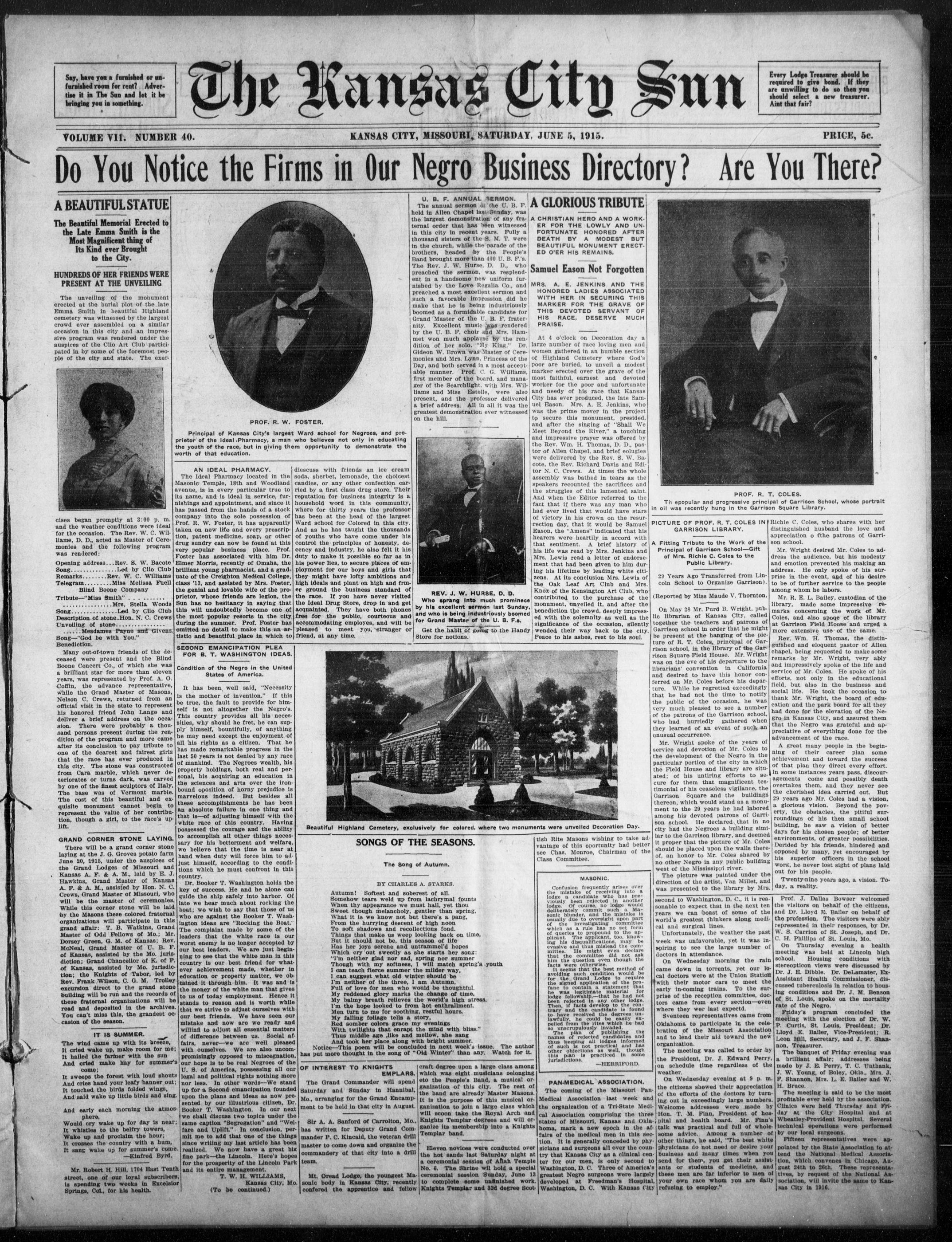
The Beautiful Memorial Erected to the Late Emma Smith is the Most Magnificent thing of Its Kind ever Brought to the City.
HUNDREDS OF HER FRIENDS WERE
PRESENT AT THE UNVEILING
The unveiling of the monument erected at the burial plot of the late Emma Smith in beautiful Highland cemetery was witnessed by the largest crowd ever assembled on a similar occasion in this city and an impressive program was rendered under the auspices of the Clio Art Club participated in by some of the foremost people of the city and state. The exer- cises began promptly at 3:00 p. m. and the weather conditions were ideal for the occasion. The Rev. W. C. Williams, D. D., acted as Master of Cere monies and the following program was rendered:
Opening address.....Rev. S. W. Bacote
Song.....Led by Clo Club
Remarks.....Rev. W. C. Williams
Telegram.....Miss Melissa Fuell
Blind Boone Company
Tribute—"Miss Smith"......
Mrs. Stella Woods
Song.....Led by Clo Club
Description of stone.Hon. N. C. Crews
Unvelling of stone......
Mesdames Payne and Givens
Song—"God be with You."
Benediction.
Many out-of-town friends of the deceased were present and the Blind Boone Concert Co., of which she was a brilliant star for more than eleven years, was represented by Prof. A. O. Coffin, the advance representative, while the Grand Master of Masons, Nelson C. Crews, returned from an official visit in the state to represent his honored friend John Lange and deliver a brief address on the occasion. There were probably a thousand persons present during the rendition of the program and more came after its conclusion to pay tribute to one of the dearest and fairest girls that the race has ever produced in this city. The stone was constructed from Cara marble, which never deteriorates or turns dark, was carved by one of the finest sculptors of Italy. The base was of Vermont marble. The cost of this beautiful and exquisite monument cannot begin to represent the value of her contribution, though a girl, to the race's up lift.
GRAND CORNER STONE LAYING.
There will be a grand corner stone laying at the J. G. Groves potato farm June 20, 1915, under the auspices of the Grand Lodges of Missouri and Kansas A. F. & A. M., laid by E. J. Hawkins, Grand Master of Kansas A. F. & A. M., assisted by Hon. N. C. Crews, Grand Master of Missouri, who will be the master of ceremonies. While this corner stone will be laid by the Masons these colored fraternal organizations will participate in this grand affair: T. B. Watkins, Grand Master of Odd Fellows of M., Mr. Dorsey Green, G. M. of Kansas; Rev McNeal, Grand Master of U. B. F. of Kansas, assisted by the Mo. jurisdiction; Grand Chancellor of K. of P. of Kansas, assisted by Mo. jurisdiction; the Knights of Tabor, led by Rev. Frank Wilson, C. G. M. Trolley excursion direct to the grand stone building will be run and the records of these fraternal organizations will be read and deposited in the archives You can't miss this, the grandest occasion of the season.
IT IS SUMMER
The wind came up with its breeze,
It cried wake up, make room for me;
It hailed the farmer with the sun
And cried make hay for summer's
come;
It sweeps the forest with loud shouts
And cries hand your leafy banner out;
It touched the birds folded wings,
And said wake up little birds and sing.
And early each morning the atmosphere,
Would cry wake up for day is near;
It whistles to the belfry towers,
Wake up and proclaim the hour;
It crosses the country with a hum,
It sang wake up for summer's come.
—Kinfred Byrd.
Mr. Robert H. Hill, 1704 East Tenth street, one of our loyal subscribers, is spending two weeks in Excelior Springs, Col., for his health.
The Kansas City Sun
PROF. R. W. FOSTER.
PROF. R. W. FOSTER.
Principal of Kansas City's largest Ward school for Negroes, and proprietor of the ideal.Pharmacy, a man who believes not only in educating the youth of the race, but in giving them opportunity to demonstrate the worth of that education.
AN IDEAL PHARMACY.
AN IDEAL PHARMACY.
The Ideal Pharmacy located in the Masonic Temple, 18th and Woodland avenue, is in every particular true to its name, and is ideal in service, furnishings and appointment, and since it has passed from the hands of a stock company into the sole possession of Prof. R. W. Foster, it has apparently taken on new life and every prescription, patent medicine, soap, or other drug sundry can now be found at this very popular business place. Prof. Foster has associated with him Dr. Elmer Morris, recently of Omaha, the brilliant young pharmacist, and a graduate of the Creighton Medical College, class '13, and assisted by Mrs. Foster, the genial and lovable wife of the proprietor, whose friends are legion, the Sun has no hesitancy in saying that this will undoubtedly become one of the most popular resorts in the city during the summer. Prof. Foster has omitted no detail to make this an artistic and beautiful place in which to
SEGOND EMANCIPATION PLEA
FOR B. T. WASHINGTON IDEAS.
Condition of the Negro in the United States of America.
It has been, well said, "Necessity is the mother of invention." If this be true, the fault to provide for himself is not altogether the Negro's. This country provides all his necessities, why should he fret, he can supply himself, bountifully, of anything he may need except the enjoyment of all his rights as a citizen. That he has made remarkable progress in the last 50 years is not denied by any race of mankind. The Negroes wealth, his property holdings, both real and personal, his acquiring an education in the sciences and arts over the ironbound oposition of horny prejudice is marvelous indeed. But besides all these accomplishments he has been an absolute failure in one thing and that is—of adjusting himself with the white race of this country. Having possessed the courage and the ability to accomplish all other things necessary for his betterment and welfare, we believe that the time is near at hand when duty will force him to adjust himself, according to the conditions which he must confront in this country.
Dr. Booker T. Washington holds the key of success. He and he alone can guide the ship safely into harbor. Of late we hear much about rocking the boat; we wish to say that those of us who are against the Booker T. Washington ideas are "Rocking the Boat." The complaint made by some of the leaders that the white race is our worst enemy is no longer accepted by our best leaders. We are just beginning to see that the white man in this country is our best friend for whatever achievement made, whether in education or property matter, we obtained it through him. It was and is the money of the white man that gives to us of today employment. Hence it stands to reason and is worth while that we strive to adjust ourselves with our best friends. We have seen our mistake and now are we ready and willinf to adjust all essential matters of difference between us. Social affairs, never—we are well pleased with ourselves. We are also uncompromisingly opposed to miscegregation, our hope is to be real Negroes of the U. S. of America, possessing all our legal and political rights nothing more nor less. In other words—We stand up for a Second emancipation founded upon the plans and ideas as now presented by our illustrious citizen, Dr. Booker T. Washington. In our next we shall discuss two topics under the same caption "Segregation" and "Welfare and Uplift." In conclusion, permit me to add that one of the things since writing my last article has been realized. We now have a great big fine park—the Lincoln. Here's hopes for the prosperity of the Lincoln Park and its entire management.
T. W. H. WILLIAMS,
Kansas City, Mo
(To be continued.)
KANSAS CITY, MISSOURI, SATURDAY, JUNE 5, 1915.
diescuss with friends an ice cream soda, shebert, lemonade, the choicest candies, or any other confection carried by a first class drug store. Their reputation for business integrity is a household word in this community, where for thirty years the professor has been at the head of the largest Ward school for Colored in this city. And as he has taught the thousands of youths who have come under his control the principles of honesty, decency and industry, he also felt it his duty to make it possible so far as in his power lies, to secure places of employment for our boys and girls that they might have lofty ambitions and high ideals and plant on high and framer ground the business standard of the race. If you have never visited the Ideal Drug Store, drop in and get acquainted. They have both phones free for the public, courteous and accommodating employees, and will be pleased to meet you, stranger or friend, at any time.
Beautiful Highland Cemetery, exclu
SONGS OF THE
The Song
Beautiful Highland Cemetery, exclusively for colored, where two monuments were unveiled Decoration Day.
The Song of Autumn.
BY CHARLES A. STARKS.
Autumn! Softest and sober
Somehow tears weld up from
When thy appearance we m
Sweet through melancholy
What it is we know not but
From the hurrying descent
To soft shadows and recool
Things that make us weep t
But it should not be, this s
Has her joys serene and uu
Which cry out sweetly as s
"I'm neither glad nor sad, j
Though with my softness,
I can teach fierce summer t
I can suggest what old win
I'm neither of the three, I
Full of love for men who w
My reddenness glory marks t
My balmy breeze t
I'm the hope looked to from
Men turn to me for soothing
My falling foliage tells a s
Red somber colors grace m
With twilights that enrap
Thus middle age, like and
And took her place along w
Notice—This poem will be concul
has put more thought in the song of "
Autumn! Softest and soberest of all.
Somehow tears weld up from lachrymal founts
When thy appearance we must hall, yet thou
Sweet though melancholy, gentler than spring,
What it is we know not but there's a pang,
From the hurrying descent of high noon
To soft shadows and recollections fond.
Things that make us weep looking back on time,
But it should not be, this season of life
Has her joys serene and untrammel'd hopes
Which cry out sweetly as she starts her song:
"I'm neither glad nor sad, spring nor summer
Though with my softness, I will match spring's youth
I can teach fierce summer the milder way,
I can suggest what old winter should be
I'm neither of the three, I am Autumn,
Full of love for men who would be thoughtful.
My reddened glory marks the change of time.
My balmy breath relieves the world's high stress.
I'm the hope looked to from hot enthrallment.
Men turn to me for soothing, restful hours.
My falling foliage tells a story,
Red somber colors grace my evenings
With twilights that enrap the mind with bliss."
Thus middle age, like and mellow, she sang
And took her place along with bright summer.
Notice—This poem will be concluded in next week's issue. The author has put more thought in the song of "Old Winter" than any. Watch for it.
OF INTEREST TO KNIGHTS
EMPLARS
The Grand Commander will spend Saturday and Sunday in Hannibal, Mo., arranging for the Grand Encampment to be held in that city in August.
Sir A. A. Sanford of Carrolton, Mo., has written for Deputy Grand Commander P. C. Kincaid, the veteran drill master to come down and organize the commandery of that city into a drill team.
Mt. Oread Lodge, the youngest Ma- sonic body in Kansas City, recently conferred the apprentice and fellow
U. B. F. ANNUAL SERMON.
The annual sermon of the U. B. F. held in Allen Chapel last Sunday, was the largest demonstration of any fraternal order that has been witnessed in this city in recent years. Fully a thousand sisters of the S. M. T. were in the church, while the parade of the brothers, headed by the People's Band brought more than 400 U. B. F.'s. The Rev. J. W. Hurse, D. D., who preached the sermon, was resplendent in a handsome new uniform furnished by the Love Regalia Co., and preached a most excellent sermon and such a favorable impression did he make that he is being industriously boomed as a formidable candidate for Grand Master of the U. B. F., fraternity. Excellent music was rendered by the U. B. F. choir and Mrs. Hammet won much applause by the rendition of her solo, "My King." Dr. Gideon W. Brown was Master of Ceremonies and Mrs. Lynn, Princess of the Day, and both served in a most acceptable manner. Prof. C. G. Williams, first member of the board, and manager of the Searchlight, with Mrs. Williams and Miss Estelle, were also present, and the professor delivered a brief address. All in all it was the greatest demonstration ever witnessed on the hill.
REV. J. W. HURSE, D. D.
Who sprang into much prominence by his excellent sermon last Sunday and who is being industriously boomed for Grand Master of the U. B. F.s.
Get the habit of going to the Handy Store for notions.
inclusively for colored, where two monume
THE SEASONS.
oberest of all.
from lachrymal founts
must hall, yet thou
genther than spring,
but there's a pang,
at of high noon
collections fond.
up looking back on time,
s season of life
untrammel'd hopes
s she starts her song:
1. spring nor summer
s. I will match spring's youth
at the milder way,
winter should be
I am Autumn,
would be thoughtful.
s the change of time.
s the world's high stress.
from hot enthrallment.
tiring restful hours.
a story,
my evenings
ot the mind with bliss."
d mellow, she sang
with bright summer.
included in next week's issue. The author
"Old Winter" than any. Watch for it.
S. craft degree upon a large class among
which was eight musicians elonging
eto the People's Band, a musical
organization of this city. The rest of
the band are already Master Masons.
It is the purpose of this musical
organization to join a large class which
will scoon take the Royal Arch and
Knights Templar degrees and will
organize its membership into a Knights
Templar band.
Eleven novices were conducted over the hot sands last Saturday night at a ceremonial session of Alafah Temple No. 6. The Shrine will hold a special ceremonial session Sunday, June 13 to complete some unfinished work Knights Templar and 32d degree Scot-
A GLORIOUS TRIBUTE
A CHRISTIAN HERO AND A WORKER FOR THE LOWLY AND UNFORTUNATE HONORED AFTER DEATH BY A MODEST BUT BEAUTIFUL MONUMENT ERECTED O'ER HIS REMAINS.
Samuel Eason Not Forgotten
MRS. A. E. JENKINS AND THE
HONORED LADIES ASSOCIATED
WITH HER IN SECURING THIS
MARKER FOR THE GRAVE OF
THIS DEVOTED SERVANT OF
HIS RACE, DESERVE MUCH
PRAISE.
At 4 o'clock on Decoration day a large number of race loving men and women gathered in an humble section of Highland Cemetery where God's poor are buried, to unveil a modest marker erected over the grave of the most faithful, earnest and devoted worker for the poor and unfortunate and needy of his race that Kansas City has ever produced, the late Samuel Eason. Mrs. A. E. Jenkins, who was the prime mover in the project to secure this monument, presided, and after the singing of "Shall We Meet Beyond the River," a touching and impressive prayer was offered by the Rev. Wm. H. Thomas, D. D., pastor of Allen Chapel, and brief ecologies were delivered by the Rev. S. W. Bacote, the Rev. Richard Davis and Editor N. C. Crews. At times the whole assembly was bathed in tears as the speakers recounted the sacrifices and the struggles of this lamented saint. And when the Editor referred to the fact that if there was any man who had ever lived that would have stars of victory in his crown on the resurrection day, that it would be Samuel Eason, the "Amens" indicated that his hearers were heartily in accord with that sentiment. A brief history of his life was read by Jenkins and Mrs. Lewis read a letter of endorsement that had been given to him during his lifetime by leading white citizens. At its conclusion Mrs. Lewis of the Oak Leaf Art Club and Mrs Knox of the Kensington Art Club, who contributed to the purchase of the monument, unveiled it, and after the benediction the crowd, deeply impressed with the solemnity as well as the significance of the occasion, silently wended their way back to the city Peace to his ashes, rest to his soul.
ments were unveiled Decoration Day.
tish Rite Masons wishing to take advantage of this opportunity had better see Chas. Monroe, Chairman of the Class Committee.
MASONIC
Confusion frequently arises over the mistake of receiving into a lodge a candidate who has previously been rejected in another lodge. Of course, no lodge would deliberately commit such a Masonic blunder, and the mistake is usually due to oversight upon part of the investigating committee which as a rule has no set form of queries to propound to the applicant. The applicant, too, knowing his disqualifications, may be evasive and thus mislead the committee. He might even declare that the committee did not ask him the question even though the facts were otherwise.
It seems that the best method of avoiding such condition would be for the Grand Lodge to require the signed application of the profane to contain a statement that he was legitimate material for lodge fellowship,—that he had not been rejected in any other lodge. Then, if facts develop to the foe, trary and the candidate is found to have received the degrees unlawfully, he would be easily expelled from the rites which he had so unscrupulously invaded.
The plan of publishing the names of rejected candidates and thus keeping all lodges informed of such is not practical and has other objections as well, though this plan is practiced in some jurisdictions.
PAN-MEDICAL ASSOCIATION.
The coming of the Missouri Pan-Medical Association last week and the organization of a Tri-State Medical Association comprising the three states of Missouri, Kansas and Oklahoma, mark a new epoch in the affairs of the medical men in this section. It is generally conceded by physicians and surgeons all over the country that Kansas City as a clinical center for our men, is only second to Washington, D. C. Three of America's greatest Negro surgeons were largely developed at Freedman's Hospital Washington, D. C. With Kansas City
R.
PROF. R. T. COLES.
The popular and progressive principal of Garrison School, whose portrait in oil was recently hung in the Garrison Square Library.
PICTURE OF PROF. R. T. COLES IN GARRISON LIBRARY.
A Fitting Tribute to the Work of the Principal of Garrison School—Gift of Mrs. Richie C. Coles to the Public Library.
29 Years Ago Transferred from Lincoln School to Organize Garrison).
(Reported by Miss Maude V. Thornton,
On May 28 Mr. Purd B. Wright, public librarian of Kansas City, called together the teachers and patrons of Garrison school in order that he might be present at the hanging of the picture of R. T. Coles, principal of Garrison school, in the library of the Garrison Square Field House. Mr. Wright was on the eve of his departure to the librarians' convention in California and desired to have this honor conferred on Mr. Coles before his departure. While he regretted exceedingly that he had not the time to notify the public of the occasion, he was very much pleased to see a number of the patrons of the Garrison school, who had hurriedly gathered when they learned of an event of such an unusual occurrence.
Richie C. Coles, who shares with her distinguished husband the love and appreciation of the patrons of Garrison school.
Mr. Wright desired Mr. Coles to address the audience, but his modesty and emotion prevented his making an address. He only spoke of his surprise in the event, and of his desire to be of further service to the people among whom he labors.
Mr. R. E. L. Bailey, custodian of the library, made some impressive remarks concerning the work of Mr. Coles, and also spoke of the library at Garrison Field House and urged a more extensive use of the same.
Rev. Wm. H. Thomas, the distinguished and eloquent pastor of Allen chapel, being requested to make some remarks by Mr. Wright, very ably and impressively spoke of the life and service of Mr. Coles. He spoke of his efforts, not only in the educational field, but also in the business and social life. He took the occasion to thank Mr. Wright, the board of education and the park board for all they had done for the elevation of the Negro in Kansas City, and assured them that the Negro was grateful and apreciative of everything done for the
Mr. Wright spoke of the years of service and devotion of Mr. Coles to the development of the Negro in the particular portion of the city in which the Field House and library are situated; of his untiring efforts to secure for them that magnificent testimonial of his ceaseless vigilance, the Garrison Square and the buildings thereon, which would stand as a monument to the 29 years he had labored among his devoted patrons of Garrison school. He declared that in no city had the Negroes a building similar to the Garrison library, and deemed it proper that the picture of Mr. Coles should be placed upon the walls thereof, an honor to Mr. Coles shared by no other Negro in any public building west of the Mississippi river.
The picture was painted under the direction of the artist, Van Millet, and was presented to the library by Mrs. second to Washington, D. C., it is reasonable to expect that in the next ten years we can boast of some of the world's greatest thinkers along medical and surgical lines.
Unfortunately, the weather the past week was unfavorable, yet it was inspiring to see the large number of doctors in attendance.
On Wednesday morning the rain came down in torrents, yet our local doctors were at the Union Station with their motor cars to meet the early in-coming trains. To the surprise of the reception committee, doctors came from every section—even where they weir last expected.
Sventeen representatives came from Oklahoma to participate in the celebration of the Missouri Association and to lend their aid toward the new organization.
The meeting was called to order by the President, Dr. J. Edward Perry, on schedule time regardless of the weather.
On Wednesday evening at 9 p.m. the citizens showed their appreciation of the efforts of the doctors by turning out in exceedingly large numbers. Welcome addresses were made by Hon. T. M. Finn, President of hospital and health board. Mr. Finn's talk was practical and full of wholesome advice. Among a number of other things, he said, "The best white physicians do not need or desire your business and many times when you send for them, you get their assistants or students of medicine, and these men are far inferior to men of your own race whom you are daily refusing to employ."
Every Lodge Treasurer should be required to give bond. If they are unwilling to do so then you should select a new treasurer. Aint that fair?
You There?
T. COLES.
principal of Garrison School, whose portrait
son Square Library.
Richie C. Coles, who shares with her distinguished husband the love and appreciation of the patrons of Garrison school.
Mr. Wright desired Mr. Coles to address the audience, but his modesty and emotion prevented his making an address. He only spoke of his surprise in the event, and of his desire to be of further service to the people among whom he labors.
Mr. R. E. L. Bailey, custodian of the library, made some impressive remarks concerning the work of Mr. Coles, and also spoke of the library at Garrison Field House and urged a more extensive use of the same.
Rev. Wm. H. Thomas, the distinguished and eloquent pastor of Allen chapel, being requested to make some remarks by Mr. Wright, very ably and impressively spoke of the life and service of Mr. Coles. He spoke of his efforts, not only in the educational field, but also in the business and social life. He took the occasion to thank Mr. Wright, the board of education and the park board for all they had done for the elevation of the Negro in Kansas City, and assured them that the Negro was grateful and appreciative of everything done for the advancement of the race.
A great many people in the beginning of their career plan some achievement and toward the success of that plan they direct every effort. In some instances years pass, discouragements come and possibly death overtakes them, and they never see the cherished idea carried out. But 29 years ago Mr. Coles had a vision, a glorious vision. Beyond the poverty, the obstacles, the pitiful surroundings of his then small school building, he saw a vision of better days for his chosen people; of better environments, of greater possibilities. Derided by his friends, hindered and opposed by many, yet encouraged by his superior officers in the school work, he never lost sight of plans laid out for his people.
Twenty-nine years ago, a vision. Today, a reality.
Prof. J. Dallas Bowser welcomed the visitors on behalf of the citizens, and Dr. Lloyd E. Baller on behalf of the profession. The visitors were ably represented in their responses, by Dr. W. S. Carrion of St. Joseph, and Dr. C. H. Phillips of St. Louis, Mo.
On Thursday evening a health meeting was held at Lincoln high school. Housing conditions with stereoptic views were discussed by Dr. J. E. Dibble. Dr. DeLamater, Ex-Assistant Health Commissioner, discussed tuberculosis in relation to housing conditions and Dr. J. M. Benson of St. Louis, spoke on the mortality rate of the Negro.
Friday's program concluded the meeting with the election of Dr. W. P. Curtis, St. Louis, President; Dr. Lloyd E. Baller, Vice-President; R. Leon Hill, Secretary, and J. F. Shannon, Treasurer.
The banquet of Friday evening was a brilliant affair; addresses being made by J. E. Perry, T. C. Unthank, J. W. Young, of Boley, Okla., Mrs. J. F. Shannon, Mrs. L. E. Baller and W. H. Bruce.
The meeting is said to be the most profitable ever held by the association. Clinics were held Thursday and Friday at the City Hospital and at Wheatley-Provident Hospital. Several technical operations were performed by our local surgeons.
Fifteen representatives were appointed by the State Association to attend the National Medical Association, which convenes in Chicago, August 24th to 26th. These representatives, by request of the National Association, will invite the same to Kansas City in 1916.
PRICE, 5c.
6665x
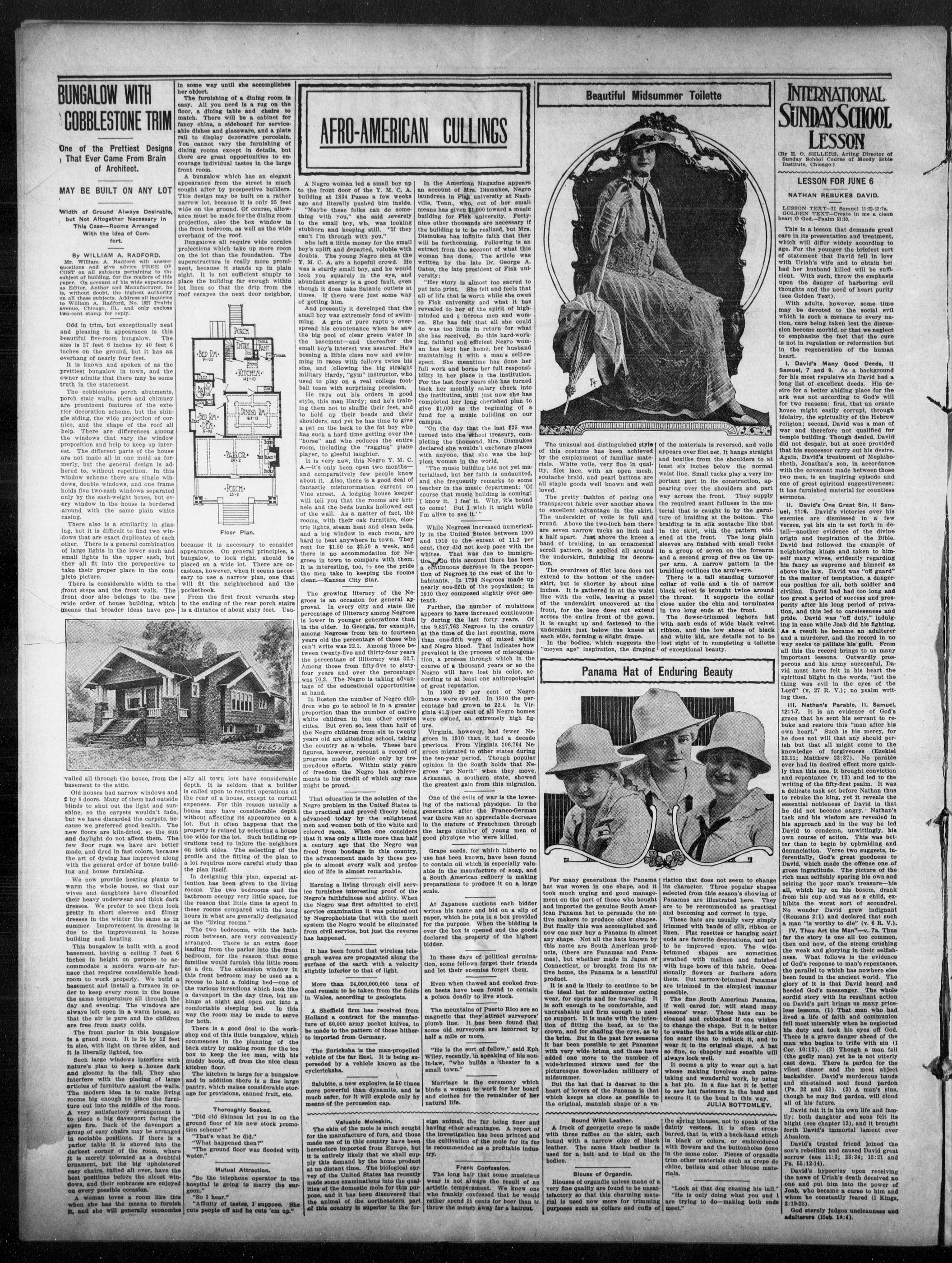
One of the Prettiest Designs
That Ever Came From Brain
of Architect.
MAY BE BUILT ON ANY LOT
Width of Ground Always Desirable,
but Not Altogether Necessary In
This Case—Rooms Arranged
With the Idea of Com-
By WILLIAM A. BADEORD
Mr. William A. Radford will answer questions and give advice FREE OF COST on all subjects pertaining to the subject of building, for the readers of this paper. On account of his wide experience as Editor, Author and Manufacturer, he is able to doubt the high authority on all these subjects. Address all inquiries to William A. Radford, No. 182 Prairie avenue, Chicago, Ill., and only enclose two-cent stamp for reply.
Odd in trim, but exceptionally neat and pleasing in appearance is this beautiful five-room bungalow. The size is 27 feet 6 inches by 40 feet 6 inches on the ground, but it has an overhang of nearly four feet.
It is known and spoken of as the prettiest bungalow in town, and the owner admits that there may be some truth in the statement.
The cobblestone porch abutments, porch stair walls, piers and chimney are prominent features of the exterior decoration scheme, but the shingle siding, the wide projection of cornice, and the shape of the roof all help. There are differences among the windows that vary the window proposition and help to keep up interest. The different parts of the house are not made all in one mold as formerly, but the general design is adhered to, without repetition. In this window scheme there are single windows, double windows, and one frame holds five two-sash windows separated only by the sash-weight boxes, but every window in the house is bordered around with the same plain white casing.
There also is a similarity in glazing, but it is difficult to find two windows that are exact duplicates of each other. There is a general combination of large lights in the lower sash and small lights in the upper sash, but they all fit into the perspective to take their proper place in the complete picture.
There is considerable width to the front steps and the front walk. The front door also belongs to the new wide order of house building, which means that broader ideas have pre-
vailed all through the house, from the basement to the attic.
Old houses had narrow windows and 2 by 8 doors. Many of them had outside blinds to shut out the light and sunshine, so the carpets wouldn't fade, but we have discarded the carpets, because we preferred good health. The new floors are kiln-dried, so the sun and daylight do not affect them. The few floor rugs we have are better made, and dyed in fast colors, because the art of dyeing has improved along with the general order of house building and house furnishing. We now provide heating plants to warm the whole house, so that our wives and daughters have discarded their heavy underwear and thick dark dresses. We prefer to see them look pretty in short sleeves and filmsy dresses in the winter the same as in summer. Improvement in dressing is due to the improvement in house building and heating.
This bungalow is built with a good basement, having a ceiling 7 feet 6 inches in height on purpose to accommodate a modern warm-air furnace that requires considerable headroom to work properly. We build a basement and install a furnace in order to keep every room in the house the same temperature all through the day and evening. The windows are always left open in a warm house, so that the air is pure and the children are free from nasty colds.
The front parlor in this bungalow is a grand room. It is 24 by 12 feet in size, with light on three sides, and it is liberally lighted, too.
Such large windows interfere with nature's plan to keep a house dark and gloomy in the fall. They also interfere with the placing of large articles of furniture against the walls. The modern idea is to make living rooms big enough to place the furniture out into the middle of the room. A very satisfactory arrangement is to place a big davenport facing the open fire. Back of the davenport a group of easy chairs may be arranged in sociable positions. If there is a parlor table it is shoved into the darkest corner of the room, where it is merely tolerated as a doubtful ornament, but the big upholstered easy chairs, tufted all over, have the best positions before the nicest windows, and their embraces are enjoyed on every possible occasion.
A woman loves a room like this when she has the means to furnish it, and she will generally economize
in some way until she accomplishes her object.
The furnishing of a dining room is easy. All you need is a rug on the floor, a dining table and chairs to match. There will be a cabinet for fancy china, a sideboard for serviceable dishes and glassware, and a plate rail to display decorative porcelain. You cannot vary the furnishing of dining rooms except in details, but there are great opportunities to encourage individual tastes in the large front room.
A bungalow which has an elegant appearance from the street is much sought after by prospective builders. This design may be built on a rather narrow lot, because it is only 25 feet wide on the ground. Of course, allowance must be made for the dining room projection, also the box window in the front bedroom, as well as the wide overhang of the roof.
Bungalows all require wide cornice projections which take up more room on the lot than the foundation. The superstructure is really more prominent, because it stands up in plain sight. It is not sufficient simply to place the building far enough within lot lines so that the drip from the roof escapes the next door neighbor.
PORCH
BED RM
9'10"
CLOFT
BATH
9'9"
BED RM
DEM
9'9"
KITCHEN
14'2+10'
ENTRY
BATH
STOVER
DINING RM
16'8+13
PARLOR
28'12
PORCH
25'8
Floor Plan.
because it is necessary to consider appearance. On general principles, a bungalow, to look right, should be placed on a wide lot. There are occasions, however, when it seems necessary to use a narrow plan, one that will fit the neighborhood and the pocketbook.
From the first front veranda step to the ending of the rear porch stairs is a distance of about sixty feet. Usu-
ally all town lots have considerable depth. It is seldom that a builder is called upon to restrict operations at the rear of a house, except to curtail expenses. For this reason usually a house may have considerable depth without affecting its appearance on a lot. But it often happens that the property is ruined by selecting a house too wide for the lot. Such building operations tend to injure the neighbors on both sides. The selecting of the profile and the fitting of the plan to a lot requires more careful study than the plan itself.
In designing this plan, especial attention has been given to the living rooms. The two bedrooms and the bathroom occupy very little space, for the reason that little time is spent in these rooms compared with the long hours in what are generally designated as the "living rooms."
The two bedrooms, with the bathroom between, are very conveniently arranged. There is an extra door leading from the parlor into the front bedroom, for the reason that some families would furnish this little room as a den. The extension window in this front bedroom may be used as a recess to hold a folding bed—one of the various inventions which look like a davenport in the day time, but hinge at night and open out into a comfortable sleeping bed. In this way the room may be made to serve for both.
There is a good deal to the workshop end of this little bungalow, which commences in the planning of the back entry by making room for the ice box to keep the ice man, with his muddy boots, off from the nice clean kitchen floor. The kitchen is large for a bungalow and in addition there is a fine large pantry, which makes considerable storage for provisions, canned fruit, etc.
Thoroughly Soaked
"Did old Skinson let you in on the ground floor of his new stock promotion scheme?"
"The ground floor was flooded with water."
Mutual Attraction.
"So the telephone operator in the hospital is going to marry the surgeon."
"So I hear."
"Affinity of tastes, I suppose. She cuts people off and he cuts 'em up."
AFRO-AMERICAN CULLINGS
A Negro woman led a small boy up to the front door of the Y. M. C. A. building at 1834 Paseo a few weeks ago and literally pushed him inside. "Maybe these folks can do something with you," she said severely to the small boy, who was looking stubborn and keeping still. "If they can't I'm through with you."
She left a little money for the small boy's uplift and departed, voluble with doubts. The young Negro men at the Y. M. C. A. are a hopeful crowd. He was a sturdy small boy, and he would look you squarely in the eye, and abundant energy is a good fault, even though it does take Satanic outlets at times. If there were just some way of getting him.
And presently it developed that the small boy was extremely fond of swimming. A grim of pure raptus overspread his countenance when he saw the big pool of clear green water in the basement—and thereafter the small boy's interest was assured. He's bossing a Bible class now and swimming in races with fellows twice his size, and following the big straight military Hardy, "gym" instructor, who used to play on a real college football team with surprising precision.
He raps out his orders in good style, this man Hardy; and he's training them not to shuffle their feet, and to hold up their heads and their shoulders, and yet he has time to give a pat on the back to the fat boy who has such a hard time getting over the "horse" and who reduces the entire room, including the "ragging" piano player, to gleeful laughter.
It is very new, this Negro Y. M. C. A.—it's only been open two months—and comparatively few people know about it. Also, there is a good deal of fantastic misinformation current on Vine street. A lodging house keeper will tell you that the rooms are kennels and the beds bunks hollowed out of the wall. As a matter of fact, the rooms, with their oak furniture, electric lights, steam heat and clean beds, and a big window in each room, are hard to beat anywhere in town. They rent for $1.50 to $2.50 a week, and there is no accommodation for Negroes in town to compare with them. It is interesting, too, to see the pride the men take in keeping the rooms clean—Kansas City Star.
The growing literacy of the Negroes is an occasion for general approval. In every city and state the percentage of illiteracy among Negroes is lower in younger generations than in the older. In Georgia, for example, among Negroes from ten to fourteen years old the percentage of those who can't write was 22.1. Among those between twenty-five and thirty-four years the percentage of illiteracy was 22.7. Among those from fifty-five to sixty-four years and over the percentage was 70.2. The Negro is taking advantage of the educational opportunities at hand.
In Boston the number of Negro children who go to school is in a greater proportion than the number of native white children in ten other census cities. But even so, less than half of the Negro children from six to twenty years old are attending school, taking the country as a whole. These bare figures, however, recount a record of progress made possible only by tremendous efforts. Within sixty years of freedom the Negro has achievements to his credit of which any race might be proud.
That education is the solution of the Negro problem in the United States is the practical and proved theory being advanced today by the enlightened men and women both of the white and colored races. When one considers that it was only a little more than half a century ago that the Negro was freed from bondage in this country, the advancement made by these people in almost every walk and profession of life is almost remarkable.
Earning a living through civil service furnishes interesting proof of the Negro's faithfulness and ability. When the Negro was first admitted to civil service examination it was pointed out by Negrophobists that with the merit system the Negro would be eliminated from civil service, but just the reverse has happened.
It has been found that wireless telegraph waves are propagated along the surface of the earth with a velocity slightly inferior to that of light.
More than 24,000,000,000 tons of coal remain to be taken from the fields in Wales, according to geologists.
A Sheffield firm has received from Holland a contract for the manufacture of 60,000 army pocket knives, to be made to the pattern of those hitherto imported from Germany.
The jinricksha is the man-propelled vehicle of the far East. It is being supereded by a vehicle known as the cyclericksha.
Salubite, a new explosive, is 50 times more powerful than dynamite, and is much safer, for it will explode only by means of the percussion cap.
The skin of the mole is much sought for the manufacture of furs, and those made use of in this country have been heretofore imported from Europe, but it is entirely likely that we shall supply this demand by the home product at no distant time. The biological survey of the United States has recently made some examinations into the qualities of the domestic mole for this purpose, and it has been discovered that the animal of the northeastern part of this country is superior to the for-
In the American Magazine appears an account of Mrs. Dismukes, Negro laudress in Fisk university at Nashville, Tenn., who, out of her small means has given $1,000 toward a music building for Fisk university. Forty-nine other thousands are necessary if the building is to be realized, but Mrs. Dismukes has infinite faith that they will be forthcoming. Following is an extract from the account of what this woman has done. The article was written by the late Dr. George A. Gates, the late president of Fisk university:
"Her story is almost too sacred to put into print. She felt and feels that all of life that is worth while she owes to Fisk university and what it has revealed to her of the spirit of high-minded and generous men and women. She has felt that all she could do was too little in return for what she has received. So this hard-work, faithful and efficient Negro woman has kept her home, her husband maintaining it with a man's self-respect. She meantime has done her full work and borne her full responsibility in her place in the institution. For the last four years she has turned back her monthly salary check into the institution, until just now she has completed her long cherished plan to give $1,000 as the beginning of a fund for a music building on our campus.
"On the day that the last $25 was turned into the school treasury, completing the thousand, Mrs. Dismukes declared she wouldn't exchange places with anyone, that she was the happiest woman in the world.
"The music building has not yet materialized, but her faith is undaunted, and she frequently remarks to some teacher in the music department: 'Of course that music building is coming! I know it. I feel' it. Why, it's bound to come! But I wish it might while I'm alive to see it.'"
While Negroes increased numerically in the United States between 1900 and 1910 to the extent of 11.2 percent, they did not keep pace with the whites. That was due to immigration. On this account there has been a continuous decrease in the proportion of Negroes to the rest of the inhabitants. In 1790 Negroes made up nearly one-fifth of the population; in 1910 they composed slightly over one-tenth.
Further, the number of mulattoes appears to have increased continuously during the last forty years. Of the 9,827,763 Negroes in the country at the time of the last counting, more than one-fifth were of mixed white and Negro blood. That indicates how prevalent is the process of miscogenation, a process through which in the course of a thousand years or so the Negro will have lost his color, according to at least one anthropologist of great reputation.
In 1900 20 per cent of Negro homes were owned. In 1910 the percentage had grown to 22.4. In Virginia 41.3 per cent of all Negro homes were owned, an extremely high figure.
Virginia, however, had fewer Negroes in 1910 than it had a decade previous. From Virginia 206,754 Negroes migrated to other states during the ten-year period. Though popular opinion in the South holds that Negroes "go North" when they move, Arkansas, a southern state, showed the greatest gain from this migration.
One of the evils of war is the lowering of the national physique. In the generation after the Franco-German war there was an appreciable decrease in the stature of Frenchmen through the large number of young men of good physique who were killed.
Grape seeds, for which hitherto no use has been known, have been found to contain oil which is especially valuable in the manufacture of soap, and a South American refinery is making preparations to produce it on a large scale.
At Japanese auctions each bidder writes his name and bid on a slip of paper, which he puts in a box provided for the purpose. When the bidding is over the box is opened and the goods declared the property of the highest bidder.
In these days of political germination, some fellows forget their friends and let their enemies forget them.
Even when thawed and cooked frozen beets have been found to contain a poison deadly to live stock.
The mountains of Puerto Rico are so magnetic that they attract surveyors' plumb line. It has been found that some old surveyors are incorrect by half a mile or more.
"He is the sort of fellow," said Eph Wiley, recently, in speaking of his son-in-law, "who builds a theater in a small town."
Marriage is the ceremony which binds a woman to work for her board and clothes for the remainder of her natural life.
eign animal, the fur being finer and having other advantages. A report of the investigation has been printed and the cultivation of the mole for its fur is recommended as a profitable industry.
Frank Confession
The long hair that some musicians wear is not always the result of an artistic temperament. We knew one who frankly confessed that he would rather throw 25 cents for beer than to throw the money away for a haircut.
T. F.
---
Panama Hat of Enduring Beauty
The unusual and distinguished style of this costume has been achieved by the employment of familiar materials. White voile, very fine in quality, filet lace, with an open mesh, soutache braid, and pearl buttons are all staple goods well known and well loved.
The pretty fashion of posing one transparent fabric over another shows to excellent advantage in the skirt. The underskirt of voile is full and round. Above the two-inch hem there are seven narrow tucks an inch and a half apart. Just above the knees a band of braiding, in an ornamental scroll pattern, is applied all around the underskirt, finishing its decoration.
The overdress of filet lace does not extend to the bottom of the underskirt, but is shorter by about nine inches. It is gathered in at the waist line with the voile, leaving a panel of the underskirt uncovered at the front, for the lace does not extend across the entire front of the gown. It is caught up and fastened to the underskirt just below the knees at each side, forming a slight drape.
In the bodice, which suggests the "moyen age" inspiration, the draping
Panama Hat of
For many generations the Panama hat was woven in one shape, and it took much urging and good management on the part of those who bought and imported the genuine South American Panama hat to persuade the native makers to produce other shapes. But finally this was accomplished and now one may buy a Panama in almost any shape. Not all the hats known by this name are South American products, (there are Panamas and Panamas), but whether made in Japan or Connecticut, or brought from its native home, the Panama is a beautiful product.
It is and is likely to continue to be the ideal hat for midsummer outing wear, for sports and for traveling. It is soft enough to be comfortable, and uncrushable and firm enough to need no support. It is made with the intention of fitting the head, as to the crown, and for shading the eyes, as to the brim. But in the past few seasons it has been possible to get Panamas with very wide brims, and these have added one more to the number of wide-brimmed straws used for the picturesque flower-laden millinery of midsummer.
But the hat that is dearest to the heart of lovers of the Panama is that which keeps as close as possible to the original, mannish shape or a va-
A frock of georgette crepe is made with three ruffles on the skirt, each bound with a narrow edge of black leather. The same black leather is used for a belt and to bind on the bodice.
Blouse of Organdie.
Blouses of organdie unless made of a very fine quality are found to be unsat- isfactory so that this charming material is used now more for trimming purposes such as collars and cuffs of
of the materials is reversed, and voile appears over fillet net. It hangs straight and boxlike from the shoulders to at least six inches below the normal waist line. Small tucks play a very important part in its construction, appearing over the shoulders and part way across the front. They supply the required scant fullness in the material that is caught in by the garniture of braiding at the bottom. The braiding is in silk soutache like that in the skirt, with the pattern widened at the front. The long plain sleeves are finished with small tucks in a group of seven on the forearm and a second group of five on the upper arm. A narrow pattern in the braiding outlines the arm's-eye.
There is a tall standing turnover collar of voile and a tie of narrow black velvet 15 brought twice around the throat. It supports the collar close under the chin and terminates in two long ends at the front.
The flower-trimmed leghorn hat with sash ends of wide black velvet ribbon, and the low shoes of black and white kid, are details not to be lost sight of in completing a toilette of exceptional beauty.
Enduring Beauty
riation that does not seem to change its character. Three popular shapes selected from this season's showing of Panamas are illustrated here. They are to be recommended as practical and becoming and correct in type.
These hats are usually very simply trimmed with bands of silk, ribbon or linen. Flat rosettes or hanging scarf ends are favorite decorations, and not to be improved upon. The wide-brimmed shapes are sometimes swathed with malines and finished with huge bows of this fabric. Occasionally flowers or feathers adorn them. But narrow-brimmed Panamas are trimmed in the simplest manner possible.
The fine South American Panama, if well cared for, will stand many seasons' wear. These hats can be cleaned and reblocked if one wishes to change the shape. But it is better to swathe the hat in a wide silk or chiffon scarf than to reblock it, and to wear it in its original shape. A hat so fine, so shapely and sensible will always look well.
It seems a pity to wear out a hat whose making involves such painstaking and wonderful work, by using a hat pin. In a fine hat it is better to sew hat fasteners in the band and secure it to the head in this way.
JULIA BOTTOMLEY.
the spring blouses, not to speak of the dainty vestes. It is often cross-barred, that is, with a back-hand stitch in black or colors, or embroidered with flowers and the buttonholes done in the same color. Pieces of organdie trim other materials such as crepe de chine, batiste and other blouse materials.
"Look at that dog chasing his tail."
"He is only doing what you and I are trying to do—making both ends meet."
INTERNATIONAL
SUNDAY SCHOOL
LESSON
(By E. O. SELLERL, Acting Director of
Bible Institute, Chicago).
NATHAN REBUKES DAVID.
LESSON TEXT-II Samuel 11:23-17a.
GOLDEN TEXT-Create in me a clean heart O God -Psalm 51:10.
This is a lesson that demands great care in its presentation and treatment, which will differ widely according to age. For the younger the briefest sort of statement that David fell in love with Uriah's wife and to obtain her had her husband killed will be sufficient. With such, throw the emphasis upon the danger of harboring evil thoughts and the need of heart purity (see Golden Text).
With adults, however, some time may be devoted to the social evil which is such a menace to every nation, care being taken lest the discussion become morbid, or that we neglect to emphasize the fact that the cure is not in regulation or reformation but in the regeneration of the human heart.
1. David's Many Good Deeds, II Samuel, 7 and 9. As a background for his most repulsive sin David had a long list of excellent deeds. His desire for a better abiding place for the ark was not according to God's will for two reasons: first, that an orate house might easily corrupt, through idolatry, the spirituality of the Hebrew religion; second, David was a man of war and therefore not qualified for temple building. Though denied, David did not despair, but at once provided that his successor carry out his desire. Again, David's treatment of Mephibosheh, Jonathan's son, in accordance with the covenant made between those two men, is an inspiring episode and one of great spiritual suggestiveness; it has furnished material for countless sermons.
II. David's One Great Sin, II Samuel, 11:6. David's victories over his enemies are dismissed in a few verses, yet his sin is set forth in detail—another evidence of the divine origin and inspiration of the Bible. David had followed the example of neighboring kings and taken to himself many wives, evidently regarding his fancy as supreme and himself as above the law. David was "off guard" in the matter of temptation, a dangerous position for all, both soldier and civilian. David had had too long and too great a period of success and prosperity after his long period of privation, and this led to carelessness and pride. David was "off duty," indulging in ease while Joab did his fighting. As a result he became an adulterer and a murderer, and the record in no way seeks to palliate his guilt. From all this the record brings to us many important lessons. Outwardly prosperous and his army successful, David must have felt in his heart the spiritual blight in the words, "but the thing was evil in the eyes of the Lord" (v. 27 R. V.); no psalm writing then.
III. Nathan's Parable, II. Samuel, 12:1-7. It is an evidence of God's grace that he sent his servant to rebuke and restore this "man after his own heart." Such is his mercy, for he does not will that any should perish but that all might come to the knowledge of forgiveness (Ezekiel 33:11; Matthew 23:37). No parable ever had its desired effect more quickly than this one. It brought conviction and repentance (v. 13) and led to the writing of the fifty-first psalm. It was a delicate task set before Nathan thus to rebuke the king, yet it reveals the essential nobleness of David in that he did not become angry. Nathan's task and his wisdom are revealed in his approach and in the way he led David to condemn, unwittingly, his own course of action. This was better than to begin by upholding and denunciation. Verse two suggests, inferentially, God's great goodness to David, which made the offense one of gross ingratiation. The picture of the rich man selfishly sparing his own and seizing the poor man's treasure—his all, which lay on his bosom, dranks from his cup and was as a child, exhibits the worst sort of scoundrel. No wonder David grew indignant (Romans 2:1) and declared that such a man "is worthy to die" (v. 6 R. V.).
IV. Thou Art the Man"—v. 7a. Thus far the story is one all too common, then and now, of the strong crushing the weak and glorying in their selfishness. What follows is the evidence of God's response to man's repentance, the parallel to which has nowhere else been found in the ancient world. The glory of it is that David heard and heeded God's messenger. The whole sordid story with its resultant action on David's part brings us many priceless lessons. (1) That man who had lived a life of faith and communion fell most miserably when he neglected his duty and took his eyes off God. There is a grave danger ahead of the man who begins to trifle with sin (1 Cor. 10:12). (2) Though a man fall (the godly man) yet he is not utterly cast down. There is pardon for the vilest sinner and the most abject backslider. David's murderous hands and sin-stained soul found pardon (Ps. 32 and 51). (3) A man's sins, though he may find pardon, will cloud all of his future.
David felt it in his own life and family; both daughter and sons felt its blight (see chapter 13), and it brought forth David's immortal lament over Absalom.
David's trusted friend joined the son's rebellion and caused David great sorrow (see 11:3; 23:34; 15:21 and Ps. 55:12-14).
David's hypocrisy upon receiving the news of Uriah's death deceived no one and put him into the power of Joab, who became a curse to him and whom he constantly feared (1 Kings, 2:19-22). God sternly judges uncleanness and adulterers (Heb. 14:4).
THE LIGHTNING SHOE PASTES
HOWARD'S
LIGHTNING
SHOE POLISHES
BOX CALF
Sold by Dorsey B. Brown.
[Picture of a man in a suit].
DORSEY B. BROWN
The presenter of public utilities offers to you the products of the Fulton Polish Company of New York, a colored company, makers of paste, liquid cleaners and dyers for the cleaning, preservation and shining of all shoe leatherers. The products of this company are prize winners at the Paris exposition, 1903; Jameson, 1907; San Antionton, 1909. They also furnish the polish for the United States army. We will be in your neighborhood soon to show you our goods. Wholesale price to stores and bootblack parlors. Address all mail orders to Dorsey B. BrBown. Town orders will be filled at Taylor Holmes.
NO ACID OR TURPENTINE
JET BLACK
QUICK AND EASY
NEW
TO BE USED
WITHOUT LIQUID
COMBINATION
USED WITH THE BEST HOTELS
SHOE PASTE
OUT SHIMES
THEM ALL
CONTAINS
Out-of-town stores and bootblack
parlors state quantities wanted
and write for prices.
Ask for it in the stores.
Address all mail orders to
DORSEY B. BROWN
3507 Lydia Ave., Kansas City,
Mme. Benton Dean, the popular milliner, is now at 1010 Troost avenue, where she is elegantly located and will be extremely pleased to meet her many friends and customers at that number. Belle phone Main 2102J.
WATLINGTON DRILL CORPS.
Here is the list of U. B. F.s and S. M. T.s that will help the Watlington Drill Corps to secure their uniforms. What will you give Address your communication to Joseph Farrent, 1609 E 13th street or Neal Real, Jr., 1407 Lydia. Make checks payable to Watlington Drill Camp.
The following have contributed:
Fred Douglas Lodge ..... 22.50
New Hope Temple ..... 20.00
Mercy Temple ..... $10.00
Justice Lodge ..... 10.00
Gates Ajar Temple ..... 3.00
B. K. Bruce Temple ..... 5.00
E. A. Walker ..... 5.00
Ezekiel Lodge ..... 10.00
W. M. Saunders Lodge ..... 5.20
Peaceful Path Lodge ..... 15.00
Progress Temple ..... 5.00
B. K. Bruce Lodge ..... 5.00
St. Stephen's Lodge ..... 3.00
Lilly of the Valley Royal House ..... 2.00
Seven Son Lodge ..... 3.00
Hosanna Royal House ..... 5.00
Seven Sons lodge ..... 3.00
Chrysanthemum Temple ..... 5.00
The Camp meets every Monday
night at Garrison Square, 5th and
Troost avenue. You may send your
donations there if you desire.
SHRINERS' ANNUAL OUTING.
Allah Temple No. 6, Mystic Shrine,
at a business and social session combined
Wednesday night last, decided
upon Thursday, June 17, as the date
for its annual outing. The pilgrimage will as usual be made to Leavenworth Kas, over the Interurban lines. Proceeding the outing a ceremonial session will be held and preparations are being made for a large class. Mr. W. G. Mosely is the Potentate and John A. Johnson is recorder. The Temple was entertained Wednesday by the Eimpire City quartet.
We would like to see every lodge and society in Kansas City put their cards in The Sun. It is the most popular way to let the world know who you are, when and where you meet and your object and purpose. For the next month we will make special announcements to have you put in your lodge or society list of of officers in
ALL WORK
CUSTOMER
NO DETAIL
PINKLESS
CUSTOMER
BY
VITALIZED
AIR
CROWN
BRIDGE
&
PLAYE
WORK
AT
MARKET
PRICES
OF
CHAPMAN
CONTEXT
CANDWELL & CHAPMAN
ISON
HAIR CRESSING MICLINER
```markdown
```
Kansas City Sun
One Year for ONE DOLLAR and FIFTY CENTS, cash or credit.
TRI-QUARTO CELEBRATION.
Fifth Episcopal District St. Louis, Mo. July 5-9, Inclusive, 1915.
To the Fifth Episcopal District:
Dear Brethren: Seventy-five years gao, William Paul Quinn came to the shores of the Father of Waters (the Mississippi River) and stood upon its eastern bank and preached across its waters to the Negroes in St. Louis, who hungered and thirsted for the bread of life. As soon as he was permitted to do so, he crossed over into St. Louis and organized the A. M. E. Church, the first Methodist among Negroes in Missouri and the West. As the years passed by, Thomas D. Ward went to the Pacific coast and John M. Brown, to New Orleans and the south west. These fathers of the church, although they suffered bonds and afflictions, yet with unfaltering trust in God, they stood as the beaten anvil to the strike. They passed on to the heaven of peace and rest by the quiet waters of life in the everlasting city of God. Their names and memory, rich with the holy spolls of peaceful triumph, come to us as a glorious heritage and as an inspiration to carry on to a final consummation the work by them so well and wisely begun.
African Methodism, the one flame of Negro religious freedom and manhood, is the gift of these men of the west and to the generations of to-day. Seventy-five years ago, a few trembling slaves stood upon the murky bank of the sullied Mississippi and listened to the message of peace from this grave ambassador of God, but today, a mighty boat of loyal sons and daughters of Allen with banners outflung, join in one voice to sing: "Glorious things to thee are spoken, He whose word cannot be broken, Formed thee for his own abode On the Rock of Ages founded, What can shake thy sure repose With salvation's walls surrounded Thou mayst smile at all thy foes."
Seventy-five years! Two generations of men have come and passed into the silent vista of yesterday. Those of the second that remain, with the mighty host of the third that has entered Zion's gates, will meet in St. Louis, July 4, 1915, to celebrate the
THE
NELSON
GIRL
Is it as long as it should be?
Is it soft and glossy and full of life?
NELSON'S
HAIR DRESSING
25¢
50¢
WANTED—Canvassers, men or women, to sell the famous Peerless furniture polish. Liberal commission. A splendid opportunity for the right parties. For information see J. H. Malone, 1318 Michigan.
When you want work done up-to-date, call up the COLORED ACME HOUSE CLEANING CO. Prices reasonable. Bell phone Main 751; Home Main 7555. Residence phone Home Main 6438. M. C. SPICER, Manager.
THE NEW STYLES ARE IN THIS BOOK
FREE TO COLORED WOMEN
This beautiful book shows styles of the very best quality creole hair, that is guaranteed to stand combing and maintain its appearance. We pay the great manufacturers and importers of this hair and can sell you the best creole hair obtainable at prices lower than you pay elsewhere for cheap and inferior hair.
We fully guarantee every article sold, and not fully satisfied your money will be.
This straightening comb is made of solid brass with an extra heavy back and is the best and most serviceable made. Sent postpaid for 89c.
We also sell hair by the pound, hair nets, brushes and other toilet articles at extraordinary.
Send two cent stamp for booklet, mentioning
article sold, and if you are
money will be refunded.
Brass
and
89c.
and, hair nets, brushes, combs,
and extraordinary law price.
AGENTS WANTED
DEPARTMENT 100.
23 Duane Street, NEW YORK
Send two cent stamp for booklet, mentioning
name of this paper.
AGENTS WANTED
HUMANIA-HAIR CO.
Department 100.
23 Duane Street. NEW YORK
(Sent anywhere in the United States.)
Call us, write, or see our agents.
triumphs of the seventy-five years of our religious existence west of the Father of Waters. Our sons and daughters fro mthe shores of the pacific, from the International line of British America, from the arid wastes of Arizona and New Mexico, from beneath the shadow of the stately and framing Rockies, will come back to our Mecca of Western Methodism, back to the shrine of the mother of this Western Religious Empire, beautiful in her robes of righteousness, we gather July 4th, to bow at her sacred altars and sing together, the praise of God.
Back to the altars of St. Paul, the Queen of our empire! What honors shall we bring in memory of the illustrious fathers of the past? We believe that every loyal son and daughter of African Methodism in all this vast territory—the twenty-five thousand children of Father Quinn, will each make an offering according to their ability. We are trying to raise means to carry on our Mission work in this territory and ask all who can possibly do so, give us One Dollar. If you cannot give One Dollar give fifty cents; give twenty-five, give ten cents, give five, give as God has prospered you in life. Those who give fifty cents or more will have their names printed in the records of the celebration.
Report to the pastor or to whom he may designate to receive it to be sent to Rev. A. A. Gilbert, 4729 Ferdinand street, St. Louis, by July 4, 1915. With faith in your love and loyalty for African Methodism.
H. B. PARKS, Bishop.
J. D. BARKSDALE, Gen. Sec.
Are you satisfied with your hair?
Can you comb it out easily or is it full of tangles?
Are you proud of your hair?
The Answer Is:—
HOME BAKING.
Bread, rolls, cakes and so forth baked fresh every day by Mrs. Josie Pointer at her residence, 2720 Highland avenue. Mrs. Pointer for the past three years has been baker at the Jones store, and is called the best baker in Kansas City. Give her a call.
BOOK
OVERED
EN
very best
combining
its largest
sell you
than you
Nelson's Hair Dressing as we do you would never use anything else on your hair.
know it personally by actual use,
don't take our word for it, or any
one else,—test it yourself.
send us your name and address and we will send you,
ee of cost,
a sample box of Nelson's Hair Dressing, also a sample of Nelson's Scalp and Hair Cleaner and a sample cake of Nelson's Skin and Complexion Soap.
in your own home, if they are not what we claim, you are not out anything.
We have confidence
in them and are ready and anxious to prove every claim we make.
Write to day,
enclosing two cent stamp to pay postage on samples.
NELSON MANUFACTURING CO.,
Richmond, Virginia
The All
BUILT ON WITH POWER
AUTO
Commencing Sunday, May 2,
Brown Clipper will go around the
each. Starting points: People's
Drug Store, 18th and Woodland; B
McCampbell & Houston, 23d and
Bell phone, East 2013-W. Home,
Allen
BUILT ON THE SQUARE
WITH POWER TO SPARE
The Allen, "40"
BUILT ON THE SQUARE
WITH POWER TO SPARE
AUTO TRIPS
Commencing Sunday, May 2, 1915, and each day thereafter, the Brown Clipper will go around the Cliff Drive, six in party, at 25 cents each. Starting points: People's Drug Store, 18th and Paseo; Ideal Drug Store, 18th and Woodland; Smith's Drug Store, 18th and Tracey; McCampbell & Houston, 23d and Vine Sts.; 12th and Highland. Call Bell phone, East 2013-W, Home, East 4159. W. H. Hubbell.
May, May 2, 1915, and ed
around the Cliff Drive,
People's Drug Store,
Woodland; Smith's Drug
店, 23d and Vine Sts.; 12
F. Home, East 4159. W
Send your name and s
Maj. N. Clark Smith
Send your name and address to—Bell W. 4481
Maj. N. Clark Smith, Western University
---
If you knew
[Portrait of a man in formal attire].
Has no superior as
a hair beautifier
Thousands of men and
women have improved the
appearance of their hair by
using NELSON'S HAIR
DRESSING.
For those who know—it
is a toilet necessity.
Why not try it yourself?
Ask your druggist. If he
cannot supply you, send us
his name and address and we
will send you a free sample.
NELSON MFG. CO.
RICHMOND, VA.
THE
NELSON
GIRL
allen "40"
BUILT ON THE SQUARE
POWER TO SPARE
May 2, 1915, and each day thereafter, the
and the Cliff Drive, six in party, at 25 cents
people's Drug Store, 18th and Paseo; Ideal
land; Smith's Drug Store, 18th and Tracy;
d and Vine Sts.; 12th and Highland. Call
home, East 4159. W. H. Hubbell.
Greater Kansas City
AFRO-AMERICAN
MALE CHORUS---50 VOICES
AND
Symphony Orchestra
(25 Musicians—Professionals)
and your name and address to —Bell W. 448
Maj. N. Clark Smith, Western University
A. F. and A. M.
Missouri Jurisdiction
N. C. Crews, Kansas City, Grand Master.
Deputy Grand Master, Richard Young, Lincoln, Neb.
F. J. Brown, St. Louis, Grand Senior Warden.
Wm. Green, Plattsburg, Grand Junior Warden.
H. H. Walker, St. Joseph, Grand Treasurer.
Geo. W. K. Love, Grand Secretary, Kansas City, Mo.
W. W. Fields, Secretary of Masonio Relief, Cameron, Mo.
P. L. Pratt, Kansas City, Mo., Grand Lecturer.
W. G. Mosely, Kansas City, Mo,
R. E. G. C.
J. H. Sherwood, St. Paul, Minn.
G. E. G.
P. C. Kincaid, Kansas City, Mo.
V. E. G. C.
J. W. Beard, St. Louis, Mo., E. G.
C. G.
Wm. Roberts, Hannibal, Mo., Grand
Secretary.
T. P. Mahammitt, Grand Treasurer,
Omaha, Neb.
Grand Chapter Officers.
Geo. Broomfield, G. H. P., St. Louis,
Mo.
T. G. McCampbell, D. G. H. P., Kansas
City.
A. L. Thomas, G. K., Jefferson City,
Mo.
J. P. Mofitte, G. S., Sedalla, Mo.
Chas. Griggsby, G. Treas., Liberty,
Mo.
E. S. Baker, G. Sec'y, Kansas City,
Mo.
MASONIC BUILDING ASSOCIATION MEMBERS.
R. T. Coles, Chairman.
E. S. Baker, Secretary.
R. W. Foster, Treasurer.
W. C. Mallory, Sandy Meyers.
Wm. Washington, F. P. Porteet,
T. W. H. Williams, W. G. Moseley,
J. E. Herriford, E. G. Lacey,
E. G. Miller, Robt. Wiley.
Lodge Directory
G
Pritchard Modge No. 42. A. F. and Pritchard Modge, meets the 2nd and 3rd Masters. Master Masons in good standing Master Masons in good standing Master Masons in good standing. W. M.; J. H. Snigher, Seey
G
MASONRY
Rone Lodge No. 25, A. F. and
A. Mason in each month. All
Master Masons in good standing
M. M. T. J. McCumbell, See W.
M. T. J. McCumbell, See W.
G
MASONRY
M. Olive Lodge No. 53, A. P. and A. M. meets the 2nd and 3rd month, visiting Master Maason, we welcome. Thos. Jackson, W. M. Frank Lowe, Secretary, 1618 Baltimore Ave.
I, O. I.
Queen Esther Court No. 43
Hale from the I. O. I. meets the first and second months in the 2:30 p.m. at ball, 10th and Campbell Bia. Kansas M. B. Q. Rosa L. Jones, Charlw. 1406 North 3d St., Kansas City, Kas.
U, B. F.
King of the West Lodge No. 218 meets first and third months in each month at 5:58 W. M. 1718 Euclid; Jas Harw. W. M. 1718 Euclid; Jas Harw. See'y, 1723 Woodland Ave.
HENRY H. SCOTT
INTERIOR DECORATING, PAINT-
ING and PAPER HANGING
Hardwood Finishing
Bell East 1762W 2103 Bellefountain
J.C.WAGNER
The Clean Market Man
Oysters, Fish and Game in
Season.
Fancy Groceries and all Table
Luxuries.
Courteous Treatment to All.
1819 Howard Ave.
Bell Phone 3596 East
Kansas City. Missouri
"Clean Up the Bowels and Keep Them Clean"
There are many remedies to be had for constipation, but the difficulty is to procure one that acts without violence. A remedy that does not perform by force what should be accomplished by persuasion is Dr. Miles' Leslie Table. After using them, Mr. N. A. Waddell, 315 Washington St., Waco, Tex. says:
A. B.
"Almost all my life I have been troubled with conspicuous injuries that tried many remedies, all of which seemed to cause pain without giving much relief. I finally tried Dr. Miles' Laxative Tablets and found them ex-ample. Their action is pleasant and mike and the孝健药 the easy to take. I am more than glad to recommend them."
"Clean up the bowels and keep them clean," is the advice of all physicians, because they realize the danger resulting from habitual constipation. Do not delay too long, but begin proper curative measures.
Dr. Miles' Laxative Tablets are a new remedy for this old complaint, and a great improvement over the cathartics you have been using in the past. They taste like candy and work like a charm. A trial will come like a reward. Dr. Miles' Laxative Tablets are sold by all druglists, at 25 cents a box containing 25 doses. If not found satisfactory after trial, return the box to your druglist and he will return your money. 15 MILES MEDICAL CO., Eikhard,印
---
CITY NEWS.
The Attucks school will have their commencement exercises at Manual Training High School Monday, June 7 at 8 p.m. The public is invited.
Opening song
Invocation
Dramatiques—"Ethiopia," "Columbus," "Ships of State," "Peace"
Introduced by Roberta GrGreen, Beatrice Thomas, Clinton Jackson
Welcome Song
Salutatory
Piano Solo
Recitation—"His Eye Was Stern and Wild" Eudell Harris
Song—"O Lovely Night"
Susie Davis, Marguerite Logan, Corinne Williams, Nevada Morris, Julia Glover, Cecilia Brown, Josephine Boston, Bethel Moore
Reading—"Smiting the Rock".....MaMry Bell Mukes
Song—"Old Kentucky Home".....James Austin
Recitation—"The Black Horse and His Rider".....Oka Myers Chorus
Recitation—"The Lighthouse Keeper's Daughter".....Truvette Logan
Farewell.....Roma Tutt
Presentation of diplomas.....Miss Elizabeth Buchanan, District Supt.
Chorus—"Home, Sweet Home"
Mr. Wm. Smith writes that he is in Denton, Tex.
Mrs. Harmless Wynn is ill at her residence, 2309 Vine street.
HAVE YOU VISITED THE CRITERION THEATRE? IT'S GREAT.
Mrs. Agnes Johnson, 1222 Woodland avenue, is recuperating from her recent illness.
PASTURE—For horses and cows, Bud Gilliam, R. R. 4, Box 106, Kansas City, Mo.
Mr. and Mrs. Alfred Perry of Kansas City, Kansas, were guests at dinner Monday evening of Mr. E. W. Williams, 2721 E. 54th street.
Mrs. Sallie B. Nichols of Mexico is visiting her sister, Mrs. Mattie Gamble, 81st and Broadway, and will be in the city two weeks.
Have you visited the Colored Handy store at 2409 Vine street? Go there for bargains.
Mr. and Mrs. Edw. Boggs, 1700 E. 10th are the proud parents of a baby girl weighing eight pounds May 28. Mother and daughter are getting along nicely.
Mrs. Mattie J. Reid and Mrs. Anna E. Young, formerly of this city, now of Chicago, is visiting her sister, Mrs. Robert W. Huff, of 2738 Highland avenue.
L. A. Knox, Esq., Attorney at Law practices in all Courts, wills and legal papers drawn. Office: 1419 E. 18th Street. Bell 'phone Grand 1413.
Mrs. E. W. Williams and sister, Miss India Gross, 2721 E. 54th street, are in Charlottesville, Va., being called on account of the death of their mother, Mrs. Agnes Gross.
The Attucks school will have their co Training High School Monday, June 7, at Program Opening song Invocation Dramatiques—“Ethiopia,” “Columbus,” Introduced by Roberta GrGeen, BeatWelcome Song Salutatory Piano Solo Recitation—“His Eye Was Stern and Song—“O Lovely Night”. Susie Davis, Marguerite Logan, Morris, Julia Glover, Cecilia Browel, e Moore Reading—“Smiting the Rock” Song—“Old Kentucky Home” Recitation—“The Black Horse and Huckoo Chorus Recitation—“The Lighthouse Keeper’s Farewell” Presentation of diplomas... Miss Eliza Chorus—“Home, Sweet Home”
Program.
Miss Mattie Scott, of Mexico, Mo., and Miss Minnie Beauchamp, of Liberty, Mo., were guests of Miss Mable Emery 100 West Armour boulevard, the past week.
Money to loan on approved security. We sell homes on easy terms. See me or my clerk at my office, 5211/2 Virginia. Phone 1259. J. N. Brownlee, * Bell 'Phone 1521 E. 18th *
Mrs. Richard Gaines entertained her husband Tuesday evening with a stag in honor of his birthday, which was a complete surprise to him. Many beautiful presents were received.
Mrs. Plina Morris of Laclede, Mo., the grandmother of Mrs. J. D. Reed of this city died May 23d and was buried Tuesday the 25th. A daughter many relatives and friends survive her.
One of our best and most loyal boosters is Mrs. J. W. Suthers of 1721 Virginia. Hardly a week passes but that she sends in a new paid-up subscriber to the Kansas City Sun. Those are the kind of friends who count.
Mrs. Leliah Yates was pleasantly surprised by a large number of friends at her residence Monday evening to celebrate her birthday anniversary. The affair was arranged by her daughter, Mrs. John Bates. The friends met at the residence of Mrs. Lulu Boaz.
Mr. and Mrs. Wright, 2439 Highland avenue, are pleased to announce the marriage of their beloved raughter, Virginia, to Mr. George Green, a many youth from Zurich, Kansas. The marriage took place Wednesday, June 2. Many thanks for congratulations, already received.
How often, O how often you've had
friends come to town and go away
without knowing where your place of
business is. A Crescent ad would pre-
vent that. Only one penny a day.
* CRESCENT ADVERTISING
* AGENCY.
* "The Business Way"
* BOB BOSLEY, Manager.
Bell phone East 1521.
* 1521 E. 18th street.
NEW COLORED GROCERY.
NEW COLORED GROCERY.
Maggie Washington has opened a nice little grocery store in the parlor of her home. She carries almost a full line of staple groceries and salt meats. She asks all who would like to be loyal to their race to patronize her. Any little order will be highly appreciated. This store is known as Maggie Washington's Parlor Grocery Store, located near the corner of 11th and Michigan avenue. 1106 Michigan avenue. Bell Phone East 3542.
HOTEL CUMMINGS.
Everything good to eat. Good place to sleep. 1711 Walnut St. ASK OTHERS. Belfi Phone Grand 3727. Mrs. Kate Cummings, owner; 3½ blocks from New Union Station, Kansas City, Mo.
Mrs. Minnie Bankston and baby, Varnold, have returned t other home in Los Angeles, Calif., after a pleasant stay with Mr. and Mrs. Ernest Williams, 220 W. 10th street, and other relatives in the city. Mrs. Williams is a sister.
John Turner Lodge No. 106 A. F. & A. M. held their election of officers last Wednesday night and the following officers were elected for the ensuing year: W. H. Brown, W. M.; W. A. Dabney, Sr. W.; Chas. Carr, Jr. W.; M. E. Carter, Treas.; F. I. Seyc, Secy.; R. T. Coles, Bldg. Com.; M. C. Crawford Tyler.
B. & B. COMMISSION CO.
Opening Sale
Friday, Saturday and Sunday.
Country prices on all poultry; hens
14c; broilers 26c; ducks 15c; gesees
12c; turkeys 16c; dressed free; fresh
buffalo 9c; cat 15c; country butter
30c; strictly fresh eggs 20c.
1208 E. 18th Street.
Popular: 4:30 O'clock Dinner Inaugurated.
Breakfast from 6 to 12 with fine
noon-day lunch.
We have made progressive changes
in our service hoping it will appeal to
all of our customers. Our breakfast is
extended to 12 or 1 o'clock with fine
lunch served until 4:30 p. m., when
our popularly growing dinner begins
which lasts till 7 p. m. The advantage
of this you can readily see. A hot appetizing meal after a day of activity. Remember short orders any time.
DELMONICO CAFE, 1512 E. 18TH ST.
Bell Phone East 618.
H. Compton, Prop.
air commencement exercises at Manual
at 8 p. m. The public is invited.
Program.
bus," "Ships of State," "Peace".
Beatrice Thomas, Clinton Jackson
Raymond Williams
Sylvia Manley
and Wild" Eudell Harris
Corinne Williams, Nevada
Brown, Josephine Boston, Beth-
MaMry Bell Mukes
James Austin
and His Rider" Oka Myers
per's Daughter" Truvette Logan
Roma Tutt
Elizabeth Buchanan, District Supt.
IN MEMORIAM.
In loving remembrance of our deceased husband and son-in-law, who died in Phoenix, Arlz., May 29, 1914. The months have lengthened into a year,
Since you my darling left us here;
My heart does ache and choke with tears,
I am so sad and bereft.
Dear Fred, how little I thought
When you left for the West
I'd never see you again;
In vain you went in health's quest,
But instead went to heaven to reign
I miss you love and mother does, too
But we'll meet in yonder land;
We'll all join hands and live the ages through,
Beyond the golden strand.
Loving wife and mother,
MRS. MARIE McCLARNE,
MRS. ESTER ROBINSON.
LEON H. HERRIFORD
Late of Ninth Cavairy Band and
Orchestra.
TEACHER OF VIOLIN
Also instructions on Cello, Clari-
net, Oboe and Brass Instru-
ments.
Studio 1217 Woodland Ave.
Bell Phone, East 3797.
CARD OF THANKS.
I wish to thank Mrs. M. Wilson, Prudence Court No. 166 of Kansas City, Mo., and Mrs. Dora Williams for their kindness and floral offerings during my recent illness. I also wish to thank Mrs. Josephine Finney for her sympathy although unable to visit her on account of the illness of her mother. I am glad to say that I am improving under the care of r. J. E. Dibble
MRS. EMMA MERILL,
2329 Highland Ave.
ORIN, WYOMING.
Mr. Walter Kennedy of Omaha has accepted a position with the C. & N. W. R. R. Co. as waiter; also Mr. Frank Finn of Parsons, Kansas, and the boys are making good on the job... Fred McCallaugh, Mr. W. R. Eestell, Mr. Raymond Toll, Mr. John Hardy, Mr. W. Brown Mr. J. S. Carrey are the Pullman boys running here from Omaha. Casper, Wyo., is the Burlington center for the Pullman boys and dining car crew. There are two of the latter running from Billings to Casper and two pullman crews from Denver. This should be a big place. The N. W. are feeding all of her trains at this place.
Among the Churches
Rev. L. G. Gordon, D. D., Secretary F. M. Board National Baptist Convention, Philadelphia, Pa., delivered the Commencement address of the Topeka Industrial Institute last week. It was regarded as one of the finest and most timely ever delivered to a graduating class. The Baptist Ministers of the Twin Cities held a Union Missionary Meeting at the Second Baptist Church Tuesday night in honor of Dr. Jordan's 61st birthday. Dr. C. G. Fishback of Topeka was among the speakers. Dr. Jordan made a splendid talk on the work Negro Baptists are doing in West, South and Central Africa by British soldiers. After a meeting with St. Stephen's Baptist Church Friday evening Secretary Jordan left for Kentucky and Georgia.
ALLEN CHAPEL NOTES.
The services at Allen last Sunday were largely attended and the minister preached a very beautiful and soul stirring sermon, after which the rites of baptism were administered to several candidates. In the afternoon the U. B. F. and S. M. T. had their annual sermon, which brought out the greatest crowd that has been seen on the hill this year. An unusually large crowd was out at night, the services being in charge of the Young People's Christian Endeavor. It is hoped to make the night services one of the most attractive features of Allen's services during the summer. Remember this is the stranger's home.
SECOND BAPTIST CHURCH.
SECOND BAPTIST CHURCH.
The B. Y. P. U. desires your attendance and financial assistance. The meeting begins promptly at 6:30.... Mrs. Fields gave a sumptuous dinner in the lecture room last Wednesday, June 3, to a large number of members and friends....Mr. James Anderson's solo last. Sunday was excellently rendered and greatly appreciated.... Miss Mable Knox, formerly a member of this choir, has returned from Tuskegee, Ala., where she has been attending Booker T. Washington's school....Dr. Bacote's sermon on "Run the Race With Patience" was excellent.... There were two additions to the church....The ordinance of baptism was administered to one candidate last Sunday night....Dr. Bacote announces he will have baptizing every Sunday night as long as there is a candidate. Let the good work go on.
VINE STREET BAPSTIST CHURCH
By GEORGE W. TAYLOR.
Miss Edith Thompson has returned from a month's visit in Marshall, Mo., where she visited her mother and many friends. A good time is reported... Prince Umraena Kaba Rega of British Africa will give one of his famous stereopticon lectures Thursday night, June 17. Come and see this wonderful man and hear what he will tell of the dark continent of Africa ... The funeral of Mrs. Myrtle Brown was preached Sunday by the pastor, Dr. T. H. Ewing, on "Father, the Hour Is Come." Tears flowed from almost every eye, which made the occasion very sad. We pray that God will ever care for her little children. We extend to the bereaved family our heartfelt sympathy and say to them, strive to meet her in heaven where there is no sickness and death is a stranger.
Y. M. C. A. NOTES
The rooms in the men's apartments are rapidly filling. Some nights with the transients every room is occupied. At the rate men are taking these rooms before the summer passes there will be a waiting list.
The beautiful postcards of the Y. M. C. A. Building are being sold at 5c each. The profits from these cards are to be used to help defray the expenses of the Boy's camp. The public is urged to buy liberally to help this worthy effort in behalf of the boys of the community.
The accommodations offered the doctors during their medical association convention were highly appreciated as was shown by their many commendatory remarks relative to the dormitories and cafeteria. One doctor said it was worth his trip from Oklahoma to have enjoyed the exhilarating effect of the shower bath.
Mrs. M. A. Kirkpatrick donated a valuable French plate-glass mirror to the Association that has been placed with two others in the cafeteria. These, together with the newly installed copper salad container make the cafeteria undoubtedly one of the prettiest and most completely equipped in the country. The trade shows its appreciation. Additional electric fans are to be installed.
At the close of the checker tournament Saturday night between Emanuel Jackson and A. V. Pepp the score stood 1 4to 8 in favor of Mr. Pepp, making him the cross-board and tournament champion of greater Kansas City. So much interest has been aroused in this fine recreational game that the Kansas City Association has more good players than most Associa tions of the country.
The practical talk on "God in the Plan of Man" by Dr. I. W. Young, Mayor of Boley, Okla., was indeed a treat. At the close of his address two young men, roomers in the dormitories stepped forward signifying thus their intention to live the Christian life. The Religious Committee is arranging a strong program of speakers
for June. It has already secured L. A. Halbert, General Superintendent of the Welfare Board as one of the speakers.
Germany has postponed their ball at Lyric Hall to Saturday evening, June 12. Tickets at Peoples Drug Store.
The Federation of Colored Charities will meet in regular session Saturday, June 5, at the Board of Public Welfare, 6th and Walnut, 1:00 p. m.
Phyllis Wheatley Art Club met with Mrs. Bennett, 818 E. 10th street with a large attendance. After the routine of business the club adjourned to meet with Miss Isaacs, 2444 Woodland.
The Sorosis Club will hold its closing meeting with the President, Mrs. R. E. L. Balley, 2620 Euclid avenue, Monday, June 7. An interesting program will be rendered and each member will be privileged to bring one guest.
The XX History and Art Club met with Mrs. Sol. Smith. Regular business was transacted and an enjoyable meeting was held. The hostess served a delightful lunch after which we adjourned to meet with Mrs. Benj Thomas, 17 South Harrison street Kansas City, Kas.
THE GRANDEST EVENT OF THE SEASON.
Palm Beach entertainment given under the auspices of Enterprise Court No. 32 O. O. C., and Zenith Court No. 39 O. O. C. at Lyric Hall, 1731 Lydia Ave., Monday evening, June 14. Admission 25 cents. Dancing.
The management of the Old City Hospital on behalf of the patients wishes to thank the following clubs in the City Federation of Women's Clubs for flowers given during the month of May and also the ladies who brought them. May 2nd flowers were brought by Mesdames Minnie Adams, Katie Price, Flowers, Fetcher and Ia May Jones from Graeco Art Club; Miss Williams, Mrs. Wilson and Mrs. Roberts from the Dunbar Club; Potted plants from the Coterie; May 9 the Kensington Art Club was represented by Mrs. Maude Gamble; the Lyceum by Mrs. Richard Allen, Mrs. Hayes, Mrs. Sidney and Miss Smith May 16 flowers were sent from the Oak Leaf Art Club by Mrs. Helen McDonald and Miss Alice and Nellie Whiteside, and from the Phyllis Wheatley Art Club by Mrs. Ila Berry and Mrs. Katie Powell. The same Sunday the Ochya Club sent potted plants by Misses Josephine Martin Viola Robinson, Annabel Montgomery Etheline Wilson, Effe Penniston Neoahs Venerable and Mrs. Edna H Lee with their Chaperon, Mrs. Daisy McKnight and accompanied by Miss Mable Wilson and Mrs. Ferrel and son. May 23 the Woman's League was represented by Mesdames Lucy Herndon and Maggie Clay. Flowers were sent by the Sonsis Club. The XX History and Art Club was also represented, but unfortunately the names of the representatives were not obtained. Many thanks again to those who during the season have brought good cheer to these unfortunates by their gifts and their presence also to Mrs. A. E. Jenkins to whom the origin of this noble idea is due.
KANSAS CITY, KAS.
Mrs. Fannie Moore is able to be out after a long illness.
Mr. Chas. Holoway of Denver Colo., is visiting Mr. Cornell of 4th street.
Mr. and Mrs. Albert Burdett will reside here permanently after living in the West for some time.
Mrs. E. A. Wilson of Muskogee, is the guest of her sister, Mrs. J. D. Monroe, 917 Freeman avenue.
Mr. Willis Allen, 1001 Walker Ave., has as his guest this week a brother, Mr. A. Allen of Logansport, Ind.
Mr. E. Graves of Hiawatha, Kansas, will spend a few weeks with her daughter, Mrs. S. A. Rutherford.
Mr. Patton Jennings of Kascinko Miss., is visiting his sister and brother Mr. Geo. Jennings and Mrs. T. Freeman, at 4201 Warwick boulevard.
Rev. D. A. Holmes preached to a large audience at the Metropolitan Baptist Church Sunday morning, Mrs. E. A. Wilson sang a beautiful solo.
The corner stone laying of the New Metropolitan Baptist church was a grand affair participated in by the Patriarches of a kNsas City, Mo., and this city, who turned out in large numbers. $245.00 was raised and Rev. and Mrs. D. A. Holmes desire much praise for the excellent work which they are doing.
The various schools closed last week after a successful year's work. Stowe school had 33 graduates, Douglass 38, Summer High School 59. The exhibits were excellent. The pupils of Prof. Mobray at Sumner High School and the different grade schools under Prof. A. J. Starnes showed remarkable improvement in manual training.
LOOK BEAUTIFUL. Have a clear, healthful skin free from liver spotles and freckles. The skin must be regarded in two lights: Beauty and health; one part of which I have not spoken is papalia, tiny prolongations, a horny under layer. The circulation of skin of the face needs stimulation so facial massage is needed. Try our beauty massagist, Miss Cora B Holmes, an experienced massuee; Hair and Scalp treatments a specialty. All work guaranteed. 1711 Michigan Avs. Monday—out of town patients. Hours: 8:30 a. m. to 7:00 p. m. Miss Cora B. Holmes.
MRS. GRACE DOUGLASS DEAD.
Funeral Services Held in A. M. E.
Church Wednesday, May 26, at
Misoula, Montana.
The funeral of Sister Gracie Douglass, the wife of Rev. C. N. Douglass, D. D. Presiding Elder of the Helena District of the Puget Sound Conference, A. M. E. Church, was one of the most respected ever witnessed in the Northwest. She was given the last earthly rites amidst a host of friends. At the age of 55 she passed away, Saturday, May 22, after a very short illness.
She gave to the world 40 years of Christian life and service and answered the summons of death in full triumph of faith. In her will she generously remembered her church at Misoula. Friends from Helena, Anaconda, Great Falls and other points met to join her husband, son, daughter and other relatives to mourn their loss.
Beneath a profusion of flowers of most beautiful designs she was laid to rest. A beautiful floral design, accompanied with resolutions of condolence, was sent from St. James Church, Helena, Mont., and resolutions were also read from the churches at Misoula and Great Falls.
The eulogy was delivered by Rev. G. T. Kinchen, assisted by Revs. I. S. Wilson of Helena and N. H. Prince, of Great Falls.
Resolutions from Rev. W. N. Prince, Great Falls, Montana:
Union Bethel A. M. E. Church, Great Falls, Mont., May 25, 1915.
Whereas, That we have received the unexpected and sad intelligence of the death of Sistr Grace Douglass, the affectionate and inestimable wife of our most worthy Presiding Elder, and realizing the irreparable loss of such true devotion as was hers to her husband, children, church and neighbors, and
Whereas, That she leaves to mourn a husband, son and daughter and other relatives from whom she passed away like rain drops in the sunshine, with no noise of thunder to indicate a precipitation and no clouds of darkness encircling her path to futurity; be it Resolved, That the members of Union Bethel A. M. E. Church unite with the bereaved family in their ascent to the Rock of Ages, that clefts for the lonely and the sorrowing; and be it further
Resolved, That
A wife was she with a great wealth
of soul—
Whith was fortitude, constancy and
love;
These are more precious than rubies
and gold,
But she used them her loved ones to
serve.
A mother was she that amongst the
stars,
Sought to fix places for her childre
dear;
That her life through them might e'er
shine afar,
And that its lustre might gleam far
and near.
A friend was she for kind deeds she
has strewn,
And no friendly aid would she e'er
withhold;
And a saint was she as in virtues
shown,
Hence, her sainly feet tread the streets of gold.
REV. W. N. PRINCE,
1916 5th Ave., S. Pastor.
St. James A. M. E. Church
bird Quarterly Conference.
Lena, Mont., May 24, 1915.
Where, The sad intelligence having come, us of the sudden demise of the wife of our beloved Presiding Elder, Rev. N. Douglass, we realize the strongly emented and enduring affection exists between him and his amiable, lovable and most valuable life partner, and
Whereas, She lives also to mourn their loss, a daughter and son by whom was abundantly lavished the love of a heart file and overflowing from God's ample count; Therefore Be It
Resolved, That wha we recognize the impotence of man's ability to heal the wound inflicted upon the hearts of our beloved Presiding Elder and his daughter and son, we go with them to God's throne in humble prayer, deeply and reverently to share their present bereavement.
Resolved, That the beautiful life spent on this earth by Sister Douglas will ever be a sweet-scented rose to those with whom she came in contact, and we can say with the peet: "You may break, you may shatter the vase if you will.
But the scent of the roses remains there still."
Resolved, That a copy of these resolutions be spread upon our minutes, and one be sent to Rev. C. N. Douglass, Presiding Elder, Helena istrict, Puget Sound Conference.
J. E. W. CLARKE
C. J. WALKER
A. G. DORSEY
NATHANIEL TUCK
CARRIE DORSEY
Committee.
W. H. PRINCE,
Chairman Conference,
I. S. WILSON,
Pastor,
NATHANIEL TUCK,
Secretary.
MOBERLY, MO.
Mrs. Amanda Coates is very ill at her home...Mr. Geo. Tymony and wife of Des Moines, In., are the guests of Mr. Davis Tymony, jr....Mrs. Johnson Barnes of Glesburg, Ill., is in the city the guest of her cousin, Mr. Burch Barnes....Mrs. Moses Barnum passed away at her home on South Fifth street Monday evening. A husband, four children and a host of friends mourn her demise. The concert rendered by the Moberly Cornet Band at the Second Baptist Church was quite a success.
TRADE PORO MARK
Mr. John W. McRae's Wife Objected
To her husband's taking insurance in August, 1914.
Mr. McRae's widow felt differently in April, 1915.
Mr. McRae's was insured with us in August, 1914. On April 16, 1915, he was apparently perfectly well. On April 17 he called a physician. Tuesday, April 20, he was able to be around his store, but Saturday, April 24, he was dead. The following Tuesday, as soon as the death proof papers were handed to us
We Paid Mrs. McRae One Thousand Dollars
A wife sometimes objects to life insurance but a widow never does. Is your wife protected? If your husband insured? You don't know when you will be called as suddenly as was Mr. McRae. Suppose he had waited!
We pay all our claims promptly. Ask anybody. Largest company of its kind in the world.
Standard Life Insurance Company
200 Auburn Ave., Atlanta, Georgia KANSAS CITY OFFICE—1507 East Eighteenth St. GEO. F. PORTER, Agency Director.
It's Up to You
It's Up to You
to patronize a man who has been for lo these a
ing to help himself and also build up the
of his race.
J. A. WILSC
Kansas City's Pioneer Negro
Sells Watches, Clocks, Diamond
and other Staple Reliab
or will help you to buy the same from any lo
house.
You will receive courteous treatment and
This store is at 1616 West 9th street, Kansas
half block west from Wyoming street or stati
has been for lo these many years striv
and also build up the business prestige
WILSON
Pioneer Negro Jeweler
Rocks, Diamonds
or Staple Reliable Jewelry
e same from any leading wholesale
house.
eous treatment and square dealing.
9th street, Kansas City, Mo., one-
ming street or station.
to patronize a man who has been for lo these many years striving to help himself and also build up the business prestige of his race.
or will help you to buy the same from any leading wholesale house.
You will receive courteous treatment and square dealing. This store is at 1616 West 9th street, Kansas City, Mo., one half block west from Wyoming street or station.
Expert Dental Spe
tal Specialists
Expert Dental Specialists
OF KANSAS CITY
Our work has good the test. We have been doing high
tal work for the past 29 years. We have thousands of
MEMBER, IN BUSINESS 29 YEAR
work kept in repair free of charge
SAVE MONEY
EXAMINATION FREE
work guaranteed 20 years.
The doctor who extracts you in this line than any other teeth here has undoubtedly
ice. Painless Extracting, 25 st in the city, so you get
have been doing high class guaranteed Den
We have thousands of satisfied patients.
BUSINESS 29 YEARS
in repair free of charge.
NATION FREE
guaranteed 20 years.
GET THE BEST
where has undoubtedly had more experience
in the city, so you get the most expert serv
Our work has led the test. We have been doing high class guaranteed Dental Work for the past 29 years. We have thousands of satisfied patients.
The doctor who extracts you in this line than any other dteeth here has undoubtedly had more experience ice. Painless Extracting, 25 est in the city, so you get the most expert serv-
BRIDGE WORK
places where from one to ten teeth have lost we replace with bridge work. It time the same as natural teeth, lasts a life and requires no plate. Broken down with the restore to beauty and usefulness wns of porcelain and gold.
GOLD CROWNS, $3, $4 AND $5
SILVER FILLINGS, 75c ANL
WHITE CROWN, 1, $4 AND $5
PLATINA FILLINGS, 20C
SET OF TEETH, UPPER AND LOWER, $5.00 AND UP
NEW YORK DENTAL CO
SILVER FILLINGS, 75c ANL
WHITE CROWN 00
$4 AND $5
PLATINA FILLINGS, 20C
SET OF TEETH, UPPER ANL
OWER, $5.00 AND UP
NEW YORK DENTAL CO.
1017-19 WALNUT STR
Over Jaccard's Jewelry Store, 1 door north E.
Bird, Thayer Co.
Bargains == For Sale
If you want to make a good investment with a sm money payable in installments, easy terms, see these high amount of 35v150, two blocks north of the South Park line. Get offel lots, store and walk two blocks north and inquire for Will Whirber's White, the owner, at 1409 Adams street, Rosedale, Kansas. Geo.
Telephone, Bell Main 6248R.
```markdown
```
Visit or call up.
BRIDGE WORK
Out of a Shipwrecked Past
By H. M. EGBERT
(Copyright, 1915, by W. G. Chapman.)
The cattlemen aboard the big trans- Atlantic liner looked with disfavor upon the parties of saloon passengers who come between decks to watch them feed and water the steers. They resented the intrusion, and the evident curiosity of these beings from a world wholly alien from their experience.
Perhaps it was the look upon Mayne's face that struck the girl who had lingered behind.
"You—you don't like us to come here?" she asked timidly.
He shrugged his shoulders. "If the sight of our poverty and mental labor affords you satisfaction—yes, madam."
"You speak like a gentleman," said the girl, looking at him curiously.
"I used to be one," he answered indifferently.
She still stood looking at him. He had a refined face, but an embittered expression on it. He was perhaps thirty years of age. She looked at his hands; they were white, but hardened by toil. Undoubtedly he had been a gentleman.
Mayne, for the first time, raised his eyes to hers. She saw now that there was a furtive expression in them, as though the man wished to hide something—as if he were ashamed of something. He saw a pretty girl of about twenty-five, fashionably dressed, but a little hard, he thought. They watched each other, while the cattle lowed and the wrangling voices of the cattlemen in the fo'c stole seemed to blend into harmony with the throbbing screw and plash of the waves.
"It is never too late to change," said the girl softly, placing her hand upon his sleeve.
"Not when the wish remains," he answered. "But when hope is gone—" "What then?" she cried, and he saw her face momentarily distorted, as if she remembered some terrible misfortune. "It would surprise you," he said, "if I were to tell you that I have
A girl swims in the sea.
She Was Clinging to the Keel of an Upturned Boat.
chosen this life deliberately. Yet such is the case. I used to be quite a different sort of man. In fact, I was what is called a 'college man.' I believe, though the words awaken no pride in me now. Yes, I chose deliberately to herd with men of this stamp, because—here alone I find frankness, loyalty, friendship. I—
He broke off suddenly and looked moody at her.
"Tell me," the girl whispered.
"He was my friend, and she—well, we had known each other all our lives and were engaged to be married. I came home unexpectedly and found that he had betrayed me. That is all. It happened five years ago. But about the same time my trustee robbed me of my fortune. That was why she she was false. If it had been love for him I could have forgotten. So I disappeared from my world and chose this one. Now run away to your friends, little girl, and play," he sneered brutally.
He might as well have sneered at one of the patient cattle, for all the effect it had.
"And you think that you are free?" she asked. "You have no sense of law, of citizenship, of public duty?" "Hardly," he said, scooping. "Yes we are free equally, you in your give luxury, and I in my comrades with the outcasts of the world."
"I free?" she cried, beginning
laugh. He heard the catch he
throat and his eyes softened
mentally. "Listen, then. Woyou
never meet again, and I can. My
what I cannot tell anybody are."
father is many times a milk a
"Yes, that can be seen." He looking at her dress, her her her saw the flush creep us seemed skin. His penetrating us to dissect her. "women?"
to dissect her. "You know the livee read of she asked. "Or you what one them, at any rate, not exagreads is understated a moment's gerated. I have no since I was a freedom in my life my dolls. little girl, playfully with at- "At school I was suffocated tentions. At anlons I hated, with nurses, health and rank. chosen for bed out, sent to a Later I was all my nature finishing enlightened by luxury and cramped all I always longed for convention.
server may see that she has suffered great and enduring sorrow.
server may see that she has suffered great and enduring sorrow.
The aged woman is Eugenie de Montijo, for seventeen years, 1853-1870, empress of the French, wife of the Emperor Napoleon III and mother of the ill-fated prince imperial, who was killed in the English war against the Zulus in 1879.
The old woman of sorrows has been an empress of romance as well as of France. Grand-daughter of an Irishman named Kirkpatrick and a Spanish lady, with her mother and sister she roved the cities of Europe for seven years, looking for a great marriage. Scarce of noble birth, though her father was known as the count of Teba in Spain, a petty title at best, her chances for a grand union seemed vague indeed. At the age of twenty-five she achieved a notable if not a grand marriage. No doubt it is a very great thing to be empress of the French and reputed one of the most beautiful and charming women in the world and to set the fashions of the universe. For it was to Eugenie that the world owed the terrible crinoline or hoopskirt and the dreadful chignon of the sixties. Previous to the birth of the prince imperial, Eugenie, very vain of her figure, assumed the hoopskirt. The world of women followed suit to the great amusement and derision of their daughters and granddaughters. Yet Napoleon III was far from being a grand man, though he was emperor of the French. In the early fifties the countess of Teba and her two daughters, the elder a dark Spanard, the other a type of northern beauty, chestnut hair, violet eyes, a perfect complexion and lovely oval features, appeared at various European capitals. The mother lived a semiloheman life at hotels, something which was not approved of those days, when grand ladies believed that a lady should live at home and visit only at the houses of her friends. The girls were of an age when they should have been in a convent. So attractive as they were, and popular, it was noted that many more men than women called upon the Spanish countess and her daughters. Women viewed the attractive Spaniards with lifted eyebrows of question and suspicion. The daughters of the countess of Teba were beautiful rarely so. They were not of great accomplishments and it cannot be said that they were re-spected in the fullest sense of the word. They were interesting, they were lovely, but in the early fifties it was held that ladies of rank should not live at hotels or be seen at public dining rooms.
The aged woman is Eugenie de Montijo, for seventeen years, 1853-1870, empress of the French, wife of the Emperor Napoleon III and mother of the ill-fated prince imperial, who was killed in the English war against the Zulus in 1879.
The old woman of sorrows has been an empress of romance as well as of France. Grand-daughter of an Irishman named Kirkpatrick and a Spanish lady, with her mother and sister she roved the cities of Europe for seven years, looking for a great marriage. Scarce of noble birth, though her father was known as the count of Teba in Spain, a petty title at best, her chances for a grand union seemed vague indeed. At the age of twenty-five she achieved a notable if not a grand marriage. No doubt it is a very great thing to be empress of the French and reputed one of the most beautiful and charming women in the world and to set the fashions of the universe. For it was to Eugenie that the world owed the terrible crinoline or hoopskirts and the dreadful chignon of the sixties. Previous to the birth of the prince imperial, Eugenie, very vain of her figure, assumed the hoopskirt. The world of women followed suit to the great amusement and dersion of their daughters and granddaughters. Yet Napoleon III was far from a grand man, though he was emperor of the French. In the early fifties the countess of Teba and her two daughters, the elder a dark Spaniard, the other a type of northern beauty, chestnut hair, violet eyes, a perfect complexion and lovely oval features, appeared at various European capitals. The mother lived a semibohemian life at hotels, something which was not approved of those days, when grand ladies believed that a lady should live at home and visit only at the houses of her friends. The girls were of an age when they should have been in a convent. So attractive as they were, and popular, it was noted that many more men than women called upon the Spanish countess and her daughters. Women viewed the attractive Spaniards with lifted eyebrows of question and suspicion. The daughters of the countess of Teba were beautiful rarely so. They were not of great accomplishments and it cannot be said that they were respected in the fullest sense of the word. They were interesting, they were lovely, but in the early fifties it was held that ladies of rank should not live at hotels or be seen at public dining rooms.
This was the young lady of twenty-five, who appeared in Paris in 1851, just after Louis Napoleon, president of the republic, had accomplished the bloody coup d'état in which his troops shot down hundreds of innocent persons along the boulevards of Paris. But Napoleon caused himself to be re-elected president for a term of ten years, and later, in 1851, had himself declared emperor of the French. The previous life of the new emperor had been rather a discreditable one. He had been a constable in London, a penniless exile in Hoboken, N. J. he had made several funtile and ridiculous attempts to restore the empire, his reputation was that of a silly, impracticable dreamer. He had had many disreputable love affairs and it was known that an 'English woman who was enamored of him had financed his successful effort in that direction. Soon afterward he caused her to be deported by the police.
This was the young lady of twenty-five, who appeared in Paris in 1851, just after Louis Napoleon, president of the republic, had accomplished the bloody coup d'état in which his troops shot down hundreds of innocent persons along the boulevards of Paris. But Napoleon caused himself to be re-elected president for a term of ten years, and later, in 1851, had himself declared emperor of the French.
The previous life of the new emperor had been rather a discreditable one. He had been a constable in London, a penniless exile in Hoboken, N. J. he had made several futile and ridiculous attempts to restore the empire, his reputation was that of a silly, impracticable dreamer. He had had many disreputable love affairs and it was known that an English woman who was enamored of him had financed his successful effort in that direction. Soon afterward he caused her to be deported by the police.
Though he bore the magical name of Bonaparte, it was doubtful that he had a drop of Na-
LONG RUN FOR HER MONEY
It Was Only 20 Cents in Bag Snatched by Thief, but Woman Glives Chase.
A young woman walking up First avenue, New York, was near Seventeenth street, when a youth slipped up behind her, snatched her handbag and ran. Screaming she pursued him.
The youth swung west in Seventeenth street and dashed through Stuyvesant park. A crowd now was
Third avenue.
She told and demanded her had done then a man handed it.
"How m'r O'Connor t' "Twenty' who descrrietta Noa
to look forward to? Marriage. That is all. And we are not free to choose. My father is not unkind to me, but he understands nothing. It is not he who traded me, but convention again. It is the pressure of circumstances, of environment, more terrible than physical force. So I am traded for the coronet of a viscocut. That is why I am going to England—to marry him. And if I could be a man and free as you are free, then only could I begin to live. Good-by." She turned away hurriedly and he saw the tears streaming down her cheeks. He made no effort to follow her, but stood watching her, like a man in a dream. He dreamed of her during the long night, when the cattle ship pitched and tossed heavily in the trough of the channel, and the blinding fog came down. The timbers of the old ship groomed as the waves buffeted her. At his post the captain strained to catch sight of the Foreland Rights.
Suddenly, with a crash that sent every timber jarring, the liner stopped, shivered, and keeled over. The shock sent the cattlemen flying from their bunks. They rushed out into the open space between the pens. From the upper deck came cries and the sound of seamen running. Women began to scream. Through the haze loomed up the squat form of a collier.
There was no possibility of mistaking what had happened. The liner, rushing at full speed through the fog, had struck the collier, not with her bow, but amidships, a glancing blow which had ripped her outer sheath nearly halfway from the bow. She was keeling lower—she would go under within a few minutes. There were no water-tight partitions on the old ship, and, if there had been, they would have been of little aid in such a situation.
After the first confusion the cattlemen gathered between decks and waited. Outcasts as these men were, they had the discipline of the sea.
They did not know that Mayne was lying unconscious upon the fo'c'stle floor, where he had been flung by the shock. They waited quietly enough, listening to the racket overhead. The seamen were trying to lower the boats. But those on the port side were near the water, those on the starboard unable to be launched owing to the angle of the vessel.
The passengers had been assembled. The stewards were running hither and thither with lifebelts. The grimy faces of the stokers appeared above the ladder. The fires had already been flooded.
Fortunately the cattle ship carried few passengers. Even the port boats sufficed to contain them. The collier had backed away and megaphoned through the fog. Order was restored out of chaos. Order was restored the cattlemen were remembered.
Only, before all could be taken away, the ship keeled over and disappeared in the swirling waters.
As she went down the tilting deck slid Mayne into the water. The shock of the immersion revived him; he found himself gasping and battling for life in a whirpool of bellowing cattle and floating planks from the pens. He managed to catch one and supported himself. Over the invisible water came cries and screams, which gradually grew fainter.
He was awake now. He knew what had occurred. It was strange that at that moment he thought, not of his past love so dishonored, but of the girl he had seen.
And, as he pictured her, he saw her face painted upon the drifting haze. Another instant and he was staring into her eyes.
She was clinging to the keel of an upturned boat, which had been swept down into the rapids, carrying its inmates to destruction in the swamp of the liner. How she had lived through those moments of agony she never knew; she thought afterward it was because Mayne was so wear, because there was a life for both of them, to be lived together.
He saw her upturned face and swam toward her. A moment later he was clinging to the boat beside her, supporting her. He climbed upon the keel and pulled her up after him. She sank back into his arms.
Day broke and the fog drifted away. Upon the horizon appeared the white sails of a fishing schooner. She was bearing down upon them. The girl lifted her hawk face.
"All my past, all I live, my family,
"All my past, all I live—in the
my friends were on the
boat that went down," she said.
boat that went down," he began.
"And my bed fiercely. "I want
"Listen!" he a new life, untroubled
to live against the past. I have
by any thy clothes—enough to help
money in that life. And I want to
me to begin yours."
help," she said gravely—for one
soot to speak lightly in such a mo-
does "Perhaps, out of our ship,
eased past a fairer future may arise
which of us."
The Test.
of Life is a thing given us for a few
years. Its only value lies in the use
we make of it. Lose it we must,
and very soon. But honor and duty are
for all time. Why do we see a 'soldiers' mounment' in nearly every town
of every state which fought for the
Union? Not because these men lived,
but because they died—Agnes Repplier, in the Atlantic.
Like Sensations.
If a man experiences a twinge when his wife produces a hatpin for the purpose of extracting a cork from a bottle, she has just about the same feeling when he attempts to use a needle and thread without a thimble.
In New York Savings Banks.
Two million persons in New York have money in the savings banks; were they to share their savings with the rest of the population of the city, each of the 6,000,000 would have $225.
Or His Own Thumb.
Let us live in hopes. Even the knocker may finally land his hammer on a nail.—Alexandria Times-Tribune.
More Chance to Win.
Never bet on a sure thing when you can take a chance.
V
MONG the visitors to the hospitals in which the English wounded are assigned is a bent and pallid old woman of eighty-eight. Painfully she hobbles from cot to cot, giving a flower here, a pat and a word of encouragement there. In appearance she is no different from any old lady of eighty-eight, unless the keen ob-
approved of loved that only at the age of an age convent. So,尔然, it was women called the daughters. menhids with theologist. The are beautiful, accomplishment were reword. They but in the rink should public dining at marriages. owner of a garden as a gift said she did him by that not endishments. imagined beyond her daughter the courts proper Vic-room deal of a joy in love the heads of she had a did Galva showing shoe did notild and unlush, Becky girl calculators with wife. She stood the courage and some match-unviable song of Caux, a supply. She ims, would and emo- five, who souls Napo-complished troops shot along the caused him-erm of tenelf declared or had been a con- Hoboken, ridiculous reputation teacher. He cares and it who was successful forward he see. be of Bona-drop of Na-
However, both girls made brilliant marriages. The elder married the duke of Alva, owner of a historic title. This marriage was regarded as a triumph for the managing mother. It was said that the duke was unfortunate in that she did not choose to marry both daughter to him by papal dispensation, the implication being that not even the pope could withstand the blandishments of the countess. No one, however, imagined that the lady would be successful beyond her wildest dreams and see her younger daughter an empress, received with honor by the courts of Europe, especially by the intensely proper Victoria of England.
Eugenie had been, it was said, a good deal of a femme gallante, or very forward lady in love affairs. She and throw herself at the heads of two young noblemen. At one time she had a violent fancy for the Spanish count di Galva and tried to commit suicide by swallowing shoe blacking when he mite it plain that he did not desire her. Women fauged her as a wild and undisciplined girl, a art of Lydia Languag, Becky Sharp and Lady reale combined, a girl calculated to fill the mind of even ardent suturers with misgivings as to her conduct as a wife. She was always Spanish and never understood the French. She had great personal courage and feared nothing. She was a meddlesome matchmaker and in after years earned the unenviable distinction of having married the famous songstress, Adela Pattil, to the marquis of Caux, a marriage which turned out most unhappily. She was superstitious, dealt with mediums, would flirt anaciously, yet was always cold and emotionless within.
chasing him, with the woman leading. Patrolman O'Connor caught him at Third avenue, just as the woman ran up.
She told how she had been robbed and demanded to know what the prisoner had done with her handbag. Just then a man came up with the bag and handed it to O'Connor.
"How much money was in it?" said O'Connor to the owner.
"Twenty cents," panted the woman, who described herself as Mrs. Henrietta Noack, of 327 East Twentieth
A
But he had had an illegitimate son in America, he had been arrested in an evil resort in Paris, he had been promiscuous in his love affairs, he had an unattractive personality, bad skin, poor eyes, poor carriage. Yet he was attractive to women who did not think he ever would be an emperor.
He was fascinated by Eugenie and made love to he in an informal, easy-going manner. But he tried hard to marry some princess of an established dynasty. No woman of royal rank would accept the adventurer. Had anyone signed her willingness to do so Eugenie had never been empress of the French.
It is said that he at first offered her a morganatic marriage. This she refused, and also refused to see him again. Chance drove Napoleon into the marriage. His uncle, Jerome, former king of Westphalia, circulated a rumor that he was incapable of marriage. Bismarck, it is said, believed the story. To disprove it, Napoleon asked Eugenie de Montijo to share his throne. They were married January 30, 1853, at Notre Dame, Paris, and began a reign of seventeen years, in which good was intermingled with much evil.
Their positions were hard at first. Not being of royal blood, royal families looked askance upon them. They circulated all sorts of stories about them. In his marriage proclamation the emperor said: "I hope that she will revive the virtues of Josephine." Cynical Paris roared. It remembered the easy virtue of Josephine before and after her marriage to the great Corsican. A postcard bearing the picture of the empress had this sentence upon it: "The portrait and virtues of the empress—all for two sous."
None the less Eugenie's influence was great. She urged her husband to undertake many enterprises that proved dangerous to his empire, but for twenty years France was successful in peace and in war. The court glittered. Every form of pleasure was encouraged. The empress shone with the supreme radiance of womanly fascination. Paris was the center of international society. Whatever Eugenie did was done by the women of all the world. She wore the ridiculous crinoline and huge, fantastic chignon. The world wore them, too. She had Haussman remodel and rebuild Paris. The great boulevards and avenues of today are the work of the little old woman who now moves among the wounded in England.
In 1856 an heir was born, the little Louis, whose end was to be so tragic. She dabbled in politics and offended her husband. She even led a party which opposed him in the chamber of deputies. He found out that the love letters which had charmed him had been written by the distinguished academician, Prosper Merimee, hired by Eugenie to do it. When Eugenie had to write herself, her letters were no better than those of a semiliterate peasant girl. Asked about it Merimee said: "God gave her the choice between beauty and brains and she chose beauty." Eugenie loved bohemianism and laxity and Paris became effeminate. Handsome faces, a small gift of epigram, a romantic past, were the credentials to the court of the empress. A gradual decay honeycombed society and the army and the foundations of Sedan were laid. Eugenie was not popular with princesses who flouted her birth or with French women who felt that when Napoleon made up his mind to marry a woman of less than royal rank he
poleonic blood in his veins. He was personally brave, he established a brilliant court at the Tuileries and promised to revive the Napoleonic glories of France in peace, not in war.
junction and summoned parliament. She refused to allow the king of Italy to enter Rome, though he promised to lend France his army for the aristocracy. She estranged Italy and offended Austria, which might have joined Napoleon against Germany.
Quickly the star of Eugenie declined. Her husband was taken prisoner at Sedan and rushed into Germany. The parliament she had summoned against his order dethroned her and her emperor. The glittering empire fell in a tremendous crash. Her life was threatened by Apaches on the boulevards. In disguise, Doctor Evans, the famous American dentist, helped her to sneak out of Paris to the seacost, where a British yacht conveyed her to England. Stripped of her glory in a few weeks, Eugenie settled in a modest home given her by Victoria at Chiselhurst, England. Three years later Napoleon died there of cancer of the stomach.
It seemed as if fate, which had lavished all its favors on Eugenie, was now bent upon her destruction. Beretof of empire, husband, honors, her cup seemed full to the brim. But the bittest blow of all was yet to fall upon Eugenie. Her son, Prince Louis, whom she brought up as asfir to the French throne, was killed in a petty war against savages in South Africa. He was an amiable, attractive youth of twenty-three, with excellent parts, when a Zulu assegal found his heart. The gay French had mocked when he had been sent to South Africa. They felt that Eugenie was "making a play" to their well-known love of martial glory. So in the cafes chantants they sang:
But even the French cry of mockery turned to an agonized wall of sorrow when the prince imperial was stricken down in a savage ambuscade. It was a sad death. The party had knowledge of the coming of the savages and proceeded to mount their horses and gallop away. Thinking that the prince had mounted, his English companions galloped off. Alas, the horse used by Eugenie's only son proved restive and ran away, leaving his rider to the mercy of the savages, who did not know a prince from a pauper and who gave no quarter.
The women of the world who had once dressed with Eugenie now mourned with her. It was the last of the many blows sustained by the once beautiful Mademoiselle de Montiflo. Then it was said that her fierce, impenetrable pride and ambition had lost her her son. He had been wanting to marry a gentle English girl and Eugenie wanted him to marry a reigning princess. She sent him to South Africa to separate him from his love. So, the high ambition of this Spanish woman raised her to the position of the greatest monarch in Europe and dropped her to a state so lowly that even peasant women pitied her forlorn plight.
She had been responsible for the death of Maximilian, the madness of Carlotta, the loss of the French empire and for the lives of her husband and only son.
Even the wildest French socialists now show deep respect for the small, bowed figure, always clothed in deepest mourning.
Such is the story of the little, white, bent old woman who moves among the English wounded. She is of the past. She is a living sorrow. An old woman, poor in everything that makes a woman rich, save in sympathy. Her dearest desire is to be forgotten.
EMPRESS EUGENIE Plaything of FATE
street, as she examined the contents of the recovered bag.
"You got a run for your money," commented O'Connor.
In the West Twentieth street police station the prisoner described himself as Joseph Mudra, twenty, of Winfield.
Eats Pie at Midnight, is 98.
Observing hygienic rules at which doctors stand agast, Mrs. Mary Brand, oldest resident of Belmont county, West Virginia, celebrated her ninety-eighth birthday anniversary,
should have chosen one of their countrywomen.
However, in the end Eugenie was received in all the courts of Europe. Napoleon won Victoria of England, a very conservative queen, and Eugenie made a conquest of Victoria's husband, Albert. France and England fought against Russia in the Crimes. Napoleon and Eugenie visited London and the man who had been a police officer on its streets was now received with royal honors and declared an emperor by the grace of God. The beautiful woman who had run the gamut of life in every large city of Europe and who had swallowed blacking in an attempt at suicide was now an empress, welcome everywhere. She was thrice made regent of France when her husband was out with his army. She represented France at the opening of the Suez canal in 1869. She had the escort of the kkhevide at the first performance of the opera "Alda," for writing which Verdi got 1000 francs.
In many wise she had been her husband's evil genius. She had urged him to set up Maximillan as emperor of Mexico that she might patronize a people speaking her native tongue. When Maximillan fell the star of Napoleon also waned.
It was the "empress' party" in the chamber of deputies that forced the war of 1870 upon France, though Napoleon knew his country was not prepared for war with Germany. After Gravelotte and Sedan he would have returned to prepare for the defense of Paris as Joffre retreated after the defeats of Liege, Mons, Charierol, La Cateau and Maubeuge, but Eugene imperiously commanded him to retrieve his fortunes in the field. Then she disobeyed his most positive in-
and summoned parliament. She refused the king of Italy to enter Rome, though he to lend France his army for the She estranged Italy and offended Austh might have joined Napoleon against the star of Eugenie declined. Her was taken prisoner at Sedan and rushed many. The parliament she had summist his order dethroned her and her The glittering empire fell in a trecrash. Her life was threatened by on the boulevards. In disguise, Doctor the famous American dentist, helped her out of Paris to the seacoast, where a right conveyed her to England. Stripped in a few weeks, Eugenie lived in home given her by Victoria at Chiselfield. Three years later Napoleon died cancer of the stomach. And as if fate, which had lavished all its Eugenie, was now bent upon her debereft of empire, husband, honors, seemed full to the brim. But the bitter of was yet to fall upon Eugenie. Her Loulus, whom she brought up as her enchrench throne, was killed in a petty war savages in South Africa. He was an youth of twenty-three, with parts, when a Zulu assegal found his life, French had mocked he had to South Africa. They felt that Eu-"making a play" to their well-known artial glory. So in the cafes chantants:
"Loulou, Loulou,
He cames Zulus."
In the French cry of mockery turned unified wall of sorrow when the prince was stricken down in a savage amt. It was a sad death. The party had to the coming of the parties and to mount their horses and alas up his Enganons galloped off. Alas, the horse Eugenie's only son proved restive and leaving his rider to the mercy of the prince had mounted, his Enganons gave no quarter.
men of the world who had once dressed nie now mourned with her. It was the many blooms sustained by the once Mademoiselle de Montijo.
was said that her fierce, impenetrable ambition had lost her her son. He wanting to marry a gentle English girl wanted him to marry a reigning She sent him to South Africa to seep from his love. So, the high ambition woman raised her to the position latest monarch in Europe and droppedate so lowly that even peasant women forlorn plight.
I was responsible for the death of the madness of Carlotta, the loss of an empire and for the lives of her husbond son.
The wildest French socialists now show set for the small, bowed figure, always deepest mourning.
The little, white, bent old no moves among the English mourned the past. She is a living sorrow. An poor in everything that makes a save in sympathy. Her dearest debe forgot.
would at least live to be a hundred.
She attributes her longevity to a
few rules, chief of which is to "at
what you want, when you want it."
Mrs. Brand practices this rule unreservedly and enthusiastically. She smilingly explained that often she rises in the middle of the night, "just to stay her stomach," and that frequently this nocturnal menu includes ple. "If you're hungry for a thing, that thing won't hurt you," Mrs. Brand says.
Home Town Helps
Humble Tomato Can May Be Pressed Into Service If Hose Cannot Be Used.
Water is a great help in the garden, sometimes doubling the crop. If a hose cannot be used, it will save much work to sink a tomato can into the ground close beside some of the plants, a few holes having been made in the bottoms of the cans. None of the water poured into these cans will be wasted. Without water, cultivation must be continuous, for it locks up the moisture already in the soil.
Of course the garden maker will want some berries, both strawberries and raspberries. Let him plant Chesapeake, William Belt and Abington and he will have strawberries to cover the usual season. By using the new variety Superb he can also have strawberries in the fall. Perhaps the new raspberry called St. Regis is the best for the home garden. It will begin to fruit as early as any kind and there will be berries until the frost nips the blossoms. This is an excellent berry, too, red and having fine flavor. The dewberry is better than the blackberry for the garden, as it does not try to occupy all the surrounding country. The fruit is practically the same, and the Austin is a first-class variety. But if one must have the old-time blackberry, let him choose the Wachusett, which is practically thorrellless.
The best trees for the very small garden are those grown in dwarf form. They may never grow any higher than one's head and yet the fruit is quite as large as that produced by standard trees and very fine. Most of the common fruit trees are now sold in dwarf forms; they are very easy to care for and occupy but little room. In many gardens they are trained on walls or the sides of buildings, where they are entirely out of the way.
FINE FRAME FOR DOORWAY
Trellis Work May Be Utilized in an Almost Endless Number of Interesting Ways.
Trellis may be used in a number of interesting ways, that most usually employed being the framing of a doorway. A window here and there that is desired to be screened may be successfully concealed by the placing of a light lattice against the house directly in front of the window. The
10
Quaint Little Trellis Seat.
growth of wistaria or rambler roses
over this framework contributes an
added detail of interest aside from
the purpose it serves. An ingenious
method of constructing such a lattice
is to take thin strips of a fibrous
wood such as ash and lace them in
the manner of an open basket weave.
For Garden Plants.
An occasional pail or two of sudsy water from the washtub or dishpan helps garden plants wonderfully. It must be pretty well cooled before pouring it on. In fact, there is one writer who declares that if American farmers and gardeners knew how to make an intelligent use of waste material, they could save thousands of dollars a year in commercial fertilizer and reap much greater profits from their crops. Of course, in a small garden the use of table waste is out of the question, though beet and carrot tops and the outside leaves of the lettuce heads could be buried in the soil without any trouble. Coffee grounds and tea leaves are good fertilizers for roses especially. Soot, too, and wood ashes are very fine.
Dwarf Fruit Trees.
The ornamental shrubs which are planted freely in city gardens are beautiful for a week or two and then commonplace for months. Dwarf fruit trees are quite as beautiful, and they have the advantage of being useful. A dwarf pear tree takes no more space than a rosebush.
Britain Short of Cradles
There is a serious shortage in the supply of cradles in England, and prices have more than doubled in the last three months. The principal beds of osier, from which cradles are woven, are in Belgium, in German hands, and there have been no importations since the war began.
The Cause of Death.
"Who was Dana, ma?"
"She was a mythological lady who died of the shock when her husband showed her the color of his money."
OF RUINED CITIES
Belgian Students of Town Planning Urge Use of Modern Methods.
AGENTS ARE GATHERING DATA
Refugees in London Map Out Task to Begin When Invaders Are Driven Out — 30,000 Structures Are Destroyed.
London.—So confident are Belgians that the German invaders will shortly be driven from their country that plans are now being discussed and drawn up in London for the scientific rebuilding of the devastated towns and cities of Belgium.
The idea of rebuilding ruined Belgium upon modern scientific lines was originated by the International Garden Cities and Town Planning association and was enthusiastically accepted by King Albert and the Belgian government, while the British government has bestowed its official blessings on the scheme.
A committee called the Belgian town planning committee has been formed, made up of representatives of the various Belgian ministries, the Royal Institute of British Architects, the Institute of Municipal and County Engineers, the Town Planning Association of Great Britain, Belgium, France, Holland, Poland, Russia and Spain. At the first meeting of the committee it was decided that the actual work of rebuilding Belgium should be done entirely by the Belgians themselves, from plans prepared by Belgian architects and engineers, and that the work of the English and other non-Belgian members should be advisory.
Obliged to Work Secretly.
Each member of the committee pledged himself not to accept any contract or payment for any of the work in connection with the rebuilding.
The committee is now devoting its attention primarily to securing a complete civic survey of the devastated towns and cities of Belgium. This work is proceeding slowly but successfully, slowly because it has to be done secretly—right under the eyes of the Germans—and smuggled out of the country piece by piece. The means by which this is accomplished, and who is doing it, cannot be revealed, as it is believed the Germans, if they discovered it would put an effective stop to it at once. It is hoped, however, that within five or six weeks the complete civic survey will have been obtained.
Although definite plans are yet to be formed, it is probable that the committee will do much more than provide merely for the rehabilitation of the stricken towns so as to provide homes for the war sufferers. Particularly in England many men who have made a careful study of town-planning methods see in the present opportunity for the application of modern, scientific ideas. They urge that "cities beautiful" such as have been outlined in miniature world's fairs and on a small scale in English garden settlements should be erected on the ruins of the devastated Belgian towns.
It is questionable, of course, to what extent these methods can be employed, for there are the owners of the property to be consulted. One-fifth of the adult population owned their own homes, and the residents of Flanders are distinctly conservative. But it is inevitable that the new Belgium will be an improvement on the old. Ewart G. Culpin, who is the secretary of the committee and who is well known in the United States through his lectures on town planning, was asked if the committee has decided on any radical architectural or physical changes in any of the ruined towns. He said:
"No, but undoubtedly there will be remarkable changes. Belgian cities and towns have grown up in a haphazard sort of way. In the rebuilding Belgian genius will find an outlet in combining the architectural beauties of the Flemish with the physical requirements which are demanded in modern scientific town planning."
Viscount Bryce, who opened the Remaking of Belgium exhibition, held in University college, spoke of the general project as follows:
Viscount Bryce's Ideas.
"Town planning is a comparatively new science in this country. In the middle ages beauty came naturally, men's minds were full of conception of beauty, and the very irregularity with which cities were built was an element of picturesqueness which the straight lines which came into fashion in later times could not attain. The task of those who are going to lay out the Belgian cities afresh is to try to combat the beauty which belonged to the ancient cities with the conditions now recognized as being requisite to the health and well-being of large modern communities."
The other work that the committee is doing at present is principally educational. Various groups have been formed to study the numerous problems connected with modern town planning. One group is dealing with arterial communications, others with types of roads, railroads, street-car
WALK COST THIS MAN $1,000
St. Paul Restaurant Attempted to Do 9.8 Miles in an Hour and Fifteen Minutes.
St. Paul, Minn.-Walter Fadden, restaurant, took a walk recently that cost him $1,000. With a stream of perspiration trickling off his nose and his hair a matted mass, he arrived at the Minneapolis courthouse at 9:28 in the morning, exactly eight minutes too late to win a bet of $1,000 that he could
UNDERWOOD
UNDERWOOD
While so many of his brother monarchs of Europe are at war, King Alfonso of Spain finds time to indulge in his favorite sport of polo. This picture shows him as he took part in the opening game of the Royal Sport club at Madrid.
While so many of his brother monarchs of Europe are at war, King Alfonso of Spain finds time to indulge in his favorite sport of polo. This picture shows him as he took part in the opening game of the Royal Sport club at Madrid.
lines, subways, canalization, water, gas, electricity, sewers, communal service, police, fire prevention and other state and civic problems.
Men who have devoted years to scientific town planning are delivering lectures on each subject as particularly applied to Belgium. At the conclusion of the lecture courses studies and plans will be drawn up, and it is expected that in two months' time fairly complete plans will have been drawn.
At the exhibition at University college the present condition and needs of Belgium were illustrated and examples of the best work in town planning carried out in other countries were shown.
Waycross. Harley, who lives at Rustins, seven miles west, called at his father's home unexpectedly. The younger brother evidently did not hear his hall, for he shot Harley down before he reached the steps.
The McQuall place has for years had the reputation of being haunted, and Lee has been heard to remark that if he ever saw a ghost he would surely fix him. The dead man leaves a wife and young child.
MISS GRACE MURPHY
A remarkable collection of old maps showing the development of the old cities and towns of Belgium has been placed at the disposal of the committee, as well as large numbers of photographs showing Belgium before the war and now.
30,000 Structures Destroyed.
Particularly tragic are maps of ruined cities and towns, like Louvain and Termonde, where by different colors those parts destroyed and those remaining are shown.
From figures received, 30,000 houses and buildings have been destroyed by the Germans since they invaded Belgium.
King Albert is taking the most personal and constant interest in the work, and M. Hellepute, the Belgian minister of agriculture and public works, is in constant attendance at the committee meetings.
BRIDE WAS BORN AT SEA
Blank Space Left in Marriage Records Because She Is Real Daughter of Neptune.
Redwood City—A true daughter of Neptune was married in Redwood City recently and there is a blank space on the San Mateo county records to prove it. Warren Tilden Quirk, a clerk and a native of illinois, obtained a license to wed Miss Mabel Marie Fontaine. In the marriage aviditv each of the contracting parties must give his or her native state.
"That's impossible," said Miss Fontaine when the question was asked her. "It's somewhere on the briny deep. I was born on a ship between France and America. However, the ship flew an American flag and I am one of her proud citizens."
The license was issued with a blank opposite Miss Fontaine's native state.
GRAFTS AN ENGLISH WALNUT
Industry Is Revolutionized by the Discovery of an Arizona Naturalist.
Tucson, Ariz.-The walnut industry of Arizona is being revolutionized by the discovery of C. R. Biederman, a naturalist, that the English walnut can be grafted on the native Arizona tree and made to bear the new fruit the following year.
Not only is the fruit richer and of more commercial value, but the character of the grafted trees is changed so that they are preferable to other kinds for the purpose of beautification.
The state commissioner of highways of Missouri, having learned of the possibilities of the tree, has planned to get Arizona plants to place along public highways of Missouri.
SHOOTS BROTHER AS GHOST
Living in "Haunted House" in Georgia, Slayer Makes Tragic Mistake.
Waycross, Ga.—Mistaking his twenty-year-old brother, Harley McQualg, for a ghost, Lee McQualg shot and almost instantly killed him, riddling him with a shotgun.
The tragedy occurred at the home of their father, Anderson McQualg, three miles northwest of Wayerros. The younger McQualg had been left at home, while his brother came to walk from St. Paul to Minneapolis in an hour and fifteen minutes.
At 8:05 he started from the city hall, with a vision of the $1,000 urging him on. Paddy Sullivan, trainer of the Gibbons boys, acted as pacemaker. Paddy himself can make the distance in 50 minutes, it is said, so the two started at such a gift that Mr. Fadden had the $1,000 all spent by the time they reached the Midway.
Three motor loads of retainers made up a cheering retinue, and the walker was kept well supplied with oranges
Waycross. Harley, who lives at Rustin, seven miles west, called at his father's home unexpectedly. The young brother evidently did not hear his hall, for he shot Harley down before he reached the steps.
The McQuall place has for years had the reputation of being haunted, and Lee has been heard to remark that if he ever saw a ghost he would surely fix him. The dead man leaves a wife and young child.
MISS GRACE MURPHY
BARRIS & EWING
Miss Murphy recently attracted attention because of her striking beauty when she took part in a society play in Washington. Miss Murphy's home is in Greensboro, Ala.
MUST HUNT LONG LOST HEIR
Executor is Given an Unusual Task Under the Will of New York Woman.
New York—Under the will of Mrs. Jane Cartwright, former City Judge John A. Van Zelm of White Plains, who is named as executor, has an unusual mission to perform. He is directed to find her son, Joseph Cartwright, who has been missing 20 years. Mrs. Cartwright leaves her estate, valued at $30,000, to her son, provided he is found within six months. If he is not found the estate will go to Arabena D. J. Bolton of New Rochelle.
Mrs. Cartwright was a servant in the Bolton family for 40 years, saved practically all her pay and invested it in stocks and bonds.
Mr. Van Zelm says it may be necessary for him to go to Cuba to seek the heir.
Snake Had Motor Trip
Fort Clark, N. D.—An auto riding bull snake, four feet long, is the latest. William McDonald and Clarence Rickel were motoring when they saw the snake in the road. They stopped the machine directly over it, but when they examined closer could not locate the serpent. On their return to town they found it under the hood colled around the frame of the machine, apparently enjoying the ride.
She's 100 and "Movie" Fan
Milwaukee.—The newest convert, and perhaps the oldest, yet made to the "movie" idea is Mrs. Louise K. Thiers, centenarian, "real" Daughter of the American Revolution. Mrs. Thiers celebrated her one hundredth birthday recently. She is enthusiastic over this latter-day form of entertainment and seems in the way of becoming a real "movie" fan.
Marked Bill Came Back.
Nashville, Tenn.—Owen Hale of this city, who is connected with the Spurlock-Neal company, has recently had the unique experience of having a piece of currency come back into his hands after he had put a mark on it 13 years ago. It is a one-dollar bill and has written on it in blue ink, "Owen Hale, 1902."
and lemons to suck. When the Washington avenue bridge across the Mississippi river was reached, the $1,000 began to look unattainable, but Mr. Fadden never faltered and reached the Minneapolis courthouse at very nearly his initial pace.
His time limit had expired eight minutes before, however, and his natural jollity had diminished considerably when he started the return trip in a motor car. The odometers of the accompanying cars showed a distance of 9.8 miles.
THE DINNER
Hep Would Pat His Head and Reward Him Cheerfully.
SAY! did you ever make up your mind not to do any more tip-
ping? And have you noticed how quickly you're forced to take the make-up off?
In a Big Town nowadays tipping is as necessary as a traffic cop. Only by the aid of one or both can you make any progress or get anywhere.
And the battle cry in each case is "Hands up!"
It's so in this country today that before a thoughtful man cushion-caroms through the merry-go-round doors of a swell hotel he has to leave his pocket-book on the sidewalk if he doesn't want to lose it.
On the other side, across the Big Pond, if a hotel employee does you a little favor and you slip him' tuppence his'penny or a pennning he will smile back at you and be much obliged for five minutes.
But in this country if you tip any body with a couple of pennies the chances are you'll wake up in the nearest hospital and find a kind-hearted but not very pictorial nurse leaning over you and whispering "Keep callum, now, keep cool and callum! The doctor says you will recover everything except your watch if he can find a small piece of the medulla oblongata which was removed from the northeastern part of your bean when the bell-boy soaked you with the ice-pitcher!" It takes a brave man to save his money these days. Hep Hardy is one of those reckless tip-tossers. He thinks that all silver money should have a smooth surface, thereby making it easier to slip a coin to a waiter. He is what the laurajeans would call a pepper box of prodigality. Hep hands out backseeks like an absent-minded farmer sowing grain.
absent-minded farmer sowing grain.
Hep's trail through a Big Town looks as though the cashier of a five and ten cent store was, walking to the bank and had a hole in the canvas bag.
When Hep starts out to pound a public road with his rowdy-cart all the waiters in every hash-foundry within sound of his siren flat flat on their faces and yell, "Hallelujah! pay-day is here again!"
Peaches and I dined with Hep at the Saint Astorvilt Hotel night before last. Hep likes to dine there because the waiters are French and when he tries to say "Good evening!" in their native tongue he insults them so bitterly he has to sprinkle the room with tip-money in order to square himself.
Hep loves to squeeze into a French cafe, grab a French menu card, and in a confidential tone give an order like this to the French waiter: "Avec be beaucoup pomme de terre. Donnez moi de leau chauce; je vais me raser. Avec get a move on you!"
In a French hour and a half the French waiter hurries back with a culinary melodrama where each swallow is a thrill and every new
Hep Would Pat His Head ar
course a climax, and Hep, believing it is all due to his knowledge of the French language, swells up with pride and begins to toss money into the air. Hep doesn't know it, but while he's spilling that Schenectady French all over the tablecloth the waiter is getting a stone bruise on his palate from holding back his Parisian laughter. Hep would wrinkle his map with anger if he heard me, but I've been present when he has blurted out some of his French idioms with the ossified accent, and it's a scream, I notify you! On one memorable occasion he ordered lamb chops and a baked potato in French. The waiter bowed, said, "Oul, M'sleu!" and brought him a bowl of vegetable soup and the morning paper. That's how good that lad's French is—poor put.
As a matter of fact Hep knows exactly nine ordinary French words, including n'est pas and avec plaisir, but he has memorized the name of every street in Paris.
So when Hep exhausts his nine ordinary words he begins to use up the streets. He rushes, regardless of speed limits, all over the city of Paris. Out to Vangirard, over to the Batignolles, to Clichy, by rues and side streets to the eastern Boulevard Beaumarchais and St. Denis, then across lots to the western Boulevard des Italiens, then into the high and off through the Place de la Concorde, around corners on one wheel into the Champs Elysees and on and on with the muffler off—it's immense.
However, as I was saying some time ago, Peaches and I dined with Hep and he handed us a few lessons in the gentle pastime of tipping, he surely did. From the very moment we entered the aristocratic beanyer he began the giving of alms. The attendant at the revolving doors imprisoned a nice old lady in cell No. 3 and kept her there, cut off from communication with the world, while he waited for Hep to dig in his jeans for the customary quarter. A hall-boy, paging a missing husband, stopped short as he saw our party approaching, arranged his face in imitation of a Spanish mackerel, saluted Hep and received ten cents for his trouble.
Battling Bill, the house detective, loomed bulkily in our pathway and without warning suddenly stooped down to pick up a pin. Hep did a hoodah over the tame Cop's feet and when they both came smilingly to the surface Battling Bill clutched a fifty cent piece in his Westphalia and the procession moved on.
Then from some dark recess or niche in the wall something in brass buttons and with a whisk broom in its hand darted out like a pickerel and pointed the whisk broom at Hep. The latter pointed a quarter at the something in brass buttons, whereupon the brass buttons and the whisk broom and the quarter darted away again, thereby bringing to a conclusion the incident of the pickerel.
As we approached the coat room the girl in charge was seen to close her eyes in prayer. She didn't open them again until after Hep had explained to her that if she spent the money he gave her for a new hat she wouldn't have to give it to the income-tax gatherers. Whereupon she was glad and showed her gum chewing instruments. Then she glanced at the inside of my hat to see if it was expensive and sighed deeply as we passed on. At the door of the soup room we were met by Effendi Bey, the head waiter.
Hep whispered something to Effendi but the Bey wasn't listening. He was looking at Hep's hand which he knew must contain money. It always did. Hep gave Effendi a flash at a Treasury note. With the swiftness of thought the money changed hands, whereupon Effendi Beg was to hum, "In my harem—my dinky little harem!" and turned us over to Murad Pasha, one of his leutenants. Murad Pasha led us to a table and stood there—counting the spoons—until Hep could find another pocket containing money. Then Murad Pasha, clutching his share of the plunder, with many bows and obeisances, faded out of our lives and Glovanni Handsandfetts, the omnibus, began to splash water into our glasses. Hep got rid of Glovanni by staking him to enough money to enable his
and Reward Him Cheerfully.
little brother Angelo to get through college, and thereafter for a period of ten or fifteen minutes Hep was permitted to breathe quietly through his nose, and his pocketbook enjoyed a much needed rest.
Soon, however, another coughing fit came on and his struggles for breath were pitiful.
One of Effendi Bey's lieutenants, made up to look like Ivan the Terrible, rode up to our table to inquire if a waiter had taken our order. Hep told him no, but Ivan couldn't believe it. Ivan was firm in his disbelief until Hep gave him money, then he saw the light and went joyously away from there.
Presently a waiter arrived who in some other incarnation must have been a pirate on the Spanish Main.
He had a chin which was divided against itself, and a forehead which was retreating hurriedly on the fourth sneed.
One look at Captain Kidd and I knew that Hep's desire to die poor but popular would be realized.
All the time the Captain was taking our order he was sizing up and hoping in Portuguese that Hep's eyesight wasn't good so he could short-charge him.
Finally the deadly Rover of the Seas decided to give us our food first and make us walk the plank afterwards. Then he bore away, sou' by sou'east, for the kitchen where he dropped anchor and sharpened his boarding irons.
In the meantime, while we awaited
the return of the Pirate King, our friend Hep was busy tipping. Every time he took a cigarette from his case four eager waiters would dash forward with lighted matches and Hep, desiring to show no partiality, would slip a coin to each of the Mexican guerrillas.
One shark of a waister swam around in the offing and every time Hep's serviette dropped from his knees to the floor the shark would retrieve it and as he came to the surface with the serviette in his teeth Hep would pat his head and reward him cheerfully.
It was one continuous orgle of tipping until finally we left the Prunes Palace with Captain Kidd gloating over the pieces of eight which Hep had given him and singing to himself, "Oh, ho—a bottle of rum on a dead man's chest!"
Hep insisted upon taking us home in a taxi so that he could tip the starter and the chauffeur.
We stopped in the drug store at our home corner to mail some letters and even there Hep found a weighing machine and tipped the scales. There are ginks like Hep in every Big Town, going through the night like a cyclone through the sub-treasury, scattering pocket money right and left like so much chaff simply because they want to be looked upon as High Class Sports. And it's hard to follow their act. It's rough sledding for the Sensible Lads who are willing to pay for services rendered but balk at the myriad
A man is being hit by a man.
When the Bell-Boy Soaked You Over the Bean With an ice Pitcher, of outstretched paws which line the Pathways of Enjoyment.
I was talking to Miff Patterson about it. Miff invented a machine for removing sunburn from pickles and made a fortune.
He has it yet, all except two cents he paid for a postage stamp which stuck to his pocketbook some nine years ago. But he has the pocketbook and he still can look at the stamp and consider it an asset.
Miff is such a stingy loosener he looks at you with one eye so as not to waste the other.
The boys call him "Putty" because he's the next thing to a pain.
If you ask him what time it is he takes off four minutes as his commission for telling you.
"Tipping!" said Miff; "what do you mean tipping?"
"To give a bit of coin to a waiter or those who do you a service," I explained.
"Oh!" said Miff; "I've heard about it, but I don't do it. I don't know any waiter well enough to give him money to take home to his wife. She might meet me afterwards and thank it for it and my wife might hear about it—that's risky work."
"But you can't get good service in the restaurants or hotels unless you a bit of tipping. How do you manage it!" I inquired.
"Easy." Miff answered: "I never go to the same hotel twice. I begin at the head of the list and go to them all. By the time I get around to the first one again all the old waiters have grown rich and have gone back to Bulgaria, so I'm safe—that's my system."
The Hep is right, and maybe Miff is right for my part I believe in moderation, setwit and bechune. What do
HAS BROWN TRESSES AT 91
Kansas City Woman is Growing New Crop—Her Eyes Is Also Renewed
To reach one hundred years with golden tresses is the answer which Mrs. Emily C. De Meyment Kansas City expects to accrue of Mrs. De Masters, who is ninety-one years old, has not discovered a new tonic to preserve the natural color of her hair; she is growing new strata of the golden brown color of the hair of her youth, which turned gray year ago.
"By the time I am one hundred years old," she says, "I expect to have as pretty hair as any girl."
Her grandfather, John Nelson, who was one of the first settlers at Lexington, Mo., 87 years ago, experienced the same phenomenon of his hair returning to its natural color in his old age.
Twenty years ago Mrs. De Masters received what she calls her second eyesight. Previous to that time she had worn glasses for several years. When the glasses began to hurt her eyes she consulted an oculist, who advised her to discard them. Today she sews and reads with the naked eye.—New York Sun.
Electric Installations in Roumania. The Petroleum World reminds companies having interests in Roumania that important new regulations governing electric installations for power and lighting in oil fields have been enacted in Roumania, and that all oil properties in Roumania must comply with them before May 28. Oil engines are rapidly coming to the front for the generation of electric current in the oil fields.
It is easier to criticize the best thing superbly than to do the smallest thing indifferently.
MANY KINDS OF FLOUR
PREPARED CEREALS THAT
$HOULD BE BETTER KNOWN.
Rice, Cornmeal and Those Made From Dried Beans All Contain a High Amount of Nutriment—Split Pea Loaf.
The only prepared cereal with which many women are acquainted is a well-known brand of prepared barley flour which they have used in infant feeding.
But it may be interesting to know that there are a number of other excellent prepared flours on the market which are almost unknown in many of our homes. There is just as good a prepared oatmeal flour which can be used for children's gruels, for thickening soups and for invalid cookery. The usual practice now is to boil rolled oats and have all the unpleasantness of straining them, etc.; but this can all be avoided by using the prepared oatmeal flour for the purposes above stated.
Similarly, there is a rice flour, a lentil flour, a cornmeal flour, and even flours from dried beans and other legumes. These are all very excellent, because they contain a high amount of nutrient, and because in this prepared form they are far easier to use than the ordinary whole grain. Anyone who has ever eaten the Scotch "pease brose" will never forget the deliciousness that the true yellow split pea soup can give. There are also dishes possible from split peas and lentil which can be much more easily made with the prepared flours I am discussing. I was interested to learn only the other day from a well-known doctor also that there is now a prepared flour of the Chinese soy bean, which is also high in nutrients, and used extensively among the Chinese and Japanese. This makes a sweet flour, and is especially attractive made into muffins and small cakes.
Then there is also the banana four, far too little known, which has a most delicious flavor, and which, combined with wheat flour, can be made into most attractive small cakes, muffins, biscuits, etc.
Familiar are many of the Scotch dishes, chief of which are those using yellow peas in some form. These yellow peas are known here in America, and cost about eight cents a pound. They have a large meaty value, or "protein." They can be made into a delicious soup by soaking them over night, boiling until tender, straining through a fine sieve and thickening and flavoring as desired. Or they may be made into a loaf by boiling the pulp until very thick, pressing it through a sieve and combining it with bread crumbs sufficient to hold it together. Onions, tomatoes, ham or other tasty meat can be added to the peas while boiling. The crumbs and pea soup should be well mixed, molded into a roll and laid on a buttered pan and baked in an oven for about forty minutes, basting with butter. If desired, a tomato sauce can be poured over it just before serving. Any remnants of the loaf can be shaped into cakes and fried, like potato cakes, for the following lunch: Four cupfuls of peas or one pound, costing eight cents, will make an ample dish for a family of six. These peas also come in the form of a meal or fine powder resembling cornstarch, made by the Scotch into peas pudding, or what we might call here a hot breakfast cereal. This meal can be bought at the best groceries and will form an attractive and nutritious change for a breakfast dish—Exchange.
Auburn Molasses Cookies
To one cupful of lard and butter mixed and melted allow two cupruits of molasses, two teaspoonfuls of soda dissolved first in two tablespoonfuls of boiling water. Then beaten into the molasses until it foams two eggs, a pinch of salt, a tablespoonful of ginger and a teaspoonful of cinnamon. Add flour to mix very soft and let the dough stand for an hour before rolling out. Cut into cookies a quarter of an inch thick and bake in a rather hot oven until a rich brown.
Pigeon Ericassee.
Cut eight pigeons into small pieces and put in a steepan, with one pint of water and the same of claret. Season with salt, pepper, mace and onion, a bunch of herbs, a piece of butter in flour; cover close and let stew until there is just enough for sauce; then take out the onion and eggs, beat up the yolks of three eggs, push the meat to one side and stir them into the gravy. Keep stirring until sauce is thick, then put the meat in a dish and pour over it.
Marmalade Cake
Half cupful butter, one cupful of gar, creamed together, then add two, one-half cupful sweet milk, pinch salt and one and one-half teaspoon of baking powder, add flour to whit the right consistency, and part it all ready to put in the ange in one-half teacupful of orionmalade. Frost with confectioner gar and orange juice stirred. This is delicious.
Cook each Custard.
Cook in milk, the jble boiler one pint of one-half cup yolks of three eggs, and one teasit sugar, pinch of salt flavoring prel of vanilla, or any canned peached. Put halve of mixture is coldtherbets, and when chill. Pile whit it over them and garnish with cancream over all, preserved fruit, uberberries, or any blackberries, cherry strawberries, _____ itc.
Pork S.
Use pieces of treat of sweetbread—liver and pieces tongue may be includedart and enough water to cook the inl in just of meat) tender. Before pieces der) season with table sa (considerable pepper. Then let' comall boll away (evaporate), matter the contents of dish to fry unlow, somely browned.
Our Mottos "Nothing but The Best"
The Crosthwait Floral Company
Everything in Flowers
and Flower Designs
"WE DELIVER THE GOODS"
The People say we have
made some of the most
beautiful and original de-
signs in flowers ever seen
in Kansas City.
Our Specialty—
"Quick Delivery--Satisfactory Service"
Bell Phone East 273
Home Phone Main 9070
1801 E. 18th St., Kansas City, Mo
List Your Vacant or Improved Property with Wm. Hopkins Modern Homes for Sale on Easy Terms Bell Phone East 3851
The Handy
Colored Store
2409 Vine St.
Ladies' and Gents' Furnishing
Goods and Notions
FURNISHING GOODS & FURNISHING
SPECIAL VALUE
In Gray Enamel Ware and
Hardware
BARGAINS
Special Bargains in our Notion Department and
Hair Goods
Help Make Our Store Your Store, Our
Customers Your Friends
Special Valuea in Furnishings for
Men Women and Children
GIVE US A CALL
Taylor Holmes & Co.
Mrs. Annie Holmes, Manager
2409 Vine St. K. C. Mo.
Mrs. C. A. Smith
has opened a branch office of
MRS. S. BEDFORD'S
Wonderful Hair Grower & Scalp Treatment
This treatment has proved to be a wonderful success. Mrs. Smith will receive patients for treatment from
From 8:30 a.m. to 6:00 p.m. at her residence. 11th and Highland
Every ingredient used on the hair is perfectly safe and
Guaranteed to Give Satisfaction
Bell Phone, East 4975.
Office Hours
8 to 12 m. & 1 to 5 p.m.
Sunday by Appointment
Bell Grand 2553W
DR. E. C. BUNCH
Gold Crown, Bridge and Plates A Specialty Palmiees Extraction 716 East 12th St. Kaneas City,
YOU DO YOURSELF INJU
Hair
When you fail to buy Quinoleum on
and Face Preparations. The teamed
the market, and fully be best
Used by people who want
and who have found that
EN.
QUINOLEUM IS O
rests have
The most exacting Face Preproved Quinoleum Hair others. Omarations to be superents are used
ly the very best bits.
in making these per...50
Quinoleum Hair c...50
Quinoleum Hair ampo...25
Quinoleum Hairam...25
Quinoleum Favcream and face
Quinoleum Fr...25
RELIAheum Mfg. Co.
66th & Parkway,
AS CITY, KANSAS.
Bell Phone West 1757.
our free booklet on hair
Good the use of face creams.
culty
CHILLICOTHE, MO.
Miss Sailie Saunders who has been visiting relatives at St. Joseph, Mo., arrived last Friday...Mrs. Almyra Jones returned to her home in Denver, Colo., after a month's visit with parents and friends...The Priscilla Art Club was entertained at the residence of Mrs. Nellie Jones last Thursday...The closing exercises of Garrison high school were not favored with ideal May weather. The twenty-third annual commencement exercises were held at the high school auditorium Friday evening. There were seven graduates from the high school as follows: Verna Curry, Gee Parker, Laura Hayes, Olivia Kyles, Julius Curry, Alonzo Clark and Thos Trosper. The orations delivered by Laura Hayes, the salutatorian Gee Parker, Thos. Trosper and Verna Curry the valedictorian were interesting and the graduates delivered by Dr. W. H. Peck of Kansas City, Mo., was a masterful treatment of a great subject, "Education for service." We may well despair of doing it even scant justice in a paragraph. It abounded in racy stories, information, as well as in some passages of eloquence and heart reaching appeal. The chorus singing and the duet by Miss Odessa Hillman and the Mrs. Ethel Brown and the solo by Miss Minnie Payne went with a vim and blend of melody that quite captured the audience. The eighth grade exercises were held Saturday evening at the high school auditorium. There were four graduates: Hawley Banks, Mildred Saunders, Rudolphus Shields and Aneita Shields. Ann excellent program was rendered consisting of essays, songs, and a Japanese drill song. After making very appropriate remarks Prof. Wm. Longdon presented the certificates.
HOLDEN, MO.
Mr. Perkins and wife have moved from Gallatin, Mo. here, where the former will teach next term... Mrs. Emma Brown of Kansas City is here for a few days... Mr. Henry Burton will teach at Excelsior Springs next year... Mrs. B. B. Tully held her school exercises last Saturday which were very good. There were two graduates: Misses Lillian Adkins and Mary Johnson. Mr. Tully has closed his school at Lathrop, Mo., and says he will return next year. Mrs. Stella Combs has been reappointed to Tebo for the next term and we congratulate her... Mr. Ernest Johnson of Kansas City is down here to spend a few days with Miss Georgia Jacobs and friends of Holden... Little Willie Welchum is very ill at this writing... Mr. Ed. Birch and Mrs. Minnie Jackson of Kansas City were here to look after the graves of their relatives Decoration Day... Mr. Ed. Dodd spent Sunday in Warrensburg... A large crowd attended the school exercises last Saturday and a neat little sum was realized. We highly appreciate Mrs. Tully for the kindness and the good she has rendered the children while she taught and may they continue to go forth always remembering her teachings. She is well thought of by all the parents of Holden... Mrs. L. B. Wheeler of Kansas City and Mrs. Nannie Simmons and Mrs. Norman Little of Holden were the guests of Mr. and Mrs. Sherman Brown for a few days last week... Mrs. Josie Lee and Mrs. W. M. Dodd spent Sunday in Kingswell... The Second Baptist Church had a lovely Sunday School Bible Class. The lesson was carefully explained by Mr. Perkins and we were delighted to have him.
ROSEDALE. KANS.
Mr. Geo. Pearson left Saturday, May 29 for Warrington, W. Va., to visit his parents, Mr. and Mrs. J. L. Pearson. En route he will stop in the following cities: St. Louis, Chickamau, Little Hocking, O., Parkersburg, W. Va., and Wheeling W. Va. ... Mrs. Mattie Berry of Omaha Neb., who has been the guest of Mr. and Mrs. Noah Everett, has returned home. ... The funeral of Eernimore Everett, who passed away at his home in Quindaro, Kansas, Monday, was held from the Quindaro A. M. E. Church, Wednesday. He was a member of this church four years and Secretary of the Sunday School two years. The deceased was twenty years of age. He is survived by his parents, Mr. and Mrs. Hassan Everett, two brothers and one sister and other relatives. ... Mr. and Mrs. Chas. Young entertained with a reception at their residence, or Division street, Saturday. The occasion was the celebration of their twentieth wedding anniversary, of their flowers were used profusely in the reception room, while the dining basket of beautiful pink flowers. Mrs. Young was assisted by Mrs. John Ralls and Mrs. Micare Patterson.
SALISBURY, MO.
H. J. H. Downey has a successful ray. Sunday despite the inclement other. The A. M. E. Church was w represented by their pastor Rev. Ward. Rev W. H. Davis, pastor atorest Green, Mo. preached in the afternoon and at night two able sermons full of encouragement and inspiration. $97.50 was raised. Mrs. M. E. Oaks, President North Missouri Conference branch of the Women's Missionary was the guest of Rev. and Mrs. Ward. She lectured at the A. M. E. Church at night, which was highly appreciated. Rev. Ward is marshalling his forces for a financial effort June 6. The Christian Church will hold a rally the third Sunday in June. Miss Willie Wells of Maryville, Mo., passed through the city en route to Glasgow, Mo.
TONGANOXIE, KANS.
Miss Edna Elliott graduated from the eighth grade in a class of twenty-six...Oliver Hicks, who has been ill with the mumps, is able to be out again...Miss Elsie Rodgers spent a day in Reno with friends last week...Mrs. Masa Elliott made a business trip to Lawrence last Wednesday...Mr. and Mrs. Eugene Jarrent went shopping Saturday...Mr. and Mrs. Elvin Frazier are making an extended visit with their aunt, Miss Kate Woods...Owing to the bad weather the annual sermon of the U. B. F. and S. M. T. lodges was postponed to the fourth Sunday in June...Mr. Bill Ross went to Leavenworth Saturday.
CLOVER LEAF CASUALTY COM-
PANY LAUNCHES BIG CAM-
PAIGN FOR 500 NEW MEM-
BERS DURING MONTH
OF JUNE.
JOIN IN THE CAMPAIGN AND
MAKE MONEY.
J. J. Allen, District Manager.
The Clover Leaf Casualty Company is an old legal reserve sick and accident company with a capital stock of $125,000, deposited with the state for the protection of each policy holder. This company has thrown open its doors wider to colored agents than any other white insurance company in the United States and is offering the best form of health and accident policies and therefore should be given the first consideration by our people. Mr. J. J. Allen, who is district manager for the company in Kansas City and suburban towns around Kansas City, was for a number of years district manager for the Clover Leaf in St. Louis, Mo., and through his persistent efforts there and his fairness in handling the claims and other business pertaining to his office, the Clover Leaf today is the leading insurance company in that city, with a staff of about 15 colored agents, under the supervision of another colored manager in the person of Mr. E. Hawkins, and everyone there, especially physicians, recommend the Clover Leaf for real protection in health and accident insurance. We believe the same spirit should exist in Kansas City. Mr. Allen since coming to Kansas City has secured the services of some of the most influential young men of this city, some of whom are: P. C. James, Arthur Payne, Lawyer Bruce, J. J. Seals, Rev Harris, Moses Sledge, J. C. Hobbs and C. J. Williams. During the campaign they have launched these men will be the leaders. We want at least 100 influential men and women to work in this campaign and help us get 500 new policy holders for June and we will pay you $1 for each person you influence to insure with the Clover Leaf Company. Send us your name and address, enlist now. It will mean money for you and real protection for your friends. Cut out coupon below and mail to us or call at our office in person.
Phones: Bell East 1514. Home
East 1196.
Sirs: Please send one of your re-
presentatives to see me as I desire fur-
ther information relative to your campa-
ign.
Name ..... Street No. City and state
SPEED
RELIABILITY
ACCOMMODATION
You get these three most important
requisites when you take your print-
ing to
C. A. FRANKLIN,
1008 East 18th Street,
one-half block from the Troost Avenue
and Eighteenth Street transfer point.
Bell phone, Grand 2988.
FOR RENT—Nicely furnished rooms
613 Charlotte street upstairs. Bell
phone Main 2967W.
WANTED: SEVERAL WIDE AWAKE
Colored Agents. Liberal commission. A postal brings information.
The Patrick-Lee Realty Co., 2743 Welton St., Denver, Colo. Dept. K.
You Shou
Madam P. M
XXTH CENTR
HAIR PREPA
You Should Use
adam F. M. Dabne
XXTH CENTURY
HAIR PREPARATION
And Have Good Hair
Mme. P. M. Dabney's XXth Century Hair Grower
Mme. P. M. Dabney's XXth Century Hair Grower
Madam P. M. Dabney's XXth Century Hair Grower promotes a beautiful growth of hair, stops falling out and breaking of hair, removes dandruff and relieves itching of scalp. It will make YOUR hair grow. For woman, man or child.
PRICE 50c. PER JAR
Mme. P. M. Dabney's XXth Century Hair Grower
Mme. P. M. XXth Century
Madam P. M. Dabney's ideal hair dress properties which hair from wind, disease, make a glossy; improves of the hair and straightening with For woman, man
PRICE 50c. P
- TESTIMONIAL
"This is to certify that the writer suffered for four years with danduff and itching of the scalp until practically bald, trying many remedies but of no avail. About six months ago I began to use Madam P. M. Dabney's XXth Century Hair Grower, the results up to date are pleasing. Dandruff removed, itching stopped, good growth of hair started. The remedy is O. K. Yours for succes, Rev. L. W. Harris, Mod. Mt. Zlon Baptist Association, Carrollton, Mo."
---
---
1910
Senior Grand Warden of the and jurisdiction, and one of the m the State of Missouri. Four Swel
Senior Grand Warden of the Most Worshipful Grand Lodge of Missouri and jurisdiction, and one of the most progressive and influential Masons in the State of Missouri.
Four Swell Bungalows
These elegant homes will be so $250 cash,
Stewart
1515 EA
These elegant homes will be sold on EASY TERMS. Price $2,500; $250 cash, balance like rent. Stewart & Smith
Home phone, East 4042
ALLAH
Nobles of the Mystic
nual Trolley Car
Kansas, Thurse
FARE 60c
uld Use
M. Dabney's
TURY
ARATIONS
ALLAH TEMPLE
Nobles of the Mystic Shrine will give their annual Trolley Car Party to Leavenworth, Kansas, Thursday, June 17, 1915 FARE 60c ROUND TRIP
Mme. P. M. Dabney's XXth Century Pressing Oil
Madam P. M. Dabney's XXth Century Pressing Oil is an ideal hair dressing, having properties which protect the hair from wind, weather and disease, make it soft and glossy; improves the quality of the hair and promotes straightening without irons. For woman, man or child.
PRICE 50c. PER BOX
Mme. P. M. Dabney's XXth Century Pressing Oil
Six·Weeks'
Six *Weeks' Treatment $1.25
XXth Centu
Make a course of treat
which will last six week
enclosing P. O. money o
by parcel post prepaid, or
mation to
Madam P. M. Da
HAIR PREP
1806 E. 24th St.
Make a course of treatment for the hair and scalp which will last six weeks. Send us an order today enclosing P. O. money order for $1.25 and receive them by parcel post prepaid, or write for literature and information to
Madam P. M. Dabney's XXth Century
HAIR PREPARATIONS CO.
1806 E. 24th St. Kansas City, Mo.
F. J. BROWN, ST. LOUIS,
and Warden of the Most Worshipful Grand Lodge,
and one of the most progressive and influen-
Missouri.
r Swell Bungal
in a Fine Locality
Six rooms each, modern, gas, electric lights bath, mantel, beautiful decorations
ut homes will be sold on EASY TERMS. I $250 cash, balance like rent.
ewart & Sm
1515 EAST 18TH ST.
LLAH TEMPLE
of the Mystic Shrine will give
the Trolley Car Party to Leavenw
ansas, Thursday, June 17, 191
FARE 60c ROUND TRIP
air
Weeks' Treatment $
One jar Madam P. M. Dabney's
XXth Century Hair Grower
One box Madam P. M. Dabney's
XXth Century Pressing Oil
And one bottle Madam P. M.
Dabney's
XXth Century Shampoo . . . course of treatment for the hair and will last six weeks. Send us an order. P. O. money order for $1.25 and receipt post prepaid, or write for literature and to
Adam P. M. Dabney's XXth Century
HAIR PREPARATIONS CO.
E. 24th St. Kansas City
Most Worshipful Grand Lodge of Missouri most progressive and influential Masons in ll Bungalows
sold on EASY TERMS. Price $2,500; balance like rent.
Bell phone, East 4893
TEMPLE
c Shrine will give their an
Party to Leavenworth,
sday, June 17, 1915
c ROUND TRIP
TESTIMONIAL
"With the use of Madam P. M. Dabney's XXth Century Hair Preparations my hair has grown four inches in six months. I would not be without them." Mrs. Henderson, 1721 Forest Ave., Kansas City, Mo.
Mme. P. M. Dabney's XXth Century Shampoo
Madam P. M. Dabney's XXth Century Shampoo is the best cleaner for the washing of the heads of colored people. It contains no astringents or other ingredients harmful to the scalp. It promotes hair health and vigor. For woman, man or child.
PRICE 50c. PER BOTTLE
Mme. P. M. Dabney's XXth Century Shampoo
Treatment $1.25
abney's XXth Century
PARATIONS CO.
Kansas City, Mo.
The Night Hawk
LEAVE KANSAS CITY - - 11:45 P. M.
ARRIVE St. LOUIS - - 7:40 A. M.
assuring the traveler perfect quiet and undisturbed rest. THE NIGHT HAWK is electric lighted and modern in every detail consisting of smoking car, chair car, club buffet car. Pullman drawing room compartment sleeping cars.
"THE ONLY WAY"
CITY TICKET OFFICE, 919 Walnut St.
Phones: Bell Main 6500; Home Main 542 or Union Station
CALDWELL
Hair and
18th and 19th
Hour
Scalp Treatment a Special
Grows Hair. Tries
and an
Hair Matched From Sam
Blocked. Agents for Spir
WORK GUARANTY
MANICURING
We
Scalp Treatment a Specialty. Caldwell's Pomade and Tonic really Grows Hair. Try it. Save your combings, cut hair and any old hat you may have.
Hair Matched From Samples. Feathers and Hats Cleaned, Dyed and Blocked. Agents for Spirella Correts. Mall orders answered promptly
Bell Phone E. 4394Y
THE Modern Builders C A. E. ESTES, President General Contracting Repairing a Specialty
SATISFACTION GUARANTEED
The Moses Dickson Regalia and Supplies Co.
1217 WOODLAND AVENUE
Kansas City, Mo.
Regalias, Rituals and Ceremonials for
HEROINES OF JERICHO
ORDER EASTERN, STAR
MASONIC BODIES
ORDER OF TWELVE
Badges and Emblems for U. B. F. & S. M. T.
Special Catalogues for Each
LODGE ROOM FURNITURE MADE TO ORDER
Souvenir Badges for All Conventions
KELLEY'S FLOUR
BEST
HIGH PATENT
Kelley's Best
Beat all the Rest.
Kelley Milling Co.
K.C., U.S.A.
A
THE STAR HAIR GROWER
A WONDERFUL HAIR DRESSER AND GROWER.
One thousand agents wanted. Good money made.
We want agents in every city and village to sell
THE STAR HAIR GROWER. This is wonderful
preparation. Can be used with or without straight-
ening irons.
Sells for 25c per box—one 25c box will prove its
value. Any person that will use a 25c box will be
convinced. No matter what has failed to grow
your hair just give THE STAR HAIR GROWER a
trial and be convinced. Send 25c for full size box.
If you wish to be an agent, send $1.00 and we will
send you a full supply that you can begin work with
at once; also agents' terms. Send all money by
Money Order to
THE STAR HAIR GROWER MFGR.
1113 Clark Street.
Evaston, III.