Kansas City Sun
Saturday, August 14, 1915
Kansas City, Missouri
Page text (machine-generated)
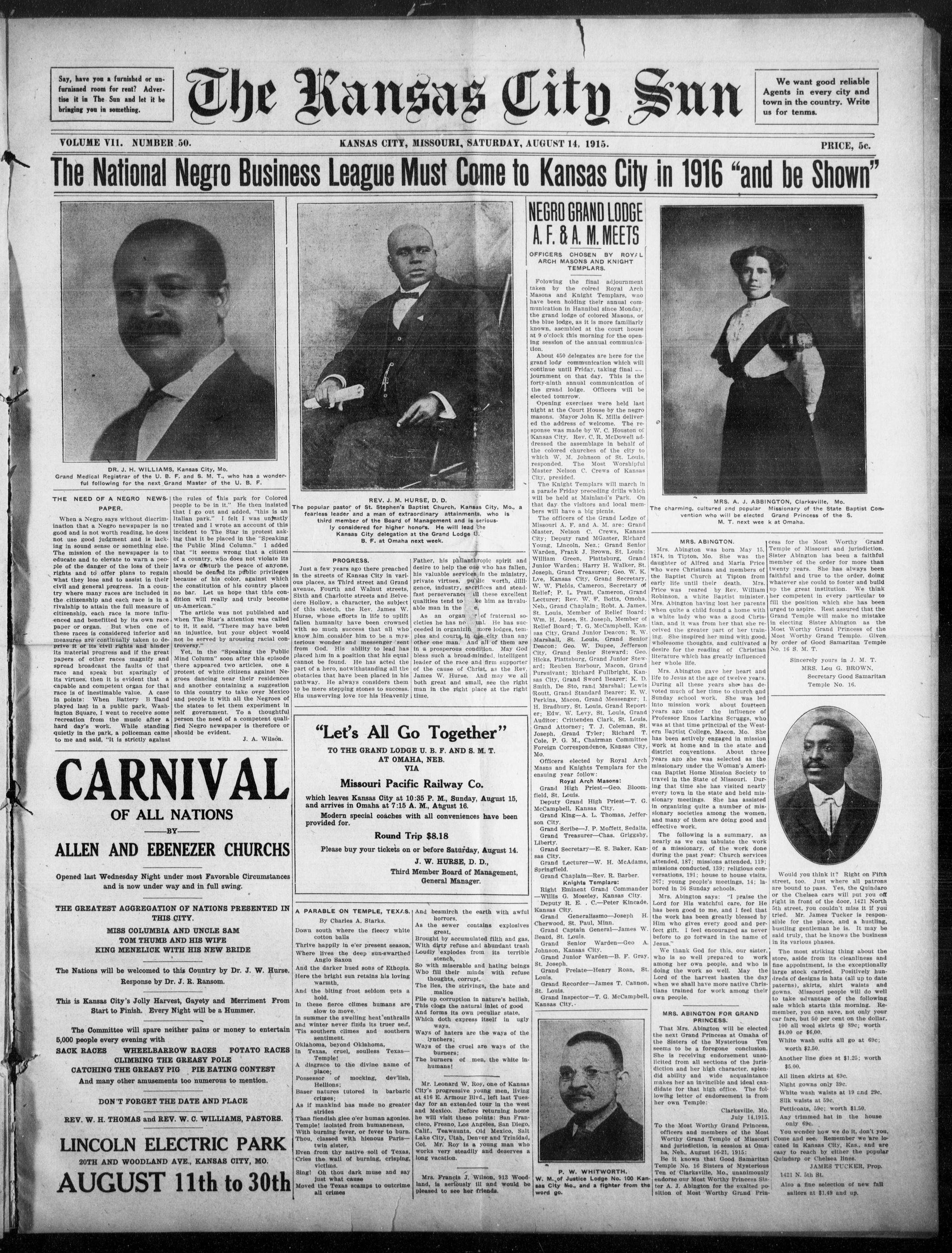
The National Negro Business League Must Come to Kansas City in 1916 "and be Shown"
Say, have you a furnished or unfurnished room for rent? Advertise it in The Sun and let it be bringing you in something.
VOLUME VI1. NUMBER 50.
DR. J. H. WILLIAMS, Kansas
Grand Medical Registrar of the U. B. F. and
ful following for the next Grand M
National Negro B
DR. J. H. WILLIAMS, Kansas City, Mo.
I Registrar of the U. B. F. and S. M. T., who has allowed for the next Grand Master of the U. B.
M.
DR. J. H. WILLIAMS, Kansas City, Mo.
Grand Medical Research Center who has a wonder ful following for the next Grand Master of the U. B. F.
THE NEED OF A NEGRO NEWS PAPER.
When a Negro says without discrimination that a Negro newspaper is no good and is not worth reading, he does not use good judgment and is lacking in sound sense or something else. The mission of the newspaper is to educate and to elevate to warn a people of the danger of the loss of their rights and to offer plans to regain what they lose and to assist in their civil and general progress. In a country where many races are included in the citizenship and each race is in a rivalship to attain the full measure of citizenship, each race is more influenced and benefited by its own race paper or organ. But when one of these races is considered inferior and measures are continually taken to deprive it of its civil rights and hinder its material progress and if the great papers of other races magnify and spread broadcast the faults of that race and speak but sparingly of its virtues, then it is evident that a capable and competent organ for that race is of inestimable value. A case in points: When Battery B Band played last in a public park, Washington Square, I went to receive some recreation from the music after a hard day's work. While standing quietly in the park, a policeman came to me and said, "It is strictly against
CARNIE
OF ALL NATIONS
BY
ALLEN AND EBENEZ
Opened last Wednesday Night under m
and is now under way and
THE GREATEST AGGREGATION OF
THIS CITY
MISS COLUMBIA AND
TOM THUMB AND B
KING MENELICK WITH P
The Nations will be welcomed to this C
Response by Dr. J. R.
This is Kansas City's Jolly Harvest, G
Start to Finish. Every Night
The Committee will spare neither
5,000 people every evening with
SACK RACES WHEELBARROW
CLIMBING THE GRE
CATCHING THE GREASY PIG
And many other amusements too
ARNIVA
OF ALL NATIONS
BY
N AND EBENEZER CHU
Wednesday Night under most Favorable C
and is now under way and in full swing.
TEST AGGREGATION OF NATIONS PRES
THIS CITY.
MISS COLUMBIA AND UNCLE SAM
TOM THUMB AND HIS WIFE
KING MENELICK WITH HIS NEW BRIDE
will be welcomed to this Country by Dr. J.
Response by Dr. J. R. Ransom.
Las Vegas City's Jolly Harvest, Gayety and Merr
start to Finish. Every Night will be a Humme
committee will spare neither pains or money
every evening with
ES WHEELBARROW RACES POTA
CLIMBING THE GREASY POLE
ING THE GREASY PIG PIE EATING CO
many other amusements too numerous to me
CARNIVAL OF ALL NATIONS
Opened last Wednesday Night under most Favorable Circumstances and is now under way and in full swing.
THE GREATEST AGGREGATION OF NATIONS PRESENTED IN THIS CITY.
MISS COLUMBIA AND UNCLE SAM
TOM THUMB AND HIS WIFE
KING MENELICK WITH HIS NEW BRIDE
The Nations will be welcomed to this Country by Dr. J. W. Hurse.
Response by Dr. J. R. Ransom.
This is Kansas City's Jolly Harvest, Gayety and Merriment From Start to Finish. Every Night will be a Hummer.
The Committee will spare neither pains or money to entertain 5,000 people every evening with
SACK RACES WHEELBARROW RACES POTATO RACES
CLIMBING THE GREASY POLE
DON'T FORGET THE DATE AND PLACE
REV. W. H. THOMAS and REV. W. C. WILLIAMS,
LINCOLN ELECTRIC P
20TH AND WOODLAND AVE., KANSAS CITY
AUGUST 11th to
H. THOMAS and REV. W. C. WILLIAMS, I
COLN ELECTRIC P
AND WOODLAND AVE., KANSAS CITY
GUST 11th to
REV. W. H. THOMAS and REV. W. C. WILLIAMS, PASTORS. LINCOLN ELECTRIC PARK 20TH AND WOODLAND AVE., KANSAS CITY, MO. AUGUST 11th to 30th
The Kansas City Sun
the rules of this park for Colored people to be in it." He then insisted that I go out and added, "this is an Italian park." I felt I was unjustly treated and I wrote an account of this incident to The Star in protest asking that it be placed in the "Speaking the Public Mind Column." I added that "it seems wrong that a citizen of a country, who does not violate its laws or disturb the peace of anyone, should be denied its public privileges because of his color, against which the constitution of his country places no bar. Let us hope that this condition will really and truly become un-American."
The article was not published and when The Star's attention was called to it, it said, "There may have been an injustice, but your object would not be served by arousing racial controversy."
Yet, in the "Speaking the Public Mind Column" soon after this episode there appeared two articles, one a protest of white citizens against Negroes dancing near their residences and another containing a suggestion to this country to take over Mexico and people it with all the Negroes of the states to let them experiment in self government. To a thoughtful person the need of a competent qualified Negro newspaper is therefore or should be evident.
NIVAL
NATIONS
BY
GENEZER CHURCHS
Under most Favorable Circumstances
day and in full swing.
N OF NATIONS PRESENTED IN
CITY.
AND UNCLE SAM
AND HIS WIFE
WITH HIS NEW BRIDE
this Country by Dr. J. W. Hurse,
r. J. R. Ransom.
West, Gayety and Merriment From
Night will be a Hummer.
either pains or money to entertain
ROW RACES POTATO RACES
GREASY POLE
PIE EATING CONTEST
its too numerous to mention.
V. W. C. WILLIAMS, PASTORS.
ECTRIC PARK
AVE., KANSAS CITY, MO.
11th to 30th
J. A. Wilson.
KANSAS CITY, MISSOURI, SATURDAY, AUGUST 14, 1915.
The popular pastor of St. Stephen's Baptist Church, Kansas City, Mo., a fearless leader and a man of extraordinary attainments, who is third member of the Board of Management and is seriously considered for higher honors. He will lead the Kansas City delegation at the Grand Lodge U. B. F. at Omaha next week.
"Let's All Go Together" TO THE GRAND LODGE U. B. F. AND S. M. T. AT OMAHA, NEB. VIA
which leaves Kansas City at 10:35 P. M., Sunday, August 15, and arrives in Omaha at 7:15 A. M., August 16. Modern special coaches with all conveniences have been provided for.
PROGRESS.
Just a few years ago there preached in the streets of Kansas City in various places, as Third street and Grand avenue, Fourth and Walnut streets, Sixth and Charlotte streets and Belvedere Hollow, a character, the subject of this sketch, the Rev. James W. Hurse, whose efforts in life to uplift fallen humanity have been crowned with so much success that all who know him consider him to be a mysterious wonder and messenger sent from God. His ability to lead has placed him in a position that his equal cannot be found. He has acted the part of a hero, notwithstanding all the obstacles that have been placed in his pathway. He always considers them to be more stepping stones to success. His unswerving love for his Heavenly
"Let's All Go
TO THE GRAND LODGE
AT OMAHA
Missouri Pacific
which leaves Kansas City at 10
and arrives in Omaha at 7:15 A
Modern special coaches w
provided for.
Round T
Please buy your tickets on
Third
A PARABLE ON TEMPLE, TEXAS.
By Charles A. Starks.
Down south where the fleecy white
cotton balls
Thrive happily in e'er present season,
Where lives the deep sun-swarthed
Anglo Saxon
Anglo Saxon
And the darker hued sons of Ethiopia.
Here the bright sun retains his loving warmth.
And the biting frost seldom gets a hold.
In these fierce climes humans are clear to move.
slow to move.
In summer the swelling heat *enthralls* and winter never finds its truer self, 'Tis southern climes and southern sentiment.
Oklahoma, beyond Oklahoma,
In Texas, cruel, soulless Texas— Temple!
A disgrace to the divine name of place;
Possessor of mocking, dev'lish, Hellions;
Baser natures tutored in barbaric crimes;
As if mankind has made no greater strides
Than fiendish glee o'er human agonies.
Temple! isolated from humaneness,
With burning fever, or fever to burn.
Thou, classed with hienous Paris—
twin sister.
Even from thy native soil of Texas,
Cries the wall of burning, crisping,
victims.
Sing! Oh thou dark muse and say
just what cause
Moved the Texas scamps to outcrime
all crimes
Father, his philanthropic spirit and desire to help the one who has fallen, his valuable services in the ministry, private virtues, public worth, diligence, industry, sacrifices and steadfast perseverance all these excellent qualities tend to take him as invaluable man in the e.
As an organ of fraternal societies he has no anal. He has succeeded in organizing more lodges, temples and courts in one city than any other one man. And all of them are in a prosperous condition. May God bless such a broad-minded, intelligent leader of the race and firm supporter of the cause of Christ, as the Rev. James W. Hurse. And may we all both great and small, see the man in the right place at the right time.
A Go Together"
LODGE U. B. F. AND S. M. T.
OMAHA, NEB.
VIA
Pacific Railway Co.
day at 10:35 P. M., Sunday, August 15,
7:15 A. M., August 16.
aches with all conveniences have been
Round Trip $8.18
kets on or before Saturday, August 14.
J. W. HURSE, D. D.,
Third Member Board of Management,
General Manager.
And besmirch the earth with awful
horrors.
As the sewer contains explosives
great.
Brought by accumulated filth and gas.
With dirty refuse and abundant trash
Loudly explodes from its terrible
stench.
sense,
So with miserable and hating beings
Who fill their minds with refuse
thoughts, corrupt.
The lies, the strivings, the hate and
malice
Pile up corruption in nature's hellish.
This clogs the natural inlet of good
And forms its own peculiar state.
Which doth express itself in ugly
ways.
Ways of haters are the ways of the
lynchers;
Texas—name of Dev'lish, barbaric greater magonies,ness, so burn. Paris—Texas, crisping, and say outcrime
Ways of the cruel are ways of the burners;
The burners of men, the white inhumans!
Mr. Leonard W. Roy, one of Kansas City's progressive young men, living at 416 E. Armour Blvd., left last Tuesday for an extended tour in the west and Mexico. Before returning home he will visit these points: San Francisco, Fresno, Los Angeles, San Diego, Calif., Teawaunta, Old Mexico, Salt Lake City, Utah, Denver and Trinidad, Col. Mr. Roy is a young man who works very steadily and deserves a long vacation.
Mrs. Francis J. Wilson, 913 Woodland, is seriously ill and would be pleased to see her friends.
NEGRO GRAND LODGE A.F. & A.M. MEETS
OFFICERS CHOSEN BY ROYAL ARCH MASONS AND KNIGHT TEMPLARS.
Folowing the final adjournment taken by the colored Royal Arch Masons and Knight Templars, who have been holding their annual communication in Hannibal since Monday, the grand lodge of colored Masons, or the blue lodge, as it is more familiarly known, assembled at the court house at 9 o'clock this morning for the opening session of the annual communication.
About 450 delegates are here for the grand lodge communication which will continue until Friday, taking final journey on that day. This is the forty-ninth annual communication of the grand lodge. Officers will be elected tomorrow.
Opening exercises were held last night at the Court House by the negro masons. Mayor John K. Mills delivered the address of welcome. The response was made by W. C. Houston of Kansas City. Rev. C. R. McDowell addressed the assemblage in behalf of the colored churches of the city to which W. M. Johnson of St. Louis, responded. The Most Worshipful Master Nelson C. Crews of Kansas City, presided.
The Knight Templars will march in a parade Friday preceding drills which will be held at Mainland's Park. On that day the visitors and local members will have a big picnic.
The officers of the Grand Lodge of Missouri A. F. and A. M. are: Grand Master, Nelson C. Crews, Kansas City; Deputy rank MGaster, Richard Young, Lincoln, Nez.; Grand Senior Warden, Frank J. Brown, St. Louis; William Green, Plattsburg, Grand Junior Warden; Harry H. Walker, St. Joseph, Grand Treasurer; Geo. W. K. Lve, Kansas City, Grand Secretary, W. W. Fields, Cameron, Secretary of Relief; P. L. Pratt, Cameron, Grand Lecturer; Rev. W. F. Botts, Omhona, Neb, Grand Chaplain; Robt. A. James, St. Louis, Member of Relief Board; Wm. H. Jones, St. Joseph, Member of Relief Board; T. G. McCampbell, Kansas City, Grand Junior Deacon; R. W. Marshall, St. Louis, Grand Senior Deacon; Geo. W. Dupee, Jefferson City, Grand Senior Steward; Geo Hicks, Plattsburg, Grand Junior Steward; Reuben Barbour, Macon, Grand Pursuivant; Richard Fullbright, Kansas City, Grand Sword Bearer; K. D. Hicks, Plattsburg, Grand Junior Steward; Reuben Barbour, Macon, Grand Pursuivant; Richard Fullbright, Kansas City, Grand Sword Bearer; E. W. Perkins, Macon, Grand Messenger; I. H. Bradbury, St. Louis, Grand Reporter; Edw. W. Levy, St. Louis, Grand Auditor; Crittenden Clark, St. Louis, Grand Attorney; T. J. Coleman, St. Joseph, Grand Tyler; Richard T. Cole, P. G. M., Chairman Committee Foreign Correspondence, Kansas City Mo.
Officers elected by Royal Arch Masons and Knights Templars for the ensuing year follow:
Royal Arch Masons:
Royal Arch Masons.
Grand High Priest—Geo. Bloom
field, St. Louis.
Deputy Grand High Priest—T. G
McCampbell, Kansas City.
Grand King—A. L. Thomas, Jeffer
son City.
Grand Scribe—J. P. Moffett, Sedalia
Grand Treasurer—Chas. Griggsby
Liberty.
Grand Secretary—E. S. Baker, Kansas City.
Grand Lecturer—W. H. McAdams, Springfield.
Grand Chaplain—Rev. R. Barber.
Knights Templars:
Right Eminent Grand Commander—Willis G. Moseley, Kansas City.
Deputy R. E. . C. Peter Kincade, Kansas City.
Grand Generalissimo—Joseph H. Cherwood, St. Paul, Minn.
Grand Captain General—James W. Beard, St. Louis.
Grand Senior Warden—Geo A. Johnson, Kansas City.
Grand Junior Warden—B. F. Gray,
St. Joseph.
Grand Prelate—Henry Roan, St.
Louis.
Grand Recorder—James T. Cannon,
St. Louis.
Grand Inspector—T. G. McCampbell,
Kansas City.
P. W. WHITWORTH.
W. M., of Justice Lodge No. 100 Kansas City Mo., and a fighter from the word go.
Mary E.
MRS. A. J. ABBINGTON, Clarksville, Mo.
The charming, cultured and popular Missionary of the State Baptist Convention who will be elected Grand Princess of the S.
M. T. next wee k at Omaha.
MRS. ABINGTON.
Mrs. Abington was born May 15, 1874, in Tipton, Mo. She was the daughter of Alfred and Maria Price who were Christians and members of the Baptist Church at Tipton from early life until their death. Mrs. Price was reared by Rev. William Robinson, a white Baptist minister. Mrs. Abington having lost her parents when quite a child found a home with a white lady who was a good Christian, and it was from her that she received the greater part of her training. She inspired her mind with good wholesome thoughts, and cultivated a desire for the reading of Christian literature which has greatly influenced her whole life.
Mrs. Abington gave her heart and life to Jesus at the age of twelve years. During all these years she has devoted much of her time to church and Sunday school work. She was led into mission work about fourteen years ago under the influence of Professor Enos Larkina Scruggs, who was at that time principal of the Western Baptist College, Macon, Mo. She has been actively engaged in mission work at home and in the state and district conventions. About three years ago she was selected as the missionary under the Woman's American Baptist Home Mission Society to travel in the State of Missouri. During that time she has visited nearly every town in the state and held missionary meetings. She has assisted in organizing quite a number of missionary societies among the women, and many of them are doing good and effective work.
The following is a summary, as nearly as we can tabulate the work of a missionary, of the work done during the past year: Church services attended, 187; missions attended, 119; missions conducted, 139; religious conversations, 191; house to house visits, 267; young people's meetings, 14; labored in 36 Sunday schools.
Mrs. Abington says: "I praise the Lord for His watchful care, for He has been good to me, and I feel that the work has been greatly blessed by Him who gives every good and perfect gift. I feel encouraged as never before to go forward in the name of Jesus."
We thank God for this, our sister, who is so well prepared to work among her own people, and who is doing the work so well. May the Lord of the harvest hasten the day when we shall have more native Christians trained for work among their own people.
MRS. ABINGTON FOR GRAND PRINCESS.
That Mrs. Abington will be elected the next Grand Princess at Omaha of the Sisters of the Mysterious Ten seems to be a foregone conclusion. She is receiving endorsement unsolicited from all sections of the jurisdiction and her high character, splendid ability and wide acquaintance makes her an invincible and ideal candidate for that high office. The following letter of endorsement is from her own Temple:
Clarksville, Mo.
July 14, 1915.
To the Most Worthy Grand Princess, officers and members of the Most Worthy Grand Temple of Missouri and jurisdiction, in session at Omaha, Neb., August 16-21, 1915:
Be it known that Good Samaritan Temple No. 16 Sisters of Mysterious Ten of Clarksville, Mo., unanimously endorse our Most Worthy Princess Sister A. J. Abington for the exalted position of Most Worthy Grand Prin-
We want good reliable Agents in every city and town in the country. Write us for tenms.
PRICE. 5c.
and be Shown"
BINGTON, Clarksville, Mo.
Missionary of the State Baptist Con-
d Grand Princess of the S.
ee k at Omaha.
cess for the Most Worthy Grand Temple of Missouri and jurisdiction. Sister Abington has been a faithful member of the order for more than twenty years. She has always been faithful and true to the order, doing whatever she could to foster and build up the great institution. We think her competent in every particular to fill the position which she has been urged to aspire. Rest assured that the Grand Temple will make no mistake in electing Sister Abington as the Most Worthy Grand Princess of the Most Worthy Grand Temple. Given by order of Good Samaritan Temple No. 16 S. M. T.
Sincerely yours in J. M. T.
MRS. Lou G. BROWN,
Secretary Good Samaritan
Temple No. 16.
Would you think it? Right on Fifth street, too. Just where all patrons are bound to pass. Yes, the Quindaro or the Chelsea cars will put you off right in front of the door, 1421 North 5th street, you couldn't miss it if you tried. Mr. James Tucker is responsible for the place, and a hustling, bustling gentleman he is. It may be said truly, that he knows the business in its various phases.
The most striking thing about the store, aside from its cleanliness and fine appointment, is the exceptionally large stock carried. Positively hundreds of designs in hats (all up to date paterns), skirts, shirt waists and gowns. Missouri people do well to take advantage of the following sale which starts this morning. Remember, you can save, not only your car fare, but 50 per cent on the dollar.
100 all wool skirts @ 89c; worth $4.00 or $6.00.
White wash suits all go at 69c; worth $2.50.
Another line goes at $1.25; worth $5.00.
All linen skirts at 69c.
Night gowns only 39c.
White wash waists at 19 and 29c.
Silk waists at 59c.
Petticats, 59c; worth $1.50.
Any trimmed hat in the house only 69c.
You wonder how we do it, don't you, Come and see. Remember we are located in Kansas City, Kas., and are easy to reach by either the popular Quindaro or Chelsea lines.
Also a fine selection of new fall sailors at $1.49 and up.
INTERNATIONAL
SUNDAY SCHOOL
LESSON
(BY E. O. SILLSER, Acting Director of
Courses. The Moody Bibs
Institute of Chr. Education.
JEROBOAM LEADS ISRAEL INTO
SIN.
LESSON TEXT-I Kings 12:25-33.
GOLDEN TEXT-Thou shalt not make
unto thee a graven image, nor any like-
ness of anything that is in heaven above,
or that is in the earth south, or that
is in the water under the earth; thou shalt
not bow down thyself down unto them,
nor serve them. Ex. 20:4, 5a.
Whether Jeroboam incited Israel's
rebellion or was summoned home because
of his being known as an an-
ponent to Israel, we cannot say. He
must have remembered Ahijah's
prophecy (11:29-40) and he had another
prophet on his side, Shemaiah
(12:22-24), though Ahijah afterwards
deserted him (14:1-18). In Egypt,
Jeroboam had learned of the worship
of the bull Apis and upon setting up
his kingdom, saw at once the need of
centering the religious life of the people
elsewhere than in Jerusalem.
1. "Calves of Gold" vv. 25-30. Given these ten tribes by God (11:31) the people had chosen Jeroboam without seeming consultation with God, and the result was a tragic future for the Hebrews. David's monarchy lasted scarcely two generations. Jeroboam's second attempt at coercion (12:21-24) is rebuked and he settles down in Judea but fortifies many cities (11:21-24) Chron. 11:5-12; I Kings 12:24; 14:17) Jeroboam likewise built cities, Shechem and Penuel, but the result of the schism was a weakened people and Israel was the first to be carried into captivity and to extinction as a nation. Defensed cities are not adequate safety for a nation (11:38; 2 Chron. 20:20; Zech. 1:4, 5). Witness Lice and Antwerp. As a matter of political prudence Jeroboam's scheme of removing the center of worship from Jerusalem succeeded admirably. The center of gravity of a man and of a nation is that place where he centers his worship. The temple had no image, and his setting up of his images of bulls was a backward step, though doubtless it was regarded as fatal for the nation. Jeroboam's fatal error was in deflecting the people from the creations of their own hands. Mankind always prefers to trust to their own devices and to plan their own deliverance rather than to trust in God. The evidence of our trust in God is to obey him. Note Jeroboam took counsel, not as did Rehoboam, of the aged or the young, but "in his heart." We are not to lean to our own understanding but upon the Holy Spirit (John 16:13). Man is "slow of heart" and that one at all familiar with Hebrew history should repeat the mistake Aaron made is scarcely to be understood (Ex. 32:4-8). The errors and "isms" of today are but a repetition of the false teachings of former days dressed in a new garb, labeled with a new name; such is the deceitfulness of the human heart (Jer. 17:9). Jeroboam's excuse was plausible enough (v. 28) and appealed to the ever-present weakness of the human heart to seek some easier way of serving God. But man's way always becomes the hardest way. Jeroboam today would be classed as a "liberal" and held up as a "broad minded man." Note his cunning appeal to sacred memories (v. 28).
II. "Priests of the Lowest" vv. 31:33 Jeroboam's real concern was not that of the people but the permanency of his kingdom. Jeroboam was not introducing a new God but a new way of worship. One step always leads to another, and to fully establish this new way, and at the same time entirely to control the situation, he selected from among "all the people" priests who were to carry on Jehovah's worship. God had selected the sons of Levi and specially ordained them for this service (Num. 3:10) When the devil introduces a new religion, or any false idea of Christ, or the Bible, he always appeals to sacred memories, or else claims a "modern expression of the truth." Jeroboam not only chose those who would be beholden to himself, but he also selected positions in his kingdom, at either end, each of which was easily accessible. Thus to build and thus to select others than the sons of Aaron as priests was expressly forbidden. But such is the natural perversity and stubbornness of the human heart that it readily follows its leaders into all sorts of apostasy and error (Rom. 8:7). Jeroboam also changed (v. 32) the feast ordained of God on the 15th day of the seventh month (Lev 23:33, 34) to one occurring in the eighth month. No possible appeal of local interests warranted any such substitution; to obey is better than to modify (Matt. 15:6; Mark 7:13). The last verse (v. 33) tells us whence all of these changes originated, "of his own heart"—hence it is not surprising that he finally assumed to himself the priest's office (I Sam. 13:12, 13; 2 Chron. 2:16), a crowning act of apostasy and presumption.
III. The Main Teaching. Jeroboam's chief purpose was not the glory of God, but this new religion was for personal safety and glorification. His cunningly devised program became the agent of his own and the nation's destruction (13:34; 14:7-11; 2 Kings 10:29, 31), and his opprobable title has become "Which made Israel to sin." Graft and trickery succeed for a time but only those who obey God in all things build on a solid and lasting foundation. "Nothing in this world is worth doing wrong for." Boys do not succeed by breaking the rules of the game. Bad habits and vice are but a defiance of God's laws. There is no sadder sight than that of shipwrecked souls seeking their own gains at the cost of the ruined bodies and souls of their fellow men. To seek to clothe the calves of Egypt with modern religious inventions is the devil's most cunning device.
AIR NEEDED IN ICE BOX
Provision for Proper Circulation is as Much a Necessity as Supply of Cooling Material.
It is astonishing how little the average housekeeper knows about ice. Some women seem to think all there is about ice is to have the man put it in the refrigerator. Others, more careful, think to save the ice bill by putting some kind of covering over the ice.
True, the ice does not melt so quickly with the cover, but then again, since it does not melt, it has no cooling effect. Unless ice melts it is useless. The faster it melts the colder the ice-box becomes.
The most important feature of a good refrigerator is ample facility for a free circulation of air when the box is closed. Cool air, being heavier than warm air, sinks. The warm air rises. For this reason the coldest place in the refrigerator is the bottom and not the ice chamber, as so many people think it is and consequently often put butter or milk directly in with the ice.
There must be suitable passages to allow the warm air rising from the things placed in the refrigerator to flow to and over the ice at the top, and for this same air when cooled and purified by the melting ice, to return into the food chamber.
The circulation continues until the temperature is equalized. While this circulation proceeds the ice melts rapidly, but, when the temperature is once equalized the ice melts very slowly, that is, if the door fits tight. It will pay in the end to keep the ice compartment well supplied with ice. It should never be less than one-quarter full. The ice melts faster, and with less cooling effect, when the supply is low.
KITCHEN HINTS OF MOMENT
Proper Receptacles for the Preservation of Food—Meat When Roasting Should Be Kept Covered.
Everybody does not know that food in general should not be allowed to cool in tin, copper or iron. It must be placed while hot in agate, china or well glazed eaten ware.
Green vegetables should be dropped into boiling water to which a pinch of bicarbonate of soda has been added. Put in salt when the article is half cooked.
If you have covered a pan in which meat is to be roasted never open it to baste the meat. Keep it covered from start to finish. The idea is that the pans are filled with steam, which penetrates the fibers of the meat. If desired to brown the outside leave the cover off for the first half hour in a quick oven.
The shank bones of mutton, of so little general value, if well soaked add to the richness of gravies and soup stock.
When boiling haricot beans or dried limas do not put in the salt until they are nearly cooked, otherwise they are apt to split and come out of their skins. They should be brought to the boiling point, that water poured off and fresh boiling water poured over them.
Whitman University
Whipping Cream Should Be Cold.
Often the housewife finds that the cream she has will not whip. The department's dairy specialists point out that to obtain satisfactory results in whipping cream it should be cold and of the right thickness, containing about 30 per cent or more of butterfat. Ordinary cream, designated as coffee cream by the trade, is altogether too thin to give good results. The whipping cream, as delivered by the milkman, contains 30 to 40 per cent of butterfat. Thoroughly chill the cream before whipping by placing it in a covered bowl on the ice. The whipping process is also aided and hastened by standing the bowl in a pan of ice water.
Scotch Broth.
Beef Tea Meat.
Remove all gristle and fat from meat intended for beef tea. Place these trimmings in a pan with sufficient water to cover them, and add any vegetable to hand cut up small. Allow to simmer, then add the meat from the beef tea. Simmer for four hours, then strain through a hair sieve and pour the liquid into a mold to set. When cold it will be a nourishing jelly, suitable for invalids. The vegetable used must be quite fresh.
Nut Soup.
Pound six bitter almonds and boll in three pints of milk, add half a tea spoonful of salt and three tablespoonfuls of sugar. Beat separately three eggs, adding the stiffly frosted whites very lightly to the yolks. Let the milk cease boiling, remove from the ire and whisk in the eggs till all is a foam. Serve hot in small bowls.
For the Tea Table.
Cookies, jumbles, and small cakes are in constant demand on the teatable, and where there are young children in the family two or three find their way into the school lunch box each day. To make their small cakes require time and patience, but if success rewards the efforts the cook does not regret the time spent.
Cocoanut Cakes.
Mix together one-half pound of four, one-fourth pound each of butter and sugar and two eggs. Add a small cupful of milk and one tablespoonful of baking powder. When well mixed put in a cupful or more of grated cocoanut. Bake in small buttered tins in a moderately quick oven.
AFRO-AMERICAN CULLINGS
For a long time it has been suspected that the art of working iron began among the Negroes in Africa. Now it is so well confirmed that there seems little doubt about it.
Bronze was the first metal of which man availed himself. Just how that came about is uncertain. Copper and tln were abundant, but were of little value for weapons or cutting implements, when someone conceived the idea that by combining them a serviceable set of tools was easy.
It is believed that the idea may have come from Asia Minor, where the two metals are found in combination. All the weapons of the Homeric age were bronze, and steel swords and knives do not appear to have been common until about 700 or 800 years before the Christian era.
Archeologists have come across specimens of iron in Egypt which have puzzled them. Recently in opening some graves in Nubia, the ancient Ethiopia, an iron spearhead was found in good condition. The grave dates from about 3400 B. C. and in any event was long before iron was known elsewhere.
This spearhead was discovered by an expedition of the University Museum, Philadelphia, which was excavating for ancient relics. It is now in the museum, and the astonishing thing is that it is precisely like the spearheads made by the natives in Africa today.
The native village blacksmith is an important personage. He is usually a wanderer, like the travelling tinker, but there seems to be a rather closely organized guild among them. The bellows are small and are worked generally by two men. They keep the fire very hot. The smith often uses a stone for an anvil, and his hammers are very rude. Seeing these crude implements, one would never suppose it possible to accomplish much, but they turn out some really admirable work.
They work with considerable ceremony and are highly esteemed. Witchcraft enters into their ceremonies and the natives believe that only thus can good work be accomplished.
The appearance of the blacksmith is the sign for ceremonial dances in the village. All join in. Dancing does not seem to enervate the natives and apparently takes the place of sleep.
The African villages are kept so clean that the university explorers on their return were shocked at Philadelphia and New York. In Africa the chief is the head sweeper, and if everything is not as neat as a pin he is deposed and sometimes loses his head—not his official head, but his real one.
The native ironworkers of darkest Africa are fast disappearing, because traders are gradually entering the country and selling cheap wares, which puts the Negro smith out of business. There still remains, however, a number of sections where the smith is a mighty man, even more respected than he of whom Longfellow sang.
The work of the native smiths always begins with dancing, in which the entire village joins. Then there is a feast. Next day, if iron has to be smelted, the ore is first offered to the image of the native god by the handsomest girl of the tribe. Throughout the work the chief is in attendance, watching the smiths as they sit in a ring.
Every day the bell of Eton college chapel is tolled for a quarter of an hour for Etonians killed in the war.
In one of the young ladies' schools in a suburb of Berlin the pupils sent a committee to the principal asking her to discontinue instructions in French and English, as it would be unpatriotic to learn the language of "nations who, in such an infamous manner, had dragged Germany into war." It took the principal considerable time to show the girls why their request could not be compiled with.
At a Christmas-tree festival in South Paris, Me, the gifts were taken from the tree by a young lady who had recently been married. During the distribution she found one package with a name she didn't recognize, so she laid the gift aside. As the packages disappeared she began to wonder where her own was, and finally realized that the discarded package bore her own new name.
If it is anything her husband told her about his life before he married her, a wife never forgets it.
Potatoes, cabbage, celery, cauliflower, lettuce, carrots and turnips of fine quality are extensively grown in Yukon territory, Canada. Potatoes are the principal crop, retailing at five cents a pound.
If you want to hear a lot of reasons talk to the ball player who has been released.
A government survey has resulted in ranking the Yukon river in fifth place among the great streams of North America.
Is Your Chum a Graduate-to-Be?
Because, if she is, you will surely want to remember the occasion with some appropriate gift, even though it costs but a little. One of the prettiest, daintest and most girlish frills seen lately is a set of ribbon jewelry. Sounds pretty and dainty, doesn't it girls? And it is. You will need a piece of ribbon velvet one and a half yards long and three-eighths of an inch wide for the chain, a piece five inches long and one inch wide for the pin and another strip eight inches
In a considerably enlarged and greatly improved form the Negro Year Book for 1914-15 makes its appearance. The success of the previous issues has encouraged the publishers to believe that there is "a very real need for a book which will provide, in an inexpensive form, a succinct, comprehensive and impartial review of the events of the year which affect the interests and indicate the progress of the race." It attempts to "provide this, together with a compact but comprehensive statement of historical facts arranged for ready reference. It seeks to be at once a permanent record of current events, an encyclopedia of historical and sociological facts, a directory of persons and a bibliographical guide to the literature of the subjects discussed."
The topical arrangement of the volume is admirably done, placing before the reader full and essential information on a variety of subjects. In a general review of the past year many interesting facts are brought out in this volume that would otherwise have little attention: That a little colored girl in the public schools of Cincinnati won the first prize for an essay on the subject, "What I can and Will Do to make Cincinnati a Better and Bigger City;" that Frances O. Grant graduated at the head of her class at the Girls' Latin school in Boston and won the Griswold scholarship to Radcliffe; that Isaac Fisher, editor of the Negro Farmer, Tuskegee, Ala., won three first prizes in national competition, the first of $100 from the St. Louis Post Dispatch for "The Ten Best Reasons Why Persons Should Come to Missouri," the second from the Wales Visible Adding Machine company, for the best essay on "What Do You See in an Adding Machine?" and the third from a woman's magazine for the best essay on "A Criticism of the Criterion of Fashion." The account of what Negroes have contributed to education, the wealth and accomplishments of individual Negroes make, with a vast amount of other information, a surprising and valuable record.
One of the greatest and most representative gatherings of Afro-Americans ever assembled in the Lone Star state will be present at Austin during the Sunday school and Baptist Young People's union chautauqua, which holds forth August 16-23 inclusive. Negroes of all walks of life will be there, from men of international reputation to boy cadets, who will be on hand in great numbers to lend their assistance to the occasion.
From present indications Houston will be well represented, both by cadets from the various Sunday schools and delegates from the Sunday schools and Baptist Young People's unions. The Houston delegation will go in special cars in charge of C. F. Richardson and R. B. H. Yates.
In Austin Revs. J. B. Plus and D. A. Scott and others are making ample preparations to care for a monster crowd. Interest is intense throughout the state in this great meeting, and the railroads have granted a rate of one and one-third fare for the round trip. It promises to eclipse all former meetings of its kind in the South among Afro-Americans. Capt. John Sessums' Zouaves will also make the trip and hope to set a pace for all the other companies.
When it is necessary for a town to pass the hat the first move made is to secure an influential citizen to do it.
H. P. Ewing, the former potato king of the Kaw valley, returned to Kansas City from a lecture tour through Oklahoma, where he has been advocating the back-to-the-farm movement for Negroes. Ewing has a farm west of Argentine, where Negro boys are taught how to farm. He lectured at Tulsa, Bartlesville, Muskogee, South McLester and Wybark, Okla. The Commercial club of Tulsa offered to help in the movement, and two hundred acres of ground were pledged. At Bartlesville a quarter section was offered. A farm of 160 acres is now under cultivation at Wybark.
An institute in Kansas City similar to the Tuskegee institute in Alabama, where Negroes are taught to earn their livelihood, is planned by Ewing.
"O God, we thank Thee for success and victory of our army and navy. Grant unto us, if it please Thee, more decisive victories. We pray Thee protect our sailors, naval men, and civilians from mines and torpedoes, and our shores from the designs of the enemy. Through Jesus Christ, Amen."—Advertisement in Edinburgh Scotsman.
Besides 39 newspapers printed in English. New York city has 10 in Italian, 7 German, 7 Jewish, 3 Greek, 3 Hungarian, 2 French, 2 Bohemian, 2 Croatian, 1 Spanish, Servian, Syrian and Chinese.
For sorting fruit as it is picked from a tree there has been invented a tube that separates the small from the large as they slide down it.
Circumstantial evidence seldom is strong enough to induce the jury to convict an attractive woman.
long and one inch wide for a bracelet. The chain is crossed and fastened with a tiny hook and silk eyellet ten inches from the ends. Over the fastening is a bunch of silk flowers. Just above the fastening five tiny silk flowers are sewed on. At the neck use the velvet, one inch wide, for the bar-pin effect, also ornamented with tiny flowers. Tie a knot in the center and fasten one end, pointed, to the chain with a few stitches and let the other end be attached with a small hook and eye.
(Copyright, 1915, by W. G. Chapman.)
"A brand from the burning!" proclaimed wheezy, parsimonious Daniel Britt. "I've put Bob Elston on his feet. I hope he keeps his good resolutions which I—ha, hum—have tried to instill."
Old Britt indicated a figure going down the street. It was Bob Elston whom everybody in town knew for a neer-do-well, but pitted him and liked him.
As to Daniel Britt, the knowing ones smiled and shrugged their shoulders. It was true that he had given young Elston a suit of old clothes, but it was also current knowledge that Elston in some unaccountable spirt of sobriety had delved and labored in the Britt garden for a full ten days, receiving half pay.
Britt made great capital of his "charity" all that day. The next, however, his feathers drooped. More unsteady and ragged than ever, Bob Elston appeared on the streets of the village. He had sold his clothes and was back in his old attire. He was blindly, steadfastly intoxicated. The demon of rum had him fully in his power once more. "Did my duty, it's off my mind," commented Britt, and poor Bob as an acknowledged institution of the lower type of the time proceeded to prolong his spree. It was about a week after that when Donald Pearce, a rising young lawyer of the town, coming down the turnpike in his automobile, nearly ran
A man in a suit and hat stands in a field, holding a book.
It Was Filled With Bank Notes.
down a lurching, indifferent figure in
the middle of the road. His machine just grazed Elston and pushed him aside.
"Narrow escape that, Bob," observed Pearce, in a warning, but friendly tone. "I should think you'd about cut this drink business out."
"Would," stammered Elston, "but I'm afraid of the tremens," and he shuddered.
Pearce eyed him speculatively. He knew Elston as an irresponsible village feature, he felt sorry for him and wondered mentally if it would do any good to try and sober him up.
"See here, Elston," he said, "you've got too much material in you to throw it to the winds this way. Why don't you brace up?" and he tried a lot of coaxing arguments on his subject, but Elston was impervious to them all. He was at that stage where the liquor lay dead in him, afraid of the "horrors" and he fell behind with a disconsolate face.
"Come to me if I can ever help you—sober, though, mind you," halled Pearce in part, and waived his hand in a friendly, encouraging way, not noting that the movement disarranged something from his outside coat pocket, which fell into the road over the side of the machine.
Elston, coming along, saw it, picked it up. It was a pocketbook and it was filled with bank notes. For a moment the drink-bleared eyes glowed with covetousness. Then Elston thrust it out of sight inside his coat, muttering:
"No, I won't be a thief, if I am a drunken wreck. Pearce spoke right to me. I'll act the man," and half an hour later he reached the office of the young lawyer and returned the pocket-book.
"Whew," whistled Pearce, for the first moment aware of his loss. "There's twelve hundred dollars mortgage money paid me by a farmer. I say—"
He was pettified at the simple honesty of this lost soul. He pulled Elston into his private office.
"Old fellow," he said gratefully, "you've got to let me repay this big act of yours. The woman who keeps my office in order has a neat little home. I'm going to get you a room there. You'll have the best of care. Rest for a week and let me put you on your feet."
"I'm afraid," returned Elston dejectedly. "I can't bear to shut up. I'm afraid of the tremens, and want to be where I can get the drink if I begin to see things."
For a long time Pearce pleaded with the poor unfortunate. At length Elston said:
"I'll try it, on one condition."
"And what is that?"
"You trust me."
"I guess I will, after your bringing back that lost pocketbook!"
"I want you to buy me a quart bottle."
the of whisky. I want to keep it by my side. On my honor, I will not touch a drop of it unless I feel the tremens coming on. It will help me out to know I've got it, if I reach the limit of endurance."
"Done!" cried Pearce, "and I know you'll conquer."
Elston did. At the end of a week, once more clothed again in his right mind, he took a walk with Pearce. As they reached a quiet spot he took out the bottle. Its contents were intact. He gave it a fling against a rock and it shivered into a thousand pieces.
"That's the end of drink for me," he said, quietly but determinedly. Now a queer thing came about. Pearce got to question Elston about his past. He found that his only living relative was a sister, a milliner in a town fifty miles distant. Elston had kept away from her on account of his drinking. Pearce suggested that he go and see the sister.
"I've got an uncle living in Marden," he explained. "I'll get you work there. You will be happier and safer near your sister."
The first moment Pearce set his eyes on Dorothy Elston, the pretty milliner, with her sweet, winning ways, he fell in love with her. He got his old uncle in Marden to employ Elston. The uncle was an eccentric recluse, something of a scientist and had a good collection of curios and was a good deal of a naturalist.
Two months went by. Pearce made a good many visits to Marden. He got on famously with Dorothy Elsten, and her brother was keeping away from strong drink. His employer had sent him away from town on a mission of importance one evening, and Pearce stayed with his uncle that night, leaving early in the morning before his uncle was awake.
Serious news reached him in his own town before nightfall. His uncle had been robbed of a large amount of jewelry. The fact of Pearce being at the house and leaving as he did, led to gossip, and then suspicion. Elston could prove that he was absent when the old man, now turned sour and suspicious, had been robbed. The latter did not prosecute, but he ignored his nephew and former heir after that.
Elston returned to Marden greatly perturbed over the charge that affected the man who had been his best friend. All one day he prowled about the old house, trying to figure out how and why his employer was robbed.
One day another stranger met Elston and scraped up an acquaintance with him. He informed Elston that the man in jail was a friend of his.
"I want to get some money to him so he can buy little necessaries," explained the man. "You're acquainted here and you can get into the jail. Just give him the money, will you—ah, yes, and this cigar."
Elston assented. The mission would enable him to get closer to the prisoner. On the way to the jail, however, he happened to notice the cigar. It felt soft in the center. He suspected something and investigated. It was to discover a note packed into small compass, and reading:
"I can't hang around here for fear of exciting suspicion. Your share of the loot is hidden in the loft of the old shed back of the house we robbed."
Immediately Elston set the officers on the trail of the man who had given him the money and cigar. He was captured, confessed, and Pearce was restored to the good graces of his uncle. Donald Pearce blessed the hour he had reclaimed from the dregs the reformed derelict who saved his good name, and led to his gaining the dearest, sweetest wife in the world.
1,800 Pies an Hour.
The fastest machine devised for making pies is operated by a foreman and six assistants and will turn out 1,800 pies an hour. The machine is provided with 18 revolving pie holders, which move around an oblong table or platform; two crust rollers, one for the lower and the other for the upper crust; a set of four automatic moistening brushes, and a pltrimming wheel. The six operators of the machine place the crusts, fill the pies and remove them from the table when the operation of moistening and trimming has been automatically completed—World's Work.
Vacancies Are Scarce
Sackville McKnutt, the famous detective, was in a reminiscent mood. "I have often read in the papers," he said, "where some so-called captain of industry, man, bewailed the fact that there are no longer any $25,000-a-year man. And, applying my own peculiarly efficient system of ratiocation, I observe that the best jobs these 'tired' fellows have at their disposal are filled either by immediate relatives or by the relatives of large stockholders, with no chance whatever for a $25,000-a-year man to break in at any price."—Kansas City Star.
Up to Date.
"Oh, yes," said Mrs. Noovowe, fanning herself vigorously, "Jim and me tries always to be strictly up to date. In place of a cook we have a chef to run our kitchen for us; and we've had a taximeter put on to our car to show us how much we save by runnin' our own, and on top o' that, Jim has employed one o' the best artichokes in the country to draw plans for remodelin' our old stable into a first-class garbage."
Discovery of Coal in America.
Coal was first discovered in the Lehigh regions of Pennsylvania in 1791 by a poor hunter named William Glenter, near the present town of Mauch Chunk. It was not until 1804 that coal mining was begun along the banks of the Mississippi as well as along the Yellowstone. And it was in this same year that coal was first successfully used in this country for heating purposes.
ESPECIAL ATTENTION NEES-
SARY DURING HOT WEATHER.
Many Iills May Be Avoided by Watch-
fulness on the Part of the Moth-
er—Government Expert Gives
Advice Worth Heeding.
(Prepared by the Children's Bureau, U.
S. Department of Labor.)
"Summer complaint," or diarrhea, is one of the most dreaded ills which may befall the baby.
It is the principal symptom of various forms of indigestion, some of them mild and some very serious. But any undue looseness of the baby's bowels should put the mother on guard against illness.
At the appearance of diarrhea, the city mother should take her baby to a good doctor. If she has no doctor, she should go to the nearest infant welfare station, where a competent physician will advise her as to the care of the baby, and the nurses in attendance will help her carry out his directions.
In the country, where it is very difficult to get the advice of a doctor, the mother has a harder problem. Because she is out of the range of infant welfare stations, hospitals, and, often, of physicians as well, it is most important to prevent every attack of illness possible, by careful attention to the baby's food and general care.
A pamphlet which may be of help to the country mother is "Infant Care," sent free to anyone mailing a request to the chief of the children's bureau, U. S. department of labor, Washington, D. C. This pamphlet contains simple directions for the care and feeding of the baby, and suggests some ways of dealing with various emergencies. The healthy baby usually has one or two bowel movements a day. If this number is increased to four or more it is time to take measures against sickness.
It is well to remember, however, that the bowel movements of a baby fed entirely at the breast are normally more frequent than those of a bottle-fed baby, and that a slight increase in the number of movements is not so serious a matter to a baby at the breast as to one artificially fed. A baby fed at the breast does not usually have diarrhea, and when such a baby shows signs of digestive disturbance, it is usually because he is overfed, either he is nursed too often, or at irregular intervals, or is allowed to nurse too long at one time. When he does have diarrhea, the time between nursings should be increased to four hours, and the time at the breast reduced to five or ten minutes. If the bowels continue loose, the breast should be withdrawn entirely for several feedings, if necessary, giving the baby instead cool drinking water at frequent intervals. In this case, the mother should pump her breasts at the regular nursing times, both to keep them from drying up, and to prevent their caking.
Bottle-fed babies are the most frequent sufferers from summer diarrhea, and this fact furnishes another strong argument in favor of breast feeding. Diarrhea in a bottle-fed baby is also best treated by reducing the amount of food. The bottle should be omitted for 8, 12 or 24 hours, according to the severity of the attack, and in place of the milk should be given as much boiled and cooled water as the baby will take.
Food should not be withheld for more than 24 hours, without the advice of a doctor. When the bottle is resumed, the food should be much weaker than before; water should be substituted for at least half the milk previously given. The milk should be skimmed, and the sugar omitted.
The return to the former feeding should be made gradually by adding a little more milk each day and beginning to add sugar. The more severe the attack has been, the more slowly should changes be made.
If the baby is on "mixed" feeding, that is, partly breast and partly bottle fed, the bottle feedings should be omitted if diarrhea appears, and the breast given once in four or five hours, with nothing but drinking water between meals.
Diarrhea is much more frequent in July and August than in the cooler months of the year, which fact has earned for it the name of "summer complaint." Accordingly the mother should use every means in her power during the hot weather to keep the baby cool. In the heat of the day the baby should wear only a diaper, with possibly one other thin garment.
Frequent cool spongings and at least one full tub bath each day, plenty of sleep, and a constant supply of fresh air will help to protect the baby from the excessive heat, and keep him well.
Raspberry Puffs.
Cook one cupful of boiling water, four tablespoonfuls of butter, tablespoonful of sugar and one-half salt-spoonful of salt until the butter melts; add one and one-half cupfuls of pastry flour, stir until the mixture leaves the sides of the pan, remove from the fire, cool and add three large unbeaten eggs, one at a time, beating thoroughly between each addition. Press through a pastry bag on buttered and floured tins, bake about half an hour, cool, cut a slit in each and fill with raspberry jam.
Grape Sago.
Wash one cupful of sage and soak in three cupfuls of cold water for two hours. Cook till transparent and add one cupful of grape juice and one cupful of sugar. Turn into a mold and serve very cold. Currant jelly may be substituted for grape juice by thinning a tumblerful of the jelly with one cupful of boiling water.
Flemish Options.
Slice thinly green apples and onions, sprinkle with flour and brown in butter, using equal quantities of apple and onion. Place in layers in a baking dish with buttered crumbs, season with lemon juice and finish the top with buttered crumbs. When the crumbs are brown the dish is ready to serve.
STYLES FOR THE FALL
PARIS OPENINGS PUT OFF UNTIL
FIRST OF AUGUST.
Flattened Hips Hinted at in Advance Models—Silver Lining to Overshadowing Cloud of Full
The majority of the leading houses in Paris put off the dress openings of the season until the first of this month, although we were promised all the news of clothes by the second week of July.
What the reason was for the change in dates—whether the paucity of American buyers in Paris early in the month of July, or the difficulty of getting ready a new set of models after the manufacturers had depleted the first set—is of little importance to the question at large; the result is very satisfying to those buyers and sellers who want new clothes for the winter and not for the summer.
The one thing that the specialists strive for is to get their frocks before the public who wants the last thing from Paris and open the way for the manufacturers to copy these styles at once; the sooner the better, for the moment a French style is run to ground, the specialists have the chance to sell a new and complete set of fashions to the world of women who will no longer wear a style that
A
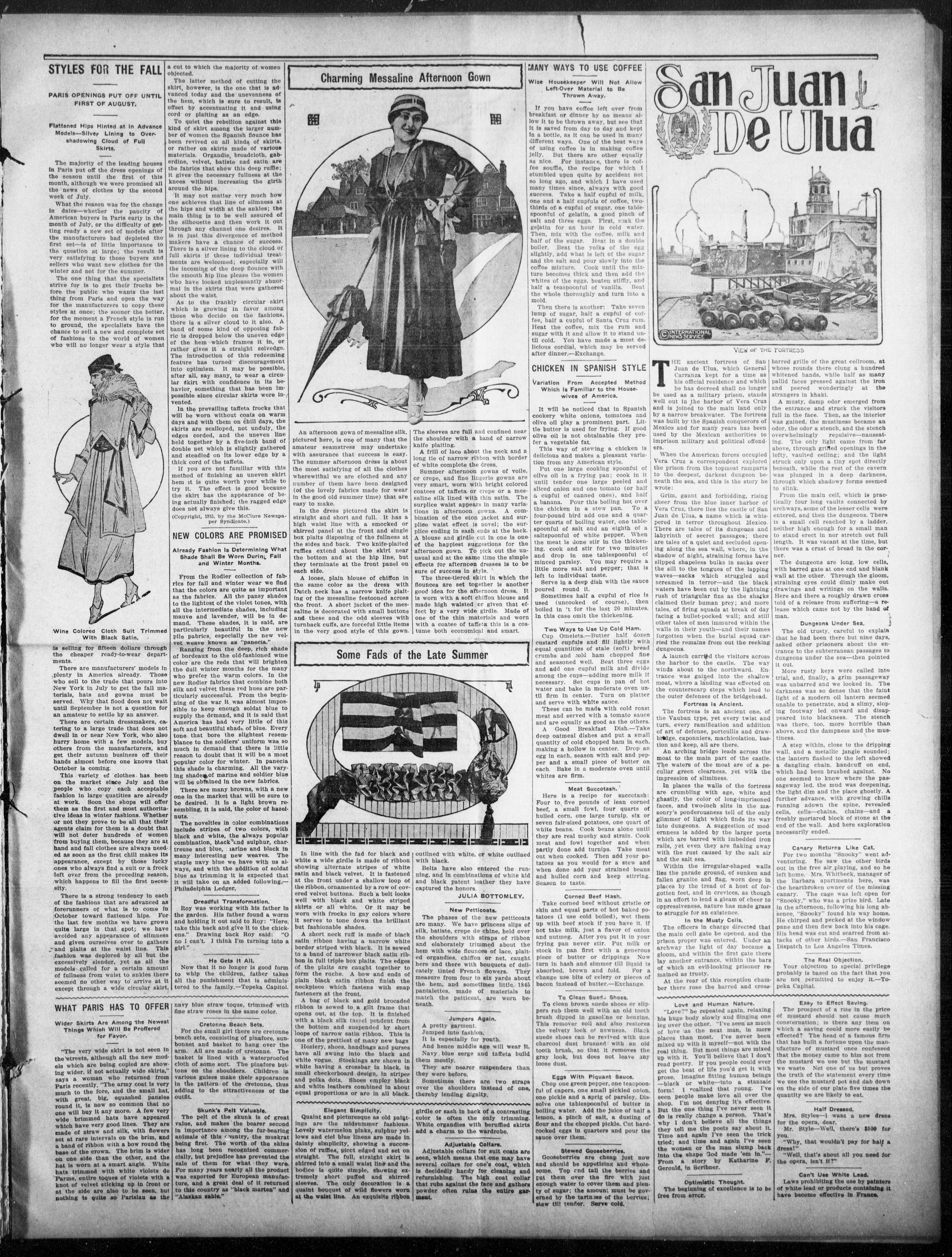
Wine Colored Cloth Suit Trimmed With Black Satin.
is selling for fifteen dollars through the cheaper ready-to-wear departments.
There are manufacturers' models in plenty in America already. Those who sell to the trade that pours into New York in July to get the fall materials, hats and gowns must be served. Why that flood does not wait until September is not a question for an amateur to settle by an answer.
There are certain dressmakers, catering to a large trade that does not dwell in or near New York, who also hurry home with a few models, buy others from the manufacturers, and get their autumn business off their hands almost before one knows that October is coming.
This variety of clothes has been on the market since July and the people who copy each acceptable fashion in large quantities are already at work. Soon the shops will offer them as the first and most authoritative ideas in winter fashions. Whether or not they prove to be all that their agents claim for them is a doubt that will not deter hundreds of women from buying them, because they are at hand and fall clothes are always needed as soon as the first chill makes its appearance, except by those lucky ones who always find a suit or a frock left over from the preceding season, which happens to fill the first necessity.
There is a strong tendency in each of the fashions that are advanced as forerunners of what is to come in October toward flattened hips. For the last few months we have grown quite large in that spot; we have avoided any appearance of slimness and given ourselves over to gathers and plaits at the waist line. This fashion was deplored by all but the excessively slender, yet as all the models called for a certain amount of fullness from waist to ankles there seemed no other way to arrive at it except through a wide circular skirt,
WHAT PARIS HAS TO OFFER
Wider Skirts Are Among the Newest Things Which Will Be Proffered for Favor.
"The very wide skirt is not seen in the streets, although all the new models which are being copied are showing wider, if not actually wide skirts," says a woman who returned from Paris recently. "The army coat is very much to the fore, and the small hat, with great, big, squashed pansies round it, is now so common that no one will buy it any more. A few very wide brimmed hats have appeared which have very good lines. They are made of straw and silk, with flowers set at rare intervals on the brim, and a band of ribbon with a bow round the base of the crown. The brim is wider on one side than the other, and the hat is worn at a smart angle. White hats trimmed with white violets do Parme, entire toques of violets with a knot of velvet sticking up in front or at the side are also to be seen, but nothing is quite so Parisian as the
a cut to which the majority of women objected.
The latter method of cutting the skirt, however, is the one that is advanced today and the unevenness of the hem, which is sure to result, is offset by accentuating it and using cord or plaiting as an edge.
To quiet the rebellion against this kind of skirt among the larger number of women the Spanish flounce has been revived on all kinds of skirts, or rather on skirts made of various materials. Organdie, broadcloth, gaberdine, velvet, batiste and satin are the fabrics that show this deep ruffle; it gives the necessary fullness at the knees without increasing the girth around the hips.
It may not matter very much how one achieves that line of slimness at the hips and width at the ankles; the main thing is to be well assured of the silhouette and then work it out through any channel one desires. It is in just this divergence of method makers have a chance of success. There is a silver lining to the cloud of full skirts if these individual treatments are welcomed; especially will the incoming of the deep flounce with the smooth hip line please the women who have looked unpleasantly abnormal in the skirts that were gathered about the waist.
As to the frankly circular skirt which is growing in favor among those who decide on the fashions, there is a silver cloud to it also. A band of some kind of opposing fabric is dropped below the uneven edge of the hem which frames it in, or rather gives it a straight selvedge. The introduction of this redeeming feature has turned discouragement into optimism. It may be possible, after all, say many, to wear a circular skirt with confidence in its behavior, something that has been impossible since circular skirts were invented. In the prevailing taffeta frocks that will be worn without coats on warm days and with them on chill days, the skirts are scalloped, not unduly, the edges corded, and the uneven line held together by a five-inch band of double net which is slightly gathered and steadied on its lower edge by a thick cord of the taffeta.
If you are not familiar with this method of finishing an uneven skirt hem it is quite worth your while to try it. The effect is good because the skirt has the appearance of being actually finished; the ragged edge does not always give this.
1815, by the McClure Newspaper Syndicate.
NEW COLORS ARE PROMISED
Already Fashion Is Determining What Shade Shall Be Worn During Fall and Winter Months.
From the Rodier collection of fabrics for fall and winter wear we find that the colors are quite as important as the fabrics. All the pansy shades to the lightest of the violet tones, with all the intermediate shades, including mauve and lavender, will be in demand. These shades, it is said, are particularly beautiful in the new pile fabrics, especially the new velvet weave known as "panecia."
Ranging from the deep, rich shade of bordeaux to the old-fashioned wine color are the reds that will brighten the dull winter months for the many who prefer the warm colors. In the new Rodier fabrics that combine both silk and velvet these red hues are particularly successful. From the beginning of the war it was almost impossible to keep enough soldat blue to supply the demand, and it is said that America has had very little of this soft and beautiful shade of blue. Every tone that bore the slightest resemblance to the soldiers' uniform was so much in demand that there is little reason to doubt that it will be a most popular color for winter. In paneca this shade is charming. All the varying shades of marine and soldier blue will be obtained in the new fabrics.
There are many browns, with a new one in the market that will be sure to be desired. It is a light brown resembling, it is said, the color of hazelnuts.
The novelties in color combinations include stripes of two colors, with black and white, the always popular combination, black and sulphur, charteuse and blue, arine and black in many interesting new weaves. The staple navy blue we have with us always, and with the addition of soldart blue as trimming it is expected that it will take on an added following.—Philadelphia Ledger.
Dreadful Transformation
Roy was working with his father in the garden. His father found a worm and holding it out said to Roy: "Here, take this back and give it to the chickens." Drawing back Roy said: "O no I can't. I think I'm turning into a girl."
He Gets It All.
Now that it no longer is good form to whip the children, father takes all the punishment that is administered to the family. —Topeka Capitol.
navy blue straw toque, trimmed with fine straw roses in the same color.
Cretonne Beach Sets.
For the small girl there are cretonea beach sets, consisting of pinafore, sunbonnet and basket to hang over the arm. All are made of cretonea. The basket is lined with a waterproof cloth of some sort. The pinafore buttons on the shoulders. Children in various guises make their appearance in the pattern of the cretonea, thus adding to the attractiveness of the outfit.
Skunk's Pelt Valuable.
The pelt of the skunk is of great value, and makes the bearer second in importance among the fur-bearing animals of this country, the muskrat being first. The worth of the skins has long been recognized commercially, but prejudice has prevented the sale of them for they were. For many years nearly all the product was exported for European manufacture, and a great deal of it returned to this country as "black marten" and "Alaskan sable."
M
A
An afternoon gown of messaline silk, pictured here, is one of many that the amateur seamstress may undertake with assurance that success is easy. The summer afternoon dress is about the most satisfying of all the clothes wherewithal we are clothed and any number of them have been designed (of the lovely fabrics made for wear in the good old summer time) that are easy to make.
In the dress pictured the skirt is straight and short and full. It has a high waist line with a smocked or shirred panel at the front and single box plats disposing of the fulness at the sides and back. Two knife-plaited ruffles extend about the skirt near the bottom and at the hip line, but they terminate at the front panel on each side.
A loose, plain blouse of chiffon in the same color as the dress with Dutch neck has a narrow knife platting of the messaline festooned across the front. A short jacket of the messaline is decorated with small buttons and these and the odd sleeves with turnback cuffs, are forceful little items in the very good style of this gown
Some Fads of t
In line with the fad for black and white a wide girldie is made of ribbon showing alternate stripes of white satin and black velvet. It is fastened at the front under a shallow loop of the ribbon, ornamented by a row of covered velvet buttons. Such a belt looks well with black and white striped skirts or all white. Or it may be worn with frocks in gay colors where it serves to tone down the brilliant but fashionable shades.
A short neck ruff is made of black satin ribbon having a narrow white border striped with black. It is sewed to a band of narrower black satin ribbon in full triple box plaits. The edges of the plaits are caught together to form the ruche. A bow and ends of plain black satin ribbon finish the neckpiece which fastens with snap fasteners at the front.
A bag of black and gold brocaded ribbon is sewed to a gilt frame that opens out, at the top. It is finished with a black silk tassel pendent from the bottom and suspended by short loops of narrow satin ribbon. This is one of the prettiest of many new bags. Hosiery, shoes, handbags and purses have all swung into the black and white vogue. Stockings are shown in white having a crossbar in black, in small checkerboard design, in stripes and polka dots. Shoes employ black and white leather combined in about equal proportions or are in all black.
Elegant Simplicity.
Quaint and picturesque as old palpitings are the midsummer fashions. Lovely watermelon pinks, sulphur yellows and ciel blue linens are made in dainty simplicity, showing a succession of ruffles, picct edged and set on straight. The full, straight skirt is shirred into a small waist line and the bodice is quite simple, showing extremely short puffed and shirred sleeves. The only decoration is a quaint bouquet of wild flowers worn at the waist line. An exquisite ribbon
The sleeves are full and confined near the shoulder with a band of narrow knife plaiting. A frill of lace about the neck and a long tie of narrow ribbon with border of white complete the dress. Summer afternoon gowns of volle, or crepe, and fine lingerie gowns are very smart, worn with bright colored coatees of taffeta or crepe or a mesa silk lined with thin satin. The surplice waist appears in many variations in afternoon gowns. A combination of the eton jacket and surplice waist effect is novel; the surplice ending in sash ends at the back. A blouse and girdle cut in one is one of the happiest suggestions for the afternoon gown. To pick out the unusual and at the same time the simple effects for afternoon dresses is to be sure of success in style.
The three-tiered skirt in which the flouences are set together is another good idea for the afternoon dress. It is worn with a soft chiffon blouse and made high waisted or given that effect by a very wide girdle. Made of one of the thin materials and worn with a coatee of taffeta this is a costume both economical and smart.
he Late Summer
outlined with white, or white outlined with black.
Belts have also entered the running, and in combinations of white kid and black patent leather they have captured the honors.
JULIA BOTTOMLEY.
New Petticoats.
The phases of the new petticatoe are many. We have princess slips of silk, batiste, crepe de chine, held over the shoulders with straps of ribbon and elaborately trimmed about the hem with wide flounces of lace, plaited organdies, chiffon or net, caught here and there with bouquets of delicately tinted French flowers. They measure from four to six yards about the hem, and sometimes little 1845 pantalettes, made of materials to match the petticoat, are worn beneath.
Jumpers Again.
And hence middle age will wear it. Navy blue serge and taffeta build them mostly. They are nearer suspenders than they were before. Sometimes there are two straps over the shoulders instead of one, thereby lending dignity.
girdle or sash in back of a contrasting color is often the only trimming. White organies with beruffled skirts add a charm to the wardrobe.
Adjustable Collars.
Adjustable collars for suit coats are seen, which means that one may have several collars for one's coat, which is decidedly handy for cleaning and refurnishing. The high coat collar that rubs against the face and gathers powder often ruins the entire garment.
MANY WAYS TO USE COFFEE
Wise Housekeeper Will Not Allow Left-Over Material to Be Thrown Away.
If you have coffee left over from breakfast or dinner by no means allow it to be thrown away, but see that it is saved from day to day and kept in a bottle, as it can be used in many different ways. One of the best ways of using coffee is in making coffee jelly. But there are other equally as nice. For instance, there is coffee souffle, the recipe for which I stumbled upon quite by accident not so long ago, and which I have used many times since, always with good success. Take a half cupful of milk, one and a half cupful of coffee, two-thirds of a cupful of sugar, one tablespoonful of gelatin, a good pinch of salt and three eggs. First, soak the gelatin for an hour in cold water. Then, mix with the coffee, milk and half of the sugar. Heat in a double boiler. Beat the yolks of the egg slightly, add what is left of the sugar and the salt and pour slowly into the coffee mixture. Cook until the mixture becomes thick and then add the whites of the eggs, beaten stiffly, and half a teaspoonful of vanilla. Beat the whole thoroughly and turn into a mold.
Then there is another: Take seven lump of sugar, half a cupful of coffee, half a cupful of Santa Cruz rum. Heat the coffee, mix the rum and sugar with it and allow it to stand until cold. You have made a most delicious cordial, which may be served after dinner.—Exchange.
CHICKEN IN SPANISH STYLE
Variation From Accepted Method
Which Is Familiar to the Housewives of America.
It will be noticed that in Spanish cookery white onions, tomatoes and oil olive oil play a prominent part. Little butter is used for frying. If good olive oil is not obtainable they prefer a vegetable fat.
This way of stewing a chicken is delicious and makes a pleasant variation from any American style.
Put one large cooking spoonful of olive oil in a frying pan; cook in it until tender one large peeled and sliced onion and one tomato (or half a cupful of canned ones), and half a banana. Pour this boiling hot over the chicken in a stew pan. To a four-pound bird add one and a quarter quarts of boiling water, one tablespoonful of salt and an eighth of a saltspoonful of white pepper. When the meat is done stir in the thickening, cook and stir for two minutes and drop in one tablespoonful of minced pasley. You may require a little more salt and pepper; that is left to individual taste.
Serve in a deep dish with the sauce poured round it.
Sometimes half a cupful of rice is used (uncooked of course), then boiled in 't for the last 20 minutes. In this case omit the thickening.
Two Ways to Use Up Cold Ham.
Cup Omelets—Butter half dozen custard cupfuls and fill lightly with equal quantities of stale (soft) bread crumbs and sold ham chopped fine and seasoned well. Beat three eggs and add one cupful milk and divide among the cups—adding more milk if necessary. Set cups in pan of hot water and bake in moderate oven until firm in center. Turn on platter and serve with white sauce.
These can be made with cold roast meat and served with a tomato sauce and are equally as good as the others. A Good Breakfast Dish.—Take deep oatmeal dishes and put a small quantity of cold chopped ham in each, making a hollow in center. Drop an egg in each, season with salt and pepper and a small piece of butter on each. Bake in a moderate oven until whites are firm.
Meat Succotash.
Here is a recipe for succotash: Four to five pounds of lean corned beef, a small fowl, four quarts of hulled corn, one large turnip, six or seven fair-sized potatoes, one quart of white beans. Cook beans alone until they are real mushy and strain. Cook meat and fowl together and when partly done add turnips. Take meat out when cooked. Then add your potatoes as you would for a stew and when done add your strained beans and hulled corn and keep stirring. Season to taste.
Corned Beef Hash
Take corned beef without wristle or skin and equal parts of hot baked potatoes (I use cold boiled), wet them with beef stock if you have it, if not take milk, just a flavor of onion and nutmeg. After you put it in your frying pan never stir. Put milk or stock in pan first with a generous piece of butter or drippings. Now turn in hash and simmer till liquid is absorbed, brown and fold. For a change use bits of celery or pieces of bacon instead of butter—Exchange.
To Clean Sued + Shoes
To clean brown suede shoes or slippers rub them well with an old tooth brush dipped in gasoline or benzene. This remover soil and also restores the velvety look of newness. Black suede shoes can be revived with fine charcoal dust brushed with an old tooth brush, so that it removes the gray look, but does not leave any loose dust.
Eggs With Piquant Sauce
Chop one green pepper, one teaspoonful of capers, one small pickled onion, one pickle and a sprig of parsley. Dissolve one tablespoonful of butter in boiling water. Add the juice of half a lemon, a pinch of salt, a dusting of flour and the chopped pickle. Cut hard-cooked eggs in quarters and pour the sauce over them.
Stewed Gooseberries
Gooseberries are cheap just now and should be appetizing and wholesome. Top and tall the berries and put them over the fire with just enough water to cover them and plenty of sugar; the amount must be governed by the tartness of the berries; stew till tender. Serve cold.
San Juan
De Ulua
VIEW OF THE FORTRESS
THE ancient fortress of San Juan de Ulaa, which General Carranza kept for a time as his official residence and which he has decreed shall no longer be used as a military prison, stands well out in the harbor of Vera Cruz and is joined to the main land only by a narrow breakwater. The fortress was built by the Spanish conquerors of Mexico and for many years has been used by the Mexican authorities to imprison military and political offenders. When the American forces occupied Vera Cruz a correspondent explored the prison from the topmost ramparts to the deepest, darkest dungeon beneath the sea, and this is the story he wrote:
Grim, gaunt and forbidding, rising sheer from the blue inner harbor of Vera Cruz, there lies the castle of San Juan de Ulua, a name which is whispered in terror throughout Mexico. There are tales of its dungeons and labyrinth of secret passages; there are tales of a quiet and secluded opening along the sea wall, where, in the shadow of night, straining forms have slipped skapeless bulks in sacks over the sill to the tongues of the lapping waves—sacks which struggled and screamed in terror—and the black waters have been cut by the lightning rush of triangular fins as the shacks claimed their human prey; and more tales, of firing squads at break of day facing a bullet-pocked wall; and still other tales of men immurbed within the walls in their youth—and their names forgotten when the burial carved the remains from out the reeking dungeons.
A launch carried the visitors across the harbor to the castle. The way winds about to the northward. Entrance was gained into the shallow moat, where a landing was effected on the counterscarp steps which lead to the outer defenses of the bridgehead.
Fortress Is Ancient.
The fortress is an ancient one, of the Vauban type, yet every twist and turn, every ramification and addition of art of defense, portcullis and drawbridge, caponniers, machicolation, bastion and keep, all are there.
An arching bridge leads across the moat to the main part of the castle. The waters of the moat are of a peculiar green clearness, yet with the impression of slimness.
In places the walls of the fortress are crumbling with age, white and ghastly, the color of long-imprisoned faces, and two-inch slits in the masonry's ponderousness tell of the only glimmer of light which finds its way into dungeons. A suggestion of modernness is added by the larger ports which are barred with imbedded iron rails, yet even they are flaking away with the rust caused by the salt air and the salt sea.
Within the irregular-shaped walls lies the parade ground, of sunken and fallen granite and flag, worn deep in places by the tread of a host of forgotten feet, and in crevices, as though in an effort to lend a gleam of cheer to oppressiveness, nature has made grass to struggle for an existence.
The officers in charge directed that the main cell gate be opened, and the prison proper was entered. Under an archway the light of day became a gloom, and within the first gate there lay another entrance, within the bars of which an evil-looking prisoner remained as trusty. At the rear of this reception chamber there rose the barred and cross-
Love and Human Nature.
Love and Human Nature.
"Love!" he repeated again, relaxing his huge body slowly and flinging one leg over the other. "I've seen as much of love as the next man, in more places than most. I've never been mixed up with it myself—not with the real thing. But most things are mixed up with it. You'll believe that I don't read poetry. If you people could ever get the beat of life you'd get it with prose, imagine fitting human beings—black or white—into a stanzatic form! I realized that young. I've seen people make love all over the shop. I'm not denying it's effective. But the one thing I've never seen it do is really change a person. That's why I don't believe all the things they tell me the poets say about it. Time and again I've seen the trick tried; and time and again I've seen the woman or the man slump back into the shape God made 'em in."—From a story by Katharine F. Gerould, in Scribner.
Optimistic Thought.
The beginning of excellence is to be free from error.
Fortress Is Ancient.
In the Musty Cells.
Optimistic Thought.
barred grille of the great cellroom, at whose rounds there clung a hundred whitened hands, while half as many pallid faces pressed against the iron and peered wonderingly at the strangers in khaki. A musty, damp odor emerged from the entrance and struck the visitors full in the face. Then, as the interior was gained, the mustiness became an odor, the odor a stench, and the stench overwhelmingly repulsive—nauseating. The only light came from far above, through grilled openings in the lofty, vaulted ceiling; and the light struck only upon a tiny spot directly beneath, while the rest of the cavern was plunged in a deep darkness through which shadowy forms seemed to slink.
From the main cell, which is practically four long vaults connected by archways, some of the lesser cells were entered, and then the dungeons. There is a small cell reached by a ladder, neither high enough for a small man to stand erect in nor stretch out full length. It was vacant at the time, but there was a crust of bread in the corner.
The dungeons are long, low cells, with barred gate at one end and blank wall at the other. Through the gloom, straining eyes could dimly make out drawings and writings on the walls. Here and there a roughly drawn cross told of a release from suffering—a release which came not by the hand of man.
Dungeons Under Sea.
The old trusty, careful to explain that he had been there but nine days, asked other prisoners about the entrance to the subterranean passages to dungeons under the sea—then pointed it out.
More rusty keys were called into trial, and, finally, a grim passageway was unbarred and we looked in. The darkness was so dense that the faint light of a modern oil lantern seemed unable to penetrate, and a slimy, sloping footway led onward and disappeared into blackness. The stench was there, too, more horrible than above, and the dampness and the mustiness.
A step within, close to the dripping wall, and a metallic jangle sounded; the lantern flashed to the left showed a dangling chain, handcuff on end, which had been brushed against. No one seemed to know where the passageway led, the mud was deepening, the light dim and the place ghostly. A further advance, with growing chills running adown the spine, revealed cells, cells—chains, chains—and a freshly mortared block of stone at the end of the wall. And here exploration necessarily ended.
For two months "Snooky" went adventuring. He saw the other birds out in the free air playing, and so he left home. Mrs. Whitbeck, manager of the Barbara apartments here, was the heartbroken owner of the missing canary. The cage was left open for "Snooky," who was a prize bird. Late in the afternoon, following his long absence, "Snooky" found his way home. He chirped and pecked at the window pane and then flew back into his cage. His head was cut and scarred from attacks of other birds—San Francisco Dispatch to Los Angeles Times.
The Real Objection.
Your objection to special privilege probably is based on the fact that you are not permitted to enjoy it.—Topeka Capital.
The prospect of a rise in the price of mustard should not cause much consternation; is there any item on which a saving could more easily be effected? The head of a famous firm that has built a fortune upon the manufacture of mustard once confessed that the money came to him not from the mustard we use but the mustard we waste. Not one of us but proves the truth of the statement every time we use the mustard pot and dab down on the side of our plate five times the quantity we are likely to eat.
Mrs. Styles—I want a new dress for the opera, dear.
Mr. Style—Well, there's $500 for you.
"Why, that wouldn't pay for half a dress!"
"Well, that's about all you need for the opera, isn't it?"
Can't Use White Lead.
Laws prohibiting the use by painters of white lead or products containing it have become effective in France.
Dungeons Under Sea.
Canary Returns Like Cat.
The Real Objection
Easy to Effect Saving.
Half Dressed
THE KANSAS CITY SUN PUBLISHED WEEKLY.
All communications should be addressed
to the Kansas City Sun, 1803 East 18th
Bldr.
Bell Phone East 999
Entered as second-class matter, August
12, 1968, at the postoffice at Kansas City
Mo., under the act of March 3, 1879.
Nelson C. Crews.....Editor and Owner
Willa B. Glenn.....General Manager
SUBSCRIPTION RATES:
SUBSCRIPTION RATES:
One Year $1.50
Six Months .75
Three Months .50
ADVERTISING RATE, 50 CENTS PER
INCH
CHURCH DIRECTORY
Bethel A. M. E. Church, 24th and Flora.
St. Stephen's Baptist Church, 604 Charlotte St.
St. Martinian M. E. Church, 19th and Woodland.
Second Baptist Church, 10th and Charlotte.
Ben Chapel A. M. E. Church, 10th and Charlotte.
Kansas Ave. Baptist Church, 46th and Kansas.
Ebenezer A. M. E. Church, 17th and Troost.
St. Augustine's P. E. Church, 11th and Troost.
Vine St. Baptist Church, 1825 Vine St.
Wine Chapel A. M. E. Church, 11th and Woodland.
St. Monica's Catholic, 17th and Lydia Morning Star Baptist Church, 2311 Vine Highland Avenue Baptist Church, 1111 Highland.
Centropolis A. M. E. Church, Centropolis, Mo. A. M. E. Z. Church, 1823 Woodland Ave. Third Baptist Church, Roundtop. People's Mission, 30th and Genesee. St. Paul's Baptist Church, 19th and Highland.
Friendship Baptist Church, 17th and
Tracy Avenue.
Pilgrim Baptist Church, 614 Charlotte
St.
Pleasant Green Baptist Church, Independence Avenue and Tracy.
Calvary Baptist Church, 19th and
St. James' Baptist Church, 4005 Mill St.
M. E. Chiren, 43rd and
Prospect Place
A. M. E. Mission. 565 Grand Ave.
CLARK CHAPEL M. E. CHURCH,
1664 Madison Ave.
KANSAS CITY, KAN. CHURCHES.
First A. M. E. Church, 8th and Neb.
Pleasant Great Baptist Church, 1st and
Southern.
Eighth St. Baptist Church, 8th and
Oakland.
Marymount Baptist Church, 9th and
Washington.
Bethel A. M. E. Church, Water and
Seward Streets.
St. Paul A. M. E. Church, 21st and
Ruby.
First Baptist Church, 5th and Neb.
King Solomon Baptist Church, 3rd and
State.
Quindarado A. M. E. Church, Quindarado,
Pleasant Valley Baptist Church, Rosedale,
Kan.
M. E. Church, 9th and Oakland.
A. M. E. Church, 4th and Oakland.
Salter Mission, A. M. E. Church, South
Park, Kan.
Bethel A. M. E. Church, Roselale, Kan.
Mt. Zilon Baptist Church, 4th and Vir-
lentine. Ebenerse A. M. E. Church, Sanford and
Tremont.
Mt. Zilon Primitive Baptist Church,
wilton avenue and Tangent street,
Roselale
EDITORIALS
Howdy!
If Lincoln Park is for Negroes and is supported by Negroes, why not have a Negro manager?
Secret and religious organizations would do well to make Kansas City their permanent headquarters and convention seats.
The man who slings mud at his brother is bound to soil his own hands and the mud besmirches the appearance of the whole race.
The "Tom" and "Joe" controversy at the City Hall grows more interesting each day and the public is anxiously waiting to see what will happen when each side really tells all that it knows.
The European war is temporarily overshadowed by the big battles now waging down at the city hall between the Goats and the Rabbits. The Republicans are sawing wood and saying nothing.
If a Negro actually committed the serious crime charged by a young white woman at Liberty, he should be apprehended and punished. If the crime was committed by a disguised white man, the fact should be acknowledged and the odium lifted from the black race.
This will probably be a hard winter physically and financially. Negro families should cease wasting their earnings upon superficial joys and lay by a store to protect them against the long, severe season which is now at hand. Foresight is far better than hindsight.
There is always a way to keep a Negro out of such political honors as white men covet. Although the courts have decided that C. H. Turpin of St. Louis, was legally elected to the office of court constable. Injunction proceedings have been brought against him and the usurping white man will likely hold the office during the interim of the next election.
The appointment of Prof. J. R. E. Lee of Tuskegee to the principalship of Lincoln High School ends one of the most bitter controversies which have happened in our local school work for many years. The success of any of the home applicants was dissipated by the character besmirching tactics indulged in by the would-be dictators, and none of these could have succeeded even if appointed, so bitter were the feelings engendered.
Prof. Lee is one of the foremost educators, writers and lecturers of the race, and ought to bring to Kansas City a high spirit of education and culture. He has been for several years head of the academic work at the Booker T. Washington institution, and is in every way prepared for the duties which he is to assume. He will have the best wishes and most hearty co-operation of the best
people of this community who are anxious for Lincoln High School to take on a higher moral and intellectual tone than it has at this time. That the faculty of the school will render to the new principal its full and hearty support goes without saying. The public will expect this and professional loyalty as well as prudence will demand it.
Schools are created for the children and not for teachers. The latter simply constitute a means unto an end. It is the ends that we seek, and Prof. Lee has definite, tangible ends in view, every means should be sought which will enable him to make good.
The Sun extends its hand in advance, and offers its unbiased sympathy and support to the new head of Lincoln High.
DICKEY FOR UNITED STATES
SENATOR
With the splendid possibilities presenting themselves to the progressive Republican voters of this common wealth to elect a high class representative citizen as United States senator focuses the attention of the voters and leaders upon the excellent opportunity of drafting for that exalted position one of Missouri's foremost citizens, and a victorious leader who has fairly won for himself any honor that the people of the State of Missouri have to confer upon one of its citizens. And that distinguished leader is Hon. Walter S. Dickey, who successfully managed the campaign in 1908, swung Missouri into the Republican column and made Herbert S. Hadley governor of this imperial commonwealth. The Sun, along with hundreds of other Republican newspapers and leaders of this state, is unreservedly for Walter S. Dickey, because we believe that with a leader like him there can be no such thing for the party in 1916 as defeat. We have nailed to our masthead "For United States Senator, Walter S. Dickey."
Lincoln Park seems to be falling down on its originally declared intention of employing only colored people in its operation. Several of the concessions are now in the hands of white people and it begins to look as if the situation is to grow worse. It remains to be seen just how much of this our people will stand for. At the beginning of the season quite a number of prominent people of our race were honored by the presentation of season complimentary tickets. The recipients of these favors prized the recognition not so much for its intrinsic value as for the indication of the desire upon the part of the park management to secure desirable cooperation in establishing the reputation and character of the amusement place. Now these passes have been peremptorily recalled and the holders thus unnecessarily insulted. Perhaps the park officials have figured out that in order for the former honored guests to be really happy they will just have to pay to visit the institution.
Betty & Sam's Little Corner)
LITTLE CORNER
THEY SAY
THEY SAY
Tennyson or Longfellow could take a worthless sheet of paper with a poem on it and make it worth $69,000.
—That's genius.
Rockefeller can write a few lines on a sheet of paper and make it worth $5,000,000.
The United States can take an ounce and a quarter of gold, stamp upon it an eagle bird and make it worth $20.
—That's money.
A mechanic can take material worth $5,00 and make it into watch springs worth $1,000.
—That's skill.
When you go into a Negro's store and ask for an article temporarily out of stock and go away denouncing race enterprise
—That's ignorance.
If we would spend our nickles and
dimes among our own race and have
a little more confidence, patience and
be more loyal to race enterprises, we
would be respected, protected and
courteously treated by all other races.
—That’s common sense.
Do not believe him who claims to
be loyal to his race and falls to pat-
ronize race enterprises, for
That's gall.
Do not practice nor teach ignoring Negro pictures, books and literature that should be in your homes for that of another race, for
—That's a mistake.
A copy of the Kansas City Sun should be in the home of every Negro family of Kansas City.
LEISURE HOUR REFLECTIONS
FROM A QUIET CORNER.
There are a great many of us who do not know what it is to praise those around us as a concession to the proprieties, because as a rule the voice of jealousy is whispering all sorts of unkind criticisms. Again, there are some of us who would be offended if we were called ungenerous, and who do not know what it is to speak in praise of others without mental contradiction.
We should learn in our own thought to do justice to others, to our competitors and rivals, as well as our friends. Before we take words of praise on our lips, we should feel them in our hearts.
We are always ready and willing to advance the theory of "give and take," of "live and let live," but there are times when we are too inconstant when considering the feelings and welfare of others.
There are many times when the giving of encouragement, and a little praise whether merited or not, has had a tendency to inspire the recipient to higher things in life; we cannot afford to condemn the person that makes mistakes once in awhile, but we should always be considerate, because in all probability if we were placed in a similar predicament, we would be less endurable.
While we should not tolerate the protraction of error and wrong doing around us, we should bear in mind that forbearance is one of our chief duties, and that more men and women are lifted up each year, and started on the right way through the medium of kind words than any other means.
For fear we may not pass this way again, let us scatter seeds of kindness as we are passing which may be the means of giving strength to some weary traveler, who might perchance be following in our footsteps.
Vacation time is a period that is more profitable to the average person than they are able to understand, or willing to admit, and in many instances proves more beneficial both in the way of business and pleasure than the working season.
In many of the quiet nooks and corners that we stumble upon in our rambles through the forests, and from nature's great library we are able to glean many thoughts and valuable lessons that may serve us well in after life.
And why should we not?
When we look around us and see the systematic arrangement of the handiwork of nature, together with the granduer of forests, the fields and the streams, we are readily convinced that our earth is a schoolroom, and that the summer session the busiest of the year.
What science is not taught in the quiet resort among the hills or by the sea? In the little brook that turns the mill wheel a mile down stream, is material for solving the profoundest problems in physics. Greek and Latin are not included in this curriculum of this summer school, but any number of modern languages may be studied; bird tongues, the language of the vegetable world, the voices of the meadow and of the forest, while the hieroglyphics of the pyramids are not so well worth solving as those graven on the rocks.
There are night as well as day sessions in this greatest of schools. And when the sun goes down, the lessons in astronomy begins. While some localities are more favorable than others for such schools, there is no place without a branch school, and no one is too poor, or in too humble circumstances to be enrolled as a student
---
The "good loser" brings before us a face in which determination and cheerfulness are written. It suggests a man who can go back after losing, eat a good meal, talk cheerly with the family, and next day start all over again.
There are so many who are not "good losers." There is the loser who is sure that his failure is the fault of some one else, and is resentful and bitter because of an imaginary injury.
There is the loser who gets "cold feet" after he lost once, and never means to try again. He is done with swimming. Hereafter he will drift with the current.
Out of all these losers there is only one worth while, and the rest will remain losers to the end. But the "good loser" is the potential winner. To win by surrendering your principles, by compromise with what you despise, is the most overwhelming form of defeat. And to lose because you will not be false in the least degree to the faith that is in you is the victory that counts. Some of the greatest of all victories are won by losing.
—Dennis S. Thompson.
THE FRUIT OF HARMONY.
(By Benl. V. Longdon.)
It is not too much to expect that there will be a full representation of Masons from all parts of the jurisdiction at Hannibal, Mo., next week. Unless all indications are deceptive the meeting of the Grand Lodge will surpass its predecessors. We make this assertion because of the harmonious co-operation of the executive and administrative talent of the jurisdiction. Active brains and willing spirits have been united in devising plans and in perfecting details for carrying these plans to successful completion. If jealousy or indifference of any kind has existed, it has not been evident. Past Grand Masters and other retired officers have vied with those in present authority in the united effort to make the work of this Masonic year a success. And in the final analysis, the fruit of this harmony will be a week of enjoyment and profit.
Retrospection shows that not only have many new members joined during the past two months, but a large number of old members have reaffiliated with the order. Our general fund has been strengthened and safeguarded. Grand Master N. C. Crews has visited every lodge in his jurisdiction at least once—and the visits were not simply formal affairs, for the exchange of compliments or the delivery of congratulatory addresses. He inquired particularly into each
IF YOU WANT PRINT-
ING THAT'S RIGHT
SEE HIM
"He delivers the goods"
Bell Phone, Grand 2988
"OVER THERE."
They say there's a land o'er the ocean
Where wonders and beauties are seen;
They say it's a glorious Eden,
Where none but the blessed convene.
Many friends for that land have departed,
They have crossed over life's troubled sea,
O. let us sail over and meet them,
Jesus' life-boat will carry us free.
They say we shall know all our loved ones,
When we meet on that bright, golden shore;
They say we shall clasp hands so gladly,
And together rejoice evermore.
lodge, making suggestions when needed and aiding in straightening out difficulties, and in improving modes of procedure. Thus we have been enabled to face many changes for good and to remember that a thousand influences are brought to bear upon us, but we must continually select and renounce, keeping before us always the things that are most worth while, seeing the goals to be aimed at, the difficulties to be surmounted, the sacrifices to be made. If we are to aid in setting aright the thousand things that cry to heaven for reform, our members must remember the fruit of harmonious endeavor and become stimulated to even greater activity. We would write more, but—
"The South proclaims refreshmen nigh. High twelve's the time to dine."
Y. M. C. A. NOTES
Although the Kansas City Association has been in its building less than eight months, it now stands fourth with a membership of 603 in the list of associations now in modern buildings. The following table gives the time in the buildings and the membership standing of these associations:
| | Mem. | Time bid, |
| :--- | :--- | :--- |
| Philadelphia. | .1031 | 1 yr. 8 mo. |
| Washington. | .1014 | 3 yr. 2 mo. |
| Indianapolis. | .650 | 2 yr. |
| Kansas City. | .603 | 8 mo. |
| Chicago. | .585 | 2 yr. 8 mo. |
—Exchange.
We present the table of figures because it gives some insight to the Y. M. C. A. work among the colored people in larger cities. Kansas City can well be proud of its record, standing fourth in membership notwithstanding the association has only been in existence eight months. That city has the smallest population of those mentioned from which to draw.
Indianapolis is a god second to Kansas City, everything considered. Chicago has a splendid building, but it falls down lamentably in the Y. M. C. A. effort. This is due, perhaps, to the prosperity there. Home conveniences have some influence on the possible membership of associations. Chicago has long since been noted for its flat life, which somehow seems to call for superior living conditions. The Y. M. C. A., we take it, can not offer the same inducements there as it offers in some other places. This is aside from the Christian phase as a religion, which all cities stand equally in need.
This phase, however, it but an incident as an attraction, but, of course, giving the institution its tone and quality, since good morals is with the substructure of Christianity, if not the better part of it. But religion as a drawing card is the same one place as another, so the growth of associations, it appears, will be more rapid wherever they can most ably be supplement to the home.
We are not so sure that we are right in our conclusion, since we are not familiar enough with the work to speak with assurance. It would be interesting to hear from secretaries as to the causes of varying member ships. There is a reason why Chicago has only 585 members with its very large colored population. There is a reason why New York is almost a Y. M. C. A. nonity.
The white associations are everywhere, and with buildings and membership in accord with the localities. Our race is rather new in the business, so that even tenor of things will not be known to our race for many years. But where we do have them, and where there is no inconvenience in reaching them, it is worth while to get an inventory of the causes of differences in membership as a thing of Y. M. C. A. sociology.
Camp Inspiration will open up at Linwood, Kas., on the 16th, rain or shine. The boys are making great preparations for the trip and a very successful camp is the prediction at this time. Several men will be at the camp daily to insure the safety of the boys in attendance.
Mr. E. H. Wilson or this city is spending his vacation with his parents in Clinton, Mo.
SAY! — OH — SAY!
HAVE YOU SEEN THE
MAGNIFICENT WORK
-TURNED OUT BY-
C. A. FRANKLIN
???
THE FINEST PRINTING EVER
DONE IN KANSAS CITY
That's What You Hear
on Every Hand.
Then let us prepare for the journey.
Let our hearts be kept loyal and true.
Then the Saviour will watch and protect us.
Misses Elsie and Bertha Rodgers of Kansas City are visiting friends and relatives this week...sirs, Eliza Reynolds and little niece are spending a few days in Kansas City with relatives...Prof. Vaughn of Quindardo made an excellent speech at the A. M. E. church Monday night...Miss Florence Hicks, who has been very ill, is able to be out again...Mrs. Mattie Caldwell has been very ill, but is improving...The picnic given by the A. M. E. and First Baptist churches was a success.
ROSEDALE, KANSAS
Mrs. S. S. Slatter and little son, Le Roy, left last week for an extended trip through the western states...Mr. and Mrs. T. T. Morton entertained at dinner Sunday Mr. and Mrs. A. T. Wooldridge of Kansas City, Mo... Mrs. Joseph Collins entertained a number of small guests Saturday afternoon at her residence, 3921 Lloyd avenue, the occasion the celebration of the third birth anniversary of her little daughter, Kaythrine May, Miss Myrtle Everett of Quindaro, Kas, presided at the piano and rendered some very beautiful selections. The little guests also indulged in games and a very pleasant afternoon was spent... The services at the Pleasant Valley Baptist church Sunday were very good. We also have a splendid Sunday school. Rev. Glover will preach Sunday, August 15.
A. F. and A. M.
Missouri Jurisdiction
N. C. Crews, Kansas City, Grand Master.
Groves, Kansas City, Grand Master.
Deputy Grand Master, Richard Young, Lincoln, Neb.
F. J. Brown, St. Louis, Grand Senior Warden.
Wm. Green, Plattsburg, Grand Junior Warden.
H. H. Walker, St. Joseph, Grand Treasurer.
Gee. W. K. Love, Grand Secretary, Kansas City, Mo.
W. W. Fields, Secretary of Masonic Relief, Cameron, Mo.
P. L. Pratt, Kansas City, Mo., Grand Lecturer.
Grand Commandery Officers
W. G. Mosely, Kansas City, Mo.,
R. E. G. C.
J. H. Sherwood, St. Paul, Minn.,
G. E. G.
P. C. Kincald, Kansas City, Mo.,
V. E. G. C.
J. W. Beard, St. Louis, Mo., E. G.
C. G.
Wm. Roberts, Hannibal, Mo., Grand
Secretary.
T. P. Mahammitt, Grand Treasurer,
Omaha, Neb.
Grand Chapter Officers.
Geo. Broomfield, G. H. P., St. Louis,
Mo.
T. G. McCampbell, D. G. H. P., Kansas City.
A. L. Thomas, G. K., Jefferson City,
Mo.
J. P. Mofitte, G. S., Sedalia, Mo.
Chas. Griggsby, G. Treas, Liberty,
Mo.
E. S. Baker, G. Sec'y, Kansas City,
Mo.
R. T. Coles, Chairman.
E. S. Baker, Secretary.
R. W. Foster, Treasurer.
W. C. Mallory, Sandy Meyers,
Wm. Washington, F. P. Porteet,
T. W. H. Williams, W. G. Moseley,
J. E. Herriford, E. G. Lacey,
E. G. Miller, Robt. Willey.
Lodge Directory
G
M. J.
Pritchard Lodge No. 42, A. B
and A. B
4th Monday in each month. A
Mast Master Sons in good standing
welcome. Cecil Thompson, W.
H. SPIGENER, Secretary.
G
MASONRY
Rons Lodge No. 25, A. F. A. man
Monday in, each month.
Master Masons in good standing
welcome.
Meet McCampsbill, george.
G
M. Olive Lodge No. 53, A. M. and A. M. meets the 2nd and 4th Friday in every month. Visiting Master Masons are welcome. Myers, W. M. Frank Lowe, W. M. Baltimore Ave.
1. 0. 1.
Queen Esther Court No. 43
Hale from the I. O. I. meets
the first and third Mondays in each
week. Bale at the hall
10th and Campbell St. Kansas
City. Mo. Mrs. Bettie Davis
M. B. Q. H. J. Lones, Chron.
149 North 2d St. Kansas City
U. B. F.
King of the West Lodge No.
218 meets first and third Mondays
in each month at 658
W. M. W. Eulid; Jas. Hars.
W. M. 1718 Eulid; Jas. Hars.
Sec'y. 1723 Woodland Ave
BROWN CLIPPER
7-Pasenger Automobile. As a pleasure car the Clipper has no equal. Driven by owner. 24-hour service. Stick this near your telephone.
W. H. HUBBELL.
Bell Phone East 2013W.
Home phone East 4159.
A. Franklin Radford
Call Temporary Phones
West 2223W West 634
Negro Business and Professional Directory of Greater Kansas City
(Your name, business, address and telephone carried in this directory at 25 cents per month, $3.00 a year; less than one cent a day. Can you beat it? To secure space call Sun Office, Bell phone 999 East, or see our agent.)
CAFES.
DELMONICA CAFE, 1512 East 18th St. Bell phone, East 618.
THE OWL LUNCH ROOM, Mrs.-A. R. Harris, Prop., 2208 Vine St.
Bell phone, East 4390.
CARPET CLEANERS
EUREKA CARPET CLEANING CO., 1718-20 Euclid Ave. Bell phone,
East 3555; Home, East 4169.
CLEANERS, DYERS AND TAILORS
O. K. CLEANERS AND DYERS, guarantee not to shrink any garment they dye. 1113 East 18th street. Bell phone, Grand 2437. WORTHAM BROS., 1831 Paseo. Bell Phone East 701.
DRUG STORES
FARMACY, Prof. R. W. Foster, Prop., 18th
Line East 272, Home phone East 4070.
FLORISTS.
FLORAL CO., Flowers for all occasions. B
Churches and halls decorated. 1510 E. 18
98 East, Home phone 7555M.
IT FLORAL CO., 1801 East 18th St. B
Home phone, East 4070.
GROCERS.
ON, 2644 Woodland Ave. Bell phone, East
TSON, 1418 East 19th St. Bell phone G
GROCERY, 121 Westport Ave., Rosedale, E
n, proprietor.
INGLES, 2224 Vine St. Bell phone, East 2
IDEAL PHARMACY, Prof. R. W. Foster, Prop., 18th and Woodland. Bell phone East 272. Home phone East 4070.
FLORISTS.
WEAVER FLORAL CO., Flowers for all occasions. Funeral designs. Homes, churches and halls decorated. 1510 E. 18th street. Bell phone 4798 East, Home phone 7555M.
CROSTHWAIT FLORAL CO., 1801 East 18th St. Bell phone, East 272. Home phone, East 4070.
GROCERS
LAUNDRIES.
ERIC LAUNDRY CO., J. C. Hale, Mgr., 21
phone 3160.
CULATE LAUNDRY, 1912 East 18th St.
3.
LAWYERS.
WAY, 601 Delaware, Home phone M58, B
practices in all courts.
CON, 601 Delaware, Home phone M58, B
legal advice. Practices in all courts.
SSOM, Attorney at Law, 307 Walnut street
the East 2727, Home phone East 4070.
KLEFORD, Attorney at Law, 516 Minnes
Kas. Bell phone, West 3866.
THE ELECTRIC LAUNDRY CO., J. C. Hale, Mgr., 2928 Summit St. Home phone 3160.
THE IMMACULATE LAUNDRY, 1912 East 18th St. Bell phone
THE IMMACULATE LAUNDRY, 1912 East 18th St. Bell phone East 4723.
LAWYERS
C. H. CALLOWAY, 601 Delaware, Home phone M58, Bell phone Main 448. Practices in all courts.
W. C. HUESTON, 601 Delaware, Home phone M58, Bell phone Main 448. Legal advice. Practices in all courts.
GEO. T. WASSOM, Attorney at Law, 307 Walnut street.
Bell phone East 2727, Home phone East 4070.
E. A. SHACKLEFORD, Attorney at Law, 516 Minnesota Ave., Kansas City, Kas. Bell phone, West 3866.
MILLINERY
P. WASHINGTON, 849 Freeman Ave. Birmas City, Kas. Also hair work.
LA HUBBARD, latest things in hats.
1510 East 18th street. Bell phone E. 479
IE WITCHER, 1708 Michigan Ave. Mae Scalp Treatment. Bell phone, East 416
MISS EVA P. WASHINGTON, 849 Freeman Ave. Bell phone, West
2306, Kansas City, Kas. Also hair work.
MRS. CADDIE WITCHER, 1708 Michigan Ave. Madame Walker's Hair and Scalp Treatment. Bell phone. East 4167X.
PHOTOGRAPHERS
C. BRUCE SANTEE, Proprietor The Fad, 1607 East 18th St. Bell phone East 1643.
PHYSICIANS.
DR. R. J. LAMBERT, Therapytics, P. O. box 90A, Bell phone, Rosedale 523, Rosedale, Kas.
REAL ESTATE and EMPLOYMENT.
AFRICAN REAL ESTATE & INVESTMENT
911 McGee street.
Home 751 Main. Home Ph
EOPLE'S INVESTMENT CO., 2427 Vine.
, Home East 4011. Sol Smith, Pres.; C. H.
SECOND-HAND GOODS.
INS, 2122 Vine St. Bell phone East 3851.
SHOE MAKING AND REPAIRING
MAS, Home phone, East 4132.
UNDERTAKERS.
TEE, Licensed Embalmer, 2220 Vine St., B.
Home East 3341.
BROS., 1729 Lydia Ave. Bell Phone Gr
829. Res., Bell East 3281.
AFRO-AMERICAN REAL ESTATE & INVESTMENT CO., Help furnished. 911 McGee street.
Bell Phone 751 Main. Home Phone 7555 Main.
COLORED PEOPLE'S INVESTMENT CO., 2427 Vine St. Bell Phone
East 1011, Home East 4011. Sol Smith. Pres.: C. H. Adkins. Tres.
C. H. COUNTEE., Licensed Embalmer, 2220 Vine St., Bell Phone, East 3336, Home East 3341.
WATKINS BROS., 1729 Lydia Ave. Bell Phone Grand 987, Home Main 7989. Res. Bell East 3281.
TO THE PUBLIC:
We want you to come to us for everything carried by a Drug Store. DRUGS, MEDICINES, TOILET ARTICLES, RUBBER GOODS, COMB9, BRUSHES, MADAM WALKER HAIR-GROWER-DRYING COMB8, STRAIGHTENING COMB5, ETC.
We recommend and guarantee everything offered for sale to be exactly as represented. WE DO NOT "SUBSTITUTE" nor ask you to take other brands than you ask for. You "want what you want" and we want you to have it.
OUR PRICES ARE RIGHT
All down the line. We give careful attention to all orders, and aim by courteous and fair treatment to give perfect satisfaction to our customers. When you think of Drugs think of THEO. SMITH'S PHARMACY.
No demand is too difficult for us to supply. If you are too busy to come to our store, phone us your wants and we will do the rest.
Mail Orders Solicited and Promptly Filled.
Theo. Smith's Drug Store.
Bell Phone 4591 Grand. Home Phone 5467 Main.
1301 E. 18th St. KANSAS CITY, MO.
you come to us for everything carried by a ADDICTICIONS, TOILET ARTICLES, RUBBER GOGS, MADAM WALKER HAIR-GROWER-DRYING, STRAIGHTENING COMBS, ETC. commend and guarantee everything offered for represented. WE DO NOT "SUBSTITUTE" no brands than you ask for. You "want what you you to have it.
OUR PRICES ARE RIGHT on the line. We give careful attention to all orders and fair treatment to give perfect satisfaction. When you think of Drugs think of THEO. SMITH'S PHARMACY. hand is too difficult for us to supply. If you our store, phone us your wants and we will Mail Orders Solicited and Promptly Filled.
Scalp Treatment a Specialty. Caldwell's Pomade and Tonic really Grows Hair. Try it. Save your combings, cut hair and any old hat you may have.
Hair Matched From Samples. Feathers and Hats Cleaned, Dyed and Blocked. Agents for Spirecornets. Mall orders answered promptly
& CliY NEWS.
Mr. 0. F, Tibbs was called to Malta
Bend, Mo,, on account of the death of
his sister.
Mr. and Mrs. Geo, Mosby gave an
automobile party for Mr. and Mrs, Geo.
Monroe of Quincy, Ill, Thursday.
Mr, Arthur Harris, Kansas City's
commercial printer, is in St. Louis,
‘Mo., and Chicago, I1l,, this week on
‘business.
Mrs. Nelson Bowman of Nowata,
‘Okla., and Mrs, Florence Ford éf Kan-
sas City, Kas, were callers at the
Sun office Wednesday,
‘Miss Edith Suttles of Lawrence,
Kas., who has been the guest of Mrs.
George McPike, 1608 Jefferson, has
returned home,
Mrs. W. B. Oxley, 1636 Cottage, left
Sunday for Nowata, Okla, to nurse
her sister, Mrs. Pauline Smith, who is
seriously ill,
Mrs. Willie B, Fagan, 1908 B, 24th
street, left August 5 for San Francisco,
Calif,, to visit the Panama-Pacific ex-
position, en route she will stop in
Denver and Ogden, Utah.
‘Mr. and Mrs, G. H. Burnside, 3107
E, 16th, announce the birth of their
daughter, to whom they have given
the name Hassiltine Lois. Mrs. Burn-
side was formerly Miss Ruby Green.
Mrs. Albert P. Browne entertained
Mrs, Mamfe Buckner Moore’ at lunch-
eon Wednesday at her residence, 582
Tracy. Covers were laid for four-
teen guests,
Mrs, Molly Christopher of Booze-
ville, Mo., and Mr, Winston Smith of
Emporia, Kas,, were the guests of Mrs.
Grace Perry and Miss Mae Peppers
the past week.
Mrs, J.T. Black, 2220 Michigan, en:
tertained Friday for Misses Mayme
Smith, Rocheport, Mo.; Alma Braxton,
St, Louis, Mo,, and Ardella Burgett of
Jefferson City, Mo, Covers were laid
for six.
Mrs. Miles of British Columbia re-
turned from the Panama-Pacific Ex-
position en route to Chicago, is the
guest of her brother, Mr. Austin
Young, and Mrs. Young, 811 Charlotte
street.
Prof. and Mrs, G. 0. Thornton and
son Oliver, are the guests of Mr, and
Mrs. Geo, Purnell, 1312 Vine. Prof.
Thornton is instructor in manual
training in the high school in St.
Tanate: Bo:
Mr. and Ms. Eddie Pickney of 10
N. 324 street, Chicago, IIL, are happy
‘parents over the arrival of a fine baby
boy, born Saturday, August 7, at 12:40
a ae and son are doing nicely.
Both parents formerly lived in Kansas
City.
‘Mrs, W. H. Lyons, 920 Woodiand,
entertained ten small guests Tuesday
afternoon in honor of the sixth birth
anniversary of her daughter, Anna
‘Mary Key. At night her father, W. H.
Lyons, entertained @ number of his
friends, it being his birth day also.
‘Mrs, F, J. Weaver, 2635 Euclid, was
hostess at a large reception Sunday
afternoon, given cocmplimentary to
Mrs, L. L. Sawner, a principal in the
city schools of Chandler, Okla, ‘The
receiving rooms were beautifully dec-
orated with palms and cut flowers.
After the reception, Mrs, Chandler, ac-
companied by Mrs. Weaver, was driv-
en over the city in Mrs, Weaver's
large touring car, Mrs. Chandler left
Monday mornin gfor Chicago, Ill, en
route to her home.
‘Mr, and Mrs, Martin Young, 3412
E, 2ist street, entertained at dinner
the following persons who were in the
city attending the National Grand
Lodge of U, B. F.: Mrs, J. B. Bell,
Prof. and Mrs. J. W. Harris and 8. W.
Gross of Hueston, Tex.; afrs. BB.
Patterson and Mrs. C. R. Moore ‘of
Waco, Tex., and Mrs, A. Z. Carr of
Shawnee, Okla,
‘After the dinner the party was ‘aken
for an automobile ride over the city,
Miss Bettie Mosby, 119 Vine St,
entertained fifty guests at a buffet
supper Sunday, August 1, at her resi:
dence, in honor of visitors, all of
whom were former residents of
Quincy, Il, The guests of honor were
‘Mrs, Rosa Webb and Mrs, F. @, Mun-
day of Quincy, IIL; Mr. and Mré.
James Gillam, Mrs, Allie Taylor of
Los Angeles, Calif.; Mrs. Mitchell of
Quincy, Ill. Miss Edna Hammit pre-
sided at the plano and rendered some
‘very beautiful selections,
Mrs. Nora Allen, 2822 Michigan, en-
teftained 25 guests at an elaborate
five course luncheon Thursday, com-
plimentary to Mrs, F, Munday, P. M.
B, Q. of the Royal House 8, M. T. of
Quincy, Ill, and Mrs. Rosa Webb.
‘The house was beautifully decorated
with pink and yellow gladiolas and tue
color scheme was carried out in the
Juncheon. The following distinguish.
ed persons who were in the city at:
tending the national Grand Lodge of
the U. B. F., were present: National
G, M, Speed of Jefferson, Tex.; Capt.
R. A. Bird, yd, Sec, End., Springfield,
Mii,; Mr. W. M. Anderson, Grand Audi
tor, Waco, Tex.; Mr. Robert Hueston
chairman of printing committee, Fort
‘Worth, Tex.; W. F, Bledsoe, Grand
‘Master of Texas, and Mrs. F. G. Mun-
day, P.M, B, Q., of Quincy, Ill, When
the guests departed they voted Mrs.
‘Alien a charming hostess.
aol foswcel fromect feta promot fe
a| Tango Club, Friday, September 3,
{| Armory Hall, Cottage and Vine,
Prof. Roscoe White's orchestra was
n| in Clinton, Mo,, Aug. 4,
. —
Armory ‘Hall rents for $6.00 per
s|night; see Prof. Roscoe White, Wed-
,|nesday and Saturda ynight.
1 irate it
Mrs. L, B, Falkner of Chicago, IL,
spent last week with Mr, and Mrs.
» |W. H. Rhodes, 928 Oakland,
®| Prof. and Mrs, Roscoe White have
purchased the beautiful cottage at
2910 Lynne and are at home to friends,
.| Wilmirth Young entertained Cecil
s| and Lucile King of Jefferson City, Fri-
day, August 6, at her home, with a
dainty luncheon,
7 ae
»| Prof. Roscoe White, at Armory Hall,
"| Cottage and Vine, and Mrs. Janie
White, dancing teachers, every Satur-
day night.
aaah
.| ‘The people were very much pleased
-| with new dances introduced by Mrs.
1] with the nem dances introduced by
Mrs, Janie White.
Miss Beatrice Parris has been
adopted by R. J. Grear and will be
known hereafter as Miss Beatrice
Grear.
Prof. R. G. Jackson has gone to Los
Angeles, Calif., where he will render
a concert with a chorus of one hun-
dred voices at the church of which
Rey. J. R, Peck is pastor. Miss Doug-
lass will have charge of his teaching
during his absence,
Kansas City Sun’
_ We have just received the souvenir
program of the 15th Anniversary
Moeting of the National Negro Busi-
ness League, which convenes in Bos-
ton, Mass., Wednesday, Thursday and
Friday, August 18, 19 and 20. We
note that Mrs. B. M. Weaver, our Kan-
sas City popular Nesro florist, will ap-
pear on the program Friday morning
at Convention Yall, corner Garrison
and Botolph streets. Her subject will
be “The Business Opportunities Of-
fered Colored Women in the Florist
‘Suainens
‘Miss Hattie ‘Scott, 2838 H. 6th St.,
was hostess at a reception given com-
plimentary to her cousin, Miss Mary
Btta Madison, of Frankfort, Ky., Sat-
urday afternoon, August 7. The house
‘was beautifully decorated with crystal
white lillies.
Miss Scott was assisted in receiving
by Mesdames Lily Burdette, Josie
Henderson and Miss Hatcher. The
following guests were present:
Misses Mary Etta Madison, Mamie
Green, Hattie Scott, Pauline Rone,
Edith Williams and Hatcher.
Mesdames E. C. Bunch, Eliza Miller,
Victoria Carter, Benjamin Martin, E.
R, Macary, Chas. Fields, Wiliam E.
Jones, D. A. Williams, Francis How-
ard, Mamie Smith, L. E. Penix, Ger-
trude Cooper, Savannah Merrit, Mary
Washington, Cara Basil, Hattie Fran-
cis, W. W. Lynn, N. J. Williams, John
Rone and A. V.Barton.
Booker T. Washington, President
National Negro Business ‘ League,
stopped over in Kansas City to confer
with the representatives of the Local
Negro Business League.
bed ui
Booker T. Washington, president of
‘Tuskogee Institute and president of
the National Negro Business League
was in Kangas City a short while be
tween trains. He was the guest of
Fortune J. Weaver, president of the
Kansas City Business League and Dr.
W. J. Thompkins of the Old City Hos:
pital. Dr. Washington discussed plans
to entertain the 1918 convention of
the National Negro Business League.
The local League is the Negroes’ Com
mercial Club, having two hundred
members and representing 475 busi-
ness enterprises.
‘The Kansas City local League is
sending five delegates to Boston. A
special financial committee has been
visiting the business and professional
men of Kansas City the past week to
raise funds to pay part of the ex-
penses of delegates. A complete list
of the individuals and firms who have
contributed will appear in next week's
issue of the Kansas City Sun, Will
your name be there?
KANSAS CITY, KAS.
Prof. J. M. Marquess has returned
from a business trip to Helena, Ark,
Mrs, Fannie Burns of Topeka, Kas.,
was the guest of Mr. and Mrs, A. F.
‘Hill, 1057 Freeman avenue, last week.
Rey. Henry of Topeka, spent last
‘week visiting friends and attending
‘the Ka wValley Association,
Mrs, A. J. Hill, 1057 Freeman Ave-
nue, has a8 guest, Mrs. Fannie Burns
of Topeka, Kas.
‘The ladies of the C. M. EB. church
‘are serving every Saturday in the
‘basement of their new church, which
‘fs being erected at the corner of Sth
and Oaklond. ‘The proceeds are for
the benefit of the church, Rev. M, I.
‘Warfield is pastor. |
SAY, MAN!
: t
Can you wear 4 to 7 size in shoes? If so, we can sell you shoes $1.50
a pair, high or low cut, patent or dull leather, standard makes that
sell the world over from $3.50 to $5.00.
1730 TROOST AVENUE .
OPEN NIGHTS : TRANSFER POINT
peel freer neh frnreemol frown fincl 3
”
| Services were well attended at the
‘Metropolitan Baptist church Sunday.
fs I. Monroe of Topeka, made some
‘very encouraging remarks,
Misses Juanita Brown and Miss Hat-
‘tie Montgomery have returned to the
city after a pleasant stay in St. Louis,
Mo.
Mesdames ©. Whitmore and D,
Moore of Kansas City, Mo., were the
guests of friends last week while at-
tending the Kaw Valley Association,
The funeral of Rueben Berry was
held Sunday from the home, 211
Troup, under the. auspices of Kaw
Valley Lodge No. 54, K. of P.
Misses Alice and Pansy Jackson
will spend the summer with thelr
aunt, Mr. and Mrs. S, Holmes, 1604
N. 9th.
\ Mrs. J. M.. Marquess and children,
2010 N. Sixth, have returned from a
very pleasant tour through the state
of Iawo. \
‘The Metropolitan Baptist church
raised at their rally, $596.20, The
pastor, members and friends have ac-
comiplished a great work and are mak-
ing rapid progress with their new
building, Rev. D, A. Holmes has been
the pastor only since last November
and has been very successful during
his short stay.
‘The funeral of Douglass Leon Jen-
nings, 812 Greely, was held from the
First’ Baptist church Sunday after
noon, The services were conducted
by the pastor, Rev. W. A. Bowren.
There were many floral tributes and
resolutions. He graduated with the
class of 1915 of Sumner High school.
Mrs, H. D, Scott, 2411 North Fourth
Street, returned home last week from
her old home, Springfield, Mo., where
she attended the Western Baptist Con-
vention and was elected as its vice-
president
Rey. D, A. Holmes returned home
from the Western Baptist Convention
‘at Springfield, Mo., and reports a
fine session. He was elected auditor.
‘Next session at Pleasant Green Bap-
‘ist Chureh, this city.
Prof, J. P. King, Rev. and Mrs.
Brown were guests of Mr. and Mrs.
‘Thos. Henderson last Sunday.
| Mr, and Mrs, J. Donas Hurt, 2120
Walnut Boulevard, gave a breakfast
‘party in honor of Miss Mamie Buckner
‘of Kansas City, Mo., and Dr. B. 0.
Moore of Hopkinsville, Ky.
Pie ce weee re oe
Avenue, gave a stag dinner party last
‘week in honor of Dr. W. E. Brown of
Indianapolis, Ind,
Rey. G. N. Jackson of Lawrence,
Kas., moderator of Kaw Valley Dis-
trict Association, is in the city this
‘week,
Mrs, I. F, Badley, 400 Haskell Ave-
nue, entertained Friday afternoon in
honor of her aunt, Mrs, Cline, of St.
Louis, Mo, who, among others, at-
tended the National Grand Lodge in
Kansas City, Mo.
_ Rey. D, A. Holmes and wife enter-
tained Sunday Mr. James Boggs of
Fayette, Mo, He was a delegate to
the Knights of Tabor Grand Lodge.
Rev. D. B. Jackson, pastor, and the
members of Eighth Street Baptist
cues entertained the Kaw Valley
District Association.
Patriarchs of the Twin Cities left
Monday night for St. Louis, Mo.,
where they held encampment and
grand lodge of Odd Fellows of Mis-
souri will hold their meeting this year.
Mrs, Georgia Johnson, 3669 H. H.
of Ruth, returned home last week
from District Grand Household of
Kansas, where she was sent by her
lodge as delegate.
Mrs, Gertrude Williams, 1212 Ne-
braska, is improving from a recent
operation.
Goro for sale and hair treatments
by Mrs, Bettie Carson, 914 New Jer-
sey Avenue,’ Kansas City, Kas.
Miss Bertha Smith, 930 Oakland, is
spending the summer in Denver, Col.
_ The Colored Camp Fire Girls are
going to have their first Council Fire
August 20 at Lincoln High School
auditorium. ‘The work and the pur-
Pose of the organization will then be
carefully explained. Honors will be
awarded and the girls will go through
the candle lighting ceremony and
wood gathering ceremony. Indian
‘music and dancing will be a special
feature,
Mr, and Mrs. ‘Thos, Henderson of
South Park entertained in their beau-
tiful home Sunday at dinner, Mr. and
‘Mrs. H. G. Dwiggins and Mr. and Mrs,
Geo. W. Brooks. rs
et
‘Mr. |. B. Blackburn, Ninth and New
Jersey streets, left Monday night for
a visit among relatives and friends at
Sweet Springs, Mo.
Mre, J. ©. Ray, $25 Troupe Avenue,
is the guest of Mrs, H. L, Batley, St.
Louis, Mo. She is very popular here
and was the recipient of much social
attention while here,
Mr, and Mrs, L, R. Hurt, 2319 North
Fourth Street, entertained for dinner
Monday, six guests in honor of Dr.
and Mrs. B, O. Moore.
Mr.and Mrs. Barney Freeman, 630
B. Center Street, Springfield, Mo., gave
@ prenuptial party in honor of Miss
Lydia Lockridge of this city. She
will be married to Prof. John H.
Rouce of Oklahoma. Fifteen ladies
were present, and Mrs. Susie Hazel of
Galesburg, Ill, in honor of the Board
of the Western Baptist Convention of
which she is corresponding secretary,
presented the bride-elect with a beau-
tiful silver bread boat
Mrs, Emma Gaines of Topeka, Kas,,
is attending the Kaw Valley Conven-
tion and Association here this week
and is the guest of her many friends,
Mr. H. I. Monroe of Topeka, Kas.,
is in the city attending the Kaw Val-
ley Association this week.
C. M. B, Chureh, of which Reverend
Warfield is pastor, is having the base-
ment built for the new church at
Eighth and Oakland,
LISTEN!
WE SELL FOR CASH ONLY.
PARLOR GROCERY.
We have Notions, Meats, Pickles,
Otis, ete,
Come and give usa call, It will be
appreciated.
Prices are right. No Fresh Meats
©. H. RAINES,
1208 N. 9th St. Kansas City, Kas.
Don't forget the place.
Give this a thought.
FOR RENT—Nicely furnished room,
‘strictly modern, Might and airy, fur
nace heat, electric ligits. Inquire at
1012 Highland avenue, td floor.
| For Rent—Front room for two gen
‘flemen, or light housekeeping. 1009
| Buclid ave.
FOR RENT—A nicely furnished
front room either for one or two gen-
tlemen. All modern conveniences.
Bell phone free, Bast 648-J. Mrs.
M. L, Washington, 2720 Highland ave.
For Rent—Furnished room; no ob-
jection to one child. Conventent to
two car lines. Reasonable terms, Call
Bell phone East 4932R.
FOR RENT—5 room cottage, 2803
Nortom ave. Key at 1113 B. 18th St.
Water paid. 8.50 per month.
cece eee eeN tees
* Wanted—Ten men with $500.00 *
* each to finance a plant for new *
* household product. Write or call *
* Wm. H. Fry, 821 Oakland, Kansas *
* City, Kas. .
For Rent—One reom with bath, 813
Charlotte. First class rooms for light
housekeeping, 708 FP. 6th, between
Holmes and Charlotte, Mr. and Mrs.
Geo, W. Little, Bell 2967 Main.
For Rent—5 rooms, $12; 2719 w.
dist, Rosedale, Kas, Water, gas, Take
Strang car, get off at Lloyd Ave, 50
two blocks north
For Rent—First class rooms. We
serve meals 10¢ and up. Special Sun-
day dinners, Mrs, Lillie Freeman,
1118 Charlotte st.
FOR SALB.—Five room house; nice
location, $1,100. Inquire at 1518 Tan-
gent. Dan Williams, 520 Tangent St.,
Rosedale, Kas.
For Rent—Furnished house or
rooms. Mrs. Hj Bean, 1009 Euclid,
AN AWFUL SLAUGHTER.
Of fine White Slippers, Pumps, Mary
Janes and Baby Dolls at 10-25, 50-75
and $1.00. Solid leather shoes in tan,
gun metal and patent at $1.00. Begin-
ning Monday, August 9, 1507 BE, 18th
St. Colored Shoe Store, Bell phone
East 1328. G. A. PAGE,
MME, A. MOORE
(Formerly Mme. C. MeGinnis)
TEACHER OF PIANO
1705 Forest Ave.,
Kansas City, Mo.
Bell Phone, Grand 3319W.
List Veet Vactet @@Tispreved
Property with
Wm. Hopkins
| Modern Homes for Sale on
Easy Trems
Bell Phone East 3851
MOON BROS.
Commission Co.
1896 E isth St. Gell Phone Grand 1746 0
2429 Sloane, K. C., K., tec... 0.81000
1906 B. 24th, dhe ieee IIT 10.60
TAM Biaelftoy dre II 600
4 Clinton, Rosedale, “64°71... [$10-00
1120 Bast 18th, Gr, mod 2.000005 16.00
1780 Agnes, water’ and was, GF... $1600
908 Beimont, Ist floor, tre... 51. 1410.00
40 Toot, Be. eee cesesceccs cf 6.00
1902 Bast 19th, Or, mod 2500050.0.. $22.60
S11 E, bth, tir, partly mod: ..!...1$30.00
4203 Cottage, Br ne OSLER
Yaod ‘Tracy: br stvicty’ movden. 2430.00
1730 Brooklyn, Sr water wad wads, ©. 18.00
Q803 Norton, ar cstvesescvessstscscs¥ 8.00
2499 Mlodag dre se LLOL ELSES 2000
2818 Norton, be S.C hoo
1603 Cottaue, Br. °2° 2.0L raise
3026 Feast Teen, ge 2002002200000 0001 1800
2014 Holmes, ab without barns 2251! 15.00
With bag. se sseesseseescsnces 1400
5e3 Campbell." °0000II gabe
2015 Wyandotte; tor ad) °22.22015. 45-00
‘550 Grand, 25r, mod, ‘newly papered 60.00
558 Grand, “storeroom ss cr.s ees -s 38.00
2408 Highland, Sr gras anid’ water. $12.00
THO HL @th, At, . sessecsetoreces psc 1408
M96 Moda, ar LLL aloo
408 Hnuskeetl, W, “62. 98) fed 21012 18.00
2082 Holmen, ir’ moil..s..rn0,2000555 18:00
gis Central, Sp mod ©6000 )00000010 anon
220 W. 0th, Sr mod 2.,00.2.00012 35.00
609 E." Mo. Ave., gas and’ water... 20,00
920 Central, 2ir'mod steam heat. .100.00
WBE HTN, AF eeeeeceeseeseecesse 18:00
M08 Vine, rear ae 60200000 aoe
244 Flora, tr, nd 000000000000 iguoc0o
A911 racy, Gr strickly’ modern: ....$20.00
BES Campbell 10, eras seeeenes ss. $86.09
GLB. @thy gr, mod. 272.000.0000 #000
161s "BL gaa rms...
2081 Myrtle, dr. ceesccelociicsccsssc¥10.00
1718-221, Y8th, store’ Foomi. 2.12111 25.00
428 tH Oe ecceecesecsese 8006
1402 Bast 18th St., ér, modern. ...... 20.00
3609 East 17th St, Gr. + sse-scsssss 10,00
3698 Euclid, Ar ots eset cee scesccse 38 60
2007 Ollve—er, water ‘and Wad. :.2:1!820.00
2108 Highiand—6 rooma..c..20212.2 15,00
26 Noth, KC. K—6 ‘room bun
GROW oe ressccasscacnnecneoses 10.00
M21 Highland—s room’ ‘cottage...:! 8.00
ee. wennns,
1809 E17th St—5-room, partly modern
cottage, $1,800; $100 down, $12 per month.
1515 FB. 17th ‘Bt—S-room cottage, new-
ly decorated. and painted. Price, ‘$1,300;
Flo down and $12 per month
Near end of dint Bt car tine—8-room
gottae, “half-acre of.” round, Price,
$150‘down and $10 per month.
Vacant lot—2i50 Belfontaine, 20x120 ft
Prive, #400; #150 down, balance easy.
24th and Fuclid—S-room duplex; now
rents for $20.00 por month, $2,100, Tasy
term,
2430 Garfleld—4-room cottage: water
and tollet and. electric. lights in house:
farner Jot. “Price $1,350; $169 downs, $12
nionth.
Persons renting of buying from us will
be given preference on ail employment 43
our’ employment department.
O11 Meteo st. *
| Phones:—Home, ‘7595 M; Bell, 751 M.
How often, 0 how often you've had
friends come to town and go away
without knowing where your place of
business is. A Crescent ad would pre
vent that. Only one penny a day.
* CRESCENT ADVERTISING *
* AGENCY. °
* “The Business Way” e
* BOB BOSLEY, Manager, *
Bell phone East 1521.
* 1521 B, 18th street. :
cece en teerereeeeenee
toe e eee reeeeeeeceees
* DRESSMAKING ’
* taught in shortest possible time °
. Terms Reasonable .
* Open July 21, 1915 ,
+ MRS. MATTIE MAE BODINE *
: 1121 Woodland Avenue P
* KANSAS CITY, Missouri *
ooo eee eeeeereenanens
TN shes Sigunete NGUIAEGS
©. K. Cleaners Now in 1500
Block on 18th,
©. K. cleaners have a meaning
sabove the ordinary. It practically
}means that every garment placed with
the firm passes through the best
selentific process known in cleaning,
dyeing and repairing, finally to come
out to the pleased customer for his
undeniable O, K. approval, Mr, F. 8.
Phillips, the thoughtful an1 progres-
sive sponsor of these new ideas in
clothes preservation, has proven a
wizard in using various dyes. Per-
sons of his cult have sought vainly
for a dye that would leave a garment
in the same texture as it was before
dyeing, Some said it was impossible,
Others said it couldn't be done. Mr.
Phillips said: “It can be done.” Re-
sult: “Phillips’ non-shritiking com
pound.” What's more, Mr. Phillips
has @ real U. 8. patent on this inven-
tion which is guaranteed to protect
the natural fabric while its color is
being changed. Good! Did you say?
Yes, and many of the well known
cleaners and dyers of the city think
this also, as many of them come to
Mr. Phillips for this non-shrinking
compound.
The ©. K. Cleaners have the ex-
elusive merit of doing absolutely all
of their actual cleaning and dyeing
right within their own establishment.
They have always done this, but in
their ne wplace, whje haffords more
space, they are installing a real, up-
to-date plant with ample machinery
for carrying on every department of
service. This means that you can
place your garments here in the
morning and receive them back the
same day with renewed, rich and
young finish, 7”
Mr, Phillips bas an original and ef-
fective stationary of pressing ma-
chines with a new, and improved tron.
This iron is a colossal affair but so
constructed as to be handled with
ease and dexterity even by a child.
The iron {s heated both by steam and
gas and hangs over the pressing pad
on a stout rod which may be placed
in any position. The old sponge
method is eliminated by having a
lever on the fron, When touched it
moistens the garment evenly and
beautifully. As deeply in the busi-
ness as her stalwart husband, Mrs.
Phillips excels in the handling of silks
and extra fine garments. Mr. Phil-
ips unhesitatingly gives her first
place in this line, Her ability to over-
come spotting and other delicate ditti-
culties i silks 1s well known.
Visitors will be asked to examine
the plant and see everything worked
out in detail. ‘The place is now cen-
trally located right In the heart of
the Duniness district, at 1518 Bast
18th street, between the Paseo and
Vine streets, Bell phone Hast 2431,
FS, PHILLIPS,
‘Proprietor.
YOU NEED
To Complete Your Toilet
‘PORG
The Ideal of Sanitation and Beauty
MADE ONLY BY
Du tealifebarabe
3100 PINE STREET
ST.LOUIS, MO.
Expert Dental Specialist
OF KANSAS CITY
Our work has stood the test. We have been doing high class guaranteed Dem
tal Work for the past 29 years. We have thousands of satisfied patienta.
REMEMBER, IN BUSINESS 29 YEARS
BR MAI work kept in repair free of charge, OS
SAVE MONEY ay SIMIAN Soren, GET THE BEST
|The doctor who extracts your teeth here has undoubtedly had more experience
in this line than any other dentist in the city, so you get the most expert sere
ice. Painless Extracting, 25 cents.
BRIDGE WORK
— 4 Spaces where from one to ten teeth have
i | ev been lost we replace with bridge work. It
4: y looks the same as natural teeta, lasts a tife
Ar time and requires no plate, Broken dows
teeth we restore to beauty and usefulness
of with crowns of porcelain and gold.
GOLD CROWNS, $3, $4 AND $5
SILVER FILLINGS, 75c¢ AND $1.00
WHITE CROWNS, $3, $4 AND $5
PLATINA FILLINGS, 206
SET OF TEETH, UPPER AND LOWER, $5.00 AND UP
NEW YORK DENTAL Co.
4017-19 WALNUT STREET
| Over Jaccard's Jewelry Store, 1 door north Emery, Bird, Thayer Co,
Rawvdes O60 ties Qull'Baue: | ne: nea
The quill pen is not quite extinct in
London, The legal profession, which
1s very conservative, clings to It te
naciously, and none of the courts
would be completely equipped without
plentiful supply of good goose quills.
Have you noticed what an indispens-
Able accessory the quill is to counsel,
“Whether in ostentatiously taking
‘note, making a speech, or in helping
to point a warning finger at a hoe
tile witness?—London Chronicle,
WANTED—To pay cash for a Mon-
arch steam iron outfit for clothes
pressing. Persons giving information
will receive reward at once. Address
8 must reach postoffice by 9 a. my,
July 26.
S. M. KNIGHT,
Wanted—Ladies and gentlemen in
all localities to solicit for magazines.
Good pay to right parties. Call,
write or phone. Bell East 4702. The
National Pan-Medico Magazine, 1908
E. 24th st, Kansas City, Mo.
WANTED: SEVERAL WIDE AWAKE
Colored Agents. Liberal commission.
A postal .brings information. The
Patrick-Lee Realty Co. 2743 Welton
St., Dencer, Colo. Dept. K.
Bell Phone West 455W
All Werk, Quatertond.
Sumner Cleaners
OLD HATS MADE NEW
GLOVES AND TIES CLEANED FREE
Goods Called For and Delivered
WM. ROUTLEDGE and
8. R. WILSON, Props.
1319 N, 9th St., Kansas City, Kas.
INTERIOR DECORATING, PAINT-
ING and PAPER HANGING
Hardwood Finishing
Bell East 1762W 2103 Bellefountain
Office Hours
8 to 12m. &1to5 p.m.
Sunday by Appointment
Bell Grand 2558W
DR. E. C. BUNCH
DENTIST
Geld Crown, Bridges and
Plates A Specialty
Painiese Extraction
116 East 12th St. Kaneas City, Me
The Handy
Colored Store
2409 Vine St.
Ladies’ and Gents’ Furnishing
Goods and Notions
rn :
SPECIAL VALUE
In Gray Enamel Ware and
Hardware
BARGAINS
Special Bargainsin our No-
tion Department and
Hair Goods
Help Make Our Store Your Store, Gay
Customers Your Friends
Special Values in Furnishings for
Men Women and Children
GIVE US A CALL)
Taylor Holmes & Co.
Mrs. Anaie Holmes, Manager
2409 Vine St. K. C. Ma.
BEDFORD’S HAIR GROWER.
Mrs. C. A. Smith
"has opened a branch office of
MRS, 8. BEDFORD'S
Wonderful Hair Grower &
Scalp Treatment
This treatment has proved to be a
|wonderlul success. Mrs, Smith will
recetve patients for treatment from
‘From 8:30 a, m. to 6/00 p. um. at
hee feaidanee tt hed Highland
‘Every ingredient used on the hax!
48 perfectly safe and
| Guarnatoed to Give Satistection
: Bell Phone, East 4975,
NEWS and GOSSIP of WASHINGTON
Songbirds That Spend the Summer in Washington
WASHINGTON.—Certain varieties of songbirds come to Washington for the summer months only, and at present numbers of these visitors can be seen in the city parks, in the grounds of the capital, White House or
The warblers are a busy little group that frequent the Virginia side of the Petomac from Rosslyn to bridge. They are small birds with thin voices that are not especially musical, although one or two varieties have some really fine singers.
The thrush family contains some of the sweetest singers, and with many bird lovers they are the favorite songsters. The wood thrush, which is larger than the other varieties, is a bright brown in color, with large dark spots on its creamy breast. It is found in most woods around Washington, and generally sings at sunset, early in the morning or on a cloudy day. Its song is clear and thrilling, while its call-note is a soft "whit, whit."
Another interesting group are the vireos, dainty little birds whose coloring harmonizes so well with the leaves around which they live that they are often passed by unnoticed. They have sweet voices and build little basket nests suspended from forked twigs.
The Smithsonian grounds are a favorite place for the orioles, both the Baltimore and orchard.
The tanagers are the most brilliant of all the colony. The scarlet tanager, as its name implies, is a seven-inch bird with bright flaming body and jet black wings. He mostly keeps well outside the city limits, as his bright coloring is a sure mark for his enemies.
District of Columbia 125 Years Old This Year
THE district of Columbia was established as the seat of the government of the United States by congress 125 years ago—July 16, 1790. The requisite area for the District was offered to congress by the states of Maryland and Virginia, and originally was a square.
in May. Maryland urged the choice of Annapolis; in June, New Jersey offered a district below the falls of the Delaware. Virginia, having Georgetown for its object, invited Maryland to join in a cession of equal portions of territory lying together on the Potomac, leaving congress to fix its residence on either side.
During the summer congress appointed a committee to consider what jurisdiction it should exercise in its abiding place. Things drifted on for some time, and finally, partly in deference to Washington's judgment, the Potomac country was selected. By an act of March 30, 1791, Washington was authorized to select the site and mark the boundaries, and this he did early in the year, the corner stone of the Federal territory being laid on April 15.
MaJ. Pierre Charles l'Enfant, a French engineer, who had served in the Continental army, was chosen to lay out the town, and though dismissed in March, 1792, he drew up a plan which was adopted by the commissioners in charge, and in accordance with this Andrew Elliott laid out the city.
Album of Escaped Federal Convicts Is Prepared
Album of Escaped Federal Convicts Is Prepared
SOMEWHERE beyond the reach of the long fingers of the law a scattered, furtive company of criminals are "hiding out" today. They are men who have escaped from federal prisons during the past six years.
cials throughout the country are anxious to learn their whereabouts. This is why a small volume containing the photographs of the escaped criminals, their descriptions, details of the crimes for which they are wanted and facts concerning their escapes has just been prepared for publication.
These escaped convict albums will be distributed broadcast throughout the country.
One of the most interesting features of the album, aside from the fact that each page of it will contain the record of crime or tragedy, is the fact that it emphasizes, perhaps, more than anything else has ever done, the comparative infrequency of escapes from federal penitentiaries and jails, and the indomitable, never-ceasing, relentless pursuit which the law sets after those who may for the moment shake loose their shackles for a brief though hunted liberty.
There are approximately only 150 convicts at large today who have won their ways clear of federal prisons without the formality of discharge or pardon.
Cranks From Everywhere Flock to the Capital
WASHINGTON has been declared the mecca for cranks. Stowed away in corners of their diseased minds are wonderfully fantastic schemes which they hope to carry out with the aid of the president. For the majority of these monomaniacs—that is the
touch or mind, have just invented flying yachts or engineless autos, and wish to have President Wilson put his stamp of approval on them.
There are a few dangerous cranks. Frank Holt, who placed a bomb in the capitol, shot J. P. Morgan, threatened to dynamite several big ocean liners and committed suicide in jail, was of this latter class. These monomaniacs labor under the delusion that they have "received orders from on high" to perform a certain "task for the benefit of mankind." Whatever crimes they commit they believe are wise acts which aid humanity.
In order to safeguard the high officials of this country, the chief targets for these individuals of strange hallucinations, and the residents of Washington against any acts of violence which they might commit, squads of uniformed police and plain-clothes men are on the alert day and night for the cranks who arrive in the city from time to time with their weird plots matured and ready to put in action.
THE DOME
The warblers are a busy little group the Potomac from Rosslyn to Chain b voices that are not especially musical some really fine singers. The thrush family contains some a bird lovers they are the favorite so larger than the other varieties, is a spots on its creamy breast. It is four and generally sings at sunset, early in song is clear and thrilling, while its ca. Another interesting group are the ing harmonizes so well with the leaves often passed by unnoticed. They have nests suspended from forked twigs. The Smithsonian grounds are a f Baltimore and orchard. The tanagers are the most brilliant ger, as its name implies, is a seven-inch black wings. He mostly keeps well coloring is a sure mark for his enemies.
District of Columbia 12
THE district of Columbia was established the United States by congress 125 area for the District was offered to co Virginia, and originally was a square, the sides of which were about ten miles each.
After the war was over it it was deemed advisable to look for about for a permanent residence of congress The articles of confederation left congress free to meet where it would. There were shortly many competitors. Of the 13 states which at that time fringed the Atlantic, the central point was in Maryland and Virginia. Early in 1783 New York tendered Kingston;
in May, Maryland urged the choice of A
a district below the falls of the Delaw
its object, invited Maryland to join in a
living together on the Potomac, leaving
side.
During the summer congress app
jurisdiction it should exercise in its
some time, and finally, partly in defe
Potomac country was selected. By a
was authorized to select the site and
early in the year, the corner stone of
April 15.
Maj. Pierre Charles l'Enfant, a Fr
Continental army, was chosen to lay o
March, 1792, he drew up a plan which
charge, and in accordance with this An
Album of Escaped Feder
SOMEWHERE beyond the reach of the
furtive company of criminals are "h
have escaped from federal prisons dur
A hand reaches for a small boy.
cials throughout the country are anxious why a small volume containing the pity their descriptions, details of the crime concerning their escapes has just been These escaped convict albums will the country.
One of the most interesting feature that each page of it will contain the is that it emphasizes, perhaps, more the comparative infrequency of escapes from the indomitable, never-ceasing, relentless those who may for the moment shake their hunted liberty.
There are approximately only 150 their ways clear of federal prisons w pardon.
Cranks From Everywhere
WASHINGTON has been declared in corners of their diseased minds which they hope to carry out with the
of these monomonas—that is the scientific name for them—have a keen desire to see the chief representative of the United States.
There are many different varieties of cranks. Most of them are harmless and imagine themselves people of importance. They assume dignified postures in front of the White House and haughtily demand that the policeman on guard present their cards and respects to the president. Still others, cranks of the inventive
turn of mind, have just invented flying to have President Wilson put his stamp. There are a few dangerous cranks in the capitol, shot J. P. Morgan, three liners and committed suicide in jail, w maniacs labor under the delusion that high" to perform a certain "task for crimes they commit they believe are w In order to safeguard the high office for these individuals of strange hallucination against any acts of violence uniformed police and plain-clothes meet the cranks who arrive in the city from matured and ready to put in action.
Explains Distribution of Animals. According to a German scientist, animals have been distributed over the world by the oscillation of its axis, which has changed the climate of various lands.
---
agricultural department. They are recognized both by their tuneful songs and by their vivid coloring. The summer birds have bright reds, yellows, green and blues in their coats, in marked contrast to the sober grays and browns of those which fly about during the drearier months of the year. The warblers, thrushes, vireos, tanagers, swallows and orioles make up this summer colony which settles in the heart of the city and in its many beautiful suburbs, beyond.
group that frequent the Virginia side of bridge. They are small birds with thin tal, although one or two varieties have of the sweetest singers, and with manyongsters. The wood thrush, which is bright brown in color, with large dark in most woods around Washington, in the morning or on a cloudy day. Its all-note is a soft "whit, whit." the vireos, dainty little birds whose colors around which they live that they are save sweet voices and build little basket favorite place for the orioles, both the ant of all the colony. The scarlet tana-bird with bright flaming body and jet outside the city limits, as his brightes.
25 Years Old This Year
published as the seat of the government of years ago—July 16, 1790. The requisite congress by the states of Maryland and
THIS WILL
MAKE A
FINE PLACE
FOR TH'
CAPITAL
Annapolis; in June, New Jersey offered
aware, Virginia, having Georgetown for
a cession of equal portions of territory
g congress to fix its residence on either
pointed a committee to consider what
abiding place. Things drifted on for
reference to Washington's judgment, the
an act of March 30, 1791, Washington
mark the boundaries, and this he did
of the Federal territory being laid on
french engineer, who had served in the
out the town, and though dismissed in
was adopted by the commissioners in
andrew Ellicott laid out the city.
Federal Convicts Is Prepared
the long fingers of the law a scattered,
hiding out" today. They are men who
ring the six years. Some of them
must be six years. Some of them may have died in their self-sought obscurity. Others may have made perilous going to some strange port where extradition is an unknown menace.
Yet, whether they are alive or dead, and whether they are in a zone of safety or skulking in some underworld dive from which they could be dragged forth to pay the penalty for their offenses, the superintendent of prisons in the department of justice and countless sheriffs and prison offi
ous to learn their whereabouts. This is photographs of the escaped criminals, for which they are wanted and facts are prepared for publication. will be distributed broadcast throughout images of the album, aside from the fact record of crime or tragedy, is the fact than anything else has ever done, the from federal penitentiaries and jails, and less pursuit which the law sets after loose their shackles for a brief though convicts at large today who have won without the formality of discharge or are Flock to the Capital the mecca for cranks. Stowed away hands are wonderfully fantastic schemes aid of the president. For the majority
I HAVE AN
IMPORTANT
ENGAGEMENT
WITH TH'
PRESIDENT
—
HE
NEEDS MY
ADVICE —
yachts or engineless autos, and wish up of approval on them.
Kks. Frank Holt, who placed a bomb beaten to dynamite several big ocean was of this latter class. These monot have they have "received orders from on the benefit of mankind." Whatever wise acts which will aid humanity, socials of this country, the chief targets cinations, and the residents of Wash-which they might commit, squads of men are on the alert day and night for time to time with their weird plots
Worth While Quotation.
"In the sand dunes there is always silence—a suggestion of a vast desert of immeasurable silences where everything human can be buried and forgotten."—Selected.
---
Copyright
Underwood & Underwood
The manufacture of artificial limbs has grown rapidly since the war began. This is a scene in a factory where legs and arms are being made for malmed German soldiers.
WHEN LIFE GROWS INTERESTING AND DEATH MUCH MORE LIKELY
Night Visit to the Trenches Interestingly Described by Frederick Palmer—When the Human Soldier Fox Comes Out of His Warren and Sneaks Forth on the Lookout for Prey—Flares of Light Only Evidence of Proximity of Hostile Force.
By FREDERICK PALMER.
International News Service.
British Headquarters, France.—night is always the time in the trenches when life grows more interesting and death more likely.
"It's dark enough, now," said the young officer who was my host. "We'll go out with the patrol."
By day the slightest movement of the enemy is easily and instantly detected; the light keeps the combatants to the warrants which protect them from shell and bullet fire. At night there is no telling what mischief the enemy may be up to. At night you must depend upon the ear rather than the eye for watching. Then the human soldier fox comes out of his warren and sneaks forth on the lookout for prey. At night both sides are on the prowl.
"Trained owls would be the most valuable scouts we could have," said the young officer. "They would be more useful than aeroplanes in locating the enemy's gun positions. A properly reliable owl would come back and say a German patrol was out in the wheat field at such a point and we would wipe out that German patrol with a machine gun."
These young officers who fill the gaps left by the old, do not leave their fancy behind when they enter the trenches.
We turned into a side trench—an alley off the main street leading out of the front toward the Germans.
"Anybody out?" he asked a soldier who was on guard at the end of it.
"Yes, two."
Prowling in Paris.
Of course, there were two anyhow. All proling is done in pairs at least. One man can help his comrade if he is wounded or bring back the news if he is dead. It is the business of every man on guard to know where the patrol goes, so as not to fire in that direction.
EMMANUEL AT THE FRONT
Copyright
Underwood &
Underwood
The king of Italy mounted on one of his favorite chargers. The presence of the king has imbued his soldiers with great confidence and energy. The king has had several narrow escapes from death while watching shell fire.
DIAMONDS WILL COST MORE
War Causes Practical Cessation of Production in South African Mines.
London.—Diamonds are likely to be extremely expensive in the near future, for there is likely to be a scarcity of the commodity when peace comes. Production has as good as ceased. The mines in South Africa are closed down, their engineering staff disbanded and their native le
Sometimes a patrol hears a fusillade from both sides sweeping past him.
"Follow me."
We climbed out of the ditch and stooped low. We were in the midst of a tangle of barbed wire protecting the trench front which was faintly visible in the hedge, as it were, kept open for just such purposes as this. When the patrol returned it closed the gate again.
"Look out for that wire—just there. Do you see it?"
"Everything to keep the Boches off our front lawn except 'Keep off the grass,' signs."
It was utterly still—a warm summer's night without a catspaw of breeze stirring. Through the dark curtain of the sky in a parabola rising from the German trenches swept a brilliant sputter of red light—one of the flares which the Germans used by the millions to assist them in their night watches. Machine guns, mortars, bombs, flares and guns of all calibers—the Germans keep everything in their locker in mechanical appliances which will economize human force. This was coming as straight toward us as if it had been aimed at us. It cast a searching, uncanny red glare over the tall wheat in head between the trenches.
It seemed sort of foolish to growl before a piece of fireworks. There was no firing in our neighborhood, nothing to indicate a state of war between the British empire and Germany, no visual evidence of any German army anywhere in France except that flare. However, if a guide who knows as much about war as this one knew, says to get down when you are out between two lines of machine guns and rifles—between the fighting powers of England and Germany—you take the hint. The flare sank into the earth a few yards away after a last insulting ugly fling of red light in our faces:
"What if we had been seen?"
"They'd have combed the wheat in this neighborhood thoroughly—and they might have got us."
"it's hard to believe," I suggested.
So it was, he agreed. That was the exasperating thing about it. Always hard to believe, perhaps, until after all the cries of wolf the wolf came—until after nineteen flares the twentieth revealed to the watching enemy the figure of a man above the wheat when a dozen rifles and perhaps a machine gun suddenly broke the silence of night by concentrating on a target.
Then there might be another name on the British casualty list, which meant an able-bodied officer or soldier whom his country had trained was transferred from the asset to the liability column of the ledger. Keeping cover from German flares is a part of the minute, painstaking economy of war.
Ever on the Watch.
We crawled on slowly through the wheat, taking care to make no noise till we brought up behind two soldiers lying flat on the earth with their rifles in hand ready to fire instantly. It was their business not only to see the enemy first, but to shoot first, and to capture or kill any German patrol. The officer spoke to them; they answered. It was unnecessary for them to say that they had not seen anything. If they had we should have known it.
He was out there less to scout himself than to make sure that they were borers repatriated. It will take a long time to restore the industry to its old activity.
When the war broke out the syndicate in Berlin which buys the diamonds from Southwest Africa found itself with a stock of 1,500,000. These are being cut for very low wages by craftsmen in Belgium and sold via Holland to the United States. The United States is practically the only country buying diamonds now. On the declaration of war the syndicate which takes over the De Beers
on the job that they knew how to watch. The visit was a part of his routine.
As we were on business we did not even whisper. Preferably all the whispering would be done by any German patrol out to have a look at our barbed wire—and that would give the Germans away.
Silence and the starlight and the dew-moist wheat; but yes, there was war. You heard gun fire half a mile, perhaps a mile away, and raising your head you saw the auroras of light from bursting shells. At intervals, as if set by clock work with Teutonic system, flares rose from the German trenches.
We heard at our backs faintly snatches of talk from our trenches and faintly in front the talk from the German trenches—which sounded rather inviting and friendly from both sides, like that around some camp fire on the plains.
Visiting Not In Order.
It seemed quite within the bounds of probability that you might have crawled on over and said: "Howdy" to the Germans; but before you could present your visiting card, and by the time you reached the edge of their barbed wire, if not sooner, you would have been shot into a pulp. This was just the kind of a diversion from trench monotony the Germans were looking for.
"Well, shall we go back?" asked the officer.
There seemed no particular purpose in spending the night flat on the earth looking into a wall of wheat with your ears cocked like a pointer dog. Besides, he had other duties to attend to, this pleasant, youngster who had left home to fight and die for England, exacting duties laid down by the colonel as the result of trench experience in his responsibility for the command of a company of men.
It happened as we crawled back into the trench that a fury of shots broke out from a point along the line two or three hundred yards away—vicious, sharp shots on the still night air—stabbing, merciless death in their sound. Oh, yes, there was war in France, unrelenting, shrewd, tireless, war. A touch of suspicion anywhere along that quiet trench—and a swarm of hornets poured forth.
SHARK PLAYS THE DENTIST
Line in Gleason's Mouth When It Attacked Bait—Gleason Loses Front Tooth.
Savannah, Ga.—The shark commonly known as the "hog shark" in native waters is now fully qualified as a dentist, or, in other words, the big fish pulled a molar in real approved style. A local bank official was the man who underwent the experience of having his tooth whisked out of his face. Here's the way it happened:
He is Mr. P. F. Gleason of the Germania bank force. He was in a launch in Warsaw sound. While fishing he placed the line in his mouth, holding it between his teeth. There was a sudden terrific tug as a shark grasped the bait, and the tooth, exactly in front in the upper gum, was torn out.
DOLLY SEES LONG SERVICE
St. Louis Delivery Horse Had Been in Harness for Thirty-two Years,
St. Louis.—Dolly, a delivery horse which had been in the service of the Kane grocery store in Alton for 32 years, died recently.
The horse was so well acquainted with the route and the customers during her many years of service that she did not need to be told where to make stops, and drivers could make their deliveries without touching the lines.
The horse was a pet of Kane who died a few years ago. In compliance with Kane's request the horse was led behind the hearse in the funeral procession.
WAS MORMON'S LEGAL WIFE
INTERNATIONAL
NEWS SERVICE
Mrs. Bertha Eccles of Ogden, Utah, legal wife of the Mormon multimillionaire timber and sugar man, David Eccles. This picture of Mrs. Eccles was taken just after she left the stand as a witness in the suit of Mrs. Margaret Geddes for a share of the millionaire's estate for her son, of whom she alleged Eccles to be the father. She won her case. The decision affects no less than 5,000 persons in Utah who have been born in plural wedlock.
and Jagersfontein products had a stock of 4,000,000. It has already disposed of hair, and the Premier mine, which market its own diamonds, has got rid of a third.
Traffic Officer Found Rare Gem.
New York- While directing traffic at Broadway and Chambers streets, Policeman McArevery, of the traffic squad, saw something sparkle in the gutter. He picked it up and found it was a gold brooch set with six diamonds and worth $2,500.
The HOME BEAUTIFUL Flowers and Shrubbery Their Care and Cultivation
P
Pleasing Results Obtained From Some Spare Minute Gardens
---
By LULU G. PARKER.
These spare minute gardens, designed for busy women, are not formal affairs; they are border beds about two by eight feet in size and should be planted along the walks, driveways and fences.
Get good seed from a reliable seedsman. Philox will not germinate at all unless it is fresh. Cheap balsam seed will produce poor flowers.
Plant tall sorts in a row at the back, medium sized sorts in clumps of a dozen seedlings or more, and use the low growing sorts for edging.
Any of these little gardens will furnish enough cut flowers for the table, with a few to give away, besides brightening the yard from June until frost.
Five minutes each day or half an hour once a week given up to stirring the top soil and weeding, will be all the attention required after the planting is done.
No. 1. Annuals for a sunny garden with plenty of water. Flowers from June until November.
One packet cosmos, early flowering three to four feet; blooms in July until frost. Start seed indoors and transplant six feet apart in the garden in May.
One packet balsam one to one and one-half feet; blooms June and July. Sow in the garden in May. Thin or transplant ten inches apart.
One packet phlox drummond six inches to one foot; blooms June and July.
One packet dahila eighteen inches to two feet; blooms September and October. Start seed in the house, set in garden one foot apart after danger from frost is past.
One packet sweet alysum six inches; June to November. Sow seed in the garden early. This alysum will thrive in a damp place as well.
No. 2. Garden in a dry, sandy soil. These plants will require no watering during the driest summer, if weeds are kept out and the soil is
NOTES ON BLOOMING THINGS
No matter what the calendar says, do not plant your tuberoses out of doors until the ground is warm and spring settles downright.
Liquid manure is made by sawing a barrel in two or using a tub with a spigot near the bottom. Punch holes in an old lard can through the bottom and fill with fresh manure. Place it on the tub (with boards laid across the tub) and fill the can with water.
Harden plants grown under cover by exposing them to the sun and air and outdoor atmosphere. Expose them but a short time at first and increase the exposure until they are hardy. However, they must not be left in the weather during high or cold winds or when frost, snow or ice are in the air.
Mulch sweet peas by sowing seeds of any of the low growing annuals along the pea trenches and thereby extend their growing season.
SAVE GRASS CLIPPINGS
Save the grass clippings from the lawn to serve as a mulch for the bed of tea roses. These plants like to have the soil about their roots cool and moist. Spread the grass over the bed to a depth of two or three inches. When it withers, work it into the soil to act as a fertilizer as it decays, and apply fresh clippings.
FIRE BLIGHT
Fire blight is caused by disease germs in the tissue of the plant and the leaves and new growth turn black as though having been scorched. Cut out all the infected parts and burn them.
Might Do Better.
It may be supposed that two women kiss each other when they meet because one imagines that she is expected to do so, and the other hasn't the moral courage to disillusionize her.—Albany Journal.
Cheap Flowerpot Stand.
An ordinary cheese box with wooden clothespins stuck around the edge, inverted and stained black, makes a very attractive Japanese flowerpot stand for summer homes.
mulched with old manure or lawn clippings, or if the plants are set close enough together to shade the ground after July 1.
One packet climbing nasturtium four to six feet; blooms in July until frost. Set seed one inch deep in May.
One packet nicotiana affinis two to three feet; July until frost. Start in May one foot apart.
One packet candytuft one foot; June and July. Sow seed early in the garden.
One packet poppy one to one and one-half feet; July and August. Mix seed with sifted soil, sow the earlier the better. Firm the soil with a board or the hand but do not cover. Not easily transplanted.
One packet petunia dwarf six inches; July to September. Start in the house for early bloom. Grown anywhere. Portulacca (rose moss) is another annual for a dry soil. Grows in a sand pile, six inches. Sow the seed middle of May.
No. 3. A handy garden that will bloom the first year with a light strawy winter protection and improve in appearance from year to year. After the first planting they will require only an occasional mulch of old manure. Pull the weeds and thin the plants when they begin to crowd, which will not be before the third spring.
-Start all these seeds in the hot-bed or a box of fine soil in a sunny window.
One packet hollyhock four to six feet; July to August. Get single early blooming.
One packet delphinium (hardy larkspur) one to three feet; June to July.
One packet New England asters one to three feet; June to the end of August. Sow seed out of doors early.
One packet pompon chrysanthemum one to three feet; October until snow tides.
In October plant bulbs of daffodils, late tulips and crocus in this garden to have flowers from March 15 until November with practically no work.
WIRE NETTING SUPPORT
This arrangement makes an excellent support for any of the climbing plants. Any kind of chicken wire will answer the purpose. The posts should be driven solidly into the ground so that the weight of the plants will not cause them to sag.
Plants supported in this way will grow faster and blossom more freely
Support for Climbing Plants.
than if they are supported. Sweet peas, particularly, should be supported by wire netting, or lath lattice work, and not be allowed to straggle up uncertain strings, only to be blown down by the first heavy storm.
CARE OF THE LAWN
In a dry season don't mow the lawn as often as in the showery one. Regulate the frequency of your mowing by the appearance of the grass. Aim to keep it looking green and velvety. It will not have such a look if you keep it shaved too closely in dry weather. And don't make the mistake of clipping it too short. A sward that has the appearance of having been shaved with a razor cannot be ornamental. There must be enough of the grass blade left to give the dark, rich color and the plushlike effect upon which all lawns depend for their attractiveness.
Chivalry.
The age of chivalry is never past so long as there is a wrong left unredressed on earth, or a man or a woman left to say: "I will redress that wrong or spend my life in the attempt."—Charles Kingsley.
During the last years of our civil war the quartermaster-general's report shows that the consumption of horses and mules, on the northern side alone, amounted to 500 a day.
Red Fox
Saves His
Brush
By H. M. EGBERT
| ii, nk te A
(Copyright, 1915, by W. G, Chapman.)
Red Fox showed his teeth in a grin
48 ho entered his burrow. He had
had no adventures worthy of the name
that afternoon, but he meant to have
some that evening. ‘That afternon he
had merely slunk through the heather
investigating the food supply. Now
he curled himself up snugly in his
earth and prepared to sleep until
nightfall.
Red Fox was a bachelor, He was a
monster fox, and one of the-oldest of
the county. His splendid fur was
known to every huntsman over a ra-
dius of leagues. Ho had pitted his
wits against the hounds time and
again, and always won.
Life was nothing without the spice
of adventure. ‘They say a fox loves
the hunt as much as the men, the
hounds, and tho horses. Red Fox was
hunted three times a week, and he
knew every trick of his trade. Some
day, when his strength and speed be-
gan to fail him, the inevitable end
would come. The hounds would tear
his slim body, his mask and pads and
brush would be cut off to adorn some
hall, But of that Red Fox knew noth-
ing. He thought that he was immor-
tal.
When night came he slunk out and
was soon going at full gallop across
the fields. ‘The house that he had in-
spected had a new chicken yard. It
was the work of a moment for Red
Fox to leap from a bough to the coop
(Bee
“ BN Me AA:
(ae
Seer
Se TR
OE aba
oe ge
a= ge
EY Oy
oe
He Began to Be’ Vagualy ‘Disteessea:
And/seize a fat cockere! by the neck.
As he was carrying off his prey he
aw the farmer come out of his house
and point a gun at him.
Red Fox was immediately in the line
of fire, He did not know what a gun
Was, but he knew that it spelled dan-
ger. He snarled and showed his teeth,
nd tho farmer, muttering, put the gun
down and let Red Fox gallop avay.
For nobody dares to shoot a fox in
England unless he wants to bring
down upon his head the wrath of a
huntoving countryside,
Red Fox bounded away toward his
Durrow. But at a distance of five hun.
dred yards some instinct caused him
to stop. He smelled something. It
‘was @ man, somewhere near him, and
he knew that the man was not passive-
ly hostile, as all men were, but an in-
Veterate enemy.
Cautiously he skulked forward until
he came within sight of his burrow,
Then, crouching in the undergrowth,
he saw the man bending over it. Red
Fox skulked there until the man was
gone.
When at last, by devious ways, he
reached his burrow, he found it
closed. The man was the earth-stop-
Per, and he had blocked Red Fox's
home so that he should not be able to
evade the hounds on the morrow. It
would be a chase to the death—his
death!
Vaguely uneasy, Red Fox snitfed
about the place, and then, warned by
bis same Instinct, he trotted about half
a mile away, into a gorse patch,
where he lay down and devoured the
cockerel, Afterward he went to sleep,
with one ear drooping and the other
alert for possible enemies.
‘The sun had been up some time
when Red Fox lazily stretched his
limbs and prepared to stir. But as he
did so he scented a peculiar and hated
odor, £0 like bis own that he showed
his teeth In fury. It was not that of
a rival fox, however, but of the sniff-
ing hounds that surrounded the gorse
covert.
They had scented him and were on
his trail, Behind them rode the mas-
ter and whipper-in, and grouped in
the distance was the crowd that had
gathered for the hunting,
Suddenly, with a bay, the oldest
hound dashed forward toward the spot
\here Red Fox lay, And instantly Red
Fox bad leaped from the covert and
was racing along the ditch.
‘The huntsman blew a blast upon his
horn. The hounds bayed, the hunters
burried up at the gallop. In an in-
stant the whole field was on the track
of the hounds, and they were pursu-
ing the lean, lithe shadow that raced
over the flelds.
‘The buntsmen strung out In a long
line. The hounds dashed fotward at
full speed. They saw Red Fox no
Jonger, but his scent was plainly dis-
cernible, and though bis first buret of
speed was greater than theirs, it could
not last. Red Fox, looking back, saw
the hounds two fields away, and the
horses i the hedges.
Real Fox had been hunted many
Serre pias eroveaiee free. But
now | | to be er
His meal a hears oom
hha knew that his earth was stopped.
He came upon a brook, trotted down
{t to throw off the scent, and emerged
on the same side, half doubling upon
his tracks, He halted in a patch of
furze to get his wind,
He showed his teeth again, but this
timo in a laugh, as he saw the hounds
vainly casting up and down the stream
for the scent. He trotted quietly along
tho bunk. He was rejoicing in the auc-
cots of his maneuver when with @ loud
bey the oldest hound took up the
scent again; and once more the whole
Pack was after him,
|, Now the chase was on in oarnest.
‘Red Fox put forth all his speed, since
cunning was no longer serviceable. He
could still gain on the hounds, all ex.
cept a few of the older ones, hardened
by years of the chase, Hounds and
horses were strung out over the flelds
behind him, but the old hound still
Jed the remnants of the pack, dogged-
ly and untiringly,
Glancing back over his shoulder, Red
Fox saw that of all the horses, only
two were near him, One carried a
man in a red hunting coat, the other
& woman, They were galloping side
by side. Ityseemed to Red Fox that
there was a certain hostility between
them. Red Fox could scent friendship
and enmity in human beings, as well
as animals—that was of the essence of
his Ufe—and he noticed bow, In spite
of their nearness to each other, the
woman kept her horse's head turned
from the man’s horse. Red Fox imag-
ined, also, that there was a sort of ri-
Yalry between them for his capture.
He was frightened for almost the
first time in his life. He began to
dodge and double. Suddenly he re-
membered that the little stream which
he had passed earlier that morning
wound {ts course not half a mile dis-
tain, in some dense fir patches. It
he could make that he might throw the
hounds off the scent.
‘They were not fifty paces away
when he dashed into the firs. Before
him rolled the brook, wider here, and
afforded him the supreme’ opportunity
that he required. He sprang into the
water and swam hard up stream, only
his whiskered face appearing aoove
the surface,
As he swam between the overhang:
ing branches of the leaty hazel bushes
‘that fringed the stream he heard the
baying hounds burst into the firs. He
heard the leader's bay change into a
‘whine and knew that his pursuers
were at fault. Red Fox showed his
‘teeth once more, this time in another
laugh, He had’ baited them, as the
wise old fox had done so many times
before.
‘The ground sloped sharply toward
the brook. Red Fox, still swimming,
saw the two horses stop on the verge.
‘The man pulled back his animal, but
the girl's horse, slipping on the wet
bank, fell over, pinning her beneath
its body.
Instantly the man leaped to the
ground and holding the reins round
his arm, bent over the other.
“Muriel! Are you hurt? Are you
hurt, dear?” he asked in anxious
tones,
But the girl did not answer him. The
horse had fallen upon her arm and
shoulder, bruising them badly, She
had fainted from the pain.
‘The man knelt at her side, He
sprang to his feet again, filled his hat
at the stream, and, returning, began
sprinkling water into her face, She
sighed, and at length opened her eyes,
“Murtel! Muriel, dear! I have been
fa beast!’ exclaimed the man. “Can
you ever forgive me? I loved you all
the while.”
Her lips were quivering, but more
from mental than from physical pain.
“You told me I was a hard, cruel
woman, Arthur!” she sobbed,
“1 was mad, You are an angel, Mu-
riel. Forgive me! Say that you will
forgive me!”
“Do you love me, Arthur? Do you
really love me, after all?” Her volce
was piteous. “Arthur, I couldn't live
upless you loved me.”
He had extricated her from under
the animal, which now scrambled to
{ts feet and stood looking down upon
them. He raised the girl and drew her
into his arms,
“L love you forever and eyer, dear,”
ho said.
She leaned her head upon his shoul-
der. Their lips met. The man took
something from his pocket and slipped
it back into Its accustomed place, It
encircled the girl's finger, and the dia-
mond solitaire sparkled brightly.
Suddenly the girl pointed into the
brush,
“Look! Look, Arthur!" she ex-
claimed,
‘Phe little rascal! 1 haven't the
heart to call the hounds,” answered the
man, 4
‘And Red Fox, still untaken, loped
homeward at an easy gait. Once more
he had saved that splendid fur and
brush, and with his pads he delicately
wiped the water from the mask which
Was not yet hanging in some hunts-
man’s hall,
Evidently Not a Convert.
At @ revival meeting held in Nav.
yoo, on the Mississlppi river, one sum-
mer, old Captain Higgins strayed into
the camp grounds, and before he knew
it found himself pretty well forward
among the “mourners.” ‘The captain,
who has been river pilot for over
thirty years, 1s troubled with weak
eyes, and In consequence has frequent
recourse to a big red handkerchief.
One of the active brethren of the
meeting noticed his apparent interest
in the proceedings, and thought he
had hooked a convert. 80 he ap-
proached the old, weather-beater pilot,
shook him warmly by the hand, and
sald, “Well, Brother Higgins, how do
you feel?” “Tough; how do you pull
through In this d—d hot weather?”
Hard Luck Indeed. :
Betty was lamenting to her aunt the
fact that she only had one grandfather
while her Uttle friend had two. Her
aunt tried to reconcile her by say:
‘tng one grandfather was tn heaven, to
which she replied: . “Ob, dear, I've
‘ad awful Tuck with my grandfathers;
one Is in heaven and the other one 15
lame.”
Corresponding Action.
‘The papers say the pursuing
armies are sweeping through the coun-
try.”
“I suppose that accounts for the
pursued ones dusting.”
V Jd OE
YA C | a fe |
(of VANADIUM [aay || CA
} orn lg |i
| », oe se |
ry Yeo | £4 ——— I
Pa les a | BB |
eet IE dite, ae BO al g a | | EZ pee |
ee cI Ba _|
Peet a eo) | I a | — er
cee Rhee oe RP Beale mend pm || SDE PRODI BENT COLD 7/80
te 77 cE dee ee a | Aecrees wervour reacTuRe~
Oe), Ne Oa ¥ 4 Ce)
ey eS ee S
A uy ae
Ae er Nel i LN ae
Ane Ae ros ez
Oe ee aa “ ofl |
ee war es Sie ree ee” rey “ QS rs my! 36a
Veena i PST EEe) |p ek eae aay See
PGMA oe TB a ee
WORKS AL GREWING OF MINE SHAE ilies con Seg ee at,
2 HB redit for discovering the ee Se i, tis 5 ey
Cage D) essticltement vansaiom, «(Remarc rear ge Meme LY
Re pc ca t t a it e a
discovery.
Del Rio was born {n Madrid, November 10, 1764,
and graduated from the University of Alcala de
Henares in 1780. On account of his extraordinary
aptitude in the natural sciences, and particularly
in chemistry, he was pensioned and sent by the
government to study in Germany, France, and Eng-
land. He-spent about twelve years in those coun-
tries, principally in the study of mineralogy and
mining, and was associated with the leading seien-
tists, among others Lavoisier, After his return to
Spain he was named, in 1794, by royal order as
one of the group of professors to establish the
Royal School of Mines in Mexico City. The royal
order named Del Rio as professor of chemistry,
but on his request this was changed to mineralogy.
‘The school was opened In April, 1795, In 1820 Del,
Rio was sent as deputy to the Spanish Cortes,
where he championed the cause of Mexican inde
pendence, He returned to Mexico in 1824, but in
1829 on the expulsion of the Spaniards he went to
the United States, He afterwards returned, and
| died in the City of Mexico on May 23, 1849. Tho
district of Andres Del Rio, in the state of Chihua-
hua, where the city of Batopilas and the mines of
the same name are located, is called after the dis-
tinguished scientist.
In 1801 Prof, Del Rio in examining some brown
lead ores from the mines of Zimapan, In what is
now the state of Hidalgo, belleved that he had dis-
covered a new element different from chromium
and uranium and this he named erithronium. It
was in reality what we now know as vanadium.
‘The discovery was a genuine one, and had the
matter rested there the name that Del Rio gave
the new element would have been {ts name now,
and he would have beén the undtsputed discoverer
thereof. But unfortunately the Mexican professor
was a little too much under the glamour of the
French school, and so when Collet Descostils pub-
Ushea an article in which he stated that Del Rio's
erithronium was nothing more than impure chro-
mium Del Rio accepted the French professor's
judgment and in the Anales de Ciencias Naturales
of Madrid in 1804 disavowed his former claim of
discovery and stated that the substance was a
lead chromate. Del Rio had been right and the
French school wrong, for the element does not
even belong in the chromium group. So the mat-
ter rested until in 1830 the Swedish scientist, N.
G. Sefstroem, rediscovered the element among
the slags of the Taberg iron ores and named it
vanadium, which name ft still bears. It is some-
times stated that the name chosen by Sefstroem
was in honor of the Scandinavian goddess Vana-
dis, This is not strictly correct. In the Norse
mythology the gods were divided into two
stocks, Aesir and Vanir, or Asa and Vana. Njoerd,
Frey and Freyja were of the stock Vanir, hence
Vanadis, The word may be taken as the sur-
hame of a number of gods and goddesses, al-
though perhaps most often used in connection
with Freyja, the Norse Venus.
Neither Del Rio nor Sefstroem, nor later Ber-
zelius, obtained the pure element, although Ber-
zelius published what he thought to be its atomic
weight, 137 and the formlae for its oxides. The
English chemist, Sir Henry E. Roscoe, in 1868
demonstrated that Berzélius was incorrect; that
he and other prior investigators had dealt with
nitrides or oxides of the element; and that in-
stead of belonging to the chromium group of
elements vanadium should be placed in the group
with arsenfe and phosphorus.
Vanadium is a silver-white metal and readily
oxidized. It has an atomic weight of 51.2, is
nonmagnetic, has a very high electrical resis-
tivity, and melts at about 1,680 degrees ©. It
is one of the most difficultly reduced and hardest
of the metallic elements. Fortunately for its use
in the arts, it {s not necessary to reduce the
metal to its pure state. Such a reduction would
be too costly. It can be reduced, however, quite
easily as an alloy, particularly as an alloy of
iron, ferroyanadium, containing approximately
one part of vanadium and two parts of tron,
Again, fortunately, this alloy has melting point
1,800 degree C. to 1,340 degrees C., sufficiently low
.to further alloy with molten steel, which would
We difficult in the pure vanadium having a melt-
Ing point over 300 degrees C. higher.
‘Vanadium {s one of the most widely dissem!-
nated of all the elements, although commercially
‘available deposits are comparatively rare. It
is found in most of the rocks, in clays and shales,
i and in the ashes of plants. In addition to Mex-
ico, where it was first discovered, vanadium has
been found in Colorado, Utah, Oklahoma, Ne-
yada, New Mexico, and other parts of the Uhited
States; In Peru, Sweden, Australia, Spain, Eng-
land, Turkestan, Chill and Argentina.
‘The chief ores from which vanadium ts or
may be derived are patronite, carnotite, roscoe.
Ute, vanadinte and asphaltite. Coal is a source
of vanadium. Ash from the Rockvale Colorado
coal gave 27 per cent vanadium oxide. Coal
from the Mendoza district in Argentina contains
about five pounds of vanadic acid per ton. It is
INDIAN GOES TO WEST POINT
gylvester Long-Lance, Cherokee, Ap-
pointed to Coveted Position by
the President,
Sylvester Long-Lance, the first full-
blooded Indlan to recelve an appoint-
ment to the military academy at West
Point, 1s a member of the class which
was ‘graduated this year from St.
John's school at Manltus, N.Y. Long-
Lance has been student at the school
for throe years and stood bigh in his
5 aan at \
He a ey
Nee AON ew
Ct BG
ie See eee Zl
Tei, aire Gr Fea FE AGN
linemen aa
Ws pe
Les ie ee ON
(ends he
nae mr rape |
Lea alien 2"
< Seas ce “aN * x
ey A eA
| eer |
PACKING ORE FOR TRANSPORT 10 THE
JRALL WAY?
called rafaelite. At Talcuna, in the province
ot Coquimbo in Chili, vanadium is found as a
yellow earth in connection with copper ore.
‘The principal and almost the only commercial
source of supply of vanadium at present is from
Peru,
‘There are numbers of asphaltite deposits in
Peru, among the best known of which are those
of Yaull. When burned, the ash from these de-
posits yields 24 to 40 per cent vanadium oxide.
Other mines are located at Matucan and Casapal-
ca, on the Central railroad of Peru near Callao,
‘at Huari, and at Huancayo, but the greatest of
all deposits, as now known and worked, are at
Minas Ragra.
‘The Ragra mines are about fifty miles from
the celebrated Cerro de Pasco copper mines and
are in the same mining district. Minas Ragra
had bean frequently denounced and again aban-
doned as coal mines. The fuel was of so poor
a quality as to be hardly worth the mining.
Some years ago on the abandonment by C. Weiss
& Co, of Lima, Senor Eulogio E, Fernandini, who
was engaged in mining at Cerro de Pasco and
who owned the Qufsque hacienda, about six
miles from Minas Ragra, denounced the mines
anew, Senor Fernandini had a new process for
making coke in which he proposed to use the
output of Minas Ragra. Senor Antenor Rizo
Patron was the technical director of the Fernan-
din{ works, and on his attention being directed
to @ mass of black mineral which accompanied
the coal he became interested and made a chem-
fecal analysis. He thereby discovered that it
contained vanadium in a greater proportion than
any of the theretofore known ores of this metal.
‘The material looks Iike a slaty coal, is very hard,
with 80 per cent or moro free sulphur, 14 per
cent silica, 4 per cent fron sulphide, and about
1% per cent each nickel and molybdenum sul-
phides, and about 40 per cent vanadium sulphide.
After burning out the free sulphur the ore con-
tains about 52 per cent vanadium oxide.
‘The distinguished Peruvian scientist, Senor
Jose J. Bravo, made a very thorough examination
of the locality and published the results in a
bulletin of the Soctety of Engineers. The sul-
phide of vanadium, not haying been theretofore
known as n natural product, was named rizo-
patronite by Senor Bravo in honor of the original
Giscoverer of the mineral. This name it still
bears, although ordinarily shortened to patronite.
Rizo-patronite, according to Senor Bravo, appears
in the form of @ compact mass, dark in color
and some two meters thick (about 6 fect 6
{nches), and in his opinion 4s disseminated over
a large extent of country around Minas Ragra,
‘The earth surrounding the rizo-patronite veins
fs highly impregnated with vanadium solutions,
‘and in small catch basins this impregnated earth
is being extensively worked.
Until the recent development of vanadium tn
the steel industry its commercial use was more
or less confined to ink making and coloring
fabrics and leather, The ink is made of a mix-
ture of neutral solution of ammontum vanadate,
gum water, and a solution of gallic acid. This
ink 1s not destroyed by acids or alkalines, nor
can {t be bleached out with chloride. The ink,
however, js not very permanent. It dyeing tab-
rics vanadium chlorides combined with analine
hydrochloride form a brilliant and permanent
black, In coloring leather a 1 per cent solution
‘of neutral ammonium vanadate ts used with
Jeather which has been tanned with nutgall.
‘The first recorded use of wanadium in steol
was In 1896, in France, in the production of ar-
mor plates. Tests of theses showed that they
‘were much tougher and more highly resistant
work, and was also active in athletics.
He fs @ graduate of the Carlisle In-
dian school, which he entered when
he was twelve years old, Some time
ago he determined to become an army
officer. President Wilson became in-
terested in him, and several weeks
ago Long-Lance received notification
that he had been selected as one of
the president's appointees to the mili-
tary academy, r
‘The rst Indian to receive an ap-
pointment to West Point was David
Moniae, o Creel, the New York Sur
remarks. He was born in Alabama,
and was a cadet of the military acad-
emy from September 18, 1817, until
July 1, 1822, when he was graduated
and appointed @ brevet second Heuten-
ant in the Sixth infantry,
On the expiration of bis graduation
leave on December 31, 1822, he re-
signed from the army to become a
cotton planter in his native state, Dur.
ing the war in Florida in 1886, againgy
the Seminoles, Monino became car
tain in a regiment of mounted Creck
volunteers and became @ major in
AL TH FOOL” OF T7¢E Pia ANDEAN TANGER,
LOOKING BACK OVER IPE PAPAS
than like plates made without the use of van
dium, No immediate results, however, followed
the French tests, owing perhaps to the fact that
at this time no adequate eupply of vanadium was
in sight. About four years later Prof. J. 0.
Arnold of Sheffield in an address before the Brit-
fsh Iron and Steel institute declared that vana-
dium was the master weapon of the steel metal-
lurgist. At this time price of vanadium alloy
was very high and the supply uncertain. The
greatest advances, however, made in the use of
vanadium in the steel industry have followed the
experiments and practical applications of J. Kent
Smith of Liverpool, Mr. Smith's work has been
principally in the production of the various
grades of vanadium alloys, and he has supervised
personally the Initial use of vanadium in most
of the leading steel mills of England and the
continent and some in ‘he United States.
About 1905 the supply of vanadium began to
increase to a large degree, due to the purchase
of the Minas Ragra deposits in Peru by the
American Vanadium company, also to the devel-
opment of mines in other parts of Peru, Spain
and elsewhere, From having been a rare metal,
‘owing to the large output, it became available in
quantities claimed to be unlimited, as a stecl-
making element, The claims made by its users
are that {t has accomplished wonders in crucible
steel and in open-hearth steel, that It gives cast
fron greater strength and endurance, and that
copper and aluminum are remarkably tmproved
for certain purposes by its addition. It is used
in steel for engine axles and frames, in trans-
mission shafts and gears, in wire springs. in
piston rods, hydraulic cylinders, tires, tools, boiler
plates, bolts, gun shields, projectiles, armor
plates, gun darrels, watch springs, and in cast
ings and forgings generally.
‘The claim is made that in steel making tt
unites with the nitrides and oxides, and carries
them {nto the slag, The quantity of vanadium
that will remain in the slag is in proportion to
the amount of scavenging thus done by it, In
well-deoxidized steel {t is said that the scaveng-
ing will consume about one-fifth of the vana-
dium,
The alloy, ferrovanadium, 1s introduced into
the steel by a very simple process, In the cruci-
ble process the alloys are broken into small bits
and put into the charge with the second addition
of the manganese. In the acid open-hearth proc-
ess the alloy in larger pleces is dropped into tho
bath when the flame has been blanketed. In the
basic open-hearth practice the alloy, broken small,
is run through a spout that empties into the ladlo
in which the molten steel is being poured, A
similar method {s followed in the Bessemer and
‘Tropenas practice and also in the cupola process
for cast iron. In the latter, the alloy is crushed
quite fine,
It 1s claimed that vanadiam increases largely
the resistance of metals to vibratory disintegra-
tion, that the steel ts stronger and tougher and
tempers more uniformly and to a greater depth
than steel without vanadium. One of the prin-
cipal advantages tn the use of vanadium steel in
the future will no doubt be that it will enable the
steel man to reduce weight in such constructions
as locomotives, cars, machinery, etc., through the
use of a smaller amount of the stronger and
tougher stee’ The question of weight has be-
come serious not only in locomotives but in other
forms of machinery. Another great economy
claimed for vanadium steel is its greater dura-
bility. If this can be established, it would of
itself more than justify its more extensive use,
Little Lemuel—Say, paw, does every man have
a bump of wisdom?
Paw—He does before he gets married, son,
After that the bump becomes a dent.
“A doctor reverses the usual order.”
“How?”
“He must exercise resignation when he lacks
heen We
Hyker—Old Swiggs has stopped drinking,
Pyker—Well, that is certainly to his credit.
Hyker—Don't you believe it. It’s due to his
lack of credit.
“Physicians have demonstrated that rattle
‘snake venom does not cure epilepsy.”
“It will cure it all right if the physicians will
permit the rattlesnake to administer it.”
PAW’S EXPERIENCE.
THE REVERSE.
CAUSE AND EFFECT.
A SURE CURE,
that regiment. November 15, 1836,
Ho was killed in the battie of Wahoo
swamp.
Housekeeper’s Paradise,
A housekeeper’s Idea of paradise ts
a place where hashed-brown potatoes
will grow in the garden; where cherry
ples will grow on cherry trees; and
‘where the woman at the head of the
table may wave # wand and say: “To
the infernal regions with the un-
washed dishes."—Loulsville Courier.
Journal.
= CARE OF THE LAWN
Grass Plat Must Never Be Neglected
If Home Is to Have a Proper
‘Appearance.
One of the most important duties
on the home place during the summer
49 the care of the Inwn. Thero ts
nothing about a place that makes #0
much for general attractiveness as @
‘well eared for lawn,
Many people make the mistake of
keeping the lawn cut too close. In
that case the grass roots are exposed.
to hot sun and drying winds during
the suminer. Cut the lawn frequently,
but do not set the machine too close.
To keep the lawn looking clean at all
times have a grass-catcher attachment
on the mower, A careful watch for
Weeds on the lawn should be kept.
Cut them out well below the surface
with an old knife as soon as they are
large enough to be seen.
A roller on the lawn is advisable,
but it should be used with care.
Lawns that have been rolled for a long
time are likely to become over-rolled;
there 1s surface cohesion or close-
packing of the top soll, which prevents
the admission of alr and healthy root
development. The remedy is the uso
of the spiked tamper. A home-made
one may be made by taking « plece of
two-inch plank, some 12x12inch tm
ber and inserting fourinch spikes am
inch and a half or two inches apart
Bore holes a little emaller than the
spikes before driving them in, to pre»
vent splitting the wood. Perforate
the whole surface thoroughly with
this, give a top dressing, lightly rake
it in and water the whole thoroughly
late in the afternoon.
HAVE TOP SASH SCREENED
May Be Considered Small Matter, But
Je Always Advisable—Advice for
Prospective Builder.
Don’t forget that you may at some
time want to open the top sash of the
window, and that files and mosquitoes.
aro not particular as to through which
sash they enter; therefore have the
screen run from’ top to bottom of the
window; to do this, side springs will
be necessary in the screen frames, but,
‘they will cost little more than a screen
which can be used only from the bot-
tom sash and which is little better
than no screen at all.
Don't forget that there will never be,
& better time to build than the pres-
ent; materials of all kinds are cheap-
er than they have been for several
years, and as soon as the Europeam
war {8 over there Is sure to be a sharp
advance in prices.
Don't say you can't build now be
cause you have not enough money; if
you have a little, the cooperative
banks and building associations will
Joan you the balance needed upon
terms under which you can pay for the
house in monthly installments which
would be no more than you would or
dinarily be paying for rent—Ex
‘change.
. The City Beautiful,
A onetime mayor of New York,
George B. McClellan, sald: “In a
self-governing community. the uk
timate object of the government is the
‘happiness of the governed. Something
more is needed to make the happy
city than health and,eath and wis-
dom. The city healthy, the clty
wealthy, and the city wise, may excite
satisfaction, complaisance and pride,
but it is the city beautiful that com
pels and retains the love of people.”
When last the tree men of the South
met at Riverside, in the music room
of the famous Glenwood Mission inn,
€n illuminated sign stretched across
the stage, which read: “Make your
city beautiful and you will learn to
love it.”
Standards for Electric Service.
A representative of the United
States bureau of standards has beem
tn conference with the public-service
commissions and managers of public-
service corporations in various parts
of the country. The information so
obtained has been used in preparing
the bureau's forthcoming circular om
“Standards for Electric Service.” An-
other representative of the bureau
spent the entire month in the South,
making measurements of strect i
lumination and electric current in the
streetlighting systems of a number
of cities and towns, The results of
the investigation will form the basis
of a circular on street lighting,
Res Gale Misedasietinn Cshestank
There bas been established in Cleve-
land, O,, a society whose object 1s to
disseminate information on the safe,
sane and sanitary building of mod
eratepriced houses. This society ree
ommends only such building materials
as will resist the action of the ele
ments, thus reducing to a minimum
the fire hazard,
Shade Trees Improve Property.
It hag been estimated that within
the cities of New York state there are
20,000 miles of streets capable of sus
taining a growth of 6,000,000 shade
trees, which can be made’ worth $100
000,000 in increased property value,
Giibeess Aten tee
“She is engaged to that big halt
back.”
“T've seen him play. A regular
Samson." +
“But sho isn't having much success
as a Delilah, Can't get him to cut
his hate.” &
Painful Recollection.
“I remember very well the first dot
lar I ever earned,” said the emineng
financier.
“How interesting.”
“Yes, It wae countertelt.”
HAVE YOU SEEN IT?
McCampbell @. Houston's
New Drug Store
The Finest in the City
Everything Fresh and New
Druggists’ Sundries, Cigars and Tobacco
Perfumes, Soda Water
Prescriptions a Specialty
Phones—Bell 765 East; Home 5806 Main
N. W. Cor. Howard and Vine Sts.
SEE US FOR GARMENT CLEANING
Now located at
1518 EAST EIGHTEENTH ST. BELL PHONE, EAST 2431
O.K.CLEANERS & DYERS
Our Work Compels Your 0. K. Approval.
NON-SHRINKING DYEING F. 8, PHILLIPS
Bell Phone ©. 4394Y Office 2460 Waldrond Ave.
mE Modern Builders Co.
A. E. ESTES, President
General Contracting
Repairing a Specialty ‘
SATISFACTION GUARANTEED
hewn miebAies.
‘Uittle Finace, the son of Mr. and
Mrs, James Ferguson, is quite fl with
fover....‘The Masons had their annual
germon at the A. M, B. church. Rev,
Mamilton delivered a soulstirring ser-
mon. A collection of $20.30 was re.
ceived. ...Miss Leona Vernon of Jef-
ferson City has returned home after
‘spending several weeks with Mrs.
Bthel Keylon and Miss Julia Thomas
-...Bro, A. Dupee conducted the in-
stallation of the Masonic lodge last
Saturday evening and Bro, James Fer-
Euson was installed as Worshipful
Master....Mr, Albert Bragg of Fulton
spent Sunday here visiting friends. ...
Misses Murley Gathright and Rissie
Pannell have returned from Jefferson
City, Mo....Mr. James Washington of
Columbia, one of the Grand Lodge of-
ficers of the U. B. F., made his annual
visit here August 4....Mrs. Rost King
‘and son Major, are visiting Mra, Fan.
‘ate Dorsey, the mother o: M. King...
Quite a number celebrated the 4th of
Angust....Mr. and Mrs. Matthew Fer-
guson are the proud parents of a
daughter. Mother and baby are doing
Wwokk....Miss Grace Ferguson has re-
turned to St. Louis after several
‘wooks’ visit with her mother....Mrs.
Georgia Kemp and little daughter
Bernice, have returned after spending
‘@ week with her aunt who Is quite Ill
with rheumatism in Wainright
Mrs, Guy Black and children of Wain-
right were the guests of Mrs. Alice
Beatty Thursday....Mr, James Fer.
uson left August 9 for Hannibal to
attend the Masonic Grand Lodge,
HOLDEN. MissouRi.
Rev. J. W. Crosely preached here
Sunday and a large crowd attended...
-.Mrs, Bell Honley visited in Chil
foweo last week.....Mr, E. L, Willitms
of Kansas City, Kas., visited friends
fm Black Water last Saturda yand
Sunday and returned home Monday.
«The Pleasant Hill Wonders ball
team lost the game with the Center
View Tigers by a score of 15-2....Mr.
¥. R. Perkins attended the institute
fm Warrensburg last week... Mrs
Stella Combs has returned home from
Columbia. ...Rev. Summersville of Se
@alia preached a splendid sermon at
the M, E. church Sunday night
Mrs, Ellen Huff of Warrensburg, and
eranddaughter, were visiting {riends
hero last week....Mrs. Becsy Wel
hum is visiting in Warrensburg this
week....Mrs. Clarey Smith and two
grand children have been visiting in
Centerview....Mr. Sim Johnson o!
Blairstown was in the city last week
ia his touring car, and took his friends
over the city....Mr, Forest Berry has
‘been employed in Warrensburs
The Holden ,Ramblers defeated the
Centerview Tigers August 7 at Cen:
terview....Mrs. Kate Butler has re
turned from a two weeks’ visit in
Kansas City, Mo. with her daugh:
tors, Mesdames Joseph Ewing and
Bert Caul....Mrs. Susie Chandler of
Denver, Col., and Mrs. Carry Latin of
Argentine, Kas,, are in the city, guests
of Mesdames Lewis Clay....Mrs, Ei
Lee is improving from her illness. ...
The Hasons had their regular meeting
Saturday night and report a splendid
meeting. ney elected their W. M.
to go to the Grand Lodge in Hannibal.
TROY, KANSAS NEWS.
‘The two days’ picnic given under
the auspices of the colored Masons in
this city August 4 and 5, was largely
‘attended doth days. There was good
speaking each day by Rev. BE. R
Vaughn of Quindaro, Kas., Prof. Mar
tin Powell of Wathena, Kas, and
others....Mrs. Estella Breckenridge
‘and daughter, Hattie, of White Cloud
Kas., were the guests of Mrs. Mary
Schumache the past week, and attend
ed the picnic... Masters Kenneth anc
Cyrus Brooks of Horton, Kas., have
been visiting their cousin, little Doro
thy Wakefield, several days....Mrs
Ophelia Snoddy and Miss Lizzie
Lightle were St. Joseph visitors Sat
urday and Sunday....The Elwood
base ball team, accompanied by thei
splendid young band, came to Troy
Sunday and showed the Troy Trim
mers that they were not to be defeat
ed. The score was 16 to 3 in favor o!
Elwood. Come again, we certainly
‘enjoyed your music, as well as pres
ence....Mrs, Mollie Wilkinson was
shopping in St. Joseph Monday...
Mr. and Mrs. Geo. Lair, Mrs. Mollie
Brown, Mrs. Amanda Mason, Mrs.
Cora Wilkinson, Mrs. Amy Snoddy,
Mrs, Mabel Gaskin, Mrs, Mary Schu
mache, Mrs, Lillie Webster and chil
dren, Mr. and Mrs. Charles 0, Howard,
and the Masonic Brothers in a body.
attended the funeral of Mr. Marion
True in White Cloud, Kas., Tuesday.
He was a fine young man and had
deen in St, Paul, Minn., for some time
in the railroad’s employ, but became
stricken with paralysis and died Aug:
ust 4 in that city. His sister, Mrs.
Myrtle Botts, was at his bedside when
the end came, and accompanied the
remains home to White Cloud, She,
with her brother, Arthur True, and
sister, Mrs, Ora Whitesides, have our
deepest sympathy in these hours of
grief....Mrs. Lulu Brown, Mrs. Ogla
Lamasters, Mrs. Freda Gorman, Mrs.
Maggie McCurry and Misses Marie
Gorman and Cora Guthrie of Elwood
accompanied the base ball team to
Troy last Sunday, and attended serv:
ices while in the city....Mr. and Mrs.
Bert Wakefield and daughter, Dorthy,
and Masters Cyrus and Kenneth
Brooks spent Friday at Lake Contrary
as an outing. They report a pleasant
time....People from Hiawatha, Hor-
ton, Highland, White Cloud, Doniphan,
Atchison, Wathena, Elwood and St.
Joseph attended the Masonic picnic
August 4 and 5, so you see the differ-
ent surrounding towns were well rep-
resented and we were glad to have
them in our city
MARYVILLE, MISSOURI.
Miss lola Brown of Blanchard, Ia.,
is the guest of the Misses Gloria
Johnson and Pauline Palmer... .Miss
Francis Fields of St. Joseph, a teacher
in the public schools there, who fs
spending the summer with her par-
ents, Mr. and Mrs, John Fields, spent
Sunday with friends....Mrs, John
Redmond and Mrs, Harry Lewis of
Omaha, have returned to their home
after attending the celebration...
Mrs, W. A. Mitchell, Clarinda, Ia., and
Mr. 8. H. Schooler of Kansas City, are
visiting their parents, Mr. and Mrs.
William Palmer....Four young ladies
and four young men were guests at
house party given by the Misses
Lucas at Bedford, Ia....Miss Ethel
Miller of Colorado Springs, who was
the guests of Mr. and Mrs, Alfred
Allen, left Saturday for Lathrop, and
will return Tuesday. She was accom:
panied by Miss Doe Dorcey Allen...
Miss Francis Mitchell has been the
guest of Miss Dorthy Palmer and re-
turned to her home in Clarinda, Ia...
Mrs. W. A. Mitchell, Jr., will return
to her home in Clarinda, Ia., Wednes-
day... .Mrs. Henry Wilson entertain-
ed with a six o'clock dinner Saturday
for Misses Palmer, Francis Mitchell,
Iola Brown and Gloria Johnson...
Mrs, B. F. Smart is in New York City,
N. Y. She accompanied Dr. and Mrs.
Chas, T. Bell as nurse....Miss Iola
Brown will return home Thursday...
..Mrs. Minerva Baker of Omaha, is
visiting her son, Mr. C. C. Baker...
Mrs. Martha Harris, a former resident
of this city, is in the city visiting her
cousins, Mrs, Doll’- Martin and C. C.
Baker. Mrs. Harris is head cook in
the University of Wisconsin.
SECOND BAPTIST CHURCH.
‘When the president, Mr. Thompson,
called the B, ¥, P, U. to order at 6
P. m, last Sunday, there were 12 per:
sons on time. A grand session was
held, Bertha Sanders led the song
services. Rey. Wilson led the devo:
tlonals. Rev. White ted the topte dis:
cussion, and Mrs. Rosa Steele conduct
ed the meeting. Next Sunday Mr.
Ross will furnish a musical program
to be given by persons, friends of the
unfon, Come and hear this grand
treat. The prayer meeting last Wed:
nesday night was full of interest and
fairly well attended, The Bacote
Literary Society has suspended) its
meetings for the summer, Last Fri-
day night the Women's Mission Circle
and also the church, elected delegates
to the New Era District Baptist con-
vention and association, respectively,
to be held with the Central Baptist
church, 14th and Spruce streets, Aug:
ust 10-13. The Sunday school was
fairly attended, Mrs. Bell Compton,
the superintendent, was absent on ac:
count of illness. Dr. Bacote delivered
4 grand sermon at the morning serv-
ices, The funeral services of Mrs.
Eliza Turner were held from her late
residence Sunday afternoon, She was
the wife of Brother Sidney Turner,
a deason of the church, The evening
services were interesting and well «
tended. All visitors and strangers
are welcome t attend all the services
of the church.
CHILLICOTHE, MISSOURI.
Rev. and Mrs. I. l. Tally left last
Thursday for a month's visit with
relatives in Kansas....Mr, Dabney, a
congenial agent of Indianapolis Led.
ger, is in the city. .,.Miss Odessa Hill
man is visiting in Kansas City, Mo.
:...Mr, Wallace Rowland and’ Mrs.
Edward Gilbert have returned from St.
Louis, Mo. where they represented
the local Odd Fellows and the House.
hold of Ruth....Prof. V. E. Williams
departed for Hannibal, Mo., Tuesday,
to attend the session of the Masonic
Grand Lodge....Dr. Harrison Long:
don, who is visiting his parents, was
a business visitor in Kansas City, Mo.,
Thursday....Mrs, Kate Merritt and
son of Chicago, IL, who have been
visiting Mr. and Mrs, Almett, departed
for their home Sunday....Mr. and
Mrs, Slayter of Liberty, Mo., en route
from Chicago, Ill, were the guests of
Mr. and Mrs, Clem Brown last Snn-
day....Misses Mercedes and Audra
Alnutt spent several days with Mrs.
Jones of Macon, Mo, last week...
Mr. and Mrs, Charles Cunningham of
Dalton, were the guests of Mr. and
Mrs, William Alnutt and attended the
funeral of Mrs. Lucy Green last
Thursday....To one who enters the
A. M, E. church the verdict that some-
thing has been done to improve the
appearance of the church 1s very true.
With @ continued pride, Bethel will
challenge the Intelligent admiration
of the second class charges and the
loyalty of its sewing circle is one of
the suining features,
JOPLIN, MISSOURI.
Mr, A. P. Franklin is visiting his
father near Springfield, who is sutter
ing from being kicked by a horse...
Miss Blanche Deboe had quite a suc-
cess with her musical recital Sunday.
She will return in a few weeks to St
Joseph where she has been teacher
for three years,....August 17 there
will be sewer entertainment at Trin
ity chapel. The chairman of the com
mittee will be Mrs. Dora Dowl. Tne
Sunday schol will have a ptenic’
August 19 at Castle Kock. ...Quarter-
ly meeting will be held Sunday. Rev.
Pate of Carthage will preach....The
services at Handy chapel were well
attended. ....Emancipation day was
observed at Lake Side August 4....
Mrs. Shannon and others attended the
‘convention at Neosho last week...
Joe Washington was in Galena last
week on business. ...Mrs. Estell Flu:
ellen has returned from Chicago...
Mrs, Lula Montgomery of Topeka,
Kas,, is here visiting....A committee
is rehearsing for a program to be ren-
dered soon in the three churches here
-+.-A great meeting is in progress at
the Unity Baptist church, ‘Dr. Wes-
son of Muskogee, Okla, Rev. A.~J.
Jones is the pastor. His study is at
the corner of 7th and Grand. ...The
Walters’ Relief Fund Association of
the Connor Hotel is still playing the
game of the name “Relief.”.... This
association, which has been the father
and mother of Mr. J. W. Walker, who
has been seriously ill for more than
three months, is still caring for him.
Mr, Walker was donated by the Walt.
ers- Relief Fund Association fare and
all expense money to St. Joseph,
where he will be met by his father.
Since Mr, Walker's four weeks’ treat
ment at the general hospital in Kan.
Sas City, he has been continuously im-
proving and we sincerely hope that his
Visit will console him very best...
‘The Go-to-Church-Sunday Club is still
holding its own. Mr. J. A. Crawford
1g leader, as the members of the club
are of all denominations of churches,
it has been agreed that we will circle
from one church to the other. Our
presence will be at the M. E. church
Sunday, August 15, at 11 o'clock. We
trust the pastor will welcome us. ...
A triple of young men of our city were
led to the gates of Free Masonry
viz, Mr, Houston Reedy, Mr. A. T.
Braxton and Mr, Augustus G. Tutt
We wish the boys a bright year's
work to greater light,
CO-OPERATION AND EFFICIENCY
To Be Keynote of National League
Meeting in Boston—Every’ Sec-
tion is Enthusiastic,
Boston, Mass.—When it was official-
ly announced through the press that
the National Negro Business League
Would celebrate its Fifteenth Anniver-
sary in conjunction with the Boston
meeting, which is to be held August
18, 19 and 20, it attracted more than
ordinary attention. All along the line
our business men began a sort of self:
searching-~and inventory as it were—
and letters which flooded the offices
of the president and secretary indi:
cate to what extent the business in-
torests of the race are “getting off
the defensive” and getting onto the
progressive. ,
Tallin cee RE ane a id ee ee
‘The late Dr. Senn said that cancer
Was @ disease of civilization, and that
the best preventive was clean, plain
Uving. He also sald that the disease
was incurable except In the incipient
stage and then only by the knife. _D&
William Mayo, the distinguished sur
ge0n of Rochester, Minn., said of can:
cer of the stomach: “There is some.
thing fundamentally wrong in the food
or in the cooking of civilized men that
gives such @ preponderance (nearly
oné-third) to precancerous conditions
in the gastric region. The amount of
meat consumed undoubtedly has some-
thing to do with the prevalence of
concer."
Dr. Williams, the great . English
specialist, says that cancer has in-
creased in England just in proportion
as flesh eating has increased, and
traces a definite relationship between
the two.
In Germany, England and the
United States one in eight women past
thirty years die of cancer. It 1s est
mated that there are three hundred
thousand cases of this terrible malady
in the United States today, These
cases are chiefly among the well-fed
and particularly those who use large
quantities of meat and alcohol, Cancer
is four times as prevalent in northern
Burope, where most of the meats and
Uquors are used, than in southern
Europe where the diet is more vege-
tarlan in character. The mortality is
highest in Holland and Switzerland,
where the diet is largely protein, be-
ing in the form of cheese and meat,
and where much coffee and beer are
drunk, In China, in those provinces
where the diet Is chiefly Tice, cancer
is unknown,
A certain sect of Russians in Can-
ada, ten thousand in number, who ab-
stain from the use of fish, flesh, foul,
tea, coffee and alcohol, but partake
freely of vegetables and honey, and
are scrupulously clean, rarely | ever
know disease. Their manager says
there has never been a case of cancer
among them,
Cancer is a discase of lower ant:
mals as well ag of men, It shows the
same prevalence among flesh-eating
animals, Those fish which feed on
fish are subject to cancer. It is also
common among cats and dogs, rats
and mice, but rare among cows, sheep,
horses and goats. Dr. Ehrlich found
that mice living on a rice diet cannot
be inoculated with cancer, while those’
living on a meat diet are readily inoc-
ulated, the tumor growing rapidly and
ending in death, Cancer Is thus shown
to be a disease of flesh-eating men and
of flesh-eating animals,
It is among civilized people who are.
out of harmony with nature that ma-'
lignant disease is reaching its ay
Tuberculosis, which has held the fore:
ground as the universal scourge of
humanity, may soon be omdistanced
by cancer. Cancer does not devélop in
healthy tissue, but in tissue rendered
vulnerable by improper living.
It follows that we who would avoid
cancer must avoid excesses in meat,
alcohol, tea, coftee and condiments,
Ry this means we maintain the alka-
linity of the blood which gives the
body resistive power. Flesh eating,
by increasing tne acid contents of the
cell, diminishes the alkalinity of the
blood, while a diet of fruft, nuts, vege-
tables and cereals increase the alka-
Unity.
VINE STREET BAPTIST CHURCH.
The morning and evening services
were well attended, one addition was
made....The St, John Club met at
the residence of Mrs, Calle Diggs, 1710
Oak, and the following were present:
Mesdames C. L. Vaughn, Annie Hill,
Mr. H. J. Spigener, Dr, H. Beshears,
of St. Joseph. Mrs. Vaughn read a
splendid paper on, “What benefit will
the farm be to us?”....The, Missouri
and Kansas association will covnene
August 26, All are invited,
ANNOUNCEMENTS.
After Monday, August 16, Miss G.
B. Coleman, dressmaker, 1510 E. 18th,
will be at 1810 Woodland, Bell 2600
East.
For Sale—Must sacrifice my beau-
tiful $8-note mahogany player with 20
rolls of music, Sell on time to re-
sponsible people.
WINSTON HOLMES,
2221 Michigan.
| WHAT HAVE YOU DONE—YE
‘COLORED asenhicanes
What have you done to oppose segre
gation?
And lynching and burnings and
grandfather laws;
And courts that are guilty of discrim-
ination
Between white and black men on
trial cause?
Should you, like the Pharisee, stand
to one side,
While your crucified neighbor bends
under his cross?
Though in Kansas or Georgia the
scourge is applied
He's your brother and mine, and
his loss is our loss,
Shall another race do all the fighting
for you?
Shall only their dollars betused in
this fight?
Shall your ears be deaf while the call
is to do?
Or will you bear a hand in the cause
of the right?
Your home may be next to be razed
by a bomb
Your state may be next to use the
1. separate car,
Should you, while the babes even ery
out, be dumb,
Or join in the protest from near
and from far?
Lend @ hand, raise your volce, jolx
the ranks of the few,
Who are battling with prejudice
color and caste; ~
As pie oie Abotitionist sts a0 fearless
true * ‘
Fought and suffered for you in the
tie oh Bat
° ;
You Should Use
SEE
TESTIMONIAL
’
Madam P. M. Dabney’s ass
“With the use of Madam P. M.
XXTH CENTU RY Dabney’s XXth Century Hair Prep-
arations my hair has grown four
HAIR PREPARATIONS inches in six months. I would not
be without them.” Mrs. Henderson,
1721 Forest Ave., Kansas City, Mo,
And Have Good Hair
Sa
° Mme. P. M. Dabney’s Mme. P. M. Dabney’s Mme. P. M. Dabney’s
XXth Century Hair Grower} XXth Century Pressing Oil] XXth Century Shampoo
i Madam P. M. Dabney’s XXth eee
Geitce te Gee ae Century Pressing Oil Is an | Madam P.M. Dabney 2th
motes a beautiful growth of ee ene re aac heer wosninen GF ole
hein taba falling) Bett aha propérties which protect the | Cleaner for the washing of the
breaking of hair, removes hair from wind, weather and | {oad Of Clore Pete or
dandruff and relieves itching Sipeeee abe te setae pripatilen eagteaecliind
of scalp. It will make YOUR glossy; improves the quality oe ae ieon harmful to
hair grow. For woman, man of the hair and promotes baatlcer ope Grae sal ivsend
apes e straightening without irons. Beles Sos Yin ce: ero
- For woman, man or child. 6%, roan oF child,
PRICE 50c. PER JAR PRICH 6s, PHB BOX PRICE 50c. PER BOTTLE
Mme. P. M. Dabney’s Mme. P. M. Dabney’s Mme. P. M. Dabney’s
XXth Century Hair Grower] XXth Century Pressing Oil] XXth Century Shampoo
. >
e TESTIMONIAL Six ‘Weeks’ Treatment $1.25
a
—_— One jar Madam P. M. Dabney’s
XXth Century Hair Grower
“This is to certify that the writer Gude box Madam-F. Mb Dabuey’s
suffered for four years with danduff XXth Century Pressing Oil
and itching of the scalp until prac- And +s 1 Mad: P. M.
tically bald, trying many remedies pee ue epee, ae sy 3
but of no avail. About six months SRE Contin Shainoo
ago I bedan to use Madam P. M. eh Century | Sen Ded: «
nese RXth Century Hair Grow. | Make acourse of treatment for the hair and scalp
Dabney's ¥Xth Century Hair Grow- 1 which will last six weeks. Send us an order today
er, the results up to date are pleas- | enclosing P, O. money order for $1.25 and receive them
ing. Dandruff removed, itching | by parcel post prepaid, or write for literature and infor-
stopped, good growth of hair start- mation to
ed. The remedy is O.K. Yours for Madam P. M. Dabney’s XXth Century
aoe a ic w. cane HAIR PREPARATIONS CO.
“4 ist Association, on,
aie ae oo™ 11806 E. 24th St. Kansas City, Mo.
THE LIGHTNING
SHOE PASTES
ZS TNT RR
4 <5 CSO
GON
yi iV
1 ra) OB
\ oo NG.2 AE
8 %¢ poss far)
BWP Fox car’ ig
Ho! For Chicago
THE SEMI-CENTENNIAL CELEBRATION
OF .
NEGRO FREEDOM
Will be held in Chicago, August 23d to Sept. 21st.
For This Important
Occasion
The Chicago & Alton Railroad
has arranged to provide special accommodations in
high class equipment and to sell round trip tickets at
reduced rates going either direct or via. St. Louis in
each direction, available for return until October 31st
TAKE ADVANTAGE OF THIS OPPORTUNITY
to visit the great city of Chicago, with its many inter-
esting summer diversions.
For further information, inquire
ALTON TICKET OFFICE,
915 WALNUT STREET
Phones: Bell Main 6500; Home Main 542
YY 3 i
i ere
ss
oe -
IN L e
eee ere
‘The presenter of public utilities of:
fers to you the products of the Fulton
Polish Company of New York, a col
ored company, makers of paste, liquid
cleaners and dyers for the cleaning,
preservation and shining of all shoe
leathers, ‘The products of this com:
pany are prize winners at the Paris
exposition, 1903; Jameson, 1907; Sau
Antionton, 1909, They also furnish
the polish for the United States army:
We will be in’ your neighborhood soon
to show you our goods, Wholesale
price to stores and bootblack parlors
Address all mail orders to Dorsey B
BrBown. Town orders will be filled at
‘Taylor Holmes.
The Moses Dickson Regalia and Supplies Co
1217 WOODLAND AVENUE
> Kansas City, Mo.
Regalias, Rituals and Ceremonials for .
HEROINES OF JERICHO
ORDER EASTERN STAR
MASONIC BODIES:
. ORDER OF TWELVE
Badges and Emblems for U. B. F. & 8. M, T,
Special Catalogues tor Each
LODGE ROOM FURNITURE MADE TO ORDER
Souvenir Badges for All Conventione
KIMO @&
yp Shoe Paks
utfit G4)
Always fo
For Use. S
ee '\\\
ittce: Ane \\
Stet ites A yi y
Fas EEE NANNY)
aiotazeas NA
BoE TEE are
Cotetapen sites ad bestia
Parlors state quantities want-
ed and write for prices.
Ask for it In the stores,
Addrese ali mail orders to
DORSEY B. BROWN
9807 Lydia Ave, Kansas City,
KELLEY'S), FLOUR
B bE ST + Kelley's Best
i Beat all the Rest,
GH PATENT 9 fleeing ca