Kansas City Sun
Saturday, February 5, 1916
Kansas City, Missouri
Page text (machine-generated)
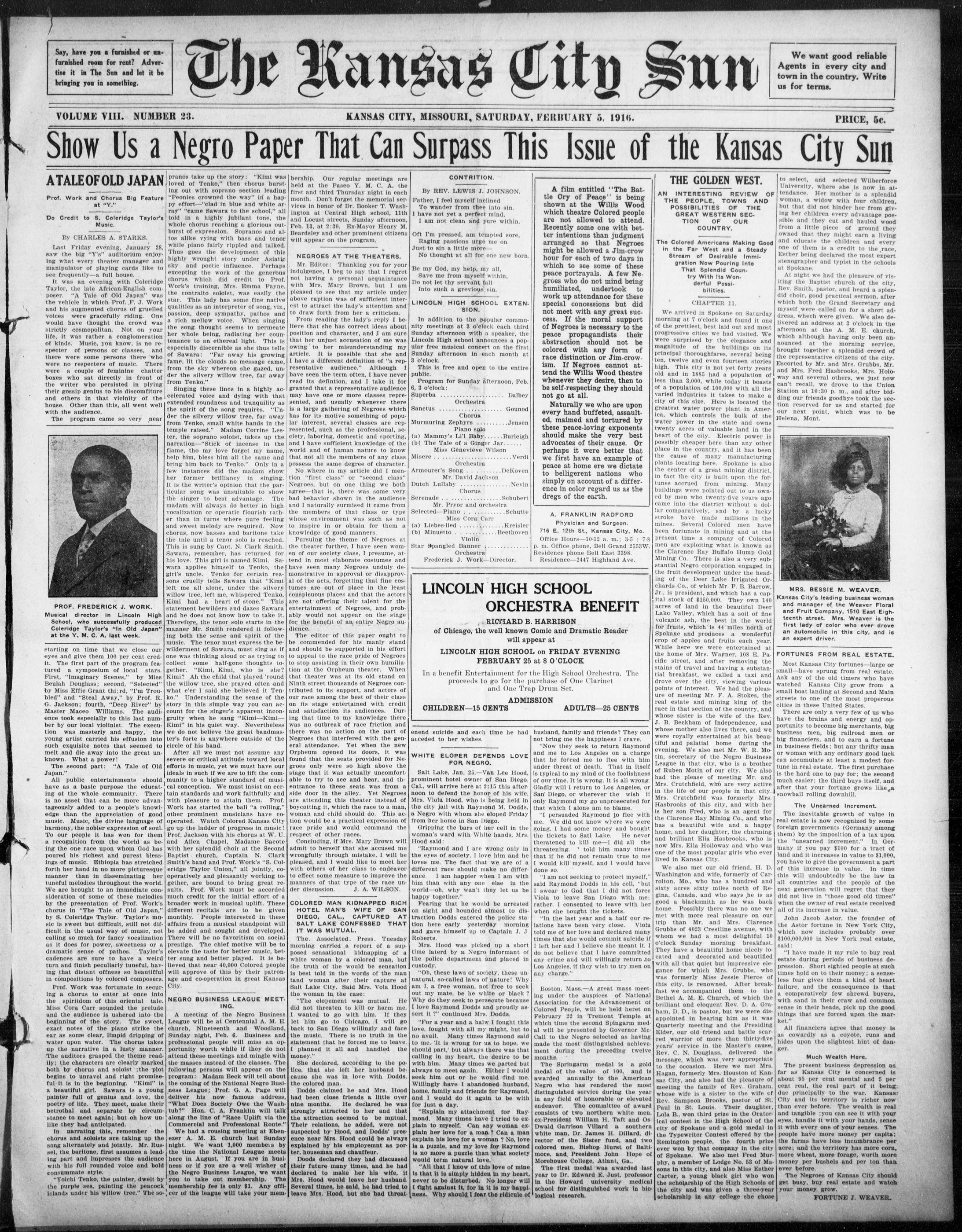
Show Us a Negro Paper That Can Surpass This Issue of the Kansas City Sun
VOLUME VIII. NUMBER 23.
Singing these lines in a highly accelerated voice and dying with that extended roundness and tranquility as the spirit of the song requires. "Under the silvery willow tree, far away from Tenko, small white hands in the temple raised." Madam Corrine Lester, the soprano soloist, takes up the narration "Stick of incense in the flame, tho my love forget my name, help him, bless him all the same and bring him back to Tenko." Only in a few instances did the madam show her former brilliance in singing. It is the writer's opinion that the particular song was unsuitable to show the singer to best advantage. The madam will always do better in high vocalization or operatic flourish rather than in turns where pure feeling and sweet melody are required. Now chorus, now basses and baritone take the tale until a tenor solo is reached. This is sung by Capt. N. Clark Smith. Sawara, remember, has returned for his love. This girl is named Kimi. Sawara applies himself to Tenko, the girl's uncle. Tenko for certain reasons cruelly tells Sawara that "Kimi left me all alone, under the silvery willow tree, left me, whispered Tenko, Kimi had a heart of stone." This statement bewilders and dazes Sawara and he does not know how to take it. Therefore, the tenor solo starts in the manner Mr. Smith rendered it following both the sense and spirit of the music. The tenor must express the bewilderment of Sawara, must sing as if one was thinking aloud or as trying to collect some half-gone thoughts together. "Kimi, Kimi, who is she? Kimi? Ah the child that played 'round the willow tree, she prayed often and what e'er I said she believed it Tenko." Understanding the sense of the story in this simple way you can account for the singer's apparent incongruity when he sang "Kimi—Kimi—Kimi" in his quiet way. Nevertheless we do not believe the great bandmaster's forte is anywhere outside of the circle of his band.
Say, have you a furnished or unfurnished room for rent? Advertise it in The Sun and let it be bringing you in something.
ATALEOFOLD JAPAN
Prof. Work and Chorus Big Feature at "Y."
Do Credit to S. Coleridge Taylor's Music.
Last Friday evening, January 28 saw the big "Y's" auditorium enjoying what every theater manager and manipulator of playing cards like to see frequently—a full house.
It was an evening with Coleridge Taylor, the late African-English composer. "A Tale of Old Japan" was the vehicle in which Prof. F, J. Work and his augmented chorus of gruelled voices were gracefully riding. One would have thought the crowd was strictly cosmopolitan. Not on your life, it was rather a conglomeration of kinds. Music, you know, is no respecter of persons or classes, and there were some persons there who were no respecters of music. There were a couple of feminine chatter boxes who sat directly in front of the writer who persisted in plying their gossip genius to his discomfiture and others in that vicinity of the house. Other than this, all went well with the audience.
The program came so very near
PROF. FREDERICK J. WORK.
Musical director in Lincoln High School, who successfully produced Coleridge Taylor's "In Old Japan" at the Y. M. C. A. last week.
starting on time that we close our eyes and give them 100 per cent credit. The first part of the program featured a symposium of local stars. First, "imaginary Scenes," by Miss Beulah Douglass; second, "Selected" by Miss Effie Grant thi;rd, "I'm Troubled" and "Steal Away," by Prof. R. G. Jackson; fourth, "Deep River" by Master Maceo Williams. The audience took especially to this last number by our local violinist. The execution was masterly and happy, the young artist carried his effusion into such exquisite notes that seemed to melt and die away into the great unknown. What a power! The second part: "A Tale of Old Japan."
All public entertainments should have as a basic purpose the educating of the whole community. There is no asset that can be more advantageously added to a people's knowledge than the appreciation of good music. Music, the divine language of harmony, the nobler expression of soul. To our people it has won for them a recognition from the world as being the one race upon whom God has poured his richest and purest blessings of music. Ethiopia has stretched forth her hand in no more picturesque manner than in disseminating her tuneful melodies throughout the world. We are brought to an immediate consideration of some of these melodies by the presentation of Prof. Work's chorus in "The Tale of Old Japan," by S. Coleridge Taylor. Taylor's music is sweet but difficult, still not difficult in the usual way of music, not calling so much for fancy vocalization as it does for power, sweetness or a dramatic sense of pathos. Taylor's cadences are sure to have a weird turn and finish peculiarly tuneful, having that distant offness so beautiful in compositions by colored composers
Prof. Work was fortunate in securing a chorus to enter at once into the spiritdom of this oriental tale. Miss Cora Carr sounded the prelude and the audience is ushered into the beginning of the story. The sweet, exact notes of the piano strike the ear as some clear, limpid dripping of water upon water. The chorus takes up the narrative in a lusty manner. The auditors grasped the theme readily; the characters are clearly marked both by chorus and soloist; the plot begins to unravel and right promiseful it is in the beginning. "Kimi" is a beautiful girl. Sawara is a young painter full of genius and love, the poetry of life. They meet, make their betrothal and separate by circumstance to meet again; but oh how unlike they had anticipated.
In narrating this, remember the chorus and soloists are taking up the song alternately and jointly. Mr. Russell, the baritone, first assumes a leading part and impresses the audience with his full rounded voice and bold consummate style.
"Yoichi Tenko, the painter, dwelt by the purple sea, painting the peacock islands under his willow tree." The so-
The Kansas City Sun
pranos take up the story: "Kimi was loved of Tenko," then chorus bursting out with soprano section leading "Peonies crowned the way" in a happy effort—"clad in blue and white array" "came Sawara to the school," all told in a highly jubilant tone, the whole chorus reaching a glorious outburst of expression. Sopranos and alts alike vying with bass and tenor while piano fairly rippled and talked. Thus goes the development of this highly wrought story under Asiatic sky and poetic influence. Perhaps excepting the work of the generous chorus which did credit to Prof. Work's training, Mrs. Emma Payne, the contralto soloist, was easily the star. This lady has some fine native qualities as an interpreter of song, viz. passion, deep sympathy, pathos and a rich mellow voice. When singing the song thought seems to permeate her whole being, radiating her countenance to an ethereal light. This is especially discernible as she thus tells of Sawara: "Far away his growing fame, lit the clouds no message came, from the sky whereon she gazed, under the silvery willow tree, far away from Tenko."
After all we must not assume any severe or critical attitude toward local efforts in music, yet we must have our ideals in such if we are to lift the community to a higher standard of musical conception. We must insist on certain standards and work faithfully and with pleasure to attain them. Prof. Work has started the ball "a rolling," other prominent musicians have cooperated. Watch Colored Kansas City go up the ladder of progress in music! Prof. Jackson with his chorus at W. U. and Allen Chapel, Madame Bacote with her splendid choir at the Second Baptist church, Captain N. Clark Smith's band and Prof. Work's "S. Coleridge Taylor Union," all jointly, cooperatively and pleasantly working together, are bound to bring great results. Prof. Work must be accorded much credit for the initial effort of a broader work in musical uplift. These different recitals are to be given monthly. People interested in these affairs from a musical standpoint will be added and sought and developed. There will be no favoritism on social prestige. The chief motive will be to elevate the taste for better music, better tung and better played. It is believed that near 40,000 Colored people will approve of this by their patronage and co-operation in great Kansas City.
NEGRO BUSINESS LEAGUE MEETING.
A meeting of the Negro Business League will be at Centennial A. M. E. church, Nineteenth and Woodland, Sunday night, Feb. 6. Business and professional people will miss an opportunity worth while if they do not attend these meetings and mingle with the masses instead of the classes. The following persons will appear on the program: Madam Beck will tell about the coming of the National Negro Business League; Prof. G. A. Page will deliver his now famous address, "What Does Society Owe the Washub?" Hon. C. A. Franklin will talk along the line of "Race Uplift via the Commercial and Professional Route." We had a rousing meeting at Ebenzer A. M. E. church last Sunday night. We want 1,000 members by the time the National League meets here in August. If you are in business or if you are a well wisher of the Negro Business League, we want you to take out membership. The membership fee is only $1. Any officer of the league will take your mem
KANSAS CITY, MISSOURI, SATURDAY, FERBUARY 5. 1916.
bership. Our regular meetings are held at the Paseo Y. M. C. A. the first and third Thursday night in each month. Don't forget the memorial services in honor of Dr. Booker T. Washington at Central High school, 11th and Locust streets, Sunday afternoon, Feb. 13, at 2:30. Ex-Mayor Henry M. Beardsley and other prominent citizens will appear on the program.
NEGROES AT THE THEATERS
NEGROES AT THE THEATERS.
Mr. Editor; Thanking you for your indulgence, I beg to say that I regret not having a personal acquaintance with Mrs. Mary Brown, but I am pleased to see that my article under above caption was of sufficient interest to attract the lady's attention and to draw forth from her a criticism.
From reading the lady's reply I believe that she has correct ideas about position and character, and I am sure that her unjust accusation of me was owing to her misunderstanding my article. It is possible that she and I have a different definition of "a representative audience." Although I have seen the term often, I have never read its definition, and I take it for granted that a representative audience may have one or more classes represented, and usually whenever there is a large gathering of Negroes which has for its motive something of popular interest, several classes are represented, such as the professional, society, laboring, domestic and sporting, and I have sufficient knowledge of the world and of human nature to know that not all the members of any class possess the same degree of character. No where in my article did I mention "first class" or "second class" Negroes, but on one thing we both agree—that is, there was some very bad behavior shown in the audience and I naturally surmised it came from the members of that class or type whose environment was such as not to inspire in or obtain for them a knowledge of good manners.
Pursuing the theme of Negroes at the theater further, I have seen women of our society class, I presume, attend in most elaborate costumes and have seen many Negroes unduly demonstrative in approval or disapproval of the acts, forgetting that fine costumes are out of place in the least conspicuous places and that the actors are not offering their talent for the entertainment of Negroes, and probably would not appear on the stage for the benefit of an entire Negro audience.
The editor of this paper ought to be commended for his manly stand and should be supported in his effort to appeal to the race pride of Negroes to stop assisting in their own humiliation at the Orpheum theater. When that theater was at its old stand on Ninth street thousands of Negroes contributed to its support, and actors of our race among the best of their class on its stage entertained with credit and satisfaction its audiences. During that time to my knowledge there was no outbreak of race friction and there was no action on the part of Negroes that interfered with the general attendance. Yet when the new Orpheum opened its doors, it was found that the seats provided for Negroes only were so high above the stage that it was actually uncomfortable to try to see and hear, and the entrance to these seats was from a side door in the alley. Yet Negroes are attending this theater instead of boycotting it, which the race to a man, woman and child should do. This action would be a practical expression of race pride and would command the respect of other races.
Concluding, if Mrs. Mary Brown will admit to herself that she accused me wrongly through mistake, I will be pleased, and I would like to meet her with others of her class to endeavor to effect some measure to improve the manners of that type of the race under discussion. J. A. WILSON.
COLORED MAN KIDNAPPED RICH
HOTEL MAN'S WIFE OF SAN
DIEGO, CAL., CAPTURED AT
SALT LAKE CONFESSED THAT
IT WAS MUTUAL.
The. Associated. Press. Tuesday morning carried a report of a supposed sensational kidnapping of a white woman by a colored man, but the truth of the would be sensation is best told in the words of the man tand woman after their capture at Salt Lake City. Said Mrs. Vola Hood the woman in the case:
"The elopement was mutual. He did not threaten to kill or harm me. I wanted to go with him. If they let him go to Chicago, I will go back to San Diego willingly and face the music. There is no truth in the statement that he forced me to leave. I planned it all and handled the money."
She declared, according to the police, that she left her husband because she was in love with Dodds, the colored man.
Dodds claimed he and Mrs. Hood had been close friends a little over nine months. He declared he was strongly attracted to her and that the attraction seemed to be mutual. Their relations, he added, were not suspected by Hood, and Dodds' presence near Mrs. Hood could be always explained by his employmnt as porter, houseman and chauffeur.
Doods declared they had discussed their future many times, and he had declared to make her his wife, if Mrs. Hood would leave her husband. Several times, he said, he had tried to leave Mrs. Hood, but she had threat
LINCOLN HIGH SCHOOL ORCHESTRA BENEFIT
RICHARD B. HARRISON of Chicago, the well known Comic and Dramatic Reader will appear at LINCOLN HIGH SCHOOL on FRIDAY EVENING FEBRUARY 25 at 8 O'CLOCK In a benefit Entertainment for the High School Orchestra. The proceeds to go for the purchase of One Clarinet and One Trap Drum Set.
CONTRITION.
By REV. LEWIS J. JOHNSON.
Father, I feel myself inclined
To wander from thee into sin.
I have not yet a perfect mind,
I am not clean and pure within.
Oft I'm pressed, am tempted sore,
Raging passions urge me on
Just to sin a little more—
No thought at all for one new born.
Be my God, my help, my all,
Save me from myself within,
Do not let thy servant fall
Into such a grevious sin.
LINCOLN HIGH SCHOOL EXTEN-
SION.
In addition to the popular com-
munity meetings at 3 o'clock each third
Sunday afternoon with a speaker, the
Lincoln High school announces a popu-
lar free musical concert on the first
Sunday afternoon in each month at
3 o'clock.
This is free and open to the entire
public.
Program for Sunday afternoon, Feb. 6, 3 o'clock:
Superba ..... Dalbey
Orchestra
Sanctus ..... Gounod
Murmuring Zephys ..... Jensen
Piano solo
(a) Mammy's Li'l Baby ..... Burleigh
(b) The Tale of a Ginger Jar ..... Miss Genevieve Wilson
Misere ..... Verdi
Orchestra
Armourer's Song ..... DeKoven
Mr. David Jackson
Dutch Lullaby ..... Nevin
Chorus
Serenade ..... Schubert
Mr. Pryor and orchestra
Selected—Piano ..... Schutte
Miss Cora Carr
(a) Liebes-lied ..... Kreisler
(b) Minuetto ..... Beethoven
Violin
Star Spangled Banner ..... Orchestra
Frederick J. Work—Director.
LINCOLN HIGH ORCHI
RICHARD B. of Chicago, the well known will ap
LINCOLN HIGH SCHOOL FEBRUARY 25th
In a benefit Entertainment for proceeds to go for the and One Tr
ADMI CHILDREN—15 CENTS
enend suicide and each time he had
acceded to her wishes.
WHITE ELOPER DEFENDS LOVE
FOR NEGRO.
Salt Lake, Jan. 25.—Van Lee Hood, prominent hotel owner of San Diego, Cal., will arrive here at 2:15 this afternoon to defend the honor of his wife, Mrs. Viola Hood, who is being held in the city jail with Raymond M. Dodds, a Negro with whom she eloped Friday from her home in San Diego.
Gripping the bars of her cell in the woman's ward with White hands, Mrs. Hood said:
"Raymond and I are wrong only in the eyes of society. I love him and he loves me. The fact that we are of a different race should make no difference. I am happier when I am with him than with any one else in the world—oh, why won't they let us be happy together."
Fearing that he would be arrested on sight and hounded almost to distraction Dodds entered the police station here early yesterday morning and gave himself up to Captain J. J. Roberts.
Mrs. Hood was picked up a short time laterd by a Negro informant of the police department and placed in custody.
"Oh, these laws of society, these unnatural, so-called laws of nature! Why am I, a free woman, not free to seek out my mate, be he white or black? Why do they seek to persecute because I love Raymond Dodds and proudly assert it?" continued Mrs. Dodds.
"For a year and a halw I fought this love, fought with all my might, but to no avail. Many times Raymond said to me. 'It is wrong for us to hope, we should part,' but always there was that calling in my heart, the desire to be with him. Many times we parted but always to meet again. Either I would seek him out or he would find me. Willingly I have I abandoned husband, home, family and friends for Raymand, and I would do it again to be with for just a day.
"Explain my attachment for Raymond. Many times have I tried to explain to myself. Can any woman explain her love for a man? Can a man explain his love for a woman? No, love is a puzzle, and my love for Raymand is no more a puzzle than what society would term natural love.
"All that I know of this love of mine is that it is simply hidden in my heart, never to be disturbed. No longer will I fight against it, for in it is my happiness. Why should I fear the ridicule of
A film entitled "The Battle Cry of Peace" is being shown at the Willis Wood which theatre Colored people are not allowed to attend. Recently some one with better intentions than judgment arranged so that Negroes might be allowed a Jim-crow hour for each of two days in which to see some of these peace portrayals. A few Negroes who do not mind being humiliated, undertook to work up attendance for these special concessions but did not meet with any great success. If the moral support of Negroes is necessary to the peace propagandists their abstraction should not be colored with any form of race distinction or Jim-crowism. If Negroes cannot attend the Willis Wood theatre whenever they desire, then to be self-respecting they should not go at all.
Naturally we who are upon every hand buffeted, assaulted, maimed and tortured by these peace-loving exponents should make the very best advocates of their cause. Or perhaps it were better that we first have an example of peace at home ere we dictate to belligerent nations who simply on account of a difference in color regard as the dregs of the earth.
A. FRANKLIN BADEFORD
Physician and Surgeon.
716 E. 12th St., Kansas City, Mo.
Office Hours—10-12 a. m.; 3-5: 7-8
p. m. Office phone, Bell Grand 2553W.
Residence phone Bell East 3398.
Residence—2447 Highland Ave.
SCHOOL
ESTRA BENEFIT
HARRISON
Comic and Dramatic Reader
appear at
L on FRIDAY EVENING
at 8 O'CLOCK
The High School Orchestra. The
purchase of One Clarinet
p Drum Set.
SSION
ADULTS—25 CENTS
husband, family and friends? They can not bring me the happiness I crave.
"Now they seek to return Raymond and me to Los Angeles on a charge that he forced me to flee with him under threat of death. That in itself is typical to my mind of the foolishness of our time. It is wrong. It is all wrong. Gladly will I return to Los Angeles, or San Diego, or wherever the wish if only Raymond my go unprosecuted for that which I alone am to blame.
"I persuaded Raymond to flee with me. We did not know where we were going. I had some money and bought the tickets to Satl Lake. He never threatened to kill me—I did all the threatening. I told him many times that if he did not remain true to me I would kill myself, and I would have done so.
"I am not seeking to protect myself," said Raymond Dodds in his cell, "but I swear to God that I did not force Viola to leave San Diego with me; rather, I consented to leave with her when she bought the tickets.
"In the last year and a half our relations have been very close. Viola told me of her love and declared many times that she would commit suicide if I left her and I believe she meant it. I do not believe that I have committed any crime and will willingly return to Los Angeles, if they wish to try men on any charge."
Boston, Mass.—A great mass meeting under the auspices of National Association for the Advancement of Colored People, will be held heret on February 22 in Tremont Temple at which time the second Spingarm medal will be presented by Governor McCall to the Negro selected as having made the most distinguished achievement during the preceding twelve months.
The Springarm medal is a gold medal of the value of 100, and is awarded annually to the American Negro who has rendered the most distinguished service during the year in any field of honorable or elevated endeavor. The committee of award consists of two northern white men, ex-President William H. Taft and Oswald Garrison Villard a southern white man, Dr. James H. Dillard, director of the Sister fund, and two colored men, Bishop Hurst of Baltimore, and President John Hope of Morehouse College, Atlant, Ga.
The first medal was awarded last year to Dr. Edward E. Just, professor in the Howard University medical school for distinguished work in biological research.
THE GOLDEN WEST.
AN INTERESTING REVIEW OF
THE PEOPLE, TOWNS AND
POSSIBILITIES OF THE
GREAT WESTERN SEC-
TION OF OUR
COUNTRY.
The Colored Americans Making Good
in the Far West and a Steady
Stream of Desirable Immi-
gration Now Pouring Into
That Splendid Coun-
try With Its Won-
derful Possi-
bilities.
We arrived in Spokane on Saturday morning at 7 o'clock and found it one of the prettiest, best laid out and most progressive cities we had visited. We were surprised by the elegance and magnitude of the buildings on its principal thoroughfares, several being ten, twelve and fourteen stories high. This city is not yet forty years old and in 1885 had a population of less than 3,000, while today it boasts of a population of 100,000 with all the varied industries it takes to make a city of this size. Here is located the greatest water power plant in America, which controls the bulk of the water power in the state and owns twenty acres of valuable land in the heart of the city. Electric power is possibly cheaper here than any other place in the country, and it has been the cause of many manufacturing plants locating here. Spokane is also the center of a great mining district, in fact the city is built upon the fortunes accrued from mining. Many buildings were pointed out to us owned by men who twenty-five years ago came into the district without a dollar comparatively, and by a lucky stroke have made millions in the mines. Several Colored men have been fortunate in mining and at the present time a company of Colored men are exploiting what is known as the Clarence Ray Buffalo Hump Gold Mining Co. There is also a very substantial Negro corporation engaged in the fruit development under the heading of the Deer Lake Irrigated Orchards Co., of which Mr. P. B. Barrow, Jr., is president, and which has a capital stock of $150,000. They own 140 acres of land in the beautiful Deer Lake Valley, which has a soil of fine volcanic ash, the best in the world for fruits, which is 44 miles north of Spokane and produces a wonderful crop of apples and fruits each year. While here we were entertained at the home of Mrs. Wagner, 108 E. Pacific street, and after removing the stains of travel and having a substantial breakfast, we called a taxi and drove over the city, viewing various points of interest. We had the pleasure of meeting Mr. F. A. Stokes, the real estate and mining king of the race in that section of the country, and whose sister is the wife of the Rev. J. B. Beckham of Independence, and whose mother also lives there, and we were royally entertained at his beautiful and palatial home during the evening. We also met Mr. W. R. Motin, secretary of the Negro Business League in that city, who is a brother of Ruben Motin of our city. We also had the please of meeting Mr. and Mrs. Crutchfield, who are very active in the life of our people in that city. Mrs. Crutchfield was formerly Mrs. Hasbrooks of this city, and with her is her son Fred, who is an agent for the Clarence Ray Mining Co., and who has a beautiful wife and a happy home, and her daughter, the charming and brilliant Ella Hasbrooks, who is now Mrs. Ella Holloway and who was one of the most popular girls who ever lived in Kansas City.
We also met our old friend, H. D. Washington and wife, formerly of Carrolton, Mo., who has a hundred and sixty acres sixty miles north of Regina, Canada, and who says he is as good a blacksmith as he was back home. Possibly there was no one we met with more real pleasure on our trip than Mr. and Mrs. Clarence Grubbs of 4023 Crestline avenue, with whom we had a most delightful 10 o'clock Sunday morning breakfast. They have a beautiful home nicely located and decorated and beautified with all that quiet but impressive elegance for which Mrs. Grubbs, who was formerly Miss Jessie Pierce of this city, is renowned. After breakfast we accompanied them to the Bethel A. M. E. Church, of which the brilliant and eloquent Rev. D. A. Graham, D. D., is pastor, but we were disappointed in hearing him as it was Quarterly meeting and the Presiding Elder, our old friend and battle scared, warrior of more than thirty-five years' service in the Master's cause, Rev C. N. Douglass, delivered the message, which was very appropriate to the occasion. Here we met Mrs. Hagan, formerly Mrs. Houston of Kansas City, and also had the pleasure of meeting the family of Rev. Graham, whose wife is a sister to the wife of Rev. Sampson Brooks, pastor of St. Paul in St. Louis. Their daughter, Lola B., won third prize in the Oratorical contest in the High School of the city of Spokane and a gold medal in the Typewriter Contest offered by the Remington people, the fourth prize ever won by that company in the city of Spokane. We also met Fred Murphy, a member of Lodge No. 53 of Maisons in this city, and also Miss Esther Carter, a young black girl who won the scholarship of the High Schools of the city and was given a three-year scholarship in any college she chose
We want good reliable Agents in every city and town in the country. Write us for terms.
PRICE, 5c.
to select, and selected Wilberforce University, where she is now in attendance. Her mother is a splendid woman, a widow with four children, but that did not hinder her from giving her children every advantage possible and they cut and hauled wood from a little piece of ground they owned that they might earn a living and educate the children and every one of them is a credit to the race, Esther being declared the most expert stenographer and typist in the schools at Spokane. At night we had the pleasure of visiting the Baptist church of the city, Rev. Smith, pastor, and heard a splendid choir, good practical sermon, after which both the Grand Secretary and myself were called on for a short address, whech were given. We also delivered an address at 3 o'clock in the afternoon at the A. M. E. church, which although having only been announced at the morning service, brought together a splendid crowd of the representative citizens of the city. Escorted by Mr. and Mrs. Grubbs, Mr. and Mrs. Fred Hasbrooks, Mrs. Holoway and several others, we just now can't recall, we drove to the Union Station at 10:30 p. m., and after bidding our friends goodbye took the section reserved for us and started for our next point, which was to be Helena, Mont.
MRS. BESSIE M. WEAVER.
Kansas City's leading business woman and manager of the Weaver Floral and Fruit Company, 1510 East Eighteenth street. Mrs. Weaver is the first lady of color who ever drove an automobile in this city, and is an expert driver.
FORTUNES FROM REAL ESTATE.
Most Kansas City fortunes—large or small—have sprung from real estate. Ask any of the old timers who have watched Kansas City grow from a small boat landing at Second and Main streets to one of the most proper cities in these United States. There are only a very few of us who have the brains and energy and opportunity to become big merchants, big business men, big railroad men or big financiers, and to earn a fortune in business fields; but any thrifty man or woman with any ordinary good luck can accumulate at least a modest fortune in real estate. The first purchase is the hard one to pay for; the second much easier; the third buys itself, and after that your fortune grows like a snowball rolling downhill.
The Unearned Increment.
The inevitable growth of value in real estate is now recognized by some foreign governments (Germany among them) by the imposition of a tax upon the "unearned increment." In Germany if you pay $100 for a tract of land and it increases in value to $1,000, you have to give the government a part of this increase in value. In time this will undoubtedly be the law in all countries and the people of the next generation will regret that they did not live in "those good old times" when the owner of real estate received all of its increase in value.
John Jacob Astor, the founder of the Astor fortune in New York City, which now includes probably over $100,000,000 in New York real estate, said:
"I have made it my rule to buy real estate during periods of business depression. Short sighted people at such times hold on to their money; a senseless fear gives them a kind of heart failure, and the consequence is that a comparatively few shrewd buyers, with sand in their craw and common sense in their heads, pick up the good things that are forced upon the market."
All financiers agree that money is as cowardly as a coyote, runs and hides upon the slightest hint of danger.
Much Wealth Here.
The present business depression as far as Kansas City is concerned is about 95 per cent mental and 5 per cent real, the real part of it being due principally to the war. Kansas City and its territory is richer now than ever before. The wealth is real and tangible; you can see it with your eyes, handle it with your hands, sense it with every one of your senses. The people have more money per capita; the farms have less incumbrance per acre; and the territory has more corn, more wheat, more forage, worth more money per bushels and per ton than ever before. The Negroes of Kansas City should get busy, buy real estate and watch your money grow.
FORTUNE J. WEAVER
INTERNATIONAL
SUNDAY SCHOOL
LESSON
(BY E. O. SELLERS, Acting Director of
Sunday School Course, Moody Bible
Institute.
(Copyright, 1916, Western Newspaper Union.)
BOLDNESS OF PETER AND JOHN.
LESSON TEXT-Acts 4:1-3L.
GOLDEN TEXT-Watch ye, stand fast
in the faith, quit ye like men, be strong.
I Cor. 16:13.
The first seven chapters of the book of Acts have been designated as the Jerusalem period. Chapter 1 deals with the ascension of our Lord; chapter 2, the baptism of the Holy Spirit; chapters 3-7, the early conflicts in Jerusalem. In our lesson of last Sunday we had the story of Peter and John dealing with the lame man while on their way to the temple. Following this experience they were imprisoned, the first imprisonment mentioned for any of those who accepted the Gospel. As the disciples were dealing with the multitude the rulers of the temple came upon them and were much put out (v. 2) that the disciples should preach the resurrection of Jesus from the dead. The significance of this is better understood when we remember that the Jewish Sanhedrin was the great court of Jewish law composed of seventy-one leading men of the nation. Calaphas, the noble high priest by Roman appointment, and Annas, the real high priest according to Jewish law, were both there. This body was largely made up of the Sadduces, the sect which did not believe in the resurrection from the dead.
1. The imprisonment, vv. 1.4. Peter and John being brought before this tribunal were fulfilling literally the prediction of Jesus (Matt. 10:17). The attempt on the part of the rulers to prevent the preaching of the Gospel by this method really augmented its being heard throughout the nation. Peter had seen this body of men on the night when our Lord was condemned. Then he had made a miserable failure, but now the situation is quite different, for Peter is anointed of the Holy Spirit and is entirely lacking in the fear which controlled him on the previous occasion. That he had given effective testimony is evident from the way the men had precipitated matters and cast him into prison for the night.
II. The Trial, vv. 5-22. (1) Peter's words vv. 5-12. Jewish wonder-workers were accustomed to perform marvels by the use of some name, so the counsell very naturally asked Peter and John "In what name" they had healed this man. The real object of their question was their attempt to entrap the disciples and find a basis of accusation and condemnation. But at that moment the Holy Spirit came again upon Peter and filled him (Matt. 10:19, 20; also Luke 12:11, 12; Acts 13:8, 9). The coming of the Holy Spirit is for every emergency of the Christian. Peter had been filled with that Spirit at Pentecost and was again filled a little later on (chapter 2:31). Thus we see that the coming of the Spirit is not once for all, though Pentecost was once for all, but that the filling is repeated as each new emergency may arise. (a) Peter acknowledged the authority of those who were dealing with him (v. 8), but (b) he gave Jesus credit (v. 10). It was Jesus who had died, he was also risen, and the risen Christ had effected this miracle. (c.) Turning upon his accusers Peter charged them with the death of Jesus. He (v. 11) is the foundation of their miracle and their faith. Peter claimed that in Jesus alone (v. 12) could salvation be found, and implied (see last clause of this verse) that his accusers were lost men. Peter's deportment in all of this wonderfully skillful, gentle and courteous, yet bold, fearless, frank and outspoken. We need to remember this when we recall how blunderingly Peter had conducted his conversation before his endowment by the Holy Spirit. There was no compromising of the truth and no glossing over their guilt. (2) The effect upon the rulers (vv. 13-18). (a) The Council had spoken evasively about what had been done, but Peter's thrust in his reply, "If you refer to the good deeds done to the strengthless (impotent man)," confirmed his testimony by having a living witness (v. 14), and therefore the leaders were speechless. If Christian workers could have more of living results to present to the world (see v. 14) they would silence the mouth of criticism and the frequent objections of Christianity. It is small wonder (v. 16) that these men were at a loss what to do. Their pet doctrine of no resurrection from the dead was refuted and contradicted before their very eyes, and they there fore (v. 17) resorted to the usua method of people, who when defeated seek to browbeat and intimidate others to prevent their continuing to give their testimony.
III. The Result Upon the Disciples, vv. 19-22. The book of Acts is plainly the record of the deft utterances of spiritual men. Peter had closed his appeal (v. 12) with the statement that the only way we could be saved must be through this means. The council were in a dilemma; they wanted to punish Peter and John, but could not, for the people were glorifying God for what had been done. Peter and John declared thus fearlessly that the teachings of the schools was not in accordance with that, for had not Jesus risen, and had not this miracle been performed? The Holy Ghost's boldness in these untutored men has always been a perplexity to the scholastics of the world. Their boldness was due to a sense of God's nearness and carried with it a like sense of their responsibility to him (see vv. 19, 20).
The only solution, on the part of the people and of the priests, was they took knowledge that "these men have been with Jesus." This is the solution of many mysteries of today.
AFRO-AMERICAN CULLINGS
Nearly everybody has heard of Mound Bayou, Miss., the only exclusive "Negro city" in the United States. It has attracted public attention to an extent only second to Tuskegee as an effort to help lead the Negro to the solution of the problem of the industrial life. All the town officials, the postmaster, railroad agent, and everybody else is a Negro. And all the property is owned by Negroes. Now comes word that this community is threatened with grave embarrassment due to financial difficulties.
Well-known men, North and South, are named as patrons of a plan to aid the founder of the city, whose services to both the black and white race are freely admitted by the leading newspapers of that section. Among the patrons of the plan, which is, briefly, a bond issue on the founder's entire holdings, are Stuvesant Fish, ex-Senator Loroy Percy, Bishop Theodore Bratton of the Episcopal church, Charles Scott, formerly president of the Mississippi River Levee association; C. P. J. Mooney, editor of the Commercial Appeal, Memphis; J. A. Hayes of Colorado, son-in-law of Jefferson Davis, and others almost as well known.
Isaiah T. Montgomery's remarkable character and services are at the back of these spontaneous tributes to the leading spirit of the Mound Bayou community. He was a slave of the Davis family and was the lifelong friend of Jefferson Davis, president of the confederacy. Immediately after the war he came to be the master of the estate on which he was once a slave, but only for a brief period, for the property was soon restored to the Davis family.
Not as a slave, but as leader of his race he gained his recognition. He has stood during his entire life for the principle of good relations between the white and black races. He has constantly urged his people to be honest, thrifty, and, above all, law-abiding. He has especially emphasized the great advance which the race could achieve through earnest industry and economy.
He has the distinction of having been the only Negro member of the Mississippi constitutional convention of 1890—the body which adopted the literacy test for voting. He was a member of the committee on the franchise. And when the plan had been adopted he accepted it as not taking away the franchise from his race but putting that great birthright of American citizens on the highest plane. His speech in the convention showed him to be an orator of no mean rank and electrified not only the members but attracted national attention.
The present financial difficulties are due in the main to the stress of last year, with its short crop in his section, and extremely low prices for products.—Exchange.
The memory of Booker T. Washington, educator, will be perpetuated in Chicago by a practical memorial building to be named in his honor March 1, when the building of the Kehlath Anshe Mayriv Reformed Jewish congregation, East Thirty-third street and Indiana avenue, is purchased at a cost of $55,000. The building will be renamed the Booker T. Washington memorial and when refitted will be used as a social center and industrial training school for Negro children of Chicago. It will care for 1,000 to 1,500 children and will solve for hundreds of parents the problem of how to keep
That the Negro race in America will serve the United States faithfully and patriotically, was asserted by Prof. Kelly Miller of Howard university, in an address at a meeting of the Bethel Literary and Historical association at Metropolitan A. M. E. church, Washington. Having for his subject "Howard University Facing the Future," Professor Miller said, in part: "The Afro-American is sometimes used as a hyphenated designation of the Negro race. But there is no hyphen that separates his patriotism from that of the American people. He is as good a citizen as the American people will allow him to be. Howard University absolutely repudiates the hyphen, and, with Mr. Roosevelt, would relegate it to the region where it belongs. In the midst of feverish haste for national preparedness, no one is wise enough to predict what patriotic demand may be made upon this nation in the near, or even in the immediate future. But when that day comes, if come it must, the Negro will, for the time, swallow his just grievances, and respond to his country's call as enthusiastically as he did when the na
Unless you can play it pretty well, to own a fiddle is a sign of shiftlessness. But the most marked indication of shiftlessness is to own a foxhound.
You will be glad to learn that two young Americans finally have responded to the insistent demand that somebody walk around the world on stilts.
Occasionally a man knows a good thing when he sees it, but most men are too dignified.
From Force of Habit.
A woman walked up to the teller in the ladies' department of a New York trust company and handed in at the window a check made payable to her order for $4. The teller pushed it back to her, asking her to indorse it. When she had written the indorsement she fumbled in her pocketbook and took from it $5 bill, which she pushed across the slide to him with the check, saying "take it out of that." "Why madam," he remarked, "this calls for you to receive $4, not to pay
their children off the streets and out of bad company while they themselves are at work. A popular subscription to raise the sum necessary to purchase the building and grounds has been started by colored and white friends of the late Doctor Washington and a committee of directors of the subscription fund has been appointed. The Chicago Title and Trust company has been named as treasurer and depository for all subscription funds for the memorial. The movement was started by the officers of the Lincoln-Lee institute of North Chicago, which will have charge of the memorial after it is purchased and turned into a social center and school.
"The white and colored friends of Booker T. Washington wished to perpetuate his memory in Chicago and decided upon the purchase of a suitable building for training the mind of the young colored man," said Dr. William A. Venerable, colored, principal of the Lincoln-Lee institute. "The members of the Jewish congregation interested in this movement offered the ground and building, which cost $136,000, for $85,000. We hope to raise the money by March 1."
The directors of the subscription fund are:
John D. Shoop, superintendent of schools.
John J. Armold, vice-president of the First National bank.
Jesse Binga, banker.
Edward O. Brown.
Henry Stuckart, county treasurer.
David C. Dunbar.
Edward P. Smith.
Dr. Max Herschleder, president of the board of trustees of the Lincoln-Lee institute.
Graduates of the colored high schools of Washington received their diplomas at the joint commencement exercises of the five leading colored high schools of the district on Convention hall, reports the Washington Star. There were addresses by E. L. Thurston, superintendent of schools; Charles F. Nesbit, commissioner of insurance, besides several leaders of the colored race in Washington, including Archibald H. Grimke, formerly the United States representative at Santo Domingo. There were 219 graduates altogether. The Cardozo Vocational School graduated 22, while 30 came from the O Street Vocational School. There were 54 graduates of the Armstrong Manual Training school and 100 from the M Street High school. In the department of business practice of the M Street High school there were thirteen graduates. Ernest L. Thurston, superintendent of education, awarded the scholarships and prizes. The award of diplomas was made by Dr. Charles H. Marshall for the M Street High school; Armstrong school, by Dr. Creed W. Childs, and for the Cardozo and O Street Vocational schools, Mrs. Coralie F. Cook. Archibald H. Grimke, president of the Washington Branch of the National Association for the Advancement of the Colored People, delivered the address to the graduates. Commissioner Nesbit, in awarding the prizes for the essays on fire protection, gave some interesting fig ures on the damage done through ignorance of the proper precautions against fire. Superintendent Thurston, speaking to the graduates to whom he was about to award the scholarships and prizes, declared that they were the coming men of their race.
tion's life was imperiled a generation ago. Howard university, as the national university of this race, is proud to contribute its share in inspiring and perpetuating this patriotic spirit in the American youth committed to its care. Howard university faces the future with assurance that it can rely upon the philanthropy and patriotism of the American people, to whom it contributes more than it derives." Earlier in his talk he referred to the objects of the institution, saying: "The chief aim of Howard university is to produce an educated and efficient leadership. The function of the Negro college is to prepare choice youth of this race to stand in the high places of intellectual, moral and spiritual authority among their less fortunate fellows. The blind cannot lead the blind, lest they both fall in the ditch. For want of vision the people perish, as well as for want of provision."
Prospectors for gold, who have been locating claims in the Rice Lake district, 100 miles north of Winnipeg, report that the territory is rich in minerals.
A complete steam fire engine, mounted on two wheels and light enough to be handled by two men, has been invented in England for suburban and private use.
Advice to women: If you love a man, do not scrutinize him too closely when he is eating. Watching a man eat is the heaviest cross love has to bear.
Some men talk like $1.98 phonographs
it." "Oh," she replied wearily, "I get so used to paying bills that I didn't know the difference."
White Crow In Pennsylvania
A white-feathered crow, according to residents of Logansville, can be seen in Solomon Kessler's woods. Hamilton Joseph says he saw the crow sitting on the limb of a tree with two black crows. Joseph has a reputation for veracity in all matters.—York (Pa.) Dispatch Philadelphia North American.
X
Advance Styles for the Small Boy
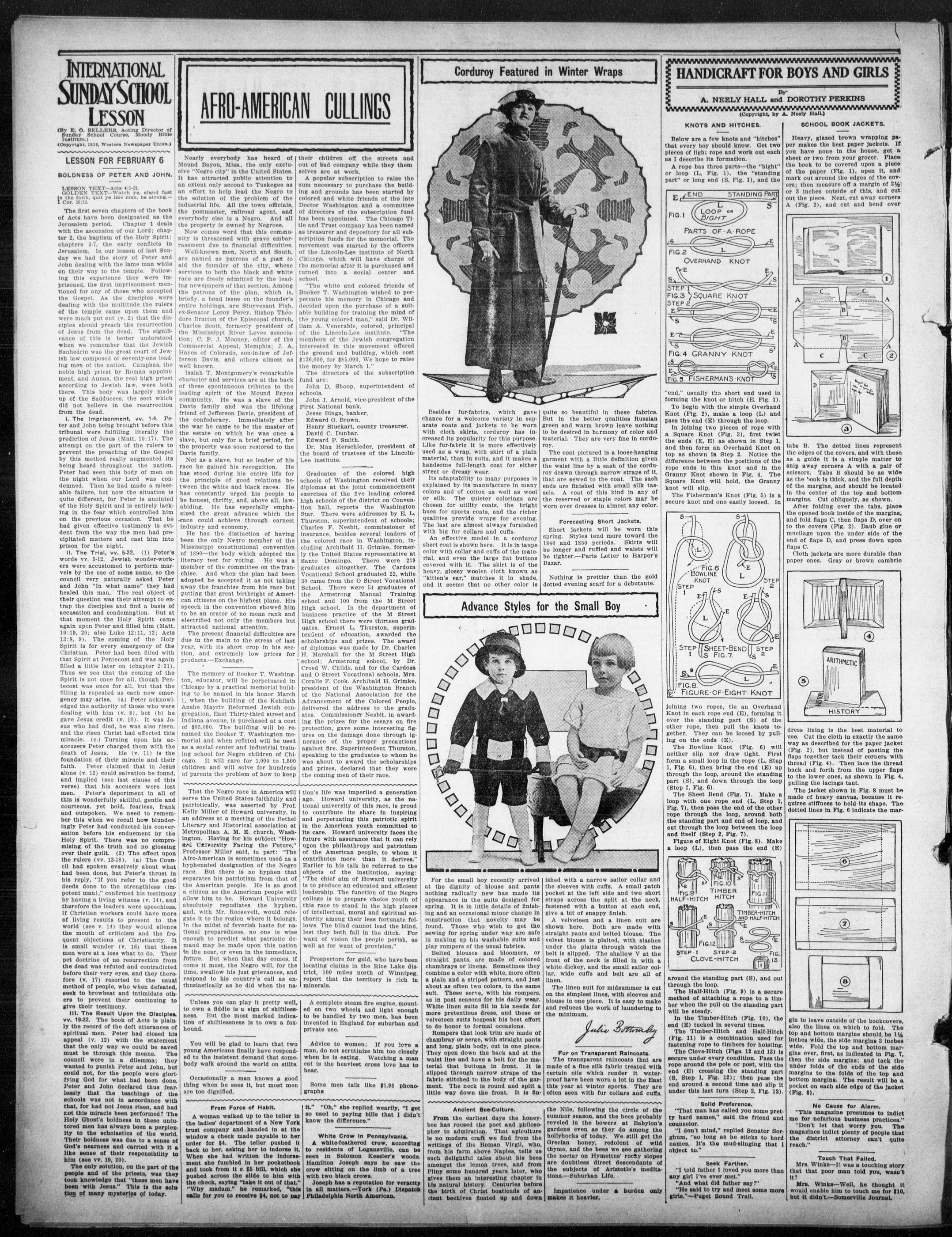
Besides fur-fabrics, which gave chance for a welcome variety in separate coats and jackets to be worn with cloth skirts, corduroy has increased its popularity for this purpose. Like fur-fabric it is more effectively used as a wrap, with skirt of a plain material, than in suits, and it makes a handsome full-length coat for either street or dressy wear.
Its adaptability to many purposes is explained by its manufacture in many colors and of cotton as well as wool or silk. The quieter colorings are chosen for utility coats, the bright hues for sports coats, and the richer qualities provide wraps for evening. The last are almost always furnished with big fur collars and cuffs.
An effective model in a corduroy short coat is shown here. It is in taupe color with collar and cuffs of the material, and even the large flat buttons covered with it. The skirt is of the heavy, glossy woolen cloth known as "kitten's ear," matches it in shade, and it seems that no other color is
Advance Styles for
For the small boy recently arrived at the dignity of blouse and pants nothing radically new has made its appearance in the suits designed for spring. It is in little details of finishing and an occasional minor change in construction that novelty may be found. Those who wish to get the sewing for spring under way are safe in making up his washable suits and play rompers of the usual fabrics. Belted blouses and bloomers, or straight pants, are made of colored chambrays or linens. Sometimes they combine a color with white, more often a plain and a striped pattern, and just about as often two colors, in the same suit. These serve, with his rompers, as in past seasons for his daily wear. White linen suits fill in his needs for more pretentious dress, and these or velveteen suits bespeak his best effort to do honor to formal occasions.
Rompers that look trim are made of chambray or serge, with straight pants and long, plain body, cut in one piece. They open down the back and at the waist line and have a belt for the material that buttons in front. It is slipped through narrow straps of the fabric stitched to the body of the garment. The neck is round and split a little way down the front. It is fin-
Ancient Bee-Culture.
From the earliest days the honeybee has roused the poet and philosopher to admiration. That apiculture is no modern craft we find from the writings of the Roman Virgil, who, from his farm above Naples, tells us such delightful tales about his bees amongst the lemon trees, and from Pliny some hundred years later, who gives them an interesting chapter in his natural history. Centuries before the birth of Christ boatcaches of ancient beechles floated up and down
quite so beautiful in these fabrics. But in the better qualities Russian green and warm brown leave nothing to be desired in harmony of color and material. They are very fine in corduroy.
The coat pictured is a loose-hanging garment with a little definition given the waist line by a sash of the corduroy drawn through narrow straps of it, that are sewed to the coat. The sash ends are finished with small silk tassels. A coat of this kind in any of the reserved or staple colors may be worn over dresses in almost any color.
Forecasting Short Jackets
Short jackets will be worn this spring. Styles tend more toward the 1840 and 1850 periods. Skirts will be longer and ruffled and waists will be tighter—Paris Letter to Harper's Bazar.
Nothing is prettier than the gold dotted evening scarf for a debutante.
for the Small Boy
ished with a narrow sailor collar and the sleeves with cuffs. A small patch pocket at the left side and two short straps across the split at the neck, fastened with a button at each end, give a bit of snappy finish.
A velveteen and a linen suit are shown here. Both are made with straight pants and belted blouse. The velvet blouse is plaited, with slashes under the plaits through which the belt is slipped. The shallow V at the front of the neck is filled in with a white dickey, and the small sailor collar, wide cuffs and belt are all of linen.
The linen suit for midsummer is cut on the simplest lines, with sleeves and blouse in one piece. It is easy to make and reduces the work of laundering to the minimum.
Julia Bottomley
the transparent raincoats that are made of a fine silk fabric treated with certain oils which render it waterproof have been worn a lot in the East this year at winter sports. They are often seen with fur collars and cuffs.
the Nile, following the circle of the summer season, and the bees probably revealed in the bowers at Babylon's gardens even as they do among the hollyhocks of today. We still get the Grecian honey, redolent of wild thyme, and the bees we see gathering the nectar on Hymettus' rocky slopes are doubtless direct descendants of the subjects of Aristotle's meditations.—Suburban Life.
Impatience under burden only makes it heavier.
HANDICRAFT FOR BOYS AND GIRLS
KNOTS AND HITCHES.
Below are a few knots and "hitches" that every boy should know. Get two pieces of light rope and work out each as I describe its formation.
A rope has three parts—the "bight" or loop (L, Fig. 1), the "standing part" or long end (S, Fig. 1), and the
E END STANDING PART
L LOOP ON BIGHT
FIG.1
PARTS OF A ROPE
S L
FIG.2
OVERHAND KNOT
STEP 1
FIG.3 SQUARE KNOT
STEP 2
FIG.4 GRANNY KNOT
FIG.5 FISHERMAN'S KNOT
"end," usually the short end used in forming the knot or hitch (E. Fig. 1).
To begin with the simple Overhand Knot (Fig. 2), make a loop (L) and pass the end (E) through the loop. In joining two pieces of rope with a Square Knot (Fig. 3), first twist the ends (E, E) as shown in Step 1, and then form an Overhand Knot on top as shown in Step 2. Notice the difference between the positions of the rope ends in this knot and in the Granny Knot shown in Fig. 4. The Square Knot will hold, the Granny knot will slip. The Fisherman's Knot (Fig. 5) is a secure knot and one easily loosed. In
FIG.6
BOWLINE
KNOT
STEP 1
S
E
L
STEP 2
S
E
L
STEP 1
SHEET-BEND
S FIG.7.
STEP 2
S
E
L
FIG.8
FIGURE OF EIGHT-KNOT
joining two ropes, the an Overhand Knot in each rope end (E), forming it over the standing part (S) of the other rope, then pull the knots together. They can be loosed by pulling on the ends (E).
The Bowline Knot (Fig. 6) will neither slip nor draw tight. First form a small loop in the rope (L, Step 1, Fig. 6), then bring the end (E) up through the loop, around the standing part (S), and down through the loop (Step 2, Fig. 6).
The Sheet Bend (Fig. 7). Make a loop with one rope end (L, Step 1, Fig. 7), then pass the end of the other rope through the loop, around both the standing part and end of loop, and out through the loop between the loop and itself (Step 2, Fig. 7).
Figure of Eight Knot (Fig. 8). Make a loop (L), then pass the end (E)
around the standing part (S), and out through the loop.
The Half-Hitch (Fig. 9) is a secure method of attaching a rope to a timber when the pull on the standing part will be steady.
In the Timber-Hitch (Fig. 10), the end (E) tucked in several times.
The Timber-Hitch and Half-Hitch (Fig. 11) is a combination used for fastening rope to timbers for hoisting. The Clove-Hitch (Figs. 12 and 13) is secure under every condition. Pass the rope around the pole or post, with the end (E) crossing the standing part (S, Step 1, Fig. 12); then pass the end around a second time and slip it under this last turn (Step 2, Fig. 12).
Solid Preference
"That man has called you some pretty hard names," said the friend and counselor.
"I don't mind," replied Senator Sorghum, "so long as he sticks to hard names. It's the mud-slinging that I object to."
"He said to try and meet some more gris."-Puget Sound Trail.
SCHOOL BOOK JACKETS
Heavy, glazed brown wrapping paper makes the best paper jackets. If you have none in the house, get a sheet or two from your grocer. Place the book to be covered upon a piece of the paper (Fig. 1), open it, and mark out around the edges of the covers; then measure off a margin of $ \frac{2}{3} $ or 3 inches outside of this, and cut out the piece. Next, cut away corners A (Fig. 2), and cut and bend over
$\textcircled{1}$
$\textcircled{2}$
$\textcircled{3}$
tabs B. The dotted lines represent the edges of the covers, and with these as a guide it is a simple matter to snip away corners A with a pair of scissors. Tabs B should be as wide as the book is thick, and the full depth of the margins, and should be located in the center of the top and bottom margins. Cut obliquely, as shown. After folding over the tabs, place the opened book inside of the margins, and fold flaps C, then flaps D, over on to the covers (Fig. 3). Daub glue or mollage upon the under side of the end of flaps D, and press down upon flaps C. Cloth jackets are more durable than paper ones. Gray or brown cambric
$\textcircled{4}$
ARITHMETIC
HISTORY
HISTORY
dress lining is the best material to use. Cut the cloth in exactly the same way as described for the paper jacket (Fig. 2), but instead of pasting the flaps together tack their corners with thread (Fig. 4). Then lace the thread back and forth from the upper flaps to the lower ones, as shown in Fig. 4, pulling the lacings taut.
The jacket shown in Fig. 8 must be made of heavy canvas, because it requires stiffness to hold its shape. The dotted lines in Fig. 6 indicate the mar-
$\textcircled{6}$
$\textcircled{7}$
$\textcircled{8}$
gin to leave outside of the bookcovers, also the lines on which to fold. The top and bottom margins should be 1½ inches wide, the side margins 3 inches wide. Fold the top and bottom margins over, first, as indicated in Fig. 7, then the side margins; and tack the under folds of the ends of the side margins to the folds of the top and bottom margins. The result will be a pocket on each side edge of the jacket (Fig. 8).
"This magazine presumes to indict me for nefarious business practices."
"Don't let that worry you. The magazines indict plenty of people that the district attorney can't quite reach."
Touch That Failed.
Mrs. Winks—It was a touching story that that poor man told you, wasn't it?
Mrs. Winks—Well, he thought it would enable him to touch me for $10, but it didn't.—Somerville Journal.
And Have Good Hair
Mme. P. M. Dabney's XXth Century Pressing Oil
Madam P. M. Dabney's XXth Century Pressing Oil is an ideal hair dressing, having properties which protect the hair from wind, weather and disease, make it soft and glossy; improves the quality of the hair and promotes straightening without irons. For woman, man or child.
PRICE 50c. PER BOX
Mme. P. M. Dabney's XXth Century Pressing Oil
Six Weeks'
Six Weeks' Treatment $1.25
Make a course of treat which will last six week enclosing P. O. money by parcel post prepaid, or mation to
Make a course of treatment for the hair and scalp which will last six weeks. Send us an order today enclosing P. O. money order for $1.25 and receive them by parcel post prepaid, or write for literature and information to
Madam P. M. Dabney's XXth Century
HAIR PREPARATIONS CO.
1806 E. 24th St. Kansas City, Mo.
DR. L. L. SHELTON
DENTIST
Announces the opening of a dental office at corral and Vine streets, over McCampbell & Houston's Dr. would be pleased to make an examination and schedule on your work.
Office hours, 9:00 A. M to 6 P. M. Sundays by
Grand 914; East 4059—Both Phones. 7-Passenger Theatre Parties, Receptions and Boulevard Trips
RATES REASONABLE.
FOR FIRST CLASS AUTO SERVICE C
FLOYD W. STONE
KELLEY'S BEST HIGH PATENT
FLOYD
Kelley's Beat all
Kelley M.
K.C. U
OUT THIS BLANK OUT, FILL IT IN AND MAIL OR SEND TO
$1.00 Special Rate Offer
Announces the opening of a dental office at corner of Howard and Vine streets, over McCampbell & Houston's Drug Store. He would be pleased to make an examination and submit an estimate on your work.
Office hours, 9:00 A. M to 6 P. M. Sundays by Appointment.
Grand 914; East 4059—Both Phones. 7-Passenger Limousine Theatre Parties, Receptions and Boulevard Trips a Specialty. RATES REASONABLE. FOR FIRST CLASS AUTO SERVICE CALL FLOYD W. STONE
KELLEY'S
BEST
HIGH PATENT
FLOUR
Kelley's Best
Beat all the Rest.
Kelley Milling Co.
K.C., U.S.A.
CUT THIS BLANK OUT, FILL IT IN AND MAIL OR SEND TO OUR OFFICE.
The Kansas City Sun,
Nelson C. Crews, Editor,
1803 East 18th Street, Kansas City, Mo.
Sir: Please enter my name as a subscriber to
City Sun for 1916 per your Special Rate Offer and
paper on December 31, 1916, unless otherwise notify
I herewith enclose One Dollar to pay the Spec
one year. Respectfully,
Name.....
Town....State.....
Date....
Sir: Please enter my name as a subscriber to The Kansas City Sun for 1916 per your Special Rate Offer and stop my paper on December 31, 1916, unless otherwise notified.
I herewith enclose One Dollar to pay the Special Rate for one year. Respectfully,
Mme. P. M. Dabney's XXth Century Hair Grower
Madam P. M. Dabney's XXth Century Hair Grower promotes a beautiful growth of hair, stops falling out and breaking of hair, removes dandruff and relieves itching of scald. It will make YOUR hair grow. For woman, man or child.
PRICE 50c. PER JAR
Mme. P. M. Dabney's XXth Century Hair Grower
TESTIMONIAL
"This is to certify that the writer suffered for four years with danduff and itching of the scalp until practically bald, trying many remedies but of no avail. About six months ago I began to use Madam P. M. Dabney's XXth Century Hair Grower, the results up to date are pleasing. Dandruff removed, itching stopped, good growth of hair started. The remedy is O. K. Yours for succes, Rev. L. W. Harris, Mod. Mt. Zion Baptist Association, Carrollton, Mo."
ir
Weeks' Treatment $1.25
One jar Madam P. M. Dabney's
XXth Century Hair Grower
One box Madam P. M. Dabney's
XXth Century Pressing Oil
And one bottle Madam P. M.
Dabney's
XXth Century Shampoo
Xxth Century Shampoo . Course of treatment for the hair and scalp will last six weeks. Send us an order today P. O. money order for $1.25 and receive them post prepaid, or write for literature and informa
am P. M. Dabney's XXth Century
HAIR PREPARATIONS CO.
24th St. Kansas City, Mo.
SENIOR TWO-IN-ONE BOOK TODAY
AGENTS WANTED
RUMANIA HAIR COMPANY,
181-187 Park Row. New York.
Address Department 100
TESTIMONIAL
"With the use of Madam P. M. Dabney's XXth Century Hair Preparations my hair has grown four inches in six months. I would not be without them." Mrs. Henderson, 1721 Forest Ave., Kansas City, Mo
Mme. P. M. Dabney's XXth Century Shampoo
Madam P. M. Dabney's XXth Century Shampoo is the best cleaner for the washing of the heads of colored people. It contains no astringents or other ingredients harmful to the scalp. It promotes hair health and vigor. For woman, man or child.
PRICE 50c. PER BOTTLE
Mme. P. M. Dabney's
XXth Century Shampoo
Kansas City Selected
National Negro Business League to Hold Seventeenth Annual Session August 16, 1916. After a most careful consideration of the several invitations received from different sections of the country for the next meeting of the National Negro Business League, we are authorized by the members of the executive committee to announce that the league has decided to accept the invitation extended by the local Negro Business League of Greater Kansas City. The meeting will be held August 16, 17 and 18, 1916. It appears that the Business League has selected a most opportune time to hold their meeting in Kansas City, for as Mr. Fortune J. Weaver, president of the Kansas City League says:
"These dates fit in just right, as the Masons will hold their Grand Lodge in Kansas City during the second week of August and the National Medical Association comes during the fourth week."
These two meetings in addition to the Business League session, will offer best possible inducements to the railroads to make special reduced fares and will afford delegates to the Grand Lodge and the Medical Association an opportunity to attend some of the sessions of the Business League.
The executive committee has also decided that it will be most appropriate and fitting that the first night's (August 16) session be devoted to memorial exercises in honor of Dr. Booker T. Washington, founder and first president of the National Negro Business League.
Further announcement regarding the forthcoming meeting of the National Negro Business League will be made from time to time through the press. For further information write to J. C. Napier, chairman executive committee, Nashville, Teen; Emmett J. Scott, secretary, Tuskegee Institute, Alabama; Charles Banks, first vice president, Mound Bayou, Miss.
Free
to W
191
We are the largest manufacturer of colored women's hair, and we are to introduce our goods we are sending from our book, a styler for styles for colored women in the latest hair dressing. Every colored woman should have a guarantee every article we sell or money refunded. All hair will positively stand combing and washing the same as your own.
We manufacture a STRAIGHTEN-
ER, which is designed for the
heavy body, absolutely the best
and most serviceable made, fully
guaranteed, with each comb we sell
a lamp cup free. Send your order
for this straightening comb today
JOB TITLE OF Hair-Brushes
Nets and Toilet Articles is illustrated
and can be bought for less than
offered elsewhere.
HAPPENINGS of the week IN MISSOURI
A second gift of $100,000 has been given to Lindenwood college at St. Charles by James Gay Butler, a retired tobacco manufacturer of St. Louis, it was announced recently by Dr. John L. Roemer, president of the college. The new gift of $100,000 will be used for a dormitory.
J. L. Frederick of St. Joseph was elected president of the Missouri Grain Dealers' Association before its annual convention at St. Louis. The association went on record as favoring uniform grading and inspection of grain under the auspices of the United States department of agriculture.
John M. Atkinson and John Kennish of the Missouri public service commission heard testimony at Joplin recently concerning an application of the Home Telephone Company of Joplin for a permanent increase in rates.
L. G. Hood of Bolivar, who finished his work in the school of journalism of Missouri University this semester, has left for Minneapolis, where he will become a member of the Journalism faculty of the University of Minnesota.
Rains varying from $2\frac{1}{2}$ inches to 4.01 inches, which fell near Joplin, raised streams to record levels, washed out several miles of railroad track, and marooned many families within a radius of twenty-five miles of Joplin.
. . .
More than 150,000 carnations were on display at a downtown hotel in St. Louis in connection with the meeting of the American Carnation Society, which held a two days' session. About 150 carnation growers from all parts of the country were in attendance.
* * *
Joseph W. Folk, chief council for the Interstate Commerce Commission and formerly governor of Missouri, has issued a prepared statement saying he would not be a candidate for governor.
* * *
Three citizens of Montgomery died of grip and fever in one day recently. Mrs John Brandenburg and Mrs Maggie Reed, both old residents, and Leonard Brandenburg, 38 years old, suc cumberd.
* * *
John J. Murphy, 67, a farmer residing south of Macon, died from a paralytic stroke recently. Mr. Murphy was an extensive contributor to newspapers and farm journals, writing under the pen name of "Uncle Reuben."
Thirty-three defendants in the nightrider trials at New Madrid pleaded guilty, thus bringing the trials to a sudden end. All were sentenced to six months' imprisonment and then immediately were paroled on good behavior. Two who were on trial at the time were allowed to plead guilty and were paroled with the rest. The sentences of the eighteen whose cases already had been disposed of will stand unless the trial judge should parole them.
At the auction sale of tobacco at Weston recently 84,000 pounds were sold, the average price being $8.32. The highest price was $20, paid to Hillix & Frank, growers. The tobacco crop in Platte county will aggregate 2,000 tons this year.
Robert B. Monroe, assistant cashier of the Jefferson County bank, was acquitted at Hillsboro on a charge of accepting deposits after he knew the bank to be insolvent. The jury was out three hours.
Fulton went "dry" the other day by a majority of 178, the vote being 610 to 432. An especially large vote was polled. The licenses of both of Fulton's saloons expire February 11.
The Macon Commercial club is working out plans for a land congress to be held there soon. Henry Funk, land owner in the Salt River Valley, Shelby county, was the originator of the move. The purpose is to start a campaign for the reclamation of all the overflow lands in Northeastern Missouri.
. . .
More permanent road work was done in Greene county in 1915 than in any other year in the county's history, according to the annual report of County Engineer John R. McAfee. Forty-two and a half miles of rock roads were constructed during the year, 104 culverts built and $41,251 were expended by the county judges on highways and bridges.
Thomas Kenton, for more than fifty years an influential citizen of Carroll county, died recently in Tulsa, Ok. Burial was held at his home in Norborne.
Archibald G. William, 88 years old, is dead at his suburban home in Lexington. He has been a resident of that city sixty-five years. Mrs. Rosa Hill, 99 years old, died at the home of her grandson, John Holdregger. She had been a resident of the city sixty years.
S. L. Gibson of Browning has bought 259 shares, representing a controlling interest, in the Bank of Chillicothe from H. A. Tompkins and his sons. Mr. Gibson will take charge February 1.
Carbon in Gravity Cells.
Carbon can be used instead of copper in gravity cells with good results. Several carbons should be removed from wormout dry cells, thoroughly cleaned and connected together. After a few hours of short circuit a coating of copper from the copper sulphate solution will form on the carbon surface which will perform the function of the usual copper electrode very well. It must be understood, however, that a loss of efficiency will result, as carbon has much greater resistance than copper.—Popular Science Monthly and World's Advance.
The Johnson County Merchants and Farmers' Association is back of a movement to build a community hall at Olathe. The association has in mind the erection of a $15,000 or $20,000 structure that will be suitable for all community purposes from a poultry show to social dances.
. . .
Fire which threatened to destroy the business section of Holton recently finally was brought under control with a loss estimated at $20,000. The blaze started in a candy store owned by John Georges and spread to adjoining buildings, destroying the postoffice and a seed store.
---
Col. James McLean Steele is dead at his home in Emporia from a shock caused by a fall. Colonel Steele came to Kansas in 1858 from Ohio. He enlisted in the Civil War in August, 1862, and was captain of Company E. Twelfth Kansas Volunteer Infantry. Colonel Steele was a director for many years of the Citizens National Bank and was its cashier from 1904 to 1913.
At Durham there are 21,000 bushels of grain alongside the Rock Island tracks waiting to be shipped, and in order to prevent theft, there being no elevators, several arc lights are kept burning over the two big stacks of grain at night. A car shortage is the cause of the wheat being stored on the ground.
F. M. Brady, assistant United States attorney, has finished the deal for a site for the new government building to be erested at Girard. Work on the structure will begin in a few weeks. It is to cost $75,000.
The Missouri Pacific depot at Shannon, five miles west of Atchison, was destroyed by fire the other night.
Henry Buckingham, a pioneer Kansas newspaper man, is dead at the home of his daughter, Mrs. W. B. Brown of Lawrence. Mr. Buckingham came to Kansas in 1859 and engaged in the newspaper business in Leavenworth. At different times he was interested in the Leavenworth Conservative, Times, Bulletin and Call. In 1870 he established the Concordia Empire.
---
Dr. A. J. Weaver, 68 years old, is dead of apoplexy at Concordia. He was one the best known physicians in Kansas. He built a hospital there in 1907. He was a thirty-second degree Mason.
* * *
An attempt is being made to bring Billy Sunday to the University of Kansas for one meeting while he is conducting the Kansas City campaign next April.
* * *
The Lawrence city commission has passed a referendum election to decide whether the city shall purchase the water works system for $175,000. The election is to be March 7, in connection with the regular primary.
* * *
Notwithstanding the gossip concerning Henry Ford's peace mission, he still is a hero in the minds of an Atchison couple, Mr. and Mrs. Orville Carr. A son was born to them recently and he was named Ford Carr.
* * *
Everett Leonard, 6 years old, son of Mr. and Mrs. Charles Leonard of Chetos, while playing, fell in an abandoned well and drowned the other day.
* * *
The city commission of Olathe has set February 23 as the date for the special election on the proposal to vote $50,000 in bonds for erecting or purchasing a municipal electric plant.
William Mayes, 9 years old, is dead at Emporia following a second amputation of his right leg, made necessary by injuries received when he was shot accidentally while playing with a gun.
* * *
An unseen murderer fired through the kitchen window of a farmhouse near the little town of Shipton, eight miles northwest of Salina, the other night, killed John Bush, a well-to-do farmer, and then vanished.
* * * *
Mrs. Minerva A. Hardin, 75 years old, was killed at Ottawa recently by a Santa Fe freight train while she was crossing the tracks.
Sex the Key to the Bible
The World's Three Greatest Books
By Sidney C. Tapp, Ph.B.
"The Truth About the Bible," about five hundred pages, and Jesus Was a Man and Not a Woman, that hundred pages, $2.00. "Sexology of the Bible," over one hundred and seventy-five books treat of the sex of the Bible, and show that the Bible is a book of sex and a book of spirit, and that sex is the eliding line between the physical and spiritual world. For the reason that lesse, sickness and insanity are within the sex, and that sex-lust was the origi- arresting the cause of the medical, scientific, philosophical and theological worlds and people of all classes as no other world can do so. Probably do more to shape the thoughts of the human race than any books ever written in the history of the world.
"I would rather be the author of the Truth About the Bible, by Sidney C. Tapp, I am so the President of the United States of the Bible, as therein contained, is so daring and his conclusions are so unanswerable that the human intellect cannot imagine ideas, it is the world's greatest book. Mr. Tapp's, books on the Bible and his sex interpretation of the Bible will live longer than any other book may perish and Empires may decay, but the ideas presented by the author in these books on the Bible will never die." Mr. Tapp's works on the Bible will do more to empty our jails, insane institutions and hospitals than any other idea that has ever been given to the world in our history. Of the great good, morally and spiritually, that they will do the ruman race. So indeed produced a world idea that should have home and library in the civilized world. W. A. Thompson, M.D. W. A. Swan, M.D. F. H. Mcubbins, M.D. F. H. Mike, M.D. F. M.D. Theodore F. Clark, M.D."
We have arranged with the author to teach you the basic prices of book or books you desire to this paper and name of the book or book you want, and the same will be sent to you at once.
Laing's New Patent Incline Straightening Comb Just Out.
CROSS SECTION OF COMB
THE KING OF ALL STRAIGHTENERS
3¼-inch wide, 9½-inches long, guaranteed
or money refunded.
Retail.....$1.00 EACH
These Combs are Sold in Whole The hair is immediately straight tween these wide teeth of the comb fr The comb can be used both ways, r changing handle; a hole at each end. the shortest hair around the neck an versible comb made on the market.
mbs are Sold in Wholesale and Job Lots.
We immediately straightened while it passes be- be teeth of the comb from the roots to the ends. We used both ways, right or left hand, by ex- a hole at each end. The comb will straighten or around the neck and edges. The only reade on the market.
These Combs are Sold in Wholesale and Job Lots.
The hair is immediately straightened while it passes between these wide teeth of the comb from the roots to the ends. The comb can be used both ways, right or left hand, by exchanging handle; a hole at each end. The comb will straighten the shortest hair around the neck and edges. The only reversible comb made on the market.
HAIR DRESSING PARLOR
J. E. LAING
Hair Dressing Taught in All Branches
sage, also Hair Dressers' Supplies,
We guarantee to Cure Different
Giving Different Scientific
Manufacturer of instantaneous hair
and blonde.
Manufacturer of all kinds of hair
bleach, and dye, any shade.
Manufacturer of wigs, toupes, de-
ing on nets made to order.
Manufacturer of Shampoo Drier
United States Patent Office, Washing
Manufacturer of face and hair to
Colored People's Goods a Specialty
Filled.
MAIN OFFICE, 1715 EAST
KANSAS CITY,
AGENTS WANTED EVE
Brought in All Branches, Manicuring, Facial Mass-
air Dressers' Supplies, Combings Made Over.
Attested to Cure Different Scalp Diseases by
Using Different Scientific Treatments.
Order of instantaneous hair dye in black, brown,
Order of all kinds of human hair goods, refined,
any shade.
Order of wigs, toupes, doll wigs, French ventilat-
e to order.
Order of Shampoo Drier and straightening combs.
Patent Office, Washington, D. C., Serial 798947.
Order of face and hair toilet articles.
Us Goods a Specialty—Mail Orders Promptly
Filled.
OFFICE, 1715 EAST 18TH STREET
KANSAS CITY, MO.
ENTS WANTED EVERYWHERE.
PORO
MARK
The Password
FORMULATED 1900
PORO
HAIR GROWER
MADE ONLY BY
Mrs Amber Chuho
Mallory
ST. LOUIS
MISSOURI
FOR DANDRUFF, FALLING HAIR, ITCHING
CALP; GIVING LIFE, BEAUTY, COLOR
AND ABUNDANT GROWTH.
THIS STYLE OF BOX ADOPTED JUNE 12,1905
PRICE: 50 CENTS
Hair Dressing Taught in All Branches, Manicuring, Facial Massage, also Hair Dressers' Supplies, Combings Made Over. We guarantee to Cure Different Scalp Diseases by Giving Different Scientific Treatments.
Manufacturer of instantaneous hair dye in black, brown, and blonde.
Manufacturer of all kinds of human hair goods, refined, bleach, and dye, any shade.
Manufacturer of wigs, toupes, doll wigs, French ventilating on nets made to order.
Manufacturer of Shampoo Drier and straightening combs, United States Patent Office, Washington, D. C., Serial 798947.
Manufacturer of face and hair toilet articles.
Colored People's Goods a Specialty—Mail Orders Promptly Filled.
MAIN OFFICE, 1715 EAST 18TH STREET
KANSAS CITY, MO.
AGENTS WANTED EVERYWHERE.
FORMULATED 1909
PORO
HAIR GROWTH
MADE ONLY BY
Mrs Amber Furrow
-Malone
ST. LOUIS
MIS
FOR DANDRUFF, FALLING HAIR
SCALP, GIVING LIFE, BEAUTY
ANDABUNDANT GROWTH
THIS STYLE OF BOX ADOPTED JUNE
PRICE 50 CENTS
FORMULATED 1900
PORO
HAIR GROWER
MADE ONLY BY
Mrs Amelie Furubo
- Malone
ST. LOUIS — MISSOURI
FOR DANDRUFF, FALLING HAIR, ITCHING
SCALP, GIVING LIFE, BEAUTY, COLOR
AND ABUNDANT GROWTH
THIS STYLE OF BOX ADOPTED JUNE 10,1915
PRICE: 50 CENTS
Of all
Good Hair Dressers
3100 Pine St., Dept. G. St. Louis, Mo.
The Moses Dickson Regalia
1217 WOODLAND A
Kansas City, M
Regallias, Rituals and Cer
HEROINES OF JERICHO
ORDER EASTERN STA
Dickson Regalia and Supplies Co.
1217 WOODLAND AVENUE
Kansas City, Mo.
Regalias, Rituals and Ceremonials for
ERICHO
ORDER EASTERN STAR
A FEW WARM, STEAM HEATED ROOMS FOR MEN PASEO Y. M. C. A. BUILDING $1.50 PER WEEK AND UP
Muehlebach's
Pilsener Beer
"A HOME PRODUCT"
"A DELICIOUS DRINK"
"A BEER OF PURITY"
Surpassed by none in the market
Geo. Muehlebach's Brewing Company
Bell Phone 777 Grand Kansas City, Mo. Home Phone 3277 Main
PORO
MAIR CROWER
and Job Lots.
While it passes be-
come roots to the ends.
Or left hand, by ex-
omb will straighten
ties. The only re-
sourcing, Facial Mas-
sages Made Over.
Top Diseases by
treatments.
In black, brown,
hair goods, refined,
gins, French ventilat-
straightening combs.
T. C., Serial 798947.
Articles.
Orders Promptly
STREET
HERE.
RO MARK
Password
PORD HAIR GROWER
Supplies Co.
THE KANSAS CITY SUN
Bell Phone East 999.
Entered as second-class matter, August
12, 1988, at the postoffice at Kansas City,
Mo., under the act of March 3, 1879.
Nelson C. Crews.....Editor and Owner
Willa B. Glenn.....General Manager
SUBSCRIPTION RATES:
One Year.....$1.50
Six Months.....75
Three Months.....56
CHURCH DIRECTORY.
Bethel A. M. E. Church, 24th and Flora.
St. Stephen's Baptist Church, 604 Charlotte St.
Centennial M. E. Church, 19th and Woodland.
Second Baptist Church, 10th and Charlotte.
Allen Chapel A. M. E. Church, 10th and Church.
Kansas Ave. Baptist Church, 46th and Kansas.
Ebenezer A. M. E. Church, 17th and Troy.
St. Augustine's P. E. Church, 11th and Troost.
Wine St. Baptist Church, 1825 Vine St.
Wood Chapel A. M. E. Church, 11th and Woodland.
Blue Valley Baptist church, 1120 Crystal avenue.
St. John's A. M. E. Church, 1743 Bellevue.
Saventh Day Adventist, 23rd and Woodland.
St. Monica's Catholic, 17th and Lydia.
Morning Star Baptist Church, 2311 Vine.
Highland Avenue Baptist Church, 1111 Highland.
Centropolis A. M. E. Church, Centropolis
St. James A. M. E. Z. Church, 1833
Woodland Ave.
Pilgrim Baptist Church, 614 Charlotte
St.
Bigelow A. M. E. Mission, 5th and Lyda.
Progressive Baptist Church, 29th and Summit.
C. M. E. Church, 1817 Flora Ave.
St. James Baptist Church, 4038 Mill St.
St. James M. E. Church, 43rd and Prospect Place.
A. M. E. Mission, 556 Grand Ave.
CLARK CHAPEL M. E. CHURCH,
1664 Madison Ave.
KANSAS CITY, KAN. CHURCHES.
First A. M. E. Church, st and Neb.
First Green Baptist Church, 1st and
Splittig.
Steward Streets.
Paul A. A. M. E. Church, 21st and
Ruby.
First Baptist Church, 5th and Neb.
King Solomon Baptist Church, 3rd and
State.
Quindaro A. A. M. Church, Quindaro,
Pasant Valley Baptist Church, Rosedale,
Protestant Episcopal, 3rd and Stewart.
Second Baptist Church, 4th and Ruby.
Second Baptist Church, E. 108 Stunnee.
St. Paul A. M. E. Zion Church, 4000 Adams.
Bethel A. M. E. Church, Roselale, Ran.
Zion Baptist Church, 4th and Virginia.
Ebenezer A. M. E. Church, Sanford and Tremon.
Zion Primitive Baptist Church,
Westport avenue and Tangent street,
Rosedale.
EDITORIALS.
Patronize the Negro in business. Be patient with his shortcomings if you are convinced that he is doing his very best. Aided by your support he will improve.
The Negro in business should strive to please those who loyally support his efforts. He should keep a clean place, free from loafers. The customer has rights which he is bound to respect.
President Wilson has made good with Tammany by appointing a Tiger postmaster for New York City. He has made good with the Jews by appointing Brandeis to a United States supreme court vacancy. He has made good with the Negro Democrats by completely ignoring them.
The Kansas Bull Moose have come back to the G. O. P. That's good. Now let all other loyal citizens turn their faces toward the banner that has never misled them and it will not be long before the return of real prosperity, the kind that reaches the poor man as well as the rich.
BISHOP WALTERS
There is something that appeals to pathos in the attitude of Bishop Alexander Walters, who, after misleading many of his race into the Democratis party with the hope of redemption, lingers around the back door of the White House begging in vain for some consideration for his misguided people.
We doubt if there is one among us who does not pity Bishop Walters, inasmuch as his errors of 1912 were of the head and not of the heart. There was never a man in any walk of life who possessed more sincerity that the good bishop, who actually thought he could look to the party of Tillman and Vardaman for succor for his people. Further and in due justice to Bishop Walters it should be said that he had the assurances from Candidate Wilson that every consideration would be shown to the Negro. He had this assurance in writing—in a letter that Prof. Wilson in the high bloom of his candidacy, had indited to the Bishop, who formed a triumvirate between William E. B. DuBois and William Monroe Trotter, for the purpose of accomplishing the apostasy of the colored voter from the Republican party into the Democratic party.
Of course President Wilson never redeemed the promise made him by Professor Wilson. Instead of giving to the Negro extended recognition, he discharged every one of them that occupied any sort of decent job. Here is a partial list of those whom President Wilson's administration caused to walk the plank: William H. Lewis, assistant attorney general, $5,000 J. C. Napier, register of the treasury, $4,000; Charles
W. Anderson, collector of internal revenue at New York, $4,500; Henry Lincoln Johnson, recorder of deeds, $4,500; Ralph W. Tyler, auditor of the navy department, $4,000; C. F. Adams, assistant register of the treasury, $2,500; Joseph Lee, collector of internal revenue, Jacksonville, 4,500; N. W. Alexander, register of the land office, $2,500; J. E. Bush, register office, $2,500; J. E. Bush, receiver of public moneys, Little Rock, Ark. $2,500; Charles Cottrill, collector of internal revenue, Honolulu, $4,500; T V. McAllister, receiver of public moneys, Jackson, Miss. $2,500; Robert Smalls, collector of port, Beaufort S. C. $1,500; James Cobb, special assistant district attorney, Washington D. C. $2,000.
Diplomatic and Consular service—
Benry W. Furniss, envoy extraordinary
and minister plenipotentiary at Port au Prince, Haiti, $10,000; George H. Jackson, consul, Cognac, France
$2,500; Jahmes W. Johnson, consul,
Corinto, Nicaragua, $3,600—Lexington
News.
Betty & Sam's
Little Corner
—That woman's worst enemy is woman. Is that so, girls?
—That the person who throws mud is usually dirty anyhow. "Ob cose dey am."
—That it's awful hard for a woman to tell what she actually likes best. Can you?
—That the man who is too poor to lend money to his friends will never have many enemies.
—That when St. Joseph, Mo., Negroes have not got a row going they are not happy. Is that true, neighbor?
—That there isn't a department stone on earth large enough to supply all the wants of some women Lord help.
—That when a tenant burns up a fence, the chicken house and the summer kitchen and starts on the porch for fuel it's the landlord's next move. Lawd yes.
—That Roosevelt must have had the Negro in his mind when he chose for his subject to his great speech in New York the other day "Fear God and take your part." We say Amen.
—That when a white man got up and offered in a polite way his seat in a street car to a colored woman every other white person in the car fainted. It was shocking, wasn't it?
PHILADELPHIA HAS ANOTHER NEGRO BANK.
The second bank operated by Negroes in Philadelphia was opened for business Monday morning, January 17, at Broad and Lombard streets, by Brown and Stevens.
The bank is under the supervision of the state banking commission.
RULE THAT BLACK AND WHITE
MAY NOT MEET IS UNCON-
STITUTIONAL
New York—Black men and white may hereafter stage boxing bouts in New York State. The athletic commission will rescind the old rule against mixed bouts because the attorney general says it is unconstitutional.
PROMINENT NEGROES MEET.
A meeting of the leading Negro Republicans of the Middle West has been called to meet in the Assembly room of the Kansas City Sun Tuesday February 22nd, by Hon. E. T. Barbour of El Reno, Okla., temporary chairman. Among the distinguished men who will be in attendance are John H. Pegg, inspector of weights and measures, Omaha; Hon. George H. Woodson, Buxton, Ia.; W. T. Francis, St Paul, Minn.; George W. Gross, of Denver; F. H. McNeal, Silver City, New Mexico; Thos. Campbell, Denver; John L. Thompson and J. B. Rush, Des Moines, Ia., J. Coody Johnson, We waka S. J. Hilton, Luther, and J. T. Barbour of El Reno, Okla., Nich Chiles of Topeka; Homer G. Phillips and I. H. Bradbury, of St. Louis; J. R. A. Crossland of St. Joseph, Hon. E. H Wright and Alderman Oscar Depristel of Chicago, and W. C. Hueston, N. G Crews, F. W. Dabney, of Kansas City
ROSEDALE
MRS. ROSA MORTON JONES.
Mrs. Dellah Yates, of Kansas City, Mo. spent the week end with her brother, rs. T. T. Morton and Mrs. Morton...Mrs. W. G. Pinkard went to Topeka last week to visit her son Herman, who is attending school there...Mrs. J. H. Thornton entertained the Pleasant Valley Mission Circle Monday afternoon at her residence 3809 Lloyd avenue, with a delicious luncheon...Revival services are in progress at the Wesley Chapel M. E. Church, to which the public is invited. The meetings are very interesting, six young men and women have been converted.
Y. M. C. A. NOTES
Y. M. C. A. NOTES
The business men's noonday class is becoming the largest gmy class in the association. Through the exercise and play years are being added to the lives of the men, also nep and zest for their daily work, which means increased efficiency.
The Kansas City Association has a larger number of readers of association men than any other colored association in the country. Because the members have caught the vision of the association work through this magazine, the management attributes much of the success of our organization. Next week, beginning the 7th, the magazine may be had for the entire year for 50 cents.
Recognizing that "the boy of today is the man of tomorrow," association and scientific church workers are giving "blocks of time" to the boy problem. Four experts in boys' work of the international committee of the Y. M. C. A. will spend four days working in the six high schools of the city beginning February 7 in the "Campaign of Friendship." The leading churches of the city have planned to give Sunday, February 13, over to boys' Sunday. On this date the program of the church and the Sunday school will be centered on the boy. Mr. L. A. Halbert of the board of public welfare gave the men a most practical address on last Sunday, which was thoroughly enjoyed by the large crowd. February 6 a delegate to the Kansas state Y. M. C. A. convention will address the men's meeting at 3:30 p. m.
The community was given an unusual musical treat by the Coleridge Taylor Union in the rendition of the oratorio, "Tale of Old Japan." The special musical numbers from the same author given by the members of Western university faculty were especially appropriate. The association management wishes to take this additional method of thanking all who had a part in making this occasion a grand success. Many a similar musicals and lectures are planned for the future. The following statement gives the financial results:
Expense—
Music books $30.00
Printing 11.50
Lumber, stage 11.47
Miss Carr, pianist 10.00
Extra chairs 6.00
Piano rentals 5.00
Miscellaneous 9.00
Income to date ..... $112.85
Expense ..... 92.97
Net gain ..... $ 29.88
A few tickets are yet to be reported. The regular admission was 25 cents; for students 15 cents.
Nashville, Tenn.—The Nashville Negro Booster Club, incorporated, one of the strongest and most active organizations of its kind in the country, and composed of Nashville's leading colored merchants, will take a hand at "boosting" former Register of the U. S. Treasury J. C. Napier, of this city, as the next president of the National Negro Business League to succeed the lamented Dr. Booker T. Washington. A resolution was adopted by the members of the Nashville Booster club at its annual meeting held here last Thursday night calling on all friends of Mr. Napier to give him their support and aid as chairman of the executive committee and to elect him to the presidency of the league at the meeting to be held in Kansas City. The Nashville merchants will send a delegation of "boosters," to the annual gathering to work for the election of Mr. Napier.
CHILLICOTHE, MO.
By B. V. LONGDON
Mrs. Virgil Williams was called to Farmington, Mo., last Thursday on account of the illness of her mother.... Mr. and Mrs. William Nance and son of Kansas City, Mo., arrived last Friday on a visit with Mr. and Mrs. Hannibal Nance.....Mr. and Mrs. Oscar Black and relatives of Kansas City, Kas., arrived last Wednesday to make their home in this community. We are pleased to have Mr. Black and family become one of us....Mr. Luckie Green, one of our successful young men, is very ill at his home....Mrs. E. G. Longdon is recovering from a severe attack of pneumonia....The Bachelor Girls' club was reorganized last Saturday afternoon with Miss Odessa Hillman as hostess....A comedy drama entitled "Aunt Matilda's Party" was well rendered at the Baptist church Thursday night under the auspices of the Ladies' Mission Circle. To our surprise and pleasure vocal numbers were contributed by Madam Winfrey, Anderson and Green....On the evening of January 21 our esteemed pastors, Rev. I. L. Tally and Rev. E. L. Lovell and their wives, were reminded that the power of litties is especially felt in religious benevolence. Rev. and Mrs. Tally informed us that they were happily surprised by by a part of their membership and friends who gained admission by singing "There's a Stranger at the Door, Let Him In." This party was led by Mrs. Ann Saunders and as they were seated in the parlor Mrs. Lottie Montgomery rendered several instrumental selections. We endeavored to express our highest appreciation to the donors in a few remarks and again we trust that the choicest blessings may rest upon them. Rev Carter, whose conduct suggest that he conferred upon himself the title of an Iowa Baptist minister, preached at the A. M. E. church last Tuesday night. How long are we going to permit such ministers to abuse our patience?
TROY. KAN.
The revival at the A. M. E. Church closed with a wonderful success and an addition ofal 17 souls were brought to Christ.....Mr. James Lightle, who has been working in St. Joseph for
several months came home to spend the remainder of the winter with his family...Mr. Arthur Hughes, of Hastings, Neb. is visiting his parents, Mr. and Mrs. Joseph Hughes, the latter being quite indisposed...The Ladies Aid was entertained at the A. M. E. church by Miss Nellie E. Schumache, Thursday evening. Quite a number were in attendance...The Missionary Tea was held at the home of Miss Elsie Lair, Tuesday afternoon. There were several visitors as well as members...Mrs. Mary Schumache was the guest of her daughter, Mrs. M. U. Webster, of St. Joseph, Mo. from Friday until onday evening...Mr. Robert Swinney, of Hiawatha, Kan., was buying stock in the city the past week...Mrs. Augusta Front, of Boynton, Okla., visited her sister, Mrs. Florence Lair, and family M day and Tuesday, as she was returning to her home after a visit with her daughter in Sloux City, Iowa...There has been plenty of ice and snow for the past week, and the young and old are taking advantage of the same by coasting and skating. There have been a few injuries, but very slight ones and I does not seem to frighten any of them o cease their pleasure...Miss Rosa Snody is able to be out again after an illness of two weeks...Mr. James Binhman of St. Joseph, Mo. was the guest of his sister, Mrs. Hanna Martin, Sunday and Monday...Miss Elsie Lair was on the sick list again the past week, but is able to resume her duties in the school room again...Mrs. Mollie Wilkinson was called to Fairbury, Neb., on account of the illness of her sister-in-law, Mrs. Walter Wilkerson, Thursday...Mr. Albert Price, of Leavenworth, Kan., was in the city the past week visiting his mother, Mrs. Mary Johnson.
MOBERLY MO
MRS. W. H. DAVIS
Mrs. Ethel Washington Boone, beloved wife of Rev. S. E. Boone, departed this life Jan. 29., at 11:33 a.m., at the age of 27 years, 11 days She was born at Roanoke, Mo. Feb. 24, 1888. She professed a hope in Christ when 9 years of age and united with the A. M. E. Church at Roanoke under the pastorate of Rev. F. D. Wells and lived a consistent Christian unto the end. On Oct. 20, 1910, she was united in wedlock to Rev. S. E. Boone, by Rev. F. D. Wells. To this union three children were born, all preceded her to the Blessed Beyond. She was a faithful representative of the Sunday school department. She charged her to preach the gospel to mother and brother, meet me in Heaven. Funeral was held Monday, Jan. 31, at 2:30 p.m., from Grant Chapel. Rev. F. D. Wells, of Kansas City, Mo., officiated. A husband, mother and brother survive. The revival at the Second Baptist Church is still in progress, conducted by Rev. T. H. Downey. The Leap Year social given by the Calendar club Saturday night was a success. Mrs. Sarah Washington entertained the club Feb. 2. ...Mr. and Mrs. Joseph Newby are rejoicing over the arrival of a fine boy, which the stork left Sunday morning. Mother and son are doing nicely. Quarterly meeting at Grant chapel Sunday at 2:30 p. m., Rev J. K. Ponder officiating. Services at Pilgrim Rest Baptist church well attended, collection good.
HELENA, MONT.
MRS A E McGINNIS
January has been the coldest month that Helena has had in the past 36 years. It has been from 10 below to 40 below, and for the first time in the history of Galena did the stores close their doors on Saturday night... Mrs. J. Harrington and Mrs. J. W. Crump are convalescing... Mrs. M. E. Green, Mrs. Charles Johnson and Mrs. B. Lucas are reported on the sick list... Rev. C. H. Douglass is expected in in the city Monday as the guest of Mrs. A. E. McGillnis, his cousin... Owing to the cold weather our church work has not been what it should... Our literary will meet Friday night with a program and a dainty luncheon will be served... The Busy Bee club will meet Thursday evening at the residence of Mrs. J. M. Ingram... Feb. 13 will be quarterly meeting at St. James A. M. E. church, Rev. I. S. Wilson, pastor... Keep in mind the social that is soon to take place, given by the Ladies of St. Jaames A. M. E. church. Watch the Sun for date.
ST. JOSEPH. MO.
Rev. Long of Weston preached a grand sermon at the A. M. E. church at 11:30 Sunday...Mr. Eugene Simms, who was hurt in a railroad accident, is improving slowly...Mrs. Ollie Ward sliped on the ice and received a very bad fall, for which she is laid up for a few days...Rev. Brooks is holding revival services at the New Hope Baptist church. Rev. White of Oklahoma is assisting him...There were 25 additions to the church. Seventeen men will be baptized at New Hope church next Sunday...Charles Goodheart, who has been so ill, is not very much improved at this writing....Mrs. Mary Salmon is on the sick list this week...There was a smoker given the Knights of Tabor last Monday night and all had a fine time....Mrs. Fannie Washington is on the sick list...Mrs. M. Harris is still very ill...Mrs. Ida Scott, who was sick will the grip, is up and out again....The concert given by Blind Boone at the A. M. E. church was a decided success and the church was crowded to its capacity.
Mr. Samuel Charles of Pensacola Fl., has opened an up-to-date shoe store in his city. Mr. Charles is a member of the very active local Negro Business League in Pensacola, and on the day of his opening the league sent a large bouquet of flowers for his show window.
The South Carolina Race Conference will be held in Columbia from February 6 to 9. Dr. John E. White, who delivered an address in Boston at the last meeting of the National Negro Business League, is scheduled to speak during this conference. Rev. Richard Carroll, the noted evangelist, is the organizer of the conference.
Negro Business and Professional Directory of Greater Kansas City
BEAUTY PARLORS AND HAIR DRESSERS.
J. E. LAING, 1715 East 18th St.
MESDAMES JACKSON & JOHNSON, 18th and Highland phone E. 4788.
MRS. CADDIE WITCHER, 1708 Michigan Ave. Madam Hair and Scalp Treatment. Bell phone, East 4167X.
CAFES.
DELMONICA CAFE, 1512 East 18th St. Bell phone, East
COAL AND FEED.
W. W. PAYNE, 1902 1-2 Vine St. Bell phone, East 559; H East 4132.
JACKSON & JOHNSON, 18th and High,
4788.
E WITCHER, 1708 Michigan Ave. Mac
Scalp Treatment. Bell phone, East 416.
CAFES.
CAFE, 1512 East 18th St. Bell phone,
COAL AND FEED.
E, 1902 1-2 Vine St. Bell phone, East 559.
MESDAMES JACKSON & JOHNSON, 18th and Highland Ave. Bell phone E. 4788.
MRS. CADDIE WITCHER, 1708 Michigan Ave. Madame Walker's Hair and Scalp Treatment. Bell phone. East 4167X.
DELMONICA CAFE, 1512 East 18th St. Bell phone, East 618.
COAL AND FEED.
W. W. PAYNE, 1902 1-2 Vine St. Bell phone, East 559; Home phone, East 4132.
CLEANERS, DYERS AND TAILORS
WORTHAM BROS., 1831 Paseo.
DRUG
THEODORE SMITH, 1301 East
Home Main 5467.
PEOPLE'S DRUG STORE, 18th
Home East 4082.
R. W. FOSTER'S PHARMACY.
Bell phone East 272, Home ph
DRY GOODS.
TAYLOR-HOLMES & CO., 2409 V
GROS., 1831 Paseo. Bell Phone East 701.
DRUG STORES.
SMITH, 1301 East 18th St. Bell phone in 5467.
DRUG STORE, 18th and Paseo. Bell phi t 4082.
ER'S PHARMACY—18th and Woodland East 272, Home phone East 4070.
DRY GOODS AND NOTIONS.
JAMES & CO., 2409 Vine Street.
WORTHAM BROS., 1831 Paseo, Bell Phone East 701.
THEODORE SMITH, 1301 East 18th St. Bell phone Grand 4591, Home Main 5467.
PEOPLE'S DRUG STORE, 18th and Paseo. Bell phone East 1814, Home East 4082.
R. W. FOSTER'S PHARMACY—18th and Woodland. Bell phone East 272, Home phone East 4070.
DRY GOODS AND NOTIONS.
TAYLOR-HOLMES & CO., 2409 Vine Street.
EXPRESS AND BAGGAGE
THOS. JACKSON, 1816 Highland
MOVING VANS, F. W. DAVIS.
hold goods. Home phone, East
FLOY
CROSTHWAIT FLORAL CO., 181
272. Home phone, East 4070.
GRO
M. R. WILSON, 2644 Woodland A
INSUR
STANDARD LIFE INSURANCE
Grand 2666J. T. A. Ross,
JEW
J. A. WILSON, 1616 West 9th St.
LAW
C. H. CALLOWAY, 601 Delaware,
448. Practices in all courts.
W. C. HUESTON, 601 Delaware,
448. Legal advice. Practices
E. A. SHACKLEFORD, Attorney,
sas City, Kas. Bell phone, W
MILL
MRS. T. A. HOLLAND, Fashional
phone, East 4600. 1706 East
CALDWELL CHAPMAN, 18th a
PHOTOG
C. BRUCE SANTEE, Proprietor
phone East 1643.
PHYS
DR. R. J. LAMBERT, Theraptics,
523, Rosedale, Kas.
PRIN
C. A. FRANKLIN, 1008 East 18th
BSON, 1816 Highland, Bell phone, East 24
NS, F. W. DAVIS. Moving, packing and
s. Home phone, East 2158. Residence, I
FLORISTS.
T FLORAL CO., 1801 East 18th St. B
e phone, East 4070.
GROCERS.
N, 2644 Woodland Ave. Bell phone, East
CROSTHWAIT FLORAL CO., 1801 East 18th St. Bell phone, East 272. Home phone, East 4070.
GROCERS.
M. R. WILSON, 2644 Woodland Ave. Bell phone, East 1493.
INSURANCE.
STANDARD LIFE INSURANCE CO., 1507 East 18th St., Bell phone Grand 2666J. T. A. Ross,
JEWELERS.
J. A. WILSON, 1616 West 9th St., Bell phone, Main 6248R.
LAWYERS.
C. H. CALLOWAY, 601 Delaware, Home phone M58, Bell phone Main 448. Practices in all courts.
W. C. HUESTON, 601 Delaware, Home phone M58, Bell phone Main 448. Legal advice. Practices in all courts.
E. A. SHACKLEFORD, Attorney at Law, 516 Minnesota Ave., Kansas City, Kas. Bell phone, West 3866.
C. H. CALLOWAY, 601 Delaware, Home phone M58, Bell phone Main 448. Practices in all courts.
W. C. HUESTON, 601 Delaware, Home phone M58, Bell phone Main 448. Legal advice. Practices in all courts.
E. A. SHACKLEFORD, Attorney at Law, 516 Minnesota Ave., Kansas City, Kas. Bell phone, West 3866.
MRS. T. A. HOLLAND, Fashionable Dressmaking and Tailoring. Bell phone, East 4600. 1706 East 19th.
CALDWELL CHAPMAN, 18th and Paseo. Home phone East 4009.
PHOTOGRAPHERS.
C. BRUCE SANTEE, Proprietor The Fad, 1607 East 18th St. Bell phone East 1643.
DR. R. J. LAMBERT, Theraptics, P. O. box 90A, Bell phone, Rosedale 523, Rosedale, Kas.
C. A. FRANKLIN, 900 East 18th St. Bell phone Grand 2988.
REAL ESTATE and EMPLOYMENT.
AFRO-AMERICAN REAL ESTATE & INVESTMENT CO., Hnished. 911 McGee street. Bell Phone 751 Main. Home Phone 7555
A B C EMPLOYMENT AND INVESTMENT CO., 500 Minnesot (upstairs) Kansas City, Kans. Bell phone, West 1743; phone, West 1036. C. W. Neloms, Mgr.
COLORED PEOPLE'S INVESTMENT CO., 2427 Vine St. Bell East 1011, Home East 4011. Sol Smith, Pres
MICAN REAL ESTATE & INVESTMENT
11 McGee street.
Se 751 Main. Home Ph
YMENT AND INVESTMENT CO., 500
Kansas City, Kans. Bell phone, West
West 1036. C. W. Neloms, Mgr.
OPLE'S INVESTMENT CO., 2427 Vine
Home East 4011. Sol Smith, Pres
AFRO-AMERICAN REAL ESTATE & INVESTMENT CO., Help furnished. 911 McGee street. Bell Phone 751 Main. Home Phone 7555 Main.
A B C EMPLOYMENT AND INVESTMENT CO., 500 Minnesota Ave. (upstairs) Kansas City, Kans. Bell phone, West 1743; Home phone, West 1036. C. W. Neloms, Mgr.
COLORED PEOPLE'S INVESTMENT CO., 2427 Vine St. Bell Phone East 1011, Home East 4011. Sol Smith, Pres
SECOND-HAND GOODS.
W. G. HOPKINS, 2122 Vine St. I
UNDER
ADKINS BROS. & GREEN, 19th
C. H. COUNTEE, Licensed Embal-
3336, Home East 3341.
WATKINS BROS., 1729 Lydia A
Main 7989. Res., Bell East 3
CALDWELL
Hair and
18th and Paseo,
Home Pho
Scalp Treatment a Specialty. Ca-
Grows Hair. Try it. S
and any old h
Hair Matched From Samples. F
Blocked. Agents for Spirella Cor
WORK GUARANTEED.
W. G. HOPKINS, 2122 Vine St. Bell phone East 3851
UNDERTAKERS
ROS. & GREEN, 19th and Vine Sts. Both p
REE, Licensed Embalmer, 2220 Vine St., B
ine East 3341.
ROS., 1729 Lydia Ave. Bell Phone Gr
D. Res., Bell East 3281.
CALDWELL & CHAPM
ir and Millin
18th and Paseo, Kansas City, Mo
Home Phone East 4009
ment a Specialty. Caldwell's Pomade and
bows Hair. Try it. Save your combins, cu
and any old hat you may have.
And From Samples. Feathers and Hats Clean
agents for Spirella Corsets. Mail orders answe
K GUARANTEED. LIVE AGENTS WA
ADKINS BROS. & GREEN, 19th and Vine Sts. Both phones E. 4349.
C. H. COUNTEE, Licensed Embalmer, 2220 Vine St., Bell Phone, East
3336, Home East 3341.
WATKINS BROS., 1729 Lydia Ave. Bell Phone Grand 987, Home
Main 7989. Res. Bell East 3281.
CALDWELL & CHAPMAN
Hair and Millinery
18th and Paseo, Kansas City, Mo.
Home Phone East 4009
Scalp Treatment a Specialty. Caldwell's Pomade and Tonic really Grows Hair. Try it. Save your combils, cut hair and any old hat you may have.
Hair Matched From Samples. Feathers and Hats Cleaned, Dyed and Blocked. Agents for Spirella Corsets. Mail orders answered promptly
WORK GUARANTEED. LIVE AGENTS WANTED
MANICURING FACIAL MASSAGE
Say P
CAN YOU TELL ME WHERE
Drugs, Toilet A
Prescripti
We teach the work we do
Say Friend!
TELL ME WHERE IS THE BEST PLACE
igs, Toilet Articles and
Prescriptions Filled?
Sure
—AT—
FOSTER'S PHARMACY
By the way, they fill and deliver prescriptions to any part of the city; they will call for them, too.
BOTH PHONES: Bell East 272. Home East 4070.
When not Convenient to Come, Call Us Up.
Remember the Place EIGHTEENTH and WOODLAND
Phone East 701.
RES.
St. Bell phone Grand 4591,
Paseo. Bell phone East 1814,
An and Woodland.
East 4070.
NOTIONS.
Street.
AGGAGE.
Bell phone, East 2377J.
Pack, packing and storing house-
8. Residence, 1229 Woodland.
East 18th St. Bell phone, East
Bell phone, East 1493.
RE.
1507 East 18th St., Bell phone
S.
phone, Main 6248R.
S.
e phone M58, Bell phone Main
e phone M58, Bell phone Main
all courts.
Saw, 516 Minnesota Ave., Kan-
866.
RY.
pressmaking and Tailoring. Bell
Paseo. Home phone East 4009.
HERS.
Fad, 1607 East 18th St. Bell
NS.
box 90A, Bell phone, Rosedale
S.
Bell phone Grand 2988.
INVESTMENT CO., Help fur-
Home Phone 7555 Main.
MENT CO., 500 Minnesota Ave.
bell phone, West 1743; Home
Mgr.
CO., 2427 Vine St. Bell Phone
with, Pres
GOODS.
phone East 3851
ERS.
Vine Sts. Both phones E. 4349.
2220 Vine St., Bell Phone, East
Bell Phone Grand 987, Home
CHAPMAN
Millinery
Kansas City, Mo.
est 4009
Al's Pomade and Tonic really
our combings, cut hair
may have.
Hats and Hats Cleaned, Dyed and
Mail orders answered promptly
VE AGENTS WANTED
FACIAL MASSAGE
we do
end!
THE BEST PLACE TO BUY
bicycles and have
is Filled?
REV
the force
worker
and New
Grace L.
with her
city. Si
presents
of the c
in answ
Mich., w
of meeti
ing expe
CAFES.
FLORISTS.
GROCERS
INSURANCE.
JEWELERS.
LAWYERS.
MILLINERY
PHYSICIANS.
PRINTERS.
N. C. Crews, Kansas City, Grand Master.
Deputy Grand Master, Richard Young, Lincoln, Neb.
Wm. Green, Plattsburg, Mo., Grand Senior Warden.
Crittenden C. Clark, St. Louis, Grand Junior Warden.
H. H. Walker, St. Joseph, Grand Treasurer.
Geo. W. K. Love, Grand Secretary, Kansas City, Mo.
W. W. Fields, Secretary of Masonic Relief, Cameron, Mo.
P. L. Pratt, Kansas City, Mo., Grand Lecturer.
Royal Arch Masons:
Grand High Priest—Geo. Bloomfield, St. Louis.
Deputy Grand High Priest—T. G. McCampbell, Kansas City.
Grand King—A. L. Thomas, Jefferson City.
Grand Scribe—J. P. Moffett, Sedalia.
Grand Treasurer—Chas. Griggsby,
Liberty.
Grand Secretary—E. S. Baker, Kansas City.
Grand Lecturer—W. H. McAdams,
Springfield.
Grand Chaplain—Rev. R. Barber.
**Knights Templars:**
Right Eminent Grand Commander
—Willis G. Moseley, Kansas City.
Deputy R. E. . C.-Peter Kincade,
Kansas City.
Grand Inspector—T. G. McCampbell,
Kansas City.
Grand Captain General—James W. Beard, St. Louis.
Grand Senior Warden—Geo A. Johnson, Kansas City.
Grand Generalissmo—Joseph H. Cherwood, St. Paul, Minn.
Grand Junior Warden—B. F. Gray, St. Joseph.
Grand Prelate—Henry Roan, St. Louis.
Grand Recorder—James T. Cannon. St. Louis.
MASONIC BUILDING ASSOCIATION MEMBERS.
W. G. Mosely, Chairman.
E. S. Baker, Secretary.
R. W. Foster, Treasurer.
W. C. Mallory, Sandy Meyers,
Wm. Washington, F. P. Porteet,
T. W. H. Williams, R. T. Coles,
J. E. Herrrford, E. G. Lacey,
E. G. Miller, Robt. Wiley.
G
M. J.
SAY BROTHER! Have you seen the beautiful tri-colored cards, letter heads, bill heads and beautiful artistic work A. W. Harris, the commercial printer, 1515 East 18th st., has been putting on the market recently? It's the finest ever. His phone is Bell East 2782. Call him and he'll tell you all about the cost of them.
the forceful and tireless missionary worker spent a delightful Christmas and New Year with her sister, Mrs. Grace L. Clark, 1931 McGee street, and with her many other friends in this city. Sister Pearl received many nice presents from friends both in and out of the city. She left here January 5 in answer to a call in Battle Creek, Mich., where she will conduct a series of meetings. Reservation and traveling expenses were forwarded her and her lady traveling companion. Sister Pearl is an extensive traveler and her noble work and achievements for good have merited fame and admiration from some of the foremost men and women and not unfrequently whites to whom she has preached. The following are some forceful and helpful Scripture lessons which Sister Pearl would be pleased to have her many friends read while thinking of her: Luke 9: 49, 50; Matthew 23: entire chapter.
Officere—1915-16.
Lodge Directory
Pritchard A. Lodge No. 42, A. B.
and A. M. meets the 2nd and
4th Monday in each month. All
Master Masons in good standing
welcome. Cecil Thompson, W.
H. SPIGENER, Secretary.
G
WESTMINSTER
Rone Lodge No. 25, A. F. and
J. F. McCann, in each month. All
Master Masons in good standing
M. McGill, J. McCampbell, Beezy,
M. McGill, J. McCampbell, Beezy,
G
M. Olive Lodge No. 53, A. F. and A. M. meets the 2nd and 4th Friday in every month. Visiting Master Masons are wel- lited by Sandy Myers. W. M. Frank Baltimore Ave. 161 Baltimore Ave.
G
Liberty Lodge No. 37. A. J.
& A. M., Liberty, M., meets the
second and fourth Saturday
in May, V. T. Birkins, S. W., acting Master;
Nelson Wallar, Secy.
I. O. I.
Queen Esther Court No. 43.
Hale from the I. O. I. meets the
first Monday in each month at
2:30 p. m., at the hall,
10th and Campbell Sts., Kansas
City. Mo., Mrs. Bettie Davis,
W. J., Q. Rosa L. Jones, Chron,
1408 3rd St., Kansas City,
Kas.
U. B. F.
King of the West Lodge No.
218 meets first and third Mondays in each month at 568
Grant Street, C. F. W.
M.; D. M. W. 1713 Euclid
A. Secretary.
PETER
REV. SISTER PEARL. D. D.
Good morning.
James E. Porter, Jr., of Denver, Col.
paid our city a visit for a few days
on business.
Mrs. Einma Renfro left the city this
morning to spend the rest of the seas-
son with her aunt, Mrs. Funkhouser.
FOR RENT—Four room brick ap-
ment; modern; rent reasonable. 1609
East 26th street. Bell phone 2507 East.
Everybody is getting ready to att-
tend Leap Year bazar given by Queen
Etta Temple, S. M. T., Monday, Feb-
ruary 9.
Mr. J. W. Oden of 1808 East 24th
street made a hurried trip to visit his
mother Sunday and found her much
improved.
Will make some loans on pianos and furniture to reliable people. Confidential; private party. Call or write the Sun. 1803 East 18th st.
Miss Orene Graves, of St. Louis, Mo. attended the dance last Wednesday night at Mr. and Mrs. Roscoe White's dancing academy.
OWNERS AND CHAUFFEURS can be supplied with applications for license to operate automobiles by calling on C. H. Calloway, 601 Delaware St.
Mrs. Francis J. Wilson, 913 Woodland avenue, still remains ill and wishes to thank her kind friends for their loyalty during her long period of sickness.
Press reports announce the death of Rev. T. H. Smythe, pastor of the famous Bethel A. M. E. church, Chicago. He was buried with great honor last Saturday.
All graduates or former sUtudents of Tuskegee Institute are requested to meet at Mrs. T. M. King's, 2626 Woodland avenue, Tuesday evening, February 8, at 8 o'clock.
Mr. Chas. Green, 4500 Warwick boulevard, has just returned from a very pleasant visit to New York City, Buffalo and Detroit and also spent several hours in Chicago.
Miss Mable Cunnigan, 1300 Woodland avenue, is one of the brightest piano students of the Twentieth century, under the instruction of Madam A. Moore, 1705 Forest avenue.
Mrs. Ora Black has returned home from Rocheport where she was called to the bedside of her sick mother, Mrs. Laura Smith, and the death of her father, Mr. Charles Smith.
Dancing taught every Wednesday and Saturday night at Mr. and Mrs. Roscoe White's Dancing Academy. Call us up. Bell phone East 2690. Hall for rent $6.00. Dancing teachers wanted.
Mr. Ida M. Johnson of Ottawa, Kas, spent a few days with Mr. and Mrs. S. F. Straughter, en route to St. Jo seph, Mo., on account of the death of her sister-in-law, who died a few days ago.
Mrs. Belle Edwards sent a large package of books in the name of the Grand Chapter to Rev. Simolia Vereenuing Transvaal, who was a delegate to the coast of Africa at the last General Conference.
Miss Rosie Ruth Merical of Independence, Mo., was the guest of her sister, Mrs. George McPike, 1608 Jeferson street, Kansas City, Mo., last week. Miss Helen Hull, 2724 Woodland avenue, was also her guest.
The Greenwood Baptist church will baptize at Friendship Baptist church, Seventeenth and Tracy, Sunday, February 13. Dr. S. K. White of Muskgoe, Ok. will deliver the baptismal sermon. Rev. G. T. Mosby is pastor
Mrs. M. E. Clement, 1517 Woodland, lost a valuable diamond locket and chain last Thursday evening. She had been entertaining some friends during the evening and the jewelry was laying on a dresser in her bedroom and mysteriously disappeared. She will pay a reward for its return or information leading to its discovery.
Word has been received of the death of Mrs. M. A. Gla, mother of the wife of Supreme Chancellor S. Green of New Orleans. Her late husband was a prominent figure in the affairs of the state of Louisiana years ago and at one time was a state senator. Mrs. Gla made her home in recent years with her daughter, Mrs. Green.
After a month's sojourn among friends and relative here, Mr. and Mrs. Frank Neal left for their far western home at Salt Lake City. Every day of their stay was one of entertainments and receptions and there is no former citizens of our city who has ever been so lavishly entertained as were they during their visit. Kansas City loves Frank Neal and wherever he may go he is still "our Frank."
One of the most elegant and delightful affairs of the season was the 6 o'clock dinner tendered Mr. and Mrs. A. Frank Neal by Dr. and Mrs. M. G. Brookins, 1816 Woodland avenue, Wednesday evening. The house was beautifully decorated for the occasion, the color scheme being green and old gold, which was minutely carried out even to the place cards and refresh-
Women's Clubs.
OAK LEAF CLUB.
The Oak Leaf club had a very nice meeting last week and quite a number were out, despite the inclementy of the weather. February 11 the club will meet with Mrs. Maxwell, 2627 Highland.
MRS. TONEY, President.
MISS WANZER, Secretary.
Miss Bessie acobs entertained the members of the organization and several friends by means of a line patry at the Shubert Theatre on the after noon of Jan. 29. The performance of "Adele" was enjoyed at the occasion was greatly appreciated. Regular business meeting will be held with Miss E. N. White February 6 at 5:00 o'clock p. m.
In loving remembrance of our MOTHER,
Mrs. Elizabeth C. Colbert, who passed out four years ago, February 9.
The Grand Master has issued a call for the meeting of the Masonic Relief Board at the Masonic Temple in this city for Saturday, February 12 at 10:00 a.m.
LIFE, HEALTH AND ACCIDENT INSURANCE.
We give $100 funeral benefits with our accident policies. You can readily see that the Fidelity is meeting our needs. Should you have a Fidelity policy and die from slickness we will give your beneficiary $100 as funeral
H Fishing Party
February 7
Hall
EN ETTA TEMPLE, S. M. T.
the most unique affair ever
of a secret organization
The Bazaar and Fisher
Monday, February
AT
Lyric Hall
UNDER AUSPICES OF QUEEN ETTA T
Without a doubt will be the most unique
given under the direction of a secret
The Bazaar and Fishing Party Monday, February 7 AT Lyric Hall
ADMISSION—25 CENTS
expenses, and should you die from an accident we will give from $100 to $2,000, according to the monthly premium paid. See one of the Fidelity agents today and let him insure you. Because if by reason you are laid off from your work because of sickness or accident Fidelity will place you on its pay roll. You can see we have a fine contract, because we pay any way you die as well as pay you when you uare sick. Then get a Fidelity contract. Now hide your little hammer and don't be a knocker, because no body gets stuck on a knock. Our ofice is with the Standard Life Insurance Company, 1507 East 18th street Bell phone East 4955.
Agents—A. C. aHper, Louis Wheel
er, 202 Harrison ; John L. Allen, 160
East 14th street.
R. O. JOHNSON, Manager.
AGENTS WANTED.
ALLEN CHAPEL NOTES.
Last Sunday, January 30, was a very bad day, yet there were many who were loyal to Allen. The choir members were all present with the exception of one. They are to be congratulated. The minister preached.
His text follows: "Whosoever sineth against the Son of Man it shall be forgiven him; but whosoever sineth against the Holy Ghost it shall not be forgiven him in this world, neither in the world to come." The subject was "The Unpardonable Sin." The sermon was clear and convincing. The minister said that the unpardonable sin was not an act, but a condition; that there was a line beyond which we dare not go. It is the dead line, spiritually speaking. It is the saying "no" so often to the pleadings and invitations of the Holy Spirit until we are unable to say anything else. And, too, we become unable to believe. Then he said we could reach that stage right here in this life, for men were often dead spiritually, while their bodies were yet alive and walking in our midst.
Those who were not at church Sunday night missed a rare treat. The minister preached from this text: "Be sure your sin will find you out." This was a great sermon. The majority of us feel that a minister is at his best in the morning, and that his best sermons are all preached in the morning. But there is where Dr. Thomas has the majority of us fooled. His sermons on Sunday nights, in my judgment, are better than his sermons Sunday morning. Come out and see what you think of them. Sunday-go-to-church, or go-to-church Sunday has not yet been named, but February 13, or the second Sunday in February, has been designated as boys' Sunday. We are expecting Allen to be filled with the boys of the city. Please come and bring a boy.
The National Fraternal Congress will meet in Cincinnati February 7 and 8. This congress represents a movement to bring about co-operation among the leading fraternal organizations of the race.
---
CITY NEWS.
ments. Covers were laid for 16 and it was a most enjoyable occasion.
Miss DeKonza, special stenographer in the Clover Leaf Casualty insurance office, from 10 a. m. to 4 p. m. Can take your dictation and typewrite the work. Also can rearrange your material to make it more grammatical or business-like. No job for less than 25 cents considered. Ask for terms on your circular letters or lengthy manuscripts. 1507 East Eighteenth street, upstairs at the left. Room 3.
On February 15 Prof J. Dallas Bowser, 2400 Paseo, will celebrate his 70th anniversary and will highly appreciate birthday cards from his former friends and pupils on that occasions. Prof Bowser has been 48 years in Missouri and has given over 44 years to the education of Negro youth, being the second teacher of color in this state, taking charge of the first school organized for Negroes by the late J. Milton Turner in Missouri. The Sun extends congratulations to Prof. Bowser on his excellent health and wishes him many more birthdays.
VINE STREET BAPTIST CHURCH
Madam Nicy Cuby and Mora Rhodes are very much improved. We hope they will continue.All services were poorly attended Sunday on account of the extreme bad weather....The Sunday school was very well entertained by some very nice papers which were read after the lessons were over ....Mrs. Mary Gorden had a very fine paper on "How a Teacher Should Conduct Herself"....The Texas Jubilee singers gave a recital Tuesday evening, which was indeed grand. We are always glad to hear them.
NOTICE.
Queen Etta Temple, S. M. T., meets the second Saturday of each month at 2:30 at 824 East Tenth street.
PEARL M. DABNEY,
Worthy Princess.
LELIA M. ALLEN,
Worthy Secretary.
Rev. J. W. Hurse, D. D., pastor of St. Stephen's Baptist Church received a telegram fro Dr. E. P. Jones, president of the National Baptist Convention so declared by the courts in Chicago urging him to report at Nashville Feb. 10-11 for a conference of all the officials and vice-moderators for the different states of the Union of which he is vice-moderator for Missouri, for the purpose of outlining a program for the year and completing arrangements for the great National Baptist convention which unanimously accepted the invitation of Dr. Hurse and will hold its next convention in September in this city. We will give a full account of the proceedings when the doctor returns to the city.
AUTO CONVEYANCE
Special Rates to Couples and Parties
for the entire Holiday Festivities
Phones—Office, both E-3336
C. H. COUNTEE
SECOND BAPTIST CHURCH.
President E. W. Thompson read an excellent paper in the B. Y. P. U. last Sunday which was enjoyed by all present. On account of the severe weather the attendance was only 60...Sunday, February 6, is covenant meeting in the Union in which every child will be given an opportunity to testify...The series of meetings are still in progress, to which everybody is invited. Services are held every night except Saturday night...Last Sunday morning the pastor, Dr. Bacote, delivered one of the best sermons we have had in years. The services reminded one of the day of Pentecost...The Sunday school was not very well attended...Next Sunday evening's services will be devoted to covenant meeting and the Lord's Supper, to which everybody is invited to attend
THE PULLMAN PORTERS' BENE
FIT ASSOCIATION.
The Pullman Porters' Benefit Association will give its first entertainment at the Paseo Y. M. C. A. from 2 to 5 p. m. Thursday, February 2. A delightful musicale and supper in cafeteria. W. A. JARRETT, Chairman. V. D. HARRIS, GUS BAILEY, W. P. MIMMS, D. G. EMERY,
Committee.
They are sparing no pains to make it a success and expect all the men with their families and friends to turn out in force and make it the greatest event of the season. Several eminent speakers, in fact the best talent available, will be on the program.
Thomas Stokeley is night foreman in the Coonse & Caylor ice plant of Indianapolis, Ind. Mr. Stokeley has achieved this promotion by reason of long years of faithful work.
THE CLIPPERS
IN MEMORIAM
MOLLIE E. YOUNG.
DORA A. POWELL.
ANNA B. SMITH.
RELIEF BOARD MEETING.
ALLEN CHAPEL NOTES
KANSAS CITY, KAS.
By MRS. KITTY B. DAVIS.
Mrs. Odessa Williams is quite ill.
Mr. Tilford Davis is recovering from his accidental injury.
Mrs. Ida Godfrey slipped on the icy street and received slight injuries.
Prof. and Mrs. Hodge are smiling over their new baby girl, born last week.
Mr. Gus Strickland and daughter, Lavada, who have been ill, are much improved.
We were pleased to have Mr. and Mrs. Boone as new neighbors at 1201 Freeman avenue.
The Citizens' Forum is having large and enthusiastic meetings under President J. M. Marquis.
Mr. Richard B. Harris of Chicago rendered "Thanatopis" so realistic he received an ovation.
Mr. Freye of 1022 Freeman avenue was called to Edwardsville on account of the death of his father.
The Alpha Art club met with Mrs. Rhodes Turner on Friday evening and a dainty luncheon was served.
Dr. A. Porter Davis received a telegram Sunday afternoon of the death of his aunt, in Palestine, Tex.
Next Sunday Hon. Frank P. Walsh will speak. All are invited to come promptly at 4 p. m. Good music.
Mrs. Kitty B. Davis of 1018 Freeman, Bell phone West 634, is our authorized agent for Kansas City, Kas.
Mr. D. K. Williams of Eleventh and Washington boulevard is proud to have his mother visiting him from Denver Col.
Mr. and Mrs. Elmer Walker of 1913 North Tihrd street are proud of a boy baby, who arrived Sunday morning.
Mr. Monroe Balton, 1010 New Jersey, was taken seriously ill Saturday January 29. He is still confined to his bed.
The S. R. B. club met at the home of Mrs. A. Porter Davis, 1018 Free man avenue, Thursday evening, February 3.
Prof. J. P. King is endeavoring to have his night school extended to Douglass school next year with quite a few additional teachers.
Last Sunday Current Events were given by Judge Brady, Messrs. Frye, D. W. White, J. T. Roberts and Mrs. M. C. Matthews and others.
Mr. Walter Balkben and Miss eJanette Barker were united in wedlock and left for Minneapolis, Ind., where they will make their home.
The Avendale club was entertained last week by Mrs. Plough and Mrs. Mowbray at the home of Mrs. Mowbray, Fourteenth and Haskell.
Mr. Andrew Cunnigan organized a literary society for the benefit of the men employed at the Santa Fe freight house, during their leisure hours.
The "Push Forward" club of St. Paul A. M. E. church is having great success with the dinner which they serve at the parsonage every Thursday.
Mr. and Mrs. Chas. Williams, 1309 N. 10th street, entertained at 6 o'clock dinner last Wednesday. The guests were: Mr. and Mrs. B. B. Officer, Mrs. A. R. Merritt, Mr. Homer Curtis.
Dr. J. R. Thompson was previously surprised to be called out Sunday morning, finding his horse, buggy and barn completely destroyed by fire. The origin of the fire is as yet a mystery.
Prof. Mowbray talked on the Boy Scout movement; Prof. Buster read an excellent paper on "Five Smooth Stones From a Brook." It was discussed by Mr. McCreighton and others.
The Aesculapian Medical Society of Wyandotte county met in regular session at the office of the president, Dr. J. G. N. Soanes, who read a very interesting paper. It was discussed at length by the physicians.
The talk of the hour is the "Leap Year party" given by Miss Grace Williams and Miss Lizzie Davis at Garrison Square Saturday night, January 29. There were 150 present and one time that the men had a chance to see who enjoyed dancing with them.
On go to church Sunday special services will be held at St. Paul church at 11 o'clock, at which time Rev. Isaacs of Western university will preach and there will be special music rendered by the choir, which is doing some excellent singing under the direction of Mrs. Ophelia Jackson.
Mrs. A. R. Merritt is at home again at her residence, 913 Washington boulevard, after a pleasant visit in Sioux City, Ia., the guest of Mr. and Mrs. Edgar Griffin and their charming daughter, Miss Ora Hamilton. Mr. Griffin is the proprietor of a very up-to-date restaurant at 308 Douglas street. Mr. Merritt, who is employed in that city, sends kindest regards to all friends of this city and best wishes to the Sun.
The editor received an invitation to be present at the graduating exercises of the James R. Doolittle school in Chicago, where Miss Iola Clay, daughter of Mr. and Mrs. Andrew Clay of Bunceton, was one of the honor graduates. Miss Iola is a splendid young woman and her parents and friends are justly proud of her accomplishment.
---
With the appointment of Mr. Chas. Redmon, Knoxville, Tenn., now has four colored policemen.
Winter Shoes
FOR
Men, Women, Children
Dependable Footwear
Prices are Right
Rubbers--Rubbers
G. A. PAGE, Prop.
1507 EAST 18th STREET
BELL PHONE, EAST 1328
Rooms to Rent
FOR RENT—Neatly furnished modern rooms. Bell phone East 3918W. Mrs. Virginia Price.
For Rent—Apartment upstairs; 4
rooms, gas and water; $12 per month.
Wm. H. Bradford, 2517 Michigan.
For Rent—Clean furnish rooms
for respectable people. Miss Hunt,
1306 Michigan ave. Bell phone East
4777J.
For Rent—Modern furnished rooms;
home privileges; telephone service.
1026 Woodland ave., second floor. Bell
phone East 3234W.
FOR RENT—Furnished rooms. modern.
Mrs. Jessie Smith, 1822 Woodland.
For Rent—Neatly furnished rooms;
modern. 2413 Flora avenue. Mrs. Anna
Love.
For Sale - Five-room house, partly
modern; price $1,400; $100 down, $10
per month. Call East 4349, both
phones.
FOR RENT
1715 Lydia, 3r. 10.00
1715 East 22d, 4r. 10.50
1599 East 18th, 5r. 22.00
1599 Voyage, storeroom 12.00
1719 Lydia, rear, 5r. 15.00
1719 Agnes, 6r. 15.00
1719 Holford, 4r, part mod. 20.00
1501 54th, E. 5th, 8r. $9.00 to $12.00
1719 E. 18th, storeroom 30.00
1311 E. 5th, 4r. 12.00
1311 E. 33th (rear), mod. 6r. 17.00
1258 Fort, 5th, 8r. 17.00
1258 Cherry (rear), 7r. 12.00
1629 Garfield, K. C. K, 5r. 12.00
1629 Highland, 8r. 25.00
1911 Vire, 3rd 22th, rear. 17.00
1715 Wyan, 10r mod. 30.00
1715-17 E. 11th, 6r. eeach 30.00
704 W, 30th, 8r. 12.00
1021 Vire, 5th, 8r. 12.00
1623 Holmes, 7r, modern 16.00
1715 Summit, 4r modern 15.00
1715 W. Prospect, 3r. 10.00
1715 Vire, 3rd 8th cottage 10.00
423 East 6th, 4r, 1st floor 17.00
1716 Euclid, 5r. 15.00
1108 Vine, 5r. 10.00
1108 Mack, 5r. 10.00
1218 Michigan, 7r. 15.00
2634 Euclid, 5r, part modern 17.50
2451 Belfontaine 4 Apt. 10.00
2451 Belfontaine, 5r. 15.00
2457 Belfontaine, 5r. 16.00
2958 Norton, 7r. mod. 15.00
A. B.
FOR SALE
Truck Farm on Bonner Springs line, 4 acres, 4-room house, lots of fruit, 11,400; $900 room and $50 every six feet. Built. Build 5, rooms, modern, brick bungalow. Price $2,200; $200 down, $20 per month. Vacant lot on Highland between 24th and Howard, 75x130. Price $1,250.
1515 E. 17th St. -5-room cottage, newly decorated and painted. Price, $1,300; $100 down and $12 per month.
Persons renting or buying from us will be given preference on all employment in our employment department.
AFRO-AMERICAN
911 McGee St.
Phones:—Home, 7555 M; Bell, 751 M.
Cheap John's Place
2122 VINE STREET
WM. HOPKINS, Proprietor
New and Second Hand Furniture
Bought, Sold and Exchanged
Great Bargains in stoves, $2.00 and
$3.00 and up. Bell phone East 3851.
TO THE PUBLIC:
We want you to come to us for DRUGS, MEDICINES, TOILET AIR, BRUSHES, MADAM WALKER, STRAIGHTEN. We recommend and guarantee exactly as represented. WE DO NOT take other brands than you ask for we want you to have it.
OUR PRICE. All down the line. We give care by courteous and fair treatment customers. When you think of D THEO. SMITH.
No demand is too difficult for to come to our store, phone us at Mail Orders Solicite.
Theo. Smith
Bell Phone 4591 Grand.
1301 E. 18th St.
We are anxious to serve you is no obligation.
RANDOLPH BROS. & SON, 1207 HI.
Bell phone East 1330.
o come to us for everything carried by a Drug Store.
INES, TOILET ARTICLES, RUBBER GOODS, COMBS,
ADAM WALKER HAIR-GROWER-DRYING COMBS,
STRAIGHTENING COMBS, ETC.
send and guarantee everything offered for sale to be
presented. WE DO NOT "SUBSTITUTE" nor ask you to
than you ask for. You "want what you want" and
have it.
OUR PRICES ARE RIGHT
one. We give careful attention to all orders, and atm
and fair treatment to give perfect satisfaction to our
when you think of Drugs think of
THEO. SMITH'S PHARMACY.
Is too difficult for us to supply. If you are too busy
store, phone us your wants and we will do the rest.
All Orders Solicited and Promptly Filed.
Theo. Smith's Drug Store.
Phone 4591 Grand. Home Phone 5467 Main.
KANSAS CITY, MO.
We want you to come to us for everything carried by a Drug Store. DRUGS, MEDICINES, TOILET ARTICLES, RUBBER GOODS, COMBS, BRUSHES, MADAM WALKER HAIR-GROWER-DRYING COMBS, STRAIGHTENING COMBS, ETC.
We recommend and guarantee everything offered for sale to be exactly as represented. WE DO NOT "SUBSTITUTE" nor ask you to take other brands than you ask for. You "want what you want" and we want you to have it.
OUR PRICES ARE RIGHT
All down the line. We give careful attention to all orders, and aim by courteous and fair treatment to give perfect satisfaction to our customers. When you think of Drugs think of THEO. SMITH'S PHARMACY.
No demand is too difficult for us to supply. If you are too busy to come to our store, phone us your wants and we will do the rest. Mail Orders Solicited and Promptly Filled.
Theo. Smith's Drug Store.
Bell Phone 4591 Grand. Home Phone 5467 Main.
1301 E. 18th St. KANSAS CITY, MO.
THE INTERIOR OF THE LIVING ROOM.
us to serve you. Send for us. There no obligation to purchase.
& SON, 1207 HIGHLAND AVENUE.
1330. KANSAS CITY, MO.
CALL US UP Bell Phone
We are anxious to serve you. Send for us. There is no obligation to purchase.
RANDOLPH BROS. & SON, 1207 HIGHLAND AVENUE.
Bell phone East 1330. KANSAS CITY, MO.
Toilet Articles De Prescriptions filled accurately and by Graduate Registered Pharm
Articles Delivered
tions filled accurately and promptly
graduate Registered Pharmacists.
Oples Drug Store Everything for the Toilet
Toilet Articles Delivered
Prescriptions filled accurately and promptly by Graduate Registered Pharmacists.
"SHOW-ME" START THE PATS. PEND'G. THE USE
START THE NEW YEAR RIGHT. WHAT IS
THE USE OF YOUR WIFE WEARING HERSELF OUT DOING A LOT OF HARD LABOR
WHEN IT IS SO EASY WITH THE
to do TWICE as much WASHING in the
week EARNING twice as much money
and use LESS SOAP and FUEL.
We GUARANTEE cleaner clothes and
better COLOR.
Ask Mrs. Nannie, Fields, 1233 Vine St., Mrs. Anna
Silver Oak St., Mrs. Nettie Johnson, 1806 East
Howard St., Mrs. Harry Fields, 2539 Michigan Ave.,
Mrs. Emma Jenkins, 1810 East Howard St., Mrs. Georgia
Lewis, 4961 Wornall Road, Mrs. Amanda Slaughter,
469 Eucalyptus Ave., Mrs. Amanda Slaughter, 1810
St. Marys McGarry, 1416 East 24th St., Mrs. W. M.
Hicks, 1117 Woodland Ave. All are experienced lau-
dresses and have used and ARE using "SHOW-ME"
WASHERS and they can do more work and are
not so hired.
Mrs. Nelson C. Crews, 2624 Highland Ave., is well
pleased with the "SHOW-ME" as is also Mrs. L. B.
Aleman, 533 Oak St.
SAVE YOUR BACK AND HANDS, YOU MAY
NEED THEM SOME DAY.
ARRANGE WITH THE SUN FOR FREE TRIAL
H. A. MANUFACTURING CO.,
IBA C. HUBBELL, PRESS.
Ask Mrs. Nannie Field, 1333 Vine St., Mrs. Anna Simms, 1915 Oak St., Mrs. Nettie Johnson, 1806 East Mrs. Emmia Jenkins, 1810 East Howard St. Mrs. Georgia Lewis, 4614 Worcester Road, Mrs. Amanda Slaughter, 1099 Euclid St., Mrs. Jackson East, Mrs. McGarry, 1416 East Mrs. W. M. Hicks, 1117 Woodland Ave. All are experienced dunners and have used and ARE using 'SHOW-ME' WASHERS and say they can do more work and are
m. Mrs. Nelson C. Crews. 2624 Highland Ave. is, well
known for its M-VAE as is also Mrs. L. B.
A. Blenman. 545 Lydia Ave.
4961 Wornall Rd., KANSAS CITY, MO
THE Modern A. E. ESTE General Repairing SATISFACTION
Modern Builders Co.
A. E. ESTES, President
General Contracting
Repairing a Specialty
SFACTION GUARANTEED
SATISFACTION GUARANTEED
For Biscuits Fine And Cakes Divine Bakes Perfect Bread All The Time Corn Meal Too
ISMERT-HINCKE
MILLING CO.
---
Home Phone East 4082
Anything in Drug Line
WASH
SEATED
IN COMFY
CHAIR
WE GUARANTEE
NO YELLOW
WASH
WITH THE
"SHOW-ME"
Bell Phone E. 4394Y
```markdown
```
Artistic Wall Papers
Inexpensive Decoration Is our Motto
Let Us Prove It.
Samples submitted at your own home.
We Show New Patterns Only
Bell Phone East 1814
Everything for the Toilet
"SHOW-ME" WASHER
Office 2460 Waldrond Ave.
ISMERT-HINCKE
MILLING CO.
I-H
BEST PATENT
HARD WHEAT FLOUR.
KANSAS CITY, U.S.A.
I-H
TWELVE FIGHTS IN ONE NIGHT FOR TREE STUMP
Hartmannsweiler-Kopf in the Vosges Is Scene of Constant Fighting.
TRENCHES FIVE YARDS APART
Character of Warfare That Has Engaged Armies in Alsace for Seventeen Months—Capture of Cemetery Costs More Dead Than Were Ever Buried in It.
London.—The following is published in the London Daily Express from its correspondent in Parts:
"When the snow-laden wind comes roaring over the Alsatian hills, its icy blast chilling the body to the bone, the 'pollus', huddled together, many feet below the ground, draw their blankets closer around them, for the blizzard creeps down every nook and cranny, and the men, now experiencing their second winter campaign in the Vosges, mumur: 'How cold the booches must feel!'
"This note of cheerfulness prevails throughout the French lines, and now more than in this sector of the front. I have chatted with Turcos, who now see snow for the first time, and with men whose extremities were frost bitten last winter, but everyone is happy with the idea that, no matter how much he feels the cold, the plight of the Germans must be much worse.
"Here we are in German territory; there is no gainsaying that aid to cheerfulness. How far we have progressed I am forbidden to state, but I can affirm that no fewer than twenty Alsatian towns are now within the penny postal rate of France. Every yard gained is a step nearer the Rhine, but for every foot of ground conceded by the enemy there is bloody fighting. Hartmannsweller-Kopf has become a symbol of the conflict in Alsace; in no other sector of the front, so the French general staff say, has the fighting been so severe, but the importance of its loss or gain must not be exaggerated.
"The summit, it is true, commands a great portion of the plains of Alsace, but ever since the French first reached the foot of the hill the whole of Hartmannsweller-Kopf has never been wholly in the possession of either French or German.
Warfare in Black and White
"Here is warfare in black and white. The black uniforms of the Chasseurs Alpins are silhouetted against a back ground of snow. From an observation post one sees columns of sure-footed mules carrying parts of guns, and companies of men, like myriads of ants crawling through the mountain passes, or again, patches of black, vague smudges, whirling over the snow. More Chasseurs Alpins rushing on skis over hill and dale, stopping, twisting, firing and rushing on again; agile litte men who are the terror of the Germans' lives in this sector.
"Tales of their daring are legion. It is not so long ago that a handful of them crawled through the German lines and brought back a munition train! It was in the early hours of a winter's morning. They found the train with steam up; the engine was started, the enemy was taken completely by surprise, and the train was brought to a spot near enough to the French lines for the men to remove the munitions and destroy the train.
"The Chasseurs, or 'blue devils' as they are called, were concerned in the taking of Sudel farm, which opened up the road to the Reinbach valley. After some skirmishing between outposts the French established themselves on the River Sutz. The snow was falling thickly when the French began their advance in the teeth of a hurricane of shells that came from the German batteries on the hills behind Cernay, but nothing daunted the "devils," although they were two days on the way, sleeping in the snow. "At dawn on the third day the French outposts heard the sound of firing. It was caused by the skiers, who had been out all night looking for the enemy. They returned, bringing back with them two wounded German officers and six men.
"The ruins of the Chateau Freudstein concealed the guns, and massed in neighboring valleys were the Germans. Enemy airmen had been hovering over the column since it set out, and undoubtedly the enemy was trying to draw the French into a trap, but Teuton slyness went astray. Soon the enemy found he had no chance of ambushing the French, and he changed his tactics and sent out one company from a Bavarian regiment to wipe out the 'blue devils'. The speed of the men on skis was too great, however, for the heavy-footed Boches and they were soon outdistanced. A French battery of heavy artillery received a telephone message giving them the approximate range, and after a period of bombardment the guns in the ruins of the chateau were silenced.
Storming Sudel Farm.
"Then came the opportunity sought by the 'devil's'; they began their attack against the center of the German position, which was Sudel farm. They advanced under cover to within about
FALLS IN LOVE WITH PHOTO
Then Man Meets Girl When She Goes West on Visit and She Stays.
Denver.—A photograph of a pretty girl displayed on the mantlepiece in the home of Dr. and Mrs. H. D. Sewell at Chama, N. M., a year ago, resulted in the marriage here of Miss Blanche Kauffman of Mechanicsburg, Pa., and Miguel A. Gonzales, a wealthy cattleman of Abiquiu, N. M.
three hundred yards of the position they had to storm, but the last stretch was across open ground.
"After a brief but sanguinary action the position was carried, enabling the Chasseurs to open a murderous fire on their front and right.
"Without the expected support of their artillery in the chateau, the Germans were powerless against the human waves that swept over them, and they withdrew, but in good order, fighting a rear-guard action until the 'blue devils' charged with the bayonet. The action terminated in a complete rout of the enemy and about 300 unwounded prisoners remained in the hands of the French.
"A recent German communique spoke of a repulse of a French attack 'near Metzeral,' but omitted to mention that Metzeral is in the hands of the French, and has been so ever since our gallant allies won one of the most brilliant battles of this war. When the French advance approached Metzeral the Germans began to make a fortress of this little Alsatian town, and the streets were barricaded with barbed wire, and overturned carts masked machine guns. The battle began by an attack launched against the forest. Trees were uprooted in hundreds by the French guns, and gradually the enemy was pushed out of the forest, but it was only then that a fresh surprise was sprung on the French.
"The enemy had dug trenches in the forest, which he filled with barrels of tar; these were connected by electricity with a point behind the German lines, and as the French rushed through the forest the barrels were ignited. Nevertheless, this did not stop the advance. They reached the outskirts of Metzeral, and here the fighting became furious. A number of factories were defended by the enemy, and each had to be carried separately by the attacking party.
"From windows machine guns poured a hail of lead on the heads of the French. The men had to break down the doors and fight their way up, story by story. South of the town the enemy defended the cemetery, which held up the attack for a whole night. The tombs were already torn away by the French shells, but the vaults were the scene of fighting of the grimmest description. The handles of coffins were wrenched and used as knuckle-dusters by the enemy, who made a most stubborn defense; every vault sheltered a small battle, and the vaults themselves had previously been mined by the enemy; when they became no longer tenable they were blown up.
Capture Metzeral Cemetery.
"The cemetery was carried in the early hours of the morning, but not before it held more dead than ever were buried in it.
"The taking of this salient did not complete the task set to the French. Practically every house in the town was defended, and from cellar to the top story the French had to fight their way before Metzeral was finally in their hands. Truly, the enemy has not cause to make much mention of Metzeral in his official communications.
"At the same time that the French were attacking in this sector, a second successful offensive movement was being carried out along both banks of the Fecht. Two important hills, Nos. 665 and 695, were stormed, and eventually Sillackerwesen was taken. From this point Munster was bombarded, which led to the evacuation of this town.
"The progress along the crest of Linge, about five miles north of Munster, led to the withdrawal of the German troops here, although strong re-enforcements had only arrived three days previously, but the terrible fire of the French artillery paralyzed the men fresh from the drive in Russia. They were, nevertheless, put in to garrison the town, and they probably remain, still bombarded by the French, who are slowly but surely creeping along the Munster valley.
"Altkirch was evacuated by the Germans two weeks ago, and not for the reasons put forward by the Basel newspapers. The Germans have insisted that the civil population was withdrawn because of the arrival of fresh troops to undertake an offensive in this sector, but the truth is that the lower part of the town is flooded, as it usually is at this period of the year, and the French advance towards Altkirch has made the town unhealthy for the civil population.
"Hartmannsweller-Kopf is likely to figure in the French communiques for some time to come, for the Germans will never give up their counter-attacks until they are driven away from their side of the hill. Surprise attacks here are always to be expected, for both sides now know every inch of the ground, and on the summit of the hill the German and French trenches are only about five yards apart. This seems impossible, but it must be remembered that it is the individuality of the soldier that counts for everything.
Twelve Battles a Night.
"Very often a battle lasting some hours will take place for the possession of a mere stump of a tree, and a tree stump has been known to change hands twelve times during the course of a night. An account given to me by a French soldier of a recent French offensive on Hartmannsweller-Kopf is dramatic in its simplicity. This man has taken part in no fewer than fifteen battles for the hill.
"The crest of the hill was white with smoke," he says. "For two days both sides had left the top of the hill, because both our guns and theirs were raking the ground. We had buried the German dead the first time the crest came into our possession, but their big
"If I should meet that girl I know I should fall in love with her," said Gonzales when he first saw the photograph.
Last fall Miss Kauffman went to Chama to visit her sister, Mrs. Sewell. She never returned East, but stayed in the West to marry the man who fell in love with her picture.
Original Hornpipe.
Hornpipes are so called from their having been performed originally to the Welsh pib-corn, or hornpipe.
shells, from a battery of Austrian guns, 305, disinterred their dead, so that when we charged we stumbled over arms and legs and limbless trunks.
"Our attack was launched from three sides; the first charge only took us forward about 150 yards, and then we had to return to our original positions; it was heartbreaking. Before we could attack again the enemy sent up re-enforcements, but something must have gone wrong, for hundreds of their men were cut down by their own artillery firing from the ruins of the Hitzstein chateau.
"We ceased our attack when night fell, but our artillery redoubled its furious bombardment of the enemy's trenches. Their guns fired at ours, and our fires at theirs and at their trenches. Thirty feet below the ground, snug in our dugouts, we could feel the earth trembling. The Germans kept their men in the trenches because they never knew when our artillery would cease firing and our infantry attack begin again. That is why we captured more than thirteen hundred prisoners. They were haggard and shaking when they were marched into our lines, for no soldiers on earth could stand what our artillery gave them.
"We had very slight losses, comparatively, when we stormed the positions the next day, and if it had not been that the enemy had a few machine guns undestroyed by our fire our losses would have been very much smaller.
"I have been here in Alsace for sixteen months," he added. "I have been wounded three times, and always on the slopes of 'Vell Armand.' Terrible? Not at all. Think what an awful time the Boches must be having!'" WIFE OF SWISS AVIATOR
C HARRIS & EWING
Mme. Juan Domenjos, the wife of the Swiss aviator, who recently has started Washington with his daring flights over the White House, has been entertained at several charming affairs by national capital society.
HOOODOO SHIP MAKES MONEY
The Old Freighter Algoa Has More Than Paid Her Purchase Price.
San Francisco—The old Algoa, formerly hoodoo freighter of the former Pacific Mail, has blossomed out as a real war baby.
This steamer, which in times of peace used to be tied up in the lower bay with cold boilers for long periods, has earned $300,000 that was paid for her when she was rechristened the California. Also she has earned $50,000 more.
Furthermore, the California—nee Algoa—has now been chartered to a powder company at $1,700 a day, or $51,000 a month, or $612,000 a year, or more than twice as much as her owners paid for her.
It is stipulated in this last charter that she shall plly only between neutral ports, which is taken to mean that she will become a nitrate carrier between South America and the Du Pont powder mills in the United States.
SELLS AN EGG FOR $1.000
Mrs. Gliffort Sends One, Laid by Fabled Roc, to Denver Museum.
Orange, N. J.—Thrifty housewives who blame their grocers for demanding 60 cents a dozen for eggs may congratulate themselves that they are not compelled to make their purchases from Mrs. Robert Gliffort. Yesterday she disposed of her egg supply at the very satisfactory rate of $12,000 a dozen.
The transaction was not as extensive as Mrs. Gliffort may have desired, however, since it involved but one egg, that of the fabled roc, of Arabian Nights' fame, and the purchaser was the Denver museum. Technically, it is the egg of the Aepyornis, the fossil bird of Madagascar, but three of which are to be found in this country.
Bulldog Kills Three Deer
Aberdeen, S. D.—Wylie park and the city of Aberdeen are out three deer. A bulldog got into the enclosure where the deer were kept at Wylie park and when the caretaker went to feed the animals the next day he found all three deer dead. The old buck deer had made a valiant fight for life, but had been worn out by the tenacity of the dog.
American Tree in Europe. The locust tree was one of the first American trees to be taken to Europe.
TAKE PLACE OF MEAT
PREPARATIONS OF VERMICELLI AND SPAGHETTI
Housewife Will Find That Both the Family and Visitors Will Appreciate These Dainty and Also Economical Dishes.
Spaghetti au Gratin.—Break one-half package of spaghetti into short pieces and cook in two quarts of boiling water for ten or twelve minutes. Drain and blanch in cold water. Melt two tablespoonfuls butter, add the spaghetti, one teaspoonful salt, a little paprika, one cupful of milk and three-fourths cupful grated cheese. Mix and place in baking dish, cover with grated cheese and bake in hot oven half an hour or longer, if wished quite brown.
Fried Spaghetti.—Take one-fourth of a pound of spaghetti, throw into salted boiling water and boil ten or twelve minutes; make a stiff batter by adding to the spaghetti one teacupful of tomato sauce, a grated onion, salt and pepper to taste, one egg well beaten, flour enough to make into little cakes, and fry on a greased griddle.
Indian Vermicelli.—Boll half a pound of vermicelli in a pint of milk until tender; add sugar to taste and a table-spoonful of prepared cocoanut. When the vermicelli is done and slightly cool pour into a glass dish and garnish with pistachio nuts, blanched and fried, and sultana ralsins, seeded. Over the top sprinkle a few pistachio nut-chopped fine.
Vermicelli Patties—Break vermicelli in very small pieces, cook until tender in salted water. Make a cream dressing of two tablespoonfuls of butter, one of flour, and one cup of cream. Cook butter and flour together; when smooth add cream and salt to taste. Put in little patty pans a layer of vermicelli, alternating with the cream. On each layer grate a goodly quantity of cheese. Bake a nice brown.
Spaghetti With Shredded Codfish—Break one-fourth pound spaghetti into boiling water and boil for twelve minutes, drain and blanch. Put it into pudding dish, dusting a third of a box of shredded codfish through it; beat two eggs very light, add a cupful of milk, pour this over spaghetti and bake half an hour.
Tomatoes Stuffed With Spaghetti—Break half package of spaghetti into boiling water, boil ten or twelve minutes, drain and blanch in cold water. Select large, firm tomatoes; cut off the tops and scoop out the seeds. Do not peel. After sprinkling the inside of the tomato shells with a very little salt, fill with cold spaghetti chopped, mixing cheese with the spaghetti. Arrange the tomatoes in a pudding dish, replace the tops after strewing cheese on the spaghetti filling; cover and bake one half hour.
Nutritious Luncheon
Days at home when pressed for time, it is difficult to find something quick and easy for luncheon all too often. Cheese preparations are fine for such occasions and are satisfying. Stale bread, buttered a little and then covered with grated cheese and baked makes an appetizing dish. The cheese-covered bread should be piled up in layers in a baking pan and milk enough to moisten the bread poured into the pan, then the mixture should be placed in a moderate oven to bake.
A plain lettuce salad with a French dressing is a pleasant addition, or a sliced tomato, green peppers or onions may be made into a salad and eaten with the baked dish. Freshly prepared tea and good bread and butter is all else required.
Pound Cake.
Cream a half cupful of butter, add one and a half cupfuls of pastry flour once sifted. Beat the yolks of five eggs until thick, add one and a half cupfuls of powdered sugar, gradually, beating constantly. Combine the mixtures and add the whites of five eggs beaten stiff, and one teaspoonful of vanilla. Sift over one teaspoonful of baking powder and beat thoroughly. Turn into a buttered, floured pan, and bake in a moderate oven. Remove from the pan, and cut in fancy shapes. Cover with boiled frosting, garnish with shredded cocoanut, fruit or rose leaves.
Chicken and Mushrooms
A delicate dish for a dainty lunch or a meal for an invalid is a combination of chicken and mushrooms prepared in a casserole. The mushrooms are fried in butter very lightly, then a tablespoonful of flour mixed with a scant cupful of milk is poured in and cooked until creamy. The mushrooms and cold chicken are packed into the casserole in alternate layers and the creamy sauce poured over. The dish is set in the oven until the contents are heated through evenly.
Pork Chops. Southern Style.
Fry pork chops until well browned. Slice same number of medium sized onions and spread over chops in frying pan, seasoning chops and onions with salt and a little pepper. Pour on enough boiling water to cover the chops, but not enough to float the onions. Cover the frying pan and simmer one hour; then remove chops and onions and thicken the gravy.
Pear and Cheese Salad
Peel the pear whole and core it without cutting in quarters. Fill the hole made by coring the pear with a paste made by mixing together roquefort cheese and a small quantity of cream or French dressing. The cheese should be of the consistency of a thick paste. Set the pear in a bed of lettuce leaves and pour French dressing over the whole.
Caramels.
Two and one-half cupfuls brown sugar, one cupful sweet cream, one-fourth pound glucose. Boil together one-half hour, then add one-fourth pound chocolate and one-fourth pound butter and boil half hour longer. Pour into buttered tin, and when cool cut in squares and wrap in waxed paper. These are the real, gummy caramels.
GOOD TOAST REQUIRES CARE
Some Principles to Be Observed If One Would Have the Dainty at its Best.
The principle that underlies toast-making is threefold:
1. Heat evaporates moisture throughout the slice of bread.
2. Intense heat changes the contents of the starch granules on the surface of the bread to dextrin.
3. Intense heat, long continued, will change first the surface starch and then all to carbon (charcoal).
A good cook will secure the first two, and avoid scorching the bread. Successful toast making depends upon these points:
The selection of bread already partially dry.
The cutting of bread into slices of uniform thickness.
Regulating the source of heat
Regulating the source of heat.
Placing the slices firmly in a toaster or on a fork or evenly on a rack when toasting by gas.
Keeping the toast at a distance from the source of heat that insures a steady but not too rapid change.
Turning the slices, or the toaster, to cook each surface in turn and thus make the process slower.
Stopping the process before the carbon is formed and the toast burned.
EASILY MADE SWEET PUDDING
But to Be Perfect It Must Be Prepared Twenty-Four Hours Before It Is Served.
Only the foresighted housekeeper need choose this pudding, because it must be prepared twenty-four hours before it is to be served. It is, however, so very simple and has so high a food value that it amply rewards the cook for the care needed in its preparation. One dozen lady fingers, two cakes of German sweet chocolate, two tablespoonfuls sugar, two and one-half tablespoonfuls water, four eggs, vanilla to taste.
Into a spring form carefully lined with wax paper put a layer of lady fingers. Melt the chocolate and sugar in the water over a moderate fire. When it is thoroughly dissolved take from the fire and cool. Then add the yolks of the eggs, one at a time, and keep beating. Next put in the vanilla and last the stiffy beaten whites of eggs. Pour half of the mixture over the lady fingers in the mold and then spread another layer of lady fingers upon which the remaining custard is poured. A layer of lady fingers comes last, dusted over with finely chopped almonds and powdered sugar. Set in the icebox twenty-four hours and serve with whipped cream.
Peach Delight
Beat one egg till light with three tablespoonfuls sugar; add four tablespoonfuls melted butter, half teaspoonful salt, one cupful milk and two cupfuls flour with which has been sifted two level teaspoonfuls baking powder; when well mixed stir in one cupful sliced canned peaches, which have been drained free of all juice, being careful not to break slices; turn into large bread pan and bake 45 minutes in moderate oven as you would cake; serve warm on large platter, piled high with whipped cream sauce. Garnish with slices of peach.
Sauce: Whip half cupful heavy cream till quite thick, then gradually add two tablespoonfuls heavy sweet peach juice, one teaspoonful powdered sugar and four drops vanilla.
Meringues.
One cupful egg white, one-quarter teaspoonful salt, one cupful fine granulated sugar, half teaspoonful vanilla; add salt to eggs, beat until very stiff; add two tablespoonfuls sugar, beat five minutes; so continue until half sugar is used. When very stiff cut and fold in remaining sugar; drop in by spoonfuls on to wet paper on inverted dripping pan; bake in a slow oven 30 minutes; remove from paper, take out uncooked portion, dry in oven, cool and fill with ice cream which can be purchased, half pint, or fill whipped cream; put two halves together.
Fish Cooked in Paraffin Paper
Fish Cooked in Paraffin Paper.
Ask any housewife what in her work she hates the most and she will say without a moment's hesitation, "Washing fish pans." This very disagreeable duty may be avoided by wrapping up the fish before it is put into the baking pan, in paraffin paper. If the pan is also carefully lined with the paraffin paper just as if a cake was to be baked in it, all the clutter of fish bones and incidentally the odor will be removed when the paper is peeled out after the fish is served. A quick boil-up with salsafo water will clean the pan perfectly.
Orange Cream.
Boil the rind of a Seville orange very tender; beat it fine in a mortar; put into it the juice of a Seville orange, four ounces of loaf sugar and the yolks of four eggs. Beat all together for ten minutes, then by gentle degrees pour in a pint of boiling cream; beat till cold. Put into custard cups, set into a deep dish of boiling water and let them stand till cold again. Put at the top small strips of orange paring cut thin or preserved chips.
Onions and Eggs.
Allow one large onion and one heaping teaspoonful butter for each egg used. Melt the butter in a saucepan. peel the onions and cut into small pieces or slices into the pan. Season with salt, cover the pan and fry until brown, turning them often. Beat the eggs, season with salt and pepper, and pour over the onions. Cook until the eggs are set, stirring often to prevent burning. Serve on rounds of buttered toast—Farm and Home.
Effective Cleansers.
For cleaning the inside of water bottles, long-neck vases and pitchers, try raw grated potato, soft tissue paper wads, the inside skin of the egg, or ammonia soap suds before using gun shot, which is so apt to break or crack the article. Sometimes lemon juice and salt with grated raw carrot will do the work.
WAR-BOUND
SWITZERLAND+
FEDERAL PALACE AT BERN
WAR-BOUND Switzerland has been confronted with probably the most discouraging economic difficulties brought about by the world war for any neutral country, for it depends upon other nations for most of its raw materials, for much of its supply of wares for home consumption, and for the handling of all its over-sea business, says a bulletin of the National Geographic society. Although not quite one-third as large as New York state, without any important coal and iron deposits, and unable to produce enough food to cover the demands of its people, Switzerland, nevertheless, has, due to several great advantages which balance the unfavorable conditions, progressed in wealth and comforts on even terms with its powerful neighbors. It has become an industrial country of first rank and, at the outbreak of the war, it possessed an important and growing commerce with many countries.
Like Holland, the remarkable progress of Switzerland must be credited to the character of the people and to the encouragement of their free institutions. Nearly half of the country is largely unproductive. All of that part of Switzerland which lies toward Italy in the south is a bare, snow-and-ice crowned mountain land, including unexplored forests and a few high pastures. In the north, around Lake Constance, are found rich vineyards, while above the vineyards on the middle slopes of the Juras, are pasture lands where the cows are kept, from whose milk the famous Swiss cheeses are made.
Industrial Belt Is Wide.
Industrial Switzerland forms a wide belt, which stretches from the Austro-
Braunschweig
S
MARKET SQUARE, BASEL.
Hungarian border around to central France. Here cotton, laces, embroideries, machines, silks, straw-plaiting, ribbons, locomotives, watches, clocks and leather wares are manufactured for export; while in the hills and flat lands of the central plain are situated the Swiss farms, many of the important dairies, straw-plaiting, wood-carving and chemical industries. The straw-plaiting is made by the peasantry. It is a home industry, as is that of the Swiss wood carving. Despite its isolation in the midst of great industrial competitors and its lack of almost all of the important raw materials, it is to its mills and factories that Switzerland mainly owes its wealth.
The mountain republic derives less support from its agriculture than does any country in Europe except Norway, for only about one-sixth of it can be tilled. Many of its farms have been coaxed into being on the abrupt mountain sides, and to till them is almost as dangerous a task as that of the structural iron worker on a skyscraper. Fully half of the country lies above the zone of agriculture, and much of the soil that could be made productive is used as pasture land. Switzerland grows hemp, flax, caraway, fruits (citron, lemon, mulberry, orange, olive and pomegranate), corn, maize, oats, poppies, potatoes, barley, rye, spelt, saffron, tobacco and wheat. In normal times it had to import from Russia, Hungary and the United States three times as much
Introducing Foreign Plants.
Introducing Foreign Plants.
The introduction of foreign seeds and plants by the United States department of agriculture has assumed immense proportions. The total number of varieties introduced since 1907, when the section of seed and plant introduction was established, amounted last July to more than 40,600. During the last year more than 2,000 varieties were introduced, while 171,831 experimental plants and 11,465 packets of seed were placed with experimenters, and a record was kept of each. During the same year more than 500 shipments of experimental seeds and plants were made to foreign agricultural institutions, in exchange for material sent to this country by them.
The fact that the form of clubs has changed with the centuries does not involve a change in the game itself. Golf is still the game that was played in 1503, when we read in the Royal Accounts of England that the sum of two pounds two shillings was paid "for the king to play at the golf with
Golf Is Still Golf.
wheat as it produced. It produces considerable value in timber. Not Much in the Way of Minerals. Moreover, there is no important mineral production in Switzerland, for the mountains belong to geological formations unproductive of valuable minerals. Some coal is found in the cantons of Valais, Vaud, Fribourg, Berne and Thurgau and some iron in the Jura. Rock salt and building stone form the most important mineral products. The Swiss have to depend upon wood and foreign coal for fuel and upon foreign ores in their metal working industries. Germany and France contributed coal, metals, wool, flax, and cereals to Swiss markets. Liverpool sent the cotton to the great goods and embroidery factories at St. Gall, while Italy furnished the silk, straw for plating, grains, fruits, wool, skins and a certain proportion of the cotton.
So it was upon the output of manufactured articles for export that the Swiss depended for their support. More than one-third of the people were engaged in manufacturing industry; and, in Zurich, Bern and St. Gall, business everywhere made the traveler from America forget Swiss scenery and think of home. In St. Gall the cotton industry centers. Cloths, manufactured here, are made of American cotton and are noted for their fineness of texture and excellence of finish. Here, too, are made the well-known Swiss machine, embroideries and etched laces. Watch and clock making are carried on around Geneva and along the French border. This industry has suffered heavily under increasing American competition; for the American factories turn out watches every bit as good, and as reasonable in price. The
PALACE DE MADRID
silk industry of Switzerland is found in Zurich. Basel, upon the Rhine, is the first customs station.
The advantages that have aided the Swiss in their energetic strivings for material well-being are, for the most part, such advantages as can be of little use while their neighbors on every hand are at war. One of the great aids to Swiss industrial progress has been the superabundance of water power, the nearness of the French coal fields of St. Ettienne, moderate wages paid for labor, nearby markets for the purchase of raw materials and for the sale of manufactured goods, and an excellent system of communications by railway and splendid roads. Switzerland, also, was so placed between France, Germany, Italy and Austria-Hungary that she was able to take a certain toll in transit upon the trade which these lands did with one another. Lastly a splendid source of revenue to the Swiss has been their incomparable mountain scenery. According to one estimate, natural beauties have been regularly bringing into Switzerland more than a hundred million dollars of tourists' money. Two of these sources of income, that derived from transit freight and that created annually by thousands of freespending visitors, have been completely destroyed by the war; and it is doubtful that the amounts thus lost to the mountain republic's yearly revenue can be made good by even strenuous attention to the special needs of the war markets.
the earl of Bothwell." The balls were of leather, stuffed with feathers, but it was golf, just as it was the same game when some of us played with gutta balls, before the days of rubber-cored balls and balls filled with high explosives. For this reason the "Golf Book of Hours" is probably one of the most interesting pieces of golf literature in existence. Apart from the beauty of its execution and its value as a work of art, it has a peculiar interest to the student of the game whose shaky legs, with a three-foot putt "for the hole and match" have often led him to wish he might knoel and send the ball rolling to a sure victory.
Carrye Wise—What did papa say when you asked him for my hand?
Charlie Nokoyne—He said the family was overcrowded now.
He (absently) -And tuned it to domestic strife.
Wise Father.
A Fool There Was
By
H. M. EGBERT
(Copyright, 1916, by W. G. Chapman.)
"You are acting foolishly, Tom," said Jim Holloran to his son. "You know very well that the girl's a waff and stray. If you marry her you'll come to regret it."
"She's as good as anyone else around here," answered Holloran indignantly.
His father's opinion was, in a severer form, than the fisherfolks on Clark island. Seventeen years before a ship had gone to pieces on the rocks in the bay. When the lifeboat men clambered aboard they found a dying woman clutching a piny infant to her breast. The child was a girl; brought ashore, it grew into a comely young woman. The kindly fisherfolks who cared her christened her Helen Clark
That was as far as their imagination could run. Helen and Tom, the son of her foster parents' neighbor, had always been sweethearts. The young fisherman and the girl were engaged to be married soon. The idea was, not that the girl was unworthy of Tom, but that some day she would be claimed. In those days the attention of the nation had been absorbed by the Spanish war. The wreck had received but passing notice. There had
A ship is struck by a rock.
A Ship Had Gone to Pieces on the Rocks.
been only three survivors besides the child-fishermen. It was a little coasting steamer. Why should Helen's mother have taken passage aboard her?
"No matter what ever happens, Helen, I shall trust you," said Tom.
"I shall always be true to you, dear," answered the girl.
Two weeks before the marriage the man with the domineering face ap peared. The older folks recognized him from the photograph Helen had kept. Silently they followed him to the house where the girl lived.
The story that he unfolded was a strange one, but bore the mark of truth. He had quarreled with his wife, 17 years before. She had left him, and he had never associated her with the wreck. There was no reason why he should have done so. He had tried to trace her and the child for years, but had only received a clue from a summer visitor to the island, who had seen the photograph the year before, and heard the romantic story. He wanted Helen to be his daughter in his old age.
He frowned angrily when he learned of the approaching marriage.
"Nonsense!" he said angrily. "My daughter is going to school. She is destined for higher things than to become the bride of a fisherman. I am her guardian, and I refuse my permission."
Everybody was against Tom Holloran. They showed him his selfishness, they proved that he could never marry the girl until she was her own mistress. Finally the magnate, Joseph Henry, proposed, half humorously, a compromise.
"She shall stay with me for four years, till she attains her major," he said. "If she wants to marry you then, she shall."
Tom was forced to accept the conditions. He kissed Helen as she clung to him.
"I shall never forget. I shall never forget!" she sobbed as they said goodby.
When the father and girl were gone Tom Holloran sat looking at his father across the hearth.
"I told you you were a fool, Tom," said the old man frankly. "What chance have you got with a girl like that? Why, four years will blot out all her memories of this life. She ain't for the likes of you."
"We'll see," said Tom slowly, and left the room.
He had saved $300 toward the furnishing of their home and purchase of a share in a boat. The same night he disappeared from Clark island. Three days later he appeared at a small university and asked to see the president. He told him his story.
"I've had a good common school education," he said, "and I want to become a learned man, a gentleman."
The president was interested. "But you haven't been to high school," he urged. "You'll have to go there, or, since you're too old, you'll have to pass our entrance examination. And then to work your way through—why, my boy, your plan is impossible. Give it up!"
Tom shook his head. "I'll try. I've got four years," he said.
A year later Tom Holloran passed the entrance examinations. He entered upon a three years' course. At
[This "human document" is published as one of the most remarkable letters we ever read. It was not intended for publication originally, but was written by Mr. Johnston, who lives in the Michigan Soldiers' Home, to his brother, an editor in Nebraska.]
Y DEAR Brother George:
Your letter of November 27 is a hand, and it warms my old heart to think my little brother is so interested in anything pertaining to me rather uneventful past. Of all thing I despipe, 'tis an egotist. However, a you wish to know something about your brother Billie's experience.
I don't see how I can help telling.
I was born June 18, 1850, in Detroit, Mich., and when the Civil war broke out in 1861, I was going to school, with no thought of anything but a good time and mischief. In July, 1861, when one month past eleven years of age, I offered my services in the Ninth Michigan infantry, Company "H," Captain Adams in command, which was quartered at Fort Wayne. Of course, I ran away from school to enlist, and mother was almost crazy before they found out where I was. They kept me some two weeks at the fort as a drummer boy. I was so short my drum would not clear the ground when marching, and I had got into so much mischief in that time that a sergeant took me to the port gate, took me over his knee and spanked me with a leather belt, and told me to beat it for home and mother, which I did. I have always thought my father told them what to do with me.
I don't see how I can help telling.
I was born June 18, 1850, in Detroit, Mich., and when the Civil war broke out in 1861, I was going to school, with no thought of anything but a good time and mischief. In July, 1851, when one month past eleven years of age, I offered my services in the Ninth Michigan infantry, Company "H," Captain Adams in command, which was quartered at Fort Wayne. Of course, I ran away from school to enlist, and mother was almost crazy before they found out where I was. They kept me some two weeks at the fort as a drummer boy. I was so short my drum would not clear the ground when marching, and I had got into so much mischief in that time that a sergeant took me to the port gate, took me over his knee and spanked me with a leather belt, and told me to beat it for home and mother, which I did. I have always thought my father told them what to do with me.
Well father whipped me and mother cried over me, and as I had got peppered with lice while at the fort, I was made to sleep in the barn for a week, until cleaned up. But the fife and drum were too much for me, and in July, when twelve years and a month old, 1862, I again ran away from home and enlisted in the Twenty-fourth Michigan infantry which was quartered on the old fair grounds in Detroit. I beat the drum and played the devil for ten days, when I was again taken to the guard line and invited to skip. With the invitation went some kicks and cuffs I have not forgot yet.
Well father whipped me and mother cried over me, and as I had got peppered with lice while at the fort, I was made to sleep in the barn for a week, until cleaned up. But the fife and drum were too much for me, and in July, when twelve years and a month old, 1862, I again ran away from home and enlisted in the Twenty-fourth Michigan infantry which was quartered on the old fair grounds in Detroit. I beat the drum and played the devil for ten days, when I was again taken to the guard line and invited to skip. With the invitation went some kicks and cuffs I have not forgotten yet.
But the boys were not to blame for the rough treatment they gave me as my father had quietly put them up to it, trying to make me tired of soldiering.
My brothers and sisters thought I was a hero, father thought I was a devil, but mother thought I was just her own little Billy just the same. But go to school I would not! There was too much attraction on the street, so in October, 1862, my mother packed a little trunk of clothing, and they started me for the Lansing Agricultural college. Well things began to happen then. I arrived at the school in the afternoon of Saturday, October 9, and was to have been examined and put into my classes Monday morning. I might say this was the extent of my college education, and the last of my schooling.
Sunday morning Mr. Tibbets, who kept the boarding house for the school, and his wife, left for the day to make a visit. Milton Ward of Detroit, who was at the school at the time, and myself were boon companions, having been acquainted in Detroit. Sunday morning, Milton and I hooked away, and went up to Lansing, as I remember it, a couple of miles away. Milt always had money, and was four or five years older than I. He got a big bag of candy and a bottle of wine. We went out to the school for a lark. After dinner Milt and I and another boy and three or four little girls who were visiting boys at the school, got together in a
My brothers and sisters thought I was a hero, father thought I was a devil, but mother thought I was just her own little Billy just the same. But go to school I would not! There was too much attraction on the street, so in October, 1862, my mother packed a little trunk of clothing, and they started me for the Lansing Agricultural college. Well things began to happen then. I arrived at the school in the afternoon of Saturday, October 9, and was to have been examined and put into my classes Monday morning. I might say this was the extent of my college education, and the last of my schooling.
Sunday morning Mr. Tibbets, who kept the boarding house for the school, and his wife, left for the day to make a visit. Milton Ward of Detroit, who was at the school at the time, and myself were boon companions, having been acquainted in Detroit. Sunday morning, Milton and I hooked away, and went up to Lansing, as I remember it, a couple of miles away. Milt always had money, and was four or five years older than I. He got a big bag of candy and a bottle of wine. We went out to the school for a lark. After dinner Milt and I and another boy and three or four little girls who were visiting boys at the school, got together in a
Not long ago a North country vicar married an elderly couple at 11 o'clock in the morning. At three in the afternoon his duties took him to the neighboring cemetery, where he met the same couple seated lovingly on one of the benches. "You see, sir," the husband explained, "my wife is a rule 'un for pleasure. I wanted to goo back to me work this afternoon, but th' missus sed we'd better enjoy ourselves to t' full and mak' a day on t'."—London Answers.
the end of the time he put his sheep-skin into his bag and went to the metropolis, with a decent suit of clothes on his back and a dollar in his pocket. The butler who admitted him to the financier's house looked at him dubiously.
"I'll give your name to Mr. Henry," he said, in a non-committal manner. He stopped. Tom barred the way.
"Miss Helen—" Tom stammered. "I'll see, sir," the butler. Ten minutes passed. Then the financier entered the room. He did not know Tom. "I am Mr. Holloran," said Tom. "You remember our agreement—that I was to marry your daughter in four years—" The banker's face grew purple. "You impudent rascal," he said. "Get out of my house!" "I shall wait on the doorstep till I see Helen," said Tom. The banker glared at him and left the room. A quarter of an hour later he returned with a stylishly dressed young woman, who looked at Tom as if he were hardly a human being. But it was Helen. Tom hardly heard her scathing words, he only knew that his pride was crushed. Her ringing laughter dismissed him. He stumbled from the room.
The next day he entered his father's house. The old man, hardly changed, looked up and nodded.
"I recognize you, son," he said.
"Still a fool, I reckon. Still hankering after that girl. I warned ye. I told ye."
"Yes, I was a fool," said Tom. "I've come back to get a job with the boats."
"If that's all you're worth," said the old man, "you'd best have stayed where you was."
The panic year wiped out many fortunes, and loudest was the crash of the Henry chain of banks. In a day the banker was a ruined outcast, and the next week a suicide. The house was sold. The papers contained strange stories of Helen's discovery upon the island, and reporters came and pestered Tom. But nobody knew anything of the girl.
"Still a fool, Tom?" His father asked one day, as the young man sat brooding over his nets.
"I reckon so," said Tom.
"You've given the best years of your youth to a worthless woman," said his father. "Now is the time to look for another."
Tom did not answer. His spirit seemed broken. All the neighbors thought that. He seemed to take no interest in life. Gradually they accepted him as one of themselves again, and forgot.
There is a legend along the coast that what the sea gives, it takes; what it takes it restores. The winter of that year was one of raging storms. Many a ship in distress far out at sea was sighted, but it was not till February that the lifeboat rockets signaled a wreck upon the rocks in the bay.
They launched the boat, Tom, bending to the oars, saw dimly, through the blizzard the bulk of a great liner lying between the needle-points. The cold cut him like a razor edge. Mechanically he bent his strength to the oar.
As the boat drew near and tried to lay alongside, while the breakers pounded her, a desperate cry of a multitude fell on their ears. A mighty wave had swept the decks of half their huddled humanity. The waves were black with bobbing heads, hands clutched wildly for aid and found none.
Tom leaped into the sea to where a woman's head appeared for a moment in the suck of a giant wave. He seized her by the hair and hauled her to the boat's edge. Somehow they got her in.
Laden to her gunwales with all that they had been able to rescue, the lifeboat made her difficult way toward the shore. But when she reached it at last and the men and fisherwives who had assembled there looked into Tom's face they knew who the well-dressed strange woman was.
Tom kneeled beside her, chafing her cold hands. A tress of her hair hung like a wet wisp over him. Her eyes were closed, but a faint pulse stirred in her.
"She will live," said the doctor that night. "But her brain is injured. How far, I don't know. It is impossible to say until she wakes."
"Still a fool, Tom?" inquired his father, watching his face.
"No, sir," said Tom. "I know her for what she is; nothing can wipe that out."
"She's asking for you," said the doctor.
Tom went into the room where Helen lay. Her eyes were open; as Tom drew near she stretched out her hands and found his neck and held him close.
"I am glad it is so near—our wedding day," she whispered. "We must never leave each other, dearest. I shall always be true to you."
The last four years were wiped from her mind forever by the shock. And, as he looked into her eyes, Tom saw that this was the real Helen—come back to him forever.
Odd Advice to Parents
Surely it is a good plan, now and again, to pose to children, while they are still too young to find us out! They are bored by impassive parents; they love to see us moved and to be surprised by us; it gives them pleasure to get a flash of dramatic feeling out of us, like a spark out of a heavy Leyden jar. Let us be their actors and play to their tiny gallery, setting before them the image of things as they are. "Oh, but we ought always to be perfectly natural!" you say. Indeed, we ought not. Perfect naturalness is for brute beasts which have no understanding. We ought to take the trouble to be performers for the children's benefit, and the perfectly natural parents are mostly they who believe that their children are made for them, not they for their children.
Compelling Belief in Dreams
The individual who makes much over the art of divination of dreams is convinced that dreadful events will follow dreadful dreams. In so far as he himself is concerned science says that it is perfectly possible for such a belief to have convincing realization
AN OLD SOLDIER OF FORTUNE
OF TORTUNE
COPYRIGHT BY WESTERN NEWSPAPER UNION
THE LITTLE BUGLER AS
HE LOOKED
IN '61
William F. Johnston went to war at
William F. Johnston went to war at the age of eleven years and be came a plains fighter afterward. His reflections, here set down, point a moral and adorn a tale
It is generally believed that what used to be the German Southwest Africa will develop rapidly during the next five or ten years, and that the demand for agricultural and mining machinery especially will steadily increase. Capetown is the nearest trade center and has for years been in constant communication with German Southwest Africa by boat. It is thought that the railway systems of the Union of South Africa and of German Southwest Africa will be eventually linked up. Opinions differ as to the comparison of the diamonds of Southwest Africa with those of the Union of South Africa. According to some authorities, they resemble the Kimberley type. Some experts on South African diamonds, however, hold the view that the stones more closely resemble those of Brazil. The diamonds in certain areas have been concentrated by the wind action.
Y DEAR Brother George:
Your letter of November 27 is at hand, and it warms my old heart to think my little brother is so interested in anything pertaining to my rather uneventful past. Of all things I despise, 'tis an egotist. However, as you wish to know something about your brother Billy's early experience,
big room upstairs, and what a time we did have! Tibbits and his wife came home and found the lot of us all asleep; some on the floor, some on the bed, but all of us tipsy and sick from the wine. Was there anything doing then? I should say yes! This whole lark was laid at my door. I was locked in a room to be kept until Monday, when I was to be sent back home to my parents. I did not dare go home, as father would certainly have tried, at least, to whip some of the meanness out of me, for I had about used up his patience. So after the house had got quiet at night, I dropped out the window and hiked for Lansing. They were then recruiting for the Sixth Michigan cavalry.
I told the recruiting officer I had no mother or father, that I sold papers and did odd jobs for a living, and swore I was eighteen years old. Sure, he knew better, but they enlisted me regularly as a bugler, and assigned me to Company G, Sixth Michigan cavalry. I was twelve years, three months and twenty-three days old, and was in my third enlistment, but this was the first time I was mustered in. Alf Madden enlisted with me.
I was sent to Grand Rapids where the regiment was camped while being recruited to its full strength. We were mustered into the service there. The life that we led the officers of Company G was anything but pleasant.
In Washington, we camped for a time on Meriden hill from which place we made our first hike. And we tasted war, when we went to Falmouth and skirmished with Moseby's guerrillas. We had the opportunity of trading coffee for tobacco with the Confederate pickets. A white handkerchief on the end of a saber was the signal to stop shooting while the trade was being made between the "Rebs" on the Fredericksburg side of the Rappahannock river and us "Yanks" on the Falmouth side. I must say I never knew of any advantage being taken to shoot a fellow while the trade was being made. In the early spring of 1863, no regiment was kept more busy than the Sixth Michigan looking out for Moseby and his men. We always had them, but never got them to any great extent. Moseby was a wonder.
From then to the time I was taken prisoner we were in eighteen battles and minor engagements between June 30 to October 11, 1863. The Little Bugler never lost a day, but did lose lots of meals in that time.
On October 11, 1863, at Brandy station, my horse was shot from under me, and I was taken prisoner. Our regiment was charging through a regiment of enemy cavalry that had got in between the main column and the rear guard, when my horse was struck by a piece of shell between the knee and hoof, throwing me heels over appetite some feet over his head. I was cut and bruised by the feet of the charging troopers, who were behind. When I finally got up it was to look into the barrel of what appeared to me to be a cannon, but in fact was only a .45 Colt, and a fellow In a gray suit was telling me to strip! He took my shoes and pants, and darn him, he could not wear either of them; he was so much larger than 1. I was taken with a trainload of other prisoners to Richmond, Va., but on the way had traded off my blouse for something to eat. We were divided up in bunches after arriving at Richmond. Destiny sent me to old Libby prison, and later to Belle Isle.
I had no pants, shoes or hat. One of the older men had given me an old coat. The guard would issue us a few sticks of wood in the evening. We burned our fires as long as possible, and when the fires had burned out to coals we scattered the coals over the ground to warm it, and then would
Country's Future Bright
THE
LITTLE
BUGLER IN
A SOLDIERS'
HOME TODAY
lie down to sleep, stretched in long lines of any number of men, all curied up spoon fashion, as close together as possible.
I lay down on the end of the line one cold night when soon a poor fellow came and snuggled up to me. Along in the early morning when he should have turned to warm my back, he did not move. I got up on my elbow and pulled his nose. He was dead. It was the most frightful experience I ever had.
Our dead were usually relieved of any good clothing they may have had on to be used by those who were almost naked. I had still on what was left of a shirt and pair of drawers that I had worn for almost a year. Can you realize or imagine how little of either were left? I went down to the dead line one morning and saw a body on which was a fine shirt of blue cashmere cloth. I went to the gate and asked the officer of the Confederate guard, an old man, if I might remove the shirt from that body to wear myself.
I lay down on the end of the line one cold night when soon a poor fellow came and snuggled up to me. Along in the early morning when he should have turned to warm my back, he did not move. I got up on my elbow and pulled his nose. He was dead. It was the most frightful experience I ever had.
Our dead were usually relieved of any good clothing they may have had on to be used by those who were almost naked. I had still on what was left of a shirt and pair of drawers that I had worn for almost a year. Can you realize or imagine how little of either were left? I went down to the dead line one morning and saw a body on which was a fine shirt of blue cashmere cloth. I went to the gate and asked the officer of the Confederate guard, an old man, if I might remove the shirt from that body to wear myself.
"My poor boy," he said, and gave permission, with tears running down his wrinkled cheeks, to take the shirt.
A red-whiskered, spindle-shanked, low-down fellow from Wisconsin that I was chumming with, and whom I had kept alive by stealing grub for him to eat, stole that shirt from me. I lost a silver mine in Colorado years ago that sold afterwards for three hundred thousand dollars, but it did not hurt so badly as the loss of that shirt.
Shortly after this, there was a parole of sick and disabled men agreed on by the governments. I got out and walked aboard our transport at Savannah, the raggedest-looking kid that ever left that city. What few troops there were in that transport just stood and cried when they saw our boys. This was the nineteenth of November, 1864.
At Annapolis I got my back pay, ration money and clothing money for the time I had been prisoner, amounting to some $300, with a furlough for thirty days. I started for Detroit. I can't tell you all that happened on the trip, but I got home broke after a week or ten days on the road.
Father killed the fatted calf, mother had it cooked, and I was made much of by everybody, for I had been reported dead long ago, and they had preached a memorial sermon for me, telling what a good little boy I had been. I came home and spoiled it all. After a few days at home I went to dismounted camp at Harper's Ferry and from the camp was returned to my regiment, then in Washington waiting to take part in the grand review, after which we were sent to Fort Leavenworth. Here I was discharged and the regiment sent out on the plains after Indians.
I went to Denver in the fall of 1865 with a mule train, before there was a railroad in the mountains. I returned to Topeka, Kan., with bull trains, enlisting in the regular army, went to California by way of the isthmus, guarded surveyors in Arizona from the Indians, and fought Indians in Arizona with the First United States cavalry. I made a trip into Mexico with a load of phoney jewelry. Later I was arrested as a filibuster spy in Guaymas and was shipwrecked on my trip from Guaymas to Mazatlan. Two out of seven were saved after floating around for thirty-six hours. I was shanghailed in San Francisco and taken around Cape Horn to Dublin, which was the most adventurous five months of my life. I came back to my home in 1873, married in 1874 and settled down to be decent.
I am now a member of the Michigan Soldiers' home. Uncle Sam is trying his best to make me comfortable in my declining years. But neither he nor all the powers that be can make up the ten years worse than lost from my twelfth to twenty-second year, for what I did not learn that was rough in that time I have not learned since and it is not in the books.
Father killed the fatted calf, mother had it cooked, and I was made much of by everybody, for I had been reported long ago, and they had preached a memorial sermon for me, telling what a good little boy I had been. I came home and spoiled it all. After a few days at home I went to dismounted camp at Harper's Ferry and from the camp was returned to my regiment, then in Washington waiting to take part in the grand review, after which we were sent to Fort Leavenworth. Here I was discharged and the regiment sent out on the plains after Indians.
I went to Denver in the fall of 1865 with a mule train, before there was a railroad in the mountains. I returned to Topeka, Kan., with bull trains, enlisting in the regular army, went to California by way of the isthmus, guarded surveyors in Arizona from the Indians, and fought Indians in Arizona with the First United States cavalry. I made a trip into Mexico with a load of phone jewelry. Later I was arrested as a filibuster spy in Guaymas and was shipwrecked on my trip from Guaymas to Mazatlan. Two out of seven were saved after floating around for thirty-six hours. I was shanghailed in San Francisco and taken around Cape Horn to Dublin, which was the most adventurous five months of my life. I came back to my home in 1873, married in 1874 and settled down to be decent.
I am now a member of the Michigan Soldiers' home. Uncle Sam is trying his best to make me comfortable in my declining years. But neither he nor all the powers that he can make up the ten years worse than lost from my twelfth to twenty-second year, for what I did not learn that was rough in that time I have not learned since and it is not in the books.
To pack books in small packing cases, stand the parcels on end with the edges next to the sides of the cases and the back of the bindings pointed toward the inward, and pack them with crumpled newspapers to ease the pressure on the round part of the books, which may otherwise be pressed flat. Line the case with wrapping paper. Lay a thickness of wrapping paper over the top and fasten on the cover with screws in preference to nails.
HOME TOWN HELPS
Some "Don'ts" for the Consideration of Those Who Are Planning Building of House.
If you are planning to build a house, whether it be for your own occupancy or for rental or sale, remember there are many things which should be omitted in the planning. Some of these are enumerated in the following don'ts:"
Don't, in the plumbing of the bathroom closet, permit the use of other than a gas-proof metal to metal connections with the soil pipe.
Don't, in planning your home grounds, forget that there is one form only of imitation that is safe—the imitation of nature.
Don't, if you are building in the country, think that you cannot have an electric equipment. Private electric light and power plants are quite within in reach of even the moderate-sized purse, and furnish abundant light and current for the modern household appliances.
Don't forget that wall board is a very good substitute for lath and plaster, and that fractures which often occur in walls of plaster are not possible where this material is used.
Don't forget that you can make the back entrance to the new house quite as attractive as the front entrance.
Don't, when planning the fireplace, fail to remember that good taste is expressed in a simple mantel designed according to the architecture of the house.
Don't forget that mirrors, in addition to fulfilling their utilitarian purposes of reflecting objects, help architecture.
Don't fail to allow for plenty of windows in the kitchen. This makes for cheer as well as for ventilation. Don't waste space inside the wardrobe closets; utilize every inch. Poles for hangers may be placed very high for one-piece frocks, lower ones for coats and skirts, and underneath these drawers or shelves to take care of the boots, slippers and hats. Don't, in planning for the windows in the sleeping room, ignore the possibilities of a casement window placed very high above the head of the bed. This solves quite satisfactorily the problem of an additional window, and in appearance is most pleasing. Don't plan for single doors between the living rooms and the hall. Wide openings give an air of spaciousness and a hospitable effect not possible to obtain with a single door.
Don't forget that a beamed ceiling not only looks more durable than a ceiling of plaster, but that it is so. The more exposed timbers there are in the interior the longer will be the life of the house. Plaster retards the action of the air upon wood, and this causes decay.
MAKING THE CHILDREN HELP
Small Citizens Being Interested in Developing and Beautifying City in Which They Live.
Among the many cities that are taking thought for the future in their planning, one seems more forward looking than the rest. That city is Newark, N. J. Not only are plans being drawn for the development of the city, but school children are being taught about the plans, are being acquainted with the general trend of thought in city planning, and are being shown pictures of the objects of beauty, bridges, monuments, arches, water fronts, and boulevards, of the notable cities of the world.
Such has been the success of the work in Newark, judging by the interest aroused among the school children, that the committee on public information of the American Institute of Architects has decided to try to make cities all over the country take up a movement to appeal to children in schools. No city plan is safe from being neglected and forgotten if the coming generation is not trained in a sense of beauty and fitness that will recognize the needfulness of proper development. One of the causes of the neglect of cities at this time and of the ugly and hideous things that have been permitted to be built in them is the lack of early education in a sense of the beautiful.
There is a direct economic benefit to be derived from making a city beautiful. Any city that has developed along the ri_ht lines will exemplify this statement. Generally the physical appearance of a city is a sure index to the character and ideals of its citizens. The whole city planning movement speaks well for a spread in common sense, in the ability to think, and in a sense of enduring values, among the citizens of American cities.
Washington has as much need to teach its school children the essential things about a "city beautiful" as any other city has. Time and time again the city planning of Washington has been threatened with being warped and violated by persons who decline to look into the future.
An Awful Jolt.
"Do you know, Miss Caustique," remarked young Sapleigh the other evening, "that I—aw—actually believe I'm—aw—losing me mind?" "Indeed!" exclaimed Miss Caustique. "But how can you tell?"
Method In His Madness.
"Do you mean to tell me that you are an admirer of the suffragette?" asked the old-fashioned female.
"Sure thing," answered the alleged humorist. "She is good for at least three jokes and a sonnet each week."
MADAM KATIE MARTIN'S "Sanitary" Hair Preparations
"Sanitary" Hair Preparations are just what the name implies. They cleanse and cure the scalp of all diseases, such as Dandruff, Tetter or Eczema, and finally produce a thick growth of hair.
A six weeks' trial treatment will convince any one of the value of Madam Martin's Sanitary Hair Preparations. A six weeks' trial treatment consisting of Sanitary Shampoo, 50c; Sanitary Grower, 50c; Sanitary Glossine, 35c; Sanitary Temple Grower, 35c, will be sent to any address in United States, prepaid, for $1.70.
No goods sent C. O. D.
Madam Martin Metz—of—
Treating Scalps and G
Hair
Taught for $25.00
Write for Informa
MME. KATE MART
Scalp Specialist
AGENTS WANTED!
GOOD PROFIT!
Madam Katie Martin has given
pared to meet the demands
I have been taking treatment from
Mme. Martin for about three months.
My hair has grownwonderfully—
three inches. My scalp is perfectly
clean of disease, which was never so
before. Sanitary Hair preparations
have given me perfect satisfaction.
I recommend them highly.
the Martin has given a carefiel
t the demands of the people
TEST
k ing treatment from
about three months.
grownwonderfully—
y scalp is perfectly
which was never so
Hair preparation
perfect satisfaction.
m highly
her preparation
fore using my
account of my
is thicker than
and it has g
since March 1
Madam Katie Martin has given a careful study to hair and scalp culture and is prepared to meet the demands of the people. She manufactures all of her preparations
I have been taking treatment from Mme. Martin for about three months. My hair has grownwonderfully three inches. My scalp is perfectly clean of disease, which was never so before. Sanitary Hair preparations have given me perfect satisfaction. I recommend them highly. MRS. KATIE BROOKS, 2112 W. Prospect, Kansas City, Mo. her preparations are wonderful. Before using my hair was very thin on account of my bad scalp, but now it is thicker than it has been for years and it has grown several inches since March 1st, 1915. MRS. G. H. SMITH, 3406 E. 6th St., Kansas City, Mo.
I began to use Madam Martin's "Sanitary Hair Preparations" March 1st, 1915. I can positively say that
When writing to Madam M if answer is desired.
DIRECT ROAD TO MAJOR OXFORD OF HAIR
Hair Grower 50c per box
4246 W. Belle Pl., St. Louis, Mo.
Palace of Fashion
MRS. BIRDIE JACKSON
DESIGNER AND DRESSMAKER
Direct Road
to
MAJORS'
OXFORD COLLEGE
OF
HAIR CULT
over 50c per box
le Pl., St. Louis, Mo.
Fashion and Beauty
I began to use Madam Martin's "Sanitary Hair Preparations" March 1st, 1915. I can positively say that that no other preparations have done. My scalp was in a very bad Any information desired consult, MRS. HARRIET FRISTO, 2223 Woodland Ave., Kansas City, Mo.
When writing to Madam Martin Manufacturing Co. enclose two-cent stamp for postage if answer is desired.
DIRECT ROAD
TO
MAJORS
OXFORD COLLEGE
OF
HAIR CULTURE
THE BEST
FOR
SPEED & QUALITY
MENTHOL MINT BLEACH CREAM
25c
WRITE FOR HISTORY OF COLLEGE
COMPLETE COURSE 225
ACTS. EVERYWHERE
Hair Grower 50c per box
4246 W. Belle Pl., St. Louis, Mo.
---
Palace of Fashion and Beauty Parlor
We Alter and Repair Clothing
Expert Dental Spe
Dental Spe
---
Expert Dental Specialists
OF KANSAS CITY
Our work has stood the test. We have been doing high
tal Work for the past 29 years. We have thousands of
REMEMBER, IN BUSINESS 29 YEAR
All work kept in repair free of charge
SAVE MONEY EXAMINATION FREE All work guaranteed 20 years.
The doctor who extracts your teeth here has undoubtedly
in this line than any other dentist in the city, so you get
ice.
BRIDGE
One test. We have been doing high
ast 29 years. We have thousands of
EXMEMBER, IN BUSINESS 29 YEAR
I will work kept in repair free of charge
EXAMINATION FREE
All work guaranteed 20 years.
Gets your teeth here has undoubtedly
other dentist in the city, so you get
BRIDGE
Our work has stood the test. We have been doing high class guaranteed Dental Work for the past 29 years. We have thousands of satisfied patients.
REMEMBER, IN BUSINESS 29 YEARS
All work kept in repair free of charge.
SAVE MONEY EXAMINATION FREE All work guaranteed 20 years. GET THE BEST
The doctor who extracts your teeth here has undoubtedly had more experience in this line than any other dentist in the city, so you get the most expert service.
BRIDGE WORK
Spaces where from one to ten teeth have been lost we replace with bridge work. It looks the same as natural teeth, lasts a lifetime and requires no plate. Broken down teeth we restore to beauty and usefulness with crowns of porcelain and gold.
GOLD CROWNS, $3, $4 AND $5
WHITE CROWNS, $3, $4 AND S
TEETH, UPPER AND LOWER, $
YORK DENT
7-19 Walnut St
Jewelry Store, 1 door north Emery, N
WHITE CROWN
SET OF TEETH, UPPER A
NEW YORK D
1017-19 Walt
Over Jaccard's Jewelry Store, 1 door
WHITE CROWNS, $3, $4 AND $5
SET OF TEETH, UPPER AND LOWER, $5.00 AND UP
Over Jaccard's Jewelry Store, 1 door north Emery, Bird, Thayer Co.
Latest Styles
A. B.
has given a careful study to hair hands of the people. She manufac
TESTIMONIALS
sent from months. her preparations are wonderful. Be fore using my hair was very thin or perfully account of my bad scalp, but now it is thicker than it has been for years and it has grown several inches since March 1st, 1915.
Madam Martin's "Sanitary Hair Preparations" have produced results that no other preparations have done. My scalp was in a very bad city, Mo.
Madam Martin Manufacturing Co. enclu
EST ROAD TO JORS'
ORD COLLEGE OF HAIR CULTURE.
THE BEST FOR SPEED & QUALITY
per box
Louis, Mo.
MME LILLIE JOHNSON
HAIR DRESSER AND BEAUTY
SPECIALIST
Scalp Treatment a Specialty
Latest and Most Approved Methods
—in—
Manicuring and Massaging
Dental Specialists
KANSAS CITY
we have been doing high class guaranteed Den-
We have thousands of satisfied patients.
IN BUSINESS 29 YEARS
in repair free of charge.
NATIONAL FREE
guaranteed 20 years.
GET THE BEST
with here has undoubtedly had more experience
in the city, so you get the most expert serv-
BRIDGE WORK
Spaces where from one to ten teeth have been lost we replace with bridge work. It looks the same as natural teeth., lasts a lifetime and requires no plate. Broken down teeth we restore to beauty and usefulness with crowns of porcelain and gold.
CROWNS, $3, $4 AND $5
UPPER AND LOWER, $5.00 AND UP
K DENTAL CO.
Walnut Street
, 1 door north Emery, Bird, Thayer Co.
MRS. G. H. SMITH,
3406 E. 6th St.
Kansas City, Mo
Madam Martin Method
—of—
Treating Scalps and Growing
Hair
Taught for $25.00
Write for Information.
MME. KATE MARTIN
Scalp Specialist
2220 MICHIGAN AVENUE
KANSAS CITY, MO.
Bell Phone, E. 3936A.
and scalp culture and is pretures all of her preparations
condition; my hair was about 1½ inches in length, but after three months' treatment with Mme. Martin's Sanitary Hair Preparations my hair has grown 3¼ inches.
For many years I tried many other preparations, but found nothing that would heal my scalp and grow my hair, until I used Mme. Martin's Preparations. I highly recommend them.
Any information desired consult,
MRS. HARRIET FRISTO,
2223 Woodland Ave.,
Kansas City, Mo
NTHOL MINT BLEACH CREAM
25¢
WRITE FOR HISTORY OF COLLEGE
COMPLETE COURSE 25
TS. EVERYWHERE
* PRINTING?
! SEE FRANKLIN.
* Bell phone Grand 2988.
* Everything it takes to make
* Printing pleasing and attractive—
* why he's got it.
* "He Delivers the Goods."
* 1008 East 18th Street.
* (Near 18th and Troost).
Madame C. A. Smith announces to the public that her marvelous hair grower and scalp treatment has been tested out thoroughly and proven to be the
MOST WONDERFUL TREATMENT
FOR THE HAIR
She has ever used or seen used.
Every ingredient safe and harmless.
Patients received from 8:30 a. m. to 6 p. m.
Bell phone East 4975.
1100 Highland Ave.
ANCHOR
H. P. 7555 Main. B. P. 4798 East.
WEAVER
FLORAL CO.
All Kinds of Fruit.
Cut Flowers and
Potted Plants
For all Occasions, From the Cradle to
the Grave.
We Please the People.
1510 E. 18th St. Kansas City, Mo.
By JOE E. HERRIFORD, P. M.
It was at the twenty-fifth annual communication of the Grand Lodge which was held in the city of Omaha, Neb., August, 1891, that the writer of these notes first made his appearance in that important body—twenty-five years ago. The attendance was good, though the distance afforded a good opportunity for proxy gathering among the weaker lodges. The Grand Master set the example by coming up with eight aside from those he had directed to his trusted friends, and Chinn had six tucked snugly in his inside pocket. Several other brothers had been almost as successful. These proxies could only be used on the day of the election, at which time each was worth its weight in gold.
Past Grand Master Moses Dickson was present and was twice formally presented, once as Past Grand Master and again as the representative of the Grand Orient of France. That was the official title of the Grand Lodge of France, and a communication in the French language was presented to the Grand Lodge, translated by Grand Master Pelham and fled away for safe keeping.
The Grand Orient had from the very beginning of Masonry among our people in America been very friendly to us and had in every possible way given encouragement to our growth and prosperity. The white lodges—grand lodges—of this country naturally found much fault with this and soon found many excuses for quarrelling
[Name]
with the Grand Orient, and in several instances severed fraternal relations altogether. Thus the Nemesis of ostracism which surely overtakes every white man or body of men that feels and manifests any real sense of fairness and sympathy toward black men. In his annual address Grand Master Pelham reported that he had visited Kansas City for the purpose of investigating the Sixth street property offered for sale to the Masons for a temple. He did not like the location of the site, but it was otherwise most acceptable and he might have bought it had not the owner in the midst of the negotiations increased the price far beyond reason. That ended the Yates proposition and it was recommended that a committee be appointed "with discretionary powers," to invest the amount of money collected in some available realty more as an investment than as a location for the permanent seat for the Grand Lodge. By this time the brethren were growing very tired and lukewarm toward the idea anyhow, and a great deal of
failure and dissatisfaction had been experienced in collecting the funds in the lodges. It appears, also that the Grand Master himself was weary of the project and would fain find a way to let it rest, at least for a while. It finally went the way of the Masonic library, over which so much ado had been made a few years before. Of the value of the Temple idea there can be no doubt, and it may have been a misfortune that the plan could not be put through. If the officials of the Grand Lodge were sincere at the time it seems from this distance that there was no actual reason for their failure to carry out the movement for which money had been raised and upon which so much time and energy had been expended. Without a Masonic eTmple, of course, a Masonic library would be as much in the way as a dictagraph at a ladies' sewing circle.
Past Grand Master Alexander Clark had been appointed minister to the Republic of Liberia and in that foreign land had died a few months prior to this meeting of the Grand Lodge, over which he had for several years presided with distinction. The Grand Master paid a somewhat formal tribute to him in his annual address, calling him "Mr. Clark" in one place and summed up his personal virtues in seven lines.
The controversy between the Wood faction and the Walker faction of the Eastern Star work had gone so far as to threaten discord among the Masons of the jurisdiction, as it had among their wives, and the Grand Master appointed a committee to investigate the merits of each side and report to the Grand Lodge. Brother O. M. Wood, leader of one side and a very forceful member of the Grand Lodge, was present and took such good care of his interests before the committee and the Grand Lodge that he easily won the decision and the other side was discredited. Led by the intrepid Walker, however, it continued to operate with even more acerbity and the merry war went on, little effected by the decree of the Grand Lodge.
The day of the elections was uneventful except in the contest for the office of Grand Secretary. Brothers William Cross and M. O. Ricketts both entered the lists against A. R. Chinn, whom one of the speakers had denominated "Alexander the Great," and who showed his worthiness of that title by driving his bristling phalanx
clear over the embattlements of his adversaries. Brother Elljah Cooper became Deputy Grand Master, Chas. P. Covington was made Senior Grand Warden and after a spirited contest Brother E. J. Hagamin was made Junior Grand Warden, an honor which he highly deserved on account of his high order of unselfish services to the work of the craft.
The next meeting was voted to St. Louis.
Seattle, Wash.—Dear Editor: Please find inclosed money order for which please renew my subscription to the Kansas City Sun, which is, in my opinion, a second to none Negro paper. Wishing for your continued success, I am as ever yours, W. J. DIXON.
* Mme. Benton Dean, the popular
* milliner, resides at 1010 Troost
* avenue, where she is elegantly lo-
* cated and will be extremely pleas-
* ed to meet her many friends and
* customers at that number. Bell
* phone Main 2102J.
Quinoleum Is Queen
THE MUSICIAN
YES, I Use Quinoleum, and like it fine.
JUST FOLLOW DIRECTIONS.
Ours are the finest made preparations for the hair and face.
What We Manufacture—
Hair Preparations.
Quinoleum Hair Grower . . . 50c
Quinoleum Hair Tonic . . . 50c
Quinoleum Hair Shampoo . . . 50c
Face Preparations.
Quinoleum Face Bleach . . . 25c
Quinoleum Face Cream . . . 25c
Quinoleum Camphor Ice . . . 25c
A liberal sample of our new preparations, a fragrantly perfumed toilet powder and a velvety face powder in pink and flesh colors (brown) sent free with any order.
Call Bell Phone West 1757.
26th and Parkway, Kansas City, Kas
QUINOLEUM MANUFACTURING
COMPANY.
National Colored Dressmaking College 12th and Vine Streets
Kansas City, Mo.
The reliable place to learn the art
of
Ladies' Tailoring and Fancy
Dressmaking
Expert Teachers in Attendance.
Recognized authority in advanced styles. Coats, suits and fancy dresses made to order.
Bring your material and make your own suits and dresses under expert instructors.
For further information call on or address
MRS. ALICE STEELE, President
The Handy Colored Store
2409 Vine St.
Ladies' and Gent's Furnishing
Goods and Notions
HARDWARE DEPARTMENT
Enamelware, Pocket Knives,
Fire Shovels, Iron Handles,
Padlocks, Coal Hods, Stove
Pipe, Elbows, Nails, Curtain
Rods.
Hinges and Hasps, Bolts,
Screws, etc., Window Shades,
Fixtures, Moulding, Hooks,
Brass Cup Hooks, Mouse and
Rat Traps.
BARGAINS
SPECIAL BARGAINS IN OUR
NOTION DEPARTMENT
AND HAIR GOODS.
Help Make Our Store, Your Store, Our
Customers Your Friends
Special Values in Furnishings for
Men, Women and Children.
GIVE US A CALL.
Taylor Holmes & Co.
Mrs. Annie Holmes, Mngr.
2409 VINE ST., Kansas City, Mo.
PORO
REQUIRED ON MARKET
HAIR GROWER
MADE ONLY BY
Mr. Ambley Lomboy
Malone &
ST. LEONARD, MASSACHUSETTS
FOR DANDRIFT
FALLING HAIR
ITCHING SCALP
GIVING LOSS
BEAUTY, CO
AND ABUNDANCE
GROWTH
ALCOHOL
GRAECO ART CLUB
THIRD ANNUAL EXHIBIT
LYRIC HALL, FEB'RY 14th 1916
ADMISSION 25 CENTS
WHY PAY RENT?
1920
When you can buy this beautiful stricly modern Home just completed for a small payment down and balance like rent. It has six large airy rooms and bath with a full cemented basement, laundry and furnace heat. All street improvements in and paid. Everything new and ready to be occupied, located in a high class Negro neighborhood.
PRICE $2,750. Terms to suit. Will be glad to call and show it to any one who is interested in buying a home.
We also have some four-room modern cottages that will be completed within a few days. PRICE $1,500.
REV. VERNON DEAD.
Rev. Vernon,父, father of Dr. W. T. Vernon, ex-registrar of the treasury, passed away at his home in Quindaro, Kas., January 30. He was born March 4, 1835, and at the time of his death was 80 years, 10 months and 26 days old. He was born in Tennessee and came to Lebanon a slave when quite a young man. He was 66 years a Christian, 50 years a minister, organized the first A. M. E. church in Lebanon and was employed by one firm in that city for 32 years. He was elected councilman from his ward by the white and colored people of that city and served with much credit. He was a Mason for 40 years and at the time of his death was an honorary member of Rone lodge No. 25. The funeral services were held in Allen chapel, Quindaro, aks., Wednesday at 10 a. m. and was attended by a large concourse of citizens from both cities, also the entire faculty and student body of Western university. The following service was rendered, conducted by Rev. P. F. Jones, pastor, as master of ceremonies:
Music—"Abile With Me,"
Prayer—Rev. George McNeal, D. D
Selection—"Asleep in Jesus."
Scripture Lesson—Rev. J. B. Isaacs,
Obituary—Rev. Edward E. Vaughan,
D. D.
Sermon—J. C. C. Owens, D. D.
Music—"It Is Well With My Soul."
Resolutions from Western University—Prof. G. A. Gregg.
Exercise by the Masonic fraternity,
conducted by Grand Master N. C.
Crews of Missouri, assisted by Grand
Secretary G. W. K. Love of Missouri,
Grand Secretary J. M. Marquess of
Kansas and Past Master T. G. Mc
Campbell of Rone lodge No. 25.
Rev. Vernon leaves a wife, two sons.
PORO
REGISTERED BY MARY I.
HAIR GROWER
MADE ONLY BY
Miss Amelia Tumbo
Malone
ST LOUIS, MISSOURI
FOR DANDRIFT
FAILING IN
ITCHING COOL
GIVING L
BEAUTY, CO
AND BRUNCH
GROWTH
ALCOHOL
GRAECO A
THIRD ANNU
LYRIC HALL, FI
ADMISSION
WANT
FOR LINCOLN E
KANSAS C
SEASON
ONE FERRIS WHEEL
GOOD ATTRACTION
FOR COLOR
Those wishing concessions write
Bell Phone, East 3744. WHY PA
a daughter, other relatives and hosts of friends to mourn his loss. The Sun extends its sympathy.
NEGROES AT THE THEATERS.
To the Editor of the Kansas City Sun: I read a very interesting letter from Mr. Wilson which I desire to answer. He either does not understand the real conditions that exist in the so-called society of Kansas City or is aiming to "stand in" with the forces that control (?). It is true that the decorum at the named play was not just what it should have been, but it is unfair to take that as a criterion by which to judge the real character of the non-professionals. I happen to be in a position to know both sides, the professional and the non-professional. If the curtains could be drawn back and the flash light thrown on the professional world of Kansas City there would appear upon the stage some of the blackest characters possible to be produced. You would see virtue, morality and justice in a maelstrom, while vice, crime and immorality carried on a high carnival. If the teaching forces of Kansas City were employed for their fitness I venture to say there would be almost a complete revolution. If these things are not true, why was it that the author of the book written denouncing the characters of the Negro teachers of Kansas City go unchallenged? We should have teachers who can teach both by example as well as by precept, and not adulterers and those who have been so corrupt as to be divorced and sued for breach of promise, and so forth. The teaching profession is not the only one that is corrupt. Our lawyers, doctors and preachers also are greatly in need of reformation. I hope Mr. Wilson will stop to take the second thought before he throws the next stone. "Let him who is guiltless cast the first stone."
MRS. M. J. SMITH
ART CLUB
QUAL EXHIBIT
FEB'RY 14th 1916
IN 25 CENTS
UNITED ELECTRIC PARK
CITY, MO.
IN 1916
ONE MERRY-GO-ROUND
S OF ALL KINDS
EED ONLY
e or call
O. H. McDANIEL,
Paseo Hotel, 1737 Paseo.
Y RENT?
etly modern Home just completed
like rent. It has six large airy
basement, laundry and furnace
and paid. Everything new and
high class Negro neighborhood.
Will be glad to call and show it to
home.
Modern cottages that will be com-
1,500.
ENT CO., 911 McGEE ST.,
Bell Phone 751 Main