Kansas City Sun
Saturday, September 9, 1916
Kansas City, Missouri
Page text (machine-generated)
The Kansas City Sun
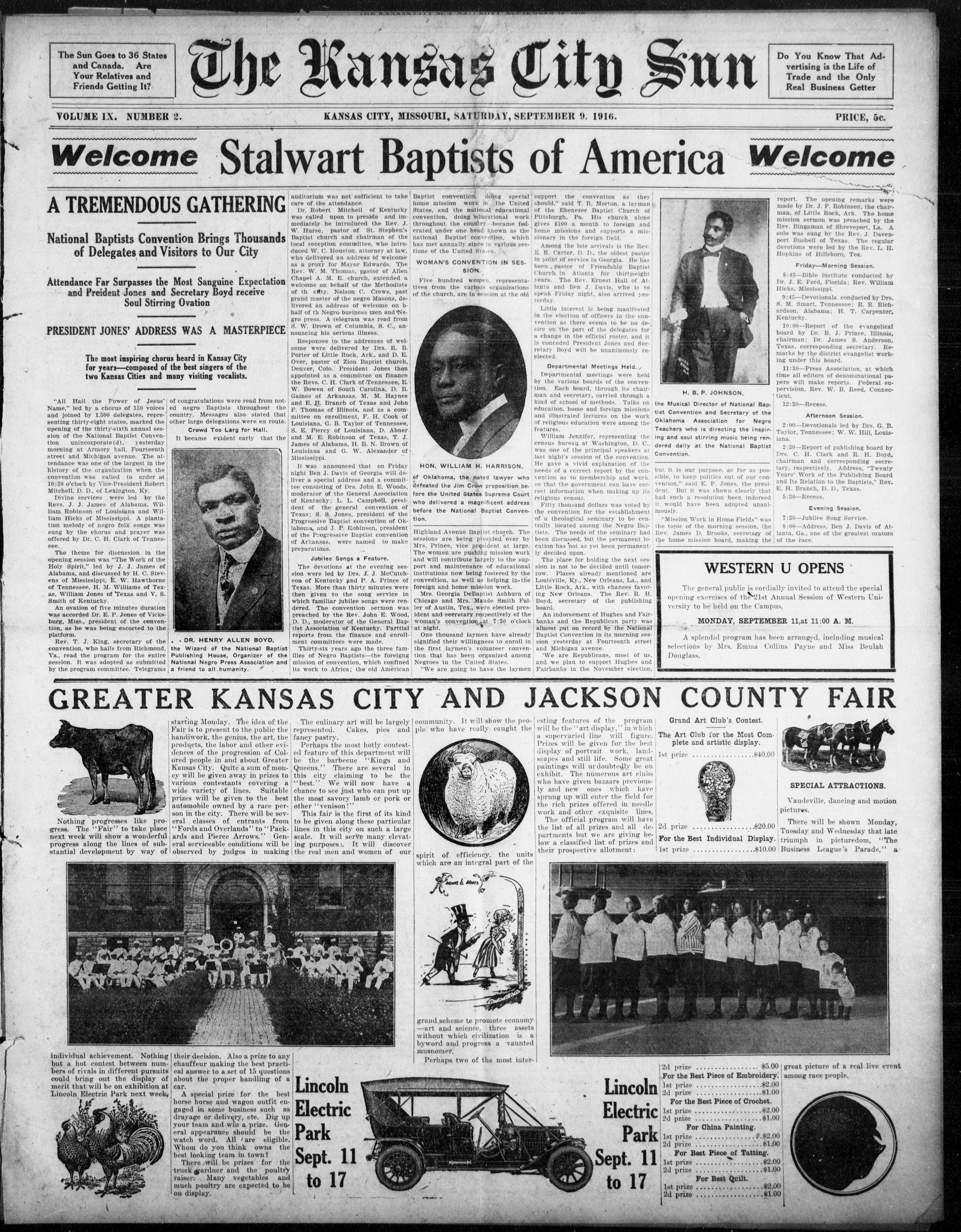
Welcome Stalwart Baptists of America Welcome
GREATER KANSAS CITY AND JACKSON COUNTY FAIR
A TREMENDOUS GATHERING
National Baptists Convention Brings Thousands of Delegates and Visitors to Our City
Attendance Far Surpasses the Most Sanguine Expectation and Preident Jones and Secretary Boyd receive Soul Stirring Ovation
The most inspiring chorus heard in Kansay City for years----composed of the best singers of the two Kansas Cities and many visiting vocalists.
MIDDLE SCHOOL
MIDDLE SCHOOL K-12 BAND
The Sun Goes to 36 States and Canada. Are Your Relatives and Friends Getting It?
VOLUME IX. NUMBER 2.
Welcome
A TREMENDOUS
National Baptists Convention of Delegates and Visitors
Attendance Far Surpasses the M and Preident Jones and Sec Soul Stirring C
PRESIDENT JONES' ADDRESS
The most inspiring chorus he for years----composed of the two Kansas Cities and many
"All Hail the Power of Jesus' Name," led by a chorus of 150 voices and joined by 1,500 delegates, representing thirty-eight states, marked the opening of the thirty-sixth annual session of the National Baptist Convention unincorporate(d), yesterday morning at Armory hall, Fourteenth street and Michigan avenue. The attendance was one of the largest in the history of the organization when the convention was called to order at 10:30 o'clock by Vice-President Robert Mitchell, D. D., of Lexington, Ky.
Divine services were led by the Revs. J. J. James of Alabama, William Robinson of Louisiana and William Hicks of Mississippi. A plantation melody of negro folk songs was sung by the chorus and prayer was offered by Dr. C. H. Clark of Tennessee.
The theme for discussion in the opening session was "The Work of the Holy Spirit," led by J. J. James of Alabama, and discussed by H. C. Stevens of Mississippi, E. W. Hawthorne of Tennessee, H. M. Williams of Texas, William Jones of Texas and V. S. Smith of Kentucky.
An ovation of five minutes duration was accorded Dr. E. P. Jones of Vicksburg, Miss., president of the convention, as he was being escorted to the platform.
Rev. T. J. King, secretary of the convention, who halls from Richmond, Va., read the program for the entire session. It was adopted as submitted by the program committee. Telegrams
GREATER
Nothing progresses like progress. The "Fair" to take place next week will show a wonderful progress along the lines of substantial development by way of
individual achievement. Nothing but a hot contest between numbers of rivals in different pursuits could bring out the display of merit that will be on exhibition at Lincoln Electric Park next week.
CHICKEN
of congratulations were read from noted negro Baptists throughout the country. Messages also stated that other large delegations were en route.
Crowd Too Larg for Hall.
It became evident early that the
DR. HENRY ALLEN BOYD,
the Wizard of the National Baptist Publishing House, Organizer of the National Negro Press Association and a friend to all humanity.
starting Monday. The idea of the Fair is to present to the public the handiwork, the genius, the art, the products, the labor and other evidences of the progression of Colored people in and about Greater Kansas City. Quite a sum of money will be given away in prizes to various contestants covering a wide variety of lines. Suitable prizes will be given to the best automobile owned by a race person in the city. There will be several classes of entrants from "Fords and Overlands" to "Packards and Pierce Arrows." General serviceable conditions will be observed by judges in making
their decision. Also a prize to any chauffeur making the best practical answer to a set of 15 questions about the proper handling of a car.
A special prize for the best horse horse and wagon outfit engaged in some business such as drayage or delivery, etc. Dig up your team and win a prize. General appearance should be the watch word. All / are eligible. Whom do you think owns the best looking team in town? There will be prizes for the truck gardner and the poultry raiser. Many vegetables and much poultry are expected to be on display.
KANSAS CITY, MISSOURI, SATURDAY, SEPTEMBER 9, 1916.
FORD
auditorium was not sufficient to take care of the attendance.
Dr. Robert Mitchell of Kentucky was called upon to preside and immediately he introduced the Rev. J. W. Hurse, pastor of St. Stephen's Baptist church and chairman of the local reception committee, who introduced W. C. Houston, attorney at law, who delivered an address of welcome as a proxy for Mayor Edwards. The Rev. W. M. Thomas, pastor of Allen Chapel A. M. E. church, extended a welcome on behalf of the Methodists of the city. Nelson C. Crews, past grand master of the negro Masons, delivered an address of welcome on behalf of the negro business men and Negro press. A telegram was read from S. W. Brown of Columbia, S. C., announcing his serious illness.
Responses to the addresses of welcome were delivered by Drs. R. B. Porter of Little Rock, Ark, and D. E. Over, pastor of Zion Baptist church, Denver, Colo. President Jones then appointed as a committee on finance the Revs. C. H. Clark of Tennessee, E. W. Bowen of South Carolina, D. B. Gaines of Arkansas, M. M. Haynes and E. H. Branch of Texas and John F. Thomas of Illinois, and as a committee on enrollment, F. H. Cook of Louisiana, G. B. Taylor of Tennessee, S. E. Piercy of Louisiana, D. Abner and M. E. Robinson of Texas, T. J. James of Alabama, H. B. N. Brown of Louisiana and G. W. Alexander of Mississippi.
It was announced that on Friday night Ben J. Davis of Georgia will deliver a special address and a committee consisting of Drs. John E. Woods, moderator of the General Association of Kentucky; L. L. Campbell, president of the general convention of Texas; S. S. Jones, president of the Progressive Baptist convention of Oklahoma, and J. P. Robinson, president of the Progressive Baptist convention of Arkansas, were named to make preparations.
Jubilee Songs a Feature.
The devotions at the evening session were led by Drs. J. J. McCutchon of Kentucky and P. A. Prince of Texas. More than thirty minutes were given to the song service in which familiar jubilee songs were rendered. The convention sermon was preached by the Rev. John E. Wood, D. D., moderator of the General Baptist Association of Kentucky. Partial reports from the finance and enrollment committees were made. Thirty-six years ago the three families of Negro Baptists—the foreign mission of convention, which confined its work to Africa; the old American
SAS CITY
The culinary art will be largely represented. Cakes, pies and fancy pastry.
Perhaps the most hotly contested feature of this department will be the barbecue "Kings and Queens." There are several in this city claiming to be the "best." We will now have a chance to see just who can put up the most savory lamb or pork or other "venison!"
This fair is the first of its kind to be given along these particular lines in this city on such a large scale. It will serve many elevating purposes.: It will discover the real men and women of our
Y-1-S
Lincoln Electric Park Sept.11 to 17
Baptist convention, doing special home mission work in the United States, and the national educational convention, doing educational work throughout the country became federated under one head known as the national Baptist convention, which has met annually since in various sections of the United States.
WOMAN'S CONVENTION IN SES
SION.
Five hundred women, representatives from the various organizations of the church, are in session at the old
HON. WILLIAM H. HARRISON,
of Oklahoma, the noted lawyer who defeated the Jim Crow proposition before the United States Supreme Court who delivered a magnificent address before the National Baptist Convention.
Highland Avenue Baptist church. The sessions are being presided over by Mrs. Prince, vice president at large. The women are pushing mission work and will contribute largely to the support and maintenance of educational institutions now being fostered by the convention, as well as helping in the foreign and home mission work. Mrs. Georgia DeBaptist Ashburn of Chicago and Mrs. Maude Smith Fuller of Austin, Tex., were elected president and secretary respectively of the woman's convention at 7:30 o'clock at night. One thousand laymen have already signified their willingness to enroll in the first laymen's volunteer convention that has been organized among Negroes in the United States. "We are going to have the laymen
spirit of efficiency, the units which are an integral part of the
grand scheme to promote economy art and science, three assets without which civilization is a byword and progress a vaunted musnomer.
10
support the convention as they should," said T. R. Morton, a layman of the Ebenezer Baptist Church of Pittsburgh, Pa. His church alone gives $100 a month to foreign and home missions and supports a missionary in the foreign field.
Among the late arrivals is the Rev. E. R. Carter, D. D., the oldest pastor in point of service in Georgia. He has been a pastor of Friendship Baptist Church in Atlanta for thirty-eight years. The Rev. Ernest Hall of Atlanta and Ben J. Davis, who is to speak Friday night, also arrived yesterday.
Little interest is being manifested in the election of officers in the convention as there seems to be no desire on the part of the delegates for a change in the official roster, and it is conceded President Jones and Secretary Boyd will be unanimously re-elected.
Departmental Meetings Held.
Departmental meetings were held by the various boards of the convention. Each board, through its chairman and secretary, carried through a kind of school of methods. Talks on education, home and foreign missions and illustrated lectures on the work of religious education were among the features.
William Jennifer, representing the census bureau at Washington, D. C., was one of the principal speakers at last night's session of the convention. He gave a vivid explanation of the needs of a correct report by the convention as to membership and work, so that the government can have correct information when making up its religious census.
Fifty thousand dollars was voted by the convention for the establishment of a theological seminary to be centrally located among the Negro Baptists. The needs of the seminary had been discussed, but the permanent location has not as yet been permanently decided upon.
The place for holding the next session is not to be decided until tomorrow. Places already mentioned are Louisville, Ky., New Orleans, La., and Little Rock, Ark., with chances favoring New Orleans. The Rev. R. H Bovd, secretary of the publishing board.
An indorsement of Hughes and Fairbanks and the Republican party was almost put on record by the National Baptist Convention in its morning session yesterday at Fourteenth street and Michigan avenue.
'We are Republicans, most of us, and we plan to support Hughes and Fairbanks in the November election,
esting features of the program will be the "art display," in which a supervaried line will figure. Prizes will be given for the best display of portrait work, landscapes and still life. Some great paintings will urdoubtedly be on exhibit. The numerous art clubs who have given bazaars previously and new ones which have sprung up will enter the field for the rich prizes offered in needle work and other exquisite lines.
The official program will have the list of all prizes and all departments but we are giving below a classified list of prizes and their prospective allotment:
ysad
Lincoln Electric Park Sept.11 to 17
H. B. P. JOHNSON,
the Musical Director of National Baptist Convention and Secretary of the Oklahoma Association for Negro Teachers who is directing the inspiring and soul stirring music being rendered daily at the National Baptist Convention.
but it is our purpose, as far as possible, to keep politics out of our convention," said E. P. Jones, the president. But it was shown clearly that had such a resolution been indorsed it would have been adopted unanimously.
"Mission Work in Home Fields" was the topic of the morning session, the Rev. James D. Brooks, secretary of the home mission board, making the
WESTERN U OPENS
WESTERN U OPENS
The general public is cordially opening exercises of the 21st Anniversary to be held on the Campus.
MONDAY, SEPTEMBER
A splendid program has been selections by Mrs. Emma Collin Douglass.
N COUNTY
Grand Art Club's Contest.
The general public is cordially invited to attend the special opening exercises of the 21st Annual Session of Western University to be held on the Campus,
MONDAY, SEPTEMBER 11,at 11:00 A. M.
A splendid program has been arranged, including musical selections by Mrs. Emma Collins Payne and Miss Beulah Douglass.
The Art Club for the Most Complete and artistic display.
1st prize ..... $40.00
2d prize .....$20.00
For the Best Individual Display.
1st prize .....$10.00
```markdown
```
Do You Know That Advertising is the Life of Trade and the Only Real Business Getter
PRICE, 5c.
report. The opening remarks were made by Dr. J. P. Robinson, the chairman, of Little Rock, Ark. The home mission sermon was preached by the Rev. Bingaman of Shreveport, La. A solo was sung by the Rev. J. Davenport Bushell of Texas. The regular devotions were led by the Rev. L. H. Hopkins of Hillsboro, Tex.
Friday-Morning Session.
8:45—Bible institute conducted by Dr. J. E. Ford, Florida; Rev. William Hicks, Mississippi.
9:45—Devotionals conducted by Drs. S. M. Smart, Tennessee; R. R. Richardson, Alabama; H. T. Carpenter, Kentucky.
10:00—Report of the evangelical board by Dr. B. J. Prince, Illinois, chairman; Dr. James S. Anderson, Texas, corresponding secretary. Remarks by the district evangelist working under this board.
11:30—Press Association, at which time all editors of denominational papers will make reports. Federal supervision, Rev. W. B. Reed, Connecticut.
12:30—Recess.
Afternoon Session
2:00—Devotionals led by Drs. G. B. Taylor, Tennessee; W. W. Hill, Louisiana.
2:30—Report of publishing board by Drs. C. H. Clark and R. H. Boyd, chairman and corresponding secretary, respectively. Address, "Twenty Years' Work of the Publishing Board and Its Relation to the Baptists," Rev. E. H. Branch, D. D., Texas.
Evening Session.
7:30 - Jubilee Song Service.
8:00 - Address, Ben J. Davis of Atlanta, Ga., one of the greatest orators of the race.
```markdown
```
SPECIAL ATTRACTIONS
Vaudeville, dancing and motion pictures.
There will be shown Monday, Tuesday and Wednesday that late triumph in picturedom, "The Business League's Parade," a
great picture of a real live event among race people.
great picture of a real live event among race people.
AFRO-AMERICAN CULLINGS
---
A wave of industrial prosperity and we have to revise our notions. The South wants the Negro, after all, and wants him so badly that it isn't going to let him get away if it can help it. Listen:
"Americus, Ga., police and sheriff's "We have thrown out a draget for the agents who have been leading Negroes out of the country with promises of work in Connecticut," a special dispatch to the Atlanta Constitution reads. "Several industries have been paralyzed by the Negroes leaving their work."
Then there is the old bogie of alien immigration. Listen again, this time to the Washington Post:
"There is a growing need for common labor," which may become "so acute as to cripple industry" and which is "due partly to prosperity and parity to the impairment of immigration."
The same paper summarizes the situation as follows:
"Not long ago agents acting in behalf of the Russian government transported from Norfolk, Va., a complete force of shipbuilders, including foremen, draftsmen, mechanics and ordinary laborers. The shipbuilding force was removed in a body to Russia, so that the Russian government might have better facilities for shipbuilding. "The need for labor, both for agricultural and industrial development, is as great in the South as in the East. Recently two thousand Negro laborers left Savannah, Ga., to work on the Pennsylvania railroad. The laborers were taken from a point four miles out of Savannah because the local council had passed an ordinance requiring a $1,000 license fee for any agent sending laborers out of the state.
"All of the factories in the South are taking precautions against draining of their labor resources. Their situation is not different from that which prevails in the East. Some months ago one of the large motor car companies in the East had a strike and within 24 hours agents of the large muni companies were on the field inducing the strikers to accept employment in the muniition plants."
But suppose we follow the Negroes to Connecticut and let the Hartford Courant tell about it:
"One way in which the labor shortage that has been felt in the North during the present period of intense industrial prosperity has been met is by the importation of Negro laborers from the South. The tobacco plantations in the immediate vicinity of Hartford have made particular use of this expedient.
"Marcus L. Floyd, general manager of the Connecticut Tobacco corporation, now has 145 Negroes at work, and expects soon to have 200 working on the $20 acres that are being cultivated under cloth by the corporation.
"On the Griffin-Neuberger plantation at Griffiths, Conn., there are now $8 Negro workers, and here will be 130 before the season is over.
"These Negro workers are paid $2 a day and housed free."
And here is the explanation:
"The cause of the labor shortage in this section, according to Mr. Floyd, is that the high wages offered by mutilation factories to unskilled laborers drew most of them into the work. This with the fact that immigration has almost ceased."
So the war, which brought the industrial prosperity and also cut off the immigration upon which American employers so long have depended, is to be both praised and biased. And in the
The South Texas Colored Missionary Baptist association convened in its twenty-third annual session at Houston, Tex. Moderator Rev. A. T. Gordon called the association to order. The opening service of the prayer was conducted by Rev. B. J. Preacher of Galveston, G. W. Smith and D. Young, veteran ministers of the association, offered prayer. F. I. Richardson was elected reporter for the association. The moderator set forth the principles of the association. Rev. A. C. Ray and Rev. C. H. Jones, secretary and assistant secretary, respectively, were at the desk.
Vice President Rev. J. C. Curtis presented Rev. C. H. Jones, who had been selected to preach the introductory sermon and his alternate, Rev. J. L. Lampley.
Rev. C. H. Jones announced his subject as "The Certain Increase of the Kingdom of Jesus." He made a strong appeal to the ministers of the gospel to bestir themselves to active service.
The following committees were announced: Finance, Revs. B. J. LeRoy, J. L. Lampley, I. G. Griffin, A. C. Carter, P. A. Pinkney; enrollment, Revs. W. H. Stewart, B. C. Carter, G. W.
At the closing session of the National Negro Christian congress at the Cosmopolitan Baptist church, Washington, the following officers were elected: Dr. Simon P. W. Drew, Washington, D. C., president; Rev. Dr. W. H. V. B. Taylor, West Virginia, first vice president; Rev. Dr. W. R. Winston, Washington, D. C., secretary; Bishop J. J. Higgs, St. Louis, corresponding secretary; Rev. Dr. George W. Thomas, North Carolina, treasurer, and Rev. Leroy Frazier, Richmond, Va., organizer
A patent has been recently issued to a Frenchman for a process by which petroleum and its derivatives may be transported without the least danger of explosion during handling in shipment. The process consists of making the oil into a solid by the addition of a solution of soap in the proportion of one to fifty of oil. This makes the mass of gelatinous consistency, which renders it entirely safe. The material may be lighted with a watch, but it will burn so slowly that
meantime there is only one result in sight, the wages of the common laborer will advance sharply, in the South to keep the Negro at home, and in the North to lure him away from Dixie.
Among the recent promotions in the army was that of Maj. Charles Young, Tenth United States cavalry, to the grade of lieutenant colonel. Special interest attaches to this case for the reason that, although Colonel Young is not the only colored man to have been graduated from the United States Military academy, he is the only man of his race to have reached the rank of lieutenant colonel, the second highest in regimental organization. He was graduate in 1880 and most of his service has been in the Ninth and Tenth cavalry, in which he rose gradually to his present rank. For nearly a year, while holding the rank of first lieutenant, he was attached to the Seventh cavalry, a white regiment. During the Spanish war he served as major of the Ninth Ohio colored infantry, a regiment he helped to organize. For several months past he has been serving with his regiment in the punitive expedition to Mexico under General Pershing.
In addition to Lieutenant Colonel Young, there are eight other colored men holding commissions in the army. These are: Maj. John R. Lynch of the pay corps, formerly a member of congress, who is retired; Capt. John E. Green, Twenty-fifth infantry, who is military attache at Monrovia, Liberian; Capt. Benjamin O. Davis of the cavalry, who is military instructor at Willberforce university, Ohio, and Chaplains W. W. E. Gladden, Twenty-fourth infantry; George W. Prioleau, Twenty-fifth infantry; O. J. W. Scott, Tenth cavalry; Louis A. Carter, Ninth cavalry, and T. G. Stewart and William T. Anderson, both of whom are on the retired list. Chaplain Anderson has the rank of major, the others being either captains or first lieutenants.
In the period covered by one vigorous manhood, approximately coincident with the half century following emancipation, things changed very much for the American Negro. He more than doubled in numbers and accumulated wealth exceeding $700,000,000. His school property for higher education built and paid for in that time amounted to $20,000,000; his church property to $70,000,000.
In the half century the percentage of literacy was raised from 5 to 70. At its close there were 1,700,000 Negro children in public schools instead of a meager 10,000 in 1863. The number of Negro churches was increased from 550 to 40,000; the number of communicants from 550,000 to 4,300,000. Sunday schools increased from 200 to 41,000 and pupils from 10,000 to 2,200,000.
This is a very creditable record for an uneducated, illiterate race suddenly thrown on its own resources in the midst of a highly organized white civilization, which had no place ready for its former slaves. And the Negroes are by no means standing still. They are entering every branch of business and making good; they are rapidly extending their real estate holdings; they are giving themselves a secular and religious education that ranks high in the Christian world. What their future in this country will be no man dares to prophesy, but undoubtedly they will be ready to meet boldly and capably whatever fate has in store for them. They have learned to stand on their feet.
Mitchell, H. Willis, B. J. Preacher.
Vice Moderator Rev. J. C. Curtis called the afternoon session to order. Rev. T. Wesley, assisted by Rev. I. S. Ambrose, conducted the devotional services. Invocation by Rev. I. C. Capital and Dr. J. E. Edwards of Temple conducted the Bible institute.
The committee on finance and enrollment made its first partial report, which was adopted.
Membership of banks in the National Negro Business league has grown from two, in 1900, to fifty-one at present. This fact was brought out in the discussions before the seventeenth annual session of the league at Kansas City, Mo., emphasizing the service the organization, which was founded by the late Booker T. Washington, is giving to the Negro business interests of the country.
An address on the Negro state guaranteed banks of Mississippi by C. B. King of Indianola, Miss., was on the program.
Health and business prosperity, the raising of cattle and the management of various business enterprises were discussed by the delegates.
When Company A, Cardington, O., of the Fourth regiment, went to Camp Wilson it had eleven pairs of brothers, two pairs of fathers and sons and fourteen men over six feet in height. Company A is the youngest in the state, having only been mustered into service June 8, eleven days before the mobilization call. It has 100 members.
When death, the great reconciler, has come. it is never our tenderness that we repent of, but our severity—George Elliot.
there is no danger of disastrous results. The oil may be brought to its original state by treatment with alcohol or other solvent.
Bright Idea.
"According to this story of pioneer life, all the hero's neighbors assembled and helped him to build his house." "I wonder if a scheme like that would be feasible now." "What's your idea?" "I was thinking of inviting four or five of my neighbors to come over and help me work my garden."
THE KANSAS CITY SUN, SATURDAY, SEPTEMBER 9, 1916
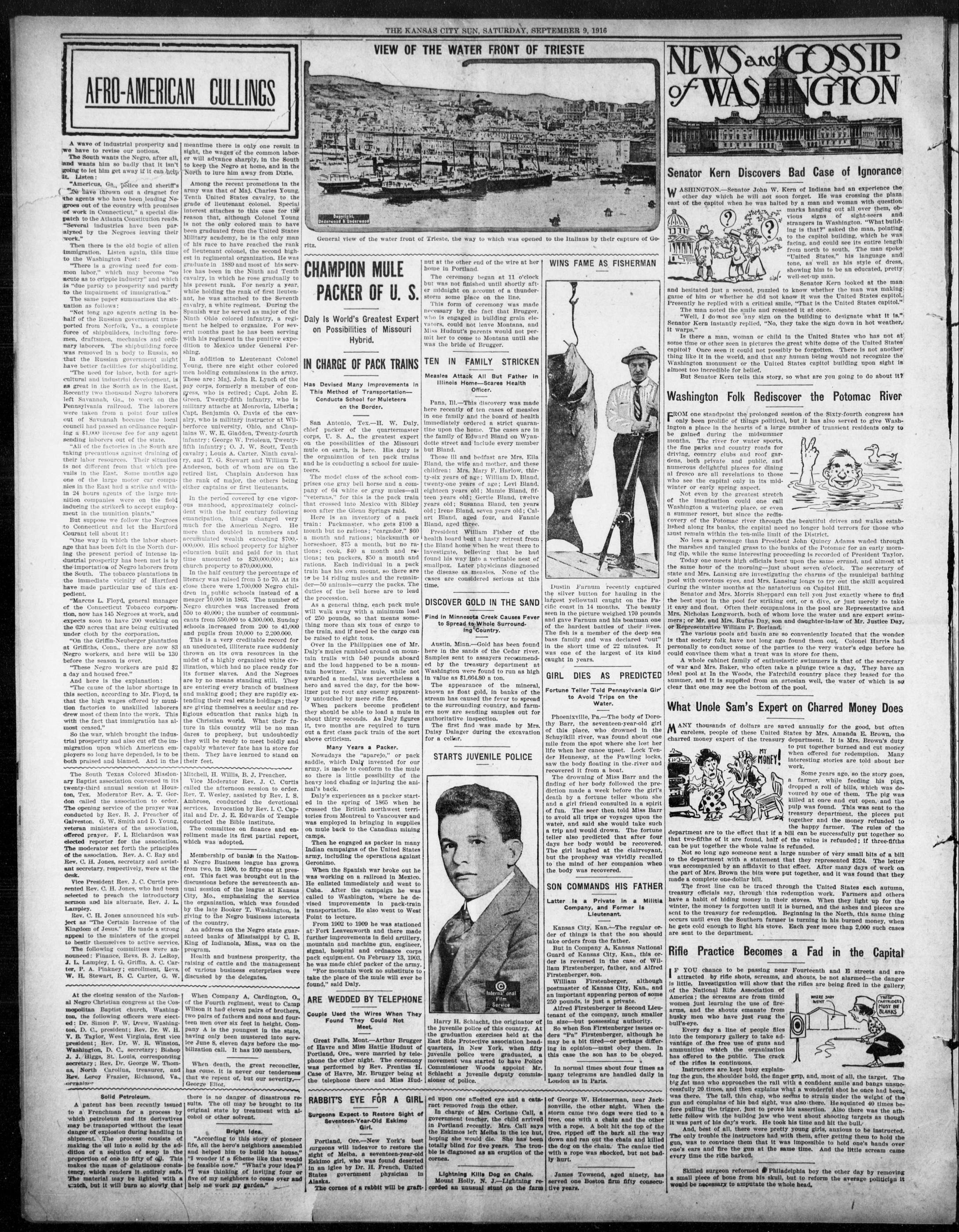
VIEW OF THE WATER FRONT OF TRIESTE
Copyright
Bederwood & Bederwood
General view of the water front of Trieste, the way to which was opened to the Italians by their capture of Go-
CHAMPION MULE PACKER OF U. S.
Daly Is World's Greatest Expert on Possibilities of Missouri Hybrid.
IN CHARGE OF PACK TRAINS
Has Devised Many Improvements in This Method of Transportation—Conducts School for Muleteers on the Border.
San Antonio, Tex.—H. W. Daly, chief packer of the quartermaster corps, U. S. A., the greatest expert on the possibilities of the Missouri mule on earth, is here. His duty is the organization of ten pack trains and he is conducting a school for muleteers.
The model class of the school comprises one gray bell horse and a company of 64 white or gray mules—all "veterans," for this is the pack train that crossed into Mexico with Sibley soon after the Glenn Springs raid.
Here is an inventory of a pack train: Packmaster, who gets $100 a month but no rations; "cargador," $60 a month and rations; blacksmith or horseshoe; $75 a month, but no rations; cook, $40 a month and rations; ten packers, $50 a month and rations. Each individual in a pack train has his own mount, so there are to be 14 riding mules and the remainder—50 animals—carry the packs. The duties of the bell horse are to lead the procession.
As a general thing, each pack mule will walk away with a minimum load of 250 pounds, so that means something more than six tons of cargo to the train, and if need be the cargo can be raised to eight tons.
Over in the Philippines one of Mr. Daly's mules rumbled around on mountain trails with 540 pounds aboard and the load happened to be a mountain howitzer. This mule, while not awarded a medal, was nevertheless a hero and saved the day, for the howitzer put to rout any enemy apparently untouched by mere rifle fire. When packers become proficient they should be able to load a mule in about thirty seconds. As Daly figures it, two months are required to turn out a first class pack train of the sort above criticism.
Many Years a Packer.
Nowadays the "aparejo," or pack saddle, which Daly invented for our army, is made to conform to the mule so there is little possibility of the heavy load chafing or injuring the animal's back.
Daly's experiences as a packer started in the spring of 1865 when he crossed the British northwest territories from Montreal to Vancouver and was employed in bringing in supplies on mule back to the Canadian mining camps.
Then he engaged as packer in many Indian campaigns of the United States army, including the operations against Geronimo.
When the Spanish war broke out he was working on a railroad in Mexico. He enlisted immediately and went to Cuba. After the campaign he was called to Washington, where he devised improvements in pack-train transportation. He also went to West Point to lecture.
From 1902 to 1909 he was stationed at Fort Leavenworth and there made further improvements in field artillery, mountain and machine gun, engineer, signal, hospital and ordinance corps pack equipment. On February 13, 1903 he was made chief packer of the army. "For mountain work no substitute to take the place of the mule will ever be found," said Daly.
ARE WEDDED BY TELEPHONE
Couple Used the Wires When They Found They Could Not Meet.
Great Falls, Mont.—Arthur Bruger of Havre and Miss Hattie Hudnut of Portland, Ore., were married by telephone the other night. The ceremony was performed by Rev. Prentiss H. Case of Havre, Mr. Bruger being at the telephone there and Miss Hud-
RABBIT'S EYE FOR A GIRL
Surgeons Expect to Restore Sight of Seventeen-Year-Old Eskimo Girl.
Portland, Ore.-New York's best surgeons will indexor to restore the sight of Melba, a seventeen-year-old Eskimo girl, who was found deserted in an ignee by Dr. H. French, United States government physician in Alaska.
The corner of a rabbit will be graft-
nut at the other end of the wire at her home in Portland.
The ceremony began at 11 o'clock but was not finished until shortly after midnight on account of a thunderstorm some place on the line.
This form of ceremony was made necessary by the fact that Brugger, who is engaged in building grain elevators, could not leave Montana, and Miss Hudnut's parents would not permit her to come to Montana until she was the bride of Brugger.
TEN IN FAMILY STRICKEN
Measles Attack All But Father In Illinois Home—Scares Health Officer.
Pana, Ill.—This discovery was made here recently of ten cases of measles in one family and the board of health immediately ordered a strict quarantine upon the home. The cases are in the family of Edward Bland on Wyandotte street and include every member but Bland.
Those ill and bedfast are Mrs, Ella Bland, the wife and mother, and these children: Mrs, Mary F, Harlow, thirty-six years of age; William D, Bland, twenty-one years of age; Levi Bland, eleighteen years old; Mamie Bland, fifteen years old; Gertle Bland, twelve years old; Susanna Bland, ten years old; Irene Bland, seven years old; Calart Bland, aged four, and Fannie Bland, aged three.
President William Fisher of the health board beat a hasty retreat from the Bland home when he went there to investigate, believing that he had found his way into a veritable nest of smallpox. Later physicians diagnosed the disease as measles. None of the cases are considered serious at this time.
DISCOVER GOLD IN THE SAND
Find in Minnesota Creek Causes Fever to Spread to Whole Surrounding Country.
Austin, Minn.—Gold has been found here in the sands of the Cedar river. Samples sent to assayers recommended by the treasury department at Washington were found to run as high in value as $1,664.80 a ton.
The appearance of the mineral, known as float gold, in banks of the stream has caused the fever to spread to the surrounding country, and farmers now are sending samples out for authoritative inspection.
The first find was made by Mrs. Daisy Dalager during the excavation for a cellar.
STARTS JUVENILE POLICE
Internaional
Film
Service
Harry H. Schlacht, the originator of the juvenile police of this country. At the graduation exercises held at the East Side Protective association headquarters, in New York, when fifty juvenile police were graduated, a movement was started to have Police Commissioner Woods appoint Mr. Schlacht a juvenile deputy commissioner of police.
ed upon one affected eye and a cataract removed from the other.
In charge of Mrs. Corinne Call, a government teacher, the child arrived in Portland recently. Mrs. Call says the Eskimos left Melba in the ice hut, hoping she would die. She has been totally blind for five years. The trouble is diagnosed as an eruption of the cornea.
Lightning Kills Dog on Chain.
Mount Holly, N. J.—Lightning recorded an unusual stunt on the farm
WINS FAME AS FISHERMAN
THE BIGGEST Tuna Ever Seized
Dustin Farnum recently captured the silver button for hauling in the largest yellowtail caught on the Pacific coast in 14 months. The beauty seen in the picture weighed 170 pounds and gave Farnum and his boatman one of the hardest battles of their lives. The fish is a member of the deep sea bass family and was declared "out" in the short time of 22 minutes. It was one of the largest of its kind caught in years.
GIRL DIES AS PREDICTED
Fortune Teller Told Pennsylvania Girl to Avoid Trips on the Water.
Phoenixville, Pa.—The body of Dorothy Barr, the seventeen-year-old girl of this place, who drowned in the Schuylkill river, was found about one mile from the spot where she lost her life when her canoe upset. Lock Tender Hennessy, at the Pawling locks, saw the body floating in the river and recovered it from a boat.
The drowning of Miss Barr and the finding of her body followed the prediction made a week before the girl's death by a fortune teller whom she and a girl friend consulted in a spirit of fun. The seer then told Miss Barr to avoid all trips or voyages upon the water, and said she would take such a trip and would drown. The fortune teller also predicted that after four days her body would be recovered. The girl laughed at the clairvoyant, but the prophesy was vividly recalled to the mind of her companion when the body was recovered.
SON COMMANDS HIS FATHER
Latter Is a Private in a Militia Company, and Former Is Lieutenant.
Kansas City, Kan.-The regular order of things is that the son should take orders from the father.
But in Company A, Kansas National Guard of Kansas City, Kan., this order is reversed in the case of William Firstenberger, father, and Alfred Firstenberger, son.
William Firstenberger, although postmaster of Kansas City, Kan., and an important appearing person of some 250 pounds, is just a private.
Alfred Firstenberger is Second Lieutenant of the company, much smaller in size—but possessing authority.
So when Son Firstenberger issues orders "Pa" Firstenberger, although he may be a bit tired—or perhaps differing in opinion—must obey them.
In this case the son has to be obeyed.
In normal times about four times as many telegrams are handled daily in London as in Paris.
of George W. Heisserman, near Jacksonville, the other night. When the storm came two dogs were tied to a tree, one with a chain and the other with a rope. A bolt hit the top of the tree, ripped off the bark all the way down and ran out the chain and killed the dog on the chain. The canine tied with a rope was shocked, but not badly hurt.
James Towsend, aged ninety, has served one Boston firm fifty consecutive years.
NEWS and GOSSIP of WASHINGTON
Senator Kern Discovers Bad Case of Ignorance
Senator Kern Discovers Bad Case of Ignorance
WASHINGTON.—Senator John W. Kern of Indiana had an experience the other day which he will not soon forget. He was crossing the plaza east of the capitol when he was halted by a man and woman with question
and hesitated just a second, puzzled to know whether the man was making game of him or whether he did not know it was the United States capitol. Presently he replied with a critical smile, "That is the United States capitol." The man noted the smile and resented it at once.
"Well, I do not see any sign on the building to designate what it is." Senator Kern instantly replied, "No, they take the sign down in hot weather, it warps."
Is there a man, woman or child in the United States who has not at some time or other seen in pictures the great white dome of the United States capitol? Once seen it could not possibly be forgotten. There is not another thing like it in the world, and that any human being would not recognize the Washington monument or the United States capitol building upon sight is almost too incredible for belief.
But Senator Kern tells this story, so what are you going to do about it?
Washington Folk Rediscover the Potomac River
Washington Folk Rediscover the Potomac River
FROM one standpoint the prolonged session of the Sixty-fourth congress has only been prolific of things political, but it has also served to give Washington a place in the hearts of a large number of transient residents only to
covery of the Potomac river through the beautiful drives and walks established along its banks, the capital need no longer hold terrors for those who must remain within the ten-mile limit of the District.
No less a personage than President John Quincy Adams waded through the marshes and tangled grass to the banks of the Potomac for an early morning dip, while the same interesting proceeding is recorded of President Taylor.
Today one meets high officials bent upon the same errand, and almost at the same hour of the morning—just about seven o'clock. The secretary of state and Mrs. Lansing are investigating the charms of the municipal bathing pool with covetous eyes, and Mrs. Lansing longs to try out the skill acquired during the winter months at the natatorium on Capitol Hill.
Senator and Mrs. Morris Sheppard can tell you just exactly to find the best spot in the pool for striking out, or a dive, or just merely to take it easy and float. Often their companions in the pool are Representative and Mrs. Nicholas Longworth, both of whom love the water and are expert swimmers; or Mr. and Mrs. Rufus Day, son and daughter-in-law of Mr. Justice Day, or Representative William P. Borland.
The various pools and basin are so conveniently located that the wonder is that society folk have not long ago found them out. Colonel Harris had personally to conduct some of the parties to the very water's edge before he could convince what a treat was in store for them.
A whole cabinet family of enthusiastic swimmers is that of the secretary of war and Mrs. Baker, who often take a plunge twice a day. They have an ideal pool at In the Woods, the Fatchild country place they leased for the summer, and it is supplied from an artesian well, the water of which is so clear that one may see the bottom of the pool.
What Uncle Sam's Expert on Charred Money Does
MANY thousands of dollars are saved annually for the good, but often careless, people of these United States by Mrs. Amanda E. Brown, the charred money expert of the treasury department. It is Mrs. Brown's duty
department are to the effect that if a bill can be successfully put together so that two-fifths of it are found, half of the value is refunded; if three-fifths can be put together the whole value is refunded.
Not so long ago someone sent a large number of very small bits of a bill to the department with a statement that they represented $224. The letter was accompanied by an affidavit to that effect. After many days of work on the part of Mrs. Brown the bits were put together, and it was found that they made a complete one-dollar bill.
The frost line can be traced through the United States each autumn, treasury officials say, through this redemption work. Farmers and others have a habit of hiding money in their stoves. When they light up for the winter, the money is forgotten until it is burned, and the ashes and pieces are sent to the treasury for redemption. Beginning in the North, this same thing occurs until even the Southern farmer is turning in his burned money, when he gets cold enough to light his stove. Each year more than 2,000 such cases are sent to the department.
Rifle Practice Becomes a Fad in the Capital
F YOU chance to be passing near Fourteenth and E streets and are attracted by rifle shots, screams, and shouts, be not alarmed—the danger is little. Investigation will show that the rifles are being fired in the gallery
Instructors are kept busy explaining the gun, the shoulder hold, the finger grip, and, most of all, the target. The big fat man who approaches the rail with a confident smile and bangs unsuccessfully 20 times, and then explains what a wonderful shot he once had been, was there. The tall, thin chap, who seems to strain under the weight of the gun and complains of his bad sight, was also there. He squinted 40 times before pulling the trigger, just to prove his assertion. Also there was the athletic fellow with the bulldog jaw who went about shooting targets as though it was part of his day's work. He took his time and hit the bull.
And, best of all, there were pretty young girls, anxious to be instructed. The only trouble the instructors had with them, after getting them to hold the gun, was to convince them that it was impossible to hold one's hands over one's ears and fire the gun at the same time. And the little scream came every time the rifle barked.
Skilled surgeon reformed Philadelphia boy the other day by removing a small piece of bone from his skull, to reform the average politicign it would be necessary to amputate the whole head.
?
and hesitated just a second, puzzled the game of him or whether he did not k
Presently he replied with a critical smil
The man noted the smile and resent
"Well, I do not see any sign on a Senator Kern instantly replied, "No, the it warps."
Is there a man, woman or child some time or other seen in pictures the capitol? Once seen it could not possibly like it in the world, and that any Washington monument or the United almost too incredible for belief.
But Senator Kern tells this story.
Washington Folk Redisco
FROM one standpoint the prolonged so only been prolific of things politicalington a place in the hearts of a large
be gained during the midsummer months. The river for water sports, the fine parks and country roads for driving, country clubs and roof gardens, both private and public, and numerous delightful places for dining al fresco are all revelations to those who see the capital only in its midwinter or early spring aspect.
Not even by the greatest stretch of the imagination could one call Washington a watering place, or even a summer resort, but since the rediscovery of the Potomac river through lished along its banks, the capital nee
must remain within the ten-mile limit.
No less a personage than President the marshes and tangled grass to the bering dip, while the same interesting prooc.
Today one meets high officials ben the same hour of the morning—just a state and Mrs. Lansing are investigating pool with covetous eyes, and Mrs. Lansing during the winter months at the natte.
Senator and Mrs. Morris Sheppard the best spot in the pool for striking it easy and float. Often their company Mrs. Nicholas Longworth, both of whom mers; or Mr. and Mrs. Rufus Day, son or Representative William P. Borland.
The various pools and basin are so is that society folk have not long ago personally to conduct some of the part could convince them what a treat was.
A whole cabinet family of enthusiasm of war and Mrs. Baker, who often take ideal pool at In the Woods, the Fatric summer, and it is supplied from an clear that one may see the bottom of the
What Uncle Sam's Expert
MANY thousands of dollars are save careless, people of these United Charred money expert of the treasury.
MY MONEY!
department are to the effect that if a that two-fifths of it are found, half o can be put together the whole value is. Not so long ago someone sent a la to the department with a statement t was accompanied by an affidavit to the part of Mrs. Brown the bits were p made a complete one-dollar bill. The frost line can be traced th treasury officials say, through this re have a habit of hiding money in their winter, the money is forgotten until it sent to the treasury for redemption. B occurs until even the Southern farmer he gets cold enough to light his stove. are sent to the department.
Rifle Practice Becomes
F YOU chance to be passing near attracted by rifle shots, screams, a is little. Investigation will show that
of the National Rifle Association of America; the screams are from timid women just learning the use of firearms, and the shouts emanate from husky men who have just rung the bull's-eye. Every day a line of people files into the temporary gallery to take advantage of the free use of guns and ammunition which the organization has offered to the public. The crack of the rifles is continuous. Instructors are kept busy explain-
ing the gun, the shoulder hold, the finger big fat man who approaches the rail wcessfully 20 times, and then explains w was there. The tall, thin chap, who s gun and complains of his bad sight, w fore pulling the trigger, just to prove letic fellow with the bulldog jaw wh it it was part of his day's work. He took And, best of all, there were prettie The only trouble the instructors had w gun, was to convince them that it w one's ears and fire the gun at the ss every time the rifle barked.
Skilled surgeon reformed Philas a small piece of bone from his skull, would be necessary to amputate the wh
marks hanging out all over them, obvious signs of sight-seers and strangers in Washington. "What building is that?" asked the man, pointing to the capitol building, which he was facing, and could see its entire length from north to south. The man spoke "United States," his language and tone, as well as his style of dress, showing him to be an educated, pretty well-set up man.
Senator Kern looked at the man
so know whether the man was making
know it was the United States capitol,
please, "That is the United States capitol."
ident it at once.
the building to designate what it is."
they take the sign down in hot weather,
in the United States who has not at
great white dome of the United States
only be forgotten. There is not another
human being would not recognize the
States capitol building upon sight is
so what are you going to do about it?
over the Potomac River
session of the Sixty-fourth congress has
, but it has also served to give Wash-
e number of transient residents only to
V
be the beautiful drives and walks established no longer hold terrors for those who of the District.
But John Quinney Adams waded through banks of the Potomac for an early morn-ceeding is recorded of President Taylor. It upon the same errand, and almost at about seven o'clock. The secretary of the charms of the municipal bathing using longs to try out the skill acquired on Capitol Hill.
I can tell you just exactly where to find out, or a dive, or just merely to take on in the pool are Representative and you love the water and are expert swim- and daughter-in-law of Mr. Justice Day, so conveniently located that the wonder found them out. Colonel Harris had ties to the very water's edge before he in store for them.
Plastic swimmers is that of the secretary be a plunge twice a day. They have an child country place they leased for the artesian well, the water of which is so the pool.
At on Charred Money Does
lived annually for the good, but often
tates by Mrs. Amanda E. Brown, the department. It is Mrs. Brown's duty to put together burned and cut money when offered for redemption. Many interesting stories are told about her work.
Some years ago, so the story goes, a farmer, while feeding his pigs, dropped a roll of bills, which was devoured by one of them. The pig was killed at once and cut open, and the pulp was found. This was sent to the treasury department, the pieces put together and the money refunded to the happy farmer. The rules of the
bill can be successfully put together so
of the value is refunded; if three-fifths
refunded.
large number of very small bits of a bill
that they represented $224. The letter
effect. After many days of work on
out together, and it was found that they
ough the United States each autumn,
deduction work. Farmers and others
stoves. When they light up for the
is burned, and the ashes and pieces are
Beginning in the North, this same thing
is turning in his burned money, when
Each year more than 2,000 such cases
a Fad in the Capital
For Fourteenth and E streets and are
and shouts, be not alarmed—the danger
the rifles are being fired in the gallery
WHERE SHOT WENT
THESE CARTRIDGES MUST BE BLANKS
er grip, and, most of all, the target. The with a confident smile and bangs unsucce- a wonderful shot he once had been, seems to strain under the weight of the was also there. He squinted 40 times be- hels assertion. Also there was the ath- went about shooting targets as though his time and hit the bull. young girls, anxious to be instructed, with them, after getting them to hold the as impossible to hold one's hands over time. And the little scream came
delphia boy the other day by removing but to reform the average politicign it hole head.
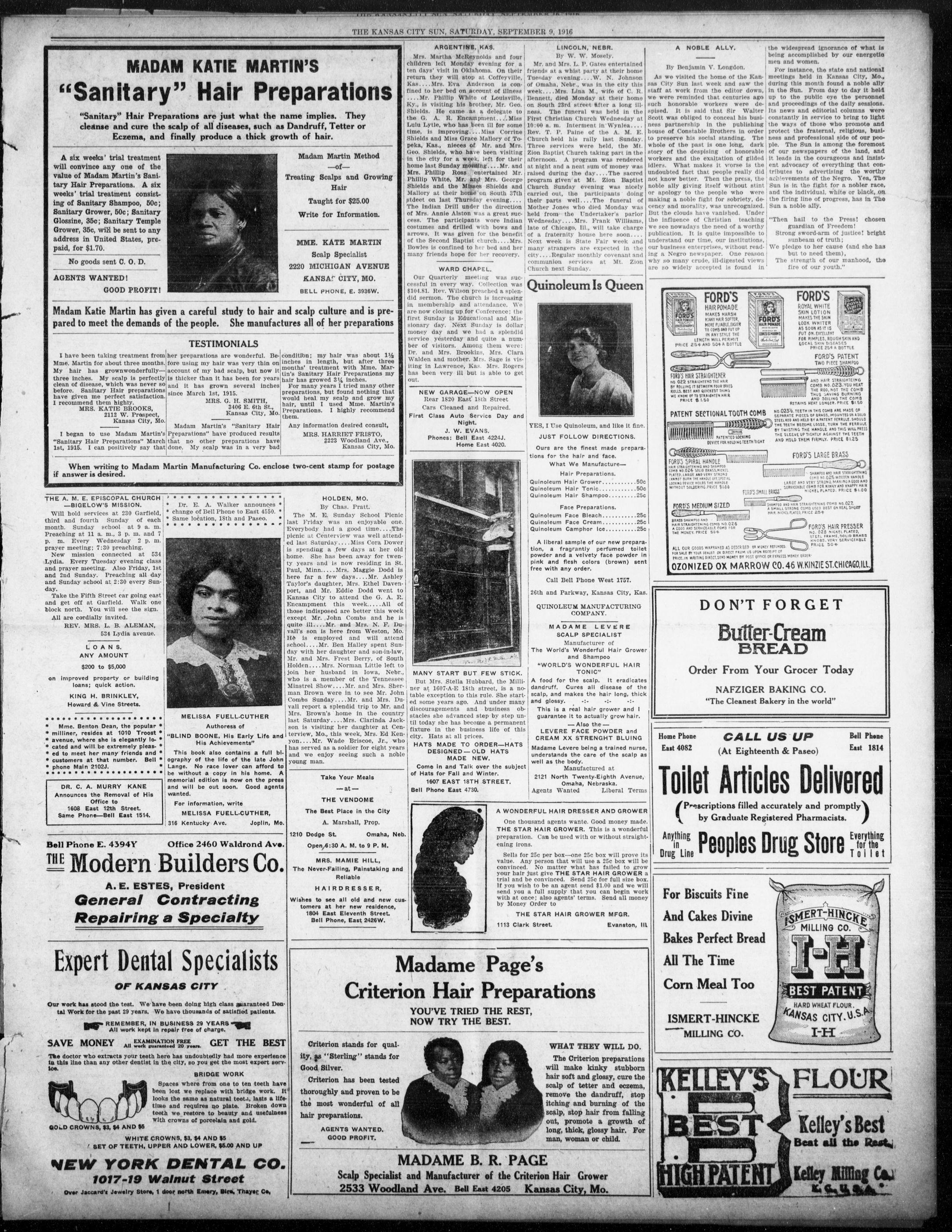
MADAM KATIE MARTIN'S "Sanitary" Hair Preparations
"Sanitary" Hair Preparations are just what the name implies. They cleanse and cure the scalp of all diseases, such as Dandruff, Tetter or Eczema, and finally produce a thick growth of hair.
A. B.
Madam Katie Martin has given a careful paired to meet the demands of the people.
TESTIMON
I have been taking treatment from Mme. Martin for about three months. My hair has grown wonderfully—account of my hair three inches. My scalp is perfectly clean of disease, which was never so before. Sanitary Hair preparations have given me perfect satisfaction. I recommend them highly.
MRS. KATIE BROOKS,
2112 W. Prospect,
Kansas City, Mo.
Madam Martin Preparations" have "Sanitary Hair Preparations" March 1st, 1915. I can positively say that no other done. My scalp
When writing to Madam Martin Manufa if answer is desired.
is given a careful study to hair and heads of the people. She manufactu
Madam Katie Martin has given a careful study to hair and scalp culture and is prepared to meet the demands of the people. She manufactures all of her preparations
her preparations are wonderful. Before using my hair was very thin on account of my bad scalp, but now it is thicker than it has been for years and it has grown several inches since March 1st, 1915.
MRS. G. H. SMITH,
3406 E. 6th St.,
Kansas City, Mo.
Madam Martin's "Sanitary Hair Preparations" have produced results that no other preparations have done. My scalp was in a very bad
Martin Manufacturing Co. enclose
I have been taking treatment from Mme. Martin for about three months. My hair has grown wonderfully—three inches. My scalp is perfectly clean of disease, which was never so before. Sanitary Hair preparations her preparations are wonderful. Before using my hair was very thin on account of my bad scalp, but now it is thicker than it has been for years and it has grown several inches condition; my hair was about $1\frac{1}{2}$ inches in length, but after three months' treatment with Mme. Martin's Sanitary Hair Preparations my hair has grown $3\frac{1}{4}$ inches. For many years I tried many other
I began to use Madam Martin's "Sanitary Hair Preparations" March 1st, 1915. I can positively say that Preparations" have produced results that no other preparations have done. My scalp was in a very bad MRS. HARRIET FRISTO, 2223 Woodland Ave., Kansas City, Mo.
When writing to Madam Martin Manufacturing Co. enclose two-cent stamp for postage if answer is desired.
* Dr. E. A. Walker announces
* change of Bell Phone to East 4550.
* Same location, 18th and Paseo.
A. E.
LOANS.
ANY AMOUNT
$200 to $5,000
"BLIND BOONE, His Early Life and His Achievements"
This book also contains a full biography of the life of the late John Lange. No race lover can afford to be without a copy in his home. A memorial edition is now on the press and will be out soon. Good agents wanted.
For information, write
MELISSA FUELL-CUTHER,
316 Kentucky Ave. Joplin, Mo.
Bell Phone E. 4394Y Office 2460
THE Modern Builder
A. E. ESTES, President
General Contract
Repairing a Spec
Expert Dental Spec
Office 2460 Waldrond Ave.
Builders Co.
TES, President
Contracting
g a Specialty
tal Specialists
Expert Dental Specialists
OF KANSAS CITY
Our work has stood the test. We have been doing high
tal Work for the past 29 years. We have thousands of
REMEMBER, IN BUSINESS 29 YEAR
All work kept in repair free of charge
SAVE MONEY EXAMINATION FREE All work guaranteed 20 years.
The doctor who extracts your teeth here has undoubtedly
in this line than any other dentist in the city, so you get
ice.
BRIDGE
have been doing high class guaranteed Den-
We have thousands of satisfied patients.
IN BUSINESS 29 YEARS
in repair free of charge.
NATIONAL FREE
guaranteed 20 years.
GET THE BEST
th here has undoubtedly had more experience
in the city, so you get the most expert serv-
BRIDGE WORK
Our work has stood the test. We have been doing high class guaranteed Dental Work for the past 29 years. We have thousands of satisfied patients.
REMEMBER, IN BUSINESS 29 YEARS
All work kept in repair free of charge.
SAVE MONEY
EXAMINATION FREE
All work guaranteed 20 years.
GET THE BEST
The doctor who extracts your teeth here has undoubtedly had more experience in this line than any other dentist in the city, so you get the most expert service.
BRIDGE WORK
Spaces where from one to ten teeth have been lost we replace with bridge work. It looks the same as natural teeth, lasts a lifetime and requires no plate. Broken down teeth we restore to beauty and usefulness with crowns of porcelain and gold.
GOLD CROWNS, $3, $4 AND $5
WHITE CROWNS, $3, $4 AND
SET OF TEETH, UPPER AND LOWER,
NEW YORK DENT
1017-19 Walnut St
Over Jaccard's Jewelry Store, 1 door north Emery,
CROWNS, $3, $4 AND $5
UPPER AND LOWER, $5.00 AND UP
K DENTAL CO.
Walnut Street
1 door north Emery, Bire, Thayer Co.
WHITE CROWNS, $3, $4 AND $5
/ SET OF TEETH, UPPER AND LOWER, $5.00 AND UP
Over Jaccard's Jewelry Store, 1 door north Emery, Bire, Thayer Co.
A six weeks' trial treatment will convince any one of the value of Madam Martin's Sanitary Hair Preparations. A six weeks' trial treatment consisting of Sanitary Shampoo, 50c; Sanitary Grower, 50c; Sanitary Glossine, 35c; Sanitary Temple Grower, 35c, will be sent to any address in United States, prepaid, for $1.70.
No goods sent C. O. D.
AGENTS WANTED!
GOOD PROFIT!
THE A. M. E. EPISCOPAL CHURCH
—BIGELOW'S MISSION.
Will hold services at 230 Garfield,
third and fourth Sunday of each
month. Sunday school at 9 a.m.
Preaching at 11 a.m., 3 p.m. and 7
p.m. Every Wednesday 2 p.m.
prayer meeting; 7:30 preaching.
New mission connected at 534
Lydia. Every Tuesday evening class
and prayer meeting. Also Friday, 1st
and 2nd Sunday. Preaching all day
and Sunday school at 2:30 every Sunday.
Take the Fifth Street car going east
and get off at Garfield. Walk one
block north. You will see the sign.
All are cordially invited.
REV. MRS. L. B. ALEMAN,
534 Lydia avenue.
LOANS.
ANY AMOUNT
$200 to $5,000
on improved property or building
loans; quick action.
KING H. BRINKLEY,
Howard & Vine Streets.
* Mme. Benton Dean, the popular
milliner, resides at 1010 Troost
avenue, where she is elegantly lo-
cated and will be extremely pleased
ed to meet her many friends and
customers at that number. Bell
phone Main 2102J.
DR. C. A. MURRY KANE
Announces the Removal of His
Office to
1608 East 12th Street.
Same Phone—Bell East 1514.
```markdown
```
TESTIMONIALS
THE KANSAS CITY SUN, SATURDAY, SEPTEMBER 9, 1916
Madame Page's Criterion Hair Preparations
Scalp Specialist and Manufacturer of the Criterion Hair Grower 2533 Woodland Ave. Bell East 4205 Kansas City, Mo.
Madam Martin Method
—of—
Treating Scalps and Growing
Hair
Taught for $25.00
Write for Information.
MME. KATE MARTIN
Scalp Specialist
2220 MICHIGAN AVENUE
KANSAS CITY, MO.
BELL PHONE, E. 3936W.
and scalp culture and is pre-
tures all of her preparations
condition; my hair was about 1½
inches in length, but after three
months' treatment with Mme. Martin's Sanitary Hair Preparations my
hair has grown 3½ inches.
For many years I tried many other preparations, but found nothing that would heal my scalp and grow my hair, until I used Mme. Martin's Preparations. I highly recommend them.
Any information desired consult,
MRS. HARRIET FRISTO,
2223 Woodland Ave.,
Kansas City, Mo.
ose two-cent stamp for postage
HOLDEN, MO.
By Chas. Pratt.
The M. E. Sunday School Picnic last Friday was an enjoyable one. Everybody had a good time....The picnic at Centerview was well attended last Saturday....Miss Cora Dower is spending a few days at her old home. She has been away for twenty years and is now residing in St. Paul, Minn....Mrs. Maggie Dodd is here far a few days....Mr. Ashley Taylor's daughter, Mrs. Ethel Davenport, and Mr. Eddie Dodd went to Kansas City to attend the G. A. R. Encampment this week....All of those indisposed are better this week except Mr. John Combs and he is quite ill....Mr. and Mrs. N. F. Duvall's son is here from Weston, Mo. He is employed and will attend school....Mr. Ben Halley spent Sunday with her daughter and son-in-law, Mr. and Mrs. Frest Berry, of South Holden....Mrs. Norman Little left to join her husband in Iowa, Nebr., who is a member of the Tennessee Minstrel Show....Mr. and Mrs. Sherman Brown were in to see Mr. John Combs Sunday....Mr. and Mrs. Duvall report a splendid trip to Mr. and Mrs. Brown's home in the country last Saturday....Mrs. Clarinda Jackson is visiting her daughter at Centerview, Mo., this week, Mrs. Ed Kenyon....Mr. Wade Briscoe, Jr., who has served as a soldier for eight years and we enjoy seeing such a noble young man.
Take Your Meals
at
THE VENDOME
The Best Place in the City
A. Marshall, Prop.
1210 Dodge St. Omaha, Neb.
Open, 6:30 A. M. to 9 P. M.
MRS. MAMIE HILL,
The Never-Failing, Painstaking and
Reliable
HAIRDRESSER,
Wishes to see all old and new cus
tomers at her new residence,
1804 East Eleventh Street.
Bell Phone, East 2426W.
Criterion stands for quality, as "Sterling" stands for Good Silver.
Criterion has been tested thoroughly and proven to be the most wonderful of all hair preparations.
AGENTS WANTED.
GOOD PROFIT.
Scalp Specialist
2533 Woodla
MANY START BUT FEW STICK.
But Mrs. Stella Hubbard, the Milliner at 1607-A-E 18th street, is a notable exception to this rule. She started some years ago. And under many discouragements and business obstacles she advanced step by step until today she has become a permanent fixture in the business life of this city. Hats at all prices.
A WONDERFUL HAIR DRESSER AND GROWER
One thousand agents wante. Good money made.
THE STAR HAIR GROWER. This is a wonderful preparation. Can be used with or without straightening irons.
Sells for 25c per box—one 25c box will prove its value. Any person that will use a 25c box will be convinced. No matter what has failed to grow your hair just give THE STAR HAIR GROWER a trial and be convinced. Send 25c for full size box. If you wish to be an agent send $1.00 and we will send you a full supply that you can begin work with at once; also agents' terms. Send all money by Money Order to
THE STAR HAIR GROWER MFGR.
1113 Clark Street.
Evanston, IL
YOU'VE TRIED THE REST,
NOW TRY THE BEST.
Mrs. Martha McReynolds and four children left Monday evening for a ten days' visit in Oklahoma. On their return they will stop at Coffeyville, Kas... they Eva Anderson is confined to her bed on account of illness.....Mr. Phillip White of Louisville, Ky., is visiting his brother, Mr. Geo. Shields. He came as a delegate to the G. A. R. Encampment.....Miss Lulu Lytle, who has been ill for some time, is improving.....Miss Corrine Shields and Miss Grace Mallory of Topeka, Kas., nieces of Mr. and Mrs. Geo. Shields, who have been visiting in the city for a week, left for their home last Sunday morning.....Mr. and Mrs. Phillip Ross entertained Mr. Phillip White, Mr. and Mrs. George Shields and the Misses Shields and Mallory at their home on South 37th stdeet on last Thursday evening.... The Indian Drill under the direction of Mrs. Annie Alston was a great success. The participants wore Indian costumes and drilled with bows and arrows. It was given for the benefit of the Second Baptist church.....Mrs. Bowles is confined to her bed and her many friends hope for her recovery.
WARD CHAPEL.
Our Quarterly meeting was successful in every way. Collection was $104.81. Rev. Wilson preached a splendid sermon. The church is increasing in membership and attendance. We are now closing up for Conference; the first Sunday is Educational and Missionary day. Next Sunday is dollar money day and we had a splendid service yesterday and quite a number of visitors. Among them were: Dr. and Mrs. Brookins, Mrs. Clara Walden and mother. Mrs. Sage is visiting in Lawrence, Kas. Mrs. Rogers has been very ill but is able to get out.
NEW GARAGE—NOW OPEN
Rear 1820 East 18th Street
Cars Cleaned and Repaired.
First Class Auto Service Day and Night.
J. W. EVANS.
Phones: Bell East 4224J.
Home East 4020.
Pawl, Rex J. & C.
HATS MADE TO ORDER—HATS
DESIGNED—OLD HATS
MADE NEW.
1
Mr. and Mrs. L. P. Gates entertained friends at a whist party at their home Tuesday evening.....W. N. Johnson of Omaha, Nebr., was in the city this week.....Mrs. Lina M., wife of C. R. Bennett, died Monday at their home on South 23rd street after a long illness. The funeral was held in the First Christian Church Wednesday at 10:00 a.m. Interment in Wynlea.... Rev. T. P. Paine of the A. M. E. Church held his rally last Sunday. Three services were held, the Mt. Zion Baptist Church taking part in the afternoon. A program was rendered at night and a neat sum of money was raised during the day....The sacred program given at Mt. Zion Baptist Church Sunday evening was nicely carried out, the participants doing their parts well....The funeral of Mother Jones who died Monday was held from the Undertaker's parlor Wednesday.....Mrs. Frank Williams late of Chicago, Ill., will take charge of a fraternity house here soon.... Next week is State Fair week and many strangers are expected in the city....Regular monthly covenant and communion services at Mt. Zion Church next Sunday.
Quinoleum Is Queen
YES, I Use Quinoleum, and like it fine.
JUST FOLLOW DIRECTIONS.
Ours are the finest made preparations for the hair and face.
What We Manufacture—
Hair Preparations.
Quinoleum Hair Grower.....50c
Quinoleum Hair Tonic.....50c
Quinoleum Hair Shampoo.....25c
Face Preparations.
Quinoleum Face Bleach.....25c
Quinoleum Face Cream.....25c
Quinoleum Camphor Ice.....25c
A liberal sample of our new preparation, a fragrantly perfumed toilet powder and a velvety face powder in pink and flesh colors (brown) sent free with any order.
Call Bell Phone West 1757.
26th and Parkway, Kansas City, Kas.
QUINOLEUM MANUFACTURING COMPANY.
MADAME LEVERE
SCALP SPECIALIST
Manufacturer of
The World's Wonderful Hair Grower
and Shampoo
"WORLD'S WONDERFUL HAIR
TONIC"
A food for the scalp. It eradicates
dandruff. Cures all disease of the
scalp, and makes the hair long, thick
and glossy.
LEVERE FACE POWDER and CREAM XX STRENGHT BLUING
Madame Levere being a trained nurse,
understands the care of the scalp as
well as the body.
Manufactured at
2121 North Twenty-Eighth Avenue,
Omaha, Nebraska.
Agents Wanted Liberal Terms
MERFUL HAIR DRESSER AND GROWER.
ousand agents wante. Good money made.
HAIR HAIR GROWER. This is a wonderful
ion. Can be used with or without straight-
ons.
or 25c per box—one 25c box will prove its
any person that will use a 25c box will be
No matter what has failed to grow
just give THE STAR HAIR GROWER a
convinced. Send 25c for full size box,
pash to be an agent send $1.00 and we will
a full supply that you can begin work
ence; also agents' terms. Send all money
y Order to
THE STAR HAIR GROWER MFGR.
Bark Street. Evanston, Ill.
e's
parations
T,
WHAT THEY WILL DO.
The Criterion preparations will make kinky stubborn hair soft and glossy, cure the scalp of tetter and eczema, remove the dandruff, stop itching and burning of the scalp, stop hair from falling out, promote a growth of long, thick, glossy hair. For man, woman or child.
AGE
Criterion Hair Grower
Kansas City, Mo.
A NOBLE ALLY.
By Benjamin V. Longdon.
As we visited the home of the Kansas City Sun last week and saw the staff at work from the editor down, we were reminded that centuries ago such honorable workers were despised. It is said that Sir Walter Scott was obliged to conceal his business partnership in the publishing house of Constable Brothers in order to preserve his social standing. The whole of the past is one long, dark story of the despising of honorable workers and the exaltation of gilded idlers. What makes it worse is the undoubted fact that people really did not know better. Then the press, the noble ally giving itself without stint or apology to the people who were making a noble fight for sobriety, decency and morality, was unrecognized. But the clouds have vanished. Under the influence of Christian teaching we see nowadays the need of a worthy publication. It is quite impossible to understand our time, our institutions, our business enterprises, without reading a Negro newspaper. One reason why so many crude, ill-digested views are so widely accepted is found in
FORD'S
HAIR POMADE
MAKES HARSH
HAIR, MAIN CENTER,
MORE FLEXIBLE EASER
TO COMB AND PUT UP
IN ANY STYLE THE
LENGTH WILL PERMIT
PRICE 25¢ AND 50¢ A BOTTLE
FORD'S HAIR STRAIGHTENER
NO. 022 STRAIGHTEN THE HAIR
BY ROLLING IT RETWEN FOUR PAIS
ROLLS BEST AND QUICKEST THING
WE KNOW OF TO STRAIGHTEN HAIR
PRICE $ 1.50
PATENT SECTIONAL TOOTH COMB
PATENTED LOCKING
DEVICE FOR HOLDING TEETH TIGHT
FORD'S SPIRAL HANDLE
HAIR STRAIGHTENING AND SHAMPOO
COMB NO. 024 SOUR SHAMPOO
SHAMPOO FLATED, LARGE AND VERY STRONG
CANNOT BURN THE HANDLE OFF SPECIAL
LOCKING SERVICE HANDS THE HANDLE
WITHOUT SOLDERING PRICE $ 1.00
FORD'S SMALLMIX
FORD'S MEDIUM SIZED
BRASS SHAMPOO AND
HAIR STRAIGHTENING COMB NO. 026
A GOOD AND SERVICEABLE COMB FOR
THE MONEY. PRICE $ 50¢
ALL OUR GOODS WARRANTIES ARE DESCRIBED OR MONITORED FOR SALE BY YOUR DEALER OR DIRECT FROM US UPON RENEWAL
PRICE, IN WRITING DIRECT, SEND MONEY BY POST OFFICE
OZONIZED OX MARROW
DON'T HAVE
Butter
BR
Order From You
FORD'S
HAIR POMADE
MAKES HARSH
HUMMH HAIR GOTTER
MORE PLABLE, EASIER
IN ANY STYLE THE
THIN WILL PERMIT
AND 504 A BOTTLE
FORD'S
HAIR POMADE
MAKES HARSH
HUMMH HAIR GOTTER
MORE PLABLE, EASIER
IN ANY STYLE THE
THIN WILL PERMIT
AND 504 A BOTTLE
FORD'S
ROYAL WHITE
SKIN LOTION
MAKES THE SKIN
LOOK WHITER
AS SOON AS IT IS
PUT ON, EXTREMELY
FOR PIMPLES, ROUND
LOCAL SKIN DISC,
PRICE 25.90
STRAIGHTENER
TENDS THE HIRR
WITH YOUR BRASS
BUCKLEST HING
STRAIGHTEN HING
50
ACTIONAL TOOTH COMB
PATENTED LOCKING
DEVICE FOR HOLDING TEETH TIGHT
NO.023% TEETH IN THIS COMB
SEPARATE PIECES OF BRASS, MODE
STEEL 600 AND HELD BY A PATENT
THE TEETH BECOME LOOSE, TURNS
BY TWISTING THE HANDLE AND
THE SLEEVE UP TIGHTLY AGAIN
AND MOLD THEM FIRMLY. PRICE
SHANDLE
AND SCREWING
BRASS,NICKEL
EVERY STRONG
AND OF SPECIAL
USE. PRICE $1.60
FORD'S LARGE B
SHAMPOO AND H
LARGE AND VERY STRONG
SERVICABLE COMB FOR KINKY
NICKEL PLATED
UM SIZED
AND SCREWING COMB NO.026
DECABLE COMB FOR
PRICE 50.90
WARPARED AS DESCRIBED OR MONEY REFUNDED.
SPECIAL OR DIRECT FROM US UPON RECEIPT OF
DIRECT,SEM MONEY BY POST OFFICE OR EXPRESS MONEY ORDER:
FORD'S HAIR
NO.028 ING
STEEL FRAME
KNOBBS,VER
PRICE 50.90
FORD OX MARROW CO. 46 W.KINZIE ST.
DON'T FORGET
Butter-Cream
BREAD
Order From Your Grocer To
FORD'S
HAIR POMADE
MAKES HARSH
KINNY HAIR SOTTER,
MORE PLiABLE EASIER
TO IN AMPLIFY THE
LENGTH WILL PERMIT
PRICE $2.50 AND $5.00 A BOTTLE
FORD'S
HAIR STRAIGHTENER
NO. 022 HAIR STRAIGHTENER
BY ROLLING IT BETWEEN FOUR BRASS
ROLLS AND QUICKEST THING
WE MOW IT STRAIGHTEN HAIR
PRICE $1.50
PATENTED LOCKING
DEVICE FOR HOLDING TEETH TIGHT
FORD'S
HAIR STRAIGHTENER
NO. 022 HAIR STRAIGHTENER
BY ROLLING IT BETWEEN FOUR BRASS
ROLLS AND QUICKEST THING
WE MOW IT STRAIGHTEN HAIR
PRICE $1.50
PATENTED LOCKING
DEVICE FOR HOLDING TEETH TIGHT
FORD'S
SPRAL HANDLE
MAKES HARSH
HAIR STRAIGHTENER
COMB NO. 022 SOLID BRASS
NICKEL PLATED, LARGE AND VERY STRONG
MAKES HARSH HAIR STRAIGHTENER
NICKEL PLATED, LARGE AND VERY STRONG
LOOKING DEVICE MIGHT THE HANDLE
WITHOUT SOLDERING, PRICE $1.00
FORD'S
SMALL BRASS
FORD'S
MEDIUM SIZED
BRASS SHAMPOO AND
HAIR STRAIGHTENING COMB NO. 026
A GOOD AND SERVICED COMB FOR
THE MONEY PRICE $2.50
ALLOUR GOODS WARRANTIES ARE DECORATED OR MONEY RETURNED.
FOR SALE BY YOUR HEALER, OR DIRECT FROM US UPON RECEIPT OF
PRICE, IN WRITING DIRECT, SEND MONEY BY POST OR EXPRESS MONEY ORDER:
OZONIZED OX MARROW CO. 46 W.KINZIE ST. CHICAGO,ILL.
Order From Your Grocer Today NAFZIGER BAKING CO. "The Cleanest Bakery in the world"
CALL US UP (At Eighteenth & Paseo)
Toilet Article Prescriptions filled ad by Graduate Reg Anything in Drug Line Peoples
Articles Deliver
scriptions filled accurately and pro
by Graduate Registered Pharmacist
Peoples Drug Store
Toilet Articles Delivered
Prescriptions filled accurately and promptly by Graduate Registered Pharmacists.
For Biscuits Fine And Cakes Divine Bakes Perfect Bread All The Time Corn Meal Too
ISMERT-HINCKE
MILLING CO.
KELLEY'S
BEST
HIGH PATENT
LEY'S FLO
BEST
PATENT
Kelley
Beat all
Kelley
KELLEY'S FLOUR
BEST
HIGH PATENT
Kelley's Best
Beat all the Rest
Kelley Milling Co.
Home Phone
East 4082
Anything in Drug Line
the widespread ignorance of what is being accomplished by our energetic men and women.
For instance, the state and national meetings held in Kansas City, Mo., during this month found a noble ally in the Sun. From day to day it held up to the public eye the personnel and proceedings of the daily sessions. Its news and editorial columns were constantly in service to bring to light the ways of those who promote and protect the fraternal, religious, business and professional side of our people. The Sun is among the foremost of our newspapers of the land, and it leads in the courageous and insistent advocacy of everything that contributes to advertising the worthy achievements of the Negro. Yea, The Sun is in the fight for a nobler race, and the individual, white or black, on the firing line of progress, has in The Sun a noble ally.
"Then hail to the Press! chosen guardian of Freedom! Strong sword-arm of justice! bright sunbeam of truth;
We pledge to her cause (and she has but to need them).
The strength of our manhood, the fire of our youth."
FORD'S
ROYAL WHITE
SKIN LOTION
MAKES THE SKIN
LOOK WHITER
AS SOON AS IT IS
PUT ON EXTELLENT
FOR PIMPLES, ROUGH SKIN AND
LOCAL SKIN DISEASES
PRICE $25 A BOTTLE
FORD'S PATENT
TWO PIECE SHAMPOO
AND HAIR STRAIGHTENING
COMB NO. 023, YOU HEAT
THE ROD, NOT THE COMB
THUS SAVING BURNING
AND SOILING THE COMB
RETAINS HEAT LONGER. PRICE $1.50
NO.023% TEETH IN THIS COMB ARE MADE OF
SOMMER PIECES ON BRASS, MOVITON A SOIL
STEEL ROD AND HELD BY A PATENT FERRULE. SHOULD
THE TEETH BECOME LOSE, TURN THE FERRULE
BY TWISTING THE HANDLE AND THIS WILL PRESS
THE SLEEVE UP TIGHTLY AGAINST THE TEETH
AND HOLD THEM FIRMLY. PRICE $1.25
FORD'S LARGE BRASS
SHAMPOO AND HAIR STRAIGHTENING
COMB NO.025 WOODEN HANDLE
LARGE AND HELD STRONG, MOVITON A SOIL
SERVICEABLE COMB FOR MINKY AND KNAPPY HAIR
NICHEL PLATED. PRICE $1.00
SHAMPOO AND HAIR STRAIGHTENING COMB NO.027,
A SMALL STRONG COMB USED BEST ON REAL SH
HAIR. NICHEL PLATED. PRICE $2.50
FORD'S HAIR PRESSER
EXPANDS HAIR,
STEEL, FRAME, SOLID BRASS
KNOBS, VERY SERVICEABLE
PRICE $50
REY FUNDED.
EXCEPT OF
OR EXPRESS MONEY ORDER.
W CO. 46 W.KINZIE ST. CHICAGO, ILL.
FORGET
Hair-Cream
HEAD
Your Grocer Today
les Delivered accurately and promptly registered Pharmacists.
ISMERT-HINGKE
MILLING CO.
I-H
BEST PATENT
HARD WHEAT FLOUR.
KANSAS CITY. U.S.A.
I-H
FLOUR
Kelley's Best
Beat all the Rast
Kelley Milling Co.
Bell Phone
East 1814
Everything for the Toilet
THEKANSASCITYSUN
All communications should be addressed to The Kansas City Sun, 1803 East 18th Street.
Bell Phone East 999.
Entered as second-class matter, August
1988, at the postoffice at Kansas City,
Mo., under the act of March 3, 1879.
Nelson C. Crews.....Editor and Owner
Willa B. Glenn.....General Manager
SUBSCRIPTION RATES:
One Year .....$1.50
Six Months .....75
Three Months .....60
ADVERTISING RATE, 50 CENTS PER
INCH.
MEMBER
NATIONAL NEGRO PRESS
ASSOCIATION.
CHURCH DIRECTORY.
Bethel A. M. E. Church, 24th and Flora.
St. Stephen's Baptist Church, 604 Charlotte St.
Centennial M. E. Church, 19th and Woodland.
Second Baptist Church, 10th and Charlotte.
Allen Chapel A. M. E. Church, 10th and Charlotte.
Ebeneser A. M. E. Church, 17th and Tracy.
St. Augustine's P. E. Church, 11th and Woodland.
St. John's A. M. E. Church, 1743 Belleview.
Seventh Day Adventist, 23d and Woodland.
St. Monica's Catholic, 17th and Lydia.
Vine St. Baptist Church, 1825 Vine St.
Ward Chapel A. M. E. Church, 11th and Troost.
Morning Star Baptist Church, 2311 Vine.
Highland Avenue Baptist Church, 1111 Highland.
Centropolis A. M. E. Church, Centropolis, Mo.
St. James A. M. E. Zion Church, 1823 Woodland Ave.
Second Christian Church, 24th and Woodland.
St. Paul's Baptist Church, 19th and Hildburgh.
Friendship Baptist Church, 17th and Tracy avenue.
Pilgrim Baptist Church, 614 Charlotte St.
Pleasant Green Baptist Church, Independence Avenue and Tracy.
Calvary Baptist Church, 19th and Askew.
Bigelow A. M. E. Mission, 5th and Lyda.
C. M. E. Church, 1817 Flora Ave.
St. James Baptist Church, 4039 Mill St.
St. Luke's A. M. E. Church, 43rd and Prospect Place.
Possible
A. M. E. Mission, 565 Grand Ave.
CLARK CHAPEL M. E. CHURCH,
1664 Madison Ave.
KANSAS CITY, KAN. CHURCHES.
First A. M. E. Church, 8th and Neb.
Eighth St. Baptist Church, 5th and
Oakland.
Metropolitan Baptist Church, 9th and Washington.
Bethlehem, M. E. Church, Water and Stewart Streets.
St. Paul A. M. E. Church, 21st and Ruby.
First Baptist Church, 5th and Neh.
King Solomon Baptist Church, 3rd and State.
Quindaro A. M. E. Church, Quindaro.
Pleasant Valley Baptist Church, Rosedale M. E. Church, 9th and Oakland.
M. E. Church, 4th and Oakland.
Salvel Mission A. M. E. Church, South Park, Kan.
Protestant Episcopal, 3rd and Stewart, and Baptist Church, 4th and Ruby.
Wesley Chapel A. M. E., 106 Shawnee.
Bethel A. M. E. Church, Rosedale, Kan.
M. Tzion Baptist Church, 4th and Virgil Ebenezer A. M. E. Church, Sanford and Temouth.
EDITORIALS.
The Republican party stands for progress.
The Republican party stands for justice to all men.
What has become of the old time colored man who used to lay in a supply of potatoes, meat and fuel for the winter?
Thirty per cent of the week's enrollment in the colored schools entered after the first day. Is it impossible for us to be on time?
Probably it will be claimed later on that, in shipping whiskey to his customers in coffins, Mr. Gardner was only trying to show where the use of the fiery fluid finally led its victims.
We don't hear a word this year from our Democratic friends on the subject of "the higher cost of living" though there is more to say on the subject now than ever before in the history of the country.
It must not be forgotten that Samuel Gompers is a Democrat and it must not be overlooked that President Wilson has favored him by appointing hi sson to a good job and has appointed a score or more of his special friends otherwise. This knowledge will serve to explain some things.
Senator James A. Reed solemnly declared in the Senate the other day that if Hughes is elected we will surely get us into the war. And as if this were not sufficiently ridiculous, he added the assertion that a victory for Mr. Hughes would "destroy our prosperity." If this is Jim Reed's estimate of the intelligence of the people of Missouri, he is destined to run up against the horse-laugh.
Now that Mr. Hughes, the Republican candidate, has visited Missouri in the midst of a gracious demonstration of patriotic enthusiasm, the Republicans are well able to understand why the Democrats insist that his campaign is a woeful failure. There is plenty of occasion in the Hughes tour for Democratic disappointment.
Kansas City needs a Negro Civic Betterment Society made up of men and women of intelligence and freedom from political aspirations. For the immediate work of such an organization we suggest: (1) The higher welfare of our public schools, (2) the abatement of the parlor buffets, (3) the breaking up of policy gambling,
and (4) the riddance of immoral houses.
The Sun extends a welcome greeting to the one hundred Negro teachers who this week took up their annual task of training our boys and girls. Several specially trained teachers are upon the roster this year in addition to those who by reading and summer study have always kept abreast of educational progress. Let us set our mark high, work toward it with patience and assiduity, hoping for the sure end—success.
Spealing of Col. Fred Gardner's playful habit of shipping contraband firewater to dry districts in coffins and hollow canes, Senator E. L. Moore, of Lamar, a Democrat, said that the "practice was so damnable and contemptible that no man who engages in or sanctions it should be nominated for governor of anything except hell." This is strong language, but it comes from Mr. Gardner's own political household.
The Republicans of Missouri are this year in winning spirit and have winning numbers, but they must always keep in mind the fact that they cannot win without getting to the polls. The best agency to a full vote is a complete and efficient organization, which is only possible through general and patriotic co-operation. Missouri's place in the Republican column can be made permanent this year if every believer in the cause will do his duty.
---
All that is left of the Progressive ticket in Missouri is the candidacy of Joseph P. Fontron for governor and it is not believed that will survive long, for the reason that Mr. Fontron is at heart a Republican and infinitely prefers Democratic success in the coming campaign. H. T. Poindexter, the new chairman of the Progressive state committee, is openly for Hughes for president, as is practically every other Progressive in the state except former Judge Albert Nortoni, who persists in the role of Democratic Aid Society, in spite of the fact that only a few months ago he joined heartily in the denunciation of Wilson and Democracy at Chicago.
The National Baptist Convention (unincorporated' is a magnificent gathering of earnest and devoted men and women and embraces some of the most brilliant and successful Negroes of America. While it is only a part of the great Baptist denomination in this country, yet we venture the assertion that its rank and file is composed of the most progressive as well as the most representative members of that denomination in this country. They are imbued with a spirit of Right and Justice and are exhibiting a militant spirit which augurs well for the success of the principle for which they are contending.
That two factions will ultimately be consolidated and harmonized every right thinking man and woman hopes and prays for, but when that consolidation comes we venture the assertion that the principles for which the so-called Boyd faction are contending, will be accepted as the principles of the whole church. The Sun bids you welcome to our city.
Little Corner
THEY SAY
—That many a home has been broken up by a best friend.
—That it's just over the hill, boys.
—That a clean collar and a suit of clothes never made a gentleman. It requires birth and training.
—That the old time love which used to promise to stick "for better or worse" hain't no moh.
—That the guy who's looking for something for nuthin will find in awful hard in K. C.
—That the average Negro restaurant wants to serve five dollars worth of meals off a quarter's worth of steak. Well ain't meat high?
That that was an awful trouncing a certain Miss received at the hands of an irate married woman the other day. Guess who?
That the elegant newly installed Y. M. C. A. Barber shop makes the Kansas City Building one of the most complete Association buildings in the United States.
That the Baptist Convention being held in Kansas City will scare the Convention in Savannah into Holy fits when they hear that there were 4,000 delegates and visitors in attendance.
That there are a whole lot of people in this old town that can attend Conferences, Associations and Grand Lodges, but they never find money to pay their subscriptions. Well you ain't talking about me.
THE KANSAS CITY SUN, SATURDAY, SEPTEMBER 9, 1916
MASONS, ATTENTION.
Official Notice.
To the W. M., Wardens and Brothers,
Greeting:
The following officers were elected
and installed at the 50th Annual
communication of the M. W. Grand Lodge
of Missouri and Jurisdiction, A. F.
and A. M., held in Kansas City, Mo.
August 9th, 10th and 11th:
Brother W. W. Fields, Cameron
Grand Master.
Brother Crittenden Clark, St. Louis,
Senior Grand Warden.
Brother Ernest Boone, Louisiana,
Junior Grand Warden.
Brother Harry H. Walker, St. Joseph,
Grand Treasurer.
Brother George W. K. Love, Kansas
City, Grand Secretary.
Brother P. L. Pratt, Cameron, Grand Lecturer.
Brother R. A. James, St. Louis, Member of Relief Board.
Brother William H. Jones, St. Joseph, Member of Relief Board.
Brother William F. Botts, Omaha
Neb., Grand Chaplain.
Place of meeting, 1917, Jefferson
City, Mo.
Lodge Directory
G
Pritchard Lodge No. 42, A. F and M., meets every 4th and 4th Monday in each month. Al Master Masons in good standing welcome. Wm. Hickkins, W. M. J. H. SPIGENER, Secretary
G
MASONRY
Rone Lodge No. 25, A. F, and A. M., meets the 3rd and 4th Masters in good standing Master Masons in good standing welcome. Emmett Spruell, W. M.; C. H. Countee, Sec'y.
M. Olive Lodge No. 53, A. F, and A. M., meets the 2nd and 3rd Masters in good standing Master Masons are welcome. Sandy Myers, W. M. Frank Lowe, Secretary, 1512 Baltimore Ave.
Lebanon Lodge No. 126, A. F, and A. M., Lincoln, Ne., meets the 3rd and 4th month. All Master Masons in good standing are welcome. R. H. Young, W. M. 1315 Wash-
ington, B. Smith, Secy, 617. S. 20th St.
G
G
Liberty Lodge No. 37, A. F. and A. M. Liberty, M. mo. meets in each night on Saturday nights in each month. T. Starks, S. W., Acting Master Nelson Wallar, Secy.
St. Stephens Chapter No. 37, Royal Arch Masons, Liberty Mo. Meets first Tuesday in H. P. W. Pm. Wmps. Recorder
```markdown
```
King of the West Lodge
No. 218 meets first and third
Mondays in each month at
563 Grand Avenue.
Wilson, W. M. C. West,
1718 Euclid Ave., Secretary
St. Matthew Commandery
No. 17, Liberty, Mo., meets
the third Saturday night.
William Capps, E. C.; W. H.
Robinson, Rec. Sec'y.
MASONIC BUILDING ASSOCIATION
MEMBERS.
W. G. Mosely, Chairman.
E. S. Baker, Secretary.
W. C. Mallory, Sandy Meyers,
Wm. Washington, E. G. Lace,
T. W. H. Williams Geo. Johnson,
R. Y. Adkins.
AUTO DIRECTORY
BROWN CLIPPER 40-Horse Power
7-Passenger Automobile. As a pleasure car The Clipper has no equal. Driven by Owner. 24-hour. Stick this near your telephone.
W. H. HUBBELL
Bell Phone East 2013
Home Phone East 2293
BLUNK'S PLACE
1516 EAST 18TH STREET
Fills a long felt want among the Color-
ed People of this city.
Headquarters for Auto Service.
Also a fine line of Cigars, and an ele-
gant shoe shining parlor.
For Auto or Taxi stop in or call
BELL EAST 4939.
NEW SEVEN-PASSENGER CAR
FOR HIRE
Prompt Service—Best Treatment.
A. T. MOORE.
1820 E. 18th Street.
Phones East 4202 Home. East 4224J Be
Phones:
East 4020 Home. East 4224J Bell.
H. L. KINSLER
CHATTEL LOAN AGENT
NOTARY PUBLIC
Business Strictly Confidential
Bell Grand 2303R
OFFICE—918 East 21st Street
* Those lying, cheating, measly.
* miserable Nigroes to whom we
* have sent bills and our collectors
* numerous times asking them to
* pay what they justly wee us, and
* who repeatedly lie to us about
* paying up, may as well get ready
* to pay somebody, as we have put
* a white collection agency on their
* trail, with orders to attach every-
* thing they've got or get our
* money. "Nuf ced."
---
Negro Business and Professional Directory of Greater Kansas City
AUTHORS.
MRS. MARIA P. WILLIAMS, Author and Lecturer, 1204 Highland Avenue, Bell phone East 4735.
BAKERIES.
BARBER SHOPS.
WILLIAM THOMAS, 416 East 19th Street.
THE BRUNSWICK, 2405 Vine Street. Bell
son, Prep
LITTLE GEM BARBER SHOP, 2209½ Vi
PALACE BARBER SHOP, Laundry Agency
H. E. SWINDELL, 819 Independence Avenue
PALM LEAF BARBER SHOP, L. E. Swi
Avenue.
LABORING MEN'S BARBER SHOP, W. I
Grand Avenue.
WICK, 2405 Vine Street. Bell, East 14374
BARBER SHOP, 2209½ Vine St. La
BARBER SHOP, Laundry Agency, 1518 East
BELL, 819 Independence Avenue.
BARBER SHOP, L. E. Swindell, 725
IEN'S BARBER SHOP, W. F. O'Bonne
venue.
THE BRUNSWICK, 2405 Vine Street. Bell, East 1437J. R. D. Jackson, Prep.
LITTLE GEM BARBER SHOP, 2209 $ \frac{1}{2} $ Vine St. Laundry Agency.
PALACE BARBER SHOP, Laundry Agency, 1518 East 19th St.
H. E. SWINDELL, 819 Independence Avenue.
PALM LEAF BARBER SHOP, L. E. Swindell, 725 Independence Avenue.
LABORING MEN'S BARBER SHOP, W. F. O'Bonnon, Prop., 558 Grand Avenue
BARBEGUE STANDS
H. WINN. 2315 Vine Street.
BARTEE BARBECUE STAND, 1706 East 12th Street.
HENRY PERRY, Barbecue King, 1514 East 19th Street.
F. E. SAUNDERS, 1415 Highland Ave. Barbecue Meats.
EARTEE BARBECUE STAND, 1706 East T
HENRY PERRY, Barbecue King, 1514 East
F. E. SAUNDERS, 1415 Highland Ave. Bar
BEAUTY PARLORS AND HAIR
MRS. ADDIE COLLINS, Poro Hair Dresser
Bell phone, East 1417W.
MRS. MINNIE DOYLE, Poro Hair Dresser
Bell phone, East 1346W.
MISS MAE BELLE JACKSON, Manufacturer
Grower, 1913 East 10th street, Bell pho
MRS. DORA B. SYDNOE, Poro Hair Dresser
Bell phone, East 1908.
MRS. DELILAH M. S. DOTTREY, 1102 High
Dresser.
MRS. LUCY BENFORD, 1305 Michigan ave.
Bell phone, East 2221J.
MRS. LEONA MOSBY, 1317 Woodland.
phone, East 4495.
MRS. LUCILE BINSON, Poro Hair Dresser
Bell phone, M. 4103W.
MRS. L. B. SMITH, 2420 Woodland avenue
phone, East 2717W.
MRS. URITH U. K. THOMPSON, 1007 Vi
5230. Poro Hair Dresser.
MRS. SUSIE GIBSON, 1725 Michigan Ave.
phone, East 3058J.
MRS. F. BETTS, 1507 East 17th street. Po
E. L. FULBRIGHT-GRANT, 1204 Highland
2129J.
MRS. M. B. NEAL, Poro Hair Dresser, 2419
MESDAMES JACKSON & JOHNSON, 18th
phone E. 4788.
MRS. BERTA JOHNSON, 2327 Highland A
Bell Phone, East 2297
MRS. CADDIE WITCHER, 1510 Michigan
Treatment. Bell phone, East 4167X.
MRS. E. J. BROWN, 1806 Howard Ave. Po
MRS. J. H. REED, Poro Hair Dresser, 900
Mo. Bell phone, East 1583W.
MRS. CORA D. WILLIAMS, 1714 East 13
3610J. Poro Hair Dresser.
MRS. ANNA ROBERTS, 1418 East 24th
Treatment.
MRS. SALLIE LASHLEY, Poro Hair Dresser
MRS. F. A. COOK, Poro Hair Dresser, 122
2820.
MRS. ALICE M. THOMAS, Poro Hair Dro
Phone, Grand 2456W.
CAFES.
MRS. H. W. DOTSON, 1705 East 12th. Belt
JONES' CAFE, 2110 Vine Street. Everythi
THE OWL CAFE, 2208 Vine St., Mrs. A. B.
WOODLAND CAFE, Charles E. Gilliam, I.
DELMONICA CAFE, 1512 East 18th St. I.
LINCOLN CAFE, Mrs. Lyda Franklin, Pro
MRS. S. J. BRADLEY, 1519 East 23d Street
BEAUTY PARLORS AND HAIR DRESSERS.
MRS. ADDIE COLLINS, Poro Hair Dresser, 2744 Highland Avenue Bell phone, East 1417W.
MRS. MINNIE DOYLE, Poro Hair Dresser, 2732 Highland avenue Bell phone, East 1346W.
MISS MÄE BELLE JACKSON, Manufacturer of Wonderful Hair Grower, 1913 East 10th street, Bell phone East 3237W.
MRS. DORA B. SYDNOR, Poro Hair Dresser, 1812 East 10th street, Bell phone, East 1908.
MRS. DELILAH M. S. DOTTREY, 1102 Highland avenue. Poro Hair Dresser.
MRS. LUCY BENFORD, 1305 Michigan avenue. Poro Hair Dresser. Bell phone, East 2221J.
MRS. LEONA MOSBY, 1317 Woodland. Poro Hair Dresser. Bell phone, East 4495.
MRS. LUCILE BINSON, Poro Hair Dresser, 818 East 10th street. Bell phone, M. 4103W.
MRS. L. B. SMITH, 2420 Woodland avenue, Poro Hair Dresser, Bell phone, East 2717W.
MRS. URITH U. K. THOMPSON, 1007 Vine St. Bell phone, East 5230. Poro Hair Dresser.
MRS. SUSIE GIBSON, 1725 Michigan Ave. Poro Hair Dresser. Bell phone, East 3058J.
MRS. F. BETTS, 1507 East 17th street. Poro Hair Dresser.
E. L. FULBRIGHT-GRANT, 1204 Highland Ave. Bell phone, Grand 2129J.
MRS. M. B. NEAL, Poro Hair Dresser, 2419 Grove Street.
MESDAMES JACKSON & JOHNSON, 18th and Highland Ave. Bell phone E. 4788.
MRS. BEERT JOHNSON, 2327 Highland Ave. Poro Hair Dresser.
Bell Phone, East 2207
MRS. CADDIE WITCHER, 1510 Michigan Ave. Hair and Scalp Treatment. Bell phone, East 4167X.
MRS. R. J. BROWN, 1806 Howard Ave. Poro Hair Dresser.
MRS. J. H. REED, Poro Hair Dresser, 903 Carrington, Centropolis,
Mo. Bell phone, East 1583W.
MRS. CORA D. WILLIAMS, 1714 East 13th St. Bell phone, East 3610J. Poro Hair Dresser.
MRS. ANNA ROBERTS, 1418 East 24th St. Hair Dresser, Scalp Treatment.
MRS. SALLIE LASHLEY, Poro Hair Dresser, 1332 East 16th St.
MRS. F. A. COOK, Poro Hair Dresser, 1226 Vine St. Bell phone, E. 2820.
MRS. ALICE M. THOMAS, Poro Hair Dresser, 1022 West 30th St., Phone, Grand 2456W.
THE OWL CAFE, 2208 Vine St., Mrs. A. H. Harris, proprietor.
WOODLAND CAFE, Charles E. Gilliam, Prop., 1804 East 12th St.
DELMONICA CAFE, 1512 East 18th St. Bell phone, East 618.
LINCOLN CAFE, Mrs. Lyda Franklin, Prop., $1307\frac{1}{2}$ East 18th St.
MRS. S. J. BRADLEY, 1519 East 23d Street.
CARPENTERS
S. RANDOLPH, 1207 Highland. Bell phone, East 1330.
CLEANERS, DYERS AND TAILORS.
WORTHAM BROS., 1831 Paseo. Bell Phone East 701.
THE MID-WEST SANITARY CLEANERS AND DYERS, William T
Stanley, Prop., 2438 Vine Street. Bell phone, East 1206.
COAL AND FEED.
W. W. PAYNE, 1902 1-2 Vine St. Bell phone, East 559; Home phone, East 4132.
DRESSMAKERS
MRS. J. LIGHTNER, 1712 East 13th St. Bell phone, E. 1529 W.
MRS. B. TAYLOR, 2400 Flora Avenue.
DRUG STORES.
PEOPLE'S DRUG STORE, 18th and Pase
Home East 4082.
WHITE-WOOD DRUG STORE, 19th and
Home, East 2293; Bell, East 641.
PALACE DRUG STORE, Dr. E. S. Lee, P
Home phone, East 4250; Bell phones, E
DRY GOODS AND NOT
TAYLOR-HOLMES & CO., 2409 Vine Street
DRUG STORE, 18th and Paseo. Bell ph
act 4082.
DDR DRUG STORE, 19th and Vine Str
ast 2293; Bell, East 641.
DRUG STORE, Dr. E. S. Lee, Prop., 12th
line, East 4250; Bell phones, East 1744 and
DRY GOODS AND NOTIONS.
LMES & CO., 2409 Vine Street.
PEOPLE'S DRUG STORE, 18th and Paseo. Bell phone East 1814, Home East 4082. WHITE-WOOD DRUG STORE, 19th and Vine Streets. Phones, Home, East 2293; Bell, East 641.
PALACE DRUG STORE, Dr. E. S. Lee, Prop., 12th and Woodland. Home phone, East 4250; Bell phones, East 1744 and East 5050. DRY GOODS AND NOTIONS. TAYLOR-HOLMES & CO., 2409 Vine Street.
ENTERTAINERS
DIMERY CHILD ENTERTAINERS, 2418
EXPRESS AND BAGG
MOVING VANS, F. W. DAVIS. Moving, hold goods. Bell phone, East 529; Home dence, 1229 Woodland.
GROCERS.
THE BARRY GROCERY, 17th and Miehig
PENNY GROCERY, 1819 East 17th. Phon Hill, Prop.
S. O. LYONS, 1136 Highland. Bell phone.
HATTERS.
HARRY J. BROWN, old hats made new, c Forest, Bell phone Grand 30133.
HOTELS.
BILD ENTERTAINERS, 2418 Highland A
EXPRESS AND BAGGAGE.
INS, F. W. DAVIS. Moying, packing and
s. Bell phone, East 529; Home phone, E
29 Woodland.
GROCERS.
GROCERY, 17th and Michigan. Bell phi
GROCERY, 1819 East 17th. Phone, East 3338
. 1136 Highland. Bell phone, East 4544J.
HATTERS.
BROWN, old hats made new, cleaning and
bell phone Grand 3013J.
HOTELS.
MOVING VANS, F. W. DAVIS. Moying, packing and storing house hold goods. Bell phone, East 529; Home phone, East 2158. Residence, 1229 Woodland.
GROCERS.
THE BARRY GROCERY, 17th and Michigan. Bell phone, East 1519.
PENNY GROCERY, 1819 East 17th. Phone, East 3338W. Mrs. C. E.
Hill. Prop.
HATTERS
HARRY J. BROWN, old hats made new, cleaning and pressing, 1808 Forest, Bell phone Grand 3013J.
HOTELS.
OAK LEAF HOTEL. 405 East 19th street.
FLORISTS.
CROSTHWAIT FLORAL CO. 1801 East 18th St. Bell phone, East 272. Home phone, East 4070.
JEWELERS.
J. A. WILSON, 1616 West 9th St., Bell phone
E. M. CALDER, 2111 Vine Street.
LAWYERS.
C. H. CALLOWAY, 601 Delaware, Home phone
448. Practices in all courts.
W. C. HUESTON, 601 Delaware, Home phone
448. Legal advice. Practices in all co-
E. A. SHACKLEFORD, Attorney at Law,
sas City, Kas. Bell phone, West 3866.
J. A. WILSON, 1616 West 9th St, Bell phone, Main 6248R.
R. M. CALDER, 2111 Vine Street.
LAWYERS
WAY, 601 Delaware, Home phone M58, Baitices in all courts.
ON, 601 Delaware, Home phone M58, Bait advice. Practices in all courts.
LEFORD, Attorney at Law, 516 Minnes
Ras. Bell phone, West 3866.
C. H. CALLOWAY, 601 Delaware, Home phone M58, Bell phone Main 448. Practices in all courts.
W. C. HUESTON, 601 Delaware, Home phone M58, Bell phone Main 448. Legal advice. Practices in all courts.
E. A. SHACKLEFORD, Attorney at Law, 516 Minnesota Ave., Kansas City, Kas. Bell phone, West 3866.
CAFES.
MRS. ELNORA MOSS, 1300 Woodland Ave. Bell phone, East 4438.
LUNCH ROOM.
E. R. ROBERTSON, 1314 East 18th street; Bell phone Grand 2666W.
MRS. FANNIE JOHNSON, 1122 Charlotte Street.
WALKERS' LUNCH ROOM, 1735 Troost Avenue.
MANICURING.
MISS DORA HAYWARD, 1514 E. 18th St., Home phone East 4119. First class service.
MESSENGER SERVICE
THE ENTERPRISE, 1521 East 18th Street, Charles A. Starks, Prop.
Bell phone, East 1521.
CALDWELL CHAPMAN. 18th and Paseo. Home phone East 4009.
M. D., 821 Independence Ave. Bell phone M PIANO INSTRUCTORS. DRICKS, 1802 East 24th Street.
A. D. BRADBURY, M. D., 821 Independence Ave. Bell phone Main 4438.
PIANO INSTRUCTORS.
MRS. NELLE HENDRICKS. 1802 East 24th Street.
DIO, 1622 East 18th Street. Bell phone, E. 911
C. Bruce Santee, proprietor, 1607 East 18th
POULTRY.
18th Street. Bell, Grand 1746 W. 1223 Baltimore
and 2928Y.
PRINTERS.
309 East 18th Street. Bell phone, Grand 2988
L ESTATE and EMPLOYMENT.
VAUGHAN, Property in both cities. Bell
166th and Parkway, Kansas City, Kas.
NT AND INVESTMENT CO., 500 Minnesota
Cas City, Kans. Bell phone, West 1743; B.
C. C. W. Neloms, Mgr.
'S INVESTMENT CO., 2427 Vine St. Bell Pr
est 4011. Sol Smith, Pres
J. E. MILLER STUDIO, 1622 East 18th Street. Bell phone, E. 91. THE FAD STUDIO C. Bruce Santee, proprietor. 1607 East 18th St.
MOON'S, 1335 East 18th Street. Bell, Grand 1746 W. 1223 Baltimore. Bell phone, Grand 2928 Y.
EUGENE EDWARD VAUGHAN, Property in both cities. Bell phone, W1757, 26 and Parkway, Kansas City, Kas.
COLORED PEOPLE'S INVESTMENT CO., 2427 Vine St. Bell Phone East 1011. Home East 4011. Sol Smith. Pres
M, 805 Independence Avenue.
URANT, H. Peat, Prop., 805 Independence
RESTAURANT, Mrs. L. Shields, proprietor,
CHEROKEE RESTAURANT, H. Peat, Prop., 805 Independence Ave.
THE EPICUREAN RESTAURANT, Mrs. L. Shields, proprietor, 1519
East 12th Street.
SHOE STORE.
G. A. PAGE'S SHOE STORE, 1507 East 18th street. Bell phone,
East 1328.
SHOE-MAKING AND REPAIRING.
NOAH THOMAS, 1902 Vine Street. Phones, Home, East 4132; Bell,
East 559.
TAILORS.
O. C. RICHARDSON, 1317 East 18th Street. Bell phone, 1750 Grand.
THEATRES.
OLD KENTUCKY, 1702 East 12th Street, J. L. Williams, proprietor, Bell phone East 4735.
G. A. PAGE'S SHOE STORE, 1507 East 18th street. Bell phone, East 1328.
SHOE-MAKING AND REPAIRING.
NOAH THOMAS, 1902 Vine Street. Phones, Home, East 4132; Bell, East 559.
TAILORS.
O. C. RICHARDSON, 1317 East 18th Street. Bell phone, 1750 Grand.
THEATRES.
OLD KENTUCKY, 1702 East 12th Street, J. L. Williams, proprietor, Bell phone East 4735.
Independence Avenue. Bell phone Main 338
min 3341.
Licensed Embalmer, 2220 Vine St., Bell Phone,
at 3341.
GREEN, 19th and Vine Sts. Phones, East 4341.
1729 Lydia Ave. Bell Phone Grand 987, B.
.. Bell East 3281.
BERTAKING & EMBALMING CO., 1820 East
oll, East 4224J; Home, East 4020.
END OPENING, SEPTEMBER 17
of the
LIGHT SKATING RINK
WEST CORNER 14TH AND MICHIGAN
HAS BEEN THOROUGHLY OVERHAULEN
en installed in connection; all paying the gen
it them to dance. All persons writing to en
H. B. MOORE, 1031 Independence Avenue. Bell phone Main 3398W.
Home phone Main 3341.
C. H. COUNTEE. Licensed Embalmer 2220 Vine St. Bell Phone East
C. H. COUNTEE, Licensed Embalmer, 2220 Vine St., Bell Phone, East 3336, Home East 3341.
ADKINS BROS. & GREEN, 19th and Ving Sts. Phones, East 4349.
WATKINS BROS., 1729 Lydia Ave. Bell Phone Grand 987, Home Main 7989. Res., Bell East 3281.
A. T. MOORE UNDERTAKING & EMBALMING CO., 1820 East 18th St. Phones, Bell East 4224J, Home East 4020.
WRIGHT SKATING RINK
SOUTHWEST CORNER 14TH AND MICHIGAN
THE HALL HAS BEEN THOROUGHLY OVERHAULED; a Dance Floor has been installed in connection; all paying the general admission will permit them to dance. All persons writing to engage hall call
BELL PHONE, EAST 3077
A. R. EAGLESON—DENTIST
licited at Guthrie, Okla., for eight years
announces the opening of
Parlors at the Northwest Corner of
Twelfth and Vine Streets
Kansas City, Mo.
in office with Dr. L. E. Bailer.
DR. A. R. EAGLESON-DENTIST who practiced at Guthrie, Okla., for eight years announces the opening of Dental Parlors at the Northwest Corner of Twelfth and Vine Streets Kansas City, Mo. In office with Dr. L. E. Bailer.
T.LOUIS
ribe for The Sun
Subscribe for The Sun
S
Missouri Pacific
First Out—First In
Lv. Kansas City ..... 9:00 a. m.
Arrive St. Louis ..... 5:30 p. m.
Fast Mid-Day Service
Lv. Kansas City ..... 11:10 a. m.
Arrive St. Louis ..... 7:30 p. m.
Direct connections for East and
Southeast.
Convention Night Service
Lv. Kansas City ..... 10:10 p. m.
Arrive St. Louis ..... 7:25 a. m.
City Ticket Office, 901 Main Street.
or at Union Station
Phones:
Bell, Main 6740. Home, Main 6327
R. T. G. MATTHEWS,
Assist. General Passenger Agt.
MILLINERY.
PHYSICIANS.
PHOTOGRAPHERS.
POULTRY.
PRINTERS.
RESTAURANTS
SHOE STORE
TAILORS
UNDERTAKERS
ANNOUNCEMENT
or at Union Station
Phones:
Bell, Main No. 60, Main
R. T. G. THEWS,
Assist, General Passenger,
CITY NEWS
Shoes for growing boys and girls at $2.00. Page's, 1507 East 18th St.
Mrs. Jennie Evans of Lawrence, Kas., visited friends last week.
Mrs. Lnucy Brown of Lawrence, Kas., visited in the city last week.
Mr. Benj. Taylor of Muncie, Kans., was a visitor here last wee.
Full line of School Shoes at Page's, 1507 E. 18th St.
Mrs. L. B. Burton of Omaha, Neb., visitor her mother, Mrs. A. C. Coleman, 1021 Paseo.
Miss Brownlee Baird of Centralia, Kas., returned to resume her school duties.
Misses Bessie and Lillian Jenkins of Topeka, Kas., were guests at 2062 Holmes street last week.
Mrs. S. J. Dickens of Oklahoma City, Okla., is stopping at 518 Tracy avenue.
Mrs. Gabrella Fields of Oklahoma City, Okla., is a house guest of Mrs. Caton, 518 Tracy avenue.
Mrs. A. P. Stamps of Lebanon, O., was a house guest of Mrs. Bailey, 1005 Agnes avenue.
Mrs. Susie Ball Brewer of Lincoln, Ill., was the guest of Mrs. Jennie Ball, 1419 E. 22nd street.
Mrs. E. C. Bunch, 1609 East 10th street, is confined to her home with an attack of Lagripe and pleurisy.
Mrs. Edna Simpson of Chicago, Ill., is visiting relatives and attendingg the National Baptist Convention. street, returned this week from C rado, where she has been visit friends.
A GREAT SUNDAY
At the Second Baptist Church Sunday, September 10, Dr. E. R. Atlanta, Ga., who has traveled old world, will preach at 11 a.m. Ga., and Dr. C. H. Clark of National Baptist Publishing House this service.
At 8 p. m. Dr. J. F. Thomas cage, Ill., will deliver the message preachers and most eloquent orations.
Tuesday night, September 10 Davis, the "fire eater," of Atlanta and Masons and one of the most will lecture for the benefit of those should hear him. COME!
At the Second Baptist Church, 10th and Charlotte streets, Sunday, September 10, Dr. E. R. Carter, the eloquent Divine of Atlanta, Ga., who has traveled throughout Palestine and the old world, will preach at 11 a. m. Hon. B. J. Davis of Atlanta, Ga., and Dr. C. H. Clark of Nashville, Tenn., president of the National Baptist Publishing House, will also speak briefly at this service.
At 8 p. m. Dr. J. F. Thomas, "the grand old hero," of Chicago, Ill., will deliver the message. Hear America's greatest preachers and most eloquent orators.
Tuesday night, September 12, at 8:30 p. m., Hon. Benj. J. Davis, the "fire eater," of Atlanta, Ga., the idol of Oddfellows and Masons and one of the most eloquent orators in the world, will lecture for the benefit of the church. All Kansas City should hear him. COME!
Dr. Wm. Hicks of Meridian, Miss., pastor of the Elbethel Baptist church, is attending the National Baptist Convention.
Rev. R. L. Darden, pastor of the Tabernacle Baptist church, Chicago, Ill., is attending the National Baptist Convention.
Dr. R. T. Johnson, one of the most successful dentists of Pine Bluff, Ark., passed through the city en route to Trinidad, Colo., to visit with his parents for a fortnight.
W. W. Fields of Cameron, Mo., Grand Master of Masons, has returned from his vacation spent in Minnesota with his family and reports a delightful time.
Mr. Wesley Young of Monmouth, Ill., visited his mother, Mrs. M. M. Young, 2422 Flora avenue, this week. Wesley is an old Kansas City boy and is looking well.
Dr. G. F. Watson of Louisville, Ky., pastor of the Antioch Baptist church, is attending the National Convention and was a pleasant caller at the Sun office.
Mrs. Joseph Alexander of Atchison, Kas., and Mrs. A. L. Adams of Chicago, Ill., were house guests of Mr. and Mrs. J. C. Adams, 2540 Michigan avenue, for the past week.
Mrs. Taltta Fox of Denver, Colo., is stopping with her son, C. A. Fox, 1620 Cottage avenue. Mrs. Fox is 23 years of age and for 65 years has been a member of Shorter's Chapel.
Mrs. Cora Barton of Topeka, Kas., was a visitor here last week.
Miss Pinkie Harbough of Lexington, Mo., was a guest of Mrs. T. Moss, 2051 Water street, Kansas City, Kas.
Mrs. Clara Walden returned last week after a brief visit with her husband at Minneapolis. Mrs. Walden will join her shortly as they expect to reside here permanently.
The Phyllis Wheatley Art Club will hold its first meeting Thursday, September 14, at 1706 East 28th Street with Mrs. McDonald at the residence of Mrs. Richards. Mrs. G. G. Mason, Pres.
MONEY—MONEY—MONEY.
Furniture loans made to honest people. Pair back in weekly payments. Business strictly confidential. Phone: 203-287-8000.
Mrs. Nettie Moore, 815 Euclid avenue, left Wednesday night for an indefinite stay in Colorado Springs, Colo.
Mrs. Rosa McAdoo of St. Louis, Mo., was the guest of Mrs. Maggie Washington, 1327 Vine street.
Miss Mary Fields of Columbia, Mo., was the guest of Mrs. B. F. Bates, 1515 East 31st street.
Rev. G. W. Weedbey of San Diego, Cal., is attending the National Baptist Convention this week.
Mr. C. T. Hume of Nashville, Tenn., is attending the National Baptist Convention this week.
Mrs. Rosa McAdoo of St. Louis, Mo., is visiting her niece, Mrs. Maggie Washington, 1327 Vine street. She will remain about two wees.
Mrs. Stella Graves, 1010 Troost avenue was called to Columbia, Mo., on account of the death of her uncle, Geo. Marshall.
Mr. Robert Level, 2521 Grove street, has been visiting in New Florence and St. Louis, Mo., but was called home on account of the illness of his wife, Mrs. Lizzie Level.
Misses Anna and Edna Kirkpatrick left Tuesday night for a three weeks' visit in Chicago with friends and relatives.
Mrs. Mamie Heitz and son, John Kenneth, have returned after a visit from Omaha. They report a delightful stay.
Mrs. G. B. Burton of 1313 Vine street, returned this week from Colorado, where she has been visiting friends.
arch, 10th and Charlotte streets,
. Carter, the eloquent Divine of
throughout Palestine and the
n. Hon. B. J. Davis of Atlanta,
Ashville, Tenn., president of the
house, will also speak briefly at
is, "the grand old hero," of Chi-
sage.. Hear America's greatest
orators.
12, at 8:30 p. m., Hon. Benj. J.
anta, Ga., the idol of Oddfellows
at eloquent orators in the world,
the church. All Kansas City
Master Taft Angel arrived home last Sunday after having spent a delightful visit with relatives at Carthage, Mo. He was accompanied home by his grandmother, Mrs. Parry Grear, 918 Vine street.
Mr. Thos. H. Whibby, the pioneer mover of Kansas City, died after a long illness at his residence, 1614 Agnes Avenue, Tuesday and the funeral will be held today at 1 p. m. from Ebenezzer Chapel. He leaves a wife, four sons and one daughter, all of whom live in this city.
LADIES.
Now is your chance to get real Oriental drawn work done by hand in your city by an American citizen. Get your Christmas work done early Mrs. Lee, 1228 Michigan avenue.
*****
CARD OF THANKS.
We wish to thank the many friends, Ardice Council, Clio Art Club and the Boy Scouts of America, Troop No. 5 of Phoenix, Ariz., and Troop No. 67 of Kansas City, Mo., for their kindness and sympathy shown us during the two years illness of our son and nephew, Eddie V. James, and also for the beautiful flowers.
MR. and MRS. BEN JAMES,
MRS. E. A. HOUSER, aunt.
An appreciative audience greeted Madame White at her recital Tuesday night. Although the number did not warrant the merit of the rendition, nevertheless it was made up of Kansas City's best people and they showed by constant applause how well they enjoyed her efforts. She desires to thank those in attendance.
LADIES LISTEN!
There is a real American drawnwork artist in the city who does Oriental work in anything you wish. She takes orders and gives instruction private, and later on will be able to give public instruction and will be glad to do your Christmas drawn work and embroidery. Mrs. Lee, 1228 Michigan.
Mrs. Serena Morgan, eighty-six years of age and one of the old citizens of this city, died last Saturday morning at 10 o'clock and was buried from Centennial M. E. Church of which she was a member, last Tuesday under the auspices of Zorah Chapter O. E. S. Interment at Woodland Cemetery, Kansas City, Kas. She leaves several children and many friends to mourn her loss.
THE KANSAS CITY SUN, SATURDAY, SEPTEMBER 9, 1916
JIM-CROWING THE NEGRO VOTERS OF MISSouri ANNEX TO THE REPUBLICAN STATE COMMITTEE RE SENTED. LEADING MEN OF RACE ENTER VIGOROUS PROTEST WITH A NOTE OF WARNING.
But for the dominating influence of the "grafter," the "demagogue," the "political "fool," professional "plee" hunter, "chronic" office seeker, and pretended Negro-vote "toter," Grand Old Missouri would be as safely Republican as Pennsylvania. Just now when the hopes of the honest voters, to carry the state for Hughes, Fairbanks, Lamm, and Dickey, are brightest, the above characters make their triumphal entry into the political arena. The Republican national convention nominated two of the ablest and best men of the nation to lead the people to victory and prosperity in November, and they, accepting the high honor conferred upon them, have unfurled the banner of "AMERICANISM," and are appealing to the patriotic men and women of the Republic to enlist beneath its folds. But away out here in Missouri, where the people have suffered most as a result of Democratic extravagance, and Democratic misrule, a handful of fool Republicans—professional handlers of Negro voters—are trying to undo the good work that is being done by Jurge Hughes and the National Committee, by trying to divide the voters of the party into race groups, and in this "dirty" work, they are being aided and abetted by one or two black political vultures whose creed is "graft" whose politics is unknown, and whose influence is "nil." It would seem that after a dozen disastrous defeats, the Republicans of Missouri would no longer countenance the influence? of these party wreckers. But for their pretended ability to handle the Negro voters, they would be without standing in the party and visible means of support. The time is now when the Negro must be accepted into full membership of the party or his help will be withdrawn. The Negroes of the state neither want nor need an Auxiliary to the Republican State Committee, and we demand the defeat of this and all other Jim-Crow measures now under consideration by the state committee. We want to see the party win in November, but victory can only be achieved by honest effort. The Kansas City Sun serves warnings now, that it will stand for and demand a square deal for the Negroes of Missouri, and in this stand will be assisted by the best men of the state—men like Dr. J. R. A. Crossland, Prof. J. Silas Harris, Hon. L. A. Knox, Hon. C. H. Calloway, Hon. W. C. Hueston, C. K. Robinson, F. J. Brown, Dr. W. H. Peck, Dr. J. W. Hurse, P. C. Givers, Prof. W. O. Nance, Prof. Hugh Wallace, Hon. R. L. Logan, Chas H. Turner, H. B. Bradbury, O. L. Thomas, Chas. P. Covington, E. J. Cooper, W. W. Fields and a few hundred other leaders of the race.
FIRST TO SELL COTTON.
Albany, Ga., Aug. 11—The first bale for Georgia, so far as is known here was marketed July 22 at Pelham. It was raised by Ned Sanders, a Colored farmer, in the western part of Mitchell county. He is the same farmer who raised Georgia's first bale last year.
The first free musical concert of the season given at Lincoln High School Auditorium last Sunday afternoon was one of the most pretentious and delightful affairs that has ever been given in musical circles in this city. The orchestra was good and comprised about sixteen pieces. The male chorus was excellent, the piano solo by Miss Cora Carr was in epping with her reputation as a high class musician. Major N. Clark. Smith was exceedingly happy in hi vocal selection; Mrs. Grant Hardy again demonstrated that as a lyric soprano she has few equals in this country, while the singing of Miss Anna Smith was a revelation and carried the immense audience by storm. Her "Prelude to a Cycle of Life" was magnificently rendered with all the finesse and finish of a perfect artist, but it was in her Norwegian love song entitled "Synnove's Song" that she demonstrated the wonderful range and possibilities of her magnificent voice. That no doubt in the future that when Miss Smith is announced to appear upon any program in this city (judging by the remarkable ovation given at the completion of her numbers last Sunday which she was compelled to acknowledge by rising two or three times) that she will be greeted by a capacity audience. Possibly the most brilliant and difficult selection upon the program was the quartette from Rigoleta by Verdi sung by Mrs. Grant-Hardy, Miss Smith, Prof. Reynolds and Major Smith. We would not forget Miss Buelah Douglass who presided with her usual masterful and impressive style at the piano. It was a most auspicious opening of the Lincoln High School Community series and reflects great credit upon both Prof. Lee and Major Smith.
MME. A. MOORE,
TEACHER OF PIANO and VOICE
Also directress for the
Dixie Jubilee Singers
For Engagements, Phone
Bell Grand 3319-W.
HOME BARGAINS
Pay for your home with rent money.
You have paid for the other fellow's
over and over and you have nothing
to show but a receipt. Here is your
chance and choice for only $100 down.
10-r. frame, 2017 West Prospect
Place. $1,800
2740 Highland, 5 rooms. 1,900
6-r. 1110 E. 17th street. 2,700
3-r. 510 Claremont. 500
4-r. 2733 Vine street for rent or (sale)
7-r. 1221 Highland. $2,800
6-r. 3013 Holly. 800
6-r. 1726 Oakley. 1,000
4-6 room new modern Bunga-
lows, 404 Steptoe St., in West
port. $2,650 and $2,800
See Us for Other Bargains for
Renting or Buying.
SERVICE REALTY CO.
727 Independence Ave.
Bell Phone, Main 4464
Rooms to Rent
For Rent—Six rooms, modern; 2440 Montgall. John M. Day, 1419 E. 18th St. Bell phone Grand 1413.
One neatly furnished room downstairs. See Mrs. Bean, 915 Euclid Ave.
For Rent—Nicely furnished rooms; also unfurnished room. 2538 Euclid avenue.
For Rent—A 4 or 5-room apartment, strictly modern, steam heat and electricity. See Kingsler, 2100 Charlotte street. Bell phone, Grand 2303R.
TO RENT—Nicely furnished rooms for one or two men; modern. 1514 E. 17th street. Mrs. Lila Swann.
For Rent—Neatly furnished rooms; modern. Bell phone Main 1773; 824 E. 10th St.
FURNISHED front room; two large closets. Modern house, heat. 3414 E 21st. Miss Hale, Home phone East 2393. 2.
FOR RENT—A neat front room furnished. Strictly fodern. Bell phone East 2047 J or Main 2550. Between 12th and 15th St. car lines on Woodland.
FOR RENT
Nearly furnished rooms; strictly modern. Attic rooms $1.00 per week. Also dining room and kitchen. Nice place to serve meals. Mrs. P. G. Brown, Prop., 1616-18 Forest Avenue.
FOR SALE—Modern 9-room brick house. Large lott. Can be easily converted into a Duplex. Must have $1,000 down. Shown by appointment only. E. E. Canham, 1712 E. 12th St. Either phone East 174.
* 25 CENTS PIANO LESSONS *
* FOR BEGINNERS TAUGHT AT *
* YOUR OR MY HOME. CALL *
* BELL PHONE, WEST 1236.
MRS. N. ADAMS.
Owner and Proprietor of a First Class
Hair-Dressing Shop.
Mrs. Adams deserves much credit for the excellent business methods use$^2$ and the interest she is taking in life. When a business goes down daily, it is fully demonstrated that you are losing daily and in the end will fail; but Mrs. Adams has shown Kansas Citians that the attention given her work means success.
She has two assistants to whom she pays a good salary. She is the owner of a big 7-passenger Speedwell car which lead the parade during the National Negro Business League.
Mrs. Adams is a very young widow and is to be commended for the excellent start which she has made in Life. She is pleasing, kind and always courteous to her patrons and friends. She has the best equipped place in the City for comfort and is ever ready to give service. She has many out-of-town customers as well as a host of patrons who live in this city. All leave her shop highly pleased with the treatment accorded them by Mrs. Adams.
For service visit Mrs. N. Adams
PORO HAIR DRESSING SHOP
2114 Vine Street
Bell Phone 4573W.
KANSAS CITY, KAS.
By Mrs. Zenobia Nelson.
Mrs. Lydia Richardson, 848 Freeman avenue, is ill.
Mr. Wm. Miller, 812 Freeman avenue, was severely injured Monday evening by a motor car.
Mr. O. W. Neloms of 2414 North Sherman street, is recovering from a severe sprained knee.
Mr. Jess Thomas, 2833 Spruce street, has returned from a visit to Minneapolis and St. Paul.
Mrs. M. E. Grace of Atchison, Kas., was the guest of Mrs. Sarah Parks Mrs. S. L. Vaughn of 207 GrGeeley avenue, is ill.
Miss H. C. Harris of 1915 North 3rd street, has returned from St. Louis and will leave for Oakland, Cal. Wednesday evening for a two weeks' visit.
Mrs. Z. Nelson made a trip to Osawatonie, Kas., Sunday to visit her fataher, who is at the hospital and found him improving nicely and under the care of the best attendants. While there Mrs. Nelson was the house guest of Mrs. P. M. Dryden.
Mr. S. A. Stripling, District Superintendent of thee M. E. church of Topka, Kas., held Quartely meeting for Rev. T. S. McMorris Sunday at the M. E. church.
Rev. C. W. Neloms has recently purchased the White Pentecost church at th and 5Cleveland, and hereafter will be known as St. John's Baptist church. Services Sunday morning and night.
Misses Madie and Persilla Yates of Billings, Mont., are the guests of Mr. and Mrs. G. W. Cummings, 326 Garfield avenue. Miss Persilla is en route to the Topeka Industrial school, while Miss Madie will remain here about a month.
The church jubilee closed its carnival Monday night with a neat sum realized. Mrs. Bailey, 2001 North 6th street, was crowned Queen of the Carnival. The M.E. annual convention of Women's Home Mission Society will convene this week at 9th and Oakland.
Mrs. Mollie Wells Crew of Galesburg, Ill., who has been in attendance at the National Convention of the Ladies of the G. A. R., was the guest of Mrs. Jza Hayden and Mrs. R. H. Cowden, 2944 Hallock street. Mrs. Crew has the distinction of being the only colored woman in the United States who was a delegate at this encampment. While visiting in the city Mrs. Crsw was accompanied by her mother Mrs. Henry (Wells).
Prof. Robt. G. Jackson, musical instructor at Western University, who has been in California the past two weeks training and directing the chorus for the presentation of "Hiawatha" in the famous Trinity Auditorium, Los Angeles, has been the recipient of many complimentary press notices and much social attention during ghis stay. More than a thousand persons witnessed the performance last Tuesday night, prices of admission ranging from 50 cents to $1.50 for box seats. It was the biggest and most successful affair ever held on the coast and Prof. Jackson won lasting laurels for himself. After visiting the California Conference which is in session, he will return home in time for the beginning of his year's work at Western University.
BUCKNER & McELROY
TRANSFER CO.
Furniture and Piano Movers, Express
and Baggage.
Goods stored, packed and shipped by
experienced men.
The right price with truck and wagon
service.
1404-6 Holmes Street.
Bell phone Grand 1566-W.
Home phone Main 9172.
* Wanted two neat, intelligent *
* women for collecting. Permanent *
* positions to right parties. Address
* Kansas City Sun, 1803 E. 18th St.
SECOND CHRISTIAN CHURCH,
20th and Woodland Ave.
Bible school at 8:30 a. m.; preaching and Communion at 11 a. m.; Y. P. S. C. E. at 7 p. m.; preaching at 8:15 p. m., prayer meeting Wednesday at 8:30 p. m.; Christian Woman's Board of Missions Thursdays at 2 p. m.
WILLIAM ALPHIN, Pastor.
A. G. NELSON, Clark.
A 14K GOLD WATCH.
14K
BWC CC
Small size worth $25, you can
buy for ..... $15.00
Also a pair of diamond ear
screws for ..... 30.00
Also a lady's ring with three di-
monds and one ruby..... 10.00
Also a diamond stud for..... 10.00
Also a beautiful gold Masonic
ring for ..... 5.00
As well as numerous bargains in
$5 up to ..... 50.00
Ase well as numerous bargains in
a large stock of Jewelry suitable for
PRESENTS or for your own use at
J. A. WILSON'S,
Your Own Jeweler.
1616 West Nine St.
Bell phone Main 6248R.
This is to inform you that
We are now showing
the
Newest
Fall
Goods
in clothing for every member of
family and furnishings for the
home—
showing
e
west
all
eds
every member of the
shings for the
in clothing for every member of the family and furnishings for the home Our usual complete stocks at prices as low or lower than elsewhere, quality for quality.
EMERY, BIRD, THAYER CO.
KANSAS CITY, MISSOURI.
MORE BUSINESS IS YOURS!
If You Have Something Worth While, Advertise
USE PRINTER'S INK
If You Have Sold Something, Get Your Money
Call in THE PRINTER to help you
C. A. FRANKLIN, PRINTER
Bell, rand 2988
1309 E. 18TH S
NEW HABERDASHER
Bld. Thayer Co.
CITY, MISSOURI.
NESS IS YOURS!
I Worth While, Advertise It!
PRINTER'S INK
something, Get Your Money!
PRINTER to help you
BKLIN, PRINTER
1309 E. 18TH STREET
ERDASHERY
Emery, Bird, Thayer Co.
C. A. FRANKLIN, PRINTER
Bell, rand 2988 1309 E. 18TH STREET
NEW HABERDASHERY
Mr. R. L. Hopkins wishes to announce that he has aadded to his cleaning, pressing and tailoring business a first-class line of gents' furnishings such as Arrow Brand Shirts and Collars, Ties, Suspenders, Hosiery, etc.
YOUR INSPECTION INVITED
2326 Vine Street
Bell Phone East 1207J
WHITE-WOOD DRUG ST
DRUG STORE
WHITE-WOOD DRUG STORE
THE QUALITY STORE.
Nineteenth and Vine Sts. (Transfer Point).
Fresh drugs and pure chemicals. Prescriptions are
specialty. Our prescription department is one of the
complete in the city and is in charge of graduate, exe-
care-taking and registered pharmacists. Other sum
sodas sell at the same price, but don't have that
fruity taste.
Come where your nickles and dimes have the m
PHONES—HOME EAST 2293, BELL E. 64
chemicals. Prescriptions and sodas a
department is one of the most
in charge of graduate, experienced,
pharmacists. Other sundaes and
but don't have that refreshing
es and dimes have the most cents.
EAST 2293, BELL E. 641.
Fresh drugs and pure chemicals. Prescriptions and sodas a specialty. Our prescription department is one of the most complete in the city and is in charge of graduate, experienced, care-taking and registered pharmacists. Other sundaes and sodas sell at the same price, but don't have that refreshing fruity taste.
Come where your nickles and dimes have the most cents.
PHONES—HOME EAST 2293, BELL E. 641.
FURNISHED APARTMENTS
Mrs. V. L. North Hueston, who has returned from San Francisco recently, has opened up a first-class apartment—strietly modern—single or in two-room suites for rent.
Prices Reasonable.
Rooms, 1206 Highland Avenue.
Bell phone, East 3537M.
Bell Phone, Grand 2626 Home Phone,
---
Home Phone, Main 3522
Wholesale dealers in
UP-TO-DATE
HOUSE-LIGHTING FIXTURES
and SUPPLIES
at Reasonable Prices.
Estimates given on Fixtures for
new houses. Better buy now before prices go higher. See our display room at
1303 GRAND AVENUE
Just bought 110 beautiful electric lamps of traveling man's samples. On sale at one-half price, ranging from $5 upwards.
---
R. L. Hopkins.
LINEN SUITS LIKED
MATERIAL POPULAR WITH FASH-
IONABLE EUROPEANS.
Sketch Shows Model in Soft Silver
Gray—Collars and Trimmings of
Rich Fur Accompany Coats
Made of White Linen.
My drawing shows a linen costume
which was specially created for the
racing season at San Sebastian, writes
Idalia de Villiers, special correspondent
of the Boston Globe. The color
of the suit was a beautifully soft silver
gray, and the panel embroideries on
the skirt were executed in washing
silks in the same color.
The coat had an exceptionally full
basque and the waistline was very
slightly raised. Then there was a superb collar of chinchilla.
This suit was created for a well-known Spanish beauty who has a villa at Biarritz, and who never fails to tinka a sensation, by reason of her wonderful clothes, on the Grande Plage in August and September. This same lady has ordered a number of linen suits in brilliant colors, such as sapphire blue, orange, rose Dubarry and Czar violet.
Almost all these linen coats have collars or trimmings of rich fur, and they are to be accompanied by fragile blouses in filmy tulle and by large flat-brimmed hats covered with hatter's plush or crepe de chine. Linen suits in very brilliant colors will play a prominent role in the world of fashion this summer.
They will be simple in detail but highly original in design. They will vie with the dend white dresses and
THE FASHION OF THE TWENTIETH CENTURY
Smart Tailor-Made of Silver Gray Linen Embroidered and Braided to Match Collar of Chinchilla.
tailored suits which are so dear to the hearts of our more exclusive Parisiennes.
As I said, in a recent article, the true Parisienne will wear pure white, black and white or soft gray, all through the summer and autumn. For her, brilliant colors are out of the question. She has known so much of sorrow and anxiety since the outbreak of this terrible war that she has no inclination to appear in bright-hued gowns.
But the lovely American and Spanish girls in our midst have other ideas. For them the great dressmakers and tailors in the Rue de la Paix and Place Vendome have designed costumes in butterfly tints, and for this fact we feel intensely grateful, for a linen suit in bright rose linen, or even in emerald green, is a cheery sight on a glorious summer day.
How to Arrange Flowers.
Flowers to be cut for use in vases must have long stems. Dahlias are very fine for vase use. Do not crowd into a vase flowers enough to supply half a dozen vases. When grouping cut flowers, remember that quality and not quantity is what should govern. Have stalks long enough to lift them well above the vase in which they are placed. Before cutting blossoms, study the general appearance of the plant from all sides. Let the plant itself tell you how its blossoms should be clustered.
Short-stemmed flowers should be placed in low, flat bowls. They are especially attractive for table decora-
Double-Faced Tailored Suits.
Among the early fall shows are a considerable number of severely cut tailored suits made of double faced materials and colored harmoniously. One of the most attractive of these geen last week was of deep wine purple faced with puce. The skirt was cut with straight front and back panels and circular hips and the hem was uneven so that with every movement the light faceting of the under side was visible. The bottom of the skirt was blanket stitched with heavy purple floss and a very little of this stitching was used on the cont, which was cut snug round the shoulders, with but a rippled body. The collar was high and stood out well from the chin in front and was piped with seal.
Chintz Table Mats.
No one need be without table mats if they care to follow these directions, which even the children can carry out. The result is pretty and useful. The mats are braided from strips of bright colored chinz. It is torn into
tion. Pansies and nasturtiums are in this class. Nasturtiums are particularly effective in bowls of old blue or delicate green china, or in glass bowls with the delicate green stems showing through the glass. These flowers may be used in thick clusters. Use with the blossoms a few of the leaves, but never combine other foliage with these flowers. Peonies are beautiful when placed in a wide-mouthed vase that permits them to arrange themselves naturally.
Sweet peas should be cut with the longest possible stems, and no attempt made to arrange them before they are put into vases. Use only white, pink, pale yellow and lavender together. The deep colored do not harmonize well with the delicately colored. Drop a handful into a vase, give it a shake, and each flower will seem to settle into the place where it belongs.
Blotter Always of Use.
A blotter is one of the most useful things either to have for one's own use or to give to a friend.
They make most handsome presents, but are expensive to buy. With very little trouble, however, most artistic ones can be made at home at very little cost.
Two strong pieces of cardboard will be needed, each to measure 8 inches by 11 inches, and about half a yard of holland, cretone or linen. The material must be double the size of one piece of cardboard, allowing 2 or 3 inches over, both in length and width. To make: lay the pieces of cardboard down on the wrong side of the material as in small sketch, leaving 1 inch between the cardboards. Now nick the edges of the material all round; mangle them or brush over with paste and fasten them down to the cardboard that lies on the inside of the blotter. When this is quite secure and dry, take two pieces of paper the size of the cards, white or colored, and paste them over the cardboard so that none of the edges of the material show. The little pieces of material between the two boards form the backs; the ends of these must be cut to the height of the backs and neatly pasted down.
Sew at the top of this back on the inside an end of the elastic, and secure the other end to the bottom of the back. Cut several sheets of white blotting paper a trifle smaller than the blotter and slip under the elastic; this holds them firm and a kind of book is made.
Tricorne Style.
Fascinating new tricorne in navy blue with pedal brim and soft silk crown, finished with a scarlet acorn.
Friction Baths.
A salt rub in the morning after a hot night is very invigorating. Use ordinary coarse salt, or the sea salt that is bought in boxes. Soak a handful in a small quantity of water. Then rub the skin briskly with it, body and limbs, until a glow results. After this some bathers like either a hot or cold sponge with fresh water, while others consider that the salt water has a tonic effect if left to dry in. Just plain dry friction, too, is excellent in stimulating the skin. A loofah, a mitten of linen crash, or one knitted of a hard cord material, are all good to use. This follows the ordinary daily sponge bath—or, to replace the bath, use the friction with water, dipping the mitten in cold water and rubbing briskly, drying each part before proceeding to another.
On Your Parasol.
Embroider your name on a narrow piece of silk ribbon and sew it on the strap or inside of your parasol. It provides an excellent and inconspicuous mark of ownership.
inch-wide strips, braided carefully so that all raw edges are folded in and the braid rolled into round or oval mats, from a few inches in diameter to larger size. The braids are stitched into place on the under side as they are rolled.
Study Your Good Points.
There are two little rules which, when understood and learned, ought to form a basis for any woman who wants to look attractive. The first is bring out your good points and the second is conceal your bad ones. In other words, the art of dressing depends upon your remembering that you are an individual and determining exactly what kind of an individual you are.
For a True Bias.
To obtain a true bliss place the material that on the cutting table and with a ruler or a yardstick laid across one corner draw a line with chalk or colored pencil. Use this line for a guide in cutting.
THE KANSAS CITY SUN, SATURDAY, SEPTEMBER 9, 1916
In Woman's Realm
Coat Suits for Fall and Winter Show Little Changes in Style, Though Their Designers Have Been Successful in Turning Out Becoming and Beautiful Garments — Illustration Shows Some of the New Millinery Styles.
A review of numbers of new cont suits for fall and winter reveals only minor changes in style and no radical new departures in trimmings and finish. But styles are reserved and elegant, lines are trim and becoming, and colors are beautiful, so the new fall suits are destined to satisfy even an exacting taste. Manufacturers say that women are growing more discriminating and that the demand is for good materials and exact workmanship as well as smart style.
As to changes in styles, coats are longer than they have been and many
1
G
T
of them show a closer adjustment to the figure, above the waistline, than for several seasons. Collars are high, usually of the turnover variety. Skirts and coats remain full, and for trimming there is the choice of fur or fur-fabrics, braid, buttons, and machine stitching. Skirts have been made longer also and appear in both ankle and instep lengths. But it remains to be proved that women will make a fashion of this feature of the new models. The skirt cut to reach a little below the shoe top has so much to recommend it. For the street suit it is easy to walk in, clean, and smart looking. Some designers have planned their faith to the tailored skirt of a sensible length, and in this one instance, anyway, sensible goes hand in.
the close-fitting tunnib broad-brimmed sailor mushroom brims, the colonial inspiration, many "tams." Man width abound in a sort of curvings, dings make them imitate. Trimmings are exact they are designed to contour of the shape to interfere with braids, bead and silk row ribbons and fall among the most impress. At the center of the brimmed mushroom It is made of black ing is of satin in a it will be noticed
M
THE MOVIE
M
hand with smart-looking. The longer skirt is not as attractive as the short model.
A good example of the new styles appears in the street suit shown. It is of duvetine in dark brown and employs a little silk braid of the same color, with bone buttons for adornment. The skirt is plain and moderately full. The coat is an excellent model for a stout figure, with an unbroken line down the front and a flare to its skirt that is not calculated to
at the back. Its simple made of a mache of beetled in a rosette at the of fancy feathers at the small turban a burgundy felt with a velvet about it. Velvyshades is drawn through collar. Loops of gilt dentals finish the tails. The small colonial right is in black velvet two curving feathers
Mirror Balls for Table.
New decorations for the center of the dining table are mirror balls set in standards of dark wood just big enough to polish them.
great luminous balls of the large shallow bowl now as a little lake for flowers, gives a pleas feet which may be f
Mirror balls do not limit themselves to white mirror color. They come also delicately tinted in yellows, pinks, water greens and blues. They effectively reflect the lighting, crystal, silver and floral decorations of the table, not to omit the people gathered about the board. Especially effective is one of these
---
widen the figure. Even the collar lengthens the neck and shoulder lines. Three pretty new hats, each an exponent of its particular kind of millinery, are shown in the group pictured. They are of velvet and of felt and velvet. So far, velvet dominates the season, but there are close seconds to it in popularity. Hatter's plush, velours, felt, and soft, brilliant silks and satins are used, alone or in conjunction with velvet, for making the new shapes. Shapes the coming fall are characterized by great variety in size, from
1
the close-fitting turban to the very broad-brimmed sailors. They include mushroom brims, those that show a colonial inspiration, the Napoleon, and many "tams." Many inequalities in width abound in a single brim and all sorts of curvings, droopings, and liftings make them interesting.
Trimmings are exquisitely made and they are designed to emphasize the contour of the shape, or at least not to interfere with its lines. Tinsel braids, bead and silk embroidery, narrow ribbons and fancy feathers are among the most important trimmings.
At the center of the picture a wide-brimmed mushroom shape is shown. It is made of black velvet and the facing is of satin in a contrasting color. It will be noticed that the brim widens
```markdown
```
at the back. Its simple decoration is made of a ruche of box-plaited ribbon tied in a rosette at the base of a spray of fancy feathers at the front.
The small turban at the left is in burgundy felt with a wide collar of velvet about it. Velvet ribbon in two shades is drawn through slashes in the collar. Loops of gilt cord and two pendent balls finish the trimming.
The small colonial shape at the right is in black velvet trimmed with two curving feathers in black also.
grent luminous balls set in among one of the large shallow basin bowls, used now as a little lake for single floating flowers, gives a pleasing fantastic effect which may be further enhanced by poising here and there on the ball several of the new celluloid butterflies that come for flower bowl decoration.
Mirror balls are becoming popular also for porch decoration, and in the very large sizes for garden adornment. For garden ornaments they come set in wrought metal standards.
The Model Submarine
By GEORGE MUNSON
(Copyright, 1916, by W. G. Chapman).
The quiet man is often deceptive. Jim Hawtrey did not know that when he made love to Elliman's wife, Elliman was an inventor, and he had rented a cottage on a very lonely northern lake to conduct experiments with his model submarine.
He had known Hawtrey long before, and invited him to pay them a visit, to cheer up his wife, Nancy Elliman was lonely. She had married her husband four years before, and when there are no children four years is the dangerous age of marriage.
Hawtrey was one of those fellows who do not understand quiet men. He was the life and soul of his club, and he started a flirtation to while away the time. But what was play to him was tragedy to poor Nancy
Her quiet, sober husband, always pottering about his boat, was a foll for the brilliant blackguard who planned to betray his home. Hawtrey soon enlisted Mrs. Elliman's sympathies against her husband, yet so subtly that at first she herself was unaware of the part she played.
When Hawtrey brought down a deer Elliman was sent to skin it, and Hawtrey took Mrs. Elliman for a row, returning to find Elliman in a disgusting state, and his fingers bleeding from a bad cut of the knife. It was Hawtrey, again, who put a dead porcupine in Elliman's bed. And it was Hawtrey who feigned illness and sent him on a ten-mile tramp through the woods to a nonexistent doctor, while he made love to Mrs. Elliman during his absence.
That was what awakened Elliman to the part he was playing. But then
A
"You Know You've Married a Clown, Nancy."
Hawtrey was in every way Elliman's superior. He could swim and shoot better, and outpace him; and once he challenged Elliman' to a boxing match and bruised his lip and black-and one eye.
Elliman was thinking. He found it difficult to detach his mind from his invention. But now and again the thought of Hawtrey would recur to him in an irritating way. The climax arrived that afternoon when he came quietly through the woods and overheard Hawtrey's declaration.
"Why do you stay with that slow-catch, dear?" he was asking. "What's simpler than to throw him over and come away with me? He doesn't care for you. All that interests him is that boat of his."
He put his arm about her, but she repulsed him quietly.
"You know you've married a clown, Nancy," went on Hawtrey remorselessly.
"Yes," she said gravely. "But still, he's my husband."
That was all Elliman heard, for he came slowly up the path and they saw him. But Hawtrey called mockingly in welcome, and neither suspected that Elliman had heard.
"I've got a surprise for you both," said Elliman the next morning.
"What, a surprise?" inquired Hawtrey. "Really, Elliman, your inventiveness is astounding."
"You are the life and soul of the place," said Nancy, mockingly.
"I want you two," Elliman went on, "to come aboard my boat. She's finished, and I'll take you on a submarine cruise round the lake."
"Not if I know it," answered Hawtrey. "None of your submarines for me."
"Of course, if you are afraid," said Elliman.
"What the devil are you talking about?" demanded Hawtrey angrily, with a glance at Nancy.
"Well, if you think it's too risky you needn't come."
"I'm not afraid of anything you can plan," sneered Hawtrey. "Shall we go, Mrs. Elliman?"
"I'll go if you want me to," answered Nancy, not to her husband, but to Hawtrey.
"I guess we may as well see the poor old duffer's invention," said Hawtrey, with a shout laugh.
Elliman led the way along the plank aboard his craft. She was a big model—just large enough to contain the three of them. They were tightly wedgeed, however, and had hardly room to turn round. Elliman leaped aboard and pushed off. He started the electric engine. Then he reached up, pulled down the hatch, and bolted it. They could see nothing through the frosted pane, and the light was very
dim. The clattering of the engine seemed to fill the whole boat.
"Huh! Nice sort of trip!" sneered Hawtrey. "Won't we see more than this on the observation trip?"
The peculiar look on Elliman's face startled him. The air was very stuffy, anyhow.
"Put back," Hawtrey said angrily. "What sort of practical joke is this?" "Nancy," said Elliman. "do you love this man? Do you wish for a divorce, or am I your husband?"
"What!" yelled Hawtrey, leaping up. "So you've been eavesdropping, have you, you cur? Take that hatch off instantly or I'll thrash you!"
"If you wish to drown here, you may raise the hatch," responded Elliman.
Hawtrey sank back with a curse. Elliman was undoubtedly the master of this situation.
"Hawtrey, not as a brilliant as you," said Elliman. "If I were a red-blooded man like you I'd challenge you to a duel—not because I want to detain Mrs. Elliman against her will, but because it's my duty to protect her against blackguards like you. As it is, I'm going to offer you another sort of duel." He picked up three objects from beside him.
"Two of these are oxygen masks," he said, "with a reservoir of oxygen inside. The third has no reservoir. The air in here will be exhausted within half an hour. Mrs. Elliman will wear one of these masks. You shall take your pick of the two others. They look exactly alike, only one is not charged. The one who picks the oxygen will win Mrs. Elliman."
"What nonsense!" yelled Hawtrey, breathing heavily. "Let us out at once, confound you!"
He raised his fist threateningly, but Elliman only looked at him quietly and held out the two masks. Nancy said not a word. Her eyes were on her husband's face.
"Which do you choose?" asked Elliman.
Hawtrey began to bluster. "Let me out!" he shouted. "I didn't come here to fool with a lunatic. Old man," he added, "I'm sorry for what I did. I'm sorry I've fooled you. It was only a joke between Mrs. Elliman and me. For God's sake let me out," he pleaded, clasping Elliman about the knees in his abjection. "I'll go straight away, I swear it. I—"
Elliman unbolted the hatch. A flood of daylight streamed in. As Hawtrey leaped for the entrance he saw the plank still in position and the shore within ten feet. The vessel had never moved.
That was what Nancy saw as she turned to gaze at her husband wonderingly.
"Ha, ha!" laughed Hawtrey. "I guess you fooled us, slowcoach, didn't you? Mrs. Elliman—"
But in the pointing of Nancy's finger there was something so imperious that Hawtrey hurried away. A minute or two later they saw him slink through the bushes, and out of their lives. And Nancy turned to her husband.
"Forgive me—forgive me!" she murmured.
ARE FACING THE INEVITABLE
Churches Can't Fight Autos, But They Can Make Them of Service.
To fight fire with fire is an admirable method where fire is concerned and other extinguishers fail. Why shouldn't the application of the system be serviceable in other fields? Like cures like, and there are poisons that neutralize one another, the Cleveland Plain Dealer observes.
Now for the special applications. The churches, many of them, realize that the automobile is not an encourager of church going. The allurements of a ride through the town, or about the countryside, are hard to resist. The automobile is responsible for many empty seats. What can be done about it?
In certain churches all they do is to lament the affliction. They can't legislate against it; they can't bar it from the streets. It has come to stay, no doubt, but they said the same thing of the bicycle. Anyway, the automobile is here, and it is very comfortable, and very exhilarating, and very alluring. How can these charms be met?
A Philadelphia congregation thinks it can answer the question in a practical way. Instead of standing back and abusing the cars, it comes to the front each Sunday and marshals its automobiles and sends them out right and left with orders to gather up the parishioners and give them a free ride to church. It's a delicate attention and not to be lightly turned down. The congregation realizes it can't fight the automobile, and so it fraternizes with them.
The plan is said to work well. The plan of giving motion picture shows under church auspices is said to work well, too. And the lesson would seem to be that it is well to meet the inevitable and make the best of it.
To Remove Glass Stoppers
It often happens that a glass stopper becomes obdurate and refuses to come out, yielding neither to persuasion nor force. Next time it occurs, try holding the neck of the bottle in hot water until the neck is thoroughly heated. Then drop a few drops of oil en it where it fits into the bottle; leave it stand for five minutes, and you will find that the stopper will come out easily.
Credit to Farmers' Wives.
The women of the farms are economically important. They feed the men who till the farms; and until men can go to work without breakfast and to bed without supper, the women who feed them must be given credit for their share in the growing crops. The food they preserve is no small item in the national wealth.—Saturday Evening Post.
Always Pay for Disobedience.
Obedience is economy. Disobedience,
extravagance. He who disobeys the laws
of nature has a doctor bill to pay.
He who disobeys the laws of his country
has a lawyer's bill to pay.
INTERNATIONAL
SUNDAY SCHOOL
LESSON
(By E. O. SELLERI, Acting Director of the Sunday School Course of the Moody Bible Institute, Chicago). (Copyright, 1916, Western Newspaper Union.)
LESSON FOR SEPTEMBER 10
LESSON TEXT—Acts 21:17-40.
GOLDEN TEXT—Thou shalt be a witness for him unto all men of what thou hast seen and heard.—Acts 22:15.
No study of the book of Acts is complete unless the teacher impresses upon his pupils the opportunities for living the Christian life in the normal environment of the home or school, at work or play. Deep interest attaches to every detail leading up to Paul's visit to Rome. Therefore let the teacher trace Paul's journey from Miltea to Jerusalem, which occupied about four weeks, and took place in the early part of the year A. D. 57.
1. The Arrival (vv 17-26). The Spirit revealed to the disciples and to prophets that if Paul went to this city he would be in great danger, and the Spirit was not forbidding but only teaching him for he knew Paul had a great work to do in Jerusalem, and that he only could do it. Everywhere Paul went he "searched for" (v. 7) disciples, with whom he harried and whom he enlightened in the way of truth. Arriving in Jerusalem, he appears to have made his home with Mnasson, outside of the crowded city, thus being less exposed to danger and finding a place of rest. At a public reception (v. 18) Paul reports of his work, and no doubt he laid his strongest emphasis on what God had wrought through him, among the churches of Asia. The leaders of the Jerusalem church received the gifts Paul brought from the Gentile churches, glorified God for what he had accomplished, but saw clearly that, to accomplish his statesmanlike purpose, something must be done to make clear that the false reports as to Paul's teaching were discredited (vv. 20-22). They therefore resorted to diplomacy (vv. 23-26). To the many thousands of Jews gathered on this festival occasion in the city, some of whom were zealous for the law, they declared first that Paul taught all the Jews which were among the Gentiles not to forsake Moses; second, that he had not taught them not to walk after the customs of Moses. The facts were Paul obeyed the Jewish ceremonial laws personally, as a matter of race, not as a condition of salvation. He taught that the Gentiles need not become Jews nor obey the Jewish ritual, and that the law was not necessary for salvation for either Jew or Gentile. He taught also that the promises on the Jews were to be fulfilled in both Jew and Gentile who by faith became a true child of Abraham and heir to the promise. This made Christianity a universal religion (See I Cor. 9:20, 21).
II. The Arrest (vv. 27-36). Paul's attempt at conciliation resulted not in peace but in more discord. Every true servant of God is sure to be misrepresented, and it will not do always to attempt to set straight all the lies that are told about him. God will take care of the lies and of our reputations. Most of the charges that men, even Christians, bring against one another are based upon "supposition" (v. 29). It was not a new experience for Paul to be mobbed. As the maddened Jews dragged him out of the temple he must have recalled the treatment of Stephen in which he, himself, had had a hand (7:57, 58). How frequent it is that we, ourselves, are in due time treated in the same way in which we have treated others (Gal. 6:7). It was the intention of the Jews to kill Paul at once with a trial (26:9:10). They fancied they were doing God's service (John 16:2). This lesson is a striking example of the utter folly and wickedness of mob law. Paul's time had not yet come, and all the mobs on earth could not kill him until God permitted it; his deliverance came by the hands of an unscrupulous heathen (23:27).
1. The Araignment (vv. 37-40).
Tidings of the riot came to the chief captain, equivalent to our colonel (Acts 23:26). Paul was bound with two chains, one from each of his arms to a soldier, secured, yet left free to walk with his guards, thus fulfilling the prophecy of Agabus (v. 21). Mobs usually have great respect for soldiers, for they are inwardly cowardly. No sooner was Paul on the stairs which led to the top of the fortress than the mob, afraid that they were about to be balked of their vengeance, made a mad rush at him, with cries of "Kill him; kill him!" and Paul, unable in his fettered condition to steady himself, was carried off his feet and hurried off in the same path his Master had trod (John 19:15) and he was again to hear that cry (Ch. 22:22). During all this tumult Paul had but one thought, how he might witness for his Master, and bring some of his blinded accusers, to a saving knowledge of Christ. Thus it was: that he asked for the privilege of speaking, and most courteously did he make his request. He spoke to the captain in the Greek tongue, not in Hebrew, and great was the surprise of the captain. The surprise probably was caused by the fact that he thought he had an ignorant brigand, and not that he had a cultured, scholarly Hebrew and Roman citizen as a prisoner. A short time before this, a certain Egyptian had gathered a large body of discontented Jews on Mount Olivet, whom he had deluded into the belief that he was the Messiah, and to whom he had declared that at his word the walls of Jerusalem would fall down. Paul told the captain who he was, and asked permission to speak to these rioters, hoping to quiet them with the simple facts of his life, and his petition was granted.
What a Real Poet is Really Like
Men who knew James Whitcomb Riley and his work intimately tell something about the great Hoosier who played upon the heartstrings of a nation with his songs of common folk and manners
as doesn't
sreet, you
business
teacher or
since the
have real
rag—as in
affected
Nowadays
chair like
a oak he
up. And
apposed to
ang of his
gearing
Dependent
Whitcomb
Indiana
old much
New York
told it
produced to
seen bird-
new and
stalwart,
ness your
wells."
man went
Philadelphia,
society, and
seemed to
stage and
me I felt
thing else,
audience,
away, then
read my
ucked me
get around
shoes and
table.
are all the
very pecu-
nal habits.
I never
a concec-
ning jacket
on his room
walk. And
literature,
knowledge of
my homely
indicuously
when I went
was wait-
ready to
wanted to get even with
lmitation of Poe, and had
in another part of the
story about the discover
"At once it made a g
the country. It made so
Riley was terrified, and
accused of literary forge-
tor of the rival paper wre
friend Riley will belittle
not the work of Poe. I
best manner.' The sens
portions that Riley had
written the poem. And
paper discharged Riley
lished it in his paper.
"Then the Indianapolis
which he held for year-
nonsense verse, and wro-
of the merchants who a-
drew 'Riley's first book was
min' Hole and 'Leven
lished it himself. It sold
taken over by a publish
many editions.
"Riley's exquisite pen-
with which he wrote. Or
less and rather illegible
much difficulty in getting
writing, and printing bl
that he took up the st
was careful always to
part of Indiana as dist
any other part.
OWADAYS a poetic genius doesn't look like one. On the street, you might guess him to be a business man or a lawyer or a preacher or a photographer. Not since the time of Edgar Allan Poe have real poets worn their hair long—as in the comic pictures—or affected the soulful expression. Nowadays when a man wears his hair like Spanish moss on a FloNda oak he is suspected of being hard up. And if he exhibits what is supposed to be his soul by certain shifting and staring of his eyes he is pitted as one whose mental gearing has sand in it.
be his soul by certain shifting and staring of his eyes he is pitied as one whose mental gearing has sand in it.
Bliss Carman, former editor of the Independent and a poet of note, was one of James Whitcomb Riley's closest friends. After the Indiana songster's death on July 23, Carman told much about Riley to Mr. Joyce Kilmer of the New York Times Magazine and Mr. Kilmer in turn told it to the public.
Some 30 years ago Carman was introduced to the already famous Hoosier. Riley's keen bird-like eyes surveyed the tall frame of the new and young acquaintance: "Gosh, you're a stalwart, ain't ye?" he remarked, grinning. "I guess your parents must have trained you on a trellis."
Then, as reported by Mr. Kilmer, Carman went on to say:
"The next time I saw Riley was in Philadelphia. I went to read before the Browning society, and I don't mind telling you that I was scared to death. When I got out all alone on the stage and saw a thousand people staring up at me I felt more like running away than doing anything else. But when I saw Riley down in the audience, looking at me in his quaint, friendly way, then I felt all right. I wasn't afraid to read my poetry to Riley.
"After the reading was over Riley tucked me under his arm and said: 'Now, let's get around to the hotel and we'll take off our shoes and get a chew of tobacco and be comfortable.'"
"You know, such remarks as this were all the more piquant because Riley was so very punctilous and scrupulous in all his personal habits. He always was immaculately dressed. I never knew him even to make so much of a concession to comfort as to put on a smoking jacket or a lounge coat. But he liked to go to his room and stretch himself on his bed and talk. And he never talked about anything but literature, chiefly poetry.
Bliss Carman, former editor of the Independent and a poet of note, was one of James Whitcomb Riley's closest friends. After the Indiana songster's death on July 23, Carman told much about Riley to Mr. Joyce Kilmer of the New York Times Magazine and Mr. Kilmer in turn told it to the public.
Some 30 years ago Carman was introduced to the already famous Hoosier. Riley's keen bird-like eyes surveyed the tall frame of the new and young acquaintance: "Gosh, you're a stalwart, ain't you?" he remarked, grinning. "I guess your parents must have trained you on a trellis."
Then, as reported by Mr. Kilmer, Carman went on to say:
"The next time I saw Riley was in Philadelphia, I went to read before the Browning society, and I don't mind telling you that I was scared to death. When I got out all alone on the stage and saw a thousand people staring up at me I felt more like running away than doing anything else. But when I saw Riley down in the audience, looking at me in his quaint, friendly way, then I felt all right. I wasn't afraid to read my poetry to Riley.
"After the reading was over Riley tucked me under his arm and said: 'Now, let's get around to the hotel and we'll take off our shoes and get a chew of tobacco and be comfortable.'
"You know, such remarks as this were all the more piquant because Riley was so very punctilious and scruppulous in all his personal habits. He always was immaculately dressed. I never knew him even to make so much of a concession to comfort as to put on a smoking jacket or a lounge coat. But he liked to go to his room and stretch himself on his bed and talk. And he never talked about anything but literature, chiefly poetry.
"Riley had a great fund of knowledge of poetry and knew lots of out-of-the-way homely verse. He delighted particularly in ridiculously bad newspaper verse.
"Riley liked to read poetry aloud. When I went to his house of an evening, he generally was waiting for me with some favorite book, ready to read aloud."
"What sort of poetry did he prefer?"
"His tastes covered a wide range. Two poets to whom he was especially devoted were Longellow and Swinburne.
"His tastes covered a wide range. Two poets to whom he was especially devoted were Longfellow and Swinburne.
"Riley liked Longfellow's directness and simplicity. The things that pleased him in Swinburne's work were the music and the deft craftsmanship.
"After Riley had received his degrees from some of the colleges, he seemed to feel that he ought to be known as a poet, rather than as a humorist and writer of dialect verse. He tried hard to live up to the name of poet, and wanted his nonsense rhymes of his vagabondage forgot. Yet his vernacular verse, or, as he called it, his dialect verse, was his chief contribution to literature.
"Riley was just a poet. That was all he ever cared to be. He was not interested in anything but poetry. He knew nothing of politics—he had not voted for 30 years. And as for philosophy, he had nothing but contempt for the modern thinkers.
"There was something very pathetic and charming about Riley's tenacity in holding the serious poet pose. His nonsense was just one of his ways of writing which happened to prove popular; when he got a chance to write in another way how eagerly he seized it, and how persistently he clung to it!
"His last years were the happiest of his life. I think. He had his own car and rode around Indianapolis and its suburbs every day, generally taking with him some friend. He was honored and loved, and I think he felt that life had been good to him.
"Riley's father was a lawyer. His grandfather came to Indiana from Pennsylvania. His grandmother on his mother's side was Pennsylvania Dutch. His father was Irish.
"Riley had many prejudices. He disliked Poe very much. He disliked Poe's character so much that he could hardly read his poetry. Of course, he must have liked Poe's music and splendid metrical effects.
"Of course, you know the story of Riley's famous imitation of Poe? He had taken a position on the staff of an Anderson, Ind., paper, and the editor of a rival paper kept ridiculing him. Riley
"Riley liked Longfellow's directness and simplicity. The things that pleased him in Swinburne's work were the music and the deft craftsmanship.
"After Riley had received his degrees from some of the colleges, he seemed to feel that he ought to be known as a poet, rather than as a humorist and writer of dialect verse. He tried hard to live up to the name of poet, and wanted his nonsense rhymes of his vagabondage forgot. Yet his vernacular verse, or, as he called it, his dialect verse, was his chief contribution to literature.
He tried "James Whitcomb Ri
and wanted companion of fairies in
age forget-
be called it,
ribution to captured and broken to escaped and kept alwa
things."
"Riley was just a poet. That was all he ever cared to be. He was not interested in anything but poetry. He knew nothing of politics—he had not voted for 30 years. And as for philosophy, he had nothing but contempt for the modern thinkers.
and charm the serious of his ways the popular; other way stintently he of his life, side around generally as honored had been grandfather His grand- nsylvania eliked Poe per so much Of course, and splendid Riley's fa- position, and the lim. Riley
"The Hoosier belong n- but to a separate spee- with a difference; he between humanity and mals (and even the pla one side, and on the other humanity with the elves.
"When the moon turns the owls wall and the creeks and lakes and the fireflies and mount the flashing off in search Hoosiers steal out of the lets and creep down to dance and sing and ca- stars. They do so secre- mans, for secrecy is the whimsical revels.
"In the daytime they ordinary Indians; the mothers may not realize
"But in Indiana, as el- and the need to attend been even in Arcady—so and herds of Arcady butcher's meat and lea- only piped on the suffer-
"There was something very pathetic and charming about Riley's tenacity in holding the serious poet pose. His nonsense was just one of his ways of writing which happened to prove popular; when he got a chance to write in another way how eagerly he seized it, and how persistently he clung to it!
"His last years were the happiest of his life. I think. He had his own car and rode around Indianapolis and its suburbs every day, generally taking with him some friend. He was honored and loved, and I think he felt that life had been good to him.
"Riley's father was a lawyer. His grandfather came to Indiana from Pennsylvania. His grandmother on his mother's side was Pennsylvania Dutch. His father was Irish.
"Riley had many prejudices. He disliked Poe very much. He disliked Poe's character so much that he could hardly read his poetry. Of course, he must have liked Poe's music and splendid metrical effects.
"Of course, you know the story of Riley's famous imitation of Poe? He had taken a position on the staff of an Anderson, Ind., paper, and the editor of a rival paper kept ridiculing him. Riley
George Dunbar of Lenox, Mass., says he has attended every circus which has been in Pittsfield for 70 years.
Letters to the number of 3,586,473, forming 775,693 words, 31,737 verses, 1,189 chapters and 66 books, make up the Bible.
In the course of ten years the Greek government has received $3,225,000 from lotteries.
Mr. Bentley, an American, has photographed 2,000 snow crystals and no two are exactly alike.
---
N
"What sort of poetry did he prefer?"
CONDENSATIONS
The English language has 82 sounds.
Prince George of England, who is only fourteen years old, is an expert with knitting needles.
There are 8,500,000 acres of land in
There are 3,500,000 acres of land in Spain devoted to the culture of olives Australia's sheep herd amounts to one sixth of the world's total.
One of the newer vacuum bottles can be taken entirely apart for cleaning.
a
et is
like
FROM © PHOTO BY
ITMIL FILM SERVICES
wanted to get even with him, so he wrote his imitation of Poe, and had it published in a paper in another part of the state with an elaborate story about the discovery of the manuscript. "At once it made a great sensation all over the country. It made so great a sensation that Riley was terrified, and feared that he would be accused of literary forgery. Meanwhile the editor of the rival paper wrote: 'No doubt our young friend Riley will belittle this poem and say it is not the work of Poe. But it is Poe, and Poe's best manner.' The sensation grew to such proportions that Riley had to confess that he had written the poem. And then the editor of the paper discharged Riley because he had not published it in his paper.
"Then the Indianapolis Journal gave him a job, which he held for years. He wrote reams of nonsense verse, and wrote up in verse the shops of the merchants who advertised in the Journal.
minded mast and prancing often capture and industry are yoked chained to t sands they b road preside of all sorts.
"James W happily enslaves; thor revealed vaguely from dom, he com their familis was their in
"Bud con Riley in effe but a fairy
"Riley's first book was called 'The Old Swimmin' Hole and 'Leven More Poems.' He published it himself. It sold so well that it was soon taken over by a publisher, and passed through many editions.
"Riley's exquisite penmanship showed the care with which he wrote. Originally he wrote a careless and rather illegible script, but he had so much difficulty in getting the printers to read his writing, and printing his dialect verse correctly, that he took up the study of penmanship. He was careful always to get the dialect of one part of Indiana as distinct from the dialect of any other part.
"'Any man's character,' he said, 'is best remembered. I suppose, by some of his habitual gestures and expressions.' I remember Riley as very deliberate in his motions, especially in his last years. Smooth shaven, ruddy, well groomed, he looked like a benign old English bishop more than anything else."
Mr. Don Marquis of the New York Sun aptly considers Riley and his poetry from an entirely different angle.
"James Whitcomb Riley," says he, "was the companion of faties in Arcady; for the Hooster belongs to a race apart. And while some are captured and broken to trade, the gentle poet escaped and kept always the vision of hidden things."
"James Whitcomb Riley," says he, "was the companion of fairies in Arcady; for the Hoosier belongs to a race apart. And while some are captured and broken to trade, the gentle poef escaped and kept always the vision of hidden things."
With these prefatory remarks the writer goes on with his essay:
"There are two sorts of Indianan—the ordinary Indianan, who is not so very different from the Ohioan or the Illnolsan, and the Hoosier.
"The Hoosier belong not merely to a race apart, but to a separate species. He is human, but with a difference; he is aware of the kinship between humanity and the so-called lower animals (and even the plants and streams) on the one side, and on the other side of the kinship of humanity with the elves.
"When the moon turns the mists to silver and the owls wail and the frogs wake up along the creeks and lakes and the fairies saddle and bridle the fireflies and mount them and go whirring and flashing off in search of alry adventures the Hoosiers steal out of the farmhouses and hamlets and creep down to the bottom lands and dance and sing and cavort under the summer stars. They do so secretly, dodging the mere humans, for secrecy is the essence of their midnight, whimsical revels.
"In the daytime they pretend they are just ordinary Indianans; their own brothers and mothers may not realize that they are Hoosiers.
"But in Indiana, as elsewhere, there is business and the need to attend to it. There must have been even in Arcady—somebody owned the flocks and herds of Arcady and turned them into butcher's meat and leather, and the shepherds only piped on the sufferance of their commercial-
"The Hoosier belong not merely to a race apart, but to a separate species. He is human, but with a difference; he is aware of the kinship between humanity and the so-called lower animals (and even the plants and streams) on the one side, and on the other side of the kinship of humanity with the elves.
"When the moon turns the mists to silver and the owls wall and the frogs wake up along the creeks and lakes and the falries saddle and bridle the fireflies and mount them and go whirring and flashing off in search of alry adventures the Hoosiers steal out of the farmhouses and hamlets and creep down to the bottom lands and dance and sing and cavort under the summer stars. They do so secretly, dodging the mere humans, for secrecy is the essence of their midnight, whimsical revels.
"In the daytime they pretend they are just ordinary Indianans; their own brothers and mothers may not realize that they are Hoosiers.
"But in Indiana, as elsewhere, there is business and the need to attend to it. There must have been even in Arcady—somebody owned the flocks and herds of Arcady and turned them into butcher's meat and leather, and the shepherds only pined on the suffurance of their commercial-
---
No doubt on young this poem and say it is but it is Poe, and Poe's nation grew to such pro- to confess that he had then the editor of the because he had not pub- Journal gave him a job, He wrote reams of he up in verse the shops vertised in the Journal. a called 'The Old Swim- More Poems'. He pub- so well that it was soon er, and passed through manship showed the care originally he wrote a care- script, but he had so the printers to read his dialect verse correctly,ady of penmanship. He get the dialect of one net from the dialect of
"James happily es- enslaved; or reveal- vagely from, he so them fam- was their "Bud of Riley in ee but a fairy just as me or Orphan Griggsby S "The cri- tature are a had imag- terrible ca- it was im- later to b mistake the and grand getic young ceedingly nation the he has or
ey," says he, "was the
Arcady; for the Hoosier
. And while some are
trade, the gentle poef
vs the vision of hidden
gauge tha
sugary tha
not merely to a race apart, mides. He is human, but is aware of the kinship the so-called lower animals and streams) on the side of the kinship of is the mists to silver and frogs wake up along the fairies saddle and bridle them and go whirring and of airy adventures the farmhouses and hame the bottom lands and sort under the summerly, dodging the mere buesseance of their midnight, i pretend they are just their own brothers and that they are Hoosiers, where, there is business to it. There must have somebody owned the flocks and turned them into other, and the shepherdsance of their commercial-
To his mids and mands.
"There ness of RIect poem touches the at all. Ow wrote was too much, would have vaudeville be simple taste save "His ve could only love and children a thing of t and they are feeling of children wisting you playmate; talty, if it dures long with the from us loc
The Berlin military authorities are awarding an iron cross to all schoolmasters who induce 100 school children to subscribe to the war loans. The British government recently purchased 1,000 tons of hay in Kansas City, which it will ship to some scene of hostility by way of New Orleans. A large industry in Christiania, Norway, has leased its idle land at a cheap rate to its employees, who will erect thereon individual suburban homes of their own.
THE KANSAS CITY SUN SATURDAY, SEPTEMBER 9, 1916
THE KANSAS CITY SUN, SATURDAY, SEPTEMBER 9, 1916
minded masters. These Hoosters, these wild bards and prancing, long-legged lovers of the moon, are often captured and broken and tamed to trade and industry by the more sordid citizenry. They are yoked to the handle end of the plow, chained to the desk; by the hundreds and thousands they become clerks and salesmen and railroad presidents and novelists and business men of all sorts.
"James Whitcomb Riley was a Hooster who happily escaped; he was never captured, never enslaved; the things hidden from the rest of us, or revealed only in flashes, remembered but vaguely from the days of our own happy Hooster-dom, he continued to see steadily; he lived among them familiarly to the end, and until the end was their interpreter to us.
"James Whitcomb Riley was a Hoosier who happily escaped; he was never captured, never enslaved; the things hidden from the rest of us, or revealed only in flashes, remembered but vaguely from the days of our own happy Hoosierdom, he continued to see steadily; he lived among them familiar to the end, and until the end was their interpreter to us.
"Bud come here to your uncle a spell,' says Riley in effect, 'and I show you not only a fairy, but a fairy who has for the moment chosen to be just as much of a Hoosier as the Raggedy Man, or Orphant Annie, or Old Kingry, or the folks at Griggsby Station."
"The critics and the learned doctors of literature are already debating as to whether Riley had imagination or only fancy. (It would be a terrible calamity to some of them if they said it was imagination and it was officially declared later to be merely fancy; that is the sort of mistake that damns a critic and makes the sons and grandons of critics meek, hacked, apologetic young men.) And doubtless the point is exceedingly important. For if a poet has imagination they say his work is significant. And if he has only fancy his work is not significant.
"The critics and the learned doctors of literature are already debating as to whether Riley had imagination or only fancy. (It would be a terrible calamity to some of them if they said it was imagination and it was officially declared inter to be merely fancy; that is the sort of mistake that damns a critic and makes the sons and grandons of critics meek, hacked, apologetic young men.) And doubtless the point is exceedingly important. For if a poet has imagination they say his work is significant. And if he has only fancy his work is not significant.
"The chief merit of Riley's dialect verse—which is the most popular part of his production and the part with which the critics chiefly concern themselves—is its effectiveness as a medium for character portrayal. Whimsical, lovable, homely, racy, quaint, salty, pathetic, humorous, tender are his dialect poems; essentially, he has shown us life as a superior writer of prose sketches might do, adding the charm of his lyricism.
"But, personally, we never like him so well as when he is writing sheer moonlight and music. Probably no poet who ever wrote English—certainly no American poet—got more luscious language than Riley. A sweetness that is not so sugary that it cloaks, having always a winy tango. For instance, from 'The Flying Islands of the Night.'
'... in lost hours of lute and song. When he was but a prince—I but a mouth For him to lift up sippingly and drain To his most ultimate of stammering sobs And maudlin wanderings of blind breath. . . .'
"There is no better evidence of the genuineness of Riley's sentiment, particularly in the dialect poems, than the discretion with which he touches the pathetic chord when he touches it at all. One of the most popular poems he ever wrote was 'Old-Fashioned Roses,' and one word too much, one pressure the least bit too insistent would have made the thing as offensive as a vaudeville ballad. The taste which told him to be simple and the sincerity which begat the taste save the verses from the reproach.
"His verses for children and about children could only have been written by a man whose love and understanding of children was real, for children are quick to detect and repudiate anything of the sort that is 'pumped up' for effect, and they contributed enormously to the general feeling of affection for him. The regard of the children was in a way a testimonial to his persisting youthfulness of spirit; he was still their playmate; perhaps it is an earnest of immortality, if immortality can be. Certainly love endures longer than anything else, and this man with the childlike sweetness in his soul goes from us loved as few men have been."
"His verses for children and about children could only have been written by a man whose love and understanding of children was real, for children are quick to detect and repudiate anything of the sort that is 'pumped up' for effect, and they contributed enormously to the general feeling of affection for him. The regard of the children was in a way a testimonial to his persisting youthfulness of spirit; he was still their playmate; perhaps it is an earnest of immortality, if immortality can be. Certainly love endures longer than anything else, and this man with the childlike sweetness in his soul goes from us loved as few men have been."
---
WORTH KNOWING
Operated like a pair of shears, a new implement revolves a buffer to polish the fingernails.
The 25,000 inhabitants which were credited to Dawson City, Alaska, during the height of the 1898 gold rush, have now dwindled to a mere 2,000.
Shoes with quickly removable soles and heels have been invented in France for railroad men, so that they can escape should their feet be caught in tracks.
ROMANCE SEEN FROM SADDLE
Romance likes to come on horseback; the jingling spurs and bridle irons chant a happy pean in his ears, and from the saddle, as from the throne, he looks out over the workday world, says a writer in Scribner's Magazine.
Romance always has been linked with riding; in the playroom mounted on a gallant rocking chair youth rides into a land of golden deeds; later he swings in long gallops on the faithful hobbyhorse into spicy and fugitive adventure. To the page on a prancing palefrey and to the cavalryman in khaki the lure of romance is the same; the rhythm of galloping hoofs thuds always in the imagination, the lady's favor on the lance and the quivering scarlet gulden flutter alike a mysterious and eternal challenge to the spirit of youth. "To horse and away," and all the world's before one.
Stevenson always wanted to write a story about a man galloping up to an inn at night, and the very suggestion brings a tingle to the imagination:
By on the highway low and loud
By at the gallon goes he.
He heard him in the sleepless midnights of his childhood; and, indeed, the sound of thudding hoofs always makes the heart beat faster. The so-cable clattering of a single footer on asphalt, the crackling of twigs and leaves on the quiet autumn trails, the muffled rhythm of a canter on the turf, its resonance on a bridge—all these make music in the ears and bring the very smell of adventure. To him who rides there is always "something lost behind the ranges"—and his heart yearns for it.
King Coal and Peat.
Southern gas and power producers are watching experiments being conducted in Sweden to determine the value of the use of peat powder as fuel for locomotives. A committee which has conducted several practical tests reports that the value of peat powder as fuel is one-third greater than the fuel value of coal. The cost of peat powder is estimated at $4.02 a ton compared with the price of coal $6.03 per ton. The committee has asked in appropriation from the Swedish government of $250,000 to be used to erect a peat powder factory, acquire peat bogs, and convert the locomotives of one railway line into peat powder burners. There is an immense quantity of peat in the bogs of the South, especially in Virginia and Florida. Some firms have been mining the peat and using it under boilers as fuel with satisfactory results and at a cost far below that of other fuel. It is also pointed out that the raw peat, cheaply prepared, might be used in gas producers. The process to be used in extracting the gas would be very similar to the process used in the extraction gas from coal. It is though feasible to place gas works in the peat districts and pipe the gas produced, without loss, for about 25 or 30 miles to gas engines where the power could be converted into electricity for traction purposes.—Wall Street Journal.
Rewarding Italian Soldiers
A salary scheme is being worked out in Italy, which promises to have good results. Salaries will be paid by employers to their employees, who are on active service the continuation of which will be regulated according to the number of years of previous service. The first clause provides for the reinstatement in their former positions of all employees having served for at least one year with the firm for which they were working at the entrance of Italy into the war. The clauses relating to salaries during the war are as follows: All workingmen with the colors who have been with a firm for at least five years are entitled to a third of their usual salaries during the continuation of the war. This applies to married men with families. In all other cases the employers shall pay the men at the rate of a quarter of their former salaries. Men with ten years' service to their credit will receive, if married, with families, one-half of their salaries, and if not married a third. The decree only applies to firms employing at least three workmen.
Oxygenator Is Popular
We did not have the locomotive, the aeroplane, the submarine, the dreadnaught, electric lights, telegraph or telephone, wireless or automobile. These are all recent inventions. Twenty years ago when the automobile came out, we did not have electric lights, top wind shield, demountable rims, electric starters, multiple cylinder, perfected springs and a hundred and one other inventions which make it what it is today. It was nothing more than four wheels and a single cylinder engine, and a box for a body. Compare, if you will, the highly perfected automobile of today. Those of the better class adopt necessities, but only after the public demands it. The public has shown that its wants the oxygenator on its cars, and it is only by public demand that it will be furnished by the manufacturers.
Unfair.
"Sometimes I think Henrietta is a little unreasonable," said Mr. Meekton. "Henrietta wears her skirts as short as she likes and I never say a word." "But you silently disapprove?" "No. All I object to is her calling me down this morning because my new summer trousers are too lofty around the ankles."
Cats Fond of Needles
Cats seem to have a habit of swallowing needles. When a cat is brought to a veterinary hospital suffering with a cough, the doctor always looks for a needle. In one instance Doctor Childs of New York operated on a cat to remove what he thought was an ordinary needle. He found a hatpin nine inches long. But the cat's life was saved.
Optimistic Thought.
No omen can be bad to those whose designs are good.
Lemberg
and Brody
WHEN the fortifications of the inner city of Lemberg were dismantled in 1811 and the space which they occupied was converted into promenades for the prosperous citizens of this modern Galician capital of 200,000 inhabitants, it was doubtless assumed by many that, having suffered "the sling and arrows of outrageous fortune" for the five centuries of its municipal existence, fate would allot it a surcause from siege and capture, says the bulletin of the National Geographic society.
laborers born an elephant carried in an ervation, evde, probabities of the buried.
Brody
Only abe Russian boy, Brody is a portance of cause it co-line lending the north
Lying 60 miles almost due east of Przemysl, and more than 450 miles northeast of Vienna, Lemberg is situated on the banks of the Peltew river, an affluent of the Bug. It nests in a small valley which opens to the north, and is surrounded by hills, the most picturesque being the well-wooded Franz-Josef Berg to the northeast. To the east, a distance of 7 miles, is Tarnopol, near the Russian border, one of the first points of attack when the Muscovites pushed beyond the Galician frontier.
A description of the modern city of Lemberg as it existed in August, 1914, requires many modifications today, for the scars of war are to be found in its many handsome homes; its broad, well-paved streets; its Roman Catholic cathedral, a handsome gothic structure completed in 1480; its Greek cathedral, completed in 1779; its Armenian cathedral in the Byzantine style, dating back to 1437, and its magnificent monuments to such Polish patriots as King John III Sobieski who, after having saved Lemberg from the Turks a few years previously, in 1683 saved all Europe from Mohammedan invasion by routing an army of 360,000 Turks encamped about Vienna, his own force numbering only 70,000.
Nearly 700 Years Old.
Called Lwow in the Polish tongue and Leopolis in Latin, Lemberg was founded by a Ruthenian prince in 1250. Nearly a hundred years later it was added to the domain of Casimir the Great, who bestowed upon the city the charter and privileges widely known during the middle ages as the Magdeburg Right. Following the fall of Constantinople, Lemberg enjoyed a revival of trade with the East, but it was caught in the mastelstrom of rebellion and pillage which swept over the Ukraine and a part of Poland during the last half of the seventeenth century, when the Cossack hetman, Chiemlnicka, was directing the infamies of the "sersf" fury."
Lemberg was one of the Polish cities to fall before the arms of Charles XII of Sweden when the ill-advised Augustus II was drawn into the Great Northern war, which devastated central Europe for the first 20 years of the eighteenth century. In 1772, upon the first partition of Poland, Lemberg became an Austrian possession, and 12 years after this event Joseph II established the University of Lemberg which, at the time of the outbreak of the present war, had more than 2,000 students.
One of the most attractive parks of Lemberg, and a favorite promenade, bears the name of the Polish patriot, Jan Killinski, a humble little shoe-maker, who fought bravely in 1796, was captured and taken to St. Petersburg. After his release he returned to his shoe-maker's bench and in his leisure hours wrote his recollections, a valuable record of this period of his country's history.
Since the establishment of the Galician diet in 1861 Lemberg has enjoyed increasing prosperity. Its manufactures include machinery and ironware, matches, candles, liqueurs, chocolate, leather, bricks and tiles, while its commerce is largely ininen, flax, hemp, wool and oil. In 1907 two interesting finds were made in the vicinity of this city by
USE ARABS TO FIGHT LOCUSTS
Soldiers Dig Trenches Into Which Hatching Pests Were Driven and Destroyed.
Djemal Pasha put some thousands of Arab soldiers at my brother's disposition, and these were set to work digging trenches into which the hatching locusts were driven and destroyed. This is the only means of coping with the situation; once the locusts get their wings, nothing can be done with them. It was a hopeless fight. Nothing short of the co-operation of every farmer in the country could have won the day; and while the people of the progressive Jewish villages struggled on to the end—men, women and children working in the fields until they were exhausted—the Arab farmers sat by with folded hands. The threats of the military authorities only stirred them to half-hearted efforts. Finally, after two months of toil, the campaign was given up and the locusts broke in waves over the countryside, destroying everything. As the Prophet Joel said: "The land is as the Garden of Eden
laborers boring for oil. The bodies of an elephant and a rhinoceros were unearthed in a remarkable state of preservation, even the hides being intact, due, probably, to the preservative qualities of the olly soil in which they were buried.
Brody a Commercial Center.
Only about two miles beyond the Russian border, the Galician town of Brody is a point of great strategic importance on the eastern war front because it controls an important railway line leading from Dubno, 35 miles to the northeast, to Lemberg, which is only 62 miles to the southwest.
At the beginning of the world war Brody was a thriving commercial center with a population approaching 20,000, more than two-thirds of whom were Jews. Its prosperity was checked to some extent about 40 years ago, when, after having enjoyed the privileges of a free commercial city for exactly 100 years, its charter was withdrawn.
Less than half a century before Brody was created a town in the seventeenth century it was the scene of an important battle in which the Poles, commanded by their famous grand bettman, Stanislas Ponieckpolski, defeated a Tartar army. This was the last battle of Ponieckpolski's distinguished career. For a quarter of a century he was at war with Turks and Swedes, his initiation in military science being somewhat disastrous, for he was captured by the Turks in his first important engagement and was held in close confinement for three years at Constantinople. Upon his release in 1662 he was placed in command of the Polish republic's forces and with a force of 25,000 defeated 60,000 Tartars at Martynow. His achievements against the army of Gustavus Adolphus were no less noteworthy than his long series of victories whereby he succeeded in keeping the Ukraine under Polish rule.
Brody twice suffered from disastrous conflagrations during the nineteenth century. The first, occurring in 1801, destroyed 1,500 houses, while the fire of 1859 reduced 1,000 homes and business establishments to ashes. The upper waters of the Styr river form an irregular arc extending from the southwest to the north of Brody, being ten miles distant at its nearest point, toward the northwest. Five miles from the city, just beyond the border on the Dubno-Lemberg railway, is the Russian town of Radziwilow, with a population of about 8,000.
The log line is one of the older devices for measuring the velocity of a ship. The log is flat is made so that it will float perpendicularly. To this a line is fastened, called the log line. The approximate speed of the ship can be determined by letting the line run off for, say, half a minute. The length of the line run off in that time gives a basis for calculating the speed per hour. The log, during the experiment, remains stationary on the surface of the water, of course. This is the older method. A modern method involves the use of a log with a revolving mechanism which is dragged along in the water behind the vessel.
A popular sportsman, being vastly conceived about his fine figure, wore corsets to show it off. One day he was thrown from his horse and lay prone on the road. A farm laborer ran to render him assistance. The first-ald man began to feel the fallen one all over to see if any bones happened to be broken, and suddenly yelled out to another laborer:
"Run, Jack, for heaven's sake, for a doctor. Here's a man's ribs runneth north and south, instead o' east and west."
before them, and behind them a desolate wilderness. The field is wasted; the land mourneth, for the corn is wasted; the new wine is dried up, the oil languisheth."
Not only was every green leaf devoured, but the very bark was peeled from the trees, which stood out white and lifeless, like skeletons. The fields were striped to the ground, and the old men of our villages, who had given their lives to cultivating the gardens and vineyards, came out of the synagogues where they had been praying and wailing and looked on the ruln with dimmed eyes. Nothing was spared. The insects, in their fierce hunger, tried to engulf everything in their way.—Alexander Aaronsohn, in Atlantic.
Low Temperature.
The lowest known temperature ever observed by competent scientists was at Werchojausk, Siberia, Jan. 15, 1885, when a minimum reading of minus 93.4 degrees Fahrenheit was registered. The monthly mean temperature for January at Jahutz, Siberia, minus 48.8 degrees.
The Log Line.
A. Horrible Accident.
Low Temperature.
M. B.
MR. A. T. MOORE
the popular and successful undertaker who has just added to his splendid establishment a new seven-passenger up to the minute Packard Limousine for the convenience and pleasure of his patrons and the public in general.
Mr. Moore is one of Kansas City's most progressive and enterprising business men and in every movement calculated to advance the race's interest as well as give them standing in the business world he has been in the fore front.
If you ever have need for a high class car with a careful and competent driver, don't hesitate to call Mr. Moore at 1820 East 18th Street. Bell phone East 4224-J; Home East 4020.
Services were well attended at all churches and the collections were good....Mrs. Hattie Harris of Clarksville, Mo., is the guest of her brother, Mr. J. A. Hurley.....Misses Dorothy Brown and Consistance Downey of Ottumwa, la., spent several days in Madison, Mo., from thence they motored to Paris and returned home Sunday morning.....Mr. W. H. Moss of Paris, Mo., is the guest of Rev. and Mrs. J. H. Downey.....Mrs. M. A. Lewis and Miss Anna Harris of Hannibal, spent a few days in the city the guest of Mrs. L. B. Quinn the former sister
...Rev, J. S. Swancy and Mrs. N. A. Porter are attending the Mount Zion Baptist Association at Carrollton this week.... Again that monstrous Reaper called death has invaded our ranks and taken from our midst Master Charles Watts, who was suddenly drowned while bathing Wednesday, August 23, 1916. The deceased was born July 31, 1901, and leaves a father, sister, two grandmothers, one grandfather and a host of relatives to mourn his sudden demise. The remains were laid to rest by St. Matthew Tent No. 12 of which the deceased was a member. The funeral was held from Gilliam Chapel M. E. Church. The Rev. Reeves officiated assisted by Rev. J. S. Swancy. Burial was in Oakland Cemetery. The floral offerings were many and beautiful....Mrs. J. K. Ponder departed Sunday for Liberty. Mo...Little Geraldine Barton, who has been quite ill, is able to sit up.... Mrs. W. B. Coleman is slowly improving....Miss Dorothy Brown is on the sick list....Dr. Tymony of Columbia, Mo, spent a few days in the city.... Mrs. M. A. Lewis and Mrs. Annie Lewis of Hannibal, Mo, spent a few days in the city the guises of the former's sister, Mrs. L. B. Quinn....Mrs. J. B. Coleman of St. Josepeeph, Mo, is the guest of her parents, Mr. and Mrs. D. P. Tymony.
The Fair given by the A. M. E. Church was a financial success.....
The A. R. Chinn Palatine Guard gave a drill on Thursday night....Mr. Ralph Jackson, son of Mrs. Carrie Wadkins, died last Sunday morning.
The funeral was held from the home Tuesday afternoon....Mrs. N. C. Buren is indisposed....Mr. Sam Tally was seriously injured by falling through an elevator at Lehman's store....Dr. J. R. A. Crossland has returned from New York....Mrs. Smith Crews was in Oregon, Mo., last week....Mrs. Alice Brown, who has been visiting Miss Beatrice Crockett, has returned to her home in Valley Falls, Kas. While here she was the guest of honor at an outing at Krug Park....Miss Sadie Saunders passeeeedeeeee Miss Sadie Saunders passed through th city en route to her home, where she was summoned because of the illness of her mother....Mrs. H. M. Molden is able to be out again after having undergone an operation for her eyes....Mrs. Ida Hunter, who has been visiting her daughter, Mrs. Ola Payne, has returned to her home in Omaha, Neb....Mrs. Sadie Green, Mrs. Belle Hardie have returned from Chicago....Mrs. Dove Mason is on the sick list....Mrs. Amanda Gooden, Mrs. Lottie Graves and Mrs. Lillian McFadden of Forest City, Mo., were in the city shopping Saturday....Miss Sadie Saunders is visiting her uncle, Mr. Smith Crews and family....Mrs. Lorrine Self is on the sick list....Mr. Smith Crews has moved from 812 North 4th to 1822 Angelique street....Mrs. Rena Bledsoe of Topeka, Kas. was visiting her son, George Bledsoe a few days this week.
NEGRO EDITOR IS ASSAILED.
Incensed Man Seeks Reparation in Personal Combat.
A personal encounter yesterday morning between William Burton, a negro, and R. L. Logan, the editor of the Professional World, a negro paper published in Columbia, resulted in a bruised face for Logan and a fine of $9.25 for Burton.
Shortly after the fight the negro editor swore out a warrant against his assailant. When Burton appeared before Police Judge Edwards he told the court that he had been incensed by an article that appeared in Logan's paper which, he said, reflected upon him. Burton paid his fine—Columbia Times.
MOBERLY, MO.
ST. JOSEPH, MO.
LEAVENWORTH KANSAS
Visitors are cordially invited to attend all our churches. Don't forget next Sunday is Quarterly meeting day at Bethel A. M. E. church....The chicken dinner given by the White Rose Club of the Independent Baptist church was a grand success....Mr. and Mrs. W. P. Hubbard announce the marriage of their daughter, Anna of St. Joseph, Mo. to Mr. A. G. Cooksey, also of that city, which took place August 19th. Mr. and Mrs. Cooksey are at home at 514 19th street, St. Joseph, Mo....Miss Evelyn Conway of New Orleans, La., is the guest of cousins, Mr. and Mrs. Albert Conway....Mrs. Jos. Phillips has returned from a month's absence at her old home, Nachville, Tenn....Mrs. John Dunton of Kansas City, Mo., spent last Tuesday here the guest of her mother, Mrs. Jane Reed, and sister, Mrs. Freed Lee....Mrs. Chas H. Dixon of Omaha, Neb. is spending the month here the guest of her mother, Mrs. Sallie Young....Miss Janet Saunders of Kansas City, Mo., spent the week in this city with Mrs. R. E. Anderson. She returned home last Monday....Miss Geraldine Broddus left Saturday for Emporia, where she expects to attend school this term. She was accompanied by her mother, who will remain there for a short while....After spending the summer with his parents, Rev. and Mrs. C. R. Runyon, Mr. Mr.theneseen Broddus on expect to leave soon for Wilberforce to resume his studies. Mr. Runyon is taking a course in theology and we wish him a success in the plane. Neb. is campbell of North Platte, Neb., is spending the month in the house guest of Mrs. Donphan on Miami street....Miss Nellie Green left Saturday for Emporia, where she will attend the State Normal this year....Miss Harriet Walton returned to Kansas City to resume her duties as teacher in the Attucks school. Miss Edgarine Walton returned to Chicago about the same time to resume her studies....The choir of Bethel A. M. E. church gave a very interesting musical program last Sunday evening....The Misses Eunice Dienier of this city and Roberta Dienier of Dallas, Tex., have returned to their respective homes to resume their duties as teachers in the public schools after a very pleasant summer spent in Chicago....Mrs. B. F. Sharpe is home after a month's vacation in Chicago....Mrs. Anna Taylor Houston, who has been living in Enterprise, Ia., has returned to our city to live permanently....Miss Annie Frazier leaves soon for Wilberforce and Miss Mattie Frazier for Topeka, to resume their studies in school....Mir. Hal Morris, formerly of this city, but now of St. Louis, Mo., is in the city visiting friends and relatives....The Misses Josephine and Agnes Webster of Edwardsville, Kas., will be at home this year with Mrs. Fielding Webb on 5th avenue, and will attend the high school.
To Eddie James of the Boy Scouts of America Troop No. 5 of Phoenix, Ariz.
The Boy Scouts of America and especially Troop No. 5 of Phoenix, realize a great loss in the life of Scout Eddie James, one who has paved the way for such an organization in our community today. Scout James was a member of Troop No. 67 of Kansas City, Mn., where he was highly esteemed by his brother Scouts. Upon his arrival in Phoenix he soon found an acquaintance with the Scout Commissioner of Arizona and it after much work succeeded in organizing Troop No. 5 of Phoenix, which has started an incentive among his little friends. Though he has departed the fruits of his efforts still remain and we as members of Troop No. 5 through these resolutions extend our heartfelt sympathy to the bereaved family.
Whereas, it has pleased the Supreme Scout Master of the Universe to pluck from the garden of the Boy Scouts of America one of its choicest flowers to be transplanted by the hands of death in the beautiful garden of heaven where the fragrant odors of friendship, loyalty and reverence might be wafted on the breeze to those dwell in his celestial kingdom and
Whereas, it is nature for us to regret and mourn the loss of those with
AN APPRECIATION
THE KANSAS CITY SUN. SATURDAY. SEPTEMBER 9. 1916
whom we have been associated and bound by the Golden obligation of our troop and
Whereas it is fitting that we show by some kind word or act that we still cherish his memory and that with us he is not dead, but only sleeping to be awakened by the call of the bugle at the great resurrection,
Therefore be it resolved that we, the members of Troop No. 5 of the Boy Scouts of America, extend our heartfelt sympathy to each member of the bereaved family and to the Supreme Scout Master we say:
"There is no flock herever watched and tended
But one dead lamb is there
There is no fireside however defended
But has one vacant chair.
Let us be patient then
Severe afflictions not from the ground arise
But of times celestial benedictions
Assume this dark disguise.
In that great cloister's stillness and seclusion
By guardian angels led safe from temptation
Safe from sin and pollution
He lives whom we call dead.
—Gee, P. White, Scout Master of Troop No. 5, Phoenix, Ariz.
SECOND BAPTIST CHURCH
The services all day last Sunday were up to the usual high standard: Dr. Bacote delivered a grand sermon to a large congregation. The Sunday School had an unusually large attendance, the interest was also improved. The two unions are getting along nicely. The evening services were devoted t o Covenant meeting and the Lord's Supper which was partaen of by an unusually large membership. There were six additions to the Church.
The Handy Colored Store 2409 Vine St. Ladies' and Gent's Furnishing Goods and Notions
FUN MISRING COTTON & FABRIC
VISIT OUR DRY GOODS AND
HARDWARE DEPT.
BARGAINS
SPECIAL BARGAINS IN OUR
NOTION DEPARTMENT
AND HAIR GOODS.
Help Make Our Store, Your Store, Our
Customers Your Friends
Special Values in Furnishings for
Men, Women and Children.
GIVE US A CALL.
Full Line
of School
Supplies
Taylor Holmes & Co.
Mrs. Annie Holmes, Mngr.
2409 VINE ST., Kansas City, Mo.
Bell Phone East 1298-J.
ORIGINAL
$16
TAILORS
Clothes Made
As You Want Them
MASON & MASON
3 Stores
220-22 East 12th Street.,
914 Main St. 204 W. 12th St.
DUNSON & COMPANY
Decorators—Painters—Plumbers
1011 VINE STREET
Bell Phone East 2124J.
Let us figure with you. Our prices are right.
Wm. Dunson, who makes a specialty of fancy paper hanging and imitations of oak, mahogany, walnut, and pine woods. His practical experience has made him master of his profession.
All Work Absolutely Guaranteed.
TELL YOUR FRIENDS
Call before 10:00 a. m., and after
6:00 p. m.
$1.75 and $2.00 will start any child
to school with good shoes on. See
Page at 1507 E. 18th St.
Y. M. C. A. Notes
Y. M. C. A. Notes
With the building almost full of regular ienants, it has been necessary to improvise space for the visiting delegates to the National Baptist Convention.
The following is a clipping from the St. Louis Argus, August 2nd, 1916.
St. Louis Argus, August 2nd, 1916:
Several St. Louisans attended the Business League in Kansas City and all of them are high in praise of the splendid service which the Faseo department Y. M. C. A. of Kansas City rendered to the visitors who were there.
"Mr. W. C. Gordon speaking of the Y. M. C. A., said: 'We could not have been better cared for. Those of us who stayed in the Y. M. C. A. as I did, saw clearly the reason why every city should have a center like this. Those of us, of St. Louis especially, could see what a help a Y. M. C. A. would be to St. Louis.'
"Mr. A. E. Malone expressed about the same sentiment when he said: I have visited every modern Association for Colored men in the country, and I know the place that these Associations fill in the community. My party and I used the Paseo Department during our stay in Kansas City, and we were immensely pleased with the treatment we received. I believe the men of St. Louis who were in Kansas City, determined as never before to work for the new building in St. Louis.'"
Mr. Mitchell, editor of the Argus, had this to say: "The Paseo Department was a concrete example of what a Y. M. C. A. can be to a city. I am sure we will never forget the struggle we are making for our new building, and we will win out as the men in Kansas City did."
The above named gentlemen are members of the oBard of Managers of our local branch, and they are united in saying that the Paseo is the center of the social life of Greater Kansas City.
Mr. Malone subscribed $5,000 to the St. Louis building fund.
: THE DISCRIMINATING TRADE :
ANOTHER BARBER WANTED
at the Paseo Y. M. C. A.
Must be first class in character and workmanship
Additional Locals
Jas. Marshall, 48 years of age, for many years a fireman on No. 11 and a brother of Robert Marshall, one of the best known Masons of this city, died suddenly Sunday, September 3rd, at 12:10 a. m., of rheumatism of the heart at his residence, 1801 East 18th street, and was buried Wednesday from the Ebenzeer Chapel of which he was a member. Rev. W. C. Williams officiated and burial was in Highland Cemetery, Jas. Marshall was a splendid fellow and the Sun and hundreds of others mourn his death.
COMING at the HIGHLAND AVE. BAPTIST CHURCH 11th and Highland MONDAY NIGHT, SEPT. 18. "THE DIXIE SINGERS" Jubilee and Negro Folk Songs. Dramatica and humorous readings.
Admission 10 Cents
Mrs. Alice Marshall of 1008 Vine street, and Mrs. Rebecca Lyons of 926 Woodland avenue, entertained Saturday evening 20 guests in honor of Mrs. J. P. Hawkins of Marshall, Mo. The guests were entertained with music. A delicious luncheon of salmon salad and sandwiches, ice cream and cake were served and all voted Messdames Marshall and Lyons charming entertainers.
LET'S GO ON THE LEISURE HOUR TROLLEY EXCURSION TO LEAVENWORTH, KAS, SEPTEMBER 20TH. First car leaves 10th and Main streets at 2 o'clock and two cars leave at 7 p. m.
Tickets on sale at the Palace Barber Shop, 19th and Vine streets, and at the Pleasure Hour Dancing Club, which dances every Thursday afternoon at Lyric Hall from 2 to 6 p. m. or call Frank Buckner, Home phone 4601 Grand from 5 to 7. All tickets sold in advance guarantees to the holder a seat. Sale closes September 18th.
Prof. Buckner, President.
VINE STREET BAPTIST CHURCH.
All services were well attended
Sunday with one addition to the
church....Mrs. Mary Gordon has
returned from a two weeks' visit to
Maniton, Colorado Springs and Denver.
A good time is reported. Miss
Wertie Blackwell started for East St.
Louis, Ill., Sunday evening, where she
will resume her labors as teacher in
the public schools. Miss Blackwell
spent two months in our city visiting
her mother, Mrs. P. L. Blacwell, and
her many friends. We hope for her a
successful school year....Mr. and
Mrs. Alice Weaver are both ill and
we earnestly hope for their early re-
covery.
IN MEMORIAM.
In memory of our dear wife and mother who left us September 4th, 1912.
We did not think you would go and leave us here alone
Your love seemed but a part of our;
Your life our very own.
Sadly missed by
JNO. T. CRAWFORD, husband,
P. H. CRAWFORD,
R. L. CRAWFORD, sons,
E. J. CRAWFORD, daughter.
Mr. Charles D. Frazier, the popular and well known Chef for the Fred Harvey Company at Grand Conyon, Arib, is on a brief visit to friends and acquaintances in this city. Mr. Frazier is a loyal member of old Allen and whether at home or abroad never forgets his obligations. He is a famous cook, a jolly good fellow and a first class gentleman and the Sun is proud to number him among its friends and supporters. He is the house guest of Mr. and Mrs. B. B. Francis, 1412 Vine Street, and is the recipient of much social attention during his stay.
SECOND CHRISTIAN CHURCH.
The services last Sunday at the Christian church, 24th and Woodland avenue, were well attended in all the departments. The spirit of worship led into services of helpfulness and consecration. The efforts to bring out the efficiency of the congregation are meeting with encouraging results. The offering was good in all departments. Next Sunday the subject at 11 a. m. will be "Hands Full of Honey;" at 8 p. m. "What Must I Preach to Be Saved?" On Friday, September 15th, the Ladies Aid Society will give their one hundredth pocket dresentertainment.
A PLEASANT AFTERNOON.
Last Wednesday afternoon from 2 to 5 o'clock Mrs. Lossie Penn, 101 Penn avenue, Kansas City, Kas., entertained at Progressive whist on her beautiful and spacious lawn forty ladies in honor of Mrs. Richard Gaines of Riverside, Ill. Four prizes were awarded as follows:
Guest prize—A beautiful hand painted plate to Mrs. Zenobia Shoulders of St. Louis, Mo.
Home Folks prize—Mrs. Minnie Adams.
Second prize—Mrs. Grant Plummer.
Booby prize—Mrs. Bertie Grear.
The color scheme of red and white was carried out in detail. The out of town guests were:
Mrs. Richard Gaines, Riverside, Ill.; Mrs. Laura Smith, Los Angeles, Calif.; Mrs. Zenobia Shoulders, St. Louis, Mo.; Mrs. A. P. Bethel, Oklahoma City, Okla.; Mrs. Pearl M. Adams, St Louis, Mo., and Miss Marjorie Kelly of Emporia, Kas.
Mrs. Clara E. Adams was hostess at a unique little party last Friday afternoon at the White-Wood drug store, 19th and Vine streets. Covers were laid for seven and the center pieces for both tables were China asters The G. A. R. colors were carried out in covers, plates, place cards and flowers. Boxes of candy tied with G. A. R. ribbon were given as favors to each guest. After spending one and one-half hours chatting over ice cream sundaes and sodas, Mrs. Adams took her guests for a two hour automobile ride over some of Kansas City's beautiful boulevards and residence districts. At the close of the ride she surprised her guests by taking them in a party to the Empress theatre. After which each guest declared they had never spent seven hours more pleasantly than these and Mrs. Adams was a very gracious and charming hostess. The guests of honor were: Mrs. Richard Gaines and Mrs. A. L. Adams of Chicago, Ill., and Mrs. Joseph Alexander of Atchison, Kas.
If a Beautiful Head of Hair is Your Pride, then try this Real Hair Grower, the Mott Wonderful Discovery of the Century.
PERSIAN CREAM
Ailair Grower and Straighten
The New Way of Treating the Scalp and Growing the Hair.
There is nothing like it on the market—entirely different, both in principle as well as in its effect. Absolutely guaranteed to contain vital oils, petroleum, but only the best and finest of oils. We give you a hair guarding guarantee to refund your money if you fail to improve your hair. Persian Cream is one of the most effective oils to improve your hair. Persian Cream is one inexpensive and easily used at home. Price $9.00
U-N-E-E-D-A
DANDERCIDE
AND SHAMPOO
For Dandruff, Scales, Itching and Roughness, growth affecting the roots of the hair, causing the hair to become a master grower on the hair. N-E-SE-SE is a Scientist's remedy for scalp troubles. The scalp in a hindway way. It presents dandruff and stops itching of the scalp. A healthy scalp condition is a healthy scalp condition so that the hair ceases to fall out. It presents any unpleasant odor of the scalp or hair and hends its own growth of its own. Price 22 $
Manufactured only by the RANKIN MANUFACTURING CO., Hair, Toilet and Household Preparations. Office, 236 W. Walnut Street, Indianapolis, Indiana.
Just the Information We Need
WEBSTERS
NEW INTERNATIONAL
—THE MERRIAN WEBSTER
Every day in your talk and reading, on the street car, in the office, shop, and school some new question is sure to come up. You seek quick, accurate, encyclopedic, up-to-date information.
This NEW CREATION will answer all your questions with final authority. 490,000 Words Defined. 2700 Pages. 6000 Illustrations. Cost $400,000. The only dictionary with the new divided page. A "Stroke of Genius."
Write for specimen pages, illustrations, etc.
Mention this publication and receive FREE copy of pocket maps.
G. & C. MERIAM CO.
Springfield, Mass.
U. S. A.
Lincoln High School Extension
MONTHLY EDUCATIONAL AND COMMUNITY IMPROVEMENT MEETING.
Of the Second Division of the Criminal Court of Jackson County, Judge of the Jackson County Juvenile Court
Will deliver an address at
LINCOLN HIGH SCHOOL AUDITORIUM
19th and Tracy Avenue
Sunday, September 17th
3:30 o'clock P. M.
ncoln High School Orchestra and S will furnish music.
The Lincoln High School Orchestra and Soloists will furnish music.
Grand Opening, September 17 of the
WRIGHT SKATING RINK
Southwest Cor. 14th and Michigan.
The hall has been thoroughly overhauled; a Dance Floor has been installed in connection; all paying the general admission will premit them to dance. All persons wishing to engage hall call
Bell Phone, East 3077.
---
PORO
HAIR GROWER
8
JOVEN
PORO
MARK
4
Have a Box of
ORO
Sent by
ARCEL
OST
Poro College Co., 3100 Pine
Co., 3100 Pine St., Dept. G.
Poro College Co., 3100 Pine St., Dept. G. St. Louis, Mo. Please mention name of this paper when writing.
CALDWELL
Hair and
18th and Paseo,
Home Phone
Scalp Treatment a Specialty. Cal
Grows Hair. Try it. Sa
and any old hair
Hair Matched From Samples. Fee
Blocked. Agents for Spirella Corse
WORK GUARANTEED.
MANICURING
We teach the
Palace of Fashion
MRS. BIRDIE JACKSON
DESIGNER AND DRESSMAKER
Caldwell' & Chapel
and Millin
8th and Paseo, Kansas City, M
Home Phone East 4009
at a Specialty. Caldwell's Pomade and
Hair. Try it. Save your combings, co
and any old hat you may have.
From Samples. Feathers and Hats Clea
tats for Spirella Corsets. Mail orders ans
GUARANTEED. LIVE AGENTS W
RING FACIAL I
We teach the work we do
Fashion and Beaut
CALDWELL & CHAPMAN
Hair and Millinery
18th and Paseo, Kansas City, Mo.
Home Phone East 4009
Scalp Treatment a Specialty. Caldwell's Pomade and Tonic really
Grows Hair. Try it. Save your combings, cut hair
and any old hat you may have.
Hair Matched From Samples. Feathers and Hats Cleaned, Dyed and
Blocked. Agents for Spirella Corsets. Mail orders answered promptly
Palace of Fashion and Beauty Parlor
We Alter and Repair Clothing
Northwest corner 18th
BELL PHONE
corner 18th St. and High
BELL PHONE—EAST 4788
GOOD MUSIC
Latest Stylea
EVERYBODY WELCOME
[Picture of a man in a suit].
---
St., Dept. G. St. Louis, Mo.
& CHAPMAN
Millinery
Kansas City, Mo.
East 4009
Well's Pomade and Tonic really
your combings, cut hair
you may have.
Owners and Hats Cleaned, Dyed and
Mail orders answered promptly
IVE AGENTS WANTED
FACIAL MASSAGE
work we do
and Beauty Parlor
MME LILLIE JOHNSON
HAIR DRESSER AND BEAUTY
SPECIALIST
Scalp Treatment a Specialty
Latest and Most Approved Methods
—in—
Manicuring and Massaging
St. and Highland Ave.
EAST 4788