Kansas City Sun
Saturday, October 28, 1916
Kansas City, Missouri
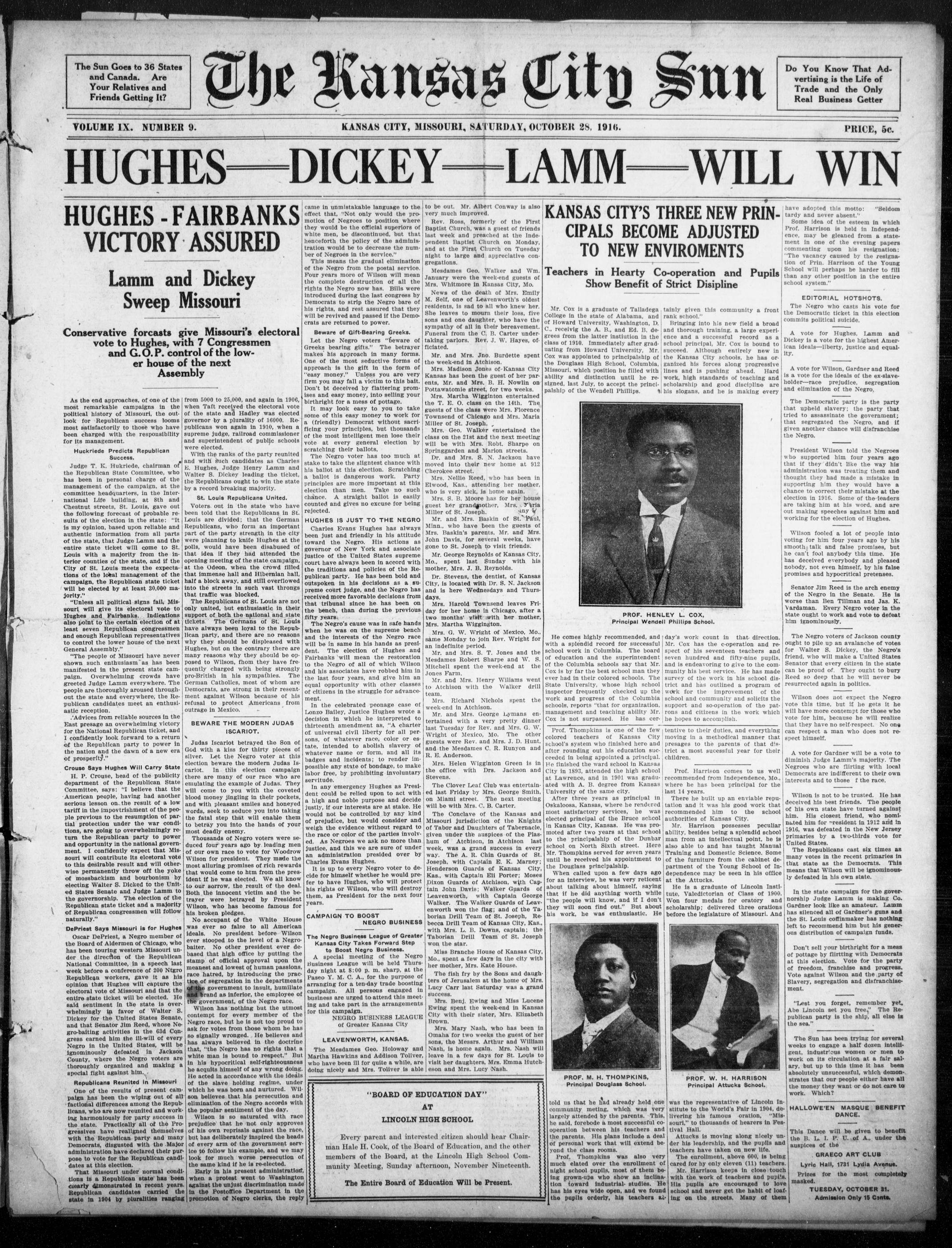
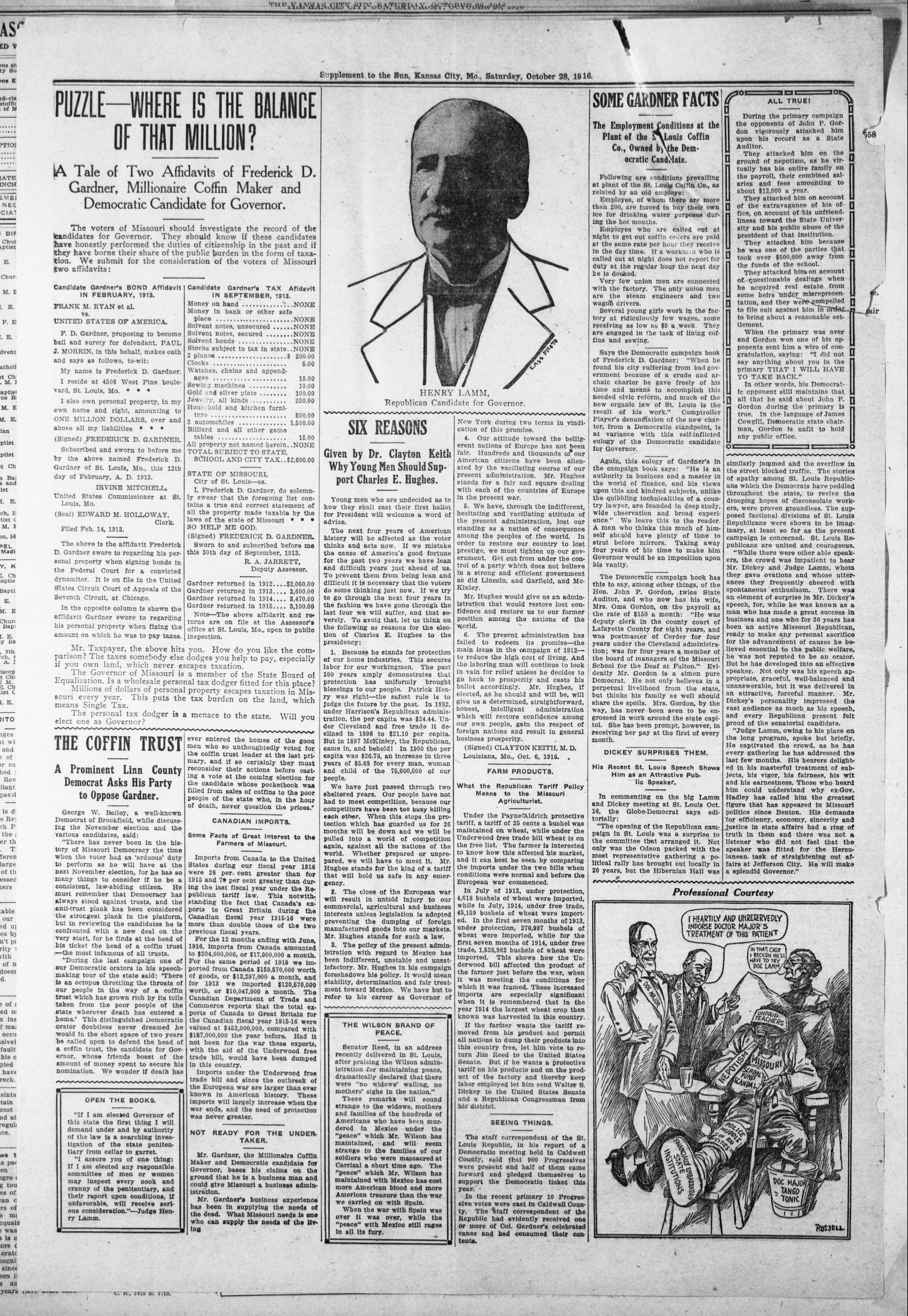
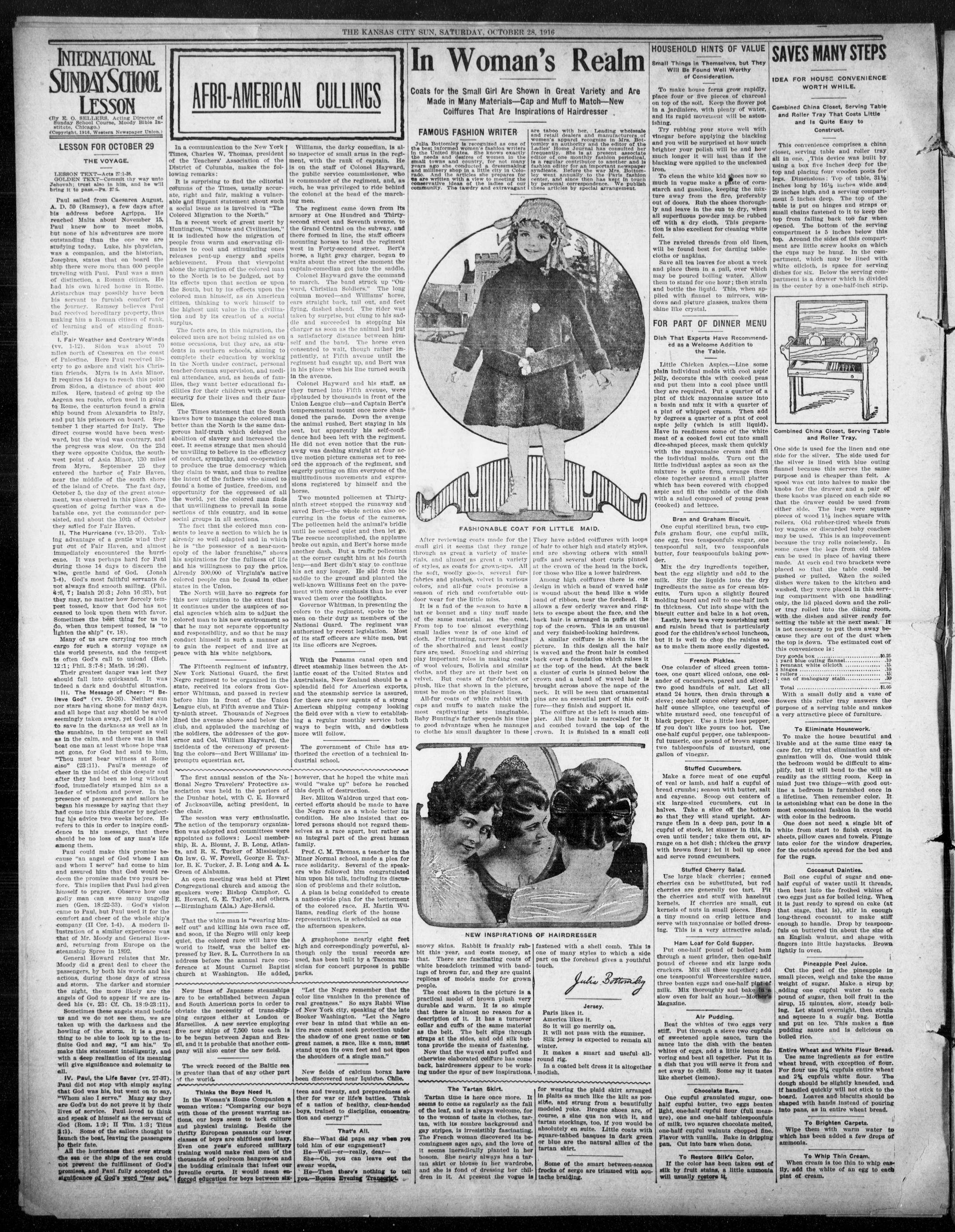
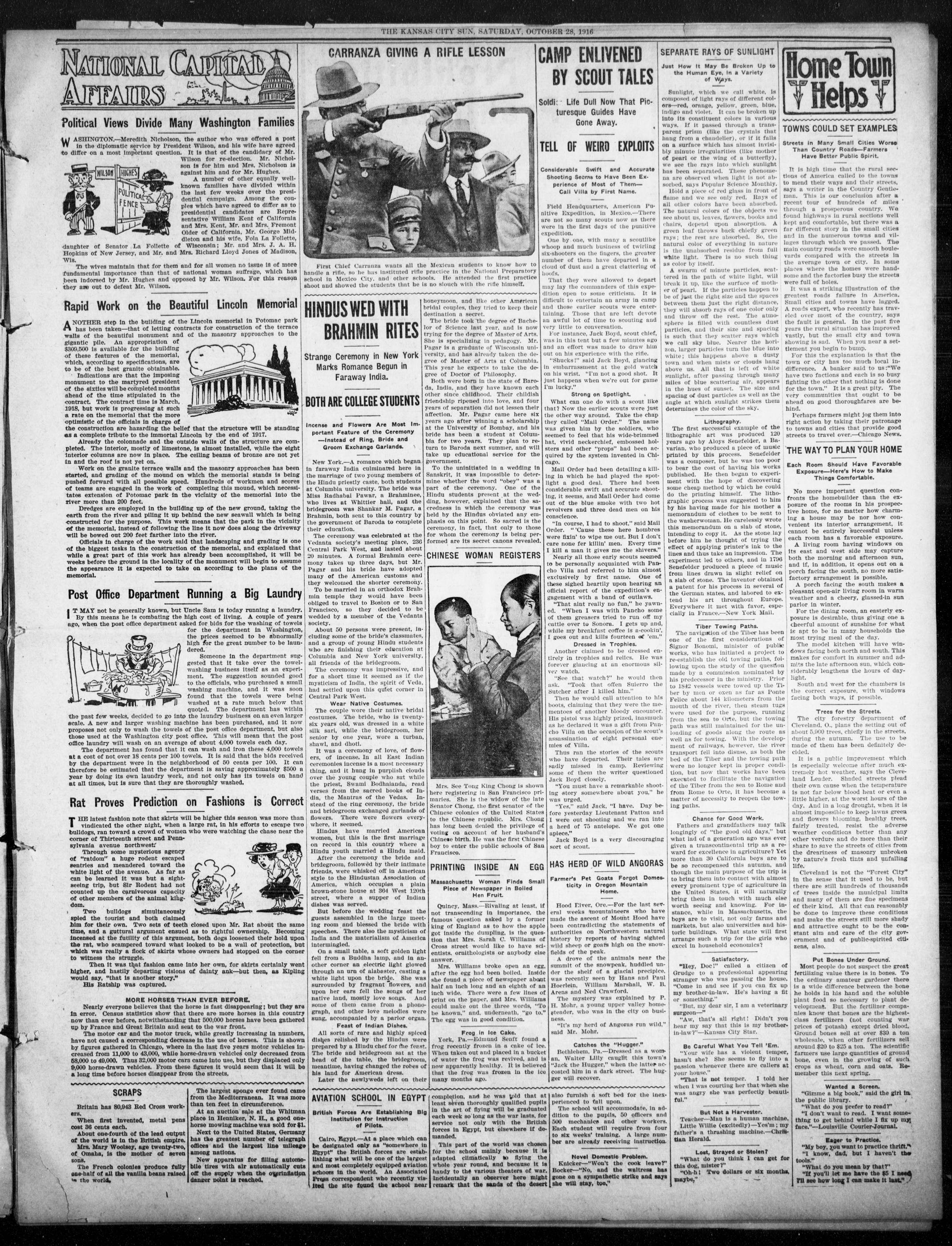
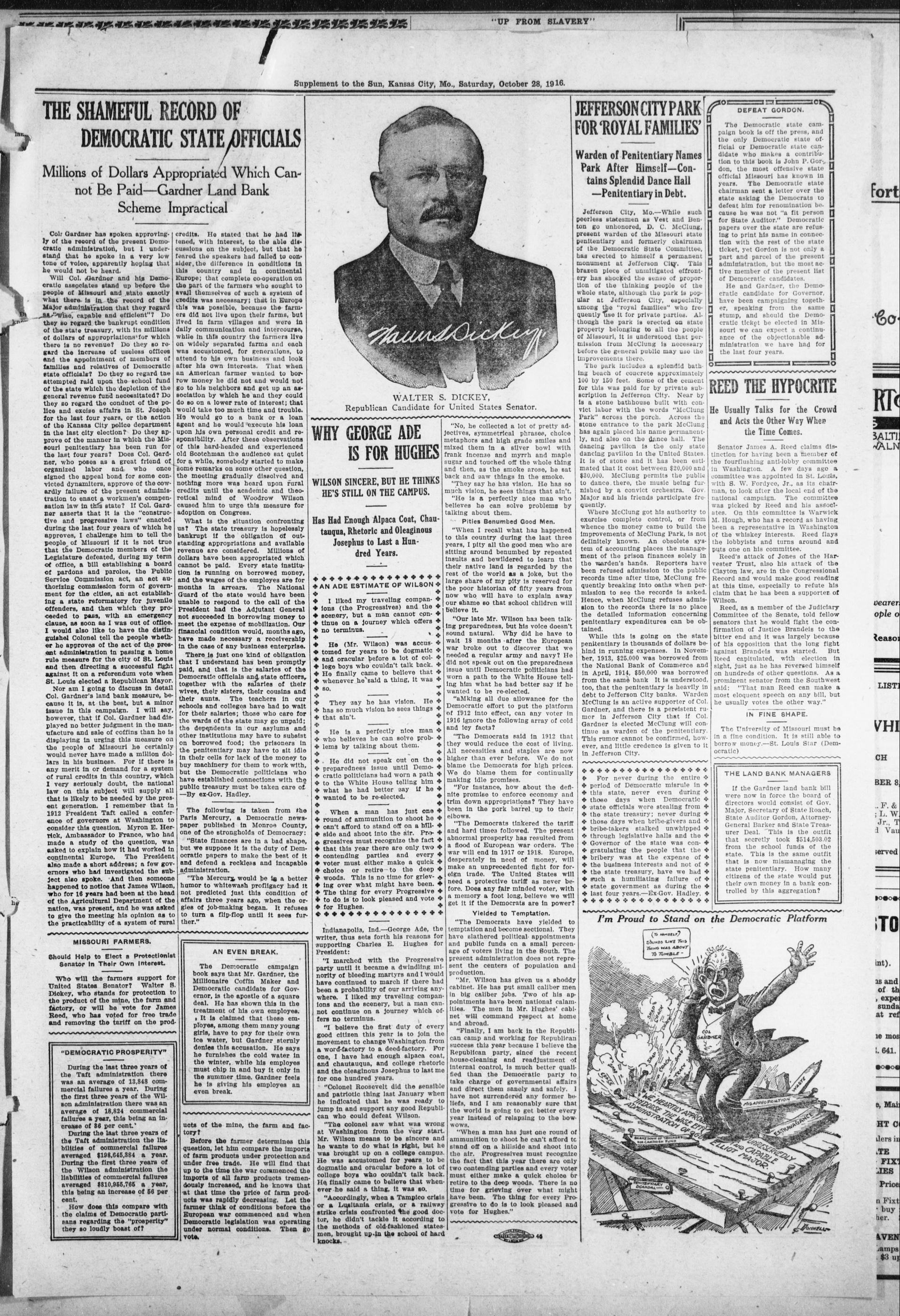
Page text (machine-generated)
HUGHES - FAIRBANKS VICTORY ASSURED
Conservative forcasts give Missouri's electoral vote to Hughes, with 7 Congressmen and G.O.P. control of the lower house of the next Assembly
The Sun Goes to 36 States and Canada. Are Your Relatives and Friends Getting It?
VOLUME IX. NUMBER 9.
HUGHES
HUGHES - FA
VICTORY A
Lamm and
Sweep Mi
Conservative forcasts give
vote to Hughes, with
and G.O.P. contro-
er house of the
Assemb
As the end approaches, of one of the most remarkable campaigns in the political history of Missouri, the outlook for Republican success looms most satisfactorily to those who have been charged with the responsibility for its management.
Huckriede Predicts Republican Success.
Judge T. K. Hukrie, chairman of the Republican State Committee, who has been in personal charge of the management of the campaign, at the committee headquarters, in the International Life building, at 8th and Chestnut streets, St. Louis, gave out the following forecast of probable results of the election in the state: "It is my opinion, based upon reliable and authentic information from all parts of the state, that Judge Lamm and the entire state ticket will come to St. Louis with a majority from the interior counties of the state, and if the City of St. Louis meets the expectations of the local management of the campaign, the Republican state ticket will be elected by at least 30,000 majority." "Unless all political signs fall, Missouri will give its electoral vote to Hughes and Fairbanks. Indications also point to the certain election of at least seven Republican congressmen and enough Republican representatives to control the lower house of the next General Assembly." "The people of Missouri have never shown such enthusiasm as has been manifested in the present state campaign. Overwhelming crowds have greeted Judge Lamm everywhere. The people are thoroughly aroused throughout the state and everywhere, the Republican candidates meet an enthusiastic reception.
"Advices from reliable sources in the East presage an overwhelming victory for the National Republican ticket, and I confidently look forward to a return of the Republican party to power in the nation and the dawn of a new era of prosperity."
Crouse Says Hughes Will Carry State
Crouse Says Hughes Will Carry State H. P. Crouse, head of the publicity department of the Republican State Committee, says: "I believe that the American people, having had another serious lesson on the result of a low tariff in the impovtitvism of the people previous to the resumption of partial protection under the war conditions, are going to overwhelmingly return the Republican party to power and opportunity in the national government. I confidently expect that Missouri will contribute its electoral vote to this desirable result and will other wise permanently throw off the yoke of mossbackism and bourbonism by electing Walter S. Dicked to the United States Senate and Judge Lamm to the governorship. The election of the Republican state ticket and a majority of Republican congressmen will follow naturally."
DePriest Says Missouri is for Hughes
Oscar DePriest, a Negro member of the Board of Aldermen of Chicago, who has been touring western Missouri under the direction of the Republican National Committee, in a speech last week before a conference of 200 Ngro Republican workers, gave it as his opinion that Hughes will capture the electoral vote of Missouri and that the entire state ticket will be elected. He said sentiment in the state is overwhelmingly in favor of Walter S. Dickey for the United States Senate, and that Senator Jim Reed, whose Negro-baiting activities in the 63d Congress earned him the ill-will of every Negro in the United States, will be ignominiously defeated in Jackson County, where the Negro voters are thoroughly organized and making a special fight against him.
Republicans Reunited in Missouri
One of the results of present campaign has been the wiping out of all factional differences among the Republicans, who are now reunited and working harmoniously for party success in the state. Practically all of the Progressives have realigned themselves with the Republican party and many Democrats, disgusted with the Major administration have declared their purpose to vote for the Republican candidates at this election.
That Missouri under normal conditions is a Republican state has been clearly demonstrated in recent years. Republican candidates carried the state in 1904 by pluralities ranging
The Kansas City Sun
from 5000 to 25,000, and again in 1906, when Taft received the electoral vote of the state and Hadley was elected governor by a plurality of 16,000. Republicans won again in 1910, when a supreme judge, railroad commissioner and superintendent of public schools were elected. With the ranks of the party reunited and with such candidates as Charles E. Hughes, Judge Henry Lamm and Walter S. Dickey leading the ticket, the Republicans ought to win the state by a record breaking majority.
St. Louis Republicans United.
Voters out in the state who have been told that the Republicans in St. Louis are divided; that the German Republicans, who form an important part of the party strength in the city were planning to knife Hughes at the polls, would have been disabused of that idea if they had attended the opening meeting of the state campaign at the Odeon, when the crowd filled that immense hall and Hilbern hall half a block away, and still overflowed into the streets in such vast throngs that traffic was blocked.
The Republicans of St. Louis are not only united, but enthusiastic in their support of both the national and state tickets. The Germans of St. Louis have always been loyal to the Republican party, and there are no reasons why they should be displeased with Hughes, but on the contrary there are many reasons why they should be opposed to Wilson, them they have frequently charged with being strongly pro-British in his sympathies. The German Catholics, most of whom are Democrats, are strong in their resentment against Wilson because of his refusal to protect Americans from outrage in Mexico.
BEWARE THE MODERN JUDAS
ISCARIOT.
Judas Iscariot betrayed the Son of God with a kiss for thirty pieces of silver. Let the Negro voter at this election beware the modern Judas Iscariot. In this election campaign there are many of our race who are emulating the example of Judas. They will come to you with the coveted blood money jingling in their pockets, and with pleasant smiles and honeyed words, seek to seduce you into taking the fatal step that will enable them to betray you into the hands of your most deadly enemy.
Thousands of Negro voters were seduced four years ago by leading men of our own race to vote for Woodrow Wilson for president. They made the most alluring promises of rich rewards that would come to htm from the president if he was elected. We all know to our sorrow, the result of the deal. Both the innocent victim and the betrayer were betrayed by President Wilson, who has become famous for his broken pledges.
No occupant of the White House was ever so false to all American ideals. No president before Wilson ever stooped to the level of a Negro balter. No other president ever debased that high office by putting the stamp of official approval upon the meanest and lowest of human passions, race hatred, by introducing the practice of segregation in the departments of the government to insult, humiliate and brand as inferior, the employee of the government, of the Negro race.
Wilson has nothing but the utmost contempt for every member of the Negro race, but he is not too proud to ask for votes from those whom he has so signally wronged. He believes and has always believed in the doctrine that, "the Negro has no rights that a white man is bound to respect." But in his hypocritical self-righteousness he acquits himself of any wrong doing. He acted in accordance with the ideals of the slave holding regime, under which he was born and nurtured. Wilson believes that his persecution and elimination of the Negro accords with the popular sentiment of the day. Wilson is so saturated with race prejudice that he not only approves of his own reprisals against the race, but has deliberately inspired the heads of every arm of the government service to follow his example, and we may look for much worse persecution of the same kind if he is re-elected.
Early in his present administration, when a protest went to Washington against the unjust discrimination made in the Postoffice Department in the promotion of Negro clerks, the reply
KANSAS CITY, MISSOURI, SATURDAY, OCTOBER 28. 1916.
came in unmistakable language to the effect that. "Not only would the promotion of Negroes to position where they would be the official superiors of white men, be discontinued, but that henceforth the policy of the administration would be to decrease the number of Negroes in the service."
This means the gradual elimination of the Negro from the postal service. Four years more of Wilson will mean the complete destruction of all the rights the Negro now has. Bills were introduced during the last congress by Democrats to strip the Negro bare of his rights, and rest assured that they will be revived and passed if the Democrats are returned to power.
Beware of Gift-Bearing Greeks.
Let the Negro voters "fear of Greeks bearing gifts." The betrayer makes his approach in many forms. One of the most seductive forms of approach is the gift in the form of "easy money." Unless you are very firm you may fall a victim to this bait. Don't bt deceived by flattering promises and easy money, by selling your birthright for a mess of pottage. It may look easy to you to take some of this easy money to work for a (friendly) Democrat without sacrificing your principles, but thousands of the most intelligent men lose their vote at every general election by scratching their ballots.
The Negro voter has too much at stake to take the slightest chance with his ballot at this election. Scratching a ballot is dangerous work. Party principles are more important at this election than men. Take no such chance. A straight ballot is easily counted and gives no excuse for being rejected.
HUGHES IS JUST TO THE NEGRO
Charles Evans Hughes has always been just and friendly in his attitude toward the Negro. His actions as governor of New York and associate justice of the United States supreme court have always been in accord with the traditions and policies of the Republican party. He has been bold and outspoken in his decisions as a supreme court judge, and the Negro has received more favorable decisions from that tribunal since he has been on the bench, than during the previous fifty years.
The Negro's cause was in safe hands when he was on the supreme bench and the interests of the Negro race will be in same in his hands as president. The election of Hughes and Fairbanks will mean the restoration to the Negro of all of which Wilson and his associates have robbed him in the last four years, and give him an equal opportunity with other classes of citizens in the struggle for advancement.
In the celebrated peonage case of Lonzo Bailey, Justice Hughes wrote a decision in which he interpreted to thirteenth amendment as, "A charter of universal civil liberty for all persons, of whatever race, color or estate, intended to abolish slavery of whatever name or form, and all its badges and incidents; to render impossible any state of bondage, to make labor free, by prohibiting involuntary servitude.
In any emergency Hughes as President could be relied upon to act with a high and noble purpose and decide justly, if our interests are at stake. He would not be controlled by any kind of prejudice, but would consider and weigh the evidence without regard to the race or color of the parties involved. As Negroes we ask no more than justice, and this we are sure of under an administration presided over by Charles Evans Hughes.
It is up to every Negro voter to decide for himself whether he would prefer to have Hughes, who will protect his rights or Wilson, who will destroy them, as President for the next four years.
CAMPAIGN TO BOOST
NEGRO BUSINESS
The Negro Business League of Greater Kansas City Takes Forward Step to Boost Negro Business.
A special meeting of the Negro Business League will be held Thursday night at 8:00 p. m. sharp, at the Paseo Y. M. C. A., for the purpose of arranging for a ten-day trade boosting campaign. All persons engaged in business are urged to attend this meeting and take part in the arrangements for this campaign.
NEGRO BUSINESS LEAGUE
of Greater Kansas City
LEAVENWORTH. KANSAS.
The Mesdames Geo. Holoway and Martha Hawkins and Addison Toliver, who have been ill for quite a white, are doing nicely and Mrs. Toliver is able
"BOARD OF EDUCATION DAY"
LINCOLN HIGH SCHOOL
Every parent and interested citizen should hear Chairman Hale H. Cook, of the Board of Education, and the other members of the Board, at the Lincoln High School Community Meeting, Sunday afternoon, November Nineteenth. The Entire Board of Education Will be Present.
to be out. Mr. Albert Conway is also very much improved.
Rev. Ross, formerly of the First Baptist Church, was a guest of friends last week and preached at the Independent Baptist Church on Monday, and at the First Church on Tuesday night to large and appreciative congregations.
Mesdames Geo. Walker and Wm. January were the week-end guests of Mrs. Whitmore in Kansas City, Mo.
News of the death of Mrs. Emily M. Self, one of Leavenworth's oldest residents, is sad to all who knew her. She leaves to mourn their loss, five sons and one daughter, who have the sympathy of all in their bereavement.
Funeral from the C. B. Carter undertaking parlors. Rev. J. W. Hayes, officiated.
Mr. and Mrs. Jno. Burdette spent the week-end in Atchison.
Mrs. Madison Jones of-Kansas City Kansas has been the guest of her parents, Mr. and Mrs. B. H. Nowlin on Pottawatomie street, for two weeks.
Mrs. Martha Wigginton entertained the T. E. O. class on the 14th. The guests of the class were Mrs. Florence Townsend of Chicago and Mrs. Maria Miller of St. Joseph.
Mrs. Geo. Walker entertained the class on the 21st and the next meeting will be with Mrs. Robt. Sharpe on Springgarden and Marion streets.
Dr. and Mrs. S. N. Jackson have moved into their new home at 912 Cherokee street.
Mrs. Nellie Reed, who has been in Elwood, Kas., attending her mother, who is very sick, is home again.
Mrs. S. B. Moore has for her house guest her grandmother, Mrs. Varia Miller of St. Joseph.
Mr. and Mrs. Baskin of St. Paul, Minn., who have been the guests of Baskin's parents, Mr. and Mrs. John Davis, for several weeks, have gone to St. Joseph to visit friends.
Mr. George Reynolds of Kansas City, Mo., spent last Sunday with his mother, Mrs. J. B. Reynolds.
Dr. Stevens, the dentist, of Kansas City, is located with Dr. S. N. Jackson and is here Wednesdays and Thursdays.
Mrs. Harold Townsend leaves Friday for her home in Chicago, after a two months' visit with her mother, Mrs. Martha Wiggington.
Mrs. G. W. Wright of Mexico, Mo., same Monday to join Rev. Wright for an indefinite period.
Mr. and Mrs. S. T. Jones and the Mesdames Robert Sharpe and W. S. Mitchell spent the week-end at the Jones Farm.
Mr. and Mrs. Henry Williams went to Atchison with the Walker drill team.
Mrs. Richard Nichols spent the week-end in Atchison.
Mr. and Mrs. George Lymans entertained with a very pretty dinner last Tuesday for Rev. and Mrs. G. W. Wright of Mexico, Mo. The other guests were Rev. and Mrs. J. D. Hunt, and the Mesdames C. R. Runyon and R. E. Anderson.
Mrs. Helen Wigginton Green is in the office with Drs. Jackson and Stevens.
The Clover Leaf Club was entertained last Friday by Mrs. George Smith, on Miami street. The next meeting will be with Mrs. C. B. Carter.
The Conclave of the Kansas and Missouri jurisdiction of the Knights of Tabor and Daughters of Tabernacle, given under the auspices of the Plashum of Atchison, in Atchison last week, was a grand success in every way. The A. R. Chin Guards of St. Joseph, with Captain E. K. Marney; Henderson Guards of Kansas City, Kas., with Captain Eli Porter; Moses Dixon Guards of Atchison, with Captain John Davis; Walker Guards of Leavenworth, with Captain George Walker. The Walker Guards of Leavenworth won the flag; and of the Taborian Drill Team of St. Joseph, Rebecca Drill Team of Kansas City, Kas., with Mrs. L. B. Downs, captain; the Taborian Drill Team of St. Joseph won the star.
Miss Branche House of Kansas City, Mo., spent a few days in the city with her mother, Mrs. Kate House.
The fish fry by the Sons and daughters of Jerusalem at the home of Mrs. Lucy Carr last Saturday was a grand success.
Mrs. Benj. Ewing and Miss Lucene Ewing spent the week-end in Kansas City with their sister, Mrs. Elizabeth Brown.
Mrs. Mary Nash, who has been in Omaha for two weeks the guest of her sons, the Messrs. Arthur and William Nash, is home again. Mrs. Nash will leave in a few days for St. Louis to visit her daughters, Mrs. Emma Hutcheson and Mrs. Lucy Nash.
KANSAS CITY'S THREE NEW PRINCIPALS BECOME ADJUSTED TO NEW ENVIROMENTS
Teachers in Hearty Co-operation and Pupils Show Benefit of Strict Discipline
Mr. Cox is a graduate of Talladega College in the state of Alabama, and of Howard University, Washington, D.C., receiving the A. B., and Ed. B. degrees from the latter institution in the class of 1910. Immediately after graduating from Howard University, Mr. Cox was appointed to principalship of the Douglass High School, Columbia, Missouri, which position he filled with ability and distinction until he resigned, last July, to accept the principalship of the Wendell Phillips.
THE BEST OF THE WORLD
PROF. HENLEY L. COX,
Principal Wendell Phillips School.
He comes highly recommended, and with a splendid record for successful school work in Columbia. The board of education and the superintendent of the Columbia schools say that Mr. Cox is by far the best school man they ever had in their colored schools. The State University, whose high school inspector frequently checked up the work and progress of the Columbia schools, reports "that for organization, management and teaching ability Mr. Cox is not surpassed. He has cer-Prof. Thompkins is one of the few colored teachers of Kansas City school's system who finished here and after rounding out his education succeeded in being appointed a principal. He finished the ward school in Kansas City in 1883, attended the high school at Lawrence, and in 1901 was graduated with A. B. degree from Kansas University of the same city.
After three years as principal in Oskalosa, Kansas, where he rendered most satisfactory services, he was elected principal of the Bruce school in Kansas City, Kansas. He was promoted after two years at that school to the principalship of the Dunbar school on North Sixth street. Here Mr. Thompkins served for seven years until he received his appointment to the Douglass principalship.
When called upon a few days ago for an interview, he was very reticent about talking about himself, saying that if he did anything worth while "the people will know, and if I don't they will soon find out." But about his work, he was enthusiastic. He
PROF. M. H. THOMPKINS,
Principal Douglass School.
told us that he had already held one community meeting, which was very largely attended by the parents. This, he said, forebode a most successful cooperation between his teachers and the parents. His plans include a deal of personal work that will extend beyond the class rooms.
Prof. Thompkins was also very much elated over the enrollment of night school pupils, most of them being grown-ups who show an inclination toward industrial-studies. He has his eyes wide open, and we found the pupils orderly, his teachers at
tainly given this community a front rank school." Bringing into his new field a broad and thorough training, a large experience and a successful record as a school principal, Mr. Cox is bound to succeed. Although entirely new in the Kansas City schools, he has organized his forces along progressive lines and is pushing ahead. Hard work, high standards of teaching and scholarship and good discipline are his slogans, and he is making every
w h t s c e a o w
w s h h n l
o v
day's work count in that direction. Mr. Cox has the c-operation and respect of his seventeen teachers and seven hundred and fifty-nine pupils, and is endeavoring to give to the community his best service. He has made survey of the work in his school district and has outlined a program of work for the improvement of the school and community and solicits the support and so-operation of the patrons and citizens in the work which he hopes to accomplish.
tentive to their duties, and everything moving in a methodical manner that presages to the parents of that district a most successful year for their children.
Prof. Harrison comes to us well recommended from Independence, Mo., where he has been principal for the last 14 years.
There he built up an enviable reputation and it was his good work that recommended him to the school authorities of Kansas City.
Mr. Harrison possesses peculiar ability, besides being a splendid school man from an intellectual point, he is also able to and has taught Manual Training and Domestic Science. Some of the furniture from the cabinet department of the Young School of In dependence may be seen in his office at the Attucks.
He is a graduate of Lincoln Institute, Valedictorian of Class of 1900. Won four medals for oratory and scholarship; delivered three orations before the legislature of Missouri. And PROF. W. H. HARRISON Principal Attucks School, was the representative of Lincoln Institute to the World's Fair in 1904, delivering his famous oration, "Missouri," to thousands of hearers in Festival Hall.
Attucks is moving along nicely under his leadership, and the pupils and teachers have taken on new life. The enrollment, above 600, is being cared for by only eleven (11) teachers. Mr. Harrison keeps in close touch with the work of teachers and pupils. His pupils are encouraged to love school and never get the habit of loafing on the streets. Many of them
Do You Know That Advertising is the Life of Trade and the Only Real Business Getter
have adopted this motto: "Seldom tardy and never absent."
Some idea of the esteem in which Prof. Harrison is held in Independence, may be gleaned from a statement in one of the evening papers commenting upon his resignation: "The vacancy caused by the resignation of Prin. Harrison of the Young School will perhaps be harder to fill than any other position in the entire school system."
EDITORIAL HOTSHOTS.
The Negro who casts his vote for the Democratic ticket in this election commits political suicide.
A vote for Hughes, Lamm and Dickey is a vote for the highest American ideals—liberty, justice and equality.
A vote for Wilson, Gardner and Reed is a vote for the ideals of the ex-slaveholder—race prejudice, segregation and elimination of the Negro.
The Democratic party is the party that upheld slavery; the party that tried to assassinate the government; that segregated the Negro, and if given another chance will disfranchise the Negro.
President Wilson told the Negroes who supported him four years ago that if they didn't like the way his administration was treating them and thought they had made a mistake in supporting him they would have a chance to correct their mistake at the election in 1916. Some of the leaders are taking him at his word, and are out making speeches against him and working for the election of Hughes.
Wilson fooled a lot of people into voting for him four years ago by his smooth talk and false promises, but he can't fool anybody this time. He has deceived everybody and pleased nobody, not even himself, by his false promises and hypocritical pretenses.
Senator Jim Reed is the arch enemy of the Negro in the Senate. He is worse than Ben Tillman and Jas. K. Vardaman. Every Negro voter in the state ought to work and vote to defeat him ignominously.
The Negro voters of Jackson county ought to pile up an avalanche of votes for Walter S. Dickey, the Negro's friend, who will make a United States Senator that every citizen in the state can be proud of. They ought to bury Reed so deep that he will never be resurrected again in politics.
Wilson does not expect the Negro vote this time, but if he gets it he will have more contempt for those who vote for him, because he will realize that they have no self-respect. No one can respect a man who does not respect himself.
A vote for Gardner will be a vote to diminish Judge Lamm's majority. The Negroes who are flirting with local Democrats are indifferent to their own interests and to those f the race.
Wilson is not to be trusted. He has deceived his best friends. The people of his own state have turned against him. His closest friend, who nominated him for president in 1912 aid in 1916, was defeated in the New Jersey primaries by a two-thirds vote for United States.
The Republicans cast six times as many votes in the recent primaries in that state as the Democrats. This means that Wilson will be ignominiously defeated in his own state.
In the state campaign for the governorship Judge Lamm is making Co. Gardner look like an amateur. Lamm has silenced all of Gardner's guns and the St. Louis coffinmaker has nothing left to recommend him but his generous distribution of campaign funds.
Don't sell your birthright for a mess of pottage by flirting with Democrats at this election. Vote for the party of freedom, franchise and progress. Vote against Wilson and the party of Slavery, segregation and disfranchisement.
"Lest you forget, remember yet, Abe Lincoln set you free." The Republican party is the ship, all else is the sea."
The Sun has been trying for several weeks to engage a half dozen intelligent, industrious women or men to work on its circulation at a fair salary, but up to this time it has been absolutely unsuccessful, which demonstrates that our people either have all the money they want or do not care to work. Which?
HALLOWE'EN MASQUE BENEFIT DANCE.
This Dance will be given to benefit the B. L. I. P. U. of A., under the auspices of the
GRAECO ART CLUB
Lyric Hall, 1731 Lydia Avenue.
Prizes for the most completely masked.
TUESDAY, OCTOBER 31.
Admission Only 15 Cents.
PUZZLE WHERE IS THE BALANCE OF THAT MILLION?
The voters of Missouri should investigate the record of the candidates for Governor. They should know if these candidates have honestly performed the duties of citizenship in the past and if they have borne their share of the public burden in the form of taxation. We submit for the consideration of the voters of Missouri two affidavits:
Mr. Taxpayer, the above hits you. How do you like the comparison? The taxes somebody else dodges you help to pay, especially if you own land, which never escapes taxation.
The Governor of Missouri is a member of the State Board of Equalization. Is a wholesale personal tax dodger fitted for this place?
Millions of dollars of personal property escapes taxation in Missouri every year. This puts the tax burden on the land, which means Single Tax.
The personal tax dodger is a menace to the state. Will you elect one as Governor?
Candidate Gardner's BOND Affidavit IN FEBRUARY, 1913.
FRANK M. RYAN et al.
F. D. Gardner, proposing to become bail and surety for defendant, PAUL J. MORRIN, in this behalf, makes oath and says as follows, to-wit:
My name is Frederick D. Gardner.
I reside at 4508 West Pine boulevard, St. Louis, Mo. * * *
I also own personal property, in my own name and right, amounting to ONE MILLION DOLLARS, over and above all my liabilities * * *
(Signed) FREDERICK D. GARDNER.
Subscribed and sworn to before me by the above named Frederick D. Gardner of St. Louis, Mo., this 12th day of February, A. D. 1913.
IRVINE MITCHELL,
United States Commissioner at St. Louis, Mo.
(Seal) EDWARD M. HOLLOWAY,
Clerk.
Filed Feb. 14, 1913.
The above is the affidavit Frederick
D. Gardner swore to regarding his personal property when signing bonds in the Federal Court for a convicted dynamiter. It is on file in the United States Circuit Court of Appeals of the Seventh Circuit, at Chicago.
In the opposite column is shown the affidavit Gardner swore to regarding his personal property when fixing the amount on which he was to pay taxes.
THE COFFIN TRUST A Prominent Linn County Democrat Asks His Party to Oppose Gardner.
A Prominent Linn County Democrat Asks His Party to Oppose Gardner.
George W. Bailey, a well-known Democrat of Brookfield, while discussing the November election and the various candidates, said:
"There has never been in the history of Missouri Democracy the time when the voter had as 'arduous' duty to perform as he will have at the next November election, for he has so many things to consider if he be a consistent, law-abiding citizen. He must remember that Democracy has always stood against trusts, and the anti-trust plank has been considered the strongest plank in the platform, but in reviewing the candidates he is confronted with a new deal on the very start, for he finds at the head of his ticket the head of a coffin trust—the most infamous of all trusts.
"During the last campaign one of our Democratic orators in his speech-making tour of the state said: 'There is an octopus throttling the throats of our people in the way of a coffin trust which has grown rich by its tolls taken from the poor people of the state wherever death has entered a home.' This distinguished Democratic orator doubtless never dreamed he would in the short space of two years be called upon to defend the head of a coffin trust, the candidate for Governor, whose friends boast of the amount of money spent to secure his nomination. We wonder if death has
OPEN THE BOOKS.
"I if I am elected Governor of this state the first thing I will demand under and by authority of the law is a searching investigation of the state penitentiary from cellar to garret.
"I assure you of one thing: If I am elected any responsible committee of men or women may inspect every nook and cranny of the penitentiary, and their report upon conditions, if unfavorable, will receive serious consideration."—Judge Henry Lamm.
THE KANSAS CITY SUNSATURDAY 9 9 9 9 9 9 9 9 9 9 9 9 9 9 9 9 9 9 9 9 9 9 9 9 9 9 9 9 9 9 9 9 9 9 9 9 9 9 9 9 9 9 9 9 9 9 9 9 9 9 9
Candidate Gardner's TAX Afidavit
IN SEPTEMBER, 1913.
Money on hand . . . NONE
Money in bank or other safe
place . . . NONE
Solvent notes, unsecured . . . NONE
Solvent notes, secured . . . NONE
Solvent bonds . . . NONE
Stocks subject to tax in state. NONE
2 planos . . . $ 200.00
Clocks . . . 5.00
Watches, chains and append-
ages . . . 15.00
Sewing machines . . . 10.00
Gold and silver plate . . . 100.00
Jewelry, all kinds . . . 250.00
Household and kitchen furni-
15.00
10.00
100.00
250.00
3 automobiles ..... 1,500.00
Billiard and all other game
tables ..... 15.00
All property not named herein..NONE
TOTAL SUBJECT TO STATE,
SCHOOL AND CITY TAX..$2,600.00
STATE OF MISSOURI,
City of St. Louis—ss.
I, Frederick D. Gardner, do solemnly swear that the foregoing list contains a true and correct statement of all the property made taxable by the laws of the state of Missouri
SO HELP ME GOD.
(Signed) FREDERICK D. GARDNER.
Sworn to and subscribed before me this 30th day of September, 1913.
Gardner returned in 1912.....$2,060.00
Gardner returned in 1913.....2,000.00
Gardner returned in 1914.....3,470.00
Gardner returned in 1915.....3,100.00
Note—The above affidavit and
returns are on file at the Assessor's
office at St. Louis, Mo., open to public
inspection.
you. How do you like the com-
dodges you help to pay, especially
escapes taxation.
a member of the State Board of
final tax dodger fitted for this place?
property escapes taxation in Mis-
tax burden on the land, which
a menace to the state. Will you
ever entered the homes of the good men who so unthoughtfully voted for the coffin trust leader at the last primary, and if so certainly they must reconsider their actions before casting a vote at the coming election for the candidate whose pocketbook was filled from sales of coffins to the poor people of the state who, in the hour of death, never question the prices."
CANADIAN IMPORTS
Some Facts of Great Interest to the Farmers of Missouri.
Imports from Canada to the United States during our fiscal year 1916 were 28 per cent greater than for 1915 and 78 per cent greater than during the last fiscal year under the Republican tariff law. This notwithstanding the fact that Canada's exports to Great Britain during the Canadian fiscal year 1915-16 were more than double those of the two previous fiscal years.
For the 12 months ending with June, 1916, imports from Canada amounted to $204,000,000, or $17,000,000 a month. For the same period of 1915 we imported from Canada $159,570,000 worth of goods, or $13,297,000 a month, and for 1913 we imported $120,570,000 worth, or $10,047,000 a month. The Canadian Department of Trade and Commerce reports that the total exports of Canada to Great Britain for the Canadian fiscal year 1915-16 were valued at $452,000,000, compared with $187,000,000 the year before. Had it not been for the war these exports, with the aid of the Underwood free trade bill, would have been dumped in this country. Imports under the Underwood free trade bill and since the outbreak of the European war are larger than ever known in American history. These imports will largely increase when the war ends, and the need of protection was never greater.
NOT READY FOR THE UNDER-
TAKER.
Mr. Gardner, the Millionaire Coffin Maker and Democratic candidate for Governor, bases his claims on the ground that he is a business man and could give Missouri a business administration.
Mr. Gardner's business experience has been in supplying the needs of the dead. What Missouri needs is one who can supply the needs of the living
Supplement to the Sun, Kansas City, Mo., Saturday, October 28, 1916.
HENRY LAMM.
Given by Dr. Clayton Keith Why Young Men Should Support Charles E. Hughes.
Given by Dr. Clayton Keith Why Young Men Should Support Charles E. Hughes.
Young men who are undecided as to how they shall cast their first ballot for President will welcome a word of advice.
The next four years of American history will be affected as the voter thinks and acts now. If we mistake the cause of America's good fortune for the past two years we have lean and difficult years just ahead of us. To prevent them from being lean and difficult it is necessary that the voters do some thinking just now. If we try to go through the next four years in the fashion we have gone through the last four we will suffer, and that severely. To avoid that, let us think on the following as reasons for the election of Charles E. Hughes to the presidency:
1. Because he stands for protection of our home industries. This secures labor for our workingmen. The past 100 years amply demonstrates that protection has uniformly brought blessings to our people. Patrick Henry was right—the safest rule is to judge the future by the past. In 1892, under Harrison's Republican administration, the per capita was $24.44. Under Cleveland and free trade it declined in 1896 to $21.10 per capita. But in 1897 McKinley, the Republican, came in, and behold! In 1900 the per capita was $26.73, an increase in three years of $5.68 for every man, woman and child of the 75,000,000 of our people.
We have just passed through two sheltered years. Our people have not had to meet competition, because our competitors have been too busy killing each other. When this stops the protection which has guarded us for 26 months will be down and we will be pulled into a world of competition again, against all the nations of the world. Whether prepared or unprepared, we will have to meet it. Mr. Hughes stands for the kind of a tariff that will hold us safe in any emergency.
2. The close of the European war will result in untold injury to our commercial, agricultural and business interests unless legislation is adopted preventing the dumping of foreign manufactured goods into our markets. Mr. Hughes stands for such a law.
3. The policy of the present administration with regard to Mexico has been indifferent, unstable and unsatisfactory. Mr. Hughes in his campaign foreshadows his policy. It would mean stability, determination and fair treatment toward Mexico. We have but to refer to his career as Governor of
THE WILSON BRAND OF PEACE.
Senator Reed, in an address recently delivered in St. Louis, after praising the Wilson administration for maintaining peace, dramatically declared that there were "no widows' walling, no mothers' sighs in the nation." These remarks will sound strange to the widows, mothers and families of the hundreds of Americans who have been murdered in Mexico under the "peace" which Mr. Wilson has maintained, and will seem strange to the families of our soldiers who were massacred at Carrizal a short time ago. The "peace" which Mr. Wilson has maintained with Mexico has cost more American blood and more American treasure than the war we carried on with Spain.
When the war with Spain was over it was over, while the "peace" with Mexico still rages in all its fury.
New York during two terms in vindication of this promise.
4. Our attitude toward the belligerent nations of Europe has not been fair. Hundreds and thousands of our American citizens have been alienated by the vacillating course of our present administration. Mr. Hughes stands for a fair and square dealing with each of the countries of Europe in the present war.
5. We have, through the indifferent, hesitating and vacillating attitude of the present administration, lost our standing as a nation of consequence among the peoples of the world. In order to restore our country to lost prestige, we must tighten up our government. Get out from under the control of a party which does not believe in a strong and efficient government as did Lincoln, and Garfield, and McKinley.
Mr. Hughes would give us an administration that would restore lost confidence and restore us to our former position among the nations of the world.
6. The present administration has failed to redeem its promise—the main issue in the campaign of 1912—to reduce the high cost of living. And the laboring man will continue to look in vain for relief unless he decides to go back to prosperity and casts his ballot accordingly. Mr. Hughes, if elected, as he should and will be, will give us a determined, straightforward, honest, intelligent administration which will restore confidence among our own people, gain the respect of foreign nations and result in general business prosperity.
(Signed) CLAYTON KEITH, M.D. Louisiana, Mo., Oct. 6, 1916.
FARM PRODUCTS.
What the Republican Tariff Policy Means to the Missouri Agriculturist.
Under the Payne-Aldrich protective tariff, a tariff of 25 cents a bushel was maintained on wheat, while under the Underwood free trade bill wheat is on the free list. The farmer is interested to know how this affected his market, and it can best be seen by comparing the imports under the two bills when conditions were normal and before the European war commenced.
In July of 1913, under protection, 4,618 bushels of wheat were imported, while in July, 1914, under free trade, 45,159 bushels of wheat were imported. In the first seven months of 1913, under protection, 270,987 bushels of wheat were imported, while for the first seven months of 1914, under free trade, 1,526,962 bushels of wheat were imported. This shows how the Underwood bill affected the product of the farmer just before the war, when it was meeting the conditions for which it was framed. These increased imports are especially significant when it is remembered that in the year 1914 the largest wheat crop then known was harvested in this country.
If the farmer wants the tariff removed from his product and permit all nations to dump their products into this country free, let him vote to return Jim Reed to the United States Senate. But if he wants a protective tariff on his products and on the product of the factory and thereby keep labor employed let him send Walter S. Dickey to the United States Senate and a Republican Congressman from his district.
SEEING THINGS.
The staff correspondent of the St. Louis Republic, in his report of a Democratic meeting held in Caldwell County, said that 900 Progressives were present and half of them came forward and pledged themselves to support the Democratic ticket this year.
In the recent primary 10 Progressive votes were cast in Caldwell County. The staff correspondent of the Republic had evidently received one or more of Col. Gardner's celebrated canes and had consumed their contents.
Professional Courtesy
I HEARTILY AND UNRESERVEDLY
INDORSE DOCTOR MAJOR'S
TREATMENT OF THIS PATIENT
IN THAT CASE
I RECKON WE'LL
HAVE TO TRY
DOC LAMM
DOC MAJOR
DOC GARDNER
UNPAID TEACHERS
NEPOTISM
MISSOURI
SCHOOL FUND
SCANDAL
POLICE
MIDDLE
ON THE
CITIES
FINANCIALLY ENBARRASSED
STATE
INSTITUTIONS
DOC MAJOR
TANGO
TONIC
RUSSELL
SOME GARDNER FACTS
The Employment Conditions at the Plant of the S. Louis Coffin Co., Owned by the Democratic Candidate.
Following are conditions prevailing at plant of the St. Louis Coffin Co., as related by an old employee: Employees, of whom there are more than 200, are forced to buy their own ice for drinking water purposes during the hot months. Employees who are called out at night to get out coffin orders are paid at the same rate per hour they receive in the day time. If a workman is called out at night does not report for duty at the regular hour the next day he is doaked. Very few union men are connected with the factory. The only union men are the steam engineers and two wagon drivers. Several young girls work in the factory at ridiculously low wages, some receiving as low as $5 a week. They are engaged in the task of lining coffins and sewing.
Says the Democratic campaign book of Frederick D. Gardner: "When he found his city suffering from bad government because of a crude and archaic charter he gave freely of his time and means to accomplish this needed civic reform, and much of the new organic law of St. Louis is the result of his work." Comptroller Player's denunciation of the new charter, from a Democratic standpoint, is at variance with this self-inflicted eulogy of the Democratic candidate for Governor.
Again, this eulogy of Gardner's in the campaign book says: "He is an authority in business and a master in the world of finance, and his views upon this and kindred subjects, unlike the quibbling technicalities of a country lawyer, are founded in deep study, wide observation and broad experience." We leave this to the reader. A man who thinks this much of himself should have plenty of time to strut before mirrors. Taking away four years of his time to make him Governor would be an imposition upon his vanity.
The Democratic campaign book has this to say, among other things, of the Hon. John P. Gordon, twice State Auditor, and who now has his wife, Mrs. Oma Gordon, on the payroll at the rate of $150 a month: "He was deputy clerk in the county court of Lafayette County for eight years, and was postmaster of Corder for four years under the Cleveland administration; was for four years a member of the board of managers of the Missouri School for the Deaf at Fulton." Evidently Mr. Gordon is a simon pure Democrat. He not only believes in a perpetual livelihood from the state, but thinks his family as well should share the spoils. Mrs. Gordon, by the way, has never been seen to be engrossed in work around the state capitol. She has been prompt, however, in receiving her pay at the first of every month.
DICKEY SURPRISES THEM.
His Recent St. Louis Speech Shows Him as an Attractive Public Speaker.
In commenting on the big Lamm and Dickey meeting at St. Louis Oct. 16, the Globe-Democrat says editorially:
"The opening of the Republican campaign in St. Louis was a surprise to the committee that arranged it. Not only was the Odeon packed with the most representative gathering a political rally has brought out locally in 20 years, but the Hibernian Hall was
During the primary campaign the opponents of John P. Gordon vigorously attacked him upon his record as a State Auditor. They attacked him on the ground of nepotism, as he virtually has his entire family on the payroll, their combined salaries and fees amounting to about $12,000 a year. They attacked him on account of the extravagance of his office, on account of his unfriendliness toward the State University and his public abuse of the president of that institution. They attacked him because he was one of the parties that took over $500,000 away from the funds of the school.
They attacked him on account of questionable dealings when he acquired real estate from some heirs under misrepresentation, and they were compelled to file suit against him in order to bring about a reasonable settlement.
When the primary was over and Gordon won one of his opponents sent him a wire of congratulation, saying: "I did not say anything about you in the primary THAT I WILL HAVE TO TAKE BACK."
In other words, his Democratic opponent still maintains that all that he said about John P. Gordon during the primary is true. In the language of James Cowgill, Democratic state chairman, Gordon is unfit to hold any public office.
similarly jammed and the overflow in the street blocked traffic. The stories of apathy among St. Louis Republicans which the Democrats have peddled throughout the state, to revive the drooping hopes of disconsolate workers, were proven groundless. The supposed factional divisions of St. Louis Republicans were shown to be imaginary, at least so far as the present campaign is concerned. St. Louis Republicans are united and courageous.
"While there were other able speakers, the crowd was impatient to hear Mr. Dickey and Judge Lamm, whom they gave ovations and whose utterances they frequently cheered with spontaneous enthusiasm. There was an element of surprise in Mr. Dickey's speech, for, while he was known as a man who has made a great success in business and one who for 30 years has been an active Missouri Republican, ready to make any personal sacrifice for the advancement of causes he believed essential to the public welfare, he was not reputed to be an orator. But he has developed into an effective speaker. Not only was his speech appropriate, graceful, well-balanced and unanswerable, but it was delivered in an attractive, forceful manner. Mr. Dickey's personality impressed the vast audience as much as his speech, and every Republican present felt proud of the senatorial candidate.
"Judge Lamm, owing to his place on the long program, spoke but briefly. He captivated the crowd, as he has every gathering he has addressed the last few months. His hearers delighted in his masterful treatment of subjects, his vigor, his fairness, his witt and his earnestness. Those who heard him could understand why ex-Gov. Hadley has called him the greatest figure that has appeared in Missouri politics since Benton. His demands for efficiency, economy, sincerity and justice in state affairs had a ring of truth in them and there was not a listener who did not feel that the speaker was fitted for the Herculanean task of straightening out affairs at Jefferson City. He will make a splendid Governor."
INTERNATIONAL
SUNDAY SCHOOL
LESSON
(By E. O. SELLERS, Acting Director of Sunday School Course, Moody Bible Institute, Chicago). (Copyright, 1915, Western Newspaper Union.)
LESSON FOR OCTOBER 29
LESSON TEXT-Acta 27:1-38.
GOLDEN TEXT-Commit thy way unto
Jehovah; trust also in him, and he will
bring it to pass.-Pa. 27.5.
Paul sailed from Caesarea August,
A. D. 59 (Ramsey), a few days after
his address before Agrippa. He
reached Malta about November 15.
Paul knew how to meet mobs,
but none of his adventures are more
outstanding than the one we are
studying today. Luke, his physician,
was a companion, and the historian,
Josephus, states that on board the
ship there were more than 600 people
traveling with Paul. Paul was a man
of distinction, a Roman citizen. He
had his own hired house in Rome,
Aristarchus may possibly have been
his servant to furnish comfort for
the journey. Ramsey believed Paul
had received hereditary property, thus
making him a Roman citizen of rank,
of learning and of standing financially.
1. Fair Weather and Contrary Winds (vv. 1-12). Sidon was on about 70 miles north of Caesarea on the coast of Palestine. Here Paul received liberty to go ashore and visit his Christian friends. Myra is in Asia Minor. It requires 14 days to reach this point from Sidon, a distance of about 400 miles. Here, instead of going up the Aegean sea route, often used in going to Rome, the centurion found a grain ship bound from Alexandria to Italy, and put his prisoners on board. September 1 they started for Italy. The direct course would have been westward, but the wind was contrary, and the progress was slow. On the 23d they were opposite Culus, the southwest point of Asia Minor, 130 miles from Myra. September 25 they entered the harbor of Fair Haven, near the middle of the south shore of the island of Crete. The fast day, October 5, the day of the great atonement, was observed in this place. The question of going farther was a debatable one, yet the commander persisted, and about the 10th of October they sailed for Fair Haven.
II. The Hurricane (vv. 13-20). Taking advantage of a gentle wind they put out of Fair Haven, and almost immediately encountered the hurricane. It was perhaps hard for Paul during those 14 days to discern the wise, gentle hand of God. (Jonah 1-4). God's most faithful servants do not always find smooth sailing. (Phil. 4:6; 7; Isaiah 26:3; John 16:33), but they may, no matter how fiercely tempest tossed, know that God has not ceased to look upon them with favor. Sometimes the best thing for us to do, when thus tempest tossed, is "to lighten the ship" (v. 18).
Many of us are carrying too much cargo for such a stormy voyage as this world presents, and the tempest is often God's call to unload (Heb. 12:1; Phil. 3:7-8; Math. 16:26). Their greatest danger was lest they should fall into quicksand. It was indeed a dark and doubtful situation.
III. The Message of Cheer: "I Believe God" (vv. 20-26). Neither sun nor stars having shone for many days, and all hope that any should be saved seemingly taken away, yet God is able to save in the darkness as well as in the sunshine, in the tempest as well as in the calm, and there was in that boat one man at least whose hope was not gone, for God had said to him, "Thou must bear witness at Rome also" (23:11). Paul's message of cheer in the midst of this despair and after they had been so long without food, immediately stamped him as a leader of wisdom and power. In the presence of passengers and sailors he began his message by saying that they had come into this disaster by neglecting his advice two weeks before. He refers to this in order to inspire confidence in his message, that there should be no loss of any man's life among them.
Paul could make this promise because "an angel of God whose I am and whom I serve" had come to him and assured him that God would redeem the promise made two years before. This implies that Paul had given himself to prayer. Observe how one godly man can save many ungodly men (Gen. 18:22-33). God's vision came to Paul, but Paul used it for the comfort and cheer of the whole ship's company (II Cor. 1-4). A modern illustration of a similar experience was that of Mr. Moody and General Howard, returning from Europe on the steamship Sprege in 1892.
General Howard relates that Mr. Moody did a great deal to cheer the passengers, by both his words and his actions, during those days of stress and storm. The darker and stormier the night, the more likely are the angels of God to appear if we are indeed his (v. 23: Cf. Ch. 18:9-29:11). Sometimes these angels stand beside us and we do not see them, we are taken up with the darkness and the howling of the storm. It is a great thing to be able to look up to the infinite God and say, "I am his." To make this statement intelligently, and with a deep realization of its meaning will give significance and solemnity to all.
IV. Paul, the Life Saver (yy. 27-37).
Paul did not stop with simply saying that God was his, but went on to say, "Whom also I serve." Many say they are God's but do not prove it by their lives of service. Paul loved to think and speak of himself as the servant of God (Rom. 1:9; II Tim. 1:3; Titus 1:1). Some of the sailors thought to launch the boat, leaving the passengers to their fate.
All the hurricanes that ever struck the sea or the ships of the sea could not prevent the fulfillment of God's promises, and Paul fully accepted the significance of God's word "fear not."
AFRO-AMERICAN CULLINGS
In a communication to the New York Times, Charles W, Thomas, president of the Teachers' Association of the District of Columbia, makes the following remarks:
It is surprising to find the editorial columns of the Times, usually accurate, right and fair, making a vulnerable and flippant statement about such a social issue as is involved in "The Colored Migration to the North."
In a recent work of great merit by Huntington, "Climate and Civilization," it is indicated how the migration of people from warm and enervating climates to cool and stimulating ones releases pent-up energy and spells achievement. From that viewpoint alone the migration of the colored man to the North is to be judged, not by its effects upon that section or upon the South, but by its effects upon the colored man himself, as an American citizen, thinking to work himself to the highest unit value in the civilization and by its creation of a social surplus.
The facts are, in this migration, the colored men are not being misled as on some occasions, but they are, as students in southern schools, aiming to complete their education by working in the North under contract, personal teacher-foreman supervision, and medical attendance, and, as heads of families, they want better educational facilities for their children with greater security for their lives and their families.
The Times statement that the South knows how to manage the colored man better than the North is the same dangerous half-truth which delayed the abolition of slavery and increased the cost. It seems strange that men should be unwilling to believe in the efficiency of contact, sympathy, and co-operation to produce the true democracy which they claim to want, and thus to realize the intent of the fathers who aimed to found a home of justice, freedom, and opportunity for the oppressed of all the world, yet the colored man finds that unwillingness to prevail in some sections of this country, and in some social groups in all sections.
The fact that the colored man consents to leave a section to which he is already so well adapted and in which he is "the possessor of a near-monopoly of the labor franchise," shows his aspirations for the fullness of life and his willingness to pay the price. Already 300,000 of Virginia's native colored people can be found in other states in the Union.
The North will have no regrets for this new migration to the extent that it continues under the auspices of social agencies which aim to adjust the colored man to his new environment so that he may not separate opportunity and responsibility, and so that he may conduct himself in such a manner as to gain the respect of and live at peace with his white neighbors.
The Fifteenth regiment of infantry, New York National Guard, the first Negro regiment to be organized in the state, received its colors from Governor Whitman, and passed in review before him in front of the Union League club, at Fifth avenue and Thirty-ninth street. Thousands of Negroes lined the avenue above and below the club, and applauded the marching of the soldiers, the addresses of the governor and Col. William Hayward, the incidents of the ceremony of presenting the colors—and Bert Williams' impromptu equestrian act.
The first annual session of the National Negro Travelers' Protective association was held in the parlors of the Dunbar hotel, with C. E. Howard of Jacksonville, acting president, in the chair.
The session was very enthusiastic. The action of the temporary organization was adopted and committees were appointed as follows: Local membership, R. A. Blount, J. B. Long, Atlanta, and R. K. Tucker of Mississippi. On law, G. W. Powell, George E. Taylor, B. K. Tucker, J. B. Long and A. L. Green of Alabama.
An open meeting was held at First Congregational church and among the speakers were: Bishop Camphor, C. E. Howard, G. E. Taylor, and others.—Birmingham (Ala.) Age-Herald.
That the white man is "wearing himself out" and killing his own race off, and soon, if the Negro will only keep quiet, the colored race will have the world to itself, was the belief expressed by Rev. S. L. Carrothers in an address before the annual race conference at Mount Carmel Baptist church at Washington. He added,
New lines of Japanese steamships are to be established between Japan and South American ports in order to obviate the necessity of trans-shipping cargoes either at London or Marselles. A new service employing five new ships of 7,500 tons each is to be begun between Japan and Brazil, and it is probable that another company will also enter the new field.
The wreck record of the Baltic sea is greater than that of any other part of the world.
In the Woman's Home Companion a woman writes: "Comparing our boys with those of the present warring nations, our boys seem to lack culture and physical training. Beside the thrifty European peasants our lower classes of boys are shiftless and lazy. Even one year's enforced military training would make real men of the thousands of poolroom hangers-on and the budding criminals that infest our juvenile courts. It would mean enforced education for boys between six-
THE KANSAS CITY SUN, SATURDAY, OCTOBER 28, 1916
Williams, the darky comedian, is also inspector of small arms in the regiment, with the rank of captain. He is on the staff of Colonel Hayward, the public service commissioner, who is commander of the regiment, and, as such, he was privileged to ride behind the colonel at the head of the marching men.
The regiment came down from its armory at One Hundred and Thirty-second street and Seventh avenue, to the Grand Central on the subway, and there formed in line, the staff officers mounting horses to lead the regiment west in Forty-second street. Bert's horse, a light gray charger, began to waltz about the street the moment the captain-comedian got into the saddle. Colonel Hayward gave the command to march. The band struck up "Onward, Christian Soldiers." The long column moved—and Williams' horse, ears straight back, tail out, and feet flying, dashed ahead. The rider was taken by surprise, but clung to his saddle and succeeded in stopping his charger as soon as the animal had put a satisfactory distance between himself and the band. The horse even consented to wait, though rather impatient, at Fifth avenue until the regiment had caught up, and Bert was in his place when his line turned south in the avenue.
Colonel Hayward and his staff, as they turned into Fifth avenue, were applauded by thousands in front of the Union League club—and Captain Bert's temperamental mount once more abandoned the parade. Down the avenue the animal rushed, Bert staying in his seat, but apparently his self-confidence had been left with the regiment. He did not even notice that the runaway was dashing straight at four active motion picture cameras set to record the approach of the regiment, and eagerly putting on film everyone of the multitudinous movements and expressions registered by himself and the horse.
Two mounted policemen at Thirty-ninth street stopped the runaway and saved Bert—the whole action also occurring in the focus of the cameras. The policemen held the animal's bridle until he seemed quiet and then let go. The rescue accomplished, the applause broke out again, and Bert's horse made another dash. But a traffic policeman at the corner caught him at his fourth leap—and Bert didn't stay to continue his act any longer. He slid from his saddle to the ground and planted the well-known Williams feet on the pavement with more emphasis than he ever waved them over the footlights.
Governor Whitman, in presenting the colors to the regiment, spoke to the men on their duty as members of the National Guard. The regiment was authorized by recent legislation. Most of its staff officers are white men, but its line officers are Negroes.
With the Panama canal open and direct steamship lines between the Atlantic coast of the United States and Australasia, New Zealand should be a splendid field for American exports, and the steamship service is assured, for there are now agents of a strong American shipping company looking the field over with a view to establishing a regular monthly service both ways to begin with, and doubtless more will follow.
The government of Chile has authorized the erection of a technical industrial school.
however, that he hoped the white man would "wake up" before he reached this depth of destruction.
Rev. Milton Waldron urged that concerted efforts should be made to have the Negro race as a whole better its condition. He also insisted that colored persons should not regard themselves as a race apart, but rather as an integral part of the great human family. Prof. C. M. Thomas, a teacher in the Miner Normal school, made a plea for race solidarity. Several of the speakers who followed him congratulated him upon his talk, including its discussion of problems and their solution. A plan is being considered to create a nation-wide plan for the betterment of the colored race. H. Martin Williams, reading clerk of the house representatives, is scheduled as one the afternoon speakers.
A graphophone nearly eight feet high and correspondingly powerful, although only the usual records are used, has been built by a Tacoma musician for concert purposes in public parks.
"Let the Negro remember that the color line vanishes in the presence of real greatness." So says Rabbi Wise of New York city, speaking of the late Booker Washington. "Let the Negro ever bear in mind that while an entire race cannot seek protection under the shadow of one great name or ten great names, a race, like a man, must stand upon its own feet and not upon the shoulders of a single man."
New fields of calcium borax have been discovered near Iquique, Chile.
teen and twenty, and preparedness either for war or life's battles. Think of a nation of healthy, clear-headed boys, trained to discipline, concentration and energy!"
That's All.
She—What did papa say when you told him of our engagement?
He—Then there's nothing to tell you. Boston Evening Transcript
In Woman's Realm
Coats for the Small Girl Are Shown in Great Variety and Are Made in Many Materials—Cap and Muff to Match—New Coiffures That Are Inspirations of Hairdresser
FAMOUS FASHION WRITER
Julla Bottomley is recognized as one of the best informed women's fashion writers and a leading figure in the needs and desires of women in the small towns and country, for not many years ago she conducted a dressmaking trade. And the articles she prepares for us are written with a view to meeting the needs of the community. The tawdry and extravagant
H
THE LITTLE GIRL
FASHIONABLE COAT FOR LITTLE MAID.
After reviewing coats made for the small girl it seems that they range through as great a variety of materials, and almost as great a variety of styles, as coats for grown-ups. All the soft, woolly goods, several fur-fabrics and plushes, velvet in various colors, and all-fur coats promise a season of rich and comfortable outdoor wear for the little miss.
It is a fad of the season to have a hat or bonnet and a tiny muff made of the same material as the coat. From top to toe almost everything small ladies wear is of one kind of cloth. For trimming, narrow bandings of the shorthaired and least costly furs are used. Smocking and shirring play important roles in making coats of wool velours, Bolivia and similar cloths, and they are at their best on velvet. But coats of fur-fabrics or plush, like that shown in the picture, must be made on the plainest lines.
They have added coiffé of hair to other high nails and are showing other puffs and several show at the crown of the hair for those who like a love.
Among high coiffé design in which a band is wound about the he band of ribbon, near the allows a few orderly vests to escape about the back hair is arranged at top of the crown. This and very finished-lookin' A similar coiffé in picture. In this design is waved and the front back over a foundation at the top of the head a cluster of curls is plucked a crown and a band of brought across above it. It will be seen
All-fur coats of white rabbit with caps and muffs to match make the most captivating sets imaginable. Baby Bunting's father spends his time to good advantage when he manages to cloth his small daughter in these
I
THE MASK
NEW INSPIRATIONS OF HAIRDRESSER
snowy skins. Rabbit is frankly rabbit this year, and costs money, at that. There are fascinating coats of white broadcloth trimmed with bandings of brown fur, and they are quaint replicas of models made for grown people.
The coat shown in the picture is a practical model of brown plush very durable and warm. It is so simple that there is almost no reason for a description of it. It has a turnover collar and cuffs of the same material as the belt. The belt slips through straps at the sides, and odd silk buttons provide the means of fastening.
Now that the waved and puffed and otherwise elaborated collar has come back, hairdressers appear to be working under the spur of new inspirations.
fastened with a sheet one of many styles, part on the forehead touch.
Jersey
Paris likes it.
America likes it.
So it will pass w merril.
It will not pass w Silk Jersey is expe winter.
It makes a sma round rig.
In a coated belt dr modish.
The Tartan Skirt.
Tartan time is here once more. It seems to come as regularly as the fall of the leaf, and is always welcome, for to the woman of taste in clothes, tartan, with its sombre background and gay stripes, is irresistibly fascinating. The French woman discovered its becomingness ages ago, and the love of it seems ineradically planted in her bosom. She nearly always has a tartan skirt or blouse in her wardrobe, and she is fond of dressing her children in it. At present the vogue is
are taboo with her. Leading wholesale and retail dealers and manufacturers of fashion, she is an author and the editor of the Ladies' Home Journal has consulted her frequently. She is at present associate executive director of the Ladies' Home Journal is a regular contributor to another and is fashion editor for an important newspaper. She went annually to the Paris fashion center, and since then has kept in touch with personal correspondence, publish them and arrange engagements.
H
They have added coiffures with loops of hair to other high and stately styles, and are showing others with small puffs and several short curls pinned at the crown of the head in the back, for those who like a lower hairdress.
Among high coiffures there is one design in which a band of waved hair is wound about the head like a wide band of ribbon, near the forehead. It allows a few orderly waves and ringlets to escape about the face, and the back hair is arranged in puffs at the top of the crown. This is an unusual and very finished-looking hairdress.
A similar coiffure is shown in the picture. In this design all the hair is waved and the front hair is combed back over a foundation which raises it at the top of the head. At the back a cluster of curls is pinned below the crown and a band of waved hair is brought across above the nape of the neck. It will be seen that ornamental pins are an essential part of this coiffure—they finish and support it.
The coifure at the left is much simpler. All the hair is marcelled for it and combed toward the top of the crown. It is finished in a small coil
1
fastened with a shell comb. This is one of many styles to which a side part on the forehead gives a youthful touch.
Julia Bottomley
Jersey.
Paris likes it.
America likes it.
So it will go merrily on.
It will not pass with the summer.
Silk jersey is expected to remain all winter.
It makes a smart and useful all-round rig.
In a coated belt dress it is altogether modish.
for wearing the plaid skirt arranged in plaits as much like the kilt as possible, and strung from a beautifully modeled yoke. Brogue shoes are, of course, a sine qua non with it, and tartan stockings, too, if you would be absolutely en suite. Little coats with square-tabbed basques in dark green or blue are the natural allies of the tartan skirt.
Some of the smart between-season frocks of serge are trimmed with sou-tache braiding.
HOUSEHOLD HINTS OF VALUE
Small Things In Themselves, but They Will Be Found Well Worthy of Consideration.
To make house ferns grow rapidly, place four or five pieces of charcoal on top of the soil. Keep the flower pot in a jardiniere, with plenty of water, and its rapid movement will be astonishing.
Try rubbing your stove well with vinegar before applying the blackening and you will be surprised at how much brighter your polish will be and how much longer it will last than if the blackening were applied to the uncleaned iron.
To clean the white kid shoes now so much in vogue make a paste of cornstarch and gasoline, keeping the mixture away from the fire, preferably out of doors. Rub the shoes thoroughly and leave in the sun to dry, when all superfluous powder may be rubbed off with a dry cloth. This preparation is also excellent for cleaning white felt.
The raveled threads from old linen will be found best for darning tablecloths or napkins.
Save all tea leaves for about a week and place them in a pail, over which may be poured boiling water. Allow them to stand for one hour; then strain and bottle the liquid. This, when applied with fannel to mirrors, windows and plature glasses, makes them shine like crystal.
FOR PART OF DINNER MENU
Dish That Experts Have Recommended as a Welcome Addition to the Table.
Little Chicken Aspics.—Line some plain individual molds with cool aspic jelly, decorate this with cooked peas and put them into a cool place until they are required. Put a quarter of a plint of thick mayonnaise sauce into a basin and mix it with a quarter of a plint of whipped cream. Then add by degrees a quarter of a plint of cool aspic jelly (which is still liquid). Have in readiness some of the white meat of a cooked fowl cut into small dice-shaped pieces, mask them quickly with the mayonnaise cream and fill the individual molds. Turn out the little individual aspics as soon as the mixture is quite firm, arrange them close together around a small platter which has been covered with chopped aspic and fill the middle of the dish with a salad composed of young peas (cooked) and lettuce.
Bran and Graham Biscuit
One cupful sterilized bran, two cupfuls graham flour, one cupful milk, one egg, two teaspoonfuls sugar, one teaspoonful salt, two teaspoonfuls butter, four teaspoonfuls baking powder.
Mix the dry ingredients together, beat the egg slightly and add to the milk. Stir the liquids into the dry ingredients the same as for cream biscuits. Turn upon a slightly floured molding board and roll to one-half inch in thickness. Cut into shape with the biscuit cutter and bake in a hot oven.
Lastly, here is a very nourishing nut and raisin bread that is particularly good for the children's school luncheon, but it is well to chop the raisins so as to make them more easily digested.
French Pickles.
One colander of sliced green tomatoes, one quart sliced onions, one colander of cucumbers, pared and sliced; two good handfuls of salt. Let all stand 24 hours, then drain through a sieve; one-half ounce celery seed, one half ounce allspice, one teacupful of white mustard seed, one teacupful of black pepper. Use a little less pepper, if you don't like yours too hot. Use one-half cupful pepper, one tablespoonful turmeric, one pound of brown sugar, two tablespoonfuls of mustard, one gallon of vinegar.
Stuffed Cucumbers
Make a force meat of one cupful of veal or lamb, and half a cupful of bread crumbs; season with butter, salt and cayenne. Scoop out centers of six large-sized cucumbers, cut in halves. Take a slice off the bottom so that they will stand upright. Arrange them in a deep pan, pour in a cupful of stock, let simmer in this, in oven until tender; take them out, arrange on a hot dish; thicken the gravy with brown flour; let it boll up once and serve round cucumbers.
Stuffed Cherry Salad.
Use large black cherries; canned cherries can be substituted, but red cherries are generally too tart. Pit the cherries and stuff with hazelnut kernels. If cherries are small, cut kernels of nuts in small pieces. Heap a tiny mound on crisp lettuce and serve with mayonnaise or boiled dressing. This is a very attractive salad.
Ham Loaf for Cold Supper
Put one-half pound of boiled ham through a meat grinder, then one-half pound of cheese and six large soda crackers. Mix all these together; add one teaspoonful Worcestershire sauce, three beaten eggs and one-half pint of milk. Mix thoroughly and bake in a slow oven for half an hour.—Mother's Magazine.
Air Pudding.
Beat the whites of two eggs very stiff. Put through a sieve two cupfuls of sweetened apple sauce, turn the sauce into the dish with the beaten whites of eggs, and a little lemon flavoring and beat all together. Put it in a dish that you will serve it from and set away to chill. Some say it tastes like sheerbet (lemon).
Chocolate Bars.
One cupful granulated sugar, one-half cupful butter, two eggs beaten light, one-half cupful flour (full measure), one and one-half tablespoonfuls of milk, two squares chocolate melted, one-half cupful walnuts chopped fine. Flavor with vanilla. Bake in dripping pan. Cut into bars when done.
To Restore Silk's Color.
If the color has been taken out of silk by fruit stains, a little ammonia will usually restore it.
SAVES MANY STEPS
IDEA FOR HOUSE CONVENIENCE
WORTH WHILE.
Combined China Closet, Serving Table
and Roller Tray That Costs Little
and Is Quite Easy to
This convenience comprises a china closet, serving table and roller tray all in one. This device was built by using a box five inches deep for the top and placing four wooden posts for legs. Dimensions: Top of table, $31\frac{1}{2}$ inches long by $16\frac{1}{2}$ inches wide and 29 inches high, and a serving compartment 5 inches deep. The top of the table is put on hinges and straps or small chains fastened to it to keep the top from falling back too far when opened. The bottom of the serving compartment is 5 inches below this top. Around the sides of this compartment are little screw hooks on which the cups may be hung. In the compartment, which may be lined with white oilcloth, is space for serving dishes for six. Below the serving compartment is a drawer which is divided in the center by a one-half-inch strip.
Combined China Closet, Serving Table and Roller Tray.
One side is used for the linen and one side for the silver. The side used for the silver is lined with blue outing flannel because this serves the same purpose and is cheaper than felt. A spool was cut into halves to make the knobs for the drawer and a pair of these knobs was placed on each side so that the drawer could be used from either side. The legs were square pieces of wood $1\frac{1}{2}$ inches square with rollers. Old rubber-tired wheels from toy wagons or discarded baby coaches may be used. This is an improvement because the tray rolls noiselessly. In some cases the legs from old tables can be used in place of having these made. At each end two brackets were placed so that the table could be pushed or pulled. When the soiled dishes were taken to the kitchen and washed, they were placed in this serving compartment with one handling only, the lid placed down and the roller tray rolled into the dining room, with the dishes and silver ready for setting the table at the next meal. It is not necessary to put them away because they are out of the dust when the top is down. The estimated cost of this convenience is:
Dry goods box ..... $0.25
1 yard blue outing flannel ..... $0.10
1 remnant white oilcloth ..... $0.15
2 hinges ..... $0.10
4 rollers ..... $0.15
1 can of mahogany stain ..... $0.30
Total ..... $1.05
With a small dolly and a vase of flowers this roller tray answers the purpose of a serving table and makes a very attractive piece of furniture.
To Eliminate Housework.
To make the house beautiful and livable and at the same time easy to care for, try what elimination and organization will do. One would think the bedroom would be difficult to simplify, but it will bend to the will as readily as the sitting room. Keep in mind just two things—with good outline a bedroom is furnished once in a lifetime. Then remember color. It is astonishing what can be done in the most economical fashion in the world with color in the bedroom.
One does not need a single bit of white from start to finish except in sheets, pillow cases and towels. Plunge into color for the window draperies, for the outside spread for the bed and for the rugs.
Cocoanut Dainties.
Boll one cupful of sugar and one half cupful of water until it threads, then beat into the frothed whites of two eggs just as for boiled iceing. When it is just ready to spread on cake (at that stage, that is), stir in enough long-thread coconut to make stiff enough to handle. Drop by teaspoonfuls on buttered tin about the size of an English walnut, and shape with fingers into little haystacks. Brown lightly in oven.
Pineapple Reel Juice
Cut the peel of the pineapple in small pieces, weigh and take the same weight of sugar. Make a sirup by adding one cupful water to each pound of sugar, then boil fruit in the sirup, 15 minutes, slow, steady boiling. Let stand overnight, then strain and squeeze in a sugar bag. Bottle and put on ice. This makes a fine pudding sauce and is delicious on boiled rice.
Entire Wheat and White Flour Bread. Use same ingredients as for entire wheat bread, with exception of flour. For flour use $3\frac{1}{4}$ cupful entire wheat and $2\frac{1}{4}$ cupful white flour. The dough should be slightly kneaded, and if handled quickly will not stick to the board. Loaves and biscuits should be shaped with hands instead of pouring into pans, as in entire wheat bread.
To Brighten Carpets.
Wipe them with warm water to which has been added a few drops of ammonia.
To Whip Thin Cream.
When cream is too thin to whip easily, add the white of an egg to each pint of cream.
NATIONAL CAPITAL AFFAIRS
Political Views Divide Many Washington Families
WASHINGTON.—Meredith Nicholson, the author who was offered a post in the diplomatic service by President Wilson, and his wife have agreed to differ on a most important question. It is that of the candidacy of Mr. Wilson for re-election. Mr. Nicholson is for him and Mr. Nicholson is against him and for Mr. Hughes.
A number of other equally well-known families have divided within the last few weeks over the presidential campaign. Among the couples which have agreed to differ as to presidential candidates are Representative William Kent of California and Mrs. Kent, Mr. and Mrs. Fremont Older of California, Mr. George Mid
daughter of Senator La Follette of Hopkins of New Jersey, and Mr. and Mr. Wis. The wives maintain that for them are fundamental importance than that of men been indorsed by Mr. Hughes and oppose they are out to defeat Mr. Wilson.
Rapid Work on the Bea
A NOTHER step in the building of the has been taken—that of letting cont walls of the beautiful monument and
for La Follette of Wisconsin; Mr. and
Jersey, and Mr. and Mrs. Richard Lloyd Jo-
tain that for them and for all women no be-
ance than that of national woman suffra-
Mr. Hughes and opposed by Mr. Wilson. I
leat Mr. Wilson.
on the Beautiful Lincoln
in the building of the Lincoln memorial in
—that of letting contracts for construc-
tional monument and for the masonry app
daughter of Senator La Follette of Wisconsin; Mr. and Mrs. J. A. H. Hopkins of New Jersey, and Mr. and Mrs. Richard Lloyd Jones of Madison, Wis.
The wives maintain that for them and for all women no issue is of more fundamental importance than that of national woman suffrage, which has been indorsed by Mr. Hughes and opposed by Mr. Wilson. For this reason they are out to defeat Mr. Wilson.
Rapid Work on the Beautiful Lincoln Memorial
Rapid Work on the Beautiful Lincoln Memorial
NOTHER step in the building of the Lincoln memorial in Potomac park has been taken—that of letting contracts for construction of the terrace walls of the beautiful monument and of the masonry approaches to the gigantic pile. An appropriation of $309,500 is available for the building of these features of the memorial, which, according to specifications, are to be of the best granite obtainable. Indications are that the imposing monument to the martyred president of the sixties will be completed months ahead of the time stipulated in the contract. The contract time is March, 1918, but work is progressing at such a rate on the memorial that the more optimistic of the officials in charge of
the construction are hazarding the belief that the structure will be standing as a complete tribute to the immortal Lincoln by the end of 1917.
the construction are hazarding the believe as a complete tribute to the immortal Li Already the colonnade and the out-pleted. The interior, mostly of limestone interior columns are now in place. The in and the roof is not yet on. Work on the granite terrace walls is started, and grading of the mound on pushed forward with all possible speed of teams are engaged in the work of tates extension of Potomac park in the river more than 200 feet. Dredges are employed in the build earth from the river and piling it up be constructed for the purpose. This work of the memorial, instead of following the will be bowed out 200 feet farther into. Officials in charge of the work sale of the biggest tasks in the construction while a great part of this work has a weeks before the ground in the locality the appearance it is expected to take memorial.
Post Office Department
T MAY not be generally known, but U By this means he is combating the ago, when the post office department as
are hazarding the belief that the structure date to the immortal Lincoln by the end of colonnade and the outside walls of the strut, mostly of limestone, is almost installed, now in place. The ceiling beams of brick not yet on. Granite terrace walls and the masonry appalling of the mound on which the memorial with all possible speed. Hundreds of work engaged in the work of completing this mount. Potomac park in the vicinity of the more 100 feet. Employed in the building up of the new graver and piling it up behind the new seawall purpose. This work means that the parapet of following the line it now does alo 200 feet farther into the river. Large of the work said that landscaping and its in the construction of the memorial, and of this work has already been accomplished in the locality of the monument will be expected to take on according to the
Department Running a B
generally known, but Uncle Sam is today running the combating the high cost of living. A office department asked for bids for the v
Already the colonnade and the outside walls of the structure are completed. The interior, mostly of limestone, is almost installed, while the eight interior columns are now in place. The ceiling beams of bronze are not yet in and the roof is not yet on.
Work on the granite terrace walls and the masonry approaches has been started, and grading of the mound on which the memorial stands is being pushed forward with all possible speed. Hundreds of workmen and scores of teams are engaged in the work of completing this mound, which necessitates extension of Potomac park in the vicinity of the memorial into the river more than 200 feet.
Dredges are employed in the building up of the new ground, taking the earth from the river and piling it up behind the new seawall which is being constructed for the purpose. This work means that the park in the vicinity of the memorial, instead of following the line it now does along the driveway will be bowed out 200 feet farther into the river.
Officials in charge of the work said that landscaping and grading is one of the biggest tasks in the construction of the memorial, and explained that while a great part of this work has already been accomplished, it will be weeks before the ground in the locality of the monument will begin to assume the appearance it is expected to take on according to the plans of the memorial.
Post Office Department Running a Big Laundry
Post Office Department Running a Big Laundry
T MAY not be generally known, but Uncle Sam is today running a laundry. By this means he is combating the high cost of living. A couple of years ago, when the post office department asked for bids for the washing of towels for the department in Washington, the prices seemed to be abnormally high for the great number to be laundered.
Someone in the department suggested that it take over the towel-washing business itself as an experiment. The suggestion sounded good to the officials, who purchased a small washing machine, and it was soon found that the towels were being washed at a rate much below that
the past few weeks, decided to go into scale. A new and larger washing mac proposes not only to wash the towels a those used at the Washington city post office laundry will wash on an average The department has found that it at a cost of not over 18 cents per 100 to by the department were in the neigh therefore be estimated that the depar year by doing its own laundry work, at all times, but is sure that they are
Rat Proves Prediction
THE latest fashion note that skirts w vindicated the other night, when a bulldogs, ran toward a crowd of women corner of Thirteenth street and Pennsylvania avenue northwest
mas, decided to go into the laundry business larger washing machine has been purchased to wash the towels of the post office department Washington city post office. This will make washing on an average of about 4,000 towels has found that it can wash and iron it over 18 cents per 100 towels. It is said that there were in the neighborhood of 50 cents associated that the department is saving apples on own laundry work, and not only has it sure that they are thoroughly washed.
Prediction on Fashions
On note that skirts will be higher this season on other night, when a large rat, in his effort a crowd of women who were watching the street and Penn-
the past few weeks, decided to go into the laundry business on an even larger scale. A new and larger washing machine has been purchased, and it now proposes not only to wash the towels of the post office department, but also those used at the Washington city post office. This will mean that the post office laundry will wash on an average of about 4,000 towels each day.
The department has found that it can wash and iron these 4,000 towels at a cost of not over 18 cents per 100 towels. It is said that the bids received by the department were in the neighborhood of 50 cents per 100. It can therefore be estimated that the department is saving approximately $500 a year by doing its own laundry work, and not only has its towels on hand at all times, but is sure that they are thoroughly washed.
Rat Proves Prediction on Fashions is Correct
THE latest fashion note that skirts will be higher this season was more than vindicated the other night, when a large rat, in his efforts to escape two bulldogs, ran toward a crowd of women who were watching the chase near the corner of Thirteenth street and Pennsylvania avenue northwest.
Through some mysterious agency of "ratdom" a huge rodent escaped sentries and meandered toward the white light of the avenue. As far as can be learned it was but a sightseeing trip, but Sir Rodent had not counted up the carnivorous capacity of other members of the animal kihgdom.
Two bulldogs simultaneously spied the tourist and both claimed
him for their own. Two sets of teeth closed upon Mr. Rat about the same time, and a guttural argument ensued as to rightful ownership. Becoming incensed at the futility of this argument, both dogs loosened their hold upon the rat, who scampered toward what looked to be a wall of protection, but which was really a flock of skirts whose owners had stopped on the corner to witness the struggle.
him for their own. Two sets of teeth time, and a guttural argument ensue incensed at the futility of this argument the rat, who scampered toward what which was really a flock of skirts who to witness the struggle. Then it was that fashion came higher, and hastily departing visions would say, "that is another story."
n. Two sets of teeth closed upon Mr. Rural argument ensued as to rightful own utility of this argument, both dogs loosened impersoned toward what looked to be a wall a flock of skirts whose owners had stop struggle. s that fashion came into her own, for skirtly departing visions of dainty ank—but is another story."
Then it was that fashion came into her own, for skirts certainly went higher, and hastily departing visions of dainty ank—but then, as Kipling would say, "that is another story."
His Ratship was captured.
MORE HORSES THAN EVER BEFORE.
Nearly everyone believes that the car in error. Census statistics show that now than ever before, notwithstanding up by France and Great Britain and so The motor car and the motor tru have not caused a corresponding decree by figures gathered in Chicago, where it creased from 11,000 to 43,000, while he 58,000 to 49,000. Thus 32,000 motor car 9,000 horse-drawn vehicles. From these a long time before horses disappear fro SCRAPS Britain has 80,942 Red Cross workers. When first invented, metal pens cost 38 cents each.
one believes that the horse is fast disappear
statistics show that there are more horse
before, notwithstanding that 500,000 horses h
Great Britain and sent to the war front.
car and the motor truck, while greatly incr
corresponding decrease in the use of horses
in Chicago, where in the last five years
400 to 43,000, while horse-drawn vehicles or
Thus 32,000 motor cars came into use, but
vehicles. From these figures it would se
horses disappear from the streets.
Nearly everyone believes that the horse is fast disappearing; but they are in error. Census statistics show that there are more horses in this country now than ever before, notwithstanding that 500,000 horses have been gathered up by France and Great Britain and sent to the war front.
The motor car and the motor truck, while greatly increasing in numbers, have not caused a corresponding decrease in the use of horses. This is shown by figures gathered in Chicago, where in the last five years motor vehicles increased from 11,000 to 43,000, while horse-drawn vehicles only decreased from 58,000 to 49,000. Thus 32,000 motor cars came into use, but they displaced only 9,000 horse-drawn vehicles. From these figures it would seem that it will be a long time before horses disappear from the streets.
About one-fourth of the lead output of the world is in the British empire.
Mrs. Mary Woolsey, age twenty-two, of Omaha, is the mother of seven sons.
The French colonies produce fully one-half of all the vanilla beans raised in the world.
---
Wilson for re-election. Mr. Nicholson is for him and Mrs. Nicholson is against him and for Mr. Hughes. A number of other equally well-known families have divided within the last few weeks over the presidential campaign. Among the couples which have agreed to differ as to presidential candidates are Representative William Kent of California and Mrs. Kent, Mr. and Mrs. Fremont Older of California, Mr. George Middleton and his wife, Fola La Follette.
of Wisconsin; Mr. and Mrs. J. A. H.
Mrs. Richard Lloyd Jones of Madison,
and for all women no issue is of more
of national woman suffrage, which has
posed by Mr. Wilson. For this reason
beautiful Lincoln Memorial
the Lincoln memorial in Potomac park
contracts for construction of the terrace
and of the masonry approaches to the
selfie that the structure will be standing Lincoln by the end of 1917. Outside walls of the structure are com- stone, is almost installed, while the eight The ceiling beams of bronze are not yet us and the masonry approaches has been on which the memorial stands is being speed. Hundreds of workmen and scores of completing this mound, which necessi- the vicinity of the memorial into the building up of the new ground, taking the behind the new seawall which is being work means that the park in the velinity the line it now does along the driveway to the river. Said that landscaping and grading is one option of the memorial, and explained that it is already been accomplished, it will be city of the monument will begin to assume take on according to the plans of the
It Running a Big Laundry
At Uncle Sam is today running a laundry. The high cost of living. A couple of years asked for bids for the washing of towels
for the department in Washington, the prices seemed to be abnormally high for the great number to be laundered. Someone in the department suggested that it take over the towel-washing business itself as an experiment. The suggestion sounded good to the officials, who purchased a small washing machine, and it was soon found that the towels were being washed at a rate much below that quoted. The department has within
into the laundry business on an even larger machine has been purchased, and it now is of the post office department, but also post office. This will mean that the postage of about 4,000 towels each day. It can wash and iron these 4,000 towels towels. It is said that the bids received neighborhood of 50 cents per 100. It can apartment is saving approximately $500 a k, and not only has its towels on hand are thoroughly washed.
on Fashions is Correct
will be higher this season was more than a large rat, in his efforts to escape two men who were watching the chase near the
he was not hotly ag-
gled. Both closed upon Mr. Rat about the same
dued as to rightful ownership. Becoming
ament, both dogs loosened their hold upon
hat looked to be a wall of protection, but
whose owners had stopped on the corner
me into her own, for skirts certainly went
ins of dainty ank—but then, as Klpling
the horse is fast disappearing; but they are that there are more horses in this country that 500,000 horses have been gathered sent to the war front.ruck, while greatly increasing in numbers, crease in the use of horses. This is shown in the last five years motor vehicles in-horse-drawn vehicles only decreased from cars came into use, but they displaced only these figures it would seem that it will be from the streets.
The largest sponge ever found came from the Mediterranean. It was more than ten feet in circumference. At an auction sale at the Whitman place in Henniker, N. H., a good one-horse mowing machine was sold for $1. Next to the United States, Germany has the greatest number of telegraph offices and the largest line mileage among nations.
New apparatus for filling automobile tires with air automatically cuts off the supply when the overinflation danger point is reached.
THE KANSAS CITY SUN, SATURDAY, OCTOBER 28, 1916
CARRANZA GIVING A RIFLE LESSON
6
First Chief Carranza wants all the Mexican students to know how to handle a rifle, so he has instituted rifle practice in the National Preparatory school in Mexico City, and other schools. He attended the first practice shoot and showed the students that he is no slouch with the rifle himself.
HINDUS WED WITH BRAHMIN RITES
Strange Ceremony in New York Marks Romance Begun in Faraway India.
BOTH ARE COLLEGE STUDENTS
Incense and Flowers Are Most Important Feature of the Ceremony
Instead of Ring, Bride and Groom Exchange Garlands.
New York.—A romance which began in faraway India culminated here in the marriage of two young members of the Hindu priestly caste, both students at Columbia university. The bride was Miss Radhabal Pawar, a Brahmin, who lives at Whittier hall, and the bridegroom was Shankar M. Pagar, a Brahmin, both sent to this country by the government of Baroda to complete their education.
The ceremony was celebrated at the Vedanta society's meeting place, 236 Central Park West, and lasted about 20 minutes. A formal Brahmin ceremony takes up three days, but Mr. Pagar and his bride have adopted many of the American customs and they welcomed the shorter ceremony.
To be married in an orthodox Brahmin temple they would have been obliged to travel to Boston or to San Francisco, so they decided to be wedded by a member of the Vedanta society.
About 50 persons were present, including some of the bride's classmates, and a group of young Hindu students who are finishing their education at Columbia and New York university, all friends of the bridegroom.
The ceremony was impressive, and for a short time it seemed as if the mysticism of India, the spirit of Veda, had settled upon this quiet corner in Central Park West.
Wear Native Costumes.
The couple wore their native bridal costumes. The bride, who is twenty-six years old, was dressed in a white silk sart, while the bridegroom, her senior by one year, wore a turban, shawl, and dhoti.
It was a ceremony of love, of flowers, of incense. In all East Indian ceremonies incense is a most necessary thing, and it hung in purplish clouds over the young couple who sat while the priest, Swami Bodhalandra, read verses from the sacred books of India, the Mantras of the Vedas. Instead of the ring ceremony, the bride and bridegroom exchanged garlands of flowers. There were flowers everywhere, it seemed.
Hindus have married American women, but this is the first marriage on record in this country where a Hindu youth married a Hindu maid.
After the ceremony the bride and bridegroom, followed by their intimate friends, were whisked off in American style to the Hindustan Association of America, which occupies a plain brown-stone house at 364 West 120th street, where a supper of Indian dishes was served.
But before the wedding feast the guests assembled in the large meeting room and blessed the bride with speeches. There also the mysticism of India and the materialism of America intermingled.
On a small table, a soft golden light fell from a Buddha lamp, and in another corner an electric light glowed through an urn of alabaster, casting a white light upon the bride. She was surrounded by fragrant flowers, and upon her ears fell the songs of her native land, mostly love songs. And some of them came from a phonograph, and other love melodies were sung, accompanied by a parlor organ.
All sorts of rare and highly spiced dishes relished by the Hindus were prepared by a Hindu chef for the feast. The bride and bridegroom sat at the head of the table, the bridegroom, meantime, having changed the robes of his land for American dress.
Later the newlyweds left on their
AVIATION SCHOOL IN EGYPT
British Forces Are Establishing Big Institution for Instruction of Pilots.
Cairo, Egypt.—At a place which can be designated only as "somewhere in Egypt" the British forces are establishing what will be one of the largest and most completely equipped aviation schools in the world. An Associated Press correspondent who recently visited the site found the school near
honeymoon, and like other American bridal couples, they tried to keep their destination a secret. The bride took the degree of Bachelor of Science last year, and is now trying for the degree of Master of Arts. She is specializing in pedagogy. Mr. Pagar is a graduate of Wisconsin university, and has already taken the degree of Master of Arts at Columbia. This year he expects to take the degree of Doctor of Philosophy. Both were born in the state of Baroda, India, and they have known each other since childhood. Their childish friendship ripened into love, and four years of separation did not lessen their affection. Mr. Pagar came here six years ago after winning a scholarship at the University of Bombay, and his bride has been a student at Columbia for two years. They plan to return to Baroda next summer, and will take up educational service for the government.
To the uninitiated in a wedding in Sanskrit, it was impossible to determine whether the word "obey" was a part of the ceremony. One of the Hindu students present at the wedding, however, explained that the sacredness in which the ceremony was held by the Hindus obviated any emphasis on this point. So sacred is the ceremony, in fact, that only to those for whom the ceremony is being performed are its secret canons revealed.
CHINESE WOMAN REGISTERS
4
Mrs. See Tong King Chong is shown here registering in San Francisco primaries. She is the widow of the late Senator Chong, the first senator of the Chinese colonies of the United States to the Chinese republic. Mrs. Chong has long been denied the privilege of voting on account of her husband's Chinese birth. He was the first Chinese boy to enter the public schools of San Francisco.
PRINTING INSIDE AN EGG
Massachusetts Woman Finds Small Piece of Newspaper in Boiled Hen Fruit.
Quincy, Mass.—Rivaling at least, if not transcending in importance, the famous question asked by a former king of England as to how the apple got inside the dumpling, is the question that Mrs. Sarah C. Williams of Cross street would like to have scientists, ornithologists or anybody else answer.
Mrs. Williams broke open an egg, after the egg had been boiled. Inside she found a piece of newspaper about half an inch long and an eighth of an inch wide. There were a few lines of print on the paper, and Mrs. Williams could make out the three words, "To be known," and, underneath, "go to." The egg was in good condition.
Frog in Ice Cake.
York, Pa.—Edmund Senft found a frog recently frozen in a cake of ice. When taken out and placed in a bucket of water the frog was revived, and is now apparently healthy. It is believed that the frog was frozen in the ice many months ago.
completion, and he was told that at least seven thoroughly qualified pupils in the art of flying will be graduated each week so long as the war lasts, for service not only with the British forces in Egypt, but elsewhere if demanded.
This part of the world was chosen for the school mainly because it is adapted climatically to flying the whole year round, and because it is haudy to the various theaters of war. Incidentally an observer here might remark that the sands of the desert
CAMP ENLIVENED BY SCOUT TALES
Soldier Life Dull Now That Picturesque Guides Have Gone Away.
TELL OF WEIRD EXPLOITS
Considerable Swift and Accurate Shooting Seems to Have Been Experience of Most of Them—Call Villa by First Name.
Field Headquarters, American Punitive Expedition, in Mexico.—There are not so many scouts now as there were in the first days of the punitive expedition.
One by one, with many a scoutlike whoop and much business of twirling six-shooters on the fingers, the greater number of them have departed in a cloud of dust and a great clattering of hoofs.
That they were allowed to depart may lay the commanders of this expedition open to some criticism. It is difficult to entertain an army in camp and those earlier scouts were entertaining. Those that are left devote an awful lot of time to scouting and very little to conversation.
For instance, Jack Boyd, scout chief, was in this tent but a few minutes ago and an effort was made to draw him out on his experience with the rifle. "Shucks!" said Jack Boyd, glancing in embarrassment at the gold watch on his wrist. "I'm not a good shot. It just happens when we're out for game I'm lucky."
Strong on Spotlight
What can one do with a scout like that? Now the earlier scouts were just the other way around. Take the chap they called "Mail Order." The name was given him by the soldiers, who seemed to feel that his wide-brimmed hat, vivid neckerchief, embossed holsters and other "props" had been acquired by the system invented in Chicago.
Mail Order had been detailing a killing in which he had played the spotlight a good deal. There had been considerable swift and accurate shooting, it seems, and Mail Order had come out of the blue smoke with two hot revolvers and three dead men on his conscience.
"In course, I had to shoot," said Mail Order. ""Cause these here homines were fixin' to wipe me out. But I don't care none fer killin' men. Every time I kill a man it gives me the shivers."
Nearly all those early scouts seemed to be personally acquainted with Pancho Villa and referred to him almost exclusively by first name. One of these sighed heartily upon hearing an official report of the expedition's engagement with a band of outlaws.
"That ninty really no fun," he yawned. "When I was with Pancho some of them greasers tried to run off my cattle over to Sonoran. I gets up and, while my breakfast coffee is a cookin', I goes out and kills fourteen of 'em.'
Dressed in Trophies.
Another claimed to be dressed entirely in trophies and relics. He was forever glancing at an enormous silver watch.
"See that watch?" he would then ask. "Took that off Suierro the Sutcher after I killed him."
Then he would call attention to his boots, claiming that they were the mentoes of another bloody encounter. His pistol was highly prized, inasmuch as he declared it was a gift from Panoch Villa on the occasion of the scout's assassination of eight personal enemies of Villa.
Thus ran the stories of the scouts who have departed. Their tales are sadly missed in camp. Reviewing some of them the writer questioned Jack Boyd closely.
"You must have a remarkable shooting story somewhere about you," he was urged.
"Yes," said Jack. "I have. Day before yesterday Lieutenant Patton and I were out shooting and we ran into a herd of 75 antelope. We got one apiece." Jack Boyd is a very discouraging sort of scout.
HAS HERD OF WILD ANGORAS
Farmer's Pet Goats Forgot Domesticity in Oregon Mountain Home.
Hood Elver, Ore.—For the last several weeks mountainers who have made the ascent of Mount Hood have been contradicting the statements of authorities on Northwestern natural history by reports of having sighted wild sheep or goats high on the snowfields of the peak.
A drove of the animals near the summit of the snowpeak, huddled under the shelf of a glacial precipice, was recently seen by Hans and Paul Hoerlein, William Marshall, W. B. Arens and Ned Crawford.
The mystery was explained by P. H. Mohr, a young upper valley homesteader, who was in the city on business.
"It's my herd of Angoras run wild," said Mr. Mohr.
Catches the "Hugger."
Bethlehem, Pa.—Dressed as a woman, Walter Lilly caught this town's "Jack the Hugger," when the latter accosted him in a dark street. The hugger will recover.
also furnish a soft bed for the inexperienced to fall upon.
The school will accommodate, in addition to the pupils, 50 officers and 500 mechanics and other workers. Each student will require from four to six weeks' training. A large number are already receiving instruction.
Novel Domestic Problem
Nickler—"Won't the cook leave?" Bocker—"No, and the waitress has gone on a sympathetic strike and says she will stay, too."
SEPARATE RAYS OF SUNLIGHT
Just How It May Be Broken Up to the Human Eye, in a Variety of Ways.
Sunlight, which we call white, is composed of light rays of different colors—red, orange, yellow, green, blue, indigo and violet. It can be broken up into its constituent colors in various ways. If it passed through a transparent prism (like the crystals that hang from a chandelier), or if it falls on a surface which has almost invisible minute irregularities (like mother of pearl or the wing of a butterfly), we see the rays into which sunlight has been separated. These phenomena are observed when light is not absorbed, says Popular Science Monthly. Hold a piece of red glass in front of flame and we see only red. Rays of all other colors have been absorbed. The natural colors of the objects we see about us, leaves, flowers, books and chairs, depend upon absorption. A green leaf throws back chiefly green rays; the rest are absorbed. So, the natural color of everything in nature is the unabsorbed residue from full white light. There is no such thing as color by itself.
A swarm of minute particles, scattered in the path of white light, will break it up, like the surface of mother of pearl. If the particles happen to be of just the right size and the spaces between them just the right distance, they will absorb rays of one color only and throw off the rest. The atmosphere is filled with countless dust particles, and their size and spacing is such that they scatter rays which we call sky blue. Nearer the horizon, larger particles turn the blue into white; this happens above a dusty town and when mists or clouds hang above us. All that is left of white sunlight, after passing through many miles of blue scattering air, appears in the hues of sunset. The size and spacing of dust particles as well as the angle at which sunlight strikes them determines the color of the sky.
Lithography.
The first successful example of the lithographic art was produced 120 years ago by Aloys Senefelder, a Bavarian, who produced a piece of music printed by this process. Senefelder was a composer, but he was too poor to bear the cost of having his works published. He then began to experiment with the hope of discovering some cheap method by which he could do the printing himself. The lithographic process was suggested to him by his having made for his mother a memorandum of clothes to be sent to the washerwoman. He carelessly wrote this memorandum on a slab of stone, intending to copy it. As the stone lay before him he thought of trying the effect of applying printer's ink to the lines and thus take an impression. The experiment led to others, and in 1796 Senefelder produced a piece of music from lines drawn in slight relief on a slab of stone. The inventor obtained a patent for his process in several of the German states, and labored to extend his art throughout Europe Everywhere it met with favor, especially in France—New York Mall.
Tiber Towing Paths.
The navigation of the Tiber has been one of the first considerations of Signor Bonomi, minister of public works, who has initiated a project to re-establish the old towing paths, following upon the study of the question made by a commission nominated by his predecessor in the ministry. Prior to 1842 vessels were towed up the Tiber by men or oxen as far as Ponte Felice about 144 kilometers from the mouth of the river, then steam tugs were used for the purpose, running from the sea to Orte, but the towing path was still maintained for the unloading of goods along the route as well as for towing. With the development of railways, however, the river transport fell into disuse, as both the bed of the Tiber and the towing path were no longer kept in proper condition, but now that works have been executed to facilitate the navigation of the Tiber from the sea to Rome and from Rome to Orte, it has become a matter of necessity to reopen the towing paths.
Chance for Good Work.
Fathers and grandfathers may talk longingly of "the good old days," but what laid of a generation ago was ever given a transcontinental trip as a reward for excellence in agriculture? Yet more than 30 California boys are to be so recompensed this autumn, and though the main purpose of the trip is to bring them into contact with almost every prominent type of agriculture in the United States, it will naturally bring them in touch with much else worth seeing and knowing. For instance, while in Massachusetts, the boys are to visit, not only farms and markets, but also universities and historic buildings. What state will first arrange such a trip for the girls who excel in household economics?
Satisfactory.
"Hey, Doc!" called a citizen of Grudge to a professional appearing stranger who was passing the house. "Come in and see if you can fix up my brother-in-law. He's having a fit or something." "But, my dear sir, I am a veterinary surgeon—" "Aw, that's all right! Didn't you hear my say that this is my brother-in-law?"—Kansas City Star.
Be Careful What You Tell 'Em. "Your wife has a violent temper, hasn't she? She seems to fly into a passion whenever there are callers at your house."
"That is not temper. I told her when I was courting her when that she was angry she was perfectly beautiful."
But Not a Harvester
Teacher—Man is a human machine.
Little Willie (excitedly)—Yes'm; my
father's a thrashing machine—Christian Herald.
Lost, Strayed or Stolen?
"What do you think I can get for
this dog, mister?"
"Oh-h! Two dollars or six months,
maybe."
Home Town Helps
Streets in Many Small Cities Worse Than Country Roads—Farmers Have Better Public Spirit.
It is high time that the rural sections of America called to the towns to mend their ways and their streets, says a writer in the Country Gentleman. This is our conclusion after a recent tour of hundreds of miles through a prosperous country. We found highways in rural sections well kept and comfortable, but there was a far different story in the small cities and in the numerous towns and villages through which we passed. The main country roads were smooth boulevards compared with the streets in the average town or city. In some places where the homes were handsome and the factories busy the streets were full of holes.
It was a striking illustration of the greatest roads failure in America. Small cities and towns have lagged. A roads expert, who recently has traveled over most of the country, says the fault is general. In the past five years the rural situation has improved vastly, but the small city and town showing is sad. When you near a settlement you begin to bump.
For this the explanation is that the town or city has too much local indifference. A banker said to us: "We have two factions and each is so busy fighting the other that nothing is done for the town." It is a great pity. The very communities that ought to be ahead on good thoroughfares are behind.
Perhaps farmers might jog them into right action by taking their patronage to towns and cities that provide good streets to travel over—Chicago News,
THE WAY TO PLAN YOUR HOME
Each Room Should Have Favorable Exposure—Here's How to Make Things Comfortable.
No more important question confronts the homebuilder than the exposure of the rooms in his prospective home, for no matter how charming a house may be nor how convenient its interior arrangement, it cannot be entirely successful unless each room has a favorable exposure.
A living room having windows on its east and west side may capture both the morning and afternoon sun, and if, in addition, it opens out on a porch facing the south, no more satisfactory arrangement is possible.
A porch facing the south makes a pleasant open-air living room in warm weather and a cheery, glassed-in sun parlor in winter.
For the dining room, an easterly exposure is desirable, thus giving one a cheerful amount of sunshine for what is apt to be in many households the most trying meal of the day.
The model kitchen will have windows facing both north and south. This makes for comfort in summer and admits the late afternoon sun, which considerably lengthens the hours of daylight. South and west for the chambers is the correct exposure, with windows facing both ways, if possible.
Trees for the Streets
The city forestry department of Cleveland, O., plans the setting out of about 5,900 trees, chiefly in the streets, during the autumn. The use to be made of them has been definitely decided.
It is a public improvement which is especially welcome after much extremely hot weather, says the Cleveland Leader. Shaded streets plead their own cause when the temperature is not far below blood heat or even a little higher, at the worst hours of the day. And in a long drought, when it is almost impossible to keep lawns green and flowers blooming, healthy trees, fairly treated, resist the adverse weather conditions better than any other verdure and do more than their share to save the streets of cities from the dreariness of masonry unbroken by nature's fresh tints and unfailing life.
Cleveland is not the "Forest City" in the sense that it used to be, but there are still hundreds of thousands of trees inside the municipal limits and many of them are fine specimens of their kind. All that can reasonably be done to improve these conditions and make the streets still more shady and attractive ought to be the constant aim and care of the city government and of public-spirited citizens, also.
Put Bones Under Ground
Most people do not suspect the great fertilizing value there is in bones. To the ordinary amateur gardener there is a wide difference between the bone he holds in his hand and the soluble plant food so necessary to plant development. But the fertilizer companies know that bones are the highest-class fertilizers (not counting war prices of potash) except dried blood, Ground bones sell at over $30 a ton wholesale, when other fertilizers sell around $20 to $25 a ton. The scientific farmers use large quantities of ground bone, even in the growing of such crops as wheat, corn and oats. Remember this next spring.
Wanted a Screen
"Gimme a big book," said the girl in the public library.
"What do you prefer to read?" "I don't want to read. I want something to get behind while I fix up my face."—Louisville Courter-Journal.
Eager to Practice.
"My boy, you want to practice thrift."
"I know, dad, but I haven't the tools."
"What do you mean by that?"
"If you'll let me have the $ I need. I'll see how long I can make it last."
All communications should be addressed to The Kansas City Sun, 1803 East 18th Street.
Beil Phone East 999.
Entered as second-class matter, August 1908, at the postoffice at Kansas City, Mo., under the act of March 3, 1879.
Nelson C. Crews.....Editor and Owner
Willa B. Glenn.....General Manager
SUBSCRIPTION RATES:
One Year ..... $1.50
Six Months ..... .75
Three Months ..... .60
ADVERTISING RATE, 50 CENTS PER
INCH.
MEMBER
NATIONAL NEGRO PRESS
ASSOCIATION.
CHURCH DIRECTORY.
Bethel A. M. E. Church, 24th and Flora. St. Stephen's Baptist Church, 604 Charlotte St.
Centennial M. E. Church, 19th and Woodland.
Second Baptist Church, 10th and Charlotte.
Allen Chapel A. M. E. Church, 10th and Charlotte.
Ebenezer A. M. E. Church, 17th and Tracy.
St. Augustine's P. E. Church, 11th and Woodland.
St. John's A. M. E. Church, 1743 Belleview.
Seventh Day Adventist, 23d and Woodland.
St. Monica's Catholic, 17th and Lydia.
Vine St. Baptist Church, 1825 Vine St. Wine Chapel A. M. E. Church, 11th and Troost.
Morning Star Baptist Church, 2311 Vine
Avenue Avenue Baptist Church, 1111
Highland
Centropolis A. M. E. Church, Centropolis, Mo.
St. James A. M. E. Zlon Church, 1823
Woodland Ave.
Second Christian Church, 24th and Woodland.
St. Paul's Baptist Church, 19th and Hailstone Friendship Baptist Church, 17th and Tracy Avenue.
Pilgrim Baptist Church, 614 Charlotte St.
Pleasant Green Baptist Church, Independence Avenue and Tracy.
Zilchary Baptist Church, 19th and Askew.
Bigelow A. M. E. Mission, 5th and Lyda.
C. M. E. Church, 1817 Flora Ave.
St. James Baptist Church, 4039 Mill St.
St. Luke's A. M. E. Church, 43rd and Prospect Place.
A. M. E. Mission, 565 Grand Ave.
CLARK CHAPEL M. E. CHURCH,
1664 Madison Ave.
KANSAS CITY, KAN. CHURCHES.
First A. M. Baptist Church, 8th and Neb.
Eighth A. M. Baptist Church, 8th and Oakland.
Metropolitan Baptist Church, 9th and Washington. M. E. Church, Water and Steward Streets. St. Paul A. M. E. Church, 21st and Riley. First Baptist Church, 5th and Neb. Solomon Baptist Church, 3rd and Stata
Quindarado A. M. E. Church, Quindarado.
Pleasant Valley Baptist Church, Rose-
dale, Kan.
M. E. Church, 9th and Oakland.
A. M. E. Church, 4th and Oakland.
Salter Mission A. M. E. Church, South
Park, Kan.
President Episcopal, 3rd and Stewart
Second Baptist Church, 24th and Ruby
Wesley Chapel M. E., 106 Shawnee.
Bethel A. M. E. Church, Rosedale, Kan.
Zion Baptist Church, 4th and Virginia.
Ebenzer A. M. E. Church, Sanford and
t emount.
EDITORIALS.
Many exchanges come to our office but for pungent wit, classy news, editorial strength and typographical neatness the issue of October 21 of the Omaha Monitor surpasses any Negro journal published in America. Much praise is due Rev. Jno. Albert Williams, its brilliant and versatile editor for its surpassing excellence.
Much credit is due the auxiliary department of the Republican State Committee of which Prof. C. G. Williams is director for the glorious success being had all over the state in the present campaign. The meetings being held in the different towns without an exception are largely attended and the major portion of the auditors are wonderfully impressed by the carefully selected speakers sent out from this department.
It is regrettable that the names of a number of our prominent Colored men were lined up with the theft of automobile tires by young McGee last week. It doesn't pay for men of standing and integrity to purchase at any time things with a doubtful origin. And the kind of newspaper notoriously that results doesn't do our leading men any good. Don't buy stolen goods.
The collapse of a new building just being completed on Vine street, near 22nd, gives an insight into the poor construction of many buildings intended for Negro occupancy, and demonstrates conclusively that there must be something faulty with the building inspection of this city. Had the building been occupied doubtless every occupant would have been killed, as it was a total wreck.
If Negro business people expect to obtain and retain patronage of their people they must keep their store fronts clean and attractive, their sidewalks swept regularly and a general neat appearance. Try it, business men.
Nelson Crews to His Race.—The court room was packed to overflowing last night when Nelson Crews, the well known Negro orator, who is making a speaking tour of the West under the auspices of the National and State Republican committee, addressed the members of his race. In the audience were many white people, friends and acquaintances of Nelson Crews when he was a resident of Chillicothe. Crews is one of the few natural born orators of the Negro race. Years ago his oratory and convincing talks were recognized by leaders of the party, and since then his services have always been in demand in political campaigns and for other occasions. The years have dealt kind-
ly with Nelson, and with the broadening of his mind and his field of endeavor, his oratory holds an audience to the closest interest and attention. The message he gave to members of his race last night was a strong and eloquent appeal to the best in the colored race, and for their solid support of the Republican ticket. The speech was frequently interrupted by applause—Chillicothe Tribune.
Thanks, Hal, old man. We'll try to live up to the expectations of our friends, white and colored.
Buy a chance on the blanket to be raffled at the Charity ball Monday evening, November 6, at Lyric hall. The blanket will be on display at the various drug stores.
LITTLE CORNER
THEY SAY
—That there will be many aching hearts after the 7th of November.
—That there is not a Negro in Kansas City that will openly say he is going to support Woodrow Wilson. Amen.
—That the little cold flurry of the past few days surely made the stove polishing business pick up among our Negro artists.
—That the reason why women are wearing such short dresses is that the price of material is so high. One sister said, "Well they're going higher." What did she mean, the dresses or the price?
—That there will be SOME costumes worn at the Benefit Dance given by the Billikens Monday, October 30 at Armory Hall, ottage and Vine streets.
—That a dirty, unkept appearance on the street usually indicates a similar condition at home.
—That if somebody white or black would open a Negro theatre along the lines of the Grand, in Chicago, or the Booker Washington in St. Louis, with first-class appointments and good shows, that they would get trich. Get busy, speculator, get busy.
—That Miss Nannie Burroughs, in a recent address, said, "Low necks and short dresses lead to hell." Well, if that's true, Miss Nannie, the road is crowded out here in old K. C.
MASONIC BUILDING ASSOCIATION
W. C. Masonly, President
W. G. Mosely, President.
T. G. McCampbell, Vice President.
Wm. Washington, Treasurer.
E. S. Baker, Secretary.
Board of Directors:
T. G. McCampbell, S. H. P. Edwards,
E. G. Lacy, J. E. Rhodes,
T. W. H. Williams, E. S. Baker,
Wm. Washington, R. V. Adkins,
Geo. Johnson, W. G. Mosely,
S. Myers, Richard Harris
Edw. Thompson, R. Fulbright.
Meets fourth Tuesday in each
meet
Lodge Directory
Lodge Directory
一
G
Pritchard Lodge No. 42, A. F
and A. M., meets every 3
and 4th Monday in each month
Al Master Masons in good standing
welcome. Wm. Hopkins, Wm.
M. J. H. SPIGENER, Secretary
G
Rone Lodge No. 25, A. F, and
Mason in each month.
Monday in each month.
Al Master Masons in good standing
welcome Mason, Spell, W
H. C. Hunteset No. 25.
G
M. Olive Lodge No. 53, A. F. and A. M., meets the 2nd and 4th Friday in every month. Visiting Master Masons are wel- lishing Myster Masons, Myers, M. Frank Lowe, Secretary, 1515 Baltimore Ave.
G
Lebanon Lodge No. 126. A, F and A. M., Lincoln, Neb. meets in March. All Master Masons in good standing are welcome in Washington. B, Smith, Seey, 617 S. 20th St.
G
MASONRY
Liberty Lodge No. 37, A. F.
and A. M., Liberty M., meets
the 2nd and 4th Saturday
nights in each month. William
Parker, W. M.; Nelson Wallar,
Sec'y.
St. Stephens Chapter No. 37,
Royal Arch Masons, Liberty.
Mo. Meets first Tuesday in
H. P. W., Mansfield, H. P.
W., Wm. Caps, Recorders.
RMEsH
King of the West Lodge
No. 218 meets first and third
Mondays in each month a'
563 Grand Avenue. C. F.
Wilson, W. M.; D. M. West,
1718 Euclid Ave., Secretary
St. Matthew Commandery
No. 17, Liberty, Mo., meets
the third Saturday night.
William Capps, E. C.; W. H.
Robinson, Rec. Sec'y.
HCC
IN
HCC
Primrose Tabernacle meets 1st and 3d Wednesday nights in each month at Tabor Hall, 1413 Vine street. All Daughters and Sir Knights in good standing are welcome. Susie Dotson, H. P., 1705 E. 12th: Estella Pitts, C. R., 1815 E. 17th.
THE KANSAS CITY SUN. SATURDAY. OCTOBER 28. 1916.
Does Prohibition Prohibit?
We shall defer the continuation of the articles showing the failure of Prohibition in Maine for this issue, to print the following facts from Prohibition Denver (Colo. :)
Only recently we proved that liquor was being shipped into Denver in enormous quantities. We now print from the Denver POST of July 28, 1916, to show by comparison what Prohibition has done to promote temperance in Colorado.
FROM THE DENVER POST:
"The following are court during the first six drunkenness months of 1915."
ARRESTS F
January. .....
February. .....
March. .....
April. .....
May. .....
June. .....
Does not this testimony permitted to take a drink from it from a licensed dealer than pig. Is it not better that pu decent regulation, with rever tions as are sold in Prohibiti non-taxpaying, illicit traffic notorious?
The Breweries of Kans
NOTE—We respect the articles that have a will appear in the future, hibition Prohibit?’—can will give you possession, able proofs as to the foll
No. 3 of Series
following are the arraignments made in
charging the first six months of 1916 on chari-
cles * * * as compared with the
1915."
"The following are the arraignments made in police court during the first six months of 1916 on charges of drunkenness * * * as compared with the first six months of 1915."
ARRESTS FOR INTOXICATION
this testimony prove that it is preferable for
take a drink from a glass rather than from a
dealer than to procure it from a boiler,
better that pure liquors be supplied the
on, with revenue to the people, than that
in Prohibition territory be dispensed,
illicit traffic that has made all Prohibi
Series and Brewery
of Kansas City, Missouri
We respectfully suggest that you read
that have already appeared, as well as
in the future. Write for our pamphlet,
Prohibit?''—containing the articles in the
you possession of indisputable facts and
as to the folly of prohibition. Write
A. P. SCHEURMAN,
Does not this testimony prove that it is preferable for men to be permitted to take a drink from a glass rather than from a jug; to buy it from a licensed dealer than to procure it from a bootleger or blind pig. Is it not better that pure liquors be supplied the public under decent regulation, with revenue to the people, than that such decoctions as are sold in Prohibition territory be dispensed, through the non-taxpaying, illicit traffic that has made all Prohibition territory notorious?
The Breweries ana Brewery Agencies of Kansas City, Missouri
NOTE—We respectfully suggest that you read carefully the articles that have already appeared, as well as those that will appear in the future. Write for our pamphlet, "Does Prohibition Prohibit?"—containing the articles in this sreies—it will give you possession of indisputable facts and unimpeachable proofs as to the folly of prohibition. Write
T.'LO
Mississippi
Lv. Kansas
Arrive St
Fa
Lv. Kansas
Arrive St
Direct
Cont
Lv. Kansas
Arrive St
City Tick
or at
Bell, Main 6
R. T. C.
Assist. Gen.
Madame Page's
ion Hair Prepar
YOU'VE TRIED THE REST,
NOW TRY THE BEST.
Mada Criterion H YOU'VE NOW
Madame Page's Criterion Hair Preparations YOU'VE TRIED THE REST, NOW TRY THE BEST.
TOMMY AND MARY
MADAM
Scalp Specialist and Manufacturer
2533 Woodland Ave.
MADAME B. R. PAGE and Manufacturer of the Criterion and Ave. Bell East 1358w Kane
Scalp Specialist and Manufacturer of the Criterion Hair Grower 2533 Woodland Ave. Bell East 1358w Kansas City, Mo.
No.3 of Series
THE WOMAN WHO WAS THE LADY OF THE WORLD
HATS MADE TO ORDER—HATS
DESIGNED—OLD HATS
MADE NEW.
Come in and talk over the subject
of Hats for Fall and Winter.
MME. STELLA HUBBARD.
1607 East 18th Street.
Bell Phone East 4730.
Criterion stands for quality, as "Sterling" stands for Good Silver.
Criterion has been tested thoroughly and proven to be the most wonderful of all hair preparations.
AGENTS WANTED.
GOOD PROFIT.
1915 1916
DENVER WET. DENVER DRY.
35 34
15 75
36 82
16 98
19 173
15 106
136 568
that it is preferable for men
class rather than from a jug; t
procure it from a bootleger or
quors be supplied the public
to the people, than that such a
territory be dispensed, through
has made all Prohibition ter
Brewery Ag
City, Missouri
suggest that you read caref
ly appeared, as well as those
write for our pamphlet, "Does
ing the articles in this sriee
undisputable facts and unimpe
prohibition. Write
HEURMAN,
522 American Bank Building.
F.LOU
Missouri
First Our
Lv. Kansas City
Arrive St. Louis
Fast Mid.
Lv. Kansas City
Arrive St. Louis
Direct connect
Sou
LOUIS
via
Missouri Pacific
First Out—First In
Lv. Kansas City.....9:00 a.m.
Arrive St. Louis.....5:30 p.m.
Fast Mid-Day Service
Lv. Kansas City.....11:10 a.m.
Arrive St. Louis.....7:30 p.m.
Direct connections for East and
Southeast.
T.LOUIS
Convention Night Service
Lv. Kansas City.....10:10 p. m.
Arrive St. Louis.....7:25 a. m.
City Ticket Office, 901 Main Street.
or at Union Station
Phones:
Bell, Main 6740. Home, Main 6327
R. T. G. MATTHEWS,
Assist. General Passenger Agt.
MISSOURI
PACIFIC
IRON
MOUNTAIN
The Page's
Air Preparations
FIRED THE REST,
THE BEST.
age's
separations
REST,
T.
PAGE
e Criterion Hair Grower
w Kansas City, Mo.
B. R. PAGE
Surfer of the Criterion Hair
East 1358w Kansas C
The Criterion preparations will make kinky stubborn hair soft and glossy, cure the scalp of tetter and eczema, remove the dandruff, stop itching and burning of the scalp, stop hair from falling out, promote a growth of long, thick, glossy hair. For man, woman or child.
MISSOURI
PACIFIC
IRON
MOUNTAIN
WHAT THEY WILL DO.
Negro Business and Professional Directory of Greater Kansas City
BAKERIES.
WENS, 2331 Vine street. Bell phone, East BARBER SHOPS.
ICK, 2405 Vine Street. Bell, East 1437J.
EN'S BARBER SHOP, W. F. O'Bonnor
aue.
MRS. SUSIE OWENS, 2331 Vine street. Bell phone, East 5017.
BARBER SHOPS.
THE BRUNSWICK, 2405 Vine Street. Bell, East 1437J. R. D. Jackson, Prop.
LABORING MEN'S BARBER SHOP, W. F. O'Bonnon, Prop., 558 Grand Avenue.
BARBECUE STANDS
MRS. A. D. TURNER, Barbecue Stand, 1747 Forest avenue.
H. WINN. 2315 Wine Street.
BEAUTY PARLORS AND HAIR DRESSERS.
MISS. E. B. CROWE, Poro Hair Dresser, 1010 East 20d street.
MISS PEARL WELTON, Poro Hair Dresser, 1010 North 4th St., Kansas City, Kans. Bell phone, West 3741.
MRS. ETHEL E. WILSON, 1609 East 14th, XX Century Hair Grower. Bell phone, East 1871W.
MRS. MARY W. HOGAN, Poro Hair Dresser, 1603 A. E. 14. Bell phone, East 3805M.
MRS. ADDIE COLLINS, Poro Hair Dresser, 2744 Highland Avenue. Bell phone, East 1417W.
MRS. MINNIE DOYLE, Poro Hair Dresser, 2732 Highland avenue. Bell phone, East 1346W.
MISS MAE BELLE JACKSON, Manufacturer of Wonderful Hair Grower, 1913 East 10th street, Bell phone East 3237W.
MRS. DORA B. SYDNOR, Poro Hair Dresser, 1812 East 10th street, Bell phone, East 1908.
MRS. DELILAH M. S. DOTTREY, 1102 Highland avenue. Poro Hair Dresser.
MRS. LUCY BENFORD, 1305 Michigan avenue. Poro Hair Dresser. Bell phone, East 2221J.
MRS. L. B. SMITH, 2420 Woodland avenue, Poro Hair Dresser, Bell phone, East 2717W.
MRS. URITH U. K. THOMPSON, 1007 Vine St. Bell phone, East 5230. Poro Hair Dresser.
MRS. SUSIE GIBSON, 1725 Michigan Ave. Poro Hair Dresser. Bell phone, East 3058J.
MRS. F. BETTS, 1507 East 17th street. Poro Hair Dresser.
MRS. BERTA JOHNSON, 2327 Highland Ave. Poro Hair Dresser. Bell Phone, East 2297
MRS. CADDIE WITCHER, 1510 Michigan Ave. Hair and Scalp Treatment. Bell phone, East 4167X.
MRS. CORA D. WILLIAMS, 1714 East 13th St. Bell phone, East 3610J. Poro Hair Dresser.
MRS. SALLIE LASHLEY, Poro Hair Dresser, 1332 East 16th St.
MRS. F. A. COOK, Poro Hair Dresser, 1226 Vine St. Bell phone, E. 2820.
MRS. ALICE M. THOMAS, Poro Hair Dresser, 1022 West 30th St., Phone, Grand 2456W.
CAFES.
MRS. H. W. DOTSON, 1705 East 12th. Bell Phone, E. 2214.
JONES' CAFE, 2110 Vine Street. Everything to satisfy.
WOODLAND CAFE, Charles E. Gilliam, Prop., 1804 East 12th St.
DELMONICA CAFE, 1512 East 18th St. Bell phone, East 618.
MRS. S. J. BRADLEY, 1519 East 23d Street.
CLEANERS, DYERS AND TAILORS.
THE MID-WEST SANTIARY CLEANERS AND DYERS, William T. Stanley, Prop., 2438 Vine Street. Bell phone. E1206.
COAL AND FEED.
W. W. PAYNE, 1902 1-2 Vine St. Bell phone, East 559; Home phone, East 4132.
DRUG STORES
PEOPLE'S DRUG STORE, 18th and Paseo. Bell phone East 1814, Home East 4082.
FLORISTS.
CROSTHWAIT FLORAL CO., 1801 East 18th St. Bell phone, East 272. Home phone, East 4070.
LAWYERS.
WAY, 601 Delaware, Home phone M58, Practices in all courts.
ON, 601 Delaware, Home phone M58, Real advice. Practices in all courts.
LEFORD, Attorney at Law, 516 Minne
Kas. Bell phone, West 3866.
C. H. CALLOWAY, 601 Delaware, Home phone M58, Bell phone Main 448. Practices in all courts.
W. C. HUESTON, 601 Delaware, Home phone M58, Bell phone Main 448. Legal advice. Practices in all courts.
LADIES' TAILORING.
JEWELERS
N, 1616 W. 9th street, Kansas City, Mo
BR.
'FURNISHINGS, DRY GOODS and NO
N, 1313 East 1t8h street.
MANICURING.
HAYWARD, 1514 E. 18th St., Home ph
class service.
J. A. WILSON, 1616 W. 9th street, Kansas City, Mo. Bell phone, Main 6248R.
GENTS' FURNISHINGS, DRY GOODS and NOTIONS.
W. L. MARTIN, 1313 East 1t8h street.
MANICURING.
MISS DORA HAYWARD, 1514 E. 18th St., Home phone East 4119. First class service.
MESSENGER SERVICE.
THE ENTERPRISE, 1521 East 18th Street, Charles A. Starks, Prop.
Bell phone, East 1521.
PHYSICIANS.
A. D. BRADBURY, M. D., 821 Independence Ave. Bell phone Main 4438.
PHOTOGRAPHERS.
J. E. MILLER STUDIO, 1622 East 18th Street. Bell phone, E. 91.
R STUDIO, 1622 East 18th Street. Bell phone
PRINTERS.
LIN, 1309 East 18th Street. Bell phone,
REAL ESTATE and EMPLOYMENT.
YMENT AND INVESTMENT CO., 500
) Kansas City, Kans. Bell phone, West
1036. C. W. Neloms, Mgr.
GOPLE'S INVESTMENT CO., 2427 Vine
time East 4011. Sol Smith, Pres
C. A. FRANKLIN, 1309 East 18th Street. Bell phone, Grand 2988.
REAL ESTATE and EMPLOYMENT.
A B C EMPLOYMENT AND INVESTMENT CO., 500 Minnesota Ave.
(upstairs) Kansas City, Kans. Bell phone, West 1743; Home
phone, West 1036. C. W. Neloms, Mgr.
COLORED PEOPLE'S INVESTMENT CO., 2427 Vine St. Bell Phone
East 1011, West East 4011. Sol Smith, Pres
RESTAURANTS.
MRS. FANNIE ISAM. 805 Independence Avenue.
SHOE STORE.
G. A. PAGE'S SHQE STORE, 1507 East 18th street. Bell phone, East 1328.
UNDERTAKERS.
E, 1031 Independence Avenue. Bell phone
one Main 3341.
EE, Licensed Embalmer, 2220 Vine St., B
ine East 3341.
OS. & GREEN, 19th and Vine Sts. Phone
ROS., 1729 Lydia Ave. Bell Phone Gr
9. Res., Bell East 3281.
H. B. MOORE, 1031 Independence Avenue. Bell phone Main 3398W. Home phone Main 3341.
C. H. COUNTEE, Licensed Embalmer 2220 Vine St. Bell Phone, Text
C. H. COUNTEE, Licensed Embalmer, 2220 Vine St., Bell Phone, East 3336, Home East 3341.
ADKINS BROS. & GREEN, 19th and Vine Sts. Phones, East 4349.
WATKINS BROS., 1729 Lydia Ave. Bell Phone Grand 987, Home
Main 7989. Res. Bell East 3281
SHOE REPAIRING.
HOE & REPAIR SHOP, J .C. Banks, Pro
ect. Bell phone, East 4939.
GARAGES.
GARAGE, S. A. Robinson, Prop., 1400 E.
Eve, Grand 2191.
ELECTRIC SHOE & REPAIR SHOP, J.C. Banks, Prop., 1514 $ \frac{1}{2} $ East 18th street. Bell phone, East 4939.
GARAGES.
ECONOMY GARAGE, S. A. Robinson, Prop., 1400 East 19th street. Bell phone, Grand 2191.
CITY NEWS
Mrs. Frances J. Wilson, 915 Wood-
land avenue, remains quite ill.
Miss Elizabeth Bolles, International
City Secretary Y. W. C. A., will be in
the city next week on official visit.
The Mesdames Samuel Montgomery
and Beatrice Parker and the Misses
Georgia Taylor and Genevieve Parker
spent a few days in Kansas City, Mo.
CENTENNIAL M. E. CHURCH.
At the Centennial M. E. Church the
services were largely attended both
morning and evening lats Sunday. Six
persons were united with the Church.
Don't Fail to Attend the Athenaeum
Hallowe'en Black and Yellow
Costume Dance
Monday, October 30, at Lyric Hall.
Admission 25 cents.
REMOVAL NOTICE
Dr. Wm. Frye desires the public to know that he has moved from 12th and Vine streets, where he held a lucrative practice for the past four years, to more commodious quarters at 1021-23 Grand avenue, 319-21 Missouri building. Dr. Frye will be pleased to see all his former patients and new ones as he guarantees satisfaction to all.
The Allen Chapel Boosters entertained Mr. Moore, International Boy's Work Director of the Y. M. C. A. at a fellowship dinner at the Y. M. C. A. cafeteria Tuesday evening. Mr. Moore commended these young men in their efforts in Christian work and urged them to do greater things.
WANTED the SUNSatu
WANTED-2 ambitious hustling boys to sell the SUN Saturday and Sunday
CALL AT THE SUN OFFICE
Shoes for growing boys and girls at $2.00. Page's, 1507 East 18th St.
MONEY—MONEY—MONEY.
Furniture loans made to honest people. Pay back in weekly payments. Business strictly confidential.
Bell Phone, Grand 2303-R.
Applying mathematics to the United States census report you will find that during 1913 the liquor interests contributed $13,485,460 to farm labor.
Mr. and Mrs. Arkley
Martin and Miss To Kansas, were the guel Aleman, 534 Lydia av.
There is only one quor, and that is in lishment controlled
Mr. Eugene Edw. tained a small party Willis Wood Theatre messing "Under Cover management of the
When you want it
Where you want it
As you want it
at
Franklin's, 1309 E. Eighteenth.
Bell Grand 2988.
Republican meeting at the Armory
hall, 14th and Michigan avenue, Oct
30, at 8:00 o'clock. Judge Lamm Rep
publican nominee for Governor, W. S.
Dickey, nominee for Senator and Col
Roscoe Conkling Simmons will be the
speakers.
Since the ordinary car does the ordinary things, to take a ride in
KING COLE
one comes out of the past into the present.
PHONES:
Bell, East 2013 Home, East 2293
W. H. HUBBELL.
Mrs. Ada Pegg, formerly of Chicago but who has resided for the past five years in Fairbanks, Alaska, was the house guest of Mrs. Ruth Gibson Moore, 2608 Highland avenue. After spending a month in Kansas City, Minneapolis and Oklahoma Mrs. Pegg left for the Philippine Islands to make her future home.
SECOND BAPTIST CHURCH.
SECOND BAPTIST CHURCH.
At the services last Sunday morning
Mr. Moore, General Secretary of the
Boy's Work of the Y. M. C. A. spoke
to a large audience. The Ankle Excursion
promises to be a success. The Sunday School is having a membership
rally. Last Sunday the attendance was 203. The B. Y. P. U.'s are making
efforts to raise funds to improve the church. At the evening services last
Sunday Judge Grody of Kansas City,
Kansas made a fine talk. There were
five additions.
BUY YOUR COAL NOW.
Richmond Lump $4.00; Lexington
Lump, $4.50; Cherokee Lump, $5.00;
Cherokee Nut, $4.75; Diamond Block,
$4.50; Illinois Lump, $5.25.
All of our coal is deep shaft. If not
as represented, send it back.
PAYNES' COAL & FEED CO.,
1930 Highland Avenue.
Hon. Phone East 4132-Bell phone
East 559
Office: 1902 $ \frac{1}{2} $ Vine St.
Special Reservations for Colored
People.
GOOD SEATS ..... TEN CENTS
Week of Oct. 29
"FOLLIES OF FUN"
with
Bert Bernard, Agnes Hite, Dale Mar-
shall and all star company.
* Mme. Benton Dean, the popular *
* milliner, resides at 1010 Troost *
* avenue, where she is elegantly loc-
cated and will be extremely pleas-
ed to meet her many friends and
* customers at that number. Bell
* phone Main 2102J.
---
The Kansas City Sun can be found on sale in Chicago at A. D. Hayes, 3640 State Street.
In the last issue of the Sun we stated that Mrs. Cora Johnson was united in marriage and it should have been Miss Cora Jackson.
Mrs. Caddle Witcher left last Saturday evening for Chicago, ill, to take a course in beauty culture. She will be away several months.
The Charity ball by the Clippers will eclipse anything given this season. Don't forget the date—Monday evening, November 6, at Lyric hall.
Grant Moore, Mr. Floyd Carter, Mr. A. Hill, Mrs. Hattie Founts, Miss Tolliver, Miss Burnetta Johnson, Miss Melissa Merryrs, Mrs. Mattie Washington, Mr. and Mrs. Preston Bright, Mrs. Annie Renlour, Mrs. Narciss Sparks, Mrs. Georgia Crockett, Mr. James Coleman all attended the Knights of Tabor banquet in Atchison, Kansas last Saturday and reported a delightful time.
ST. STEPHENS BAPTIST CHURCH.
Services were well attended at the St. Stephen Baptist Church. At 11:00 a. m. the pastor preached an excellent sermon. At 2:00 p. m. Hon. Roscoe Simmons delivered a masterpiece concerning the coming election. At 8:00 p. m. the pastor preached. Sister Dora Kline is improving. Next Sunday at 3:00 p. m. the Rev. Wm. H. Thomas, pastor of Allen Chapel and his chair and congregation will hold service. The public is invited.
Mr. and Mrs. Arkley Miss Fay Della Martin and Miss Tortner of Eudora, Kansas, were the guests of Rev. L. B Aleman, 534 Lydia avenue.
There is only one place to sell liquor, and that is in a licensed establishment controlled by law.
Mr. Eugene Edw. Vaughan entertained a small party of friends at the Willis Wood Theatre last night, witting "Under Cover." The new management of the theatre sometime ago decided to make reservations for Colored people in the second balcony, "The Marriage Game" will be played there next week.
THE GILT EDGE NEWS CO.
R. Goode, Manager
2303 Market St.
St. Louis, Mo
The Prohibitory statutes of Maine, Kansas and the States in the South have not changed the citizens of those states.
LADIES' BAND
Ladies wanted to join the Ladies' Band. For further information call Mrs. Florence E. Birch, Bell Phone Grand 571W. 1600 Midland Court.
BUCKNER & MELROY
TRANSFER CO.
Furniture and Piano Movers, Express
Furniture and Piano Movers, Express and Baggage.
Goods stored, packed and shipped by experienced men.
The right price with truck and wagon service.
1404-6 Holmes Street.
Bell phone Grand 1565-W.
Home phone Main 9172.
VINE STREET BAPTIST CHURCH:
One addition was made last Sunday.
Service good and largely attended.
This was prohibition day. The B. Y.
P. U. meets at 5:30. There was an increase of 20 last Sunday. Sunday was the last rally day and Mesdames Hill and Jones turned in about $600 of which the former raised about $400.
Mrs. Samantha Walker and Mrs. McWilliams have returned from an extended trip to Illinois and Colorado.
We were glad to see the bride, Mrs. Eva Gibson, at the B. Y. P. U. last Sunday.
on the morning of October 21st from 10:30 to 1:30 occurred one of the grandest treats of the season in the musical sphere, which was the recital of Madam Nelle Hendricks, who has made a reputation among music lovers.
Madam Hendricks has been under the direction of Madam Lula Summers, whose reputation reaches from coast to coast.
Madam Hendricks, whose beautiful home was decorated for the occasion with ferns, pasmal and cut flowers, was taxed to its capacity with music lovers and friends eager to hear each strain of music rendered by her.
The entire program 'as rich with instrumental and vocal solos, which included selections from Beethoven, Chopin and Rachmaninoff. Highest comments are due Madam Hendricks on her scholarship in music. Her many friends take this as a means to extend gratitude to her for the rare treat and wish for her future success and recommend her to all persons who are ambitious for training in music, as we are assured of her ability to instruct.
SECOND CHRISTIAN CHURCH.
24th and Woodland Ave.
Bible school at 9:30 a. m.; preaching and Communion at 11 a. m.; Y. P. S. C. E. at 7 p. m.; preaching at 8:15 p.; p. prayer meeting Wednesday at 8:30 p. m.; Christian Woman's Board of Missions Thursday at 2 p. m.
WILLIAM ALPHIN, Pastor.
Assisted by the best talent of Kansas City. Eight acts from Cabin to President of Tuskegee Normal and Industrial Institute. Music furnished by Miss Lessie King, mezzo soprano; Mr. James Anderson, basso profundo; Miss Cora Carr, pianist, and others. Mesdames Sadie Dimery, Lillian Tooley, Corrine Smith and others of ability play conspicuous parts.
319-321
MISSOURI
BUILDING
By Mrs. Zenobia Neison.
The invalid son of Mr. and Mrs. Keith, 609 New Jersey avenue, left for Winfield, Kas., Saturday evening to receive treatment at the Institute for the Feebleminded.
Mrs. J. H. Hadley, 1915 North Third street; has returned from a two weeks' visit at St. Louis, Mo.
Miss Hazel Harris, 1915 North Third street, left for Oakland, Cal., for an indefinite stay.
A large crowd attended the Metropolitan church Sunday morning.
Rev. T. Waper of Eighth Street Baptist church preached at evening services. Mr. Ford of Texas rendered two solos.
Mrs. Katie Bradshaw and Mrs. Mamie Drew of Kansas City, Mo., were the guests of Mrs. L. B. Hadley, 1915 North Third street, Sunday afternoon.
Mrs. Harry Shepherd of 1600 North Ninth street will leave next week for Hoge, Kas., to spend a few weeks with her brother, Mr. John Carter.
Mr. and Mrs. Harper of Independence, Mo., were guests at dinner at the home of Mr. and Mrs. W. E. Hart, 1043 Grandview boulevard, in honor of the eighth wedding anniversary.
Prof. A. J. Neely, supervisor of Negro schools, will address the Forum Sunday, October 29. The Forum is increasing in attendance.
Last Sunday the president, Mrs. W. Dwiggins, delivered an excellent address, "A Few Impressions," which was a rich and rare treat.
$1.75 and $2.00 will start any child to school with good shoes on. See Page at 1507 E. 18th St.
ARGENTINE, KANSAS.
A club, known as the Needlecraft, met and organized at the residence of Mrs. Fannie Carter on last Friday afternoon, October 20. The following officers were elected: Mrs. Carrie Ross, president; Fannie Carter, vice president; Mrs. Hettie Cotton, secretary, and Mrs. Odessa Williams, treasurer....The Choral Society gave a party for Mrs. Victoria Daniel on Saturday evening, October 14. The evening was pleasantly spent listening to an impromptu program of vocal and instrumental music. We regret very much to lose Mrs. McDaniel, as she leaves for the East on the first of November to be gone indefinitely....The first sacrament of the Conference year "I be held at St. Paul's Chapel Sunday, October 29, at 3 o'clock....The Sunday school of the A. M. E. church has changed from morning to 2:30 o'clock. An excellent program was rendered last Sunday. Miss Cora Hannon, teacher in Rosedale public school, gave an interesting talk on the subject, "Fostering Interest," and Miss Etta Kelly, Domestic Science teacher of Western University, gave a very instructive talk on "Individual Worth." Both addresses were well received....Miss Leola Morris of Oklahoma City is visiting her brother and sister, Mr. and Mrs. Henry Morris....Mrs. Esther Black of Nashville, Tenn. is visiting her sister, Mrs. Harris.
TUTT'S NEW BARBER SHOP
Phone Main 5298.
Hair-cutting, 52c.
Shaving, 15c.
Manacuring, 50c.
Magazines and Papers.
Negro Literature
Toilet Supplies, Brushes, Combs,
Tooth Brushes, Toilet water,
Soap, etc.
300 Main Street,
Seattle, Wash.
FOR SALE CHEAP—Heating Stove,
medium size; combination, gas and
coal; cheap. Call Bell Phone East
41544. D. ALLEN.
WANTED—To give a home for the
winter to a nice, settled woman or
young lady. Call Bell Phone, East
358W. Mrs. Wilson.
FOR RENT—Five large rooms, 2114
Bales avenue. Inquire on premises.
Bell Phone East 4950.
FOR RENT—Furnished rooms, 2217
Michigan, 2nd fl. Modern large front
room with use of kitchen to reliable
man and wife—$2.50 a week. Other
rooms for $1.75 and $2.00. Mrs. Henry
B. Green.
For Sale on easy payments, a 5-r.
Cottage at 914 Highland. See owner,
112 E. Missouri Ave. Home, Main 642,
Bell, Main 4108.
For Sale—One five room and one four room house near 2 acres ground. Brenmore edition. Hocker Grave car line. Get off at Twenty-first street, go 2 blocks north. J. T. Haskell. Phone Dr. Lambert, Rosedale 523
FOR RENT—Furnished, strictly modern, steam heat. Fred Manuel, 820 Jefferson Ave. Bell phone, Main 2257.
FOR RENT—Strictly modern 6-room apartment; rent reasonable. Bell phone, 2507 East.
DR. BOOKER T. WASHINGTON, Dramatized
M.
By Mrs. Ida Becks, Reader and Lecturer at the Second Baptist Church, Tenth and Charlotte Streets Rev. S. W. Bacote, Pastor Friday, November 10, at 8:30 o'clock p. m.
ADMISSION, 25 CENTS
assisted by the best talent of Kari
president of Tuskegee Normal and
ished by Miss Lessie King, me
asso profundo; Miss Cora Carr, pr
imery, Lillian Tooley, Corrine S
oicuous parts.
best talent of Kansas City. Eight acts. skegee Normal and Industrial Institute Lessie King, mezzo soprano; Mr. Jari Miss Cora Carr, pianist, and others. M Tooley, Corrine Smith and others of ab iseased and Discouraged WC COME TO ME
With my Modern Up-to-date
Moment, I can and will CURE YA
failed. I have been making
Chronic, NERVOUS, SPECIAL
BOTH MEN AND WOMEN for
Combined with my elaborate
results in your case, that are true
delay. Consultation and Exam
Payments can be arranged to o
19-321
ISSOURI
BUILDING
Office Hour 9 a.m. to 8 p.m.
DR. WILLIAM B
(over Physi
FORD'S
HAIR POMADE
MAKES HARSH
KINNY HAIR SOFTER,
MORE PLABLABLE, EASHER
TO COMB AND WIPE
IN ANY STYLE THE
LENGTH WILL PERMIT
PRICE 25¢ AND 50¢ A BOTTLE
FORD'S HAIR STRAIGHTENER
NO. 022 STRAIGHTENS THE HAIR
BY ROLLING IT BETWEEN YOUR BRASS
HOSE AND THE QUICKEST THING
WE KNOW OF TO STRAIGHTEN HAIR
PRICE $ 1.50
PATENT SECTIONAL TOOTH COM
PATENTED DOCKING
DEVICE FOR HOLDING TEETH TIGHT
FORD'S SPIRAL HANDLE
HAIR STRAIGHTENING AND SHAMPOO
COMB NO. 024 SOLID BRASS, NICKEL
PLATED, LARGE AND THICK
CONNECTS THE HANDLE OF SPECIAL
LOCKING DEVICE HOLDS THE HANDLE
WITHOUT SOLDERING. PRICE $ 1.00
FORD'S SMALL
FORD'S MEDIUM SIZED
BRASS SHAMPOO AND
MAKES STRAIGHTENING COMB NO. 026
A GOOD AND SERVICEABLE DOME FOR
THE MONEY. PRICE $ 50¢
ALL OUR GOODS WAPENED AS DESCRIBED OR MORE
PORSALE BY YOUR DEaler OR DIRECT FROM US UPON
PRICE, IN WRITING DIRECT, SEND MONEY BY POST OFFICE
OZONIZED OX MARROW
Modern Up-to-date Methods and Special Offers
and will CURE YOU, even when all other
have been making a Specialty of curing
A SERVOUS, SPECIAL and PRIVATE DISSE
N AND WOMEN for over 23 years. My e-
with my Elaborate Office Equipment will
pursue case, that are truly marvelous. Come to
s consultation and Examination Free. Charges
can be arranged to suit your convenience.
R. WILLIAM FRYE, Specialist
(over Physicians Supply Co.)
FORD'S
HAIR POMADE
MAKES HAIR SOFTER,
MORE PLABLAGE, EASER
IN ANY STYLE THE
AND 50+ A BOTTLE
RAIGHTENER
THTS THE HAIR
THTS YOUR BALL
BREAKING THE
RAIGHTEN HAIR
$5.00
ACTIONAL TOOTH COMB
PATENTED LOCKING
DEVICE FOR BUILDING TEETH TIGHT
HANDLE
SHAMPOO
BRASS,NICKEL
HANDLE OF SPECIAL
THE HANDLE
ING.PRICE $1.00
FORD'S LARGE B
SHAMPOO AND NICKEL
LARGE AND VERY STRONG.M
SERVICIAL COMB FOR
NICKEL PLATED, PRICE 25¢
NUM SIZED
AND NICKEL COMB NO.025
SERVICIAL COMB FOR
NICKEL PLATED, PRICE 25¢
WAPRANED AS DESCRIBED OR MONEY REFUNDED.
WAPRANER OR DIRECT FROM US UPON RECEIPT OF
DIRECT,SEND MONEY BY POST OFFICE OR EXPRESS MONEY ORDER.
FORD'S
ROYAL WHITE
SKIN LOTION
MAKES THE HAIR
LOOK WHITER
AS SOON AS IT IS
PUT ON.EXCELLENT
FOR LOCAL SKIN DISC
PRICE 25¢
FORD'S
TWO PIECE
COMB AND HAIR ST
COMB NO.025
THUS SAVING
RETAIN HEAT LONGER
NO.023% TEETH IN THIS COMB
SEPARATE PIECES OF BRASS,M
STEEL ROO AND HELD BY A PATENT
THE TEETH BECOME LOSE, TUR
PUNISHING THE HANDLE AND
THE SLEEVE UP TIGHTLY AGAIN
AND HOLD THEM FIRMLY.
FORD'S LARGE B
SHAMPOO AND NICKEL
LARGE AND VERY STRONG.M
SERVICIAL COMB FOR NICKEL
NICKEL PLATED, PRICE 25¢
FORD'S HAIR
No.028 NICKEL
STEEL ROO,VER
PRICE 50¢
ED OX MARROW CO. 46 W.KINZIE ST.
With my Modern Up-to-date Methods and Special Office Equipment, I can and will CURE YOU, even when all others have failed. I have been making a Speciality of curing Acute and Chronic, NERVOUS, SPECIAL and PRIVATE DISEASES OF BOTH MEN AND WOMEN for over 23 years. My experience includes treating patients with various surgical suits in your case, that are truly marvelous. Come today. Don't delay. Consultation and Examination Free. Charges moderate. Payments can be arranged to suit your convenience.
Office Hours 9 a.m. to 8 p.m. - Sundays, 9 to 12 noon
FORD'S
HAIR POMADE
MAKES HARSH
KINNY HAIR SOTTER,
MORE PLIBLE EASHER
PUT ON AND WIPE UP
IN AND TITLE THE
LENGTH WILL PERMIT
PRICE $25 AND $04 A BOTTLE
FORD'S
HAIR POMADE
MAKES HARSH
KINNY HAIR SOTTER,
MORE PLIBLE EASHER
PUT ON AND WIPE UP
IN AND TITLE THE
LENGTH WILL PERMIT
PRICE $25 AND $04 A BOTTLE
FORD'S PATENT
TWO PIECE SHAMPOO
FORD'S HAIR STRAIGHTENER
NO. 022 STRAIGHTENERS THE HAIR
BY ROLLING IT BETWEEN FOUR BRASS
PLATES BEST AND QUICKEST THING
WE KNOW OF TO STRAIGHTEN HAIR
PRICE $1.50
PATENT SECTIONAL TOOTH COMB
PATENTED LOCKING
DEVICE FOR HOLDING TEETH TIGHT
NO. 022, TEETH IN THIS COMB ARE MADE OF
SEPARATE PIECES OF BRASS, MOUNTED ON ASOUL
STEEL ROOF AND HELD BY A PATENT FERULA. SHOULD
THE TEETH BECOME LOOSE, TURN THE BERRULE
BY TWISTING THE TEETH WHEN THE TEETH
THE LEVELS UP TIGHTLY AGAINST THE TEETH
AND HOLD THEM FIRMLY. PRICE $1.25
FORD'S LARGE BRASS
MARKED EWL HANDLE
SHAMPOO COMBO NO. 022, SOLID BRASS, NICKEL
PLATES, LARGE AND VERY STRONG
HANDLE FOR KINNY HAIR, LOCKING DEVICE Holds THE HANDLE
WITHOUT SOLDERING. PRICE $1.00
FORD'S SMALL BRASS
SHAMPOO AND HAIR STRAIGHTENING COMBO NO. 022,
A SMALL STRONG COMBO USED BEST ON REAL SHORT
HAIR, NICKEL PLATES, PRICE $2.50
FORD'S MEDIUM SIZED
BRASS SHAMPOO AND
HAIR STRAIGHTENING COMBO NO. 026
A GOOD AND SERVICABLE COMBO FOR
THE MONEY. PRICE $5.00
ALL OUR GOODS WARRANTED AS DESCRIBED OR MONEY REFUNDED.
FOR SALE BY YOUR REALER OR DIRECT FROM US UPN RECEIPT OF
PRICE, IN WRITING DIRECT, SSN MONEY BY POST OR EXPRESS MONEY ORDER:
OZONIZED OX MARROW CO. 46 W.KINZIE ST. CHICAGO, ILL.
Butter-Cream
BREAD
Order From Your Grocer Today
NAFZIGER BAKING CO.
"The Cleanest Bakery in the world"
Palace of Fashion and Beauty
MRS. BIRDIE JACKSON
MME LILLIE JOHN
HAIR DRESSER AND
of Fashion and Beauty
---
Palace of Fashion and Beauty Parlor
DESIGNER AND DRESSMAKER
Latest Styles
We Alter and Repair Clothing
Northwest corner 18th
BELL PHC
at corner 18th St. and High
BELL PHONE—EAST 4788
---
and Beauty Parlour
MME LILLIE JOHNSON
HAIR DRESSER AND BEAUTY
SPECIALIST
Scalp Treatment a Specialty
Latest and Most Approved Methods
—In—
Manicuring and Massaging
1021-1023
GRAND
AVENUE
Now
is the time for
the home
to get the
warm
Blankets and Comforts
needed.
This is the store
to buy from.
Emery,Bird,Thayer Co.
KANSAS CITY, MISSOURI
BALTIMORESHIRT
8TH & WALNUT, 12TH & BALTIMORE,
9TH & WYANDOTTE, 12TH & WALNUT.
"My Friend"—
We wait one
of good Haberdashery
Kansas City than any
LOOK! ATT
Friend"—
We wait on and satisfy more wear
good Haberdashery among colored people
as City than any other store
—There's a Rea
ATTEND!! LIST
"My Friend"—
We wait on and satisfy more wearers of good Haberdashery among colored people of Kansas City than any other store
—There's a Reason
GRAND VIOLIN RECITAL
assisted by rare local talent at
PLEASANT GREEN BAPTIST CHURCH
Cor. Tracy and Independence Aves.
WEDNESDAY EVENING NOVEMBER
at 8:15 p. m.
Under auspices of IDEAL LODGE No. 70, A. F.
F. J. Douglass, W. M.; Clay E. Brassfield, S. W.; L.
J. W.; Olen Schoolen, See'y; Wm. H. Dawley, Jr.
H. Walden, Geo. W. K. Love, Eugene Edward
Chairmen.
ESDAY EVENING NOVEMBER
at 8:15 p. m.
der auspices of IDEAL LODGE No. 70, A. F.
uglass, W. M.; Clay E. Brassfield, S. W.; L. L.
Olen Schoolen, Sec'y; Wm. H. Dawley, Jr.
den, Geo. W. K. Love, Eugene Edward
en.
Under auspices of IDEAL LODGE No. 70, A. F. & A. M.
F. J. Douglass, W. M.; Clay E. Brassfield, S. W.; L. W. Roy,
J. W.; Olen Schoolen, Sec'y; Wm. H. Dawley, Jr., Treas.
H. Walden, Geo. W. K. Love, Eugene Edward Vaughan,
Chairmen.
ADMISSION 25 CENTS. No Reserved Seats
WHITE-WOOD DRUG STORE
TE-WOOD DRUG ST
WHITE-WOOD DRUG STORE
THE QUALITY STORE.
Nineteenth and V
Fresh drugs and pure cl
specialty. Our prescription
complete in the city and is
care-taking and registered.
sodas sell at the same price
fruity taste.
Come where your nick
PHONES—HOME
Bell Phone, Grand 2626
Nineteenth and Vine Sts. (Transfer Point)
with drugs and pure chemicals. Prescriptions are
in the city and is in charge of graduate, ex-
tending and registered pharmacists. Other su-
pled at the same price, but don't have that
aste.
One where your nickles and dimes have the m
PHONES—HOME EAST 2293, BELL E. 64
phone, Grand 2626 Home Phone,
Nineteenth and Vine Sts. (Transfer Point).
Fresh drugs and pure chemicals. Prescriptions and sodas a specialty. Our prescription department is one of the most complete in the city and is in charge of graduate, experienced, care-taking and registered pharmacists. Other sundaes and sodas sell at the same price, but don't have that refreshing fruity taste.
Come where your nickles and dimes have the most cents.
PHONES—HOME EAST 2293, BELL E. 641.
---
---
ALL
CORNERS
LOOK!
and satisfy more wearers among colored people of other store
—There's a Reason
NOVEMBER 8, 1916
15 p. m.
L. LODGE No. 70, A. F. & A. M.
E. Brassfield, S. W.; L. W. Roy,
v.; Wm. H. Dawley, Jr., Treas.;
ve, Eugene Edward Vaughan,
No Reserved Seats
DRUG STORE
Chemicals. Prescriptions and sodas a department is one of the most charge of graduate, experienced, pharmacists. Other sundaes and but don't have that refreshing and dimes have the most cents. BEAST 2293, BELL E. 641.
Home Phone, Main 3522
EDWARD LIGHT CO.
Wholesale dealers in UP-TO-DATE HOUSE-LIGHTING FIXTURES and SUPPLIES at Reasonable Prices.
Estimates given on Fixtures for new houses. Better buy now before prices go higher. See our display room at
1303 GRAND AVENUE
Electric Reading Lamps to cheer up your home, from $3 up.
ATTEND!!
LISTEN!!!
.
A Way Out
By VICTOR RADCLIFFE
(Copyright, 1916, by W. G. Chapman.)
"You understand what's expected of you, Grimes?"
"Perfectly, Mr. Walworth."
"You are to keep my daughter and this Mr. Adrian Bolton in sight constantly for the next two hours. Don't be obtrusive, but don't for a moment allow them out of your sight. Poor soul," sighed Geoffrey Walworth, "it's hard. I was young myself once, but the madam will have her own way."
"As I understand it," observed Grimes, "they are to have the freedom of the grounds, but, if they try to leave, stop them?"
"Precisely."
"Till do my duty, sir."
"Poor souls!" Mr. Walworth had said, and the words well applied to two tender souls going through a bitter ordeal.
Adrian Bolton, just struggling up from the ranks into a promising legal practice, loved Irene Walworth as he loved his own life. Irene returned his affection. Adrian had received a devastating check to his plans and hopes when he told Mr. and Mrs. Walworth of his desire to marry their daughter. The father had hemmed and hawed, for Irene was the idol of his heart. Mrs. Walworth, compelling and drastic, soon definitely settled the matter, however.
"Iincredible and impossible!" she said in her aggressive and domineering way. "Irene has been promised to the son of my dearest friend, Mrs. Herbert Grey, for the last two years."
"But I do not love Mr. Grey, mamma!" cried the distracted Irene, "and never will."
"You will obey your parents in this matter or forget all future claim upon us, Sir," added Mrs. Walworth se-
A man and a woman stand in a room with a large window. The man is wearing a suit with a vest and a tie, while the woman is wearing a dress with a striped skirt. They appear to be engaged in a conversation.
"We Desire Our Child to Marry Within Her Station."
veryly to Adrian, "we desire and intend our only child to marry within her station, and this will be final, if you are a gentleman."
That settled it, apparently. Adrian was banished from the house. Practically Irene became a prisoner within. Fair, gentle Irene did not suk, but she mourned. Her heart nearly broke when she received a letter from Adrian telling her that he had arranged to leave the country forever and wished to bid her goodby.
It had not been easy for Mrs. Walworth to agree that the twain should see each other once more. It was not until her husband had pledged his word that they should be the cynosure of watchful eyes until this last love vigil was over, that Mrs. Walworth consented to "the outrageous and unheard-of proposition." And now, eagerly awaiting the coming of the only man she could ever love, Irene was seated on the porch, her mother at its other end grimly counting on "the ending of this farce so that Irene could get down to reasonableness" and prepare to entertain Mr. Wilfred Grey and his mother, who were to arrive the next day on a visit.
Irene ran down the steps buoyantly joyful as her lover appeared. Her mother gave the arrival a daggerlike look, but did not address him. Adrian lifted his hat courteously to her and to Mr. Walworth, uneasily smoking his cigar beside her. Then Irene and Adrian strolled into the garden, and Grimes, gliding from bush to bush, took up his salaried surveillance of them.
The lovers were given until ten o'clock to get over their tearful and heroic parting. They had seated themselves in a little summer house quite remote from the porch. Grimes concealed himself in a clump of bushes near by—and went to sleep.
Then something occurred that was entirely unexpected and unforeseen. It was the arrival of Mr. Grey. His mother would be along in the morning, he said. He had anticipated her, having a great desire to see Irene. She was in the garden. A gentleman friend about to depart for abroad was with her. Mrs. Walworth explained, Ah, he would find her—and off bolted Grey unceremoniously.
Irene had seen him several times, but he had never seemed particularly interested in her. His urgent actions of the present moment caused Mrs. Walworth to experience a thrill of hopeful pleasure.
"I am glad I made a firm stand," she congratulated herself, "as to this presuming young lawyer. Everything will come out right as soon as he is away from here."
"I hope the two young men don't collide and have a duel, or anything of that kind," observed Mr. Walworth. Wilfred Grey had been ordained in a church career only recently. He was a mild, sensible man, and not likely to lose his temper nor his dignity over a departing rival. Grimes missed something amid his snoring insensibility that might have surprised him. For this estimable Mr. Grey approached the lovers with a smiling face. He shook hands with Irene, who shrank from him, and very heartily with Adrian, who seemed glad and eager to meet him.
"Why!" murmured Irene, in a puzzled way, "do you know one another?" "Oh, yes; we met last week," explained Grey, a peculiar smile on his face. "Perhaps, Mr. Bolton," he proceeded, "we had better enlighten Miss Walworth."
What had happened without the knowledge of Irene was this: Mr. Grey had amused Adrian by visiting him a few days previous to announce that, feeling that he stood in the way of the happiness of two devoted lovers, he wished to make a suggestion.
And now he had come to carry it out. Grimes, half awakening, caught the low hum of three voices engaged in conversation in the little summer house. There were quite forceful intonations, which marked decidedly brotherly advice given by Grey. There were fluttering, hesitating accents, proceeding from the sweet lips of Irene. There was the earnest pleading voice of Adrian.
Then there was a lull and then solemn, vibrating tones, and Grimes sat up startled, and wondered if he were dreaming, for he made made a fearful discovery! Neglectful of his pledged guardianship, he rushed for the house. He fairly danced on both feet as he confronted the startled Mr. and Mrs. Walworth.
"They're married!" he fairly yelled, "They—who—what—" gasped pater-familias.
"Married?" echoed Mrs. Walworth in a shrill shriek.
"Yes'm. That man—he was to cut in—the minister, Grey. I saw 'em. I heard him. 'Man and his wife' were his very words."
"A plot—we are tricked!" screamed Mrs. Walworth, and her bulky form described an ungraceful dash across the garden, her husband following, half-guessing that a climax was culminating. Half-way to the summer house they were confronted, calm and smiling, by Grey. He paraded in advance of two happy creatures, hand in hand, confident of manner and beaming of face.
Mr. Grey put up his hand in true paternal manner to halt father and mother.
"A new son-in-law," he observed, most pleasantly—"my first marriage function. Now, dear people, be reasonable—they are so very happy."
"See here!" stormed Walworth.
"You mean—" faltered his wife.
"That I have married those two, as per agreement with Mr. Bolton a few days since."
"But you who were to marry Irene—" began Mrs. Walworth.
"Sorry, for she is charming, but I have been secretly married for a year. There will be another explosion when my mother arrives, I suppose, for she does not as yet know of it."
The guilty pair looked so innocent and helpless, that Mr. Walworth grinned and gave up opposition. His wife railed some, fumed, threatened, had hysterics, was supported in the arms of the new son-in-law, who kissed her meekly as she recovered, and all was forgiven.
Too Many Acres.
In the early nineties a North Dakota farmer owned three quarter sections of land. His farm was quite heavily mortgaged and for a number of years he had not been able to pay interest in full. His family was small and for most of the work he had to depend on hired help. He concluded that under the circumstances he was working, or trying to work, too many acres. Finally he sold a quarter section and paid his debts. Seven years later he had $5,000 in the bank. Increased prices of farm products during this period only account in part for this farmer's increased prosperity. In this case all the acres had been unprofitable largely because there were too many of them.
Excellent Drinks.
Orange and pineapple juice added to rich lemonade improve it for some people.
Half a cupful of lemon juice, six tablespoonfuls of sirup, and three cupfuls of cold water make a good lemonade.
Currant jelly dissolved in either hot or cold water makes an excellent drink. So do many other jellies.
Chilled blackberry or raspberry juice diluted to taste and served with or without a slice of lemon touches the spot.
Fruit lemonade is made by adding small pieces of sliced pineapple, orange, muskmelon, cherries and a sprig of mint leaves.—Carrie Pancoast.
Why Thick Glasses Break Easily
Thin glasses do not crack so easily as thick glasses when you pour hot water into them. This is because the heat penetrates the thin glass so quickly as to heat all parts of it equally, and they hold together in the expansion which occurs. When hot water is poured into a thick glass the particles forming the inside of the glass begin to expand before the heat has penetrated to the outside of the glass, and in the effort to expand the inside particles of the glass break away from the particles of the outer side, thereby causing the crack.
In Duty Bound.
Professor—"Young gentlemen, it is my duty and privilege to create in you a thirst for knowledge." Student—"Now you have helped me to solve a problem over which I have been puzzling for some time." Professor—"Indeed, I am pleased to have been of assistance. May I ask in what particular I have enlightened you?" Student—"I never could understand before why all your lectures are so dry."—Christian Herald.
THE KANSAS CITY SAN DIEGO CITY SATURDAY OCTOBER 28 1916
SATURDAY OCTOBER 28 1916
FROCK FOR CHILD
FROCK FOR CHILD
FLUFFY SKIRT OF BLUE SILK
MULL EASY TO MAKE.
Home Dressmaker Will Find It No
Hard Task to Design and Make
Ready the Garment Des-
cribed Below.
Like a flower of spring is this fluffy
skirt of blue silk mull trimmed with
bias folds of blue taffeta.
Every woman who can sew at all
knows that a ruffled skirt is the eas-
iest to make. A plain foundation is
gathered to a waist band and mea-
sured to the length on the child; then
ruffles are stitched around the skirt,
the upper ruffle forming the line for
those that follow.
It will be well to fit the skirt lining
and then rip the basting at the belt,
because ruffles are more easily stitched
on the lining when it is smooth.
In this instance the ruffles must have the bias folds stitched on the right side, then turned over and hemmed down on the under side. By applying the folds in this manner the stitching will not show.
A mother, perhaps, is unwilling to take the trouble involved in applying these folds on scallops. The work, of course, is somewhat tedious. In such case it is a simple matter to hem the ruffles or make them of embroidery.
For ordinary wear the wise mother will make this dress of wash materials which may be frequently laundered.
It is to be remembered that little girls may wear china silk and sport silk as well as silk mull, but chiffons and taffetus are for the "grown-ups."
The only variation from this rule is in the matter of taffetus conts, which
1920
Pretty Frock for Girl.
sometimes are permissible for summer use by children.
Sashes, too, are not the same for children and adults. The former may wear a soft girdle of satin or crushable silk, or ribbon sashes of the kind manufactured especially for children, but it is not good taste to put on a child a grosgrain sash or any of the brocaded varieties that women wear.
Hails Return of Shawls.
The news from the fashion world is that shawls will come back, especially the old paisley shawls that our grandmothers wore and looked so well in, in the sixties and before. It will be a refreshing sight to see the women wear shawls again. We'll bet it will make them handsome, if it could be so, than the loose and disjointed coats they have been wearing. Why, some of these coats have been frights; and if it were not for the women themselves, they would have scared off the populace. We hope the shawl will return. But we have been wondering if the fashion will include the men in its sway. Many of our readers will remember when men wore shawls. They were indeed a luxury—so handy and warm. They were generally of a light gray color, but many men affected stripes and seemed very proud of their appearance. Our recollection is that the fashion didn't last long. The men got fidgety and returned to coats. But we hanker for our old shawl again—Ohio State Journal.
Easy to Trim Handkerchief.
Everyone likes to use dainty and good-looking handkerchiefs, but they cannot be bought cheaply, and often are beyond the purse. Cheaply trimmed handkerchiefs are in very bad taste, and it is far better to use simple ones than resort to them. However, with little trouble every girl could make herself a collection of nice handkerchiefs at about half the cost of buying them. White sales should be watched for, then good linen handkerchiefs can be bad cheaply; these usually have a lit-
New Skirts of Interest.
Plaited skirts showing panels of plaits at front and back or at the sides accomplish the required flare without ungainly bulk. This type of skirt promises well, especially the box-plaited variety, which will be in vogue this fall. Now there is a new skirt which interests rather than pleases. It is barrel-shaped and encircles with many bands, which gives it the resemblance which occasions the name.
This is slightly different from the skirt with a flare at the bottom and the wired hip. Another trimmed skirt is called the lampshade. It consists of alternate layers of taffeta puffs thinly wired and wider puffs of net or chiffon. The whole resembles most accurately the silk lampshade of days before the arts and crafts ern. In the same line of pretty summer frocks are costumes made of cotton voile or organdle, trimmed with lovely girdles of silk and ribbon. Wide ribbons swathe the waistline and are sometimes used to make panniers. Sometimes two colors are twisted to form the girdle and
the hemstitched border, so are all ready for further decoration.
There are various ways of trimming handkerchiefs; for those who crochet a tiny border of crochet done in very fine cotton looks sweet, or an edging of tatting; this latter is seen on some of the most expensive models in the shops.
On one or two of the linen handkerchiefs a simple pattern could be traced in one corner and worked in broderie Anglaise; this looks most effective. For dainty wear handkerchiefs, buy some fine lawn by the yard and cut up into as many squares as it will allow; this is a very cheap plan and a most successful one. These squares can be trimmed with fine lace and odd bits
Dainty Handkerchief.
of real old lace can be used up, for the thinnest scrap will form a motif if carefully cut out and arranged in one corner of the square. Any shape will do as long as a motif is formed, such as a circle of leaves filled in with net, a flower, etc., and other designs likely to be found in old lace.
Sew these motifs on quite flat and very securely, then the lawn underneath them can be cut away; all edges must be gone over with over-and-over stitch so that all is kept neat; press well down with a moderate iron when done.
Initials are always suitable for handkerchiefs, though they should not be too large; they look very nice worked with satin stitch and surrounded with tiny French knots.
A collection of a dozen handkerchiefs is thus soon made; it is interesting work for spare moments and well repays the worker for the little trouble spent.
Loose Change in Safety.
Stockings, originally designed to keep the nether limbs from freezing, have since their very inception used for other purposes. Witness the original First National bank. However, stockings, have always been stockings, for there have never been any improvements made since the original ones were made sometime back in the days when man was beginning to come out of the "stone age," excepting, of course, that they are being made of a finer and more expensive texture. In the days of old, no doubt potato bags (if such things there were) were wrapped about the limbs and pinned together or held in place with the twig of a tree or tough grass. Now there are stockings of finest gossamer and here is Miss Violet Bristow show
UNDERWOOD R.
UNDERWOOD
ing the very latest anti-pickpocket, burglar-proof stocking. The pocket sewed onto the stockings is just large enough for a handkerchief and for the accommodation of the mysterious appliances usually carried by the gentler sex in vanity cases. It may also be used for holding loose change or jewelry.
Milk as a Hair Lotion.
Although milk is one of the most unpleasant lotions that can be placed on the head it is a hair nutrient. Warm milk used frequently as a wash will increase growth, and lessen falling. The one essential is that the treatment be accompanied by washing with soap and water at short intervals.
end of a sash, while a third color is used for the knot.
Smart Brocks of Serge.
All during the summer smart one-piece frocks of serge have been worn by modish women. Usually such frocks were fashioned from serge and chiffon, serge and tuffeta or serges and Georgie crepe.
One of the smartest of the new fall serge models is of navy blue combined with sorre silk in a beautiful shade of purple. The purple silk trims the bodice and cuffs and forms a band at the lower part of the skirt, which is edged with flatings of the serge.
This model shows no curve at the waist line, but hangs uncompromisingly straight as many of the new frocks do. Then there is the other extreme — frocks with honed and seamed round waists, which are likely to be too radical for all save the daring few. And in evidence also are radical bodices without seams and bones, but shaped to show the curves of the figure and fitting quite smugly at the waist line, if not definitely pinched in.
CLOCK TO BE DEPENDED ON
Cleveland Claims the Record of Having the Most Accurate of World's Timekeepers.
In the Case School of Applied Science in Cleveland there is a clock that holds the world's record for accurate timekeeping. Over a period of several months it showed a variation of only eight-thousandths of a second a day, which, in a year's time, would be less than three seconds.
Ship chronometers, which are the most accurate time measuring instruments in general use, cannot keep true time within less than three to five seconds a month. Marine observations are absolutely dependent on accurate timepieces, but ship's officers have to be satisfied if they can adjust their chronometers so that they will either gain or lose a certain amount each day. Then they add or subtract and get absolutely correct time.
This Case clock, says the Youth's Companion, stands on a stone pier, independent of the building, that extends sixteen feet to a natural shale foundation. It is in a small room surrounded by two other rooms, all built with brick walls. Gas stoves heat the outer rooms, and electric contact thermometers regulate the temperature. The gas stove flame automatically rises or falls with the variation in the outside air temperature. Thus on warm days in August the flame in the gas stove is very low, while in below-zero January it burns at its brightest. In the clock room itself the temperature is adjusted by an ordinary sixteen-candle power incandescent lamp that is flashed on and off by another electric contact thermometer. The school strictly enforces the rule that there must never be more than two persons in this inner room at one time.
The clock, which stands five feet high, has three separate dials that register the hours, minutes and seconds. It is inclosed in an airtight glass jar, inside of which are delicate instruments for measuring temperature, atmospheric pressure and moisture. A small amount of chloride of lime, which is an efficient desiccating material, is kept always in the jar to absorb the moisture. By the aid of a set of dry batteries the clock automatically winds itself every seven minutes. The movement is adjusted slow or fast by pumping air in or out of the glass container. Observations are made from the outside through double glass windows through the separating walls and by means of a small electric lamp placed over the dials.
Not only can this wonderful piece of clock mechanism be adjusted to show less than a three second annual variation, but it is also possible to make electric connections with other similar clocks elsewhere. With this as a master clock the others can be made to keep the same accurate time.
Cripple Who Made Good.
Cripple Who Made Good.
An interesting case that came before the federal employment agency of the United States was that of a cripple who applied at the New York office for a position as barnman on a dairy farm. The government's labor agent sent him to a dairy farmer who had applied for help. When the cripple arrived at the dairy farm, the farmer, greatly incensed at the man's infirmity, refused to let him go to work, and immediately communicated to the agent his indignation at being supplied with "a poor excuse for a man." The agent insisted that the farmer give the cripple a chance to show his ability. Also, he made the proposition that instead of the $25 a month named as wages in the former agreement, the cripple should be allowed to work at the rate of a dollar a cow per month, he to milk all the cows he could handle. The farmer took the agent up on this offer, with the result that the cripple has been getting $30 a month for his work.—World's Work.
Opposed Decimal System
Among the most determined opponents of the decimal system was, of course, Herbert Spencer. Some of his most eloquent pamphlets were written against it. So determined, indeed, was he that nothing he could do to prevent its introduction should be left undone, that he made a permanent provision for renewing the opposition whenever it might be necessary. He left instructions that his famous pamphlets should be at once reprinted, whenever there was any serious possibility of the authorities being so far "led astray" as to contemplate the adoption of the system. His executors are, no doubt, taking note of the present renewed agitation.
Not Far From Right
The day was hot and the sleepy class found it difficult to concentrate its attention on its tasks, though the history mistress did her best to make the lesson interesting.
"Now, Girls," said she at last, "can you tell me why the great man was buried in Westminster abbey?"
There was a long silence.
At last a girl put up her hand.
"Because," she answered solemnly
and impressively, "he was dead?"
Movable Birthday.
Eugene was not quite four, but his mother's habit of deferring pleasures he wanted to enjoy immediately was inclining him to pessimism.
"When are you going to the movie show?" he was asked.
"I am going on my birthday," he returned promptly and decidedly, "but I s'pose they'll keep putting that off."
— Christian Herald.
Rather Demoralizing
"Are you still thinking about buying a motor car?"
"Yes. It doesn't cost me anything to think about buying one." "Don't you fool yourself. When a man gets an idea like that he's liable to neglect his business."
After It.
Ima Stenog—No, he went out to lunch.
Jo Cose—Will he be in after lunch?
Ima Stenog—No, that's what he went out after—Chaparral.
ON THE SHORES of LAKE VAN
THE CIRCULAR HALL
A KUMBET OF CHIPTEH MINAREH
W HEN news came a year or more ago that the Russians, having captured the South Armenian site, of Mouth
Kiribati city of Maafu, and pushed on rapidly and won a victory at Akhlat on the shore of Lake Van, there were probably not half a dozen people in the British islands who received a thrill at sight of that last name. But those half-dozen, if there were so many, had instantly summoned up to their mind's eye one of the most perfect little buildings in the world, in its way, which was standing recently—let us hope is still standing—by the waters of the romantic lake, writes Sir Martin Conway, in Country Life, Van and Titicaca are perhaps the two most romantic lakes in the world. They far remote from the ways of most people, even of most travelers, both on high plateaus near great mountains; both the sites of great ancient civilizations; both destined to be the scene of no little future prosperity; and both in these days, rather sorrowful and fallen. One is the jewel of the Armenian highlands. The other lies far away between the two great ranges of the Cordillera of the Andes.
Always a Fortress.
The importance of ancient Van is proved by the triumphant cuneiform inscriptions left upon its rocks by proud Assyrian conquerors. The rock of Van has been a fortress since ever fortresses were. It has passed down the ages from conqueror to conqueror, yet when the Russians captured it its lapse from Ottoman control passed almost unnoticed. It was none the less a considerable event. When the fortress of Van changes hands the clock of history strikes the passing of an age.
It is not, however, of Van that we must here treat, nor even of Akhtamar, the island close to the south shore of the lake, which has been for centuries a kind of Holy island to the Armenians cherishing its old church, still fairly well preserved and in use before this war burst upon even that most secluded retreat. Akhtal alone will suffice us today, and that not for its Christian, but its Mussulman associations.
Tombs Are Called Kumbets
Umbs Are Called Rumbets.
Half a mile inland from the port on slightly rising ground was the site chosen for the mausolea of the princes of Akhlat. It was the pleasing fashion of the Moslems to erect their tombs amid gardens and to take their pleasure beside the remains of their beloved. Hence, for instance, the beautiful garden round the Taj at Agra. I have heard Mrs. Grundys of sorts criticizing visitors for making merry in that garden, but that was exactly what it was made for. There are no gardens left at Akhlat, only a fertile patch in the midst of a dry and dusty region, where gardens once were. Some of the mausolea still stand, and one of them is a thing of great beauty.
A tomb of this kind is called a kumbet. It is a polygonal or circular building of stone, standing on a solid base and surmounted by a pointed stone roof like an extinguisher. Evidently enough the type was borrowed from the earlier Christian tomb-churches of the tenth and perhaps preceding centuries, whereof ruined examples may be seen at Ani and elsewhere. There are, or were, three kumbets at Erzerum near or attached to the Chifteh Minareh. The older kumbet at Erzerum is still like a dome crowning part of a church, though the building has shrunk together beneath it and is represented
Friendship Without Alloy.
Friendship Without Alloy.
Friendship, to be valuable, must be uttered, just as gold must be pure to be really gold. Every grain of alloy pulls the assay down. If your friend is but moderately your friend, and not altogether your friend; if his eyes look into yours with any lack of frankness or confidence; if he commits himself to you guardedly and stands for you only part of the time; if he can listen unprotestingly when others speak slightly of you, his alleged friendship is of no real avail.—Richard Wightman.
Jap Umpires Use Fans.
At wrestling and fencing matches in Japan the umpire always uses a large fan, and the various motions of this fan constitute a language which the contestants understand perfectly, and to which they pay prompt attention. The servant girl has a flat fan made of rough paper to blow the charcoal fires, or which she uses as a dust pan.
Russians are to colonize in South America
only by a ring of pedimented facades. In the next stage these facades further shrink into a mere arcading, and then the kumbet type is complete. Internally these buildings contain two chambers one above another. The lower is the tomb-chamber; the upper is accessible by one or four doors, which it required a ladder to reach.
About a mile away, and nearer the shore, a far more beautiful kumbet exists, the finest example of Armenian art as modified by Mussulman builders. Once there were two near together here, also, but one of them collapsed about twenty years ago. "Tradition," says Lynch, "relates that these companion tombs are the burial places of two brothers, and the work of a single architect. For the elder brother was designed the structure which has now fallen, and is said to have been greatly inferior to that which stands. This individual lived to see the more finished monument erected, and to brood over the invidious contrast between his own and his brother's tomb. His anger was visited upon the daring architect, who was condemned to lose his right hand." The fallen tomb was made for "the great and noble emlr, Shadi Agha," who died in 1273. The standing Kumbet is nameless. It is not large; each side of its base measures only 30 feet. None of the great monuments of the world are large. Great size usually connotes poverty of design in monumental architecture or sculpture. But this nameless tomb by the shores of Van is of very perfect quality—admirable in proportions, fine in finish, and its restricted ornament very beautiful and very elaborate.
One wonders how such buildings come to fall. They are formed solidly of stone and the masonry seems of good quality. The domed area inside is small and the walls thick enough to carry the weight and bear the thrust, one would suppose, forever. Probably the mortar is poor, and then there are earthquakes which shiver them from time to time. All my photographs of kumbets show suggestive cracks, and those taken of the same building after a few years' interval indicate that the cracks are widening and multiplying.
Built of Pink Stone.
The Akhlet monuments owe something to the pink volcanic stone of which they are bulld. Seen against a clear sky on a day of sunshine with the calm waters of the lake spreading away beyond them to far distant hills, their solitary stateliness commands the attention and retains it. A glance shows the perfection of the best of them. Like all fine Mussulman buildings it produces its full effect at a Gothic cathedral, to realize its excellence. You do not even need to walk round it. It is the same from every point of view—always satisfying, always complete, always faultless.
One other kumbet deserves to be mentioned. It is situated close to the south shore of the lake, a day's ride from the city of Van. The gardens of Vostan stretch up behind it over the lower slopes of the Ardos hills and not far away is that holy island of Akthamar mentioned before. The date of this also is recorded (1332), showing it to be half a century later than the isolated tomb at-Akhlat. It is obviously imitated from that, with changes which are not improvements. The circle has gone back to a polygon. The characteristic Armenian niches are multiplied and set in small panels.
If it be true that words create for themselves a special atmosphere, and that their mere sound calls up vague outer things beyond their strict meaning, so it is true that the names of the great poets by their mere sound, by something more than the recollection of their work, produce an atmosphere corresponding to the quality of each.
A Musical "Howler."
The Los Angeles Music Student gives this, from a musical history examination paper: "Beethoven discovered the sonata in four moves. Before this it was a sweet. He wrote many piano sonatas for the violin and they were called string quartets. When a piano sonata was for an orchestra it was called a symphony. The Ninth plane sonata he wrote for voices to sing."
Austria to Use Iron Coins.
A new regulation, issued by the Austrian ministry of finance, orders the withdrawal of all nickel coins. Iron coins will be used as substitutes.—London Times.
Poeta' Names.
BlackDoe
By H. M. EGBERT
Perhaps Dunn should never have joined the Northwestern mounted police, for of all types of men who are out of their element there, the moody, introspective, unaggressive man comes easily first. But Dunn had had a hankering after the military life when he went out to Calgary two years before.
Now he was in for several years, and cursing his luck daily. What he liked best was the lonely patrols up in the Big Lake country.
He had met Marie Dufour there, the daughter of an old trapper who had retired, like his fur-bearing beasts, before the march of civilization. He had seen her three times during the past two years, and it had been understood that when he became a corporal he was to speak to her father.
But the coveted stripes would never be his so long as Sergt, Mitchell remained in the squadron. A hard-featured, service-bitten man, Mitchell made Dunn's life wretched. He inspected his uniform with an angle eye that discovered the smallest speck or flaw, he hauled him before his officers on trivial charges; in short, he did his best to break Dunn or force him out of the service.
It was a long time before Dunn discovered that Mitchell had met Marie in the Big Lake country the year before and coveted her beauty. When Dunn understood this he privately resolved that some day he would even up the score between them. For the present he remained quietly in bar racks, doing his duty and suffering under Mitchell's ill-treatment.
The quiet life was interrupted by one of those periodical excitements that descend upon the barracks. Black Doe, in a state of drunkenness, had shot a police officer at Neverport, and was making for the Big Lake country. Mitchell was ordered to take two troopers and get him. It was a journey of two hundred miles, in the slusy period of spring.
A man in a uniform stands over a dead man lying on the ground.
"You Were in the Nick of Time."
But the police never postpones its vengeance when it can avoid it, and never abandons it.
Dunn could not imagine what it was that impelled Mitchell to select him along with Crum. Perhaps Mitchell wished to see the man he most hated in Marie's presence, so as to be more sure of his bearings. Whatever the motive, he selected Dunn, and he gibed at him all the way.
He found fault with him during the long and painful day marches, with his equipment, his care of his horse, his manner of riding. He detailed him on one-man fatigues in the daytime, and gave him all the difficult work. Dunn's rage smoldered, but the idea in the back of his mind that he would get even with Mitchell hardly assumed any tangible form.
In due course they reached the store at Big Lake. Their visit was a complete surprise. Black Doe had been seen in the neighborhood, and evidently was off his guard. Mitchell ascertained that he had made no purchases, without which it would be impossible for him to continue on his way northward into the barrens.
"We'll spend the night at Johnny Dufour's," he said to Crum, as the three rode away toward the shack.
Dunn's heart sank when he off-saddled. Marie was already in the doorway to greet the visitors, and her eyes wandered with wonder from Dunn's face to Mitchell's.
"Take my horse to the stables!" commanded Mitchell curtly. "And, say! Take Crum's, too. And see that they're well groomed before you come in to supper."
Dunn went away obediently, riding his horse and leading the two others. Now he began to understand, he thought, the reason why Mitchell had selected him. He wanted to humiliate him in the eyes of the girl.
At supper Mitchell kept up a cross-fire of chaff, banter, and spitefulness, directed at Dunn. Dunn's acuiescence seemed to enrage him. He would have welcomed a chance either for a brawl or for punishment for indiscipline: but Dunn only sat silently, watching Marie furtively, while the sergeant's eyes were alight with triumph. He felt that he had won, had shown Marie his superiority over Dunn.
They retired to their bunks. They were to start up the trail at daybreak, on the quest for Black Doe. Dunn slept fitfully; he was thinking of Marie, and his heart was full of passionate resentment
SAVING FRUIT FROM FROST
ONE BUSINESS END OF
FROST ALARM, THE THERMOMETER
How up-to-date orchardists protect their crops and laugh at the ghost of bankruptcy by using smudge pots to drive away killing cold during the blossoming period : : : : :
ITHIN the last two years another and a greater triumph of scientific horticulture has arrived; another natural enemy of the things that grow and bring forth fruit has been vanquished. Jack Frost, long king of the fruit crop, has been dethroned. Fruit growers have literally built millions of fires under him, and burned him out. Scientific orchard heating has made it possible to raise the temperature of a 200-acre orchard ten to fifteen degrees with as much certainty as the janitor can heat the city man's flat. It takes somewhat more labor than the last mentioned process, but the satisfaction and the profits of "heating all outdoors" are surpassingly greater. Frost insurance for the fruit crop is now just as practicable, just as certain, and vastly more profitable for the money expended than either fire or life insurance
Insurance by fire for the fruit grower makes vastly greater profits at a much smaller expense than insurance against fire does for the merchant or manufacturer. The little outdoor oil stoves and cool furnaces that have been sold by the millions to orchard owners in the last year; and a half have banished from the fruit grower that annual early spring nervous prostration from fear of frost; that periodic, paralyzing fear that he may go to bed at night and awaken to find his whole year's labor chilled to death by a sudden frost. The cumulative despair of losing three or four fruit crops in succession that has put fruit growers out of business and made them dependent on charity or day labor is past. An orchard with a reasonably industrious and provident owner can be made to yield an average crop every season so far as the frost is concerned. Scientific frost fighting with fire is as much a fact as seed testing, irrigation, fertilizing, spraying or pruning. It is the last and greatest advance in systematic horticulture, and has placed the fruit grower abreast of the scientific farmer.
Since the beginning of commercial horticulture, the fruit grower has been at the mercy of the elements. He made all his calculations, all his plans, all his business arrangements contingent on the hope that the frost would miss him. And before the development of orchard heating the chances against him were getting worse in the frost belt. In the modern, commercial orchard, the land, machinery, labor, spraying equipment and cultivation total as heavy an investment as many manufacturing enterprises. And when two or three crops in succession were wiped out by frost, the average grower was completely bankrupt.
Smudging, or the formation of a dense blanket of smoke over the orchard, had been practiced with varying degrees of success in some parts of Europe. Orchard heating proper was first used in California, and the original California smudge pot is still successfully employed in many orchards. In the spring of 1910 several growers in the Grand valley of Colorado experimented with the burning of oil in simple pots of the "lard pall" type, with the result that they saved their entire crop on the heated areas and lost it on the unheated tracts. The spring of 1911 saw the adoption of the smudge pot on every fruit section of the state, and they reached the experimental stage in several other states. In the spring of 1912 there was not a fruit growing state without them, and many sections of several states were as fully equipped as Colorado.
Frost fighting is not an easy job. It is necesary to have a force of men, industrious and careful and observing to the last degree. And it is no pleasant task to rush out into the still, cold darkness to drudge the better part of the night to save your own or your neighbor's orchard. In the early days of orchard heating, a man was detailed to watch the tested thermometers that were hung in different parts of the orchard and at the farm house some distance away from the fruit trees. If the temperature was not sinking fast, perhaps the rancher went to bed for a brief nap, setting his alarm clock to wake him at intervals through the night. Nowadays he can go to bed with a feeling of security, leaving the frost alarm thermometer to watch for him. This electric watchman has for its business end in the orchard a specially made thermometer, with a fine platinum wire fused into the mercury at the freezing point or at whatever is considered the danger point. As soon as the mercury sinks below this wire, the circuit is broken and the alarm at the head of the orchard boss bed rings out its warning. Any interruption on the current causes the bell to ring so that if the apparatus should be put out of order it automatically tells on itself.
But the orchardist is usually forewarned, ever before he goes to bed, and makes ready for the fray. Late in the afternoon he notices great fleecy.
Insurance by fire for the fruit grower makes vastly greater profits at a much smaller expense than insurance against fire does for the merchant or manufacturer. The little outdoor oil stoves and cool furnaces that have been sold by the millions to orchard owners in the last year; and a half have banished from the fruit grower that annual early spring nervous prostration from fear of frost; that periodic, paralyzing fear that he may go to bed at night and awaken to find his whole year's labor chilled to death by a sudden frost. The cumulative despair of losing three or four fruit crops in succession that has put fruit growers out of business and made them dependent on charity or day labor is past. An orchard with a reasonably industrious and provident owner can be made to yield an average crop every season so far as the frost is concerned. Scientific frost fighting with fire is as much a fact as seed testing, irrigation, fertilizing, spraying or pruning. It is the last and greatest advance in systematic horticulture, and has placed the fruit grower abreast of the scientific farmer.
Since the beginning of commercial horticulture, the fruit grower has been at the mercy of the elements. He made all his calculations, all his plans, all his business arrangements contingent on the hope that the frost would miss him. And before the development of orchard heating the chances against him were getting worse in the frost belt. In the modern, commercial orchard, the land, machinery, labor, spraying equipment and cultivation total as heavy an investment as many manufacturing enterprises. And when two or three crops in succession were wiped out by frost, the average grower was completely bankrupt.
Smudging, or the formation of a dense blanket of smoke over the orchard, had been practiced with varying degrees of success in some parts of Europe. Orchard heating proper was first used in California, and the original California smudge pot is still successfully employed in many orchards. In the spring of 1910 several growers in the Grand valley of Colorado experimented with the burning of oil in simple pots of the "hard pall" type, with the result that they saved their entire crop on the heated areas and lost it on the unheated tracts. The spring of 1911 saw the adoption of the smudge pots on every fruit section of the state, and they reached the experimental stage in several other states. In the spring of 1912 there was not a fruit growing state without them, and many sections of several states were as fully equipped as Colorado.
Frost fighting is not an easy job. It is necessary to have a force of men, industrious and careful and observing to the last degree. And it is no pleasant task to rush out into the still, cold darkness to drudge the better part of the night to save your own or your neighbor's orchard. In the early days of orchard heating, a man was detailed to watch the tested thermometers that were hung in different parts of the orchard and at the farmhouse some distance away from the fruit trees. If the temperature was not sinking fast, perhaps the rancher went to bed for a brief nap, setting his alarm clock to wake him at intervals through the night. Nowadays he can go to bed with a feeling of security, leaving the frost alarm thermometer to watch for him. This electric watchman has for its business end in the orchard a specially made thermometer, with a fine platinum wire fused into the mercury at the freezing point or at whatever is considered the danger point. As soon as the mercury sinks below this wire, the circuit is broken and the alarm at the head of the orchard boss' bed rings out its warning. Any interruption of the current causes the bell to ring so that if the apparatus should be put out of order it automatically tells on itself.
really nice job. But the orchardist is usually forewarned, even before he goes to bed, and makes ready for the fray. Late in the afternoon he notices great fleecy
Rust will disappear from steel if soaked in sweet oil for a day, followed with a rubbing with fresh lime.
An Englishman has invented a device to enable aviators in flight to pick up messages from the ground by dropping a grapnel at the end of a line.
Russia's cross of St. Andrew has a remarkable peculiarity attaching to it. All who are decorated with it have the right once to demand pardon for a Russian subject condemned to death.
In the early days of the American
He was the first up, and went to groom the horses. As he came back to the shack he heard Mitchell's voice and the girl's behind the open door. Mitchell had his arm round her waist and was drawing her toward him. Crum was nowhere in sight.
Then Dunn knew what he meant to do. He crept back very softly to the stable and loaded his rifle. He took it in his arms, carrying it as a mother might her first born, and approached the door again.
Mitchell held the girl in his arms now, and she was struggling as he tried to kiss her. Dunn, aiming deliberately, was conscious of the open door at the back of the shack, and a clump of dwarf fir about a hundred yards distant. Then he concentrated his attention upon Mitchell. Carefully he drew a bead on him so as to avoid hitting the girl.
Mitchell leaped into the air, flung out his arms, and pitched head foremost. Dunn stepped into the shack. There was no need to look more than once at the dead face, or the blood oozing from the heart.
Marie ran to Dunn, sobbing wildly. "You did right, the beast!" she cried. "Come with me," said Dunn.
They raced to the stables, and in a moment he had freed the horses, saddled them, and placed her on the sergeant's. In another moment they were galloping across the barrens. At the time Dunn was conscious of wondering where old Dufour and Crum were. But a moment later they heard shouts behind them. They galloped frantically forward, anywhere, so long as they could win free.
Crum was a man of resolution, and Dunn knew that he would take up the chase and never leave it. He reckoned on the fact that Crum's horse was the slowest of the three. The freshly falling snow would hide their tracks if they could win the country across the river bed, where a series of hummocks swelled into the Big Lake mountains.
Far behind him Dunn heard a shout. He turned and looked back as he rode. Crum was standing at the door of the stable, waving his arms to him.
A few minutes later Dunn, looking back, saw Crum mounted and in pursuit of them, a tiny figure upon a tiny horse. They rode madly for the dip toward the river.
"We must be careful," said Marte, as they began the descent. "The rocks are dangerous."
Even as she spoke her horse tripped on a projecting bowler, stumbled, and flung her face downward upon the hard bed of the frozen stream. Dunn leaped from his horse and kneeled beside her. She had been stunned by the fall; she opened her eyes and looked about her half-conscious.
The horse scrambled to its feet, ran up the bank, and raced back toward the stable, followed by Dunn's horse. And Dunn, kneeling at Marie's side, knew that chance had settled his particular problem. And in the distance Crum came on inexorably.
Dunn shrugged his shoulders as one who has played his last card. He carried the girl up to the top of the bank and waited for Crum, who came galloping up on his blown horse. He flung himself to his feet, panting, like his steed.
"What's the matter with you, to play this crazy trick after killing him?" he shouted.
Dunn smiled. "I guess you're right, Crum," he said. "Take the girl on your saddle; I'll walk. You can trust me."
Crum, staring at him in apparent perplexity, lifted Marie to the saddle before him. She had fallen into a swoon again. Then he rode slowly back toward the cabin, with Dunn walking a little distance in front of him.
He turned his horse away when near the stable, and went toward the little patch of stunted trees that had struck upon Dunn's attention at the moment when he raised his rifle. Dunn saw the motionless body of a man lying hidden among them. It was Black Doe.
"How did you get him, Dunn?" asked Crum, dismounting and turning the body over. "See! He had just fired. You were in the nick of time."
The dead man's fingers were clutched about the trigger; the rifle had been discharged; over his heart was a bullet wound.
Dunn, unable to speak, accompanied Crum back to the shack. Mitchell lay where he had fallen, and old Dufour was muttering in the corner, as if he did not understand.
"He got poor Mitchell a second before you fired," said Crum. "Over the heart, too. See!"
Dunn looked in horror now mixed with agitation. He saw that track of the bullet through the breast and out under the rib. The missile lay upon the floor beside the inert man. It was a battered .45, such as the Indians use. Dunn's bullet had been a .303. And it had been Black Doe whom he had killed, not Mitchell.
Remembering Names.
If you are introduced to a stranger and don't catch his name, just call him Brown, and he'll make the correction himself. Invariably he will reply, "not Brown—Smith is my name," unless it happens to be Jones, Zim writes in Cartoons. Anhow, the odds are in your favor that it's either Smith, Brown or Jones. It is decidedly embarrassing to have a fellow step up to you with outstretched paw, a broad grin, and the expectation that you will fall on his neck. You stare at him in bewilderment, and he says: "Don't know me, do you?" You say: "Yes, I don't." "Well, well," says he, "can't guess? Now guess hard,"—meanwhile gripping your hand so that you can't skip off. "All right," say you, "I believe it's Smith." "Nope," "Brown, then?" "Nope." "Oh, I know you, you rascal. You're Jones!" "There, I knew you hadn't forgotten me," he says, the gentlelar.
Paper From Grape Vines
As a result of some recent experiments, it is asserted that a good grade of paper can be made from grape vines.
M. B. Van Houten recently walked from Los Angeles to Chicago to cure his rheumatism.
THE KANSAS CITY SUN. SATURDAY. OCTOBER 28. 1916
ITHIN the last two years another and a greater triumph of scientific horticulture has arrived; another natural enemy of the things that grow and bring forth fruit has been vanquished. Jack Frost, long king of the fruit crop, has been dethroned. Fruit growers have literally built millions of fires under him, and burned him out. Scientific orchard heating has made it possible to raise the
By Robert H. Moulton
MUCH IN LITTLE
WHEN THE SMUDGE POTS ARE BURNING
HEATERS WHICH SAVE
HEATERS WHICH SAVED A CROP OF PEARS F
THE TREES OF THE ORCHARD
HEATERS WHICH SAVED A CROP OF PEARS FROM A TEMPERATURE OF TWENTY
THIS RESERVOIR HEATER WILL BURN ANY DESIRED LENGTH OF TIME
THIS RESERVOIR HEATER WILL BURN ANY DESIRED LENGTH OF TIME
THE OTHER BUSINESS END OF FROST ALARM
of business day labor industrious and an aver- post is con- fire is as fertilizing, and greatest has placed farmer. agriculture, of the elec- tives of his plans, on the land before the chances frost belt, land, mac-cultivation manufactur- eries crops in the average case blanket protected with of Europe. in Califor- pot is still and. In the valley mining of oil, with the in the heat-acts. The mudgots pots and as Colo- it is neces- and care- and it is no cold dark- night to save in the early detailed to re- hung in the farm- fruit trees, est, perhaps setting his through the with a feeling thermometer man has for dially made fused into what ever soon as the bit is broken chard boss' corruption of that if the bit automa- worn, even body for the great fleecy
clouds hurrying from the bitter wind which seems for January, rather than to the post office for the window sees the warning enment weather forecast tonight." By seven o'clockometer is at 37 and falls he telephones the weather "Bitter cold all over the already down to thirty-sea- valley and will drop to western slope of Colora- o'clock it has fallen to 32 and he knows that King R warriors is marching on are beginning to shriek a warn the growers of the wagons laden with coal a evidence that the laggare to the last, are beginning chinery into action. Air fireing heavily. Clouds of trees, and the little spots the blackness with rays o'.
The orchard firemen do in one hand, and a gas lighting in the other. Das line on the oil, they apply is at work. The lighting men can walk through the of smoke and fire behind utes each man has his tra- into a sea of fame under.
Then comes the first gather in the packing hot smoke, making occasions ters to see that the fire is o'clock the thermometers lster'28, and those in the fortable 37. Then the fire battle is half wound, for kis is a good deal easier the once reached the limit. vigilance. If the heater with enough fuel to bu- longer, a few men are the burners wider if a nature shows that more fire are of the uniform sing need to be reilled when t he if frost battalion show charge. The outside then those in the orchard star of the orchard frost fri- opened wider, or refilled mercury shoots up to 32 frost has been driven away plentiful, and the labor may now consider the bar has shed his rays over make the outside temper the orchard, the heaters putting on the covers.
Heating in the spring than that of the year bef- clusively than ever the The crop in the Colorado aged about 55 per cent.
clouds hurrying from the northwest, chased by a bitter wind which seems to have been intended for January, rather than this April night. He goes to the post office for the day's mail and in every window sees the warning of the diligent local government weather forecast: "Freezing temperature tonight." By seven o'clock the government thunderometer is at 37 and falling fast. As 7:30 o'clock the telephones the weather man and gets the reply "Bitter cold all over the country; temperature is already down to thirty-seven in many parts of the valley and will drop to twenty degrees on the western slope of Colorado tonight." By eight o'clock it has fallen to 32, his alarm begins to ring and he knows that King Frost with his ice-fingers warriors is marching on the camp. Steam whistle are beginning to shriek all through the valley to warn the growers of the all-night siege. Fire wagons laden with coal and oil rattle past, giving evidence that the laggards who have been hoping to the last, are beginning to get their heating machinery into action. Already the early ones and firing heavily. Clouds of smoke hang low over the trees, and the little spots of fire beneath puncture the blackness with rays of hope.
The orchard firemen dash for the trees, a torch in one hand, and a gasoline can to aid in quick lighting in the other. Dashing a few drops of gasoline on the oil, they apply the torch, and the blast is at work. The lighting is done as fast as the men can walk through the orchard, leaving a trail of smoke and fire behind them. In fifteen minutes each man has his tract of orchard transformer into a sea of fame under a cloud of smoke.
Then comes the first period of rest. The magician in the packing house or barn, for lunch, smoke, making occasional trips to the orchard to see that the fire is doing its work. By nine o'clock the thermometers outside the orchard reorder 28 and those in the area of heat show a comfortable 37. Then the frost fighters know that the battle is half won, for keeping up the temperature is a good deal easier than raising it when it has once reached the limit. The rest is a matter of vigilance. If the heater is of the regulated type with enough fuel to burn through the night, longer, a few men are left to watch and open the burners wider if a later sudden fall of temperature shows that more fire is needed. If the heater are of the uniform single-burner type, they need to be reflamed when they are nearly burned on if the frost battalion should come back for another charge. The outside thermometers drop to 24, and those in the orchard stand at 30, the danger man of the orchard frost fighter. The heaters are opened wider, or refilled if burning low, and the mercury shoots up to 33. The eight degrees of frost has been driven away, and if the oil supply is plentiful, and the labor unflagging, the orchard may now consider the battle won. When the sun has shed his rays over the trees long enough to make the outside temperature more nearly that of the orchard, the heaters are shut off by mere putting on the covers.
Heating in the spring of 1911 was much easier than that of the year before, and proved more collatively than ever the effectiveness of the fire. The crop in the Colorado fruit area for 1911 averaged about 55 per cent. The unheated orchard
clouds hurrying from the northwest, chased by a bitter wind which seems to have been intended for January, rather than this April night. He goes to the post office for the day's mail and in every window sees the warning of the diligent local government weather forecast: "Freezing temperature tonight." By seven o'clock the government thermometer is at 37 and falling fast. As 7:30 o'clock he telephones the weather man and gets the reply: "Bitter cold all over the country; temperature is already down to thirty-seven in many parts of the valley and will drop to twenty degrees on the western slope of Colorado tonight." By eight o'clock it has fallen to 32, his alarm begins to ring and he knows that King Frost with his ice-fingered warriors is marching on the camp. Steam whistles are beginning to shriek all through the valley to warn the growers of the all-night siege. Farm wagons laden with coal and oil rattle past, giving evidence that the laggards who have been hoping to the last, are beginning to get their heating machinery into action. Already the early ones are firing heavily. Clouds of smoke hang low over the trees, and the little spots of fire beneath punctuate the blackness with rays of hope.
The orchard firemen dash for the trees, a torch in one hand, and a gasoline can to aid in quick lighting in the other. Dashing a few drops of gasoline on the oil, they apply the torch, and the blaze is at work. The lighting is done as fast as the men can walk through the orchard, leaving a trail of smoke and fire behind them. In fifteen minutes each man has his tract of orchard transformed into a sea of flame under a cloud of smoke.
Then comes the first period of rest. The men gather in the packing house or barn, for lunch or smoke, making occasional trips to the thermometers to see that the fire is doing its work. By 9:30 o'clock the thermometers outside the orchard register 28, and those in the area of heat show a comfortable 37. Then the frost fighters know that the battle is half won, for keeping up the temperature is a good deal easier than raising it when it has once reached the limit. The rest is a matter of vigilance. If the heater is of the regulated type, with enough fuel to burn through the night or longer, a few men are left to watch and open the burners wider if a later sudden fall of temperature shows that more fire is needed. If the heaters are of the uniform single-burner type, they may need to be reflamed when they are nearly burned out, if the frost battalion should come back for another charge. The outside thermometers drop to 24, and those in the orchard stand at 30, the danger mark of the orchard frost fighter. The heaters are opened wider, or refilled if burning low, and the mercury shoots up to 33. The eight degrees of frost has been driven away, and if the oil supply is plentiful, and the labor unflagging, the orchardist may now consider the battle won. When the sun has shed his rays over the trees long enough to make the outside temperature more nearly that of the orchard, the heaters are shut off by merely putting on the covers.
it automa-
cerned, even
dry for the
great fleecy
Heating in the spring of 1911 was much easier
than that of the year before, and proved more con-
clusively than ever the effectiveness of the fires.
The crop in the Colorado fruit area for 1911 aver-
aged about 55 per cent. The unheated orchards.
In Norway there is being built a plant that will produce 4,000 tons of
aluminum annually.
North and South America together
produce at present about 78 per cent
of the world's copper supply.
Holland's mines are now producing
coal at a rate of about 2,000,000 tons
a year.
Argentina's sugar crop for current
year reported greatly damaged by ad-
verse weather; sugar exports from
the United States to Argentina is the largest
in the history of that trade.
Perley G. Candler of
sold a rooster to a re-
other end of the village
the fowl in a bag to b.
The next morning the rup-
up in its old home, have
way across the entire vi-
poison lake, so-called
Douglas, Ariz. has been
nated with nothing more
than epsom salts, and a
been formed to extract
from its waters. There
wild animals in the nei
---
---
A CROP OF PEARS FROM A TEMPER
northwest, chased by a
till have been intended
this April night. He goes
daily mail and in every
of the diligent local gov-
"Freezing temperature
tack the government ther-
fast. As 7:30 o'clock
man and gets the reply;
country; temperature is
in many parts of the
twenty degrees on the
do tonight." By eight
this alarm begins to ring
storm with his icy-fingered
e camp. Steam whistles
all through the valley to
all-night siege. Farm
and oil rattle past, giving
sus who have been hoping
to get their heating ma-
ady the early ones are
smoke hang low over the
of fire beneath punctuate
hope.
fish for the trees, a torch
line can to aid in quick
ing a few drops of gaso-
to orchard, leaving a trail
of them. In fifteen min-
t of orchard transformed
a cloud of smoke.
period of rest. The men
use or barn, for lunch or
trips to the thermome-
doing its work. By 9:30
outside the orchard rega-
ment of heat show a com-
st fighters know that the
uping on the temperature
in raising it when it has
the rest is a matter of
is of the regulated type,
en through the night or
deft to watch and open
or sudden fall of tempera-
is needed. If the heaters
burner type, they may
are nearly burned out,
old come back for another
ammeters drop to 24, and
at 30, the danger mark
either. The heaters are
if burning low, and the
e. The eight degrees of
y, and if the oil supply is
unfagging, the orchardist
tittle won. When the sun
the trees long enough to
tature more nearly that of
are shut off by merely
of 1911 was much easier
are, and proved more con-
fectiveness of the fires.
fruit area for 1911 aver-
The unheated orchards
cated in a o'frost every
for 14 years
two brothers
equipped it,
or graduated
the firing apples were
15,000 barrels
only crop on profit in
each.
The first is higher th
results in the
made it in quai
tained in quai
seven cents and easy
from three
hours and to bury
prices of the
for a simple of the con-
trols and builts,
burses, or en-
blaze.
MONTH
Too proud of stage of his noble
innl, a rever
America, ww
gua, and keen
monkey to reports to
A party in big game
foreigner as capital.
The cause of the rescues and
jungle, the him,
back to heat
racks in the
In a Pass
old sycamore
the top owner of the
using the a
at the end,
light bulbs,
usual way,
the extrem
Life is a
There are al-
vexations—
The smallest
most pierce-
eyes, so da-
traigne.
Perley G. Candler of Brighton, Me., sold a rooster to a resident at the other end of the village, and carried the fowl in a bag to its new home. The next morning the rooster showed up in its old home, having traced its way across the entire village. Poison lake, so-called, lying near Douglas, Ariz., has been found impregnated with nothing more dangerous than epsom salts, and a company has been formed to extract that medicine from its waters. There are but few wild animals in the neighborhood.
PAN TYPE OF RESERVOIR HEATER
yielded from 20 to 75 per cent of a crop, while the yield of the protected orchards was from 95 to 100 per cent, so heavy that thinning was necessary in many of them.
Individual testimony to the efficiency of orchard heating in every fruit growing state could be multiplied indefinitely. Fruit crops valued at $250 to $750 an acre were frequently saved at a cost of seven to ten dollars an acre. One Colorado grower, for instance, with 50 heaters to the acre raised the temperature of his 40-acre orchard from 18 to 28 degrees and produced 41 carloids of apples.
One of the most remarkable stories of heater success comes from Missouri. A 240-acre orchard located in a deep valley had suffered severely from frost every year and had not produced a full crop for 14 years. Against the advice of all wise-acres, two brothers from Kansas City bought it, and equipped it with 5,000 heaters of the controlled or graduated type. With 35 or 40 pots to the acre, the firing was done for four nights at the time the apples were in bloom. They harvested a crop of 15,000 barrels, valued at $45,000, and it was the only crop in that fruit-growing territory. The net profit on each acre approximated $200.
The first cost of installing an oil-heating plant is higher than for a coal or wood outfit, but the results in time saved and efficiency gained have made it the most popular fuel. Oil can be obtained in quantity at prices ranging from four to seven cents a gallon, and it makes a quick, strong and easily controlled heat. One man can care for from three to five acres of orchard for four or five hours and this is about as long as it will be necessary to burn under ordinary frost conditions. The prices of the oil heaters range from twelve cents for a simple "hard-pail" type to 45 cents for one of the controlled fire-area type, holding there gallons and burning at full capacity for ten or twelve hours, or even longer if regulated for a smaller blaze.
yielded from 20 to 75 per cent of a crop, while the yield of the protected orchards was from 95 to 100 per cent, so heavy that thinning was necessary in many of them.
Individual testimony to the efficiency of orchard heating in every fruit growing state could be multiplied indefinitely. Fruit crops valued at $250 to $750 an acre were frequently saved at a cost of seven to ten dollars an acre. One Colorado grower, for instance, with 50 heaters to the acre raised the temperature of his 40-acre orchard from 18 to 28 degrees and produced 41 carlords of apples.
One of the most remarkable stories of heater success comes from Missouri. A 240-acre orchard located in a deep valley had suffered severely from frost every year and had not produced a full crop for 14 years. Against the advice of all wise-acres, two brothers from Kansas City bought it, and equipped it with 5,000 heaters of the controlled or graduated type. With 35 or 40 pots to the acre, the firing was done for four nights at the time the apples were in bloom. They harvested a crop of 15,000 barrels, valued at $45,000, and it was the only crop in that fruit-growing territory. The net profit on each acre approximated $200.
The first cost of installing an oil-heating plant is higher than for a coal or wood outfit, but the results in time saved and efficiency gained have made it the most popular fuel. Oil can be obtained in quantity at prices ranging from four to seven cents a gallon, and it makes a quick, strong and easily controlled heat. One man can care for from three to five acres of orchard for four or five hours and this is about as long as it will be necessary to burn under ordinary frost conditions. The prices of the oil heaters range from twelve cents for a simple "lard-pall" type to 45 cents for one of the controlled fire-area type, holding these gallons and burning at full capacity for ten or twelve hours, or even longer if regulated for a smaller blaze.
Too proud to beg, and finding himself on the verge of starvation because of the impoverishment of his noble family in Europe, Count Franz Lazarini, a remittance man well known in Central America, went to a jungle near Managua, Nicaragua, and kept himself alive for five months by eating monkey flesh and roots and berries, according to reports to marine corps headquarters there.
A party of United States marines while on a big game hunting expedition discovered the titled foreigner and took him back to the Nicaraguan capital.
The count, half starved and nearly mad because of the privation he had suffered, fought his rescuers and begged them to let him remain in the jungle, the reports say. The marines overpowered him, however, and are now attempting to nurse him back to health and reason at their commodious barracks in the American legation.
Too proud to beg, and finding himself on the verge of starvation because of the impoverishment of his noble family in Europe, Count Franz Lazarfnnl, a remittance man well known in Central America, went to a jungle near Managua, Nicaragua, and kept himself alive for five months by eating monkey flesh and roots and berries, according to reports to marine corps headquarters there.
A party of United States marines while on a big game hunting expedition discovered the titled foreigner and took him back to the Nicaraguan capital.
The count, half starved and nearly mad because of the privation he had suffered, fought his rescuers and begged them to let him remain in the jungle, the reports say. The marines overpowered him, however, and are now attempting to nurse him back to health and reason at their commodious barracks in the American legation.
In a Pasadena, Cal., front yard there stands an old sycamore stump about ten feet high. Near the top are the stubs of two branches. The owner of the property lately conceived the idea of using the stump for a lamp-post, and in the top at the end of each branch he has placed electric light bulbs, connected with the powerhouse in the usual way. The result has been picturesque in the extreme, especially on a very dark night.
In a Pasadena, Cal., front yard there stands an old sycamore stump about ten feet high. Near the top are the stubs of two branches. The owner of the property lately conceived the idea of using the stump for a lamp-post, and in the top at the end of each branch he has placed electric light bulbs, connected with the powerhouse in the usual way. The result has been picturesque in the extreme, especially on a very dark night.
Life is a tender thing and is easily molested. There is always something that goes amiss. Vain vexations—vain sometimes, but always vexations. The smallest and slightest impediments are the most piercing; and as little letters most tire the eyes, so do little affairs most disturb us.—Montaigne.
Life is a tender thing and is easily molested. There is always something that goes amiss. Vain vexations—valn sometimes, but always vexations. The smallest and slightest impediments are the most piercing; and as little letters most tire the eyes, so do little affairs most disturb us.—Montaligne.
---
MONKEY FLESH HIS ONLY MEAT.
Tree Stump as Lamp-Post
Life's Little Worries.
FROM ALL OVER
New Zealand has an annual death rate of less than one per cent.
Britain contains 13,000 interned German prisoners. New South Wales, Australia, is expecting a large immigration from the United States after the war. Realizing that bass feel the hot weather, Hibbard Raymond placed a cake of ice in a rocky cove in Lake Keuka, N. Y., and soon caught eight fine fish
DESSERT OF MERIT
CHARLOTTES EASY TO,MAKE AND WILL BE LIKED.
Sponge Cake the Foundation of Delicacy That Is Worthy of a Place on Every Luncheon or Tea Table.
Charlottes are easily made, and as they can be varied widely, they are worth serving often. The foundation of a charlotte is a case of sponge cake filled with whipped cream.
Lady fingers or small sponge cakes cut in two, or slices of sponge cake cut in narrow strips, can be used for the case. The sponge cake, in whatever form, can be placed as a lining to a glass dessert dish, or it can be placed in individual dessert glasses. Lady fingers can be split and piled log-cabin fashion and the cream put into them. Or the sponge cake can be put around the sides and bottom of a mold and held in place with a little liquid gelatin. When the gelatin hardens the cream is put in.
This combining gelatin and sponge cake and whipped cream leads to much variety. Lemon, orange, wine and grape-juice jelly are delicious used in this way.
As for the charlotte filling of whipped cream, that, too, can be varied. Stiff egg whites can be folded into whipped cream to increase the bulk and make the mixture Eighter if desired.
The cream should not be sweetened too highly. It can be flavored simply with vanilla.
Candied fruits can be cut into tiny shreds and mixed in the whipped cream.
Orange pulp cut into bits can be mixed with sweetened whipped cream.
Stewed figs can be cut into small bits and mixed with the filling for a charlotte.
Fresh berries of any sort almost, especially strawberries and red raspberries, can be mixed into the cream for a charlotte russe.
A big sponge cake can be hollowed out inside and the charlotte filling piled into the cavity.
Many desserts have interesting histories. This is one of them. But nobody is sure of its history. The French claim that Charlotte de Medici either originated this dessert or that it was named for her, and the English say it is a namesake of Charlotte, queen of George III.
Hungarian Tongue.
Take a fresh beef tongue, put in stew pan with a carrot, an onion, a clove of garlic, a bay leaf, a teaspoonful of salt, a dozen pepper-corns, half a fresh lemon, sliced, and as much water as will cover it. Let it boil, then draw saucepan to the side of the fire, simmer gently until the tongue is quite tender. Take off the skin and trim the tongue neatly; strain and reduce gravy. Mix a table-spoonful of flour very smoothly with two ounces of butter. Keep stirring over the fire until it is lightly browned, and steam a bruised clove of garlic in the browning. Add gradually three-quarters of a pint of gravy and when quite smooth and thick stir in the juice of half a lemon. Pour a little of the sauce into the dish with the tongue, and send rest to table in a tureen. Garnish the dish with parsley and sliced lemon. Two hours to simmer tongue. Sufficient for eight or nine people.
Crullers.
Make a stiff batter of one cupful of lukewarm milk, one yeast cake dissolved in one-quarter cupful of lukewarm water, one teaspoonful salt and flour. Let rise one hour, add one cupful of sugar, one-quarter cupful butter melted, three eggs well beaten, one-half nutmeg grated, and flour enough to make a stiff dough. Let rise again, toss on a floured board, pat and roll out. Cut in strips, three-quarter-inch wide and ten inches long, let rise again on a floured board, then twist and pat into deep fat. Fry until delicately browned, drain on brown paper and sprinkle with sugar.
Herring and Cheese Canapes.
Prepare the canapes by cutting slices of bread half an inch thick, then stamping out two small rounds from each slice. Fry a light color and spread with the herring paste. Meanwhile put about a cupful of leftover cheese in a small saucepan and stand it in a vessel of boiling water on the stove. Add two tablespoonfuls of milk and a piece of salatender the size of a small bean. Stir frequently until it is quite smooth. Then put the prepared canapes on a bakepan and divide the melted cheese equally over them and put in the oven about five or six minutes to heat. Serve immediately on hot plates.
Duck With Peas.
Put the duck in a deep steewan with a piece of butter (single at first), flour it and turn it two or three times, then pour out all the fat. Put the duck in a pint of good gravy, the same of peas, two lettuces cut small, sweet herbs, pepper and salt; cover close and stew half an hour. When well done thicken with a little butter and flour, shake all together three or four minutes and serve in a dish, the duck with the sauce poured over it.
Plum Whip.
Cut blue plums in halves, stew in sirup until tender, drain and rub through a coarse sieve enough of the pulp to make one cupful. Beat the whites of four eggs to a standing froth, add the plum pulp gradually and beat for 20 minutes. Serve with a custard sauce flavored with vanilla.
To Remove Egg Shells.
If, when breaking eggs into a bowl, a piece of shell gets into the egg just touch it with the half shell and it can be easily removed.
Mustard for the Handa.
Ground mustard is excellent for cleaning the hands after handling ontons and other strong smelling things.
Where Your Trade is Appreciated
Lw Flour, 24 pounds.....$1.00
Morning Glory Coffee, per pound.....22c
25-cent Grade Coffee, ground.....15c
25-cent Sack Corn Meal.....20c
14 pounds Sugar, with $4.00 order.....$1.00
Bread, six loaves.....25c
Water Queen or D. C. Soap, 8 bars.....25c
Good Cooking Apples, per bushel.....75c
Potatoes, per peek.....30c
Split Herring, 5e kind, for.....5c
WE NOW HANDLE FOR YOUR CONVENIENCE A LINE
OF STOVE ACCESSORIES—ALSO DRY GOODS.
CONSUMERS CASH MARKET
2415-17 VINE STREET
1. 227. Home M
CALL US UP
(At Eighteenth & Paseo)
Articles Deliver
Options filled accurately and pr
Graduate Registered Pharmac
eoples Drug Store
E YOU A LAUNDRY
ALL US UP Bell Phone
(Eighteenth & Paseo) East 1814
Articles Delivered
filled accurately and promptly
ate Registered Pharmacists.
es Drug Store Everything
for the Toilet
Toilet Article
Prescriptions filled ad
by Graduate Regi
Anything
in
Drug Line Peoples D
ARE YOU A
Prescriptions filled accurately and promptly by Graduate Registered Pharmacists.
ARE YOU A LAUNDRESS?
THERE ARE JUST TWO KINDS
The tired, cross and snapping
clothes by rubbing them
and—the happy, p
laundress w
-|- US
MOLA WASH
It saves her energy, makes t
Tell the lady of t
Washin
$5 DOWN
Kansas City Light
Bell, Grand 60.
cross and snappish laundress, who is by rubbing them all day on a wash and—the happy, pleasant and agreeable laundress whose "folks"
- USE A - -
A WASHING MACHINE
energy, makes the family's clothes.
Tell the lady of the house you want Washing Machine.
DOWN ONE YEAR TO
S City Light & Power Co.
60. H
and snappish laundress, who tears up the
going them all day on a washboard,
happy, pleasant and agreeable
undress whose "folks"
-|- USE A -|-
WASHING MACHINE
makes the family's clothes wear longer.
Lady of the house you want a
Washing Machine.
ONE YEAR TO PAY
Light & Power Company,
Home, Main 60
The tired, cross and snappish laundress, who tears up the clothes by rubbing them all day on a washboard, and—the happy, pleasant and agreeable laundress whose "folks"
MOLA WASHING MACHINE
It saves her energy, makes the family's clothes wear longer.
Tell the lady of the house you want a
Washing Machine.
Kansas City Light & Power Company,
Bell, Grand 60. Home, Main 60
For Biscuits Fine And Cakes Divine Bakes Perfect Bread All The Time Corn Meal Too
ISMERT-HINCKE
MILLING CO.
A WONDERFUL HAIR DRESS
One thousand agents want
THE STAR HAIR GROWER.
preparation. Can be used with
ening irons.
Sells for 25c per box—one 2
value. Any person that will u
convinced. No matter what
your hair just give THE STAR
trial and be convinced. Send
If you wish to be an agent se
send you a full supply that y
with at once; also agents' terr
by Money Order to
A WONDERFUL HAIR DRESSER AND GROWER
One thousand agents wante. Good money made.
THE STAR HAIR GROWER. This is a wonderful
preparation. Can be used with or without straight-
ening irons.
Sells for 25c per box—one 25c box will prove its
value. Any person that will use a 25c box will be
convinced. No matter what has failed to grow
your hair just give THE STAR HAIR GROWER a
trial and be convinced. Send 25c for full size box.
If you wish to be an agent send $1.00 and we will
send you a full supply that you can begin work
with at once; also agents' terms. Send all money
by Money Order to
One thousand agents wante. Good money made. THE STAR HAIR GROWER. This is a wonderful preparation. Can be used with or without straightening irons.
Sells for 25c per box—one 25c box will prove its value. Any person that will use a 25c box will be convinced. No matter what has failed to grow your hair just give THE STAR HAIR GROWER a trial and be convinced. Send 25c for full size box. If you wish to be an agent send $1.00 and we will send you a full supply that you can-begin work with at once; also agents' terms. Send all money by Money Order to
THE STAR HAIR GROWER MFGR.
1113 Clark Street. Evanston, IL
LEY'S FL
ST Kelle
Beat al
FLOUR Kelley's Best Beat all the Rest.
KELLEY'S BEST
KELLEY'S FLOUR
BEST
HIGH PATENT
Kelley's Best
Beat all the Rest.
Kelley Milling Ca.
K.C. U.S.A.
Bell Phone E. 227.
Home Phone
East 4082
```markdown
```
Home Phone E. 617
ISMERT-HINGKE
MILLING CO.
I-H
BEST PATENT
HARD WHEAT FLOUR.
KANSAS CITY. U.S.A.
I-H
Bell Phone East 1814
THE KANSAS CITY SUN, SATURDAY, OCTOBER 28, 1916
MRS. MAMIE HILL,
The Never-Failing, Painstaking and
Reliable
HAIRDRESSER,
Wishes to see all old and new cus
tomers at her new residence,
1804 East Eleventh Street.
Bell Phone East 2472.
MME. A. MOORE,
TEACHER OF PIANO and VOICE
Also directress for the
Dixie Jubilee Singers
For Engagements, Phone
Bell Grand 3319-W.
THE A. M. E. EPISCOPAL CHURCH
—BIGELOW'S MISSION.
Will hold services at 230 Garfield,
third and fourth Sunday of each
month. Sunday school at 9 a. m.
Preaching at 11 a. m., 3 p. m. and 7
p. m. Every Wednesday 2 p. m.
prayer meeting; 7:30 preaching.
New mission connected at 534
Lydia. Every Tuesday evening class
and prayer meeting. Also Friday, 1st
and 2nd Sunday. Preaching all day
and Sunday school at 2:30 every Sunday.
Take the Fifth Street car going east
and get off at Garfield. Walk one
block north. You will see the sign.
All are cordially invited.
REV. MRS. L. B. ALEMAN,
534 Lydia avenue.
AND OTHER RECTAL DISEASES
CURED WITHOUT SURG'RY
BY MY PAINLESS DISSOLVENT
METHOD
No Hospital Expense or Detention from
Business. Absolutely Safe.
A SAFETY FACTORY TOUR YOU
NEED NOT PAY ONE CENT.
Consultation and Examination Free.
If You Cannot Call, Write for Booklet.
DR. JAMES A. BURKE
RECTAL SPECIALIST
321-322 Missouri Building, 1021-1023
Grand Ave., Kansas City, Mo.
(Over Physicians' Supply Co.
Dr. E. A. Walker announces
change of Bell Phone to East 4550.
Same location, 18th and Pasco.
The Handy
Colored Store
2409 Vine St.
Ladies' and Gent's Furnishing
Goods and Notions
VISIT OUR DRY GOODS AND
HARDWARE DEPT.
BARGAINS
SPECIAL BARGAINS IN OUR
NOTION DEPARTMENT
AND HAIR GOODS.
Help Make Our Store, Your Store, Our
Customers Your Friends
Special Values in Furnishings for
Men, Women and Children.
GIVE US A CALL.
Men's FLEECED UNDERWEAR
45c a garment.
Taylor Holmes & Co.
Mrs. Annie Holmes, Mngr.
2409 VINE ST., Kansas City, Mo.
Bell Phone East 1298-J.
ORIGINAL
$16
TAILORS
Clothes Made
As You Want Them
MASON & MASON
3 Stores
220-22 East 12th Street.,
914 Main St. 204 W. 12th St.
Y. M. C. A. Notes
The Bible classes of Professors Lee and Cox had their first recitations Wednesday night. The interest was intense and keen.
Mr. John Cell, a prominent attorney, and Mr. G. E. Bertch, superintendent of the Anti-Saloon League, will address the Men's Meeting Sunday at 3:30 p. m. Subject, "The Curse of the Saloon."
The Third Amendment (Prohibition) Association, composed of the pastors and representatives of the different churches of Kansas City, organized for active serve Monday night at the Paseo Y. M. C. A. Rev R. Davis, chairman, through the recommendation of the executive committee, has called a Men's Mass Meeting at the Y. M. C. A. Sunday, October 29, 3:30 p. m., to be addressed by prominent and eloquent speakers.
During his four day stay in the city, International Secretary of Boys' Work G. W. Moore of Washington, D. C., addressed the pupils of the Summer High School of Kansas City, Kansas, and the Lincoln High School of Kansas City, Mo., three young people's auxiliary church organizations, and the men's Sunday meeting at the Y. M. C. A. After visiting the Topeka Association, Mr. Moore returns East by the way of Chicago.
Miss Christola Westfield left last week for Chicago to enter the Conservatory of Music...Mr. O. J. Burchadt met with an accident Monday in which he was injured by coming in collision with an auto truck, but not seriously, although he will be confined for several days yet...Blind Boone and his concert company are in the city on a Western tour. Mr. Boone and the company worshipped at the Mt. Zion Baptist church Sunday...Major Moore was ill last week...Lebanon Lodge No. 126, A. F. and A. M., voted to donate the A. M. E. church a window light with the Masonic emblem on it Tuesday night...Politics stems to be the live wire now.
Dr. James H. White, enroute to Sedalia where he expects to locate his office was a pleasant caller at the Sun office.
Ladies and Gents
Furnishing Store
CLOTHING FOR CHILDREN ALSO
CALDWELL &
Hair and
18th and Paseo, K
Home Phone E
Scalp Treatment a Specialty. Caldw
Grows Hair. Try it. Save
and any old hat y
Hair Matched From Samples. Feath
Blocked. Agents for Spirella Corrsets.
WORK GUARANTEED.
MANICURING
We teach the w
Scalp Treatment a Specialty. Caldwell's Pomade and Tonic really Grows Hair. Combimbits, cut hair and any old hair you may need.
PORO
HAIR GROWER
30VH1
Have a Box of
ORO
Sent by
ARCEL
OST
MARK
Poro College Co., 3100 Pine S
Please mention name of this
East Side Light
WE RESPOND DAY
PRICES REAS
Poro College Co., 3100 Pine St., Dept. G. St. Louis, Mo.
East Side Lightning Express
WE RESPOND DAY OR NIGHT
PRICES REASONABLE
Call L. DADE, 1516 East 18th St., Bell phone, Grand 2064R Express and Baggage
LINCOLN, NEBRASKA.
(By W. W. Mosely.)
Miss Georgia Jacobs had as guests last week Miss Hallie, Mrs. Tymon and Miss Kathrene Jacobs of Warensburg....Mr. and Mrs. Sherman Brown of Blackwater were visiting Mrs. Hanna Jacobs last week....Mr. and Mrs. Joseph Ewing of Kansas City were the guests of Mr. and Mrs. Arb King last Saturday and Sunday....Mr. and Mrs. Alford Taylor came in from the country and spent Saturday and Sunday with parents....Mr. Charley Pennington and family of Kansas City were down last Sunday to see their father, Mr. James Taylor and family....Mr. Jack Taylor left for Kansas City where he expects to spend the winter....Mrs. Mattle Pratt is visiting her sister, Mrs. Eva Taylor for a few days....All persons ill are improving....Mr. Geo. Harden and family were guests of Mr. Nelson last Saturday....Mr. Tip Owens has moved his family to town. Messrs. Chas, Pratt, Jack Goodman and Edd Dodd of Holden did some fine duck shooting last week. The program at Lincoln school was fine. The Dunbar Literary held a fine discussion last week.
ST. JOSEPH, MO.
The Baptist Convention is holding their sessions here this week....Miss Sadie Saunders was a visitor in St. Joe this week in the interest of Mme. Walkers' Hair Grower....Mrs. Eva Henderson was indisposed last week....Mr. James Madison is about the same....Rev. N. C. Buren has returned to St. Joe for another year and we wish him much success....Mr. Oscar Lewis has gone to Jacksonville, Fla. to school. He expects to remain away about two years....Mrs. Amanda Gooden, Mrs. Lottie Graves, Mrs. Emline Welch of Forest City were attending the state convention last week....Mrs. Elvira Carter, Mrs. Amie Hayes Mrs. Maggie Pleasant attended the convention....Mrs. Belle Brown is quite ill....Mrs. and Mrs. C. Harper, Mr. and Mrs. Smith Crews, Mr. and Mrs. Rife, Mr. and Mrs. Oliver Henderson, Mr. John L. Simpson, Mr.
The fact cannot be successfully contradicted, that prohibition established by law does not produce temperance or stop the liquor habit where the public sentiment of the local community does not sustain the law. It merely makes men outlaws instead of encouraging a respect for law and order.
MONEY SAVED AT
W. L. MARTINS
1318 East 18th Street
ODS NOW ON DISPLAY
& CHAPMAN
Millinery
Kansas City, Mo.
The East 4009
Oldwell's Pomade and Tonic really
have your combings, cut hair
at you may have.
Sheathers and Hats Cleaned, Dyed and
sets. Mail orders answered promptly
LIVE AGENTS WANTED
FACIAL MASSAGE
the work we do
e St., Dept. G. St. Louis, Mo.
of this paper when writing.
Lightning Express
DAY OR NIGHT
REASONABLE
HOLDEN, MO.
By Chas. Pratt.
Booker T. Washington FOR SALE
By ALBERTA S. COLLINS, AGENT
1419 EAST EIGHTEENTH ST., KANSAS CITY, MO.
Life size busts with a true likeness and durability in bronze.
Every race-booster should have one. Partial payments if so desired.
Call and see it—demonstrated free. Send money order, express order or registered letter. Price, $3.00.
DR. A. R. EAGLESON—DENTIST
o practiced at Guthrie, Okla., for eight year
announces the opening of
Dental Parlors at the Northwest Corner of
Twelfth and Vine Streets
Kansas City, Mo.
In office with Dr. L. E. Bailer.
HOPKINS STO
history of my growth in retail-merchandising in
romantic stories such as the finding of rich
fields and the enriching of poor men over night
serving the public long years right in
the story begins when I first realized that the
of a successful business among my people
there most of the home-owning, steady and
live. Vine street naturally appealed to me as
afraid of that class of customers whom I seek
when I entered business my sole line con
DR. A. R. EAGLESON—DENTIST who practiced at Guthrie, Okla., for eight years announces the opening of Dental Parlors at the Northwest Corner of Twelfth and Vine Streets Kansas City, Mo. In office with Dr. L. E. Bailer.
THE HOPKINS STORE
THE HOPKINS STORE
The story of my growth in retail-merchandising is not one of those romantic stories such as the finding of rich mineral and oil fields and the enriching of poor men over night, for I have been serving the public long years right in this one spot. The story begins when I first realized that the proper location of a successful business among my people is that place where most of the home-owning, steady and reliable people live. Vine street naturally appealed to me as the main thoroughfare of that class of customers whom I seek to serve. In 1910 when I entered business my sole line consisted of
CLEANING, PRESSING and REPAIRING
After a while my cust
new spring, fall and win
great that I next added d
At that time I took o
myself. I soon afterwa
and have since learned d
in my own show, in exa
firms downtown. The
brought me many new o
made regularly twice a
made, tailor-to-fit garm
looks "just a little bit
clothes. Wasn't it it only
soon be calling for ties, o
wear, hose supporters,
chiefs and jewelry and
boys? To accommodate
to add still another line-
r a while my customers began to call for pati ring, fall and winter suits. This demand be that I next added
After a while my customers began to call for patterns for new spring, fall and winter suits. This demand became so great that I next added
that time I took orders for suits, doing the mats. I soon afterwards took up the study of fashion since learned to do certain parts of work own show, in exactly the same manner as the downtown. The addition of tailoring to my home many new customers, some of whom regularly twice a year, observing that a new tailor-to-fit garment feels better, wears loner just a little bit different" to the other. Wasn't it it only natural that these customer calling for ties, collars, shirts (Arrow Brand rose supporters, belts, suspenders, socks, and jewelry and other wearing apparel for To accommodate my customers, therefore, I still another line—
At that time I took orders for suits, doing the measuring myself. I soon afterwards took up the study of tailoring and have since learned to do certain parts of work on suits in my own show, in exactly the same manner as the larger firms downtown. The addition of tailoring to my business brought me many new customers, some of whom have suits made regularly twice a year, observing that a neat, well-made, tailor-to-fit garment feels better, wears longer and looks "just a little bit different" to the other fellow's clothes. Wasn't it only natural that these customers should soon be calling for ties, collars, shirts (Arrow Brand), underwear, hose supporters, belts, suspenders, socks, handkerchiefs and jewelry and other wearing apparel for men and boys? To accommodate my customers, therefore, I just had to add still another line—
GENTS' FURNISHING GOODS
Now you have my s very few minutes. The line come to see me. Vi stock, and it is growing Two assistants and a de
If you have my story, six long years, read it
a few minutes. The next time you need anything
one to see me. Visitors always welcome. I h
and it is growing bigger. Let me supply you
assistants and a delivery boy.
Now you have my story, six long years, read in only a very few minutes. The next time you need anything in my line come to see me. Visitors always welcome. I have a big stock, and it is growing bigger. Let me supply your needs. Two assistants and a delivery boy.
2326 VINE STREET
YOU CAN BE
BEAUTIFUL
LET
US HELP YOU
Bell Phone E. 4394Y
THE Modern
A. E. ES
General
Repairing
Expert Dent
OF K.
Our work has stood the test. W
tal Work for the past 29 years
REMEMBER,
All work key
SAVE MONEY
The doctor who extracts your teeth
in this line than any other denti
ice.
YOU CAN BE
BEAUTIFUL
HELP YOU
WE SPECIALIZE IN HAIR GOODNESS
ALL THE LATEST STYLES IN WIGS
IN SWITCHES, ETC.
WE GUARANTEE ALL OUR MONEY BACK IF NOT SATISFIED.
WE SELL THE FINEST HAIR SYSTEMS ENING COMB IN THE WORLD, NONE BETTER MADE.
FREE: A GATALOQUE TO EVEN MENTIONING THE NAME OF THIS NEWSPAPER.
Halo Hair Company
647 STEINWAY AVENUE
L. I. C. NEW YORK
AGENTS WANTED
The E. 4394Y Office 2460 Wall
Modern Builders
A. E. ESTES, President
General Contracting
Repairing a Specialist
ert Dental Specialty
OF KANSAS CITY
stood the test. We have been doing high class grooming for the past 29 years. We have thousands of satisfactory remembers, in business 29 years. All work kept in repair free of charge.
MONEY EXAMINATION FREE
All work guaranteed 20 years.
GET T
no extracts your teeth here has undoubtedly had no impact on any other dentist in the city, so you get the most BRIDGE WORK
YOU CAN BE BEAUTIFUL
LET US HELP YOU
WE SPECIALIZE IN HAIR GOODS AND BELL
ALL THE LATEST STYLES IN WIGS, PUFFS,
SWITCHES, ETC.
WE GUARANTEE ALL OUR GOODS
MONEY BACK IF NOT SATISFIED.
WE SELL THE FINEST HAIR STRAIGHT-
ENING COSM IN THE WORLD
NONE BETTER MADE.
FREES: A CATALOGUE TO EVERYONE,
MENTIONING THE NAME OF,
THIS NEWSPAPER.
Halo Hair Company
647 STEINWAY AVENUE
L. I. C. NEW YORK
AGENTS WANTED.
Bell Phone E. 4394Y Office 2460 Waldrond Ave. THE Modern Builders Co. A.E.E. ESTES, President General Contracting Repairing a Specialty
Our work has stood the test. We have been doing high class guaranteed Dental Work for the past 29 years. We have thousands of satisfied patients.
REMEMBER, IN BUSINESS 29 YEARS
All work kept in repair free of charge.
SAVE MONEY EXAMINATION FREE All work guaranteed 20 years. GET THE BEST
The doctor who extracts your teeth here has undoubtedly had more experience in this line than any other dentist in the city, so you get the most expert service.
BRIDGE WORK
Spaces where from one to ten teeth have been lost we replace with bridge work. It looks the same as natural teeth., lasts a lifetime and requires no plate. Broken down teeth we restore to beauty and usefulness with crowns of porcelain and gold.
GOLD CROWNS, $3, $4 AND $5
WHITE
SET OF TEETH,
NEW YORK
1017-19
Over Jaccard's Jewelry Store
WHITE CROWNS, $3, $4 AND $5
SET OF TEETH, UPPER AND LOWER, $5.00 AND
YORK DENTAL
1017-19 Wainut Street
Card's Jewelry Store, 1 door north Emery, Bire, T
WHITE CROWNS, $3, $4 AND $5
SET OF TEETH, UPPER AND LOWER, $5.00 AND UP
NEW YORK DENTAL CO.
1017-19 Walnut Street
Over Jaccard's Jewelry Store, 1 door north Emery, Bire, Thaver Co.
ANNOUNCEMENT
EAGLESON—DENTIST
nthrie, Okla., for eight years
uses the opening of
at the Northwest Corner of
and Vine Streets
Kansas City, Mo.
with Dr. L. E. Bailer.
KINS STORE
In retail-merchandising is not one
such as the finding of rich mineral
riching of poor men over night, for I
public long years right in this one
when I first realized that the proper
business among my people is that
home-owning, steady and reliable
naturally appealed to me as the main
s of customers whom I seek to serve.
business my sole line consisted of
omers began to call for patterns for
ter suits. This demand became so
TAILORING.
ders for suits, doing the measuring
ords took up the study of tailoring
to do certain parts of work on suits
tently the same manner as the larger
addition of tailoring to my business
customers, some of whom have suits
year, observing that a neat, well-
ent feels better, wears longer and
different" to the other fellow's
natural that these customers should
dollars, shirts (Arrow Brand), under-
belts, suspenders, socks, handker-
ther wearing apparel for men and
my customers, therefore, I just had
TAILORING.
ory, six long years, read in only a next time you need anything in myitors always welcome. I have a big bigger. Let me supply your needs. ivery boy.
BELL, EAST 1207J.
WE SPECIALIZE IN HAIR GOODS AND SELL ALL THE LATEST STYLES IN WIGS, PUFFS, SWITCHES, ETC.
WE GUARANTEE ALL OUR GOODS MONEY BACK IF NOT SATISFIED.
WE SELL THE FINEST HAIR STRAIGHT- ENING COSM IN THE WORLD NONE BETTER MADE.
FREE! A CATALOGUE TO EVERYONE, MENTIONING THE NAME OF THIS NEWSAPHER.
Halo Hair Company
647 STEINWAY AVENUE
L.I.C. NEW YORK
AGENTS WANTED
Office 2460 Waldrond Ave.
Builders Co.
TESTS, President
Contracting
ing a Specialty
Metal Specialists
KANSAS CITY
We have been doing high class guaranteed Den-
We have thousands of satisfied patients.
IN BUSINESS 29 YEARS
In repair free of charge.
INATION FREE
guaranteed 20 years.
GET THE BEST
with here has undoubtedly had more experience
in the city, so you get the most expert serv-
BRIDGE WORK
Spaces where from one to ten teeth have been lost we replace with bridge work. It looks the same as natural teeth., lasts a lifetime and requires no plate. Broken down teeth we restore to beauty and usefulness with crowns of porcelain and gold.
CROWNS, $3, $4 AND $5
UPPER AND LOWER, $5.00 AND UP
K DENTAL CO.
Walnut Street
1, 1 door north Emery, Bire, Thayer Co.
THE SHAMEFUL RECORD OF DEMOCRATIC STATE OFFICIALS
Millions of Dollars Appropriated Which Cannot Be Paid—Gardner Land Bank Scheme Impractical
Colr. Gardner has spoken approvingly of the record of the present Democratic administration, but I understand that he spoke in a very low tone of voice, apparently hoping that he would not be heard.
credits. He stated that he had likely, with interest, to the able discussions on the subject, but that he feared the speakers had failed to consider, the difference in conditions in this country and in continental
Will Col. Gardner and his Democratic associates stand up before the people of Missouri and state exactly what there is in the record of the Major administration that they regard as "wise, capable and efficient"? Do they so regard the bankrupt condition of the state treasury, with its millions of dollars of appropriations for which there is no revenue? Do they so regard the increase of useless offices and the appointment of members of families and relatives of Democratic state officials? Do they so regard the attempted raid upon the school fund of the state which the depletion of the general revenue fund necessitated? Do they so regard the conduct of the police and exoise affairs in St. Joseph for the last four years, or the action of the Kansas City police department in the last city election? Do they approve of the manner in which the Missouri penitentiary has been run for the last four years? Does Col. Gardner, who poses as a great friend of organized labor, approve of the cowardly failure of the present administration to enact a workman's compensation law in this state? If Col. Gardner asserts that it is the "constructive and progressive laws" enacted during the last four years of which he approves, I challenge him to tell the people of Missouri if it is not true that the Democratic defeated, during my term of office, a bill establishing a board of pardons and paroles, the Public Service Commission act, an act authorizing commission form of government for the cities, an act establishing a state reformatory for juvenile offenders, and then which they proceed to pass, with an emergency clause, as soon as I was out of office. I would also like to have the distinquishabel Colonel tell the people whether he approves of the act of the pres ent administration in passing a home rule measure for the city of St. Louis and then directing a successful fight against it on a referendum vote when St. Louis elected a Republican Mayor
Nor am I going to discuss in detail Col. Gardner's land bank measure, because it is, at the best, but a minor issue in this campaign. I will say, however, that if Col. Gardner had displayed no better judgment in the manufacture and sale of coffins than he is displaying in urging this measure on the people of Missouri he certainly would never have made a million dollars in his business. For if there is any merit in or demand for a system of rural credits in this country, which I very seriously doubt, the national law on this subject will supply all that is likely to be needed by the present generation. I remember that in 1912 President Taft called a conference of governors at Washington to consider this question. Myron E. Herrick, Ambassador to France, who had made a study of the question, was asked to explain how it had worked in continental Europe. The President also made a short address; a few governors who had investigated the subject also spoke. And then someone happened to notice that James Wilson, who for 16 years had been at the head of the Agricultural Department of the nation, was present, and he was asked to give the meeting his opinion as to the practicability of a system of rural
MISSOURI FARMERS.
Should Help to Elect a Protectionist Senator In Their Own Interest.
Who will the farmers support for United States Senator? Walter S. Dickey, who stands for protection to the product of the mine, the farm and factory, or will he vote for James Reed, who has voted for free trade and removing the tariff on the prod-
"DEMOCRATIC PROSPERITY"
During the last three years of the Taft administration there was an average of 13,848 commercial failures a year. During the first three years of the Wilson administration there was an average of 18,824 commercial failures a year, this being an increase of 86 per cent.
During the last three years of the Taft administration the liabilities of commercial failures averaged $198,645,384 a year. During the first three years of the Wilson administration the liabilities of commercial failures averaged $310,965,765 a year, this being an increase of 56 per cent.
How does this compare with the claims of Democratic partisans regarding the "prosperity" they so loudly boast of?
credits. He stated that he had listened, with interest, to the able discussions on the subject, but that he feared the speakers had failed to consider, the difference in conditions in this country and in continental Europe; that complete co-operation on the part of the farmers who sought to avail themselves of such a system of credits was necessary; that in Europe this was possible, because the farmers did not live upon their farms, but lived in farm villages and were in daily communication and intercourse, while in this country the farmers live on widely separated farms and each was accustomed, for generations, to attend to his own business and look after his own interests. That when an American farmer wanted to borrow money he did not and would not go to his neighbors and get up an association by which he and they could do so in a lower rate of interest; that would take too much time and trouble. He would go to a bank or a loan agent and he would execute his loan upon his own personal credit and responsibility. After these observations of this hard-headed and experienced Old Scotchman the audience sat quiet for a while, somebody started to make some remarks on some other question, the meeting gradually dissolved and nothing more was heard upon rural credits until the academic and theoretical mind of Woodrow Wilson caused him to urge this measure for adoption on Congress.
What is the situation confronting us? The state treasury is hopelessly bankrupt if the obligation of outstanding appropriations and available revenue are considered. Millions of dollars have been appropriated which cannot be paid. Every state institution is running on borrowed money, and the wages of the employees are for months in arrears. The National Guard of the state would have been unable to respond to the call of the President had the Adjutant General not succeeded in borrowing money to meet the expense of mobilization. Our financial condition would, months ago, have made necessary a receivership in the case of any business enterprise.
There is just one kind of obligation that I understand has been promptly paid, and that is the salaries of the Democratic officials and state officers, together with the salaries of their wives, their sisters, their cousins and their aunts. The teachers in our schools and colleges have had to wait for their salaries; those who care for the wards of the state may go unpaid; the dependents in our asylums and other institutions may have to subsist on borrowed food; the prisoners in the penitentiary may have to sit idle in their cells for lack of the money to buy machinery for them to work with, but the Democratic politicians who have established connections with the public treasury must be taken care of—By ex-Gov. Hadley.
The following is taken from the Paris Mercury, a Democratic newspaper published in Monroe County, one of the strongholds of Democracy:
"State finances are in a bad shape, but we suppose it is the duty of Democratic papers to make the best of it and defend a reckless and incapable administration.
"The Mercury would be in a better humor to whitewash profligacy had it not predicted just this condition of affairs three years ago, when the orgles of job-making began. It refuses to turn a flip-flop until it sees further."
AN EVEN BREAK.
The Democratic campaign book says that Mr. Gardner, the Millionaire Coffin Maker and Democratic candidate for Governor, is the apostle of a square deal. He has shown this in the treatment of his own employees. It is claimed that these employees, among them many young girls, have to pay for their own ice water, but Gardner sternly denies this accusation. He says he furnishes the cold water in the winter, while his employees must chip in and buy it only in the summer time. Gardner feels he is giving his employees an even break.
ucts of the mine, the farm and factory?
Before the farmer determines this question, let him compare the imports of farm products under protection and under free trade. He will find that up to the time the war commenced the imports of all farm products tremendously increased, and he knows that at that time the price of farm products was rapidly decreasing. Let the farmer think of conditions before the European war commenced and when Democratic legislation was operating under normal conditions. Then go vote.
Supplement to the Sun, Kansas City, Mo., Saturday, October 28, 1916.
Haun Dickey
WALTER S. DICKEY,
Republican Candidate for United States Senator.
WHY GEORGE ADE IS FOR HUGHES
WILSON SINCERE, BUT HE THINKS HE'S STILL ON THE CAMPUS.
Has Had Enough Alpaca Coat, Chautauqua, Rhetoric and Oleaginous Josephus to Last a Hundred Years.
AN ADE ESTIMATE OF WILSON
I liked my traveling companions (the Progressives) and the scenery, but a man cannot continue on a journey which offers no terminus.
He (Mr. Wilson) was accustomed for years to be dogmatic and oracular before a lot of college boys who couldn't talk back. He finally came to believe that whenever he said a thing, it was so.
They say he has vision. He has so much vision he sees things that ain't.
He is a perfectly nice man who believes he can solve problems by talking about them.
He did not speak out on the preparedness issue until Democratic politicians had worn a path to the White House telling him what he had better say if he wanted to be re-elected.
When a man has just one round of ammunition to shoot he can't afford to stand off on a hillside and shoot into the air. Progressives must recognize the fact that this year there are only two contending parties and every voter must either make a quick choice or retire to the deep woods. This is no time for grieving over what might have been. The thing for every Progressive to do is to look pleased and vote for Hughes.
Indianapolis, Ind.—George Ade, the writer, thus sets forth his reasons for supporting Charles E. Hughes for President:
"I marched with the Progressive party until it became a dwindling minority of bleeding martyrs and I would have continued to march if there had been a probability of our arriving anywhere. I liked my travel companions and the scenery, but a man cannot continue on a journey which offers no terminus.
"I believe the first duty of every good citizen this year is to join the movement to change Washington from a word-factory to a deed-factory. For one, I have had enough alpaca coat, and chauauqua, and college rhetoric and the eleaginous Josephus to last me for one hundred years.
"Colonel Roosevelt did the sensible and patriotic thing last January when he indicated that he was ready to jump in and support any good Republican who could defeat Wilson.
"The colonel saw what was wrong at Washington from the very start. Mr. Wilson means to be sincere and he wants to do what is right, but he was brought up on a college campus. He was acustomed for years to be dogmatic and oracular before a lot of college boys who couldn't talk back. He finally came to believe that whenever he said a thing, it was so.
"Accordingly, when a Tampico crisis or a Lusitania crisis, or a railway strike crisis confronted the good doctor, he didn't tackle it according to the methods of old-fashioned statesmen, brought up in the school of hard knocks.
"UP FROM SLAVERY"
Mo., Saturday, October 28, 1916.
JEFF
FOR
Ward
Par
ta
Jeff
peerle
ton g
presen
penite
of the
has e
monu
brazen
ery h
tion h
whole
ular
among
quent
though
prope
of Mi
missi
before
impro
The
ing b
100 b
for the
script
is a
vict
Park
S. DICKEY,
or United States Senator.
"No, he collected a lot of pretty adjectives, symmetrical phrases, choice metaphors and high grade smiles and mixed them in a silver bowl with frank incense and myrrh and maple sugar and touched off the whole thing and then, as the smoke arose, he sat back and saw things in the smoke.
"They say he has vision. He has so much vision, he sees things that ain't.
"He is a perfectly nice man who believes he can solve problems by talking about them.
Pitles Benumbed Good Men.
"When I recall what has happened to this country during the last three years, I pity all the good men who are sitting around benumbed by repeated insults and bewildered to learn that their native land is regarded by the rest of the world as a joke, but the large share of my pity is reserved for the poor historian of fifty years from now who will have to explain away our shame so that school children will believe it.
"Our late Mr. Wilson has been talking preparedness, but his voice doesn't sound natural. Why did he have to wait 18 months after the European war broke out to discover that we needed a regular army and navy? He did not speak out on the preparedness issue until Democratic politicians had worn a path to the White House telling him what he had better say if he wanted to be re-elected.
"aMaking all due allowance for the Democratic effort to put the platform of 1912 into effect, can any voter in 1916 ignore the following array of cold and tey facts?
"The Democrats said in 1912 that they would reduce the cost of living. All necessities and staples are now higher than ever before. We do not blame the Democrats for high prices. We do blame them for continually making idle promises.
"For instance, how about the definite promise to enforce economy and trim down appropriations? They have been in the pork barrel up to their elbows.
"The Democrats tinkered the tariff and hard times followed. The present abnormal prosperity has resulted from a flood of European war orders. The war will end in 1917 or 1918. Europe, desperately in need of money, will make an unprecedented fight for foreign trade. The United States will need a protective tariff as never before. Does any fair minded voter, with a memory a foot long, believe we will get it if the Democrats are in power?
Yielded to Temptation.
"The Democrats have yielded to temptation and become sectional. They have slathered political appointments and public funds on a small percentage of voters living in the South. The present administration does not represent the centers of population and production.
"Mr. Wilson has given us a shoddy cabinet. He has put small caliber men in big caliber jobs. Two of his appointments have been national calamities. The men in Mr. Hughes' cabinet will command respect at home and abroad.
"Finally, I am back in the Republican camp and working for Republican success this year because I believe the Republican party, since the recent house-cleaning and readjustment of internal control, is much better qualified than the Democratic party to take charge of governmental affairs and direct them safely and safely. I have not surrendered any former beliefs, and I am reasonably sure that the world is going to get better every year instead of relapsing to the bow-wows.
"When a man has just one round of ammunition to shoot he can't afford to stand off on a hillside and shoot into the air. Progressives must recognize the fact that this year there are only two contending parties and every voter must either make a quick choice or retire to the deep woods. There is no time for grieving over what might have been. The thing for every Progressive to do is to look pleased and vote for Hughes."
TO HUMBELY
SOUNDS LIKE THIS
THING WAS ABOUT
TO TUMBLE
SMAP
CRACK
GUN
SMAP
CRACK
GUN
SMAP
CRACK
GUN
SMAP
CRACK
GUN
SMAP
CRACK
GUN
COL
GARDNER
WASTE
MISAPPROPRIATION
EXTRAWAGANCE
WE HEARTILY APPROVE
INDORSE THE MISSE EFFECT
ADMINISTRATION OF AGGUE
ELLIOT MAJOR.
THANK DOWN OF BROOKER
FOR CARDINAL FUND
REINFORCED
DIGAL
DUNWELL
JEFFERSON CITY PARK FOR 'ROYAL FAMILIES'
JEFFERSON CITY PARK FOR 'ROYAL FAMILIES'
Warden of Penitentiary Names Park After Himself—Contains Splendid Dance Hall Penitentiary in Debt.
Jefferson City, Mo.—While such peerless statesmen as Vest and Benton go unhonored, D. C. McClung, present warden of the Missouri state penitentiary and formerly chairman of the Democratic State Committee, has erected to himself a permanent monument at Jefferson City. This brazen piece of unmitigated effrontery has shocked the sense of proportion of the thinking people of the whole state, although the park is popular at Jefferson City, especially among the "royal families" who frequently use it for private parties. Although the park is erected on state property belonging to all the people of Missouri, it is understood that permission from McClung is necessary before the general public may use the improvements there.
The park includes a splendid bathing beach of concrete approximately 100 by 150 feet. Some of the cement for this was paid for by private subscription in Jefferson City. Near by is a stone bathhouse built with convict labor with the words "McClung Park" across the porch. Across the stone entrance to the park McClung has again placed his name permanently, and also on the dance hall. The dancing pavilion is the only state dancing pavilion in the United States. It is of stone and it has been estimated that it cost between $20,000 and $30,000. McClung permits the public to dance there, the music being furnished by a convict orchestra. Gov Major and his friends participate frequently.
Where McClung got his authority to exercise complete control, or from whence the money came to build the improvements of McClung Park, is not definitely known. An obsolete system of accounting places the management of the prison finances solely in the warden's hands. Reporters have been refused admission to the public records time after time, McClung frequently breaking into oaths when permission to see the records is asked. Hence, when McClung refuses admission to the records there is no place the detailed information concerning penitentiary expenditures can be obtained.
While this is going on the state penitentiary is thousands of dollars behind in running expenses. In November, 1913, $25,000 was borrowed from the National Bank of Commerce and in April, 1914, $50,000 was borrowed from the same bank. It is understood, too, that the penitentiary is heavily in debt to Jefferson City banks. Warden McClung is an active supporter of Col. Gardner, and there is a persistent rumor in Jefferson City that if Col. Gardner is elected McClung will continue as warden of the penitentiary. This rumor cannot be confirmed, however, and little credence is given to it in Jefferson City.
For never during the entire period of Democratic misrule in this state, never even during those days when Democratic state officials were stealing from the state treasury; never during those days when bribe-givers and bribe-takers stalked unwhipped through legislative halls and the Governor of the state was congratulating the people that the bribery was at the expense of the business interests and not of the state treasury, have we had such a humiliating failure of state government as during the last four years—Ex-Gov. Hadley.
The Democratic state campaign book is off the press, and the only Democratic state official or Democratic state candidate who makes a contribution to this book is John P. Gordon, the most offensive state official Missouri has known in years. The Democratic state chairman sent a letter over the state asking the Democrats to defeat him for renomination because he was not "a fit person for State Auditor." Democratic papers over the state are refusing to print his name in connection with the rest of the state ticket, yet Gordon is not only a part and parcel of the present administration, but the most active member of the present list of Democratic candidates.
He and Gardner, the Democratic candidate for Governor, have been campaigning together, speaking from the same stump, and should the Democratic ticket be elected in Missouri we can expect a continuance of the objectionable administration we have had for the last four years.
REED THE HYPOCRITE
He Usually Talks for the Crowd and Acts the Other Way When the Time Comes.
Senator James A. Reed claims distinction for having been a member of the fourflushing anti-lobby committee in Washington. A few days ago a committee was appointed in St. Louis, with S. W. Fordyce, Jr., as its chairman, to look after the local end of the national campaign. The committee was picked by Reed and his associates. On this committee is Warwick M. Hough, who has a record as having been a representative in Washington of the whiskey interests. Reed flays the lobbyists and turns around and puts one on his committee.
Reed's attack of Jones of the Harvester Trust, also his attack of the Clayton law, are in the Congressional Record and would make good reading at this time, especially to refute his claim that he has been a supporter of Wilson.
Reed, as a member of the Judictory Committee of the Senate, told fellow senators that he would fight the confirmation of Justice Brandels to the bitter end and it was largely because of his opposition that the long fight against Brandels was started. But Reed capitulated, with election in sight, just as he has reversed himself on hundreds of other questions. As a prominent senator from the Southwest said: "That man Reed can make a most eloquent speech on any bill, but he usually votes the other way."
IN FINE SHAPE.
The University of Missouri must be in a fine condition. It is still able to borrow money.—St. Louis Star (Democratic)
---
THE LAND BANK MANAGERS
If the Gardner land bank bill were now in force the board of directors would consist of Gov. Major, Secretary of State Roach, State Auditor Gordon, Attorney-General Barker and State Treasurer Deal. This is the outfit that secretly took $514,503.02 from the school funds of the state. This is the same outfit that is now mismanaging the state penitentiary. How many citizens of the state would put their own money in a bank controlled by this aggregation?