Kansas City Sun
Saturday, August 18, 1917
Kansas City, Missouri
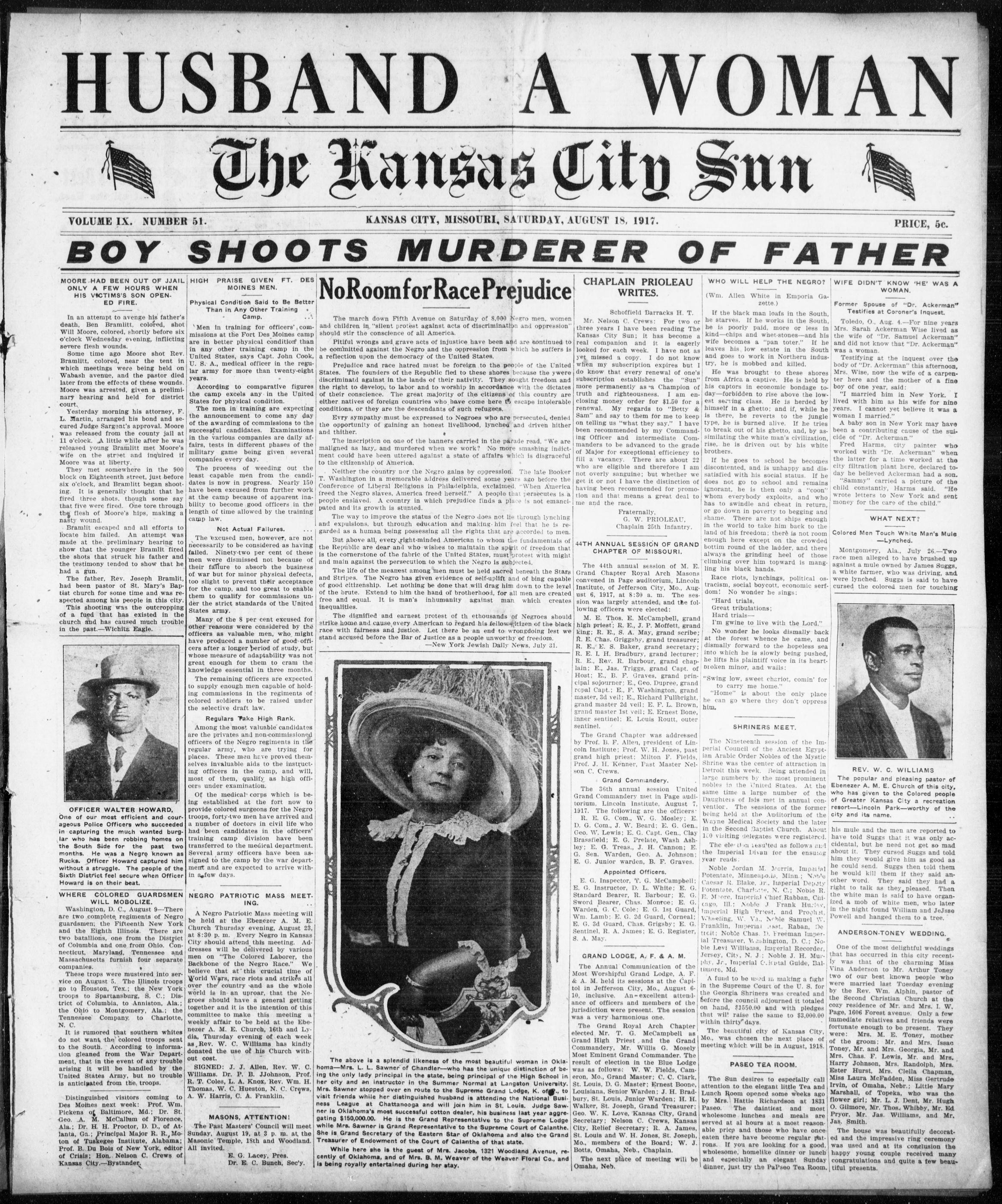
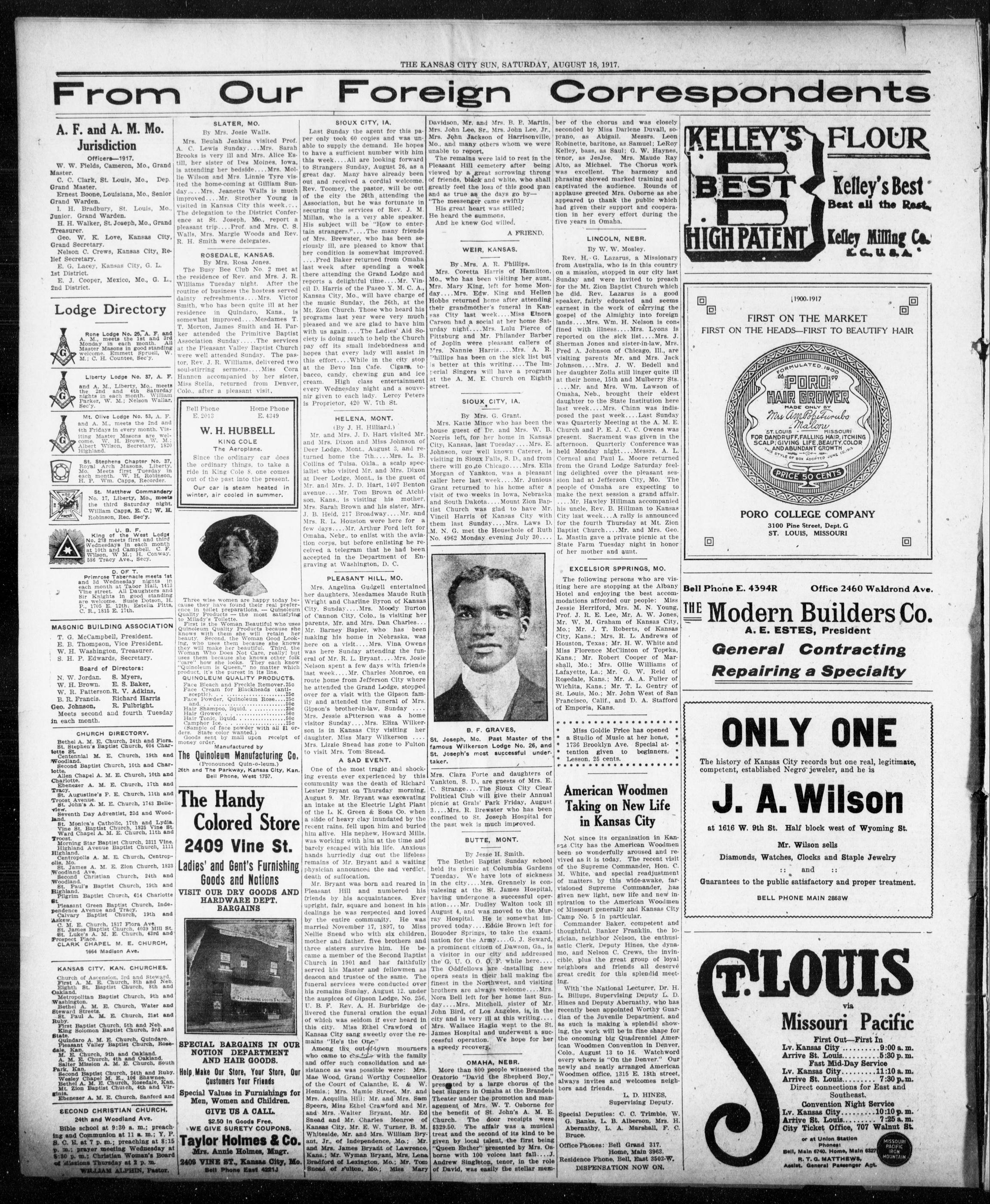
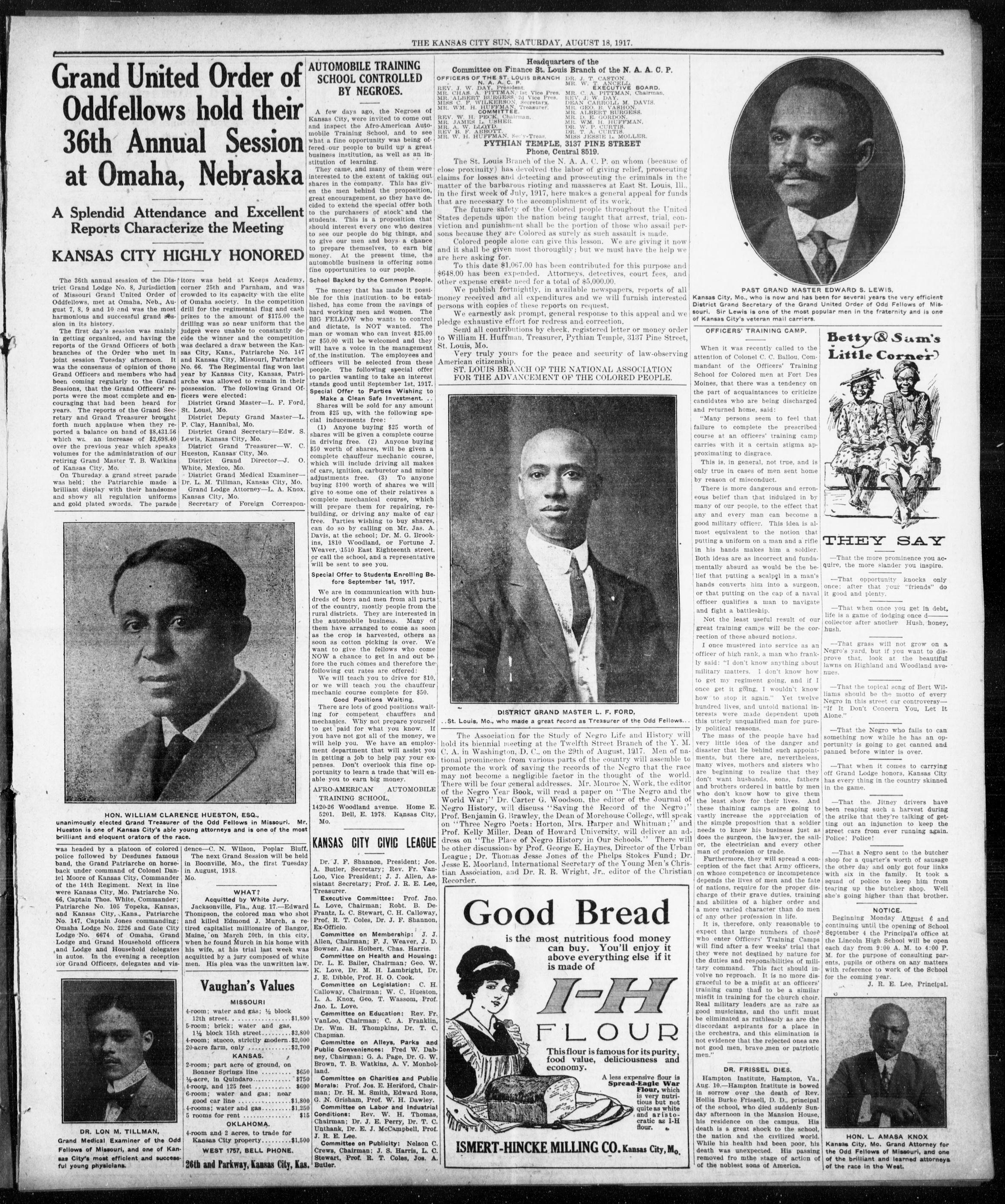
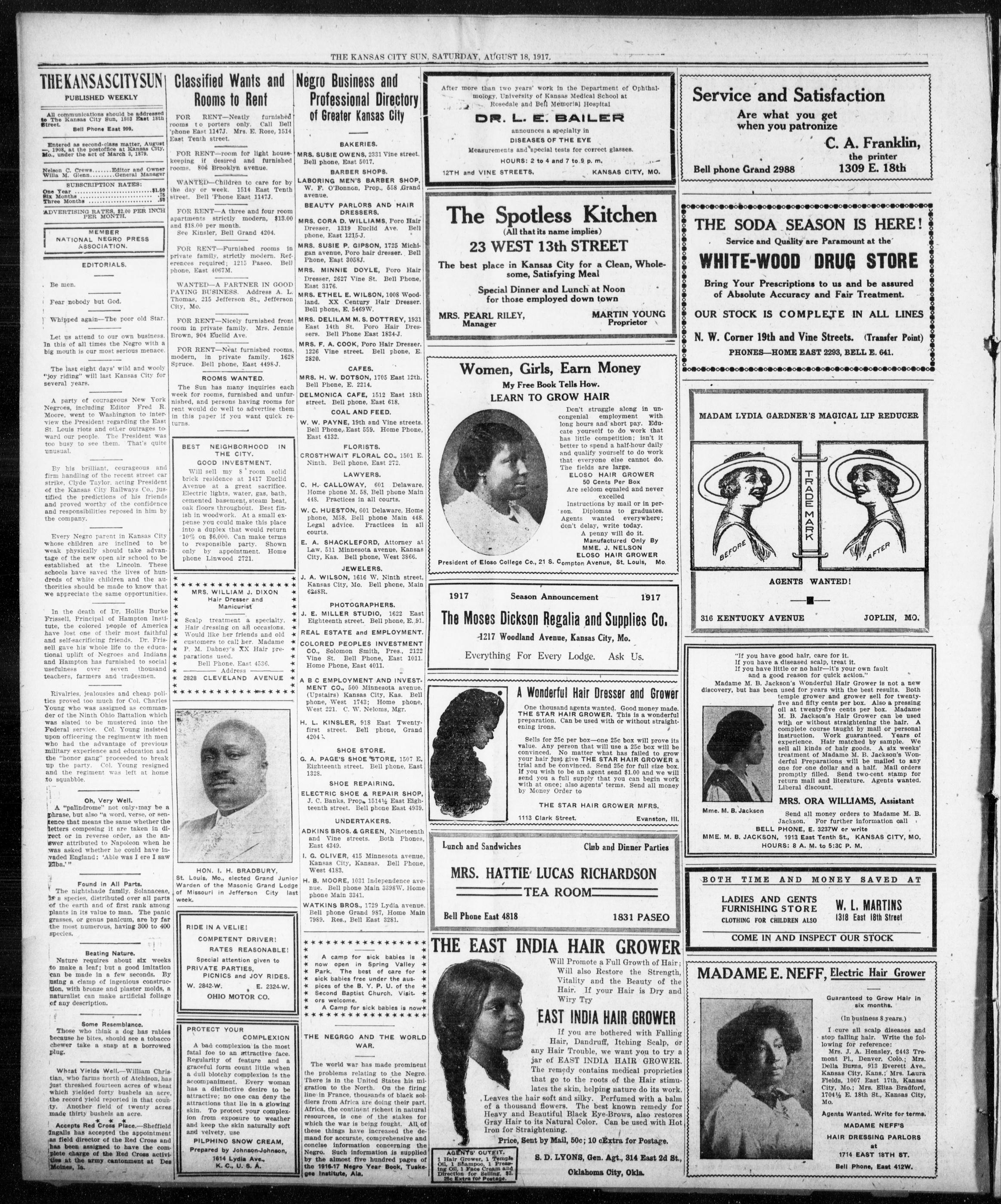
Page text (machine-generated)
HUSBAND A WOMAN The Kansas City Sun
BOY SHOOTS MURDERER OF FATHER
VOLUME IX. NUMBER 51.
MOORE-HAD BEEN OUT OF JJAIL ONLY A FEW HOURS WHEN HIS VICTIMS'S SON OPENED FIRE.
In an attempt to avenge his father's death, Ben Bramlitt, colored, shot Will Moore, colored, shortly before six o'clock Wednesday evening, inflicting severe flesh wounds.
Some time ago Moore shot Rev. Bramlitt, colored, near the tent in which meetings were being held on Wabash avenue, and the pastor died later from the effects of these wounds. Moore was arrested, given a preliminary hearing and held for district court.
Yesterday morning his attorney, F. L. Martin, arranged his bond and secured Judge Sargant's approval. Moore was released from the county jail at 11 o'clock. A little while after he was released young Bramlitt met Moore's wife on the street and inquired if Moore was at liberty.
They met somewhere in the 900 block on Eighteenth street, just before six o'clock, and Bramlitt began shooting. It is generally thought that he fired three shots, though some say that five were fired. One tore through the flesh of Moore's hips, making a nasty wound.
Bramlit escaped and all efforts to locate him failed. An attempt was made at the preliminary hearing to show that the younger Bramlit fired the shots that struck his father and the testimony tended to show that he had a gun.
The father, Rev. Joseph Bramlit, had been pastor of St. Mary's Baptist church for some time and was respected among his people in this city.
This shooting was the outcropping of a fued that has existed in the church and has caused much trouble in the past—Wichitz Eagle.
OFFICER WALTER HOWARD.
OFFICER WALTER HOWARD,
One of our most efficient and courageous Police Officers who succeeded
in capturing the much wanted burglar who has been robbing homes on
the South Side for the past two months. He was a Negro known as Rucks.
Officer Howard captured him without a struggle. The people of the
Sixth District feel secure when Officer Howard is on their beat.
WHERE COLORED GUARDSMEN
WILL MOBOLIZE.
Washington, D. C., August 9—There are two complete regiments of Negro guardmen; the Fifteenth New York and the Eighth Illinois. There are two battalions, one from the District of Columbia and one from Ohio. Connecticut, Maryland, Tennessee and Massachusetts furnish four separate companies.
These troops were mustered into service on August 5. The Illinois troops go to Houston, Tex.; the New York troops to Spartansburg, S. C.; District of Columbia, to Anniston, Ala.; the Ohio to Montgomery, Ala.; the Tennessee Company, to Charlotte, N. C.
It is rumored that southern whites do not want the colored troops sent to the South. According to information gleaned from the War Department, that in the event of any trouble arising it will be handled by the United States Army, but no trouble is anticipated from the troops.
Distinguished visitors coming to Des Moines next week: Prof. Wm. Pickens of Baltimore, Md.; Dr. St. Geo. A. M. McCallum of Florence, Ala.; Dr. H. H. Proctor, D. D., of Atlanta, Ga.; Principal Major R. R., Moton of Tuskegee Institute, Alabama; Prof. B. Du Bois of New York, editor of Crisis; Hon. Nelson C. Crews of Kansas City.—Bystander.
HIGH PRAISE GIVEN FT. DES MOINES MEN.
Physical Condition Said to Be Better Than in Any Other Training Camp.
Men in training for officers' commissions at the Fort Des Moines camp are in better physical condition than in any other training camp in the United States, says Capt. John Cook, U. S. A., medical officer in the regular army for more than twenty-eight years.
According to comparative figures the camp excels any in the United States for physical condition.
The men in training are expecting the announcement to come any day of the awarding of commissions to the successful candidates. Examinations in the various companies are daily affairs, tests in different phases of the military game being given several companies every day.
The process of weeding out the least capable men from the candidates is now in progress. Nearly 150 have been excused from further work at the camp because of apparent inability to become good officers in the length of time allowed by the training camp law.
Not Actual Failures.
The excused men, however, are not necessarily to be considered as having failed. Ninety-two per cent of these men were dismissed not because of their failure to absorb the business of war but for minor physical defects, too slight to prevent their acceptance for the camp, and too great to enable them to qualify for commissions under the strict standards of the United States army.
Many of the 8 per cent excused for other reasons were considered by the officers as valuable men, who might have produced a number of good officers after a longer period of study, but whose measure of adaptability was not great enough for them to cram the knowledge essential in three months.
The remaining officers are expected to supply enough men capable of holding commissions in the regiments of colored soldiers to be raised under the selective draft law.
Regulars Take High Rank.
Among the most valuable candidates are the privates and non-commissioned officers of the Negro regiments in the regular army, who are trying for places. These men have proved themselves invaluable aids to the instructing officers in the camp, and will, most of them, qualify as high officers under examination.
Of the medical corps which is being established at the fort now to provide colored surgeons for the Negro troops, forty-two men have arrived and a number of doctors in civil life who had been candidates in the officers' training camp division have been transferred to the medical department. Several army officers have been assigned to the camp by the war department and are expected to arrive within a few days.
NEGRO PATRIOTIC MASS MEET.
ING.
A Negro Patriotic Mass meeting will be held at the Ebenezer A. M. E. Church Thursday evening, August 23, at 8:30 p. m. Every Negro in Kansas City should attend this meeting. Addresses will be delivered by various men on "The Colored Laborer, the Backbone of the Negro Race." We believe that at this crucial time of World Wars, race riots and strikes all over the country and as the whole world is in an uproar, that the Negroes should have a general getting together and it is the intention of this committee to make this meeting a weekly affair to be held at the Ebenezer A. M. E. Church, 16th and Lydia, Thursday evening of each week as, Rev. W. C. Williams has kindly donated the use of his Church without cost.
SIGNED: J. J. Allen, Rev. W. C. Williams. Dr. P. B. JJohnson, Prof. R. T. Coles, L. A. Knox, Rev. Wm. H. Thomas, W. C. Hueston, N. C. Crews, A. W. Harris, C. A. Franklin.
MASONS. ATTENTION!
The Past Masters' Council will meet Sunday, August 19, at 3 p. m. at the Masonic Temple, 18th and Woodland All invited.
E. G. Lacey, Pres.
Dr. E. C. Bunch, Sec'y.
KANSAS CITY, MISSOURI, SATURDAY, AUGUST 18, 1917.
NoRoomforRacePrejudice
The march down Fifth Avenue on Saturday of 8,000 Negro men, women and children in "silent protest against acts of discrimination and oppression" should stir the conscience of all America.
Pitiful wrongs and grave acts of injustice have been and are continued to be committed against the Negro and the oppression from which he suffers is a reflection upon the democracy of the United States.
Prejudice and race hatred must be foreign to the people of the United States. The founders of the Republic fled to these shores because the ywere discriminated against in the lands of their nativity. They sought freedom and the right to develop, to labor and to worship in accordance with the dictates of their conscience. The great majority of the citizens of this country are either natives of foreign countries who have come here to escape intolerable conditions, or they are the descendants of such refugees.
Evry sympathy must be expressed to Negroes who are persecuted, denied the opportunity of gaining an honest livelihood, lynched and driven hither and thither.
The inscription on one of the banners carried in the parade read, "We are maligned as lazy, and murdered when we work? No more smashing indictment could have been uttered against a state of affairs which is disgraceful to the citizenship of America.
Neither the country nor the Negro gains by oppression. The late Booker T. Washington in a memorable address delivered some years ago before the Conference of Liberal Religions in Philadelphia, exclaimed, "When America freed the Negro slaves, America freed herself." A people that persecutes is a people enslaved. A country in which prejudice finds a place is not emancipated and its growth is stunted.
The way to improve the status of the Negro does not lie through lynching and expulsions, but through education and making him feel that he is regarded as a human being possessing all the rights that are accorded to men.
But above all, every right-minded American to whom the fundamentals of the Republic are dear and who wishes to maintain the spirit of freedom that is the cornerstone of the fabric of the United States, must protest with might and main against the persecution to which the Negro is subjected.
The life of the meanest among men must be held sacred beneath the Stars and Stripes. The Negro has given evidence of self-uplift and of bing capable of good citizenship. Let nothing be done that will drag him down to the level of the brute. Extend to him the hand of brotherhood, for all men are created free and equal. It is man's inhumanity against man which creates inequalities.
The dignified and earnest protest of the ethousands of Negroes should strike home and cause every American to regard his fellow citizen of the black race with fairness and justice. Let there be an end to wrongdoing lest we stand accused before the Bar of Justice as a people unworthy of freedom.
—New York Jewish Daily News, July 31.
XIX
The above is a splendid likeness of the most beautiful woman in Oklahoma—Mrs. L. L. Sawner of Chandler—who has the unique distinction of being the only lady principal in the state, being principal of the High School in her city and an instructor in the Summer Normal at Langston University. Mrs. Sawner stopped over en route to the Supreme Grand Lodge, K. of, to visit friends while her distinguished husband is attending the National Business League at Chattanooga and will join him in St. Louis. Judge Sawner is Oklahoma's most successful cotton dealer, his business last year aggregating $150,000.00. He is the Grand Representative to the Supreme Lodge while Mrs. Sawner is Grand Representative to the Supreme Court of Calanthe. She is Grand Secretary of the Eastern Star of Oklahoma and also the Grand Treasurer of Endowment of the Court of Calanthe of that state.
While here she is the guest of Mrs. Jacobs, 1321 Woodland Avenue, recently of Oklahoma, and of Mrs. B. M. Weaver of the Weaver Floral Co., and is being royally entertained during her stay.
CHAPLAIN PRIOLEAU WRITES.
Schoffield Barracks H. T
Mr. Nelson C. Crews: For two or three years I have been reading The Kansas City Sun; it has become a real companion and it is eagerly looked for each week. I have not as yet missed a copy. I do not know when my subscription expires but I do know that every renewal of one's subscription establishes the "Sun" more permanently as a Champion of truth and righteousness. I am enclosing money order for $1.50 for a renewal. My regards to "Betty & Sam" and say to them for me to keep on telling us "what they say." I have been recommended by my Commanding Officer and intermediate Commanders to be advanced to the grade of Major for exceptional efficiency to fill a vacancy. There are about 22 who are eligible and therefore I am not overly sanguine; but whether we get it or not I have the distinction of having been recommended for promotion and that means a great deal to me and the race.
Fraternally,
G. W. PRIOLEAU,
Chaplain 25th Infantry.
44TH ANNUAL SESSION OF GRAND
CHAPTER OF MISSOURI.
The 44th annual session of M. E. Grand Chapter Royal Arch Masons convened in Page auditorium, Lincoln Institute, of Jefferson City, Mo., August 6, 1917, at 8:30 a. m. The session was largely attended, and the following officers were elected:
M. E. Thos. E. McCampbell, grand high priest; R. E., J. P. Moffett, grand king; R. E., S. A. May, grand scribe; R. E. Chas. Griggsby, grand treasurer; R. E., E. S. Baker, grand secretary; R. E. I. H. Bradbury, grand lecturer; R. E., Rev. R. Barbour, grand chapain; E., Jas. Triggs, grand Capt. of Host; E., B. F. Graves, grand principal sojourner; E., Geo. Dupree, grand ropal Capt.; E., F. Washington, grand master, 3d veil; E., Richard Fullbright, grand master 2d veil; E. F. L. Brown, grand master 1st veil; E. Ernest Bone, inner sentinel; E. Louis Routt, outer sentinel.
The Grand Chapter was addressed by Prof. B. F. Allen, president of Lincoln Institute; Prof. W. H. Jones, past grand high priest; Milton F. Fields, Prof. J. H. Kenner, Past Master Nelson C. Crews.
Grand Commandery.
The 36th annual session United Grand Commandery met in Page auditorium, Lincoln Institute, August 7 1917. The following are the officers: R. E. G. Com., W. G. Mosley; E D. G. Com., J. W. Beard; E. G. Gen. Geo. W. Lewis; E. G. Capt. Gen. Clay Brassfield; E. G. Prelate, Wash Ashley; E. G. Treas., J. H. Cannon; E. G. Sen. Warden, Geo. A. Johnson; E. G. Junior warden, B. F. Graves.
Appointed Officers.
E. G. Inspector, T. G. McCampbell
E. G. Instructor, D. L. White; E. G.
Standard Bearer, R. Barbour; E. G.
Sword Bearer, Chas. Monroe; E. G.
Warden, G. C. Cole; E. G. 1st Guard
Wm. Lamb; E. G. 2d Guard, Corneal;
E. G. 3d Guard, Chas. Grigsby; E. G.
Sentinel, R. A. James; E. G. Register
S. A. May
GRAND LODGE. A. F. & A. M.
The Annual Communication of the Most Worshipful Grand Lodge, A. F. & A. M. held its sessions at the Capitol in Jefferson City, Mo., August 6-10, inclusive. An excellent attendance of officers and members of the jurisdiction were present. The session was a very harmonious one.
The Grand Royal Arch Chapter elected Mr. T. G. McCampbell as Grand High Priest and the Grand Commandery, Mr. Willis G. Mosely Most Eminent Grand Commander. The result of election in the Blue Lodge was as follows: W. W. Fields, Cameron, Mo., Grand Master; C. C. Clark, St. Louis, D. G. Master; Ernest Boone, Louisiana, Senior Warden; J. H. Bradbury, St. Louis, Junior Warden; H. H. Walker, St. Joseph, Grand Treasurer; Geo. W. K. Love, Kansas City, Grand Secretary; Nelson C. Crews, Kansas City, Relief Secretary; R. A. James, St. Louis and W. H. Jones, St. Joseph, Mo., members of the Board; W. J. Botts, Omaha, Neb., Chaplain.
The next place of meeting will be Omaha, Neb.
WHO WILL HELP THE NEGRO?
(Wm. Allen White in Emporia Gazette.)
If the black man loafs in the South, he starves. If he works in the South, he is poorly paid, more or less in kind—chips and whet-stones—and his wife becomes a "pan toter." If he leaves his low estate in the South and goes to work in Northern industry, he is mobbed and killed.
He was brought to these shores from Africa a captive. He is held by his captors in economic bondage today—forbidden to rise above the lowest serving class. He is herded by himself in a ghetto; and if, while he is there, he reverts to the jungle type, he is burned alive. If he tries to break out of his ghetto, and, by assimilating the white man's civilization, rise, he is driven out by his white brothers.
If he goes to school he becomes discontented, and is unhappy and dissatisfied with his social status. If he does not go to school and remains ignorant, he is then only a "coon" whom everybody exploits, and who has to swindle and cheat in return, or go down in poverty to begging and shame. There are not ships enough in the world to take him back to the land of his freedom; there is not room enough here except on the crowded bottom round of the ladder, and there always the grinding heel of those climbing over him topward is mangling his black hands.
Race riots, lynchings, political ostracism, social boycott, economic serfdom! No wonder he sings:
"Hard trials,
Great tribulations;
Hard trials—
I'm gwine to live with the Lord."
No wonder he looks dismally back at the forest whence he came, and dismally forward to the hopeless sea into which he is slowly being pushed, he lifts his plaintiff voice in its heart-broken minor, and wails:
"Swing low, sweet chariot, comin' for to carry me home."
"Home" is about the only place he can go where they don't oppress him.
SHRINERS MEET.
The Nineteenth session of the Imperial Council of the Ancient Egyptian Arabic Order Nobles of the Mystic Shrine was the center of attraction in Detroit this week. Being attended in large numbers by the most prominent nobles in the United States. At the same time a large number of the Daughters of Isis met in annual convention. The sessions of the former being held at the Auditorium of the Wayne Medical Society and the later in the Second Baptist Church. About 100 visiting delegates were registered.
The election resulted as follows and the Imperial Divan for the ensuing year reads:
Noble Jordan M. Morris, Imperial Potentate, Minneapolis, Minn.; Noble Caesar R. Blake, Jr., Imperial Deputy Potentate, Charlotte, N. C.; Noble R. E. Moore, Imperial Rabban, Chicago, Ill.; Noble J. Frank Hutley, Imperial High Priest, and Prophist, Wheeling, W. Va., Noble Samuel W. Franklin, Imperial Assist, Raban, Detroit; Noble Chas. D. Freeman Imperial Treasurer, Washington, D. C.; Noble Levi Williams, Imperial Recorder, Jersey, City, N. J.; Noble J. H. Murphy, Jr., Imperial Clerical Guide, Baltimore, Md.
A fund to be used in making a fight in the Supreme Court of the U. S. for the Georgia Shriners was created and before the council adjourned it totaled on hand, $1550.00 and with pledges that will raise the same to $3,000.00 within thirty days.
The beautiful city of Kansas City, Mo., was chosen the next place of meeting which will be in August, 1918.
PASEO TEA ROOM
The Sun desires to especially call attention to the elegant little Tea and Lunch Room opened some weeks ago by Mrs. Hattie Richardson at 1831 Paseo. The daintiest and most wholesome lunches and meals are served at al hours at a most reasonable price and those who have once eaten there have become regular patrons. If you are looking for a good, wholesome, homelike dinner or lunch and especially an elegant Sunday dinner, just try the PaPseo Tea Room
PRICE. 5c.
WIFE DIDN'T KNOW 'HE' WAS A WOMAN.
Former Spouse of "Dr. Ackerman"
Testifies at Coroner's Inquest.
Toledo, O., Aug. 4.—For nine years Mrs. Sarah Ackerman Wise lived as the wife of "Dr. Samuel Ackerman" and did not know that "Dr. Ackerman" was a woman.
Testifying at the inquest over the body of "Dr. Ackerman" this afternoon, Mrs. Wise, now the wife of a carpenter here and the mother of a fine boy of one year, said:
"I married him in New York. I lived with him as his wife for nine years. I cannot yet believe it was a woman I married."
A baby son in New York may have been a contributing cause of the suicide of "Dr. Ackerman."
Fred Harms, city painter who worked with "Dr. Ackerman" when the latter for a time worked at the city filtration plant here, declared today he believed Ackerman had a son.
"Sammy" carried a picture of the child constantly, Harms said. "He wrote letters to New York and sent money for the care of the child."
WHAT NEXT?
Colored Men Touch White Man's Mule —Lynched.
Montgomery, Ala., July 26.—Two race men alleged to have brushed up against a mule owned by James Suggs, a white farmer, who was driving, and were lynched. Suggs is said to have cursed the colored men for touching
REV. W. C. WILLIAMS
The popular and pleasing pastor of Ebenezer A. M. E. Church of this city, who has given to the Colored people of Greater Kansas City a recreation resort—Lincoln Park—worthy of the city and its name.
his mule and the men are reported to have told Suggs that it was only accidental, but he need not get so mad about it. They cursed Suggs and told him they would give him as good as he could send. Suggs then told them he would kill them if they said another word. They said they had a right to talk as they, pleased. Then the white man is said to have organized a mob of white men, who later in the night found William and Jejsse Powell and hanged them to a tree.
ANDERSON-TONEY WEDDING.
One of the most delightful weddings that has occurred in this city recently was that of the charming Miss Vina Anderson to Mr. Arthur Toney two of our best known people who were married last Tuesday evening by the Rev. Wm. Alphin, pastor of the Second Christian Church at the cozy residence of Mr. and Mrs. I. W. Page, 1606 Forest avenue. Only a few immediate relatives and friends were fortunate enough to be present. They were: Mrs. M. E. Toney, mother of the groom; Mr. and Mrs. Issac Toney, Mr. and Mrs. Georgia, Mr. and Mrs. Chas. F. Lewis, Mr. and Mrs. Harry Johnson, Mrs. Randolph, Mrs. Ester Hurst, Mrs. Cella Chapman, Miss Laura McFadden, Miss Gertrude Irvin, of Omaha, Nebr.; Little Mary Marshall, of Topeka, who was the flower girl; Mr. L. J. Dent, Mr. Hugh O. Gilmore, Mr. Thos. Whibby, Mr. Ed Pryor, Mr. Jas. Williams, and Mr. Jas. Smith.
The house was beautifully decorated and the impressive ring ceremony was used and at its conclusion the happy young couple received many congratulations and quite a few beautiful presents.
From Our Foreign Correspondents
A. F. and A. M. Mo. Jurisdiction
W. W. Fields, Cameron, Mo., Grand Master.
C. C. Clark, St. Louis, Mo., Dep.
Grand Master.
Ernest Boone, Louisiana, Mo., Senior
Grand Warden.
I. H. Bradbury, St. Louis, Mo.
Junior. Grand Warden.
H. H. Walker, St. Joseph, Mo., Grand Treasurer.
Geo. W. K. Love, Kansas City,
Grand Secretary.
Nelson C. Crews, Kansas City, Rei
lief Secretary.
E. G. Lacey, Kansas City, G. L.
1st District.
E. J. Cooper, Mexico, Mo., G. L.
2nd District.
Lodge Directory
---
G
WESTMINSTER
Rone Lodge No. 25, A. F. and
A. M. meets the 1st and 3rd
Monday in each month. All
Master Masons in good standing
welcome. Emmett Spruell, W.
M.; C. H. Countee, See'y.
G
MASONRY
Liberty Lodge No. 37, A. F
and A. M. Liberty, Mo., meets the 2nd and 4th Saturday nights in each month. William Parker, W. M.; Nelson Wallar, Sec'y.
Mt. Olive Lodge No. 53, A. F. and A. M., meets the 2nd and 4th Fridays in every month. Visiting Master Masons are wolf. W. H. Brown, W. M.; Albert Wilson, Secretary, 1820 Highland.
G
St. Stephens Chapter No. 37,
Royal Arch Masons, Liberty,
Mo. Meets first Tuesday in
each month. H. I. Robinson,
H. P. Wm. Capps, Recorder.
St. Matthew Commandery
No. 17, Liberty, Mo., meets
the third Saturday night,
William Capps, E. C.; W. H.
Robinson, Rec. Sec'y.
NCC
IN
MCC
MCCS
MCCS
U. B. F
```markdown
```
King of the West Lodge No. 218 meets first and third wednesday in each month at 10th and Campbell, C. F. Wilson, W M.; M. H. Conway, 588 Tracy Ave., Secy.
D. OF T
Primrose Tabernacle meets 1st and 3d Wednesday nights at 1413 Vine street. All Daughters and Sir Knights in good standing are welcome at Dotson, H. 165, 1815, Estella Pitts, C. R. 1815 E. 17th.
MASONIC BUILDING ASSOCIATION
T. G. McCampbell, President.
E. B. Thompson, Vice President.
W. H. Washington, Treasurer.
S. H. P. Edwards, Secretary.
Board of Directors:
N. W. Jordan. S. Myers,
W. H. Brown. E. S. Baker,
W. R. Patterson.R. V. Adkins,
B. R. Francis. Richard Harris
Geo. Johnson, R. Fulbright.
Meets second and fourth Tuesday
in each month.
CHURCH DIRECTORY.
Bethel A. M. E. Church, 24th and Flora.
St. Stephen's Baptist Church, 604 Charlotte ST.
O'Connellian M. E. Church, 19th and Woodland M. E. Church, 19th and
Second Baptist Church, 10th and Charlotte.
Allen Chapel A. M. E. Church, 10th and Charlotte.
Ebenezer A. M. E. Church, 17th and
Tracy
Augustine's P. E. Church, 11th and
Troost Avenue.
St. John's A. M. E. Church, 1743 Belle-
vue
Seventh Day Adventist, 23d and Woodland.
St. Monica's Catholic, 17th and Lydia.
Vine St. Baptist Church, 1825 Vine St.
Ward Chapel A. M. E. Church, 11th and
Troost.
Making Star Baptist Church, 2311 Vine.
Highland Avenue Baptist Church, 1111
Highland.
Centropolis A. M. E. Church, Centropolis
Mo.
St. James A. M. E. Zion Church, 1823
Woodland Ave.
Second Christian Church, 24th and
Woodland.
St. Paul's Baptist Church, 19th and
Pilgrim.
Pilgrim Baptist Church, 614 Charlotte
St.
Pleasant Green Baptist Church, independence Avenue and Tracy. Cewary Baptist Church, 19th and Askew. C. M. E. Church, 1817 Flora Ave. St. James Baptist Church, 4039 Mt St. Luke's Church, M. E. Church, 49th and Proceeding Church.
CLARK CHAPEL M. E. CHURCH,
1664 Madison Ave.
KANSAS CITY, KAN. CHURCHES.
Church of Ascension, 3rd and Steward.
First A. M. E. Church, 8th and Neb.
Eighth St. Baptist Church, 8th and
Oakland.
Metropolitan Baptist Church, 9th and Washington.
Bethel A. M. E. Church, Water and Steward Streets
St. Paul A. M. E. Church, 21st and
Ruby.
First Baptist Church, 6th and Neb.
East Solomon Baptist Church, 3rd and
State.
Quindaro A. M. E. Church, Quindaro.
Pleasant Valley Baptist Church, Rose-
dale.
M. E. Church, 9th and Oakland.
A. M. E. Church, 4th and Oakland, dissection A. M. E. Church, South Park, Kan
Second Baptist Church, 24th and Ruby, Wesley Chapel M. E., 106 Shawnee, Bethel A. M. E. Church, Rosedale, Mt. Zion Baptist Church, 4th and Kir-
Ebenezer A. M. E. Church, Sanford and
SECOND CHRISTIAN CHURCH.
24th and Woodland Ave.
Bible school at 9:30 a. m.; preaching and Communion at 11 a. m.; Y. P. S. C. E. at 7 p. m.; preaching at 8:15 p. m.; prayer meeting Wednesday at 8:30 p. m.; Christian Woman's Board of Missions Thursday at 2 p. m.
WILLIAM ALPHIN, Pastor.
Mrs. Beulah Jenkins visited Prof. A. C. Lewis Sunday.....Mrs. Sarah Brooks is very ill and Mrs. Alice Estill, her sister of Des Moines, Iowa, is attending her bedside.....Mrs. Mollie Wilson and Mrs. Linnie Tyre visited the home-coming at Gilliam Sunday.....Mrs. Jeanette Walls is much improved.....Mr. Strother Young is visited in Kansas City this week.... The delegation to the District Conference at St. Joseph, Mo., report a pleasant trip.....Prof. and Mrs. C. S. Walls, Mrs. Margie Woods and Rev. R. H. Smith were delegates.
ROSEDALE KANSAS
By Mrs. Rosa Jones.
The Busy Bee Club No. 2 met at the residence of Rev. and Mrs. J. R. Williams Tuesday night. After the routine of business the hostess served dainty refreshments...Mrs. Victor Smith, who has been quite ill at her residence in Quindaro, Kans., is somewhat improved...Mesdames T. T. Morton, James Smith and H. Parker attended the Primitive Baptist Association Sunday....The services at the Pleasant Valley Baptist Church were well attended Sunday. The pastor, Rev. J. R. Williams, delivered two soul-stirring sermons...Miss Cora Hannon accompanied by her sister, Miss Stella, returned from Denver, Colo., after a pleasant visit.
Bell Phone Home Phone
E. 2013 E. 4349
W. H. HUBBELL
KING COLE
The Aeroplane.
Since the ordinary car does the ordinary things, to take a ride in King Cole 8. one comes out of the past into the present.
Our car is steam heated in winter, air cooled in summer.
Three wise women are happy today because they have found their real preference in toilet preparations. — Quinoleum Quality Products — the most satisfying to Milady's Tollette.
First is the Woman Beautiful who uses Quinoleum Quality Products because she knows with them she will retain her beauty. Second, the Woman Good Looking, who uses them because she knows they will make her beautiful. Third, the Woman Who Does Not Care, really! but uses them because she knows other folk "care" how she looks. They each know "Quinoleum is Queen," no matter which product, it's the purest in its line.
QUINOLEUM QUALITY PRODUCTS.
Face Bleach and Freckle Remover.250
Face Cream for Blackheads (anti-
scientic).250
Face Powder, Quinoleum Rose...25c and...50c Hair Shampoo, liquid...25c Hair Grower...50c Hair Tonic, liquid...50c Camphor Ice...25c (Sample of face powder with all $1 orders. State color wanted.) Goods sent by mail upon receipt of money order.
26th and The Parkway, Kansas City, Kan.
Bell Phone, West, 1257.
The Handy Colored Store 2409 Vine St.
Ladies' and Gent's Furnishing Goods and Notions VISIT OUR DRY GOODS AND HARDWARE DEPT. BARGAINS
FURNISHING GOODS FURNISHING
SPECIAL BARGAINS IN OUR
NOTION DEPARTMENT
AND HAIR GOODS.
Help Make Our Store, Your Store, Our
Customers Your Friends
Special Values in Furnishings for
Men, Women and Children.
GIVE US A CALL.
$2.50 In Goods Free.
WE GIVE SURETY COUPONS.
Taylor Holmes & Co.
Mrs. Annie Holmes, Mngr.
2408 VINE ST., Kansas City, Mo.
Bell Phone East 42213
THE KANSAS CITY SUN, SATURDAY, AUGUST 18, 1917.
SIOUX CITY, IA.
Last Sunday the agent for this paper only took 60 copies and was unable to supply the demand. He hopes to have a sufficient number with him this week.... All are looking forward to Strangers Sunday, August 26, as a great day. Many have already been out and received a cordial welcome. Rev. Toomey, the pastor, will be out of the city the 26th attending the Association, but he was fortunate in securing the services of Rev. J. M. Millan, who is a very able speaker. His subject will be "How to entertain strangers.".... The many friends of Mrs. Brewster, who has been seriously ill, are pleased to know that her condition is somewhat improved. ....Fred Baker returned from Omaha last week after spending a week there attending the Grand Lodge and reports a delightful time....Mr. Vincent D. Harris of the Paseo Y. M. C. A., Kansas City, Mo., will have charge of the music Sunday, the 26th, at the Mt. Zion Church. Those who heard his programs last year were very much pleased and we are glad to have him with us again....The Ladies' Aid Society is doing much to help the Church pay off its small indebtedness and hopes that every lady will assist in this effort....While in the city stop at the Bevo Inn Cafe, Cigars, to bacco, candy, chewing gun and ice cream. High class entertainment every Wednesday night and a souvenir given to each lady. Leroy Peters is Proprietor, 420 W. 7th St.
HELENA. MONT.
(By J. H. Hilliard.)
Mr. and Mrs. J. D. Hart visited Mr. and Mrs. Dixon and Miss Johnson of Deer Lodge, Mont., August 3, and returned home the 7th.....Mrs. L. B. Collins of Tulsa, Okla., a scalp specialist who visited Mr. and Mrs. Dixon at Deer Lodge, Mont., is the guest of Mr. and Mrs. J. D. Hart, 1407 Benton avenue.....Mr. Tom Brown of Atchison, Kans., is visiting his mother, Mrs. Sarah Brown and his sister, Mrs. J. B. Held, 217 Broadway.....Mr. and Mrs. R. L. Houston were here for a few days.....Mr. Arthur Ford left for Omaha, Nebr., to enlist with the aviation corps, but before enlisting he received a telegram that he had been accepted in the Department of Engraving at Washington, D. C.
PLEASANT HILL, MO.
Mrs. Angelina Gudgell entertained her daughters, Mesdames Maude Ruth Wright and Charline Byron of Kansas City, Sunday....Mrs. Moody Burton of Cannon City, Colo., is visiting her parents, Mr. and Mrs. Dan Charles....Mr. Barney Bapier, who has been making his home in Nebraska, was here on a visit....Mrs. Vina Owens was here Sunday attending the funeral of Mr. R. L. Bryant....Mrs. Josie Nelson spent a few days with friends last week....Mr. Charles Monroe, en route home from Jefferson City where he attended the Grand Lodge, stopped over for a visit with the Glipson family and attended the funeral of Mrs. Glipson's brother-in-law, Sunday ....Mrs. Jessie Apterson was a home visitor Sunday....Mrs. Eliza Wilkerson is in Kansas City visiting her daughter, Miss Mary Wilkerson ....Mrs. Lizzie Snead has gone to Fulton to visit Mrs. Tom Snead.
A SAD EVENT.
One of the most tragic and shocking events ever experienced by this community was the death of Richard Lester Bryant on Thursday morning, August 9. Mr. Bryant was excavating an intake at the Electric Light Plant of the L. K. Green & Sons Co. when a slide of heavy clay inundated by the recent rains, fell upon him and buried him alive. His nephew, Howard Mills, was working with him at the time and barely escaped with his life. Anxious hands hurriedly dug out the lifeless remains of Mr. Bryant and a waiting physician announced the sad verdict, death of suffocation.
Mr. Bryant was born and reared in Pleasant Hill and numbered his friends by his acquaintances. Ever upright, fair, square and honest in his dealings he was respected and loved by the entire community. He was married November 17, 1897, to Miss Nellie Snead who with six children, mother and father, five brothers and three sisters survive him. He became a member of the Second Baptist Church in 1901 and has faithfully served his Master and fellowmen as deacon and trustee of the same. The funeral services were conducted over his remains Sunday, August 12, under the auspices of Gipson Lodge, No. 256, U. B. F, Rev. A. H. Burbidge delivered the funeral oration the equal of which was seldom if ever heard in this city. Miss Ethel Crawford of Kansas City sang sweetly over the remains "He's the One."
Among the out-of-town mourners who came to escue with the family and offer such consolidation and assistance as was possible were: Mrs. Mae Wood, Grand Worthy Counsellor of the Court of Calanthe, E. & W. Hemis; Mrs. Mamie Street, Mr. and Mrs. Acquilla Hill; Mr. and Mrs. Sam Speers, Miss Ethel Crawford and Mr. and Mrs. Walter Bryant, Mr. Ed Snead and Mr. Charles Monroe of Kansas City, Mr. E. W. Turner, B. M. Whiteside, Mr. and Mrs. William Bryant, Jr. of Independence, Mo.; Mr. and Mrs. James Bryant of Lawrence, Kans.; Mr. Wyman Bryant, Mrs. Lena Bradford of Lexington, Mo.; Mr. Tom Snead of Fulton, Mo.; Miss Mary
Davidson, Mr. and Mrs. B. P. Martin,
Mrs. John Lee, Sr., Mrs. John Lee, Jr.,
Mrs. John Jackson of Harrisonville,
Mo., and many others whom we were
unable to report.
The remains were laid to rest in the
Pleasant Hill cemetery after being
viewed by a great sorrowing throng
of friends, black and white, who shall
greatly feel the loss of this good man
and as true as the days go by—
"The messenger came swiftly
A FRIEND
WEIR. KANSAS.
Mrs. Coretta Harris of Hamilton, Mo., who has been visiting her aunt, Mrs. Mary King, left for home Monday...Mrs. Edw. King and Hellen Hobbs returned home after attending their grandmother's funeral in Kansas City last week...Miss Elnora Carson had a social at her home Saturday night...Mrs. Lulu Pierce of Pittsburg and Mr. Philander Barben of Joplin were pleasant callers of Mrs. Nannie Harris...Mrs. A. R. Phillips has been on the sick list but is better at this writing...The Imperial Singers will have a program at the A. M. E. Church on Eighth street.
SIOUX CITY, IA.
By Mrs. G. Grant.
Mrs. Katie Minor who has been the house guest of Dr. and Mrs. W. B. Norris left, for her home in Kansas City, Kansas, last Tuesday....Mrs. E. Johnson, our well known Caterer, is visiting in Sioux Falls, S. D., and from there will go to Chicago....Mrs. Ella Morgan of Yankton, was a pleasant caller here last week....Mr. Junius Grant returned to his home after a visit of two weeks in Iowa, Nebraska and South Dakota....Mount Zion Baptist Church was glad to have Mr. Vincil Harris of Kansas City with them last Sunday....Mrs. Laws D. M. N. G. met the Houseole of Ruth No. 4962 Monday evening July 30...
A. E. H.
B. F. GRAVES,
St. Joseph, Mo. Past Master of the
famous Wilkerson Lodge No. 26, and
St. Joseph's most successful undertaker.
Mrs. Clara Forte and daughters of
Yankton, S. D., are guests of Mrs. E.
C. Strange....The Sioux City Clear
Political Club will give their Annual
picnic at Graals' Park Friday, August
3....Mrs. R. Brewster who has been
confined to St. Joseph Hospital for
the past wek is much improved.
BUTTE, MONT.
The Bethel Baptist Sunday school held its picnic at Columbia Gardens Tuesday. We have lots of sickness in the city.....Mrs. Grennely is convalescing at the St. James Hospital having undergone a successful operation.....Mr. Dudley Walton took ill August 4, and was moved to the Murray Hospital. He is somewhat improved today.....Eddie Brown left for Bouoder Springs, to take the examination for the Army.....G. J. Seward, a prominent citizen of Dawson, Ga., is a visitor in our city and addressed the G. U. O. O. F. while here.... The Oddfellows are installing new opera seats in their hall making the finest in the Northwest, and visiting brothers are always welcome.....Mrs. Nora Bell left for her home last Sunday.....Mrs. Mitchell, sister of Mr. John Bird, of Los Angeles, is, in the city and is very ill at this writing.....Mrs. Wallace Hagin went to the St James Hospital and underwent a successful operation. We hope for her a speedy recovery.
OMAHA, NEBR.
More than 800 people witnessed the Oratorio "David the Shepherd Boy," presented by a large chorus of the best singers in Omaha at the Brandeis Theater under the promotion and management of Mrs. W. T. Osborne for the benefit of St. John's A. M. E. Church. The door receipts were $329.50. The affair was a musical treat and the second of its kind to be given by local talent, the first being "Queen Esther" presented by Mrs. Osborne with 100 voices last fall...J. Andrew Singleton, tenor, in the role of David, was easily the stellar mem
ber of the chorus and was closely seconded by Miss Darlene Duvall, soprano, as Abigail. Messrs. Leon Robinette, baritone, as Samuel; LeRoy Kelley, bass, as Saul; G. W. Haynes, tenor, as JesJse. Mrs. Maude Ray Alto, as Michael. The Chorus work was excellent. The harmony and phrasing showed marked training and captivated the audience. Rounds of applause greeted Mrs. Osborne as she appeared to thank the public which had given their support and cooperation in her every effort during the five years in Omaha.
LINCOLN, NEBR.
By W. W. Mosley.
Rev. H. G. Lazarus, a Missionary from Australia, who is in this country on a mission, stopped in our city last Sunday and were invited to preach for the Mt. Zion Baptist Church which he did. Rev. Lazarus is a good speaker, fairly educated and seems earnest in the work of carrying the gospel of the Almighty into foreign lands.....Mrs. Wm. H. Nelson is confined with illness.....Mrs. Lyons is reported on the sick list.....Mrs. J. Sherman Jones and sister-in-law, Mrs. Fred A. Johnson of Chicago, Ill., are visiting parents Mr. and Mrs. Jack Johnson.....Mrs. J. W. Bedell and her daughter Zolla still linger quite ill at their home, 15th and Mulberry Sts. ....Mr. and Mrs. Wm. Lawson of Omaha, Neb., brought their eldest daughter to the State Institution here last week.....Mrs. Chinn was indisposed the past week.....Last Sunday was Quarterly Meeting at the A. M. E. Church and P. E. J. C. C. Owens was present. Sacrament was given in the afternoon. Quarterly Conference was held Monday night.....Messrs. A. L. Corneal and Paul L. Moore returned from the Grand Lodge Saturday feeling delighted over the pleasant session had at Jefferson City, Mo. The people of Omaha are expecting to make the next session a grand affair. ....Mr. Hawley Hillman accompanied his uncle, Rev. B. Hillman to Kansas City last week. A rally is announced for the fourth Thursday at Mt. Zion Baptist Church.....Mr. and Mrs. Geo. L. Mastin gave a private picnic at the State Farm Tuesday night in honor of her mother and aunt.
EXCELSIOR SPPRINGS, MO.
The following persons who are visiting here are stopping at the Albany Hotel and enjoying the best accommodations afforded our people: Miss Jessie Herriford, Mrs. M. N. Young, Prof. J. R. E. Lee, Mr. A. W. Jones, Mr. W. M. Graham of Kansas City, Mo.; Mr. J. T. Roberts, of Kansas City, Kans.; Mrs. R. L. Andrews of Houston, Texas; Mr. H. W. White and Miss Florence McClinton of Topeka, Kans.; Mr. Robert Cooper of Marshall, Mo.; Mrs. Ollie Williams of Lafayette, La.; Mr. G. W. Reid of Rosedale, Kans.; Mr. A. A. Fuller of Wichita, Kans.; Mr. T. L. Gentry of St. Louis, Mo.; Mr. John West of San Francisco, Calif, and D. A. Stafford of Emporia, Kans.
* Miss Goldie Price has opened a Studio of Music at her home, 1736 Brooklyn Ave. Special attention given to beginners. Lesson, 25 cents.
---
American Woodmen Taking on New Life in Kansas City
American Woodmen Taking on New Life in Kansas City
Not since its organization in Kansas City has the American Woodmen been so wonderfully aroused and revived as it is today. The recent visit of the Supreme Commander, Hon. C. M. White, and special readjustment of matters by this wide-awake, farvisioned Supreme Commander, has given new light, new life and new inspiration to the American Woodmen of Missouri generally and Kansas City Camp No. 5 in particular.
Commander Baker, competent and thoughtful, Banker Franklin, the logician, neighbor Nelson, the enthusiastic Clerk, Deputy Hines, the dynamo, and Nelson C. Crews, the invincible, plus the great group of loyal neighbors and friends all deserve great credit for this splendid meeting.
With the National Lecturer, Dr. H. L. Billups, Supervising Deputy L. D. Hines and Deputy Abernathy, who has recently been appointed Worthy Guardian of the Juvenile Department, and as such is making a splendid showing, the work will be in fine shape for the oncoming big Quadrenniel American Woodmen Convention in Denver, Colo. August 13 to 16. Watchword everywhere is "On the Denver." Our newly and neatly arranged American Woodmen office, 1315 E. 18th street, always invites and welcomes neighbors and friends.
Special Deputies: C. C. Trimble, W
G. Banks, L. B. Alberson, Mrs. H
Abernathy, L. A. Marshall, F. C
Cruce.
KELLEY'S BEST HIGH PATENT FLOUR Kelley's Best Beat all the Rest Kelley Milling Co. K.C.U.S.A.
1900-1917
FIRST ON THE MARKET
FIRST ON THE HEADS—FIRST TO BEAUTIFY HAIR
FORMULATED 1900
PORO
HAIR GROWER
MADE ONLY BY
Mrs Amelia Turubo
Mallory
ST. LOUIS, MISSOURI
FOR DANDRUFF, FALLING HAIR, ITCHING
SCALP; GIVING LIFE, BEAUTY, COLOR
AND ABUNDANT GROWTH
THIS STYLE OF BOX ADOPTED JUNE 12,1915
PRICE 50 CENTS
PORO COLLEGE COMPANY
3100 Pine Street, Dept. G
ST. LOUIS, MISSOURI
THE Modern Builders Co. A. E. ESTES, President General Contracting Repairing a Specialty
ONLY ONE
The history of Kansas City records but one real, legitimate, competent, established Negro jeweler, and he is
J. A. Wilson
at 1616 W. 9th St. Half block west of Wyoming St.
Mr. Wilson sells
Diamonds, Watches, Clocks and Staple Jewelry
:: and ::
Guarantees to the public satisfactory and proper treatment.
BELL PHONE MAIN 2868W
T.LOUIS
via
Missouri Pacific
First Out—First In
Lv. Kansas City.....9:00 a.m.
Arrive St. Louis.....5:30 p.m.
Fast Mid-Day Service
Lv. Kansas City.....11:10 a.m.
Arrive St. Louis.....7:30 p.m.
Direct connections for East and
Southeast.
Convention Night Service
Lv. Kansas City.....10:10 p.m.
Arrive St. Louis.....7:25 a.m.
City Ticket Office, 707 Walnut St.
or at Union Station
Phones:
Bell, Main 6740. Home, Main 6327.
R. T. G. MATTHEWS,
Assist. General Passenger Apt.
Bell Phone E. 4394R
Office 2460 Waldrond Ave.
THEKANSASCITYSUN
PUBLISHED WEEKLY
All communications should be addressed to The Kansas City Sun, 1803 East 18th Street.
Bell Phone East 999.
Entered as second-class matter, August
1908, at the postoffice at Kansas City,
Mo., under the act of March 8, 1879.
Nelson C. Crews.....Editor and Owner
Willa M. Glenn.....General Manager
SUBSCRIPTION RATES:
One Year ..... $1.50
Six Months ..... .78
Three Months ..... .59
ADVERTISING RATES, $2.00 PER INCH
PER MONTH.
MEMBER
NATIONAL NEGRO PRESS
ASSOCIATION.
EDITORIALS.
Be men.
Fear nobody but God.
Whipped again—The poor old Star.
Let us attend to our own business. In this of all times the Negro with a big mouth is our most serious menace.
The last eight days' wild and woolly "joy riding" will last Kansas City for several years.
A party of courageous New York Negroes, including Editor Fred R. Moore, went to Washington to interview the President regarding the East St. Louis riots and other outrages toward our people. The President was too busy to see them. That's quite unusual.
---
By his brilliant, courageous and firm handling of the recent street car strike, Clyde Taylor, acting President of the Kansas City Railways Co., justified the predictions of his friends and proved worthy of the confidence and responsibilities reposed in him by the company.
Every Negro parent in Kansas City whose children are inclined to be weak physically should take advantage of the new open air school to be established at the Lincoln. These schools have saved the lives of hundreds of white children and the authorities should be made to know that we appreciate the same opportunities.
In the death of Dr. Hollis Burke Frissell, Principal of Hampton Institute, the colored people of America have lost one of their most faithful and self-sacrificing friends. Dr. Frissell gave his whole life to the educational uplift of Negroes and Indians and Hampton has furnished to social usefulness over seven thousand teachers, farmers and tradesmen.
---
Rivalries, jealousies and cheap politics proved too much for Col. Charles Young who was assigned as commander of the Ninth Ohio Battalion which was slated to be mustered into the Federal service. Col. Young insisted upon officering the regiment wth men who had the advantage of previous military experience and education and the "honor gang" proceeded to break up the party. Col. Young resigned and the regiment was left at home to squabble.
Oh. Very Well.
A "pallindrome" not only may be a phrase, but also "a word, verse, or sentence that means the same whether the letters composing it are taken in direct or in reverse order, as the answer attributed to Napoleon when he was asked whether he could have invaded England: 'Able was I ere I saw Elba.'"
Found in All Parts.
The nightshade family. Solanaceae,
is a species, distributed over all parts
of the earth and of first rank among
plants in its value to man. The panic
grasses, or genus panicum, are by far
the most numerous, having 300 to 400
species.
Beating Nature.
Nature requires about six weeks to make a leaf; but a good imitation can be made in a few seconds. By using a clamp of ingenious construction, with bronze and plaster molds, a naturalist can make artificial foliage of any description.
Some Resemblance
Those who think a dog has rabies because he bites, should see a tobacco chewer take a snap at a borrowed plug.
Wheat Yields Well.—William Christian, who farms north of Atchison, has just threshed fourteen acres of wheat which yielded forty bushels an acre, the record yield reported in that county. Another field of twenty acres made thirty bushels an acre.
Accepts Red Cross Place.—Sheffield Ingalls has accepted the appointment as field director of the Red Cross and has been assigned to have the complete charge of the Red Cross activities at the army cantonment at Des Moines, Ia.
Classified Wants and Rooms to Rent
FOR RENT—Neatly furnished rooms to porters only. Call Bell phone East 1147J. Mrs. E. Rose, 1514 East Tenth street.
FOR RENT—room for light housekeeping if desired and furnished rooms. 806 Brooklyn avenue.
WANTED—Children to care for by the day or week. 1514 East Tenth street. Bell 'Phone East 1147J.
FOR RENT—A three and four room apartments strictly modern, $13.00 and $18.00 per month.
See Kinsler, Bell Grand 4204.
FOR RENT—Furnished rooms in private family, strictly modern. References required; 1215 Paseo. Bell phone, East 4067M.
WANTED—A PARTNER IN GOOD PAYING BUSINESS. Address A. L. Thomas, 215 Jefferson St., Jefferson City, Mo.
FOR RENT—Nicely furnished front room in private family. Mrs. Jennie Brown, 904 Euclid Ave.
FOR RENT—Neat furnished rooms, modern, in private family. 1628 Spruce. Bell phone, East 4498-J.
ROOMS WANTED
The Sun has many inquiries each week for rooms, furnished and unfurnished, and persons having rooms for rent would do well to advertise them in this paper if you want quick returns.
GOOD INVESTMENT.
Will sell my 8' room solid brick residence at 1417 Euclid Avenue at a great sacrifice. Electric lights, water, gas, bath, cemented basement, steam heat, oak floors throughout. Best finish in woodwork. At a small expense you could make this place into a duplex that would return 10% on $6,000. Can make terms to responsible party. Shown only by appointment. Home phone Linwood 2721.
MRS. WILLIAM J. DIXON
Hair Dresser and
Manicurist
Scalp treatment a specialty.
Hair dressing on all occasions.
Would like her friends and old
customers to call her. Madame
P. M. Dabney's XX Hair pre-
parations used.
★ 2828 CLEVELAND AVENUE +
★
★
★
HON. J. H. BRADBURY
St. Louis, Mo., elected Grand Junior Warden of the Masonic Grand Lodge of Missouri in Jefferson City last week.
RIDE IN A VELIE!
COMPETENT DRIVER!
RATES REASONABLE!
Special attention given to
PRIVATE PARTIES,
PICNICS and JOY RIDES.
W. 2842-W. E. 2324-W.
OHIO MOTOR CO.
PROTECT YOUR
COMPLEXION
A bad complexion is the most fatal foe to an attractive face. Regularity of feature and a graceful form count little when a dull blotchy complexion is the accompaniment. Every woman has a distinctive desire to be attractive; no one can deny the attractions that lie in a glowing skin. To protect your complexion from exposure to weather and keep the skin naturally soft and velvety, use PILPHINO SNOW CREAM, Prepared by Johnson-Johnson, 1614 Lydia Ave., K. C., U. S. A.
THE KANSAS CITY SUN. SATURDAY. AUGUST 18. 1917
Negro Business and Professional Directory of Greater Kansas City
BAKERIES.
MRS. SUSIE OWENS, 2331 Vine street.
Bell phone, East 5017.
BARBER SHOPS.
LABORING MEN'S BARBER SHOP,
W. F. O'Bonnon, Prop., 558 Grand
avenue.
BEAUTY PARLORS AND HAIR
DRESSERS.
MRS. CORA D. WILLIAMS, Poro Hair
Dresser, 1319 Euclid Ave. Bell
phone, East 1215-J.
MRS. SUSIE P. GIPSON, 1725 Michigan
avenue, Poro hair dresser. Bell
Phone, East 3058J.
MRS. MINNIE DOYLE, Poro Hair
Dresser, 2627 Vine St. Bell Phone,
East 3176.
MRS. ETHEL E. WILSON, 1008 Wood-
land. XX Century Hair Dresser.
Bell phone, E. 5469W.
MRS. DELILAM M. S. DOTTREY, 1931
East 14th St. Poro Hair Dressers.
Bell Phone East 1834J.
MRS. F. A. COOK, Poro Hair Dresser,
1226 Vine street. Bell phone, E.
2820.
CAFES.
MRS. H. W. DOTSON, 1705 East 12th,
Bell Phone, E. 2214.
DELMONICA CAFE, 1512 East 18th
street. Bell phone, East 618.
COAL AND FEED.
W. W. PAYNE, 19th and Vine streets.
Bell Phone, East 559. Home Phone,
East 4132.
FLORISTS.
CROSTHWAIT FLORAL CO., 1501 E.
Ninth. Bell phone, East 272.
LAWYERS.
C. H. CALLOWAY, 601 Delaware, Home phone M. 58, Bell phone Main 448. Practices in all courts.
W. C. HUESTON, 601 Delaware, Home phone, M58, Bell phone Main 448. Legal advice. Practices in all courts.
E. A. SHACKLEFORD, Attorney at Law, 511 Minnesota avenue, Kansas City, Kas. Bell phone, West 3866.
JEWELERS.
J. A. WILSON, 1616 W. Ninth street, Kansas City, Mo. Bell phone, Main 6248R.
PHOTOGRAPHERS.
J. E. MILLER STUDIO, 1622 East Eighteenth street. Bell phone, E, 91.
REAL ESTATE and EMPLOYMENT.
COLORED PEOPLES INVESTMENT CO., Solomon Smith, Pres., 2122 Vine St. Bell Phone, East 1011. Home Phone, East 4011.
A B C EMPLOYMENT AND INVESTMENT CO., 500 Minnesota avenue. (Upstairs) Kansas City, Kas. Bell phone, West 1743; Home phone, West 221. C. W. Neloms, Mgr.
H. L. KINSLER, 918 East Twenty-first street. Bell phone, Grand 4204.
SHOE STORE.
G. A. PAGE'S SHOE STORE, 1507 E. Eighteenth street. Bell phone, East 1328.
SHOE REPAIRING.
ELECTRIC SHOE & REPAIR SHOP
J. C. Banks, Prop. 1514 $ \frac{1}{2} $ East Eigh
teenth street. Bell phone 8439
4933
UNDERTAKERS
ADKINS BROS. & GREEN, Nineteenth and Vine streets. Both Phones, East 4349.
I. G. OLIVER, 415 Minnesota avenue, Kansas City, Kansas. Bell Phone, West 4183.
H. B. MOORE, 1031 Independence avenue. Bell phone Main 3298W. Home phone Main 3341.
WATKINS BROS., 1729 Lydia avenue. Bell phone Grand 987, Home Main 7989. Res., Bell East 3281.
A camp for sick babies is now open in Spring Valley Park. The best of care for sick babies free under the auspices of the B. Y. P. U. of the Second Baptist Church. Visitors welcome.
A Camp for sick babies is now
THE NEGRGO AND THE WORLD WAR.
The world war has made prominent the problems relating to the Negro. There is in the United States his migration to the North. On the firing line in France, thousands of black soldiers from Africa are doing their part. Africa, the continent richest in natural resources, is one of the stakes for which the war is being fought. All of these things have increased the demand for accurate, comprehensive and concise information concerning the Negro. Such information is supplied by the almost five hundred pages of the 1916-17 Negro Year Book, Tuskegee Institute, Ala.
After more than two years' work in the Department of Ophthalmology. University of Kansas Medical School at Rosedale and Bell Memorial Hospital
announces a specialty in DISEASES OF THE EYE tests and special tests for correct glasses. HOURS: 2 to 4 and 7 to 9 p. m. STREETS. KANSAS CITY, MO. spotless Kitchen (All that its name implies) EST 13th STREET in Kansas City for a Clean, Whole-ome, Satisfying Meal
12TH and VINE STREETS.
The Spotle
(All that its
23 WEST 13
The best place in Kansa
some, Sati
The Spotless Kitch
(All that its name implies)
23 WEST 13th STREET
at place in Kansas City for a Clean,
some, Satisfying Meal
The best place in Kansas City for a Clean, Wholesome, Satisfying Meal
Special Dinner and Lunch at Noon
for those employed down town
MRS. PEARL RILEY,
Manager
MARTIN YOUNG
Proprietor
Girls, Earn Money
Free Book Tells How.
TO GROW HAIR
Women, Girls
My Free Book
LEARN TO
Women, Girls, Earn Money My Free Book Tells How. LEARN TO GROW HAIR
Women, Girls, Earn Money My Free Book Tells How. LEARN TO GROW HAIR
[Picture of a woman with dark hair, wearing a white dress with a ruffled collar.]
ELOSO HAIR GROWER Co., 21 S. Compton Avenue, St. Louis, Mo.
President of Eloso College Co., 21
of Eloso College Co., 21 S. Compton Avenue, St. L
President of Eloso College Co., 21 S. Compton Avenue, St. Louis, Mo.
Season Announcement
1217 Woodland Avenue, Kansas City, Mo. Everything For Every Lodge. Ask
A Wonderful Hair Dresser and
One thousand agents wanted. Good
THE STAR HAIR GROWER. This is
preparation. Can be used with or wi-
ening irons.
Sells for 25c per box—one 25c box
value. Any person that will use a 25c
convinced. No matter what has i
your hair just give THE STAR HAIR
trial and be convinced. Send 25c for
If you wish to be an agent send $1.
send you a full supply that you c
with at once; also agents' terms. S
by Money Order to
For Every Lodge. Ask Us.
Wonderful Hair Dresser and Grower
One thousand agents wanted. Good money made. THE STAR HAIR GROWER. This is a wonderful preparation. Can be used with or without straight-ing irons.
Sells for 25c per box—one 25c box will prove its value. Any person that will use a 25c box will be convinced. No matter what has failed to grow your hair just give THE STAR HAIR GROWER a trial and be convinced. Send 25c for full size box. You wish to be an agent send $1.00 and we will send you a full supply that you can begin work with at once; also agents' terms. Send all money by Money Order to
Everything For Every Lodge. Ask Us.
A Wonderful Hair Dresser and Grower
One thousand agents wanted. Good money made. THE STAR HAIR GROWER. This is a wonderful preparation. Can be used with or without straightening irons.
Sells for 25c per box—one 25c box will prove its value. Any person that will use a 25c box will be convinced. No matter what has failed to grow your hair just give THE STAR HAIR GROWER a trial and be convinced. Send 25c for full size box. If you wish to be an agent send $1.00 and we will send you a full supply that you can begin work with at once; also agents' terms. Send all money by Money Order to
Lunch and Sandwiches
MRS. HATTIE LU
TEA
S. HATTIE LUCAS RICHARD
TEA ROOM
ne East 4818 1831
EAST INDIA HAIR GR
E. LUCAS RICHARDSON
TEA ROOM
MRS. HATTIE LUCAS RICHARDSON
Bell Phone East 4818 THE EAST INDI
NDIA HAIR GROWER
THE EAST INDIA HAIR GROWER
A.
hair soft and silky. Perfumed with a balm and flowers. The best known remedy for Beautiful Black Eye-Brows, also restores to its Natural Color. Can be used with Hot straightening. Sent by Mail, 50c; 10 cExtra for Postage.
Leaves the hair so of a thousand flo Heavy and Beaut Gray Hair to its N Iron for Straighte Price, Sent by
Leaves the hair soft and silky. Perfumed of a thousand flowers. The best known Heavy and Beautiful Black Eye-Brows, Gray Hair to its Natural Color. Can be a Iron for Straightening.
Price, Sent by Mail, 50c; 10 cExtra fo
Leaves the hair soft and silky. Perfumed with a balm of a thousand flowers. The best known remedy for Heavy and Beautiful Black Eye-Brows, also restores Gray Hair to its Natural Color. Can be used with Hot Iron for Straightening. Price, Sent by Mail, 50c; 10 cExtra for Postage.
AGENTS OUTEIT.
1 Hair Grower, 1 Temple
Oil, 1 Shampoo, 1 Pressing
Oil, 1 Face Cream and
Direction for Selling, $2.
25c Extra for Postage.
S. D. LYONS, Gen. Agt., 314 East 2d St. Oklahoma City, Okla.
1917
(1)
MARTIN YOUNG Proprietor
Don't struggle along in uncongenial employment with long hours and short pay. Educate yourself to do work that has little competition; isn't it better to spend a half-hour daily and qualify yourself to do work that everyone else cannot do. The fields are large.
ELOSO HAIR GROWER
50 Cents Per Box
Are seldom equaled and never excelled
Instructions by mail or in person. Diplomas to graduates. Agents wanted everywhere; don't delay, write today.
A penny will do it.
Manufactured Only By
MME. J. NELSON
THE STAR HAIR GROWER MERS.
Club and Dinner Parties
Will Promote a Full Growth of Hair; Will also Restore the Strength, Vitality and the Beauty of the Hair. If your Hair is Dry and Wiry Try
EAST INDIA HAIR GROWER
If you are bothered with Falling Hair, Dandruff, Itching Scalp, or any Hair Trouble, we want you to try a jar of EAST INDIA HAIR GROWER. The remedy contains medical proprieties that go to the roots of the Hair stimulates the skin, helping nature do its work.
1917
1831 PASEO
Service and Satisfaction Are what you get when you patronize
Bell phone Grand 2988
THE SODA SEAS
Service and Quality are
WHITE-WOOD I
Bring Your Prescriptions
of Absolute Accuracy a
OUR STOCK IS COMP
N. W. Corner 19th and Vine
PHONES—HOME EAST
MADAM LYDIA GARDNER'S
TRADE MARK
BEFORE
SODA SEASON IS HERE!
Service and Quality are Paramount at the
TE-WOOD DRUG STORE
Your Prescriptions to us and be assured
Absolute Accuracy and Fair Treatment.
STOCK IS COMPLETE IN ALL LINES
Corner 19th and Vine Streets. (Transfer Point)
PHONES—HOME EAST 2293, BELL E. 641.
LYDIA GARDNER'S MAGICAL LIP REDUCER
TRADE MARK
ORE
AFTER
Service and Quality are Paramount at the
Bring Your Prescriptions to us and be assured of Absolute Accuracy and Fair Treatment.
OUR STOCK IS COMPLETE IN ALL LINES
N. W. Corner 19th and Vine Streets. (Transfer Point)
PHONES—HOME EAST 2293, BELL E. 641.
MADAM LYDIA GARDNER'S MAGICAL LIP REDUCER
TRADE MARK
BEFORE
AFTER
AGENTS WANTED!
316 KENTUCKY AVENUE
"If you have good hair, care for it.
If you have a diseased scalp, treat it.
If you have little or no hair—it's your own fault
and a good reason for quick action."
Madame M. B. Jackson's Wonderful Hair Grower is not a new
discovery, but has been used for years with the best results. Both
temple grower and grower sell for twenty-five and fifty cents per box. Also a pressing
oil at twenty-five cents per box. Madame
M. B. Jackson's Hair Grower can be used
with or without straightening the hair. A
complete course taught by mail or personal
instruction. Work guaranteed. Years of
experience. Hair matched by sample. We
sell all kinds of hair goods. A six weeks'
treatment of Madame M. B. Jackson's Wonderful Preparations will be mailed to any
one for one dollar and a half. Mail orders
promptly filled. Send two-cent stamp for
return mail and literature. Agents wanted.
Liberal discount.
MRS. ORA WILLIAMS. Assistant
B. Jackson
Send all money orders to Madame M. B.
Jackson. For further information call
BELL PHONE, E. 3237W or write
B. JACKSON, 1913 East Tenth St., KANSAS CITY, MO.
HOURS: 8 A. M. to 5:30 P. M.
TIME AND MONEY SAVED AT
Send all money orders to Madame M. B.
Jackson. For further information call
FELL PHONE E. 3237W or write
Send all
Jackson. I
BELL PHONE, E.
MME. M. B. JACKSON, 1913 East
HOURS: 8 A. M.
BOTH TIME AND M
MME. M. B. JACKSON, 1913 East Tenth St., KANSAS CITY, MO,
HOURS: 8 A. M. to 5:30 P. M.
BOTH TIME AND MONEY SAVED AT
LADIES AND GENTS
FURNISHING STORE
CLOTHING FOR CHILDREN ALSO
W. L. MARTINS
1318 East 18th Street
COME IN AND INSPECT OUR STOCK
MADAME E. NEFF, Electric Hair Grower
COME IN AND INSPECT OUR STOCK
AME E. NEFF, Electric Hair Grower
COME IN AND INSPECT OUR STOCK
MADAME E. NEFF. Electric Hair Grower
MADAME E. NEFF. Electric Hair Grower
A. E.
Mme. M. B. Jackson
C. A. Franklin,
the printer
1309 E. 18th
JOPLIN. MO.
W. L. MARTINS
1318 East 18th Street
Guaranteed to Grow Hair in six months.
(In business 8 years.)
I cure all scalp diseases and stop falling hair. Write the following for reference:
Mrs. J. A. Hensley, 2443 Tremont Pl., Denver, Colo.; Mrs. Della Burns, 913 Everett Ave., Kansas City, Kans.; Mrs. Laura Fields, 1007 East 17th, Kansas City, Mo.; Mrs. Eliza Bradford, 1704½ E. 18th St., Kansas City, Mo.
Agents Wanted. Write for terms.
MADAME NEFF'S
CITY NEWS
```markdown
```
The image shows a serene lake surrounded by tall trees. A small boat is floating on the calm water, with two people visible in it. The scene is peaceful and tranquil, with no visible signs of disturbance or activity.
Milton High School
Milton High School Band
MAJOR SMITH'S UNION BAND AT LINCOLN ELECTRIC PARK EVERY EVENING.
Mrs. N. B. Oxley who has been quite ill is steadily improving.
Mr. Geo. W. Teeters who is visiting in Cincinnati, O., reports a pleasant time being spent.
Prof. J. R. E. Lee, visited his sons, who are in training at the Fort Des Moines Camp.
Miss Ethelyne Wilson has returned from a three weeks' delightful visit at Cleveland, Buffalo and Chicago.
Mr. and Mrs. Wm. Trimble and son of Memphis, Teenn, are guests of their sister, Mrs. S. H. Davidson, 2410 N. Fifth street.
Mrs. Mamie Clark, 1709 Olive, is visiting her son in Chicago, as he expects to be called to war soon.
Carrie and Elizabeth Brown of 2403 $ \frac{1}{2} $ Vine street, were the guests of Mrs. A. B. Clay and family, the past week, at Bunceton, Mo.
Mrs. Austin Young and granddaughter, Wilmeth, visited friends in Leavenworth, Kansas, last week, returning Monday.
Mr. Jordan H. Ray, 2563 Gilham Road, returned from St. Joseph, Mo., where he attended the District Conference of the M. E. Church.
Mrs. Edw. Neal of St. Louis, Mo., returned after a pleasant visit with Mr. and Mrs. K. D. Price, 1816 Woodland avenue.
Mrs. Alice Black, 1729 Woodland avenue, returned from a two months' visit in Rye, N. Y. She reports a delightful stay.
The Rev. Frank Jackson of Chicago, Ill., is attending the New Era Association now being held in our city, and preached a very able and eloquent sermon for the association.
FOR SALE—Lot 50x12x. Gas, water and electric lights on street. Will sell for equity. 3829 Adams street, Rosedale, Kansas. Call Bell phone, Rosedale 727W.
The songs composed by Miss Lillian, Tooley are being widely sung. There is a great demand for them, especially in the various towns and cities where she has appeared in recital. Her latest is dedicated to Rev. S. Douglass McDuffie, the evangelist.
Mr. and Mrs. Gale Alexander returned home after touring the west four months. While away they visited Denver, Cheyenne, Thermopolis Springs and all through the Canyons. They will be at home to friends September 15.
---
of St. Joseph, Mo. Officer in the Grand Chapter and Grand Commandery of the State and one of the reliable and enthusiastic Masons of Missouri.
Mrs. M. J.J Pritchette and Mr. and Mrs. Thos. Pritchette of Pleasanton, Kansas, spent the week end with Mrs. Katie Brooks 2112 W. Prospect avenue.
Mrs. J.J Hayes, 1404 E. Sixteenth, left Thursday evening for Chicago to visit relatives and friends. Master Geo. Hayes is spending the summer at Eskridge, Kansas.
FOR RENT—Furnished room to one or two ladies with use of kitchen if desired. City water, gas, electricity and telephone. Bell phone East 2865. Miss Wheeler, 2456 Euclid avenue.
A CORRECTION.
Miss Ruth Washington of Allen Chapel Sunday School, instead of Miss Katherine Washington, won the first prize of $5.00 given by the Douglas Hospital Club for the best essay on "Home."
Mrs. Lettie Williams entertained her friends with a birthday party Tuesday, August 14, at her residence, 2208 Flora avenue. She was honored with an ivory shower by her friends and club members of which Mrs. Susie Dotson is president.
The Sunday School of the Second Baptist church has enlarged the picture of the late Mrs. Lucinda Day and will place it in the Sunday school in the class which she taught for forty years. Each class in the Sunday school will furnish a number of the program. The public with her many friends are cordially invited to be present at 9:30. EDWARD ROSS, Supt., Rev. S. W. Bacote, Pastor,
JAMES GREAT
of St. Joseph, Mo. Officer in the Grand Ch
the State and one of the reliable and en
LAKE LEONARD, NEAR PLEASANT HILL, MO.
THE KANSAS CITY SUN, SATURDAY, AUGUST 18, 1917.
The Rev. Augustus Roker, Priest in charge of St. Phillips Church, Muskogee, Okla., who is visiting in the city, will preach at St. Augustine's Church, 11th and Troost, Sunday morning. There will also be a celebration of the Holy Eucharist, the Rev. Father Vanloo as Celebrant, assisted by Rev. Mr. Roker.
CROSSETT SHOES
"Better Than Ever"
We are now showing a complete line of
Advance Fall Styles
HOLE PROOF HOSIERY
in all popular shades for
men and women
1005 Main St., Kansas City, Mo
W. D. WALLACE, Mgr.
KANSAS CITY, KAS.
Mrs. Sarah Chinn is indisposed this week.
Master Charles Henry of 1027 New Jersey avenue is ill.
Mrs. A. J. Bouldin and Mrs. Griffin spent last Sunday at Lawrence, Kansas.
Mrs. J. T. Adams of Muskogee is the guest of Mrs. W. A. Dotson, 640 New Jersey avenue.
The Metropolitan Temple was attended by large congregations morning and evening.
Mrs. Charity Chinn, of 740 New Jersey avenue, is visiting her daughter at Emporia, Kansas.
Miss Flossie L. Rutt, of Huntsville,
is visiting her uncle, Mr. and Mrs.
Simpson, 2217 North Walnut street.
Mrs. R. H. Brown, 1932 North Sixth
street, has as her guest this week, her
mother, of Larwence, Kansas.
Mr. and Mrs. Al Bryant, 2060 North
Third street, is spending part of his
vacation at Topeka, Kansas.
Mr. B. J. Saddler of St. Louis, Mo.,
is the guest of his sister, Mrs. Este
Davis, 2051 North Third street.
Mrs. Alice Davis of St. Louis, Mo.,
is visiting her sister, Mrs. Mollie
Humes, 2116 North Third street.
Miss Hazel C. Harris, 1915 North Third street, left for Chicago en route to New York City.
Mr. and Mrs. Stepp of Fort Dodge, Ia., are visiting Mr. and Mrs. Perry Swancy.
Rev. Geo. McNeal, 111 Garfield avenue, returned from Atchison, Kansas, where he made his annual visit to the U. B. F.
The A. M. E. church was largely attended by large congregations. The pastor filled his hearers with spiritual food from on high.
Mrs. R. Arthur Fields and daughter, Velma Mae, 2718 North Seventh, are visiting relatives and friends in Chicago and Milwaukee.
Mrs. B. Bedford of Memphis, Tenn., will spend a few weeks with her sister, Mrs. J. C. Tucker, 1310 North Eighth street.
Mrs. J. W. Jones of Denver, Colo., who has spent several weeks in Excelsior Springs, is visiting Mrs. Wilbur Commungs on Garfield avenue.
Mrs. Arthur Fields and daughter, Velma Mac, are spending a few weeks visiting relatives and friends in Chicago, Milwaukee and other Eastern points.
Mr. Anderson who has been associated with Rev. Sbo. McNeal at 40 Minnesota avenue, is now located at Fifth street. The latter will continue at the former address.
Mrs. S. T. Thomas, 1819 North 8th street, is spending her vacation at Denver and Colorado Springs, Colo. Before returning she will visit a number of the Western cities.
Mrs. Josephine Drake Lewis, daughter of Mrs. M. Drake, has been visiting from Oakland California. She was the house guest of Mrs. L. Hadley 1915 North Third street. When leaving here she will visit South America.
The funeral services of Mrs. Lena Jenkins who died Thursday, August 9, at 2503 North Seventh street, was held Sunday, August 12, at the First Baptist church. Rev. Boran, Rev. Geo. McNeal and Rev. D. A. Holmes officiated. A large number of floral offerings were sent. She is survived by her mother, 4 brothers and a host of relatives and friends.
Mrs. Maud Currey, 940 Nebraska avenue, and a hot of friends, gave surprise plate shower on Mrs. Mattie Washington in her cozy home, 625 New Jersey avenue. Many beautiful plates were received. Mrs. M. Allen, of Ottawa, Kansas, brought a beautiful hand painted plate. All enjoyed a pleasant time.
CARD OF THANKS.
We desire to express our thanks to our friends and neighbors who assisted us during the illness and death of our beloved mother, Mrs. Minervia Harris, who departed this life August 7, 1917.
MME A. MOORE
Teacher of
Piano and Voice
1905 E. 19th Street
Bell Phone E. 5407
CITY'S SITE ONCE BIG LAKE
Indian Tradition Says That Land on Which Spokane, Wash., Stands Was Created by Earthquake.
Geology and Indian legends have at last found common ground. Recent geological investigations tending to prove that the present site of Spokane, Wash., once was the center of a vast lake are corroborated by traditions handed down by local Indian tribes, according to Maj. R. D. Gwydlr, who spent many years among the natives of this section. The traditional story of the origin of the local tribe was told to the major by Chief Whistle-posum of the lower Spokanes, as follows:
"Centuries ago: long before the palace face was known on the American continent, the present site of Spokane, and the country for many days' travel to the east was an immense and beautiful lake. Numerous wooded islands rose from its surface, abounding with game. The lake swarmed with fish. Many well-populated Indian villages lay around the shores of the lake.
"One summer morning the inhabitants were startled by a rumbling and shaking of the earth. The waters of the lake began rising and pitching and soon the waves were running mountain high. The flood threatened to engulf the entire country. To add to the terrors of the situation the sun was obscured by an eclipse and darkness enveloped the scene. The terror-stricken inhabitants fled to the hills for safety.
"The quaking of the earth continued for several days, and was followed by a rain of ashes so heavy that there was little difference between day and night.
"This downpour continued for several weeks. The waters of the lake receded and dry land appeared where once the waters rolled.
"The remaining Indians died of starvation by the thousands. The remnant which escaped followed the course of the receding waters until they arrived at what now is Spokane. Here they established their first village near what is now the intersection of Broadway and Post streets."
The remnants of that tribe still dwell in Spokane, and, though their ancient home is now a part of the city's park system, they are permitted to live there in their tepees, unmo-lested.
Of Course, He Could.
The town council of Waddle-cum-Gooseberry had met to decide the all-important question as to whether the town should go to the expense of placing a footbridge across the village stream, or whether the two planks which had done duty as a bridge ever since the advent of Waddle, were sufficient, says London Ideas.
After an hour's debate it seemed as though the footbridge advocates had carried the day; everyone was agree that the expense should be incurred to beautify the town, except one—Farmer Helfer.
"Ridicous!" snorted the farmer at last. "It's nonsense to suggest puttin' a bridge over that miserable stream. Why, — me, I could jump the — thing."
"Mr. Helfer!" reproved the chairman, in shocked tones, "you are—er not in order."
"I know I'm not in order," retorted the farmer. "If I was I could jump twice as far!"
Shrewdness of Mozart
A recent biographer says of Mozart that the most wonderful fact about him was that he directed his art toward success, without any sacrifice of himself; and his music was always written with regard to its effect upon the public. Somehow it does not lose by this, and it says exactly what he wishes to say. In this he was helped by his delicate perceptions, his shrewdness, and his sense of irony. He depised his audience, but he held himself in great esteem. He made no concessions that he need blush for; he deceived the public, but he guided it as well. He gave the people the illusion that they understood his ideas, while as a matter of fact, the applause that greeted his works was excited only by passages which were solely composed for applause.
Why Onions Cause Tears.
What we call tears is merely an oversupply of an eyewash provided by nature. The tears are always there doing their work unobtrusively until something causes an extra flow, too much to be carried away by the little tear trough and aperture with which the eye is provided. In that case the tears roll over the edge of the lower eyelid in a manner that we are all familiar with. Onions contain something that is very trying to the eyes and the tears coming quickly overcome the worst of the smarting produced, and save the eyes from injury.
Addresses.
"Flubdub tells me he has published a book of addresses."
"Well?"
"I never knew he made speeches."
"He doesn't. He gets out the city directory."—Judge.
"is goit an old man's game?"
"Not exactly. It is a game an old man always wishes he had taken up when he was younger."
KNIGHTS OF PYTHIAS SPECIAL TRAIN
Leaves Kansas City, Mo., at 11:00 P. M. Sunday, August 19th
Kansas and Missouri Delegates and their friends will leave on special train over the Missouri Pacific. Commissary-Baggage car coaches. Free reclining chair cars and tourist sleeping cars.
RAILROAD FARE—The round trip rate from Kansas City to St. Louis is $11.16.
TOURIST SLEEPING CAR FARE—The tourist sleeping car rate, Kansas City to St. Louis, is $1.00 per double berth.
Band of 60 pieces will accompany the delegates on this train.
For further information call City Ticket Office Missouri Pacific, 707 Walnut Street—Main 6740, either phone.
Kansas'
Famous Wheat
makes
I-H
FLOUR
Hard, winter, 'turkey red' is the world's flour
wheat supreme. Given the benefit of I-H modern
milling, this fine raw product becomes a super-fine
food — I-H Flour — the aristocrat of every
grocery. Try it.
Ismert-Hincke Milling Co.
Kansas City, U.S.A.
Myers Tailoring Company
GREAT REDUCTION SALE ON SUITS
DURING THE MONTH OF AUGUST
$35.00 SUITS FOR $25.00;
$30.00 SUITS FOR $22.50
Beat the Laundry Trust
By Having Your Laundry Done by LEE YEUN, Chicago Expert Chinese Hand Laundryman First Class Work: Reasonable Prices. No Chemicals Used. Lee Yeun, Prop., 1217 E. 18th Street
Peoples' Drug Store
Peoples' Drug Store
Northeast corner of Eighteenth Street and the Paseo
For twelve years we have served you. We have never substituted nor given you an inferior article. We carry everything in the Drug line, all the latest and best toilet articles. We deliver anything to any part of the city -- promptly -- call us up.
Bell East 1814 Home East 4082
MISSOURI
PACIFIC
IRON
MOUNTAIN
VIA
St. Louis
Kansas City, Mo., at 11:00 P.M.
Sunday, August 19th
Missouri Delegates and their friends will lo-
er the Missouri Pacific. Commissary-
reclining chair cars and tourist sleeping
ARE—The round trip rate from Kansas
KEEPING CAR FARE—The tourist sleep-
ing St. Louis, is $1.00 per double berth.
Cases will accompany the delegates on this
information call City Ticket Office Missouri—Main 6740, either phone.
L. R. WELSH
General Agent Passenger Department.
Kansas' Famous Wheat makes I-H FLOUR
Hard, winter, "turkey red" is the world's finest supreme. Given the benefit of I-H milling, this fine raw product becomes a superfood—I-H Flour—the aristocrat of the grocery. Try it.
Ismert-Hincke Milling Co.
Kansas City, U.S.A.
Tailoring Company
AT REDUCTION SALE ON SUNDAY
BING THE MONTH OF AUGUST
$35.00 SUITS FOR $25.00;
$30.00 SUITS FOR $22.50.
Tailoring Co. 1518 E.
At the Laundry T
Having Your Laundry Done
Chicago Expert Chinese Hand
at Class Work. Reasonable Price
No Chemicals Used.
See Yeun, Prop., 1217 E. 1
Apples' Drug Store
At corner of Eighteenth Street and
For twelve years we have seen you. We have never subtracted nor given you an inferior article. We carry everything on the Drug line, all the latest and best toilet articles. We deliver anything to any part of the city -- promptly -- call us
PHONES
ast 1814 Home East
Pure Gold
By Elizabeth Schoen Cobb
(Copyright, 1911, by W. G. Chapman.)
"The royal lap of luxury, and fed on
the fat of the land!" Seth Dockrill
would state, with a complacent smack
of the lips, gloating over a fond remi-
placence.
"Now, husks and hominy!" he would add, sorrowfully, but instantly would brighten up and add, with an expression of reverence and affection upon his furrowed face, "and Allie!"
He designated Allie Bruce, his step-peace, orphaned, poor, unabandoned by friends, like himself. And then old Seth would expatriate upon the virtues of this paragon of all devoted, unseifish maidens, bravely, loyally steering the frail bark of destiny for both.
This had happened: Uncle Seth, after years of roving, had returned to his native village, according to the local paper, fabulously rich. When this hint of opulence was slummed down to a practical basis its essence proved purely prospective. It appeared that Seth had bought a gold mine in Arizona with the earnings and savings of years. He had come East to secure financial co-operation in developing it. He had a few thousand dollars in liquid funds as a nucleus for future operations.
There were three families in Benton to whom he was kin. They had forgotten him for years, they had ever re-
W. C. H.
"Oh, Uncle!" Cried Allie. ferred to him indifferently as the shiftless rover. Ah! how changed, or rather how affectedly changed, were their sentiments now that rumor had it that Uncle Seth was rolling in wealth. He was a reckless, whole-hearted soul and he heaped up gifts for his many pensioners. Each one, down to the babies, had some kind of a trinket set with one of the nuggets discovered in his mine, a small bagful of which he had brought East as samples. He was feasted, toasted, petted, each one of the three families vied with one another in outdoing in hospitality. Then came the disillusion.
Seth had gone to the city and had interested capital. That is, a brokerage house had agreed to furnish machinery for the mine and build a connecting railroad link across it, provided investigation verified his representation. One fatal word closed this exploitation and shattered all of the hopes of the chrysalis Croesus.
That word was "Salted." Seth had been "hocused." Some real nuggets scattered here and there among the carboniferous velas, and the mining sharks had impoverished guilleless, credulous old Uncle Seth.
Soon the truth came out. Instead of warm roasts among his doting relatives, Seth began to receive cold shoulders. One by one his former time-serving friends began to edge away from him. Only one remained true. Allie, the slave of the place, where she was barely tolerated because she was a child of toll.
"I've got a thousand dollars left," Seth told her, "and I've learned my lesson. I want to adopt you, Allie, and I'm good for years of work yet. We may not live very luxuriously, but we'll be happy, eh, little girl?" "Yes, surely that, dear Uncle," responded Allie, with her sunshine ways and tender smile. "I'm a famous house-keeper and I'll try to make you comfortable."
Unceth Seth was brisk, original and tireless. He rented a neat little cottage with a patch of land around it and started in to raising medicinal herbs on contract for a city chemical house. The plants required extreme care, but the promised returns at the end of the season were large.
One afternoon Allie, gazing down the road looking for the return of her uncle from the village, was startled and terrified to discover him hanging timp and helpless in the arms of a young man she had never seen before. She ran out to him, pale and trembling.
"Oh! what has happened?" she palpitated; but her uncle, though wincing with pain and white as a sheet, tried to smile.
"Just a broken leg, dear," he said, "I fell through the old bridge. It's lucky this young man was near, for I couldn't stir and was nigh to the point of fainting."
"We must get him into the house and I will run for a doctor, if you will tell me where to find one," spoke the young man. His tones were clear, they had a ring of genuine sincerity and somewhat reassured Allie.
It was hours later before Uncle Seth, advised by the doctor that weary months of idleness were before him and that he would never walk without a crutch again, had time to thank this stalwart young fellow who had performed prodigious though silent and undirected helpfulness during the disorder attending the accident. Intuitively, while the doctor was setting the injured leg, the young man seemed to guess out neglected work. He fed the horse, milked the cow, attended to the chickens, weeded the long rows of plants and then came into the kitchen and offered to help Allie prepare the evening meal—all of which she dilated on to her uncle.
"Oh, Uncle, he is so thoughtful, so helpful—a regular miracle man. He looks at a task and it is done."
"My mind is mightily relieved," her uncle told her the next morning. "This young man we kept all night seems just looking for a quiet home. He's bargained to stay with us until the fall crop is in."
"I'm glad," said Alle, frankly. "I like his ways very much. Where does he come from, Uncle?"
"Jail."
"Oh, Uncle!" gasped Alle in a shocked way.
"It's truth, child," declared Uncle Seth, gravely. "His name is Glen Fairchild, he bore the brunt of a thieving political crowd in the city, whose tool he was, and is just a week out of prison. He didn't sulk there, he says. He took his medicine and did the tasks expected of him and studied nights. Besides he's acquired a wonderful smattering of information—law, medicine, science. He's truthful and square as a die and he's learned his lesson in politics, just as I did in gold mines." "If Mr. Fairchild had been in jail all of his life I would trust him and like him." Allie told her uncle a month later. "Oh, he is so intelligent! He has got things working on a system that makes my head dizzy, and so kind and entertaining and true, Uncle, Oh! true blue all the way through."
Glen Fairchild lingered at the pleasant little home long after the crop was in and had been delivered and paid for at a splendid profit. He had got interested in old Seth's story of his mine investment.
"See here," he said one day, "give me a power of attorney and let me go out to Arizona and see if there isn't some saving clause in the muddle."
"Oh, Uncle!" cried Allie, six weeks later, coming into his room, a fluttering telegram in her hand. "Read! read! No, I'm so excited I'll read it to you," and she did, as follows:
"Wire quick. District gone copper crazy. Your claim rich with it. Am offered fifty thousand. Will you work it or sell it?"
"Sell," went the vivid response over the wire an hour later.
"The miracle man, indeed!" said Allie, and her eyes were fixed wistfully upon the landscape, as she realized how greatly she had missed Glen Fairchild during his absence.
"Thank you, but I don't go junketing around much with my lame leg." Uncle Seth politely but pointedly observed to one of the old-time relatives who had heard of his new accession of fortune and had invited him to a family dinner. "Besides, Allie and I are engrossed just now over some wedding preparations down at our house. That will make a new relative, Glen Fairchild, and of course we feel like giving him special attention just now."
Remarkable Mirage Seen at Dairen.
Remarkable Mirage Seen at Daliren
A mirage was witnessed at Daliren, formerly the Russian "dream city" of Dalny, on the Liaotung peninsula. The vision, appeared upon the side of the bay and was discovered by the purser of the Shanghai liner Sakaki Maru, while coming into port. Looking northward, he saw vast structures upon the side of the bay, where he knew no such buildings existed. A crowd assembled, and the vision was promptly declared to be a mirage—one of the most remarkable ever seen in the far East. It originally appeared to be three buildings, six stories high. This disappeared and then a whole city rose out of the waters of the bay—a great city with a tall church tower in the middle ground. The tiles upon the church roof were plainly discernible. At the right of the picture stone walls of a large roofless structure, blackened by a destructive fire, were visible. No such aerial images have been seen before at Daliren, and superstitious citizens are variously commenting thereon.—East and West News.
Growth of British Debt
During the year ending March 31,
next, $8,260,000,000 will be added to
the gross debt of the British government,
according to an estimate by the
London Statist. If this estimate proves
accurate the gross debt will then stand
at $27,530,000,000. Of this sum, however,
$7,150,000,000 will represent loans to British allies and dominions leaving a net debt of $20,380,000,000.
At the close of the fiscal year ending
March 31, 1914, the debt totaled $3,
256,000,000, so that the war will have
added $17,124,000,000 to the net debt
if hostilities should continue until
March 31, 1918
THE KANSAS CITY SUN. SATURDAY. AUGUST 18. 1917
WASHINGTON GOSSIP
War Does Not Seem to Worry Washington People
War Does Not Seem to Worry Washington People
WASHINGTON.—We may be at war, but it really doesn't seem to be serious business. Everyone in Washington seems to be going along with no very serious thoughts about war, and about everybody is engaged in some sort of war work, writes a well-known news-
war will ever get the truly horrible impression of war that the people of Europe have.
War today seems to be a distant and foreign undertaking to most Washingtonians. The city is too far away from Europe to ever really realize that our men and boys are going to suffer horrible things. They can never bring many wounded back here to Washington, and they will probably never bring bodies back. There will never be a funeral cortege across the great bridge over the Potomac to Arlington, where other dead heroes of the nation are laid away.
I have wondered since I have been here if America isn't going to suffer too much because she is too far away from the front line trenches to ever know what her men are actually undegoing.
American women have given their sons, and it seems to be the duty of the government to take just the best care of these American boys. Perhaps they are doing it, but everyone I have talked to has talked only of guns and troops and shells, and none have said anything of souls or bodies or young lives.
War is not in women's vocabulary. She suffers too much from war to be able to face it. But Washington is all war, everyone talks and eats war. It wears terribly on a woman. I am heartstick and weary of war talk and I am going back to a little house on the Schuylkill, in the shadow of the battlefields of old, and see if I can forget amid the peace of Valley Forge the horrors of the war across the seas.
Presence of Cranks Worries Capital Officials
BIG men and big offices the world over are pestered by cranks. It is in the nature of things. Washington has known this before. But the present situation surpasses anything yet known. The flood of cranks constitutes one
been receiving an average of one nut a day—nuts who are "literally "crazy about the war." Of late this average has increased enough to worry the guardians of the capitol. In the last month about 84 cranks were seized by the police and sent to "the nut factory" for mental examination. Fifty-four were finally sent to the Government Hospital for the Insane.
"Since April," said a Washington police officer recently, "every large city in the country has been getting complaints about men and women who have been unbalanced by the excitement of the war. But the situation is particularly acute in Washington because Washington is the official seat of war operations in the United States and because the president's life is endangered by some of the fanatics."
When a crank becomes violently convinced that war is what Sherman said it was, he immediately steps on a train to Washington—if he can raise the money. Many of them come great distances to give President Wilson some "inside dope." They insist that their information is strictly confidential—so confidential, in fact, that the police let them keep their secrets behind the bars of an observation cell.
Friendship of Early Manhood Remains Unbroken
Friendship of Early Manhood Remains Unbroken
WAY back in the nineties Ray Lyman Wilbur was a dignified senior in Lealand Stanford university, at the same time that Herbert C. Hoover, then a big sowky mining student was a junior. Both students were earning their
silent partnership based upon absolute trust and confidence in each other. Clear down through all the years since the two students were graduated this partnership has continued, sometimes separated by half the distance around the earth. Letters were regular and often. When Doctor Wilbur was elected president of his old university, Leland Stanford, he called his partner, then away over in England, and had him elected to the board of directors. And so they ran the university. Now Herbert C. Hoover, food administrator of the United States, has reversed the case and called his old partner to his assistance. Doctor Wilbur is to head the food conservation department, while Hoover heads the food control department. Thus continues the friendship, never a question when the other calls, each ready to give up everything to go to the other, with not a thought of material gain for more than 30 years without a strain or friction.
Just an Incident Common in All Large Cities
Just an Incident Common in All Large Cities
THERE were half a dozen ragged and very poor-looking little children on the sidewalk just in front of the exit of an open-air motion picture place. They had a fine chance to see free of all charge the wonders of a movie drama
neat-looking policeman, as his blouse was open and he was chewing gum.
But he was on the job. He saw the little ragged children, and, after threatening to "run 'em all in," he fanned at one of them with his stick, kicked at another and drove them off, as they will be driven off by everyone, probably, until the end of time. Like that dear little poor boy in the Dickens book, someone will always be asking them to move on.
After performing this duty, Bluecoat No. stood at the open exit himself and was joined later by three chauffeurs and two large men who had nothing else to do. They took the places of the ragged children. Ten minutes later the chauffeurs had gone, and the loafers also, but Bluecoat was there all right, only he was eating peanuts and had gone inside the place.
Perhaps it is too womanly, but it does seem to me that war is grave and serious business. No one in Washington seems to think that way. They take it as a matter of course.
"Walt until the first casualty list comes in," an officer told me. He seemed to think that would wake the city up to the horrors of war, but I am beginning to doubt whether these men and women who are carrying on the
war will ever get the truly horrible ima-
Europe have.
War today seems to be a distant and
ingtonians. The city is too far away from
our men and boys are going to suffer he
many wounded back here to Washington
bodies back. There will never be a furl
over the Potomac to Arlington, where
laid away.
I have wondered since I have been
too much because she is too far away
know what her men are actually undego-
American women have given their s
the government to take the best ca
they are doing it, but everyone I have t
troops and shells, and none have said a
lives.
War is not in women's vocabulary.
be able to face it. But Washington is a
It wears terribly on a woman. I am he
am going back to a little house on the
tiefields of old, and see if I can forget
horrors of the war across the seas.
Presence of Cranks We
BIG men and big offices the world over
nature of things. Washington has k
situation surpasses anything yet known.
THE WORLD'S FIRST FILM
been receiving an average of one nut
about the war." Of late this average
guardians of the capitol. In the last m
the police and sent to "the nut factory
were finally sent to the Government He
"Since April," said a Washington
city in the country has been getting c
have been unbalanced by the excitement
particularly acute in Washington beca
war operations in the United States a
dangered by some of the fanatics."
When a crank becomes violently o
said it was, he immediately steps on a
the money. Many of them come grea
some "inside dope." They insist that th
—so confidential, in fact, that the poli
the bars of an observation cell.
Friendship of Early Man
WAY back in the nineties Ray Lyman
land Stanford university, at the sa
a big gruffy mining student was a fun
a big, gawky, mining student, who was own way through school, and incidentally just about running the school at the same time, according to reports. Hoover got himself elected financial manager of all athletics, with a small salary for his work, and thus added to his small income.
This was one time when contrasts did not draw to each other. Neither man was brilliant or flashy—both had to dig for what they got, and neither had time to go in for the fraternity crowds. Unconsciously they formed a
silent partnership based upon absolu
Clear down through all the years si
this partnership has continued, some
around the earth. Letters were regular
When Doctor Wilbur was elected
Stanford, he called his partner, then
elected to the board of directors. And
Now Herbert C. Hoover, food ad
reversed the case and called his old pa
is to head the food conservation dep
control department.
Thus continues the friendship, n
each ready to give up everything to
material gain, for more than 30 years
Just an Incident Comm
THERE were half a dozen ragged at
the sidewalk just in front of the e
They had a fine chance to see free of a
GIT!
neat-looking policeman, as his blouse. But he was on the job. He saw the ening to "run 'em all in," he fanned the another and drove them off, as they w until the end of time. Like that des someone will always be asking them After having performed this duty exit himself and was joined later by had nothing else to do. They took minutes later the chauffeurs had gone there all right, only he was eating pea
WHAT'S TH' USE O' THINKIN ABOUT TH' WAR
and foreign undertaking to most Wash-
from Europe to ever really realize that
horrible things. They can never bring
on, and they will probably never bring
general cortege across the great bridge
the other dead heroes of the nation are
in here if America isn't going to suffer
from the front line trepoles to ever
going,
sons, and it seems to be the duty of
care of these American boys. Perhaps
talked to has talked only of guns and
anything of souls or bodies or young
y. She suffers too much from war to
all war, everyone talks and eats war.
heartstick and weary of war talk and I
Ie Schuylkill, in the shadow of the bat-
at amid the peace of Valley Forge the
Worries Capital Officials
er are pestered by cranks. It is in the
known this before. But the present
n. The flood of cranks constitutes one
of the real problems of guarding wartime Washington. The nuts constantly keep the secret service men and the metropolitan police worried and on the jump.
Despite its amusing features, the problem is grimly serious, for in it always lurks the potential peril to the president. Garfield and McKinley were murdered by cranks.
Since the United States entered the great war, the psychopathic ward of the Washington Asylum hospital has
it a day—nuts who are literally "crazy
large have increased enough to worry the
month about 84 cranks were seized by
yry" for mental examination. Fifty-four
Hospital for the Insane.
on police officer recently, "every large
complaints about men and women who
ment of the war. But the situation is
ause Washington is the official seat of
and because the president's life is en-
convinced that war is what Sherman
a train to Washington—if he can raise
eat distances to give President Wilson
their information is strictly confidential
lice let them keep their secrets behind
Unhood Remains Unbroken
Gan Wilbur was a dignified senior in Les-
ame time that Herbert C. Hoover, then
senior. Both students were earning their
HOOVER HEADS
FOOD CONTROL
DR. WILBUR HEADS
FOOD CONSER-
VATION
stute trust and confidence in each other, since the two students were graduated sometimes separated by half the distance far and often. He president of his old university, Leland in away over in England, and had him and so they ran the university. Administrator of the United States, has partner to his assistance. Doctor Wilbur department, while Hoover heads the food never a question when the other calls, go to the other, with not a thought of ers without a strain or friction.
mon in All Large Cities
and very poor-looking little children on exit of an open-air motion picture place. all charge the wonders of a movie drama
advertised far and wide, as produced by a million-dollar corporation, with billion-dollar stars and trillion-dollar scenic effects. As a thriller it was the ultimate of all ultimates, and the little ragged boys and girls stood there gloriously enthralled, yet they were getting their movie thrills in scraps, just as they get their clothes, their food, their everything in life.
Then along came Rough Circumstance in the form of Bluecoat No. —. He isn't what would be termed a
case was open and he was chewing gum. He little ragged children, and, after threat at one of them with his stick, kicked at will be driven off by everyone, probably, dear little poor boy in the Dickens book, to move on.
Justy, Bluecoat No. — stood at the open, three chauffeurs and two large men who were the places of the ragged children. Ten one, and the loafers also, but Bluecoat was peanuts and had gone inside the place.
ALBANIANS ARE ODD PEOPLE
Some of Them Are Highly Civilized, But as a Body They Will Have Nothing of Progress.
As a matter of fact, Albania is a network of mountain tribes under hereditary chieftains, each of whom is independent of the rest and of all the world, and they do not want any other form of institutions. Any general government they regard as a limitation of their immemorial freedom. They are natural fighters, and esteem no privilege higher than the privilege of warfare among themselves, tribe against tribe. They are of several faiths and churches—Moslem, Catholic, Orthodox Greek, Moslems with Christian customs and Christians with Moslem customs, and in some tribes, in the same family, the boys are brought up as Moslems and the girls as Christians. With these people religion is a mere incident. The main thing is to be let alone. Only in this disposition and in their language are they united.
Yet these picturesque and free-spirited barbarians are the oldest, purest and probably the handsome representatives of our race. In lineage they are the Aryan aristocracy of Europe, Ardent tribesmen, most dignified shepherds, devoted mountaineers, they nevertheless wander over the earth; and many of them are engaged today in blacking boots in Boston, New York and Chicago. Individually capable of civilization and education, well endowed with brains, their native preference for the wild nationless life of their mountain home suggests a doubt whether they have not after all the right idea of life—whether the rest of us, in modifying the purity of the blood which these rude Skipetars have maintained so nobly, have not degenerated instead of risen, says the Boston Transcript. Why else, a curious mind might ask, should the Albanians placed in the most beautiful nook of Europe, facing the Adratic sea, poised between Rome and Constantinople and Athens, have remained illiterate barbarians through all the centuries, never Hellenized, never Latinized, while at the same time they preserved some of the noblest characteristics and virtues of the race? Isolated they have been, and very much civilized some of their members have become. But of progress they will have nothing
Consolation.
When one is filled with lils and groans, when one has cares and aching bones, when every scene presents to view but woes and bills far overdue, in short when all the world's a place of treffulness and sorry case, then what a solace one can find if he will only call to mind the words that someone used to say, "This too will only pass away!" They seem to have the proper ring, a heap of comfort they can bring and when the day is drab and drear they somehow seem to please the ear; when in a wretched circumstance they may not make you sing and dance, they may not fill you full of glee and make you joyful as can be, they may not seldom fail to please. So when you have no shirts to wear or when you're losing all your hair or when you're filled with aches and moans or when you can't collect from Jones, when you are weak with toothache's lils and when you cannot meet your bills, when all the weary world's askew and you, in short, are really blue, here is the little piece to say: "This too will soon pass away."—Illinois State Register.
A Frequent Result
"Ah, Mr. Howkins," said Brown to a wealthy merchant, "I believe a poor boy named Wilks took your assistance twenty years ago and you were very kind to him! You gave him food and sound advice, a suit of clothes and a half dollar, and dispatched him on his way rejoicing. He told you at the time that you never would regret your kindness. Am I right?" "Yes, you are," replied Mr. Howkins. "He said." Brown went on, "that if he prospered he would see that you never had occasion to regret your kindness to a poor struggling lad." "Gracious!" exclaimed Mr. Howkins, "It sounds like a fairy tale! Why, you must have seen him!" "I have," said Brown, "and he sent a message to you." "What is it?" Mr. Howkins asked expectantly. "He told me to tell you that he would like another half dollar," replied Brown.
Another Extremist
The business politicians were discussing the uplift.
"How does Jones stand politically?"
asked one.
"Oh!" exclaimed the other. "He's impossible!"
"How is he impossible?"
"Why, the man's a howling radical; he's practically an anarchist."
"I heard that he advocated the public ownership of public utilities, but I didn't understand that—"
"Public ownership? He's daft about it. Why, the man even believes in the public ownership of legislatures!"—Baltimore Sun.
Wonderfull
"Smith is a remarkable man," said Brown.
"What is so remarkable about him?" asked Jones.
"Why, he can sing the whole of the 'Star-Spangled Banner' from memory," replied Brown.—Cincinnati Enquirer.
Prospects Good.
Creditor—I shall call upon you every week until this bill is paid? Hardleigh—Then there, seems to be every probability of our acquaintance ripening into friendship—Puck.
STILL THE ORIENT
Chinese Influence Continues to Be Seen in Clothes.
Design and Coloring of Attractive Frock for Fall Wear Are Drawn From Modes of Far East.
The continued oriental influence on dress is emphasized by the model here shown, which is Chinese in design and coloring. The underneath frock has a decidedly narrow skirt of plain black satin that suggests the loose trousers of the Oriental, while the overdress, made of navy serge embroidered in rich colorings, simulates the mandarin coat. The present season tendency to favor a rather high waistline is expressed in the belting of the front of the overdress. The back section hangs in a straight panel effect, drawn in only slightly at the waist, but unbelted.
This combination of fabrics is the favorite for early fail. Though the model shown in the sketch is youthful, it is not too girlish to be worn by a mature woman of slender, graceful figure. The satin part of the garment is in reality a perfectly plain princess frock, and if it is desired this may be worn entirely separate and apart from the overdress, a touch of distinction being given by the use of white lace or embroidery collar and cuffs.
To make this dress, the skirt of which should not measure more than two yards in width, four and a half yards of satin 36 inches wide and three yards of serge the same width will be required.
The frock may, of course, be made up in any preferred combination of fabrics. Serge and satin are suggested as the most popular fabric blending.
Heavy wool embroidery is being considerably featured as a trimming, and it is really very effective, especially on wool fabrics. The use of beads is somewhat discouraged by the high prices. The prices of beads in steel, glass
Is Very Useful Article and Makes a Pretty Addition to Any Room Where It May Be Placed.
It is not difficult to drape an ordinary small clotheshorse, and in that way make a very pretty and inexpensive little screen.
The one shown in the sketch is prepared in the way mentioned, but it is
A Useful Screen
of a very novel nature. The sides of the clotheshorsse are placed at right angles, and then two pieces of board are fastened upon the center bars with screws, and form a shelf. This shelf is covered with pale green silk and finished off in front at the edge with braid and brass-headed nails of a fancy pattern driven in close together. The back of the screen is draped with pale green silk arranged in narrow plaits, and finished above the top and below the lower bars of the clotheshorse with tiny frills. The upright portions of the woodwork are painted dark green, and each piece is ornamented at the top with a small brass ball. In the center of each of the upper bars a brass-headed nail is driven and upon these nails small pictures can be hung, as shown.
This little article makes a pretty addition to any room, and it is very useful for holding the afternoon tea things, or it can be placed in a corner and some pretty ornamental china arranged upon it.
NOTHING HAS ESCAPED IT
Even Crepe De Chine Underwear Shows Wool Embroidery Is Being Used for Trimming.
"I have just seen some of the prettiest things imaginable in underclothes," announced The Girl Who Sews, as she came in from a shopping trip, according to the Christian Science Monitor. "No, I did not buy any," she continued, "but I looked at them in the shop windows. Do you know, they are actually using wool embroidery on the crepe de chine combinations and other things? I saw one envelope chemise in white crepe de chine, with all the edges bordered by rows of darning stitch in yellow wool, and all around the bottom, at intervals, a row of marigolds, embroidered in yellow worsed with black or dark brown centers.
"Then there was another envelope chemise of pale pink crepe de chine which was bound all around with narrow bands of pale blue crepe fagoted on. Still another had inch-wide bands made of pink and blue crepe in one-inch squares which were fagoted together. Such a combination of col-
1
Fall Frock of Chinese Design.
and chalk, which are the principal varieties, have advanced from 100 to 400 per cent. An aggressive trimming manufacturer has recently placed on the market an array of wooden beads in various sizes and colorings, and these promise now to have quite a vogue.
ors as there is this year in the underwear, as well as in the outside things. Pink has been popular for some time; now pale blue is following it into favor. A blue crepe de chine combination was edged about with narrow bands of yellow fagoted on.
"I noticed a number that were finished off with narrow hems, and these were buttonholed over with rather heavy silk of a contrasting shade. It made me think of the blankets in my grandmother's house, for they were finished off in that same way. I remember that I had to do that stitch when I was little, and I learned to sew by making patchwork quilts and other things for my dolls and their belongings."
Jabots to Be Worn.
It would be bootless to try to predict the cut and style of the suits that will be most in favor in the coming autumn, but one thing is certain concerning street attire, and that is that the smartly dressed women of the autumn will wear jabot and collar combinations with the tailored suit. Large mesh fillet lace will be extremely good and there will be nothing "dinky" about the smart jabots. Simplicity is the keynote, and it is a mistake to attempt to use up odds and ends of lace and embroidery.
For a Laundry Bag.
To make a laundry bag take a square of cretonne as large as the width of the cloth, line with a contrasting shade of cambric and sew a small brass ring to each of the four corners. The four rings are hung on the closet hook, making a bag with four openings to receive the soiled linen. To empty just take down a ring and out the clothes drop.
TAM-O'-SHANTER CROWN
M.
This bonnet has taken a lead on most of the fall fashions in that it merges the seasons of autumn and winter. It is a stunning little creation and somehow or other suggests the tam-o-f-shanter worn by the Chasseurs d'Alpines, France "blue devil." The hat is of midnight blue velvet with a tam-o-f-shanter crown. For decoration it is trimmed with rosette of pink roses and purple grapes.
WHY WE FIGHT GERMANY IN PLAIN WORDS
Dean Shailer Mathews of Chicago University shows how the Kaiser and his militarist gang pounced on democratic world like a wolf pack.
Besides being an author, editor, clergyman, and educator, Doctor Mathews is a member of the National Security league's committee organized to spread throughout the United States information on the causes of our war with Germany. The committee was formed because of a prevalent belief that many Americans were unfamiliar with the extent of our grievances and the reasons why war could not be avoided. Doctor Mathews is known as a student of international politics. In 1915 he and Dr. S. L. Gulick went to Japan as representatives of the churches of the United States.
(From New York Times Magazine.)
AMERICA needs to be told why it is at war, its ignorance is to its credit. A nation that has tried to live like a gentleman among nations has naturally found it difficult to believe that all nations are not moved by respect for the customs and the laws which codify gentlemanly relations between nations.
We have at times overpraised our virtues and purposes, and in consequence for the last generation we have listened with a rather amused tolerance to successive proclamations of the kaiser and the laudation of Germany by subsidized mouthpieces. After war broke out in 1914 for two years we struggled to treat Germany and its agents as we expected other nations to treat ourselves.
Our attitude might have characterized the Good Samaritan if he had come upon the robbers holding up the traveler, and schooled himself to believe that the whole affair was exaggerated. We simply could not realize the German attitude of mind. Accustomed as many of us had been to interpret the finer ideal life of Germany, we could not believe that men like Eucken, Harnack, Herrmann, and Diessmann could freely and without reserve lend themselves to the defense of that which was unworthy of their words as we had understood them.
Against our will we have been disillusioned. We have not gone into war, we have had war thrust upon us. A chain of circumstances over which we have had no control has brought
is built from the Baltic to the Persian gulf. Great Britain was maligned and threatened with destruction. South America was in part colonized by Germans, and the Monroe doctrine was repeatedly threatened. The highest authorities in Japan have repeatedly said that German intrigues were endeavoring to bring about misunderstanding, if not war, between Japan and the United States. As far back as 1003 representative Germans frankly said that Germany would have to fight America because it was Germany's commercial rival. In Samoa and the Philippines German interference twice at least brought to the verge of war. Had it not been for Great Britain, which has always recognized American policy in the Western Hemisphere and submitted disputes to arbitration, German arrogance and ambition would have years ago brought on the crisis.
With the commercial expansion of European nations, the United States has no quarrel. If, however, such expansion is based, guarded, and enforced by the threat of war, the United States can see the machinations of men who are disirous of expansion at the expense of the rights of other nations.
Since the outbreak of the European war, the ruthlessness of this German hostility to other nations, and particularly to those that have regard for international law and really representative government, is apparent. We have seen treaties disregarded whenever they stood in the way of German militaristic plans. We have seen conquered states treated with a brutality worthy of Assyria. We have seen a policy of terrorism applied systematically in the abuse of prisoners, the massacring and deportation of civilian populations, the indescribable abuse of women and children, the destruction of noblest works of art, the devastation of abandoned regions, the wholesale execution of Poles, Bohemians, and Serbians; the incitement of Mohammedans to a holy war, and the permission of an attempted extermination of the Christian people of Armenia.
We have seen hospital ships sunk, unfortified towns bombed and bombarded. We have seen a medal struck in honor of the sinking of the Lusitania. Up to the date in which we finally recognized that Germany was waging war upon us we had seen 226 American citizens, among them many women and children, killed by German submarines. Altogether, on the first of April, 1917, we
DRIED EGGS TO U. S. FROM CHINA
Imports of eggs products this year have amounted to about 10,000,000 pounds, valued on the average at about 15 cents a pound. These products are imported chiefly from Japan and China and include eggs that have been dried, frozen or powdered. They are used in this country principally by bakers in the manufacture of various kinds of pastry.
The consumption of Asiatic egg products in this country has greatly increased in recent years, and therefore the conditions under which they are prepared become of greater interest to the public. The operation of a model plant at Shanghai is described as follows:
"The eggs are received at the door of the factory in baskets containing approximately 1,000 eggs, and as the factory offers better prices for choice eggs it is securing the highest class of egg produced within a circle of probably a 100-mile radius. The eggs are brought into the examining room, where the contents of the baskets are gone over and all cracked or otherwise damaged eggs are separated. The eggs are then candled by Chinese, who pass them before the candling lamps at the rate of 500 an hour. The handling rooms are kept in a temperature not exceeding 56 degrees Fahrenheit, the range of temperature in the building, used both for freezing and for drying eggs, being from zero to upward of 100 degrees Fahrenheit in the freezing and drying rooms, respectively.
"From the candling rooms the fresh eggs with unbroken shells are taken to the breaking room, which in point of sanitary appliances and attention to details of personal hygiene scarcely is surpassed by the operating room of a hospital. In fact, the general effect of the room, aside from its low temperature, is that of a well-ordered hospital, but with ten white-capped and aproned nurses where the ordinary hospital would have but one. The factory now employs 100 girls, each of whom is expected to break and separate from 1.500
(From New York Times Magazine.)
II
home to the Americans, anxious to maintain their faith in Germany, the conviction that America's sovereignty was being outraged, its people killed, its inner peace deliberately attacked, and its institutions, founded in sacrifice and offered to the world, not only despised but in danger of destruction.
Germany has forced America, as it has forced almost the entire world, to defend itself by arms. Nobody but those suffering from myopic idealism sympathies can see anything else. Some of us have suffered when the scales have fallen—cut away by facts. At last we see clearly. We have not been drawn into the war by capitalism, or by commercialism, or by national policy. For months we have been living in a state of war, deliberately planned by a nation whose leaders for ten years have been preparing some day to fight America and who have counted our good nature as cowardice, our unpreparedness as a lack of national self-respect.
Here are the facts:
We are fighting this war, in the first place, because Germany made war upon us.
For years she has sought to build up in America a community more loyal to herself than to the United States. Money has been lavishly spent in Germanistie societies, alliances, and associations to win the admiration and loyalty of American citizens. Our universities have been flattered, our professors have been honored for this reason. Praise of the kaiser has been inserted even in the spelling books of our public school system. Spies have been everywhere.
When the war came in 1914 German officials, many of them in high diplomatic positions, treated the United States, a neutral nation, as if it were an enemy. Pro-German publications were founded and subsidized, strikes were organized, manufacturing plants were blown up, plots against nations with whom we had treaty relations were formed within our borders, bombs were placed on ships in our ports. Hatred of America was systematically disseminated through Germany and efforts were made to involve us in trouble with Japan and Mexico.
In reply to our repeated protests against these and other acts of Germany, to be mentioned presently, we have received promises and explanations which were little less than insults. The treaty that had existed almost the entire life of the American republic was set at naught and efforts were made to coerce us into favorable modifications of its terms.
The right of trade with belligerents, which Germany had always claimed, even to the benefit of our enemy in the war with Spain, and which at Germany's own insistence is universally recognized in international law, was treated as the violation of our neutrality and alliance with her enemies. And, finally, the proclamation of unrestricted destruction of neutral ships upon the high seas was a notification to the United States that it was no longer a sovereign people, but that if it would sail the seas in safety it must conform to conditions set by a power that defied international law, humanity, and elemental morality.
In the second place we are defending ourselves against Germany because the German state has entered upon a program which means the destruction of democratic institutions.
The Prussianization of Germany means that the policy of Prussia to carry on economic and political expansion by war is to be extended throughout the entire world.
We recognize that there were once, and we dare believe even now that there are, two Germanys, one liberal and the other an autocracy based on militarism. The struggle between these two forces since 1815 has been a steady subjugation of liberalism in Prussia and the other German states to the will of a Prussian feudal nobility. Representative and responsible government in any true sense of the word has been fought by Prussian leaders relentlessly. Education has been made a creature of autocracy and a source of international hatred.
The same fate has met every land Prussianism has touched. Austria was beaten into submission in 1806, and all the other German states were made practically subject to the will of the Hohenzollerns between that date and 1870. France was robbed and humiliated. The Balkan states were kept in perennial war in the interests of German expansion. Bohemia and Poland have been treated with the same disregard of popular rights as has been Alsace-Lorraine. Turkey became a vassal of the kaiser. A great militaristic, ant-democratic state like, southern Germany, subservient to Prussia, has been started and all but
GERMANY
OS
DEAN
SHALLER
MATHEWS
---
THE KANSAS CITY SUN, SATURDAY, AUGUST 18, 1917.
had seen no fewer than 668 neutral ships sunk by submarine warfare.
We saw Germany precipitating this world war, in which she has used poison and fire, as a part of her official policy at a moment when in the opinion of her leaders she judged the rest of the world to be unready to defend itself against an attack for which Germany had been preparing for 40 years.
The plain catalogue of facts makes it plain why America is fighting to defend itself and democracy. We have entered the war primarily in self-defense. To have done anything less would have been to surrender our sovereignty and to have waited passively until the German program had been so far carried out and the truly modern nations of Europe so weakened that we in our unpreparedness would have been forced to fight a rapacious, conscienceless military autocracy, whose ends in war are avowedly indemnities, aggrandizement, and the control of the world. Our alignment inevitably was with and for democracy.
An epoch of civilization hangs in the balance. Not to have co-operated with a world that is endeavoring to protect itself and its future from Germany with its militaristic autocracy, its terrorism, and its disregard of international law, that noblest product of civilization, would have been a bid for suicide. We do not fight for aggrandizement, or indemnity, or the forcible imposition of our institutions upon any country; we fight for self-protection. We do not fight to further British ambitions or French schemes of colonization. We are fighting for the institutions which with varying degrees have spread from America all over the world except Germany, Austria-Hungary, Turkey, and Bulgaria. Our success will make it possible, we believe, not only for our children and our children's children to enjoy peace, but for German liberalism to master the forces which for nearly a century have been its oppressor.
The American Revolution preserved in America and in England the liberty that goes with independence. Our Civil war assured the future of democratic institutions in our united nation. The present war is not born of our independence, but of our interdependence among those nations who have dedicated themselves to the task of seeing that government of the people, by the people, and for the people shall not perish from the earth.
to 20,000 eggs a day of 12 hours. Owing to the factory paying higher wages than other similar plants and working only six days a week instead of seven, which is the rule of the cotton mills and silk filaments of Shanghai, it can pick and choose in its labor, so that the type of girl employed in the egg-breaking room is far above the standard of any other Chinese factory, and a composite picture of them all probably would come nearer the Chinese idea of feminine beauty than any other 100 girls that can be found in Shanghai.
As the workers enter in the morning they are dressed in freshly sterilized clothing furnished by the factory, and after their nails are manicured they are allowed to proceed to the workroom.
The breaking room is solid concrete and is sterilized each day as carefully as the operating room of a hospital. The girls are seated on metal stools at low zinc tables. Before each of them is a curious appliance which mechanically separates the white of the egg from the yolk. The girl takes an egg from the can, into which they have been counted by the candlers, and with the right hand cracks it on the bar of the separating machine. The breaking is then finished by a dexterous movement of the fingers, which permits the egg to drop into a shallow cup, where the yolk is caught and the white allowed to drain off the sides.
The drying room is described as embodying all the latest features in the sanitary handling of this product. The air used in the drying process is filtered, being forced through the drying apparatus under heavy steam pressure. The egg yolks or whites come out of the dryer in flakes, which are allowed to cool to a temperature slightly above the freezing point. Then the product goes to the packing room, where it is placed in boxes lined with waxed paper, which are stencled and made ready for shipment.
For the freezing of eggs the separation and straining are carried out just as for the manufacture of dry yolks, only after the straining the large cans are taken to the freezing chambers. Here the temperature is kept close to zero, Fahrenheit, and the separate whites and yolks are poured into cans standing on racks that line the walls of the freezing chamber.
INTERNATIONAL
SUNDAY SCHOOL
LESSON
(By REV. P. B. FITZWATER, D. D.
Teacher of English Bible in the Moody
Bible Institute of Chicago).
(Copyright, 1817, Western Newspaper Union.)
LESSON FOR AUGUST 19
FINDING THE BOOK OF THE LAW.
LESSON TEXT-II Chronicles 24:14-33.
GOLDEN TEXT-I will not forget thy word.—Fsa. 119:18.
I. The Book of the Law Found (vv. 14-17).
1. I. The occasion (v. 14). It was found while the work of repairing the temple was going on. At what part in the temple we do not know; perhaps in the treasure house, for it was found while bringing out the money to pay for the reinsals. Perhaps this was in or near the ark, for the law was usually kept in or by the ark.
2. By whom (v. 14). Hilkiah, the high priest, was the finder. It is strange that the high priest was ignorant of the place where the law was found. It is a sad comment upon the moral and spiritual condition of priests and kings, since they were appointed guardians of God's law. It is, however, always true that when one does not want to have his life ordered by the Bible he will put it out of his sight. The disappearance of the Bible from our homes, and the neglect of it in our study, is a certain sign of evil in our lives. Be assured, however, that though the law of the Lord be removed from our sight it shall sooner or later come before us to judge us. God has declared that his Word shall not return unfo him void, but shall accomplish that whereunto it hath been sent.
3. Its disposition (v. 16). Hilkiah gave the law to Shaphan the scribe, who delivered it to the king along with his report as to the disposition of the money which had been collected.
II. The Book of the Law Read (vv. 18, 29, 30). This was a most impressive scene, the king listening to the reading of the law of God. It was the proper thing to do, for those appointed by God to rule over the people should be anxious to know the will of God concerning them. The plious king, believing in it as God's Word, was anxious to know God's thought concerning the nation. His interest became intense, as he was made conscious of the apostasy of his people from God's law. His chief anxiety was to know what was God's purpose as to the nation in view of their idolatry. It is a sensible thing to make oneself intelligent as to his responsibilities, even to know what judgments shall befall those who have turned from God. One should know the worst while there is time yet to escape his wrath; for repentance is the only door of escape from perdition.
2. To the people (vv. 29, 30). At the direction of the king the priests, elders and all the people were called together to hear God's Word read. This was as it ever should be. People have a right to hear what God has, to say to them as well as the king. To keep the people ignorant of the Word of the Lord is a great crime. The crying need of the age, with all its boasted knowledge, fine church equipment and cultured ministry, is for the Word of God to be brought to the ears of the people.
111. The Effect of the Reading of the Law. (vv. 20-28; 31-33). When God's Word is intelligently read and understood there is bound to be an impression made.
1. The king rent his clothes (v. 19). The man who will honestly listen to the reading of God's Word will be brought to his knees, for he will be convicted of sin, and will take the place of self-abasement before the Lord. The king first saw his own sins and confessed them. It is a good sign when one sees his own shortcomings and failures, and not primarily those of others.
2. The king made inquiry of the Lord through Huldah the prophetess (vv. 22-28). His supreme motive in this inquiry was to find out whether there was some way to avert the awful judgments which were impending, as set forth in the Word of God. After all, the human heart instinctively turns from threatened woe to inquire whether there is not a way of escape. Alongside of the flaming, thundering Sinai was placed the Levitical system of offerings. Law and grace are not far removed. The law becomes our schoolmaster to bring us to Christ. Through Huldah the message came that God had taken account of all their sins and that judgment must fall, but Josiah would be spared the sight of all God's visitation of wrath. The penitence of the king turned aside God's wrath from himself, but the nation would be obliged to suffer for its awful abstasy.
3. The king made a covenant (vv. 31, 32). This was to the effect that he would walk in the commandments of the Lord. He also made the people stand to this covenant. He no doubt acted from the sincerity of his heart. 4. Further reforms (v. 33). Josiah now reached out as far as the national boundaries, took away their abominations and made Israel to serve the Lord their God. The fact that the book of the law was found implies that it had been lost. The way it had been lost is not definitely set forth, but numerous ways may be suggested. The Bible is a lost book to many professing Christians today, maybe through lack of interest in it, willful neglect or neglect through the stress of life's business and pleasures. May we not each one inquire as to whether our Bibles are lost?
What Well Dressed Women Will Wear
Here is a new, separate skirt for fall which shows no very radical departure from the styles in skirts that prevail now. It would be difficult to improve upon the simple, well adjusted skirt of today, with their good hugs and interesting vaguaries in pockets and belts. The material in the skirt pictured is a novelty, with moderately wide stripes in a darker shade of the color in the skirt, set far apart on a cross-bar surface.
The belt and flat pockets are cut in one piece and stitched to the skirt.
```markdown
```
THE WEEKLY PRESS
THE WEEKLY PRESS
SIMPLE. WELL-ADJUSTED SKIRTS.
Slits provide the openings for the pockets, but their practical use is open to debate. They are capacious, however, and might carry a handkerchief or coin purse without spoiling the line of the skirt. The belt is shaped to fit the figure, and this is the characteristic of belts in general. They are not mere bands about the waist, but are so cut and placed as to give a graceful definition of the waistline. The business of supporting the skirt is not theirs, but is taken care of by a webbing belt on the under side, which fastens with hooks and eyes. A single large bone button at the front of the cloth belt looks more than equal to its responsi-
GREAT
STOCK
FOR
SHORT
WEEKS
A
Copyright
Charles W. Dodd
1920
bilities, which are to fasten through a buttonhole and give the skirt a well finished look.
The new skirts are cut about six or eight inches above the ground and finished with three-inch hems. Beautiful tailoring is required in them, and is their chief charm.
A grateful humanity betakes itself to the water in the burning days of August, and thereby makes life bearable. And the feminine half of it goes clad in better looking garments than ever before within the memory of man. Not so long ago bathing suits were about all alike, and longer ago a bathing suit was not a necessity in the wardrobe; people played in the small white button collar is of the puffed sleeves an rows of shirring, row ruffle about cap is made of the standing satin en probably wired, faced with black, ings, striped with to a charming
Although so many models are made of mohair for wear be lost sight of.
water in any old clothes. Now that everybody swims or takes part in water sports, beach clothes have become as important as any other part of the wardrobe. It is the bathing suit that applies the acid test to the comely woman's attractions. The newest arrival is an inspiration of the chimise dress. It is made of taffeta and worn over short bloomers. It has a sailor collar and two small pockets on the body and the straight line of the skirt portion is broken with larger pockets at each side.
I
Chain-stitching has the effect of embroidery on collar and pockets.
A cap to match adds to the distinction of this modish water-dress. It is of white rubberized satin. A band of black taffeta converts it into a small, roomy turban with coronet cut in scallops at the top. The girdle is made of the silk at the top and slips through a silk-covered buckle at the front.
The second suit is much less simple, but a delight to the girl with a Venus de Milo figure, which it will set off to the best advantage. It has a bodice and short skirt, gathered to give trim waisttails. Bands of white rubberized satin are stitched to this rubberized satin are terminating in a
SEAHORSE
small white button at the front. The collar is of the same satin. Short puffed sleeves are gathered with five rows of shirring, finished with a narrow ruffle about the arm. The smart cap is made of the satin and the upstanding satin ends at the front are probably wired. White cloth sleeves, faced with black, and black silk stockings, striped with white, bring this suit to a charming end.
Although so many of the season's models are made of silk, the virtues of mohair for water sports should not be lost sight of.
Julia Bottomley
King Williams at Lincoln Park, August 19-26
KING WILLIAMS
The World's Greatest
WHO THE
Horses, Dogs, Cats, M
All Species
WILL POSITI
Lincoln Elec
THE WEEK BEGIN
Don't Miss S
Moving Pictures, Grade Swim
other amusement
World's Greatest Animal Trai
WHO TRAINS
Dogs, Cats, Monkeys, Snake
All Species of Animals
WILL POSITIVELY BE AT
Lincoln Electric Park
THE WEEK BEGINNING AUG. 197
Don't Miss Seeing Him
Pictures, Grade Swimming, Roller Skate
other amusements every evening
Don't Miss Seeing Him Moving Pictures, Grade Swimming, Roller Skating and other amusements every evening
LINCOLN INSTITUTE
College, Normal Industrial and
Courses for farmers and trades.
Moral Tone, Violin, Piano, V
Heat, Shower Baths.
President Allen has been
and that fact assures stability.
Term opens September 1.
For catalogue, write to Pr
City, Mo.
New Vine St
Come and Laugh with Your
A 5-ReelComedy, A
Also A-1 Reel, WALK
Big V C
THURSDAY, THE S
The Greatest of all Serials, t
Williams, S.
2411 Vin
Normal Industrial and Agricultural Courses for farmers and tradesmen. Superior Faculty,琴, Violin, Piano, Voice. Electric Lights, Power Baths.
President Allen has been with the school twenty-fact assures stability and character for the sens September 1.
Catalogue, write to President B. F. Allen, J.
Vine Street Theatre
All Laugh with Your Friends Sunday, A TEXAS ST.
Reel Comedy, A TEXAS ST.
A-1 Reel, WALLS AND WALLOON.
Big V Comedy
THURSDAY, THE SECRET KINGDOM.
Test of all Serials, featuring Chas. Rich Williams, S. Hart No. 2
2411 Vine Street
College, Normal Industrial and Agricultural Courses. Short Courses for farmers and tradesmen. Superior Faculty, High Moral Tone, Violin, Piano, Voice. Electric Lights, Steam Heat, Shower Baths.
President Allen has been with the school twenty years and that fact assures stability and character for the work. Term opens September 1.
For catalogue, write to President B. F. Allen, Jefferson City, Mo.
Come and Laugh with Your Friends Sunday, Aug. 19th A 5-Reel Comedy, A TEXAS STEER Also A-1 Reel, WALLS AND WALLOPS Big V Comedy THURSDAY, THE SECRET KINGDOM The Greatest of all Serials, featuring Chas. Richman, A. Williams, S. Hart No. 2
IF YOUR HAIR'S ALABAMA BOUND Use Docia Pomade
se Docia Pomac "Removes the Kink in a Wink"
Renders harsh, stubborn hair s
duces a heal
Prepared by Johnson-Jo
K. C., U
Something Doing
Every Night
AT THE
marsh, stubborn hair soft and easy to arran,
duces a healthy growth.
prepared by Johnson-Johnson, 1614 Lydia Ave
K. C., U. S. A.
Renders harsh, stubborn hair soft and easy to arrange. Produces a healthy growth.
Prepared by Johnson-Johnson, 1614 Lydia Ave.
K. C., U. S. A.
AT THE
Lincoln Electric Park
20th and Woodland
NEXT WEEK
KING WILLIAMS,
THE GREATEST OF ALL
ANIMAL TRAINERS.
UNREDEEMED
Box Back Tailor Made
Back Tailor Made
Always on Sale at the
BONDED LO
1428 MAIN
LYRIC HALL FOR RENT
For All Entertainments
— See —
C. H. HARRIS, Mgr.
1731 Lydia Ave.
NDED LOAN OFF
1428 MAIN STREET
Hours: to 9 a. m., 12 to 1 p. m. Hall phones, Home Main 2783, Bell Grand 3352. Residence, 2624 Euclid Ave. Res. Phone, Bell East 3429 W. RATES REASONABLE.
Greatest Animal Trainer
HO TRAINS
Birds, Monkeys, Snakes and
Birds of Animals
POSITIVELY BE AT
Electric Park
BEGINNING AUG. 19TH
Is Seeing Him
Swimming, Roller Skating and
ments every evening
Street Theatre
Your Friends Sunday, Aug. 19th
Day, A TEXAS STEER
WALLS AND WALLOPS
TV Comedy
THE SECRET KINGDOM
als, featuring Chas. Richman, A.
s, S. Hart No. 2
ine Street
cia Pomade
the Kink in a Wink'
air soft and easy to arrange. Pro-
healthy growth.
Mon-Johnson, 1614 Lydia Ave.
C., U. S. A.
LINCOLN PARK, EMPLEM
DEEMED
Tailor Made Suits
on Sale at the
LOAN OFFICE
MAIN STREET
BAYSIDE MUSEUM
THE KANSAS CITY SUN, SATURDAY, AUGUST 18, 1917.
AMONG THE CHURCHES
Duncan Hotel Property Bought For Use of Colored Y.M.C.A.
Seventy Thousand Dollars Is Price Paid for Historic Hostelry—Will Be Turned Over to New Owners on January 1—One of the City's Greatest Necessities Filled by the Deal.
ANDREW'S
This property will be used as a Y. M. C. A. building for the negroes of Nashville. When properly equipped for the purpos e, with the buildings erected in several other cities for the colored Y. M. C. A., some of these bosting from $150,000 to $200,000.
1 SECOND BAPTIST CHURCH.
All services were well attended last Sunday. Rev. Jones preached in the morning and the pastor, Rev. S. W. Bacote at night....The Fiske Jubilee Singers will sing Thursday, August 30. Don't fall to hear them....The B. Y. P. U. will give an entertainment called "The Seven Days of the Week" at the home of Mrs. Beck, 23rd and Michigan, Tuesday, August 21s. All
Duncan House
For Use
Seventy Thousand Dollars Over to New Owner
This property will be used as a Y. pose. It will compare favorably with the costing from $150,000 to $200,000.
The Duncan hotel has been purchased by the board of directors of the Nashville Young Men's Christian association for the colored men's branch, Y. M. C. A. The price for the building was $70,000. Thus what has long been considered one of Nashville's greatest needs—a modern association building for the conservation, physical and social salvation of the young negro men and boys of the city—will be renified. The Duncan is to be turned over to its new owners on January 1.
In securing this property for the negroes Nashville has taken her place along with other cities throughout the country, as a widespread interest in the welfare of colored men and boys has resulted in providing for Young Men's Christian association buildings in many cities. Some of these are Atlanta, Baltimore, Kansas City, Chennai, Chicago, Washington, Philadelphia, Indianapolis, Los Angeles and New York.
The local colored branch has done its work for the past five years under the supervision of the Nashville Y. M. C. A., and the board of directors of the Nashville association has been fully advised at all times as to the progress of the work by the Nashville colored men. In none of the cities named is there a better spirit manified on the part of its colored people than in this city, and as an indication of the seriousness and earnestness of the local colored men, the modern building of this kind for their race it will be recalled that when the Nashville colored men held their campaign some months ago, three of the local colored men gave each $1,000 in cash and another $300. This record has not been equaled in any of the cities where they have been conducted for the colored men.
It is said, and is generally recognized throughout the country, that -Nashville negroes are progressive, intelligent, and because of the great advantages along edu
A. H.
Chairman Colored Y. M. C. A. committee of board of directors of Nasaville Y. M. C. A.
strangers are invited to come to this church.
Splendid services were held at the Ward Chapel last Sunday. Quarterly meeting will be held Sunday, the 19th. Rev. Warfield will preach at 3 p. m. This is the last quarter and we extend an invitation to all pastors and their congregations to be with us.
Hotel Property
of Colored
Is Price Paid for Historic P
rors on January 1—One of the
accessities Filled by the Dea!.
M. C. A. building for the negroes of Nashville
buildings erected in several other cities for
cational lines here are considered the equal, if not a higher, type of citizenry than in perhaps any other city of its size. They may be counted on to do their full duty towards helping themselves, and the colored people propose to raise sufficient money among themselves to make possible the remodeling of the Duncan hotel property in order to meet the requirements of the Y. M. C. A. service. The board of directors of the Nashville association will have direct supervision over the colored men's branch, which will be operated on such a business basis as will insure the minimum of expense with the maximum of revenue consistent with its service and mission. Receipts from membership fees room rents, etc., must be supplemented by a modest annual subscription budget.
It is planned to ask the citizens of Nashville during the month of February to provide the money which will be necessary to pay for the Duncan property, and with the additional sum which the cofeded people themselves will contribute, it is hoped to claim the conditional gift of $25,000 which Julius Rosenwald, a Hebrew philanthropist of Chicago, has offered to give to Nashville.
Nashville Negroes Are Asset to City.
That the negroes are an asset to Nashville is generally admitted by those who have kept up with the progress of that race. An evidence of that fact is shown when it is realized that: 1. Nashville is the center of educational and religious influence among the negroes of the south. 2. Five leading negro institutions of learning are located in Nashville. These schools have a teaching force of 152. They are the largest medical colleges and year. 3. The largest negro medical college in the world is in Nashville. The largest arts college for negroes in the world is in Nashville. 4. Two negro publishing houses in Nashville own property valued at $300,000. These publishing houses employ regularly the workmen. They send literature to 2,000 black men.
These are but small arguments that denote that it is worth while to encourage the negroes in their efforts to make better and more useful citizens in the community. On the other hand, it may be clearly shown that the negroes are also a babblity, as indicated below.
there were 1,539 male arrests among the negroes in Nashville, nearly 17 per day.
3. There is not a public place in Nashville that can secure an apartment, a bed or a wholesome meal with desirable surroundings.
4. There are 35,000 negroes in Nashville. The negroes in Nashville tend to tensions more dense with safeguards much fewer than those of the white young man.
5. These conditions vitally affect the white young man's face, and must not be permitted to continue.
In providing this building for the colored men and boys it is proposed to contribute to the solution of the problem of housing, health, education, moral influence and religious training of the members of that race. The program of service is here indicated;
1. Housing. Sleeping accommodations will be provided for negro young men away from home in keeping with the ap-
All services were well attended Sunday. Mrs. Werdie Blackwell, after a long illness, was able to attend services. We are glad to know that Mrs. D. A. Sismore also was with us. Miss Nora Rhodes will spend three weeks in Excelsior Springs, visiting her many friends. We hope her a pleasant stay. Sunday will be the last day
y Bought
Y. M. C. A.
Hostelry—Will Be Turned
City's Greatest Ne-
proved plan of the modern Y. M. C. A. These rooms will (a) supplement the present school dormitories which are inadequate and entirely unsatisfactory; (b) provide a place for colored boys and young men coming to the city, with safe, moral conditions; (c) furnish accommodations for transient negro young men such as are now absolutely lacking.
2. Health. The fact of physical deterioration of the negro amid urban conditions is coming to be pretty generally known. Recent developments in Nashville prove beyond question the closeness of the relation between the physical condition of our negroes and the health of our white population. A Y. M. C. A. gymnasium with baths, gymnasium and a program of physical development and sex education will make large contributions to this problem.
3. Education. Evening educational classes in practice on branches will be provided in industrial education among grocers in Nashville is practically unlimited. Some negro Y. M. C. A.'s in other cities have found the class in automobile school alone to be the capacity of the building. What does this chauffer know and how did he learn it?
4. Moral. Influence. If it is true that our white young men need such a place of resort as the one A. and who doubts the much greater value of those whose safeguards are fewer and whose temptations are more fierce. The Y. M. C. A. will provide a wholesome place for a social program that will be attractive and a moral influence that is invigorating.
5. Religious Training. The prime purpose of the Young Men's Christian association is its religious ministry. The plan is to provide a personal evangelism provided by the Y. M. C. A. presents the strongest program yet discovered for the hardest religious task the world knows; i. e. the reaching of and young men, whether white or colored.
A. B.
Chairman of the committee of management of the colored men's branch, who contributed $1,000. He was chairman of the colored men's campaign organization when the local negroes subscribed $33,000 for a negro Y. M. C. A. building.
The Tennessee and American.
Make Money---Buy These Fine Hart-Shaffner & Marx Sults at Clearance Sale Prices
CLOTHES are going to be higher next year. Were we to re-order any of these goods today they'd cost us a lot more money, because woolens are advancing so rapidly. But it's oar policy to start each season with new goods, so we're selling at reduced prices to clear away this season's stock.
$20 and $22.50 Suits now $17.50
$25 and $27.50 Suits now $21.75
$30 and $32.50 Suits now $25.00
$35.00 Suits on Sale at - $27.50
$40.00 Suits on Sale at - $32.50
LOCATED PERMANENTLY AT 1616 EAST 18TH ST.
BELL PHONE. EAST 1354 J
CALL THEO. SMITH
Home Phone Main 5467
Bell Phone Grand 4591
Drugs, Prescriptions,
Hair Growers, Face Bleaches
Service--Quality--Price
MAIL ORDERS PROMPTLY FILLED
News and Periodicals
1301 E. 18th Street, Kansas City, Mo.
of the association. Everybody is invited to attend.
ALLEN CHAPEL
By Mrs. Delia H. Moore.
Dr. F. Jesse Peck delivered a splendid sermon last Sunday morning. At the evening service Dr. Wm. H. Peck told of the terrible treatment of the Negroes in East St. Louis riot and of the timely assistance given by the N. A. A. C. P., the Red Cross and other individuals of St. Louis, to the 7,000 refugees, who had crossed the bridge into St. Louis. So anxious were the members and friends of Allen to hear their former pastors that a large congregation attended each service regardless of the car strike and that many had to walk long distances. The
Make Money---Buy
Hart-Shaffner &
at Clearance S
CLOTHES are going to be high
to re-order any of these good
lot more money, because woolens
ly. But it's oar policy to start each
so we're selling at reduced price
season's stock.
$20 and $22.50 Suits
$25 and $27.50 Suits
$30 and $32.50 Suits
$35.00 Suits on Sale
$40.00 Suits on Sale
Your
Size
Here
Auerbach & Co.
The Palace
CLOTHING
HAVE YOU HEART
Grand Opening of the PER
at Madame Floyd's Super
beginning Wednesd
Your Size Here
SRI LANKA
LOCATED PERMANENTLY AT BELL PHONE, EA CALL THEO
choir under Prof. Jackson, rendered special music. During the day there were 8 additions and we are glad to note that men of the recent joiners are newcomers. Our Clerk Geo. Teeters writes that he is worshiping at Allen Temple while in Cincinnati, O. Strangers and visitors are heartily welcome to all services at Allen Chapel; the pastor will be glad to meet you.
REV. W. BISHOP JOHNSON DEAD
Rev. W. Bishop Johnson, formerly pastor of the Second Baptist Church, Washington, D. C., dled at the Freedman's Hospital Tuesday morning at 10 o'clock. Rev. Johnson was one of the foremost Baptist ministers in the United States. He is the author of several well-written books.
Buy These Fine
& Marx Sults
Sale Prices
higher next year. Were we
goods today they'd cost us a
solens are advancing so rapid
at each season with new goods,
prices to clear away this
Suits now $17.50
Suits now $21.75
Suits now $25.00
Sale at - $27.50
Sale at - $32.50
In & Guettel
Palace
WITHING CO.
Your
Style
Here
HEARD IT?
PERFECTO SYSTEM
Superior Beauty Shop,
Wednesday, Sept. 5
Your Style Here
Demonstrated by MISS WILLIE MANIECE
One of St. Louis,
Mo.'s best known
Hair Dressers and
Scalp Specialists
—guaranteed to
grow hair or money refunded, assisted by Madame Floyd, formerly of Seattle, Wash.
For thirty days we are giving each customer their first treatment for one dollar and a box of
PERFECTO
HAIR GROWER
FREE
Superior method of Beauty Culture and Hair Manufacturing taught. Diplomas given.
ONE THOUSAND
AGENTS
WANTED
Y AT 1616 EAST 18TH ST.
E, EAST 1354-J