Lexington Standard
Saturday, October 21, 1911
Lexington, Kentucky
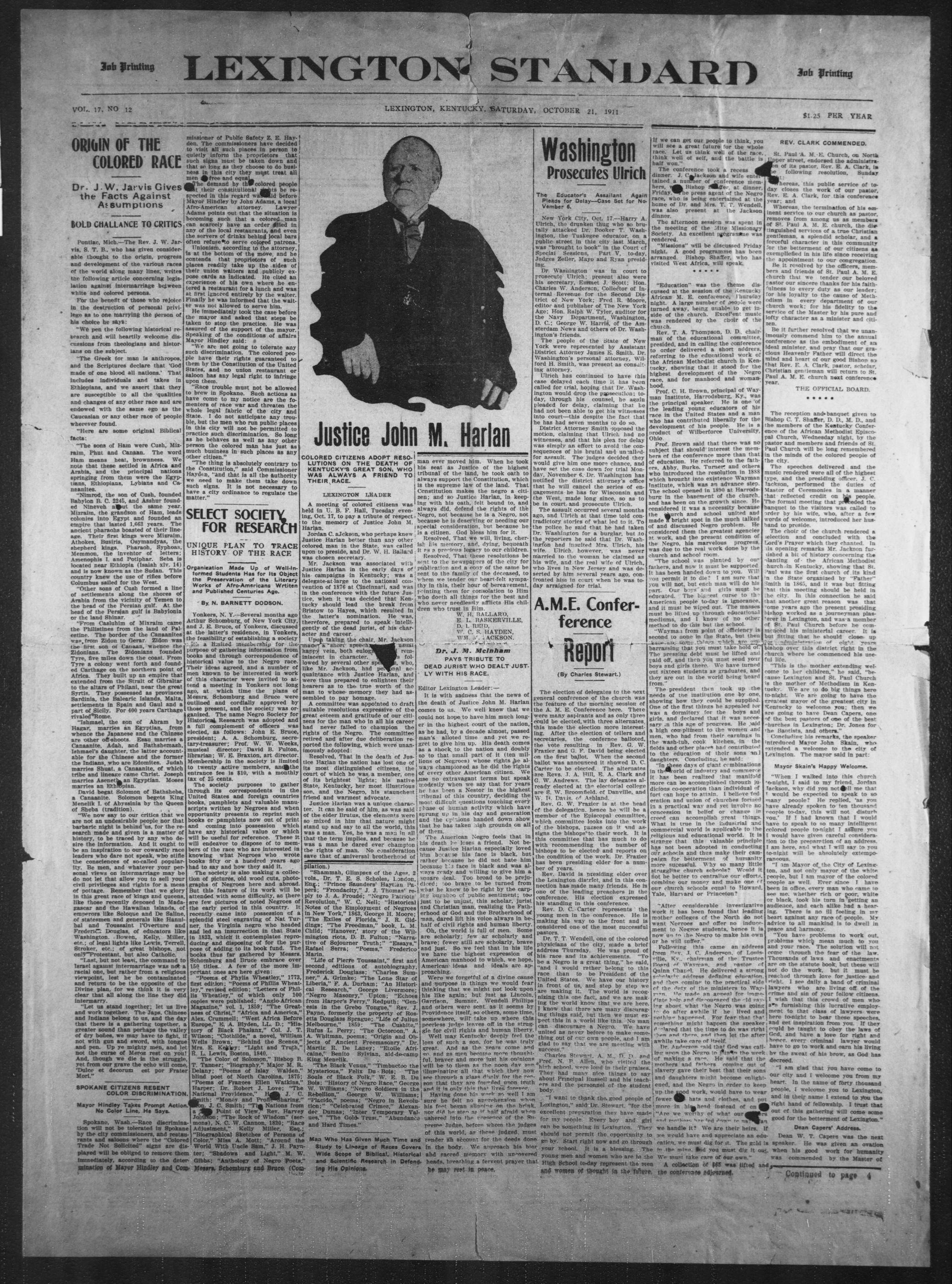
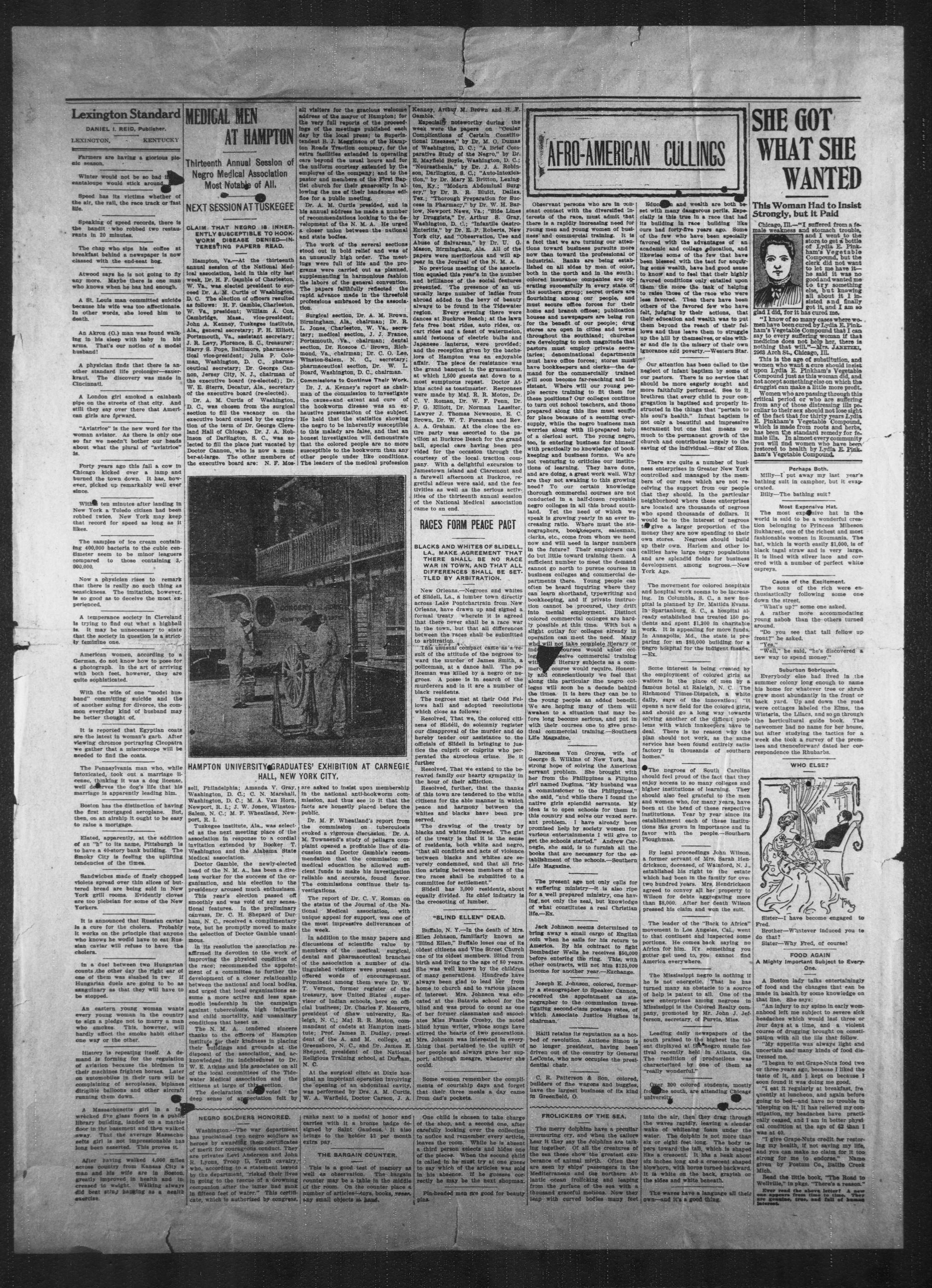
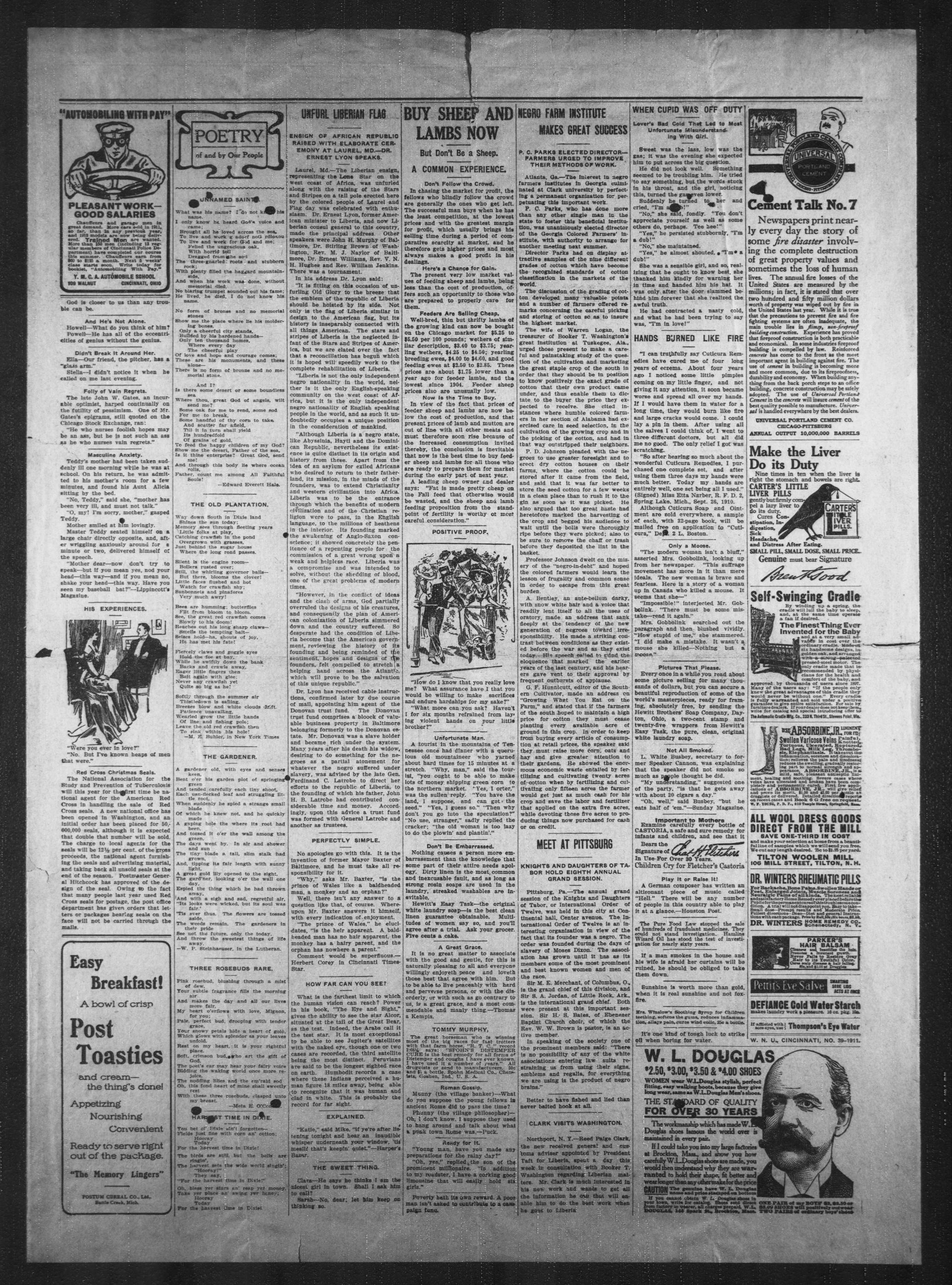
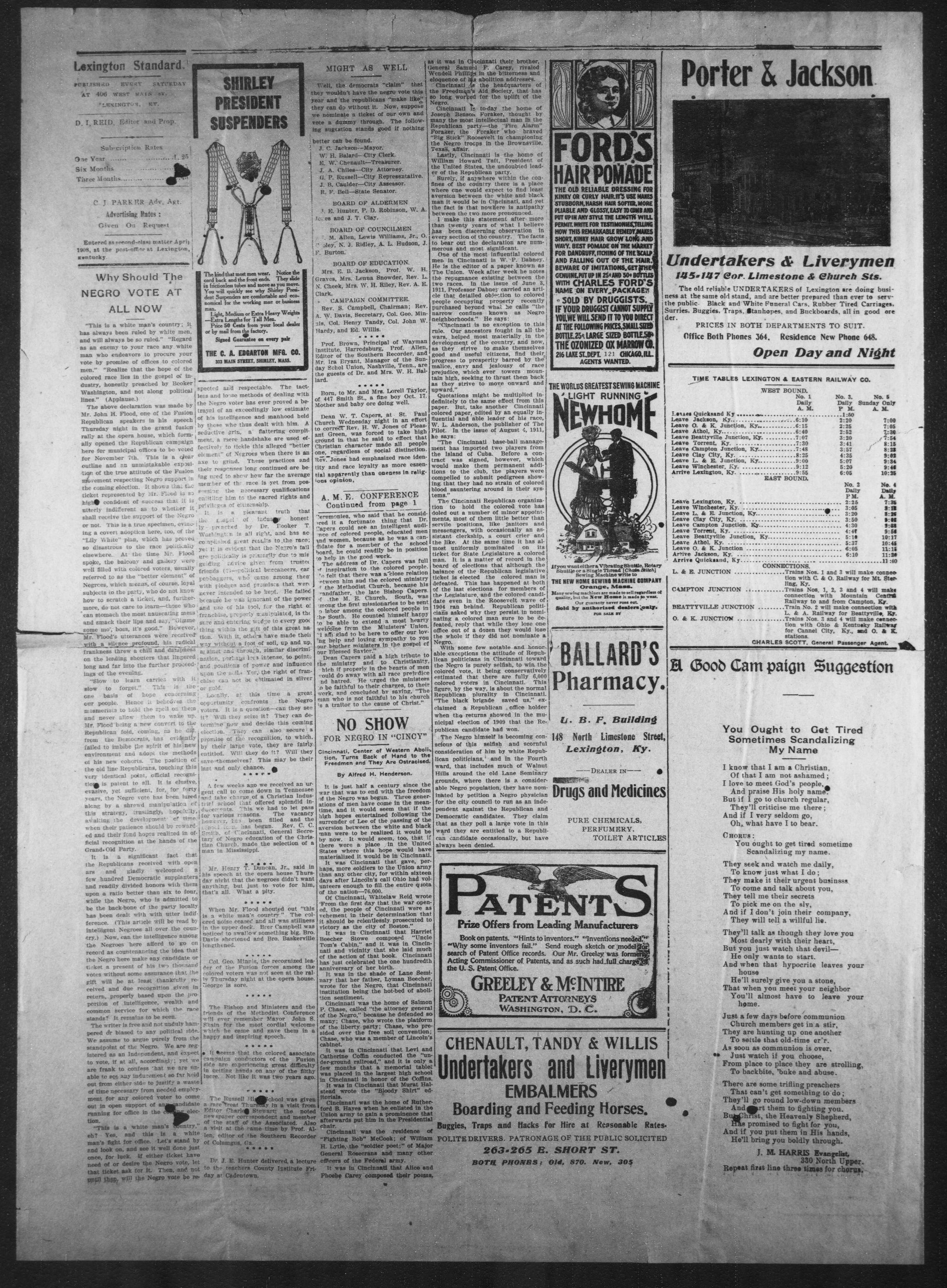
Page text (machine-generated)
Job Printing
VOL.17.NO12
ORIGIN OF THE COLORED RACE
Dr. J.W. Jarvis Gives the Facts Against Assumptions
BOLD CHALLANCE TO CRITICS
Pontiac, Mich.-The Rev. J. W. Jarvis, S. T. B., who has given considerable thought to the origin, progress and development of the various races of the world along many lines, writes the following article concerning legislation against intermarriage between white and colored persons.
For the benefit of those who rejoice in the destruction of personal privilege as to one marrying the person of his choice he says:
"We pen the following historical research and will heartily welcome discussions from theologians and historians on the subject.
"The Greek for man is anthropos, and the Scriptures declare that 'God made of one blood all nations.' That includes individuals and takes in Ethiopians, and we assert that they are susceptible to all the qualities and changes of any other race and are endowed with the same ego as the Caucasian or any other race of people wherever found.
"Here are some original Biblical facts:
"The sons of Ham were Cush, Mizraim, Phut and Canaan. The word Ham means heat, brownness. We note that these settled in Africa and the principal nations springing from them were the Egyptians, Ethiopians, Lybians and Capyanes.
"Nimrod, the son of Cush, founded Babylon B. C. 2245, and Assurh founded Nineveh a bout the same year. Mizraim, the grandson of Ham, leads colonies into Egypt and founded an empire that lasted 1,663 years. The ancient pharaohs boasted of their lineage. Their first kings were Mizraim, the pharaoh of Egypt, and the shepherd kings, Pharaoh Syboas, Memmon, the inventor of letters; Amenophis I. and Potiphar. Seba is located near Ethiopia (Isaiah xlv. 14) and is now known as the Sudan. This country knew the use of rifles before Columbus sailed for the West. "Other sons of Cush formed a line of settlements along the shores of Arabia from the vicinity of Yemen to the coast of the Persian gulf is Babylonia or the land of Sharh."
From Casulhim of Mixrahim came the Philistines from the land of Palestine. The border of the Canaanites was, from Zidon to Gerid. Zidon was the first son of Canaan, whence the Zidonians. The Zidonians founded a man-made city called Tyre, a colony went forth and founded Carthage on the northern point of Africa. They built up an empire that extended from the Strait of Gibraltar to the altars of Philani, near the great Syrtis. They possessed as provinces Sardinia, the Balearic Islands, Malta, settlements in Spain and Gaul and a part of Sicily. For 400 years Carthage rivaled Rome. For 400 years Carthage the son of Abram by Hagar, marries an Egyptian, from whence the Egyptian and the Chinese are other off-shoots. Esau marries a Canaanite, Adah, and Bathshemah, ishmael's daughter, the latter accountable for the Chinese and the former the Indians, who are Edomites. Judah marries Shuat, a Canaanite, of which tribe and came Christ. Joseph marries Asmethi the Egyptian. Moses marries an Ephrih.
David begat Solomon of Bathsheba, a Canaanite. Solomon begets King Menelik I. of Abysinia by the Queen of Sheba (tradition).
"We now say to our critics that we are not an undesirable people nor that barbaric night and given is a matter of history, to be traced by any who desire the information. And it ought to be an inspiration to our cowardly race leaders who dare not speak, who stifle the consciences of so-called popularity. Be men, and whatever your personal views on intermarriage may be do not let that allow you to sell your souls to the enemy of pottage. Remember that we glory in this great race of kings and queens like those recently deposed in Madagascar and the Hawaiian islands, of emperors like Soloque and De Dalline, of statesmen and generals like Hammal and Toussaint 'Overture and Frederic C. Douglas, of educators like Washington, Bowen Kelly, Miller and others, of generals like Stroker etc.; of great bishops, not only Protestant, but also Catholic.
"Last, but not least, the command to Israel against intermarriage was not a racial one, but rather from a religious viewpoint, lest he be contaminated and return to be the opposite of the Divine plan, for we think it is very clear that all along the line they did intermarry. We stand together; let us live and work together. The Jans, Chinese and Indians belong to us, and the day that there is a gathering together, a greater sound than perhaps the valley of dry bones, we may have to fight, not with gun and sword, with tongue and pen. Up ye mighten men, and let not the curse of Meroz rest on you. And, though we die in the struggle yet from our grave the echo will come "Dulce et decorum est por Frater Moll."
SPOKANE CITIZENS RESENT COLOR DISCRIMINATION
Mayor Hindley Takes Prompt Action
No Color Line, He says.
Spokane, Wash.—Race discrimination will not be tolerated in Spokane by the city commissioners, and restaurants and saloons where the "Colored Trade Not Sollicited" signs are displayed will be obliged to remove them immediately, according to the determination of Mayor Hindley and Com
LEXINGTON STANDARD
missioner of Public Safety Z. E. Hayden. The commissioners have decided to visit all such places in person to quietly inform the proprietors that such signs must be taken down and that so long as they choose to do business in this city they must treat all men free and equal. The demand by the colored people that their constitutional rights be respected in this regard will aid before Mayor Hindley by John Adams, a local Afro-American attorney. Lawyer John Bechtel, who strives becoming such that a colored man can scarcely have an order filled in any of the local restaurants, and even the servers of drinks behind local bars often refuse to serve colored patrons. Unionism, according to the attorney, is at the bottom of the move, and he contends that proprietors of such places readily take up the sides of their union waiters and publicly expose cards as indicated. He cited an experience of his own where he enforced a ban on lunch and was at first ignored entirely by the waiter. Finally he was informed that the waiter was not allowed to serve him.
He immediately took the case before the mayor and asked that steps be taken to stop the practice. He was assured of the support of the mayor. Speaking of the conditions of affairs Mayor Hindley said: $\textcircled{1}$ "We are not going to tolerate any such discrimination. The colored people their rights guaranteed to them by the constitution of the United States, and in union restaurant or saloon has any legal right to infringe upon them." "Race trouble must not be allowed to brew in Spokane. Such actions as have come to my notice are the fomenters of race war and threaten the whole legal fabric of the city and State. I do not anticipate any trouble, but the men who run public places this city will not be permitted to practise such discrimination. So long as he believes as any other person the colored man has just as much business in such places as any other citizen."
"The thing is absolutely contrary to the Constitution," said Commissioner Hayden, "and that is all the authority we need to make them take down such legislation. It is not necessary to have a city ordinance to regulate the matter."
SELECT SOCIETY FOR RESEARCH
SELECT SOCIETY FOR RESEARCH
UNIQUE PLAN TO TRACE
HISTORY OF THE RACE
Organization Made Up of Well-in-
formed Students Has for its Object
the Preservation of the Literary
Works of Afro-Americans Written
and Published Centuries Ago.
By N. BARNETT DODSON.
Yonkers, N. Y.-Several months ago Arthur Schomburg, of New York City, and J. E. Bruce, of Yonkers, discussed at the latter's residence, in Yonkers, the feasibility of establishing a society in a Limited membership for the benefit of the information books and through correspondence of historical value to the Negro race. Their ideas agreed, and a number of men known to be interested in work of this character were invited to attend a meeting in Yonkers not long ago, at which time the plans of Messrs. Schomburg and Bruce were outlined and cordially discussed by several members of the society was organized. The name Negro Society for Historical Research was adopted and a full complement of officers was elected, as follows: John E. Bruce president; A. A. Schomburg, secret tire-treasurer; Prof. W. W. Weeks musical director; David B. Fulton librarian; W. E. Braxon, art director; W. E. Braxon, art director; twenty active members, and the entrance fee is $10, with a monthly tax of 25 cents.
The society purposes to gather through its correspondents in the United States and foreign countries books, pamphlets and valuable manuscripts written by Negroes and when opportunity presents to reprint such books or pamphlets now out of print and coming into possession which have any historical value or which will be useful for reference. These it will be able to devise clever names of bers of race who are interested in knowing what Negroes who wrote books fifty or a hundred years ago had to say and how they said it.
The society is also making a collection of pictures, old wood cuts, photographs of Negroes here and abroad. But this feature of its work will be attended with some difficulty, as there are few pictures of noted Negroes of the past. The Negroes recently came into possession of a splendid steel engraving of Nat Turner, the Virginia negro who headed and led an insurrection in that State in 1833, which it contemplates reproducing and disposing of for the purpose of adding to its book fund. The books thus far gathered by Messrs. Schomburg and Bruce enabove over 100 years, the more important areas are here given:
"Poems of Phyllis Wheatley," 1773, first edition; "Poems of Phyllis Wheatley," revised edition; "Letters of Phyllis Wheatley," of which only 100 copies were published; "Miggo-Green of Christ," 1858; "Miggo-Green of Christ," "Africa and America," Alex. Crummler; "West Africa Before Europe," A. E. Blyden, LL D.; "History of Black Phalanx," Col. J. T. Wilson; "Clothilde," a novel, William T. Wilson; "The Scenes," Mr. E. Kekey, "Light and Truth," R. L. Lewis, Boston, 1840.
"The Color of Solomon," Bishop B. T. Banner; "Biography," Major M. R. Delany; "Poems of Islay Walden," blind poet of North Carolina, 1875; "Poems of Frances Ellen Watkins," Harper's New York; "Poems of the National Providence," Heard J. S. Smith; "Money and Profit sharing," Con. J. C. Smith; "The Nations from a Point of View, Rev. Harvey Johnson; "The Rock of Wisdom" (sermons), N. C. W. Cannon, 1820; "Race Adjustment," Kelly Miller, Esq.; "Biographical Sketches of Persons of Color," Miss A. Mott; "Around the World With Uncle Sam," J. H. Payter; "Shadows and Light," M. W. Gibbs; "Anthology of Negro Poets," Messrs. Schomburg and Brouse (Com
LEXINGTON, KENTUCKY, SATURDAY, OCTOBER 21, 1911
1930
Justice John M. Harlan
COLORED CITIZENES ADOPT RESOLUTIONS ON THE DEATH OF
A GREAT SON, WHO
WAS ALWAYS A FRIEND TO
THEIR RACE.
LEXINGTON LEADER
A meeting of colored citizens was held in U. B. F. Hall, Tuesday evening, Oct. 17, to pay a tribute of respect to the memory of Justice John M. Harlan.
Jordan C. aJckson, who perhaps knew Justice Harlan better than any other colored man in the State, was called upon to preside, and Dr. W. H. Ballard was chosen secretary.
Mr. Jackson was associated with Justice Harlan in the early days of his campaigns in Kentucky; was a delegate-at-large to the national convention of 1876 at Cincinnati, and was in the conference with the future Justice Harlan. He decided that Kentucky should lead the break from Bristow to Hayes, which resulted in the latter's nomination. He was, therefore, prepared to speak 'intelligently of the dead jurist, of his character and career.
Upon taking the chair, Mr. Jackson made a short speech, usually happy vein, both euploring and reminiscent in character. He was followed by several other speeches, who, like Mr. Jackson, had personal acquaintance with Justice Harlan, and were thus prepared to enlighten their work and worth of the man to whose memory they had assembled to pay homage.
A committee was appointed to draft suitable resolutions expressive of the great esteem and gratitude of our citizens for the man who in all his career had never failed to champion the rights of the Negro. The committee retired and after due deliberation reported the following, which were unanimously adopted:
Resolved, That in the death of Justice Harlan the nation has lost one of its brightest citizens, the court of which he was a member of its brightest lights: his native State, Kentucky, her most illustrious son, and the Negro, his staunchest friend and warmest advocate.
Justice Harlan was a unique character. It can be said of him, as was said of the elder Brutus, the elements were so mixed in him that nature might stand up and say to all the world, this was a man. Yes, he was a man in all forms, from torture and punishment, was a man he dared ever champion the rights of man. No consideration save that of universal brotherhood of piliation.
Shamahm, Glimpsees of the Ages, 2 vols. T. E. S. Scholes,ington, Eng.; "Prince Saunders, Petitioners;" Frondacty, "J. J. Thomas" reply to J. A. Froude; "Negro Patriots Revolution," W. C. Nell; "Historical Notes of the Employment of Negroes in New York," 1863, George H. Moore; "The Exiles of Florida," J. R. Gildings; "The Freedman," book, L. M. Child; "Hanover," story of the Wilhelmine, "The Archaeological narrative of Sojourner Truth," "Essay," Rafael Serra; "Poems," Frederico Marin.
"Life of Pierce Toussaint," first and second editions of autobiography, Frederick Douglass; "Charles Sumner," A. Grimke; "The Lone Star of Liberia," F. A. Durham; "An Historian," R. A. Durham; "A Vermore; 'Negro Mason,' Option from Harper's Ferry," Redputh; "Genesis in the Grebe Tongue," Rev. J. Payne, formerly the property of Rosetta Douglass Sprague; "Life of Julius Melbourne," 1859; "The Cushite," Rufus L. Perry; "The Octoctoro," A. Human, poems; "Origin and Objects of History," Martírg R. De Laney; "Etoile Africaine," Benito Sylvain, alde-de-camp King Menelik.
"The Black Venus," "Timbutoo the Mysterious," Felix Du Bols; "The Souls of Black Folk," W. E. B. Du Fougain, poems of Negrapta, George W. William, Negro Soldiers in the Rebellion," George W. Williams; "Piccado, poems," Negro in Revolution; "Celebrated Crimes," Alexander Dumas; "Inter Temporary Values," "The Gold Trust," "Abundance and Hard Times."
Maa Who Haa Given Much Time and Study to Lineage of Races Covers Wide Scope of Biblical, Historical and Scientific Research in Defend Ing His Opinions.
man ever moved him. When he took his seat as Justice of the highest tribunal of the land, he took oath to always support the Constitution, which is the supreme law of the land. That Constitution makes the negro a citizen; and so Justice Harlan, in keeping with his oath, felt bound to, and always did, defend the rights of the Negro, not because he is a Negro, not because he is deserving or needing our special assistance because he is a God bless him, for it is God bless him. Resolved. That we will living, cherish his memory, and, dying, bequeath it as a precious legacy to our children. Resolved. That these resolutions be sent to the newspapers of the city for publication and a copy of the same be sent to the family of the deceased, to whom we tender our heart-felt sympathy in this, their hour of bereavement, painting them for consolation to Him. Resolved. That we will never needlessly afflicts His children who trust in Him.
PATS TRIBUTE TO DEAD JURIST WHO DEALT JUSTLY WITH HIS RACE.
Editor Lexington Leader:—
It is with sadness that the news of the death of Justice John M. Harlan comes to us. We well know that we could not hope to have him much longer in the highest court of the nation, as he had, by a decade almost, passed man's allotted time and yet we regret to give him up. His death comes as a shock to the nation and doubly so to that small part of it (ten millions of Negroes) whose rights he always championed as he did the rights of every other American citizen. We use no extravagant terms but speak modestly when we say that for years he has been a Nestor in the highest tribunal of this country, deciding the most difficult questions touching every phase of human activity which have coming up in his day and generation and the opinions handed down show that he has taken high grounds on all of them.
The American Negro feels that in his death he loses a friend. Not because Justice Harian especially loved him because his face is black, but rather because he did not hate him because his face is black and was always ready and willing to give him a square deal. Too broad to be proper, he brave to be turned from what he know to be right by the carpit bugbush of public sentiment; too just to be unjust, this scholar, jurist and Christian man, realizing the Fatherhood of God and the Brotherhood of man, dared lift his voice always in behalf of civil rights and human liberty. Oh, the world is full of men. Some are scholarly; few are scholarly and brave; fewer still are scholarly, brave and just. So we feel that in his life American manhood to which, we hope American ideas and ideals are an approaching.
Were we forgetful of a divine cause and purpose in things we would fear thinking that we might not look upon his like again; but just as Lincoln, Garrison, Sumner, Wendell Phillips and others were sent, as it seems by Providence itself, so we can take up where this peerless judge leaves off in the struggle for civil rights and human liberty. Well may Kentucky deeply feel the loss of such a son, for he was truly great. And as the years come and so, and as men become more thoughtful, braver and more just his opinions will be to them as the moon day son and the sun day son, we see through a glass duly for the rest son that they are founded upon truth and it is only this that lives forever.
Having done his work so well I am sure he felt no aprehension when his feet began sliding on the brink, nor did he sit in the water unheshed into the presence of the Supreme Judge, before whom the judges of this world, as these judged, must render an account for the deeds done in the body. We approach his bier and sacred memory with uncovered heads, breathing a fervent prayer that he may rest in peace.
Washington Prosecutes Ulrich
The Educator's Assailant Again
Pleads for Delay - Case Set for No
November 6.
New York City, Oct. 17.—Harry A.
Ulrich, the drunken thug who so brutally attacked Dr. Booker T. W.
ington, the Tuskegee educator, on a public street in this city last March,
the department to book" in the Court of
Specialist Sections, Part V. to-day,
Judges Zeller, Mayo and Ryan presiding.
Dr. Washington was in court to prosecute Ulrich; present also were his secretary, Emmet J. Scott; Hon. Charles W. Anderson, Collector of Internal Revenue for the Second Dispute of New York; Fred R. Moore, editor and author of The New York Age; Hon. Ralph W. Tylier, auditor for the Navy Department, Washington, D. C.; George W. Harris, of the Amsterdam News and others of Dr. Washington's friends.
The people of the State of New York were represented by Assistant Attorney James E. Smith. Dr. Washington's personal attorney, Willford H. Smith, was present as consulting attorney.
Ulrich has continued to have this case delayed each time it has been called for trial, hoping that Dr. Washington would drop the prosecution; today, through his counsel, he again pleaded for delay, claiming that he had been wrongfully accused into court—this despite the fact that he has had seven months to do so.
District Attorney Smith opposed the motion, claiming that Ulrich had no witnesses, and that his plea for delay was simply an effort to avoid the consequences of his brutal and unlawful assault. The judges decided they would give him one more chance, and have set the case down for trial Monday. November 6. Dr. Washington has sent the attorney's office that he will cancel the proceedings of engagements he has for Wisconsin and the West, made long since, as so as to be in court and prosecute Ulrich. The assault occurred several months ago, and Ulrich at that told contradictory stories of what led to it. To the police he said that he had taken Dr. Washington for a burglar, but to the reporters he said that Dr. Washington had insulted Mrs. Ulrich, his wife. Ulrich however, was never convicted, a woman claimed as his wife, and the wife of his mother who lives in New Jersey and was deserted by him several years ago, confronted him in court when he was today arraigned for trial.
A.M.E. Confer-
ference
Report
(By Charles Stewart.)
The election of delegates to the next general conference of the church was the feature of the morning session of the A. M. E. Conference here. There were many aspirants and as only three could be elected, with three alternates, this made the election more interesting. After the election of tellers and secretaries, the conference balloted, the vote resulting in Rev. G. W. Frazier and G. F. David being elected on the first ballot. When the second ballot was announced it showed D. C. Armstrong to be elected to serve as Rev. A. H. Hill, E. I. Clark and G. W. Andrews. The lay delegates already elected at the electoral college are S. W. Broomfield, of Danville, and W. D. Davis, of Ashland.
Rev. G. W. Frazier is at the head of the delegation, hence he will be a member of the Episcopal committee, which committee looks into the work of the bishops, passes on it and assigns the bishops' to their work. It is this committee that has much to do with recommending the number of bishops to be elected and reports on the condition of the work. Dr Frazier has been presiding elder for a number of years.
Rev. David is presiding elder over the Lexington district, and in this connection has made many friends. He is one of the leading preachers in the region. His election expressed his standing in this conference.
Rev. D. C. Carter represents the young men in the conference. He is making his way to the front and is considered one of the most successful pastors.
Dr. T. T. Wendell, one of the colored physicians of the city, made a brief address Thursday. He was proud of his race and its achievements. "To be a Negro is a great thing," he said, "and I would rather belong to this country to be President of the United States. We have our history in front of us, and step by step we are making it. The world is recognizing this one fact, and we are making the world know that we are here. I know that there are many disagrucing things said, but then we must exert ourselves to be president so man can discourage a Negro. We united as never before to make something out of our own people, and I am glad to say that we are meeting with success." Charles Stewart, A. M., D. D. and Prof. N. P. Allen, who visited the city many years ago were loud in their praises. They had manners and had respect. About Principal Russell and his teachers and the personnel of the student body.
"I want to thank the good people of Lexington," said Dr. Stewart. "For the excellent preparation they have made for my people. Every boy and girl can be something in Lexington. They should not permit the opportunity to go by. Start right now and go through your school. It is a blessing. The young men and women who are in the High School to-day represent the men and women of thought in the future."
If we can get our people to think, you will see a great future for the whole race. Let us think well of the race, think well of self, and the battle is half won."
The conference took a recess dinner. J. C. Jackson and wife entainment minister of conference members, ww. Bishop Shaffer, at Friday. The press agent of the Negro race, who is being entertained at the home of Dr. and Mrs. T. T. Wendell, was also present at the Jackson dinner.
The afternoon session was spent in the meeting of the Mite Missionary Society. An excellent programme was rendered. "Missions" will be discussed Friday night. A good programme has been arranged. Bishop Shaffer, who has visited West Africa, will speak.
"Education" was the theme discussed at the session of the Kentucky African M. E. confrence, Thursday night. A large number of people were turned away, being unable to get inside of the church. Excelent music was rendered by the choir of the church. Rev. T. A. Thompson, D. D. chairman of the educational committee, presided, and in calling the conference to order delivered a short address, referring to the educational work of the African Methodist church in Kentucky, showing that it stood for the highest development of the legal race and for manhood and womanhood. Prof. C. H. Brown, principal of Wayman Institute, Harrodsburg, Ky., was the principal speaker. He is one of the leading young educators of his race in the United States and a man who has contributed liberally to the development of his people. He is a product of Wilberforce University,
Prof. Brown said that there was no subject that should interest the members of the conference more than that of education. He referred to the fathers, Abby, Burke, Turner, and others who introduced the resolution in 1888 which brought into existence a institute which was to be step. Since step, it became in 1890 at Harrodsbury in the basement of the church, and has been on the growth since. He considered it was a necessity because the church and school united and made a bright spot in the much talked of and discussed Negro problem. He considered them the greatest agencies at work, and the present condition of the Negro, his marvelous progress, was done by the church and school room.
"The school was planted by our fathers, and now it must be supported. It has been handed down to you. Will you permit it to die? I am sure that you will not, but each man will do his part. Our boys and girls must be educated. The biggest curse to the American people is that they wiped out. The masses must be lifted up through educational mediums, and I know of no other method to do this but the school. "Wayman from point of efficiency is second to none in the State, but then there are some things which are amurbarring that you must take hold of. The pressing debt must be lifted and paid off, and then you must send your boys and girls to the university armed with our in the world heard by them."
The president then took up the needs of the institution one by one, showing how they could be supplied. One of the first things he appealed for was a dormitory for the boys and girls, and declared that it was necessary in this age of progress. He said a high compliment to the women and men, who had been work kitchen, in the fields and other places had contributed to the education of their sons and daughters. Concluding he said:
"In these days of giant combinations in the world of industry and commerce it has been realized that manifold more can be accomplished through judicious co-operation than individual of fort can hope to attain. I believe tedication and union are necessary and yet involve no concession in belief or change in creed can accomplish great things. What is true in the industrial and commercial world is applicable to the religious and educational world. It is strange that this valuable principle has not been adopted in conducting our schools and thus make their campaign for betterment of humanity more successful. Why so many little struggling church schools? Would it not be better to centralize our efforts, combine our money and make one of our church schools equal to Howard, Yale, Harvard or Princeton?
"After considerable investigative work it has been found that leading mother colleges of the North do not have the necessary ment to Nacreo students, hence it is now up to the Negro to make his own or he will suffer."
Following this came an address from Rev. J. C. Anderson, of Louisville, KY, chairman of the Trustee Board of Wayman, and pastor of Quinn Chapel. He delivered a strong scholarly address defining education, and then coming to the practical side of the duty of the ministers to Wayman. He made an appeal for immediate help and discouraged the old saying about what the Negro was going to do after whiff if he lived and nothing happened. For fear that that something might happen the speaker armed the time to do was right there, then there, and let the after awake take care of itself.
Dr. Anderson said that God was calling upon the Negro to join the work of making a race. He said that the mothers and fathers coming out of slavery gave their best that their sons and daughters might become enlightened, and the Negro in order to keep
and mothers, how led down to us, can we handle it? We are their heirs. If we would have and appreciate an education, we must dig for it. The gold is in the mine, and you must dig it out. We must take care of our own."
A collection of $65 was lifted and the conference adjourned.
Job Printing
$1.25 PER YEAR
REV. CLARK COMMENDED.
St. Paul A. M. E. Church, on North Upper street, endorsed the administration of its pastor, Rev. E. A. Clark, in the following resolution, Sunday night:
Whereas, this public service of today closes the work of our pastor, Rev. E. A. Clark, for this conference year; and
Whereas, the termination of his sentient service to our church as pastor, removes from among us as member of St. Paul A. M. E. church, the distinguished services of a true Christian gentleman, a splendid scholar, and a forceful character in this community for the betterment of our citizens as exemplified in his life since receiving the appointment to our congregation.
Be it resolved by the officers, members and friends of St. Paul A. M. E. church that we tender our beloved pastor our sincere thanks for his faithfulness to every duty as our leader; to his loyalty to the cause of Methodism in the betterment of our church work; for his dedication to the service of the Master by his pure and lofty character as a minister and citizen.
Be it further resolved that we unanimously commend him to the annual conference as the embodiment of our gracious Heavenly Father will dispense mind and heart of our good Bishon so that Rev E. A. Clark, pastor, scholar, Christian gentleman will return to St. Paul A. M. E. church next conference.
THE OFFICIAL BOARD
The reception and banquet given to Bishop C. T. Shaffer, D. D., M. D., and the members of the Kentucky Conference of the African Methodist Episcopal Church, Wednesday night, by the pastor and members and friends of St. Paul Church will be long remembered among the colored people of the city. The speeches delivered and the music rendered were all of the highest type, and the presiding officer, J. C. Jackson, performed the duties of Master of Ceremonies in a manner that reflected credit on his people. The formal meeting that preceded the banquet to the visitors was called to order by a few words of welcome, introduced her husband to preside.
The choir of the church rendered a selection and concluded with the Lord's Prayer which they chanted. In its opening remarks Mr. Jackson furnished a bit of history concerning the church in Kentucky, showing that St. Paul was the first church of its kind in the State organized by "Father" Smith in 1865, and it was but fitting that this meeting should be held in the city. In this connection he said that another great reason was that the pastor of the church worked as a journeyman plasterer in Lexington, and was a member of St. Paul Church before he commenced his ministerial career. It is but fitting that he should close up his administration of eight years before he commenced the night in the church where he commenced his useful life.
"This is the mother extending welcome to her children," he said, "because Lexington and St. Paul Church is the mother of Methodism in Kentucky. We are to do big things here in Kentucky, and we are the greatest mayor of the greatest city in Kentucky to welcome you; then we are going to have Dean Capers, one of the best pastors of one of the best churches in Lexington; Dr. Jones for the Bantists, and others." Uncluding his remarks, the speaker introduced Skain, who extended a welcome to the city of Lexington. The mayor said in part:
Mayor Skain's Happy Welcome.
"When I walked into this church to-night, I said to my friend, Jordan Jackson, why did you not tell me that I would be expected to speak to so many people? He replied, 'as you have already spoken to ten thousand people, you will tell me you'." If I had known that I would have to speak to so many intelligent colored people to-night I assure you I would have given careful consideration to the preparation of an address. I am here, and what I will say to you to-night will be absolutely extemporeous. Mayor of the City of Lexington, and not only mayor of the white people, but I am mayor of the colored people as well. Ever since I have been in office, every man who came to see me, whether rich or poor, white or black, took his turn in getting an audience, and each alike had a heartbeat against any race of people. My advice to all mankind is to dwell in peace and harmony.
"You have problems to work out, problems which mean much to you and your race. The solution will not come through the fear of the law. Thousands of laws and enactments are on the statute book, but these will never reach through love for justice and right. I see daily a band of criminal lawyers who are living off of the crime and sin of your fellow citizens. I wish that this crowd of men who are furnishing this lucrative employment to that class of lawyers were also to heat these speeches, and set inspiration from you. If they could be taught to obey the laws of God, and have a love for right and honor, every criminal lawyer would have to go to work and earn his living by the sweat of his brow, as God has decreed.
"I am glad that you have come to our city and I welcome you from my heart. In the name of forty thousand people, I welcome you to Lexington, and in their name I extend to you the right hand of fellowship. I trust that out of this gathering will come some good for the betterment of Lexington." Dean Capers' Address. Dean W. T. Capers was the next speaker. He was given an ovation when his good work for humanity was commended by the Master of
Continued to page 4
Lexington Standard
LEXINGTON, KENTUCKY
Farmers are having a glorious picnic season.
Winter would not be so bad if cantaloupe would stick around.
Speed has its victims whether of the air, the rail, the race track or fast life.
Speaking of speed records, there is the bandit who robbed two restaurants in 20 minutes.
The chap who sips his coffee at breakfast behind a newspaper is now classed with the end-seat hog.
Atwood says he is not going to fly any more. Maybe there is one man who knows when he has had enough.
A St. Louis man committed suicide because his wife was too affectionate. In other words, she loved him to death.
An Akron (O.) man was found walking in his sleep with baby in his arms. That's our notion of a model husband!
A physician finds that there is another standard life prolonger—sauerkraut. The discovery was made in Cincinnati.
A London girl smoked a calabash pipe on the streets of that city. And still they say over there that American girls are forward.
"Aviatrice" is the new word for the woman aviator. As there is only one so far we needn't bother our heads about what the plural of "aviatrice" is.
Forty years ago this fall a cow in Chicago kicked over a lamp and burned the town down. It has, however, picked up remarkably well ever since.
With ten minutes after landing in New York a Toledo citizen had been robbed twice. New York may keep that record for speed as long as it likes.
The samples of ice cream containing 400,000 bacteria to the cubic centimeter seem to be minor leaguers compared to those containing 3,000,000.
Now a physician rises to remark that there is really no such thing as seasickness. The imitation, however, is so good as to deceive the most experienced.
A temperance society in Cleveland is trying to find out what a highball is. It may be unnecessary to state that the society in question is a strictly feminine one.
American women, according to a German, do not know how to pose for a photograph. In the art of arriving with both feet, however, they are quite sophisticated.
With the wife of one "model husband" committing suicide and the of another suing for divorce, the common everyday kind of husband may be better thought of.
It is reported that Egyptian coats are the latest in woman's garb. After viewing chromosomes portraying Cleopatra we gather that a microscope will be needed to find the coats.
The Pennsylvania man who, while intoxicated, took out a marriage license, thinking it was a dog license, well deserves the dog's life that his marriage is apparently leading him.
Boston has the distinction of having the first mortgaged airplane. But, then, on an alrship it ought to be easy to raise a mortgage.
Elated, apparently, at the addition of an "h" to its name, Pittsburgh is to have a 40-story bank building. The Smoky City is feeling the uplifting tendencies of the times.
Sandwiches made of finely chopped violets spread over thin slices of buttered bread are being sold in New York grill rooms. Evidently cloves are too piebelian for some of the New Yorkers.
It is announced that Russian caviar is a cure for the cholera. Probably it works on the principle that anyone who knows he would have to eat Russian caviar will refuse to have the cholera.
In a duel between two Hungarian counts the other day the right ear of one of them was slashed in twc. If Hungarian duels are going to be as sanguinary as that they will have to be stopped.
An eastern young woman wants every young woman in the country to sign a pledge not to marry a man who smokes. This, however, will hardly affect the smoke habit either one way or the other.
History is repeating itself. A demand is forming for the regulation of aviation because the birdmen in their machines frighten horses. Later on automobiles in their turn will be complaining of aeroplanes, biplanes dirigible balloons and other aircraft running them down.
A Massachusetts girl in a fast-wrecked five glass floors in a public library building, landed on a marble floor in the basement and then walked away. That the average Massachusetts girl is not impressionable has long been asserted. This proves it.
After having walked 4,000 miles across country from Kansas City a man and his wife are in Boston, greatly improved in health and increased in weight. Walking always did best strap hanging as a health exercise.
CONGRESS JOURNAL
new rope and yarn
HAMPTON UNIVERSITY GRADUATES' EXHIBITION AT CARNEGIE HALL, NEW YORK CITY.
Thirteenth Annual Session of Negro Medical Association Most Notable of All.
CLAIM THAT NEGRO IS INNER-
ENTLY BUSCETIBLE TO HOOK-
WORM DISEASE DENIED—IN-
TERESTING PAPERS READ.
Hampton, Va.-At the thirteenth annual session of the National Medical association, held in this city last week, Dr. H. F. Gambie of Charleston, W. Va., was elected president to succeed Dr. A. M. Curtis of Washington, D. C. The election of officers resulted as follows: H. F. Gambie, Charleston, W. Va., president; William A. Cox Cambridge, Mass., vice-president; John A. Kenney, Tuskegee institute, Ala., general secretary; F. H. Elliott Portsmouth, Va., assistant secretary; J. H. Levy, Florence, S. C., treasurer; John A. Kenney, Tuskegee institute, general secretary; P. Coleman, Washington, D. C., pharma ceutical secretary; Dr. George Cannon, Jersey City, N. J., chairman of the executive board (re-elected); Dr W. E. Sterrs, Decatur, Ala., secretary of the executive board (re-elected).
Dr. A. M. Curtis of Washington, D. C. was chosen from the surgical section to fill the vacancy on the executive board caused by the expiration of the term of Dr. George Cleveland Hall of Chicago. Dr. J. A. Robinson of Darlington, as was as session just vacant, just vacant, Doctor Cannon, who is now a member-at-large. The other members of the executive board are: N. F. Moss.
HAMPTON UNIVERSITY GRADUATE
HALL, NEW
sell, Philadelphia; Amanda V. Gray, Washington, D. C.; C. N. Marshall, Washington, D. C.; M. A. Van Horn, Newport, R. I.; J. W. Jones, Winston Salem, N. C.; M. F. Wheatland, Newport, R. I.
Tuskegee institute, Ala., was selected as the next meeting place of the association in response to a cordial invitation extended by Booker T. Washington and the Alabama State Medical association.
Doctor Gamble, the newly-elected head of the N. M. A., has been a tireless worker for the success of the organization, and his election to the presidency aroused much enthusiasm.
This year's election passed off smoothly and was void of any sensational features. In the preliminary round, C. H. Shepard of Durham, N. C. received a complimentary vote, but he promptly moved to make the selection of Doctor Gamble unanimant
In its resolution the association reaffirmed its devotion to the work of improving the physical condition of the race; recommended the appointment of a committee to further the development of a closer relationship between the national and local bodies, and urged that local organizations assume a more active and less spasmatic leadership in the campaign against tuberculosis, high infantile and child mortality, and unsanitary conditions that beset us.
The N. M. A. tendered sincere thanks to the officers of Hampton institute for their kindness in placing their buildings and grounds at the disposal of the association, and acknowledged its indebtedness to Dr. W. E. Atkins and his associates on all of the local committees of the Tidewater Medical association and the citizens at large of this section.
The declaration also voted the deep sense of appreciation felt by
NEGRO SOLDIERS HONORED.
Washington—The war department has proclaimed two negro soldiers as heroes by awarding them certificates of merit for courageous conduct. They are privates Levi Anderson and John R. Lyons, Troop D, Tenth cavalry, who, according to a statement issued by the department, "risked their lives in going to the rescue of a growing companion after the latter had sunk in fifteen feet of water." This certificate, which is authorized by congress,
all visitors for the gracious welcome address of the mayor of Hampton; for the very full reports of the proceedings of the meetings published each day by the local press; to Superintendent B. J. Mogginson of the Hampton Roads Tradesman company, for the extra facilities extended in operating cars beyond the usual hours and for the uniform courtesy extended by the employees of the company; and to the pastor and members of the First Baptist church for their generosity in allowing the use of their handmade edible candy to the pastor. Dr. A. M. Curtis presided, and in his annual address he made a number of recommendations looking to the development of the N. M. A. He urged a closer union between the national and state bodies.
The work of the several sections stood out in bold relief and was of an unusually high order. The meetings were full of life and the programs were carried out as planned, supplementing in harmonious fashion the labors of the general convention. The papers faithfully reflected the rapid advance made in the threefold professions embraced by the association.
Surgical section, Dr. A. M. Brown, Birmingham, Ala., chairman; Dr. R. L. Jones, Charleston, W. Va., secretary; medical section, J. J. France, Portsmouth, Va., chairman; dental section, Dr. Roscoe C. Brown, Richmond, Va., chairman; Dr. C. O. Lee, Winston-Salem, N. C., secretary; pharmaceutical section, Dr. W. L. Board, Washington, D. C., chairman.
Commissions to Continue Their Work.
Dr. J. A. Kenney's report as chairman of the commission to investigate the cause and extent and cure of the hookworm disease was an exhaustive presentation of the subject. He held that the statistics showing the negro to be inherently susceptible to this malady are false, and that an honest investigation will demonstrate that the colored people are no more susceptible to the hookworm than any other people under like conditions. The leaders of the medical profession
ATES' EXHIBITION AT CARNEGIE
YORK CITY.
are asked to insist upon membership in the national anti-hookworm commission, and thus see to it that the facts are honestly placed before the public.
Dr. M. F. Wheatland's report from the commission on tuberculosis evoked a vigorous discussion. Dr. A. M. Townsend's study of pellagra complaint opened a profitable line of discussion and Doctor Gamble's recommendation that the commission on medical education be allowed sufficient funds to make his investigation reliable and accurate, found favor. The commissions continue their investigations.
The report of Dr. C. V. Roman on the status of the Journal of the National Medical association, with unique appeal for support, was one of the most impressive deliverances of the week.
In addition to the many papers and discussions of scientific value by members of the medical, surgical, dental and pharmaceutical branches of the association a number of distinguished visitors were present and offered words of encouragement. Prominent among them were Dr. W. T. Vernon, former register of the treasury, now United States supervisor of Indian schools, here on official business; Dr. Charles F. Meserve, president of Shaw university, Raleigh, N. C.; Maj. R. R. Moton, commandant of cadets at Hampton institute; Prof. James B. Dudley, president of the A. and M. college, at Greensboro, N. C., and Dr. James E. Shepard, president of the National Religious Training school, at Durham, N. C.
At the surgical clinic at Dixie hospital an important operation involving the opening of an abdominal cavity, was performed by Drs. A. M. Curtis, W. A. Warfield, Doctor Carson, J. A.
ranks next to a medal of honor and
carries with it a bronze badge de-
signed by the late Alain Saunders. It also
brings to the helper $2 per month
extra pay.
THE BARGAIN COUNTER
This is a good test of memory as well as observation. The bargain counter may be a table in the middle of the room. On the counter place a number of articles toys, books, reser. any small objects at hand.
Kennedy, Arthur M. Brown and H. F.
Gamble.
Especially noteworthy during the week were the papers on "Ocular Complications of Certain Constitutional Diseases," by Dr. M. O. Dumas of Washington, D. C.; "A Brief Comparative Study of the Negro," by Dr. E. Mayfield Boyle, Washington, D. C.; "Neurasthenia," by Dr. J. A. Robinson, Darlington, S. C.; "Auto-intoxication," by Dr. Mary E. Britton, Lexington, Ky.; "Modern Abdominal Burry," by Dr. B. R. Bluitt, Dallas, Tex.; "Thorough Preparation for Success in Pharmacy," by Dr. W. H. Barlow, Newport News, a. a.; "Side Lines in the Washington, D. C.; "Infantile Gastro-Enteritis," by Dr. E. P. Roberts, New city, and "Observation, Use and Abuse of Salvarsan," by Dr. U. G. Mason, Birmingham, Ala. All of the papers were meritorious and will appear in the Journal of the N. M. A.
No previous meeting of the association equaled this year's in the number and brilliance of the social features presented. The presence of an unusually large number of ladies from abroad added to the bevy of beauty always to be found in the Tidewater region. Every evening there were dances at Buckroe Beach; at the lawn fete free boat rides, auto rides, ox cart rides and a feast of watermelon, amid festoons of electric bulbs and Japanese lanterns, were provided; and the reception given by the bachelors of Hampton was an enjoyable affair. The piece de resistance was the grand banquet in the gymnasium at which 1,500 guests sat down to a most sumptuous repast. Doctor Atkins acted as toastmaster. Responses were made by Maj. R. R. Moton, Dr. C. V. Roman, Dr. W. F. Penn, Dr. G. Elliott, Dr. Norman Lasister Lawyer J. Thomas Newsome, E. C Brown, Dr. W. T. Foreman and Rev A. Graham. At the close the entree was accorded to the villon at Buckroe Beach for the grand ball, special cars having been provided for the occasion through the courtesy of the local traction company. With a delightful excursion to Jamestown island and Claremont and a farewell afternoon at Buckroe, regretful adieu were said, and the festivities as well as the serious activities of the thirteenth annual session of the National Medical association came to an end.
RACES FORM PEACE PACT
BLACKS AND WHITES OF SLIDELL, LA., MAKE AGREEMENT THAT THERE SHALL BE NO RACE WAR IN TOWN, AND THAT ALL DIFFERENCES SHALL BE SETTLED BY ARBITRATION.
New Orleans—Negroes and whites of Slidell, La., a lumber town directly across Lake Pontchartrain from New Orleans, have drawn up and signed a formal treaty wherein it is agreed that there never shall be a race war in the town, but that all differences between the races shall be submitted to arbitration.
This unusual compact came as a result of the attitude of the negroes toward the murder of James Smith, a policeman, at a dance hall. The policeman was killed by a negro or negroes. A pose is in search of the murderers and in it are a number of black residents.
The negroes met at their Odd Fellows hall and adopted resolutions which close as follows:
Resolved, That we, the colored citizens of Slidell, do solemnly register our disapproval of the murder and do hereby tender our assistance to the officials of Slidell in bringing to justice the culprit or culpits who perverted the atrocious crime. Be it further
Resolved, That we extend to the beaved family our hearty sympathy in the hour of their affliction.
Resolved, further, that the thanks of this town are tendered to the white citizens for the able manner in which peace and harmony between the whites and blacks have been preserved.
"The drawing of the treaty by blacks and whites followed. The gist of the treaty is that it is the sense of residents, both white and negro, "that all conflicts and acts of violence between blacks and whites are severely condemned, and that all friction arising between members of the two races shall be submitted to a committee for settlement."
Sidell has 3,000 residents, about equally divided. Its chief industry is the creosoting of lumber.
"BLIND ELLEN" DEAD.
Buffalo, N. Y. — in the death of Mrs. Ellen Johnson, familiarly known as "Blind Ellen." Buffalo loses one of its oldest citizens and Vine Street Church one of its oldest members. Blind from birth and living to the age of 80 years. She was well known by the children of many generations. Hundreds have always been glad to lead her from home to church and to various places of interest. Mrs. Johnson was educated at the Batavia school for the blind and was proud to count as one of her former classmates and associates Miss Fannie Crosby, the noted blind hymn writer, whose songs have stirred the hearts of two generations. Mrs. Johnson was interested in everything that pertained to the uplift of her people and always gave her support, although meagre, whenever she could.
Some women remember the compliments of courtship days and forget that their three meals a day came from dad's pockets.
One child is chosen to take charge of the shop, and a second one, after carefully looking over the collection to notice and remember every article, leaves the room. While he is absent a third person selects and hides one of the pieces. When the second child is called in he must try at one guess to say which of the articles was sold in his absence. If he guesses correctly he may be the next shopman.
Pin-headed men are good for beauty ping.
AFRO-AMERICAN CULLINGS
Observant persons who are in constant contact with the diversified interests of the race, must admit that there is a rapidly increasing need for young men and young women of business and commercial training. It is a fact that we are turning our attentions toward business pursuits more now than toward the professional or industrial. Banks are being established on all sides by men of color, both in the north and in the south; colored insurance companies are operating successfully in every state of the southern group; secret orders are flourishing among our people, and must secure office forces for their home and branch offices; publication houses and newspapers are being run for the benefit of our people; drug stores are open in cities and towns throughout the southland; churches are developing to such magnitude that pastors must employ private secretaries for nominations and publications; houses must have bookkeepers and clerks—the demand for the commercially trained will soon become far-reaching and instant. Where will our young people secure training to tit them for these positions? Our colleges continue to turn out school teachers, and those prepared along this line must suffle for place because of a seeming oversupply, while the negro business man worries along with ill-prepared help of a classical sort. The young negro, too, is entering business for himself with practically no knowledge of bookkeeping and business forms. We have done, and are doing, a great work well. Why are they not awaking to this growing need? To our certain knowledge through commercial colleges are not conducted in a half-dozen reputable colleges in all this broad southland. Yet the need of which we speak is growing yearly in an ever increasing ratio. Where must the stenographers, bookkeepers, salesman, clerks, etc., come from whom we need now and will need in larger numbers in the future? Their employers can do but little toward training them. A sufficient number to meet the demand cannot go north to pursue courses in business colleges and commercial departments there. Young people can learn shorthand typewriting and bookkeeping, and if private instruction cannot be procured, they drift into mental employment. Distinct colored commercial colleges are hardly possible at this time. With but a slight outlay for colleges already in operation can meet the need. Many who will not take complete literary or indie courses would enter colleges, receive commercial training with literary subjects as a commercial course would require. Honestly and conscientiously we feel that along this particular line negro colleges will soon be a decade behind the times. It is here they can be to the young people an added benefit. We are hoping many of them will awaken to a situation that may be fore long become serious, and put in with their courses one to practical commercial training—Southern Life Magazine.
Baroness Von Groyes, wife of George S. Wilkins of New York, has strong hope of solving the American servant problem. She brought with her from the Philippines a Filipino girl named Dogima. "My husband was a commissioner to the Philippines," she said, "and while there I found the native girls splendid servants. My idea is to open schools for them in this country and solve our vexed servant problem. I have already been promised help by society women for various entertainments I will give to get the schools started." Andrew Carnegie, she said, is to furnish all the books that are necessary for the establishment of the schools. "Southern Life Magazine.
The present age not only calls for a suffering ministry; it is also ripe for a well prepared ministry, one having, not only the seal, but knowledge of what constitutes a real Christian life.—Ex.
Jack Johnson seems determined to bring away a small cargo of English coin when he sails for his return to America. By his contract to fight Bombadier Wells he receives $50,000 before entering the ring. This, with other contracts, will not him $125,000 income for another year—Exchange.
Joseph E. Johnson, colored, formerly a stenographer to Speaker Cannon, received the appointment as stenographer to the commission investigating second-class postage rates, of which Associate Justice Hughes is chairman.
Haiti retains its reputation as a hotbed of revolution. Antione Simon is no longer president, having been driven out of the country by General LeConte, who now occupies the presidential chair.
C. R. Patterson & Son, colored, builders of fine wagons and buggies, have the largest business of its kind in Greenfield, O.
The merry dolphine have a peculiar murmuring cry, and when the tailows hear it they say the dolphins are talking together. Of all the creatures of the sea these show the greatest exuberance of animal mirth. Often they are seen by ships' passengers in the Mediterranean and the northern Atlantic ocean frolicking and leaping from the surface of the sea with a thousand graceful motions. Now they leap with curved bodies many feet
Education and wealth are both beset with many dangerous perils. Especially is this true in a race that had its building in race building like ours had forty-five years ago. Some of the few who have been specially favored with the advantages of an academic and college education, and likewise some of the few that have been blessed with the tact for acquiring some wealth, have had good sense to know and to feel that their highly favored conditions only entailed upon them the more the task of helping to raise those of the race who were less favored. Then there have been others of the favored few who have felt, judging by their actions, that education and wealth was to put them education and the rest of the fellows and thus leave them to struggle up the hill by themselves, or else wither and die in the misery of their own ignorance and poverty.—Western Star.
Our attention has been called to the neglect of infant baptism by some of our pastors. There is no service that should be more eagerly sought and more faithfully performed. See to it brethren that every child in your congregation is baptised and properly instructed in the things that "pertain to his soul's health". Infant baptism is not only a beautiful and impressive sacrament but one that means so much to the permanent growth of the church and contribute largely to the saving of the individual—Star of Zion.
There are quite a number of business enterprises in Greater New York controlled and managed by the members of our race which are not receiving the support from our people that they should. In the particular neighborhood where these enterprises are located are thousands of negroes who spend thousands of dollars. It would be to the interest of negroes to give a larger proportion of the money they are now spending to their own stores. Negroes should build up their own. Harlem and other localities have large negro populations and are splendid fields for business development among negroes.—New York Age.
The movement for colored hospitals and hospital work seems to be increasing. In Columbia, S. C., a new hospital is planned by Dr. Matilda Evans. In Spartanburg, S. C., a hospital already established has treated 150 patients and spent $1,200 in charitable work. It is appealing for more funds. In Annapolis, Md., the state is preparing for an $80,000 building for a negro hospital for the indigent nausea. —Ex.
Some interest is being created by the employment of colored girls as waiters in the place of men by a famous hotel at Raleigh, N. C. The Richmond Times-Dispatch, a white daily, says of the innovation: "It opens a new field for the colored girls, and should go a long way towards solving another of the difficult problems with which inkeepers have to deal. There is no reason why the plan should not work, as the same service has been found entirely satisfactory in thousands of southern homes."
The negroes of South Carolina should feel proud of the fact that they enjoy access to so many colleges and higher institutions of learning. They should also feel grateful to the men and women who, for many years, have been at the head of these respective institutions. Year by year since its establishment each of these institutions has grown in importance and in favor with the people.—Southern Ploughman.
By legal proceedings John Wilson, a former servant of Mrs. Sarah Hendrickson, deceased, of Wainford, N. J., established his right to the estate which had been in the family for over two hundred years. Mrs. Hendrickson agreed to convey all her property to Wilson for debts aggregating more than $8,000. After her death Wilson pressed his claim and won the suit.
The leader of the "Back to Africa" movement in Los Angeles, Cal., went to that continent and inspected some portions. He comes back saying no Africa for him. It's something you gotter used to, you cannot find America everywhere.
The Mississippi negro is nothing if he is not energetic. That he has turned many an obstacle to a source of help is patent to all. One of the new enterprises among negroes in Mississippi is the Colored Realty company, promoted by Mr. John J. Jefferson, secretary, of Purvis, Miss.
Leading daily newspapers of the south praised to the highest the talent displayed at the grove music festival recently held in Atlanta, Ga. The rendition of productions was characterized by one of them as "really wonderful."
Over 200 colored students, mostly from the south, are attending Chicago university.
into the air, then they drag through the waves rapidly, leaving a slender wake of whitening foam under the water. The dolphin is not more than six or eight feet long. The body tapers toward the tail, which is shaped like a crescent. It has a beak about six inches long and a crescent shaped blowhorn, with horns turned backward. It is white on the back, grayish on the sides and white beneath.
The waves have a language all their own—and it's a good thing.
SHE GOT WHAT SHE WANTED
This Woman Had to Insist Strongly, but it Paid
Chicago, Ill.—"I suffered from a female weakness and stomach trouble, and I went to the store to get a bottle of Lydia E. Pinkham's Vegetable Compound, but the doctor did not want to let me have it—he said it was no good and wanted me to try something else, but knowing all about it insisted that it finally got it, and I am so glad I did, for it has cured me.
and I went to the store to get a bottle of Lyda E. Pinkham's Vegetable Compound, but the mother wanted me to let me have it—he said it was no good and wanted me to try something else, but knowing it was sisted and finally got it, and I am so glad I did, for it has cured me.
"I know of so many cases where women have been cured by Lyda E. Pinkham's Vegetable Compound that I can not accept from medicine does not help her; there is nothing that will."—Mrs. JANETZEL, 2003 Arch St., Chicago, IL.
This is the age of substitution, and women who want a cure should insist upon Lyda E. Pinkham's Vegetable Compound just as this woman did, and not accept from medicine does not help her; drugstreet can make a little more profit.
Women who are passing through this critical period or who are suffering from any of those distressing ill peculiar to their sex should not lose sight of it. E. Pinkham's Vegetable Compound, which is made from roots and herbs, has been the standard remedy for female illis. In almost every community women have been restored to health by Lydia E. Pinkham's Vegetable Compound.
Perhaps Both
Milly—I put away my last year's bathing suit in camphor, but it evaporated.
Billy—The bathing suit?
Most Expensive Hat.
The most expensive hat in the world is said to be a wonderful creation belonging to Princess Miheson Bukhares, one of the richest and most fashionable women in Roumania. The hat, which is worth easily $1,000, is of black tagal straw and is very large. It is lined with silver lace and covered with a number of perfect white ospreys.
Cause of the Excitement.
The sons of the rich were enthusiastically following some one down the street.
"What's up?" some one asked.
A rather more accommodating young nabob than the others turned around.
"Do you see that tall fellow up front?" he asked.
"Yes."
"Well," he said, "he's discovered a new way to spend money."
Everybody else had lived in the summer colony long enough to name his home for whatever tree or shrub grew most abundantly in the front or back yard. Up and down the road were cottages labeled the Elms, the Wisteria, the Lilacs, and so on through the horticultural guide book. The newcomer had no name for her house, but she had a week she took a survey of the premises and trenceforward dated her correspondence the Rhubarbus.
Sister—I have become engaged to
Sister—I have become engaged to Fred.
Brother—Whatever induced you to do that?
A Mighty Important Subject to Every- One.
A Boston lady talks entertainingly of food and the changes that can be made in health by some knowledge on that line. She says:
"An injury to my spine in early womanhood left me subject to severe sick headaches which would last three or four days at a time, and a violent course of drugging brought on constipation with all the lills that follow.
"My appetite was always light and uncertain and many kinds of food distressed me.
"I began to eat Grape-Nuts food two or three years ago, because I liked the taste of it, and I kept on because I soon found it was doing me good.
"I eat it regularly at breakfast, frequently at luncheon, and again before going to bed—and have no trouble in 'sleeping on it.' It has relieved my constipation, my headaches have practically ceased, and I am in better physical condition at the age of 63 than I was at 40.
"I give Grape-Nuts credit for restoring my health, if not saving my life, and you can make no claim for it too strong for me to endorse." Name given by Foatum Co., Batth Creek Mich.
He读了 the little book, "The Road to Wellville," in pksn. "There's a reason."
Ever read the above letter? A new one appears from time to time. They are genuine, true, and full of human emotion.
"AUTONOBILING WITH PAY"
CARRIER MAN
PLEASANT WORK
GOOD SALARIES
Chauffeurs and garage men in
give demand. More cars with him,
10 far than in any previous year,
and 192 models are now being deliv-
rated. *Trained Men* (including 18
more than 100 regular members of Gincinnati Police De-
partment) have completed our course
Shelley Warner. Gladstone from
800 to $125 a month. Next 6 weeks'
class starts soon. Write today for
booklet, "Automobility With Pay."
Y. M. C. A. AUTOMOBILE SCHOOL
100 WALNUT CINCINNATI, OHIO
God is closer to us than any tru-
ble can be.
And He's Not Alone.
Howell—What do you think of him?
Powell—He has all of the eccentri-
cities of genius without the genius.
Didn't Break It Around Her.
Ella—Our friend, the pitcher, has a
"glass arm."
Stella—I didn't notice it when he
called on me last evening.
Folly of Vain Regrets
The late John W. Gates, an incurable optimist, harped continually on the futility of pessimism. One of Mr. Gates's epigramms, still quoted on the Chicago Stock Exchange, ran: "He who nurses foolish hopes may be an anse, but he is not such an anse as he who nurses vain regrets."
Masculine Anxiety.
Teddy's mother had been taken suddenly ill one morning while he was at school. On his return, he was admitted to his mother's room for a few minutes, and found his Aunt Alicia sitting by the bed.
"No, Teddy," said she, "mother has been very ill, and must not talk."
"O, my! I'm sorry, mother," gasped Teddy.
Mother smiled at him lovingly.
Master Teddy seated himself on a large chair directly opposite, and, after wriggling anxiously around for a minute or two, delivered himself of the speech.
"Mother dear—now don't try to speak—but if you mean yes, nod your head—this way—and if you mean no, shake your head—this way. Have you seen my baseball bat?"—Lippincott's Magazine.
"Were you ever in love?"
"No. But I've known heaps of men that were."
Red Cross Christmas Seals. The National Association for the Study and Prevention of Tuberculosis will this year for the first time be national agent for the American Red Cross in handling the sale of Red Cross seals. A new national office has been opened in Washington, and an initial order has been placed for 50,000,000 seals, although it is expected that double that number will be sold. The charge to local agents for the seals will be 12½ per cent. of the gross proceeds, the national agent furnishing the seals and advertising material, and taking back all unsold seals at the end of the season. Postmaster General Hitchcock has approved of the design of the seal. Owing to the fact that many people last year used Red Cross seals for postage, the post office department has given orders that letters or packages bearing seals on the face will not be carried through the mails.
Easy
Breakfast!
A bowl of crisp
Post
Toasties
and cream—
the thing's done!
Appetizing
Nourishing
Convenient
Ready to serve right
out of the package.
"The Memory Lingers"
POSTUM CEREAL CO., LM.
Battle Creek, Mich.
POETRY of and by Our People
What was his name? I do not know this name.
I only know he heard God's voice and name;
Came; he all loved he loved across the sea,
To live and work g adorf no g ridowhe to live and work for God and me;
Feled the ungrateful oak,
With horrid toll
Dragged from the soil
The three grassed from the soil and stubborn rock;
With plenty filled the haggard mountain-side.
And when his work was done, without memorial died.
No blaring trumpet sounded out his fame:
He lived, he died, I do not know his
name.
No form of bronze and no memorial
stones
Show me the place where lie his moldering
bones.
Only a cheerful city stands,
Builted by his hardened hands—
Only ten thousand homes,
Every day the cheerful play
Of love and hope and courage comes;
There are his monuments, and these
alone—
There is no form of bronze and no mem-
morial stone.
And I?
Is there some desert or some boundless
sea.
Where thou, great God of angels, will send me
Some fork to me to rend, some砂
For me to break.
Some handful of thy corn to take.
Some handful of thy corn to take.
To feed the happy children of my God?
Show me the deart, Father of the sea.
Is it thine enterprise? Great God, send
me!
And through this body lie where ocean
rolls.
Father count me among All Faithful
Souls!
--Edward Everett Hale.
THE OLD PLANTATION
Way down South in Dixie land
Shines the sun today;
Memory sees through fleeting years
Little folks at play,
Cool in the pond the pond
Overgrown with grasses.
Just behind the sugar house
Where the long rong passes.
Silent is the engine room—
Bollers rusted over;
Still, the whirling governor balls—
But there, blooms the clover!
Little faces hushed and hot
Water swirls with joy.
Sunbonnets and pinafores
Very much awry!
Bees are humming; butterflies
Filt from bloom to bloom.
See, the great red crawfish comes
Slowly to his肛;
Reaches out his long sharp claws—
Backs and crawls away.
Selizes hold-ha, shouts of joy.
He has met his fate!
Flierely claws and google eyes
Hold the foe at bay.
While he swiftly down the bank
Backs and crawls away.
Easier little fingers then
Bests with backs with feet.
Never any crawfish yet!
Quite so big as he!
Softly; through the summer air
Thistledown is sailing.
Breezes blow and white clouds drift.
Patience unavailing.
Weather grows the little hands
Of line and fishing pole;
Leave the old red crawfish then
To sink within his hole!
—M. E. Buhler, in New York Times
THE GARDENER
A ginger pot, with eyes and senses keen.
Bent 'ehr his garden plot of springing green
And tend carefully each tiny shoot.
Each blended leaf and struggling litter root.
When suddenly he spotted a strange small blade
Of which he knew not, and he quickly made
A gaping hole the where its root had been.
And tipped it 'o'er the wall among the green.
The days went by. In air and shower and sun
The tiny blade a tall, slim stalk had been.
And tipping its fair length with sunny light.
A great gold lily opened to the sight.
The garden 'nner, looking 'o'er the wall one
Espied the thing which he had thrown away.
And with a sigh and sad, regretful air,
"Tits works were wicked, but its soul was fat."
"Tis ever thus. The flowers are tossed aside.
The wounds remain. The gardeners in their pride
See not the future, only the today.
And throw the sweetest things of life away.
The baskets in the Lighthouse.
THREE ROSEBUDS RARE.
Pink rosebud, blushing through a mist of dew.
Your subtle fragrance fills the morning air.
And makes the day and all our lives more fair.
My heart o'erflows with love, Mignon, for you;
Pale, perfect bud, drooping with tender your snowy petals hide a heart of gold.
Which glows with splendor as your leaves unfold.
Rest on my heart. It is your rightful place.
Soft, crimson bud, who art the gift of God.
The car may hear your fairy voice Bidding the waking world once more rejoice.
The nodding lilies and the em'rald sad Oh, this fond heart of mine shall sweetly With these three rosebuds, clasped unto my breast.
-Meta E. O'Connor.
HARVEST TIME IN DIXIE.
You bet of 'Dixie isn't forgotten—
Fields just fine with corn an' cotton;
Hooway
Today
For the harvest time in Dixie!
The birds are still, but the bells are
England
The harvest sets the wide world singin';
"Hooway!"
They say,
"For the harvest time in Dixie"
Oh, bless yer stars an' reap yer money;
Take yer place an' swing yer honey;
Hooway
Today
For the harvest time in Dixie!
UNFURL LIBERIAN FLAG
ENSIGN OF AFRICAN REPUBLIC
RAISED WITH ELABORATE CER-
EMONY AT LAUREL, MD—DR.
ERNEST LYON SPEAKS.
Laurel, MD—The Liberian ensign,
representing the Lone Star on the
west coast of Africa, was unfurled
along with the raising of the Stars
and Stripes on a tall pole erected here
by the colored people of Laurel and
Flag day was celebrated with enthusiasm.
Dr. Ernest Lyon, former American minister to Liberia, and now Liberian consul general to this country,
made the principal address. Other speakers were John H. Murphy of Baltimore, Dr. Stirling Brown of Washington, Rev. M. J. Naylor of Baltimore, Dr. Ernest Williams, Rev. V. N. H. Hughes and Rev. William Jenkins.
There was a tournament.
"It is fitting on this occasion of unfurling Old Glory to the breeze that the emblem of the republic of Liberia should be hoisted by its side. Not only is the flag of Liberia similar in design to the American flag, but its history is inseparably connected with all things American. The stars and stripes of Liberia is the neglected infant of the Stars and Stripes of America, but we are elated over the fact that a reconciliation has begun which it is hoped will speedily work to the complete rehabilitation of Liberia.
"Liberia is not the only independent negro nationality in the world, neither is it the only English-speaking community on the west coast of Africa, but it is the only independent negro nationality of English speaking people in the world, and as such it undoubtedly occupies a unique position in the consideration of mankind.
"Although Liberia is a negro state, like Abyssinia, Hayrii and the Dominican Republic, nevertheless its existence is quite distinct in its origin and history from these. Apart from the idea of an asylum for exiled Africans who desired to return to their fatherland, its mission, in the minds of the founders, was to extend Christianity and western civilization into Africa. Liberia was to be the entrance through which the benefits of modern civilization and of the Christian region were to pass, in the English language, in the interior. Its founding marked the awakening of Anglo-Saxon conscience; it showed concretely the penitence of a repenting people for the commission of a great wrong upon a weak and helpless race. Liberia was a compromise and was intended to solve, without the shedding of blood, one of the great problems of modern times.
"However, in the conflict of ideas and the clash of arms, God partially overruled the designs of his creatures, and consequently the plan of American colonization of Liberia simmered down and the country suffered. So desperate had the condition of Liberia become that the American government, reviewing the history of its founding and being reminded of the need to protect its founders, felt compelled to stretch a helping hand across the Atlantic, which will prove to be the salvation of this unique republic."
Dr. Lyon has received cable instructions, confirmed later by due courses of mall, appointing him agent of the Donovan trust fund. The Donovan trust comprises a block of valuable business property in Baltimore belonging formerly to the Donovan estate. Mr. Donovan was a slave holder and became rich under the system. Many years after his death his widow, desiring to do something for the negroes as a partial atonement for whatever the negro suffered under slavery, was advised by the Jate Gen. Ferdinand C. Latrobe to direct her efforts to the republic of Liberia, to the founding of which his father, John H. B. Latrobe had contributed considerable time and money. Accordingly, upon this advice a trust fund was formed with General Latrobe and another as trustees.
PERFECTLY SIMPLE.
No apologies go with this. It is the invention of former Mayor Baxter of Baltimore, and he must take all responsibility for it.
"Why," asks Mr. Baxter, "is the prince of Wales like a baldheaded man, a monkey and an orphan?" Well, there isn't any answer to a question like that, of course. Whereupon Mr. Baxter answers it himself, with every indication of enjoyment.
"The prince of Wales," he elucidates, "is the heir apparent. A baldheaded man has no hair apparent, the monkey has a hairy parent, and the orphan has nowhere a parent."
Comment would be superfluous.—Herbert Corey in Cincinnati Times Star.
HOW FAR CAN YOU SEE?
What is the farthest limit to which the human vision can reach? Power in his book, "The Eye and Sight," gives the ability to see the star Alcor, situated at the tail of the Great Bear, as the test. Indeed, the Arabs call it the test star. It is most exceptional to be able to see Jupiter's satellites with the naked eye, though one or two cases are recorded, the third satellite being the most distinct. Peruvians are said to be the longest sighted race on earth. Humboldt records a case where these Indians perceived a human figure 18 miles away, being able to recognize that it was human and clad in white. This is probably the record for far sight.
EXPLAINED.
"Katie," said Mike. "If you're after listening tonight and hear an inaudible whisper underneath your window, its messi that's keepin' quiet." Harper's Bazar.
Clara--He says he thinks I am the nicest girl in town. Shall I ask him to call?
Sarah--No. dear; let him keep on thinking so.
BUY SHEEP AND LAMBS NOW But Don't Be a Sheep.
A COMMON EXPERIENCE.
Don't Follow the Crowd.
In chasing the market for profit, the fellows who blindly follow the crowd are generally the ones who get left. The successful man buys when he has the least competition, at the lowest prices and with the greatest margin for profit, which usually brings his selling time during a period of comparative scarcity at market, and he therefore gets higher prices and most always makes a good profit in his dealings.
Here's a Chance for Gain.
The present very low market values of feeding sheep and lambs, being less than the cost of production, offers such an opportunity to those who are prepared to properly care for them.
Feeders are Selling Cheap.
Well-bred, thin but thrifty lams of the growing kind can now be bought on the Chicago market for $2.55 to $5.50 per 100 pounds; wethers of similar description, $4.40 to $3.75; yearling wethers, $4.25 to $4.50; yearling breeding ewes, $4.00 to $4.60, and good feeding ewes at $2.50 to $2.85. These prices are about $1.75 lower than a year ago for feeder lams, and the lowest since 1904. Feeder sheep prices also are unusually low.
Now is the Time to Buy.
In view of the fact that prices of feeder sheep and lams are now below the cost of production, and that present prices of lamb and mutton are out of line with all other meats and must therefore soon rise because of the increased consumption invited thereby, the conclusion is inevitable that now is the best time to buy feeder sheep and lams for all those who are ready to prepare them for market during the early part of next year.
A leading sheep owner and dealer says: "Fat is made pretty cheap on the Fall feed that otherwise would be wasted, and the sheep and lamb feeding proposition from the standpoint of fertility is worthy of most careful consideration."
POSITIVE PROOF.
"How do I know that you really love me? What assurance have I that you would be willing to make sacrifices and endure hardships for my sake?"
"What more can you ask? Haven't I for six months refrained from laying violent hands on your little brother?"
Unfortunate Man.
A tourist in the mountains of Tennessee once had dinner with a querulous old mountaineer who yarned about hard times for 15 minutes at a stretch. "Why, man," said the tourist, "you ought to be able to make lots of money shipping green corn to the northern market. "Yes, I orter," was the sullen reply. "You have the land, I suppose, and can get the seed." "Yes, I guess so." "Then why don't you go into the speculation?" "No use, stranger," sadly replied the cracker; "the old woman is too lazy to do the plowin' and plantin'."
Don't Be Embarrassed
Nothing causes a person more embarrassment than the knowledge that some part of their attire needs apology. Dirty linen is the most common and inexcusable fault, and as long as strong rosin soaps are used in the laundry, streaked washables are inevitable.
Hewitt's Easy Task—the original white laundry soap—is the best clean linen guarantee obtainable. Multitudes of women say so, and you'll agree after a trial. Ask your grocer. Five cents a cake.
A Great Grace.
It is no great matter to associate with the good and gentle, for this is naturally pleasing to all and everyone willingly enjoyth peace and loveth those best that agree with him. But to be able to live peacefully with hard and perverse persons, or with the disorderly, or with such as go conjoined, is not greatly the most commendable and manly thing—Thomas a Kemps.
TOMMY MURPHY.
The great horseman who is winning most of the big races for fast trotters who has farm herds. The great horseman who is winning most of the BIMN'S DISTEMEN CURE is the best HIMN'S for all forms of distemper and coughs I have ever known. I have used it a number of years." All have used it to treat manufacturers, and $4 a bottle Spray Co. Chemist, Goshen, Ind, U. S. A.
Roman Gossip
Munny (the village banker)—What do you suppose the young fellows in ancient Rome did to pass the time? Phunny (the village philosopher)—Oh, I don't know. I suppose they used to bang around and talk about what a punk town Rome war—Puck.
Ready for it.
"Young man, have you made any preparations for the rainy day?" "Oh, yes," replied the son of the prominent millionaire. "In addition to my roadster, I have a corking good limousine that will easily hold six girls."
Poverty bath its own reward. A poor man isn't asked to contribute to a campaign fun.
P. C. PARKS ELECTED DIRECTOR—FARMERS URGED TO IMPROVE THEIR METHODS OF WORK.
Atlanta, Ga.—The interest in negro farmers instituted in Georgia culminated at Clark university by perfecting a permanent organization for perpetuating this important work.
P. C. Parks, who has done more than any other single man in the state to foster this beneficial institution, was unanimously elected director of the Georgia Colored Farmers' institute, with authority to arrange for another meeting next summer.
Director Parks had on display attractive samples of the nine different grades of cotton which have become the recognized standards of cotton classification in the markets of the world.
The discussion of the grading of cotton developed many valuable points and a number of farmers offered remarks concerning the careful picking and storing of cotton so as to insure the highest market.
The wife of Warren Logan, the treasurer of Booker T. Washington's great institution at Tuskegee, Ala., urged those present to make a careful and painstaking study of the question of the cultivation and marketing the great staple crop of the south in order that they should be in position to know positively the exact grade of cotton that their own product came under, and thus enable them to dictate to the buyer the price they expect. In the same instances where humble colored farmers in her section of Alabama had exercised care in seed selection, in the cultivation of the growing crop and in the picking of the cotton, and had in that way outstripped their neighbors.
P. D. Johnson pleaded with the negroes to use greater foresight and to erect dry cotton houses on their farms, where the cotton could be stored after it came from the field, and said that it was far better to store the seed cotton for a few weeks in a clean place than to rush it to the gin as soon as it was picked. He also argued that too great haste had heretofore marked the harvesting of the crop and begged his audience to wait until the bolls were thoroughly ripe before they were picked; also to be sure to remove the chaff or trash before they deposited the lint in the basket.
Professor Johnson dwelt on the misery of the "negro-in-debt" and hoped the colored farmers would learn the lesson of frugality and common sense in order to escape from this great burden.
A. Bentley, an ante-bellum darky, with snow white hair and a voice that readily lent itself to all the uses of oratory, made an address that sank deeply at the tendency of the new generation of negroes toward irresponsibility. He made a striking contrast between conditions as they existed before the war and as they exist today. His speech called to rind the eloquence that marked the earlier years of the last century, and his hearers gave vent to their approval by frequent outbursts of applause.
G. F. Hunniclut, editor of the Southern Cultivator, made an address on "Growing What You Eat on the Farm," and stated that if the farmers of the south hoped to maintain a high price for cotton they must ease planting every available acre of ground in this crop. In order to keep from buying every article of consumption at retail prices, the speaker said they must raise more corn, oats and hay and give greater attention to their gardens. He showed the enormous economic waste entailed by fertilizing and cultivating twenty acres of cotton when by fertilizing and cultivating only fifteen acres the farmer would get just as much cash for his crop and save the labor and fertilizer that applied on the extra five acres, while devoting those five acres to producing things now purchased for cash or on credit.
MEET AT PITTSBURG
KNIGHTS AND DAUGHTERS OF TA BOR HOLD EIGHTH ANNUAL GRAND SESSION.
Pittsburgh, Pa.—The annual grand session of the Knights and Daughters of Tabor, or International Order of Twelve, was held in this city at Continental hall. Center avenue. The International Order of Twelve is an interesting organization in view of the fact that its founder was a negro. The order was founded during the days of slavery of Moses Dixon. The association has grown until it has as its members some of the most prominent and best known women and men of the race.
Sir M. E. Merchant, of Columbus, O., is the grand chief of this division, and Sir S. A. Jordan, of Little Rock, Ark. is the international grand chief. Both were present at this important session. Sir H. S. Bates, of Ebenenzer Baptist Church choir, of which the Rev. W. W. Brown is pastor, is an active member.
In speaking of the society one of the prominent members said: "There is no possibility of any of the white associations entering law suits restraining us from using their signs, emblems and regalia, for everything we are using is the product of negro brains."
Better to have fished and lied than never baited hook at all.
Northport, N. Y. — Reed Palage Clark, the new received general and customs adviser appointed by President Taft for Liberia, spent a day this week in consultation with Booker T. Washington regarding Liberian matters. Mr. Clark is much interested in his new work and wants to get all the information he oath that will enable him to do the best work when he goes to Liberia
UNIVERSAL PORTLAND CENTER CORPORATION
UNIVERSAL
PORTLAND
CEMENT
CORPORATION - PITTOMBURY
Cement Talk No.7
Newspapers print nearly every day the story of some fire disaster involving the complete destruction of great property values and sometimes the loss of human lives. The annual fire losses of the United States are measured by the millions; in fact, it is stated that over two hundred and fifty million dollars worth of property was wiped out by fire in the United States last year. While it is true that the precautions to prevent fire and fire fighting systems are often inadequate, the construction in experience non-firefied building construction. Experience has proved that fireproof construction is both practicable and economical. In some industries fireproof building is compelled by law. Reinforced concrete has come to the front as the most important agent in building against fire. The use of cement in building is becoming more and more common, due to its fireproofness, durability and economy. When building anything from the back porch steps to an office building, concrete must be adopted. The use of Universal Portland Cement in the concrete will insure cement of the best quality possible to manufacture. Universal is handled everywhere by the best dealers.
ANNUAL OUTPUT 10.000.000 BARRELS
WHEN CUPID WAS OFF DUTY
Lover's Bad Gold That Led to Most Unfortunate Misunderstanding With Girl.
Sweet was the lass, low was the gas; it was the evening she expected him to put across the big question.
He did not look well. Something seemed to be troubling him. He tried to say something, but the words stuck in his throat, and the girl, noticing this, turned the gas even lower.
Suddenly he turned to her and cried, "I'm a crab!"
"No," she said, fondly. "You don't appreciate yourself as well as some others do, perhaps. Tee hee!"
"Yes," he persisted stubbornly, "I'm a dub!"
"No," she maintained.
"Yes," he almost shouted, "I'm a dub!
She was a sensible girl, and so, realizing that he ought to know best, she thanked him kindly for warning her in time and handed him his hat. It was only after the door slammed behind him forever that she realized the awful truth.
He had contracted a nasty cold, and what he had been trying to say was, "I'm in love!"
HANDS BJRNED LIKE FIRE
"I can truthfully say Cuticura Remedies have cured me of four long years of eczema. About four years ago I noticed some little pimples coming on my little finger, and not giving it any attention, it soon became worse and spread all over my hands. If I would have them in water for a long time, they would burn like fire and large cracks would come. I could lay a pin in them. After using all the salves I could think of, I went to three different doctors, but all did me no good. The only relief I got was scratching.
"So after hearing so much about the wonderful Cuticura Remedies, I purchased one complete set, and after using them three days my hands were much better. Today my hands are entirely well, one set being all I used." (Signed) Miss Etta Narber, R. F. D.2, Spring Lake, Mich., Sept. 26, 1910.
Although Cuticura Soap and Ointment are sold everywhere, a sample of each, with 32-page book, will be available at the store to "cuticura." Dee $2 L. Boston.
Only a Moose.
"The modern woman isn't a bluff," asserted Mrs. Gobbolink, looking up from her newspaper. "This suffrage movement has move in it than mere ideals. The new woman is brave and fearless. Here is a story of a woman up in Canada who killed a mouse. It seems that she—" "Impossible!" interjected Mr. Gobbolink. "There must be some mistake—read it again." Mrs. Gobbolink searched out the paragraph and then blushed vividly. "How stupid of me," she stammered. "I did make a mistake. It wasn't a mouse she killed—Nothing but a moose."
Pictures That Please
Everyone in a while you read about some picture selling for many thousands of dollars, but you can secure a beautiful reproduction of some of the world's masterpieces, ready for framing, absolutely free, by sending the Hewitt Brothers' Soap Company, Dayton, Ohio, a two-cent stamp and twenty-five wrappers from Hewitt's Easy Task, the pure, clean, original white laundry soap.
Not All Smoked
L. White Busby, secretary to former Speaker Cannon, was explaining that the speaker did not smoke so much as people thought he did.
"My understanding," suggested one of the party, "is that he gets away with about 20 cigars a day."
"Oh, well," said Busby, "but he eats half of 'em." -Sunday Magazine.
Important to Mothers
Important to Mothers
Examine carefully every bottle of
CASTORIA, a safe and sure remedy for
infants and children, and see that it
Bears the
Signature of
Castoria
In Use For Over 30 Years.
Children For Flatback Castors
Children Cry for Fletcher's Castoria
Play It or Raise It!
A German composer has written an altsonant piece of music called "Hell." There will be any number of people in this country able to play it at a glance.—Houston Post.
The Pure Food Law stopped the sale of hundreds of fraudulent medicines. They could not stand investigation. Hamilis Wizard Oil has stood the test of investigation for nearly sixty years.
If a man smokes in the house and his wife is afraid her curtains will be ruined, he should be obliged to take them down.
Sunshine is worth more than gold, when it is real sunshine and not foxfire.
Mrs. Winslow's Soothing Syrup for Children teething, softens the gums, reduces inflammation, allays pain, nurtes wind colic, 25c a bottle.
It's one kind of tough luck to strike oil when boring for water.
The workmanship which has made W. L. Douglas shoes famous the world over is maintained in every pair.
If I could take you into my large factories at Brockton, Mass., and show you how carefully W. L. Douglas shoes are made, you would then understand why they are warranted to hold their shape, fit better and wear longer than any other make for the price.
CAUTION The gumming here W. L. Douglas name and price stamped on bottom
UNIVERSAL PORTLAND CEMENT CO.
CHICAGO-FITTSBURG
SMALL PILL, SMALL DOSE, SMALL PRICE.
Genuine must bear Signature
Brown Food
Self-Swinging Cradle
By winding up a spring, the cradle will hull the baby to sleep, and, at the same time operate a fan if desired.
The Fineest Thing Ever
Invented for the Baby
and at a very small ad-
dition, over the ordinary cradle, Mendel-
s six handsome designs, in green
green, and an angled with
writing surface, pressed-steel motor. The
design made the design recommended by
physicians for the health and
comfort of the baby, 1897.
Many of the users say: "If the people only
would never be without a baby, every cradle
is fully warranted and sold under a positive
guarantee to give entire satisfaction. For sale by
buyers, please call 212-745-2222, write for catalog and special introducing offer to
The Automatic Cradle Mfg. Co., 2234 Third St., Stevens Point, WI.
USE ABSORBINE, JR., LUMINUM
FOR FO
Swollen Varicose Veins. Faint, Painful.
Tortuous, Ulcerated, Ruptured,
Embolized. Elephantiasis. It takes on the
formation, asepsis and discoloration,
reduces the swelling, gradually restoring
pearance. ABSORBINE, JR., is a
USE ABSORBINE,JR. LINEMEN
FOR IDS
Swollen Varicose Veins Knoted,
Fibrous, Uterated, Ruptured, E-
pilated, Swollen, Elaphnia. It takes out the
veins. Elaphnia attacks. It takes out the
veins. Relieves the pain and Breadth-
reduces the swelling. Gradually restor-
sance. ABSORBINE,JR. is an
emergenance. ABSORBINE,JR. is an
ment, healing and soothing. Severe cases where
mental health is compromised, please contact
pleasantly and perseverantly. First few appl
and prove its most. $150 and $250 perobile
on recent cases and Book G free on request.
On recent cases and Book G free on request.
ALL WOOL DRESS GOODS DIRECT FROM THE MILL
SAVE ONE-THIRD IN COST
and make your selection at home from a beautiful
fullness of samples which we will send you. We
cut any length desired. To $1.15 per yard.
TILTON WOOLEN MILL
106 MILL STREET, TILTON, N.H.
DR. WINTERS RHEUMATIC PILLS
For Backache, Bone Fats, Swollen Hands or
Bone Fats, Neutralize Fats of all kinds. The most reliable
Neutralize Fats of all kinds. The most reliable
Public for the permanent cure of tautleusome con-
currence. A trial will not disappoint you. Easy to
apply. Regular treatment and Moisture. Pulsed
direction. Dense and general Instruction.
Dr. WINTERS HOME REMEDY CO.
SCHNEIDER, N.Y.
PETTITS Eve Salve
SMARTING SCREEN LABS
ACTS AT ONCE
DEFIANCE Cold Water Starch
makes laundry work a pleasure. 18 oz. pkg. I
affirmed with] Thompson's Eye Water
W. N. U., CINCINNATI, NO. 39-1911.
ONE PAIR of my BOYN $3, $4.50 or
AS SEEN HERE all points out wear
TWO PAIRS of ordinary boyn shoes
Lexington Standard
PUBLISHED EVERY SATURDAY
AT 406 WEST MAIN ST.
Given On Request
Entered as second-class matter April
1908, at the post-office at Lexington,
kentucky.
Why Should The NEGRO VOTE AT
ALL NOW
"This is a white man's country; it has always been ruled by white men, and will always be so ruled." "Regard as an enemy to your race any white man who endeavors to procure your vote by promise of offices to colored men." "Realize that the hope of the colored race lies in the gospel of industry, honestly preached by Booker Washington, and not along political lines." (Applause.)
The above declaration was made by Mr. John H. Flood, one of the Fusion Republican speakers in his speech Thursday night in the grand fusion rally at the opera house, which formally opened the Republican campaign here for municipal offices to be voted for November 7th. This is a clear outline and an unmistakable exposition of the true attitude of the Fusion movement respecting Negro support in the coming election. It shows that the ticket represented by Mr. Flood is so high confident of success that it is utterly indifferent as to whether it shall receive the support of the Negro or not. This is a true specimen, evincing a covert adoption here, too, of the "Lily White" plan, which has proved so disastrous to the race politically elsewhere. At the time Mr. Flood spoke, the balcony and gallery were well filled with colored voters, usually referred to as the "better element" of Negroes, which means, of course, loyal subjects to the party, who do not know how to scratch a ticket, and, furthermore, do not care to learn—those who can stomach the most nauseating mess and snack their lips and say, "Gimme some mo", boss, it's good." However Mr. Flood's utterances were received with a silence profound, his radical frankness threw a chill and dampness on the leading shouters that lingered long and far into the further proceedings of the evening.
"Slow to learn carries with it slow to forget." This is the one basis of hope concerning our people. Hence it behooves the mesmerists to hold the spell on them and never allow them to wake up. Mr. Flood being a new convert to the Republican fold, coming, as he did, from the Democrats, has evidently failed to imbibe the spirit of his new environment and adopt the methods of his new cohorts. The position of the old line Republicans, touching this very identical point, official recognition is patent to all. It is elusive, evasive, yet sufficient, for, for forty years, the Negro vote has been lured along by a shrewd manipulation of this strategy, trustingly, hopefully, awaiting the development of time when their patience should be rewarded and their fond hopes realized in official recognition at the hands of the Grand Old Party.
It is a significant fact that the Republicans received with open arms and gladly welcomed a few hundred Democratic supplanters and readily divided honors with them upon a ratio better than six to four, while the Negro, who is admitted to be the back-bone of the party locally has been dealt with with utter indifference. (This article will be read by intelligent Negroes all over the country.) Now, can the intelligence among the Negroes here afford to go on record as countening the idea that the Negro here make any candidate or ticket a present of his two thousand votes without some assurance that the gift will be at least thankfully received and due recognition given in return, properly based upon the proportion of intelligence, wealth and common service for which the race stands? It remains to be seen.
The writer is free and not unduly hampered dr biased to any political side. We assume to argue purely from the standpoint of the Negro. We are registered as an Independent, and expect to vote, if at all, accordingly; yet we are frank to confess 'that we are unable to see any inducement so far held out from either side to justify a waste of time necessary from needed employment for any colored voter to come out in open support of any candidate running for office in the coming election.
"This is a white man's country," eh? Yes, and this is a white man's fight for office. Let's stand by and look on, and see it well done just once, for luck. If either ticket have need of or desire the Negro vote, let that ticket ask for it. Then, and not until then, will the Negro vote be re-
SHIRLEY PRESIDENT SUSPENDERS
The kind that most men wear. Notice the cord back and the front ends. They slide in frictionless tubes and move as you move. You will quickly see why Shirley President Suspenders are comfortable and economical for the working man or business
THE C. A. E.DGARTON MFG. CO.
333 MAIN STREET, SHIRLEY, MASS.
spected and respectable. The tactless and loose methods of dealing with the Negro voter has ever proved a betrayal of an exceedingly low estimate of his intelligence and manhood held by those who thus dealt with him. A seductive grin, a flattering compliment, a mere handshake are used effectively to tickle this alleged "better element" of Negroes when there is an axe to grind. These practices and their responses long continued are being used to show how far the average member of the race is yet from possessing the necessary qualifications entitling him to the sacred rights and privileges of citizenship.
It is a pleasant truth that the gospel of industry honestly preached by Dr. Booker T. Washington is all right, and has accomplished great results to the race; yet it is evident that the Negro's fail ure politically is primarily due to misguiding service given from trustee friends (3)—political buccaneers, car petbaggers, who came among them with pledges and promises that were never intended to be kept. He failed because he was ignorant of the power and use of his tool, for the right of franchise, properly manipulated, is the sure and entwined go to every good thing within the gift of this great nation. With it, other have made their way without a foot of soil, up and up and up and through, a similar discretion, paragraphs less intense, to points and positions of power and influence upon the soil. Yet, the right of franchise can not be estimated in silver or gold.
Locally, at this time a great opportunity confronts the Negro voters. It is a question—can they see it? Will they seize it? They can determine now and decide this coming election. They can also secure a promise of the recognition, to which, by their large vote, they are fairly entitled. Will they do it? Will they save themselves? This may be their last and only chance.
A few weeks ago we received an urgent call to come down in Tennessee and take charge of a Christian Industrial school that offered splendid inducements. This we had to let pass for various reasons. The vacancy however, has been filled and the business has begun. Rev. C. C. Smith, of Cincinnati, General Secretary of Negro education of the Christian Church, made the selection of a man in Mississippi.
Mr. Henry N. Jumpen, Jr., said in his speech at the opera house Thursday night that the negroes didn't want anything, but just to vote for him, that's all. What a pity.
When Mr. Flood shouted out "this is a white man's country." The colored noise ceased and all was stillness in the upper deck. Brer Campbell was noticed to swallow something big. Bro. Davis shortened and Bro. Baskerville lengthened.
Col. Geo. Minnis, the recognized leader of the Fusion forces among the colored voters was not seen at the rally Thursday night at the opera house. George is sore.
The Bishop and Ministers and the
friends of the Methodist Conference
will ever remember Mayor John S.
Stain for the most cordial welcome
which he came and gave them in a
happy and inspiring speech.
It seems that the colored associate
campaign conductors of the Fusion
side are experiencing great difficulty
in getting hands on any of the filthy
luce. Not like it was two years ago.
The Russell High School was given
a rare treat Thursday in a visit from
Editor Charlie Stewart; the noted
newspaper correspondent and member
of the staff of the Associated. Also
a visit at the same time by Prof. Allen,
editor of the Southern Recorder
of Columgus, Ga.
Dr. J. E. Hunter delivered a lecture
to the teachers County Institute Friday
at Cadentown.
Well, the democrats "claim" that they wouldn't have the negro vote this year and the republicans "make like" they can do without it. Now, suppose we nominate a ticket of our own and vote a dummy through. The following suggestion stands good if nothing better can be found.
J. C. Jackson—Mayor.
W. H. Balard—City Clerk.
E. W. Chenault—Treasurer.
J. A. Chiles—City Attorney.
G. P. Russell—City Representative.
J. B. Caulder—City Assessor.
R. F. Bell—State Senator.
BOARD OF ALDERMEN
J. E. Hunter, P. D. Robinson, W. A. Jones and J. T. Clay.
BOARD OF COUNCILMEN
M. M. Allen, Lewis Williams, Jr., O. Coley, N. J. Ridley, A. L. Hudson, J. F. Burton.
BOARD OF EDUCATION
Mrs. E. B. Jackson, Prof. W. H
Gravcs, Mrs. Lena Snowder, Rev. L.
N. Cheek, Mrs. W. H. Riley, Rev. A. E
Clark.
CAMPAIGN COMMITTEE.
CAMPAIGN COMMITTEE.
Rev. S. Campbell, Chairman; Rev.
A. W. Davis, Secretary, Col. Geo. Minis,
Col. Henry Tandy, Col. John W. Hardy, and Ed. Willis.
Prof. Brown, Principal of Wayman
institute, Harrodsburg, Prof. Allen,
Editor of the Southern Recorder, and
Mira Ira Bryant, Manager of the
day School Union, Nashville, the
guests of Dr. and Mrs. W. H. Bailard.
Born, to Mr. and Mrs. Lorell Taylor,
of 447 Smith St., a fine boy Oct. 17.
Mother and baby are doing well.
Dean W. T. Capers, at St. Paul Church Wednesday night in an effort to correct Rev. H. W. Jones of Pleasant Green, was forced to take high ground in that he said to effect that Christian character made all people one, regardless of social distinction. Rev. Jones had emphasized race identity and race loyalty as more essential apparently than oneness in religious opinion.
A. M. E. CONFERENCE
Continued from page 1
Ceremonies, who said that he considered it a fortunate thing that Dr. Capers could see an intelligent and audible of colored people, educated men and women, because as he was a candidate for a member of the school board, he could readily be in position to help in the good work. The address of Dr. Capers was full of inspiration to the colored people. He felt that there was a close relation between him and the Colored ministry of the M. E. Church, because his grandfather, the late Bishop Capers, of the M. E. Church, South, was among the first missionaries to be sent to labor among the colored people in the South. He counted himself happy to be able to extend a most hearty welcome from the 'Ministers' Union. He all glad to be here to offer help and loving sympathy to you our beloved Mining in the gospel of blessed Savior.
Dean Capens paid a high tribute to the ministry and to Christianity, which if properly in the hearts of men would do away with all race prejudices and hatred. He argued, too, to be faithful to the charges, to their conclusion and concluded by saying, "The man who is not faithful to his church is a traitor to the cause of Christ."
FOR NEGRO IN "CINCY"
Cincinnati, Center of Western Abolition, Turns Back of Hand to the Freedmen and They Are Ostracised.
By Alfred H. Henderson.
It is just half a century since the war that was to end with the freedom of the Negro was begun. Three generations of men have come in the meantime, and it would seem that the high hopes entertained by the passing of the surrender of the Union between the white and black man were to be realized it would be by now. It would seem, too, that if there were a place in the United States where this hope would have materialized it would be in Cincinnati. It was Cincinnati that led to the Union army than any other city, for within sixteen days after Lincoln's call Ohio had volunteers enough to fill the entire quota of the nation—76,000.
Of Cincinnati, Whitelaw Reid wrote "From the first day that the war opened, the people of Cincinnati achieved their determination that it would be relentlessly prosecuted to victory as the city of Boston."
It was in Cincinnati that Harriet Beecher Stowe composed "Uncle Tom's Cabin," and it was in Cincinnati and vicinity that she laid much of the action of that book. Cincinnati has just celebrated the one hundredth anniversary of her birth, the shade of Lane Seminary that her father, Lyman Beecher, wrote for the Negro, that Cincinnati institution being the hot-bed of abolition sentiment.
Cincinnati was the home of Salmon P. Chase, called "the attorney general of the Negro," because he defended so many; Chase, who wrote the platform of the liberty protest, added the free soil convention; Chase, who was a member of Lincoln's cabinet.
It was in Cincinnati that Levi and Catherine Collin conducted the "under-ground railroad," and it is only a few months that a memorial table was placed in the largest high school in Cincinnati in honor of the Holocaust in Cincinnati that Murat Halstend wrote the "Bloody Shirt" editable.
Cincinnati was the home of Rutherford B. Hayes when he enlisted in the Union army to gain a prominence that afterwards put him in the Presidential chair. Cincinnati was the residence of "Fighting Bob" McCook; of William H. Lytle, the "soldier poet;" of Major General Rosecrans and many other officers of the Federal army. It was in Cincinnati that Alice and Phoebe Carey composed their poems,
PATENTS
Prize Offers from Leading Manufacturers
Book on patents. "Hints to inventors." "Inventions needed."
"Why some inventors fail." Send rough sketch or model for search of Patent Office records. Our Mr. Greeley was formerly Acting Commissioner of Patents, and as such had full charge of the U. S. Patent Office.
GREELEY & McINTIRE
PATENT ATTORNEYS
WASHINGTON, D. C.
as it was in Indiana their brother, General Samuel F. Carey, rivaled Wendell Phillips in the bitterness and eloquence of his abolition addresses. Cincinnati is the headquarters of the Freedman's Aid Society, that has so long worked for the uplift of the poor. Cincinnati is to day the home of Joseph Benson Foraker, thought by many the most intellectual man in the Republican party—the "Fire Alarm" Foraker, the Foraker who braved "Big Stick" Roosevelt in championing Negro troops in the Brownsville, Tennessee. Lastly, Cincinnati is the home of William Howard Taft, President of the United States, the undoubted leader of the Republican party. Surely, if anywhere within the confines of the country there is a place where one would expect to see a black man and black man it would be in Cincinnati, and yet the fact is that nowhere is antipathy between the two more pronounced.
I make this statement after more than twenty years of what I believe has been discerning observation in every section of the country. The facts to bear out the declaration are numerous and most significant. One of the most influential colored men in Cincinnati is W. Dabney, the Union editor, who later known as the Union Week. Week after week he notes the repugnance existing between the two races. In the issue of June 3, 1911, Professor Dabney carried an article that detailed objection to colored people occupying property recently purchased beyond what he calls "the narrow confines known as Negro neighborhoods." He says: "Cincinnati is no exception to this rule. Our ancestors fought in all the wars, helped most materially in the development of the country, and now, as they strive to make themselves good and useful citizens, find their progress to prosperity by the race prejudice, and jealousy of race prejudice, which ever towers mountain high, seeking to thrust them back as they strive to move onward and upward."
Quotations might be multiplied indefinitely to the same effect from this paper. But, take another Cincinnati colored paper, edited by an equally influential and able leader of his race, L. Anderson, the publisher of The Pioneer in the issue of August 4, 1911, he says.
"The Cincinnati base-ball management has imported two players from the island of Cuba. Before a contract was signed, however, which would make them permanent additions to the club, the players were compelled to submit players to the league and no strata of colored blood sauntering around in their systems."
The Cincinnati Republican organization to hold the colored vote has doled out a number of minor appointments, most of them little better than servile positions, like janitors and messengers, with occasionally misspelled names, on the contrary the like. At the same time it has almost uniformly nominated on its ticket for State Legislature a colored man. It is a matter of record in the board of elections that although the balance of the Republican legislative ticket is elected the colored man is elected the colored man is elected the colored man is elected the last elections for members of the Legislature, and the colored candidate even in the Roosevelt wave of 1904 ran behind. Republican politicians asked why they persist in nominating a colored man sure to be defeated, reply that while they lose one out of a dozen they would use the whole if they did not nominate a Negro.
With some few notable and honorable exceptions the attitude of Republican politicians in Cincinnati toward the Negro is purely selfish, to win the colored vote, it being conservatively estimated that there are fully 6,000 colored voters in Cincinnati. This figure, by the way, is about the normal Republican plurality in Cincinnati. "The black brigade saved us." exclaimed a Republican office holder when the returns showed in the municipal election of 1909 that the Republican candidate had won.
The Negro himself is becoming conscious of this selfish and scornful consideration of him by white Republican politicians, and in the Fourth ward, that includes much of Walnut Hills around the old Lane Seminary grounds, where there is a considerable Negro population, they have nominated by petition a Negro physician for the city council to run as an independent against the Republican and Democratic candidates. They claim that as they poll a large vote in this ward they are entitled to a Republican candidate occasionally, but have always been denied.
FORD'S
HAIR POMADE
THE OLD RELIABLE DRESSING FOR KINNY OR CURLY HAIR. IT'S USE MARIES STUBBORN, HARSH HAIR SOFTER, MORE PLIABLE AND GLOSSY, EASY TO COME AND PUT UP IN ANY STYLE THE LENGTH WILL PERMIT. WRITE FOR TESTMONIES, TELLING HOW THIS REMARKABLE REMEDY MAKES SHORT, KINNY HAIR GROW LONG AND WAVY. BEST POMADE ON THE MARKET FOR DANBUFF, ITCHING OF THE SCALP AND FALLING OUT OF THE HAIR. BEWARE OF IMITATIONS. GET THE GENUINE, PUT UP IN 25+ AND 50+ BOTTLES WITH CHARLES FORD'S NAME ON EVERY PACKAGE!
• SOLD BY DRUGGISTS.
IF YOUR DRUGGIST CANNOT SUPPLY YOU WILL SEND IT TO YOU DIRECT AT THE FOLLOWING PRICES, SMALL SIZED BOTTLE, 2 LARGE SIZED BOTTLE, THE OZONIZED OX MARROW CO.
216 LAKE ST. DEPT. 121 CHICAGO, IL.
AGENTS WANTED.
THE WORLD'S GREATEST SEWING MACHINE
LIGHT RUNNING
NEWHOME
If you want either a Vibrating Shuttle, Rotary Shuttle or a single Thread [Chain Stitch] Sewing Machine write to THE NEW HOME SEWING MACHINE COMPANY Orange, Mass. More sewing machines to sell regardless of quality, but the New Home is made to wear. Our guarantee never runs out. Sold by authorized dealers. FOR SALE BY
BALLARD'S Pharmacy.
U. B. F. Building
148 North Limestone Street,
Lexington, Ky.
DEALER IN
Drugs and Medicines
PURE CHEMICALS,
PERFUMERY.
TOILET ARTICLES
ENTS
ading Manufacturers
inventors." "Inventions needed."
send rough sketch or model for
Our Mr. Greeley was formerly
Porter & Jackson
HILTON
Undertakers & Liverymen
The old reliable UNDERTAKERS of Lexington are doing business at the same old stand, and are better prepared than ever to serve the public. Black and White Funeral Cars, Rubber Tired Carriages, Surries, Buggies, Traps, Stanhopes, and Buckboards, all in good ore der.
PRICES IN BOTH DEPARTMENTS TO SUIT.
Office Both Phones 364. Residence New Phone 648.
Open Day and Night
TABLES LEXINGTON & EASTERN RAILWAY
WEST BOUND.
No. 1 No. 3.
Daily Daily.
A. M. P. M.
Ed Ky.....1:56
Ky.....6:10 2:20
Junction, Ky.....6:15 2:25
Ky.....6:40 2:52
Le Junction, Ky.....7:07 3:20
Ky.....7:30 3:41
Junction, Ky.....7:48 2:57
Ky.....8:25 4:35
Junction, Ky.....9:00 5:07
Ar, Ky.....9:12 5:20
Ar, Ky.....9:55 6:05
EAST BOUND.
No.
Da.
P.
Ar, Ky.....5:00
Ar, Ky.....3:00
Junction, Ky.....3:20
Ky.....3:20
Junction, Ky.....3:20
Ky.....4:40
Le Junction, Ky.....5:10
Ky.....5:10
Junction.....6:00
Ky.....6:00
CONNECTIONS.
Train Nos. 1 and 3 wi
tion with C. & O. Railw
lling, Ky.
Train Nos. 1, 2, 3 and
connection with Mount
Railway to and from C.
Train No. 2 will make a
L. & A. Railway for 1
Train Nos. 3 and 4 wi
tion with Ohio & Koe
for Cannel City, Ky.
stations.
CHARLES SCOTT, General Passge
And Cam paign Sugge
You Ought to Get Tired
Sometimes Scandalizing
My Name
WEST BOUND.
No. 1 Daily A. M.
No. 3 Daily P. M.
No. 5 Sunday Only A. M.
1:50
6:10 2:20 7:00
Ky. 6:15 2:25 7:05
Ky. 6:40 2:52 7:30
Ky. 7:07 3:20 7:54
7:00 3:41 8:15
Ky. 7:48 3:57 8:23
Ky. 8:25 4:35 8:67
Ky. 9:00 5:07 8:34
Ky. 9:12 5:20 8:44
Ky. 9:55 6:05 10:28
EAST BOUND.
No. 2 Daily P. M.
No. 4 Daily A. M.
2:25 7:38
3:05 8:18
3:20 8:20
3:50 8:40
4:30 8:50
4:47 9:56
5:10 10:12
5:37 10:48
6:05 11:18
6:10 11:26
11:40
CONNECTIONS.
Trains Nos. 1 and 3 will make connection with C. & O. Railway for Mt. Sterling, Ky.
Trains Nos. 1, 2, 3 and 4 will make connection with Mountain Central Railway to and from Campton, Ky.
Train No. 2 will make connection with L. & A. Railway for Beattyville, Ky.
Trains Nos. 3 and 4 will make connection with Ohio & Kentucky Railway for Cannel City, Ky., and O. & K stations.
CHARLES SCOTT, General Passenger Agent.
Ought to Get Tired
betimes Scandalizing
My Name
WEST BOUND.
No. 1 Daily A. M.
No. 3 Daily P M.
No. 5 Sunday Only A. M.
Leaves Quicksand Ky.....1:50
Leave Jackson, Ky.....6:10
Leave O. & K Junction, Ky.....6:15
Leave Athol, Ky.....6:40
Leave Beattyville Junction, Ky.....7:07
Leave Torrent, Ky.....7:30
Leave Campton Junction, Ky.....7:48
Leave Clay City, Ky.....8:25
Leave L. & E. Junction, Ky.....9:00
Leave Winchester, Ky.....9:12
Arrive Lexington, Ky.....9:55
EAST BOUND.
No. 2 Daily P M.
No. 4 Daily A. M.
Leave Lexington, Ky.....2:25
Leave Winchester, Ky.....3:05
Leave L. & E. Junction, Ky.....3:20
Leave Clay City, Ky.....3:50
Leave Campton Junction, Ky.....4:30
Leave Torrent, Ky.....4:47
Leave Beattyville Junction, Ky.....5:44
Leave Athol, Ky.....5:37
Leave O. & K Junction.....6:05
Arrive Jackson, Ky.....6:10
Arrive Quicksand, Ky.....11:40
CONNECTIONS.
L. & E. JUNCTION Trains Nos. 1 and 3 will make connection with C. & O. Railway for Mt. Starling, Ky.
CAMPTON JUNCTION Trains Nos. 1, 2, 3 and 4 will make connection with Mountain Central Railway to and from Campton, Ky.
BEATTYVILLE JUNCTION Train No. 2 will make connection with L. & A. Railway for Beattyville, Ky.
O. & K JUNCTION Trains Nos. 3 and 4 will make connection with Ohio & Kentucky Railway for Cannel City, Ky., and O. & K. stations.
A Good Camp paign Suggestion
I know that I am a Christian,
Of that I am not ashamed;
I love to meet God's people,
And praise His holy name.
But if I go to church regular,
They'll criticise me there;
And if I very seldom go,
Oh, what have I to bear.
They seek and watch me daily,
To know just what I do;
They make it their urgent business
To come and talk about you,
They tell me their secrets
To pick me on the sly,
And if I don't join their company,
They will tell a willful lie.
They'll talk as though you love you
Most dearly with their heart,
But you just watch that devil—
He only wants to start.
And when that hypocrite leaves you
house
He'll surely give you a stone,
That when you meet your neighbor
You'll almost have to leave you
home.
talk as though they love you
dearly with their heart,
I just watch that devil—
only wants to start.
then that hypocrite leaves your
use
surely give you a stone,
when you meet your neighbor
almost have to leave your
me.