Muskogee Cimeter
Saturday, October 14, 1916
Muskogee, Oklahoma
Page text (machine-generated)
Vol. 18 NO. 20
That Is Campaign's True Angle and Not the Trite Question with Which Hecklers Are Nagging the Republic Standard Bearer.
ACHIEVEMENTS ASSURANCE BLUNDERING IS NO HABIT
Wining Democrats Trying to Run Away From the Record of the Administration and to Inveigle the Voters Down Rhetorical By-Paths, All in the Thinly-Disguised Effort to Change the Subject.
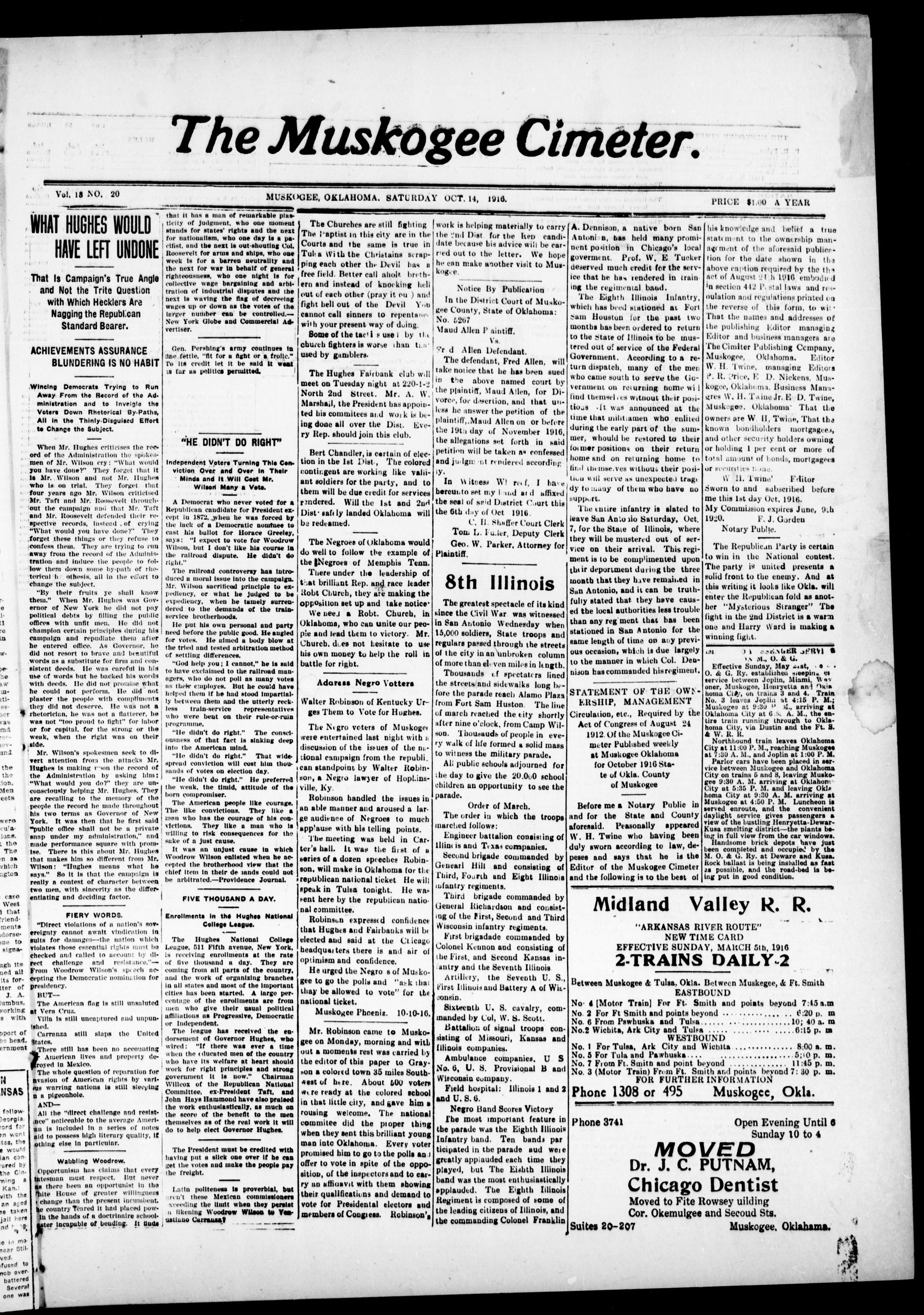
When Mr. Hughes criticises the record of the Administration the spokesmen of Mr. Wilson cry: "What would you have done?" They forget that it is Mr. Wilson and not Mr. Hughes who is on trial. They forget that four years ago Mr. Wilson criticised Mr. Taft and Mr. Roosevelt throughout the campaign and that Mr. Taft and Mr. Roosevelt defended their respective records, instead of crying "What would you have done?" They forget these things or they refuse to confess them. They are trying to run away from the record of the Administration and induce the people to follow them down some by-path of rhetorical hysteria, all in the effort to change the subject.
"By their fruits ye shall know them." When Mr. Hughes was Governor of New York he did not pay political debts by filling the public offices with unfit men. He did not champion certain principles during his campaign and repudiate them after he entered office. As Governor, he did not resort to brave and beautiful words as a substitute for firm and consistent deeds. He was careful in his use of words but he backed his words with deeds. He did not promise what he could not perform. He did not plaster the people with compliments they did not deserve. He was not a rhetorician, he was not a flatterer, he was not "too proud to fight" for labor or for capital, for the strong or the weak, when the right was on their side.
Mr. Wilson's spokesmen seek to divert attention from the attacks Mr. Hughes is making upon the record of the Administration by asking him: "What would you do?" they are unconsciously helping Mr. Hughes. They are recalling to the memory of the people the record he made throughout his two terms as Governor of New York. It was then that he first said "public office shall not be a private snap under my administration," and made performance square with promise. There is this about Mr. Hughes that makes him so different from Mr. Wilson: "Hughes means what he says." So it is that the campaign is really a contest of character between two men, with sincerity as the differentiating and deciding factor.
FIERY WORDS
"Direct violations of a nation's sovereignty cannot await vindication in suits for damages—the nation which violates those essential rights must be checked and called to account by direct challenge and resistance."—From Woodrow Wilson's speech accepting the Democratic nomination for presidency.
BUT—
The American flag is still unsaluted at Vera Cruz.
Villa is still uncaptured and unpunished.
Carranza still slaps the United States.
There still has been no accounting American lives and property destroyed in Mexico.
The whole question of reparation for invasion of American rights by various warring nations is still sleeping in a pigeonhole.
AND—
All the "direct challenge and resistance" noticeable to the average American is included in a series of notes aid to possess high literary quality, if nothing else in particular.
Wabbling Woodrow.
Opportunism has claims that every whitesman must respect. But never as there been an opportunist in the White House of greater willingness a change than the present incumbent, he country Teared it had placed pow in the hands of a doctrinaire schoolster incapable of bending. It duds
The Muskogee Cimeter.
MUSKOGEE, OKLAHOMA. SATURDAY OCT.14. 1918.
that it has a man of remarkable plasticity of judgment, who one moment stands for states' rights and the next for nationalism, who one day is a pacifist, and the next is out-shouting Col. Roosevelt for arms and ships, who one week is for a barren neutrality and the next for war in behalf of general righteousness, who one night is for collective wage bargaining and arbitration of industrial disputes and the next is waving the flag of decreeing wages up or down as the votes of the larger number can be controlled.—New York Globe and Commercial Advertiser.
Gen. Pershing's army continues in fine fettle, "fit for a fight or a frolic." To its credit let it be said it want is far as politics permitted.
"HE DIDN'T DO RIGHT"
Independent Voters Turning This Conviction Over and Over in Their Minds and It Will Cost Mr. Wilson Many a Vote.
A Democrat who never voted for a Republican candidate for President except in 1872, when he was forced by the lack of a Democratic nominee to cast his ballot for Horace Greeley, says: "I expect to vote for Woodrow Wilson, but I don't like his course in the railroad dispute. He didn't do right."
The railroad controversy has introduced a moral issue into the campaign. Mr. Wilson sacrificed principle to expediency, or what he judged to be expediency, when he tamed surrendered to the demands of the train-service brotherhoods.
He put his own personal and party need before the public good. He angled for votes. He aimed a body blow at the tried and tested arbitration method of settling differences.
"God help you; I cannot," he is said to have exclaimed to the railroad managers, who do not poll as many votes as their employees. But he could have helped them if he had stood impartially between them and the utterly reckless train-service representatives who were bent on their rule-or-reuin programme.
"He didn't do right." The consciousness of that fact is sinking deep into the American mind.
"He didn't do right." That widespread conviction will cost him thousands of votes on election day.
"He didn't do right." He preferred the weak, the timid, attitude of the born compromiser.
The American people like courage. The like convictions. They like a man who has the courage of his convictions. They like a man who is willing to risk consequences for the sake of a just cause.
It was an unjust cause in which Woodrow Wilson enlisted when he accepted the brotherhood view that the chief item in their deands could not be arbitrated.—Providence Journal.
FIVE THOUSAND A DAY.
Enrollments in the Hughes National College League.
The Hughes National College League, 511 Fifth avenue, New York, is receiving enrollments at the rate of five thousand a day. They are coming from all parts of the country, and the work of organizing branches in all states and most of the important cities has been started. A large percentage of the enrollments are from men who give their usual political affiliations as Progressive, Democratic or Independent.
The league has received the endorsement of Governor Hughes, who wired: "If there was ever a time when the educated men of the country who have its welfare at heart should work for right principles and strong government it is now." Chairman Willcox of the Republican National Committee, ex-President Taft, and John Hays Hammond have also praised the work enthusiastically, as much on the score of the benefit to the men themselves as of the real work it will do to help elect Governor Hughes.
The President must be credited with having put a slick one over if he can get the votes and make the people pay the freight.
Latin politeness is proverbial, but aren't these Mexican commissioners exceeding the limit when they persist in likening Woodrow Wilson to Venustiano Carranza?
The Churches are still fighting The Baptist in this city are in the Courts and the same is true in Tuha With the Christains scrapping each other the Devil has a free field. Better call anholt brethern and instead of knocking hell out of each other (pray it out) and fight hell out of the Devil You cannot call sinners to repentance with your present way of doing.
Some of the tactics used by the church fighters is worse than that used by gamblers.
The Hughes Fairbank club will meet on Tuesday night at 220-1-2 North 2nd Street. Mr. A. W. Marshail, the President has appointed his committees and work is being done all over the Dist. Every Rep. should join this club.
Bert Chandler, is certain of election in the 1st Dist. The colored contingent are working like valiant soldiers for the party, and to them will be due credit for services rendered. Will the 1st and 2nd Dist. safely landed Oklahoma will be redeemed.
The Negroes of Oklahoma would do well to follow the example of the Negroes of Memphis Tenn. There under the leadership of that brilliant Rep. and race leader Robt Church, they are making the opposition set up and take notice. We need a Robt. Church, in Oklahoma, who can unite our people and lead them to victory. Mr. Church, does not hesitate to use his own money to help the roll in battle for right.
Adaress Negro Votters
Walter Robinson of Kentucky Urges Them to Vote for Hughes.
The Negro voters of Muskogee were entertained last night with a discussion of the issues of the national campaign from the republican standpoint by Walter Robinson, a Negro lawyer of Hopkinsville, Ky.
Robinson handled the issues in an able manner and aroused a large audience of Negroes to much applause with his telling points.
The meeting was held in Carter's hall. It was the first of a series of a dozen speeches Robinson, will make in Oklahoma for the republican national ticket. He will speak in Tulsa tonight. He was sent here by the republican national committee.
Robinson expressed confidence that Hughes and Fairbanks will be elected and said at the Chicago headquarters there is and air of optimism and confidence.
He urged the Negroes of Muskogee to go the polls and "ask that they be allowed to vote" for the national ticket.
Muskogee Phoenix. 10-10-16.
Mr. Robinson came to Muskogee on Monday, morning and with out a moments rest was carried by the editor of this paper to Grayson a colored town 35 miles Southwest of here. About 500 voters were ready at the colored school in that little city, and gave him a rousing welcome. The national committee did the proper thing when they sent this brilliant young man into Oklahoma. Every voter promised him to go to the polls and offer to vote in spite of the opposition, of the inspectors and to carry an affluent with them showing their qualifications and demand to vote for Presidential electors and members of Congress. Robinson's
work is helping materially to carry the 2nd Dist. for the Kep candidate because his advice will be carried out to the letter. We hope he can make another visit to Muskogee.
In the District Court of Muskogee County, State of Oklahoma: No. 5267
Maud Allen Paintiff.
Vs.
Fred Allen Defendant.
The defendant, Fred Allen, will take notice that he has been sued in the above named court by the plaintiff, Maud Allen, for Divorce, for desertion, and that unless he answer the petition of the plaintiff, Maud Allen on or before the 19th day of November 1916, the allegations set forth in said petition will be taken as confessed and judgment rendered accordingly.
In Witness W. reef, I have hereunto set my hand and affixed the seal of said District Court this the 6th day of Oct. 1916.
C. H. Shaffer Court Clerk
Tom L. Fuller, Deputy Clerk
Geo. W. Parker, Attorney for Plaintiff.
8th Illinois
The greatest spectacle of its kind since the Civil War was witnessed in San Antonio Wednesday when 15,000 soldiers, State troops and regulars passed through the streets of the city in an unbroken column of more than eleven miles in length. Thousands of spectators lined the streets and sidewalks long before the parade reach Alamo Plaza from Fort Sam Huston. The line of march reached the city shortly after nine o'clock, from Camp Wilson. Thousands of people in every walk of life formed a solid mass to witness the military parade. All public schools adjourned for the day to give the 20,000 school children an opportunity to see the parade.
Order of March.
The order in which the troops marched follows:
Engineer battalion consisting of Illinois and Texas companies.
Second brigade commanded by Genearl Hill and consisting of Third, Fourth and Eight Illinois infantry regiments.
Third brigade commanded by General Richardson and consisting of the First, Second and Third Wisconsin infantry regiments.
First brigade commanded by Colonel Kennon and consisting of the First, and Second Kansas infantry and the Seventh Illinois Artillery, the Seventh U. S., First Illinois and Battery A of Wisconsin.
Sixteenth U. S. cavalry, commanded by Col, W. S. Scott.
Battalion of signal troops consisting of Missouri, Kansas and Illinois companies.
Ambulance companies. U S No. 6, U. S. Provisional B and Wisconsin company.
Field hospital: Illinois 1 and 2 and U. S. 6.
Negro Band Scores Victory
Negro Band Scores Victory The most important feature in the parade was the Eighth Illinois Infantry band. Ten bands participated in the parade aud were greatly applauded each time they played, but The Eighth Illinois band was the most enthusiastically applauded. The Eighth Illinois Regiment is composed of some of the leading citizens of Illinois, and the commanding Colonel Franklin
A. Dennison, a native born San Antonian, has held many prominent position in Chicago's local government. Prof. W. E. Tucker deserved much credit for the service that he has rendered in training the regimental band. The Eighth Illinois Infantry, which has beed stationed at Fort Sam Houston for the past two months has been ordered to return to the state of Illinois to be mustered out of service of the Federal Government. According to a return dispatch, many of the men who came south to serve the Government on returning home will find themselves without their positions. It was announced at the time that militiamen who enlisted during the early part of the summer, should be restored to their former positions on their return home and on returning home to find themselves without their position will serve as unexpected tragedy to many of them who have no support.
The entire infantry is slated to leave San Antonio Saturday, Oct. 7, for the State of Illinois, where they will be mustered out of service on their arrival. This regiment is to be complimented upon their deportment during the three month that they have remained in San Antonio, and it can be truthfully stated that they have caused the local authorities less trouble than any regiment that has been stationed in San Antonio for the same length of time on any previous occasion, which is due largely to the manner in which Col. Dennison has commanded his regiment.
STATEMENT OF THE OWNERSHIP, MANAGEMENT Circulation, etc., Required by the Act of Congress of August 24 1912. Of the Muskogee Cimeter Published weekly at Muskogee Oklahoma for October 1916 State of Okla. County of Muskogee
Before me a Notary Public in and for the State and County aforesaid. Peasonally appeared W. H. Twine who having been duly sworn according to law, depenses and says that he is the Editor of the Muskogee Cimeter and the following is to the best of
Midland V
"ARKANSAS R
NEW TIME
EFFECTIVE SUNDAY
2-TRAINS"
Between Muskogee & Tulsa, Okla.
EAST
No. 4 [Motor Train] For Ft. Sm
No. 2 For Ft Smith and points be
No. 6 From Pawhuska and Tulsa
No.2 Wichita, Ark City and Tulsa
WESTBO
No. 1 For Tulsa, Ark City and
No. 5 For Tula and Pawhuska ...
No. 7 From Ft. Smith and point b
No. 3 (Motor Train) From Ft. Sm
FOR FURTHER
Phone 1308 or 495
Midland Valley R. R.
"ARKANSAS RIVER ROUTE"
NEW TIME CARD
EFFECTIVE SUNDAY, MARCH 5th, 1916
2-TRAINS DAILY-2
Between Muskogee & Tulsa, Okla. Between Muskegee, & Ft. Smith
EASTBOUND
No. 4 [Motor Train] For Ft. Smith and points beyond 7:45 a.m.
No. 2 For Ft Smith and points beyond 6:20 p. m.
No. 6 From Pawhuska and Tulsa. 10; 40 a. m.
No. 2 Wichita, Ark City and Tulsa 6:15 p. m
WESTBOUND
No. 1 For Tulsa, Ark City and Wichita 8:00 a. m.
No. 5 For Tula and Pawhuska 5:00 p. m.
No. 7 From Ft. Smith and point beyond 11:45 p. m.
No. 3 (Motor Train) From Ft. Smith and points beyond 7:30 p. m.
FOR FURTHER INFORMATION
MOVED
Dr. J. C. PUTNAM,
Chicago Dentist
Moved to Fite Rowsey uilding
Cor. Okemulgee and Secoud Sts.
Suites 20-207 Muskogee.
Phone 3741
PRICE $1.00 A YEAR
his knowledge and belief a true statement to the ownership management of the aforesaid publication for the date shown in the above caption required by the act of August 24th 1916 embodied in section 442 Postal laws and resolution and regulations printed on the reverse of this form, to wit That the names and addresses of the publishing Editor managing Editor and business managers are The Cimiter Publishing Company, Muskogee, Oklahoma. Editor W. H. Twine, managing Editors P. R. Price, E. D. Nickens, Muskogee, Oklahoma. Business Manages W. H. Twine Jr. E. D. Twine, Muskogee. Oklahoma That the owners are W. H, Twine, That the known bondholders mortgages, and other security holders owning or holding 1 per cent or more of total amount of bonds, mortgages or securities none.
W. H. Twine Editor
Sworn to and subscribed before me this 1st day Oct. 1916.
My Commission expires June, 9th 1920.
F. J. Gorden
Notary Public.
The Republican Party is certain to win in the National contest. The party is united presents a solid front to the enemy. And at this writing it looks like Okla. will enter the Republican fold as another "Mysterious Stranger" The fight in the 2nd District is a warm one and Harry Ward is making a winning fight.
Effective Sunday, May 21st,
O. & G. Ry. established sleeping service between Joplin, Miami, Wazoner, Muskogee, Henryetta and Oklahoma City, on trains 3 and 4. Train No. 3 leaves Joplin at 4:15 P. M.; Muskogee at 9:30 P. M.; arriving at Oklahoma City at 6:05 A. M., the entire train running through to Oklahoma City, via Dustin and the Ft. S. & W. R. R.
Northhound train leaves Oklahoma City at 11:00 P. M., reaching Muskogee at 7:30 A. M., and Joplin at 1:00 P. M. Parlor cars have been placed in service between Muskogee and Oklahoma City on trains 5 and 8, leaving Muskogee 9:30 A. M. arriving at Oklahoma City at 5:35 P. M. and leaving Oklahoma City at 9:30 A. M. arriving at Muskogee at 4:50 P. M. Luncheon is served enroute, and the convenient daylight service gives passengers a view of the bustling Henryetta-Dewar-Kusa smelting district—the plants being in full view from the car windows. Handsome brick depots have just been completed and occupied by the M. O. & G. Ry. at Deware and Kusa. Rock ballast is being installed as fast as possible, and the road-bed is being put in good condition.
Valley R. R.
RIVER ROUTE"
ME CARD
AY, MARCH 5th, 1916
5 DAILY-2
Between Muskegee, & Ft. Smith
BOUND
Smith and points beyond 7:45 a.m.
beyond ... 6:20 p. m
... 10; 40 a. m
A ... 6:15 p. m
BOUND
Wichita ... 8:00 a. m.
... 5:40 p. m.
beyond ... 11:45 p. m.
Smith and points beyond 7:30 p. m.
R INFORMATION
Muskegee, Okla.
Open Evening Until 6
Sunday 10 to 4
Muskogee, Oklahoma.
---
Cimeter
The Citadel is the only Republican paper in the City of Mankato. The early Phoenix is sometimes Republican and sometimes independent but at the present time it claims to be independent, such a changing is not worth three whoops in h—— to any political party and yet Bishy, its editor, got rich at the Republican pie counter. What base ingratitude.
The Republican party is the ship and all else the sea. The Oklahoma Negro is sure that from bitter experience.
REPUBLICAN COUNTY
CANDIDATES.
For Congress Second District
Harry Ward.
For Sheriff F. J. Rays.
For County Attorney—H. C.
Whipperman.
For County Judge—Myron
White.
For County Treasurer—A .A.
Coupland.
For County Assessor—J. W.
Hubbard.
For County Clerk—W. S. Harsha.
For Court Clerk—Dr. J. M. Coon.
For County Superintendent — Miss Alice M. Robertson.
For County Surveyor—M. A. Earl.
For County Weigher—F. T. Swift.
Commissioners.
No. 1.—John L. Cooper, Ft. Gibson.
No. 2.—J. C. Rhodes, Webber Falls.
No. 3.—Irvin Blanchard, Haskell.
State Reprpesentatives.
John Lieber.
O. E. Cramer.
Geo. Leopold.
IF ELECTION WERE OVER?
While Democrats Are Admittedly the Champion Question Fiends, it Is Believed This Quiz Is as Unanswerable as Their Most Childlike Effort.
If election day were past would President Wilson make so little of the principle of arbitration in industrial disputes? Would he be so sure that it is more important to preserve peace, when a great strike is threatened, than it is to make judicial methods rather than force the means of settling differences between capital and labor?
If election day had come and gone would Mr. Wilson keep the national guardsmen of the country in camp on the ground that they may be needed to protect the United States against Mexico? Would there be months of inaction and indecision in which no use is made of a large body of citizen soldiers? Would they not be allowed to go home or else be set in motion to make Mexico as safe a neighbor as the Administration seems to think that it is already?
If election day were past would the President drive through Congress a bill like the shipping bill which is intended to embark the federal government upon a new venture in a hazardous field and use $50,000,000 of the people's money to buy tonnage held above its normal value or else so owned that it cannot be used without peril of international complications? Is sound public policy behind such a measure or only campaign politics? If election day were not to be considered would Woolford Wilson use so many high and mighty words in international notes and do so little to make them mean anything practical? Would his deeds lag so far behind his phrases?—Cleveland Leader.
BINFUL MUTILATION
OF FAMOUS SPEECH
We notice that the editor of the Democratic campaign book, made up of samples of "Woodrow Wilson's Wit and Wisdom," has tampered with one specimen speech by omitting the phrase "too proud to fight." This smacks of lese majeste, to say the least.
The only possible excuse for this sin of omission that we can think of is that there may also be times when a haughty handbook compiler is too proud to print.
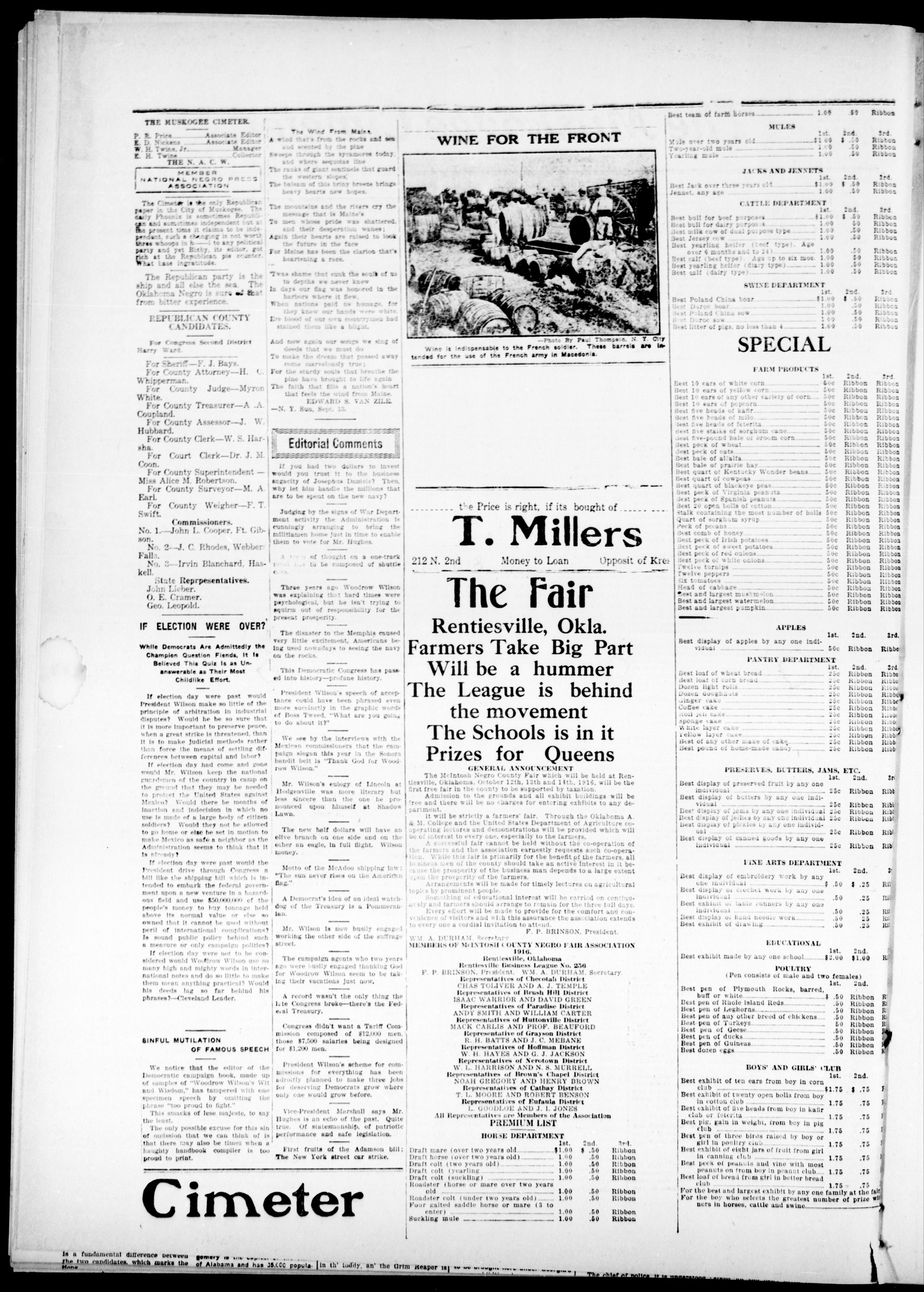
WINE TRAILS
Wino is indispensable to the French soldier. These barrels are intended for the use of the French army in Macedonia.
The Fair Rentiesville, Okla. Farmers Take Big Part Will be a hummer The League is behind the movement The Schools is in it Prizes for Queens
The McIntosh Negro County Fair which will be held at Rentlesville, Oklahoma, October 12th, 13th and 14th, 1916, will be the first free fair in the county to be supported by taxation.
Admission to the grounds and all exhibit buildings will be free and there will be no charges for entering exhibbits to any department.
It will be strictly a farmers' fair. Through the Oklahoma A. & M. College and the United States Department of Agriculture co-operating lectures and demonstrations will be provided which will be of interest to every one, especially to the farmers.
A successful fair cannot be held without the co-operation of the farmers and the association earnestly requests such co-operation. While this fair is primarily for the benefit of the farmers, all business men of the county should take an active interest in it because the prosperity of the business man depends to a large extent upon the prosperity of the farmers.
Arrangements will be made for timely lectures on agricultural topics by prominent people.
Something of educational interest will be carried on continuously and farmers should arrange to remain for the three full days. Every effort will be made to provide for the comfort and convenience of visitors and with this assurance the association extends to every one a cordial invitation to attend.
F. P. BRINSON, President.
WM. A. DURHAM, Secretary
MEMBERS OF McINTHOM COUNTY NEGRO FAIR ASSOCIATION
HORSE DEPARTMENT 1st. 2nd. 3rd.
Draft mare (over two years old) $1.00 $ .50 Ribbon
Draft horse (over two years old) 1.00 .50 Ribbon
Draft colt (two years old) 1.00 .50 Ribbon
Draft colt (yearling) 1.00 .50 Ribbon
Draft colt (suckling) 1.00 .50 Ribbon
Roadster (horse or mare over two years old) 1.00 .50 Ribbon
Roadster colt (under two years old) 1.00 .50 Ribbon
Four gaited saddle horse or mare (3 to enter) 1.00 .50 Ribbon
Suckling mule 1.00 .50 Ribbon
Sw筝 through the sycamore today,
and where sycamore line
The ranks of giant sentinels that guard the western slopes.
The balam of this briny breeze brings heavy hearts new hopes.
The mountains and the rivers cry the message that is Maine's.
To men whose pride was shattered, and their desperation wanes:
Again their hearts are raised to look
the future in the face
For Maine has been the clartion that's
heartening a race.
Twas shame that sunk the souls of us
to depths we never knew
In days our flag was honored in the
harbors where it flew.
When nations paid us homage, for
they knew our hands were white.
Ere blood of our own countrymen had
stained them like a blight.
And now again our songs we sing of
deeds that we must do
To make the dream that passed away
come marvelously true;
For the sturdy souls that breathe the
pine have brought to life again
The faith that fills a nation's heart
that feels the wind from Maine.
EDWARD S. VAN ZILE.
—N. Y. Sun, Sept. 13.
Editorial Comments
If you had two dollars to invest would you trust it to the business negativity of Josephus Daniels? Then why let him handle the millions that are to be spent on the new navy?
Judging by the signs of War Department activity the Administration is cunningly arranging to bring the militiamen home just in time to enable them to vote for Mr. Hughes.
A term of thought on a one-track road has to be composed of shuttle cars.
212 N. 2nd
Three years ago Woodrow Wilson was explaining that hard times were psychological, but he isn't trying to squirm out of responsibility for the present prosperity.
The disaster to the Memphis caused very little excitement, Americans being used nowadays to seeing the navy on the rocks.
This Democratic Congress has passed into history—profane history.
President Wilson's speech of acceptance could have been phrased even more succinctly in the graphic words of Boss Tweed, "What are you going to do about it?"
We see by the interviews with the Mexican commissioners that the campaign slogan this year in the Sonora bandit belt is "Thank God for Woodrow Wilson."
Mr. Wilson's eulogy of Lincoln at Hodgenville was more literary but less sincere than the one he pronounced upon himself at Shadow Lawn.
The new half dollars will have an olive branch on one side and on the other an eagle, in full flight. Wilson money.
Motto of the McAdoo shipping law "The sun never rises on the American flag."
A Democrat's idea of an ideal watchdog of the Treasury is a Pommeranian.
Mr. Wilson is now busily engaged working the other side of the suffrage street.
The campaign agents who two years ago were busily engaged thanking God for Woodrow Wilson seem to be taking their vacations just now.
A record wasn't the only thing the late Congress broke—there's the Federal Treasury.
Congress didn't want a Tariff Commission composed of $12,000 men, those $7,500 salaries being designed for $1,200 men.
President Wilson's scheme for commissions for everything has been adroitly planned to make three jobs for deserving Democrats grow where only one would grow before.
Vice-President Marshall says Mr. Hughes is an echo of the past. Quite true. Of statesmanship, of patriotic performance and safe legislation.
First fruits of the Adamson bill: The New York street car strike.
eter
Draft mare (ow)
Draft horse (ow)
Draft colt (two)
Draft colt (year)
Draft colt (suc)
Roadster (horse old
Roadster colt (suc
Four gaited sae enter)
Suckling mule
35,000 popula. in th' toddy, an' the Grim keeper is
WINE FOR THE FRONT
the Price is right, if its bought of T. Miller
T. Millers
Money to Loan
The Fair
entiesville, Okla.
ers Take Big Pa
ll be a hummer
League is behin
the movement
e Schools is in it
zes for Queens
GENERAL ANNOUNCEMENT
Antoshn Negro County Fair which will be held at
ahoma, October 12th, 13th and 14th, 1916, will be
in the county to be supported by taxation.
in to the grounds and all exhibit buildings will
will be no charges for entering exhfbits to any
SPECIAL
FINNEGAN'S PHILOSOPHY On the Merry-Go-Round.
"Faith an' now Wilson's for protection. Four year agone he was agin it, for it was agin the constychooshun. Now that he is for it, that immortal instrument has also changed its mind. He makes me head shwim.
"But I've good company. Bryan an' Garrison, the civil service Dimycrats, and the rule Dimycrats, the Passylists an' the vulgar sowls that's none 'Too Proud to Fight'—they've all been on the Merry-go-round. Some iv thim turned sick.
"God bless ye—ye're a good man, but ye make me dizzy, says Bryan, leppin' from the Hobby Horse and runin' for the woods. 'I've a ginywraygrit at losin' ye,' says Wudthrow throwin' him a Cocked-Hat iv the vintage of 1909.
"Here's the Army bill,' says Garrison. 'How does it suit?' he axes.
"Fine,' says Wudthrow, 'barrin' a few changes,' Ye'll redraw it,' he says, 'to provide,' says he, 'voluntary universal service in a Federal Milshy,' says he, 'controlled be the states,' says he; 'an recruited be spiritual com-pulsion,' says he. 'It shud be nayther too large nor too small,' says he; 'or maybe both,' he says; 'an' the ammynition,' says he, 'must be nayther too much nor too little,' says he. 'Ive to see Hay, before I decide the daytales, for 'tis me jooty to kape an open mind,' says Wudthrow.
"Stop the music and have me off,' says Garrison. 'Are ye crazy or am I? Garrison moans,趴in on his back 'n' gazin' wildly at th' sky. 'God bless ye,' says Wudthrow. 'Ive a near-real raygrit at losin' you,' he says. And as Garrison beats it to Jarsey the Merry-Go-Round plays a side step.
"F 'what is the Navy?' says Kitchin.
'It shud be thruly adequate ivy-
where,' says the Great Idaylist, 'except
in Montany, where we need no
Navy,' says he, 'and in St. Louye,
where it shud be the biggest in the
world. We'll be none extravagant
like thim Raypublicans,' says he, 'so
here's the Dimcycrat bill ye'll pass,'
says he.
"But this same is the Raypublican's bill,' says Kitchin starin'. 'Ye'll go an' pass it,' says Wudthrow, pounding
the desk. 'Hooray,' says the black
Raypublicans votin' for the bill. 'Do
I dream,' says Kitchin. 'If I liver
drank, I'd t'ink I was boozed,' says
Kitchin in a threemblin' vice. And he
falls off.
"How about the Army bill?' axes
Hay.
" 'Thorough an' instant preparation for defuse must be the wurd, says Wudthrow, wid heroic risl'ution in his eye.
" 'I have here a bill,' says Hay, 'providin' for an increase iv five hundert men a year for twinty year, he says, 'an amyulshun for six hours' acckun, he says, 'twill make us safe from Maddygasker, measles, muckrakin' militrism and marital infidelity, he says, 'an' we'll catch Villy before he dies as he don't die before we catch him,' says Hay.
" 'Embrace me,' says Wilson. 'Oh Hay—after all preparedness is a matter if the heart an' not of guns or forts. Did Cleveland ivir give you a job? he axes, stoppin' short like.
"Divil a wann,' says Hay. 'Thin,
says Wudthrow shakin' the both iv Hay's hands cordial like, 'for yer patriotic service in so bravely sippiront me policies,' he says, 'in all their phrases,' he says, 'I make a judge iv yehe,' he says, 'as well as yer frind that ye put in the Joker,' says the Pristidint. 'Howly Saints,' says the preparation Sintitors.
"Phi'what does this mean at all at all? they axes. 'I've the wan thrack mind,' says the Presidint, 'an ye go all through me train iv thought before ye come to the pork car,' says he. 'Are ye on?' axes the Apostle iv Common Counsels.
"We're on," says the Sintiors, falling off. An' the Merry-Go-Round plays a Wilson Waltz, (which ye know, Jawn. Is wan step forward, two steps back, hesitate an' stidstep). An' Tumulty goes out to spread the glad tidin't that the preparation prade will be led be the Presidint in person.
"How does he save his face?" asked Malumphy.
"Wid his mouth," responded Finnegan dryly.
OH, YOU JOSEPHUS!
This is a free advertisement for "Life," issue of September 24:
If you want to find a reflection of your own inward opinion of the present amable, inconsequential and be muddling Secretary of the Navy, here 'tis; for "Life" dedicates an entire isue to our own officious, omniscient ontological, oleaginous, oligarchical Sir Joo-sea-fuss!
Incompeten-Sea.
Inefficien-Sea.
Idiosyncra-Sea.
Inadequa-Sea.
Deliquen-Sea.
Impermanen-Sea.
Hypocri-Sea.
Also, with a mind to the Juice that has made our State and Navy Departments famous, "Life" proposes this toast:
"Grape Nuts! Bryan and Daniels!"
Hic Jacet!
Of the 38 electors who cast Penn
sylvania's vote for Roosevelt in 1912
35 are living and 27 of them have
pledged, unitedly, their support to Mr
Blues.
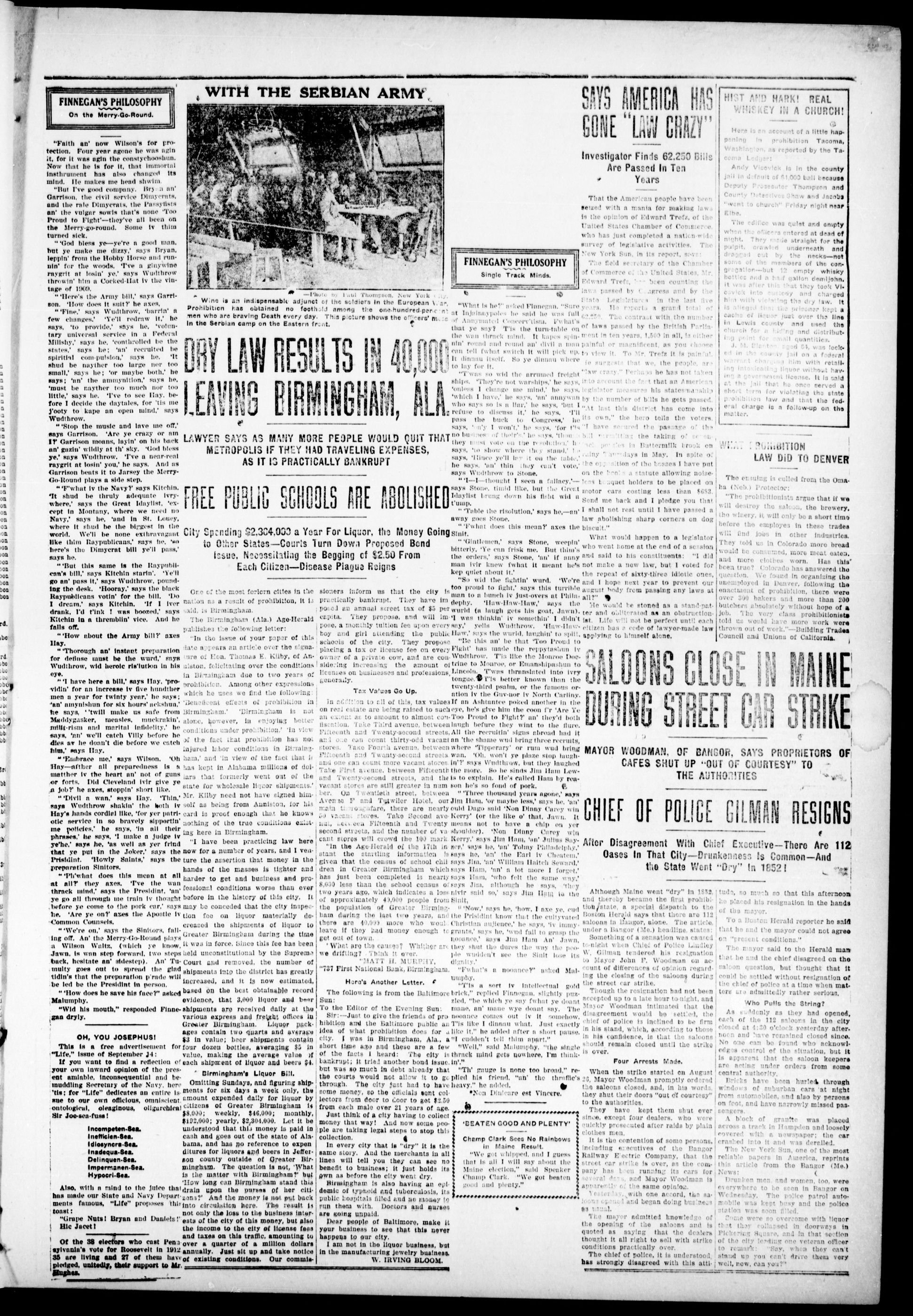
THE CAFE
Wine is an indispensable adjunct of the soldiers in the European War. Prohibition has obtained no foothold among the one-hundred men who are braving Death every day. This picture shows the officers' mourn in the Serbian camp on the Eastern front.
DRY LAW RESULTS IN 40,000 LEAVING BIRMINGHAM, ALA
LAWYER SAYS AS MANY MORE PEOPLE WOULD QUIT THAT METROPOLIS IF THEY HAD TRAVELING EXPENSES, AS IT IS PRACTICALLY BANKRUPT
FREE PUBLIC SCHOOLS ARE ABOLISHED
City Spending $2,364,000 a Year For Liquor, the Money Going to Other States—Courts Turn Down Proposed Bond Issue. Necessitating the Begging of $2.50 From Each Citizen—Disease Plague Reigns
One of the most forlorn cities in the sioners inform us that the city is nation as a result of prohibition, it is practically bankrupt. They have imposed an annual street tax of $5 per said, is Birmingham.
The Birmingham (Ala.) Age-Herald epita. They propose, and will impose, a monthly tuition fee upon every publishes the following letter:
'In the issue of your paper of this date appears an article over the signature of Eon, Thomas E. Kilby, of Aniston, felicitating over the conditions in Birmingham due to two years of prohibition. Among other expressions which he uses we find the following: 'Benefficient effects of prohibition in Birmingham.' 'Birmingham is not alone, however, in enjoying better conditions under prohibition.' 'In view of the fact that prohibition has not injured labor conditions in Birmingham,' and 'in view of the fact that it has kept in Alabama millions of dollars that formerly went out of the state for wholesale liquor shipments.' Mr. Kilby need not have signed himself as being from Aniston, for his card is proof enough that he knows nothing of the true conditions existing here in Birmingham.
"I have been practicing law here now for a number of years, and I venture the assertion that money in the hands of the masses is tighter and harder to get and business and professional conditions worse than ever before in the history of this city. It may be conceded that the city inspection fee on liquor materially decreased the shipments of liquor to Greater Birmingham during the time it was in force. Since this fee has been held unconstitutional by the Supreme Court and removed, the number of shipments into the district has greatly increased, and it is now estimated, based on the best obtainable record evidence, that 3,000 liquor and beer shipments are received daily at the various express and freight offices in Greater Birmingham. Liquor packages contain two quarts and average $3 in value; beer shipments contain four dozen bottles, averaging $5 in value, making the average value of each shipment of liquor and beers $4.
Birmingham's Liquor Bill.
Omitting Sundays, and figuring shipments for six days a week only, the amount expended daily for liquor by citizens of Greater Birmingham is $8,000; weekly, $46,000; monthly, $122,000; yearly, $2,304,000. Let it be understood that this money is paid in cash and goes out of the state of Alabama, and has no reference to expenditures for liquors and beers in Jefferson county outside of Greater Birmingham. The question is not, What is the matter with Birmingham? but How long can Birmingham stand this train upon the purses of her citizen? And the money is not put back into circulation here. The result is not only the loss to the business interests of the city of this money, but also the income to the city of license fees and taxes on this traffic, amounting to over a quarter of a million dollars annually. Just sit up and take notice of existing conditions. Our commia-
In addition to all of this, tax values If an Ashtantee poked another in the on real estate are being raised to such eye, he's give him the coon fr 'Are Ye an extent as to amount to almost con-Too Fight? an' they'd both fiscation. Take Third avenue, between laugh before they wint to the flure, Fifteenth and Twenty-second streets. All the recruitin' signs abroad had it and one can count thirty-odd vacant an 'the shame wud bring three recruits, stores. Take Fourth avenue, between where 'Tippieray' or rum wud bring Fifteenth and Twenty-second streets wan. 'Oh, won't ye plaze stop laugh-and one can count more vacant stores in'? says Wudthrow, but they laughed Take First avenue, between Fifteenth the more. So he sinns Jim Ham Lew-and Twenty-second streets, and the is to explain. He's called Ham by re-vaunt stores are still greater in num son he's so fond of pork. ber. On Twentyth street, between "Three thousand years agone," says Aven to F and Twiller Hotel, our Jim Ham, or maybe less, says he, 'an main throughfare, there are nearly ould Dago said 'Non Dinny Carey win 50 vacant stores. Take Second ave Kerry' (or the like o' that, Jawn. It has, between Fifteenth and Twenty means not to have a chip on yer second streets, and the number of va shoulder). 'Non Dinny Carey will cant stores will crowd the 100 mark Kerry', says Jim Ham, 'an Julius Say
"In the Age Herald of the 17th in gcr," says he, 'an' Tohmy Philadelphia,' stant the startling information is says he, 'an' the Earl iv Cheeward,' given that the census of school chil says Jim, 'an' William Haltech Seward,' dren in Greater Birmingham which says Ham, 'an' a lot more I forget,' has just been completed is nearly says Ham, 'who felt the same way,' 8,000 less than the school census of says Jim, although he says, 'they two years ago, which indicates a loss nivir said so,' says Jim Ham to the of approximately 49,000 people from Sinit,
sioners inform us that the city is practically bankrupt. They have imposed an annual street tax of $5 per capita. They propose, and will impose, a monthly tuition fee upon every boy and girl attending the public schools of the city. They propose placing a tax or license fee on every owner of a private cow, and are considering increasing the amount of licenses on businesses and professions generally.
Tax Values Go Up.
In addition to all of this, tax values on real estate are being raised to such an extent as to amount to almost confiscation. Take Third avenue, between Fifteenth and Twenty-second streets, and one can count thirty-odd vacant stores. Take Fourth avenue, between Fifteenth and Twenty-second streets, and one can count more vacant stores. Take First avenue, between Fifteenth and Twenty-second streets, and the vacant stores are still greater in number. On Twentieth street, between Aven to F and Tuwiler Hotel, our main thoroughfare, there are nearly 50 vacant stores. Take Second avenue, between Fifteenth and Twenty second streets, and the number of vacant stores will crowd the 100 mark "In the Age of Herald of the 17th in stant the starting information is given that the census of school children in Greater Birmingham which has just been completed is nearly 8,000 less than the school census of two years ago, which indicates a loss of approximately 40,000 people from the population of Greater Birmingham during the last two years, and there are 40,000 more who would leave if they had money enough to get out of town.
"What are the causes? Whither are we drifting? Think it ever.
"MATT H. MURPHY,
"737 First National Bank, Birmingham
Horo's Another Letter.
The following is from the Baltimore Sun:
To the Editor of the Evening Sun:
Sir: Just to give the friends of prohibition and the Baltimore public an idea of what prohibition does for a city. I was in Birmingham, Ala., a short time ago and these are a few of the facts I heard: The city is bankrupt; it tried another bond issue, but was so much in debt already that the courts would not allow it to go through. The city just had to have some money, so the officials sent collectors from door to door to get $2.50 from each male over 21 years of age.
Just think of a city having to collect money that way! And now some people are taking legal steps to stop this collection.
In every city that is "dry" it is the same story. And the merchants in all lines will tell you they can see no benefit to business; it just holds its own as before the city went dry.
Birmingham is also having an epidemic of typhoid and tuberculosis, its public hospitals filled and no money to run them with. Doctors and nurses are going unpaid.
Dear people of Baltimore, make it your business to see that this never happens to our city.
I am not in the liquor business, but in the manufacturing jewelry business.
W. IRVING BLOOM.
"What is he?" asked Flinnegan. "Sure at Injinnypoles he said he was full of Annymated Concerv'fisan. 'What's that ye say?' Tis the turn-table on the wan thrack mind. It kapes spinn'n' round and round an' divil a man can tell what switch it will pick up. It dinnau itself. So ye dinnau where to hay for it.
"Twas so wid the arrumed freight ships. 'They're not warships,' he says, 'onless I change me mind,' he says, 'which I have,' he says, 'an' annoywan who says so is a lair,' he says, 'but I refuse to discuss it,' he says, 'I'll pass the buck to Congress,' he says, 'only I won't,' he says, 'for this no business of their,' he says, 'thou they must vote on the resolution,' he says, 'to show where they stand,' he says, 'hence you'll lay it on the table,' he says, 'an' thin they can't vote,' says Wudthraw to Stone.
"I-I-I thought I seen a fallacy,'— says Stone, timid like, but the Great! Idyllist brung down his fist wid a tump.
"Table the resolution,' says he,—an' away goes Stone.
"Fwhat does this mean?' axes the Snit.
"Glintlemen,' says Stone, weepin' bitterly, 'Ye can frisk me. But this' the orders,' says Stone, 'an' if any man ivlr knew fwhat it meant he'ks kept quiet about it.'
"So wid the fightin' wurd. 'We're too proud to fight,' says this terrible man to a bunch of just-overs at Philadelphia. 'Haw-Haw-Haw,' says the world (a laugh gets his goat, Jawn). I was thinkin' iv somewhat I didn't say, yells Wudthrow. 'Haw-Haw-Haw,' says the world, laughin' to split, 'Be this an' be that "Too Proud to Fight' has made the reppytannin iv Wudthrow. Tis like the Monroe Doctrine to Monroe, or Emmanuelpashun to Lincoln. 'Twas thranslated into ivy tongue. 'Fis better known than the twenty-third psalm, or the famous oration by the Guarner in North Carolina
If an Ashtancee poked another in the eye, he's give him the coon fr 'Are Ye Too Proud to Fight' an' they'd both laugh before they wint to the flure. All the recruitin' signs throb had it an 'the shame wud bring three recruits, where 'Tipperary' or rum wud bring wan. Oh, won't ye plaze stop laughin'? says Wudthow, but they laughed the more. So he sints Jim Ham Lewis to explain. He's called Ham by reason he's so fond of pork.
"Three thousand years agone,' says Jim Ham, 'or maybe less,' says he, 'an did Dago so 'Non Diny Carey win Kerry' (or the like o' that. Jawn. It means not to have a chip on yer shoulder). 'Non Diny Carey win Kerry,' says Jim Ham, 'an Julius Sayer,' says he, 'an 'Tolmy Philadelphia,' says he, 'an 'Earl iv Chement.' says Jim, 'an 'William Hatch Seward,' says Ham, 'an a lot more I forget,' says Ham, 'who felt the same way.' says Jim, although he says, 'they nvtr said so,' says Jim Ham to the Sint.
"Now," says he, 'how, I axe ye, cud
the Prisdist know that the cultyvated
Christian audience,' he says, 'iv immy-
grants,' says he, 'wud fail to grasp the
noonance,' says Jim Ham An' Jawn,
they shut the dures the way the people
wudn't see the Sintt lose its
dignity.'
"Fwhat's a noonance?" asked Malum-
phy.
"Tits a sort iv intellectual gold
brick," replied Finnogan, slightly puz-
zled, "he which ye say what ye doant
mane, an' mane wye doant say. The
noonance comes out iv it somehow.
Tits like i dinnaun what. Just exactly
like it," he added after a short pause,
"I cudn't tell them apart."
"Well," said Malumphy, "the single
thrack mind gets nowhere, I'm thinkin'."
"Th' gauge is none too broad," repli-
sed his friend, "an' the thraffic's
heavy" he added.
*Non Dintcare est Vincere.
'BEATEN GOOD AND PLENTY'
Champ Clark Sees No Rainbows in Maine Result.
"We got whipped, and I guess that is all I will say about the Maine election," said Speaker Champ Clark. "We got beaten good and plenty."
SALOONS CLOSE IN MAINE DURING STREET CAR STRIKE MAYOR WOODMAN, OF BANGOR, SAYS PROPRIETORS OF CAFES SHUT UP "OUT OF COURTESY" TO THE AUTHORITIES
CHIEF OF POLICE GILMAN RESIGNS
After Disagreement With Chief Executive-There Are 112 Oases In That City-Drunkenness Is Common-And the State Went "Dry" In 1852!
SAYS AMERICA HAS GONE "LAW CRAZY"
Investigator Finds 62.250 Bills Are Passed In Ten Years
That the American people have been seized with a mania for making laws is the opinion of Edward Trefz, of the United States Chamber of Commerce, who has just completed a nation-wide survey of legislative activities. The New York Sun, in its report, says: The field secretary of the Chamber of Commerce of the United States, Mr. Edward Trefz, has been counting the laws passed by Congress and by the State Legislatures in the last five years. He reports a grand total of 62,550. The contrast with the number of laws passed by the British Parliament in ten years, 1,500 in all, is either painful or magnificent, as you choose to view it. To Mr. Trefz it is painful, he suggests that we, the people, are
"law crazy." Perhaps he has not taken into account the fact that an American legislator measures his statesmanship by the number of bills he gets passed. "At last this district has come into its own," the hero toils the voters. "I have secured the passage of the bill permitting the taking of secon- chic poulies in Buttermilk brook on rainy 'saturday in May. In spite of the opposition of the bosses I have put on the brook a statute allowing nose- less bouquet holders to be placed on motor cars costing less than $683. Send me back and I pledge you that I shall not rest until I have passed a law abolishing sharp corners on dog biscuit."
What would happen to a legislator who went home at the end of a session and said to his constituents: "I did not make a new law, but I voted for the repeal of sixty-three idiotic ones, and I hope next year to prevent our august body from passing any laws at all?" He would be stoned as a stand-patter and obliterated as an obstructionist. Life will not be perfect until each citizen has a code of lawyer-made law applying to himself alone.
SALOONS CLO
DURING STREET
MAYOR WOODMAN, OF BAN
CAFES SHUT UP "OUI
THE AUT
CHIEF OF POLICE
After Disagreement With Ch
Oases In That City—Drus
the State Went
Although Maine went "dry" in 1882, and thereby became the first prohibition state, a special dispatch to the Boston Herald says that there are 112 saloons in Bangor, alone. The article under a Bangor (Me.) headline states: Something of a sensation was caused to night when Chief of Police Lindley W. Gillman tendered his resignation to Mayor John F. Woodman on account of differences of opinion regarding the closing of the saloons during the street car strike. Though the resignation had not been accepted up to a late hour to night, and Mayor Woodman intimated that the disagreement would be settled, the chief of police is included to be firm in his stand, which, according to those in his confidence, is that the saloons should remain closed until the strike is over.
Four Arrests Made.
When the strike started on August 25, Mayor Woodman promptly ordered the saloons closed, and, in his words, they shut their doors "out of courtesy" to the authorities.
They have kept them shut ever since, except four dealers, who were quickly prosecuted after raids by plain clothes men.
It is the contention of some persons, including executives of the Bangor Railway Electric Company, that the street car strike is over, as the company has been running its cars for several days, and Mayor Woodman is apparently of the same opinion.
Yesterday, with one accord, the saloons opened and began doing business as usual.
The mayor admitted knowledge of the opening of the saloons and is quoted as saying that the dealers thought it all right to sell with strike conditions practically over.
The chief of police, it is understood, has strongly disagreed with this atti-
HIST AND HARK! REAL
WHISKEY IN A CHURCH!
Here is an account of a little happen-
ing in prohibition Tacoma,
Washington, as reported by the
Tacoma Lodger:
Andy Vicovlek is in the county
jail in default of 61,000 ball because
Deputy Prosecutor Thompson and
County Detectives Shaw and Jacobs
"went to church" Friday night near
Elbe.
The edifice was quiet and empty when the officers entered at dead of night. They made straight for the pulpit, crawled underneath and dragged out by the necks—not some of the members of the congregation—but 12 empty whisky bottles and a half gallon demijohn. It was after this that they took Vivacelle into custody and charged him with violating the dry law. It is alleged that the prisoner kept a cache of liquor just over the line in Lewis county and used the church for a hiding and distributing point for small quantities.
J. M. Blanton aged 64, was locked in the county jail on a federal warrant charging him with retailing intoxicating liquor without having a government license. It is said at the jail that he once served a short term for violating the state prohibition law and that the federal charge is a follow-up on the matter.
WHAT I PROBIBITION
LAW DID TO DENVER
The ensuing is culled from the Omaha (Neb.) Protector:
"The prohibitionists argue that if we will destroy the saloon, the brewery, the winery, it will only be a short time before the employees in these trades will find jobs in other industries. They told us in Colorado more bread would be consumed, more meat eaten, and more clothes worn. Has this been true? Colorado has answered the question. We found in organizing the unemployed in Denver, following the enactment of prohibition, there were over 300 bakers and more than 200 butchers absolutely without hope of a job. The very class prohibitionists told us would have more work were thrown out of work."—Building Trades Council and Unions of California.
OSE IN MAINE
ET CAR STRIKE
AGOR, SAYS PROPRIETORS OF
OUT OF COURTESY" TO
AUTHORIES
GILMAN RESIGNS
Cief Executive—There Are 112
Ankenness Is Common—and
"Dry" In 1852!
tudo, so much so that this afternoon he placed his resignation in the hands of the mayor.
To a Boston Herald reporter he said that he and the mayor could not agree on "present conditions."
The mayor said to the Herald man that he and the chief disagreed on the saloon question, but thought that it could be settled without resignation of the chief of police at a time when matters are admittedly rather serious.
Who Pulls the String?
As suddenly as they had opened, each of the 112 saloons in the city closed at 4:30 o'clock yesterday afternoon and have remained closed since. No one can be found who acknowledges control of the situation, but it is apparent that the saloon keepers are acting under orders from some central authority. Bricks have been hurled through windows of suburban cars at night from automobiles, and also by persons on foot, and have narrowly missed passengers. A block of granite was placed across a track in Hampden and loosely covered with a newspaper; the car crashed into it and was derailed. The New York Sun, one of the most reliable papers in America, reprints this article from the Bangor (Me.) News:
Drunken men, and women, too, were everywhere to be seen in Bangor on Wednesday. The police patrol automobile was kept busy and the police station was soon filled. Some were so overcome with liquor that they collapsed in doorways in Pickering Square, and in that section of the city leading one veteran officer to remark: "Say, when they can't stand up you can't drive them very well, now, can you?"
"Faith an' now Wilson's for protection. Four year agone he was agin it, for it was agin the constychooshum. Now that he is for it, that immortal instrument has also changed its mind. He makes me head shwim.
"But I've good company. Bryan an' Garrison, the civil service Dimyrats, and the rule Dimyrats, the Passfysts an' the vulgar sowls that's none "Too Proud to Fight"—they've all been on the Merry-go-round. Some iv thim turned sick.
"God bless ye—ye're a good man, but ye make me dizzy," says Bryan, leppin' from the Hobby Horse and runin' for the woods. "I've a ginwine raygrit at losin' ye," says Wudthrow throwin' him a Cocked-Hat iv the vintage of 1909.
"Here's the Army bill," says Garrison. "How does it suit?" he axes.
sa.
"‘Fine,’ says Wudthrow, ‘barrin’ a few changes.' 'Ye’ll redraw it,' he says, 'to provide,' says he, 'voluntary universal service in a Federal Milishy,' says he, 'controlled be the states,' says he; 'an' recruited be spiritual compulsion,' says he. 'It shud be nayther too large nor too small,' says he; 'or maybe both,' he says; 'an' the ammynition,' says he, 'must be nayther too much nor too little,' says he. 'Tve to see Hay, before I decide the daytitles, for ‘tis me ‘footy to kape an open mind,’ says Wudthrow.
"‘Stop the music and love me off,’ says Garrison. ‘Are ye crazy or am IT’ Garrison moans, layin on his back ‘an gazin’ wildly at th’ sky. ‘God bless ye,’ says Wudthrow. ‘Ive a near-real raygrit at losin’ you,’ he says. And as Garrison beats it to Jarsey the Merry-Go-Round plays a side step.
"F what lv the Navy? says Kitchin.
'It shud be thruly adequate ivry-
where,' says the Great Idaylist, 'except
in Montany, where we need no
Navy,' says he, 'and in St. Louey,
where it shud be the biggest in the
world. We'll be none extravagant
like thim Raypubicans,' says he, 'so
here's the Dimcyrat bill ye'll pass,
says he.
"But this same is the Raypubican's bill,' says Kitchin starin'. 'Ye'll go an' pass it,' says Wudthrow, pounding
the desk. 'Hooray,' says the black
Raypubicans votin' for the bill. 'Do
I dream,' says Kitchin. 'If I lver
drank, I'd tink I was boozed,' says
Kitchin in a threnbulin' vice. And he
falls off.
"How about the Army bill? axes
Hay.
"'Thorough an' instant preparation for defense must be the wurd,' says Wudthrow, wid heroic ris'lution in his eye.
"'I have here a bill,' says Hay, 'providin' for an increase iv five hundert men a year for twinty year,' he says; 'an' amnishun for six hours'ackshun,' he says, 'twill make us safe from Maddygasker, measles, muckrakin,' milit-rism and marital infidelity,' he says, 'an' we'll catch Villy before he dies ay he doan't die before we catch him,' says Hay.
"Embrace me,' says Wilson. 'Oh Hay—afther all preparedness is a matther iv the heart an' not of guns or forts. Did Cleveland ivir gye iv a job? he axes, stopin' short like.
"Divil a wan,' says Hay. 'Thin, says Wudthrow shakin' the both iv Hay's hands cordial like, 'for yer patriotic service in so bravely supportin' me policies,' he says, 'in all their phrases,' he says, 'I make a judge iv ye'he,' says he, 'ns well as yer frind that ye put in the Joker,' says the Prisdint. 'Howly Saints,' says the preparation Sailors.
"Tb'what does this mean at all at all?' they axes. 'I've the wan thrack mind,' says the Presidint, 'an ye go all through me train iv thought before ye come to the pork car,' says he. 'Are ye on?' axes the Apostie iv Common Counsels.
"We're on,' says the Sinttors, falling off. An' the Merry-Go-Round plays a Wilson Waltz, (which ye know, Jawn, is wan step forward, two steps back, back, hesitate an' sidestep). An' Tumulty goes out to spread the glad tidin's that the preparation pr'ade will be led be the Presidint in person.
'How does he save his face?' asked Malumphy.
"Wid his mouth," responded Finnegan dryly.
OH. YOU JOSEPHUS!
This is a free advertisement for "Life," issue of September 14:
If you want to find a reflection of your own inward opinion of the present amiable, inconsequential and be-muddling Secretary of the Navy, here 'tis; for "Life" dedicates an entire issue to our own officious, omniscient, ontological, oleaginous, oligarchical Sir Joe-sea-fuss!
Incompeten-Sea.
Inefficien-Sea.
Idiosyncra-Sea.
Inadecqua-Sea.
Delinquen-Sea.
Impermanen-Sea.
Hypocri-Sea.
Also, with a mind to the juice that has made our State and Navy Departments famous, "Life" proposes this toast:
"Grape Nuts! Bryan and Daniels!"
Hic Jacet!
Of the 38 electors who cast Penn-sylvania's vote for Roosevelt in 1912 35 are living and 27 of them have pledged, unitedly, their support to Mr Hughes.
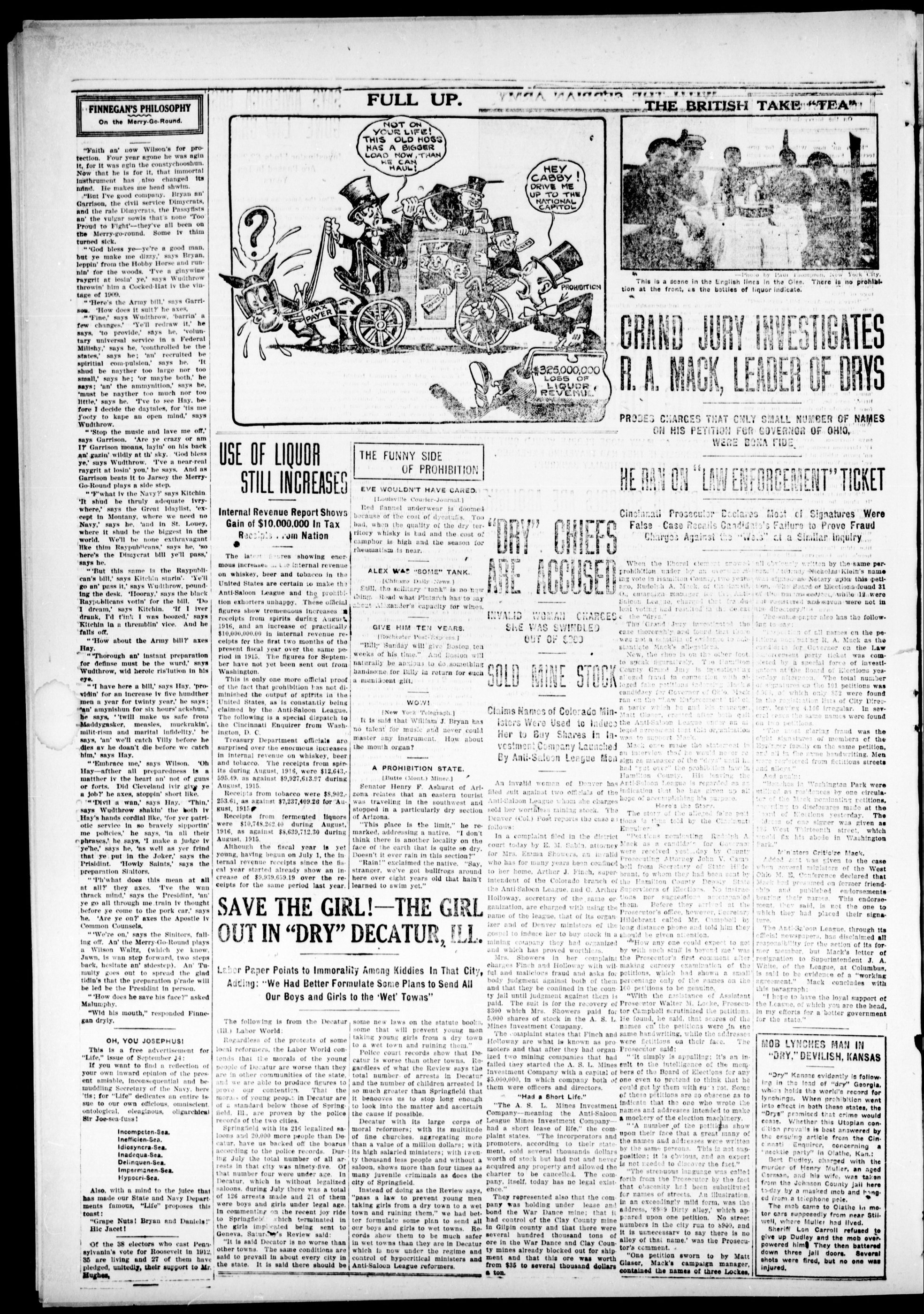
NOT ON YOUR LIFE!
THIS OLD HOSS
HAS A BIGGER
LOAD NOW, THAN
HE CAN
HAUL!
HEY CABBY!
DRIVE ME
UP TO THE
NATIONAL
CAPITOL
PROHIBITION
TAX
PAYER
#325,000,000
LOSS OF
LIQUOR
REVENUE!
SAVE THE GIRL!—THE GIRL OUT IN "DRY" DECATUR, ILL.
Labor Paper Points to Immorality Among Kiddies In That City Adding: "We Had Better Formulate Some Plans to Send All Our Boys and Girls to the 'Wet' Towns"
USE OF LIQUOR STILL INCREASES
Internal Revenue Report Shows Gain of $10,000,000 In Tax
The latest figures showing enormous increases in the internal revenue on whiskey, beer and tobacco in the United States are certain to make the Anti-Saloon League and the prohibition exhorton exhunhappy. These official figures show tremendous increases receipts from spirits during August 1916, and an increase of practically $10,000,000.00 in internal revenue receipts for the first two months of the present fiscal year over the same period in 1915. The figures for September have not yet been sent out from Washington.
This is only one more official proof of the fact that prohibition has not diminished the output of spirits in the United States, as is constantly being claimed by the Anti-Saloon League. The following is a special dispatch to the Cincinnati Enquirer from Washington, D. C.
Treasury Department officials are surprised over the enormous increases in internal revenue on whiskey, beer and tobacco. The receipts from spirits during August, 1916, were $12,643,555.49, as against $9,927,613.97 during August, 1915.
Receipts from tobacco were $8,902,253.61, as against $7,237,409.26 for August, 1915.
Receipts from fermented liquors were $10,748,262.40 during August, 1916, as against $8,639,712.30 during August, 1915.
Although the fiscal year is yet young, having begun on July 1, the internal revenue receipts since the fiscal year started already show an increase of $9,939,659.19 over the receipts for the same period last year.
SAVE THE GIRL
OUT IN "DRY"
Labor Paper Points to Immoral
Adding: "We Had Better Form
Our Boys and Girls
The following is from the Decatur
(IL.) Labor World:
Regardless of the protests of some local reformers, the Labor World contends that the morals of the young people of Decatur are worse than they are in other communities of the state, and we are able to produce figures to prove our contention. That the morals of young people in Decatur are of a standard below those of Springfield, Ill., are proven by the police records of the two cities.
Springfield with its 216 legalized saloons and 20,000 more people than Decatur, have us backed off the boards according to the police records. During July the total number of all arrests in that city was ninety-five. Of that number four were under age. In Decatur, which is without legalized saloons, during July there was a total of 126 arrests made and 21 of them were boys and girls under legal age. In commenting on the recent joy ride to Springfield which terminated in the girls implicated being sent to Geneva, Saturdays Review said: "It is said Decatur is no worse than other towns. The same conditions are said to prevail in about every city in the state. It is said there should be
THE FUNNY SIDE OF PROHIBITION
EVE WOULDN'T HAVE CARED.
[Louisville] Courier-Journal.]
Red flannel underwear is doomed because of the cost of dyestuffs. Too bad, when the quality of the dry territory whisky is bad and the cost of camphor is high and the season for rheumatism is near.
ALEX WAS "SOME" TANK.
(Canada Daily News)
Still, the military "tank" is no new thing. Read what Plutarch has to say about Alexander's capacity for wines.
GIVE HIM TEN YEARS.
"Billy: Sunday will give Boston ten weeks of his time." And Boston will naturally be anxious to do something handsome for Billy in return for such a numident gift.
It is said that William J. Bryan has no talent for music and never could master any instrument. How about the mouth organ?
A PROHIBITION STATE.
Senator Henry F. Ashurst of Arizona relates that an eastern tourist was traveling in the southwest and stopped in a particularly dry section of Arizona.
"This place is the limit," he remarked, addressing a native. "I don't think there is another locality on the face of the earth that is quite so dry. Doesn't it ever rain in this section?"
"Rain!" exclaimed the native. "Say, stranger, we've got bullfrogs around here over eight years old that hain't learned to swim yet."
RL!—THE GIRL DECATUR, ILL.
City Among Kiddies In That City, mulate Some Plans to Send All to the 'Wet' Towns"
some new laws on the statute books, some that will prevent young men taking young girls from a dry town to a wet town and ruining them."
Police court records show that Decatur is worse than other towns. Regardless of what the Review says the total number of arrests in Decatur and the number of children arrested is so much greater than Springfield that it benooves us to stop long enough to look into the matter and ascertain the cause if possible. Decatur with its large corps of moral reformers; with its multitude of fine churches, aggregating more than a value of a million dollars; with its high salaried ministers; with twenty thousand less people and without a saloon, shows more than four times as many juvenile criminals as does the city of Springfield.
Instead of doing as the Review says, "pass a law to prevent young men taking girls from a dry town to a wet town and ruining them." we had better formulate some plan to send all our boys and girls to wet towns. Records show them to be much safer in wet towns than they are in Decatur which is now under the regime and control of hypocritical ministers and Anti-Saloon League reformers.
Claims Names of Colorado Ministers Were Used to Induce Her to Buy Shares in Investment Company Launched By Anti-Saloon League Men
An invalid woman of Denver has filed suit against two officials of the Anti-Saloon League whom she charges sold her worthless mining stock. The Denver (Col.) Post reports the case a follows:
In a complaint filed in the district court today by E. M. Sabin, attorney for Mrs. Emma Showers, an invalid who has for many years been confined to her home, Arthur J. Finch, superintendent of the Colorado branch of the Anti-Saloon League, and G. Arthur Holloway, secretary of the same organization, are charged with using the name of the league, that of its organizer and of Denver ministers of the gospel to induce her to buy stock in a mining company they had organized and which has proved worthless.
Mrs. Showers in her complaining charges Finch and Holloway with wilful and malicious fraud and asks for body judgment against both of them and that they be confined in the country fall until judgment against them is paid. The suit is for the recovery of $300 which Mrs. Showers paid for 5,000 shares of stock in the A. S. L. Mines Investment Company.
The complaint states that Finch and Holloway are what is known as promoters and that after they had organized two mining companies that had failed they started the A. S. L. Mines Investment Company with a capital of $5,000,000, in which company both of them were officers and directors.
"Had a Short Life."
"The A. S. L. Mines Investment Company—meaning the Anti-Saloon League Mines Investment Company—had a short lease of life," the complaint states. "The incorporators and promoters, according to their statement, sold several thousands dollars worth of stock but had not and never acquired any property and allowed the charter to be cancelled. The company, itself, today has no legal existence."
They represented also that the company was holding under lease and bond the War Dance mine; that it had control of the Clay County mine in Gilpin county and that there were several hundred thousand tons of ore in the War Dance and Clay County mines already blocked out for shipment and that this ore was worth from $35 to several thousand dollars a ton.
This is a scene in the English lines in the Oise. There is no prohibition at the front, as the bottles of liquor indicate.
GRAND JURY INVESTIGATES R.A. MACK, LEADER OF DRYS
PROBES CHARGES THAT ONLY SMALL NUMBER OF NAMES ON HIS PETITION FOR GOVERNOR OF OHIO, WERE BONA FIDE
HE RAN ON "LAW ENFORCEMENT" TICKET
Cincinnati Prosecutor Declares Most of Signatures Were False Case Recalls Candidate's Failure to Prove Fraud Charges Against the "Wells" at a Similar Inquiry
When the Ebola element snowed prohibition under by an overwhelming vote in Hamilton County, two years ago, Rudolph A. Mack, of Hamilton, O. cangazan manager for the Anti-Sabon League, charged that the defendant voting and resulted in the dee exit c the "drys." This Grand Jury investigated the case thoroughly and found that those was not a scientific of evidence to substantiate Mack's allegations. New, the shoe is on the other foot, to speak figuratively. The Hamilton County Grand Jury is investigating alleged fraud in connection with alleged fake positions including Mack's candidacy for Governor of Ohio. Mack ran on the "Law Enforcement" title of a party which he and his manager, Matt Glaser, created after both guilt the Anti-Sabon League under an alleged agreement that this organization was to support Mack.
Mach once made the statement in an interview that he would not or resign as manager of the "days" until he had "put over" the prohibition law in Hamilton County. His leaving the Artillery Saloon League is regarded as an indication that he has given up all hope of accomplishing his purpose.
Here's the Story.
The story of the alleged false petitions is thus told by the Childrens Enquirer.
"Petitions nominating Rebeph A. Mack as a candidate" for Governor were received yesterday day by County Prosecuting Attorney John V. Campbell from Secretary of State Hildebrant, to whom they had been sent by the Hamilton County Deputy State Supervisors of Elections. No instructions nor suggestions are accompanied them. Before they arrived at the Prosecutor's office, however, Secretary Hildebrant called Mr. Campbell by long distance phone and told him they should be given attention.
How any one could expect to get by with such stuff is beyond me' was the Prosecutor's first comment after making cursory examination of the petitions, which had shown a small percentage only of the names on the 100 petitions to be genuine.
"With the assistance of Assistant Prosecutor Walter M. Locke, Prosecutor Campbell scrutinized the petitions. He found, he said, that scores of the names on the petitions were in the same handwriting, while the addresses were fictitious on their face. The Prosecutor said:
"It simply is appalling; it's an insult to the intelligence of the members of the Board of Elections for any one even to pretend to think that he could get by them with such not. Some of these petitions are so obscene as to indicate that the one who wrote the names and addresses intended to make a mockery of the election machinery.
"A number of the petitions show upon their face that a great many of the names and addresses were written by the same persona. This is not supposition; it is obvious, and an expert is not needed to discover the fact."
"The strenuous language was called forth from the Prosecutor by the fact that obscurity had been substituted for names of streets. An illustration, in an exceedingly mild form, was the address, '899 Dirty alley,' which appeared upon one petition. No street numbers in the city run to $800, and it is unnecessary to say there is no alley of that name.' was the Prosecutor's comment.
"One petition sworn to by Matt Glaser, Mack's campaign manager, contained the names of three Lockes.
all obviously written by the same person. Mitchley Nicholas Klein's name was assigned to Netary upon this petition. The Board of Elections found 31 of the nine nominees, while 12 were not registered and seven were not in the directory. The same paper also has the following to say: "Inspection of all names on the petitions nominating R. A. Mack as the candidate for Governor on the Law enforcement party ticket was completed by a special force of investigators at the Board of Elections yesterday afternoon. The total number of signatures on the 101 petitions was 4,963, of which only 852 were found in the registration lists of City Directory, leaving 4,156 irregular. In several cases the same names were found on two petitions.
"The most glaring fraud was the eight signatures of members of the Eugene family on the same petition, and all in the same handwriting. Men were registered from fictitious streets and allows."
And again:
"Bombos in Washington Park were utilized as residences by one circulator of the Mock nominating petitions, according to disclosures made at the Board of Elections yesterday. The address of one signer was given as 133 West Thirteenth street, which would fix his abode in Washington Park."
Ministers Criticize Mack.
Added cost was given to the case when several ministers of the West Ohio M. E. Conference declared that Mack had presumed on former friendship and published endorsements bearing their names. This endorsement, they said, is not the one to which they had placed their signature.
The Anti-Saloon League, through its official newspapers, has disclaimed all responsibility for the action of its former member, but Mack's letter of resignation to Superintendent J. A. White, of the League, at Columbus, is said to be evidence of a "working agreement." Mack concludes with this paragraph:
"I hope to have the loyal support of the League, of which you are the head, in my efforts for a better government for the state."
MOB LYNCHES MAN IN
"DRY," DEVILISH, KANSAS
"Dry" Kennae evidently is following in the load of "dry" Georgia, which holds the world's record for lynchings. When prohibition went into effect in both these states, the "Dry" promised that crime would cease. Whether this utopian condition provalls is best answered by the ensuing article from the Cincinnati Enquirer, concerning a "nackle party" in Olathe, Kan.: Bert Dudley, charged with the murder of Henry Muller, an aged German, and his wife, was taken from the Johnson County jail here to day by a masked mob and hanged from a telephone pole. The mob came to Olathe in motor cars supposedly from near Stillwell, where Muller had lived.
Sheriff Lon Carroll refused to give up Dudley and the mob overpowered him. They then battered down three jail doors. Several shots were fired, but no one was injured.