Muskogee Cimeter
Saturday, November 11, 1916
Muskogee, Oklahoma
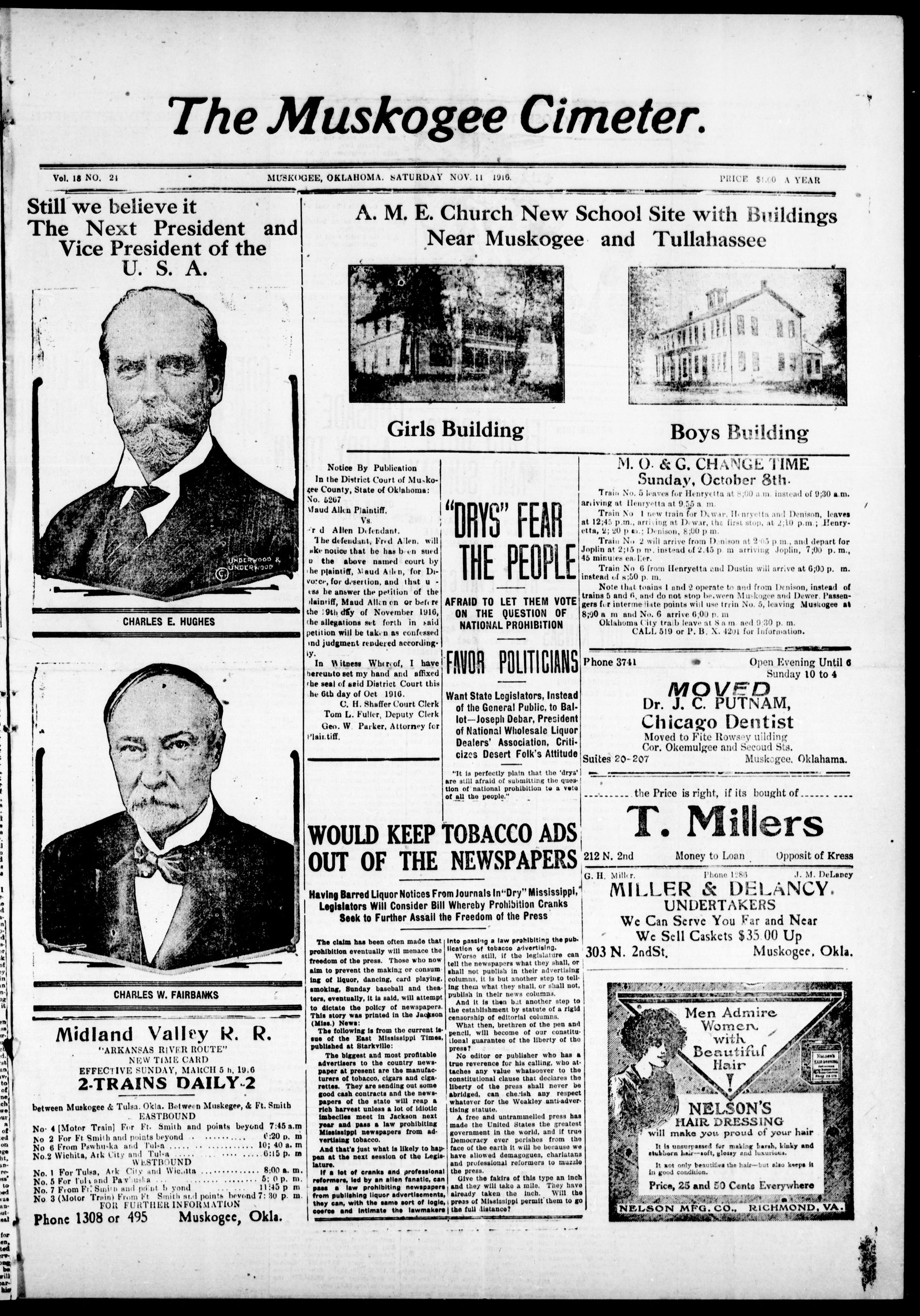
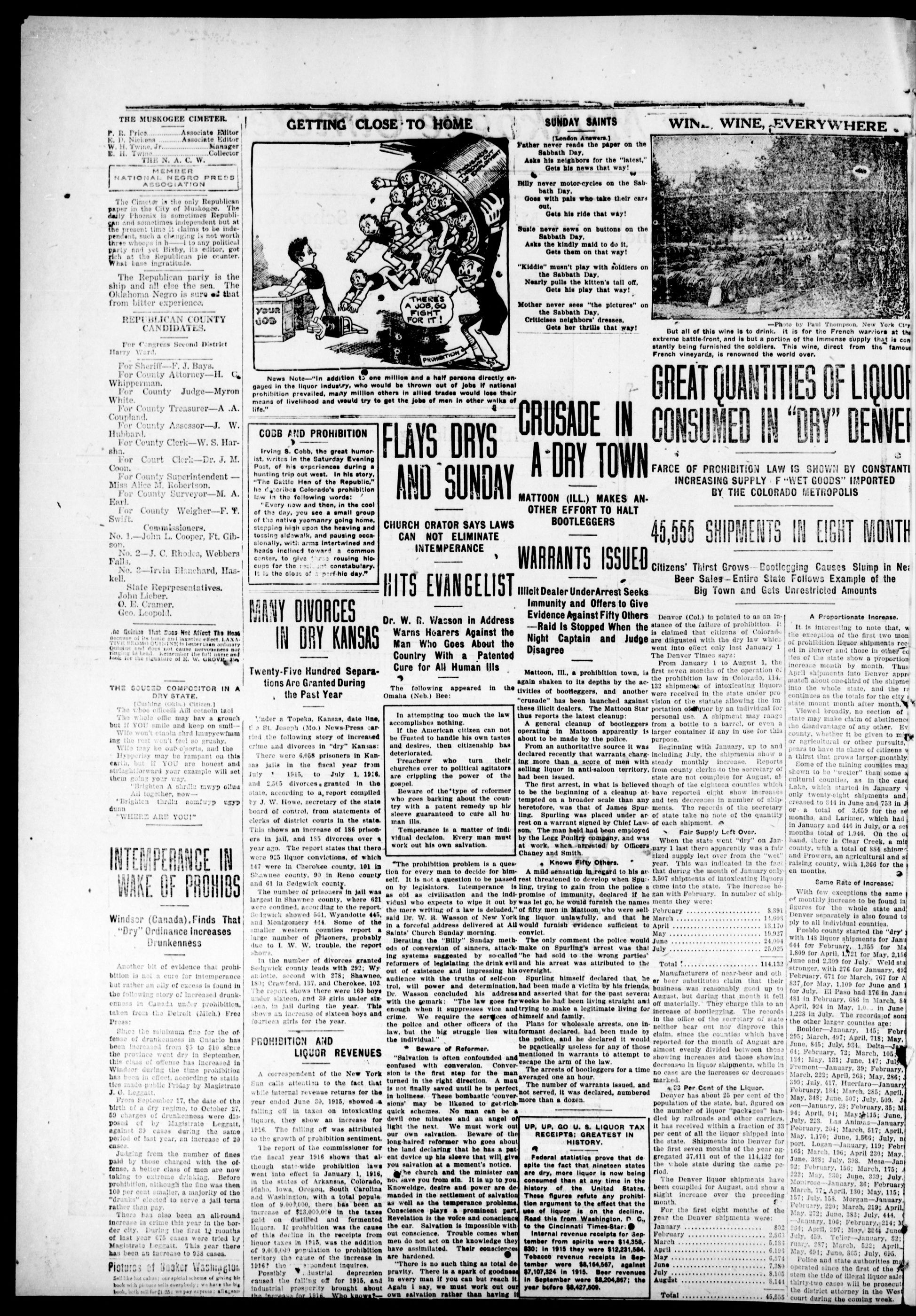
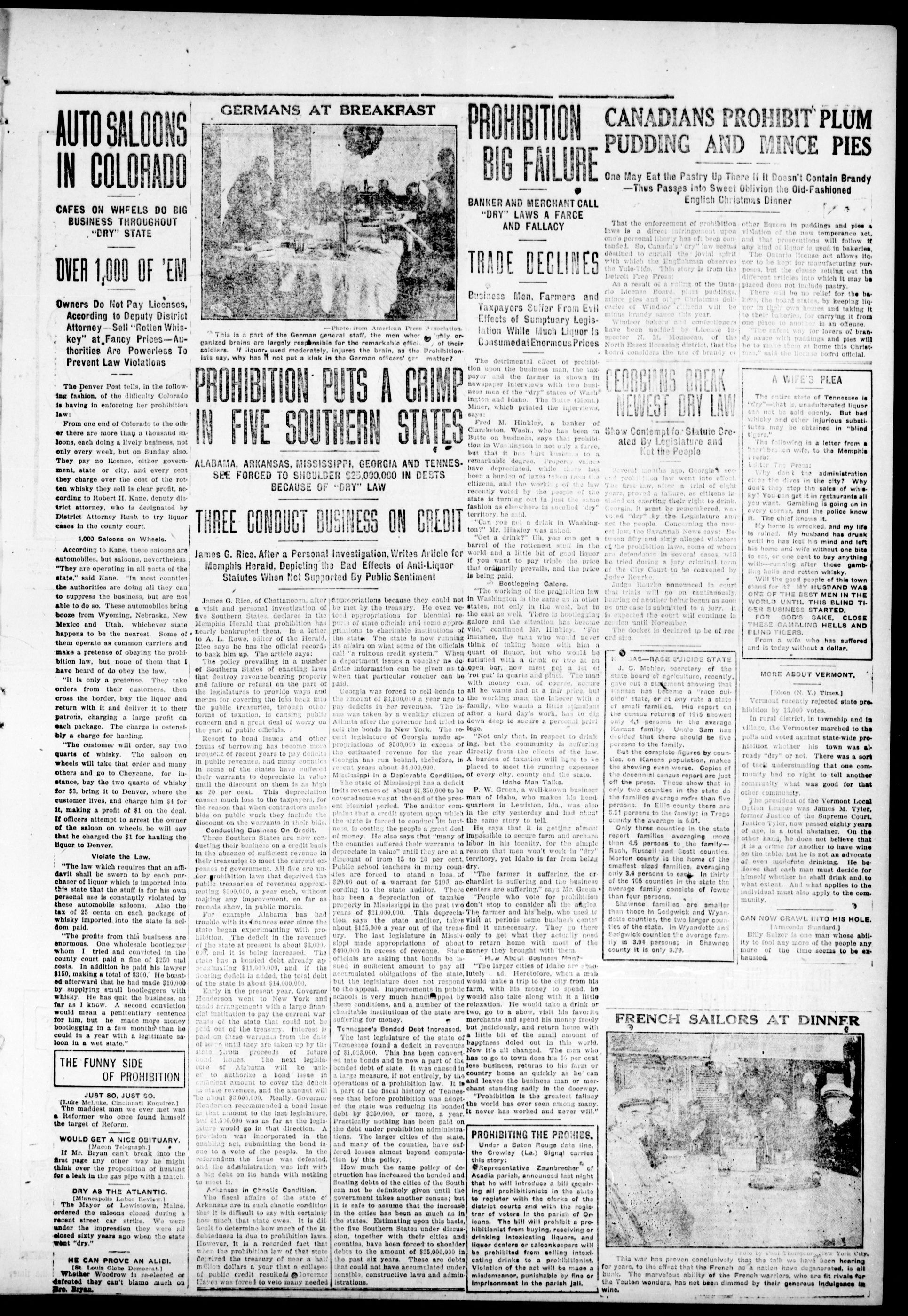
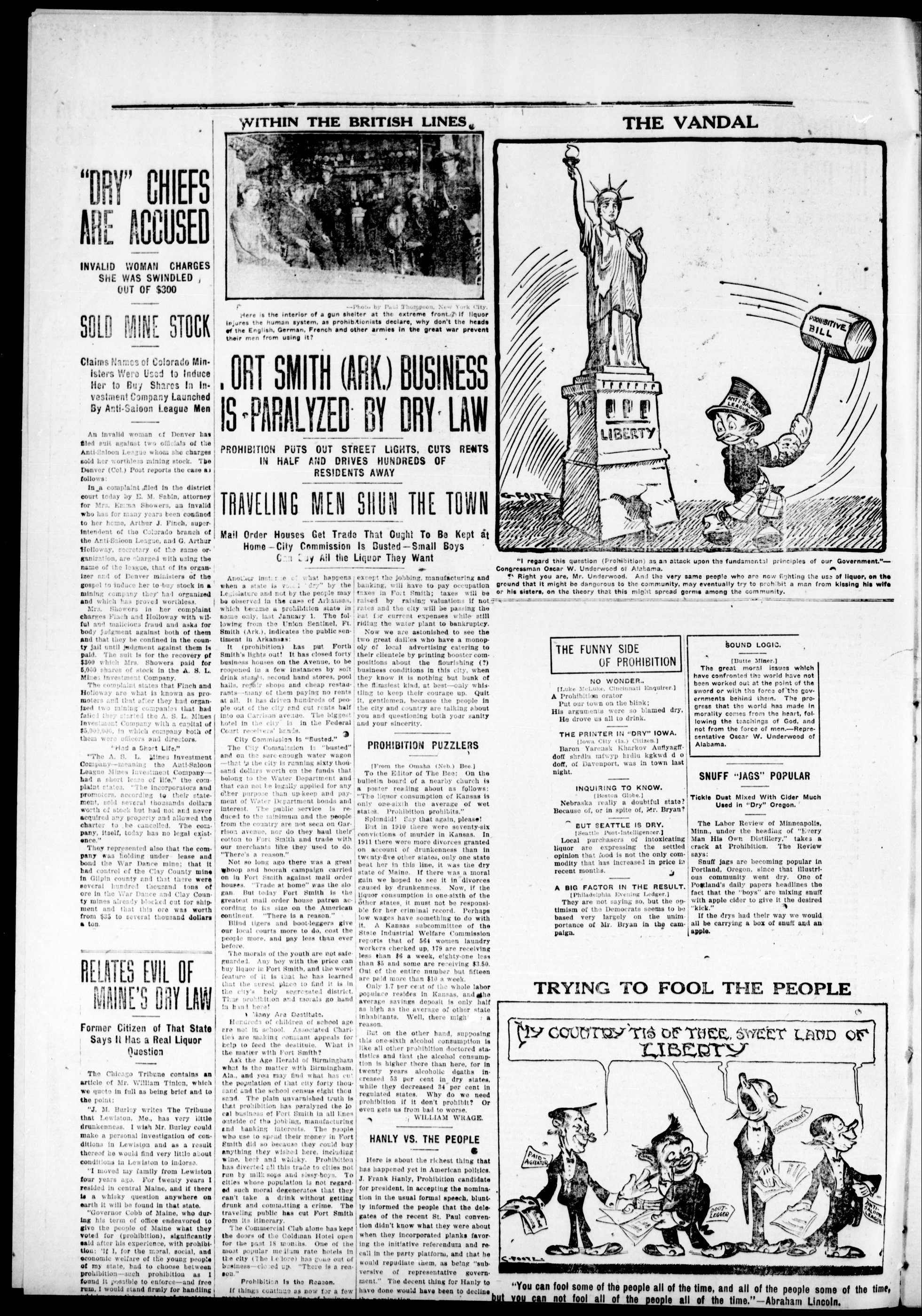
Page text (machine-generated)
The Muskogee Cimeter.
Still we believe it The Next President and Vice President of the U. S. A.
UNDERWOOD & UNDERWOOD
JOHN H. HARRIS
"ARKANSAS RIVER ROUTE"
NEW TIME CARD
EFFECTIVE SUNDAY, MARCH 5 h. 19.6
2-TRAINS DAILY-2
between Muskogee & Tulsa. Okla. Between Muskegee, & Ft. Smith
EASTBOUND
No. 4 [Motor Train] For Ft. Smith and points beyond 7:45 a.m.
No 2 For Ft Smith and points beyond 6:20 p. m.
No 6 From Pswhucka and Tulsa 10; 40 a. m.
No.2 Wichita, Ark City and Tulsa 6:15 p. m
WESTBOUND
CHARLES E. HUGHES
MUSKOGEE, OKLAHOMA. SATURDAY NOV. 11 1916.
A. M. E. Church New School Site with Buildings Near Muskogee and Tullahassee
A
Girls Building
Notice By Publication In the District Court of Muskogee County, State of Oklahoma: No. 5267
The defendant, Fred Allen, will take notice that he has been sued in the above named court by the plaintiff, Maud Allen, for Divorce, for desertion, and that u-ess be answer the petition of the plaintiff, Maud Allen on or before the 19th day of November 1916, the allegations set forth in said petition will be taken as confessed and judgment rendered accordingly.
In Witness Whereof, I have hereunto set my hand and affixed the seal of said District Court this the 6th day of Oct. 1916.
C. H. Shaffer Court Clerk
Tom L. Fuller, Deputy Clerk
Geo. W. Parker, Attorney for Plaintiff.
WOULD KEEP THE OUT OF THE
Having Barred Liquor Notices From Legislators Will Consider Bill Seek to Further Assail th
WOULD KEEP TOBACCO ADS OUT OF THE NEWSPAPERS
Having Barred Liquor Notices From Journals In "Dry" Mississippi, Legislators Will Consider Bill Whereby Prohibition Cranks Seek to Further Assail the Freedom of the Press
The claim has been often made that prohibition eventually will menace the freedom of the press. Those who now aim to prevent the making or consuming of liquor, dancing, card playing, smoking, Sunday baseball and theaters, eventually, it is said, will attempt to dictate the policy of newspapers. This story was printed in the Jackson (Miss.) News:
The following is from the current issue of the East Mississippi Times, published at Starkville:
The biggest and most profitable advertisers to the country newspaper at present are the manufacturers of tobacco, cigars and cigarettes. They are sending out some good cash contracts and the newspapers of the state will reap a rich harvest unless a lot of idiotic imbeciles meet in Jackson next year and pass a law prohibiting Mississippi newspapers from advertising tobacco.
And that's just what is likely to happen at the next session of the Legislature.
If a lot of cranks and professional reformers, led by an alien fanatic, can pass a law prohibiting newspapers from publishing liquor advertisements, they can, with the same sort of logic, coerce and intimate the lawmakers
1
```markdown
```
"DRYS" FEAR THE PEOPLE
AFRAID TO LET THEM VOTE ON THE QUESTION OF NATIONAL PROHIBITION
FAVOR POLITICIANS
Want State Legislators, Instead of the General Public, to Ballot—Joseph Debar, President of National Wholesale Liquor Dealers' Association, Criticizes Desert Folk's Attitude
"It is perfectly plain that the 'drya' are still afraid of submitting the question of national prohibition to a veto of all the people."
TOBACCO ADS
NEWSPAPERS
from Journals In "Dry" Mississippi,
I Whereby Prohibition Cranks
the Freedom of the Press
Into passing a law prohibiting the publication of tobacco advertising.
Worse still, if the legislature can tell the newspapers what they shall, or shall not publish in their advertising columns, it is but another step to telling them what they shall, or shall not, publish in their news columns.
And it is then but another step to the establishment by statute of a rigid censorship of editorial columns.
What then, brethren of the pen and pencil, will become of our constitutional guarantee of the liberty of the press?
No editor or publisher who has a true reverence for his calling, who attaches any value whatsoever to the constitutional clause that declares the liberty of the press shall never be abridged, can cheish any respect whatever for the Weakley anti-advertising statute.
A free and untrammelled press has made the United States the greatest government in the world, and if true Democracy ever perishes from the face of the earth it will be because we have allowed demagogues, charlatans and professional reformers to muzzle the press.
Give the fakirs of this type an inch and they will take a mile. They have already taken the inch. Will the press of Mississippi permit them to go the full distance?
l Site with Buildings
d Tullahassee
THE MUSEUM
Boys Building
R. O. & G. CHANGE TIME
Sunday, October 8th.
no. 5 leaves for Henryetta at 8:00 a.m. instead of 9:30 a.m.
Henryetta at 9:55 a.m.
no. 1 new train for Dawar, Henryetta and Denison, leaves
arriving at Dawar, the first stop, at 2:10 p.m.; Henry-
ta; Denison, 8:00 p.m.
no. 2 will arrive from Denison at 2:05 p.m., and depart for
5 p.m. instead of 2.45 p.m. arriving Joplin, 7:00 p.m.,
aaker.
no. 6 from Henryetta and Dustin will arrive at 6:00 p.m.
50 p.m.
at toains 1 and 2 operate to and from Denison, instead of
6, and do not stop between Muskogee and Dewer. Passen-
mediate points will use train No. 5, leaving Muskogee at
and No. 6 arrive 6:00 p.m.
Na City trail leave at 8 a.m. aed 9:30 p.m.
CALL 519 or P. B. X. 4201 for Information.
M. O. & G. CHANGE TIME Sunday. October 8th.
Train No. 5 leaves for Henryetta at 8:00 a.m. instead of 9:30 a.m. arriving at Henryetta at 9:55 a.m.
Train No. 1 new train for Dewar, Henryetta and Denison, leaves at 12:45 p.m., arriving at Dewar, the first stop, at 2:10 p.m.; Henryetta, 2:20 p.m.; Denison, 8:00 p.m.
Train No. 2 will arrive from Denison at 2:05 p.m., and depart for Joplin at 2:15 p.m. instead of 2.45 p.m. arriving Joplin, 7:00 p.m., 45 minutes earlier.
Train No. 6 from Henryetta and Dustin will arrive at 6:00 p.m. instead of s:50 p.m.
Note that toains 1 and 2 operate to and from Denison, instead of trains 5 and 6, and do not stop between Muskogee and Dewer. Passengers for intermediate points will use trin No. 5, leaving Muskogee at 8:00 a.m and No. 6 arrive 6:00 p.m.
Oklahoma City trail leave at 8 a.m. aed 9:30 p.m.
CALL 519 or P. B. X. 4201 for Information.
Open Evening Until 6
Sunday 10 to 4
MOVED
Dr. J. C. PUTNAM,
Chicago Dentist
Moved to Fite Rowsey uilding
Cor. Okemulgee and Secoud Sts.
207 Muskogee, Oklahoma.
the Price is right, if its bought of
T. Millers
Money to Loan Opposit of Kress
Phone 1286 J. M. DeLancy
ILLER & DELANCY
T. Millers
212 N. 2nd Money to Loan Opposit of Kress
G. H. Miller. Phone 1286 J. M. DeLancy
MILLER & DELANCY
UNDERTAKERS
We Can Serve You Far and Near
We Sell Caskets $35.00 Up
303 N. 2ndSt. Muskogee, Okla.
Men Admire
Women
with
Beautiful
Hair!
NELSON'S
HAIR DRESSING
will make you proud of your hair
It is unsurpassed for making harsh, kinky and
stubborn hair—soft, glossy and luxurious.
It not only beautifies the hair—but also keeps it
in good condition.
Price, 25 and 50 Cents Everywhere
NELSON MFG. CO., RICHMOND, VA.
P. R. Price.....Associate Editor
E. D. Nickens.....Associate Editor
W. H. Twine, Jr.....Manager
E. H. Twine.....Collector
THE N. A. C. W.
MEMBER
NATIONAL NEGRO PRESS
ASSOCIATION
The Cinctor is the only Republican paper in the City of Muskogee. The daily Phoenix is sometimes Republican and sometimes independent but at the present time it claims to be independent, such a changing is not worth three whoops in h — to any political party and yet Bixby, its editor, got rich at the Republican pie counter. What base ingratiate.
The Republican party is the ship and all else the sen. The Oklahoma Negro is sure of that from bitter experience.
REPUBLICAN COUNTY
CANDIDATES.
For Congress Second District
Harry Ward.
For Sheriff—F. J. Bays.
For County Attorney—H. C.
Whipperman.
For County Judge—Myron
White.
For County Treasurer—A .A.
Coupland.
For County Assessor—J. W.
Hubbard.
For County Clerk—W. S. Harsha.
For Court Clerk—Dr. J. M.
Coon.
For County Superintendent —
Miss Alice M. Robertson.
For County Surveyor—M. A.
Earl.
For County Weigher—F. T.
Swift.
No. 1.—John L. Cooper, Ft. Gibson.
No. 2—J. C. Rhodes, Webbers Falls.
No. 3-Irvin Blanchard, Haskell.
State Representatives.
the Gulliana That Does Not Affect The Head
because of its taint and negative effect. LAXA-
TIVE BROMO GULLIANA better describes Quinine and does not cause nervousness nor ringing in head. Remember the full name and look for the signature of E. W. GROVE 236
THE SOUSED COMPOSITOR IN A DRY STATE.
[Canning (Offic) Citizen]
The who office officer All ectaohn tol
The whole office may have a grouch
but if YOU smile and keep on smill—
Wife won't ectaohn third imupcyewfmm
ing the rest won't feel so grushy.
Wife may be oaib oorts, and the
Hypperlay may be rampant on this
earth, but if YOU are honest and
strilightforward your example will set
them going your way.
"Beighten A shirla mwyp ollua
All together, now—
"Beighten the shirla mwyp ollua
An together, now—
'Brighten thrilla aomfwyp usyp
dunn
"WHERE ARE YOU!"
INTEMPERANCE IN WAKE OF PROHIBITS
---
Windsor (Canada). Finds That "Dry" Ordinance increases Drunkenness
Another bit of evidence that prohibition is not a cure for intemperance but rather an ail of excess is found in the following story of increased drunkenness in Canada under prohibition, taken from the Detroit (Mich.) Free Press:
Since the minimum fine for the offense of drunkenness in Ontario has been increased from $5 to $10 since the province went dry in September, this class of offense has increased in Windsor during the time prohibition has been in effect, according to statistic made public Friday by Magistrate J. C. Leggatt.
From September 17, the date of the birth of a dry regime, to October 27, 59 charges of drunkenness were disposed of by Magistrate Leggatt, against 39 cases during the same period of last year, an increase of 20 cases.
Judging from the number of fines paid by those charged with the offense, a better charge of men are now taking to extreme drinking. Before prohibition, although the fine was then 100 per cent smaller, a majority of the "dranker" elected to serve a jail term rather than pay.
There has also been an all-round increase in crime this year in the border city. During the first 12 months of last year 675 cases were tried by Magistrate Leegatt. This year there has been an increase to 938 cases.
Pictures of Booker Washington
Sell like hot cakes; our special scheme of giving the book with picture sells everybody; we have the big book, both sell for $2.25; we pay express; all agent
PROLONGS TRUNK OUT OF EMPLOYMENT
YOUR JOB
THERE'S A JOB, GO FIGHT FOR IT!
PROHIBITION
News Note—"In addition to one million and a half persons directly engaged in the liquor industry, who would be thrown out of jobs if national prohibition prevailed, many million others in allied trades would lose their means of livelihood and would try to get the jobs of men in other walks of life."
CODB AND PROHIBITION
Irving S. Cobb, the great humorist, writes in the Saturday Evening Post, of his experiences during a hunting trip out west. In his story, "The Battle Hen of the Republic," he describes Colorado's prohibition law in the following words: 'Every now and then, in the cool of the day, you see a small group of the native yoyomany going home, stepping high upon the heaving and tossing sidewalk, and pausing occasionally, with arms intertwined and heads inclined toward a common center, to give three rousing hiccups for the restraint constabulary. It is the close of a perilic day.'
MANY DIVORCES IN DRY KANSAS
Twenty-Five Hundred Separations Are Granted During the Past Year
Under a Topeka, Kansas, date line, the St. Joseph (Mo.) News-Press carried the following story of increased crime and divorces in "dry" Kansas: There were 6,058 prisoners in Kansas jails in the fiscal year from July 1, 1915, to July 1, 1916, and 2,505 divorces granted in the state, according to a report compiled by J. W. Howe, secretary of the state board of control, from statements of clerks of district courts in the state. This shows an increase of 186 prisoners in jail, and 185 divorces over a year ago. The report states that there were 925 liquor convictions, of which 147 were in Cherokee county, 101 in Shawnee county, 90 in Reno county and 61 in Sedwick county.
The number of prisoners in jail was largest in Shawnee county, where 621 were confined, according to the report. Sedgwick showed 561, Wyandotte 445, and Montgomery 444. Some of the smaller western counties report a large number of prisoners, probably due to I. W. W. trouble, the report shows.
In the number of divorces granted Sedgwick county leads with 292; Wyandotte, second with 278; Shawnee, 180; Crawford, 137, and Cherokee, 103. The report shows there were 169 boys under sixteen, and 39 girls under sixteen, in jail during the year. This shows an increase of sixteen boys and fourteen girls for the year.
PROHIBITION AND LIQUOR REVENUES
A correspondent of the New York Sun calls attention to the fact that while internal revenue returns for the year ended June 30, 1915, showed a falling off in taxes on intoxicating liquors, they show an increase for 1916. The falling off was attributed to the growth of prohibition sentiment.
The report of the commissioner for the fiscal year 1916 shows that although state-wide prohibition laws went into effect in January 1, 1916, in the states of Arkansas, Colorado, idaho, Iowa, Oregon, South Carolina and Washington, with a total population of 9,000,000, there has been an increase of $23,000,000 in the taxes paid on distilled and fermented liquors. If prohibition was the cause of this decline in the receipts from liquor taxes in 1915, was the addition of 9,000,000 population to prohibition territory the cause of the increase in 1916? the dependent inquires. Possibly industrial depression caused the falling off for 1915, and industrial prosperity brought about the increase for 1916. Who knows?—
Berating the "Billy" Sunday meth- The only comment the police would ods of conversion of sinners, attack-make on Spurling's arrest was that ing systems suggested by so-called "he had sold to the wrong parties' reformers of legislating the drink evil and his arrest was attributed to the out of existence and impressing his oversight.
audience with the truths of self-con Spurling himself declared that he trol, will power and determination, had been made a victim by his friends, Dr. Wasson concluded his address and asserted that for the past several with the mark: "The law goes far weeks he had been living straight and enough when it suppresses vice and trying to make a legitimate living for crime. We require the services of himself and family.
the police and other officers of the Plans for wholesale arrests, one in law, but the big struggle lies with formant declared, had been made by the individual." the police, and he declared it would
FLAYS DRYS AND SUNDAY
CHURCH CRATOR SAYS LAWS CAN NOT ELIMINATE INTEMPERANCE
HITS EVANGELIST
Dr. W. R. Wasson in Address Warns Hoarers Against the Man Who Goes About the Country With a Patented Cure for All Human Ills
The following appeared in the Omaha (Neb.) Bee:
In attempting too much the law accomplishes nothing.
If the American citizen can not be frusted to handle his own tastes and desires, then citizenship has deteriorated.
Preachers' who turn their churches over to political agitators are crippling the power of the gospel.
Beware of the 'type of reformer who goes barking about the country with a patent remedy up his sleeve guaranteed to cure all human ills.
Temperance is a matter of individual decision. Every man must work out his own salvation.
"The prohibition problem is a question for every man to decide for himself. It is not a question to be passed on by legislators. Intemperance is as old as civilization and the individual who expects to wipe it out by the mere writing of a law is deluded," said Dr. W. R. Wasson of New York in a forceful address delivered at All Saints' Church Sunday morning.
Berating the "Billy" Sunday methods of conversion of sinners, attacking systems suggested by so-called reformers of legislating the drink evil out of existence and impressing his audience with the truths of self-control, will power and determination, Dr. Wasson concluded his address with the remark: "The law goes far enough when it suppresses vice and crime. We require the services of the police and other officers of the law, but the big struggle lies with the individual."
Beware of Reformer.
"Salvation is often confounded and confused with conversion. Conversion is the first step for the man turned in the right direction. A mau is not finally saved until he is perfect in holiness. These bombastic 'conversions' may be likened to get-rich-quick schemes. No man can be a devil one minutes and an angel of light the next. We must work out our own salvation. Beware of the long-haired reformer who goes about the land declaring that he has a patient device up his sleeve that will give you salvation at a moment's notice.
The church and the minister can not save you from sin. It is up to you. Knowledge, desire and power are demanded in the settlement of salvation as well as the temperance problems. Conscience plays a prominent part. Revelation is the voice and conscience the ear. Salvation is impossible without conscience. Trouble comes when men do not act on the knowledge they have assimilated. Their consciences are hardened.
"There is no such thing as total depravity. There is a spark of goodness in every man if you can but reach it. Again I say, we must work out our own salvation rather than having it
SUNDAY SAINTS
[London Answers.]
Father never reads the paper on the
Sabbath Day.
Asks his neighbors for the "latest,"
Gets his news that way!
Milly never motorcycles on the Sabbath Day.
Goes with pals who take their cars out.
Gets his ride that way!
Susie never sews on buttons on the
Sabbath Day.
Asks the kindly maid to do it.
Gets them on that way!
"Kiddie" muen't play with soldiers on
the Sabbath Day.
Nearly pulls the kitten's tail off.
Gets his play that way!
Mother never sees "the pictures" on
the Sabbath Day.
Criticians' neighbors' dresses.
Gets her thrills that way!
CRUSADE IN A DRY TOWN
MATTOON (ILL.) MAKES ANOTHER EFFORT TO HALT BOOTLEGGERS
WARRANTS ISSUED
Illicit Dealer UnderArrest Seeks Immunity and Offers to Give Evidence Against Fifty Others —Raid Is Stopped When the Night Captain and Judge Disagree
Mattoon, Ill., a prohibition town, is again shaken to its depths by the activities of bootleggers, and another "crusade" has been launched against these illicit dealers. The Mattoon Star thus reports the latest cleanup: A general cleanup of bootleggers operating in Mattoon apparently is about to be made by the police. From an authoritative source it was declared recently that warrants charging more than a score of men with selling liquor in anti-saloon territory had been issued.
The first arrest, in what is believed to be the beginning of a cleanup attempted on a broader scale than any heretofore, was that of James Spurling. Spurling was placed under arrest on a warrant signed by Chief Lawson. The man held had been employed by the Legg Poultry company, and was at work, when arrested by Officers Chaney and Smith.
Knows Fifty Others.
A mild sensation in regard to his arrest threatened to develop when Spurling, trying to gain from the police a promise of immunity, declared if he was let go, he would furnish the names of fifty men in Mattoon who were selling liquor unlawfully, and that he would furnish evidence sufficient to convict.
The only comment the police would make on Spurling's arrest was that "he had sold to the wrong parties" and his arrest was attributed to the oversight.
Spurling himself declared that he had been made a victim by his friends, and asserted that for the past several weeks he had been living straight and trying to make a legitimate living for himself and family.
Plans for wholesale arrests, one informant declared, had been made by the police, and he declared it would be practically useless for any of those mentioned in warrants to attempt to escape the arm of the law.
The arrests of bootleggers for a time averaged one an hour.
The number of warrants issued, and not served, it was declared, numbered more than a dozen.
UP, UP, GO U. S. LIQUOR TAX RECEIPTS; GREATEST IN HISTORY.
Federal statistics prove that despite the fact that nineteen states are dry, more liquor is now being consumed than at any time in the history of the United States. These figures refute any prohibition argument to the effect that the use of liquor is on the decline. Read this from Washington. D C, to the Cincinnati Times-Star: *To internal revenue receipts for September from spirits were* $14,358, $30; in 1915 they were $12,231,594. Tobacco revenue receipts in September were $8,146,167, against $7,107,324 in 1915. Beer revenues in September were $8,204,867; the year before $8,427,509.
THE FIELD
But all of this wine is to drink. it is for the French warriors at the extreme battle-front, and is but a portion of the immense supply that is constantly being furnished the soldiers. This wine, direct from the famous French vineyards, is renowned the world over.
GREAT QUANTITIES OF LIQUOR CONSUMED IN "DRY" DENVER
FARCE OF PROHIBITION LAW IS SHOWN BY CONSTANTI INCREASING SUPPLY F "WET GOODS" IMPORTED BY THE COLORADO METROPOLIS
Citizens' Thirst Grows-Bootlogging Causes Slump in Neal Beer Sales-Entire State Follows Example of the Big Town and Gets Unrestricted Amounts
Denver (Col.) is pointed to as an instance of the failure of prohibition. It is claimed that citizens of Colorado are disgusted with the dry law which went into effect only last January 1. The Denver Times says:
From January 1 to August 1, the first seven months of the operation of the prohibition law in Colorado, 114, 132 shipments of intoxicating liquors were received in the state under provision of the statute allowing the importation of liquor by an individual for personal use. A shipment may range from a bottle to a barrel, or even a larger container if any in use for this purpose.
Beginning with January, up to and including July, the shipments show a steady monthly increase. Reports from county clerks to the secretary of state are not complete for August, although of the eighteen counties which have reported eight ship increases and ten decreases in number of shipments. The records of the secretary of state take no note of the quantity of each shipment.
Fair Supply Left Over.
When the state went "dry" on January 1 last there apparently was a fair sized supply left over from the "wet" year. This was indicated in the fact that during the month of January only 3,507 shipments of intoxicating liquors came into the state. The increase began with February. In number of shipments they were:
February ..... 8,391
March ..... 14,998
April ..... 13,170
May ..... 19,927
June ..... 24,004
July ..... 25,025
Total ..... 114,132
Manufacturers of near-beer and other beer substitutes claim that their business was reasonably good up to August, but during that month it fell off materially. They charge this to an increase of bootlegging. The records in the office of the secretary of state neither bear out nor disprove this claim, since the counties which have reported for the month of August are almost evenly divided between those showing increases and those showing decreases in liquor shipments, while in no case are the increases or decreases marked. 23 Per Cent of the Liquor
Denver has about 25 per cent of the population of the state, but, figured on the number of liquor "packages" handled by railroads and other carriers, it has received within a fraction of 33 per cent of all the liquor shipped into the state. Shipments into Denver for the first seven months of the year aggregated 37,411 out of the 114,132 for the whole state during the same period. The Denver liquor shipments have been compiled for August, and show a slight increase over the preceding month.
For the first eight months of the
year the Denver shipments were:
January ..... 802
February ..... 2,603
March ..... 5,183
April ..... 6,193
May ..... 6,574
June ..... 7,389
July ..... 8,105
August ..... 8,144
Total ..... 45,555
A Proportionate Increase.
It is interesting to note that, with the exception of the first two months of prohibition I liquor shipments received in Denver and those in other counties of the state show a proportion increase month by month. Thus April shipments into Denver appraised about one-third of the shipment into the whole state, and the rate continues as the totals for the city's state mount month after month. Viewed broadly, no section of state may make claim of abstinence the disadvantage of any other. Even county, whether it be given to migratory or agricultural or other pursuits, peers to have its share of citizens who a thirst that grows larger monthly
Some of the mining counties may shown to be "wetter" than some a cultural counties, as in the case Lake, which started in January w only twenty-eight shipments and creased to 844 in June and 753 in J or a total of 3,659 for the se months, and Larimer, which had in January and 446 in July, or a se months total of 1,946. On the o hand, there is Clear Creek, a min county, with a total of 884 shipmen and Prowers, an agricultural and s raising county, with 1,366 for the en months.
Same Rate of Increase:
With few exceptions the same
monthly increase to be found in
figures for the whole state and
Denver separately is also found to
ply to all individual counties.
Pueblo county started the "dry"
with 148 liquor shipments for Janu
644 for February, 1,355 for May
1,809 for April, 1,921 for May
2,156 June and 2,309 for July. Weld sta
stronger, with 276 for January, 492
February, 671 for March, 767 for A
837 for May, 1,109 for June and
for July. El Paso had 176 in Janu
481 in February, 686 in March, 84
April, 924 in May, 1,00 in June
1,228 in July. The records of some
the other larger counties are:
Boulder—January, 145; Febr
295; March, 497; April, 718; May,
June, 845; July, 924. Delta—Jan
64; February, 72; March, 105;
124; May, 131; June, 147; July,
Fremont—January, 39; February,
March, 223; April, 268; May, 286;
399; July, 417. Huerfano—January
February, 148; March, 285; April,
May, 348; June, 507; July, 509.
Jason—January, 28; February, 35; M
94; April, 94; May, 115; June,
July, 223. Las Animas—January
February, 204; March, 517; April,
May, 1,170; June, 1,566; July,
nport. Logan—January, 119; Febr
165; March, 196; April, 230; May,
June, 328; July, 308. Mesa—Jan
92; February, 156; March, 175;
422; May, 230; June, 339; July,
Montrose—January, 36; February
March, 77. April, 130; May, 115;
157; July, 158. Morgan—January
February, 220; March, 219; April,
May, 220; June, 383; July, 444.
—January, 106; February, 214; M
March, 144; April, 297; May, 244; June
July, 459. Teller—January, 82;
ruary, 287; March, 522; April,
May, 694; June, 805; July, 695.
Police and state authorities may
operated since the first of the y
stem the tide of illegal liquor sale
thirty-two cases will be prosecute
the district attorney in the West
court during the coming week.
AUTO SALOONS IN COLORADO
CAFES ON WHFELS DO BIG BUSINESS THROUGHOUT "DRY" STATE
Owners Do Not Pay Licenses,
According to Deputy District
Attorney—Sell "Rotten Whiskey" at Fancy Prices—Authorities Are Powerless To Prevent Law Violations
The Denver Post tells, in the following fashion, of the difficulty Colorado is having in enforcing her prohibition law:
From one end of Colorado to the other there are more than a thousand saloons, each doing a lively business, not only every week, but on Sunday also. They pay no license, either government, state or city, and every cent they charge over the cost of the rotten whisky they sell is clear profit, according to Robert H. Kane, deputy district attorney, who is designated by District Attorney Rush to try liquor cases in the county court.
1,000 Salloons on Wheels.
According to Kane, these saloons are automobiles, but saloons, nevertheless. "They are operating in all parts of the state," said Kane. "In most counties the authorities are doing all they can to suppress the business, but are not able to do so. These automobiles bring booze from Wyoming, Nebraska, New Mexico and Utah, whichever state happens to be the nearest. Some of them operate as common carriers and make a pretense of obeying the prohibition law, but none of them that I have heard of do obey the law.
"It is only a pretense. They take orders from their customers, then cross the border, buy the liquor and return with it and deliver it to their patrons, charging a large profit on each package. The charge is ostensibly a charge for hauling.
"The customer will order, say two quarts of whisky. The saloon on wheels will take that order and many others and go to Cheyenne, for instance, buy the two quarts of whisky for $3, bring it to Denver, where the customer lives, and charge him $4 for it, making a profit of $1 on the deal.
If officers attempt to arrest the owner of the saloon on wheels, he will say that he charged the $1 for hauling the liquor to Denver.
Violate the Law.
"The law which requires that an affidavit shall be sworn to by each purchaser of liquor which is imported into this state that the stuff is for his own personal use is constantly violated by these automobile saloons. Also the tax of 25 cents on each package of whisky imported into the state is seldom paid.
"The profits from this business are enormous. One wholesale bootlegger whom I tried and convicted in the county court paid a fine of $250 and costs. In addition he paid his lawyer $150, making a total of $300. He boasted afterward that he had made $10,000 by supplying small bootleggers with whisky. He has quit the business, as far as I know. A second conviction would mean a penitentiary sentence for him, but he made more money bootlegging in a few months than he could in a year with a legitimate saloon in a wet state."
THE FUNNY SIDE OF PROHIBITION
JUST SO, JUST SO.
[Luke McLuke, Cincinnati Enquirer.]
The maddest man we ever met was
a Reformer who once found himself
the target of Reform.
[Macon Telegraph.]
If Mr. Bryan can't break into the first page any other way he might think over the proposition of hunting for a leak in the gas pipe with a match.
DRY AS THE ATLANTIC.
[Minneapolis Labor Review]
The Mayor of Lewistown, Maine,
ordered the saloons closed during a
recent street car strike. We were
under the impression they were all
closed sixty years ago when the state
went "dry."
HE CAN PROVE AN ALIEI.
[St. Louis Globe Democrat.]
Whether Woodrow is re-elected or
defeated they can't blame much on
Bru. Bryan.
THE SCHOOL OF TEXTILES
This is a part of the German general staff, the men who highly organized brains are largely responsible for the remarkable efficiency of their soldiers. If liquor used moderately, injures the brain, as the Prohibitionists say, why has it not put a kink in the German officers' grim matter?
PROHIBITION PUTS A CRIMP IN FIVE SOUTHERN STATES
ALABAMA, ARKANSAS, MISSISSIPPI, GEORGIA AND TENNESSEE FORCED TO SHOULDER $25,000,000 IN DEBTS BECAUSE OF "DRY" LAW
THREE CONDUCT BUSINESS ON CREDIT
James G. Rice, After a Personal Investigation, Writes Article for Memphis Herald, Depicting the Bad Effects of Anti-Liquor Statutes When Not Supported By Public Sentiment
James G. Rice, of Chattanooga, after a visit and personal investigation of five Southern States, declares in the Memphis Herald that prohibition has nearly bankrupted them. In a letter to A. L. Rowe, editor of the Herald, Rice says he has the official records to back him up. The article says:
The policy prevailing in a number of Southern States of enacting laws that destroy revenue-bearing property and failure or refusal on the part of the legislatures to provide ways and means for covering the loss back into the public treasuries, through other forms of taxation, is causing public concern and a great deal of worry on the part of public officials.
appropriations because they could not be met by the treasury. He even vetoed appropriations for biennial reports of state officials and some appropriations to charitable institutions of the state. The state is now running its affairs on what some of the officials call "a ruinous credit system." When a department issues a voucher no definite information can be given as to when that particular voucher can be paid.
Georgia was forced to sell bonds to the amount of $3,500,000 a year ago to pay deficits in her revenues. The issue was taken by a wealthy citizen of Atlanta after the governor had tried to sell the bonds in New York. The re
Resort to bond issues and other forms of borrowing has become more frequent of recent years to pay deficits in public revenues, and many counties in some of the states have suffered their warrants to depreciate in value until the discount on them is as high as 20 per cent. This depreciation causes much loss to the taxpayers, for the reason that when contractors make bids on public work they include the discount on the warrants in their bills. Conducting Business On Credit. Three Southern States are now conducting their business on a credit basis in the absence of sufficient revenue in their treasuries to meet the current expenses of government. All five are under prohibition laws that deprived the public treasuries of revenues approximating $500,000, a year each, without making any improvement, so far as records show, in public means.
For example Alabama has had trouble with its finances ever since the state began experimenting with prohibition. The deficit in the revenues of the state at present is about $3,000,000, and it is being increased. The state has a bounced debt already approximating $11,000,000, and if the looting deficit is added, the total debt of the state is about $14,000,000.
Early in the present year, Governor Henderson went to New York and made arrangements with a large financial institution to pay the current warrants of the state that could not be paid out of the treasury. Interest is paid on these warrants from the date of issue until they are taken up by the state from proceeds of future bond issues. The next legislature of Alabama will be asked to authorise a bond issue in sufficient amount to cover the deficit in state revenues, and the amount will be about $3,000,000. Really, Governor Henderson recommended a bond issue in that amount to the last legislature, but $1,500,000 was as far as the legislature would go in that direction. A provision was incorporated in the enabling act, submitting the bond issue to a vote of the people. In the referendum the issue was defeated, and the administration was left with a big debt on its hands with nothing to meet it.
Arkansas in Chautie Condition. The fiscal affairs of the state of Arkansas are in such chautie condition that it is difficult to say with certainty how much that state owes. It is difficult to determine how much of the indebtedness is due to prohibition laws. However, it is a recorded fact that when the prohibition law of that state deprived the treasury of near a half million dollars a year that a collapse of public credit resulted Governor Hayes was forced to veto many needed
appropriations because they could not be met by the treasury. He even vetoed appropriations for biennial reports of state officials and some appropriations to charitable institutions of the state. The state is now running its affairs on what some of the officials call "a ruinous credit system." When a department issues a voucher no definite information can be given as to when that particular voucher can be paid.
Georgia was forced to sell bonds to the amount of $3,500,000 a year ago to pay deficits in her revenues. The issue was taken by a wealthy citizen of Atlanta after the governor had tried to sell the bonds in New York. The recent legislature of Georgia made appropriations of $500,000 in excess of the estimated revenue for the year. Georgia has run behind, therefore, in recent years about $4,000,000.
Mississippi in a Displorable Condition.
The state of Mississippi has a deficit in revenues of about $1,350,000 to be covered some way at the end of the present biennial period. The auditor complains that a credit system upon which the state is forced to conduct its business, in costing the people a great deal of money. He also says that "many of the counties suffered their warrants to depreciate in value" until they are at a discount of from 15 to 20 per cent. Public school teachers in many counties are forced to stand a loss of $20,00 out of a warrant for $105, according to the state auditor. There has been a depreciation of taxable property in Mississippi in the past two years of $21,000,000. This depreciation, says the state auditor, takes about $125,000 a year out of the trees
ury. The last legislature in Mississippi made appropriations of about $400,000 in excess of revenue. State officials are asking that bonds be issued in sufficient amount to pay all accumulated obligations of the state, but the legislature does not respond to the appeal. Improvements in public schools is very much handled by these conditions, and a number of the charitable institutions of the state are suffering for money.
Tennessee's Bonded Debt Increased.
Tennessee's Bonded Debt increased. The last legislature of the state of Tennessee found a deficit in revenues of $103,000. This has been converted into bonds and is now a part of the bonded debt of state. It was caused in a large measure, if not entirely, by the operations of a prohibition law. It is a part of the fiscal history of Tennessee that before prohibition was adopted the state was reducing its bonded debt by $250,000, or more, a year. Practically nothing has been paid on the debt under prohibition administrations. The larger cities of the state, and many of the counties, have suffered losses almost beyond computation by this policy.
How much the same policy of destruction has increased the bonded and floating debts of the cities of the South can not be definitely given until the government takes another census; but it is safe to assume that the increase in the cities has been as much as in the states. Estimating upon this basis, the five Southern States under discussion, together with their cities and counties, have been forced to shoulder debts to the amount of $25,000,000 in the past six years. These are debts that could not have accumulated under sensible, constructive laws and administrations.
PROHIBITION BIG FAILURE
BANKER AND MERCHANT CALL "DRY" LAWS A FARCE AND FALLACY
Business Men, Farmers and Taxpayers Suffer From Evil Effects of Sumptuary Legislation While Much Liquor Is Consumed at Enormous Prices
The detrimental effect of prohibition upon the business man, the taxpayer and the farmer is shown in newspaper interviews with two business men of the "dry" states of Washington and Idaho. The Battle (Mont.) Miner, which printed the interviews, says:
Fred M. Hinkley, a banker of Clarkston, Wash., who has been in Butte on business, says that prohibition in Washington is not only a farce, but that it has hurt business to a remarkable degree. Property values have depreciated, while there has been a burden of taxes taken from the citizens, and the working of the law recently voted by the people of the state is turning out in just the same fashion as elsewhere in so-called "dry" territory, he said.
"Can you get a drink in Washington?" Mr. Hinkley was asked.
"Get a drink?" Uh, you can get a barrel of the rottenest stuff in the world and a little bit of good liquor if you want to pay triple the price that ordinarily prevails, and the price is being paid.
Bootlogging Galore.
"The working of the prohibition law in Washington is the same as in other states, not only in the west, but in the east as well. There is bootlegging galore and the situation has become vile," continued Mr. Hinkley. "For instance, the man who would never think of taking home with him a quart of liquor, but who would be satisfied with a drink or two at an open bar, now must get a lot of 'rot gut' in quarts and plums. The man with money can, of course, secure all he wants and at a fair price, but the working man, the laborer with a family, who wants a little stimulus after a hard day's work, has to dig down deep to secure a personal privilege.
"Not only that, in respect to drinking, but the community is suffering directly from the effects of the law. A burden of taxation will have to be placed to meet the running expenses of every city, county and the state. Idaho Man Talks. P. W. Green, a well-known business man of Idaho, who makes his head quarters in Lewiston, Ida., was also in the city yesterday and had about the same story to tell. He says that it is getting almost impossible to secure farm and orchard labor in his locality, for the simple reason that men won't work in "dry" territory, yet Idaho is far from being dry.
"The farmer is suffering, the orchardist is suffering and the business centers are suffering," says Mr. Green. "People who vote for prohibition don't stop to consider all the angles. The farmer and his help, who used to visit at periods some business centers find it unnecessary. They go there only to get what they actually need to return home with most of the money they brought with them.
How About Business Man? "The larger cities of Idaho are absolutely ad. Heretofore, when a man would make a trip to the city from his farm, with his money to spend, he would also take along with it a little relaxation. He would take a drink or two, go to a show, visit his favorite merchants and spend his money freely but judiciously, and return home with a little bit of the small amount of happiness doled out in this world. Now it's all changed. The man who has to go to town does his 50 per cent less business, returns to his farm or country home as quickly as he can and leaves the business man or merchant standing sadly in the doorway. "Prohibition is the greatest fallacy the world has over seen among many. It never has worked and never will."
PROHIBITING THE PROHIBITS.
Under a Baton Rouge date line, the Crowley (La.) Signal carries this story:
Representative Zaunbrecher of Acadia parish, announced last night that he will introduce a bill requiring all prohibitionists in the states to register with the clerks of the district courts and with the registrar of voters in the parish of Orleans. The bill will prohibit a prohibitionist from buying, receiving or drinking intoxicating liquors, and liquor dealers or saloonkeepers will be prohibited from selling intoxicating drinks to a prohibitionist. Violation of the act will be made a misdemeanor, punishable by fine or imprisonment in the parish jail.
CANADIANS PROHIBIT PLUM PUDDING AND MINCE PIES
One May Eat the Pastry Up There If It Doesn't Contain Brandy Thus Passes into Sweet Oblivion the Old-Fashioned English Christmas Dinner
FRENCH SAILORS AT DINNER
This war has proven conclusively that the talk we have been hearing for years, to the effect that the French as a nation have degenerated, is all bunk. The marvulous ability of the French warriors, who are fit rivals for the Teouon wonders, has not been dimmed by their generous indulgence in wine.
That the enforcement of prohibition laws is a direct infringement upon one's personal liberty has oft been contended. So, Canada's "dry" law seems destined to curtail the jovial spirit with which the Englishman observes the Yule-Tide. This story is from the Detroit Free Press:
As a result of a ruling of the Ontario License Board, plum puddings, mince pies and other Christmas delicacies of Windsor citizens will be minus brandy sauce this year.
Windsor bakers and confectioners have been notified by License Inspector N. M. Mousseau, of the North Essex licensing district, that the board considers the use of brandy co
GEORGIANS BREAK NEWEST DRY LAW
Show Contempt for Statute Created By Legislature and Not the People
Several months ago, Georgia second-probation law went into effect. The first law, after a trial of eight years, proved a failure, as citizens insisted on asserting their right to drink. Georgia, it must be remembered, was vowed "dry" by the Legislature and not the people. Concerning the newest law, the Savannah News says: Between fifty and sixty alleged violators of the prohibition laws, some of whom are defendants in several cases, will be tried during a jury criminal term of the City Court to be convened by Judge Reurke.
Judge Rourke announced in court that trials will go on continuously, hearing of another being begun as soon as one case is submitted to a jury. It is expected the court will continue in session until November.
The docket is declared to be of record also.
K. GAS—RACE DECIDE STATE
J. C. Mohler, secretary of the state board of agriculture, recently gave out a statement showing that Kansas has become a "race suicide" state, or at any rate a state of small families. His report on the census returns of 1915 showed only 4.1 persons in the average Kansas family. Uncle Sam has decided that there should be five persons to the family.
But the complete figures by counties, on Kansas population, makes the showing even worse. Copies of the decennial census report are just off the press. These show that in only two counties in the state do the families average more than five persons. In Ellis county there are 5.01 persons to the family; in Trago county the average is 6.01.
Only three counties in the state report families averaging more than 4.5 persons to the family—Rush, Russell and Scott counties. Morton county is the home of the smallest sized families, averaging only 3.4 persons to each. In thirty of the 108 counties in the state the average family consists of fewer than four persons. Shawnee families are smaller than those in Sedgwick and Wyandotte counties, the two larger counties of the state. In Wyandotte and Sedgwick counties the average family is 3.94 persons; in Shawnee county it is only 3.79.
other liquors in puddings and pies a violation of the new temperance act, and that prosecutions will follow if any kind of liquor is used in bakeries. The Ontario license act allows liquor to be kept for manufacturing purposes, but the clause setting out the different articles into which it may be placed does not include pastry. There will be no relief for the bakers, the board states, by keeping liquor in their own homes and taking it to their bakeries, for carrying it from one place to another in an offense. "The safest way for lovers of brandy sauce with puddings and pies will be to make them at home this Christmas," said the license board official.
A WIFE'S PLEA
The entire state of Tennessee is "dry" that is, unadulterated liquor can not be sold openly. But bad whisky and other injurious substitutes may be obtained in "blind tigers." The following is a letter from a tennessee wife, to the Memphis tigers.
Editor The Press:
Why don't the administration close the dives in the city? Why don't they stop the sales of whisky? You can get it in restaurants all you want. Gambling is going on in every corner, and the police know it. The chief knows it.
My home is wrecked, and my life is ruined. My husband has drunk until he has lost his mind and left his home and wife without one bite to eat, or one cent to buy anything with—running after those gambling halls and rotten whisky.
Will the good people of this town stand for it? MY HUSBAND WAS ONE OF THE BEST MEN IN THE WORLD UNTIL THIS BLIND TIGER BUSINESS STARTED.
FOR GOD'S SAKE, CLOSE THESE GAMBLING HELLS AND BLIND TIGERS.
From a wife who has suffered and is today without a dollar.
MORE ABOUT VERMONT.
[Oleon (N. Y.) Times.]
Vermont recently rejected state prohibition by 13,000 votes.
In rural district, in township and in village, the Vermont marched to the polls and voted against state-wide prohibition whether his town was already "dry" or not. There was a sort of tack understanding that one community had no right to tell another community what was good for that other community.
The president of the Vermont Local Option League was James M. Tyler, former Justice of the Supreme Court. Justice Tyler, now passed eighty years of age, is a total abstainer. On the other hand, he does not believe that it is a crime for another to have wine on the table, but he is not an advocate of even moderate drinking. He believes that each man must decide for himself whether he shall drink and to what extent. And what applies to the individual must also apply to the community.
CAN NOW CRAWL INTO HIS HOLE.
[Anaconda Standard.]
Billy Sulzer is one man whose ability to fool any more of the people any more of the time seems to be exhausted.
"DRY" CHIEFS ARE ACCUSED
INVALID WOMAN CHARGES
SHE WAS SWINDLED
OUT OF $300
SOLD MINE STOCK
Claims Names of Colorado Ministers Were Used to Induce Her to Buy Shares In Investment Company Launched By Anti-Saloon League Men
An invalid woman of Denver has filed suit against two officials of the Anti-Saloon League whom she charges sold her worthless mining stock. The Denver (Col.) Post reports the case as follows:
In a complaint filed in the district court today by E. M. Sabin, attorney for Mrs. Emma Showers, an invalid who has for many years been confined to her home, Arthur J. Finch, superintendent of the Colorado branch of the Anti-Saloon League, and G. Arthur Holloway, secretary of the same organization, are charged with using the name of the league, that of its organizer and of Denver ministers of the gospel to induce her to buy stock in a mining company they had organized and which has proved worthless.
Mrs. Showers in her complaint charges Finch and Holloway with wilful and malicious fraud and asks for body judgment against both of them and that they be confined in the county jail until judgment against them is paid. The suit is for the recovery of $300 which Mrs. Showers paid for 5,000 shares of stock in the A. S. L. Mines Investment Company. The complaint states that Finch and Holloway are what is known as promoters and that after they had organized two mining companies that had faliced they started the A. S. L. Mines Investment Company with a capital of $5,000,000, in which company both of them were officers and directors.
"Had a Short Life."
"The A. S. L. Mines Investment Company—meaning the Anti-Saloon League Mines Investment Company—had a short lease of life," the complaint states. "The incorporators and promoters, according to their statement, sold several thousands dollars worth of stock but had not and never acquired any property and allowed the charter to be cancelled. The company, itself, today has no legal existence."
They represented also that the company was holding under lease and bond the War Dance mine; that it had control of the Clay County mine in Gilpin county and that there were several hundred thousand tons of ore in the War Dance and Clay County mines already blocked cut for shipment and that this ore was worth from $35 to several thousand dollars a ton.
RELATES EVIL OF MAINE'S DRY LAW
The Chicago Tribune contains an article of Mr. William Tinion, which we quote in full as being brief and to the point:
"J. M. Burley writes The Tribune that Lewiston, Me., has very little drunkenness. I wish Mr. Burley could make a personal investigation of conditions in Lewiston and as a result thereof he would find very little about conditions in Lewiston to indorse.
"I moved my family from Lewiston four years ago. For twenty years I resided in central Maine, and if there is a whisky question anywhere on earth it will be found in that state.
"Governor Cobb of Maine, who during his term of office endeavored to give the people of Maine what they voted for (prohibition), significantly said after his experience, with prohibition: 'If I, for the moral, social, and economic welfare of the young people of my state, had to choose between prohibition—such prohibition as I found it possible to enforce—and free rum, I would stand firmly for handling
THE MILITARY CAFE
Here is the interior of a gun shelter at the extreme front. If liquor injures the human system, as prohibitionists declare, why don't the heads of the English, German, French and other armies in the great war prevent their men from using it?
. ORT SMITH (ARK.) BUSINESS IS PARALYZED BY DRY LAW
PROHIBITION PUTS OUT STREET LIGHTS, CUTS RENTS IN HALF AND DRIVES HUNDREDS OF RESIDENTS AWAY
TRAVELING MEN SHUN THE TOWN
Mail Order Houses Get Trade That Ought To Be Kept at Home-City Commission Is Dusted-Small Boys Can Buy All the Liquor They Want
Another instance of what happens when a state is vowed "dry" by the Legislature and not by the people may be observed in the case of Arkansas, which became a prohibition state in name only, last January 1. The following from the Union Sentinel, Ft. Smith (Ark.), indicates the public sentiment in Arkansas:
except the jobbing, manufacturing and banking, will have to pay occupation taxes in Fort Smith; taxes will be raised by raising valuations if not rates and the city will be passing the hat for current expenses while still riding the water plant to bankruptcy. Now we are astonished to see the two great dailies who have a monop-
It (prohibition) has put Forth Smith's lights out! It has closed forty business houses on the Avenue, to be reopened in a few instances by soft drink stands, second hand stores, pool halls, repair shops and cheap restaurants—many of them paying no rents at all. It has driven hundreds of people out of the city and cut rents half into on Carrison avenue. The biggest hotel in the city is in the Federal Court receivers' hands.
The City Commission is "busted" and on the sure enough water wagon —that's the city is running sixty thousand dollars worth on the funds that belong to the Water Department and that can not be legally applied for any other purpose than up keep and payment of Water Department bonds and interest. The public service is reduced to the minimum and the people from the country are not seen on Garrison avenue, nor do they haul their cotton to Fort Smith and trade with our merchants like they used to do. "There's a reason."
Not so long ago there was a great whoop and hoorah campaign carried on in Fort Smith against mail order houses. "Trade at home" was the slogan. But today Fort Smith is the greatest mail order house patron according to its size on the American continent. "There is a reason."
Blind tigers and boot-leggers give our local courts more to do, cost the people more, and pay less than ever before.
The morals of the youth are not safeguarded. Any boy with the price can buy liquor in Fort Smith, and the worst feature of it is that he has learned that the arrest place to find it is in the city's holy segregated district. Thus prohibition and morals go hand in hand here!
Many Ara Destitute.
Hundreds of children of school age are not in school. Associated Charities are making constant appeals for help to feed the destitute. What is the matter with Fort Smith?
Ask the Age Herald of Birmingham what is the matter with Birmingham, Ala., and you may find what has cut the population of that city forty thousand and the school census eight thousand. The plain unvarnished truth is that prohibition has paralyzed the local business of Fort Smith in all lines outside of the jobbing, manufacturing and banking interests. The people who use to spend their money in Fort Smith did so because they could buy anything they wished here, including wine, beer and whiskey. Prohibition has diverted all this trade to cities not run by milk sops and sissy-boys. To cities whose population is not regarded such moral degenerates that they can't take a drink without getting drunk and committing a crime. The traveling public has cut Fort Smith from its itinerary.
The Commercial Club alone has kept the doors of the Goldman Hotel open for the past 18 months. One of the most popular medium rate hotels in the city (The Before) has gone out of business—closed up. "There is a reason."
Prohibition is the Reason.
If things continue as now for a few
except the jobbing, manufacturing and banking, will have to pay occupation taxes in Fort Smith; taxes will be raised by raising valuations if not rates and the city will be passing the hat for current expenses while still riding the water plant to bankruptcy. Now we are astonished to see the two great dailies who have a monopoly of local advertising catering to their clientele by printing booster compositions about the flourishing (?) business conditions in this city, when they know it is nothing but bank of the filmsiest klad, at best—only whistling to keep their courage up. Quit it, gentlemen, because the people in the city and country are talking about you and questioning both your sanity and your sincerity.
PROHIBITION PUZZLERS
[From the Omaha (Neb.) Bee]
To the Editor of The Bee: On the bulletin board of a nearby church is a poster reading about as follows:
"The liquor consumption of Kansas is only one-sixth the average of wet states. Prohibition prohibits."
Splendid! Say that again, please!
Spendall: Say that again, please.
But in 1910 there were seventy-six convictions of murder in Kansas. In 1911 there were more divorces granted on account of drunkenness than in twenty-five other states, only one state beat her in this line, it was the dry state of Maine. If there was a moral gain we hoped to see it in divorces caused by drunkenness. Now, if the liquor consumption is one-sixth of the other states, it must not be responsible for her criminal record. Perhaps low wages have something to do with it. A Kansas subcommittee of the State Industrial Welfare Commission reports that of 564 women laundry workers checked up, 179 are receiving less than $5 a week, eighty-one less than $5 and some are receiving $3.50. Out of the entire number but fifteen are paid more than $10 a week.
Only 1.7 per cent of the whole labor populace resides in Kansas, and the average savings deposit is only half as high as the average of other state inhabitants. Well, there might a reason.
But on the other hand, supposing this one-sixth alcohol consumption is like all other prohibition doctored statistics and that the alcohol consumption is higher there than here, for in twenty years alcoholic deaths increased 53 per cent in dry states, while they decreased 34 per cent in regulated states. Why do we need prohibition if it don't prohibit? Or even gets us from bad to worse.
WILLIAM WRAGE.
HANLY VS. THE PEOPLE
Here is about the richest thing that has happened yet in American politics. J. Frank Hanly, Prohibition candidate for president, in accepting the nomination in the usual formal speech, bluntly informed the people that the delegates of the recent St. Paul convention didn't know what they were about when they incorporated planks favoring the initiative referendum and recall in the party platform, and that he would repudiate them, as being "subversive of representative government." The decent thing for Hanly to have done would have been to decline
THE VANDAL
this question (Prohibition) as an attack
Nascar W. Underwood of Alabama.
You are, Mr. Underwood. And the very
might be dangerous to the community, re
on the theory that this might spread g
exhibition) as an attack upon the fundamen
of Alabama.
d. And the very same people who are
to the community, may eventually try to
this might spread germs among the com
PROHIBITIVE BILL
ANTI-SALARY LEAGUE
LIBERTY
"I regard this question (Prohibition) as an attack upon the fundamental principles of our Government."— Congressman Oscar W. Underwood of Alabama.
"I regard this question (Prohibition) as an attack upon the fundamental principles of our Government."—Congressman Oscar W. Underwood of Alabama.
Right you are, Mr. Underwood. And the very same people who are now fighting the use of liquor, on the ground that it might be dangerous to the community, may eventually try to prohibit a man from kissing his wife or his sisters, on the theory that this might spread germs among the community.
THE FUNNY SIDE OF PROHIBITION
NO WONDER.
[Luke McLuke, Cincinnati Enquirer.]
A Prohibition orator
Put our town on the blink;
His arguments were so blamed dry,
He drove us all to drink.
THE PRINTER IN "DRY" IOWA.
[Iowa City (Ia.) Citizen.]
Baron Yarensk Kharkov Auflyagff-doff shrdlu nwfpw hrdlu kgkwd d o-doff, of Davenport, was in town last night.
INQUIRING TO KNOW.
[Boston Globe.]
Nebraska really a doubtful state?
Because of, or in spite of, Mr. Bryan?
BUT SEATTLE IS DRY.
[Seattle Post-Intelligencer]
Local purchasers of intoxicating liquor are expressing the settled opinion that food is not the only commodity that has increased in price in recent months.
A BIG FACTOR IN THE RESULT.
[Philadelphia Evening Ledger.]
They are not saying so, but the optimism of the Democrats seems to be based very largely on the unimportance of Mr. Bryan in the campaign.
RYING TO FO
COUNTRY TIS OF
LIBI
TO FOOL THE
TIS OF THEE, SW
LIBERTY
TRYING TO FOOL THE PEOPLE
MY COUNTRY TIS OF THEE, SWEET LAND OF LIBERTY
PAID AGITATOR
BOOT-LEGGER
PROHIBITIONIST
ANTI-SLUM LEAGUE
"You can fool some of the people all of the time, and all of the people some of the time, but you can not fool all of the people all of the time."—Abraham Lincoln.
NO WONDER..
ANTI-SALARY LEAGUE
upon the fundamental principles of
ame people who are now fighting the
day eventually try to prohibit a man fro
arms among the community.
SOUND LOGIC.
The great moral issues which have confronted the world have not been worked out at the point of the sword or with the force of the governments behind them. The progress that the world has made in morality comes from the heart, following the teachings of God, and not from the force of men—Representative Oscar W. Underwood of Alabama.
SNUFF "JAGS" POPULAR
Tickle Dust Mixed With Cider Much Used in "Dry" Oregon.
The Labor Review of Minneapolis, Minn., under the heading of "Every Man His Own Distillery," takes a crack at Prohibition. The Review says:
Snuff jags are becoming popular in Portland, Oregon, since that illustrious community went dry. One of Portland's daily papers headlines the fact that the "boys" are mixing snuff with apple cider to give it the desired "kick."
If the drys had their way we would all be carrying a box of snuff and an apple.
OL THE PEOPLE
THEE, SWEET LAN
PERTY